While I thank MR. PETER
CUNNINGHAM for his ready compliance with my
request, I am sorry to say that I cannot concur in the reliance which he
expresses on the authority of Sir George Buc. The passage quoted from
that writer contains so palpable a blunder in that part of the history
of the Temple of which we have authentic records, that I look with much
suspicion on that portion of the relation, with regard to which no
documentary evidence has been found.
He makes "Hugh Spencer, Earle of Glocester," the next successor of the
Earl of Lancaster in the possession of the Temple after the suppression,
and places "Andomare de Valence" in the house after the execution of
Spencer for treason: an account which receives a somewhat significant
contradiction in the fact, that Valence died in 1323, and Spencer was
beheaded in 1326.
With reference to Buc's assertion, that "the other third part, called
the Outward Temple, Doctor Stapleton, Bishop of Exceter, had gotten in
the raign of the former king, Edward the Second, and conuerted it to a
house for him and his successors, Bishops of Exceter," I can only say
that no such grant has ever been discovered, and that every fact on
which we have any information in relation to the Templars' possessions
in London, contradicts the presumption that any part of them was
disposed of to the bishop. He was raised to his see in 1307. The
Templars were suppressed in 1309. Their lands and tenements in London
were then placed in the hands of custodes appointed by the king, who in
1311 transferred them into the custody of the sheriffs of London, with
directions to account for the rents into the Exchequer. In both of these
documents, and in the grants to the Earls of Lancaster and Pembroke, ALL
the property that belonged to the Templars in London and its suburbs is
expressly included; without excepting any part of it as having been
previously granted to the bishop; which, had any such been made, would
inevitably have been specially noticed. And I have already shown in my
former communication (p. 325.) that the grant by the Hospitallers
themselves to Hugh le Despenser in 1324 is of the whole of their house
called the New Temple, and that the bishop's mansion is therein stated
to be its western boundary.
All these particulars confirm me in my opinion, that the bishop's house
never formed any part of the New Temple.
EDWARD FOSS.
The songs of the old bellman are interesting relics of the manners and
customs of "London in the olden time;" but they must not be confounded
with the more modern "copies of verses" which, until lately, were
annually handed about at Christmas time by that all-important
functionary the "Parish Beadle." The history of the old London bellman
may be gleaned from a series of tracts from the pen of those two
prolific writers—Thomas Dekker and Samuel Rowlands. The first of these
in the order of date is The Belman of London. Bringing to light the
most notorious Villanies that are now practised in the Kingdome.
Profitable for Gentlemen, Lawyers, Merchants, Citizens, Farmers,
Masters of Households, and all sortes of Servants to marke, and
delightfull for all Men to Reade. Printed at London for Nathaniel
Butler, 4to. 1608. The author of this tract was Thomas Dekker. Its
popularity was so great that it passed through three editions in the
course of one year. The title-page above given is that of the first
impression. It is adorned with an interesting woodcut of the bellman
with bell, lantern, and halberd, followed by his dog. In the following
year the same author printed his Lanthorne and Candle-light, or the
Bellman's second Nights-walke. In which he brings to light a Brood of
more strange Villanies then ever were till this yeare discovered, &c.
London, printed for John Busbie, 4to. 1609. The success of the Bellman
of London, which Dekker published anonymously, induced him to write
this second part, to the dedication of which "to Maister Francis Mustian
of Peckham" he puts his name, while he also admits the authorship of the
first part. This is the second edition of Lanthorne and Candle-light,
but it came out originally in the same year. On the title-page of this
tract the bellman is represented in a night-cap, without his dog, and
with a "brown bill" on his shoulder. Three years later Dekker produced
his O per se O, or a New Cryer of Lanthorne and Candle-light. Being an
Addition, or Lengthening of the Bellman's Second Night-walke, &c.
Printed at London for John Busbie, 4to. 1612. Previous to the year 1648,
this production went through no fewer than nine distinct editions,
varying only in a slight degree from each other. One of these editions,
now before me, has for its title English Villanies Eight severall times
Prest to Death by the Printers, 4to. 1648. The author in this calls the
bellman "the childe of darkeness, a common night-walker, a man that hath
no man to wait upon him, but onely a dogge; one that was a disordered
person, and at midnight would beat at men's doores bidding them (in
meere mockerie) to looke to their candles, when they themselves were in
their dead sleepes." The following verses are at the back of the
title-page, preceded by a woodcut of a bellman. The same lines are also
given, "with additions," in the earlier editions of the Villanies, but
they are too indecent to quote:
"Men and children, maids and wives,
'Tis not too late to mend your lives:
Midnight feastings are great wasters,
Servants' riots undoe masters.
When you heare this ringing bell,
Thinke it is your latest knell:
Foure a clock, the cock is crowing,
I must to my home be going:
When all other men doe rise,
Then must I shut up mine eyes."
The exceeding popularity of the Bellman of London induced Samuel
Rowlands to bring out his Martin Mark-all, Beadle of Bridewell, his
Defence and Answere to the Belman of London, discovering the
long-concealed Originall and Regiment of Rogues when they first began to
take head, and how they have succeeded, &c. Printed for John Budge,
&c., 4to. 1610. The object of this publication was to expose Dekker's
Bellman, which Rowlands says was only a "vamp up" of Harman's Caveat
or Warening for Common Cursetors; but Harman himself was only a
borrower, and the origin of his work is The Fraternitye of Vacabondes,
printed prior to 1565. Greene's Ground-work of Coney-catching is
another work which may be pointed out as having been taken from the same
original. But as these tracts do not contain any "bellman's songs," I
need not now dwell upon them.
Among the many curious musical works printed in London at the close of
the sixteenth and the beginning of the following century, I can scarcely
point out a more desirable volume than one with this title: Melismata,
Musical Phansies fitting the Court, City, and Country Humours, to three,
four, and five voices:
To all delightful, except to the spiteful;
To none offensive, except to the pensive.
London, printed by William Stansby, &c., 4to. 1611. The work is in five
divisions, viz., 1. Court Varieties; 2. Citie Rounds; 3. Citie Conceits;
4. Country Rounds; 5. Country Pastimes. Among the "City Conceits" we
have the following:
"Maides to bed, and cover coale,
Let the mouse out of her hole;
Crickets in the chimney sing,
Whilst the little bell doth ring:
If fast asleepe, who can tell
When the clapper hits the bell."
But perhaps the most curious collection of bellman's songs that has been
handed down to us, is a small tract of twelve leaves entitled The
Common Calls, Cries, and Sounds of the Bel-Man; or Diverse Verses to put
us in minde of our Mortality, 12mo. Printed at London, 1639. This
excessively rare and interesting "set of rhymes" is now before me, and
from them I have extracted a few specimens of the genuine old songs of
the London bellman of past times:—
"Remember all that on this morne,
Our blessed Saviour Christ was borne;
Who issued from a Virgin pure,
Our soules from Satan to secure;
And patronise our feeble spirit,
That we through him may heaven inherit."
"All you that doe the bell-man heere,
The first day of this hopefull yeare;
I doe in love admonish you,
To bid your old sins all adue,
And walk as God's just law requires,
In holy deeds and good desires,
Which if to doe youle doe your best,
God will in Christ forgive the rest."
"The belman like the wakefull morning cocke,
Doth warne you to be vigilant and wise:
Looke to youre fire, your candle, and your locke,
Prevent what may through negligence arise:
So may you sleepe with peace and wake with joy,
And no mischances shall your state annoy."
"All you which in your beds doe lie,
Unto the Lord ye ought to cry,
That he would pardon all your sins;
And thus the bell-man's prayer begins:
Lord, give us grace our sinful life to mend,
And at the last to send a joyfull end:
Having put out your fire and your light,
For to conclude, I bid you all good night."
The collection of Bellman's songs here described is sometimes found
appended to a little work entitled Time well Improved, or Some Helps
for Weak Heads in their Meditations, 12mo. 1657. The latter publication
is a reprint, with a new title-page, of Samuel Rowlands' Heaven's
Glory, seeke it; Earth's Vanitie, fly it; Hell's Horror, fere it. But
whether the songs in question were written, or merely collected by
Rowlands, does not appear.
EDWARD F. RIMBAULT.
The Bellman (Vol. iii., p. 324.).—Your correspondent F. W. T. will
find a very amusing sketch of a night-watchman in Gemälde aus dem
häuslichen Leben und Erzählungen of G. W. C. Starke: whether it may
help his inquiries or not I cannot say. It will at least inform him of
the difficulties in which a conscientious and gallant watchman found
himself when he attempted to improve on the time-honoured terms in which
he had to "cry the hours."
BENBOW.
Birmingham.
1. In answer to the communication of A COLLECTOR, allow me to remark,
that although Bruce did not publish his Travels till about seventeen
years after his return to Great Britain, various details had got abroad;
and, as usually happens, the actual facts, as given by himself, were
either intentionally or accidentally misrepresented. Latterly, Bruce,
indignant at the persecution he suffered, held his tongue, and patiently
awaited the publication of his Travels to silence his accusers.
Amongst other teasing occurrences, Paul Jodrell brought him on the stage
in a clever after-piece which was acted in the Haymarket in 1779, and
was published in 8vo. in 1780. A copy of this piece, which is called A
Widow and no Widow, is now before me: and Macfable, a Scotch travelling
impostor, was acted by Bannister; and the hits at Bruce cannot be
mistaken.
Further, Bruce himself understood that he was the party meant by
"Munchausen," and he complained of this and many other attacks to a
distant relative of mine, who died a few years since, and who mentioned
the circumstances to me; adding, that Bruce uniformly declared that the
publication of his work would, he had no doubt, afford a triumphant
answer to his calumniators.
Whilst on the subject of Munchausen, I may observe, that the story of
the frozen words is to be found in Nugæ venales, or a Complaisant
Companion, by Head, the author or compiler of the English Rogue. It
occurs among the lies, p. 133.:
"A soldier swore desperately that being in the wars between the
Russians and Polemen, there chanced to be a parley between the
two generals where a river parted them. At that time it froze so
excessive that the words were no sooner out of their mouths but
they were frozen, and could not be heard till eleven days
after, that a thaw came, when the dissolved words themselves made
them audible to all."
As my copy has a MS. title, I should be obliged if any of your readers
could furnish me with a correct one.
2. There were not "two James Grahame" cotemporaries. The author of
Wallace was the author of The Sabbath, as well as of Poems and
Tales, Scotch and English, thin 8vo., Paisley, 1794: a copy of which,
as well as of Mary Stewart and Wallace, is in my tolerably extensive
dramatic library. The latter is defective, ending at p. 88.; and was
saved some years ago from a lot of the drama about to be consigned to
the snuff-shop. Probably the same reasons which caused the suppression
of a political romance from the same pen, and of which I have reason to
believe the only existing copy is in my library, may have induced the
non-completion of Wallace. Grahame, like many other young men just
emerging at that particular time from the Scotch Universities, had
imbibed opinions which in after years his good sense repudiated. He
concealed his authorship of the Paisley poems (now very scarce), and the
secret only transpired after his death. From the intimacy that subsisted
between myself and his amiable nephew and namesake, whose untimely
death, in 1817, at the age of twenty, I have never ceased to lament, I
had the best means of learning many facts relative to the poet, who was,
according to all accounts, one of the most estimable and truly pious men
that ever lived. As to the crude opinions of early youth, can we
forget that the truly admirable Southey was the author of Wat Tyler?
Whether there were only six copies of Wallace completed, I cannot say;
but this much I can assert, that there were a great many printed, and
that, as before mentioned, the greater part went to the snuff-shop;
probably, because people were not fond of purchasing a drama wanting the
title and end.
In concluding, I may mention, that the "Mary Stewart" in the 12mo.
edition of the Poems of Grahame, is quite altered from the one printed
in 8vo. in 1801.
J. M.
In reply to your correspondent A. N. C., William Penn, eldest son of the
famous Quaker, married Mary Jones, by whom he had three children,
Gulielma Maria, Springett, and William. The latter had a daughter by his
first wife, Miss Fowler, who married a Gaskill, from which marriage the
present Penn Gaskills of Rolfe's Hould, Buckinghamshire, are descended.
While writing on this subject, allow me to send you two other "notes."
Hugh David, a Welshman, who went out to America in the same vessel with
William Penn, used to relate this curious anecdote of the state founder.
Penn, he says, after watching a goat gnaw at a broom which lay on deck,
called out to him, "Hugh, dost thou observe the goat? See what hardy
fellows the Welsh are; how they can feed on a broom! However, Hugh, I am
a Welshman myself, and will relate by how strange a circumstance our
family lost their name. My grandfather was named John Tudor, and lived
on the top of a hill or mountain in Wales. He was generally called John
Penmunith, which in English is—John on the top of the hill. He
removed from Wales into Ireland, where he acquired considerable
property. Upon his return to his own country he was addressed by his
friends and neighbours, not in the former way, but as Mr. Penn. He
afterwards removed to London, where he continued to reside under the
name of John Penn, which has since been the family name." David told
this story to a Quaker, who wrote it down in these words, and gave the
MS. to Robert Proud, the historian of Pennsylvania. The same David, in a
copy of doggrel verses presented to Thomas Penn on a visit to
Philadelphia in 1732, made an allusion to this descent. I quote four of
the lines:
"For the love of him that now descended be,
I salute his loyal one of three,
That ruleth here in glory so serene,
I branch of Tudor, alias Thomas Penn."
This is at least curious. But I attach little credit to Mr. David's
report. He certainly mistook or ill remembered Penn's words; as his
grandfather was Giles Penn, and his ancestors for two generations
before Giles are known to have been William.
The second note refers to Penn's descendants, and may claim a corner in
your chronicle on more than one ground. William Penn was born in 1644:
in 1844 his grandson, Granville Penn, well known as a writer on
classical subjects, was still alive! The descendants of his first
marriage with Miss Springett, six years ago were in the fifth and sixth
generation after him; those by his second wife, Hannah Callowhill, in
the second.
HEPWORTH DIXON.
I have read with attention the argument of your correspondent LEGES on
the passage in Measure for Measure, in which the word "prenzie"
occurs; and to much that he advances I should, like the modest orator
who followed Mr. Burke, be contented to say "ditto." Nevertheless, as I
cannot agree with him altogether, I beg permission to make a few remarks
upon the question. The extent of my agreement with your correspondent
will be shown in stating, that I think neither "priestly," "princely,"
nor "precise" to be the true word. We disagree, however, in the measure
of our dislike; for of the three suggested corrections, "princely" is,
to my mind, by far the best, and "precise," beyond all measure, the
worst. Indeed, but that Mr. Knight has adopted the latter term, as well
as Tieck, I should have regarded it as an instance of the difficulty in
the way of the best qualified Germans of understanding the niceties of
English meaning, or of feeling how far license might be tolerated in
English versification. In adopting this term Mr. Knight appears to have
forgotten that it has a special application as the Duke (Act I. Sc. 4.)
uses it. Taken in connexion with the expressions "stands at a guard" and
"scarce confesses," cautiously exact would appear to express the sense
in a passage the whole spirit of which shows a scarcely disguised
suspicion. The Duke, evidently, would not have been surprised, as
Claudio was; and the expression appropriate to a close observer like the
one, is a most unlikely epithet to have been chosen by the other. More
fatal, however, is the destruction of the measure. Both instances go
beyond all bounds of license. And though we may pass over the error in a
critic so eminent even as Tieck, we need feel no compunction at exposing
"earless on high" an Englishman who has pilloried so often and so
mercilessly others for the same offence.
While, however, LEGES has shown good cause against the adoption of
either of the above epithets, it does not appear to me that he has
succeeded in establishing a case in favour of the word "pensive,"
which he proposes instead. In the first place, the passages your
correspondent quotes, show Angelo to be "strict," "firm," "precise," to
be "a man whose blood is very snow-broth," &c., but certainly not
"pensive" in the common acceptation of the word. Secondly, he fails to
show that, if Shakspeare meant by "pensive" anything more than
thoughtful in the passages he cites, he meant anything so strong as
religiously melancholy, which would be the sense required to be of any
service to him as an epithet to the word "guards."
I will now, with your permission, call attention to what I consider an
oversight of enquirers into this subject. The conditions required, as
your correspondent well states, are "that the word adopted shall be (1)
suitable to the reputed character of Angelo; (2) an appropriate epithet
to the word 'guards;' (3) of the proper metre in both places; and (4)
similar in appearance to the word 'prenzie.'" Now, it does not appear to
have been considered that this similarity was to be sought in
manuscript, and not in print; or, if considered, that much more radical
errors arise from illegible manuscripts than the critics have allowed
for. In his "Introductory Notice," Mr. Knight says the word (prenzie)
"appears to have been inserted by the printer in despair of deciphering
the author's manuscript." Yet in his note to the text he has printed it,
together with three suggested emendations, as though he would call
attention to the comparative similarity in print. But if, as all have
hitherto assumed, the printer had read the first three or four letters
correctly, is it not most probable that the context, with the word
recurring within four lines, would have set him right? And his having
twice inserted a word having no apparent meaning, is it not as probable
that he was misled at the very beginning of the word by some careless
combination of letters presenting accidentally the same appearance in
the two instances? Having thus shown that the search for the true word
may have been too restricted, I will proceed to make a final suggestion.
When Claudio exclaims in surprise—
it is quite clear that the epithet which has to be supplied is one in
total contrast to the character just given of him by Isabella. What is
this character?
"This outward-sainted deputy,—
Whose settled visage and deliberate word
Nips youth i' the head, and follies doth emmew,
As falcon doth the fowl,—is yet a devil;
His filth within being cast, he would appear
A pond as deep as hell."
To this it appears to me Claudio would naturally exclaim:
and Isabella, as naturally following up the contrast, would continue—
"O, 'tis the cunning livery of hell,
The damned'st body to invest and cover
In saintly guards!"
My acquaintance with the handwriting of the age is very limited, but I
have no doubt there are possible scrawls in which saintlie might be
made to look like prenzie. If any one knows a better word, let him
propose it; only I beg leave to warn him against pious, which I have
already tried, and for various reasons rejected.
SAMUEL HICKSON.
St. John's Wood, May 24. 1851.
"Prenzie" in "Measure for Measure."—It must be gratifying to the
correspondents of "NOTES AND QUERIES" to know that their suggestions
receive attention and consideration, even though the result be
unfavourable to their views. I am therefore induced to express, as an
individual opinion, that the reading of the word "prenzie," as proposed
by LEGES, does not appear more satisfactory than those already suggested
in the various editions.
Of these, "precise" is by far the most consonant with the sense of the
context; while "pensive," almost exclusively restricted to the single
meaning, contemplative,—action of mind rather than strictness of
manner,—is scarcely applicable to the hypocritical safeguard denounced
by Isabella.
From the original word, too, the deviation of "precise" is less than
that of "pensive." Since the former substitutes e for n, and
transposes two letters in immediate proximity, while the latter
substitutes v for r, and transposes it from one end of the word to
the other.
But "precise" has the immeasurable advantage of repetition by Shakspeare
himself, in the same play, applied to the same person, and coupled with
the same word "guard," which is undoubtedly used in both instances in
the metaphorical sense of defensive covering, and not in that of
"countenance or demeanour," nor yet in that of "the formal trimmings of
scholastic robes:"
"Lord Angelo is precise;
Stands at a guard with envy—
O, 'tis the cunning livery of hell
The damned'st body to invest and cover
In precise guards."
Therefore, while I cannot quite join with Mr. Knight in understanding
"precise" as applicable to the formal cut of Angelo's garments, I
nevertheless agree with him, on other grounds, in awarding a decided
preference to the reading of the German critic.
A. E. B.
The Obsolete Word "Prenzie."—I agree with your correspondent LEGES,
that the several emendations which have been suggested of the word
"prenzie," do not "answer all the necessary conditions." LEGES
says, "it is universally agreed that the word is a misprint."[5] Now
misprinting may be traced to wrong letters being dropped in the boxes
into which compositors put the types, and which generally are found to
be neighbours (this is hardly intelligible but to the initiated).
However, they will at once see that a more unfortunate illustration
could hardly have been suggested. An error, made by the printer, often
passes "the reader" or corrector, because it is something, in appearance
and sound, like what should have been used. But in this word there is no
assimilation of either to any one of the words conjectured to have been
meant. Moreover, such a word would never have been twice used
erroneously in the same piece. May it not rather have been an adaptation
from the Norman prisé, or the Latin prenso, signifying assumed,
seized, &c.? The sound comes much nearer, the sense would do. I
hardly like to venture a suggestion where so many eminent commentators
entertain other views; but it seems to me that it is a main excellence
of your periodical to encourage such suggestions; and if mine be not too
wild, your insertion of it will oblige
B. B.
P.S. May I end this note by adopting a Query many years since put forth
by a highly valued and, alas! deceased friend and coadjutor in
antiquarian pursuits,—"What is the date of that edition of the Bible
which reads (Psalm cxix. 161.): Printers have persecuted me without a
cause?"
On a Passage in "Measure for Measure" (Vol. iii., p. 401.).—One of
the very few admissible conjectural emendations on Shakspeare made by
the ingenious and gifted poet and critic Tieck, is that which Mr. Knight
adopted, and I cannot think your correspondent LEGES happy in proposing
to substitute "pensive."
There can be no doubt that "guards" in the passage in question signifies
facings, trimmings, ornaments, and that it is used metaphorically
for dress, habit, appearance, and not for countenance,
demeanour.
The context clearly shows this:
"Claud. The precise Angelo?
"Isab. O, 'tis the cunning livery of hell,
The damned'st body to invest and cover
In prècise guards."
Isabella had before characterised Angelo—
"This outward-sainted deputy is yet a devil:"
and the Duke afterwards says:
"Oh, what may man within him hide,
Though angel on the outward side."
In Much Ado about Nothing (Act I. Sc. 1.), Benedick says:
"The body of your discourse is sometimes guarded with
fragments, and the guards are but slightly basted on neither."
That the epithet "precise" is peculiarly applicable to the assumed
sanctity of Angelo, the poet has decided in Act I. Sc. 4., where the
Duke describes him thus:
"Lord Angelo is precise,
Stands at a guard with envy, scarce confesses
That his blood flows, or that appetite
Is more to bread than stone. Hence we shall see,
If power change purpose, what our seemers be."
"The 'pensive' Angelo" might be admissible, though not so appropriate as
"the precise;" but "pensive" is inapplicable to the word "guards," in
the sense which the poet everywhere attaches to it. In the second Scene
of this Act the Clown says:
"Craft being richer than innocency, stands for the facing."
Your correspondent may be assured that the word he would substitute was
never written or printed "penzive" in Shakspeare's time.
Mr. Collier's objection, that "precise" "sounds ill as regards the
metre, the accent falling on the wrong syllable," has no weight with me,
for it is doubtful whether the accent was not placed on the first
syllable of "prècise" by the poet and his cotemporaries; but were this
not the case, I should still very much prefer the reading proposed by
Tieck, and adopted by Mr. Knight, to any other that has been proposed,
and have little doubt that it is the true one.
S. W. SINGER.
—Let me thank
your correspondent MR. GATTY for his information. In order to complete
the history of this inscription, it may be stated that though Gifford is
silent as to Jonson having any claim to it, yet, by admitting it into
his works (vol. viii. p. 337.), he concurs apparently with Whalley and
others, in assigning this "delicate epitaph," as Whalley terms it, to
Jonson, though it "hath never yet been printed with his works." Gifford
considers that Jonson did not "cancel," as it has been alleged, the six
lines, "Marble piles let no man raise," but that he possibly never saw
them. They certainly contradict the preceding ones; admitting that such
a character as the Countess might again appear. These last-mentioned
verses, Gifford adds, were copied from the poems of William Herbert Earl
of Pembroke, "a humble votary of the Muses." This nobleman, whose
amiable character is beautifully drawn by Clarendon, deeply venerated
his excellent mother; he, perhaps, could not feel satisfied in leaving
her praises to be sung by another poet, and therefore added this
well-intended but feeble supplement.
J. H. M.
—There are no orders of the Earl
Marshal, printed or manuscript, upon the subject of court costume—it is
not within his department. It is more likely that the Lord Chamberlain
has notices upon the subject. In all cases of court mourning, his
lordship specifies the dress, and notifies the changes, not always,
however, strictly adopted or comprehended.
Ʒ.
—The origin of this proverb is
to be found, I think, in Plutarch, who is quoted by Aulus Gellius (i. 1.)
as saying in substance as follows:
"Pythagoras ingeniously calculated the great stature of Hercules,
by comparing the length of various stadia in Greece. All these
courses were nominally 600 feet in length, but Hercules was said
to have measured out the stadium at Olympia with his own feet,
while the others followed a standard of later days. The
philosopher argued that by how much the Olympic course exceeded
all others in length, by the same proportion did the foot of
Hercules exceed that of men of a subsequent age; and again, by
the same proportion must the stature of Hercules have been
pre-eminent."
(The original is to be found also in Plutarchi Varia Scripta, ed.
Tauchnitz, vol. vi. p. 393.)
C. P. PH***.
—I have
examined the original inrolment of the entry upon the Remembrance Roll
ex parte Capitalis Rememoratoris Hiberniæ, of the second year of
Richard III., with the fac-simile of that entry which appears in the
Irish Record Reports (1810-1815, plate 9.), and I find that the
fac-simile is correct. The accession of Richard III. is shown by the
entry upon the original record to have taken place on the twenty-sixth
day of June. This entry is, as I have stated, upon the roll of the
second year of Richard III., and not of the first year, as stated by the
said Record Reports, there being no Remembrance or Memoranda Roll of the
first year of that monarch to be found amongst the Exchequer Records of
Ireland. Upon this subject of Richard III.'s accession, I beg to
transmit to you the copy of a regal table which is entered in the Red
Book of the Exchequer, probably the most ancient, as well as the most
curious, record in Ireland. Judging by the character of the handwriting
of this Tabula Regum, I would come to the conclusion, that the entries
prior in date to that of Henry VIII.'s reign have been made during the
time of that monarch; or, in other words, that this table has probably
not been compiled at any time previous to the reign of Henry VIII.
J. F. F.
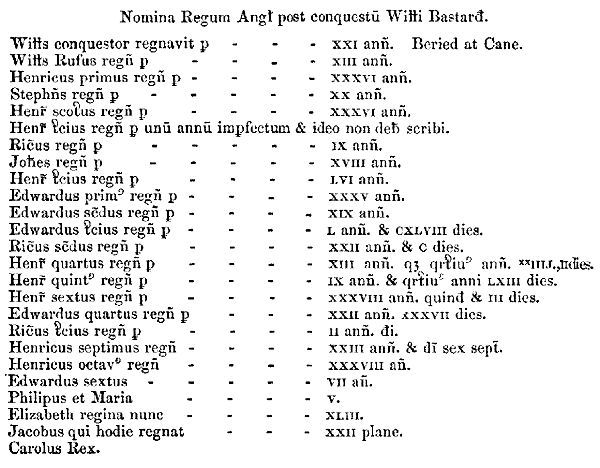
Nomina Regum [Angliae] post [conquestum] [Willielmi] [Bastardi].
| [Willielmus] conquestor regnavit [per] | XXI [annos]. Beried at Cane. |
| [Willielmus] Rufus regnavit [per] | XIII [annos]. |
| Henricus primus regnavit [per] | XXXVI [annos]. |
| [Stephanus] regnavit [per] | XX [annos]. |
| Henricus [secundus] regnavit [per] | XXXVI [annos]. |
| Henricus [tercius] regnavit [per] | unum [annum] [imperfectum] & ideo non [debet] scribi. |
| [Ricardus] regnavit [per] | IX [annos]. |
| [Johannes] regnavit [per] | XVIII [annos]. |
| Henricus [tercius] regnavit [per] | LVI [annos]. |
| Edwardus [primus] regnavit [per] | XXXV [annos]. |
| Edwardus [secundus] regnavit [per] | XIX [annos]. |
| Edwardus [tercius] regnavit [per] | L [annos] & CXLVIII dies. |
| [Ricardus] [secundus] regnavit [per] | XXII [annos] & C dies. |
| Henricus quartus regnavit [per] | XIII [annos] [quarterium] [anni] XXIIIJ., II dies. |
| Henricus [quintus] regnavit [per] | IX [annos] & [quarterium] anni LXIII dies. |
| Henricus sextus regnavit [per] | XXXVIII [annos] [quinquaginta] & III dies. |
| Edwardus quartus regnavit [per] | XXII [annos] XXXVII dies. |
| [Ricardus] [tercius] regnavit [per] | II [annos] [dimidium]. |
| Henricus septimus regnavit | XXIII [annos] & [dimidium] sex [septimanas]. |
| Henricus [octavus] regnavit | XXXVIII [annos]. |
| Edwardus sextus | VII [annos]. |
| Philipus et Maria | V. |
| Elizabeth regina nunc | XLIII. |
| Jacobus qui hodie regnat | XXII plane. |
| Carolus Rex. | |
—I beg to
withdraw my former suggestion as to "the crimson-circled star," which,
on reconsideration, appears to me manifestly erroneous.
If you can find space for a second suggestion, I think the question will
be cleared up by the following extract from the valuable work which I
cited before (the Dictionary of Greek and Roman Biography and
Mythology, edited by Dr. W. Smith):
"Eos, Ἠώς, in Latin Aurora, the goddess of the morning
red, who brings up the light of day from the east. At the close
of night she ascended up to the heaven from the river Oceanus to
announce the coming light of the sun to the gods as well as to
men. In the Homeric poems, Eos not only announces the coming
Helios (the sun), but accompanies him throughout the day, and her
career is not complete till the evening: hence she is sometimes
mentioned when one would have expected Helios (Od. v. 390. x.
144.); and the tragic writers completely identify her with Hemera
(the day), of whom, in later times the same mythes are related as
of Eos."
As Aurora rises from the river Oceanus, he may be called her father,
and as she sinks into the same, he may be called her grave. The
expression then will mean neither more nor less than this, "We returned
home before the close of day."
Perhaps Mr. Tennyson had a line of Lycidas running in his mind:
"So sinks the day-star in the ocean bed."
Milton's day-star, however, I take to be the sun himself.
Another of your correspondents, I see, suggests a different
interpretation of the "crimson-circled star."
I hope I shall not be considered as taking too great a liberty if I
avail myself of the medium of your pages to request Mr. Tennyson (deus
ex machinâ) to descend and settle the question.
X. Z.
—Cardinal Azzolini was
appointed by Alexander VII. Intendant to Queen Christina on her
receiving a pension of 12,000 scudi from that Pope. On the withdrawal of
this grant by Innocent XI., her majesty wrote a furious letter to the
Cardinal, which is one of the most curious pieces contained in a
Collection of Letters, edited by M. Matter (Paris, chez Amiot). That a
close intimacy existed between the Queen and the Cardinal appears from
some allusions in contemporary letters (1685-1687). See M. Valéry's
Correspondence de Mabillon et de Montfaucon avec l'Italie (Paris,
1846), vol. i. p. 99.: "La Reine de Suède, grande amie du Cardinal
Azzolin" ... vol. ii. p. 83.:
"Il n'y a plus de différend qu'entre le marquis Del Monte et le
Cardinal Azzolin [sic], à qui aura meilleure part dans les
bonnes grâces de la Reine pendant sa vie, et dans son testament
après sa mort."
The editor adds (vol. iii. p. 298.):
"Le Cardinal Azzolini fut le principal héritier de Christine."
C. P. PH***.
—In Dr. Maitland's Index
of English Books in the Lambeth Library will be found the following
entry:
"* Babington (Anthony), His Letter to the Queen. No place,
printer, or date." The asterisk denotes that it is not mentioned
by Herbert in his edition of Ames.
This, I believe, will be a satisfactory answer to J. BT.'s Query.
H. P.
—Not observing that H. W.'s Query
regarding Robert de Welle has as yet been answered, I would refer him to
Blomefield's Hist. of Norf., vol. vii. p. 288., edit. 1807, 8vo.,
where under "Bicham-well" he will find a Robert de Welle, lord of the
manor of Well Hall, an. 1326 (20 Edw. II.), which was held under the
Earl of Clare, the capital lord. He died circ. 9 Edw. III.
I have met also with a Roger de Welle, in an old roll undated, but about
the time of Hen. III., in which he is entered as holding a manor in
Wimbotsham, co. Norf.:
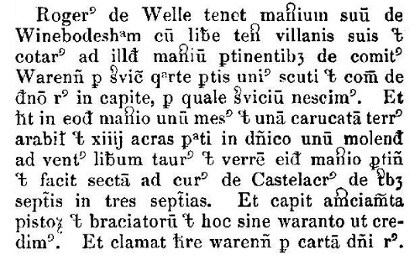
Rogerus de Welle tenet manerium suum de Winebodesham cum libero
tenemento villanis suis et cotariis ad illud manerium
pertinentibus de comite Warenne per servicium quarte partis unius
scuti et comes de domino rege in capite, per quale servicium
nescimus. Et habet in eodem manerio unum messuagium et unam
carucatam terre arabilis et xiiij acras prati in dominico unum
molendinum ad ventum liberum tauros et verres eidem manerio
pertinentes et facit sectam ad curiam de Castelacre de tribus
septimanis in tres septimanas. Et capit amerciamenta pistorum et
braciatorum et hoc sine waranto ut credimus. Et clamat habere
warennam per cartam domini regis.
The manor passed from him to Ingaldesthorp, under which manor the
continuator of Blomefield mentions (vol. vii. p. 517.) that Roger de
Frevil in 13 Hen. III. had a carucate of land here. This is probably
the same person as Roger de Welle, as it was not uncommon for persons at
that period to be known by different designations.
Thomas Knox, M.P. for Dungannon, was created Baron Welles, 1780. H. W.
will find the history of the family in Lodge's Peerage of Ireland, by
Archdall, vol. vii. p. 195., ed. 1789.
G. H. D.
—The following is a
correct list of the descendants of Sir John Banks; and as his wife is an
historical character, her own immediate descent, as well as the notice
of those of the present day who may claim her as their ancestor, may not
be uninteresting to your correspondent:—
Thomas Hawtrey, of Chequers, co. Bucks, Esq.,
A. 9 H. VII. |
| |
|
| |
|
|
| |
|
| |
|
|
| |
Ralph Hawtrey, fourth Son |
= |
Winifred, d. and h. of Wm. Wallaston, Esq., of Ruislip, co. Middx. |
|
| |
|
| |
|
|
| |
|
| |
|
|
| |
Edward Hawtrey, of Ruislip, Esq. |
= |
Elizabeth, d. of Gabriel Dormer, co. Oxon, Esq. |
|
| |
|
| |
|
|
| |
|
| |
|
|
| |
Ralph Hawtrey, of Ruislip, Esq. |
= |
Mary, d. of Ed. Altham of Mark's Hall, co. Essex, Esq. |
|
| |
|
| |
|
|
| |
|
| |
|
|
| ---------------------------- |
|
|
| |
| |
| |
|
|
| |
John Hawtrey, of Ruislip, Esq., eldest Son. |
Mary, only daughter, d. 1661. Buried at Ruislip. The Heroine of Corfe Castle. |
= |
Sir John Banks, Queen's Coll. Oxon, 1604. Chief Justice, temp. C. I. 1640. D. 1644. Of Stanwell, Middx., and Corfe Castle, Dorset. |
| |
|
|
| |
|
| |
|
|
| |
|
| |
|
|
| |
|
| |
|
------------------------------- |
| |
|
1. John Banks, d. before his father.
2. Sir Ralph Banks, Kt.
3. Jerome.
4. Charles.
5. William.
——
6. Bridget, d. 1636, at Stanwell, Middx.
7. Alice.
8. Elizabeth.
9. Mary.
10. Joan.
11. Anne, b. 1637, at Stanwell.
12. Frances.
13. Arabella, baptized July 31, 1642, at Stanwell. |
Of these only two appear to have left descendants: Sir Ralph Banks,
who is the ancestor of the Earl of Falmouth, and Baroness Le Despenser;
and of George Bankes, Esq., M. P. for Corfe Castle, his lineal
descendant. Mary Banks, third daughter, married Sir Robert Jenkinson,
Knt.; and is the ancestor of the Earls of Liverpool and Verulam, of the
Countesses of Craven, Clarendon, and Caledon; Viscountess Milton, and
Viscountess Folkestone.
Burke's Commoners would probably answer the rest of R. C. H. H.'s
Query, or Lysons' Middlesex.
L. H.
—I can explain to MARIA
S. how this epitaph came to be attributed to Wordsworth. The late
laureate did write some lines on the occasion of Lamb's death,
beginning—
"To a good man of most dear memory,
This stone is sacred."
They were composed, the author says,
"With an earnest wish,
Though but a doubting hope, that they might serve
Fitly to guard the precious dust of him,
Whose virtues called them forth. That aim is missed."
—Vol. v. p. 141. ed. 1850.
C. P. PH***.
This epitaph is said,
upon the authority of Segrais, to be upon the king of Spain's
preceptor, and to be seen at Saragossa. The version of it in my
possession differs from that supplied by your correspondent, and is as
follows:
"Here lies John Cabeça, preceptor of my lord the king. When he is
admitted to the choir of angels, whose society he will embellish
by his powers of song, God shall say to the angels, 'Cease, ye
calves! and let me hear John Cabeça, the preceptor of my lord the
king.'"
J. B. COLMAN.
Eye, March 24. 1851.
—The story of the frozen and
thawed words in Rabelais' Pantagruel, book iv. c. 55. and 56., is
borrowed from a passage in Plutarch's Morals, vol. vi. p. 293.,
Leipsic, Reiske's edition. I beg to subjoin the Latin translation of
this fable of so remote a date:
"Joco enim Antiphanes dixit, in urbe quadam voces illico frigore
loci congelare, ac per æstatem, gelu soluto, demum exaudiri, quæ
dicta erant hyeme; ita ille quæ adolescentes e Platone
audivissent, aiebat, plerosque vix tandem ingravescente ætate
intelligere."
C. I. R.
—JOHN FRANCIS X. asks "why so
designated?" Camden will answer him. That antiquary gives the Roman,
British, and Saxon names, and adds:
"Nos contractius West Chester ab occidentali
situ."—Britannia, edit. 1607, p. 458.
But X. adds:
"In Maps of Cheshire 1670, and perhaps later, the city
is thus called."
The writer has the maps and plans of Braun, Hollar, Saxton, Speed, and
Blome, before him, but these have "Chester" simply; and does not at
present recollect any county map with the prefix mentioned. Perhaps X.
will oblige by a reference.
LANCASTRIENSIS.
West Chester (Vol. iii., p. 353.).—So called in contradistinction to
Chester-le-Street, Chester Magna, Chester Parva, Chesterfield,
Chesterton, and a hundred other Chesters throughout England. To be sent
to West Chester (frequently so called in the beginning of the last
century), was to be sent into banishment, i. e. into Ireland; of which
Chester was in those days the usual, and indeed almost the only, route.
C.
—I beg to inform D. X.
that I have met with several instances of Dissenters' burials being
entered in parish registers, at a time when a more amicable feeling than
now exists prevailed between churchmen and themselves. In the register
of Warbleton, co. Sussex, in particular, there are several entries of
Quakers who were buried in their own cemetery in that parish, about 150
years since.
M. A. LOWER.
Lewes.
Registry of Ministerial Offices performed by Dissenters (Vol. iii., p.
370.).—The note of D. X. has led me to examine the baptismal registers
of Ecclesfield parish, and I find on the parchment fly-leaf of the book
which contains the baptisms, that date from nearly the beginning of the
seventeenth century, the following heading—"Births of the children of
some Dissenters enter'd as given." Then comes a list of the names of
fourteen children, with the dates of their births; and, after several
miscellaneous entries of baptisms, I find,
"January 3. 1750-1, Samuel, son of Thomas Sayles, said to be
baptised at Sheffield by ye Popish priest."
The enrolment of births is, no doubt, quite improper. But the entering
of dissenting baptisms in the parish register (mentioned by D. X.) would
not, I think, be equally open to reprobation; inasmuch as the
registering has always been of baptisms in the parish, and not merely
in the church. Hence, if dissenting baptism be, as no doubt it is, a
valid title to burial by the clergyman, he might, not unreasonably, be
disposed to keep a list of such irregular administrations. That the law
has regarded them as irregular, is evident from the fact, that when in
1812 an act was passed "for the better regulating and preserving parish
and other registers of births, baptisms, marriages, and burials in
England," the 146th chap. of the same distinctly declares, that when a
baptism is performed by any other than the licensed minister of the
parish, the certificate of its performance must state that it was
"according to the rites of the United Church of England and Ireland." No
dissenting baptism, therefore, could now be registered by the clergyman.
In our burial register there is a slip of paper pinned, with this
inscription upon it:
"These are to certify that the remains of Ann, the wife of Thomas
Ellis, was buried in the Methodist chapel-yard in Ecclesfield,
the 5th day of November, 1826, aged (about) seventy-three."
The poor woman chose to lie apart from her "rude forefathers;" and she
has continued to be the solitary tenant of the small enclosure round the
chapel. It seems, however, that her friends did the best they could
towards preserving her name on the list of those who sleep in the
consecrated cemetery.
ALFRED GATTY.
—A correspondent in your No.
of May 10th, signed A. D., wishes to be informed of the author of "The
Grave," a very beautiful poem; and he gives a portion of it thus:—
"1st Voice.
"How peaceful the grave, its quiet how deep,
Its zephyrs breathe calmly, and soft is its sleep,
And flow'rets perfume it with ether."
"2nd Voice.
"How lonesome the grave, how deserted and drear,"
(From what I remember of the poem, this stanza flows on thus):—
"With the howls of the storm wind, the creaks of the bier,
And the white bones all clattering together."
This poem extends to fifteen or twenty stanzas, and is exquisite in its
imagery, and peculiarly forcible (its author was a Russian, I think
Derzhavin), and in its original language might compare with the works of
the most polished poetry of advanced nations. It can be found translated
in Bowring's Russian Anthology, 12mo., published about 1824: where
also will be found some beautiful translations from Lomonosoff, "Or
Broken Nose," and other Russian poets. Derzhavin also has his grandest
poem on God, translated there: this poem is popular in no less than
thirty-six languages, and is familiar to the Chinese and Tartar nations,
and even as far as Southern India. I give the exordium, which is
noble:—
"O Thou Eternal One, whose presence bright
All space doth occupy, all motion guide;
Unchanged through time's all-devastating flight;
Thou only God! There is no God beside!"
And in a further portion of the poem, describing Heaven as the abode of
God, he speaks thus:
"What shall we call them? Piles of crystal light,
A glorious company of golden streams,—
Lamps of celestial ether burning bright,—
Suns lighting systems with their joyous beams?"
I think I have quoted sufficient to direct A. D.'s attention to the
northern poets, who, though few in number, make up their deficiency in
quantity by the sterling and magnificent quality of their works.
GREGORY BATEMAN.
Tansor Rectory, near Oundle, Northamptonshire,
May 15. 1851.
The poem inquired for by A. D. is copied in an album in my possession
"from Bowring's translation of Russian Poetry," and is entitled "The
Churchyard."
J. R. PLANCHÉ.
—The "little predie round-robin,"
mentioned by Dr. Heylin, was no doubt a small pancake. (See Halliwell's
Archaic and Provincial Dictionary, under "Round Robin.")
Of the derivation of the petition also called a round robin, I find the
following account in the Imperial Dictionary:—
"ROUND ROBIN, n. [Fr. rond and ruban.] A written petition,
memorial, or remonstrance signed by names in a ring or circle.
The phrase is originally derived from a custom of the French
officers, who, in signing a remonstrance to their superiors,
wrote their names in a circular form so that it might be
impossible to ascertain who had headed the list. It is now used
to signify an act by which a certain number of individuals bind
themselves to pursue a certain line of conduct."
The round robin sent to Dr. Johnson on the subject of his epitaph on
Goldsmith is well known. In speaking of it Boswell states that the
sailors make use of it "when they enter into a conspiracy, so as not to
let it be known who puts his name first or last to the paper."
C. H. COOPER.
Cambridge, May 3. 1851.
—Your correspondent J. M., and M. Philarète Charles, are both incorrect in
saying that this derivation is not given in any English or American
work. In the Poetical Works of John Trumbull, LL.D., published at
Hartford (U.S.), 1820, in two volumes, in the Appendix, appears the
following Note:
"Yankies.—The first settlers of New England were mostly
emigrants from London and its vicinity, and exclusively styled
themselves the English. The Indians, in attempting to utter the
word English, with their broad guttural accent, gave it a sound
which would be nearly represented in this way, Yaunghees; the
letter g being pronounced hard, and approaching to the sound of
k joined with a strong aspirate, like the Hebrew cheth, or
the Greek chi, and the l suppressed, as almost impossible to
be distinctly heard in that combination. The Dutch settlers on
the river Hudson and the adjacent country, during their long
contest concerning the right of territory, adopted the name, and
applied it in contempt to the inhabitants of New England. The
British of the lower class have since extended it to all the
people of the United States. This seems the most probable origin
of the term. The pretended Indian tribe of Yankoos does not
appear to have ever had an existence; as little can we believe in
an etymological derivation of the word from ancient Scythia or
Siberia, or that it was ever the name of a horde of savages in
any part of the world."
I some time ago thought of sending you a copy of this "Note," but had
forgotten it, until recalled to my memory by reading J. M.'s extract.
T. H. KERSLEY, A.B.
King William's College, Isle of Man.
Yankee—Yankee-doodle (Vol. iii., p. 260.).—In a curious book on the
Round Towers of Ireland (I forget the title), the origin of the term
Yankee-doodle was traced to the Persian phrase, "Yanki dooniah," or
"Inhabitants of the New World." Layard, in his book on Nineveh and its
Remains, also mentions "Yanghi-dunia" as the Persian name of America.
BENBOW.
Birmingham.
Yankee.—The following lines from a poem, written in England by the
Rev. James Cook Richmond, of Providence, Rhode Island, and dated Sept.
7, 1848, gives the derivation of this word:—
"At Yankees, John, beware a laugh,
Against yourself you joke:
For Yenghees 'English' is, but half
By Indian natives spoke."
M. Philarète Charles then has too hastily concluded that this etymology
is not given in "aucun ouvrage américain ou anglais," and has supplied
us with a surprising coincidence, since he appears to have fairly
translated the first two lines, viz.: "Les Anglais, quand ils se moquent
des Yankies, se moquent d'eux-mêmes."
W. DN.
Your
correspondent's Query as to the author of these letters, published by
Dodsley in 1767, 12mo., has not yet been answered. The author's name was
Alexander Thomson. It is inserted in manuscript in two copies of this
work which I possess. I have also seen the assignment of the copyright
to Dodsley, in which the same name occurs as that of the author.
JAS. CROSSLEY.
—The name by which the male
ferret is known in the midland counties is the hob: the female is
called the jill. In that district there is a saying current, which is
applied to the human genus:
"There's never a Jack but finds a Jill."
In Welsh, the name of the ferret is ffured, which means a wily, crafty
creature.
A RATCATCHER.
— W. C.'s Query has not
received much elucidation as yet; as a small contribution, I may remark
that the Benedictine Dom. Porcheron brought the MS. to light, and
published it at Paris, 1686, 8vo., under the title, Anonymi Ravennatis,
qui circa sæculum septimum vixit, de Geographiâ libri quinque, with a
dedication to the Duc de Bourbon, son of the great Condé. My authority
is, the Correspondence inédite de Mabillon et de Montfaucon avec
l'Italie, par M. Valéry, Paris, 1846, vol. ii. pp. 2, 3, 5.
"Paucis abhinc diebus prodiit ab uno e nostris erutus in
lucem Anonymus Ravennas, qui ante annos circiter mille de
Geographia scripsit libros quinque. [Michel Germain à Gattola,
Dec. 31. 1686.] Je vous destine un volume in 8vo. que notre
cher Dom. Placide Porcheron vient de donner au public, c'est un
Anonyme de Ravenne, Goth ou Grec de naissance, qui vivait il y a
mille ans ... [the same, to Magliabechi, Jan. 10. 1687.]"
The editor gives the date 1688, and the form 4to., for this book; the
date is evidently a misprint.
C. P. PH***.
—As JARLTZBERG has not replied to MR. EASTWOOD'S Query, permit me to refer
the latter to Sacred Latin Poetry Selected, by R. C. Trench, London,
1849, pp. 67. 152. 153.:
"The Middle-Age legend, that the lion's whelps were born dead and
first roused to life on the third day by the roar of their sire,
was often alluded to in connexion with, and as a natural type of
the Resurrection. Adam de S. Victore (De SS. Evangelistis,
verse 25.):
"'Est leonis rugientis
Marco vultus, resurgentis
Quo claret potentia:
Voce Patris excitatus
Surgit Christus....'
"Again, De Resurrectione Domini, verse 54.:
"'Sic de Judâ Leo fortis,
Fractis portis diræ mortis
Die surgit tertiâ,
Rugiente voce Patris....'
"Hugo de S. Victore (De Best., lib. ii. cap. 1.):
"Cum leæna parit, suos catulos mortuos parit, et ita custodit
tribus diebus, donec veniens Pater eorum in faciem eorum exhalet,
et vivificentur. Sic Omnipotens Pater Filium suum tertiâ die
suscitavit a mortuis.
"Hildebert (De Leone):
"Natus non vigilat dum Sol se tertiògyrat,
Sed dans rugitum pater ejus suscitat illum:
Tunc quasi vivescit, tunc sensus quinque capescit."
C. P. PH***.
—The legend that I have heard in Devonshire differs from that quoted in Vol.
ii. It ran thus:
"Friday cut hair, Sunday cut horn,
Better that man had never been born."
The meaning given to it was, that cutting horn was a kind of work, and
therefore a breach of the Sabbath and that cutting hair on the Friday
was, like a hundred other things, thought unlucky on a Friday, from some
obscure reference to the great sacrifice of Good Friday. Sir Thomas
Browne shows that this was perhaps the continuation of ancient
superstition; and it is peculiarly remarkable that amongst the Romans
the Dies Veneris (Friday) should have been thought unlucky for
hair-cutting. His reference to the crime of Manasses, "of observing
times," enters into no detail, and the text is evidently a general
condemnation of superstitious observances. I may as well here remark
that Browne's reference to Manasses, 1 Chron. xxxv., in my edition
(1686), is erroneous: it should be 2 Chron. xxxiii. 6.
C.
—Your correspondent N.
B., p. 283., has doubtless aptly illustrated Shakspeare's use of the
word gig, but not as a local name, where "there is no indication of
anything in the land to warrant it;" but if your querist K., p. 222.,
will refer to Bailey's Dictionary, article "Gig Mill," "a mill for the
fulling of woollen cloth," he will find the key to the local name; and
full information as to the illegality and injurious tendency of Gig
Mills, with an order for their suppression, &c., will be found in the
statute 5 & 6 Edward VI., c. 22, intitled, "An Act for the putting down
of Gig Mills." The presence of such mills previous to the suppression
would give the name to the sites now known as "Gig's Hills."
BLOWEN.
—MR. BUCKMAN calls the Poplar and Lime native, and the Sycamore
and Robinia foreign trees, and adds that the two latter are
comparatively recently introduced.
Without doubt, all four are foreign, except the Asp among Poplars, which
is a native tree. And the Sycamore was introduced into England long
before the Lombardy, and I think before any of the Poplar tribe.
I have seen the Mistletoe propagated by seed inserted, with an upward
cut of a knife, under the bark of an apple-tree.
On the Oak I have never seen the Mistletoe. The late Mr. Loudon, when
shown it on an oak on the estate of the late Miss Woods, of Shopwyke,
near Chichester, said he had only seen it in one other instance.
A. HOLT WHITE.
For much learned lore relating to this remarkable plant, see the
Encyclopædia Metropolitana. Your querist ACHE may be assured that the
Mistletoe may be often found in the counties of Devon and Somerset
growing on oaks, and frequently on old apple-trees in neglected
orchards. A specimen of it may also be occasionally found on
other trees the bark of which is rough, such as the acacia and some
species of willow, when of large size. I have heard of an instance of
its growing in a furze-bush.
S. S. S.
—If R. W. C. will turn
to Akerman's Coins of the Romans relating to Britain, he will find, at
p. 36., the description of a brass medallion of Commodus having on the
reverse a legend commencing "BRITTANIA
P. M. TR.," &c.
The author observes:
"The spelling of Britannia is worthy of observation. Dr. Charles
Grotefend thinks it is from the Greek, Βρεττανια."
And in a Note to this adds:
"That in Horace and Propertius, the first syllable of Britannia
is short, but in Lucretius, on the contrary, it is long."
I would further observe, that the same mode of spelling "Britannia,"
with two t's, obtains on the coins of Severus, Caracalla, and Geta.
J. COVE JONES.
Temple, April 17. 1851.
—Thomas Gilbert, the author of the MS. treatise mentioned by your correspondent,
was the son of William Gilbert, of Priss, in Shropshire. He was born in
1613, and at the age of sixteen entered the University of Oxford. He
took the degree of M.A. in 1638, and was afterwards appointed minister
of Upper Winchington, in Buckinghamshire. He joined the Puritan party at
the beginning of the rebellion, and was made vicar of St. Lawrence,
Reading. Wood says that he turned Independent, "was actually created
Bachelor of Divinity in the time of the Parliamentarian visitation," and
was preferred to the rich rectory of Edgmond, in his native county of
Shropshire. Being very active against the Royalists, he was commonly
called the "Bishop of Shropshire." After the Restoration he was, of
course, ejected, when he retired to Oxford, and lived obscurely many
years, with his wife, in the parish of St. Ebbs. He lived latterly upon
charity, and died in the extreme of poverty, in the year 1694. For more
minute particulars of the life of this person, and a catalogue of his
writings, see Wood's Athenæ Oxon., edit. Bliss, vol. iv. p. 406.
EDWARD F. RIMBAULT.
—I have seen this carved and gilt as the sign of R. O. Backwell, ironmonger, Devonport. A person
now sitting by me recollects its being adopted there about forty years
since. It is perhaps always the sign of an ironmonger, instead of a
public-house, as suggested by your correspondent. The pot (as at
Blackfriars) is the three-legged cast-iron vessel called in Devonshire a
"crock."
K. TH.
—If the man who believes in this fable
can be found in England, he will meet with the demonstration of its
falsehood in the cotemporary chronicles of Galindo, Bishop of Troyes,
otherwise called by his assumed name of religion, Prudentius Trecensis,
or Trecassensis. (See Monumenta Germaniæ Historica, Hanover, 1826,
vol. i. p. 449.) It there appears clearly that no Pope John VIII.
succeeded Leo IV., or preceded Benedict III. Prudentius survived them
both by three years. His words are "Mense Augusto Leo apostolicæ sedis
antistes defunctus est, eique Benedictus successit. Eodem mense duæ
stellæ majoris et minoris quantitatis visæ sunt," &c. &c.
It seems to me that a just blindness fell upon men so evil-minded as to
desire the falsification of chronology and history for polemical ends,
that they should have utterly missed the moral principle by which they
would be thought animated. No prelate ordaining a young person, unknown
to himself, save by academical reputation, could know that person's
sex. The want of beard is no criterion; nor is the female lip in all
instances very smooth. But if it were true that a person eminently
distinguished by studies, and bringing from Athens a high reputation for
merit, could upon those grounds alone obtain the suffrages of the Roman
chapter, more honour would be conferred upon it than that chapter, or
other dispensers of patronage, have usually merited. Instead of being
unknown, the candidates in the days of Benedict III. were, if anything,
too well known; for the jobbery and faction, of which this fable would
indicate the entire, and almost unnatural, absence, were sufficiently at
work.
A. N.
—Bishop Andrewes uses the
phrase, "in docke out nettle, in nettle out docke," to denote
unsteadiness. The passage occurs in Sermon I., "Of the Resurrection,"
folio, p. 391.:
"Now then that we bee not, all our life long, thus off and on,
fast or loose, in docke out nettle, and in nettle out docke; it
will behove us once more yet to looke back," &c. &c. &c.
REVERT.
Wittingham, Easter Eve.
—This phrase was, I
believe, originally "Mind your toupées and your queues,"—the
toupée being the artificial locks of hair on the head, and the queue
the pigtail of olden time.
There used to be an old riddle as follows:—Who is the best person to
keep the alphabet in order?—Answer: A barber, because he ties up the
queue, and puts toupées in irons.
NEDLAM.
—The BORDERER,
with whom, I fancy, every one will fully agree, has himself been guilty
of incuria in charging it upon Walter Scott. The great festival at
which Michael Scott marches off with the Goblin Page, was to celebrate,
not the nuptials, but the betrothal, of the hero and heroine. I do
not think I have read the Lay since I was a boy; but yet I will bet
five nothings to one, that the following lines are spoken by the Lady,
when she gives way, as she says, to Fate:—
"For this is your betrothing day,
And all these noble lords shall stay
And grace it with their company."
It would be an excellent thing if some of your correspondents would
furnish you with materials for a corner, to be entitled, "The Prophecy
of Criticism." It should give, by short extract, those presages in which
criticism abounds, taken from the Reviews of twenty years or more
preceding the current year. Thus, in this year of 1851, the corner
should be open to any prophecy uttered in or before 1831, and palpably
either fulfilled or falsified. In a little while, when the subject
begins to cool, the admission should be restricted to prophecy of
precisely twenty years of previous date. Such a corner would be useful
warning to critics, and useful knowledge to their readers.
M.
—In reply to E.V.'s Query, if there is any
place in the north of France bearing that name, I may inform him that
Tingry is a commune near Samer, in the arrondissement of Boulogne.
Tingry Hill is the highest spot in the neighbourhood. In the Boulogne
Museum are several mediæval antiquities found at Tingry.
P. S. KG.
—You must find it difficult to know what to do when a correspondent obtains
admission into your columns who absolutely requires to be sent back to
elementary books. On the one hand, care must be taken not to discourage
communication: on the other hand, there is a species of communication
which must be gently discouraged. Nothing has ever appeared in your
columns which makes this remark more necessary than the communication
headed as above, and signed by the venerable name of HIPPARCHUS. Your
well meaning, but hitherto not sufficiently instructed, correspondent,
seems to imagine either that the Jewish year was wholly lunar, or that a
solar year may consist of a fixed number of (wrong) lunar months. Now,
the lunar month is not 29 days, but 29-½ days; and the Jews, whom he
calls ignorant of astronomy (which they were, compared with Hipparchus
of Rhodes), met this, as most know, by using months of 29 days and of 30
days in equal numbers. And surely every one must know that the Jewish
year was regulated, as to its commencement, by the sun and the equinox.
The year opened just before the Passover, which required a supply of
lamb. Unless lamb had been obtainable all the solar year round, a
regular lunar year (such as the Mahometans have) would have made a due
observance of the Passover impossible. I hope your correspondent can
bear to be told, good-humouredly, that it passes all reasonable
permission that he should speculate on chronological questions as yet.
M.
—I cannot help doubting this
derivation; and I suspect that the true meaning of the word is, a piece,
or slice (or vulgo, a "hunch") of bread. When people who dined early,
and breakfasted comparatively late, wanted any intermediate refreshment,
"a luncheon" (or, as we should now say, "just a crust of bread") was
sufficient. The Query brought to my mind some verses of the younger
Beattie, which were published with his father's Minstrel, &c., in
which he uses the word "luncheon" for the piece of bread placed beside
the plate at dinner. I have no doubt of the fact, though I cannot
recollect the lines, or find the book. But after searching in vain for
it, I took down Johnson's Dictionary; and under the word I found this
couplet by Gay, which is perhaps a better authority:
"When hungry thou stood'st staring like an oaf,
I sliced the luncheon from the barley loaf."
S. R. M.
—Your correspondent C. quotes the following passage from Seneca:
"Venient annis secula seris,
Quibus Oceanus vincula rerum
Laxet, et ingens pateat tellus,
Tethysque novos detegat orbes;
Nec sit terris ultima Thule."
Medea, Act II., ad finem, v. 375.
and he says that some commentator describes these lines as "a
vaticination of the Spanish discovery of America." I believe, however,
that Lord Bacon may claim the merit of having been the first to notice
this vaticination. In his essay "Of Prophecies" he says:
"Seneca, the tragedian, hath these verses:—
'Venient annis
Sæcula seris, quibus Oceanus
Vincula rerum laxet, et ingens
Pateat tellus, Tiphysque novos
Detegat orbes; nec sit terris
Ultima thule.'
"'A prophecy,' he adds, 'of the discovery of America.'"
I have quoted this from an edition of Bacon's Essays, printed at the
Chiswick Press, by C. Whittingham, for J. Carpenter, Old Bond Street,
London, 1812: and not the least curious circumstance is the
curious form which Bacon, evidently quoting from memory, has given to
the passage.
HENRY H. BREEN.
St. Lucia, March, 1851.
—I fully
agree with your correspondent S. W. SINGER that an imperfect
acquaintance with our older language has been the weak point of the
commentators, but at the same time I think they have been equally guilty
of an imperfect acquaintance with the history and character of
Cleopatra, and one at least of a careless reading of the text; otherwise
it appears incomprehensible how, on the one hand, the words of the great
poet could have been so distorted; on the other hand, how Scarus could
be thought to allude, by the word "ribald," to Antony. On reference to
Rider's Dictionary, published in 1589, the very year in which Malone
places Shakspeare's first play, First Part of Henry VI., may be found
the word Ribaud, leno, a bawd, a pander; Ribaudrie, lascivia,
obscœnitas, impudicitia, Venus; and Ribaudrous, obscœnus,
impudicus, impurus.
Hagge, doubtless the word of Shakspeare, also may be found in Rider,
answering to the Latin lamia, fascinatrix, oculo maligna mulier.
Arguing from the above, what more appropriate term than "ribaudred
hagge" could be applied to Cleopatra, a queen celebrated for her beauty,
her cunning, her debauchery, nay, even adultery. The sister and wife of
Ptolemy Dionysius, she admitted Cæsar to her embraces, and by him had a
son called Cæsarion, and afterwards became enamoured of Antony, who,
forgetful of his connexion with Octavia, the sister of Cæsar, publicly
married her; thus causing the rupture between him and Cæsar, who met in
a naval engagement off Actium, where Cleopatra, "when 'vantage like a
pair of twins appeared," by flying with sixty sail, ruined the interest
of Antony, and he was defeated; and so were called forth the imprecatory
words of Scarus.
"Yond ribaudred Hagge of Egypt,
Whom leprosy o'ertake."
FRANCISCUS.
—The origin of the word hellequin,
unknown to M. Paul Paris, is to be sought in Scandinavia, especially
Norway, whence so many swarms of fierce Pagan settlers rushed into
Normandy and other parts of France. The helle-quinna or hell-quean
was the famous hela or hel, the death-goddess (whence our word
hell, the death-realm, as still used in the Creed, &c.), so well
known also to our own West Scandinavian (commonly called Anglo-Saxon)
forefathers. The Wild Hunt of the Helle-quinna (the Death-quean and her
Meynie) was therefore soon easily synonymous with that of La Mort,
and, as M. Paris has well observed, naturally led to the grotesque
mummeries of notre famille d'Arlequin.
GEORGE STEPHENS.
Stockholm.
—Quarles, in his Emblems,
b. 2. 12, p. 124., edition 1812, has the following passage: "Christ's
cross is the christ-cross of all our happiness," i. e. the alphabet,
the beginning, perhaps the alpha and omega. Grose, in his Olio, p.
195., 1796, relates the following story:
"An Irishman explaining the reason why the Alphabet is called the
Criss-cross-Rowe, said it was because Christ's cross was
prefixed at the beginning and end of it."
W. B. H.
Manchester.
—The
gentlemen who have hitherto attempted to explain this term are very
evidently unacquainted with the subject on which they write; with the
exception, however, of MR. CROSSLEY, whose quotation from the
Merchant's Mirrour confirms what I am about to say. To the clerk in a
merchant's counting-house, like him
"Who pens a stanza when he should engross,"
the waste-book may indeed be a weary waste; but he does not call it so
for that reason, any more than he gives poetical names to the day-book
or ledger. In short, we must not go to the merchant's counting-house at
all to discover its meaning; or, if we do, "the book-keeper and cashier"
who makes the Query may refer us to one of the elders, or head of the
firm, who, if he be not too proud to own it, may just recollect that his
progenitors or predecessors in the chandler's shop made their rough
entries in a book which was literally waste. For origins we must look to
the lowest forms or types existing. The merchant's system of
book-keeping was not invented perfect; and we may see its various stages
in the different gradations of trade at the present day. In many
respectable shops, in the country especially, the waste-book is formed
by a quire or two of the commonest paper used in the particular trade,
that will bear pen and ink, sown together. An advance upon this is the
waste-book as a distinct book, bound and ruled, of which the day-book or
journal is merely a fair copy; and this being made, the former is held
of no account. The importance, however, of reference to original entries
has no doubt led to the preservation of the "Waste-book" in regular
book-keeping, and a modification of its character.
S. H.
St. John's Wood, April 22. 1851.
—May I ask your correspondent whether
the following lines in the "Georgics" (iii. 284.), the most exact
composition in existence, prove that they were first delivered by word
of mouth, from notes only:—
"Sed fugit interea, fugit irreparabile tempus,
Singula dum capti circumvectamur amore."
I might add the passage in Pindar, 4th Pythian, 439.:
"Μακρά μοι νεῖσθαι κατ' ἀμαξιτὸν· ὥρα γὰρ συνάπτει· καί τινα οἶμον ἴσαμι βραχύν."
Such passages are common in all authors.
C. B.
—With reference to B.'s
remark on the Host being often preceded by a hand-bell, it may more
correctly be stated, that the Host, when carried in procession to the
sick, is in all Catholic countries uniformly preceded by a bell, in
order to warn all persons of its approach, that they may be ready to pay
all due reverence as the procession passes. The ringing of the bell on
this occasion was first instituted by the Cardinal Guido, who was sent
Legate to Germany, to confirm the election of the Emperor Otto.
R. R. M.
[Query, May not this have been the original passing bell?]
—There is the following allusion to these lines by
Question and Answer in the New Help to Discourse, published about
1670, p. 102.:
Q. "How came the famous Buchanan off, when travelling into Italy,
he was, for the freeness of his writing, suspected of his
religion, and taken hold of by some of the Pope's Inquisitors?"
A. "By writing to his Holiness this distich:
'Laus tua, non tua fraus, virtus, non copia rerum,
Scandere te fecit hoc decus eximium.'"
For which encomium he was set at liberty; and being gone out of the
Pope's jurisdiction, he sent to his Holiness, and desired, according to
his own true meaning, to read the self-same verses backward.
If George Buchanan, born 1506, was indeed the author of them, it is
certain that no Pope Alexander could have been the subject of them, when
written, I presume, in 1551, that being the year in which he obtained
his liberty. And now to J. F. M.'s Query p. 290.—If he has transcribed
Puttenham aright, he might justly condemn them as very bad "verse Lyon,"
if that be Leonine; but I take it that he has condemned what is worthy
of some praise, and of being "called verse Lyon," for Lyric.
It would lose nothing of the lyrical by translation, but your readers
being all classical I forbear.
BLOWEN.
—Francis Moore, physician,
was one of the many quack doctors who duped the credulous at the latter
period of the seventeenth century; he practised in Westminster: in all
probability then, as in our own time, the publication of the almanac was
to act as an advertisement of his healing powers, &c. Cookson, Salmon,
Gadbury, Andrewes, Tanner, Coley, Partridge, &c. &c., were all his
predecessors, and were students in physic and astrology. Moore's
Almanac appears to be a perfect copy of Tanner's, which was first
published in 1656, forty-two years prior to the appearance of Moore's.
The portrait in Knight's London is certainly imaginary. There is a
genuine and very characteristic portrait, now of considerable rarity,
representing him as a fat-faced man in a wig and large neck-cloth,
inscribed "Francis Moore, born in Bridgnorth, in the county of Salop,
the 29th of January, 1656/7.—JOHN DRAPENTIER, delin.
et sculp."
I may mention it as a curious fact, that the portraits of these quack
doctors, when in a good state, are frequently of great rarity. I possess
one which was in the Stow collection, being a fine impression of the
following print by Drapentier, for which the sum of five guineas had
been paid:
"The effigies of George Jones, whom God hath blessed with greate
success in healing."—"Student in the art of physick and
chirurgery for about thirty years in the Upper More Fields, two
golden balls on the tops of the two posts of the portel before my
door."
W. W. C.
—A description of the foundation
of a "national debt" in Florence in the years 1344-45 is to be found in
the Florentine History, by Henry Edward Napier, R. N. (published by
Edward Moxon, Dover Street), chap. xxi. p. 125.
FIRENEYE.
—I beg to send a copy of
a Latin inscription discovered some years since over the west door
inside the great nave of St. Alban's Abbey. It may possibly prove to be
a record of some historical value, and at all events furnishes a partial
reply to the Query of Σ. in your First Volume:—
"Propter vicinii situm, et amplum hujus Templi spatium ad magnam
confluentium multitudinem excipiendam opportunum, temporibus R.
H. VIII. et denuo R. Elizabethæ, peste Londini sæviente,
Conventus Juridicus hic agebatur."
Underneath this is written,—
"Princeps Dei Imago Lex Principis opus
Finis Legis Justitiâ."
Can any of your learned correspondents clear up the nature and extent of
these fear-stricken flights to the old abbey? Was it the Commons, or
Westminster Hall, or the Convocation, or all together, avoiding the
plague? I may observe that our ancestors seem to have put to some
practical use the vast space of an abbey-church on extraordinary
occasions; and I would humbly suggest that we too of the nineteenth
century might take the hint, and employ the many unoccupied naves
of our ecclesiastical buildings for religious purposes on ordinary
occasions.
W. M. K.
—They are sometimes called St. Bridget's Prayers. I have a very small volume entitled:
"¶ A breefe Directory and playne way how to say the Rosary of our
blessed Lady: with Meditations for such as are not exercised
therein. Whereunto are adioyned the prayers of S. Bryget with
others. Bruges Flandrorum, excudebat Hu. Holost. 1576."
At the end (beginning with fresh signature A i.) are—
"¶ Fifteene Prayers, righte good and vertuous, vsually called the
XV Oos, and of diuers called S. Briget's prayers, because the
holye and blessed Virgin vsed dayly to say them before the Image
of the Crucifix in S. Paules Church in Rome."
Of this diminutive volume I never saw another copy. It was published by
J. M., who dates his dedication to his dear sister A. M., "from the
Englishe Charter House in Bridges (sic), the vigil of the Assumption
of Our Lady, 1576." It seems that the sister was resident in England,
and had, previously to her brother's departure for Bruges, requested him
to send her a translation of the Rosary, which having obtained, his
cousin and friend J. Noel procured it to be printed. J. M. willingly
confessing "for that I know there be many good women in Englande that
honour Our Lady, but good bookes to stirre vp deuotion in them are
scarse." Would not a list of English books printed abroad be an
interesting subject for some bibliographical antiquary, and an
acceptable addition to our literary antiquities?
P. B.
—MR.
OFFOR has very satisfactorily shown that Bunyan could not, from its
grandiloquent style, have been the author of the Visions of Heaven and
Hell, attributed to him in an edition of that work published in the
reign of George I., entitled, The Visions of John Bunyan, being his
last Remains.
This title must have been a surreptitious one, for, since MR. OFFOR made
the above communication, I have obtained a copy of this scarce book
published in the previous reign, under its legitimate title (as in the
Sunderland copy of 1771, mentioned at p. 70. supra), and said to be
"By G. L. φιλανθρωπο London, printed for John Gwillim,
against Crossby Square in Bishopsgate-street, 1711."
In his address "To the Reader" (also signed G. L.), the author even
makes the following direct allusion to Bunyan's allegory:
"And since the Way to Heaven has been so taking under the
similitude of a dream, why should not the Journey's End be as
acceptable under the similitude of a vision? Nay, why should
it not be more acceptable, since the end is preferable to the
means, and Heaven to the Way that brings us thither? The
Pilgrim met with many difficulties; but here they are all over.
All storms and tempests here are hush'd in silence and serenity."
It will therefore, I think, be admitted that the name of Bunyan ought no
longer to be associated with this work, and that all inferences drawn
from the fallacy of his having been the author of it should henceforth
be disregarded.
It would, however, be desirable, if possible, to ascertain who G. L.
really was, and how the spurious title-page came to be affixed by
"Edward Midwinter, at the Looking-Glass upon London Bridge," to his
edition of this allegory?
N. H.
—Your Querist asks, "Has the
word Mazer any signification in itself?" It signifies Maple, being a
corruptions of the Welsh word Masarn—the maple-tree. Probably,
therefore, the use of the wood of the maple for bowls and drinking-cups
prevailed in this country many centuries before the times of Spenser and
Chaucer, in whose works they are mentioned. In Devonshire the black
cherry-tree, which grows to a large size in that county, is called the
mazer-tree. From this circumstance I conjecture that this wood has been
used there in former times for bowls and drinking-cups as a substitute
for maple. That the original word, mazer, should have been retained,
is not to be wondered at. It is known that when the mazer bowl was made
of silver, the old name was retained. The name of the maple-tree, in the
Irish language, is crann-mhalpais; therefore the name of the Irish
wooden drinking-cup maedher cannot be derived from it.
S. S. S.
—Any of your readers who are
curious in natural history will find, in the Pharmaceutical Journal,
vol. ii. p. 591., a very full description of this extraordinary
production, by Dr. Pereira. It is used as a medicine by the Chinese, by
whom it is called the "summer-plant-winter-worm," and who attribute to
it great cordial and restorative powers. The mode of employing it is
curious. A duck is stuffed with five drachms of the insect fungus, and
roasted by a slow fire; when done, the stuffing is taken out, the virtue
of which has passed into the duck, which is to be eaten twice a day for
eight or ten days. In the same work, vol. iv. p. 204., Dr. Pereira gives
a further account of the moth on whose larva the fungus grows.
E. N.
Southwark, May 19. 1851.
—I notice a slight
inaccuracy in MR. SINGER'S reference to the author of Voyage autour de
ma Chambre. He gives the name as "Jean Xavier Maitre;" whereas
the correct designation is "Count Xavier de Maistre;" the s in the
patronymic being distinctly pronounced. Such trifling errors are only
worth noticing because they appear in a work, one of the main features
of which is the correctness of its references to authors and books. No
doubt it is his extensive acquaintance with both that induced MR.
SINGER, on this occasion, to trust to his memory, rather than turn to a
biographical dictionary.
HENRY H. BREEN.
St. Lucia, April, 1851.
—The origin of the sentiment,
"Amicus Plato," &c., seems to be Aristot. Eth. Nicom. c. iv., where he
disputes against Plato, and says: "Both being dear to me, it is right to
prefer truth:
"Ἀμφοῖν φίλοιν ὄντοιν, ὅσιον προτιμᾶν τὴν ἀλήθειαν."
C. B.
—The reply of HERMAPION
to the questions put by J. E. is scarcely satisfactory. I will endeavour
to answer then more directly. The Coptic language is not an inflected
one; and it has very few affixes. There are many prefixes to its nouns
and verbs, which before the former are articles or demonstrative
pronouns. Between these prefixes and the noun or verb, pronominal
infixes are introduced, by which possession is denoted in the case of a
noun, and the subject in that of a verb. Thus, ran is "a name;"
pi-ran, "the name;" pe-v-ran, "his name;" i, is the verbal root,
"come;" a, the prefix of the past tense; and a-v-i, "he came." Some
nouns take affixes, as jo-v, "his head." Pronominal affixes are also
joined to verbs to express their objects, and to prepositions. In the
old Egyptian language, from which the Coptic is derived, there were more
affixes. I am not aware that infixes have been met with in inscriptions
prior to the eighteenth dynasty; and those which are in use are the same
as the affixes which annexed to nouns denote possession, and to verbs
the subject. The old Egyptian affixes which denoted the object of the
verb, are in general different. En-v-tu would be "he bringeth thee;"
and en-ka-su, "thou bringest him." In Coptic, the former would be
e-o-en-k; the latter, e-k-en-v. Probably the Coptic prefixes were
originally auxiliary verbs, or prepositions. The old Egyptian affixes
greatly resemble the Hebrew ones, especially if s be substituted for
the Hebrew h; and it is very remarkable that the Assyrio-Babylonian
affixes differ from the Hebrew principally in this same respect. In like
manner, the causative conjugation is formed from the simple one by
prefixing h in Hebrew, but by prefixing s in both Assyrio-Babylonian
and Egyptian. No doubt can then exist as to the old Egyptian language
being Semitic; but the opposition between the Semitic languages and the
Indo-European ones is by no means so great as was formerly supposed.
Relations between them are now clearly to be traced, which prove that
they had a common origin, and that at no distant period.
E. H. D. D.
— is, I believe, two words—benedici
te—"that you may be blessed;" and not a single word, as PETER CORONA
supposes. The ellipsis is of jubeo, or some similar word.
D. X.
—I find, on further
inquiry, that my account of the porci solidi-pedes is correct; and I
can now add the following: that under the eye there was a small
protuberance, not, I believe, found in our ordinary English pigs, but
which forms a remarkable characteristic of the African wild boar. In the
African species it is large; in the Chinese, if it be rightly so called,
it is about half the length of a forefinger, and a quarter of an inch in
height. I have no doubt that Mr. Ramsden, of Carlton Hall, Notts, would
furnish additional information concerning these pigs, should it be
required; and the publication of it would perhaps be interesting to
many.
E. J. SELWYN.
Blackheath.
—F. C. B. says, "I know
not how old may be, 'to put the cart before the horse.'" Lucian quotes
the proverb ἡ ἅμαξα τὸν βοῦν [scil. ἕλκει] to
illustrate the case of the young dying before the old; it is an exact
equivalent to the English proverb. (Lucian. Dial. Mortuor. vi. 2.)
C. P. PH***.
—I beg to refer MR. SIMPSON to the Rev.
R. C. Trench's Sacred Latin Poetry Selected, London, 1849, pp.
270-277. The account of Wadding, historiographer of the Franciscan
Order, is there adopted, who names Thomas of Celano as the author. The
question has been thoroughly discussed by Mohnike, Hymnologische
Forschungen, vol. i. pp. 1-24. See also Daniel, Thesaur. Hymnolog.,
vol. ii. p. 103.
C. P. PH***.
—If MR. SNEAK will consult a
work—viz. Mrs. Glasse's (or rather Dr. Hill's) volume of cookery, which
may possibly be in his lady's library—he will find a receipt for making
a Devonshire squab pie. This is to be formed "by alternate layers of
sliced pippins and mutton steaks," to be adjusted in the most orderly
manner. Now, from the nicety and care requisite in this arrangement, may
we not "surmise," though, with Sir Walter Raleigh in the Critic, I may
add, "forgive, my friend, if the conjecture's rash," that the expression
"Apple-pie order" has sprung from the dish in question?
J. H. M.
—
There seems to
be no doubt that this curious book, respecting which DR. RIMBAULT
inquires, was written by Dr. Matthew Pattenson, or Patteson (not
Paterson). Gee, in his Foot out of the Snare, published in 1624, the
year after the publication of The Image of both Churches, in his
Catalogue of "English Bookes," mentions "The Image of both Churches,
by M. Pateson, now in London, a bitter and seditious book." The author
is subsequently referred to as "F.(ather) Pateson, a Jesuit, lodging in
Fetter Lane."
See also the Preface to Foulis's History of the Romish Treasons and
Usurpations, 1671, fol., and Wood's Athenæ, edit. Bliss, vol. iv. p.
139., in which it is stated to have been mostly collected from the
answers of Anti-Cotton and Joh. Brierley, Priest. In Dodd's Catholic
Church History, vol. ii. p. 427., folio edit., it is also attributed to
Dr. M. Pattenson, of whom some account is given, and who is mentioned to
have been Physician in Ordinary to Charles I.
JAS. CROSSLEY.
—Your correspondent S. T. D.
will find in the "Prefatory Notice to the Synagogue," printed with
Herbert's Temple, edit. Pickering, an account of Christopher Harvey
and his works; also in Walton's Angler, edited by Sir H. Nicolas.
ϖ.
—The breast-plate of the
Jewish High Priest, as commanded by Moses, was to be four square, and
that divided into twelve squares, to designate the twelve tribes of
Israel: from this circumstance, the word Mosaic was derived as a term
of Art, being a series or congregate of small squares of different
coloured stones, applicable to the formation of any tesselated figure.
Vide 39th chap. of Exodus, from verse 8. to 14, inclusive.
JOHN KENTOR.
Glyn y mêl, May 21. 1851.
Mosaic.—This word would appear to be derived from the Greek,
μοῦσα ἐκ μύω, to close by pressure; Latin, musa vel musivum, that
is, "opus eximia compositione tessellatum," a piece of tesselated or
chequered work of superior manufacture, in regard to the manner in
which the small stones or pieces of wood are closed or joined
together.
FRANCISCUS.
—In common with
several of your correspondents, I have for some time past taken great
interest in the Tradescants, and have read with much pleasure the
letters of DR. RIMBAULT, MR. SINGER, and MR.
PINKERTON.
I have hitherto been unsuccessful in discovering any further particulars
of the family of the Tradescants; but a few days since, in looking into
a copy of Dr. Ducarel's tract on the subject, preserved among the books
in the Ashmolean Museum, I found the following note in pencil, not very
legibly written in the margin of the tract, where Dr. Ducarel says he
has not been able to find any account in the Lambeth Register of the
death of the elder Tradescant. "Consult (with certainty of finding
information concerning the Tradescants) the Registers of ——apham,
Kent." Since this note was written, the tract has been bound and the
commencement of several words cut off. Amongst them is the name of the
place of which the registers are to be consulted. I imagine it to be
Meapham (apham is all that can be read).
Perhaps some of your correspondents may have an opportunity of
consulting the registers of Meapham, and should any information
respecting the Tradescants be found there, the marginal note will not
have been without its use.
I am looking forward with great interest to the information which MR.
PINKERTON promises us on the subject; and should this letter be the
means of directing him to a new source of information, it will be a
matter of great satisfaction to me.
C.C.R.
Linc. Coll., Oxon.
—Having received the last polish at Peterborough Grammar School in 1840, and
from a three years' residence off and on, I am enabled to speak to the
fact of there being two fairs held at Peterborough.
One, commonly called St. John's Fair, is usually held on the 18th July;
but whether it is also called St. John's Bridge Fair I am unable to
say, as this fair was always held in our holidays, although it might be
so termed.
The other, commonly called "Bridge Fair," is held in the early part of
October, and is so called from its proximity to the bridge. The piece in
which the fairs are held is called the Bridge Close. Indeed I believe
both these fairs were held in the same piece, or at least close by each
other, although held at different times.
I hope this may assist, but whether it is the same spoken of at p. 88. I
cannot say.
J. N. C.
is described by your correspondent as a
place where three roads meet. Perhaps he means a place where one road
divides into two. The nucleus of old English towns will be almost
always found to consist of such a fork of one road into two, requiring
three principal gates or entrances, and distinguishing the plans of
towns from those of cities, in which four roads meet, forming the
Carfoix, and requiring four principal gates. Is there any affinity of
the words two, tye, and town? The parallel case of the junction of
two rivers into one affects the names of places situated there, as
Tiverton.
K. TH.
—In
reference to
the subject of the name "Vineyard" being still applied to certain places
in England, it may be curious to note that the little village of
Fingest, on the borders of Oxon and Bucks, was formerly called
Vingest; and a farm in the same parish, now known as the Fineing,
appears on an old tablet in the church as "the Vineing." I should add
that the country around is full of steep sunny slopes; and would be, in
a warmer climate admirably adapted for vines.
G. R. M.
—Your Cambridge correspondent C. J. E. will do well to refer to the Acta
Sanctorum of the Bollandists, "June 25, St. Eloy,"—or to any of the
numerous biographical notices of that saint, so dear to the French,
especially to the Limousins; and he will find, if not the identical
legend represented in Frettenham Church, the one which probably
suggested it.
A. B.
—In answer to the inquiry of TEE
BEE, I beg to refer him to vol. iii. No. 10., pages 225. to 231. of the
Antiquarian Repertory, where he will find the will of Sir Thomas Rowe
of the 2d May, 1569; of his wife Dame Sarah Rowe of the 21st March,
1579; and of Sir Thomas Rowe of Woodford. They were communicated to the
publishers by T. Astle, Esq., as well worthy of publication, and
containing many pious and charitable bequests, particular directions for
their funerals, and the price of wearing apparel in the reign of Queen
Elizabeth.
I have been unable to learn in whose possession the original "MS.
Extracts of Wills" now remain.
J. R. D. T.