[MS. SLOANE. 1833. FOL. 14.]
No. 1.
"My father to Dr. Meret July 13, 1668."
Most honourd Sir,
[Fol 14.] I take ye boldnesse to salute you as a person of singular
worth & learning and whom I very much respect & honour. I presented my
service to you by my sonne some months past, and had thought before this
time to have done it by him again, but the time of his returne to London
being yet uncertaine, I would not deferre these at present unto you. I
should be very glad to serve you by any observations of mine against yr.
second edition of your Pinax[99] which I cannot sufficiently commende. I
have observed and taken notice of many animals in these parts whereof 3
years agoe a learned gentleman of this country desired me to give him
some account, which while I was doing ye gentleman my good friend died.
I shall only at this time present and name some few unto you which I
found not in your catalogue. A Trachurus [see Note 61] which yearly
cometh before or in ye head of ye herrings called therefore an horse.
Stella marina testacea [see Note 87] which I have often found upon the
sea-shoare, an Astacus marinus pediculi marini facie [see Note 81]
which is sometimes taken with the lobsters at Cromer in Norfolck. a
pungitius marinus [see Note 75] wereof I have known many taken among
weeds by fishers who drag by ye Sea-shoare on this coast. A Scarabæus
capricornus odoratus[100] which I take to be mentioned by Moufetus fol.
150. I have taken some abroad one in my Seller which I now send he saith
nucem moschatam et cinamomum vere Spirat to me it smelt like roses
santalum & Ambegris. I have thrice met with Mergus maximus Farensis
Clusij, [see Note 11] and have a draught thereof. they were taken
about the time of herring fishing at yarmouth one was taken upon the
shoare not able to fly away about ten yeares agoe I sent one to Dr.
Scarborough. Twice I have met with a Skua Hoyeri [see Note 10] the
draught whereof I also have. one was shot in a marsh which I gave unto a
gentleman which [sic] I can sende you another was killd feeding upon a
dead horse neere a marsh ground. Perusing your catalogue of Plants. upon
Acorus verus,[101] I find these wordes found by Dr. Browne neere Lin.
wherein probably there may be some mistake, for I cannot affirme nor I
doubt any other yt. is found thereabout. Some 25 yeares ago I gave an
account of this plant unto [this crossed out] Mr. Goodyeere:[102] &
more lately to Dr. How[103] unto whome I sent some notes and a box full
of the fresh Juli. This elegant plant groweth very plentifully and
beareth its Julus yearly by the bankes of Norwich river [fol. 13
verso] chiefly about Claxton and Surlingham. & also between norwich &
Hellsden bridge so that I have known Heigham Church in the suburbes of
Norwich strowed all over with it, it hath been transplanted and set on
the sides of Marish pondes in severall places of the country where it
thrives and beareth ye Julus yearly.
Sesamoides Salamanticum Magnum.[104] Why you omit Sesamoides
Salamanticum parvum this groweth not far from Thetford and Brandon and
plentifull in neighbour places where I found it and have it in my hortus
hyemalis answering ye description in Gerard.
Urtica Romana[105] which groweth with button seede bags is not in yr.
catalogue I have founde it to grow wild at [Golston crossed out]
Golston by Yarmouth, & transplanted it to other places.[P]
[MS. SLOANE 1830. FOL. 39-40.]
No. II.
Fol. 39.]
"My second letter to Dr Meret Aug xiiii 1668."
Honord Sr I receiued your courteous letter & am sorry some diuersions
have so long delayed this my second vnto you. You are very exact in the
account of the fungi. I have met with two,[106] which I have not found
in any Author, of which I have sent you a rude draught inclosed. The
first an elegant fungus Ligneus found in an hollow sallowe I haue one of
them by mee butt without a very good opportunitie dare not send it
fearing it should bee broken vnto some it seemed to resemble some noble
or princely ornament of the head & so might bee called fungus Regius
vnto others a turret, top of a cupola or Lanterne of a building & so
might bee named fungus pterygoides, pinnacularis or Lanterniformis you
may name it as you please. The second fungus Ligneus teres Antliarum or
fungus ligularis longissimus consisting [of crossed out] or made of
many wooddy strings about the bignesse of round poynts or Laces some
about half a yard long shooting in a bushie forme from the trees wch
serue vnderground for pumpes. I have obserued diuers especially in
norwich where wells are sunck deep for pumpes.
The fungus phalloides found not farre from norwich large & very fetid
answering the description of Hadrianus junius I have a part of one dryed
by mee.
Fungus rotundus maior I haue found about x inches in Diameter & half
[sic, have?] half a one dryed by mee.
Another small paper containes the rude draughts of fibulæ marinæ
pellucidæ, [see Note 90] or sea buttons a kind of squalder & referring
to vrtica marina which I haue obserued in great numbers by yarmouth
after a flood & easterly winds. They resemble pure crystall buttons
chamfered or welted on the sides with 2 small holes at the ends. They
cannot bee sent for the included water or thinne gelly soon runneth from
them.
Vrtica marina minor jonstoni [see Note 90] I haue often found on this
coast. [Continued on fol. 39 verso.]
Physsalus [see Note 89] I haue often found also I haue one dryed but
it hath lost its shape & colour.
Galei & caniculæ [see Note 56] are often found I haue a fish hanged up
in my yard of 2 yards long taken among the Herrings at yarmouth which is
the Canis carcharias alius Johnstoni. Tab. vi fig. 6.
Lupus marinus you mention upon an handsome experiment butt I find it not
in the catalogue. This Lupus marinus or Lycostomus is often taken by our
seamen wch fish for cods I haue had diuers brought mee. they hang up in
many howses in Yarmouth.
Trutta marina is taken with us—a better dish than the Riuer trowt butt
of the same bignesse.
Loligo sepia a cuttle page 191 of your Pinax [see Note 80] I conceiue
worthy Sr it were best to putt them in 2 distinct lines as distinct
species of the Molles. The loligo, calamare or sleue I haue often found
cast up on the seashoare & some haue been brought mee by fishermen of
aboue [20 crossed out] twentie pound wayet.
Among the fishes of our Norwich riuer wee scarce reckon salmons [see
Note 92] yet some are yearly taken. butt all taken in the Riuer or
coast haue the end of the lower jaw very much hooked which enters a
great way into the upper jaw like a socket. you may find the same though
not in figure if you please to read Johnstonus fol 101 I am not
satisfied with the conceit of some authors there that is [it?] is a
difference of male and female for all ours are thus formed. The fish is
thicker than [oth crossed out] ordinarie salmons and very much & more
largely spotted whether not rather Beccard gallorum or Anchorago
Scaligeri I haue bothe draught & head of one dryed either of wch you may
command.
Scyllarus or cancellus in turbine tis probable you have [see Note 84].
haue you cancellus in nerite a small testaceous found upon this coast.
[Fol. 40.] Haue you mullus ruber asper [see Note 63].
Haue [you] piscis octangularis Bivormii?[Q] [see Note 66, also pp. 65
and 87 infra].
vermes marini larger than earthwormes [see Note 91] digged out of the
sea sand about 2 foot deepe at an ebbe water for bayte they are
discouered by a little hole or sinking of the sand at the top aboue
them.
Haue you that handsome colourd [bird crossed out] jay [see Note 49]
answering the description of Garrulus Argentoratensis & may be called
the parret jay I haue one that was killed upon a tree about 5 yeares
ago.
Haue you a may chitt a small dark gray bird [see Note 29] about the
bignesse of a stint wch cometh about may & stayeth butt a moneth. a bird
of exceeding fattnesse and accounted a daintie dish. they are
plentifully taken in marshland and about wisbich.
Haue you a [caprimulgus or written above] dorhawke a bird as bigge as
[a] pigeon [see Note 42] with a wide throat bill as little as a
titmous & white fethers in the tayle & paned like an hawke.
Succinum rarò occurrit[107] pag 291 of yours. [Should be p. 219] not so
rarely on the coast of norfolk. tis usually found in small peeces [butt
crossed out] sometimes in peeces of a pound wayght. I haue one by mee
fat & fayre of x ounces wayght—jet more often found I haue an handsom
peece of xii ounces in wayet.
No. III.
[Fol. 40 verso.]
"My third letter Sept xiii."
Sr I receaued your courteous Letter and with all respects I now agayne
salute you.
The mola piscis is almost yearely taken on our coast [see Note 58]
this [last crossed out] year one was taken of about 2 hundred pounds
wayght diuers of them I haue opened & haue found many lyce sticking
close vnto thier gills whereof I send you some.
In your pinax I find onocrotalus or pellican [see Note 25] whether you
meane those at St. James or others brought ouer or such as haue been
taken or killed heere I knowe not. I haue one hangd up in my howse wch
was shott in a fenne ten miles of about 4 yeares ago and because it was
so rare some conjectured it might bee one of those which belonged vnto
the King & flewe away.
Ciconia rarò hue aduolat. I haue seen two [see Note 14] one in a
watery marsh 8 miles of, another shott whose case is yet to bee seen.
[See Appendix D.]
Vitulus marinus. In tractibus borealibus et Scotia [see Note 53]. no
raritie upon the coast of Norfolk at a lowe water I haue knowne them
taken asleep vnder the cliffes. diuers haue been brought vnto mee. our
seale is different from the Mediterranean seale. as hauing a rounder
head a shorter and stronger body.
Rana piscatrix I haue often known taken on our coast & some very large
[see Note 59].
Xiphias or gladius piscis or sword fish wee haue in our seas [see Note
55]. I haue the head of one which was taken not long ago entangled in
the Herring netts the sword aboue 2 foot in length.
Among the whales you may very well putt in the spermacetus [see Note
51] or that remarkably peculiar whale which so aboundeth in spermaceti.
about twelve years ago wee had one cast up on our shoare neer welles wch
I discribed in a peculiar chapter in the last edition of [Fol. 41] my
pseudodoxia epidemica. another was diuers yeares before cast up at
Hunstanton. both whose heads are yet to bee seen.
Ophidion or at least ophidion nostras [see Note 69] com̄only called
a sting fish hauing a small prickley finne running all along the back, &
another a good way on the belly, with little black spotts at the bottom
of the back finne if the fishermens hands bee touched or scrached with
this venemous fish they grow paynfull and swell the figure hereof I send
you in colours they are com̄on about cromer see Schoneveldeus de
Ophidiis.
Piscis octogonius or octangularis answering the discription of
Cataphractus Schoneveldei [see Note 66] only his is discribed with the
finnes spread & when it was fresh taken & a large one howeuer this may
bee nostras I send you one butt I haue seen much larger which fishermen
haue brought mee.
Physsalus [see Note 89]. I send one which hath been long opened &
shrunck & lost the colour when I tooke it upon the sea shoare it was
full & plump answering the figure & discription of Rondeletius. there is
also a like figure at the end of [Rondeletius crossed out] muffetus I
haue kept them aliue butt obserued no motion [butt crossed out] except
of contraction and dilation when it is fresh the prickles or brisles are
of a brisk green & Amethest colours—some call it a sea mous.
Our mullet is white & imberbis [see Note 63] butt wee haue also a
mullis barbatus ruber miniaceus or cinnaberinus somewhat rough & butt
drye meat. there is of them maior & minor resembling the figures in
Johnstonus tab xvii Rotbart.
Of the Acus marinus or needle fishes [see Note 64] I haue obserued 3
sorts. The Acus Aristotelis called heere an Addercock Acus maior or
Garfish with a green verdigris backbone the other saurus Acui similis
Acus sauroides or sauriformis as it may be called much answering to the
discription of saurus Rondeletij in the hinder part much resembling a
makerell opening one I found not the backbone green Johnstonus writes
nearest to it in his Acus minor. I send you the head of one dryed butt
the bill is broken I haue the whole draught in picture. this kind is
more rare then the other wch are com̄on & is a rounder fish.
[Fol. 41 verso.] Vermes marini are large wormes [see Note 91] found
2 foot deep in the sea sands & are digged out at an ebbe for bayt.
The Avicula Maialis or may chitt [see Note 29] is a litle dark gray
bird somewhat bigger then a stint which com̄eth in may or the later
end of April & stayeth about a moneth. A marsh bird the legges & feet
black without an heele the bill black about 3 quarters of an inch long
they grow very fatt & are accounted a dayntie dish.
A Dorhawke a bird not full so bigge as a pigeon [see Note 42] somewhat
of a woodcock colour & paned somewhat like an hawke with a bill not much
bigger then that of a Titmouse [& very wide throat added above] known
by the name of a dorhawke or prayer upon beetles, as though it were some
kind of accipiter muscarius. in brief this accipiter cantharophagus or
dorhawke [a word smeared out] is Avis Rostratula gutturosa, quasi
coaxans, scarabæis vescens, sub vesperam volans, ouum
speciosissimū [word smeared] excludens. I haue had many of them &
am sorry I have not one to send you I spoake to a friend to shoote one
butt I doubt they are gone ouer.
of the vpupa [see Note 35] diuers have been brought mee & some I haue
obserued in these parts as I trauuyled about.
The Aquila Gesneri I sent [aliue added above] to Dr. Scarburg [see
Note 3] who told mee it was kept in the colledge it was brought mee out
of Ireland. I kept it 2 yeares in my howse I am sorry I haue only one
fether of it to send you.
A shooing horn or Barker from the figure of the bill & barking note
[see Note 38] a long made bird of white & blakish colour finne footed,
a marsh bird & not rare some times of the yeare in marshland. it may
upon vewe bee called Recuruirostra nostras or Auoseta much resembling
the Auosettæ [species crossed out] species in Johnstonus tab (54). I
send you the head in picture
[A smeared out] stone curliews I haue kept in large cages [see Note
37] the[y] haue a prettie shrill note, not hard to bee got in some
parts of norfolk.
[Fol. 42] Haue you Scorpius marinus Schoneueldei [see Note 68]
haue you putt in the musca Tuliparū muscata[108]
That bird which I sayd much answered the discription of Garrulus
Argentoratensis [see Note 49] I send you it was shott on a tree x
miles of 4 yeares ago. it may well bee called the Parret Jay or Garrulus
psittacoides speciosus. the colours are much faded. if you haue it
before I should bee content to haue it agayne otherwise you may please
to keep it.
Garrulus Bohemicus[109] probably you haue a prettie handsome bird with
the fine cinnaberin tipps of the wings some wch I haue seen heere haue
the tayle tipt with yellowe wch is not in the discription.
I haue also sent you urtica mas [see Note 105] which I lately gathered
at Golston by yarmouth where I found it to growe also 25 yeares ago. of
the stella marina Testacea which I sent you [see Note 87] I do not
find the figure in any booke.
I send you a few flies[110] which some unhealthful yeares about the
first part of september I haue obserued so numerous upon plashes in the
marshes & marish diches that in a small compasse it were no hard matter
to gather a peck of them I brought some what my box would hold butt the
greatest part are scatterd lost or giuen away for memorie sake I writ on
my box muscæ palustres Autumnales [See Appendix D.]
worthy Sr I shall be euer redie to serue you who am Sr your humble
Seruant
Tho Browne.
Norwich, Sep 16. 1668.
No. IV.
"The fourth Letter to Dr. Merrett Decemb xxix." [1668]
[Fol. 42 verso.] Sr I am very joyfull that you haue recouered your
health whereof I heartily wish the continuation for your own and the
publick good. And I humbly thank you for the courteous present of your
booke.[111] with much delight and satisfaction I had read the same not
once in English I must needs acknowledge your com̄ent more acceptable
to me then the text which I am sure is an hard obscure peice without it.
though I haue not been a stranger unto the vitriarie Art both in England
and abroad.
I perceiue you haue proceeded farre in your Pinax. These few at present
I am bold to propose & hint unto you intending God willing to salute you
agayne.
A paragraph might probably be annexed unto Quercus. Though wee haue not
all the exotick oakes, nor their excretions yet these and probably more
supercrescences productions or excretions may bee obserued in England.
- Viscum—polypodium—Juli pilulæ—
- Gemmæ foraminatæ [formicatæ?] foliorū—
- excrementū fungosum verticibus scatens—
- Excrementum Lanatum—
- Capitula squamosa jacææ æmula.
- Nodi—melleus Liquor—Tubera radicum
- vermibus scatentia—Muscus—Lichen—
- Fungus—varæ quercinæ.[112]
[Fol. 43.] Capillaris marina sparsa fucus capillaris marinus sparsus
sive capillitius marinus or sea periwigge.[113] strings of this are
often found on the sea shoare. but this is the full figure I haue seen 3
times as large.
I send you also [several words smeared out] a little elegant sea
plant[114] which I pulled from a greater bush thereof which I haue
resembling the back bone of a fish. Fucus marinus vertebratus pisciculi
spinum referens Icthyorachius or what you thinck fitt.
And though perhaps it bee not worth the taking notice of formicæ
arenariæ marinæ or at least muscus formicarius marinus[115] yet I
obserue great numbers by the seashoare and at yarmouth an open sandy
coast, in a sunny day many large and winged ones may bee obserued upon &
rising out of the [shoare crossed out] wet sands when the tide falls
away.
Notonecton an insect that swimmeth on its back [see Note 98] &
mentioned by Muffettus may be obserued with us.
I send you a white Reed chock[116] by name some kind of Junco or litle
sort thereof I haue had another very white when fresh.
Also the draught of a sea fowle called a sherewater [see Note 17]
billed like a cormorant, feirce & snapping like it upon any touch. I
kept 2 of them aliue 5 weekes cramming them with fish refusing of
themselues to feed on anything & wearied with cramming them they liued
17 dayes without food. They often fly about fishing [ves crossed out]
shipps when they cleans their fish & throwe away the offell. so that it
may bee referred to the Lari as Larus niger gutture albido rostro
adunco.
Gossander videtur esse puphini species [Pinax, p. 184]. worthy Sr that
wch we call a gossander [see Note 19] & is no rare fowle among us is a
large well colourd & marked diuing fowle most answering the [mer
crossed out] Merganser. it may bee like the puffin in fattnesse and
[Ranknesse crossed out] Ranknesse butt no fowle is I think like the
puffin differenced from all others by a peculiar kind of bill
[Fol 43 verso.] Barganders [see Note 18] not so rare as Turn
[Turner] makes them comm̄on in Norfolk so abounding in vast & spatious
warrens.
If you haue not yet putt in Larus minor or a sterne [see Note 13] it
would not bee omitted, comm̄on about broad waters and plashes not
farre from the sea.
Haue you a Yarwhelp, Barker, or Latrator [see Note 39] a marsh bird
about the bignesse of a Godwitt
Haue you Dentalia [see Note 83] which are small vniualue testacea
whereof sometimes wee find some on the seashoare
Haue you putt in nerites another little Testaceum which wee haue [see
Note 83].
Haue you an Apiaster a small bird calld a Beebird.[117]
Haue you morinellus marinus or the sea Dotterell better colourd then the
other & somewhat lesse [see Note 28].
I send you a draught of 2 small birds the bigger called a Chipper or
Betulæ Carptor [see Note 48] cropping the first sproutings of the
Birch trees & comes early in the spring. The other a very small bird
lesse than the certhya or ox eyecreeper called a whinne bird
I send you the draught of a fish taken sometimes in our seas [see Note
69]. pray compare it with Draco minor Johnstoni. this draught was taken
from the fish dried & so the prickly finnes less discernible.
There is a very small kind of smelt [see Note 71] butt in shape &
smell like the other taken in good plenty about [wh crossed out] Lynne
& called Primmes.
Though Scombri Or Makerells [see Note 73] bee a com̄on fish yet [in
crossed out] our seas afford sometimes strange & large ones as I haue
heard from fishermen & others. & this yeare 1668 one was taken at
Lestoffe an ell long by measure & presented to a Gentleman a friend of
myne.
Musca Tuliparum moschata is a small beelike flye [see Note 108] of an
excellent fragrant odour which I haue often found at the bottom of the
flowers of Tuleps.
[Fol. 44.] In the little box I send a peece of vesicaria or seminaria
marina [yo crossed out] cutt of from a good full one found on the sea
shoare [see Note 91].
Wee haue [two or three words smeared out here] also an eiectment of
the sea very com̄on which is fanago [see Note 91] whereof some very
large.
I thank you for communicating the account of Thunder & lightening some
strange effects thereof I haue found heere butt this last yeere wee had
litle or no Thunder & lightening. [No signature.]
No. V.
Dr. Browne To Merrett.
[This letter which was originally printed in the "Posthumous
Works," will be found in MS. Sloane 1911-13, fol. 106, where it
is headed in pencil as addressed to Sir Wm. Dugdale, but it was
restored to its proper place by Wilkin in the 1836 Edition of
the Works, i., p. 404.]
Honoured Sir
[Fol. 106.] I am sorry I have had [diuersions above] of such
necessitie, as to hinder my more sudden salute since I receiued your
last. I thank you for the sight of the Sperma Ceti, and such kind of
effects from [Lightning & Thunder written above] I have known and
about 4 yeares ago about this towne when I with many others saw
fire-balls fly & go of when they met with resistance, and one carried
away the tiles and boards of a leucomb Window of my owne howse, being
higher then the neighbour howses & breaking agaynst it with a report
like a good canon. I set downe that occurrence in this citty & country,
& haue it somewhere [in crossed out] amongst my papers, and fragments
of a woman's hat that was shiuered into pieces of the bignesse of a
groat. I haue still by mee a little of the spermaceti of our whale, as
also the oyle & balsome wch I made with the oyle & spermaceti. Our whale
was worth 500 lib. my Apothecarie got about fiftie pounds in one sale of
a quantitie of sperm [see Note 51].
I made enumeration of the excretions of the oake which might bee
obserued in england [see Note 112], because I conceived they would bee
most obseruable if you set them downe together, not minding whether
there were any addition by excrementum fungosum vermiculis scatens I
only meant an vsuall excretion, soft & fungous at first & pale &
sometimes couered in part with a fresh red growing close vnto the
sprouts. first full of maggots in little woodden cells which afterwards
turne into little reddish browne or bay flies. of the tubera indica
vermiculis scatentia I send you a peece, they are as bigg as good
Tennis-balls & ligneous.
The little elegant fucus [see Note 114] may come in as a difference of
the abies, being somewhat like it, as also unto the 4 corrallium in
Gerard of the sprouts whereof I could never find any sprouts wings Or
leaves as in the abies whether fallen of I knowe not, though I call'd it
icthyorachius or pisciculi spinam referens yet pray do you call it how
you please I send you now the figure of a quercus mar. [inus] or alga
which I found by the seashoare differing from the com̄on [see Note
114] as being denticulated & in one place there seemes to bee the
beginning of some flower pod or seedvessell.
[Fol. 106 verso.] A draught of the morinellus marinus or sea doterell I
now send you. the bill should not have been so black & the leggs more
red, [see Note 28] & [the crossed out] a greater eye of dark red in
the feathers of wing and back: it is lesse & differently colourd from
the com̄on dotterell, wch [wee haue crossed out] cometh to us about
March & September. these sea-dotterells are often shot near the sea.
A yarewhelp or barker [some words smeared out] [see Note 39] a
marsh-bird the bill 2 inches long the legges about that length the bird
of a brown or russet colour.
That which is knowne by the name of a bee-bird [see Note 117] is a
litle dark gray bird I hope to get one for you.
That whch I call'd a betulæ carptor & should rather have calld it Alni
carptor [see Note 48] whereof I sent a rude draught. it feeds upon
alder [budds mucaments or written above] seeds which grow plentifully
heere & they fly in little flocks.
That [calld by some a written above] whin-bird is a kind of ox eye
butt the shining yellow spot on the back of the head [see Note 48] is
scarce to bee well imitated by a pensill.
I confess for such litle birds I am much unsatisfied on the names giuen
to many by countrymen, and vncertaine what to giue them myself, or to
what classes of authors cleerly to reduce them. surely there are many
found among us whch are not described; & therefore such whch you cannot
well reduce may (if at all) bee set downe after the exacter nomination
of small birds as yet of uncertain classe or knowledge.
I present you with a draught of a water-fowl not com̄on & none of our
fowlers can name it [see p. 79 infra] the bill could not bee exactly
expressed by a coale or black chalk, whereby the litle incuruitie [at
the end written above] of the upper bill & small recurvitie of the
lower is not discerned. the wings are very short, & it is finne footed.
the bill is strong & sharp, if you name it not I am uncertaine what to
call it pray consider this Anatula or mergulus melanoleucus rostro
acuto.
[Fol. 107.] I send you also the heads of mustela or mergus mustelaris
mas. et fæmina [see Note 21] called a wesel from some resemblance in
the head especially of the female wch is brown or russet not black &
white like the male. & from their praying quality upon small fish. I
have found small eeles small perches & small muscles in their stomacks.
Have you a sea phaysant [see Note 22] so com̄only calld from
resemblance of an hen phaisant in the head & eyes & spotted marks on the
wings & back. & wth a small bluish flat bill, tayle longer than other
ducks, long winges crossing over the tayle like those of a long winged
hawke.
Have you taken notice of a breed of porci solidi pedes.[118] I first
obserued them above xx yeares ago & they are still among us. [See also
p. 80 infra.]
Our nerites or neritæ are litle ones [see Note 83].
I queried whether you had dentalia [see Note 83] becaus probably you
might haue met with them in england. I neuer found any on our shoare
butt one brought mee a few small ones with smooth with [sic] small
shells from the shoare. I shall inquire further after them.
Urtica marina minor Johnst. tab. xviii. [see Note 90] haue found more
than once by the sea side.
The hobby and the merlin would not bee omitted among hawkes the first
coming to us in the spring the other about the autumn. Beside the ospray
wee have a larger kind of agle, calld an erne [see Note 3]. I haue had
many of them.
Worthy deare Sr, if I can do anything farther wch may bee seruiceable
unto you you shall ever readily com̄and my endeauours; who am, Sr,
Your humble & very respectfull seruant,
Tho. Browne.
Febr 6 [1668-9.]
Norwich.
No. VI.
[MISCELLANEOUS PAPERS. MS. SLOANE 1847, FOL. 198.]
[This volume contains a Miscellaneous collection, mostly letters
to his son Edward, and some to "Tom." The following (as all in
the volume) is on letter-sized paper, 7-1/2 × 6 in.]
Worthy Sr
[Fol. 198.] Though I writ vnto you last monday. yet hauing omitted
some few things wch I thought to have mentioned I am bold to giue you
this trouble so soone agayne haue you putt in a sea fish calld a bleak
[see Note 74] a fish like an herring often taken with us and eat butt
a more lanck & thinne & drye fish.
The wild swanne or elk [see Note 8] would not bee omitted, [here
crossed out] being com̄on in hard winters & differenced from [the
crossed out] our River swanns by the Aspera Arteria. [See also pp. 80
and 83 infra.]
Fulica and cotta Anglorum [see Note 23] are different birds though
good resemblance between them, so some doubt may bee made whether it bee
to bee made a coote except you set it downe fulica nostras. & cotta
Anglorum I pray consider whether that waterbird whose draught I sent in
the last box & thought it might bee named Anatula or mergulus
melanoleucos may not bee some gallinula. it hath some resemblance with
gallina hypoleucos of Johnst Tab 32 [31] butt myne hath shorter wings by
much & the bill not so long [Fol. 198 verso] & slender & shorter leggs
& lesser & so may ether be calld gallina Aquatica hypoleucos nostras or
hypoleucos or melanoleucos Anatula or mergulus nostras.[119]
Tis much there should be no Icon of Rallus or Ralla Aquatica I haue a
draught of one & they are found among us
Feb xii 1668.
The vesicaria I sent is like that you mention [see Note 91] if not the
same the com̄on fanago resembleth the husk of peas this of [Part
crossed out] Barly when the flower is mouldred away. [See also p. 89
infra, where Merrett aptly compares the latter to the flowers of the
Grape Hyacinth.]
No. VII.
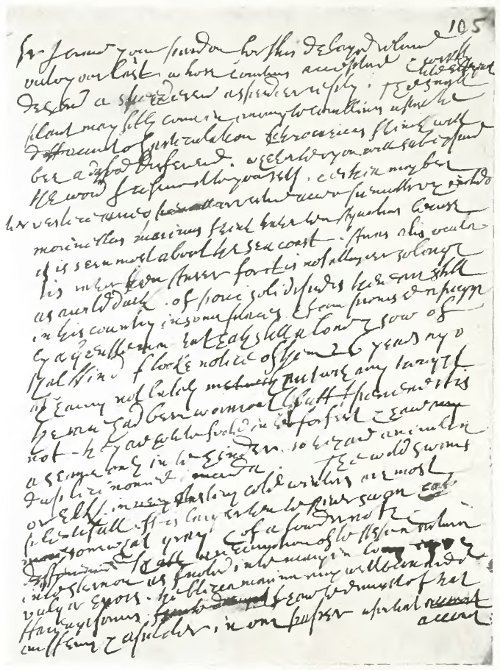
[BIBLIOTHECA BODLEIANA. MS. RAWLINSON D. cviii. SR THO BROWN TO DR.
MERRETT.]
[Fol. 105.] Sr I craue your pardon for this delayed returne unto your
last, whose courteus acceptance & worthy entertaynment [?] deserued [a
speed blotted out] even a speedier reply. The small plant may fitly
come in among the corallines upon the [diff crossed out] account of
articulation Icthyorachius [see Note 114] I think will bee a good
Diference [?]. whether you will subexpand [?] the word I referre it to
yourself. certhia may best bee vertice aureo [word blotted out] or
vertice aureo penicello vix imitando. morinellus marinus [see Note 28]
I think rather then Aquaticus becuse it is seen most about the sea
coast. Anas alis oculatis[120] rather then Anser for it is not
altogether so longe as a wild duck. of porci solidipedes [see Note
118] there are still in this country in some places. and I am promised
a pigge by a Gentleman that hath still a boar and sow of that kind. I
tooke notice of them 26 years ago & having not lately [met with crossed
out] met with any thought the race had been worne out butt I perceue it
is not—they are whole footed in the forfeet & have [only crossed out]
a seame only in the hinder. so they are animalia duplici nomine
im̄unda. The wild swans or elk [see Note 8] in [very crossed out]
lasting cold winters are most plentifull. It is larger then the River
swan somewhat gray & of a lowder note & [differenced call crossed
out] a recuruation of the Aspera arteria in the sternon as I noted in
the margin long agoe in vulgar errors. the blicca marina [see Note 74]
may well be named Harengiformis. [several words smeared out] I have
the draught of that an Herring & a pilcher in one paper upon that
account [Fol. 104 verso] I belieue [?] you were well informd of the
cotta [see p. 79] & fulica of our Ralla Aquatica I enclose a draught.
Of porci solidipedes there are diuers still in the country in some
places I am promised a pigge by a friend who cherisheth that [new
crossed out] breed. I tooke notice of them 26 yeares ago, & hauing not
lately minded them thought they had been worn out butt I perceiue they
are not—some are more plainly wholefooted then others & especially in
the fore feet & in the rest there is no thorough fissure butt at most a
superficiall seame, so they are [No. 3 cap 27 above] Quadrupedia
duplici nomine im̄unda.
[This last paragraph seems to have been written by way of emendation of
what appears above on the same subject. A photograph of a portion of the
above letter will, by the courtesy of the Bodleian Librarian, be found
as a frontispiece to this volume. Mr. Jenkinson, the Librarian of the
University of Cambridge, and through him, Mr. G. F. Warner and Mr.
Kenyon, of the Department of Manuscripts of the British Museum, have
kindly interested themselves in the transcript of this letter, which was
very difficult to decipher.]
No. VIII.
BIBLIOTHECA BODLEIANA (MS. RAWL. D. cviii.)
[Draft of a letter from Sir Thomas Browne, described in the
Catalogue of the Rawlinson MSS. as to the Secretary of the Royal
Society, but from its contents evidently written to Merrett,
whose letter, dated 8th May, 1669, is in part a reply to it.]
[Fol 58.] Honord Sr I humbly thank you for your care of my sonnes
paper & the Royll Societie for their acceptance of it. If hee bee in
health I knowe hee is mindfull of their com̄ands receiued aboue 2
months ago by a letter from Mr. Oldenburg.[121] I haue not heard from
him of late the last I receiued was from Komorn[R] in Lower Hungary and
hee was then going to the mine countryes. I think the Rowd may bee calld
Rutilus ventre magis compresso[122] wch is the first discoverable
difference to the eye. The weazelling [see Note 60] is as you see in
the draught a long fish figura ad teretem vergente. somewhat of the
shape butt differing in the head from the mustela viuipara of
Schoneueld. butt not lozenged on the back though the back bee much
darker then the other parts. I send you the figure of the head of a
cristated wild duck. it is black blackish [sic] in the greater part of
the body some white on the brest & wings blewish legges & bill & seems
to bee of the Latirostrous tribe perhaps you haue it not. it may bee
called Anas macrolophos [Fol. 59] as excelling in that kind.[123]
there is also a draught of one sort of mergus cristatus resembling
that of Aldrovandus or Johnstonus where there is only the figure of the
head only this is also ruffus butt the head sad red.[124] wee haue a
kind of teale which some fowlers call crackling teale from the noyse it
maketh[125] it is almost of the bignesse of a duck coming late of the
yeare & latest going away hath a russet head & neck with a dark yellow
stroak about a quarter of an inch broad from the crowne to the bill
winged like a teale a white streake through the middle of the wings and
edges thereof the tale blackish. it may be calld Querquedula maior
serotina. I send you the figure in litle of a pristis[126] wch I
receaued from a yarmouth seaman. you may please to compare it wth
yours. the asper you mention is much like our Rough or Aspredo.
I forgot in my last to signifie that an oter [an other?] Elk or wild
swan was headed like a goose that is without any knobb at the bottome of
the bill. [See p. 80 and Note 8.]
Haue you had the duck called Clangula in Ald. [drovandus] & Johnst.[127]
wee haue one heere wch answereth their descriptions exactly butt
[i.e., except] only in the colour of their leggs & feet.
Haue you a willock a sea fowl like a rook or crowe.[128]
No. IX.
[MISCELLANEOUS PAPERS. MS. SLOANE 1847, FOL. 182.]
[Fol. 182.] Sr I craue your pardon that I haue no sooner sent unto
you. I shall be very reddie to do you service in order to your desires
And shall endeavour to procure you such animalls as I haue formerly met
with & any other not ordinary wch [shall crossed out] are to bee
acquired. though many of my old assistants are dead. & sometimes they
fell upon animalls, [not to bee crossed out] scarce to bee met with
agayne. I wish I had been acquainted with your desires 3 yeares ago. for
I had about fortie hanging up in my howse. wch the plague being at the
next doores the person intrusted in my howse, burnt or threw away. The
figure of the weasell Cray [see Note 60 and p. 82] was in a long paper
pasted together at the ends & I make no question you will find it
otherwise I would send another [the willick wee in crossed out] that
fowl wch some call willick, [see Note 128] wee meet with sometimes.
The last I met with was taken on the sea shoare. the head and body black
the brest inclining to black headed and billd like a crowe, leggs set
very backward wings short leggs set very backward (sic) that it move
overland very badly only. it may bee a kind of cornix marina. [The
latter portion very badly written and difficult to decipher.]
[Fol. 184 verso.] That litle plant upon oyster shells [see Note 91]
I remember I haue seen & surely is some kind of vescaria or calicularia
of what that other [was crossed out] electricall body was Mr.
Boyle[129] showed [smear] by this time more tryall hath probably been
made, something of jet it might consist of.
I thank you that you were pleased to enquire of those German gentlemen
concerning my sonne I receiued a letter lately from him he hath not
been unmindfull of the R. Society's com̄ds & hath been in Hungaria in
the mines of Gold, sylver & copper at Schemets, Cremitz & Neusol &
desired mee to signifie so much to Mr. Oldenberg.
[The above is hastily scrawled; it was evidently indited to Merrett, as
indicated by the reference to the German gentlemen, &c.; the date would
therefore be some time in the year 1669. Wilkin prints it in the 1836
Edition, Vol. i., p. 408, but it is not in Bohn's reprint.]