By C. H. Robinson, Normal, Illinois.
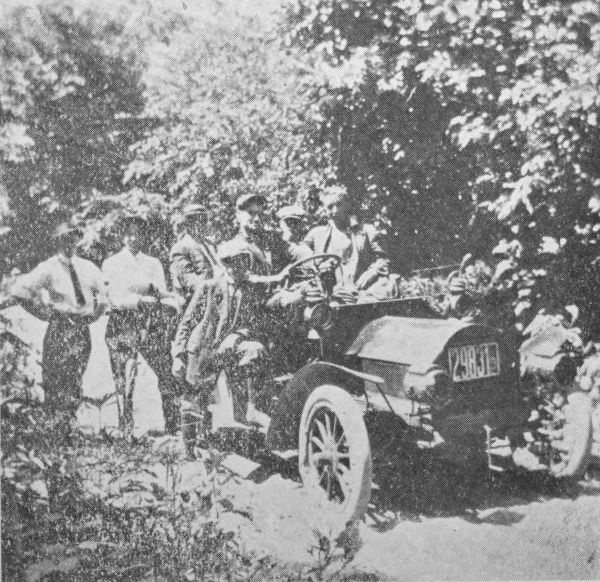
On April 20th, 1913, an enthusiastic party of Bloomington and Normal
men made an archaeological expedition to the great Cahokia mound
group in Southern Illinois, which is located in Madison and St. Clair
counties, about two miles east of the corporate limits of East St.
Louis, Illinois. The location is easily accessible by way of the new
hard road or by the St. Louis and Collinsville electric system.
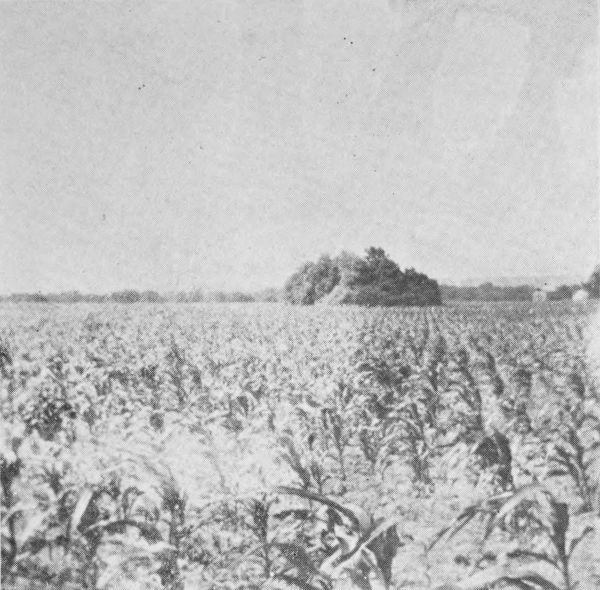
The great Cahokia, or better know as Monk's Mound, together with many
smaller mounds are located on a 204 acre farm belonging to the Hon.
T. T. Ramey's heirs. This farm is situated in the most picturesque
and richest part of the famous "American bottoms." Land which is so
fertile that even the aborigines raised much with but little effort
and which no doubt led to the location and construction here of the
largest earth mound ever built by primitive man, the great pyramid of
Cheops in Egypt or the Aztec temple mound of Mexico excepted. Monk's
mound covers more ground than any pyramid of Egypt. Cheops is but 746
feet square, the Aztec temple of Mexico is 680 feet square, while
Monk's mound is 1080 feet by 780 feet and 104 feet high making about
84,000,000 cubic feet of earth.
This mound has never been touched with pick or shovel, although great
quantities of archaeological material have been removed from many of
the surrounding smaller mounds and cultivated fields, and many fine
collections are to be found in both private and public places, taken
from this most ancient residence site of a vanquished race.
The variety and nature of material formed around the great Cahokia
group clearly indicate that the mound builders or their successors
had access to or traded with other tribes or people located at the
headquarters of the Mississippi and Missouri Rivers, also on the Gulf
of Mexico, and possibly from the Atlantic to the Pacific Oceans,
as evidenced by the vast quantities and nature of the material,
from which such large varities of implements and ornaments were
constructed. For as workmen are known by their chips so here may
also be found the evidence of past ages wrought in such material as
flint, jasper, pipe stone, granite, agate, galena, obsidian, hematite,
copper, quartz, crystal, deep sea conch shells and much other material
foreign to this section of the state.
The surrounding cultivated fields are strewn with pottery fragments
mingled with which may be found many human bones and implements of the
stone age. Here after the heavy spring rains are over may be plowed up
many characteristic specimens. Surely in ages past what a mecca this
location must have been!
Regarding the shape and size of the great Cahokia mound group it may
be said that all types except the effigy are represented here the
form of the largest mound is a parallelogram, with straight sides,
the longer of which are north and south. On the southern end thirty
feet above the base is a terrace or apex, containing two acres of
ground. On the western side some thirty feet above the first terrace
is a second of some what less extent. The top of the mound is flat,
containing about one acre and a half, and is divided into two parts
the northern portion of which is some four or five feet higher than
the southern portion.
Near the middle of the first terrace, at the base of the mound is a
projecting point apparently the remains of a graded pathway ascending
from the plain to the terrace. Monk's mound stands true to the exact
points of the compass.
There are several conical shaped mounds of about forty feet in height,
together with a large number of rectangular shape flat top mounds
ranging in size from 20 to 30 feet in height and some of smaller size
sufficient to conveniently accommodate a good sized farm house and
out buildings. One noticeable exception of this mound group lies just
south of the great mound the same being of conical shape except that
there are nine radiating ridges extending outward at equal distances
from the flattened top. This mound is about fifty feet high with a 150
foot base, the radiating ridges extending outward about ten feet each,
just what these radiating ridges symbolize no one knows, possibly the
radiating lines of the sun, or the ridges may represent the sacred
conch shells found buried here in great numbers.
Monk's mound derived this name from the fact that from 1804 to 1809
a colony of Monks of the order of La Trappe occupied the locality as
missionaries among the Cahokia Indians. These monks devoted themselves
to silence and seclusion and ate a strictly vegetable diet. They soon
succumbed to the malarial influences existing at that time, many
died and those remaining returned whence they came, the last of them
leaving in March, 1813.
The name Cahokia given the group of mounds is derived from a tribe of
Indians met by LaSalle in that vicinity, during his visit there in
December, 1681. Growing upon Monk's mound may be seen a pear orchard,
set out by the Monks, many of these trees are yet vigorous and bear
fruit in season. Besides these fruit trees, there are many fine forest
trees, some of which have reached a very large size; all of which
tends to make this large mound one of the most picturesque sights in
spring, summer and autumn.
Only a short distance to the north of Monk's mound flows Cahokia
Creek, its heavily wooded tract of timber giving here a rare chance
to the Archaeologist and land-scape artist to help some one of the
greatest movements of pre-historic man to be found in the United
States today. Ohio has long since made safe her serpent mound,
together with many lesser ones by proper legislative acts, other
states and counties have protected pre-historic works of much less
importance. Why then should the great State of Illinois not preserve
our Cahokia group? During the last legislative session at Springfield,
Cahokia mound park bills were introduced in both houses and are now
known as House Bill No. 176 Flagg, and Senate Bill No. 276 Beall,
on June 7, 1913. The matter was refered to the Illinois State Park
Commission to investigate the desirability of the state acquiring the
Cahokia mound and report to the forty-ninth General Assembly not later
than Feb. 1, 1915.
The names and addresses of the members of the Illinois State Board of
Park Commissioners are as follows: Alexander Richards, Ottawa, Ill. T.
A. James, Evanston, Ill. and Thomas Cahill, Loda, Ill.
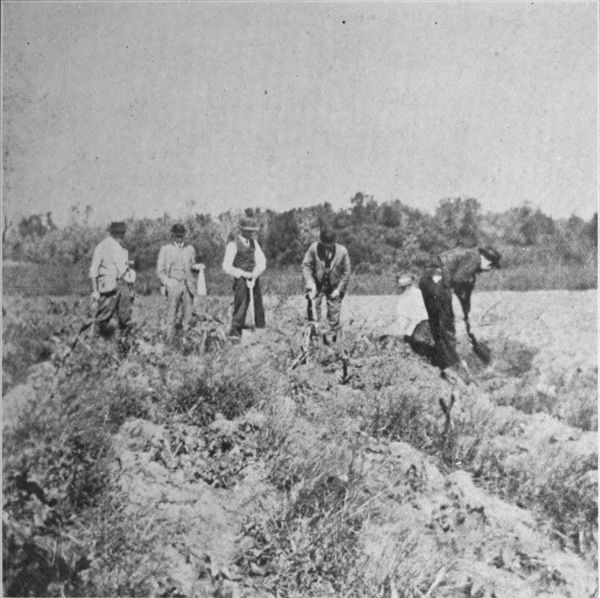
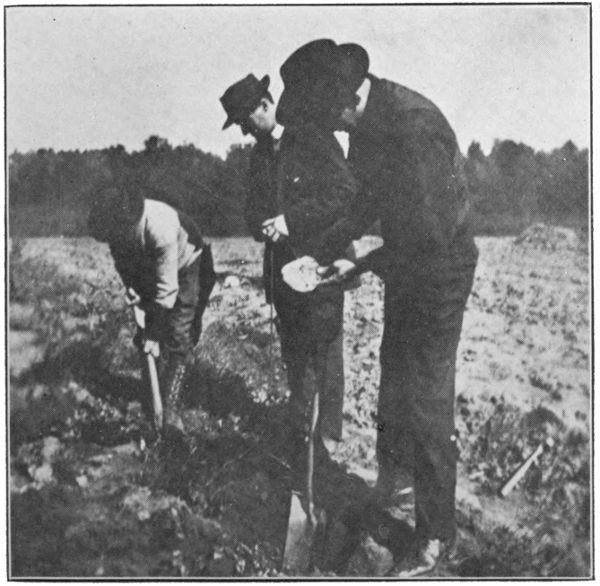
Plate No. 1
At research on Ramey Farm in field near
Monk's Mound, October, 1913
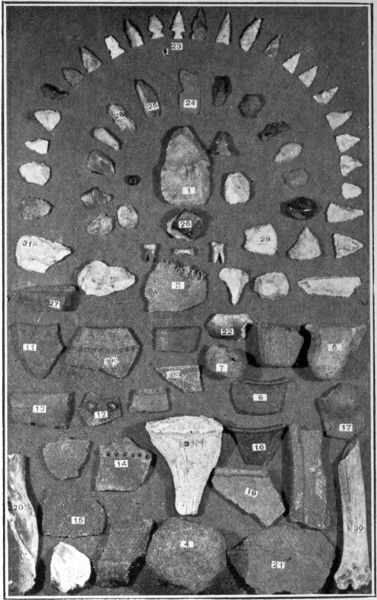
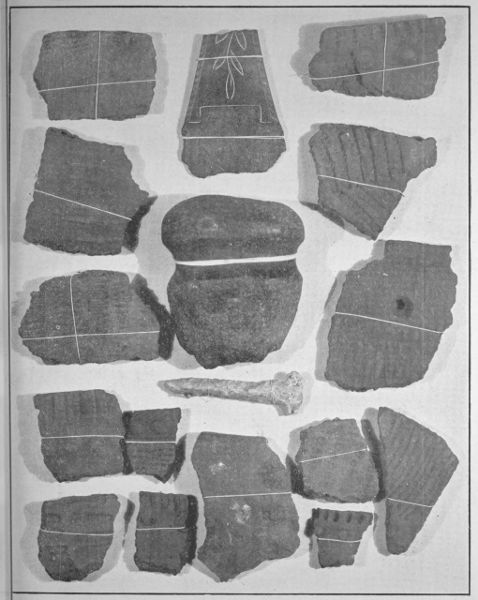
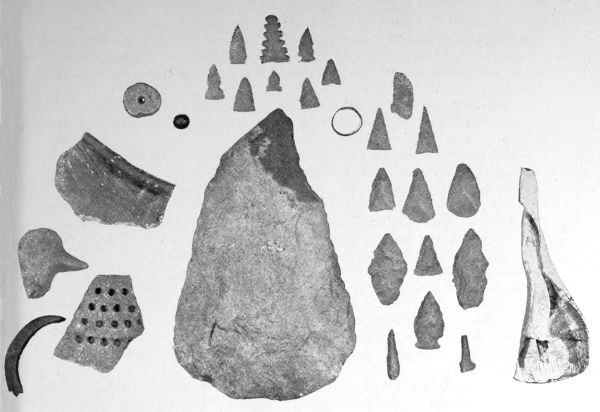
Plate No. 2 Characteristic surface finds from location
shown on plate 1.
Cuts furnished by C. H. Robinson
Cahokia Surface Finds, No. 3
Plate No. 2
- 1. Large arrow point or small flint hoe, length 3 inch
- 2. Sections of human skull
- 3. Outer shell of sacred conch shell
- 4. Perfect shape hammer stone, granite
- 5. Pottery ear from vessel
- 6. Potsherd, incised design, color black
- 7. Pottery, ducks head
- 8. Pottery, engraved design
- 9. Potsherd, reed, marked design, color red
- 11. Potsherd, reed, marked design, color yellow
- 12. Potsherd, raised, marked design, color black
- 13. Potsherd, reed, marked design, color red
- 14. Potsherd, reed, marked design, color brown
- 15. Potsherd, grass, marked design, color brown
- 16. Potsherd, incised, marked design, color black
- 17. Potsherd, raised, marked design, color brown
- 19. Potsherd, grass, marked design, color yellow
- 20. Inner spiral of sacred conch shell
- 21. Potsherd, grass, marked design, color brown
- 22. Fragment of polished discoidal stone
- 23. Perfect barbed arrow point 1 inch long, semi-circular row around No. 23, show characteristic Cahokia arrow points
- 24. Copper ornament
- 25. Pipestone
- 26. Agate
- 27. Gavel sand stone polisher
- 28. Quartz crystal
- 30. Pieces of human arm bone
- 31. Incomplete flint artifacts
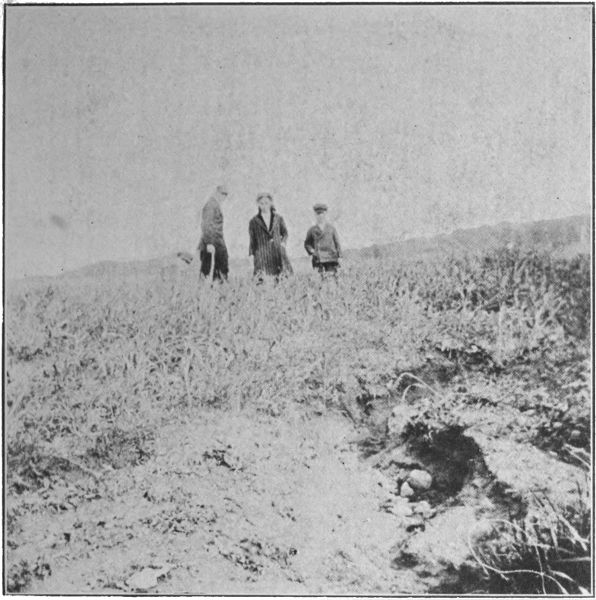
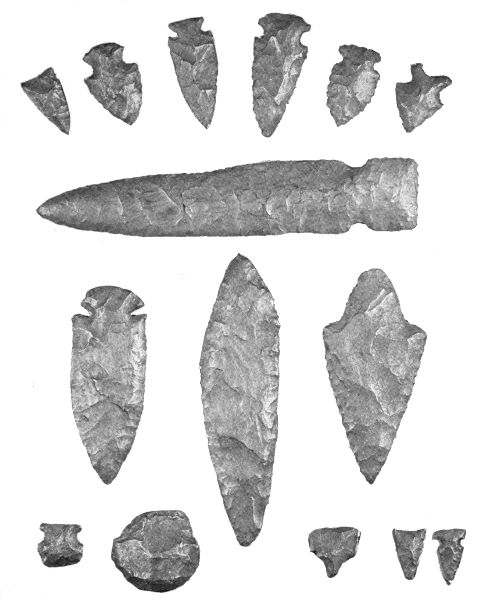
Plate No. 3 West Twin Grove Indian Camp Site on farm of
Chas. F. Kauffman, May, 1912
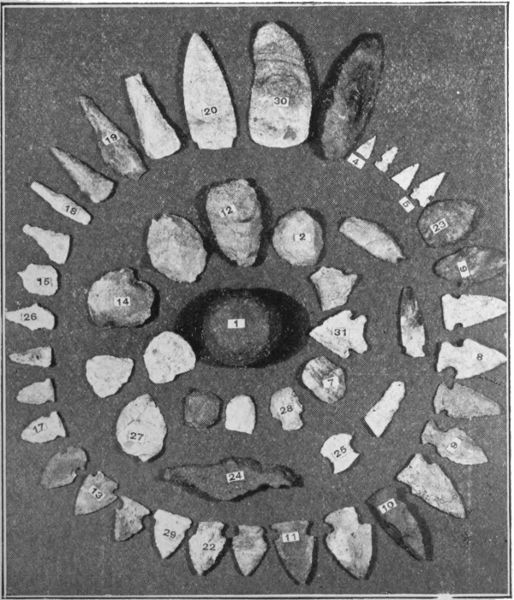
Plate No. 4 Artifacts made by aborigines on Camp Site
shown on Plate No. 4
Cuts furnished by C. H. Robinson
West Twin Grove Camp Site
Plate No. 4.
- 1. Gamestone 2-1/4 (problematical) gray granite
- 2. Scraper, pink flint
- 3. Knife 4 inches long, yellow flint, (between 30 and 4)
- 4. Bird arrow point, 3/4 inches long, white flint
- 5. Double notched arrow, curved body, white flint
- 6. Notch of arrow, flat on one side
- 7. Scraper—mottled blue and white flint
- 8. Barbed arrow, to remain in wound
- 9. Non-barbed arrow, to be withdrawn from wound
- 10. Common chert arrows
- 11. Red flint arrow
- 12. Heavy chert arrow
- 13. Blue flint arrow
- 14. Rare ceremonial stone, brown flint
- 15. Drill, white flint
- 17. Blunt arrow, white flint
- 18. Drill, white flint
- 19. Half completed leaf arrow, white flint
- 20. Finely finished spear point, pink flint
- 22. Common arrow
- 23. Perfect shape leaf arrow, blue flint
- 24. Fragment of pottery, porphyry tempered
- 25. First piece of arrow found on camp-site
- 26. Drill, white flint
- 27. 2/3 completed leaf shape arrow, white flint
- 28. Perfect hafted scarper, white flint
- 29. Wide base arrow, white flint
- 30. Perfect knife, mottled flint, red, white and blue
- 31. Perfect double bevel arrow, white flint
Through the courtesy of the Ramey Family, the writer and party were
given much valuable data and information pertaining to the early
history of this historic spot, therefore honorary mention is herewith
given to the sturdy and honest pioneer, the late T. T. Ramey, who was
one of the few successful 49er's. Returning east again, he invested
his hard earned gold in the rich alluvial "American bottom" lands of
Madison County and upon which now stands the great Cahokia mound,
together with twenty others of lesser magnitude. He was a close
student of both God and man. He soon conceived the idea that the large
mound should never be disturbed and if possible become the property
of the state. Thus he kept in tact this great earthwork during his
lifetime and it is with the same spirit that his children do likewise.
May we not hope that the State of Illinois shall in due time make this
great mound group a state preserve and keep intact the great Cahokia
Mound just as the Ramey family have done for many years?
The party making the Cahokia trip was composed of Milo Custer, G.
Blumke, Mark Piper, S. W. Le Neve, Herbert Cox and the writer.
Charles M. Robinson.