When Isaiah wrote, Babylon
sat a queen among
the nations, in the pride
of pomp and power,
in the full security
of strength; yet he
graphically depicted her desolation
and foretold her present
state, while he pronounced her
doom—a perpetual desolation. She shall never
be rebuilt! Her towers are fallen and her
site marked by ruins.
The decline of Babylon had begun. It was
certain, although slow. Years were to pass
before the sentence should be fully executed.
At the period, when the transactions recorded in
the book of Esther took place, Shushan was the
royal city of Persia. We are told that in this—the
City of Lilies—the king Ahasuerus held
a great feast, probably in celebration of some
recent success, or in commemoration of some
great national event. He assembled all the
princes and nobles of his vast empire, extending
from Egypt to India, and gave a feast or
succession of festivities, which continued for
more than the third of a year.
All that oriental splendour and magnificence
could contribute, all the expedients that eastern
luxury could desire, to multiply the resources
and to heighten the enjoyment of pleasure, were
brought to aid the designs of the monarch and to
add to the festivities of his court.
Yet motives of policy may have combined
with the designs of pleasure. In all ages the
despot has sought to blind and dazzle the people
by a display of power and magnificence;
and the princes and nobles around, from distant
provinces, have swelled the retinue of their attendants.
The amusements of monarchs and of courts
have, through all varieties of manners and
degrees of refinement, been much the same.
The ancient Syrian or Persian, like the modern
British or French monarch, had his royal parks
and forests for hunting.
All nations have patronized the various trials
of skill and strength, and the mimic fight has
ever been an amusement where war was the
great business of life. And the royal pageantry
was doubtless intermingled with the
religious ceremonies which allowed a license
to criminal indulgence and at the same time
offered a supposed expiation for crime.
While these employed the day, the games
of chance, the wine, the music, the movements
of the degraded dancing-girl, and the tricks of
the buffoon and the jester, amused the late hours
and varied the festive scenes of the night.
The feast was drawing to a close, and, at the
termination of this long season of hilarity,
Ahasuerus extended the pleasures of the
occasion to all classes of his subjects at
Shushan.
He threw open his palaces and pleasure-grounds,
his parks and gardens—always of
vast extent around eastern palaces—and admitted
all the citizens to a feast prepared for
them. Tents had been erected within the precincts
of the palace for the tables—and these
tents were furnished with all the luxurious appendages
of the east—with white and green
and blue hangings, fastened with cords of fine
linen and purple to silver rings and marble
pillars; while the beds—the couches around the
tables, against which the ancients reclined—were
of gold and silver, upon a pavement of
red and blue, and black and white marble;
while they gave them to drink in vessels of
gold. Until these last days the princes and
nobles alone had participated in the festive
scenes; but now, as we have said, all ranks
were allowed to share, and the citizens of
Shushan, subjects of Ahasuerus, thronged the
palace and trod the royal gardens, and, entering
the tents, enjoyed all that royalty could
offer in ancient Persia—far surpassing in costly
splendour and elegance the entertainments of
modern courts. And surely the monarch must
have had strong confidence in the security of
his government and the loyalty of his people,
as he thus from day to day, for successive days,
flung open to them the recesses of his palace.
While the king thus feasted the men in the
gardens and parks of the palace, Vashti, the
queen, held a festival for the women within
the secluded apartments appropriated to the
female part of the royal household. She made
them a feast within the house of Ahasuerus;
and this queenly entertainment was conducted
with all that regard for retirement and decorum
which accords with Eastern manners. But
whatever the amusements of the queen and her
train of attendants, no rumours passed the
carefully guarded bounds of the women's apartments.
At length the long season of pleasure
came to a harmonious close. No outbreak of
the people of Shushan, no rising of distant
provinces, no plotting of high-born traitors had
marred the festal pomp. Yet the season of
pleasure is always a period of trial, and the
seeds of remorse and repentance are almost
invariably sown in the hours of gayety. Amid
all this brightness, a dark cloud hung over
Ahasuerus. On the seventh and last day,
when the heart of the king was merry—when
he had forgotten royalty dignity and personal
decorum, by sitting too long at the festive
board—excited by pride and vanity, and stimulated
by wine, he resolved to dazzle the eyes
of the people by presenting to their admiration
a gem, brighter and more lovely than any
which sparkled in the royal crown. To verify
his loud boasts of her matchless charms, he
sent his chamberlain to bid the queen array
herself in that royal attire which befitted her
state while it displayed her beauty and proclaimed
her rank, and thus present herself,
that the assembled multitudes might admire
her loveliness and confess his happiness.
In Western lands, and in modern days, this
command would convey no idea of shame or impropriety.
The royal consort and her train of
fair attendants have often graced the presence
and shared the honours of the monarch and his
court, and added refinement to luxury. But
no offer could be more opposed to all ideas of
Eastern delicacy and propriety—more degrading
to the woman, or more offensive to the
queen.
By thus unveiling herself before the crowd,
she would sink herself to the level of the most
unworthy of her sex—while the violation of an
established usage, in the time of such excitement
and excess, might lead to the wildest
disorder, and the queen might be exposed to
every insult from crowds maddened by wine
and ripe for disorder; while the monarch himself
might not be able to protect her in a position
so strange and unfitting.
The modesty of the woman and the dignity
of the queen alike forbade compliance with the
strange order—and Vashti might well presume
that, in the hour of reflection, when his senses
had returned, the monarch would thank her for
a prudence which probably alone preserved her
dignity and his honour.
But the passions of the king were inflamed.
His reason was blinded, and artful courtiers,
from motives of intrigue or pique, stimulated
his anger. There are ever those who stand ready
to administer to unholy passions, and who are
watching for the fall of such as are high in place
or favour. And still under the influence of wine,
the rash monarch, by his own act, placed an
inseparable barrier between himself and her
whose charms had so lately been his proudest
boast, and whose conduct had proved that she
well deserved all honour and all affection.
Vashti was separated from the king's favour;
and flattering sycophants extolled the act of
folly, as a measure which gave peace and
security to every household in the realm.
"All the wives shall give to their husbands
honour, both to great and small." And thus
the day closed by an edict that brought sorrow
to many hearts, and desolation even to the
gates of the palace.
The excitement was past. The hour of reflection
arrived, and "the king remembered
Vashti." His resentment was appeased. "He
remembered what she had done, and what was
decreed against her." That which had been
magnified into a crime and had given such
deep offence, was now seen to be an act of
wisdom and prudence—the result of true
modesty, and that deep affection which sought
alone the love of her husband, which shrank
from the admiration of the crowd, and which
ventured to disobey rather than forfeit self-respect
and womanly pride—preferring to lose
his love rather than expose his honour. An
immutable decree—his own—separated him
from one lately so beloved, and so truly worthy
of high honour.
The darkened and saddened aspect of the
monarch declared his late repentance; and
those who had precipitated the fall of the
queen, to screen themselves, were prompt to
devise methods of banishing the remembrance
of the divorced Vashti. They would replace
her by a new favourite. Yet, so surpassing was
her loveliness, and so rare her beauty, that the
courtiers could with difficulty find one whose
charms might banish from memory the repudiated
consort, until they sought through all
the provinces of that vast empire for the
fairest of the daughters of men.
Hadassah, a daughter of Israel, a descendant
of Benjamin, of the house of Kish, the family
of Saul, first king of Israel, won the monarch's
favour, and was promoted to the place of the
disobedient but high-minded Vashti. Esther
was an orphan, but she had been carefully
guarded and instructed by her kinsman Mordecai;
and while we are told that the maiden
was exceeding fair, we may believe that her
beauty was of a high order, stamped too by
intellect and feeling, and that the soul which
often sustained and impelled her in her trying
exigencies, breathed through her features and
animated her form. Yet Ahasuerus merely
bowed to the fair shrine. He sought not to
awaken the response of the soul that dwelt
within.
When the daughter of Israel was placed upon
the throne of Persia, and another royal feast
proclaimed the triumph of Esther and the
happiness of Ahasuerus, the king displayed
his royal magnificence by the bestowal of gifts
upon his favourites; and the name of Esther
was blended with other and higher associations,
as, upon her elevation, the taxes of the burdened
provinces were remitted and pardons granted
to the condemned.
Mordecai, the relative who had supplied the
place of parents to Esther, was, as we have said,
of the house of Kish. Mordecai was the Jew
rather than the Benjamite. His heart was devoted
to his country. When the child of his
adoption was taken to the palace, Mordecai displayed
his wise forethought in cautioning her
against making her parentage and kindred
known. He had been as a father to her, and a
deep interest in the orphan of his care led him,
day by day, to watch the gate of the palace—to
mingle with the attendants, that he might catch
a view of her train or gather tidings of her
welfare. And thus, unknown as the relative
of the fair queen, or as especially interested
in the king, Mordecai was enabled to detect
and reveal a plot for the assassination of
Ahasuerus. Esther being informed of the plot,
disclosed it to the king—the criminals were
defeated and punished—but no reward was
conferred upon Mordecai.
The passion of Ahasuerus for his fair bride
seems to have soon declined. The fickle voluptuary
sought new pleasures, and the bride so
lately exalted to a throne was no longer an
object of envy. Many bitter tears have been
shed by the victims of family pride or state
policy, when thus allied to greatness and splendour.
The sacred rite has often been prostituted
to purposes of ambition and selfishness, and has
thus become a source of guilt and misery.
Esther, in her elevation, may have shed as
bitter tears as fell from Vashti in her banishment
and disgrace.
Thus each state has its own trials and its
own griefs—and it has its peculiar alleviations
too. Perhaps the progress of the narrative
will show us the source of that influence which
seems early to have estranged Ahasuerus from
his bride.
Among the courtiers of the king there was
the descendant of a race long at variance with
the Jews. The Amalekites had been the enemies
of the Israelites from the infancy of the
nation. When the tribes came up from Egypt,
faint and weary in the desert, the Amalekites
had fallen upon them and attempted to destroy
them; and during a series of ages there had
been a war of extermination between the races.
Nor had Amalek been subjected until Saul was
raised to the throne and Israel had become a
kingdom.
When Israel and Judah had been destroyed
or carried captive by the hosts of the Assyrians,
the remaining Amalekites seem likewise to
have been carried into the east, either as prisoners
or allies. And now, from among all his
courtiers, Ahasuerus had chosen, as his chief
favourite and counsellor, Haman, the son of
Hammedatha, a descendant of Agag—that
king of Amalek who, as the prisoner of Saul,
was condemned to death by Samuel, the judge
of Israel. The descendant of a royal line and
of an ancient race, Haman was as crafty as he
was unprincipled and malignant, and his evil
influence seems to have first drawn the king's
favour from Esther. He did not know her
lineage, but by plunging the king in every
excess, by keeping all safe counsellors at a
distance, he intended to increase his own influence
and perpetuate his own power, while
he was accumulating great wealth from the
prodigality of his master and from the presents
offered as bribes to obtain his favour.
As he did not know the lineage of Esther,
he did not persecute her; but as he feared an
influence that might compete with his own, he
strove to alienate the heart of Ahasuerus from
her. Haman was advanced to honours far
above all the native princes of the kingdom;
even to the first seat in counsel, to the highest
honours in the realm, and to constant companionship
of the monarch.
As, with trains of slaves and flatterers, he
was hastening to the audience of the monarch,
or returning loaded with marks of royal favour,
he passed Mordecai the Jew, seated alone—unknown,
unheeded, without rank or wealth—by
the gate of the palace. "Yet Mordecai
bowed not, neither did reverence to Haman."
The two men seemed to represent to each other
their respective nations; as if all the hate and
malice of the race, and of long ages of national
bitterness, were concentrated in an individual.
They met as the Israelite and the Amalekite;
and the memories of centuries of aggression
and injuries, of shame and defeat, were crowded
into the present moment. Mordecai saw in
Haman, not only the foe to his race, but the
crafty, unprincipled, unholy counsellor, who
had already alienated the heart of the monarch
from his youthful bride, and whose pernicious
influence was spreading blight and corruption,
misery and destruction—through an
empire.
Every feeling of the Jew, every principle of
an upright, sincere heart forbade Mordecai to
pay the homage demanded of him by Haman.
Every sentiment of national pride, of family
honour, of personal dignity, of self-respect, arose
to deter the descendant of Israel from showing
honour to the hereditary foe of his people and
the persecutor of his faith.
Haman, at the same time, saw in Mordecai
the descendant of those who had triumphed
over his nation and destroyed his ancestors.
The descendant of Agag, the captive of Saul,
he might naturally vent his indignation upon
the tribe that humbled his house and subjected
his nation and destroyed his ancestors. The
contempt with which Mordecai regarded him
roused all the ancient malignity of the Amalekite,
and his hot blood called for vengeance.
Yet he thought it a foul shame to lay hands
on Mordecai alone. The ruin of one man
would not heal his wounded pride. He meditated
a deeper and more deadly revenge. He
resolves to sweep the remnant of the Jews
from the face of the earth!
The proposed plan displays at once all his
cruelty and malignity, and all his crafty influence
over Ahasuerus, while it proves the
king too much immersed in pleasure, or too
much subjected to his artful favourite, to regard
the welfare of his subjects or the interests of
his kingdom.
Superstitious and idolatrous, Haman cast
lots day after day, for successive days, that a
fortunate one might decide the day to be
chosen for the work of death on which he was
bent. And this accomplished, he hastened to
secure the edict from the king. Surely the
monarch must have been sunk in wine and
debauchery who could thus unhesitatingly
accede to the proposition to murder, in cold
blood, thousands of unresisting subjects, when
the worst allegation preferred by their enemy
was "that their laws were diverse from all
people." Yet here was the very principle
of religious persecution; and as sanguinary
edicts as these, enacted against God's ancient
people, have been too often issued in more
modern days, and no Mordecai has sat at the
gate of the palace, mutely to plead for mercy—no
Esther has staked her life upon the attempt
to avert the doom!
By the offer of an enormous bribe, to be
collected from the plunder of those doomed to
death, Haman sought the acquiescence of the
king in his scheme. And though he refused
the bribe, yet he bade Haman do with the
people and their possessions as seemed best to
him; giving him his signet ring, he seems to
have divested himself of all care and responsibility,
and Haman having issued the edict
and commanded the couriers to distribute the
royal mandate, they both returned to their
pleasures. "The king and his counsellor sat
down to drink."
No elaborate essay upon the character of Ahasuerus,
no analysis of the arts of Haman, could
so display the indolent, luxurious, self-indulgent,
voluptuous monarch, or so illustrate the secret
of the favourite's power. The companion of his
pleasures, he was careful to minister to all the
sensual indulgence that could lead him to forget
his duty and the obligations of right and justice
incumbent upon the ruler of a great people.
Of all the cruel and bloody mandates issued
by despotic monarchs, and designed to answer
either the purposes of private malice or unholy
policy, few, if any, have exceeded this which was
directed against the ancient people of Jehovah.
The Jews who had returned to their own land
were included in this proscription, for Judea was
at this time a tributary of the Persian empire.
"Then were the king's scribes called, the
thirteenth day of the first month, and there
was written according to all that Haman had
commanded, unto the king's lieutenants, and to
the governors that were over every province,
and to the rulers of every people of every province,
according to the writing thereof; and to
every people after their language, in the name
of King Ahasuerus, was it written, and sealed
with the king's ring. And the letters were
sent by posts into the king's provinces, to destroy,
to kill, and to cause to perish, all Jews—both
young and old, little children and women,
in one day, even upon the thirteenth day of
the twelfth month."
Thus we see all the machinery of this powerful
government put in motion to crush the
Jews—a people widely dispersed and weak from
their recent captivity and overthrow. As no
crime was specified, so there was no offer of
pardon or exemption on any terms; while to
make it more distinctly understood, the terms
which indicated their fate were singularly
multiplied. "To destroy, to kill, to cause to
perish." And while the murder of a nation
was thus made a legal execution, the mode was
left to the option of the executioners; and every
torment that malignity could devise might be
inflicted, while all were stimulated by the promise
of the plunder of their victims—"and to
take the spoil of them for a prey."
What scenes of horror, of suffering, would
have followed the execution of this barbarous
edict! The whole empire had probably been
deluged in blood—for man, like the inferior
animals, seems maddened by the taste of blood—and
one cruelty is but the prelude and provocation
of another; and in the time of strife,
while all were made executioners of the law,
private malice would confound others with the
proscribed, and few could be safe in the hour
of commotion.
When this edict was published, and while
Ahasuerus and Haman sat down to indulge in the
pleasures of the table, all the city of Shushan
was perplexed, confounded, and troubled—wondering
what motives, what state policy, what
strange conspiracy, had led to this sanguinary
enactment against a people long dwelling
among them—a nation who had furnished
counsellors and ministers to their wisest monarchs.
When Mordecai saw what was done, he rent
his clothes and put on sackcloth with ashes, and
went out into the midst of the city and cried with
a loud and bitter cry. He published—he could
not conceal—his grief and terror; and his
crafty foe perhaps exulted in his misery. The
long struggle between the Amalekite and the
Israelite seemed now to be concluded. The
fall of the Jews seemed to be sealed. All the
power of the Persian empire was arrayed
against them. They were prisoners in her
different provinces, appointed to execution!
All human power and authority and presumption
of success was on the side of Haman, and
against his intended victims.
Mordecai had no hope on earth. His trust
was alone in the God of his fathers—the God of
Abraham and of Isaac and of Jacob—the God
often defied by Amalek. In his distress he presented
himself, clothed in sackcloth, at the gate
of the royal palace; but no one arrayed in the
garb of sorrow might enter the haunts devoted to
luxurious pleasure. Yet the sight of his distress
and the tones of his deep grief arrested the attention
of the attendants of the queen, and her
chamberlain reported the circumstances to her.
No tokens of sympathy, no expression of condolence,
however grateful, could assuage the
grief of Mordecai in this hour of terror and
alarm; and even though commanded by the
queen, he declined to lay aside the tokens of wo,
while he diligently sought to convey to the secluded
Esther an account of all the machinations
of Haman, and the assurance of the imminent
danger to which her nation was exposed, and
in which she was involved. He not only sent
her a copy of the edict which condemned the
Jews, but he charged her to supplicate the
king on their behalf.
The young queen must have felt like one
awakened from a sleep to find herself upon the
brink of a precipice. Her situation was full
of danger. The flush of royal favour was past.
She was neglected and forgotten. Her splendid
palace was indeed but a prison, and her lordly
consort might prove her executioner. For a long
time she had not seen the king or received the
least token of royal favour or remembrance,
and a new favourite might have succeeded her
in the court of the capricious voluptuary. Yet
she was sternly charged by Mordecai to rouse
herself, meet the peril, and, if possible, save her
people, while he taught her to recognise the
designs of a wise Providence in her elevation.
"Then Mordecai commanded to answer
Esther, Think not with thyself that thou shalt
escape in the king's house, more than all the
Jews. For if thou altogether holdest thy peace
at this time, then shall there enlargement and
deliverance arise to the Jews from another
place; but thou and thy father's house shall
be destroyed: and who knoweth whether thou
art come to the kingdom for such a time as
this?"
In the appeals of Mordecai to Esther, we
may recognise the principles upon which he
had trained her. The sense of duty, the obligations
of religion, the call to self-sacrifice
and exertion, had all been instilled while Esther
was in private life, and they bear their fruit on
the throne. Yet there must have been a conflict
in the heart of Esther, before she could
adopt the decision which might accelerate the
doom of her people, while, if her appeal failed,
her own fate was scaled with their's.
Surrounded by all the splendour of the
court, with all the pleasures that pomp and
power can command, with troops of menials
treading marble halls, with the more genial
luxuries of fair flowers and pure fountains and
soft music—Esther felt the insufficiency of all
that earth can yield in the hour of sorrow and
trial. We may almost fancy that we see her,
with lofty brow and pale cheek, her dark soft
eye fixed in thought, and the compressed lip
telling of the firm resolve. She has decided!
She will venture the loss of royal favour, and
life itself, to secure the safety of her people.
"I will go in to the king, and if I perish—I
perish." Words more simple, yet sublime
in their high meaning, have seldom been recorded.
Strong purpose and high resolve call
for but few words.
Yet Esther relied upon a power higher than
that of Ahasuerus. She may have recalled the
history of her nation; she may have remembered
all the interpositions of Divine mercy in past
extremities; and doubtless she relied upon those
promises for the future which induced in Mordecai
a confident hope of deliverance. She remembered
that Jehovah—the God of Israel—hears
the prayers of the humble and the contrite.
She appointed a solemn fast of three
days, in which the Jews of Shushan should
humble themselves and remember her before
the God of their fathers.
A more eminent instance of simple dependence
upon the Divine interposition, or of entire
reliance upon the voice of prayer, has seldom if
ever, occurred. There was no resort to outward
ceremonies to awaken a deeper feeling, or
to atone for the want of it by a formal observance.
There was no altar, no sacrifice, no
long procession, no promised offering, no resort
to temple or priest, but there was the call upon
God from the depth of the soul—the simple,
unfailing trust of the heart, the personal
humiliation, the individual prayer, the united
offerings of supplication and confession from a
whole people. There was the simple faith that
relies on the Divine power and pleads the
Divine promises with submission to the Divine
will. It was a strange contrast to the sensual,
gross, superstitious, and unholy rites of the
heathen, while from its deep spiritual meaning,
and from the entire absence of all merely formal
observance, it was both a precedent and a
model for future ages, and for the holy spiritual
worshipper of other days.
It was no heartless service, no formal act
of worship rendered by the Jews of Shushan,
when Esther called upon them to pray and
to fast with her and for her. While the queen
and her maidens fasted in the recesses of the
palace, in many a lowly home or quiet chamber
were gathered the race of Esther, to
commit her and themselves to Jehovah, to
beseech him to forgive the sins of his people
and save them, for his mercy's sake, in this
hour of their extremity. Mingled with their
personal apprehension and anxiety for their
wives and their children would be thoughts
of "the daughter of their people"—their beautiful
queen—so young, so fair, so lately exalted
to the pinnacle of honour and glory; adorned
with gems and wreathed with flowers, the pride
of a monarch and the ornament of a court;
now, neglected, abject, forsaken—included in
the doom of her race, prostrate in some secluded
apartment of the palace—her royal apparel
exchanged for sackcloth and ashes—still
cleaving to the God of her fathers, and still identifying
herself with her kindred and countrymen.
Whether they regarded her royal state,
her tender years, her bitter desolation, or her
heroic resolution, all the sympathies of the
heart, all the purest feelings of the nation,
would be called forth in her behalf.
Other feelings would find a place in the
hearts of the Jews as they contemplated their
present state. The last deed of the Amalekite
would bring to recollection the injuries of ages.
This Haman, who now, in a time of profound
peace and full security—while both races were
exiles from the land of their fathers—had
plotted the ruin of their nation, the total extermination
of their race; who had doomed the
feeble and helpless, the little one and the aged,
to perish with the strong man in his might;
this Haman was the son of those who fell upon
the tribes, faint and weary, in the wilderness;
who had pursued them with inveterate hatred;
who had ever joined with their foes or stood
ready to attack them in their defenceless
state.
When we recollect that the conspiracy of
Haman but closed the long train of injuries
inflicted on Israel by Amalek, we shall not so
much wonder at the feelings sometimes expressed
by the Jew. The character of the
tribe was still the same—their course through
all years was unaltered. And now, while
Amalek has perished and the Jew survives,
we can form no just estimate of that national
feud. Haman was a type of his race—artful,
cruel, treacherous, and bloody; and what the
Roman was to Hannibal, what the ancient Persian
was to Greece, what the Turk is to modern
Greece, what Russia is to the Pole, such was
the Amalekite to the Jew.
While Esther had manifested her sense of
dependence upon the eternal Ruler of nations,
and her faith and reliance upon the God of her
fathers, by humbling herself before him and
relying upon his protection and interposition
in this hour of darkness, she showed, too, a
knowledge of the human heart, not often acquired
at her age; an instinctive insight into
the character and the motives of those around
her, with the power of adapting herself to circumstances,
that has seldom been displayed in
one so young, combined with so many of the
higher qualities of the woman.
She knew the weak point in the character
of Ahasuerus, and she forgot not the power of
beauty, the influence of personal charms, as
she arrayed her fair form in the rich and
splendid vestments that so well became her,
and summoned all the aid of oriental art and
elegance to her toilette, that her presumption
might be forgiven in her loveliness—that favour
won by her beauty might be extended to her
nation; and if she felt the hope of pleasing, as
she surveyed herself in the polished metallic
mirror, decked with the magnificence of a
royal bride and adorned with the gifts of him
whose favour she would seek, her heart might
have sunk too at the remembrance of the favour
she had once won and lost. In assuming the
crown placed upon her brow by Ahasuerus,
there was a tacit claim to her royal rights; for
that gemmed circlet was not only a badge of
rank, but a pledge of affection—a token of
honour and royal favour, which elevated her
above the throng of beauties who filled the
courts of the palace. Had she arrayed herself
in sackcloth, had she appeared as a mourner,
an afflicted suppliant, she would probably have
found the royal voluptuary more anxious to
banish one who disturbed his pleasures, than to
redress the grievances that appealed to his
justice.
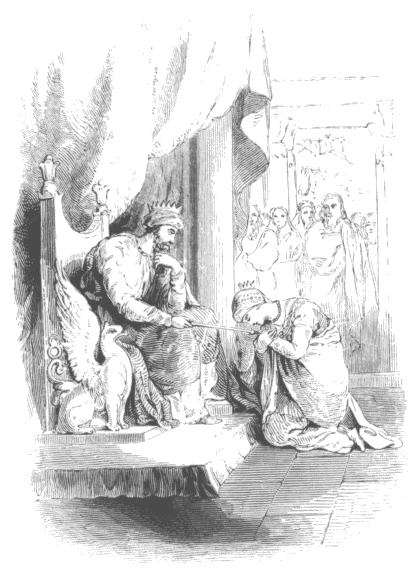
Yet it must have been with trembling limbs
and a beating heart that she stood before
Ahasuerus; and, by entering his presence
unbidden, she made her mute appeal to his
mercy.
And strange, at that unwonted place and
hour, must have appeared the beautiful vision
to the king, while courtiers and attendants
stood in silent amazement. There was but one
anxious moment before the sceptre was extended;
the trembling queen touched it, and thus was
encouraged to prefer her petition for any favour
that the royal hand could bestow. The presence
of Esther seems to have revived at once the
fondness of the monarch, and all his coldness
and indifference vanished like the mist before
the rising sun. All the arts of Haman had been
needed to wean him from her and to teach him
to forget her. How rarely does a vile, unholy
counsellor or companion seek to corrupt a private
man, or a prince, or a ruler, without striving
first to undermine the influence of the virtuous
wife, mother, or sister!
Warily does the royal suppliant present her
request, still uncertain of the degree of favour
on which she might rely. She offered no petition
that could embarrass the king. She made
no complaint of past neglects. She uttered no
word of upbraiding for forgotten vows; but
delicately implying that his presence was the
source of her happiness, that this had constrained
her to break through all the formal
observances of courtly restraint and endanger
life itself, she besought him to honour her
by attending a banquet which she had prepared.
Thus she avoided the awakening of the suspicions
of Haman by even asking to see the
monarch without his presence. Including him
in her invitation, she allayed all jealousy of
a wish to exert an influence inimical to his,
while she thus offered an additional inducement
to Ahasuerus to honour her feast.
By a strong effort and great self-command, the
young queen retained her calmness and preserved
her grace and gayety. And even when the banquet
had closed and the guests had retired, and
the king again asked her to prefer her petition,
she did not venture to prefer that which was
nearest her heart. His favour was too uncertain
and his favourite too powerful. She only besought
his presence again as a guest, and again
his favourite was included in the invitation.
The Jews were still lying low before their
God. When the feast in the palace was broken
up, and the gates were shut, the high walls
cast their shadows upon the moat. The sentinels
still moved with measured tread. The lights
gradually disappeared, except those that told of
some one watching over the sick or dying, or some
chance-beam betraying a late carousal. In the
palace, the soft footfall of the attendants in
the antechambers, could not disturb the slumbers
of the monarch, while strains of sweetest
music were ready to lull him to repose, as
warder and sentinel kept watch over his safety.
But still "that night the king could not sleep;"
and wakeful, restless, solitary, he commanded
his attendants to bring him the archives of
his kingdom, and read to him the records of his
reign. Strange request! How few monarchs
would care thus to review the past, and force
themselves to the judgment awaiting them from
a higher tribunal and from future ages!
It was not chance which held the eyes of the
king waking. It was not chance which drew
his attention to the conspiracy defeated by
Mordecai, and to the investigation of the treatment
he had received for so high a service.
No reward, no honour had been conferred
upon one who had saved the life of the sovereign.
A strange forgetfulness or neglect of
the prime minister of the realm! While Ahasuerus
was devising some mode of requiting the
obligation due to one who had rendered the
state important service, he called for a counsellor,
and was told that Haman was without,
in the court.
Haman left the banquet of Esther in all the
assurance of royal favour. He had attained
to honours which distinguished him above all
the subjects of the Persian empire. He had
received distinctions which elevated him above
even the princes and nobles of the kingdom;
and in his pomp and power he passed, with his
train of attendants, menials, flatterers, and
followers, through the gates of the royal palace,
"the observed of all observers;" and as he
came into the thronged thoroughfare that led
from the royal abode, all did him homage and
showed him reverence—save one.
Mordecai, the Jew, still sat at the king's gate—probably,
still wrapped in sackcloth. His eye
met that of Haman, but it quailed not. It was
a stern, reproving glance! And while all others
did lowliest obeisance, Mordecai neither bowed
nor uncovered his head.
There was no word—there was no reproach—but
there was a silent defiance, that conveyed to
the soul of Haman an assurance of disgrace and
defeat, and that told him he was despised,
amid all his honours and prosperity. He hastened
to his home. He gathered his household
around him and told them of his riches, his honour,
his prosperity, and the assurance his large
family afforded him that his riches would descend
in his own line, and that his ancient lineage and
royal race should thus be perpetuated. He told
them of the high honour that day received at the
royal feast, and of a like honour in reserve for
the morrow. But still his pride was mortified
by Mordecai's course. "All this availeth me
nothing," he said, "so long as I see Mordecai,
the Jew, sitting at the king's gate." Wretched,
malignant man! What a picture of the power
and force of evil passions—of that selfishness
which could find its happiness in the misery
and suffering of others!
His hatred of Mordecai seems the more insane,
when we remember that Haman held his
fate in his hands, or rather had actually sealed
his doom. He might well forego forms of reverence
from the man he had doomed to death.
Yet the desire for the humiliation of Mordecai,
for some token of abasement and fear, seems to
have absorbed all other feelings; and as this
was the only thing withheld, so it was the
only thing desired. To soothe the disgust
and allay the indignation of Haman, the family
council decreed the immediate death of Mordecai,
and they doomed him to the gallows—a
most ignominious death. While this instrument
of his destruction was in preparation upon the
grounds of Haman, he sought Ahasuerus, that
the sentence might be ratified. He who had
given him the power to murder a nation, would
surely assent to forestalling the doom of an
individual; and Mordecai's disobedience to the
royal order, his disrespect to the minister who
represented the authority of the sovereign and
the laws of the realm, seemed to offer a fitting
pretext.
While Haman was waiting in the antechamber
for audience, Ahasuerus was resolving some
mode of requiting Mordecai; and, ever prone
to rely on favourites and counsellors, he was
unable to decide for himself; so he sought
advice from his favourite courtier, who was so
near at hand. To him the question was submitted:
"What shall be done to the man
whom the king delighteth to honour?" Ever
selfish, ever intent upon his own promotion,
and constantly loaded with marks of royal
favour, Haman very naturally presumed that
fresh honours were destined for him, and that
he was to be allowed to designate the very
marks of favour which he most desired.
"Now Haman thought in his heart, to whom
would the king delight to do honour more than
to myself?" And so he answered the king:
"To the man whom the king delighteth to
honour, let the royal apparel be brought which
the king useth to wear, and the horse that the
king rideth upon, and the royal crown which is
set upon his head. And let this apparel and
horse be delivered to the hand of one of the
king's most noble princes, that they may array
the man withal whom the king delighteth to
honour, and bring him on horseback through
the streets of the city, and proclaim before
him, Thus shall it be done to the man whom
the king delighteth to honour."
If Haman intended this as a mere vain-glorious
display—an impressive pageant, designed
to publish to the people the high dignity
of royal favour which he personally enjoyed—it
would not be without meaning; but we cannot
but think that, according to Eastern usage, there
was a deeper significance in the ceremony.
The customs of the East are almost immutable,
and there was much similarity between
those of Egypt, Assyria and Persia. When
Joseph was exalted to be ruler of Egypt, he was
clothed in royal vestments, and passed in triumphant
procession through the city, while all
were called upon to bow the knee before him.
Daniel was clothed in scarlet and in purple
(the badges of royalty) while his honours
were announced. But Joseph rode in the
second chariot of Pharaoh, and his distance
from royal state was clearly defined, while
Daniel was declared third in the empire of the
Medes and Persians.
In appropriating all the badges of royalty—the
crown, the robes, the horse, the princely
attendance—Haman seems to have been preparing
a claim to higher honour than those of
Joseph or Daniel; to be even preparing to
ascend the throne. All the homage that could
be shown the subject had long been exacted.
A nation was now under a dreadful doom
because only one of their race withheld it;
and now he would take to himself all the
appendages of royal state!
A sudden tumult in the palace, a popular
outbreak, so common with despotic governments,
might easily be accomplished, and
Haman might ascend the throne of Ahasuerus—for
the lines of descent seem to have been
not unfrequently changed in the Persian empire;
and in the convulsions of despotic states,
even slaves have mounted the thrones of their
masters.
Whether, in his designs, he merely sought the
gratification of a present vain-glorious ambition
or was preparing for a higher destiny, the revulsion
must have been most overwhelming,
the change and surprise inexpressible, when
the announcement and command of the king
fell upon his ear.
"Make haste!" said he, "take the apparel,
and the horse, as thou hast said, and do even
so to Mordecai the Jew, who sitteth at the
king's gate. Let nothing fail that thou hast
spoken." You have devised the very highest
honour that I can render: now confer it on the
man I designate.
The Eastern despots are arbitrary; and
Haman, confounded and petrified, ventured no
remonstrance. He bowed and obeyed. He
departed as the messenger of honour to Mordecai
the Jew. Whatever the malignant and
bitter feelings of his heart, he dared not give
expression to them. He was compelled to
serve the man he hated, to confer the highest
honour on the man he had doomed to the
deepest obloquy, publicly to bow before one
whom he hoped to trample beneath his feet!
With what contending feelings must he have
delivered the mandate of the king to Mordecai!
What strong emotion must have convulsed
his soul! Yet the most powerful feelings
are seldom displayed. The green sod
covers the pent volcano, and a slight trembling
alone denotes the action of the devouring element.
It is all repose and calmness on the
surface while the billows of flame are raging
beneath.
Thus the aspect of the courtier was calm,
though sullen, while with his own hands he
acted as chamberlain to the Jew and arrayed
him in robes of royalty and honour. We may
imagine a group for a painter, in Haman, dark,
malignant, and sullen—and Mordecai, calm,
proud, unbending, receiving service from his
enemy. And after having with his own hands
arrayed the new object of royal favour, Haman
was placed at the head of the proud war-horse, as
he slowly bore the Jew through the multitude,
who thronged the street "to behold the man
whom the king delighteth to honour." We
seem to see him—the proudest, the most arrogant
of men—with bowed head and averted eye,
while Mordecai sits erect and firm, in all the
dignity of conscious worth.
As they slowly proceed through the thronged
thoroughfare, obstructed by crowds who came
to gaze upon the pageant, many a significant
sneer or half-uttered jest would convey to Haman
a sense of his degradation in appearing as
the groom of the despised Jew.
When the ceremonies were over, Mordecai
again appeared at the gates of the palace. Nothing
in the apparent condition of the two was
changed, and the pageant may have seemed like
a dream to Mordecai. He was only anxious to
know the proceedings and fate of Esther. Yet
he must have gathered hope for the future, as
he still trusted and waited upon God.
But a dark cloud had fallen upon Haman. He
foreboded his doom. He was humbled, disappointed,
degraded, disgraced. He had been paraded,
before the multitudes, the menial of the
Jew. He had been forced to confer on the man
he hated the very honours his soul most coveted.
"And Haman hasted to his house mourning and
having his head covered." And he told his wife
and the friends whom he had gathered to consult
upon the fall of the Jew, all that had befallen
him. And clear, far-sighted, daring, and unscrupulous,
the wife who had counselled Mordecai's
destruction, foretold to Haman his own doom.
"If Mordecai be of the Jews, before whom
thou hast begun to fall, thou shalt not prevail
against him, but shall surely fall before him."
And they were probably counselling some
measures for his personal safety; for when
they were yet talking, came the king's chamberlain,
and hasted to bring Haman to the feast
Esther had prepared.
As the feast proceeded, the king entreated
Esther to ask some gift that he might bestow
as a token of favour, or a pledge of affection.
And then Esther, with a simple fervour, force,
and dignity, and with the pathos of true feeling,
offered her supplication for herself and
her nation. "And Esther answered the king
and said, If I have found favour in thy sight,
O king! and if it please the king, let my life
be given me at my petition, and my people at
my request. For we are sold—I and my people—to
be destroyed, to be slain, to perish."
She quotes the words of Haman's edict, and
then adds, "But if we had been sold for bond-men
and bond women, I had held my peace,
although the enemy could not countervail the
king's damage," nor recompense the loss of so
many of the king's useful citizens and peaceful
subjects. Nothing could be more sweet, gentle,
submissive, and truly dignified than her appeal.
And the imagination and astonishment of the
king are graphically displayed in his answer.
Who is he? Where is he that hath presumed
in his heart to do so? Who has dared to conspire
against one so near my person, so exalted
by my favour?
Confounded, amazed—and probably for the
first time suspecting the Jewish extraction of
the queen—Haman was still speechless when
Esther made her direct and firm reply: "That
adversary, that wicked man, is Haman," here
in the royal presence—here in the full blaze of
royal favour.
In the conscious justice of her cause, she had
desired to be confronted with the man she
accused, and he was present, that he might
enjoy every opportunity of defence, if innocent;
and if guilty, that he might receive the
just reward of his deeds. The king was filled
with wrath at this proof of the presumption and
malice of his favourite, and he left the banqueting-room
and went into the palace-garden.
Haman, quick to read the feelings of his master,
"saw that wrath was determined." Unable
to escape the watchful attendants, and moved
by terror, he approached the royal couch of
Esther to beseech her, whom he had greatly injured,
to intercede for him. And while he was
thus engaged, the king re-entered the banqueting-house.
His wrath was rekindled. The imprudence
of Haman hastened the doom his
crimes had provoked. The excited monarch, witnessing
his apparent familiarity, accused him of
designs of which his previous presumption might
show him capable. His sentence was pronounced—his
doom was sealed. The attendants covered
his face, (a most significant act, still retained in
Eastern courts,) and he was carried from the
royal presence-chamber, and hung upon the very
gallows he had erected for Mordecai. The
flowers which were gathered for the feast and the
wreaths entwined for his brow were still fresh.
The succeeding interview of Ahasuerus with
his still loved and more than beautiful consort,
must have been one of no slight interest. There
was much to unfold and to explain; there was
something to confess and to forgive; and as
the character of Haman was now exposed and
his acts were revealed, the king may have
regarded himself as the bird escaped from the
fowler. Esther revealed her lineage; while
the rising favour of Haman, the dangers to be
anticipated from his hatred to her nation, well
justified the prudent caution of Mordecai. As
the queen told the king in what relation Mordecai
stood to her, Mordecai was brought before
him; and the former honour proved but
indeed the installation into the highest offices
of trust, while the vast possessions of Haman
were conferred on Esther, and Mordecai was
appointed her steward.
Yet, while the royal favour and protection
was extended to these individuals, the edict
was still in force against the race, and again
Esther besought the king to interpose his power
and protection. The laws of the Medes and
Persians, however impolitic and unjust, could
not be repealed. The king had no power over the
statutes he had made. Like the deeds of life, once
passed, they were unchangeable. He might
regret the act, he might deprecate the influence
thus put in operation, but he could neither
recall nor cancel them; and one instance attempted
might have destroyed the royal power.
Although Haman was removed, his family
were numerous, and there was doubtless a large
class of his ancient tribe who viewed him as the
lineal descendant of their monarchs and entitled
to their allegiance. They expected to share
his triumphs, and, disappointed and exasperated,
they would be ready to avenge his death.
Haman being recognised as the highest officer
of Ahasuerus and as his chief counsellor as
well as favourite, he had great power and
influence, and doubtless had a large party in
his interests—either won by past favours or
hope of future wealth and honour. At the
same time all the discontented and turbulent of
the land would be ready to join an outbreak
which made the murder of any Jew lawful,
where it could be accomplished, and which
gave their possessions to those who were their
destroyers.
All that Ahasuerus could do to avert the
threatened extermination of the children of
Israel, was to allow them to defend themselves
if any dared to attack them. The whole empire
was convulsed with the desperate struggle
between the Jews and the faction of Haman;
and while the royal authority aided the Jews
in Shushan, so that they were entirely victorious,
seventy-five thousand of their assailants
perished in the provinces, where we are told
the Jews gathered themselves together and
stood for their lives; and it is recorded to
their honour, that upon the spoil of their enemies
they laid not their hands. And all this
suffering and blood was the result of the policy
of Haman. The Jews were not the aggressors,
although they came off victors.
It was the last conflict between the nations of
Amalek and Israel, and threatening and prophecy
were thus fulfilled while both nations were
strangers and exiles from their own lands; and
while the tribe of Amalek perished, the sons of
Haman, who probably led the conflict in Shushan,
were condemned to the same ignominious
death which their father had suffered. We infer
their actual guilt from the fact that they seem to
be unmolested until the day appointed for the
extermination of the Jews. As leaders of the
tumult they deserved the doom they received.
The lot is from the Lord; and the day of
vengeance thus deferred from Haman's regard
to the casting of the lot, gave the Jews full
time to prepare themselves to resist their foes,
and defend themselves after the issuing of the
second edict, by which they were empowered to
act on their own defence, and to repel openly
by armed resistance.
The book of Esther is one of the most beautiful
and variously instructive and interesting
portions of the Old Testament. While it illustrates
the providential care of Jehovah over all
his people, and his readiness to hear their
prayers and interpose for their deliverance, it
shows too that he ruleth over all the nations
of the earth, and that all the arts of intriguing
men in courts and cabinets, the various changes
which occur, either affecting nations or individuals,
are all allowed to promote his infinite
designs—all accomplishing his eternal plans.
While his people, like Esther and Mordecai,
gladly co-operate in the designs of the Almighty,
his enemies are made the unwitting and unwilling
instruments of advancing the same designs,
and are accomplishing his purposes for the re-generation
of a corrupt world—for the establishment
of the kingdom of the redeemed, and the
complete redemption of the children of God.
As we look at the book of Esther, through
the long dark vista of intervening ages, we are
presented with a beautiful picture of a past
period. Nations have perished and left no
memories; and while all the other portion of
our world, at that day, is shrouded in darkness
or buried in forgetfulness, the light of revelation
falls upon the court of Ahasuerus, and we
see it in all the gorgeous splendour of oriental
magnificence.
The prosperous monarch of a powerful empire—munificent,
prodigal, not deficient in capacity
or heart, but indolent, and fond of luxury and
feasting, he yields himself to the influence of
the favourite; and when ready to rush into the
seductions of pleasure, he still, at times, rouses
himself and executes his own will, asserting
his authority by some act of despotic power,
of justice or cruelty, as the impulse prompts—he
is a type of a large class of those to whom
the destinies of more modern nations have been
committed.
In Haman we see the courtier—crafty,
proud, vain, ambitious, aspiring—intent upon
personal aggrandizement, and the acquisition
of wealth; gaining his influence over the mind
of the monarch by ministering to his pleasures,
and maintaining it by banishing all pure influences
and crushing all nobler feelings. The
history of Haman is replete, too, with instruction,
in displaying the absorbing power
of the selfish and malignant passions, and
their fatal influence upon character and happiness.
One unsatisfied desire will embitter all the
most coveted possessions. There will ever be
something to be achieved—some enemy to
humble, some higher elevation to attain, some
Mordecai in the gate, whose reverence withheld
is more desirable than all the homage of the
multitude bestowed.
He who cherishes in his heart a hatred of
a class or an individual, is nursing a scorpion
which will poison every kind feeling. We
must love, not only to make others happy, but
that we may be happy ourselves. We may withhold
all marks of approbation from the unworthy,
and still regard them with the benevolence
required by the law of love.
Thus while Mordecai saw in Haman the
same persecuting spirit that had marked all his
race; while he saw him, unholy, unprincipled,
securing by his acts an influence over his master,
which he abused; prostituting the royal
authority to the ruin of the kingdom, making
it subserve the purpose of his own unhallowed
ambition; alienating the monarch from the
queen, and inducing the disregard of the duties
of private life as of sovereign power—Mordecai,
as an upright, honourable, high-minded man,
refused to render one, whose course he deprecated,
whose character he abhorred, the honour
accorded even by royal favour. He neither
bowed nor did him reverence. But he did not
assail him. He did not form any dark and
treacherous plots against him. He did not
revile him. All that he sought was to lead the
blinded monarch to a calm investigation into
the proceedings of his treacherous counsellor.
And Haman had every opportunity of repelling
accusation and justifying himself, as he was
ever allowed to be present when Esther made her
charges against him. There is a world-wide
difference between the firm, indignant disapprobation
with which a virtuous mind regards an
evil man, working ill to all, and that malignant
hatred which arises from selfishness and envy,
and which pursues with bitterness and cruelty
all that does not minister to its indulgence.
If it should seem strange to us that the
national antipathy should so long be cherished,
we may remember that it is quite as strange
that national character should be thus faithfully
transmitted through so many generations;
and those who so confidently predict a change
of character from the mere change of the
circumstances of a people, may do well to
ponder the facts presented by the past history
of the races of the earth.
There are other contrasts between the characters
of Mordecai and Haman. Haman was
superstitious, yet not religious. He was artful,
selfish, treacherous, bloodthirsty, corrupt himself
and corrupting others, ambitious and vain-glorious.
Mordecai was pious, upright, conscientious;
fulfilling every duty, yet seeking no
selfish aggrandizement, no wealth, no personal
honour—even when placed in circumstances
where he might claim them as a just reward—and
never exerting an influence for selfish purposes;
still ready to forego and sacrifice all
that was demanded at the call of duty.
While we see in Mordecai the devoted worshipper
of the true God, the high-minded patriot,
the man of inflexible integrity—an integrity
that scorned the bad acts that would
minister to the pride of false greatness—and a
nobleness that rose above the desire for court
favours, the strong features of his character
are softened into beauty by his love for the
orphan relative, his watchfulness over her
childhood, and the interest displayed by his
daily inquiries for her welfare. His affections
were kind and tender, while his principles were
unbending; and we feel that we love the man,
though we are constrained to render a deeper
homage to the patriot.
Esther is one of the most beautiful characters
in the gallery of Scripture portraits.
Her character is peculiarly feminine; and while
her path is marked by events of moment, it
appeals to our hearts in each vicissitude of her
lot. Youth and beauty always throw a charm
around the possessor. Faint, perishing, transient
as they are, they awaken all the sympathies
of our nature; a deep compassion, a foreboding
of the future; while the knowledge of
the sorrows and trials which await those to
whom the present is so bright, heightens our
interest. Thus in each stage of the narrative,
Esther comes to us with all that can awaken
sympathy and excite interest.
The fair flower is transplanted from Judea
to the lands of the East—a scion of a stock
soon removed—sheltered, watched, nourished
by the pure dews of Divine truth; taken from
seclusion and loneliness, where but one eye
beheld its opening beauty, to the gardens of
royalty; and there, among gayer and gaudier
flowers, like the pure lily of the valley, winning
royal favour by purity, sweetness, and
graceful loveliness.
We follow her from her lonely home to the
palace, and think how many fears and alarms
mingled with the triumph of her beauty, the
consciousness of her power, when an empire
blessed her name and celebrated her beauty.
And a deeper feeling is roused for the royal
bride, lately so flattered, caressed, and honoured,
now suddenly forgotten, neglected—left to the
loneliness of her apartments or the companionship
of her formal attendants, while her lord
pursued his career of pleasure, apparently unmindful
of her existence.
A bitter lot it is to the young, to be loved
and then forgotten. And sad the contrast to
the royal Esther, between her late elevation
and all the incense of homage and affection then
offered, and her present desolation. Yet it was
a season of needful humiliation. It awoke her
from the dream of splendour and gayety, and
brought her back to the sober realities of life
and its stern duties; and it was also a season
of preparation for the trials that awaited her.
It brought her to seek a happiness higher than
could be found in palaces or courts, a favour
more desirable than that of an earthly monarch,
a love that is unfailing, a faithfulness that should
be enduring—and thus, when the day of trial
came, she was prepared. She could cast herself
upon the arm that never falters, she could
seek the interposition of the God of her nation,
and of each individual who trusteth in him and
relieth upon his mercy.
There was something beautiful in the blending
of her conscious helplessness, her sense of
loss of the favour of her royal lord and of the
love and courtly honour she deserved, of her
entire dependence upon the protection and
interposition of Heaven, and her resolution to
venture all for her people.
If I perish—I perish! If we can recall
the recollections of our childhood, we shall
remember the breathless interest with which we
attended her, in fancy, to the presence-chamber
and awaited the extended sceptre. All the
excitement of romance is concentrated in the
story of Esther. And as we follow the narrative
of her final triumph, her restoration to the
love of her husband, the salvation of her people,
and the exaltation of her family, we cannot but
pursue the train of thought and feeling, and
fondly hope that the influence of Esther and
Mordecai might redeem Ahasuerus from the
vices of youth, inspire him with higher motives,
elevate him to a loftier standard, and rouse one,
not deficient in natural kindness or nobleness
of capacity, from a selfish voluptuary to an enlightened,
able, and just ruler of a great people.
The Jews still commemorate the feast of
Purim, and celebrate their deliverance from
Haman; and in all the climes and lands to
which the race have been transported, they
have carried the remembrance of the daughter
of their people—the beautiful queen of ancient
Persia, who ventured her life to ransom her
race.
We would learn from the whole history lessons
of sobriety, of contentment with an humble
lot, of the duty of cherishing the spirit of love,
of kindness, of benevolence, of repressing the
first germ of selfishness, of malignity, of envy;
of dependence upon an over-ruling Providence;
of encouragement to prayer, to trusting and
waiting upon God.
"Call upon me in the day of trouble, and I
will answer thee," is said to each contrite heart
now, as truly as to Israel of old; and none
who have thus truly sought the Lord in lowliness
and penitence, ever sought him in vain.
His care and protection are still around his
people; and although the enemies of his church
may try her, they shall never triumph over her.