The sleepy little village of Upper Halliford, Middlesex,
has one peculiar charm. Though within ten
minutes' walk of Walton Bridge, it lies quite off the
main line of traffic, and is consequently free from the
visits of Cockney tourists, affording in this, as in
many other respects, a striking contrast to Lower
Halliford, which, situated on a lovely reach of the
Thames, welcomes annually thousands of visitors.
There the inevitable steam-launch cuts its swift
way through the water; there boating-men, clad in
all the colours of the rainbow, are to be met with,
on or after Good Friday, when the "season" begins;
there persistent fishermen, seated in punts warily
moored, angle day after day, and all day long, for
the bream, roach, and gudgeon, to be found in such
abundance; there furnished houses let at high rents;
willows dip their branches in the river, and from
thence the trees of Oatlands show well on the
upland on the opposite sides of the glistening Thames.
It was between Lower Halliford and Walton
Bridge—half of which is in Surrey and half in
Middlesex—that, at a point called the Coway Stakes,
Julius Cæsar is believed to have crossed the river.
The name "Coway Stakes" originated in the fact
that there Cassivelaunus fortified the banks, and
filled the river with sharp-pointed stakes to prevent
the enemy from crossing the stream, but notwithstanding
these precautions the Roman leader and
his legions accomplished their purpose, and, a little
way above where the Ship Hotel (so well known to
boating-men), now stands, a terrible battle was
fought in the year 54 B.C. between the Britons and
Romans. Several relics have been dug up about
this part of the Thames, also a number of the stakes
taken from the bed of the river, black with age,
but still sound.
Any one who cares to walk on to Walton should
make a point of visiting the old Church of St.
Mary—an edifice of great antiquity—in order to see
a curious relic, dated 1632, a scold's bit, or bridle,
bearing the following inscription:—
"Chester to Walton sends a bridle
To curb women's tongues that talk too idle."
Upper Halliford, unlike Lower Halliford, or Walton,
has nothing to show in the way of beauty or relic.
It boasts no history, it has no legend, or old church,
or historic mansion. It is only a quaint little
hamlet, which might be a hundred miles from the
bustle and roar of London; there, however, the
famous author of "George Geith of Fen Court" has
for the last seven years made her home, where she
lives in absolute seclusion.
Her little cottage stands slightly back from the
high road. It is built flush with the ground, and
covered with trellis-work, which in summer time is
concealed by clustering white roses and clematis.
The porch is in the centre, and the rooms on each
side have broad bay windows. There is a large
field in front, and so many evergreens about the
cottage, that, when snow comes, the place looks like
a winter "transformation scene."
A great, old-fashioned garden stretches far out at
the back, and it was chiefly the tranquillity and
privacy of this delightful garden, with its grand old
hedge of holly, now bright with red berries, which
attracted Mrs. Riddell, and decided her to settle
down, away from the world, after long and fierce
buffeting with the stormy seas of sorrow, disappointment,
losses, and bereavement, of which she has had
so large a share.
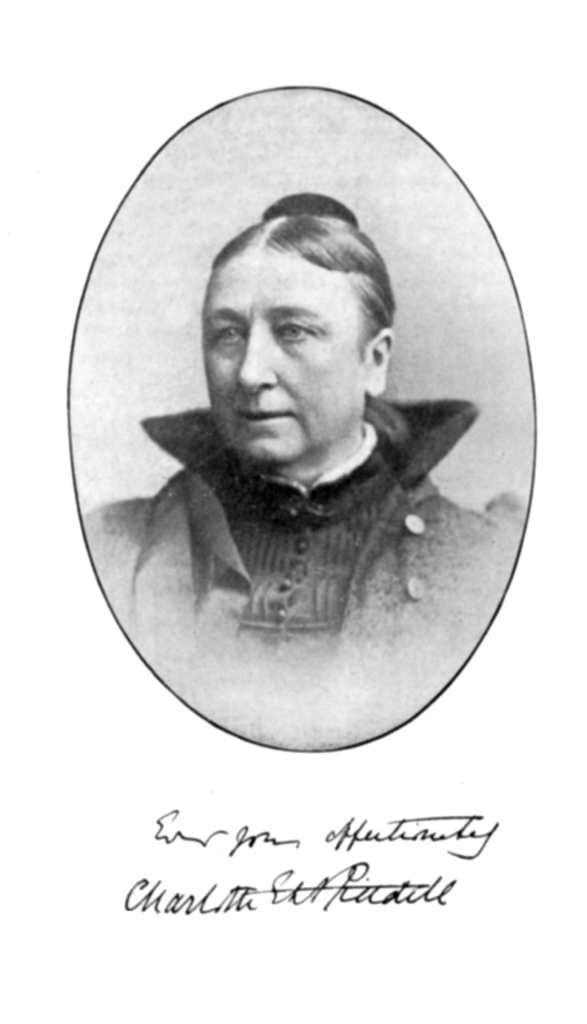
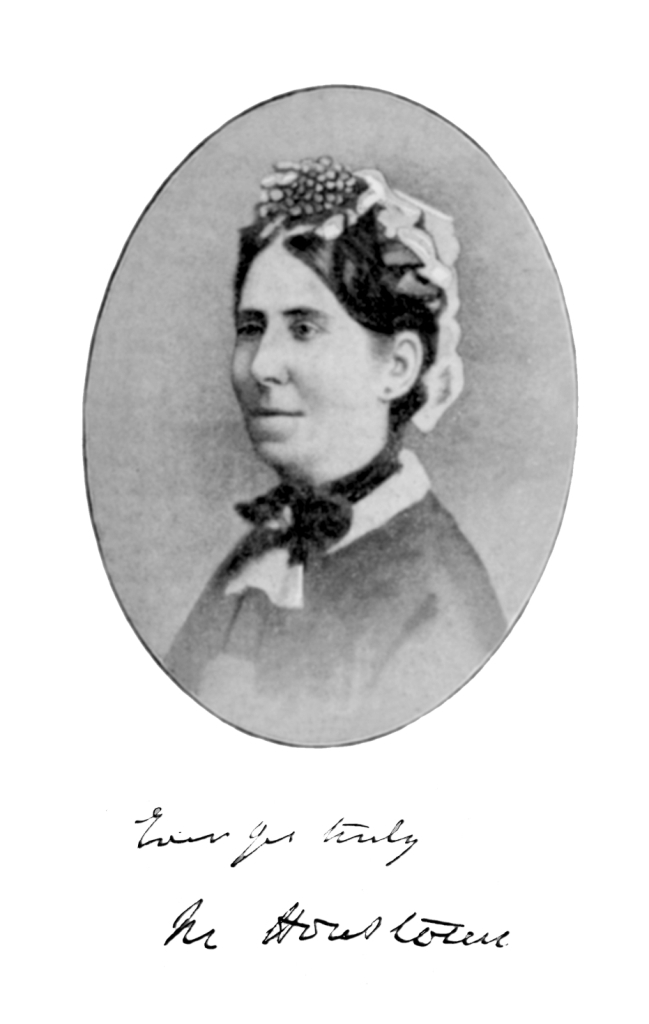
The gentle, quiet face tells its tale of early struggles,
heavy burdens, severe trials; yet time has not laid
its ruthless hand over-harshly on the author. Not a
silver hair is visible on the soft, brown hair, which is
simply rolled into a neat coil, high on the back of her
head, and fastened by a large tortoise-shell comb. The
deep grey eyes are undimmed, and wear a look of peace
and resignation, nobly won; while "ever and anon of
griefs subdued, there comes a token" which recalls the
past. But Mrs. Riddell can smile sweetly, and when
she smiles, two—yes two—absolutely girlish dimples
light up the expressive countenance. She is tall, has
a good carriage, and is dressed in black; she has
worn no colours for over ten years.
The little room is very simply but prettily furnished.
It is lighted by one bay window reaching to
the ground in front, and a glass door at the side. Soft,
white rugs lie here and there on the dark red carpet,
and an old-fashioned bookcase contains the works of
her favourite authors. There are no particular curiosities
or decorations to be seen, save one valuable bit
of old Dresden china, two or three plates of ancient
Crown Derby, together with a couple of quaint
Delhi-work salvers, and a few pictures hanging on
the walls. Of these last, two are particularly attractive.
One is the Head of a Christ crowned
with thorns, beautifully painted on copper; the
other, over the fire place, represents the Castle of
Carrigfergus, which, though built nearly a thousand
years ago, is still strong enough to hold a troop of
soldiers.
Mrs. Riddell was born in Ireland, at The Barn,
Carrigfergus. She was the youngest daughter of Mr.
James Cowan, who held the post of High Sheriff for
the county of that town.
"Yes, I am from the north—the black north," says
your hostess in a low, soft voice. "My grandfather
was in the navy, and my great-grandfather fought at
Culloden, so I may fairly claim to be English, Scotch,
and Irish. My mother, Ellen Kilshaw, was a beautiful,
graceful, and accomplished English woman. On
most subjects people have two opinions, but I never
heard a second opinion about my mother. Even
amongst those who only knew her in later life, when
stricken with disease, and changed by long years of
sorrow, she stands out a distinct personality, as one
of those possessed of the manners, appearance, and
ideas, that we associate with the highest bred women
of the past!"
"And she was good as she was beautiful. I wish
you could hear how rich and poor who knew her in
the old time at The Barn still speak of her. As for
me, while I speak, the grief of her death seems sharp
and present as on that sixteenth of December when
she left me."
Last autumn, after a lapse of twenty-five years, Mrs.
Riddell revisited her native place. "Such of our old
friends as were left," she says, "I found as kind as
ever."
It must have been sad, yet sweet, for the author
to recall the old reminiscences of her girlish home as
she saw once more the pretty bungalow-like house, with
its gardens, hot-houses, and vineries, and to visit again
the spot where, at the age of fifteen, she remembers
writing her first story.
"It was on a bright moonlight night," she says—"I
can see it now flooding the gardens—that I began it,
and I wrote week after week, never ceasing until it
was finished. Need I add it was never published?"
She goes on eloquently to tell you of yet further
recollections of the old house, the memory of her
father's lingering illness, and the low, sweet tones of
her mother's voice as she read aloud to him for hours
together. "From my father," says Mrs. Riddell, "I
think I got the few brains I possess. Undoubtedly
he was a very clever man, but I never knew him at
his best, for as far as my memory goes back he was
always more or less a sufferer, blessed with the most
tender and devoted wife man ever had."
On her father's death, the property passed into other
hands, and with but a small jointure the broken-hearted
widow and her daughter left their old home.
They lived afterwards, for a while, in the charming
village of Dundonald in the County Down, where
the young author subsequently laid the scene of her
novel, "Berna Boyle," and then, after a good deal of
meditation, they decided to come to London. In later
years she wrote three other Irish stories, "The Earl's
Promise," "The Nun's Curse," and "Maxwell Drewitt,"
which last contains an exciting account of an election
at Connemara.
"I have often wished," says Mrs. Riddell "we
never had so decided, yet in that case, I do not think
I ever should have achieved the smallest success, and
even before we left, with bitter tears, a place where
we had the kindest friends, and knew much happiness,
my mother's death was—though neither of us then
knew the fact—a certainty. The illness of which she
died had then taken hold of her. She had always a
great horror of pain mental and physical; she was
keenly sensitive, and mercifully before the agonising
period of her complaint arrived, the nerves of sensation
were paralysed; first or last, she never lost a night's
sleep the whole of the ten weeks, during which I
fought with death for her, and—was beaten."
Mrs. Riddell's first impressions of London are well
worth recording. Coming as strangers to a strange
land, throughout the length and breadth of the great
metropolis, she says, "We did not know a single
creature! During the first fortnight, indeed, I really
thought I should break my heart. I had never taken
kindly to new places, and, remembering the sweet
hamlet and the loving friends left behind, London
seemed to me horrible! I could not eat; I could
not sleep; I could only walk over the 'stony-hearted
streets' and offer my manuscripts to publisher after
publisher, who unanimously declined them." The
desolation of her spirit can be more easily imagined
than described. Conceive the situation of the young
girl, burning to earn a living by her pen, knowing
that it was within her to do so, yet unacquainted with
a single literary or other person; friendless, unknown,
with an invalid mother, and terribly insufficient means!
And when, at last, she sold a story, called "Moors
and Fens," that beloved mother had passed away;
and your eyes moisten as the daughter mentions the
touching and filial use to which her first twenty
pounds were applied.
But Mrs. Riddell has something pleasant to say
for those who declined her MSS., and it must be
related in her own words: "Looking back I must
say, as a rule, they were all very kind to me. I
was too ignorant and heartsore to understand how
gracious they were to my simplicity, even more than
to my youth. Yet I shall never forget how charming
Mr. George Bentley's manner seemed the first day I
saw him. His father—the kindest, most impulsive,
most sympathetic of men—was alive then, and for
many a year afterwards; but it so happened that Mr.
George Bentley was the partner whom I saw, and,"
she adds smiling, and naïvely, "though he, like everyone
else, refused my work, still I left his office not
unhappy, but thinking much more about how courteous
and nice he was than of how entirely the wrong person
in the wrong place I seemed to be. Ere long,
with some publishers I became quite on friendly
terms, and I have now known three generations of
the Bentleys."
After a short silence Mrs. Riddell resumes the subject,
saying, "I must name also Mr. Charles Skeet,
of King William Street, who was good enough to
keep my mother supplied with books. Long as it is
since he retired from business, our friendship remained
unbroken until his death. He was most kind to me
always. He published 'The Rich Husband,' 'Too
Much Alone,' 'The World and the Church,' and 'Alaric
Spencer.'"
"I could always, when the day was frightfully cold—and
what a winter that was when I first came
to London—turn into Mr. Newby's snug and warm
office in Welbeck Street, and have a talk with him
and his 'woman of business.' I am glad to mention
her name—Miss Springett. She was a lady, always
kind, nice, and capable; she remained with him till
her death, I believe. Everyone was good to me in
those days; but, indeed, I have received, all my
life through, an enormous amount of kindness, and
have not a word to say against a world which has
treated me far better than I deserved."
A year after the death of her mother the young
author married. Mr. Riddell belonged to an old
Staffordshire family, a branch of the Scotch Riddells,
of long descent and gentle blood. "Courageous and
hopeful, gifted with indomitable energy," says his
widow, "endowed with marvellous persistence and
perseverance; modestly conscious of talents which
ought to have made their mark, he, when a mere lad,
began his long quest after fortune, one single favour
from whom he was never destined to receive."
Gifted with much inventive genius, Mr. Riddell was
also possessed of considerable general knowledge, and
was deeply versed in literature, medicine, science, and
mathematics. To him his wife turned for all the information
she needed in her novels; the chemistry in
"Too Much Alone," the engineering in "City and
Suburb." He supplied all the business details in
"George Geith," and "The Race for Wealth"; while
in "Mortomley's Estate" Mrs. Riddell says she has
"but told the simple story of what, when in ill-health
and broken in spirit, he had to encounter
before ruin, total and complete, overtook him." Too
early in youth overweighted with a heavy burden,
under which a strong man might have found it hard
to stagger, she declares that, "in spite of harassing
trouble and continuous misfortune, their twenty-three
years of married life were happy as few lives are,
simply by reason of his sweet, patient temper, and
his child-like faith." Suddenly and unexpectedly,
the end came, and the crowning sorrow of a much-tried
life was laid upon the devoted wife when death
claimed her gifted husband. Over that grief a veil
must be drawn. Suffice it to say that it is a sorrow
which will ever be keen in her remembrance "Until
the day break and the shadows flee away."
"I never remember the time," Mrs. Riddell says,
"when I did not compose. Before I was old enough
to hold a pen I used to get my mother to write down
my childish ideas, and a friend remarked to me quite
lately that she distinctly remembers my being discouraged
in the habit, as it was feared I might be led
into telling untruths. In my very early days I read
everything I could lay hands on, the Koran included,
when about eight years old. I thought it most
interesting."
Mrs. Riddell describes the way in which the situations
and characters of her books are often suggested.
She observes everything almost unconsciously; but if
asked, directly after, her impressions, she could scarcely
describe them. Later on, perhaps, when between the
border-land of sleep and waking, scenes, words, people
whom she has noticed seem to be photographed on the
brain; sentences form themselves, and in the morning
she is able to reproduce them at length.
The intimate knowledge of the city possessed by
this novelist is the result of personal experience.
Whilst on her once fruitless expeditions to publishers
she learnt every short cut, every alley and lane by
heart. Little as she relished these excursions at the
time, they laid the foundation for many a scene afterwards
so faithfully depicted in "George Geith," "City
and Suburb" (in which most of the poetry was quoted
from the works of her young sister-in-law, a genius
who died at the age of nineteen), "Daisies and Buttercups,"
"The Struggle for Fame," "Mitre Court," "My
First Love, and My Last Love," "The Earl's Promise,"
and also that entrancing book, "The Senior Partner,"
in which the old Scotch merchant, M'Cullagh, "plain
auld Rab," worthy but saving old gentleman, is a
distinct creation. "In all the old city churches and
graveyards, such, indeed, as are left," Mrs. Riddell says,
sorrowfully, "you could take no better guide than
myself; but, alas! many of the old landmarks are now
pulled down to make room for the ever increasing
business of the great metropolis."
"Austin Friars" described her first home after her
marriage, when, without much practical knowledge of
business, she was greatly impressed by the lives of
business men. This old house is now a thing of the
past, and the Cannon Street railway runs over the
place where it once stood.
The author's latest work—a story of seaside life,
and her twenty-ninth novel—is called "Grays Point,"
and will be brought out in three volumes in the
coming year. She lately was invited to write an
article for The Lady of the House, a new journal
which appeared in Dublin last year, and this is the
first time that she has ever written a line for an
Irish paper. Of her own books, Mrs. Riddell says
that she prefers "The Mystery in Palace Gardens"
and "Too Much Alone." The latter she considers
made her name, though the first edition was only a
short one, and but four copies were sent out for
review. "A Mad Tour, or A Journey Undertaken in
an Insane Moment through Central Europe on Foot," in
one volume, is a recent work, and describes accurately
her own experiences in company with a young friend.
It gives a bright and amusing account of their misadventures.
Mrs. Riddell's latest published novel in three volumes,
"The Head of the Firm," fully bears out the
high literary reputation of the author of "George
Geith." Carefully and conscientiously worked out,
each character is drawn with an unerring hand, and
sustains its interest to the final page, whilst here and
there are not wanting those touches of humour which
have always distinguished her works.
After a snug luncheon in the comfortable dining-room,
in which, by the way, unexpected little steps and deep
cupboards seem to be built promiscuously—as, indeed,
they are throughout the cottage—your hostess takes
you round the garden, which is well worth seeing,
mid-winter though it be. She points out the great
height of the holly hedge, and laments that she has
been obliged to have twelve feet cut off the top.
Notwithstanding, it is still twenty feet high. The
japonica is the admiration of passers-by in the early
spring, being then covered with a mass of scarlet
flowers. The apricot tree is sadly in want of root
pruning, but, as she says, "I cannot persuade the old
gardener to do it, and as I am never equal to arguing,
I let him take his own way." There is an extraordinary
plant which you have never seen before; its
flowers are green, and Mrs. Riddell says that she never
saw one like it except in her old home. The huge
weeping ash, although now bereft of leaves, is a great
feature, and the high box borders divide large squares
of ground, wherein good old bushes of lavender, rue
and lad's love grow profusely.
Your hostess points out the adjoining cottage, the
home of her old gardener, aged eighty, and remarks
that another old man who preceded him begged from a
neighbour enough elm to make him a coffin. It was
given to him, and the hitherto unnecessary article
made. He kept the gruesome object for some time,
but finding it took up too much room in his small
abode, he altered it into a cupboard.
A turn round the last walk leads to the poultry-yard,
which is a great delight to Mrs. Riddell. She has
several fine breeds of fowls and geese, amongst which
last are two handsome but noisy specimens from
Japan. One little peculiarity of interest must be
noticed. The wall which supports the granary steps
is pierced by two holes for dog kennels, an arrangement
of great antiquity.
Mrs. Riddell loves walking. The church she attends
lies rather more than two miles away towards Laleham,
which place Arnold left with so much regret, and where
Matthew Arnold is buried. She speaks of Littleton in
the neighbourhood as being the village she described in
"For Dick's Sake," and says, laughing, "It has stood
still for over two hundred years. There is no resident
rector or squire, or doctor, or lawyer, or publican, or
farrier, but it is a sweetly peaceful spot, and the woods
in primrose time are a sight to behold, whilst at Sunbury,"
she adds, "to show you how little change may
take place, in one hundred years there have been only
two vicars, and one of them is alive now!"
But it is getting dark, and tea is ordered as a
preparation for your cold journey; whilst sipping
it, she says that as you are so much interested
in her own early "struggle for fame," she will
mention one more anecdote à propos of Mr. Newby,
as it is amusing, and she relates it thus: "In
those early days he—Mr. Newby—was good enough
to take a book of mine. Of course he only knew
me by my maiden name, because after my mother's
death Welbeck Street lay quite out of my way,
and I fear I ungratefully forgot the cheerful fire,
and the talks about authors, which were once so
pleasant.
"For this reason he knew nothing of my doings.
The years came and the years went, till after the
crash came in our affairs; when I was looking about
me for every five-pound note I could get, I bethought
me of this and another old book, which I can never
sufficiently regret republishing. Well, I found I
could sell both of them, and forthwith repaired, after
all that time, to Mr. Newby's, where nothing looked
much changed, and no one seemed much older,
except myself, who had lived many lives in the
interval.
"Of course both Mr. Newby and Miss Springett
had a vague memory of me, when I reminded the
former that he had published 'Zuriel's Grandchild.'
What I wanted was a copy of the book. He feared
he had not one, but promised to ascertain. I can see
them both now in that warm, comfortable back room,
into which, as a girl, I had often gone shivering.
"He took a seat on one side of a large table, she on
the other. I sat facing Mr. Newby—a most anxious
woman, yet amused.
"'Have you,' he said delicately, 'gone on at all
with literature?'
"'Oh, yes,' I answered.
"'Have you—published anything?' with great
caution, so as not to hurt my feelings.
"'Several books,' I replied.
"'Indeed!!!' amazed. 'Might I ask the names?'—tentatively.
"'Well, amongst others, "George Geith."'
"A dead silence ensued, during which I had the
comfort of feeling that they both felt sure I was
saying what was not true. I sat quite quiet, and so
did they. If I had not been so burdened with care
I must have laughed out loud. As it happened, I
comported myself, as I have often done since, in many
difficult and humorous positions, with decent gravity,
and then this came from Mr. Newby, the while the
ribbons on Miss Springett's cap were tremulous:
"'If—you really wrote "George Geith," then indeed
you have achieved a success!'"
And so you part; with loving tender sympathy.
Though the morn of this distinguished woman's life
has been so clouded, the noon so stormy, the noble,
self-reliant spirit has battled through it bravely and
patiently, and you leave her with the inwardly-breathed
prayer that "at evening time there shall
come light!"