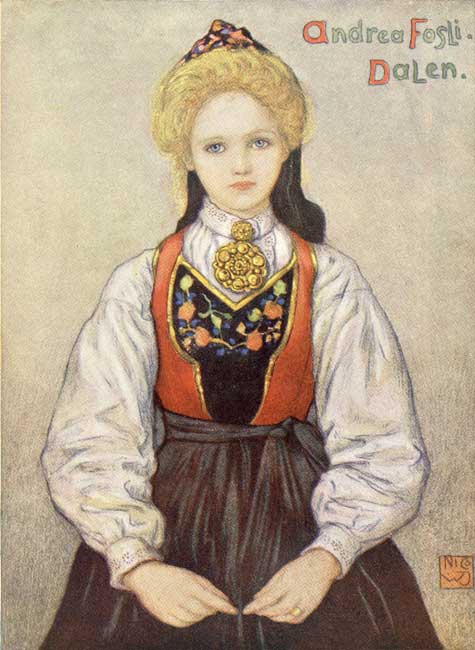
| 1. |
Country Girl from Dalen |
Frontispiece |
| |
|
FACING PAGE |
| 2. |
Trondhjem—Old Boats |
4 |
| 3. |
Costume worn in the Bergen District |
6 |
| 4. |
The Road to Hell, near Trondhjem |
8 |
| 5. |
White Cap worn in the Bergen District |
10 |
| 6. |
Trondhjem |
12 |
| 7. |
Little Girl of Telemarken |
14 |
| 8. |
Making the Dinner—a Cottage Interior at Sælbo |
16 |
| 9. |
Bergen |
18 |
| 10. |
On the Fjord, Sundalsoren |
20 |
| 11. |
Country-women selling Berries on the Road to Storen |
24 |
| 12. |
Norwegian Captain |
26 |
| 13. |
Farm-house and Mill at Gjora |
28 |
| 14. |
Mountains and River at Gjora |
30 |
| 15. |
A Little Farm on the Riverside at Gjora |
32 |
| 16. |
Ostre Kanalhavn, Trondhjem |
34 |
| 17. |
The Town of Molde |
36 |
| 18. |
Woman Spinning, Sundalsoren |
38 |
| 19. |
Snow-capped Mountain at Sundalsoren |
40 |
| 20.
|
Old Warehouse and Boats, Molde |
46 |
| 21. |
Mountains and Fjord facing Molde |
48 |
| 22. |
Moldöen |
50 |
| 23. |
Bergen |
52 |
| 24. |
A Fair Maiden of North Bergen |
54 |
| 25. |
Bergen Boats and Warehouses |
56 |
| 26. |
Væfos, Hildal, Hardanger |
58 |
| 27. |
A Hardanger Country Girl |
64 |
| 28. |
Skjæggedalsfos, Hardanger |
66 |
| 29. |
Hardanger Headdress |
68 |
| 30. |
River at Haukeli |
70 |
| 31. |
A Peasant of Sætersdalen |
72 |
| 32. |
Espelandsfos, Hardanger |
74 |
| 33. |
A Boy of Sætersdalen |
76 |
| 34. |
Sundalsfjord |
78 |
| 35. |
Sætersdalen Girl in National Costume |
80 |
| 36. |
Sætersdalen Peasant Girl |
86 |
| 37. |
Moldöen |
88 |
| 38. |
A Cottage Interior, Telemarken |
90 |
| 39. |
A Norwegian Girl |
92 |
| 40. |
Kjendalsbræ |
94 |
| 41. |
A Typical Norwegian Maiden |
96 |
| 42. |
A Baby of Telemarken |
98 |
| 43. |
Romsdals Horn |
100 |
| 44. |
Old Age, Telemarken |
102 |
| 45.
|
Romsdals Waterfall |
108 |
| 46. |
The Houses of Parliament (Storthing), Christiania |
110 |
| 47. |
Ski Sports—the Great Holmencollen Day outside
Christiania |
112 |
| 48. |
Room by Munthe at Holmencollen |
114 |
| 49. |
Skiers drinking Goosewine |
116 |
| 50. |
Girls on Overturned Sledge, Holmencollen |
118 |
| 51. |
Old Canal, Christiania |
120 |
| 52. |
Sledging by Torchlight |
122 |
| 53. |
Making Native Tapestry |
124 |
| 54. |
Bird's-eye View of Christiania |
126 |
| 55. |
A Vosse Bride |
130 |
| 56. |
Farm-houses built of Poles |
132 |
| 57. |
Country Girl, Bergen District |
138 |
| 58. |
Sætersdalen Bride |
140 |
| 59. |
A Hardanger Bride |
142 |
| 60. |
Making "Flad-Brod"—a Cottage Interior |
144 |
| 61. |
Snow Plough drawn by Eight or Ten Horses |
150 |
| 62. |
Fishing through the Ice on Christiania Fjord |
152 |
| 63. |
Fishing-nets at Sundalsoren |
156 |
| 64. |
The Midnight Sun |
158 |
| 65. |
Mundal, Fjærland, Sognefjord |
162 |
| 66. |
Fishing-boats at Lofoten |
170 |
| 67. |
A Little Sætersdalen Peasant Girl |
172 |
| 68. |
Buerbræ, Odde Hardanger |
174 |
| 69. |
A Lapp Mother and Child |
176 |
| 70. |
Snow-capped Mountains at Aune |
178 |
| 71. |
River at Gjora |
182 |
| 72. |
Grieg |
184 |
| 73. |
Henrik Ibsen |
188 |
| 74. |
Bjornstjerne Bjornson |
190 |
| 75. |
Fridtjof Nansen |
192 |
PRECARIOUS TRAVEL
NORWAY
CHAPTER I
PRECARIOUS TRAVEL
Of the sea voyage to Norway the less said the
better. It is my habit to be ill when I am at sea.
That is unfortunate; but habit in itself engenders
a mode of philosophy that makes many of the evils
of life more easily bearable than they might otherwise
be. I expect to be ill, and literally lay myself
out for it; but Nico takes up an attitude of
aggrieved surprise that the ocean should thus
overcome him, and consequently is a far greater
sufferer than I am. However, it is easy to assume
a more or less frivolous tone when all is over,
and the fact must be admitted that the voyage to
Norway is almost invariably unpleasant to the
majority. From the Continent, one can go overland;
but such a country as Norway should be
approached by sea. Still, many a valiant sportsman
prefers the land for his return when the autumn
winds begin to blow, and so it is not surprising
that less hardy natures are inclined to do the
same. It was summer when I visited Norway
for the first time; and, although one has frequent
chances of viewing the coast as one steams along
it from Stavanger to Trondhjem, I did not really
begin to take any interest in the country until I
had rested and eaten for some days in the latter
town. Certainly I had one experience in Bergen
during the two or three hours that we stopped
there on our way north. With my usual insatiable
thirst for dissipation, I insisted on visiting
a circus I had discovered upon the outskirts of
the town. The performance was not very thrilling;
but we are neither of us difficult to please,
and we stayed rather late. Thus, when we returned
to the quay the gangway of our vessel was being
pulled up. Nico made a rush for it, and was
saved; but could not prevent the sailors from completing
their task, and thus I was left lamenting.
However, the sailors finally threw me a rope, and
I managed to scramble on to the deck. It was
most undignified, and, I am afraid, from the
safety of the deck a most laughable spectacle;
and I fled to hide my embarrassment in my
cabin, ultimately going supperless to bed.
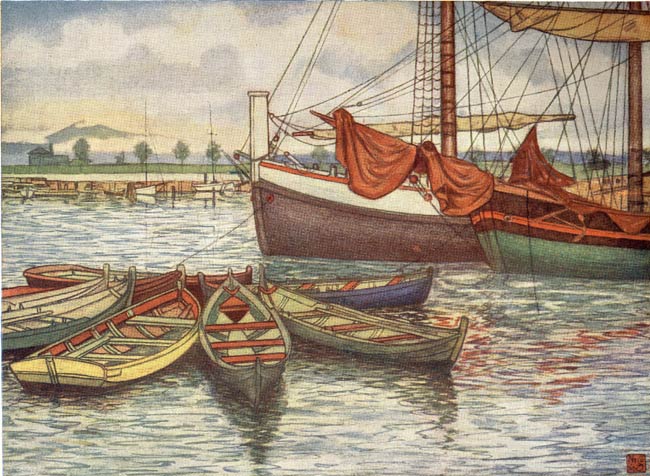
TRONDHJEM—OLD BOATS
The form of the ancient Viking ships is still
preserved in these boats
In Trondhjem it rained all day and all night,
and the inhabitants cheerfully told us that it was
always so. Nico, however, painted in the rain,
enveloped in mackintoshes and encompassed by
umbrellas, and was much disgusted to find that he
attracted no attention at all. Accustomed as I am
to be an object of inquisitive interest to the inhabitants
of small Dutch towns, I was rather relieved to
be taken so absolutely for granted in Norway, in
spots unfrequented even by ardent fishermen.
At Trondhjem we were delighted with the
delicious salmon and sea-trout; but after some
weeks of salmon for breakfast, salmon for dinner,
and salmon for supper, I found myself wondering
whether it was all that it had seemed to me at
first. I am rather ashamed to have to confess
that, in spite of the fact that wherever English was
spoken the chances were that the conversation
turned upon salmon or trout fishing, neither Nico
nor I know anything of those earlier and more
exciting passages in the salmon's career which
culminate in his presence at the table. It may be
said that, with the exception of the Germans, who
visit the coast-line in ship-loads, there are practically
no tourists in Norway. Fish seem to be the
main object of the stranger within her gates; and,
as I have long despaired of grafting a sporting
taste upon the artistic temperament, I decided then
and there to leave the subject severely alone.
Besides the anglers, many men go over for
shooting. There are still wild animals to be found;
licences are very cheap; and the Government even
offers a reward for the slaughter of certain beasts.
In the case of the rarer animals, such as the elk and
the wild reindeer, certain restrictions are placed
upon the foreign hunter. On the payment of a
sum between ten and twelve pounds he is allowed
to kill three reindeer and one elk. The native
hunter suffers from the same restrictions; but his
licence costs him very much less.
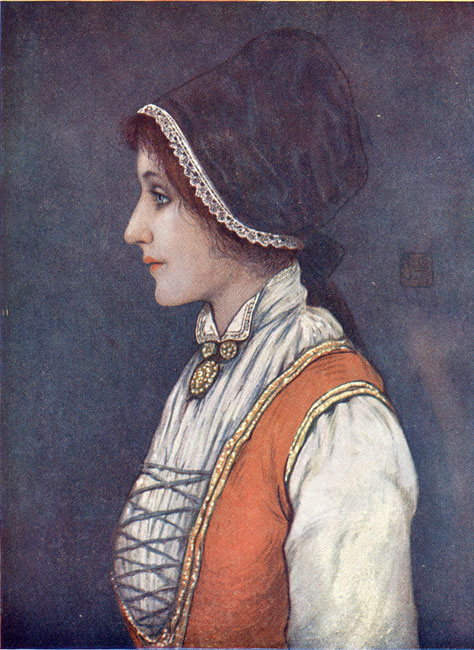
COSTUME WORN IN THE BERGEN DISTRICT
All this has little to do with Trondhjem. We
were rather unlucky there, and were not, perhaps,
so much impressed as we ought to have been.
Calculations based upon careful study of the
guide-book proved to be incorrect, and we found
the doors of the Cathedral constantly closed against
us. As it is the object of interest in the place,
we were somewhat impatient, and, when we did
contrive to obtain entrance, were not in any way
mollified to find the building pervaded by
spectacled and reverential Germans, who bestowed
superciliously indignant glances upon us, as on
persons who were unjustly sharing a view arranged
for their party specially. It is certainly a most
beautiful building, and is being restored in a
worthy manner. I remarked as much to Nico at
the moment, but was immediately suppressed by
the ancient guardian acting as our guide, who
begged me in very stately broken English not to
interrupt his discourse. Later we went to a
music-hall and sat through a most extraordinary
programme twice repeated. Nico ordered beer,
and was served with an immense plate of
variegated sandwiches in addition. This, I believe,
was in accordance with the law that forbids the
sale of intoxicating liquors unless food is served
with them. All over Norway the most complicated
laws are in force with respect to drink, and
these laws seem to be different in every town and
village. I have not gone into the subject deeply;
but it is certainly a rare thing to meet with a
drunken Norwegian in the country parts.
Trondhjem always has been, and still is, the
crowning place of the Norwegian kings. It seems
to me that it is a long way to go for such a
purpose; but I concluded that it was an affair in
which the kings alone were concerned. We
walked out to a beautiful waterfall near the town,
called the Lerfos, and came back by rail. Some
idea of the speed attained by the trains may be
gathered from the fact that, although the train
had started when we reached the station, we were
able to board it quite easily after it had gone some
distance. Then, one very wet morning we decided
that we had had enough of the place, and, shaking
the mud from our boots, we took train to Hell.
I refrain from the obvious little jokes that may be
made upon such a journey, and merely record the
fact that we arrived very cold, and soon became
very wet during our stay there. The station
buildings were all locked up; and we wandered
about disconsolately, waiting for the cart which
was to meet us and drive us to Sælbo, where we
had decided to spend a few days. The vehicle
which we had chosen was a stolkjærre, and I
must here explain some of the difficulties of
locomotion peculiar to Norway. The mileage
of railway is small in proportion to the size of
the country: the natural formation of the land presents
immense difficulties to the engineer. To
these obstacles must be added the very hard
winters, the heavy rainfall, and the exceeding
scantiness of the population in many parts of
the country. Consequently, almost all travelling
is carried out by means of an admirably arranged
posting system. On all the roads, at distances
varying from seven to eleven miles, may be
found posting stations where horses may be
changed; where, also, the traveller may eat and
sleep. These wayside inns are generally farmhouses,
varying widely in their capacity for the
entertainment of man and beast. They are
obliged to keep a certain number of carts and
horses for the use of travellers at a specified
rate per kilometre, fixed by the Government,
such rates being subject to slight increase where
particularly mountainous roads are concerned.
There are three classes of vehicles in general
use. The carriole, which is the typical Norwegian
conveyance, is exceedingly comfortable
and well adapted to its purpose; it is built for
one person, and runs easily on good springs, and
may be likened to an armchair on wheels, but so
arranged that one can either sit in it with knees
bent, as in an ordinary vehicle, or stretched out at
full length in a kind of trough. This obviates the
stiffness engendered by endless hours of driving
in one position.
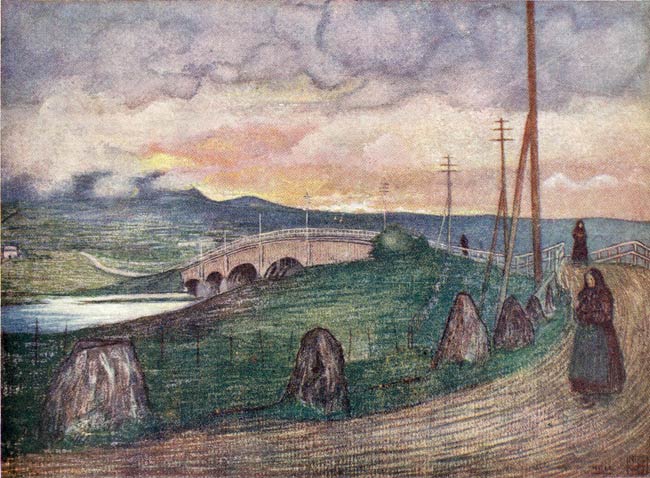
THE ROAD TO HELL, NEAR TRONDHJEM
This is one of the rare railway stations
of Norway
The stolkjærre, on the other hand, is a terrible
invention, as much like one of our plumber's handcarts
with a rough wooden seat in it as anything
I can think of. It holds two people and a certain
amount of luggage. On the main roads one finds
the carts fitted with something in the way of springs;
but upon roads such as it was our fortune to be
driven on, often badly in need of repairs, they were
usually much behind the times, and it was a
wonderful and awful sensation to drive for untold
hours under such conditions.
The carriole and the stolkjærre have a small
seat at the back for the boy who is sent by the
proprietor, to be changed, along with the horse and
cart, at each station; but in the case of the third
method of locomotion—that is to say, with much
style and excessive slowness—one takes over the
responsibility of the whole affair—namely, coachman,
horses, and carriage, which in this case is
called kaleschevogn,—only to be laid aside when
one arrives at one's final destination, and using
the stations only for the purpose of resting and
eating. To return to the carriole and the
stolkjærre. It must be noted that one is expected
to drive oneself, though, if anything goes wrong
with the horse and cart, the driver is responsible.
The mountain ponies are very surefooted and need
no guidance; but it was our fate to be made
acquainted with cattle that shied, with others that
tripped, and with one pony (I recall the occurrence
with horror) that stumbled on a narrow road, cut
out of the almost perpendicular side of a mountain,
three thousand feet above a roaring torrent. One
wheel of our vehicle was actually in mid-air;
but, fortunately, the horse fell on the shaft that
was on the mountain side of the pass. Had this
not been so, one of the stones that mark the site
of such accidents on the Norwegian roads would
have been erected to our memory.
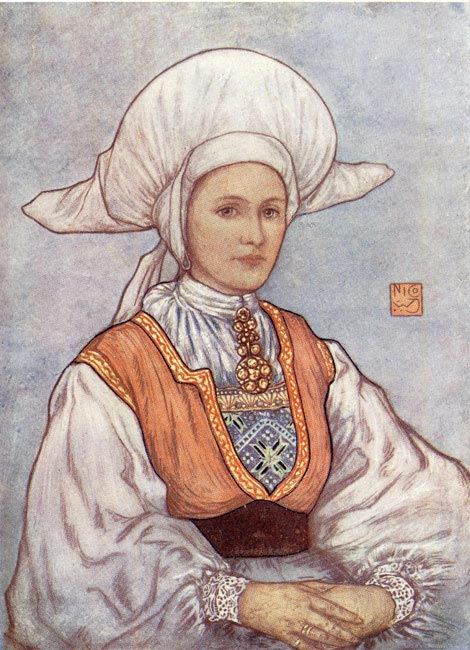
WHITE CAP WORN IN THE BERGEN DISTRICT
It was at Hell that we had our first experience
of the stolkjærre. This was after waiting some
three hours, which Nico improved by making a
sketch, while I looked for visionary wild strawberries
in the soaking grass. Then appeared a
cosy little carriole, upholstered in red velvet, and
carefully covered with tarpaulins. This was
immediately taken over by a prosperous station
official, who drove off in comparative comfort.
In a few minutes appeared the plumber's handcart
which I have already attempted to describe,
and in it a very diminutive boy, who manfully
tackled the luggage, which he endeavoured to
make fast with a heap of very thin string, supplemented
by straps from Nico's sketching equipment.
Now we were really off, and I had time
to study our pony. He had a long and heavy
tail, which he would toss over the reins; the
pressure he thus brought to bear he promptly
obeyed, and we pursued a somewhat erratic course,
varied by descents upon the part of the diminutive
boy to replace the pony's tail. At length we
reached a lonely farmhouse, at which, he implied,
we were to alight; and we paid him his little bill,
with the addition of a small pourboire. He shook
hands very gravely with Nico, and, looking again
at his money, inwardly decided that we deserved
a little more attention, and shook hands with me
too. We did not know anything about posting,
and, somewhat overwhelmed with this ceremonious
leave-taking, stood for some time in doubt as to
what to do next. Soon an old woman appeared
at the door of the house, and beckoned us in. I
explained as well as I could, with the help of a
phrase-book, that we wanted a horse and stolkjærre
as quickly as possible. This seemed to amuse the
old lady immensely. She laughed until the tears
came into her eyes, and, taking the book from my
hands, examined it intently upside down. As it
was getting late and we had still a long way to go,
Nico tried what could be done by a pantomimic
display. Sitting astride a chair, he tied his handkerchief
to represent the reins, and supplemented
the performance with encouraging noises addressed
to an imaginary steed. This tickled the people of
the house; but I realised that we were no nearer
our object, and decided to forage for myself. I
boldly ascended the steep incline of logs upheld by
beams that led from the yard to a very dark stable.
I found no horse; but there was a stolkjærre without
the ghost of a spring. I appealed again to
the old lady, who had followed me, for a horse.
She merely patted me, and, I think, urged me to
be calm. Just at this moment another boy
appeared upon the scene, and inquired whether
it was really a horse that we wanted. Knowing
the Norwegian for horse, I nodded vigorously.
He smiled indulgently, but took no other step.
After another half hour's alternate shouting and
periods of calm, the boy roused himself to action
and went off, while the old lady, who, I believe,
was really kind and interested in us, took me into
the kitchen and made up the fire, as she discovered
that my hands were cold. I suppose she knew
what we wanted all the time, and that we ought
to have taken things more easily; but at that time
I knew nothing of the unwritten laws with regard
to posting in Norway.
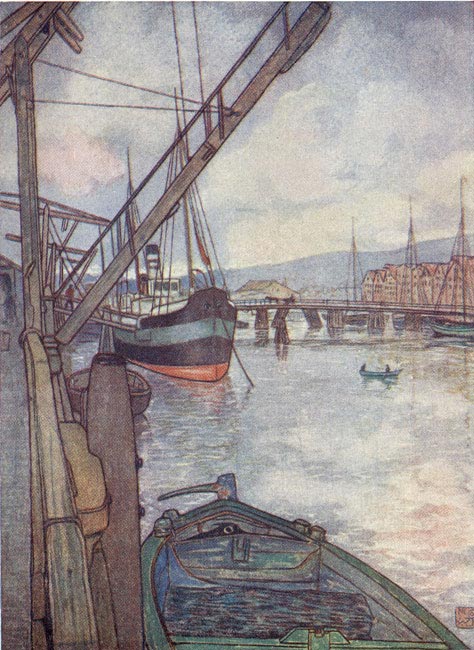
TRONDHJEM
We had a terribly long drive, through magnificent
scenery, going uphill for miles; and very
desolate and wild it seemed in the half light of that
damp and dreary evening. Not a human being did
we meet, and scarcely a dwelling was to be seen
along the route. It was midnight when we reached
our destination, one of the typical boarding-houses
scattered all over Norway, in which inhabitants of
the towns not possessing villas of their own pass a
few weeks in the summer. They are called "sanatoriums,"
generally provide fishing, and are always
amid glorious scenery. The ones that I visited were
splendidly managed, and exceedingly reasonable in
their charges. Marienborg, the name of the small
sanatorium in which we stayed at Sælbo, is exquisitely
situated above a very charming lake, and
new beauties discovered themselves in whatever
direction one wandered. The air is perfect, and the
weather almost dependable, in the few short weeks
of summer. It was now the middle of August.
The hostess was carefully tending her strawberry-beds,
and pointed out to us a fine specimen that
was still green. The meals at this establishment
may be taken, I think, as typical of those of the
whole of Northern Norway. Breakfast (when you
wish) consists of coffee and cream, eggs, and
various odorous kinds of cheese, of which I can
only remember the names of two, the reindeer
cheese and the goat cheese. Dinner is at two
o'clock. Salmon is a staple dish; the meat, generally
mutton, is not much to boast of. The game,
when one can get it, is excellent. The people
seem to care little for any vegetable except
potatoes. A great "feature" of the meal is the
dishes of fresh berries served with an abundance of
delicious cream. The milk, which is a general
drink, is always skimmed. The bread is an
acquired taste, cinnamon and caraway seeds being
often used as a flavouring. A strange bread,
which at its best form was rather pleasant,
consisted of sheets of wafer-like thinness and
considerable size, broken up to the requirements of
the eaters. This is served with every meal. One
seemed to be eating tissue paper without pulp.
Though it is difficult to believe in its nourishing
qualities, a Norwegian meal would be incomplete
without it. Amid more gorgeous circumstances it
is rejected for a delicately flavoured smooth wafer
which is really pleasing with butter. In places
near the sea we were delighted with the abundance
of prawns and lobsters; prawns of such perfection
I had never tasted before. It is very difficult to
get fresh butter. As a rule it is made in the
saeters in the mountains, where the cattle are kept
in summer, and on account of the heat is very
much oversalted before being sent down.
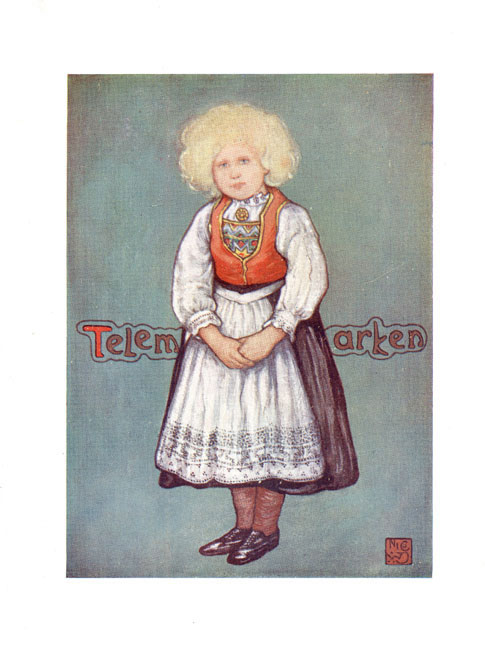
LITTLE GIRL OF TELEMARKEN
We stayed some time at Sælbo, as the only way
to leave it was by riding along a narrow bridle-path
for over a hundred kilometres, and this was
not likely to be very pleasant. The only way to
avoid it was by partially retracing our footsteps,
and this we liked still less. Nico had become
devoted to the picturesque log buildings with their
delightful grass roofs studded with flowers, and
even in some cases actually bearing small trees;
and I had discovered a dear old woman who passed
her time in knitting curious triangular gloves.
She had been nurse in an English family many
years before, and could speak a sort of English.
She loved to tell me tales of her former charges;
she did not seem to mind how much I understood,
and no more did I. Her two sons were in
America, whence they sent her a sufficient allowance
to keep her in comparative comfort, and in
addition to this she sold the gloves she passed her
time in knitting. She lived all alone in a log
house consisting of one large room, which served
her for all purposes except sleeping (a tiny cabin
built in the main wall served for that), and containing
very little furniture, the peasantry in Norway
having the good sense to appreciate the advantages
of space. Large tables with folding legs are fixed
with hinges to the wall, and when not in use are
hooked up out of the way. In one corner of the
room was the round whitewashed open fireplace
and chimney which are characteristic of these log
houses—infinitely to be preferred, from a comforting
as well as a picturesque point of view, to the tall
iron stoves generally in use. The stoves have
their qualities, however, being narrow and made in
four or five divisions above that intended for fuel,
which is invariably wood. Each of these compartments
has its own temperature, and is to be used
with discretion for drying and heating purposes.
One word of warning: do not put your boots in
the partition nearest the fire.
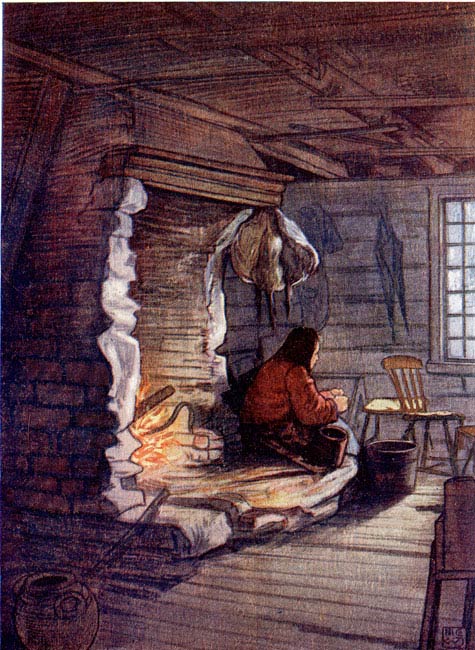
MAKING THE DINNER—A COTTAGE INTERIOR AT SÆLBO
At our sanatorium all the visitors ate at one
table, and we were charmed at our first acquaintance
with a custom which holds good all through
Norway. When the meal is over all the guests
wait for the hostess to rise; then they follow her
example and gravely bow, thus thanking one
another for the honour conferred during the repast.
This practice is observed wherever two or more
people are seated at the same table, even though
they may be absolute strangers.
We had now discovered that by crossing the
lake on a very old steamer we should reach a place
called Brottem and thence proceed northwards to
a spot from which we could pursue our journey.
We parted from the lovely smiling place with
many regrets, and, boarding the steamer, found we
had it to ourselves. At a bend in the lake Sælbo
was lost to our sight, while on either side of the
narrow water the banks rose precipitously, thickly
wooded with pines. The sun had disappeared, and
the air was growing cold, when suddenly the
steamer stopped, the captain proclaiming in a
matter-of-fact tone that the engine refused to work.
We ascertained that we were in no actual danger;
but out of sight and sound of humanity, on a tiny
and very ancient vessel, we were in a position of
unpleasant possibilities. We remained stationary
for two hours. Then one of our three navigators
had a brilliant inspiration. That was to examine the
engines, which had not, apparently, occurred to any
of them before! After a little coaxing the vessel
began to move again; and we eventually landed
on the farther shore of the lake, very cold, very
hungry, and much belated.
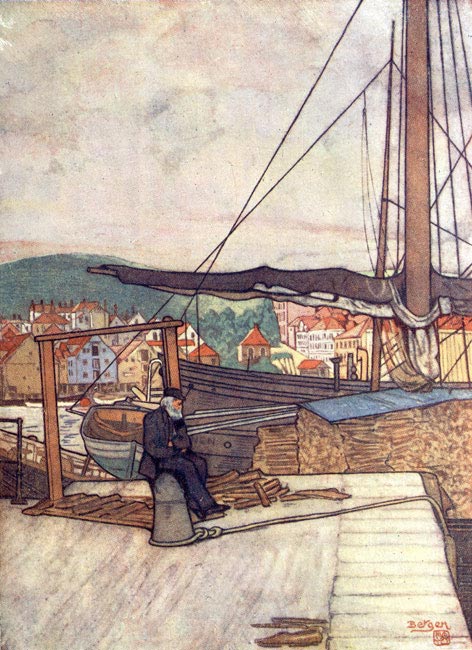
BERGEN
Here we found a large farmhouse surrounded
by many outbuildings, and evidently prosperous.
We were received with enthusiasm by the burly
proprietor, his servants, and a Norwegian family
engaged in fishing who were staying at the place.
A splendid meal was prepared, and, to my joy, a
wood fire was roaring in the tall iron stove of a
large bedroom set apart for me. The fishing
family knew a few words of English, which they
were as much pleased to speak as we to hear.
Next day was a Sunday, and at dinner Nico in his
ignorance expressed a desire for something to
drink, which was refused, as nothing could be sold
on that day. The kind fishermen came to the
rescue. They plied us with rare wines, and under
that friendly influence we thawed gratefully. I
found them enthusiastic whist-players, and eagerly
desirous of mastering the intricacies of bridge. I
did what I could in one short afternoon to enlighten
them, and soon after sent them two scoring
boards. Probably they will evolve a game for themselves
which in the next generation will utterly
eclipse bridge, as bridge has eclipsed whist and solo.
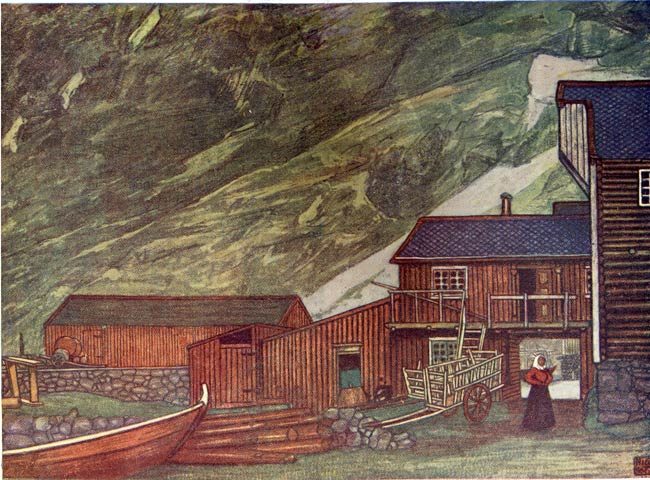
ON THE FJORD, SUNDALSOREN
BROTTEM, AUNE, SLIPER,
GJORA, SUNDALSOREN, ETC.
CHAPTER II
BROTTEM, AUNE, SLIPER, GJORA, SUNDALSOREN, ETC.
We had a splendid pony and quite a comfortable
stolkjærre from Brottem to the next station, where
we took the train to our resting-place for the night,
a well-known fishing hotel at Storen. One of the
excellent incidents of travelling in Norway is the
service, which is exceedingly well done by women.
They are so quick and clean and agreeable that
they contribute to the enjoyment of one's wayfaring.
The deft maids at the Storen hotel were
no exception to the rule; but the place was not
very sympathetic to us. We stayed only long
enough for Nico to make one or two pictures of
spots which pleased him. Then we began a long
drive right across the country, half the distance off
the main road, having as our destination the town
of Molde. We lingered for weeks over our drive,
staying for days at the various little stations which
appealed to us specially by reason of that mystic
attraction some spots have and others lack, which
can neither be analysed nor explained.
At a place called Aune we left the main route,
and here the road began to be exceedingly bad—far
and away the worst we came across in Norway.
Before this we were struck with the splendid way
the roads are constructed and kept.
Our hearts were in our mouths one dusky
evening as we galloped down the narrow road
cut out of the precipitous side of a mountain:
seven hundred feet below foamed and roared a
torrent. We reached the valley in safety; but
I had terrible dreams about frightened or unsteady
ponies for nights afterwards.
At Aune we met two very handsome Norwegians,
who were crossing the country on foot.
They were taking a holiday in this way; but
many poor students are obliged to make use of
shanks' ponies for the strongest of reasons. This
slow driving during long distances becomes very
expensive, and I presume that the continual
stoppages at hotels must be an important item.
I mention these good-looking people, not because
we found them very interesting, but because I was
surprised all through Norway to find so few men
with any of the external qualities of the Viking.
I had imagined that the type was strongly
implanted in the Norsemen. Even in build the
majority are unsatisfactory. A careful study of
statistics on the subject informed me that the
Norwegians are the tallest European race; but I
can only suppose that the average is brought up
by a certain number of excessively tall men. Also,
the Norseman is inclined to become fat early in
middle life. On the whole, the middle class is
not to be distinguished from the usual type of
Dutchmen and Germans with which we are
familiar. The women have been treated in a
much kindlier fashion by Nature. Even those
whose features do not actually admit of their being
called handsome have such smiling frank faces that
they are most pleasant to look upon. In using
womenkind so extensively in the place of man-servants
the Norwegians show wisdom and good
taste.
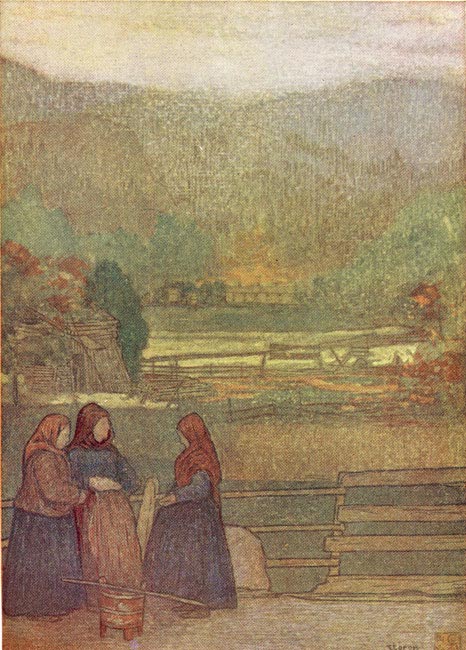
COUNTRY-WOMEN SELLING BERRIES ON THE ROAD TO STOREN
From Aune we had a terrible drive over a road
in the making. The old path was too bad to use
at all; and the new road jerked us here up a foot,
there down a foot, as the various processes gone
through in levelling had been completed or not.
At last we left the roadmakers behind us, and
drove for some kilometres along the old road to a
small station called Sliper, a terrible drive which
by this time will, fortunately, have ceased to be
possible.
We were delighted with Sliper. At the station
were two houses, the station's and another.
We stayed at the other. We had actually
ordered the horse, meaning to go on, when a
beautiful Norwegian woman beckoned to us from
her doorway in the other house. She invited
us to warm ourselves while we were waiting,
and gladly we climbed up the twenty-five steps
leading to her large room. The flap table was
painted bright red, as were the benches, and the
few pieces of furniture were carved and painted
wood. The brilliant colours were mellowed by
time and perhaps by smoke from the wood fire,
which burnt in a round open grate in a corner.
An immense cauldron was suspended from a chain
in the chimney. In it was stewing a savoury mess
of mutton and potatoes. In front sat a pale little
girl, the only living child of the beautiful hostess.
The latter had the most perfect teeth I have ever
seen, and waving masses of golden hair. At either
end of the big room was a small bedchamber.
One the family used, and the other was kept for
the possible guest. I believe that, as the station
house had room for us, we were quite wrong in
staying with the neighbour; but I think the station
people were not very energetic—they did not object
so much as they had the right to do. In any case,
there we stayed for three days, living and eating
in the big room with mother and child. With the
exception of our supper on the first night, we had
no meat. We lived contentedly on potatoes and
eggs, fruit and cream, and abominable butter. It
is strange how far the atmosphere of a place can
defeat prejudices.
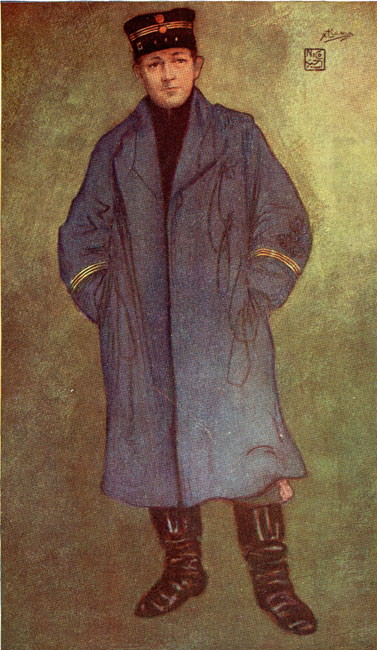
NORWEGIAN CAPTAIN
However, soon Nico became hungry, and I
finished my small stock of literature. We took
our horse and stolkjærre, and without a boy we
followed the post on the road to Gjora. When
we had driven a few kilometres, keeping the post
carriole with its bag and its horn well in sight, we
discovered that we had left the purse containing
most of our wealth behind us at Sliper. Nico
drove back at the pony's best pace. This best pace
could not have been very wonderful. An eternity
seemed to be passing as I sat on a big rock, waiting
for the return of the companion and the purse.
A few cows walked by me in inquisitive procession.
I effaced myself as much as possible.
I am ridiculously afraid of cows. Even the
Norwegian cow, which I know theoretically to be
the gentlest of creatures, can subdue me with a
look and drive me to seek for any available hiding-place.
At last I heard wheels; but they were
coming the wrong way. The two men in the cart
looked at me curiously, and drew up in front of
me. One addressed me in very good English. It
appeared that the post-driver had warned the
people at Gjora station of our near arrival, and had
presumably mentioned that we had no boy. After
they had allowed an hour and a half to elapse,
they were good enough to become anxious, and had
come to look for us. I explained our delay, and
we all waited for Nico's appearance. At the end
of another half-hour he turned up. The horse had
lain down quite calmly and refused to go on. He
had tried kindness, which was of little use; he had
waited for a passer-by who could speak the horse's
language; in course of time the beast, having
enjoyed a siesta, got up and continued his journey.
Hence the delay.
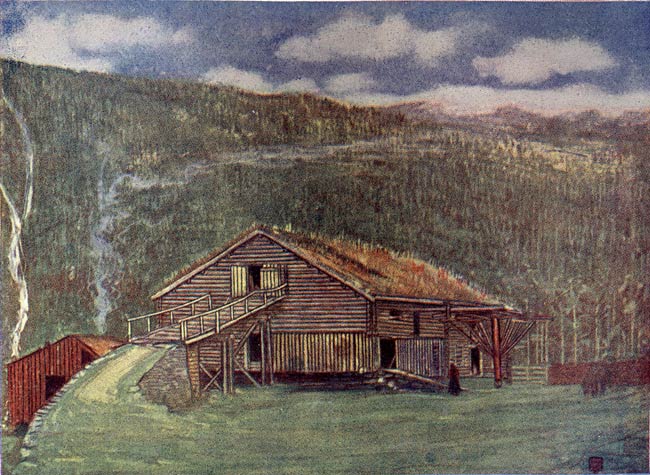
FARM-HOUSE AND MILL AT GJORA
All's well that ends well. When we arrived at
Gjora we met with a warm reception from our host
and his family. The stove was lit in an immense
bedroom which was en plus furnished with two
box-like beds of questionable shape, a small chair
which was masquerading as a wash-hand stand
bearing a small jug and basin and two minute
towels, a writing-table, and many photographs of
the Royal Family. Also, there was a tame bluebottle
which worried me very much. All our
blandishments were of no avail with the heartless
insect. The open windows could not persuade him
to leave us, and, in the flickering light of one
candle in the large room, it was impossible to get
rid of him by foul means. Every night as we went
to bed he started his low buzzing and spoilt my
temper and my sleep. Nico didn't mind it a bit.
The dining-room at Gjora was palatial. I sat in
a carved armchair upholstered in crimson velvet,
and we ate from beautiful silver, serving ourselves
with sugar from the very choicest old bowl I have
ever seen. The cupboard, the sideboard, and the
clock were beautifully carved and coloured. We
lived on a princely tin of corned beef. For three
days it provided us with two meals a day, and very
good they were.
Next door to the station—indeed, I believe, the
house in other times is the station—an English
family were spending the summer, fishing and
walking. The English-speaking man we met on
the road was the gentleman's gillie. They regaled
us physically with various edibles from the Stores
and spiritually with salmon stories, and when we
left they sped us on our way with a new stock of
reading matter. The country all round is exceedingly
beautiful. The river which provided the
fishing for our compatriots winds along by the
road; or rather I should say that the road follows
the course of the river for many miles through
narrow passes in the mountains which press round—many
of them snow-capped, as one may see
when the veil of cloud which envelops them lifts
to allow a sight of their summits. The station is
in a cosy little hollow among these white-headed
giants; and the weather is noticeably finer, the
atmosphere softer, than at the preceding and succeeding
stations.
Between Gjora and our next resting-place,
Sundalsoren, we drove through magnificent scenery.
I think it will be admitted that the Sundal is at
least as beautiful as that famous valley which lies
almost parallel to it—the Romsdal. From the
road one may see glaciers and snow mountains.
Here and there are notices warning the traveller to
drive fast. This is more especially for winter,
when huge snow avalanches are frequent. The
road crosses from left to right of the river. We
drove over bridge after bridge, backwards and
forwards, as the river pursued its erratic course
without regarding the convenience of roadmaking
mankind. We arrived at Sundalsoren at sunset,
and were enraptured with the beauty of the snow
mountains. Whether it was thus arriving in such
glory, or that the place has really a most individual
charm, I cannot say; but for me Sundalsoren is a
memory entirely couleur de rose.
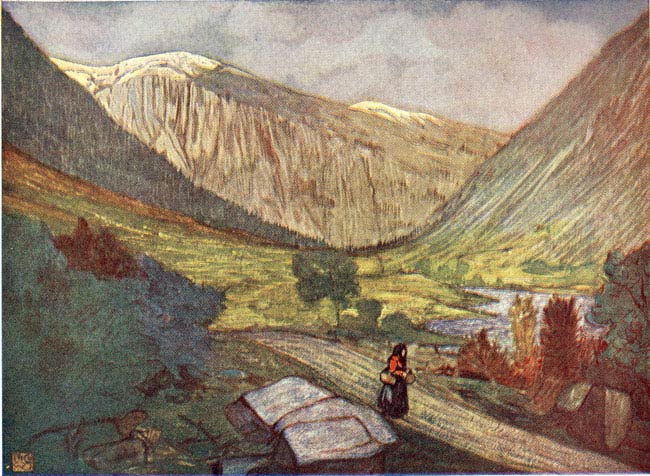
MOUNTAINS AND RIVER AT GJORA
It is a small fishing village at the head of a fjord.
The fishermen's little low houses are built round
the concave land, which is washed by the waters of
the fjord. On the stony beach before the cottages
are spread fishing-nets and tackle, including the
bright silvered balls which, I suppose, attract the
fish. Two wooden quays stretch their long arms
into the water, and from the farthest point of them
one may get a delightful view of the village. The
character of the place is Dutch. It is almost as if
a little street from Volendam had been dumped
down amid the mountains and the snows.
We were sorry to part from this charming spot
when the little fjord steamer called for us and
another passenger. Slowly we steamed through
the fjord, now calling at a tiny hamlet on the left
bank, now dropping a passenger in his waiting boat
on the right side; here picking up three English
fishermen, boat and all; there leaving them near
their destination rested and refreshed. The
steamers that ply the innumerable fjords are
accommodating craft—none of your haughty
vessels making hard-and-fast rules as to times and
places. Although they are often punctual in their
departures and arrivals, they will slow down and
pick you up in whatever part of the fjord you choose
to meet them, and put you down too if you have
your boat along with you. Also it is to be noted
that the food on the smaller boats is quite as
good as one gets on the large steamers that make
the journeys on what may be called the outer
coast of Norway. Indeed, the bigger vessels are
so often loaded with various strongly-smelling
dried fish that the whole atmosphere is impregnated;
which must rob some passengers of
any appetite the occasional few miles of rough
open sea has left or given them.
After quitting Sundalsoren we drove through two
or three good stations, and arrived late on Saturday
night at a small place which, as it is on no map
and many consultations with Bennett's have
resulted in the conclusion that we were quite off
the beaten track, must be nameless. At the time
I knew the name—we had it on the bill;—but no
one seemed to be able to place it, and now I have
forgotten. I have a theory which may account for
our presence there. At one of the previous stations
we had telephoned in advance for a horse and cart
to be ready, as it was very rainy and very wet and
getting late. The horse we had was very fast; the
driver was a cheerful person with a slight knowledge
of English. Within a kilometre of the station,
where, I presume, an equipage was in waiting, he
offered to drive us straight on to our destination,
because we had expressed great satisfaction with
the trotting of his pony. We agreed, and tore
through the tiny village built round the station
in great haste, egged on, perhaps, by a guilty
conscience. Then we drove for miles and miles
until at last, at half-past ten at night, we reached
the unknown little spot which I must perforce
call X.
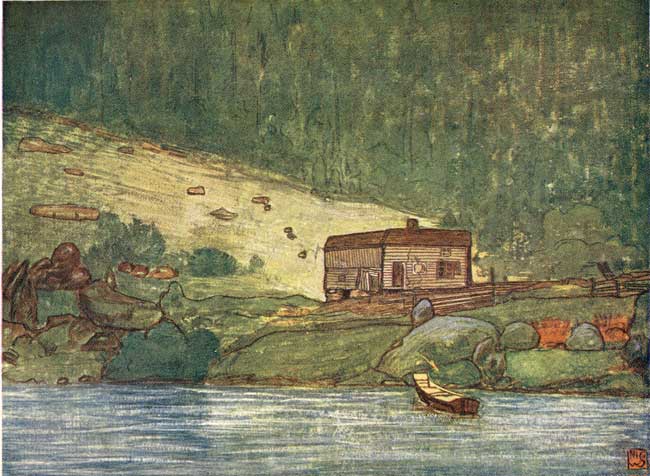
A LITTLE FARM ON THE RIVERSIDE AT GJORA
It is possible that, knowing that the expectant
farmer at the avoided station would telephone to
the station on either side of him, the driver preferred
not to face them until their anger should
have calmed and he should have had time to
invent some excuse. I do not know to what
extent he expected to be blamed; but I am afraid
the man we telephoned to must have been rather
mad, and so I imagine that we were driven to this
quaint spot because there our sin would not find us
out. Inadvertently I left a large silver scent-bottle
there, and acknowledged the loss to be a judgment
on me when I found it impossible to find the
place again.
When we arrived we went to bed. In the
morning we had coffee and bread and jam; and
Nico painted. At three o'clock we were hungry,
and when at length preparations for a meal were
made our appetites were ravenous. A dear little
girl waited on us—a very pretty child, with
beautiful hair. She brought on the table a few
slices of thick and very fat raw bacon and some
caraway-seed bread. Hungry as we were, we
could not eat that. We tried to ask her what
more there was. She left the room, and soon
came back carrying the pièce de resistance of our
meal—two soup plates filled with a paste made of
flour and water, such as we used to employ in the
days of scrap-books. On the top of this floated
a little melted butter. With this she brought
a basin of powdered cinnamon. That was our
Sunday dinner. They were such sweet people that
we feared to hurt their feelings, and Nico ate all his
plateful and half of mine. The half that was left
we divided between our plates, which then looked
quite empty enough. We ate caraway-seed bread
for supper and caraway-seed bread for breakfast.
With the help of our phrase book, we gathered
that they never ate meat and very rarely had
fresh fish.
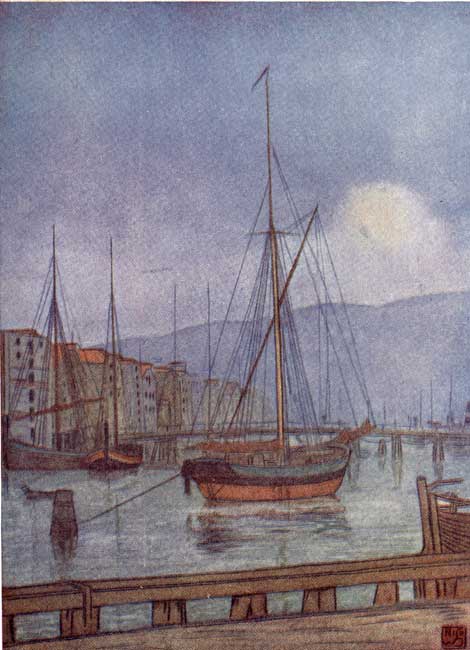
OSTRE KANALHAVN, TRONDHJEM
The place is situated on water which, I suppose,
is a fjord, and there are three or four houses besides
the one at which we stayed. They made us understand
that they were not in any way prepared for
guests, and had some difficulty in providing us
with a horse and cart. I should be very much
interested to know the name of this little place.
It is within two hours' drive of Molde, and as far as
I could make out it had scarcely ever been visited
by the foreign traveller. We were astonished to
find ourselves so near to this big town, for we had
calculated that we had at least another half-day's
journey to make; which proves again that somewhere
we had overstepped our mark.
Molde is the most beautifully situated town
in Norway. It has a population of 1800 souls.
It is a very important port of call for all the
steamers which coast between Bergen, Trondhjem,
and the North. The town is built along the
mouth of the Romsdal Fjord, and from almost any
point a view of the grand Romsdal Mountains is to
be obtained. The panorama on a clear day is
gorgeous. To see the sun setting over the fjord
and its background of snow-tipped peaks is to
have a vision of fairy-like colour and beauty that
takes one's breath away. All over Norway as one
passes through the valleys and the winding fjords
picture after picture are witnessed in rich succession,
each seeming more beautiful than the last;
but now, as at a certain distance of time I endeavour
to recall their individual charms, I think
that these glorious evenings in Molde occupy the
most pleasant place in the memory of one of
Norway's ardent admirers.
How rash thus to limit one's enthusiasm!
From Molde we went by steamer to Næs, and,
after resting awhile at an hotel and eating an
excellent supper, took a miraculously comfortable
stolkjærre and had a long drive to Horgheim
in the brilliant moonlight. I wonder how many
visitors to the Romsdal have done the same?
Imagine the charm of it. The delicate jagged
edges of the mountains on the right of the road
stand sharp and clear against the blueness of the
sky; as the road winds in and out the Romsdal
Horn reveals or conceals herself bathed in moonlight;
innumerable waterfalls foam down from
the heights with plashing music, looking like silver
streamers hung out to decorate the beautiful way
of some mystic procession. Our driver was for the
time an affinity: no longer a guide in our pay,
or in that of the hotel, taking tourists through a
world-renowned stretch of scenery, but a romantic
Norseman slowly opening out to us a valley of
delight, his possession by inheritance and love.
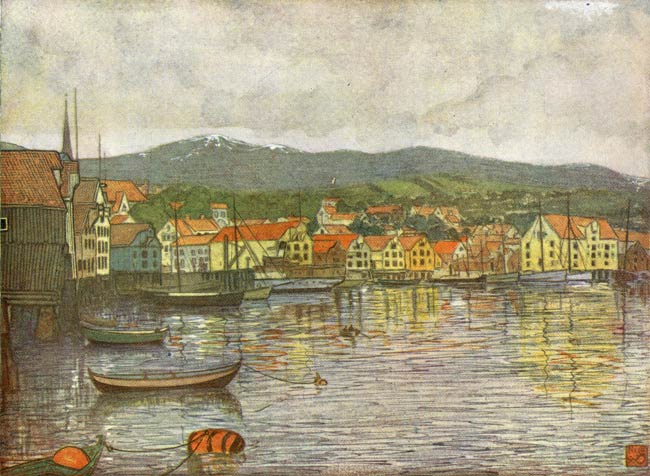
THE TOWN OF MOLDE
He told us with a smile that was not quite
incredulous of the little goblins with blue beards
that, according to the peasants, haunt the fields
and fjords of these parts. There are good and bad
pixies, and much blame is laid at the door of the
bad ones for any mischances that come about.
What wonder that the people are superstitious
folk? Perhaps it would be better to call them
mystics. What sounds and sights may be heard
and seen in such a land! Our Norseman pointed
out a certain group among the jagged pinnacles of
the rock, and told us a legend describing how a
bridal party, instead of being the happiest of the
happy, quarrelled and fought and were by magic
turned in an instant into stone. Here they stand
as a warning to future bridals. The groom and
bride turn away from each other; the best man
stands for ever with a foaming tankard in his hand;
near by is the well-fed priest; apart and solitary is
the figure of a disconsolate lover. Look at them in
the moonlight: you will see them all quite distinctly:
soon they will step down from their
heights and mix with mortal men again. The air
is full of movement and strange sounds.
During the long way back, the wonderful person
who had been appointed to drive us entertained
us with legends of the gods and Vikings. These
brave admirals of old times met with burial befitting
their state and courage. The ship which
they had sailed so well through wild storms and
wilder battles was dragged ashore, and this and
nothing less was the coffin for their richly-dressed
mortal remains. The souls of the Vikings killed
by the sword went straightway to Walhalla, where
their ideal of bliss was meted out to them in
guerdon for their bravery. At cockcrow all the
heroes marched out and fought furiously one with
another; but at midday all the wounds were healed,
and the rest of the day was spent in banqueting
with the great god Odin. Walhalla was said to be
a hall of such size that the roof could not be seen.
In it was a forest of golden trees. The walls were
decorated with shields and warlike weapons, and
through each of its five hundred and forty doors
eight hundred warriors could walk abreast.
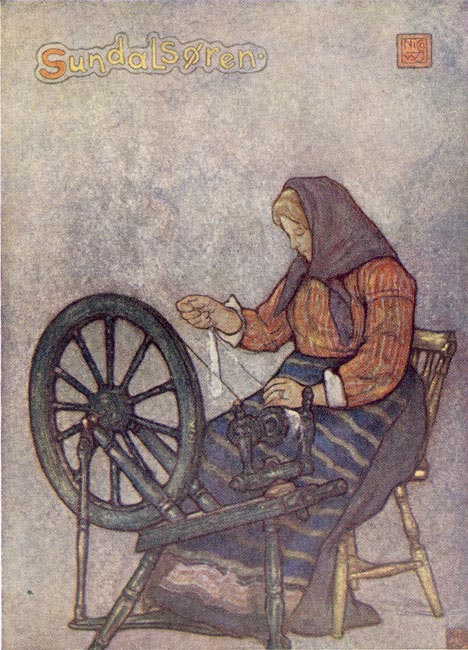
WOMAN SPINNING, SUNDALSOREN
I was sleepy, and I was awed with the majesty
of all we had seen; but I wondered what sort of
heaven was arranged for the wives and daughters
of the Vikings!
Some days after this moonlight drive I came
across a book containing details relating to
Norwegian mythology, which may be of some
interest. Everyone knows that most of the week-days
derived their names from these Northern
gods. From Ostara, the goddess of spring, we
get the name of our spring feast, Easter. Decoration
with flowers and the custom of Easter eggs are
as old as Paganism; and our Christian forefathers,
to facilitate the change to the new religion, adopted
many Pagan rites and dedicated them to the
service of the true God.
Odin was the father of the gods and the greatest
among them. Thor was the red-bearded god of
storm. Armed with his mighty hammer Mjolnir,
he slew the powerful giants of winter—not without
much difficulty, however; for at first, overcome by
sleep, Thor relaxed his vigilance, and the wintry
giants stole his hammer and buried it in the hard
earth. Awakened and conscious of his loss, Thor
appealed to Freya, the beautiful and benevolent
goddess of love and spring. Her gentle influence
subdued the giants of snow and ice, and Thor,
seizing his opportunity, regained his mighty weapon,
which he wielded to such effect that the giants
were killed and their fortifications broken down.
Though the gods are usually triumphant in these
old Northern sagas, the demons on occasion
gained their bad ends. It was thus in the story
of Baldur, the god of light and most beloved of
all the gods. In the full beauty of his youth he
was killed by the power of Loki, the embodiment
of envy, hatred, and revenge, and incidentally the
god of fire. In the beginning Loki lived happily
with the other gods; but Odin cursed him for ever
for his wickedness. It was foretold that the loved
Baldur was to be the victim of some treachery, and
the gods made efforts to prevent such a catastrophe.
Frigga, who was the wife of Odin, placed a spell
upon everything, so that there might be nothing
in Nature that could hurt Baldur. On account of
its insignificance, the mistletoe was forgotten by the
goddess, and of this Loki made an instrument of
destruction. Having fashioned a dart out of a
branch of the innocent shrub, Loki persuaded
Hodur, the blind brother of Baldur, to hurl the
weapon at his brother in sport, the innocent child
believing that this wood, as all other, was charmed.
The arrow pierced Baldur to the heart, killing him,
and causing universal mourning among the gods.
Among the demons were Skretti, who has left his
name to many a haunted rock in Norway, and
Niki, who is a terrible water demon, still dreaded
by the ignorant folk in the mountains. Each year
he demands victims and carries off the children
who stray within his power. Our familiar nursery
friends Jack and Jill are descendants of Hjuki and
Bil, the ebbing and flowing tides, the tumbling
crests of which, breaking one over another as the
waves wash the shore, are rather aptly described in
the nursery rhyme.
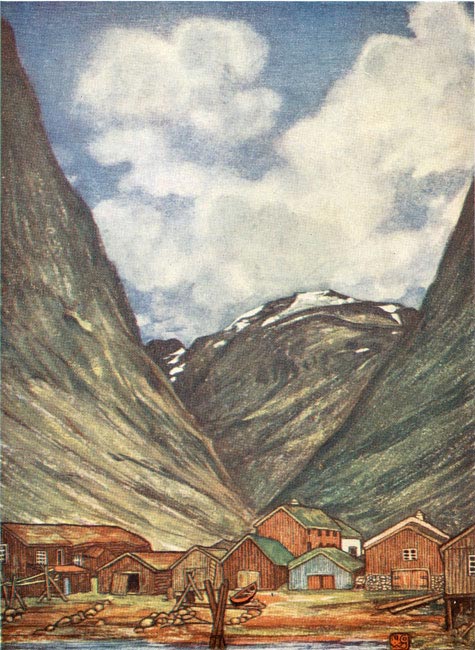
SNOW-CAPPED MOUNTAIN AT SUNDALSOREN
ON THE FJORDS
CHAPTER III
ON THE FJORDS
We were awakened rather roughly next morning.
At an early hour two steamers landed at Næs, and
a stream of tourists emerged. For two hours
vehicles of all sorts filed past our hotel. They
took the drive we had taken in solitude and
moonlight the previous evening, and by the time
the last carriage of the goers passed out of sight
the first carriole of the comers-back was visible.
Our dream was ended. We fled the Romsdal,
thanking a merciful chance which, at least for a
time and for our first impression, had given us the
Romsdal in its most ideal beauty.
Moonlight also was it when we left on an almost
passengerless steamer, which took us up the glorious
fjord back to Molde. Here we passed another
week to our profit and satisfaction. Some interesting
old wooden buildings on the water, about to
be pulled down, provided subjects for Nico's brush,
and I wandered about and admired, peaceful in the
consciousness that when Nature for a time should
cease to suffice me I had in reserve a resource—the
hotel library consisted of a sixteen-volume
History of England and a few odd volumes of an
Encyclopædia!
In an old book on Norway which I came across,
the author mentions a visit he made to a little
village near a river which he calls Osterthal. It
was rather an involuntary visit: they had lost
their way.—"We came to a minister's house,
whose son's wedding was being celebrated. It was
full of people of all descriptions, forming a droll
caricature scene. [At the date this was written all
the country-folk would be in national costume.]
Our effects were brought in by the multitude
without our paying any attention to them; the
parson's silver plate was lying about in every
direction, his watches hung in every room. [The
author mentions this apparent plenitude of watches
on several occasions, as giving a sign of prosperity.]
A hundred persons at least were present of the
poorest sort, eating and drinking in every room of
the house, yet such is the honesty of the population
that everything was safe. Our host received us
most generously, and would accept of no reward;
he was even seriously displeased that we presented
his daughter with a couple of ducats, because she
would load us with bread and other provisions.
We spent the night in the utmost conviviality, and
proceeded the next day over waste mountains and
marshes on foot, till we crossed the frontier and
arrived at Lerma."
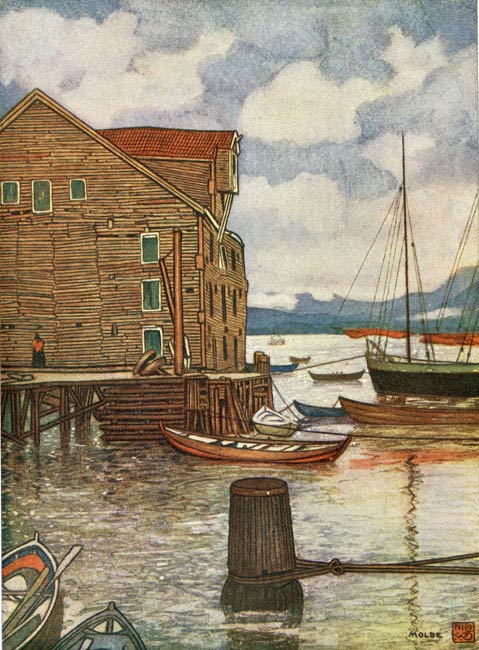
OLD WAREHOUSE AND BOATS, MOLDE
Later we read that in one place they were indeed
most hospitable and caught fish enough to feed the
family for eight days. What joy!
In another place he tells us that the bread,
"generally made of the rind of trees, was miserable."
Again: "Bonaparte is the common theme of
the Norwegians. In no country is such praise
lavished on him as in this, where his power is
only felt in undesigningly promoting the country's
advantage—from this standpoint the Norwegians
admire him and calmly survey the convulsions
around them."
It is interesting to observe that at this date the
writer gives the population of Norway as being
under a million; now it is considerably over two
millions. He remarks that the women, though
strong, robust, and generally over six feet in
height, are sadly wanting in feminine charms. In
our days they have changed. We may suppose
from practical experience that what the Norwegian
women have lost in stature they have gained in
beauty. The number of pretty women is well
above the average.
In the fulness of time we left Molde by steamer,
and so southwards along the coast, stopping for a
few hours at the ruins of Aalesund, the thriving
little town that was entirely burnt down in January
1904. Of the twelve thousand inhabitants who
were almost all bereft of house and home, only
one lost her life, and that through rashness. She
was an old woman who, finding she had forgotten
some cherished possession, insisted on entering the
burning house to recover it. At least, this is
what was told me by an inhabitant of the place;
and I take it to be correct, for the Norwegians
of to-day are as honest and trustworthy as were
their ancestors at the beginning of last century.
We landed on this island of ruins and climbed
the pretty hill which overlooks the town. Thence
we obtained a magnificent view over the sea, and
were able to realise the complete and terrible
desolation wrought by the fire. At the time of this
disaster Nico was in Norway, and the whole country
rang with the praises of the Emperor William
of Germany, whose immediate and practical
generosity was a theme for the warmest recognition.
To judge from all we heard in different
parts of the country, it would appear that he has
won the heart of Norway, and has made himself
immensely popular with the people.
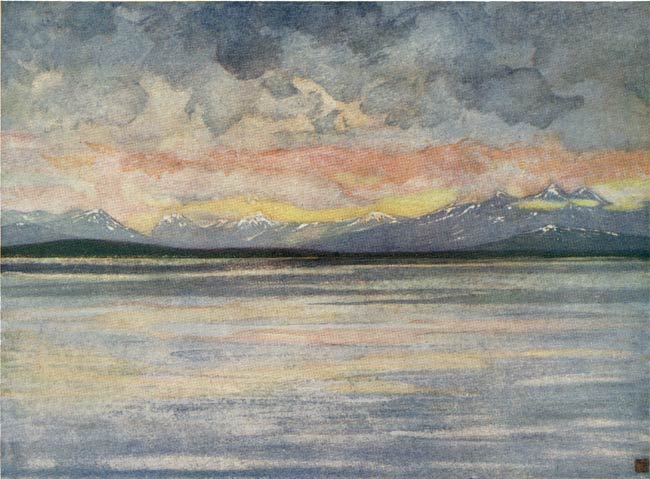
MOUNTAINS AND FJORD FACING MOLDE
The ancestor of our King William the Conqueror
gives his name to a castle not far south of Aalesund.
He was called Rollo the Walker, because he was
so tall and heavy that no horse could be found
strong enough to carry him. He conquered parts
of France, and founded the Duchy of Normandy.
As far as I remember, from Aalesund south the
steamer behaved in such a way that we thought it
would be as well to leave it for a while, and we
landed as soon as was possible at a charmingly
situated island called Moldöen. For various
reasons, the place was without a quay. In torrents
of rain and buffeted by the gale, we scrambled off
the steamer on to a flat-bottomed boat, and were
rowed to the island.
What a dreary little place it seemed! Even
though we had strawberries and cream at tea,
and even though the best room was furnished
with two beautiful bouquets of wax flowers under
glass, the rain beat down such spirits as we might
have had, and we went to bed disconsolate and
cold. The beds were extraordinarily uncomfortable.
I tried three of the four in my small
room, and stayed in the third in despair. I awoke
to find the sun pouring into the room, and the
strains of "Rule, Britannia" filling the house with
gramophonic sound. We got up and dressed to
the tunes of the "Marseillaise" and "Willie, we
have missed you"; ate our breakfast to a popular
cake-walk; and proceeded to investigate. It
turned out that the hospitality of the house, which
we had deemed ours alone, was shared by a commercial
traveller. Steamer-bound there for two
days, he carried about with him for use on such
occasions five phones of different kinds. As far as
we could discover, he made Moldöen a centre from
which he radiated to various islands, bearing with
him on his outgoings and incomings one or two of
the instruments. He entertained us all day long
with disquisitions on the advantages of this one and
the disadvantages of that, with practical examples.
This was a labour of love, for he "travelled" in
machinery. He had lived for many years in
America. He had a wife and family in Christiania,
whom he was in the habit of seeing for not more
than a week in the year. When we left the island
he left too, and endeavoured to get me a berth on
a southward-bound steamer which had about a
dozen berths and fifty or sixty passengers. He
was not successful, and we all sat up on deck;
but I have a kindly memory of him for his excellent
intentions and his music.
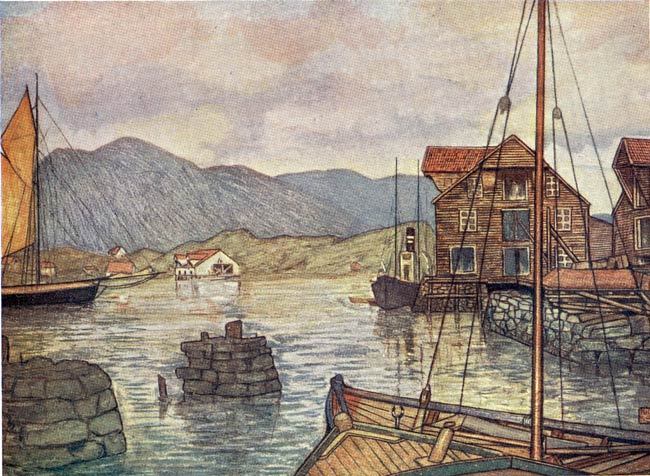
MOLDÖEN
While we were on the island I saw several
reindeer on the mountains opposite.
We had intended to travel from Moldöen along
the Sogne Fjord; but, finding it impossible to
control the steamers coming from the north, we
were obliged to postpone our visit to these celebrated
parts. A friend who was staying at
Balholm in the 'eighties related to me how one
fine day, when they were boating on the fjord,
they saw a whale. All the craft on the water
scuttled for their lives, and the whale, after creating
much excitement, quietly made its way back
to the open and was seen no more.
We arrived at Bergen in pouring rain. Surrounded
as this town is by high mountains, which,
while protecting her from the extreme violence of
the storms, attract and imprison the clouds, it has
rarely a rainless day. We stayed for three weeks.
Bergen, which is still one of the most important
ports of Scandinavia, has had an interesting commercial
history. It began its growth in the
eleventh century, and its importance may be
judged by the fact that in 1302 a decree fixed the
number of its dock labourers at two hundred. In
these centuries several commercial treaties were
concluded between Norway and various Powers.
Among others is still extant an agreement between
England and Norway. A German body known
as the Hanseatic League, recognising the great
commercial importance of such a town as Bergen,
began in the thirteenth century to obtain a footing
there. Until their arrival the Norwegian trade
was almost confined to the summer months. The
first step taken by the Hansards was to struggle
to establish themselves during the winter. The
Norwegians strove for a long time to prevent this,
and as late as 1300, it appears, the number of
Germans wintering at Bergen was inconsiderable.
Later in that century the Hansards instituted a
factory in the town; and, aided by three visitations
of the plague, which reduced the population of
Norway, and by extensive privileges granted to
them by Magnus Kagaboter, which rendered it
almost impossible for the Norwegians to carry on
an independent trade, they arrived at practically
controlling all the commerce of the country, and in
other respects held the trump cards in their own
hands. As they increased in power, these foreigners
became domineering, in Bergen especially, where
they committed acts of aggression and violence
against the Norwegian population. The native
merchants in the various ports made a stubborn
and vindictive resistance; but the Germans were
there in such numbers that when at last the Norse
efforts were crowned with success and the
foreigners to some extent driven out, these
towns found themselves much reduced in strength.
Bergen, however, aided by her enormous fishing
trade, continued to be the most important commercial
town, and the Hanseatic population
struggled hard to keep the supremacy which they
had enjoyed. During the seventeenth century the
Thirty Years' War weakened them in their own
country, and the growing supremacy of the Dutch
fleet was another influence against them. It was
not until the middle of the eighteenth century,
however, that the German factory entirely ceased.
Even now the houses of the Hanseatic quarter are
only beginning to be pulled down. When we
were in Bergen we watched the process of destruction,
and admired the immense strength of the
foundations of enormous piles on which the old
Germans built their dwelling-places and storehouses.
In the quarter there is an interesting
museum, containing many Hanseatic relics,
including much domestic furniture.
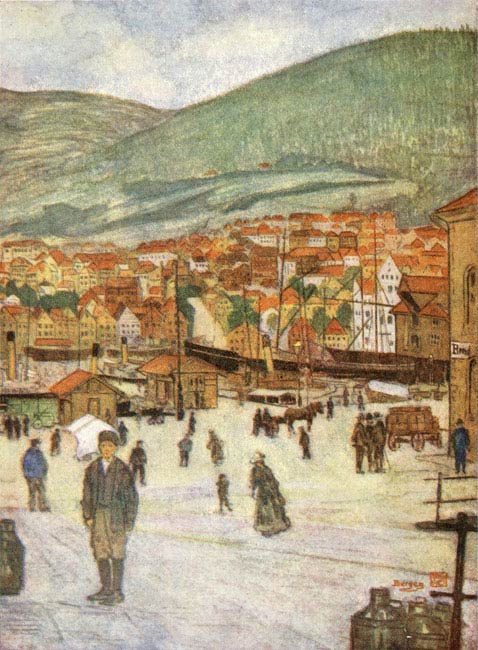
BERGEN
To-day, with its trade and its immense influx of
visitors to the country, Bergen presents an
animated sight. One of my favourite haunts
during solitary wanderings was the fish-market. On
two days of the week—Wednesday and Saturday,
I believe—if one gets there early enough, the little
quay is crowded with amusing folk, the solemn
fishermen from the islands, who bring their spoil to
be disposed of to the best advantage, and the shrewd
becapped fishwives, determined on not giving an ore
beyond the lowest possible price. It is delightful to
listen to their rapid speech with its quaint inflections.
Some of the women wear charming starched white
caps like those of Sisters of Charity, and others
tightly-fitting black or blue bonnets with little
frills relieving their austerity. Here and there, under
a flight of stone steps or built like a niche in a
blank wall, one catches a glimpse of a tiny stall
where twisted cakes containing much spice are
sold, or of the wooden boxes of varying sizes and
prices which the Norwegians use where we
use baskets and bags. Some are plain, some
ornamented with poker work, and others more
or less elaborately painted in the brilliant colours
and the conventional flower-designs beloved of the
Norsemen and the tourist. The Norsemen employ
the boxes in every size, and for every purpose,
from the big receptacle which contains the whole
outfit of a young man or maid starting in life to
the tiny five-ore box which holds little Ragna's ball
of cotton and her jointed crotchet-hook.
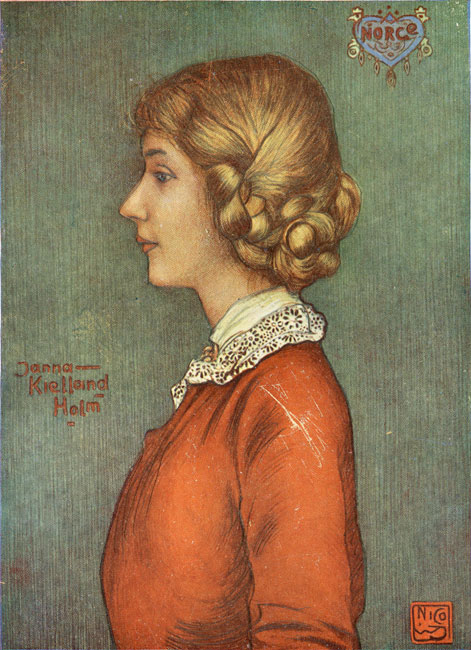
A FAIR MAIDEN OF NORTH BERGEN
The place is surrounded by seven hills, which we
did not climb, and has en plus a theatre which we
did not visit. We did, however, take ourselves to
a music-hall, which, if it satisfied the Bergenites'
idea of comfort and entertainment, proves them to
be a people of contented mind. That, I am afraid,
is one of the blessings of which I am deprived. In
spite of the seven hills, the Hanseatic remains, and
the rain, I believe I was bored in Bergen. I was
not to interrupt Nico, because he was working
very hard; I could not roam about much while
all my clothes were in a continual state of being
dried; I could scarcely afford to read a book an
hour at one and two kroner apiece; I was quite
destitute; even Satan found no mischief for my
idle hands to do; and I was glad when the money
we were waiting for arrived and we were able to
make our way inland. I am just beginning to
grow rather fond of Bergen, and by the time I see
this grumbling in print I daresay I shall wish to
take back all I have written in any way derogatory
to the place.
We left in the middle of the night, going by
steamer the whole way to Odde in preference to
taking train to a place called Voss—a remarkable
railway journey through grand and varied scenery,
the track being almost entirely hewn out of solid
rock. There are no fewer than fifty-five tunnels
between Voss and Bergen. However, we contented
ourselves with that old-established means
of transit, the fjord steamer—in this case a biggish
vessel, though without sleeping accommodation
beyond the smoking-room and a ladies' small
room on deck. Fortunately, there were only two
feminine passengers. I was one. The other was an
American girl who, making a European tour with
the necessary aunts, had left them in luxury and
comfort in Berlin while she made a carriole journey
over Norway. At the time we met on the steamer
she was beginning to regret her persistence, and
we were both glad of each other's company until
she left the country to join her relations.
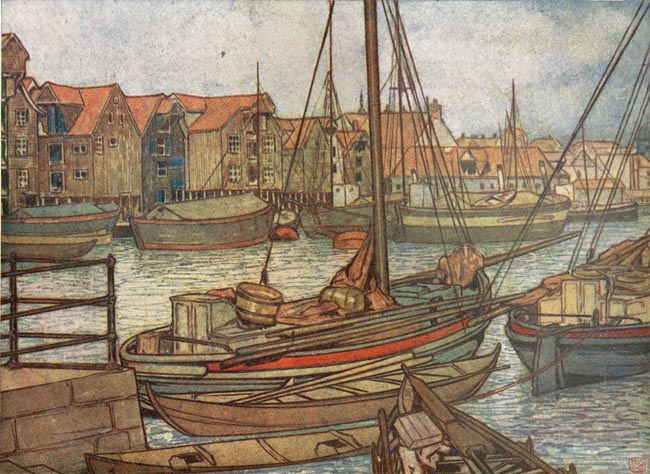
BERGEN BOATS AND WAREHOUSES
In the morning, drawing the curtains of our
cabin, we beheld the glorious scenery of the far-famed
Hardanger Fjord. We breakfasted with
good appetite on biscuits, delicious prawns, and
excellent chocolate. I do not know if the menu
sounds tempting; but the coffee left much to be
desired, and by that time we had grown accustomed
to stranger mixtures than shell-fish and
chocolate. The weather was magnificent, and
thus, though it was rather late in the year, we
enjoyed all the pleasure offered by Nature to visitors
of this delightful arm of the sea without the disadvantages
of mosquitoes and crowds experienced
by those tourists who pay their homage of
admiration in the usual season. We sat on deck
the whole morning, enjoying the wonderful panorama
that unfolded itself before us at every turn
of the fjord. As the steamer twisted in and out
we noticed that the fjord was generally edged with
a narrow band of fertile, smiling country; immediately
above, the wooded heights rose precipitously,
parted here and there by silver torrents that poured
foaming over the rocks into the fjord. Occasionally,
as we passed close by these cascades, the spray
they threw off caught the sun's rays and showed for
a moment a wonder of all the imaginable beauty of
the commingling of the diamond with the rainbow.
High above were the snow-crowned mountains and
the blue whiteness of glaciers. What a wonderful
country! It seems sometimes that Nature is too
prodigal. Where an hour of such beauty leaves
one overwhelmed with marvel and delight, days
and weeks of a panorama ever increasing in splendour
dull the senses and—dare I say it?—almost
satiate.
Late in the afternoon we stopped at a small
station to pick up a few passengers who had chosen
to go so far by rail and carriole, and my American
friend was much pleased to recognise two young
scions of French nobility, whose titles she had read
on her journey from Molde to Bergen, when most
of the passengers were invisible through illness.
She was convinced that Dr. Conan Doyle had been
her neighbour at table, and she begged me to find
out if he had been in Norway during the summer.
She had a wonderful gift of enthusiasm, and did
our rather jaded spirits a great deal of good by
that intense keenness which is characteristic of
her race.
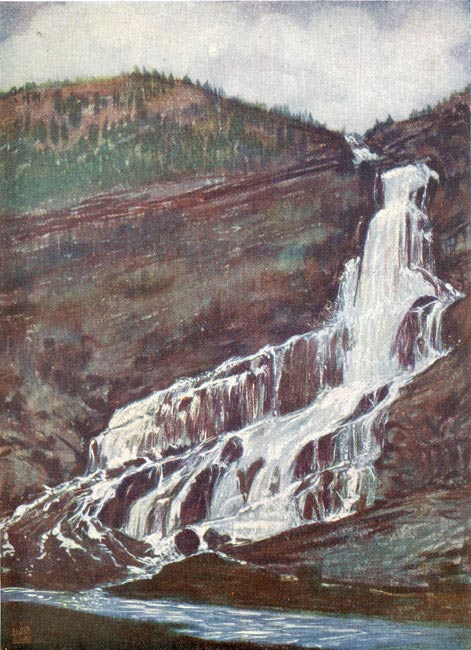
VÆFOS, HILDAL, HARDANGER
After dinner we came again on deck, to find the
moon pouring her soft light over all and imparting
to the earth a romantic illusiveness. However, it
was also exceedingly cold, and we retired early,
Nico to smoke and doze, and I with our American
to discuss the war between North and South and
other important matters; of course, we discovered
friends in common. All through the nights one
passes on these fjord steamers one is constantly
aroused by weird bumpings and stampings, and we
had learnt from previous experience that this was
due to the stoppage of the steamer at different
stations to pick up and deliver cargoes. About
eleven o'clock on this particular night, the noises
were of such an extraordinary character, and
seemed to last so long, that we put on our big coats
and went out on the deck to explore. By the
light of two small lamps a herd of fifty cows was
being embarked. Some of them protested vigorously
against stepping on to the thin plank bridging
the water between them and the boat. The
whole business was tiresome and lengthy. At last
a band was improvised to pass round the animals'
bodies; one by one they were hauled up, willy-nilly,
by the crane and pulley, and dropped into
their allotted quarters.
An hour or two later we were startled from our
sleep. The scene was reversed, and the cattle were
landed at their destination.
About four o'clock we were again disturbed by
the running backwards and forwards of many feet.
When the steamer settled into silence, we dropped
off to sleep, too quickly to discover that all motion
had ceased and that we were at a standstill. We
were not shipwrecked; nor had we met with any
untoward accident. We had arrived, and, though
most of the passengers had left the boat and
finished their night in more comfortable quarters,
we slept on in blissful ignorance until after eight
o'clock, when Nico came to inform us that all our
baggage was at the hotel and breakfast ordered.
We dressed with alacrity, and made our way to
the enormous hotel of Odde, which is about the
most popular resort of the tourist in Norway,
though when we were there late in August it was
without guests. We breakfasted in a lofty room,
and noticed that the waitresses, who are famed for
their allegiance to Norwegian costume, had relinquished
it with their hopes of other foreign guests,
and were soberly dressed in black. The day after
our departure the proprietor and his family left the
place, and caught us up when we finally rested at
Dalen. I wonder if Norway is glad or sorry when
the enthusiastic but destroying tourist ceases for
nine months to take up his abode within her gates?
MINOR ROMANTIC EPISODES
CHAPTER IV
MINOR ROMANTIC EPISODES
From Odde we returned to our old friend the
stolkjærre, and the American girl took a carriole.
In this manner we had a little variety, for we
changed places now and then. Both vehicles
belonged to one man, who drove with us all the
way, putting up when we did. This prevented the
nuisance of continual change of horses and conveyance.
The driver assured us that the carriole
had been used by the German Emperor. I believe
that in the season a great point is made of providing
every stranger with the carriole: hundreds are so
honoured. Well, the Kaiser Wilhelm is a wonderful
man, and he would be rash who should say,
"This even the Emperor cannot do." To explain
his frequent presence here, a story must be told.
A few years ago, a young German lieutenant,
riding down the steep road not far from the
Laatefos on his bicycle, swerved from the straight
course, and was hurled into the raging waters
beside which runs the road. The incident is
supposed to have been witnessed by a child and
an old man, and a few weeks afterwards the poor
victim's body, torn by the rocks beyond all recognition,
was found at some distance from the spot
where the disaster happened. The Emperor, with
two hundred men, arrived to search for the body,
and a stone to the soldier's memory has been
erected by his Imperial Majesty. There is another
story on the subject, which is only whispered; but
our romantic friend seized upon it with eagerness,
and wove a yarn of possibilities and improbabilities,
of which she persists in believing the hero to be
alive.
On our right hand as we drove in procession
from Odde, preceded by the carriage and pair of
the French nobility, lay the Buar glacier. It was
of a wonderful green which we had not before seen,
inasmuch as many of the glaciers we had passed
were almost covered with snow and débris, which
concealed their colour. The road took us for some
way beside a charming lake; after this we passed
several beautiful waterfalls, the spray from one of
which was so considerable that the road beside it
was converted into a pond, and in the moment we
took to pass through it our clothes were made
quite wet.
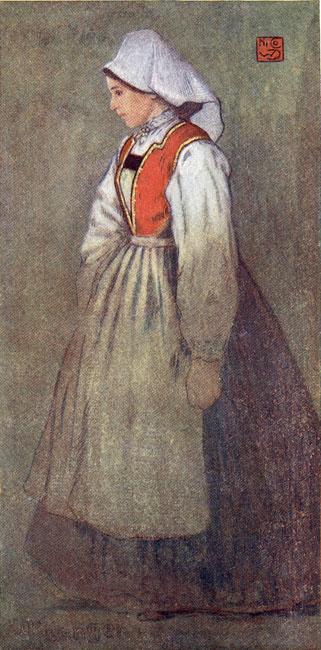
A HARDANGER COUNTRY GIRL
At Seljestad we rested, and then drove zig-zag
uphill, or, rather, our horses walked zig-zag, and
we, on foot, cut across the winding road, and
reached the top of the hill without much effort
long before our horses were in sight. We were
three thousand four hundred feet above the level
of the sea, and the air was chilly. Matters were
not mended when we drove down the hill: the sun
had gone in, and the late afternoon at that time of
the year is often too cold for enjoyment. Therefore
we stayed awhile at a big hotel at Horre, and
made acquaintance with a very warming drink,
arac punch. After this we had recourse to it
pretty frequently on our cold drives. Our driver
tried to persuade us to stop at Horre; but it was
still daylight, and we all wanted to get on. The
landlady seemed rather chagrined at this obstinacy
and bad taste; but on we drove for another half
hour or so, when we arrived at Roldal. Here we
found most of the hotels closed, and the owners
almost on the point of departure. Also we found
the young Frenchmen, who informed us that they
had ordered supper for 8.30—to consist of trout
and chicken. This, of course, was the supper
provided for the possible traveller, and of necessity
was our supper too; but one of these boys
apologised for its scantiness, and said he had only
ordered for their party. This was rather a joke,
as, acting on the advice of our driver, we had from
our luncheon-place ordered supper to be ready at
8.30. However, the meal, as far as it went, was
very good. Afterwards we all assembled in the
one small sitting-room still available, and endeavoured
to drink the white spirit which is drunk
all over the country and called "aqua vita." To my
taste it is abominable; but it is exceedingly strong,
and perhaps this is a virtue which carries it far.
We found two old packs of cards; the five of us
played a good many rather ridiculous games, which
amused us vastly, and brought the servants of the
hotel to the door to discover the reason of our
laughter. At breakfast we were all delighted with
the delicious jam made from wild strawberries.
Then we started on a day's drive in good spirits, the
carriage and pair leading. Up, up, and always up,
getting colder and colder by the way; a short rest
at a wayside sæter; a drink of delicious creamy
milk, not possessing, however, the warming
qualities of our arac punch. The tiny masses of
drifted snow which lie among the rocks, neglected
by the sun, increased in size and volume. Here,
on one of the rocks by the wayside, a big snowball
had been placed, probably by the youths who led
us on. Colder and colder grew the air, until at
last we turned a corner, and saw before us a huge
mass of dirty snow. It was impossible to plough
this, or otherwise to get rid of it: so we drove
through a tunnel hollowed out in the snow.
This was the coldest place we reached. Gradually
we descended and got into a less icy atmosphere.
All the same, we were exceedingly glad to get out
and warm ourselves at a little farm, where we
drank port, and I used what powers of persuasion
I possess in the endeavour to render myself the
owner of a particularly attractive ironing-board,
wielded by a blob of wood that was the most
delightful attempt at reproduction of a horse that
I have ever seen. Neither offers of money nor
blandishments had the desired effect, and I was
obliged to leave the longed-for object behind me.
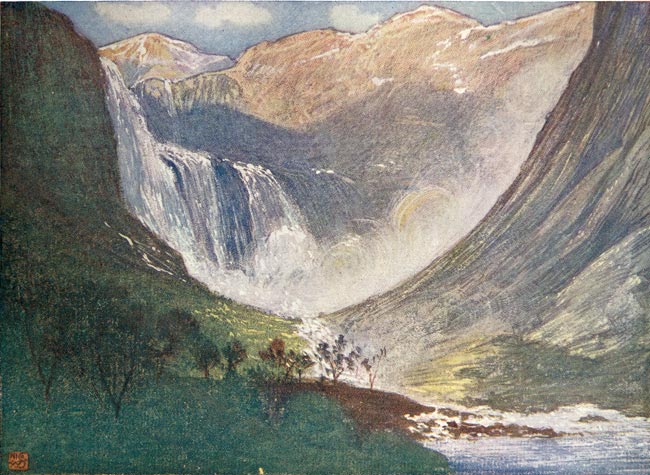
SKJÆGGEDALSFOS, HARDANGER
Cheered and fortified by our wine, we drove on
to the spot appointed for our luncheon. Haukelidsæter
is an enormous hotel under Government
control. Prices are reasonable; they are regulated
by the Norwegian Tourist Club. The immense
dining-room is pleasing, being simple in design
and embellishment. Opposite the hotel is a
building in the style of the much-admired old
storehouses. It was closed while we were there;
but in the season it provides excellent sleeping
accommodation.
Here we fell in again with our fellow-travellers
and their servant, and we ate very gaily together of
tough stewed goat and excellent cream pudding.
We drove on, and arrived rather early at a very
pleasant little station, of which, however, I have
forgotten the name. It was only about five o'clock,
and in Norway there is nothing satisfactory to eat
between dinner at two and supper at eight or nine:
so I bought half a kilogramme of chocolate, and
asked for milk and cream. I had some difficulty
in getting a saucepan; but eventually I discovered
the kitchen and helped myself, to the amusement
of the scarlet-coated maid, who was already making
preparations for our supper. I made the chocolate;
and we all drank it, after our fish supper, with the
remainder of a bottle of a very sweet and cloying
liqueur called Augustine, which we had bought at
Haukelidsæter by general subscription, in place of
the arac punch, which was not attainable. The
American girl and I left Augustine severely alone.
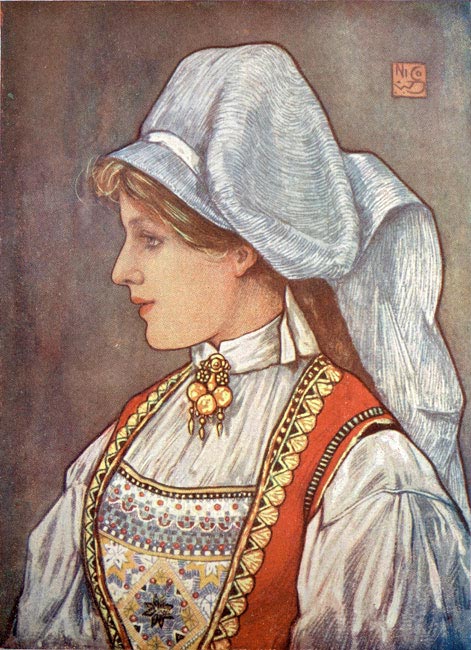
HARDANGER HEADDRESS
Next morning I bought with much joy an old
and beautifully carved wooden box. I was very
glad to give fifteen kroner for it; but, deeply
attached to it as I was, we went off without it. I
remembered it before we had gone very far, and
raced back alone in the carriole. Then I caught
the others up. Our driver expressing great
curiosity as to my parcel, I showed it to him.
He wanted to know the price, and I told him,
rather proud of myself at having made a good
bargain, as I thought; but he laughed discreetly,
and informed us that in the depth of winter,
when money is scarce among the peasants, their
treasures are bought up by men, going round for
the purpose, for next to nothing. Thus the
summer tourist always pays heavily. If he gets
things from the peasants themselves, they have to
"get even" with the forced sales of the winter.
As for the town antiquaries, the price they ask for
their treasures would make a Dutch peasant blush,
and anyone who has endeavoured to obtain the
object of his fancy from such an one will realise
that this is no light task.
That day we drove through mysterious pine-woods,
which kept from us all the warming rays of
the sun. Before we reached the forest the road
followed the course of a river, and then, leaving
that, ran beside a lake. Most of the way we
walked, to warm ourselves. It was late in the year
for this route, and we were alone on the road—at
any rate, for this portion of it. Later we met
strings of peasants coming from a fair.
We had luncheon at a little place which was
quite off its head with business. There had been a
cattle fair some distance off, and all those interested
were on the road, making their way home. During
our drive that afternoon we met some of the prize-winners,
horses and cattle decorated with ribbon
rosettes of many colours, and carrying their
certificates suspended from their horns or from
their necks. The placing of the rosettes was
amusing. In most cases the animals were attended
by a handmaiden in a dark skirt, a black velvet
bodice elaborately embroidered in coloured silk,
and a fringed kerchief tied gracefully round the
head, and falling down the back with the long
thick hair. Most of the peasant women in Telemarken,
of whatever age, wear their hair loose, as
indeed do the poorer country women all over
Norway. However, the prize cows were making
their way but slowly, grazing unchidden on invisible
food among the fallen leaves by the wayside;
doubtless the women were the wives and
daughters of the burly farmers whom we had left
enjoying their dinner at our last halting-place.
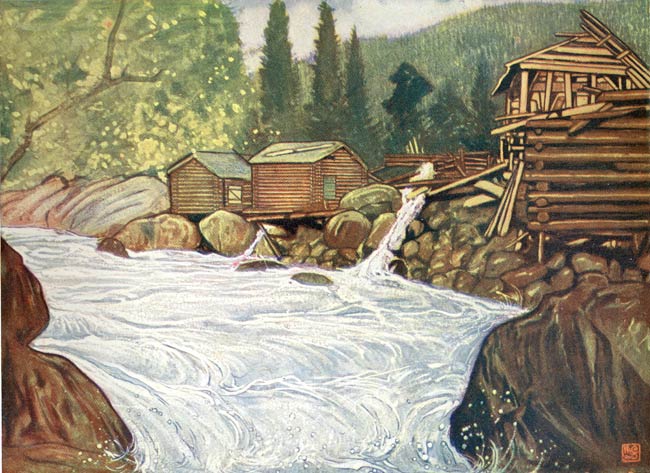
RIVER AT HAUKELI
Somewhere that day we passed a turning in the
road that, had we taken it, would have led us to
the wonderful Rjukan Fos, of which romantic
stories have been told. Many of the most beautiful
spots in Norway are rendered more interesting by
various legends connected with them. One cannot
guarantee their accuracy; but they are very
welcome. I quote this tragic romance as a dark
gem set in the Rjukan Fos.
"Near the Rjukan Fos there is a path over the
mountain called the 'Marie Stige,' on the brink of
the precipice of the famous fall, which even at
this day the traveller treads with fear, and which
was discovered by a young maiden in the courage
of love. It was by this path that the beautiful Marie
of Westfjorddalen went with light and fearless
step to meet the friend of her childhood, Ejestein
Halfoordsen. But the avarice of her father
separated them, and Marie's tears and prayers
prevailed upon her lover to fly, to escape the plot
formed by a treacherous rival against his life.
Years passed, and Marie was firm in her constancy.
Her father died; Ejestein had by his
valour and nobleness made his former enemy his
friend, and after their long separation the lovers
were to meet again. Ejestein hastened by the
shortest way, the Marie Stige, to meet his beloved.
Long had she watched for him; she saw him
coming, and his name burst from her with a
joyful cry. He saw and rushed to meet her, but
fell, and the Rjukan whirled him into its foaming
depths. For many years after this a pale form,
in whose beautiful eyes a quiet madness lay,
wandered daily on the Marie Stige, and seemed
to talk with someone in the abyss below. Here
she walked until a merciful voice summoned her
to go and rest in the arms of her beloved."
All the way to Dalen our drive was brightened
by the rosetted cows, making their way up the hill
which we descended. The mountain rose sheer
on our right, two thousand feet above the road;
on our left, awe-inspiring precipices made us hold
our breath, as every now and then we were obliged
to pass a vehicle coming the opposite way. The
young Frenchmen in the carriage and pair were
driving immediately before us. Suddenly there
was a crash, and down fell one of their horses.
The outer wheels of the vehicle were over the
edge of the precipice. For one terrible second it
was as if an awful tragedy could not be averted.
The splendid little pony on the mountain-side held
good his ground, and my driver, by sheer bodily
force, half lifted, half pushed, the carriage from its
dangerous position. The three occupants had
jumped out; but the driver, almost paralysed
with terror, was still sitting on his box. The
pony had broken the shaft on which it had fallen,
but, fortunately, had done itself no harm. Between
them the men patched it up as well as they could,
and we proceeded. We were not very far from
Dalen, however, and the young men elected to
walk the rest of the journey. We kept behind
the carriage, in fear of further accidents, and
went along so slowly that the walkers arrived
some time before we did.
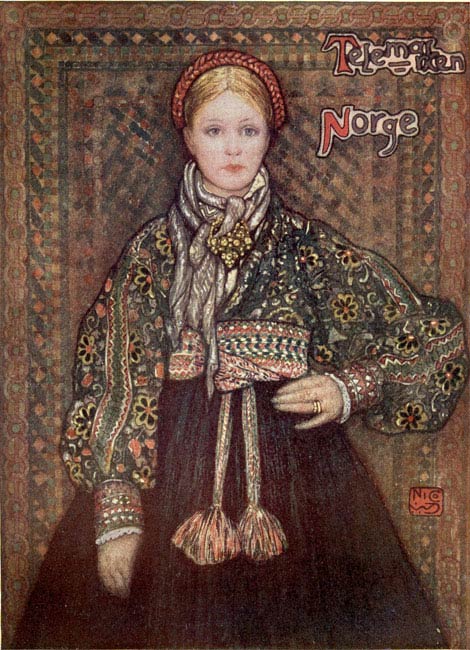
A PEASANT OF SÆTERSDALEN
The big hotel at Dalen was closed, and we all
took rooms in a smaller place almost opposite,
which proved one of the most comfortable resting-places
we had come across in Norway. Indeed,
that very evening Nico and I made up our minds
to stay there for some time, and so turned our
supper into a farewell meal. In celebration, we
drank one another's health in exceedingly sweet
champagne, and then again in small glasses of arac
punch, in which we invited our host and his wife
to join us, thus establishing a friendly feeling of
which Nico and I reaped the benefit during our
stay.
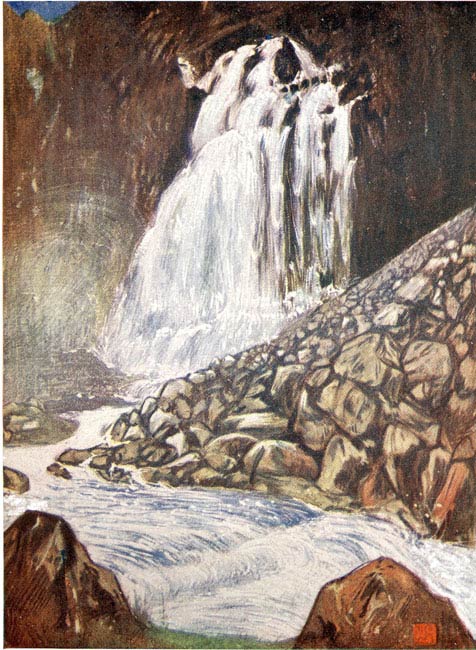
ESPELANDSFOS, HARDANGER.
The American girl and the French youths with
their valet were travelling together as far as
Christiania: so we bade them good-bye before
we retired for the night. Nico, in the fulness of
his heart, announced his intention of getting up
next morning at five, to see them off. He went
to the length of asking the maid to call him when
she should awake the travellers; and in the dark
hours of the morning, when, following her directions,
she awoke only me, I finished her work, and pointed
out to Nico the necessity of fulfilling rash promises.
My arguments were strong, and Nico got up and
saw the party off. He was exceedingly pleased
with himself when he came back.
We stayed for some time at Dalen. We were
well fed, well lodged, and smiled upon by charming
waitresses in their red sleeveless bodices and white
frilled blouses; besides, we were favoured with
most glorious weather. Nico worked hard, and
found delightful models in the farmer's two
daughters—one a lovely Madonna-like girl of
fifteen, and the other a curly-haired little pickle
of three. I passed most of the day hours basking
in the sun and reading anything I could find,
which resolved itself into a few numbers of Cook's
Tourist Gazette and three numbers of Dowie's
paper from Zion City, U.S.A. The American
journals contained many violent remarks about
the prophet's reception in England; but in one
number I read he appeared to pity us for our
denseness. This literature, advertisements and
all, did not entertain me long, and I went to the
shop which was part of the premises to see if there
was anything I could buy. I found only a very
ordinary assortment of German hand-made goods,
together with a strongly smelling selection of
various food-stuffs, and one or two drawers full
of mixed sweets for the entertainment of the
youth of the village. So I unpicked a blouse
of my own, and sewed it together again by hand,
and that very neatly. Then I looked through the
papers again, and found that I had missed a few
words in the course of several of the sheets, stating
who was the printer of these effusions. One night
a party of English folk arrived, travelling from
Christiania to Odde, at forbidden speed: that is
to say, by rising early and travelling until late
they were making in two days a journey which is
fixed by law as taking three. I persuaded Nico
to go to them after supper and to ask them if they
had anything to read which they would exchange
for the books I had carried with me and read
three or four times. With great joy he brought
back two magazines and a book.
Another day I hired a carriole and the farmer's
son to drive me to the Ravngju (the Raven's Abyss),
which is a rock hanging over a precipice at a height
of fourteen hundred feet, above a dashing river. I
learnt from my guide-book that the draught of air
is so strong that if one throws a hat over the
precipice it will be refused by the abyss and blown
back. I tried the experiment with my own head-gear,
for which, fortunately, I had no respect and
but little affection. Contrariwise, the Raven's
Abyss changed its reputed tactics and stuck to it;
at any rate, I never saw it again, and I drove home
bareheaded.
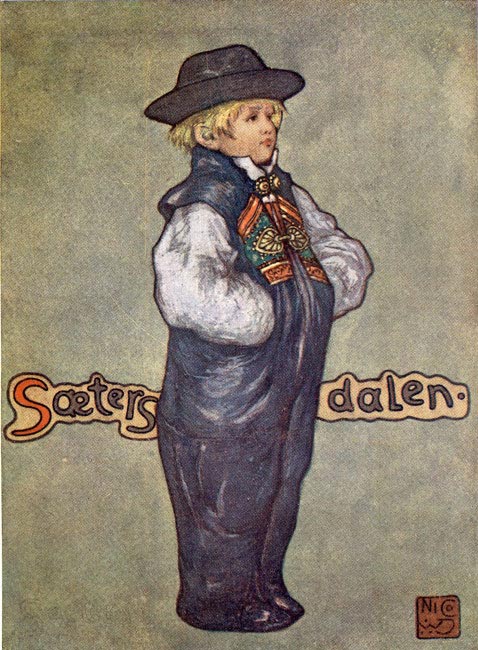
A BOY OF SÆTERSDALEN.
During our stay here I discovered with great
difficulty a few more facts about the Norwegian
peasants' poetic and very interesting superstitions.
The little gnomes, in whom all believe, often attach
themselves to special farms. If any of the horses
or cattle appear to thrive much better than their
fellows, the folk will explain it, entirely to their own
satisfaction, by saying that such beasts are the
favourites of the pixies, who steal fodder from the
other mangers to feed the animals in which they
have chosen to interest themselves. Sometimes
the gnomes devote themselves, by petty vexations,
to worrying the life out of the people to whom they
bear malice. The milk turns sour, the butter
is rancid, the cattle pine away; and all from
no apparent cause. It is told that one such
haunted family at last made up their minds to
move very secretly, and thought to leave the fairy
cause of all their trouble behind them. As the
last cartload of belongings left the farm and the
people were congratulating themselves that they
would get away without being discovered by the
malicious familiar, he popped his head out of an
empty barrel, and piping, "Oho! We are moving
to-day!" jumped on the cart and followed them to
their new home.
The trolls are big giants who live in the mountains
and are very rarely seen. These spirits always
dwell in the seventh mountain visible in the blue
distance. Thus, of course, they can never be
approached by those who set out in search of them;
but in their fastness they keep beautiful maidens
stolen from earthly homes.
The huldra also is an inhabitant of the heights.
She is a witch who takes the form of a lovely
woman, and meeting humans in the woods she
lures them to follow her. Her dwelling is in the
mountains, which she opens with a magic word.
Inside is a gorgeous palace, filled with immense
riches, and having dining-rooms containing
splendidly decorated tables laden with all the
food a Norwegian enjoys most, served on golden
dishes. He who eats of these things is thenceforth
in the power of the huldra. Occasionally he wins
free; but never afterwards is he as he was.
In the country the folks speak of idiots and
madmen as being "mountain-taken," believing that
these are victims of the huldra's wiles.
If, however, the involuntary guest refuses to
partake of the magic dishes in the mountain passes,
he sees before his eyes the dishes of exquisite food
turning to pine cones and slabs of earth, while the
huldra loses her fascination, and can no longer hide
from him the cow's tail by which she is to be
known, nor can she keep him prisoner any longer.
Without knowing how, he finds himself back in
the woods on the mountain-side; and he cannot
discover the entrance to the fairy palace.
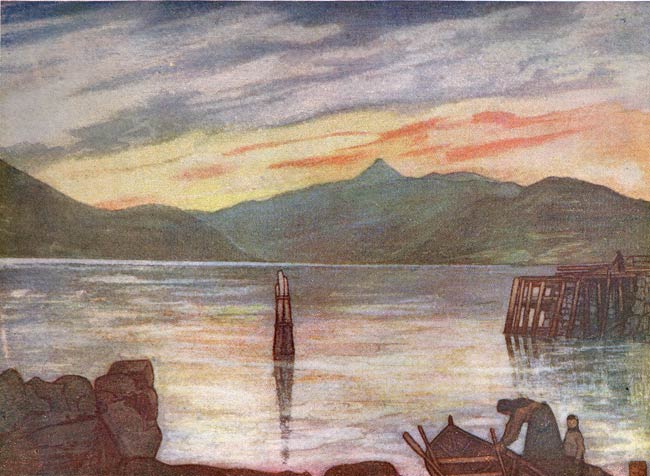
SUNDALSFJORD
At Christmas, and indeed during all festivities,
these various unseen powers are propitiated by
offerings of food and drink, which are placed outside
the farm, and invariably disappear. I should
not like to swear that no agency but magic is
responsible.
At several of the trees on the land of the farm
hotel at Dalen were fixed little shelters, each
having a small entrance and a gabled roof. These,
we surmised correctly, were for the birds. The
Norwegians are very fond of the small songsters,
and in many districts it is forbidden to destroy
them. This delighted us, the more, perhaps, that
we had spent the previous spring in Italy, where
heartless massacre of birds is carried on, one of the
Italian's favourite dishes being half a dozen or a
dozen tiny ones served on polenta. The sportsmen
who indulge in the hunt sell the birds strung
together—a thread through their heads—by the
dozen. In Norway the birds are encouraged and
petted, and in the winter fed. At Christmas time
every one buys sheaves of oats or other cereals still
in the ear, and hangs them outside the windows,
or, fastening the bundles on poles, erects them in
gardens and in the open spaces of the cities. He
would be poor indeed who had not a few ore to
devote to the entertainment of the little feathered
friends at this season of universal joy.
Poverty as we know it in England is scarcely to
be found in Norway, and, on the other hand, riches
as understood by a Norwegian living in his own
country would by no means satisfy an aspirant for
wealth on this side of the North Sea. Statistical
information concerning income and property shows
but a small difference between the principal classes.
The income of the employer often does not exceed
the wages of the average workman. A very slight
change in the balance would bring many employers
into the ranks of the employed. This happy
country, though under the government of a Limited
Monarchy, seems to fulfil the dreams of at least
the reasonable Socialist. It has no nobility with
political or economic principles, no great capitalists,
no immense estates. The difficulty of earning a
livelihood in the inclement climate and on the
stormy coast calls for energy and endurance, and
accustoms the worker to self-restraint. More than
half the population own deposits in the Savings
Banks. The spirit of equality is noticeable to the
most casual observer. The proprietor of the station
where you pass your nights is absolutely the equal
of the guest, who avails himself of the house's
hospitality for his own convenience, and apparently
not for the profit of the owner. The servants who
wait on one are pleasant and willing, working for
their living, it is true, but showing none of the
servility largely dependent on tips which is the
characteristic of their class in other countries. If
a pourboire is given, small or large, it is accepted
invariably with a frank handshake; in some cases
it is difficult to induce its acceptance. A Norwegian,
whatever his standing may be, is the equal
of everyone. Politeness on the part of the traveller
is such a necessity that the guide-books mention it.
The domineering tourist will meet with difficulties
and rebuffs.
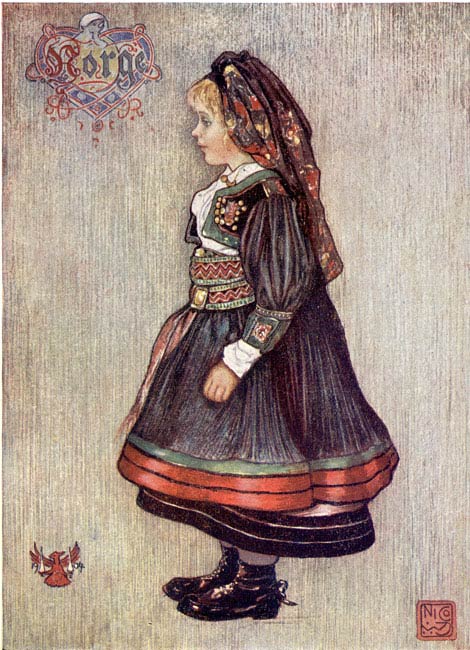
SÆTERSDALEN GIRL IN NATIONAL COSTUME
MAINLY ABOUT SAINTS
CHAPTER V
MAINLY ABOUT SAINTS
Nico did a great deal of work in Dalen, finishing
half-completed sketches, and making many figure-drawings.
One of the servants was from Sætersdalen;
and, to pose for Nico, she dressed herself
in her extraordinary costume. In the course of
our wanderings we met with travelling natives of
Sætersdalen—once, under a lucky star, with a
woman taking her little child, a girl of three or
four years old, to a hospital in Christiania.
Between us we persuaded the child to act as model
for an hour or two, so as to give Nico occasion to
transfer her decorative charm to his paper. The
dress for women and girl children alike is a straight
garment of very thick cloth, sustained by
embroidered shoulder-straps. It reaches only a
little below the knee, and is edged by two or three
bands of very thick coloured cloth, which hold
out stiffly the rather solid material of which the
garment is made. Under this they wear a petticoat
made on the same model. A white shirt
covers the arms and neck, and a brightly coloured
knitted belt girdles the middle—I can scarcely call
it the waist—of the wearer. On their hands are
black mittens, embroidered in a traditional pattern
with brightly coloured wools. The head is covered
by a folded handkerchief, and the hair hangs loose
or plaited down the back. The legs are encased in
thick knitted stockings and sensible low shoes.
The men and boys wear trousers that come up to
their shoulders, and odd little round hats. The
district in which they live we were not able to visit,
to my regret. We had left it to the last, intending
to take it on our way home, as the country can
only be approached from Christianssand, a port
touched by the steamers bound from Christiania to
Hull; and at the last moment unforeseen circumstances
compelled us to make our passage home as
speedy as possible. There is a railway which will
take the traveller up the valley as far as Byglandsfjord;
but to appreciate its many charms it is
advisable, and well worth while, to make the
journey by road and water. Beyond this station
the valley has no connection with other routes,
except by rough and sometimes dangerous mountain
paths. Accommodation for the tourist is
exceedingly rough, and food narrowly limited in
quality and variety. On account of these drawbacks,
the Sætersdalen district must certainly be,
from many points of view, the most interesting
part of Norway. There the traveller will find the
dresses, the customs, and the dwelling-places in much
the same stage as they have been for the last three
hundred years, and—what is always a great attraction
to me and surely not less so to others—there
is the joy of travelling in parts which are as yet
almost unknown, and consequently unspoilt by the
tourist, who must perforce bring in his wake so
many doubtful blessings. For me the people of a
country is that country's greatest charm—not the
townsfolk or the owners and staffs of the big
hotels with their far-spreading influence, but the
unspoilt people of the untravelled parts. In the
summer months parties of people migrate from the
valley and take up their abode in the mountains.
Thus the courageous but too confident traveller
may find himself unable to obtain even such simple
food as bread and milk. It is highly advisable for
the explorer to take with him biscuits, canned food,
and brandy, and to travel with as small a quantity
of baggage as is convenient.
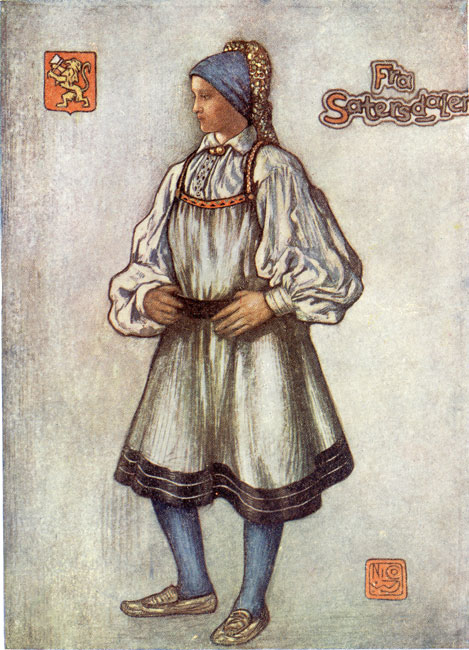
SÆTERSDALEN PEASANT GIRL
At the head of the valley it is possible to cross
the mountains which separate Sætersdalen from
Telemarken and to arrive at Dalen, on Lake
Bandak. The peasant inhabitants of Sætersdalen
are of rather a charming primitiveness, and some
of their houses can show wonderful specimens of
quaint and grotesque carving. Included in this
simplicity, however, is an unpleasant and complete
disregard for cleanliness.
The moment came when, much against our
inclinations, and especially against Nico's wishes,
we were obliged to leave our comfortable quarters
at Dalen. For the last time I basked in the warm
sunshine which had favoured us during our entire
stay; for the last time I retired from the too
warm welcome to the shadowy balcony studio
belonging to my room, which complaisantly looked
north as Nico required. Only this once more
should I drop sticks of chocolate on to the golden
curls of the little Andrea as she came within
range during her eternal roamings over the big
farmyard in search of mischief. No fewer than ten
cats of variegated colours prowled over this area;
they delicately fished and fought for the more
toothsome morsels from the barrel outside the
kitchen window containing all the refuse of food
stuffs, the eventual emptying of which was to the
advantage of the pigstye. In the middle of this
interesting land was a well. Over it hung, high in
the air, an empty bucket suspended by a chain
from the lighter end of an immense pole. The
pretty cowherd would fill the pail with water to
plenish the tubs from which her charges drank.
Most evenings, in a spirit of wickedness, the
worthy brother of the golden-haired baby would
fill the bucket and leave it standing by the well,
the weight of the water in it keeping it on the
ground. Up would come an unsuspecting cow,
which thirstily would drink the contents. Slowly
she would lift her head from the now empty pail,
which, flying as by magic into the air, would almost
invariably give the bewildered creature a smart
blow on the head. Of course, it did not hurt the
animal; but her expression of startled and grieved
surprise was most amusing. It was one of the
excitements of my days at Dalen to have mild bets
with Nico whether the day's intended victim would
be free of the bucket in time.
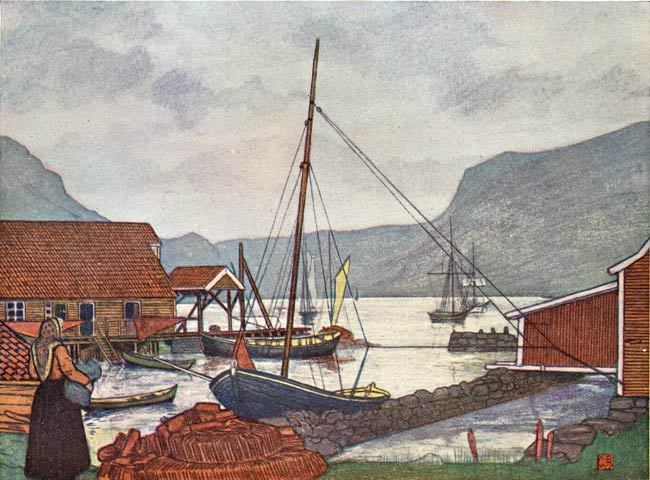
MOLDÖEN
The sun went in; the air grew cold; soon
darkness was upon us. This was the proudest
moment of the day. I lit my fire, invariably with
success, with peelings of birch bark that I had
sedulously collected during my walks. This last
time all my savings went together—how they
blazed! Then in came the farmer, our host, with
his exceedingly easy bill, including entries for
various delightful painted butter-boxes and three
immense wooden drinking bowls which I had
bought from him. Then followed his worthy wife
and his pretty daughter, bearing a tray on which
was a bottle of arac punch and four glasses—he
wished to drink to us before we went, and so we
clinked the small glasses, and in various words of
various languages expressed that we were pleased
with one another, and almost arranged that the
pretty daughter should come with us to learn
English and to help my nurse to look after my
babies. I have not got little Andrea with me yet;
but I expect that by the time this book is published
she will be in my house, wearing her pretty
national costume, and rejoicing us with her
charming little face, which is reproduced on the
frontispiece of the book.
Next morning we were obliged to be up by
six. An hour beforehand one of the delightful
serving-maids lit my fire, and our breakfast, including
more arac punch, was brought upstairs. By
and by, in the cold grey morning, we boarded the
little steamer which was to take us through the
series of lakes and canals to Skien, whence it is
possible to go by train to Christiania.
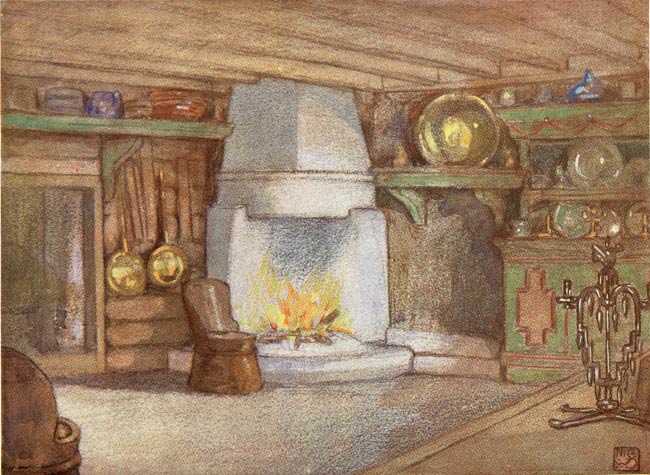
A COTTAGE INTERIOR, TELEMARKEN
It was a wonderful day, albeit very long. These
days that one begins at six o'clock seem always of
unnatural length—what should be luncheon time in
the ordinary way is only breakfast time on these
occasions; and, when all the hours are unoccupied,
how delightedly one would welcome bedtime in
the afternoon! However, before we had time to
become very discontented, the sun came out to
cheer us up, and then breakfast was announced,
and after that we began to shake off our drowsy
ill-humours and look about. Our captain was a
good-looking man, quite young, and an excellent
English scholar. He was a great traveller, and
from his talk we gathered that he was not too well
pleased to be passing his days on this little lake
steamer, going backwards and forwards alternately
with another boat; he was rather discontented at
this time, quite the close of the season, when the
English passengers that his soul loved were few
and far between, and his most usual freight a
few peasants, changing at every station, and an
occasional herd of cattle. He pointed out to us on
our right a group of rocks known as "The Monk
and Lady." I could fancy I did see a resemblance
to two human beings, one kneeling before the
other's uplifted hand, apparently asking for a
blessing. Had I not known the name given to the
group, I might have thought I saw the image of a
guilty being receiving corporal chastisement.
At the first station we stopped at, the little boat
rolled a good deal, and it was only by clinging to
steadfast objects that the passengers preserved their
balance. Several young men boarded the boat.
Also there joined us two very beautiful women
wearing long coats to cover their best costumes,
their charming head-dress concealing hair hanging
loose down their backs. They were both married
women. Two of the young men had pockets
full of beautiful yellow apples; they ate them
steadily, by the dozen I should say, until the
pockets were empty. I coveted the fruit. When
I am an early riser, it is astonishing how my most
extreme longing is for unattainable apples. At
the next station several children came on board
with baskets of the fruit for sale. Already my
appetite had become fainter; but Nico bought the
stock-in-trade of a person of some three or four
years, and so much occupied was I in watching
the exhibition of the boy's triumph over his less
fortunate fellows, that I did not notice the piling
up of interest which was going on around me.
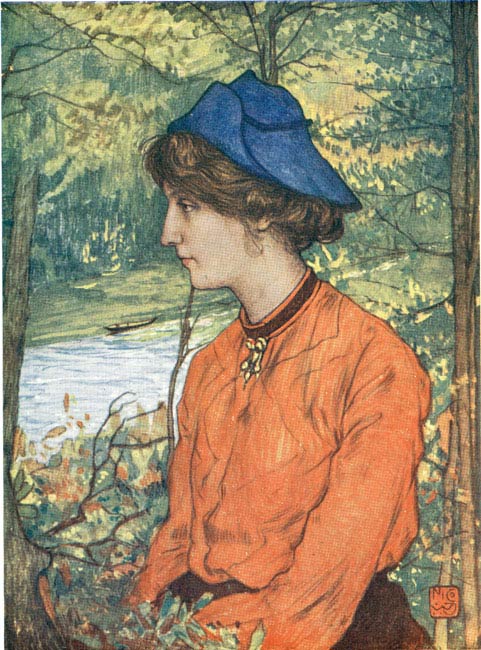
A NORWEGIAN GIRL
Really it was too much for one stoppage! First,
the apple-sellers, who left us, however, before we
started; next, a man with a foal two or three
weeks old; also a herd of about thirty cattle, tied
up variously on deck, in close proximity to the
passengers; last, but not least, a Sætersdalen
woman, in the full glory of her elaborate and
brightly coloured costume. Walking in the fields
in their own district, the women take off the dark
cloth upper frock which this woman wore, and
work in a grey underfrock made in exactly the
same way. Here was material for heaps of excitement
in our simple lives. When we had sampled
our apples in the little deck-house which was all
the covered accommodation, I left Nico half asleep
and went out to look for adventures. The foal,
with terrified eyes fixed on the water, was
neighing piteously; every now and then a horse
would trot to the edge of the water, apparently
to neigh comfort to the poor little fellow
making his first water journey. Frequently the
boat would give an alarming lurch, and the cattle
would slip helplessly from one side to the other,
stamping and kicking in their efforts to regain
a steady footing on the slippery deck. Later, at
Nico's suggestion, a board was put up between the
pony and the water, and this seemed to quiet the
poor beast. At the next station the boat gave a
fearful roll, and tipped over to such an extent that
the perfectly smooth water of the lake washed one
side of the deck. We were all rather frightened
for a few seconds. The cattle were in a sprawling,
kicking, terrified mass on the side which leaned
to the water. The passengers struggled to the
opposite side, and held on as best they could. By
some means the steamer righted herself, and off we
started.
The captain was attentive to us on this trip. I
think he was glad to air his English. He pointed
out, on our right, another curious formation in the
mountains, which he called "St. Olaf's Ship." I
daresay in the time of St. Olaf ships were like
that: so I will not emphasise my ignorance by
criticism.
St. Olaf's name is found all over the country.
It is well known that he is Norway's greatest saint:
but I daresay his history is not such common
property. Therefore I tell it as our captain on
the steamer told it to me. Here I may say that
there is surely no country in the world where the
average inhabitant has such an exceedingly great
knowledge of histories, national or general.
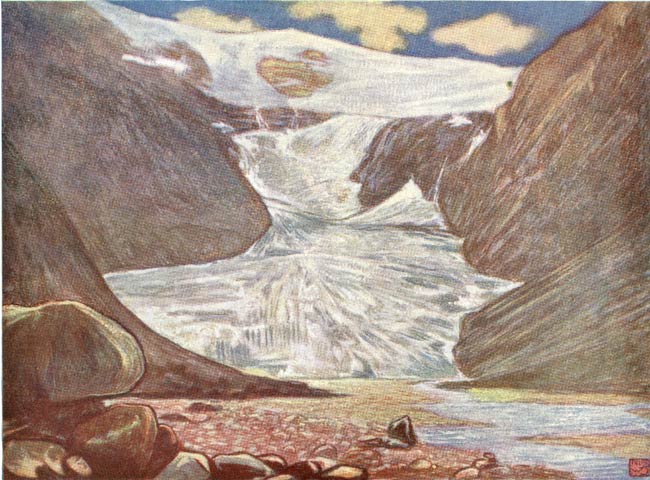
KJENDALSBRÆ
Olaf Haraldssen was a descendant of Harald
Haarfajer, or "The Fair," who was the first king
to rule the whole of Norway. Harald Haarfajer
flourished in the ninth century, and was one of the
first of the heroic Vikings sung of in sagas. After
Harald the Fair, the most splendid king was Olaf
Trygvasen, who with his many followers harried us
to such an extent that the English sovereign was
obliged to sue for peace. He endeavoured to implant
Christianity among his subjects by sword
and fire, and, after making a heroic defence and
losing nearly all his men, fell mortally wounded
during a battle against the Swedish and Danish
kings. Norway was now in the hands of the two
conquering kings; but they gave up their shares
to a powerful Norwegian earl, who had given them
his aid against King Olaf Trygvasen. The earl
agreed to hold these lands as their vassal. In this
capacity he was obliged to leave his country when
the Danish king called upon him to join in an
invasion of England. He never returned from this
expedition. In 1015 Olaf Haraldssen, another
worthy descendant of Harald the Fair, returning
from a pirating raid, seized the opportunity of
assuming the leadership of the country, determined
to carry out the intention of his noble ancestor,
Olaf Trygvasen. With the help of various petty
kings from the north, he overthrew the dominion
of the earls and their overlords, the Danish and
Swedish kings. He made Trondhjem his capital,
and there he received homage from the lesser
chieftains as king of Norway. In his turn he
enforced Christianity; but on account of the
extreme severity of his policy he alienated many of
his people, who sought the aid of the Danish king
against him. Defeated, Olaf fled to Russia.
After gathering his forces together he endeavoured
to win back his kingdom, but was again beaten.
He was killed at the battle of Stiklestad in 1030.
His body was taken to a place called Nidaros,
and buried on the banks of a river. A year later
his corpse was exhumed, and it was found that
there was no trace of corruption—the face was just
as in life, and the hair and nails had grown. This,
and certain miracles wrought through his intercession,
caused him to be proclaimed a saint. His
body was encased in silver and placed in Trondhjem
Cathedral, where it received great veneration until
the time of the Reformation.
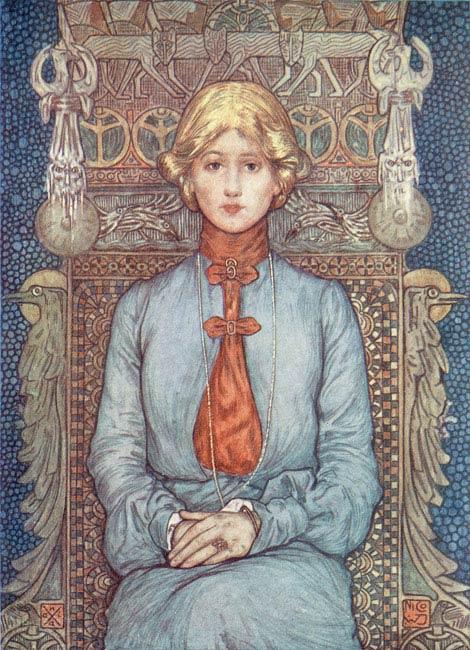
A TYPICAL NORWEGIAN MAIDEN
The history of Norway, with its continual relations
and dissensions with Sweden and Denmark,
is intensely interesting; but there are such splendid
books on the subject that it would be ridiculous
for me to attempt to introduce more than these
few words into a book which professes to give
merely the superficial impressions of a traveller—exceedingly
interested, it is true, but—having
almost everything to learn about her subject.
Rather regretfully, we came back from the
eleventh century, for the captain was obliged to
superintend the disembarkation of the cows. We
were rather glad to get rid of them; and they,
poor things, were, I am sure, heartily pleased that
their startling journey was over, and that they
found themselves safely on dry land, with plenty of
space to roam in. The pony we kept with us for a
while, attempting to persuade it to drink milk,
which, however, it refused to consider.
The luncheon was pork and stewed rhubarb,
served in a very small and stuffy dining cabin.
Nico and I refused it, and regaled ourselves on
a tin of Brand. Soon we entered the wonderful
canal that joins the Bandak Lake to the
Nordsjo Lake, which is connected by another
canal with the head of the Skien Fjord, thus
opening up an inland waterway from the sea at
Skien right into the heart of the mountains at
Dalen, the extreme end of Lake Bandak. Lake
Bandak is a hundred and eighty-seven feet higher
than Lake Nordsjo, with which it is connected:
this immense difference is overcome by no fewer
than fourteen locks, the average rise in each lock
being something over thirteen feet. All the locks
are blasted out of solid rock and faced with grey
granite. When we reached the end of this
stupendous triumph of engineering, the effect as
we looked back was overwhelming. The chief
difficulty in construction was a fall of eighty feet,
called the Vrangfos. No bottom could be found
to the gorge, and a massive bridge of granite was
constructed between the two rocky sides, on which
foundation a dam was built. Five of the fourteen
locks are at the Vrangfos, which rages alongside
in impotent fury. This immense work cost the
country three million kroner.
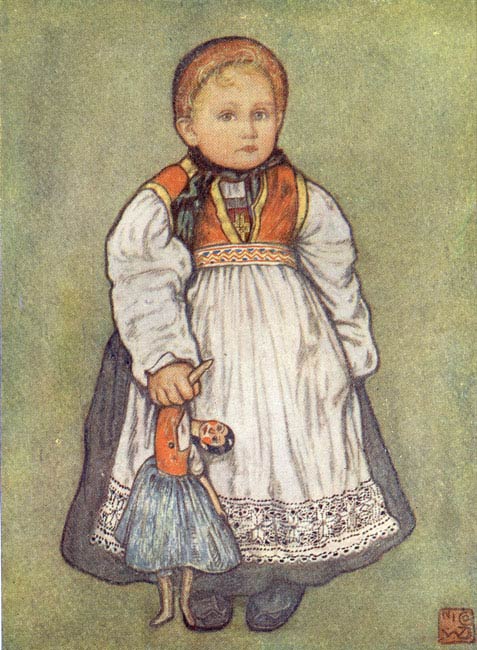
A BABY OF TELEMARKEN
At the end of this canal is a rather pleasant little
station, Ulefos, on the Nordsjo Lake; but we were
in a hurry to get to Christiania and civilisation.
We did not get off the boat, but continued on our
way to Skien. We were still chatting with the
captain. On our left in the rocks, he pointed out
to us a yawning gap, ten or twelve feet high.
That cavern, he told us, was used as a chapel, and
dedicated to Saint Michael. He also told us that
it was the tomb of the last Catholic priest in
Norway just after the Reformation. The King of
Denmark, who at that time was also King of
Norway, had decreed that the Catholic religion
should cease to be in both Norway and Denmark.
In Norway the people were all the more against
the fulfilment of this decree as they recognised that
the Danish king wished to enrich himself at the
expense of the Catholic Church. Cunning as well
as force, therefore, was necessary to establish the
Lutheran religion in the country of St. Olaf. The
Catholic priests were banished, and their places
were taken by foreign preachers, who, to deceive
the people, kept up for a long time the external
appearances of Catholicism. Several years after
these primary steps had been taken, a Danish
soldier named Porl, cruel and fanatical, was
appointed preacher to the church of Solum; the
little rock chapel of St. Michael having been
destroyed, the parish of which it was the centre
had been united to that of Solum. Soon Porl
discovered that his parishioners still went in great
numbers to pray in the grotto, and sometimes at
night a mysterious light was seen among the rocks.
One autumn evening, returning from Holden in a
boat rowed by three young watermen, Porl beheld
them suddenly cease their rowing, and, throwing
themselves on their knees in the boat, cross themselves.
This act of devotion was performed exactly
opposite St. Michael's Chapel, from which the
mysterious light reflected itself in the lake.
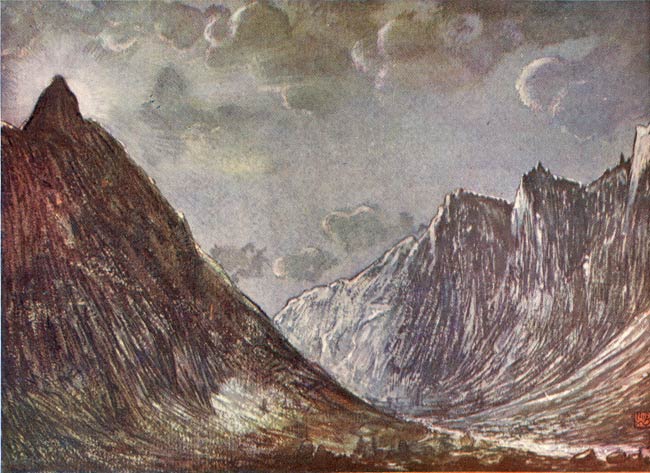
ROMSDALS HORN
Furious, Porl ordered them to row him to the
foot of the hilly path which led to the chapel; but
here he met with determined opposition. They
would rather die than obey his wish. He was
therefore obliged to return to Solum, promising
himself a speedy solution of the mystery. In such
a matter he could not trust his parishioners, devoted
as they were to the old religion: so he took into
his service two men from Skien, and ordered them
to keep watch from afar on the grotto of St.
Michael. One night, the eve of St. Michael's
feast, they rushed to him, breathlessly, to announce
that they had seen the mysterious light issuing
from the cave. There was no doubt about it. He
could see it with his own eyes. He took a sword
from the wall to arm himself against the unknown
enemy, and his two spies rowed him to the grotto.
As they got nearer the light became of more
importance. His men took him to the foot of the
steep narrow path; but neither threats nor hope
of reward could persuade them, fearing the supernatural,
to accompany him. Filled with anger, he
made his way alone; but at the moment when he
had all but reached the opening to the chapel the
light went out, and there he was between heaven
and earth in the pitch darkness, afraid to take
either one step back or one step forward. Gathering
all his courage, he went forward, and managed
to feel his way into the cave. God alone knew
what awaited him there, and on His name
he called. At the sound, at the far end of
the cave a big stone was moved, and the darkness
was flooded with light. Porl could scarcely
believe his eyes when he saw before him an
altar, and on the altar a crucifix surrounded
by innumerable candles. From this sanctuary
a venerable old man, wearing sacerdotal vestments,
as if about to say Mass, advanced
towards him.
"You come in the name of God?" said he.
"Come, then, in peace."
But the preacher, brandishing his sword, fell on
the old priest, crying in anger, "I was right, then!
I guessed that there was still an accursed Papist in
my parish!"
"You were indeed right," said the old man. "It
is he you are now assaulting."
"It is not you that I quarrel with," said the
Lutheran, "but the error of your ways, and the
black artifices you employ to turn the heads of my
parishioners."
"Your parishioners?" repeated the old priest
with dignity. "Do you know who I am? I am
Sylvester, the legitimate pastor of those poor souls
whom you call your parishioners, and the last
Catholic priest left in this unhappy country. With
cunning and force you have made war on the
religion which has made Norway what it is. You
have robbed her people of their faith; you have
sacked our churches and banished our priests. Far
from my flock, I have eaten my bread in tears and
exile for long years; I have wept and prayed;
almost have I died of grief at leaving my poor
children deserted. But I could not die away from
them. In spite of a thousand dangers, I returned
and buried myself here in the ruins of my dear
church. Only the inhabitants of one farm know of
my return, and from them I receive the bread on
which I live and the straw which is my couch. As
for my 'artifices'—alas! I am old and incapable of
doing anything for my children, who still love and
reverence the Church of their fathers. All I can do
for them is to pray and to celebrate Mass for them
on the great feasts under cover of the charitable
darkness. These are my ruses, these my terrible
mysteries. Now that I have told you them, raise
your sword against the last of God's anointed
priests living in my unhappy land. Strike—for I
wish to die here."
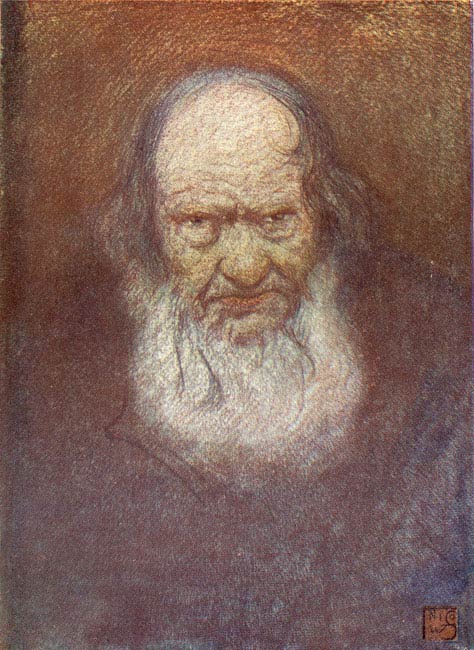
OLD AGE, TELEMARKEN
The ci-devant Danish soldier was touched.
"No," he said. "God forbid that I should raise
my hand against an old man. Live, and die when
God shall call you, in this spot. Adieu, and may
God enlighten you at your last hour."
"Amen," said the old man. "Both you and I
have great need of the light."
Porl left. From that day he ceased to persecute
his flock, who held still to their Catholic
practices. A few more times the mysterious light
shone from St. Michael's grotto, and the belated
wayfarer who saw it piously crossed himself. But
when Christmas came the cave remained in darkness.
The last Catholic priest had died. The
initiated farm people had made a tomb for
their beloved pastor in the depths of his chapel;
and there his body lies to this day, waiting for
the resurrection.
The simple facts of the above narrative were
given me by our captain; but for the complete and
detailed history I am indebted to no less a person
than the present Catholic Bishop of Norway—Monseigneur
Fallize.
ARTS AND CRAFTS
CHAPTER VI
ARTS AND CRAFTS
We landed at Skien, and wandered about the town
before taking train to Christiania. In the first
place we went to a hotel and supplemented our
day's diet of Brand by steaks that were really the
best I had ever eaten, and by little rolls of delicious
white bread, which was a luxury we had not had
the chance of appreciating since we had left the
Britannia Hotel at Trondhjem.
The town is very prettily situated, and has
charming environments—of which the Nordsjo
Lake, if it can be spoken of in such a way, is much
the most delightful. From the town one sees it
against the background formed by the Liffeld
Mountains. It was on these heights that during
the Franco-German War two French officers
landed in a balloon. They had not the slightest
idea of their whereabouts, and would probably
have perished in the snow had not the presence
of an empty wooden match-box given them sure
proof that they were in a civilised country, and
probably within reach of human habitation. They
sought hopefully for shelter, and were found by
two woodcutters, who showed them such hospitality
as was in their power.
Across certain bridges are "the islands," where
may be seen many large wood-pulp and paper
mills. The manufacture of pulp for making paper
is an important and ever-increasing source of
revenue to Norway. The pine timber is ground
by powerful machinery into pulp. When the trees
are first taken from the water which carries them
hither from their various native forests, they are
sawed into blocks about eighteen inches long;
these are quickly passed on to workmen, who with
drills extract the knots; the surface is then cleared
of bark and dirt, and they are ready for the stones.
In the machine the sides of the blocks are forced
against rapidly-revolving stones, and are thus
ground into fine powder, which in the volume of
water conveying it to the draining machine is
scarcely distinguishable, so fine is it, and so small
in proportion to the bulk of water. After the
draining process, which is accomplished by passing
the liquid over fine wires, the sheets are taken
up by girls and put under powerful hydraulic
presses; afterwards they are made into bales and
are ready for market. These mills, and the
many hundreds of others, are all worked by the
immense water power which is one of Norway's
greatest assets, though these resources are by
no means fully utilised.
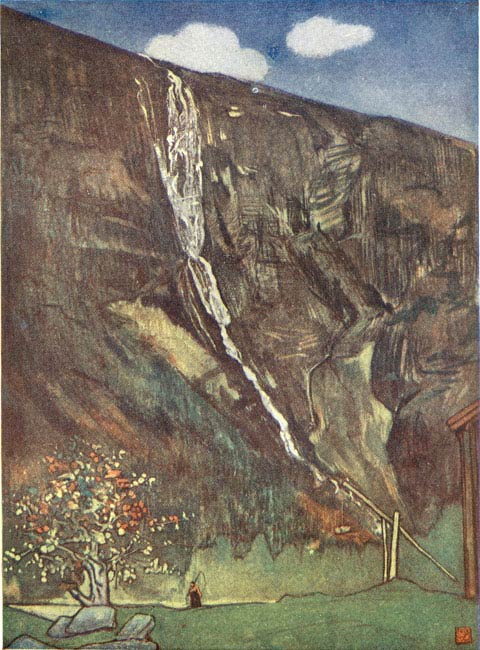
ROMSDALS WATERFALL
This knowledge, I may confess, is all at second
hand. We did not devote any considerable time
to Skien, but took the train on the day of our
arrival.
While we were waiting in the station for the
ticket office to open, which it does one minute
before the time of departure, we were amused by
the antics of two barefooted, very ragged, dirty
little boys. They examined us pretty thoroughly
in a rather furtive way: I have no doubt they had
no business where they were and fully expected to
be turned out. I held out a silver ten-ore piece
in each hand, and with a good deal of embarrassed
giggling they approached and took the tiny pieces
of silver. Very gravely they each shook hands
with me, and, walking right over to the other side
of the station, performed the same ceremony for
Nico's benefit. Then, full of importance, they
walked up to the refreshment counter, and each
parted with five ore—about a halfpenny—for
chocolates, and the other five ore for cigarettes.
At last the authorities allowed us to buy our
tickets, and we got into the train, which, like most
Norwegian trains, consisted of second-class and
third-class carriages. In spite of the threats of
the booking office, we were evidently in no hurry
to be off; but in the fulness of time we moved,
and presently slept. When we awoke—at least,
when I awoke, for Nico insisted that he had not
closed his eyes—we had arrived at Christiania.
Allowing ourselves and our many paper parcels to
be cared for by a hotel porter, we drove with him
whither he would. It happened to be to the
Grand Hotel, which is comfortable, and furnished
with heaps of Sheffield plated candlesticks—to say
nothing of a lift and other luxuries to which we had
for long been unaccustomed. We were gently borne
upwards to the floor where was the room which
the hotel porter had decided we should occupy.
We ordered an immense jug of thick chocolate,
and after disposing of as much of this as we
possibly could, we sought our couches, and slept
amid electric lights and other modern luxuries.
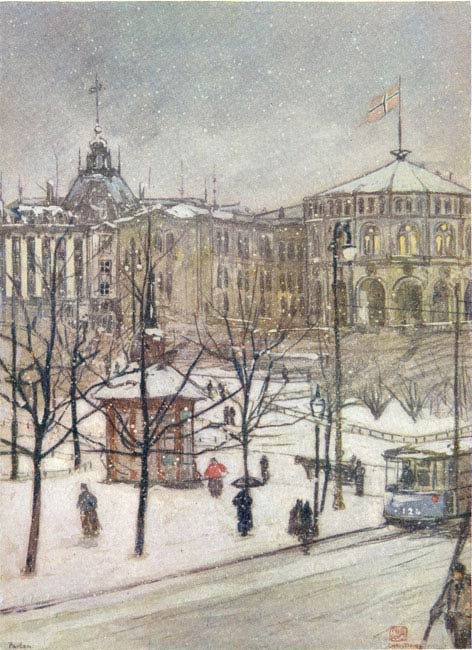
THE HOUSES OF PARLIAMENT (STORTHING), CHRISTIANIA
The Storthing is convened every year, and is divided into an Upper
House (Lagthing) and a Lower House (Odelsthing)
Christiania is built on a magnificent site at the
foot of pine-clothed hills which extend their protection
over the land-bound borders of the town.
As one stands on these hills and looks over the
town a delightful panorama spreads itself before
one's eyes. Beyond the crowded houses stretches
the beautiful Christiania Fjord, which, as it nears the
town, breaks itself up into a thousand tiny fjords,
and thus creates innumerable islands, which are
chosen spots for the summer villas of the richer
inhabitants of the town.
We stayed for some time in Christiania, a
delightful town, full of life and movement.
During certain hours of the day the whole population
seems to turn out and walk up and down the
fine road in which our hotel is situated, and I
noticed that everyone seemed to be acquainted
with every other.
We had here two good friends, one of whom was
away during almost the whole of our visit; the
other, a captain of artillery, did the honours of
Holmenkollen for us during a delightful day we
spent together. He called quite early in the day,
and drove us up the hill which leads to the scene
of the great ski competition every winter. All the
way, on either side of the road, are villas, which,
however, are farther and farther apart as the hill is
ascended. Just before the big hotel on the left
of the road is a small lake; beyond this is the
steep hill down which the ski-jumpers seem to fly
as they take their leaps through the air. The
record leap is a hundred and thirty feet. Of
course, this sport is in the winter, when the ground
is covered with snow and the lake is frozen over
and capable of bearing on its surface thousands of
spectators; on either side of the hill also the
spectators are massed. Nico was present on one
of these occasions, and declares that he had never
witnessed such an inspiriting scene. Everyone
was excited and happy; many of the crowd had
come up from the town on their skis, or had
dragged their little sleighs behind them, to skim
down the long slope to Christiania after the
festivities were over. The girls and the younger
women wear short skirts and their hair flowing,
and it is not resented as a liberty if one addresses
fellow-sportsmen or women without the formality
of an introduction.
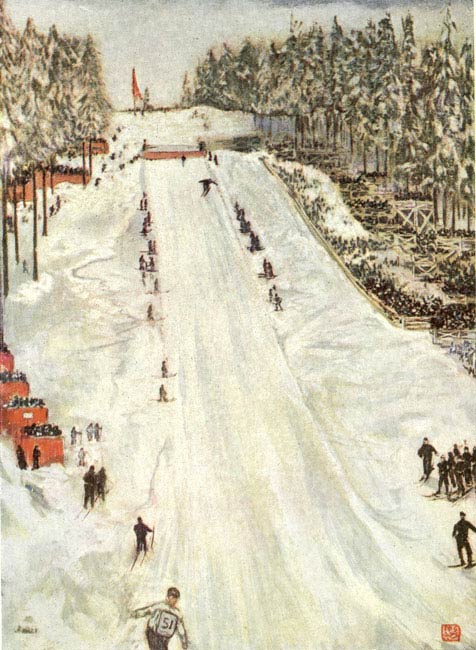
SKI SPORTS
The Great Holmencollen Day outside Christiana
The big hotel at Holmenkollen is a wonderful
wooden structure, built by a Norwegian architect
named Sverre, who is responsible for many buildings
of the same character throughout Norway, but
especially in Christiania and its neighbourhood.
It is as far as possible in accordance with the
old Norwegian style of architecture. It contains
many beautiful rooms, including two bedrooms
furnished in Norwegian style with genuine old
pieces of furniture. Then, there are various rooms
reserved for the Committee or Royalty; the
delightful smoking-room, with its splendid log-filled
fireplace and its alcoves and corners; the
magnificent dining-hall, characteristically decorated,
its walls clothed with Norwegian tapestry of a
singularly happy design. Architect Sverre collaborates
with the great decorative artist Munthe,
who is responsible for many of the adornments.
Leading out of the dining-room is a singular little
chamber, which is entirely decorated and furnished
after designs by Munthe. In this strange room Nico
ensconced himself to make a drawing which should
give some idea of its quaintness. The wooden walls
are primitively carved to represent various scenes
from Norwegian fairy tales. The door is guarded
by two grotesque monsters, and the chairs and
small tables are of equally original shape and
colouring. On the night of the ski competition
the enormous dining-room is crammed with excited,
happy parties, most of the tables having been
engaged weeks beforehand, for it is a favourite
resort for supper-parties on this night.
After luncheon on the autumn day which
witnessed my one and only visit to Holmenkollen,
we drove farther up the hill, and examined with
much interest the exteriors and furnished interiors
of various old Norwegian buildings which have
been transplanted from other parts to this centre,
in order that the Norwegian people may keep
safely some relics of their olden days, of which they
have lost many by fire or neglect. There are
further excellent examples of their various periods
of architecture to be seen at Bygdo, a small beautifully
wooded peninsula on the west of the town.
It is possible, and very pleasant, either to drive or
to walk to that place; but we went one cold
Sunday morning by a ferry steamer, which landed
us within a few minutes of our destination. There
was a tennis tournament going on the same day
and in the same direction; it is evident that
Norwegians are great enthusiasts over this game,
as indeed they are over athletic sports generally.
A committee have bought a large piece of land on
this peninsula. They wish to gather a representative
collection of old houses from various parts
of the country. The chief building is "the people's
museum." Though not an old building, it contains
a most interesting collection of furniture, clothes,
religious objects, and domestic utensils from all
parts of Norway and of various dates. Surrounding
it are such old buildings as the committee have
already acquired. Most of the residents of Christiania
are subscribers to this institution and have
the right of free entrance. Near by is a small
Royal villa called Oscar's Hall. It looks a delightful
place, standing in its brilliant whiteness among
dark pine trees. On the King's estate is situated
an old stavekirke, one of the few which remain
intact. It is built of logs, and has a species of
balcony running almost round it. The interior is
very dark; but when one's eyes get used to the
semi-obscurity it is to be seen that the church is
most elaborately and beautifully carved. All these
pole churches date from pre-Reformation times,
and were consecrated Catholic places of worship.
Catholics are still few in Norway; but the old
religion is spreading, and in Christiania itself there
are three or four parishes that have each a church
and a priest.
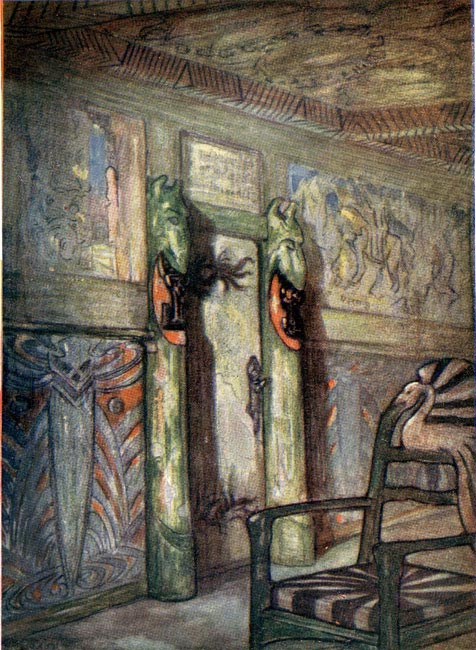
ROOM BY MUNTHE AT HOLMENCOLLEN
I should love to return to this interesting little
peninsula some warm summer's day; but all my
enjoyment was spoilt and the edge of my interest
dulled by the extreme cold, for which I was ill
prepared.
The Christiania Fjord being less influenced by the
Gulf Stream than the fjords on the western and
northern coasts, the winter is longer in Christiania
than in many places farther north. Generally this
piece of water is entirely frozen over, and the
country is tightly locked in the arms of Winter
from December until March; the snowfalls, untampered
with by thaws, accumulate and cause
gigantic obstructions. The cold, though much
more intense than in the English climate, is more
easily bearable than our milder winters. The
atmosphere is dry and pleasant, and often the sun
shines brilliantly during the short days, and the
delightful sports of this season are innumerable.
Skiing, of course, must take the first place. The
skis are really snow skates. They consist of a pair
of very long, but very narrow, strips of wood, very
thin and elastic. In front they are slightly turned
up and pointed. The correct length should
measure a third more than the height of the
wearer. The skis are attached to shoes, or merely
to straps, set a little back from the middle of the
strip of wood. The Norwegians are great adepts
at getting about on skis. They make extraordinarily
rapid progress over the snow, especially
when it is neither too hard nor too sticky. They
help themselves along and partly steer themselves
by the aid of long poles. Sometimes a traveller on
skis, becoming thirsty, will stop at a little unfrozen
spring, and, lowering himself with wonderful
cleverness until he lies at full length with his skis
disposed just as they should be, he puts his mouth
to the edge of the water and drinks. This is what
is called "drinking goose wine," and I assure you
there is a good deal of knack necessary both to get
down and to get up.
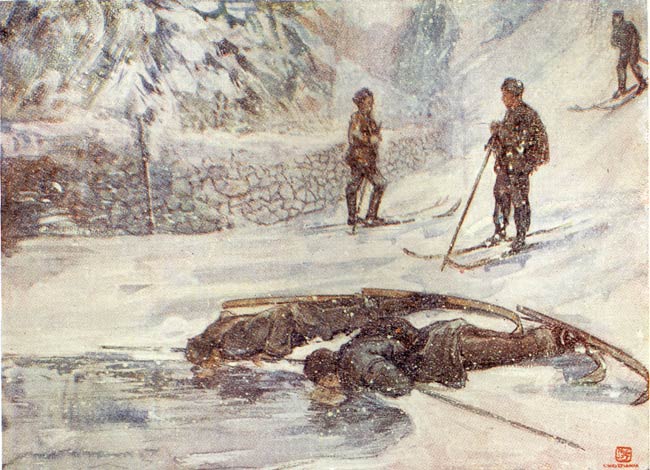
SKIERS DRINKING GOOSEWINE
Skating is another favourite sport, for which
there are plenty of opportunities. Sledging takes
the place of driving through the winter months.
Another gloriously exhilarating sport is tobogganing,
either alone or in parties. The leader steers his
rapid progress with a stick. One may meet with
an unforeseen obstacle, and the occupants may be
thrown out head-first with a jerk; but the fall in
the soft snow is not often serious.
The shops in Christiania are very good, and
generally, to the stranger at least, very dear; but
at the big fur store there I bought for a ridiculously
small sum two of the prettiest little reindeer-skin
coats, made by the Lapps, and as worn by the
Lapps. I brought them home with great glee to
my babies, but was nonplussed by my boy, who
absolutely refused to have anything to do with his
after he had elicited by hundreds of questions
that the stuff the coat was made of was fur, that
fur was the skin of the reindeer, that reindeer were
young and had mothers and fathers, and that his
coat couldn't run about in the snow because it was
dead, and at last, that it was dead because Loye
had to have a winter coat.
When after some weeks I persuaded him that
the reindeer would be much more sad if the coat
was not worn, he consented to have it on, but
only on condition that it should be slipped on over
his feet. Both the little garments were a great
success; but I am afraid that the children's nurse
never quite approved them. I think she found it
hard to get used to coats that had no hooks or
buttons but were fastened with plaited leather
strings, and she thought her charges looked rather
outré.
Christiania has but one picture-dealer of any
importance. From what we saw of the pictures
there we concluded that Norwegian art on the
whole is so intensely affected as to say absolutely
nothing to the beholder. We met two art enthusiasts
at luncheon at the house of an exceedingly
clever friend of ours, who was and is one of the
editors of Christiania's chief newspaper. These
two were man and wife, and obviously it was the
wife's opinion, on art at least, that dominated.
Their greatest artist in Europe's eyes they scoffed
at; scarcely would they admit that he was clever,
beauty and success being two attributes which do
not belong to art as they understand it. They
belonged to the ever-increasing number of folk who,
to appear original and extra-cultivated, refuse to see
beauty unless it is expressed grotesquely or incomprehensibly.
So insistent was this particular
devotee that she carried us along on the wave of
her heated argument out of our friend's dining-room
through the cold streets to her flat, where she
planted us in front of a picture by her favourite
artist. It was dark-green and white in patches
laid quite rawly on the canvas. "Isn't it wonderful?"
she cried. "Now you must own yourselves
vanquished!"
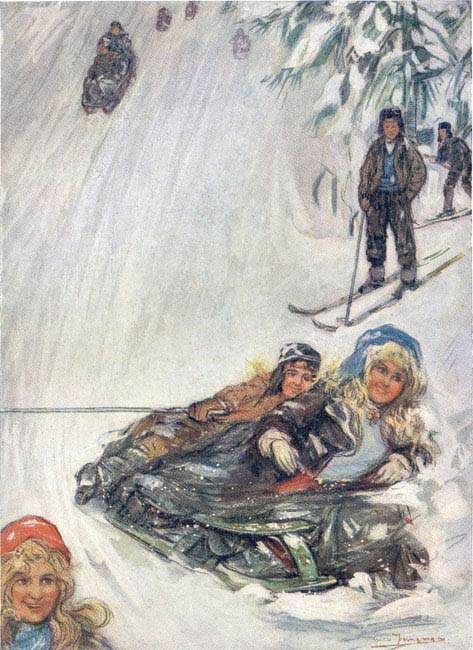
GIRLS ON OVERTURNED SLEDGE, HOLMENCOLLEN
"What is it?" I asked, with tactless ignorance,
after examining it long and patiently from as many
different points as I could discover in the small
room.
"What is it?" said Nico, with artistic licence,
not moving from the spot where he had taken up
his stand.
"What does it matter what it is?" the owner
answered, turning on us with flashing eyes. "Don't
you recognise the wonder of it? I myself had it
for three weeks, loving it and admiring it, and
asking myself how to hang it. The artist himself
told me it must hang as you see it, and explained
to me that it was a picture of a woman standing in
the moonlight."
"But where does she stand?" said Nico. "And
where is the moon?"
"At her feet," said the worshipper. "My friend
is such a great artist that he reverses the natural
order of things, subjugating everything to his art."
Surely all this is rather extravagant, and surely
it is not this art that will live when the painter is
no longer at hand to explain and to decide "which
way up." It is a great pity that all these clever
people—for the painter has immense talent, as is
shown in his earlier work, and our two interested
friends were evidently people of intellect—should
be so extraordinarily perverted in their tastes.
Norwegian art is comparatively young; but it
has made great strides. It has produced Fritz
Thaulow, who, though not recognised by the
enthusiasts of the class I have described, can
boast the admiration of all Europe; among many
clever designers, the decorative Munthe; that
rather morbid youth, Edward Munch, whose lithographs
give evidence of the great things of which
he is capable; and many other artists whose names,
known and praised in their own country, are not
of such widespread celebrity in this.
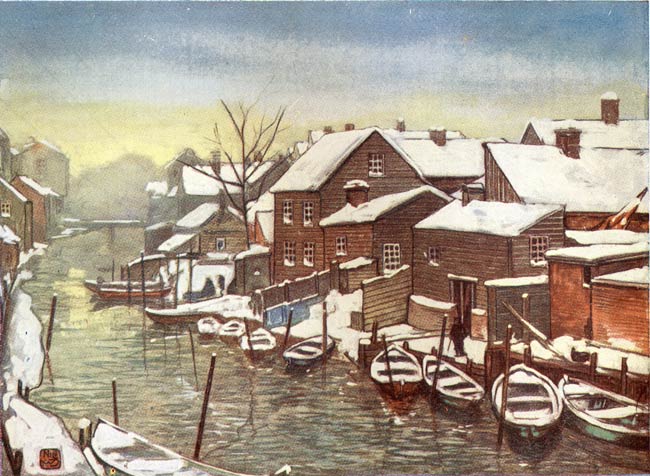
OLD CANAL, CHRISTIANIA.
During the middle of the nineteenth century
flourished the great painter of peasant life,
Tidemand. A series of his work is to be seen in
the King's summer villa near Christiania, and his
paintings, while not, perhaps, among the masterpieces
of art, are very useful and interesting as
showing the peasant life of Norway, under almost
every condition, at a period when the people
still wore their interesting costumes and had not
lost any of their old ways and customs. These
pictures are reproduced in every form, and are to
be met with in many books on Norway, and in
very many Norwegian houses.
There are also in Norway painters who devote
themselves to the beauties of Nature, with which
their fatherland is so generously endowed. This
school has produced many fine pictures; but it
seems to be rather falling out of favour in these
days of exaggeration.
Arts in which the Norwegians have excelled
since early times, and continue to excel, are those
of weaving and embroidery. In these their nation
shows an originality and charm, both of colour and
of design, which are truly admirable. From as
early as the twelfth century relics of cloths with
figures interwoven are extant. One at present
preserved in a church represents some of the
months in allegorical pictures, and is evidently a
fragment of a much larger piece which would
include symbols of all the months of the year.
Examples of the history of picture-weaving
become plentiful and important with the beginning
of the seventeenth century. As with all
arts of the period, this branch was principally
dedicated to the representation of sacred subjects.
Besides these there are many samples of purely
decorative weaving, beautiful for their colour and
quaint conventional designs, often geometrical, or
a continued repetition of one or two very simple
expressions of the form of a doubtful animal. The
cultured Norwegians treasure these pieces of woven
cloth, and hang them on their walls, or even have
them framed. In the various museums are excellent
examples of every branch of this art. To-day
it is a very thriving industry. The weavers
sit at an upright loom, and work in fast-dyed
wools with an immense range of colours. The
design is exactly the same on both sides, and the
article when finished will wear almost indefinitely.
Large quantities of it are used for wall-covering,
and I can imagine nothing more delightful for
this purpose. Any design can be produced, and
their great artist, Munthe, has made many drawings,
especially for this manner of reproduction.
Embroidery in Norway I find all the more
charming because it is not very varied. In other
countries embroidery does many things; but here
the workers cling to their very beautiful old-fashioned
lines, and fill them in with strongly
contrasted colours, mixing silk and wool. Mittens,
gloves, bonnets, cloth, and all conceivable articles
are gorgeously embroidered for personal wear or
for sale, and the Norwegians themselves are by no
means the least enthusiastic buyers.
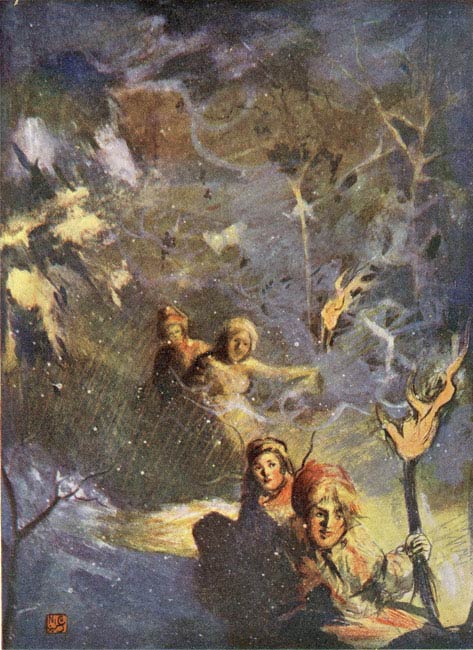
SLEDGING BY TORCHLIGHT
Work in silver is another of the nation's handicrafts.
In all the towns through which the tourist
travels he will find large and small shops devoted
to the sale of silver or silver-gilt filigree work and
enamel. When he has seen one such shop, he has
seen all; for over the country the same enamelled
salt-cellars and butterflies and spoons, the same
fairylike brooches and other ornaments, are repeated.
Indeed, I became as heartily sick of these
rather pretentious ornaments as I was enthusiastically
charmed with the peasants' jewellery of
an earlier age, frequently made by themselves, and
showing an attractive absence of the machine-accomplished
finish of the modern jewellery. By
expressing the presence of the something which
lifts hand work above machine work, I do not mean
that there is not among the original silver work
evidence of the greatest talent in this direction.
The embossed filigree work is truly admirable.
Precious stones do not take any important place.
A coloured stone here and there, more often than
not false, justifies its presence by increasing the
beauty of the ornament, and not only by adding
immensely to the expense of the object. One of
the most striking pieces of jewellery is an enormous
round brooch or buckle, often as large as a small
plate. Dozens of these saucer-like pieces of metal,
highly polished, are suspended by links to the body
of the brooch, shaking and glittering with every
movement.
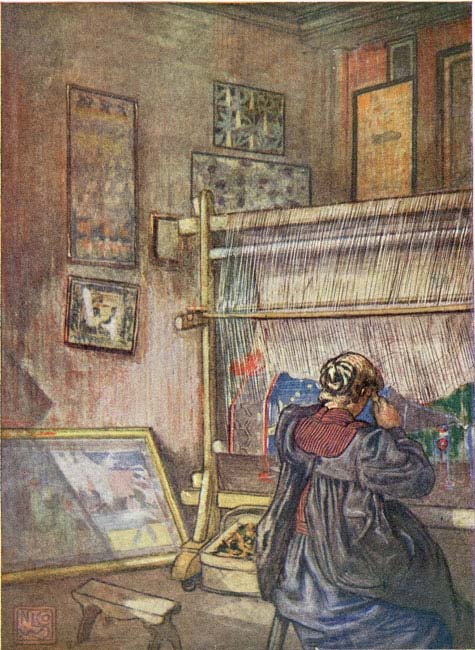
MAKING NATIVE TAPESTRY
Working a design by Gerard Munthe, the well-known
decorative artist
As for Norwegian wood-carving, words fail me to
express my admiration for the bold and strong
effects produced with wonderful skill and by
very primitive methods. During the long winters
the peasants labour, often with no other tool than
penknives. Their broadly carved furniture, with
the invariable circular design which is so prominent
in their embroidery also, has a charm that I miss
in the wonderful and delicate carving of the East.
I tried hard to possess myself of a few such pieces
of furniture—a very tall grandfather clock, a carved
and coloured cradle, a sideboard, and a cupboard—but
in vain. The peasant owners refused to sell—wisely
indeed, for surely these things are more
appropriate in their big yellow-painted log-built
rooms than anywhere else. Other objects which I
sought to obtain from various antiquaries were absolutely
beyond the reach of my purse: charming as
they were, the prices asked were ridiculously high.
I suppose that the sums asked are special during
the tourist season, and that Norwegians get what
they want at much reduced figures during the
winter months. The explanation of this is obviously
the absence of any competition. Two or three big
shops have a corner in such things.
In all our travels we did not come across any
little shop of the type one meets so frequently in
most towns in England and on the Continent. It
must be admitted that in such a country as Norway
to buy such things as the peasants may be willing
to dispose of necessitates a considerable outlay.
For the joy of buying give me Italy, or Spain, or
Belgium, of which countries swarm with small
antiquaries to whom the chance of a sale is too
precious to be allowed to slide for such a slight
reason as a difference between the price asked and
the price the would-be purchaser feels inclined
to pay.
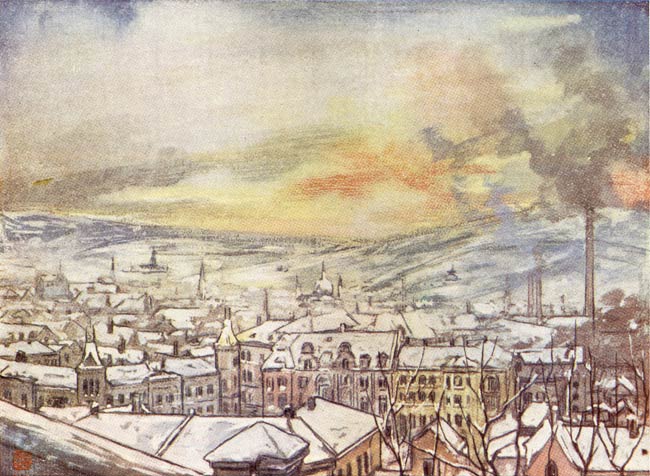
BIRDS-EYE VIEW OF CHRISTIANIA
FARM-HOUSES: WEDDING
FESTIVITIES
CHAPTER VII
FARM-HOUSES: WEDDING FESTIVITIES
The climatic conditions of Norway necessitate
much expenditure in the building of a farm. On
account of the intense cold of the winter, warm
houses must be provided for the live-stock, and
dry storage also is necessary. As a rule, nowadays
the buildings on a farm are four, though in
former times there were often many small buildings—notably
the charmingly carved storehouses one
still sees here and there on the farms, standing on
round stones and piles some three or four feet from
the ground, for fear of rats as well as for dryness.
Of the four buildings usual on an ordinary farm,
the main house is, of course, the dwelling-place, the
size of which varies. A cellar the size of the
whole area of the house is generally built under
this for storage of potatoes and other necessaries.
The buildings are almost invariably of logs dovetailed
together at the corners, painted inside and
out. Near this living place is another erection
which contains the rooms for the farm hands, the
laundry, and the winter supply of wood and peat.
The third building is chiefly for the animals, and is
divided into different compartments, of which some
are devoted to the storage of farming implements,
grains, etc. These outhouses are often built with
two stories connected by an inclined plane of logs,
up which the various vehicles of the farm are pulled
to be housed during the winter months. The
fourth building is the storehouse, built from the
ground, in which are kept the household provisions
and sometimes bedding and clothes not in actual
use. Many of the most elaborate and ancient of
these stabur have been bought by the State or
by private persons for presentation to the various
museums which devote themselves to the collection
of relics of old Norway and try to reproduce both
houses and churches of old times with as many of
their original belongings and fittings as possible.
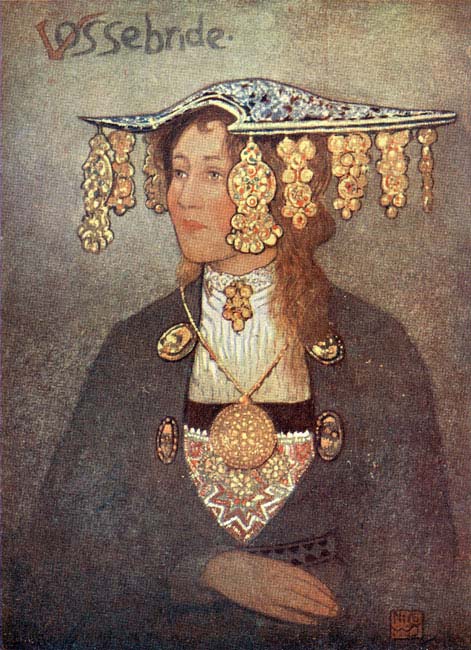
A VOSSE BRIDE
The farms surrounded by these necessary buildings
are often many miles apart, and consequently
social reunions are comparatively rare. In winter
the snow-covered ground is traversed with great
rapidity by sledges or on ski-shod feet, and, the
farm work being not so heavy or so pressing as at
other seasons, the country people give dancing
parties on the slightest excuse. The music is
primitive; but the hearts and feet are light, and
food and drink go round in abundance. In
summer all the residents on the farm are busily
engaged in planting and gathering their small crops,
cutting every available blade of the grass which is
so precious and means so much to their supplies of
milk and butter and cheese when the ground is
frozen and deep in snow. Their method of drying
the grass is rather strange. Tall stakes are planted
in the ground at short intervals, and on these small
bunches of grass are impaled. To facilitate the
operation, the stake is capped with a sharp steel
point. In this manner scarcely a blade of grass
escapes the gatherers, and the drying process is
much more rapid than it could otherwise be on
these slopes. In summer the cattle, the goats, and
the sheep are sent out to graze on the mountain
slopes. In charge of each flock are two or three
persons, generally girls. They spend their summer
in tiny rough huts called saeters. Hearing of these
saeters, I inquired by what means, if not by long
and difficult daily journeys, the dwellers in them
were provided with food, and how did the
farm people obtain from the heights their daily
supply of cheese, milk, and butter? Simply
enough: one end of a thick wire rope is fixed up on
the heights; the other is attached to a post below.
The rope traverses precipices, ravines, and raging
torrents. With the aid of a pulley and a second
length of wire of less thickness, one may thus
transport buckets of milk, bundles of hay, and
packages of all sorts. The operators at either end
are warned by a whistle that their attention is
required. We were told, by the people of a farm
where we stayed, that a young man sending down
a bundle of hay slipped, and, clinging to the wire,
slid with fearful rapidity to the opposite side.
Midway over the fjord which this wire traversed his
fingers were cut right through, and he dropped.
Fortunately, there had been spectators of the
adventure, and he was rescued without further
injury. In spite of the dangers, I believe the
peasants often avail themselves of this mode of
descent from the saeters to their homes. They are
courageous. On our long drives through different
districts of Norway, we frequently met with these
aerial wireways; and always on the steepest slopes
one could gain on foot one saw cattle calmly grazing
on the scanty grass at angles which make a
poor human being dizzy. How the great beasts
can keep their foothold on the loose soil, almost as
steep as the side of a house, puzzled me often; and
how they can look fat and well-fed on the miserable
supply of green stuff which is all they find in
many districts is indeed a problem.
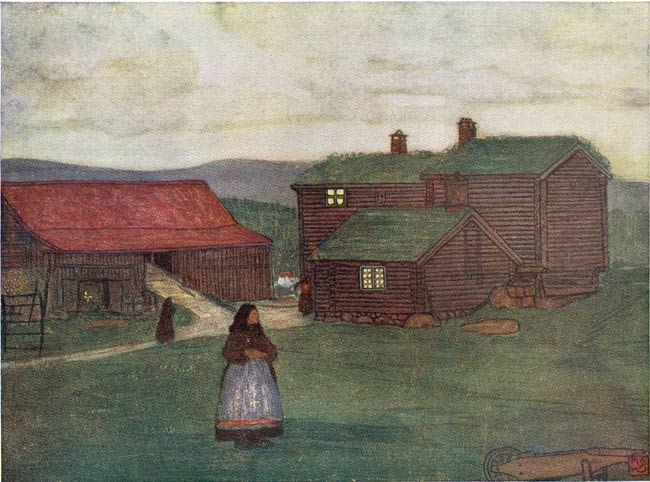
FARM-HOUSES BUILT OF POLES
The devout Norwegians have a theory to explain
the poorness of their soil. At the creation of the
world the angels whose duty it was to scatter the
soil forgot Norway. Seeing this, the guardian
angel of the land made complaints to the Creator.
What was to be done? Impossible to restart the
whole of the creation for the sake of Norway.
"Come, my little angels," said He: "look carefully,
and perhaps you may still find a little earth." The
conscience-stricken angels swept the floor of
Heaven, and the little dust they found they
gathered in their draperies and scattered over the
Norwegian rocks. That is why, while Norway is
rich in stones, she is poorly provided with soil.
Even in many of the valleys the earth is plentifully
bestrewn with big stones and boulders fallen from
the mountains, and where there are small tracts
without stones one frequently finds that the ground
is so marshy as to be useless. That there is as
much cultivated ground only shows what can be
dragged from Nature by men endowed with
patience and industry. Round the fjords the
fisherman chooses for his log hut a spot where his
wife may feed a cow and cultivate a small plot
of potatoes, while he devotes his life to gathering
the hard and difficult harvest of the sea.
At the country fairs or other rare meetings of
folks for one reason or another, the young Norwegians
meet and court. The girl must be a good
housewife and should be able to make bread, to
spin, and, in short, be capable of almost everything,
for in this country of isolated homes it is impossible
or difficult to provide a substitute for the invalid
or incompetent member of a family. Sometimes
among the humbler classes the betrothed couple
wait years for the completion of their tie, as it is
sometimes necessary to await the demise of an
older couple to obtain a dwelling-place. During
this time the bride-elect spins and makes up the
linen that will last her for life. The betrothed
couple are allowed all liberty to see each other and
even to journey together.
I have taken from a Norwegian paper an accurate
account of wedding customs in the middle of the
last century, and I am assured that, with a few exceptions,
everything remains much the same to this
day. The usages vary slightly in different districts.
The Norwegian writer has chosen Hardanger for
his description.
When a young man of the people wishes to offer
his heart and hand to the maiden of his choice, he
does not accomplish the deed himself, but appoints
as his spokesman opordsmannen, a man of consequence
in the district, a relation if possible.
Together they go to the house of the desired one's
parents. First they interview the father, all standing.
If the father agrees to consult his wife a good
sign has been given, and the opordsmann seats
himself. Settlements and dowry are discussed, and
finally the girl herself is consulted. If she consents
to shake hands with her lover the engagement is a
settled thing. All seat themselves for refreshments,
and the party drink healths out of the best silver
mug. Without waiting for the ceremony, the
young couple take possession of the best room;
and they are looked upon as man and wife. The
morning after the contract the bridal pair are
served with coffee and food in their room by the
bride's parents.
This interview is always on a Saturday. In
Telemarken the mode of procedure differs slightly.
The spokesman, after consulting the girl's parents,
goes to her room, and drags her out of bed
and into the barn, where the suitor waits to
receive her.
The mother of a friend once nearly had a very
disagreeable experience. Her child's nurse was a
Norwegian; the family were spending the summer
in a hotel at Telemarken. In the night the lady's
door was burst open, and in spite of protestations
she was dragged out of bed by her wrists. Only
the opportune arrival of her husband brought to
light the fact that this violent attack was really
intended for the courting of her nurse.
To return to the Hardanger bridal. Soon after
this the nearest friends and relations are invited to
the betrothal party, which is occasion for much
eating and drinking, in about a fortnight. During
the interval the young lover presents to his mistress
a wooden box carved or painted by himself, and
containing all the jewellery he can afford to present
to her; and the damsel prepares for her gift to
him embroidered braces and a belt. Though
maidenly modesty refuses to acknowledge it, these
articles of attire have been in preparation for
many months. The saying goes that he who weds
a girl who is "getting on" will have the best supply
of braces and belts.
The wedding proper is usually in the summer.
Invitations must be given in person at least a
fortnight in advance, and as far as possible on the
same day, so that on comparing notes the guests
may have no cause for complaint. These invitations
are on a large scale. Everyone for miles
round of the same social position as the bride's
family is invited; so, of course, are all the relations
of the happy couple. I am given to understand
that caste prejudices are very strong in the country
districts. If the child of a jaardemann (rich
farmer) should insist on marrying into the family
of a husmann (small tenant-farmer), the family
of the rich farmer will refuse to have anything to
do with the young people, or even to see their
child again.
Preparations for feasting on an enormous scale
are begun. Barrels of the native corn-brandy
and a smaller quantity of cognac, together with
kegs of mead and wine and abundance of beer, are
provided to encourage the gaiety of the guests.
Three or four days before the wedding the
klejvekjaeringer arrive. These are eight or ten
of the women friends of the family, who are
invited to assist in the preparations and to attend
to the guests during the feast. It is looked upon
as a great honour to be invited in this capacity.
Cooking begins in hot earnest. Piles of cakes are
made of rye and milk. Stalks of fladbrod—pancakes
of a kind—are representative standbys.
Mountains of bread and raw smoked meat are
cut up. The ox and pig, which have been killed
in anticipation, are made ready. Cylinders of
butter, weighing from twelve to fourteen pounds,
are placed at intervals on the board; the guests
will help themselves, smearing their bread and
cakes with it and then sprinkling sugar over.
Two days beforehand arrives the kjogemester.
Each district possesses an official of that kind, who
is paid for his services. He is chief steward and
master of ceremonies. On him falls the responsibility
of placing all the guests in the order of
precedence. As if this were not enough for one
man, he has also control over the drinks, and
during the festivities is liable to be called upon
at any moment to make various speeches in extemporised
verse.
The day before the wedding the servants of the
guests arrive. They are laden with presents,
mostly of food and drink. They are shown into
the stabur (storehouse), where the presents and
wedding clothes are on view, given food and drink,
and allowed to go their ways home.
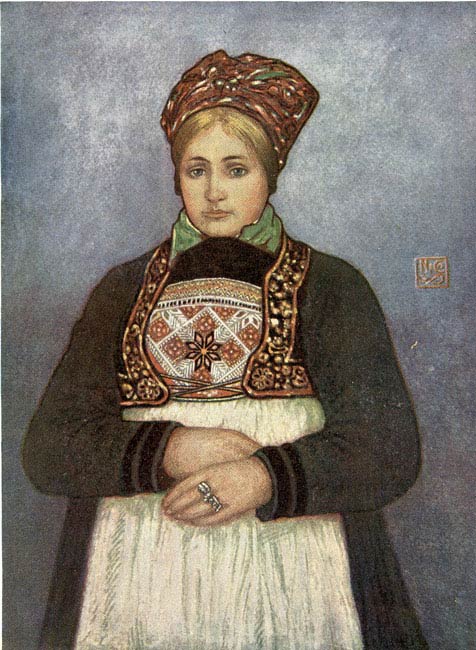
COUNTRY GIRL, BERGEN DISTRICT
In the evening of the same day the party begins.
At the time this account was written, all came in
their national costume and wore elaborate jewellery;
but now few besides the bride have preserved this
costume, though in Hardanger it is certainly much
more common than in other districts. The cap
mostly seen is a small tight-fitting bonnet—black
for married women and blue for girls. In
parts where costume is worn this rule as to colour
holds good for men also.
It is now the business of the master of ceremonies
to direct each guest to the correct place at the
table. The bride and the bridegroom sit at either
end of the table, both in unmarried costumes.
When they seat themselves two shots are fired.
The kjogemester, in verse, thanks the guests for
their presence at the feast, and gives out the names
of the various voluntary helpers, of the four best
men, of the four bridesmaids, and of the fiddler
and the drummer. The musicians give a sample
of their skill and seat themselves at the festive
board.
Early in the night the bridal pair retire.
Then, after more eating and drinking, the guests
dance until the small hours. Sleeping accommodation
is found for all—bedrooms for the older and
more respected persons, the barns for younger
ones—and often a near neighbour's house shelters
many.
In the morning at eight or nine o'clock the
waitresses carry round food and drink to the
sleepers, who then get up and eat and drink still
more. The best men brush the bridegroom's
clothes and boots and help him to dress, and in
the storehouse the bridesmaids render the same
service to the bride. The young couple are then
on view, but only to the parents and those of the
immediate circle, to the fiddler, and to the drummer.
The bride stands like a queen in her picturesque
dress, decked in a silver or gilt crown, often set
with many stones and with red, white, and blue
ribbons in her flowing hair. Her breast is covered
with brooches and ornaments linked together by
silver chains; and one may notice that from the
centre jewel hang danglements like small saucers,
the especial perquisite of the matron. Her
fingers are covered with rings, and she wears a
gorgeous silver belt and silver buckles on her shoes.
The bridegroom wears knee-breeches and a silver
cord round his hat, and the rest of his clothes are
in keeping with this grandeur.
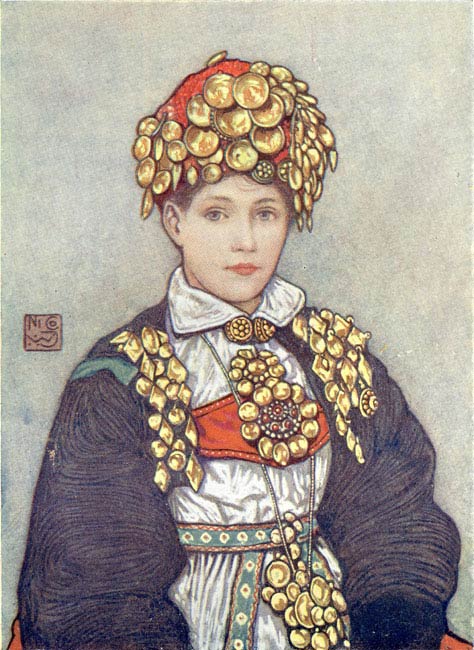
SÆTERSDALEN BRIDE
Then the drummer beats his drum and the
fiddler fiddles, and all the party crowd to the door
of the stabur and receive drink from the hands of
the bride. A squad of the men helpers lead the
way to church. In former times the journey, if by
land, was made on foot; but now the party drives.
Occasionally the fjord too has to be crossed. One
can imagine how romantic such a sight would be.
The boats are long and broad. In the first one go
the music, the bride and bridegroom, the attendant
men and maids, and the parents of the couple.
Before starting the master of ceremonies provides
all the guests with brandy. Arrived at the church
and while waiting for the pastor, who often comes
from afar, the party adjourn to the nearest house,
and drink. Naturally a crowd has collected to see
the wedding. All who ask are provided with drink
by the kjogemester, who has also to bid the bride's
parents good-bye in her name and in verse.
The celebrant arrived, this ubiquitous official
leads the way to the church. He is followed
immediately by the drummer and the fiddler, who,
however, drop out of line at the church door. The
bride is accompanied by the four best men; the
groom is attending the bridesmaids. At the church
door the maids give the groom to his bride, who
is treated in the same manner by the best men.
Then the marriage ceremony proceeds. The
interesting pair stand throughout; the rest of the
party are seated. At the conclusion of the ceremony
all the guests make offerings to the parson
and to the parson's clerk. When this important
duty has been fulfilled the parson is offered wedding
food and drink in a neighbouring house. In many
cases he is presented with a bottle of spirits and
more food. These he is to take home, that his
wife and family may share in the feast.
The journey back is made in much rejoicing.
Arrived, after more food and drink, the party
dance; the bride performing first with her husband,
and then with the best men, and so on
through the party; dancing last with the drummer,
who, as a final compliment, must kick the highest
beam in the ceiling. For the privilege of dancing
with the bride her partner tips the fiddler, and at
the conclusion presents her with a small sum,
known as cradle money, to be spent on the layette
of the hoped-for children. Sometime during the
wedding day the party is regaled with bridegroom's
porridge, which is a paste made with flour and
cream, stirred so quickly that the cream partly
turns to butter. This indigestible mass is followed
by more drains of spirits to the accompaniment of
music, and the master of ceremonies recites a toast
to the honour of marriage in verse which would not
bear translation.
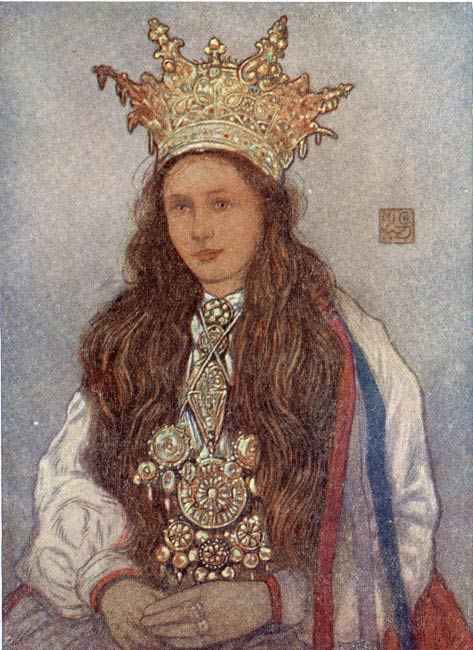
A HARDANGER BRIDE
While the youths and maidens dance the
matrons work and gossip, and the older men have
drinking competitions, won by him who manages
to keep his senses longest. The bride and the bridegroom
retire early. The others dance, eat, and
drink, as before, into the next day. In the morning
the servants of the guests arrive with buckets full of
sweet milk, which they offer to the keeping up of
the banquet. In return they are given beer, and
their empty buckets are filled with wedding food.
After this—at least, so it happened when this
account was written—the pair seat themselves, and
every guest in turn deposits a money present on a
large pewter plate placed for the purpose. On
each donation the giver drinks with the couple out
of a large silver mug, which is kept brimming by
one of the best men. Then is eaten the bride's
porridge, which is a paste made of flour and milk,
and not so great a luxury as the bridegroom's
porridge, eaten the previous day.
The fun and feasting go on all day. If one may
believe certain Norwegian paintings and engravings,
fights are not infrequent. Next day all sleep, and
badly they must need to do so; during the day
adieux are said, and the guests, after much pressing
to the contrary, at last take their departure.
A week later the couple leave the farm and take
up their abode in the bridegroom's house, whence
the bride immediately pays a round of visits to her
neighbours, who assemble the following day for
more feasting at the new home. This is the end
of the romance. Henceforward hard work and
the bearing of many children are the lot of the
Norwegian woman, varied but seldom by dissipation
in any form.
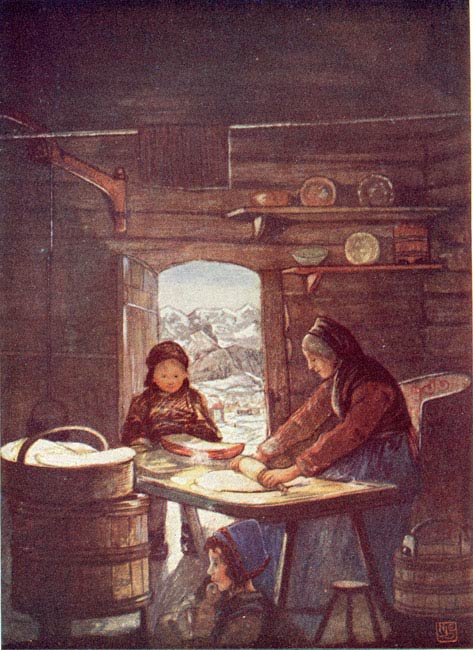
MAKING "FLAD-BROD"—A COTTAGE INTERIOR
I have not been able to discover how far this
account of the marriage customs of Norway may
be applied to the present day; but I am assured
by the Norwegian friend who kindly helped me
with the translation that in the isolated country
districts such affairs still follow the course I have
described.
At funerals there are celebrations of much the
same kind. Although there is no actual dancing
until after the return from the burial, drink passes
freely. I am told by an acquaintance, who
assisted at the funeral of one of his tenants,
that the whole party were overcome by drink to
such an extent that at the churchyard it was
discovered that the corpse had been forgotten.
The pastor was naturally indignant. He and the
mourners had to wait in the snow-covered cemetery
until the coffin containing the remains could
be fetched. In districts far removed from a town
the food and drink for a funeral party are generally
ordered while the funeral subject is still alive. A
friend, calling to offer condolences, was served with
cakes, which she was begged to partake of on the
plea that "the corpse herself made them." Many
of the rich farmers order their own coffins and keep
them in the stabur. In winter the ground is
frozen so hard that it has to be blasted.
FORESTRY: REINDEER:
LAND TENURES
CHAPTER VIII
FORESTRY: REINDEER: LAND TENURES
During my long walks while Nico was painting,
I was refreshed and delighted by the abundance of
wild fruit which I found everywhere, delicious little
strawberries and large raspberries. Once, while I
was greedily stripping a bush of raspberries, sitting
at my ease on a rock beside the shrub, a large
snake glided from under my skirt, and hid itself
beneath the stone on which my feet were resting.
I had a terrible fright for a moment. I have never
discovered whether there are poisonous snakes
in Norway. Every four or five years certain
districts are infested by animals about the size and
form of a guinea-pig. They swarm all over the
country, and do a good deal of damage. Immense
numbers are killed, and the race seems to die out,
until, when a period of four or five years has
elapsed, they appear again. I was told this by
an English inhabitant, who could give me no
reason for this intermittent character of their
presence.
The Norwegian horses take their pleasures sadly.
When they are not working, and are set at liberty
to feed along the strip of herbage, they are either
attached by a short chain round one leg to a
staple fixed in the ground, or, what is worse, their
forefeet are linked closely together by an arrangement
like handcuffs. To see the poor things trying
to be frisky amid these circumstances is quite
painful. Nico describes the movement which
results as "hirpling." It is a cross word, I suppose,
between hopping and limping, and is extremely
expressive of what it is intended to represent. In
the towns the horse's forefoot is tied to the wheel
of the cart when the driver is obliged to leave it.
What would happen if wandering musicians were
to strike up an equine cake-walk, I tremble to
think!
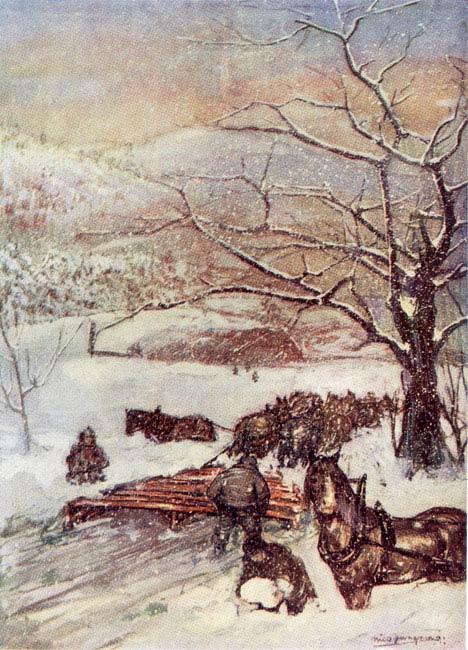
SNOW PLOUGH DRAWN BY EIGHT OR TEN HORSES
In a country of such scattered population, the
keeping of the miles of road in good order is
naturally a question of moment. On most of his
drives the traveller will notice hundreds of little
poles painted red, and bearing some kind of inscription,
planted at short intervals. These signposts
give the name of the farmer or landowner appointed
by the lensmand to look after and repair a certain
area of road, which is also indicated on the post. I
do not know whether the farmer or the careless
lensmand is to be blamed for the terrible condition
of some few of the roads over which we passed.
On the other hand, the difficulties to be contended
with considered, the condition of the chief ways
is wonderfully good. Many of the roads are cut
up inconveniently by gates, placed at quite short
intervals. Every second minute one has to
scramble off one's cart to open these obstacles; but
I believe they are less for the purpose of causing
trouble than for keeping some sort of control over
the straying of the farm animals. All along the
route one meets with curious wedge-shaped constructions
of wood. These are the snow ploughs.
When they are needed, as many as six or eight
horses are harnessed to them, and slowly they force
a passage through the deep snow. I think they
can be used only at the beginning or at the end of
winter, though I am not quite certain; but why
should people use ploughs when winter transit is
entirely and most conveniently accomplished on
sledges and skis? The deep valleys which are
generally a feature on one side of a Norwegian
roadway are levelled with drifts of snow, and it
is only when spring comes that the road may be
tracked by the heads of the ten-foot poles planted
along the path, which begin to show themselves
only as the thaw sets in. What a lonely, mysterious
journey for the solitary postman!
Somewhere in the neighbourhood of Odde lives
to this day a postman who had a terrible adventure
in the snow. The history of it was told me by a
man who drove us for days along the road across
Norway between Odde and Christiania. In the
winter in the farming districts letters are delivered
only once a week—perforce by the postmen on
skis. I gathered that the day of delivery is not
absolutely certain, and the man is sometimes days
on his trip. The postman in question set out, as
usual, alone; half way to his destination he sank
into a snow-drift on the side of the mountain. In
a day or two, when his continued absence was
remarked, search-parties of thirty or forty men set
out to find him. Of these searchers my driver was
one. With them they took his coffin, expecting
indeed to find him, but resigned to the certitude
of finding his dead body only. Before the third
day was over they sorrowfully gave up the search,
and returned to their homes to wait until spring
should force the secret from the snow. At the
end of the third day, a feeble, white-haired man
staggered into the station, and fell fainting to the
ground. For three days the postman had been
buried alive, and at last, by dint of digging with
his post-horn, he had got free. The rescue party
had passed over his very head, and he had heard
them speaking of him and finally deciding to give
up the search; but of course it was impossible for
him to discover himself to them. Imagine the joy
of the community at his return! You may be
sure he was well nursed back to health; and still,
summer and winter alike, he carries the mail-bag
over his allotted route.
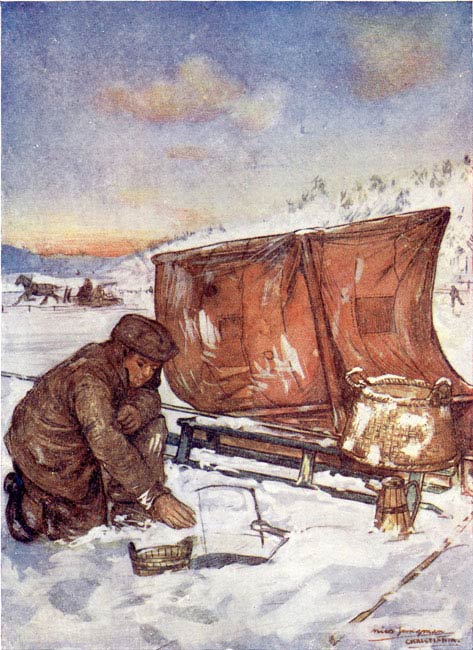
FISHING THROUGH THE ICE ON CHRISTIANIA FJORD
It is obvious that the winter is in Norway a time
of enforced cessation from farm work. With the
exception of a certain amount of labour connected
with the cattle, there is little to be done for several
months. The men pass most of this quiet time in
carving wood and making various articles out of
birch bark. The women spin for their household
needs, and knit and embroider what may be called
fancy goods in expectation of the tourist season.
The large shops buy up enormous quantities of
the peasants' winter work, and each of the posting
inns is a small centre where the peasants of the
neighbourhood endeavour to get large prices for
the products of their winter industry—prices which
dwindle through the summer as the days become
shorter and the tourists fewer. It must be
admitted that they are extraordinarily clever
carvers; and they have a rather primitive method
of painting their wares which is very decorative
and, when it is not too well done, quite attractive.
Their nicest carving they keep to themselves:
witness the delightful fairy-tale animals which
form the handle of the family mangling-board,
and the equally charming monsters which seem
to perch on the arms and backs of chairs.
A word on their primitive method of mangling
may not be amiss. Two utensils are necessary—the
first a kind of rolling-pin, round which the
sprinkled linen is tightly swathed. The other, a
mangling-board, a narrow flat piece of wood
wielded by the picturesque handle I have
described, is then pressed tightly on the linen
and rolled with as much force as possible. I do
not really believe that this operation can, even
with great strength, make very much difference
to the condition of the linen; but the process is
much more interesting to watch than the working
of a civilised mangling-machine.
It is in the winter that the work of a forester is
at its height. The felling of trees begins late in
September, and is continued under many difficulties
and hardships all through the winter. As the
large forests are often at some distance from
populated areas, the woodsmen build themselves
log huts. They fill up the crannies between the
logs with moss and turf, but on the roof they
lay first a covering of birch bark to keep things
close and dry. These huts are warmed day
and night by a wood fire, which is always kept
burning; on this they make their tea and coffee
and do what little cooking they may need. I could
not discover what happens to the poor horses that
help the woodsmen in their labours. Do they share
the hut with their masters, or do they sleep as best
they may outside in the cold and snow?
The trees are felled, the branches lopped off,
and the trunks stripped of their bark, which is
kept and applied to many useful purposes. They
are then gathered together where it is most
convenient, and when the snow becomes deep
enough they are dragged or slid to the nearest
practicable waterway. I believe that it is at this
stage that the owner, or his representative, marks
the timber for recognition. In many cases the
owner of the forest sells his felled trees to a
merchant, and it is here in such a case that the
wood changes hands. In spring, when the ice-bound
rivers begin to thaw, and the melting
snow swells them in force and volume, the logs
are carried by these torrents to the main river.
During their journey hundreds of logs get stuck
here and there, sometimes lying crossways between
the banks and damming the river. The river
drivers have their work cut out to obviate this
happening, and, if possible, to be rid of it after
its event, for to such a stoppage may be due most
dangerous floods, and many accidents, when the
immense mass of logs, stopped in their eager passage,
at last are free. Sometimes the logs are chained
together and sent down in rafts; but more often
each one pursues a separate course. If they are
jammed, the river driver, with the help of his long
pole, must balance himself as best he can on the
logs, as he springs from one to another, poking
and prodding till at last he loosens the mass; and
how to save himself is the question of the
moment, for a risky calling is that of the man
who endeavours to direct the logs in the way
they should go. Sometimes, when the danger
appears great even to these hardy Norwegians,
accustomed though they are to risking their lives
daily, the man whose duty it is to discover and
cut the log which is probably causing the whole
stoppage is put into a kind of harness and
attached by ropes to both banks of the river, so
that when the whole mass rends itself free he
may be lifted directly above their violence and
so drawn into safety. As it is bad for the wood
to lie through the summer, it is important that
all this work should be done completely and with
regularity. If it is a dry season, the logs will be
left high and dry, and be liable to crack; on the
other hand, one may often see logs lying at the
bottom of deep water so saturated that they
cannot float. All this timber is a great source
of wealth to the country. It is used enormously
for fuel, for fencing, and in building. Immense
quantities are exported in the raw; others are
prepared for use in the form of doors or window
frames; there is even a certain market for complete
log houses of various sizes. Naturally, in
such a country, one meets frequently with sawmills,
and here the countless cataracts are found
useful in supplying motive power. It is surely
strange, all these things considered, that so little
discretion is exercised in the felling and planting
of trees. Although of late years, I believe, the
Government has bestowed a good deal of attention
on this question, so much of the forest land is in
private hands and beyond surveillance that on the
whole sadly little care can be taken to prevent the
ill-treatment of the forests. It is acknowledged
that there are many tracts of bare land which
within the memory of living man were thick
forests. In several districts wood is too scarce
to be used for fuel, and consequently the inhabitants
are dependent upon peat. Bogs are to
be found all over the country—on the lonely tablelands
as in the inhabited valleys. These bogs are
generally moss lands, and, in the north particularly,
they contain thick strata of decayed matter from
the luxuriant forests of former days. The digging
and cutting of splendid peat is one of the smaller
industries of the country. It is thought that it
will become of much greater importance as peat
more and more takes the place of wood as fuel.
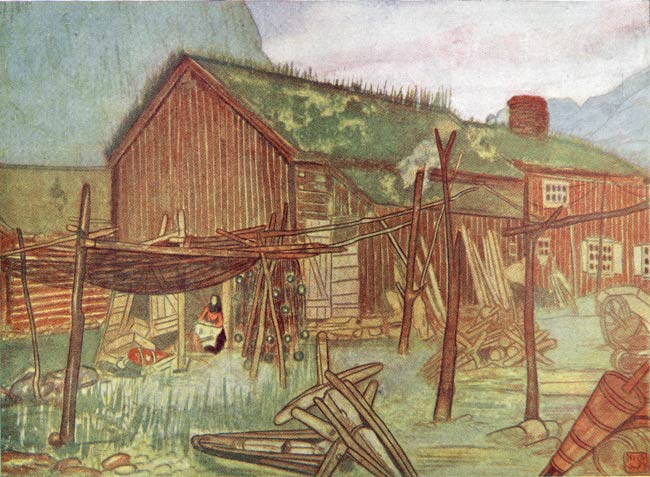
FISHING-NETS AT SUNDALSOREN
In other times there were thousands of acres of
common land in Norway. The difficulties which
this places in the way of a complete utilisation
of the soil have led to attempts by the local
governments to partition the common land among
responsible owners; but there are obstacles, and in
many cases the ground is shared by several farmers.
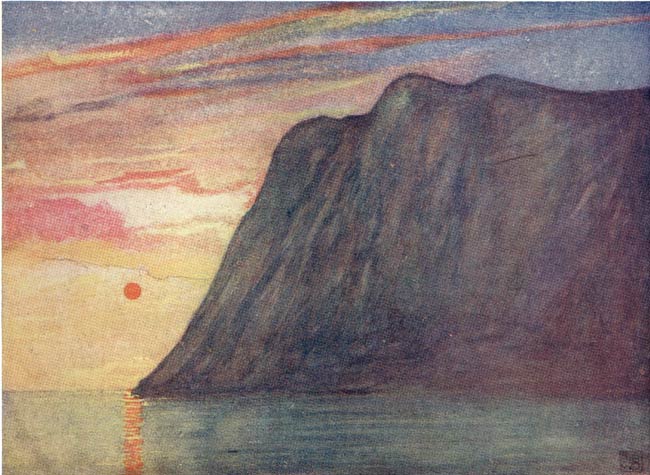
THE MIDNIGHT SUN
On the private property of many large farmers a
feudal system of a kind is very much in vogue.
Almost the same method is found on the Italian
podere. Dwelling-places are built on the estate,
and together with a greater or lesser plot of land,
and under certain conditions which differ in various
districts, are leased to a class of farm-labourers
called husmaend. These men have certain rights
of grazing on the farmer's land, and in addition to
the rent, which is exceedingly small, the farmer
has a right to their services during a certain time
of the year. Superior to these husmaend are the
placemaend, who own their houses but lease a
certain amount of the farmer's land.
In the south-east of Norway the cultivation of
fruit is carried on to a large extent. In favourable
years peaches, apricots, tomatoes, and even grapes,
are grown in the open air; in the north, on the
mountains, the summer warmth is insufficient for
even hardy plants.
Rye and oats are the most important cereals.
They flourish and ripen amid harsher conditions
than other grains can endure. Rye is the chief
bread cereal of the country. A large area of ground
is devoted to the cultivation of a mixture of barley
and oats which is known as mangcorn. Experience
has shown that the two grains planted together
produce a larger crop than they do when planted
singly. Besides being used as a human food, it is
also a fodder for cattle, and a peculiarly excellent
means of fattening swine. Berries are found growing
wild in abundance in most of the inhabited
regions; but vegetables play a very unimportant
part in the feeding of the peasant.
The Norwegian horse, while not remarkable for
beauty or carriage, is an exceedingly useful beast.
It is hardy, gentle, and very active. On the
Norwegian roads, which are in some parts very bad
and in other parts merely rough bridle-paths, it
cannot be surpassed. In Lapland, as everyone
knows, the horse is almost entirely superseded by
the reindeer. These are indeed a source of profit
to their masters. From them the Lapps obtain
their milk, cheese, peat, and the skin from which a
good deal of their clothing is made. The small
sledges which the reindeer draw are usually for one
person. They are made of skin and are without
shafts. The reins are tied to the horns of the
beast, and this is all the control the driver has over
the animal. Occasionally the reindeer is vexed and
turns on his master, who saves himself by rolling
out of the sledge and covering himself with it. It
is a wonderful fact that a well-trained reindeer can
run down the steepest hill without once coming in
contact with the vehicle behind it, though there is
nothing in the world but its own cleverness in
covering the ground in a sort of zig-zag movement
to prevent constant bumping and collisions.
While young reindeer are being trained in the way
they should go, a big buck animal is fastened to
the back, to do nothing but pull against the other
continually. This animal lives almost entirely on
the moss, its natural food, which in the winter it
scrapes out from under the snow with its strong
hoof. Many Lapps keep a thousand or more head
of these deer. They herd them together with the
help of their clever dogs. Sometimes during the
winter a family of these tent-dwellers descend upon
districts more favoured than their own, and I
believe the immense flocks of reindeer do untold
damage in the forests. Besides clothing themselves
in the skin of the reindeer, the Lapps make from it
many objects for sale in the towns. Shoes and
coats in the Lapp style, and all sorts of small
articles, such as boxes, bags, knife-handles, in the
fur, are produced by this people. I came across a
very old book which—in an account of a visit to
Norway—gives a short description of a meeting
with some Lapps. I imagine that much of it may
stand as if it had been written to-day.
"We accordingly provided a supply of drink and
eatables; and, with a guide and an interpreter, set
out on horseback. After travelling about forty
hours, without seeing either any people or the road,
we pitched our tents, at night, near a wood, with a
part of which we made our fire. At length we
met a family of about twenty persons, with
their wives and children, who cordially saluted us,
and we all shook hands. We shared out tobacco
and brandy among them. They conducted us to
their huts, and gave us dried reindeer flesh and
milk.
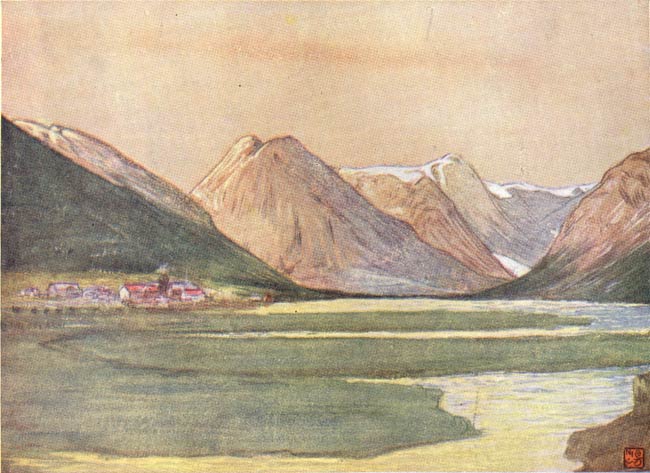
MUNDAL, FJÆRLAND, SOGNEFJORD
"Their countenances are a miniature resemblance
of the Calmuck faces; they are diminutive
in size, and to appearance wretched; sufficiently
generous, but full of uneasiness. They suffered
us to go about everywhere, and do as we chose;
and they readily showed us whatever they had.
We were soon as intimate as if we had been born
among them. Their language is very harmonious.
A herd of about thirty reindeer strayed around.
Our interpreter, who, by the bye, knew but little
of their language, contrived to let them know that
we wished to proceed onwards, to visit a few
families of their people, by means of a carriage
with reindeer. Immediately they harnessed a
sledge for us; but it went very slowly, as no track
in the snow had been previously beaten down.
We arrived at a tribe who were all brothers and
sisters of those we had quitted. Their huts were
formed of large poles of wood, and set circularly,
covered with branches, moss, earth, and reindeers'
hides; they have holes for the smoke to escape
and another hole made in the ground. We stayed
three days with these people. In the middle of
their huts a stove is placed, on which they make
their fire, all sitting round it. Their clothing is
made of deerskin, similar to a shirt, and tied about
the loins with a cord. We saw some, however,
dressed in linen, for which they had made an
exchange of skins. These people, whose manners
and habits are well worth observation, seem to
enjoy the freedom of their way of life. They
have no words in their language which express the
ideas we attach to king, prince, governor, laws,
rights, etc. We presented them with a few trifles,
with which they were highly delighted, and took
leave of them, to continue our route to Tuffendalen,
where, after eight days' dragging, we at last found
good boor-cottages. Whether the Laplanders
indirectly belong to any regular constitution, or
contribute anything to it, I cannot tell; but I
remarked that, generally speaking, like the poor
Indian of Pope, they have no artificial wants; and
thus far, at least, they appear contented. The
whole of this tract of land is solitary and desert.
The superficial and level extent of it may comprehend
a thousand and eight hundred square
miles. Laplander is with them considered as a
term of reproach, or a mere nickname; they call
themselves Samalatzes."
Since I wrote about the restrictions on the
shooting of wild animals, I have learned that,
whilst only one elk may be shot during one year
on any estate, the owner of the estate may mark
his ground for the purpose into certain divisions,
and by paying a slight increase on his licence has
thereby the right to kill as many elk as he has
these partitions of his land.
While wandering in the forest, a Norwegian
friend was attacked by a bull elk. Having no
weapons and considering prudence the better part
of valour, he climbed an adjacent tree. Not to be
baulked of his victim, the elk had recourse to the
extraordinarily brilliant idea (for an elk) of gnawing
away the roots of the tree. For eight mortal
hours the object of his endeavours sat on the top
of the tree momentarily expecting its fall and his
destruction. At last the elk turned his attention
for a time to food, and on this quest he absentmindedly
wandered away, leaving my friend to
scramble down and be free. I should imagine
there was an elk hunt next day on that estate.
Inhabiting the innumerable small islands on the
south-west coast of Norway are a race different
from the land dwellers, with whom they have no
communication. They are miserably poor, and
live in abominably dirty huts on the barren land
which is their heritage. Among these islanders
consumption and leprosy claim many victims.
The spread of leprosy is due mainly to the uncleanly
habits of the people. They eat very little
meat with the exception of pigs' flesh. The pigs
feed on anything they can pick up, which resolves
itself chiefly into the rotting remains of fish. The
name given to them speaks for itself—"fish pig."
Once a year, in the families that can afford it, such
a pig is killed, and on its flesh they depend for
their meat for months. It is not to be wondered
at that such food, combined with their unsavoury
habits, produces such terrible results. Statistics
seem to show that leprosy has been growing less
prevalent since the middle of the last century;
but it is still necessary to keep several hospitals
for the lepers.
Another remarkable fact gives rather an interesting
example of the evolution which must follow
on any abnormal conditions. For hundreds of
years these people have had no opportunity of
duly exercising their lower limbs, which are in
consequence short and undeveloped; while the
extraordinary muscular development of their arms
and shoulders is not astonishing when one
considers that all their transit exercise must be
done by rowing. In consequence of this, and
perhaps also on account of the consanguineous
marriages, many of the inhabitants of these islands
present extraordinary appearances.
FISHERIES: THE LAPPS:
RELIGION AND MORALS:
MUSIC
CHAPTER IX
FISHERIES: THE LAPPS: RELIGION AND MORALS:
MUSIC
Although most Englishmen with any knowledge
of Norway have been originally attracted to the
country by the hope of sport, especially of salmon
fishing, and though the rents which they are willing
and eager to pay for rivers or sections of rivers
are a substantial sum brought into the country,
the sea fisheries are, of course, of immeasurably
greater importance.
The old sagas tell that over a thousand years
ago "splendid painted ships, with sails of several
colours," sailed laden with fish to England, and
the abundant and varied supply of fish which distinguishes
the coast of Norway has always been
one of the chief sources of the country's income.
In 1897 it was estimated that the total receipts of
the trade amounted to about sixty million kroner.
The coastline of Norway is exceedingly long; in
many places it slopes down to great ocean depths.
These various depths and the different conditions
of the submerged surface determine the nature of
the submarine fauna, and consequently of the fish.
Perhaps the most important of these are cod,
herring, and salmon. Cod are principally fished
for in March and April, with lines and nets. The
Lofoten cod fishery is carried on from several
stations, spread over various islands. Here are
the warehouses and the very primitive dwelling-places
of the fishermen. The cod are caught with
lines and with nets, which are baited with herrings
or little metal fish whose gleam serves equally
well to deceive the cod in search of food. At the
favourable spots in the right season, the fish are
so abundant that the fisherman has only to throw
the line and pull it out again to find that a fish has
bitten and thus closed its career. The spoil is
taken ashore, split open, attached two and two
together by the tail, and thus hung over long lines
to dry. The liver is used for the fabrication of
cod-liver oil, a medicine whose unpleasantness is
more than equalled by its excellence as a remedy.
The heads of this profitable fish are used for
manure. In these cold regions, where grass is
scarce, the cod heads and herrings are used as
fodder for cattle.
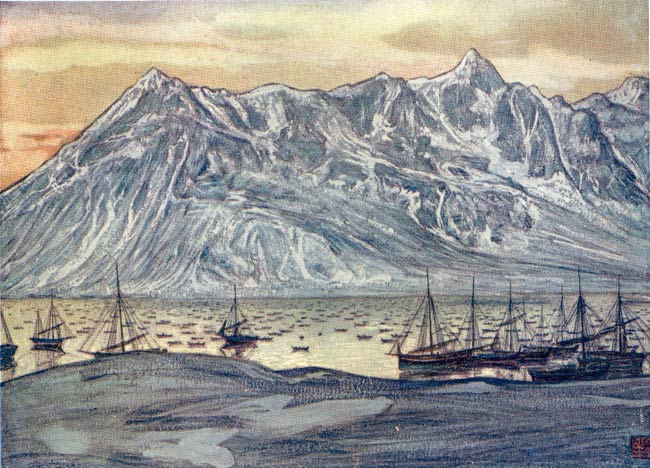
FISHING-BOATS AT LOFOTEN
During the season fishermen from all northern
Norway flock to the stations. Sometimes as many
as five or six thousand fishing boats, with a total
crew of thirty-two thousand men, are gathered
together. The catch averages thirty-five millions;
and the fish are usually sold by the hundred,
generally prepared either as "klip fish"—salted
and dried—or as the evil-smelling torfisk (stock
fish), which haunted our wanderings through
Holland, which imports large quantities. In old
fishing laws of the islands it is insisted that no
torfisk should be hung up after April 12, or taken
down before June 12. I presume that after this
treatment they will last and be odorous for ever.
In the off-seasons small cargoes of this fish are
carried by many of the passenger steamers, to the
profit, perhaps, of the captain, but to the intense
displeasure of the passengers. Indeed, all down
the coast of Norway we noticed that the air was
impregnated with the smell of stock fish; our
towels and napkins, and indeed everything we had
washed, had the same repulsive odour.
Though the financial side of it is very satisfactory,
this industry costs the country much in lives of
men. The great enemy of the fisher-folk are the
violent tempests which spring up suddenly in the
Vestfjord. Often the boat is overturned, and the
occupants cling as best they may to the various
iron rings and chains. Often they drive their
knives deep into the wood of the boat and hang
on thus as long as they are able. Though there are
lifeboats permanently attached to the stations, the
greater number of fishermen lose their lives in
pursuit of their calling; and after the tempest dies
down, and the wrecks are washed ashore, often
the clues to the number and identity of the poor
drowned owners are the knives still planted in
their boats. Nowhere are widows and orphans so
many as on these coasts of Norway. During the
fishing season the sale of intoxicating liquor is
prohibited by the Government.
The herring come next in importance to the cod.
They are variable in quantity, and in some years
are almost altogether absent. The fishermen insist
that there are "herring periods," with years good
and bad. Such periods are said to last for about
thirty years. During recent times such a period
seems to have set in. The herring season is very
short. Suddenly, as if by magic, the sea swarms
with fish, which after a time disappear as rapidly as
they came. To a certain extent they may be relied
on twice a year—for the spring fishing off the south
coast between Stavanger and Bergen, and early in
winter off the northern coast between the Romsdal
and Tromso. This is called the "large herring
fishery," from the greater size of the fish in these
parts. Besides this, fishing goes on in a measure
at all times of the year. The herring are caught
either by going out to sea in search of shoals; or
by lying in wait for them in the small bays and
fjords, preventing their escape by arrangements of
nets, and baling them out at leisure. In the open
sea they are also caught with nets, and are more to
be relied on as to quantity.
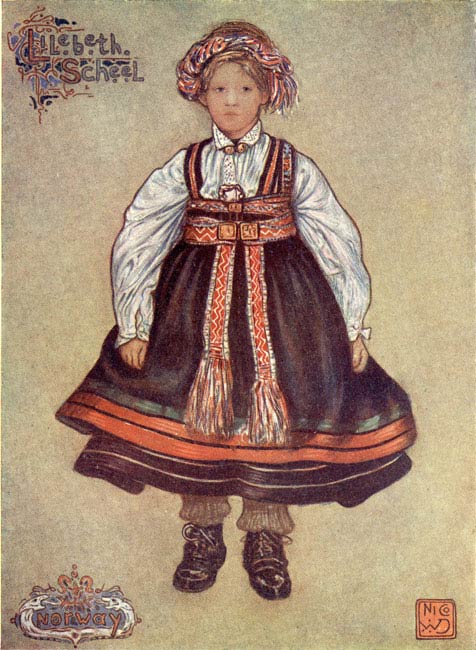
A LITTLE SÆTERSDALEN PEASANT GIRL
When a shoal of herring arrives, always
announced by whales and flights of birds who feed
on the small fish, telephones and telegraphs are set
in motion to summon the fishermen to the spot,
and to order barrels and salt for the packing of
the fish. These are sent as speedily as possible by
special steamers. When the shoal approaches the
coast, an immense net encloses it as completely
as possible. The fish are massed so compactly that
a boat crossing the shoal is raised by them.
The brilliancy of their scales as they dash about,
almost on the surface of the water, is dazzling.
Landed, they are immediately split open, cleaned,
salted, and packed for transportation.
Whale fishing is carried on to some extent off
the north of Norway. On the little island of
Skaaro there is a building where whale oil is
prepared for use. From afar off the sickening
smell announces the industry of the island: repulsive
morsels of greasy débris float on the surface
of the water. At the landing place the rocky
beach is so covered with grease that it is difficult
to walk without falling. A friend arrived just as
a whaler appeared on the horizon, dragging after
her the carcase of an enormous whale, weighing
seventy-five thousand kilogrammes. Such an
animal will give about fifty thousand pounds'
weight of oil, and will bring the captors between
£280 and £300. Such a giant requires for his
daily meal twenty or thirty tons of fish. To take
them he opens his jaws, and closes them on water
and fish alike; he swallows the fish, allows the
water to filter through the curious formation of his
mouth, and then squirts it up like a fountain
through an opening in the skull. It is this jet of
water which often causes his ruin, by indicating his
position to the watchful whalers. On the boat
which is chasing him is a cannon, loaded with an
enormous harpoon, which is attached to the ship
by a long rope wound round a pulley. The extremity
of the harpoon is armed with an explosive
bomb. When the whale appears the harpoon is
shot at it. Following its instinct of self-preservation,
it dives deep. The rope gives out rapidly.
When it is entirely unwound it naturally pulls
against the harpoon, the forked ends of which,
in the resistance, tear the flesh of the animal.
As a final result the bomb bursts in the body of
the whale, and generally wounds it mortally. The
corpse floats on the surface; it is attached to the
boat and towed to the station, where it is cut up.
The fat produces a large amount of oil; the whalebone
is a productive article of commerce; and
most of the remainder of the animal is converted
into manure.
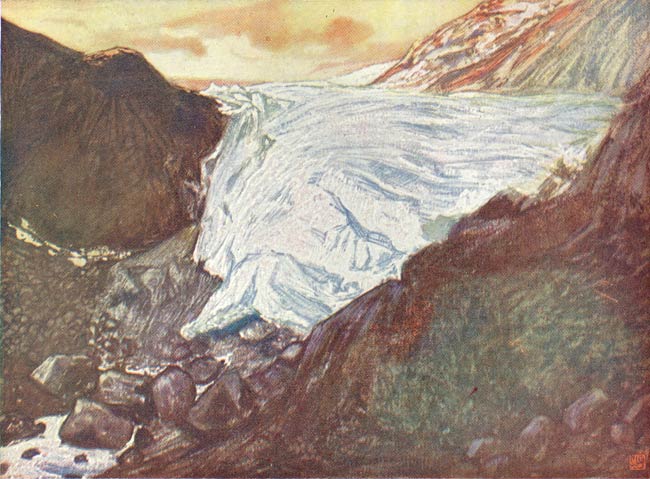
BUERBRÆ, ODDE HARDANGER
It is on account of the great importance and
interest which we in England attach to the salmon
fishing that I do not dare to deal with it, except to
make an apology that any book on Norway should
be without at least a chapter on this splendid sport.
Though the accomplished angler is allowed to
relate fish stories without interruption from an
absolutely incredulous audience, the remarks of
an inexperienced outsider would, I fear, not be
received with equal docility. I am sure that an
angler is born, not made: for, though I am ignorant
on the subject, all my life I have listened to
enthusiastic fisherman's talk, and was brought up
in a nursery in which were "skied" various victims
of my father's prowess as an angler.
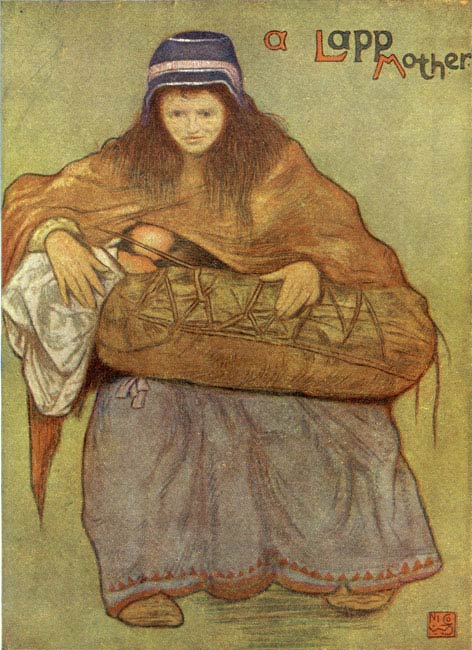
A LAPP MOTHER AND CHILD
Since the beginning of my book I have learnt so
much about the Lapps that I must enlarge on my
borrowed history of them in Chapter VIII. The
Lapps are nomadic on account of their reindeer,
and it is following these animals where they
choose to roam in search of food that takes them
wandering all over the northern half of Norway.
There are only two Lapp villages—Karasjok, in
Finmarken, and Kontokeimo, near the Russian
frontier. The permanent residences consist of
cabins built of turf, stones, or small tree-trunks.
These huts are round and have one opening in the
top, where the light penetrates and the smoke
comes out. In the middle of the hut a fire is kept
continually burning, with a big cauldron hanging
over it, suspended by a chain. The members of
the family and their servants, if they have any,
sleep on either side of the fire. The Lapps are
small, in great contrast to the Norwegians of this
region, who average over six feet in height. The
children are often exceedingly pretty; but they
soon lose their charm and become ugly, and are
not rendered more attractive by their dirty habits.
All their garments are made of reindeer skin, and
the women add to these various silk shawls and
handkerchiefs brightly coloured; by the quantity
and the quality of these one may judge of their
rank and richness. The Lapps are supposed to
share a common origin with the Magyars of
Hungary, though these, if they recognise the
relationship, cannot feel flattered. It is certain
that the Lapps were the first inhabitants of
Norway. In appearance they are unprepossessing.
They have small eyes, very low foreheads, flat
noses, and thick-lipped mouths. Like the
Hungarians, they are incredibly proud. They
despise everything that is not Lapp, and refuse
to allow their daughters in marriage to Norwegians.
(I should have thought that the Norwegians
would not have worried much about this restriction.)
They are all baptized in the Lutheran
Church; but that is as far as their religion goes
in most cases. They are unmoral and superstitious.
One might gather from the books of some of
Norway's great writers that the nation is on the
whole rather casual about morality. It would
appear that their religion, while condemning as
worthy of hell quite honest pleasures, looks with
indulgence on a certain moral laxity, which is
indeed so habitual that it passes uncriticised.
Among the very strictly religious population in the
south-west, a pastor would be quickly got rid of
if he forgot himself so far as to play the piano
or drink intoxicants; but this same people some
ten years ago venerated as a martyr one of their
clergy who, forced to confess in public crimes
against the morality of his own parishioners, was
consequently deposed by the Government. His
flock, of their own initiative, built him a magnificent
church, and, providing him with a liberal
sufficiency, retained him as the director of their
spiritual welfare.
Two Oratorians, visiting Norway some years ago
in a yacht, decided to spend a few days fishing at a
hamlet somewhere in the Sogne Fjord. They had
all the preparations for Mass with them, and wished
to take a small unused chalet as a chapel. The
farmer who owned the building was willing, and
negotiations were concluded on payment of a
nominal rent, when the farmer realised that my
friends were of the Old Religion. There was no
question of proselytism, as the idea concerned
only the two priests and their Catholic English
friends on the yacht; but all the countryside was
up in arms, and a few days later prominent personages
from Christiania had arrived on the scene to
put a stop to the possibility of such happenings.
In the meantime, however, my friends, little dreaming
of the importance attached to their doings, had
pursued their way along the coast, and were innocently
fishing elsewhere. At present the ecclesiastical
prejudice of the Norwegians is less marked,
though Jews are sedulously discouraged, and Jesuits
are forbidden the country.
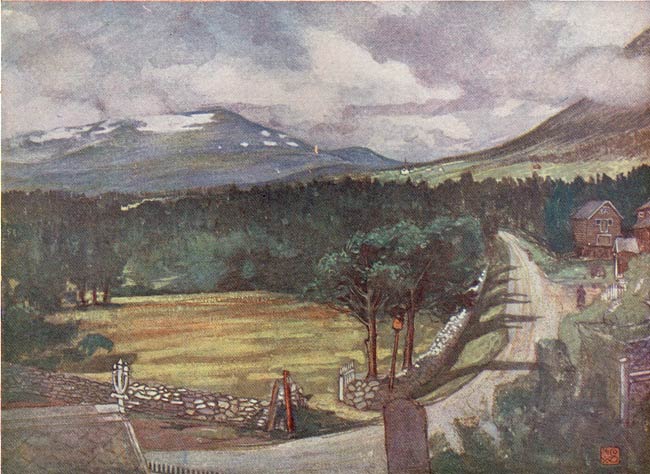
SNOW-CAPPED MOUNTAINS AT AUNE
Various hospitals are attended by Catholic
nursing sisters, who are in great favour with the
medical profession and with the patients who are
lucky enough to fall under their care.
All this time I am trying hard, by roundabout
means, to get back to Bergen, because I wish to fit
in, in proper context, a remark which I heard about
the town. It seems that I cannot get back there
legitimately, though I had hoped that the Sisters
of Charity would help me through with their
hospitals.
I was listening to the woes of the American
Consul in Bergen. He was descanting on the want
of entertainment and the absence of all things
which make an American's life possible in any
country on the globe outside his perfect native
land. I sympathised with him, and threw in a
little grumble of my own, having relation to the
weather. "O, the weather!" said my red-headed
friend, very hopelessly and crossly. "Why, sure,
if a Bergen horse sees a person without an umbrella,
he shies." This seems pretty feeble as I set it
down; but at the time the Consul was disconsolate
and far from wishing to amuse me, bored and
discontented. Thus his remark just happened to
tickle me: we both laughed until we cried, and felt
very much the better for the diversion.
Frequently, at times of ennui, we found diversion
in music, or in information about that art. The
lure, though perhaps it can hardly be called a
musical instrument, is a primitive means of conveying
sound. The herds on the mountains used
it to call their cattle together. It is said that no
two lures have tones exactly alike, and that the
cattle are able to distinguish and place the particular
sound of their guardian's lure. It is a wooden
trumpet, nearly five feet long, made of two hollow
pieces of birchwood, bound together throughout
the whole length with strips of willow. Besides
being used to call the cattle together, it is often
carried by travelling parties to avert the risk of
anyone being lost in the wilds. Its notes may be
heard at a great distance, and are rather harsh and
discordant, possessing none of the musical qualities
of the Alp horn used by the Swiss for the same
purpose. Grieg composed charming music for a
song called "The Princess." The words led me to
suppose that the lure is rather a fascinating instrument;
and the above description rather disillusioned
me, until I decided to allow a good deal for poetic
licence.
The Norwegians are exceedingly musical. Their
national music gives wonderful expression to their
moods. Almost invariably in the gayest pieces
one catches here and there a pathetic little droop
which gives a very particular character to Norwegian
music. In the country the post of fiddler
is handed down from generation to generation,
together with certain airs which are looked upon
as family property; but official fiddlers are by
no means the only musicians in the district. These
are found in every family, dividing their favours
between the violin and the guitar. The organist
L. Lindeman did great service to his country by
collecting and preserving hundreds of national
ballads, dances, and hymns, which had lived only
in the ear and the soul of the people, and thus
were lost entirely to the outer world. The oldest
of these songs are the sagas, sung traditions that
have been handed down from immemorial ages.
They recount the heroic exploits of the Vikings
and warriors of heathen times. Many ballads
tell of the beautiful huldre, of the fay who
presages the destruction of fishermen, of the water
sprite, and of the brownies who, living underground,
are covetous of cattle. To gratify their taste, the
brownies help themselves to such as graze on the
mountains, but only if their guardian's eyes are
turned off his charges; they make dwarfs of the
beasts to enable them to enter crevices in the
ground, in order that they may descend to subterranean
passages. Many songs about these
malicious fairies do the maidens sing as they keep
their eyes carefully fixed on the herds, to prevent
their being stolen in like manner. Some of the
songs consist of hundreds of four-line verses, which
must surely be a hard test to the memory of the
singers. Sometimes two singers will have a duet
in such a song, singing verse after verse alternately.
He whose memory, or, in default of memory,
invention, fails him first is loser.
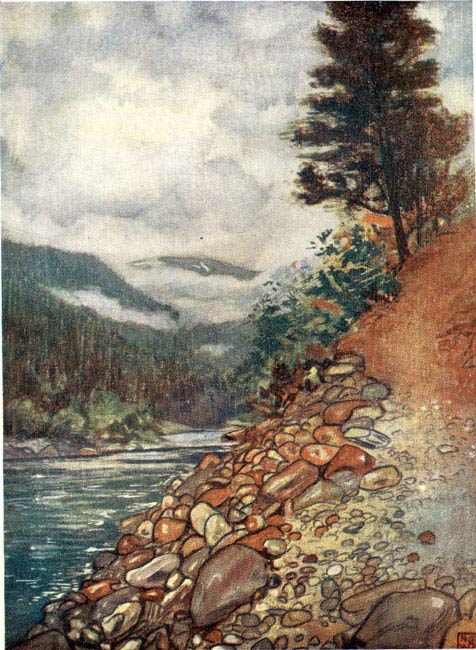
RIVER AT GJORA
The Norwegian national dances have in their
melodies and rhythms a bold and natural character
which gives them considerable worth. The
principal are the halling, a Hardanger solo
dance consisting of wild gyrations and vigorous
kicks at rafters of the room. He who kicks
highest is the champion. The other dance is the
springar, which is a dance for two, with no less
call for the display of muscular powers.
The two favourite instruments of the people, on
which all this music has been played for centuries,
are the langelik, which somewhat resembles a
zither, and the Hardanger violin. The langelik
has a long, flat body, with round holes, and at least
seven strings, which are struck with a plectrum.
The tone is rather weak, and the sound is somewhat
monotonous, as the possibility of producing
modulated sounds is almost entirely excluded.
The Hardanger fiddle is higher and more arched
in its build than the violin we know. The instrument
is decorated as much as possible, the scroll
being a dragon's head, or something equally
fantastic: and the body of the fiddle is richly carved
and ornamented with incrustations of ivory and
mother-of-pearl. Beneath the four upper strings,
which are tuned to suit the individual tastes of
the musician, and under the finger-board, there
are four, sometimes more, sympathetic strings of
fine steel wire. By the aid of this instrument the
people make wonderful sketches in music descriptive
of the beauty of dawn and the close of a
summer's day, with the birds' trills, or the huldre's
song, or the ringing of marriage bells. I have all
this from a Norwegian book, and from instruments
I have both seen and heard.
The best known of the modern music-makers of
the north is the great Norwegian Edward Grieg,
whose genius is familiar to all musicians the
world over. He was born in Bergen, and lives
there still, though he has travelled much in
Germany, Holland, and Italy. Another name
which we know well in this country is that of
Sinding, who is of the younger generation.
Norway has no regular opera; but the concerts
which are given in the beautiful National Theatre
are eagerly attended, and the programmes are
representative of the musical talent of Europe.
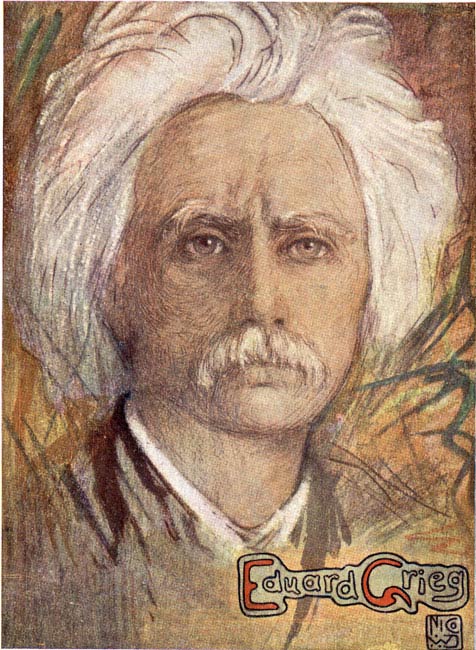
GRIEG
LEGENDS AND LITERATURE
CHAPTER X
LEGENDS AND LITERATURE
In Norwegian folk-lore the devil is a person with
many relations, who are called Jutuls. In favour
of the legends about them there is often some
circumstantial evidence. Does a mountain or a
rock bear similitude to the figures of human beings
or of animals? Be sure that the Norwegians will
have some tradition to account for the formation
by proving to you that such rocks or mountains
are the various creatures they resemble, bewitched.
In the voyage along the northern coast of Norway
from Trondhjem to the North Cape, the traveller
will pass seven extraordinary mountains called
"The Seven Sisters." A little farther he will see
a rocky island which from certain points of view
resembles a cloaked man on horseback riding into
the sea. The head and ears of the horse are
particularly natural.
The history of these islands is entertaining.
One of the devil's younger brothers, who lived in
this district, went on a visit to his seven sisters,
who, like himself, were of giant growth. The
sisters had with them a female cousin. With
this Jutula their brother fell in love, and, as is
customary in such cases, they swore eternal fidelity
to each other. Business called the Jutul home;
his beloved cousin was sent for to nurse a sick
brother. She fulfilled this duty to admiration, and
in the weakness of his convalescence her brother
listened to the story of her love and promised her
that she should wed her Jutul cousin. On his
complete recovery he became less amenable, and,
ignoring his promise, insisted that his sister should
wed one of his dissolute companions. It is said
that the Jutula's chief objection to this man was
that he smelt strongly of tobacco; but I think that
this must be embroidery, as my story is older than
the use of tobacco. In any case, her refusal was
absolute, and the brother was obliged to employ
malignant magic. All the messengers from the
Jutul, loving and beloved by his sister, were turned
into rocks before they could reach her ear. The
amorous Jutul was not aware that his beloved had a
brother, or any other relation, and, concluding that
she was the last of her race, believed also that it was
she who had petrified his messengers. Wrathful,
and having as his birthright an unerring aim, he
mounted his steed and shot from his cross-bow a
bolt at the dwelling of the Jutula. The perfidious
brother was bathing at the time, and, presumably
for the purposes of the story, he wore a sou'wester.
The bolt, shot from seventy miles' distance, passed
through the hat, and carried away a portion of the
victim's skull; then, skimming the water, it pierced
the heart of the fair one. She knew that only her
lover had this unerring aim, and, thinking him
faithless and cruel, used her dying moments in the
exercise of her hereditary power, and petrified
herself, her lover, his horse, and the floating
sou'wester. There they remain to this day.
Overlooking the scene of sorrow stand the seven
sisters of the misguided lover, petrified with horror
at the fate of their relations. The distance between
the various islands is considerable; but it must be
remembered that we tell of giants.
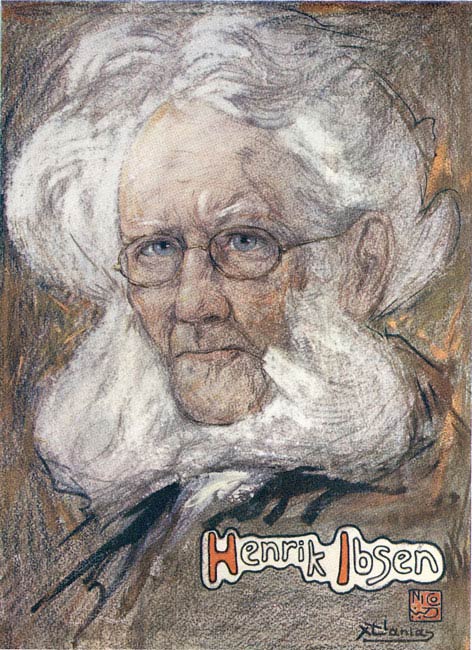
HENRIK IBSEN
Norwegian geography abounds in spots such as
these, to which are attached legends; and in no
country is the folk-lore more rich and varied. The
charming story-teller, Asbjornsen, and his friend
Bishop Moe, collected many delightful fairy-tales,
mostly traditional, but eked out by their own
imaginations. These stories are entrancing, and
at the time when they were first given to the
public they awoke a romantic tendency in
Norwegian literature. They had a great influence
on the work of Joseph Welhaven, contemporary
with the great Weigeland, who died at this time.
Welhaven had been rather overshadowed by his
rival, who, for the part he had played in political
struggles, was idolised as the people's hero. Also,
his work had been too much influenced by the
great Germans who were his contemporaries. The
charming figures in the fairy-tales of his country
gave him inspiration for wonderful romances with
the genuine Norwegian ring and subjects taken
from national life. Asbjornsen, however, is more
than a retailer of folk-lore. He frames his tales in
description of the country in which he has found
them on the lips of the people, and thus produces
vivid pictures of peasant life. The sister of Henrik
Weigeland, Camille Collett, during her widowhood
burst forth as a literary genius. Apart from her
talents as a writer, she was one of the pioneers of
the women's movement in Norway, which country
has been more influenced by this agitation than
any other European State. Immense importance
is attached to it; the great geniuses Ibsen and
Bjornson show much interest in the moral side of
the question; and all Norwegians are very eager to
discuss the subject, which is far too large and
complicated for myself.
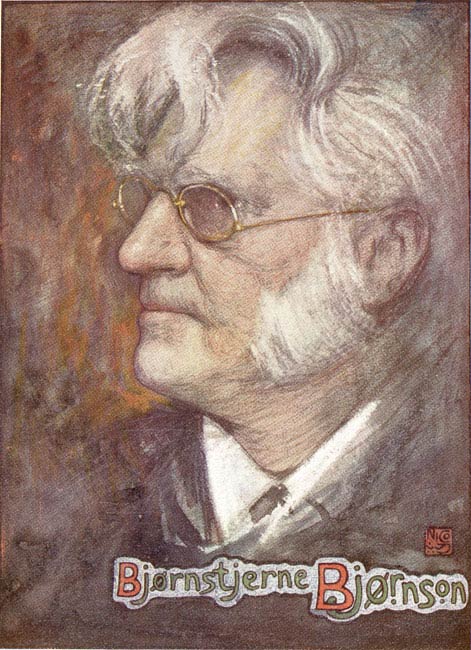
BJORNSTJERNE BJORNSON
Ibsen is best known as a playwright. Indeed,
from the time he succeeded in drama all other
interests were put aside. The Norwegian Government
provided him, at the age of thirty-six, with
pecuniary aid to enable him to travel. It was in
Rome that he wrote two of his greatest plays,
Peer Gynt and Brand. To-day his literary
activity has ceased, and all who will may see the
great man seated at a window of his flat in
Christiania almost any time during the livelong
day.
Bjornstjerne Bjornson is still producing. He
has written delightful romances; but for the last
few years he, like Ibsen, has devoted himself to the
stage. It is interesting to note that the splendid
National Theatre in Christiania is managed by the
writer's eldest son. His plays and those of Ibsen
are magnificently acted, and always received with
enthusiastic appreciation by the Norwegian public,
which gives all its great men a splendid meed of
appreciative recognition—how well deserved it is,
the whole world will acknowledge. The translated
commentary on the Norwegian literature of the
last fifty years makes me feel that I would give
everything for a knowledge of the language
sufficient to let me enter into the treasure-house
of untranslated genius.
Many of our modern authors are translated
into Norwegian. I noticed that every book-shop
window contained caricatures of Mark Twain
and translations of his works. Surely there was
some particular reason for this celebrity of an
American humourist in Norway over and above
the excellence of his work, which one would
have thought difficult to do justice by in
translation?
German books form a large part of the stock-in-trade
of the Norwegian bookseller. The German
language is very generally known—much more
so than either French or English. In this and
many other things it is plainly to be seen that
there is much good feeling between Germany and
Norway.
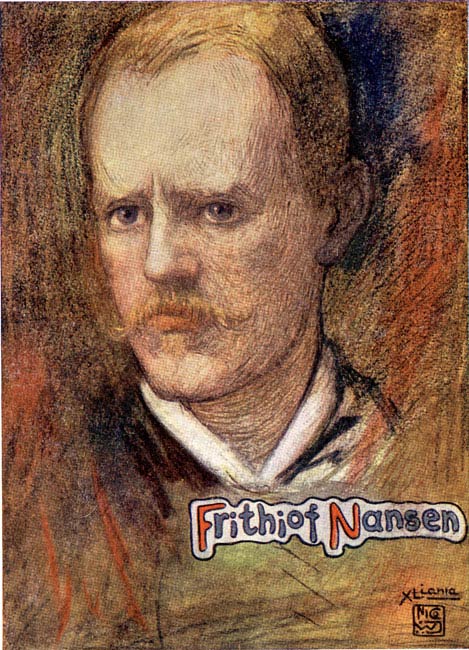
FRIDTJOF NANSEN
Public baths are to be found all over Norway—in
some places are still found the badstuer. These
are primitive Turkish baths, timber rooms heated
with red-hot stones. Water is poured on the
stones, and scalding steam is produced. I read
in an old book on Norway an account by an
American traveller of a visit to such a bath. He
appears to have been rather a popular person
among the Norwegian peasants, and was invited
one Saturday in the depth of winter to assist at the
general ablution. He relates with much amusing
comment how all the bathers ran from their dwelling-places
to the "bath chamber" in what he calls
"the costume of Paradise." This in the depth
of winter! Determined to do the whole thing
properly, he followed their chilly example. At
the bath, the whole company sat round the room
on a sort of shelf. When they were thoroughly
well steamed they wended their way back to their
respective houses in the same lack of costume.
There was no discrimination of sexes.
The writer speaks in high praise of the simplicity,
innocence, and cleanliness of the people. There
is in all writings on Norway a unanimity as to
their good qualities. For my own part, the
points about them that impressed me most were
their absolute honesty and the complete absence
of servility. While any Norwegian is delighted to
show politeness to the stranger, and even to take a
good deal of trouble in helping him on his way,
all these attentions arise from a supreme feeling of
courtesy and rarely from hope of reward. Anyone
wishing to have particular information as to a
subject concerning the country will be met on all
sides with practical offers of assistance. He will
find books relating to his subject showered upon
him, and kind offers to accompany him and show
him practical illustrations. This generous spirit,
which has its source in love of the native land,
is nowhere more marked than in such an establishment
as Bennet's, the Thomas Cook and Sons of
Norway. This, one would say, is a strictly commercial
affair; yet there is no end to the trouble
Bennet or his staff will take to encourage visitors
to see as much as possible of their lovely country
in a pleasant way, and this without remuneration
of any kind.
Writing from Norway in 1820, a visitor says—"There
is no country which accords better with
my taste than Norway, nor is there any cast of
inhabitants or people that I have visited for
whom I have more esteem. Here at least are the
true haunts of simple natures, and it has been one
of the pleasantest passages of my life to dwell
among the mountains. The Norwegians are a
virtuous race; patriarchal simplicity, uprightness
and hospitality, kindness and piety, are their
characteristics. They entertain great reverence
for their laws. In many other countries the laws
are not obeyed on one uniform principle; here,
on the contrary, the people respect them from
principle."