“We’ll see nae mair the sea banks fair,
  And the sweet grey gleaming sky,
  And the lordly strand of Northumberland,
  And the goodly towers thereby.”

  —A.C. Swinburne.
Wild and bleak it may be, hard and cruel at times it undoubtedly is,
but, nevertheless, this north-east coast of ours is at all times
inspiring, whether half-hidden by storm-clouds, its cliffs and hollows
lashed by the “wild north-easter,” or seen calmly brooding in the warm
haze of a summer’s day, its grey-blue water smiling beneath the
grey-blue sky, and its stretches of sand and bents edging the sea with a
border of gold and silver.
In keeping with either mood of nature, the ancient Priory of Tynemouth,
standing on the sandstone cliffs on the northern bank of the Tyne,
rearing its grey and roofless walls above the harbour mouth, strikes a
note that is symbolic of the Northumbria of old and the Northumberland
of to-day—the note, that is, of the intimate commingling of the romance
of the warlike past and the romance of the industrial present. Here,
above the mouth of the river on which so many of the most noteworthy
advances in industrial science have been made, and out of which sail the
vessels which are often the last word of the moment in marine
engineering and construction, stand calmly looking down upon them all
the fragments of a building which was a century old when John signed
Magna Charta, and which stands upon the site of another that had already
braved the storms of nearly five hundred years.
Looking upon the Priory of St. Mary and St. Oswin we are carried back to
the days when Edwin, the first king of Northumbria to embrace
Christianity, built a little church here, in which his daughter took the
veil. King Oswald had the first wooden structure replaced by a stone
one; and here, in 651, the body of another good king—Oswyn—was brought
for burial from Gilling, near Richmond in Yorkshire, where, disbanding
his army, he sacrificed his cause and his life to Oswy of Bernicia, with
whom he had been about to fight.
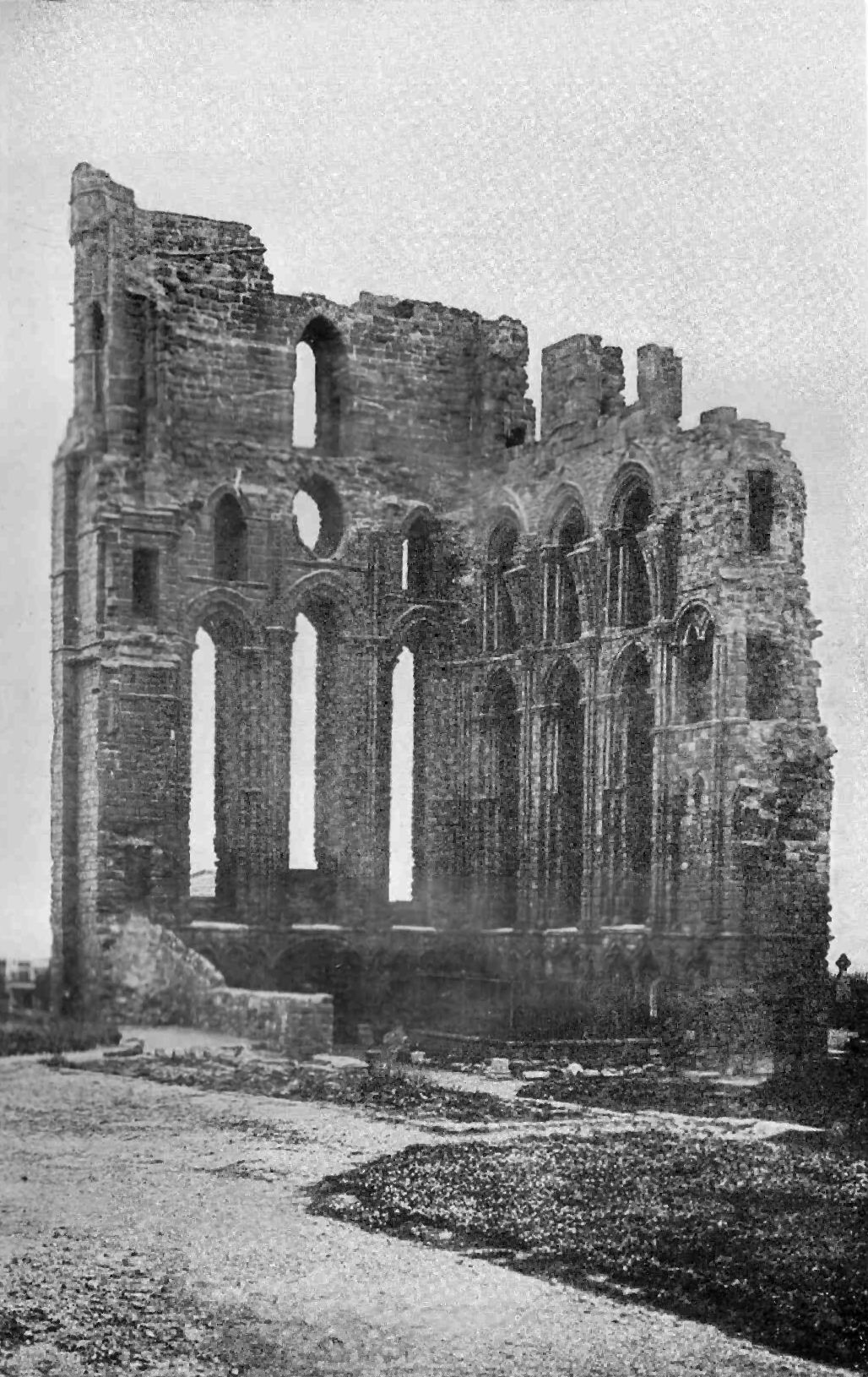
The Priory, Tynemouth.
When the pirate ships of the Danes swept down upon our coasts, the
Priory of St. Oswin, conspicuous on its bold headland, could not hope to
escape their ravages. It was destroyed by the fierce invaders; but King
Ecgfrith[1] of Northumbria restored the shattered shrine. Again, in the
year 865, it was sacked and burnt, and the poor nuns of St. Hilda, who
had already fled from Hartlepool to Tynemouth hoping to find safety,
were ruthlessly slain and earned the crown of martyrdom. It was again
restored; but, five years later, the destroying hands of the invaders
fell on the place once more, and for two hundred years the Priory stood
roofless and tenantless. After the Norman Conquest, Waltheof, Earl of
Northumberland bestowed it upon the monks of Jarrow. The rediscovery of
the tomb of St. Oswyn in 1065, had gladdened the hearts of the monks,
and forthwith the monastery was reared anew over the ashes of its former
self.
Mowbray, the next Earl of Northumberland, re-endowed the building. He
had quarrelled with the Bishop of Durham, so in order to do him a
displeasure, he made Tynemouth Priory subordinate to St. Albans instead
of to Durham and brought monks from St. Albans to dwell there. The new
buildings were finished in 1110, and the bones of St. Oswyn enshrined
within them, the right of sanctuary being extended for a mile around his
resting-place. This right, however, was already in existence, and had
been appealed to in 1095 by Mowbray himself, who fled here pursued by
the followers of William Rufus, against whom he had rebelled. The King’s
men disregarded the sanctuary right, captured Mowbray, and sent him
prisoner to Durham[2].
In later days the queens of Edward I. and Edward II. visited Tynemouth
Priory; and it was from Tynemouth that the foolish King Edward II. and
his worthless favourite Piers Gaveston fled from the angry barons to
Scarborough. In the reign of Edward III., after the battle of Neville’s
Cross, David of Scotland was brought here by his captors on his way to
Bamburgh, from whence he was sent to the Tower.
At the dissolution of the monasteries by Henry VIII. the Priory was
inhabited by eighteen monks with their Prior. They bowed to the King’s
decree and left the monastery; but the church continued to be used as
the parish church until the days of Charles II., when Christ Church was
built.
The Priory has many times formed the subject of pictures by famous
artists, the best known being that of no less a genius than J. M. W.
Turner; and its picturesque ruins are a well-known landmark to the
hundreds of voyagers who pass it on their journeys, outward or homeward
bound. Within the last few years the Priory has been in some measure
repaired and restored.
There is but little left of Tynemouth Castle, which was built as a
protection for the monastery against the attacks of the Danes. It stands
in a commanding position on a neighbouring cliff, and is now used as
barracks for garrison artillery corps. During the days when Scotland
harried the English borders, the Priors of Tynemouth maintained a
garrison here; and later, in Stuart days, Charles I. visited the North,
and the fortress was strengthened just before the outbreak of the Civil
War. It was captured, notwithstanding, by Leslie, Earl of Leven, after
he had left Newcastle. Colonel Lilburn, left in charge as governor,
shortly afterwards avowed himself on the side of King Charles; but he
speedily paid for his change of allegiance, for the Castle was re-taken
by a force from Newcastle under Sir Arthur Hazelrigg, and Lilburn lost
his life in the fight. The Castle has long been used as a dep ôt for the
storage of arms and ammunition. Behind the Spanish Battery which
commands the entrance to the Tyne stands a statue of the famous
North-countryman, Admiral Collingwood.
Connected with Tynemouth, by the fact that a small chantry belonging to
the Priory once stood there, is St. Mary’s Island. One may walk
unhindered at low tide across the rocks to this favourite place, but
where the chantry stood there is now a lighthouse with a powerful
lantern, flashing its welcome light to the seafarers nearing the mouth
of the Tyne, and extending
  “To each and all our equal lamp, at peril of the sea,
  The white wall-sided war-ships, or the whalers of Dundee.”
Between Tynemouth and St. Mary’s Island lie Cullercoats, Whitley Bay,
and Monkseaton, and together these places make practically one extended
seaside town, stretching for three or four miles along the sea-front,
and joined by a fine parade which leads to open links at Monkseaton. Of
these places Cullercoats is most noteworthy. This picturesque fishing
village, with quaint old houses perched in every conceivable position on
the curve of its rocky bay, is, needless to say, a favourite camping
ground for artists. The Cullercoats fishwife, with her cheerful
weather-bronzed face, her short jacket and ample skirts of blue flannel,
and her heavily laden “crees” of fish is not only appreciated by the
brotherhood of brush and pencil, but is one of the notable sights of the
district. At Cullercoats is struck a note of the most modern of modern
achievements—the Wireless Telegraphy Station (225 feet); and here, too,
is situated the Dove Marine Laboratory, looked after by scientists on
the staff of the Armstrong College at Newcastle.
In fine weather the crowds which pass and repass along the top of the
bold cliffs which overlook the fine stretch of sands between Cullercoats
and Monkseaton show how many hundreds of Northumbria’s busy workers
enjoy the fresh breezes from the sea on this pleasant and bracing coast.
Out at sea, opposite the Parade, vessels built in the busy shipyards on
the Tyne may be seen doing their speed trials over the measured mile.
The Peace of St. Oswyn may, in fact, be said to brood over Tynemouth,
even in these days, for it is an increasing custom for those who can do
so to remain in Newcastle and other busy centres of toil only during
business hours, and to leave workshop and office every evening for their
home by the sea: while the tide of noisy, happy, boisterous
excursionists has rolled on to Whitley Bay, leaving Tynemouth to its
old-time sleepy content. Northward to Hartley and Seaton Sluice the
cliffs are very fine. Hartley, with its bright-looking red-tiled houses,
once belonged to Adam of Gesemuth (Jesmond) who lived in the reign of
King John. Coming down to modern times, about thirty years ago a gallant
Hartley man, Thomas Langley, rescued two successive shipwrecked crews on
the same day, in one case allowing himself to be lowered over the cliffs
at a terrible risk in the furious storm.
Seaton Sluice belongs to the ancient family of the Delavals, whose
house, Delaval Hall, may be seen not far away, peeping from amongst the
trees which surround it. Seaton Sluice owes its name to the Delaval who
placed the large sluice gates upon the burn, in order to have a strong
current which, in rushing down to the sea, would be able to wash the
mouth of the stream clear from the silt and mud brought in by the
incoming tide. A later baronet, Sir John Hussey Delaval, made the
cutting through the solid rock which is so striking a feature of the
harbour. It was ready for the entrance of vessels in March, 1763.
Delaval Hall is now owned by Lord Hastings, the present representative
of the Delavals, which family became extinct in the male line early in
the nineteenth century. The last Delaval, a very learned man, was buried
in Westminster Abbey in 1814. The Hall was built for Admiral Delaval in
1707 to the design of Sir J. Vanbrugh, who also designed Blenheim
Palace, given by the nation to the great Duke of Marlborough about the
same time.
Hartley Colliery, about half a mile away, has a sad interest as being
the scene of the terrible accident in 1862, when a number of men and
boys were imprisoned in the workings owing to the blocking up of the
only shaft by a mass of d ébris, caused by the fall of an iron beam
belonging to the pumping engine at the pit-head. Before the shaft could
be cleared and a way opened to the workings, all the poor fellows had
died, overcome by the deadly “choke-damp.” Joseph Skipsey, the pitman
poet, in a simple ballad, tells the pathetic story.
  “Oh, father! till the shaft is rid,
  Close, close beside me keep;
  My eyelids are together glued,
  And I,—and I,—must sleep.”

  “Sleep, darling, sleep, and I will keep
  Close by—heigh ho.”—To keep
  Himself awake the father strives.
  But he—he, too—must sleep.

  “Oh mother dear! wert, wert thou near
  Whilst—sleep!” The orphan slept;
  And all night long, by the black pit-heap
  The mother a dumb watch kept.
From here, northward, the coast is rather dull and uninteresting,
although the sands are fine, until we reach Blyth, at the mouth of the
little river of the same name. This town is growing rapidly in size and
importance; the export of coal has greatly increased since the harbour
was so much improved by Sir Matthew White Ridley, and now totals some
millions of tones a year. The river Wansbeck not far north of the mouth
of the Blyth, in the latter part of its course flows through a district
begrimed by all the necessary accompaniments of the traffic in “black
diamonds,” and reaches the sea between the colliery villages of Cambois
and North Seaton.
On the point at the northern curve of Newbiggin Bay stands Newbiggin
Church, and ancient building, whose steeple, “leaning all awry,” is a
well-known landmark for sailors. The site of this church is in danger
of being undermined by the waves, and, indeed, part of the churchyard
crumbled away many years ago; but such defences as are possible have
been built up around it,—and the danger averted for a time. Newbiggin
itself is a large fishing village and an increasingly popular holiday
resort, for it possesses not only good sands but a wide moor near at
hand which provides one of the best of golf courses; and, also, a short
distance along the coast, are the attractive Fairy Rocks.
Newbiggin was a town of some importance in Plantagenet days, with a busy
harbour, and a pier; and in the reign of Edward II. it was required to
contribute a vessel towards the naval defence of the Kingdom.
Northward from Newbiggin Point is the magnificent sweep of Druridge Bay,
stretching in a fine curve of ten miles or more to Hauxley Haven. Here,
the sands of a warm golden colour, the wind-swept bents of silvery-grey,
and the vivid green of the grassy cliff tops edge the curve of the bay
with a line of bright and delicate colour, only thrown into greater
relief by the brown reefs and ridges which stretch out from the rocky
shores, and by the deep blue-green of the waves rolling inshore in long
majestic lines, to break into hissing foam on the sharp reefs, or slide
smoothly up the yellow sands in the centre of the bay. Above, beyond the
grassy tops of the cliffs, stretch deep woods, with the old pele-tower
of Cresswell looking out from amongst the trees, fields many-coloured
with their burden of varying crops, and wide lonely moors, where one may
walk for half a day without hearing any sound save the wild screaming of
sea-birds, or the whistle of the wind, with the low boom of the waves
below sounding a deep-toned accompaniment. The bay is not always so
peaceful, however, and many wild scenes and terrible shipwrecks have
taken place here, as everywhere along our wild north-east coast. The
Bondicar rocks, by Hauxley, and the cruel spikes of the reef at Snab
Point, near Cresswell, have betrayed many a gallant little vessel to her
doom. Not, however, without bringing on many an occasion proof of the
courage which is shown as a matter of course by the fisher folk on our
coasts. At Newbiggin, and Cresswell, for instance, deeds have been done,
which, in their simple unassuming heroism, may be taken as typical of
the hardy race which could count Grace Darling among its daughters.
About thirty years ago, a ship drove ashore off Cresswell one bitter
night in January, and the fisher folk crowded down to the shore,
watching with sorrowful eyes the hapless crew clinging to their
unfortunate vessel, which was slowly being broken up by the waves. There
was no lifeboat at Cresswell then, and all the men of the village,
except the old men who were past work, had gone northward, when the
oncoming storm prevented their return. The women and girls heard the
cries of the schooner’s crew, and mourned to each other their inability
to help. But one gallant-hearted girl, named Peggy Brown, cried out, “If
I thowt she could hing on a bit, I wad be away for the lifeboat.” But
between them and Newbiggin, the nearest lifeboat station, the Lyne Burn
runs into the sea, and spreads widely out over the sands; and the older
people told Peggy she could never cross the burn in the dark. She set
off, however, the thought of the drowning men hastening her on. For four
miles she made her way in the storm and darkness, partly along the
shore, scrambling over rock’s, and wading waist-deep through the Lyne
Burn and one or two other places where the waves had driven far up the
sands, and partly across Newbiggin Moor, where the icy wind tore at her
in her drenched clothing. She pressed on, however, and managed to reach
the coxswain’s house and give her message. The lifeboat was immediately
run out, and the men reached the wreck in time to save all the crew
except one, who had been washed overboard.
On another occasion one of the fishermen, named Tom Brown, was preparing
to go out, with the help of his two sons, in his own fishing coble to
the aid of a ship in distress on the reef. A carter had come down to the
beach, the better to watch the progress of events, and, terrified by the
thundering waves, his horse took fright, and in its plunging drove the
cart against the little boat, making a hole clear through one side. “Big
Tom,” as he was generally called, merely took off his coat, rolled it
into a bundle and stuffed it against the hole. Then he beckoned to
another fisherman, saying to him “Sit on that.” The man clambered in,
and without the loss of another minute these four heroes set off to save
their fellow creatures’ lives, with a broken and leaking boat in a heavy
sea. And they did it, reaching the brig only just in time, for it went
to pieces a few minutes after the shivering crew had been safely landed.
Incidents like these, which could be multiplied indefinitely, bring a
glow of pride to the heart, and a reassuring sense that the degeneration
of the race is not proceeding in such wholesale fashion—in the country
districts, at any rate—as the pessimists would have us believe.
At the northern extremity of Druridge Bay is the little fishing village
of Hauxley, with the chimneys and pit-head engines of Ratcliffe and
Broomhill Collieries darkening the sky to the south-west. Passing the
Bondicar rocks and rounding the point we enter the “fairway” for
Warkworth Harbour and Amble, where a brisk exportation of the coal of
the neighbourhood is carried on.
Lying out at sea, opposite Amble coastguard station, the white
lighthouse on Coquet Island keeps watch over the entrance to the
harbour. Some of the walls of the monastery, which stood on the island
in Saxon days, can now be seen forming part of the dwelling of the
lighthouse keeper. For many generations, too, hermit after hermit went
to dwell on this tiny islet, and St. Cuthbert himself is said to have
inhabited the little cell at one time. The island was captured by the
Scots in the Civil Wars of King Charles’s reign, and held by them for a
time.
The situation of Amble, at the mouth of the Coquet, has been looked upon
as convenient from very early days, for there are signs which tell us of
a population here at an early period. Several cist-vaens, or ancient
stone coffins, have been found near the town, and a broken Roman altar
was unearthed in the neighbourhood. The monastery which stood here, like
that on Holy Island, was, in later times, inhabited by Benedictine
monks, who were under the authority of the Prior of Tynemouth. William
the Conqueror gave the then Prior the right to collect the tithes of the
little town.
A short distance from Amble, and practically encircled by the Coquet
which here makes a wide sweep, we come upon Warkworth, prettiest of
villages, combining the beauties of sea-shore and river scenery, and
rich in the possession of that romantic castle, the ruins of which carry
the mind back to Saxon times; for they stand on the site of an older
fortress erected by Ceolwulf, a Saxon King of Northumbria. He was the
patron of Bede, who dedicated his “Ecclesiastical History” to his royal
friend. Ceolwulf built both the fortress and the earliest church at
Warkworth, and a few stones of this latter building are still to be
seen. In 737, two years after the death of Bede, this royal Saxon laid
aside his kingly state and became a monk on Lindisfarne,
  “When he, for cowl and beads, laid down
  The Saxon battle-axe and crown.”
It was when the castle was bestowed by Edward III. upon Lord Percy of
Alnwick that it became, for more than two hundred years, the chief
residence of that illustrious family; becoming in the next reign of
historical value as the home of that Hotspur whose valour and gallantry
made Henry IV. envy the Earl of Northumberland, in that he “should be
the father of so blest a son.” In Act II., Scene 3 of “Henry IV.,” Part
II., Shakespeare has laid the scene at Warkworth Castle, where Hotspur’s
wife, troubled by her lord’s moody abstraction, tries to win from him
the reason of his secret care. And after the battle of Shrewsbury,
Rumour, flying with the news of Hotspur’s death, says:—
  “Thus have I rumoured through the peasant towns,
  Between the royal field of Shrewsbury
  And this worm-eaten hold of ragged stone,
  Where Hotspur’s father, old Northumberland,
  Lies crafty-sick.”
Two years after this, the castle was besieged by Henry IV. himself, and
surrendered to him after a brief bombardment by the newly invented
cannon. The keep was re-built by Hotspur’s son, after the family
possessions had been restored to him by Henry V., and it is now the only
remaining part of the castle which is almost perfect. One of the
half-ruinous towers remaining is called the Lion Tower, from the
sculptured lion on its walls; while another rejoices in the curious name
of Cradyfargus. A strange story is told of a blue stone to be seen in
the courtyard of the castle. Many years ago, so runs the tale, one of
the custodians of Warkworth Castle dreamed three nights in succession
that a large treasure was concealed beneath a blue stone in a certain
part of the castle grounds. He told this dream to a neighbour, and after
allowing two or three days to pass, finding the dream constantly
recurring to his mind, he thought he would go to the place indicated,
and see what he could find. To his disappointment, however, he
discovered that some one had been there before him; a large hole had
been dug, and on the edge of it lay the blue stone.
Needless to say, the hole was empty, nor could the keeper discover
anything about the treasure in the neighbourhood. It is said that a
certain family in the village became suddenly rich; and, many years
afterwards, a large and ancient pot, supposed to have been that in which
the buried treasure had been contained, was found in the Coquet.
The main street of Warkworth leads straight up to the postern gate of
the castle, and many stirring sights have the successive inhabitants of
the little village looked upon, as the fortunes of the owners of the
castle waxed and waned throughout the many centuries in which the lords
of Warkworth played a notable part in the history of England. They saw
Henry Percy, entrusted with a share in the safe keeping of the country,
set out from Warkworth for Durham, to help in winning the victory of
Neville’s Cross.
They saw Hotspur’s force set out for the Cheviots to intercept Douglas
and his followers, which they did at Homildon Hill, near Wooler; and it
was the quarrel in connection with the prisoners taken on that day which
led Hotspur and his father openly to throw off their allegiance to
Henry IV., so that a few months later the peasants of Warkworth saw
their idolised young lord set out for what was to prove the fatal field
of Shrewsbury. They saw Hotspur’s father, the first Henry Percy to
receive the title of Earl, (a title which had been given him at the
coronation of Richard II.) set out with a brave force after Hotspur’s
departure; and they saw his return, almost alone, dejected and broken in
spirit, having learnt that the help so tardily given had come too late,
and the life of his gallant son was ended.
They saw the siege train of Henry Bolingbroke laid against the castle,
directed by Henry in person, provoked into these active measures by the
open rebellion of father and son, though Northumberland had tried to
make it appear that he was innocent of any treasonable act. After
capturing the castle, Bolingbroke bestowed it on his third son, John of
Lancaster, and the villagers saw the young prince riding in and out
among them daily so long as he made the castle his home.
Then, in the next reign, they welcomed the return of Hotspur’s son,
Henry, to the home of his fathers, restored to him by Henry V.; and,
within a short time, saw him bring home his bride, Eleanor Neville,
daughter of his friend and neighbour, the Earl of Westmoreland.
In the Wars of the Roses, Warkworth Castle saw many changes of fortune,
as the tide of victory flowed this way and that. The Percies were all
Lancastrians, though Sir Ralph Percy changed sides twice. The castle
fell into the hands of the Yorkists, and the great Earl of Warwick, the
“King-maker” himself, made it his headquarters for a time, while he
superintended the sieges of Alnwick, Dunstanborough, and Bamburgh, which
were all invested at the same time. Eventually, after the Wars of the
Roses concluded, Warkworth was restored, along with the other Percy
estates, to its original owners.
Finally, the inhabitants of the little village saw the church entered by
the Jacobites in 1715, when Mr. Buxton, chaplain of the little force,
prayed for James III. and Mary the Queen-mother; and General Forster,
dressed as a trumpeter, proclaimed King James III. at the village cross.
A few miles north from the mouth of the Coquet, the little Aln spreads
over the sandy flats near Alnmouth, and reaches the sea. It has changed
its course, for at one time it flowed to the south of Church Hill,
instead of to the north as at present. The town of Alnmouth, viewed from
the train just before entering Alnmouth Station, looks very picturesque,
especially if the rare sunshine of an English summer should be lighting
up the bay, bringing out the vivid red of the tiled roofs against the
grassy hills fringing the links which lie on their seaward side, and
lighting up, also, the yellow sands and long lines of sparkling wavelets
edged with white.
Alnmouth depends for its living on a fleet of fishing boats, and on the
numbers of visitors who seek its fresh breezes and inviting shores each
summer. Golfers, indeed, find it pleasant all the year round, as there
is only a scarcely appreciable interval in the winter months when their
favourite pastime cannot be followed on the breezy links. On Church
Hill, now crowned by a few old stones, once stood a Norman church,
dedicated to St. Valery, which, in its turn, occupied the site of an
older Saxon building, supposed to have been the church which Bede refers
to as being at Twyford, where a great synod of clergy was held in the
year 684, and Cuthbert appointed Bishop of Lindisfarne. It is a matter
of dispute whether this Twyford was Alnmouth or Whittingham, but the
two fords at Alnmouth seem to point to a decision in favour of that
place. The old Norman church, which fell into ruin at the beginning of
last century, was fired at by the famous pirate Paul Jones; the cannon
shot, weighing 68 pounds, missed the church, but struck a neighbouring
farm house, doing great damage.
The coast north of Alnmouth becomes rocky and wild, and very
picturesque, and the villages along the coast are being sought out by
holiday makers in increasing numbers, year by year. Boulmer, one of
these villages, was a famous place for smuggling in the old days, and
many an exciting scene and sharp encounter took place between the
smugglers and the King’s men. Not far away is Howick Dene, a lovely
little glen leading down to the sea from Howick Hall, the home of Earl
Grey.
Cullernose Point, a striking crag, is formed by the outcrop of a portion
of the Great Whin Sill, which from here can be traced to the south-west,
and thence right across the county.
At Craster, another fishing village and a favourite holiday haunt, is
Craster Tower, which has been the home of the family of Craster since
before the Conquest. Not far to the north is the famous Rumble Churn in
the rocks below Dunstanborough Castle, where the waves roll in and out
of the caves and chasms with weird and hollow rumblings. There is
another Rumbling Churn in the cliffs near Howick.
The famous divine of the Middle Ages, John Duns Scotus, was born in this
parish—that of Embleton; the group of buildings known as Dunston Hall,
or Proctor’s Steads, is supposed to have been his birthplace, and a
portrait of the learned doctor is to be seen there.
Dunstanborough Castle stands in lonely grandeur on great whinstone
crags, close to the very edge of the sea, and on the first sight of it,
Keats’ wonderful lines spring involuntarily to the lips:—
  “Magic casements, opening on the foam
  Of perilous seas, in faery lands forlorn.”
Forlorn, indeed, though not in exactly the sense conveyed by the poem,
is this huge fortress now; it abides, says Freeman, “as a castle should
abide, in all the majesty of a shattered ruin.” The primitive cannon of
the days of the Wars of the Roses began to shatter those mighty walls,
and, unlike Bamborough, it has never been strengthened since. Simon de
Montford once owned this estate, and the next lord of Dunstanborough was
a son of Henry III., to whom Earl Simon’s forfeited estate was given.
His eldest son, Thomas of Lancaster, took part with the barons in
bringing the unworthy favourite of Edward II., Piers Gaveston, to his
death. Under the King’s anger, Lancaster went away to his Northumbrian
estate, and began to build this mighty fortress, though he already owned
the castles of Kenilworth and Pontefract. In the Wars of the Roses,
Dunstanborough Castle was taken and retaken no less than five times, and
Queen Margaret found refuge here, as well as at Bamburgh; but apart from
these occasions, Dunstanborough has not taken nearly so great a part in
either local or national history as the other Northumbrian castles of
Bamburgh, Warkworth, and Alnwick, though greater in extent than any of
them. In 1538 an official report describes “Dunstunburht” as “a very
reuynous howse”; and the process of dilapidation was soon aided by
enterprising dwellers in the neighbourhood using the stones of the
forsaken castle to build their own homesteads.
From the castle northward curves Embleton Bay, in which, after having
been buried in the sand for ages, a sandstone rock was uncovered by the
tide, having on its surface, chiselled in rough but distinct lettering,
the name “Andra Barton.” Sir Andrew Barton, daring Scottish sea-captain
and fearless freebooter, was slain in a sea-fight off this part of the
coast, in the days of Henry VIII., by the sons of Surrey, one of whom,
Sir Thomas Howard, was Lord Admiral at the time, and so, in a measure,
responsible for the defence of the English coast. The loss of his brave
sea-captain and his “goodly ships” was one of the grievances in the long
list which led King James IV. to declare war against England, and led to
the fatal field of Flodden, in which Admiral Sir Thomas Howard and his
brother took part under the command of their father, the Earl of Surrey.
The wide sweep of grassy common beyond the sands in Embleton Bay is, in
summer time, covered with a profusion of wild flowers, chief amongst
them being the wild geranium, or meadow cranes-bill, whose
reddish-purple blossoms grow in such abundance as to arrest the
attention of every visitor. A little way back from the sea-shore, in the
middle of this wide space, lies the village of Embleton, which possesses
an ancient and interesting church, and a vicarage, part of which is
formed by an old pele-tower. Embleton would seem to have a reputation to
keep up in the way of famous churchmen. Duns Scotus has been already
mentioned; and one of the vicars here was a cousin of Richard Steele,
the essayist and friend of Addison; and he described the country squires
of his day in a paper which he contributed to the “Spectator” of that
date, 1712.
Another Vicar of Embleton, who lived here from 1874 to 1884, was Dr.
Mandell Creighton, the learned historian, who became Bishop of London.
The well-known journalist, W.T. Stead, was born in the parish of
Embleton, though his childhood was passed in very different
surroundings, in the narrow streets and grimy atmosphere of
Howdon-on-Tyne. His recent death on the ill-fated Titanic will be
fresh in the minds of all.
Newton-by-the-Sea is reached by a pleasant walk along the sea-shore. (It
is to be understood that in this journey along the coast we are moving
northward always). There is here a cheery-looking white-washed
coastguard station standing on the bold headland of Newton Point.
Past this point is Beadnell Bay, with green and grassy Beadnell just
beyond Little Rock. The small fishing harbour at Beadnell has the unique
distinction of being the only harbour on the east coast whose mouth
faces west, and the short pier, running inland from rocks to shore,
acts as a breakwater against the heavy easterly or southeasterly seas
and makes the harbour a safe anchorage for fishing craft or small
yachts. The rocks around this bay are very interesting, showing the
various strata very plainly, and containing many fossils. The striking
cliff called Ebbe’s Nook is supposed to have been named after the Saxon
princess Ebba, sister to King Oswald, and the ruins which were
discovered on the headland, to be all that is left of a chapel erected
to her memory.
At Seahouses is an extensive fish-curing establishment, a fact which
proclaims itself unmistakably as you near the village, especially if the
day chance to be at all warm. A little distance from the shore is
another fishing village, North Sunderland, and northward from Seahouses
is the inn called The Monkshouse, from the fact that it once belonged to
the community on Lindisfarne.
Bamburgh Castle, magnificently placed on a lofty crag rising
perpendicularly from the greensward on the west or landward side, and
almost as steeply from the sea which washes the north and east sides,
lies like a majestic lion on its mighty rock “brooding on ancient
fame.” The voices of children at play on the sands below sound faint and
far in the still air; the sea birds, with the summer sunshine flashing
on their outspread wings, sweep round and round; in the far distance a
trail of smoke low down on the horizon marks the track of a passing
steamer; and near at hand, southward a little way from the castle cliff,
the rocky islets of the Farne group lie drowsily asleep on the
gently-heaving swell of the grey-blue waters. Behind the castle lies the
pretty old-fashioned village with its quaint hostelries and grove of
trees; and from the higher parts of the new golf-links the player may
look round on a view which would be difficult to match, comprising as it
does, the Farne Islands and Dunstanborough to the south, and northward,
Holy Island, with its castle and abbey and the bluish haze of smoke
lying over Berwick; while, on the western skyline, on a clear day, may
be seen the rounded caps of the Cheviots.
The beginnings of Bamburgh take us back more than a thousand years, to
that long-ago summer of 547, when the cyuls (keels) of the marauding
Bernician chieftain Ida and his followers grounded on the shore of our
Northland, and the work of conquest began. Ida was not slow to grasp the
importance of such a commanding site as this isolated mass of basaltic
crag, and the rude stronghold which crowned it. It became in time a
formidable fortress, and remained for centuries the headquarters of the
kings of the North.
Here reigned Ida and his sons—six of them—for more or less short and
stormy periods, and Ethelric of Bernicia, who vanquished the
neighbouring prince of Deira, and thus reigned as the first king of
Northumbria as Northumbria. The Celtic name of the fortress was
Dinguardi, or Dinguvardy; and tradition has it that this was Sir
Lancelot’s castle of Joyeuse Garde, where he had often feasted the
Knights of the Round Table, and where he, at last, came home to die. The
fact that Bamburgh is the only pre-Conquest castle in Northumberland
disposes of the claim of Alnwick.
“My fair lords,” said sir Launcelot, “wit ye well, my careful body will
into the earth; I have warning more than I will now say; therefore, I
pray you, give me my rights.” So when he was houseled and eneled, and
had all that a Christian man ought to have, he prayed the bishop that
his fellows might bear his body unto Joyous Gard.
Some men say Anwick, and some men say to Bamborow; “how-beit,” said sir
Launcelot, “me repenteth sore; but I made mine avow aforetime, that in
Joyous Gard I would be buried; and because of breaking of mine vow, I
pray you all lead me thither.” Then was there weeping and wringing of
hands among all his fellows.
And so, within fifteen days, they came to Joyous Gard, and there they
laid his corpse in the body of the quire, and read many psalters and
prayers over him and about him.... And right thus, as they were at their
service, there came sir Ector de Maris, that had sought seven years all
England, Scotland and Wales, seeking his brother sir Launcelot.... Then
went sir Bors unto sir Ector, and told him how there lay his brother sir
Launcelot dead.
And then sir Ector threw his shield, his sword, and his helm from him;
and when he beheld sir Launcelot’s visage, he fell down in a swoon; and
when he awoke, it were hard for any tongue to tell the doleful
complaints that he made for his brother. “Ah! sir Launcelot,” said he,
“thou wert head of all Christian knights!” “And now, I dare say,” said
sir Bors, “that sir Launcelot, there thou liest, thou wert never matched
of none earthly knight’s hands; and thou wert the courtliest knight that
ever bare a shield; and thou wert the truest friend to thy lover that
ever bestrod horse; and thou wert the truest lover of a sinful man that
ever loved woman; and thou wert the kindest man that ever stroke with
sword; and thou wert the goodliest person that ever came among press of
knights; and thou wert the meekest man, and the gentlest, that ever eat
in hall among ladies; and thou wert the sternest knight to thy mortal
foe, that ever put spear in the rest.”
Then there was weeping and dolor out of measure.
—Malory’s Morte d’Arthur.
Ethelfrith, who succeeded Ethelric, gave the fort to his second wife,
Bebba, after whom it was named Bebbanburgh, which soon became Bamburgh.
In the days of King Edwin, who succeeded Ethelfrith, Bamburgh was the
centre of a kingdom which extended from the Humber to the Forth, and as
Northumbria was at that time the most important division of England, the
royal city of Bernicia was practically the capital of the country. The
reign of King Oswald, though shorter than that of Edwin, was equally
noteworthy from the fact that in his days the gentle Aidan settled in
Northumbria, and king and monk worked together for the good of their
people, and Bamburgh became not only the seat of temporal power but the
safeguard and bulwark of the spiritual movement centred on the little
isle of Lindisfarne. On the accession of Edwin, Oswald, son of
Ethelfrith, had fled from Bernicia and taken refuge with the monks of
Iona, living with them till the time came for him to rule Northumbria in
his turn. As soon as possible after the inevitable fighting for his
political existence was over, he sent to Iona for a teacher to come and
instruct his people in the truths he had learned; and a monk named
Corman was sent. He, however, was unable to make any impression on the
wild and warlike Saxons of the northern kingdom, and he soon returned to
Iona with the report that it was useless to try to teach such obstinate
and barbarous people. One of the brethren, listening to his account,
ventured to ask him if he were sure that all the fault lay with the
people. “Did you remember,” said he, “that we are commanded to give them
the milk first? Did you not rather try them with the strong meat?” With
one accord the brethren declared that he who had spoken such wise words
was the man best fitted for the task, and the gentle Aidan was sent to
Oswald’s help. In such a fashion came the Gospel to Northumbria, and
Aidan became the first of the long roll of saints whose deeds and lives
had such incalculable influence on Northumbrian history. From Aidan’s
arrival in 635 until the death of Oswald the relations between the king
and the monk who had settled on Medcaud or Medcaut, soon to be known as
Lindisfarne, and later as Holy Island, were those of friend to friend
and fellow-worker, rather than those of king and subject.
After the death of Oswald, his conqueror Penda, the fierce King of the
Mercians, harried Northumbria, and appearing before the walls of
Bamburgh prepared to burn it down. Piles of logs and brushwood were laid
against the city and the fire was applied. Aidan, in his little cell on
Farne Island, to which he had retired, saw the clouds of flame and smoke
rolling over the home of his beloved patron. Raising his hands to
Heaven, he exclaimed, “See, Lord, what ill Penda is doing!” Scarcely had
he uttered the words, when the wind changed, and drove the flames away
from Bamburgh, blowing them against Penda’s host, who thereupon ceased
all further attempts against the city.
Not long after this, Aidan was at Bamburgh, when he was seized with
sudden illness, and died with his head resting against one of the wooden
stays of the little church. Penda came again the next year, and this
time both village and church were burnt, all except, says tradition, the
beam of wood against which Aidan had rested in his last moments.
When the Danish ships appeared off our shores, in the two centuries
following, Bamburgh was attacked and plundered several times. In the
days of William Rufus, as we have seen, Robert de Mowbray, Earl of
Northumberland, rebelled against the Red King, in company with his
uncle the Bishop of Coutances, Robert of Normandy, and William of St.
Carileph, Bishop of Durham. Rufus marched into Northumberland, but the
quarrel was adjusted for the time; though private strife between the two
Bishops led to Mowbray’s driving the monks of Durham from the Priory at
Tynemouth and replacing them by monks from St. Albans.
Later, however, Mowbray disobeyed a summons from the Red King, who once
more marched into Northumberland. He reached Bamburgh, and invested it,
but failed to make any impression on that impregnable stronghold, within
whose walls were Mowbray and his young wife, the Countess Matilda, and
his nephew, who was Sheriff of Northumberland. Rufus, finding all
attempts to carry the fortress useless, began to build a wooden fort,
called a Malvoisin, or “Bad neighbour”; and so anxious was he to have
it speedily erected that he made knights and nobles as well as his
men-at-arms take part in the work.
Mowbray, from the battlements, called out to many of these by name,
openly taunting those who had secretly promised to join him, or had
expressed themselves as in sympathy with his disobedience. His words
gave great amusement to Rufus and the nobles who were truly loyal, and
much mortification and vexation to those whom he so ruthlessly exposed.
Rufus left the “Bad neighbour” to continue the siege and went southward.
Mowbray, led to believe that Newcastle would receive him, and take his
part, stole away from Bamburgh by sea, and reached Tynemouth. On
proceeding to Newcastle, however, he found he had been mistaken, and
hurriedly fled hack to Tynemouth, pursued by his enemies. He held out
against them for a day or two, but was then captured and taken to
Durham. Meanwhile the high-spirited Countess held Bamburgh against all
assailants; but Mowbray’s capture gave Rufus an advantage he was not
slow to use. Returning to the North, he ordered Mowbray to be brought
before the walls of Bamburgh, and threatened to put his eyes out if the
Countess did not immediately surrender. Needless to say, she preferred
to give up the castle, and Mowbray’s reign as Earl of Northumberland was
over.
Thereafter Bamburgh was visited by various sovereigns in turn, when
their affairs brought them to the northerly parts of their kingdom. When
Balliol, tired of long years of conflict, surrendered most of his rights
to Edward III., it was at Bamburgh that the convention was concluded. In
this reign the castle was greatly strengthened.
In the Wars of the Roses, Bamburgh was held for the queen by the
Lancastrian nobles of the north country—Percy and Ros—with the Earl of
Pembroke and Duke of Somerset; but was obliged on Christmas Eve, 1462,
to capitulate to a superior force. The next year the Scots and the
queen’s French allies surprised it, and re-captured it for Henry VI. and
his courageous queen; but Warwick, “the King-maker,” came upon the
scene, and after a stout resistance the garrison surrendered.
When the Union of the Crowns took place in 1603, Bamburgh was no longer
necessary as a defence against the Scots, and its defences were
neglected. The Forsters, into whose hands it passed in the days of James
I., were a spendthrift family, and gradually wasted their rich estate,
until in 1704 it had to be sold, and was bought by Lord Crewe. He was
Bishop of Durham at the time, having been promoted to that position by
Charles II., who liked his handsome figure and pleasing manners. When at
the age of fifty-eight, he wished to marry Dorothea Forster, daughter of
Sir William Forster, of Bamburgh, the lady, who was many years younger,
refused him at first; but some years later he renewed his suit, and this
time was accepted. When the Forster estates were sold and their debts
paid, there was scarcely anything left for the heirs—Lady Crewe and her
nephew, Thomas Forster, who afterwards became the General of the
ill-fated Jacobite rising in 1715, and whose escape after his capture
was contrived by his high-spirited sister, Dorothy Forster the second.
Lord Crewe, in his will, left a great part of his fortune to found the
Bamburgh Trust, for which his name will ever be remembered. The most
notable of the trustees, Archdeacon Sharp, administered the moneys in so
wise and beneficent a manner that to him most of the credit is due for
the real usefulness of the Crewe charities. These include a surgery and
dispensary; schools; the relief of persons in distress; the clothing and
educating of a certain number of girls; the maintenance of a lifeboat,
life-saving apparatus, and everything necessary for the relief of
ship-wrecked persons. A lifeboat, kept in the harbour at Holy Island, is
always ready to go out on a signal from Bamburgh Castle.
The castle was extensively restored and repaired by the late Lord
Armstrong; but, sad to say, since his death it has been stripped of many
of its treasures. The church, dedicated to St. Aidan, stands at the west
end of the village; but there is no vestige remaining of the one built
in Saxon times, the present building having been erected when Henry II.
was king. In the churchyard is the grave of Grace Darling, and many
hundreds come to look on the last resting place of the gentle girl who
was yet so heroic, when her compassionate heart nerved her girlish frame
to the gallant effort on behalf of her fellow-creatures in dire peril,
when she
  “.... rode the waves none else durst ride,
                 None save her sire.”
The beautiful monument over her grave is by Raymond Smith, and is an
exact duplicate of the original one, also by him, which was being
injured so much by the weather that it was removed to a position inside
the church. The duplicate was commissioned by Lord (then Sir William)
Armstrong.
The island on which yet stands the lighthouse which was Grace’s home is
the Longstone, almost the farthest seaward of the rocky group of the
Farnes, lying almost opposite Bamburgh. The Longstone is only about four
feet above high-water mark, so that in stormy weather the lighthouse is
fiercely assailed by the heavy seas, and the keepers are often driven
for refuge to the upper chambers. To the Longstone might with truth be
attributed the opening lines of Kipling’s poem, “The Coastwise
Lights”:—
  “Our brows are bound with spindrift, and the weed is on our knees,
  Our loins are battered ’neath us by the swinging, smoking seas;
  From reef, and rock, and skerry, over headland, ness, and voe,
  The coastwise lights of England watch the ships of England go.”
There are about twenty of these little islets to be seen at low tide,
and very curious are some of their names—The Megstone, The Crumstone,
The Navestone, The Harcars, The Wedums, The Noxes (Knokys), and The
Wawmses. The largest, Farne Island, is the nearest to the coast, and is
the one to which St. Aidan retired, and on which St. Cuthbert made
himself a cell, and where he lived for some years, leaving Lindisfarne
(Holy Island) very often for months together, to dwell alone on this
almost bare rock and devote himself to holy meditation and prayer.
To this island came King Ecgfrith of Northumbria with Archbishop
Trumwine and other representatives of the Synod to beg the hermit to
accept the Bishopric of Hexham; and it was on this island that St.
Cuthbert died, the monks who had gone to look after him signalling the
news of his death to his brethren at Lindisfarne by means of torches.
The island is rocky and precipitous, with deep chasms between the high
cliffs; and when a north wind blows, the columns of foam and spray, from
the waters dashing into the chasms and over the tops of the cliffs, may
be seen from the mainland rising high into the air.
Before the first lighthouse was built on Farne Island, in 1766, a coal
fire was kindled every night on the top of the tower-like building used
as a fort. This method of warning passing vessels had been used
continuously since the days of Charles II. In great contrast to this is
the modern lighthouse, with its acetylene gas lights and its automatic
flash apparatus.
Close to Stapel Island are the three high basaltic pillars, of rock
called the Pinnacles. On all these islands sea-birds breed, but
especially on the Pinnacles, the Big and Little Harcar, and the islet
called the Brownsman.
Thousands and thousands of them perch and chatter on the rocks and fly
screaming in the air, amongst them being guillemots, kittiwakes, gulls,
terns, cormorants, puffins, and eider-ducks, for which latter St.
Cuthbert is said to have had great affection; certainly they are the
gentlest of these wild sea-fowl.
Bidding farewell to the rocky Farnes, we sail past Budle Bay, into which
runs the Warenburn and the Elwick burn, and underneath whose sandy flats
is the buried town of Warnmouth, once a busy seaport, to which Henry
III. granted a charter. Approaching Lindisfarne, “Our isle of Saints,
low-lying on the blue breast of the curling waters, is hushed and silent
in the lightly-purple mists of morning, like the wide aisles of a great
cathedral at daybreak, before the feet and tongues of sightseers disturb
the solemn stillness. The tideway is covered with water, and the
footprints of the pilgrims who came yesterday to the shrine of St.
Cuthbert have passed into oblivion like footmarks on the sands of time.”
(Galloway Kyle.) The modern pilgrim to Holy Island generally takes
train to Beal station, and from there walks to the seashore, and crosses
the long stretch of sand between Holy Island and the mainland. The
governing factor in the possibility or otherwise of making the journey
is the state of the tide, for these sands are entirely covered by the
sea twice a day, so that Holy Island can only be said to be an island at
high tide.
  “For with the flow and ebb, its style
  Varies from continent to isle;
  Dry-shod, o’er sands, twice every day
  The pilgrims to the shrine find way;
  Twice every day the waves efface
  Of staves and sandall’d feet the trace.”
There are dangerous quicksands on the way, too, and a row of stakes
points out the proper course to be taken.
We have already seen that St. Aidan settled on Lindisfarne and have
treated of him in connection with Bamburgh. After his death another monk
of Iona, Finan, succeeded him and carried on his work; and after Finan
came Colman, who resigned after the Synod of Whitby had decided to keep
Easter according to southern instead of northern usage. St. Cuthbert was
Prior of Lindisfarne at this time. Later, the seat of the bishopric was
removed from Lindisfarne to York, when it was held by that restless and
able prelate, Wilfrid, for a time. Then the bishopric was divided and a
see of Hexham formed, as well as that of Lindisfarne, which included
Carlisle, out of the northern portion of the diocese of York.
St. Cuthbert was bishop of Lindisfarne for two years, having exchanged
sees with bishop Eata, who went to Hexham. The stone coffin in which St.
Cuthbert’s body was pieced, after his death on Farne Island, was buried
on the right side of the altar in the Abbey of Lindisfarne, which by
this time had arisen on the little island. A later bishop, Edfrid,
executed a wonderful copy of the Gospels, which was illuminated by his
successor, Ethelwald. Another bishop enclosed it in a cover of gold and
silver, adorning it with jewels; and, later, a priest of Lindisfarne,
Aldred, wrote between the lines a translation into the vernacular, and
added marginal notes. This precious manuscript, a wonderful example of
the beautiful work done in monastic houses in the north so many
centuries ago, is now in the British Museum, where it is known as the
“Durham Manuscript.”
When the pirate keels of the Danes appeared off our coasts about the end
of the eighth century, Lindisfarne Abbey was one of the first points of
attack; and in 793 it was plundered of most of its wealth, and many of
the monks were slain. For nearly a century afterwards it was left in
peace, but in 875 the Danish ships appeared again approaching from the
south, where they had just sacked Tynemouth Priory. The bishop,
Eardulph, last of the Lindisfarne prelates, and the brethren hastily
collected their most treasured possessions, and with the body of St.
Cuthbert, the bones of St. Aidan, and other precious relics, they fled
from their island home, and journeyed north, west, and south for many
years before they found a resting place at Chester-le-Street near
Durham. For seven years they carried with them the body of St. Cuthbert;
and it is said that the final choice of a resting place for the body of
their beloved saint was indicated to them by supernatural means as they
approached Durham.
In 1069 William the Conqueror marched northward to visit with sternest
punishment the hardy north-men, who were so long in submitting to his
authority; and the monks of Durham fled before the advance of the
relentless Norman, carrying with them, as before, the body of St.
Cuthbert. They reached Lindisfarne in safety to find the Abbey in the
ruinous state in which it had been left by the Danes two centuries
earlier. Thus, once again, the body of St. Cuthbert rested on the little
island where so many years of his life had been spent.
In 1070 the brethren returned to Durham and in 1093 the building was
begun, almost simultaneously, of the present glorious Cathedral of
Durham and a new Priory and Church on Lindisfarne, and a strong
resemblance may be traced between the two buildings The Abbey was
deserted on the dissolution of the monasteries by Henry VIII., and
gradually fell into ruins.
The Castle, which stands on a lofty whinstone rock at the south-east
corner of the island, is a conspicuous object for many miles, whether
viewed by land or sea. It is supposed to have been built in the reign of
Henry VIII., at a time when defences were commanded to be made to all
harbours. If the Castle has had any appreciable share of romantic
incidents in its history, the records thereof seem to be unknown; but
one which has come down to us is the account of its daring capture by an
ardent North-country Jacobite, Lancelot Errington, in 1715. The
garrison consisted of seven men, five of whom were absent. Errington,
who was master of a small vessel lying in the harbour, discovered this,
and immediately made his way to the Castle accompanied by his nephew,
and overpowered the two men who were left in charge, turning them out of
the Castle. He then signalled to the mainland for reinforcements, but
none were forthcoming. A company of King’s men came instead and
re-occupied the place, Errington and his nephew escaping, to wander
about in the neighbourhood for several days, hiding from pursuit, before
they got clear away. The Castle was for many years the home of the
coastguardsmen, who must have found it a most advantageous position for
their purpose, as they had an uninterrupted view of miles of coast line.
Northward from Holy Island, but on the mainland, lies Goswick, from
whose red sandstone quarries came the material for building the Abbey of
Lindisfarne. Further north we come in sight of the coal pits and smoke
of Scremerston, while beyond it, Spittal and Tweedmouth bring us right
up to Berwick-on-Tweed itself, that grey old Border town which has seen
so many turns of fortune, and been harried again and again, only to draw
breath after each wild and cruel interlude, and go calmly on its quiet
way until it was once more called upon to fight for its very existence.
Though definitely forming part of English soil since 1482, it is not
included in any English county, but, with about eight square miles
around it, forms a county by itself. Hence the addition, to any Royal
proclamation, of the well-known words “And in our Town of
Berwick-upon-Tweed.”
Sir Walter Scott’s description of the Northumbrian coast, in his poem of
Marmion may well be recalled here. It will be remembered that the
Abbess of Whitby, with some of her nuns, was voyaging to Holy Island,
and we take up the description when
  “.... the vessel skirts the strand
  Of mountainous Northumberland;
  Towns, towers, and halls successive rise,
  And catch the nuns’ delighted eyes.
  Monkwearmouth soon behind them lay,
  And Tynemouth’s Priory and bay. They
  marked, amid her trees, the hall Of lofty Seaton Delaval;
  They saw the Blyth and Wansbeck floods
  Rush to the sea through sounding woods;
  They passed the tower of Widdrington,
  Mother of many a valiant son;
  At Coquet-isle their beads they tell
  To the good saint who owned the cell.
  Then did the Alne attention claim,
  And Warkworth, proud of Percy’s name;
  And next they crossed themselves, to hear
  The whitening breakers sound so near,
  Where, boiling through the rocks, they roar
  On Dunstanborough’s caverned shore.
  Thy tower, proud Bamburgh, marked they there,
  King Ida’s castle, huge and square,
  From its tall rock look grimly down
  And on the swelling ocean frown.
  Then from the coast they bore away
  And reached the Holy Island’s bay.
  As to the port the galley flew,
  Higher and higher rose to view
  The castle with its battled walls,
  The ancient monastery’s halls,
  A solemn, huge, and dark-red pile
  Placed on the margin of the isle.

  In Saxon strength that abbey frowned,
  With massive arches, broad and round.
  On the deep walls, the heathen Dane
  Had poured his impious rage in vain;
  And needful was such strength to these,
  Exposed to the tempestuous seas,
  Scourged by the winds’ eternal sway,
  Open to rovers fierce as they.
  Which could twelve hundred years withstand
  Winds, waves, and northern pirates’ hand.”
![[Illustration]](https://openoldbooks.sgp1.digitaloceanspaces.com/books/northumberland-yesterday-and-to-day/images/cover.jpg)


![[Illustration]](https://openoldbooks.sgp1.digitaloceanspaces.com/books/northumberland-yesterday-and-to-day/images/043.jpg)


![[Illustration]](https://openoldbooks.sgp1.digitaloceanspaces.com/books/northumberland-yesterday-and-to-day/images/098.jpg)

![[Illustration]](https://openoldbooks.sgp1.digitaloceanspaces.com/books/northumberland-yesterday-and-to-day/images/120.jpg)

![[Illustration]](https://openoldbooks.sgp1.digitaloceanspaces.com/books/northumberland-yesterday-and-to-day/images/166.jpg)
![[Illustration: Alnwick Castle]](images/178.jpg)

![[Illustration: Drawing of boat]](https://openoldbooks.sgp1.digitaloceanspaces.com/books/northumberland-yesterday-and-to-day/images/231.jpg)