The hazels are descended from an ancient and honorable family.
Impressions of leaves found in the Upper Cretaceous rocks of the
Yellowstone Valley cannot be distinguished from those of the leaves of
our two American hazel species of today.
The hazels belong to the Cupuliferae or oak family. Our American
species are only two in number, although there are many varieties of the
species. The one which is most prized, Corylus americana, is found
over a wide range of territory and abundantly in many places between
Canada and the southern extremity of the Appalachians, and from the
central Mississippi valley to the Atlantic coast.
This species bears nuts of excellent quality for the most part, but of
rather small size and thick shell, excepting in individual plants. The
common American hazel, while valuable for hybridizing purposes, will
probably never be cultivated to any great extent, because of its habit
of growth.
The characteristic life history in the Eastern States is as follows: A
hazel plant bears a few nuts in its third year, a fairly large crop in
its fourth year, a heavy crop in its fifth year, a very few nuts in its
sixth year and it dies at the seventh or eighth year of age. Meanwhile,
the plant has been sending out long stoloniferous roots which have
surrounded the original plant with a chaplet of progeny, each one of
which follows the life course of the parent.
One hazel plant when left free to its own devices may increase in this
way rapidly enough to drive cows out of a pasture lot. I have trimmed
off stoloniferous roots experimentally from a number of hazel plants,
for the purpose of throwing all of the strength into the original
stocks, hoping, thereby, to prolong their lives. This, however, appears
not to be effective, as the stocks died at their appointed time.
Like many other wild plants, not yet subjected to processes of
cultivation, the common American hazel does not respond very readily to
cultivation, and too much attention on the part of the horticulturist
leads it into confusion.
Some years ago I expended about six weeks in making a study of fruiting
hazels and examined many thousands of bushes in Rhode Island,
Connecticut and eastern New York state, including Long Island.
In the regions visited, the native hazels are so abundant as to be
considered a pest. Out of all the bushes examined, I saved but three for
purposes of propagation. The best one of these for size, quality and
thinness of shell, I have named the Merribrooke, and young plants of
this variety will be sent to any member of the Association who wishes to
cultivate them. Bushes of this particular wild variety have had a
reputation among the boys of the locality for more than a hundred years,
according to legends of the neighborhood. I have recently budded
specimens of this variety upon stocks of the Byzantine hazel, in the
hope of prolonging the life of an individual plant beyond its normal
seven or eight years.
The other American hazel, variously known as the beaked hazel, tailed
hazel or horned hazel, was named Corylus cornuta by Marshall
(Arbustrum Americanum 37, 1785). Consequently, that is the name by which
it should be known instead of the name Corylus rostrata which was
bestowed subsequently. This hazel has a much more northern range than
the common American hazel and I have seen it in Labrador and in Ontario
nearly to Hudson's Bay. On the Pacific coast it is said to reach a
height of thirty feet. Although spreading by stoloniferous roots like
the common American hazel, these roots are shorter, and it does not
extend rapidly enough to dominate the situation when growing in
competition with the common hazel.
The nuts, while very good, and sometimes of large size with
comparatively thin shell, lack quality, a very important element in any
nut. It is probable that this tailed hazel will be valuable for adding
hardiness to hybrids with the European and Asiatic hazels, when the time
comes for horticulturists of Canada to make fortunes from their hazel
orchards.
In Europe and Asia and in the northern parts of Africa several species
of hazels are extremely important commercially, sometimes furnishing the
chief source of income for large districts, very much as wheat or corn
make special crops over large areas in this country.
These foreign hazels have not been raised successfully in our country,
excepting very recently on the northwest coast. The reason for failure
depends almost wholly upon the presence of a blight, Cryptosporella
anomala, which belongs to our native hazels. In the course of
evolution, host and parasite have come to be peers of each other, and
consequently this blight does not menace our native hazels very
seriously. Introduced species, with the exception, perhaps, of the
Byzantine hazel, appear to carry a protoplasm which has not learned to
resist the attacks of the blight. All organic warfare is fundamentally
enzymic in its nature, and it is possible that through process of
natural selection some of the foreign hazels would eventually become
securely established in this country, without aid from the nurseryman.
As a matter of fact, the hazel blight is very easily managed. Not
knowing this at first, I allowed almost all of my exotic hazels to
become destroyed, and a number of nurserymen told me of having given up
the problem as hopeless. Recently I have learned of the ease with which
the disease may be controlled, and now feel very comfortable in its
presence.
The blight is of slow development and chooses the larger hazel stems for
its battleground. All that one notices at first is a depression of the
bark extending in the long axis of a large branch. If one observes more
closely, he will find spore-bearing pustules occurring as little round
elevations upon the depressed part of the bark. The blight proceeds
slowly, and I pass about for examination specimens from two hazel limbs.
In the smaller one the blight has been two years under way, and in the
larger one three years. These patches of blight were allowed to grow
experimentally. Meanwhile, I trimmed out all other blight areas of the
bark with my jack-knife. This is very readily done. If one will look
over his hazel bushes once a year and simply whip out the few slices of
bark carrying the blight, it is done so easily and quickly that we now
need to have no fear whatsoever for the future of hazel culture in this
country.
If the members of the Association will examine these Cryptosporella
specimens which are passed about, and if they will dispose of the blight
according to directions, I feel that the hazel question involving a
matter perhaps of millions of dollars worth of investment has been
settled.
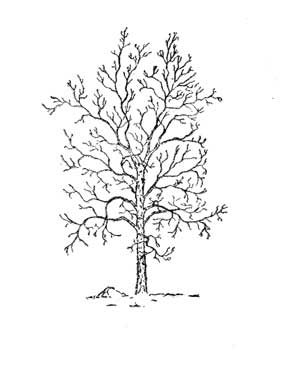
Among the foreign hazels which will thrive in this country the Byzantine
hazel, Corylus colurna is by all means the most beautiful. It makes a
tree as large as the ordinary oaks, and in Hungary I have seen a trunk
three feet in diameter at a short distance above the ground. I have been
told that a single tree of this species will sometimes bear about twenty
bushels of nuts at a single crop. This presumably refers to the nuts in
their large involucral mass,—say four or five bushels of husked nuts.
The wood of these species is hard, takes a high polish and is valuable.
The tree itself is strikingly beautiful as the members will observe this
afternoon when examining the Byzantine hazels which Superintendent Laney
will show us in one of the Rochester parks.
This species of hazel in some of the localities about the Black Sea is
said to form almost the entire source of income over large districts.
The nuts are not large, as a rule averaging about like those of our
common American hazel in size, quality and thinness of shell. Grafted or
budded stocks may be made to bear large thin-shelled nuts. I am using
this hazel at present for grafting stock for choice foreign species and
varieties of other kinds, and for the American hazel, although it may be
that the American hazel will not respond well to so large and vigorous a
stock in the long run. Nuts and nursery stock may be obtained through
French nursery firms.
The reason why the Byzantine hazel has not been planted widely in
America as yet, is because we have not advanced that far in
civilization,—people have not happened to think about it. We must leave
something for the people who are to come five thousand years after us,
and not think of all good things at once.
The Byzantine hazel appears to be quite free from the blight and this,
perhaps, is due to its thick corky bark, which is in itself an
attractive feature. In some individuals the corky bark stands out in
ridges almost like that of the corky elm. The beauty of the European and
Asiatic hazels, in general, makes them extremely desirable for
ornamental purposes in parks and in dooryards.
One of the most attractive is the purple variety of Corylus avellana.
In many parts of Europe this is held to be desirable for its nuts, but
in Connecticut it is prone to flower so early in the season that the
elongated male catkins are caught by frost. I have seen elongated
catkins in a warm week at the end of February. A very desirable variety
of Corylus avellana is one of which I now show specimens. The section
of the branch which I pass about carried four large nuts yesterday but I
find that one of them has disappeared, and it is probable that last
night in the sleeping car a squirrel got in when the porter was looking
the other way.
The specimen represents a seedling individual among a lot presented to
me by Prince Colloredo Mannsfeld of Bohemia nine years ago. This
particular shrub is rather homely, with small unattractive leaves and
big bony branches, but it bears heavily of large thin shelled hazels of
the highest quality, and the sort which are now bringing fifty cents per
pound in the New York market as green hazels. It blossoms very late in
the spring. I have not as yet given a name to this individual bush, but
as Professor J. Russell Smith caught my description of it and speaks of
it as "the bony-bush" we will allow his nomenclature to stand if members
of the Association wish to call for any of the wood for grafting or
budding purposes. Corylus avellana in its many varieties is the chief
European hazel which gives us the cobnuts and filberts of the market,
and it is the one which will probably be most widely introduced into
this country. The name "filbert" is a corruption of "full beard" and is
properly applied only to those nuts in which the husk extends beyond the
nut. The shrubs of this species commonly reach a height of about fifteen
to eighteen feet, with a spread of the same dimensions. Trimming by the
horticulturist allows of the development of a larger bearing surface,
very much as it does with peach or apple trees.
In some parts of Europe this species serves for hedge fences, indicating
the practical ideas belonging to an older civilization. In this country
we make hedge fences of worthless osage orange, privet, or honey locust
which steal nourishment from the soil, add little to the beauty of the
landscape, and give us no return whatsoever. Such a typical American way
of doing things will be changed when we stop to think. Stopping to
think is rather a painful process and gives us many jolts, but it has
its rewards. When we replace our worthless hedge plants with hazels
which yield heavy annual crops of valuable nuts we shall have made one
step forward.
A fine hazel is the Corylus pontica. The shrub in itself has beauty,
and it bears nuts sometimes as large as those of the average shagbark
hickory. The kernel is of good quality, but the shell is so thick that
these nuts are chiefly attractive to squirrels and to men who are out of
work. I do not know the origin of the nut which is known in the market
as the Barcelona hazel, but I imagine the plants bearing this nut are
derived from the Corylus pontica. (Specimens of branches and nuts of
various species and varieties of hazels are now passed about in the
audience.) The nuts are beginning to ripen in this first week in
September.
Hazels do not come true to parent variety from seed, and consequently
valuable stock is propagated by budding, by grafting or by layering.
Personally, I find that the hazel is rather easily budded, although
layering is the method for propagation of choice varieties most often
employed in Europe. The hazels have comparatively few insect enemies,
but mine are sometimes attacked destructively by the elm beetle and by
the larvae of two species of saw flies which are also found upon the
elms. It is a rather curious fact that the insects should recognize a
similarity between the leaves of the hazels and of the elms, which are
somewhat alike in general appearance, although the trees are of widely
different descent.
It brings up an interesting question, if the flying parents of the
parasites from the elm are attracted by the appearance of the hazel
leaves, or if they are attracted by the odor or other characteristics.
Occasionally the exotic hazels are attacked by various leaf blights but
not to any troublesome extent so far as my experience goes, up to the
present time. The chief predatory elements which we shall have to meet
when raising hazels are squirrels, white-footed mice and the neighbors'
children.
W. C. Reed: May I ask, Doctor, what you bud the Byzantine on?
Dr. Morris: I am budding other things on those for stocks. I
bud our American hazels and European hazels on the European and Asiatic
trees.
Mr. Rush: Do you know anything of the quality of that nut?
Dr. Morris: It is the chief hazel in parts of northern Turkey,
and of excellent quality. Hazels form a source of income for some
localities like the wheat or corn in other parts of the world, or the
olive, as Dr. Smith told us last night.
Mr. Holden: Do they get these trees from seedlings?
Dr. Morris: Yes, so far as I know. The nuts are called
Constantinople nuts.
A Member: What kind is it that blooms in the fall?
Dr. Morris: I don't know any but the witch hazel which blooms
in the fall; has a small yellow flower, but is not a true hazel. Catkins
form upon all hazels in the fall, but these do not really blossom until
springtime.
A Member: I would like to ask if the Byzantine hazel is
attacked by blight as are the others?
Dr. Morris: No; none of my trees have been attacked by blight
at all as yet.
W. C. Reed: What method of budding do you find most successful?
Dr. Morris: I have usually used the ring budding. It is not
very difficult.
Professor Hedrick: Are there any East Asia hazels that thrive
in this country?
Dr. Morris: There are specimens in the park here at Rochester
that you will see this afternoon.
Professor Hedrick: Our experience with Asiatic hazels is very
satisfactory.
Mr. McGlennon: A friend of mine here has some specimens that he
would like to present.
Dr. Smith: We will ask Mr. Vollertsen to describe the specimens
himself.
Mr. Vollertsen: They are from a private place of G. H. Perkins
on East Avenue. They have never failed a year since 1886. Unfortunately
we have no name for them, except that this one was always called John
Jones. It has certainly proved a good strong hardy variety.
Then we have another one, a long one, which has never been named, and I
am not able to say exactly what it is. Last year they were exceptionally
well filled. This year there are not quite so many on them, although a
goodly number. They have never failed a single year.
I have one little variety which was given me by Dr. Mann, on Alexander
Street. The limbs are practically hanging down with the nuts. They are
ready for market now, falling out.
I have here some purple hazels which have always borne fruit and no
other hazel in the vicinity is as good. It has sometimes two crops in a
year. These are really beautiful specimens. This little early variety
should be passed round and have special attention. I have given this
variety no name, but for over thirty-five years it has borne good fruit
every year.
Dr. Morris: If you are in doubt as to the name of a variety, I
think Mr. Laney will find a way for getting you the name for almost
every variety that is found in the markets.
The President: Mr. McGlennon asks that the gentleman advise us
how he has propagated them. We went through Mr. McGlennon's beautiful
orchard yesterday.
Mr. Vollertsen: We have been using an ordinary way of budding.
An ordinary seedling can be used to good advantage for grafting. I have
found in grafting in winter they do not seem to grow as well. In our
fall layering we naturally get a larger plant.
The President: Do we understand that these hazels that have
borne for twenty-five years are European hazels?
Mr. Vollertsen: Yes; European hazels. I have had them under my
care since 1886, and never noticed any blight.
A Member: Can't you explain to us, with one of your specimens,
your method of spring layering?
Mr. Vollertsen: In layering them, we practically don't cover
them at all for the time being. They are merely pinned down.
Dr. Morris: Do you cut the bark?
Mr. Vollertsen: Not on them. After they have grown some we
cover them up. We find this a very successful way. We get younger and
smaller plants in the fall lay.
The President: I should like to ask Dr. Morris a question. In
this native hazel, does it keep on spreading under ground?
Dr. Morris: One single plant, planted in a pasture lot and not
interfered with will in a few years occupy practically that whole
pasture lot. In my part of the country this is true; how is it with you,
Dr. Deming?
A Member: Going back to the blight, will this tackle any size
limb?
Dr. Morris: It usually does not come until your hopes are at
top notch, and then it drops in on you. It does not attack the smaller
twigs at first, but may finally extend to them.
A Member: Are any of your hybrids a success?
Dr. Morris: There are none in bearing as yet. Byzantines are
little, if any, larger than American hazel nuts, excepting from
selected trees. Pontines are much larger. Both plants make a remarkably
vigorous growth.
The President: Do I understand that this Merribrooke hazel, put
in the middle of an acre will fill the acre?
Dr. Morris: I believe this is true. I don't think it is an
exaggeration. The wild hazel is a nuisance in Connecticut.
The Secretary: I know they will cover a very large space, but I
cannot tell how they get there.
The President: The point I am trying to get after is this, not
the exact extent of spread but the method of propagation. Can we get a
sprout from a good tree, and then have it go on sprouting indefinitely?
Dr. Morris: Yes, that is true.
A Member: In your experience are fungicides useful in handling
the blight?
Dr. Morris: I have not used them. I have talked with nurserymen
who did, and they say the blight got the best of them just the same.
They left the matter with employees, who did not give proper attention.
This was perhaps because they did not know that a small jack-knife was
better than a spraying outfit for the purpose.
A Member: Once on, will it stay?
Dr. Morris: Yes, until the blight area has circled the limb.
A Member: What is the difference between the cobs and the
filberts?
Dr. Morris: The cob nut is generally a round nut. The filberts
are longer nuts. "Filbert" is a corruption of "full beard," and refers
to the involucre extending beyond the nut.
Dr. Smith: We may now proceed to the next number on the
program, if the hunger for hazel knowledge abates. Members of this
association have topworked pecans, hickories, etc. I followed the
instructions of members of this association in my work and have had some
success. Some workers report splendid success mixed with very great
failures, so we may be encouraged to the very top notch, and the next
spring we come back feeling very different. Last fall I was as large
almost as a beer barrel with the gratification that followed the setting
of 100 English walnut buds. I have adopted the motto "Blessed is he that
rejoices early, or he may not rejoice at all." In March there were about
ten or twelve alive. In June about nine were alive, and now these also
have failed to grow. Last year I knew just how to bud walnuts. This last
Fourth of July I was very humble.
For some reason or other we have not all the facts. We can propagate
splendidly one year, and the next year we have a fall-down. Mr. Roper,
of one of the pioneer nurseries, said he had 2,000 fine live walnut buds
last fall, and had but 500 this spring, and not one of them grew. While
the technique seems to be simple, there seems to be something lacking in
our experience. I will ask Mr. Littlepage to give us his confessions
first.
Mr. Littlepage: The proposition of topworking is one of the
schemes where art beats nature. In the fight in Congress over the
oleomargarine bill some years ago, one member who favored it, said in
support of his contention, that nature always beat art; and one of his
opponents immediately referred him to a picture gallery near, where
pictures of the statesmen were exhibited, as a proof that art sometimes
beats nature. In top working, art improves upon nature.
The first thing to be considered is what is topworking, and then the
logical question, why topworking. Possibly this should come first. If an
individual is dissatisfied with his friends and neighbors, he must put
up with them; he cannot change them. But if he is dissatisfied with a
nut tree, it is his own fault if he does not change it. It can be top
worked. He does not care to top work maples or oaks. We only top work to
get something better than we have. The trees, of course, that interest
us specially in top working are the nut trees. We have seedling pecans,
seedling walnuts, seedling hickories, and seedling chestnuts. Down at
the mouth of Green River in Kentucky are nearly two hundred acres of
wild pecan trees. So far as we know there are only two trees in that
orchard worthy of propagation. Of thousands of trees there we have
propagated only two varieties. These trees are now too large to top
work, but had it been possible 150 years ago to go in there and select
the desirable nuts, and topwork all the other trees with these, there
could have been a great orchard there now of the highest quality nuts.
Topworking consists in cutting off the top of some undesirable seedling
and replacing it with scions or buds from some desirable variety. It is
just the same as any other grafting or budding process. Almost any size
tree can be topworked but, of course, the larger the tree the more
difficult the operation. A young tree, from two to five inches in
diameter, can be sawed off four or five feet above the ground and
topworked by grafting from two to four scions on it, by the slip bark
process. If the tree is larger than five inches in diameter, it is
better to go up to the first branches, saw off part of them and proceed
just as if each branch were itself a small tree. If the tree is a large
tree, with a number of branches or prongs, it is best to work part of
them one year and leave the remaining branches to maintain the root
system. It would probably kill a large tree to cut the whole top off at
one time. I have seen trees, two feet in diameter, successfully
topworked. It sometimes happens that the scions placed in the tree, in
the spring, for some reason or other, do not grow. The tree then sends
up nice green shoots that later in the season can be budded into just as
if they were small seedlings. The wild black walnut trees, growing
around the fields and hills, can all be very easily topworked to the
English walnut by the slip bark method. The scions must be dormant and
the tree starting into active growth.
The wild hickory, wild pecan and wild black walnut trees, offer the best
field for profitable work along this line. We have topworked a great
many hickories to pecan, but we do not expect permanent satisfactory
results. The experience of the pecan on the hickory is not very
satisfactory. The hickory is a dense, hard wood, that has a short
growing season, and matures its nuts early; the pecan is of the coarser,
faster growing wood, whose nuts grow until late in the fall. This
inconsistency of the growing habits of the two trees prevents the pecan
top on the hickory from producing normal crops of nuts. The pecan
topworked to the pecan, however, is a perfect success and there is no
reason why the wild hickories of all descriptions cannot be successfully
and profitably topworked to the better varieties of the good shagbark
hickories. I believe that there are great opportunities in the state of
New York for successful nut culture by utilizing the wild black walnut
trees and the hickories. I have seen hundreds of English walnut trees
growing around Rochester, some of them bearing perfectly wonderful crops
of walnuts. I am surprised that the people in this section have not
availed themselves more of the opportunities along this line. If the
farmers in this section would take up nut growing as a side proposition
and set five or ten acres of nut trees on each farm, they would soon
find that these nut trees would be producing them more than all the
balance of their farms. We hear a great deal today about the back to the
farm movement, but my opinion is that for everyone who is going to the
farm, ten are leaving it, and the reason for this is that the heavy
operating expense of the annual crops, such as corn, wheat and potatoes,
etc., lay such a heavy toll on the farmer that farming is not
profitable. The requirements of time, labor and money in producing these
crops are so great that it discourages many farmers. I have made the
statement to some of the farmers in my part of the country that they
must produce alfalfa or go broke. I believe that alfalfa and tree crops
will be two of the greatest factors in the rehabilitation of the farm,
especially the nut trees, for the reason that nut trees do not require
the same high degree of care, spraying, pruning, as do apple and peach
trees, nor are the products as perishable. A crop of nuts can be
harvested and stacked up in barrels, and boxes, in the smoke house, the
barn or in a flat car and go to the market tomorrow, next week or next
month.
Recurring to the advantage of topworking, however, it meets the
objection that is often raised by those who say they have not time to
wait for the nut trees to grow. Of course, this is a perfectly foolish
statement; they are going to wait anyhow; it is simply a question as to
whether they wait for something or nothing, and trees grow into maturity
in a surprisingly short time. A few years ago, when I was setting out an
orchard of nut trees, a neighbor of mine came over and looked very
doubtfully with a trace of pity in his expression and said, "When do you
expect all those trees that you are setting to bear?" I replied, "I am
not sure, but I do know that they will bear a long time before those
trees that you are not setting." Topworking, however, gives quick
results and enables one to take advantage of the long-established
thrifty root systems of the wild black walnuts, hickories and pecans
growing in economic spots, around the fences, corners, creeks and
hillsides.
Mr. Jones: In all our grafting we cut the cleft; we don't split
it. The slip bark method is better in some cases.
Mr. President: What is the size limit for the slip bark method?
Mr. Jones: Anything less than two inches we would cut.
The President: Will Mr. Jones tell us about budding with cold
storage wood?
Mr. Jones: The cold storage buds would take better, but you
would have more loss in their failing to grow. In other words, a much
larger percentage of buds set with the current season's growth, will
grow in the following spring. I would not recommend either method alone.
By grafting in the spring and then budding, first with cold storage and
later with the season buds, you would have three chances.
The President: Have you budded any cold storage wood before
this year?
Mr. Jones: We have done more or less of it for six or eight
years, and it has been successful. Anyone with very little experience
can use cold storage buds.
The President: Mr. W. C. Reed, have you any additions that we
ought to know?
Mr. W. C. Reed: Mr. Jones' method and views in regard to cold
storage buds agree with mine exactly. Last year I put in on July 30th
quite a number of English walnut buds that were held in cold storage. In
the fall we seemed to have almost perfect stands from these buds, but
they are still lying dormant. Buds of the season's growth put in about
three or four weeks later gave better results, although our success last
year was very poor. We seemed to have a fair stand on quite a number of
varieties, but this spring they refused to grow. I lay much of this
trouble to the extreme cold we had in November. This killed many peach
trees that were from six to eight years old, and I think it injured many
of the walnut buds. I found the buds that started best were those
nearest the ground, where they were protected by a little grass.
In regard to the topworking of the English walnut, several of you have
seen my trees, the three trees along the highway in a ditch where they
catch the wash where they have made 9½ feet growth. I am sorry to
report that two of these trees are entirely gone, killed by the cold
spell, and the other is about half alive, but I was not in the least
discouraged by that loss. In September the rains commenced, following
the extreme drouth and started a second growth, and the freeze caught
them November 22d as full of sap then as they were in September, when
you were there.
Other trees that I had topworked had made a moderate growth, and were
not injured in the least. They made a good growth this season, and
should be quite fruitful next year.
The Pomeroy trees in the bluegrass pasture had made only a moderate
growth, and went through the winter in good shape.
I had three trees of the Rush, probably twenty-five feet high. They were
injured a little, some of the growth killing back a third of the way,
and one or two buds were killed entirely.
In regard to topworking pecans, I have not done much of this, but our
success has been very good with what we have tried. I find them much
easier to work, as far as the bud starting in the spring is concerned.
Some varieties, however, do not start readily. With the Major, Green
River, and one or two other varieties, we can use wood five, six and
eight years old, and have it come out all right. I find, however, that
the current season's growth, cut from two-year-old trees, well
developed, will give you at least double the growth in the nursery the
first year that older or dormant wood will.
The President: Some apple experience of mine is a close match
to the killing that Mr. Reed just reported. The season of 1912 was a
very dry one. All September it rained frequently and heavily. The trees
waked up and grew with such speed that many of them made a sappy growth
where they had been manured, and a very cold spell early in the winter
killed 100 of them. Others across the road were uninjured.
Mr. W. C. Reed: In regard to grafting in the nursery, this
spring my experience has been somewhat varied. In grafting we started
about April 10th; the first grafting was almost an utter failure. On May
1st it improved. On May 9th we set 900 and have 75 per cent growing
today, some higher than my head. Set with wood some of which would run
three-fourths inches in diameter.
Lady Delegate: My sister has on her place 200 or 300 black
walnut seedlings. What would you advise her to do with these? They are
in all ages and stages of growth, from one to ten years.
Mr. Littlepage: That is a very broad question to answer. I
should topwork them to the Persian walnut. I should topwork all of them
on the chance that future developments would leave them the proper
distance apart. The walnut transplants very easily, except that the
larger the tree, the more danger of loss. Trees of that size ought to be
worked very nicely.
Assume that this is your tree, and that you have sawed off the top. Here
is your scion from your desirable tree. It is to be cut on one side
only, and there is considerable art in making that cut true. Then with
the knife split down the bark on the stock a little way and shove the
scion down between the wood and bark, the cut side next to the wood of
the stock (demonstrating), and cover with waxed cloth. Then apply
grafting wax to the cut surface, and cover all with a paper bag for two
or three weeks. There should not be more than two buds on a scion. Don't
leave too many. One bud is better than three, but you may leave two
buds. This scion must be kept entirely dormant until used. Any time
after the bark will slip readily is the proper time to graft, and you
will then get a high percentage of success. Keep your sap circulating to
the top by putting two or three scions around the top of the stock. This
method of grafting is a very simple operation when you know a few little
fundamental facts about it. The kind of wax or cloth is not particularly
important. Mr. Reed and Mr. Jones and Mr. Rush have had much experience
in this work.
Mr. Parish: In doing this, shall we put in a little air hole?
Mr. Littlepage: No. In from ten days to two weeks tear a little
hole in the paper bag. Next time be careful, for it may be full of
wasps. The purpose of that paper sack is to keep the water off the buds.
This is essential.
Mr. Phillips: I had about 300 trees planted in 1911, black
walnuts. In 1913 I budded them according to the Oregon method. I failed
to make any of these grow. In 1913 I cleft grafted and a great many of
these started, but they all failed to live. I wonder wherein I failed.
Mr. Littlepage: No one can tell why a particular scion does not
live. I had scions from a very fine hickory and I put them in cold
storage. The wood was in perfect condition. I grafted perhaps 100 of
these scions as I have described. I have four trees growing out of the
100 grafted. In handling the wood I got fungus on it probably. That may
be one reason why it failed. There may be other reasons. If the scions
were not dormant that might explain it.
Mr. W. C. Reed: I think it is very important that walnut
grafting wood should be cut before severe weather in the winter, though
I don't think it ever grows cold enough to hurt pecan wood. You need not
worry about pecan wood, but in the case of the walnut it should be cut
before extreme cold weather and put in cold storage. I cut some last
year after the extreme cold snap in December and we threw it practically
all away this spring. It is useless. You are throwing away your time to
use it.
Mr. Jones: I don't think we had any wood that was not injured
during the cold winter of 1911-12. Out of about 2,600 grafts set we had
two grow.
Question: What do you mean by cold storage?
Mr. W. C. Reed: I have been storing all of our wood in ordinary
apple cold storage plants. Pack it in damp moss or excelsior. Paper line
your boxes well, and nail them up, and leave them there until you are
ready to use them. I have put wood in in November and taken it out in
good shape in August. Pecan wood can be held the year round.
The President: What can you tell us, Mr. White, that has not
yet been covered?
Mr. Paul White: About all I would care to say about topworking
would be to ask a question. They claim that the pecan topworked on the
hickory, only bears for a few years, and then stops. What would be the
result in the case of the English and black walnuts? Might there not be
some danger there?
The President: I have made considerable investigation of this.
I have found several English walnuts topworked on black walnuts, one
done eighty years ago down in Maryland. The tree is reported to have
borne twenty-five bushels of nuts. I think there is good explanation for
the pecan-hickory trouble. A hickory grows for a short time in early
summer and does not grow much, but a pecan grows twice as much.
Therefore the hickory roots cannot feed the pecan top enough to make
both vegetation and fruit. We are, in this city, in a very unusual
place. Not only is it the center of a great wealth of seedling Persian
walnut trees, but we have in the parks a great tree collection under
Superintendent Laney. This is a very fine and notable collection,
including American and foreign trees, some of which we will see this
afternoon.
Adjournment at 12:12 P.M.
Photographs of the convention were then taken on the steps of the City
Hall.
Convened at 8:20 P.M., Dr. Smith presiding.
Attendance about twenty.
A Nominating Committee was appointed, consisting of Messrs. Littlepage,
C. A. Reed, J. F. Jones, Webber, and Teter.
At this point was given the address by C. A. Reed.