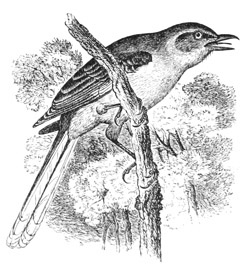
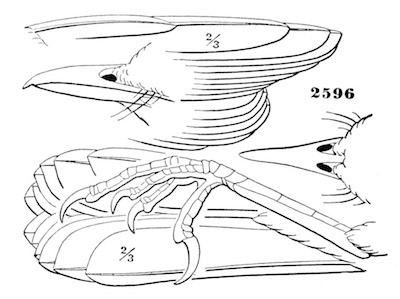
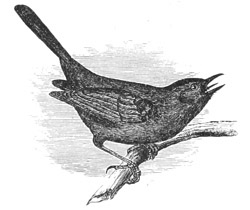
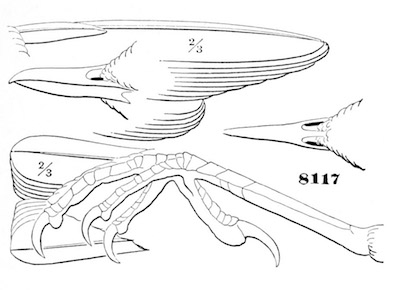
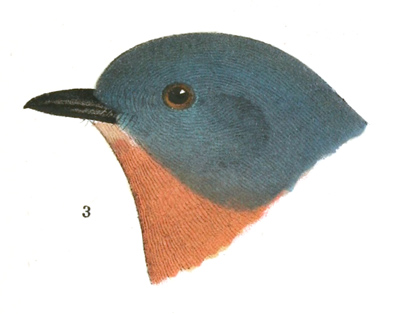
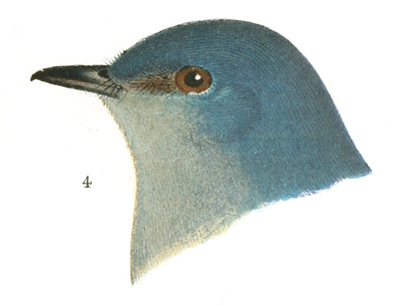
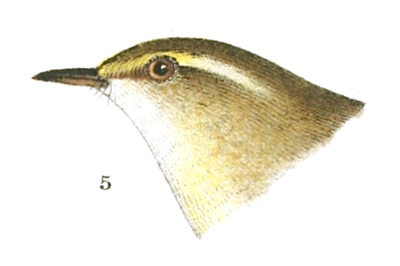
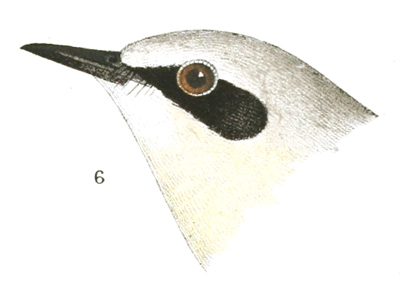
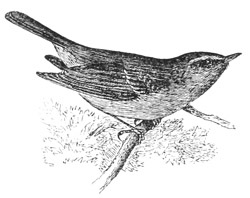
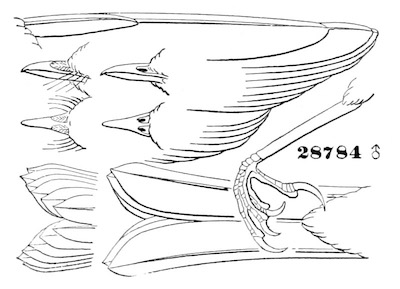
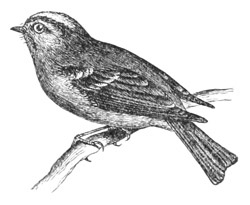
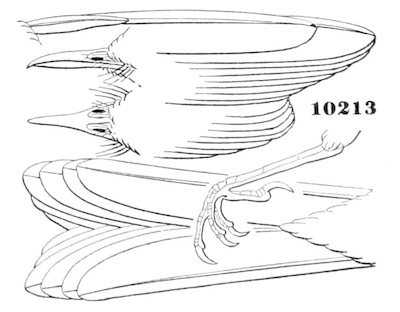
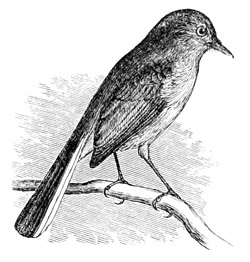
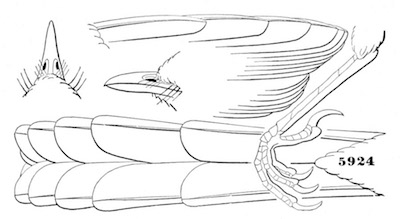
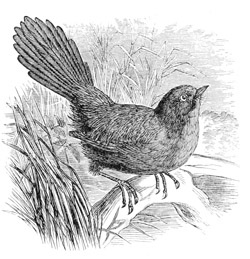
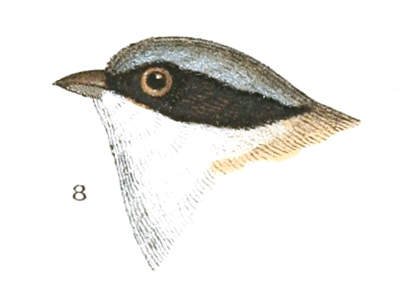
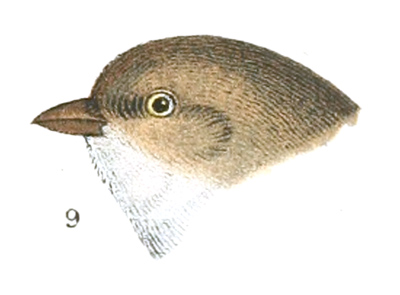
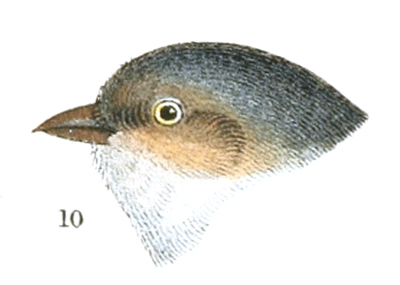
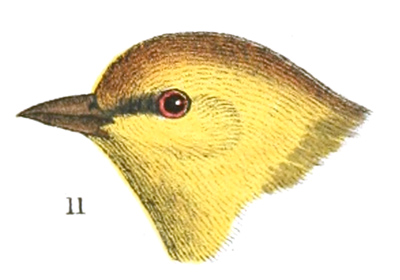
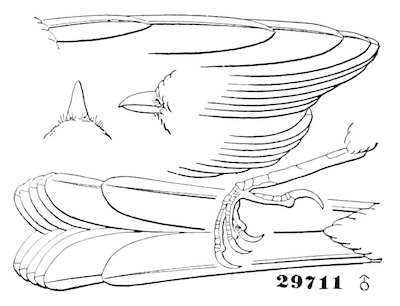
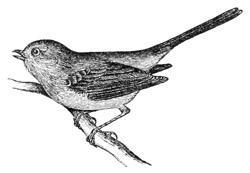
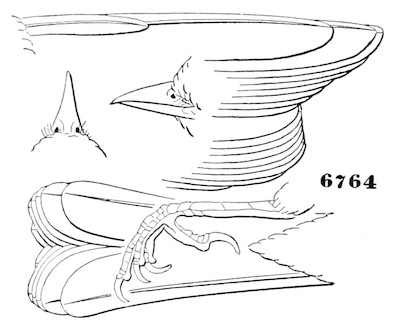
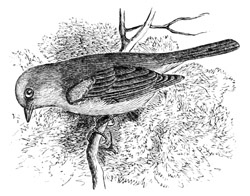
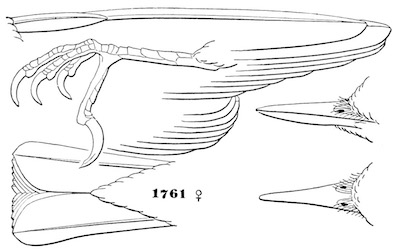
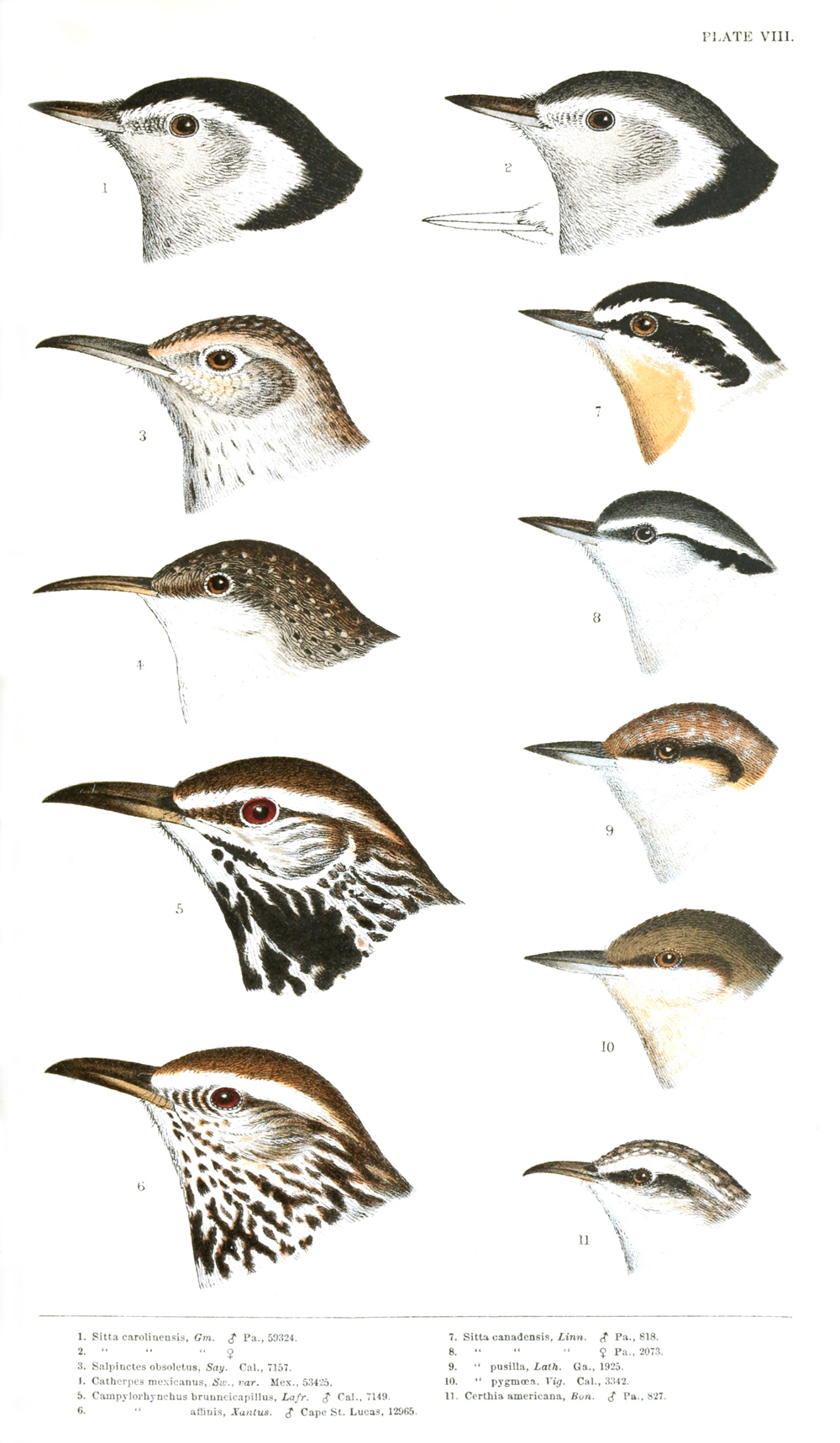
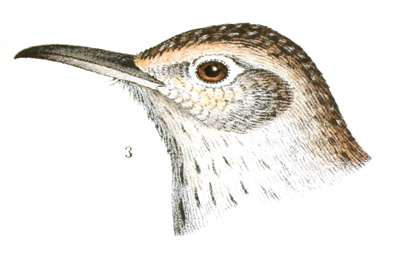
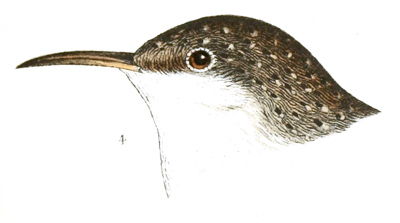
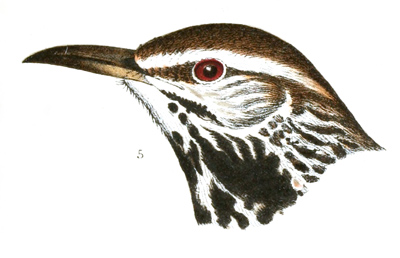
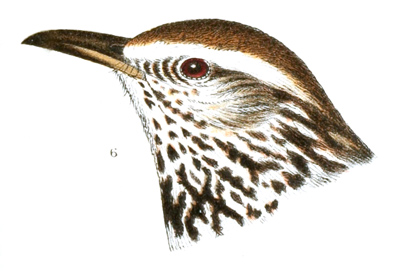
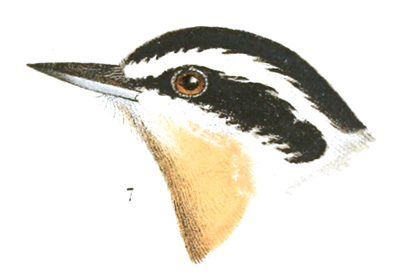
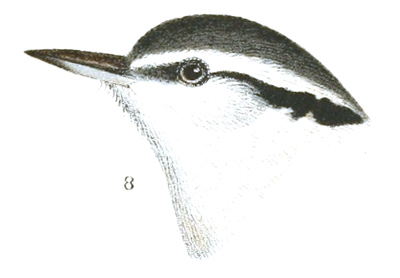
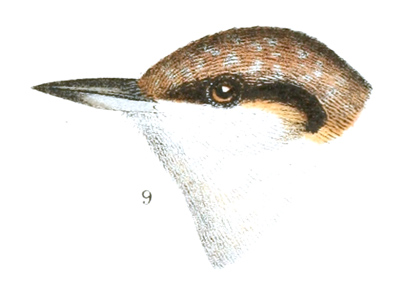
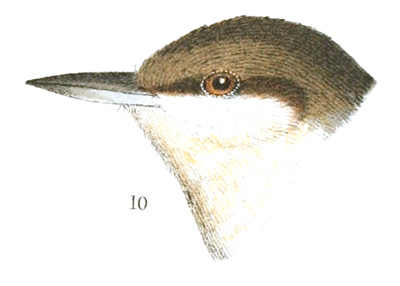
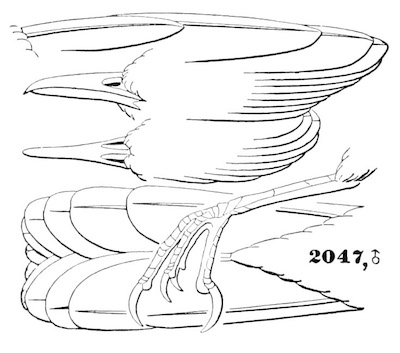
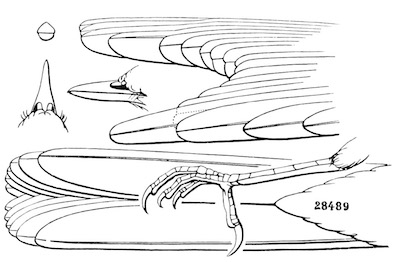
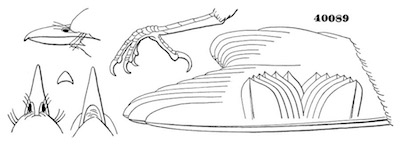
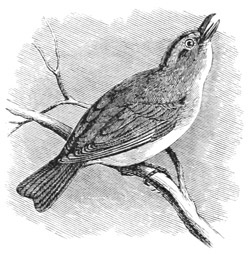
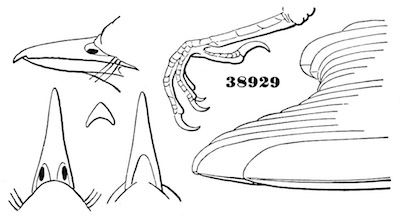
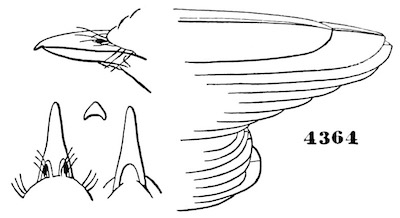
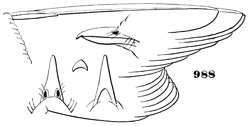
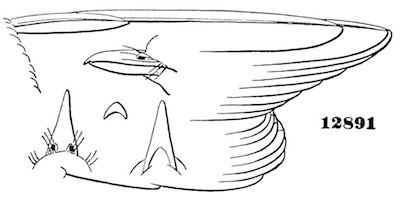
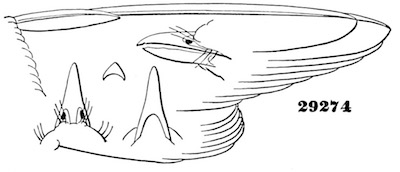
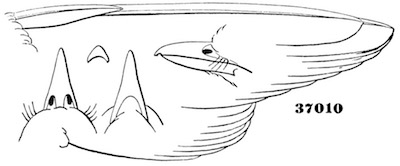
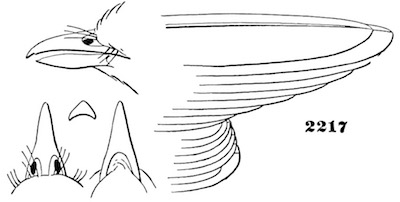
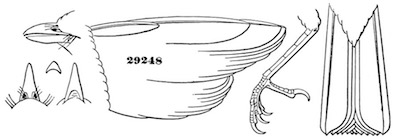
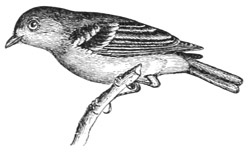
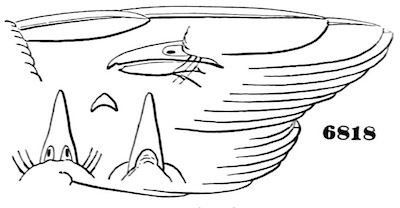
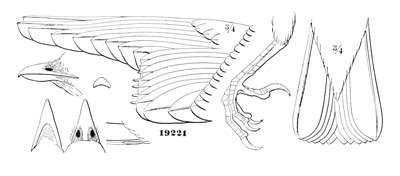
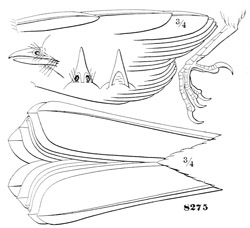
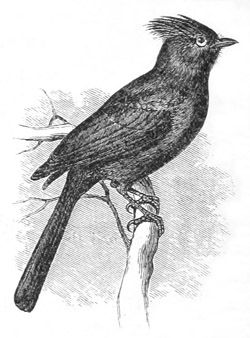
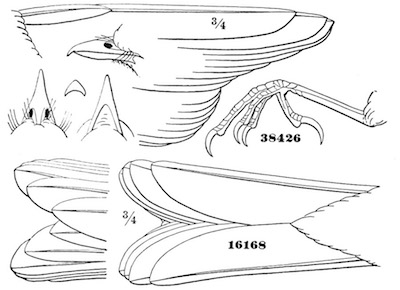
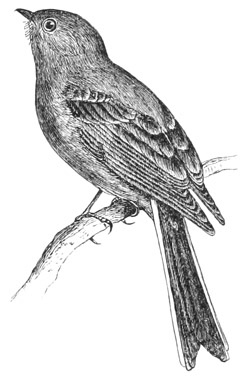
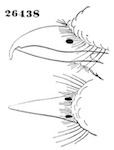
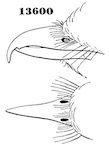
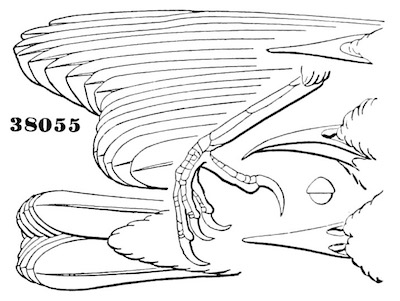
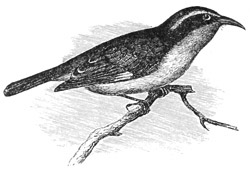
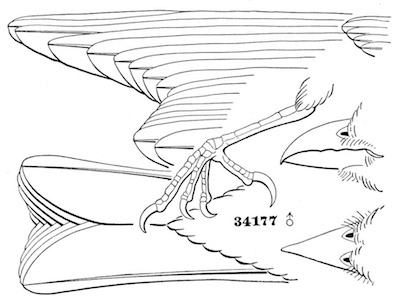
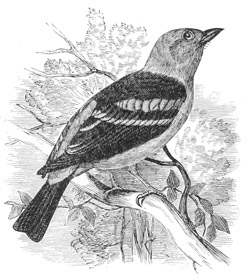
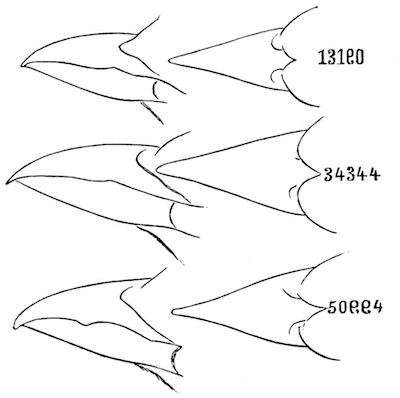
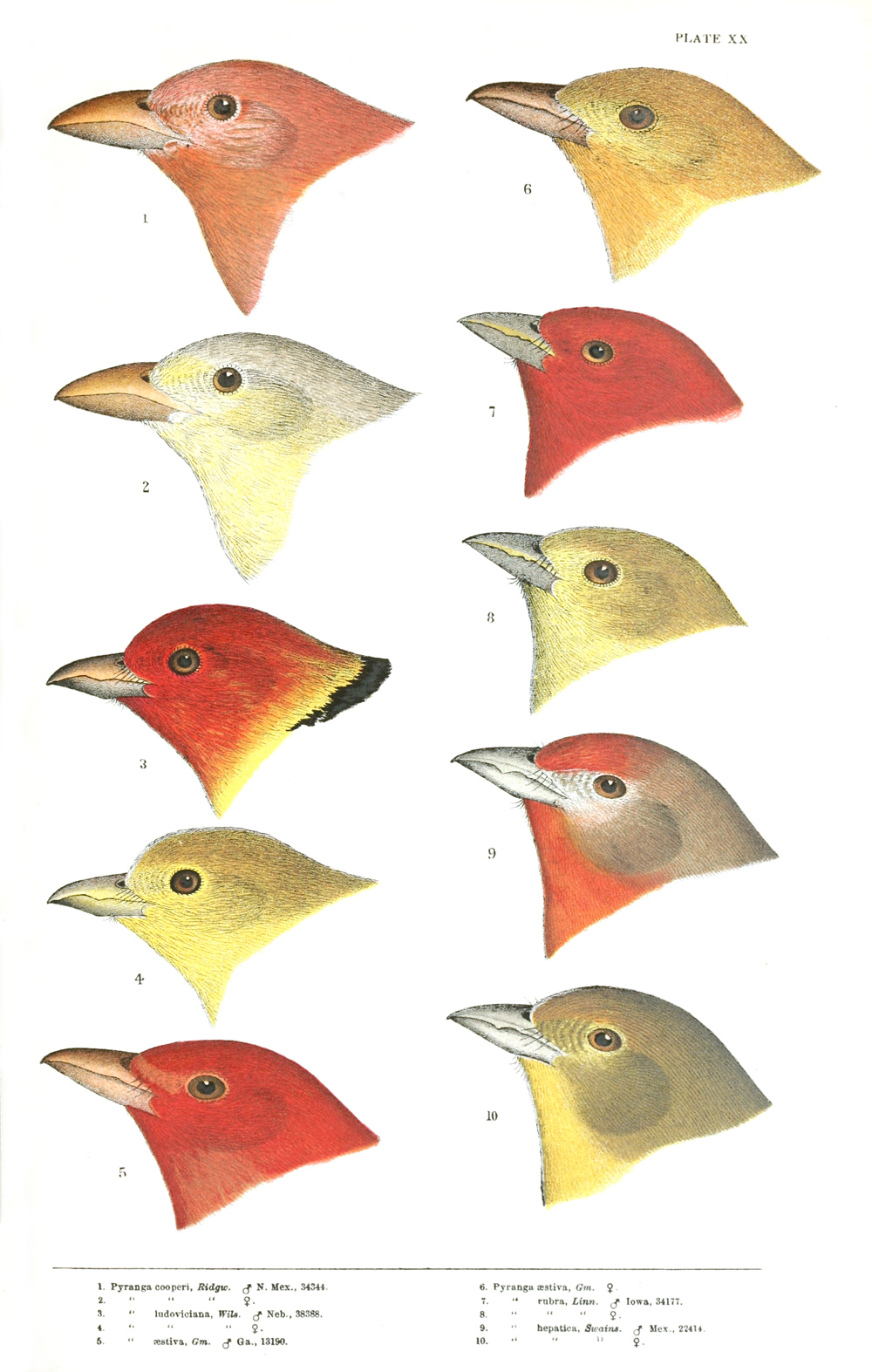
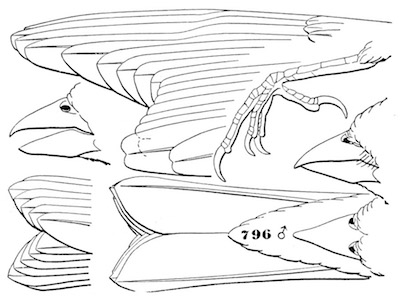
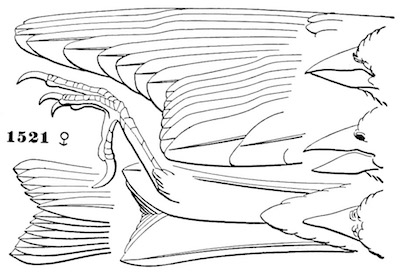
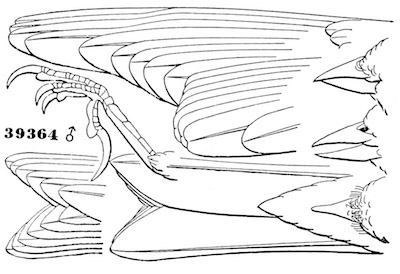
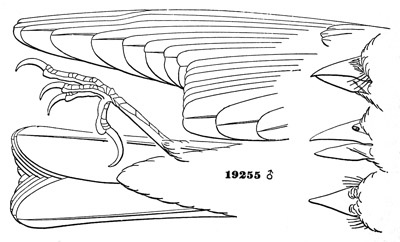
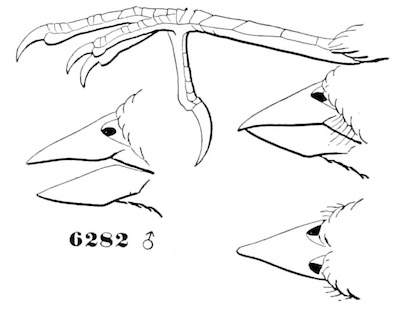
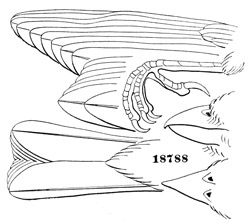
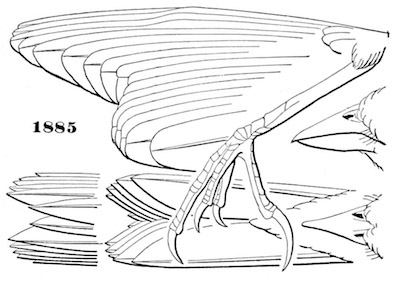
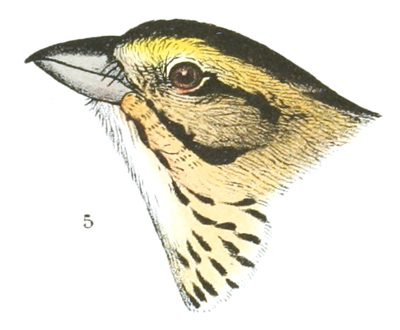
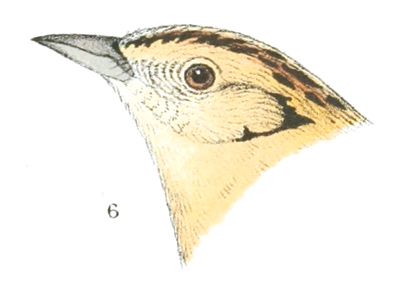
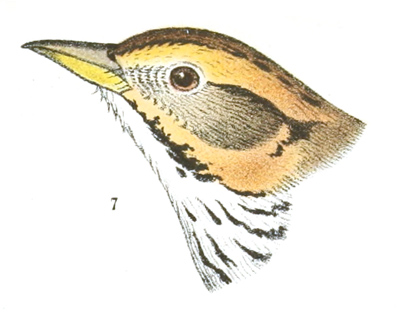
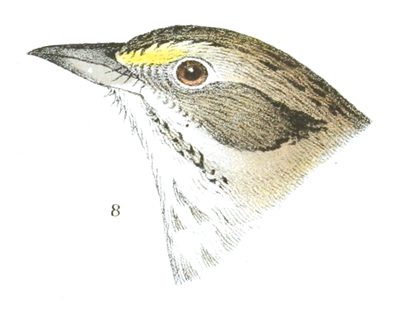
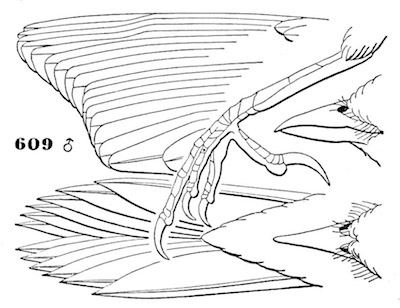
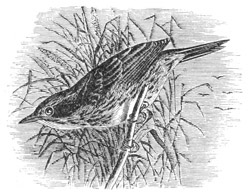
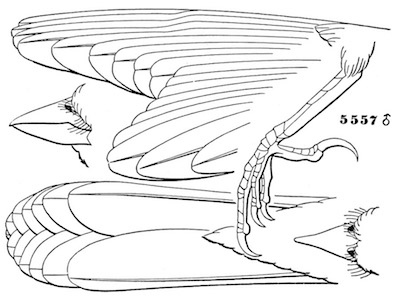
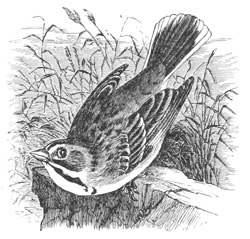
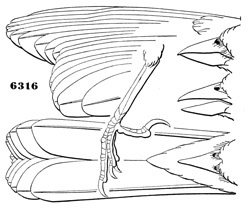
The Sylvicolidæ are essentially characterized among the Oscines with nine
primaries, by their small size, the usually slender and conical insectivorous
bill, shorter than the head, without angle in the gape near the base; the toes
deeply cleft so as to leave the inner one free almost to its very base (except
in Mniotiltæ), etc. The shallow notch at the end of the tongue, instead of
a deeply fissured tip, distinguishes the family from the Cærebidæ, to some of
which there is otherwise so great a resemblance. The absence of abrupt
hook and notch in both mandibles separates it from such of the Vireonidæ
as have nine primaries.
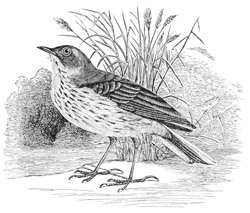
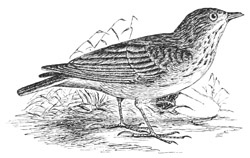
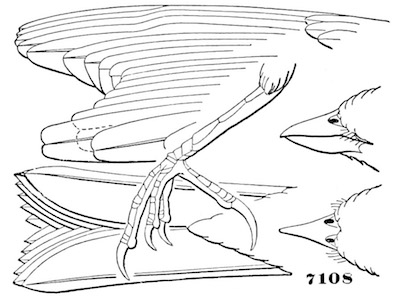
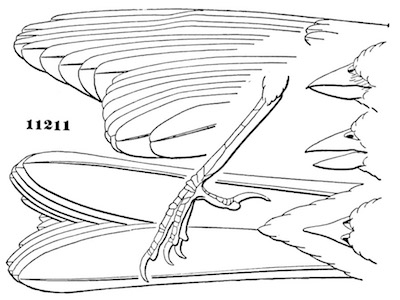
The American Motacillidæ are distinguished from the Sylvicolidæ by
the emargination of the outer and the great elongation of the inner secondaries,
as well as by other features referred to under that family.
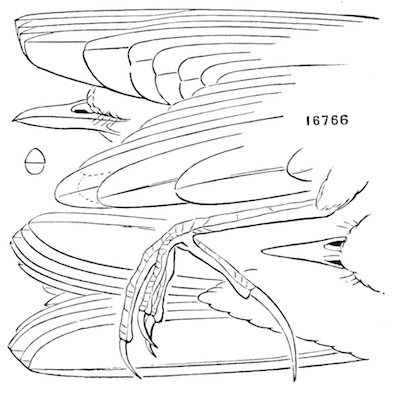
Anthus, in particular, differs in the lengthened and slightly curved hind
claw. There is little difficulty in distinguishing the Sylvicolidæ, however,
from any families excepting the slender-billed forms of the Tanagridæ, as
Chlorospingus, Nemosia, Chlorochrysa, etc., and the conirostral Cœrebidæ.
In fact, some ornithologists are inclined to include all three of the families
thus mentioned in one, from the difficulty of marking their boundaries
respectively.
In fact, we are of the opinion that no violence would be done by adopting
this view, and would even include with the above-mentioned families
the Fringillidæ also. The order of their relation to one another would be
thus: Fringillidæ, Tanagridæ, Sylvicolidæ, Cœrebidæ; there being scarcely
any break in the transition between the two extremes, unless there are
many genera referred to the wrong family, as seems very likely to be the case
with many included in the Tanagridæ. The fringilline forms of the latter
family are such genera as Buarremon and Arremon, they being so closely
related to some fringilline genera by so many features—as rounded concave
wing, lax plumage, and spizine coloration—as to be scarcely separable.
Either these two families are connected so perfectly by intermediate forms
as to be inseparable, or the term Tanagridæ covers too great a diversity of
forms. With the same regularity that we proceed from the Fringillidæ to
the typical forms of the Tanagridæ (Pyranga, Tanagra, Calliste, etc.), we
pass down the scale from these to the Sylvicolidæ; while between many
genera of the latter family, and others referred to the Cærebidæ, no difference
in external anatomy can be discovered, much less expressed in a
description.
In the following synopsis we attempt to define the higher groups of the
Sylvicolidæ, although in the large number of species and their close relationships
it is very difficult to express clearly their distinctive features.
Subfamilies.
A. Bill conical, its bristles very weak, or wanting.
a. Bill sub-conical, the culmen and commissure nearly straight.
Sylvicolinæ. Feet weak, not reaching near the end of the tail. Wing
pointed, considerably longer than the nearly even or slightly emarginated
tail. Feet dark-colored (except in Helmitherus, Helinaia, and
Parula). Arboreal.
Geothlypinæ. Feet strong, reaching nearly to end of the tail. Wing
rounded. Feet pinkish-white. Terrestrial.
b. Bill high and compressed, the culmen and commissure much curved.
Icterianæ. Bill without notch or rictal bristles; wing much rounded,
shorter than the tail.
B. Bill depressed, its bristles strong.
Setophaginæ. Bill, tyrannine, considerably broader than high, the tip
more or less hooked, and with a distinct notch. Rictal bristles reaching
half-way, or more, to the tip.
Sections and Genera.
SYLVICOLINÆ.
1. Middle toe, with claw, longer than tarsus.
Mniotilteæ. Bill much compressed for terminal half, the lateral outline
decidedly concave; culmen and gonys decidedly convex; commissure
moderately concave. Rictal bristles very inconspicuous; notch just
perceptible … Mniotilta.
2. Middle toe, with claw, not longer than tarsus.
Vermivoreæ. Bill without a distinct notch, or lacking it entirely; rictal
bristles wanting, or very minute; culmen and gonys nearly straight; bill
only very moderately compressed.
a. Middle toe and claw about equal to tarsus.
Bill not acute; culmen and gonys decidedly convex; notch just
perceptible; bristles apparent … Protonotaria.
Bill moderately acute, robust; no notch; culmen straight, its base
elevated and slightly arched; bristles not apparent … Helinaia.
Bill moderately acute; robust; no notch; culmen convex, its base
not elevated; bristles apparent … Helmitherus.
b. Middle toe and claw considerably shorter than tarsus.
Bill very acute, its outlines nearly straight; notch not perceptible;
bristles not apparent … Helminthophaga.
Bill very acute, its outlines nearly straight; notch just perceptible;
bristles strong … Parula.
Sylvicoleæ. Bill distinctly notched; rictal bristles strong; outlines
generally slightly curved.
Bill acute, gonys slightly concave … Perissoglossa.
Bill not acute, gonys convex … Dendroica.
GEOTHLYPINÆ.
3. Wings pointed, longer than the nearly even tail.
Seiureæ.
Above olive-brown; beneath white with dark streaks … Seiurus.
Above olive-green; beneath yellow without streaks … Oporornis.
4. Wings rounded, shorter than the graduated tail.
Geothlypeæ.
Above olive-green; beneath yellow, without streaks … Geothlypis.
ICTERIANÆ.
5. Bill very deep and compressed; tail graduated; outer toe deeply cleft.
Icterieæ.
Olive-green above; bright yellow anteriorly beneath. Upper mandible
deeper than the lower … Icteria.
Plumbeous-blue above; red, black, and white beneath. Upper
mandible not so deep as the lower … Granatellus.
6. Bill slender, sub-conical, but curved; tail nearly even; outer toe adherent
for basal half.
Teretristeæ.
Above olive-gray; beneath whitish posteriorly, and yellow anteriorly … Teretristis.
SETOPHAGINÆ.
7. Bill tyrannine. Tail broad, equal to or longer than the wing, and much
rounded.
Setophageæ. Colors mainly black, red, and white.
Tail not longer than the wing. Above black, wing variegated … Setophaga.
Tail longer than the wing. Above plumbeous, wing unvariegated … Myioborus.
8. Bill sylvicoline. Tail narrow, almost even; shorter than the wing.
Myiodiocteæ. Colors yellow beneath, olive-green or ashy above.
Black markings about the head in the ♂ … Myiodioctes.
9. Bill somewhat parine. Tail equal to the wing, almost even.
Cardellineæ. Colors mainly red, or red, ashy, and white.
Bill weak, almost cylindrical; wings rounded, the quills broad and
soft at ends. Tail slightly rounded, the feathers soft. Colors mainly
red. … Ergaticus.
Bill stout, the culmen and gonys very convex; wings pointed,
the quills emarginated and hard at ends. Tail even, the feathers
hard. Color ashy above; rump and beneath white. Head red and
black. … Cardellina.
Of the above, Granatellus, Myioborus, Ergaticus, and Cardellina belong to
Central and South America, Teretristis to Cuba.
Subfamily SYLVICOLINÆ.
Section MNIOTILTEÆ.
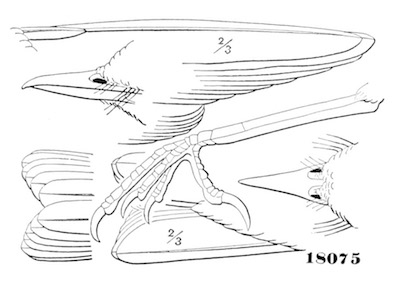
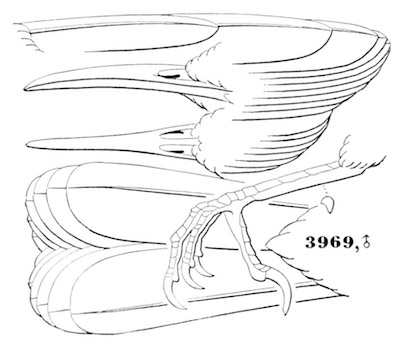
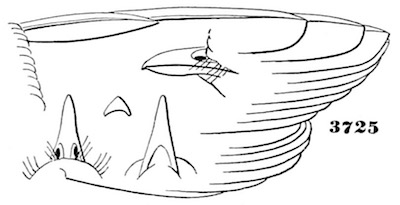
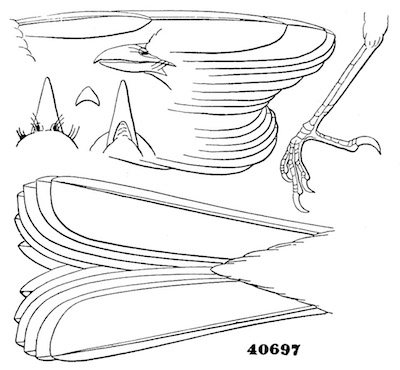
Char. Bill slightly notched some distance from the tip. Rictal bristles minute. Hind
toe considerably developed, longer than the lateral toe; its claw decidedly longer than
its digit. First quill nearly or quite as long as the second. Wings long, pointed; much
longer than the tail, which is nearly even. Tail-feathers with white spots. Bill much
compressed for terminal half, the commissure and lateral outlines decidedly concave; the
culmen and gonys convex.
Genus MNIOTILTA, Vieillot.
Mniotilta, Vieillot, Analyse, 1816, 45. (Type, Motacilla varia, L.)
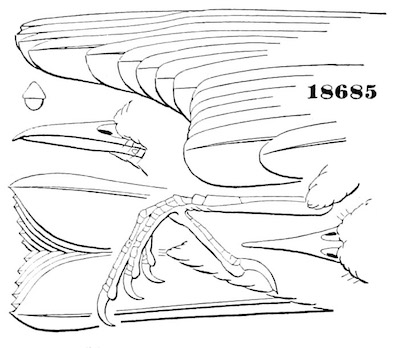
Gen. Char.
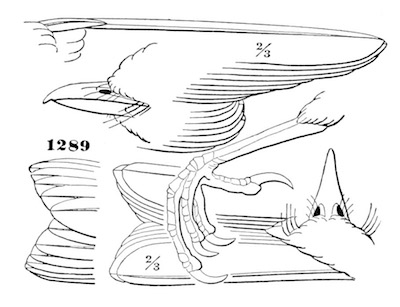
General form sylvicoline; bill rather long, compressed, shorter than the
head, with very short rictal bristles and a shallow notch. Wings considerably longer than
the tail, which is slightly rounded; first quill shorter than second and third. Tarsi rather
short; toes long, middle one equal to the tarsus; hind toe nearly as long, the claw considerably
shorter than its digit. Color white, streaked with black. Nest on ground; eggs
white, blotched with red.
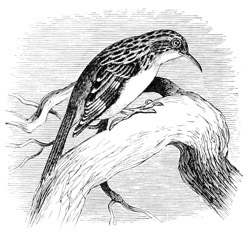
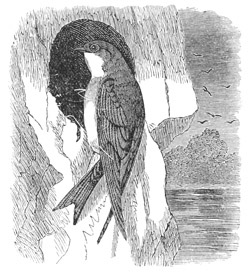
This genus differs from other Sylvicolines in the elongation of the toes,
especially the hinder one, by means of which the species is enabled to move
up and down the trunks of trees, like the true Creepers. But one species is
recognized as North American, although Nuttall describes a second.
Mniotilta varia, Vieill.
BLACK AND WHITE CREEPING WARBLER.
Motacilla varia, Linn. S. N. I, 1766, 333. Certhia varia, Vieillot;
Audubon. Mniotilta varia, Vieillot, Gal. Ois. I, 1834, 276, pl.
clxix.—Audubon.—Baird, Birds N.
Am. 1858, 235; Rev. 167.—Sclater, P. Z. S. 1858, 298 (Oaxaca, Xalapa); 1859, 363 (Xalapa); 1855, 143 (Bogota); 1856, 291 (Cordova); 1864, 172 (City of
Mex.)—Ib. Catal.
1861, 25, No. 162.—Scl. & Salv.
Ibis, 1859, 10 (Guatemala).—Newton, Ibis, 1859, 143 (Santa Cruz; winter).—Cab. Jour. III, 475 (Cuba; winter).—Bryant, Pr. Bost. Soc. 1859 (Bahamas; April 20).—Gosse, Birds Jam. 134 (Jamaica; winter).—Jones, Nat.
Bermuda, 1859, 29 (October).—Cab. Jour. 1860, 328 (Costa
Rica).—Lawrence, Ann. N. Y. Lyc. 1861, 322 (Panama
R. R.; winter).—Gundl. Cab. Journ. 1861, 326 (Cuba; very common). Certhia maculata, Wils. Mniotilta borealis, Nutt. Mniotilta varia, var. longirostris, Baird, Birds N. Am. 1858, xxxi, No. 167.—Ib. Catal. in 8vo, 1869, No. 167.
Figures: Aud. Orn. Biog. V, pl. xc; Birds Am. II, pl. cxiv.—Wilson, Am. Orn. III, pl. xix.
Mniotilta varia, Vieill.
18685
Sp. Char.
Bill with the upper mandible considerably decurved, the lower straight.
General color of the male black, the feathers broadly
edged with white; the head all round black, with a
median stripe in the crown and neck above, a superciliary
and a maxillary one of white. Middle of belly,
two conspicuous bands on the wings, outer edges of
tertials and inner of all the wing and tail feathers, and
a spot on the inner webs of the outer two tail-feathers,
white. Rump and upper tail-coverts black, edged externally
with white. Female similar; the under parts
white, obsoletely streaked with black on the sides and
under tail-coverts. Length, 5 inches; wing, 2.85;
tail, 2.25.
Hab.
Eastern Province of North America, and north to Fort Simpson. Both coasts
of Mexico (as far north as Mazatlan, on west side), and southward to Bogota. Whole
of West Indies and Bermuda.
Localities quoted. Bahamas; Bermuda; Cuba; Jamaica; Santa Cruz; West Indies;
Cordova, Xalapa, Oaxaca, Mex.; Guatemala; Panama R. R.; Bogota.
Specimens breeding in the Southern States differ in rather longer bill and
less amount of black, but are otherwise undistinguishable.
Mniotilta varia.
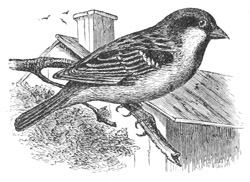
Habits. The Black and White Creeper, nowhere an abundant species, is
met with in various sections of the country. It occurs in all parts of New
England and New York, and has been found in the interior as far north as
Fort Simpson. It has been met with on the Pacific coast only at Mazatlan,
is common in the Bahamas and most of the West India Islands, generally
as a migrant. It has also been found in Texas, in the Indian Territory,
and in Mexico, and throughout Central America. In the last-named
region Mr. Salvin states it to be pretty equally and generally spread over
the whole country. It is there migratory, leaving in spring. It was also
detected in Colombia, South America, by Mr.
C. W. Wyatt. Mr. Newton also met with it
as a winter visitant in St. Croix, leaving that
island at the end of March. He regards this
species as almost a thorough Creeper in habits.
In Jamaica a few are resident throughout the
year, according to the observations of Mr.
March, and though its nests have never been
found there, a son of Mr. March saw a pair
carrying materials with which to construct
one.
Dr. Coues states that this Warbler is a very
common summer resident near Washington,
but is more abundant there in the spring and in the fall, the greater number
going farther north to breed. They arrive in Washington during the first
week in April, and are exceedingly numerous until May. He adds that they
are generally found in high open woods, and that they “breed in holes in
trees.” This is probably an error, or, if ever known to occur, an entirely
exceptional case.
Our bird is also a common summer visitant at Calais, arriving there about
the 1st of May, and by the 10th becoming rather abundant. Mr. Boardman
has frequently found their nests there, and always on the ground, in rocky
places and usually under small trees.
It does not appear to have been met with on the Pacific coast north of
Mazatlan, nor in any portion of Western North America, beyond the valleys
of the Mississippi and the Rio Grande.
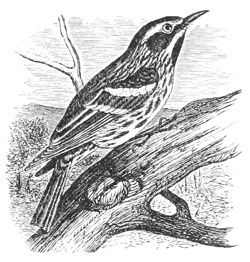
In its habits this bird seems to be more of a Creeper than a Warbler.
It is an expert and nimble climber, and rarely, if ever, perches on the branch
of a tree or shrub. In the manner of the smaller Woodpeckers, the Creepers,
Nuthatches, and Titmice, it moves rapidly around the trunks and larger
limbs of the trees of the forest in search of small insects and their larvæ.
It is graceful and rapid in movement, and is often so intent upon its hunt
as to be unmindful of the near presence of man.
It is found chiefly in thickets, but this is probably owing to the fact that there
its food is principally to be obtained. It is occasionally seen in more open
country, and has been known to breed in the immediate vicinity of a dwelling.
Wilson regarded this bird as a true Creeper, and objected to its being
classed as a Warbler. He even denied to it the possession of any song. In
this he was quite mistaken. Though never loud, prolonged, or powerful, the
song of this Warbler is very sweet and pleasing. It begins to sing from its
first appearance in May, and continues to repeat its brief refrain at intervals
almost until its departure in August and September. Nuttall speaks of it
as being at first a monotonous ditty, and as uttered in a strong but shrill and
filing tone. These notes, he adds, as the season advances, become more mellow
and warbling, and, though feeble, are pleasing, and are similar to those
of the Redstart. But this statement does not do full justice to the varied
and agreeable notes with which, in early spring, these birds accompany their
lively hunt for food among the tops of the forest trees. They are diversified
and sweet, and seem suggestive of a genial and happy nature.
These birds make their appearance in New England early in May, and
remain there, among the thick woods, until the middle of October, and in the
Southern States until the verge of winter.
Their movements in search of food are like those of the Titmice, keeping
the feet together and moving in a succession of short rapid hops up the
trunks of trees and along the limbs, passing again to the bottom by longer
flights than in the ascent. They make but short flights from tree to tree,
but are apparently not incapable of more prolonged ones.
So far as I know, these birds always build their nests on the ground. Mr.
Nuttall found one in Roxbury containing young about a week old. The nest
was on the ground, on the surface of a shelving rock, made of coarse strips
of the inner bark of the Abies canadensis externally, and internally of soft
decayed leaves and dry grasses, and lined with a thin layer of black hair.
The parents fed their young in his presence with affectionate attention, and
manifested no uneasiness, creeping, head downward, about the trunks of the
neighboring trees, carrying large smooth caterpillars to their young. The
nests of this bird are strongly and compactly built, externally of coarse strips
of various kinds of bark, and lined within with hair and fine stems of grasses.
In several instances I have known them to be roofed over at the top, in the
manner of the Golden-crowned Thrush. They measure about three inches
in their external diameter, and are equally deep.
The nests appear to be a favorite receptacle for the parasitic eggs of the
Cow-Bunting. Mr. Robert Ridgway obtained a nest at Mt. Carmel, Ill.,
in which were four eggs of the Molothrus and only two of the parent birds;
and Mr. T. M. Trippe, of Orange, N. Y., also found a nest of this Creeper
in which were but three of its own and five of the parasite.
The eggs vary in shape from a rounded to an oblong oval, and in size from
.69 to .75 of an inch in length, and from .51 to .53 of an inch in breadth.
Their ground-color is a creamy-white, to which the deep red markings impart
an apparently pinkish tinge. They are marked more or less profusely with
bright red dots, points, and blotches. These vary in number and in distribution.
In some they are very fine, and are chiefly confined to the larger end.
In others they are larger, more diffused, and occasionally there are intermingled
marks and blotches of slate-color. The effect of these variations
is, at times, to give the appearance of greater differences to these eggs than
really exists, the ground-color and the shade of the red markings really presenting
but little modifications.
The color of the young nestlings is closely assimilated to that of the
objects that usually surround the nest, and helps to conceal them. Mr.
Burroughs once came accidentally upon a nest with young of this species.
He says: “A Black and White Creeping Warbler suddenly became much
alarmed as I approached a crumbling old stump in a dense part of the forest.
He alighted upon it, chirped sharply, ran up and down its sides, and finally
left it with much reluctance. The nest, which contained three young birds
nearly fledged, was placed upon the ground at the foot of the stump, and in
such a position that the color of the young harmonized perfectly with the
bits of bark, sticks, etc., lying about. My eye rested upon them for the
second time before I made them out. They hugged the nest very closely,
but as I put down my hand they all scampered off with loud cries for help,
which caused the parent birds to place themselves almost within my reach.”
Section VERMIVOREÆ.
Genus PROTONOTARIA, Baird.
Protonotaria, Baird, Birds N.
Am. 1858, 239. (Type, Motacilla citrea, Bodd.)
Protonotaria citrea, Baird.
7516
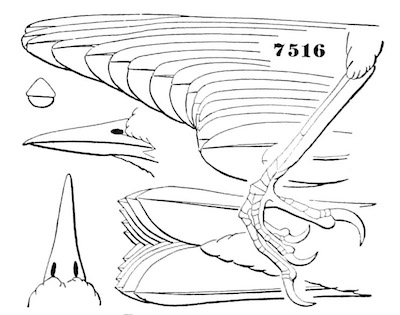
Gen. Char.
Characterized by its long, distinctly notched bill, and long wings, which are
an inch longer than the slightly graduated tail (the
lateral feathers about .12 of an inch shorter). The
under tail-coverts are very long, reaching within half
an inch of the tip of the tail. The tarsi and hind toe
are proportionally longer than in the true Warblers.
The notch and great size of the bill distinguish it
from the Swamp Warblers. Nest in holes; eggs much
blotched with reddish.
The only North American species belonging
to the group appears to be the old Sylvia
protonotaria of Gmelin.
Protonotaria citrea, Baird.
PROTHONOTARY WARBLER; GOLDEN SWAMP WARBLER.
Motacilla citrea, Bodd.
Tabl. 1783 (Pl. enl. 704, fig. 2). Protonotaria citrea, Baird, Birds N. Am. 1858,
239; Rev. 173.—Sclater, Catal. 1861, 26, No. 166.—Gundl. Cab. Jour. 1861, 324
(Cuba; very rare). Helminthophaga citrea, Cab. Jour. 1861, 85
(Costa Rica). Motacilla protonotarius, Gm. Sylvia prot. Lath.—Vieill. Ois. Am. Sept. II, pl. lxxxiii.—Wilson, Am. Orn. III, pl. xxiv. fig. 2.—Aud. Orn. Biog. II, pl. iii.
Vermivora prot. Bon. Helinaia prot. Aud. Helmitherus prot.
Bon. Compsothlypis prot. Cab. Jour. Motacilla auricollis, Gmel. I, 1788, 984. Sylvia aur. Lath., etc. (based on Le Grand Figuier du Canada, Brisson, Ois.
III, 1760, 508, pl. xxvi, fig. 1). Female. Sylvicola aur. Nutt. Man. I, 1840, 431.
Sp. Char.
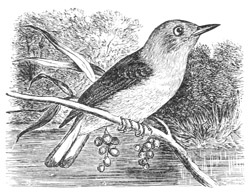
Bill very large; as long as the head. Head and neck all round, with the
entire under parts, including the tibiæ, rich yellow, excepting the anal region and under
tail-coverts, which are white. Back dark olive-green, with a tinge of yellow; rump,
upper tail-coverts, wings, and tail above, bluish ash-color. Inner margin of quills and the
tail-feathers (except the innermost) white; the outer webs and tips like the back. Length,
5.40; wing, 2.90; tail, 2.25.
Hab.
Eastern Province of United States (Southern region); Cuba, Costa Rica, and
Panama R. R. Not recorded from Mexico or Guatemala. Accidental in New Brunswick
(G. A. Boardman in letter). Yucatan (Lawrence).
This is one of the very handsomest of American Warblers, the yellow of the
head and lower parts being of a pureness and mellowness scarcely approached
by any other species. In a highly colored male from Southern Illinois (No.
10,111, Mississippi Bottom, Union Co., April 23; R. Kennicott) it is stained
in spots, particularly over the eyes and on the neck, with a beautiful cadmium-orange.
Protonotaria citrea.
Habits. In regard to the habits of this beautiful and interesting Warbler
we receive but little light from the observations
of older ornithological writers.
Its geographical distribution is somewhat
erratic and irregular. It does not
appear to be distributed over a very
wide range. It occurs as a migrant in
the West Indies and in Central America.
In the United States it is found
in the Southern region, but farther west
the range widens, and in the Mississippi
Valley it is found as far north as Kansas,
Southern and Central Illinois, and Missouri. Accidental specimens have been
obtained as far to the northeast as Calais, though unknown to all the Eastern
States as far south as Southern Virginia. It was met with by none of the government
parties except by Dr. Woodhouse, who found it abundant in Texas.
Mr. Audubon observed them, near Louisville, Kentucky, frequenting creeks
and lagoons overshadowed by large trees. These were their favorite places
of resort. They also preferred the borders of sheets of water to the interior
of the forest. They return in spring to the Southern States early in March,
but to Kentucky not before the last of April. They leave in October, and
raise but a single brood in a season. Audubon describes their nest, but it
differs so essentially from their known mode of breeding, that he was
evidently in error in regard to his supposed identification of the nest of
this species.
Dr. Bachman, who often met them on the borders of small streams near
Charleston, was confident that they breed in that State, and noticed a pair
with four young birds as early as June 1, in 1836.
Recently more light has been thrown upon their habits by Mr. B. F.
Goss, who, in May, 1863, found them breeding near Neosho Falls, in Kansas.
The nest was built within a Woodpecker’s hole in the stump of a tree,
not more than three feet high. The nest was not rounded in shape, but
made to conform to the irregular cavity in which it was built. It was
of oblong shape, and its cavity was deepest, not in the centre, but at one
end, upon a closely impacted base made up of fragments of dried leaves,
broken bits of grasses, stems, mosses, and lichens, decayed wood, and other
material, the upper portion consisting of an interweaving of fine roots of
wooded plants, varying in size, but all strong, wiry, and slender. It was
lined with hair.
Other nests since discovered are of more uniform forms, circular in shape,
and of coarser materials, and all are built with unusual strength and care for
a nest occupying a sheltered cavity.
In one instance their nest was built in a brace-hole within a mill, where
the birds could be closely watched as they carried in the materials, and the
parent was afterward taken by hand by Mr. Goss from its nest. It was
quite tame, and approached within two yards of him.
Since then Mr. Ridgway has obtained a nest at Mt. Carmel, Ill. It was
built in a hollow snag, about five feet from the ground, in the river bottom.
So far from being noisy and vociferous, as its name would seem to
imply, Mr. Ridgway describes it as one of the shyest and most silent of all
the Warblers.
The eggs of this Warbler have an average breadth of .55 of an inch and a
length varying from .65 to .70 of an inch. They are of a rounded-oval form,
one end being but slightly less rounded than the other. Their ground-color
is a yellowish or creamy white, more or less profusely marked over their
entire surface with lilac, purple, and a dark purplish-brown.
Mr. Ridgway states that it is always an abundant summer bird in the
Wabash bottoms, where it inhabits principally bushy swamps and the willows
around the borders of stagnant lagoons or “ponds” near the river, and
in such localities, in company with the White-bellied Swallow (Hirundo
bicolor), takes possession of the holes of the Downy Woodpecker (Picus
pubescens) and Chickadee (Parus carolinensis), in which to build its nest.
Mr. Ridgway adds that in its movements this Warbler is slow and deliberate,
like the Helmitherus vermivorus, strikingly different in this respect
from the sprightly, active Dendroecæ. Its common note is a sharp piph, remarkably
like the winter note of the Zonotrichia albicollis.
It has been taken as far north as Rock Island, Ill., and Dr. Coues mentions
the occurrence of one individual near Washington, D. C., seen in a
swampy brier-patch, May 2, 1861. This was perhaps only an accidental
visitor. If regularly found there, it is probably exceedingly rare. It has not
been met with between Washington and St. Stephens, New Brunswick, where
its occurrence was unquestionably purely accidental.
Genus HELMITHERUS, Raf.
Helmitherus, Rafinesque, Journal de Physique, LXXXVIII, 1819, 417. (Type, Motacilla
vermivora.)
Vermivora, Swainson, Zoöl. Jour. IV. 1827, 170 (not of Meyer, 1822).
Helinaia, Aud. Synopsis,
1839, 66. (Type, Sylvia swainsoni, Aud.)
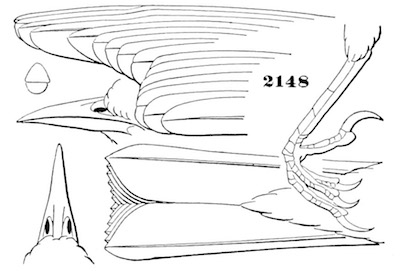
Helmitherus vermivorus, Bonap.
2148
Gen. Char.
Bill large and stout, compressed, almost tanagrine; nearly or quite as long
as the head. Culmen very slightly curved;
gonys straight; no notch in the bill; rictal
bristles wanting. Tarsi short, but little longer,
if any, than the middle toe. Tail considerably
shorter than the wings; rather rounded.
Wings rather long, the first quill a little shorter
than the second and third.
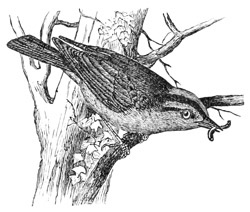
Helmitherus vermivorus.
The birds of this division are very
plain in their colors, more so than any
other American Warblers. There are
but two species referable to the genus, of which the H. swainsoni differs
from the type in having a considerably
longer and more compressed bill, the
ridge of which is compressed, elevated,
and appears to extend backwards on
the forehead, as well as to be in a
straight line with the upper part of
the head. The wings are longer; the
tail forked; not rounded; the feathers
narrower and more pointed; the tarsi
shorter than in the type. It appears
to be at least a distinct subgenus to
which the name Helinaia, Aud., is to
be applied.
Species.
Common Characters. Colors plain. Above olivaceous, beneath nearly white.
No spots or bands on wing or tail.
H. vermivorus. Above olive-green. Head yellowish, with a black stripe
above and one behind each eye. Tail rounded. Hab. Eastern Province of
United States; south to Costa Rica; Cuba. (Helmitherus.)
H. swainsoni. Above dull olive-green, tinged with brown. Stripes on
the head somewhat as in the last, but reddish-brown; the median light
stripe on the crown scarcely visible. Tail slightly forked. Hab. South
Carolina and Georgia; Cuba (very rare). (Helinaia.)
Helmitherus vermivorus, Bonap.
WORM-EATING SWAMP WARBLER.
Motacilla vermivora, Gmel.
Syst. Nat. I, 1788, 951. ? Sylvia vermivora, Lath. Ind. Orn. II, 1790, 499.—Wils. III, pl. xxiv, fig. 4.—Aud. Orn. Biog. I, pl.
xxxiv. Sylvicola vermivora, Rich. Helinaia vermivora, Aud. Birds Am. II, pl. cv.—Lembeye, Av. Cuba, 1850, 35, pl. vi, fig. 4. Helmitherus vermivorus,
Bon.; Cab.; Baird, Birds N. Am. 1858, 252; Rev. 179.—Sclater, P. Z. S. 1859, 363 (Xalapa).—Ib. Catal. 1861, 28, No.
175.—Sclater & Salvin, Ibis, I, 1859, 11 (Guatemala); Cab. Jour. 1860, 329 (Costa Rica); Ib. 1856 (Cuba).—Gundlach, Cab. Jour. 1861, 326 (Cuba; somewhat rare). Vermivora pennsylvanica, Bon., Gosse,
B. Jamaica, 1847, 150. Helmitherus migratorius, Raf. J. de Phys. 88, 1819, 417.—Hartlaub; Vermivora fulvicapilla, Swainson, Birds, II, 1837, 245.
Sp. Char.
Bill nearly as long as the head; upper parts generally rather clear olive-green.
Head with four black stripes and three brownish-yellow ones, namely, a black one
on each side of the crown and one from behind the eye (extending, in fact, a little anterior
to it), a broader median yellow one on the crown, and a superciliary from the bill. Under
parts pale brownish-yellow; tinged with buff across the breast and with olivaceous on the
sides. Tail unspotted. Female nearly similar. Length, 5.50; wing, 3.00; tail, 2.35.
In autumnal specimens the light stripes on the head are deeper buff than in spring.
Hab.
Eastern Province of United States (rather Southern); Southeastern Mexico; Guatemala;
Cuba; Costa Rica; Veragua; Orizaba (winter, Sumichrast); Yucatan (Lawrence).
Habits. Much remains to be ascertained in regard to the history, habits, and
distribution of this interesting species. So far as is now known it is hardly
anywhere very common during the breeding-season. Yet its abundance and
wide distribution as a migrant during the winter months in various extended
localities appear to warrant the belief that it must be correspondingly abundant
in summer in localities that have escaped our attention. It has been occasionally
met with in the Central and Southern States, as far west as Eastern
Mexico, and as far to the north as Southeastern New York. Specimens have
been procured from Cuba, Mexico, Central America, and the northern portions
of South America. It is a regular winter visitant of Jamaica, whither it goes
in the autumn in considerable numbers, and is very widely diffused.
It reaches Pennsylvania about the middle of May, and leaves in September.
Wilson noticed a pair feeding their young about the 25th of June.
He supposed this bird to have a more northern distribution than belongs to
it. In the interior they are met with, according to Audubon, as far north as
the southern shores of Lake Erie, where he found them in the autumn. Mr.
Audubon found them more numerous in New Jersey than anywhere else. In
Ohio and Kentucky they are comparatively rare. Mr. Ridgway informs me
that this is a rather common species in Southern Illinois in the thickest
damp woods in the bottom-lands along the Wabash River.
According to Wilson, these birds are among the nimblest of its family, and
are remarkably fond of spiders, darting about wherever there is a probability
of finding these insects. Where branches are broken and the leaves withered,
it searches among them in preference, making a great rustling as it hunts for
its prey. Their stomachs are generally found full of spiders and caterpillars.
These birds are arboreal in their preferences, residing in the interior of
woods, and are seldom seen in the open fields. They resort to the ground
and turn over the dry leaves in quest of insects. They are very unsuspicious
and easy of approach.
Nuttall describes their notes and their habits as resembling the common
Parus atricapillus, and remarks that they are constantly uttering a complaining
call, sounding like tshe-dē-dē.
Until quite recently, nothing has been positively known in regard to its
nesting. Audubon has described its nest as made of dry mosses and the
fallen bloom of the hickory and the chestnut, and as built in bushes several
feet from the ground. He describes the eggs as cream-colored, marked about
the larger end with reddish-brown. These descriptions have not been confirmed,
and all our information has led us to look for its nest on the ground.
Mr. Trippe states that it is found, but is not at all common, near Orange,
N. Y., where it arrives about the middle of May. It has, at that time, a
rapid, chattering note, and it always, he says, keeps near the ground, and,
besides its chattering song, has in June a series of odd notes, much like
those of the White-breasted Nuthatch, but more varied and musical, yet
hardly entitled to be called a song.
Mr. T. H. Jackson of Westchester, Penn., in the American Naturalist for
December, 1869, mentions finding the nest and eggs of this bird. We give
his account in his own words: “On the 6th of June, 1869, I found a nest
of this species containing five eggs. It was placed in a hollow on the ground,
much like the nests of the Oven-Bird (Seiurus aurocapillus), and was hidden
from sight by the dry leaves that lay thickly around. The nest was composed
externally of dead leaves, mostly those of the beech, while the interior
was prettily lined with the fine, thread-like stalks of the hair-moss,
(Polytrichium). Altogether it was a very neat structure, and looked to me as
though the owner was habitually a ground nester. The eggs most nearly
resemble those of the White-bellied Nuthatch (Sitta carolinensis), though the
markings are fewer and less distinct. So close did the female sit that I
captured her without difficulty by placing my hat over the nest.”
The same observing ornithologist informs me that this Warbler arrives in
Pennsylvania early in May, and makes the most solitary part of the woods
its home, outside of which it is rarely seen. True to its name, it is ever
busy hunting out and devouring the worms that lurk among the forest foliage,
pursuing its avocation in silence, with the exception of a faint note
uttered occasionally. This species is not as shy as many of our Warblers that
frequent the woods. Towards the latter part of May they commence constructing
their nests. Mr. Jackson adds that the nest above referred to was
found on a thickly wooded hillside, a few yards above a running stream. So
neatly was it embedded in the ground and covered with dry leaves, that
discovery would have been impossible had not the female betrayed its
position. Both birds exhibited the greatest alarm at his presence, but on
his retiring to a short distance the female returned to the nest, where she
was easily captured. The base and periphery of the nest were composed
of dry beech-leaves, while the inner lining was made of fine hair-mosses
(Polytrichium).
In the latter part of June, 1871, Mr. Jackson found another nest of this
species, containing five young birds about half grown. He was seated on
a log, resting after a hard tramp, when a Worm-eating Warbler alighted near
him, having a large green worm in its beak. After at first manifesting much
uneasiness, and scolding as well as she could, she suddenly became silent and
flew to the ground. On his going to the spot both parents flew from the
nest. It was in all respects, in regard to materials, manner of construction,
and situation, the exact counterpart of the other. Both were placed on steep,
wooded hillsides, facing the east.
Two of the eggs of this Warbler thus identified by Mr. Jackson, and kindly
loaned to me by him, are of a somewhat rounded-oval shape, less obtuse at
one end. They have a clear, crystal-white ground, and are spotted with
minute dottings of a bright red-brown. These are much more numerous in
one than in the other, and in both are confluent at the larger end, where
they are beautifully intermingled with cloudings of lilac-brown. These eggs
measure, the one .78 by .60 of an inch; the other, .70 by .56 of an inch.
Another nest of this species, found by Mr. Joseph H. Batty of New York,
on the side of a hill near Montclair, N. J., was also built on the ground, in
a part of the woods where there was no underbrush, and was placed in a
slight hollow, with dry oak-leaves collected around it, and partly covering it.
The nest was made of dry leaves, and lined with grasses and fine roots. It
contained four eggs, alike in their marking, and corresponding exactly with
those obtained by Mr. Jackson. Mr. Batty nearly stepped on the bird without
her leaving the nest.
Dr. Coues found the Worm-eating Warbler a rather uncommon summer
resident near Washington, breeding there but sparingly. It arrives there
during the first week in May, and remains until the third week in September.
He describes it as slow and sedate in its movements.
Helmitherus swainsoni, Aud.
SWAINSON’S SWAMP WARBLER.
Sylvia swainsoni, Aud. Orn. Biog. II, 1834, 563, pl. cxcviii. Sylvicola sw. Rich. Vermivora sw. Bon. Helinaia sw. Aud. Birds
Am. II, 1841, pl. civ (type of genus). Helmitherus sw. Bon.; Cab.; Baird, Birds N. Am.
1858, 252; Rev. 180.
Sp. Char.
Bill as long as the head. Upper parts dull olive-green, tinged with reddish-brown
on the wings, and still more on the crown and nape; a superciliary stripe and the
under parts of the body are white, tinged with yellow, but palest on the tail-coverts; the
sides pale olive-brown. There is an obscure indication of a median yellowish stripe on
the forehead. The lores are dusky. No spots nor bands on wings or tail. Length, 5.60;
wing, 2.85; tail, 2.20.
Hab.
Coast of South Carolina and Georgia; Cuba (very rare).
A young bird (No. 32,241 Liberty Co., Georgia) is very similar to the adult
described, but differs in the following respects: the lower parts have a decided
soiled, sulphur-yellow tinge, while the brown of the upper parts is
much more reddish, there being no difference in tint between the crown
and back; also the superciliary stripe is more sharply defined.
Habits. This species is comparatively rare, and, so far as is known, has a
very restricted distribution. It was first discovered by Rev. Dr. Bachman,
in the vicinity of Charleston, S. C., near the banks of the Edisto River.
This was in the spring of 1832. He was first attracted by the novelty of its
notes, which were four or five in number and repeated at intervals of a few
minutes. These notes were loud and clear, and more like a whistle than a
song. They resembled the sounds of some extraordinary ventriloquist,—so
much so that he at first supposed the bird to be much farther off than it
really was. He was so fortunate as to secure it. The shape of the bill he
at once noticed as being different from that of any other American bird then
known to him. In the course of that season he obtained two other specimens.
Toward the close of the same season he saw an old female, accompanied by
its four young. One of the latter, which he procured, did not differ materially
from the old birds.
He met with them only in swampy and muddy places, and when opened,
he always found their stomachs filled with fragments of coleopterous insects,
as well as small green worms, such as are common on water-plants. The
habits of this species most resemble those of the Prothonotary Warbler,
as the latter skips among the low bushes growing about ponds or in marshy
places. It is seldom seen on high trees. Nothing is known as to their
nesting or eggs.
Genus HELMINTHOPHAGA, Caban.
Helminthophaga, Cabanis, Mus. Hein. 1850, 1851, 20. (Type, Sylvia ruficapilla, Wils.)
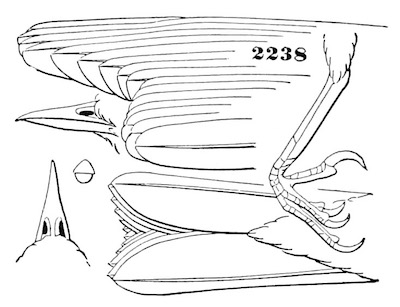
Helminthophaga ruficapilla.
2238
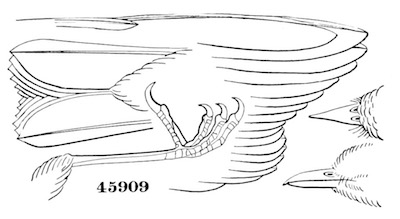
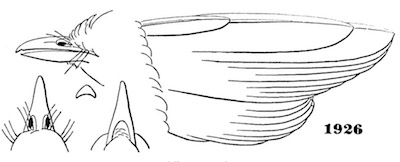
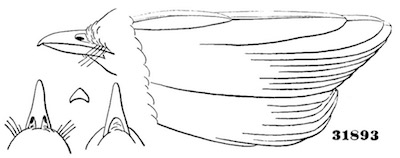
Gen. Char.
Bill elongated, conical, very acute; the outlines very nearly straight,
sometimes slightly decurved; no trace of notch at
the tip, nor of bristles on the rictus. Wings long and
pointed; the first quill nearly or quite the longest.
Tail nearly even or slightly emarginate; short and
rather slender. Tarsi longer than the middle toe and
claw.
The species of this section are well characterized
by the attenuation and acuteness
of the bill, and the absence of any notch.
There are, however, considerable subordinate
differences in the different species. In some the bill is larger and more
acute than others; in one species, the H. peregrina, the wings are unusually
lengthened, the tail being only about seven twelfths as long.
Species and Varieties.
Common Characters.
Iris brown. Length about 5.00. Nest on the ground,
in grass or dead leaves. Eggs clear white, thickest at end, with minute dots of
brown of various shades and faint purple.
A. Tail with a conspicuous patch of white.
a. A black patch covering throat and breast.
1. chrysoptera. Above ash, beneath white. Forehead and a patch
on the wing yellow. Hab. Eastern Province of United States, south to
Bogota; Cuba.
2. bachmani. Above olive-green; beneath, with forehead, yellow;
crown ash, bounded anteriorly with a black bar. No yellow on wing.
Hab. South Carolina and Georgia. Cuba in winter.
b. No black on throat or breast.
3. pinus. Above olive-green; beneath, with forehead, yellow; wings
ash, with two white bands; lores black. Hab. Eastern Province of
United States, south into Guatemala.
B. Tail without a conspicuous white patch.
c. Crown with a concealed patch of rufous (obsolete in ♀).
4. ruficapilla. Above olive-green; head ashy; beneath continuous
yellow; a light orbital ring. Hab. North America (very rare in Middle
and Western Provinces); Greenland. South to Southern Mexico (Oaxaca,
Cordova, Orizaba).
Yellow of throat spreading over cheeks, and staining lores and
eyelids. Atlantic States. (Carlisle, Penn., specimens.) … var. ruficapilla.
Yellow of throat confined within the maxillæ; lores and eyelids
clear white. Mississippi Valley. (Chicago specimens.) … var. ocularis.
Yellow of throat restricted to a medial stripe, leaving its sides
ashy. Middle Province. (Specimen from Fort Tejon, Cal., and
East Humboldt Mountains, Nevada.) … var. gutturalis.
5. virginiæ. Above ash to the rump, beneath white. A patch on the
jugulum, with the upper and lower tail-coverts, yellow. Hab. Rocky
Mountains of United States, west to East Humboldt Mountains.
6. luciæ. Above ash, beneath continuous white. Upper tail-coverts
chestnut. Hab. Colorado region of Middle Province.
7. celata. Above continuous olive-green, below continuous pale yellow.
(Orange on crown in ♂ only?)
Above ashy-olive, beneath yellowish olivaceous-white; inner
webs of tail-feathers broadly edged with white. (Middle regions
of North America; Mexico.) … var. celata.
Above greenish-olive, beneath bright greenish-yellow; white
edges to inner webs of tail-feathers obsolete. (Pacific Province
of North America.) … var. lutescens.
Similar to var. celata, but plumage darker and more dingy. No
white edgings to tail-feathers, and apparently no rufous on the
crown in either sex. (Georgia, Florida, etc.) … var. obscura.
d. No rufous on crown.
8. peregrina. Above olive-green; head and neck pure ash; beneath
continuous white. Hab. Eastern Province of North America north to
Fort Simpson, H. B. T. south to Panama. Cuba (rare).
Helminthophaga chrysoptera, Caban.
GOLDEN-WINGED WARBLER.
Motacilla chrysoptera, Linn.
S. Nat. I, 1766, 333. Sylvia chr. Lath.—Wils. Am. Orn. II, pl. xv. fig. 5.—Bon. Sylvicola chr.
Bon. Helinaia chr. Aud. Birds Am. II, pl. cvii. Helmitherus chr. Bon.—Sclater, P. Z. S. 1855, 143 (Bogota). Helminthophaga chrysoptera, Cab. Mus. Hein.; Journ. f. Orn. 1860, 328 (Costa Rica).—Baird, Birds N.
Am. 1858, 255; Rev. 175.—Sclater & Salvin, Ibis, II, 1860, 397 (Choctum, Guatemala).—Salvin, 1867, 135.—Dresser, Ibis, 1865, 477 (San Antonio).—Lawrence, Ann. N. Y. Lyc. VII, 1861, 293 (Panama).—Gundl. Cab. Journ. 1861, 326 (Cuba, rare). Motacilla flavifrons, Gmelin. Sylvia flavifrons, Lath.
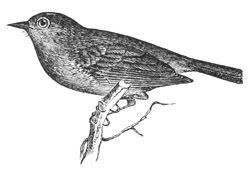
Helminthophaga celata.
Sp. Char.
Upper parts uniform bluish-gray; the head above and a large patch on the
wings yellow. A broad streak from the bill
through and behind the eye, with the chin,
throat, and forepart of the breast, black. The
external edge of the yellow crown continuous
with a broad patch on the side of the occiput
above the auriculars, a broad maxillary stripe
widening on the side of the neck, the under parts
generally, with most of the inner webs of the
outer three tail-feathers, white; the sides of the
body pale ash-color. Female similar, but duller.
Length about 5 inches; wing, 2.65; tail, 2.25.
Hab.
Eastern Province of United States, San
Antonio (Dresser); Cuba (rare); Guatemala; Costa Rica; Panama; Bogota. Recorded
in West Indies from Cuba only; not from Mexico. Veragua; Chiriqui (Salvin).
Habits. So far as our present knowledge of this Warbler extends, it is
nowhere a common species, and is distributed over a comparatively small
extent of territory. Wilson met with it in Pennsylvania during the last of
April and the first of May, believing it to be only a migrant species on its
way to more northern regions. Nuttall was sceptical of these conclusions,
as he never met with the species in the New England States. Audubon
observed these birds in their migrations through Louisiana, which State they
entered from Texas in the month of April. He procured several specimens
in Louisiana and Kentucky, and one in New Jersey. He knew nothing as
to its breeding, and seems to have accepted Wilson’s inferences in regard to
its northern migrations. He never met with this bird in the fall, when, if a
Northern species, it should be returning south, and thence inferred that it
migrated by night.
Professor Baird has obtained this bird near Carlisle, Penn., in July,
rendering probable its breeding in that vicinity. W. S. Wood met with
it near St. Louis, May 13, 1857, and two days previously in the same
year Mr. Kennicott procured an individual in Southern Illinois. Occasionally
specimens have been obtained in Massachusetts, and of late these
occurrences have become more frequent or more observed. It was first
noticed near Boston by J. Eliot Cabot, Esq., who shot one in May, 1838,
near Fresh Pond. This was, he thinks, on the 20th of that month. Since
then Mr. J. A. Allen has known of several specimens taken within the
State. Mr. Jillson has observed it spending the summer in Bolton, and
evidently breeding, as has also Mr. Allen at Springfield, and Mr. Bennett at
Holyoke. In the summer of 1870, Mr. Maynard obtained its nest and eggs
in Newton.
The late Dr. Gerhardt found it breeding among the high grounds of Northern
Georgia. It has also been taken at Racine, Wis., by Dr. Hoy, and in
Ohio. These data seem to show that it is sparingly found from Georgia to
Massachusetts, and from New Jersey to Missouri and Wisconsin. Its western
limits may be more extended. It was not met with by any of the exploring
parties beyond St. Louis, but its retiring habits and its sparse distribution
may account for this.
Dr. Samuel Cabot was the first naturalist to meet with the nest and eggs
of this bird. This was in May, 1837, in Greenbrier County, Va. The nest
was constructed in the midst of a low bush on high ground, and contained
four eggs.
The late Dr. Alexander Gerhardt found the nest and eggs of this Warbler
in the spring of 1859, in Whitfield County, Ga. It contained four eggs, and
was built on the ground. It was very large for the bird, being five inches in
height and four in diameter. The cavity was also quite large and deep for
so small a bird, exceeding three inches both in depth and in diameter. The
outer and under portions of this nest were almost entirely composed of the
dry leaves of several kinds of deciduous trees. These were interwoven with
and strongly bound together by black vegetable roots, dry sedges, and fine
strips of pliant bark, and the whole lined with a close network of fine
leaves, dry grasses, and fibrous roots. Dr. Gerhardt informed me that these
birds usually build on or near the ground, under tussocks of grass, in clumps
of bushes, or pine-brush, and that they lay from four to five eggs, from the
6th to the 15th of May.
The eggs of this species are of a beautiful, clear crystal-white, with a few
bright reddish-brown spots around the larger end. Eggs from Racine, Wis.,
and from Northern Georgia, differ greatly in their relative size. The former
measure .70 of an inch in length and .53 in breadth; the latter, .63
by .49.
A single specimen of this species was obtained by Mr. Salvin, at Choctum,
in Guatemala.
Helminthophaga bachmani, Caban.
BACHMAN’S WARBLER.
Sylvia bachmani, Aud. Orn. Biog. II, 1834, 483, pl. clxxxiii. Sylvicola b. Rich. Vermivora b. Bon. Helinaia b. Aud. Syn. Birds Am. II, 1841, 93, pl. cviii.—Lembeye, Av. Cuba, 1850, 36, pl.
vi. fig. 1. Helmitherus b. Bon. Helminthophaga b. Cab. Jour. III, 1855, 475 (Cuba, in winter).—Baird, Birds
N. Am. 1858, 255; Rev. 175.—Gundlach,
Cab. Jour. 1861, 326 (Cuba, rare); Repert. 65, 232.
Sp. Char. Above olive-green, as also are the sides of the head and neck. Hind
head tinged with ash. A broad patch on the forehead, bordered behind by black; chin,
stripe from this along the side of the throat, and the entire under parts, deep yellow.
Throat and forepart of breast black. A patch on the inner web of the outer two tail-feathers
near the end white. Length, 4.50; wing, 2.35; tail, 2.05. Female with merely
a patch of dusky on the jugulum, and with the black bar on vertex obsolete.
Hab.
Coast of South Carolina and Georgia; Cuba in winter.
Habits. Bachman’s Warbler is a comparatively new and but little known
species of this interesting group. It was first discovered, July, 1833, by Rev.
Dr. John Bachman, a few miles from Charleston, S. C., and in the same vicinity
he afterwards discovered a few others of both sexes. He described it
as a lively, active bird, gliding among the branches of the thick bushes, occasionally
mounting on the wing and seizing insects in the air, in the manner
of a Flycatcher. The individual first obtained was an old female which
had, to all appearances, just reared a brood of young. With this partial exception,
nothing is known in relation to its habits. As all the species of this
genus, without any at present known exception, construct their nests upon
the ground, it is a natural inference that it probably nests in a similar situation.
The Smithsonian Institution possesses but a single specimen of this bird,
obtained near Charleston, S. C. It was not observed by any naturalist of
the several governmental exploring expeditions, and, so far as we are at
present informed, its only known places of abode are South Carolina and
Cuba, where it is extremely rare. Its nest and eggs still remain unknown.
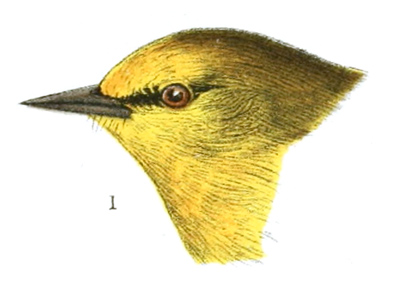
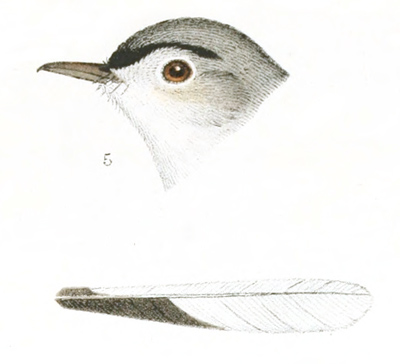
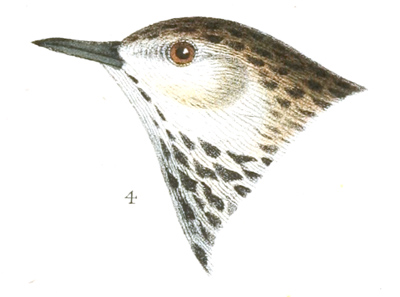
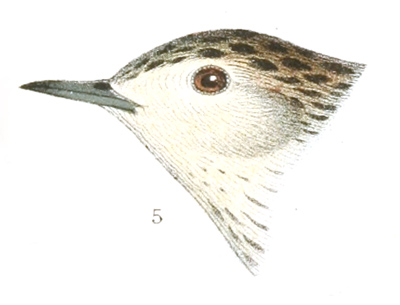
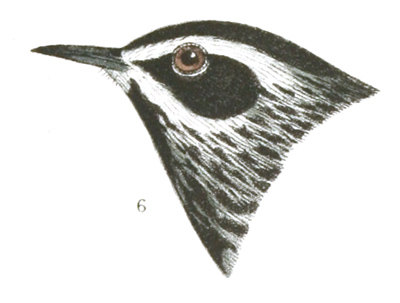
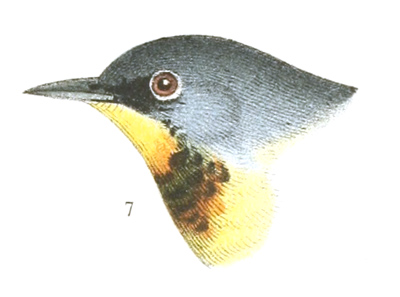
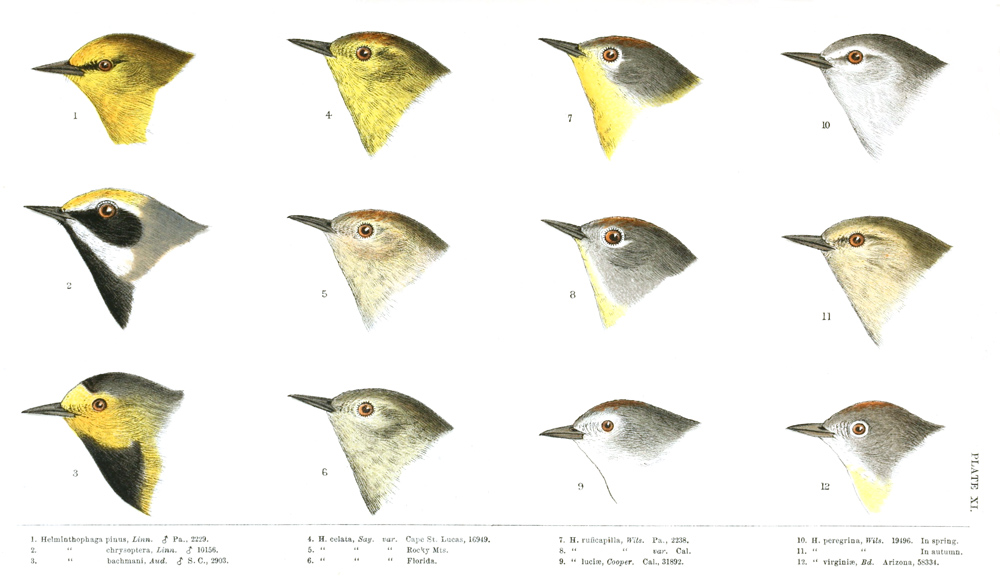
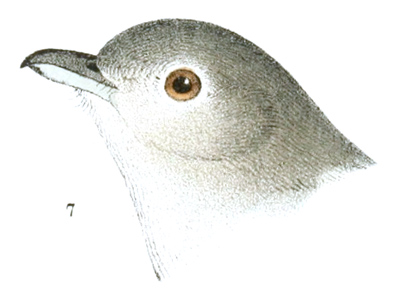
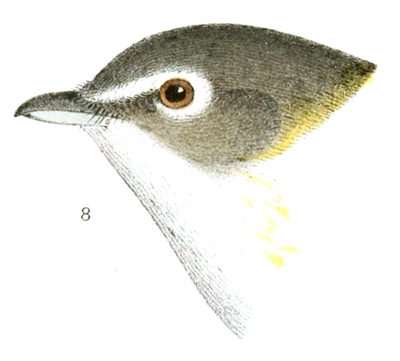
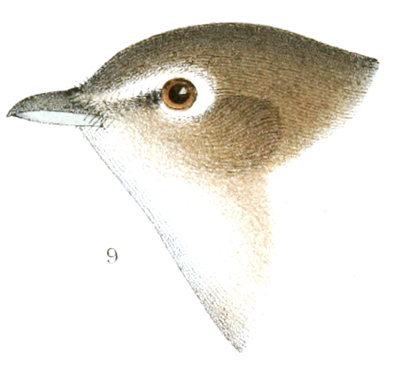
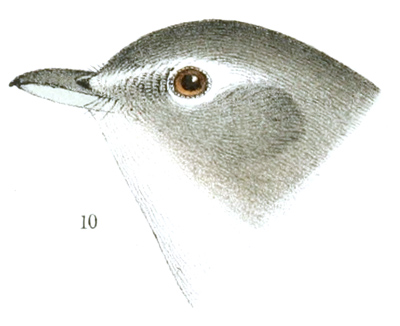
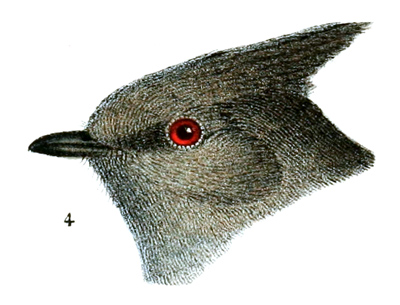
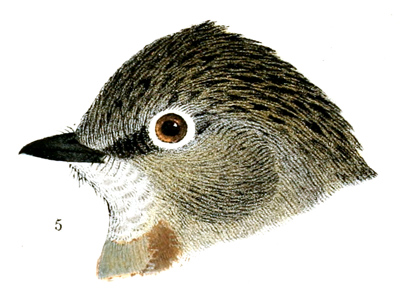
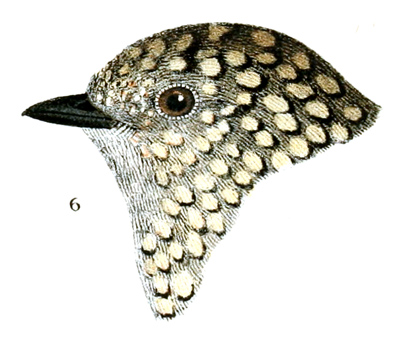
1. Helminthophaga pinus,
Linn. ♂ Pa., 2229.
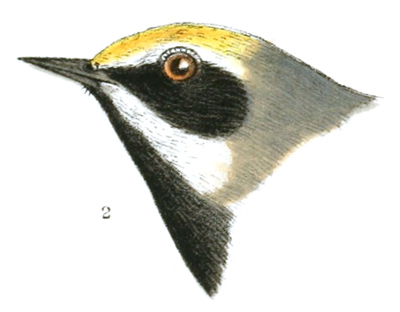
2. Helminthophaga chrysoptera,
Linn. ♂ 10156.
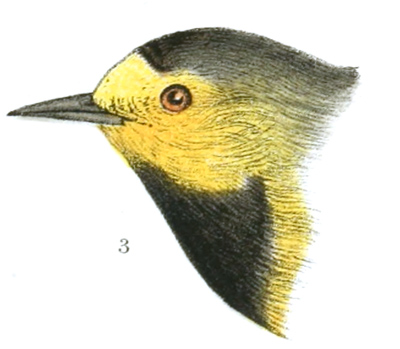
3. Helminthophaga bachmani,
Aud. ♂ S. C., 2903.
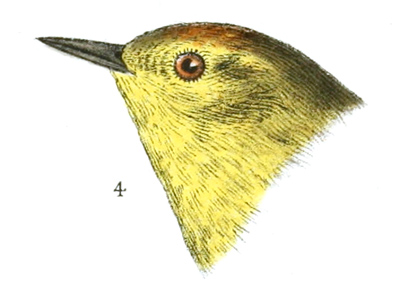
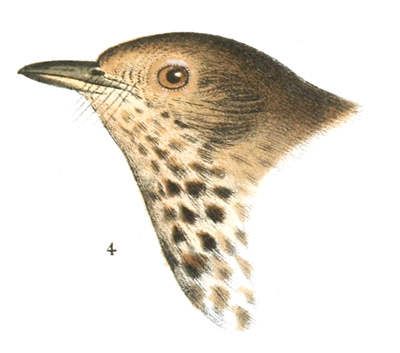
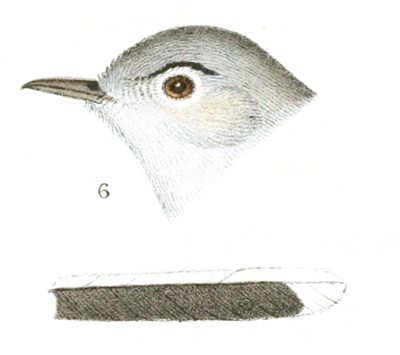
4. Helminthophaga celata,
Say.
var. Cape St. Lucas, 16949.
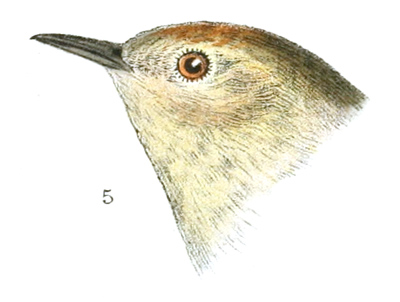
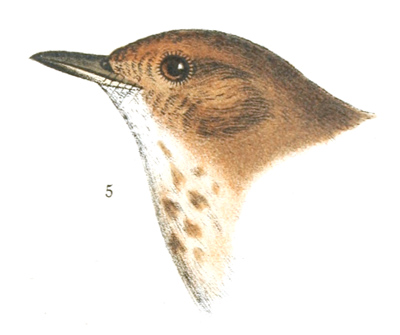
5. Helminthophaga celata,
Say.
var. Rocky Mts..
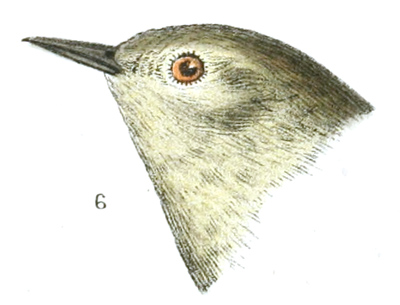
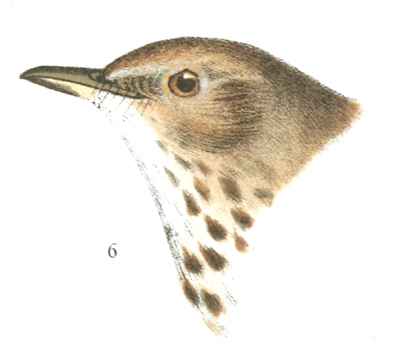
6. Helminthophaga celata,
Say.
var. Florida.
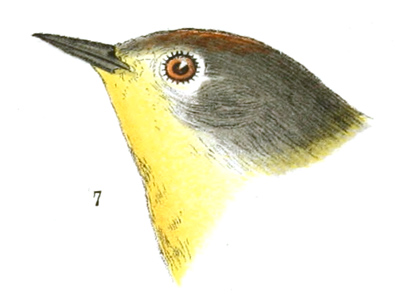
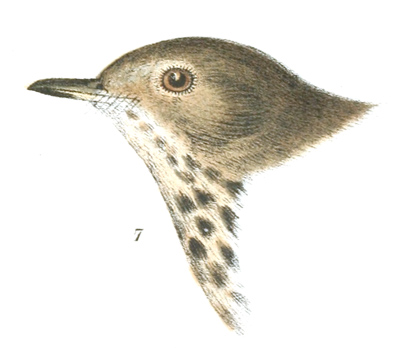
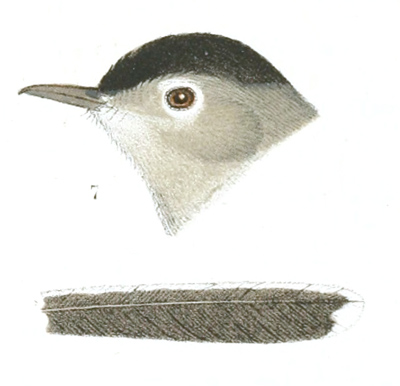
7. Helminthophaga ruficapilla,
Wils. Pa., 2238.
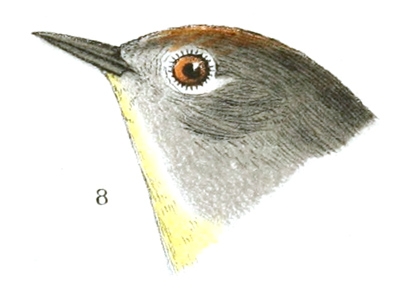
8. Helminthophaga ruficapilla,
Wils. var. Cal.
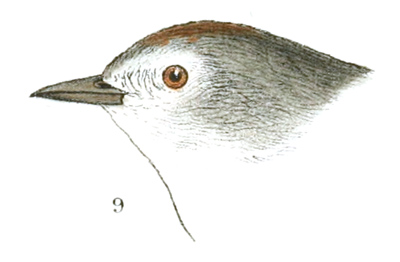
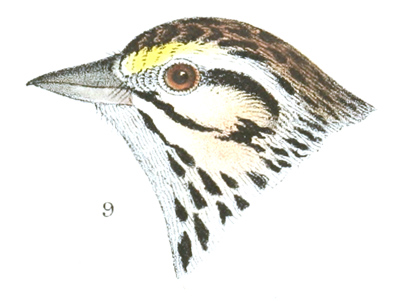
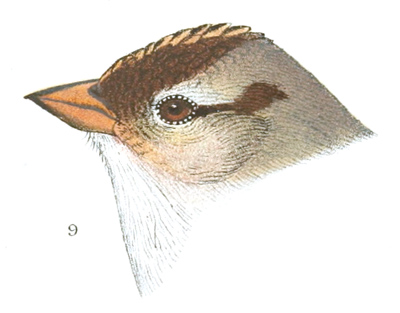
9. Helminthophaga luciæ,
Cooper. Cal., 31892.
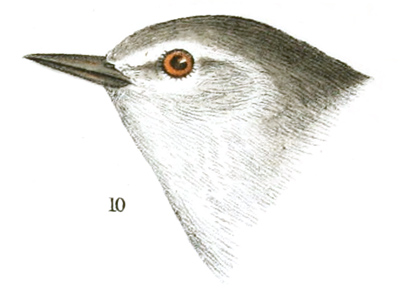
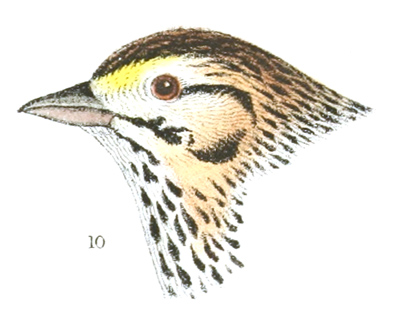
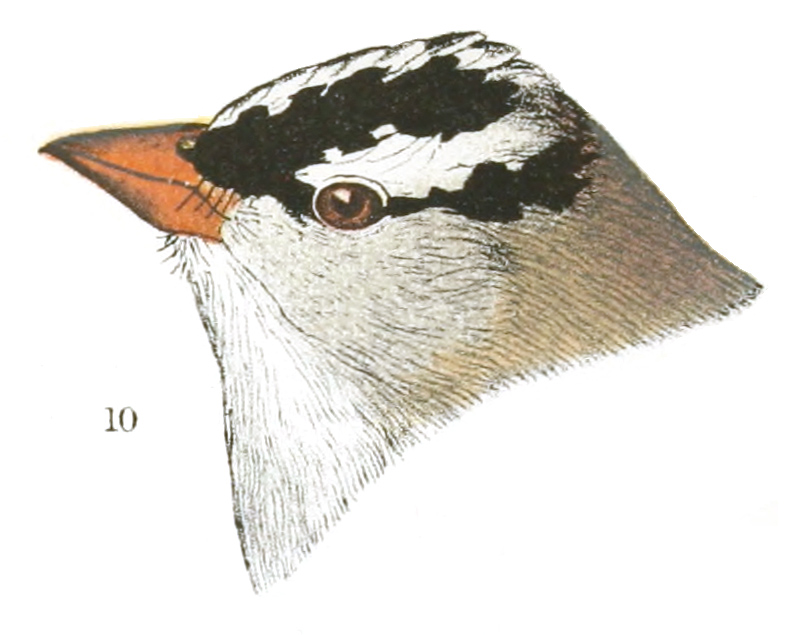
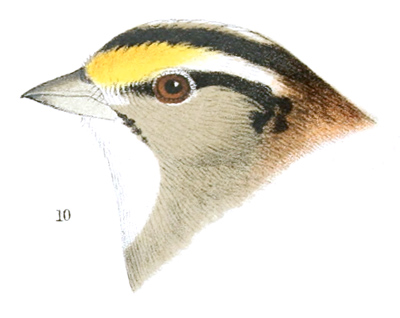
10. Helminthophaga peregrina,
Wils. 19496. In spring.
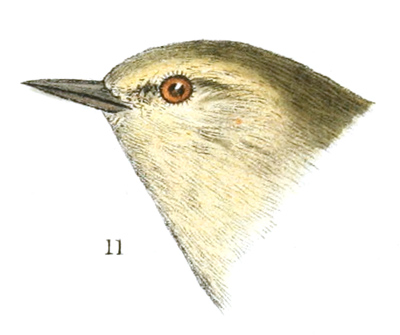
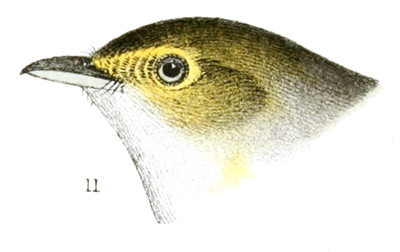
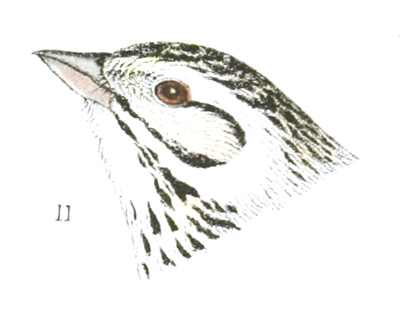
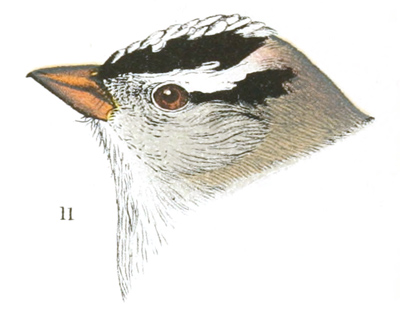
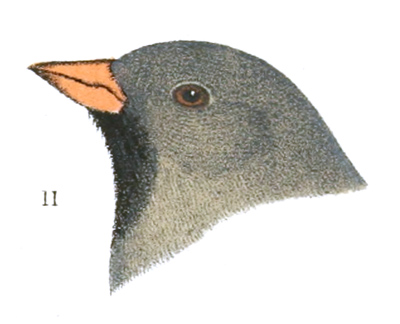
11. Helminthophaga peregrina,
Wils. In autumn.
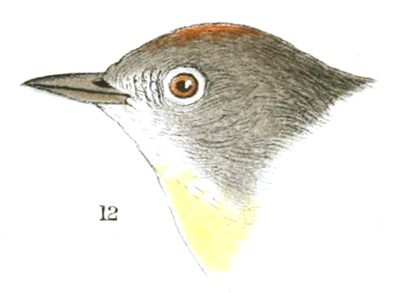
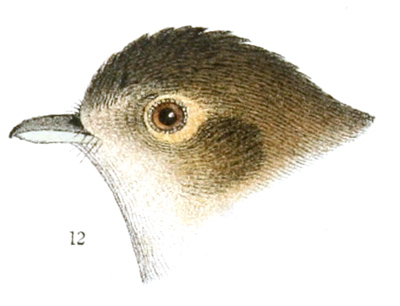
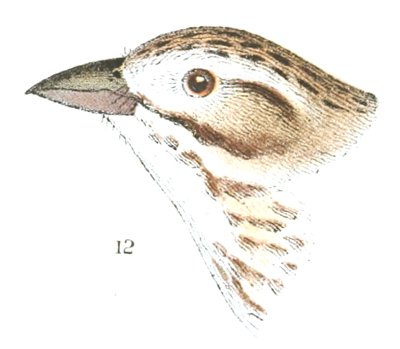
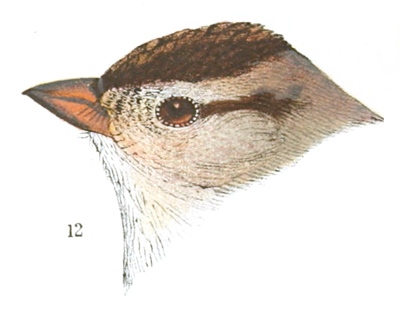
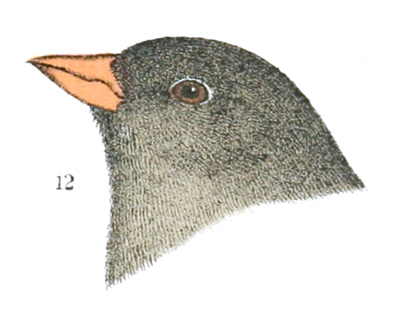
12. Helminthophaga virginiæ,
Bd. Arizona, 58334.
Helminthophaga pinus, Baird.
BLUE-WINGED YELLOW WARBLER.
Certhia pinus, Linn. Syst. Nat. I, 1766, 187. Sylvia pinus, Lath., Vieill. (not of Wilson).
Helminthophaga pinus, Baird, Birds N. Am.
1858, 254; Rev. 174.—Sclater & Salvin, Ibis, 1, 1859, 11
(Guatemala).—Sclater, Catal. 1861, 28, No.
176. Sylvia solitaria, Wilson, Am. Orn. II, pl. xv.—Aud. Orn. Biog. I, pl. xx. Sylvicola sol. Rich. Vermivora sol.
Sw. Helinaia sol.
Aud. Birds Am. II, pl. cxi. Helmitherus sol. Bon.—Sclater, P. Z. S. 1856,
291 (Cordova). Helminthophaga sol. Cab.
Sp. Char.
Upper parts and cheeks olive-green, brightest on the rump; the wings, tail,
and upper tail-coverts, in part, bluish-gray. An intensely black patch from the blue-black
bill to the eye, continued a short distance behind it. Crown, except behind, and the under
parts generally, rich orange-yellow. The inner wing and under tail-coverts white. Eyelids,
and a short line above and behind the eye, brighter yellow. Wing with two white
bands. Two outer tail-feathers with most of the inner web, third one with a spot at the
end, white. Female and young similar, duller, with more olivaceous on the crown. Length,
4.50; wing, 2.40; tail, 2.10.
Hab.
Eastern United States and Mexico to Guatemala (Cordova; Coban). Not
noted from West Indies.
Habits. The Blue-winged Yellow Warbler is not known so far to the
north as New England, and is rare even in Eastern and Southern New York.
It seems to be distributed through the United States from Pennsylvania to
Florida, and from the Mississippi Valley eastward. It has also been taken
in Central America. Mr. Trippe states that it breeds in the vicinity of
Orange, N. Y. Mr. Audubon found it abundant in the barrens of Kentucky,
and as far north on the Mississippi as St. Genevieve.
In regard to the song of this bird, Mr. Trippe states that its notes are very
forcible and characteristic. Once heard, they will always be remembered.
He describes them as a rapid chirrup resembling chūūchich, k´-a-re-r´r´r´r´r,
uttered very quickly. According to Mr. Ridgway, they are wonderfully
similar to the rude lisping chirrup of the Coturniculus passerinus.
Wilson says that these Warblers come from the South early in May, frequenting
thickets and shrubberies in search of insects, which they seek in
the branches. They are also fond of visiting gardens and orchards, gleaning
for insects among the low bushes. They generally build their nests on the
edge of sequestered woods. These Mr. Wilson states to have been, in every
instance observed by him, fixed on the ground, in a thick tussock of long
grass, and built in the form of an inverted cone, the sides being formed
of the dry bark of strong fibrous weeds lined with fine dry grasses. These
materials, he remarks, are not arranged in the usual circular manner, but
shelve downward from the top, the mouth being wide and the bottom narrow.
He describes the eggs as five in number, pure white, with a few faint dots
of reddish near the larger end. The young appear the first week in June.
The nests were always in an open but retired part of the woods, and were
all as thus described.
According to Mr. Audubon its song consists of a few weak notes that are
by no means interesting. His description of its nest agrees with that of
Wilson. He states that it usually has two broods in the season, one in May,
the other in July. The young disperse as soon as they are able to provide for
themselves.
He describes them as of solitary habits, and adds that they leave Louisiana
for the South early in October. Its flight is short, undetermined, and
performed in zigzag lines. It will ascend twenty or thirty yards in the
air as if about to go to a greater distance, when, suddenly turning round, it
will descend to the place from which it set out. It rarely pursues insects
on the wing, feeding chiefly on the smaller kind of spiders, and seizing other
insects as they come within its reach.
The above accounts of its breeding, and especially of its nest, do not correspond
with the observations of Mr. Ridgway, near Mt. Carmel, Ill., where
the bird is abundant. A nest collected by him is a very loose open structure,
composed chiefly of broad, thin, and flexible strips of the inner bark
of deciduous trees, chiefly the bass-wood. It contained five eggs, and was
obtained May 8. It was first discovered by noticing the bird with materials
in her bill. The situation of this nest “was in no wise,” says Mr. Ridgway,
“as described by Wilson, not having any covered entrance.” The nest
was very bulky, and so loosely made that only the inner portion could be
secured. “I have found other nests,” adds Mr. Ridgway, “all corresponding
with this one. There can be no doubt as to its identity, as the birds
were seen building the nest, and were closely watched in their movements.
Both male and female were seen several times.” (No. 10,140, Smith. Coll.)
The eggs of this species measure .70 of an inch in length by .53 in breadth.
Their aground-color is white, sprinkled with a few reddish-brown spots.
Helminthophaga ruficapilla, Baird.
NASHVILLE WARBLER.
Sylvia ruficapilla, Wils.
Am. Orn. III, 1811, 120, pl. xxvii, fig. 3.—Aud. Orn. Biog. I, 1832, 450, pl. lxxxix. Helminthophaga ruficapilla, Baird, Birds
N. Am. 1858, 256; Rev. 175.—Sclater, P. Z. S. 1859, 373 (Xalapa).—Dresser, Ibis, 65, 477
(Texas).—Cooper, Orn. Cal. 1, 1870, 82. Sylvia rubricapilla, Wils. Am. Orn. VI, 1812, 15, General Index.—Nutt., Bon. Sylvicola rub.
Rich. Vermivora rub. Bon.—Reinhardt, Vid. Med. for 1853, 1854, 82 (Greenland).—Brewer, Pr. Bost. Soc. N. H. VI, 1856, 4 (nest and eggs). Helinaia rub. Aud. Birds Am. II, pl. cxiii. Helmitherus rub. Bon.—Scl. P. Z. S. 1856, 291 (Cordova); 1859, 363 (Xalapa). Helminthophaga rub. Cab.—Sclater, P. Z. S. 1858,
298 (Oaxaca; Feb. and Aug.). Mniotilta rub. Reinhardt, Ibis, 1861, 6 (Greenland). Sylvia
leucogastra, Shaw, Gen. Zoöl. X, II, 1817, 622. “Sylvia nashvillei,” Vieillot.—Gray. Sylvia mexicana, Holböll.
Sp. Char.
Head and neck above and on sides ash-gray, the crown with a patch of
concealed dark brownish-orange hidden by ashy tips to the feathers. Upper parts olive-green,
brightest on the rump. Under parts generally, with the edge of the wing, deep
yellow; the anal region paler; the sides tinged with olive. A broad yellowish-white
ring round the eye; the lores yellowish; no superciliary stripe. The inner edges of the
tail-feathers margined with dull white. Female similar, but duller; the under parts paler,
and with more white; but little trace of the red of the crown. Length, 4.65; wing, 2.42;
tail, 2.05.
Hab.
Eastern Province of North America; rare in the Middle Province (Fort Tejon,
Cal., and East Humboldt Mountains, Nev.); Greenland (Reinhardt); Oaxaca (February
and August, Sclater); Xalapa and Cordova (Sclater); Orizaba (winter, Sumichrast).
Not recorded from West Indies.
It is an interesting fact, that, in this species, we find in the yellow a tendency
to become more and more restricted as we pass westward. In adult
spring males from the Atlantic States this color invades the cheeks, and
even stains the lores and eyelids. In two adult spring males from Chicago
it is confined within the maxillæ, the cheeks being clear ash, and the loral
streak and orbital ring pure white; while in an adult male (autumnal, however)
from the East Humboldt Mountains (Nevada, No. 53,354, U. S. Geol.
Expl., 40th par.) the yellow is restricted to a medial strip, even the sides
of the throat being ashy; the ash invades the back too, almost to the rump,
while in Eastern specimens it extends no farther back than the nape. A
male (No. 10,656, J. Xantus) from Fort Tejon, Cal., is much like the Nevada
specimen, though the peculiar features of the remote Western form are
less exaggerated; it is about intermediate between the other specimen and
the specimens from Chicago. As there is not, unfortunately, a sufficiently
large series of these birds before us, we cannot say to what extent these
variations with longitude are constant.
Habits. The Nashville Warbler appears to be a species of somewhat
irregular occurrence; at one time it will be rather abundant, though never
very numerous, and at another time comparatively rare. For a long while our
older naturalists regarded it as a very rare species, and knew nothing as to
its habits or distribution. Wilson, who first met with it in 1811, never found
more than three specimens, which he procured near Nashville, Tenn. Audubon
only met with three or four, and these he obtained in Louisiana and
Kentucky. These and a few others in Titian Peale’s collection, supposed to
have been obtained in Pennsylvania, were all he ever saw. Mr. Nuttall at
first regarded it as very rare, and as a Southern species. In that writer’s later
edition he speaks of it as a bird having a Northern distribution as far as
Labrador. Dr. Richardson records the occurrence of a single straggler in the
fur country. So far as known, it occurs as a migrant in all the States
east of the Missouri, and is a summer resident north of the 40th parallel.
It probably breeds in the high ground of Pennsylvania, though this fact is
inferred rather than known. It breeds in Connecticut and Massachusetts,
and in Maine in the vicinity of Calais, being more abundant there than anywhere
else, as far as has been ascertained.
Two individuals of this species have been taken in Greenland: one at
Godthaab, in 1835; and the other at Fiskenæsset, August 31, 1840.
In Massachusetts it has so far been found in only a few restricted localities,
Andover, Lynn, and Hudson, though it undoubtedly occurs elsewhere.
About the time Wilson obtained his first specimen, a living bird of this
species flew into the parlor of the late Colonel Thomas H. Perkins of Brookline,
and is now in the collection of his grandson, Dr. Cabot. The latter
gentleman states that when he first began making collections this Warbler
was a very rare visitant to his neighborhood, but has of late become
much more common, though varying greatly in this respect in different
seasons. Specimens have been obtained in Western Iowa by Mr. H. W.
Parker, of Grinnell.
A few instances of its occurrence west of the Mississippi Valley are known.
One of these was by Xantus near Fort Tejon; another near Lake Tahoe, in the
Sierra Nevada, by Mr. Gruber; and in the East Humboldt Mountains, Nevada,
by Mr. Ridgway. Specimens of this Warbler were obtained in the winter by
M. Boucard at Oaxaca, Mexico.
In the summer of 1854, Mr. Charles S. Paine found it breeding in Randolph,
Vt., but was unable to discover the nest. “They spend the summer,”
he wrote, “among low bushes, and probably build their nests among
the thickets. I have watched their movements on several occasions. Once
I detected an old bird with food in her bill about to feed her young. I could
hear the young birds, yet was unable to find the nest.” Two years later,
Mr. George O. Welch, of Lynn, found the nest of this Warbler on the
ground in a small thicket. It contained young partially fledged, and one
egg unhatched. The nest was built in a slight depression, in a dry place,
among fallen leaves and in the shelter of a thicket of young oak-trees.
This egg in shape was of a rounded oval, and measured .59 by .50 of an inch;
one end was slightly more pointed than the other. The ground-color was
white, slightly tinged with pink, and marked over the entire surface with
purplish-brown dots. Around the larger end these spots form a beautiful
wreath of confluent markings. Since then other nests have been found in
the same locality, all on the ground and built in like situations. They have
a diameter of four and a height of two inches. The cavity has a diameter
of two and a depth of one and a quarter inches. The outer portions are
built of dry mosses, intermingled with strips of the bark of the wild grape
and the red cedar and a few herbaceous twigs, and lined with a thick layer
of dried carices, small leaves of the white pine, and fine grasses. The whole
structure is loosely put together. The nests are generally concealed by overarching
leaves, which, however, form no part of the nest itself.
The late Elijah P. Barrow, of Andover, Mass., a young naturalist of much
promise, found several nests of this rare Warbler, all of which were concealed
by grass. The eggs he found varied in length from .59 to .61 of an
inch, and in breadth from .50 to .51 of an inch. Both parents, as observed
by him, were entirely silent.
The Nashville Warbler has been said to be a comparatively silent and
songless bird, rarely giving forth any sounds, and these are compared by Dr.
Richardson to the creaking noise made by the whetting of a saw. Wilson
compares these sounds to the cracking of dry twigs or the striking together
of small pebbles. Mr. J. A. Allen speaks of its song as being similar to that
of the Chestnut-sided Warbler, which latter bird, as is well known, has notes
so closely resembling those of the Summer Yellow-Bird that it is difficult to
distinguish one from the other by their notes. Mr. T. M. Trippe states, also,
that this Warbler has a very fine song, resembling that of the Summer Yellow-Bird
more nearly than any other.
These Warblers arrive in Massachusetts about the first of May, and remain
about three weeks, when the larger portion move farther north.
More recently Mr. Paine writes me that the Nashville Warbler has of
late years become a common bird in certain localities in Central Vermont.
They come and keep company with the Canada Warbler, but are more restless
than that species at the time of their first appearance. They always
in the breeding-season take up their abode in thickets, where there are also
tall trees. Mr. Paine adds that their song consists of repetitions of single
notes, the last terminating somewhat abruptly. Their song ceases by the
10th of June. After their young are ready to fly, they disperse about the
woods and fields, and are then not readily discovered.
Helminthophaga virginiæ, Baird.
ROCKY MOUNTAIN WARBLER; VIRGINIA’S WARBLER.
Helminthophaga virginiæ, Baird, Birds N. Am. under explanation of plates, 1860, xi, pl. lxxix, fig. I (Fort Burgwyn, N. M.); Rev. 177.—Cooper, Orn. Cal. 1, 1870, 85.
Sp. Char.
Somewhat like H. ruficapilla. Male. Top and sides of head, back, and
wings light ashy-plumbeous; quills and tail-feathers brown, edged with pure ashy-plumbeous,
the latter indistinctly and narrowly margined with whitish internally and at the end.
Rump, with upper and lower tail-coverts, bright yellow, in vivid contrast with the rest of
the body. Crown with a concealed patch of rich chestnut. Rest of under parts brownish-white,
with a patch of rich yellow on the jugulum. Inside of wings and axillars pure white.
A white ring round the eye. Bill and legs dusky. The colors much duller in autumn.
Female, spring. Similar to the male, but chestnut spot on crown obsolete, the yellow
jugular patch less distinct, the upper tail-coverts more greenish, and the lower less rich
yellow.
Length, 5.00; extent, 7.25; wing, 2.50 when fresh. Dried skin: length, 4.90; wing,
2.50; tail, 2.20; tarsus, .67.
Hab.
Southern Rocky Mountains (Middle Province of United States); East Humboldt,
Wahsatch, and Uintah Mountains.
A young bird (No. 53,355, East Humboldt Mountains, Nevada, August 5)
is olive-gray above, becoming green on the rump and upper tail-coverts; the
middle and secondary coverts narrowly tipped with pale grayish-buff, producing
two indistinct bands. The lower parts are pale dirty-buff, except the
lower tail-coverts, which are lemon-yellow; there is scarcely a tinge of yellow
on the jugulum, and not a trace of chestnut on the crown.
Habits. But little is as yet known in regard to the habits and distribution
of this somewhat rare and recently discovered species. It was first met with
by Dr. W. W. Anderson, at Fort Burgwyn in New Mexico, and described
by Professor Baird in 1860, in a note to the explanation of Vol. II. of the
Birds of North America. It was named in honor of Mrs. Virginia Anderson,
the wife of its discoverer. An immature individual of this species was
obtained August 15, 1864, by Dr. Coues, at Fort Whipple, near Prescott, in
the Territory of Arizona. As it bears a close resemblance to the Helminthophaga
ruficapilla, it is not improbable that its habits bear a very close
resemblance to those of that species.
In the summer of 1869, Mr. Robert Ridgway was so fortunate as to meet
with the nest and eggs of this bird near Salt Lake, Utah (Smith. Coll.
15,239). This was June 9. The nest was embedded in the deposits of
dead or decaying leaves, on ground covered by dense oak-brush. Its rim
was just even with the surface. It was built on the side of a narrow ravine
at the bottom of which was a small stream. The nest itself is two inches
in depth by three and a half in diameter. It consists of a loose but intricate
interweaving of fine strips of the inner bark of the mountain mahogany,
fine stems of grasses, roots, and mosses, and is lined with the same
with the addition of the fur and hair of the smaller animals.
The eggs were four in number, and measure .64 by .47 of an inch. They
are of a rounded-ovoid shape, have a white ground with a slightly roseate
tinge, and are profusely spotted with numerous small blotches and dots of
purplish-brown and lilac, forming a crown around the larger end.
This bird was first observed by Mr. Ridgway among the cedars and pines
of the East Humboldt Mountains, where in July it was quite common. It
was very abundant in the Wahsatch Mountains near Salt Lake City, throughout
the summer chiefly inhabiting the thickets of scrub-oak on the slopes of
the cañons in which they nested, and where they were daily seen, but where,
owing to the thickness of the bushes, they were with difficulty obtained. He
describes its song as almost exactly like that of Dendroica æstiva. The
usual note is a soft pit, quite different from the sharp chip of H. celata.
Helminthophaga luciæ, Cooper.
LUCY’S WARBLER.
Helminthophaga luciæ, Cooper, Pr. Cal. Acad. July, 1861, 120 (Fort Mohave).—Baird, Rev. Am. B. 1864, 178.—Elliot, Illust. Birds N. Am. I, v.—Cooper, Orn. Cal.
1, 1870, 84.
Sp. Char.
General form and size that of H. ruficapilla. Above light-cinereous; beneath
white, having a soiled, very pale buff, almost white tinge on the throat, breast, and flanks.
A patch on the vertex, as in H. ruficapilla, and the upper tail-coverts, dark chestnut-brown.
Lores to nostrils and region round the eye, like the throat, in rather decided contrast
to the ash of the crown. Quills and tail-feathers brown, narrowly edged externally
with gray. An obsolete terminal white patch on the inner web of the outer feather; this
web in most of the other tail-feathers likewise narrowly edged with white. Axillars and
inner face of wings white. Iris brown. Tarsi blue. Length, in life, 4.40; extent, 6.90;
wing, 2.40. Length of skin, 3.90; wing, 2.33; tail, 1.86; tarsus, .64; middle toe and
claw, .50; bill above, .35; gape, .50.
Hab.
Fort Mohave, Colorado River (Middle Province of United States); Fort Whipple,
Arizona.
Habits. This is also a new or recently discovered species of this interesting
group of Warblers. In regard to its nest and eggs nothing is positively
ascertained, yet as all the birds of this genus are known to build on the
ground, and to have a great uniformity in the characteristics of their eggs, it
seems to be a matter of natural inference that this species also is a ground
builder, and has eggs similar to those of the Nashville Warbler. For the
little we know in regard to its habits and distribution, we are indebted to
the observations of Dr. J. G. Cooper of California, who first discovered it,
and to Dr. Coues, who has since met with it in Arizona.
Dr. Cooper first observed this species near Fort Mohave, where it made its
appearance about the last of March. His attention was called to it by its
peculiar notes, resembling those of some Dendroicæ, but fainter. After considerable
watching and scrambling through dense mezquite thickets in its
pursuit, he succeeded in shooting one, and found it to be a new species.
Afterwards they became more numerous, frequenting the tops of the mezquite-trees
in pursuit of insects, and constantly uttering their short but
pleasing notes. About ten days after the first appearance of the males, Dr.
Cooper obtained the first female, and thinks that without doubt they are
much later in their migrations, as is the case with other Warblers. He
was not able to discover their nest, having to leave the valley late in
May.
Mr. Holden obtained other specimens of this bird, near the 34th parallel,
in March of 1863.
Dr. Coues met with three individuals of this species near Fort Whipple,
where it is a summer resident. It arrives there between the 15th and the
20th of April, and remains until the latter part of September. It mates
about the last of April, and the young birds appear early in June.
Dr. Coues regards its habits as more like those of the true Ground Warblers
than those of the other species of this group. It shows a decided
preference for thickets and copses, rather than for high open woods, and is
also an exceedingly shy and retiring species. To the extreme difficulty of
observing or procuring it Dr. Coues attributes its having so long remained
unnoticed.
It is described as exceedingly active in all its motions, and quite as restless
as a Polioptila, to which class, in its colors, it also bears a close resemblance.
The only note Dr. Coues ever heard it utter was a quick and often
repeated tsip, as slender and as wiry as that of a Gnatcatcher. Dr. Cooper,
however, has described its song as rich and pleasing, the little performer being
mounted on the top of some mezquite or other bush. Dr. Cooper supposes
this species to breed, not in the Colorado Valley, but in the more mountainous
regions.
Dr. Coues hazards the conjecture that this bird builds in low bushes.
Should it prove so, it would in this respect differ from all the other members
of this well-marked group, and from the other Ground Warblers, which, in its
general habits, it so much resembles.
Helminthophaga celata, var. celata, Baird.
ORANGE-CROWNED WARBLER.
Sylvia celata, Say, Long’s Exp. R. Mts. I, 1823, 169.—Bon. Am. Orn. I, pl. v, fig. 2.—Aud. Orn. Biog. II, pl. clxxviii. Sylvicola cel. Rich. Vermivora cel. Jard. Helinaia cel. Aud. Birds Am. II, pl. cxii. Helmitherus cel.
Bon.—Sclater, P. Z. S. 1857, 212 (Orizaba). Helminthophaga cel. Baird, Birds N. Am. 1858, 257; Rev. Am.
Birds, I, 1865, 176 (in part).—Dall & Bannister (Alaska).—Sclater, P. Z. S. 1858, 298 (Oaxaca, December); 1859, 373; 1862,
19 (La Parada). H. celata, var. celata,
Ridgw. Rept. U. S.
Geol. Expl. 40th Par.
Sp. Char.
Above grayish olive-green, rather brighter on the rump. Beneath entirely
greenish yellowish-white, except a little whitish about the anus; the sides tinged with
grayish-olivaceous. A concealed patch of pale orange-rufous on the crown, hidden by
the grayish tips to the feathers. Eyelids and an obscure superciliary line yellowish-white,
a dusky obscure streak through the eye. Inner webs of tail-feathers broadly edged with
white. Female with little or none of the orange on the crown, and the white edgings to
inner webs of tail-feathers. Young lacking the orange entirely, and with two fulvous-whitish
bands on the wing. Length, 4.70; wing, 2.25; tail, 2.00.
Hab.
Middle Province of North America; Yukon and McKenzie River district. Very
rare in the Eastern Province of United States; Mexico in winter; Oaxaca, La Parada,
(Sclater); Orizaba, winter (Sumichrast).
This variety inhabits the interior regions of North America, from the
Yukon southward into Mexico; westward, its range meets that of the var.
lutescens at about the meridian of 116°, while eastward it extends beyond the
Mississippi, though rare east of the latter region. Specimens from Southern
Illinois (where it is abundant in its migrations) and from Wisconsin are precisely
like Rocky Mountain examples; but several in the collection before us
from the South Atlantic States (Florida, Georgia, etc.) are so different as almost
to warrant their separation as a different variety. These individuals are most
like the style of the interior,—var. celata,—but are even less yellowish, and
the whole plumage is very dark and dingy; all of them, too, lack any trace
whatever of orange on the crown. Should all specimens from this region
agree in the latter respect, the series from the Southeastern States is certainly
entitled to recognition as a variety, for which we propose the name obscura.
Habits. The geographical distribution of H. celata is involved in some
doubt, owing probably to its irregularity of migration. In a few occasional
instances this species has been observed in the Atlantic States. Several have
been obtained near Philadelphia. Mr. Audubon affirms to having seen it in
the Middle States about the 10th of May, and in Maine later in the month.
Beyond that he did not trace it. Mr. J. A. Allen procured one specimen of
this bird in Springfield, Mass., May 15, 1863. There were quite a number
among the fruit-trees of the garden and orchard, then in bloom, and, mistaking
them for Helminthophaga ruficapilla, he at first neglected to shoot any,
until, being in doubt, he procured one, and found it the Orange-Crown. The
group passed on, and one was all he obtained. It is not given by Mr.
Turnbull as one of the birds of New Jersey and Pennsylvania, nor by Mr.
Boardman or Professor Verrill as occurring in Maine. I am informed by
Mr. Ridgway that it is a regular spring and autumn migrant in Southern
Illinois, and in some seasons is quite common.
It was taken as a migratory species at Oaxaca, Mexico, during the winter
months, by M. A. Boucard.
Mr. Audubon’s account of the habits and movements of this species must
be received with much caution. His description of its nest is entirely inaccurate,
and much that he attributes to this species we have reason to believe
relates to the habits of other birds.
On the Pacific coast it seems to be quite abundant, at different seasons,
from Cape St. Lucas to the arctic regions, where it breeds. Mr. Kennicott
obtained several specimens at Fort Yukon and at Fort Resolution, and Mr.
Boss met with them at Fort Simpson. Xantus obtained these birds both at
Fort Tejon and at Cape St. Lucas. It is common in Southern California
during the winter, frequenting low bushes and the margins of streams. Dr.
Gambel met with it in early spring on the island of Santa Catalina, where
he had an opportunity of listening to its simple and lively song. This he
describes as commencing in a low, sweet trill, and ending in tshe-up. It
is sometimes considerably varied, but is described as generally resembling
er-r,r,r,r-shè-up.
Dr. Cooper speaks of this Warbler as an abundant and constant resident
of California, near the coast, and found in summer throughout the Sierra
Nevada. In March they begin to sing their simple trill, which, he says, is
rather musical, and audible for a long distance.
Dr. Coues met with this Warbler in Arizona, at Fort Yuma, September 17,
at Fort Mohave, October 1, and also at the head-waters of Bill Williams
River. Lieutenant Couch found it at Brownsville, Tex., seeking its food
and making its home among the low shrubbery.
Dr. Suckley found it very abundant at Fort Steilacoom, in Washington
Territory, where it kept in shady places among thick brush, generally in the
vicinity of watercourses. Dr. Heermann found a few pairs incubating near
the summits of the highest mountains on the Colorado River. The nests of
this species, seen by Mr. Kennicott, were uniformly on the ground, generally
among clumps of low bushes, often in the side of a bank, and usually hidden
by the dry leaves among which they were placed. He met with these nests
in the middle of June in the vicinity of Great Slave Lake. They were large
for the size of the bird, having an external diameter of four inches, and a
height of two and a half, and appearing as if made of two or three distinct
fabrics, one within the other, of nearly the same materials. The external
portions of these nests were composed almost entirely of long, coarse
strips of bark loosely interwoven with a few dry grasses and stems of plants.
Within it is a more elaborately interwoven structure of finer dry grasses and
mosses. These are softly and warmly lined with hair and fur of small
animals.
Nests from more arctic regions are of a different style of structure, homogeneous
in materials,—which are chiefly stems of small plants and the finer
grasses,—and are of a more compact make and smaller in size.
Their eggs are from four to six in number, and vary in length from .70
to .60 of an inch, and in breadth from .50 to .45 of an inch. They have
a clear white ground, marked with spots and small blotches of reddish-brown
and fainter marking of purplish-slate. The number of spots varies
greatly, some eggs being nearly unspotted, others profusely covered.
Mr. Ridgway met with this Warbler in great abundance during its autumnal
migration among the shrubbery along the streams of the Sierra Nevada,
at all altitudes. In summer it was only seen among the high aspen woods
on the Wahsatch Mountains. Fully fledged young birds were numerous in
July and August. Their usual note was a sharp chip.
This bird was found breeding near Fort Resolution, on the Yukon, at
Fort Rae, and at Fort Anderson.
The notice of geographical distribution of the different races, at the beginning
of the article, will serve to show to what varieties the preceding remarks
severally belong.
Helminthophaga celata, var. lutescens, Ridgway.
PACIFIC ORANGE-CROWNED WARBLER.
Helminthophaga celata, Cooper & Suckley, P. R. R. XII, ii, 1859, 178.—Lord, Pr. R.
Art. Inst. Woolwich, IV, 1864, 115.—Baird, Rev. Am. Birds, I, 1865, 176 (in part).—Cooper,
Orn. Cal. 1, 1870, 83. H. celata, var. lutescens, Ridgway, Report U. S.
Geol. Expl. 40th Par.
Sp. Char.
Male. Upper surface continuous bright olive-green. Whole lower parts,
including superciliary stripe and eyelids, bright yellow, almost gamboge; abdomen somewhat
whitish. Inner webs of tail-feathers just perceptibly edged with white. Whole
crown bright orange-rufous, scarcely concealed. Wing, 2.40; tail, 1.90; bill, .40; tarsus,
.67; middle toe, .45. Wing-formula, 2, 3, 1, 4. Female. Similar, but orange of crown
almost obsolete. Wing, 2.30; tail, 1.90. Young of the year. Similar to adult, but with
a brownish tinge above; middle and secondary coverts tipped with dull fulvous, furry, inconspicuous
bands. No trace of orange on the crown.
Hab.
Pacific Province of North America, from Alaska to Cape St. Lucas. Straggling
eastward to about the 116th meridian. Not found in Mexico?
The differences between the Pacific coast specimens of the H. celata and
those from the interior regions—first pointed out in the Review of American
Birds—are very readily appreciable upon a comparison of specimens.
The present bird is a coast variety, entirely replacing the true celata (var.
celata) in the region above indicated.
Helminthophaga peregrina, Caban.
TENNESSEE WARBLER.
Sylvia peregrina, Wils. Am. Orn. IV, 1811, 83, pl. xxv, fig. 2.—Aud. Orn. Biog. II, pl.
cliv. Sylvicola per. Rich. Vermivora per. Bon. Helinaia per. Aud. Birds Am. II, pl. cx. Helmitherus per. Bon. Helminthophaga per. Cab. Mus. Hein.—Ib. Jour. Orn. 1861, 85 (Costa
Rica).—Baird, Birds N. Am. 1858, 258; Rev.
178.—Sclater & Salvin, Ibis, 1860, 31 (Guatemala).—Sclater, P. Z. S. 1859, 373 (Oaxaca); Catal. 1861, 29, No. 180.—Lawrence, Ann. N. Y. Lyc.
1861, 322 (Panama).—Gundlach, Cab. Jour. 1861, 326 (Cuba, very
rare). Sylvia tennessæi, Vieillot, Encycl. Méth. II, 1823, 452. ? Sylvia missuriensis, Max. Cab. Jour. VI, 1858, 117.
Sp. Char.
Top and sides of the head and neck ash-gray; rest of upper parts olive-green,
brightest on the rump. Beneath dull white, faintly tinged in places, especially on
the sides, with yellowish-olive. Eyelids and a stripe over the eye whitish; a dusky line
from the eye to the bill. Outer tail-feather with a white spot along the inner edge near
the tip. Female with the ash of the head less conspicuous; the under parts more tinged
with olive-yellow. Length, 4.50; wing, 2.75; tail, 1.85.
Hab.
Eastern Province of North America; Calais, Me.; north to Fort Simpson, H. B.
T.; Mexico; Oaxaca? Guatemala; Costa Rica; Panama R. R. Very rare in Cuba.
Veragua (Salvin). Chiriqui (Lawrence).
Autumnal specimens and young birds are sometimes so strongly tinged
with greenish-yellow as to be scarcely distinguishable from H. celata. The
wing is, however, always longer, and the obscure whitish patch on the
inner edge of the exterior tail-feather, near its tip, is almost always appreciable.
In celata this edge is very narrowly and uniformly margined
with whitish.
A young bird of the year, from Port Simpson (27,228), has two distinct
greenish-white bands on the wings, and the forehead and cheeks greenish-yellow.
A corresponding age of H. celata has the wing-bands more reddish-brown,
the wings shorter, and no white patch on the outer tail-feather.
Habits. Like the Nashville Warbler the present species has received a
name inappropriate to one with so northern a distribution. It was first obtained
on the banks of the Cumberland River by Wilson, and has since been
known as the Tennessee Warbler. But two specimens were ever obtained
by him, and he regarded it as a very rare species. He found them hunting
nimbly among the young leaves, and thought they possessed many of the
habits of the Titmice. Their notes he described as few and weak, and in
their stomachs he found, upon dissection, small green caterpillars and a few
winged insects.
Mr. Audubon also regarded it as a rare species, and only three specimens
ever fell within his observations. These were obtained in Louisiana and at
Key West. He describes them as appearing to be nimble, active birds, expert
catchers of flies, and fond of hanging to the extremities of branches,
uttering a single mellow tweet as they fly from branch to branch in search of
food, or while on the wing.
Mr. Nuttall appears not to have met with it. Dr. Richardson procured
only a single specimen at Cumberland House, in the latter part of May.
This was in a dense thicket of small trees, and was flying about among the
lower branches. He was unable to discover its nest, or to learn anything in
regard to its habits.
A little more light has since then been given both as to its geographical
distribution and its mode of nesting. Specimens of this species have been
obtained in Costa Rica, Guatemala, Oaxaca, Mexico, and Panama. A specimen
of this species was also taken in Colombia, S. A., by Mr. C. W. Wyatt.
Dr. Gundlach mentions it as occasionally found in Cuba. Mr. Drexler
secured specimens of it at Moose Factory and at Fort George in the arctic
regions. Specimens were taken by Mr. Bernard R. Ross at Fort Simpson.
Mr. Robert Kennicott met with it on the northern shores of Lake Winnipeg,
June 6. They were then abundant, and had already mated. He again
met with them at Fort Resolution, and Mr. Clarke found them at Fort Rae,
Mr. W. F. Hall in Maine, Mr. Bell on the Upper Missouri, and Professor
Baird in Pennsylvania. Mr. Ridgway has obtained it both in spring and in
fall in Southern Illinois, where it is abundant in some seasons. It does not
appear to occur on the Pacific coast.
Mr. Boardman writes that the Tennessee Warbler is, in the summer time,
quite a common bird in St. Stephens and vicinity. Its notes, he adds, resemble
the low, subdued whistle of the common Summer Yellow-Bird.
Mr. Maynard found this Warbler very common near Lake Umbagog during
the breeding-season. It was found in all the wooded localities in the
regions north of the neighboring mountains. Its song, he states, resembles
that of H. ruficapilla, the notes of the first part being more divided, while
the latter part is shriller.
A nest of this Warbler (Smith. Coll., 3476), obtained on the northern shore
of Lake Superior by Mr. George Barnston, is but little more than a nearly flat
bed of dry, matted stems of grass, and is less than an inch in thickness, with
a diameter of about three inches. It is not circular in shape, and its width
is not uniform. Its position must have been on some flat surface, probably
the ground. The eggs resemble those of all the family in having a white
ground, over which are profusely distributed numerous small dots and points
of a reddish-brown, and a few of a purplish-slate. They are of an oblong-oval
shape, and measure .68 by .50 of an inch.
A nest from near Springfield, Mass., obtained by Professor Horsford, the
parent bird having been secured, was built in a low clump of bushes, just
above the ground. It is well made, woven of fine hempen fibres of vegetables,
slender stems of grass, delicate mosses, and other like materials, and
very thoroughly lined with hair. It measures two and three fourths inches
in diameter and two in height. The cavity is two inches wide and one and
three fourths deep. The eggs measure .60 by .50 of an inch, are oblong-oval
in shape, their ground-color a pearly white, marked in a corona, about
the larger end, with brown and purplish-brown spots.
Genus PARULA, Bonap.
Chloris, Boie, Isis, 1826, 972 (not of Moehring, 1752).
(Type, Parus americanus.)
Sylvicola, Swainson, Zoöl. Journ. III, July, 1827, 169. (Not of Humphrey, Mus. Calonnianum, 1797, 60; genus of
land mollusks.) (Same type.)
Parula, Bonap. Geog. & Comp. List, 1838. (Same type.)
Compsothlypis, Cabanis, Mus. Hein. 1850, 1851, 20. (Same type.)
Gen. Char.
In the species of this genus the bill is conical and acute; the culmen
very gently curved from the base; the commissure slightly concave. The notch when
visible is further from the tip than in Dendroica, but usually is either obsolete or entirely
wanting. Bristles weak. The tarsi are longer than the middle toe. The tail is nearly
even, and considerably shorter than the wing. Color, blue above, with a triangular patch
of green on the back; anterior lower parts yellow.
Two species—one with three varieties—of this genus, as lately restricted,
are known in America, only one, however, has as yet been detected within
the limits of the United States. They may be distinguished as follows:—
P. americana. Eyelids white. Yellow beneath restricted to anterior half.
Two white bands on wing; a dusky collar across the jugulum. Hab. Eastern
Province of United States, south to Guatemala; Bahamas; Cuba;
Jamaica; St. Croix; St. Thomas.
P. pitiayumi. Eyelids dusky. Yellow beneath, extending back along sides to
the crissum.
Two white bands on wing.
Above plumbeous-blue; lores and eyelids deep black. Abdomen wholly
yellow. Wing, 2.20; tail, 1.75. Hab. South America from Bogota to
Paraguay … var. pitiayumi.[34]
Above ashy-blue; lores and eyelids scarcely darker. Abdomen wholly
white. Wing, 2.35; tail, 2.05. Hab. Tres Marias Islands, Western Mexico … var. insularis.[35]
Only a trace of white on wings, or none at all.
Above indigo-blue. Wing, 2.10; tail, 1.70. Hab. Costa Rica and Guatemala … var. inornata.[36]
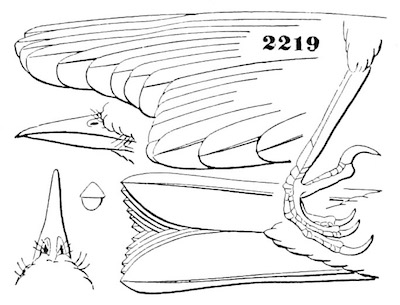
Parula americana Bonap.
2219
Compsothlypis gutturalis, Cabanis (Parula gut., Baird, Rev. Am. B.), and
Conirostrum superciliosum, Hartlaub (Parula
superciliosa, Baird, Rev.), have been referred
by later systematists to this genus; but they
are much more closely related to Conirostrum,—a
genus usually assigned to the Cærebidæ.
The “P.” gutturalis is confined to Costa Rica;
but “P.” superciliosa is a species of the
table-lands of Mexico, and likely to be detected
in Arizona or New Mexico. The characters
of this species are as follows:—
Conirostrum superciliosum,
Hartl. R. Z. 1844, 215. Whole dorsal region, including
rump, olive-green; rest of upper parts ashy. Anterior half beneath yellow, with a crescentic
bar of chestnut-brown across the jugulum; posterior lower parts white, ashy laterally.
A conspicuous superciliary stripe of white. Wing, 2.60; tail, 2.10.
Parula americana, Bonap.
BLUE YELLOW-BACKED WARBLER.
Parus americanus, Linn.
Syst. Nat. 10th ed. I, 1758, 190. Motacilla am. Gmelin. Sylvia am. Lath., Aud. Sylvicola am. Rich., Aud.—Jones, Nat. in Bermuda, 1839, 59. Parula am. Bon. List Birds N.
Am. 1838.—Gosse, Birds Jam. 1847, 154 (Jamaica).—Baird, Birds N. Am. 1858, 238; Rev. 169.—Sclater, P. Z. S. 1857, 202 (Xalapa).—Ib. Ibis, 1859, 10 (Guatemala).—Ib.
Catal. 1861, 26, 163.—Newton, Ibis, 1859, 143 (Santa Cruz;
winter).—Cassin, Pr. A. N. S. 1860, 376
(St. Thomas).—Gundlach, Cab. Jour. 1861,
326 (Cuba; very common). Compsothlypis am. Cab. Mus. Hein. 1850, 20.—Ib. Jour. III, 1855, 476 (Cuba). Ficedula ludoviciana, Brisson. Motacilla lud. Gm. Motacilla eques, Bodd. Sylvia torquata, Vieill. Thryothorus torq. Stephens. Sylvia pusilla, Wils. Sylvicola pus. Swains.
Figures: Aud. Orn. Biog. I, pl. xv.—Ib. Birds Am. II, pl. xci.—Vieill. Ois. Am. II, pl. xcix.—Wils. Am. Orn. IV, pl. xxviii.—Buffon, pl. enl. dccxxxi, fig. 1; dccix, fig. 1.
Sp. Char.
Above blue, the middle of the back with a patch of yellowish-green. Beneath
yellow anteriorly, white behind. A reddish-brown tinge across the breast. Lores
and space round the eye dusky; a small white spot on either eyelid; sides of head and
neck like the crown. Two conspicuous white bands on the wings. Outer two tail-feathers
with a conspicuous spot of white. Female similar, with less brown on the breast.
Length, 4.75; wing, 2.34; tail, 1.90. Nest of long moss.
Hab.
Eastern Province of United States, north to the Lakes (“Greenland”), west to
the Missouri Valley; in winter, south to Guatemala (not seen on the west coast of Mexico).
West Indies; Bahamas; Cuba; Jamaica; St. Croix; St. Thomas; Jalapa, Guatemala
(Sclater); Orizaba, winter (Sumichrast); Yucatan (Lawrence); Porto Rico and Inagua
(Bryant).
Autumnal males are browner on the chin, yellower on the throat and
jugulum. Head tinged with greenish; secondaries edged with greenish-yellow.
Autumnal females are light greenish-olive
above, dirty-white beneath.
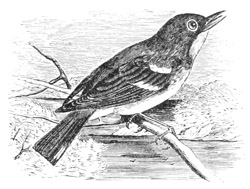
Parula americana.
In very brightly colored spring males,
there is frequently (as in 58,335, Philadelphia)
a well-defined, broad blackish
band across the jugulum, anterior to an
equally distinct and rather broader one
across the breast, of a brown tint, spotted
with black, while the sides are much
spotted with chestnut-brown; the blue
above is very pure, and the green patch on the back very sharply defined.
Habits. The Blue Yellow-Back is one of our most interesting and attractive
Warblers. Nowhere very abundant, it has a well-marked and restricted
area within which it is sparingly distributed. It is found from the Mississippi
Valley to the Atlantic, and from Canada southward. In its winter
migrations it visits the West Indies, the Bahamas, and Central and South
America. Halifax on the east, and Platte River on the west, appear to be
the northern limit of its distribution. Dr. Woodhouse met with it in the
Indian Territory during the breeding-season. Mr. Alfred Newton found this
species, apparently only a winter visitant, in the island of St. Croix. Most
of the birds left about the middle of March, though a few remained until
early in May.
A single specimen of this species was taken at South Greenland in
1857.
This Warbler has been found breeding as far to the south as Tuckertown,
N. J., by Mr. W. S. Wood; and at Cape May, in the same State, by Mr.
John Krider. At Washington, Dr. Coues found it only a spring and autumn
visitant, exceedingly abundant from April 25 to May 15. Possibly a
few remained to breed, as he met with them in the first week of August.
In the fall they were again abundant from August 25 to the second week in
October. He found them inhabiting exclusively high open woods, and
usually seen in the tops of the trees, or at the extremities of the branches,
in the tufts of leaves and blossoms.
Even where most common it is not an abundant species, and is to be found
only in certain localities, somewhat open and swampy thickets, usually not
of great extent, and prefers those well covered with the long gray lichens
known as Spanish moss. In such localities only, so far as I know, do they
breed.
This Warbler has also been ascertained to breed in Southern Illinois, where
Mr. Ridgway found it in July, engaged in feeding fully fledged young birds.
It is there most common in spring and fall.
A true Warbler in most of its attributes, this bird has many of the habits of
Titmice. Like these it frequents the tops of the taller trees, feeding on the
small winged insects and caterpillars that abound among the young leaves
and blossoms. It has no song, properly so called, its notes are feeble and
few, and can be heard only a short distance.
The song of this species is said by Mr. Trippe, of Orange, N. Y., to
be a somewhat sharp and lisping, yet quite varied and pleasing, series of
notes.
Mr. Audubon speaks of this species as breeding in Louisiana, but his
description of the nest differs so entirely from such as are met with in Massachusetts
as to suggest doubts as to the correctness of the identification.
He describes them as flitting over damp places, the edges of ponds and
streams, and pursuing their prey with great activity. They resort to the
woods as soon as the foliage appears on the forest trees, and glean among the
leaves for the smaller winged insects.
The nests of this Warbler, so far as has fallen under my observation, have
always been made of long gray lichens still attached to the trees on which
they grow. With great skill do these tiny architects gather up, fasten
together, and interweave, one with the other, the hanging ends and longer
branches. By an elaborate intertwining of these long fibres they form the
principal part, sometimes the whole, of their nests. These structures are at
once simple, beautiful, ingenious, and skilfully wrought. When first made,
they are somewhat rude and unfinished, but as their family are gathered,
the eggs deposited, incubated, and hatched, a change has been going on. Little
by little has the male bird busied himself, when not procuring food for
his mate, in improving, strengthening, and enlarging the nest. These same
acts of improvement upon the original nests are noticed with Humming-Birds,
Vireos, and a few other birds.
The nests are sometimes constructed on the sides of trunks of trees, when
covered with the long gray lichens, but are more frequently found hanging
from branches usually not more than six or eight feet from the ground.
Thus surrounded by long hanging mosses in clumps not distinguishable from
the nests themselves, they would not be readily recognized were it not that
those familiar with the habits of the bird may be readily guided to the spot
by the artless movements of the unsuspecting parents.
These birds are confiding, easily approached, and rarely exhibit any signs of
alarm. Even when their nest is disturbed they make but little complaint, and
do not manifest any very great signs of emotion. When built against a trunk
these nests consist only of an interweaving of the moss above and below a
very small opening, within which a small cup-shaped flooring has been made
of the same material, and usually cannot be removed without destroying all
semblance of a nest. When pensile they are imperfectly circular in shape,
with an entrance on one side, and rarely with any lining. Occasionally they
are models of symmetry and beauty.
The eggs, four or five in number, have a clear white ground, and are sparingly
spotted with markings of reddish-brown, slate, purple, and lilac. In
some the first predominate, in other the last three shades are more abundant,
and usually form a confluent ring around the larger end. They measure from
.62 to .65 of an inch in length, and from .49 to .50 in breadth.
Section SYLVICOLEÆ.
This section has been already characterized as having a distinctly notched
bill, well provided with bristles. Of the two genera one, Perissoglossa, has
the bill slender, acute, something like Helminthophaga, and with the tongue
lengthened and much lacerated at end; the other, Dendroica, with less acute
bill and tongue shorter, merely notched at tip, and a little fringed only.
Genus PERISSOGLOSSA, Baird.
Perissoglossa, Baird, Rev. Am. Birds, 1864, 181. (Type, Motacilla tigrina, Gm.)
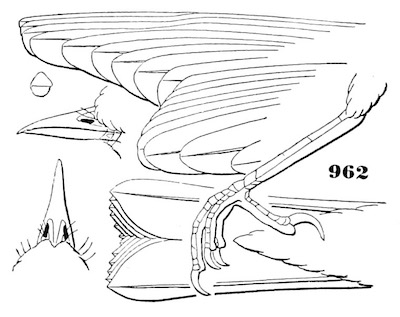
Perissoglossa tigrina, Baird.
962
Gen. Char.
Form of Dendroica, but bill slender, acute, with very obsolete notch; the
commissure gently arched or curved from the base;
the gonys also straight, or even slightly concave.
Tongue lengthened, narrow, deeply bifid (for one
third), and deeply lacerated or fringed externally
at the end; the edge along the median portion folded
over on the upper surface, but not adherent.
The curvature of the bill in Perissoglossa
tigrina is quite peculiar among the Sylvicolidæ
with notched bills. Some Helminthophagas
(without notch) approximate this
character, though in none, excepting H. bachmani, is it in equal amount,—all
the others having the gonys very slightly convex, instead of straight, or
even slightly concave.
It is most probable that the Helinaia carbonata of Audubon belongs here,
as it appears very closely allied to the type of this genus. The two species
may be distinguished as follows:—
Common Characters. Male. Top of head black. Above olive, becoming yellowish
on rump. Head, neck, and lower parts bright yellow, becoming whitish
posteriorly. Dorsal feathers with black centres; breast and sides streaked with
black. A black streak through the eye.
P. tigrina. Large white patches on inner webs of tail-feathers.
Sides of head and middle of throat tinged with chestnut. One large
white patch on wing, covering both rows of coverts. Outer web of
lateral tail-feather blackish.
P. carbonata. No white patches on tail-feathers.
No chestnut about head. Two bands on the wing, the anterior one
white, the posterior yellow. Outer web of lateral tail-feather whitish.
Perissoglossa tigrina, Baird.
CAPE MAY WARBLER.
Motacilla tigrina, Gmelin, Syn. Nat. I, 1788, 985. Sylvia tig. Lath. Dendroica tig. Baird, Birds N. Am. 1858, 286.—Sclater, Catal. 1861, 33, No. 198. P. Z.
S. 1861, 71 (Jamaica, April).—March, Pr. An. Sc.
1863, 293 (Jamaica; breeds).—A. & E. Newton, Ibis, 1859, 144 (St. Croix.
Notes on anatomy of tongue).—Gundlach, Cab. Jour. 1861, 326 (Cuba;
not rare).—Samuels, 240. Perissoglossa tigrina, Baird, Rev. Am. Birds, 1864, 181. Sylvia
maritima, Wilson, Am. Orn. VI, 1812, 99, pl. liv, fig. 3.—Bon.; Nutt.; Aud. Orn. Biog. V, pl. ccccxiv.—D’Orb. La Sagra’s Cub. 1840, 70, pl. x. Sylvicola mar. Jard., Bon., Aud. Birds Am.
II, pl. lxxxv. Certhiola mar. Gosse, Birds
Jam. 1847, 81.—Ib. Illust. Rhimamphus mar. Cab. Jour. III, 1855, 474 (Cuba.)
Sp. Char.
Bill very acute, conical, and decidedly curved. Bill and feet black. Upper
part of head dull black, some of the feathers faintly margined with light yellowish-brown.
Collar scarcely meeting behind; rump and under parts generally rich yellow. Throat, forepart
of breast, and sides, streaked with black. Abdomen and lower tail-coverts pale yellow,
brighter about the vent. Ear-coverts light reddish-chestnut. Back part of a yellow
line from nostrils over the eye of this same color; chin and throat tinged also with it. A
black line from commissure through the eye, and running into the chestnut of the ear-coverts.
Back, shoulder, edges of the wing and tail, yellowish-olive; the former spotted
with dusky. One row of small coverts, and outer bases of the secondary coverts, form a
large patch of white, tinged with pale yellow. Tertials rather broadly edged with brownish-white.
Quills and tail dark brown, the three outer feathers of the latter largely marked
with white on the inner web; edge of the outer web of the outer feathers white, more
perceptible towards the base. Length, 5.25; wing, 2.84; tail, 2.15.
Female. Above olivaceous-ash, most yellowish on rump; no black nor chestnut on
head. Wing-coverts inconspicuously edged with whitish. Tail-spots very inconspicuous.
Beneath dull white tinged with yellowish on the breast, and streaked as in the male,
but with dusky grayish instead of black.
Hab.
Eastern Province of United States, north to Lake Winnipeg and Moose Factory;
all the West Indies to St. Croix. Breeds in Jamaica. Not recorded from Mexico or Central
America.
The chestnut about the head in adult males varies in amount with the
individual; sometimes (as in 20,633, May, Moose Factory, Hudson’s Bay Territory)
there is an oblong spot of chestnut in the middle of the crown, but
generally this is absent. Very frequently the chestnut tinges the throat. All
variations in these respects appear, however, to be individual, and not dependent
at all on locality. West Indian specimens appear to be absolutely
identical with those from North America.
Autumnal specimens are browner, the chestnut markings much obscured.
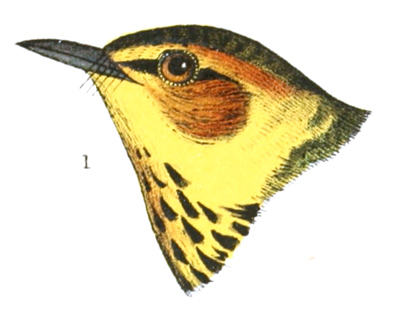
1. Perissoglossa tigrina,
Gm. ♂ H. B. Ter., 20633.
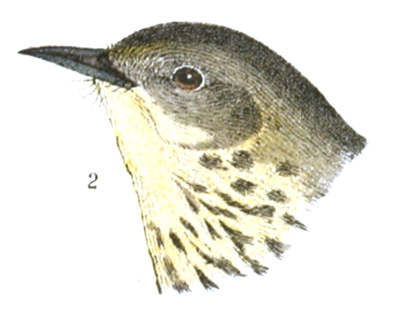
2. Perissoglossa tigrina,
Gm. ♀ Pa., 678.
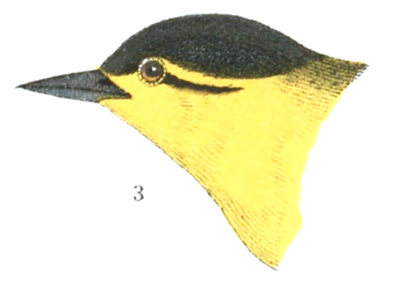
3. Perissoglossa carbonata,
Aud. (Copied from Audubon).
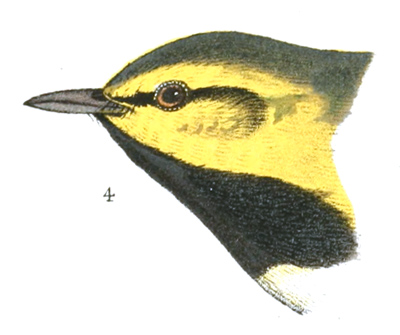
4. Dendroica virens,
Gm. ♂ Pa., 941.
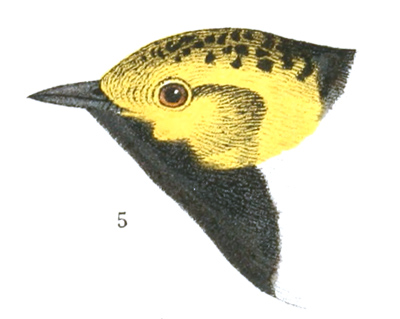
5. Dendroica occidentalis,
Towns. ♂ Cal., 5518.
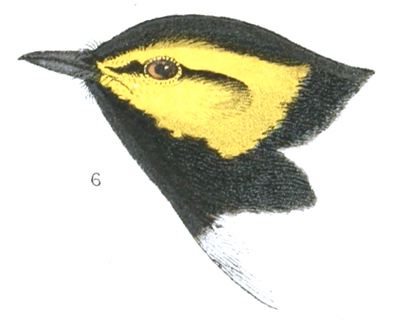
6. Dendroica chrysopareia,
Scl. & Salv. ♂ .
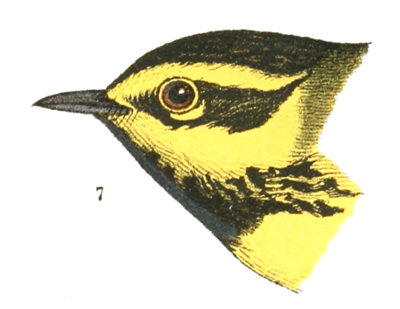
7. Dendroica townsendi,
Nutt. ♂ Guat., 8017.
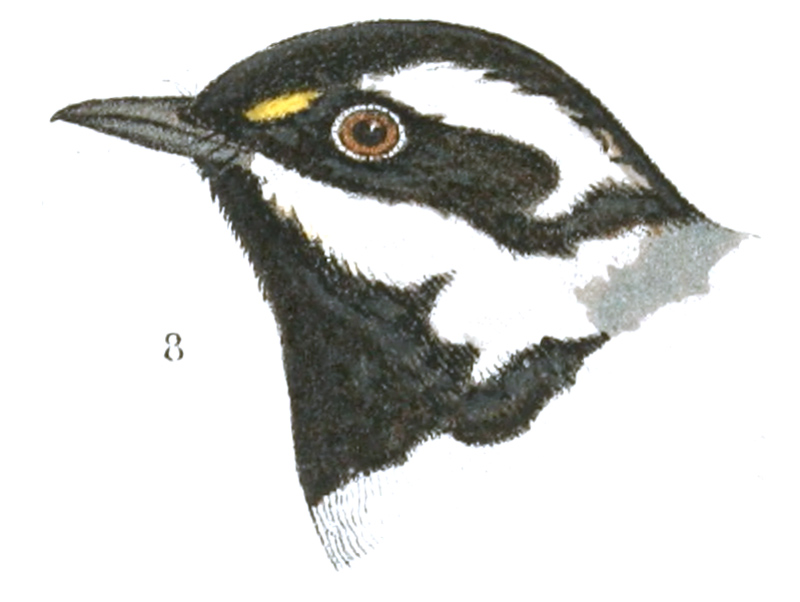
8. Dendroica nigrescens,
Towns. ♂ Ariz., 1908.
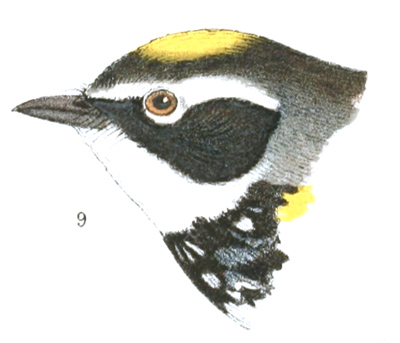
9. Dendroica coronata,
Linn. ♂ Pa., 8384.
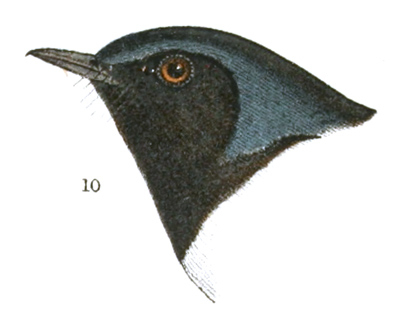
10. Dendroica cærulescens,
Linn. ♂ Pa., 3419.
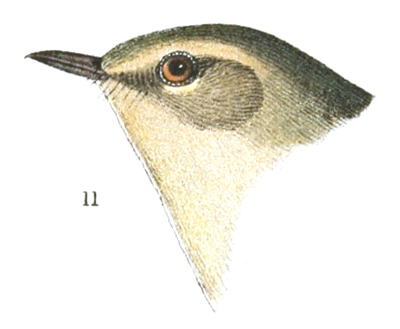
11. Dendroica cærulescens,
Linn. ♀ Pa., 2308.
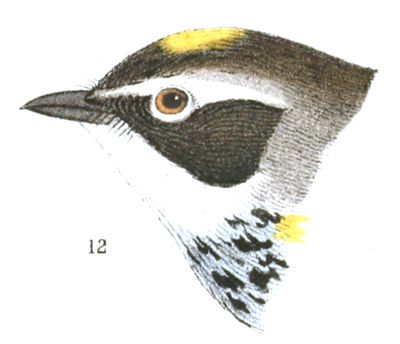
12. Dendroica coronata,
Linn. ♀.
Habits. This somewhat rare species, so far as its history and distribution
are known with certainty, is migratory in the principal portions of the United
States, in the spring and fall passing to the north of the 42d parallel to
breed. The first specimen was obtained near the extreme southern point of
New Jersey by George Ord, in 1811, and described and figured by Wilson.
From this accidental circumstance it derives its inappropriate name of Cape
May Warbler. Wilson never met with a second specimen, and Mr. Nuttall
was wholly unacquainted with it. Mr. Audubon also never met with a specimen
in all his wanderings, and was able to add nothing to its history. Those
figured by him were procured by Mr. Edward Harris, near Philadelphia,
through which region these birds appear to pass rapidly in their northern
migrations.
Mr. J. A. Allen obtained a specimen near Springfield, Mass., May 15,
1863, and specimens have also been procured at East Windsor Hill, Conn.,
by Dr. Wood. It was not met with in Western Maine by Mr. Verrill, but in
Eastern Maine and in New Brunswick Mr. Boardman has found it a not uncommon
summer visitant, though of irregular frequency. He has no doubt
that they remain there to breed. They reach Calais as early as the second
week in May, or as early as their appearance usually in the neighborhood of
Philadelphia has been noticed. Mr. Kumlien has also obtained specimens
from year to year, about the middle of May, in Southern Wisconsin, where
they do not remain to breed, and Mr. Ridgway has taken them in the
beginning of May in Southern Illinois.
It is also by no means uncommon in Cuba; was met by the Newtons as
a migrant in St. Croix, and is not only one of the birds of Jamaica, but is
resident and breeds in the highlands of that island. It is not known to
occur in Central America, Mexico, or west of the Mississippi River. Specimens
were procured at Moose Factory about May 28.
Its nests and eggs have not been, with certainty, obtained in the United
States, though an egg obtained in Coventry, Vt., in 1836, and attributed at
the time to this bird, closely resembles its identified eggs from Jamaica.
Specimens of the bird, as well as its nests and eggs, have also been received
from St. Domingo by Mr. Turnbull of Philadelphia. In the summer of
1871 a nest of this species was found by Mr. H. B. Bailey on the Richardson
Lakes, in the extreme northwestern part of Maine. The nest was in a
low spruce-tree, less than five feet from the ground, and when found contained
only a single egg. Unfortunately it was left until more eggs were
deposited, and in the mean while the tree was cut, and the nest and eggs were
destroyed.
Mr. W. T. March of Jamaica, in his notes on the birds of that island,
states that this species may always be found, in its various changes of plumage,
about the mangrove swamps and river-banks. During the summer
months it was common about Healthshire and Great Salt Pond, and at other
times very generally distributed over the island. He also met with several
specimens of its nests and eggs, but their position was not stated. The nests
had apparently been taken from a bush or tree, were three and one fourth
inches in diameter by two and one half in height, with cavities unusually
large and deep for the size of the nests. They were wrought almost entirely
of long strips of thin flexible bark, strongly and firmly interwoven. The
outer portions consisted of coarser and longer strips, the inner being much
finer and more delicate. With the outer portions were also interwoven bits
of mosses, lichens, and the outer bark of deciduous trees. The entire fabric
was a remarkable one.
The eggs measure .70 by .55 of an inch, have a pinkish-white ground,
blotched with purple and brown of various shades and tints. They are disposed
chiefly about the larger end, usually in a ring. The eggs are oval in
shape and slightly pointed at one end.
Perissoglossa carbonata, Baird.
CARBONATED WARBLER.
Sylvia carbonata, Aud. Orn. Biog. I, 1831, 308, pl. lx (Kentucky).—Nutt. Helinaia
carbonata, Aud. Syn.—Ib. Birds Am. II, 1841, 95, pl. cix. Dendroica carbonata,
Baird, Birds N. Am. 1858, 287; Rev. Am. Birds, 207.
Sp. Char.
Bill brownish-black above, light blue beneath. Iris hazel. Feet light flesh-color.
Upper part of the head black. Forepart of the back, lesser wing-coverts, and
sides dusky, spotted with black. Lower back dull yellowish-green, as is the tail, of
which the outer web of the outer feather is whitish. Tip of the second row of coverts
white, of the first row yellow; quills dusky, their outer webs tinged with yellow. A line
from the lore over the eye; sides of the neck and the throat bright yellow. A dusky line
behind the eye. The rest of the under parts dull yellow, excepting the sides. Length, 4.75
inches; bill above, 4.42; tarsus, .75. (Audubon).
Hab.
Kentucky.
This species continues to be known only by the description and figure of
Audubon.
Judging from the description, this species is closely related to P. tigrina,
but seems to be distinct in the pure black of the top of the head, the absence
of orange-brown on the cheeks, the white of the wing being on the middle
coverts instead of the greater, and the tail-feathers being yellowish-green;
the outer web of outer feather white, instead of a large spot on the inner
web, etc. The back appears more distinctly streaked.
Habits. Two specimens of this Warbler, obtained near Henderson, Ky.,
May, 1811, by Mr. Audubon, are all its claim to be recognized as a good
species. None have since been seen. These birds are described as having
been busily engaged in collecting insects among the branches of a dogwood
tree. Their motions were like those of other Warblers. This is all we as
yet know as to the history of this species, and its claims to be regarded as
a good and distinct species are involved in doubt.
Genus DENDROICA, Gray.
Sylvicola, Gray, Genera Birds, 2d ed. 1841, 32. (Not of Humphreys nor Swainson.)
Dendroica, Gray, Genera Birds, Appendix, 1842, 8.
Rhimamphus, Hartlaub, Rev. Zool. 1845, 342. (Not of Rafinesque, Am. Monthly
Mag. 1818, and Jour. de Phys. 1819.)
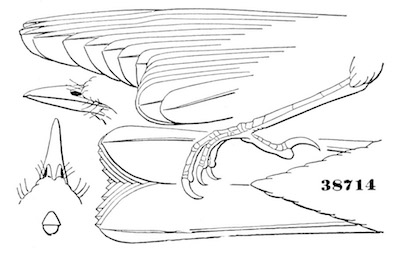
Dendroica coronata.
38714
Gen. Char.
Bill conical, attenuated, depressed at the base, where it is, however, scarcely
broader than high, compressed from the middle.
Culmen straight for the basal half, then
rather rapidly curving, the lower edge of upper
mandible also concave. Gonys slightly
convex and ascending. A distinct notch near
the end of the bill. Bristles, though short,
generally quite distinct at the base of the bill.
Tarsi long; decidedly longer than middle
toe, which is longer than the hinder one;
the claws rather small and much curved;
the hind claw nearly as long as its digit.
The wings long and pointed; the second quill
usually a very little longer than the first. The tail slightly rounded and emarginate.
Colors. Tail always with a white or yellow spot; its ground-color never clear olive-green.
In D. æstiva edged internally with yellow.
Eggs usually with a white or a bluish-white ground, marked with purplish-brown and
obscure lilac; in some, mingled with varying shades of sienna-brown. Nest, so far as
known, in bushes and trees, except D. palmarum, which is on the ground.
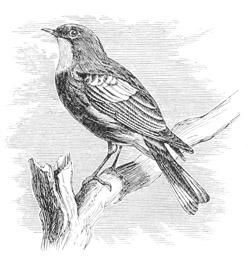
Dendroica auduboni.
The genus Dendroica is one of the most extensive as to species of any in
North America, and scarcely admits of any subdivision. There is a little variation
in the bill, wings, etc., the chief peculiarities being in D. castanea and
pennsylvanica, in which the bill is broader, and more depressed, with longer
bristles; in D. striata, where the bill is narrow with scarcely any bristles; and
in D. palmarum and kirtlandi, where the wings are very short, scarcely
longer than the tail. D. palmarum has
the tarsus unusually long. The colors
in all are strongly marked, and the species
are among the most beautiful of
all belonging to our fauna, and are the
most conspicuous for their numbers and
in their migrations.
The difference in manners between
certain members of this genus is remarkable;
thus, the D. palmarum is
very terrestrial in its habits, walking
upon the ground with the ease and
grace of a Titlark (Anthus), and, like
these birds, it has a wagging motion
of the tail. On the other hand, the Dendroica dominica is as much a
Creeper as is the Mniotilta varia; creeping not only along the branches, but
the cornices and lattices of buildings, with the facility of a Nuthatch (Sitta).
Both these species, however, may often be seen hopping among the foliage
of the trees, now and then snapping an insect on the wing, in the manner
of others of the family.
Species and Varieties.
Inner webs of tail-feathers with a large patch,
or broad edge, of yellow
Group A.
Inner webs of tail-feathers with a large patch,
or broad edge, of white.
Wings with conspicuous white markings
Group B.
Wings without conspicuous white markings[37]
Group C.
Group A.—Golden Warblers.
Rump and crissum without rufous markings
Series I.
Rump and crissum with rufous markings
Series II.
Series I.
Prevailing color rich yellow, shaded on upper parts with olive-green. ♂ with
streaks of chestnut across the breast and along the sides, and with or without
a greater or less tinge of the same on the crown. ♀ with the streaks beneath
obsolete or entirely wanting; no rufous on crown. Juv. paler and duller than
the ♀, sometimes quite ashy.
A. Tarsus less than .65 of an inch. Outer webs of tail-feathers with yellow predominating.
1. D. æstiva. Crown generally pure yellow, sometimes with only a
tinge of rufous; lower webs of wing-coverts and tertials pure yellow;
rump and upper tail-coverts much mixed with the same. Wing-formula,[38]
1 = 2, 3; wing, 2.60; tail, 2.05; bill, from nostril, .30; tarsus,
.62. Hab. Entire continent of North America; in winter south to
Bogota and Cayenne; Trinidad (only locality in West Indies).
B. Tarsus not less than .70 of an inch. Outer webs of tail-feathers with dusky
predominating.
a. Crown without any rufous, or with only a tinge.
2. D. petechia. Nape olive-green (except in juv.); sides streaked (except
in juv.). Crown greenish, sometimes tinged with orange-rufous
anteriorly; lower webs of wing-coverts, etc., not pure yellow, and rump
and upper tail-coverts without any admixture of yellow. Hab. West
Indies (except Barbadoes and Trinidad); not on the Continent.
Lower part of throat streaked; outer webs of wing-coverts
hardly appreciably different from the general surface. Above
golden yellowish-olive; crown generally without a trace of rufous.
Wing-formula, 2 = 3, 4, 1, 5; wing, 2.55; tail, 2.10; bill, .30;
tarsus, .80. Hab. Cuba and the Bahamas … var. gundlachi.[39]
Lower part of throat not streaked; outer webs of wing-coverts
decidedly yellowish, and quite different from the general surface.
Above greenish yellow-olive; crown almost always strongly tinged
with rufous. Wing-formula, 4, 3, 2, 5, 1, 6; wing, 2.70; tail,
2.25; bill, .35; tarsus, .79. Hab. Jamaica and Hayti? … var. petechia.[40]
Whole throat sometimes streaked; back also sometimes with
streaks of dark castaneous; green above lighter than in var. petechia,
the rump sometimes tinged with yellow. Wing-formula, 2, 3, and
4 equal, 5 = 1; wing, 2.50; tail, 2.00; bill, .34; tarsus, .78. Hab.
Porto Rico, St. Thomas, St. Croix, and St. Bartholomew. … var. ruficapilla.[41]
3. D. aureola.[42] Nape always ashy; sides never streaked. Abdomen, anal
region, and axillars nearly white; forehead and crown strongly tinged
with rufous; nape dark ashy. Wing-formula, 2, 3, and 4 equal, 5, 1 = 6;
wing, 2.55; tail, 2.00; bill, .32; tarsus, .75. Hab. Galapagos Islands.
b. Crown with only a sharply defined ovate patch of dark purplish-rufous.
4. D. capitalis.[43] A broad superciliary stripe of pure yellow; wing-formula,
3 = 4, 2, 1 = 5; wing, 2.30; tail, 2.00; bill, .30; tarsus, .70.
(♀ distinguishable from that of the varieties of petechia by the distinctly
yellow upper eyelid, and considerably shorter tarsus.) Hab. Barbadoes
Island, West Indies.
c. Head all round rufous.
5. D. vieilloti. (♀ not distinguishable from that of other species.)
Hab. Continental Middle America.
Breast and sides with broad streaks of rufous; outer webs of wing-coverts
and tertials pure yellow.
Rufous of the throat with the posterior outline sharply defined
against yellow of jugulum. Wing-formula, 3, 4, 2, 1, 5; wing,
2.75; tail, 2.10; bill, .34; tarsus, .75. Hab. New Granada (Carthagena,
etc.) … var. vieilloti.[44]
Rufous of the throat covering the jugulum and blending with
the streaks of the breast. Wing-formula, 3, 2, 4, 1, 5; wing,
2.45; tail, 2.05; bill, .27; tarsus, .64. Hab. Isthmus of Panama. … var. rufigula.[45]
Breast and sides with only very narrow or scarcely appreciable streaks of
rufous; outer webs of wing-coverts, etc., scarcely different from general
surface.
Rufous of the head confined to it, and abruptly defined all round.
Wing-formula, 3, 2 = 4, 1, 5; wing, 2.70; tail, 2.25; bill, .31;
tarsus, .72. Hab. Mexico (from Honduras and Yucatan to Mazatlan) … var. bryanti.[46]
Series II.
Prevailing color yellow; crown, rump, and crissum with spots of rufous; a
band of the same on the side of the head, from bill (meeting both on forehead
and on chin) around eye and over ear-coverts.
6. D. eoa.[47] Hab. Jamaica (Gosse).
Group B.
Base of primaries with white patch.
Two white bands on wing
Series I.
No white bands on wing
Series II.
Base of primaries without white patch.
Rump yellow.
Crown with a yellow spot
Series III.
Crown without a yellow spot
Series IV.
Rump not yellow.
Throat white (with black streaks in striata
and pharetra)
Series V.
Throat yellow or orange
Series VI.
Throat black, or mixed with black
Series VII.
Series I.
7. D. olivacea. ♂. Head and neck, all round, fine light orange-rufous;
a broad black “spectacle” along side of the head. ♀. Head
yellowish, dusky on top; spectacle obsolete. Hab. Whole of Eastern
Mexico; Guatemala.
Series II.
8. D. cærulescens. ♂. Head dark blue above and black underneath;
a black patch covering whole lateral and under side of head and lateral
lower parts. Rest of upper parts dark blue; bases of primaries and
abdomen pure white. ♀. Above olive, with a light superciliary stripe;
beneath wholly light greenish-buff; base of primaries white. Hab.
Eastern Province of United States; in winter south into Cuba, Jamaica,
and St. Domingo.
Series III.
9. D. coronata. A yellow patch on each side of the breast; above
ashy streaked with black; belly white. ♂. Breast more or less black;
upper parts ash with a bluish tinge. ♀. Breast only streaked with black;
ash of upper part grayish or brownish.
Throat white; a white superciliary streak; two white bands on
wing. Hab. Eastern Province of North America, north to Alaska
and Greenland; in winter south to Panama and West Indies (resident
in Jamaica!) … var. coronata.
Throat yellow; no white superciliary streak; one white patch
formed by the fusion of the two bands on the wing. Hab. Western
Province of North America from British Columbia, south to Cape
St. Lucas and Jalisco, Western Mexico; east to Rocky Mountains. … var. auduboni.
Series IV.
10. D. maculosa. Whole lower parts bright yellow; black streaks
across breast and along sides; crown ash; lores, auriculars, and back
black. ♀ scarcely different. Hab. Eastern Province of North America,
from Fort Simpson to Panama; Cuba and Bahamas.
Series V.
A. Above ashy-blue, or soft bluish-green.
11. D. cærulea. Lower parts pure white or greenish-white; with or
without a narrow band across the breast; above fine ashy-blue, or soft
bluish-green; if blue (♂), the back and crown streaked with black;
if green (♀ and juv., these streaks obsolete. Hab. Eastern Province
of United States (rare northward except in Mississippi Valley), south to
Bogota in winter; Cuba.
B. Above not ashy-blue nor bluish-green, but streaked with black upon an
ashy greenish-olive or yellowish ground, or else bright olive-green.
a. Sides more or less rufous, and without black or dusky streaks on under
surfaces.
12. D. pennsylvanica. ♂. Crown pure yellow; throat and auriculars
pure white; ♀ ad. similar, but crown greenish, and more or less streaked.
Juv. Above bright olive-green, nearly grass-green, without streaks except
on the back; side of head, and sides, clear ashy, the latter with or without
a trace of chestnut; eyelids and medial lower parts pure white. Hab.
Eastern Province of United States, south to Panama; Bahamas.
13. D. castanea. ♂. Crown reddish-chestnut; throat and sides rufous;
auriculars black. ♀ similar, but crown thickly streaked, sometimes without
a trace of rufous; jugulum and throat only tinged with rufous. Juv.
Above greenish-olive, streaks obsolete; beneath, including lower tail-coverts,
pale greenish-buff, or whitish-buff, and without any trace of
streaks on the sides (distinction from ♀ of D. striata) the sides usually
with a tinge of chestnut. Hab. Eastern Province of North America,
from Hudson’s Bay Territory to New Granada.
b. Sides without any rufous, and with black or dusky streaks.
Medial lower parts not streaked; inner webs of tail-feathers with broad
patch of white.
14. D. striata. ♂. Crown deep black; auriculars and lower parts
white; throat with two series of black streaks, converging and forming
an angle on the chin. Above ashy streaked with black. ♀ similar,
but crown greenish streaked with black; lower parts tinged with greenish.
Juv. Above greenish-olive, the streaks obsolete; beneath pale
greenish-yellow; the lower tail-coverts pure white. Hab. Eastern Province
of North America, north to Greenland and Kodiak, south to Bogota,
Cuba, and Bahamas.
Medial lower parts streaked with black; inner webs of tail-feathers merely
edged with white.
15. D. pharetra.[48] ♂. Above grayish-white, with broad streaks of
black; posteriorly, plain brownish-gray; lower parts with cuneate spots
of black. Hab. Jamaica.
Series VI.
A. A black “mask” around the eye and on auriculars, and extending down the
side of the throat; a light superciliary stripe continued back into a large space, of
similar color, on side of neck.
16. D. blackburniæ. Crown with an orange or yellowish spot (exposed
or concealed); superciliary stripe, side of neck and throat, intense
orange-red (♂ ad.), or varying from this to pale buff (juv.). ♀ intense
black above; back streaked with white or yellowish. ♀ olive-gray above,
streaked with black. Juv. olive-gray above without distinct streaks.
Hab. Eastern Province of United States, south to Ecuador; Bahamas.
17. D. dominica. Crown without an orange or yellowish spot; superciliary
stripe and side of neck pure white; throat gamboge-yellow;
above ash, without streaks.
Superciliary stripe bright yellow anterior to the eye. Bill, .45;
tarsus, .60; wing, 2.60; tail, 2.00. Hab. Atlantic United States
and West Indies … var. dominica.
Superciliary stripe pure white anterior to the eye. Bill, .35;
tarsus, .60; wing, 2.70; tail, 2.20. Hab. Mississippi region of
United States; Mexico (Yucatan on east coast, and Colima on west
coast); Guatemala and Honduras … var. albilora.
B. No black “mask.” Superciliary stripe scarcely reaching behind the eye.
Sides of neck ashy like the back.
18. D. graciæ. Auriculars, neck, crown, and upper parts generally,
ashy; a supra-loral stripe, a crescent on the lower eyelid, and the anterior
lower parts gamboge-yellow. Crissum white.
Back and sides streaked with black; abdomen white.
Yellow of throat terminating abruptly at the jugulum; supra-loral
stripe extending about .20 of an inch past the eye, this portion
of it white; dorsal streaks broad. Wing, 2.60; tail, 2.20. Hab.
Arizona (Fort Whipple) … var. graciæ.
Yellow of throat covering whole jugulum, and not ending abruptly;
supra-loral stripe scarcely passing the eye, and wholly yellow;
dorsal streaks narrow. Wing, 2.20; tail, 1.95. Hab. British Honduras
(Belize) … var. decora.
Back and sides not streaked with black; abdomen yellow.
Yellow of throat extending back to the crissum; supra-loral
stripe as in the last; dorsal streaks wanting. Wing, 2.10; tail, 1.95.
Hab. Porto Rico … var. adelaidæ.[49]
Series VII.
Throat black in ♂, mixed with black in ♀.
A. Sides streaked; black of throat with its posterior outline concave.
a. Side of head white and black.
19. D. nigrescens. A small yellow spot over the lore; above ash; beneath
white. ♂. Whole crown, uniform glossy black; back streaked
with black. ♀. Crown ash streaked with black; throat mixed with white
anteriorly. Juv. Crown and cheeks ashy; throat mostly white; back
without streaks. Hab. Western and Middle Province of United States,
south, in winter, into Western Mexico (Oaxaca).
b. Side of head yellow and black, or yellow and olive.
Black of throat covering jugulum; a hidden yellow spot in middle of forehead.
20. D. chrysopareia. Black above, pure white below; no tinge of yellow
behind the black jugular patch. Hab. Eastern Middle America,
from Guatemala to Texas (San Antonio).
21. D. virens. Olive-green above, the crown and back without streaks;
beneath white, the breast and anal region tinged with black. Hab.
Eastern Province of North America, from Greenland to Panama; Cuba;
Oaxaca; Heligoland, Europe!
Black of throat confined anteriorly to the jugulum; no yellow spot on forehead.
22. D. townsendi. Above olive-green, the crown and back with conspicuous
black streaks; beneath yellow anteriorly, and white posteriorly.
♀, black of throat mixed with yellow; juv., no black on throat, and
streaks on back obsolete. Hab. North and Middle Province of United
States, south, in winter, into Guatemala.
B. Sides not streaked; black of throat with its posterior outline convex.
23. D. occidentalis. Above ash tinged with olive; beneath white.
Head nearly all yellow. ♂. Top of head yellow with a few small
black spots; nape black; back streaked with black; sides pure white.
(♀ not seen.) Juv. Yellow of crown overlaid by olive; above greenish-plumbeous,
without any black on nape or back; throat yellowish-whitish;
sides tinged with ashy. Hab. Western and Middle Province
of United States, south to Guatemala.
Group C.
A. Above ash; no supra-loral stripe; eyelids not yellow.
24. D. kirtlandi. Above, including side of head and neck, bluish-ash;
crown and back streaked with black; beneath (except crissum) pale yellow;
breast speckled, and sides streaked with black; lores and orbital
region, black; eyelids white. Hab. Eastern Province of United States
(Cleveland, Ohio), and Bahamas.
25. D. pityophila.[50] Above, including side of head and neck, dull ash;
the forehead and crown olive-green; crown and back not streaked;
beneath white; the throat and jugulum yellow; sides ashy; no specks
on breast, nor streaks on sides, but a few along side of neck, between the
ash and yellow. Hab. Cuba.
B. Olive-green or brown above; a supra-loral stripe of yellow; eyelids yellow.
a. Above olive-green, without streaks; crissum white; sides of breast with
obsolete grayish streaks.
26. D. pinus. Forehead and ear-coverts olive; abdomen white; yellow
supra-loral stripe not continued behind the eye. ♀ more grayish; juv.
above umber, beneath light grayish-brown, tinged with yellow. Hab.
Eastern Province of United States; Bahamas.
? 27. D. montana. Forehead and ear-coverts yellow; abdomen yellow;
yellow supra-loral stripe continued past the eye into the yellow of the
auriculars. (♀ and other stages unknown.) Hab. “Blue Mountains of
Virginia.”
b. Above olive-green, the back streaked with chestnut; crissum yellow;
streaks of black on sides.
28. D. discolor. Bright gamboge-yellow beneath; streak on lores
and along side of neck, as well as along sides and flanks, deep black;
dorsal feathers chestnut medially. ♀ duller, but similar; juv. not seen.
Hab. Eastern Province of United States: in winter, throughout West
Indies.
c. Above olive-brown, the back not streaked; crissum gamboge-yellow;
streaks of reddish-chestnut on sides.
29. D. palmarum. Ad. Forehead and crown deep rufous; superciliary
stripe bright yellow, continued back over auriculars; sexes alike. Juv.
and ad. in winter. Crown brownish, streaked with dusky; streaks on
sides more dusky. Hab. Eastern Province of North America, north
to Fort Simpson and Hudson’s Bay; Bahamas; Cuba, St. Domingo,
and Jamaica, in winter.
Dendroica æstiva, Baird.
YELLOW WARBLER; SUMMER YELLOW-BIRD.
Motacilla æstiva, Gm. Syst. Nat. I, 1788, 996.—Sylvia æstiva, Lath.; Vieill. II, pl. xcv.—Aud. Orn. Biog. I, pl. xxxv. 93. Sylvicola æst. Swains.—Aud. Birds. Am. II, pl. lxxxviii. Rhimamphus æst.
Bon.; Cab. Jour.
III, 472 (Cuba). Dendroica æst. Baird, Birds
N. Am. 1858, 282; Rev. 195.—Sclater, Catal. 1861, 32, No. 194.(Ecuador, Cayenne, N.
Granada).—Taylor, Ibis, 1864, 81 (Trinidad).—Cooper & Suckley, P. R. R. XII, II, 1859, 181 (N. W.
coast).—Samuels, 237.—Dall & Bannister, (Alaska).—Cooper, Orn. Cal. 1, 1870, 87. Sylvia
carolinensis, Lath. Ind. Orn. II,
1790, 551. ? Sylvia flava, Vieillot, II, 1807, 31,
pl. lxxxi. Sylvia citrinella, Wils. II, pl. xv, fig. 5. Sylvia childreni,
Aud. Orn. Biog. I, 1831, pl. xxxv (young). ? Sylvia rathbonia, Aud. Orn. Biog. I, 1831, pl.
lxv. Sylvicola r. Aud. Birds Am. II, pl. lxxxix. Motacilla
rubiginosa, Pallas, Zoög. Rosso-Asiat. I, 1831, 496
(Kodiak). Rhimamphus chryseolus, Bon. Bull. Soc. Linn. Caen, II, 1851, 32 (D.
æstiva, from South America; Cayenne).
Other localities: Xalapa, Sclater, P. Z. S. 1859, 363. Guatemala, Sclater &
Salvin, Ibis, 1859, page 11. Panama, winter, Lawr.
Ann. N. Y. Lyc. 1861, 322. Turbo, N.
Granada, Cass. Pr. A. N.
Sc. 1860, 191. Bogota, Sclater, Pr.
1855, 143. City of Mexico, Ib. 1864, 172.
Sp. Char.
Bill lead-color. Head all round, and under parts generally, bright yellow;
rest of upper parts yellow-olivaceous, brightest on the rump. Back with obsolete streaks
of dusky reddish-brown. Fore breast and sides of the body streaked with brownish-red.
Tail-feathers bright yellow; the outer webs and tips, with the whole upper surfaces of the
innermost one, brown; extreme outer edges of wing and tail-feathers olivaceous like the
back; the middle and greater coverts and tertials edged with yellow, forming two bands
on the wings. Female similar, with the crown olivaceous like the back, and the streaks
wanting on the back, and much restricted on the under parts. Tail with more brown.
Length of male, 5.25; wing, 2.66; tail. 2.25. (No. 940.) Young. Dull brownish-olive
above; pale ochraceous-yellow beneath, with the throat more whitish; the yellow of tail
restricted to inner half of inner webs. The latter feature will serve to distinguish it from
any other North American species.
Hab.
Entire North America, and in winter into South America as far as Ecuador,
Cayenne, and Trinidad. Not recorded from West Indies, where replaced by allied species.
In the great abundance of this species and its wide range of distribution,
there are many variations in size and color, though none that are not readily
understood. In young birds the yellow of the tail-feathers is more restricted,
sometimes confined to the edge of the inner webs. In adults there is occasionally
a tinge of orange in the forehead.
Sylvia rathbonia of Audubon is described with even tail, and the tail-feathers
brown, edged externally with yellow; the reverse of æstiva. It is generally,
however, considered a synonyme.
Birds of this type (“Golden Warblers”) of six or eight additional species
are known to occur in the West Indies, the Galapagos, and in Middle America;
one of them, D. bryanti, possibly to be met with in Southern Arizona. (See
Baird, Review Am. Birds, 193.)
After comparing a series of about one hundred and twenty North and
Central American specimens (the latter being winter visitors to the region
where obtained), nothing really characteristic of any particular region can
be detected. Specimens from the Pacific coast of the United States are perfectly
identical in colors with those from the Atlantic States; and they agree
in size and proportions, except of the bill, which is appreciably longer and
broader in the Eastern than in the Western birds. The most highly colored
examples are from the interior regions, along the Mississippi Valley from
Louisiana to Northern Illinois, and over the plains north to Fort Simpson.
The majority of the specimens from this region are just appreciably different
from others, in having the yellow more intense and prevalent, almost subduing
the olive shades above; the crown more tinged with orange. Sometimes
(as in No. 4,301, Calcasieu Pass, La.) the rump and upper tail-coverts
are absolutely pure yellow, only a medial stripe on the feathers being olivaceous
like the back. The orange-rufous tinge on the crown is deepest in
Nos. 4,665, Fort Lookout, and 4,300, Calcasieu Pass.
Three adult summer males from Alaska (Nos. 54,429, Kodiak; 54,425,
Yukon River; and 27,267, Fort Yukon), as well as one from Maine (52,378,
Calais), differ from others in having the olive pervading the whole surface
above, even to the bill, the forehead being only tinged with yellow, and the
edges of wing-coverts merely inclining to this color. The lower parts are
much as in Southern specimens, though the yellow is less intense.
Females from Arizona (as 49,712, Camp Grant, May; 40,664, Fort Whipple,
May; and 34,340, Los Pinos, New Mexico, June) differ from others in
very bleached plumage, the lower parts being almost white, and the upper
surface quite ashy. But this is, in fact, an actual bleaching, frequently to be
seen in birds from that region.
Habits. The geographical range of the common Summer Yellow-Bird is
very nearly coextensive with North America. In its northern distribution
it is found as far toward the arctic shores as any of our land birds. Richardson
speaks of it as well known throughout the fur countries as far as the
woods extend, and mentions meeting with it among the earliest arrivals in
spring, coming in company with the equally well-known Robin and the
Grakle. At Fort Franklin, latitude 66°, he saw it the 15th of May, about
the time of its first appearance in New England. This was supposed to be
the limit of its northern range, but more recent observations give abundant
evidence of its presence, in considerable numbers, to the very shores of the
Arctic Ocean. The late Mr. Hepburn, in manuscript notes, states it to be a
common summer visitant both of California and Vancouver’s Island, and that
along the coast he has traced it as far north as the frontier line of 54° 40′,
where it arrives at the beginning of May, but does not nest until the end of
the month.
Mr. Dall, in his notes on the birds of Alaska, states that this Warbler is a
rather common bird all through that territory, and gives its arrival as about
the 10th of May.
Its extreme southern limit is not so distinctly traced, but is at least as far
as the northern portions of South America, inclusive of Cayenne and Ecuador.
In all of the West Indies except Trinidad it is replaced by several closely
allied species or local races. In Trinidad, Mr. E. C. Taylor states that he
found this species common, and could perceive no difference from North
American specimens. In Guatemala it is abundant in the winter.
Dr. Coues found this Warbler abundant in Arizona, where it is a summer
resident, from April 25 to the middle of September. There, as elsewhere,
its preference for watercourses was noticed. Wherever found, it is always
most abundant in alluvial meadows, and more rare in other localities.
Dr. Samuel Cabot found this Warbler common in Central America, and
Dr. Cragin, of Surinam, sent the Boston Society several specimens from
Guiana. Dr. Woodhouse found it abundant in Texas and New Mexico,
as did Drs. Suckley and Cooper in Washington Territory and California. It
breeds over the whole area of North America, from Georgia on the southeast
and from Mexico, northward. Dr. Sumichrast found it, only as a migratory
bird, abundant on the plains of Mexico.
The notes of Mr. Kennicott and the memoranda of Messrs. McFarlane,
Ross, and Lockhart attest the extreme abundance of this species in the farthest
Arctic regions. In nearly every instance the nests were placed in willows
from two to five feet from the ground, and near water. In one instance Mr.
Ross found the eggs of this species in the nest of Turdus swainsoni, which
had either been deserted or the parent killed, as the eggs were in it, and would
probably have been hatched by the Warbler with her own.
Dr. Cooper found this Warbler very abundant in Washington Territory,
and noticed their arrival in large numbers at the Straits of Fuca as early
as April 8.
The Summer Yellow-Bird arrives in New England with great uniformity
from the first to the middle of May. Its coming is usually the harbinger of
the opening summer and expanding leaves. Unlike most of its family, it is
confiding and familiar, easily encouraged, by attention to its wants, to cultivate
the society of man. It confidingly builds its nest in gardens, often in close
vicinity to dwellings, and in the midst of large villages and cities, among the
shrubbery of frequented parks. This Warbler, soon after its arrival, begins
the construction of its nest. It is usually placed in low bushes, three or four
feet from the ground. Occasionally very different positions are chosen.
Hedges of buckthorn and hawthorn, barberry-bushes, and other low shrubs,
are their favorite places of resort. On one occasion the nest was placed
some forty feet from the ground, in the top of a horse-chestnut tree overhanging
the main street of a village. Such high positions are, however,
not very common.
The nest is invariably fastened to several twigs with great firmness, and
with a remarkable neatness and skill. A great variety of materials is employed
in the construction of their nests, though not often in the same nest,
which is usually quite homogeneous. The more common materials are the
hempen fibres of plants, fibrous strips of bark, slender stems of plants and
leaves, and down of asclepias. Interwoven with these, forming the inner
materials, are the down from willow catkins, the woolly furze from fern-stalks
and the Eriophorum virginicum, and similar substances. These are lined with
soft, fine grasses, hair, feathers, and other warm materials. Cotton, where
procurable, is a favorite material; as also is wool, where abundant. I have
known instances where nests were built almost exclusively of one or the
other material. A pair of these birds, in 1836, built their nest under a parlor
window in Roxbury, where all their operations could be closely watched.
When discovered, only the framework, the fastening to the supporting twigs,
had been erected. The work of completion was simple and rapid. The
female was the chief builder, taking her position in the centre of the nest
and arranging the materials in their places as her mate brought them to her.
Occasionally, with outstretched wings and expanded tail, she would whirl
herself round, giving to the soft and yielding materials their hemispherical
form. At intervals she arrested her revolutions to stop and regulate with
her bill some unyielding portion. When her mate was dilatory, she made
brief excursions and collected material for herself, and when the materials
brought her were deemed unsuitable, they were rejected in a most summary
and amusing manner. The important part of the tail-feathers in shaping the
nest and placing the materials in position was a striking feature in this interesting
performance. The greater portion of the nest was thus constructed
in a single day.
The wonderful sagacity displayed by this Warbler in avoiding the disagreeable
alternative of either having to abandon its own nest or of rearing
the young of the intrusive Cow Blackbird, when one of these eggs is dropped
in her nest, was first noticed by Mr. Nuttall. The egg of the parasite, being
too large for ejectment, is ingeniously incarcerated in the bottom of the nest,
and a new lining built over it. Occasionally, either by accident or design,
the intrusive egg has been fractured. Mr. Nuttall states that where the
parasitic egg is laid after her own, the Summer Yellow-Bird acts faithfully
the part of a foster-parent. This, however, is not according to my observations.
In several instances I have known the Summer Yellow-Bird utterly
refuse to act the part of a foster-parent, and, rather than do so, sacrifice her
own eggs. So far as I know, this Warbler will never sit upon or hatch out
the egg of the Cowbird, under any circumstances. Some powerful instinct,
bordering closely upon reason, seems to teach these intelligent Warblers the
character of the intruder, and they sacrifice their own eggs rather than rear
the parasite. In this dilemma they will always, so far as I know, incarcerate
their own eggs with the Cowbird’s and reconstruct the nest above them.
In one instance the same pair of Yellow-Birds twice, in the same nest, covered
up alien eggs in this manner, building, in fact, three nests one above
the other, between the walls of which had been successively included two
eggs of the Cowbird. This three-storied nest measured seven inches in
length, and was built almost exclusively of raw cotton. The covering of the
imprisoned eggs was about two thirds of an inch thick. In both instances
the Cowbird’s eggs had been broken, apparently by design.
So far as I am aware this Warbler raises but one brood in Massachusetts
in a season. In Pennsylvania it is said to raise two, and even three. The
eggs are usually five and occasionally six in number.
This Warbler is conspicuous in its devotion to its young, evincing a strong
attachment and an anxiety in regard even to an unoccupied nest, and betraying
the site by this solicitude. They will also resort to various expedients
to draw one away from their nest, by feigned lameness and other stratagems
and manœuvres.
The song of the Summer Yellow-Bird is simple but pleasing, and is easily
recognized when once known, though liable to be confounded with that of the
Maryland Yellow-Throat, and also said to resemble the song of several other
Warblers.
In confinement they usually become very tame, confiding, and reconciled
to their imprisonment, and have been known to perch on an outstretched
finger, and to catch flies in a room.
Their eggs vary in length from .61 to .70 of an inch, and in breadth from
.49 to .52. They have a ground-color of a light green. Their dots and
blotches vary greatly in number, size, and manner of distribution. Their
colors are light purple, darker purplish-brown, and other shades of brown
and lilac.
Dendroica coronata, Gray.
YELLOW-RUMP WARBLER; MYRTLE WARBLER.
Motacilla coronata, Linn.
Syst. Nat. I, 1766, 333. Sylvia coronata, Lath.; Vieillot; Wils.; Nutt.; Aud. Orn. Biog. II, pl. cliii. Sylvicola coronata, Swains.; Bon.; Aud. Birds, Am.
II, pl. lxxvi.—Jones, Nat. Bermuda, 59 (abundant in
April). Dendroica coronata, Gray, Genera, 1842, 2.—Baird, Birds N. Am. 1858, 272; Rev. 187.—March, P. A. N. Sc. 1863, 292 (Jamaica, in summer;
breeding).—Gundl. Cab. Jour. 1861, 326
(Cuba; common).—Cooper & Suckley, P. R. R. XII,
II, 1859, 180 (Puget Sound).—Samuels, 226.—Dall & Bannister (Alaska).—Cooper, Orn.
Cal. 1, 1870, 89. Rhimanphus cor. Cab. Jour. 1855, 473 (Cuba). Motacilla
canadensis, Linn. 12th ed. 1766, 334 (Ficedula canadensis cinerea, Br. III, 524, pl xxvii, fig. 1). Parus virginianus, Linn. 12th ed. Syst. Nat. I, 1766, 342.
Motacilla umbria, cincta, pinguis, Gm. Sylvia xanthopygia, Vieill. Sylvia
xanthoroa, Vieill.
Localities quoted: S. Greenland, Reinhardt, Ibis, 1861, 5. Cordova, Scl. P. Z. S. 1856, 291. Xalapa, Ib. 1859, 363. Guatemala, Scl. & Salv. 1859, 11. Panama, Lawr. Ann. N. Y. Lyc. VIII, 63. Cuba, winter, Cab. Jour. III, 473. Bahamas, winter, Bryant, Bost. Pr. VII,
1859. Jamaica, Gosse, Birds Jam. 155. St. Domingo, Sallé, P. Z. S. 1857, 231. Costa Rica, Lawr. Orizaba, winter, Sumichrast.
Sp. Char.
Above bluish-ash, streaked with black. Under parts white. The forepart
of breast and the sides black, the feathers mostly edged narrowly with white. Crown,
rump, and sides of breast yellow. Cheeks and lores black. The eyelids and a superciliary
stripe, two bands on the wing and spots on the outer three tail-feathers, white. Female
of duller plumage and browner above. Length, 5.65; wing, 3.00; tail, 2.50.
Hab.
Eastern Province of North America, and northward, extending sparsely along
United States boundary to Pacific Ocean; Denver City, Colorado; Fort Yukon; Greenland;
Eastern Mexico to Panama R. R.; Western West Indies and Bermuda. Breeds in Jamaica!
Autumnal and winter birds are very much duller and more obscurely colored,
the upper parts of an umber cast with the streaks almost obsolete; the
black of the breast wanting or but just indicated, and the yellow patches on
crown almost concealed by the brown tips to the feathers, and those on side
of breast quite dull.
A spring male (52,283) from Washington is remarkable in having the
adjoining series of feathers down the middle of the back with their inner
webs broadly edged with yellow. In this respect it differs from all others
that we have noticed.
Habits. The Yellow-crowned Wood Warbler is one of the most common
species of this genus, as well as one of the most widely distributed. It is
found, at different seasons, throughout the eastern part of the continent, as
far west as the Great Plains, extending at the far north to the Pacific Ocean.
It has been found in Greenland, three specimens having been taken within
twenty years, and on the shores of the Arctic Ocean, and during the winter
in the West India Islands, Mexico, and Central America. Specimens from
Florida and Fort Steilacoom, Panama, Guatemala, and Jamaica, and from Fort
Rae, Anderson River, and the Yukon, in the collection of the Smithsonian Institution,
attest its wide distribution. In Jamaica, in the neighborhood of
Spanishtown, this species has been known to breed. In view of the fact that
this bird is regarded, with good reason, as one of our most northern species,
breeding to the very shores of the frozen seas, the occurrence seems erratic
and remarkable. Yet it is not without corresponding vagaries in other species,
the cærulescens breeding in Cuba and the tigrina in St. Domingo and
Jamaica.
Mr. Paine, of East Randolph, Vt., states that these Warblers arrive in his
vicinity about the first of May, and remain there nearly two weeks, and then
all pass north. They do not return on their southern flight until the last
of September, when they remain about three weeks. It is a very active, restless
bird, chirping continually and very sharply as it flies around in search
of insects, but has not, so far as he knows, any song.
In Southern Illinois, as Mr. Ridgway informs me, this bird is a common
winter sojourner, remaining late in spring with the migratory species. It is
very abundant throughout the winter in woods, orchards, and door-yards.
Mr. Salvin found this species frequenting the more open districts about
Duenas, Guatemala, apparently preferring scattered bushes to the denser underwood,
and was an abundant species there throughout the winter season.
It is but quite recently that we have known with certainty its place and
manner of breeding. Neither Wilson, Nuttall, nor Audubon appear to have
met with its nest, though the latter received one from Professor McCulloch
of Halifax.
In the summer of 1855, early in July, I obtained a nest of this species
in Parsboro’, Nova Scotia. It was built in a low bush, in the midst of a
small village, and contained six eggs. The parents were very shy, and it
was with great difficulty that one of them was secured for identification.
Though late in the season, incubation had but just commenced.
The nest was built on a horizontal branch, the smaller twigs of which were
so interlaced as to admit of its being built upon them, though their extremities
were interwoven into its rim. The nest was small for the bird, being
only two inches in depth and four and a half in diameter. The cavity
is one and a half inches deep and two and a half wide. Its base and external
portions consist of fine, light, dry stalks of wild grasses, and slender
twigs and roots. Of the last the firm, strong rim of the nest is exclusively
woven. Within, the nest is composed of soft, fine grasses, downy
feathers, and the fine hair of the smaller mammals.
Mr. Audubon, who observed very closely the habits of these birds during a
winter in Florida, describes them as very social among themselves, skipping
along the piazza, balancing themselves in the air opposite the sides of the
house in search of spiders and insects, diving through the low bushes of the
garden after larvæ and worms, and at night roosting among the orange-trees.
In his visit to Maine he found them very abundant in early May.
The woods seemed alive with them, and wherever he landed, on his way to
Labrador, he found them in great numbers.
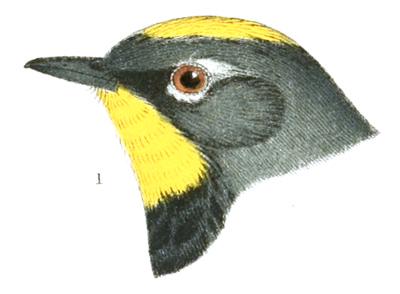
1. Dendroica auduboni,
Towns. ♂ Rocky Mts., 11965.
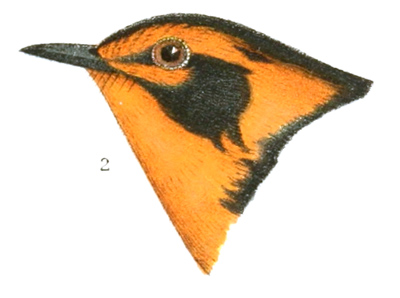
2. Dendroica blackburniæ,
Gm. ♂ Pa., 939.
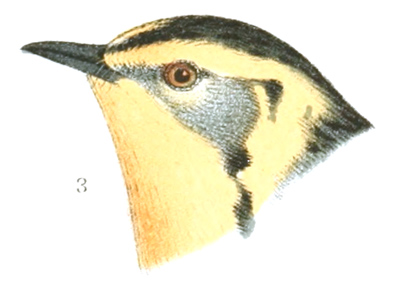
3. Dendroica blackburniæ,
Gm. ♀ Pa., 944.
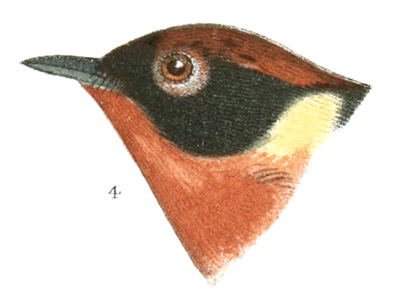
4. Dendroica castanea,
Wils. ♂ Pa., 2231.
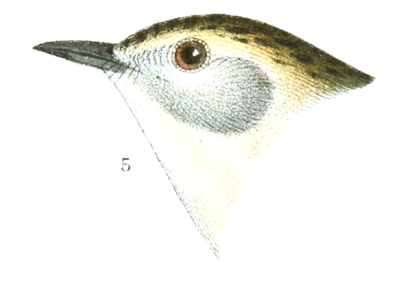
5. Dendroica castanea,
Wils. ♀ Pa., 949.
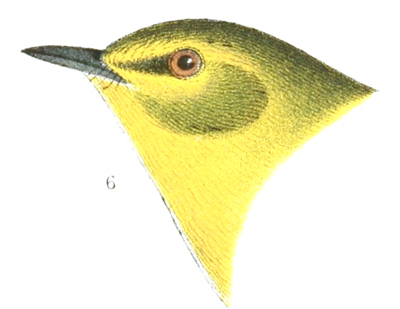
6. Dendroica pinus,
Wils. ♂ Pa., 2942.
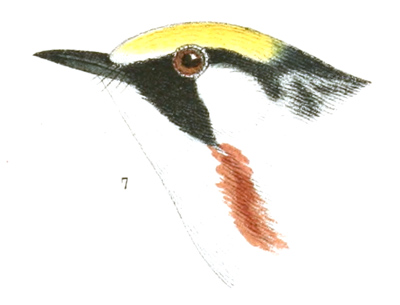
7. Dendroica pennsylvanica,
Linn. ♂ Pa., 2233.
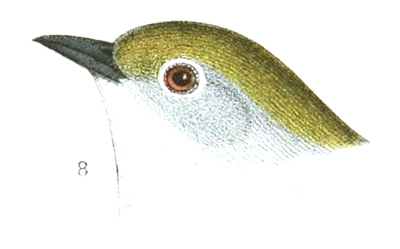
8. Dendroica pennsylvanica,
Linn. ♂ juv., Ill., 60883.
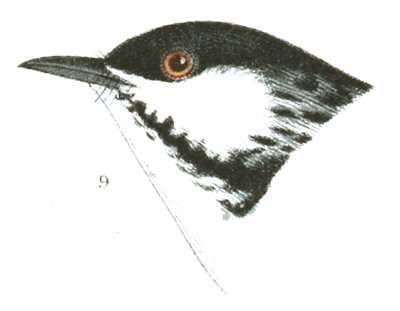
9. Dendroica striata,
Forst. ♂ Pa., 1545.
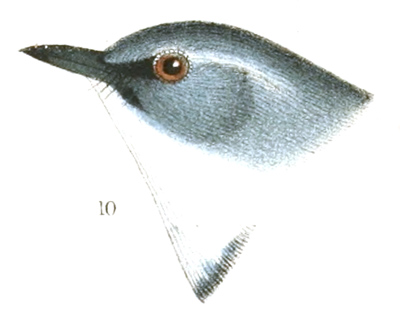
10. Dendroica cærulea,
Wils. ♂ Ohio, 7349.
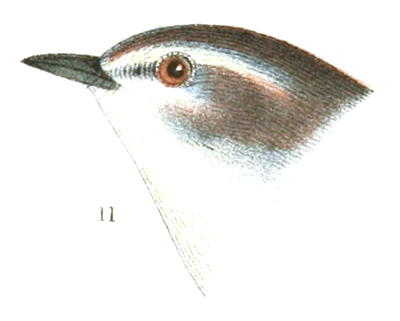
11. Dendroica cærulea,
Wils. ♀ Mo., 6980.
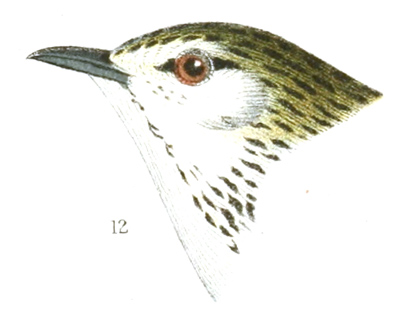
12. Dendroica striata,
Forst. ♀ Pa., 978.
This Warbler is an expert flycatcher, feeds chiefly on insects, and is a great
devourer of small caterpillars; but in the winter its food is largely composed
of berries, especially those of the Myrica cerifera. It will also feed on grass-seeds.
In the warmer wintry days in Florida, when insects are abundant,
Mr. Audubon states that these birds are particularly active in their pursuit,
and the trees seem full of them. At this time they emit, at each movement,
a single note, twēēt, so very peculiar that they may be at once recognized by
the cry.
Wilson states that these Warblers appear in Pennsylvania, from the North,
early in October, and stay there several weeks. Some of them remain in
the Southern States all winter. They feed with great avidity upon the berries
of the red cedar.
In Western Massachusetts it is a very abundant spring and autumn visitant,
making but a brief stay in spring, but passing northward in large numbers.
In autumn it remains longer, and passes south more leisurely. Mr.
B. P. Mann found its nest and eggs in Concord, but this was probably an exceptional
instance. In Eastern Maine it arrives May 25, and, as Mr. Boardman
thinks, remains to breed. Both Dr. Suckley and Dr. Cooper met with
this species in Washington Territory, where it is very rare.
No writers have observed or noted the song of this bird, except Mr. T. M.
Trippe (American Nat., II. p. 171), who states that during its spring migrations
it has a very sweet song or warble, uttered at short intervals.
It reaches the high northern latitudes late in May, and leaves that region
in September. The observations of Mr. McFarlane show that the nests of
this bird are moderately common at Anderson River, and are generally built
in low spruce-trees four or five feet from the ground. In one or two
instances it was placed on the ground.
The eggs of this Warbler vary from .72 to .80 of an inch in length, and
from .50 to .55 in breadth. Their ground-color is white, often tinged with a
bluish shade, and blotched and spotted with reddish-brown, purple, and darker
shades of brown. They are of a rounded oval shape.
Dendroica auduboni, Baird.
AUDUBON’S WARBLER; WESTERN YELLOW-RUMP.
Sylvia auduboni, Townsend, J. A. N. Sc. VII, II, 1837.—Ib. Narrative, 1839, 342.—Aud. Orn. Biog. V, 1839, 52, pl. cccxcv. Sylvicola auduboni, Bon. List. 1838.—Aud. Birds Am. II, 1841, 26, pl.
lxxvii. Dendroica auduboni, Baird, Birds N.
Am. 1858, 273; Rev. 188.—Sclater, P. Z. S. 1858, 298 (Oaxaca; October); 1860, 250 (Orizaba).—Sclater & Salvin, Ibis,
1860, 273 (San Geronimo, Guat.).—Cooper & Suckley, P. R. R. Rep. XII, II, 1859, 181.—Sclater, P. Z. S. 1864, 172 (City of Mexico).—Cooper, Orn. Cal. 1, 1870, 88.
Sp. Char.
Above bluish-ash, streaked with black, most marked on the middle of the
back; on the head and neck bluish-ash. Middle of crown, rump, chin, and throat, and a
patch on the side of the breast, gamboge-yellow; space beneath and anterior to the eyes,
forepart of breast and sides, black; this color extending behind on the sides in streaks.
Middle of belly, under tail-coverts, a portion of upper and lower eyelids, and a broad band
on the wings, with a spot on each of the four or five exterior tail-feathers, white; rest
of tail-feathers black. Female brown above; the other markings less conspicuous and less
black. Length, 5.25; wings, 3.20; tail, 2.25. Young, first plumage, whole body, including
head all round and rump, conspicuously streaked with slaty-black upon an ashy ground
above and white below. No yellow on crown, rump, breast, or throat. Wings and tail as
in autumnal adult.
Hab.
Western and Middle Provinces of the United States; Cape St. Lucas; Western
Mexico and Orizaba? Oaxaca (cold regions, October, Sclater); Guatemala (Salvin).
This bird is very closely allied to D. coronata, but is distinguished by the
yellow (not white) throat; the absence of a superciliary white stripe (the
eyelids white, however); the restriction of the black of the face to the lores,
and to a suffusion round the eye; and the presence of one broad band on the
wings, instead of two narrow ones.
Habits. This beautiful Warbler, so strikingly simulating the D. coronata
in the character of its markings, and now so well known as a common species
on the Pacific coast, was first met with by Mr. Townsend near the Columbia
River, where he found it very abundant. His account of its habits is inconsistent,
and probably not reliable. Mr. Nuttall, who was with Mr. Townsend,
differs, also, essentially in his account. He states that he first saw them about
the middle of April, and that their song bore a very close resemblance to that
of the D. æstiva, but was delivered in a much superior style. They remained
his summer companions, breeding among the shady firs on the borders of
prairie openings, where there was an abundant supply of insect food. By the
8th of June he found their young already out, in small and busy flocks, solicitously
attended by their parents. They greatly resembled the young of
the coronata. These birds frequented large trees, particularly the water-oaks,
and the lower branches of gigantic firs.
Dr. Cooper found this Warbler one of the most abundant species of Washington
Territory, and believed them to be, to some extent, a resident species,
as he met them about the Straits of Fuca in March. He speaks of its song
as lively, and heard everywhere on the borders of the woods, even near the
coast, where few of the smaller species ever visit. In the fall he noticed
straggling flocks of the young wandering about the low shrubbery in large
numbers. The same writer also states that this species is in winter a very
abundant bird in the southern part of California, flitting about among the
bushes and low trees. The males are then in the dull plumage of the females,
and do not put on their richer hues until March or April. He saw none
south of San Francisco after May 1, but they began to reappear in September.
As he found newly fledged young near Lake Tahoe, he thinks they breed
throughout the higher Sierra Nevada. At the sea level in latitude 37° they
appear late in September, and remain until March 20.
Dr. Suckley regarded this bird as the most abundant species visiting the
western portion of Washington Territory. Near Fort Steilacoom it was
found principally among the oak-trees on the plains.
Dr. Woodhouse found it abundant in New Mexico, confining itself to the
timbered and mountainous districts, and especially plentiful among the San
Francisco Mountains, feeding among the tall pines. Dr. Coues found it exceedingly
common in Arizona, where some spend the winter, and a few possibly
remain in the summer to breed.
Dr. Heermann found them remaining in the Sacramento Valley throughout
the winter, and quotes Dr. Kennerly as finding these birds on the Boca
Grande and at different points in Sonora. Mr. Gambel found these Warblers
on all his route from New Mexico to California in great abundance, their
habits greatly resembling those of the D. coronata. They display a great deal
of familiarity, entering the towns, resorting to the gardens and hedge-rows,
and even the corrals of the houses, descending also to the ground in company
with Blackbirds and Sparrows.
This Warbler is thus shown to have a very extended distribution. It is
now known to be found, at different seasons, from Central America to British
Columbia, and from New Mexico to the Pacific.
We are indebted to the late Mr. Hepburn for all the knowledge we possess
in reference to its nests, eggs, and breeding-habits. He procured their nests
and eggs in Vancouver’s Island. They were built in the forked branches of
small shrubs. Around these the materials of which they were built were
strongly bound, and to it the nests were thus securely fastened. They were
quite long and large for the bird, being four inches in height, and three and
a half in diameter. The cavity is small, but deep. The external periphery
of the nest is made of coarse strips of bark, long dry leaves of wild
grasses, and strong stalks of plants, intermingled with finer grasses, pieces of
cotton cloth, and other materials. The inner nest is also a singular combination
of various materials, yet carefully and elaborately put together. It is
made up of fine grasses, feathers, lichens, mosses, fine roots, etc., all felted together
and lined with a warm bedding of fur and feathers. Mr. Hepburn’s
observations, so far as they go, seem to show that this bird does not usually
build in such lofty positions as Nuttall and others conjectured.
According to Mr. Hepburn, they arrive in Vancouver’s Island in the middle
of April, and generally frequent high trees, constructing their nests in the
upper branches, though also frequently building in low bushes, a few feet
from the ground. The number of their eggs is four. These, he states, have
a pure white ground, and are spotted, usually chiefly about the larger end,
with red markings.
Mr. Salvin met with both this species and the D. coronata at San Geronimo,
November, 1859. They congregated together on the ground, where they
principally obtained their food.
Dr. Cooper, in his paper on the fauna of Montana, mentions this Warbler
as the only one of the genus seen by him between Fort Benton and Fort
Vancouver. It was very common throughout the mountains, and he found it
in every portion of the country west of them, even where scarcely a bush
was to be seen.
According to the careful observations of Mr. Robert Ridgway, this Warbler,
during the summer months, in the Great Basin, chiefly inhabits the
pines of the high mountain ranges, as well as the cedar and piñon woods of
the desert mountains. In winter it descends to the lower portions, being
then found among the willows, or, in small roving companies, hopping among
the tree-tops in the river valleys. In manners it is said by him to resemble
the coronata, but in their notes they differ very widely. A nest, containing
three young, was found by Mr. Ridgway near the extremity of a horizontal
branch of a pine-tree, about ten feet from the ground.
The eggs of the Audubon Warbler do not resemble those of any Dendroica
with which I am acquainted, but are most like those of the Hooded Warbler.
They measure .70 by .50 of an inch, have a reddish or pinkish white
ground, and are sparingly marked with fine brown markings, tinted with a
crimson shading.
Dendroica maculosa, Baird.
BLACK AND YELLOW WARBLER.
Motacilla maculosa, Gm. Syst. Nat. I, 1788, 984. Sylvia m. Lath.; Vieill.; Bon.; Nutt.; Aud. Orn. Biog. I, II, V,
pl. 1. 123. Sylvicola m. Swains.; Bon.; Aud. Birds Am. II, pl. xcvi. Rhimanphus
m. Cab. Jour. III, 1855, 474
(Cuba). Dendroica m. Baird, Birds N. Am. 1858, 284; Review, 206.—Sclater, P. Z. S. 1859, 363, 373 (Xalapa).—Bryant, Pr. Bost. Soc. VII, 1859 (Bahamas).—Sclater & Salvin, Ibis, 1859, 11
(Guatemala).—Lawrence, Ann. N. Y. Lyc. 1861, 322 (Panama;
winter).—Gundlach, Cab. Jour. 1861, 326 (Cuba; very
rare).—Samuels, 238. Sylvia magnolia, Wils. III, pl. xxiii, fig. 3.
Sp. Char.
Male, in spring. Bill dark bluish-black, rather lighter beneath. Tail dusky.
Top of head light grayish-blue. Front, lore, cheek, and a stripe under the eye, black, running
into a large triangular patch on the back between the wings, which is also black. Eyelids
and a stripe from the eye along the head white. Upper tail-coverts black, some of the
feathers tipped with grayish. Abdomen and lower tail-coverts white. Rump and under
parts, except as described, yellow. Lower throat, breast, and sides streaked with black;
the streaks closer on the lower throat and fore breast. Lesser wing-coverts, and edges of
the wing and tail, bluish-gray, the former spotted with black. Quills and tail almost black;
the latter with a square patch of white on the inner webs of all the tail-feathers (but the
two inner) beyond the middle of the tail. Two white bands across the wings (sometimes
coalesced into one) formed by the middle and secondary coverts. Part of the edge of
the inner webs of the quills white. Feathers margining the black patch on the back
behind and on the sides tinged with greenish. Length, 5 inches; wing, 2.50; tail, 2.25.
Autumnal males differ in absence of black of back, front, sides of head, and to a considerable
degree beneath, and in much less white on the wings and head.
Female in spring. Similar, but all the colors duller. Black of the back restricted to a
central triangular patch.
Hab.
Eastern Province of North America to Fort Simpson; Eastern Mexico to Guatemala
and Panama; Bahamas; Cuba (very rare).
Habits. The Black and Yellow Warbler, one of the most beautiful of this
attractive family, was supposed by our earlier writers to be exceedingly rare.
Wilson never met with more than two specimens,—one in Ohio, the other
on the Mississippi,—and spoke of it as a very scarce species. In regard to
its song he was quite at fault, denying to it any notes deserving the name
of song. Nuttall, who had only seen it occasionally in Massachusetts, in
the middle of May, regarded it as rare, and was unacquainted with its
notes. Its history is now much better known, and neither its great rarity
nor its deficiency as to melody can any longer be admitted.
At certain seasons and in particular places it is a very common species.
It may be found during the breeding-season throughout North America east
of the Great Plains, between latitude 44° and Fort Simpson in the fur
country. During its migrations it may be met with in most of the Eastern
States, in Eastern Mexico, and the northern portions of South America. It
has been found in the Bahamas, and also in Cuba, where it is not common.
Specimens have been received from Mexico, Guatemala, and Panama, and
from Fort Resolution, Rupert House, and Fort Simpson, in Arctic America,
and as far to the west as the mouth of Vermilion River. Dr. Bryant
met with it in the Bahamas as early as the 15th of March, where it was
quite common. M. Boucard found it at Playa Vicente, in the hot portion
of the State of Oaxaca, Mexico.
In Western Massachusetts, Mr. Allen found it a common spring and
autumn visitor, occurring in its northern flights from the middle of May to
the first of June, and in the autumn as late as September 20. Professor
Verrill found it in Western Maine, but not common, both in spring and fall,
but had no reason to believe that it bred there. Mr. Boardman does not
include it in his list of Calais birds, and I did not find it among the islands
in the Bay of Fundy. In the vicinity of Halifax, during the months of
June and July, it is one of the most common of the Warblers, occurring in
every direction.
Mr. Audubon observed these Warblers in Louisiana, in their migrations, as
early as the middle of March; but its appearance there, as well as in Kentucky
and Ohio, appeared to be occasional and accidental. In autumn he has met
with them in large numbers among the mountains of Northern Pennsylvania,
They were passing southward with their young. While on his way to Labrador
he noticed them in Maine, near Eastport, in May, very abundant along
the roads, the fields, and the low woods, as well as in the orchards and gardens.
The season was then not advanced, the weather cold; and these birds
sheltered themselves by night among the evergreens, and were often so chilled
as to be readily taken by the hand. He also met them wherever he landed
in the neighboring islands in the Bay of Fundy and at Labrador.
The song of this Warbler is clear and sweetly modulated, and surpasses
that of most of this family. It seems to prefer the interior of low woods,
where its notes may chiefly be heard during the early summer, as it sings
while it is searching for its food among the branches, in the manner of the
Vireos.
Like nearly all the members of this family, in its search for food it blends
the habits of the Creepers with those of the Flycatchers, feeding upon
insects in their every form, running up and down the trunks for the ova,
larvæ, and pupæ, expertly catching the insect on the wing, and equally
skilful in hovering over the expanded bud and searching the opening leaves.
Mr. Audubon found its nest placed deep among the branches of low fir-trees,
supported by horizontal twigs, constructed of moss and lichens, and
lined with fibrous roots and feathers. One found in Labrador, in the beginning
of July, contained five eggs, small and rather more elongated than is
common in this genus. They were white, and sprinkled with reddish dots at
the larger end. The female fluttered among the branches, spreading her
wings and tail in great distress, and returning to her nest as soon as the intruders
were a few yards off. In August he saw a number of their young
already following their parents and moving southward. In his expedition
to Texas, Mr. Audubon again met this bird, in considerable numbers, early
in April. Their eggs, he states, measure three fourths of an inch in length
by nine sixteenths in breadth. In some the ground-color, instead of pure
white, is of a yellowish tinge.
The writer found this Warbler abundant near Halifax in the early summer
of 1850, frequenting the thick hemlock woods, confiding in its habits,
unsuspicious, and easily approached. The distress, as described by Audubon,
manifested in behalf of its own young, it is as ready to exhibit when the
nest of a feathered neighbor is disturbed. A pair of Hudson’s Bay Titmice,
protesting against the invasion of their home, by their outcries brought a pair
of these Warblers to their sympathetic assistance; and the latter manifested,
in a more gentle way, quite as much distress and anxiety as the real parents.
With expanded tail and half-extended wings they fluttered overhead among
the branches, approaching us almost within reach, uttering the most piteous
outcries.
Sir John Richardson found this Warbler as common and as familiar as
the D. æstiva on the Saskatchewan, and greatly resembling it in habits,
though gifted with a much more varied and agreeable song.
Mr. Kennicott met this Warbler on Great Slave Lake, June 12, 1860,
where he obtained a female, nest, and five eggs. The nest, loosely built, was
placed in a small spruce about two feet from the ground, and in thick
woods. The bird was rather bold, coming to her nest while he stood by it.
This nest was only one and a half inches deep, with a diameter of three and
a half inches; the cavity only one inch deep, with a diameter of two and a
half inches. It was made almost entirely of fine stems of plants and slender
grasses, and a few mosses. The cavity was lined with finer stems, and fine
black roots of herbaceous plants.
The eggs of this Warbler are, in shape, a rounded oval, one end being but
slightly more pointed than the other. They measure .62 of an inch in
length and .49 in breadth. Their ground-color is a light ashen hue, or a
dull white, and this is more or less sprinkled with fine dots and blotches
of a light brown. For the most part these are grouped in a ring about
the larger end.
Mr. R. Deane, of Cambridge, found this bird breeding near Lake Umbagog.
Its nest was in the fork of a low spruce about three feet from the
ground. The nest contained four eggs, and was made of dry grasses, spruce
twigs, and rootlets. It was lined with fine black roots, being a rather coarse
structure for a Warbler. The eggs were nearly spherical, averaging .62 by
.51 of an inch. Their ground-color was a creamy-white, sparsely marked
with a few large blotches of lilac and umber.
Dendroica cærulea, Baird.
CÆRULEAN WARBLER; WHITE-THROATED BLUE WARBLER.
Sylvia cærulea, Wils. Am. Orn. II, 1810, 141, pl. xvii, fig. 5. Sylvicola c. Swains.; Jard.; Rich.; Bon.; Aud. Orn. Biog. I, pl. xlix; Nutt. Dendroica c. Baird, Birds N.
Am. 1858, 280; Rev. 191.—Gundl. Cab. Jour. 1861, 326 (Cuba; very rare).—Samuels, 579. Sylvia rara, Wilson, II, pl. xxvii, fig. 2.—Bon.; Aud. Orn. Biog. I, pl. xlix. Sylvia azurea, Steph. Shaw, Zoöl. X, 1817.—Bon. Am. Orn. II, 1828, pl. xxvii (♀).—Aud. Orn. Biog. I, pl. xlviii, xlix; Nutt. Sylvia bifasciata, Say,
Long’s Exped. I, 1823, 170. Sylvia populorum, Vieill. Encyc.
Méth. II, 1823, 449 (from Wilson).
Other localities: Bogota, Sclater, P. Z. S. 1857, 18. Panama R. R., Lawrence, Ann. N. Y. Lyc. 1861, 322. Yucatan,
Lawr. Veragua, Salv.
Sp. Char.
Male. Above bright blue, darkest on the crown, tinged with ash on the
rump; middle of back, scapulars, upper tail-coverts, and sides of the crown, streaked with
black. Beneath white; a collar across the breast, and streaks on the sides, dusky-blue.
Lores, and a line through and behind the eye (where it is bordered above by whitish),
dusky-blue; paler on the cheeks. Two white bands on the wings. All the tail-feathers
except the innermost with a white patch on the inner web near the end. Female, greenish-blue
above, brightest on the crown; beneath white, tinged with greenish-yellow, and
obsoletely streaked on the sides; eyelids and a superciliary line greenish-white. Length,
4.25; wing, 2.65; tail, 1.90.
Hab.
Eastern United States, north to Niagara Falls; Cuba (very rare); Guatemala;
Veragua, Panama, and Bogota. Not recorded from Mexico (except Yucatan), or West
Indies (except Cuba).
The autumnal adult plumage of both sexes is, in every respect, exactly
like the spring dress. Young males in late summer are very similar to adult
females, but are purer white below, and less uniform greenish-blue above, the
dark stripes on sides of the crown and black centres to scapulars being quite
conspicuous; the young female, at the same season, is similar in pattern to
the adult, but is dull green above, without any tinge of blue, and light buffy-yellow
below.
There is considerable variation in adult males, especially in the width of
the pectoral collar; one (No. 60,877, Mt. Carmel, Wabash Co., Ill., Aug. 9)
has this entirely interrupted. In this individual there is no trace of a
whitish supra-auricular streak; while others from the same locality, and
obtained at the same date, have the band across the jugulum continuous, and
a quite distinct white streak over the ear-coverts.
Habits. Of this somewhat rare Warbler very little is as yet well known.
Its habits and distribution during the breeding-season need more light than
we now possess to enable us to give its story with any degree of exactness.
Its appearance in Pennsylvania, Ohio, Illinois, and Missouri early in May,
when Warblers that go north to breed are on their way, at first suggested its
belonging to that class. It is not known to proceed any farther north, except
in accidental instances; though the writer has been assured, and has no
reason to doubt the fact, that it abounds and breeds in the neighborhood
of Niagara Falls. I can find no good evidence that it ever occurs in Massachusetts.
Individuals have been obtained in northern South America, Panama,
and Cuba. Dr. Woodhouse describes it as quite common in Texas and
in the Indian Territory, where it breeds, as he obtained both the old and the
young birds. It was also abundant among the timbered lands of the Arkansas
and its tributaries. It was not obtained in any other of the government
expeditions, nor was it found in Arizona by Dr. Coues. Mr. T. M. Trippe
noticed a single individual near Orange, N. Y. Wilson supposed them to
breed in Pennsylvania, though he was never able to find their nests. He
usually met with these birds in marshes or on the borders of streams among
the branches of poplars. Their habits were those of the Flycatchers. He
saw none later than the 20th of August. Describing this species as the Blue-green
Warbler, as met with by him on the banks of the Cumberland early in
April, he mentions its gleaning for food among the upper branches of the
tallest trees, rendering it difficult to be procured. Its resemblance, in habits,
to Flycatchers, he again remarks. Its only note was a feeble cheep.
According to Audubon, this Warbler appears in Louisiana, where it also
breeds early in spring, and leaves the first of October. Like all its family, it
is quite lively, has a similar flight, moves sideways up and down the branches,
and hangs from the ends of the twigs in its search for insects.
Mr. Audubon also states that the liveliness of the notes of this Warbler
renders it conspicuous in the forests, the skirts of which it frequents. Its
song, though neither loud nor of long continuance, he speaks of as extremely
sweet and mellow. He found it as numerous in the State of Louisiana as
any other Warbler, so that he could sometimes obtain five or six in a single
walk.
The nest he describes as placed in the forks of a low tree or bush, partly
pensile, projecting a little above the twigs to which it is attached, and extending
below them nearly two inches. The outer part is composed of the
fibres of vines and the stalks of herbaceous plants, with slender roots arranged
in a circular manner. The nest is lined with fine dry fibres of the
Spanish moss. The eggs are five in number, of a pure white with a few reddish
spots about the larger end. When disturbed during incubation, the
female is said to trail along the branches with drooping wings and plaintive
notes, in the manner of D. æstiva. After the young have left the nest, they
move and hunt together, in company with their parents, evincing great activity
in the pursuit of insects. They are also said to have a great partiality
for trees the tops of which are thickly covered with grapevines, and to occasionally
alight on tall weeds, feeding upon their seeds.
In his visit to Texas, Mr. Audubon met a large number of these birds
apparently coming from Mexico. On one occasion he encountered a large
flock on a small island.
Mr. Nuttall mentions finding these birds very abundant in Tennessee and
also in West Florida.
In only a single instance has the writer met with this Warbler. This was
about the middle of June, at the Fairmount Water Works in the city of Philadelphia,
where, among the tops of the trees, a single individual was busily
engaged in hunting insects, undisturbed by the large numbers and vicinity
of visitors to the grounds. It kept in the tops of the trees, moving about
with great agility.
Mr. Ridgway gives the Cærulean Warbler as the most abundant species
of its genus in the Lower Wabash Valley, not only during the spring and
fall migrations, but also in the summer, when it breeds more plentifully even
than the D. æstiva. It inhabits, however, only the deep woods of the bottom
lands, where it is seldom seen, and only to be distinguished by the naturalist.
Inhabiting, mostly, the tree-tops, it is an inconspicuous bird, and
thus one that easily escapes notice. In its habits it is perhaps less interesting
than others of its genus, being so retired, and possessing only the most
feeble notes.
Dendroica blackburniæ, Baird.
BLACKBURNIAN WARBLER; ORANGE-THROATED WARBLER.
Motacilla blackburniæ, Gmelin, Syst. Nat. I, 1788, 977. Sylvia bl. Lath.; Wilson, III, pl.
xxiii.—Nutt.; Aud. Orn. Biog. II, V, pl. cxxxv,
cccxcix. Sylvicola bl. Jard.; Rich.; Aud. Birds Am. II, pl. lxxxvii. Rhimanphus bl. Cab. Mus. Hein. 1850, 19. Dendroica bl.
Baird, Birds N. Am. 1858, 274; Rev.
189.—Sclater & Salvin, Ibis, 1859, 11 (Guatemala).—Sclater, P. Z. S. 1859, 363 (Xalapa); Ib. 1860,
64 (Ecuador).—Ib. Catal. 1861, 30, No. 187. (Pallatanga and Nanegal, Ecuador).—Samuels, 227.—Sundevall, Ofv. 1869, 611.—Dresser, Ibis, 1865, 478. ? Motacilla chrysocephala, Gmelin,
I, 1788, 971 (Figuier orangé et F. étranger, Buff. V, 313, pl. lviii, fig. 3, Guiana). Sylvia parus, Wils. V, pl. xliv, fig.
3.—Aud. Orn. Biog. II,
pl. cxxxiv. Sylvicola parus, Aud. Birds
Am. II, pl. lxxxiii. Sylvia lateralis, Steph. ? Motacilla incana, Gmel. I, 1788, 976. Sylvia incana, Lath.; Vieill. ? Sylvia
melanorhoa, Vieill. Nouv. Dict.
XI, 1817, 180 (Martinique).—Ib. Encycl. Méth. II, 444.
Localities quoted: Bogota, Sclater, P. Z. S. 1855, 143. Panama, Lawr. Ann. N. Y. Lyc. VII, 62. Costa
Rica, Cab. Jour. 1860, 328. Bahamas, Bryant, Bost. Pr. VII, 1859. Veragua, Salvin. Orizaba (winter; rare), Sumichrast.
Sp. Char.
Upper parts nearly uniform black, with a whitish scapular stripe and a large
white patch in the middle of the wing-coverts. An oblong patch in the middle of the
crown, and the entire side of the head and neck (including a superciliary stripe from the
nostrils), the chin, throat, and forepart of the breast, bright orange-red. A black stripe
from the commissure passing around the lower half of the eye, and including the ear-coverts;
with, however, an orange crescent in it, just below the eye, the extreme lid being black.
Rest of under parts white, strongly tinged with yellowish-orange on the breast and belly,
and streaked with black on the sides. Outer three tail-feathers white, the shafts and tips
dark brown; the fourth and fifth spotted much with white; the other tail-feathers and
quills almost black. Female similar; the colors duller; the feathers of the upper parts
with olivaceous edges. Length, 5.50; wing, 2.83; tail, 2.25.
Hab.
Eastern Province of United States; Eastern Mexico, and south to Bogota and
Ecuador; Bahamas alone of West Indies with certainty.
Autumnal males resemble the females. They have two white bands instead
of one; the black stripes on the sides are larger; under parts yellowish;
the throat yellowish, passing into purer yellow behind.
Autumnal young birds have the same pattern of coloration, but the dark
portions are dull grayish-umber, with the streaks very obsolete, and the light
parts dull buffy-white, tinged with yellow on the jugulum; there is neither
clear black, bright yellow, nor pure white on the plumage, except the latter
on the wing-bands and tail-patches.
Habits. This somewhat rare and very beautiful Warbler requires additional
investigation into its habits before its history can be regarded as satisfactorily
known. Save in reference to its wider distribution during its southern
migrations, little more is known as to its habits than where Audubon
left its history nearly thirty years since. The Smithsonian collection has
specimens from Pennsylvania, Ohio, Wisconsin, Missouri, Illinois, and from
Central America. Mr. Sclater has received specimens from Mexico, and from
Ecuador in South America. Other writers mention having specimens from
Guiana, Martinique, and Panama, and Dr. Bryant found it in the Bahamas.
It is thus known to have a wide distribution from the Atlantic to the Mississippi
River, as far to the north probably as Labrador. Its area of reproduction
is not known with exactness, but the southern limit is supposed to
be the high wooded districts of Pennsylvania, New York, and New England.
A young bird was taken by Holböll, October 16, 1845, at Frederikshaab,
Greenland. In 1837 an egg was sent me from Coventry, Vt., which purported
to belong to this bird; and in the following summer its nest and eggs
were procured in a wild, secluded part of Roxbury, Mass. In neither case
was the identification entirely free from doubt.
Dr. Bachman states that when a resident of Lansingburg, N. Y., in 1833,
he saw a pair of these birds in the act of constructing their nest. Mr. Allen
has no doubt that a few breed in the vicinity of Springfield, Mass., as he has
obtained them as late as June 24. He found it most common in mixed or
hard-wood forests. It arrives about the middle of May. Professor Verrill
gives it as a summer resident of Western Maine, though rarely seen on
account of its habit of keeping concealed among the dense foliage. Mr.
Boardman gives the same account of its residence in summer in the neighborhood
of Calais.
Mr. Audubon did not regard this bird and his “Hemlock Warbler” as the
same species, but gave distinct and different accounts of their habits. We
have therefore to receive with caution these records of peculiarities. He
found the Blackburnian Warbler breeding in Northeastern Maine, in New
Brunswick, in the Magdaleine Islands, and in Labrador and Newfoundland.
He states, correctly, that it has a very sweet song of five or six notes, much
louder than seemed possible from the size of the bird. It pursues its
insect prey among the branches of the fir-trees, moving along after the manner
of the common Redstart.
Mr. McCulloch, of Halifax, gave Mr. Audubon a nest of this bird with
three eggs. The nest was formed externally of different textures, lined
with fine delicate strips of bark and a thick bed of feathers and horse-hair.
The eggs were small, conical, with a white ground spotted with light red
at the larger end. The nest was in the small fork of a tree five feet from
the ground, and near a brook.
The nest obtained in Roxbury was in a bush, a few feet from the ground,
in a very wild region of forest and rocks. Externally, except in its length,
which was less, it resembled a nest of the G. trichas, being made of coarse,
dry grasses. Internally it was much more warmly lined with feathers and
soft fur than is the case in nests of the Yellow-Throat. The eggs were of
a crystal whiteness, marked at their larger end with dark purple, and but
for their smaller size might have been mistaken for those of G. trichas.
The position of the nest, however, was conclusive in regard to this point.
The egg from Coventry was substantially similar, except that reddish-brown
dots were mingled with the purple markings, in the form of a wreath around
the larger end.
Wilson describes this Warbler as songless, but attributes to its counterpart,
the Hemlock Warbler, a very sweet song of a few low notes,—a very
different account from that given by Audubon of the song of the Blackburnian.
Mr. Paine states that this species is resident during the summer months in
Randolph, Vt. It is, he says, a very close companion of the D. virens, arriving
at the same time with it even to a day, or about the 10th of May. Its
dry chirping song may then be heard in striking contrast with the sweet
notes of the virens. He was not able to find its nest.
Mr. C. W. Wyatt met with this species as a winter resident at Alto, in Colombia,
South America. Its upward range seemed to be terminated only by
the paramos. Among the oaks on the Pamplona road he found it very common
just under the paramo, the bright orange throat of the male making it
a very conspicuous bird. He was led to believe that they were not found
there at a lower elevation than five thousand feet.
Dendroica dominica, Baird.
YELLOW-THROATED GRAY WARBLER.
Motacilla dominica, L. Syst.
Nat. 12th ed. 1766, 334 (Ficedula dominica cinerea, Briss. III, 520, pl. xxvii, fig. 3). Dendroica dominica, Baird, Rev. Am. Birds, 209.
Motacilla superciliosa, Boddært, Tableau Pl. enl. 686, fig. 1, 1783. Dendroica superciliosa, Baird, Birds N. Am. 1858, 289.—Sclater (Xalapa,
Oaxaca, Jamaica, Mexico).—Sclater & Salvin, Ibis, 1860, 274 (Duenas, Guat.; Sept.).—March, Pr. A. N. Sc. 1863, 293 (Jamaica).—Gundlach, Cab. Jour. 1861, 326 (Cuba; very common). Motacilla flavicollis, Gmelin, Syst. Nat. I, 1788, 959. Sylvia fl. Lath.; Wils. II, pl. xii, fig. 6. Motacilla
pensilis, Gmelin, Syst. Nat. I, 1788, 960. Sylvia p. Lath.; Vieill. (St. Domingo).—Bon.; Aud. Orn. Biog. I, pl. lxxxv; Nutt. Sylvicola pens. Rich. Bon.; Aud. Birds Am.
II, pl. lxxix.—Gosse, Birds Jam. 1847, 156 (Jamaica). Rhimanphus pens. Cab. Jour.
III, 474 (Cuba).
Other localities: Cordova, Sclater, P. Z. S. 1856, 291. St. Domingo, Sallé, P. Z. S. 1857, 231. Jamaica, Gosse, Birds Jam. 156.
Sp. Char.
Upper parts uniform grayish-blue. Chin and throat bright yellow; under
parts white. Forehead, and sometimes most of crown, lores and cheeks, sides of throat,
and numerous streaks on the sides of the breast, black. A stripe from the nostrils over and
behind the eye, a crescent on the lower eyelid, the sides of the neck behind the black cheekpatch,
and two conspicuous bands on the wings, white. Terminal half of the outer webs
of the outer two, and terminal third of the third tail-feathers, white. Female almost
precisely similar. Length, 5.10; wing, 2.60; tail, 2.30. (3,322.)
Hab.
Eastern Province of United States, north to Washington and Cleveland; in winter
abundant in Cuba; St. Domingo and Jamaica; Mexico (Colima on west coast), and
Guatemala. Resident in Jamaica?
An autumnal male (No. 1,098, Washington, D. C.) has the bluish-ash
above obscured by a wash of brown; the black “mask” less sharply defined,
the streaks on forehead wanting; the yellow paler and duller, and the white
beneath soiled with brownish.
In general pattern of coloration this species resembles two others; one
from Arizona, the other from Porto Rico. The diagnoses are as follows:—
Common Characters. Upper parts ash-gray, the forehead and sides of vertex
black. A line from nostril to above eye (passing into white behind), chin, and
throat, yellow, margined laterally with blackish; crissum, inside of wings, axillars;
and two bands on wings, white.
Superciliary line extending to the nape, and white, excepting sometimes
anterior to the eye. Cheeks black, separated from the ash of the neck by
a white patch. Eyelids and infra-ocular crescent white. Back not streaked.
Bill lengthened, gonys almost concave.
Yellow confined to jugulum; rest of under parts white; the sides
streaked with black … dominica.
Superciliary line scarcely extending beyond the eye, and yellow, excepting
at extreme end. Cheeks ashy, like sides of neck; dusky only near the eye,
and not bordered on side of neck behind by white. Eyelids and infra-ocular
crescent yellow. Back streaked. Bill short, gonys slightly convex.
Yellow of under parts confined to jugulum; rest of under parts white;
the sides streaked with black … graciæ.
Yellow of under parts extending to crissum. Sides scarcely streaked. … adelaidæ.[51]
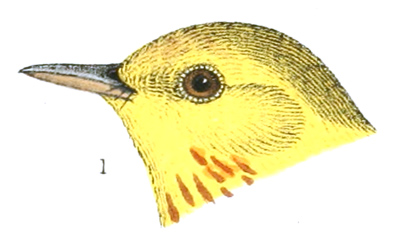
1. Dendroica æstiva,
Gm. ♂ Pa., 940.
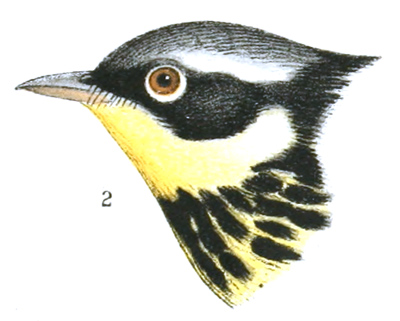
2. Dendroica maculosa,
Gm. ♂ D. C., 20634.
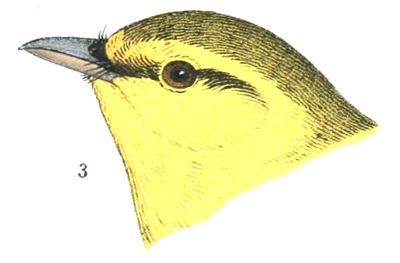
3. Dendroica montana. (From Audubon.)
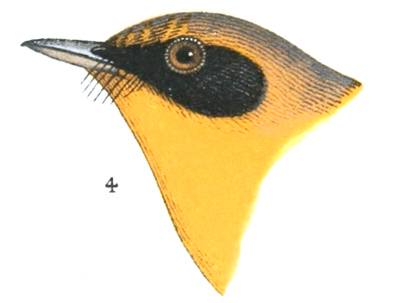
4. Dendroica olivacea,
Giraud. ♂ Mex., 30692.
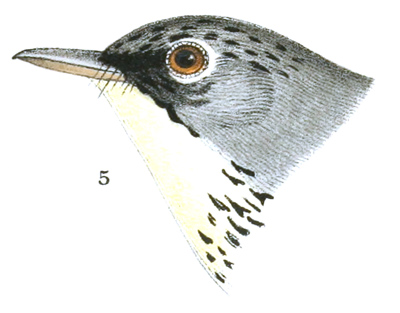
5. Dendroica kirtlandi,
Baird. ♂ Ohio, 4363.
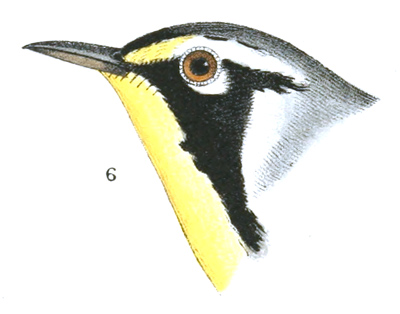
6. Dendroica dominica,
Linn. ♂ Ga., 3322.
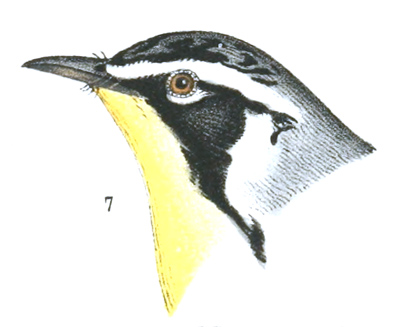
7. Dendroica dominica var. albilora,
Ridgw. ♂ Ohio, 7701.
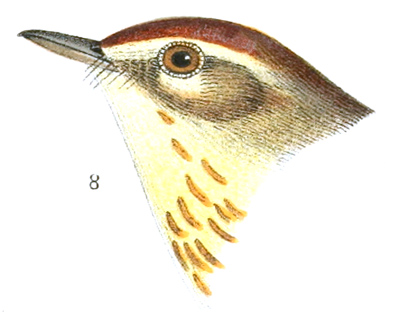
8. Dendroica palmarum,
Gm. ♂ N. S., 26929.
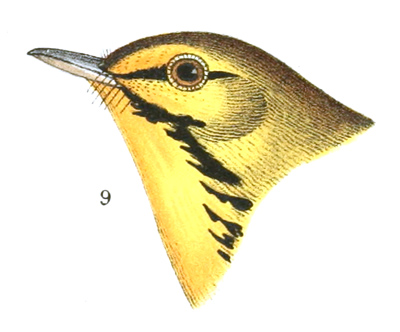
9. Dendroica discolor,
Vieill.♂ Pa., 1091.
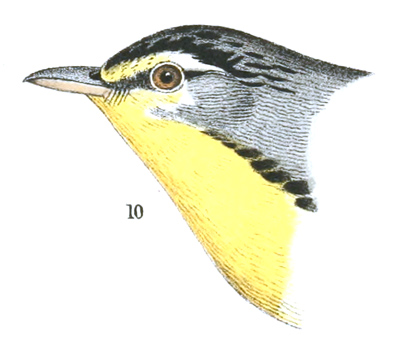
10. Dendroica graciæ,
Coues. ♂ Ariz., 40680.
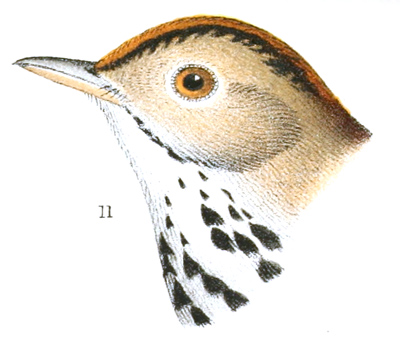
11. Seiurus aurocapillus,
Linn. ♂ Pa., 1433.
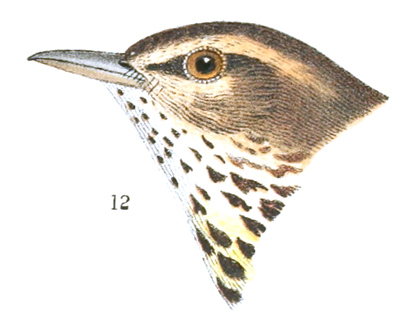
12. Seiurus noveboracensis,
Gm. ♂ Pa., 2434.
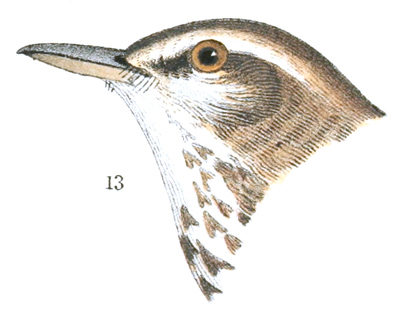
13. Seiurus ludovicianus,
Aud. ♂ Pa., 964.
In the Review (p. 209) several variations in this species are noted; but at
that time there was not a sufficient number of specimens to warrant our
coming to a conclusion as to their value. Now, however, we have better
material before us, and upon the examination of about thirty specimens, including
two series of nearly equal numbers,—one from the Atlantic States
and the West Indies, the other from the Mississippi region and Middle
America,—find that there are two appreciably different races, to be distinguished
from each other by points of constant difference. All birds of the
first series have the bill longer than any of the latter, the difference in a
majority of the specimens being very considerable; they also have the superciliary
stripe bright yellow anteriorly, while among the latter there is never
more than a trace of yellow over the lores, and even this minimum amount
is discernible only in one or two individuals. The West Indian form is, of
course, the true dominica, and to be distinguished as var. dominica; as none
of the synonymes of this species were founded upon the Mexican one, however,
it will be necessary to propose a new name; accordingly, the term var.
albilora is selected as being most descriptive of its peculiar features.
The following synopsis, taken from typical specimens, shows the differences
between these two races:—
(No. 3,322, ♂, Liberty County, Georgia.) Bill (from nostril), .45; tarsus, .60;
wing, 2.60; tail, 2.00. Superciliary stripe, anterior to eye, wholly bright yellow;
yellow of chin and maxillæ extending to the bill. Hab. In summer, Atlantic
States of United States, north to Washington. In winter, and possibly all
the year, in Cuba, Santo Domingo, and Jamaica … var. dominica.
(No. 61,136, ♂, Belize, Honduras.) Bill (from nostril), .35; tarsus, .60; wing,
2.70; tail, 2.20. Superciliary stripe wholly white; yellow of chin and maxillæ
bordered narrowly next the bill with white. Hab. In summer, the Mississippi
region of United States, north to Lake Erie; common in South Illinois. In
winter, and possibly all the year, in Mexico, south to Guatemala, Yucatan on
the Atlantic, and Colima on the Pacific side … var. albilora.
Habits. The history of the Yellow-throated Warbler is very imperfectly
known. Its geographical distribution is irregular and apparently eccentric.
Found occasionally, rather than frequently, in the Southern Atlantic and Gulf
States, it occurs irregularly as far north as Washington, New York City,
Cleveland, O., Union County, Ill., and Kansas. In the last place it is supposed
also occasionally to breed. West of this it has not been traced in any
portion of the United States. It was obtained in Tamaulipas, Mexico, by
Lieutenant Couch, and on the western coast Mr. Xantus found it at Colima.
Mr. Sclater has also procured it from other portions of Mexico, and M. Boucard
took it at Oaxaca. It has been obtained in Guatemala and Jamaica. In
the latter place it is found the entire season. In Cuba, in the winter, it is
quite common. It has also been found in St. Domingo, and probably in the
other West India Islands. Mr. Gosse states that these birds do not appear in
Jamaica before the 16th of August, and that they leave by the first of April.
On the other hand, Mr. March, in his notes on the birds of that island, states
that on the 8th of August he obtained an old bird and two young, the latter
of which he was confident had been hatched on the island, and his son had
met with the birds all through the summer, and had procured a specimen on
the 4th of June.
Wilson states that the habits of this species partake more of those of the
Creeper than of the true Warbler. He met with it in Georgia in the month
of February. He speaks of its notes as loud, and as resembling those of the
Indigo-Bird. It remained some time creeping around the branches of the
same pine, in the manner of a Parus, uttering its song every few minutes.
When it flew to another tree, it would alight on the trunk and run nimbly
up and down in search of insects. They are said to arrive in Georgia in
February, after an absence of only three months. Wilson states that they
occur as far north as Pennsylvania, but does not give his authority. The
food of this species appears to be larvæ and pupæ, rather than winged insects.
Those dissected by Mr. Gosse in Jamaica were found to have quite large
stomachs, containing caterpillars of various kinds.
Nuttall and Audubon are very contradictory in their statements touching
its nesting, and it is not probable that the accounts given by either are
founded upon any reliable authorities. The former describes a nest remarkable
both for structure and situation, said to have been found in West Florida,
suspended by a kind of rope from the end of branches over a stream
or a ravine. This nest, entirely pensile, is impervious to rain, and with an
entrance at the bottom. He gives a very full and minute description of this
nest, but gives no authority and no data to establish its authenticity. We
can therefore only dismiss it as probably erroneous.
On the other hand, Mr. Audubon claims to have seen its nest, of which he
gives a very different account. He describes it as very prettily constructed,
like the nests of any other of this genus, its outer parts made of dry lichens
and soft mosses, the inner of silky substances and fibres of the Spanish moss.
The eggs are said to be four in number, with a white ground-color and a few
purple dots near the larger end. He thinks they raise two broods in a season
in Louisiana. These nests are not pensile, but are placed on the horizontal
branch of the cypress, from twenty to fifty feet above the ground. It
closely resembles a knot or a tuft of moss, and therefore is not easily discovered
from below.
A nest containing a single egg, found by Mr. Gosse near Neosho Falls, and
supposed to belong to this species, but not fully identified, was built in a low
sapling a few feet from the ground, and is a very neat structure, such as is
described by Audubon. The egg is pure crystal-white, oblong and pointed,
and marked with purple and brown.
Mr. Ridgway informs me that in Southern Illinois, at least in the valley
of the Lower Wabash, the Yellow-throated Warbler may be said to be at least
a regular, though not common, summer sojourner. Though it inhabits chiefly
the swampy portions of the bottom-lands, it makes frequent visits to the orchards
and door-yards, less often, however, in the breeding than in the migrating
season. In its manners it is almost as much of a Creeper as the
Mniotilta varia, being frequently seen creeping not only along the branches
of trees, but over the eaves and cornices of buildings, with all the facility
of a Nuthatch.
Eggs supposed to be of this species, taken near Wilmington, N. C., by
Mr. Norwood Giles (16,199, Smith. Coll.), have a ground-color of dull ashy-white,
with a livid tinge. They are thickly speckled, chiefly around the
larger end, with irregular markings of rufous, and fainter ones of lilac interspersed
with a very few minute specks of black. They are broadly ovate
in form, and measure .70 by .55 of an inch.
Dendroica graciæ, Coues.
ARIZONA WARBLER.
Dendroica graciæ (Coues), Baird,
Rev. Am. Birds, I, April, 1865; p. 210.—Elliot, Illust. Birds N. Am. I, vi.—Cooper, Orn. Cal. 1, 1870, 563 (Appendix).
Sp. Char.
Adult male (No. 40,680, May 1, 1865, Dr. E. Coues). Whole upper parts,
including ear-coverts and sides of neck, ash-gray; small cuneate streaks over the crown,
coalesced laterally into a broad stripe on each side, with larger cuneate streaks on the interscapular
region, and inconspicuous linear streaks on upper tail-coverts, black. Two conspicuous
white bands across the wing, formed by the tips of middle and secondary coverts;
secondaries passing externally into light ash. Lateral tail-feather entirely white, except
about the basal third of the inner web (the dusky running some distance toward the end
along the edge), and a broad streak covering most of the terminal fourth of the outer web,
which are clear dusky; the next feather has the outer web exactly the same, but almost
the basal half of the inner is dusky; on the next the white is confined to an oblong spot (not
touching the inner edge) on about the terminal third, while the outer web is only edged
with white; the rest have no white at all. A superciliary stripe extending about .20 of
an inch behind the eye (that portion behind the eye white), the lower eyelid, maxillæ,
chin, throat, and jugulum pure gamboge-yellow. Rest of lower parts, including lining of
wing, pure white; the sides conspicuously streaked with black; lores, and a few obsolete
streaks along the junction of the ash and yellow, dusky. Wing, 2.60; tail, 2.20; bill (from
nostril), .30; tarsus, .60. Adult female (40,685, May 24). Similar to the male, but colors
duller, and markings less sharply defined. Wing, 2.45; tail, 2.00. Young (36,992, August
11). Above brownish-gray without streaks. Beneath ochraceous-white, obsoletely streaked
along the sides. Yellow superciliary stripe not well defined, and only a tinge of yellow
on the jugulum, the throat being grayish-white. Wings and tail nearly as in the adult.
The young in autumnal plumage is similar, but the yellow occupies its usual area; it is,
however, much duller, as well as lighter, than in the adult.
Hab.
Fort Whipple, near Prescott, Arizona. Belize, British Honduras (var. decora).
This species is most closely related to D. adelaidæ, from Porto Rico; but
in the latter the yellow beneath extends back to the crissum, covering even
the sides; there are also no streaks on the sides or back; the proportions,
too, are quite different, the wings and tail being scarcely three fourths as long,
while the bill and feet are much the same size, the tarsi even much shorter.
A specimen (No. 41,808 ♂) from Belize, Honduras, differs so essentially from
the Fort Whipple specimens, that it is, beyond doubt, entitled to a distinctive
name. The differences between these two very well marked races can
best be expressed in a table, as follows:—
(40,680, ♂, Fort Whipple, Arizona). Bill (from nostril), .30; tarsus, .60; wing,
2.60; tail, 2.20. Superciliary stripe extending .20 behind the eye, that portion
behind the eye white; yellow of jugulum not spreading over breast (ending
1.35 from the bill). Streaks of crown coalesced into a broad stripe on each
side; those of back broad, and those on upper tail-coverts almost obsolete.
Wing-bands, .20 wide. Lore dusky-grayish. Hab. Fort Whipple, near Prescott,
Arizona; abundant, breeding (Coues) … var. graciæ.
(41,808, ♂, Belize). Bill, .30; tarsus, .60; wing, 2.20; tail, 1.95. Superciliary
stripe scarcely passing the eye, wholly yellow; yellow of jugulum spreading
over breast (ending 1.60 from the bill). Streaks of the crown scarcely coalesced
along its sides; those on back not longer than those on crown, and those on
upper tail-coverts very conspicuous. Wing-bands, .10 wide. Lore deep black.
Hab. Belize, Honduras, resident? … var. decora.
Habits. We are indebted to Dr. Elliott Coues for all that we at present
know in reference to this recently discovered species. He first met with it
July 2, 1864, in the Territory of Arizona. Dr. Coues first noticed this
bird among the pine woods covering the summit of Whipple’s Pass of the
Rocky Mountains. He saw no more in his journey into Central Arizona
until he was again among the pines at Port Whipple. There he again
found it, and it proved to be a very common bird. Dr. Coues anticipates
that this species will yet be found to occur in the forests of the San Francisco
Mountains, and that its range will be ascertained to include all the
pine tracts of New Mexico and Arizona, from the valley of the Rio Grande
to that of the Great Colorado River. He also has no doubt that it breeds
near and around Fort Whipple.
Specimens found at Belize, first believed to be identical with those from
Arizona, are now referred to a race called decora.
According to Dr. Coues’s observations, the Warbler arrives at Fort Whipple
about the 20th of April, and remains in that neighborhood until the third
week in September. It is found almost exclusively in pine woods, is active,
industrious, and noisy, and possesses very marked flycatching habits, flying
out from its perch to catch passing insects. It has been, so far, found almost
exclusively among the tallest trees.
In regard to the song of this species, Dr. Coues states that it appears to
have several different notes. One of these is the ordinary tsip, given out at
all times by both old and young of all kinds of small insectivorous birds.
Its true song, heard only in spring, consists of two or three loud sweet whistles,
sometimes slurred, followed by several continuous notes, resembling
chir-r-r, in a wiry but clear tone. Their notes are of great power for the
size of the bird. It also has another and quite different song, which Dr.
Coues thought greatly resembled the notes of the common American Redstart.
As all the birds he noticed had mated by the first of May, he has no doubt
that they raise two broods in a season; and the fact that he found newly
fledged young as late as the middle of August seems to corroborate the correctness
of his supposition. In regard to the eggs, nest, or breeding-habits
of this species, we have as yet no information.
Dendroica pennsylvanica, Baird.
CHESTNUT-SIDED WARBLER.
Motacilla pennsylvanica, Linn. Syst. Nat. I, 1766, 333, No. 19.
Gmelin. Sylvia p. Lath.; Wilson, I, pl. xiv, fig. 5. Dendroica p. Baird, Birds N. Am. 1858, 279; Rev. 191.—Sclater & Salvin, Ibis, 1859, 11; 1860, 273 (Coban, Guat.; November).—Samuels, 231. Sylvia
icterocephala, Lath. Ind. Orn.
II, 1790, 538.—Vieill.; Bon.; Aud. Orn. Biog. I, pl. lix. Sylvicola ict. Swains.; Jard.; Aud. Birds Am. II, pl. lxxxi. Dendroica ict. Sclater, P. Z. S. 1859, 363 (Xalapa), 373 (Oaxaca).
Other localities: Bahamas, Bryant, Pr. Bost. Soc. VII, 1859. Costa Rica, Cab. Jour. 1860, 328. Panama, winter, Lawr., Ann. N. Y. Lyc. 1861, 322. Yucatan,
Lawr. Veragua, Salv.
Sp. Char.
Male. Upper parts streaked with black and pale bluish-gray, which becomes
nearly white on the forepart of the back; the middle of the back glossed with greenish-yellow.
The crown is continuous yellow, bordered by a frontal and superciliary band, and
behind by a square spot of white. Loral region black, sending off a line over the eye, and
another below it. Ear-coverts and lower eyelid and entire under parts pure white, a purplish-chestnut
stripe starting on each side in a line with the black mustache, and extending
back to the thighs. Wing and tail-feathers dark brown, edged with bluish-gray,
except the secondaries and tertials, which are bordered with light yellowish-green. The
shoulders with two greenish-white bands. Three outer tail-feathers with white patches
near the end of the inner webs.
Female like the male, except that the upper parts are yellowish-green, streaked with
black; the black mustache scarcely appreciable. Length, 5.00; wing, 2.50; tail, 2.20.
Hab.
Eastern Province of the United States; Bahamas; Guatemala to Costa Rica
and Panama R. R. Not recorded from Mexico proper or West Indies, except Bahamas.
The young in autumn is very different from either male or female in
spring. The entire upper parts are of a continuous light olive-green; the
under parts white; the sides of the head, neck, and breast ash-gray, shading
insensibly into and tingeing the white of the chin and throat. No black
streaks are visible above or on the cheeks, and the eye is surrounded by a
continuous ring of white not seen in spring. In this plumage it has frequently
been considered as a distinct species.
The male in this plumage may usually be distinguished from the female
by possessing a trace, or a distinct stripe, of chestnut on the flanks, the
young female at least lacking it.
Habits. The geographical distribution of this common species during its
season of reproduction is inferred rather than positively known. So far
as I am aware, it is not known to breed farther south than Massachusetts.
Yet it is probable that, when we know its history more exactly, it will be
found during the breeding-season in different suitable localities from Pennsylvania
to Canada. Mr. H. W. Parker, of Grinnell, Iowa, mentions this
bird as common in that neighborhood.
Until recently it was regarded as a rather rare species, and to a large extent
it had escaped the notice of our older ornithological writers. Wilson
could give but little account of its habits. It passed rapidly by him in its
spring migrations. He did not regard it as common, presumed that it has
no song, and nearly all that he says in regard to it is conjectural. Mr. Audubon
met with this species but once, and knew nothing as to its habits
or distribution. Mr. Nuttall, who observed it in Massachusetts, where it is
now known to be not uncommon in certain localities, also regarded it as very
rare. His account of it is somewhat hypothetical and inexact. Its song he
very accurately describes as similar to that of the D. æstiva, only less of a
whistle and somewhat louder. He represents it as expressed by tsh-tsh-tsh-tshyia,
given at intervals of half a minute, and often answered by its mate
from her nest. Its lay is characterized as simple and lively. Late in June,
1831, he observed a pair collecting food for their young on the margin of the
Fresh Pond swamps in Cambridge.
Mr. Allen has found this species quite common in Western Massachusetts,
arriving there about the 9th of May, and remaining through the summer to
breed. He states—and his observations in this respect correspond with my
own—that during the breeding-season they frequent low woods and swampy
thickets, nesting in bushes, and adds that they are rarely found among high
trees. They leave there early in September.
Professor Verrill found this Warbler a common summer visitant in Western
Maine, arriving about the second week in May, and remaining there to
breed. Mr. Boardman thinks it reaches Eastern Maine about the middle
of May, and is a common summer resident. I did not meet this species
either in New Brunswick or Nova Scotia, nor was Dr. Bryant more fortunate,
but Lieutenant Bland gives it in his manuscript list of the birds
found in the neighborhood of Halifax.
Mr. Ridgway informs me that this species breeds in the oak openings and
among the prairie thickets of Southern Illinois.
During the eight months that are not included in their season of reproduction,
this species is scattered over a wide extent of territory. Their
earliest appearance in the Northern States (at Plattesmouth) is April 26, and
they all disappear early in September. At other times they have been met
with in the Bahamas, in Mexico, Guatemala, Costa Rica, and Panama. It has
not yet been detected in the West Indies. M. Boucard obtained specimens
at Playa Vicente, in the hot country of Oaxaca, Mexico.
In the neighborhood of Calais, Mr. Boardman informs me that this Warbler
is common, and that its habits resemble those of the Black-poll Warbler
more than those of any other of the genus. It always nests in bushes or in
low trees, and in the vicinity of swamps.
Among the memoranda furnished to the late Mr. Kennicott by Mr. Ross
is one to the effect that the Chestnut-sided Warbler was observed at Lake
of the Woods, May 29. How common it is at this point is not stated.
Mr. C. S. Paine regards the Chestnut-sided Warbler as one of the sweetest
singers that visit Vermont. He describes it as very confiding and gentle in
its habits. It is chiefly found inhabiting low bushes, in the neighborhood
of taller trees, and it always builds its nest in the fork of a low bush, not more
than from three to five feet from the ground. He has seen many of their
nests, and they have all been in similar situations. They will permit a very
near approach without leaving their nests. These are constructed about the
last of May. Their song continues until about the last of June. After this
they are seldom heard.
J. Elliot Cabot, Esq., had the good fortune to be the first of our naturalists
to discover in June, 1839, the nest and eggs of this Warbler. It was
fixed on the horizontal forked branch of an oak sapling, in Brookline, Mass.
The female remained sitting on her nest until so closely approached as to be
distinctly seen. The nest was of strips of red-cedar bark, and well lined
with coarse hair, and was compact, elastic, and shallow. It contained four
eggs, the ground-color of which was white, over which were distributed
numerous distinct spots of umber-brown. These were of different sizes,
more numerous towards the larger end.
In regard to their breeding in Pennsylvania, Mr. Nuttall mentions in the
second edition of his work that he met them among the Alleghanies at Farranville
in full song, and had no doubt that they were nesting there at the
time.
The Chestnut-sided Warbler usually constructs its nest in localities apart
from cultivated grounds, on the edges of low and swampy woods, but in places
more or less open. Quite a number of their nests have been met with by Mr.
George O. Welch, of Lynn, Mass. Their more common situation has been
barberry-bushes. The nests vary from about two and a half to three and a
half inches in external height, and have a diameter of from three to four
inches. The cavity is about two inches deep. They are usually composed
externally of loosely intertwined strips of the bark of the smaller vegetables,
strengthened by a few stems and bits of dry grasses, and lined with woolly
vegetable fibres and a few soft hairs of the smaller animals. They are usually
very firmly bound to the smaller branches by silky fibres from the cocoons
of various insects. These nests were all found in open places, in low, wild
marshy localities, but none far from a cultivated neighborhood, and the
situations chosen for the nests do not differ materially from those usually
selected by the common D. æstiva.
The eggs of this Warbler are of an oblong-oval shape, have a ground-color
of a rich creamy-white, and are beautifully spotted, chiefly about the larger
end, with two shades of purple and purplish-brown. They measure .65 by
.49 of an inch.
Dendroica striata, Baird.
BLACK-POLL WARBLER.
Muscicapa striata, Forster, Phil. Trans. LXII, 383, 428. Motacilla s. Gmelin. Sylvia s. Lath.; Vieillot; Wils.; Bon.; Nutt.; Aud. Orn. Biog. II, pl.
cxxxiii.—Lembeye, Av. Cuba, 1850, 33. Sylvicola s. Swainson; Bon.; Aud. Birds Am.
II, pl. lxxviii.—Reinhardt, Vid. Med. for 1853,
1854, 73 (Greenland).—Max. Cab. Jour.
VI, 1858, 113. Mniotilta s. Reinh. Ibis, 1861, 6 (Greenland). Rhimanphus s.
Cab. Jour. III, 475 (Cuba). Dendroica
s. Baird, Birds N. Am. 1858, 280; Rev. 192.—Coues, Pr. A. N.
Sc. 1861, 220 (Labrador coast).—Gundl. Cab. Jour. 1861, 326 (Cuba; rare).—Samuels, 233.—Dall &
Bannister (Alaska). ? D. atricapilla, Landbeck, Wiegmann’s Archiv, 1864, 56 (Chile).
Other localities quoted: Bogota, Sclater, P. Z. S. 1855, 143. Bahamas, Bryant,
Pr. Bost. Soc. VII, 1839.
Sp. Char.
Male. Crown, nape, and upper half of the head black; the lower half, including
the ear-coverts, white, the separating line passing through the middle of the eye.
Rest of upper parts grayish-ash, tinged with brown, and conspicuously streaked with black.
Wing and tail-feathers brown, edged externally (except the inner tail-feathers) with dull
olive-green. Two conspicuous bars of white on the wing-coverts, the tertials edged with
the same. Under parts white, with a narrow line on each side of the throat from the chin
to the sides of the neck, where it runs into a close patch of black streaks continued along
the breast and sides to the root of the tail. Outer two tail-feathers with an oblique patch
on the inner web near the end; the others edged internally with white. Female similar,
except that the upper parts are olivaceous, and, even on the crown, streaked with black;
the white on the sides and across the breast tinged with yellowish; a ring of the same
round the eye cut by a dusky line through it. Length of male, 5.75; wing, 3.00; tail, 2.25.
Hab.
Eastern Province of all North America to Arctic Ocean; Alaska; Greenland;
Cuba, in winter (rare); Bahamas; Bogota. Chile? Not recorded from intermediate
localities.
The autumnal dress of young birds is very different from that of spring.
The upper parts are light olive-green, obsoletely streaked with brown; beneath
greenish-yellow, obsoletely streaked on the breast and sides, the under
tail-coverts pure white, a yellowish ring round the eye, and a superciliary
one of the same color. In this dress it is scarcely possible to distinguish it
from the immature D. castanea. The differences, as far as tangible, will be
found detailed under the head of the latter species.
The young bird in its first dress is also quite different, again, from the
autumnal-plumaged birds. The upper parts are hoary-grayish, the lower
white; each feather of the whole body, except lower tail-coverts, with a terminal
bar or transverse spot of blackish, those on the upper parts approaching
the base of the feathers along the shaft. Wings and tail much as in the
autumnal plumage.
Habits. The appearance of this beautiful and familiar Warbler in New
England is the sure harbinger of the summer. The last of the migrants that
do not tarry, it brings up the rear of the hosts of hyperborean visitors. This
species ranges over the whole extent of eastern North America, from Mexico
to the Arctic seas. It has not been found farther west than the Great Plains
and the Rio Grande. Wherever found it is abundant, and its lively and
attractive manners and appearance render it a pleasing feature. It is not
known to stop to breed in Massachusetts, but it lingers with us till the last
blossom of the apple falls, and until the Bluebird and the Robin have already
well-fledged broods, sometimes as late as the 10th of June, and then suddenly
disappears.
Dr. Woodhouse found it abundant in Texas and the Indian Territory, and
individuals have been procured in Missouri and Nebraska. It has been found
abundant in the Arctic regions, around Fort Anderson, Fort Yukon, and Fort
Good Hope. A single specimen was taken near Godhaab, Greenland, in
1853, as recorded by Professor Reinhardt. Dr. Bryant met with it in the
Bahamas, in the spring of 1859, where it was abundant from the 1st to the
10th of May. He describes its habits as similar to those of the Mniotilta
varia, climbing around the trunks of trees in search of insects with the
same facility. Single specimens have been procured from Greenland on the
northeast, and from Bogota and Cuba. Dr. Coues found it abundant in
Labrador in all well-wooded situations, and describes it as a most expert flycatcher,
taking insects on the wing in the manner of the Contopus virens.
Mr. Allen has never noted the arrival of this bird in Western Massachusetts
before the 20th of May, nor later than the 1st of June. They again become
abundant the last of September, and remain into October. In Eastern Maine
Mr. Boardman reports them abundant, and as remaining to breed. They are
there more numerous about open pastures than most Warblers. They nest
in low trees, about swampy places.
In Central Vermont, Mr. Paine states, the Black-Poll is the last of all the
migrant birds that come from the South, and is seen only a few days in the
first of June. It seldom stays more than a day or two, and then passes
north. It appears singular that a bird coming so late should go yet farther
north to breed. He states that its song consists only of a few low, lisping
peeps. It may usually be seen wandering over fields in which there are a
few scattered trees, and seems to be a very active, restless bird.
The writer also met with them in great abundance about Eastport, and in
the islands of the Grand Menan group. It was the most common Warbler
in that locality. The low swampy woods seemed filled with them, and were
vocal with their peculiar love-notes.
Wilson states that he occasionally found this Warbler in Pennsylvania and
New Jersey, and was confident they would be found to breed in those States,
but this has never been confirmed. He regarded it as a silent bird, and
Mr. Audubon does not compliment its vocal powers. Yet it is a pleasing
and varied, if not a powerful singer. Mr. Trippe speaks of its song as faint
and lisping, and as consisting of four or five syllables.
None of our birds, before its history was well known, has been made the
occasion for more ill-founded conjectures than the Black-Poll. Wilson was at
fault as to its song and its Southern breeding, and imagined it would be found
to nest in high tree-tops, so as not to be readily detected. Nuttall, on the
other hand, predicted that it would be found to breed on the ground, after the
manner of the Mniotiltae, or else in hollow trees. Mr. Audubon, finding its
nest in Labrador, indulges in flights of fancy over its supposed rarity, which,
seen in the light of our present knowledge, as an abundant bird in the locality
where his expedition was fitted out, are somewhat amusing. That nest
was in a thicket of low trees, contained four eggs, and was placed about four
feet from the ground, in the fork of a small branch, close to the main stem
of a fir-tree. Its internal diameter was two inches, and its depth one and
a half. It was formed, externally, of green and white moss and lichens, intermingled
with coarse dry grasses. It was lined, with great care, with fine,
dry, dark-colored mosses, resembling horse-hair, with a thick bed of soft
feathers of ducks and willow grouse.
In passing north, these Warblers, says Audubon, reach Louisiana early in
February, where they glean their food among the upper branches of the trees
overhanging the water. He never met with them in maritime parts of the
South, yet they are abundant in the State of New Jersey near the sea-shore.
As they pass northward their habits seem to undergo a change, and to partake
more of the nature of Creepers. They move along the trunks and lower
limbs, searching in their chinks for larvæ and pupæ. Later in the season, in
more northern localities, we again find them expert flycatchers, darting after
insects in all directions, chasing them while on the wing, and making the
clicking sound of the true Flycatcher.
They usually reach Massachusetts after the middle of May, and their stay
varies from one, usually, to nearly four weeks, especially when their insect-food
is abundant. In our orchards they feed eagerly upon the canker-worm,
which is just appearing as they pass through.
Around Eastport and at Grand Menan they confine themselves to the thick
swampy groves of evergreens, where they breed on the edges of the woods.
All of the several nests I met with in these localities were built in thick
spruce-trees, about eight feet from the ground, and in the midst of foliage so
dense as hardly to be noticeable. Yet the nests were large and bulky for so
small a bird, being nearly five inches in diameter and three in height. The
cavity is, however, small, being only two inches in diameter, and one and a
fourth to one and a half in depth. They were constructed chiefly of a
collection of slender young ends of branches of pines, firs, and spruce,
interwoven with and tied together by long branches of the Cladonia lichens,
slender herbaceous roots, and finer sedges. The nests were strongly built,
compact and homogeneous, and were elaborately lined with fine panicles of
grasses and fine straw. In all the nests found, the number of eggs was five.
It is a somewhat noticeable fact, that though this species is seen in New
England only by the middle of May, others of its kind have long before
reached high Arctic localities. Richardson records its presence at the Cumberland
House in May, and Engineer Cantonment by the 26th of April. Mr.
Lockhart procured a nest and five eggs at Fort Yukon, June 9. All the nests
taken in these localities were of smaller size, were built within two feet
of the ground, and all were much more warmly lined than were those from
Grand Menan. In a few instances Mr. McFarlane found the nests of this
species actually built upon the ground. This, however, is an abnormal position,
and only occasioned by the want of suitable situations in protected localities.
In one instance a nest was taken on the first of June, containing
well-developed embryos. Yet this same species has frequently been observed
lingering in Massachusetts a week or more after others of its species have
already built their nests and begun hatching.
The eggs of this species measure .72 by .50 of an inch. Their shape is an
oblong-oval. Their ground-color is a beautiful white, with a slight tinge of
pink, when fresh. They are blotched and dotted over the entire surface
with profuse markings of a subdued lavender, and deeper markings of a dark
purple intermixed with lighter spots of reddish-brown. The usual number
is five, though six are occasionally found in a nest.
Dendroica castanea, Baird.
BAY-BREASTED WARBLER.
Sylvia castanea, Wils. Am. Orn. II, 1810, 97, pl. xiv, fig. 4.—Bon.; Nutt.; Aud. Orn. Biog. I, pl. lxix.
Sylvicola castanea, Swains.; Jard.; Rich.; Bon.; Aud. Birds Am. II, pl. lxxx. Rhimanphus castaneus, Cab. Dendroica castanea, Baird, Birds N. Am. 1858, 276; Rev. 189.—Sclater &
Salvin, Ibis, 1859, 11 (Guatemala).—Cassin, Pr. A. N. Sc. 1860, 193 (Isthmus Darien; winter).—Lawrence, Ann. N. Y. Lyc. 1861, 322 (Isthmus Panama; winter).—Samuels, 228. Sylvia autumnalis, Wils. III, pl.
xxiii, fig. 2.—Aud. Orn. Biog. I, pl. lxxxviii.
Sp. Char.
Male. Crown dark reddish-chestnut; forehead and cheeks, including a
space above the eye, black; a patch of buff-yellow behind the cheeks. Rest of upper
parts bluish-gray streaked with black, the edges of the interscapulars tinged with yellowish,
of the scapulars with olivaceous. Primaries and tail-feathers edged externally with
bluish-gray, the extreme outer ones with white; the secondaries edged with olivaceous.
Two bands on the wing and the edges of the tertials white. The under parts are whitish
with a tinge of buff; the chin, throat, forepart of breast, and the sides, chestnut-brown,
lighter than the crown. Two outer tail-feathers with a patch of white on the inner web
near the end; the others edged internally with the same. Female with the upper parts
olive, streaked throughout with black, and an occasional tinge of chestnut on the crown.
Lower parts with traces of chestnut, but no stripes. Length of male, 5.00; wing, 3.05;
tail, 2.40.
Hab. Eastern Province of North America to Hudson’s Bay; Guatemala, south to Isthmus
of Darien. Not recorded from Mexico or West Indies.
The female and immature males of this species differ much from the
spring males, and are often confounded with other species, especially with D.
striata. A careful comparison of an extensive series of immature specimens
of the two species shows that in castanea the under parts are seldom washed
uniformly on the throat and breast with yellowish-green, but while this
may be seen on the sides of the neck and breast, or even across the latter,
the chin and throat are nearly white, the sides tinged with dirty brown,
even if the (generally present) trace of chestnut be wanting on the sides.
There is a buff tinge to the under tail-coverts; the quills are abruptly margined
with white, and there are no traces (however obsolete) of streaks on
the breast. In D. striata the under parts are quite uniformly washed with
greenish-yellow nearly as far back as the vent, the sides of the breast and
sometimes of the belly with obsolete streaks; no trace of the uniform dirty
reddish-brown on the sides; the under tail-coverts are pure white. The
quills are only gradually paler towards the inner edge, instead of being
rather abruptly white.
Habits. The Bay-breasted Warbler is one of the many species belonging
to this genus whose history is yet very imperfectly known. Everywhere
quite rare, it is yet distributed from the Atlantic to the Great Plains, and
from the Gulf of Mexico far into the Hudson Bay Territory. In the winter
it is known to extend its migrations as far to the south as the northern portions
of South America. It has not been traced to Mexico nor to the West
India Islands, but has been procured by Mr. Salvin in Guatemala. Nearly
all the specimens obtained in the United States have either been taken
before the 12th of May or in the autumn, indicative of a more northern
breeding-place. In Eastern Massachusetts it is exceedingly rare, passing
through after the middle of May and returning in September. Mr. Maynard
has obtained a specimen as late as June 19, which, though not necessarily
proving that any breed there, indicates that the line of their area of
reproduction cannot be distant. In the western part of the same State, Mr.
Allen has found it from May 20 to the 25th, and has obtained one specimen
in July. In Western Maine, Mr. Verrill has noted its occurrence from the
middle of May to June, but it is very rare; and Mr. Boardman reports the
same for Eastern Maine, where it is a summer resident. He writes that he
has several times shot specimens in the early summer, but that he could
never find the nest. It is also given by Lieutenant Bland as one of the birds
found in the vicinity of Halifax. It was not observed by any of the governmental
exploring expeditions, nor found in Arizona by Dr. Coues. Mr.
Lawrence has received specimens from Panama, obtained in winter, Mr.
Cassin from Darien, and Mr. Sclater from Guatemala.
This species so far eluded the notice of Mr. Audubon as to prevent him
from giving any account of its habits. He only mentions its occasional
arrival in Pennsylvania and New Jersey early in April, and its almost
immediate and sudden disappearance. He several times obtained them at
that period, and yet has also shot them in Louisiana as late as June, while
busily searching for food among the blossoms of the cotton-plant.
Wilson also regarded this species as very rare. He reports it as passing
through Pennsylvania about the middle of May, but soon disappearing. He
describes these birds as having many of the habits of Titmice, and displaying
all their activity. It hangs about the extremity of the twigs, and
darts about from place to place with restless diligence in search of various
kinds of larvæ. Wilson never met with it in the summer, and very rarely
in the fall.
Mr. Nuttall noticed this species passing through Massachusetts about the
15th of April. He regarded it as an active insect-hunter, keeping in the tops
of the highest trees, darting about with great activity, and hanging from the
twigs with fluttering wings. One of these birds that had been wounded
soon became reconciled to its confinement, and greedily caught at and
devoured the flies that were offered. In its habits and manners it seemed
to him to greatly resemble the Chestnut-sided Warbler.
Mr. T. M. Trippe speaks of this Warbler as one of the last to arrive near
Orange, N. Y. Owing to the fact that at that time the foliage is pretty dense,
and that it makes but a short stay, it is not often seen. He speaks of it as
not quite so active as the other Warblers, keeping more on the lower boughs,
and seldom ascending to the tops of the trees.
Mr. C. W. Wyatt met with this species at Naranjo, in Colombia, South
America.
Eggs of this bird obtained by Mr. George Bush at Coldwater, near
Lake Superior, are of an oblong-oval shape, measuring .75 by .52 of an inch,
and except in their superior size and fewer markings might be mistaken for
eggs of D. æstiva. Their ground-color is a bluish or greenish white. The
markings are very few and fine, except those in the crown around the larger
end, and there the blotches are deeper and more numerous. Their colors are
dark reddish-brown and purple.
Mr. Maynard found this species the most abundant of the Sylvicolidæ at
Lake Umbagog, where it breeds. Two nests were taken in June. One was
found June 3, in a tree by the side of a cart-path in the woods, just completed.
It was built in the horizontal branch of a hemlock, twenty feet
from the ground, and five or six from the trunk of the tree. By the 8th of
June it contained three fresh eggs. The other was built in a similar situation,
fifteen feet from the ground, and contained two fresh eggs.
These nests were large for the bird, and resembled those of the Purple
Finch. They were composed outwardly of fine twigs of the hackmatack,
with which was mingled some of the long hanging Usnea mosses. They were
very smoothly and neatly lined with black fibrous roots, the seed-stalks of
Cladonia mosses, and a few hairs. They had a diameter of about six inches,
and a height of about two and a half inches. The cavity was three inches
wide and an inch and a quarter deep. The eggs varied in length from .71
to .65 of an inch, and in breadth from .53 to .50. Their ground-color
was a bluish-green, thickly spotted with brown, and generally with a ring
of confluent blotches of brown and lilac around the larger end. Occasionally
the spots proved to be more or less of an umber-brown, and in some
specimens the spots were less numerous than in others.
These birds were found in all the wooded sections of that region, where
they frequented the tops of tall trees. Their song, he states, in its opening, is
like that of the Black-Poll, with a terminal warble similar to that of the
Redstart, but given with less energy.
Dendroica cærulescens, Baird.
BLACK-THROATED BLUE WARBLER.
Motacilla canadensis, Linn.
Syst. Nat. I, 1766, 336 (not p. 334, which is D. coronata). Sylvia canadensis, Lath.; Wilson.—Aud. Orn. Biog. II, pl. cxlviii, clv.—Sallé, P. Z. S. 1857, 231 (St. Domingo). Sylvicola canadensis, Swains.; Jard.; Bon.; Aud. Birds Am. II, plate 95, pl. xcv. Rhimanphus
can. Cab. Dendroica
canadensis, Baird, Birds N. Am. 1858, 271.—Ib. P. Z. S. 1861, 70
(Jamaica).—Gundl. Cab. Jour. 1861, 326
(Cuba; very common).—Samuels, 224. Motacilla cærulescens, Gm. S. Nat. I, 1788, 960. Sylvia cær. Lath.; Vieill. II, pl. lxxx.—D’Orb. Sagra’s Cuba, Ois. 1840, 63, pl. ix, figs. 1, 2. Dendroica cær. Baird, Rev. Am. B. 1864, 186. Sylvia
pusilla, Wils. V, pl. xliii, fig. 3 (Juv.). Sylvia leucoptera, Wils. Sylvia palustris, Steph. Sylvia macropus, Vieillot. Sylvia sphagnosa, Bon.; Nuttall; Aud. Sylvicola pannosa, Gosse,
Birds Jam. 1847, 162 (female).—Ib. Illust. No. 37.
Sp. Char.
Above uniform continuous grayish-blue, including the outer edges of the
quill and tail-feathers. A narrow frontal line, the entire sides of head and neck, chin and
throat, lustrous black; this color extending in a broad lateral stripe to the tail. Rest of
under parts, including the axillary region, white. Wings and tail black above, the former
with a conspicuous white patch formed by the bases of all the primaries (except the first);
the inner webs of the secondaries and tertials with similar patches towards the base and
along the inner margin. All the tail-feathers, except the innermost, with a white patch on
the inner web near the end. Length, 5.50; wing, 2.60; tail, 2.25.
Female, olive-green above and dull yellow beneath. Sides of head dusky olive, the eyelids
and a superciliary stripe whitish. Traces of the white patches at the base of the primaries
and of the tail.
Hab.
Eastern Province of United States; Jamaica, Cuba, and St. Domingo in winter;
very abundant; Bahamas (Bryant). Not recorded from Mexico or Central America.
The white patch at the base of the primary, together with the total absence
of outer markings on the wings, is peculiar to this species, and is found
in both sexes. The female is more different from the male than that of any
other species.
The plumage of the male in autumn is similar to the spring dress, but
the back and wings are washed with greenish, and the black of the
throat variegated with white edges to the feathers. A younger male (788,
October 10, Carlisle, Penn.) differs in having the black appearing in patches,
the throat being mostly white; there is also a narrow white superciliary
stripe.
Habits. The Black-throated Blue Warbler, at different seasons of the
year, is distributed over nearly the whole eastern portion of North America.
Abundant in the West Indies in winter, as also in the South Atlantic States
in early spring and late in fall, it is found during the breeding-season from
Northern New York and New England nearly to the Arctic regions. A few
probably stop to breed in the high portions of Massachusetts, and in late
seasons they linger about the orchards until June. They undoubtedly breed
in Vermont, New Hampshire, and Maine.
Dr. Woodhouse states that he found it abundant in Texas; but this is the
only instance, so far as is known, of its occurring west of the Mississippi
Valley.
Towards the close of the remarkably mild winter of 1866, a pair of these
birds were observed for several days in a sheltered portion of Boston. They
were in excellent condition, and were very busily employed hunting for the
larvæ and eggs of insects and spiders in the corners and crevices of the walls
of houses and out-buildings, evidently obtaining a full supply. In Southern
Illinois, Mr. Ridgway cites this Warbler as one of the least common of the
spring and fall visitants.
Audubon found this species in nearly every Southern and Southwestern
State during their migrations. They arrive in South Carolina late in March,
are most abundant in April, and leave early in May. They keep in the deep
woods, passing among the branches about twenty feet from the ground. He
traced them as far north as the Magdaleine Islands, but found none in Newfoundland,
and but a single specimen in Labrador. They breed in Nova
Scotia, and a nest was given him found near Halifax by Dr. MacCulloch.
These were said to be usually placed on the horizontal branch of a fir-tree,
seven or eight feet from the ground, and to be composed of fine strips of bark,
mosses, and fibrous roots, and lined with fine grasses and a warm bed of
feathers. The eggs, five in number, were white, with a rosy tint, and sprinkled
with reddish-brown dots, chiefly at the larger end.
This Warbler is an expert catcher of the smaller winged insects, pursuing
them quite a distance, and, when seizing them, making the clicking sound of
the true Flycatcher. So far as they have been observed, they have no song,
only a monotonous and sad-sounding cheep.
Nuttall, in the second edition of his Manual, mentions having observed
several pairs near Farranville, Penn., on the Susquehanna, and among the
Alleghanies. It was in May, and in a thick and shady wood of hemlock.
They were busy foraging for food, and were uttering what he describes as
slender, wiry notes.
In Western Massachusetts, Mr. Allen states it to be common from the 15th
to the 25th of May, and again in September. They were found by Mr. C. W.
Bennett on Mount Holyoke during the breeding-season, and by Mr. B. Hosford
on the western ridges during the same period. They are common, Mr.
Boardman states, in the thick woods about Calais, through all the breeding-season.
In Jamaica, during the winter, it exclusively frequents the edges of tall
woods in unfrequented mountainous localities. They are found in that island
from October 7 until the 9th of April. Mr. Gosse, who has closely observed
their habits during winter, speaks of their playing together with much spirit
for half an hour at a time, chasing each other swiftly round and round, occasionally
dodging through the bushes, and uttering at intervals a pebbly cheep.
They never remain long alighted, and are difficult to kill. Restlessness is
their great characteristic. They often alight transversely on the long pendent
vines or slender trees, hopping up and down without a moment’s intermission,
pecking at insects. They are usually very plump and fat.
De la Sagra states that this bird occasionally breeds in Cuba, young birds
having been killed that had evidently been hatched there. The record of
this Warbler, as presented by different authors, is apparently inconsistent and
contradictory: rare with some observers, abundant with others; remaining
in Jamaica until well into April, yet common in South Carolina in March,
and even appearing in Massachusetts in midwinter; supposed to breed in
the highlands of Cuba, yet, except in the case of the nest taken near Halifax,
its manner of breeding was unknown until lately. It is probably rare in lowlands
everywhere, and nowhere common except among mountains, and, while
able to endure an inclement season where food is abundant, is influenced in
its migratory movements by instinctive promptings to change its quarters
entirely in reference to a supply of food, and not by the temperature merely.
Its presence in Boston in winter was of course a singular accident; but its
plump condition, and its contented stay so long as its supply of food was
abundant, sufficiently attested its ability to endure severe weather for at least
a limited period, and while its food was not wanting. Mr. Trippe states that
these birds reach Northern New Jersey during the first week of May, and
stay a whole month, remaining there longer than any other species. At first
they have no note but a simple chirp; but, before they leave, the males are
said to have a singular drawling song of four or five notes.
Mr. Paine states that this Warbler is a resident, but not very common bird,
in Randolph, Vt. He has usually noticed it in the midst of thick woods,
not generally in tall trees, but among the lower branches or in bushes. The
song he describes as very short and insignificant, its tones sharp and wiry,
and not to be heard at any great distance. He knows nothing as to its nest.
They arrive at Randolph from the South about the middle of May.
We are indebted to Mr. John Burroughs for all the knowledge we possess
in relation to the nest and eggs of this species, which had previously baffled
the search of other naturalists. He was so fortunate as to meet with
their nest in the summer of 1871. Early in July, in company with his
nephew, Mr. C. B. Deyoe, Mr. Burroughs visited the same woods, in Roxbury,
Delaware County, N. Y., in which he had in a previous year found the nest
of the Mourning Ground Warbler. The trees were mostly hemlock, with an
undergrowth of birch and beech. They first noticed the parent birds with
food in their bills, and then set about deliberately to find their nest by
watching their movements. But the birds were equally vigilant, and watched
them quite as determinedly. “It was diamond cut diamond.” They were so
suspicious, that, after loading their beaks with food, they would swallow it
themselves, rather than run the risk of betraying their secret by approaching
the nest. They even apparently attempted to mislead them by being very private
and confidential at a point some distance from the nest. The two watched
the birds for over an hour, when the mosquitoes made it too hot for them to
hold out any longer, and they made a rush upon the ground, determined to
hunt it over inch by inch. The birds then manifested the greatest consternation,
and when, on leaping over an old log, the young sprang out with a
scream, but a few feet from them, the distracted pair fairly threw themselves
under their very feet. The male bird trailed his bright new plumage in
the dust; and his much more humbly clad mate was, if anything, more solicitous
and venturesome, coming within easy reach. The nest was placed
in the fork of a small hemlock, about fifteen inches from the ground. There
were four, and perhaps five, young in the nest, and one egg unhatched, which,
on blowing, proved to have been fresh.
The nest measures three and a half inches in diameter, and a trifle more
than two in height. The cavity is broad and deep, two and a third inches in
diameter at the rim, and one and a half deep. Its base and periphery are
loose aggregations of strips of decayed inner bark from dead deciduous trees,
chiefly basswood, strengthened by fine twigs, rootlets, and bits of wood and
bark. Within this is a firm, compact, well-woven nest, made by an elaborate
interweaving of slender roots and twigs, hair, fine pine-needles, and similar
materials.
The egg is oval in shape, less obtuse, but not pointed, at one end, with a
grayish-white ground, pinkish when unblown, and marked around the larger
end with a wreath, chiefly of a bright umber-brown with lighter markings of
reddish-brown and obscure purple. A few smaller dottings of the same are
sparingly distributed over the rest of the egg. Its measurements are .70 by
.50 of an inch. It more nearly resembles the eggs of the D. maculosa than
any other, is about five per cent larger, a little more oblong, and the spots
differ in their reddish and purplish tinge, so far as one specimen may be
taken as a criterion.
Dendroica olivacea, Sclat.
OLIVE-HEADED WARBLER.
Sylvia olivacea, Giraud, Birds Texas, 1841, 14, pl. vii, fig. 2.—Sclater, P. Z.
S. 1855, 66. Sylvicola olivacea, Cassin, Ill. Birds Texas, etc. 1855, 283, pl. xlviii. Rhimamphus olivaceus, Sclater, P. Z. S.
1856, 291 (Cordova). Dendroica olivacea, Sclater, P. Z. S. 1858, 298 (Oaxaca; cold region).—Ib. P. Z. S. 1859, 363 (Jalapa).—Ib.
Catal. 1861, 31, No. 190.—Baird, Rev. Am. B. 1864, 205. Sylvia tæniata, Dubus, Bull. Acad. Brux.
XIV, 1847, 104.—Ib. Rev. Z. 1848, 245. Sylvicola tæniata, Bon. Consp. 1850, 309.
Sp. Char.
Head and neck all round, with jugulum, brownish-saffron, with a greenish
tinge on the nape. Rest of upper parts ashy. Middle and tips of greater wing-coverts
white, forming two bands on the wing; a third white patch at the bases of the primaries
(except the outer two), and extending forwards along the outer edges. Secondaries edged
externally with olive-green. Inner webs of quills conspicuously edged with white. Under
parts, except as described, white, tinged with brownish on the sides; a narrow frontal
band, and a broad stripe from this through eye and over ear-coverts, black. Outer tail-feather
white, except at base and towards tip; greater portion of inner web of next
feather also white, much more restricted on the third. Length, 4.60; wing, 2.88; tail,
2.15; tarsus, .75.
A female specimen (14,369), perhaps also in autumnal plumage, has the saffron replaced
by clear yellowish, except on the top of head and nape, which are olive-green. The black
frontal and lateral bands are replaced by whitish, leaving only a dusky patch on the ears.
Hab.
Mexico (both coasts to the southward); Guatemala.
This species is given by Mr. Giraud as occurring in Texas, but it is possible
that he may have been misled as to the true locality. It may, however,
be yet detected along the southern border of the United States.
Nothing is known of its habits.
Dendroica nigrescens, Baird.
BLACK-THROATED GRAY WARBLER.
Sylvia nigrescens, Townsend, J. A. N. Sc. VII, II, 1837, 191 (Columbia River).—Aud. Orn. Biog. V, 1839, 57, pl. cccxcv. Vermivora nig. Bon.; Nutt. Sylvicola nig. Aud. Birds Am. II, pl. xciv. Rhimanphus nig. Cab. 1850. Dendroica nig. Baird, Birds N. Am. 1858, 270; Rev. 186.—Sclater, P. Z. S. 1858, 298; 1859, 374 (Oaxaca; high mountains in March).—Heermann,
P. R. R. Rep. X, iv, 40.—Cooper &
Suckley, P. R. R. Rep. XII, ii, 1859, 180.—Cooper, Orn. Cal. 1, 1870, 90. ? Sylvia
halseii, Giraud, Birds Texas, 1838, pl. iii, fig. 1, ♀ (suggested by Sclater).
Sp. Char.
Head all round, forepart of the breast, and streaks on the side of the body,
black; rest of under parts, a stripe on the side of the head, beginning acutely just above the
middle of the eye, and another parallel to it, beginning at the base of the under jaw (the
stripes of opposite sides confluent on the chin), and running further back, white. A yellow
spot in front of the eye. Rest of upper parts bluish-gray. The interscapular region and upper
tail-coverts streaked with black. Wing-coverts black, with two narrow white bands; quills
and tail-feathers brown, the two outer of the latter white, with the shafts and a terminal
streak brown; the third brown, with a terminal narrow white streak. Bill black; feet
brown. Length, 4.70; wing, 2.30; tail, 2.10.
Hab.
Western and Middle Provinces of United States. Migratory southward into
Western Mexico (Oaxaca); Orizaba (winter, Sumichrast).
Female (53,373, East Humboldt Mountains, Nev., July 14). Similar to
the male, but crown ash medially streaked with black, instead of continuous
black; the streaks on back narrow and inconspicuous; the black of the
throat confined to the jugulum, appearing in spots only on anterior half. A
young female (No. 53,376, East Humboldt Mountains, August 10) is plain
brownish-ash above, lacking entirely the streaks on the back, and those on
sides of crown extremely obsolete. There is no black whatever on throat or
jugulum, which, with the well-defined supra-loral stripe and lower parts in
general, are soiled white, more brownish laterally. The other features, including
the yellow spot over the lores, with the wing and tail markings, are much as
in the adult. A young male (53,375), same locality and date, differs from the
last in having the sides of the crown black, and the throat-patch almost
complete, but much hidden by the broad white borders to the feathers. An
adult autumnal male (7,690, Calaveras River) is like the spring adult, but
the ash is overspread by brownish, nearly obliterating the dorsal streaks, and
dividing the black of the crown; the black throat-patch is perfectly defined,
but much obscured by white borders to the feathers.
Habits. The Black-throated Gray or Dusky Warbler, so far as is now
known, belongs to the Western and Middle Provinces, occurring certainly
as far to the south as San Diego, in California, and as far to the north as Fort
Steilacoom, in Washington Territory, penetrating in winter into Mexico.
The most easterly localities in which it has been met with are in Arizona
and New Mexico. The Smithsonian Institution has received specimens also
from Columbia River, Calaveras, Cal., and Fort Defiance.
This species was first obtained and described by Mr. Townsend, who found
it abundant in the forests of the Columbia, where it breeds and remains
until nearly winter. Its nest, which he there met with, resembles that of
Parula americana, only it is made of the long and fibrous green moss, or
Usnea, peculiar to that region, and is placed among the upper branches of
oak-trees, suspended between two small twigs.
Mr. Nuttall states that it arrives on the Columbia early in May, and from
the manner in which its song was delivered at intervals, in the tops of deciduous
trees, he had no doubt that they were breeding in those forests as early
as May 23. This song he describes as delicate, but monotonous, uttered as
it busily and intently searches every leafy bough and expanding bud for
insects and their larvæ in the spreading oak, in which it utters its solitary
notes. Its song is repeated at short and regular intervals, and is said by Mr.
Nuttall to bear some resemblance to t-shee-tshāy-tshaitshee, varying the feeble
sound very little, and with the concluding note somewhat slenderly and
plaintively raised. Dr. Suckley speaks of this bird as moderately abundant
near Fort Steilacoom, generally met with on oaks, and very much resembling
Dendroica auduboni in its habits. Its arrival there he gives as occurring
in the first week in April, or a month earlier than stated by Nuttall.
Dr. Cooper met with a pair at Puget Sound that appeared to have a nest,
though he sought for it in vain. He describes its note as faint and unvaried.
Dr. Coues met with this Warbler in the vicinity of Fort Whipple, Arizona.
He speaks of it as common there as a spring and autumn migrant. He thinks
that a few remain to breed. It arrives in that Territory about April 20, and
is found until late in September. It is most common among the pine-trees,
and in its general habits is stated to resemble the new species D. graciæ.
Dr. Heermann found a few birds of this species near Sacramento, and also
on the range of mountains dividing the Calaveras and the Mokelumne Rivers.
During the survey by Lieutenant Williamson’s party, Dr. Heermann met
with a single specimen among the mountains, near the summit of the Tejon
Pass. It was in company with other small birds, migrating southward, and
gleaning its food from among the topmost branches of the tallest oaks. He
states that its notes closely resemble the sounds of the locust.
Dr. Cooper states that these birds appear at San Diego by the 20th of
April, in small flocks migrating northward, and then uttering only a faint
chirp. They frequent low bushes along the coast, but as they proceed farther
north they take to the deciduous oaks as the leaves begin to expand, early
in May, at which time they reach the Columbia River. He has never met
with any in California after April.
Mr. Ridgway observed this species only in the pine and cedar woods of
the East Humboldt Mountains, where, in all probability, they were breeding.
He observed numerous families of young birds following their parents in
the months of July and August. He met with them only among the cedars
and the woods of the nut-pine, and never among the brushwood of the cañons
and ravines. He states that the common note of this bird greatly resembles
the sharp chirp of the Dendroica coronata, and is louder and more distinct
than that of D. auduboni.
Mr. A. Boucard obtained specimens of these birds at Oaxaca, Mexico,
during the winter months.
Dendroica chrysopareia, Scl. & Salv.
YELLOW-CHEEKED WARBLER.
Dendroica chrysopareia, Sclater & Salvin, P. Z. S. 1860, 298.—Ib. Ibis,
1860, 273 (Vera Paz, Guatemala).—Ib. 1865.—Dresser, Ibis, 1865, 477.—Baird, Rev. Am. B.
1864, 183.—Cooper, Orn. Cal. 1, 1870, 93.
Sp. Char.
(229, Salvin collection.) Head and body above black, the feathers with
olive-green edges, especially on the back, obscuring the ground-color; rump clear black.
Entire side of head (extending to nostrils and on lower jaw), and the partially concealed
bases of the feathers on the median line of the forehead, yellow, with a narrow black line
from lores, through the eye, widening behind, but not crossing through the yellow. Beneath,
including inside of wings, white; a large patch of black covering the chin and throat, and
occupying the entire space between the yellow patches of the two sides of the head and
neck, and extended along the sides in a series of streaks. Feathers of crissum with black
centres. Wings above ashy, with two white bands across the coverts, the scapulars
streaked with blackish; first quill edged externally with white, the rest with gray. Tail-feathers
blackish, edged externally with ashy, the lateral with white at the base. Outer
tail-feather white on the inner web, except a stripe along the shaft near the end; second
similar, but the white not reaching so far towards the base; third with a short patch of
white in the end. Bill and legs brownish-black. Bill unusually thick. Length, 4.50;
wing, 2.50; tail, 2.40; tarsus, 2.75.
Hab.
Vera Paz, Guatemala; San Antonio, and Medina River, Texas. (Heermann
and Dresser.)
The capture of specimens of this species at San Antonio, Texas, by Dr.
Heermann, and on the Medina River by Mr. Dresser, entitles it to a place in
our fauna. The specimen described above is Mr. Salvin’s type.
Habits. A single specimen is said to have been taken near San Antonio,
Texas, by Dr. Heermann. It is thought to be probably a bird belonging to
the fauna of Arizona and New Mexico, and is given hypothetically by Dr.
Cooper among the birds of California. In its appearance it resembles D.
virens, D. townsendii, and D. occidentalis. It was originally described by
Salvin from a single specimen obtained in Guatemala. Another pair was
afterward obtained by Mr. Salvin on the highest point of the road between
Salama and Tactic. In regard to its habits, nothing is on record.
Dendroica virens, Baird.
BLACK-THROATED GREEN WARBLER.
Motacilla virens, Gmelin, Syst. Nat. I, 1788, 985. Sylvia virens, Lath.; Vieillot;
Wils. II; Nutt.; Bon.; Aud. Orn. Biog. IV, pl. cccxcix.—Gätke, Naumannia,
1858, 423 (Heligoland, Europe, an original description). Sylvicola virens, Sw.; Aud.
Birds Am. II, pl. lxxxiv.—Reinhardt, Vid. Med. for 1853, 1854, 72, 81 (Greenland).
Rhimanphus virens, Cab. Mus. Hein. Jour. III, 1855, 474 (Cuba; winter).—Sclater,
P. Z. S. 1856, 291 (Cordova). Dendroica virens, Baird, Birds N. Am. 1858, 267;
Rev. 182.—Sclater & Salvin, Ibis, 1859, 1 (Guatemala).—Sclater, P. Z. S. 1859,
363 (Oaxaca?); 373 (Xalapa); Ibis, 1865, 89.—Lawrence, Ann. N. Y. Lyc. VII, 1861,
293 (Panama).—Gundl. Cab. Jour. 1861, 326 (Cuba).—Dresser, Ibis, 1865, 232.—Samuels,
222. Mniotilta virens, Reinhardt, Ibis, III, 1861, 5 (Julianhaab, Greenland).
Sp. Char.
Male. Upper parts, exclusive of wing and tail, clear yellow olive-green;
the feathers of the back with hidden streaks of black. Forehead and sides of head and
neck, including a superciliary stripe, bright yellow. A dusky olive line from the bill
through the eye, and another below it. Chin, throat, and forepart of the breast, extending
some distance along on the sides, continuous black; rest of under parts white, tinged
with yellow on the breast and flanks. Wings and tail-feathers dark brown, edged with
bluish-gray; two white bands on the wing; the greater part of the three outer tail-feathers
white. Female similar, but duller; the throat yellow; the black of breast much concealed
by white edges; the sides streaked with black. Length, 5 inches; wing, 2.58;
tail, 2.30.
Hab.
Eastern Province of United States; Greenland; Heligoland, Europe; south to
Panama R. R. In Mexico, Xalapa, Cordova, and Oaxaca? Cuba alone in West Indies.
Mexico (everywhere in winter, Sumichrast).
The autumnal male has the black of throat and breast obscured by whitish
tips. Females are yellowish-white beneath, tinged with grayish towards the
tail.
As shown in the generic chapter, D. virens is the type of a section of
olivaceous Warblers with black chin and throat. The following more elaborate
diagnoses of the group may facilitate its study, the species being quite
closely related:—
Common Characters. Upper parts more or less olivaceous-green, with the
feathers streaked centrally with black (sometimes concealed). Sides of head yellow.
Chin and throat black; rest of the under parts, including inside of wings,
white, with or without yellow on breast. Wings with two white bands. Inner
web of lateral tail-feather almost entirely white from the base.
Above bright olive-green with concealed black streaks; tail-coverts ashy.
Sides conspicuously streaked with black; crissum unspotted. Jugulum sometimes
faintly tinged with yellowish. An obscure dusky-olive stripe through
the eye, and a crescentic patch of the same some distance beneath it … virens.
Above olivaceous-ashy (rump pure ash), with more distinct black spots.
Top and sides of head clear yellow, the feathers of the crown tipped with
black, or clouded with dusky plumbeous. No dark markings or stripes on
side of head. No distinct black streaks beneath; black of throat restricted
to front of neck … occidentalis.
Prevailing color of upper parts black, with olivaceous edgings on the back;
rump and upper tail-covert pure black. Sides and crissum streaked with
black. A simple black stripe through the eye; no patch beneath it … chrysopareia.
Above olive-green. Upper tail-coverts ashy, with central black streaks.
Feathers of head above black, with olive-green edges. A broad olivaceous
black stripe through eye from lores, involving the ears, in which is a yellowish
crescentic patch below the eye. Black feathers of throat and chin edged
with yellow. Jugulum and sides of breast also yellow. Sides streaked
with black. No distinct black streaks on crissum … townsendii.
Habits.—The Black-throated Green Warbler, like nearly all the members
of this highly interesting genus, has, to a very great degree, escaped the
closer observations of our older ornithologists. Wilson only noticed it as it
passed through Pennsylvania in its early spring migrations. He mentions its
frequenting the higher branches of forest trees in search of the larvæ of the
smaller insects that feed upon the opening buds, and describes it as a lively,
active bird, having only a few chirping notes. All had passed on by the
12th of May. Their return he was never able to notice, and he became
afterwards satisfied that a few remained all the summer in the higher grounds
of that State, having obtained several in June, 1809.
Audubon met with this bird from Newfoundland to Texas, but never found
it breeding. Nowhere abundant, there were large tracts of country where
he never met with it, or where it was of rare occurrence. He found it most
abundant in the vicinity of Eastport, Me. He also met with it during
summer, in New England generally, Northern Pennsylvania, and New York,
but not in Labrador. He describes its habits as a mingling of those of the
Warblers and of the Vireo, and its notes as resembling those of the latter.
In its search for food he found it quite regardless of the near presence of man.
In its spring migrations it passes through the woods usually in pairs, in the
fall reappearing in flocks of six or seven. In breeding it occurs only in
single pairs, and each pair appropriates to itself a large tract of territory
within which no other is usually found. After October, all have passed beyond
the limits of the United States.
During the winter months it appears to be quite common in different parts
of Mexico and Central America. In the large collection of Guatemalan skins
collected by Dr. Van Patten, and purchased by the Boston Natural History
Society, this bird was one of the most abundant of the migratory species.
Specimens were taken by Mr. Boucard at Playa Vicente, in the hot country
of Oaxaca, Mexico.
Dr. Woodhouse found this Warbler common in the Indian Territory and
in Texas, and Lieutenant Couch met with it in Tamaulipas, Mexico, in March,
1853. With these exceptions it has not been observed in any of the government
surveys, or found west of the valley of the Rio Grande. Besides the
points named, it has been obtained in Ohio, Illinois, Missouri, and in the West
Indies, in Central and in the northern portions of South America. Reinhardt
gives it as accidental in Greenland. A single stray specimen was obtained
in Heligoland, Europe, October 19, 1858.
Mr. Paine, of Randolph, Vt., notes the arrival of this bird about the 10th
of May. He speaks of it as a very sweet singer, and as usually seen in the
tops of tall trees, the hemlock being its favorite resort. There it chants its
sweet sad notes through even the heat of the day. It continues in song
nearly throughout the summer. Later in the season it frequents the open
fields, in which it is seldom seen in the breeding-season. Its food, which
it catches on the wing in the manner of Vireos, consists of the smaller
winged insects, caterpillars, and other larvæ. In the fall, according to Mr.
Audubon, it feeds upon various kinds of small berries.
It reaches Massachusetts the first of May, and is most numerous about
the 15th, when the larger proportion pass farther north. In Western
Maine, Professor Verrill states it to be a summer but not a common visitant;
and near Calais, Mr. Boardman has found it breeding, but does not regard it
as at all common, though in the year 1867 he found it quite abundant
in the thick woods in that neighborhood during its breeding-season. Dr.
Bryant also speaks of it as one of the most common of the Warblers observed
by him near Yarmouth, N. S. A single specimen was taken at Julianhaab,
Greenland, in 1853, and sent to the Royal Museum of Copenhagen.
In the vicinity of Boston, especially in the high grounds of Norfolk and
Essex Counties, it is a not uncommon species, and its nests are found in certain
favorite localities. Nuttall regards May 12 as the average of their first
appearance. Busy, quiet, and unsuspicious of man, they were seen by him,
collecting, in early October, in small groups, and moving restlessly through
the forests preparatory to departing south. June 8, 1830, he found a nest
of this species in a solitary situation among the Blue Hills of Milton, Mass.
The nest was in a low and stunted juniper (a very unusual location). As
he approached, the female remained motionless on the edge of the nest, in
such a manner as to be mistaken for a young bird. She then darted to the
ground, and, moving away expertly, disappeared. The nest contained four
eggs, which he describes as white inclining to flesh-color, variegated at the
larger end with pale purplish points interspersed with brown and black. The
nest was formed of fine strips of the inner bark of the juniper, and tough white
fibrous bark of other plants, lined with soft feathers and the slender tops of
grass. The male bird was singing his simple chant, resembling the syllables
tē-dē-teritsé-a, pronounced loud and slow, at the distance of a quarter of a mile
from the nest. He describes his song as simple, drawling, and plaintive. He
was constantly interrupting his song to catch small flies, keeping up a perpetual
snapping of his bill.
Several nests of this bird, given me by Mr. George O. Welch of Lynn, have
been found by him in high trees in thick woods on the western borders of
that city. They are all small, snug, compact structures, built on a base of
fine strips of bark, bits of leaves, and stems of plants. The upper rims are
a circular intertwining of fine slender twigs, interwoven with a few fine
stems of the most delicate grasses. The inner portions of these nests are
very softly and warmly bedded with the fine down and silky stems of
plants. They have a diameter of three and a quarter inches, and a height of
one and a half. The cavity is two inches in diameter, and one and a half
in depth. The eggs measure .70 by .50 of an inch, have a white or purplish-white
ground, and are blotched and dotted with markings of reddish and
purplish brown, diffused over the entire egg, but more numerous about the
larger end. One end is much more pointed than the other.
Dendroica townsendi, Baird.
TOWNSEND’S WARBLER.
Sylvia townsendi, “Nuttall,” Townsend, J. A. N. Sc. VII, II, 1837, 191.—Aud. Orn. Biog. V, 1839, pl. cccxciii. Sylvicola t. Bon.; Aud. Birds Am. II, 1841, pl.
xcii. Dendroica t. Baird, Birds N. Am. 1858, 269; Rev. 185.—Sclater, P. Z. S. 1858, 298 (Oaxaca; high lands in winter); 1859, 374 (Totontepec; winter); Ibis,
1865, 89.—Sclater & Salvin, Ibis, 1859, 11 (Guatemala).—Cooper &
Suckley, P. R. R. XII, II, 1859, 179
(Cal.).—Turnbull, Birds of East Penn.,
etc. 1869, 42.—Sundeval, Ofvers. 1869, 610
(Sitka).—Cooper, Orn. Cal. 1, 1870, 91.
Sp. Char.
Spring male. Above bright olive-green; the feathers all black in the centre,
showing more or less as streaks, especially on the crown, where the black predominates.
Quills, tail, and upper tail-covert feathers dark brown, edged with bluish-gray; the
wings with two white bands on the coverts; the two outer tail-feathers white with a
brown streak near the end; a white streak only in the end of the third feather. Under
parts as far as the middle of the body, with the sides of head and neck, including a superciliary
stripe and a spot beneath the eye, yellow; the median portion of the side of the
head, the chin and throat, with streaks on the sides of the breast, flanks, and under tail-coverts,
black; the remainder of the under parts white. Length, 5 inches; wing, 2.65;
tail, 2.25.
Spring female. Resembling the male, but the black patch on the throat replaced by
irregular blotches upon a pure yellow ground.
Hab.
Western Province of United States, north to Sitka; Mexico, into Guatemala.
Migratory. Accidental near Philadelphia.
The autumnal adult male is much like the spring female, but the black
throat-patch is perfectly defined, though much obscured by the yellow edges
of the feathers, instead of broken into small blotches. The young male in
autumn is similar in general appearance, but there are no streaks above, except
on the crown, where they are mostly concealed; the stripe on side of head
is olivaceous, instead of black; and nearly all the black on the throat is concealed.
A fine adult male of this species was taken near Philadelphia, Penn., in
the spring of 1868, and is now in the collection of the late W. P. Turnbull,
Esq., of that city.
Habits. In regard to the habits of this very rare Western Warbler very
little is as yet positively known, and nothing whatever has been ascertained
as to its nesting or eggs. The species was first met with by Mr. Townsend,
October 28, 1835, on the banks of the Columbia River, and was named by
Mr. Nuttall in honor of its discoverer. It is spoken of by these gentlemen
as having been a transient visitor only, stopping but a few days, on its way
north, to recruit and feed, previous to its departing for the higher latitudes in
which it spends the breeding-season. It is, however, quite as probable that
they disperse by pairs into solitary places, where for a while they escape observation.
When the season again compels them to migrate, they reappear
on the same path, only this time in small and silent flocks, as they slowly
move toward their winter quarters. These birds also are chiefly to be found
in the tops of the loftiest firs and other evergreens of the forests, where it is
almost impossible to procure them.
Dr. Cooper observed one of this species at Shoalwater Bay, December 20,
1854. It was in company with a flock of Titmice and other small birds.
The following year, in November, he saw a small flock in California, frequenting
the willows in a low wet meadow, and was so fortunate as to
procure a pair.
Ridgway met with it in the East Humboldt Mountains, where it was
rather common in September, inhabiting the thickets of aspens, alders, etc.,
along the streams.
Mr. P. L. Sclater obtained several fine specimens of this Warbler from
the west coast of Central America, and Mr. Salvin found it a winter visitant
at Duenas, where he met with it even more frequently than the Dendroica
virens, with which he found it associated. Skins were found among the
birds taken by Dr. Van Patten in Guatemala. A single specimen has been
taken in Pennsylvania.
Mr. A. Boucard obtained specimens of this species in the mountainous district
of Totontepec, in the State of Oaxaca, Mexico.
Dendroica occidentalis, Baird.
WESTERN WARBLER.
Sylvia occidentalis, Townsend, J. A. N. Sc. VII, II, 1837, 190 (Columbia
River).—Ib. Narrative, 1839, 340.—Aud. Orn. Biog. V, pl. lv. Sylvicola occ. Bon.; Aud. Birds Am. II, pl. xciii. Dendroica
occ. Baird, Birds N. Am. 1858, 268;
Rev. 183.—Cooper & Suckley, R. R. Rep. XII, II, 1859, 178 (N. W. coast).—Cooper, Orn. Cal. 1, 1870, 92. Dendroica
chrysopareia, Sclater, P. Z. S. 1862, 19 (La Parada,
Mex.) (not of P. Z. S. 1860, 19); Ibis, 1865, 89; 1866,
191. Dendroica niveiventris, Salvin, P. Z. S. May 26, 1863, 187, pl. xxiv, fig. 2 (Guatemala).
Sp. Char.
Spring male. Crown with sides of the head and neck continuous bright
yellow, feathers of the former edged narrowly with black; rest of upper parts dark brown,
edged with bluish-gray, so much so on the back and rump feathers as to obscure the brown,
and with an olivaceous shade. Chin, throat, and forepart of breast (ending convexly behind
in a subcrescentic outline), with the nape, black; rest of under parts white, very
faintly streaked on the sides with black. Two white bands on the wing, two outer tail-feathers,
and the terminal portion of a third, white; the shafts, and an internal streak
towards the end, dark brown. Bill jet-black; legs brown. Length, 4.70; wing, 2.70;
tail, 2.30.
Spring female. Similar, but duller gray above; the yellow of the head less extended,
and the throat whitish spotted with dusky.
Hab.
Western Province of United States and Mexico (Moyapam, winter, Sumichrast)
to Guatemala. Not seen at Cape St. Lucas.
An autumnal adult male (30,681, Guatemala, December, received from Mr.
Salvin, and a type specimen of his “niveiventris”) is much like the spring
male, having the throat wholly black, the feathers, however, faintly margined
with whitish; there are no black spots on the crown, but, instead, an olivaceous
stain; the nape is olivaceous instead of black, and the black centres
to dorsal feathers more concealed; the ash above is less pure, and there is no
trace of streaks on the sides. A female (autumnal?)—38,141—from Orizaba,
Mexico, is grayish-olivaceous above, including the whole top of the head,
except beneath the surface; the feathers on top of head have conspicuous
black centres, but there are none on the back; the sides of the head, and
the bases of the feathers on its top, are soiled yellow; the throat is dirty
white, with the feathers dusky beneath the surface; the breast and sides
have a strong brownish tinge. Another female, and an autumnal one (probably
of the year), is more brown above, the specks on the top of the head
exceedingly minute; there are also obscure streaks along the sides, where
there is a strong brownish tinge.
Habits. The Western or Hermit Wood Warbler, so far as known, is
limited in its distribution to the Pacific coast from Central America to Washington
Territory. Specimens procured from Volcan de Fuego, Mexico, Arizona,
and California, are in the collection of the Smithsonian Institution.
But little is positively known as to its history or habits. Nuttall, who first
met with it in the forests on the banks of the Columbia, had no doubt
that it breeds in the dark forests bordering on that river. He described it as
a remarkably shy and solitary bird, retiring into the darkest and most silent
recesses of the evergreens, and apparently living among the loftiest branches
of the gigantic firs of that region. In consequence of its peculiar habits it
was with extreme difficulty that his party could get a sight of this retiring
species. Its song, which he frequently heard from these high tree-tops at
very regular intervals for an hour or two at a time, he describes as a faint,
moody, and monotonous note, delivered when the bird is at rest on some
lofty twig, and within convenient hearing of its mate.
Mr. Townsend, who was one of the same party, shot a pair of these birds
near Fort Vancouver, May 28, 1835. They were flitting among the tops of
the pine-trees in the depths of the forest, where he frequently saw them
hanging from the twigs, in the manner of Titmice. Their notes, uttered at
different intervals, he describes as very similar to those of the Black-throated
Blue Warbler (D. cærulescens).
Dr. Suckley obtained, June, 1856, two specimens at Fort Steilacoom. He
also describes them as very shy, feeding and spending most of their time in the
tops of the highest firs, so high up as to be almost out of the reach of fine shot.
The species he regards as not at all rare on the Pacific coast, but only difficult
of procuring, on account of the almost inaccessible nature of its haunts.
Dr. Coues procured a single specimen of this species in Arizona early in
September. It was taken in thick scrub-oak bushes. He thinks it may be
a summer resident of that Territory, but, if so, very rare.
A single specimen was also obtained at Petuluma, Cal., by Mr. Emanuel
Samuels, May 1, 1856.
It was also observed, August 29, by Mr. Ridgway, among the bushes of a
cañon among the East Humboldt Mountains. He describes its single note
as a lisped pzeet.
Three individuals of this species were collected by Mr. Boucard in Southern
Mexico in 1862, and were referred by Dr. Sclater to D. chrysopœia (P. Z. S.,
1862, p. 19). Subsequently Mr. Salvin described as a new species, under
the name of D. niveiventris, other individuals of the D. occidentalis obtained
by him in Guatemala. The true specific relations of the specimens both
from Southern Mexico and Central America have since been made clear
by Dr. Sclater, Ibis, 1865, p. 87, enabling us to give this species as a winter
visitant of the countries above named. Mr. Salvin states (Ibis, 1866, p. 191)
that these birds were found in most of the elevated districts where pines
abound. He procured specimens in the Volcan de Fuego, in the hills above
the Plain of Salama, and near the mines of Alotepeque.
Dendroica pinus, Baird.
PINE-CREEPING WARBLER.
Sylvia pinus, Wils. Am. Orn. III, 1811, 25, pl. xix, fig. 4.—Bon.; Nutt.—Aud. Orn. Biog. II, pl.
cxi. Thryothorus pinus, Steph. Sylvicola pinus, Jard.; Rich.; Bon.; Aud. Birds Am. II, pl. lxxxii.—Jones,
Nat. Bermuda, 1859, 59 (abundant in Oct.). Rhimanphus pinus, Bon. Dendroica
pinus, Baird, Birds N. Am. 1858, 277; Rev.
190.—Sclater, Catal. 1861, 31, No.
189.—Coues, Pr. A. N. Sc. 1861, 220 (Labrador
coast).—Samuels, 229.—Bryant, Pr.
Bost. Soc. 1867, 67 (Inagua). Sylvia vigorsii, Aud. Orn. Biog. I, 1832, 153, pl.
xxx. Vireo vigorsii. Nutt.
Sp. Char.
Spring male. Upper parts nearly uniform and clear olive-green, the feathers
of the crown with rather darker shafts. Under parts generally, except the middle
of the belly behind, and under tail-coverts (which are white), bright gamboge-yellow, with
obsolete streaks of dusky on the sides of the breast and body. Sides of head and neck
olive-green like the back, with a broad superciliary stripe; the eyelids and a spot beneath
the eye very obscurely yellow; wings and tail brown; the feathers edged with dirty
white, and two bands of the same across the coverts. Inner web of the first tail-feather
with nearly the terminal half, of the second with nearly the terminal third, dull inconspicuous
white. Length, 5.50; wing, 3.00; tail, 2.40. (1,356.)
Spring female. Similar, but more grayish above, and almost grayish-white, with a tinge
of yellow beneath, instead of bright yellow. Young. Umber-brown above, and dingy
pale ashy beneath, with a slight yellowish tinge on the abdomen. Wing and tail much as
in the autumnal adult.
Hab.
Eastern Province of United States, north to Massachusetts; winters in United
States. Not recorded in West Indies or Middle America (except Bahamas and Bermuda?).
Autumnal males are much like spring individuals, but the yellow beneath
is softer and somewhat richer, and the olive above overlaid with a reddish-umber
tint.
Habits. The Pine-creeping Warbler is found more or less abundantly
throughout the United States from the Atlantic to the Valley of the Mississippi.
Dr. Woodhouse states that it is common in Texas and New Mexico.
It was not, however, met with by any other of the government exploring
parties. Dr. Gerhardt found it quite common in Northern Georgia, where it
remains all the winter, and where it breeds very early in the season. On the
19th of April he found a nest of these birds with nearly full-grown young.
It has not been found in Maine by Professor Verrill nor by Mr. Boardman,
nor in Nova Scotia by Lieutenant Bland. Mr. Allen has found it breeding
abundantly in the western part of Massachusetts, where it is one of the
earliest Warblers to arrive, and where it remains until October. In 1861
they were abundant in the pine woods near Springfield as early as April 4,
although the ground at that time was covered with snow. During the last
weeks of April and the early part of May they frequent the open fields,
obtaining much of their food from the ground in company with D. palmarum,
the habits of which, at this time, it closely follows. Later in the
season they retire to the pine forests, where they remain almost exclusively
throughout the summer, chiefly on the tops of the tallest trees. For a few
weeks preceding the first of October they again come about the orchards and
fields. In its winter migrations it does not appear to leave this country, and
has not been found in any of the West India Islands, in Mexico, nor in South
or Central America. It breeds sparingly in Southern Illinois.
Mr. Jones found these birds numerous in Bermuda late in September, but
they all disappeared a few weeks later. Dr. Bryant found them at Inagua,
Bahamas.
Wilson first noticed this Warbler in the pine woods of the Southern
States, where he found it resident all the year. He describes it as running
along the bark of pine-trees, though occasionally alighting and feeding on
the ground. When disturbed, it always flies up and clings to the trunks of
trees. The farther south, the more numerous he found it. Its principal food
is the seeds of the Southern pitch-pine and various kinds of insects. It was
associated in flocks of thirty in the depths of the pine barrens, easily recognized
by their manner of rising from the ground and alighting on the trunks
of trees.
Audubon also speaks of this bird as the most abundant of its tribe. He
met with them on the sandy barrens of East Florida on the St. John’s River
early in February, at which period they already had nests. In their habits
he regarded them as quite closely allied to the Creepers, ascending the
trunks and larger branches of trees, hopping along the bark searching for
concealed larvæ. At one moment it moves sideways along a branch a few
steps, then stops and moves in another direction, carefully examining each
twig. It is active and restless, generally searching for insects among the
leaves and blossoms of the pine, or in the crevices of the bark, but occasionally
pursuing them on the wing. It is found exclusively in low lands, never
in mountainous districts, and chiefly near the sea.
Its nest is usually placed at considerable height, sometimes fifty feet or
more from the ground, and is usually fastened to the twigs of a small branch.
In Massachusetts it has but a single brood in a season, but at the South
it is said to have three.
The flight of this Warbler is short, and exhibits undulating curves of great
elegance. Its song is described as monotonous, consisting merely of continuous
and tremulous sounds. Mr. Audubon found none beyond New Brunswick,
and it has never been found in Nova Scotia so far as I am aware.
Both old and young birds remain in Massachusetts until late in October,
and occasionally birds are seen as far to the north as Philadelphia in midwinter.
At this season they abound in the pine forests of the Southern States,
where they are at that time the most numerous of the Warblers, and where
some are to be found throughout the year.
In the summer their food consists of the larvæ and eggs of certain kinds
of insects. In the autumn they frequent the Southern gardens, feeding on
the berries of the cornel, the box grape, and other small fruit. Mr. Nuttall
states that their song is deficient both in compass and in variety, though not
disagreeable. At times, he states, it approaches the simpler trills of the
canary; but is usually a reverberating, gently rising or murmuring sound like
er-r´-r´r´r´r´r´-ah, or in the springtime like twe twe-tw tw tw-tw tw, and sometimes
like tsh-tsh-tsh-tw-tw-tw-tw, exhibiting a pleasing variety in its cadences.
The note of the female is not unlike that of the Black and White
Creeper.
On the 7th of June, Mr. Nuttall discovered a nest of this Warbler in a Virginia
juniper-tree in Mount Auburn, some forty feet from the ground, and
firmly fixed in the upright twigs of a close branch. It was a thin but very
neat structure. Its principal material was the old and wiry stems of the
Polygonum tenue, or knot-weed. These were circularly interlaced and inter-wound
with rough linty fibres of asclepias and caterpillars’ webs. It was
lined with a few bristles, slender root-fibres, a mat of the down of fern-stalks,
and a few feathers. Mr. Nuttall saw several of these nests, all made in a
similar manner. The eggs in the nest described were four, and far advanced
towards hatching. They were white, with a slight tinge of green, and were
freely sprinkled with small pale-brown spots, most numerous at the larger
end, where they were aggregated on a more purplish ground. The female
made some slight complaint, but immediately returned to the nest, though
two of the eggs had been taken.
Mr. Nuttall kept a male of this species in confinement. It at once became
very tame, fed gratefully from the hand, from the moment it was
caught, on flies, small earthworms, and minced flesh, and would sit contentedly
on any hand, walking directly into a dish of water offered for drink,
without any precautions, or any signs of fear.
Mr. J. G. Shute found a nest of these Warblers in Woburn as early as
May 8. It contained four eggs, the incubation of which had commenced.
Three other nests were also found by him in the same locality, all of them
between the 8th and the 24th of May, and all built on branches of the red
pine and near the top. Several nests of this Warbler, found in Lynn, Mass.,
by Mr. George O. Welch, are alike in their mode of construction, and differ
in their materials from other accounts. They are all somewhat loosely put
together, and are composed externally of fine strips of the bark of the red
cedar, fine inner bark of several deciduous trees, dry stalks of plants, the
exuviæ of insects, and fine dry grasses. The cavities of these nests, which
are comparatively large and deep, were lined with the fur of the smaller
mammals, the silky down of plants, and feathers. A few fine wiry roots
were also intermingled. These nests are about two and a half inches in
height and three in diameter.
The eggs of this Warbler are of a rounded oval shape, have an average
length of .72 of an inch, and a breadth of .55. They resemble in size and appearance
the eggs of the D. castanea, but the spots are more numerous, and the
blotches larger and more generally distributed. The ground-color is a bluish-white.
Scattered over this are subdued tintings of a fine delicate shade of
purple, and upon this are distributed dots and blotches of a dark purplish-brown,
mingled with a few lines almost black.
Dendroica montana, Baird.
BLUE MOUNTAIN WARBLER.
Sylvia montana, Wils. Am. Orn. V, 1812, 113, pl. xliv, fig. 2 (“Blue Mountains of
Pennsylvania”).—Aud. Orn. Biog.
V, 294 (“California”!) Sylvicola montana, Jard.; Aud. Birds Am.
II, 1841, 69, pl. xcviii. Dendroica montana, Baird, Birds N. Am. 1858, 279; Rev. 190. Sylvia tigrina, Vieill. Ois. Am. Sept. II, 1807, 34, pl. xciv (U. S. and
St. Domingo).
Sp. Char.
This species is four inches and three quarters in length; the upper parts a rich
yellow-olive; front, cheeks, and chin yellow, also the sides of the neck; breast and belly pale
yellow, streaked with black or dusky; vent plain pale yellow. Wings black; first and second
rows of coverts broadly tipped with pale yellowish-white; tertials the same; the rest of
the quills edged with whitish. Tail black, handsomely rounded, edged with pale olive;
the two exterior feathers on each side white on the inner vanes from the middle to the
tips, and edged on the outer side with white. Bill dark brown. Legs and feet purple-brown;
soles yellow. Eye dark hazel. (Wilson.)
Hab.
“Blue Mountains of Virginia.” St. Domingo?
This species is only known from the description of Wilson, Vieillot, and
Audubon, and we are not aware that a specimen is to be found in any collection.
If described correctly, it appears different from any established species,
although the most nearly related to D. pinus, which, however, differs in the
absence of a yellow frontlet, in having a greener back, less distinct streaks
beneath, and in the white of the anal region.
Habits. Whether the Blue Mountain Warbler is a genuine species or an
unfamiliar plumage of a bird better known to us in a different dress is a
question not altogether settled to the minds of some. It was described by
Wilson from a single specimen obtained near the Blue Ridge of Virginia.
Audubon found another in the collection of the Zoölogical Society. From
this he made his drawing. A third has also been met with and described by
Vieillot. We know nothing in regard to its habits, except that its song is said
to be a single screep, three or four times repeated. Its breeding-habits, its
manner of migration, and the place of its more abundant occurrence, yet
remain entirely unknown.
Dendroica kirtlandi, Baird.
KIRTLAND’S WARBLER.
Sylvicola kirtlandi, Baird, Ann. N. Y. Lyc. V, June, 1852, 217, pl. vi (Cleveland, Ohio).—Cassin, Illust. I, 1855, 278, pl. xlvii. Dendroica kirtlandi, Baird, Birds N. Am. 1858,
286; Rev. 206.
Sp. Char.
Above slate-blue, the feathers of the crown with a narrow, those of the
middle of the back with a broader, streak of black; a narrow frontlet involving the lores,
the anterior end of the eye, and the space beneath it (possibly the whole auriculars), black;
the rest of the eyelids white. The under parts are clear yellow (almost white on the
under tail-coverts); the breast with small spots and sides of the body with short streaks
of black. The greater and middle wing-coverts, quills, and tail-feathers are edged with
dull whitish. The two outer tail-feathers have a dull white spot near the end of the inner
web, largest on the first. Length, 5.50; wing, 2.80; tail, 2.70. (4,363.)
Hab.
Northern Ohio, and Bahamas.
In addition to the type which is in the collection of the Smithsonian Institution,
a second specimen was obtained by Dr. Samuel Cabot, of Boston,
taken at sea between the islands of Abaco and Cuba. It must, however, be
considered as one of the rarest of American birds.
Habits. Kirtland’s Warbler is so far known by only a few rare specimens
as a bird of North America, and its biography is utterly unknown.
The first specimen of this species, so far as is known, was obtained by Dr.
Jared P. Kirtland, of Cleveland, O., in May, 1851. It was shot by that naturalist
in woods near that city, and was by him given to Professor Baird, who
described it in the Annals of the New York Lyceum. It appears to be
closely allied to both the D. coronata and D. auduboni, and yet to be a specifically
distinct bird. A second specimen, in the cabinet of Dr. Samuel
Cabot, Jr., of Boston, was obtained at sea, between the islands of Cuba and
Abaco. A third specimen was obtained June 9, 1860, near Cleveland, and
is in the collection of Mr. R. K. Winslow, of that city. Another specimen
is also reported as having been obtained in the same neighborhood, but not
preserved; and Dr. Hoy, of Racine, Wis., is confident that he has seen it in
the neighborhood of that place. At present all that we can give in regard
to its history, habits, or distribution must be inferred from these few and
meagre facts.
Dendroica palmarum, Baird.
YELLOW RED-POLL WARBLER.
Motacilla palmarum, Gmel.
Syst. Nat. I, 1788, 951 (based on Palm Warbler, Latham, Syn. II, p. 498, No. 131. St. Domingo). Sylvia p. Lath.; Vieillot, II, pl. lxxiii.—Bon.; D’Orb. Sagra’s Cuba,
Ois. 1840, 61, pl. viii. Sylvicola p. Sallé, P. Z. S. 1857, 231 (St. Domingo). Dendroica p. Baird, Birds N. Am. 1858, 288; Rev. 207.—Sclater, Catal. 1861, 33, No. 199.—Ib. P. Z. S. 1861, 71 (Jamaica; April).—Bryant, Pr. Bost. Soc. VII, 1859 (Bahamas).—Ib. 1867, 91
(Hayti).—Brewer, Pr. Bost. Soc. 1867, 139.—Gundlach, Cab. Jour. 1861, 326 (Cuba; very common).—Samuels, 240. Sylvia petechia, Wils. VI, pl. xxviii, fig. 4.—Bon.; Nutt.; Aud. Orn. Biog. II, pl. clxiii, clxiv. Sylvicola
petechia, Swains.; Aud.
Birds Am. II, pl. xc. Sylvicola ruficapilla, Bon. Rhimanphus ruf.
Cab. Jour. III, 1855, 473 (Cuba; winter).
Sp. Char.
Adult in spring. Head above chestnut-red; rest of upper parts brownish
olive-gray; the feathers with darker centres, the color brightening on the rump, upper
tail-coverts, and outer margins of wing and tail-feathers, to greenish-yellow. A streak from
nostrils over the eye, and under parts generally, including the tail-coverts, bright yellow;
paler on the body. A maxillary line; breast and sides finely but rather obsoletely streaked
with reddish-brown. Cheeks brownish (in highest spring plumage chestnut like the head);
the eyelids and a spot under the eye olive-brown. Lores dusky. A white spot on the
inner web of the outer two tail-feathers, at the end. Length, 5 inches; wing, 2.42; tail,
2.25. Sexes nearly alike.
Autumnal males are more reddish above; under parts tinged with brown, the axillars
yellow.
Hab.
Eastern Province of North America to Fort Simpson and Hudson’s Bay; Bahamas,
Jamaica, Cuba, and St. Domingo in winter. Not noted from Mexico or Central
America.
This species varies considerably in different stages, but can generally be
recognized. Immature specimens resemble those of P. tigrina, but differ in
the chestnut crown, browner back, less bright rump, brighter yellow of under
tail-coverts, smaller blotches on tail, no white bands on the wings, etc., as
well as in the shape of the bill.
Habits. The Red-Poll Warbler belongs, in its geographical distribution,
to that large class of birds which visit high northern latitudes to breed, passing
back and forth over a wide extent of territory, from the West India
Islands to the extreme northern portions of the continent. Specimens have
been procured from Cuba, Jamaica, St. Domingo, and the Bahamas, in fall,
winter, and spring, where, at such times, they seem to be generally quite
common. It has not been observed in Mexico or in Central or South
America. It has been met with on the western shore of Lake Michigan,
but nowhere farther to the west. It has been found in the Red River Settlement,
Fort George, Fort Simpson, and Fort Resolution, in the Hudson Bay
Territory. It is not known, so far as I am aware, to breed south of latitude
44°. Wilson and Nuttall both state that this bird remains in Pennsylvania
through the summer, but they were probably misinformed; at least, there
is no recent evidence to this effect. Wilson also states that he shot specimens
in Georgia, near Savannah, early in February, and infers that some pass
the entire winter in Georgia, which is not improbable, as this bird can endure
severe weather without any apparent inconvenience.
There are several marked peculiarities in the habits of this Warbler which
distinguish it from every other of its genus. Alone of all the Dendroicæ, so
far as is known, it builds its nest on the ground, and is quite terrestrial in its
habits, and, notwithstanding the statements of earlier writers, these are quite
different from all others of this genus. It has very little of the habits of the
Creeper and still less of the Flycatcher, while it has all the manners of the
true Ground Warbler, and even approximates, in this respect, to the Titlarks.
My attention was first called to these peculiarities by Mr. Downes of
Halifax, in the summer of 1851; and I was surprised to find it nesting on the
ground, and yet more to note that in all its movements it appeared fully as
terrestrial as the Maryland Yellow-Throat, or the Towhee Finch. Since then
Mr. Boardman and other naturalists have found its nest, which is always on
the ground.
Mr. MacCulloch, in the fourth volume of the Journal of the Boston
Natural History Society, has given an interesting paper upon the terrestrial
peculiarities of this species, showing them to be nearly identical with those
of the seiuri, with whom he thinks it should be classed. In its terrestrial
movements this bird is shown to be quite at home, while other Warblers,
when driven by necessity to feed upon the ground, are awkward, and manifest
a want of adaptation.
Dr. Henry Bryant, another very close and accurate observer, in his notes
on the birds of the Bahamas, referring to this Warbler, speaks of it as extremely
abundant, but confined to the sea-shore. “Its habits,” he adds,
apparently with some surprise, “are decidedly terrestrial, and it approaches,
in this respect, to the Titlarks. They were constantly running along the
edges of the road, or else hopping amongst the low branches in the pastures.
I did not see a single individual seeking for food amidst the large trees.
These birds could be constantly seen running up and down in the market in
search of small flies. These they caught either on the ground or else by
hopping up a few inches, scarcely opening the wings, and alighting directly.”
Mr. J. A. Allen, in his Birds observed in Western Massachusetts, shows
that these peculiarities of habits in this Warbler had not escaped his notice.
He speaks of it as “frequenting, in company with D. pinus, the edges of
thickets, orchards, and open fields, and is much on the ground.”
Mr. George A. Boardman, writing me from St. Stephen, March, 1867, says:
“The Yellow Red-Poll is one of our most common Warblers, and, unlike
most other Warblers, spends much of its time feeding upon the ground. It
is no uncommon thing to see a dozen or two on the ground in my garden at
a time, in early spring. Later in the season they have more of the habits of
other Warblers, and are in summer expert flycatchers. In the fall we again
see them mostly upon the ground, feeding with the Blue Snowbirds (Junco
hyemalis) and the Chipping Sparrow. They breed in old brushy pastures, and
very early, nesting alongside of some little knoll, and, I think, always upon
the ground. The nest is very warmly lined with feathers.”
Mr. MacCulloch, in the paper already referred to, states that during their
autumnal migrations they seem invariably to exhibit the habits of true Sylvicolidæ,
gleaning among branches of trees for the smaller insects, and not
unfrequently visiting the windows of dwellings in search of spiders and
insects.
In their migrations through Massachusetts these Warblers are everywhere
quite abundant in the spring, but in their return in autumn are not observed
in the eastern part of the State, though very common in the western from
September into November, remaining long after all the other Warblers are
gone. None remain during the summer.
In Western Maine, Mr. Verrill states, it is quite common both in spring
and in fall, arriving in April, earlier than any other Warbler, and again
becoming abundant the last of September.
I found it plentiful in the vicinity of Halifax, where it occurs throughout
the summer from May to September.
Mr. Ridgway gives this species as perhaps the most numerous of the transient
visitants, in spring and fall, in Southern Illinois. It is very terrestrial
in its habits, keeping much on the ground, in orchards and open places, and
its movements are said to be wonderfully like those of Anthus ludovicianus.
In the vibratory motions of its tail, especially when upon the ground,
these birds greatly resemble the Wagtails of Europe. They have no other
song than a few simple and feeble notes, so thin and weak that they might
almost be mistaken for the sounds made by the common grasshopper.
The Red-Poll usually selects for the site of its nest the edge of a swampy
thicket, more or less open, placing it invariably upon the ground. This is
usually not large, about three and a half inches in diameter and two and
a half in depth, the diameter and depth of the cavity each averaging only
half an inch less. The walls are compactly and elaborately constructed
of an interweaving of various fine materials, chiefly fine dry grasses, slender
strips of bark, stems of the smaller plants, hypnum, and other mosses.
Within, the nest is warmly and softly lined with down and feathers.
Mr. Kennicott met with a nest of this bird at Fort Resolution, June 18.
It was on the ground, on a hummock, at the foot of a small spruce, in a
swamp. When found, it contained five young birds.
Their eggs are of a rounded-oval shape, and measure .70 of an inch in
length by .55 in breadth. Their ground-color is a yellowish or creamy-white,
and their blotches, chiefly about the larger end, are a blending of
purple, lilac, and reddish-brown.
Dendroica discolor, Baird.
PRAIRIE WARBLER.
Sylvia discolor, Vieill.
Ois. Am. Sept. II, 1807, 37, pl. xcviii.—Bon.; Aud. Orn. Biog. I, pl. xiv; Nutt.—Lembeye, Aves Cuba, 1850, 32, pl. vi, fig. 2. Sylvicola discolor, Jard.; Rich.; Bon.; Aud. Birds Am.
II, pl. xcvii.—Gosse, Birds Jam. 1847, 159. Rhimanphus discolor, Cab. Jour. III, 1855, 474
(Cuba; winter). Dendroica discolor, Baird, Birds N.
Am. 1858, 290; Rev. 213.—Newton, Ibis, 1859, 144 (St. Croix).—Bryant, Pr. Bost. Soc.
VII, 1859 (Bahamas).—Ib. 1866 (Porto Rico); 1867, 91
(Hayti).—Gundlach, Cab. Jour. 1861, 326 (Cuba; very
common).—Samuels, 241. Sylvia minuta, Wilson,
III, pl. xxv. fig. 4.
Sp. Char.
Spring male. Above uniform olive-green; the interscapular region with
chestnut-red centres to feathers. Under parts and sides of the head, including a broad
superciliary line from the nostrils to a little behind the eye, bright yellow, brightest anteriorly.
A well-defined narrow stripe from the commissure of the mouth through the
eye, and another from the same point curving gently below it, also a series of streaks on
each side of the body, extending from the throat to the flanks, black. Quills and tail-feathers
brown, edged with white; the terminal half of the inner web of the first and
second tail-feathers white. Two yellowish bands on the wings. Female similar, but
duller. The dorsal streaks indistinct. Length, 4.86; wing, 2.25; tail, 2.10.
First plumage of the young not seen.
Hab.
Atlantic region of United States, north to Massachusetts; South Illinois; in
winter very abundant throughout all the West India Islands, as far, at least, as the Virgin
Islands. Not recorded from Mexico or Central America.
Autumnal specimens have the plumage more blended, but the markings
not changed. A young male in autumnal dress is wholly brownish olive-green
above, the whole wing uniform; the forehead ashy, the markings about
the head rather obsolete, the chestnut spots on the back and the black ones
on the sides nearly concealed.
Habits. The Prairie Warbler, nowhere an abundant species, is pretty
generally, though somewhat irregularly, distributed through the eastern portion
of the United States from Massachusetts to Georgia during its breeding-season.
The Smithsonian Museum embraces no specimens taken west of
Philadelphia or Washington. I have had its nest and eggs found in
Central New York. Mr. Audubon speaks of its occurring in Louisiana, but
his accounts of its nesting are so obviously inaccurate that we must receive
this statement also with misgivings. Wilson, however, obtained specimens
in Kentucky, and gave to it the inappropriate name of Prairie Warbler.
Nuttall regarded it as rare in New England, which opinion more careful
observations do not confirm. They certainly are not rare in certain portions
of Massachusetts. In Essex County, and, according to Mr. Allen, in the
vicinity of Springfield, they are rather common. The Smithsonian possesses
specimens from the Bahamas, Jamaica, St. Croix, St. Thomas, and other West
India islands. Dr. Gundlach speaks of it as common in Cuba. In the
Bahamas, Dr. Bryant found these Warblers more abundant than he had ever
known them in the United States. In January all the males were in winter
plumage, some not having changed by April to their summer costume. He
regarded them as constant residents of those islands. They had all paired
off by the middle of April.
In the island of St. Croix, Mr. Edward Newton observed these Warblers from
the 10th of September to the 27th of March. They were present on the island
about two thirds of the year, and while they were found were very common.
In Jamaica, according to Mr. March, they are numerous throughout the
entire year, though less abundant during the summer months. They were
always plentiful in the gardens about the Malpighia glabra, capturing small
insects from the ripe fruit.
Mr. Gosse, on the contrary, regarded it as only a winter visitant of that
island, appearing by the 18th of August, and disappearing by the 11th of
April. He observed them among low bushes and herbaceous weeds, along
the roadside, near the ground, examining every stalk and twig for insects.
Others flew from bushes by the wayside to the middle of the road, where,
hovering in the air, a few feet from the ground, they seemed to be catching
small dipterous insects. Their stomachs were filled with fragments of insects.
Wilson found them usually in open plains and thinly wooded tracts, searching
most leisurely among the foliage, carefully examining every leaf or blade
of grass for insects, uttering, at short intervals, a brief chirr. They did not
appear to be easily alarmed, and he has known one of these birds to remain
half an hour at a time on the lower branch of a tree, and allow him to approach
the foot, without being in the least disturbed. He found their food
consisted of winged insects and small caterpillars.
In 1858, Mr. John Cassin wrote me: “The Prairie Warbler certainly
breeds in New Jersey, near Philadelphia. I have seen it all summer for the
last twelve years, and have seen the young just able to fly, but never found
the nest. It has a very peculiar note, which I know as well as I do the Catbird’s,
having often followed and searched it out. It frequents cedar-trees,
and I suspect breeds in and about them.”
Dr. Coues found the Prairie Warbler mostly a spring and autumn visitant
in the vicinity of Washington, being quite abundant during those seasons.
A few were observed to remain during the breeding-season. They arrive
earlier than most of this family of birds, or about the 20th of April. He
found them frequenting, almost exclusively, cedar-patches and pine-trees, and
speaks of their having very peculiar manners and notes.
Both Wilson and Audubon were evidently at fault in their descriptions of
the nest and eggs. These do not correspond with more recent and positive
observations. Its nest is never pensile. Mr. Nuttall’s descriptions, on the
other hand, are made from his own observations, and are evidently correct.
He describes a nest that came under his observation as scarcely distinguishable
from that of the D. æstiva. It was not pensile, but fixed in a forked
branch, and formed of strips of the inner bark of the red cedar, fibres of asclepia,
and caterpillars’ silk, and thickly lined with the down of the Gnaphalium
plantagineum. He describes the eggs as having a white ground, sharp at one
end, and marked with spots of lilac-purple and of two shades of brown,
more numerous at the larger end, where they formed a ring. He speaks of
their note as slender, and noticed their arrival about the second week of
May, leaving the middle of September.
At another time Mr. Nuttall was attracted by the slender, filing notes of
this bird, resembling the suppressed syllables ’tsh-’tsh-’tsh-’tshea, beginning
low and gradually growing louder. With its mate it was busily engaged
collecting flies and larvæ about a clump of locust-trees in Mount Auburn.
Their nest was near, and the female, without any precautions, went directly
to it. Mr. Nuttall removed two eggs, which he afterwards replaced. Each
time, on his withdrawal, she returned to the nest, and resorted to no expedients
to entice him away.
Several nests of this Warbler have been obtained by Mr. Welch in Lynn.
One was built on a wild rose, only a few feet from the ground. It is a snug,
compact, and elaborately woven structure, having a height and a diameter of
about two and a half inches. The cavity is two inches wide and one and a
half deep. The materials of which the outer parts are woven are chiefly the
soft inner bark of small shrubs, mingled with dry rose-leaves, bits of vegetables,
wood, woody fibres, decayed stems of plants, spiders’ webs, etc. The
whole is bound together like a web by cotton-like fibres of a vegetable origin.
The upper rim of this nest is a marked feature, being a strongly interlaced
weaving of vegetable roots and strips of bark. The lining of the nest
is composed of fine vegetable fibres and a few horse-hairs. This nest, in its
general mode of construction, resembles all that I have seen; only in others
the materials vary,—in some dead and decayed leaves, in others remains
of old cocoons, and in others the pappus of composite plants, being more
prominent than the fine strips of bark. The nests are usually within four
feet of the ground. The eggs vary from three to five, and even six.
The late Dr. Gerhardt found this bird the most common Warbler in Northern
Georgia. There its nests were similar in size, structure, and position,
but differed more or less in the materials of which they were made. The
nests were a trifle larger and the walls thinner, the cavities being correspondingly
larger. The materials were more invariably fine strips of inner bark
and flax-like vegetable fibres, and were lined with the finest stems of plants,
in one case with the feathers of the Great Horned Owl. In that neighborhood
the eggs were deposited by the 15th of May.
In Massachusetts the Prairie Warbler invariably selects wild pasture-land,
often not far from villages, and always open or very thinly wooded. In
Georgia their nests were built in almost every kind of bush or low tree, or
on the lower limbs of post-oaks, at the height of from four to seven feet.
Eggs were found once as early as the 2d of May, and once as late as the 10th
of June. The birds arrived there by the 10th of April, and seemed to
prefer hillsides, but were found in almost any open locality.
In Southern Illinois, Mr. Ridgway cites this species as a rather rare bird
among the oak barrens where it breeds. He also met with it in orchards in
the wooded portions, in April, during the northward migration of the Sylvicolidæ.
The eggs are of an oval shape, pointed at one end, and measure .68 by .48
of an inch. They have a white ground, marked with spots of lilac and purple
and two shades of umber-brown.
Subfamily GEOTHLYPINÆ.
Section SEIUREÆ.
The diagnosis of the subfamily will be found on page 178. The Seiureæ,
as there stated, have the wings pointed, and rather longer than the nearly
even tail, which is unspotted. The genera differ in proportion rather than
absolutely, Oporornis having longer wings and larger claws. The coloration,
however, is always distinctive, as follows:—
Under part white or whitish, thickly streaked …
Seiurus.
Beneath yellow, without spots …
Oporornis.
Genus SEIURUS, Swainson.
Seiurus, Swainson, Zoöl. Jour. III, 1827, 171. (Sufficiently distinct from Sciurus.) (Type, Motacilla aurocapilla, L.)
Henicocichla, Gray, List of Genera, 1840.
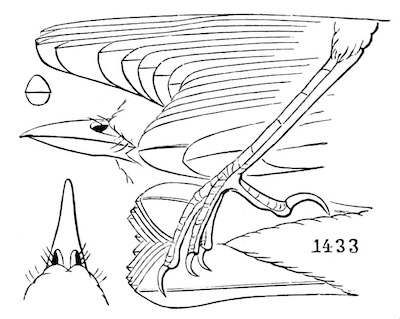
Seiurus aurocapillus.
1433
Gen. Char.
Bill rather sylvicoline, compressed, with a distinct notch. Gonys ascending.
Rictal bristles very short. Wings moderate, about three quarters of an inch longer
than the tail; first quill scarcely shorter than the
second. Tail slightly rounded; feathers acuminate.
Tarsi about as long as the skull, considerably
exceeding the middle toe. Under
tail-coverts reaching within about half an inch
of the end of the tail. Color above olivaceous;
beneath whitish, thickly streaked on the breast
and sides. Wings and tail immaculate. Nests
on the ground, often arched or sheltered by position
or dry leaves. Eggs white, marked with
red, brown, and purple.
This genus is decidedly sylvicoline in general appearance, although the
spots on the breast resemble somewhat those of the Thrushes. The three
species may be grouped as follows:—
A. Middle of crown brownish-orange, bordered by blackish. No white superciliary
streak … S. aurocapillus.
B. Crown like the back. A well-defined superciliary light stripe.
Thickly streaked beneath, including crissum. Ground-color and superciliary
stripe yellowish. Bill small … S. noveboracensis.
Sparsely streaked beneath; throat and crissum immaculate. Ground-color
and superciliary stripe white. Bill very large … S. ludovicianus.
Seiurus aurocapillus, Swains.
GOLDEN-CROWNED THRUSH.
Motacilla aurocapilla, Linn.
S. N. I, 1766, 334. Turdus aur.
Lath.; Wils. Am. Orn. II, pl. xiv, fig. 2.—Aud. Orn. Biog. II, pl. cxliii. Sylvia aur. Bon. Seiurus aur. Swainson, Zoöl. Jour. III, 1827, 171.—Baird, Birds N. Am. 1858,
260; Rev. 214.—Moore, P. Z.
S. 1859, 55 (Honduras).—Max. Cab.
Jour. 1858, 177.—Jones, Nat. Bermuda, 27. Henicocichla aur. Sclater, Catal. 1861, 25, No. 159.—Gundlach, Cab. Jour. 1861, 326 (Cuba). Seiurus aur. D’Orb. Sagra’s Cuba, 1840, 55.—Dall & Bannister, Tr. Chic. Ac. I, 1869, 278
(Alaska).—Samuels, 218. Turdus coronatus, Vieill. Ois. II. 1807, 8.
Other localities quoted: Cordova, Sclater, P. Z. S. 1856, 293. St. Domingo, Sallé, P. Z. S. 1857, 231. Guatemala,
Sclater & Salvin, Ibis, I, 1859, 10. Santa Cruz (winter),
Newton, Ibis, 1859, 142. Cuba (winter), Cab. Jour.
III, 471. Jamaica, Gosse, Birds, 152.—Sclater,
P. Z. S. 1861, 70. Costa Rica, Cab. Jour. 1861, 84. Orizaba (winter), Sumichrast. Yucatan, Lawr. Chiriqui, Salv.
Sp. Char.
Above uniform olive-green, with a tinge of yellow. Crown with two narrow
streaks of black from the bill, enclosing a median and much broader one of brownish-orange.
Beneath white; the breast, sides of the body, and a maxillary line, streaked with
black. The female and young of the year are not appreciably different. Length, 6.00;
wing, 3.00; tail, 2.40.
Hab.
Eastern Province of North America, north to English River, H. B. T., and Alaska;
west to mouth of Platte, and Denver City, Colorado; Mazatlan; whole West Indies;
Eastern Mexico; Honduras, Guatemala, and Costa Rica; Bermuda in autumn and winter
(Jones).
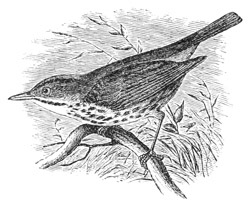
Seiurus aurocapillus.
Habits. The Golden-crowned Thrush, or Oven-Bird, as in some portions
of the country it is exclusively called,
inhabits the whole of eastern North
America, as far to the west as the Great
Plains, and to the north at least as far
as English River. In the winter season
it has been found in Mexico, St. Domingo,
Jamaica, Cuba, and other West India
islands, and in Central America is also
very common. Mr. Sumichrast also
speaks of it as common at Orizaba
during the same season, and it has been
found in the Bermudas and the Bahamas.
In all these places it usually appears early in the autumn and remains until
the ensuing spring. It breeds as far to the north as it has been known to go.
Richardson met with its nest on the banks of the Saskatchewan, and was
convinced that it bred at even still higher latitudes. Among some memoranda
I received from the late Mr. Kennicott is one stating that he met
with this Thrush breeding near English River, July 15. These birds arrive
in the fur country about the first of May. How far to the south they breed
we have no positive information. I have never received its eggs from any
point south of Philadelphia, nor did I ever meet with it or hear its notes
in summer in the vicinity of Washington. Audubon was of the opinion
that a few remain to breed even in Louisiana, and states that he found them
abundant in Texas in the middle of May, but he may have confounded this
species with the Louisiana Thrush.
In Jamaica, where its habits have been carefully studied by Mr. Gosse, it
arrives in September and leaves about the 20th of April. Mr. Würdemann
obtained specimens at Cape Florida, September 24 and 25. Mr. Audubon
mentions their appearing in Louisiana as early as the first of March. Wilson
never noticed it in Louisiana before the last of April, nor after September.
The Smithsonian possesses no specimen obtained earlier than May 1, except
some procured April 25 from the mouth of Platte River. Mr. Allen notes
its arrival in Western Massachusetts May 10. Mr. Verrill gives the early
part of May as the time of its reaching Western Maine, and Mr. Boardman
May 1 for the vicinity of Calais.
Though not found on the California coast, specimens of this bird have
been taken in winter near Mazatlan, Mexico, showing probably that in their
migrations they cross the mountains of Northern Mexico, as do the Mniotilta
varia and a few other of our Eastern species.
In Eastern Massachusetts it usually appears from the 1st to the 10th of
May, just as the first leaves of the trees are expanding, and is to be found
only in thick woods, often near their edges. Occasionally found perched on
the low limbs of trees, it is quite terrestrial in its habits, keeps a good deal
on the ground, running about among the fallen leaves, more in the manner
of a small quadruped than a bird. Mr. Audubon speaks of its frequenting
shady woods, watered by creeks and rivulets. I have found them rather
more abundant in woods upon high and dry ground, usually upon slopes of
wooded hillsides. In this respect it appears to differ in a marked manner
from its near of kin, the Water Thrush (S. noveboracensis).
This bird, and indeed all of this genus, have the peculiar vibratory motions
of the tail noticed in the Wagtail of Europe, and also observed in our
own Red-poll Warbler, and in the Titlarks. In consequence of these peculiarities
this species is known, in Jamaica, as Land Kickup, and the noveboracensis
as the Water Kickup. Mr. Gosse found in its stomach gravel,
various seeds, mud-insects, caterpillars, and small turbinate shells.
The usual and more common song of this species is a very peculiar and
striking one, unlike that of any other of our birds. It is said to somewhat
resemble the song of the Accentor modularis of Europe. It is loud and clear,
enunciated with great rapidity, and uttered with great emphasis at its close.
It is characterized by energy and power, rather than variety or sweetness, yet
it is not unpleasing. Audubon calls it a “simple lay,” and again “a short
succession of simple notes,”—expressions that would give one who had never
heard its song an altogether incorrect idea of its true character. Wilson is
still more in error when he states that this bird has no song, but an energetic
twitter, when, in fact, it has two very distinct songs, each in its way remarkable.
Nuttall describes its song as “a simple, long, reiterated note, rising
from low to high, and shrill”; Richardson speaks of it as “a loud, clear, and
remarkably pleasing ditty”; and Mr. Allen calls it “a loud, echoing song,
heard everywhere in the deep woods.” In reference to the songs of this bird,
and the injustice that has been done by writers to this and other species
of our birds, Mr. Boardman of St. Stephen has written me the following just
observations.
“Many of our common Warblers, Thrushes, and other birds, have rare songs
they reserve for some extra occasions, and many of our common birds do not
get credit for half their real power of song. Once last spring, as I was watching
for some birds, I heard a new and very pretty warble, something like
the trill of a Winter Wren, and found that it came from our common slate-colored
Snowbird (Junco hyemalis), a bird that I see every day that I go
to the woods, and yet these notes I had never heard before. It is the same
with the Golden-crowned Thrush. When it gets into the top of a tall tree,
its strain is so rare and beautiful that but few know it as from that bird.
The same is true of the Water Thrush, and also of both Turdus pallasi
and Turdus swainsoni.”
The Oven-Bird always nests on the ground, and generally constructs nests
with arched or domed roofs, with an entrance on one side, like the mouth of
an oven, and hence its common name. This arched covering is not, however,
universal. For a site this species usually selects the wooded slope of a hill,
and the nests are usually sunk in the ground. When placed under the
shelter of a projecting root, or in a thick clump of bushes, the nest has no
other cover than a few loose leaves resting on, but forming no part of it.
A nest from Racine, Wis., obtained by Dr. Hoy, is a fine typical specimen
of the domed nests of this species. The roof is very perfect, and the whole
presents the appearance of two shallow nests united at the rim, and leaving
only a small opening at one side. This nest was five inches in diameter
from front to back, six inches from side to side, and four inches high. The
opening was two and a quarter inches wide, one and three quarters high.
The cavity was two inches deep, below the brim. At the entrance the roof
recedes about an inch, obviously to allow of a freer entrance and exit from
the nest. Externally this nest is made of wood, mosses, lichens, and dry
leaves, with a few stems and broken fragments of plants. The entrance is
strongly built of stout twigs, and its upper portion is composed of a strong
framework of fine twigs, roots, stems, mosses, dry plants, etc., all firmly
interwoven, and lined with finer materials of the same.
On the 7th of June, 1858, I came accidentally upon a nest of this bird
of a very different style of structure. It was in a thick wood in Hingham.
The nest was built in a depression in the ground at the foot of some low bushes,
and its top was completely covered by surrounding vines and wild flowers.
It would probably have escaped notice had not my daughter, then a child
of four years, attempted to gather some wild flowers growing directly over
its entrance. This flushed the mother, who until then had remained quiet,
although we were standing with our feet almost upon the nest, and the bird
fluttered and tumbled about at our feet with well-feigned manœuvres to distract
our attention. The child in great glee sought to catch it, but it eluded her
grasp, and, running off like a mouse, disappeared. The nest contained six
eggs, was entirely open, and with no other cover than the wild plants that
clustered above it. As to its identity there was no doubt, as the parent was
afterwards snared upon its nest. This nest was somewhat loosely constructed
of skeleton leaves, dry slender stalks, grasses, and pine-needles, and was
lined with a few slender grasses and leaves. It had a diameter of six inches,
and was two and a half inches deep. The cup had a diameter of three and
a half inches and a depth of two, being very large for the size of the bird,
probably owing to the shape of the cavity in which it was sunk.
The nest of this bird seems to be a favorite place of resort for the Cow
Blackbird to deposit its egg. In one nest, found by Mr. Vickary in Lynn,
no less than three eggs of these parasites had been placed.
The eggs of the Golden-crowned Thrush are subject to considerable variations.
Their markings differ in their colors and shades, and yet more in number,
size, and manner of distribution. The eggs are oval in shape, one end
being but very slightly smaller than the other. Their average length is .82
of an inch, and their breadth is .55 of an inch. Their ground-color is a beautiful
creamy-white. They are marked, usually principally about the larger
end, with dots and blotches, intermingled, of red, reddish-brown, lilac, darker
purple, and ferruginous. Occasionally these make a beautiful crown around
the larger end, leaving the rest of the surface nearly free from spots.
Seiurus noveboracensis, Nutt.
SMALL-BILLED WATER THRUSH.
Motacilla noveboracensis, Gmelin, S. N. I, 1788, 958. Sylvia nov. Lath.; Vieillot, Ois. Am. Sept. II, pl. lxxxii. Seiurus
nov. Nutt.; Bon.; Aud. Birds Am. III, pl. cxcix.—Baird, Birds N. Am. 1858, 261, pl. lxxx, fig. 1; Rev. 215.—Max. Cab. Jour. 1858, 121.—Dall &
Bannister (Alaska).—Samuels, 220. Henicocichla nov. Cab. Schom.
Guiana, III, 666; Jour. 1860, 324 (Costa Rica).—Sclater (Tobago).—Gundlach, Cab. Jour. 1861, 326
(Cuba). Mniotilta nov. Gray. ?? Motacilla fuscescens, Gmelin, S.
N. 984 (based on Ficedula jamaicensis, Brisson, III, 512, Jamaica). Turdus aquaticus, Wils.; Aud. Orn.
Biog. 1839, 284, pl. ccccxxxiii. Sylvia anthoides, Vieillot, Nouv. Dict. XI, 1817, 208. Seiurus tenuirostris, Sw. 1827; Gamb. Seiurus sulfurascens, D’Orbigny,
Sagra’s Cuba, 1840, 57, pl. vi. Seiurus gosse, Bon. Consp. 1850, 306 (Jamaica). ? Anthus l’herminieri, Less. Rev. Z. 1839, 101 (Colombia).
Other localities quoted: Xalapa, Sclater. Guatemala, Sclater & Salvin. Panama, Lawrence. Carthagena, Cassin. Santa Cruz
(winter), Newton. Cuba, Cab. Jamaica, Gosse.; Scl. Venezuela, Scl. & Salv. Yucatan, Lawr. St. Bartholemy, Sund. Veragua,
Salv.
Sp. Char.
Bill, from rictus, about the length of the skull. Above olive-brown, with a
shade of green; beneath pale sulphur-yellow, brightest on the abdomen. Region about
the base of the lower mandible, and a superciliary line from the base of the bill to the nape,
brownish-yellow. A dusky line from the bill through the eye; chin and throat finely
spotted. All the remaining under parts and sides of the body, except the abdomen, and
including the under tail-coverts, conspicuously and thickly streaked with olivaceous-brown,
almost black on the breast. Length, 6.15; wing, 3.12; tail, 2.40. Bill, from rictus, .64.
Sexes similar.
Hab.
Eastern Province of North America, north to Arctic Ocean and Yukon (westward
along northern border of United States to Cascade Mountains); Fort Bridger, (Drexler);
Arizona (Coues); whole West Indies; Southeastern Mexico; all Central America;
Panama and Eastern South America (Bogota; Carthagena; Brazil).
A very young bird (22,619, Fort Simpson, August 10) is very different
from the adult in coloration. The upper parts are fuliginous-black, each
feather with a broad terminal bar of pale ochraceous, wing-coverts tipped
with the same, forming two distinct bands; streaks below as in the adult,
but broader and less sharply defined.
Habits. This species has a general distribution, at certain seasons,
throughout the whole of eastern North America as far to the north as the
Arctic Ocean. North of the United States it is also found on the Pacific
coast as far south as the Cascade Mountains. In the winter it is quite common
in all the West India Islands, in Southeastern Mexico, Central America,
Panama, and the eastern part of South America to Brazil. From about latitude
43° northward it breeds throughout all North America. Sir John Richardson
met with it at the Carlton House, where it was found frequenting the
moist and thickly wooded banks of the river. These birds made their first
appearance in May, and the greater portion soon after disappeared, as if proceeding
still farther north to breed.
Among other memoranda given me by the late Mr. Kennicott was one
furnished him by Mr. Lockhart, to the effect that, at Yukon River, June 21,
1859, he had shot a female Water Thrush as she flew from her nest. This
contained five eggs, and was concealed under a small pile of drift, close to
the river, but under large willow-trees. This was not lined with down. At
the same locality another nest with six eggs was also obtained. This also
was on the ground at the foot of some willows near the water. It was made
of moss, and lined with very fine grass.
All that has been given by our earlier authors as to the habits of this
species must be received with more or less uncertainty. The difference between
this bird and that known as the Louisiana Thrush has not been sufficiently
clear to these writers to enable us always to determine which of the
two they had in view. And even now the distribution in summer of the
ludovicianus is hardly definable with precision.
Wilson describes the habits of those he observed in Pennsylvania as
evincing a remarkable partiality for brooks, rivers, ponds, and the vicinity
of water generally, wading in shallow pools in search of aquatic insects, and
giving, as it moves it along, an almost continuously vibratory motion to its
tail. He speaks of it as very shy, darting away with signs of alarm whenever
approached, and uttering a sharp cry. In all other respects his account
of this bird probably refers to the Louisiana species.
This is also, without doubt, true of nearly all Audubon gives in connection
with the history of this Thrush, which in all probability does not breed in
Louisiana, nor remain there through April, being at that time well on its way
to more northern regions.
Mr. Gosse, in his notes on the birds of Jamaica, states that this bird reappears
in that island about the end of August. He noticed them about the
muddy margins of ponds, and they soon became abundant. Individuals
were also to be seen running on the road, especially near the sea-shore, and
by the edges of morasses. They ran rapidly, often waded up to their tibiæ
in water, or ran along the twigs of a fallen tree at the brink, and now and
then flew up into the branches of a pimento or an orange-tree. Whether
running or standing, they were continually flirting up their tails, after the
manner of the European Wagtail. During its winter residence in Jamaica
it has no song, only a monotonous cry, a sharp chip. Its stomach was
found to contain water-insects and shells. Mr. March has noticed their
arrival in Jamaica as early as August 5. They all leave by the first of
April.
Mr. Allen found these birds not uncommon both in spring and in fall in
the vicinity of Springfield. He thinks a few breed there, as he has met with
them in the months of June, July, and August, very sparingly however.
They arrive about the 12th of May. I have once, at least, met with its
nest and eggs near Boston.
Dr. Coues says this bird is quite common, both in the spring and fall,
near Washington, and breeds sparingly, having been found there in July.
They arrive about the first of May, are eminently aquatic, frequent swampy
thickets and thick dark woods interspersed with pools, where they associate
with the Solitary Tatler.
In Southern Illinois this species, Mr. Ridgway states, is found only during
its migrations and in mild winters. He never met with it in the breeding-season,
when the S. ludovicianus is so abundant. But it returns early from
the North, and he has shot numbers of them in August. During the whole
fall they are common about all swampy places, or the margin of creeks in the
woods; and in mild winters a few are found in the swamps of the bottom-lands,
where the dense forest affords them comfortable shelter. On warm
days in December and January, he has heard them singing with all the vigor
of spring in such localities. In notes, as well as in manners, Mr. Ridgway
has noticed little difference between this species and S. ludovicianus. The
song, however, is decidedly weaker, though scarcely less sweet, and the two
are very easily distinguished at sight by one familiar with them.
These birds breed, though they are not very abundant, in the vicinity of
Calais, and also in the western part of Maine. Professor Verrill states that
they reached the neighborhood of Norway, Me., about the first of May, a fortnight
earlier than Mr. Allen noted their arrival in Springfield. Mr. Verrill
demonstrated the fact of their breeding in Western Maine, by finding, June 8,
1861, a nest and eggs in a dense cedar swamp near Norway. This was built
in an excavation in the side of a decayed moss-covered log, the excavation
itself forming an arch over the nest in the manner of, yet different from,
that of the Golden-crowned. The nest itself was an exceeding beautiful
structure, four and a half inches in diameter, but only an inch and a half in
depth, being very nearly flat, the cavity only half an inch deep. The entire
base was made of loose hypnum mosses, interspersed with a few dead leaves
and stems. The whole inner structure or lining was made up of the fruit-stems
of the same moss, densely impacted. The outer circumference was
made up of mosses and intertwined small black vegetable roots.
This nest contained five eggs, the brilliant white ground of which, with
their delicately shaded spots of reddish-brown, contrasted with the bright
green of the mossy exterior, and set off to advantage by the conspicuous and
unique lining, produce a very beautiful effect.
Mr. George A. Boardman of Calais, Me., an observing and accurate naturalist,
has furnished me with the following interesting account of the habits
of this species and its congener, the aurocapillus, in a letter dated St.
Stephen, March 23, 1867. “Did you ever notice their walk on the ground?
You know that most of our birds are hoppers. These two, S. noveboracensis
and S. aurocapillus, have a beautiful gliding walk, and of all our other birds
I only remember two that are not hoppers, the Anthus ludovicianus and
Molothrus pecoris. I do not think that a naturalist should ever say, as
Wilson was constantly doing, that any bird has no note or song whatever,
unless he is well acquainted with them, at all times, especially while breeding.
Many birds seem really to have nothing to say except when mating.
I think that our little walker, the Water Thrush, has been particularly ill
used by writers in this respect, for I regard him as one of our liveliest singers.
Its note is very high and clear, begins with a sudden outburst of melody,
so as almost to startle you, is very clear and ringing, as if the bird had just
found its mate after a long absence. It then keeps falling until you can
hardly hear it. Its note is very sweet, and can be heard when you are in a
canoe or boat a very long ways. Like most of our Warblers and Thrushes,
when singing, they do not like intrusion, and it was a long while before I
could make out the bird that uttered these notes. I could only do it by
going in a boat or canoe. They hide in thick trees, over the water, where it
is impossible to walk up to them. I almost always find them on some
island, in a river, that, has been overflowed, and always very near the water.”
Their eggs vary in length from .81 to .87 of an inch, and in breadth from
.65 to .69. They have an oblong-oval shape, tapering to a point at one end
and rounded at the other. Their ground is a clear crystal-white, and they are
more or less marked with lines, dots, and dashes of varying shades of umber-brown.
These markings are more numerous around the larger end, and are
much larger and bolder in some than in others, in many being mere points
and fine dots, and in such cases equally distributed over the whole egg. In
others a ring of large confluent blotches is grouped around the larger end,
leaving the rest of the egg nearly unmarked.
Seiurus ludovicianus, Bonap.
LOUISIANA WATER THRUSH.
Turdus ludovicianus, Aud.
Orn. Biog. I, 1832, 99, pl. xix. Seiurus ludovicianus, Bon.—Baird, Birds N. Am. 1858, 262, pl. lxxx, fig. 2;
Rev. 217.—Sclater, P. Z.
S. 1859, 363 (Xalapa); 373 (Oaxaca); 1861, 70 (Jamaica).—Sclater & Salvin, Ibis, 1860, 273
(Guatemala).—Samuels, 579. Henicocichla lud. Sclater, Catal. 1861, 25, no. 161 (Orizaba). ? Turdus motacilla, Vieill. Ois. Am. Sept. II,
1807, 9, pl. lxv (Kentucky). Seiurus motacilla, Bon. 1850. Henicocichla mot. Cab. Jour. 1857, 240 (Cuba).—Gundlach, Jour. Orn. 1861, 326. Henicocichla major, Cab. Mus.
Hein. 1850 (Xalapa).
Sp. Char.
Bill longer than the skull. Upper parts olive-brown with a shade of greenish.
A conspicuous white superciliary line from the bill to the nape, involving the upper
lid, with a brown one from the bill through the eye, widening behind. Under parts white,
with a very faint shade of pale buff behind, especially on the tail-coverts. A dusky maxillary
line; the forepart of breast and sides of body with arrow-shaped streaks of the
same color. Chin, throat, belly, and under tail-coverts, entirely immaculate. Length, 6.33;
wing, 3.25; tail, 2.40; bill, from rictus, .75. Sexes similar. Young not seen.
Hab.
Eastern Province of United States as far north as Carlisle, Penn., and Michigan;
Cuba and Jamaica; Southern Mexico (Colima) to Guatemala.
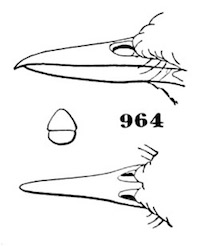
Seiurus ludovicianus,
Bonap.
964
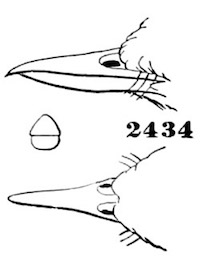
Seiurus noveboracensis,
Nutt.
2434
Autumnal specimens have a more or less strong wash of ochraceous over
the flanks and crissum, and the brown above
rather darker and less grayish than in spring
birds.
This species is very similar to S. noveboracensis,
although readily distinguishable by
the characters given in the diagnoses. The
differences in the bill there referred to are
illustrated in the accompanying diagram.
Habits. The Water Thrush described by Wilson as most abundant in
the lower part of the Mississippi Valley, as well as that given by Audubon
as the Louisiana Water Thrush, though its position as a genuine species was
afterwards abandoned, are undoubtedly referable to a closely allied but apparently
distinct Seiurus, now known as the Louisiana Water Thrush. This
bird has a very close resemblance to the noveboracensis, differing chiefly in
size and in having a larger bill. Although its distribution is not yet fully
determined, it seems to belong rather to the South and Southwestern States,
and only accidentally to be found north of the Middle States. Still a single
specimen has been obtained in Massachusetts, and it has been several times
found in Michigan and Missouri. Specimens of this bird have also been
procured in Pennsylvania, Georgia, Tamaulipas, Mexico, Cuba, Jamaica, and
Guatemala.
Its recognition as a distinct species from the common Water Thrush is
so recent, and the two species so closely resemble each other, that as yet its
habits and history are imperfectly known. Wilson refers to the birds he
had met with in Mississippi and Louisiana, which we presume to have been
the same, as being there in abundance, and eminently distinguished by the
loudness, sweetness, and expressive vivacity of their notes. These he describes
as beginning very high and clear, and as falling with an almost imperceptible
gradation until they are scarcely articulated,—a description that
would also answer very well for the song of the true Water Thrush. During
their song, he adds, they are perched on the middle branches of a tree over
the brook or river-bank, pouring out a charming melody, so loud and distinct
that it may be heard at the distance of nearly half a mile. The voice of this
bird appeared to him so exquisitely sweet and expressive that he was never
tired of listening to it.
It is also quite probable that nearly all of Audubon’s accounts of the habits
of the Water Thrush were derived from his observation of this species, and
not of its Northern congener. He describes its song as fully equal to that
of the Nightingale, its notes as powerful and mellow, and at times as varied.
He states that it is to be found at all seasons in the deepest and most swampy
of the canebrakes of Mississippi and Louisiana. Its song is to be heard even
in the winter, when the weather is calm and warm.
He describes its flight as easy and continued, just above the brakes, or
close to the ground. When on the ground, it is continually vibrating its
body, jerking out its tail and then closing it again. It walks gracefully along
the branches or on the ground, but never hops. He states that it feeds on
insects and their larvæ, and often pursues the former on the wing.
He describes the nest as placed at the foot and among the roots of a tree,
or by the side of a decayed log, and says they are often easily discovered.
They are commenced the first week of April. The outer portions are formed
of dry leaves and mosses, the inner of fine grasses, with a few hairs or the
dry fibres of the Spanish moss.
The eggs, four in number, are described as flesh-colored, sprinkled with
dark red at the larger end. They are hatched in fourteen days. The young
leave the nest in about ten days, and follow the parent on the ground from
place to place. When disturbed on her nest in the earlier periods of incubation,
she merely flies off; but later, or when she has young, she tumbles
about on the ground, spreads her wings and tail, utters piteous cries, and
seems as if in the last agonies of despair. This species Mr. Audubon never
met with farther east than Georgia, nor farther north than Henderson, Ky.
Of late years, or since attention has been more drawn to the specific
difference between this species and the Water Thrush, it has apparently
become more numerous, and has been obtained in considerable numbers in
the vicinity of Washington. In that neighborhood, once considered so
rare, it was found by Dr. Coues to be not at all uncommon at certain
seasons and in particular localities. From the 10th of April to the 20th
of May it was always to be met with among the dense laurel-brakes that
border the banks of and fill the ravines leading into Rock Creek and Piney
Branch. He believes they breed there, but they were not observed in the
fall. They were usually very shy, darting at once into the most impenetrable
brakes, but were at other times easily approached. He always found
them in pairs, even as early as the 20th of April. Their call-note was a
sparrow-like chirp, as if made by striking two pebbles together. They also
had a loud, beautiful, and melodious song, the singularity of which first drew
his attention to the bird.
Mr. Ridgway informs me that in the Wabash Valley this bird, familiarly
known as the “Water Wagtail,” is an abundant summer sojourner. It inhabits
the dampest situations in the bottom-lands, the borders of creeks, lagoons,
and swamps, living there in company with the Prothonotary Warbler (Protonotaria
citrea). In its movements it is one of the quickest as well as the
most restless of the Sylvicolidæ, though it is eminently terrestrial in its habits.
It is usually seen upon the wet ground, in a horizontal position, or even
the posterior part of its body more elevated, and its body continually tilting
up and down; if it fancies itself unobserved, it runs slyly beneath the brushwood
overhanging the shore; but if startled, it flies up suddenly with a sharp
and startling chatter. He adds that in early spring (from the latter part of
February to the beginning of April) its rich loud song may be heard before
the trees are in leaf, for it is one of the earliest of the Warblers to arrive.
When singing, it is usually perched upon the lower branches of a tree overhanging
the water, but he has frequently seen it among the topmost branches.
Wilson and Audubon have not exaggerated the merits of the song of this
bird, for among all its family there is certainly not one of our North American
species that compares with it. In richness and volume of its very liquid
notes it is almost unrivalled, though the song itself may not be considered
otherwise remarkable.
Mr. Salvin met this species in different portions of Guatemala in the months
of August, September, and November, 1859. A dry watercourse in the forest,
or in the bottom of a barranco, seemed to be its favorite resort, while
its near congener, the noveboracensis, was observed to seek rather the more
open streams.
Genus OPORORNIS, Baird.
Oporornis, Baird, Birds N. Am. 1858, 246. (Type, Sylvia agilis, Wils.)
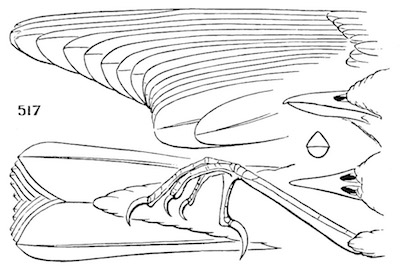
Oporornis formosus.
517
Gen. Char.
Bill sylvicoline, rather compressed; distinctly notched at tip; rictal bristles
very much reduced. Wings elongated, pointed,
much longer than the tail; the first quill
nearly or quite the longest. Tail very slightly
rounded; tail-feathers acuminate, pointed;
the under coverts reaching to within less than
half an inch of their tip. Tarsi elongated,
longer than the head; claws large, the hinder
one as long as its digit, and longer than the
lateral toes. Above olive-green; beneath
yellow; tail and wings immaculate. Legs
yellow.
This group of American Warblers is very distinct from any other. The
typical species is quite similar in color to Geothlypis philadelphia, but is at
once to be distinguished by much longer wings, more even tail, and larger
toes and claws. It is also very similar to Seiurus, differing chiefly in the
longer wings, larger claws, and absence of spots beneath.
Throat and crown ash-color; a white ring round the eye. No black on the
side of the head … O. agilis.
Throat and superciliary stripe yellow; top of the head and a streak beneath
the eye black … O. formosus.
Oporornis agilis, Baird.
CONNECTICUT WARBLER.
Sylvia agilis, Wils. Am. Orn. V, 1812, 64, pl. xxxix, fig. 4.—Aud. Orn. Biog. II, pl. cxxxviii; Bon. Sylvicola ag. Jard.; Aud. Birds Am. II, pl. xcix. Trichas ag. Nutt. Oporornis ag. Baird, Birds N. Am. 1858, 246, pl. lxxix, fig. 2:
Rev. 218. ? Trichas tephrocotis, Nutt. Man. 2d ed. 1840, 462 (Chester Co., Penn.; top of head pure ash).—Samuels,
208.
Sp. Char.
Spring male. Upper parts and sides of the body uniform olive-green, very
slightly tinged with ash on the crown. Sides of the head ash, tinged with dusky beneath,
the eye. (Entire head sometimes ash.) Chin and throat grayish-ash, gradually becoming
darker to the upper part of the breast, where it becomes tinged with dark ash. Sides of
the neck, breast, and body olive, like the back; rest of under parts light yellow. A broad
continuous white ring round the eye. Wings and tail-feathers olive (especially the latter),
without any trace of bars or spots. Bill brown above. Feet yellow. Length, 6 inches;
wing, 3.00; tail, 2.25. Female. The olive-green reaching to the bill, and covering sides
of head; throat and jugulum pale ashy-buff. Young not seen. Nesting unknown.
Autumnal specimen nearly uniform olive above; the throat tinged with brownish so as
to obscure the ash.
Hab.
Eastern Province of United States.
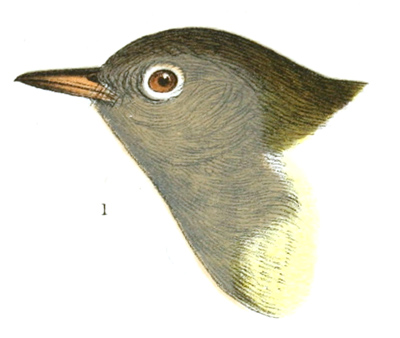
1. Oporornis agilis,
Wils. ♂ Ill., 35031.
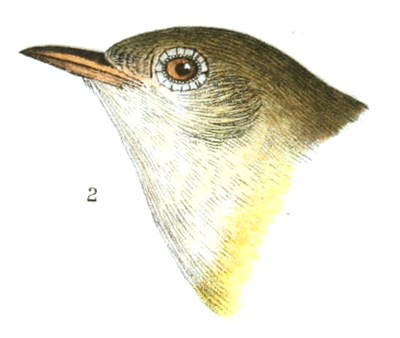
2. Oporornis agilis,
Wils. ♀.
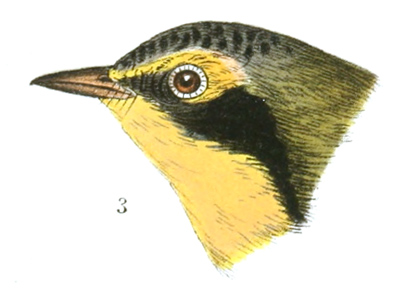
3. Oporornis formosas,
Wils. ♂ Ill., 60873.
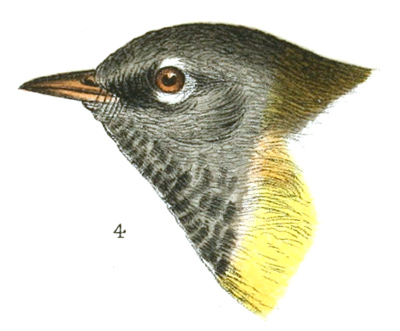
4. Geothlypis macgillivrayi,
Aud. ♂ Oreg., 1861.
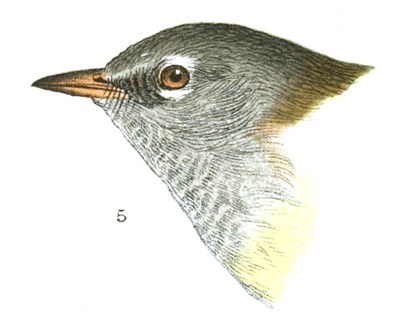
5. Geothlypis macgillivrayi,
Aud. ♀.
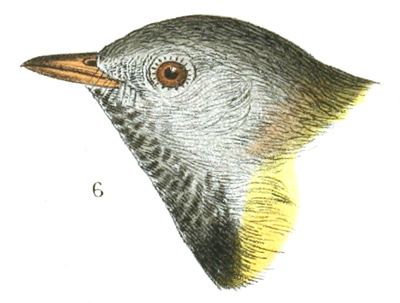
6. Geothlypis philadelphia,
Wils. ♂ Pa., 689.
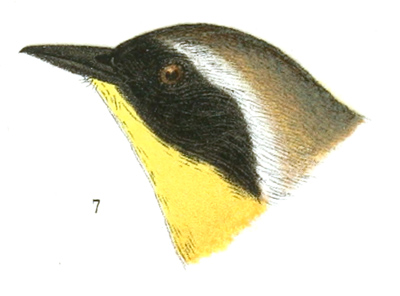
7. Geothlypis trichas,
Linn. ♂ D. C., 26024.
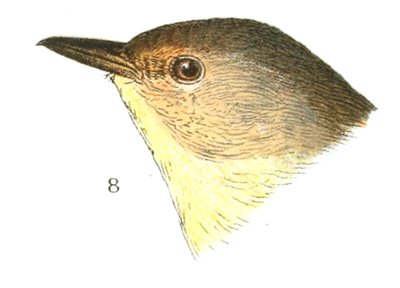
8. Geothlypis trichas,
Linn. ♀ Pa., 385.
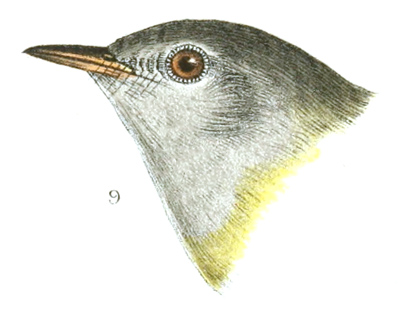
9. Geothlypis philadelphia,
Wils. ♀ Pa., 1037.
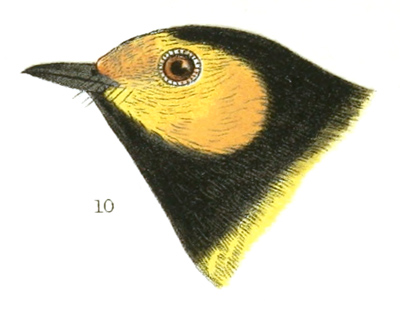
10. Myiodioctes mitratus,
Gm. ♂ Pa., 2226.
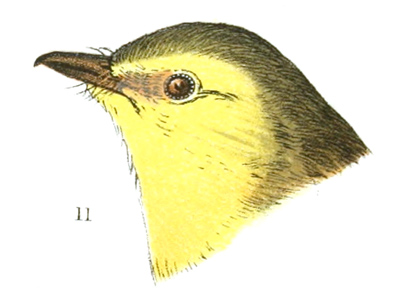
11. Myiodioctes mitratus,
Gm. ♀ Pa., 2228.
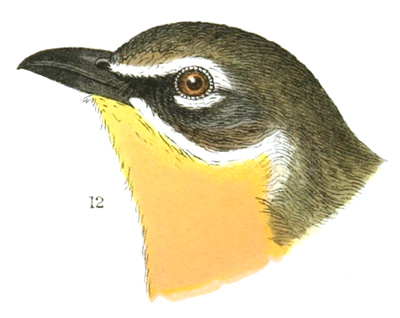
12. Icteria virens,
Linn. ♂ Pa., 2260.
A specimen in the collection of the Philadelphia Academy, killed by Mr.
Krider, has the darker ash of the jugulum of a decided sooty tinge.
A peculiarity in the history of this species is shown in the fact that it is
quite abundant in Illinois, Wisconsin, etc., in the spring, and very rare in
the autumn; precisely the reverse being the case near the Atlantic border,
where only two or three spring specimens have been announced as captured
by collectors. It is possible that they go north in spring, along the valley of
the Mississippi, and return in autumn through the Atlantic States. Their
summer abode and breeding-place are as yet unknown.
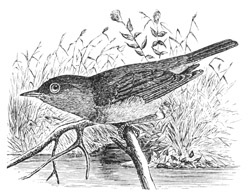
Oporornis agilis.
Habits. Of the history of this rare and beautiful species but little is as
yet known. It was first met with by
Wilson, in the State of Connecticut,
and he afterwards obtained two other
specimens near Philadelphia. Others
have since been procured at Carlisle,
Penn., at Washington, Loudon County,
Va., near Chicago, Racine, and in Southern
Illinois. September 25 to October
1, and May, from the 15th to the
28th, appears to be the epoch of their
fall and spring occurrence. They are
more frequently noticed in the autumn.
It is supposed to be a migratory bird, going north to breed.
It was found by Wilson, in every case, among low thickets, and seemed to
be more than commonly active, not remaining for a moment in the same
position. Mr. Audubon obtained only two specimens, a pair, opposite Philadelphia
in New Jersey. When he first observed them they were hopping
and skipping from one low bush to another, and among the tall reeds of the
marsh, emitting an oft-repeated tweet at every move. They were chasing a
species of spider that ran nimbly over the water, and which they caught by
gliding over it. Upon dissecting them, he found a number of these spiders
in their stomachs, and no other food. These two birds were not at all shy,
and seemed to take very little notice of him, even when close to them.
Mr. Trumbull, in his list of the birds of Eastern Pennsylvania, marks it
as a summer resident of that State, which is probably not the fact. Mr. Lawrence
includes it in his list of birds found near New York City. It is not
given by Mr. Verrill or Mr. Boardman as occurring in any part of Maine, and
has not been detected in Western Massachusetts by Mr. Allen, though it has
been occasionally met with in the eastern part of the State by Dr. Cabot, Mr.
Maynard, and others. More recently, in the fall of 1870, and again in that
of 1871, this species has been found quite abundant in a restricted locality
in the eastern part of that State. It was first observed by Mr. H. W. Henshaw,
a promising young naturalist, in the early part of September, 1870,
among the Fresh Pond marshes in Cambridge. They appeared to be quite
numerous, and several specimens were obtained. He communicated the discovery
to his friend, Mr. William Brewster, and more than fifty specimens
of this rare Warbler were obtained during that season. In the following
autumn, in September and during the first few days of October, these birds
were observed in the same locality, apparently in greater numbers, and
more specimens were obtained.
Mr. Henshaw writes me that he first saw this species, September 7, 1870,
when he obtained a single specimen. From that time until September 27 it
was very common throughout the Fresh Pond swamps, to which locality it
seemed to be restricted. It again made its appearance in 1871, and at about
the same time, and remained until October 5. It was in even greater numbers
than during the preceding year.
Their habits, while with us in the fall, appear to be very different from
those of the individuals observed by Wilson and Audubon, which were
described as being of a remarkably lively disposition, and hence the name of
agilis. Mr. Henshaw found them almost constantly engaged in seeking their
food upon the ground. When startled, they would fly up to the nearest bush,
upon which they would sit perfectly motionless, in a manner closely resembling
the Thrushes. If not further disturbed, they immediately returned to
the ground and resumed the search for food among the leaves. If greatly
startled, they took a long flight among the bushes, and could rarely be found
again. The only note he heard them utter was a single sharp chirp, emitted
occasionally, when surprised. They were all remarkably fat, so much so as
to make it difficult to obtain a good specimen.
About sunset, standing on the skirts of the swamp, he has repeatedly observed
these birds alight, in great numbers, on the edge, and immediately
pass in, evidently intending to remain there over night. He judged that
they migrate entirely by day. On only one or two occasions did he observe
these birds feeding in the tops of willow-trees. At such times they
appeared equally lively in their movements with the Dendroica striata, in
company with which they were associated. The birds he saw were nearly
all in immature plumage, adults being comparatively rare.
Dr. Coues states that the Connecticut Warbler is found near Washington
in the month of October, but that it is rather uncommon. He did not
meet with it in spring. He speaks of its frequenting old buckwheat and
corn fields, searching for food among the dry, rank weeds, and also in swampy
places among low thickets.
Oporornis formosus, Baird.
KENTUCKY WARBLER.
? Sylvia æquinoctialis, Vieill. Ois. Am. Sept. II,
1807, 26, pl. lxxxi, Penn. (not of Gmelin). Sylvia formosa, Wils. Am. Orn. III, 1811, 85, pl. xxv, fig. 3.—Nutt.; Aud. Orn. Biog. I, pl. xxxviii. Sylvicola formosa, Jard.; Rich.; Bon.; Max. Myiodioctes
formosus, Aud. Syn.—Ib. Birds Am. II, pl. lxxiv.—Lembeye,
Av. Cuba, 1850, 37. Gundlach, Cab. Jour. 1861, 326 (Cuba). Oporornis formosus, Baird, Birds
N. Am. 1858, 247; Rev. 218.—Sclater &
Salvin, Ibis, I, 1859, 10 (Guatemala).
Other localities cited: Mexico, Sclater. Isthmus Panama, Lawrence. Veragua, Salv. Costa Rica, Lawr.
Sp. Char.
Adult male. Upper parts and sides dark olive-green. Crown and sides of
the head, including a triangular patch from behind the eye down the side of the neck,
black, the feathers of the crown narrowly lunulated at tips with dark ash. A line from
nostrils over the eye and encircling it (except anteriorly), with the entire under parts,
bright yellow. No white on the tail. Female similar, with less black on the head. Length,
5 inches; wing, 2.95; tail, 2.25. Young not seen.
The adults in autumn are exactly the same as in spring.
Hab.
Eastern Province of United States, north to Washington and Chicago; west to
Republican Fork of Kansas River (Coues). Cuba, Guatemala, and Isthmus Panama. Not
recorded from West Indies except Cuba.
Habits. The Kentucky Warbler is an abundant species in the Southern
and Southwestern States, and has been found, though more rarely, as far to
the north as Southern New York in the east and to Southern Wisconsin in
the west. It has also been obtained at Fort Riley, in Kansas. Its nest and
eggs have been procured near Cleveland, O., by Dr. J. P Kirtland, and also
in Chester County, Penn., by Mr. Norris. It is a winter inhabitant in
Mexico, Panama, Guatemala, and Cuba.
Wilson speaks of having met with this bird in abundance from Kentucky to
the mouth of the Mississippi, everywhere quite common, but most especially
so in the States of Tennessee and Kentucky. At the Balize he several times
heard it twittering among the high rank grass of those solitary morasses.
He found it frequenting low damp woods, and building its nest either in the
middle of thick tufts of rank grass, in the fork of a low bush, or on the
ground. The materials of which these nests were made were loose dry
grass, mixed with the pith of wood, and lined with hair. He found the eggs
from four to six in number, pure white, sprinkled with reddish specks. He
met with the female sitting upon her eggs as early as May. These birds,
he adds, are seldom seen among high branches, but prefer to frequent low
bushes and canebrakes. In their habits they are very lively and sprightly.
The song is loud, comprising three notes, and resembles tweedle-tweedle-dweedle.
It makes its appearance in Kentucky from the South about the middle
of April, and leaves the region about New Orleans on the approach of cold
weather. Wilson was assured that it never remains there during the winter.
Wilson characterizes these birds as a reckless fighting species, almost
always engaged in pursuing its fellows.
Mr. Audubon states that this Warbler is the most common and abundant
species that visits the State of Louisiana and the whole region about the
Mississippi River, but is not so common in Kentucky or Ohio. He describes
it as an extremely lively and active bird, found in all the low grounds
and damp places near watercourses, and generally among the tall rank weeds
and low bushes growing in rich alluvial soil. It is continually in motion,
hopping from stalk to stalk, and from twig to twig, preying upon insects,
larvæ, or small berries, rarely pursuing an insect on the wing. He describes
its song as agreeable and emphatic. He has never known this species fly
farther than a few yards at a time. Its flight is low, and is performed in a
gliding manner. It makes its first appearance about the middle of March,
and remains until the middle or last of September. He states that it rears
two broods in a season. His description of its nest, as “small, beautifully
constructed, and attached to several stems of rank weeds,” etc., does not agree
in position, size, or appearance with any that I have ever seen.
According to Mr. Audubon, it feeds largely upon spiders, which it obtains
by turning over the withered leaves on the ground. The young birds resemble
their mother until the following season, when the males attain the full
beauty of their plumage. They remain with their parents until they migrate.
The late Dr. Alexander Gerhardt, an accurate and observing naturalist of
Northern Georgia, informed me, by letter, that the nest of the Kentucky
Warbler is usually built on the ground, under a tuft of grass, often on a hillside
and always in dry places. The eggs are deposited from the 4th to the
15th of May. Nearly all the nests he met with were made externally of a
loose aggregation of dry oak and chestnut leaves, so rudely thrown together
as hardly to possess any coherence, and requiring to be sewed to be kept in
place. The interior or inner nests were more compactly interwoven, usually
composed of fine dark-brown roots. Instead of being small, they are large
for the bird, and are inelegantly and clumsily made. They measure four
inches in their diameter, three in height, and two in the depth of their cavity.
One nest, the last received from Dr. Gerhardt, obtained by him at Varnell’s
Station, in Northern Georgia, June 5, 1860, is large and peculiar in its
construction. It is nearly spherical in shape, with an entrance partially on
one side and nearly arched over. The periphery of this nest is composed
exclusively of partially decayed deciduous leaves, impacted together, yet
somewhat loosely. Within this outer covering is a fine framework of stems,
twigs, and rootlets, and within this a snug, compact lining of hair and finer
rootlets and fibres. This nest is six inches in diameter and five in height.
It contained four eggs.
These eggs have an average length of .69 of an inch and a breadth of .56
of an inch. They have an oblong-oval shape, a crystalline-white ground, and
the entire surface is sprinkled over with fine dots of red and reddish-brown.
These, though most abundant about the larger end, are nowhere confluent,
and do not form a crown.
A nest of this bird from Chester County, Penn., is a very flat structure,
evidently built in a bed of fallen leaves. It has a diameter of six inches and
a height of only two. The cup is a mere depression only half an inch in
depth. Its base is loosely constructed of dried leaves, upon which is interwoven
a coarse lining of long, dry, and wiry rootlets and stems of plants.
It was given to Mr. J. P. Norris, from whom I received it, and it is now in
the Boston collection.
Mr. Robert Ridgway furnishes the following valuable information in regard
to the abundance and general habits of this species as observed in Southern
Illinois: “It is a very common summer bird in Southern Illinois, where it
arrives in the Wabash Valley towards the last of April. It is a wood-loving
species, and of terrestrial habits, like the Seiurus aurocapillus, but generally frequents
rather different situations from the latter bird, liking better the undergrowth
of ‘bottom’ woods than that of dry forests. In all its manners it
closely resembles the Seiuri, especially the two aquatic species, ludovicianus
and noveboracensis, having the same tilting motion of the body, and horizontal
attitude when perching, so characteristic of these birds. The nest I have
never found, though well aware of its actual situation. I knew of one somewhere
among the ‘top’ of a fallen tree, but it was so well concealed that
the closest search did not enable me to discover it. In most cases the nest is
probably on the ground, among the rubbish of fallen tree-tops, or low brushwood.
“The usual note of this Warbler is a sharp tship, almost precisely like that
of the Pewee (Sayornis fuscus), uttered as the bird perches on a twig near the
ground, continually tilting its body, or is changed into a sharp rapid twitter
as one chases another through the thicket. Their song is very pretty, consisting
of a fine whistle, delivered very much in the style of the Cardinal
Grosbeak (Cardinalis virginianus), though finer in tone, and weaker.”
Dr. Coues found this Warbler rare at Washington, and chiefly in low
woods with thick undergrowth, and in ravines. They were very silent, but
not shy, and a few breed there.
Section GEOTHLYPEÆ.
Genus GEOTHLYPIS, Caban.
Trichas, Swainson, Zoöl. Journ. III, July, 1827, 167 (not of Gloger, March, 1827, equal to Criniger, Temm.).
Geothlypis, Cabanis, Wiegmann’s Archiv, 1847, I, 316, 349.—Ib.
Schomburgk’s Reise, Guiana, 1848.
Gen. Char.
Bill sylvicoline, rather depressed, and distinctly notched; rictal bristles very
short or wanting. Wings short, rounded, scarcely longer than the tail; the first quill
shorter than the fourth. Tail long; much rounded or graduated. Legs stout; tarsi elongated,
as long as the head. Olive-green above, belly yellow. Tail-feathers immaculate.
Legs yellow.
Synopsis of Species.
Throat yellow … Series I.
Throat ash … Series II.
Series I.
A. Black mask extending beneath the eye and on the auriculars.
1. G. trichas. Black mask bordered along its posterior edge with pale ashy
or whitish; maxillæ black. Sexes dissimilar. ♀. Olive-brown above;
throat only, distinctly yellow; no black mask. Juv. Without either black
or pure yellow; above olive-brown, like ♀, beneath pale ochraceous-buff.
Abdomen almost always whitish; occiput russet-olive. Bill, from
nostril, .30;. tarsus, .70; wing, 2.25; tail, 2.15. Hab. Whole of United
States; in winter most of West Indies, and Middle America, north to
Guatemala … var. trichas.
Colors similar; abdomen yellow. Bill, .45; tarsus, .90; wing, 2.50;
tail, 2.50. Hab. Nassau; New Providence; Bahamas … var. rostrata.[52]
Abdomen bright yellow; occiput whitish-ash tinged with yellow. Bill,
.32; tarsus, .75; wing, 2.45; tail, 2.50. Hab. Eastern Mexico (Jalapa?) … var. melanops.[53]
2. G. æquinoctialis. Black mask not bordered posteriorly by ashy or
whitish; much narrower on forehead than on auriculars; maxillæ yellow.
Sexes similar.
Black of the auriculars bordered posteriorly by the olive-green of the
neck. Bill, .17 deep; wing, 2.50; tail, 2.35. Hab. Northeast South
America (Cayenne, Trinidad, etc.) … var. æquinoctialis.[54]
Black of the auriculars bordered posteriorly by the ash of the crown.
Bill, .14 deep; wing, 2.40; tail, 2.50. Hab. Brazil … var. velata.[55]
B. Black mask not extending underneath the eye, but confined to lores and
frontlet.
3. G. poliocephala. Bill much as in Granatellus. Above olive-green; the
crown light ash; beneath yellow. Sexes dissimilar.
Eyelids white; nape and auriculars olive-green; abdomen whitish.
Bill, .30, .15 deep; wing, 2.20; tail, 2.50. Hab. West Mexico (Mazatlan) … var. poliocephala.[56]
Eyelids black; nape and auriculars ashy; abdomen wholly yellow.
Bill, .35, .18 deep; wing, 2.40; tail, 2.50. Hab. Guatemala (Retaluleu) … var. caninucha.[57]
Series II.
4. G. philadelphia. Head all round ashy; lores only, black. Sexes nearly
similar.
Eyelids dusky (except in ♀); a black patch on jugulum of ♂. ♀.
Throat tinged with yellow. Hab. Eastern Province of North America;
in winter south to Panama … var. philadelphia.
Eyelids white; no black patch on jugulum. ♀. Throat not tinged
with yellow. Hab. Western and Middle Province of United States;
in winter south to Costa Rica (Western Coast) … var. macgillivrayi.
Geothlypis trichas, Caban.
MARYLAND YELLOW-THROAT; BLACK-MASKED GROUND WARBLER.
Turdus trichas, Linn. S. N. 1766, 293. Sylvia trichas, Lath.; Aud., etc. Geothlypis trichas, Cab. Mus.
Hein. 1850, 16.—Baird, Birds N. Am. 241; Rev. 220.—Gundlach, Cab. Jour. 1861, 326
(Cuba).—Sclater, Catal. 1861, 27, No.
167.—March, Pr. A. N. Sc. 1863,
293.—Lord, Pr. R. Art. Inst. Woolwich, IV, 1864, 115 (N. W. Boundary).—Jones, Nat. Bermuda, 29.—Samuels, 205.—Cooper, Orn. Cal. 1, 1870, 95. Sylvia
marilandica, Wilson. Trichas mar. Bon. Regulus mystaceus, Stephens. Trichas personatus, Swainson. Sylvia roscoe, Aud. Trichas
brachydactylus, Swains.
Other localities quoted: Xalapa, Oaxaca, Cordova, Scl. Guatemala, Scl. & Salv. Bahamas, Bryant. Costa Rica, Cab.; Lawr. Orizaba (autumn), Sum. Yucatan, Lawr.
Figures: Vieill. Ois. II, pl. xxviii, xxix.—Aud. Orn. Biog. I, II, V, pl.
xxiii, cii, ccxl.—Wils. I, pl. vi,
fig. 1.—Buffon, Pl. enl. 709, fig.
2.
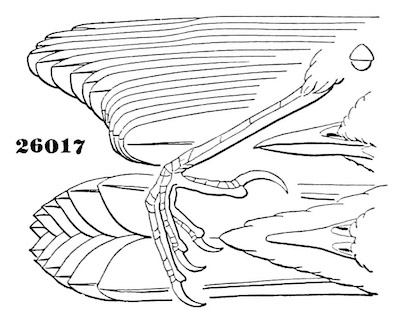
Geothlypis trichas.
26017
Sp. Char.
(No. 26,024 ♂.) Wings a little shorter than the somewhat graduated tail.
Bill slender, the depth contained about two and a half
times in distance from nostrils to tip. First quill about
equal to seventh. Forehead to above the anterior edge
of the eye, and across the entire cheeks, ears, and jaws,
and ending in an angle on sides of neck, black, with a
suffusion of hoary bluish-gray behind it on the crown and
sides of neck; the occipital and nuchal region grayish-brown,
passing insensibly into the olive-green of the upper
parts. Chin, throat, jugulum, edge of wing and crissum
rich yellow (the latter paler); rest of under parts,
with lining of wings, yellowish-white, the sides tinged
with brownish; outer primary edged with whitish, the others with olive-green. Bill black;
legs yellowish. Total length, 4.40; wing, 2.15; tail, 2.30; graduation, .25; width of outer
tail-feather, .28; difference between first and third quills, .15; length of bill from forehead,
.52; from nostril, .30; along gape, .60; tarsus, .75; middle toe and claw, .66; claw alone,
.18; hind toe and claw, .48; claw alone, .26.
Male in winter, and the female, without the black mask; the forehead tinged with
brown, the yellow of the throat less extended, the eyelids whitish, and a yellowish superciliary
line.
Hab.
The whole United States, from Atlantic to Pacific, and south to Costa Rica; Bermuda
(October); Bahamas; Cuba; Jamaica.
The young bird is brownish-olive above, becoming more virescent on the
rump and tail; eyelids, and whole lower parts, soft light buff, with a faint
tinge of yellow on the breast and lower tail-coverts.
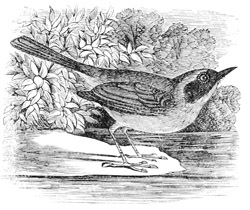
Geothlypis trichas.
There is very much variation manifested in a large series (containing more
than one hundred and thirty specimens, principally North American), though
but very little that accords with any distinctions of habitat. As a rule,
however, those from the Atlantic States are the smallest of the series, and
have most white on the abdomen, the yellow being restricted to the throat
and jugulum, and the lower tail-coverts. In most specimens from the Mississippi
Valley the yellow beneath is quite continuous, and the size considerably
larger than in the series above mentioned, in these respects approaching
the G. melanops from Eastern Mexico, in which the yellow pervades the
whole surface beneath; but in this the
whitish border above the black mask is
extended over the whole crown, leaving
the nape only distinctly brownish, and
the size larger than the average of
the series alluded to. However, No.
61,135 ♂, Liberty County, Ga., has even
more white on top of the head, the whole
occiput being of this color; while No.
7,922 ♂, from Racine, Wis., is quite as
long as the type of melanops (the tail
only, shorter), and there is nearly as
much yellow beneath. The Georgia specimen, however, in other respects,
is most like the Atlantic style. Specimens from the Pacific coast have just
appreciably longer tails than Eastern ones, and the olive-green above is
brighter. Jamaican and Guatemalan specimens are identical with many from
the United States. The G. rostratus of Bryant, from the Bahamas, appears
to be merely a gigantic insular race of the common species.
Habits. This well-known and beautiful little Ground Warbler is a common,
abundant, and widely diffused species, occurring throughout the United
States from ocean to ocean, and from the Gulf of Mexico to Canada and
Nova Scotia. It is found, during the winter months, in Cuba, Jamaica, Mexico,
Yucatan, Guatemala, Costa Rica, the Bahamas, and, in the fall, in Bermuda.
On the Pacific coast it has been found from Cape St. Lucas to the
British territories. It breeds from Northern Georgia to Halifax, inclusive.
In Central America, Mr. Salvin states that this Warbler is by far the most
common of the Mniotiltidæ, but is wholly migratory. It was usually found
in the neighborhood of water, frequenting the reeds that surrounded Lake
Duenas, and the bushes on the banks of its outlet. It was also taken by
Mr. Boucard at Totontepec, among the mountains of Oaxaca, Mexico.
It was observed as far to the north as Lake of the Woods, by Mr. Kennicott.
Several were there observed, both males and females, May 29. It is
everywhere quite common, and is, I think, as numerous in New England as
in the Middle States.
For the most part it seems to prefer wild lands, especially those overgrown
with briers and low bushes, to open or cultivated grounds. Yet this preference
is not exclusive, as I have known a pair, or their offspring, to visit the
same garden nine or ten successive summers. It is also more generally found
in low lands than in high, and is probably attracted to moist thickets of
briers and underbrush by the greater abundance of its favorite food. This
Warbler is eminently terrestrial in its habits, never being found among higher
limbs, but always either on the ground or among the lower branches of
bushes, vines, and weeds. It is a diligent rather than an active or nimble
bird, is always on the move, and incessantly in search of its food. This consists
of insects in all their forms, but more particularly of larvæ, small
beetles, and spiders. They are of great service in the destruction of several
forms of injurious grubs, and but that their mode of life exposes them to
destruction by prowling cats, I doubt not they would readily adapt themselves
to living in our gardens. Occasionally they are found in fields of grain,
where their presence is due to the abundance of destructive insects.
The Yellow-Throat appears shy and retiring because it prefers to move back
and forth among low shrubs and brambles, where it most readily procures its
food, but it is not a timid bird. They are unsuspecting, and will as readily
permit as fly from the near presence of man. I have frequently had them
approach within a few feet, especially when at rest; and even when in motion
they will continue their lively song, as they move about from twig to
twig. Though able to capture an insect on the wing, they are not expert fly-catchers,
and chiefly take their prey when it is at rest.
Their song is a very lively and agreeable refrain, easily recognized, though
exhibiting at times marked differences, and occasionally closely resembling
the song of the Summer Yellow-Bird. The same brief series of notes, usually
sounding like whi-ti-tēē-tēē, is constantly repeated at short intervals, while
the singer continues his perpetual hunt for insects.
The male is very affectionate and devoted to both mate and offspring. The
pair are never far apart, and during incubation the male is assiduous in the
collection of food, feeding its mate, and afterwards assisting in collecting for
their young. They rely upon concealment for the protection of their nest, and
rarely show any open solicitude until it is discovered. Then they will make
the most vehement demonstrations of alarm and distress, flying about the
intruder and fearlessly approaching him to within a few feet. In Massachusetts
they rarely, if ever, have more than one brood in a season. The young
are able to take care of themselves early in July. At that time the song of
the male ceases, or is abbreviated to a single whit, and parents and young
form a family group and together hunt in the more secluded thickets, the
edges of woods, and other retired places, for their food. Early in September
they take their departure.
The Yellow-Throat is distributed, in suitable localities, over a large area,
and wherever found is apparently equally common. Dr. Gerhardt found it
quite abundant in Northern Georgia. Wilson and Audubon thought it more
common in the Middle States than farther north, but I have found it quite as
numerous about Halifax and Eastport as I have at Washington. Dr. Cooper
speaks of it as “very common” in Washington Territory, though not so
abundant as MacGillivray’s Warbler. The same writer also states it to be a
“very common bird” in California. Their earliest arrival at San Diego was
on the 17th of April, about the time they reach Pennsylvania. They appear
in New England early in May.
Their nest is almost invariably upon the ground, usually in a thick bed
of fallen leaves, a clump of grass or weeds, at the roots of low bushes or
briers, or under the shelter of a brush-pile. Occasionally it has been found
among high weeds, built in a matted cluster of branches, four or five feet
from the ground. Sometimes it is sunk in a depression in the ground, and
often its top is covered by loose overlying leaves. I have never found this
top interwoven with or forming any part of the nest itself.
The nest is usually both large and deep for the size of the bird, its loose
periphery of leaves and dry sedges adding to its size, and it often has a depth
of from five to six inches from its rim to its base. The cavity is usually
three inches deep and two and a quarter wide. Generally these nests are
constructed on a base of dry leaves. An external framework, rudely put together,
of dry grasses, sedge leaves, strips of dry bark, twigs, and decaying
vegetables, covers an inner nest, or lining, of finer materials, and more carefully
woven. At the rim of the nest these materials sometimes project like
a rude palisade or hedge. Usually the lining is of fine grasses, without hair
or feathers of any kind.
In some nests the outer portion and base are composed almost entirely of
fine dry strips of the inner bark of the wild grape.
The eggs vary from four to six in number, and also differ greatly in
their size, so much so that the question has arisen if there are not two species,
closely resembling, but differing chiefly in their size. Of this, however, there
is no evidence other than in these marked variations in the eggs.
In the Great Basin, Mr. Ridgway found this bird abundant in all the
bushy localities in the vicinity of water, but it was confined to the lower
portions, never being seen high up on the mountains, nor even in the lower
portions of the mountain cañons.
Their eggs exhibit a variation in length of from .55 to .72 of an inch, and
in breadth from .48 to .58 of an inch; the smallest being from Georgia, and
the largest from Kansas. They are of a beautiful clear crystalline-white
ground, and are dotted, blotched, and marbled around the larger end with
purple, reddish-brown, and dark umber.
Geothlypis philadelphia, Baird.
MOURNING WARBLER.
Sylvia philadelphia, Wils.
Am. Orn. II, 1810, 101, pl. xiv; Aud.; Nutt. Trichas philadelphia, Jard.—Reinhardt, Vidensk. Meddel. for 1853, and Ibis, 1861, 6 (Greenland).
Geothlypis phila. Baird, Birds N. Am. 1858, 243, pl. lxxix, fig. 3; Rev.
226.—Sclater, Catal. 1861, 27 (Orizaba).—Lawrence, Ann. N. Y. Lyc. 1861, 322 (Panama).—Samuels, 207.—Dresser, Ibis, 1865, 476.
Figures: Wils. Am. Orn. II, pl. xiv.—Aud. Birds Am. II, pl. ci.
Sp. Char.
Wings but little longer than the tail, reaching but little beyond its base.
Adult male. Head and neck all round, with throat and forepart of breast, ash-gray, paler
beneath. The feathers of the chin, throat, and fore breast in reality black, but with narrow
ashy margins more or less concealing the black, except on the breast. Lores and region
round the eye dusky, without any trace of a pale ring. Upper parts and sides of the
body clear olive-green; the under parts bright yellow. Tail-feathers uniform olive; first
primary, with the outer half of the outer web, nearly white. Female with the gray of the
crown glossed with olive; the chin and throat paler centrally, and tinged with fulvous; a
dull whitish ring round the eye. Length, 5.50; wing, 2.45; tail, 2.25. Young not seen.
Hab.
Eastern Province of United States to British America; Greenland; Southeastern
Mexico, Panama R. R., and Colombia. Not recorded from West Indies or Guatemala.
Costa Rica (Lawr.).
Specimens vary in the amount of black on the jugulum, and the purity
of the ash of the throat. The species is often confounded with Oporornis
agilis, to which the resemblance is quite close. They may, however, be distinguished
by the much longer and more pointed wings, and more even tail,
shorter legs, etc., of agilis. The white ring round the eye in the female
philadelphia increases the difficulty of separation.
The adult male in autumn is scarcely different from the spring bird, there
being merely a faint olive-tinge to the ash on top of the head, and the black
jugular patch more restricted, being more concealed by the ashy borders to
the feathers; the yellow beneath somewhat deeper.
Habits. The Mourning Warbler was first discovered and described by
Wilson, who captured it in the early part of June, on the borders of a marsh,
within a few miles of Philadelphia. This was the only specimen he ever
met with. He found it flitting from one low bush to another in search of
insects. It had a sprightly and pleasant warbling song, the novelty of which
first attracted his attention. For a long while Wilson’s single bird remained
unique, and from its excessive rarity Bonaparte conjectured that it might
be an accidental variety of the Yellow-Throat. At present, though still
of unfrequent occurrence, it is by no means a doubtful, though generally
a comparatively rare species. Audubon mentions having received several
specimens of this Warbler, procured in the neighborhood of Philadelphia,
New York, and Vermont, all of which were obtained in the spring or summer
months. He met with a single specimen in Louisiana, and thinks its
habits closely resemble those of the Maryland Yellow-Throat.
Nuttall met with what he presumes to have been one of these birds in the
Botanical Garden at Cambridge. It had all the manners of the Yellow-Throat,
was busy in the search of insects in the low bushes, and, at intervals, warbled
out some very pleasant notes, which partly resembled the lively chant of the
Trichas, and in some degree the song of the Summer Yellow-Bird.
Professor Reinhardt states that two individuals of this species have been
taken in Greenland,—one in Fiskenæsset, in 1846, and the other at Julianhaab,
in 1853.
Mr. Turnbull gives it as still quite rare in Eastern Pennsylvania, arriving
there in the middle of May on its way farther north. Mr. Lawrence includes
it in his list of the birds of New York. Mr. Dresser obtained five specimens
early in May, in Southern Texas.
It has been met with as far to the north as Greenland by Reinhardt, and
in Selkirk Settlement by Donald Gunn. It has been procured in Eastern
Mexico, in Panama, in Carlisle, Penn., Southern Illinois, Missouri, Nova
Scotia, and various other places. It has been known to breed in Waterville,
Me., and is not uncommon in Northwestern and Northern New York. A
single specimen of this bird was obtained at Ocana, in Colombia, South
America, by Mr. C. W. Wyatt.
Late in May, 1838, I have a note of having met with this species in Mount
Auburn. The bird was fearless and unsuspecting, busily engaged, among
some low shrubbery, in search of insects. It suffered our near presence, was
often within a few feet, and was so readily distinguishable that my companion,
with no acquaintance with birds, at once recognized it from Audubon’s
plates. Its habits were the exact counterpart of those of the Yellow-Throat.
We did not notice its song.
Mr. Maynard states that, May 21, 1866, Mr. William Brewster shot a male
of this species in Cambridge, on the top of a tall tree. Another specimen
was taken at Franconia Mountains, New Hampshire, August 3, 1867. It was
in company with four fully fledged young, which it was feeding. The young
were shy, and could not be procured. The old bird was catching flies, after
the manner of Flycatchers. Mr. Maynard has met this species but once in
Massachusetts, and then in May, among low bushes and in a swampy place.
He has since found it rather common at Lake Umbagog, Maine, in June, where
it breeds. He states that it frequents the bushes along fences, stone walls, and
the edges of woods. The male often perches and sings in the early morning
on the top rail of a fence, or the dead branch of a tree. Its song he speaks
of as loud and clear, somewhat resembling that of the Seiurus noveboracensis.
Mr. Paine considers this Warbler to be very rare in Vermont. He once
observed a pair, with their young, at Randolph. The male was singing a
quite pleasing, though somewhat monotonous song.
Mr. George Welch met with these birds in the Adirondack region, New
York, in June, 1870. They seemed rather abundant, and were evidently
breeding there. He obtained a single specimen.
Mr. John Burroughs, of Washington, was so fortunate as to obtain the
nest and eggs of this Warbler near the head-waters of the Delaware River,
in Roxbury, Delaware County, N. Y. “The nest,” he writes me, “was
in the edge of an old bark-peeling, in a hemlock wood, and was placed in
some ferns about one foot from the ground. The nest was quite massive, its
outer portions being composed of small dry stalks and leaves. The cavity
was very deep, and was lined with fine black roots. I have frequently
observed this Warbler in that section. About the head of the Neversink
and Esopus, in the northwest part of Ulster County, New York, they are the
prevailing Warbler, and their song may be heard all day long. Their song
suggests that of the Kentucky Ground Warbler, but is not so loud and fine.”
Mr. Burroughs states elsewhere that “the eggs, three in number, were of
light flesh-color, uniformly speckled with fine brown specks. The cavity of
the nest was so deep that the back of the sitting bird sank below the edge.”
Their eggs are of an oblong-oval shape, pointed at one end. They measure
.75 by .55 of an inch. Their ground-color is a pinkish-white, and they are
marked with dots and blotches, of varying size, of dark purplish-brown.
Geothlypis macgillivrayi, Baird.
MACGILLIVRAY’S GROUND WARBLER.
Sylvia macgillivrayi, Aud.
Orn. Biog. V, 1839, 75, pl. cccxcix. Trichas macg. Aud. Geothlypis macg. Baird, Birds N. Am. 1858, 244, pl. lxxix, fig. 4; Rev. 227.—Sclater, Catal. 1861, 27 (Jalapa and Guat.).—Ib. P. Z. S. 1859, 363, 373 (Xalapa, Oaxaca).—Cab. Jour.
1861, 84 (Costa Rica).—Cooper & Suckley, P.
R. R. Rep. XII, II, 1859, 177.—Cooper, Orn. Cal. 1, 1870, 96. Sylvicola macg. Max. Cab. Jour. VI, 1858, 118. Sylvia tolmiæi, Towns. J. A. N. Sc. 1839. Trichas tolmiæi, Nutt. Man. I. Trichas vegeta (Licht.), Bp. Consp. 1850, 310; fide Cab. Jour. 1861,
84 (Mexico).
Sp. Char.
Adult male. Head and neck all round, throat and forepart of the breast,
dark ash-color; a narrow frontlet, loral region, and space round the eye (scarcely complete
behind), black. The eyelids above and below the eye (not in a continuous ring) white.
The feathers of the chin, throat, and fore breast really black, with ashy-gray tips more or
less concealing the black. Rest of upper parts dark olive-green (sides under the wings
paler); of lower, bright yellow. Female with the throat paler and without any black.
Length of male, 5 inches; wing, 2.45; tail, 2.45. Young not seen.
Hab.
Western and Middle Provinces of United States, to northern boundary; east to
Fort Laramie; south to Costa Rica.
The white eyelids of this species distinguish its males from those of G.
philadelphia, in which there is a black jugular patch not seen in the present
species. The females can only be known by the slenderer bill and more
rounded wing, the first quill being intermediate between the fifth and sixth,
instead of being considerably longer than the fifth.
The autumnal adult male is as described above, except that there is a faint
tinge of green on the crown, and the ashy borders to feathers of throat and
jugulum broader, concealing more the black. The adult female in autumn
is considerably more dully colored than in spring.
Habits. This comparatively new Warbler was first met with by Townsend,
and described by Audubon in the last volume of his Ornithological
Biography. It has since been found to have a wide range throughout the
western portion of North America, from Cape St. Lucas to British America,
and from the Plains to the Pacific. It has also been obtained at Choapan
in the State of Orizaba, Mexico, by Mr. Boucard, and in Guatemala by
Mr. Salvin, who states that throughout the district between the volcanoes of
Agua and Fuego this was a common species, frequenting the outskirts of the
forests and the edges of the clearings. It breeds in abundance in Utah,
Montana, Idaho, Oregon, Washington Territory, and probably also in Northern
California.
Townsend first met with it on the banks of the Columbia. He states that
it was mostly solitary and extremely wary, keeping chiefly in the most impenetrable
thickets, and gliding through them in a cautious and suspicious
manner. Sometimes it might be seen, at midday, perched upon a dead twig,
over its favorite places of concealment, at such times warbling a very sprightly
and pleasant little song, raising its head until its bill is nearly vertical.
Mr. Nuttall informed Mr. Audubon that this Warbler is one of the most
common summer residents of the woods and plains of the Columbia, where
it appears early in May, and remains until the approach of winter. It
keeps near the ground, and gleans its subsistence among the low bushes. It
is shy, and when surprised or closely watched it immediately skulks off, often
uttering a loud click. Its notes, he states, resemble those of the Seiurus
aurocapillus. On the 12th of June a nest was brought to Mr. Nuttall, containing
two young birds quite fledged, in the plumage of the mother. The
nest was chiefly made of strips of the inner bark of the Thuja occidentalis,
lined with slender wiry stalks. It was built near the ground in the dead,
moss-covered limbs of a fallen oak, and was partly hidden by long tufts of
usnea. It was less artificial than the Yellow-Throat’s nest, but was of the
same general appearance. On his restoring the nest to its place, the parents
immediately approached to feed their charge.
Dr. Suckley found this Warbler very abundant between the Cascade Mountains
and the Pacific coast. Like all Ground Warblers it was entirely insectivorous,
all the stomachs examined containing coleoptera and other insects.
He did not find them shy, but as they frequented thick brush they were very
difficult to procure.
Dr. Cooper found this species very common about Puget Sound, frequenting
the underbrush in dry woods, occasionally singing a song from a low tree,
similar to that of the Yellow-Throat. He found its nest built in a bush, a
foot from the ground. It was of straw, loosely made, and without any soft
lining. Dr. Cooper found this species as far east as Fort Laramie, in Wyoming.
They reach the Columbia River by the 3d of May.
The same writer noticed the first of this species at Fort Mojave, April 24.
He regarded their habits as varying in some respects from those of the Trichas,
as they prefer dry localities, and hunt for insects not only in low bushes but
also in trees, like the Dendroicæ. Dr. Cooper twice describes their eggs as
white, which is inaccurate. He thinks that some of them winter in the
warmer portions of California. He regards them as shy, if watched, seeking
the densest thickets, but brought out again by their curiosity if a person
waits for them, and the birds will approach within a few feet, keeping up a
scolding chirp.
The nests of this species obtained by Dr. Kennerly from Puget Sound
were all built on the ground, and were constructed almost exclusively of
beautifully delicate mosses, peculiar to that country. They are shallow nests,
with a diameter of four and a height of two inches, the cavity occupying a
large proportion of the nest. Its walls and base are of uniform thickness,
averaging about one inch. The nests are lined with finer mosses and a few
slender stems and fibres.
Mr. Ridgway found these Warblers breeding in great numbers, June 23,
1869, at Parley’s Park, Utah, among the Wahsatch Mountains. One of
these nests (S. I., 15,238) was in a bunch of weeds, among the underbrush
of a willow-thicket along a cañon stream. It was situated about eight inches
from the ground, is cuplike in shape, two inches in height, three in diameter,
and somewhat loosely constructed of slender strips of bark, decayed stalks of
plants, dry grasses, intermixed with a few fine roots, and lined with finer
materials of the same. The cavity is one and a half inches in depth, and two
in diameter at the rim.
The eggs, four in number, are .75 of an inch in length and .50 in
breadth. Their ground-color is a pinkish-white, marbled and spotted with
purple, lilac, reddish-brown, and dark brown, approaching black. The blotches
of the last color vary much in size, in one instance having a length of .21
of an inch, and having the appearance of hieroglyphics. When these spots
are large, they are very sparse.
“This species,” Mr. Ridgway writes, “inhabits exclusively the brushwood
along the streams of the mountain cañons and ravines. Among
the weeds in such localities numerous nests were found. In no case were
they on the ground, though they were always near it; being fixed between
upright stalks of herbs, occasionally, perhaps, in a brier, from about one to
two feet above the ground. The note of the parent bird, when a nest was
disturbed, was a strong chip, much like that of the Cyanospiza amæna or C.
cyanea.” He also states that it was abundant in the East Humboldt Mountains
in August and in September, and also throughout the summer. A
pair of fully fledged young was caught on the 21st of July.
Subfamily ICTERIANÆ.
Section ICTERIEÆ.
In this section there are two American genera; one found in the United
States, the other not. The diagnoses are as follows:—
Size large (about 8 inches). Lower jaw not deeper than upper anterior to nostrils.
Tail moderate. Partly yellow beneath, olive-green above … Icteria.
Size smaller (about 6 inches). Lower jaw deeper than upper. Tail almost fan-shaped.
Partly red beneath, plumbeous-blue above … Granatellus.[58]
Genus ICTERIA, Vieill.
Icteria, Vieillot, Ois. Am. Sept. I, 1807, iii and 85. (Type, Muscicapa viridis, Gm. Turdus
virens, Linn.)
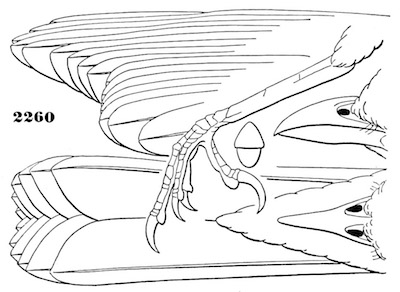
Icteria virens.
2260
Gen. Char.
Bill broad at base, but contracting rapidly and becoming attenuated when
viewed from above; high at the base
(higher than broad opposite the nostrils);
the culmen and commissure much curved
from base; the gonys straight. Upper jaw
deeper than the lower; bill without notch
or rictal bristles. Nostrils circular, edged
above with membrane, the feathers close
to their borders. Wings shorter than tail,
considerably rounded; first quill rather
shorter than the sixth. Tail moderately
graduated; the feathers rounded, but narrow.
Middle toe without claw about
two thirds the length of tarsus, which has
the scutellæ fused externally in part into one plate.
The precise systematic position of the genus Icteria is a matter of much
contrariety of opinion among ornithologists; but we have little hesitation in
including it among the Sylvicolidæ. It has been most frequently assigned
to the Vireonidæ, but differs essentially in the deeply cleft inner toe (not
half united as in Vireo), the partially booted tarsi, the lengthened middle
toe, the slightly curved claws, the entire absence of notch or hook in the bill,
and the short, rounded wing with only nine primaries. The wing of Vireo,
when much rounded, has ten primaries,—nine only being met with when
the wing is very long and pointed.
Of this genus only one species is known, although two races are recognized
by naturalists, differing in the length of the tail.
I. virens. Above olive-green; beneath gamboge-yellow for the anterior half,
and white for the posterior. A white stripe over the eye.
Length of tail, 3.30 inches. Hab. Eastern United States to the Plains; in
winter through Eastern Mexico to Guatemala … var. virens.
Length of tail, 3.70 inches. Hab. Western United States from the Plains to
the Pacific; Western Mexico in winter … var. longicauda.
Icteria virens, Baird.
YELLOW-BREASTED CHAT.
Turdus virens, Linn. Syst. Nat. 10th ed. 1758, 171, No. 16.(based on
Œnanthe americana, pectore luteo, Yellow-breasted Chat, Catesby, Carol. I, tab. 50). Icteria
virens, Baird, Rev. Am. B. 1864, 228. Muscicapa viridis, Gmelin, Syst. Nat. I, 1788, 936.
Icteria viridis, Bon.; Aud. Orn. Biog. II, pl.
cxxxvii.—Baird, Birds N. Am. 1858, 248. Icteria dumecola, Vieill. Pipra
polyglotta, Wils. ? Icteria velasquezi, Bon. P. Z. S. 1837, 117
(Mexico).—Sclater & Salv. Ibis, I, 1859, 12 (Guatemala).
Localities quoted: Costa Rica, Caban., Orizaba (winter), Sum.
Yucatan, Lawr.
Sp. Char.
Third and fourth quills longest; second and fifth little shorter; first nearly equal
to the sixth. Tail graduated. Upper parts uniform olive-green; under parts, including
the inside of wing, gamboge-yellow as far as nearly half-way from the point of the bill to
the tip of the tail; rest of under parts white, tinged with brown on the sides; the outer
side of the tibiæ plumbeous; a slight tinge of orange across the breast. Forehead and
sides of the head ash, the lores and region below the eye blackish. A white stripe from
the nostrils over the eye and involving the upper eyelid; a patch on the lower lid, and a
short stripe from the side of the lower mandible, and running to a point opposite the hinder
border of the eye, white. Bill black; feet brown. Female like the male, but smaller;
the markings indistinct; the lower mandible not pure black. Length, 7.40; wing, 3.25;
tail, 3.30. Nest in thickets, near the ground. Eggs white, spotted with reddish.
Hab. Eastern United States, west to Arkansas; rare north of Pennsylvania; south to
Eastern Mexico and Guatemala. Not noticed in West Indies.
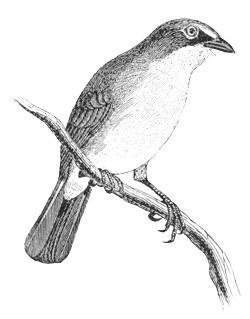
Icteria virens.
Both sexes in winter apparently have the
base of lower mandible light-colored, the
olive more brown, the sides and crissum
with a strong ochraceous tinge. It is this
plumage that has been recognized as I. velasquezi.
Habits. The Yellow-breasted Chat is
found throughout the Eastern United States,
from Massachusetts to Florida, and as far to
the west as Fort Riley and Eastern Kansas.
Mr. Say met with it among the Rocky Mountains
as far north as the sources of the Arkansas.
It is not very rare in Massachusetts, but
a few breed in that State as far north as Lynn. It has been found in Mexico
and Guatemala, but not, so far as I am aware, in the West Indies.
Probably no one of our birds has more distinctly marked or greater peculiarities
of voice, manners, and habits than this very singular bird. It is
somewhat terrestrial in its life, frequenting tangled thickets of vines, briers,
and brambles, and keeping itself very carefully concealed. It is noisy and
vociferous, constantly changing its position and moving from place to place.
It is not abundant north of Pennsylvania, where it arrives early in May
and leaves the last of August. The males are said always to arrive three or
four days before their mates.
This species is described by Wilson as very much attached to certain
localities where they have once taken up their residence, appearing very
jealous, and offended at the least intrusion. They scold vehemently at
every one who approaches or even passes by their places of retreat, giving
utterance to a great variety of odd and uncouth sounds. Wilson states that
these sounds may be easily imitated, so as to deceive the bird itself, and to
draw it after one; the bird following repeating its cries, but never permitting
itself to be seen. Such responses he describes as constant and rapid,
and strongly expressive both of anger and anxiety, their voice, as it shifts,
unseen, from place to place, seeming to be more like that of a spirit than a
bird. These sounds Wilson compares to the whistling of the wings of a
duck, being repetitions of short notes, beginning loud and rapid, and falling
lower and lower. Again a succession of other notes, said to closely
resemble the barking of young puppies, is followed by a variety of hollow,
guttural sounds, each eight or ten times repeated, at times resembling the
mewing of a cat, only hoarser,—all of these, as he states, uttered with
great vehemence, in different keys and with peculiar modulations, now as if
at a considerable distance, and the next moment as if close by your side;
so that, by these tricks of ventriloquism, one is utterly at a loss to ascertain
from what particular quarter they proceed. In mild weather this strange
melody of sounds is kept up throughout the night during the first of the
pairing-season, but ceases as soon as incubation commences.
They construct their nest about the middle of May. These are placed
within a few feet of the ground, in the midst of low brambles, vines, and
bushes, generally in a tangled thicket. They build a rude but strongly woven
nest, the outer portions more loosely made of dry leaves; within these are
interwoven thin strips of the bark of the wild grape, fibrous roots, and fine
dry grasses.
The eggs, four or five in number, are usually hatched out within twelve
days, and in about as many more the young are ready to leave their nest.
While the female is sitting, and still more after the young are hatched, the
cries of the male are loud and incessant when his nest is approached. He
no longer seeks to conceal himself, but rises in the air, his legs dangling in a
peculiar manner, ascending and descending in sudden jerks that betray his
great irritation.
The food of this bird consists chiefly of beetles and other insects, and
of different kinds of berries and small fruit, and it said to be especially fond
of wild strawberries.
Audubon states that in their migrations they move from bush to bush by
day, and frequently continue their march by night. Their flight at all times
is short and irregular. He also states that when on the ground they squat,
jerk their tails, spring on their legs, and are ever in a state of great activity.
Although the existence of this bird north of Pennsylvania is generally
disputed, I have no doubt that it has always been, and still is, a constant
visitor of Massachusetts, and has been found to within a score of miles of
the New Hampshire line. Among my notes I find that a nest was found
in Brookline, in 1852, by Mr. Theodore Lyman; in Danvers, by Mr. Byron
Goodale; in Lynn, by Messrs. Vickary and Welch; and in many other parts
of the State. It certainly breeds as far south as Georgia on the coast, and
in Louisiana and Texas in the southwest. On the Pacific coast it is replaced
by the long-tailed variety, longicauda.
A nest of this species from Concord, Mass., obtained by Mr. B. P. Mann,
and now in the collection of the Boston Natural History Society, has a
diameter of four inches and a height of three and a half. The cavity has a
depth of two and a quarter inches, and is two and a half wide. This is built
upon a base of coarse skeleton leaves, and is made of coarse sedges, dried
grasses, and stems of plants, and lined with long, dry, and wiry stems of
plants, resembling pine-needles. Another from Pomfret, Conn., obtained by
Mr. Sessions, is a much larger nest, measuring five inches in diameter and
three and three quarters in height. The cup is two and a half inches deep
by three in width. It is made of an interweaving of leaves, bark of the
grapevine, and stems of plants, and is lined with fine, long wiry stems and
pine-needles.
Their eggs are of a slightly rounded oval shape, vary in length from .85
to .95 of an inch, and in breadth from .65 to .70. They have a white ground
with a very slight tinge of yellow, and are marked with reddish-brown and
a few fainter purplish and lilac spots.
Icteria virens, var. longicauda, Lawr.
LONG-TAILED CHAT.
Icteria longicauda, Lawrence, Ann. N. Y. Lyc. VI, April, 1853, 4.—Baird, Birds N.
Am. 1858, 249, pl. xxxiv, fig. 2; Rev. 230.—Sclater, Catal. 42, No. 253.—Finsch, Abh. Nat. Brem.
1870, 331 (Mazatlan).—Cooper, Orn. Cal. 1, 1870, 98. ? Icteria auricollis (Licht. Mus.
Berl.), Bon. Consp. 1850, 331.
Sp. Char.
Similar to var. virens. Fourth quill longest; third and fifth shorter; first
shorter than the seventh. Above ash-color, tinged with olive on the back and neck; the
outer surface of the wings and tail olive. The under parts as far as the middle of the belly
bright gamboge-yellow, with a tinge of orange; the remaining portions white. The superciliary
and maxillary white stripes extend some distance behind the eye. Outer edge of
the first primary white. Length, 7 inches; wing, 3.20; tail, 3.70.
Young (8,841, Loup Fork of Platte, August 5; F. V. Hayden). Above light grayish-brown;
beneath yellow on anterior half as in adult, but yellow less pure; rest of under
parts (except abdomen) ochraceous; markings on head obsolete, the eyelids only being
distinctly white.
Hab.
Western and Middle Provinces of United States, east to Missouri River and
Texas; Cape St. Lucas and Western Mexico.
The most tangible difference between this bird and typical virens consists
in the longer tail. In addition, the upper plumage is grayish, with
hardly any olive tinge, and the white maxillary stripe extends farther back;
the bill is not so deep as that of the Eastern bird. All these differences,
however, are in strict accordance with various laws; the more grayish cast
of plumage is what we should expect in birds from the Middle Province,
while the restriction of the yellow from the maxillæ we see also in Western
specimens of Helminthophaga ruficapilla; the longer tail, also, is a well-known
characteristic of Western birds, as distinguished from Eastern of the
same species.
Upon the whole, therefore, taking into consideration the absolute identity
of their habits and notes, we can only consider the I. longicauda and
I. virens as restricted, as being merely geographical races of one species.
This variety, as well as the Eastern, has in autumn and winter a slightly
different plumage. A pair (53,348 ♂, and 53,347 ♀, West Humboldt Mountains,
Nevada) obtained September 4 differ in the following respects from
spring adults: the upper plumage is decidedly brown, with even a russet
tinge,—not gray, with a greenish wash; the lores are less purely black, and
the sides and crissum are deep cream-color, instead of pure white; the female
has a shade of olive across the jugulum; both male and female have the
lower mandible almost wholly white, and the commissure broadly edged with
the same.
No. 38,402 ♂, Laramie Peak, June, has the throat and jugulum strongly
stained with deep cadmium-orange.
Habits. The Western or Long-tailed Chat has an exclusively Western distribution,
and has been found from Mexico and Cape St. Lucas to Oregon, on
the Pacific coast, and as far to the east as the Upper Missouri.
According to Dr. Cooper, these birds appear in San Diego and at Fort
Mojave in the latter part of April. They are said to inhabit chiefly the
warmer valleys near streams and marshes, rarely on the coast. At Fort Mojave,
Dr. Cooper found a nest of this bird May 19, built in a dense thicket of
algarobia. It contained three eggs, and one of the Molothrus. The nest was
built of slender green twigs and leaves, lined with grass and hair. The eggs
were white, sprinkled with cinnamon, somewhat in the form of a ring near
the larger end, and measured .75 by .64 of an inch.
These nests were usually very closely concealed, but one that he found at
Santa Cruz, near the coast, was in a very open situation, only two feet above
the ground. When the nest is approached, the old birds are very bold, keeping
up a constant scolding, and almost flying in the face of an intruder. At
other times they are very shy. The notes and sounds uttered by the Western
bird Dr. Cooper states to be the same as those of the Eastern species,
and with the same grotesqueness. They leave the State of California on or
before the first of September.
Dr. Gambel states that the Chat appears in California about the middle of
April, resorting to the hedges, vineyards, and bushy portions of gardens to
breed.
Mr. Xantus found a nest of this bird (S. I., 896) at Fort Tejon, California,
in May. It is a very symmetrical and exactly circular nest, six inches wide
and three in height. The cavity has a diameter of three inches at the brim,
and a depth of two. It is built of soft strips of bark, large stems, and
branches of dry plants, leaves, twigs, and other vegetable substances. These
are very neatly and compactly interwoven. The nest is elaborately lined with
finer stems and flexible grasses. Another nest (S. I., 1816), obtained at Neosho
Falls, Kansas, by Mr. B. F. Goss, is of irregular shape. Its height is four
inches, and its diameter varies from three and three quarters to five inches.
It was built in a depression in the ground, and its shape adapted to its location.
The base is composed entirely of leaves, impacted when in a moist and
decaying condition. Within these is interwoven a strong basket-like structure,
made of long and slender stems, strips of bark, and fine rootlets, lined
with finer grasses and stems of plants.
A nest of this species from Sacramento is composed, externally, of fine
strips of inner bark of the grape and of deciduous trees, coarse straws, stems
of plants, twigs, and dried remains of weeds, etc. It is lined with finer
stems and long wiry roots, resembling hair. This nest has a diameter of four
inches and a height of three. The cavity has a diameter of three inches at
the rim, and a depth of two.
In regard to this variety Mr. Ridgway writes: “In no respect that I could
discover does this Western bird differ from the Eastern in habits, manners,
or notes. The nesting-habits are exactly the same.”
The eggs of this species are, for the most part, larger than are those of the
virens. They vary in length from .95 to 1.00 of an inch, and have an average
breadth of .70 of an inch. Their markings do not differ essentially in
shadings from those of the common species.
Subfamily SETOPHAGINÆ.
Gen. Char.
Sylvicoline birds with the characters of Flycatchers; the bill notched at
tip, depressed and broad at the base, though quite deep; the rictus with well-developed
bristles reaching beyond the nostrils, sometimes to the end of the bill. First quill rather
less than the fourth, or still shorter. Size of the species rarely exceeding six inches.
Colors red, yellow, and olive.
The species of this section resemble the small Flycatchers of the family
Tyrannidæ in the structure of the bill, etc., and in the habit of capturing
insects more or less on the wing, though they are more restless in their
movements, seeking their prey among trees or in bushes, rapidly changing
their place, instead of occupying a perch and returning to it after pursuing
an insect through the air. The yellow or orange crown found in many species
also carries out the analogy; but the strictly Oscine characters of the
tarsal scutellæ and the nine primaries will serve to distinguish them.
The Setophaginæ have their greatest development in Middle and South
America, no less than nine genera and subgenera being on record, of which
only two extend into the United States. Of one of these, Setophaga, we
have only a single species of the many described; the other, Myiodioctes,
has no members other than those found in the United States.
The following diagnosis is prepared to distinguish our genera from the
South American:—
A. Wings pointed; the first quill longer than the fifth; the third as long as or
longer than the fourth. Tail nearly even, or slightly rounded (the difference of the
feathers less than .20); the feathers broad and firm; the outer webs of exterior
feathers narrow at base, but widening to nearly double the width near the end.
1. Bill from gape nearly as long as skull, broad at base and much depressed;
rictal bristles reaching half-way from nostrils to tip. Culmen and commissure
nearly straight. Wings equal to the tail. Tarsi long; toes short; middle
toe without claw, about half the tarsus … Setophaga.
2. Bill from gape nearly as long as skull, broad at base, but deep and more
sylvicoline; rictal bristles reaching but little beyond nostrils. Culmen and
commissure straight to the tip. Wings longer than the almost even tail.
Middle toe without claw, three fifths the tarsus … Myiodioctes.
3. Bill from gape much shorter than head, wide at base, but compressed
and high; the culmen and commissure much curved from base, scarcely
notched at tip; rictal bristles reaching nearly half-way from nostrils to tip.
Wings about equal to the almost even tail. Middle toe without claw, about
three fifths the rather short tarsus … Cardellina.
B. Wings rounded; the first quill shorter than in the preceding section; always
less than the fifth. South American genera.[59]
Several species of Setophaginæ have, on not very well established grounds,
been assigned to the southern borders of the United States. They are as
follows:—
Cardellina rubra, Baird, Rev. Am. Birds, 1865, 264. (Setophaga rubra, Swainson.)
Parus leucotis, Giraud, Birds Texas. Hab. Mexico. Rich carmine-red. Wing and
tail-feathers brown. Ear-coverts silvery white. Length, 4.70; wing, 2.40; tail, 2.55.
Basileuterus culicivorus, Baird, Rev. Am. Birds, 1865, 246. (Sylvia culicivora,
Licht. ) Muscicapa brasieri, Giraud, Texas Birds. Hab. Southern Mexico; Guatemala
and Costa Rica. Top of head with two black stripes enclosing a median of yellow.
Back olivaceous-ash. Beneath entirely yellow. No rufous on side of head. Length,
4.90; wing, 2.40; tail, 2.25.
Basileuterus belli, Baird, Rev. Am. Birds, 1865, 247. Muscicapa belli, Giraud, Texas
Birds. Hab. Mexico and Guatemala. Top of head and face chestnut. A yellow superciliary
stripe bordered above by dusky. Back olive; beneath yellow. Length, 5.10;
wing, 2.28; tail, 2.50.
Genus MYIODIOCTES, Aud.
Myiodioctes, Audubon, Synopsis, 1839, 48. (Type, Motacilla mitrata, Gm.)—Baird, Birds N. Am. 1858, 291.
Wilsonia, Bonap. List.
1838 (preoccupied in botany).
Myioctonus, Cabanis, Mus. Hein. 1850, 18. (Type, Motacilla mitrata.)
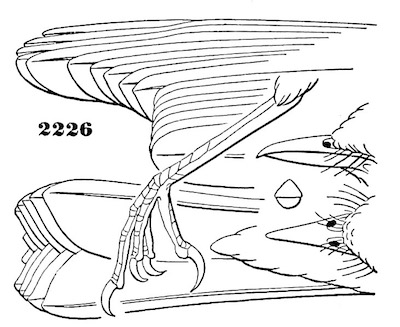
Myiodioctes mitratus.
2226
Gen. Char.
Bill broad, depressed; the lateral outlines a little concave; the bristles
reaching not quite half-way from nostrils to tip.
Culmen and commissure nearly straight to near the
tip. Nostrils oval, with membrane above. Wings
pointed, rather longer than the nearly even but
slightly rounded tail; first quill shorter than the
fourth, much longer than the fifth; the second and
third quills longest. Tarsi rather lengthened, the
scutellar divisions rather indistinct; the middle toe
without claw, about three fifths the tarsus.
This genus is distinguished from Setophaga,
mainly by stouter feet and longer toes; shorter
and more even tail, narrower bill, etc. The species are decidedly muscicapine
in general appearance, as shown by the depressed bill with bristly
rictus. The type M. mitratus is very similar in character of bill to Dendroica
castanea, but the wings are much shorter; the tail longer and more
graduated; the legs and hind toe longer, and the first primary shorter than
the fourth (.15 of an inch less than the longest), not almost equal to the
longest. The species are plain olive or plumbeous above, and yellow beneath.
They may be grouped as follows:—
A. Tail with white patches on the inner feathers.
1. M. mitratus. Head and neck black. Front, cheeks, and under parts
yellow. Back olive-green. Hab. Eastern Province of United States, south
to Panama and West Indies.
2. M. minutus. Olive above; yellowish beneath. Two white bands on
the wings. Hab. Eastern United States.
B. Tail without white patch on the outer feathers.
3. M. pusillus. Crown black. Forehead, cheeks, and under parts yellow.
Back olive.
Yellow of forehead without an orange tinge; upper parts dull olive-green;
pileum with very dull steel-blue lustre. Hab. Eastern Province
and Rocky Mountains of North America, south to Costa Rica. … var. pusillus.
Yellow of forehead with an orange cast; upper parts bright yellowish-green;
pileum with a bright steel-blue lustre. Hab. Pacific Province
of North America, from Sitka to Costa Rica … var. pileolata.
4. M. canadensis. Streaks on the crown, stripes on sides of head and
neck, with pectoral collar of streaks, black. Rest of under parts, and line
to and around the eye, yellow. Back bluish. Hab. Eastern Province of
United States, south to Ecuador.
Myiodioctes mitratus, Aud.
HOODED WARBLER.
Motacilla mitrata, Gmelin, S. N. I, 1788, 293. Sylvia m. Lath.; Vieill.; Bon.; Nutt.; Aud. Orn. Biog. II, pl. cx. Sylvicola m. Max. Sylvania m. Nuttall, Man. I,
1840, 333. Setophaga m. Jard. Wilsonia m. Bon. 1838.—Allen, Pr. Essex
Inst. 1864. Myiodioctes m. Aud. Syn. 1839, 48.—Ib. Birds Am. II, pl. lxxi.—Sclater, P. Z.
S. 1856, 291 (Cordova); 1858, 358 (Honduras).—Baird, Birds N.
Am. 1858, 292; Rev. 239.—Jones, Nat. Bermuda, 1859, 26 (March).—Sclater & Salvin, Ibis, 1859, 11
(Guatemala).—Lawrence, Ann. N. Y. Lyc. VIII, 63 (Panama
R. R.).—Gundlach, Cab.
Jour. 1861, 326 (Cuba).—Samuels, 245. Myioctonus m. Cab. Mus.
Hein. 1851.—Ib. Jour. Orn. III, 1855, 472 (Cuba). Muscicapa cucullata, Wilson, III, pl. xxvi, fig. 3. Muscicapa selbyi,
Aud. Orn. Biog. I, pl.
ix.
Sp. Char.
Male. Bill black; feet pale yellow. Head and neck all round and forepart
of the breast black. A broad patch on the forehead extending round on the entire cheeks
and ear-coverts, with the under parts, bright yellow. Upper parts and sides of the body
olive-green. Greater portion of inner web of outer three tail-feathers white.
Female similar, but without the black; the crown like the back; the forehead yellowish;
the sides of the head yellow, tinged with olive on the lores and ear-coverts. Throat
bright yellow.
Length, 5.00; wing, 2.75; tail, 2.55. (Skin.)
Hab.
Eastern Province of United States, rather southern; Bermuda; Cuba; Jamaica;
Eastern Mexico; Honduras and Guatemala to Panama R. R. Orizaba (autumn, Sumichrast);
Yucatan (Lawrence).
A young male in second year (2,245, Carlisle, Penn., May) is similar to
the female, but the hood is sharply defined anteriorly, though only bordered
with black, the olive-green reaching forward almost to the yellow; there are
only very slight indications of black on the throat. Apparently the male of
this species does not attain the full plumage until at least the third year, as
is the case with Setophaga ruticilla.
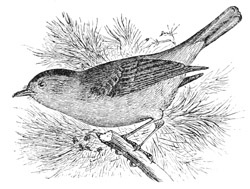
Myiodioctes pusillus.
Habits. This beautiful and singularly marked Warbler is a Southern species,
though not exclusively so. It is
more abundant in South Carolina than
any other State, so far as I am aware.
It is, however, found as far to the north
as Northern New Jersey and Pennsylvania,
and Southern New York, and,
farther west, as far north as the shores
of Lake Erie. It has also been found in
Bermuda, Cuba, Jamaica, Eastern Mexico,
Honduras, and Guatemala. Throughout
Central America it appears to be abundant during the winter.
Mr. Audubon also states that it abounds in Louisiana and along the banks
of the Mississippi and the Ohio. It occurs on the Hudson to some distance
above New York. It appears from the South early in March, and has young
already hatched, in Louisiana, early in May.
It is said to be one of the liveliest of its tribe, and to be almost constantly
in motion. It is fond of secluded places, and is equally common in the thick
canebrakes, both of the high and the low lands, and in the tangled undergrowth
of impenetrable swamps. It has a peculiarly graceful manner of
closing and opening its broad tail, that at once distinguishes it from every
other bird, as it gambols from tree to tree, now in sight, and now hid from
the eye, but ever within hearing.
Mr. Audubon adds that its call-note so closely resembles that of the
Spiza ciris that it requires a practised ear to distinguish them. But its song
is very different. This consists of three notes, and is loud, lively, and pleasing.
This song is said to be made of sounds resembling the syllables weet,
weet, weetēē. Extremely vocal in the early spring, it becomes nearly silent
as soon as its brood is hatched. It resumes its song when its mate is again
sitting on her eggs, as they have more than one brood in a season.
They are described as expert flycatchers, full of activity and spirit, flying
swiftly after their insect prey; and catching the greater part on the wing.
Their flight is low, gliding, and often protracted.
Mr. Bachman narrates a striking instance of its courage and conjugal devotion.
While a pair of these Warblers were constructing a nest, a Sharp-shinned
Hawk pounced upon and bore off the female. The male followed
close after the Hawk, flying within a few inches and darting at him in all
directions, and so continued until quite out of sight.
Wilson states that it builds a very neat and compact nest, generally in the
fork of a small bush. It is formed of moss and flaxen fibres of plants, and
lined with hair or feathers. The eggs, five in number, he describes as of a
grayish-white, with red spots at the larger end. He noticed its arrival at
Savannah as early as the 20th of March. Mr. Audubon adds that these
nests are always placed in low situations, a few feet from the ground.
The late Dr. Gerhardt, of Varnell’s Station, Georgia, informed me, by letter,
that the Hooded Warbler deposits her eggs about the middle of May,
laying four. The nest is not unlike that of the Spiza cyanea, but is larger.
It is constructed of dry leaves and coarse grass on the outside, and within
of dry pine-needles, interwoven with long yellow grasses and sometimes with
horsehair. They are built, for the most part, in the neighborhood of brooks
and creeks, in oak bushes, four or five feet from the ground. The female
sits so closely, and is so fearless, that Dr. Gerhardt states he has sometimes
nearly caught her in his hand.
In another letter Dr. Gerhardt describes a nest of this species as measuring
three inches in height, three in external diameter, and an inch and a
quarter in the depth of its cavity. Externally it was built of dry leaves and
coarse grasses, lined inside with horsehair, fine leaves of pine, and dry slender
grasses. It was constructed on a small oak growing in low bottom-land, and
was three feet from the ground. The complement of eggs is four.
Mr. Ridgway states that this species is a common summer resident in the
bottom-lands along the Lower Wabash, in Southern Illinois, inhabiting the
cane-brakes and the margins of bushy swamps.
The eggs of this Warbler are oval in shape, with one end quite pointed.
They measure .70 by .50 of an inch. Their ground-color is a beautiful bright
white, when the egg is fresh, strongly tinged with flesh-color. The spots are
of a fine red, with a few markings of a subdued purple.
Myiodioctes minutus, Baird.
SMALL-HEADED FLYCATCHER.
Muscicapa minuta, Wilson, Am. Orn. VI, 1812, 62, pl. 1, fig. 5.—Aud. Orn. Biog. V, pl. ccccxxxiv, fig.
3.—Ib. Birds Am. I, pl. lxvii. Sylvia minuta, Bon. Wilsonia m. Bon. List, 1838. Myiodioctes minutus, Baird, Rev. Am. Birds, 1864, 241. Sylvania pumilia, Nutt. Man. I, 1840, 334.
Sp. Char.
Wings short, the second quills longest. Tail of moderate-length, even.
General color of upper parts light greenish-brown; wings and tail dark olive-brown, the
outer feathers of the latter with a terminal white spot on the inner web; a narrow white
ring surrounding the eye; two bands of dull white on the wings; sides of the head and
neck greenish-yellow; the rest of the lower parts pale yellow, gradually fading into white
behind. Male, 5 inches long; extent, 8.25 inches.
Hab.
Eastern United States.
Habits. All that is known in regard to this species we receive from
Wilson and Audubon, and there is a decided discrepancy in their several
statements. Wilson states that his figure was taken from a young male
shot on the 24th of April, but in what locality he does not mention. He
adds that he afterwards shot several individuals in various parts of New
Jersey, particularly in swamps. He found these in June, and has no doubt
they breed there.
Audubon claims that Wilson’s drawing was a copy from his own of a bird
shot by him in Kentucky on the margin of a pond. He throws a doubt as
to the correctness of Wilson’s statement that they have been found in New
Jersey, as no one else has ever met with any there. That may be, however,
and Wilson’s statement yet be correct. The same argument carried out would
reject the very existence of the bird itself, as no well-authenticated records
of its occurrence since then can be found. They are at least too doubtful
to be received as unquestionable until the genuine bird can be produced. Mr.
Nuttall, it is true, states that Mr. Charles Pickering obtained a specimen of
this bird many years ago, near Salem, Mass., and that he had himself also
seen it in the same State, at the approach of winter. In the fall of 1836,
when the writer resided in Roxbury, a cat caught and brought into the
house a small Flycatcher, which was supposed to be of this species. It was
given to Mr. Audubon, who assented to its correct identification, but afterwards
made no mention of it. The presumption, therefore, is that we may
have been mistaken.
In regard to its habits, Wilson represents it as “remarkably active, running,
climbing, and darting about among the opening buds and blossoms with
extraordinary agility.” Audubon states that in its habits it is closely allied
with the pusillus and the mitratus, being fond of low thick coverts in swamps
and by the margin of pools. He also attributes to it a song of rather pleasing
notes, enunciated at regular intervals, loud enough to be heard at the distance
of sixty yards. These peculiarities seem to separate it from the true
Flycatchers and to place it among the Warblers.
Myiodioctes pusillus, Bonap.
GREEN BLACK-CAPPED FLYCATCHER.
Muscicapa pusilla, Wilson, Am. Orn. III, 1811, 103, pl. xxvi, fig. 4. Wilsonia
pus. Bon. Sylvania
pus. Nutt. Myiodioctes
pus. Bon. Consp. 1850, 315.—Sclater, P. Z.
S. 1856, 291 (Cordova); 1858, 299 (Oaxaca Mts.; Dec.); 1859, 363
(Xalapa); 373.—Ib. Catal. 1861, 34, No. 203.—Baird, Birds N. Am. 1858, 293 (in
part); Rev. 240 (in part).—Sclater & Salvin, Ibis, 1859, 11
(Guatemala).—Samuels, 246. Myioctonus pus.
Cab. M. H. 1851, 18.—Ib. Jour. 1860, 325 (Costa Rica). Sylvia wilsoni, Bon.; Nutt. Muscicapa
wilsoni, Aud. Orn.
Biog. II, pl. cxxiv. Setophaga wilsoni, Jard. Myiodioctes wilsoni, Aud. Birds Am. II, pl. lxxv. Sylvia
petasodes, Licht. Preis-Verz. 1830.
Sp. Char.
Forehead, line over and around the eye, and under parts generally, bright
yellow. Upper part olive-green; a square patch on the crown lustrous-black. Sides of
body and cheeks tinged with olive. No white on wings or tail. Female similar, the
black of the crown replaced by olive-green. Length, 4.75; wing, 2.25; tail, 2.30.
Hab.
Eastern portions of United States, west to the Snake and Humboldt Rivers;
north to Alaska, south through Eastern Mexico and Guatemala to Costa Rica; Chiriqui
(Salvin).
Habits. Wilson’s Black-Cap is found throughout the United States from
ocean to ocean, and as far to the north as Alaska and the Arctic shores,
where, however, it is not common. Mr. Dall shot a specimen, May 30, on the
Yukon River, where it was breeding. Mr. Bischoff obtained others with nests
and eggs at Sitka, and afterwards found it more abundant at Kodiak. On the
Pacific coast Dr. Suckley found it very abundant in the neighborhood of Fort
Steilacoom, where it frequented thickets and small scrub-oak groves, in its
habits resembling the Helminthophaga celata, flitting about among the dense
foliage of bushes and low trees in a busy, restless manner. He describes its
cry as a short chit-chat call. In California, Dr. Cooper notes their first arrival
early in May, and states that they migrate along the coast, up at least to
the Straits of Fuca. At Santa Cruz he noted their arrival, in 1866, about
the 20th of April. They were then gathering materials for a nest, the male
bird singing merrily during his employment. As they have been observed
in Oregon as early as this, it has been conjectured that some may remain all
winter among the dense shrubbery of the forests.
This bird winters in large numbers in Central America, where it is apparently
very generally distributed. Mr. Salvin found it very common at Duenas.
It was taken at Totontepec, among the mountains of Oaxaca, Mexico,
by Mr. Boucard.
Mr. Ridgway found it very common during the summer and autumn
months among the willows of the fertile river valleys, and among the rank
shrubbery bordering upon the streams of the cañons of the higher interior
range of mountains. It was found in similar situations with the Dendroica
æstiva, but it was much more numerous. During September it was most
abundant among the thickets and copses of the East Humboldt Mountains,
and in Ruby Valley, at all altitudes, frequenting the bushes along the streams,
from their sources in the snow to the valleys.
Wilson first met with and described this species from specimens obtained
in Delaware and New Jersey. He regarded it as an inhabitant of the swamps
of the Southern States, and characterized its song as “a sharp, squeaking
note, in no wise musical.” It is said by him to leave the Southern States in
October.
Audubon states that it is never found in the Southern States in the summer
months, but passes rapidly through them on its way to the northern districts,
where it breeds, reaching Labrador early in June and returning by the
middle of August. He describes it as having all the habits of a true Flycatcher,
feeding on small insects, which it catches on the wing, snapping its
bill with a sharp clicking sound. It frequents the borders of lakes and
streams fringed with low bushes.
Mr. Nuttall observed this species in Oregon, where it arrived early in May.
He calls it a “little cheerful songster, the very counterpart of our brilliant
and cheerful Yellow-Bird.” Their song he describes as like ’tsh-’tsh-’tsh-tshea.
Their call is brief, and not so loud. It appeared familiar and unsuspicious,
kept in bushes busily collecting its insect fare, and only varied its employment
by an occasional and earnest warble. By the 12th of May some were
already feeding their full-fledged young. Yet on the 16th of the same month
he found a nest containing four eggs with incubation only just commenced.
This nest was in a branch of a small service-bush, laid very adroitly, as to
concealment, upon a mass of Usnea. It was built chiefly of hypnum mosses,
with a thick lining of dry, wiry, slender grasses. The female, when approached,
slipped off the nest, and ran along the ground like a mouse. The
eggs were very similar to those of Dendroica æstiva, with spots of a pale
olive-brown, confluent at the greater end.
A nest found by Audubon in Labrador was placed on the extremity of a
small horizontal branch, among the thick foliage of a dwarf fir, a few feet
from the ground and in the very centre of a thicket. It was made of bits of
dry mosses and delicate pine twigs, agglutinated together and to the branches
and leaves around it, from which it was suspended. It was lined with fine
vegetable fibres. The diameter of the nest was three and a half and the
depth one and a half inches. He describes the eggs, which were four, as
white; spotted with reddish and brown dots, the markings being principally
around the larger end, forming a circle, leaving the extremity plain.
In this instance the parents showed much uneasiness at the approach of
intruders, moving about among the twigs, snapping their bills, and uttering
a plaintive note. In Newfoundland these birds had already begun to migrate
on the 20th of August. He met with them in considerable numbers
in Northern Maine in October, 1832. Mr. Turnbull mentions it as a rather
abundant bird of Eastern Pennsylvania, appearing there early in May, in
transitu, and again in October.
Mr. T. M. Trippe has observed this species at Orange, N. J., from the 19th
to the 30th of May. It is said to keep low down in the trees, and is fond
of haunting thickets and open brush fields. Occasionally he has heard it
utter a loud chattering song, which it repeats at short intervals.
A nest of this species from Fort Yukon (Smith. Coll., 13,346), obtained
May 20, by Mr. McDougal, contained four eggs. These varied from .60 to
.63 of an inch in length, and from .45 to .49 in breadth. They were obovate
in shape, their ground-color was a pure white; this was finely sprinkled
round the larger end with brownish-red and lilac. No mention is made of
the position of the nest, but it is probable this bird builds on the ground.
Myiodioctes pusillus, var. pileolatus, Ridgway.
Motacilla pileolata, Pallas, Zoög. Rosso Asiat. I, 1831, 497 (Russian America). Myiodioctes pusillus,
var. pileolata, Ridgway, Report U. S. Geol. Expl. 40th Par. Myiodioctes pusillus, Auct. (all citations from Pacific coast of North and Middle
America).—Lord, Pr. R. Art. Inst.
Woolw. IV, 1864, 115 (Br. Col.).—Dall & Bannister
(Alaska).—Cooper, Orn. Cal. 1, 1870, 101.
Sp. Char.
Similar to var. pusillus, but much richer yellow, scarcely tinged with olive
laterally, and deepened into an almost orange shade on the front and chin. Above much
brighter and more yellowish olive-green. The black pileum with a brighter steel-blue
gloss. Bill much narrower, and deep, light brown above, instead of nearly black. Measures
(4,222 ♂, San Francisco, Cal.), wing, 2.15; tail, 2.00.
Hab.
Pacific coast region of North America, from Kodiak (Alaska); south through
Western Mexico (and Lower California) to Costa Rica.
This is an appreciably different race from that inhabiting the eastern
division of the continent; the differences, tested by a large series of specimens,
being very constant.
A Costa-Rican specimen before me is almost exactly like specimens from
California.
Habits. The remarks, in the preceding article relative to specimens from
the Pacific coast belong to this variety.
Myiodioctes canadensis, Aud.
CANADA FLYCATCHER.
Muscicapa canadensis, Linn.
Syst. Nat. I, 1766, 327. (Muscicapa canadensis cinerea, Brisson, II, 406, tab. 39, fig.
4.)—Gmelin.—Wilson, III, pl. xxvi,
fig. 2.—Aud. Orn. Biog. II, pl.
ciii. Setophaga can. Swains.; Rich.; Gray. Myiodioctes can. Aud.
Birds Am. II, pl. ciii.—Brewer, Pr. Bost. Soc. VI, 5 (nest and eggs).—Sclater, P. Z. S. 1854, 111 (Ecuador; winter); 1855, 143 (Bogota); 1858, 451 (Ecuador).—Ib. Catal. 1861, 34, No.
204.—Sclater & Salvin, Ibis, 1859, 11 (Guatemala).—Lawrence, Ann. N. Y. Lyc. VI, 1862.—Baird, Birds N. Am. 1858, 294; Rev. 239.—Samuels, 247. Euthlypis can. Cab. Mus. Hein. 1850, 1851, 18; Jour.
Orn. 1860, 326 (Costa Rica). Sylvia pardalina, Bon.; Nutt. Sylvicola
pardalina, Bon. Myiodioctes pardalina, Bon. ? Muscicapa bonapartei, Aud. Orn. Biog. I, 1831, 27, pl. v. Setophaga bon. Rich. Wilsonia bon.
Bon. Sylvania bon. Nutt. ? Myiodioctes
bon. Aud. Syn.—Ib. Birds Am. II, 1841, 17, pl.
xvii.—Baird, Birds N. Am. 1858, 295. Setophaga nigricincta, Lafr. Rev. Zoöl. 1843, 292; 1844, 79.
Sp. Char.
Upper part bluish-ash; a ring around the eye, with a line running to the
nostrils, and the whole under part (except the tail-coverts, which are white), bright yellow.
Centres of the feathers in the anterior half of the crown, the cheeks, continuous with a
line on the side of the neck to the breast, and a series of spots across the forepart of the
breast, black. Tail-feathers unspotted. Female similar, with the black of the head and
breast less distinct. In the Young obsolete. Length, 5.34; wing, 2.67; tail, 2.50.
Hab.
Whole Eastern Province of United States, west to the Missouri; north to Lake
Winnipeg; Eastern Mexico to Guatemala, and south to Bogota and Ecuador (Sclater).
Not noted from West Indies.
Habits. This is a migratory species, abundant during its passage, in
most of the Atlantic States. It breeds, though not abundantly, in New
York and Massachusetts, and in the regions north of latitude 42°. How far
northward it is found is not well ascertained, probably as far, however, as the
wooded country extends. It was met with on Winnepeg River, by Mr. Kennicott,
the second of June. It winters in Central and in Northern South
America, having been procured at Bogota, in Guatemala, and in Costa Rica,
in large numbers.
Mr. Audubon states that he found this bird breeding in the mountainous
regions of Pennsylvania, and afterwards in Maine, New Brunswick, Nova
Scotia, Newfoundland, and Labrador. Although he describes with some minuteness
its nests, yet his description of their position and structure is so
entirely different in all respects from those that have been found in Massachusetts,
that I am constrained to believe he has been mistaken in his identifications,
and that those he supposed to belong to this species were really
the nests of a different bird.
“In Vermont,” Mr. Charles S. Paine, of Randolph, informs me, “the Canada
Flycatcher is a summer visitant, and is first seen about the 18th of May.
They do not spread themselves over the woods, like most of our small fly-catching
birds, but keep near the borders, where there is a low growth of
bushes, and where they may be heard throughout the day singing their regular
chant. A few pairs may occasionally be found in the same neighborhood.
At other times only a single pair can be found in quite a wide extent of territory
of similar character. They build their nests, as well as I can judge,
about the first of June, as the young are hatched out and on the wing about
the last of that month, or the first of July. I have never found a nest, but
I think they are built on the ground. They are silent after the first of July,
and are rarely to be seen after that period.” The song of this bird is a very
pleasing one, though heard but seldom, and only in a few localities in Massachusetts.
Near Washington Dr. Coues found the Canada Flycatcher only a spring
and autumnal visitant, at which seasons they were abundant. They frequented
high open woods, and kept mostly in the lower branches of the trees,
and also in the more open undergrowth of marshy places. They arrive the
last week in April and remain about two weeks, arriving in fall the first
week in September, and remaining until the last of that month.
The first well-identified nest of this bird that came to my knowledge was
obtained in Lynn, Mass., by Mr. George O. Welch, in June, 1856. It was
built in a tussock of grass, in swampy woods, concealed by the surrounding
rank vegetation, in the midst of which it was placed. It was constructed
entirely of pine-needles and a few fragments of decayed leaves, grapevine
bark, fine stems, and rootlets. These were so loosely interwoven that the
nest could not be removed without great care to keep its several portions
together. Its diameter was three and a half inches, and it was very nearly
flat. Its greatest depth, at the centre of its depression, was hardly half an
inch. It contained four young, and an unhatched egg.
Another nest found in June, 1864, by the same observing naturalist, was also
obtained in the neighborhood. This was built in a tussock of meadow-grass,
in the midst of a small boggy piece of swamp, in which were a few scattered
trees and bushes. The ground was so marshy that it could be crossed only
with difficulty, and by stepping from one tussock of reedy herbage to another.
In the centre of one of these bunches the nest was concealed. It measures
six inches in its larger diameter, and has a height of two and a quarter
inches. The cavity of this nest is two and three quarters inches wide,
and one and three quarters deep. It is very strongly constructed of pine-needles,
interwoven with fine strips of bark, dry deciduous leaves, stems of dry
grasses, sedges, etc. The whole is firmly and compactly interwoven with and
strengthened around the rim of the cavity by strong, wiry, and fibrous roots.
The nest is very carefully and elaborately lined with the black fibrous roots
of some plant. The eggs, which were five in number, measure .72 of an inch
in length by .56 in breadth. Their ground-color is a clear and brilliant
white, and this is beautifully marked with dots and small blotches of blended
brown, purple, and violet, varying in shades and tints, and grouped in a
wreath around the larger end.
Genus SETOPHAGA, Swains.
Setophaga, Swainson, Zoöl. Jour. III, Dec. 1827, 360. (Type, Muscicapa ruticilla, L.)—Baird, Birds N. Am. 1858, 297. Sylvania, Nuttall, Man. Orn. I, 1832. (Same
type.)
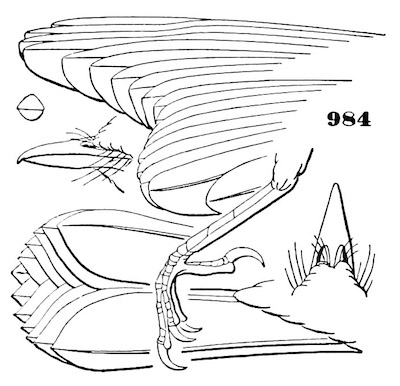
Setophaga ruticilla, Sw.
984
Gen. Char.
Bill much depressed, the lateral outlines straight towards tip. Bristles
reach half-way from nostril to tip. Culmen almost
straight to near the tip; commissure very slightly
curved. Nostrils oval, with membrane above them.
Wings rather longer than tail, pointed; second, third,
and fourth quills nearly equal; first intermediate
between fourth and fifth. Tail rather long, rather
rounded; the feathers broad, and widening at ends,
the outer web narrow. Tarsi with scutellar divisions
indistinct externally. Legs slender; toes short,
inner cleft nearly to base of first joint, outer with
first joint adherent; middle toe without claw, not
quite half the tarsus.
The genus Setophaga is very largely represented in America, although of
the many species scarcely any agree exactly in form with the type. In the
following diagnosis I give several species, referred to, perhaps erroneously, as
occurring in Texas.
Belly white. End of lateral tail-feathers black. Sexes dissimilar.
Ground-color black, without vertex spot. Sides of breast and bases of quills
and tail-feathers reddish-orange in male, yellowish in female … ruticilla.
Belly vermilion or carmine red. Lateral tail-feathers, including their tips, white.
Sexes similar.
Entirely lustrous black, including head and neck. No vertex spot. A
white patch on the wings … picta.[60]
Plumbeous-ash, including head and neck. A chestnut-brown vertex spot.
No white on wings … miniata.[61]
Setophaga ruticilla, Swains.
AMERICAN REDSTART.
Motacilla ruticilla, Linn.
Syst. Nat. 10th ed. 1758, 186 (Catesby, Car. tab. 67). Muscicapa ruticilla, Linn.; Gmelin; Vieillot; Wils.; Bon.; Aud. Orn. Biog. I, pl. xl. Setophaga rut. Swains. Zoöl. Jour. III, 1827, 358.—Bon.;
Aud. Birds Am.—Sclater,
P. Z. S. (Ecuador, Bogota, Cordova, Oaxaca, City of Mexico).—Sclater & Salvin, Ibis, 1859, 12 (Guatemala).—Baird, Birds N. Am. 1858, 297; Rev. 256.—Max.; Sallé, P. Z. S. 1857 (St. Domingo).—Newton, Ibis, 1859, 143 (St. Croix;
winter).—Cab. Jour. 1856, 472 (Cuba); 1860, 325 (Costa
Rica).—Gundlach, Ib. 1861, 326 (Cuba).—Bryant, Pr. Bost. Soc. VII, 1859 (Bahamas).—Lawrence, Ann. N. Y. Lyc. 1861, 322 (Panama R. R.).—Samuels, 249. Sylvania rut. Nuttall, Man. I, 1832, 291 (type of genus).
Motacilla flavicauda, Gmelin, I, 1788, 997 (♀).
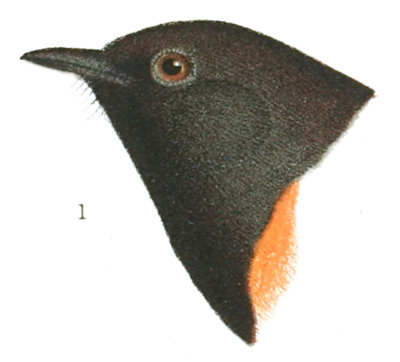
1. Setophaga ruticilla,
Linn. ♂ Pa., 984.
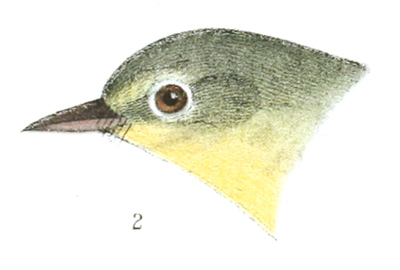
2. Myiodioctes minutus,
Aud. (Copied from Aud.)
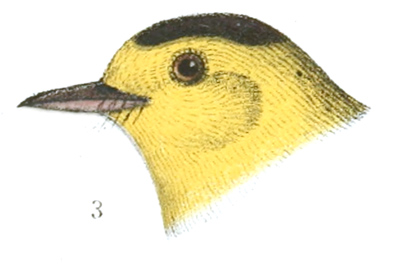
3. Myiodioctes pusillus,
Wils. ♂ Cal., 7683.
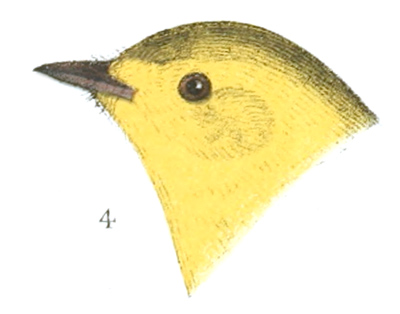
4. Myiodioctes pusillus,
Wils. ♀ Pa., 2325.
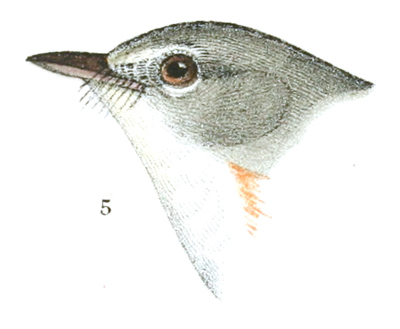
5. Setophaga ruticilla,
Linn. ♀ Pa., 2281.
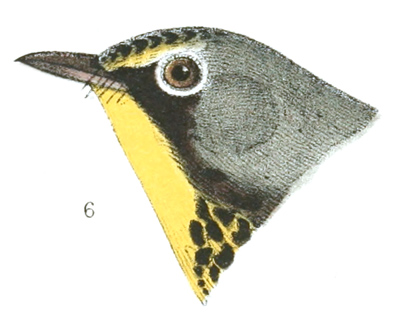
6. Myiodioctes canadensis,
Linn. ♂ Pa., 945.
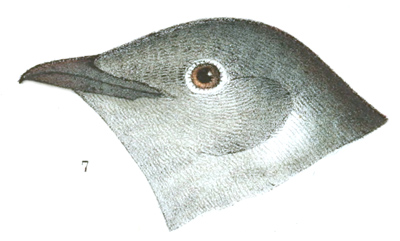
7. Progne subis,
Linn. ♀ 40704.
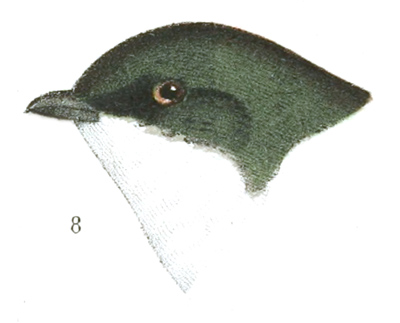
8. Tachycineta bicolor,
Vieill. ♂ Pa., 2896.
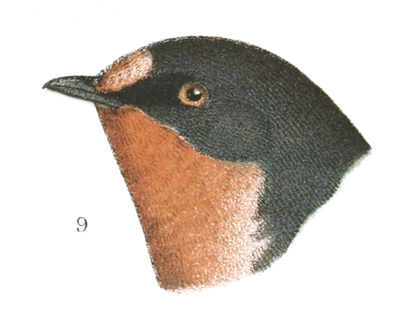
9. Hirundo horreorum,
Bart. ♂ Pa., 1452.
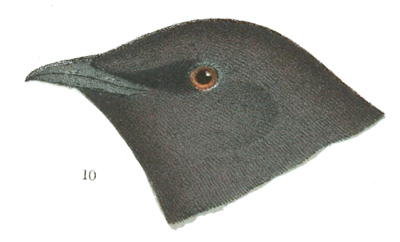
10. Progne subis,
Linn. ♂.
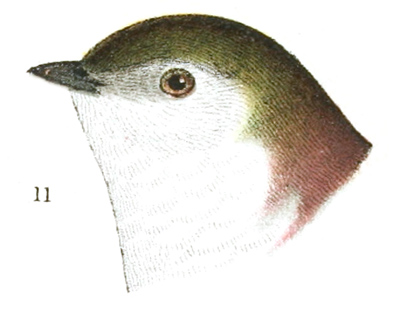
11. Tachycineta thalassina,
Swains. ♂ Oreg., 1895.
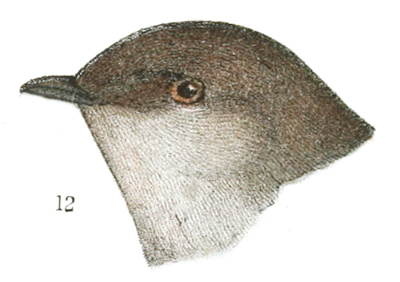
12. Stelgidopteryx serripennis,
Aud. ♂ 32269.
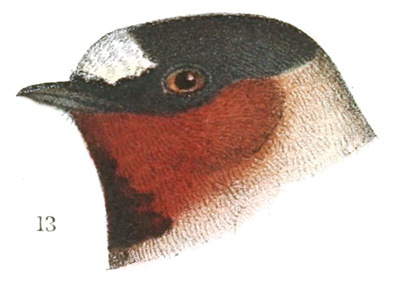
13. Petrochelidon lunifrons,
Say. ♂ 6622.
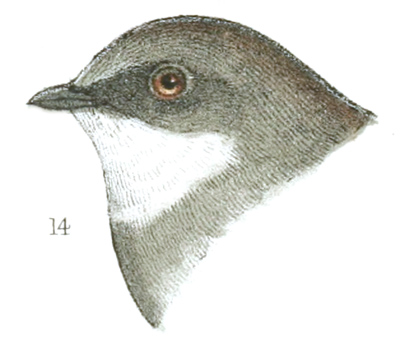
14. Cotyle riparia,
Linn. ♂ 20641.
Sp. Char.
Male. Prevailing color black. A central line on the breast, the abdomen,
and under tail-coverts white; some feathers in the latter strongly tinged with dark brown.
Bases of all the quills except the inner and outer, and basal half of all the tail-feathers except
the middle one, a patch on each side of the breast, and the axillary region, orange-red,
of a vermilion shade on the breast. Female with the black replaced by olive-green above,
by brownish-white beneath, the red replaced by yellow; the head tinged with ash; a
grayish-white lore and ring round the eye. Length, 5.25; wing, 2.50; tail, 2.45.
Hab.
Eastern and in part Middle Provinces of North America to Fort Simpson, west to
Great Salt Lake; Fort Laramie; Denver City; most of the West Indies; Mexico to Ecuador.
The young male in early autumn greatly resembles in plumage the adult
female, but has the upper tail-coverts and tail deep black, sharply contrasted
with the olive of the rump, instead of having the upper tail-coverts olive, the
tail simply dusky; in addition the back is more greenish-olive, and the
abdomen and crissum pure white. The male does not obtain the perfect
adult plumage until about the third year.
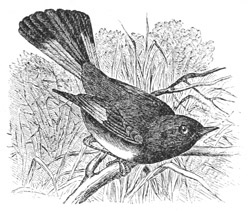
Setophaga ruticilla.
Habits. The so-called Redstart has an extended distribution from the
Atlantic to the Rocky Mountains, and
from Florida to high northern latitudes,
having been found breeding at Fort
Simpson by Mr. Ross, and at Fort
Resolution by Mr. Kennicott and Mr.
Lockhart. It is generally abundant in
suitable localities, and probably breeds
wherever found north of the Potomac.
It winters in large numbers in Guatemala
and in other parts of Central
America, as well as in the West Indies.
It is common in St. Croix in the spring,
and is especially seen about houses, according to Newton. It remains
there until the end of April.
Richardson found this species abundant on the Saskatchewan, as far to the
north as the fifty-eighth parallel. It appeared there the last of May, and
left early in September. He found it frequenting moist, shady lands, flitting
about among the moss-grown and twisted stems of the tall willows that
skirt the marshes. It was easily recognized by the red lining of its wings
as it flitted through the gloomy shades in pursuit of mosquitoes and other
winged insects.
Among the memoranda of the late Mr. Kennicott, we find two to the effect
that on the 26th of May he found both males and females of this species
common near Rainy Lake, and that on the 6th of June he also observed
these birds near Lake Winnepeg. June 14, at Fort Resolution, he obtained
a female Redstart with nest and four eggs. The nest was built in the fork
of a willow, in a thick but low wood of alder and willow. It was entirely
unprotected by leaves or branches. The female was taken on the nest.
The Newtons found this a very common species in St. Croix, in the spring
of the year, and it was especially seen about houses. For about a week, at
the end of April, 1857, they were extremely numerous. On their return from
their summer quarters, they were first observed September 6. Mr. Taylor
also mentions them as common in Trinidad. Mr. Ridgway found it a common
species among the willow thickets of the river valleys, west as far as
the Great Salt Lake.
This species, in its spring and autumnal migrations, is abundant in Louisiana
and Texas, as well as in the Gulf States. Wilson speaks of meeting
with it in the then “Mississippi Territory.” Audubon gives it as abundant
in Louisiana, and Nuttall as found throughout Louisiana and Arkansas into
Mexico. Mr. Dresser also mentions it as very common near San Antonio in
the spring and autumn, arriving on the Medina the 27th of April.
Dr. Coues says that the Redstart near Washington is chiefly a spring and
autumnal visitant, and but very few remain to breed. In the spring it is
very abundant from April 25 to May 20, and in the fall from the 1st to the
20th of September, in all woody and swampy situations. He found it in
the habit of running along slender twigs, sideways, and having a note very
similar to that of D. œstiva.
Although placed among the Oscines, where, as an excellent singer, it clearly
has a good right to be classed, it is yet also a true Flycatcher in habits and
manners. It is a lively, active bird, ever on the wing, and continually in
pursuit of insects. In this pursuit it never awaits the approach of its prey,
but, espying them at a distance, darts with great velocity in pursuit, and the
continued clicks of its bill attest the rapidity and frequency with which it
will overtake and catch insect after insect. Even when lamenting the loss
of a part of its brood, and flying around with cries of distress, the sight of
passing insects is a temptation not to be resisted, and the parent bird will
stop her lamentations to catch small flies.
Its notes are a varied twitter, rather than a song, a repetition of two simple
notes, uttered every few seconds as it seeks its prey, flying among the thick
foliage usually in dense groves. Its common habit is to glide along a branch,
between its smaller twigs, at times darting forth into more open spaces in
quest of insects it has espied.
Their nests are usually, though not always, built in a low branch, eight or
ten feet from the ground, in the midst of a thick grove. I have known it
to build in an open field and in close proximity to a dwelling. It keeps to
groves and thickets, and frequents moist places rather than dry, evidently
because of the greater abundance of insects, and not because of timid or
retiring habits. It is indeed far from being timid, and will permit a near
approach without any exhibitions of uneasiness. When its nest is visited,
the male bird manifests great disturbance, and flies back and forth around the
head of the intruder with cries of distress. The female is far less demonstrative,
and even when her nest is despoiled before her eyes is quite moderate
in the expression of her grief.
Its flight is graceful, easy, and rapid, varied by circumstances as it glides
in its intricate course among small interlacing branches, or darts rapidly forth
into more open space. As it moves, it is continually opening out, closing, or
flirting from side to side its conspicuous tail, the white spots in its expanded
feathers constantly appearing and disappearing.
In the construction of the nest there is a general uniformity of character,
although the materials differ and the localities are far apart. They are never
pendent, but are placed among three or more small upright branches, around
which it is firmly woven with vegetable flax-like fibres. A nest obtained in
Lynn, by Mr. George O. Welch (S. I. 3,778), in June, measures two inches
in height by three in diameter. It is a small, compact, and homogeneous
nest, composed almost entirely of shreds of savin-bark intermixed with soft
vegetable wool. Within are loosely intertwined minute vegetable fibres and
strips of bark, and a lining of horsehair, fine pine leaves, and dry grasses.
The nest contained four eggs. Another nest found in Grand Menan, June
24, 1851, was very similar in size, structure, and materials. It was in the
centre of a thick, swampy thicket, five feet from the ground, and contained
five eggs.
Another nest of this bird, obtained in Lynn by Mr. Welch, is only a
reconstruction of a nest begun by a pair of Dendroica œstiva, and either
abandoned by them, or from which they had been driven. Above the original
nest of the Warbler the Redstarts had constructed their own. The base
is composed of the downy covering of the under sides of the leaves of ferns,
mixed with a few herbaceous stems and leaves. Within this was built an
entirely distinct nest, composed of long and slender strips of bark, pine-needles,
and stems of grasses. These are firmly and elaborately interwoven
together.
A nest found in Hingham, built in a tree in an open space near a dwelling,
was seven feet from the ground, and of the usual size and shape. In
this the more usual strips of bark were replaced by hempen fibres of vegetables,
thistle-down, bits of newspaper, and other fragments. Within is a
strong lining of hair and fine stems of grasses. In this nest there were two
young, about half fledged, and two eggs nearly fresh. The latter were taken,
the female parent being present and making only a very slight protest,
stopping, from time to time, to catch insects.
The eggs of the Redstart vary considerably in their size and in their general
appearance, but resemble somewhat those of the common Summer
Yellow-Bird. They vary in length from .55 to .68 of an inch, and in their
breadth from .45 to .53. Their ground-color is a grayish-white, blotched
and clotted with purple, lilac, and brown.