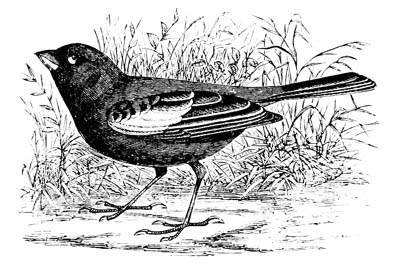
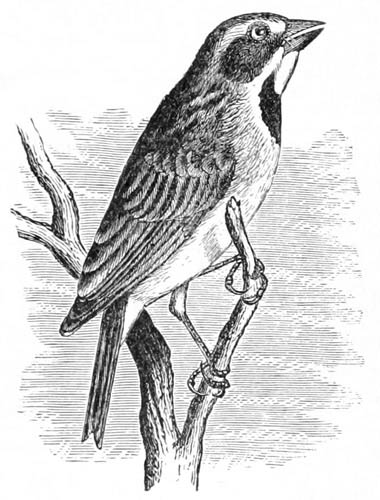
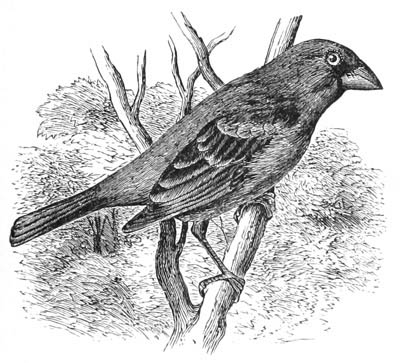
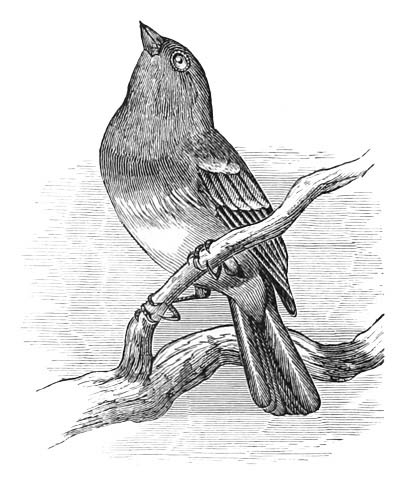
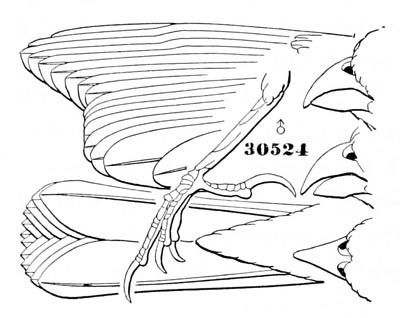
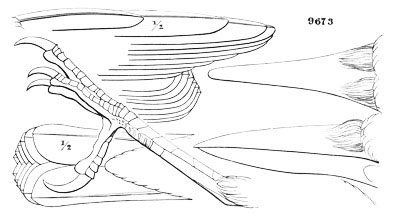
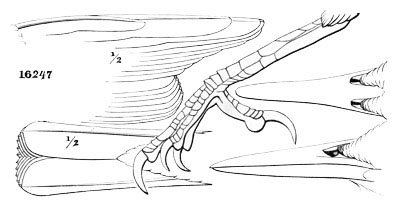
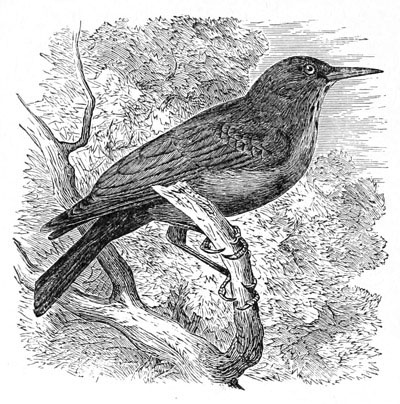
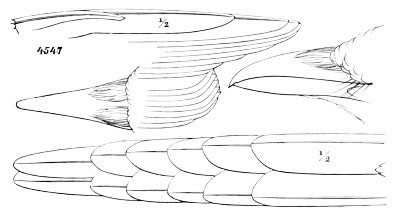
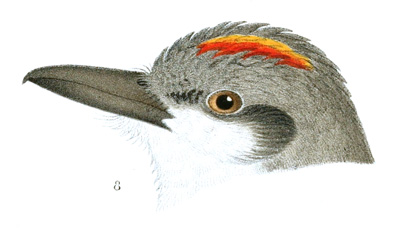
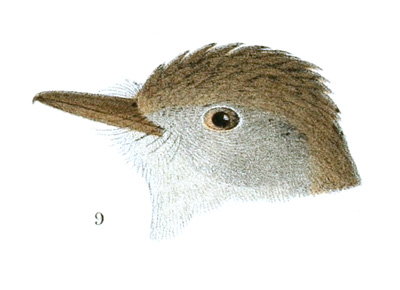
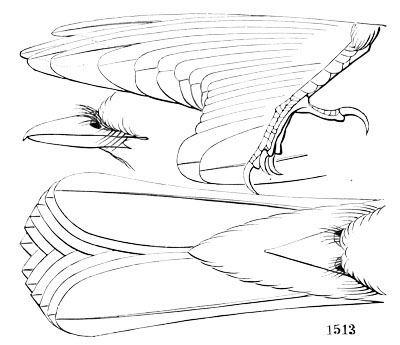
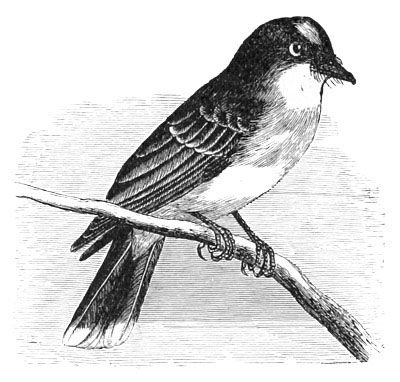
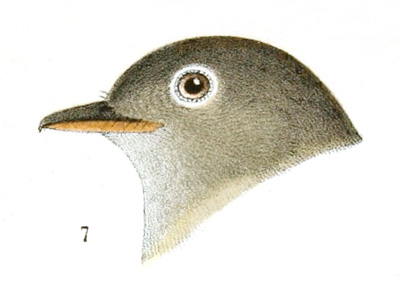
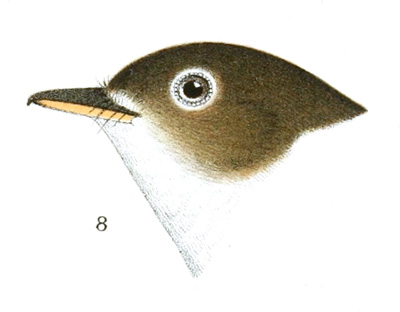
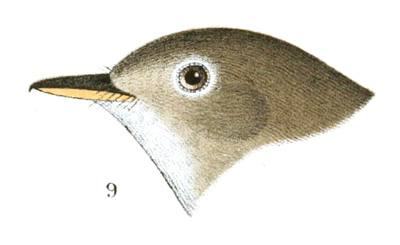
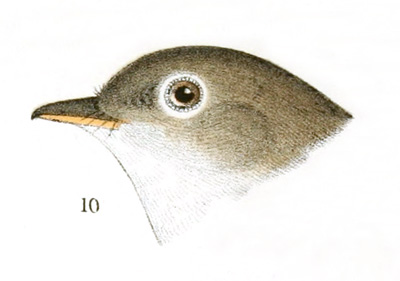
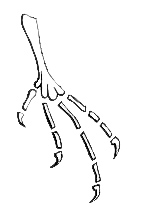
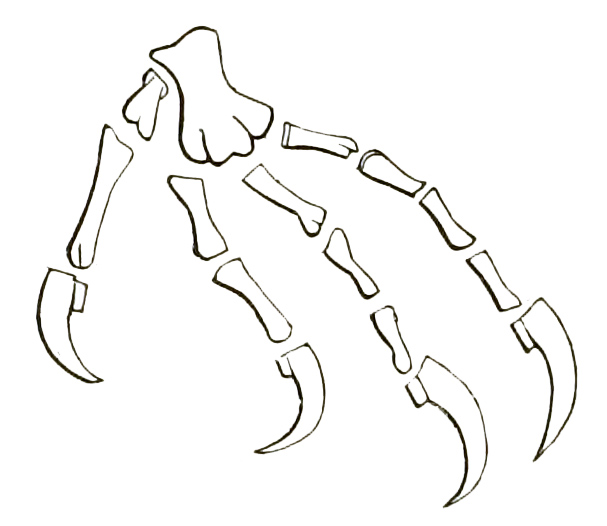
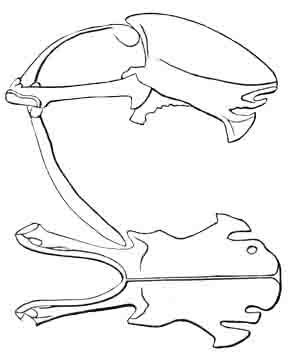
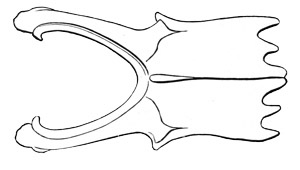
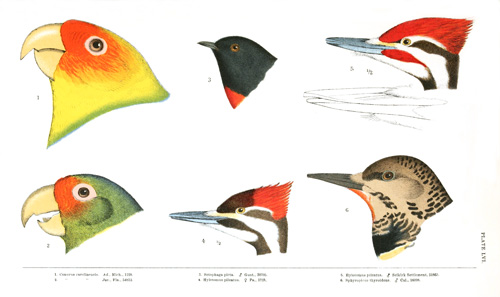
Subfamily PICINÆ.
The diagnosis on the preceding page will serve to distinguish this group
from its allies, without the necessity of going into greater detail. It includes
by far the largest percentage of the Picidæ, and in the great variations
of form has been variously subdivided by authors into sections. Professor
Sundevall, in his able monograph,[124]
establishes the following four series, referring
all to the single genus Picus:—
I. Angusticolles. Neck slender, elongated. Nostrils concealed by
bristles. Tail-feathers black or brownish, immaculate.
II. Securirostres. Neck not slender, and shorter. Nostrils concealed
by bristles. Bill stout, cuneate, with the nasal ridges widely distant
from each other.
III. Ligonirostres. Neck not slender. Nostrils covered, nasal ridges
of bill placed near the culmen (or at least nearer it than the lower
edge of the upper mandible), for the most part obsolete anteriorly.
IV. Nudinares. Nostrils open, uncovered by bristly hairs. Neck and
bill various.
Of these series, the first and second correspond with Piceæ, as given below,
while Centureæ and Colapteæ both belong to Ligonirostres. The Nudinares
are not represented in North America, and by only one group, Celeus, in any
portion of the continent.
In the following account of the Picinæ, we shall not pretend to discuss
the relationship of the North American species to the Picinæ in general,
referring to Sundevall’s work, and the monographs of Malherbe and Cassin,
for information on the subject. For our present purposes they may be conveniently,
even if artificially, arranged in the following sections:—
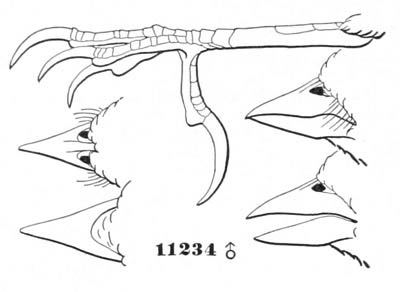
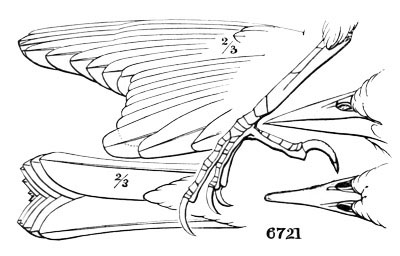
Piceæ. Bill variable in length; the outlines above and below nearly
straight; the ends truncated; a prominent ridge on the side of the
mandible springing from the middle of the base, or a little below, and
running out either on the commissure, or extending parallel to and a
little above it, to the end, sometimes obliterated or confluent with the
lateral bevel of the bill. Nostrils considerably overhung by the lateral
ridge, more or less linear, and concealed by thick bushy tufts of feathers
at the base of the bill. Outer posterior toe generally longer than the
anterior.
Centureæ. Bill rather long; the outlines, that of the culmen especially,
decidedly curved. The lateral ridge much nearest the culmen,
and, though quite distinct at the base, disappearing before coming to
the lower edge of the mandible; not overhanging the nostrils, which
are broadly oval, rounded anteriorly, and not concealed by the bristly
feathers at the base. Outer pair of toes nearly equal; the anterior
rather longer.
Colapteæ. Bill rather long, much depressed, and the upper outline
much curved to the acutely pointed (not truncate) tip. The commissure
considerably curved. Bill without any ridges. The nostrils broadly
oval, and much exposed. Anterior outer toe longest.
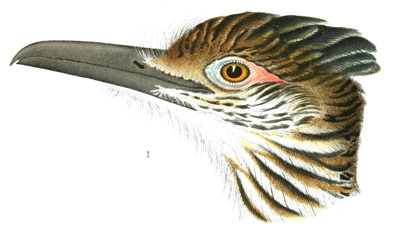
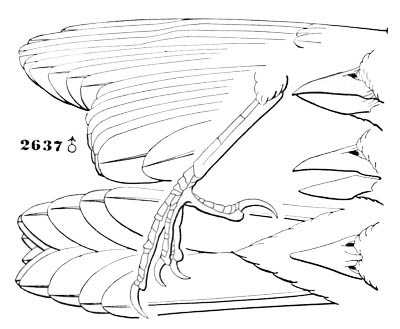
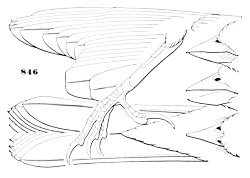
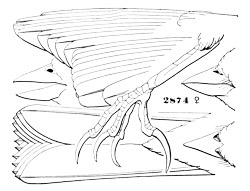
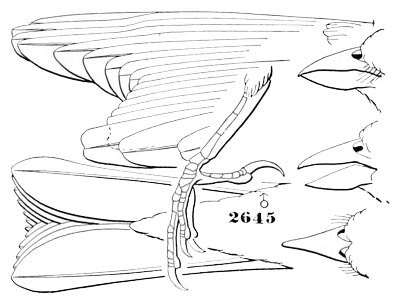
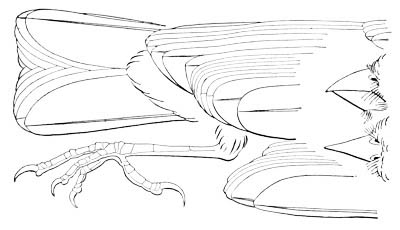
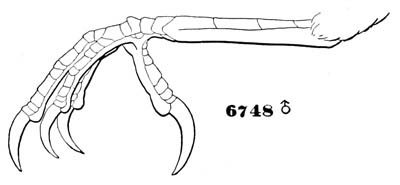
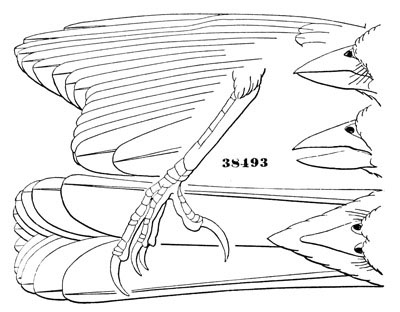
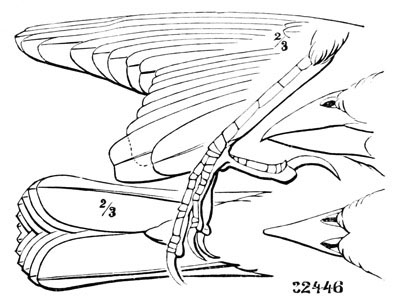
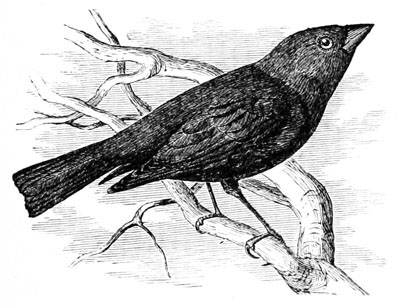
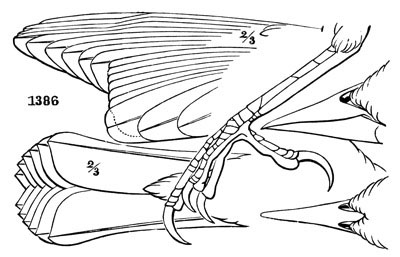
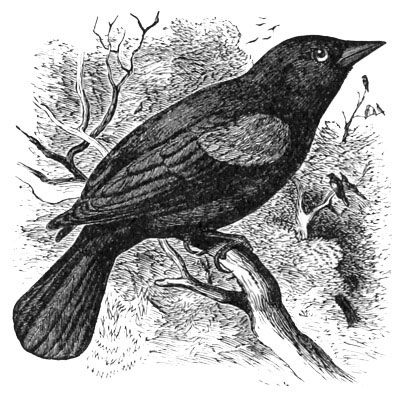
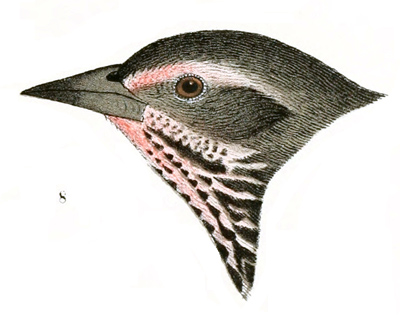
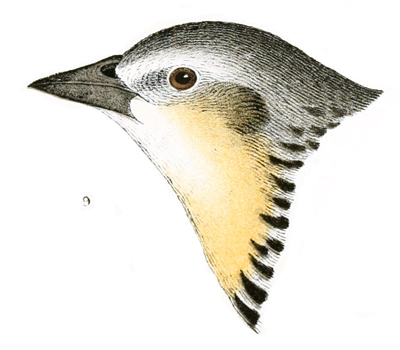
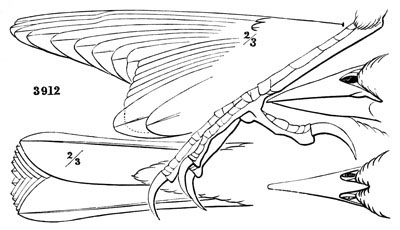
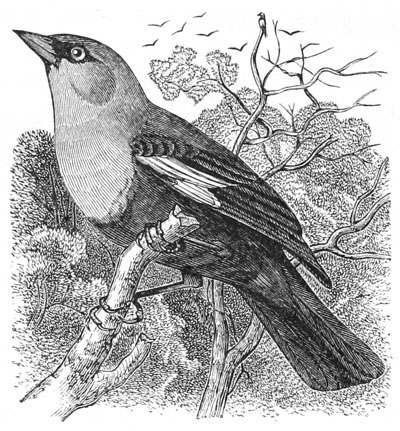
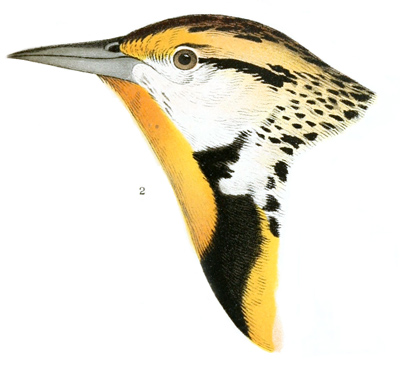
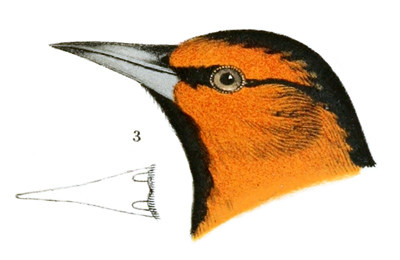
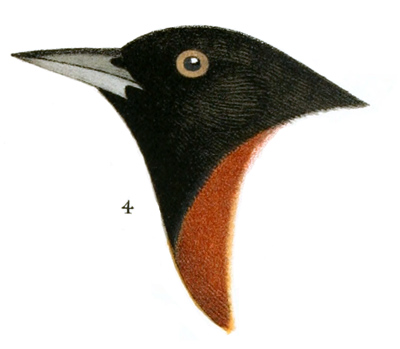
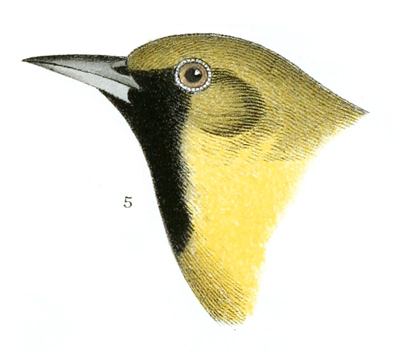
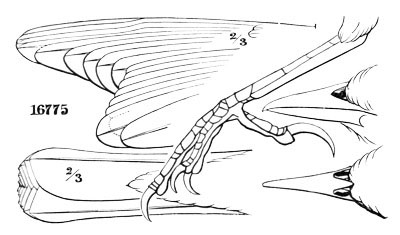
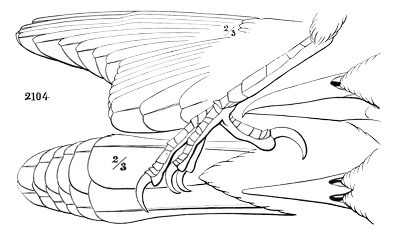
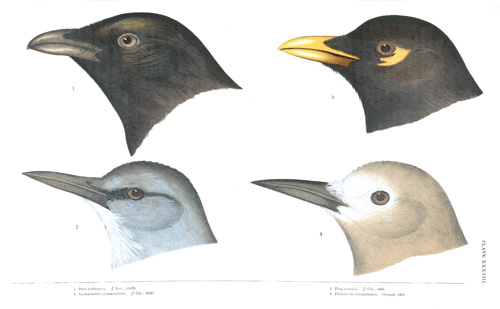
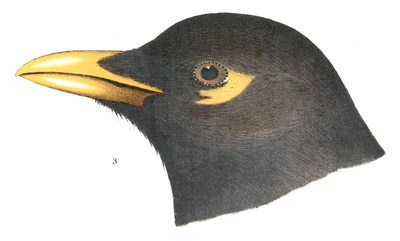
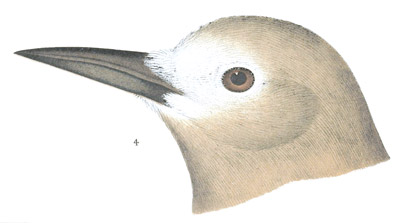
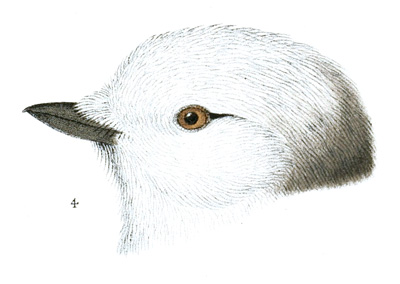
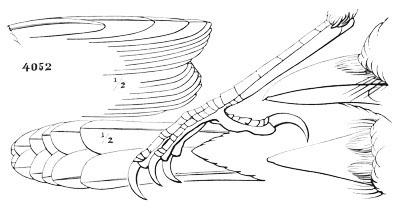
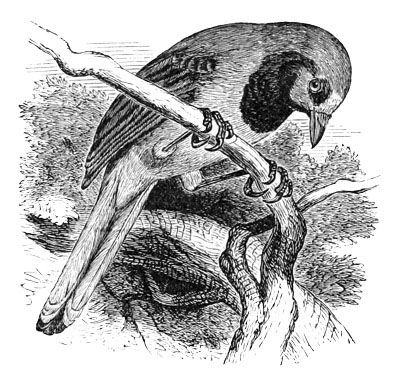
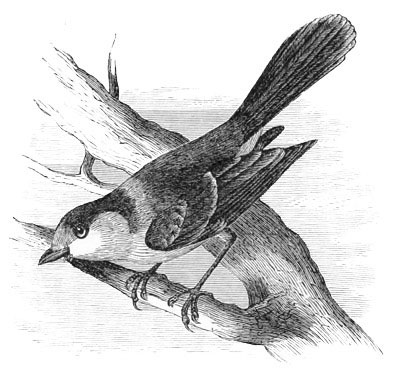
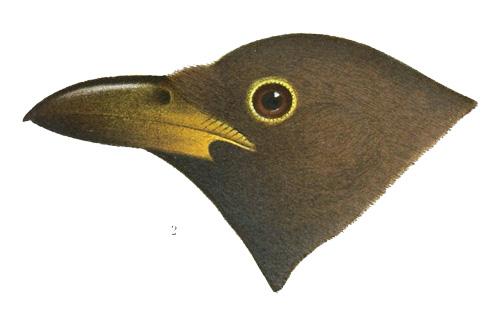
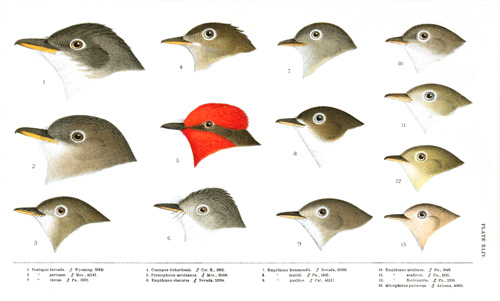
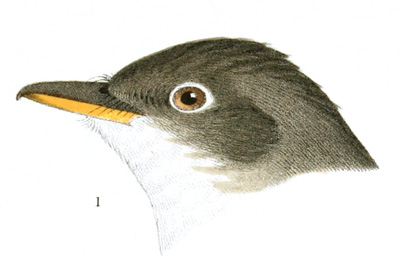
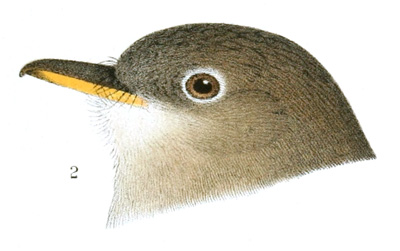
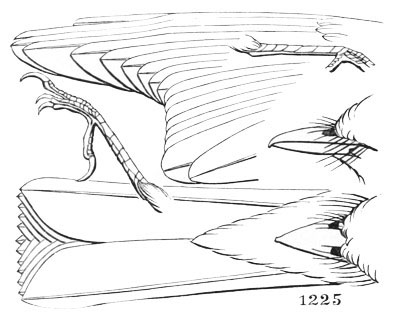
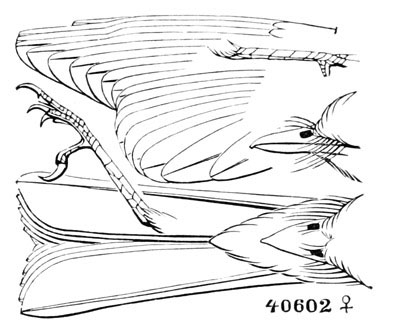
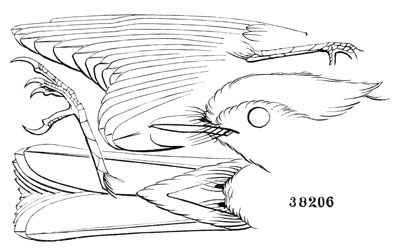
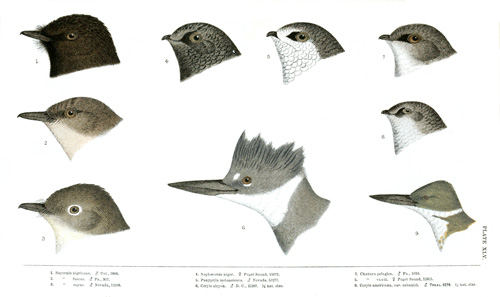
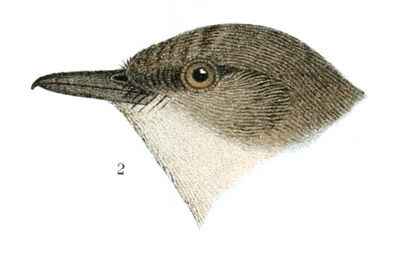
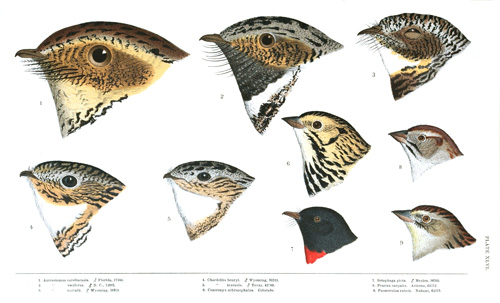
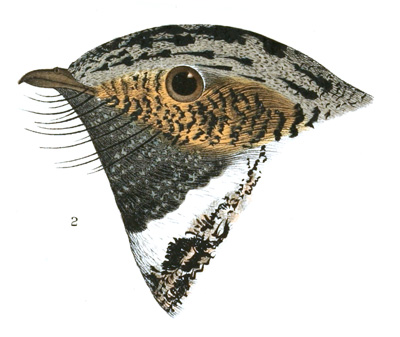
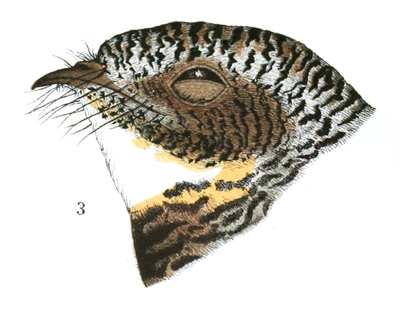
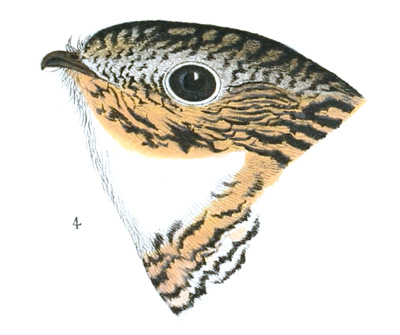
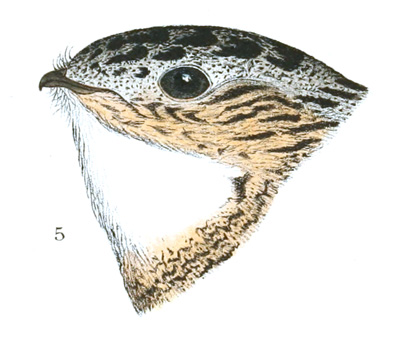
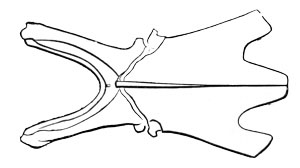
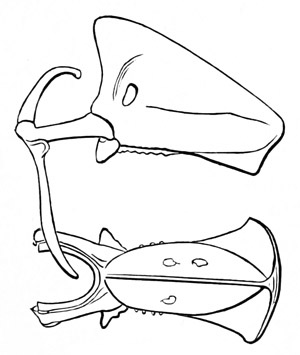
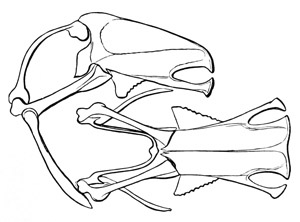
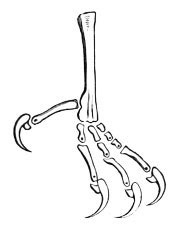
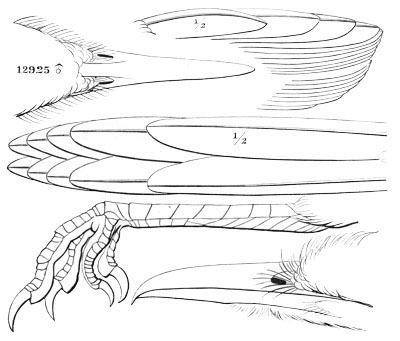
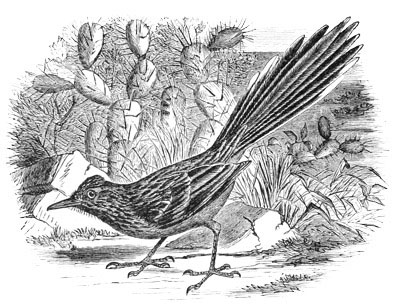
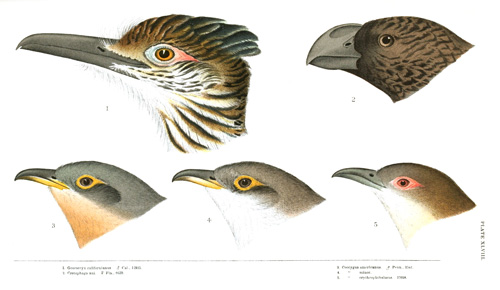
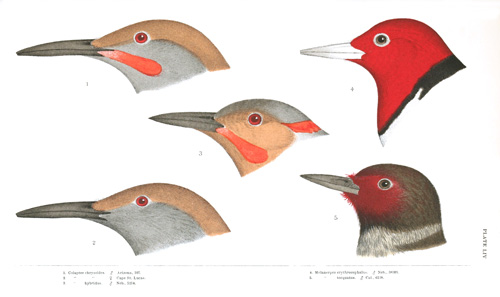
1. Geococcyx californianus ♂ Cal., 12925.
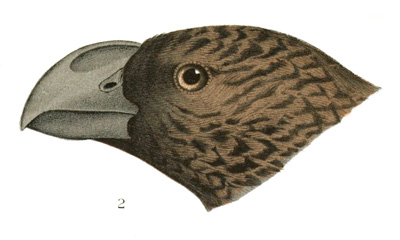
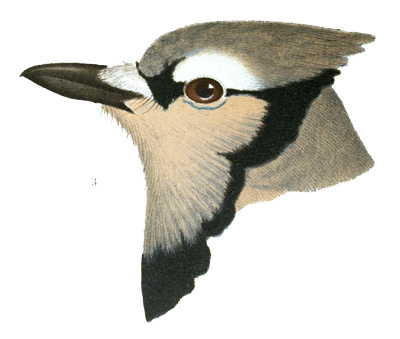
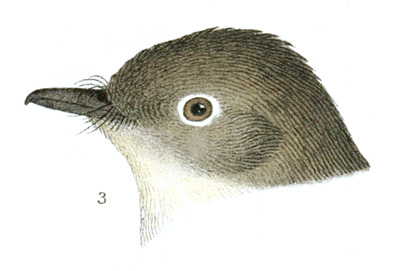
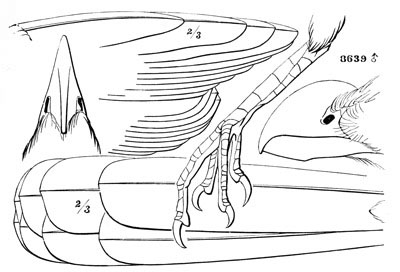
2. Crotophaga ani. ♀ Fla., 8639.
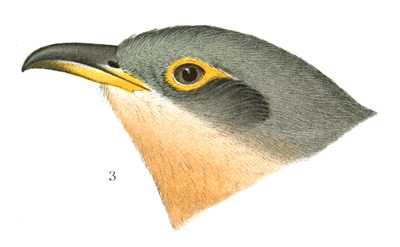
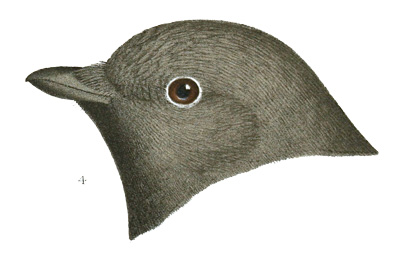
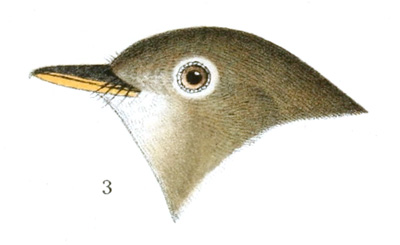
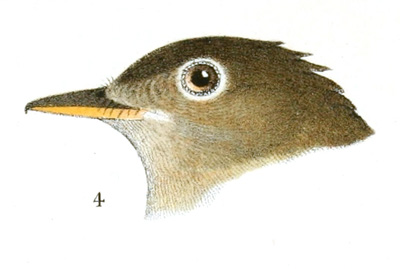
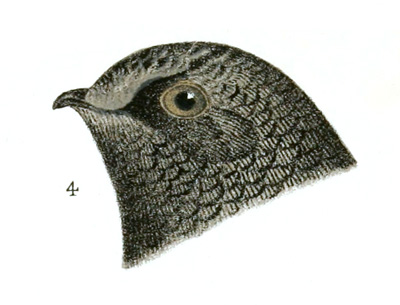
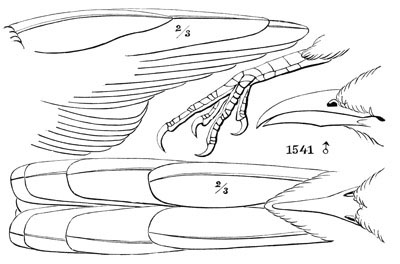
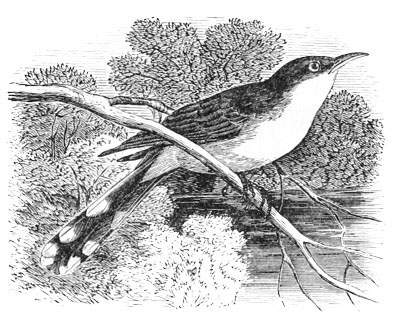
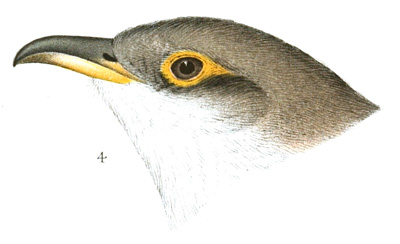
3. Coccygus americanus. ♂ Penn., 1541.
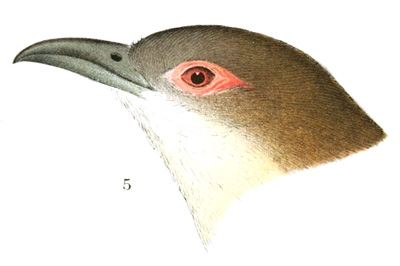
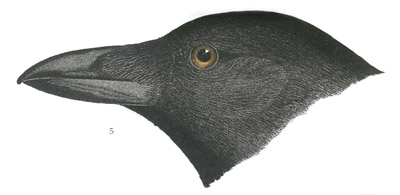
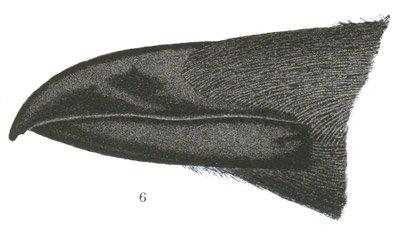
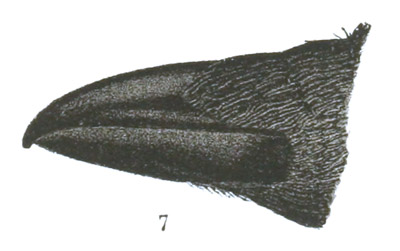
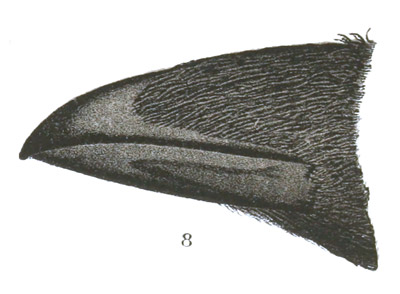
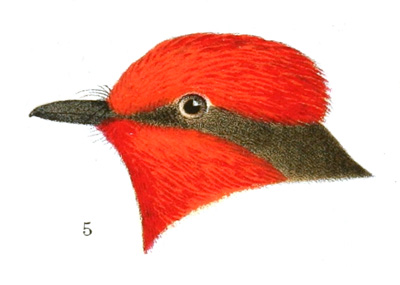
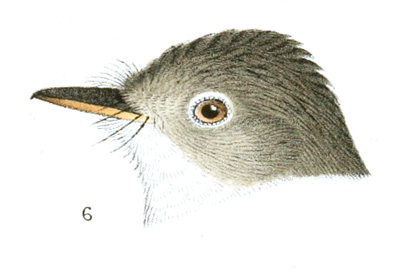
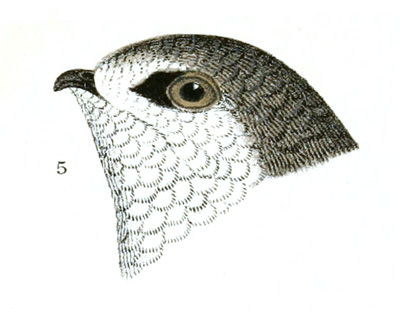
5. Coccygus erythrophthalmus. 27028.
The preceding diagnoses will serve to distinguish the three groups sufficiently
for our present purposes; the bill being strongest in the Picinæ and
best fitted for cutting into trees by its more perfect wedge-shape, with
strengthening ridges, as well as by the lateral bevelling of both mandibles,
which are nearly equal in thickness at the base, and with their outlines
nearly straight. The lateral ridge is prominent, extending to the edge or
end of the bill, and overhangs the nostrils, which are narrow and hidden.
The Centureæ and the Colapteæ have the upper mandible more curved
(the commissure likewise), the lower mandible smaller and weaker, the
bill with little or no lateral bevelling. The nostrils are broadly oval and
exposed. In the former, however, there is a distinct lateral ridge visible
for a short distance from the base of the bill; while in the other there
is no ridge at all, and the mandible is greatly curved.
In all the species of North American Woodpeckers, there is more or less
red on the head in the male, and frequently in the female. The eggs of all
are lustrous polished white, without any markings, and laid in hollow trees,
upon a bed of chips, no material being carried in for the construction of the
nest.
Section PICEÆ.
With the common characters, as already given, there are several well-marked
generic groups in this section of Woodpeckers which may be arranged
for the United States species as follows:—
A. Posterior outer toe longer than the anterior outer one. (Fourth toe longer
than third.)
a. Lateral ridge starting above the middle of the base of the bill, and
extending to the tip.
1. Campephilus. Lateral ridge above the middle of the lateral profile
of the bill when opposite the end of the nostrils, which are ovate, and
rounded anteriorly. Bill much depressed, very long; gonys very long.
Posterior outer toe considerably longer than the anterior. Primaries
long, attenuated towards the tip. Spurious quill nearly half the second.
Shafts of four middle tail-feathers remarkably stout, of equal size, and
abruptly very much larger than the others; two middle tail-feathers
narrower towards bases than towards end.[125]
A pointed occipital crest.
2. Picus. Lateral ridge in the middle of the lateral profile opposite the
end of the nostrils, which are ovate and sharp-pointed anteriorly. Bill
moderate, nearly as broad as high.
Outer hind toe moderately longer than the outer fore toe. Primaries
broad to the tip, and rounded. Spurious primary not one third the
second quill.
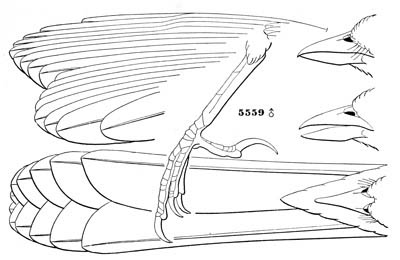
3. Picoides. Lateral ridge below the middle of the profile, opposite
the end of the ovate acute nostrils, which it greatly overhangs. Bill
greatly depressed; lower mandible deeper than the upper. Inner
hind toe wanting, leaving only three toes. Tufts of nasal bristles very
full and long.
b. Lateral ridge starting below the middle of the base of the bill, and
running as a distinct ridge into the edge of the commissure at about its
middle; the terminal half of the mandible rounded on the sides, although
the truncate tip is distinctly bevelled laterally.
4. Sphyropicus. Nostrils considerably overhung by the lateral ridge,
very small, linear. Gonys as long as the culmen, from the nostrils.
Tips of tail-feathers elongated and linear, not cuneate. Wings very
long; exposed portion of spurious primary about one fourth that of
second quill.
B. Posterior outer toe considerably shorter than the anterior outer one. (Fourth
toe shorter than third).
5. Hylotomus. Bill depressed. Lateral ridge above the middle of
the lateral profile near the base. Nostrils elliptical, wide, and rounded
anteriorly. Tail almost as in Sphyropicus. A pointed occipital crest,
as in Campephilus, and not found in the other genera.
The arrangement in the preceding diagnosis is perhaps not perfectly
natural, although sufficiently so for our present purpose. Thus, Hylotomus,
in having the lateral ridge extending to the end of the bill, is like Picus,
but the nostrils are broader, more open, and not acute anteriorly. The tail-feathers
of Sphyropicus differ greatly from those of the others in being
abruptly acuminate, the points elongated, narrow, and nearly linear, instead
of being gently cuneate at the ends. Campephilus and Hylotomus belong
to Sundevall’s Angusticolles, with their long slender neck, and elongated
occipital crest (Dryocopinæ, Cab.); the other genera to Securirostres, with
shorter, thicker neck, and no crest (Dendrocopinæ, Cab.). But no two
genera in the subfamily are more distinct than Campephilus and Hylotomus.
Genus CAMPEPHILUS, Gray.
Campephilus, Gray, List of Genera? 1840. (Type, C. principalis.)
Megapicus, Malherbe, Mém. Ac. de Metz, 1849, 317.
Gen. Char.
Bill considerably longer than the head, much depressed, or broader than
high at the base, becoming somewhat compressed near the middle and gradually bevelled
off at the tip. Culmen very slightly curved, gonys as concave, the curve scarcely appreciable;
commissure straight. Culmen with a parallel ridge on each side, starting a
little above the centre of the basal outline of the bill, the ridge projecting outwards and
downwards, and a slight concavity between it and the acute ridge of the culmen. Gonys
considerably more than half the commissure. Nostrils oval below the lateral ridge near
the base of the bill; concealed by the bristly feathers directed forward. Similar feathers
are seen at the sides of the lower jaw and on the chin.
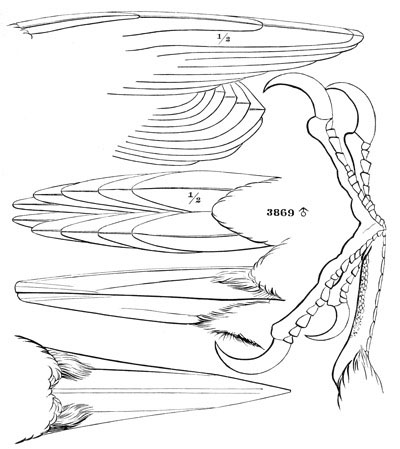
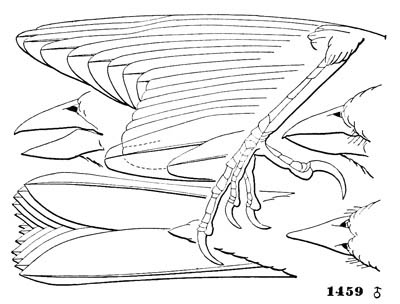
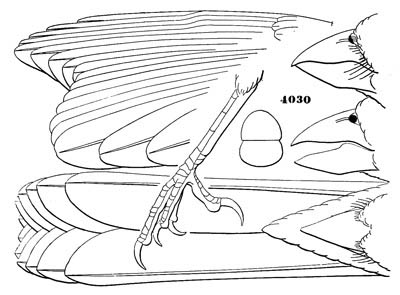
Campephilus principalis.
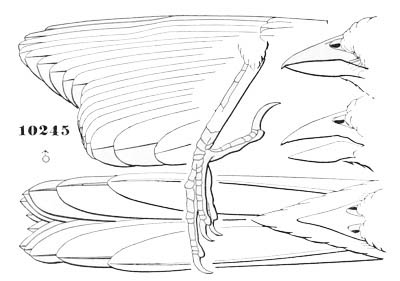
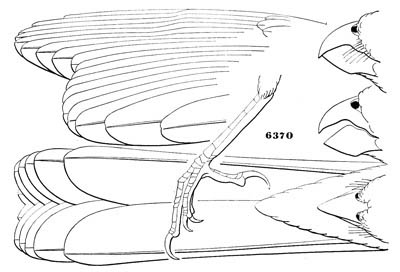
3869 ♂
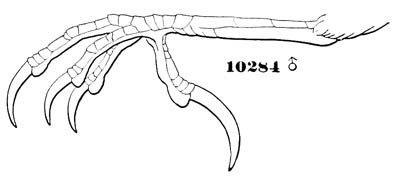
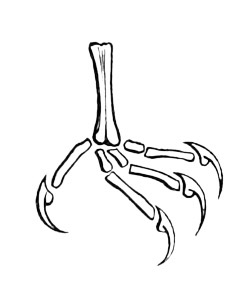
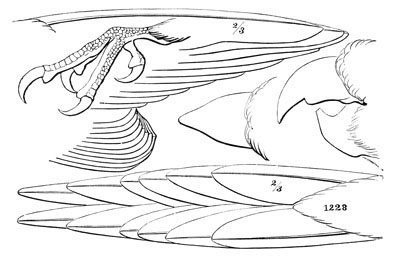
Feet large; outer hind toe much longest; claw of inner fore toe reaching to middle of
outer fore claw; inner hind toe scarcely more than half the outer one; its claw reaching
as far as the base of the inner anterior claw, considerably more than half the outer
anterior toe. Tarsus rather shorter than the inner fore toe. Tail long, cuneate; shafts
of the four middle feathers abruptly much larger than the others, and with a deep groove
running continuously along their under surface; webs of the two middle feathers
deflected, almost against each other, so that the feathers appear narrower at the base
than terminally. Wings long and pointed, the third, fourth, and fifth quills longest;
sixth secondary longest, leaving six “tertials,” instead of three or four as usual; primaries
long, attenuated. Color continuous black, relieved by white patches. Head with a
pointed occipital crest.
This genus embraces the largest known kind of Woodpecker, and is confined
to America. Of the two species usually assigned to it, only one occurs
within the limits of the United States, C. imperialis, given by Audubon,
and by subsequent authors on his credit, really belonging to Southern Mexico
and Central America. The diagnoses of the species are as follows:—
Common Characters. Bill ivory-white. Body entirely glossy blue-black. A
scapular stripe, secondaries, ends of inner primaries, and under wing-coverts,
white. Crest scarlet in the male, black in the female.
1. C. principalis. A white stripe on each side of the neck. Bristly
feathers at the base of the bill white.
White neck-stripe not extending to the base of the bill. Black
feathers of crest longer than the scarlet. Wing, 10.00; culmen, 2.60.
Hab. Gulf region of United States
… var. principalis.
White stripe reaching the base of the bill. Scarlet feathers of crest
longer than the black. Wing, 9.50; culmen, 2.40. Hab. Cuba
… var. bairdi.[126]
2. C. imperialis. No white stripe on the sides of the neck. More white
on the wings. Bristly feathers at the base of the bill black. Hab. South
Mexico; Guatemala.
Campephilus principalis, Gray.
IVORY-BILLED WOODPECKER.
Picus principalis, Linn. Syst. Nat. I, 1766, 173.—Wilson, Am. Orn. IV, 1811, 20, pl.
xxxix, f. 6.—Wagler, Syst. Avium, 1827, No. 1.—Aud. Orn. Biog. I, 1832, 341;
V, 525, pl. lxvi.—Ib. Birds America, IV, 1842, 214, pl. cclvi.—Sundevall, Consp.
Pic. 4. Dendrocopus principalis, Bon. List, 1838. Campephilus principalis, Gray,
List Genera, 1840.—Baird, Birds N. Am. 83.—Cab. & Hein. Mus. Hein. IV, II,
100.—Dresser, Ibis, 1865, 468 (breeds in Brazos and Trinity, Texas).—Gray, Cat.
53.—Allen, Birds E. Florida, 301. Dryotomus (Megapicus) principalis, Bon. Con.
Zyg. Aten. Ital. 1854, 7. Dryocopus principalis, Bon. Consp. 1850, 132. White-billed
Woodpecker, Catesby, Car. I, 16.—Pennant, Latham.
Sp. Char.
Fourth and fifth quills equal; third a little shorter. Bill horn-white.
Body entirely of a glossy blue-black (glossed with green below); a white stripe beginning
half an inch posterior to the commissure, and passing down the sides of the neck, and
extending down each side of the back. Under wing-coverts, and the entire exposed
portion of the secondary quills, with ends of the inner primaries, bristles, and a short
stripe at the base of the bill, white. Crest scarlet, upper surface black. Length, 21.00;
wing, 10.00. Female similar, without any red on the head, and with two spots of white
on the end of the outer tail-feather.
Hab.
Southern Atlantic and Gulf States. North to North Carolina and mouth of the
Ohio; west to Arkansas and Eastern Texas. Localities: Brazos and Trinity Rivers,
Texas (Dresser, Ibis, 1865, 468, breeds).
In the male the entire crown (with its elongated feathers) is black. The
scarlet commences just above the middle of the eye, and, passing backwards
a short distance, widens behind and bends down as far as the level of the
under edge of the lower jaw. The feathers which spring from the back of
the head are much elongated above; considerably longer than those of
the crown. In the specimen before us the black feathers of the crest do
not reach as far back as the scarlet.
Reference has already been made to the Cuban variety of the Ivory-billed
Woodpecker named C. bairdi by Mr. Cassin, and differing in smaller size;
extension of the white cheek-stripe to the very base of the bill, and the
excess in length of the upper black feathers of the crest over the scarlet.
These features appear to be constant, and characteristic of a local race.
For the reasons already adduced, we drop C. imperialis from the list of
North American birds, although given as such by Audubon.
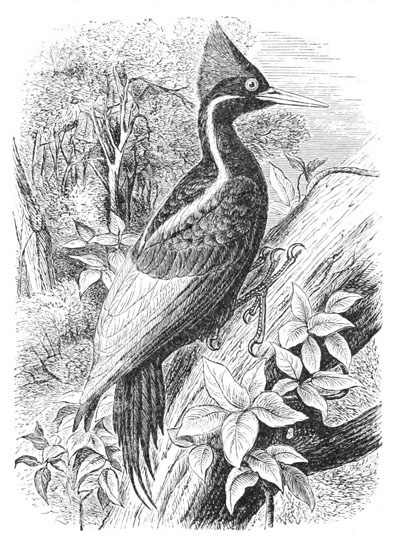
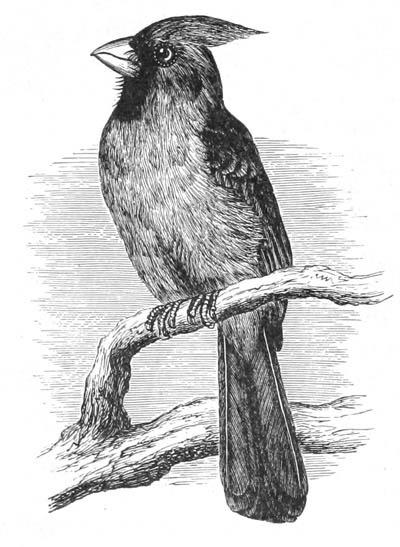
Campephilus principalis.
Habits. So far as we have information in regard to the geographical distribution
of the Ivory-billed Woodpecker, it is chiefly restricted in its range
to the extreme Southern States,
and especially to those bordering
on the Gulf of Mexico. Wilson
states that very few, if any, are
ever found north of Virginia,
and not many even in that State.
His first specimen was obtained
near Wilmington, N. C. It is
not migratory, but is a resident
where found.
Mr. Audubon, who is more
full than any other writer in his
account of this bird, assigns to it a
more extended distribution. He
states that in descending the
Ohio River he met with it near
the confluence of that river with
the Mississippi, and adds that it
is frequently met with in following
the windings of the latter
river either downwards towards
the sea, or upwards in the direction
of the Missouri. On the Atlantic
he was inclined to make North Carolina the limit of its northern
distribution, though now and then individuals of the species have been
accidentally met with as far north as Maryland. To the westward of the
Mississippi he states that it is found in all the dense forests bordering the
streams which empty into it, from the very declivities of the Rocky Mountains.
The lower parts of the Carolinas, Georgia, North Florida, Alabama,
Louisiana, and Mississippi, are, however, its favorite resorts, and in those
States it constantly resides.
It was observed by Dr. Woodhouse in the timber on the Arkansas River,
and in Eastern Texas, but quite rarely in both places. It was not, however,
met with in any other of the government expeditions, either to the Pacific,
in the survey of the railroad routes, or in that for the survey of the Mexican
boundary line. It is given as a bird of Cuba by De la Sagra, in his catalogue
of the birds of that island, as observed by him, October, 1850, and by Dr.
John Gundlach, in his list of the birds that breed in Cuba. It is not mentioned
by Gosse among the birds of Jamaica, nor by the Newtons as found
in St. Croix. As it is not a migratory bird, it may be regarded as breeding in
all its localities, except where it is obviously an accidental visitant.
Wilson, who never met with the nest of this Woodpecker, states, on the
authority of reliable informants, that it breeds in the large-timbered cypress
swamps of the Carolinas. In the trunks of these trees at a considerable
height from the ground, both parents working alternately, these birds dig out
a large and capacious cavity for their eggs and young. Trees thus dug out
have frequently been cut down with both the eggs and the young in them.
The hole was described to Wilson as generally a little winding, to keep out
the rain, and sometimes five feet deep. The eggs were said to be generally
four, sometimes five in number, as large as pullets’, pure white, and equally
thick at both ends. The young make their appearance about the middle or
end of June.
Mr. Audubon, whose account of the breeding-habits of the Ivory-bill is
given from his own immediate observations, supplies a more minute and detailed
history of its nesting. He states that it breeds earlier in spring than
any other species of its tribe, and that he has observed it boring a hole for
that purpose as early as the beginning of March. This hole he believed to
be always made in the trunk of a live tree, generally an ash or a hackberry,
and at a great height. It pays great regard to the particular situation of the
tree and the inclination of the trunk, both with a view to retirement and to
secure the aperture against rains. To prevent the latter injury, the hole is
generally dug immediately under the protection of a large branch. It is
first bored horizontally a few inches, then directly downward, and not in a
spiral direction, as Wilson was informed. This cavity is sometimes not
more than ten inches in depth, while at other times it reaches nearly three
feet downward into the heart of the tree. The older the bird, the deeper its
hole, in the opinion of Mr. Audubon. The average diameter of the different
nests which Mr. Audubon examined was about seven inches in the inner
parts, although the entrance is only just large enough to admit the bird.
Both birds work most assiduously in making these excavations. Mr. Audubon
states that in two instances where the Woodpeckers saw him watching
them at their labors, while they were digging their nests, they abandoned
them. For the first brood, he states, there are generally six eggs. These are
deposited on a few chips at the bottom of the hole, and are of a pure white
color. The young may be seen creeping out of their holes about a fortnight
before they venture to fly to any other tree. The second brood makes its
appearance about the 15th of August. In Kentucky and Indiana the Ivory-bill
seldom raises more than one brood in a season. Its flight is described
by Audubon as graceful in the extreme, though seldom prolonged to more
than a few hundred yards at a time, except when it has occasion to cross a
large river. It then flies in deep undulations, opening its wings at first to
their full extent, and nearly closing them to renew their impulse. The
transit from tree to tree is performed by a single sweep, as if the bird had
been swung in a curved line from the one to the other.
Except during the love-season it never utters a sound when on the wing.
On alighting, or when, in ascending a tree, it leaps against the upper parts
of the trunk, its remarkable voice may be constantly heard in a clear, loud,
and rather plaintive tone, sometimes to the distance of half a mile, and
resembling the false high note of a clarionet. This may be represented by
the monosyllable pait thrice repeated.
The food of this Woodpecker consists principally of beetles, larvæ, and
large grubs. They are also especially fond of ripe wild grapes, which they
eat with great avidity, hanging by their claws to the vines, often in the
position of a Titmouse. They also eat ripe persimmons, hackberries, and
other fruit, but are not known to disturb standing corn nor the fruits of the
orchard.
These birds attack decaying trees so energetically as often to cause them
to fall. So great is their strength, that Audubon has known one of them
to detach, at a single blow, a strip of bark eight inches long, and, by beginning
at the top branch of a dead tree, tear off the bark to the extent of
thirty feet in the course of a few hours, all the while sounding its loud
notes.
Mr. Audubon further states that this species generally moves in pairs, that
the female is the least shy and the most clamorous, and that, except when
digging a hole for the reception of their eggs, they are not known to
excavate living trees, but only those attacked by worms. When wounded,
they seek the nearest tree, and ascend with great rapidity by successive hops.
When taken by the hand, they strike with great violence, and inflict severe
wounds with their bills and claws.
Mr. Dresser states that these birds were found on the Brazos River, and
also on the Trinity, where they were by no means rare.
Wilson dwells at some length and with great force upon the great value
of these birds to our forests. They never injure sound trees, only those
diseased and infested with insects. The pine timber of the Southern States
is often destroyed, thousands of acres in a season, by the larvæ of certain insects.
In Wilson’s day this was noticeable in the vicinity of Georgetown,
S. C., and was attributed by him to the blind destruction of this and other
insect-eating birds.
An egg of this species (Smith. Coll., No. 16,196) taken near Wilmington,
N. C., by Mr. N. Giles, measures 1.35 inches in length by .95 of an
inch in breadth. It is of a highly polished porcelain whiteness, and is much
more oblong in shape and more pointed than are the eggs of Hylotomus
pileatus.
Genus PICUS, Linnæus.
Picus, Linn. Syst. Nat. 1748. (Type, Picus martius, L.)
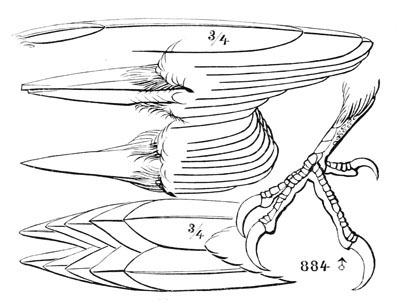
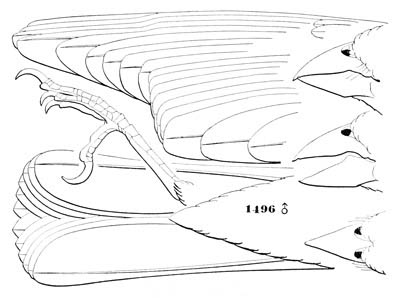
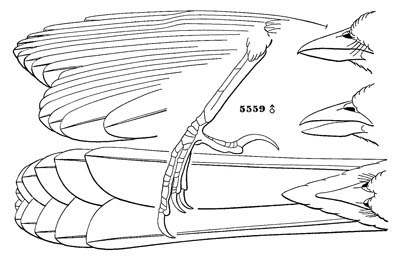
Picus villosus.
884 ♂
Gen. Char.
Bill equal to the head, or a little longer; the lateral ridges conspicuous,
starting about the middle of the
base of the bill; the basal
elongated oval nostrils nearest
the commissure; the ridges of
the culmen and gonys acute,
and very nearly straight, or
slightly convex towards the
tip; the bill but little broader
than high at the base, becoming
compressed considerably before
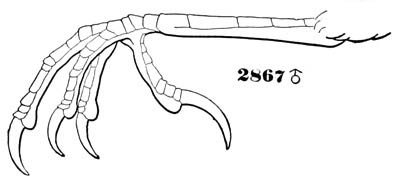
the middle. Feet much as in
Campephilus; the outer posterior
toe longest; the outer
anterior about intermediate
between it and the inner anterior;
the inner posterior
reaching to the base of the claw
of the inner anterior. Tarsus about equal to the inner anterior toe; shorter than the
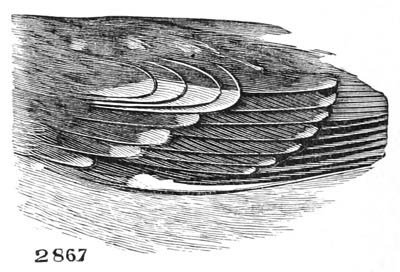
two other long toes. Wings rather long, reaching to the middle of the tail, rather rounded;
the fourth and fifth quills longest; the quills rather broad and rounded.
In the genus Picus, as characterized above, are contained several subdivisions
more or less entitled to distinct rank, and corresponding with
peculiar patterns of coloration. Thus, taking the P. villosus as the type, P.
borealis has proportionally much longer primaries; the spurious primary
smaller; the bill is considerably more attenuated, and even concave in its
lateral outlines. The wings are still longer in P. albolarvatus. The species
may be arranged as follows:—
A. Black above, and white beneath. Wings spotted with white; a black
maxillary stripe.
a. Two white stripes on the side of the head, one above, and the other
below, the ear-coverts, which are mostly black. First quill shorter than
sixth. Tail-feathers broad and obtuse at ends, the narrowed tips of middle
feathers very short.
DRYOBATES, Boie. Middle of back streaked longitudinally and continuously
with white. Maxillary and auricular black stripes not confluent;
the latter running into the black of the nape. Beneath white
without spots. Red of head confined to a narrow nuchal band.
1. P. villosus. Outer tail-feathers immaculate white, great variation
in size with latitude. Length, 7.00 to 10.00.
All the quills, with middle and greater wing-coverts, with
large white spots. Hab. Eastern North America
… var. villosus.
Innermost quills and some of the coverts entirely black,
or unspotted with white. Remaining spots reduced in size.
(Var. jardini similar, but much smaller, 7.00, and lower parts
smoky-brown.) Hab. Middle and western North America,
and south to Costa Rica
… var. harrisi.
2. P. pubescens. Outer tail-feather white, with transverse black
bands; length about 6.25.
All the quills, with middle and greater wing-coverts, with
large white spots. Hab. Eastern North America
… var. pubescens.
Innermost quills and some of the coverts entirely black;
remaining white spots reduced in size. Hab. Western North
America … var. gairdneri.
DYCTIOPICUS, Bon. Whole back banded transversely with black
and white. Beneath white, with black spots on sides. Maxillary
and auricular black stripes confluent at their posterior ends, the latter
not running into the nape. In the males at least half of top of head
red. Length, about 6.50.
3. P. scalaris. Anterior portion of the back banded with white;
lores and nasal tufts smoky brown. Black stripes on sides of the
head very much narrower than the white ones, and not connected
with the black of the shoulders. Male with the whole crown red.
Outer web of lateral tail-feathers barred with black to the
base. White bands on back exceeding the black ones in width;
red of the crown very continuous, on the forehead predominating
over the black and white. (Sometimes the black at
base of inner web of lateral tail-feather divided by white
bars.) Hab. Southern and Eastern Mexico, and Rio Grande
region of United States
… var. scalaris.
Outer web of lateral tail-feather barred with black only
toward end. Red of crown much broken anteriorly, and in
less amount than the black and white mixed with it. White
bands of the back not wider, generally much narrower than
the black ones.
Bill, .90; tarsus, .70. Red of crown extending almost to
the bill. Hab. Western Mexico, up to Western Arizona
… var. graysoni.
Bill, 1.10; tarsus, .75. Red of crown disappearing about
on a line above the eye. Hab. Cape St. Lucas
… var. lucasanus.
4. P. nuttalli. Anterior portion of back not banded with white; lores
and nasal tufts white. Black stripes on side of the head very much
broader than the white ones, and connected by a narrow strip with the
black of the shoulders. Male with only the nape and occiput red.
Hab. California (only).
b. One white stripe, only, on side of head, and this occupying whole
auricular region. Tail-feathers narrowed at ends, the points of the middle
ones much elongated. First quill longer than sixth. Bill very small, much
shorter than head.
PHRENOPICUS, Bonap. Back and wings transversely banded with
black and white, and sides spotted with black, as in Dyctiopicus.
5. P. borealis. Red of male restricted to a concealed narrow
line on each side of the occiput, at the junction of the white and
black. Maxillary black stripe very broad and conspicuous, running
back to the series of black spots on sides of breast. Three outer
tail-feathers more or less white, with a few bars of black near their
ends, principally on inner webs. Hab. South Atlantic States.
B. Body entirely continuous black; head all round immaculate white. First
quill shorter than sixth.
XENOPICUS, Baird. Tail and primaries as in “A,” but much more
lengthened. Bill as in Dryobates, but more slender.
6. P. albolarvatus. Red of male a narrow transverse occipital
crescent, between the white and the black. Basal half, or more, of
primaries variegated with white, this continuous nearly to the
end of outer webs; inner webs of secondaries with large white
spots toward their base. Hab. Sierra Nevada and Coast Ranges,
Pacific Province, United States.
Subgenus DRYOBATES, Boie.
Dryobates, Boie, 1826. (Type, Picus pubescens, fide Cabanis, Mus. Hein.)
Trichopicus, Bonap. 1854.
Trichopipo, Cab. & Hein. Mus. Hein. 1863, 62.
According to Cabanis, as above cited, Dryobates, as established by Boie in
1826, had the Picus pubescens as type, although extended in 1828 to cover a
much wider ground. As a subgeneric name, therefore, it must take preference
of Trichopicus of Bonaparte, which, like all the allied names of this
author, Cabanis rejects at any rate as hybrid and inadmissible.
The synopsis under the head of Picus will serve to distinguish the
species in brief.
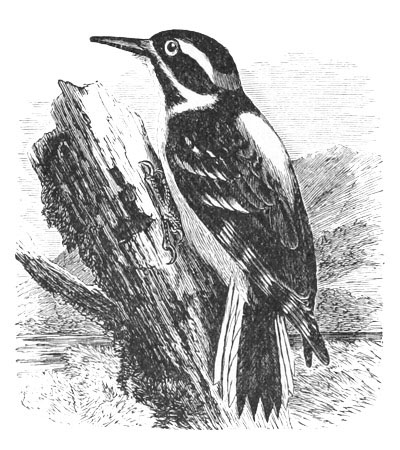
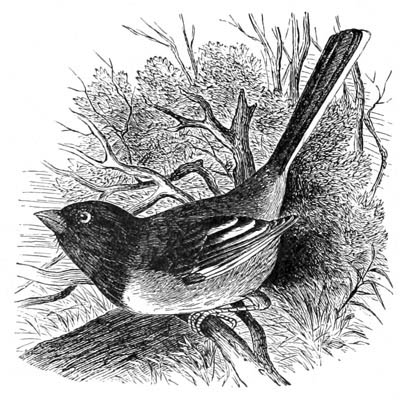
Picus harrisi.
The small black and white Woodpeckers of North America exhibit great
variations in size and markings, and it
is extremely difficult to say what is a
distinct species and what a mere geographical
race. In none of our birds is
the difference in size between specimens
from a high and a low latitude so great,
and numerous nominal species have been
established on this ground alone. There
is also much variation with locality in
the amount of white spotting on the
wings, as well as the comparative width
of the white and black bars in the banded
species. The under parts, too, vary from
pure white to smoky-brown. To these
variations in what may be considered as
good species is to be added the further perplexities caused by hybridism,
which seems to prevail to an unusual extent among some Woodpeckers,
where the area of distribution of one species is overlapped by a close ally.
This, which can be most satisfactorily demonstrated in the Colaptes, is also
probably the case in the black and white species, and renders the final settlement
of the questions involved very difficult.
After a careful consideration of the subject, we are not inclined to admit
any species or permanent varieties of the group of four-toed small white
and black Woodpeckers as North or Middle American, other than those mentioned
in the preceding synopsis.
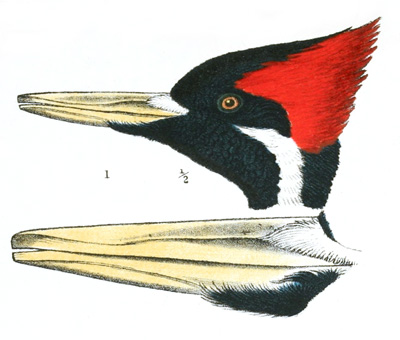
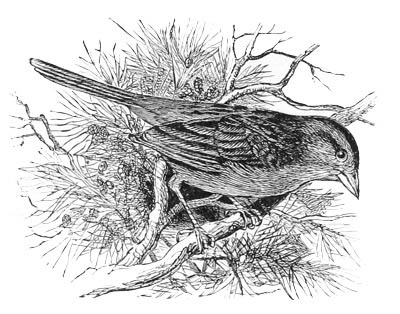
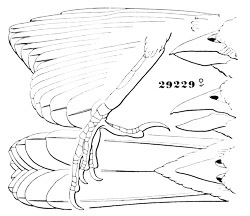
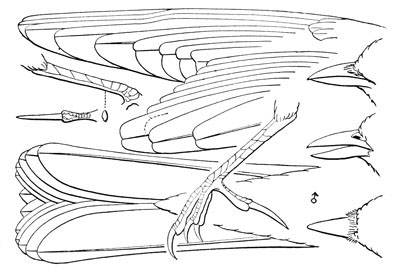
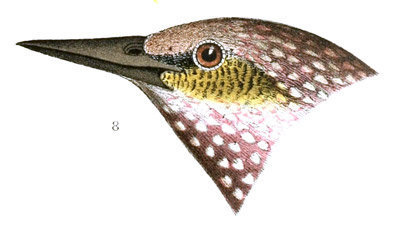
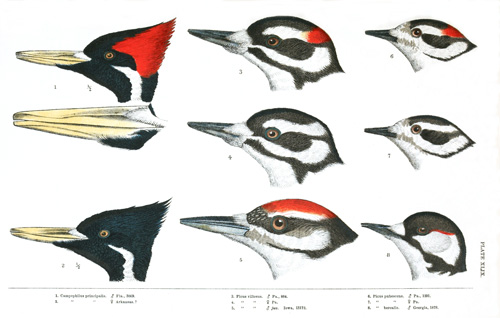
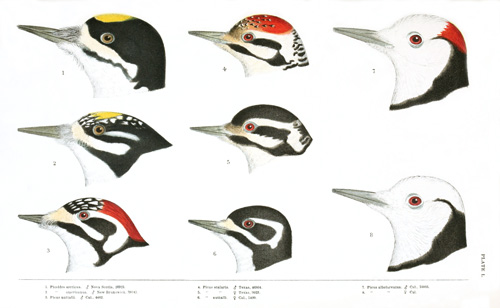
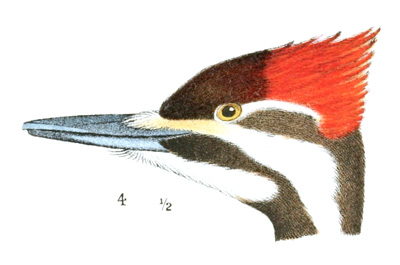
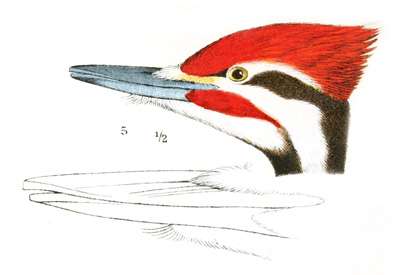
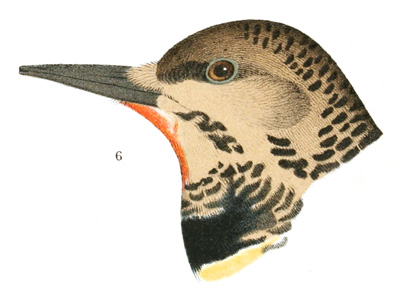
1. Campephilus principalis. ♂ Fla., 3869.
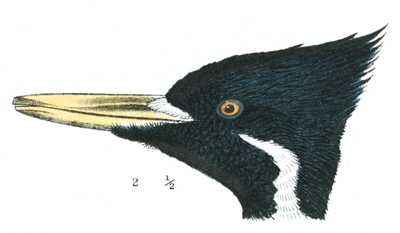
2. Campephilus principalis. ♀ Arkansas.?
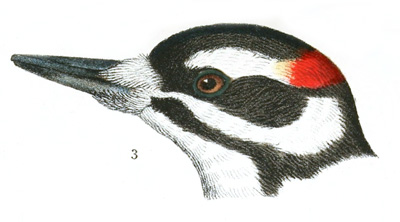
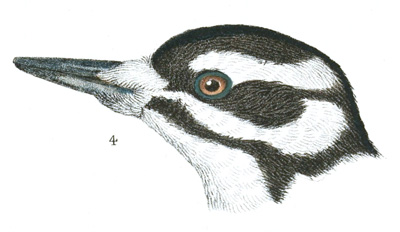
3. Picus villosus. ♂ Pa., 884.
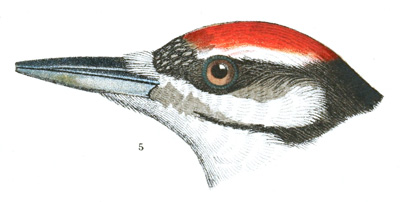
5. Picus villosus. ♂ juv. Iowa, 13172.
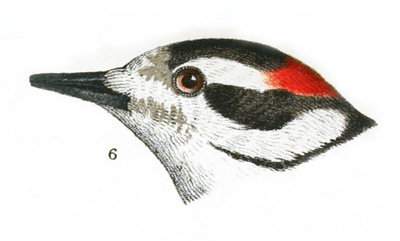
6. Picus pubescens. ♂ Pa., 1291.
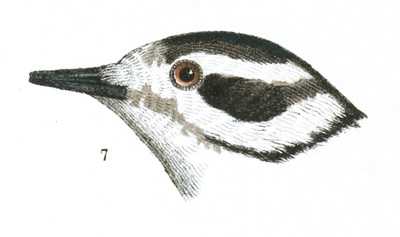
7. Picus pubescens. ♀ Pa.
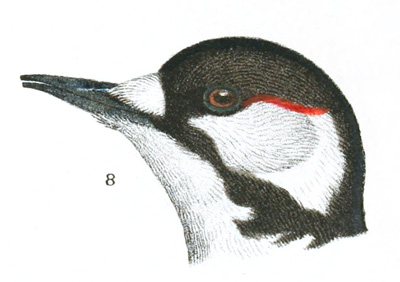
8. Picus borealis. ♂ Georgia, 1878.
Picus villosus, Linnæus.
HAIRY WOODPECKER; LARGER SAPSUCKER.
Var. canadensis.—Northern and Western regions.
? Picus leucomelas, Boddært, Tabl. Pl. Enl. 1783 (No. 345, f. 1, Gray).—Cass. P. A. N. S.
1863, 199. Dryobates leucomelas, Cab. & Hein. Mus. Hein. IV, 67. ? Picus canadensis,
Gmelin, Syst. Nat. I, 1788, 437.—? Latham, Ind. Orn. I, 1790, 231.—Aud.
Orn. Biog. V, 1839, 188, pl. ccccxvii.—Ib. Syn. 1839, 177.—Ib. Birds America, IV,
1842, 235, pl. cclviii.—Bonap. Consp. 1850, 137.—Ib. Aten. Ital. 1854, 8. Picus
villosus, Forster, Philos. Trans. LXII, 1772, 383.—Baird, Birds N. Am. 1858, 84.—Cassin,
P. A. N. S. 1863, 199.—Gray, Catal. 1868, 45.—Dall & Bannister,
Tr. Chicago Ac. Sc. I, 1869, 274 (Alaska).—Finsch, Abh. Nat. III, 1872, 60 (Alaska).—Samuels,
87. Picus (Dendrocopus) villosus, Sw. F.-Bor. Am. II, 1831, 305. Picus
phillipsi, Aud. Orn. Biog. V, 1839, 186, pl. ccccxvii.—Ib. Syn. 1839, 177.—Ib.
Birds Amer. IV, 1842, 238, pl. cclix (immature, with yellow crown).—Nuttall, Man.
I, (2d ed.,) 1840, 686.—Cass. P. A. N. S. 1863, 199. Picus martinæ, Aud. Orn.
Biog. V, 1839, 181, pl. ccccxvii.—Ib. Syn. 1839, 178.—Ib. Birds Amer. IV, 1842,
240, pl. cclx (young male, with red feathers on crown).—Cass. P. A. N. S. 1863, 199.
Picus rubricapillus, Nuttall, Man. I, (2d ed.,) 1840, 685 (same as preceding). Picus
septentrionalis, Nuttall, Man. I, (2d ed.,) 1840, 684.
Var. villosus.—Middle States.
Picus villosus, Linnæus, Syst. Nat. I, 1758, 175.—Vieillot, Ois. Am. Sept. II, 1807,
64, pl. cxx.—Wilson, Am. Orn. I, 1808, 150, pl. ix.—Wagler, Syst. Av. 1827,
No. 22.—Aud. Orn. Biog. V, 1839, 164, pl. ccccxvi.—Ib. Birds Amer. IV, 1842,
244, pl. cclxii.—Bonap. Conspectus, 1850, 137.—Sundevall, Mon. Pic. 17.—Baird,
Birds N. Am. 1858, 84. Picus leucomelanus, Wagler, Syst. Av. 1827,
No. 18 (young male in summer). Hairy Woodpecker, Pennant, Latham. Dryobates
villosus, Cab. & Hein. Mus. Hein. IV, 2, 66.
Var. auduboni.—Southern States.
Picus auduboni, Swainson, F. B. A. 1831, 306.—Trudeau, J. A. N. Sc. Ph. VII, 1837,
404 (very young male, with crown spotted with yellow).—Aud. Orn. Biog. V, 1839,
194, pl. ccccxvii.—Ib. Birds Amer. IV, 1842, 259, pl. cclxv.—Nutt. Man. I, (2d
ed.,) 1840, 684.—Cass. P. A. N. S. 1863, 199. Picus villosus, Bryant, Pr. Bost.
Soc. 1859 (Bahamas, winter).—Allen, B. E. Fla. 302.
Sp. Char.
Above black, with a white band down the middle of the back. All the
middle and larger wing-coverts and all the quills with conspicuous spots of white. Two
white stripes on each side of the head; the upper scarcely confluent behind, the lower
not at all so; two black stripes confluent with the black of the nape. Beneath white.
Three outer tail-feathers with the exposed portions white. Length, 8.00 to 11.00; wing,
4.00 to 5.00; bill, 1.00 to 1.25. Male, with a nuchal scarlet crescent (wanting in the
female) covering the white, generally continuous, but often interrupted in the middle.
Immature bird of either sex with more or less of the whole crown spotted with red
or yellow, or both, sometimes the red almost continuous.
Hab.
North America, to the eastern base of the Rocky Mountains, and (var. canadensis)
along the 49th parallel to British Columbia; Sitka; accidental in England.
In the infinite variation shown by a large number of specimens in the
markings of the wings, so relied on by authors to distinguish the species of
the black and white spotted North American Woodpeckers having a longitudinal
band of white down the back, it will be perhaps our best plan to cut
them rigorously down to two, the old-fashioned and time-honored P. villosus
and pubescens; since the larger and more perfect the series, the more difficult
it is to draw the line between them and their more western representatives.
The size varies very greatly, and no two are alike in regard to the
extent and number of the white spots. Beginning at one end of the chain,
we find the white to predominate in the more eastern specimens. Thus in
one (20,601) from Canada, and generally from the north, every wing-covert
(except the smallest) and every quill shows externally conspicuous spots or
bands of white; the middle coverts a terminal band and central spot; the
greater coverts two bands on the outer web, and one more basal on the inner;
and every quill is marked with a succession of spots in pairs throughout its
length,—the outer web as bands reaching nearly to the shaft; the inner
as more circular, larger spots. The alula alone is unspotted. This is the
typical marking of the P. leucomelas or canadensis of authors. The white
markings are all larger respectively than in other forms.
The next stage is seen in typical or average P. villosus for the Middle
States. Here the markings are much the same, but the white is more restricted,
and on the outer webs of the feathers forms rounded spots rather
than bands. Some Carlisle specimens have two spots on the middle coverts
as described, others lack the basal one. Another stage is exhibited by a specimen
from Illinois, in which with two spots on the middle coverts there is but
one terminal on the outer web of the greater, and a reduction in number
of spots on the inner webs of innermost secondaries, terminal outer spots
not having the corresponding inner. This form is quite prevalent westward
and on the Upper Missouri, but cannot be considered as strictly geographical,
since a Massachusetts and a Georgia skin agree in the same characters.
In all this variation there is little diminution in the number of spots
visible externally, nor so far have we seen any from the region east of the
Missouri plains that lack white spots on every covert (except the smallest
ones) and every quill, and with few exceptions on both webs of the latter.
It is therefore this style that we propose to consider as pure P. villosus,
irrespective of variations in the size or shape of the spots, of the amount of
white on tail and back, or of the bird itself. Any deviation from this may be
called a variety. It has the distribution already mentioned, and extends along
the Upper Missouri to British Columbia and Sitka, straggling into Washington
Territory, where, however, it is found with the more typical western form,
var. harrisi. A specimen collected by Mr. Hepburn at Caribou, on the Upper
Fraser, is absolutely undistinguishable from typical P. canadensis in size
and markings.
We now come to the western race or variety, hardly to be called species,
the P. harrisi of Audubon. Here the extreme of condition most opposed to
typical villosus is shown by the entire absence of white on the exposed surface
of the wing, except on the outer webs of the four or five longest primaries,
where the spots are very small. (We have never seen them entirely
wanting.) The white of the back, too, may be normal in amount, or else
much restricted. Concealed white spots on some of the feathers will be
seen on raising them. The white of tail-feathers sometimes shows black
spots or blotches, especially on the inner web of the second. These features
belong more especially to specimens from the coast region of Oregon and
Washington.
Proceeding eastward from the Northern Pacific Coast we next find specimens
showing a few white streaks on the greater coverts and next on the
middle coverts. The spots on the secondaries, too, begin to show themselves;
but as a general rule they do not occur on the innermost of the greater
coverts and of the secondaries. This, therefore, may be considered as the
limit of a variety, characterized by the absence at least of spots in these
members of the wing.
With the variation in spots in the western variety we have, as already
remarked, differences in amount of white on the tail and the back, as well as
in the color of the belly, which is sometimes pure white, sometimes of a
smoky gray; this latter variation not at all parallel with other differences or
with geographical distribution, and equally observable in eastern villosus.
The size, too, varies somewhat, but not to the same extent as on the Atlantic
side. Here, however, we have Picus jardini of Mexico and Central America,
as the small southern race, absolutely undistinguishable from dark-breasted
Oregon specimens, except in size (length, 7.00; wing, 3.90; bill above, .85),
and perhaps a more fulvous tinge on the under parts. The specimens before
me have one or two black spots on the inner web of the next to the outer
tail-feather, as in darker varieties of harrisi, but these are not symmetrical
or constant in either, and are to be looked on as mere indications of the
general tendency to melanism.
Habits. This common and familiar species of Woodpecker has an extended
range throughout eastern North America. Specimens in the Smithsonian
Institution have been collected from almost every portion of North
America east of the Rocky Mountains. Wilson speaks of it as common
throughout the continent from Hudson’s Bay to Carolina and Georgia. Mr.
Audubon, who regarded Picus martinæ, P. phillipsi, and P. canadensis as distinct
species, instead of varieties of this Woodpecker, states, in regard to its distribution,
that the P. villosus is a constant resident both in the maritime and
inland districts from Texas to New Hampshire, as well as in all the wooded
tracts intervening between the junction of the Missouri and Mississippi, and
the northern borders of the great lake. He adds that not an individual was
found by him or by his sons in Maine, where he did, however, obtain in great
abundance the variety he called P. canadensis. According to Sir John Richardson
it is found as far to the north as the 63d parallel. It remains all the
year round in the fur countries, and is the most common species up to the
fifty-sixth degree of latitude, north of which it yields in frequency to the
three-toed species. Dr. Woodhouse speaks of it as common in Texas and
in the Indian Territory. Although not crossing the Rocky Mountains in
the United States, it reaches the Pacific Coast of British Columbia, and is
found north as far as Sitka, and perhaps still farther, thus replacing the var.
harrisi. It is a resident, and not a migratory, species, and wherever found
it also breeds. Several specimens have been killed in England.
According to the observations of Wilson, this Woodpecker frequents the
orchards and cultivated grounds, and is less wild and more domestic than
most of the species. In May, with its mate, it seeks the retirement of the
woods to breed, selecting a branch already hollowed, or excavating one for
itself. In the former case the nest has been known to be four or five feet
from the opening. When it excavates its own opening, it digs horizontally
six or eight inches into the body of the tree, and then downward
to about twice that distance, carrying up the chips in the bill or scraping
them out with the feet. They not unfrequently breed in orchards,
and have been even known to excavate their holes in the rails of old
fences. The female lays five white eggs, which are usually hatched out
early in June.
Mr. Audubon observed these birds, at all seasons, in almost every possible
locality, from the isolated trees of large towns and cities, even to the very
midst of the salt marshes about the mouth of the Mississippi. He found
the excavation for the nest more frequently running obliquely than perpendicularly.
In the Southern States they rear two broods in a season, the first
appearing the last of May, the second usually about the first of August. In
the middle and northern districts they rarely raise more than one. Those
which Mr. Audubon observed to raise more than one brood in a season made
use of the same excavation for both, and not unfrequently within a few yards
of a house. The eggs of the first brood he found usually six in number, and
of the second four. Where they have but one brood, the number varies from
four to six, and in two instances he has found seven. The measure given by
him is one inch in length by .69 of an inch in breadth. They are elliptical
or almost equally rounded at both ends, smooth, pure white, and translucent.
The young remain in the nest until well able to fly.
Mr. Audubon states that the Hairy Woodpecker becomes, during the winter
months, a very common bird in all parts of the Southern States, coming
to the farm-yards with the downy species to glean the grains of corn left by
the cattle. At this season their visits to the corn-cribs are extremely frequent.
They may also be seen clinging to the stalks of the sugar-cane, boring
them, and evidently enjoying the sweet juices of that plant.
Their flight is short and rapid, resembling that of other allied species.
They are not social, never more than the members of one family being seen
together. They feed chiefly on insects and their larvæ, often seizing the
former on the wing. In the autumn they occasionally eat berries, seeds,
and small fruit. Their notes are sharp and loud, uttered in monosyllables,
at times with great frequency.
An egg of this species, taken in Roxbury, Mass., is of a pure crystal whiteness,
oblong in shape, and equally rounded at either end, measuring 1.01
inches in length by .72 of an inch in breadth. Another, from Georgia, is
more rounded at one end, and measures 1.02 inches in length and .75 of an
inch in breadth.
Picus villosus, var. harrisi, Aud.
HARRIS’S WOODPECKER.
Picus harrisi, Aud. Orn. Biog. V, 1839, 191, pl. ccccxvii.—Ib. Syn. 1839, 178.—Ib.
Birds America, IV, 1842, 242, pl. cclxi (dark-bellied variety).—Nuttall, Man. I,
(2d ed.,) 1840, 627.—Baird, Birds N. Am. 1858, 87.—Sundevall, Mon. 17.—Lord,
Pr. R. Art. Ass. IV, 111 (nesting).—Coues, Pr. A. N. S. 1866, 52 (Oregon).—Sumichrast,
Mem. Bost. Soc. I, 1869, 562 (Alpine regions of Vera Cruz).—Gray,
Catal. 1868, 47.—Caban. J. 1862, 175.—Cassin, P. A. N. S. 1863, 200.—Cooper
& Suckley, 159.—Cooper, Orn. Cal. 1, 1870, 375. ? Picus inornatus, Licht. (Bon.
Consp.). Picus (Trichopicus) harrisi, Bp. Consp. Zyg. Aten. Ital. 1854, 8. Dryobates
harrisi, Cab. & Hein. Mus. Hein. IV, 2, 68 (jardini, 69.) Picus jardini, Malh. Rev.
Zoöl. Oct. 1845, 374 (Mexico).—Cab. Jour. 1862, 175. Picus hyloscopus, Cab. &
Hein. Mus. Hein. IV, 2, 1863, 69 (white-bellied form).
Sp. Char.
Similar to typical villosus; the innermost of the greater wing-coverts and
of the secondary quills without any white spots externally; varying from this to the
entire absence of exposed white on wing except on the outer web of longest primaries.
Belly varying from pure white to smoky or fulvous gray, white of tail-feathers very
rarely blotched with black. Average length, in north, 9.00; wing, 5.00; exposed part of
culmen, 1.15.
Var. jardini much smaller. Length, 7.00; wing, 3.90; culmen, .85.
Hab.
Whole of Western United States, west of the Missouri plains, extending into
Mexico and Central America, where it passes into the smallest and darkest southern extreme,
known as P. jardini. Localities: West Arizona (Coues, P. A. N. S. 1866, 52);
Vera Cruz, Alpine regions (Sumichrast, M. Bost. Soc. I, 1869, 562).
In the preceding article we have given some general remarks on Harris’s
Woodpecker, and shown why we cannot consider it a well-defined species.
If the specimens from the extreme west were constant in themselves, and the
variations, as with Colaptes hybridus, occurred along the line of contact with
villosus, we might refer to hybrids many of the intermediate forms; but as
scarcely any two are alike, even on the Pacific coast, such a view is inadmissible.
As, however, in the extreme limits of variation, there is yet a
difference from eastern specimens, and this is characteristic of a large area
of country, it may be proper to recognize the form by the name harrisi.
The P. jardini appears to be nothing more than the most southern race
of this dark western form of P. villosus, and shows the smallest, as well as
the darkest, extreme to which the species attains. In Southern Mexico
typical P. harrisi and this form grade insensibly together. The minimum
of size and maximum darkness of colors are reached in Costa Rica.
Habits. This variety was first described by Mr. Audubon from specimens
obtained by Mr. Townsend on the Columbia River. No information was
obtained in regard to its habits, which, it may be presumed, do not vary very
essentially from those of the more familiar pubescens and villosus. In regard
to its geographical distribution, it has been found in more or less abundance
from Nebraska to the Pacific, and from Mexico to British America. It is
known to occur in Texas on the Rio Grande, in New Mexico, in Arizona,
Nebraska, California, Oregon, and Washington Territory.
This indicates a very general distribution throughout Western North
America from the eastern slope of the Rocky Mountains to the Pacific, and
from New Mexico and Texas probably to the limits of the forests in the
northwest. It seems to take the place of the P. villosus in the far west. Dr.
Heermann, in his notes on the birds of California (Journal of Philadelphia
Academy, II, 270), says it is not a common bird, although it is occasionally
met with in that State. Dr. Gambel, however, states that it occupies, on the
western coast, the same place that the P. villosus does on the Atlantic, but
seems to have a greater partiality for the pine woods. Dr. Woodhouse did
not meet with it in the expedition to the Zuñi and Colorado. Dr. Newberry
speaks of it (U. S. P. B. R. Survey, VI,—Zoölogy, p. 89) as not uncommon
in the wooded districts of Northern California and Oregon. Dr. Kennerly,
in his report on the birds obtained by Lieutenant Whipple’s party, states
that Harris’s Woodpecker was found along the Little Colorado River in the
month of December, wherever the cottonwood trees grew (U. S. P. R. R.
Survey, X, Pt. VI, 21). It is not mentioned by Dr. Heermann in his Report
on the birds of Lieutenant Parke’s explorations near the 32d. parallel. The
same writer, in his Report on the birds of Lieutenant Williamson’s party,
speaks of this bird as having been occasionally observed during the survey,
but as a somewhat rare species, though procured in Northern California and
at Tejon Pass. Dr. Suckley speaks of it as quite abundant at Fort Dalles,
where he found it among the true pines, and at Fort Steilacoom, among the
firs (D. douglasi), and as a winter resident in both localities (Natural History
of Washington Territory, Zoölogy, p. 159). Dr. Cooper states that
Harris’s Woodpecker is the most abundant species in Washington Territory,
being found on both sides of the Cascade Mountains, frequenting the lower
parts of the great coniferous trees. He found it a constant resident in May,
burrowing out a nest in a dead tree, sometimes only four feet from the
ground. He describes its cries and habits as so exactly like those of the
larger Sapsucker (P. villosus) of the Atlantic States, that, were there not
constant and unchangeable differences in plumage, it would be taken for
the same species. He furnishes no description of the eggs, but it is quite
probable that there is no appreciable difference between them and those of
the Picus villosus.
Dr. Coues mentions this species as one of the most common and characteristic
birds in the vicinity of Fort Whipple. Dr. Heermann speaks of its having clear
trumpet-like notes that betray its locality and render it an easy bird to shoot.
In California Dr. Cooper found this chiefly a northern bird, frequenting
the forests of all kinds up to the summits of the Sierra Nevada, and also
resident as far south as Santa Barbara, descending, in winter, to the eastern
branches of the Colorado and to Tejon Pass. He found it more common
in the higher Coast Range near Santa Cruz, and still more so toward the
Columbia River. Its cry, he adds, is louder than that of most of the small
Woodpeckers, and it is rather shy, especially when it imagines itself pursued.
It feeds at times on fruits and berries, and sometimes it visits gardens.
It is known as one of the “Sapsuckers,” but does more good than harm in
the orchard, destroying both insects and their larvæ.
Mr. John K. Lord states that this Woodpecker is by far the most abundant
species in the district through which his party passed. He found it on Vancouver’s
Island, and along the entire course of the boundary-line, south through
Oregon and California, and north to Fort Simpson. A few remained at Colville
during the winter, but the greater number retired to the coast and returned in
April and May. In the latter month they mate, and bore out a hole in a dead
tree. They use no lining for the nest, but lay the eggs on the bare wood. Their
favorite haunts are the stumps of trees growing round swamps or prairie-land.
This Woodpecker was met with by Mr. Ridgway in all wooded portions
of the Great Basin, but was most abundant among the pines on the mountains.
In all respects, it is a perfect counterpart of the P. villosus of the
east.
Picus pubescens, Linn.
DOWNY WOODPECKER; LESSER SAPSUCKER.
Picus pubescens, Linn. Syst. Nat. I, 1766, 15.—Vieillot, Ois. Am. Sept. II, 1807, 65, pl.
cxxi.—Wilson, Am. Orn. I, 1808, 153, pl. ix.—Wagler, Syst. Avium, 1827, No.
23.—Aud. Orn. Biog. II, 1834, 81; V, 539, pl. cxii.—Ib. Birds Am. IV, 1842, 249,
pl. cclxiii.—Baird, Birds N. Am. 1858, 89.—Sundevall, Mon. Pic. 17.—Malb.
Mon. Pic. I, 119, pl. xxix.—Cassin, Pr. 1863, 20.—Scl. Cat. 1862, 334.—Gray,
Cat. 1868, 44.—Dall & Bannister, Tr. Chicago Ac. I, 1869, 274 (Alaska).—Finsch,
Abh. Nat. III, 1872, 60 (Alaska).—Samuels, 89.—Allen, B. E. Fla. 304. Picus
(Dendrocopus) pubescens, Sw. F. B. A. II, 1831, 307. Picus (Trichopicus) pubescens,
Bonap. Consp. Zyg. Ateneo Italiano, 1854, 8. ? Picus medianus, Sw. F. B. A. II, 1831,
308. Picus meridionalis, Sw. F. B. A. II, 1831, 308 (small southern race). Picus
leconti, Jones, Ann. N. Y. Lyc. IV, 1848, 489, pl. xviii (Georgia; three-toed specimen,
first toe wanting. Type of Tridactylia, Bp.) Dryobates pubescens, Cab. & Hein.
Mus. Hein. 1863, 63.
Sp. Char.
A miniature of P. villosus. Above black, with a white band down the
back. Two white stripes on the side of the head; the lower of opposite sides always
separated behind, the upper sometimes confluent on the nape. Two stripes of black
on the side of the head, the lower not running into the forehead. Beneath white; all
the middle and greater coverts and all the quills with white spots, the larger coverts
with two series each; tertiaries or inner secondaries all banded with white. Two outer
tail-feathers white, with two bands of black at end; third white at tip and externally,
crissum sometimes spotted with black. Length, about 6.25; wing, 3.75. Male with red,
terminating the white feathers on the nape. Young with whole top of head red.
Hab.
Eastern United States, towards the eastern slope of the Rocky Mountains, into
British Columbia and the Humboldt Mountains, and north to the limits of the woods;
along whole Yukon River; perhaps to the Pacific, north of the 49th parallel; Kodiak.
Localities: San Antonio, Texas (Dresser, Ibis, 1865, 468). Accidental in England.
The remarks already made on the variation of Picus villosus apply equally
well here; all the differences in size and markings with locality being almost
exactly reproduced. The western variety, P. gairdneri, is equally uncertain
in characters as P. harrisi, and as little entitled to specific distinction. As
in the previous instance, we shall call typical pubescens those specimens in
which all the middle and greater coverts and all the quills including the
innermost secondaries are spotted with white, while those in which any of
these feathers, whether all the coverts, as in Oregon birds, or only a few of
them, are unspotted, may be called var. gairdneri.
Of typical pubescens in the Eastern States there are minor variations, but
not of much account. Thus the forehead itself, apart from the white nasal
tufts, is sometimes white, connecting with the white superciliary stripe;
more frequently, however, the whole forehead is black. Northern specimens
are larger and have larger white spots, and not unfrequently the black cheek-stripe
is invaded anteriorly by white, which, however, is appreciable at the
base of the feathers. The black bars on the tail are much restricted in
specimens from the Yukon. Southern specimens are smaller and darker,
with smaller spots on the wings.
In all the changes of the two species, there is no difficulty in distinguishing
P. pubescens from P. villosus by the black bars on outer tail-feathers of
the former, and their absence in the latter. The crissum of pubescens is sometimes
somewhat spotted with blackish. The white markings on the coverts
are larger in proportion, and there are almost always two series of white
spots on the greater coverts, as in northern varieties of villosus, not one, as
in most of those from the Middle States.
Habits. This species, like the Hairy Woodpecker, is a resident rather
than a migratory species, and breeds wherever it is met with. It also seems
to have very nearly the same geographical distribution with that species. Dr.
Woodhouse found it common throughout the Indian Territory, Texas, and
New Mexico. It does not, however, appear to have been collected by any
of the parties engaged in the Pacific Railroad surveys, nor by that upon
the survey of the Mexican boundary. Of seventeen specimens given by
Professor Baird in 1858 as in the collections of the Smithsonian Institution,
six are from Pennsylvania, two from Massachusetts, two from Missouri,
one from Bonhomme Island in Nebraska, and the rest from Fort Leavenworth,
Salt Creek, Fort Riley, and Platte River in Kansas. It is quite
common throughout the coast region of Alaska, exclusive of the Aleutians,
and throughout the entire valley of the Yukon. Wilson makes no mention
of its geographical distribution, probably because he found it everywhere
common, to the extent of his own investigations. Audubon speaks of it as
very generally distributed from the lower parts of Louisiana to Labrador,
and as far westward as he travelled.
Sir John Richardson states that this species is a constant inhabitant of the
fur countries up to the 58th parallel. It seeks its food principally on the
maple, elm, and ash, and, north of latitude 54°, where these trees are not
found, on the aspen and birch.
According to Wilson, these birds select a suitable place for the excavation
of their nest, about the middle of May. An apple, pear, or cherry tree, often
in the near neighborhood of a farm-house, is generally fixed upon for this
purpose. The work of excavation is begun by the male, who cuts a hole in the
solid wood as circular as if described with a pair of compasses. He is occasionally
relieved by the female, both parties working with the most indefatigable
diligence. The direction of the hole, when made in the body of
the tree, is downward by an angle of forty degrees for the distance of six or
eight inches, and then directly downward for ten or twelve more. Within,
the excavation is roomy, capacious, and as smooth as if polished by the hand
of the most finished workman. The entrance is, however, left only just
large enough to admit the bodies of the birds. During their labor they even
take the pains to carry their chips to a distance, to prevent suspicion.
This operation sometimes occupies the chief part of a week. The eggs are
generally six in number, pure white, and laid on the smooth bottom of the
cavity. The male supplies the female with food while she is sitting. The
young generally leave the nest about the last of June.
The same writer also gives an interesting account of the impudent coolness
of the House Wren, who, coveting the well-built home of this Woodpecker, and
unable to excavate such an apartment for itself, waits until the poor Woodpeckers
have completed their work, and then attacks them with violence and
drives them off from the nest they have been at so much pains to prepare. He
states that he saw a striking example of this, where the Woodpeckers, after
commencing in a cherry-tree, within a few yards of the house, and having
made considerable progress, were turned out by the Wren. They began again
on a pear-tree in the garden, a few yards off, when, after digging out a most
complete apartment, and laying one egg, they were once more assaulted by
the same impertinent intruder, and finally forced to abandon the place.
Mr. Audubon gives substantially the same account of their nesting, only
he assigns an earlier period, the middle of April, for its commencement, and
describes the entrance to the excavation as often being at right angles to the
trunk for a few inches before it descends. He states that in the Southern
and Middle States two broods are raised in a season, farther north seldom
more than one.
Mr. C. S. Paine, of Randolph, Vt., speaks of this Woodpecker as being one
of the most common and familiar, in Vermont, of the family. They are to be
met with in his neighborhood at all seasons of the year, though he is of the
opinion that many of them go south to spend the winter. They deposit their
eggs about the first of June in the very snug little excavations they prepare.
The male bird will sometimes prepare a separate apartment for himself, apart
from his mate. Mr. Paine has taken the male in such a hole by himself, and
without any nest or eggs, evidently only prepared for shelter.
This Woodpecker has a single note or cry, sounding like chink, which it
frequently repeats. When it flies, and often when it alights, this cry is
more shrill and prolonged. They are very industrious, and are constantly
employed in search of insects, chiefly in orchards and the more open
groves. The orchard is its favorite resort, and it is particularly fond of boring
the bark of apple-trees for insects. This fact, and the erroneous impression
that it taps the trees for the sap, has given to these birds the common
name of Sapsuckers, and has caused an unjust prejudice against them.
So far from doing any injury to the trees, they are of great and unmixed
benefit. Wilson, who was at great pains to investigate the matter, declares
that he invariably found that those trees that were thus marked by the
Woodpecker were uniformly the most thriving and the most productive.
“Here, then,” adds Wilson, “is a whole species—I may say genus—of
birds, which Providence seems to have formed for the protection of our fruit
and forest trees from the ravages of vermin, which every day destroy millions
of those noxious insects that would otherwise blast the hopes of the
husbandman, and even promote the fertility of the tree, and in return
are proscribed by those who ought to have been their protectors.”
The egg of this species is nearly spherical, pure white, and measures .83 by
.72 of an inch.
Picus pubescens, var. gairdneri, Aud.
GAIRDNER’S WOODPECKER.
Picus gairdneri, Aud. Orn. Biog. V, 1839, 317.—Ib. Syn. 1839, 180.—Ib. Birds Amer.
IV, 1842, 252 (not figured).—Baird, Birds N. Am. 1858, 91, pl. lxxxv, f. 2, 3.—Sundevall,
Consp. 1866, 17.—Gray, Cat. 1868, 44.—Cooper & Suckley, 159.—Sclater,
Catal. 1862, 334.—Malh. Monog. Picidæ, I, 123.—Cass. P. A. N. S. 1863,
201.—Cooper, Orn. Cal. 1, 1870, 377.—Lord, Pr. R. Art. Inst. IV, 1864, 111.
Picus meridionalis, Nutt. Man. I, (2d ed.,) 1840, 690 (not of Swainson).—Gambel,
J. A. N. Sc. I, 1847, 55, 105. Picus turati, Malherbe, Mon. Pic. I, 125, tab. 29
(small race, 5.50, from Monterey, Cal., nearest pubescens). Dryobates turati, Cab. &
Hein. Mus. Hein. IV, 2, 1863, 65. Dryobates homorus, Cab. & Hein. Mus. Hein. IV,
2, 1863, 65 (larger, more spotted style).
Sp. Char.
Similar to pubescens in size and markings, but with less white on the wings.
Varies from entire absence of exposed white spots on the middle and greater wing-coverts
and innermost secondaries, with small spots on the quills, to spots on most of their
feathers, but absent on some, and the spots generally larger.
Hab.
Pacific coast of United States to Rocky Mountains. Darkest and with least
white in Western Oregon and Washington.
In the preceding article we have given the comparative characters of this
form, which we can only consider as a variety, and not very permanent or
strongly marked at that.
As in pubescens, this race varies much in the color of the under parts,
which are sometimes pure white, sometimes smoky-brown. It is suggested
that this is partly due to a soiling derived from inhabiting charred trees.
It is, at any rate, of no specific value.
Habits. Gairdner’s Woodpecker is the western representative and counterpart
of the Downy Woodpecker of the east, resembling it in size and
general habits, and only differing from it in certain exceptional characteristics
already mentioned. It is found throughout western North America,
probably from Mexico to the British Possessions, and from the eastern base
of the Rocky Mountains to the Pacific.
Dr. Cooper met with it in California, chiefly in the northern parts of the
State, but did not observe any south of the Santa Clara Valley. Dr. Coues
saw none in Arizona, or possibly a single specimen not positively ascertained.
Dr. Cooper found one of its nests near Santa Clara, on the 24th of May,
containing young. It had been burrowed in a small and partly rotten tree,
and was about five feet from the ground. From the fact that they were
found breeding so far south he infers that among the mountains they probably
occur much farther to the south, as do most other northern birds. He
found them frequenting chiefly the smaller trees in the vicinity of the evergreen
woods, where they were to be seen at all seasons industriously tapping
the bark to obtain insects.
Dr. Newberry mentions finding them very common in Oregon, and also
in Northern California. In Washington Territory, Dr. Suckley found them
extremely common on the Lower Columbia, especially among the willow-trees
lining its banks. They were resident throughout the winter, and in these
situations were very abundant. In January, 1856, he found them so abundant
among the willows growing on the islands in the delta of the Willamette,
that he readily obtained eight specimens in the space of an hour. At
that season they were very unwary, giving little heed to the presence of man,
not even allowing the near discharge of a gun to interfere with their busy
search for food.
Dr. Heermann speaks of it as neither common nor especially rare. He
obtained several specimens among the mountains of Northern California.
Mr. Lord met with these Woodpeckers abundantly in the Northwestern
Boundary Survey. They differed slightly in their habits from the P. harrisi,
generally hunting for insects on the maples, alders, and stunted oaks, rather
than on the pine-trees. Specimens were taken on Vancouver Island, Sumass
Prairie, Colville, and the west slope of the Rocky Mountains at an altitude
of seven thousand feet above the sea-level.
Mr. Ridgway found this Woodpecker to be unaccountably rare in the
Sierra Nevada and all portions of the Great Basin, as well as in the Wahsatch
and Uintah Mountains, even in places where the P. harrisi was at all
times abundant. Indeed, he only met with it on two or three occasions, in
the fall: first in the Upper Humboldt Valley, in September, where it was
rare in the thickets along the streams; and again in the Wahsatch Mountains,
where but a single brood of young was met with in August.
An egg of this species from Oregon, obtained by Mr. Ricksecker, is larger
than that of the pubescens, but similar in shape, being very nearly spherical.
It measures .96 of an inch in length by .85 in breadth.
Subgenus DYCTIOPICUS, Bonap.
Dyctiopicus, Bonap. Ateneo Ital. 1854, 8. (Type, Picus scalaris, Wagler.)
Dyctiopipo, Cabanis & Hein. Mus. Hein. IV, 2, 1863, 74. (Same type.)
Char.
Small species, banded above transversely with black or brown and white.
Of this group there are two sections,—one with the central tail-feathers
entirely black, from Mexico and the United States (three species); the other
with their feathers like the lateral black, banded or spotted with white
(three species from southern South America). The northern section is characterized
as follows:—
Common Characters. All the larger coverts and quills with white spots becoming
transverse bands on innermost secondaries. Cheeks black with a supra-orbital and a
malar stripe of white. Back banded alternately with black and white, but not on upper
tail-coverts, nor four central tail-feathers. Beneath whitish, sides with elongated black
spots; flanks and crissum transversely barred. Tail-feathers, except as mentioned, with
spots or transverse bars of black. Head of male with red patch above (restricted in
nuttalli), each feather with a white spot below the red. Female without red.
The characters of the species scalaris, with its varieties, and nuttalli, will
be found under Picus.
Picus scalaris, Wagler.
LADDER-BACKED WOODPECKER.
Picus scalaris, Wagler, Isis, 1829, V, 511 (Mexico).—Bonap. Consp. 1850, 138.—Scl.
P. Z. S. 1856, 307.—Sund. Consp. 18.—Baird, Birds N. Am. 1858, 94, pl. xli, f. 1.—Ib.
Rep. Mex. Bound. II, 4, pl. iii.—Scl. Cat. 1862, 333.—Cass. P. A. N. S.
1863, 195.—Gray, Cat. 1868, 48.—Heerm. X, c, p. 18.—Cooper, Orn. Cal. 1,
1870, 379. Picus (Dyctiopicus) scalaris, Bon. Consp. Zygod. Aten. Ital. 1854, 8. Dyctiopipo
scalaris, Cab. & Hein. Mus. 74. Picus gracilis, Less. Rev. Zoöl. 1839, 90
(Mexico). Picus parvus, Cabot, Boston Jour. N. H. V, 1845, 90 (Sisal, Yucatan).
Picus orizabæ, Cassin, Pr. A. N. S. 1863, 196 (Orizaba). Picus bogotus, Cassin, Pr.
A. N. S. 1863, 196; Jour. A. N. S. V, 1863, 460, pl. lii, f. 1 (Mex.). Picus bairdi
(Scl. MSS.), Malherbe, Mon. Pic. I, 118, t. xxvii, f. 7, 8.—Scl. Cat. 333, (?) P. Z. S.
64, 177 (city of Mex.).—Cab. & Hein. Mus. Hein. IV, 2, 76.—Cassin, Pr. A. N. S.
1863, 196.—Coues, Pr. A. N. S. 1866, 52 (perhaps var. graysoni).—Dresser, Ibis,
1865, 468. Hab. Texas and New Mexico, to Arizona; south through Eastern Mexico
to Yucatan. Picus scalaris, var. graysoni, Baird, MSS. Hab. Western Arizona;
Western Mexico and Tres Marias.
Sp. Char.
Back banded transversely with black and white from nape to rump (not
upper tail-coverts). Quills and coverts with spots of white; forming bands on the
secondaries. Two white stripes on sides of head. Top of head red, spotted with white.
Nasal tufts brown. Beneath brownish-white, with black spots on sides, becoming bands
behind. Outer tail-feathers more or less banded. Length, about 6.50; wing, 3.50 to
4.50; tail, about 2.50.
Hab.
Guatemala, Mexico, and adjacent southern parts of United States. Localities:
Xalapa (Scl. P. Z. S. 1859, 367); Cordova (Scl. 1856, 357); Guatemala (Scl. Ibis, I,
136); Orizaba (Scl. Cat. 333); S. E. Texas (Dresser, Ibis, 1865, 468, breeds); W.
Arizona (Coues, P. A. N. S. 1866, 52); Yucatan (Lawr. Ann. N. Y. Lyc. IX, 205).
In the above diagnosis we have endeavored to express the average of
characters belonging to a Woodpecker to which many names, based on
trifling geographical variations, have been assigned, but which legitimately
can be only considered as one species. This is among the smallest of the
North American Woodpeckers, and in all its variations the wings are long,
reaching as far as the short feathers of the tail. The upper parts generally
are black, on the back, rump, and exposed feathers of the wings banded
transversely with white, the black bands rather the narrower; the quills and
larger coverts spotted with the same on both webs, becoming bands on the
innermost secondaries. The upper tail-coverts and two inner tail-feathers
on either side are black. The white bands of the back extend all the way
up to the neck, without any interscapular interruption. The under parts
are of a pale smoky brownish-white, almost with a lilac tinge; on the sides
of the breast and belly are a few scattered small but elongated spots. The
posterior parts of the sides under the wing and the under tail-coverts are
obscurely banded transversely with black. The top of the head, extending
from a narrow sooty frontlet at the base of the bill to a short, broad nuchal
crest, is crimson in the male, each feather with a white spot between the
crimson and the dark brown base of the feathers. The brown nasal tuft is
scarcely different from the feathers of the forehead.
In a large series of specimens of this species, from a wide area of distribution,
considerable differences are appreciable in size, but fewer in coloration than
might be expected. Yucatan birds are the least (Picus parvus, Cabot; vagatus,
Cassin), the wing measuring 3.30 inches. Those from Southern Mexico
are but little larger (wing, 3.60). In Northern Mexico the wing is nearly
4 inches; in New Mexico it is 4.30. The markings vary but little. The black
and white bands on the back are about of equal width, but sometimes one,
sometimes the other, appears the larger; the more eastern have, perhaps, the
most white. The pattern on the tail is quite constant. Thus, assuming the
three outer feathers to be white, banded with black, the outermost may be
said to have seven transverse bars of black, of which the terminal four
(sometimes five) are distinct and perfect, the basal three (or two) confluent
into one on the inner web (the extreme base of the feather white). The
next feather has, perhaps, the same number of dark bands, but here only
two (sometimes three) are continuous and complete; the innermost united
together, the outer showing as scallops. The third feather has no continuous
bands (or only one), all the inner portions being fused; the outer mere scallops,
sometimes an oblique edging; generally, however, the interspaces of
the dark bands are more or less distinctly traceable through their dusky suffusion,
especially on the inner web of the outer feather. The number of free
bands thus varies slightly, but the general pattern is the same. This condition
prevails in nearly all the specimens before us from Yucatan and Mexico
(in only one specimen from Arizona, and one or two from Texas), and is
probably the typical scalaris of Wagler.
In specimens from the Rio Grande and across to Arizona the seven bands
of the outer feather are frequently continuous and complete on both webs
to the base, a slight suffusion only indicating the tendency to union in the
inner web. The other feathers are much as described, except that the white
interspaces of the black scallops penetrate deeper towards the shaft. This
is perhaps the race to which the name of P. bairdi has been applied. We do
not find, however, any decided reduction in the amount of red on the anterior
portion of the head, as stated for this species (perhaps it is less continuous
towards the front), except in immature birds; young females possibly
losing the immature red of the crown, as with typical scalaris.
A third type of tail-marking is seen in specimens from the Pacific coast,
and from the Tres Marias especially; also in some skins from Southwestern
Arizona. Here the extreme forehead is black, with white spots; the red of
the crown not so continuous anteriorly even as in the last-mentioned race.
The general pattern of tail is as described, and the bars on the inner webs
are also confluent towards the base, but we have only two or three transverse
bars at the end of the outer feathers; the rest of outer web entirely
white, this color also invading the inner. The second feather is similarly
marked, sometimes with only one spot on outer web; the third has the
black scallops restricted. This may be called var. graysoni, as most specimens
in the Smithsonian collection were furnished by Colonel Grayson.
The size is equal to the largest typical scalaris.
We next come to the Cape St. Lucas bird, described by Mr. Xantus as P.
lucasanus. Here the bill and feet become disproportionally larger and more
robust than in any described; the black bands of the back larger than the
white, perhaps fewer in number. The continuous red of the head also appears
restricted to a stripe above and behind the eye and on the occiput, although
there are some scattered feathers as far forward as above the eyes.
The specimens are, however, not in very good plumage, and this marking
cannot be very well defined; the red may really be as continuous forward as
in the last variety. The nasal tufts are brown, as in the typical scalaris.
The outer three tail-feathers in most specimens show still more white, with
one or two indistinct terminal bands only on the outer two; one or two
additional spots, especially on inner web, and the sub-basal patch of inner
web greatly reduced. Specimens vary here in this respect, as in other races
of scalaris, but the average is as described.
Notwithstanding the decided difference between typical scalaris and lucasanus,
the discovery of the variety graysoni makes it possible to consider both
as extremes of one species. To nuttalli, however, it is but one step farther;
a restriction of the red to the posterior half of the top of head, the white
instead of brown nasal feathers, and the whiter under parts being the only
positive characters. The markings of the tail are almost identical with those
of lucasanus. The anterior portion of the back is, however, not banded, as
in the several varieties described. For this reason it may therefore be questioned
whether, if lucasanus and scalaris are one, nuttalli should not belong
to the same series.
We thus find that the amount of black on the tail is greatest in Southern
and Southeastern Mexican specimens, and farther north it begins to
diminish; in Western Mexico it is still more reduced, while at Cape St.
Lucas the white is as great in amount as in the Upper Californian P.
nuttalli.
The characters given above for the different varieties or races of Picus
scalaris, as far as they relate to the tail, may be expressed in the following
table, illustrated by the accompanying diagram, showing the markings of
outer tail-feather in scalaris and nuttalli.
Outer tail-feathers with seven distinct transverse black bands.
These bands confluent on inner web near the base
… var. scalaris.
Bands distinct on inner web
… var. bairdi.
Bands on outer tail-feather distinct on outer webs at end only, obsolete
or wanting towards base (as in nuttalli).
Tarsus, .68. Bill and legs as in average
… var. graysoni.
Tarsus, .78. Bill and legs very stout
… var. lucasanus.
|
|
|
Outermost tail-feather of Picus scalaris.
6105 |
Outermost tail-feather of Picus nuttalli.
4482 |
Habits. This species belongs to our southern and southwestern fauna,
entering our borders from Mexico, occurring from the valley of the Rio
Grande to Southeastern California, and the slopes of
the Rocky Mountains south of the 35th parallel.
It is found throughout Mexico to Yucatan and Guatemala.
Dr. Samuel Cabot obtained a single specimen of
this bird at Yucatan, which he described under the
name of P. parvus, in the Boston Journal of Natural
History, V, p. 92. It was procured early in December,
1841, in the neighborhood of Ticul, Yucatan.
Dr. Kennerly considered it a not uncommon species
in the vicinity of Boca Grande; especially wherever
there were large trees. The same naturalist, in his
Report on the birds of Lieutenant Whipple’s expedition,
states that he very often saw this bird near
San Antonio, Texas, as well as during the march
several hundred miles west of that place, but that,
after leaving the Rio Grande, he did not meet with it until he reached the
head-waters of Bill Williams Fork. From thence to the Great Colorado
River he saw it frequently, wherever there was any timber; but it was
very shy, alighting on the tops of the leafless cotton-wood trees, and keeping
a vigilant lookout.
Dr. Heermann, in his Report on the birds of Lieutenant J. G. Parke’s
expedition, states that he observed this Woodpecker in the southernmost
portion of California, and found it more and more abundant as he advanced
towards Texas, where it was quite common. The same naturalist, in his
Report on the birds of Lieutenant Williamson’s expedition, remarks that he
procured this bird first at Vallicita, but found it abounding in the woods
about Fort Yuma. He considered the species as new to the California
fauna, though frequently seen in Texas, several of the expeditions having
collected it.
Dr. Woodhouse, in his Report on the birds of Sitgreaves’s expedition to
the Zuñi and the Colorado speaks of finding this beautiful little Woodpecker
abundant in Texas, east of the Pecos River. During his stay in San Antonio
and its vicinity, he became quite familiar with it. It was to be seen,
at all times, flying from tree to tree, and lighting on the trunk of the mesquites
(Algarobia), closely searching for its insect-food. In its habits and
notes, he states, it much resembles the common Hairy Woodpecker. Dr.
Woodhouse elsewhere remarks that he did not meet with this bird west of
the Rio San Pedro, in Texas. In regard to its breeding-habits, so far as I am
aware, they are inferred rather than known. It is quite probable they are
not unlike those of the Picus pubescens, which it so closely resembles. The
eggs in the collection of the Smithsonian were obtained with the collections
of the late Dr. Berlandier of Matamoras, in the province of Tamaulipas,
Mexico.
Dr. Cooper states that this Woodpecker is abundant in the Colorado Valley,
and that they are sometimes seen on the bushes covering the neighboring
mountains. In habits he regards them the exact counterpart of P. nuttalli,
to which they are allied.
Mr. Dresser found them resident and very common throughout all Texas
and Northeastern Mexico. It breeds abundantly about San Antonio, boring
into any tree it finds most suitable for its purposes.
Dr. Coues regards Fort Whipple as about the northern limit of this species
in Arizona. It is not very common, is only a summer resident, and breeds
sparingly there. Farther south, throughout the Territory, and in the Colorado
Valley, he found it abundant. It does not cross the Colorado Desert
into California, and is there replaced by P. nuttalli. It extends south into
Central America. A bird shot by Dr. Coues, June 5, appeared to be incubating;
young birds were taken just fledged July 10. The nest was in the
top of a live-oak tree. Malherbe, who speaks of this Woodpecker as exclusively
Mexican, states that he has been informed that it is abundant in
that country, where it may be seen at all times, climbing over the trunks
and branches of trees. It is said to be very familiar and unwary, living commonly
in gardens and orchards through the greater part of the year, and
many of them nesting there, though in regard to their manner of nesting he
has no information.
The egg of this Woodpecker in shape is most similar to the P. villosus,
being of an oblong-oval. It is larger than the pubescens, and not of so clear
a white color. It measures exactly one inch in length by .75 of an inch in
breadth.
Picus scalaris, var. lucasanus, Xantus.
THE CAPE WOODPECKER.
Picus lucasanus, Xantus, Pr. A. N. S. 1859, 298, 302.—Malherbe, Mon. Picidæ, I,
166.—Cassin, Pr. A. N. S. 1863, 195.—Cooper, Orn. Cal. 1, 1870, 381.
Sp. Char.
General appearance that of Picus nuttalli and scalaris. Bill stout, as long
as or longer than the head. Above black, banded transversely with white on the back
and scapulars to the nape, the white narrower band, the rump and inner tail-feathers entirely
black; quills with a row of white spots on each web; the outer square, the inner
rounded, these spots on the tertials becoming transversely quadrangular. Beneath brownish-white,
with rounded black spots on the sides of the breast, passing behind on the flanks
and under tail-coverts into transverse bars. Greater inner wing-coverts transversely
barred. Outer two tail-feathers white, with one, sometimes two terminal bars, next to
which are one or two bars on the inner web only; third feather black, the outer web
mostly white, with traces of a terminal black bar; sometimes there is a greater predominance
of black on the inner web. Two white stripes on side of head, one starting
above, the other below the eye, with a tendency to meet behind and form a whitish
collar on the nape. Male with the entire top of the head streaked with red, becoming
more conspicuous behind; each red streak with a white spot at base. Feathers covering
the nostrils smoky-brown. Length, 7.15; extent, 12.15; wing, 4.00; bill above, 1.00;
middle toe and claw, .80; tarsus, .76.
Hab.
Cape St. Lucas.
Of the distinctness of this bird as a species from P. nuttalli and scalaris I
had at one time no doubt; but the discovery that the otherwise typical
scalaris from Mazatlan and Western Mexico generally have the same markings
on the tail has induced me to consider it as a kind of connecting link.
I have, however, thought it best to give a detailed description for comparison.
Of about the same size with nuttalli, the bill and feet are much
larger. The legs, indeed, are nearly, if not quite, as large as those of
male P. villosus from Pennsylvania; the bill, however, is somewhat less.
The relations to P. scalaris are seen in the dorsal bands extending to the
nape, the smoky-brown feathers of the nostrils, the red on the whole top
of head (scattering anteriorly), the brownish shade beneath, the width of
the white cheek-bands, etc. On the other hand, it has the black bands of
the back rather wider than the white, as in nuttalli, and the white outer
tail-feathers even less banded with black. The two outer are entirely white,
with one terminal black bar; one or two spots on the outer web; and two
or three bands on the inner, with a sub-basal patch on the inner web, even
smaller than in nuttalli. It is rarely that even two continuous transverse
bands can be seen to cross both webs of the tail. The bill and feet are
much larger.
The following measurements taken from the largest specimens before us
of Dyctiopicus, and one of P. villosus, will illustrate what has been said of
the size of bill and feet of P. lucasanus.
|
P. villosus. |
P. lucasanus. |
P. nuttalli. |
P. scalaris. |
|
884 ♂ |
♂ 12939 |
♂ 4482 |
♂ 6105 |
| Bill from forehead, |
1.26 |
1.10 |
.90 |
.99 |
| Tarsus, |
.76 |
.76 |
.70 |
.68 |
| Middle toe and claw, |
.87 |
.84 |
.75 |
.65 |
| Claw alone, |
.39 |
.34 |
.32 |
.31 |
| Outer hind toe and claw, |
.95 |
.84 |
.79 |
.80 |
| Claw alone, |
.40 |
.32 |
.31 |
.31 |
Habits. Nothing distinctive is known of the habits of this race.
Picus nuttalli, Gambel.
NUTTALL’S WOODPECKER.
Picus nuttalli, Gambel, Pr. A. N. Sc. I, April, 1843, 259 (Los Angeles, Cal.).—Baird,
Birds N. Am. 1858, 93.—Sundevall, Consp. Pic. 19.—Malh. Mon. Pic. I, 100.—Cassin,
P. A. N. S. 1863, 195.—Gray, Cat. 1868, 50.—Cooper, Orn. Cal. 1, 1870,
378. Picus scalaris, (Wagler) Gambel, J. A. N. Sc. Ph. 2d ser. I, Dec. 1847, 55,
pl. ix, f. 2, 3 (not of Wagler). Picus wilsoni, Malherbe, Rev. Zoöl. 1849, 529.—Bonap.
Consp. 1850, 138. Picus (Trichopicus) wilsoni, Bonap. Consp. Zyg. Aten.
Ital. 1854, 8.
Sp. Char.
Back black, banded transversely with white, but not on upper tail-coverts,
nor as far forward as the neck. Greater and middle coverts and quills with spots or
bands of white. Crown black, with white spots, sometimes wanting. On the nape a
patch of white, behind this unbanded black. Occiput and nape crimson in the male.
Tufts of feathers at the base of the bill white. Sides of the head black, with two white
stripes, one above the eye and passing down on the side of the neck, the other below
and cut off behind by black. Under parts smoky yellowish-white, spotted on the sides
of the breast, and banded on flank and crissum with black. Predominant character of
the outer tail-feather white, with two or three interrupted bands towards end; none at
base. Length, about 7.00; wing, 4.50. Female with the top of the head uniform black,
or sometimes spotted with white.
Hab.
Coast region of California.
Third, fourth, and fifth quills nearly equal and longest; second intermediate
between the seventh and eighth. General color above black, barred
transversely with white on the back, rump, and flanks; the upper surface
of tail and tail-coverts, and a broad patch on the upper part of the back about
half an inch long, pure black. The white bands measure about .12 of an
inch, the black about twice as much. The top of the head is black, each
feather with a short streak of white; on the extreme occiput and the nape
is a transverse patch of crimson, each feather having a white spot just below
the crimson. The crimson patch is usually as far from the base of the bill
above as this is from its point. The sides of the head may be described as
black; a white stripe commences on the upper edge of the eye, and, passing
backwards, margins the crimson, and extends on down the side of the neck
to a patch of white, apparently connected with its fellow on the opposite
side by white spots. Another narrow white stripe commences at the
nostrils, (the bristles of which are whitish,) and passes as far as the occiput,
where it ceases in the middle of the black of the cheeks. There are thus
two white streaks on the side of the head bordering a black one passing
through the eye. The under parts generally are white, with a dirty yellow
tinge. The sides of the breast and body are faintly streaked with black;
the flanks barred with the same. The under coverts are barred with black.
The three outer tail-feathers are yellowish-white, with two or three interrupted
bars of black on the posterior or terminal fourth, and a concealed
patch of black on the inner web near the end. Only the terminal band is
continuous across, sometimes the others; always interrupted along the
shaft, and even reduced to rounded spots of black on one or both webs. No
distinct bands are visible on raising the crissum. The black patch on inner
web of outer tail-feather near the base increases on the second and third,
on the latter leaving the end only with an oblique white patch. The bands
on the under surface have a tendency to a transversely cordate and interrupted,
rather than a continuous, linear arrangement.
Young birds have the whole top of head red, as in P. scalaris, with or
without white at the base of the red. The white nasal tufts and other
characters will, however, distinguish them.
This bird, though widely different in appearance from scalaris, may nevertheless,
without any violence, be regarded as but one extreme of a species
of which the lighter examples of scalaris (bairdi) are the other, the transition
towards nuttalli being through var. scalaris, var. graysoni, and var. lucasanus,
each in that succession showing a nearer approach to the distinctive
features of nuttalli. We have not seen any intermediate specimens, however.
The pure white instead of smoky-brown nasal tufts, and their greater
development, are the only characters which show a marked difference from
the varieties of scalaris; but the other differences are nothing more than
an extension of the black markings and restriction of the red in the male,
the result of a melanistic tendency in the Pacific region.
Habits. This species was first discovered by Dr. Gambel near Los Angeles,
Cal., and described by him in the Proceedings of the Philadelphia
Academy. Afterwards, in his paper on the birds of California, published in
the Academy’s Journal, mistaking it for the P. scalaris of Wagler, he furnished
a fuller description of the bird and its habits, and gave with it illustrations
of both sexes. So far as now known, it appears to be confined to
the regions in California and Oregon west of the Coast Range, extending as
far south as San Diego, representing, in its distribution on the Pacific, the
P. borealis of the Atlantic States. One specimen in the Smithsonian collections
was obtained on Umpqua River, in Oregon Territory; the others at
Santa Clara, San Francisco, Petaluma, Bodega, and Yreka, in California. Dr.
Woodhouse says, in his Report on the birds of the Zuñi and Colorado expedition,
that he has only seen this bird in California, from which region he
has examined numerous specimens. Dr. Heermann, in his Report on the birds
of Lieutenant Williamson’s expedition, states that this Woodpecker is occasionally
found in the mountains of Northern California, but that it is much
more abundant in the valleys. Dr. Gambel found it abundant in California
at all seasons. He describes it as having the usual habits of Woodpeckers,
familiarly examining the fence-rails and orchard-trees for its insect-fare.
He found it breeding at Santa Barbara, and on the 1st of May discovered a
nest containing young in the dead stump of an oak, about fifteen feet from
the ground. The hole for entrance was remarkably small, but inside appeared
large and deep. The parents were constantly bringing insects and larvæ.
Dr. Cooper states that this Woodpecker is quite abundant towards the
coast of California, and among the foothills west of the Sierra Nevada. It
frequents the oaks and the smaller trees almost exclusively, avoiding the
coniferous forests. It is very industrious, and not easily frightened, when
engaged in hammering on the bark of trees allowing a very near approach.
At other times, when pursued, it becomes more wary and suspicious. April
20, 1862, Dr. Cooper discovered a nest of this bird near San Diego. It was
in a rotten stump, and was only about four feet from the ground. He captured
the female on her nest, which contained five eggs of a pure pearly
whiteness.
These birds are said to remain throughout the year in the valleys, and to
migrate very little, if at all. Dr. Cooper has not observed it west of the
Coast Range, except near Santa Barbara, nor has he seen any around gardens
or orchards. None have been observed north or east of the State. East of
the mountains it is replaced by the scalaris.
Mr. Xantus mentions finding a nest containing two eggs in a hole in the
Cereus giganteus, about fifteen feet from the ground. The excavation made
by the bird was about a foot and a half deep and six inches wide.
This Woodpecker Mr. Ridgway saw only in the Sacramento Valley, where,
in June, it appeared to be a common species among the oaks of the plains.
He did not learn anything of its habits, but describes its notes as very
peculiar, the usual one being a prolonged querulous rattling call, unlike
that of any other bird known to him.
Subgenus PHRENOPICUS, Bonap.
Phrenopicus, Bonap. Consp. Vol. Zygod. Ateneo Ital. 1854. (Type, Picus borealis, Vieill.)
Phrenopipo, Cab. & Hein. Mus. Hein. 1863, 70. Same type.
This subgenus is closely related in external form to the preceding, differing
in rather longer and more pointed wings and tail, the latter especially,
and a very small, short bill. The first quill (excluding the spurious one) is
considerably longer than the sixth, not shorter. The tail-feathers are much
attenuated at end. The most marked differences in coloration of the type
species, P. borealis, consists in the absence of the post-ocular black patch,
leaving the whole auricular region white, and in the restriction of the red
to a very narrow line on each side, usually concealed.
Some authors place Picus stricklandi of Mexico (Phrenopipo or Xylocopus
stricklandi, Cab. and Hein.) in this section, to which it may indeed belong as
far as the wing is concerned, but the markings are entirely different.
Picus borealis, Vieill.
RED-COCKADED WOODPECKER.
Picus borealis, Vieillot, Ois. Am. Sept. II, 1807, 66, pl. cxxii.—Stephens, in Shaw’s
Gen. Zoöl. IX, 1817, 174.—Baird, Birds N. Am. 1858, 96.—Cassin, Pr. A. N. S.
1863, 201.—Gray, Catal. 1868, 50.—Allen, B. E. Fla. 305.—Sundevall, Consp.
1866, 21. Threnopipo borealis, Cab. & Hein. Mus. Hein. IV, 2, 70. Picus querulus,
Wilson, Am. Orn. II, 1810, 103, pl. xv, f. 1.—Wagler, Syst. Av. 1827, No. 21.—Ib.
Isis, 1829, 510.—Aud. Orn. Biog. V, 1839, 12, pl. ccclxxxix.—Ib. Birds Am. IV,
1842, 254, pl. cclxiv.—Bp. Consp. 1850, 137.—Cassin, Pr. A. N. S. 1863 (southernmost
race). Picus (Phrenopicus) querulus, Bp. Consp. Zyg. Aten. Ital. 1854, 8. Picus leucotis,
Illiger (fide Lichtenstein in letter to Wagler; perhaps only a catalogue name).—Licht.
Verzeich. 1823, 12, No. 81. Picus vieilloti, Wagler, Syst. Av. 1827, No. 20.
Sp. Char.
Fourth quill (not counting the spurious) longest. First nearer tip of fifth
than of sixth, intermediate between the two. Upper parts, with top and sides of the
head, black. Back, rump, and scapulars banded transversely with white; quills spotted
with white on both webs; middle and greater coverts spotted. Bristles of bill, under
parts generally, and a silky patch on the side of the head, white. Sides of breast and
body streaked with black. First and second outer tail-feathers white, barred with black
on inner web. Outer web of the third mostly white. A short, very inconspicuous
narrow streak of silky scarlet on the side of the head a short distance behind the eye,
along the junction of the white and black (this is wanting in the female); a narrow short
line of white just above the eye. Length, about 7.25; wing, 4.50; tail, 3.25.
Hab. Southern States, becoming very rare north to Pennsylvania.
This species differs from the other banded Woodpeckers, as stated in the
diagnosis, in having a large patch of white behind the eye, including the
ears and sides of head, and not traversed by a black post-ocular stripe. The
bands of the back, as in P. nuttalli, do not reach the nape, nor extend over
the upper tail-covert. The white patch occupies almost exactly the same
area as the black one in nuttalli; the white space covered by the supra-orbital
and malar stripes, and the white patch on side of nape, of the latter
species being here black.
According to Mr. Cassin, southern specimens which he distinguishes as
P. querulus from P. borealis of Pennsylvania, differ in smaller number of
transverse bars on the back, and shorter quills, and in fewer white spots on
the wing-coverts and outer primaries. The black band on the back of neck
is wider. This therefore exhibits the same tendency to melanism, in more
southern specimens, that has been already indicated for P. villosus, scalaris,
etc.
Habits. The Red-cockaded Woodpecker has a restricted distribution to the
Southeastern Atlantic States, being rarely met with so far north as Pennsylvania.
Georgia and Florida are the only localities represented in the Smithsonian
collection, though other Southern States not named have furnished
specimens. It has been met with as far to the west as Eastern Texas and the
Indian Territory, where Dr. Woodhouse speaks of having found them common.
(Report of an Expedition down the Zuñi and Colorado Rivers,
Zoölogy, p. 89.) Wilson only met with it in the pine woods of North Carolina,
Georgia, and South Carolina, and does not appear to have been acquainted
with its habits. Audubon speaks of it as being found abundantly
from Texas to New Jersey, and as far inland as Tennessee, and as nowhere
more numerous than in the pine barrens of Florida, Georgia, and the Carolinas.
He found these birds mated in Florida as early as January, and
engaged in preparing a breeding-place in February. The nest, he states, is
not unfrequently bored in a decayed stump about thirty feet high. The eggs
he describes as smooth and pure white, and as usually four in number,
though he has found as many as six in a nest. The young crawl out of their
holes before they are able to fly, and wait on the branches to receive the food
brought by their parents until they are able to shift for themselves. During
the breeding-season the call of these birds is more than usually lively and
petulant, and is reiterated through the pine woods where it is chiefly
found.
Wilson compares the common call-notes of these birds to the querulous
cries of young birds. His attention was first directed to them by this
peculiarity. He characterizes the species as restless, active, and clamorous.
Though almost exclusively a Southern species, and principally found south
of North Carolina, individuals have been known to wander much farther
north. Mr. G. N. Lawrence obtained a specimen of this bird in Hoboken,
N. J., opposite New York City.
In quickness of motion this Woodpecker is said to be equalled by very
few of the family. Mr. Audubon states that it glides upwards and sideways,
along the trunks and branches, on the lower as well as the upper sides of
the latter, moving with great celerity, and occasionally uttering a short, shrill,
clear cry, that can be heard at a considerable distance. Mr. Audubon kept
a wounded one several days. It soon cut its way out of a cage, and ascended
the wall of the room as it would a tree, seizing such spiders and
insects as it was able to find. Other than this it would take no food, and
was set at liberty.
In the stomach of one dissected were found small ants and a few minute
coleopterous insects. In Florida it mates in January and nests in February.
In the winter it seeks shelter in holes, as also in stormy weather. Mr.
Audubon states that it occasionally feeds on grain and on small fruits.
Some go to the ground to search for those that have fallen from trees. They
are always found in pairs, and during the breeding-season are very pugnacious.
An egg of this species obtained near Wilmington, N. C., by Mr. N. Giles,
measures .95 by .70 of an inch. It is pure white, appeared less glossy than
the eggs of most Woodpeckers, and was of a more elliptical shape. Another
egg of this bird sent to me by Mr. Samuel Pasco of Monticello, Fla.,
measures .98 by .70 of an inch, being even more oblong in shape, and corresponds
also in the absence of that brilliant polish so common in most
Woodpeckers.
Subgenus XENOPICUS, Baird.
Xenopicus, Baird, Birds N. Am. 1858, 83. (Type, Leuconerpes albolarvatus, Cass.)
Xenocraugus, Cab. & Hein. Mus. Hein. IV, 2, 1863, 74. (Same type.)
This section of Picus is not appreciably different in form from Picus
villosus, which may be taken as the American type of the genus Picus. The
plumage appears softer, however, and the uniformly black body with white
head and white patch at base of primaries will readily distinguish it from
any allied group.
Picus albolarvatus, Baird.
WHITE-HEADED WOODPECKER.
Leuconerpes albolarvatus, Cassin, Pr. A. N. Sc. V, Oct. 1850, 106 (California). Bonap.
Consp. Zyg. At. Ital. 1854, 10. Melanerpes albolarvatus, Cassin, J. A. N. Sc.
2d series, II, Jan. 1853, 257, pl. xxii.—Newberry, Zoöl. Cal. and Oreg. Route,
9, Rep. P. R. R. VI, 1857. Picus (Xenopicus) albolarvatus, Baird, Birds N. Am.
1858, 96.—Cassin, Pr. A. N. Sc. 1863, 202.—Lord, Pr. R. Art. Ins. IV,
1864, 112 (Ft. Colville; nesting).—Cooper & Suckley, 160.—Elliot, Birds
N. Am. IX, plate. Picus albolarvatus, Sundevall, Consp. Pic. 29.—Cooper, Orn.
Cal. I, 1870, 382. Xenocraugus albolarvatus, Cab. & Hein. Mus. Hein. IV, 2, 1863,
74. Xenopicus albolarvatus, Elliot, Illust. Birds Am. I, pl. xxix.
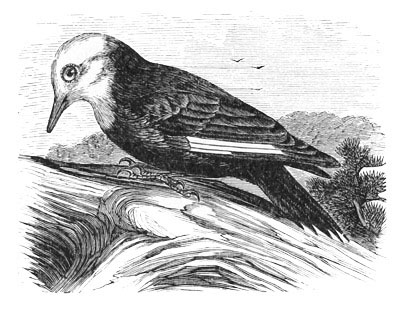
Picus albolarvatus.
Sp. Char.
Fourth and fifth quills equal and longest; tip of first equidistant between
sixth and seventh. Entirely bluish-black,
excepting the head and neck, and the outer
edges of the primaries (except outermost),
and the concealed bases of all the quills,
which are white. Length, about 9.00;
wing, 5.25. Male with a narrow crescent
of red on the occiput.
Hab.
Cascade Mountains of Oregon and
southward into California. Sierra Nevada.
Habits. This very plainly marked
Woodpecker, formerly considered very
rare, is now known to be abundant in
the mountains of Northern California and Nevada, as also in the mountain-ranges
of Washington Territory and Oregon. Dr. Cooper found it quite
common near the summits of the Sierra Nevada, latitude 39°, in September,
1863, and procured three specimens. Three years previously he had met
with it at Fort Dalles, Columbia River. He thinks that its chief range of
distribution will be found to be between those two points. He also found
it as far north as Fort Colville, in the northern part of Washington Territory,
latitude 49°. He characterizes it as a rather silent bird.
Dr. Newberry only met with this bird among the Cascade Mountains, in
Oregon, where he did not find it common.
Mr. J. G. Bell, who first discovered this species, in the vicinity of Sutter’s
Mills, in California, on the American River, represents it as frequenting the
higher branches of the pines, keeping almost out of gunshot range. Active
and restless in its movements, it uttered at rare intervals a sharp and clear
note, while busily pursuing its search for food.
Mr. John K. Lord states that the only place in which he saw this very
rare bird was in the open timbered country about the Colville Valley and
Spokan River. He has observed that this Woodpecker almost invariably
haunts woods of the Pinus ponderosa, and never retires into the thick damp
forest. It arrives in small numbers at Colville, in April, and disappears
again in October and November, or as soon as the snow begins to fall. Although
he did not succeed in obtaining its eggs, he saw a pair nesting in the
month of May in a hole bored in the branch of a very tall pine-tree. It
seldom flies far, but darts from tree to tree with a short jerking flight, and
always, while flying, utters a sharp, clear, chirping cry. Mr. Ridgway found
it to be common in the pine forests of the Sierra Nevada, in the region of
the Donner Lake Pass. It was first observed in July, at an altitude of about
five thousand feet, on the western slope of that range, where it was seen playing
about the tops of the tallest dead pines. On various occasions, at all seasons,
it was afterwards found to be quite plentiful on the eastern slope, in the
neighborhood of Carson City, Nevada. Its habits and manners are described
as much like those of the P. harrisi, but it is of a livelier and more restless
disposition. Its notes have some resemblance to those of that species, but
are of a more rattling character. It is easily recognized, when seen, by its
strikingly peculiar plumage.
Genus PICOIDES, Lacep.
Picoides, Lacep. Mem. Inst. 1799. (Type, Picus tridactylus.)
Tridactylia, Steph. Shaw, Gen. Zoöl. 1815.
Apternus, Sw. F. B. A. II, 1831, 311.
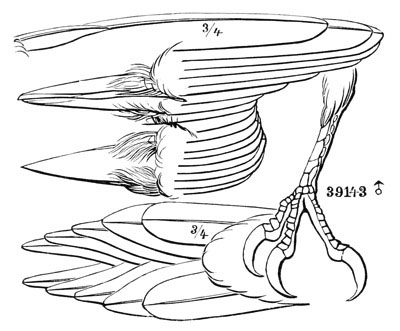
Picoides arcticus.
39143 ♂
Gen. Char.
Bill about as long as the head, very much depressed at the base; the
outlines nearly straight; the lateral
ridge at its base much nearer the
commissure than the culmen, so as
to bring the large, rather linear nostrils
close to the edge of the commissure.
The gonys very long, equal to
the distance from the nostrils to the
tip of the bill. Feet with only
three toes, the first or inner hinder
one being wanting; the outer
lateral a little longer than the
inner, but slightly exceeded by the
hind toe, which is about equal to
the tarsus. Wings very long,
reaching beyond the middle of the
tail, the tip of the first quill
between those of sixth and seventh.
Color black above, with a broad patch of yellow on the crown; white beneath, transversely
banded on the sides. Quills, but not wing-coverts, with round spots. Lateral
tail-feathers white, without bands on exposed portion, except in European specimens.
The peculiarities of this genus consist in the absence of the inner hind
toe and the great depression of the bill. The figure above fails to represent
the median ridge of the bill as viewed from above.
Common Characters. The American species of Picoides agree in being black above
and white beneath; the crown with a square yellow patch in the male; a white stripe
behind the eye, and another from the loral region beneath the eye; the quills (but not
the coverts) spotted with white; the sides banded transversely with black. The diagnostic
characters (including the European species) are as follows:—
Species and Varieties.
P. arcticus. Dorsal region without white markings; no supraloral white
stripe or streak, nor nuchal band of white. Four middle tail-feathers wholly
black; the next pair with the basal half black; the outer two pairs almost
wholly white, without any dark bars. Entire sides heavily banded with
black; crissum immaculate; sides of the breast continuously black. ♂.
Crown with a patch of yellow, varying from lemon, through gamboge, to
orange, and not surrounded by any whitish markings or suffusion. ♀.
Crown lustrous black, without any yellow, and destitute of white streaks
or other markings. Wing, 4.85 to 5.25; tail, 3.60; culmen, 1.40 to 1.55.
Hab. Northern parts of North America. In winter just within the
northern border of the United States, but farther south on high mountain-ranges.
P. tridactylus. Dorsal region with white markings, of various amount
and direction; a more or less distinct supraloral white streak or stripe, and
a more or less apparent nuchal band of the same. Four to six middle tail-feathers
entirely black; when six, the remainder are white, with distinct
black bars to their ends; when four, they are white without any black bars,
except occasionally a few toward the base. Sides always with black streaks
or markings, but they are sometimes very sparse; crissum banded with
black, or immaculate; sides of the breast not continuously black. ♂.
Crown with a patch of gamboge, amber, or sulphur-yellow, surrounded by
a whitish suffusion or markings. ♀. Crown without any yellow, but distinctly
streaked, speckled, or suffused with whitish (very seldom plain black).
a. Six middle tail-feathers wholly black. Europe and Asia.
Sides and crissum heavily barred with black (black bars about as
wide as the white ones).
Back usually transversely spotted with white; occasionally
longitudinally striped with the same in Scandinavian examples.
Wing, 4.80 to 5.10; tail, 3.80 to 4.00; culmen, 1.20 to 1.35.
Hab. Europe
… var. tridactylus.[127]
Sides and crissum almost free from black bars; black bars on the
outer tail-feathers very much narrower than the white.
Back always (?) striped longitudinally with white. Wing,
4.70 to 4.75; tail, 3.65 to 3.90; culmen, 1.20 to 1.35. Hab.
Siberia and Northern Russia
… var. crissoleucus.[128]
b. Four middle tail-feathers, only, wholly black. North America.
Sides heavily barred with black, but crissum without bars, except
beneath the surface. Three outer tail-feathers without black bars,
except sometimes on the basal portion of the inner webs. Wing,
4.40 to 5.10; tail, 3.40 to 3.70; culmen, 1.10 to 1.25.
Back transversely spotted or barred with white. Hab.
Hudson’s Bay region; south in winter to northern border of
Eastern United States
… var. americanus.
Back longitudinally striped with white at all seasons. Hab.
Rocky Mountains; north to Alaska
… var. dorsalis.
Picoides arcticus, Gray.
THE BLACK-BACKED THREE-TOED WOODPECKER.
Picus (Apternus) arcticus, Sw. F. Bor. Am. II, 1831, 313. Apternus arcticus, Bp. List,
1838.—Ib. Consp. 1850, 139.—Newberry, Zoöl. Cal. and Oreg. Route, 91, Rep.
P. R. R. Surv. VI, 1857. Picus arcticus, Aud. Syn. 1839, 182.—Ib. Birds Amer.
VI, 1842, 266, pl. cclxviii.—Nuttall, Man. I, (2d ed.,) 1840, 691.—Sundevall,
Consp. I, 1866, 15. Picus tridactylus, Bon. Am. Orn. II, 1828, 14, pl. xiv, f. 2.—Aud.
Orn. Biog. II, 1834, 198, pl. cxxxii. Tridactylia arctica, Cab. & Hein. Picoides
arcticus, Gray, Gen.—Baird, Birds N. Am. 1858, 98.—Lord, Pr. R. Art. Inst.
Woolwich, IV, 1864, 112 (Cascade Mountains).—Cooper, Pr. Cal. Ac. Sc. 1868 (Lake
Tahoe and Sierra Nevada).—Samuels, 94.—Cooper, Orn. Cal. 1, 1870, 384.
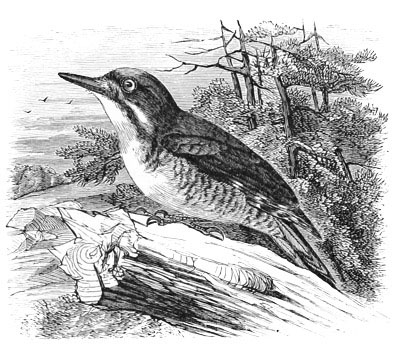
Picoides arcticus.
Sp. Char.
Above entirely uniform glossy bluish-black; a square patch on the middle
of the crown saffron-yellow, and a few
white spots on the outer edges of both
webs of the primary and secondary
quills. Beneath white, on the sides of
whole body, axillars, and inner wing-coverts
banded transversely with black.
Crissum white, with a few spots anteriorly.
A narrow concealed white
line from the eye a short distance backwards,
and a white stripe from the
extreme forehead (meeting anteriorly)
under the eye, and down the sides of
the neck, bordered below by a narrow
stripe of black. Bristly feathers of the
base of the bill brown; sometimes a
few gray intermixed. Exposed portion
of two outer tail-feathers (first and
second) white; the third obliquely white at end, tipped with black. Sometimes these
feathers with a narrow black tip.
Hab.
Northern North America; south to northern borders of United States in winter.
Massachusetts (Maynard, B. E. Mass., 1870, 129). Sierra Nevada, south to 39°. Lake
Tahoe (Cooper); Carson City (Ridgway).
This species differs from the other American three-toed Woodpeckers
chiefly in having the back entirely black. The white line from the eye is
usually almost imperceptible, if not wanting entirely. Specimens vary very
little; one from Slave Lake has a longer bill than usual, and the top of
head more orange. The size of the vertex patch varies; sometimes the
frontal whitish is inappreciable. None of the females before me have any
white spots in the black of head, as in that of americanus.
The variations in this species are very slight, being chiefly in the shade of
the yellow patch on the crown, which varies from a sulphur tint to a rich
orange. Sometimes there is the faintest trace of a whitish post-ocular
streak, but usually this is wholly absent. Western and Eastern examples
appear to be identical.
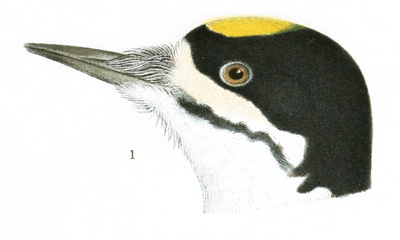
1. Picoides arcticus. ♂ Nova Scotia, 26923.
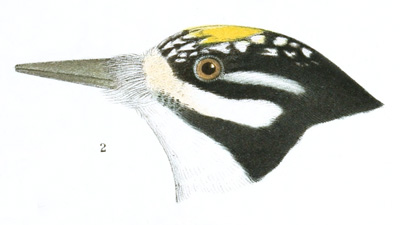
2. Picoides americanus. ♂ New Brunswick, 39143.
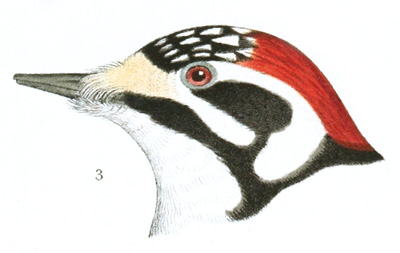
3. Picus nuttalli. ♂ Cal., 4482.
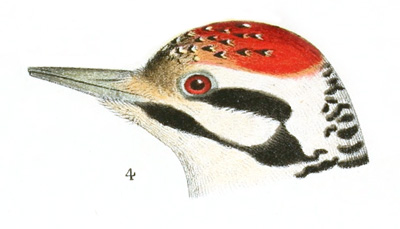
4. Picus scalaris. ♂ Texas, 46804.
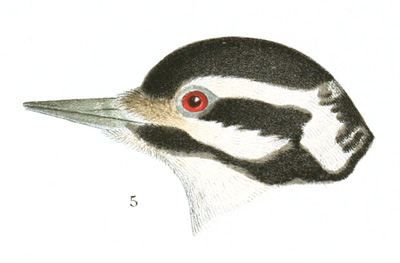
5. Picus scalaris. ♀ Texas, 9933.
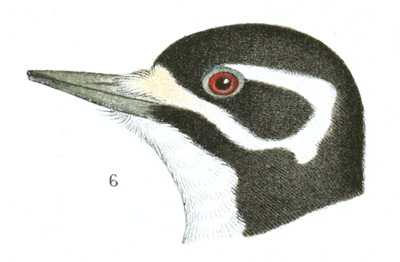
6. Picus nuttalli. ♀ Cal., 5400.
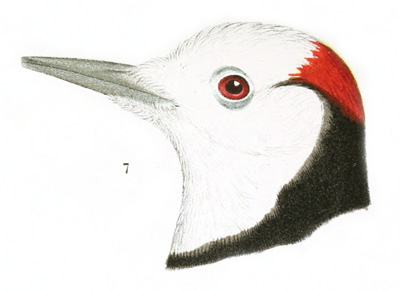
7. Picus albolarvatus. ♂ Cal., 16066.
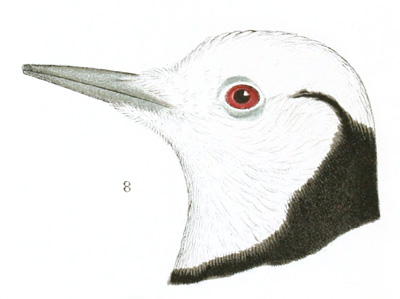
8. Picus albolarvatus ♀ Cal.
Habits. This species has a well-defined and extended distribution, from
the Pacific to the Atlantic, and from the northern portions of the United
States to the extreme Arctic regions. In the United States it has been found
as far south as Massachusetts, New York, and Ohio, but rarely; and, so far as
I am aware, it is a winter visitant only to any but the extreme northern portions
of the Union, except along the line of the Rocky Mountains and the
Sierra Nevada. Audubon says it occurs in Northern Massachusetts, and in
all portions of Maine that are covered by forests of tall trees, where it constantly
resides. He saw a few in the Great Pine Forest of Pennsylvania,
and Dr. Bachman noticed several in the neighborhood of Niagara Falls,
and was of the opinion that it breeds in the northern part of New York.
The same writer describes the nesting-place of the Arctic Woodpecker as
generally bored in the body of a sound tree, near its first large branches.
He observed no particular choice as to the timber, having seen it in oaks,
pines, etc. The nest, like that of most of this family, is worked out by both
sexes, and requires fully a week for its completion. Its usual depth is
from twenty to twenty-four inches. It is smooth and broad at the bottom,
although so narrow at its entrance as to appear scarcely sufficient to enable
one of the birds to enter it. The eggs are from four to six, rather rounded
and pure white. Only one brood is raised in the season. The young follow
their parents until the autumn. In the southern districts where these
Woodpeckers are found, their numbers are greatly increased in the winter
by accessions from the North.
Dr. Cooper found this species quite numerous, in September, in the vicinity
of Lake Tahoe and the summits of the Sierra Nevada, above an altitude of
six thousand feet. From thence this bird has a northern range chiefly on
the east side of these mountains and of the Cascade Range. None were
seen near the Lower Columbia. At the lake they were quite fearless, coming
close to the hotel, and industriously rapping the trees in the evening and
in the early morning. Farther north Dr. Cooper found them very wild,
owing probably to their having been hunted by the Indians for their skins,
which they consider very valuable. He noticed their burrows in low pine-trees
near the lake, where he had no doubt they also raise their young. Dr.
Cooper has always found them very silent birds, though in the spring they
probably have more variety of calls. The only note he heard was a shrill,
harsh, rattling cry, quite distinct from that of any other Woodpecker.
The flight of this Woodpecker is described as rapid, gliding, and greatly
undulated. Occasionally it will fly to quite a distance before it alights,
uttering, from time to time, a loud shrill note.
Professor Verrill says this bird is very common in Western Maine, in
the spring, fall, and winter, or from the middle of October to the middle or
end of March. It is not known to occur there in the summer. Near Calais
a few are seen, and it is supposed to breed, but is not common. In Massachusetts
it is only a rare and accidental visitant, occurring usually late in
winter or in March. Two were taken near Salem in November. It is also
a rare winter visitant near Hamilton in Canada.
Mr. Ridgway met with but a single individual of this species during his
Western explorations. This was shot in February, near Carson City, Nevada;
it was busily engaged in pecking upon the trunk of a large pine, and was
perfectly silent.
Mr. John K. Lord obtained a single specimen of this bird on the summit
of the Cascade Mountains. It was late in September, and getting cold; the
bird was flying restlessly from tree to tree, but not searching for insects.
Both when on the wing and when clinging to a tree, it was continually
uttering a shrill, plaintive cry. Its favorite tree is the Pinus contorta, which
grows at great altitudes. It is found chiefly on hill-tops, while in the valleys
and lower plains it is replaced by the Picoides hirsutus.
Eggs of this species were obtained by Professor Agassiz on the northern
shore of Lake Superior. They were slightly ovate, nearly spherical, rounded
at one end and abruptly pointed at the other, of a crystal whiteness, and
measured .91 of an inch in length by .70 in breadth.
An egg received from Mr. Krieghoff is small in proportion to the size
of the bird, nearly spherical in form, and of a uniform dull-white color. It
measures .92 of an inch in length by .76 in breadth.
Picoides tridactylus, var. americanus, Brehm.
THE WHITE-BACKED THREE-TOED WOODPECKER.
Picus hirsutus, Vieillot, Ois. Am. Sept. II, 1807, 68, pl. cxxiv (European specimen).—Wagler,
Syst. Av. 1827, No. 27 (mixed with undulatus).—Aud. Orn. Biog. V, 1839,
184, pl. ccccxvii.—Ib. Birds Amer. IV, 1842, pl. cclxix.—Nuttall, Man. I, (2d ed.,)
1840, 622. Apternus hirsutus, Bon. List, Picoides hirsutus, Baird, Birds N. Am. 1858,
98.—Samuels, 95. ? Picus undulatus, Vieillot, Ois. Am. Sept. II, 1807, 69 (based
on Pl. enl. 553, fictitious species?) Picus undatus, Temm. Picus undosus, Cuv. R. A.
1829, 451 (all based on same figure). Tridactylia undulata, Cab. & Hein. Mus. Hein.
IV, 2, 1863, 28. Picus tridactylus, Sw. F. Bor. Am. 1831, 311, pl. lvi. Picoides
americanus, Brehm, Vögel Deutschlands, 1831, 195.—Malherbe, Mon. Picidæ, I,
176, pl. xvii, 36.—Sclater, Catal.—Gray, Cat. Br. Mus. III, 3, 4, 1868, 30. Apternus
americanus, Swainson, Class. II, 1837, 306. Picus americanus, Sundevall,
Consp. Av. Picin. 1866, 15. Picoides dorsalis, Baird, Birds N. Am. 1858, 100, pl.
lxxxv, f. 1.—Cooper, Orn. Cal. 1, 1870 (under P. americanus). Tridactylia dorsalis,
Cab. & Hein. Picus dorsalis, Sundevall, Consp. 1866, 14.
Sp. Char.
Black above. The back markings of white, transverse in summer, and
longitudinal in winter; these extend to the rump, which is sometimes almost wholly
white. A white line from behind the eye, widening on the nape, and a broader one
under the eye from the loral region, but not extending on the forehead; occiput and sides
of head uniform black. Quills, but not coverts, spotted on both webs with white, seen on
inner webs of inner secondaries. Under parts, including crissum, white; the sides, including
axillars and lining of wing, banded transversely with black. Exposed portion of outer
three tail-feathers white; that of third much less, and sometimes with a narrow tip of
black. Upper tail-coverts sometimes tipped with white, and occasionally, but very rarely,
banded with the same. Top of the head spotted, streaked, or suffused with white; the
crown of the male with a yellow patch. Nasal bristles black, mixed with gray. Female
with the whole top of head usually spotted with white, very rarely entirely black.
Hab.
Arctic regions of North America; southward in the Rocky Mountains to Fort
Buchanan; northern border of the Eastern United States, in winter (Massachusetts,
Maynard).
This species varies considerably in its markings, especially in the amount
of white above. The head is sometimes more coarsely spotted with white
than in the average; very rarely are the white spots wanting, leaving merely
the broad malar and interrupted post-ocular stripe. The rictal black stripe
is sometimes much obscured by white. In typical specimens from the Hudson
Bay and Labrador Provinces, which seem to be darkest, the feathers of
the centre of the back have three transverse bars of white (one of them
terminal), rather narrower than the intermediate black bars; the basal white
ones disappearing both anteriorly and posteriorly, leaving but two. In
specimens from the Mackenzie River district there is a greater development
of white; the white bands being broader than the black, and sometimes
extending along the shafts so as to reduce the black bars to pairs of spots.
The next step is the disappearance of these spots on one side or the other, or
on both, leaving the end of the feathers entirely white, especially anteriorly,
where the back may have a longitudinal stripe of white, as in Picus villosus.
Usually, however, in this extreme, the upper tail-coverts remain banded
transversely. In all the specimens from the Rocky Mountains of the United
States, especially Laramie Peak, this white back, unbarred except on the
rump, is a constant character, and added to it we have a broad nuchal patch
of white running into that of the back and connected with the white post-ocular
stripe. The bands, too, on the sides of the body, are less distinct. It
was to this state of plumage that the name of P. dorsalis was applied, in
1858, and although in view of the connecting links it may not be entitled to
consideration as a distinct race, this tendency to a permanence of the longitudinal
direction of the white markings above seems to be especially characteristic
of the Rocky Mountain region, appearing only in winter birds from
elsewhere. This same character prevails in all the Rocky Mountain specimens
from more northern regions, including those from Fort Liard, and in
only one not found in that region, namely, No. 49,905, collected at Nulato by
Mr. Dall. Here the middle of the back is very white, although the nuchal
band is less distinct. Other specimens from that locality and the Yukon
River generally, as also from Kodiak, distinctly show the transverse bars.
In one specimen (29,126) from the Mackenzie River, all the upper tail-coverts
are banded decidedly with white, and the wing-coverts spotted with
the same. Even the central tail-feathers show white scallops. The back is,
however, banded transversely very distinctly, not longitudinally.
P. americanus in all stages of color is distinguished from arcticus by the
white along the middle of the back, the absence of distinct frontal white
and black bands, more numerous spots of white on the head, etc. The inner
webs of inner secondaries are banded with white, not uniform black. The
maxillary black stripe is rather larger than the rictal white one, not smaller.
The size is decidedly smaller. Females almost always have the top of head
spotted with white instead of uniform black, which is the rule in arcticus.
It is probable that the difference in the amount of white on the upper
parts of this species is to some extent due to age and season, the winter
specimens and the young showing it to the greatest degree. Still, however,
there is a decided geographical relationship, as already indicated.
This race of P. tridactylus can be easily distinguished from the European
form of Northern and Alpine Europe by the tail-feathers; of these, the outer
three are white (the rest black) as far as exposed, without any bands; the
tip of the third being white only at the end. The supra-ocular white stripe
is very narrow and scarcely appreciable; the crissum white and unbanded.
The back is banded transversely in one variety, striped longitudinally in the
other. In P. tridactylus the outer two feathers on each side are white,
banded with black; the outer with the bands regular and equal from base;
the second black, except one or two terminal bands. The crissum is well
banded with black; the back striped longitudinally with white; the supra-ocular
white stripe almost as broad as the infra-ocular. P. crisoleucus, of
Siberia, is similar to the last, but differs in white crissum, and from both
species in the almost entire absence of dark bands on the sides, showing the
Arctic maximum of white.
We follow Sundevall in using the specific name americanus, Brehm, for this
species, as being the first legitimately belonging to it. P. hirsutus of Vieillot,
usually adopted, is based on a European bird, and agrees with it, though
referred by the author to the American. The name of undulatus, Vieillot,
selected by Cabanis, is based on Buffon’s figure (Pl. enl. 553) of a bird said
to be from Cayenne, with four toes; the whole top of the head red from base
of bill to end of occiput, with the edges of the dorsal feathers narrowly
white, and with the three lateral tail-feathers regularly banded with black,
tipped with red; the fourth, banded white and black on outer web, tipped
with black. None of those features belong to the bird of Arctic America,
and the markings answer, if to either, better to the European.
Habits. This rare and interesting species, so far as has been ascertained,
is nowhere a common or well-known bird. It is probably exclusively of
Arctic residence, and only occasionally or very rarely is found so far south as
Massachusetts. In the winter of 1836 I found a specimen exposed for sale
in the Boston market, which was sent in alcohol to Mr. Audubon. Two
specimens have been taken in Lynn, by Mr. Welch, in 1868. They occur,
also, in Southern Wisconsin in the winter, where Mr. Kumlien has several
times, in successive winters, obtained single individuals.
Sir John Richardson states that this bird is to be met with in all the
forests of spruce and fir lying between Lake Superior and the Arctic Sea, and
that it is the most common Woodpecker north of Great Slave Lake, whence
it has frequently been sent to the Smithsonian Institution. It is said to
greatly resemble P. villosus in habits, except that it seeks its food principally
upon decaying trees of the pine tribe, in which it frequently makes
holes large enough to bury itself. It is not migratory.
Genus SPHYROPICUS, Baird.
Pilumnus, Bon. Consp. Zygod. Ateneo Italiano, May, 1854. (Type P. thyroideus) preoccupied
in crustaceans.
Sphyropicus, Baird, Birds N. Am. 1858, 101. (Type, Picus varius,) Linn., Coues, Pr. A.
N. S. 1866, 52 (anatomy).
Cladoscopus, Cab. & Hein. Mus. Hein. IV, 2, 1863, 80. (Type, P. varius.)
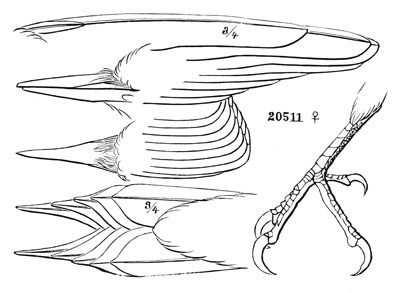
Sphyropicus nuchalis.
20511 ♀
Gen. Char.
Bill as in Picus, but the lateral ridge, which is very prominent, running
out distinctly to the commissure
at about its middle,
beyond which the bill is
rounded without any angles
at all. The culmen and
gonys are very nearly
straight, but slightly convex,
the bill tapering rapidly
to a point; the lateral
outline concave to very
near the slightly bevelled
tip. Outer pair of toes
longest; the hinder exterior
rather longest; the
inner posterior toe very
short, less than the inner
anterior without its claw.
Wings long and pointed; the third, excluding the spurious, longest. Tail-feathers very
broad, abruptly acuminate, with a very long linear tip. Tongue scarcely extensible.
The genus Sphyropicus, instituted in 1858, proves to be so strongly marked
in its characters that Dr. Coues proposes to make it the type of a distinct
subfamily, Sphyropicinæ (Pr. Phil. Acad. 1866, 52). In addition to the peculiarities
already indicated, there is a remarkable feature in the tongue, which,
according to Dr. Coues, Dr. Hoy, Dr. Bryant, and others, is incapable of protrusion
much beyond the tip of the bill, or not more than the third of an
inch. Dr. Coues states that the apo-hyal and cerato-hyal elements of the
hyoid bone do not reach back much beyond the tympano-maxillary articulation,
instead of extending round, as in Picus, over the occiput to the top of the
cranium, or even curving into an osseous groove around the orbit. The basihyals
supporting the tongue are shorter and differently shaped. The tongue
itself is short and flattened, with a superior longitudinal median groove and
a corresponding inferior ridge; the tip is broad and flattened and obtusely
rounded, and with numerous long and soft bristly hairs. This is, of course,
very different from the long, extensile, acutely pointed tongue of other
Woodpeckers, with its tip armed with a few strong, sharp, short, recurved
barbs.
Dr. Hoy and Dr. Coues maintain that the food of these Woodpeckers consists
mainly of the cambium or soft inner bark of trees, which is cut out
in patches sometimes of several inches in extent, and usually producing
square holes in the bark, not rounded ones. As may be supposed, such proceedings
are very injurious to the trees, and justly call down the vengeance
of their proprietors. This diet is varied with insects and fruits, when they
can be had, but it is believed that cambium is their principal sustenance.
This strongly marked genus appears to be composed of two sections and
three well-defined species; the first being characterized by having the back
variegated with whitish, and the jugulum with a sharply defined crescentic
patch of black, though the latter is sometimes concealed by red, when the
whole head and neck are of the latter color, and the sharply defined striped
pattern of the cephalic regions, seen in the normal plumage, obliterated.
Comparing the extreme conditions of plumage to be seen in this type, as in
the females of varius and of ruber, the differences appear wide indeed, and
few would entertain for a moment a suspicion of their specific identity; yet
upon carefully examining a sufficiently large series of specimens, we find
these extremes to be connected by an unbroken transition, and are thus led
to view these different conditions as manifestations of a peculiar law principally
affecting a certain color, which leads us irresistibly to the conclusion
that the group which at first seemed to compose a section of the genus is in
reality only an association of forms of specific identity. Beginning with the
birds of the Atlantic region (S. varius), we find in this series the minimum
amount of red; indeed, many adult females occur which lack this color entirely,
having not only the whole throat white, but the entire pileum glossy-black;
usually, however, the latter is crimson. In adult males from this
region the front and crown are always crimson, sharply defined, and bordered
laterally and posteriorly with glossy-black; and below the black occipital
band is another of dirty white; the crimson of the throat is wholly confined
between the continuous broad, black malar stripes, and there is no
tinge of red on the auriculars; there is a broad, sharply defined stripe of
white beginning with the nasal tufts, passing beneath the black loral and
auricular stripe, and continuing downward into the yellowish of the abdomen,
giving the large, glossy-black pectoral area a sharply defined outline;
the dirty whitish nuchal band is continued forward beneath the black occipital
crescent to above the middle of the eye. The pattern just described
will be found in ninety-nine out of a hundred specimens from the Eastern
Province of North America (also the West Indies and whole of Mexico);
but a single adult male, from Carlisle, Penn. (No. 12,071, W. M. Baird), has
the whitish nuchal band distinctly tinged with red, though differing in
this respect only, while an adult female, from Washington, D. C. (No. 12,260,
C. Drexler), has the lower part of the throat much mixed with red.
Taking next the specimens from the Rocky Mountains and Middle Province
of the United States (S. nuchalis), we find that all the specimens possess
both these additional amounts of the red, there being always a red, instead
of dirty-white, nuchal crescent, while in the female the lower part of
the throat is always more or less red; in addition, the male has the red of
the throat reaching laterally to the white stripe, thus interrupting the black
malar one, which is always unbroken in the eastern form; and in addition,
the auriculars are frequently mixed with red. Proceeding towards the Columbia
River, we find the red increasing, or escaping the limits to which it is
confined in the normal pattern, staining the white and black areas in different
places, and tingeing the whitish which borders the black pectoral area.
Lastly, in the series from the Pacific coast (S. ruber), we find the whole
normal pattern rendered scarcely definable—sometimes entirely obliterated—by
the extension of the red, which covers continuously the whole head,
neck, and breast; but nearly always the normal pattern may be traced, the
feathers of the normally black areas being dusky beneath the surface, and
those of the usual white stripes very white for the concealed portion.
Usually, in this form, the red of the breast covers only the black pectoral
area; but in extreme specimens it reaches back to the middle of the body
beneath, and stains the white spots of the back.
With the increase of the red as we proceed westward, there is also a decrease
in the amount of white above; thus, in varius the whole back is
irregularly spotted with dirty white and black,—the former predominating,
the latter most conspicuous as a medial, broken broad stripe,—and the
lateral tail-feathers are much variegated by white spots. In nuchalis the
back is mostly unbroken glossy-black, with two parallel narrow stripes of
white converging at their lower ends; and the lateral tail-feather is almost
wholly black, having merely a narrow white border toward the end. S. ruber
is most like nuchalis, but has the white still more restricted.
In varius the bill is dark brown, in nuchalis it is deep black, and in ruber
wax-brown. In varius the yellow of the lower parts is deepest, in nuchalis
just appreciable.
Species and Varieties.
A. Wing with a white patch on the middle and greater coverts. Markings
along the sides with a longitudinal tendency.
1. S. varius. Back variegated medially with brownish-white; secondaries
with transverse rows of white spots.
White and black stripes on side of head sharply defined, as is also
the black pectoral crescent. Red confined to isolated patches,—two
large ones, one on the crown and one on the throat; when there is
more, only a tinge on the auriculars, and a crescent on nape.
Crown sometimes glossy black without a trace of red on the female;
no tinge of scarlet on the nape. Red of the throat entirely confined
within the broad, continuous black maxillary stripe. Female with the
throat wholly white. Hab. Eastern Province North America, south
in winter into West Indies, and over whole of Mexico, to Guatemala
… var. varius.
Crown always red in adult. A nuchal crescent of scarlet in both
sexes. Red of the throat not confined by the black maxillary stripe,
which is interrupted by it in the middle, allowing the red to touch the
white stripe; a tinge of red on the auriculars. Female always with
more or less red on lower part of the throat. Hab. Rocky Mountains
and Middle Province of United States
… var. nuchalis.
White and black stripes on side of head obsolete, as is also the black
pectoral crescent, caused by being overspread by a continuous red
wash extending over whole head, neck, and breast.
Whole head, neck, and breast red, with the light and dark stripes of
the normal pattern only faintly traceable. Sexes similar. Hab. Pacific
Province of United States, north to British Columbia
… var. ruber.
2. S. williamsoni. Back unvariegated; secondaries without bands of
white spots.
Whole crown and upper parts (except lower part of rump and
upper tail-coverts, and wing-patch), a stripe on side of head, a broader
one on side of the throat, and the whole jugulum and sides of the
breast, unbroken glossy-black; abdomen bright lemon-yellow. Male
with a narrow stripe of scarlet on middle of the throat. Female with
it white. Young like the adult. Hab. Western Province of United
States.
B. Wing without a white patch. Markings on sides regularly transverse.
3. S. thyroideus. Head all round light brown; abdomen bright lemon-yellow;
rump and upper tail-coverts white. Entire upper surface, with
sides, regularly and continuously barred with black and white, in nearly
equal amount; the black bars usually coalesced on the jugulum into a more
or less extensive patch. Male with the throat tinged medially with scarlet.
Female without any red. Hab. Western Province of United States.
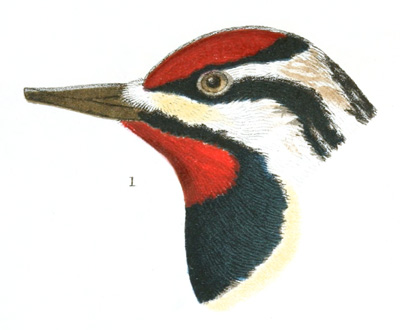
1. Sphyropicus varius. ♂ Pa.
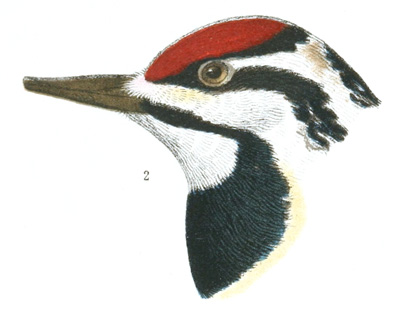
2. Sphyropicus varius. ♀ Pa., 2107.
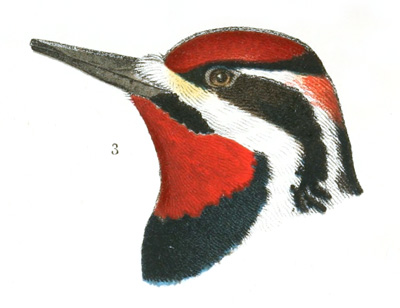
3. Sphyropicus nuchalis. ♂ Wyoming, 10769.
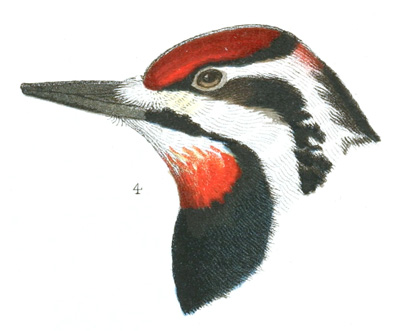
4. Sphyropicus nuchalis. ♀ Wyoming, 10783.
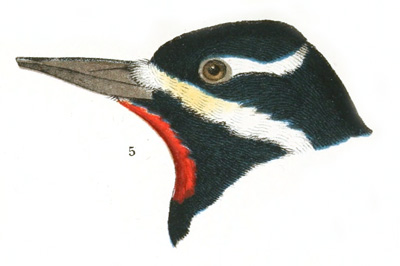
5. Sphyropicus williamsoni. ♀ Cal., 16090.
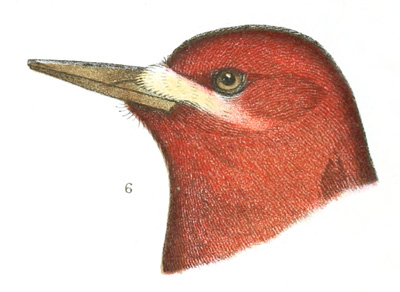
6. Sphyropicus ruber. ♂ Cal., 6038.
Sphyropicus varius, var. varius, Baird.
THE YELLOW-BELLIED WOODPECKER.
Picus varius, L. Syst. Nat. I, 1766, 176.—Vieillot, Ois. Am. II, 1807, 63, pl. cxviii,
cxix.—Wilson, Am. Orn. I, 1808, 147, pl. ix, f. 2.—Wagler, Syst. Av. 1827,
No. 16.—Aud. Orn. Biog. II, 1834, 519; V, 537, pl. 190.—Ib. Birds Amer. IV,
1842, 263, pl. cclxvii.—Bon. List, 1838.—Ib. Consp. 1850, 138.—Maxim. Cab. Jour.
VI, 1858, 416 (refers to peculiar tongue).—Gosse, Birds Jam. 270 (Jamaica).—Newton,
Ibis, 1860, 308 (St. Croix).—Taylor, Ibis, 1860, 119 (Honduras).—Sundevall,
Consp. 33.—Gray, Cat. 51. Picus (Dendrocopus) varius, Sw. F. B. A. II,
1831, 309. Pilumnus varius, Bon. Consp. Zygod. Aten. Ital. 1854, 8. Cladoscopus
varius, Cab. & Hein. Mus. 80. ? Picus atrothorax, Lesson, Traité d’Ornithologie, I,
1831, 229.—Pucheran, Rev. Zoöl. VII, 1835, 21. (Refers it to Picus varius.)
Yellow-bellied Woodpecker, Pennant, Latham. Sphyropicus varius, Baird, Birds N.
Am. 1858, 103.—Sclater, P. Z. S. 1859, 367 (Xalapa).—Ib. Catal. 335 (Orizaba).—Ib.
Ibis, 1859, 136 (Guatemala).—Ib. 1860, 119 (Honduras).—Cab. Journal, IV,
1856, 102.—Gundlach, Repertorium, I, 1866, 294 (Cuba).—Bryant, Pr. Bost. Soc.
1859 (Bahamas).—Ib. 1865, 91 (Anatomy of tongue.)—Dresser, Ibis, 1865, 468 (breeds
in Texas).—Samuels, 96.—Allen, B. E. Fla. 306.
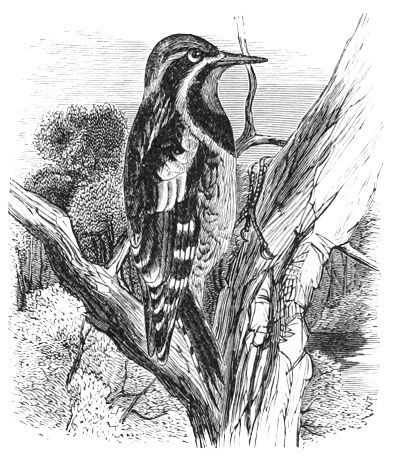
Sphyropicus varius.
Sp. Char.
Third quill longest; second a little shorter; first between fourth and fifth
considerably shorter. General color above black,
much variegated with white. Feathers of the
back and rump brownish-white, spotted with
black. Crown crimson, bordered by black on
the sides of the head and nape. A streak from
above the eye, and a broad stripe from the
bristles of the bill, passing below the eye, and
into the yellowish of the belly, enclosing a black
post-ocular one, and a stripe along the edges of
the wing-coverts, white. A triangular broad
patch of scarlet on the chin, bordered on each
side by black stripes from the lower mandible
which meet behind, and extend into a large
quadrate spot on the breast. Rest of under parts
yellowish-white, or yellow, streaked and banded
on the sides with black. Inner web of inner
tail-feather white, spotted with black. Outer
feathers black, edged and spotted with white.
Quills spotted with white. Length, 8.25; wing, about 4.75; tail, 3.30. Female with the
red of the throat replaced by white. Immature bird without black on the breast, or red
on top of the head, as in every intermediate stage to the perfect plumage.
Hab.
Atlantic coast to the eastern slopes of the Rocky Mountains; Greenland;
West Indies; whole of Mexico, to Guatemala. Localities: ? Oaxaca (Scl. P. Z. S. 1858,
305); Orizaba (Scl. Cat. 335); Xalapa (Scl. 1859, 367); Yucatan (Lawr. Ann. N. Y.
Lyc. IX, 205); Guatemala (Scl. Ibis, I, 136); Honduras (Scl. Ibis, II, 119); Cuba (Cab.
J. IV, 102); (Gundl. Repert. I, 1866, 294); Bahamas (Bryant, Pr. Bost. Soc. VII,
1859; Ib. 1867, 65); Jamaica (Gosse, B. Jam. 270); St. Croix (Scl. Ibis, II, 308);
E. Texas (Dresser, Ibis, 1865, 468; breeds).
There is an occasional variation in the markings of the tail-feathers.
Thus, in No. 782, from Carlisle, the innermost one is entirely black, while
in 4,631, from the Upper Missouri, the outer web of the same feather has
nearly, and in 2,107, from Carlisle, it has quite, as much white as the inner
web. The outer webs do not appear to vary so much.
Specimens from the whole of Mexico, including even the west coast, are
referrible to varius; they are probably winter migrants from the eastern
United States.
A female, from Washington, D. C. (No. 12,260, C. Drexler), has the lower
half of the throat much mixed with red, as in var. nuchalis; but there is no
trace of this color on the nape. A male from Carlisle (No. 12,071, W. M.
Baird) has the nape distinctly tinged with red, as in nuchalis, but the black
malar stripe is uninterrupted. Similar specimens have been taken in New
England, by Messrs. Brewster and Henshaw.
Many females occur with the entire pileum glossy-black, there being no
trace of red, though there are sometimes specks of white.
Habits. The Yellow-bellied Woodpecker is found throughout the United
States, from the Gulf of Mexico on the south and the Atlantic on the east
to the Rocky Mountains, and is met with as far to the north as the 61st
parallel of latitude. Sir John Richardson found it common in the fur countries,
being the only Woodpecker that visits those regions in flocks. He
observed the Yellow-bellied Woodpecker on the north shore of Lake Huron
on the 14th of April, in 1825, and in 1827 it made its first appearance for
the season, on the plains of the Saskatchewan, on the 14th of May. Swainson
received specimens of this Woodpecker from Mexico. De la Sagra and
Dr. Gundlach both give it in their list of Cuban birds, though not as breeding
on that island. Gosse obtained several specimens in the months of
December, January, and February, in Jamaica, where he regarded it as only
a winter migrant from the northern continent. It is not given by the Newtons
among the birds of St. Croix, but appears in Sclater’s list of the birds
of Central America, on the authority of Mr. George M. Skinner. Two
specimens have been taken in Greenland.
Wilson, in his account of its breeding habits, speaks of it as a resident
bird from Cayenne to Hudson’s Bay, as being common in the States of Kentucky
and Ohio, and as having been found in the neighborhood of St. Louis.
He describes the habits of this species as similar to those of the Hairy and
Downy Woodpeckers, with which it generally associates. The only nest of
this bird which Wilson ever met with was in the body of an old pear-tree,
about ten or eleven feet from the ground. The hole was almost exactly circular,
small for the size of the bird, so that it crept in and out with difficulty;
but the excavation suddenly widened, descending by a small angle, and then
running downward about fifteen inches. On the smooth solid wood lay four
white eggs. This was about the 25th of May.
Mr. Audubon, on the other hand, speaks of this species as returning to
Louisiana and the other Southern States only about the beginning of October,
remaining there during the winter, and again taking its departure before
the beginning of April, after which period he never observed it in those districts.
A few only, according to the same authority, breed in Kentucky, but
the greater number migrate to the more northern parts of the Union. He
describes it, in its habits, as preferring the interior of the forest during the
spring and summer, seldom showing itself near the habitation of man at
those seasons. It generally, he adds, bores its nest at a considerable height,
and usually in the trunk of an undecayed tree, immediately beneath a large
branch, and on its southern side. The hole is worked out by the male as well
as the female, in the manner followed by the other species, and to the depth
of from fifteen to twenty-four inches. The aperture is just large enough to
admit the birds, but the whole widens gradually towards the bottom, where
it is large and roomy. The eggs, which are from four to six, and pure white,
with a slight blush, are deposited on the chips without any nest. The
young seldom leave the hole until they are fully fledged.
Mr. Audubon elsewhere speaks of having found this species extremely
abundant in the upper parts of the State of Maine and in the Provinces of
Nova Scotia and New Brunswick; but he saw none in Newfoundland or
Labrador.
For my specimens of the eggs of this species and valuable information as
to its habits, I am indebted to Mr. Charles S. Paine, of East Bethel, Vt.,
in which State it seems to be quite abundant. In a letter written in the
summer of 1860, he furnishes the results of his observations relative to their
habits, so far as they have fallen under his notice.
The Yellow-bellied Woodpeckers reach the central and northern parts of
that State about the 10th of April. They soon make their presence known
there by their loud and continued drumming, rather than tapping, on the
trunks and larger branches of decaying trees. Of this drumming they seem
to be peculiarly fond, especially where they can produce a loud ringing
sound. Sometimes, when Mr. Paine had been engaged in the process of preparing
maple sugar, he had left a few empty wooden buckets hanging on the
branches of trees, until needed for use. Upon these the bird will drum,
apparently with the greatest delight. At times they would experiment upon
the tin pails, but, being unable to obtain good standing-ground, they did not
follow it up. On such occasions their drumming did not appear to be
done in the pursuit of worms or food, but was very evidently for their own
entertainment, or in a spirit of rivalry one with another, as if seeking to
please their mates. When two male birds meet, they pursue each other
through the woods with great clamor. They have a loud, distinct, and lively
note, but their favorite music appears to be this drumming. They mate and
commence the excavation of their nests the last week in April. Their eggs
are usually deposited, in this section, somewhere between the 20th of May
and the first of June. The excavations for their nests are usually made in
the tops of large decaying trees. He adds that he found four or five of
these nests that year. The eggs of one of these he was able to obtain without
much trouble, the others had hatched. When the young leave their
nests they usually keep together, and often four or five may be seen playing
about the bark of the same tree while waiting for their parents to bring
them their food.
This species is far more abundant at the West than it is in the New England
States. In the States of Rhode Island, Connecticut, and Massachusetts
it is very rarely met with. It is commonly known as the Sap-Sucker, and
much better deserves that name than do other species to which this term is
also applied. Owing to the peculiar formation of its tongue and the muscles
connected with it, it feeds less readily upon insects, and they form a smaller
proportion of its food. In the spring of the year these birds prey largely
upon the inner bark of trees, and where they exist in great numbers often do
a great deal of mischief. In April, 1868, I visited gardens in Racine, in company
with Dr. Hoy, where these Woodpeckers had every successive spring
committed their ravages, and was eyewitness to their performance. Their
punctures were unlike those of the pubescens, being much deeper, penetrating
the inner bark, and, being repeated in close proximity, becomes entirely
stripped off after a while, often resulting in the girdling and complete destruction
of the tree. In one garden of some considerable size, all the mountain-ash
and white-pine trees had thus been killed. In prairie countries,
where trees are a deficiency and their cultivation both important and attended
with difficulty, these birds prove a great pest, and in a few hours may
destroy the labor of many years. These habits, so well known to most of
our Western farmers, appear to have entirely escaped the notice of our older
ornithologists.
Mr. Dresser found these birds near San Antonio at all seasons of the year,
but rather rare. He shot a couple near the Medina River, and Dr. Heermann
also procured the eggs in that neighborhood.
Mr. Ridgway says that in Southern Illinois this Woodpecker is only a
winter resident, coming from the north in September or October, and departing
in April. It is the only one of the eight species of Woodpeckers of
that section which does not breed there, and also the only one which is not
resident.
Specimens of its eggs from Vermont measure .95 by .70 of an inch. They
are of an oval shape, a little less rounded at one end than at the other.
Sphyropicus varius, var. nuchalis, Baird.
THE RED-NAPED WOODPECKER.
Sphyropicus varius, var. nuchalis, Baird, Birds N. Am. 1858, 103, pl. xxxv, figs. 1, 2. Sphyropicus
nuchalis, Baird, Ib. 921.—Coues, Pr. A. N. Sc. 1866, 53.—Cooper, Pr. Cal.
Ac. 1861, 122.—Cass. P. A. N. S. 1863, 204.—Cooper, Orn. Cal. 1, 1870, 390.
Picus varius occidentalis, Sundevall, Consp. Pic. 1866, 34. Cladoscopus nuchalis,
Cab. & Hein. 82.
Sp. Char.
Markings, generally, as in S. varius. A red nuchal crescent. Belly yellowish-white.
The red of the throat extending over and obliterating the black stripe from the
lower mandible, except on the side of the jaw. Post-ocular black patch tinged with red.
Secondaries with little or no white on outer webs. Tail-feathers black, scarcely varied;
the innermost with inner web, as in varius. Female similar, but with the chin white;
the throat red, bordered, as in male, by a black stripe from the bill to the black pectoral
patch. Length, 8.00; wing, 5.00; tail, 3.50.
Hab.
Middle Province of United States. Localities: Fort Mohave (Cooper, Pr. Cal.
Ac. 1861, 122); W. Arizona (Coues, P. A. N. S. 1866, 53).
This bird, first indicated as a simple variety of S. varius, is yet as decidedly
distinct and constant in its markings as a large number of what are considered
to be valid species. The principal differences from varius have been
mentioned above: they consist mainly in the greater development of red, as
seen in wider throat-patch; nuchal crescent; tinge on cheek; a greater
amount of black, shown in unspotted outer webs of secondaries and blacker
tail, and in the paler colors below. The most striking peculiarity is in the
half-red throat of the female, which is entirely white in varius. The light
markings of the back are more distinctly arranged in two lines enclosing a
median of black, which show no concealed white spots as in varius. The
breast is much paler, only slightly tinged with yellow, instead of the rich
color to which S. varius owes its trivial name.
Young birds vary in color to the same excessive degree as in varius.
Habits. This form, closely allied to the varius, was at first known only
from the southern Rocky Mountains. Afterwards a large number of specimens
were obtained by Mr. C. Drexler at Fort Bridger, in Utah.
Dr. Cooper procured a female specimen of this species at Fort Mohave, on
the 20th of February, 1861, which had probably wandered in a storm from
the mountains, and which was the only one he met with. Dr. Heermann
states, also, that they were not rare at Fort Yuma. Dr. Cooper’s bird was
silent and inactive, as if exhausted by a long flight. He also saw these birds
rather common as he crossed the mountains near latitude 48° in September,
1860, and noticed a great similarity in their habits to those of the S. varius.
They chiefly frequented small deciduous trees, fed in the usual manner of
other Woodpeckers, and had also a shrill, unvaried call or note of alarm.
Dr. Coues found this Woodpecker an abundant and a permanent resident
in Arizona. Its distinctness as a species he did not question. Everywhere
common, it seemed to prefer live cottonwood-trees and willows. Two specimens
of this race have been taken in New England,—one in New Hampshire
by Mr. William Brewster, the other in Cambridge by Mr. Henshaw.
The Red-naped Woodpecker was found by Mr. Ridgway to be one of the
most abundant and characteristic species of the Wahsatch and Uintah
Mountains. It was also found, in greater or less numbers, throughout the
Great Basin, in the region of his route, and was even obtained on the eastern
Sierra Nevada, where, however, only one specimen was seen. Its favorite
resort, during summer, was the aspen groves in the mountains, at an altitude
averaging about seven thousand feet; and even when pine woods were near
the aspens were invariably chosen as nesting-places. Its excavations were
always in living trees, and the abandoned ones were taken possession of by
Purple Martins and White-bellied Swallows (Progne subis and Tachycineta
bicolor) as nesting-places. In winter it was found among the cottonwoods
and willows of the river valleys. Its habits, manners, and notes are described
as almost perfectly similar to those of S. varius.
Sphyropicus varius, var. ruber, Baird.
THE RED-BREASTED WOODPECKER.
Picus ruber, Gm. Syst. Nat. I, 1788, 429.—Wagler, Syst. Av. 1827, No. 151.—Aud. Orn.
Biog. V, 1839, 179, pl. ccccxvi.—Ib. Birds Amer. IV, 1842, 261, pl. cclxvi.—Sundevall,
Consp. Pic. 32. Melanerpes ruber, Rich. List, Pr. Br. Assoc. for 1835.—Bonap.
List, 1838.—Ib. Consp. 1850, 115. Pilumnus ruber, Bon. Consp. Zyg. Aten.
Ital. 1854, 8. Picus flaviventris, Vieillot, Ois. Am. Sept. II, 1807, 67. Sphyropicus
ruber, Baird, Birds N. Am. 1858, 104.—Cooper & Suckley, 160.—Gray, Cat.
51.—Cooper, Orn. Cal. 1, 1870, 392. Cladoscopus ruber, Cab. & Hein. Mus. Hein.
IV, 1863, 82.
Sp. Char.
Fourth quill longest; third intermediate between fourth and fifth. Bill
brown wax-color. Head and neck all round, and breast, carmine-red. Above black,
central line of back from nape to rump spotted with whitish; rump, wing-coverts, and
inner web of the inner tail-feathers white, the latter with a series of round black spots.
Belly sulphur-yellow, streaked with brown on the sides. Narrow space around and a
little in front of the eye black. A yellowish stripe from the nostrils, a short distance
below and behind the eye. Length, about 8.50; wing, 5.00; tail, 3.40. Sexes similar.
Hab.
Pacific slopes of the United States.
As stated in the remarks before the synopsis on page 1133, there is every
reason for considering this as merely a geographical race of a species, of
which nuchalis and varius are the other forms. The differences from varius
consist merely in an excessive amount of red, this obliterating the normal
pattern of the cephalic portions; and in an increased amount of black, or a
manifestation of the melanistic tendency so often distinguishing birds of the
Pacific coast region from their eastern co-specific representatives.
S. nuchalis is exactly intermediate in all respects between S. ruber and S.
varius,—the extremes,—while each of the latter is connected with the intermediate
race by specimens combining the characters of both races.
Habits. The geographical distribution of this form seems to be restricted
to the Pacific coast region.
Dr. Cooper only met with these birds three times in Washington Territory.
This was in spring and fall. He speaks of them as being very shy, silent,
and retiring, remaining among the dense tops of the dark forest trees.
Whether it resides and breeds in the Territory he had no means of determining.
Dr. Suckley saw but one specimen, and regarded it as confined, for
the most part, to the close vicinity of the coast.
Mr. Audubon assigns to it the same distribution, but is only able to give
the information in regard to its habits which he derived from the observations
of Mr. Nuttall, which, however, do not correspond with those of Dr.
Cooper. Mr. Nuttall states that this species, seen in the forests of the Columbia
and the Blue Mountains, has most of the habits of the common Red-headed
species. He concedes that it is less familiar, and that it keeps generally
among the tall fir-trees, in the dead trunks of which it burrows out a
hole for a nest, sometimes at a great elevation. On approaching one that
was feeding its young in one of these situations, it uttered a loud reverberating
t’rr, and seemed angry and solicitous at his approach. He adds that
this species also inhabits California, as well as the northwest coast up to
Nootka, and that it is found eastward as far as the central chain of the
Rocky Mountains. An egg taken from a nest which contained four was
1.25 in length and .75 of an inch in breadth. It was smooth, equally
rounded at both ends, though somewhat elongated, and pure white.
We are confident that there must be some mistake in this statement.
The disproportion between the length and the breadth is unprecedented.
Even in the most oblong egg there is rarely so much as twenty-five per cent
difference.
Dr. Cooper, in his Birds of California, speaks of it as rather a northern bird,
having seen none south of Santa Clara, and there only in the mountains of
the Coast Range in early spring.
Dr. Heermann found this form not at all rare in the Sierra Nevada Mountains,
and occasionally met a stray one among the valleys. Their call-note
was similar to the cry of a child in distress, and was very disagreeable.
In their quick, restless motions, and their untiring diligence in quest of food,
they resemble the rest of the Woodpecker family.
It was noticed by Mr. Ridgway only on the Sierra Nevada, and he is not
certain that he saw it on the eastern slope of that range.
Sphyropicus williamsoni, Baird.
WILLIAMSON’S WOODPECKER.
Picus williamsoni, Newberry, Zoöl. California and Oregon Route, 89, P. R. R. Repts.
VI, 1857, pl. xxxiv, fig. 1.—Sundevall, Consp. 32. Melanerpes rubrigularis, Scl.
Annals and Mag. N. H. 3d series, I, Feb. 1858, 127.—Pr. Zoöl. Soc. 1858, 2, pl. cxxxi.
Sphyropicus williamsoni, Baird, Birds N. Am. 1858, 105, pl. xxxiv, f. 1.—Coues, Pr.
1866, 54.—Cass. P. A. N. S. 1863, 204.—Cooper, Orn. Cal. 1, 1870, 393. Cladoscopus
williamsoni, Cab. & Hein. Mus. Hein. IV, 1863, 82. Melanerpes williamsoni,
Gray, Catal. Br. Mus. 1868, 116.
Sp. Char.
Rich black; middle line of belly yellow; central line of chin and throat
above red. A large patch on the wing, rump, and upper tail-coverts, a line from the forehead
beneath the eye, and another from its upper border, white. Tail entirely black. Exposed
surface of quills without any white, except on the outer primaries. Female with
the chin white instead of red. Length, 9.00; wing, 5.00; tail, 4.70.
Hab.
Rocky Mountains to the Cascade Mountains, Sierra Nevada. Localities: West
Arizona (Coues, P. A. N. S. 1866, 54).
Head and neck all round, sides of breast and body, upper parts generally,
wings, and tail, glossy greenish-black. A well-defined white stripe from the
nostrils (including the bristly nasal feathers) passing backwards under the
eye; another, nearly parallel, starting at the upper part of the eye, and nearly
meeting its fellow on the occiput. Chin and throat red along their central
line. A large patch on the wing, including the exposed portions of the
middle and greater coverts, white, although the anterior lesser coverts are
black. The inner face of the wings, excepting the smaller coverts, is black,
banded transversely on the inner primaries with white; the sides of body
behind and under tail-coverts white, with broadly V-shaped bands of black,
which color on the latter occupies the whole central portion of the feathers.
Rump and upper tail-coverts pure white; back with a few indistinct
and concealed spots of the same. Quills black; the margins of exterior
primaries spotted with white, the inner margins only of the remaining quills
with similar but larger and more transverse blotches. Middle of the body,
from the breast to the vent, sulphur-yellow, with the exception of the
type which had been preserved in alcohol (which sometimes extracts the
red of feathers). We have seen no specimen (except young birds, marked
female), in a considerable number, without red on the chin, and are inclined
to think that both sexes exhibit this character. Young birds from the Rocky
Mountains are very similar to the adult, but have the throat marked white,
and the inner web of innermost tail-feather banded with the same color.
No. 16,090, ♂ ad. (Fort Crook, California), has a single crimson feather in
the middle of the forehead.
Habits. This comparatively new species of Woodpecker was first discovered
by Dr. Newberry in the pine forest on the eastern border of the
upper Klamath Lake. Its habits appeared to him to be very similar to those
of P. harrisi and P. gairdneri, which inhabit the same region. The individual
he procured was creeping up the trunk of a large yellow pine (P. brachyptera),
searching for insects in the bark. Its cry was very like that of
P. harrisi. Although killed by the first fire, a second discharge was required
to detach it from the limb to which it clung fast.
According to Dr. Coues, it is resident and not uncommon in the Territory
of Arizona, occurring exclusively among the pine-trees. It is said to range
from both slopes of the Rocky Mountains to the Pacific, from as far north
at least as Oregon. Fort Whipple is supposed to be about its southern
limit. Dr. Coues states that this species possesses the anatomical peculiarities
of the S. varius, and that its habits entirely correspond. Mr. Allen found
it abundant on the sides of Mount Lincoln, in Colorado Territory.
Dr. Cooper met with a straggler of this species in the valley of the Colorado,
shot on the 12th of March, 1861. In September, 1863, he found them
rather common near the summit of the Sierra Nevada, latitude 39°, where he
shot two. It has since been met with at Laramie Peak, and near the mouth
of the Klamath River.
It was found by Mr. Ridgway on the eastern slope of the Sierra Nevada,
and again on the Wahsatch Mountains; in both regions inhabiting the pine
forests exclusively, and in neither place at all common. It occurred so seldom
that Mr. Ridgway could learn but little concerning the peculiarities of
its habits, etc. Its common note is a plaintive wailing squeal, much like
that of S. varius (common to all the members of the genus), but other notes
were heard which were quite peculiar.
Sphyropicus thyroideus, Baird.
BROWN-HEADED WOODPECKER.
Picus thyroideus, Cassin, Pr. A. N. Sc. V, Dec. 1851, 349 (California).—Heermann,
J. A. N. Sc. Ph. 2d ser. II, 1853, 270.—Sundevall, Consp. 32. Melanerpes thyroideus,
Cassin, Ill. I, 1854, 201, pl. xxxii. Pilumnus thyroideus, Bon. Consp. Zygod.
Aten. Ital. 1854, 8. Sphyropicus thyroideus, Baird, Birds N. Am. 1858, 106—Elliot,
Ill. Birds N. Am. II, pl.—Coues, P. A. N. S. 1866, 54.—Cass. P. A. N. S.
1863, 204.—Gray, Cat. 52.—Elliot, B. Am. I, pl. xxxv.—Cooper, Orn. Cal. 1,
1870, 394. ? ? Picus nataliæ, Malherbe, Cab. Journ. f. Ornith. 1854, 171.
Sp. Char.
About the size of P. varius. Head dark ashy-brown; general color ashy-brown;
head and neck scarcely marked; middle line of belly sulphur-yellow; rump and
upper coverts pure white; rest of body apparently encircled by narrow transverse and
continuous bands (crossing the wings and tail) of black, the outer spaces becoming whiter
behind; a large round black patch on the breast. No red on top of the head. Male with
reddish chin. Length, about 9.00; wing, 5.00; tail, 4.10.
Hab.
Cascade and Coast Ranges of California and Oregon; Sierra Nevada, Wahsatch,
and Rocky Mountains. Localities: West Arizona (Coues, P. A. N. S. 1866, 54).
In addition to the characters already assigned, the crown of the head is
indistinctly streaked or spotted with black. The under coverts are barred
with black. The tail-feathers are black, the inner and outer barred transversely
with white on both webs; the shafts, however, entirely black. The
quills are all spotted with white on both webs.
The jugular black patch shows more or less indication of the transverse
bands, and is sometimes wanting, leaving the bands distinct. In one specimen
(38,285 ♀, Laramie Peak) it is remarkably large and almost unbroken,
while the black malar stripe is decidedly indicated; on the back the black
bars much exceed in width the light ones, which are nearly white. The
generic rictal white stripe is usually inappreciable, as also the black maxillary
one, although both can be detected in some specimens.
A young bird is not appreciably different from the adult.
Habits. Dr. Cooper regards this bird as quite a rare species. He has
never met with it, and doubts if it is ever found so far south as San Francisco.
Mr. J. G. Bell, of New York, was the first to meet with this bird in
the Lower Sierra Nevada.
Dr. Heermann procured specimens among the southern mines, near the
Colorado River, where they were especially frequenting the pine-trees in
search of their food. He saw none of them alight on an oak, though those
trees were abundant in that locality. It has since been met with near Fort
Crook, and Dr. Cooper thinks it probable they may be more common in the
mountains of Eastern Oregon and in those of Central Utah.
Dr. Coues says that it is resident, but very rare, in Arizona. It frequents
pine-trees by preference. Its range is said to include both slopes of the Rocky
Mountains, from Oregon to the Rio Grande, and probably to Sonora.
Mr. Ridgway met with this rare Woodpecker on the Sierra Nevada and
Wahsatch Mountains, where it inhabited the same woods with the S. williamsoni;
it appeared to have the same manners and notes as that species, but it
was so seldom met with that nothing satisfactory could be learned concerning
its habits. Its conspicuously barred coloration gives it much the appearance
of a Centurus, when flying.
Genus HYLOTOMUS, Baird.
Dryotomus, Malherbe, Mém. Ac. Metz, 1849, 322. (Not of Swainson, 1831.)
Dryopicus, Bonap. Consp. Zygod. in Aten. Ital. May, 1854. (Not of Malherbe.)
Hylatomus, Baird, Birds N. Am. 1858, 107. (Type, Picus pileatus.)
Phlæotomus, Cab. & Hein. 1863. (Same type.)
Gen. Char.
Bill a little longer than the head; considerably depressed, or broader than
high at the base; shaped much as in Campephilus, except shorter, and without the
bristly feathers directed forwards at the base of the lower jaw. Gonys about half the
length of the commissure. Tarsus shorter than any toe, except the inner posterior.
Outer posterior toe shorter than the outer anterior, and a little longer than the inner
anterior. Inner posterior very short, not half the outer anterior; about half the inner
anterior one. Tail long, graduated; the longer feathers much incurved at the tip. Wing
longer than the tail, reaching to the middle of the exposed surface of tail; considerably
graduated, though pointed; the fourth and fifth quills longest. Color uniform black.
Head with pointed occipital crest. A stripe from nasal tufts beneath the eye and down
side of neck, throat, lining of wing, and basal portion of under surface of quills, white;
some species with the abdomen and sides barred black and brownish-white; others with
a white scapular stripe in addition. Male with whole crown and crest and maxillary
patch red; female with only the crest red.
This genus is similar in general appearance and size to Campephilus, but
differs essentially in many respects; the differences being, however, mostly
those which distinguish all other Woodpeckers from the species of Campephilus,
which is unique in the peculiar structure of the tail-feathers, the great
graduation of the tertials (sixth, instead of third or fourth, longest), and very
long gonys with the flat tuft of hair like feathers at its base. The less development
of the outer hind toe in Hylotomus, which is about exactly intermediate
between the outer and inner anterior, the outer largest, instead of being
longest, and having the outer anterior intermediate between it and the
inner, the shorter bill, the gonys fully half the length of the commissure,
are additional distinctive features.
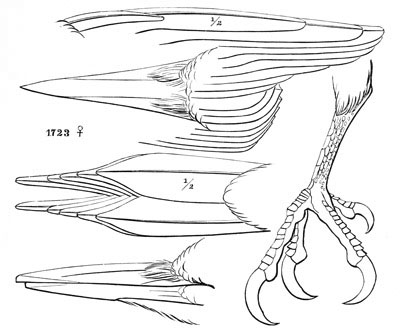
Hylotomus pileatus.
1723 ♀
Of Hylotomus there are several species in tropical America, all differing,
however, in transversely banded lower parts, while some have a broad white
scapular stripe; in these features of coloration (but in these only, for the head
pattern is always much as in the H. pileatus) they resemble closely species
of Campephilus (C. guatemalensis, C. albirostris, C. malherbei, etc.,) found in
the same region; one (H. scapularis, of Mexico) even has a whitish ivory-like
bill. They may all be distinguished from the species of Campephilus,
however, by the generic differences.
Hylotomus pileatus, Baird.
BLACK WOODCOCK; LOG-COCK.
Picus pileatus, Linn. Syst. Nat. I. 1766, 173.—Vieillot, Ois. Am. Sept. II, 1807, 58,
pl. cx.—Wilson, Am. Orn. IV, 1811, 27, pl. xxix, f. 2.—Wagler, Syst. Av. 1827,
No. 2.—Aud. Orn. Biog. II, 1834, 74; V, 533, pl. cxi.—Ib. Birds Amer. IV, 1842,
266, pl. cclvii.—Maxim. Cab. Jour. VI. 1858, 352.—Sundevall, Consp. 8. Picus
(Dryotomus) pileatus, Sw. F. Bor. Am. II, 1831, 304. Dryotomus pileatus, Bp. List,
1838. Dryocopus pileatus, Bonap. Consp. Av. 1850, 132. Dryopicus pileatus, Bon.
Consp. Zyg. Aten. Ital. I.—Sclater, Catal. 1862, 332.—Gray, Catal. 59. Pileated
Woodpecker, Pennant.—Latham. Hylotomus pileatus, Baird, Birds N. Am. 1858,
107.—Lord, Pr. R. Art. Inst. IV, 212.—Cooper & Suckley, 161.—Dresser, Ibis,
1865, 469 (E. Texas, but not Rio Grande).—Cooper, Orn. Cal. 1, 1870, 396. Ceophloeus
pileatus, Cab. Jour. 1862, 176. (Hylotoma, preoccupied by Latreille!!) Cab. &
Hein. Mus. Hein. IV, II, 1863.—Samuels, 99.—Allen, B. E. Fla. 302.
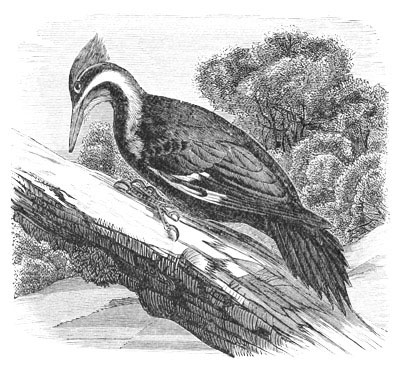
Hylotomus pileatus.
Sp. Char.
Fourth and fifth quills equal and longest; third intermediate between sixth
and seventh. Bill blue-black; more horn-color beneath. General color of body, wings,
and tail dull greenish-black.
A narrow white streak from
just above the eye to the occiput;
a wider one from the
nostril feathers (inclusive),
under the eye and along the
side of the head and neck;
sides of the breast (concealed
by the wing), axillaries, and
under wing-coverts, and concealed
bases of all the quills,
with chin and beneath the
head, white, tinged with sulphur-yellow.
Entire crown
from the base of the bill to
a well-developed occipital
crest, as also a patch on the
ramus of the lower jaw,
scarlet-red. A few faint
white crescents on the sides
of the body and on the abdomen.
Longer primaries generally tipped with white. Length, about 18.00; wing, 9.50.
Female without the red on the cheek, and the anterior half of that on the top of the
head replaced by black.
Hab.
Wooded parts of North America from Atlantic to Pacific. Localities: E. Texas
(not Rio Grande!), (Dresser, Ibis, 1865, 469, breeds).
Specimens of this species from Fort Liard in the Northern Rocky Mountains,
and from Puget Sound region, are nearly four inches longer than those
from the Southern Atlantic States, and are scarcely exceeded in size by the
Ivory-billed Woodpecker.
Specimens from the northwest coast region (Columbia River, British
Columbia, etc.) have no trace of the white spots on ends of outer primaries,
always found in eastern specimens.
Habits. No member of this large family has a wider distribution than
the Pileated Woodpecker, extending from the Gulf of Mexico to the extremest
limits of the northern forests, and from the Atlantic to the Pacific.
It seems to be a resident everywhere but in its extreme northern localities,
rather than a migratory species. There are specimens in the Smithsonian
collection from Nelson River, on the north, to St. Johns River, Florida, on
the south, and from Pennsylvania on the east to the Rio Grande and the Columbia
on the west. Sir John Richardson (Fauna Boreali-Americana, II, p.
304) speaks of it as resident all the year in the interior of the fur countries,
up to the 62d or 63d parallels, rarely appearing near Hudson’s Bay, but frequenting
the gloomiest recesses of the forests that skirt the Rocky Mountains.
Dr. Woodhouse, in his Report on the natural history of the expedition
down the Zuñi and the Colorado Rivers, speaks of this Woodpecker as
having been found abundant in the Indian Territory, Texas, and New
Mexico. Neither Dr. Gambel nor Dr. Heermann give it in their lists of the
birds of California, nor does Dr. Newberry mention meeting with it in his
Report of the zoölogy of his route. Dr. Suckley, however, speaks of the
Log-Cock as abundant in the vicinity of Fort Steilacoom, Washington Territory,
during summer, and Dr. Cooper also mentions it as an abundant and
constant resident in the forests of the Territory. I have occasionally met
with it in the wilder portions of New Hampshire and Maine, but have nowhere
been so fortunate as to observe its nest or its breeding-habits. It has
always seemed a very shy bird, difficult of approach, always keeping at a
safe distance, and ever greeting your attempts for a nearer view with a loud,
cackling cry, not unlike a derisive laugh.
According to the observations of Wilson, their eggs are deposited in the
hole of a tree dug out by themselves, no other materials being used but the
soft chips of rotten wood. The female lays six eggs, of a snowy whiteness,
and they are said to raise two broods in a season.
Mr. Audubon states that it almost always breeds in the interior of the
forest, and frequently on trees placed in deep swamps over the water, appearing
to give a preference to the southern side of the tree, on which side
the hole is usually found to which they retreat in the winter and during
stormy weather. The hole is sometimes bored perpendicularly, but occasionally
in the form of that of the Ivory-billed Woodpecker. The usual depth
is from twelve to eighteen inches, the breadth from two and a half to three,
and at the bottom five or six. He believed they raise but a single brood
in a season. The young follow their parents a long while, sometimes until
the return of spring.
Rev. Dr. Bachman gives an interesting account of a pair of Pileated
Woodpeckers building a nest in an old elm-tree in a swamp, and occupying
it the first year. Early the next spring two Bluebirds took possession of
it, and there had young. Before they were half grown the Woodpeckers
returned to the place, and, despite the cries and reiterated attacks of the
Bluebirds, took out the young and carried them away to some distance.
Next, the nest itself was disposed of, the hole cleaned and enlarged, and
there they raised their brood. The tree was large, but so situated that Dr.
Bachman could reach the nest from the branches of another. The hole was
eighteen inches deep, and he could touch the bottom with his hand. The
eggs, six in number, were laid on fragments of chips expressly left by the
birds, and were large, white, and translucent. Before the Woodpeckers began
to sit, he robbed them of their eggs to see if they would lay a second time.
They waited a few days as if undecided, and then he heard the female at
work again, deepening the hole and making it broader at the bottom. She
soon recommenced laying, this time depositing five eggs. He suffered her
to bring out her young, both birds alternately incubating, and each visiting
the other at intervals, looking in at the hole to see if all were right and well
there, and flying off afterwards in search of food. When the young were
old enough, he took them home and endeavored to raise them. Three
died, refusing all food. With two he was more successful. But even these
he found untamable and destructive and troublesome pets, which he was at
last glad to release.
Dr. Cooper, who observed this species in Washington Territory, discovered
a pair early in April on Whitby’s Island, burrowing out a hole for their
nest in a dead trunk, about thirty feet from the ground. They worked alternately,
and were very watchful, keeping perfectly silent while they heard any
noise near by. He found the place by noticing chips on the bushes below,
and after watching silently for some time, one of them began to work, now
and then protruding its bill full of chips, and, after cautiously looking round,
dropping them.
According to Mr. C. S. Paine, of Randolph, Vt., the Pileated Woodpecker
is very rare in Vermont, and extremely shy. It is difficult to approach one
nearer than from fifteen to twenty rods, except by surprise. He adds that
in only a single instance has he been able to shoot one. This fell with a
broken wing. Before he could reach it, the bird commenced climbing a tree,
and nearly escaped. When overtaken, it fought furiously, and wounded Mr.
Paine severely in the hand, setting up at the same time a loud outcry, not
unlike that of a domestic hen. He has never met with its nest, although he
has several times seen the young when just able to leave it. The elder
Mr. Paine states that, some fifty years previous, this species was abundant in
Vermont, and not at all timid, and is of the opinion that their present shyness
is all that exempts them from extermination.
Mr. Dresser found this Woodpecker resident and quite numerous in Texas
near all the large rivers, where the timber is heavy. A few were seen on
the Medina, and their eggs obtained there, but they were not abundant in
that district. On the Colorado and Brazos Rivers these birds were very common,
and Mr. Dresser found several nests in huge cottonwood-trees, but had
no means of getting to them.
Mr. J. K. Lord assigns to this species a wide western range, being common
both east and west of the Cascades, and on the west slope of the Rocky
Mountains. He met with it north as far as Fort Rupert in Vancouver
Island, and south through Oregon and California. He found them at Colville
during the winter. He states that they nest in May, generally in a
tall dead pine-tree, at a great height.
For my first specimens of the eggs of this species I am under obligations
to Dr. Cornelius Kollock, of Cheraw, S. C. They were obtained by him
from excavations made in large trees at the height of about twenty-five feet
from the ground, and in localities at no great distance from the inhabited
parts of the country.
The eggs of this species from South Carolina and Florida are of a very
brilliant crystalline whiteness, of a rounded-oval shape, and measure 1.25
inches in length by 1.02 in breadth. Northern specimens are probably
larger.
Section CENTUREÆ.
The United States genera of this section are very similar to each other,
and may be most easily distinguished by color, as follows:—
Centurus. Back and wings banded transversely with black and white. Crown more
or less red; rest of head with under parts grayish, and with red or yellow tinge on the
middle of the abdomen. Rump white.
Melanerpes. Upper parts uniform black, without bands, with or without a white
rump; variable beneath, but without transverse bands.
Genus CENTURUS, Swainson.
Centurus, Sw. Class. Birds, II, 1837, 310. (Type, C. carolinus.)
Zebrapicus, Malh. Mém. Acad. Metz, 1849, 360. (Type, C. carolinus.)
Gen. Char.
Bill about the length of the head, or a little longer; decidedly compressed,
except at the extreme base. A lateral ridge starting a little below the culmen at the base
of the bill, and angular for half the length of the bill, then becoming obsolete, though
traceable nearly to the tip. Culmen considerably curved from the base; gonys nearly
straight. Nostrils very broad, elliptical; situated about midway on the side of the mandible,
near the base; partly concealed. Outer pairs of toes unequal, the anterior toe
longest. Wings long, broad; third to fifth primaries equal and longest. Tail-feathers
rather narrow, stiffened.
The species are all banded above transversely with black and white; the
rump white. The head and under parts are brown, or grayish, the latter
sometimes much the lighter. The belly with a red or yellow tinge. The
under tail-coverts with V-shaped dark marks. The North American species
of Centurus may be arranged as follows:—
C. carolinus. Middle of belly reddish; whole crown and nape red in male.
Nape, only, red in female.
Forehead reddish; beneath soiled ashy-white; abdomen pinkish-red;
crissum with sagittate marks of dusky. Wing, 5.25; tail, 3.80; bill,
1.30. Hab. Eastern Province United States
… var. carolinus.
Forehead smoky-white; beneath smoky-olive, middle of abdomen carmine-red;
crissum with broad transverse bars of dusky. Wing, 4.50;
tail, 2.60; bill, 1.08. Hab. Central America; Venezuela
… var. tricolor.[129]
C. aurifrons. Middle of belly yellowish; red of crown, in male, confined
to an ovoid vertical patch. Nape and forehead gamboge-yellow; white of
rump and upper tail-coverts immaculate. Female without any red on the
crown.
Inner webs of middle tail-feathers unvariegated black. Lower parts
dirty ashy-whitish, abdomen dilute gamboge-yellow. Wing, 5.20; tail,
3.60; bill, 1.50. Hab. Eastern Mexico, north to the Rio Grande
… var. aurifrons.
Inner webs of middle tail-feathers spotted with white. Lower parts
smoky-olive, belly bright orange-yellow. Wing, 4.70; tail, 2.80; bill,
1.16. Hab. Costa Rica
… var. hoffmanni.[130]
C. uropygialis. Middle of the belly yellowish. Nape and forehead soft
smoky grayish-brown. Female without red or yellow on head. White of
rump and upper tail-coverts with transverse dusky bars. Inner webs of
middle tail-feathers spotted with white. Wing, 5.30; tail, 3.70; bill, 1.35.
Hab. Western Mexico, north into Colorado, region of Middle Province of
United States.
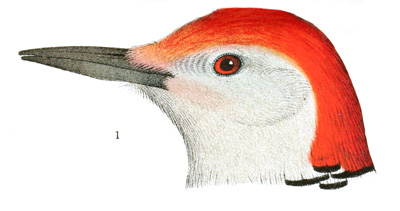
1. Centurus carolinus. ♂ Pa., 868.
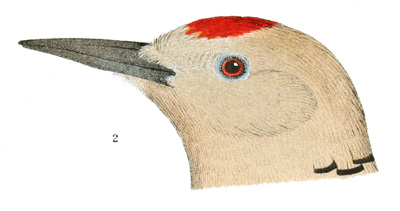
2. Centurus uropygialis. ♂ Ariz., 6128.
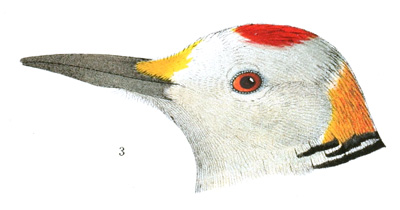
3. Centurus aurifrons. ♂ Texas, 6121.
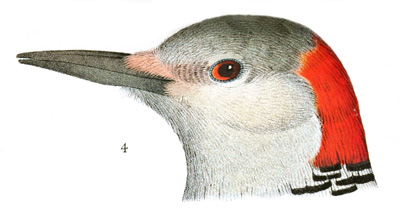
4. Centurus carolinus. ♀ 6118.
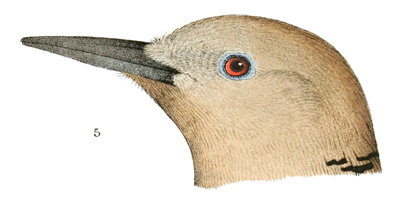
5. Centurus uropygialis. ♀ Ariz.
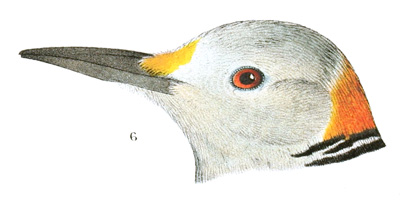
6. Centurus aurifrons. ♀ Texas.
Centurus carolinus, Bonap.
RED-BELLIED WOODPECKER.
Picus carolinus, Linn. Syst. Nat. I, 1766, 174.—Wilson, Am. Orn. I, 1808, 113, pl. vii,
f. 2.—Aud. Orn. Biog. V, 1839, 169, pl. ccccxv.—Ib. Birds Amer. IV, 1842, 270,
pl. cclxx.—Max. Cab. Jour. 1858, 418.—Sundevall, Consp. 53. Centurus carolinus,
Sw. Bp. List, 1838.—Ib. Conspectus, Av. 1850, 119.—Baird, Birds N. Am. 109.—Cab.
Jour. 1862, 324.—Dresser, Ibis, 1865, 469 (resident in Texas).—Scl. Cat.
1862, 342.—Gray, Cat. 99.—Allen, B. E. Fla. 306. Centurus carolinensis, Sw.
Birds, II, 1837, 310 (error). Picus griseus, Vieill. Ois. Am. Sept. II, 1807, 52, pl.
cxvi. ? Picus erythrauchen, Wagler, Syst. Avium, 1827. Picus zebra, Boddært,
Tabl. pl. enl. (Gray, genera).
Sp. Char.
Third, fourth, and fifth quills nearly equal, and longest; second, or outermost,
and seventh about equal. Top of the head and nape crimson-red. Forehead whitish,
strongly tinged with light red, a shade of which is also seen on the cheek, still stronger on
the middle of the belly. Under parts brownish-white, with a faint wash of yellowish on
the belly. Back, rump, and wing-coverts banded black and white; upper tail-covert white,
with occasional blotches. Tail-feathers black; first transversely banded with white; second
less so; all the rest with whitish tips. Inner feathers banded with white on the
inner web; the outer web with a stripe of white along the middle. Length, 9.75; wing,
about 5.00. Female with the crown ashy; forehead pale red; nape bright red.
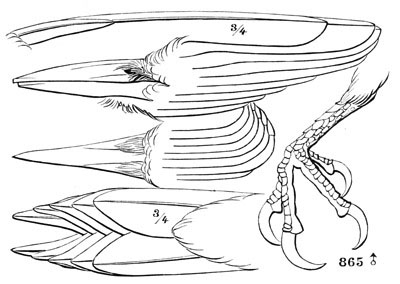
Centurus carolinus.
865 ♂
Hab.
North America,
from Atlantic coast to the
eastern slope of the Rocky
Mountains. Localities:
Texas (Dresser, Ibis, 1865,
469, resident).
Specimens vary considerably
in size (with
latitude), and in the
tinge of reddish on
chin, breast, etc. The
width of the dorsal
bands differs in different
specimens. The
rump is banded; upper
tail-coverts are generally immaculate, but are sometimes dashed with
black. Specimens from the Mississippi Valley are generally more brightly
colored than those from the Atlantic
States, the lower parts more strongly
tinged with red. Florida examples are
smaller than northern ones, the black bars
broader, the lower parts deeper ashy and
strongly tinged with red, but of a more
purplish shade than in western ones.
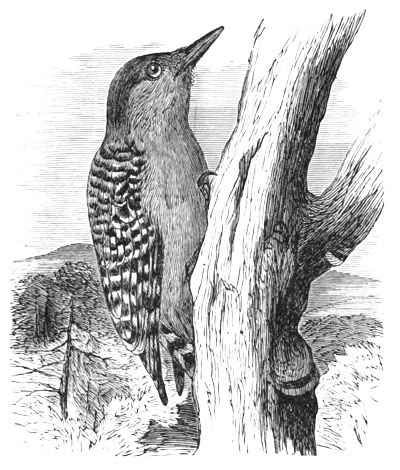
Centurus carolinus.
Habits. The Red-bellied Woodpecker
is distributed throughout North
America, from the Atlantic Coast to
the eastern slope of the Rocky Mountains.
It is, however, much more abundant
in the more southern and western
portions. In the collections of the
Smithsonian Institution none are recorded
from farther north than Pennsylvania
on the east and Nebraska Territory on the west, while others were
obtained as far south as Florida. Nor am I aware that it is found, except
very rarely, north of Pennsylvania on the Atlantic coast. I have never met
with it in Eastern Massachusetts, although Mr. Audubon speaks of it as breeding
from Maryland to Nova Scotia. Dr. Woodhouse found it common in the
Indian Territory and in Texas. Wilson speaks of having found it abundant
in Upper Canada, and in the northern parts of the State of New York. He
also refers to its inhabiting the whole Atlantic States as far as Georgia and
the southern extremity of Florida. Its absence in Eastern Massachusetts
was noticed by Mr. Nuttall. It is not given by Thompson or Paine as
one of the birds of Vermont, nor does Lieutenant Bland mention it as one
of the birds of Nova Scotia, and it is not included by Sir John Richardson
in the Fauna Boreali-Americana.
Mr. Audubon speaks of it as generally more confined to the interior of
forests than the Hairy Woodpecker, especially during the breeding-season.
He further states that he never met with its nest in Louisiana or South
Carolina, but that it was not rare in Kentucky, and that, from the State of
Maryland to Nova Scotia, it breeds in all convenient places, usually more in
the woods than out of them. He also states that he has found the nests in
orchards in Pennsylvania, generally not far from the junction of a branch
with the trunk. He describes the hole as bored in the ordinary manner.
The eggs are seldom more than four in number, and measure 1.06 inches in
length and .75 of an inch in breadth. They are of an elliptical form, smooth,
pure white, and translucent. They are not known to raise more than one
brood in a season.
Wilson speaks of this species as more shy and less domestic than the Red-headed
or any of the other spotted Woodpeckers, and also as more solitary.
He adds that it prefers the largest high-timbered woods and the tallest decayed
trees of the forest, seldom appearing near the ground, on the fences,
or in orchards or open fields. In regard to their nesting, he says that the
pair, in conjunction, dig out a circular cavity for the nest in the lower
side of some lofty branch that makes a considerable angle with the horizon.
Sometimes they excavate this in the solid wood, but more generally in a
hollow limb, some fifteen inches above where it becomes solid. This is
usually done early in April. The female lays five eggs, of a pure white, or
almost semi-transparent. The young generally make their appearance
towards the latter part of May. Wilson was of the opinion that they produced
two broods in a season.
Mr. Dresser found this bird resident and abundant in Texas. It is also
equally abundant in Louisiana and in Florida, and Mr. Ridgway considers
it very common in Southern Illinois. Neither Mr. Boardman nor Mr.
Verrill have found it in Maine. Mr. McIlwraith has, however, taken three
specimens at Hamilton, Canada West, May 3, near Chatham. Mr. Allen
gives it as a summer visitant in Western Massachusetts, having seen one on
the 13th of May, 1863. It has also been taken several times in Connecticut,
by Professor Emmons, who met with it, during the breeding-season, in
the extreme western part of the State. Mr. Lawrence has found it near
New York City, and Mr. Turnbull in Eastern Pennsylvania.
The eggs vary from an oblong to a somewhat rounded oval shape, are of a
bright crystalline whiteness, and their measurements average 1.02 inches in
length by .88 of an inch in breadth.
Centurus aurifrons, Gray.
YELLOW-BELLIED WOODPECKER.
Picus aurifrons, Wagler, Isis, 1829, 512.—Sundevall, Consp. Pic. 53. Centurus aurifrons,
Gray, Genera.—Cabanis, Jour. 1862, 323.—Cooper, Orn. Cal. 1, 1870, 399.
Centurus flaviventris, Swainson, Anim. in Menag. 1838 (2½ centenaries), 354.—Baird,
Birds N. Am. 1858, 110, pl. xlii.—Heermann, P. R. Rep. X, c, 18.—Dresser, Ibis,
1865, 469 (resident in Texas).—Ib. Rep. Mex. Bound. II, 5, pl. iv. Centurus elegans,
Lawrence, Ann. N. Y. Lyc. V, May, 1851, 116. Centurus santacruzi, Lawrence,
Ann. N. Y. Lyc. V, 1851, 123 (not ofBonap.). Picus ornatus, Less. Rev. Zoöl.
1839, 102.
Sp. Char.
Fourth and fifth quills nearly equal; third a little shorter; longer than the
fourth. Back banded transversely with black and white; rump and upper tail-coverts
pure white. Crown with a subquadrate spot of crimson, about half an inch wide and
long; and separated from the gamboge-yellow at the base of the bill by dirty white,
from the orbit and occiput by brownish-ash. Nape half-way round the neck orange-yellow.
Under part generally, and sides of head, dirty white. Middle of belly gamboge-yellow.
Tail-feathers all entirely black, except the outer, which has some obscure bars
of white. Length about 9.50; wing, 5.00. Female without the red of the crown.
Hab.
Rio Grande region of the United States, south into Mexico. Probably Arizona.
Localities: Orizaba (Scl. P. Z. S. 1860, 252); Texas, south of San Antonio (Dresser,
Ibis, 1865, 469, resident).
Young birds are not different from adults, except in showing indication of
dark shaft-lines beneath, becoming broader behind on the sides. The yellow
of the nape extends over the whole side of the head.
Habits. This beautiful Woodpecker is abundant throughout the valley
of the Rio Grande, from Eagle Pass to its mouth; how far to the west within
our boundaries it occurs, I am not able to state. It is common throughout
Mexico, and was found in the Guatemalan collection of Van Patten, though
not mentioned by Sclater and Salvin. Dr. Woodhouse, in his Report on the
zoölogy of Captain Sitgreaves’s expedition, speaks of finding it quite abundant
in the neighborhood of San Antonio, Texas. He adds that west of the
Rio San Pedro he did not meet with it. He speaks of it as having a loud,
sharp cry, which it utters as it flies from tree to tree. He observed it mostly
on the trunks of the mesquite (Algarobia), diligently searching in the usual
manner of Woodpeckers. In the Report upon the birds of the Mexican
Boundary Survey, it is mentioned by Mr. Clark as abundant on the Lower
Rio Grande, as very shy, and as keeping chiefly about the mesquite. Lieutenant
Couch speaks of it as very common throughout Tamaulipas.
Mr. Dresser found the Yellow-bellied Woodpecker plentiful from the
Rio Grande to San Antonio, and as far north and east as the Guadaloupe,
after which he lost sight of it. Wherever the mesquite-trees were large,
there it was sure to be found, and very sparingly elsewhere. Near San
Antonio it is quite common, but not so much so as the C. carolinus. At
Eagle Pass, however, it was the more abundant of the two. He found it
breeding near San Antonio, boring for its nest-hole into a mesquite-tree.
Mr. Dresser was informed by Dr. Heermann, who has seen many of their
nests, that he never found them in any other tree.
These birds were found breeding by Dr. Berlandier, and his collection. contained
quite a number of their eggs. Nothing was found among his papers
in relation to their habits or their manner of breeding. Their eggs, procured
by him, are of an oblong-oval shape, and measure 1.05 inches in length by
.85 of an inch in breadth.
Centurus uropygialis, Baird.
GILA WOODPECKER.
Centurus uropygialis, Baird, Pr. A. N. Sc. Ph. VII, June, 1854, 120 (Bill Williams
River, N. M.)—Ib. Birds N. Am. 1858, III, pl. xxxvi.—Cab. Jour. 1862, 330.—Sundevall,
Consp. 54.—Kennerly, P. R. R. X, b pl. xxxvi.—Heermann, X, c, 17.
Coues, Pr. Avi. 1866, 54 (S. Arizona).—Cooper, Orn. Cal. 1, 1870, 399. Centurus
hypopolius, (Bp.) Pucheran, Rev. et Mag. 1853, 163 (not Picus (Centurus) hypopolius,
Wagler). Zebrapicus kaupii, Malherbe, 1855.—Gray, Catal. Br. Mex. Centurus
sulfureiventer, Reichenbach, Handbuch, Picinæ, Oct. 1854, 410, figs. 4411, 4412.
Sp. Char.
Third, fourth, and fifth quills longest, and about equal. Back, rump, and
upper tail-coverts transversely barred with black and white, purest on the two latter.
Head and neck all round pale dirty-brown, or brownish-ash, darkest above. A small
subquadrate patch of red on the middle of the crown, separated from the bill by dirty
white. Middle of the abdomen gamboge-yellow; under tail-coverts and anal region
strongly barred with black. First and second outer tail-feathers banded black and white,
as is also the inner web of the inner tail-feather; the outer web of the latter with a
white stripe. Length, about 9.00; wing, 5.00. Female with the head uniform brownish-ash,
without any red or yellow.
Hab.
Lower Colorado River of the West, to Cape St. Lucas. South to Mazatlan.
Localities: W. Arizona (Coues, P. A. N. S. 1866, 54).
Habits. This species was first discovered by Dr. Kennerly in his route
along the 35th parallel, and described by Professor Baird, in 1854. The
Doctor encountered it almost continually during the entire march along the
Big Sandy, Bill Williams Fork, and the Great Colorado; but it was so very
shy that he had great difficulty in procuring specimens. Seated in the top of
the tree, it was ever on guard; and, upon the approach of danger, flew away,
accompanying its flight with the utterance of very peculiar notes. Its flight
was in an undulating line, like that of other birds of this class.
Dr. Heermann found this Woodpecker abundant on the banks of the
Gila River among the mesquite-trees. The giant cactus, often forty feet
high, which grows abundantly on the arid hillsides throughout that whole
section of country, was frequently found filled with holes bored out by
this bird. The pith of the plant is extracted until a chamber of suitable
size is obtained, when the juice exuding from the wounded surface hardens,
and forms a smooth dry coating to the cavity, thus making a convenient
place for the purposes of incubation. At Tucson, in Arizona, he found it
frequenting the cornfields, where it might be seen alighting on the old hedge-posts
in search of insects. Its note, he adds, resembles very much that of
the Red-headed Woodpecker. He afterwards met with this bird in California,
in considerable numbers, on the Colorado. Besides its ordinary notes,
resembling those of the Melanerpes erythrocephalus, it varies them with a soft
plaintive cry, as if hurt or wounded. He found their stomachs filled with
the white gelatinous berry of a parasitic plant which grows abundantly on
the mesquite-trees, and the fruit of which forms the principal food of many
species of birds during the fall.
Dr. Coues gives this bird as rare and probably accidental in the immediate
vicinity of Fort Whipple, but as a common bird in the valleys of the Gila
and of the Lower Colorado, where it has the local name of Suwarrow, or
Saguaro, on account of its partiality for the large cactuses, with the juice of
which plant its plumage is often found stained.
Dr. Cooper found this Woodpecker abundant in winter at Fort Mohave,
when they feed chiefly on the berries of the mistletoe, and are very shy.
He rarely saw them pecking at the trees, but they seemed to depend for a
living on insects, which were numerous on the foliage during the spring.
They have a loud note of alarm, strikingly similar to that of the Phainopepla
nitens, which associated with them in the mistletoe-boughs.
About the 25th of March he found them preparing their nests in burrows
near the dead tops of trees, none of them, so far as he saw, being accessible.
By the last of May they had entirely deserted the mistletoe, and were probably
feeding their young on insects.
Genus MELANERPES, Swainson.
Melanerpes, Swainson, F. B. A. II, 1831. (Type, Picus erythrocephalus.)
Melampicus (Section 3), Malherbe, Mém. Ac. Metz, 1849, 365.
Asyndesmus, Coues, Pr. A. N. S. 1866, 55. (Type, Picus torquatus.)
Gen. Char.
Bill about equal to the head; broader than high at the base, but becoming
compressed immediately anterior to the commencement of the gonys. Culmen and
gonys with a moderately decided angular ridge; both decidedly curved from the very
base. A rather prominent acute ridge commences at the base of the mandible, a little
below the ridge of the culmen, and proceeds but a short distance anterior to the nostrils
(about one third of the way), when it sinks down, and the bill is then smooth. The
lateral outlines are gently concave from the basal two thirds; then gently convex to the
tip, which does not exhibit any abrupt bevelling. Nostrils open, broadly oval; not concealed
by the feathers, nor entirely basal. Fork of chin less than half lower jaw. The
outer pair of toes equal. Wings long, broad; lengthened. Tail-feathers broad, with
lengthened points.
The species all have the back black, without any spots or streaks anywhere.
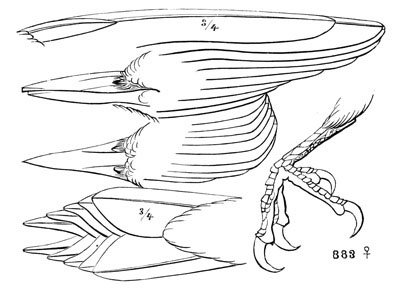
Melanerpes erythrocephalus.
883 ♀
Dr. Coues places M. torquatus in a new genus, Asyndesmus, characterized
by a peculiar texture of the under part and nuchal collar, in which the
fibres are disconnected on their terminal portion, enlarged and stiffened,
almost bristle-like; otherwise the characters are much as in Melanerpes. It
should, however, be noted, that the feathers of the red portion of the head in
the other species have the same texture.
Species and Varieties.
A. Sexes similar. Young very different from the adult.
M. torquatus. Feathers of the lower parts, as well as of frontal, lateral,
and under portions of the head, with the fibres bristle-like. (Asyndesmus,
Coues.) Upper parts wholly uniform, continuous, very metallic blackish-green.
Adult. Forehead, lores, cheeks, and chin deep crimson, of a burnt-carmine
tint; jugulum, breast, and a ring entirely around the nape, grayish-white;
abdomen light carmine. Back glossed with purplish-bronze. Young
without the red of the head, and lacking the grayish nuchal collar; abdomen
only tinged with red, no purple or bronze tints above. Wing, 6.70; tail,
4.50. Hab. Western Province of the United States, from the Black Hills
to the Pacific.
M. erythrocephalus. Feathers generally soft, blended; those of the whole
head and neck with stiffened and bristle-like fibres in the adult. Secondaries,
rump, and upper tail-coverts, with whole lower parts from the neck, continuous
pure white. Two lateral tail-feathers tipped with white. Adult.
Whole head and neck bright venous-crimson or blood-red, with a black
convex posterior border across the jugulum; back, wings, and tail glossy
blue-black. Young. Head and neck grayish, streaked with dusky; back
and scapulars grayish, spotted with black; secondaries with two or three
black bands; breast tinged with grayish, and with sparse dusky streaks.
Wing, 5.90; tail, 3.90. Hab. Eastern Province of the United States, west
to the Rocky Mountains.
B. Sexes dissimilar; young like the adult.
M. formicivorus. Forehead and a broad crescent across the middle of the
throat (the two areas connected by a narrow strip across the lore), white,
more or less tinged with sulphur-yellow. Rump, upper tail-coverts, abdomen,
sides, and crissum, with patch on base of primaries, pure white,
the sides and breast with black streaks. Other portions glossy blue-black.
♂. Whole crown and nape carmine. ♀ with the occiput and nape
alone red.
More than the anterior half of the pectoral band immaculate.
♀ with the white frontal, black coronal, and red occipital bands
of about equal width. Forehead and throat only slightly tinged
with sulphur-yellow. Wing, 5.80; tail, 3.90; bill, 1.27. Hab.
Pacific Province of United States, and Northern and Western
Mexico … var. formicivorus.
♀ with the white frontal band only about half as wide as the
black coronal, which is only about half as wide as the red occipital,
band or patch. Forehead and throat bright sulphur-yellow.
Wing, 5.40; tail, 3.65; bill, 1.23. Hab. Lower California
… var. angustifrons.
Nearly the whole of the black pectoral band variegated with white streaks.
Relative width of the white, black, and red areas on the crown as in
formicivorus. Wing, 5.50; tail, 3.75; bill, 1.22. Hab. Middle America,
south of Orizaba and Mirador
… var. striatipectus.[131]
♂. Nape, only, red (as in females of preceding races); ♀ without
any red.
Whole breast streaked, the black and white being in about equal
amount. Wing, 5.70; tail, 3.90; bill, 1.20. Hab. New Granada
… var. flavigula.[132]
Melanerpes torquatus, Bonap.
LEWIS’S WOODPECKER.
Picus torquatus, Wilson, Am. Orn. III, 1811, 31, pl. xx.—Wagler, Syst. Av. 1827, No.
82.—Aud. Orn. Biog. V, 1839, 176, pl. ccccxvi.—Ib. Birds Amer. IV, 1842, 280, pl.
cclxxii.—Sundevall, Consp. 51. Melanerpes torquatus, Bp. Consp. 1850, 115.—Heermann,
J. A. N. Sc. Phil. 2d ser. II, 1853, 270.—Newberry, Zoöl. Cal. & Or.
Route, 90, in P. R. R. Surv. VI, 1857.—Baird, Birds N. Am. 115.—Cooper &
Suckley, 161.—Cassin. Pr. A. N. S. 1863, 327.—Lord, Pr. R. A. Inst. IV, 1864,
112 (nesting).—Cooper, Orn. Cal. 1, 1870, 406. Picus montanus, Ord. in Guthrie’s
Geog. 2d Am. ed. II, 1815, 316. Picus lewisii, Drapiez. (Gray.) Asyndesmus torquatus,
Coues, Pr. A. N. S. 1866, 55.
Sp. Char.
Feathers on the under parts bristle-like. Fourth quill longest; then third
and fifth. Above dark glossy-green. Breast, lower part of the neck, and a narrow collar
all round, hoary grayish-white. Around the base of the bill and sides of the head to
behind the eyes, dark crimson. Belly blood-red, streaked finely with hoary whitish.
Wings and tail entirely uniform dark glossy-green. Female similar. Length about 10.50;
wing, 6.50. Young without the nuchal collar, and the red of head replaced by black.
Hab.
Western America from Black Hills to Pacific.
The peculiarities in the feathers of the under parts have already been adverted
to. This structure appears to be essentially connected with the red
feathers, since these have the same texture in the other species of the genus,
wherever the color occurs. The remark may perhaps apply generally to the
red feathers of most, if not all, Woodpeckers, and may be connected with
some chemical or physical condition yet to be determined.
Habits. Lewis’s Woodpecker would seem to have a distribution throughout
the Pacific Coast, from the sea-shore to the mountains, and from Puget
Sound to the Gulf of California, and extending to the eastern border of the
Great Plains, within the limits of the United States. They were first observed
by Messrs. Lewis and Clarke, in their memorable journey to the
Pacific. Subsequently Mr. Nuttall met with them in his westward journey,
in the central chain of the Rocky Mountains. This was in the month of
July. Among the cedar and pine woods of Bear River, on the edge of Upper
California, he found them inhabiting the decayed trunks of the pine-trees,
and already feeding their young. Afterwards, at the close of August, he met
them in flocks on the plains, sixty miles up the Wahlamet. He describes
them as very unlike Woodpeckers in their habits, perching in dense flocks,
like Starlings, neither climbing branches nor tapping in the manner of their
tribe, but darting after insects and devouring berries, like Thrushes. He saw
them but seldom, either in the dense forests of the Columbia or in any settled
part of California.
Townsend speaks of their arriving about the first of May on Bear River
and the Columbia. Both sexes incubate, according to his observations.
Dr. Gambel first observed this Woodpecker in a belt of oak timber near
the Mission of St. Gabriel, in California, and states that it was abundant.
He also describes its habits as peculiar, and unlike the generality of Woodpeckers.
Dr. Heermann, too, speaks of finding it in all the parts of California
which he visited. Dr. Newberry, in his Notes on the zoölogy of
Lieutenant Williamson’s expedition, refers to it as most unlike the California
Woodpecker in the region it occupies and in its retiring habits. He
describes it as seeming to choose, for its favorite haunts, the evergreen
forests upon the rocky declivities of the Cascade and Rocky Mountains.
He first observed it in Northern California, but subsequently noticed it in
the mountains all the way to the Columbia. Though often seen in low elevations,
it was evidently alpine in its preferences, and was found most frequently
near the line of perpetual snow; and when crossing the snow lines,
in the mountain-passes, it was often observed flying far above the party. He
describes it as being always shy, and difficult to shoot.
Dr. S. W. Woodhouse describes this species as being common in the Indian
Territory and in New Mexico; while Dr. Cooper, in his Report on the
zoölogy of Washington Territory, speaks of it as being common, during
summer, in all the interior districts, but seldom or never approaching the
coast. It arrives at Puget Sound early in May, and some even remain, during
mild winters, in the Territory. According to his account, it burrows
holes for its nests at all heights from the ground, but commonly in dead
trees. The eggs are described as pure white, and, when fresh, translucent,
like those of all the Woodpecker tribe, and hardly distinguishable in size
and general appearance from those of the Golden-winged Woodpecker
(Colaptes auratus). Its harsh call is rarely uttered in summer, when it
seems to seek concealment for itself and nest. The flocks of young, which
in fall associate together to the number of eight or ten, are more noisy. Dr.
Suckley, in the same Report (page 162), speaks of this Woodpecker as being
very abundant throughout the more open portions of the timbered region of
the northwest coast, preferring oak openings and groves. At Fort Dalles, on
the Columbia, they are extremely numerous, not only breeding there during
summer, but also found as winter residents. Their breeding-places are generally
holes in oak and other trees, which, from the appearance of all he
examined, seemed to have been excavated for the purpose. At Puget Sound
this species was found less frequently than at Fort Dalles, on the Columbia.
At the latter place they were constant winter residents. Dr. Suckley also
speaks of them as being semi-gregarious in their habits.
Mr. Lord thinks that this Woodpecker is not to be met with west of the
Cascade Mountains, but says it is very often found between the Cascades and
the Rocky Mountains, where it frequents the open timber. The habits and
modes of flight of this bird, he states, are not the least like a Woodpecker’s.
It flies with a heavy flapping motion, much like a Jay, feeds a good deal on
the ground, and chases insects on the wing like a Shrike or a Kingbird.
Whilst mating they assemble in large numbers, and keep up a continual,
loud, chattering noise. They arrive at Colville in April, begin nesting in
May, and leave again in October. The nest is in a hole in a dead pine-tree,
usually at a considerable height from the ground.
Dr. Coues says this bird is very common at Fort Whipple, in Arizona,
where it remained in moult until November.
Mr. J. A. Allen found this the most numerous of the Picidæ in Colorado
Territory. He also states that it differs considerably in its habits from
all the other Woodpeckers. He frequently noticed it rising high into the
air almost vertically, and to a great height, apparently in pursuit of insects,
and descending again as abruptly, to repeat the same manœuvre. It was
met with by Mr. Ridgway in the Sacramento Valley, along the eastern base
of the Sierra Nevada, and in the East Humboldt Mountains. In the first-mentioned
locality it was the most abundant Woodpecker, and inhabited the
scattered oaks of the plains. In the second region it was very abundant—perhaps
more so than any other species—among the scattered pines along
the very base of the eastern slope; and in the last-mentioned place was observed
on a few occasions among the tall aspens bordering the streams in
the lower portions of the cañons. In its habits it is described as approaching
most closely to our common Red-headed Woodpecker (M. erythrocephalus),
but possessing many very distinctive peculiarities. In the character
of its notes it quite closely approximates to our common Redhead, but
they are weaker and of a more twittering character; and in its lively playful
disposition it even exceeds it. It has a very peculiar and characteristic
habit of ascending high into the air, and taking a strange, floating flight,
seemingly laborious, as if struggling against the wind, and then descending
in broad circles to the trees.
The eggs are more spherical than are usually those of the Colaptes auratus,
are of a beautiful crystalline whiteness, and measure 1.10 inches in length
and .92 of an inch in breadth.
Melanerpes erythrocephalus, Swainson.
RED-HEADED WOODPECKER.
Picus erythrocephalus, Linn. Syst. Nat. I, 1766, 174.—Vieillot, Ois. Am. Sept. II, 1807,
60, pl. cxii, cxiii.—Wilson, Am. Orn. I, 1810, 142, pl. ix, fig. 1.—Wagler, Syst.
Av. 1827, No. 14.—Ib. Isis, 1829, 518 (young).—Aud. Orn. Biog. I, 1832, 141;
V, 536, pl. xxvii.—Ib. Birds America, IV, 1842, 274, pl. cclxxi.—Max. Cab. J. VI,
1858, 419. Melanerpes erythrocephalus, Sw. F. B. A. II, 1831, 316.—Bon. List,
1838.—Ib. Conspectus, 1850, 115.—Gambel, J. Ac. Nat. Sc. Ph. 2d ser. I, 1847,
55.—Baird, Birds N. Am. 1858, 113.—Scl. Cat. 1862, 340.—Samuels, 102.—Cooper,
Orn. Cal. 1, 1870, 402.—Allen, B. E. Fla. 307. Picus obscurus, Gm. I,
1788, 429 (young).—Red-headed Woodpecker, Pennant, Kalm, Latham. White-rumped
Woodpecker, Latham.
Sp. Char.
Head and neck all round crimson-red, margined by a narrow crescent of
black on the upper part of the breast. Back, primary quills, and tail bluish-black. Under
parts generally, a broad band across the middle of the wing, and the rump, white. The
female is not different. Length, about 9.75; wing, 5.50. Bill bluish-white, darker terminally;
iris chestnut; feet olive-gray. Young without any red, the head and neck being
grayish streaked with dusky; breast with an ashy tinge, and streaked sparsely with
dusky; secondaries with two or three bands of black; dorsal region clouded with grayish.
Hab.
Eastern Province of United States to base of Rocky Mountains, sometimes straggling
westward to coast of California (Gambel). Salt Lake City, Utah (Ridgway). Other
localities: Nueces to Brazos, Texas (Dresser, Ibis, 1865, 469, breeds).
Western specimens frequently have the abdomen strongly tinged with
salmon-red, or orange-red, and are generally more deeply colored than
eastern.
Habits. The Red-headed Woodpecker is one of the most familiar birds
of this family, and ranges over a wide extent of territory. Excepting where
it has been exterminated by the persecutions of indiscriminate destroyers, it
is everywhere a very abundant species. Once common, it is now rarely met
with in the neighborhood of Boston, though in the western part of Massachusetts
it is still to be found. In the collections of the Smithsonian Institution
are specimens from Pennsylvania, Wyoming, Nebraska, Kansas,
Missouri, Louisiana, the Indian Territory, etc. Sir John Richardson speaks
of it as ranging in summer as far north as the northern shores of Lake
Huron. He also remarks that in the Hudson Bay Museum there is a specimen
from the banks of the Columbia River. Dr. Gambel, in his paper on
the birds of California, states that he saw many of them in a belt of oak timber
near the Mission of St. Gabriel. As, however, Dr. Heermann did not
meet with it in California, and as no other collector has obtained specimens
in that State, this is probably a mistake. With the exception of Dr. Woodhouse,
who speaks of having found this species in the Indian Territory and
in Texas, it is not mentioned by any of the government exploring parties.
It may therefore be assigned a range extending, in summer, as far north as
Labrador, and westward to the eastern slopes of the Rocky Mountains.
Throughout the year it is a permanent resident only of the more southern
States, where it is, however, much less abundant in summer than it is in
Pennsylvania.
Wilson, at the time of his writing (1808), speaks of finding several of the
nests of this Woodpecker within the boundaries of the then city of Philadelphia,
two of them being in buttonwood-trees and one in the decayed
limb of an elm. The parent birds made regular excursions to the woods
beyond the Schuylkill, and preserved a silence and circumspection in visiting
their nest entirely unlike their habits in their wilder places of residence.
The species is altogether migratory, visiting the Middle and Northern States
early in May and leaving in October. It begins the construction of its nest
almost immediately after its first appearance, as with other members of its
family, by excavations made in the trunk or larger limbs of trees, depositing
six white eggs on the bare wood. The cavities for their nests are made
almost exclusively in dead wood, rarely, if ever, in the living portion of the
tree. In Texas, Louisiana, Kentucky, and the Carolinas, they have two
broods in a season, but farther north than this they rarely raise more than
one. Their eggs are usually six in number, and, like all the eggs of this
family, are pure white and translucent when fresh. They vary a little in
their shape, but are usually slightly more oval and less spherical than those
of several other species. Mr. Nuttall speaks of the eggs of this bird as
being said to be marked at the larger end with reddish spots. I have never
met with any thus marked, and as Mr. Nuttall does not give it as from his
own observations I have no doubt that it is a mistake. Mr. Paine, of
Randolph, Vt., writes that he has only seen a single specimen of this
Woodpecker in that part of Vermont, while on the western side of the
Green Mountains they are said to be very common. He adds that it is a
tradition among his older neighbors that these Woodpeckers were formerly
everywhere known throughout all portions of the State.
Mr. Ridgway saw a single individual of this species in the outskirts of
Salt Lake City, in July, 1869.
Their eggs vary both in size and in shape, from a spherical to an oblong-oval,
the latter being the more usual. Their length varies from 1.10 to 1.15
inches, and their breadth from .80 to .90 of an inch.
Melanerpes formicivorus, var. formicivorus, Bonap.
CALIFORNIA WOODPECKER.
Picus formicivorus, Swainson, Birds Mex. in Philos. Mag. I, 1827, 439 (Mexico).—Vigors,
Zoöl. Blossom, 1839, 23 (Monterey).—Nuttall, Man. I, 2d ed. 1840. Melanerpes
formicivorus, Bp. Conspectus, 1850, 115.—Heermann, J. A. N. Sc. Phil. 2d series,
II, 1853, 270.—Cassin, Illust. II, 1853, 11, pl. ii.—Newberry, Zoöl. Cal. & Oregon
Route, 90, P. R. R. Surv. VI, 1857.—Baird, Birds N. Am. 1868, 114.—Sumichrast,
Mem. Bost. Soc. I, 1865, 562 (correcting an error of Saussure).—Cassin, Pr.
A. N. S. 63, 328.—Heermann, P. R. R. X, 58 (nesting).—Baird, Rep. M. Bound.
II, Birds, 6.—Sclater, Pr. Z. S. 1858, 305 (Oaxaca).—Ib. Ibis, 137 (Honduras).—Cab.
Jour. 1862, 322 (Costa Rica).—Coues, Pr. A. N. S. 1866, 55.—Cooper, Orn.
Cal. I, 1870, 403. Picus melanopogon, Temminck, Pl. Color. IV, (1829? pl. ccccli.—Wagler,
Isis, 1829, v, 515.—Sundevall, Consp. 51.
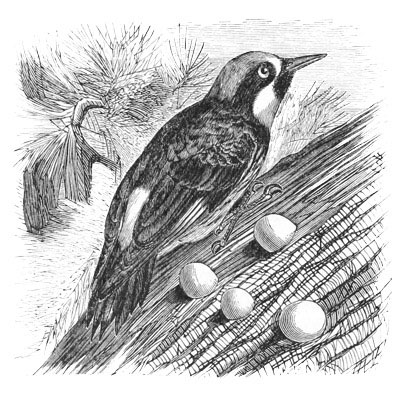
Melanerpes formicivorus.
Sp. Char.
Fourth quill longest, third a little shorter. Above and on the anterior half
of the body, glossy bluish or greenish black; the top of the head and a short occipital
crest red. A white patch on the forehead,
connecting with a broad crescentic
collar on the upper part of the neck
by a narrow isthmus, white tinged with
sulphur-yellow. Belly, rump, bases of
primaries, and inner edges of the outer
quills, white. Tail-feathers uniform
black. Female with the red confined
to the occipital crest, the rest replaced
by greenish-black; the three patches
white, black, and red, very sharply defined,
and about equal. Length about
9.50; wing, 6.00; tail, 3.75.
Hab.
Pacific Coast region of the
United States and south; in Northern
Mexico, eastward almost to the Gulf
of Mexico; also on the Upper Rio
Grande; south to Costa Rica. Localities:
Oaxaca (Scl. P. Z. S. 1858, 305);
Cordova (Scl. 1856, 307); Guatemala (Scl. Ibis, I, 137); Honduras (Scl. Cat. 341);
Costa Rica (Cab. J. 1862, 322); W. Arizona (Coues, P. A. N. S. 1866, 55).
In most specimens one or two red feathers may be detected in the black
of the breast just behind the sulphur-yellow crescent. The white of the
breast is streaked with black; the posterior portion of the black of the
breast and anterior belly streaked with white. The white of the wing only
shows externally as a patch at the base of the primaries.
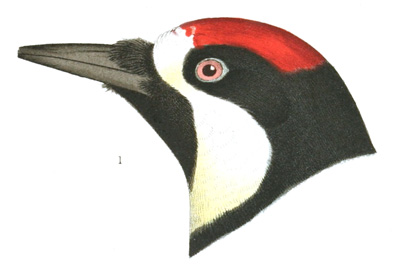
1. Melanerpes formicivorus. ♂ Cal., 5495.
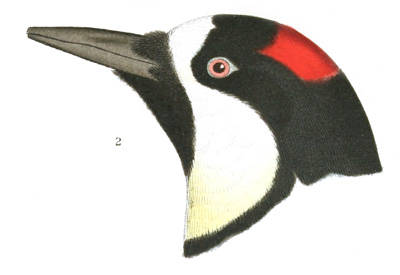
2. Melanerpes formicivorus. ♀ Cal., 25035.
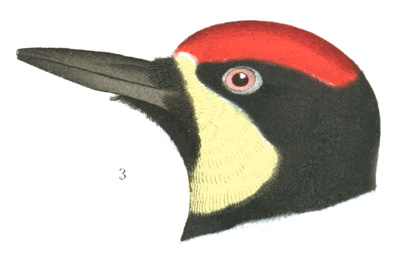
3. Melanerpes angustifrons. ♂ Cape St. Lucas, 25947.
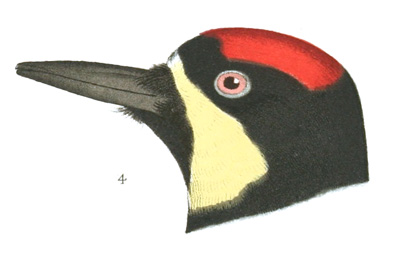
4. Melanerpes angustifrons. ♀ Cape St. Lucas, 25949.
Dr. Coues calls attention to extraordinary differences in the color of the
iris, which varies from white to red, blue, yellow, ochraceous, or brown. A
mixture of blue, he thinks, indicates immaturity, and a reddish tinge the
full spring coloration.
The male of this species has a white forehead extending a little backwards
of the anterior edge of the eye, the rest of the top of head to the nape being
red. The female has the white forehead, and a quadrate occipito-nuchal red
patch, a black band about as broad as the white one separating the latter
from the occipital red. The length of the two anterior bands together is
decidedly greater than that of the posterior red. In both sexes the jugulum
is entirely and continuously black. Anteriorly (generally with a red spot in
its anterior edge) and on the feathers of its posterior border only are these
elongated white spots, on each side the shaft, the feathers of the breast being
streaked centrally with black. The inner webs of the secondaries have an
elongated continuous patch of white along their internal edge, with a very
slight, almost inappreciable, border of black; this white only very rarely converted
partly or entirely into quadrate spots, and that never on the innermost
quills marked with white. Specimens from California are very similar
to those from the Rocky Mountains and the Rio Grande Valley, except,
perhaps, in being larger, with longer and straighter bill.
In M. flavigula from Bogota, the male has the head marked with the red,
black, and white (the red much less in extent, however) of the female M.
formicivorus, while the female has no red whatever. All, or nearly all, the
feathers of the jugulum have the two white spots, and (as pointed out by
Reichenbach) the white of the inner webs of the inner quills is entirely converted
into a series of non-confluent quadrate spots. The black streaks on
the sides and behind appear to be of greater magnitude, and more uniformly
distributed. In both species all the tail-feathers are perfectly black.
A Guatemalan bird, received from Mr. Salvin as M. formicivorus,—and indeed
all specimens from Orizaba and Mirador to Costa Rica,—agrees in the
main with the northern bird, except that all the black feathers of the jugulum
have white spots, as in M. flavigula. The outermost tail-feather of Mr.
Salvin’s specimen has two narrow transverse whitish bands, and a spot indicating
a third, as well as a light tip. The white markings on the inner
quills are more like the northern bird, though on the outermost ones there
is the same tendency to form spots as in a few northern specimens (as
6,149 from Los Nogales, &c.). The bill is very different from either in being
shorter, broader, much stouter, and the culmen more decurved.
These peculiarities, which are constant, appear to indicate a decided or
strongly marked variety, as a series of almost a hundred specimens of
the northern bird from many localities exhibit none of the characters
mentioned, while all of an equally large series from Central America agree
in possessing them.
A series of Jalapan specimens from the cabinet of Mr. Lawrence show a
close relationship to skins from the Rio Grande, and do not approach the
Guatemalan bird in the peculiar characters just referred to, except in the
shortness and curvature of the bill. In one specimen there is an approach
to the Bogotan in a moderate degree of barring on the white inner edgings
of the tertials; in the rest, however, they are continuously white.
Habits. This handsome Woodpecker, distinguished both by the remarkable
beauty of its plumage and the peculiarity of its provident habits, has a
widely extended area of distribution, covering the Pacific Coast, from Oregon
throughout Mexico. In Central America it is replaced by the variety
striatipectus, and in New Grenada by the var. flavigula, while at Cape St.
Lucas we find another local form, M. angustifrons. So far as we have the
means of ascertaining their habits, we find no mention of any essential differences
in this respect among these races.
Suckley and Cooper did not meet with this bird in Washington Territory,
and Mr. Lord met with it in abundance on his journey from Yreka to the
boundary line of British Columbia. Mr. Dresser did not observe it at San
Antonio. Mr. Clark met with it at the Coppermines, in New Mexico, in great
numbers, and feeding principally among the oaks. Lieutenant Couch found
it in the recesses of the Sierra Madre quite common and very tame, resorting
to high trees in search of its food. He did not meet with it east of the
Sierra Madre. Dr. Kennerly first observed it in the vicinity of Santa Cruz,
where it was very frequent on the mountain-slopes, always preferring the
tallest trees, but very shy, and it was with difficulty that a specimen
could be procured. Mr. Nuttall, who first added this bird to our fauna,
speaks of it as very plentiful in the forests around Santa Barbara. Between
that region and the Pueblo de los Angeles, Dr. Gambel met with it in great
abundance, although neither writer makes mention of any peculiarities of
habit. Mr. Emanuel Samuels met with it in and around Petaluma, where
he obtained the eggs.
Dr. Newberry, in his Report on the zoölogy of Lieutenant Williamson’s
route (P. R. R. Reports, VI), states that the range of this species extends to
the Columbia, and perhaps above, to the westward of the Cascade Range,
though more common in California than in Oregon. It was not found in
the Des Chutes Basin, nor in the Cascade Mountains.
In the list of the birds of Guatemala given by Mr. Salvin in the Ibis, this
Woodpecker is mentioned (I, p. 137) as being found in the Central Region,
at Calderas, on the Volcan de Fuego, in forests of evergreen oaks, where it
feeds on acorns.
Dr. Heermann describes it as among the noisiest as well as the most abundant
of the Woodpeckers of California. He speaks of it as catching insects
on the wing, after the manner of a Flycatcher, and mentions its very extraordinary
habit of digging small holes in the bark of the pine and the oak,
in which it stores acorns for its food in winter. He adds that one of these
acorns is placed in each hole, and is so tightly fitted or driven in that it is
with difficulty extracted. Thus, the bark of a large pine forty or fifty feet
high will present the appearance of being closely studded with brass nails,
the heads only being visible. These acorns are thus stored in large quantities,
and serve not only the Woodpecker, but trespassers as well. Dr. Heermann
speaks of the nest as being excavated in the body of the tree to a
depth varying from six inches to two feet, the eggs being four or five in
number, and pure white.
These very remarkable and, for a Woodpecker, somewhat anomalous
habits, first mentioned among American writers by Dr. Heermann, have
given rise to various conflicting statements and theories in regard to the
design of these collections of acorns. Some have even ventured to discredit
the facts, but these are too well authenticated to be questioned. Too many
naturalists whose accuracy cannot be doubted have been eyewitnesses to
these performances. Among these is Mr. J. K. Lord, who, however, was
constrained to confess his utter inability to explain why the birds did so.
He was never able to find an acorn that seemed to have been eaten, nor a
trace of vegetable matter in their stomachs, and at the close of his investigations
he frankly admitted this storing of acorns to be a mystery for which
he could offer no satisfactory explanation.
M. H. de Saussure, the Swiss naturalist, in an interesting paper published
in 1858 in the Bibliothèque Universelle of Geneva, furnishes some very
interesting observations on the habits of a Woodpecker, which he supposed
to be the Colaptes mexicanoides of Mexico, of storing collections of acorns in
the hollow stems of the maguay plants. Sumichrast, who accompanied
Saussure in his excursion, while recognizing the entire truth of the interesting
facts he narrates, is confident that the credit of all this instinctive forethought
belongs not to the Colaptes, but to the Mexican race of this species.
Saussure’s article being too long to quote in full, we give an abstract.
The slopes of a volcanic mountain, Pizarro, near Perote, in Mexico, are
covered with immense beds of the maguay (Agave americana), with larger
growths of yuccas, but without any other large shrubs or trees. Saussure
was surprised to find this silent and dismal wilderness swarming with
Woodpeckers. A circumstance so unusual as this large congregation of birds,
by nature so solitary, in a spot so unattractive, prompted him to investigate
the mystery. The birds were seen to fly first to the stalks of the
maguay, to attack them with their beaks, and then to pass to the yuccas,
and there repeat their labors. These stalks, upon examination, were all
found to be riddled with holes, placed irregularly one above another, and
communicating with the hollow cavity within. On cutting open one of
these stalks, he found it filled with acorns.
As is well known, this plant, after flowering, dies, its stalk remains, its outer
covering hardens into a flinty texture, and its centre becomes hollow. This
convenient cavity is used by the Woodpecker as a storehouse for provisions
that are unusual food for the tribe. The central cavity of the stalk is only
large enough to receive one acorn at a time. They are packed in, one above
the other, until the cavity is full. How did these Woodpeckers first learn
to thus use these storehouses, by nature closed against them? The intelligent
instinct that enabled this bird to solve this problem Saussure regarded
as not the least surprising feature. With its beak it pierces a small round
hole through the lower portion into the central cavity, and thrusts in acorns
until the hollow is filled to the level of the hole. It then makes a second
opening higher up, and fills the space below in a like manner, and so proceeds
until the entire stalk is full. Sometimes the space is too small to receive
the acorns, and they have to be forced in by blows from its beak. In
other stalks there are no cavities, and then the Woodpecker creates one for
each acorn, forcing it into the centre of the pith.
The labor necessary to enable the bird to accomplish all this is very considerable,
and great industry is required to collect its stores; but, once collected,
the storehouse is a very safe and convenient one. Mount Pizarro is
in the midst of a barren desert of sand and volcanic débris. There are no
oak-trees nearer than the Cordilleras, thirty miles distant, and therefore the
collecting and storing of each acorn required a flight of sixty miles.
This, reasons Saussure, is obviously an instinctive preparation, on the
part of these birds, to provide the means of supporting life during the arid
winter months, when no rain falls and everything is parched. His observations
were made in April, the last of the winter months; and he found
the Woodpeckers withdrawing food from their depositories, and satisfied
himself that the birds were eating the acorn itself, and not the diminutive
maggots a few of them contained.
The ingenuity with which the bird managed to get at the contents of each
acorn was also quite striking. Its feet being unfit for grasping the acorn, it
digs a hole into the dry bark of the yuccas, just large enough to receive the
small end of the acorn, which it inserts, making use of its bill to split it
open, as with a wedge. The trunks of the yuccas were all found riddled
with these holes.
There are several remarkable features to be noticed in the facts observed
by Saussure,—the provident instinct which prompts this bird to lay by
stores of provisions for the winter; the great distance traversed to collect
a kind of food so unusual for its race; and its seeking, in a spot so remote
from its natural abode, a storehouse so remarkable. Can instinct alone
teach, or have experience and reason taught, these birds, that, better far than
the bark of trees, or cracks in rocks, or cavities dug in the earth, or any
other known hiding-place, are these hidden cavities within the hollow stems
of distant plants? What first taught them how to break through the flinty
coverings of these retreats? By what revelation could these birds have
been informed that within these dry and closed stalks they could, by searching,
find suitable places, protected from moisture, for preserving their stores
in a state most favorable for their long preservation, safe from gnawing
rats, and from those acorn-eating birds whose bills are not strong or sharp
enough to cut through their tough enclosures?
M. Sumichrast, who afterwards enjoyed unusual opportunities for observing
the habits of these Woodpeckers in the State of Vera Cruz, states that
they dwell exclusively in oak woods, and that near Potrero, as well as in
the alpine regions, trunks of oak-trees are found pierced with small holes in
circular lines around their circumference. Into each of these holes these
birds drive the acorns by repeated blows of their beaks, so as to fix them
firmly. At other times they make their collection of acorns in openings between
the raised bark of dry trees and the trunks. This writer states that
he has sought in vain to explain such performances satisfactorily. The
localities in which these birds reside, in Mexico, teem at all seasons with
insects; and it seems absurd, therefore, to suppose that they can be in quest
of the small, almost microscopic, larvæ contained in the acorns.
Dr. C. T. Jackson sought to account for these interesting performances on
the ingenious hypothesis that the acorns thus stored are always infested with
larvæ, and never sound ones; that they are driven into the tree cup-end foremost,
so as to securely imprison the maggot and prevent its escape, and thus
enable the Woodpecker to devour it at its leisure. This would argue a wonderful
degree of intelligence and forethought, on the part of the Woodpecker,
and more than it is entitled to; for the facts do not sustain this hypothesis.
The acorns are not put into the tree with the cup-end in, but invariably
the reverse, so far as we have noticed; and the acorns, so far from
being wormy, are, in nine cases out of ten, sound ones. Besides, this theory
affords no explanation of the large collections of loose acorns made by these
birds in hollow trees, or in the stalks of the maguay plants. Nor can we
understand why, if so intelligent, they make so little use of these acorns, as
seems to be the almost universal testimony of California naturalists. And,
as still further demonstrating the incorrectness of this hypothesis, we have
recently been informed by Dr. Canfield of Monterey, Cal., that occasionally
these Woodpeckers, following an instinct so blind that they do not distinguish
between an acorn and a pebble, are known to fill up the holes they
have drilled with so much labor, not only with acorns, but occasionally with
stones. In time the bark and the wood grow over these, and after a few
years they are left a long way from the surface. These trees are usually the
sugar-pine of California, a wood much used for lumber. Occasionally one
of these trees is cut, the log taken to mill without its being known that it is
thus charged with rounded pieces of flint or agate, and the saws that come
in contact with them are broken.
Without venturing to present an explanation of facts that have appeared
so contradictory and unsatisfactory to other naturalists, such as we can claim
to be either comprehensive or entirely satisfactory, we cannot discredit the
positive averments of such observers as Saussure and Salvin. We believe
that these Woodpeckers do eat the acorns, when they can do no better.
And when we are confronted with the fact, which we do not feel at liberty
to altogether disregard, that in very large regions this bird seems to labor in
vain, and makes no use of the treasures it has thus heaped together, we
can only attempt an explanation. This Woodpecker is found over an immense
area. It everywhere has the same instinctive promptings to provide,
not “for a rainy day,” but for the exact opposite,—for a long interval
during which no rain falls, for nearly two hundred days at a time, in all the
low and hot lands of Mexico and Central America. There these accumulations
become a necessity, there we are informed they do eat the acorns, and,
more than this, many other birds and beasts derive the means of self-preservation
in times of famine from the provident labors of this bird. That in
Oregon, in California, and in the mountains of Mexico and elsewhere,
where better and more natural food offers throughout the year, it is rarely
known to eat the acorns it has thus labored to save, only seems to prove that
it acts under the influences of an undiscriminating instinct that prompts it
to gather in its stores whether it needs them or not.
It may be, too, that writers have too hastily inferred that these birds never
eat the acorns, because they have been unable to obtain complete evidence
of the fact. We have recently received from C. W. Plass, Esq., some interesting
facts, which, if they do not prove that these birds in the winter visit
their stores and eat their acorns, render it highly probable. Mr. Plass resides
near Napa City, Cal., near which city, and on the edge of the pine
forests, he has recently constructed a house. The gable-ends of this dwelling
the California Woodpeckers have found a very convenient storehouse for
their acorns, and Mr. Plass has very considerately permitted them to do so
unmolested. The window in the gable slides up upon pullies its whole
length, to admit of a passage to the upper verandah, and the open space in
the wall admits of the nuts falling down into the upper hall, and this frequently
happens when the birds attempt to extricate them from the outside.
Nearly all these nuts are found to be sound, and contain no worm, while
those that fall outside are empty shells. Empty shells have also been
noticed by Mr. Plass under the trees, indicating that the acorns have been
eaten.
The Smithsonian Institution has received specimens of the American race
of this Woodpecker, collected at Belize by Dr. Berendt, and accompanied
by illustrations of their work in the way of implantation of acorns in the
bark of trees.
The eggs of this Woodpecker, obtained by Mr. Emanuel Samuels near
Petaluma, Cal., and now in the collection of the Boston Society of Natural
History, are undistinguishable from the eggs of other Woodpeckers in form
or color, except that they are somewhat oblong, and measure 1.12 inches in
length by .90 of an inch in breadth.
Melanerpes formicivorus, var. angustifrons, Baird.
THE NARROW-FRONTED WOODPECKER.
Melanerpes formicivorus, var. angustifrons, Baird, Cooper, Orn. Cal. 1, 1870, 405.
Sp. Char.
Compared with M. formicivorus, the size is smaller. The light frontal bar is
much narrower; in the female scarcely more than half the black one behind it, and not
reaching anything like as far back as the anterior border of the eye, instead of exceeding
this limit. The light frontal and the black bars together are only about two thirds the
length of the occipital red, instead of exceeding it in length; the red patch reaches forward
nearly or quite to the posterior border of the eye, instead of falling a considerable
distance behind it, and being much broader posteriorly. The frontal band too is gamboge-yellow,
much like the throat, and not white; the connection with the yellow throat-patch
much broader. The white upper tail-coverts show a tendency to a black edge. Length,
8.00; wing, 5.20; tail, 3.20.
Hab.
Cape St. Lucas.
As the differences mentioned are constant, we consider the Cape St. Lucas
bird as forming at least a permanent variety, and indicate it as above. A
single specimen from the Sierra Madre, of Colima, is very similar.
Habits. We have no information as to the habits of this singular race
of the M. formicivorus, found at Cape St. Lucas by Mr. John Xantus. It
will be an interesting matter for investigation to ascertain to what extent
the totally different character of the region in which this bird is met with
from those in which the M. formicivorus is found, may have modified its
habits and its manner of life.
Section COLAPTEÆ.
This section, formerly embracing but one genus additional to Colaptes, has
recently had three more added to it by Bonaparte. The only United States
representative, however, is Colaptes.
Genus COLAPTES, Swainson.
Colaptes, Swainson, Zoöl. Jour. III, Dec. 1827, 353. (Type, Cuculus auratus, Linn.)
Geopicos, Malherbe, Mém. Acad. Metz, 1849, 358. (G. campestris.)
Gen. Char.
Bill slender, depressed at the base, then compressed. Culmen much
curved, gonys straight; both with acute ridges, and coming to quite a sharp point with
the commissure at the end; the bill, consequently, not truncate at the end. No ridges
on the bill. Nostrils basal, median, oval, and exposed. Gonys very short; about half
the culmen. Feet large; the anterior outer toe considerably longer than the posterior.
Tail long, exceeding the secondaries; the feathers suddenly acuminate, with elongated
points.
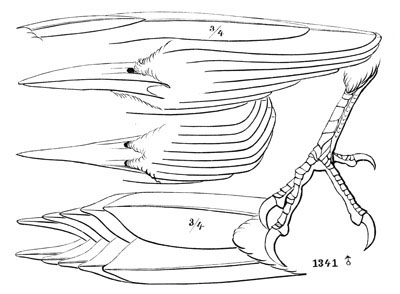
Colaptes auratus.
1341 ♂
There are four well-marked representatives of the typical genus Colaptes
belonging to Middle and North America, three of them found within the
limits of the United States, in addition to what has been called a hybrid
between two of them. The common and distinctive characters of these four
are as follows:—
Species and Varieties.
Common Characters. Head and neck ashy or brown, unvaried except by a
black or red malar patch in the male. Back and wings brown, banded transversely
with black; rump and upper tail-coverts white. Beneath whitish, with
circular black spots, and bands on crissum; a black pectoral crescent. Shafts and
under surfaces of quills and tail-feathers either yellow or red.
A. Mustache red; throat ash; no red nuchal crescent.
a. Under surface and shafts of wings and tail red.
1. C. mexicanoides.[133]
Hood bright cinnamon-rufous; feathers of
mustache black below surface. Upper parts barred with black and
whitish-brown, the two colors of about equal width. Shafts, etc., dull
brick-red. Rump spotted with black; black terminal zone of under
surface of tail narrow, badly defined. Wing, 6.15; tail, 4.90; bill, 1.77.
Hab. Southern Mexico and Guatemala.
2. C. mexicanus.[134]
Hood ashy-olivaceous, more rufescent anteriorly,
light cinnamon on lores and around eyes; feathers of mustache light
ash below surface. Upper parts umber-brown, barred with black, the
black only about one fourth as wide as the brown. Shafts, etc., fine
salmon-red, or pinkish orange-red. Rump unspotted; black terminal
zone of tail broad, sharply defined. Wing, 6.70; tail, 5.00; bill, 1.60.
Hab. Middle and Western Province of United States, south into
Eastern Mexico to Mirador and Orizaba, and Jalapa.
b. Under surface and shafts of wings and tail gamboge-yellow.
3. C. chrysoides. Hood uniform light cinnamon; upper parts raw
umber with sparse, very narrow and distant, bars of black. Rump
immaculate; black terminal zone of tail occupying nearly the terminal
half, and very sharply defined. Wing, 5.90; tail, 5.70; bill, 1.80. Hab.
Colorado and Cape St. Lucas region of Southern Middle Province of
United States.
B. Mustache black; a red nuchal crescent. Throat pinkish, hood ashy.
4. C. auratus. Shafts, etc., gamboge-yellow; upper parts olivaceous-brown,
with narrow bars of black, about half as wide as the brown.
Rump immaculate; black terminal zone of under surface of tail
broad, more than half an inch wide on outer feather. Edges of
tail-feathers narrowly edged, but not indented, with whitish.
Outer web of lateral feathers without spots of dusky. Wing,
6.10; tail, 4.80; bill, 1.58. Hab. Eastern Province of North
America … var. auratus.
Rump spotted with black; black terminal zone of tail narrow,
consisting on outer feather of an irregular spot less than a quarter
of an inch wide. Edges of all the tail-feathers indented with
whitish bars; outer web of lateral feathers with quadrate spots of
dusky along the edge. Wing, 5.75; tail, 4.75; bill, 1.60. Hab.
Cuba … var. chrysocaulosus.[135]
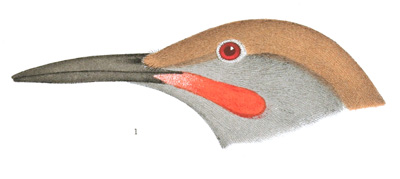
1. Colaptes chrysoides. ♂ Arizona, 107.
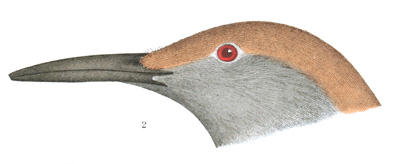
2. Colaptes chrysoides. ♀ Cape St. Lucas.
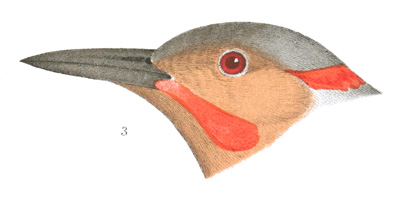
3. Colaptes hybridus. ♂ Neb., 5214.
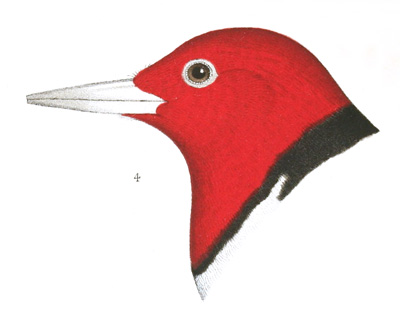
4. Melanerpes erythrocephalus. ♂ Neb., 38303.
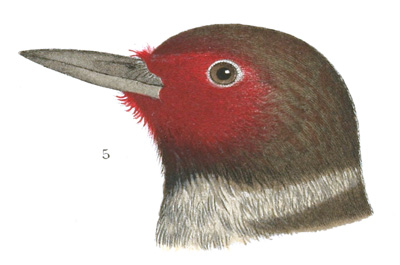
5. Melanerpes torquatus. ♂ Cal., 6138.
Colaptes auratus, Swainson.
FLICKER; YELLOW-SHAFTED WOODPECKER; HIGH-HOLDER.
Cuculus auratus, Linn. Syst. Nat., I, (ed. 10,) 1758, 112. Picus auratus, Linn. Syst. Nat. 1,
(ed. 12,) 1766, 174.—Forster,
Phil. Trans. LXII, 1772, 383.—Vieillot, Ois. Am.
Sept. II, 1807, 66, pl. cxxiii.—Wilson, Am. Orn. I, 1810, 45, pl. iii, f. 1.—Wagler,
Syst. Av. 1827, No. 84.—Aud. Orn. Biog. I, 1832, 191; V, 540, pl. xxxvii.—Ib. Birds
Amer. IV, 1842, 282, pl. cclxxiii.—Sundevall, Consp. 71. Colaptes auratus, Sw. Zoöl.
Jour. III, 1827, 353.—Ib. F. Bor. Am. II, 1831, 314.—Bon. List, 1838.—Ib.
Conspectus, 1850, 113.—Baird, Birds N. Am. 1858, 118.—Max. Cab. Jour. 1858,
420.—Dresser, Ibis, 1865, 470 (San Antonio, one specimen only seen).—Scl. Cat.
1862, 344.—Gray, Cat. 1868, 120.—Fowler, Am. Nat. III, 1869, 422.—Dall &
Bannister, Tr. Chicago Ac. I, 1869, 275 (Alaska).—Samuels, 105.—Allen, B. E.
Fla. 307.
Sp. Char.
Shafts and under surfaces of wing and tail feathers gamboge-yellow. Male
with a black patch on each side of the cheek. A red crescent on the nape. Throat and
stripe beneath the eye pale lilac-brown. Back glossed with olivaceous-green. Female
without the black cheek-patch.
Additional Characters. A crescentic patch on the breast and rounded spots on the
belly black. Back and wing-coverts with interrupted transverse bands of black. Neck
above and on the sides ashy. Beneath pale pinkish-brown, tinged with yellow on the
abdomen, each feather with a heart-shaped spot of black near the end. Rump white.
Length, 12.50; wing, 6.00.
Hab.
All of eastern North America to the eastern slopes of Rocky Mountains;
farther north, extending across along the Yukon as far at least as Nulato, perhaps to
the Pacific. Greenland (Reinhardt). Localities: San Antonio, Texas, only one specimen
(Dresser, Ibis, 1865, 470).
Specimens vary considerably in size and proportions; the more northern
ones are much the larger. The spots vary in number and in size; they
may be circular, or transversely or longitudinally oval. Western specimens
appear paler. In a Selkirk Settlement specimen the belly is tinged with
pale sulphur-yellow, the back with olivaceous-green.
This species, in general pattern of coloration, resembles the C. mexicanus,
although the colors are very different. Thus the shafts of the quills, with
their under surfaces, are gamboge-yellow, instead of orange-red. There is a
conspicuous nuchal crescent of crimson wanting, or but slightly indicated, in
mexicanus. The cheek-patch is pure black, widening and abruptly truncate
behind, instead of bright crimson, pointed or rounded behind. The shade
of the upper parts is olivaceous-green, instead of purplish-brown. The top
of the head and the nape are more ashy. The chin, throat, neck, and sides of
the head, are pale purplish or lilac brown, instead of bluish-ash; the space
above, below, and around the eye of the same color, instead of having
reddish-brown above and ashy below.
The young of this species is sufficiently like the adult to be readily recognizable.
Sometimes the entire crown is faintly tipped with red, as characteristic
of young Woodpeckers.
Habits. The Golden-winged Woodpecker is altogether the most common
and the most widely distributed of the North American representatives
of the genus. According to Sir John Richardson, it visits the fur
countries in the summer, extending its migrations as far to the north as the
Great Slave Lake, and resorting in great numbers to the plains of the Saskatchewan.
It was found by Dr. Woodhouse very abundant in Texas and
the Indian Territory, and it is given by Reinhardt as occurring in Greenland.
Mr. McFarlane found it breeding at Fort Anderson; Mr. Ross at Fort Rae,
Fort Resolution, and Fort Simpson; and Mr. Kennicott at Fort Yukon. All
this testimony demonstrates a distribution throughout the entire eastern
portion of North America, from the Gulf of Mexico almost to the Arctic
Ocean, and from the Atlantic to the Rocky Mountains.
In the more northern portions of the continent this bird is only a summer
visitant, but in the Southern and Middle, and to some extent in the
New England States, it is a permanent resident. Wilson speaks of seeing
them exposed for sale in the markets of Philadelphia during each month of
a very rigorous winter. Wilson’s observations of their habits during breeding,
made in Pennsylvania, were that early in April they begin to prepare
their nest. This is built in the hollow body or branch of a tree, sometimes,
though not always, at a considerable height from the ground. He adds that
he has frequently known them to fix on the trunk of an old apple-tree, at a
height not more than six feet from the root. He also mentions as quite surprising
the sagacity of this bird in discovering, under a sound bark, a hollow
limb or trunk of a tree, and its perseverance in perforating it for purposes of
incubation. The male and female alternately relieve and encourage each other
by mutual caresses, renewing their labors for several days, till the object is
attained, and the place rendered sufficiently capacious, convenient, and secure.
They are often so extremely intent upon their work as to be heard at their
labor till a very late hour in the night. Wilson mentions one instance where
he knew a pair to dig first five inches straight forward, and then downward
more than twice that distance, into a solid black-oak. They carry in no
materials for their nest, the soft chips and dust of the wood serving for this
purpose. The female lays six white eggs, almost transparent, very thick at the
greater end, and tapering suddenly to the other. The young soon leave the
nest, climbing to the higher branches, where they are fed by their parents.
According to Mr. Audubon this Woodpecker rears two broods in a season,
the usual number of eggs being six. In one instance, however, Mr. MacCulloch,
quoted by Audubon, speaks of having found a nest in a rotten stump,
which contained no less than eighteen young birds, of various ages, and at
least two eggs not quite hatched. It is not improbable that, in cases where
the number of eggs exceeds seven or eight, more females than one have contributed
to the number. In one instance, upon sawing off the decayed top
of an old tree, in which these birds had a nest, twelve eggs were found.
These were not molested, but, on visiting the place a few days after, I found
the excavation to have been deepened from eighteen to twenty-four inches.
Mr. C. S. Paine, of Randolph, Vt., writing in October, 1860, furnishes some
interesting observations made in regard to these birds in the central part of
that State. He says, “This Woodpecker is very common, and makes its appearance
about the 20th of April. Between the 1st and the 15th of May it
usually commences boring a hole for the nest, and deposits its eggs the last
of May or the first of June.” He found three nests that year, all of which
were in old stumps on the banks of a small stream. Each nest contained
seven eggs. The boy who took them out was able to do so without any cutting,
and found them at the depth of his elbow. In another nest there were
but three eggs when first discovered. The limb was cut down nearly to a
level with the eggs, which were taken. The next day the nest had been
deepened a whole foot and another egg deposited. Mr. Paine has never
known them go into thick woods to breed, but they seem rather to prefer
the edges of woods. He has never known one to breed in an old cavity,
but in one instance a pair selected a partially decayed stump for their operations.
When they are disturbed, they sometimes fly around their nests, uttering
shrill, squeaking notes, occasionally intermixing with them guttural or
gurgling tones.
It is probably true that they usually excavate their own burrow, but this
is not an invariable rule. In the fall of 1870 a pair of these Woodpeckers
took shelter in my barn, remaining there during the winter. Although there
were abundant means of entrance and of egress, they wrought for themselves
other passages out and in through the most solid part of the sides of the
building. Early in the spring they took possession of a large cavity in an
old apple-tree, directly on the path between the barn and the house, where
they reared their family. They were very shy, and rarely permitted themselves
to be seen. The nest contained six young, each of which had been
hatched at successive intervals, leaving the nest one after the other. The
youngest was nearly a fortnight later to depart than the first. Just before
leaving the nest, the oldest bird climbed to the opening of the cavity, filling
the whole space, and uttering a loud hissing sound whenever the nest was
approached. As soon as they could use their wings, even partially, they
were removed, one by one, to a more retired part of the grounds, where they
were fed by their parents.
Throughout Massachusetts, this bird, generally known as the Pigeon
Woodpecker, is one of the most common and familiar birds. They abound
in old orchards and groves, and manifest more apparent confidence in man
than the treatment they receive at his hands seems to justify. Their nests
are usually constructed at the distance of only a few feet from the ground,
and though Wilson, Audubon, and Nuttall agree upon six as the average
of their eggs, they frequently exceed this number. Mr. Audubon gives as
the measurement of the eggs of this species 1.08 inches in length and .88
of an inch in breadth. Their length varies from 1.05 to 1.15 inches, and
their breadth from .91 to .85 of an inch. Their average measurement
is 1.09 by .88 of an inch.
Colaptes mexicanus, Swainson.
RED-SHAFTED FLICKER.
Colaptes mexicanus, Sw. Syn. Mex. Birds, in Philos. Mag. I, 1827, 440.—Ib. F. Bor. Am.
II, 1831, 315.—Newberry, Zoöl. Cal. & Or. Route, 91; P. R. R. Rep. VI, 1857.—Baird,
Birds N. Am. 1858, 120.—Max. Cab. Jour. 1858, 420, mixed with hybridus.—Lord,
Proc. R. Art. Inst. I, IV, 112.—Cooper & Suckley, 163.—Sclater,
P. Z. S. 1858, 309 (Oaxaca).—Ib. Cat. 1862, 344.—Dresser, Ibis, 1865, 470 (San
Antonio, rare).—Coues, Pr. A. N. S. 1866, 56.—Sumichrast, Mem. Bost. Soc. I,
1869, 562 (alpine district, Vera Cruz).—Gray, Cat. 1868, 121.—Dall & Bannister,
Pr. Chicago Ac. I, 1869, 275 (Alaska).—Cooper, Orn. Cal. 1, 1870, 408. Picus mexicanus,
Aud. Orn. Biog. V, 1839, 174, pl. ccccxvi.—Ib. Birds America, IV, 1842, 295,
pl. cclxxiv.—Sundevall, Consp. 72. Colaptes collaris, Vigors, Zoöl. Jour. IV, Jan.
1829, 353.—Ib. Zoöl. Beechey’s Voy. 1839, 24, pl. ix. Picus rubricatus, Wagler,
Isis, 1829, V, May, 516. (“Lichtenstein Mus. Berol.”) Colaptes rubricatus, Bon. Pr.
Zoöl. Soc. V, 1837, 108.—Ib. List, 1838.—Ib. Conspectus, 1850, 114. ? Picus cafer,
Gmelin, Syst. Nat. I, 1788, 431.—Lath. Index Ornith. II, 1790, 242. ? Picus
lathami, Wagler, Syst. 1827, No. 85 (Cape of Good Hope?).
Sp. Char.
Shafts and under surfaces of wing and tail feathers orange-red. Male with a
red patch on each side the cheek; nape without red crescent; sometimes very faint
indications laterally. Throat and stripe
beneath the eye bluish-ash. Back
glossed with purplish-brown. Female
without the red cheek-patch. Length,
about 13.00; wing, over 6.50.
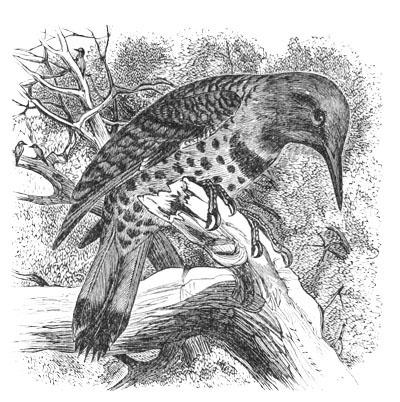
Colaptes mexicanus.
Additional Characters. Spots on
the belly, a crescent on the breast, and
interrupted transverse bands on the
back, black.
Hab.
Western North America from
Pacific to the Black Hills; north to
Sitka on the coast. Localities:
Oaxaca (Scl. P. Z. S. 1858, 305);
Vera Cruz, alpine regions (Sumichrast,
Mem. Bost. Soc. I, 1869. 562); San
Antonio, Texas (Dresser, Ibis, 1865.
470); W. Arizona (Coues, P. A. N. S.
1866, 56).
The female is similar in every
way, perhaps a little smaller, but lacks the red mustache. This is, however,
indicated by a brown tinge over an area corresponding with that of the red
of the male.
In the present specimen (1,886) there is a slight indication of an interrupted
nuchal red band, as in the common Flicker, in some crimson fibres
to some of the feathers about as far behind the eye as this is from the bill.
A large proportion of males before us exhibit the same characteristic, some
more, some less, although it generally requires careful examination for its
detection. It may possibly be a characteristic of the not fully mature bird,
although it occurs in two out of three male specimens.
There is a little variation in the size of the pectoral crescent and spots;
the latter are sometimes rounded or oblong cordate, instead of circular.
The bill varies as much as three or four tenths of an inch. The rump,
usually immaculate, sometimes has a few black streaks. The extent of the
red whisker varies a little. In skins from Oregon and Washington the color
of the back is as described; in those from California and New Mexico it is
of a grayer cast. There is little, if any, variation in the shade of red in the
whiskers and quill-feathers. The head is washed on the forehead with
rufous, passing into ashy on the nape.
There is not only some difference in the size of this species, in the same
locality, but, as a general rule, the more southern specimens are smaller.
This species is distinct from the C. mexicanoides of Lafresnaye, though
somewhat resembling it. It is, however, a smaller bird; the red of the
cheeks is deeper; the whole upper part of the head and neck uniform reddish-cinnamon
without any ash, in marked contrast to that on the sides of the
head. The back is strongly glossed with reddish-brown, and the black
transverse bars are much more distinct, closer and broader, three or four on
each feather, instead of two only. The rump and upper tail-coverts are
closely barred, the centre of the former only clearer white, but even here
each feather has a cordate spot of white. The spots on the flanks posteriorly
exhibit a tendency to become transverse bars.
Specimens from Mount Orizaba, Mexico, are very similar to those from
Oregon in color, presenting no appreciable difference. The size is, however,
much less, a male measuring 10.50, wing 6.00, tail 4.60 inches, instead of
12.75, 6.75, and 5.25 respectively. While, however, the feet are smaller
(tarsus 1.00 instead of 1.15), the bill is fully as large, or even larger.
Most young birds of this species have a tinge of red on top of the head,
and frequently a decided nuchal crescent of red; but these are only embryonic
features, and disappear with maturity.
Habits. This species, the counterpart in so many respects of the Golden-winged
Woodpecker, appears to take the place of that species from the slopes
of the Rocky Mountains to the Pacific, throughout western North America.
Dr. Woodhouse speaks of finding it abundant along the banks of the Rio
Grande. And in the fine collection belonging to the Smithsonian Institution
are specimens from the Straits of Fuca, Fort Steilacoom, and Fort Vancouver,
in Washington Territory, from the Columbia River, from various
points in California, New Mexico, Arizona, Utah, Kansas, Nebraska, Texas,
Mexico, etc. Dr. Gambel, in his Paper on the birds of California, first met
with the Red-shafted Woodpecker soon after leaving New Mexico, and it
continued to California, where he found it very abundant. He describes it
as a remarkably shy bird, and adds that he always saw it on the margins of
small creeks, where nothing grew larger than a willow-bush. Dr. Heermann
also found it abundant in California. Dr. Newberry, in his Report on the
zoölogy of Lieutenant Williamson’s expedition, speaks of the Red-shafted
Flicker as rather a common bird in all parts of California and Oregon which
his party visited. He describes many of its habits as identical with those of
the Golden Flicker (C. auratus), but regards it as much the shyer bird. Dr.
Cooper also mentions the fact of the great abundance of this bird along the
western coast, equalling that of its closely allied cousin on the eastern side
of the Mississippi. It also resembles, he adds, that bird so exactly in
habits and notes that the description of one will apply with exactness to the
other. It is a constant resident in Washington Territory, or at least west
of the Cascade Mountains. He observed it already burrowing out holes
for its nests in April, at the Straits of Fuca. About June 1 he found a
nest containing seven young, nearly fledged, which already showed in the
male the distinguishing red mustache. Dr. Suckley, in the same report,
also says that it is extremely common in the timbered districts of Washington
Territory, and adds that its habits, voice, calls, etc., are precisely similar
to those of the Yellow-Hammer of the Eastern States. Mr. Nuttall, as
quoted by Mr. Audubon, states that he first came upon this bird in the narrow
belt of forest which borders Laramie’s Fork of the Platte, and adds
that he scarcely lost sight of it from that time until he reached the shores
of the Pacific. Its manners, in all respects, are so entirely similar to those
of the common species that the same description applies to both. He also
regards it as the shyer bird of the two, and less frequently seen on the
ground. They burrow in the oak and pine trees, and lay white eggs, after
the manner of the whole family, and these eggs are in no wise distinguishable
from those of the Golden-wing.
Dr. Cooper, in his Report upon the birds of California, refers to this as a
common species, and found in every part of the State except the bare plains.
It even frequents the low bushes, where no trees are to be seen for miles.
In the middle wooded districts, and towards the north, it is much more
abundant than elsewhere.
Their nesting-holes are at all heights from the ground, and are usually
about one foot in depth. In the southern part of the State their eggs are
laid in April, but farther north, at the Columbia, in May.
Dr. Cooper attributes their shyness in certain localities to their being
hunted so much by the Indians for their bright feathers. Generally he
found them quite tame, so that their interesting habits may be watched
without difficulty. He regards them as an exact counterpart of the eastern
auratus, living largely on insects and ants, which they collect without much
trouble, and do not depend upon hard work, like other Woodpeckers, for their
food. During the season they also feed largely on berries. Their curved
bill is not well adapted for hammering sound wood for insects, and they only
dig into decayed trees in search of their food. Like the eastern species, the
young of these birds, when their nest is approached, make a curious hissing
noise. They may be seen chasing each other round the trunk of trees, as
if in sport, uttering, at the same time, loud cries like whittoo, whittoo, whittoo.
Dr. Kennerly found these birds from the Big Sandy to the Great Colorado,
but they were so shy that he could not obtain a specimen. They were seen
on the barren hills among the large cacti, in which they nest. Their extreme
shyness was fully explained afterwards by finding how closely they are
hunted by the Indians for the sake of their feathers, of which head-dresses
are made.
Mr. Dresser states that this bird is found as far east as San Antonio, where,
however, it is of uncommon occurrence. In December he noticed several
near the Nueces River, and in February and March obtained others near
Piedras Negras.
Dr. Coues gives it as abundant and resident in Arizona, where it is found
in all situations. Its tongue, he states, is capable of protrusion to an extent
far beyond that of any other North American Woodpecker.
This bird, in some parts of California, is known as the Yellow-Hammer, a
name given in some parts of New England to the Colaptes auratus. Mr.
C. W. Plass, of Napa City, writes me that this Woodpecker “makes himself
too much at home with us to be agreeable. He drills large holes though the
weather-boards of the house, and shelters himself at night between them and
the inner wall. He does, not nest there, but simply makes of such situations
his winter home. We have had to shoot them, for we find it is of no use to
shut up one hole, as they will at once make another by its side.”
Mr. J. A. Allen mentions finding this species, in the absence of suitable
trees on the Plains, making excavations in sand-banks.
According to Mr. Ridgway, the Red-shafted Flicker does not differ from
the Yellow-shafted species of the east in the slightest particular, as regards
habits, manners, and notes. It is, however, more shy than the eastern species,
probably from the fact that it is pursued by the Indians, who prize its
quill and tail-feathers as ornaments with which to adorn their dress.
Their eggs are hardly distinguishable from those of the auratus, but range
of a very slightly superior size. They average 1.12 inches in length by .89
of an inch in breadth. Their greatest length is 1.15 inches, their least 1.10,
and their breadth ranges from .87 to .90.
Colaptes hybridus, Baird.
HYBRID FLICKER.
Colaptes ayresii, Aud. Birds Am. VII, 1843, 348, pl. ccccxciv. Colaptes hybridus,
Baird, Birds N. Am. 1858, 122. Colaptes mexicanus, Max. Cab. Jour. 1858, 422
(mixed with mexicanus). Picas hybridus aurato-mexicanus, Sundevall, Consp. Pic.
1866, 721.
Sp. Char.
Yellow shafts or feathers on wing and tail combined with red, or red spotted
cheek-patches. Orange-red shafts combined with a well-defined nuchal red crescent, and
pinkish throat. Ash-colored throat combined with black cheek-patch or yellow shafts.
Shafts and feathers intermediate between gamboge-yellow and dark orange-red.
Hab.
Upper Missouri and Yellowstone; Black Hills.
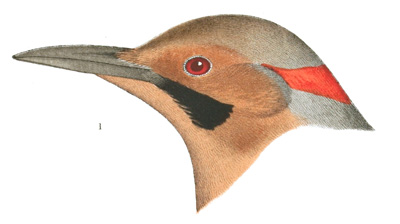
1. Colaptes auratus. ♂ 2122.
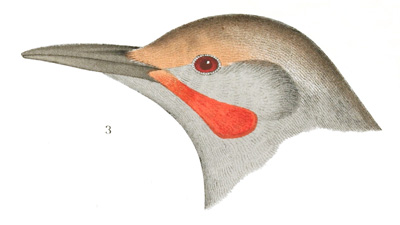
3. Colaptes mexicanus. ♂.
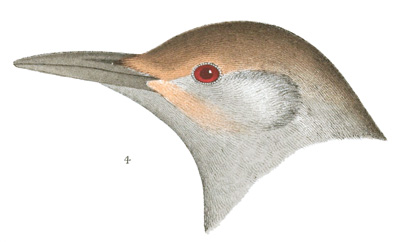
4. Colaptes mexicanus. ♀.
The general distribution of Colaptes mexicanus, as already indicated, is
from the Pacific coast of the United States, eastward to the Black Hills and
the Upper Missouri and Yellowstone; that of the C. auratus from the Atlantic
Coast to about the eastern limits of mexicanus. But little variation
is seen in the two species up to the region mentioned; slight differences in
shade of color, size, and frequency of spots, etc., being all. Where they
come together, however, or overlap, a most remarkable race is seen, in which
no two specimens, nay, scarcely the two sides of the same bird, are alike,
the characters of the two species becoming mixed up in the most extraordinary
manner. Thus, the shafts show every shade from orange-red to pure
yellow; yellow shafts combine with red cheek-patch (as in C. ayresii of Audubon);
a red nape, with orange-red shafts; cheek-patches red with black
feathers intermixed, or vice versa; perhaps the feathers red at base and black
at tip, or black at base and red at tip, etc. As the subject has been presented
in sufficient detail in the Birds of North America, as quoted above,
it need not be repeated here, except to say that collections received since
1858 only substantiate what has there been stated.
To the race thus noted, the name hybridus was given, not as of a variety,
since it is not entitled to this rank, but as of a heterogeneous mixture, caused
by the breeding together of two different species, and requiring some appellation.
Whether the presumed hybrids are fertile, and breed with each other or
with full-blooded parents, has not yet been ascertained; perhaps not, since
the area in which they occur is limited, and it is only occasionally that
individuals of the kind referred to have been found beyond the bounds mentioned.
It is very rarely, however, that pure breeds occur in the district of
hybridus, a taint being generally appreciable in all.
The conditions in the present instance appear different from those adverted
to under the head of Picus villosus, where the question is not one of hybridism
between two strongly marked and distinct species, but of the gradual change,
between the Atlantic and the Pacific, from one pattern of coloration to another.
Colaptes chrysoides, Malh.
THE CAPE FLICKER.
Geopicus chrysoides, Malh. Rev. et Mag. Zoöl. IV, 1852, 553.—Ib. Mon. Pic. II, 261,
tab. 109. Colaptes chrysoides, Baird, Birds N. Am. 1858, 125.—Elliot, Ill. Birds
N. Am. VI, plate.—Cooper, Pr. Cal. Ac. 1861, 122 (Fort Mohave).—Coues, Pr.
A. N. Sc. 1866, 56 (Arizona).—Scl. Cat. 1862, 344.—Elliot, Illust. Am. B. I, pl.
xxvi.—Cooper, Orn. Cal. 1, 1870, 410. Picus chrysoides, Sundevall, Consp. 72.
Sp. Char.
Markings generally as in other species. Top of head rufous-brown; chin,
throat, and sides of head ash-gray. Shafts of quills and tail-feathers, with their under
surfaces in great part, gamboge-yellow; no nuchal red. Malar patch of male red; wanting
in the female. Length, 11.50; wing, 5.75; tail, 4.50.
Hab.
Colorado and Gila River, north to Fort Mohave, south to Cape St. Lucas. Localities:
Fort Mohave (Cooper, Pr. Cal. Ac. 1861, 122); W. Arizona (Coues, P. A. N. S.
1866, 56).
This interesting species is intermediate between auratus and mexicanus in
having the yellow shafts and quills of the former; a red malar patch, an
ashy throat, and no nuchal crescent, as in the latter. To mexicanoides the
relationship is still closer, since both have the rufous-brown head above. A
hybrid between this last species and auratus would in some varieties come
very near chrysoides, but as it does not belong to the region of chrysoides,
and there is no transition from one species to the other in any specimens, as
in hybridus, there is no occasion to take this view of the species.
Cape St. Lucas specimens, where the species is exceedingly abundant, are
considerably smaller than those from Arizona, and appear to be more strongly
marked with black above and below; otherwise there seems to be no difference
of special importance.
As neither C. auratus nor mexicanus has the top of the head rufous-brown,
(though slightly indicated anteriorly in the latter), this character has not
been noted in the hybrids between the two (hybridus), and its presence in
chrysoides will serve to distinguish it from hybridus.
Habits. This comparatively new form of Woodpecker was first described
in 1852 by Malherbe, from a California specimen in the Paris
Museum, which had been at first supposed to be a female or immature
ayresii. What Dr. Cooper thinks may have been this species was met with
by Dr. Heermann among the mountains bordering upon the Cosumnes
River, in California, where it was rare, and only two specimens were taken.
In February, 1861, other specimens of this bird were taken at Fort Mohave
by Dr. Cooper. They were feeding on larvæ and insects among the poplar-trees,
and were very shy and wary. The bird is supposed to winter in the
Colorado Valley, and wherever found has been met with in valleys, and not
on mountains. It is an abundant and characteristic member of the Cape
St. Lucas fauna.
According to Dr. Cooper these birds were already mated at Fort Mohave
after February 20. They had the same habits, flight, and cries as the C.
mexicanus. They appeared to be migratory, having come from the south.
Mr. Xantus, in his brief notes on the birds of Cape St. Lucas, makes mention
of finding this bird breeding, May 19, in a dead Cereus giganteus. The
nest was a large cavity about fifteen feet from the ground, and contained
only one egg. The parent bird was also secured. In another instance
two eggs were found in a Cereus giganteus, at the distance of forty feet from
the ground. The eggs were not noticeably different from those of the
common Colaptes mexicanus.