Between tall poplars whose stems are splotched with grey lichen and whose
feet are grown over with browny-green moss, runs the road from Falaise to
Argentan, straight and white, with scarcely more than the slightest bend,
for the whole eight miles. It is typical of the roads in this part of the
country and beyond the large stone four or five kilometres outside
Falaise, marking the boundary between Calvados and Orne, and the railway
which one passes soon afterwards, there is nothing to break the undulating
monotony of the boundless plain.
We cannot all hope to have this somewhat dull stretch of country relieved
by any exciting event, but I can remember one spring afternoon being
overtaken by two mounted gendarmes in blue uniforms, galloping for their
very lives. I looked down the road into the cloud of dust raised by the
horses’ hoofs, but the country on all sides lay calm and deserted, and I
was left in doubt as to the reason for this astonishing haste. Half an
hour afterwards a group of people appeared in the distance, and on
approaching closer, they proved to be the two gendarmes leading their
blown horses as they walked beside a picturesque group of apparently
simple peasants, the three men wearing the typical soft, baggy cap and
blue smock of the country folk. The little group had a gloomy aspect,
which was explained when I noticed that the peasants were joined together
by a bright steel chain. Evidently something was very much amiss with one
of the peaceful villages lying near the road.
After a time, at the end of the long white perspective, appear the towers
of the great church of St Germain that dominate the town where Henry II.
was staying when he made that rash exclamation concerning his “turbulent
priest.” It was from Argentan that those four knights set out for England
and Canterbury to carry out the deed, for which Henry lay in ashes for
five weeks in this very place. But there is little at the present time at
Argentan to remind one that it is in any way associated with the murder of
Becket. The castle that now exists is occupied by the Courts of Justice
and was partially built in the Renaissance period. Standing close to it,
is an exceedingly tall building with a great gable that suggests an
ecclesiastical origin, and on looking a little closer one soon discovers
blocked up Gothic windows and others from which the tracery has been
hacked. This was the chapel of the castle which has been so completely
robbed of its sanctity that it is now cut up into small lodgings, and in
one of its diminutive shops, picture post-cards of the town are sold.
The ruins of the old castle are not very conspicuous, for in the
seventeenth century the great keep was demolished. There is still a fairly
noticeable round tower—the Tour Marguerite—which has a pointed
roof above its corbels, or perhaps they should be called machicolations.
In the Place Henri IV. stands a prominent building that projects over the
pavement supported by massive pointed arches, and with this building in
the foreground there is one of the best views of St Germain that one can
find in the town. Just before coming to the clock that is suspended over
the road by the porch of the church, there is a butcher’s shop at the
street corner that has a piece of oak carving preserved on account of its
interest while the rest of the building has been made featureless with
even plaster. The carving shows Adam and Eve standing on either side of a
formal Tree of Life, and the butcher, who is pleased to find a stranger
who notices this little curiosity, tells him with great pride that his
house dates from the fifteenth century. The porch of St Germain is richly
ornamented, but it takes a second place to the south porch of the church
of Notre Dame at Louviers and may perhaps seem scarcely worthy of comment
after St Maclou at Rouen. The structure as a whole was commenced in 1424,
and the last portion of the work only dates from the middle of the
seventeenth century. The vaulting of the nave has a very new and well-kept
appearance and the side altars, in contrast to so many of even the large
churches, are almost dignified in their somewhat restrained and classic
style. The high altar is a stupendous erection of two storeys with
Corinthian pillars. Nine long, white, pendant banners are conspicuous on
the walls of the chancel. The great altars and the lesser ones that crowd
the side chapels are subject to the accumulation of dirt as everything
else in buildings sacred or lay, and at certain times of the day, a woman
may be seen vigorously flapping the brass candlesticks and countless altar
ornaments with a big feather broom. On the north side of the chancel some
of the windows have sections of old painted glass, and in one of them
there is part of a ship with men in crow’s nests backed by clouds, a
really vigorous colour scheme.
Keeping to the high ground, there is to the south of this church an open
Place, and beyond it there are some large barracks, where, on the other
side of a low wall may be seen the elaborately prepared steeple-chase for
training soldiers to be able to surmount every conceivable form of
obstacle. Awkward iron railings, wide ditches, walls of different
composition and varying height are frequently scaled, and it is practice
of this sort that has made the French soldier famous for the facility with
which he can storm fortifications. The river Orne finds its way through
the lower part of the town and here there are to be found some of the most
pleasing bits of antique domestic architecture. One of the quaintest of
these built in 1616 is the galleried building illustrated here, and from a
parallel street not many yards off there is a peep of a house that has
been built right over the stream which is scarcely less picturesque.
The church of St Martin is passed on entering Argentan from Falaise. Its
east end crowds right up against the pavement and it is somewhat unusual
to find the entrances at this portion of the building. The stained glass
in the choir of St Martin is its most noticeable feature—the
pictures showing various scenes in the life of Christ.
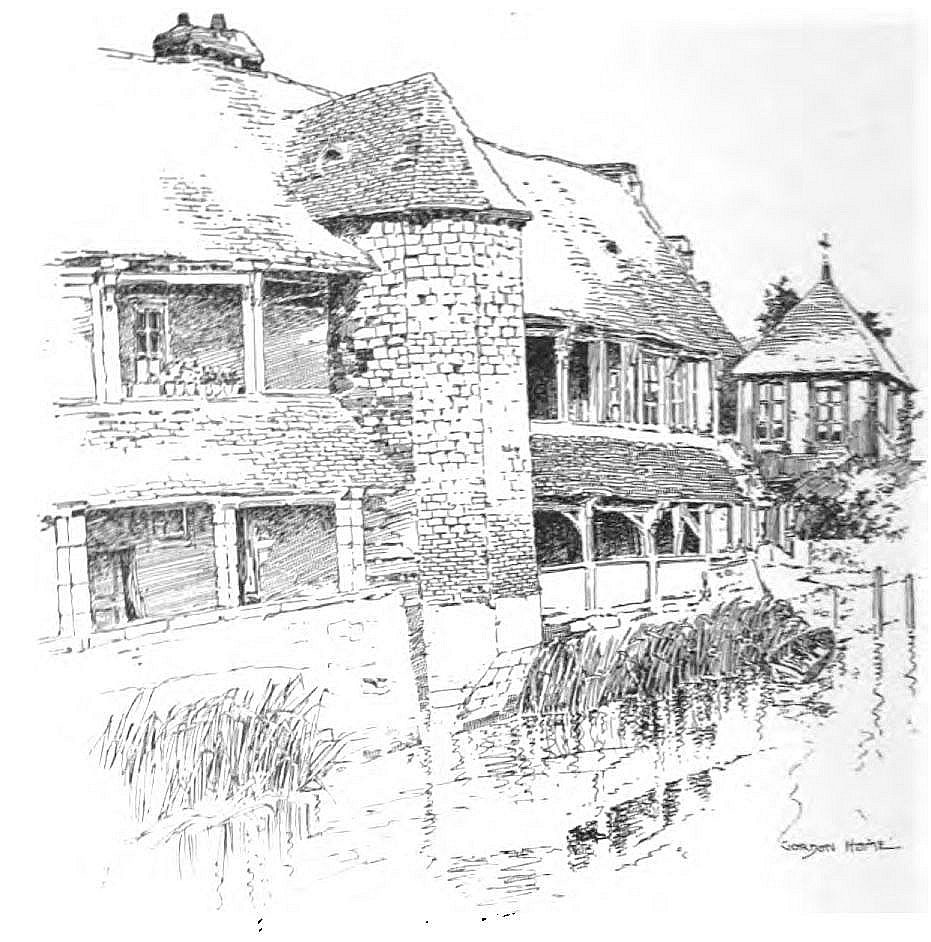
A Seventeenth Century House at Argentan
As in all French towns Argentan knows how to decorate on fete days. Coming
out of the darkness of the church in the late twilight on one of these
occasions, I discovered that the town had suddenly become festooned with a
long perspective of arches stretching right away down the leafy avenue
that goes out of the town—to the north in one direction, and to St
Germain in the other. The arches were entirely composed without a single
exception of large crimson-red Chinese lanterns. The effect was
astonishingly good, but despite all the decoration, the townsfolk seemed
determined to preserve the quiet of the Sabbath, and although there were
crowds everywhere, the only noise that broke the stillness was that of the
steam round-about that had been erected on a triangular patch of grass.
The dark crowds of people illuminated by flaring lights stood in perfect
quiet as they watched the great noisy mass of moving animals and boats,
occupied almost entirely by children, keep up its perpetual dazzle and
roar. The fair—for there were many side-shows—was certainly
quieter than any I have witnessed in England.
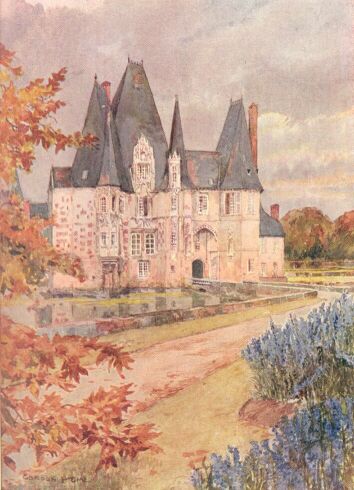
The Château d’O
A long, straight road, poplar-bordered and level, runs southwards from
Argentan to Mortrée, a village of no importance except for the fact that
one must pass through it if one wishes to visit the beautiful Chateau d’O.
This sixteenth century mansion like so many to be seen in this part of
France, is in a somewhat pathetic state of disrepair, but as far as one
may see from the exterior, it would not require any very great sum to
completely restore the broken stone-work and other signs of decay. These,
while perhaps adding to the picturesqueness of the buildings, do not bring
out that aspect of carefully preserved antiquity which is the charm of
most of the houses of this period in England. The great expanse of water
in the moat is very green and covered by large tracts of weed, but the
water is supplied by a spring, and fish thrive in it. The approach to the
chateau across the moat leads to an arched entrance through which you
enter the large courtyard overlooked on three sides by the richly
ornamented buildings, the fourth side being only protected from the moat
by a low wall. It would be hard to find a more charming spot than this
with its views across the moat to the gardens beyond, backed by great
masses of foliage.
Going on past Mortrée the main road will bring one after about eight miles
to the old town of Alençon, which has been famed ever since the time of
Louis XIV. for the lace which is even at the present day worked in the
villages of this neighbourhood, more especially at the hamlet of Damigny.
The cottagers use pure linen thread which is worth the almost incredible
sum of £100 per lb. They work on parchment from patterns which are
supplied by the merchants in Alençon. The women go on from early morning
until the light fails, and earn something about a shilling per day!
The castle of Alençon, built by Henry I. in the twelfth century, was
pulled down with the exception of the keep, by the order of Henry of
Navarre, the famous contemporary of Queen Elizabeth. This keep is still in
existence, and is now used as a prison. Near it is the Palais de Justice,
standing where the other buildings were situated.
The west porch of the church of Notre Dame is richly ornamented with
elaborate canopies, here and there with statues. One of these represents
St John, and it will be seen that he is standing with his face towards the
church. A legend states that this position was taken by the statue when
the church was being ransacked by Protestants in the sixteenth century.
Another road from Argentan is the great route nationale that runs
in a fairly direct line to Granville. As one rides out of the town there
is a pretty view on looking back, of St Germain standing on the slight
eminence above the Orne. Keeping along by that river the road touches it
again at the little town of Ecouche. The old market hall standing on
massive pillars, is the most attractive feature of the place. Its old
tiled roof and half-timbered upper storey remind one forcibly of some of
those fortunate old towns in England that have preserved this feature. The
church has lost its original nave, and instead, there is a curious
barn-like structure, built evidently with a view to economy, being
scarcely more than half the height of the original: the vacant space has
been very roughly filled up, and the numerous holes and crevices support a
fine growth of weeds, and a strong young tree has also taken root in the
ramshackle stone work. From the central tower, gargoyles grin above the
elaborately carved buttresses and finials in remarkable contrast to the
jerry-built addition.
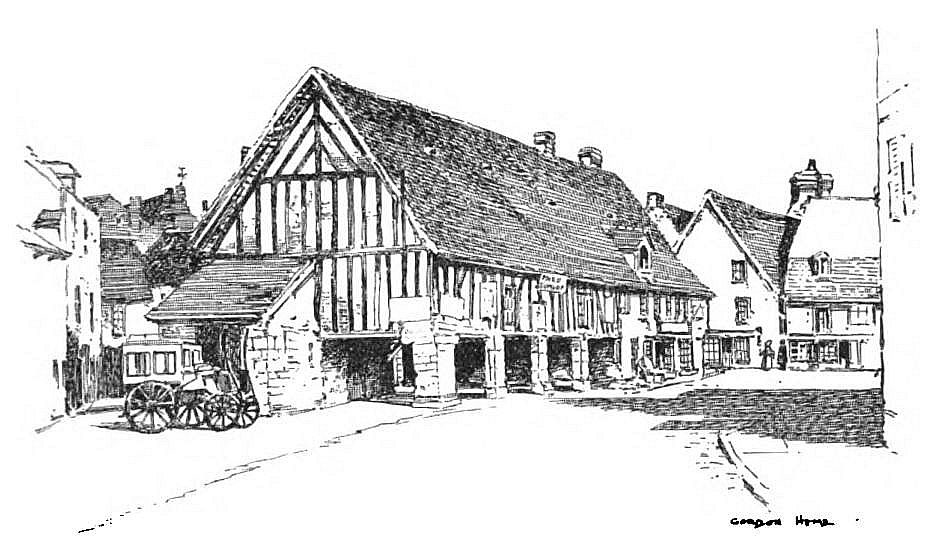
The Old Market House at Ecouché
Passing through rich country, you leave the valley of the Orne, and on
both sides of the road are spread wide and fascinating views over the
orchard-clad country that disappears in the distant blue of the horizon.
Wonderful patches of shadow, when large clouds are flying over the
heavens, fall on this great tract of country and while in dull weather it
may seem a little monotonous, in days of sunshine and shade it is full of
a haunting beauty that is most remarkable.
About seven miles from Argentan one passes Fromentelle, a quiet hamlet
full of thatched cottages and curious weathercocks, and then five miles
further on, having descended into the valley of the little river Rouvre,
Briouze is entered. Here there is a wide and very extensive market-place
with another quaint little structure, smaller than the one at Ecouche, but
having a curious bell-turret in the centre of the roof. On Monday, which
is market day, Briouze presents a most busy scene, and there are plenty of
opportunities of studying the genial looking country farmers, their wives,
and the large carts in which they drive from the farms. In the midst of
the booths, you may see a bronze statue commemorating the “Sapeurs,
pompiers” and others of this little place who fell in 1854.
Leaving the main road which goes on to Flers, we may take the road to
Domfront, which passes through three pretty villages and much pleasant
country. Bellau, the first village, is full of quaint houses and charming
old-world scenes. The church is right in the middle on an open space
without an enclosure of any description. Standing with one’s back to this
building, there is a pretty view down the road leading to the south, a
patch of blue distance appearing in the opening between the old gables. To
all those who may wish to either paint or photograph this charming scene,
I would recommend avoiding the hour in the afternoon when the children
come out of school. I was commencing a drawing one sunny afternoon—it
must have been about three o’clock—and the place seemed almost
deserted. Indeed, I had been looking for a country group of peasants to
fill the great white space of sunny road, when in twos and threes, the
juvenile population flooded out towards me. For some reason which I could
not altogether fathom, the boys arranged themselves in a long, regular
line, occupying exactly one half of the view, the remaining space being
filled by an equally long line of little girls. All my efforts failed to
induce the children to break up the arrangement they had made. They merely
altered their formation by advancing three or four paces nearer with
almost military precision. They were still standing in their unbroken rows
when I left the village.
Passing a curious roadside cross which bears the date 1741 and a long
Latin inscription splashed over with lichen, one arrives at La Ferriere
aux Etangs, a quaint village with a narrow and steep street containing one
conspicuously old, timber-framed house. But it is scarcely necessary to
point out individual cottages in this part of Normandy, for wherever one
looks, the cottages are covered with thick, purply-grey thatch, and the
walls below are of grey wooden framework, filled in with plaster,
generally coloured a creamy-white. When there are deep shadows under the
eaves and the fruit trees in blossom stand out against the dark thatch,
one can easily understand how captivating is the rural charm of this part
of Normandy. Gradually the road ascends, but no great views are apparent,
although one is right above the beautiful valley of the Varennes, until
quite near to Domfront. Then, suddenly there appears an enormous stretch
of slightly undulating country to the south and west. As far as one can
see, the whole land seems to be covered by one vast forest.
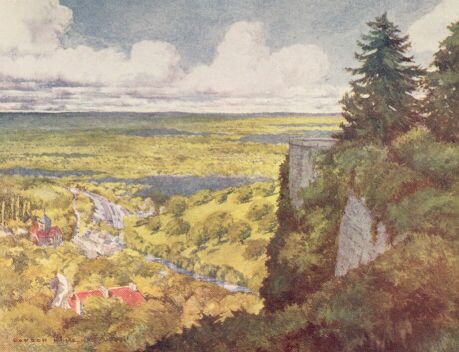
The Forest View from the Ramparts of Domfront Castle
But though part of this is real forest-land, much of it is composed of
orchards and hedgerow trees, which are planted so closely together that,
at a short distance, they assume the aspect of close-growing woods. The
first impression of the great stretch of forest-land does not lose its
striking aspect, even when one has explored the whole of the town. The
road that brings one into the old town runs along a ridge and after
passing one of the remains of the old gateways, it rises slightly to the
highest part of the mass of rock upon which Domfront is perched. The
streets are narrow and parallel to accommodate themselves to the confined
space within the walls. At the western end of the granite ridge, and
separated from the town by a narrow defile, stands all that is left of the
castle—a massive but somewhat shapeless ruin. At the western end of
the ramparts, one looks down a precipitous descent to the river Varennes
which has by some unusual agency, cut itself a channel through the rocky
ridge if it did not merely occupy an existing gap. At the present time,
besides the river, the road and railway pass through the narrow gorge.
The castle has one of those sites that appealed irresistibly to the
warlike barons of the eleventh century. In this case it was William I.,
Duc de Belleme, who decided to raise a great fortress on this rock that he
had every reason to believe would prove an impregnable stronghold, but
although only built in 1011, it was taken by Duke William thirty-seven
years later, being one of the first brilliant feats by which William the
Norman showed his strength outside his own Duchy. A century or more later,
Henry II., when at Domfront, received the pope’s nuncio by whom a
reconciliation was in some degree patched up between the king and Becket.
Richard I. is known to have been at the castle at various times. In the
sixteenth century, a most thrilling siege was conducted during the period
when Catherine de Médicis was controlling the throne. A Royalist force,
numbering some seven or eight thousand horse and foot, surrounded this
formidable rock which was defended by the Calvinist Comte de Montgommery.
With him was another Protestant, Ambroise le Balafré, who had made himself
a despot at Domfront, but whose career was cut short by one of
Montgommery’s men with whom he had quarrelled. They buried him in the
little church of Notre-Dame-sur-l’Eau—the wonderfully preserved
Norman building that one sees beneath one’s feet when standing on the
ramparts of the castle. The body, however, was not long allowed to remain
there, for when the royal army surrounded the castle they brought out the
corpse and hung it in a conspicuous place to annoy the besieged. Like
Corfe Castle in England, and many other magnificently fortified
strongholds, Domfront was capable of defence by a mere handful. In this
case the original garrison consisted of one hundred and fifty, and after
many desertions the force was reduced to less than fifty. A great breach
had been made by the six pieces of artillery placed on the hill on the
opposite side of the gorge, and through this the besiegers endeavoured to
enter. The attenuated garrison, with magnificent courage, held the breach
after a most desperate and bloody fight. But after all this display of
courage, it was found impossible to continue the defence, for by the next
morning there were barely more than a dozen men left to fight. Finally
Montgommery was obliged to surrender unconditionally, and not long
afterwards he was executed in Paris. You may see the breach where this
terrible fight took place at the present day, and as you watch the curious
effects of the blue shadows falling among the forest trees that stretch
away towards the south, you may feel that you are looking over almost the
same scene that was gazed upon by the notable figures in history who have
made their exits and entrances at Domfront.
So little has the church of Notre-Dame-sur-l’Eau altered in its appearance
since it was built by the Duc de Belleme that, were he to visit the ruins
of his castle, he would marvel no doubt that the men of the nine centuries
which have passed, should have consistently respected this sturdy little
building. There are traces of aisles having existed, but otherwise the
exterior of the church can have seen no change at all in this long period.
Inside, however, the crude whitewash, the curious assemblage of enormous
seventeenth century gravestones that are leant against the walls, and the
terribly jarring almost life-sized crucifix, all give one that feeling of
revulsion that is inseparable from an ill-kept place of worship. On the
banks of the river outside, women may be seen washing clothes; the sounds
of the railway come from the station near by, and overhead, rising above
the foliage at its feet, are the broken walls and shattered keep from
which we have been gazing.
The walls of the town, punctuated by many a quaint tower, have lost their
fearsome aspect owing to the domestic uses to which the towers are
palpably devoted. One of them appears in the adjoining illustration, and
it is typical of the half-dozen or so that still rise above the pretty
gardens that are perched along the steep ascent. But though Domfront is
full of almost thrilling suggestions of medievalism and the glamour of an
ancient town, yet there is a curious lack of picturesque arrangement, so
that if one were to be led away by the totally uninteresting photographs
that may be seen in the shops, one would miss one of the most unique spots
in Normandy.
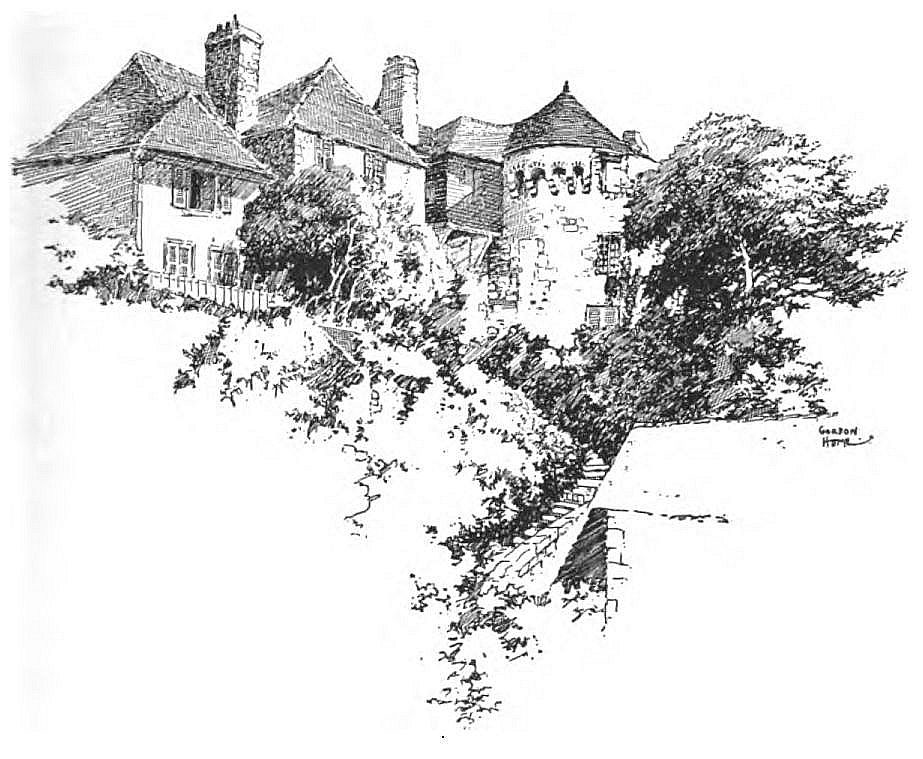
One of the Towers in the Walls of Domfront
Stretching away towards Flers, there is a tract of green country all ups
and downs, but with no distant views except the peep of Domfront that
appears a few miles north of the town. Crowning the ridge of the hill is
the keep of the castle, resembling a closed fist with the second finger
raised, and near it, the bell-cote of the Palais de Justice and the spire
of the church break the line of the old houses. Ferns grow by the roadside
on every bank, but the cottages and farms are below the average of rustic
beauty that one soon demands in this part of France.
Flers is a somewhat busy manufacturing town where cotton and thread mills
have robbed the place of its charm. At first sight one might imagine the
church which bears the date 1870 was of considerably greater age, but
inside one is almost astounded at the ramshackle galleries, the
white-washed roof of rough boards discoloured by damp, and the general
squalor of the place relieved only by a ponderous altar-piece of classic
design. The castle is still in good preservation but although it dates
from early Norman times, it is chiefly of the sixteenth century.
Out in the country again, going westwards, the cottage industry of weaving
is apparent in nearly every cottage one sees. The loud click-a-ti-clack—click-a-ti-clack
of the looms can be heard on every side as one passes such villages as
Landisacq. Everywhere the scenery is exceedingly English, the steep
hillsides are often covered with orchards, and the delicate green of the
apple-trees in spring-time, half-smothered in pinky-white blossom, gives
the country a garden-like aspect. You may see a man harrowing a field on a
sudden slope with a cloud of dust blowing up from the dry light soil, and
you may hear him make that curious hullaballooing by which the peasants
direct their horses, so different from the grunting “way-yup there” of the
English ploughman. Coming down a long descent, a great stretch of country
to the north that includes the battlefield of Tinchebrai comes into view.
It is hard to associate the rich green pastures, smiling orchards, and
peaceful cattle, with anything so gruesome as a battle between armies led
by brothers. But it was near the little town of Tinchebrai that the two
brothers, Henry I., King of England, and Robert Duke of Normandy fought
for the possession of Normandy. Henry’s army was greatly superior to that
of his brother, for he had the valuable help of the Counts of Conches,
Breteuil, Thorigny, Mortagne, Montfort, and two or three others as
powerful. But despite all this array, the battle for some time was very
considerably in Robert’s favour, and it was only when Henry, heavily
pressed by his brother’s brilliant charge, ordered his reserves to envelop
the rear, that the great battle went in favour of the English king. Among
the prisoners were Robert and his youthful son William, the Counts of
Mortain, Estouteville, Ferrieres, and a large number of notable men. Until
his death, twenty-seven years later, Henry kept his brother captive in
Cardiff Castle, and it has been said that, owing to an effort to escape,
Henry was sufficiently lacking in all humane feelings towards his
unfortunate brother, to have both his eyes put out. It seems a strange
thing that exactly sixty years after the battle of Hastings, a Norman king
of England, should conquer the country which had belonged to his father.
The old church of St Remy at Tinchebrai, part of which dates from the
twelfth century, has been abandoned for a new building, but the inn—the
Hotel Lion d’Or—which bears the date 1614, is still in use. Vire,
however, is only ten miles off, and its rich mediaeval architecture urges
us forward.
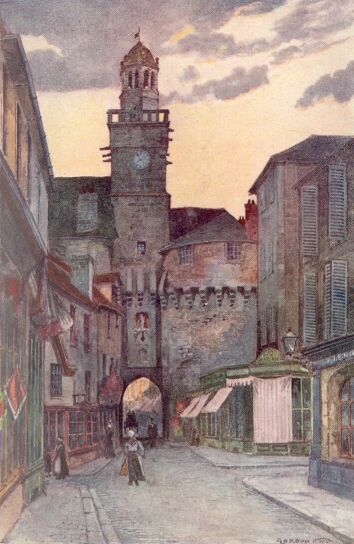
The Clock Gate, Vire
Standing in the midst of the cobbled street, there suddenly appears right
ahead a splendid thirteenth century gateway—the Tour de l’Horloge—that
makes one of the richest pictures in Normandy. It is not always one can
see the curious old tower thrown up by a blaze of gold in the west, but
those who are fortunate enough to see such an effect may get a small
suggestion of the scene from the illustration given here. The little
painted figure of the Virgin and Child stands in a niche just over the
arch, and by it appears the prayer “Marie protege la ville!”
One of the charms of Vire is its cleanliness, for I can recall no
unpleasant smells having interfered with the pleasure of exploring the old
streets. There is a great market on the northern side of the town, open
and breezy. It slopes clear away without any intervening buildings to a
great expanse of green wooded country, suggestive of some of the views
that lie all around one at Avranches. The dark old church of Notre Dame
dates mainly from the twelfth century. Houses and small shops are built up
against it between the buttresses in a familiar, almost confidential
manner, and on the south side, the row of gargoyles have an almost
humorous appearance. The drips upon the pavement and shops below were
evidently a nuisance, and rain water-spouts, with plain pipes leading
diagonally from them, have been attached to each grotesque head, making it
seem that the grinning monsters have developed a great and unquenchable
thirst. Inside, the church is dark and impressive. There are double rows
of pillars in the aisles, and a huge crucifix hangs beneath the tower,
thrown up darkly against the chancel, which is much painted and gilded.
The remains of the great castle consist of nothing more than part of the
tall keep, built eight hundred years ago, and fortunately not entirely
destroyed when the rest of the castle came down by the order of Cardinal
Richelieu. An exploration of the quaint streets of Vire will reveal two or
three ancient gateways, many gabled houses, some of which are
timber-framed visually, and most of them are the same beneath their skins
of plaster. The houses in one of the streets are connected with the road
by a series of wooden bridges across the river, which there forms one of
the many pictures to be found in Vire.
Mortain is separated from Vire by fifteen miles of exceedingly hilly
country, and those who imagine that all the roads in Normandy are the flat
and poplar bordered ones that are so often encountered, should travel
along this wonderful switch-back. As far as Sourdeval there seems scarcely
a yard of level ground—it is either a sudden ascent or a breakneck
rush into a trough-like depression. You pass copices of firs and beautiful
woods, although in saying beautiful it is in a limited sense, for one
seldom finds the really rich woodlands that are so priceless an ornament
to many Surrey and Kentish lanes. The road is shaded by tall trees when it
begins to descend into the steep rocky gorge of the Cance with its
tumbling waterfalls that are a charming feature of this approach to
Mortain. High upon the rocks on the left appears an enormous gilded statue
of the Virgin, in the grounds of the Abbaye Blanche. Going downwards among
the broken sunlight and shadows on the road, Mortain appears,
picturesquely perched on a great rocky steep, and in the opening of the
valley a blue haze suggests the great expanse of level country towards the
south. The big parish church of the town was built originally in 1082 by
that Robert of Mortain, who, it will be remembered, was one of the first
of the Normans to receive from the victorious William a grant of land in
England. The great tower which stands almost detached on the south-west
side is remarkable for its enormously tall slit windows, for they run
nearly from the ground to the saddle-back roof. The interior of this
church is somewhat unusual, the nave and chancel being structurally one,
and the aisles are separated by twenty-four circular grey pillars with
Corinthian capitals. The plain surfaces of the walls and vaulting are
absolutely clean white, picked out with fine black lines to represent
stone-work—a scarcely successful treatment of such an interior! On
either side of the High Altar stand two great statues representing St
Guillaume and St Evroult.
To those who wish to “do” all the sights of Mortain there is the Chapel of
St Michael, which stands high up on the margin of a great rocky hill, but
the building having been reconstructed about fifty years ago, the chief
attraction to the place is the view, which in tolerably clear weather,
includes Mont St Michel towards which we are making our way.
A perfectly straight and fairly level stretch of road brings you to St
Hilaire-du-Harcout. On the road one passes two or three large country
houses with their solemn and perfectly straight avenues leading directly
up to them at right angles from the road. The white jalousies seem always
closed, the grass on the lawns seems never cut, and the whole
establishments have a pathetically deserted appearance to the passer-by. A
feature of this part of the country can scarcely be believed without
actually using one’s eyes. It is the wooden chimney-stack, covered with
oak shingles, that surmounts the roofs of most of the cottages. Where the
shingles have fallen off, the cement rubble that fills the space between
the oak framing appears, but it is scarcely credible that, even with this
partial protection, these chimneys should have survived so many centuries.
I have asked the inmates of some of the cottages whether they ever feared
a fire in their chimneys, but they seemed to consider the question as
totally unnecessary, for some providence seems to have watched over their
frail structures.
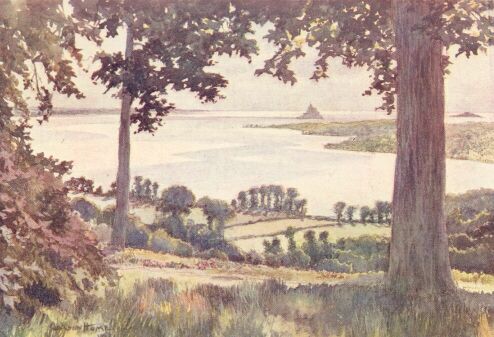
Mont St Michel and the Bay of Cancale from the Jardin
des Plantes at Avranches
St Hilaire has a brand new church and nothing picturesque in its long,
almost monotonous, street. Instead of turning aside at Pontaubault towards
Mont St Michel, we will go due north from that hamlet to the beautifully
situated Avranches. This prosperous looking town used, at one time, to
have a large English colony, but it has recently dwindled to such small
dimensions that the English chaplain has an exceedingly small parish. The
streets seem to possess a wonderful cleanliness; all the old houses appear
to have made way for modern buildings which, in a way, give Avranches the
aspect of a watering-place, but its proximity to the sea is more apparent
in a map than when one is actually in the town. On one side of the great
place in front of the church of Notre Dame des Champs is the Jardin des
Plantes. To pass from the blazing sunshine and loose gravel, to the dense
green shade of the trees in this delightful retreat is a pleasure that can
be best appreciated on a hot afternoon in summer. The shade, however, and
the beds of flowers are not the only attractions of these gardens. Their
greatest charm is the wonderful view over the shining sands and the
glistening waters of the rivers See and Selune that, at low tide, take
their serpentine courses over the delicately tinted waste of sand that
occupies St Michael’s Bay. Out beyond the little wooded promontory that
protects the mouth of the See, lies Mont St Michel, a fretted silhouette
of flat pearly grey, and a little to the north is Tombelaine, a less
pretentious islet in this fairyland sea. Framed by the stems and foliage
of the trees, this view is one of the most fascinating in Normandy. One
would be content to stay here all through the sultry hours of a summer
day, to listen to the distant hum of conversation among white-capped
nursemaids, as they sew busily, giving momentary attention to their
charges. But Avranches has an historical spot that no student of history,
and indeed no one who cares anything for the picturesque events that crowd
the pages of the chronicles of England in the days of the Norman kings,
may miss. It is the famous stone upon which Henry II. knelt when he
received absolution for the murder of Becket at the hands of the papal
legate. To reach this stone is, for a stranger, a matter of some
difficulty. From the Place by the Jardin des Plantes, it is necessary to
plunge down a steep descent towards the railway station, and then one
climbs a series of zigzag paths on a high grassy bank that brings one out
upon the Place Huet. In one corner, surrounded by chains and supported by
low iron posts, is the historic stone. It is generally thickly coated with
dust, but the brass plate affixed to a pillar of the doorway is quite
legible. These, and a few fragments of carved stone that lie
half-smothered in long grass and weeds at a short distance from the
railed-in stone, are all that remain of the cathedral that existed in the
time of Henry II.
It must have been an impressive scene on that Sunday in May 1172, when the
papal legate, in his wonderful robes, stood by the north transept door, of
which only this fragment remains, and granted absolution to the sovereign,
who, kneeling in all humbleness and submission, was relieved of the curse
of excommunication which had been laid on him after the tragic affair in
the sanctuary at Canterbury. In place of the splendid cathedral, whose
nave collapsed, causing the demolition of the whole building in 1799,
there is a new church with the two great western towers only carried up to
half the height intended for them.
From the roadway that runs along the side of the old castle walls in
terrace fashion there is another wonderful view of rich green country,
through which, at one’s feet, winds the river See. Away towards the
north-west the road to Granville can be seen passing over the hills in a
perfectly straight line. But this part of the country may be left for
another chapter.


