4.30 a.m., Friday, November 30th.—Quiet, comparative quiet everywhere.
Gas shells came over with an ever increasing frequency, but men slept on
without masks. A shell, heavy, unmistakably from a huge howitzer,
crashed with a mighty uproar into a small house and demolished it at a
stroke. Then another, and another, and still another ... phew, what was
he "searching" for? From the doorway of Brigade Headquarters I looked
into the night and listened to the whistle of shells passing overhead
from eastward into our lines. Our own artillery was silent. No sound
came from our near infantry lines, not the crack of a rifle, not the
splutter of a machine-gun.
Again the dull drone of the heavy stuff—the practised ear could gauge
its fall, and I retreated a few yards into the passage. The courtyard
outside caught it, and the entire chateau trembled violently at the
concussion. But why, why these big guns? Another landed in the yard,
followed by an unearthly tinkle of falling glass. Someone ran in from
the gateway with a headlong rush, gained the passage and paused.
"Phew," excitedly, "what the devil is Fritz up to? Heaviest shells on
this front."
"Yes. Might be coming over."
"Hardly."
"Why these heavies?"
"Dunno. He's shelling along the whole line—good God," in a shout, "look
at that chap there ... it, oh, my God, it's got him ... did you, did
you, see THAT?" A heavy had whined into the yard just as a runner
essayed a blind rush. Nothing was left. Nausea, a slight dizziness
enveloped us.
"What," he asked hoarsely, "what is this place?"
"86th Brigade."
"I want the Guernseys."
"In the Catacombs. The road up on the right." He walked out on to the
steps, stared intently into the night—in a flash we both sensed Death.
He ran down the flight:
"Good-night." He was a death casualty that night, and we HAD BOTH KNOWN
IT.
Presentiment of looming danger was pregnant, became accentuated with the
increase of heavy shelling falling from three angles: from directly
overhead, from the right rear flank and left rear.
It all culminated before dawn into a barrage on our lines, shells
raining in on every acre by the dozens. From the top of the chateau (it
was built on a hill) with the coming of day, wave upon wave of
grey-coated infantry could be discerned through the glasses. It was
impossible to estimate their number, line followed line in such rapid
sequence that the eye was bewildered.
They were up against the 29th. The Division wiped out, not partially but
completely, row after row. Rifles and machine-guns mingled in hasty
chorus, incessant, rapid, accurate. Fritz fell back.
The glasses swept over to the right: the heart gave one wild leap of
anxiety. The Division on the right had to face an advance it was unable
to stem, a first line had fallen and a bunch of khaki figures were being
hurried away into the German rear. Beneath pressure too heavy the line
gave, retired rapidly, and the 29th's flank was exposed at a mere
HALF-MILE'S distance.
A call was given for a Guernsey scout ... from the passage an inferno of
shells were visible bursting every few yards, instantaneously the mind
formed: "Impossible to go through alive." One wild frenzied run across
the vibrating yard, hearing everywhere the thunderous bursts, fumes
fouling the nostrils, breath coming and going in gasps; running like
Hades, bent almost double: any second the singing pieces of shrapnel
flying past will get you. Into the Brigade Headquarters with a wild
laugh! You're through, but you have got to get BACK.
In response to that message the Ten Hundred turned out.
They swung out into Masnières' cobbled hill, rifles slung, and marched
with all the nonchalance in the world towards the bridge, cigarettes and
pipes going, laughing and joking—thus have I a hundred times watched
them go on parade.
That march, a classic; let it go down into history as an emblem of the
old Ten Hundred. Their last march together, their last foot chorus on
the long trails. Square of shoulder, upright, I see even now those
figures that have long since been still. Every yard a man crumpled up,
any yard it might be YOU. And they laughed and smoked, went forth to
call "Halt!" to those waves of grey, advancing some hundred yards away,
as if they had a hundred lives to give. Let coming generations marvel.
The Farewell March of the First Ten Hundred. Before the sun had reached
its noon many had crossed the Groat Divide and passed the portals of
Valhalla to swell the throng of their Viking forefathers.
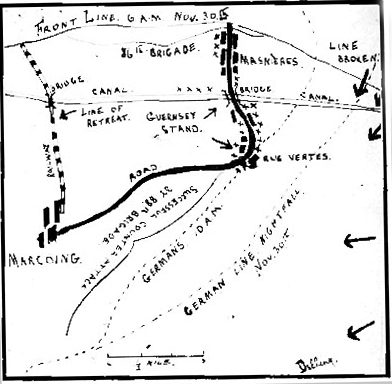
The enemy advance had continued with remarkable rapidity towards Rues
Vertes and Marcoing. Rear Brigade Headquarters, in Rues Vertes, or at
least above that village, had been seized, and the R.E.'s, a portion of
the N.C.O. staff, all rations and ammunition captured. A dressing
station filled with R.A.M.C. and wounded was taken, but Frit acted
honourably, placed a sentry over the entrance and allowed the Red Cross
men to carry on with their work.
From Marcoing the 88th Brigade formed a line running towards Masnières,
and with the dull, wicked bayonet went out to meet the grey forces. Here
and there bayonet met bayonet. Again it was the 29th. Blood poured into
pools on the grass, Hun after Hun clasped his weakening grip upon the
British bayonet rasping through his chest. He fell and with a foot on
the body for leverage a red, dipping blade was withdrawn. On again,
crack! crack!! Lunge, until the ribs snapped like dry sticks beneath
each thrust. Stoic British, unmoved, unexcited ... well might you
Germans call the 29th the Iron Division. Aye, the Cult of the Bayonet!
The enemy sickened ... ran.
Lining the roads above and below the broken Masnières bridges, with its
half sunk tank, the Ten Hundred pumped an annhilating shower or lead
into the lines of enemy creeping along the canal bank. He turned and
retreated, but a swarm of grey figures had taken Rues Vertes and were
consolidating their positions in what constituted a direct menace to
both the 88th Brigade at Marcoing and the other two (89th and 87th)
holding on against the onslaught on a line stretching from Masnières to
Nine Wood. In this village the enemy held a pivot from which a turning
movement, if supported with sufficient troops and guns, could be
enforced. He had both these essentials and his aeroplanes grasped in a
moment that an advance from here would, if successful, bring the Hun
infantry into the direct REAR of those British lines still intact, cut
the only line of retreat and force the capitulation of the Divisions at
the apex of the salient.
Fritz 'planes were up in scores flying in formation, and, having no
opposition, were frequently at an altitude of a mere sixty or eighty
feet. The scouts, peering down on the situation at Masnières, took in at
a glance the wide area that had to be covered by the solitary Norman
Battalion without support of any kind. This information was communicated
to the German Command. Inroad from Rues Vertes was prepared with certain
confidence; but they had not calculated with the Normans and before the
Command could move a finger THEY HAD LOST RUES VERTES!
There was not in that first storming of the village the desperate
hand-to-hand fighting that would inevitably have ensued had the Hun made
a stand. The Normans scampered wildly into the one narrow road in the
stop-at-nothing rush that came naturally to them; some slipped down the
fields with Lewis-guns, and Fritz aware that his left flank was falling
back before the grim counter-attack of the 88th, retired with abrupt
haste. The Lewis-guns (a machine gun firing 700, or slightly over, shots
a minute—in theory, 500 in actual practice) in the fields found that
the German retreating line was by force of circumstance brought into
that most-deadly fire, enfilade (e.g., firing across a line from a point
of vantage at the flank). The guns opened without warning on the three
waves, more or less in mass due to the involuntary retreat. No more
adequate simile can convey the picture of the fast-falling figures than
that of grass beneath the scythe. Five minutes, perhaps ten, and it was
over. Bodies lay thick everywhere, and upon this area of wounded and
dying shells were casting square feet of flesh yards into the air.
German 'planes, viewing this massacre from above, swept down in swift
retribution, and flying low turned their machine-guns upon the
unprotected Normans. An aeroplane travels at anything from eighty to one
hundred miles an hour, and this very speed restricted a lengthy
concentration on any one spot, but many a Norman fell forward on his
face, a dozen leaden bullets in his skull and chest.
Duquemin, conscious and moaning piteously in agony, was lying crosswise
over his rifle, one leg smeared with blood, and the other reclining
grotesquely against the hedge twenty yards away. Doubled up on a hedge
top, rifle still levelled at the foe, a figure lay and upon its
shoulders a ghastly mess of brains and blood crushed flat in the steel
helmet. Duval stumbled blindly towards the dressing station, the flesh
gleaming red down one side of his face and an eye almost protruding. Le
Lièvre limped away in the direction of Marcoing and walked for five
hours before succour came his way. Tich was lying face earthwards near
the Crucifix, a rifle shot in the very centre of his head. Rob, quiet,
gentle-natured Rob, fell forward against the semi-trench.
"I—I've got in—the head," he said weakly "I—I'm going, go—." He
collapsed ... life ebbed away and he was still.
BUT THE NORMANS HELD RUES VERTES.
The Germans launched a heavy offensive, for the retaking, wave after
wave, line after line, moving ponderously forward. The Norman rifles and
machine-guns shrieked out lead in a high staccato until the advance,
slackened, wavered and fell back. Hun artillery showered shell, gas, and
shrapnel over every yard of ground. For a period the Normans fell in
dozens everywhere. The canal in places was stained red, and Norman
bodies drifted twirling away on its fast-running waters before sinking.
AMMUNITION WAS SHORT. Scouts from Headquarters tried to get into
Marcoing with the information. Clarke moving along the road found
himself unable to return or to move because of a Fritz advanced post.
One of the Middlesex crossing a clearing in the trees was wiped out by
machine-gun fire and toppled over into the canal.
Mighty trees, a yard radius, bordered those waters, but at every few
paces forward the eye took in one of these monsters split open by a
shell. The pulse quickened; if it did that to a tree what would be left
of you—anyhow you wouldn't know much about it. Approaching Marcoing the
hum of an aeroplane, flying low sounded—in a second I feigned casualty,
but he got home on the other scout ahead. Phew, wind up!
The very streets of Marcoing were almost obliterated by the jumbled heap
of stone, wood-work and bricks lying across them. Bodies in every
inconceivable state of partial or whole dismemberment made a ghastly
array in the bleak sunlight, blood from man and animal formed dark pools
in the hollow sections of the shattered roadway. Progress could only be
made by moving apprehensively close up to what walls were still
standing, and to sprint wildly over the open. Wounded were streaming in
hundreds towards the dressing station in the square ... many failed to
reach there alive.
From the top of the Chateau in Masnières, Corporal Cochrane (the finest
little N.C.O. in the Battalion) and a few others were sniping at Hun
ARTILLERY some four hundred yards distant. AT LAST had the infantryman
his chance.
A steady glance down the sights. Crack! Miss! Crack! Got him but only
slightly. Crack, crack! The unholy glee of it. You could see by the way
he fell that it had gone home fatally. Crack—another five rounds are
rammed into the magazine ... pump it into them, play hell with that
Artillery while the chance lasts.
They stare wildly about in a frenzy. Crack, crack, crack! They have had
enough and retreat a few hundred yards further south. Still, there lies
a dozen or more who will not again pour into the quivering flesh
shrapnel's hell-hot agony.
A glance along the Norman ranks during the late afternoon showed
appreciably by the many gaps separating man from man how many casualties
had already obtained. Shells claimed a large toll of victims even among
the more or less screened rows of figures lying along the eastern edge
of the canal. Le Poidevin and Le Page, lighting cigarettes from the same
match, caught one in the right and the other the left leg, two flying
pieces of shrapnel from a shell bursting over one hundred yards distant;
fell and stared at each other in painful astonishment ... hobbled
laboriously on the long journey (for a wounded man) into Marcoing.
Stumpy, secure behind a small mound, had gazed with black pessimism on
life from the moment Tich had given ALL.
"Gawd," he observed generally, "ain't it orful. What with shells, an'
dead, an' gas! An' I ain't 'ad any rum since last night. Wot a pore
Tommy has got ter put up with."
Night. A night when men crouched over their rifle waiting to kill, when
the owl had gone far from the slaughter and even not the fitful flutter
of a bat sped through the dark pall. Only man: savage, primitive man,
glared at where each remained hidden. The blood lust to kill, always to
kill. Animal ferocity and passion: man's inheritance.
From No Man's Land came the sobbing call of wounded for succour. Far,
far across the void sounded those despairing frenzied shrieks. Hoarse,
appealing, incessant, until they weakened and nothing reached the ear
but the smothered sobs of men whose life's sands were running out for
want of that aid, so near, but which they were unable to reach.
Verey lights from Fritz's lines rose and fell with monotonous certainty,
throwing faint glows on the huddled heaps lying in all directions
between the two fronts. A gleam would catch reflection in the glassy
eyes of a stiff form, fade and leave you staring hypnotised into the
night. Was it distorted fancy ... then you would see it again, and
again, until in its very frequency you noticed—nothing.
Shelling slackened. Now and again a pause when the stillness could be
"heard." From the woods in intermittent intervals the one solitary gun
still intact in an entire battery belched forth a lone shell into the
enemy lines. In the fantastic flash of each explosion three
shirt-sleeved forms showed a ruddy silhouette of blackened hands and
features. A tearing, splintering crash awoke echoes as some great bough
was shattered in impact with a "heavy" and crackled its cumbersome way
past smaller branches to where it splashed into the canal.
Into an advanced dressing station about Rues Vertes one of the Duo
stumbled, bleeding profusely from several wounds, dripping with slimy
mud and water, features covered with the grey black dust that comes from
close contact with a shell. Ozanne stared at him.
"Gawd," he said, "'ow'd you get that?"
"Scrap—with a Fritz outpost—got a stretcher?" He bent down in a
half-faint, was carried to a stretcher and his wounds in body and arm
bound. Fag in mouth he dozed, was startled into wakefulness by a call
from the Padre.
"Boys," he was saying, "this village will be evacuated shortly—can't
possibly hold on. Those wounded who can had better walk to Marcoing."
To Marcoing! Two and a half miles. The Norman moved dizzily out of his
stretcher, stood up, and tottered to the entrance.
"Here, kid," a Corporal (R.A.M.C.) advised, "You can't do it."
"I can."
"You'll peg out on the way."
"Sooner that than—be—a prisoner. But I can—do it." He did!
Dawn! And with it an intensity of shelling over the whole area. Earth,
limbs, trees were constantly somewhere in the air. Bodies of yesterday
were torn asunder again and the wounded who had lasted out the night
shrank and writhed in the fiery hail of shrapnel. Fritz came over again.
He is a courageous warrior, not afraid of his own skin, but is at best
when fighting in numbers. A lone fight, back to the wall, is not his
métier; he, if at all threatened, retreats.
Rues Vertes fell.
It was a physical impossibility for the Ten Hundred to hold on. The
casualties already exceeded three hundred, every man was utterly worn,
hungry, had existed for twenty-four hours in a state of the highest
nerve tension. Not one was there who had not missed death a dozen times
by the merest of escapes. They had for ten or eleven days been engaged
in an offensive and what meagre rest had been theirs was woefully
insufficient to counteract the heavy demands made upon the stamina.
Out-numbered by twenty to one, completely out-gunned. No reserves, no
supports, and only one small line of retreat. No aerial observation, no
adequate cover, and an enemy who was aware that a mere shattered
Battalion stood between them and the capitulation of one or more
Divisions. They were half famished, tired out ... his troops were fresh.
He had no doubts as to the result.
Again the 29th Division repelled an attack on its original front line.
Fritz tried the flank, came on in waves stretching far over the hill
crest. A fire stopped him—COULD there be only ONE corps before him. He
rallied, swept on again, swarming over the canal banks and close up into
the outer Masnières' defences; but on his lines hailed a rapid fire from
the Normans, the like of which he had never deemed possible. Savident
ran alone into the centre of a roadway with his Lewis-gun and poured
every solitary shot by him in one long sweep up and down the wavering
lines. Rifles cracked with the rapid reloading action of marksmen until
the barrels burned hot in the hand. The Germans fell back. The Normans
went forward in that reckless rush.
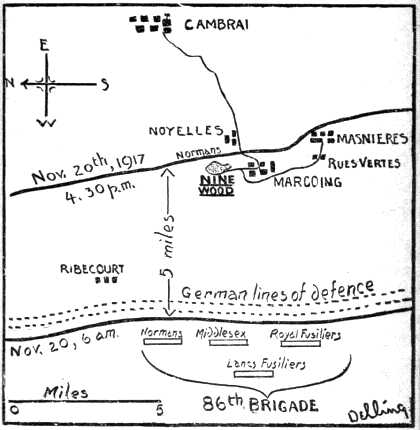 Cambrai
Rues Vertes was retaken!
In the outskirts of this village a number of the draft were isolated,
became tangled in one great bloody mêlée with the angrily retreating
enemy. There was nothing for it but a fight to the death.
Through the glasses they could be seen to hold off the Hun for a few
brief minutes, met him in a ghastly lunging of bayonets, from which
beads of blood were dropping ... but they went under one by one, until
one thick-set lad remained, seized two Huns one after the other by the
neck, twisted them with his own hands and went over the Divide, a
bayonet through his heart.
But their example put the fear of death into the enemy and for an hour
the thinning line of Normans had no attack.
He reformed, sent a large number of machine-guns with his first wave,
concentrated a fearful artillery fire on the villages, and swept
forward. The same fire met him, again the lines wavered, but that hail
of lead was more than the men could withstand. They went back—many of
the gunners without their machine-guns, not back a hundred yards or so
but almost out of RIFLE RANGE.
The artillery fire had created havoc among the Normans. Twenty figures
writhed in agony in so many feet, a stream of blood-soaked lads were
moving slowly away towards Marcoing. One Lewis-gun team was lying about
in all directions, forms distorted, limbs missing and great bare
stretches of red flesh showing with sickening brilliancy of colour—and
the gun itself was UNTOUCHED. Irony of fate.
On the sloping grass seven inert khaki forms could be counted, on the
lower levels another five: stretched across the mound to the east of the
canal a dozen or more were visible at intervals of eight or so yards.
All from ONE spot without moving the head.
The casualties were more than the untouched.
Weary Normans, knowing that YOUR turn would not be long acoming—and you
would not be sorry when it did—knowing, too, that behind was no relief
force. You had to HOLD, there was no alternative. And each face lifted
earnestly in the light was set of jaw. God grant them life and they
would hold until the Hun himself called "Halt!"
Ammunition had come up ... therefore was there only one factor by which
they might fail—no men to use the rifles. They spoke sometimes in the
pauses.
"Wonder wot they'll say at 'ome about all these yere dead?"
"Dunno."
"Anyhow, we ain't done bad work."
"No; an' we'll hang on yere like 'ell, even if they brings the ole
bloomin' German army."
"Sure. If Jerry thinks 'e can show us 'ow to shoot 'e has made a 'ell of
a outer."
"D'you know," shyly, "we 'ave done somethin' big!"
"Yes; I s'pose we 'ave."
The very men who had fought on and made good in face of odds that no man
in his senses would have bet on at a thousand to one chance, opined that
they had "done something big," or at least they "s'posed so."
No Regiment in the Empire, or out of it, could have done more. They had
to "hang on" at any cost. They did: simply, doggedly.
The Guards—rushed up to the southern portion of the sector and launched
against the German advance—with a determination and tenacity of purpose
against which the offered opposition was futile, turned the enemy flank
and forced them back in the direction of their original (November 30th)
line through Cambrai.
A strong detachment fell back on the Masnières-Rumilly sector, thereby
enforcing on the small Norman remnant a further infliction of bloody
fighting and casualties. The Guards swept back the waves of grey upon
the Guernseys, who could not retreat—for a few hundred yards behind
them the rest of the Brigade were holding up a further enemy element.
Our own artillery, harassing the Fritz retreat, sent over a number of
shells into Masnières. Fritz batteries, in response to the urgency of
the situation, hailed down shrapnel on a scale only equalled on the
morning of their onslaught. The Normans came in for the thick of it.
The men holding the far end of the little town found themselves swamped
down in the overwhelming rush of an entire retreating Battalion. They
were prisoners before the abrupt alteration in the direction of the
German movement had dawned on them.
Above Rues Vertes the spiteful fire of the remaining scattered units of
the Ten Hundred impressed upon the Hun mind a fear of those riflers that
was pregnant enough to force him to rapidly verge away from the spot to
a safer distance of a mile or so.
The little village near the Crucifix was withdrawn from at dusk with no
molestation. Shelling slackened to a mere initial salvo from Rumilly.
The lull followed in which enemy reinforcement were being brought up to
be thrown in large forces upon those stubborn British regiments who were
clinging tenaciously, with unshaken obstinacy, to shattered trenches.
Lieut. Stone (afterwards M.C.) led a bombing raid under cover of night
into Rues Vertes, originating there an uproar that startled every Fritz
within a mile into a bad degree of "windy" apprehension. He fired into
the air a frenzied array of Verey lights in hope of discovering the
extent of the raid. Had the Ten Hundred been less war-worn they would
have chuckled delightedly over this successful bluff, but they hardly
commented upon it, stared wearily and disinterestedly at the flashes of
bursting grenades, turned away and banged arms and hands noisily on
thighs to enforce some little circulation into those cold, clammy limbs.
So utterly exhausted were a few of the youngsters that they had fallen
into unsettled sleep across their rifles, startled now and again into
fearful wakedness by a mind that had for days been awaiting something
that would inevitably come.
Men were little more than mechanical figures, but the brain ran rampant
and uncontrolled until the wild memories of furious German attacks
earlier in the day surged up with acute pregnancy and the victim fell
prey to poignant hallucination. The endless rows of grey figures would
advance yard by yard ... five hundred range, four hundred, three
hundred. God, we can't stop him. The crackle of rifles and machine-guns
shrieked higher ... two hundred; one hundred. Breath comes and goes in
sobs—in one minute he will be on you. Then he wavers. Now is the time;
pump the lead into him ... he turns.
And the lad regaining control of his distorted imagination discovers
that his rifle barrel is hot and that he has let fly a dozen rounds into
the void ... a shaky hand passes slowly over a sweat-covered brow.
The Higher Command, realising that the holding of Masnières with the
small remnants of troops in the sector was impossible, ordered the
withdrawal to a support line of the old Hindenburg system, and thus
straightening out or at least modifying the British frontage.
What remaining elements of the Ten Hundred still survived were allotted
the last task of covering the Brigade's withdrawal. They stood their
ground to the final stages of the movement and they only evacuated
because ORDERED TO DO SO.
Middlesex, Lancs. Fusiliers, Royal Fusiliers, each Battalion badly cut
up, moved away while the Normans held on, pumping lead in whining chorus
to convey to the German mind that troops were plentiful and to
camouflage the fact that a withdrawal was taking place.
Then they stumbled to their feet, weak from exhaustion, exposure and
hunger. The wind moaned in trees in company with their uncertain
footsteps, the still forms of brother Normans smiled up to the stars and
bade them mute farewell as they came away from that sacred ground,
sodden with their blood. The Germans in the morning would find
everywhere the honoured dead and would place them in their last resting
place in the damp soil for which they had willingly given of their LIVES
to hold.
Because no one would be there to resist him he would walk their
treasured strip of soil; but his footsteps would never have defiled it
while ONE NORMAN had remained.
Hands clenched in agony ... he would take it ... they had failed to
uphold those who had gone before. To leave it after all they had done,
to give it without a shot. Why, why——?
The Passing of the Old Ten Hundred.
A few over three hundred men marched without sound to where a train
awaited. Silent, haggard, worn!
The remnants of the Normans. Six or seven hundred casualties in two
days—they were aptly "remnants."
The train pulled out. The Cambrai Offensive was merely history.
The following letter was sent to the Bailiff of Guernsey by the C.O. of
the 29th Division shortly after the Cambrai battle, which the Bailiff
read at a sitting of the Royal Court:—
"I want to convey to the Guernsey authorities my very high
appreciation of the valuable services rendered by the Royal
Guernsey Light Infantry in the Battle of Cambrai. Their's was a
wonderful performance.
"Their first action was on November 20th. and though their task of
that day was not severe, they carried out all they were asked to do
with a completeness that pleased me much. The C.O., De La
Condamine, was then invalided, and I placed my most experienced
C.O. in command. This was Lieut.-Colonel Hart-Synot, nephew of Sir
Reginald Hart.
"On November 30th, when the Germans, in their heavy surprise
attack, pierced our line to the south of my sector, the enemy
entered the village of Les Rues Vertes, a suburb of Masnières,
which town was my right flank. It was the Guernsey Light Infantry
which recovered this village twice by counter-attacks, and which
maintained the southern defences of Masnières for two days against
seven German attacks with superior forces and very superior
artillery. When we were ordered to evacuate Masnières on the night
of December 1st, it being a dangerous salient, with the enemy on
three sides, it was the Royal Guernsey Light Infantry which covered
the withdrawal. Guernsey has every reason to feel the greatest
pride in her sons, and I am proud to have them under me fighting
alongside my staunch veterans of three years' fighting experience.
"Many officers and men greatly distinguished themselves, among whom
I may first mention Le Bas, and after him Stranger, Stone and
Sangster.
"I enclose a copy of Special Order, and feel that Guernsey should
participate in the pride we all feel in having done our duty. I
regret the casualties of the Battalion were heavy, a further proof,
if any were needed, that they fought magnificently."