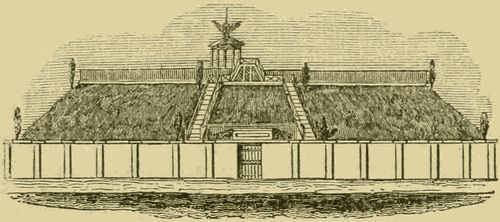
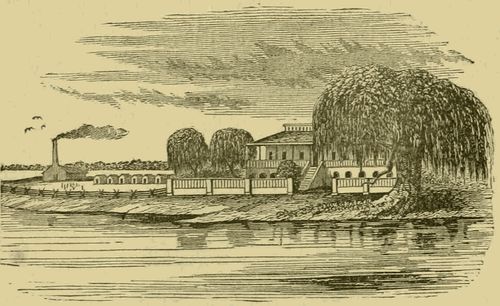
 Plantation House and Works.
The State of Louisiana is bounded on the north by the states of
Arkansas, and Mississippi; on the east by the latter and the Gulf of
Mexico; on the south by the Gulf of Mexico, and on the west by Mexico
and Texas. It is a well watered garden, the soil being rich, and
intersected by the Mississippi, Red, and Wachita Rivers, and many
inferior streams, and washed, on its western limit, by the Sabine.
The face of the country is exceedingly level, so much so, that in a
portion equal to three fourths of the State, there is scarcely a hill
to be found. Those parts that are covered with pine woods are usually
uneven, sometimes rising into fine swells, with broad table summits,
intersected with valleys from thirty to forty feet deep. They do not lie
in any particular range, but, like the ocean in a high and regular
swell, present a uniform undulated surface. The alluvial soil is, of
course level, and the swamps, which are only inundated alluvions, are
dead flats.
A range of gentle elevations commences in Opelousas, and gradually
increasing in height as it advances, diverges toward the Sabine. In the
vicinity of Natchitoches, this range holds its way northwestwardly;
about half way between the Red and the Sabine Rivers, and continues to
increase in altitude, till it reaches the western border of the State.
Seen from the pine hills above Natchitoches, it has the blue outline and
general aspect of a range of mountains.
Another line of hills, commencing not far from Alexandria, on the
northern side of the Red River, and separating the waters of that stream
from those of the Dudgemony, extends northwardly, till it approaches,
and runs into, the mammillæ, or bluffs, that bound the alluvions of the
Wachita, diverging gradually from the line of that stream, as it passes
beyond the western limits of the State.
That remote part of Natchitoches called Allen's settlement, is a high
rolling country. There are also hills of considerable magnitude on the
east side of the Mississippi, beyond the alluvions. But generally
speaking, Louisiana may be considered as one immense plain, divided into
pine woods, prairies, alluvions, swamps, and hickory and oak lands.
The pine-wood lands, as I have already said, are usually rolling. There
are some exceptions, but they are very few. They have almost invariably
a poor soil. Some of those west of Opelousas, and those between the
Wachita and Red Rivers, are even sterile, answering well to the name by
which they are called in some other parts of the country, Pine Barrens.
Some parts of the prairies of Opelousas are of great fertility, and
those of Attakapas are still more so. As a general feature, they are
more level than those of the upper country. An extensive belt of these
prairies, bordering on the Gulf of Mexico, is low and marshy, and
subject to be wholly inundated in any extraordinary swell of the river.
A considerable portion of them have a cold clayey soil, the surface of
which, under the influence of a warm sun, hardens into a stiff crust. In
other portions, the soil is of an inky blackness, and often, in the hot
and dry season, cracks in long fissures some inches in width.
The bottoms are generally rich, but in very different degrees. Those of
the Mississippi and Red Rivers, and the bayous connected with these
streams, are more fertile than those on the western border of the State.
The quality of the richer bottoms of the Mississippi, as well as those
of the Red River, is sufficiently attested by the prodigious growth of
timber in those parts, the luxuriance of the cane and the cotton, the
tangles of vines and creepers, the astonishing size of the weeds—which,
however, find it difficult to over-top the better products of the
soil—and the universal strength of the vegetation.
The most productive district of this State, is a belt of land, called
"the Coast," lying along the Mississippi, in the neighborhood of New
Orleans. It consists of that part of the bottom, or alluvion, of the
Great River, which commences with the first cultivation above the
Balize, about forty miles below the capital, and extends about one
hundred and fifty miles above it. This belt on each side of the river,
is secured from an overflow by an embankment, called "the levee," from
six to eight feet in height, and sufficiently broad, for the most part,
to furnish an excellent highway. The river, in an ordinary rise, would
cover the greater part of these beautiful bottoms, to a depth of from
two to six feet, if they were not thus protected. This belt is from one
to two miles in width; a richer tract of land, of the same extent,
cannot probably be found on the face of the globe.
On the east side of the river the levee extends to Baton Rouge, where it
meets the highlands; on the west side, it continues, with little
interruption, to the Arkansas line. On the east, above the levee, are
the parishes of Baton Rogue and West Feliciana. This latter received its
appropriate and expressive name from its beautifully variegated surface
of fertile hills and valleys, and its rare combination of all the
qualities that are most to be desired in a planting country. It is a
region of almost fairy beauty and wealth. The soil literally teems with
the most luxuriant productions of this favored clime. The hills are
covered with laurel, and forest trees of magnificent growth and foliage,
indicating a soil of the richest and most productive character. Here are
some of the wealthiest and most intelligent planters, and the finest
plantations in the state, the region of princely taste and luxury, and
more than patriarchal hospitality. The mouth of Bayou Sara, which is the
point of shipment for this productive region, transmits immense
quantities of cotton to New Orleans. Some of the plantations on this
bayou have from five to eight hundred acres under cultivation.
On the western side of the Mississippi, are the Bayous Lafourche and
Plaquemine, outlets, or arms of the Great River, and subject, of
course, to all its fluctuations. The bottoms bordering on these bayous
are of the same luxuriant soil, as those on the parent stream, and are
guarded from inundation in the same manner, by levees. In this region,
the sugar cane is exceedingly productive. It is estimated that, within a
compass of seven miles from Thibadeauxville, in the vicinity of the
Bayous Black and Terre Bonne, about one tenth of the sugar crop of
Louisiana is produced.
A considerable part of Attakapas is also very productive, as well as
portions of Opelousas. The latter, however, is better adapted to
grazing. The Teche, which meanders through the former, and the eastern
part of the latter, of these two parishes, never overflows its banks.
The land rises from the river, in a regularly inclined plane towards the
woods, affording free courses for the streams, which discharge
themselves into the bayou. The soil, therefore, cannot be called
alluvial, though in the most essential quality of productiveness, it is
scarcely inferior to the best of them. It is a lovely region, the most
beautiful, perhaps, in the whole Union, for agricultural purposes. But
it has one great drawback, especially for the cultivation of sugar;
there is a deficiency of ordinary fire-wood; though the live-oak abounds
there to such an extent, that Judge Porter once remarked in Congress,
that "there was enough of it in Attakapas, to supply the navies of the
whole world with ship timber."
The lands on the Atchafalaya are of an excellent quality, and would
afford a desirable opening for enterprising cultivators, if they were
not liable to frequent inundations, an evil which will doubtless be
remedied, as the population and wealth of that section advances. Those
on the Courtableau, which runs through Opelousas, are equal in point of
fertility, to any in that parish. From thence, proceeding northward, by
Bayou Bœuf, we find, on that bayou, a soil which is regarded by many
as the best in the State for the cultivation of cotton. There is also
land of an excellent quality on Bayou Rouge, though it is, as yet, for
the most part, in the state of nature. The banks of the Bayou Robert,
still further north, are of extraordinary fertility, the cane brake, a
sure evidence of a very rich soil, flourishing with astonishing
luxuriance. Bayou Rapid, which gives its name to the parish through
which it runs, intersects one of the most beautiful tracts in the state,
which is laid out, on both sides of the bayou, through the whole length
of its course, into the finest cotton plantations.
The bottoms of the Red River are well known for their fertility. Those
which lie about its lower courses are justly esteemed the paradise of
cotton planters. The soil is of a darkish red color, occasioned by the
presence of the red oxide of iron. It is thought to derive its character
of luxuriant productiveness from a portion of salt intimately blended
with its constituents, which, from its tendency to effloresce in a warm
sun, renders the compound peculiarly friable. This soil is deep, and has
been accumulating for unknown ages, from the spoils of the Mexican
mountains, (a species of natural annexation which the laws of nations
have no power to regulate,) and the vast prairies which are washed by
its upper courses.
The rich valley of the Red River is of a magnificent breadth, and for
the most part, where it has not been cleared for cultivation, covered
with a dense growth of forest trees. All the bayous of this river, which
are very numerous, branching off in every direction, and intersecting
every part of this luxuriant valley, partake of the fertilizing
character of the main stream.[1]
There are few things among the works of nature, more remarkable than the
floating prairies, which are found upon the lakes bordering upon the
coast of the Gulf. They seem to have been formed by the natural
aggregation of such vegetable
matter as lay suspended upon the surface of the water, supplied with a
light substratum of soil, partly by its own decay and disintegration,
and partly by attracting around its roots and fibres the alluvial
treasures with which all these waters abound. From this, various kinds
of grass and weeds have sprung up, the roots of which have become firmly
interwoven with the subjacent mass, matting it completely together, and
giving it all the appearance of a substantial island. It is often
several inches in thickness, and so nearly resembles terra firma, that
not only the sagacity of man, but even animal instinct has been deceived
by it. These floating prairies are sometimes of great extent, and are by
no means confined to waters comparatively shoal. They literally cover
the deeps in some cases, and a great deal of precaution is necessary to
avoid them, for, stable as they look at a distance, they are as
unsubstantial as shadows, so that boats may oftentimes be forced through
them. They are less trustworthy than quicksands, for the unlucky wight
who should adventure himself upon their deceitful appearances, would
find himself entangled in a net of interminable extent, from which it
would be impossible to extricate himself.
It may not be deemed presumption, perhaps, to suggest, that the great
Raft on the Red River may be a formation upon the same principle,
though upon a more enlarged scale. The stream being sluggish, and the
alluvial deposit exceedingly heavy and rich, the accumulation of a
productive soil, and the consequent growth and entanglement of roots
would be very rapid; and a foundation would ultimately be formed
sufficiently stable and permanent, to be travelled with safety. Floating
trees from the upper courses, arrested by this obstruction, would imbed
themselves in the mass, until, by continual accretions, it should become
what it now is, an impassable and almost irremovable barrier to
navigation.
The Delta of the Mississippi is a region of extensive marshes. For many
leagues, the lakes, inlets and sounds, which dissect and diversify that
amphibious wilderness, are connected by an inextricable tissue of
communications and passes, accessible only by small vessels and bay
craft, and impossible to be navigated except by the most experienced
pilots. It is a perfect labyrinth of waters, more difficult to unravel
than those of Crete and Lemnos. The shore is indented by numberless
small bays, or coves, few of which have sufficient depth of water, to
afford a shelter for vessels. Berwick and Barritaria Bays are the only
ones of any considerable magnitude.
The prairies which cover so large a portion of this State, are, for the
most part, connected together, as if the waters from which they were
originally deposited had been an immense chain of lakes, all fed from
the same great source. And this was undoubtedly the fact. They were all
supplied from the Mississippi, and their wonderful fertility is derived
from the alluvial riches of those interminable regions, which are washed
by the father of rivers and his countless tributaries. Those included
under the general name of Attakapas, are the first which occur on the
west of the Mississippi. It is an almost immeasurable plain of grass,
extending from the Atchafalaya on the north, to the Gulf of Mexico, on
the south. Its contents are stated to be about five thousand square
miles. Being open to the Gulf, it is generally fanned by its refreshing
breezes. To the traveller in those regions, who may have been toiling on
his weary way through tangle, and swamp, and forest, there is something
indescribably agreeable in this smooth and boundless sea of unrivalled
fertility, whose dim outline mingles with the blue of the far off
Gulf—the whole vast plain covered with tall grass, waving and rippling
in the breeze, sprinkled with neat white houses, the abodes of wealth,
comfort and hospitality, and dotted with innumerable cattle and horses
grazing in the fields, or reposing here and there under the shade of the
wooded points. The sudden transition from the rank cane, the annoying
nettles, the stifling air, and the pestilent mosquitoes, to this open
expanse, and the cool salubrious breath of the ocean, is as delightful
and reviving as an oasis in the desert.
In the midst of this immense prairie, is situated the parish of
Attakapas. This word, in the language of the Aborigines, from whom it is
derived, signified "man-eater," the region having been occupied by
Cannibals. Strange indeed, that the inhabitants of a climate so bland,
and a soil so fertile, should possess the taste, or feel the necessity
for so revolting and unnatural a species of barbarism.
Opelousas prairie is still more extensive than Attakapas, being computed
to contain nearly eight thousand square miles. It is divided by bayous,
wooded grounds, points, and bends, and other natural boundaries, into a
number of smaller prairies, which have separate names, and
characteristics more or less distinctive. Taken in its whole extent, it
is bounded by the Attakapas prairie on the east, pine woods and hill on
the north, the Sabine on the west, and the Gulf of Mexico on the south.
The soil though in many places extremely fertile, is generally less so
than that of Attakapas. It has, however, a compensating advantage, being
deemed the healthiest region in the State. It embraces several large
cotton plantations, and a considerable region devoted to the cultivation
of the sugar cane. The parish which bears its name is one of the most
populous in Louisiana. It is the centre of the land of shepherds, the
very Arcadia of those who deal in domestic animals. To that employment,
the greater part of the inhabitants are devoted, and they number their
flocks and herds by thousands. On one estate five thousand calves were
branded in the spring of 1845.
The people of this district are distinguished for that quiet, easy,
unostentatious hospitality, which assures the visitor of his welcome,
and makes him so much at home, that he finds it difficult to realize
that he is only a guest.
Bellevue prairie lies partly in Opelousas, and partly in Attakapas.
Calcasieu and Sabine prairies are only parts of the great plain, those
names being given to designate some of the varied forms and openings it
assumes in its ample sweep from the Plaquemine to the Sabine. They are,
however, though but parts of a larger prairie, of immense extent. The
Sabine, seen from any point near its centre, seems, like the mid-ocean,
boundless to the view. The Calcasieu is seventy miles long, by twenty
wide. Though, for the most part, so level as to have the aspect of a
perfect plain, the surface is slightly undulated, with such a general,
though imperceptible declination towards the streams and bayous by which
it is intersected, as easily to carry off the water, and prevent those
unhealthy stagnations which are so fatal in this climate. There is also
a gentle slope towards the Gulf, along the shore of which the vast
plain terminates in low marshes often entirely covered with the sea.
These marshes are overspread with a luxuriant growth of tall reedy cane
grass.
One of the most striking and peculiar features of these prairies is
found in the occasional patches of timbered land, with which their
monotonous surface is diversified and relieved. They are like islands in
the bosom of the ocean, but are for the most part so regular and
symmetrical in their forms, that one is with difficulty convinced that
they are not artificial, planted by the hand of man, in circles,
squares, or triangles, for mere ornament. It is impossible for one who
has not seen them, to conceive of the effect produced by them, rising
like towers of various forms, but each regular in itself, from the midst
of an ocean of grass. Wherever a bayou or a stream crosses the prairie,
its course is marked with a fringe of timber, the effect of which upon
the eye of the observer is exceedingly picturesque, making a background
to the view in many instances, like lines of trees in landscape
painting.
All the rivers, bayous, and lakes of this State abound with alligators.
On Red River, before it was navigated by steamboats, it was not uncommon
to see hundreds in a group along the banks, or covering the immense
masses of floating and stranded timber, bellowing like angry bulls, and
huddled so closely together, that the smaller ones were obliged to get
upon the backs of the larger. At one period, great numbers were killed
for their skins, which were made into leather for boots and shoes, but
not proving sufficiently close grained to keep out the water, the
experiment was abandoned. Alligators average from eight to twelve feet
in length. Some have been caught, measuring twenty feet.
The fear is often entertained, and sometimes expressed, that the levees
of the Mississippi are not sufficient to resist the great body of water
that is continually bearing and wearing upon them; and these fears have,
in several cases, been realized, though never to any very great extent.
In May 1816 the river broke through, about nine miles above New Orleans,
destroyed several plantations, and inundated the back part of the city
to the depth of three or four feet. The crevasse was finally closed, by
sinking a vessel in the breach, for the suggestion and accomplishment of
which, the public was chiefly indebted to Governor Claiborne.
In June, 1844, the river rose higher than it had done for many years,
marking its whole course, for more than two thousand miles, with wide
spread destruction to property and life. It crept over the levee in some
places near New Orleans, but caused no actual breach in that vicinity.
At Bonnet Carre it forced a crevasse, doing considerable damage and
causing great alarm in the neighborhood; but the mischief was not so
serious as might have been anticipated, and the embankment has been so
increased and strengthened, as to leave but little apprehension for the
future.
The interests of Education in Louisiana, though hitherto too much
neglected, are now decidedly and perceptibly advancing. In the higher
departments, are the College of Louisiana, at Jackson, in East
Feliciana; and Jefferson College in St. James parish, on the coast—the
former incorporated in 1825, the later in 1831. Both have at various
times, received generous donations from the treasury of the state.
Franklin College, in Opelousas was also incorporated in 1831, under the
same favorable auspices.[2]
There are also several Academies acting under the legal sanction of the
State, although not endowed by it. The Ursuline Nuns' School and that of
the Sisters of Charity—the latter in the parish of St. James, afford
instruction in all the polite branches of female education. The Convent
at Grand Coteau near Opelousas, has an average of about two hundred
scholars; and efficient persons from France have the control and
direction of their education.
The public schools, designed for the general and gratuitous
dissemination of knowledge among all classes, have not only increased in
number but have generally outstripped those of the higher order, by
seizing at once upon all the improvements which the experience of
teachers in other parts of the country, and the world, has from time to
time suggested. Mere innovations rather hinder than advance the progress
of education. But the simplest suggestion of an enlightened experience
and a sound judgment, such as are brought to bear upon this great
interest throughout the whole of the northern and eastern States, is
entitled to the profound regard of the Southern philanthropist, whose
aim and ambition it should be, to make the most of every facility and to
be no whit behind the older, but not more wealthy sections, in any thing
that can promote the moral and intellectual power of the masses of the
people.
The climate of Louisiana is hot and moist. In the neighborhood of the
marshes, and in the summer season, it partakes of the unhealthy
character of nearly all tropical climates. Diseases of the lungs,
however, and other complaints so prevalent at the north, are scarcely
known; and to many, the quick consuming fever which finishes its work in
a few days, may be considered but a fair offset to the slow but sure
consumption, which flatters its victims with the semblance of life and
hope, while dragging them through its long and dreary labyrinths, to the
chambers of death.
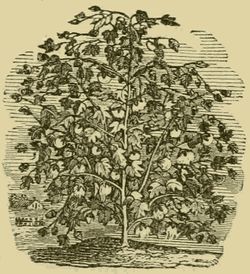
This climate is favorable to almost all the productions of the tropics.
The sugar, the cotton plant, the orange, the lemon, the grape, the
mulberry, tobacco, rice, maize, sweet potato, &c., &c., flourish in rich
abundance, and some of them attain to a luxuriance of growth scarcely
known in any other part of the world. Sugar and Cotton are the two great
staples. The former is confined chiefly to that tract, which, by way of
distinction, is called "the coast," lying along the shores of the Gulf,
and the bayous of the Mississippi.
The average sugar crop of the whole state, is now about 180,000
hogsheads. That of cotton, for the last year is not ascertained, but the
amount produced in the whole valley of the Mississippi, sent to New
Orleans for export in 1843, was 1,088,000 bales. Owing to the large
extension of the cotton growing districts, and excessive competition in
its manufacture, the cultivation of cotton yields less profit than it
formerly did, and there seems to be no substantial reason why it should
not, in some degree, give place to sugar, at least until the latter can
be furnished in sufficient quantity to supply the domestic consumption.
Under the ordinary increase of population, the utmost exertions of the
cane planters will hardly arrive at such a result, in half a century to
come.
While on this subject, it will not, I trust, be deemed irrelevant or
officious, to place before the reader the suggestions of an intelligent
gentleman of New Orleans, in regard to the present mode of cultivating
and manufacturing sugar. He observes that in order to carry on the
business to advantage, and compete favorably with those already
established, a large capital is required, since in addition to the
ground to be cultivated, and the hands to be employed in the field,
expensive mills and machinery must be set up, and kept in motion, with a
large number of laborers in attendance. Consequently no man in moderate
circumstances can undertake this branch of business, as it is now
conducted. To obviate this difficulty, and extend the cultivation and
manufacture of this important staple, he proposes a division of labor
and profit, like that which prevails in the grain growing and milling
regions of the north. The farmer sells his wheat, at a fair market
value, to the miller, or pays him a stipulated percentage for grinding
and bolting. In the same manner might the business here be divided into
two distinct branches. The planter might sell his cane to the miller, or
pay him the established price for converting it into sugar and molasses.
This would enable men of comparatively small means to undertake the
cultivation of the cane, who now confine themselves to cotton, and thus
relieve the larger cultivators of the latter staple from the dangers of
over production.
Casting our eyes back to no very distant period, and noticing the small
beginnings of our early planters of cotton, the reader will pardon the
introduction of a trifling anecdote. During the year 1784, only sixty
years since, and therefore within the memory of many now living, an
American vessel, having eighty bales of cotton on board, was seized at
Liverpool, on the plea that so large an amount of cotton could not
have been produced in the United States. The shipment in 1785 amounted
to 14 bales, in 1786 to 6, in 1787 to 109, 1788 to 389, in 1789 to 842.
An old Carolina planter, having gathered his crop of five acres, was so
surprised and alarmed at the immense amount they yielded, which was
fifteen bales, that he exclaimed "well, well—I have done with
cotton—here is enough to make stockings for all the people in
America!" The cotton crop of the United States for 1844 was 2,300,000
bales.
The fluctuations in the foreign cotton market, within a few years past,
have produced, among scientific agriculturalists and experienced
planters, no little speculation upon the course which a due regard to
their own interests requires them to pursue. It is not to be wondered
at, that in a country so vast, so luxuriantly fertile as ours, and
teeming with the most enterprising and industrious population on the
face of the earth, the strict relations of supply and demand should be
occasionally disturbed in some of the many abundant productions of the
soil. It is always a difficult problem to solve, especially where the
field is very large, and the producers many, and constantly increasing.
In attempting to meet it, the first question to be answered is, does the
present supply greatly overreach the present demand?
An intelligent writer in Hunt's Merchant's Magazine for October, 1844,
Henry Lee, Esq., has placed this subject, so far as he has there pursued
it, in a very clear light. He commences by stating that "the consumption
of cotton in Europe, other than the production of America and India, is
too insignificant to have any important bearing upon prices." He goes on
to show that the value placed upon the article at present, is quite
sufficient, and that the advantage it gives to the manufacturer of New
England, whose operations are vastly increasing, renders him a
successful competitor to those of Great Britain; and nothing but an
inflated currency, or imprudent speculations can produce an advance. And
any advance so procured must inevitably be followed by a ruinous
reaction. He shows that, through the agency of the British
manufacturers, and the exporters of their goods to countries beyond the
Cape of Good Hope, a considerable quantity of American grown cotton had
been sent to those regions, in the form of manufactures and twist, over
and above the amount of Indian grown cotton consumed in the factories of
England. This simple fact, which is demonstrated as clearly as figures
can speak, completely nullifies the importation of cotton from that
quarter.
The proportion of raw cotton, other than the produce of the United
States and India, used in the manufactures of Great Britain, is very
small, and constantly diminishing in quantity. After producing
statistical evidence, Mr. Lee arrives at the satisfactory result that
the consumption of cotton from the United States and India, is as
ninety-four to one hundred, leaving, for all other sources of supply,
only six per cent. With such a ratio as this, and the competition
constantly declining, it is manifest that we have nothing to fear from
rival producers.
The delicate enquiry now arises, can the American planter sustain
himself under existing prices? Or, can he, by the exercise of better
economy, make his labors more productive? It seems to me, if it will not
be presuming too far to offer the suggestion, that there should be an
understanding between the larger and more intelligent planters, in
relation to these points, and that they should, for their own individual
and collective interests, consider, whether it would not be better
partially to restrain the cultivation of this staple, rather than permit
it to increase beyond the known and certain demands of commerce. The
question increases in importance, as the cotton growing region enlarges,
by the admission of "the lone star" into the constellation of Freedom.
While it secures to the United States forever almost the entire monopoly
of production, it puts it in her power, by a judicious combination among
her great producers, to command a fair compensating price for cotton.
Without some such combination, or, which is equivalent to the same
thing, a prevailing disposition on the part of the planters, rather to
wait for a demand than to anticipate, or endeavor to create it, there
will always be a surplus stock in the market, which, however
insignificant, will affect the price of the whole crop.
The luxuriant soil of Louisiana is capable of of producing many
articles even more lucrative than cotton, of which there is no immediate
danger of creating an over supply. For some of them, there is a very
large and increasing home consumption, as well as an active demand in
other parts of the world that are open to our commerce. Of sugar, I have
spoken already. Madder, silk, hemp, tobacco, may also be mentioned, as
promising sure results to any who are disposed to try them. Under the
impression that, in view of what I have already presented, the subject
will be interesting to my readers, I shall venture to add a few words in
relation to some of the above-mentioned articles.
Madder,[3] (rubia tinctorum,) the roots of a plant, which consist of
several varieties. They are long and slender; varying from the thickness
of a goose quill, to that of the little finger. They are
semi-transparent, of a reddish color, have a strong smell, and a smooth
bark. Madder is very extensively used in dying red; and, though the
color which it imparts be less bright and beautiful than that of
cochineal, it has the advantage of being cheaper and more durable. It is
a native of the south of Europe, Asia Minor, and India; but has long
since been introduced into,
and successfully cultivated in Holland, Alsace, Provence, &c. The
attempt to cultivate it in England, like that of Indian corn, has proved
a complete failure. The English, for a long time, depended upon Holland
for their supplies; but now large quantities are imported from France
and Turkey, under a duty of two shillings sterling on the manufactured,
and sixpence on the roots. The duties, formerly, were much higher.
The plant is raised from seed, and requires three years to come to
maturity. It is, however, often pulled in eighteen months, without
injury to the quality, the quantity only being smaller. It requires a
light vegetable mould, that retains the greatest quantity of water and
adheres the least to the tools. When the soil is impregnated with an
alkaline matter, the root acquires a red color, in other cases it is
yellow. The latter is preferred in England, from the long habit of using
Dutch madder, which is of this color; but in France, the red sells at a
higher price, being used for Turkey red die.
The Zealand or Dutch madder is prepared for market in a manufactured
state; and is known in trade by the terms, mull, gamene, ombro,
and crops. In some other countries, the roots are packed up
promiscuously, and the article is sold by the quintal. The price of
madder, like every thing else, is affected by the quantity in market,
and ranges in France from its minimum 22, to 100 francs a quintal. It
does not deteriorate by age. The quantity used in this country is very
considerable—but nothing equal to that required in Great Britain. For
the particular manner of cultivating madder, the reader is referred to
an excellent essay upon that subject, from the pen of M. De Casparin,
which was laid before the Academy of Sciences at Paris, and a prize
awarded to its author.
The mulberry is grown with little difficulty in these latitudes, and
therefore, silk may be produced in abundance, and rendered an article of
domestic and commercial consequence. Plantations have already been
commenced in several of the parishes, which will soon test the
feasibility of the undertaking. A gentleman by the name of Vasseur,
recently from France, has purchased land and made preparations to enter
into that business, under many years of experience. In the parish of St.
James, particularly, considerable attention is being paid to the culture
of silk. It would be extremely gratifying to be able to lay the result
of these experiments before the reader; but the necessary information is
not at hand.
Hemp is raised in Missouri and Kentucky to some extent, as the
quantities annually landed on the levee in New Orleans afford ample
evidence. The demand for it will be good for many years, and the hint
should not be neglected by the citizens of Louisiana, who possess the
higher grounds, which are calculated for its production. When it is
considered that this is a raw material of vast demand, which has
heretofore been furnished from abroad, there can scarcely be any excuse
for neglecting the culture, provided the profits be equal to those on
sugar and cotton. The time may come, when even foreign nations will look
to this republic for cordage and duck; at all events, we should not
depend upon them for articles necessary for domestic purposes, and
especially for those which may with propriety be classed "among the
sinews of war."
Specimens of tobacco, the produce of seed imported from Cuba, have
been exhibited in this market, which are very little, if any, inferior
to the best from that island. These samples were raised by a gentleman
who resides near Jackson, who took no extraordinary pains in the
cultivation. The segars manufactured from them would pass, among good
judges, for the best Havana. This planter is of opinion that he can very
much improve the crops, by bestowing as much care upon them as is given
to the same pursuit in Cuba, and there can be little reason to question
his assertion.
The Natchitoches tobacco stands higher abroad, particularly for snuff,
than any other. This article is so well known in France, and many other
places, that those who are engaged in planting it, boast that it
requires no protective duties, as it will be quite able to take care of
itself.
The only drawback upon the cultivation of tobacco, in this state, is the
worm, which begins its depredations in early summer. But much loss by
this annoyance might be avoided, by forcing the plants in their early
stage, in a hot-house, so that they might sooner be brought to maturity,
and two clippings be made before the advent of the worm.
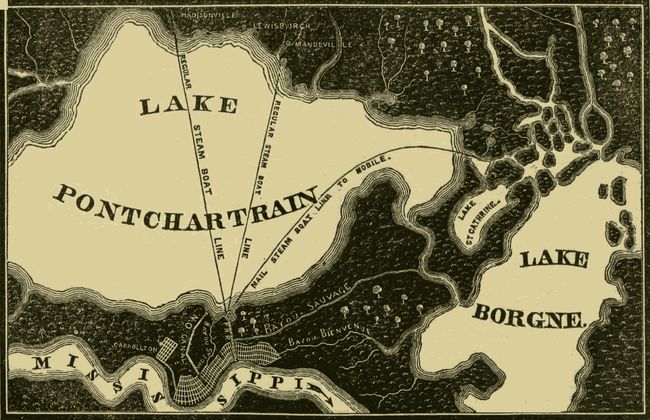
The thin soil on lake Pontchartrain is found to be well adapted to the
vine. Already, considerable progress has been made in its cultivation
in that neighborhood, and grapes are abundantly furnished for the New
Orleans market. There is no doubt that wine might be produced in
abundance.
Indigo, one of the oldest products of this state, has been superseded
by the sugar cane. Whether the planter has found more advantage in the
latter than in the former cultivation, can only be inferred from his
continuing to pursue it; for the maxim, that trade will regulate itself,
is nearly as applicable to agriculture as to commerce.
Grazing, although it has been carried to a great extent in Attakapas
and Opelousas, has never proved so lucrative as might be supposed. Many
of the cattle perish there during winter, for the want of proper
nourishment. There is a grass, however, known by the name of muskeet,
an ever-green, which flourishes abundantly in Texas, spreads rapidly, is
exceedingly nutritious, and much sought for by animals, and might easily
be introduced into these prairies. This improvement would make this
section of country the best for grazing in the United States. More
attention is being paid to breeding cattle, and the improvement of
stock, than formerly. Sheep may be raised among the hills, in and about
Natchitoches, in almost any numbers. In Lafourche, also, although they
are of small size, they are fat and of fine flavor. This is a business
which is yet in its infancy here. The capabilities for its extension are
immense, and there is no doubt that the enterprise of the inhabitants
will soon find means to make it profitable. The mutton of this state is
already superior to any produced in the Union; good judges in these
matters have even pronounced it to be equal to the best English.
The minerals of Louisiana, so far as known, are very limited. Lead has
only been found in fragments; and none of these have proved to be rich.
Valuable beds of gypseous marl exist in the vicinity of the Wachita,
which admit of being worked to great advantage. Lignite coal has been
discovered in tertiary formations, which never present any article of
this kind beyond an ordinary quality, the better being always confined
to the secondary strata. On the lands north of lake Pontchartrain, clay
exists of an excellent quality and very pure, suitable for manufacturing
not only the best bricks, but pottery of all kinds. It is to be hoped
that this will remedy the great evil that New Orleans has hitherto
experienced, by the use of a bad material for buildings. This has arisen
from the employment of a substance too near the surface of the earth;
whereas, by going a little deeper, a prime clay is obtained, that would
bid defiance, when well burnt, to the humidity peculiar to this southern
atmosphere.