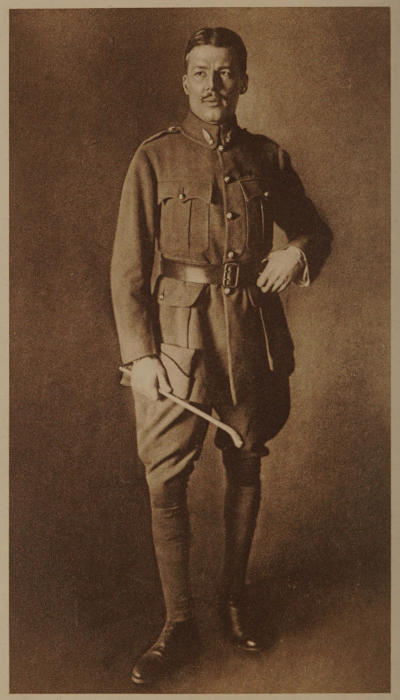
It is fitting that the record of a young life
of high aspiration, of fine achievement, and,
finally, of supreme self-sacrifice on a world’s
battlefield, should be permanently preserved,
not only for the satisfaction of those near relatives
and friends who deeply mourn its tragic
and untimely end, but for the sense of pride and
rapture of soul which the contemplation of such
a record everywhere inspires. Grievous as it
is to see a young and happy life cut off at the
threshold of a promising career, there is compensation
as well as consolation for such a fate
when the fine fervor of youth, thoroughly imbued
with a loyal and patriotic spirit, has won
for its possessor the well-deserved plaudit of
living and dying a hero. Such was the fate and
such the reward of the subject of this memoir.
Norman Prince was the younger of the two
sons of Frederick Henry and Abigail (Norman)
Prince. He was a grandson of Frederick
O. Prince, an eminent citizen of Massachusetts
and a Mayor of Boston, and of
George H. Norman, a distinguished citizen of
Newport, Rhode Island. He was born August
31, 1887, at Pride’s Crossing, Massachusetts,
receiving his early education under private tutors
in this country and in Europe and completing
his preparation for college at Groton,
where he passed five happy and helpful years.
He was graduated, with honors, at Harvard
College in the class of 1908, taking the academic
course in three years and receiving a cum
laude with his degree of Bachelor of Arts. Entering
the Harvard Law School immediately
after his college graduation, he received the degree
of Bachelor of Laws three years later. He
was admitted to the bar and subsequently began
the practice of law in Chicago, coincidentally
devoting much of his time and attention to the
study and practice of aviation at a time when
flying was popularly regarded as a mere sport
rather than a practical utility in this country.
This was a diversion from his more serious work
at the start, but foreseeing the ultimate possibilities
of aeronautics for practical purposes, and
becoming an enthusiast in its scientific development,
he neglected the practice of his intended
profession, and being enabled to provide
the necessary funds for experimenting with
various types of flying machines, he tested
their comparative advantages for aerial navigation.
He possessed an exceptionally quick intelligence
and applied himself with zeal and
diligence to subjects that interested him.
From his early boyhood Norman had been
passionately fond of manly outdoor sports,
more particularly those connected with equestrianism.
He loved hunting, polo, and kindred
activities, and he thus developed qualities of
sportsmanship that proved useful to him in his
later experience in aviation. His courage and
enthusiasm enabled him to undertake aerial
flights that appalled less intrepid amateur navigators,
but which were a joy and an inspiration
to him from the beginning. Among his associates
in amateur sports he had the reputation
of being absolutely fearless. “I never knew a
pluckier fellow,” said one of his schoolmates, recalling
the days of their earlier companionship.
At the outbreak of hostilities in Europe his
love of the strenuous life, combined with his
intensely patriotic instincts and his deep sympathy
with the cause of the Entente Nations,—more
particularly for France,—prompted
him to go abroad and offer his services in their
behalf. He adopted this course ardently and
spontaneously, feeling that he was thus performing
a duty that he owed to the cause
of Liberty and Righteousness throughout the
world.
One of the finest chapters in the history of
contemporary life is that which records the
loyalty and patriotic fervor of so many young
Americans, who at the beginning of the World
War, before their own country had abandoned
its attitude of neutrality, volunteered for military
service on the side of the Allies, in the
fighting ranks of the foreign legions, especially
in the aviation service, which called for efficiency
and courage in individual combat that
recalled the heroism and devotion of the ancient
days of chivalry. The inspiring example
of these early American volunteers may be said
to have given the first impulse to the popular
uprising which ultimately led to our country’s
active participation in the war.
Having passed many of the earlier years of
his youth in France, Norman saw and appreciated
his opportunity to testify to the sincerity
of his love for what he affectionately called his
“second country.” He took passage abroad
in December, 1914, four months after the
outbreak of the war, arriving in Paris early in
the following January, when he promptly offered
his services to the Government as a volunteer
in the French army to serve until the
end of the war—“jusqu’ au bout,” as he emphatically
put it when he took the oath of allegiance.
He began his preliminary training in
the military aviation school at Pau, and on receiving
his certificate of proficiency, he served
for a short time in the aerial defense of Paris
and was then sent to the Western battle-front,
where, as is told in the subsequent pages of this
memoir, he distinguished himself by his skill
and bravery in many air raids against the enemy,
winning at once the confidence and admiration
of his commanders and comrades.
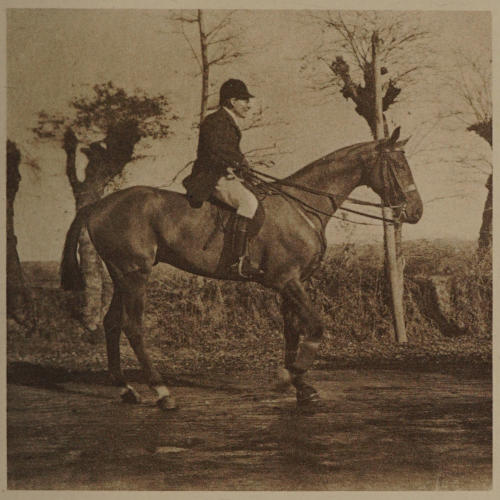
As Master (pro tem.) of the Pau Draghounds
At the beginning of his active service in
France Norman conceived the idea of bringing
the American aviators, together with some of
those of the foreign legions, into a single squadron,
not only that the Americans might thus
be associated in closer comradeship, but also
that their achievements might become more
distinctive and thus redound to the glory of their
native country as well as to that of the Allies.
This laudable purpose, which was inspired
wholly by Norman’s initiative, was realized by
the organization of the American aviators into
a body which was at first known as the Escadrille
Américaine and which subsequently became
the famous Lafayette Flying Squadron.
Originally carrying the Tri-color, this Squadron
was permitted to carry the Stars and Stripes
after the entrance of the United States into the
war. It thus became the proud distinction of
this Squadron that it was accorded the honor of
carrying the first American flag that appeared
on any of the battlefields of the World War.
These aviators soon became famous for their
skill and daring in their aerial raids over the
German lines, and they were repeatedly cited
in army orders, individually and collectively,
for their fine courage and unflagging spirit of
self-sacrifice. In one of these official orders
General Pétain, Commander-in-Chief of the
French Armies on the Western front at the
time, took occasion to say that this American
Squadron had aroused the profound admiration
of the commanders under whose direction it
had fought, as well as of all the French aerial
squadrons fighting beside it and aspiring to
rival it in valor and achievement. It was for
his fine individual conduct on this famous battle-front
that Norman won successively the
Croix de Guerre, the Médaille Militaire, and
the Croix de la Légion d’Honneur. Coincidentally,
he successively achieved the ranks of sergeant,
adjutant, and lieutenant. He had up to
this time engaged in 122 aerial engagements
with the enemy ’planes and was officially
credited with five Boches brought down in
battle, not to mention four others not officially
recorded. Few of his comrades had
rendered more active service. He was as ambitious
as he was intrepid and resourceful.
On the morning of Thursday, October 12,
Norman and other members of his Squadron
were assigned to convoy a French bombarding
fleet in an aerial raid on Oberndorf, a German
arms and munition center located in the
Vosges near the plains of Alsace. While circling
over the town, they came in close contact with
a formidable array of German aircraft, and a
terrific encounter ensued in which shot, shell-fire,
and skillful manœuvering disabled many
of the machines on both sides. It was at the
conclusion of this battle in the air that Norman’s
Nieuport machine struck an aerial cable
while he was endeavoring to make a landing in
the dark within the French lines near Luxeuil.
In this collision his machine was overturned
and wrecked and he was thrown violently to
the ground. On being rescued by his comrades,
it was found that both his legs were broken and,
as was subsequently found, he had sustained
a fracture of the skull. He was carried to the
neighboring hospital at Gerardmer, where for
a time he manifested the undaunted courage
that he had always shown under adverse conditions,
cheerfully requesting the attending
surgeons who were setting the bones of his
broken legs to be careful not to make one
shorter than the other! The skull fracture was
not discovered until later, and it was as a result
of this latter injury that Norman died from
cerebral hemorrhage on the following Sunday
morning, October 15. His comrades gathered
around his bedside when he became finally unconscious,
in the vain hope of detecting symptoms
of renewed vitality, but he passed away
peacefully as in a sleep. Those of his near relatives
who had been summoned from Paris
arrived at his bedside too late to find him alive.
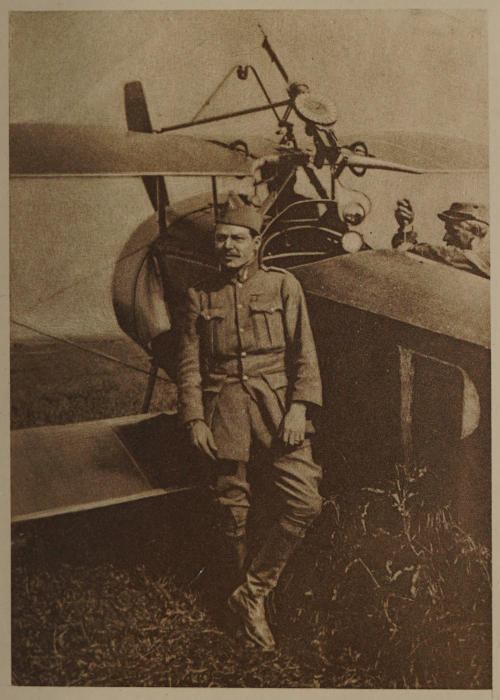
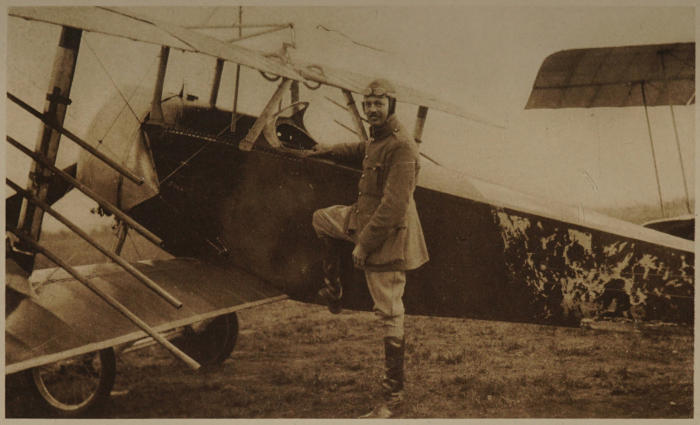
With his Favorite Plane
The dead hero was given all the honors of a
military funeral, which was held in the Luxeuil
aviation field, where the body rested on a
caisson draped with the American and French
flags. The services, which were conducted by
a French regimental chaplain, were attended
by a large representation of the Allied military
divisions, including French and English officers
of high rank, as well as a full representation of
the American Escadrille and pilots from the
neighboring aviation camps. During the funeral,
instead of the customary firing of cannon
as a salutation to the dead, a squadron of aeroplanes
circled in midair over the field in honor
of the departed aviator, showering down myriads
of flowers. The body was borne to a neighboring
chapel, there to rest until the end of
the war, in accordance with the military regulations
governing the temporary disposition of
the remains of those dying at the battle-fronts.
A memorial service, held on the following
Sunday in the American Church in Paris, was
described by those present as one of the most
impressive ever witnessed in that sanctuary.
The American colony came in full numbers to
testify their admiration and appreciation of their
fellow-countryman’s valor and sacrifice. The
President of the French Republic, the heads
of the executive and legislative branches of the
Government, the Army and Navy and the Diplomatic
Corps were represented by their most
distinguished members, and the emblems of
mourning contributed to a scene that was as
beautiful as it was significant and memorable.
This is but the bare outline of the biography
of a rare spirit whose loyalty to his ideals and
the high chivalry of whose devotion to the cause
of Liberty, Civilization, and Humanity have
made his name one to be remembered and his
memory cherished with those of his patriotic
comrades and fellow-countrymen who fell for
the same cause “in the sunny morn and flower
of their young years.”
It deserves to be noted here that in all of Norman’s
spoken or written messages, telling of
his experiences in France, there is nowhere to
be found a note of doubt or discouragement or
a word denoting any lack of confidence in the
ultimate triumph of the cause for which he was
fighting. The Allies might meet repeated reverses,
and tremendous sacrifices of blood and
treasure might have to be made, before a decisive
victory could be achieved, but he never
doubted the final outcome of the war. His faith
in this respect was as firm and unflinching as
were his courage and natural optimism in all
human affairs. His sense of consecration was
unceasingly vibrant. He deeply regretted that
his own country was not yet actively enlisted
on the side of the Allies and that he was not
permitted from the beginning to represent his
Government as well as his country in the fighting
lines, but this disappointment did not diminish
his enthusiasm as an American volunteer
soldier giving his services for a cause that
he believed to be that of his country and of
the world. In one of his letters he wrote enthusiastically:
“Everything goes well. Before the end of
this war we shall have aeroplanes with at least
800 or 1000 horsepower flying from Soissons
to Petrograd, setting fire to the four corners
of Berlin.”
The death of his comrade Victor Chapman
touched him deeply. “Poor Victor!” he wrote.
“He was killed while fighting a German aeroplane
that was attacking Lufberry and me.
A sad but glorious death, facing the enemy in
a great cause and to save a friend!”
Norman Prince’s heroic sacrifice is finely described
in the ode written in memory of the
American volunteers fighting for France, by
Alan Seeger, the young American soldier-poet,
who finally gave his own life for the cause
of the Allies on the battlefield of Belloy-en-Santerre;
“Yet sought they neither recompense nor praise,
Nor to be mentioned in another breath
Than their blue-coated comrades, whose great days
It was their pride to share—aye, share even to the death!
Nay, rather, France, to you they rendered thanks
(Seeing that they came for honor, not for gain),
Who opening to them your glorious ranks
Gave them that grand occasion to excel—
That chance to live the life most free from stain
And that rare privilege of dying well.”
II HIS OWN STORY
Some of Norman’s experiences in the French
aviation service were of an exceptionally thrilling
character, showing the peculiar perils of
aerial warfare. At the time of his last home
visit on a short furlough, he was invited to relate
some of these at the Tavern Club in Boston.
His story, as modestly and frankly told by
him on that occasion, is best given in his own
words:
“I sailed for Europe in the latter part of the
year 1914 in order to do what I could to help
the cause which I believed, and still believe, to
be that of my own country, as well as that of
the Allied Nations.
“Reaching France I offered my services to
that Government as an aviator. They were
promptly accepted and I contracted an engagement
to serve France until she had achieved
victory. Seven other Americans enlisted with
me at the same time as aviators, and we proceeded
from our dépôt, where we were clothed,
to the flying school at Pau in the south of France
in the Pyrenees, where conditions for flying
are exceptionally good, there being hardly any
wind in that region. The school at Pau at the
time was the largest flying school in the world.
While we were there about three hundred
young men were in training, and at last accounts,
there were over five hundred pupils
practicing in aviation, using at least two hundred
modern machines. We remained there a
month. As a rule it takes about forty-eight
days to turn out a military aviator, qualified and
fitted to obtain the civil and military licenses required.
In order to obtain the latter it is necessary
to make a successful flight of about four
hundred miles across country. I had already
acquired a fair knowledge of the science of aviation
at home and had made numerous flights in
different machines, so that the training at Pau
came comparatively easy to me, but it was necessary
for me to become thoroughly acquainted
with all the rules governing the French military
aviation service, as well as to make myself familiar
with the French machines in order to
meet the full requirements of the training.
When we were through this school we received
our brevets militaires and we had ridden
every kind of air craft used in the French
Army.
“All licensed aviators, as turned out, are
sent to the reserve station for aviators near
Paris. In our case, after spending a week or
two there, we were found fit for more active
service, and we were suddenly sent to the front
in the north of France, arriving there in time
for the May attacks near Arras and Artois. Our
perilous experiences in aerial warfare were
soon to begin. After one reconnoitering tour
we were sent out to bombard munition dépôts,
railway centers, and aviation fields in the rear
of the enemy’s lines, from ten to forty kilometres
distant from our base. I have a vivid
remembrance of my first bombarding expedition.
The action took place at a point not far
within the enemy’s lines. I was sent with two
or three members of my squadron to bombard
a station where ammunition was being unloaded.
It takes about forty minutes for a machine
heavily loaded with bombs to get to a
sufficient height to cross the lines. The minimum
height at which we crossed was about
seven thousand feet. I saw my comrades
cross ahead of me and noted they were being
heavily shelled by the enemy. Accordingly, I
decided to go a little higher before crossing.
When I found I had only sufficient gasoline
left to make my bombardment and return to
my base, I started over. I was soon to experience
what I may call my baptism of fire. The
impression made upon me by the terrible
racket and the spectacle of shells aimed at me
and exploding near by made me shiver for a
moment. Though I was confident and unafraid,
my limbs began to tremble. Still I kept
straight on my course. I would not have
changed it for the world. My legs were so
wobbly from nervous excitement that I tried
to hide them from my observer, who was an
old hand at the game. I confess to a feeling
of relief when I reached the point where our
bombs were to be thrown over. Having discharged
this duty I was glad to return to my
starting-point with the motor running at slow
speed, and knowing that I was soon to be out
of range of the enemy’s deadly fire.
“In this bombardment my machine was
made almost entirely of steel tubing with a
140-horse-power engine, capable of carrying a
load of bombs weighing from four to seven hundred
pounds. As an arm of defense it carried
a machine gun. This is the type of machine that
has made most of the long raids on the enemy.
I soon became accustomed to the duty I had to
perform and to flying with the spectacle of
shells bursting all around me, at the same time
keeping on the lookout for the ’planes of the enemy.
We made seventeen bombardments during
the ensuing month of June and we got to
be old hands at this kind of warfare. It is never
quite agreeable to be shelled up in the air or
elsewhere, and those who make the boast of
liking it do not tell the exact truth.
“To illustrate how well the French military
aviation service is organized and supplied with
machines, let me tell you of my experience at
the front in Lorraine, where one day I had the
misfortune to break one of the wings of my machine.
Instead of stopping to have it repaired,
all I had to do was to turn it into a supply station
near by where it was at once dismantled
and sent to the rear. I was then promptly supplied
with a new machine. A change of aeroplanes
by an aviator in action in France is like
a cavalryman changing his horse. If there is
anything the matter with the animal, even if it
is only a corn, a new one is at once forthcoming.
There is no suggestion of parsimony or
niggardliness in giving out the supplies necessary
for efficient fighting.
“On another occasion, when we were making
a raid on the railway station at Douai, which
was about twenty-five kilometres within the
enemy’s lines, we started with a squadron of
some twenty machines. There happened to be
that day a great many German machines out.
Somehow or other they knew we were coming.
We had four or five brisk engagements with
them. Our planes had only machine guns with
which to defend themselves, while the Germans
used regular fighting machines. This
aerial engagement resulted in four of our
machines coming back riddled with bullets,
my lieutenant being hit in the leg.
“I was fortunate enough that day to escape
the range of the German flying machines by
going farther north and passing through the
clouds, though I was shelled from a long distance
all the way. I succeeded in dropping my
bombs on a railroad station, one of which I saw
explode in a bunch of freight cars in the railroad
yard. As I was returning within our lines
the Englishmen, by mistake, opened a brisk
fire on me which necessitated my going up into
the clouds again. I proceeded due west until I
ran out of gasoline and I then descended in the
dark near the headquarters of the English.
It was my good fortune to land safely and on
my arrival at my post I was brought before
the English commander, who asked me to tell
my story. Mine being one of the four machines
out of twenty that had reached Douai in
the raid, I was awarded a citation and given the
right to wear a War Cross—my first decoration.
“My squadron spent a month in the east and
during this time I went farther into the enemy’s
territory than I had been before. I think
the longest distance was when we made the
raid on two localities over one hundred kilometres
within the enemy’s lines in Bocherie, as
we called it. During this month General Joffre
came to review our four squadrons of bombarding
machines. With him came the President
of France and the King of the Belgians. These
distinguished visitors witnessed the departure
of a squadron of some ninety of our machines
on a bombarding raid loaded with bombs and
flying four abreast. They were highly complimentary
in their salutations to us Americans.
“During this month in Lorraine I experienced
the hardest knock I had received up to
that time. One day six German machines, fully
equipped, bombarded Nancy and our aviation
field. To retaliate, my squadron was sent out
to bombard their field on the same afternoon.
We started with thirty machines to a designated
rendezvous and fifty minutes later, after
getting grouped, we proceeded to our ultimate
destination. I had a very fast machine, and
reached the German flying field without being
hit. When about to let go my bombs and while
my observer was aiming at the hangars of the
Germans my machine was attacked by them—one
on the left and two on the right. I shouted
to my observer to drop his bombs, which he did,
and we immediately straightened out for home.
While I was on the bank the Germans opened
fire on me with their machine guns which were
even more perilous than their shells. My motor
stopped a few moments afterwards. It had
given out and to make matters worse a fourth
German machine came directly at us in front.
My observer, who was an excellent shot, let
go at him with the result that when last seen
this German aeroplane was about four hundred
feet below and quite beyond control. The other
Germans behind kept bothering us. If they had
possessed ordinary courage, they might have
got us. Flying without any motive power compelled
me to stand my machine on end to keep
ahead of them. As we were nearing the French
lines these Germans left us, but immediately
batteries from another direction opened fire on
us. As I was barely moving I made an excellent
target. One shell burst near enough to put
shrapnel in my machine. It is marvelous how
hard we can be hit by shrapnel and have no
vital part of our equipment injured. I knew I
was now over the French lines, which I must
have crossed at a height of about four hundred
metres. I finally landed in a field covered
with white crosses marking the graves of the
French and German soldiers who had fallen
the previous September at this point. This was
the battle the Kaiser himself came to witness,
expecting to spend that night in Nancy.
“Thousands fell that day, but the Kaiser
did not make his triumphal entry. Looking
back on this latter experience of mine I think
myself most fortunate in having been able to
return to the French lines without a scratch. I
got home safely because the German aviators
lacked either courage or skill or both. They
had me with my engine dead, four against one,
and twenty kilometres within their lines.”
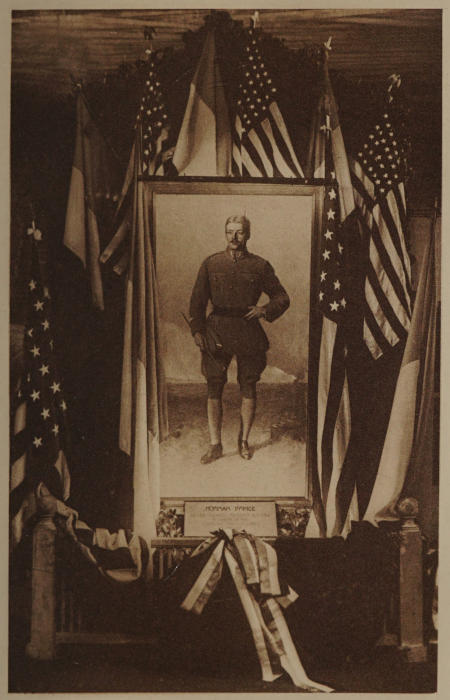
Portrait as exhibited at Allied Fairs
Alluding to the occasion of the telling of this
story, William Roscoe Thayer, who presided at
the dinner, said when the tidings of Norman’s
death came from France: “I shall never forget
that Christmas night at the Tavern Club
when Norman sat next to me and told me many
details of his service and then arose and gave
that wonderfully simple, impressive story. To
have had such a service and to die fighting for
the cause which means the defense of civilization—what
nobler career could he have had?
I can think of no one who more thoroughly enjoyed
the life of continuous peril which he led.
The honors which it brought him showed that
France recognized as heroism that which he
took as a matter of course.”
III LETTERS
The following letters of Norman Prince,
although chiefly of an intimate and personal
character, are here published as a part of the
record of his experiences in the service of
France and as further testimony to his tenderly
affectionate nature and his constant
thoughtfulness and solicitude for those he left
at home.
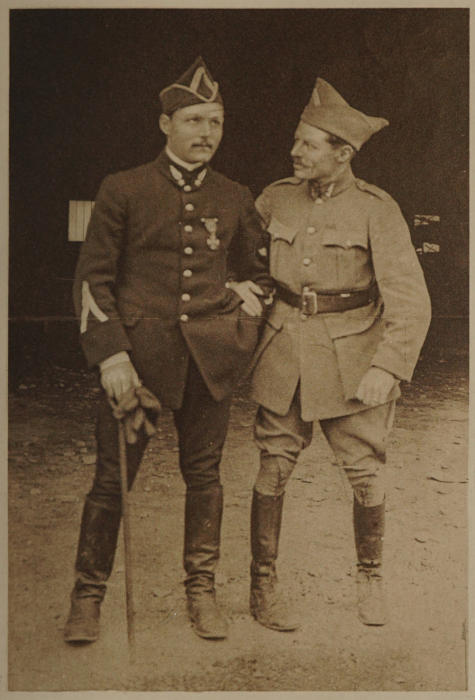
With his Superior Officer Lieutenant de Laage de Mœux
Havre, Jan. le 29, 1915.
Dear Mamma,—I have just put foot ashore
in France after a disagreeable crossing, 2nd
class. Here in Havre there are troops and
troops always passing. French troops, chiefly
of the reserve; thousands of English troops in
khaki, Belgian troops without uniform. They
all say, not at all in a boastful way, that they
will be back home again by the end of the year.
Will they?
Dear Mamma, I hope you are well and that
papa has not taken too much at heart my leaving
home at this time. I believe I can find a
place to do some efficient and useful work for
the cause to which I am so deeply devoted. My
love to you all. I shall write often.
Affectionately your son,
Norman.
Esc N. 124, Secteur 24, May 15, 1915.
Dear Governor,—Arrived en escadrille par la
voie des airs to replace a disabled pilot until the
Escadrille Américaine is formed.
I saw the battle lines and heard for the first
time the never-ending boom of guns. This is
war in dead earnest and right at hand. Will
write more fully later.
Affectionately,
Norman.
V. B. 108-B. 103, May 20, 1915.
Dear Freddy,—Arrived here at the Front
last Tuesday piloting two Voisins appareils de
bombardement. On the way we bombarded observation
balloons, railway centers, poudrières,
aviation camps and other locations of Boche
activity—but not towns or cities or other localities
where the lives of helpless women and
children might be endangered. We are in the
section where all the French advances have
lately been made. The vertical guns of the
Boches are particularly annoying to us. They
have got two out of six of the pilots of our
Escadrille since our arrival. One got down
within our own lines; the other fell within the
lines of the Boches—whether he was killed
or not we do not know.
(Eight miles from the German trenches.)
Been here a week and have become quite accustomed
to being shot at. We go out every
day and the salutations we get from the Boches
are rapid and continuous when we are over
their lines. The Boches here have more vertical
guns to aim at us—more to the mile of
front than anywhere else. There are hundreds
of French aeroplanes grouped here because it
is in the twenty miles north of Arras and south
of the English where all the recent French
advances have taken place. Attacks and counter
attacks by day and night, and the bang of
artillery in the near distance never ceases.
We often go out at the same time as the infantry
attack behind the artillery fire, the
artillery of both sides banging away at the
trenches, batteries and at us,—the avions
in the air. It is a wonderful spectacle and
something frightful as well—until we get
used to it!
N. P.
Paris, September 6, 1915.
My dear Grandmamma,—I am in Paris on a
few days’ leave and just had luncheon with a
friend who is leaving to-night for Rome and I
have asked him to mail this letter to you on his
arrival.
For the last four months I have been at the
front—two months in the North near Arras
during the attacks of May and June. After that
we were stationed for a month near Nancy in
the East. Now we have returned to the north
again where there is increasing activity. I am
happy and in the best of health. I sleep under
canvas on a stretcher bed and eat in the shed
of an old farm house near by. I have nothing
to complain of. I like it. There are ten American
pilots with us in the French service and
twelve others in training with their number
constantly increasing. Some day soon we will
all be united in one escadrille—an Escadrille
Américaine—that is my fondest ambition. I am
devoting all my spare energies to organizing
it and all the American pilots here are giving
me every encouragement and assistance in the
work of preliminary organization. As I have
had so much to do in originating and pushing
the plan along, perhaps I shall be second in
command.
I would enjoy tremendously a letter. My
address now is
Sergeant-Pilote Prince Escadrille d’Avions Canon 3me Groupe de Bombardement Secteur Postal 102.
I hope you are in Rome, not in Treviso,
which must be dans la Zone des Armées.
Your affectionate grandson,
Norman.
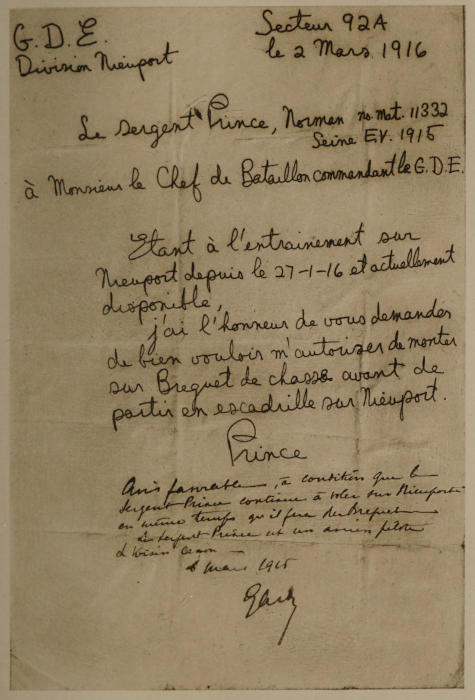
Application to ride a Breguet de Chasse
Cⁱᵉ Gˡᵉ Transatlantique, À bord, January 4, 1916.
My dear Mamma,—Just a line before the
pilot leaves us to tell you that Freddy and I appreciate
your sorrow in having your two boys
go to the war. However, the greater the sorrow,
the greater the joy will be when they return!
Nothing was forgotten. Freddy and I have
the same stateroom and I shall immediately
start to make him fit. I tell him that in order
to join the Flying Corps, one cannot weigh
more than 75 kilos.
Your most affectionate son,
Norman.
G. D. E. Div. Nieuport Secteur 92A, February 19, 1916.
Dear Governor,—Enclosed is a letter from
Freddy. Notice that he says the discipline at
Pau is very strict.
I am a schoolboy again. I am training to fly
the very fastest appareil de chasse—quite a different
instrument from the avion canon which
weighs three times more than these small
chasing appareils.
I am busy pushing matters, in regard to the
formation of the Escadrille Américaine. There
is a possibility that St.-Saveur, now a captain
in the aviation, may command us. Although
but a short time on the front he has done finely
as a pilot. We are all disponible to go to the
front and are only waiting for a captain, the
personnel—(chauffeurs, secretary, cook, etc.)
our avions and the motor cars. Orders for our
formation will be issued, I hope, next week.
The weather has been very rainy and windy
here for a week, which is to be expected, during
the month of February. We are losing no
time, however.
Those Lewis guns, if there is any way of
getting hold of a dozen, would be much appreciated
by us here. The more you can get
for us the better, but I realize that it may be
impossible even for you to get hold of any.
How are the horses? Don’t overdo the
schooling!
I hope you and Mamma are enjoying Aiken.
The main thing is to care for your health.
With love to Mamma, who, I trust, is not
too anxious about Freddy and me.
Your affectionate son,
Norman.
Esc. N. 124. Secteur 24, June 26, 1916.
Dear Mamma,—Oliver Wolcott, who has
been cantoned near by with the American
Ambulance, is going home to serve with the
militia and is to take this letter with him.
No news of Freddy this past week. The
training is so thorough at these aviation schools
that he risks but little while there. Probably
he won’t get to the front for another month.
Poor Victor Chapman! He had been missing
for a week and we knew there was only a
very remote chance that he was a prisoner.
He was of tremendous assistance to me in getting
together the Escadrille. His heart was in
it to make ours as good as any on the front.
Victor was as brave as a lion and sometimes he
was almost too courageous,—attacking German
machines whenever and wherever he saw
them, regardless of the chances against him.
I have written to Mr. Chapman—a rather difficult
letter to write to a heart-broken father.
Victor was killed while attacking an aeroplane
that was coming against Lufberry and me.
Another unaccounted for German came up
and brought Victor down while he was endeavoring
to protect us. A glorious death—face
à l’ennemi and for a great cause and to
save a friend!
Your affectionate son,
Norman.
Escadrille N. 124, Secteur 24, June 29, 1916.
Dear Mamma,—Enclosed is a photograph
of Victor Chapman and myself, taken two days
before his death. It is a print of what is probably
the last photograph taken of him. I have
sent one to Mr. Chapman.
We are too busy and short of pilots at our
Escadrille to think of taking a permission at
present. Tout va bien. Bonnes nouvelles de
Freddy.
Your affectionate son,
Norman.
July 2, 1916.
Dear Mamma,—A few lines to tell you
that tout va bien. This letter will be taken over
and mailed in New York by an American Ambulance
driver who dined with us last night.
To-day I am de garde all the morning—that
is to say, from dawn to noon. I must be by my
avion ready to start as soon as any Boches are
signaled. None have been so far this morning—worse
luck!
Your affectionate son,
Norman.
Esc. 124, Secteur 24.
Esc. N. 124, Secteur 24, July 6, 1916.
Dear Governor,—Enclosed is a letter which
speaks of Freddy. The Escadrille is running
well. St.-Saveur lunched at our popole last
week and wished to be remembered to you and
Mamma; de R⸺, who was on our team at
Bagatille, was here for lunch to-day with
R⸺; both wish to be remembered; de
P⸺ came last week looking very fit and
will write to you shortly.
The aviaphone for my helmet arrived in
good shape and I have lent it to my captain, as
I am riding at present a single-seated aeroplane.
Your affectionate son,
Norman.
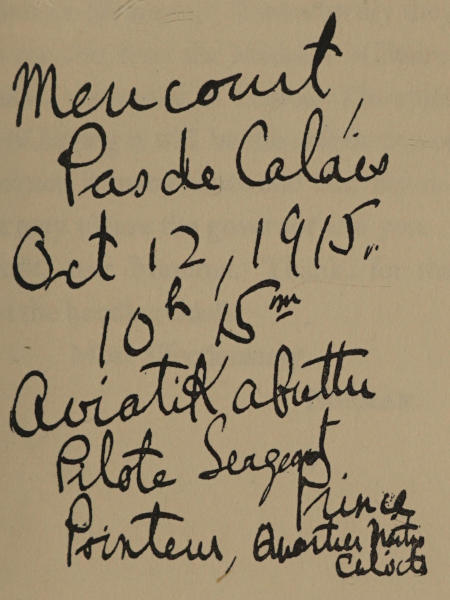
Memorandum of the bringing-down of his first German machine
Deauville, Sept. 2, 1916.
Dear Mamma,—I am down here with
friends, passing part of my permission. It is very
pleasant and refreshing, the change. One soon
gets enough of Paris in summer and in wartime.
Here no one pays the slightest attention
to the war. There are few militaires—mostly
civiles from Paris and their amies. Good bathing,—golf
in the afternoon—many good-lookers,
making the plage rather good fun.
Freddy is nearly through at Pau. He is now
at the acrobacy school learning to do stunts in
the air. It is a part of the training of a chasse
pilot. I gave him some pointers before he left
and told him to do the least possible with the
old machines which are quite out of date and
clumsy.
Monday I return to Paris and Tuesday back
to the Front, my eight days permission expiring
on that day.
I was fortunate enough to run across a German
the other day who didn’t see me approaching.
If you read the communiqué aérien
of the 23d or 24th you will find mention of
my Boche,—“un avion désemparé est tombé
dans la forêt de Spencourt.” Undoubtedly they
will give me this time the Médaille Militaire,—the
chicest decoration in France. The chief
pleasure of having it will be the satisfaction of
having earned it many times and that my receiving
it may please the governor and you.
A bientôt, dear Mamma. Thanks for the
socks and the handkerchiefs.
Most affectionately,
Norman.
Escadrille Américaine, par Luxeuil-les-Bains,
Haute-Saône, September 24, 1916.
Dear little Mamma,—I am so afraid you will
worry more than ever when you hear of poor
Kiffen Rockwell’s death. I know how anxious
you must be with the two of us over here. Keep
very busy, ride a lot, go out to dinners and get
as many other distractions as possible so that
you will not have too much time to think of us.
As far as danger to us goes, we are trying to
take as few chances as possibly consistent with
playing the game.
Everybody tells me that Freddy is showing
himself to be an excellent pilot. Unfortunately
he has not yet fully decided to come with our
Escadrille. He would prefer to go to another
which is commanded by St.-Saveur. I dare
say he might be happier if he did not come with
us, but à point de vue of safety it seems to me
he would be better off with us. I could be a lot
of assistance to him, telling him all I have
learned this spring hunting Germans, and he
would have an excellent mechanic in Michel,
who by the way, has been Rockwell’s mechanic
while waiting for Freddy’s arrival; and further,
he could have my machine to ride, which
is the dernier cri in appareils de chasse, with two
machine guns. He would otherwise get one
as safe, but not so good for knocking down
Boches. He would have only one gun.
Did I write you that I had knocked down another
Boche two days before leaving the Verdun
district? I enclose a clipping giving the
communiqué officiel, with mention also of my
Boche who fell at Dieppe.
Dear Mamma, I must stop writing now. We
are going out to try to avenge Rockwell. Don’t
worry! I am doing my duty as safely as I know
how. With much love to you both,
Most affectionately,
Norman.
To his Mécanicien
Cher Michel,—En cas qu’un accident m’arrive—c’est
à dire que je suis tué, blessé ou que
je reste chez les Boches—je vous prie d’écrire
quelques lignes à ces dames, les adresses desquelles
sont écrites sur les enveloppes (ci-incluses).
Dis leur que je t’avais dis d’écrire préférant
qu’elles sachent ce qu’il m’est arrivé plutôt que
de rester dans l’angoisse au sujet de mon sort.
Signe ton nom en mettant que tu avais été
mon mécanicien dévoué depuis mon arrivée sur
le front.
Mes effets, papiers, lettres, etc., le tout, il
faut mettre de suite dans mes valises et les remettre
personnellement à mon frère.
Ci-inclus deux chèques comme cadeau en
récompense du boullot que vous et André ont
fait si soigneusement sur les appareils de Bibi
et qui m’ont permis à gagner la Médaille Militaire.
Ces chèques sont payables, à ma mort ou dans
le cas que je reste chez les Boches, à défaut de
ce que cela m’arrive—(espérons-le) à la démobilisation
de vous deux.
En cas qu’un de vous devient civil avant
l’autre, celui devenu civil prends son chèque et
le présente à la Banque—où il sera payé.
Bonne poignée de main!
Norman Prince.
Esc. N 124, par Luxeuil-les-Bains, le 6 Septembre, 1916.
From his Mécanicien
Secteur 16, le 25 Octobre, 1916.
Monsieur et Madame Prince:—
Excusez-moi si je suis un peu en retard pour
vous donner quelques détails sur le malheur qui
nous frappe en la perte de Monsieur Norman.
Il m’avait laissé, juste huit jours avant sa
chute fatale, quelques enveloppes avec adresses
écrites par sa main pour que je vous écrive quelques
mots ainsi qu’à quelques amis si quelque
chose lui arrivait. Je vous joins du reste la lettre
qui est un véritable souvenir.
Pauvre Monsieur Norman, les boches n’ont
pas pu avoir raison de lui et n’ont pas eu ce
plaisir là.
Il a trouvé la mort après tant de combats affrontés,
tant de dangers, et il en est sorti avec
les honneurs à son avantage.
Son dernier départ a été le 12 Octobre, avec
son avion de chasse Nieuport monté avec deux
mitrailleuses et avec lequel il avait abattu un
boche le 10, deux jours avant: il est parti à 2
heures faire la protection d’un groupe d’avions
de bombardement très en avant dans les lignes
ennemies. Il a abattu un avion de chasse ennemi
à 3 hrs. qui venait attaquer le groupe et
lui barrer la route. Comme toujours, faisant son
devoir avec conscience, il a attendu que tous les
avions ont repassé les lignes avant de rentrer
lui-même et à la dernière minute il pense à atterrir
dans le champ d’aviation le plus près vu
que la nuit commençait à tomber.
Il était prêt à faire un atterrissage des plus
normal, malgré l’obscurité, quand le malheur
a voulu qu’il touche un cable qui était au bordure
du champ, et dont il ne pouvait soupçonner
la présence et son avion est venu s’écraser
sur le sol.
Il a été relevé et aussitôt transporté dans un
Hôpital sans une plainte et sans perdre un instant
ses sens, causant avec un de ses camarades
d’escadrille.
Il avait deux jambes fracturées, la droite à
la cuisse et la gauche au-dessus la cheville. Il
a été opéré aussitôt, non sans recommander aux
docteurs de bien s’assurer de ne pas faire une
jambe plus courte l’une que l’autre, car il faisait
beaucoup de sport.
On lui a arrangé ses deux jambes et tout
était fini à minuit.
Le lendemain il causait avec tout le monde et
tout faisait espérer les meilleurs résultats d’une
prompte guérison, il passe une bonne nuit et le
matin du 14 à 6 heures est frappé d’une embolie
cérébrale (au moment où personne ne s’y attendait
nullement) et n’a repris connaissance.
Je suis resté jusqu’à ses dernier moments
auprès de lui, et je n’ai pas eu la chance de le
voir reprendre ses sens une seconde.
Ce que je puis dire c’est que rien n’a été négligé
et qu’il a été très bien soigné. Il paraissait
très heureux.
Il en était à son avion cinq boches abattus
officiellement et en avait quatre autres en réalité
mais non confirmés—plus un ballon captif
d’observation qu’il avait attaqué et enflammé:
et les nombreux bombardements du début sur
voisin où il était toujours le premier prêt à partir
et des fois le seul qui allait droit au but.
Malgré tous les dangers parsemés sur sa
route et après avoir pris tant de soins et d’attention
il nous est enlevé (il ne comptait que
des amis sincères et dévoués) et juste au moment
où il était arrivé au but: Médaille Militaire,
Légion d’Honneur et Croix de Guerre
qu’il avait si noblement gagnées.
C’est une grande perte pour l’armée Française
et aussi pour nous, car il nous rapportait
avec son amitié l’honneur du devoir et la bravoure
du bon soldat.
Il a été ramené à Luxeuil, où un service funèbre
a été célébré au milieu de ses amis; il a
été accompagné par ses nombreux camarades
avec toutes les honneurs.
Après avoir appris la maladie grave de Monsieur
nous sommes restés quelques jours sans
nouvelles causé par le déplacement de l’escadrille,
et nous avons été très heureux, Monsieur
Frédéric et moi, quand il a reçu une cable
lui annonçant que Monsieur Prince allait mieux
et que tout danger était écarté.
Á present Monsieur Frédéric est avec nous,
et vous pouvez compter sur moi pour que je
fasse tout ce qu’il me sera possible pour lui, et
espérant que l’on aura le bonheur de voir la signature
de la paix en bonne santé, je termine.
Monsieur et Madame, si vous désiriez d’autres
renseignements, je me ferais un devoir de
vous les donner, et c’est avec plaisir que je vous
donnerai tous les renseignements possibles.
Recevez, Monsieur et Madame, mes respectueuses
salutations.
Votre dévoué serviteur,
Michel Plaa Porte, Mécanicien Escadrille, N. 124, Secteur 16.
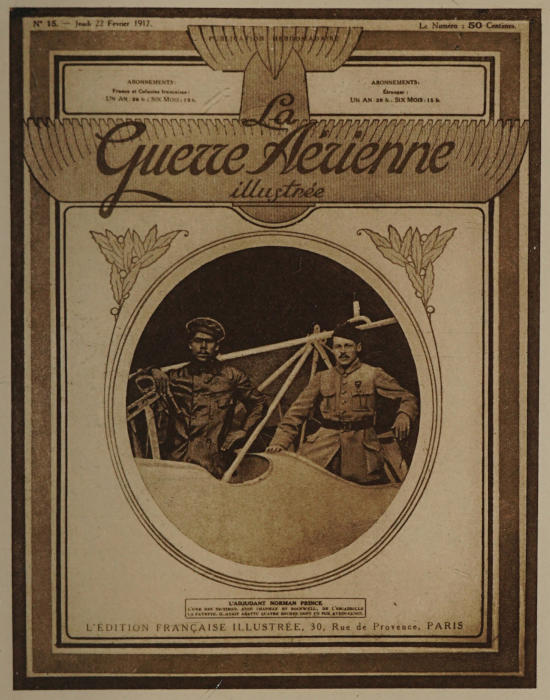
Cover of a French Periodical
IV FROM HIS FATHER
Memories of my younger son Norman are
so tender and fragrant that his bereaved father
may well feel some hesitation in recording
them for publication lest they may seem to
those who never enjoyed intimate relations
with him to have been inspired by absorbing
parental pride and affection rather than by
less partial and disinterested judgment. If there
may be any warrant for this impression it will
be readily allowed that the sacrifice of this
young life in a great cause and the commingled
pride and sorrow occasioned by such a martyrdom
furnish adequate occasion for the warmest
eulogy. To know Norman well was to love
him and admire his fine traits of mind, heart,
and soul.
I hardly know when our real companionship
began. When he was yet a little boy, just
emerging from the nursery, Norman was wise
and resourceful beyond his young years. He
was always reading and he was persistently
inquiring about things worth knowing. His
youthful self-reliance is amusingly illustrated
by an incident when he was but about eleven
years of age. He asked for a private tutor
to teach him Latin, and he felt so sure of the
kind of an instructor he wanted that he took
upon himself the somewhat responsible task
of obtaining one without advice or assistance.
Having found one willing to accept the position
Norman at once proceeded to put him
through a preliminary examination to test his
professional capacity.
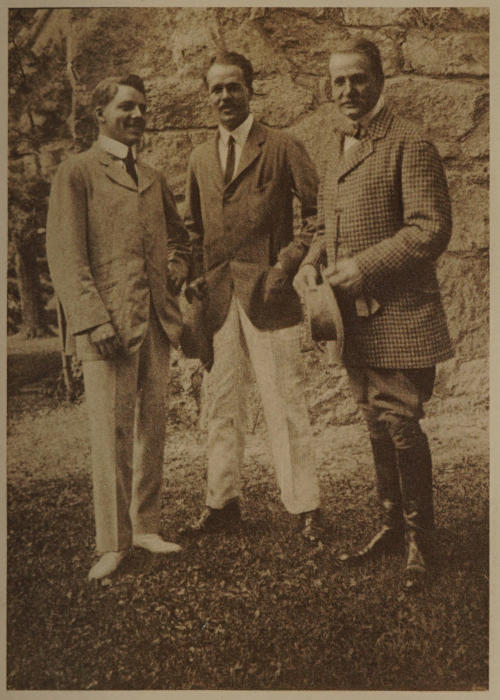
Norman Prince, Frederick Henry Prince, Jr., Frederick Henry Prince
Describing this incident the tutor writes:
“Norman came to me for work in Latin when
I had no reasonable hours at my disposal for
him. At my recommendation he sought the
services of another tutor, but he soon came
back to me in considerable perturbation. With
his quick, incisive, convincing sentences he
described Mr. Smith’s inefficiency in Latin,
and declared his complete despair of ever getting
his tutor over six books of Virgil in two
weeks. Not to be caught again by the self-assurance
of a tutor, he asked, ‘Can you really
read Virgil, Mr. Woodbury, and if so how fast
can you read it?’ Determined to keep within
the speed limit and not to disappoint him, I
said, restrainedly, that I thought I might read
ten lines a minute. His eyes glistened with
expectancy, but with caution he inquired,
‘Really, Sir? May I time you, Sir?’ With
my consent he pulled out a stop-watch, and
finding I could slightly better my estimate, he
won me over by his irresistible arts of persuasion
to give him the hours from seven to eight
in the morning and nine to ten in the evening.
These were unseasonable hours for so young
a lad, but he never failed to be ready for work
at the beginning and at the close of the day
until his task was completed. Through his
vivacity and his cleverness and his unfailing
good nature he became very popular with the
dozen or more fellows who were tutoring with
me that summer. Between him and me there
developed a friendship which to me was a
source of great enjoyment and has now become
a treasured memory.”
This incident serves to show that Norman’s
precocity was mitigated by a well-developed
sense of humor as well as a playful
mischievousness. There was a merry twinkle
in his eyes, denoting that he was not always to
be taken too seriously in his search for knowledge.
A marked trait of Norman’s early youth
was his dashing intrepidity. He began hunting
when he was but seven and he never showed
a sign of fear. I can see him now in my mind’s
eye mounted on his spirited chestnut thoroughbred
riding as straight and true as any of the
older hunting men. An accident that happened
to him and his brother Frederick before they
went to school at Groton illustrates the fearlessness
of both of them in their childhood. It
was a morning appointed for a meet and the
rain was falling in torrents, making the riding
cross-country more than ordinarily dangerous,
so that I deemed it prudent to tell my sons
that perhaps it might be better for them not
to join us that day. They dearly loved the
sport, and I remember how the tears came to
the eyes of Norman when he heard my gentle
warning, though, as the event proved, he
did not take it any too seriously. On my return
home that evening I found Norman in the care
of a surgeon with a broken thigh, while his
brother had a broken collar-bone, the result
of fast riding on the slippery turf. Regardless
of the dangerous conditions against which they
had been warned they had taken not only to
hunting but to racing and by accident they had
pulled into each other at the finish where both
were violently thrown. As they lay stunned
on the ground Frederick was the first to gain
consciousness and he shortly heard Norman
murmuring jokingly, “Fred, I think I’m dead.
How do you feel?” Not even this playful disregard
of parental counsel operated to check
a certain degree of admiration for such an exhibition
of calm nerve under painful circumstances.
Norman’s interest in hunting and racing
witnessed no abatement when he took to
aviation, or even after he had experienced some
of that stern joy that warriors feel. A post-script
to one of his letters from the front in
France made the naïve inquiry:
“How did my horse run at the Country
Club meeting?”
Another marked feature of Norman’s personality
was his gracious and attractive bearing
under any and all circumstances. To his quick
intelligence and dash he added a courtesy and
graciousness of manner that charmed all those
with whom he came in contact, whether at
home or abroad, at work or at play, in the
rough-and-tumble of life or in the drawing
room. His savoir faire which seemed his by
instinct, gave him a charm that was rare to
meet.
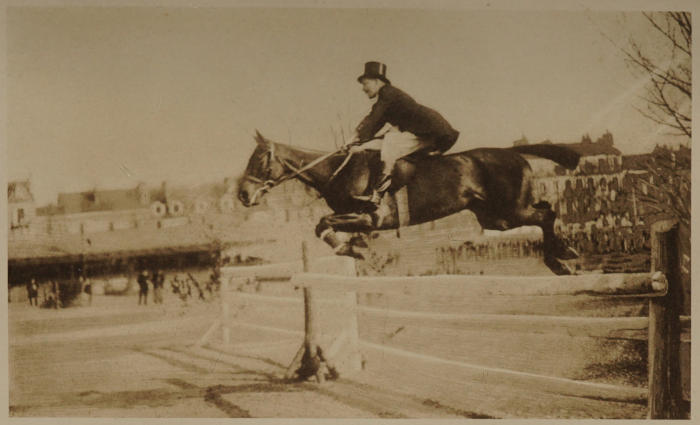
Concours Hippique
About all the notable characteristics that
marked Norman’s earlier youth remained with
him as he grew older, showing a constantly progressive
development. This was particularly
the case as to his alert mentality and his remarkable
capacity for acquiring knowledge
easily and quickly. As a student he could
hardly be called exceptionally studious in the
sense of being closely attached to his text
books, but what he lacked in studious habits
he more than made up for by the facility with
which he grasped any subject that invited his
attention. This accomplishment of his was
demonstrated in a gratifying way when he was
at Groton preparing for college. He was given
an opportunity to join his brother for a year of
study abroad, but he asked that he might take
his entrance examinations for college before
going. The next examinations were only a
week or two ahead, and Norman still had another
year at Groton before his turn would
come in regular course. Having obtained the
requisite permission of the Groton and Harvard
authorities thus to anticipate his work he underwent
the examinations at once, though he was
then but 15 years old. He passed them all
without a condition and without any uneasy
apprehension on his part, apparently.
Having achieved this triumph he went
abroad, studying for a time in Germany and
at Oxford, subsequently entering Harvard in
the sophomore year. At college, as at school,
he acquitted himself creditably and was graduated
with high honors. He subsequently took
the degree of Bachelor of Laws at the Harvard
Law School in due course.
It was at this time that he became an enthusiastic
devotee of aviation, and when an opening
came for him to begin the active practice of the
law, he preferred to give his attention to the
science and practice of aerial navigation with
the Wright brothers and with Starling Burgess
at Marblehead. Knowing something of the
perils of aviation, particularly during the early
stages of its development in this country, and
apprehending that its fascinations for Norman
might prove more or less perilous, as well as
tending to distract his attention from the more
serious concerns of life, I sought by every
means to dissuade him from giving so much of
his attention to it, but his ambition to distinguish
himself as an aviator made it difficult for
him to pay due heed to my serious counsel, and
I subsequently found that he had been experimenting
for some time with flying machines in
high altitudes under an assumed name in order
to escape detection and an undesired notoriety.
Recalling these venturesome incidents in
Norman’s early career as an amateur aviator,
I sometimes think that perhaps fate had reserved
him for the cause to which he finally
gave his life and that the character of this service
was that for which he had shown such a passionate
fondness and aptitude, despite all obstacles
and discouragements. Worldly success
won by the ordinary plodding methods meant
little to him. He aspired to hitch his wagon to
a star. He cared nothing for the privileges of
wealth, even though they might be within his
reach, and he envied no man his success in
whatever honorable lines he might elect for
himself. His ambition was to achieve something
worth while and he gave all his energies
to the accomplishment of that purpose.
Considering these predominant traits of
Norman’s character, as well as his achievements,
I conclude that he could hardly have
wished for a nobler fate than that which finally
befell him on a battlefield of France.
Speaking for Norman’s mother I would say
in her behalf:
“Light sorrows speak—great grief is
dumb.”
A mother’s grief for the loss of a dearly beloved
son is too deep to find adequate expression
in words. Memories of Norman’s tenderly
affectionate nature, of his fine character, his
charming personality and his unfailing buoyancy
and cheerfulness are so real, so vivid, and
so abiding that it is difficult to realize that he
has gone. Although he has indeed gallantly
sacrificed his young life for a cause he dearly
loved, his mother cherishes the firm faith that
the fine spirit thus displayed by him remains
undaunted and unquenched, and that it is still
the blessed privilege of those near and dear to
him to continue to enjoy this sweet belief.
A further measure of consolation has been
found in the many and tender messages of
sympathy that have come from near and far,
testifying to the warm appreciation of Norman’s
rare qualities as they were revealed in
his life, and to the general admiration of his
heroic self-sacrifice. These messages have
helped to comfort and sustain the bereaved
family.
Frederick Henry Prince.
V A COMRADE’S TRIBUTE
In a contribution to the World’s Work, James
R. McConnell, a sergeant-pilot of the original
American Escadrille, gave the following
graphic description of the engagement in which
his comrade Prince lost his life. It is a pathetic
circumstance that but a short time after he had
written this tribute, Sergeant McConnell himself
met the same fate as that which befell his
American comrade, his dead body having been
found within the German lines where he had
fallen in an aerial combat with the enemy.
“On the 12th of October, twenty small aeroplanes
flying in a ‘V’ formation, at such height
that they resembled a flock of geese, crossed the
Rhine River, where it skirts the plains of Alsace,
and, turning north, headed for the famous Mauser
works at Oberndorf. Following in their
wake was an equal number of larger machines,
and above these darted and circled swift fighting
’planes. The first group of aircraft was followed
by British pilots, the second by French,
and four of the battle ’planes were from the
American Escadrille. They were piloted respectively
by Lieut. de Laage, Lufberry, Norman
Prince and Masson. The Germans were
taken by surprise, and as a result few of their
machines were in the air. The bombardment
fleet was attacked, however, and six of our
’planes were shot down, some of them falling
in flames. As the full capacity of a Nieuport
machine allows but a little more than two hours
in the air the avions de chasse were forced to
return to their own lines to take on more gasoline.
The Nieuports having refilled their tanks,
went up to clear the air of any German machines
that might be hovering in wait for the returning
raiders. Prince found one, and promptly
shot it down. Lufberry came upon three and
he promptly disposed of them.
“Darkness was rapidly coming on, but Prince
and Lufberry remained in the air to protect the
bombarding fleet. Just at nightfall, Lufberry
made for a small aviation field near the lines,
known as Corcieux. Slow-moving machines,
with great planing capacity, can be landed in the
dark, but to try to feel for the ground in a Nieuport,
which comes down at about a hundred miles
an hour, usually means disaster. Ten minutes
after Lufberry landed, Prince decided to make
for the landing field. He spiraled down through
the night air and skimmed rapidly over the trees
bordering the Corcieux field. In the dark he
did not see a high-tension electric cable that
was stretched just above the tree tops. The
landing gear of his airplane struck it. The machine
snapped forward and hit the ground on
its nose. It turned over and over. The belt holding
Prince broke, and he was thrown far from
the wrecked ’plane. Both of his legs were broken
and he suffered other injuries. Despite the
terrific shock and intense pain, Prince did not
lose consciousness for a time. He even kept his
presence of mind, and gave orders to the men
who had run to pick him up. Hearing the hum
of a motor, and realizing that a machine was in
the air, Prince told them to light fires on the field.
‘You don’t want another fellow to come down
and break himself up the way I’ve done,’ he
said.
“Lufberry went with Prince to the hospital
in Gerardmer. As the ambulance rolled along
Prince sang to keep up his spirits. He spoke of
getting well soon and returning to service. It
was like Norman. He was always joyous and
energetic about his flying. Even when he
passed through the harrowing experience of
having a wing shattered, the first thing he did
on landing was to busy himself about getting
another fitted in place. No one thought Prince
was mortally injured in the accident, but the
next day he went into a coma; a blood clot had
formed on his brain. Captain Haaf, in command
of the aviation groups of Luxeuil, accompanied
by our officers, hastened to Gerardmer. Prince,
lying unconscious on his bed, was named a second
lieutenant and was then and there decorated
with the Legion of Honor. He already held
the Médaille Militaire and the Croix de Guerre.
“Norman Prince died on the 15th of October.
His body was brought back to Luxeuil and
he was given a funeral similar to Rockwell’s. It
was hard to realize that poor Norman had gone.
He was the founder of the American Escadrille,
and every one in it had come to rely on him for
inspiration. He never let his spirits drop, and
he was always on hand with encouragement for
others. I do not think Prince minded going. He
wanted to do his part before being killed and he
had more than done it. He had, day after day,
freed the line of Germans, making it impossible
for them to do their work, and five of them
he had shot to death.
“Two days after Prince’s death, the Escadrille
received orders to leave for the Somme.
The night before the departure, the British gave
the American pilots a farewell banquet and
toasted them as their guardian angels. They
keenly appreciated the fact that four men from
the American Escadrille had brought down
many Germans, and had cleared the way for
their squadron returning from Oberndorf. The
Escadrille passed through Paris on its way to the
Somme front. The few members who had machines
flew from Luxeuil to their new post. At
Paris the pilots were reënforced by three other
Americans, among whom was Frederick H.
Prince, Jr., who had completed his training and
had come over to serve in aviation with his
brother Norman.”
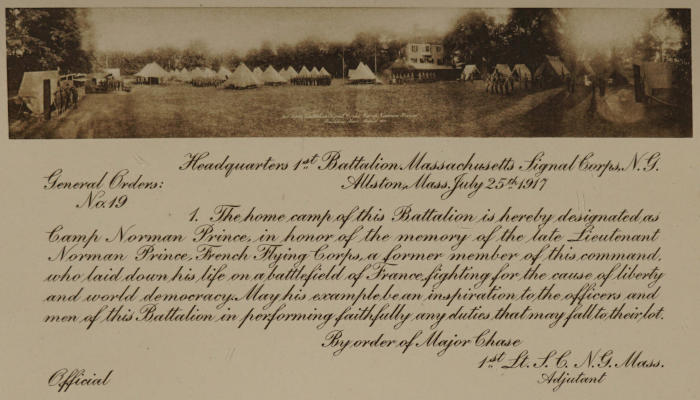
Camp Norman Prince
VI HIS BROTHER’S SERVICE
It was the proud privilege of both the Prince
brothers to give their active services to France
on the battle fronts. Having passed their boyhood
and early youth together, performing the
same tasks and enjoying the same recreations,
Frederick and Norman developed similar ambitions
and aptitudes, particularly in their more
strenuous activities. Moreover, they had obtained
in part their early education in France,
and the call to the French colors at the outbreak
of the war appealed almost as strongly
to them as to the patriotic Frenchmen. Norman’s
early experience as an aviator at home
and abroad gave him a temporary advantage
over Frederick in that he already had the preliminary
training for service in the aviation corps
in which both desired to enlist. He was consequently
first of the two to realize his heart’s
desire and to take the oath of allegiance to
France and her cause. It was with pardonable
hesitation that permission was subsequently
given by his parents to their only other son to
join Norman in the perilous aviation service but
it was freely given, with an appeal for God’s
blessing, and Frederick sailed for France with
Norman on the latter’s return from his Christmas
furlough at home in 1915. He underwent
the rigorous training at the Pau aviation school
and began his active service at the front in the
late summer, flying at first with the intrepid
Captain Guynemer, at the latter’s invitation,
and subsequently joining the Lafayette Squadron
on the western front. He won the high esteem
of his comrades for his courage and manly
bearing, performing his duty with joyous enthusiasm
and taking active part in twenty-two
aerial engagements during the ensuing five
months. When Norman fell at Luxeuil, it
was a trying moment to Frederick, who had
lost his only brother and the companion of his
lifetime, but he promptly offered his services
to France in his brother’s place and he fought
with the Lafayette Escadrille until he came
home on a short furlough. He subsequently
returned to France to rejoin his Squadron
with courage undaunted, and with unflagging
faith in the ultimate triumph of the cause he
loved and for which he was proud to be
actively enlisted.
Frederick Henry Prince, Jr., with his Nieuport
VII FROM THE FRENCH ENVOYS
On the occasion of the reception given by the
Commonwealth of Massachusetts and the City
of Boston to the French Envoys who came to
this country in an official capacity, the patriotic
devotion and sacrifice of Norman Prince were
gracefully alluded to by the Envoys who included
in their number M. René Viviani, Minister
of Justice, Marshal Joffre, Vice-Admiral
Chocheprat and the Marquis de Chambrun,
Deputy, and descendant of Lafayette. At the
lunch in Faneuil Hall, given by the City of Boston,
Vice-Admiral Chocheprat, in his reply to
the Mayor’s address of welcome, paid a touching
tribute to “Mr. Frederick H. Prince’s son
Norman, the gallant young aviator who sacrificed
his life for France, and the cause of the
Allies.” Thereupon Marshal Joffre arose from
his seat at the table and placing his hand
over his heart made a bow to the young hero’s
father, who sat by the Marshal’s side and
who was acting as chairman of the reception
committee.
Subsequently at the reception given to the
Envoys at the Boston Public Library, M.
Viviani, in concluding his graceful response
to Governor McCall’s address of welcome,
said:
“I salute that young hero, Norman Prince,
who has died after having fought not only for
France, but for America, because we have the
same ideals of right and liberty.”
M. Henri Franklin Bouillon, French Minister
of International Affairs, who made an official
visit to this country later on, took occasion
to express his admiration of this fine American
aviator. Speaking subsequently at a public
gathering in London of his observations in
America he said: “I cannot better express to you
the sentiment of the American people than by
quoting that young American hero Norman
Prince, who, in acknowledging a salute to the
American aviators in Paris, said, ‘We have
done what we have done; you must judge us
by our hearts.’”
VIII MESSAGES OF CONDOLENCE AND APPRECIATION — TO NORMAN PRINCE
As Norman Prince was among the first of
the American volunteers offering their services
to France and to make the supreme sacrifice
for her cause, it was but natural that his fate
occasioned widespread and deeply sympathetic
comment. The mournful tidings served
in no small measure to bring home to the
American people a more adequate realization
of the fact that it was a World War that was
waging on the European battle-fields and that
the sooner this situation was recognized here
the better for the cause of civilization everywhere.
The messages of sympathy and appreciation
were as numerous and universal as they
were fervent and sincere. They found expression
in the press, in the pulpit and in the forum,
and the name of this hero came to be accepted
as a fitting symbol of patriotism and self-sacrifice.
Few of these messages were more tender
and appreciative than those which came from
Norman’s comrades in the aviation service in
France. Commanders and subordinates were
alike in this respect. A message from the comrades
gathered at his bedside when he died
said:
“Norman passed peacefully away this
morning. He died like the brave man he was.
He was more than a brother to us. We are all
heartbroken.”
The French Government took formal and
appreciative notice of the event, the representative
of the French Army in this country sending
this message to the family:
“The French Government transmits to you
expressions of its deep and sorrowful sympathy
on the occasion of your son’s glorious death.
In my name as Military Attaché representing
the French Army in the United States, I desire
to say that his death has been for all his French
comrades a cause of profound grief. It is with
the greatest admiration that we have seen all
these gallant young Americans risking and
giving their lives for the cause of France. Their
memory deserves to be kept in the hearts of
our compatriots as is that of Lafayette in this
country.
“We bow gratefully and respectfully before
his grave.”
Representing the British Admiralty, Rear-Admiral
Alfred E. A. Grant sent this message
from London: “It was splendid of him
to come over to fight for the Allies. You could
have felt nothing but pride to have heard how
his commanding officers speak of him—of
his popularity with all his comrades; how gallantly
and faithfully he performed his duties
and how deeply his loss is regretted by all who
knew him.”
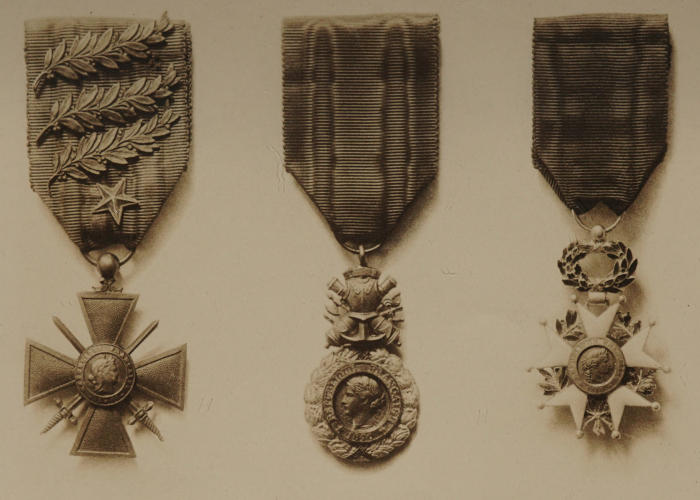
DECORATIONS awarded to Norman Prince by the French Government
CROIX DE GUERRE (Red and green ribbon)
Star, won for being cited in L’Ordre du Jour of his
Division for having been the only one of twenty-five
aviators to reach Douai in 1915.
First Palm, won for being cited in L’Ordre du Jour of
the French Army for having brought down an enemy
avion.
Second Palm, for having brought down two enemy
avions on the same day—at the same time receiving
the
Third Palm, cited in L’Ordre du Jour for having
brought down a fourth enemy avion, and for meritorious
service in a raid on the Mauser ammunition
works at Oberndorf—at the same time receiving
the
MÉDAILLE MILITAIRE (Yellow and green ribbon)
CROIX DE LA LÉGION D’HONNEUR (Red ribbon)
Rev. Dr. Endicott Peabody of the Groton
School wrote: “I must tell you how deeply
Mrs. Peabody and I sympathize with you in
Norman’s death. He gave his life in a great
cause. That will be a comfort to you both, and
he met his death with the courage that is characteristic
of his family. Even with these considerations,
I realize that your hearts must be
heavy. It will please you to know that one of
Norman’s classmates at Groton, who had followed
his career in France with keen interest,
has sent a contribution toward a memorial that
he desires established at the school.”
Speaking for the Harvard Class of 1909 of
which Norman was a member, its Secretary,
Francis A. Harding, said: “On behalf of the
Harvard Class of 1909, I wish to express the
very deep regret which every Harvard man,
and especially every classmate of Norman’s,
has felt after reading the announcement of his
death in France. To those of us who knew
Norman intimately, the news of his death comes
as a distinct shock, and every member of our
class feels proud to have known and to have
been affiliated with one who had the courage to
give in such a noble way everything he possessed
to the great cause in which he believed.”
From South Carolina Senator Tillman
wrote: “Your son gave his young life in defense
of what all of us know is a sacred cause.
He was a twentieth century Lafayette, a modern
knight errant whose statue will yet grace
the capital of France. Prince? Yes, a Prince
indeed—‘sans peur et sans reproche.’”
Many other thoughtful and tender messages
came from others, friends and strangers,
at home and abroad, testifying their commingled
sorrow and admiration. Senator Henry
Cabot Lodge telegraphed from Washington
this tribute:
“Nothing could have been more gallant
than his life—nothing finer than his death in
a great cause, dear to his heart.”
An eloquent and fitting epitaph!
From a Boston Boy, in France, American Ambulance
Field Service, October 20, 1916.
Gone is the honored boy bird
He’ll fly no more for France,
His spirit though,—a silent word
That over all the Earth is heard,—
Commands her friends Advance!
His courage and devotion tried
Must all the world convince
He was, as all of us decide,
And France, for love of whom he died,
In name and deed—a Prince.
The Riverside Press
CAMBRIDGE. MASSACHUSETTS
U. S. A