MANY times that night Perrine, lying beside her mother, had jumped up
and run to the well for water so as to have it fresh. In spite of her
desire to fetch the doctor as early as possible the next morning, she
had to wait until Grain-of-Salt had risen, for she did not know what
doctor to call in. She asked him.
Certainly he knew of a good doctor! and a famous one, too! who made
his rounds in a carriage, not on foot, like doctors of no account. Dr.
Cendrier, rue Rublet, near the Church; he was the man! To find the
street she had only to follow the railway tracks as far as the
station.
When he spoke of such a great doctor who made his rounds in a
carriage, Perrine was afraid that she would not have enough money to
pay him, and timidly she questioned Grain-of-Salt, not daring to ask
outright what she wanted to know. Finally he understood.
"What you'd have to pay?" he asked. "It's a lot, but it won't be more
than forty sous, and so as to make sure, you'll have to pay him in
advance."
Following the directions that Grain-of-Salt gave her, she easily found
the house, but the doctor had
not yet risen, so she had to wait. She
sat down on a bench in the street, outside a stable door, behind which
a coachman was harnessing a horse to a carriage. She thought if she
waited there she would be sure to catch the doctor as he left the
house, and if she gave him her forty sous he would consent to come.
She was quite sure that he would not if she had simply asked him to
visit a patient who was staying in the Guillot Field.
She waited a long time; her suspense increased at the thought that her
mother would be wondering what kept her away so long.
At last an old-fashioned carriage and a clumsy horse came out of the
stables and stood before the doctor's house. Almost immediately the
doctor appeared, big, fat, with a grey beard.
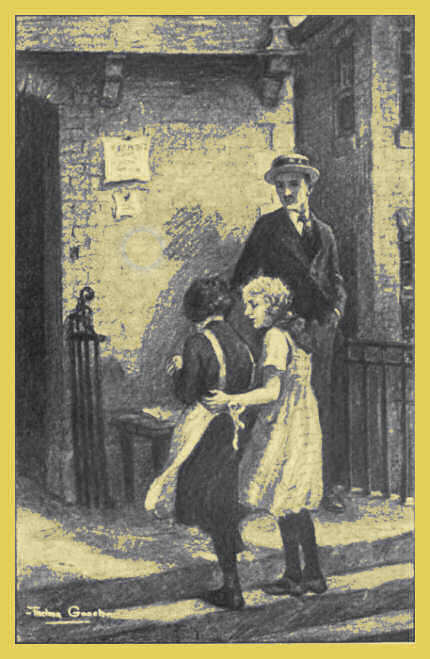
Before he could step into his carriage Perrine was beside him. She put
her question tremblingly.
"The Guillot Field?" he said. "Has there been a fight?"
"No, sir; it's my mother who is ill."
"Who is your mother?"
"We are photographers."
He put his foot on the step. She offered him her forty sous quickly.
"We can pay you," she hastened to say.
"Then it's sixty sous," said he.
She added twenty sous more. He took the money and slipped it into his
waistcoat pocket.
"I'll be with your mother in about fifteen minutes," he said.
She ran all the way back, happy, to take the good news.
"He'll cure you, mama; he's a real, real doctor!" she said,
breathlessly.
She quickly busied herself with her mother, washing her hands and face
and arranging her hair, which was beautiful, black and silky; then she
tidied up the "room," which only had the result of making it look
emptier and poorer still.
She had not long to wait. Hearing the carriage in the road, she ran
out to meet the doctor. As he was walking towards the house she
pointed to the wagon.
"We live there in our wagon," she said.
He did not seem surprised; he was accustomed to the extreme poverty of
his patients; but Perrine, who was looking at him, noticed that he
frowned when he saw the sick woman lying on the mattress in the
miserable cart.
"Put out your tongue and give me your hand," he said.
Those who pay forty or a hundred francs for a visit from a doctor have
no idea of the brevity with which the poor people's cases are
diagnosed. In less than a minute his examination was made.
"A case for the hospital," he said.
Simultaneously, little Perrine and her mother uttered a cry.
"Now, child, leave me alone with your mother," he said in a tone of
command.
For a moment Perrine hesitated, but at a sign from her mother she
left the wagon and stood just outside.
"I am going to die," said the woman in a low voice.
"Who says that? What you need is nursing, and you can't get that
here."
"Could I have my daughter at the hospital?"
"She can see you Thursdays and Sundays."
"What will become of her without me," murmured the mother, "alone in
Paris? If I have to die I want to go holding her hand in mine."
"Well, anyway, you can't be left in this cart. The cold nights would
be fatal for you. You must take a room. Can you?"
"If it is not for long, perhaps."
"Grain-of-Salt can rent you one, and won't charge much; but the room
is not all. You must have medicine and good food and care, all of
which you would get at the hospital."
"Doctor, that is impossible," said the sick woman. "I cannot leave my
little girl. What would become of her?"
"Well, it's as you like; it's your own affair. I have told you what I
think."
"You can come in, little girl, now," he called out. Then taking a leaf
from his note pad, he wrote out a prescription.
"Take that to the druggist, near the Church," he said, handing it to
Perrine. "No other, mind you. The packet marked No. 1 give to your
mother. Then give her the potion every hour. Give her the Quinquina
wine when she eats, for she must eat anything she wants, especially
eggs. I'll drop in again this evening."
She ran out after him.
"Is my mama very ill?" she asked.
"Well ... try and get her to go to the hospital."
"Can't you cure her?"
"I hope so, but I can't give her what she'll get at the hospital. It
is foolish for her not to go. She won't go because she has to leave
you. Nothing will happen to you, for you look like a girl who can take
care of yourself."
Striding on, he reached his carriage. Perrine wanted him to say more,
but he jumped in quickly and was driven off. She returned to the
wagon.
"Go quickly to the druggist; then get some eggs. Take all the money; I
must get well," said the mother.
"The doctor said he could cure you," said Perrine. "I'll go quickly
for the things."
But all the money she took was not enough. When the druggist had read
the prescription he looked at Perrine.
"Have you the money to pay for this?" he asked.
She opened her hand.
"This will come to seven francs, fifty," said the man who had already
made his calculation.
She counted what she had in her hand and found that she had six francs
eighty-five centimes, in counting the Austrian florin as two francs.
She needed thirteen sous more.
"I have only six francs eighty-five centimes. Would you take this
florin? I have counted that," she said.
"Oh, no; I should say not!" replied the man.
What was to be done? She stood in the middle of the store with her
hand open. She was in despair.
"If you'll take the florin there will be only thirteen sous lacking,"
she said at last, "and I'll bring them this afternoon."
But the druggist would not agree to this arrangement. He would neither
give her credit for thirteen sous nor accept the florin.
"As there is no hurry for the wine," he said, "you can come and fetch
it this afternoon. I'll prepare the other things at once and they'll
only cost you three francs fifty."
With the money that remained she bought some eggs, a little Vienna
loaf which she thought might tempt her mother's appetite, and then she
returned to the Field, running as fast as she could all the way.
"The eggs are fresh," she said. "I held them up to the light. And look
at the bread! Isn't it a beautiful loaf, mama? You'll eat it, won't
you?"
"Yes, darling."
Both were full of hope. Perrine had absolute faith in the doctor, and
was certain that he would perform the miracle. Why should he deceive
them? When one asks the doctor to tell the truth, doesn't he do so?
Hope had given the sick woman an appetite. She had eaten nothing for
two days; now she ate a half of the roll.
"You see," said Perrine, gleefully.
"Everything will be all right soon," answered her mother with a smile.
Perrine went to the house to inquire of Grain-of-Salt what steps she
should take to sell the wagon and dear Palikare.
As for the wagon, nothing was easier. Grain-of-Salt would buy it
himself; he bought everything, furniture, clothes, tools, musical
instruments ... but a donkey! That was another thing. He did not buy
animals, except pups, and his advice was that they should wait for a
day and sell it at the Horse Market. That would be on Wednesday.
Wednesday seemed a long way off, for in her excitement, and filled
with hope, Perrine had thought that by Wednesday her mother would be
strong enough to start for Maraucourt. But to have to wait like this!
There was one thing, though: With what she got for the wagon she could
buy the two dresses and the railway tickets, and if Grain-of-Salt paid
them enough, then they need not sell Palikare. He could stay at the
Guillot Field and she could send for him after they arrived at
Maraucourt. Dear Palikare! How contented he would be to have a
beautiful stable to live in and go out every day in the green fields.
But alas! Grain-of-Salt would not give one sou over fifteen francs for
the wagon.
"Only fifteen francs!" she murmured.
"Yes, and I am only doing that to oblige you. What do you think I can
do with it?" he said. He struck the wheels and the shafts with an iron
bar; then shrugged his shoulders in disgust.
After a great deal of bargaining all she could get was two francs
fifty on the price he had offered, and the promise that he would not
take it until after they had gone, so that they could stay in it all
day, which she thought would be much better for her mother than closed
up in the house.
After she had looked at the room that Grain-of-Salt was willing to
rent, she realized how much the wagon meant to them, for in spite of
the pride in which he spoke of his "Apartments," and the contempt in
which he spoke of the wagon, Perrine was heartbroken at the thought
that she must bring her dear mother to this dirty smelling house.
As she hesitated, wondering if her mother would not be poisoned from
the odor which came from the heaps of things outside, Grain-of-Salt
said impatiently:
"Hurry up! The rag pickers will be here in a moment and I'll have to
get busy."
"Does the doctor know what these rooms are like?" she asked.
"Sure! He came to this one lots of times to see the Baroness."
That decided her. If the doctor had seen the rooms he knew what he was
doing in advising them to take one, and then if a Baroness lived in
one, her mother could very well live in the other.
"You'll have to pay one week in advance," said the landlord, "and
three sous for the donkey and six for the wagon."
"But you've bought the wagon," she said in surprise.
"Yes, but as you're using it, it's only fair that you should pay."
She had no reply to make to this. It was not the first time that she
had been cheated. It had happened so often on their long journey.
"Very well," said the poor little girl.
She employed the greater part of the day in cleaning their room,
washing the floor, wiping down the walls, the ceiling, the windows.
Such a scrubbing had never been seen in that house since the place had
been built!
During the numerous trips that she made from the house to the pump she
saw that not only did grass and thistles grow in the Field, but there
were flowers. Evidently some neighbors had thrown some plants over the
fence and the seeds had sprung up here and there. Scattered about she
saw a few roots of wall-flowers, pinks and even some violets!
What a lovely idea! She would pick some and put them in their room.
They would drive away the bad odor, and at the same time make the
place look gay.
It seemed that the flowers belonged to no one, for Palikare was
allowed to eat them if he wished, yet she was afraid to pick the
tiniest one without first asking Grain-of-Salt.
"Do you want to sell them?" he asked.
"No, just to put a few in our room," she replied.
"Oh, if that's it you may take as many as you like, but if you are
going to sell them, I might do that myself. As it's for your room,
help yourself, little one. You like the smell of flowers. I like the
smell of wine. That's the only thing I can smell."
She picked the flowers, and searching amongst the heap of broken glass
she found an old vase and some tumblers.
The miserable room was soon filled with the sweet perfume of
wall-flowers, pinks and violets, which kept out the bad odors of the
rest of the house, and at the same time the fresh, bright colors lent
a beauty to the dark walls.
While working, she had made the acquaintance of her neighbors. On one
side of their room lived an old woman whose gray head was adorned with
a bonnet decorated with the tri-color ribbon of the French flag. On
the other side lived a big man, almost bent double. He wore a leather
apron, so long and so large that it seemed to be his only garment. The
woman with the tri-color ribbons was a street singer, so the big man
told her, and no less a person than the Baroness of whom Grain-of-Salt
had spoken. Every day she left the Guillot Field with a great red
umbrella and a big stick which she stuck in the ground at the
crossroads or at the end of a bridge. She would shelter herself from
the sun or the rain under her red umbrella and sing, and then sell to
the passersby copies of the songs she sang.
As to the big man with the apron, he was a cobbler, so she learned
from the Baroness, and he worked from morning to night. He was always
silent, like a fish, and for this reason everybody called him Father
Carp. But although he did little talking he made enough noise with his
hammer.
At sunset Perrine's room was ready. Her mother, as she was helped in,
looked at the flowers with surprise and pleasure.
"How good you are to your mama, darling," she murmured as she clung to
Perrine's arm.
"How good I am to myself," Perrine cried gayly, "because if I do
anything that pleases you, I am so happy."
At night they had to put the flowers outside. Then the odors of the
old house rose up terribly strong, but the sick woman did not dare
complain. What would be the use, for she could not leave the Guillot
Field to go elsewhere?
Her sleep was restless, and when the doctor came the next morning he
found her worse, which made him change the treatment, and Perrine was
obliged to go again to the druggist. This time he asked five francs to
fill out the prescription. She did not flinch, but paid bravely,
although she could scarcely breathe when she got outside the store. If
the expenses continued to increase at this rate poor Palikare would
have to be sold on Wednesday. He would have to go now anyway. And if
the doctor prescribed something else the next day, costing five
francs or more, where would she find the money?
When, with her mother and father, she had tramped over the mountains,
they had often been hungry, and more than once since they had left
Greece on their way to France they had been without food. But hunger
in the mountains and in the country was another thing—there was
always the chance that they would find some wild fruit or vegetables.
But in Paris there was no hope for those who had no money in their
pockets.
What would become of them? And the terrible thing was that she must
take the responsibility. Her mother was too ill now to think or plan,
and Perrine, although only a child, realized that she must now be the
mother.
On Tuesday morning her fears were realized. After a brief examination,
the doctor took from his pocket that terrible notebook that Perrine
dreaded to see and began to write. She had the courage to stop him.
"Doctor, if the medicines which you are ordering are not all of the
same importance," she said, "will you please write out those which are
needed the most?"
"What do you mean?" he asked angrily.
She trembled but continued bravely:
"I mean that we have not much money today, and we shall not get any
perhaps until tomorrow ... so...."
He looked at her, then glanced round the room, as though for the
first time remarking their poverty; then he put his notebook back in
his pocket.
"We won't change the treatment until tomorrow, then," he said. "There
is no hurry for this. Continue the same today."
"No hurry!" Perrine repeated the words to herself. There was no hurry
then ... her mother was not so ill as she had feared; they had just to
wait and hope....
Wednesday was the day for which she was waiting, yet at the same time
how she dreaded it. Dear, dear Palikare.... Whenever her mother did
not need her she would run out into the field and kiss his nose and
talk to him, and as he had no work to do, and all the thistles to eat
that he wanted and his little mistress' love, he was the happiest
donkey in the world.
"Ah, if you only knew," murmured Perrine, as she caressed him.
But he did not know. All he knew was that she loved him and that the
thistles were good. So, as she kissed and kissed, he brayed in
contentment and shook his long ears as he looked at her from the
corner of his eyes.
Besides, he had made friends with Grain-of-Salt and had received a
proof of his friendship in a way that flattered his greed. On Monday,
having broken loose, he had trotted up to Grain-of-Salt, who was
occupied in sorting out the rags and bones that had just arrived, and
he stood beside him. The man was about to pour out a drink from the
bottle that was always beside him when he saw Palikare, his eyes
fixed on him, his neck stretched out.
"What are you doing here?" he asked. As the words were not said in
anger, the donkey knew, and he did not move.
"Want a drink ... a glass of wine?" he asked mockingly. The glass that
he was about to put to his lips he offered in a joke to the donkey.
Palikare, taking the offer seriously, came a step nearer and pushing
out his lips to make them as thin and as long as possible, drank a
good half of the glass which had been filled to the brim.
"Oh la la! la la!" cried Grain-of-Salt, bursting with laughter.
"Baroness! Carp! Come here!"
At his calls, the Baroness and Carp, also a rag picker who came into
the field at that moment and a man with a push-cart who sold red and
yellow and blue sugar sticks, ran up.
"What's the matter?" demanded the Baroness.
He filled the glass again and held it out to the donkey, who, as
before, absorbed half of the contents amidst the laughter and shouts
of those who looked on.
"I heard that donkeys liked wine, but I never believed it," said the
candy man.
"You ought to buy him; he'd be a good companion for you," said the
Baroness.
"A fine pair," said another.
But Grain-of-Salt did not buy him, although he took a great liking to
him, and told Perrine that he would go with her on Wednesday to the
Horse Market. This was a great relief for Perrine, for she had
wondered how she would ever be able to find the place; neither did she
know how to discuss prices, and she was very much afraid that she
would be robbed. She had heard so many stories about Paris thieves,
and what could she have done to protect herself?...
Wednesday morning came. At an early hour she busied herself with
brushing Palikare and making his beautiful coat shine so that he would
look his best. How she kissed him! How she stroked him while her tears
fell!
When Palikare saw that instead of being hitched to the wagon, a rope
was put round his neck, his surprise was great; and still more
surprised was he when Grain-of-Salt, who did not want to walk all the
way from Charonne to the Horse Market, climbed up on a chair and from
the chair onto his back. But as Perrine held him and spoke to him, he
offered no resistance. Besides, was not Grain-of-Salt his friend?
They started thus. Palikare, still surprised, walked gravely along,
led by Perrine. On through the streets they went. At first they met
but few vehicles, and soon they arrived at a bridge which jutted into
a large garden.
"That's the Zoo," said Grain-of-Salt, "and I'm sure that they haven't
got a donkey there like yours."
"Then perhaps we can sell him to the Zoo," exclaimed Perrine, thinking
that in a zoological garden all the animals have to do is to walk
about and be looked at. That would be very nice for dear Palikare!
"An affair with the Government," said Grain-of-Salt; "better not,
'cause the Government...."
From his expression it was evident that Grain-of-Salt had no faith in
the Government.
From now on the traffic was intense. Perrine needed all her wits and
eyes about her. After what seemed a long time they arrived at the
Market and Grain-of-Salt jumped off the donkey. But while he was
getting down Palikare had time to gaze about him, and when Perrine
tried to make him go through the iron gate at the entrance he refused
to budge.
He seemed to know by instinct that this was a market where horses and
donkeys were sold. He was afraid. Perrine coaxed him, commanded him,
begged him, but he still refused to move. Grain-of-Salt thought that
if he pushed him from behind he would go forward, but Palikare, who
would not permit such familiarity, backed and reared, dragging Perrine
with him.
There was already a small circle of onlookers around them. In the
first row, as usual, there were messenger boys and errand boys, each
giving his word of advice as to what means to use to force the donkey
through the gate.
"That there donkey is going to give some trouble to the fool who buys
him," cried one.
These were dangerous words that might affect the sale, so
Grain-of-Salt thought he ought to say something.
"He's the cleverest donkey that ever was!" he cried. "He knows he's
going to be sold, and he's doin' this 'cause he loves us and don't
want ter leave us!"
"Are you so sure of that, Grain-of-Salt?" called out a voice in the
crowd.
"Zooks! who knows my name here?" cried the one addressed.
"Don't you recognize La Rouquerie?"
"My faith, that's so," he cried, as the speaker came forward. They
shook hands.
"That donkey yours?"
"No; it belongs to this little gal."
"Do you know anything about it?"
"We've had more than one glass together, and if you want a good donkey
I'll speak for him."
"I need one and yet I don't need one," said La Rouquerie.
"Well, come and take a drink. 'Tain't worthwhile to pay for a place
in the Market...."
"Especially if he won't budge!"
"I told you he was a smart one; he's that intelligent."
"If I buy him it's not for his tricks nor 'cause he can take a drink
with one, but he must work."
"He can work, sure! He's come all the way from Greece without
stopping."
"From Greece!"
Grain-of-Salt made a sign to Perrine to follow him, and Palikare, now
that he knew that he was not going into the market, trotted beside her
docilely. She did not even have to pull his rope.
Who was this prospective buyer? A man? A woman? From the general
appearance and the hairless face it might be a woman of about fifty,
but from the clothes, which consisted of a workingman's blouse and
trousers and a tall leather hat like a coachman wears, and from the
short, black pipe which the individual was smoking, it surely was a
man. But whatever it was, Perrine decided that the person looked kind.
The expression was not hard or wicked.
Grain-of-Salt and the stranger turned down a narrow street and stopped
at a wine shop. They sat down at one of the tables outside on the
pavement and ordered a bottle of wine and two glasses. Perrine
remained by the curb, still holding her donkey.
"You'll see if he isn't cunning," said Grain-of-Salt, holding out his
full glass.
Palikare stretched out his neck, thinned his lips and quickly drank
the half glass of wine.
But this feat did not give La Rouquerie any particular satisfaction.
"I don't want him to drink my wine, but to drag my cart with the
rabbit skins," she said.
"Didn't I just tell you that he came from Greece, draggin' a wagon the
whole way?"
"Ah, that's another thing!"
The strange looking woman carefully examined the animal; then she gave
the greatest attention to every detail; then asked
Perrine how much she wanted for him. The price which Perrine had arranged
with her landlord beforehand was one hundred francs. This was the sum that
she asked.
La Rouquerie gave a cry of amazement. One hundred francs! Sell a
donkey without any guarantee for that sum! Were they crazy? Then she
began to find all kind of faults with the unfortunate Palikare.
"Oh, very well," said Grain-of-Salt, after a lengthy discussion;
"we'll take him to the Market."
Perrine breathed. The thought of only getting twenty francs had
stunned her. In their terrible distress what would twenty francs be? A
hundred francs even was not sufficient for their pressing needs.
"Let's see if he'll go in any more now than he did then," cried La
Rouquerie.
Palikare followed Perrine up to the Market gates obediently, but once
there he stopped short. She insisted, and talked, and pulled at the
rope, but it was no use. Finally he sat down in the middle of the
street.
"Palikare, do come! Do come, dear Palikare," Perrine said,
imploringly.
But he sat there as though he did not understand a word of what she
was saying. A crowd gathered round and began to jeer.
"Set fire to his tail," cried one.
Grain-of-Salt was furious, Perrine in despair.
"You see he won't go in," cried La Rouquerie. "I'll give thirty
francs, that's ten more'n I said, 'cause his cunning shows that this
donkey is a good boy, but hurry up and take the money or I'll buy
another."
Grain-of-Salt consulted Perrine with a glance; he made her a sign
that she ought to accept the offer. But she seemed stunned at such a
fraud. She was standing there undecided when a policeman told her
roughly that she was blocking up the street and that she must move on.
"Go forward, or go back, but don't stand there," he ordered.
She could not go forward, for Palikare had no intention of doing so.
As soon as he understood that she had given up all hope of getting him
into the Market, he got up and followed her docilely, agitating his
long ears with satisfaction.
"Now," said La Rouquerie, after she had put thirty francs into poor
Perrine's hand, "you must take him to my place, for I'm beginning to
know him and he's quite capable of refusing to come with me. I don't
live far from here."
But Grain-of-Salt would not consent to do this; he declared that the
distance was too far for him.
"You go with the lady alone," he said to Perrine, "and don't be too
cut up about your donkey. He'll be all right with her. She's a good
woman."
"But how shall I find my way back to Charonne?" asked Perrine,
bewildered. She dreaded to be lost in the great city.
"You follow the fortifications ... nothing easier."
As it happened, the street where La Rouquerie lived was not far from
the Horse Market, and it did not take them long to get there. There
were heaps of garbage before her place, just like in Guillot Field.
The moment of parting had come. As she tied Palikare up in a little
stable, her tears fell on his head.
"Don't take on so," said the woman; "I'll take care of him, I promise
you."
"We loved him so much," said little Perrine. Then she went on her
way.

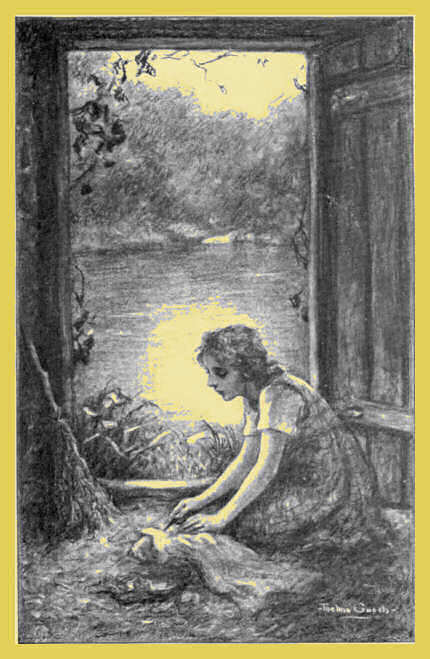
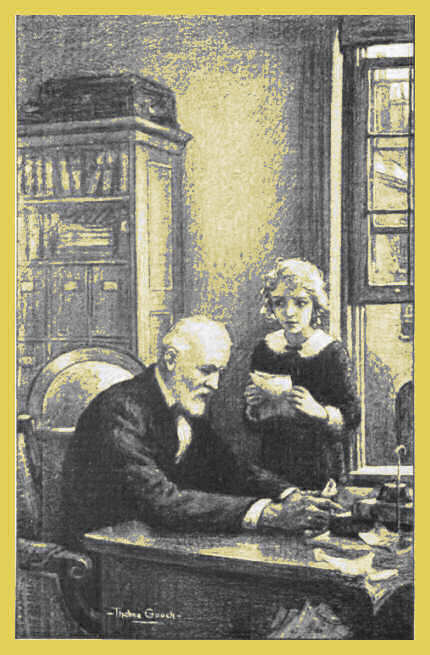
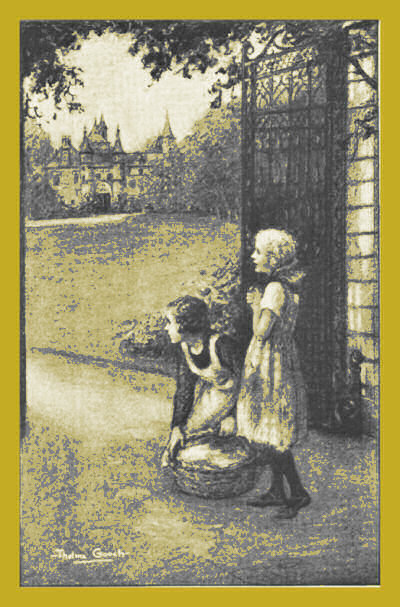 "WHY, IT'S BEAUTIFUL,"
SAID PERRINE, SOFTLY.
(See page 86)
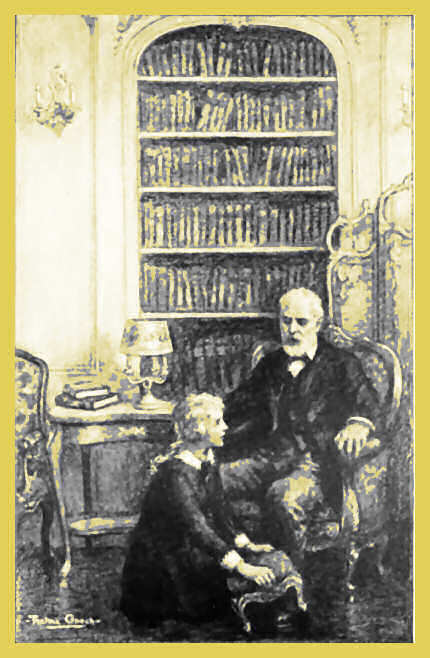
"WHY, IT'S BEAUTIFUL,"
SAID PERRINE, SOFTLY.
(See page 86)