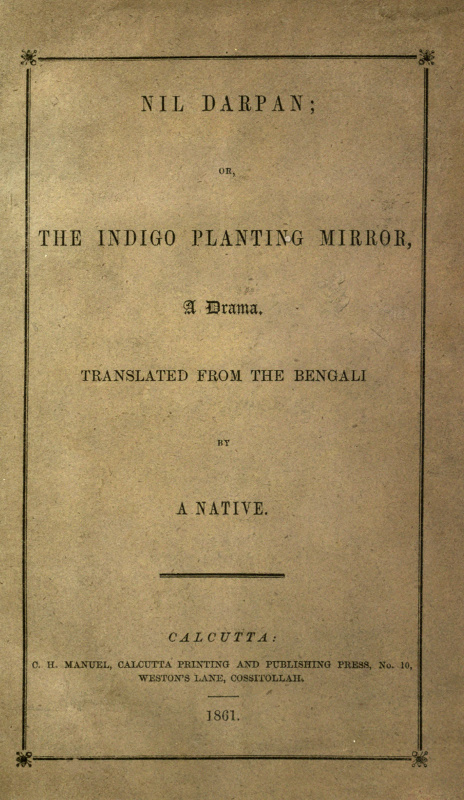
FIRST ACT—FIRST SCENE. Svaropur—Goluk Chunder’s Gola or Store-house. — FIRST ACT—SECOND SCENE. The House of Sadhu Churn. — FIRST ACT—THIRD SCENE. The Factory of Begunbari. The Veranda of the large Bungalow. — FIRST ACT—FOURTH SCENE. Goluk Chunder Basu’s Hall. — SECOND ACT—FIRST SCENE. The Godown of Begunbari Factory. — SECOND ACT—SECOND SCENE. The Bed-room of Bindu Madhar. — SECOND ACT—THIRD SCENE. A Road pointing Three Ways. — THIRD ACT—FIRST SCENE. Before the Factory in Begunbari. — THIRD ACT—SECOND SCENE. The Bed-room of Nobin Madhab. — THIRD ACT—THIRD SCENE. Mr. Rose’s Chamber. — THIRD ACT—FOURTH SCENE. The Hall in the House of Goluk Bose. — FOURTH ACT—FIRST SCENE. The Criminal Court of Indrabad. — FOURTH ACT—SECOND SCENE. Indrabad, the dwelling of Bindu Madhab. — FOURTH ACT—THIRD SCENE. The Prison-house of Indrabad. — FIFTH ACT—SECOND SCENE. The Bedroom of Nobin Bose. — FIFTH ACT—THIRD SCENE. The Room of Sadhu Churn.
5
Goluk Chunder Basu and Sadhu Churn sitting.
Sadhu. Master I told you then we cannot live any more
in this country. You did not hear me however. A poor
man’s word bears fruit after the lapse of years.
Goluk. O my child! Is it easy to leave one’s country?
My family has been here for seven generations. The lands
which our fore-fathers rented have enabled us never to acknowledge
ourselves servants of others. The rice which grows,
provides food for the whole year, means of hospitality to guests,
and also the expense of religious services; the mustard seed
we get, supplies oil for the whole year, and, besides, we can sell
it for about sixty or seventy rupees. Svaropur is not a place
where people are in want.—It has rice, peas, oil, molasses
from its fields, vegetables in the garden, and fish from
the tanks;—whose heart is not torn when obliged to leave
such a place? And who can do that easily?
Sadhu. Now it is no more a place of happiness: your garden
is already gone, and your relatives are on the point of forsaking
you. Ah! it is not yet three years since the Saheb took a lease
of this place, and he has already ruined the whole village. We
cannot bear to turn our eyes in the southern direction towards
the house of the heads of the villages (Mandal). Oh! what was
it once, and what is it now! Three years ago, about sixty men
used to make a daily feast in the house; there were ten ploughs,
and about forty or fifty oxen; as to the court-yard, it was
crowded like as at the horse races; when they used to
arrange the ricks of corn, it appeared, as it were, that the
lotus had expanded itself on the surface of a lake bordered
by sandal groves; the granary was as large as a hill; but
last year the granary not being repaired, was on the point of
6falling into the yard. Because he was not allowed to plant
Indigo in the rice-field, the wicked Saheb beat the Majo and
Sajo Babus most severely; and how very difficult was it to
get them out of his clutches; the ploughs and kine were sold,
and at that crisis the two Mandals left the village.
Goluk. Did not the eldest Mandal go to bring his brethren
back?
Sadhu. They said, we would rather beg from door
to door than go to live there again. The eldest Mandal is
now left alone, and he has kept two ploughs, which are nearly
always engaged in the Indigo-fields. And even this person
is making preparations for flying off. Oh, Sir! I tell
you also to throw aside this infatuated attachment (maya)
for your native place. Last time your rice went, and this
time, your honour will go.
Goluk. What honor remains to us now? The Planter
has prepared his places of cultivation round about the
tank, and will plant Indigo there this year. In that case, our
women will be entirely excluded from the tank. And also
the Saheb has said that if we do not cultivate our rice-fields
with Indigo, he will make Nobin Madhab to drink the
water of seven Factories (i. e. to be confined in them).
Sadhu. Has not the eldest Babu gone to the Factory?
Goluk. Has he gone of his own will? The pyeadah
(a servant) has carried him off there.
Sadhu. But your eldest Babu has very great courage.
On the day the Saheb said, “If you don’t hear the Amin, and
don’t plant the Indigo within the ground marked off, then shall
we throw your houses into the river Betraboti, and shall
make you eat your rice in the factory godown;“ the
eldest Babu replied, “As long as we shall not get the price
for the fifty bigahs of land sown with Indigo last year, we
will not give one bigah this year for Indigo. What do we
care for our house? We shall even risk (pawn) our lives.”
7Goluk. What could he have done, without he said that?
Just see, no anxiety would have remained in our family if the
fifty bigahs of rice produce had been left with us. And if
they give us the money for the Indigo, the greater part of our
troubles will go away.
Nobin Madhab enters.
O my son, What has been done?
Nobin. Sir, does the cobra shrink from biting the little
child on the lap of its mother on account of the sorrow of the
mother? I flattered him much, but: he understood nothing
by that. He kept to his word, and said, give us sixty
bigahs of land, secured by written documents, and take 50
Rupees, then we shall close the two years’ account at once.
Goluk. Then, if we are to give sixty bigahs for the cultivation
of the Indigo, we cannot engage in any other cultivation
whatever. Then we shall die without rice crops.
Nobin. I said, “Saheb, as you engage all your men, our
ploughs, and our kine, every thing, in the Indigo field, only
give us every year through our food. We don’t want hire.”
On which, he with a laugh said, “You surely don’t eat
Yaban’s[2] rice.”
Sadhu. Those whose only pay is a belly full of food are,
I think, happier than we are.
Goluk. We have nearly abandoned all the ploughs; still
we have to cultivate Indigo. We have no chance in a
dispute with the Sahebs. They bind and beat us, it
is for us to suffer. We are consequently obliged to work.
Nobin. I shall do as you order, Sir; but my design is
for once to bring action into Court.
8Aduri enters.
Aduri. Our Mistress is making noise within; the day is
far advanced; will you not go to bathe, and take your
food. The boiled rice is very near become dry.
Sadhu. (Standing up.) Sir, decide something about
this, or I shall die. If we give the labour of one-and-a-half of
our ploughs for the cultivation of nine bigahs of Indigo-fields,
our boiling pots of rice will go empty. Now, I am going
away, Sir, farewell, our oldest Babu.
(Sadhu goes away.)
Goluk. We don’t think that God will any more allow us
to bathe and to take food in this land. Now, my son, go
and bathe.
(All go away.)
Ray Churn enters with his plough.
Ray. (Holding his plough.) The stupid Amin is a tiger.
The violence with which he came upon me! Oh my God! I
thought that he was coming to devour me. That villain did
not hear a single word and with force he marked off the
ground. If they take five bigahs of land, what will my
family eat. First, we will shed tears before them; if they
don’t let us alone, as a matter of course, we shall leave the
country.
Khetromani enters.
Is my brother come home?
Khetra. Father is gone to the house of the Babu’s and is
coming very soon. Will you not go to call my aunt?
What were you talking about?
9Ray. I am talking of nothing. Now, bring me a little
water, my stomach is on the point of bursting from thirst.
I told my brother-in-law[3] so much, but he did not
hear me.
Sadhu enters, and Khetromani goes away.
Sadhu. Ray, why did you come so early?
Ray. O my brother, the vile Amin has marked off the piece
of ground in Sanpoltola. What shall we eat; and how
shall I pass the year? Ah, our land was bright as the golden
champah.[4] By the produce of only one corner of the field,
we satisfied the mahajans. What shall we eat now, and
what shall our children take? This large family may die
without food. Every morning two recas (nearly 5 lbs) of
rice are necessary. What shall we eat then? Oh, my Ill-fortune!
Ill-fortune (burnt forehead)! what has the Indigo of
this white man done?
Sadhu. We were living in the hope of cultivating those
bigahs of land; and now, if these are gone, than what use is
there of remaining here any more. And the one or two bigahs
which are become saltish, they yield no produce. Again, the
ploughs are to remain in the Indigo-field; and what can we
do. Don’t weep now; to-morrow we shall sell off the ploughs
and cows, leave this village, and go and live in the Zemindary
of Babu Basanta.
Khetromani and Reboti enter with water.
Now, drink the water, drink the water; what do you fear?
He who has given life, will provide also food. Now, what did
you say to the Amin?
Ray. What can I say? He began to mark off the ground,
on which it seemed as if he began to thrust burnt sticks
10into my breast, I entreated, holding him by his feet, and
wanted to give him money; but he heard nothing. He said,
go to your eldest Babu; go to your father. When I returned,
I only punished him with saying, “I shall bring this before
the Court.”
(Seeing the Amin at a distance.)
Just see, that villain (Shálá) is coming; he has brought
servants with him, and will take us to the Factory.
The Amin and the two Servants enter.
Amin. Bind the hands of this villain.
(Ray Churn is bound by the two Servants.)
Reboti. Oh! What is this? Why do they bind him?
What ruin! What ruin! (to Sadhu) Why do you stand
looking on? Go to the house of the Babus, and call the eldest
Babu here.
Amin. (To Sadhu.) Where shalt thou go now? You are
also to go with me. To take advances is not the business of
Ray. We shall have much to bear with if we are to make
signature by cross marks. And because you know how to read
and to write, therefore you must go and make the signatures
in the Factory Account-book.
Sadhu. Sir, do you call this giving advances for Indigo;
would it not be better to call it the cramming down Indigo?[5]
Oh! my Ill-fortune, you are still with me. That very blow
through fear of which I fled, I have to bear again. This land
was as the Kingdom of Rama before Indigo was established;
but the ignorant fool is become a beggar, and famine has
come upon the land.
Amin. (To himself observing Khetromani.) This
young woman is not bad-looking; if our younger Saheb
can get her, he will, with his whole heart, take her. But
11while I was unable to succeed in getting a peshkar’s (overseer’s)
post by giving him my own sister, what can I expect
from getting him this woman; but still she is very beautiful;
I will try.
Reboti. Khetra, go into the room.
(Khetromani goes away.)
Amin. Now, Sadhu, if you want to come in a proper
manner, come with me to the Factory.
(Going forward.)
Reboti. Oh Amin! have you no wife nor children? Have
you kept only the plough and this beating (márpit)? Did
he not want to drink a little water? By this time he ought to
take a second meal, how can he then, without taking any food,
go to the Saheb’s house which is at such a distance. I ask
for the Saheb’s grace; just let him have some food; and then
take him away. Oh! he is so very much troubled for his wife
and his children. Oh! he is shedding tears, his face is become
dry. What are you doing? To what a burnt-up land
am I come? Destruction has come upon me both in life and
money. Oh! Oh! Oh! I am gone both in life and money.
(Weeps.)
Amin. Oh, stupid woman! Now stop your grunting.
If you want to give water, bring it soon; else I shall take
him away. (Ray Churn drinks water; exit all.)
Enter J. J. Wood and Gopi Churn Das, the Dewan.
Gopi. What fault have I done, my Lord? You are
observing me day by day. I begin to move about early in the
morning, and return home at three o’Clock in the afternoon.
12Again, immediately after taking dinner, I sit down to look over
papers about Indigo advances; and that takes my time to
twelve and sometimes to one o’Clock in the night.
Wood. You, rascal, are very inexperienced. There are no
advances made in Svaropur, Shamanagar, and Santighata
villages. You will never learn without Shamchand, (the
leather strap).
Gopi. My Lord I am your servant. It is through favour
only that you have raised me from the peshkári business to
the Dewani. You are my only Lord, you can either kill
me or can cut me in pieces. Certain powerful enemies have
arisen against this Factory; and without their punishment,
there is no cultivation of Indigo.
Wood. How can I punish without knowing them? As
for money, horses, latyals (club-men), I have a sufficiency;
can they not be punished by these? The former Dewan made
known to me about those enemies. You do not. I have
scourged those wicked people, taken away their kine, and
kept their wives in confinement, which is a very severe
punishment for them. You are a very great fool; you know
nothing at all. The business of the Dewan is not that of the
Kayt caste; I shall drive you off, and give the business to a
Keaot.
Gopi. My Lord, although I am by caste a Káystha, I do
my work like a Keaot (a shoe-maker). The service which I
have rendered in stopping the rice cultivation and making
the Indigo to grow in the field of the Mollahs, and also to take
(lákhraj) his rent-free lands of seven generations from
Goluk Chunder Bose, and to take away the iron crow[6] from
the Government; the work I have done for these, I can dare
say, can never be done by a Keaot (a shoemaker). It is my
13ill-fortune only (evil forehead) that I don’t get the least praise
for doing so much.
Wood. That fool, Nobin Madhab, wants the whole account
settled. I shall not give him a single cowrie. That fellow
is very well versed in the affairs of the Court; but I shall
see, how that braggart takes the advances from me.
Gopi. Sir, he is one of the principal enemies of this
Factory. The burning down of Polasapore would never have
been proved, had Nobin no concern in the matter. That
fool himself prepared the draft of the petition; and it
was through his advice and intrigues that the Attorney
so turned the mind of the Judge. Again, it was through
his intrigues that our former Dewan was confined for two
years. I forbade him, saying, “Babu Nobin, don’t act against
our Saheb; and, especially as he has not burnt your house.”
To which he replied, “I have enlisted myself in order to save
the poor ryots. I shall think myself highly rewarded, if I can
preserve one poor ryot from the tortures of the cruel Indigo
Planters; and throwing this Dewan into prison, I shall have
compensation for my garden.” That braggart is become
like a Christian Missionary; and I cannot say what preparations
he is making this time.
Wood. You are afraid. Did I not tell you at first, you
are very ignorant? No work is to be done through you.
Gopi. Saheb, what signs of fear hast thou seen in
me? When I have entered on this Indigo profession, I have
thrown off all fear, shame, and honor; and the destroying
of cows, of Brahmins, of women, and the burning down of
houses are become my ornaments, and I now lie down in bed
keeping the jail as my pillow (thinking of it).
Wood. I do not want words, but works.
Sadhu Ray, the Amin, and the two Servants enter, making salams.
Why are this wicked fool’s hands bound with cords?
14Gopi. My Lord, this Sadhu Churn is a head ryot;
but through the enticement of Nobin Bose he has been led
to engage in the destruction of Indigo.
Sadhu. My Lord, I do nothing unjust against your
Indigo, nor am I doing now, neither have I power to do
any thing wrong; willingly or unwillingly I have prepared
the Indigo, and also I am ready to make it this time. But
then, every thing has its probability and improbability; if
you want to make powder of eight inches’ thickness to enter
a pipe half-an-inch thick, will it not burst? I am a poor
ryot, keep only one-and-a-half ploughs, have only twenty
bigahs of land for cultivation; and now, if I am to give nine
bigahs out of that for Indigo, that must occasion my death,
but my Lord, what is that to you, it is only my death.
Gopi. The Saheb fears lest you keep him confined in the
godown of your eldest Babu.
Sadhu. Now, Sir Dewanji, what you say is striking
a corpse (useless labor). What mite am I that I shall imprison
the Saheb, the mighty and glorious.
Gopi. Sadhu, now away with your high flown language;
it does not sound well on the tongue of a peasant; it is like a
sweeper’s broom touching the body.
Wood. Now the rascal is become very wise.
Amin. That fool explains the laws and magistrate’s orders
to the common people, and thus raises confusion. His
brother draws the ploughshare, and he uses the high word
pratápsháli “glorious.”
Gopi. The child of the preparer of cow-dung balls is
become a Court Naeb (deputy). My Lord, the establishment
of schools in villages has increased the violence of the ryots.
Wood. I shall write to our Indigo Planters’ Association
to make a petition to the Government for stopping the
schools in villages; we shall fight to secure stopping the
schools.
15Amin. That fool wants to bring the case into Court.
Wood. (To Sadhu) You are very wicked. You have
twenty bigahs, of which, if you employ nine bigahs for
Indigo, why can’t you cultivate the other nine bigahs for rice.
Gopi. My Lord, the debt which is credited to him can be
made use of for bringing the whole twenty bigahs within our
own power.
Sadhu. (To himself) O oh! the witness for the spirit-seller
is the drunkard? (Openly) If the nine bigahs which
are marked off for the cultivation of the Indigo were worked
by the plough and kine of the Factory, then can I
use the other nine bigahs for rice. The work which is to
be done in the rice-field is only a fourth of that which is
necessary in the Indigo-field, consequently if I am to remain
engaged in these nine bigahs, the remaining eleven bigahs
will be without cultivation.
Wood. You, dolt, are very wicked, you scoundrel
(háramjádá); you must take the money in advance; you
must cultivate the land; you are a very scoundrel (kicks
him). You shall leave off every thing when you meet
with Shamchand (takes Shamchand from the wall.)
Sadhu. My Lord, the hand is only blackened by killing
a fly, i. e., your beating me only injures you. I am too mean.
We—
Ray. (Angrily) O my brother, you had better stop; let
them take what they can; our very stomach is on the point of
falling down from hunger. The whole day is passed, we have
not yet been able either to bathe or to take our food.
Amin. O rascal, where is your Court now? (Twists his
ears).
Ray. (With violent panting). I now die! My mother!
my mother!
Wood. Beat that “bloody nigger,” (beats with Shamchand,
the leather strap).
Ray. O thou Babu! I am dying! Give me some water.
I am just dead!
Nobin. Saheb they have not bathed, neither have they
taken the least food. The members of their family have not
yet washed their faces. If you thus destroy your ryots by flogging
them, who will prepare your Indigo? This Sadhu Churn
prepared the produce of about four bigahs last year with the
greatest trouble possible; and if with such severe beatings
you make such cruel advances to them, that is only your loss.
For this day give them leave, and to-morrow I myself shall
bring them with me, and do as thou do’st bid me.
Wood. Attend to your own business. What concern have
you with another’s affairs. Sadhu, give your opinion quickly,
as it is my dinner time.
Sadhu. What is the use of waiting for my opinion? You
have already marked off the four bigahs of the most productive
land; and the Amin has, to-day, marked off the remaining
part. The land is marked without my consent, the Indigo
shall be prepared in the same way; and I also agree to
prepare it without taking any advances.
Wood. Do you say my advances are all fictitious you
cursed wretch, bastard and heretic, (beats him).
Nobin. (Covers with his hand the back of Sadhu). My
Lord, this poor man has many to support in his family.
Owing to the beating he has got, I think, he will be confined in
bed for a month. Oh! What pains his family is suffering?
Sir, you have also your family. Now, what sorrow would
affect the mind of your wife if you were taken prisoner at
your dinner-time?
Wood. Be silent thou fool, braggart, low fellow, cow-eater.
Don’t think that this Magistrate is like that one of Amaranagara,
that you can, for every word, lay complaints before him,
and imprison the men of the Factory. The Magistrate of
17Indrabad is as death to you. You rascal, you must
first give me a hand-note to state you have received
the advance for sixty bigahs of land, or else I shall not
let you go this day. I shall break your head with this
Shamchand, you stupid. It is owing to your not taking advances,
that I have not been able to force advances on ten
other villages.
Nobin. (With heavy sighs.) O my Mother Earth! separate
yourself that I may enter into you. In my life I never
suffered such an insult. O, oh!
Gopi. Babu Nobin, better go home, no use of making fuss.
Nobin. Sadhu, call on God, He is the only support of the
helpless.
(Nobin Madhab goes away.)
Wood. Thou slave of the slave. Take him to the Factory,
Dewan, and give him the advance according to rule.
(Wood goes away.)
Gopi. Sadhu, come along to the Factory. Does the Saheb
forget his words?
Now ashes have fallen on your ready-made rice; the
Yama[7] of Indigo has attacked you, and you have no safety.
Enter Soirindri preparing a hair-string.
Soirindri. I never did prepare such a piece of hair-string.
The youngest Bou[8] is the most fortunate, since
whatever I do in her name proves successful. The hair-string
I have made, is the thinnest possible. According to
18the hair, the hair-string is made. Oh! how beautiful the hair
is; it is like unto that of the Goddess Kali. The face
is as the lotus, always smiling. People may say whatever
they choose to one whom they do not like. I don’t
attend to that. For my part, I feel pleasure when I see the
face of the youngest Bou. I consider the youngest Bou in
the same light, as I do Bipin. The youngest Bou loves me
as her own mother.
Saralota enters with a braid in her hand.
Saralota. My sister, just see whether I have been able to
make the under part of this braid? Is it not made?
Soirindri. (Seeing the braid.) Yes, now it is well made.
O! my sister, this part is made somewhat bad; the yellow
does not look well after the red colour.
Saralota. I wove it by observing your braid.
Soirindri. Is the yellow after the red in that?
Saralota. No; in that the green is after the red. But
because my green thread is finished, therefore I placed the
yellow after that.
Soirindri. You were not able, I see, to wait for the
market-day. I see, my sister, every thing is in haste with you.
As it is said, “Hurry is in Brindabun; but as soon as the
desire rises, there is no more waiting.”[9]
Saralota. Oh! What fault have I committed for that?
Can that be got in the market? At the last market-day, my
mother-in-law sent for it; but that was not got.
Soirindri. When they write a letter this time to my
husband’s brother, we shall send to ask for threads of various
colours.
Saralota. Sister, how many days are there still remaining
of this month?month?
19Soirindri. (Laughingly.) On the place where the pain
is, the hand touches. As soon as his[10] College closes, he
shall come home, therefore you are counting the days. Ah!
my sister, your mind’s words are come out.
Saralota. I say truly, my sister; I never meant that.
Soirindri. How very good-natured our Bindu Madhab is?
His words are honey. When we hear his letters read, they
rain like drops of nectar. I never saw such love towards
one’s brother as his; and also his brother shows the greatest
affection for him. When he hears the name of Bindu Madhab,
his heart overflows with joy, and it becomes, as it were,
expanded. Also, as he is, so our Saralota is, (pressing Saralota’s
cheek) Saralota is as honesty itself (Saralota). Have
I not brought with me my huká? I see, that as I
cannot remain without it for a moment, that is the first
thing which I have forgotten to bring along with me.
Aduri, will you just go and bring me some ashes of
tobacco?
Aduri. Where shall I now seek for it?
Soirindri. It is stuck on the thatched roof of the cook-room,
on the right side of the steps leading into the room.
Aduri. Then, let me bring the ladder from the threshing
floor; else how can I reach to the roof?
Saralota. Very well.
Soirindri. Why can she not understand our mother-in-law’s
word? Don’t you understand what steps are, and what
Dain[11] signifies?
Aduri. Why shall I become a Dain; it is my fate. As
soon as a poor woman becomes old and her teeth fall out
20she is immediately called a Dain. I shall speak of this to
our mistress; am I become so old as to be called a Dain?
Soirindri. (Rising up.) Youngest Bou, sit down, I am
coming; to-day we shall hear the Betal of Vidyeasagar.
(Soirindri goes away.)
Aduri. That Sagar allows marriage to the widows; fie!
fie! Are there not two parties to that? I am of the Ajah’s[12]
party.
Saralota. Aduri, did your husband love you well?
Aduri. O young Haldarni, do not raise that word of sorrow
now. Even up to this day, when his face comes before
my mind’s eye, my heart, as it were, bursts with sorrow.
He loved me very much. And he even wanted to give me a
daughter-in-law. He even did not give me time to sleep.
Whenever I felt drowsy, he said, “O my love, are you
sleeping.”
Saralota. Did you call him by his name?
Aduri. Fie! fie! fie! The husband is one’s Lord. Is it
proper to call him by his name?
Saralota. Then, how did you call him?
Aduri. I used to say, “O! do you hear me.”
Soirindri. Who has irritated this fool again?
Aduri. She was inquiring after my husband, therefore
I was speaking with her.
Soirindri. (Laughing.) I never saw a greater fool than
this our youngest Bou. While having so many subjects of
talk, still you are exciting Aduri in order to hear from her
about her husband.
21Enter Reboti and Khetromani.
Welcome, my dear sister, I have been sending for you for
these many days; still I see, you don’t get time to come. O
our youngest Bou, here take your Khetra; here she is come.
She was troubling me for these days, saying, My sister
Khetra, of the Ghose family, is come from her father-in-law’s
house; then, why is she not yet coming to our house?
Reboti. Yes, such is your love towards us. Khetra,
bow down before your aunt.
(Khetromani bows down.)
Soirindri. Remain with your husband for life; wear
vermillion even in your white hair; let your iron circlet[13]
continue for ever, and the next time you go to your father-in-law’s
house, take your new-born son with you.
Aduri. The young Haldarni speaks most fluently before
me; but this young girl bowed down before her; and she
spoke not a single word.
Soirindri. Oh! what of that. Aduri, just go and call
our mother-in-law here.
(Aduri goes out.)
The fool knows not what she says. For how many months
is she[14] with child?
Reboti. Did I yet express that? The bad turn of my
fortune (broken forehead) is such, that I yet cannot say
whether that is actually the case or not? It is because that
you are very familiar with us, that I tell it you: at the
end of this month she will be in her fourth month.
Saralota. Khetra, why did you cut off the curls of your
hair?
Khetro. The elder brother of my husband was much
displeased at seeing the curls in my hair. Our mistress said,
22that curls agree best with prostitutes and women of rich
families. I was so much ashamed at hearing his words, that
from that very day I cut off my curls.
Soirindri. Youngest Bou, the shades of evening are
spreading about; just go, my sister, and bring the clothes.
Saralota. (Standing up.) Aduri, come with me; let us
go up, and bring down the clothes.
Aduri. Let young Haldar first come home, ha! ha! ha!
(Ashamed, Saralota goes away.)
Soirindri. (With anger, yet laughing.) Go thou unfortunate
fool; at every word, you joke. Where is my mother-in-law?
Yes, she is come.
Sabitri. Ghose Bou, art thou come, and hast thou brought
your daughter with you? Yes, you have done well. Bipin
was making noise, therefore, I sent him out and am come
here.
Reboti. My mother, I bow down before you. Khetra, bow
down before your grand-mother. (Khetromani bows down.)
Sabitri. Be happy, be the mother of seven sons.
(Coughing aside.) My eldest Bou, just go into the room,
I think my son is up. Oh! my son has no regular time for
bathing, neither for taking food. My Nobin is become very
weak by mere vain thoughts—(aside, “Aduri”) Oh! my
daughter, go in soon, I think, he is asking for water.
Soirindri. (Aside, to Aduri.) Aduri, calling for you.
Aduri. Calling for me, but asking for you.
Soirindri. Thou burnt-faced. Sister Ghose meet me
another day.
(Exit Soirindri.)
23Reboti. O my mother, here is none else. Some great
danger has fallen upon me, that Podi Moyrani came to our
house yesterday.
Sabitri. Rama! Rama! Rama! who allows that nasty
fool to enter his house? What is left of her virtue? She
has only to write her name in the public notices.
Reboti. My mother, but what shall I do! My house is
not an enclosed one. When our males go to take dinner
outside, the house is no more a house; but you may call
it a mart. That strumpet says (I do shrink at the thought),
she says, that the young Saheb is become, as it were, mad
at seeing Khetromani; and wants to see her in the Factory.
Aduri. Fye! fye! fye! bad smell of the onion! Can
we go to the Saheb. Fye! fye! bad smell of the onion! I
shall never be out any more alone. I can bear every other
thing, but the smell of the onion I can never bear. Fye!
fye! bad smell of the onion!
Reboti. But, my mother, is not the virtue of the poor
actual virtue? That fool[15] says, he will give money, give
grants of lands for the cultivation of rice; and also give
some employment to our son-in-law. Fie! fie! to money. Is
virtue something to be sold? Has it any price? What can
I say? That fool was an agent of the Saheb, or else I would
have broken her mouth with one kick. My daughter is become
thunder-struck from yesterday; and now and then, she is
starting with fear.
Aduri. Oh, the Beard! When he speaks, it is like a
he-goat twisting about its mouth. For my part, I would
never be able to go there as long as he does not leave off
his onions and beard. Fie! fie! fie! the bad smell of the
onion.
Reboti. Mother, again that unfortunate fool says, if you
24do not send her with me, I shall take her away by certain
latyals.latyals.
Sabitri. What more is the Burmese (Mug) power? Can
anyone take away a woman from a house in the British
Dominion?
Reboti. O my Mother! Every violence can be committed
in the ryot’s house. Taking away the women, they bring
the men under their power. In giving advances for Indigo
they can do this; only they cannot commit this before one’s
eyes. Don’t you know, my mother, the other day, because
certain parties did not agree to sign a fictitious receipt of
advances, they broke down their house and took away by force
the wife of one of the Babus.
Sabitri. What anarchy is this! Did you inform Sadhu
of this?this?
Reboti. No, my mother. He is already become mad on
account of the Indigo; again, if he hear this, will he keep
quiet? Through excessive anger he will rather smite his head
with the axe.
Sabitri. Very well, I shall make this known to Sadhu,
through my husband; you need not say anything. What
misfortune is this! The Indigo Planters can do anything.
Then why do I hear it generally said, that the Sahebs are
strict in dispensing justice. Again, my son Bindu Madhab
speaks much in praise of them. Therefore I think that
these are not Sahebs; no, they are the dregs, (Chandál) of
Sahebs.
Reboti. Respecting another word which Moyrani has said,
I think the eldest Babu has not heard of it—that a new
order has been proclaimed, by which the wicked Sahebs, by
opening a communication with the Magistrate, can throw any
one into prison for six months; again, that they are making
preparations for doing the same with the Babus.
25Sabitri. (Sighing deeply.) If this be in the mind of God
it will be.
Reboti. Many other things she said, my mother; but I
was not able to understand her. Is it the fact, that there is
no appeal when once a person is imprisoned?
Aduri. I think, the wretch has aggravated this imprisoning.
Sabitri. Aduri, be silent a little, my child.
Reboti. Moreover, the wife of the Indigo Planter, in order
to make her husband’s case strong (pakka), has sent a letter
to the Magistrate, since it is said that the Magistrate hears
her words most attentively.
Aduri. I saw the lady; she has no shame at all. When
the Magistrate of the Zillah (whose name occasions great
terror) goes riding about through the village, the lady also
rides on horseback, with him.—The Bou riding about on a
horse! Because the aunt of Kesi once laughed before the elder
brother of her husband, all people ridiculed her; while
this was the Magistrate of the Zillah.
Sabitri. I see, wretched woman, thou wilt occasion some
great misfortune one day. Now it is evening, Ghose Bou,
better go home. There is Durga.
Reboti. Now, I go my mother. I shall buy some oil from
the shop; then there will be light in the house.
(Exit Reboti and Khetromani.)
Sabitri. Can’t you remain without speaking something at
every word.
Enter Saralota with clothes on her head.
Aduri. Here, our washerwoman is come with her
clothes.
Sabitri. Thou fool, why is she a washerwoman? She is
my Bou of gold, my Goddess of good Fortune (patting
her back). Is there no one in my family excepting you to
26bring down the clothes? Can’t you, for one dunda[16] sit quiet
in one place? Art thou born of such a mad woman? How
did you tear off your cloth. I think you bruised yourself.
Ah, her body is, as it were, a red lotus; and this one
bruise has made the blood to come out with violence.
Now, my daughter, I tell you, never move up and down the
steps in the dark, in such a manner.
Soirindri. Now, our young Bou, let us go to the ghát.
Sabitri. Now, my daughters, while the evening light continues,
you two together go and wash yourselves.
(Exit all.)
Torapa and four other Ryots sitting.
Torapa. Why do they not kill me at once? I can never
show myself ungrateful. That eldest Babu, who has preserved
my caste; he through whose influence I am living here;
he, who by preserving my plough and the cows, is preserving
my life,—shall I by giving false evidence throw the father of
that Babu into prison? I can never do that; I would rather
give my life.
First Ryot. Before sticks there can be no words; the
stroke of Shamchand is a very terrible thrust. Have we
a film on our eyes; did we not serve our eldest Babu?
But, then, what can we do? If we do not give evidence
they will never keep us as we are. Wood Saheb stood
upon my breast and blood began to fall drop by drop. And
the feet of the horse were, as it were, the hoofs of the ox.
27Second Ryot. Thrusting in the nails; don’t you know the
nails which are stuck under the shoes worn by the Sahebs?
Torapa. (Grinding his teeth with anger.) Why do you
speak of the nails? My heart is bursting with having seen
this blood. What do I say? If I can once get him in the
Vataramari field, with one slap I can raise him in the air;
and at once put a stop to all his “gad dams” and other words
of chastisement.
Third Ryot. I am only a hireling, and keep men under
me. When I heard about the plan which our master
formed, I immediately refused to take any Indigo business
on my hand, saying I shall never work for that.
Why was I then confined in the godown? I thought that
serving under him at this time, I shall be able to make a good
collection and shall be able to attend to my friend; but I am
rotting here in this place for five days, and again I am to go
to that Andarabad.
Second Ryot. I went to that Andarabad once or twice;
as also to that Factory of Bhabnapore, every one speaks good
of the Saheb of that place; that Saheb once sent me to the
Court, then I saw many things pleasant in that place.
Torapa. Did he find any fault with you? The Saheb of
Bhabnapore never raises a false disturbance. “By speaking
the truth, we shall ride on horseback.” Had all Sahebs been
of the same character with him, then none would have spoken
ill of the Sahebs.
Second Ryot. My heart over-flows with joy.
Now his torturing is all put a stop to. In his godown
there are now seven persons; one of them a child. The vile
man has filled his house also with kine and calves. Oh,
what robbery is he carrying on!
Torapa. As soon as they get a Saheb who is a good man
they want to destroy him. They are holding a meeting to
drive off the Magistrate.
28Second Ryot. I cannot understand whether they have
found fault with the Magistrate of this or the other Zillah?
Torapa. He did not go to dine in the Factory. They
prepared a dinner for the Magistrate, in order to get him
within their power, but the Magistrate concealed himself
like a stolen cow; he did not go to dinner. He is a
person of a good family. Why should he go to the Indigo
Planters? We have now understood, these Planters are the
low people of Belata.[17]
First Ryot. Then how did the late Governor Saheb go
about all the Indigo Factories, being feasted like a bride-groom
just before the celebration of the marriage.[18] Did you not see
that the Planter Sahebs brought him to this Factory well-adorned
like a bride-groom?
Second Ryot. I think he has some share in this Indigo
Company.
Torapa. No! can the Governor take a share in Indigo
affairs? He came to increase his fame. If God preserve
our present Governor, then we shall be able to procure
something for our sustenance; and the great burden of
Indigo shall no more hang on our shoulders.
Third Ryot. (With fear.) I die. If the ghost of this
burden once attack a person, is it true that it does not quit
him soon? My wife said so.
Torapa. Why have you brought this my brother here?
For fear of the Sahebs, people are leaving the village; and
my uncle Bochoroddi has formed the following sentence:
“The man with eyes like those of the cat, is an ignorant fool;
“So the Indigo of the Indigo Factory is an instrument of punishment.”
29Bochoroddi is very expert in forming such sentences.
Second Ryot. Did not you hear another sentence which
was composed by Nitá Atai?
“The Missionaries have destroyed the caste;
The Factory monkeys have destroyed the rice.”
Torapa. Aola Nochen has composed “Destroyed the
Caste,” what is it?
Second Ryot.
“The Missionaries have destroyed the caste;
The Factory monkeys have destroyed the rice.”
Fourth Ryot. Ha! I do not know what is taking place
in my house; I am become the inhabitant of three villages
at once. I came away to Svaropur, and through the advice
of Bose, I threw away the advance which was offered me.
When my young child was sick I came to Bose to get
from him a little sugar-candy. Ah! how very kind he was;
how agreeable and good-looking in countenance I found
him; and sitting as solemn as an elephant.
Torapa. How many bigahs have they given this year?
Fourth Ryot. Last year I prepared ten bigahs; but as
to the price of that, they raised great confusion. This year
again, they have given advances for fifteen bigahs; and I
am doing exactly as they are ordering me; still, they leave
not off insulting me.
First Ryot. I am laboring with my plough for these two
years, and I have cultivated a little piece of ground. That
piece of ground which I prepared this year, I kept for sesamum;
but one day, our young Saheb, riding on his horse,
came to the place, and waiting there himself, took possession
of the whole piece. How can the ryots live if this is
to continue?
Torapa. This is only the intrigue of the wicked Amin.
Does the Saheb know every thing about land? This fool
30goes about like a revengeful dog: when he sees any good piece
of land, he immediately gives notice of it to the Saheb. The
Saheb has no want of money, and he has no need for borrowing
money on credit. Then, why is it that the fool does so; if he
have to cultivate Indigo, let him do so; let him buy oxen; let
him prepare ploughs; if he cannot guide the plough himself,
let him keep men under him. What want have you of lands?
If you can cultivate the whole village; and we do not refuse
to give the village. In that case the land can overflow with
Indigo in two years. But he will not do it.
—(Aside, ho! ho! ho! má! má!) Gazi-Saheb! Gazi-Saheb!
Durga! Durga![19] call your Rama. Within this
there are ghosts. Be silent, be silent.
(Aside, Oh Indigo! You came to this land for our utter
ruin. Ah! I cannot any more suffer this torture. I cannot
say how many other Factories there are of this Concern.
Within this one month-and-a-half, I have already drunk the
water of fourteen Factories; and I do not know in what
Factory I am now; and how can I know that, while I am
taken in the night from one Factory to another, with my
eyes entirely shut. Oh! my mother where art thou now?)
Third Ryot. Rama! Rama! Rama! Kali! Kali!
Durga! Ganesha! Ashra!
Torapa. Silence, silence.
(Aside, Ah! I can make myself free from this hell, if I
take the advance for five bigahs of land. Oh! my uncle, it
is now proper to take the advance. Now, I see no means
of giving the notice; my life is on the point of leaving the
body. I have no more any power to speak. Oh my Mother,
where art thou now? I have not seen thy holy feet for a
month-and-a-half.)
31Third Ryot. I shall speak of this to my wife; did you
hear now? Although these are become ghosts after death,
still have they not been able to extricate themselves from the
Indigo advances.
First Ryot. Art thou so very ignorant?
Torapa. A person of a good family; I have understood
that by the words. My uncle Prana, can you once take me
up on your shoulders, then I can ask him where his residence
is?
First Ryot. Thou art a Musulman.
Torapa. Then, you had better rise on my shoulders and see—(sits
down) rise up—(sits on the shoulders) take hold of
the wall; bring your face before the window—(seeing Gopi
Churn at a distance) come down, come down, my uncle,
Gopi is coming (first Ryot falls down).
Enter Gopi Churn and Mr. Rose with his Ramkanta[20] in his hand.
Third Ryot. Dewan, there is a ghost in this room.
Now, it was crying aloud.
Gopi. If you don’t say as I teach you, you must become
a ghost of the very same kind. (Aside, to Mr. Rose) These
persons have known about Mojumdar’s confinement, we must
no more keep him in this Factory. It was not proper to
keep him in that room.
Rose. I shall hear of that afterwards. What ryot has
refused; what rascal is so very wicked? (Stamps his feet).
Gopi. These are all well-prepared. This Musulman is very
wicked; he says, I can never show myself ungrateful, (nimak
harámi).
Torapa. (Aside.) O my father! How very terrible the stick
is! Now I must agree with them; as to future considerations
32I shall see what I can do afterwards. (Openly) Pardon
me, Saheb! I, also, am become the same with you.
Planter. Be silent, thou child of the sow! This Ramkant
is very sweet. (Strikes with Ramkant and also kicks
him).
Torapa. Oh! oh! my mother, I am now dead! My uncle
Prana, give me a little water; I die for water. My father,
father!
Rose. Shall not filth be discharged into your mouth?
(Strikes with his shoes).
Torapa. Whatever thou shalt say, I shall do. Before
God, I ask pardon of thee, my Lord.
Rose. Now the villain has left his wickedness. To-night
all must be sent. Just write to the Attorney, that as long as
the evidence is not given, not one of these shall be let out.
The Agent shall go with them. (To the Third Ryot). Why
art thou crying? (Gives a kick).
Third Ryot. Bou, where art thou? These are murdering
me. O my mother! Bou! my mother! I am killed, I am
killed. (Falls upside down on the ground).
Rose. Thou, stupid, art become (bonra) mad.
(Exit Mr. Rose).
Gopi. Now, Torapa, have you got your full of the onion
and the shoe?
Torapa. Oh Dewanji, preserve me by giving a little
water. I am on the point of death.
Gopi. The Indigo ware-house and the steam-engine room—these
are places where the sweat shoots forth and water is
drunk. Now, all of you, come with me, that you may at once
drink water.
(Exit all.)
33

Saralota sitting with a letter in her hand.
Saralota. Now, my dear love with an honest tongue is
not come, and an elephant, as it were, is treading on the
lotus-like heart. I have become hopeless amid very great
hope. In expectation of the coming of the Lord of my life, I
was waiting with greater disquietude of mind than the swallow
(chátak) does when waiting for the drops of rain at the approaching
rainy season. The way in which I was counting the
days exactly corresponded with what my sister said, that each
day appeared, as it were, a year, (deep sigh). The expectation
as to the coming of my husband is now of no effect. The
course of his life itself will prove successful, if the great action
in which he is now engaged, can prove so. Oh, Lord
of my life! We are born women, and cannot even go out to
walk in the garden; we are unable to walk out in the city; can
by no means form clubs for general good; we have no Colleges
nor Courts, nor Brahma Samajs of our own; we have
nothing of our own, to compose the mind, when it is once
disturbed; and, moreover, we can never blame a woman when
she feels any disquietude. O my Lord, we have only one to
depend upon,—the husband is the object of the wife’s thought,
of her understanding, her study, her acquisition, her meeting,
her society; in short, this jewel—the husband—is all to a
virtuous woman. O thou letter! thou art come from the
hand of the dear object of my heart, I shall kiss thee, (kisses
it); in thee is the name of my Lord; I shall hold thee on
my burnt heart, (keeps it on her breast). Ah! how sweet are
the words of my Lord; as often as I read it, my mind is more
and more charmed (reads).
34My Dear Sarala,—In my letter I cannot express
what anxiety my mind feels, to see your sweet face.
O what inexpressible pleasure do I feel when I place
your beautiful (moonlike) face on my breast! I thought
that that moment of happiness is come; but pain immediately
overtook pleasure. The College is closed, but a
great misfortune has come upon me; through the grace of
God, if I be not able to extricate myself from it, I shall
never be able any more to show my face to thee. The Indigo
Planters have secretly brought an accusation against my
father in the Court; their main design being, in some way
or other, to throw him into Jail. I have sent letters, one
after another, to my brother, giving him this information;
and I myself am remaining here with the greatest care possible.
Never disturb yourself with vain thoughts? The merciful
Father must certainly make us successful. My dear, I
have not forgotten the Bengali translation of “Shakespeare;”
it cannot be got now in the shops; but one of my
friends,friends, Bonkima by name, has given me one copy. When
I come home, I shall bring it with me. My dear, what
a great source of pleasure is the acquisition of learning!
I am conversing with you, although at such a
great distance, Ah! what great happiness would my
mind have enjoyed if my mother did not forbid you to
send letters to me.
“I am, yours,
“Bindu Madhar.”
As to myself—I have a full confidence as to that. If there
be any fault in your character, then who should be an
example of good conduct? Because I am fickle; cannot
sit, for some time quietly in one place, my mother-in-law
calls me the daughter of a mad woman. But, where is my
fickleness now. In the place, where I have opened the letter
35of my dear Lord, I have spent nearly a fourth part of the
day. The fickleness of the exterior part has now gone into
the heart. As, on the boiling of the rice, the froth rising up
makes the surface quiet, but the rice within is agitated; so
am I now. I have not that smiling face now. A sweet
smile is the wife of happiness; and so soon as happiness dies,
the sweet smile goes along with it. My Lord, when thou shalt
prove successful, every thing shall be preserved; if I am to
see your face disquieted, all sides will be dark unto me. O
my restless mind, wilt thou be not quieted? If you remain
unquiet, that can be suffered. As to your weeping, none can
see it, nor can hear it; but my eyes! you shall throw me into
shame, (rubbing her eyes); if ye are not pacified, I shall not
be able to go out of doors.
Aduri. What are you doing here? The elder Haldarni[21] is
not able to go to the tank-side. All whom I see are of a
disturbed countenance.
Saralota. (A deep sigh.) Let us then go.
Aduri. I see you have not yet touched the oil. Your
hairs are yet dusty, and you have not yet left the letter.
Does our young Haldar write my name in the letter?
Saralota. Has the Bara Takur (the eldest brother of
the husband) finished his bathing?
Aduri. The eldest Haldar is gone to the village. A
law-suit is being carried on. Was that not written in your
letter? Our master was weeping.
Saralota. (Aside) Truly, my Lord! Thou shalt not be
able to show thy face, if thou can’st not prove successful.
(Openly) Let us now rub ourselves with oil in the cook-room.
(Exit both.)
36
Podi. It is the degenerate Amin who is ruining the
country. Is it through my own choice that I am levelling the
axe at my feet,[22] by giving the young woman to the Saheb?
As to that preparation which Ray made, had it not been
caught[23] by Sadhu, she would have been provided with food
and clothing for life. Ah, it bursts my heart when I
see the face of Khetromani. Have I no feelings of compassion,
because I have made a paramour my companion?
Whenever she sees me still, she comes to me, calling me
Aunt! Aunt! Can the mother, with a firm heart, give
such a golden deer into the grasp of the tiger? How
detestable is this, that for the sake of money, I have
given up my caste and my life; and also am obliged
to touch the bed of a Buno (rude tribe). That libertine,
the elder Saheb, has made it a practice to beat me whenever
he finds me, and has also said, he will cut off my nose and
ears;—that vile man is come to an old age, can keep women
in confinement, and can kick them; such a vile man, I
have not seen in the present day. Let me go to the black-mouthed
Amin and tell him that shall not be effected by
me. Have I any power to go out in the town? Whenever
the nasty fellows of the neighbourhood see me, they
follow me as the Phinga (a kind of bird) does the crow.
(Aside, a song.) Whenever I sit down to reap the rice in
the field, his eyes immediately come before my sight.
Cow-herd. Saheb, have not insects attacked thine Indigo-twigs?
Podi. Let them attack thy mother and sister, thou
degenerate fool. Leave off thy mother’s breast, go to the
house of Death; go to Colmighata, to the grave.[24]
Cow-herd. I have also sent orders to prepare a pair of
weeding knives.
Enter a Latyal or Club-man.
Oh! the Latyal of the Indigo Factory.
The Cow-herd flies off swiftly.
Latyal. Thou, Oh lotus-faced, hast made the tooth-powder
very dear.
Podi. (Seeing the silver chain round the waist of the
Latyal.) Your chain is very grand.
Club-man. Don’t you know, my dear, the clothing of
the bailiff and the dress of the dancer?
Podi. I wanted a black calf from you a long while ago,
but yet you did not give it me. My brother, I shall not
ask from thee any more.
Club-man. Dear lotus-faced, don’t be angry with me.
To-morrow, we shall go to plunder the place called Shamanagara;
and if I can get a black calf, I shall immediately
keep that in your cow-house. When I shall return with my
fish, I shall pass by your house.
(Exit the Club-man.)
Podi. The Planter Sahebs do nothing but rob. If the
ryots be loaded in a less degree with exactions they can
preserve their lives; and you[25] can get your Indigo. The
Munshies of Shamanagara entreated most earnestly to get ten
38portions of land free. “The Thief never hears the instructions
of Religion.” The wretched elder Saheb remained quiet,
having burnt his wretched tongue.
Enter four Boys of a Native Patshala.
Four Boys. (Keeping down their mats, and expressing
great mirth with the clapping of their hands.)
My dear Moyrani, where is your Indigo?
My dear Moyrani, where is your Indigo?
My dear Moyrani, where is your Indigo?
Podi. My child Kesoba, I am your aunt. Never use
such words to me.
Four Boys. (Dance together.) My dear Moyrani; where
is your Indigo?
Podi. My dear Ambika, I am your sister; don’t use me
in this manner,
Four Boys. (Dance round Podi.)
My dear Moyrani, where is your Indigo?
My dear Moyrani, where is your Indigo?
My dear Moyrani, where is your Indigo?
Podi. What a shame is this, that I exposed my face to the
elder Babu.
(Exit Podi, covering herself with a veil.)
Nobin. Wicked and profligate woman. (To the children)
You are playing on the road still; it is now too late, go
home now.
(Exit four boys.)
Ah! I can within five days establish a school for these
boys, if only the tyranny of the Indigo be once stopped.
The Inspector of this part of the country is a very good man.
How very good a man becomes, if only learning be
acquired. He is young; but in his conversation he has the
experience of years. He has a great desire that a school be
39established in this country. I am also not unwilling
to give money for this purpose; the large Bungalow
which I have, can be a good place for a school; moreover,
what is more happy than to have the boys of one’s own
country to read and write, and study in his own house, this is
the true success of wealth and of labour. Bindu Madhab
brought the Inspector with him, and it is his desire, that all
with one mind try to establish the school. But observing the
unfortunate state of the country, he was obliged to keep
his design to himself; how very mild, quiet, good-natured,
and wise is he become now! Wisdom in younger
years is as beautiful as the fruits in a small plant. In
reading of the sorrow which my brother has expressed in his
letter even the hard stone is melted and the heart of the
Indigo Planter would become soft. I cannot now rise up to
go home, I do not see any means; I was not able to
bring one of the five to my side, and I cannot find where
they are taken away.[26] I think Torapa will never speak
a lie. It shall be a great loss to us, if the other four give
evidence; especially as I was not able to make the least
preparation; and again the Magistrate is a great friend of
Mr. Wood.
Enter a Ryot, two Peadas or Bailiffs of the Police, and a Taidgir of the Indigo Factory.
Ryot. My elder Babu, preserve my two children; there
is no one else to feed them. Last year, I gave eight carts’
load of Indigo, and I did not get a single pice for that, and
also I am bound, as with cords, for the remainder. Again,
they will take me to Andarabad.
Guard. The advance-money of the Indigo and the marking
nut of the washer-man, as soon as they come in contact,
40become mostly joined. You villain come; you must first go
to the Dewanji; your elder Babu also shall come to this.
Ryot. Come, I don’t fear this. I would rather have my
body rot in the Jail than any more prepare the Indigo of
that white man. My God! my God! none looks on the poor
(weeps). My elder Babu, give my children food; they
brought me to the field; and I was not able to see them
once.
(Exit all, except Nobin Madhab.)
Nobin. What injustice! These two children will die
without food in the same way as the new-born young of the
hare suffer when the hare is in the hand of the savage
hunters.
Ray. Had not my brother caught hold of us, I would have
put a stop to her breathing. I would have killed her; then,
at the utmost, I had been hanged within six months.[27] That
villain!
Nobin. Ray Churn, where art thou going?
Ray. Our mistress ordered me to call Putakur. The
stupid Podi told me that the bailiff will bring the summons
to-morrow.
(Exit Ray Churn.)
Nobin. Oh! oh! oh! That which never took place in this
family, has now come to pass. My father is very peaceful,
honest, and of a sincere mind; knows not what disputes and
enmities are; never goes out of the village; trembles with
fear at the name of Court affairs, and even shed tears when he
read the letter. If he is to go to Indrabad, he will turn
mad; and if, to the jail, he will throw himself into the stream.
Ah, such are the misfortunes that are to fall on him, while
41I, his son, am living! My mother is not so much afraid as
my father is; she does not lose hope at once; with a firm
mind, she is now invoking God. My deer-eyed is become,
as it were, the deer in my volcano[28]; she is become
mad with fear and anxiety. Her father died in an Indigo
Factory; and her fear, now, is lest the same happens to
her husband. How many sides am I to keep quiet? Is it
proper to fly off with the whole family; or, is it not right
that to do good unto others is the highest virtue? I shall
not turn aside hastily. I see, I am not able to do any
good to Shamanagara; still, what work is there which
is beyond the power of exertion? Let me see what I can do.
First P. My child, is the house of Goluk Chunder Bose
in this quarter? I heard from my uncle, that person is very
honest—the grandeur of the Bose family.
Nobin. (Bowing before him.) Sir, I am his eldest son.
First P. Yes! yes! very honest! To have such a son is
not the result of a little virtue.
Second P. We had been invited by Babu Arabindu, of
Sougandha. To-day, we remain in the house of Goluk
Chunder; and shall do good unto you.
Nobin. This is my great fortune. Sirs, come by this way.
(Exit all.)
Enter Gopi Churn and a Native Jailor.
Gopi. As long as your share is not less, don’t bring
anything to my notice.
42Jailor. Can that filth be digested by one person eating
the whole? I told him, if you eat, give a part to the
Dewanji; but he says what power has your Dewan? He is
not so much the son of a Keát, (shoemaker caste) that he shall
direct the Saheb like unto one leading a monkey.monkey.
Gopi. Very well, now go; I shall show that Kaot (what a
club) how strong he is.
(Exit Khálási.)
The fellow has got so much power through the authority of
the younger Saheb. I shall also say it is a very easy
thing for one to carry on his work, if his master be the
husband of his sister; the elder Saheb becomes very angry
at this word. But the fellow is very angry with me; at
every word, he shows me the Shamchand. That day he
kicked me with his stockings on. These few days, I see that
his temper is become somewhat mild towards me; since
Goluk Bose is summoned, he has expressed a little kindness.
A person is considered very expert by the Saheb, if he can
bring about the ruin of many. “One becomes a good Physician
by the death of one hundred patients.”
Here he is coming; let me first soften his mind by giving
him some information about the Boses.
Saheb, tears have now come out of the eyes of Nobin Bose.
Never was he punished more severely. His garden is taken
away from him; the small pieces of land he had are all
included among the lands which are given to Gada, Poda
(low castes); his cultivation is nearly put a stop to;
his magazines are all become empty, and he was sent into
Court twice; in the midst of so many troubles, he still
stood firm; but now he has fallen down.
43Planter. That rascal was not able to do any thing in
Shamanagara.
Gopi. Saheb, the Munshis came to him; but he told
them, my mind is not at rest now, “my limbs are become
powerless through weeping for my father, and I am, as it
were, become mad.” On observing the wretched condition of
Nobin, about seven or eight ryots of Shamanagara have all
given up, and all are doing exactly as your Honour is ordering
them.
Planter. You are a very good Dewan, and you have
formed a very good plan.
Gopi. I knew Goluk Bose to be a coward, and that if he
were obliged to go to Court, he would turn mad. As Nobin has
a great affection for his father, he will of course be punished;
and it was for this reason that I gave the advice to make
the old man the defendant. Also, the plan which your
Honour formed was not the less good. Our Indigo cultivation
has been newly made on the sides of his tank; thus laying
the snake’s eggs in his heart.
Planter. With one stone two birds have been killed;
ten bigahs of land are cultivated with Indigo, and also that
fool is punished. He shed much tears, saying that if Indigo
be planted near the tank we shall be obliged to leave our
habitation; but I said, to cultivate Indigo in one’s habitation
is to the best advantage.
Gopi. And the fool brought an action in the Court, on
hearing that reply.
Planter. That will be of no effect; that Magistrate is
a very good man. If the case turn into a civil one it will
never be concluded in less than five years. That Magistrate
is a great friend of mine. Just see, by the new Act, the four
rascals were thrown into prison only by making your
evidence strong. This Act is become the brother of the
sword.
44Gopi. Saheb, in order that those four ryots might not
suffer loss in their cultivation, Nobin Bose has given his own
plough, kine, and harrow for the ploughing of their lands;
and he is trying his utmost that their families might not
suffer great trouble.
Planter. When he is required to plough this land, for
which advances are allowed, he says, my ploughs and kine
are less in number. He is very wicked; and now he
is very well punished. Dewan, now you have done very
well, and now I see work may be carried on by you,
without loss.
Gopi. Saheb, it is your own favour. My desire is, that
advances should be increased every year. But that cannot
be done by me alone; some confident Amin and Khalasis
are necessary. Can the Indigo cultivation be improved by
those who, for the sake of two rupees, occasioned the loss of
the produce of three bigahs of land?
Planter. I have understood it, the rascally Amin occasioned
this confusion.
Gopi. Saheb, the new habitation, and the taking of advances
of Chunder Goladar are not allowed here. The
Amin once, according to regular custom, threw one rupee
on his ground as an advance. That person, in order
to be allowed to return that rupee even shed tears and came
along with the Amin as far as Ruthtollah, begging him
earnestly to take it back. There he met with Nilkanta
Babu, who has chosen the profession of an Attorney immediately
after leaving the College.
Planter. I know that rascal; he, it is, who writes every
thing concerning me in the newspapers.
Gopi. Their papers can never stand before yours, can
by no means bear a comparison; and, moreover, they are as
the earthen bottles for cooling water compared to the jars
of Dacca. But, to bring the newspapers within your influence,
45great expense has been incurred. That takes place
according to time; as is said,
“According to circumstances, the friend becomes an enemy:
The lame ass is sold at the price of the horse.”
Planter. What did Nilkanta do?
Gopi. He sharply rebuked the Amin; and the Amin
with no little shame brought back that one rupee, with
two rupees more, from Goladar’s house. Chunder Goladar
would have been able very easily to supply the Indigo for
three or four bigahs. Is this the work of a servant? If I
can conduct the Dewanny and the business of the Amin,Amin,
then this kind of ingratitude can be stopped.
Planter. Great wickedness this is; evident ingratitude.
Gopi. Saheb, grant pardon for this bad conduct; the
Amin brought his own sister to our younger Saheb’s room.
Planter. Yes! Yes! I know; that rascal and Podi
corrupted our young Saheb. I must give that wicked fool
some instruction very soon. Send him to my sitting room.
(Exit Mr. Wood.)
Gopi. Just see, in whose hand the monkey plays best.
The Khait is one rogue, and the Crow another.
“Now have you fallen under the stroke of the Khait;
where even the grand-father of the sister’s husband loses the
game.”
Nobin Madhab and Soirindri sitting.
Soirindri. Lord of my soul, what is preferable, whether
the ornament or my father-in-law? That, for which thou
art wandering about day and night; that, for which thou hast
46left thy food and sleep; that, for which thou art shedding
tears incessantly; that, for which thy pleasant face has
been depressed; and that which has occasioned thy
head-ache; my dear Lord, can I not for that give away this
my trifling ornament.
Nobin. My dear, you can, with easeease, give; but with what
face shall I take it? What great troubles the husband is to
undergo in order to dress his wife: he has to swim in the
rapid stream, to throw himself into the deep ocean, engage
in battles, to climb mountains, to live in the wilderness, and
to go before the mouth of the tiger. The husband adorns
his wife with so much trouble; am I so very foolish as to
take away the ornament from the very same wife. O my
lotus-eyed, wait a little. Let me see this day, and if,
finally I cannot procure it, then I shall take your ornaments
afterwards.
Soirindri. O my heart’s love! We are very unfortunate
now; and who is there that shall give you on loan the sum
of Co.’s Rs. 500 at such a time. I am entreating you again,
take my ornaments and those of our youngest Bou, and try
to procure money from a banker. Observing your troubles
the lotus-like young Bou is become sad.
Nobin. Ah! my sweet-faced, the cruel words which you
used struck on my heart like arrows of fire. Our youngest
Bou, she is a girl; good clothes and beautiful ornaments are
objects of pleasure to her. What understanding has she
now? What does she know of family business. As our
young Bipin cries when his neck-lace is taken from him in
play, so our youngest Bou weeps when her ornaments
are taken away. Oh, oh! am I formed so mean-spirited
a man? Am I to be so cruel a robber? Shall I deceive a
young girl? This can never be, as long as life exists. The
worthless Indigo Planters even cannot commit such a crime.
My dear, never use such a word before me.
47Soirindri. Beloved of my soul, that pain with which I
told these words, is only known to me and the omniscient
God. What doubt is there, that they are fiery arrows?
They have burst my heart and burnt my tongue, and then
having divided the lips, have entered your heart. It is
with great pain that I told you to take the ornaments
of the youngest Bou. Can there be any pleasure in
the mind, after having observed this your insane wandering,
this weeping of my father-in-law, the deep sighs of my
mother-in-law, the sad face of the youngest Bou, the dejected
countenance of relatives and friends, and the sorrowful
mournings of the ryots? If by any means we can restore
safety, then all shall be safe. My Lord, I do feel the
same pain in giving the ornaments of our youngest Bou, as
if I had to give those of Bipin; but if I give away the ornaments
of Bipin, before giving those of the youngest Bou,
that would prove an act of cruelty to her; since, she might
think that my sister looks on me as a stranger. Can I give
pain to her honest heart by doing this? Is this the work
of the elder sister who is like a mother?
Nobin. My dear love! Your heart is very sincere. There
is not a second to you in sincerity in the female race. Is this
my family reduced to this state! What was I, and what am
I now become! The sum of my profits was seven hundred
Rupees. I had fifteen warehouses for corn, sixteen bigahs of
garden land, twenty ploughs and fifty harrows. What great
feasts had I at the time of the Puja; the house filled with
men, feasting the Brahmins, gifts to the poor, the feasting of
friends and relations, the musical entertainments of the
Voishnabas, and also pleasant theatrical representations. I
have expended such large sums, and even given as donations
one hundred Rupees. Being so rich, now I am obliged
to take away the ornaments of my wife, and the wife
of my young brother. What affliction? God, thou didst
48give these, and thou hast taken them again. Then, what
sorrow?
Soirindri. My dear, when I see you weep, my life
itself weeps (tears in her eyes). Was there so much pain in
my fate; am I thus destined to see such distress in my Lord?
Do not prevent me any more. (Takes out the amulet.)
Nobin. My heartheart bursts when I see your tears (rubbing
the tears). Stop my dear, of the moon-like face, stop (taking
hold of her hands). Keep these; one day more, let me see.
Soirindri. My dear, what further resource is left? Do, as
I tell you now. If it be so destined, there shall be many
ornaments afterwards (aside, sneezing); true, true. Aduri
is coming.
Enter Aduri with two letters.
Aduri. I can’t say whence the letters came; but my
mistress told me to give them to you.
(Exit Aduri, after giving the letters.)
Nobin. It shall be known by these letters whether
your ornaments are to be taken or not. (Opens the first
letter.)
Soirindri. Read it aloud.
Nobin. (Reads the letter.)
“Dear Friend,—This is to make it known to you, that to
give a sum of money to you at present is only to make a
return of favours. My mother has taken leave of this
world yesterday; and the day of her first funeral obsequies
is very near. This have I written yesterday. The
tobacco is not yet sold.
“I am, yours,
“GHONOSYAM MUKERJI.”
What misfortune is this! Is this my assistance on the
funeral obsequies of the mother of the honorable Mukerji?
49Let me see what deadly weapon hast thou brought. (Opens
the letter.)
Soirindri. My dear, it is very miserable to fall into
despair after entertaining high hopes. Let the letter remain
as it is.
Nobin. (Reads the letter.)
“Honored Sir,—I received your last letter, and was
much pleased with reading of your good fortune. I have
already collected the sum of three hundred Rupis, and
shall take that along with me to you to-morrow. As to the
remaining one hundred, I shall clear that on the coming
month. The great benefit which you have bestowed on me,
excites me to give some interest.
“I am, your most obdt. Servt.,
“GOKUL KRISHNA PALITA.”
Soirindri. I think God has turned his face towards us;
now, let me go, and give this information to our youngest Bou.
(Exit Soirindri.)
Nobin. (Aside.) My life is, as it were, the idol of sincerity;
it is a piece of a straw in a rapid stream. Let me
take my father now to Indrabad, depending on this; as to the
future it shall be according to Fate. With me I have one
hundred and fifty Rupis. As to the tobacco, if I had kept
it for a month more, I would have sold that for the sum
of five hundred Rupis; but what can I do? I am obliged
to give it for three hundred and fifty Rupis, since I have to
pay much for the Officers of the Court; and also heavy expenses
for going to and returning from the place. If on account
of this false case, there be a delay, then am I certain that the
destruction of this land is very near. What a brutal Act is
passed? But, what is the fault of the Act; or of those who
passed the Act? What misery can the country suffer if those
who are to carry out the Act, do it with impartiality? Ah,
50by this Act how many persons are suffering in prison-houses
without a fault! It bursts the heart to see the miseries of
their wives and children; the pots for boiling rice on the
hearths are remaining as they are; the several kinds of grain
in their yards are being dried up; their kine in the rooms
are all remaining bound in their places; the cultivation of the
fields is not fully carried out, the seeds are not sown, and
the wild grass in the rice fields is not cut off. What further
prospects are there in the present year? All are crying aloud,
with the exclamation, Where is my lord? Where is my
father? Some Magistrates are dispensing justice with proper
consideration; in their hands this Act is not become the rod
of death. Ah! Had all Magistrates been as just as the
Magistrate of Amaranagara is, then could the harrow fall on
the ripe grain and the locusts destroy the fields? Had that
been the case, would I ever have been thrown into
so many dangers? O, thou Lieutenant-Governor! had’st
thou engaged men of the same good character as thou had’st
enacted laws, then the country would never have been
miserable. O, thou Governor of the land! had’st thou made
such a regulation, that every plaintiff, when his case is proved
false, shall be put in prison, then the jail of Amaranagara
would have been crowded with Indigo Planters; and
they would never have been so very powerful. Our Magistrate
is transferred, but our case is to continue here to the
end; and that will occasion our ruin.
(Enter Sabitri.)
Sabitri. If you are to give up all the ploughs, is it that
even then you are to take the advance-money? Sell all
your ploughs and kine, and engage in trade; we shall enjoy
ourselves with the profits that shall accrue from that. We
can no longer endure this.
Nobin. Mother, I, also, have the same desire. Only, I
wait till Bindu is engaged in some service. If we leave off
51ploughing the land, it will be impossible for us to maintain
the family; and it is for this reason, that we have still, with
so much trouble, kept these ploughs.
Sabitri. How shalt thou go with this headache? Oh oh!
was such Indigo produced in this land! (Places her hand on
Nobin’s head).
(Enter Reboti.)
Reboti. My mother! Where shall I go? What shall I do?
They have done what! Why is it that through ill-fortune I
brought her? Having brought one of a strange caste, I am
become unable to preserve propriety. My eldest Babu! preserve
me; my life is on the point of bursting out. Bring me
Khetromani; bring me my puppet of gold.
Sabitri. These destroyers can do all things. Ye are
taking by force the pieces of ground of men, their grain, their
kine and calves. By the force of clubs, ye are cultivating
Indigo, and the people are doing your work with cries and
sobbings.
Reboti. My mother! I am preparing the Indigo, taking
only half the food. Those bigahs which they had marked, on
them I worked. When Ray works, he weeps with deep sighs; if
he hear of this my work, he would become, as it were, insane.
Nobin. Where is Sadhu now?
Reboti. He is sitting outside, and is weeping.
Nobin. To a woman of good family, constancy in faithfulness
to her husband is, as it were, the loadstone; and
how very beautiful does she appear (ramaniki ramaniyá)
when she is decorated with that ornament. Is a woman of a
good family carried off, when the Bhima-like Svaropur of
my father is still in existence? At this very moment shall I
go. I shall see what manner of injustice this is. The Indigo
frog can never sit on the white waterlily-like constancy of
a woman.
(Exit Nobin Madhab.)
52Sabitri. Chastity is the store of gold which is given by
Providence; it is so valuable that it makes the beggar
woman, a queen. If you can rescue this jewel before it is
soiled, from the hands of the Indigo monkey, then shall I
say that you have actually answered the purpose of my being
your mother. Such injustice I never heard of. Now, Ghose
Bou, let us go out-side.
Mr. Rose sitting. Enter Podi Moyrani & Khetromani.
Khetra. My aunt, don’t speak of such things to me; I
can give up my life, but my chastity never; cut me in
pieces, burn me in the fire, throw me into the water, and
bury me under ground; but as to touching another man that
can I never do. What will my husband think?
Podi. Where is your husband now, and where are you?
This shall no one know. Within this night, I shall bring you
back with me to your mother.
Khetra. Very well, the husband may not know it—but
God above will know it, and I shall never be able to throw dust
in his eyes. Like the fire of the brick-kiln it will still burn
within my breast, and the more my husband shall love me for
my constancy, the more my soul shall be tortured. Openly or
secretly, I never can take a paramour.
Podi. My child, come, come to the Saheb. Whatever you
have to say, say to him. To speak to me is like crying in
the wilderness.
Planter Rose. To speak to me is throwing pearls at the
hog’s feet. Ha, ha, ha, we Indigo Planters, are become the
companions of Death; can our Factories remain, if we have
53pity? By nature, we are not bad; our evil disposition has
increased by Indigo cultivation. Before, we felt sorrow in
beating one man; now, we can beat ten persons with the
Ramkant (leather strap), making them senseless; and immediately
after, we can, with great laughter, take our dinner
or supper.
Torap. I will swim over the stream to my house,
this night. What more shalt thou hear of my fate; I
broke down the window of the Attorney’s stable, and immediately
ran off to the Zemindary of Babu Bosonto, and
then in the night came to my wife and children. This
Planter has stopped every thing; has he left any means
for men to live by ploughing? How very terrible are
the thrusts of the Indigo? Again, the advice is given to
serve for it. Now, Sir, where are your kicks with your
shoes on, and your beating on the head? (Thrusts him
with his knees).
Nobin. Torap, what is the use of beating him? We ought
not to be cruel, because they are so; I am going.
(Exit Nobin, with Khetromani.)
Torap. Do you want to show such ill-usage and bad
conduct? Speak to your old father and carry on your
business by mutual consent; how long shall your force of
hand continue? You shall not be able to do anything, when
I shall fly. There is no abuse more horrid than to say,
Die! When your destiny shall decide, you shall have to enter
the Factory of the Tomb. Just settle our eldest Babu’s
account of the last year; and take what he consents to sow
of Indigo in the present year. It is owing to you that
they have fallen into a state of confusion. It is not merely
to load one with advances, but cultivation is necessary. Good
evening, our young Saheb. Now, I go. (Throws him about,
lying on his back, and flies off.)
54
Sabitri. (With a deep sigh.) O thou cruel Magistrate!
Why didst not thou also give me a summons? I would have
gone to the zillah with my husband and my child; that
would have been far better than remaining in this desert.
Ah! my husband always remains in the house, never goes
out to another village even on invitation. Is he destined to
suffer so much?—The peadahs taking him away, and he himself
to go to the jail. Bhagavati, my mother! was there so much
in thy mind? Ah! he says, that he can never sleep, but
in a room very long and broad; he eats only the boiled
Atapa rice;[29] he takes the food prepared by no other hand
but that of the eldest Bou. Ah! he brought out blood out
of his breast by severe slaps; he made his eyes swollen
by tears; and at the same time, he took his leave, he said this
is my going to the side of the Ganges[30] (weeps). Nobin says,
Mother call on Bhagavati. I must return home having
gained my object and bring him home also. Ah! the face of
my son, like unto that of gold, is blackened; what great
troubles for the collection of money! Wandering about without
rest, his brain is become like a whirl-pool. Lest I give
away the ornaments of the Bous, my son encourages me,
saying, My mother, what want of money? What large
sum will be necessary for this case? How shall my
child grieve, if my ornaments be given in mortgage for our
suit on small portions of land! He says, as soon as I get a
small sum of money, I shall immediately bring back the
55ornaments. My son has courage in his tongue and tears in
his eyes. Ah! he started with tears in his eyes. My dear
Nobin, in this heat of the sun, went to Indrabad; and I,
a great sinner, remained confined in my room. Is this the
life thy mother spends!
Soirindri. Madam, it is now too late. Now bathe. It is
our unfortunate destiny; else, why shall such an occurrence
come to pass?
Sabitri. (With tears.) No, my daughter, as long as my
Nobin does not return, I shall never give rice and water to
my body. Who shall give food to my son?
Soirindri. His brother has a lodging house there, and
they have a Brahmin; there will be no disturbance. You
had better come and bathe.
Enter Saralota, with a cup of oil.
Young Bou, you had better rub the oil on her body, and
make her bathe, and bring her to the cook-room. Let me go
to prepare the place.
(Exit Soirindri.)
(Saralota rubs the oil on her mother-in-law’s body.)
Sabitri. My parrot[31] is become silent; my daughter has
no more words in her month; she is faded like a stale
flower. Ah! ah! for how long have I not seen Bindu Madhab?
I am waiting in expectation that the College
will be closed, and my son will come home. But this
danger is come (applying her hand on Saralota’s chin). Ah!
the mouth of my dear one is dry, I think you have not
yet taken any food. While I have fallen into this danger,
56when shall I examine, whether any have taken their food or
not. Let me bathe you, go and take some food. I am
also going.
(Exit both.)
Enter Mr. Wood, Mr. Rose, the Magistrate, and An
Officer, sitting. Goluk Chunder, Nobin Madhab,
Bindu Madhab, the Attorneys of the Plaintiff and the
Defendant, the Agent, Nazir, a Bailiff, Servants, Ryots, &c.,
standing.
Defendant’s Attorney. May the prayer in this application
be granted. (Gives the application to the Sheristadar.)
Magistrate. Very well; read it. (Speaks with Mr.
Wood, and laughs.)
Sheristadar. (To the Defendant’s Attorney.) You have
written here what equals the length of the Ramayan. Can
the petition be read without its being in abstract? (Turns to
another page of the application).
Magistrate. (Having spoken with Mr. Wood, and concealing
his laughter). Read clearly.
Sheristadar. In the absence of the defendant and his
attorneys, the evidence is already taken from the witnesses of
the plaintiff. We pray that the witnesses of the plaintiff be
again called.
Plaintiff’s Attorney. My Lord, it is true that attorneys
are given up to lying, deceiving, and forgery; they easily
forge and tell lies, and are incessantly engaged in immoral
actions. They lead astray married women; and then they
themselves enjoy their houses and every thing else. The
Zemindars hate the attorneys; but for the effecting their
57special purposes, they call them, and give them a seat on
their couch. My Lord, the very profession of the attorneys is a
cheating one. But the attorneys of the Indigo Planters can never
deceive. The Indigo Planters are Christians; falsehood is accounted
a great sin in the Christian Religion. Stealing, licentiousness,
murder, and other actions of that nature are also
looked upon as hateful in that religion not taking evil actions
into consideration, even forming evil designs in the mind
dooms a man to burn in the fire of hell. The main aim of
the Christian Religion is to show kindness, to forgive, to be
mild and to do good unto others; so, it is by no means probable
that the Indigo Planters, who follow such a true and
pure religion, ever give false evidence. My Lord, we do
serve such Indigo Planters; we have reformed our character
according to theirs, and even, if we desire, we can, by no
means, teach the witness anything false; since if the Sahebs,
the lovers of truth, find the least fault in their servants,
they punish them according to the rules of justice. The Amin
of the Factory, the witness of the defendant, is an example
of that. Because he deprived the ryot of his advances, the
kind Saheb drove him from his office; and being angry on account
of the cries of the poor ryot, he also beat him severely.
Wood the Planter. (To the Magistrate.) Extreme provocation!
Extreme provocation!
Plaintiff’s Attorney. My Lord, many questions were put
to my witnesses; had they been witnesses who were prepared
ones (perjured) they would have been caught by those
very questions. The lawyers have said, “The Judge is as the
advocate of the defendant,” consequently the questions to be
put by the defendant, are already asked by your Honour.
Therefore, there is no probability of any advantage to the defendant,
if the witnesses be brought here again; but on the
other hand, it will prove very disadvantageous to them.
Honored Sir, the witnesses are poor people who live by holding
58the plough. By the plough they maintain their wives
and children; their fields become ruined if they do not remain
there for the whole day; so much so, that because it
proves a loss to them if they come home, their wives bring
boiled rice and refreshments bound in handkerchiefs to them
in the fields, and make them eat that. It proves an entire
loss to the ryots to come away from the fields for one day;
and at such a time, if they be brought to such a distant
part of the zillah by summons, then the labours of the whole
year will go for nothing. Honored Sir, Honored Sir, do as
you think just.
Magistrate. I don’t see any reason for that (as advised by
Mr. Wood). There seems no necessity for that.
Defendant’s Attorney. My Lord, the ryots of no village
take the advances of the Indigo Planters with their full
consent. The Indigo Planter, accompanied by the Amins and
servants, or his Dewan, goes on horse-back to the field, marks off
the best pieces of land, and orders the preparation of the Indigo.
Then the owner of the land brings the ryots to the Factory,
and having made known to them the particulars of the
matter, takes their signatures for the advances. The ryots,
taking the money in advance, come home with tears in
their eyes; and the day on which any of them comes home
with the money, his house, becomes filled, as it were, with
the tears of persons weeping for the death of a relative or
friend. On the payment of the Indigo to the Indigo Planter,
even if the latter have something still to pay to the farmers
above the sum of the advances as the price of that
article, yet they keep it in their Account-books that the farmers
have still something to pay. The ryots, when they have
once taken the advance, will suffer pain for not less than
seven generations. The sorrow which the ryots endure in the
preparation of the Indigo is known only to themselves and
the Great God, the Preserver of the poor. Whenever some sit
59together, they converse about the advances and inform each
other of their respective sums; and also try how to save themselves.
They have no necessity for forming plans and mutually
taking the advice of each other. Of themselves they are become
as mad as the dog who received a blow on the
head. The witnesses gave evidence that the ryots were
willing to prepare Indigo; but that the person who has engaged
me had, by advice and intimidation, stopped their engaging
in the preparation of Indigo. This is a very striking
and an evident forgery. Honored Sir, once more bring them
before the Bench, and your servant will by two questions disclose
the falsity of their evidence. I do acknowledge, that Nobin
Madhab Bose, the son of Goluk Chunder Bose, who engaged
me, tried his utmost to extricate the helpless ryots from the
hands of the giant-like Indigo Planters. I do acknowledge
this. He also proved himself successful in stopping the
tyranny of Mr. Wood; which is known fully by the case
which was brought here for the burning of the village of
Polaspore. But Goluk Chunder Bose is of a very peaceful
character; he fears the Indigo Planters more than the tigers,
never engages in any quarrels; at no time injures another, and
even is not courageous enough to save another from danger.
My Saheb, that Goluk Chunder Bose is a man of a good
character, is known to all persons in the zillah, and can be
known even by enquiring of the Amlas of the Court.
Goluk. Honored Sir, the whole sum due for my Indigo of
the last year was not paid; still only through fear of coming
into Court, I consented to take the advance for sixty bigahs of
land. My eldest son said, “Father, we have other ways of
living; the loss in Indigo for one year or two might stop feasts
and religious ceremonies, but will not produce want of food.
But those who entirely depend on their ploughs; what means
have they? Losing this case if we be obliged again to engage
in the Indigo cultivation, all will be obliged to do the
60same afterwards.” He said this is a wise man; and consequently
I told him to make the Saheb, by entreaties and supplications,
to agree to fifty bigahs. The Saheb said nothing,
neither Yes nor No; and secretly made preparations to bring
me in my old age, to gaol. I know that the only way to get
happiness is to keep the Sahebs contented; the country is the
Saheb’s, the Judges are their brothers and friends; and is it
proper to do anything against them? Extricate me, and I
make this promise, that if I cannot prepare the Indigo
from want of ploughs and kine, I will annually give the
Saheb Co.’s Rs. 100 in the place of that. Am I a person to
tutor the ryots? Do I meet them?
Defendant’s Attorney. Honored Sir, of the four ryots who
came as witnesses, one is of the Tikiri caste; he has no
knowledge of what a plough is; he has no lands and no rents
to pay; has no kine and no cow-house; and this can be best
known by proper examination. Kanai Torofdar is a ryot of
a different village; and as to our Babu he has no acquaintance
with him. For these reasons we do pray that these men be
brought again. The legislators have said, before the decision,
the defendant ought to be supplied with all proper means.
Saheb, if this my prayer be granted, I shall have no more
reasons for complaint.
Plaintiff’s Attorney. Saheb.
Magistrate. (Writes a letter.) Speak, speak; I am not
writing from hearsay.
Plaintiff’s Attorney. Saheb, if at this time, the ryots be
brought here they will suffer great loss; else, I, also, would
have prayed for their being brought here again, since the
offences of the defendant which are already proved, may
receive stronger confirmation. Sir, the bad character of
Goluk Chunder Bose is known throughout the country;
he who benefits him, in return, receives injuries. The
Indigo Planters crossing the immeasurable ocean have come
61to this land, and have brought out its secret wealth; have
done great benefit to the country, have increased the royal
treasure, and have profited themselves. What place, besides
the prison, can best befit a person who thus opposes the great
actions of these noble men.
Magistrate. (Writes the address.) Chaprasi!
Chaprasi. Sir! (Comes to the Saheb.)
Magistrate. (Advises with Mr. Wood.) Give this to Mrs.
Wood. Tell the Khansamah, the Saheb, who is come here,
will not go to-day.
Sheristadar. Sir, what orders are to be written?
Magistrate. Let it remain within the Nathi or Court
documents.
Sheristadar. (Writes.) It is ordered that it remains within
the Nathi (signed by the Magistrate). Saheb, thou hast not
yet made a signature on the orders to the reply of the
defendant.
Magistrate. Read it.
Sheristadar. It is ordered, that the defendant is to give
Co.’s Rs. 200, or two persons as security, and that the subpœnas
be sent to the truthful witnesses. (The Magistrate gives the
signature).
Magistrate. Bring the case of the robbery in Mirghan to
the Court to-morrow.
(Exit Magistrate, Mr. Wood, Mr. Rose,
Chaprasi, and Bearers.)
Sheristadar. Nazir, take the security-bond from the
defendant properly.
(Exit sheristadar, agent, the plaintiff’s
attorney, the ryots.)
Nazir. (To the Defendant’s Attorney.) How can we write
now, while it is evening; moreover, I am somewhat busy
now.
62Defendant’s Attorney. The name is great, but in property
there is nothing (speaks with the Nazir.) This money they
will give by selling the ornaments.
Nazir. I have no estates, have no trade nor lands for cultivation.
This is my whole stock. It is for your sake
only that I have agreed to take Rupees 100. Let us go to our
lodging. Be careful that the Dewan does not hear this.
Have not they got something as their own.
(Exit all.)
Nobin Madhab, Bindu Madhab, and Sadhu sitting.
Nobin. I am now obliged to go home. My mother will
die as soon as she hears of this. What more shall I do now
for you? See that our father does not suffer great sorrow. I
have now determined on leaving our habitation. I shall sell
off everything, and send the money. Whoever wants any
sum, I will give him that.
Bindu. The Darogah does not want money; only, for fear
of the Magistrate, he does not allow the cooking Brahmin to
be taken there.
Nobin. Give him money and also entreat him. Ah! His[A]
body is old; he has been without food for three days! I
explained to him, and entreated him greatly. He says,
“Nobin, let three days pass and then shall I think, whether I
shall take food or not; within these three days, I shall not
take any thing.”
Bindu. I do not find any means, how I can be able to
make my father take some boiled rice. The hand which he
63has placed on his eyes from the time when the Magistrate,
the slave of the Indigo Planters, ordered him to be kept in
the prison, that hand he has not yet removed. The hand
is filled with the tears; and the piece where he was made to
sit down at first, is still that where he now is. Being entirely
silent, and remaining weak in body and without power
to move, he is become like a dead pigeon in this cagelike
prison. This day is the fourth, and to-day I must make
him take food. You had better go home, and I shall send a
letter every day.
Nobin. O God, what great sorrow art thou giving to our
father! If they do allow you, my dear Bindu, to remain day
and night in the prison; then can I quietly go to our house.
Sadhu. Let me steal, and you bring me before the Court
as a thief. I will make the confession; they will put me in
prison; then I will be best able to serve my master.
Nobin. O Sadhu! Thou art the actual Sadhu (the honest
man). Ah! you are now very sorry on learning the deadly
sorrow of Khetromani; and the sooner I can take you home
the better.
Sadhu. (Deep sigh.) My eldest Babu! Shall I see my
daughter on my return. I have none other.
Bindu. If you make her take that draught which I gave
you, she must be cured by that. The Doctor heard every
particular of her disease, and has given that medicine.
Enter the Deputy Inspector.
D. Inspector. Bindu Babu, Mr. Commissioner has written
very urgently about releasing your father.
Bindu. There is no doubt the Lieutenant-Governor will
grant him release.
Nobin. After what time can the notice of the release
come?
Bindu. It will not be more than fifteen days.
64D. Inspector. The Deputy Magistrate of Amaranagara
gave an order of imprisonment for six months to a certain
Mooktyar according to this law; but he had to remain for
sixteen days in the gaol.
Nobin. Shall such a time ever come, that the Governor,
becoming friendly, destroy the evil desires of the unfriendly
Magistrate?
Bindu. There is a God, the Lord of the Universe; and he
must do it. Sir, you had better start, for there is a long way
to go.
(Exit Nobin, Bindu, and Sadhu.)
D. Inspector. Alas! The two brothers, burnt up by these
anxieties, have, as it were, become dead, while living. The
order of release from the Lieutenant-Governor will be as the
restoration of life to them. Babu Nobin Chunder is of a
brave spirit, does good to others, is very munificent, a great
improver of learning, and also of a patriotic mind; but the
mist of the cruel Indigo Planters withered all his good
qualities in the bud.
Enter the Pundit of the College.
Welcome, Sir!
Pundit. My body is naturally somewhat of a warm nature.
I cannot hear the sunshine. The heat of the sun
makes me, as it were, mad in the months of March, April,
and May. I had a very severe head-ache for a few days; and
was not able to attend Bindu Madhab at all.
D. Inspector. The Vishnu Toila (a kind of oil) can do you
some good. The oil is prepared for Babu Vishnu, and to-morrow
I shall send some to your house.
Pundit. I am much obliged to you for that. A man of
a healthy constitution becomes mad by teaching children;
such am I.
D. Inspector. Why don’t we see our elder Pundit any more?
65Pundit. He is now trying some means to leave this
doggish service. While his good son is making some acquisition
of property, the family will be maintained like that of
a King. It does not seem good for him now to go to and
come from the College looking with his books under his arm
like a bull bound to the cart. He is now of age.
Bindu. The Pundit is come.
Pundit. Did the sinful creature show so much injustice?
You did not hear it; at Christmas he spent ten days continually
in that Factory. The ryot is to have justice from him!
Can the Hindu celebrate his religious services before the
Kazi (the Mahomedan judge)?judge)?
Bindu. The decree of Providence.
Pundit. Whom did you appoint as Muktyar?
Bindu. Prandhan Mullik.
Pundit. Why did you appoint him as your Muktyar?
It would have been better if you had engaged some other
person. “All Gods are equal. To make a separation from
the wicked, the village becomes empty.”[32]
Bindu. The Commissioner has made a report to the
Government recommending the release of my father.
Pundit. One is ashes and so is the other; as is the
Magistrate such is the Commissioner.
Bindu. Sir, you know not the Commissioner; and, therefore,
you spoke thus of him. The Commissioner is very
impartial, and is always desirous of the improvement of the
natives.
Pundit. Whatever that be; now if, through the blessing
of God, your father be released, then all shall be well. In
what condition is he in the gaol?
66Bindu. He is shedding tears day and night, and for
the last three days has taken no food. Just now I shall
go to the gaol, and shall make him happy by giving him
this good news.
Art thou a chaprasi of the gaol?
Chaprasi. Sir, come quickly to the goal. The Darogah
has called you.
BinduBindu. Have you seen my father this day?
Chaprasi. Come, Sir. I cannot say anything.
BinduBindu. Come, Sir (to the Pundit). I don’t suppose all
good. I go.
(
Exit BinduBindu Madhab and Chaprasi.)
Pundit. Yes; let us all go. I think some bad accident
has taken place.
(Exit both.)
The dead body of Goluk Chunder swinging, bound by his
outer garment twisted like a rope; the Darogah of the
Gaol and the Jamadar sitting.
Darogah. Who is gone to call Babu Bindu Madhab?
Jamadar. Manirodi is gone there. Till the Doctor
comes, we cannot bring it down.
Darogah. Did not the Magistrate say, he will come here
this day?
Jamadar. No, Sir, he has four days more to come. At
Sachigunge on Saturday, they have a Champagne-party and
ladies’ dance. Mrs. Wood can never dance with any other,
but our Saheb; and I saw that, when I was a bearer. Mrs.
67Wood is very kind: through the influence of one letter, she
got me the Jamadary of the Jail.
Darogah. Ah! The father of Babu Bindu Madhab
expressed great sorrow at his not getting food. When Babu
Bindu sees this, he will quit life.
All things are by the will of God.
Bindu. What is this! What is this! Ah! ah! My father
is dead while bound above ground with a rope! I was coming
to try some means for his release. What sorrow! (places his
own head on the breast of the dead body, then clasps the
corpse, and weeps). Oh father! Hast thou at once broken the
ties of affection towards us? Shalt thou no more praise
Bindu before other men for his English education? Calling
Nobin Madhab by the name of “Bhima[33] of Svaropur;” is
that now put at an end? You have now made a treaty with
Bipin (the son of Nobin) with whom you always had a
quarrel, saying to the eldest Bou, “My mother, my mother.”
Ah! as in the case of a heron and its mate, with their
young ones flying in the air, in search of food, if the heron be
killed by a fowler, the mate with her young ones falls into
great danger, so shall my mother be when she hears of your
being put to death, while hung above ground by a rope.
Darogah. (Bringing Babu Bindu aside by taking hold
of his hands.) Babu Bindu do not be so impatient now. Get
the permission of the Doctor, and try to take the corpse
soon to the Amritaghata.
Enter Deputy Inspector and the Pundit.
Bindu. Darogah, do not speak of anything to me.
Whatever consultation you have to make, make that with
the Pundit and the Deputy Inspector. Through sorrow, I
68have lost the power of speech; let me take my father’s
feet once on my breast. (Sits up, taking the feet of Goluk
on his breast.)
Pundit. (To the Deputy Inspector.) Let me take
Bindu Madhab on my lap; you had better unloose the rope.
It is never proper to keep such a godly body in this hell.
Darogah. It will be necessary to wait for a short time.
Pundit. Are you the chowkidar of hell, else why have
you such a character?
DarogahDarogah. Sir, you are wise, you are reproaching me.
Doctor. Ho! Ho! Bindu Madhab! God’s will. The Pundit
is come. Bindu must not leave the College.
Pundit. It is not proper for Bindu to leave the College.
Bindu. As to our estates and possessions, we have lost
every thing; at last, our father has left us beggars (weeps);
how can studying be any more carried on?
Pundit. The Indigo Planters have taken away the all
of Bindu Madhab and his family.
Doctor. I have heard of these Planters from the
Missionaries and also I have seen them myself. Once as I
was coming from a certain Planter’s Factory at Matanagara,
while I was sitting in a village, two ryots of the place
were passing by the side of my palanquin; one of
them had some milk with him, which I wanted to
buy. Immediately, one whispered to the other, “The
Indigo giant, the Indigo giant.” Then having left the
milk, they ran off. I asked another ryot, and he said,
that these persons ran off for fear of being compelled to take
advances for Indigo; and as I had taken the advance, what
reason is there for going to his godown. I understood, he
took me for a planter; I gave the milk into that ryot’s hand,
and went away from the place.
69D. Inspector. A certain Missionary was passing through a
village within the concern of Mr. Vally. As soon as the
ryots saw him, they began to cry aloud, “The Indigo ghost
is come out, the Indigo ghost is come out;” and having left
that path, flew into their own houses. But as the ryots
found, by and by, the bounty, mildness, and forgiving
temper of these gentlemen, they began to wonder; and as
much as the Missionaries showed heartfelt sorrow for the tortures
which the poor people suffered from the Indigo
Planters, so much the more they began to love them, and to
have faith in them. Now the ryots say to each other, “All
bamboos are of one tuft; but of one is made the frame of the
Goddess Durga, and of another the sweepers basket.”
Pundit. Let us take away the dead body.
Doctor. We must be sharp. You can bring it out.
(Bindu Madhab and the Deputy Inspector loosening the rope bring out the corpse.)
(Exit all.)
FIFTH ACT—FIRST SCENE. | Before the Office of the Baghunbari Factory.
Enter Gopinath Das and a Herdsman.
Gopi. How did you get so much information?
Cowherd. We are their neighbours; day and night,
we go to their house. Whenever we are in want of any thing,
either a little salt or a ladle of oil, we immediately go to them
and bring it; if the child cry, we bring a little molasses from
them and give it; we are getting our support for nearly
seven generations from the Bose family; and can’t we
get information about them?
Gopi. Where was Bindu Madhab married?
Cowherd. Oh, it is in a village to the west of Calcutta.
70In which they wanted to have the Kaistas[34] wear the poita.
We cannot satisfy all the Brahmins now in existence in a great
feast, and still they wanted to increase the number. The father-in-law
of our young Babu is greatly respected. The Judge or
Magistrate when they come to him take off their hats.
Do such men give their daughters to men of these places?
Observing the improvements in learning made by our young
Babu, they did not care about the village belonging to ryots.
People say that the women in cities are showy, and
that there is no distinction between those who live within
the house and those who live in the bazar.[35] But we do
not at all find a young woman of a mild temper as the Bou
of the Bose family is. The mother of Goma goes to their
house every day, still, although she has been married for
nearly five years, she has never seen her face. We saw her
only on that day when she came here. We thought
that the Babus in the city keep company with the Europeans;
therefore they have brought their females into public
like English ladies.
Gopi. But the Bou is always engaged in attending on
her mother-in-law.
Cowherd. Dewanji, what shall I say? The mother of
Goma says, I heard a report that, had not the youngest Bou
been in the house when the news of Nobin being bound by the
rope and thus killed came, the mistress of the family would
have died. We heard also that the women in the city treat
their husbands as sheep (slaves) and murder their parents by
not giving them any support; but observing this Bou, I now
know that it is a mere report.
Gopi. I think, the mother of Babu Nobin Chunder also
loves her.
71Cowherd. I don’t see any one in the world whom she
does not love. Ah! She is an Annapurnah[36] (full of rice).
But have you kept the rice that she shall be full of it?[37] The
vile Planters have swallowed up the old man, and they are
now on the point of swallowing up the old woman.
Gopi. Thou braggart fool, if the Saheb hear this; he will
bring out your new moon.[38]
Cowherd. What can I do? Is it my desire to sit in
the Factory and abuse the Sahebs?
Gopi. I am very sorry that I have destroyed this man
of great honour by a false law-suit. I have also felt great
pain on hearing of Nobin’s severe head-ache and the miserable
condition of his mother.
Cowherd. It is the cold attacking a frog.[39] Dewanji,
don’t be angry with me, I am as a mad goat; shall I prepare
the tobacco?
Gopi. This stupid fellow of Nanda’s family is very senseless.
Cowherd. The Sahebs are doing all: they themselves are
blacksmiths and at the same time the cimeter; where they
make one to fall, there they themselves also fall. If
ruin come upon these Saheb’s Factories, then the people of
the villages save themselves by bathing.[40]
Gopi. You are very foolish. I don’t want to hear any
more? Go out, the Saheb will come very soon.
Cowherd. Now, I am going. You must attend to my
milk bill, and also give me one rupi to-morrow. We shall
go to bathe in the Ganges.
(Exit Cowherd.)
72Gopi. I think the thunder-bolt will strike this head,
which is aching. No one will be able to stop the Saheb in
sowing the Indigo seed on the sides of your tank. The
Sahebs did something improper. These persons engaged
themselves to sow Indigo on fifty bigahs of land, although they
did not get the full price for the last year. Yet the Sahebs
are not satisfied; these disputes arose only for certain pieces
of grounds; and it would have been good for Nobin Bose
to have given them these—to keep the goddess Sitola[41] well-pleased
is the best. Nobin will bite once more even after
his death. (Seeing the Saheb at a distance). Here the white-bodied
man with a blue dress is coming. I think, I am
to remain as a companion with the former Dewan for
some days.
Wood. There will be a great quarrel at Matanagara:
and all the latyals will be there. Let no one hear this?
For this place, make a collection of ten of the poda caste of
(Surki) brickpowder makers or sellers. I, Mr. Rose, and
you are to go there. The fool while he has taken his cacha[42]
will not be able to increase the row greatly. He is sick;
then how can he go to bring assistance from the Darogah.
Gopi. The extreme weakness to which these are reduced,
makes it unnecessary to bring any surkiwallá among the
Hindus, for a person to die with a rope round his neck,
especially within a prison is very disgraceful; so he is
greatly punished by this occurrence.
73Wood. You do not understand this. The rascal is become
very happy on the death of his father. He took the advances
for a long time only through fear of his father;
now that fear is gone, and he will do as he likes. The
rascal has given a bad name to my Factory, and I will imprison
him to-morrow and keep him along with Mojumdar.
If the Magistrate be of the same character with him
of Amaranagara, the wicked people will be able to do every
thing.
Gopi. With respect to what they planned about the case of
Mojumdar, I cannot say how very terrible it would have
been, had not Nobin Bose fallen into this great danger. I
cannot say what they still will do? Moreover, as the
Magistrate, who is coming, we have heard, is on the
side of the ryots; and when he comes to the villages, he
brings along with him his tents.—Observing this, we may say,
it might occasion great confusion, and also it is somewhat
fearful.
Wood. You are always puzzling me with speaking of
fear; the Indigo Planters, in nothing whatever, have any
fear. If you don’t desire it, leave your business, thou great
fool!
Gopi. Sir, fear comes on good grounds. When the former
Dewan was put in prison, his son came to ask for the
last six months’ salary of his father. On which you told him
to make an application. Then, on his making the application,
you again said the salary cannot be given before the accounts
are closed. Honored Sir, is this the judgment on a servant
when he is put in prison?
Wood. Did not I know this? Thou stupid, ungrateful
creature! What becomes of your salaries? If you did not
devour the price of the Indigo, would there be any deadly
Commission? Would the poor ryots have gone to the
Missionaries with tears in their eyes? You, rascal, have
74destroyed every thing. If the Indigo lessen in quantity, I
shall sell your houses and indemnify myself; thou arrant
coward, hellish knave!
Gopi. Sir, we are like butcher’s dogs: we fill our bellies
with the intestines. Had you, Sir, taken the Indigo from
the ryots in the very same way as the (Mahajans) factors take
the corn from their debtors, then the Indigo Factories would
never have suffered such disgrace; there would have been
no necessity for an overseer and the khalasis, and the people
would never have reproached me with saying “Cursed
Gopi! Cursed Gopi!”
Wood. Thou art blind, thou hast no eyes.
Enter an Umadar (an Apprentice).
I have seen with my own eyes (applying his hand to his
own eyes) the Mahajans go to the ricefield, and quarrel
with the ryots (their debtors). Ask this person.
Apprentice. Honored Sir, I can give many examples of
that. The ryots say, it is through the grace of the Indigo
Planters only that we are preserved from the hands of the
Mahajans.
Gopi. (Aside, to the Apprentice.) My child, it is vain
flattery. No employment is vacant now. (To Mr. Wood)
It is true that the Mahajans go to the rice-fields and dispute
with the ryots; but if your Honor had been acquainted
with the mysterious intention of the Mahajans in going to
the fields and raising disputes, you would never have compared
with the going of the Mahajans to the fields, the
punishment of the poor with Shamchand resembling the
tortures which Lakhman, the son of Sumitra, suffered by
the Sacti-sela,[43]—while they are without food.
75Wood. Very well, explain it to me. There must be some
reason why these fools speak to us of every thing else; but
of the Mahajans they don’t say a single word.
Gopi. Honored Sir, these debtors, whatever sum of money
they require for the whole year, they take from the Mahajans,
and that quantity of rice which is necessary for them for
that time, they also take from their creditors. At the end
of the year, the debtors clear their debts either by selling the
tobacco, sugar-cane, sesamum, and other things which they
have, and then giving the sum collected to their creditors with
the interest on the sum for the time; or by giving those very
articles according to the market price: and of the corn
which grows, they send to the Mahajans’ houses, a part half-prepared.
That which remains proves sufficient for the expenses
of the family for three or four months. If through
famine or any improper expenses of the debtors, there fall
any arrears in their supplies, the remainder of the debt is
carried into the new account-book. Then, by and by, the remainder
is filled up. The Mahajans never bring an action
against their debtors; consequently the falling into arrears
appears to them, as it were, a present loss. I suppose
the Mahajans for that reason, sometimes go to the fields,
observe the preparation of the rice and also enquire
whether the extent of land for which the debtors
have asked the revenue from them, is all cultivated
with grain. Some inexperienced persons, taking under
false pretences a larger sum than is necessary, and thus being
burdened with heavy debts, cause losses on the part of the
Mahajans and also themselves suffer great trouble. The Mahajans
go to the fields for stopping these, and not like “Indigo
Giants” (strikes his tongue).[44] Sir, the stupid, shameless
Mahajans speak thus.
76Wood. I see, Saturn[45] has come upon you to your destruction;
else why art thou become so very inquisitive, and
why so presumptuous, you stupid, incestuous brute?
Gopi. Sir, we are made to swallow abuse, to submit to
shoe-beating, and also we are the men to go to the Shrighur[46]
(the prison); the men should there be a dispensary or school
in the Factory you get the credit; should there be murders,
we are the men. When I come to you for advice, you, Sir,
become angry. That anxiety which I have felt for the
law-suit of the Mojumdars, is only known to the Lord of all.
Wood. The fool is such, that whenever I tell him to do
any action requiring courage, he brings to my ears the law-suit
of the Mojumdar. I am saying always that thou art an ignorant
fool; why don’t you become satisfied with sending
Nobin Bose to the godown of Sochigunge.
Gopi. Thou, Sir, art the parent of this poor man; it
would be good, if for the benefit of thy poor servant, thou
sendest him once to Nobin Bose to ask him about this case.
Wood. Stop, thou upstart of a son. Shall I go to
meet a dog for you? You coward son of a Kaista[47] (throws
him down with kicks). Were you sent as a witness to the Commission,
you would have ruined every thing, you diabolical
niggar (two kicks more); with such a tongue you shall do
your work like a Caot,[48] you stupid Kaet. Were it not for
your work on to-morrow, I would send you to the jail.
(Exit Mr. Wood and the Apprentice.)
Gopi. (Rubbing his body all over and rising up). A
person becomes the Dewan of an Indigo Planter after being
77born a vulture[49] seven hundred times; else, how are
numberless stockings digested?[50] Oh! what kickings! Oh!
the fool is, as it were, the wife of a student who is out of
College.[51]
(Aside) Dewan, Dewan.
Gopi. Your servant is present. Whose turn is it?
“In the sea of love are many waves.”
(Exit Gopi.)
Aduri crying when preparing Nobin’s bed.
Aduri. Ah! ha! ha! where shall I go? My heart is on
the point of bursting. They have beaten him so severely
that the pulse is moving very slowly; our mistress will die
as soon as she sees this. When Nobin was taken by force to
the Factory, they were tearing themselves and weeping under
the shade of that tree; but when brought towards our house,
they did not see that.
(Aside.) We shall take him into the house.
Aduri. Bring him into the house. None of them are here.
Enter Sadhu and Torapa bearing the senseless Nobin on their shoulders.
Sadhu. (Making Nobin Madhab to lie on the bed.)
Madam, where art thou?
Aduri. They began to see, standing under the tree.
When this person (pointing to Torapa) flew away with him,
we thought he was taken to the Factory. They began to
78tear themselves under the tree. I came to the house to
call certain persons. Will our mistress remain alive when
she sees this dead son? Do you stand here; let me call them
here.
(Exit Aduri.)
Priest. Oh God, hast thou killed such a man! Hast thou
stopped the provision of so many men! We do not find any
such symptom that our eldest Babu will sit up again.
Sadhu. God’s will. He can give life to a dead man.
Priest. On the third day, Bindu Babu, according to the
Shastras, celebrated the offering of the funeral cake (pindadán)
on the banks of the Ganges; it is only through the entreaties
of his mother that preparations are being made for the monthly
ceremony (shradh). It was determined that after the celebration
of the ceremony, their dwelling place is to be
removed; and I also heard that they will no more meet with
that cruel Saheb; then why did he go there to-day?
Sadhu. Our eldest Babu has no fault, nor has he any
want of judgment. Our madam and the eldest Bou forbad
him many times. They said, “During the days we are
to remain here, we will bathe with the water of the well, or
Aduri will bring the water from the tank; we shall have no
trouble.” The eldest Babu said “With a present of 50 Rupis,
I shall fall at the Saheb’s feet, and thus stop the cultivation
of the Indigo on the side of the tank, and shall speak nothing
of the dispute in such a dangerous time.” With this intention
our eldest Babu took me and Torap with him, and going
there with tears in his eyes, said to the Saheb, “Saheb, I bring
you a present of 50 Rupis; only for this year, stop the
cultivation of the Indigo in this place: and if this be not
granted, take the money, and delay that business only till the
time when the ceremony is to be performed.” There is sin
79even in repeating the answer which the wretch gave, and the
hairs of our body stood on an end. The rascal said, “Your
father was hung in the jail of the Yabans[52] with thieves and
robbers; therefore keep your money for the sacrifice of many
bulls which are necessary for his ceremony.” Then placing his
shoe on one of the eldest Babus knees, he said “This is the
gift for your father’s ceremony.”
Priest. Narayan! Narayan.[53] (Placing his hand on his
ears).
Sadhu. Instantly the eyes of the eldest Babu became
red like blood, his whole body began to tremble, he bit his
lips with his teeth and then remaining silent for a short time
gave the Saheb a hard kick on the breast, so that he fell
on the ground upside down like a bundle of bena (a certain
grass). Kes Dali, who is now the jamadar of the Factory, and
other ten surkiola immediately stood round him. The eldest
Babu had once saved these from the hands of robbers; so they
felt a little ashamed to raise their hand against him. Mr. Wood
gave a blow to the jamadar, took the stick out of his hand
and smote with it the head of the eldest Babu. The head
was cracked, and he fell down senseless on the ground; I tried
much, but was not able to go into that crowd. Torapa was
observing this from a distance: and as soon as the men
stood round the eldest Babu, he with violence rushed into
this crowd like an obstinate buffalo, took him up, and
flew off.
Torapa. I was told “to stand at a distance, lest they take
me away by force.” The fools hate me very much; do I
hide myself when there is a tumult? If I had gone a little
before, I would have brought the Babu safe, and would have
sacrificed two of those rascals in the Durgah of Borkat Bibi
80(the temple of Benediction). My whole body is shrunk on observing
the head of the Babu; then, when shall I kill
these? Oh! oh! the eldest Babu saved me so many times,
but I was not able to save him once. (Beats his forehead
and cries.)
Priest. I see a wound from a weapon on his breast.
Sadhu. As soon as Torapa rushed into the crowd, the
young Saheb struck the Babu with the sword. Torapa saved
the Babu by placing his hand in front of his own, which
was cut, and there was the sign of a slight bruise on the
Babu’s breast.
Priest. (Deeply thinking for some time, reads).
“Man knows this for certain, that understanding and
goodness are necessary in the friend, the wife, and in
servants.” I do not see a single person in this large house;
but a person of a different caste and of another village, is
weeping near the Babu. Ah! the poor man is a day-laborer,
and his very hand is cut off. Why is his face all daubed
over with blood?
Sadhu. When the young Saheb struck his hand with
the sword, like an ichneumon making a noise when its
tail is cut off, he in agony from the pain of his hand
flew off after seizing with a bite the nose of the elder
Saheb.
Torapa. That nose I have kept with me, and when the
Babu will rise up alive again I will show him that (shows
the nose cut off). Had the Babu been able to fly off himself,
I would have taken his ears; but I would not have killed
him, as he is a creature of God.
Priest. Justice is still alive. The Gods were saved from
the injustice of Ravana, when the nose of Surpanaka was
cut off: shall not the people be saved from the tyranny
of the Indigo Planters by the cutting off of the elder
Saheb’s nose?
81Torapa. Let me now hide myself; I shall fly off in the
night. That fool will overturn the whole village on account
of his nose.
(Exit Torapa bowing down twice on the
earth near Nobin Madhab’s bed.)
Sadhu. So very weak is our madam become by the
death of her husband, that there is no doubt she will die, when
she sees Babu Nobin in this condition. I applied so much
water, rubbed my hand over the head so long; but nothing
is bringing him to his senses again. You, Sir, call him once.
Priest. Eldest Babu! Eldest Babu! Nobin Madhab!
(with tears in his eyes) Guardian of ryots! Giver of food!
moving his eyes now! Ah! The mother will die immediately.
When she heard of his being bound with ropes above ground,
she resolved not to take the rice of this sinful world for ten
days. This is the fifth; this morning, Nobin Madhab taking
hold of her shoulders shed much tears and said, “Mother,
if thou dost not take food this day, then I shall never
take the rice with the clarified butter; thus placing the sin
of disobedience to the mother on my head; but shall remain
without food.” On which the mother kissing her son
Nobin, said, “My son, I was a queen, now am I become the
mother of a king. I would never have been sorry, had I once
been able to place his[54] feet on my head at the time when
he departed this life. Did such a virtuous person die an
inauspicious death? It is for this reason that I am remaining
without food. Ye are the children of this poor woman;
looking on you and Bindu Madhab, I shall, this day, take
for my food the orts of our reverend priest. Do not shed
your tears before me.”
(Aside, cries of sorrow.)
Coming.
82Enter Sabitri, Soirindri, Saralota, Aduri, Reboti,
the Aunt of Nobin, and other women of the neighbourhood.
There is no fear, he is still alive.
Sabitri. (Observing Nobin on the point of death.)
Nobin Madhab! my son, my son, my son, where, where,
where art thou! Oh! Alas!
(Falls senseless.)
Soirindri. (With tears in her eyes.) Oh young Bou!
take hold of our mother-in-law; let me once see the Lord
of my life, in the fulness of my heart. (Sits near the mouth
of Nobin.)
Priest. (To Soirindri.) My daughter, thou art a great
lover of thy husband, a woman of constancy; the frame of
thy body was created in a good moment. For one who is so
entirely devoted to her husband, and who has every thing
good on her part, Fortune may give life to her husband again;
he is moving his eyes, serve him without fear. Sadhu, remain
here till our madam be in her senses.
(Exit Priest.)
Sadhu. Just see and place your hand on her nose. The
body is become stiffer than that of a dead body.
Saralota. (Speaking slowly to Reboti, after placing the
hand on the nose.) Her breathing is full, but the fire coming
out of the head is so very intense that my throat, as it
were, burns.
Sadhu. Has the Gomastah (head clerk) fallen into the
hands of the Sahebs while he is gone to bring the physician?
Let me go to the lodging-house of that physician.
(Exit Sadhu.)
Soirindri. Ah! Ah, my Lord! that mother for whose
abstinence from food thou hast grieved so much; that mother,
83for whose weakness thou hadst served her feet; that mother,
who for some days was, by no means, able to sleep without
placing thee in her lap, that very same dear mother is now
lying senseless before thee, and thou art not seeing her once
(seeing Sabitri). As the cow losing her young one wanders
about with loud cries, then being bit by a serpent falls down
dead on the field; so the mother is lying senseless on the
ground being grieved for her dear son. My Lord open thine eyes
once more; call thy maid-servant[55] once more with thy sweet
voice and thus satisfy her ears once. The sun of happiness
has set at noon for me; what shall my Bipin do? (With tears
in her eyes falls upon the breast of Nobin Madhab.)
Saralota. Ye who an here take hold of our sister.
Soirindri. (Rising up). I became an orphan while very
young; it is for this death-like Indigo that my father was
taken to the Factory, and he returned no more. That
place became to him the residence of Yama (Death). My
poor mother took me to the house of my maternal uncle, and
there through grief for her husband, she bade adieu to the
world. My uncles preserved me; I remained like a flower
accidently let fall from the hand of the gardener. My Lord
took me up with love and increased my honour. I forgot the
sorrow for my parents, and in the life of my husband my
parents were, as it were, revived (deep sigh). All my griefs
are rising up anew in my mind. Ah! If I be deprived of
that husband who keeps every thing under the shade of
his protection, I shall again become the same helpless orphan.
Nobin’s Aunt. (Raising her with the hands). What fear
my daughter? Why become so full of anxiety? A letter
is sent to Bindu Madhab to bring a doctor. He will be
cured when the doctor comes. (Falls down upon the
ground.)
84Soirindri. My aunt-in-law, while I was a girl I made a
celebration of a certain religious observance; and placing
my hands on the Alpana[56] (the white-washing prepared for
the festival) prayed for these blessings: that my husband be
like Rama, my mother-in-law like Kousalya, my father-in-law
like Dasaratha, my brother-in-law like Lakshman. My aunt!
God gave me more than I prayed for. My husband is as Raghunath
(Rama) brave and a provider of his dependants; my
mother-in-law is as Kousalya, having a sweet speech and an
earnest love for her sons’ wives; my father-in-law is always
happy in saying Badhumata, Badhumata,[57] and is the brightener
of the ten sides.[58] Bindu Madhab, who surpasses the autumnal
moon in purity, is dearer to me than was Lakshman-deva
to Sita-devi. My aunt, all has taken place according to my
desire; only there is one in which I find some disagreement—I
am still alive. Rama is making preparations for going
to the forests, but there is no preparation for Sita’s going with
him.him.[59] Ah! he was so much grieved on the abstinence of his
father; again, he took the cacha for the celebration of his
funeral ceremony; but before that was done he is preparing
to go up to heaven (to die.) (Looking on his face with a steady
sight) Ah! his lips are dry. Oh! my friends and companions,
call my Bipin at once from the school; I shall once
more (with weeping eyes) through his hands pour a little water
of the Ganges into his dry mouth. (Places her mouth on that
of his.)
85All at once. Ah! Ah!
Nobin’s Aunt. (Takes hold of her body and raises her.)
My daughter, do not speak such words now (weeps);
if my sister were in her senses, her heart would have
been burst.
Soirindri. Oh! mother, my desire is that my husband be
happy in a future state in the same proportion as he had
suffered misery in this. My Lord, I your bond-maid will
pray to God for life; thou wast most virtuous, the
doer of great good to others and the supporter of the
poor. The Great Lord of the Universe, who provides for
the helpless, must give you a place. Ah! take me,
my Lord, with thee, that I may supply thee, with the
flowers for the worship of God. “Ah! what loss! what
ruin! I see that Rama is going to the wilderness leaving
his Sita alone. What shall I do? Where shall I go?
and how shall I preserve my life? Oh friend of the
distressed, Oh Romanath! Oh Great Wealth of the
woman, supply me some means in this distress, and preserve
me. I see that Nobin Madhab is now being burnt in
the fire of Indigo. Oh, Lord of the distressed! Where is
my husband going now, making me unfortunate and without
support,” (placing her hand on the breast of Nobin, and
raising a deep sigh). The husband now takes leave of his
family, having placed all at the feet of God. Oh Lord, than
who art the sea of mercy, the supporter of the helpless, now
give safety, now save!
Saralota. Sister, our mother-in-law has opened her eyes;
but is looking on me with a distorted countenance, (weeping).
My sister, our mother-in-law never turned her face towards me
with eyes so full of anger.
Soirindri. Ah! ah! our mother-in-law loves Saralota so
much, that it is through insensibility only that with such an
angry face she had thrown this champa on the burning
86pot.[60] Oh my sister, do not weep now; when our mother-in-law
becomes sensible she will again kiss you and with great
affection call you “the mad-woman’s daughter.” (Sabitri
rises up and sits near Nobin; and looking steadily on him,
with certain expressions of pleasure).
Sabitri. There is no pain so excessive as the delivery of
a child, but that invaluable wealth which I have brought
forth made me forget all my sorrows on observing its face
(weeping). Ah! if Madam Sorrow did not write a letter to
Yama (Death) and thus kill my husband, how very much
would he have been pleased on seeing this child. (Clasps
with her hand).
All at once. Ah! ah! she is become mad.
Sabitri. Nurse, put the child once more on my lap; let
me pacify my burnt limbs. Let me once more kiss it in the
name of my husband. (Kisses Nobin).
Soirindri. Mother, I am your eldest Bou; do you not see
me. Your dear Rama is senseless; he is not able to speak now.
Sabitri. It would speak when it shall first get rice. Ah,
ah, had my husband been living what great joy! How many
musical performances! (Weeps).
Soirindri. It is misfortune upon misfortune! Is my
mother-in-law mad now?
Saralota. Take our mother-in-law from the bed, my sister;
let me take care of her.
Sabitri. Did you write such a letter, that there is no
musical performance on this day of joy? (Looking on all sides
and having risen from the bed by force, then going to
Saralota) I do entreat thee, falling at thy feet, madam, to send
another letter to Yama, and bring back my husband for once.
Thou art the wife of a Saheb; else why shall I fall at thy feet?
87Saralota. My mother-in-law, thou lovest me more than a
mother, and such words from your mouth have given me more
pain than that of death. (Taking hold of the two hands of
Sabitri) Observing this your state, my mother, fire is, as it
were, raining on my breast.
Sabitri. Thou strumpet, stupid woman, and a Yabana,
why dost thou touch me on this eleventh day of the moon?[61]
(Takes off her own hand).
Saralota. On hearing such words from your mouth I
cannot live (lies down on the ground taking hold of her
mother-in-law’s feet). My mother, I shall take leave of this
world at your feet. (Weeps).
Sabitri. This is good, that the bad woman is dead.
My husband is gone to heaven; but thou shalt go to hell.
(Claps with her hand and laughs).
Soirindri. (Rising up). Ah! ah! our Saralota is very
good-natured. Now having heard harsh words from her
mother-in-law, she is become exceedingly sorry! (To Sabitri)
Come to me, mother.
Sabitri. Nurse, hast thou left the child alone? Let me
go there. (Goes to Nobin hastily, and sits near him).
Reboti. (To Sabitri). Oh my mother! Dost thou call
that young Bou a bad woman, who you said was incomparable
in the village; and without whose taking food you never took
food. My mother, you do not hear my words; we were
trained by you, you gave us much food.
Sabitri. Come on the Ata Couria[62] of the child, and I
shall give you many sweetmeats.
Nobin’s Aunt. My sister, Nobin will be alive again; do not
be mad.
88Sabitri. How did you know this? That name is known to
no one. My father-in-law said, when my daughter-in-law gets
a child, I shall give it (if male) the name “Nobin Madhab.”
Now the child is born, I shall give it that name. My husband
always said, When shall the child be born, and I shall call him
by the name “Nobin Madhab” (weeps). If he had been
alive, he would have satisfied that desire on this day. (Aside,
a sound). There, the musicians are coming. (Claps with her
hands).
Soirindri. Bou, go into that room, the physician is
coming.
Enter Sadhu Churn and the Physician.
(Exit Saralota, Reboti, and all the neighbouring
women; and Soirindri, putting
a veil on her head, stands in
one side of the room.)
Sadhu. Our madam has risen up.
Sabitri. (Weeps.) Is it because that my husband is not
here that you have left your drums at home.
Aduri. She has no understanding; she is become
entirely insane. She called that dead elder Haldar
“My infant child,” and chastised the young Haldar’s wife,
calling her an European’s wife. That young woman is weeping
severely. Again, she is calling you musicians.
Sadhu. So great a misfortune has now come to pass!
Physician. (Sitting near Nobin). It is very probable
and also according to the Nidana[63] that while she is not
taking food for the death of her husband, and while she has
seen this miserable condition of her dearest son, she should
become thus. It is necessary to see her pulse onceonce. Madam,
let me observe thythy pulse once. (Stretching out his hand
towards her).
89Sabitri. Thou vile man must be a creature of the
Factory, else why dost thou want to take hold of the hand
of the woman of a good family? (rising up). Nurse keep
your eyes upon the child; I go to take a little water. I
shall give you a silk sarhi.
Physician. Ah! the light of the understanding will not
brighten again. I will send the Hima Sagara Toila (a medicinal
oil) which is now necessary for her (observing the pulse
of Nobin). His pulse is only very weak, but I do not find
any other bad symptom. The doctors are ignorant in other
matters, but in anatomical operations they are very expert.
The expense will be heavy, but it is of urgent necessity to
call one in.
Sadhu. A letter has been sent to the young Babu to
come along with a doctor.
Physician. That is very good.
First. We never even dreamt that such an accident would
come to pass. At noon-day, some were eating, some bathing,
and some were going to lie down in their beds after
dinner. I heard of it now.
Second. The stroke on the head appears fatal. What
ill-fated accident! There was no probability of a quarrel on
this day; or else, many of the ryots would have been
present.
Sadhu. Two hundred ryots with clubs in their hands
are crying aloud, “Strike off, Strike off,” and are weeping
with these words in their mouths, “Ah! eldest Babu! Ah
eldest Bahu!” I told them to go to their own houses, since
if the Saheb get the least excuse, he will, on account of theof the pain in his nose, burn the whole village.
Physician. Now, wash the head and apply turpentine
to it; in the evening, I shall come again and try some other
90means. To make noise in a sick person’s room is to increase
his disease; so, let there be no noise here.
(Exit the Physician, Sadhu Churn and the
relatives in one way, and Aduri, the other;
Soirindri, sits down). The curtain falls.
On one side, Khetromani in great torment on her bed, and Sadhu; on the other side, Reboti, sitting.
Khetro. Sweep over my bed; mother, sweep over my bed!
Reboti. My dear, dear daughter, why art thou doing so?
I have swept on the bed; there is nothing then on the coat
of shreds. I have placed another which your aunt gave.[64]
Khetro. Thorns are pinching me, I die! I die! Oh! turn
me to my father’s side.
Sadhu. (Silently turning her to the other side. To himself).
This agony is the presage to death. (Openly)
Daughter, thou art the precious jewel of this poor man; my
daughter, take a little food. I have brought some pomegranates
from Indrabad, and also the ornamented sarhi;
but you did not at all express your pleasure when you saw
that.
Reboti. How very extravagant are my daughter’sdaughter’s desires!
She said once, give me a flower garland at the time of Semonton.
What is that countenance now become? What shall I
do! Oh oh! Oh oh! (Places her mouth on the mouth
of her daughter). Ah! my Khetro of gold is become a
piece of charcoal. Where are the pupils of the eye? See, see.
91Sadhu. Khetromani! Khetromani! Open your eyes fully
my daughter.
Khetro. My mother! my father! All, it is an axe!
(Turns on the other side).[65]
Reboti. Let me take her on my lap; she will remain
quiet there. (Comes to take her on her lap).
Sadhu. Do not take her up; she will faint.
Reboti. Am I so very unfortunate! Ah! Ah! My
Harana is as Kartika on his peacock.[66] How can I forget
him? Dear me! my Siva!
Sadhu. Raychurn is gone a long time ago; he is not yet
come.
Reboti. Our eldest Babu preserved her from the grasp of
the tiger. The young Saheb killed my daughter, and the
elder one killed the eldest Babu. Ah! Ah! there is no
one to preserve the poor.
Sadhu. What virtuous actions have I done, that I shall
see the face of my grand-child?
Khetro. My body is cut off—a cracked Tangrah (a fish)
Ah! ah!
Reboti. I think the ninth of the moon is closed;[67] my
image of gold is to go to the water, and what means shall
I have? Who shall call me mother! mother! Did you
bring her for this purpose. (Taking hold of Sadhu’s neck,
weeps).
Sadhu. Be silent, don’t weep now; she will faint.
92Enter Raychurn and the Physician.
Physician. How is she now? Did you give her that
medicine?
Sadhu. The medicine did not act, and whatever went
down immediately came up by a vomit. See her pulse once
more now; I think, it is n sign of her end.
Reboti. She is crying out, thorns, thorns. I have prepared
her bed so thickly,[68] still she is tossing about. Now save
her by a good medicine. Dear Sir, this relative is very
dear unto me.
Sadhu. We don’t see any sign of the pulse.
Physician. (Taking hold of the hand). In this state,
it is good for the pulse to be weak. “Weakness makes the
pulse strong; to have a strong pulse is fatal.”
Sadhu. At this time, it is the same thing either to
apply or not to apply the medicine. The parents have hope
to the very end; therefore, see, if there be any means.
Physician. The water with which the Atapa (dried rice)
is washed, is now necessary. The application of the Shuchikavaran
(a medicine) is required.
Sadhu. That Atapa which the Barah Renee sent for
offerings of prayer is in the other room. Raychurn, bring
that here.
(Exit Raychurn.)
Reboti. Is Annapurnah[69] now awake, that she shall with
the rice in her hands come to me my Khetromani? It is
through my ill-fate that our mistress is become mad.
Physician. She is already full of sorrow for the death
of her husband; again, her son is on the point of death; her
93insanity is on the increase. I think she shall die before
Nobin; she is become very weak.
Sadhu. Sir, how did you find our eldest Babu, to-day?
I think, with his pure blood he has extinguished the fire of
tyranny of the giants, the Indigo Planters. It is probable,
that the Indigo Commission might produce to the ryots
some advantages; but what effect has that? If one hundred
serpents do bite at once my whole body I can bear that;
if on a hearth made of bricks, a frypan placed full of
molasses, and the same be boiling by a great fire, I can also
bear the torments, if by accident I fall into the pan; if in the
dark night of the new-moon a band of robbers with terrible
sounds come upon and kill my only son who is honest and
very learned, take away all the acquisitions made during the
past seven generations, and then make me blind: all these
also, I can bear; and in the place of one, even if there be
ten Indigo Factories in the village, that also I can allow;
but to be separated even for a moment from that elder Babu
who is so much the supporter of his dependants, that can I
never bear.
Physician. The blow through which the brain has oozed
out is fatal. I have found the pulse indicate that death is
near; either at mid-day or in the evening, life will depart.
Bipin gave a little water of the Ganges in his mouth, but it
came out by its sides. Nobin’s wife is quite distracted; but
she is trying her utmost for his safety.
Sadhu. Ah! Ah! Had our mistress not been insane, her
heart would have been burst asunder on seeing this. The
doctor has also said, that the bruise on the head is fatal.
Physician. The doctor is a very kind-hearted man: when
Babu Bindu wanted to give him money, he said, “Babu
Bindu, the manner in which you are already troubled makes
it improbable that the ceremony of your father will be performed.
I cannot take any thing from you now, and also it
94is not necessary for you to give money for the bearers who
brought me and who will now take me away.” Had the
doctor been of a hard heart, he would have taken away the
money kept for the ceremony. I have seen that kind of
doctors twice; he is as scurrilous as avaricious.
Sadhu. Our young Babu brought along with him the
doctor to see Khetromani; but he said nothing with certainty.
The doctor observing my want, owing to the tyranny
of the Planters, gave me two rupees in the name of
Khetromani.
Physician. Had the doctor been hard-hearted he
would have taken hold of the hand, and said, she would
die; and he would have taken the money by selling
your kine.
Reboti. I can give money by selling off whatever I have,
if they can only cure my Khetro.
Enter Raychurn with the rice.
Physician. Having washed the rice, bring the water here.
(Reboti takes the rice). Do not give much water. I see the
plate is very beautiful.
Reboti. Our mistress (Sabitri) went to Gya and brought
many plates; and she gave this to my Khetro. Ah! the
same mistress is now turned mad, and her hands are bound
with a rope, because she is slapping her cheeks.
Physician. Sadhu, bring the stone-mortar, I have the
medicine here. (Opens his box of medicine.)
Sadhu. Sir, don’t bring out your medicine; just see, how
her eyes appear. Raychurn, come here.
Reboti. Oh mother! What is my fate now! Oh mother,
how shall I forget the figure of Harana! Oh! Oh! Oh Khetro,
Oh Khetro! Khetromoni! daughter. Wilt thou not speak
any more, my daughter? Oh! Oh! Oh! (Weeps).
Physician. Her end is very near.
95Sadhu. Raychurn take hold of her, take hold of her
(Sadhuchurn and Raychurn take Khetramoni from thethe
bed, and go out-side).
Reboti. I cannot leave my Laksmi of gold to float on
the water. Where shall I go? Had she lived with the Saheb,
that would have been better. I would have remained at rest
by seeing her face. My daughter, ho! ho! ho! (Goes behind
Khetra, slapping herself).
Physician. I die! I die! I die! What pains does the
mother bear! It is good not to have a child.
(Exit all.)