I cannot remember how or why we began our Thursday nights. I rather
think they began themselves and we kept them up to protect our days
against our friends.
It was an unusually busy time with us—or perhaps I ought to say with
me, for, to my knowledge, J. has never known the time that was anything
else. After our years of wandering, years of hotels and rooms and
lodgings, we had just settled in London in the first place we had ever
called our own—the old chambers in the old Buckingham Street house
overlooking the river; I was doing more regular newspaper work than I
had ever done before or ever hope to do again; we were in the
Eighteen-Nineties, and I need neither the magnifying glasses through
which age has the reputation of looking backward, nor the clever young
men of to-day who write about that delectable decade and no doubt
deplore my indiscretion in being alive to write about it myself, to show
me how very much more amusing and interesting life was then than now.
There is no question that people, especially people doing our sort of
work, were much more awake in the Nineties, much more alive, much more
keen about everything, even a fight, or above all a fight, if they
thought a fight would clear the air. Those clever young men,
self-appointed historians of a period they know only by hearsay, may
deplore or envy its decadence. But because a small clique wrote anæmic
verse and bragged of the vices for which they had not the strength,
because a few youthful artists invented new methods of expression the
outsider did not understand, that does not mean decadence. A period of
revolt against decadence, of insurrection, of vigorous warfare it seemed
to me who lived and worked through it. The Yellow Nineties, the Glorious
Nineties, the Naughty Nineties, the Rococo Nineties, are descriptions I
have seen, but the Fighting Nineties would be mine. As I recall those
stimulating days, the prevailing attitude of the artist in his studio,
the author at his desk, the critic at his task, was that of Henley's Man
in the Street:
Hands in your pockets, eyes on the pavement,
Where in the world is the fun of it all?
But a row—but a rush—but a face for your fist.
Then a crash through the dark—and a fall.
Scarcely an important picture was painted, an important illustration
published, an important book written, an important criticism made, that
it did not lead to battle. Few of the Young Men of the Nineties
accomplished all the triumphant things they thought they could, but the
one thing they never failed to do and to let the world know they were
doing was to fight, and they loved nothing better—coats off, sleeves
rolled up, arms squared. Whatever happened was to them a challenge.
Whistler began the Nineties with his Exhibition at the Groupil Gallery
and it was a rout for the enemy. The harmless portrait of Desboutin by
Degas was hung at the New English Art Club and straightaway artists and
critics were bludgeoning each other in the press. Men were elected to
the Royal Academy, pictures were bought by the Chantrey Bequest; new
papers and magazines were started by young enthusiasts with something to
say and no place to say it in; new poets, yearning for degeneracy, read
their poems to each other in a public house they preferred to
re-christen a tavern; new printing presses were founded to prove the
superiority of the esoteric few; new criticism—new because honest and
intelligent—was launched; everything suddenly became fin-de-siècle
in the passing catchword of the day borrowed from Paris; every fad of
the Continent was adopted; but no matter what it might be, the incident,
or work, or publication that roused any interest at all was the signal
for the clash of arms, for the row and the rush. Everybody had to be in
revolt, though it might not always have been easy to say against just
what. I remember once, at the show of a group of young painters who
fancied themselves fiery Independents, running across Felix Buhot, the
most inflammable man in the world, and his telling me, with his wild
eyes more aflame than usual, that he could smell the powder. He was not
far wrong, if his metaphor was a trifle out of proportion to those very
self-conscious young rebels. A good deal of powder was flying about in
the Nineties, and when powder flies, whatever else may come of it, one
thing sure is that nobody can sleep and most people want to talk.
I had not been in London a year before I knew that there the café was
not the place to talk in. I have dreary memories of the first efforts J.
and I, fresh from Italy, made to go on leading the easy, free-from-care
life in restaurants and cafés we had led in Rome and Venice. But it
was not to be done. The distances were too great,
the weather too
atrocious, the little restaurants too impossible, the big restaurants
too beyond our purse, and the only real café was the Café Royal. At
an earlier date Whistler had drawn his followers to it. In the Nineties
Frederick Sandys was one of its most familiar figures. Even now,
especially on Saturday nights, young men, in long hair and strange hats
and laboriously unconventional clothes, are to be met there, looking a
trifle solemnized by their share in so un-English an entertainment. For
this is the trouble: The café is not an English institution and
something in the atmosphere tells you right away that it isn't. It
might, it may still, serve us for an occasion, its mirrors and gilding
and red velvet pleasantly reminiscent, but for night after night it
would not answer at all as the Nazionale had answered in Rome, the
Orientale in Venice.
However, Buckingham Street made a good substitute as an extremely
convenient centre for talk, and its convenience was so well taken
advantage of that, at this distance of time, I am puzzled to see how we
ever got any work done. J. and I have never been given to inhospitality,
and we both liked the talk. But the day of reckoning came when, sitting
down to lunch one morning, we realized that it was the first time we
had
eaten that simple meal alone for we could not remember how long.
The lunch for which no preparation is made and at which the company is
uninvited but amusing may be one of the most agreeable of feasts, but we
knew too well that if we went on cutting short our days of work to enjoy
it, we ran the risk of no lunch ever again for ourselves, let alone for
anybody else.
To be interrupted in the evening did not matter so much, though our
evenings were not altogether free of work—nor are J.'s even yet, the
years proving less kind in moulding him to the indolence to which, with
age, I often find myself pleasantly yielding. Our friends, when we
stopped them dropping in by day, began dropping in by night instead, and
one group of friends to whom Thursday night was particularly well
adapted for the purpose gradually turned their dropping in from a chance
into a habit until, before we knew it, we were regularly at home every
Thursday after dinner.
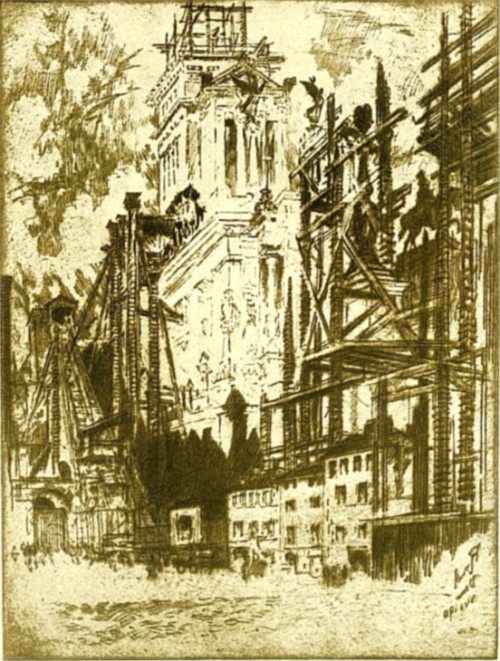
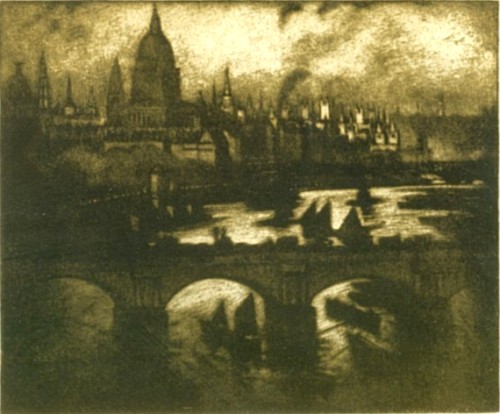 Mezzotint by Joseph Pennell
OUT OF OUR LONDON WINDOWS
The entertainment, if it can be called by so fine a name, always
retained something of the character of chance with which it began. We
sent out no invitations, we attempted no formality. Nobody was asked to
play at anything or to listen to anything. Nobody was expected to
dress, though anybody who wanted to could—everybody was welcome in the
clothes they wore, whether they came straight from the studio or a
dinner. If eventually I provided sandwiches—in addition to the tobacco
always at hand in the home of the man who smokes and the
whiskey-and-soda without which an Englishman cannot exist through an
evening—it was because I got too hungry not to need something to eat
before the last of the company had said good-night. We did not offer
even the comfort of space. Once the small dining-room that had been
Etty's studio, and the not over-large room that was J.'s, and the
nondescript room that was drawing-room and my workroom combined, were
packed solid, there was no place to overflow into except the short,
narrow entrance hall, and I still grow hot at the thought of what became
of hats and coats if it also was filled. I can never forget the
distressing evening when in the bathroom—which, with the ingenuity of
the designer of flats, had been fitted in at the end of the narrow hall
and was the reason of its shortness—I caught William Penn devouring the
gloves of an artist's wife who I do not believe has forgiven him to this
day; nor the still more distressing occasion when I discovered Bobbie,
William's poor timid successor,
curled up on a brand-new bonnet of
feathers and lace.
But it was the very informality, so long as it led to no crimes on the
part of our badly brought-up cats, that attracted the friends who were
as busy and hard-working as ourselves,—this, and the freedom to talk
without being silenced for the music that no talker wants to hear when
he can listen to his own voice, or for the dances that nobody wants to
watch if he can follow his own argument, or for the introductions that
invariably interrupt at the wrong moment, or for the games and
innumerable devices without which intelligent human beings are not
supposed to be able to survive an evening in each other's company. The
idle who play golf all day and bridge all night, who cannot eat in the
short intervals between without music, believe that talk has gone out of
fashion. My experience had been in Rome and Venice, was then in London,
and is now, that men and women who have something to talk about are
always anxious to talk about it, if only the opportunity is given to
them, and the one attraction we offered was just this opportunity for
people who had been doing more or less the same sort of work all day to
meet and talk about it all night—the reason why, despite
heat and
discomfort, despite meagre fare and the risk to hats and coats, Thursday
after Thursday crowded our rooms to suffocation as soon as evening came.
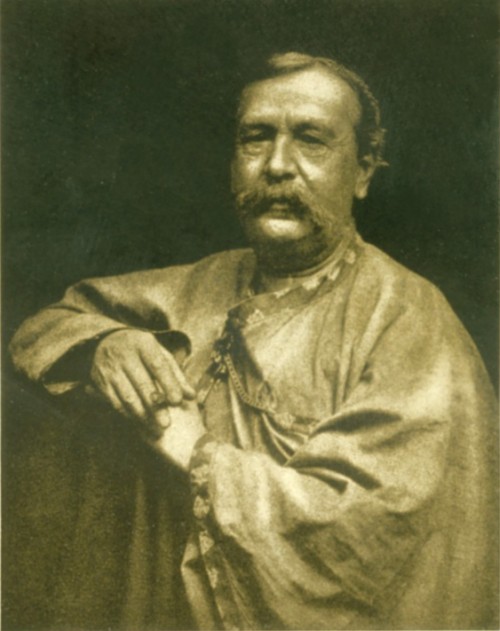
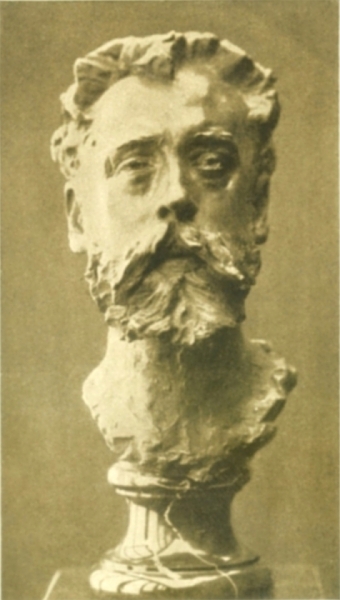 Bust by Rodin
W.E. HENLEY
As, in memory, I listen to the endless talk of our Thursday nights, the
leading voice, when not J.'s, is Henley's, which is natural since it was
Henley, followed by his Young Men,—our name for his devoted staff
always in attendance at his office and out of it,—who got so into the
habit of dropping in to see us on Thursday night that we got into the
habit of staying at home to see him. For Thursday was the night when the
National Observer, which he was editing at the time, went to press and
Ballantynes, the printers, were not more than five minutes away in
Covent Garden. At about ten his work was over and he and his Young Men
were free to do nothing save talk for the rest of the week if they
chose—and they usually did choose—and Buckingham Street was a handy
place to begin it in. Our rooms were already fairly well packed,
pleasantly smoky, and echoing with the agreeable roar of battle when
they arrived.
I like to remember Henley as I saw him then, especially if my quite
superfluous feeling of responsibility
as hostess had brought me on some
equally superfluous mission into the little hall at the moment of his
arrival. As the door opened he would stand there at the threshold, his
tall soft black hat still crowning his massive head, leaning on his
crutch and stick as he waited to take breath after his climb up our
three flights of stone stairs—"Did I really ever climb those stairs at
Buckingham Street?"—he asked me the last time I saw him, some years
later, at Worthing when he was ill and broken, and I have often
marvelled myself how he managed it. But breathless as he might be, he
always laughed his greeting. I cannot think of Henley as he was in his
prime, to borrow a word that was a favourite with him, without hearing
his laugh and seeing his face illuminated by it. Rarely has a man so
hampered by his body kept his spirit so gay. He was meant to be a
splendid creature physically and fate made of him a helpless
cripple—who was it once described him as "the wounded Titan"? Everybody
knows the story: he made sure that everybody should by telling it in his
Hospital Verses. But everybody cannot know who did not know him how
bravely he accepted his disaster. It seemed to me characteristic once
when a young cousin of mine, a girl at the most
susceptible age of
hero-worship, meeting him for the first time in our chambers and
volunteering, in the absence of anybody else available, to fetch the cab
he needed, thought his allowing her to go on such an errand for him the
eccentricity of genius and never suspected his lameness until he stood
up and took his crutch from the corner. There was nothing about him to
suggest the cripple.
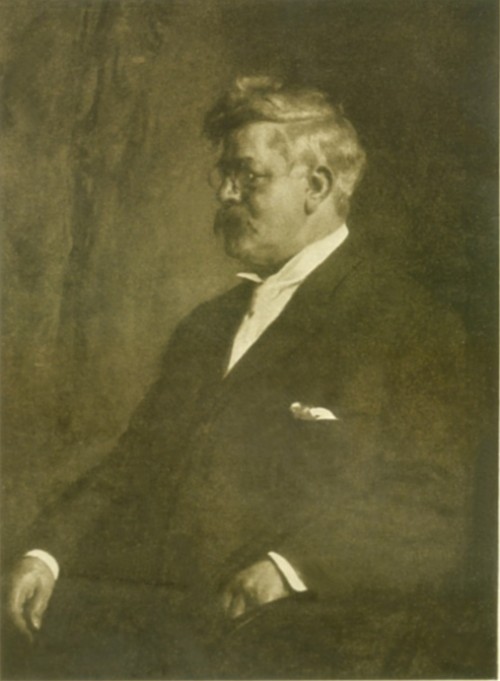
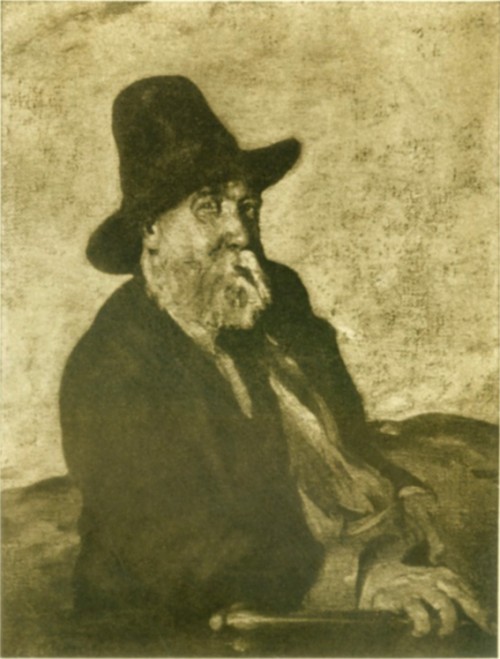 Painting by William Nicholson
W.E. HENLEY
He was a remarkably handsome man, despite his disability, tall and large
and fair, a noble head and profile, a shock of red hair, short red
beard, keen pale blue eyes, his indomitable gaiety filling his face with
life and animation, smoothing out the lines of pain and care. He was so
striking in every way, his individuality so strangely marked that the
wonder is the good portrait of him should be the exception. Nicholson,
when painting him, was a good deal preoccupied with the big soft hat and
blue shirt and flowing tie, feeling their picturesque value, and turned
him into a brigand, a land pirate, to the joy of Henley, whom I always
suspected of feeling this value himself and dressing as he did for the
sake of picturesqueness. Simon Bussy seemed to see, not Henley, but
Stevenson's caricature—the John Silver of Treasure Island, the
cripple with the
face as big as a ham. Even Whistler failed and never
printed more than one or two proofs of the lithograph for which Henley
sat. Rodin came nearest success, his bust giving the dignity and
ruggedness and character of head and profile both. He and Nicholson
together go far to explain the man.
Unfortunately there is no biography at all. Charles Whibley was to have
written the authorized life, but the world still waits. Cope Cornford
attempted a sketch, but scarcely the shadow of Henley emerges from its
pages. Because he thundered and denounced and condemned and slashed to
pieces in the National Observer, his contemporaries imagined that
Henley did nothing anywhere at any time save thunder and denounce and
condemn and slash to pieces and that he was altogether a fierce,
choleric, intolerant, impossible sort of a person. The chances are few
now realize that Henley was enough of an influence in his generation for
it to have mattered to anybody what manner of man he was. A glimpse of
him remains here and there. Stevenson has left the description of his
personality, so strong that he was felt in a room before he was seen.
His vigour and his manliness, survive in his work, but cannot quite
explain the commanding
power he was in his generation, while neither he
nor his friends have shewn, as it should be shewn, the other side to his
character, the gay, the kindly side, so that I feel almost as if I owed
it to his memory to put on record my impressions of my first meeting
with him, since it was only this side he then gave me the chance to see.
I wonder sometimes why I had never met Henley before. When J. and I came
to London he was editing the Magazine of Art, a little later he
managed the Art Journal, and in both he published a number of J.'s
drawings, and we had letters from him. We went to houses where he often
visited. I remember hearing him announced once at the Robinsons' in
Earl's Terrace, but Miss Mary Robinson, as she was then—Madame Duclaux
as she is now—left everybody in the drawing-room while she went to see
him downstairs, because, of his lameness she said, but partly, I
fancied, because she wanted to keep him to herself to discuss a new
series of articles. She had just "come out" in literature and was as
fluttered by her every new appearance in print as most girls are by
theirs in a ball-room. In other houses, more than once I just missed
him, I had never got nearer than business correspondence when he left
London to edit the Scots Observer
in Edinburgh, and he stayed there
until the Scots became the National Observer with its offices in
London.
I had heard more than enough about him in the meanwhile. The man who
says what he believes to be the truth—the man who sits in, and talks
from, the chair of the scorners—is bound to get himself hated, and
Henley came in for his fair share of abuse. As somebody says, truth
never goes without a scratched face.
But, like all men hated by the many, Henley inspired devotion in the few
who, in his case, were not only devoted themselves but eager to make
their friends devoted too. When he got back to London one of his Young
Men, whom I do not see why I should not call Charles Whibley, insisted
that J. and I must meet Henley first in the right way, that all our
future relations with him depended upon it, and that this right way
would be for him to ask Henley and ourselves, and nobody else, to dinner
in his rooms.
When the evening came J. was off on a journey for work and I went alone
to Fig-Tree House—the little old house, with a poor shabby London
apology of a fig-tree in front, on Milbank Street by the riverside,
which, with Henley's near Great College Street office round the corner,
has disappeared
in the fury of municipal town-disfigurement. A popular
young man, in making his plans, cannot afford to reckon without his
friends. Four uninvited guests, all men, had arrived before me, a fifth
appeared as I did, and he was about the last man any of the party could
have wanted at that particular moment—a good and old and intimate
friend of Stevenson's, whose own name I am too discreet to mention but
to whom, for reasons I am also too discreet to explain, I may give that
of Michael Finsbury instead. Whoever has read The Wrong Box knows that
Michael Finsbury enjoyed intervals of relaxation from work, knows also
the nature of the relaxation. I had struck him at the high tide of one
of these intervals. It was terribly awkward for everybody, especially
for me. I have got now to an age when I could face that sort of
awkwardness with equanimity, even with amusement. But I was young then,
I had not lived down my foolish shyness, and I would have run if, in my
embarrassment, I had had the courage,—would have run anyhow, I do
believe, if it had not been for Henley. He seized the situation and
mastered it. He had the reputation of being the most brutal of men, but
he showed a delicacy that few could have surpassed
or equalled under
the circumstances. He simply forced me to forget the presence of the
objectionable Michael Finsbury, who at the other end of the table, I
learned afterwards, was overwhelming his neighbours with a worse
embarrassment than mine by finding me every bit as objectionable as I
found him, and saying so with a frankness it was not in me to emulate.
The force Henley used with such success was simply his talk. He did not
let my attention wander for one minute, so full of interest was all he
had to say, while the enthusiasm with which he said it became
contagious. I can remember to this day how he made me see a miracle in
the mere number of the Velasquezes in the Prado, an adventure in every
hansom drive through the London streets, an event in the dressing of the
salad for dinner—how he transformed life into one long Arabian Nights'
Entertainment, which is why I suppose it has always been my pride that
his poem called by that name he dedicated to me. And so the evening that
began as one of the most embarrassing in my experience ended as one of
the most delightful, and the man whom I had trembled to meet because of
his reputation with those who did not know him or understand intolerance
in a just cause, won me over completely
by his kindness, his
consideration, his charm.
Henley delighted in talk, that was why he talked so well. On Thursday
night his crutch would be left with his big hat at the front door; then,
one hand leaning on his cane, the other against the wall for support, he
would hobble over to the chair waiting for him, usually by the window
for he loved to look out on the river, and there, seldom moving except
to stand bending over with both arms on the back of the chair, which was
his way of resting, and always with his Young Men round him, the talk
would begin and the talk would last until only my foolish ideas of
civility kept me up to listen. As a woman, I had not then, nor have I
yet, ceased to be astonished by man's passion for talking shop and his
power of going on with it forever. My explanation of this special power
used to be that the occupation supplied him by the necessity of keeping
his pipe or his cigarette or his cigar going, with the inevitable
interruptions and pauses and movement, and the excitement of the eternal
hunt for the matches, made the difference and helped to keep him
awake—there is nothing more difficult for me personally than to sit
still long when my hands are idle, unless I
am reading. But the women I
know who smoke are not men's equals in the capacity for endless talk and
the reason must be to seek elsewhere. He who divines it will have gone
far to solving the tedious problem of sex.
Of Henley the talker, at least, one portrait remains. He was the
original of Stevenson's Burly—the talker who would roar you down, bury
his face in his hands, undergo passions of revolt and agony, letting
loose a spring torrent of words. There was always a wild flood and storm
of talk wherever Henley might be. He and his Young Men were the most
clamorous group of the clamorous Nineties, though curiously their
clamour seems faint in the ears of the present authorities on that noisy
period. I have read one of these authorities' description of the London
of the Nineties dressed in a powder puff, dancing beneath Chinese
lanterns, being as wicked as could be in artificial rose-gardens. But
had Henley and his Young Men suspected the existence of a London like
that, they would have overthrown it with their voices, as Joshua
overthrew the walls of Jericho with his trumpets. To other authorities
the Nineties represent an endless orgy of societies—Independent Theatre
Societies, Fabian Societies, Browning Societies,
every possible kind of
societies—but the National Observer, with its keen scent for shams,
was as ready to pounce upon any and all of them for the good of their
health, and to upbraid their members as cranks. It was a paper that
existed to protest against just this sort of thing, as against most
other things in a sentimental and artificial and reforming and ignorant
world. It made as much noise in print as its editorial staff made in
talk. The main function of criticism, according to Henley, was to
increase the powers of depreciation rather than of appreciation, and
what a healthy doctrine it is! As editor, he roared down his opponents
no less lustily than he roared them down as talkers, and he had the
strong wit and the strong heart that a man must have, or so it is said,
to know when to tell the truth, which, with him, was always. He could
not stand anything like affectation, or what people were calling
æstheticism and decadence. To him, literature was literature and art was
art, and not puling sentiment, affected posturing, lilies and
sunflowers. The National Observer was the housetop from which he
shouted for all who passed to hear that it did not matter twopence what
the dabbler wanted to express if he could not express it, if he had not
the technique of his
medium at his fingers' ends and under his perfect
control. A man might indulge in noble and beautiful ideas, and if he did
not know how to put them in beautiful words or in beautiful paint or in
beautiful sound, he was anathema, to be cast into outer darkness where
there is gnashing of teeth—the doctrine of art for art's sake which the
advanced young leaders of the new generation assure me is hopelessly out
of date. Pretence of any kind was as the red rag; "bleat" was the
unpardonable sin; the man who was "human" was the man to be praised. I
would not pretend to say who invented this meaning for the word "human."
Perhaps Louis Stevenson. As far back as 1880, in a letter from Davos
describing the people "in a kind of damned hotel" where he had put up, I
find him using it as Henley and his Young Men used it later:
Eleven English Parsons, all
Entirely inoffensive; four
True human beings—what I call
Human—the deuce a cipher more.
Stevenson may even then have learned it from Henley. But however that
may have been, "bleat" and "human" were the two words ever recurring
like a refrain in the columns of the National Observer, ever the
beginning and end
of argument in the heated atmosphere of Buckingham
Street.
In my memory, every Thursday night stands for a battle. Henley was then
always at his best. His week's task was done, he was not due at his
house in Addiscombe until the next day, for he always stayed in his
Great College Street rooms from Monday to Friday—and the night was
before him. At first I trembled a little at the smell of powder under my
own roof, at turning our chambers into the firing line when friends came
to them to pass a peaceful friendly evening—the Roman and Venetian
cafés and restaurants of my earlier experience had been common ground
on which combatants shared equal rights or, better, no rights at all. It
was probably my old Philadelphia bringing up that made me question the
propriety of the same freedom at home, that made me doubt its being
quite "the thing" when J., who is an excellent fighter though a
Philadelphian, met Henley in a clash of words. But I quickly got
accustomed to the fight and enjoyed it and would not have had it
otherwise.
Some friends who came, I must confess, enjoyed it less, especially if
they were still smarting from a recent attack in the National
Observer. There were evenings when it took a good deal of
skilful
manœuvring on everybody's part to keep Henley and his victims at a
safe distance from each other. More than once in later days Walter Crane
laughed with us at the memory of a Thursday night, just after he had
been torn to pieces in the best National Observer style, when he
gradually realized that he was being kept a prisoner in the corner into
which he had been driven on his arrival, and he could not understand why
until, breaking loose, he discovered Henley in the next room. Our alarm
was not surprising, knowing as we did what a valiant fighter Crane was
himself: as a socialist waving the red flag in the face of the world, as
an artist forever rushing into the papers to defend his theories of art,
as a man refusing to see his glory in passing by an offence. Not very
long before, J. had exasperated him in print, by the honest expression
of an opinion he did not happen to like, into threats of a big stick
ready for attack the next time J. ventured upon his walks abroad. I need
not add that J. did not bother to stay at home, that the big stick never
materialized, that, though this was only the first of many fights
between the two, Walter Crane was our friend to the end. But the little
episode gives the true spirit of the Nineties.
I can still see Beardsley dodging from group
to group to escape Henley,
for he never recovered from the fright of the first encounter. He told
me the story at the time. He had gone, by special appointment, to call
on Henley, under his arm the little portfolio he was rarely without in
those early days, ready and enchanted as he always was to show his
drawings to anybody willing to look at them. As he went up the two
flights of stairs to Henley's Great College Street rooms, he heard a
voice, loud, angry, terrifying; at the top, through an open door, he saw
a youth standing in the middle of the room listening in abject terror to
a large red man at a desk whom he knew instinctively to be Henley;—one
glance, and he turned and fled, down the stairs, into the street, the
little portfolio under his arm, his pace never slackening until he got
well beyond the Houses of Parliament, through the Horse Guards into the
Park.
Other friends would not come at all on Thursday because of Henley, just
as later more than one stayed away altogether because of Whistler. I was
wretchedly nervous when they did come and brave a face-to-face meeting.
Henley was not the sort of man to shirk a fight in the open. The
principal reason for his unpopularity was just that habit of his of
saying what he
thought no matter where or when or to whom. He did not
spare his friends, for he would not have kept them as friends had they
not held some opinions worth his attacking, and they understood and
respected him for it. Moreover, he said what he had to say in the
plainest language. He roared his adversary down in good, strong,
picturesque English, if that was any consolation, and with a splendidly
rugged eloquence.
I wish I could remember the words as well as the roar. Henley's
eloquence cannot be forgotten by those who ever once listened to him,
but his wit was not, like Whistler's, so keen nor his thrust so direct
that the phrase, the one word of the retort or the attack, was
unforgettable. He had his little affectations of speech as of style, and
they added to its picturesqueness. But it was what he said that counted,
the talk itself that probably inspired more sound thought and sound
writing than most talk heard in the England of the Nineties. But it fell
unrecorded on paper and memory could not be trusted after all these
years.
It is the greater pity because his books are few. He was poor when he
started in life; almost at once he married; he was generous to a fault,
and the generous man never yet lived who was
not pursued by parasites;
and as he was obliged to earn money and as his books were not of the
stuff that makes the "best sellers," his criticism of life and art was
expressed mainly in journalism.
Unfortunately, no just idea of the amount or the quality of his
journalistic work is now to be had even from the files of the National
Observer. He had a way of editing every article sent in to him until it
became more than a fair imitation of his own. I can sympathize with his
object—the artist's desire for harmony, for the unity of the paper as a
whole. But if he succeeded, as he did, it was at the sacrifice of the
force, the effect, the character of individual contributions, and nobody
can now say for sure which were Henley's save those he re-published in
book form. When articles I wrote for him appeared in print, it was an
open question with me whether I had the right to call them mine and to
take any money for them. His Views and Reviews gathered from the
National Observer and other papers and periodicals, his three or four
small volumes of verse, the plays he wrote with Stevenson, an anthology
or two, a few books of his editing, are scarcely sufficient to explain
to the present generation his importance in his day and why his
influence
made itself felt in literature as keenly as Whistler's in
art, through all the movements and excitements and enthusiasms of the
Nineties. The joyous wars that marked the beginning of my life in
London, when not led by Whistler's "Ha! Ha!" were commanded by Henley's
roar.
No man was ever more in need of a Boswell than Henley. Dr. Weir Mitchell
once complained to me that in America nobody waited upon great men to
report their sayings, while in England a young man was always somewhere
near with a clean cuff to scribble them on. The enthusiast, with his
cuff an impatient blank, never hung about Henley. Anyway, that was not
what our Thursday evenings were for. Of all his Young Men who climbed up
the Buckingham Street stairs with him on Thursday night and sat round
him, his devoted disciples, until they climbed down the Buckingham
Street stairs with him again, not one seems to have hit upon this useful
way of proving his devotion.
I do not need to be told that this was no excuse for my not having my
cuff ready. But, foolishly perhaps, I too often spent my Thursday nights
oppressed by other cares. For one thing, I could seldom keep my weekly
article on Cookery out of my mind. Without it Saturday's Pall-Mall,
I
felt, would lose its brilliancy and my bank account, I knew, would grow
appreciably less, and Friday was my day for writing it. A serious
question therefore was, how, if I did not get to bed until two or three
or four o'clock on Friday morning, was I to sit down at my desk at nine
and be the brilliant authority on Eating that I thought I was?
Another distraction grew out of my mistaken sense of duty as hostess, my
feeling of responsibility in providing for all a share in the cheerful
smell of powder and the stimulating sound of strife.
Also, men being at best selfish animals, their wives, whose love of
battle was less, were often an anxiety.
These seemed big things at the time, though in retrospect they have
dwindled into trifles that I had no business to let come between me and
my opportunities to store up for future generations talk as brilliant as
any on record. Of course I heard a great deal of it, and what I missed
at home on our Thursday nights, I made up for at Henley's, and at
friends' houses on many other occasions, and few can answer better than
I for the quality of Henley's talk if I have forgotten the actual words.
Its strength was its simple
directness,—no posing, no phrasing, no
attitudinizing for effect. This, I know, was always what most struck
people when they first met him on our Thursday nights, especially
Americans, for with us in America the man who has won the reputation of
greatness too often seems afraid he will lose it if he does not forever
advertise it by fireworks of cleverness and wit.
Henley's talk had too a strange mixture of the brutal and the tender,
the rough and the fine, a blending of the highest things with what might
seem to the ordinary man the most trivial. I asked two old friends of
his the other day what they remembered best of him and of his talk. The
answer of one was: "He was certainly the most stupendous Jove-like
creature who ever lived, and I did not in the least mind his calling me
Billy, which I have always hated from others." The second answer was:
"He talked as he wrote, and I know of nothing more characteristic of his
talking and his writing than that tragic poem in which, with his heart
crying for the child he had adored and lost, he could compare himself to
'an old black rotter of a boat' past service, and could see, when
criticised for it, nothing discordant in that slang rotter dropped
into such verse!" A good deal of Henley is in
both answers. This
curious blend must have especially struck everybody who saw him and
listened to him in his own home. I can recall summer Sunday afternoons
at Addiscombe, with Henley sitting on a rug spread on the lawn behind
his house, Mrs. Henley at his side, his eyes following with twinkling
tenderness his little daughter as she ran backwards and forwards busy
with the manifold cares of childhood, while all the time, to his Young
Men gathered round him, he was thundering against the last book, or the
last picture show, or the last new music, in language not unworthy of
Defoe or Smollett, for Henley could call a spade not only a spade but a
steam shovel when so minded. He could soar to the heights and dive to
the depths in the same breath.
But Henley's talk was animated above all by the intense and virile love
of life that I was so conscious of in him personally, that reveals
itself in every line he wrote, and that is what I liked best about him.
He was so alive, so exhilarated with the sense of being alive. The
tremendous vitality of the man, that should have found its legitimate
outlet in physical activity, seemed to have gone instead into his
thought and his expression of it—as if the very fact that fate forced
him to remain a looker-on had made him the
more sensitive to the
beauty, the joy, the challenge in everything life gave him to look at.
He could wrest romance even out of the drear, drab hospital—there is
another characteristic glimpse in one of Stevenson's letters, a picture
of Henley sitting up in his hospital bed, his hair and beard all
tangled, "talking as cheerfully as if he had been in a King's palace, or
the great King's palace of the blue air."
His interest in life was far too large and all-embracing for him to be
indifferent to the smallest or most insignificant part of it. He had
none of the disdain for everyday details, none of the fear of the
commonplace that oppresses many men who think themselves great. Nothing
that lived came amiss to his philosophy or his pleasure. He could talk
as brilliantly upon the affairs of the kitchen as upon those of state,
he could appreciate gossip as well as verse, he could laugh over an
absurdity as easily as he could extol the masterpiece. Romance for him
was everywhere—in the slang of the cockney of the Strand as in a
symphony by Berlioz, in 'Arriet's feathers as in the "Don Diegos" of the
Prado—the mere sound of the title in his mouth became a tribute to the
master he honoured above most—in the patter of the latest Lion-comique
of the Halls as in the
prose of Meredith or Borrow, in the disreputable
cat stealing home through the dull London dawn as in the Romanticists
emerging from the chill of Classicism—in everything, big and little, in
which he felt the life so dear to him throbbing.
And he loved always the visible sign through which the appeal came. I
have seen him lean, spell-bound, from our windows on a blue summer
night, thrilled by the presence out there of Cleopatra's Needle, the
pagan symbol flaunting its slenderness against river and sky, while in
the distance the dome of St. Paul's, the Christian symbol, hung a
phantom upon the heavens. His pleasure in the friendship of men of rank
and family might have savoured of snobbishness had not one understood
how much they stood for to him as symbols. I am sure he could fancy
himself with these friends that same King of Babylon who thrills in the
lover of his poem. I used to think that for him all the drama of
Admiral Guinea, one of the plays he wrote with Stevenson, was
concentrated in the tap-tap of the blind man's stick. In his Hospital
Verses, his London Voluntaries, his every Rhyme and Rhythm, the
outward sign is the expression of the emotion, the thought that is in
him. And coming down to more ordinary matters—ordinary, that is, to
most people—I shall never forget, once when I was in Spain and he wrote
to me there, his decoration of my name on the envelope with the finest
ceremonial prefix of the ceremonious Spanish code which to him
represented the splendour of the land of Don Diego and Don Quixote.
It was this faculty of entering into the heart, the spirit of life and
all things in it that made him the inspiring companion and friend he
was, that widened his sympathies until he, whose intolerance was a
byword with his contemporaries, showed himself tolerant of everything
save sham and incompetence. The men who would tell you in their day, who
will tell you now, of the great debt they owe to Henley, are men of the
most varied interests, whose style and subject both might have been
expected to prove a great gulf to separate them. Ask Arthur Morrison
straight from the East End, or FitzMaurice Kelly fresh from Spain; ask
W.B. Blakie preoccupied with the modern development of the printed book,
or Wells adrift in a world of his own invention; ask Kipling steeped in
the real, or Barrie lost in the Kail-Yard; ask Kenneth Grahame on his
Olympian heights or George S. Street deep in his study of the prig—ask
any one of these men and a score besides what Henley's sympathy,
Henley's outstretched hand, meant to him, and some idea of the breadth
of his judgment and taste and helpfulness may be had. Why he could
condescend even to me when, in my brave ignorance, I undertook to write
that weekly column on Cookery for the Pall-Mall. He it was who gave me
Dumas's Dictionnaire de la Cuisine, the corner-stone of my collection
of cookery books—a fact in which I see so much of Henley that I feel as
if the stranger to him who to-day takes the volume down from my shelves
and reads on the fly-leaf the simple inscription, "To E.R.P. d.d.
W.E.H.," in his little crooked and crabbed writing, must see in it the
eloquent clue to his personality that it is to me.
I have said that Henley seldom came to us—as indeed he seldom went
anywhere or, for that matter, seldom stayed at home—without a
contingent of his Young Men in attendance. I do not believe I could ever
have gone to his rooms in Great College Street, or to his house at
Addiscombe, or in later, sadder days to the other, rather gloomy, house
on the riverside at Barnes,—turned into some sort of college the last
time I passed, with a long bare students' table in the
downstairs
dining-room where I had been warmed and thrilled by so much exhilarating
talk,—that some of his Young Men were not there before me or did not
come in before I left. In London, on his journeys to and fro, they
surrounded him as a bodyguard. If on those old Thursday nights, his was
the loudest voice, theirs played up to it untiringly. There were no half
measures about them. As warriors in the cause of art and literature,
they reserved nothing from their devotion to their leader, they
exhausted every possibility of that form of flattery usually considered
the greatest. They fought Henley's battles with hardly less valour,
hardly milder roaring. On Thursday, they had been working with him all
day and all evening, they probably had lunched together, and dined
together, and yet so far from showing any desire to separate on their
arrival in our rooms, they immediately grouped themselves again round
Henley.
It was curious, anyway, how strong the tendency was with all the company
to break up into groups. Work was the common bond, but there was also a
special bond in each different kind of work. On my round as hostess I
was sure to find the writers in one corner, the artists in another, the
architects in a third—though to this
day it is a question with me why
we should have had enough architects to make a group and, more puzzling,
why, having them, they should have been so unpopular, unless it was
because of their air of prosperity and respectability, always as correct
in appearance as if there was a possible client at the door. I can still
recall the triumphant glee, out of all proportion to the cause, of one
of Henley's Young Men the Thursday night he came to tell me that all the
architects were safe out of the way in the studio, and "I have shut both
doors," he added, "and now that we are rid of them we can talk." As if
any of Henley's Young Men under any circumstances ever did anything
else.
Some of Henley's staff, if I remember, never came to us, others came
only occasionally, but a few failed us as rarely as Henley himself. The
Thursday night was the exception that did not see Charles Whibley at
Henley's right hand even as he was in the pages of the National
Observer, not merely ready for the fight but provoking it, insisting
upon it, forcing it, boisterous in battle, looking like an
undergraduate, talking like a pastmaster of the art of invective, with a
little stammer that gave point to his lightest commonplace. Rarely
lagging very far behind came Marriott
Watson, young, tall, blonde,
good-looking—a something exotic, foreign in the good looks that I put
down to New Zealand, for I suppose New Zealand as well as America has
produced a type—not quite so truculent in talk as in print, more
inclined to fight with a smile. A third was Wilfred Pollock, forgotten
save by his friends I am afraid; and a fourth, Vernon Blackburn, who
began life as a monk at Fort Augustus and finished it as a musical
critic, he too I fear scarcely more than a name; and a fifth, Jack
Stuart, and a sixth, Harold Parsons, and a seventh, and an eighth, and I
can hardly now say how many more long since dead, now for me vague
ghosts from out that old past so overflowing with life.
When William Waldorf Astor bought the Pall Mall Gazette and started
the weekly Pall Mall Budget and the monthly Pall Mall Magazine, he
presented Henley with two or three new Young Men and added to our
company on Thursday nights, little as he had either of these
achievements in view. His plunge into newspaper proprietorship was one
of the newspaper ventures that counted for most in the Nineties. It was
a venture inclining to amateurism in detail, but run on business, not
romantic, lines and therefore it was less talked about than those
purely
amateur plunges into journalism which gave the Nineties so much
of their picturesqueness. But all the same, we saw revolution in it, the
possibility of wholesale regeneration, the inauguration of a new era,
when "sham" would be exposed, and "Bleat" silenced, and art grow "Human"
once more. In the Budget and the Magazine it was likewise to be
proved that America and France were not alone in understanding and
valuing the art of illustration:—vain hopes!
Henley and his Young Men rejoiced in a new sphere for fighting, certain
of a brilliant victory, since they were to have a share in the command.
Astor, with a fine fling for independence—his only one in public—or
else with that old gentlemanly dream of a newspaper "written by
gentlemen for gentlemen," had captured his editors in regions where
editors are not usually hunted—Henry Cust, heir to a title, for the
Gazette, Lord Frederick Hamilton, his title already inherited, for the
Magazine. Fleet Street shrugged its shoulders, laughed a little, not
believing title and rank to have the same value in journalism as in
society. Cust, to do him justice, agreed with Fleet Street, and, knowing
that he was without experience, had the sense to appeal for help to
those with it. By good luck he went to Henley,
who was not free to do
much for the paper save give it his advice, offer it those of his Young
Men whom he could spare, and take under his wing the new Young Men it
invented for itself. When new enthusiasts fell into Henley's train, it
was never long before they followed him to Buckingham Street on Thursday
nights.
I could scarcely label as anybody's Young Man Iwan-Müller, huge, half
Russian, half English, all good comrade, who had come up from Manchester
and the editorship of a leading paper there to be Cust's Assistant
Editor. He was nearly Henley's contemporary, but he did not, for such a
trifle as age, let any one of Henley's Young Men exceed him in devotion,
and his laugh became the unfailing accompaniment of Henley's talk, so
much so that I am convinced if Henley still leads the talk in the land
beyond the grave, Iwan-Müller still punctuates it with the big bracing
laugh that was as big as himself.
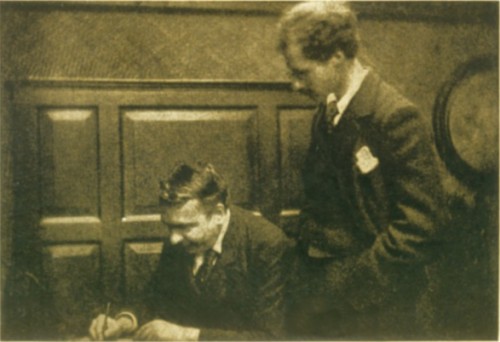 Photograph by Frederick Hollyer
IWAN-MÜLLER AND GEORGE W. STEEVENS
At the other extreme, younger than the youngest of the Young Men he
joined, came George W. Steevens, fresh from Oxford, Balliol Prize
Scholar, shy and carrying it off, in the Briton's way, with appalling
rudeness and more appalling silence. I remember J., upon whose nerves as
well as mine this silence got, taking me apart one
Thursday evening
to tell me that if that young Oxford prig was too superior to talk to
anybody, why then he was too superior to come to us at all, and he must
be made to understand it. Eventually he learned to talk, with us
anyway—he was always a silent man with most people. And I got to know
him well, to like him, to admire him,—to respect him too through the
long summer when his friends were doing their best to dissuade him from
his proposed marriage with a woman many years older than he. The men of
the National Observer and the Pall Mall were such keen fighters that
they could not be kind or sentimental—and they grew maudlinly
sentimental over Steevens's engagement—without a fight for it. They
thought he was making a mistake, forgetting that it was his business,
not theirs, if he was. He fought alone against them, but he held his
place like a man and won. Our Thursday nights had come to an end before
he went to America, to Germany, to Khartoum with Kitchener, to South
Africa, where he passed into the great silence that no protest of ours,
or any man's can break. If his work was overrated, he himself as I knew
him was as kind and brave as in Henley's verse to his memory.
Others of the same group, the writers' group,
who flit across the scene
in my memory are less intimately associated with Henley. Harold Frederic
wrote for him occasionally—wrote few things, indeed, more amusing than
his Observations in Philistia, a satire first published in the
National Observer—but his chief business was the novel and the New
York Times correspondence. He was an able man, something more than the
typical clever American journalist, a writer of books that deserve to be
remembered but that have hardly outlived him. He was an amusing
companion, the sort of man it was delightful to run across by chance in
unexpected places, for which reason my most agreeable recollections of
him are not in Buckingham Street but in the streets and cafés of
Berlin and Vienna that summer he was studying Jews in Southeastern
Europe, and first knew there were Jews in Vienna when J., who afterwards
began to study them for himself, introduced him to the Juden Gasse. He
liked a good dinner, and gave us more than one, and he was an amusing
talker over it and also on our Thursday nights until he got to the stage
he always did get to of telling tales of his boyhood when he carried
milk to the big people in his part of the Mohawk Valley, was dazzled by
his first vision of Brussels carpet on their floors, and
determined to
have Brussels carpet on his own before he was many years older, and I
can answer for it that, by the time I knew him, his house was all
Brussels carpet from top to bottom. They were most creditable tales and
entertaining too at a first hearing, but they staled, as all tales must,
with repetition.
S.R. Crockett never wrote anything for Henley. Henley would have been
outraged by the bare suggestion, and Crockett the writer was never
handled with the gloves by Henley's Young Men in the National
Observer. But with Crockett himself they had no quarrel. We all liked
him—a large red and white Scotchman, the Scots strong in every word he
spoke, hustling us all off for a fish dinner at Greenwich on the
strength of his first big cheque for royalties; or as happy to spend the
evening sitting on our floor and diverting William Penn with the ball of
paper on the end of a string that William never wearied of pursuing,
partly for his amusement, partly because, with his innate politeness, he
knew it contributed to ours.
I cannot imagine a Thursday night without Rosamund
Marriott-Watson,—Graham R. Tomson as she was then,—beautiful,
reminiscent of Rossetti in her tall, willowy slimness, with her
long
neck like a column and her great halo of black hair and her big brown
eyes, appealing, confinding, beseeching. Fashion as she, the poetess,
extolled it week by week in the National Observer, became a poem with
a stately measure in frocks and hats, a flowing rhythm in every frill
and furbelow. I lost sight of her later, for reasons neither here nor
there, but it pleases me to know that not many months before her death
she looked back to those years as her happiest when weekly, almost
daily, she was going up and down the Buckingham Street stairs which her
ghost, she said, must haunt until they go the way of too many old stairs
leading up to old London chambers. Violet Hunt was almost as faithful.
And both contributed, as I did, a weekly column—mine that amazing
article on cookery—to the Pall Mall's daily Wares of Autolycus,
daily written by women and I daresay believed by us to be the most
entertaining array of unconsidered trifles that any Autolycus had ever
offered to any eager world. Graham Tomson was even moved to commemorate
our collaboration in verse the inspiration of which is not far to seek,
but of which all I remember now is the beginning:
O, there's Mrs. Meynell and Mrs. Pennell,
There's Violet Hunt and me!
for Mrs. Meynell contributed a fourth column, though she never
contributed her presence to Buckingham Street.
Once or twice, George Moore hovered from group to group, his childlike
eyes of wonder protruding, wide open, and his ears open too, no doubt,
for, if I can judge from his several books of reminiscences, his ears
have rarely been closed to talk going on about him. After reading the
Irish series I should suspect him not only of well-opened ears but of an
inexhaustible supply of cuffs safely stored up his sleeves. Bernard Shaw
honoured us occasionally, but I have learned that, bent as he is upon
talking about himself, whatever he has to say, he grows more fastidious
when others talk about him and say what they have to. Now and then,
Henry Norman, journalist, his title and seat in Parliament yet to come,
dropped in. Now and then Miss Preston and Miss Dodge came, both in
London to finish in the British Museum the studies begun in Rome. Rarely
a week passed that James G. Legge was not with us, then deep in his work
at the Home Office but full of joy in everything that was most joyful in
the Nineties—its fights, its books, its prints, its posters. And I
might name many besides, some forgotten, some dead, some seen no
more
by me, life being often more cruel than death in the separations and
divisions it makes. But two voices above the others are almost as
persistent in my ears as Henley's—the voices of Bob Stevenson and Henry
Harland.
I have no fancy for nicknames in any place or at any time. I have
suffered too much from my own. But I dislike the familiarity of them
above all in print. And yet, I could no more call Bob Stevenson anything
save Bob than I could venture to abbreviate the Robert or the Louis of
his cousin. He had been given in baptism a more formal name—in fact, he
had been given three of unquestioned dignity: Robert Alan Mowbray. But I
doubt if anybody had ever known him by them or if he had ever used them
himself. When he wrote he signed his fine array of initials, and when he
was not R.A.M.S., he was Bob.
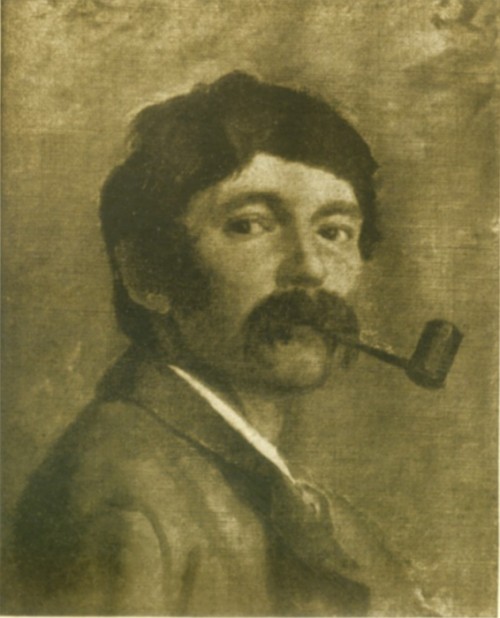 Painting by Himself
"BOB" STEVENSON
It seems to me now a curious chance, as well as a piece of good luck,
that the two most eloquent of the company in Louis Stevenson's Talk and
Talkers should have come to us on our Thursday nights, for Bob was the
Spring-Heeled Jack, "the
loud, copious, and intolerant talker" of
that essay just as Henley was the Burly.
He was not more spring-heeled in his talk than in evading capture for
it. In his later years he made few visits. If we wanted him we had to
gather him up by the wayside and bring him home with us. The newspaper
work I was doing then took me the rounds of the London galleries on
press days and, as he was the art critic of the Pall Mall, I was
continually coming across him busy about the same work in Bond Street or
Piccadilly. Nothing pleased me better than to meet him on these
occasions, for he could make the dull show that I, in my dull way, was
finding dull the most entrancing entertainment in London. His every
visit to a gallery was to him an adventure and every picture a romance,
and the best of it for his friends was that he would willingly share the
inspiration which he, but nobody else, could find in the most
uninspiring canvas, an inspiration to criticism that is, not to
admiration—he never wavered in his allegiance to the "Almighty Swells"
of Art. Once he began to talk I did not care to have him stop, and I
would say, "Why not come to Buckingham Street with me? You have not seen
J. for a long while." He would vow he couldn't, he must get back to
Kew
to do his article. I would insist a little, he would waver a little, and
at last he would agree to a minute's talk with J., excusing himself to
himself by protesting that Buckingham Street was on his way to the
Underground, as it was if he chose to go out of his way to make it so.
Before he knew it, the minute had stretched out to our dinner hour when
he was persuaded that he would save time by dining with us, as he must
dine somewhere; if he went right afterwards, he could still be back at
Kew in plenty of time to finish his article for the last post.
Of course he never did go right afterwards—what talker ever did go
right anywhere immediately after dinner when the real talk is only
beginning? Presently people would filter in and now, well adrift on the
flood of his own eloquence, nothing could interrupt him and he was the
last to leave us, the later it grew the more easily induced to stay
because he knew that the last train and the last post and all the last
things of the day had gone and that he must now wait for the first
things of the morning.
If I could talk like Bob Stevenson I would not be interrupted either.
Greater excitement could not be had out of the most exciting story of
adventure, and I do not believe he knew until
he got to the end any
more where his talk was going to lead him than the reader knows how the
story is going to turn out until the last chapter is reached. Louis
Stevenson described certain qualities of his talk, but made no effort to
give the talk itself, and in Bob's case, as in Henley's, it was the talk
itself that counted. There was no acting in it as in Henley's or in
Whistler's—no burying of his head in his hands and violent gestures—no
well-placed laugh and familiar phrase. The talk came in a steady stream,
laughter occasionally in the voice, but no break, no movement, no
dramatic action—the sanest doctrine set forth with almost insane
ingenuity, for he was always the "wild dog outside the kennel" who
wouldn't imitate and hence kept free, as Louis Stevenson told him;
extraordinary things treated quite as a matter of course; brilliant
flashes of imbecility passed for cool well-balanced argument; until
often I would suddenly gasp, wondering into what impossible world I had
strayed after him. And he would tell the most extravagant tales, he
would confide the most paradoxical philosophy, the most topsy-turvy
ethics, with a fantastic seriousness, never approached except in the
Arabian Nights of Prince Florizel for the puppets of whose adventures,
as for Spring-Heeled Jack, he was the sitter. It was a delightful
accomplishment, but dangerous when applied to actual life. I cannot
forget his advice once to a friend on the verge of a serious step that
might sink him into nobody could foretell what social quagmire. Bob
could see in it only the adventure and the joy of adventure, not the
price fate was bound to demand for it. To him the mistake was the unlit
lamp, the ungirt loin—the adventure lost—and, life being what it is, I
am not sure that he was not right.
I think his talk struck me as the more extraordinary because he looked
so little like it. In the Nineties he had taken to the Jaegers that
usually stand for vegetarianism, teetotalism, hygiene—all the drab
things of life. He wore even a Jaeger hat and Jaeger boots—as complete
an advertisement for Jaeger as old Joseph Finsbury was for his Doctor.
No costume could have seemed so altogether out of character with the
fantastic, delightful, extravagant creature inside of it, though,
really, none could have been more in character. It had always been Bob's
way to play the game of life by dressing the part of the moment. Before
I met him I had been told of his influence over Louis Stevenson, whose
debt to him for ideas and conceits was said to be immeasurable, and
nobody who knew Bob has doubted it. I feel convinced that Louis owed to
him also his touch of the fantastic, the unusual, in dress, since it
belonged so entirely to Bob and was no less entirely in keeping with his
attitude towards the universe and his place in it—his tendency of
always probing the real for the romantic.
Knowing one cousin and the books of the other, I should say it was Bob
who, in their childhood, originated the drama of the Lantern-Bearers and
the evil-smelling lantern under the great coat, symbol of adventure and
daring—that it was Bob who, in their gay youth, evolved the black
flannel shirts to which they owed the honour of being, with Lord
Salisbury, the only Britons ever refused admission to the Casino at
Monte Carlo, and which were worn by the Stennis Brothers in The
Wrecker,—that it was Bob who impressed upon Louis the importance of
being dressed for the scene until he surpassed himself in his amazing
get-up for the Epilogue to an Inland Voyage. Bob's own disguises
rarely got into print, but in Will Low's Chronicle of Friendships
there is a photograph of him in his student days, figuring as a sort of
brigand of old-fashioned comic opera, that shows he did not from the
beginning
shirk the obligations he imposed upon others. I remember a
huge ring, inherited from his father to whom the Czar had given it for
engineering services in Russia, which he kept for formal occasions so
that when I saw it covering his finger, almost his hand, at the dinner
to which we had both been invited, I understood that to him the occasion
was one of ceremony and he never failed to regulate his conduct
accordingly. I was glad the ring did not appear on our Thursday nights,
so much freer of formality, and therefore more amusing, was he without
it. The large perfection of his Jaegers in his last years was no less
symbolic; in them he was dressed for the rôle of middle age which he,
who had the gift of eternal youth, had already reached when I first knew
him. It was a rôle to which, at the time, I attributed his concern about
his health—his anxiety to know if we, any of us, had influenza before
he would come home with me, his rush from the room or the house at a
sniff or a sneeze. The truth is Bob shared Henley's love of the visible
sign, or it may be nearer the truth to say that he shared his own love
of it with Henley and his cousin who rarely, either of them, wrote
anything in which it is not felt.
But Henley loved the visible sign for itself—the
romance was actually
in the tap-tap of the blind man's staff, in the pagan obelisk towering
above the Christian river. Bob loved the visible sign for the hint it
gave to his imagination, the adventure upon which it sent him galloping.
He could build up a romance out of anything and nothing—he was the
modern Scheherezade, but, as time went on, with nobody to repeat his
stories. He could have made the fortune of any number of young men with
their cuffs ready, but the only young man who ever did use his cuff was
Louis Stevenson when they were young together. Bob had not the energy to
put down his stories himself—he would not have written a word for
publication had he not been forced to. For him the romance would have
been lost in the labour of recording it, and, anyway, he was always
consistent in not doing more work than he was obliged to in order to
live. He had not the talent for combining, or identifying, his pleasure
with his work. Painting was the profession for which he had been
trained, but with it he amused himself and, as far as I know, never made
a penny out of it. When he talked he would have lost his joy in the
invention, the fabrication, had he thought he must turn it to profit. Of
the curious twist of his imagination there remains but the
faint
reflection here and there in Prince Florizel and the romantic
adventurers swaggering and talking splendid nonsense through the earlier
tales by Louis Stevenson, whose books grew less and less fantastic as
his path and Bob's spread wider apart. Even in the earlier tales Bob
will not be discovered by future generations who have lost the key.
For the sake of posterity, if not for my own, I would have been wiser on
Thursday nights to think less of my next morning's article than of his
inventions. As it is, I retain merely a general impression and an
occasional detail of his talk. I am glad I remember, for one thing, his
unfailing prejudice in favour of his friends, so amiable was the side of
his character it revealed—though it revealed also his weakness as
critic. He had a positive genius for veiling prosaic facts with romance
where the people he liked were concerned. How often have we laughed at
his amiability to a painter of the commonplace who had happened to be
his fellow-student in Paris, whose work, as a consequence, his friendly
imagination filled with the fine things that to us were conspicuously
missing, and whose name he dragged into every criticism he wrote, even
into his Monograph
on Velasquez, nor could he be laughed, or argued out
of it.
And I am glad I remember another trick of his imagination, though it was
like to end in disaster for us all, so equally characteristic was it of
his genius in weaving romance from prose. He was talking one evening of
wine, upon which he had large—Continental—ideas, declaring he would
not have it in his house unless all his family, including the servants,
could drink it without stint and also without thought of
expense—though, if I am not mistaken, his household staff consisted
chiefly of a decent old Scotchwoman who would have scorned wine as a
device of the foreigner. The triumphant ring of his voice is still in my
ears as he announced that he had found a merchant who could provide him
with just the wine he wanted, good, pure, light, white or red, an
ordinary brand for sevenpence a bottle, a superior brand for eightpence.
The marvel of it all was that we believed in that wine and when the
company left for home, the merchant's address was in almost everybody's
pocket. It was not a bad wine in the sample bottles J. and I received a
day or two later, nothing much to boast of, but harmless. For the
further cheapness promised we next ordered it
by the case, one of red
and one of white—a rare bargain we thought. But in the end it was the
most expensive wine it has ever been our misfortune to invest in. For
when it came in cases it was so potent that nobody could drink as much
as a glass without going to sleep. I never had it analyzed, but, after a
couple of bottles, I did not dare to put it on the table again, or to
use it even for cooking or as vinegar. To balance our accounts, we did
without wine of any kind, or at any price, for many a week to come. But
we had our revenge. In the course of a few months Bob's wine merchant
was summoned before the magistrate for manufacturing Bordeaux and
Burgundies out of Greek currants and more reprehensible materials in the
backyard of his unpretending riverside house, and it was one of our
Thursday night fellow victims who had the pleasure of exposing him in
the Daily Chronicle. Bob did not share our resentment. He had his
pleasure in the charm his imagination gave to every drop of the few
bottles he drank and managed not to die of.
I began to notice in the galleries and on Thursday nights that Bob
became more and more engrossed in the question of his health and quicker
to fly at a sniff or a sneeze. The time came when
no persuasion could
bring him home with me. He described symptoms rather than pictures, his
interest in anything in the shape of paint weakened. I fancied that he
was romancing, that he was playing the hypochondriac as part of his rôle
of middle-age, and I thought it a pity. It might provide a new
entertainment for him, but it deprived us of the entertainment of his
company. Then I hardly met him at all, or if I did he was too nervous to
linger before each painting or drawing, to gossip about it and
everything under the sun. He would walk through the galleries with one
leg dragging a little—the visible sign, I would say to myself, amused
to see that he could turn romance into reality as easily as reality into
romance. He would start for Kew right off, without any loitering,
without any delicious pretending that he was going in the very next
train and then not going until the very next train meant the very next
day. But before long I learned that there was no romance about it, that
it was grim reality, the grimmer to me because I had taken it so
lightly. His illness was mere rumour at first, for few people went to
his house in far Kew to see him. It was more than rumour when he ceased
altogether to appear in the galleries, for we knew he was dependent
upon
art criticism for his butter, if not for most of his bread. I had
not got as far as belief in his illness before the news came that he had
set out upon the greatest adventure of all and that no more would
Buckingham Street be transfigured in the light of his romancing,
glorified by his inexhaustible fancy. I owed him much: the charm of the
personality of "this delightful and wonderful creature" in Henley's
words of him, pleasure from his talk, stimulus from his criticism, and I
wish I had had the common sense to do what I could to make him live as a
pleasure and a stimulus to others. My mistake on our Thursday nights was
to keep my cuff clean, my note-book empty.
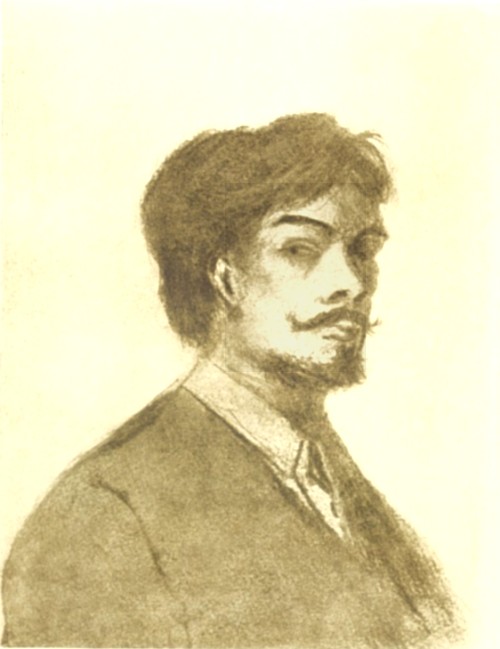 Sketch by Aubrey Beardsley
HENRY HARLAND
In the case of Henry Harland my conscience makes me no such reproach. If
ever a man became his own Boswell it was he, though I do not suppose
anything was further from his mind when he sat down to write. But as he
talked, so he wrote—he could not help himself—and all who have read
the witty, gay, whimsical, fantastic talk of his heroes and heroines,
especially in his last three books, have listened to him. He, no less
than his Adrian Willes—even if quite another man was the model—never
understood
how it was possible for people to be bored. Flaubert once
said in a letter, "Life is so hideous that the only way of enduring it
is to avoid it." But Harland believed in plunging into it headlong and
getting everything that is to be got out of it. He had eyes to see that
"life is just one sequence of many-coloured astonishments", and the
colours were the gayer when he came to our Thursday nights because he
was still so young.
He and Mrs. Harland had been in London only a few years, his career as
Sydney Luska was behind him, his career as Henry Harland was before him,
he was full of life, energy, enthusiasm, deep in long novels, busy for
the Daily Chronicle, writing as hard as he talked, and he talked every
bit as hard as Bob Stevenson.
Like Bob, he seemed to love talk more than anything, but he must have
loved work as Bob never loved it, for he put the quality of his talk
into what he wrote. Bob Stevenson's writing never suggested his talk. I
might find his point of view and his amiable prejudices in his criticism
and his books—only he could have written his Velasquez quite as he
wrote it—but nowhere do I find a touch, a trace of the Lantern-Bearer
or Prince Florizel or the Young Man with the Cream Tarts. But I never
get far away from Harland
in his novels. I re-read them a short time
ago, and they were a magic carpet to bear me straight back to Buckingham
Street, and the crowded, smoky rooms overlooking the river, and the old
years when we were all young together.
A delightful thing about Harland was that he did not care to monopolize
the talk, to talk everybody else down. On the contrary, I doubt if he
was ever happier than when he roused, provoked, stimulated everybody to
talk with him. I remember in particular an evening when J. and I were
dining with him and Mrs. Harland at their Kensington flat, and Mr. and
Mrs. Edmund Gosse were there, and Mr. and Mrs. W.J. Fisher—Fisher was
then editor of the Daily Chronicle and Mrs. Fisher was still Adrienne
Dayrolles on the stage—and Louis Austen, a handy man of journalism, and
when, happening to turn for a minute from Harland by whom I was sitting,
and to look round the table, I found I was the only one of the party not
talking—and we had got no farther than the fish! But I flatter myself I
have few rivals as an accomplished listener.
Often Harland had the floor to himself simply because everybody else
wanted to listen too. When what he calls in one of his books "the
restorative spirit of nonsense" descended upon
him, his talk could
whisk off the whole Thursday night crowd, before they knew it, to that
delectable Land of Nonsense to which he was an inspired guide. Nobody
understood better how to set up the absurd and the impossible in the
garb of truth. An old admirer of his reminded me not long since of a
tale he used to tell, almost with tears in his voice, of the petit
patissier who was hurrying through the streets of Paris to deliver
brioches and tarts to customers and who, crossing the Boulevards, was
knocked down by a big three-horse omnibus. And as the crowd collected
and the sergent-de-ville arrived, he was seen painfully and
deliberately freeing his one uninjured arm, feeling carefully in pocket
after pocket, and, as he drew his last breath, holding up triumphantly
the exact number of francs the Parisian on foot then had to pay for
venturing rashly to get in the way of the Paris driver. And Harland told
it all with such eloquence that it was some minutes before those who
listened realised he was laughing and began to laugh with him. And the
tale was typical of many others he loved to tell. As his talk led the
way to the Land of Nonsense, so he himself could of a sudden whirl us
all off to a restaurant, or a park, or an excursion we had not thought
of an hour, a
minute before. Many a time, instead of sitting solemnly
at home reading or working as we had meant to, we would be going down
the river in a penny steamboat, or drinking coffee at the Café Royal
or tea in Kensington Gardens—but Harland as an inspired guide was at
his best in Paris I always thought, perhaps because in Paris he had so
much larger scope than in London.
He impressed one as a man who never tired, or who never gave in to being
tired, either at work or at play—a man who, knowing his days would be
few on this earth, found each fair as it passed and, if he could not bid
it stay, was at least determined to fill it as full as it would hold.
There was no resisting his restless energy when with him, and it was
because he could so little resist it himself, that he was continually
seeking new outlets—new forms for its expression. He had just the
temperament to take up with the mode of the Nineties that drove the
Young Men to asserting themselves and upholding their doctrines in
papers and magazines of their own. The pedant may trace the fashion back
to the Hobby-horse of the Eighties, or, in a further access of
pedantry to the Germ of the early Fifties. He may follow its growth as
late as the Blast of yesterday and The Gypsy of to-day. But I do
not have to go further than my book shelves, I have only to look and see
there the Dial and the Yellow Book and the Savoy and the
Butterfly and the Pageant and the Dome and the Evergreen, each
with its special train of memories and associations, and I know better
than the greatest pedant of them all that the fashion, no matter when it
began, no matter when it may end, belongs as essentially to the Nineties
as the fashion for the crinoline belongs to the Sixties. Harland was not
original in wanting to set up a pulpit for himself—the originality was
in the design for it. The Yellow Book was not like any other quarterly
from which any other young man or group did his preaching.
Harland shared his pulpit. He would not have found the same design for
it without Beardsley, nor would our Thursday nights, where a good deal
of that design was thought out and talked out, have been the same
without Beardsley. I would find it hard, even had there been no Yellow
Book, not to remember Harland and Beardsley together. For it was from
Mrs. Harland that we first heard of the wonderful youth, unknown still,
an insignificant clerk in some In
surance Company, who made the most
amazing drawings—it was she who first sent him to us that J. might look
at his work and help him to escape from the office he hated and from the
toils of Burne-Jones and the Kelmscott Press in which he was entangled.
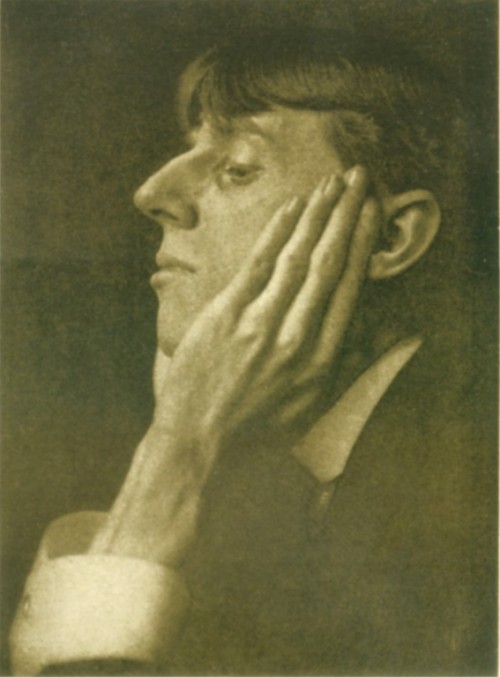 Photograph by Frederick H. Evans
AUBREY BEARDSLEY
He came, the first time, one afternoon in the winter dusk—a boy, tall
and slight, long narrow pale clean-shaven face, hair parted in the
middle and hanging over his forehead, nose prominent, eyes alight,
certain himself of the worth of his drawings, too modest not to fear
that other artists might not agree with him. The drawings in his little
portfolio were mostly for the Morte d' Arthur, with one or two of
those, now cherished by the collector, that have a hint of the Japanese
under whose influence he momentarily passed. J. enjoys the reputation,
which he deserves, of telling the truth always, no matter how unpleasant
to those to whom he tells it. Truth to Beardsley was pleasant and his
face was radiant when he left us. J. has also the courage of his
convictions, and all he said to Beardsley he repeated promptly to the
public in the first number of The Studio, a magazine started not as a
pulpit but as a commercial enterprise—started, however, at the right
moment to be kindled into life and steered toward success by the
enthusiasm and the energy of the Young Men of the Nineties.
Beardsley was bound to become known whether articles were written about
him or not. But J.'s was the first and made recognition come the sooner.
The heads of many young men grow giddy with the first success; at the
exultant top of the winding stair that leads to it, they no longer see
those who gave them a hand when they balanced on the lowest rung. But
Beardsley was not made that way. He kept his head cool, his eyesight
clear. He never forgot. Gratitude coloured the friendship with us that
followed, even in the days when he was one of the most talked about men
in London. He knew that always by his work alone he would be judged at
Buckingham Street, and to J. he brought his drawings and his books for
criticism. He brought his schemes as well, just as he brought the youth
not only of years but of temperament to our Thursday nights. He came
almost as regularly as Henley and Henley's Young Men, adding his young
voice to the uproar of discussion, as full of life as if he too, like
Harland, grudged a minute of the years he knew for him were counted. In
no other house where it was my pleasure to meet him did he seem to me to
show to such advantage. In his own home I thought him overburdened by
the scheme of decoration he had planned for it. In many houses to which
he was asked he was amiable enough to assume the pose expected of him.
The lion-hunters hoped that Beardsley would be like his drawings.
Strange, decadent, morbid, bizarre, weird, were adjectives bestowed upon
them, and he played up to the adjectives for the edification or
mystification of the people who invented them and for his own infinite
amusement. But with us he did not have to play up to anything and could
be just the simple, natural youth he was—as simple and natural as I
have always found the really great, more interested in his work than
most young men, and keener for success.
I like to insist upon his simplicity because people now, who judge him
by his drawings, would so much rather insist upon his perversity and his
affectation. How can you reconcile that sort of thing with simplicity?
They will ask, pointing to drawings of little mocking satyrs and twisted
dwarfs and grotesques and extravagant forms and leering faces and a
suggestion of one can hardly say what. But it might as well be asked why
the mediæval artist delighted to carve homely, familiar scenes and
incidents, and worse, in the holiest places, to lavish his ingenuity
upon the demons and devils above the doors leading into his great
churches; why a philosopher like Rabelais chose to express the wisest
thought in the most indecent fooling; why every genius does not look out
upon life and the world with the same eyes and find the same method to
record what he sees. Some men can only marvel with Louis Stevenson at
the wide contrast between the "prim obliterated polite face of life" and
its "orgiastic foundations"; others are only reconciled to it by the
humour in the contrast or by the pity invoked by its victims. What makes
the genius is just the fact that he looks out upon life, that he feels,
that he uses his eyes, in his own way; also, that he invents his own
methods of expression. Beardsley saw the satire of life, he loved the
grotesque which has so gone out of date in our matter-of-fact day that
we almost forget what it means, and no doubt disease gave a morbid twist
to his vision and imagination. But, above all, he was young, splendidly
young: young when he began work, young when he finished work. He had the
curiosity as to the world and everything in it that is the divine right
of youth, and he had the gaiety, the exuberance, the flamboyancy, the
fun of the youth destined to do and to triumph. Already, in his later
work, are signs of the passing of the first youthful stage of his art.
It is suggestive to contrast the conventional landscapes with the
grinning little monstrosities in some of the illustrations for the Rape
of the Lock; the few drawings for his Volpone have a dignity he had
not hitherto achieved.
Nobody can be surprised if some of the gaiety and exuberance and fun got
no less into his manner towards the people whose habit is to shield
their eyes with the spectacles of convention. Beardsley had a keen sense
of humour that helped him to snatch all the joy there is in the old,
time-honoured, youthful game of getting on the nerves of established
respectability. Naturally, so Robert Ross, his friend, has said of him,
"he possessed what is called an artificial manner"; that is, his
manner was called affected, as was his art, because it wasn't exactly
like everybody else's. I have never yet come across the genius whose
manner was exactly like everybody else's, and shyness,
self-consciousness, counted for something in his, at least at the start.
He had only to exaggerate this manner, or mannerism, to set London
talking. It was the easier because rumours quickly began to go about of
the darkened room in which he worked, of his turning night into day and
day into night like Huysmans's hero, and of this or of that strange
habit or taste, until people began to see all sorts of things in him
that weren't there, just as they read all sorts of things into his
drawings that he never put into them, always seeking what they were
determined to find. To many there was uncanniness in the very extent of
his knowledge, in his wide reading, in his mastery of more than one art,
for, if he had not been an artist, he most assuredly would have been a
musician or a writer. Added to all this, was the abnormal notice he
attracted almost at once, the diligence with which he was imitated and
parodied and the rapidity with which a Beardsley type leaped into
fashion.
Of course Beardsley enjoyed it. What youth of his age would not have
enjoyed the excitement of such a success? It would have been morbid at
his age not to enjoy it. He never seemed to me more simply himself than
when he was relating his adventures and laughing at them with all the
fresh, gay laughter of the boy—the wonderful boy—he was. Arthur Symons
wrote of him, I have forgotten where, that he admired himself
enormously. I should say that he was amused by himself enormously and
was quite ready to pose and to bewilder for the sake of the amusement
it brought him. He was never spoiled nor misled by either his fame or
his notoriety.
It was so Beardsley's habit to consult J. that he would have asked
advice, if Harland had not, for The Yellow Book which went through
several stages of its preliminary planning in the old Buckingham Street
chambers. Among the vivid memories of our Thursday nights one is of
Harland taking J. apart for long, intimate discussions in a corner of
the studio, and another of Beardsley taking him off for confidences as
intimate and long, and my impression in looking back, though I may be
mistaken, is that each had his personal little scheme for a journal of
his own before he decided to share it with the other. It was
characteristic of the friendliness of both that they should have
insisted upon J. figuring in the first number. As vivid in my memory is
the warm spring morning when Beardsley, his face beaming with joy,
called to give me an early copy of this first number, with a little
inscription from him on the fly-leaf—I have just taken down the volume
from the near book shelf—"To Mrs. Pennell from Aubrey Beardsley" I
read, as commonplace an inscription as ever artist or author wrote, but,
reading it, I see as if it were yesterday the sunlit Buckingham Street
room where I used to work, William Penn curled up on my desk, and,
coming in the door, the radiant youth with the gay-covered book in his
hands.
And there followed the dinner—the amazing dinner as unlike the usual
formal dinner of inauguration as could be. It was given in an upper room
of the Hotel d'Italie in Old Compton Street and was as free of ceremony
as our Thursday nights. The men were in dress suits or tweeds as they
chose, the women in evening or tailor gowns according to their
convenience. I have an impression that more people came than were
expected and that it was all the waiters could do to serve them. I know
I was much more concerned with my discomfort to find that Harland and
Beardsley, for the first time in my experience, had forgotten how to
talk. Everybody else was talking. I can still see the animated faces and
hear the animated voices of Mrs. Harland and John Oliver Hobbes and
Ménie Muriel Dowie and Kenneth Grahame and George Moore and John Lane
and Max Beerbohm, and all the brand-new writers prepared to shock, or to
"uplift," or to pull down old altars and set up new ones, or any other
of the fine things that were to make the Yellow Book a force and
famous. But also I can still feel the heavy, unnatural silence of the
two editors from which I was the chief sufferer, to me having fallen
the honour of sitting in the centre of the high table between them. J.
was away and, in his absence, I was distinguished by this mark of
Beardsley's appreciation and Harland's friendliness. I was greatly
flattered, but less entertained. They were both as nervous as débutantes
at a first party. Shrinking from the shadow cast before by their coming
speeches, neither of them had as much as a word to throw me. Nor could
they concentrate their distracted thoughts upon the menu—plate after
plate was taken away untouched, while I kept on emptying mine in
self-defence, to pass the time, wondering if, in my rôle of the Pall
Mall's "greedy Autolycus," my friends would now convict me of the sin
of public eating as well as what they had been pleased to pretend was my
habit of "private eating," for not otherwise, they would assure me,
could they account for the unfailing flamboyancy of my weekly article on
cookery. Seated between the two men, in their hours of ease when they
were not editors, my trouble would have been to listen to both at the
same moment and to get a word in edgewise. However, when the speeches
were over the strain was relaxed. The evening ended in the accustomed
floods of talk;—on the way from the Hotel d'Italie; at the Bodley
Head, John Lane's new premises in the Albany to which he took us all
that we might see the place from which the Yellow Book was to be
published; round a little table with a red-and-white checked cover in
the basement of the Monico, the company now reduced to Harland and Mrs.
Harland, Beardsley, Max Beerbohm and two or three others whose faces
have grown dim in my memory, everybody as unwilling to break up the
meeting as on Thursday nights in our Buckingham Street rooms. And with
these ceremonies the Yellow Book was launched into life.
I am not sure what the Yellow Book means to others—to those others
who buy it now in the thirteen volumes of the new edition and prize it
as a strange record of a strange period, from which they feel as far
removed as we felt from the Sixties. But to me, the bright yellow-bound
volumes mean youth, gay, irresponsible, credulous, hopeful youth, and
Thursday night at Buckingham Street in full swing. To be sure the
Yellow Book was never so young as it was planned to be. It did not
represent only les Jeunes, who would have kept it all to themselves in
their first mad, exuberant, reckless springtime. But they were not
strong enough to stand alone, as les Jeunes seldom are, or have been
through the ages. It was more original in its art than in its
literature. Some of the youngest writers were "discoveries" of Henley's,
while some who actually were "discovered" by the Yellow Book have
faded out of sight. Many were men of name and fame well established.
Hamerton, almost at the end of his career, Henry James in the full
splendour of his maturity, Edmund Gosse with his reputation already
assured, were as welcome as the youngest of the young men and women who
had never printed a line before. So identified with "this passage of
literary history"—in his words—was Henry James that he has recorded
the preliminary visit of "a young friend [Harland of course], a
Kensington neighbour and an ardent man of letters," with "a young friend
of his own," in whom there is no mistaking Beardsley, "to bespeak my
interest for a periodical about to take birth in his hands, on the most
original 'lines' and with the happiest omen." But there was youth in
this readiness for hero-worship—youth in this tribute to the older men
whose years could not dim the brilliance nor lessen the power of their
work in the eyes of the new generation—the fragrance of youth exudes
from the pages of the Yellow Book as I turn them over again, in
places the fragrance of infancy, the young contributors so young as to
seem scarcely out of their swaddling clothes. At the time the energy and
zest put into it had an equal savour of youth. And altogether it gave us
all a great deal to talk about, so that I see in it now a sort of link
to join on Thursday nights the different groups from their opposing
corners, supplying to writers and artists one subject of the same
interest to both. It even opened the door to the architects, one of whom
went so far as to neglect architecture and to emulate Ibsen in a play.
The last thing I foresaw for the Yellow Book was a speedy end or, for
the matter of that, any end at all, so overflowing was it with the
spirit of youth and energy, war and enthusiasm. But the end came
surprisingly soon. To remind me, were I in danger of forgetting, another
book stands on our shelves close to the First Volume of the Yellow
Book:—the First Volume of the Savoy, on its fly-leaf again
Beardsley's inscription simple as himself, "Mrs. Pennell, with kindest
regards from Aubrey Beardsley," and only a little less than two years
between the dates of the two. And the beginning of the Savoy meant the
end of the Yellow Book, whose life was short after Beardsley left it.
Why he left it has nothing to do with the story of our Thursday nights,
when no obstacle, great or small, would have been put in its way by us
who held youth and energy, war and enthusiasm above most things in
demand and honour. But I question if the time has come for the full
telling of the story, wherever or with whom the blame may lie. That an
objection was raised to Beardsley's presence in the Yellow Book,
though without Beardsley there would have been no Yellow Book, is
known and has been told in print, the reason being that Victorian sham
prudery and respectability had not been totally wiped out for all the
hard fighting of the Fighting Nineties. Beardsley was not slain, he was
not defeated, at once he reappeared on the battle-field with the
Savoy, Arthur Symons his fellow editor. But by now the enemy never yet
conquered on this earth held him in deadly grip, and the fight he had to
fight sent him from London to Bournemouth, to Saint-Germain, to Dieppe,
to Mentone in search of health. He was the youngest of that old Thursday
night crowd and he was the first to go, and the Savoy went with him,
and before he had gone our Thursday nights were already but a landmark
in memory, so quickly does the flame of youth burn out.
By another of our happy chances Phil May came as assiduously on our
Thursday nights as Beardsley, and they were two of the artists, though
their art was as the poles apart, who had most influence on the
black-and-white of the Nineties—it will be seen from this that I
refrain from saying what I think of J. and his influence, but it is
considered almost as indiscreet, almost as bad form, to admit the
excellence or importance of one's husband's work as to pretend to any in
one's own.
If no drawings could have been less like Beardsley's than Phil May's
neither could two men have been more utterly unlike. Some friends of
Beardsley's believe that he was happiest where there was most noise,
most people, most show, which, however, was not my impression. But when
there was the noise of people about him, he might be relied upon to
contribute his share and to take part in whatever show was going. I
question if Phil May was happy at all unless in the midst of many people
and much noise, whether at home or abroad, but to their noise, anyway,
he had not the least desire to add. Beardsley was fond of talk, always
had something to say, was always eager to say it. All Phil May asked
was not to be expected to say anything, to be allowed to smile amiably
his dissent or approval. Had the rest of our company been of his mind in
the matter, it would not have been so much easier for us to start the
talk at once than to stop it at a reasonable hour, our Thursday nights
would not have been so deafening with talk that I do not yet understand
why the other tenants in the house did not unite in an indignant protest
to the landlord.
It was not laziness that kept him silent. He had not a touch of laziness
in his composition. His drawings look so simple that people thought they
were dashed off at odd moments. But over them he took the infinite pains
and time considered by the wise to be the true secret of genius. It may
be he expressed himself so well in lines he had no use for words. The
one indisputable fact is that he would do anything to escape talking. I
recall a night—not a Thursday night though he finished it in our
rooms—when he had been invited to lecture to a Woman's Club at the
Society of Arts. He appeared on the platform with a formidable-looking
MS. in his hand, but he put it down at once and spent his appointed hour
in making drawings on big sheets of paper arranged for an occasional
illustration. He had more to say than I ever heard him say anywhere,
when we got back to Buckingham Street. The MS. was all right, he assured
us, a capital lecture written for him by a friend, but it began "Far be
it from me" something or other, he didn't wait to see what, for, as far
as he got, it did not sound like him, did it? and we could honestly
agree that it did not.
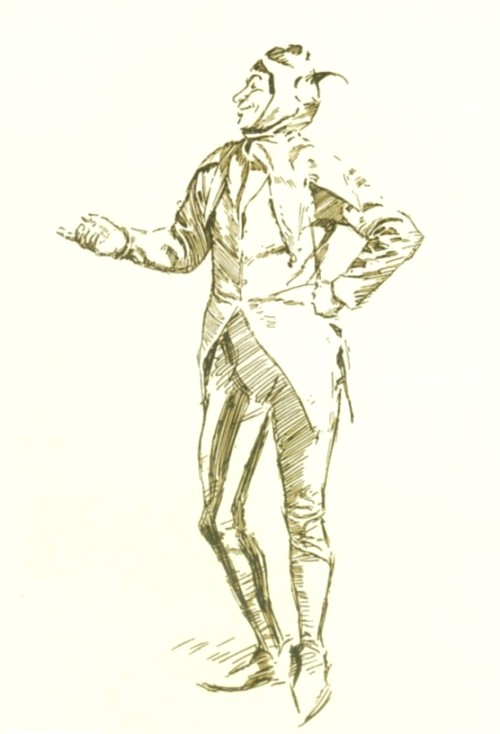 Drawing by Himself
PHIL MAY IN CAP AND BELLS
He could talk. I must not give the idea that he could not. I know some
of his friends who do not share or accept unqualified my memory of him
as a silent man. But he talked most and best when he had but a single
companion, and nothing could persuade me that he was not always
relieved, when the chance came, to let others do the talking for him.
I do not know what the attraction was that made everybody like him, not
merely the riffraff and the loafers who hung about his studio and
waylaid him in the street for what they could get out of him, but all
sorts of people who asked for nothing save his company—I could never
define the attraction to myself. It was not his looks. Even before his
last years, when he was the image of J.J. Shannon's portrait of him, his
appearance was not prepossessing. He dressed well according to his
ideals. Beardsley was not more of a dandy; but Beardsley was the dandy
of Piccadilly or the Boulevards, Phil May was the dandy of the
race-course. He brought with him that inevitable, indescribable look
that the companionship of horses gives and that in those days broke out
largely in short, wide-spreading covert coats and big pearl buttons. I
have always been grateful to the man who enlivens the monotony of dress
by a special fashion of his own, provided it belongs to him. The horsy
costume did belong to May, for he rode and hunted and was a good deal
with horses, but it was borrowed by some of his admirers until it
degenerated into almost as great an affectation as the artist's velvet
jacket and long hair, or the high stock and baggy corduroys of the Latin
Quarter imported into Chelsea. When the Beggarstaff Brothers, as Pryde
and Nicholson called themselves in those old days, would wander casually
into our rooms at the end of six or eight feet of poster that they had
brought to show J. and that needed a great deal of manipulation to bring
in at all, they looked as if the stable, not the studio, was their
workshop. And one young genius of an illustrator, who could not afford
to ride, and who I do not believe had ever been on a horse in his life,
could not mount the bus in his near suburb without putting on riding
breeches. But Phil May's dress was as essentially his as his silence.
Neither his looks nor his silence, however original and personal, could
have been the cause of the charm he undeniably possessed. I think he was
one of the people whom one feels are nice instinctively, without any
reason. He was sympathetic and responsive, serious when the occasion
called for it, foolish when folly was in order. It wasn't only in his
drawings that he was ready to wear the cap and bells. I know an artist,
one of whose cherished memories of Phil May is of the Christmas Eve when
they both rang Lord Leighton's door-bell and ran away and back to Phil
May's studio on the other side of the road, and Phil May was as pleased
as if it had been a masterpiece for Punch. He was naturally
kind,—amiable perhaps because it was the simplest thing to be. In his
own house his amiability forced him to break his silence, but his
remarks then, as far as I heard them, were usually confined to the
monotonous offer "Have a cigar!" "Have a whiskey-and-soda!" or "Have a
drawing!" if anyone happened to express admiration for his work. Had we
accepted this last offer every time it was made to us, we would have a
fine collection of Phil May's, while, as it is, we do not own as much
as a single sketch given to us by him. Visitors who did not share our
scruples have found their steady attendance at his Sunday nights one of
the best investments they ever made.
Away from his own house, on our Thursday nights, relieved of the
necessity to offer anything, this being now our business, his
conversation was more limited than in his own place. My memory of him is
of an ugly, delightful, smiling, silent man, sitting astride a chair,
his arms resting on the back, a big cigar in his mouth, and around him a
band of devoted admirers as fully prepared and equipped to do the
talking for him as he was to let them do it. He held his court as
royally among illustrators as Henley among his Young Men, and if nobody
contributed so little to the talk as Phil May, around nobody else,
except Henley, did so much of the talk centre.
In my recollections of Phil May astride his chair on Thursday nights,
Hartrick and Sullivan are never very long absent. Nobody knew better
than they the beauty of his work—to hear them talk about his line was
to be convinced that the supreme interest in life was the expressive
quality of a line made with pen in black ink on a piece of white paper.
The appearance of The Parson and the Painter was one of the events
of the Nineties—though it was not boomed into notoriety as were the
performances of some other illustrators of the period as ingenious as
Barnum in the art of advertisement—and there was not an artist who did
not hail May as a master. But Hartrick and Sullivan went further. They
were not only such good artists themselves that they could appreciate
genius in others, they were young enough not to be afraid of their
enthusiasms. They gave the effect of being with May, with whom they
often arrived and stayed until the deplorably early hour of the morning
at which he started for home, in order that they might watch over him,
and, indeed, he needed watching. He was not readier in offering than in
giving anything he was asked for, which was one reason why there was
always a procession of waiters and actors and jockeys out of work at his
front door—why his pockets were always empty. They even discovered the
same genius in May's talk as in his drawing, though the mystery was when
they heard the talk. To this day they will quote Phil May while I wonder
how it is that while for me Henley's talk has not lost its thunder, nor
Bob Stevenson's its brilliant flashes of imbecility, nor Harland's its
whimsical twist, nor Beardsley's its fresh gaiety, nothing of Phil
May's remains save the familiar refrain "Have a cigar!" "Have a
whiskey-and-soda!" "Have a drawing!"
Obsessed by my old-fashioned notion as hostess that people could not
enjoy themselves unless they were kept moving, persisting in my vain
efforts to break up the groups into which the company invariably fell,
again and again I would lure Hartrick and Sullivan away from Phil May.
But it was no use. What they all wanted was to talk not only about their
shop but their own particular counter in it, and no sooner was my back
turned than there they were in the same groups again, Hartrick and
Sullivan watching over Phil May, supported by Raven Hill and Edgar
Wilson, both then deeply involved in youth's game of shocking the
bourgeois by showing on the pages of Pick-Me-Up how the matter of
illustration was ordered in France, and presently starting a magazine of
their own to show it the better, and to do their share as ardent rebels
in the big fight of the Nineties. On my shelves, close by the first
number of The Yellow Book and of the Savoy is the first volume of
The Butterfly and on its fly-leaf is the inscription: "To Elizabeth
Robins Pennell with L. Raven Hill's kind regards," no more startlingly
original than Beardsley's inscriptions, but to me full of meaning and
memories. I cannot look at it without seeing myself fluttering from one
to another of the old Buckingham Street rooms, heavy with the smell of
smoke and powder, thunderous not only with the knocking—naturally I
quote the Ibsen phrase everybody was quoting in the Nineties—but the
banging, the battering, the bombarding of the younger generation at the
Victorian door against which it was desperate work to make any
impression at all.
In my less responsible intervals it amused me to find the painters
running their own shop, or their own little counter, quite apart from
the illustrators, and carrying on all by themselves their own special
campaign against that obdurate Victorian door. Their campaign, as they
ran it, required less talk than most, for they were chiefly men of the
New English Art Club—the men who gave the shows where Felix Buhot smelt
the powder—the men who were considered apostles of defiance when the
inner group held their once-famous exhibition as "London
Impressionists"—the men about whom the critics for a while did nothing
save talk—but men who had the reputation of talking so little
themselves that, when a man came up for election in their Club, his
talent for silence was said to be as important a consideration with them
as his talent for art. Not that the silence of any one of them could
rival Phil May's in eloquence—they never learned to say nothing with
his charm. Often the poverty of their conversation had the effect of
being involuntary, as if they might have had plenty to say had they
known how to say it. More than one struggled to rid himself of his
talent with at least an air of success.
The big booming voice of Charles W. Furse was frequently heard, but in
it a suspicion of an Academic note unfamiliar in our midst, so that,
young as he was, combative, enthusiastic, "a good fellow" as they say in
England, still in his Whistler and rebel period, his friends predicted
for him the Presidency of the Royal Academy. The first time I ever saw
him was the year he was showing at the New English two large upright,
full-length portraits of women, highly reminiscent of Whistler, and, on
press day, was being turned out of the gallery by the critics who, in
revolutionizing criticism, were fighting against the old-fashioned
Victorian idea of press views with the artists busy log-rolling and an
elaborate lunch, or at least whiskey and cigars behind a screen. The
New English men compromised by staying away, but they clung to the
lunch, a feast chiefly for their commissionaire and their salesman and
the grey-haired critic, a survival, who could not reconcile himself to
change and whom I heard once, in another gallery, pronounce the show
admirable, "perfect really, your show, but for one thing missing—a
decanter and cigars on the table." Furse, who had not heard the critic's
cry for reform and could not understand his banishment, lingered in the
passage, button-holing everybody who came out, trying to pick up a hint
as to what we were all going to say about him. He considered himself a
red-hot rebel and the prophetic picture of him scaling Academic heights
annoyed him extremely, though he so soon became an Associate of the
Academy that I think, had he lived, time would have proved the prophets
right.
Walter Sickert's voice, too, was frequently heard at the beginning of a
Thursday night, but his promise of brilliancy never struck me as leading
anywhere in particular, my personal impression being that with his talk,
as with his art, the fulfilment scarcely justified the promise.
D.S. MacColl, young arch-rebel at the time little as the formal official
of to-day suggests it, his bombarding of the Victorian door directed
chiefly from the sober columns of the Spectator, and later of the
Saturday Review, was always well armed with words for the Thursday
night battle, conscientious in distributing his blows and shaping them
in strict deference to his sense of style, just a touch of the preacher
perhaps in his voice and in his fight for art and freedom, as he was the
first to acknowledge; more than once I have heard him explain
apologetically that his right place was the pulpit for which he had been
designed.
Arthur Tomson, one of the best friends in the world, was a spirited
revolutionary who went to the length of founding and editing a paper of
his own to promote revolution—the Art Weekly, which, not being able
to afford illustrations, conducted its warfare solely by its articles,
and strong, fearless, knock-you-down articles they were since we all
wrote for the paper while it lasted. It did not last long, however, but
shared the fate of most revolutionary sheets with more brains than
capital. Arthur Tomson himself, out of print, was a quiet, if staunch
fighter, another of the old Thursday night group who knew that his years
on this earth were to be short. He was not the gayer for it as Harland
and Beardsley were, but the sadder, it may be because he foresaw the
end long before it came, and he was given to the melancholy that found
expression in so many of his paintings.
Wilson Steer, Tonks, Professor Brown passed, and no more, across the
stage of our Thursday nights, all three, as I remember them, scrupulous
in upholding the reputation for silence of their Club. Conder flitted in
and out of our rooms, always agreeable but not the man to lift up his
voice in a crowd.
Occasionally, a visitor from abroad appeared—Felix Buhot every Thursday
that one winter, or, more rarely Paul Renouard, in London for the
Graphic, his appearance an event for the illustrators who already
reverenced him as a veteran. Or else it was a representative, a
publisher, of les Jeunes over there, bringing fresh stimulus, fresh
incentive, especially if his coming meant fresh orders and fresh
opportunity to say what had to be said freely and without restraint.
Once it was Jules Roque from Paris, of the Courrier Français in which
he published the drawings of Louis Legrand and Forain and other artists
accepted as models by the young men of our Thursday nights who believed
in themselves the more defiantly when asked to figure in such good
company. Once it was Meier Graefe from Berlin, big, handsome,
enterprising, not yet encumbered with Post-Impressionism and its
outshoots, seeking American and British contributors to the German
Pan, a magazine as big and enterprising as himself if not always as
handsome, and the younger generation of London had the comfort of
knowing that if the Victorian door in England held firm, the door of
Europe had opened to them.
Occasionally one of the older, the very much older generation came in to
make us feel the younger for his presence—none more imposing than
Sandys, most distinguished in his old age, wearing the white waistcoat
that was the life-long symbol of his dandyism, full of Pre-Raphaelite
reminiscences, and reminiscences of the Italian Primitives could not
have seemed more remote. J. sometimes met Holman Hunt in other
haunts—at dinners of the Society of Illustrators and elsewhere—and
reported him to me as a talker who could, in the quantity and
aggressiveness of his talk, have given points to Henley and Henley's
Young Men, so I regret that he never was with us to talk over
Pre-Raphaelite days with Sandys. The only other possible representative
of Pre-Raphaelitism who came was Walter Crane, if so he can be called,
for the tradition fell lightly on his shoulders, was a mere re-echo in
his work; the only one of Sandys's contemporaries was Whistler, and
their meeting of which J. and I have written in another place, does not
belong to the story of our Thursday nights, for they were a thing of the
past when Whistler returned from Paris, where he had gone to live almost
as they began.
Nor did Sandys often appear on Thursdays. He seemed to prefer the
evenings when we were alone, to my surprise, for the homage he received
when he did come on Thursday must have been pleasant. Drawings of his
hung prominently in our rooms, J. then haunting the salesrooms for the
originals of the Sixties as industriously as the barrows and shops for
their reproductions. And to the man who prefers fame to reach him during
his lifetime, surely it should have been an agreeable experience to sit,
or to be enthroned as it were, in so friendly an atmosphere, with some
of his own finest work on the wall behind him for background, and
surrounded by a worshipping group asking nothing better than to be
allowed to sit at his feet and listen to his every word—which was a
sacrifice for his worshippers in Buckingham Street who rejoiced in the
sound of their own voices as did most of the company. But the Nineties
are not more wonderful and stimulating to the young men of to-day who
look back to them so admiringly, than the Sixties were to us whom they
kept up into the small hours of many a Friday morning, inexhaustible as
a subject of our talk, and Sandys, standing for the Sixties and all we
found in them so admirable, could command any sacrifice. The respect for
the Sixties was an article of faith, a dogma of dogmas in the Nineties.
If the now younger generation write articles and books about the
Nineties—those amazing documents in which I scarcely recognise an age I
thought I knew by heart—we were still more zealous in writing books
about the Sixties. And we collected the drawings and publications of the
Sixties. When J. and I now allowed ourselves an afternoon out, it was to
wander from Holywell Street to Mile End Road, from Piccadilly to
Holborn, searching the booksellers' barrows and shops for the unsightly,
gaudy, badly-bound volumes that contained the illustrations of the
Sixties—illustrations ranked amongst the finest ever made. Our
bookshelves that are still filled with them represent one of the most
animated phases of the Nineties. And we looked upon the "men of the
Sixties" as masters, among them giving to Sandys a leading place.
If he was not any longer doing the work for which we took off our hat to
him, he certainly looked the leader—tall, handsome, dignified, just
enough of a stoop in his shoulders to become his age, his dress
irreproachable, the white waistcoat immaculate, pale yellow hair parted
in the middle and beautifully brushed, beard not patriarchal exactly but
eminently correct and well cared for, manners princely. It was clear
that he liked the rôle of master and his voice was in keeping with the
part. But he was a master who presided at his best over a small
audience, and, no doubt knowing it, he avoided our Thursdays.
He was also a master given to small gossip. We heard from him less of
art, its aims and ideals, its mediums and methods, than of the sayings
and doings of the Pre-Raphaelites who were his friends and
contemporaries. The name of "Gabriel" was ever in his mouth. It was
Rossetti whom he most loved—or love is not the word, less of affection
revealed in his memories than a sense of injury, as if it had somehow
been the fault of "Gabriel" and the others that he had not come off as
well as they, though of all "Gabriel" had been most active in seeing
him through the tight places he so successfully got himself into. This,
no doubt, was the reason Rossetti felt entitled to a little laugh now
and then over Sandys's difficulties. Sandys was a man who needed to be
seen through tight places until the end, as we had occasion to know by
the urgent note he sent us on a Saturday night, more than once, from the
Café Royal, his favourite haunt in his later years, where a variety of
unavoidable accidents, with a curious faculty for repeating themselves,
would keep him prisoner until his friends came to his relief.
He was full of anecdote, which was quite in the order of things, the
Sixties having supplied anecdote for a whole library of books and
magazines. Could I tell Sandys's stories with Sandys's voice I should be
tempted to repeat them yet once again, though many were told us also by
Whistler, and these J. and I have recorded in the Life. Whistler told
them better, with more truth because with more gaiety and joy in their
absurdity. And yet, the solemnity of Sandys added a personal flavour,
gave them a character nobody else could give. I have not forgotten how
he turned into a parable the tale of the cross-eyed maid in the Morris
Shop in Red Lion Square, whose eyes were knocked straight by a shock
the company of Morris, Marshall, and Faulkner administered deliberately,
and then were knocked crooked again by a shock they had not provided for
or against. And, as Sandys recalled them, the strange beasts in
"Gabriel's" house and garden might have been let loose from out of the
Apocalypse. But Sandys's voice has been stilled forever and the
anecdotes have been published oftener, I do believe, than any others in
the world's rich store of clichés. The great of his day had all the
Boswells they wanted—a retinue of admirers and cuffs ready—at their
head William Michael Rossetti to pour out book after book about his
brother, to leave little untold about the group that revolved round
"Gabriel." Even the third generation, with Ford Madox Hueffer to lead,
has taken up the task. The anecdotes have grown familiar, but it is
something to have heard them from the men who were their heroes.
Well—our Thursdays were pleasant, an inspiration while they lasted, and
for a time I thought they must last as long as we did. But nothing
pleasant endures forever, the bravest inspiration flickers and dies
almost before we realize its flaring. The stern duty of Friday morning
always haunted me in anticipation, for I have never been able to take
lightly the work I do with so much difficulty, and Friday morning itself
often brought even J. up with a sharp turn to face the fact that man was
born into the world to labour in the sweat of his brow, and not simply
to talk all night until no work was left in him.
That may have been one reason for our giving up so agreeable a custom.
Another perhaps came from the discovery that the freedom of our Thursday
nights was sometimes abused. A certain type of Englishman would travel a
mile and more for anything he did not have to pay for, even if it was
for nothing more substantial than a cigarette, a sandwich, a
whiskey-and-soda. There were evenings when, looking round the packed
dining-room, it would occur to me that I did not recognise half the
people in it. Friends introduced friends and they introduced other
friends until, in bewilderment, I asked myself if our Thursday night was
ours or somebody else's. And I fancied a tendency to treat it as if it
were somebody else's,—to take an ell when we meant to give no more than
an inch, and J. was as little inclined as I to furnish a new proof of
the wise old proverb. One day a would-be wit who was regular in his
attendance and his talk, and who should have known better, asked J.,
"Are you still running your Thursday Club?" and so helped to precipitate
the end. We were not running a Club for anybody, and if the fame of our
Thursday night filled our rooms with people who behaved as if we were,
the sooner we got rid of them the better.
Besides, as the weeks and the months and the years went on, many who had
come and talked and fought our Thursday night through ceased to come
altogether. Where I failed in breaking up the groups Time, with its
cruel thoroughness, succeeded and began to scatter them far and wide.
Death stilled voices that had been loudest. The National Observer
passed out of Henley's hands and Henley himself into the Valley of the
Shadow. Bob Stevenson said his last good-night to us. Beardsley,
Harland, Arthur Tomson, George Steevens, Phil May, Furse,
Iwan-Müller—one after another of our old friends, one after another of
those old masters of talk set out on the journey into the Great Silence.
It is hard to believe they have gone. I remember how, when they were
with us and the talk was at its maddest and somebody would suddenly take
breath long enough to look out of our windows, whose curtains were
never drawn upon the one spectacle we could offer—the river with the
boats trailing their lights down its shadowy reaches, and the Embankment
with the lights of the hansoms flying to and fro, and the bridges with
the procession of lights from the omnibuses and cabs and the trails of
burning cloud from the trains—Henley would say, "How it lives, how it
throbs with life out there!" and I would think to myself, "And how it
lives, how it throbs with life in here!"—with a life too intense, it
seemed, ever to wear itself out. And yet now only two or three of the
old friends of the old Thursday nights are left to look down with us
upon the river where it flows below our windows—upon the moving lights
of London's great traffic, upon London's great life and great beauty,
and great movement without end.
It is not only the dead we have lost. Time has made other changes as sad
as any wrought by Death. The young have grown old,—have thrown off
youth's "proud livery" for the sombre garment of age. The years have
turned the rebel of yesterday into the Royal Academician of to-day. The
inspired young prophet who protested week by week against mediocrity in
paint, settled down to keeping the mediocre paintings against which his
protests were loudest. He who thundered against the degeneracy of
journalism accepted the patronage of the titled promoter of the
half-penny press. Architects carried their respectability to the
professional chair it adorns, and illustrators rested in the comfortable
berths provided by Punch. Friendships cooled, and friends who never
missed a Thursday look the other way when they meet us in the street.
Close to me, as I write, is a bookcase on whose shelves Henley and
Henley's Young Men—Marriott Watson, George Steevens, Charles Whibley,
Leonard Whibley, Rudyard Kipling, Kenneth Grahame, Arthur Morrison, G.S.
Street—jostle each other in the big and little volumes that were to
create the world anew. The small green-bound Henleys stand in a row.
Salome, The Rape of the Lock, Volpone, with Beardsley's
illustrations, are flanked by the more pretentious performances of the
Kelmscott Press and the Vale Press and the other Presses aspiring with
much advertisement to do what the Constables of Edinburgh did so much
better as a matter of course, and, as a reminder of this truth, the
Montaigne of the Tudor Series is there and the Apuleius and the
Heliodorus, each with its inscription. And the little slim volume,
neatly bound by Zaehnsdorf, called Allahakbarries—now a prize for
the collector I am told—immortalizes one recreation at least of
Henley's Young Men. For it is Barrie's report of the Cricket Team
largely made up of these Young Men, of whom he was Captain and who used
to play at Shere on the never-to-be-forgotten summer days when beautiful
Graham Tomson and I were graciously invited as Patronesses, and little
Madge Henley—her death shortly afterwards proving Henley's own death
blow—figured as "Captain's Girl" and the National Observer office as
"Practice Ground." And if Henley did not drag himself down with us to
the pretty Surrey village, he seemed to preside over us all, so much so
that when J. and I had the little book bound and added the photographs
Harold Frederic—"Photographer" in the report—made of the Team, we
included one of Henley, and altogether the tiny volume is as eloquent a
document of the Nineties and of Henley and Henley's Young Men as we
have, and I wonder what the collector of those snares for the American
now catalogued by the bookseller as "Association Books" would not give
to own it. And close by our Allahakbarries, Henry Harland's
Mademoiselle Miss meets in the old friendly companionship Steevens's
Land of the Dollar and Graham Tomson's Poems and Bob Stevenson's
Velasquez and Harold Frederic's Return of the O'Mahoney and Bernard
Shaw's Cashel Byron's Profession in its rare paper cover, and George
Moore's Strike at Arlingford, and Marriott Watson's Diogenes of
London, and—but of what use to go through the list, the long
catalogue, to the end? Ghosts greet me from those shelves, ghosts from
the old Thursdays, from the radiant days when youth was merging into
middle age—surely the best period in one's existence—days into which
the breath of life never can be breathed again. We could not revive the
old nights if we would. I suppose nobody now reads Zola, but we read him
in the Nineties and I have always been haunted by his description in
L'Oeuvre of the last reunion of the friends who, in their eager youth,
had meant to conquer Paris and who used to meet to plan their campaign
over a dinner as meagre as their income and gay as their hopes. But
when, after years during which money and fame had been heaped up by more
than one and disappointment and despair lavished in equal measure upon
others, they ventured to dine together again, and the dinner was good
and well served as it never had been of old, it turned to dust and ashes
in their mouths—a funeral feast. Dust and ashes would be our fare were
we so foolish as again to open our doors on the Thursday night
consecrated to youth and its battles long ago.
If we have had no more Thursday nights, it does not follow that we have
had no other nights. The habit of years is not so easily broken, and our
habit was, and is, at night to gather people about us and to talk. Only,
after the Nineties, or rather before the end of the Nineties, we never
settled again with weekly regularity upon one special night out of the
seven for the purpose—on the contrary, we took, and we now take, our
nights as they came and come.
They have not been, for that, the less interesting and amusing, not less
loud with the sound of battle, not less fragrant with the smell of
smoke. It was just after our Thursday nights, for instance, that we
began what I might call our Whistler nights, and a more stimulating
talker than Whistler never talked, a more stimulating fighter never
fought. I do not mean in the impossible way meant by those whose
judgment of him rests solely on The Gentle Art. They think he fought
for no other end than to make enemies when, really, he enjoyed far more
the good give-and-take argument that preserved to him his friends,
provided those friends fought fair and did not play the coward, or the
toady, to escape the combat.
J. and I have written his Life in vain if everybody who cares to know
anything about him does not know that from 1895 and 1896, the greater
part of his time was spent in London and that many of his nights were
then given to us, more particularly towards the end of the amazing
decade. We paid for the privilege by the loss of some of our friends
who, for one reason or another, cultivated a wholesome fear of Whistler.
Men who had been most constant in dropping in, dropped in no
longer—nor, in many cases, have they ever begun to drop in again. More
than one would have run miles to escape the chance encounter, trembling
with apprehension when in a desperate visit they seemed to court it, and
often the several doors opening into our little hall served as important
a part in preventing a meeting between Whistler and the enemy as the
doors in the old-fashioned farce played in the husband and wife game of
hide-and-seek.
It was not too big a price to pay. Whistler's talk was worth a great
deal, and the twelve years that have passed since we lost it forever
have not lessened its value for us. Ours is a sadder world since we have
ceased to hear the memorable and unmistakable knock and ring at our
front door, the prelude to the talk, rousing the whole house until every
tenant in the other chambers and the housekeeper in her rooms below knew
when Whistler came to see us. Our nights, since those he animated and
made as "joyous" as he liked to be in his hours of play and battle, have
lost their savour. We are perpetually referring to them, quoting,
regretting them. Even Augustine looks back to them as making a pleasant
epoch in her life. Often she will remind me of this night or that,
declaring we have grown dull without him—but do I remember the night
when M. Whistlaire argued so hard and with such violence that the print
of the rabbit fell from the wall in its frame, the glass shivering in a
thousand pieces, just when M. Kennedy was so angry we thought he was
going to walk away forever, and how after that there could be no more
arguing, and M. Whistlaire laughed as she swept up the pieces, and M.
Kennedy did not walk away alone, but later they both walked away
together, arm-in-arm, to the hotel where they always stayed?—and do I
remember how, during the Boer War, he would come and dine with me alone,
his pockets stuffed with newspaper clippings, and how he would put them
by his plate, and how long we would sit at table because he would read
every one of them to me, with that gay laugh nobody laughs
nowadays?—and do I remember that other evening when he and Monsieur
disputed and disputed she didn't know about what, and how excited they
got, and how he kept banging the table with his knife, the sharp edge
down, until he cut a long slit in the cloth, and it was our best
tablecloth too?—and do I remember the long stories he would tell us
some evenings and his little mocking laugh when she, who could not
understand a word, knew he was saying something malicious about
somebody?—and do I remember how he liked a good dinner and her cooking
because it was French, and how he would never refuse when she promised
him her pot-au-feu or one of her salads—and do I remember one after
another of those old nights the like of which we shall never see again?
Do I remember indeed? They fill too big a space in memory, they
overshadow too well the lesser nights with lesser men, they were too
joyous an episode in our thirty long years of talk for me ever to
forget them. The three classical knocks of the Théâtre Français could
not announce more certainly a night of beauty or wit or fun or romance
than the violent ring and the resounding knock at the old battered door
of the Buckingham Street chambers where, for Whistler, the oak was never
sported.
But of our Whistler nights we have already made the record—this is
another tale that is already told. I think Whistler knew their value as
well as we did, knew what they cost us in the loss of friends, knew what
he had given us in return, knew what he had revealed to us of himself in
all friendliness, and that this was the reason he looked to us for the
record not only of his nights with us, but of his life. Once he had
confided that charge to us, the old Buckingham Street nights grew more
marvellous still, full of reminiscences, of comment, of criticism, of
friendliness, his talk none the less stimulating and splendid because,
at his request, the cuff or note-book was always ready. And they
continued until the long tragic weeks and months when he was first
afraid to go out at night and then unable to, and when the talks were by
day instead—not quite the same in the last, the saddest months of all,
for weakness and thoughts of the work yet to be done and the feebleness
that kept him from doing it fell like a black cloud over all our
meetings, even those where the old gaiety asserted itself for a moment
and the old light of battle gleamed again in his eyes. To the end he
liked the talk no less than we, for to the end he sent for us, to the
end he would see us when few besides were admitted. There, for those who
would like to question his friendship with us, for those who believe
that Whistler never could keep a friend because he never wanted to, is
the proof dear to us of the good friend he could be when his friendship
was not abused or taken advantage of behind his back.
Many other nights besides there have been—long series of American
nights—John Van Dyke nights I might say, Timothy Cole nights,—but no,
I am not going to name names and make a catalogue, I am not going to
write their story, I am not going to run the risks of the folly I have
protested against. I have confessed my safe belief that of the living
only good should be spoken, and good only when it is within the bounds
of discretion. It is not my ambition to rival at home the unpopularity
of N.P. Willis in England after the first of his indiscretions, which
seem discretion itself now in the light of to-day's yellow and society
journalism.
And there have been English nights—many—nights with old friends who
are faithful and new friends who are devoted—nights of late so like the
old Thursday nights that both Hartrick and Sullivan, now twenty years
older and with no Phil May to revolve round, asked why those old
memorable gay nights could not be revived? But would they be gay? Would
they not turn out the dust and ashes, the worse than Lenten fare, from
which I shrink? Would they not, as I have said, prove as mournful as
that banquet of Zola's Conquerors of Paris?
Recently there have been Belgian nights—nights with those Belgian
artists whose habit was never to travel at all until they started on
their journey as exiles to London—a journey to which the end in a
return journey seems to them so tediously long in coming. And there have
been War nights when the clash of our battle, in the grim consciousness
of that other battle not so far away, is less cheerful. And there have
been nights with the great search-lights over the Thames that tell us as
much as those young insistent voices in Buckingham Street could tell,
but only of things so tragic and so sombre that I am the more eager to
finish the story of our London nights with our Thursdays, in the years
when we were burdened by no more serious fighting than the endless fight
of friend with friend, of fellow worker with fellow worker, fought in
the good cause of work and play, faith and doubt, fear and hope—a
stirring fight, but one in which words are the weapons, one which can
never be won or lost, since no two can ever be found to agree when they
talk for pleasure, nor any one man forced to agree with himself for all
time.
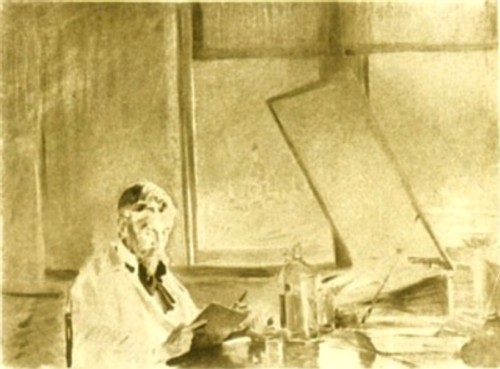 Painting by J. McLure Hamilton