The volume[i_1] containing an instalment of thirty-four negro legends,
which was given to the public three years ago, was accompanied by an
apology for both the matter and the manner. Perhaps such an apology is
more necessary now than it was then; but the warm reception given to the
book on all sides—by literary critics, as well as by ethnologists and
students of folk-lore, in this country and in Europe—has led the author
to believe that a volume embodying everything, or nearly everything, of
importance in the oral literature of the negroes of the Southern States,
would be as heartily welcomed.
The thirty-four legends in the first volume were merely selections from
the large body of plantation folk-lore familiar to the author from his
childhood, and these selections were made less with an eye to their
ethnological importance than with a view to presenting certain quaint
and curious race characteristics, of which the world at large had had
either vague or greatly exaggerated notions.
The first book, therefore, must be the excuse and apology for the
present volume. Indeed, the first book made the second a necessity; for,
immediately upon its appearance, letters and correspondence began to
pour in upon the author from all parts of the South. Much of this
correspondence was very valuable, for it embodied legends that had
escaped the author's memory, and contained hints and suggestions that
led to some very interesting discoveries. The result is, that the
present volume is about as complete as it could be made under the
circumstances, though there is no doubt of the existence of legends and
myths, especially upon the rice plantations, and Sea Islands of the
Georgia and Carolina seacoast, which, owing to the difficulties that
stand in the way of those who attempt to gather them, are not included
in this collection.
It is safe to say, however, that the best and most characteristic of the
legends current on the rice plantations and Sea Islands, are also
current on the cotton plantations. Indeed, this has been abundantly
verified in the correspondence of those who kindly consented to aid the
author in his efforts to secure stories told by the negroes on the
seacoast. The great majority of legends and stories collected and
forwarded by these generous collaborators had already been collected
among the negroes on the cotton plantations and uplands of Georgia and
other Southern States. This will account for the comparatively meagre
contribution which Daddy Jack, the old African of the rice plantations,
makes towards the entertainment of the little boy.
The difficulty of verifying the legends which came to hand from various
sources has been almost as great as the attempt to procure them at first
hand. It is a difficulty hard to describe. It is sometimes amusing, and
sometimes irritating, but finally comes to be recognized as the result
of a very serious and impressive combination of negro characteristics.
The late Professor Charles F. Hartt, of Cornell University, in his
admirable monograph[i_2] on the folk-lore of the Amazon regions of Brazil,
found the same difficulty among the Amazonian Indians. Exploring the
Amazonian valley, Professor Hartt discovered that a great body of myths
and legends had its existence among the Indians of that region. Being
aware of the great value of these myths, he set himself to work to
collect them; but for a long time he found the task an impossible one,
for the whites were unacquainted with the Indian folk-lore, and neither
by coaxing nor by offers of money could an Indian be persuaded to relate
a myth. In most instances, Professor Hartt was met with statements to
the effect that some old woman of the neighborhood was the story-teller,
who could make him laugh with tales of the animals; but he never could
find this old woman.
But one night, Professor Hartt heard his Indian steersman telling the
Indian boatmen a story in order to keep them awake. This Indian
steersman was full of these stories, but, for a long time, Professor
Hartt found it impossible to coax this steersman to tell him another. He
discovered that the Indian myth is always related without mental effort,
simply to pass the time away, and that all the surroundings must be
congenial and familiar.
In the introduction to the first volume of "Uncle Remus"[i_3] occurs this
statement: "Curiously enough, I have found few negroes who will
acknowledge to a stranger that they know anything of these legends; and
yet to relate one is the surest road to their confidence and esteem."
This statement was scarcely emphatic enough. The thirty-four legends in
the first volume were comparatively easy to verify, for the reason that
they were the most popular among the negroes, and were easily
remembered. This is also true of many stories in the present volume; but
some of them appear to be known only to the negroes who have the gift of
story-telling,—a gift that is as rare among the blacks as among the
whites. There is good reason to suppose, too, that many of the negroes
born near the close of the war or since, are unfamiliar with the great
body of their own folk-lore. They have heard such legends as the "Tar
Baby" story and "The Moon in the Mill-Pond," and some others equally as
graphic; but, in the tumult and confusion incident to their changed
condition, they have had few opportunities to become acquainted with
that wonderful collection of tales which their ancestors told in the
kitchens and cabins of the Old Plantation. The older negroes are as fond
of the legends as ever, but the occasion, or the excuse, for telling
them becomes less frequent year by year.
With a fair knowledge of the negro character, and long familiarity with
the manifold peculiarities of the negro mind and temperament, the writer
has, nevertheless, found it a difficult task to verify such legends as
he had not already heard in some shape or other. But, as their
importance depended upon such verification, he has spared neither pains
nor patience to make it complete. The difficulties in the way of this
verification would undoubtedly have been fewer if the writer could have
had an opportunity to pursue his investigations in the plantation
districts of Middle Georgia; but circumstances prevented, and he has
been compelled to depend upon such opportunities as casually or
unexpectedly presented themselves.
One of these opportunities occurred in the summer of 1882, at Norcross,
a little railroad station, twenty miles northeast of Atlanta. The writer
was waiting to take the train to Atlanta, and this train, as it
fortunately happened, was delayed. At the station were a number of
negroes, who had been engaged in working on the railroad. It was night,
and, with nothing better to do, they were waiting to see the train go
by. Some were sitting in little groups up and down the platform of the
station, and some were perched upon a pile of cross-ties. They seemed to
be in great good-humor, and cracked jokes at each other's expense in the
midst of boisterous shouts of laughter. The writer sat next to one of
the liveliest talkers in the party; and, after listening and laughing
awhile, told the "Tar Baby" story by way of a feeler, the excuse being
that some one in the crowd mentioned "Ole Molly Har'." The story was
told in a low tone, as if to avoid attracting attention; but the
comments of the negro, who was a little past middle age, were loud and
frequent. "Dar now!" he would exclaim, or, "He's a honey, mon!" or,
"Gentermens! git out de way, an' gin 'im room!"
These comments, and the peals of unrestrained and unrestrainable
laughter that accompanied them, drew the attention of the other negroes,
and before the climax of the story had been reached, where Brother
Rabbit is cruelly thrown into the brier-patch, they had all gathered
around and made themselves comfortable. Without waiting to see what the
effect of the "Tar Baby" legend would be, the writer told the story of
"Brother Rabbit and the Mosquitoes," and this had the effect of
convulsing them. Two or three could hardly wait for the conclusion, so
anxious were they to tell stories of their own. The result was that, for
almost two hours, a crowd of thirty or more negroes vied with each other
to see which could tell the most and the best stories. Some told them
poorly, giving only meagre outlines, while others told them passing
well; but one or two, if their language and their gestures could have
been taken down, would have put Uncle Remus to shame. Some of the
stories told had already been gathered and verified, and a few had been
printed in the first volume; but the great majority were either new or
had been entirely forgotten. It was night, and impossible to take notes;
but that fact was not to be regretted. The darkness gave greater scope
and freedom to the narratives of the negroes, and but for this friendly
curtain it is doubtful if the conditions would have been favorable to
story-telling. But however favorable the conditions might have been, the
appearance of a note-book and pencil would have dissipated them as
utterly as if they had never existed. Moreover, it was comparatively an
easy matter for the writer to take the stories away in his memory, since
many of them gave point to a large collection of notes and unrelated
fragments already in his possession.
Theal, in the preface to his collection of Kaffir Tales,[i_4] lays great
stress upon the fact that the tales he gives "have all undergone a
thorough revision by a circle of natives. They were not only told by
natives, but were copied down by natives." It is more than likely that
his carefulness in this respect has led him to overlook a body of
folk-lore among the Kaffirs precisely similar to that which exists among
the negroes of the Southern States. If comparative evidence is worth
anything,—and it may be worthless in this instance,—the educated
natives have "cooked" the stories to suit themselves. In the "Story of
the Bird that Made Milk," the children of Masilo tell other children
that their father has a bird which makes milk.[i_5] The others asked to
see the bird, whereupon Masilo's children took it from the place where
their father had concealed it, and ordered it to make milk. Of this milk
the other children drank greedily, and then asked to see the bird dance.
The bird was untied, but it said the house was too small, and the
children carried it outside. While they were laughing and enjoying
themselves the bird flew away, to their great dismay. Compare this with
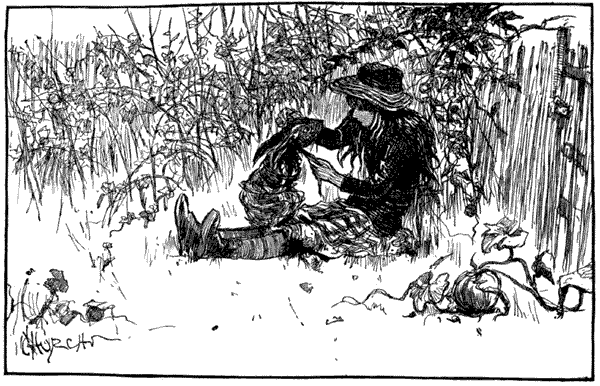
the story of how the little girl catches Brother Rabbit in the garden
(of which several variants are given), and afterwards unties him in
order to see him dance.[i_6] There is still another version of this
story, where Mr. Man puts a bridle on Brother Rabbit and ties him to the
fence. Mr. Man leaves the throat-latch of the bridle unfastened, and so
Brother Rabbit slips his head out, and afterwards induces Brother Fox to
have the bridle put on, taking care to fasten the throat-latch.
The Brother Rabbit of the negroes is the hare, and what is "The Story of
Hlakanyana"[i_7] but the story of the hare and other animals curiously
tangled, and changed, and inverted? Hlakanyana, after some highly
suggestive adventures, kills two cows and smears the blood upon a
sleeping boy.[i_8] The men find the cows dead, and ask who did it. They
then see the blood upon the boy, and kill him, under the impression that
he is the robber. Compare this with the story in the first volume of
Uncle Remus, where Brother Rabbit eats the butter, and then greases
Brother Possum's feet and mouth, thus proving the latter to be the
rogue. Hlakanyana also eats all the meat in the pot, and smears fat on
the mouth of a sleeping old man. Hlakanyana's feat of pretending to cure
an old woman, by cooking her in a pot of boiling water, is identical
with the negro story of how Brother Rabbit disposes of Grinny-Granny
Wolf. The new story of Brother Terrapin and Brother Mink, relating how
they had a diving-match, in order to see who should become the possessor
of a string of fish, is a variant of the Kaffir story of Hlakanyana's
diving-match with the boy for some birds. Hlakanyana eats the birds
while the boy is under water, and Brother Terrapin disposes of the fish
in the same way; but there is this curious difference: while Hlakanyana
has aided the boy to catch the birds, Brother Terrapin has no sort of
interest in the fish. The negro story of how Brother Rabbit nailed
Brother Fox's tail to the roof of the house, and thus succeeded in
getting the Fox's dinner, is identical with Hlakanyana's feat of sewing
the Hyena's tail to the thatch. When this had been accomplished,
Hlakanyana ate all the meat in the pot, and threw the bones at the
Hyena.
But the most curious parallel of all exists between an episode in "The
Story of Hlakanyana," and the story of how the Bear nursed the
Alligators (p. 344). This story was gathered by Mrs. Helen S. Barclay,
of Darien, Georgia, whose appreciative knowledge of the character and
dialect of the coast negro has been of great service to the writer.
Hlakanyana came to the house of a Leopardess, and proposed to take care
of her children while the Leopardess went to hunt animals. To this the
Leopardess agreed. There were four cubs, and, after the mother was gone,
Hlakanyana took one of the cubs and ate it. When the Leopardess
returned, she asked for her children, that she might suckle them.
Hlakanyana gave one, but the mother asked for all. Hlakanyana replied
that it was better one should drink and then another; and to this the
Leopardess agreed. After three had suckled, he gave the first one back a
second time. This continued until the last cub was eaten, whereupon
Hlakanyana ran away. The Leopardess saw him, and gave pursuit. He ran
under a big rock, and began to cry for help. The Leopardess asked him
what the matter was. "Do you not see that this rock is falling?" replied
Hlakanyana. "Just hold it up while I get a prop and put under it." While
the Leopardess was thus engaged, he made his escape. This, it will be
observed, is the climax of a negro legend entirely different from Daddy
Jack's story of the Bear that nursed the Alligators, though the rock
becomes a fallen tree. In the "Story of the Lion and the Little
Jackal,"[i_9] the same climax takes the shape of an episode. The Lion
pursues the Jackal, and the latter runs under an overhanging rock,
crying "Help! help! this rock is falling on me!" The Lion goes for a
pole with which to prop up the rock, and so the Jackal escapes. It is
worthy of note that a tortoise or terrapin, which stands next to Brother
Rabbit in the folk-lore of the Southern negroes, is the cause of
Hlakanyana's death. He places a Tortoise on his back and carries it
home. His mother asks him what he has there, and he tells her to take it
off his back. But the Tortoise would not be pulled off. Hlakanyana's
mother then heated some fat, and attempted to pour it on the Tortoise,
but the Tortoise let go quickly, and the fat fell on Hlakanyana and
burnt him so that he died. The story concludes: "That is the end of this
cunning little fellow."
Theal also gives the story of Demane and Demazana,[i_10] a brother and
sister, who were compelled to run away from their relatives on account
of bad treatment. They went to live in a cave which had a very strong
door. Demane went hunting by day, and told his sister not to roast any
meat in his absence, lest the cannibals should smell it and discover
their hiding-place. But Demazana would not obey. She roasted some meat,
a cannibal smelt it, and went to the cave, but found the door fastened.
Thereupon he tried to imitate Demane's voice, singing:
"Demazana, Demazana,
Child of my mother,
Open this cave to me.
The swallows can enter it.
It has two apertures."
The cannibal's voice was hoarse, and the girl would not let him in.
Finally, he has his throat burned with a hot iron, his voice is changed,
and the girl is deceived. He enters and captures her. Compare this with
the story of the Pigs, and also with the group of stories of which Daddy
Jack's "Cutta Cord-la!" is the most characteristic. In Middle Georgia,
it will be observed, Brother Rabbit and his children are substituted for
the boy and his sister; though Miss Devereux, of Raleigh, North
Carolina, who, together with her father, Mr. John Devereux, has laid the
writer under many obligations, gathered a story among the North Carolina
negroes in which the boy and the sister appear. But to return to the
Kaffir story: When the cannibal is carrying Demazana away, she drops
ashes along the path. Demane returns shortly after with a swarm of bees
which he has captured, and finds his sister gone. By means of the ashes,
he follows the path until he comes to the cannibal's house. The family
are out gathering wood, but the cannibal himself is at home, and has
just put Demazana in a big bag where he intends to keep her until the
fire is made. The brother asks for a drink of water. The cannibal says
he will get him some if he will promise not to touch his bag. Demane
promises; but, while the cannibal is gone for the water, he takes his
sister out of the bag and substitutes the swarm of bees. When the
cannibal returns with the water, his family also return with the
firewood. He tells his wife there is something nice in the bag, and asks
her to bring it. She says it bites. He then drives them all out, closes
the door, and opens the bag. The bees fly out and sting him about the
head and eyes until he can no longer see. Compare this with the negro
story (No. LXX.) of how Brother Fox captures Brother Terrapin. Brother
Terrapin is rescued by Brother Rabbit, who substitutes a hornet's nest.
This story was told to the writer by a colored Baptist preacher of
Atlanta, named Robert Dupree, and also by a Henry County negro, named
George Ellis.
Compare, also, the Kaffir "Story of the Great Chief of the Animals"[i_11]
with the negro story of "The Fate of Mr. Jack Sparrow."[i_12] In the
Kaffir story, a woman sees the chief of the animals and calls out that
she is hunting for her children. The animal replies: "Come nearer; I
cannot hear you." He then swallows the woman. In the negro story, Mr.
Jack Sparrow has something to tell Brother Fox; but the latter pretends
he is deaf, and asks Jack Sparrow to jump on his tail, on his back, and
finally on his tooth. There is a variant of this story current among the
coast negroes where the Alligator is substituted for the Fox. The Kaffir
"Story of the Hare" is almost identical with the story of Wattle Weasel
in the present volume. The story of Wattle Weasel was among those told
by the railroad hands at Norcross, but had been previously sent to the
writer by a lady in Selma, Alabama, and by a correspondent in Galveston.
In another Kaffir story, the Jackal runs into a hole under a tree, but
the Lion catches him by the tail. The Jackal cries out: "That is not my
tail you have hold of. It is a root of the tree. If you don't believe,
take a stone and strike it and see if any blood comes." The Lion goes to
hunt for a stone, and the Jackal crawls far into the hole. In the first
volume of Uncle Remus, Brother Fox tries to drown Brother Terrapin; but
the latter declares that his tail is a stump-root, and so escapes. The
Amazonian Indians tell of a Jaguar who catches a Tortoise by the hind
leg as he is disappearing in his hole; but the Tortoise convinces him
that he is holding a tree-root.[i_13] In the Kaffir story of the Lion and
the Jackal, the latter made himself some horns from beeswax in order to
attend a meeting of the horned cattle. He sat near the fire and went to
sleep, and the horns melted, so that he was discovered and pursued by
the Lion. In a negro story that is very popular, Brother Fox ties two
sticks to his head, and attends the meeting of the horned cattle, but is
cleverly exposed by Brother Rabbit.
There is a plantation proverb current among the negroes which is very
expressive. Thus, when one accidentally steps in mud or filth, he
consoles himself by saying "Good thing foot aint got no nose." Among the
Kaffirs there is a similar proverb,—"The foot has no nose,"—but Mr.
Theal's educated natives have given it a queer meaning. It is thus
interpreted: "This proverb is an exhortation to be hospitable. It is as
if one said: Give food to the traveller, because when you are on a
journey your foot will not be able to smell out a man whom you have
turned from your door, but, to your shame, may carry you to his." It
need not be said that this is rather ahead of even the educated Southern
negroes.
To compare the negro stories in the present volume with those
translated by Bleek[i_14] would extend this introduction beyond its
prescribed limits, but such a comparison would show some very curious
parallels. It is interesting to observe, among other things, that the
story of How the Tortoise Outran the Deer—current among the Amazonian
Indians, and among the negroes of the South,—the deer sometimes
becoming the Rabbit in the South, and the carapato, or cow-tick,
sometimes taking the place of the Tortoise on the Amazonas—has a
curious counterpart in the Hottentot Fables.[i_15] One day, to quote from
Bleek, "the Tortoises held a council how they might hunt Ostriches, and
they said: 'Let us, on both sides, stand in rows, near each other, and
let one go to hunt the Ostriches, so that they must flee along through
the midst of us.' They did so, and as they were many, the Ostriches were
obliged to run along through the midst of them. During this they did not
move, but, remaining always in the same places, called each to the
other: 'Are you there?' and each one answered: 'I am here.' The
Ostriches, hearing this, ran so tremendously that they quite exhausted
their strength, and fell down. Then the Tortoises assembled by and by at
the place where the Ostriches had fallen, and devoured them." There is
also a curious variant[i_16] of the negro story of how Brother Rabbit
escapes from Brother Fox by persuading him to fold his hands and say
grace. In the Hottentot story, the Jackal catches the Cock, and is about
to eat him, when the latter says: "Please pray before you kill me, as
the white man does." The Jackal desires to know how the white man prays.
"He folds his hands in praying," says the Cock. This the Jackal does,
but the Cock tells the Jackal he should also shut his eyes. Whereupon
the Cock flies away.
In his preface, Bleek says that the Hottentot fable of the White Man and
the Snake is clearly of European origin; but this is at least doubtful.
The Man rescues the Snake from beneath a rock, whereupon the Snake
announces her intention of biting her deliverer. The matter is referred
to the Hyena, who says to the Man: "If you were bitten, what would it
matter?" But the Man proposed to consult other wise people before being
bit, and after a while they met the Jackal. The case was laid before
him. The Jackal said he would not believe that the Snake could be
covered by a stone so that she could not rise, unless he saw it with his
two eyes. The Snake submitted to the test, and when she was covered by
the stone the Jackal advised the Man to go away and leave her. Now,
there is not only a variant of this story current among the Southern
negroes (which is given in the present volume), where Brother Rabbit
takes the place of the Man, Brother Wolf the place of the Snake, and
Brother Terrapin the place of the Jackal, but Dr. Couto de Magalhães[i_17]
gives in modern Tupi a story where the Fox or Opossum finds a Jaguar in
a hole. He helps the Jaguar out, and the latter then threatens to eat
him. The Fox or Opossum proposes to lay the matter before a wise man who
is passing by, with the result that the Jaguar is placed back in the
hole and left there.
With respect to the Tortoise myths, and other animal stories gathered on
the Amazonas, by Professor Hartt and Mr. Herbert Smith, it may be said
that all or nearly all of them have their variants among the negroes of
the Southern plantations. This would constitute a very curious fact if
the matter were left where Professor Hartt left it when his monograph
was written. In that monograph[i_18] he says: "The myths I have placed on
record in this little paper have, without doubt, a wide currency on the
Amazonas, but I have found them only among the Indian population, and
they are all collected in the Lingua Geral. All my attempts to obtain
myths from the negroes on the Amazonas proved failures. Dr. Couto de
Magalhães, who has recently followed me in these researches, has had the
same experience. The probability, therefore, seems to be that the myths
are indigenous, but I do not yet consider the case proven." Professor
Hartt lived to prove just the contrary; but, unfortunately, he did not
live to publish the result of his investigations. Mr. Orville A. Derby,
a friend of Professor Hartt, writes as follows from Rio de Janeiro:
Dear Sir,—In reading the preface to Uncle Remus,[i_19] it occurred to
me that an observation made by my late friend Professor Charles Fred
Hartt would be of interest to you.
At the time of the publication of his Amazonian Tortoise Myths,
Professor Hartt was in doubt whether to regard the myths of the
Amazonian Indians as indigenous or introduced from Africa. To this
question he devoted a great deal of attention, making a careful and,
for a long time, fruitless search among the Africans of this city
for some one who could give undoubted African myths. Finally he had
the good fortune to find an intelligent English-speaking Mina black,
whose only knowledge of Portuguese was a very few words which he had
picked up during the short time he had been in this country, a
circumstance which strongly confirms his statement that the myths
related by him were really brought from Africa. From this man
Professor Hartt obtained variants of all or nearly all of the best
known Brazilian animal myths, and convinced himself that this
class is not native to this country. The spread of these myths among
the Amazonian Indians is readily explained by the intimate
association of the two races for over two hundred years, the taking
character of the myths, and the Indian's love for stories of this
class, in which he naturally introduces the animals familiar to
him.... Yours truly,
Orville A. Derby.
Caixa em Correio, No. 721,
Rio de Janeiro.
Those who are best acquainted with the spirit, movement, and motive of
African legends will accept Mr. Derby's statement as conclusive. It has
been suspected even by Professor J. W. Powell, of the Smithsonian
Institution, that the Southern negroes obtained their myths and legends
from the Indians; but it is impossible to adduce in support of such a
theory a scintilla of evidence that cannot be used in support of just
the opposite theory, namely, that the Indians borrowed their stories
from the negroes. The truth seems to be that, while both the Indians and
the negroes have stories peculiar to their widely different races and
temperaments, and to their widely different ideas of humor, the Indians
have not hesitated to borrow from the negroes. The "Tar Baby" story,
which is unquestionably a negro legend in its conception, is current
among many tribes of Indians. So with the story of how the Rabbit makes
a riding-horse of the Fox or the Wolf. This story is also current among
the Amazonian Indians. The same may be said of the negro coast story
"Why the Alligator's Back is Rough." Mr. W. O. Tuggle, of Georgia, who
has recently made an exhaustive study of the folk-lore of the Creek
Indians, has discovered among them many legends, which were undoubtedly
borrowed from the negroes, including those already mentioned, the story
of how the Terrapin outran the Deer, and the story of the discontented
Rabbit, who asks his Creator to give him more sense. In the negro
legend, it will be observed, the Rabbit seeks out Mammy-Bammy Big-Money,
the old Witch-Rabbit. It may be mentioned here, that the various
branches of the Algonkian family of Indians allude to the Great White
Rabbit as their common ancestor.[i_20] All inquiries among the negroes, as
to the origin and personality of Mammy-Bammy Big-Money, elicit but two
replies. Some know, or even pretend to know, nothing about her. The rest
say, with entire unanimity, "Hit 's des de ole Witch-Rabbit w'at you done
year'd talk un 'fo' now." Mrs. Prioleau of Memphis sent the writer a
negro story in which the name "Big-Money" was vaguely used. It was some
time before that story could be verified. In conversation one day with a
negro, casual allusion was made to "Big-Money." "Aha!" said the negro,
"now I know. You talkin' 'bout ole Mammy-Bammy Big-Money," and then he
went on to tell, not only the story which Mrs. Prioleau had kindly
sent, but the story of Brother Rabbit's visit to the old Witch-Rabbit.
Mr. Tuggle's collection of Creek legends will probably be published
under the auspices of the Smithsonian Institution, and it will form a
noteworthy contribution to the literature of American folk-lore. In the
Creek version of the origin of the ocean, the stream which the Lion
jumps across is called Throwing-Hot-Ashes-on-You. Another Creek legend,
which bears the ear-marks of the negroes, but which the writer has been
unable to find among them, explains why the 'Possum has no hair on his
tail. It seems that Noah, in taking the animals into the ark, forgot the
'Possums; but a female 'Possum clung to the side of the vessel, and her
tail dragging in the water, all the hair came off. No male 'Possum,
according to the story, was saved. Mr. Tuggle has also found among the
Creeks a legend which gives the origin of fire. One time, in the
beginning, the people all wanted fire, and they came together to discuss
the best plan of getting it. It was finally agreed that the Rabbit
(Chufee) should go for it. He went across the great water to the east,
and was there received with acclamation as a visitor from the New World.
A great dance was ordered in his honor. They danced around a large fire,
and the Rabbit entered the circle dressed very gayly. He had a peculiar
cap upon his head, and in this cap, in place of feathers, he had stuck
four sticks of resin, or resinous pine. As the people danced, they came
near the fire in the centre of the circle, and the Rabbit also
approached near the fire. Some of the dancers would reach down and
touch the fire as they danced, while the Rabbit, as he came near the
fire, would bow his head to the flame. No one thought anything of this,
and he continued to bow to the fire, each time bowing his head lower. At
last he touched the flame with his cap, and the sticks of resin caught
on fire and blazed forth. Away he ran, the people pursuing the
sacrilegious visitor. The Rabbit ran to the great water, plunged in, and
swam away to the New World; and thus was fire obtained for the people.
The student of folk-lore who will take into consideration the widely
differing peculiarities and characteristics of the negroes and the
Indians, will have no difficulty, after making due allowance for the
apparent universality of all primitive folk-stories, in distinguishing
between the myths or legends of the two races, though it sometimes
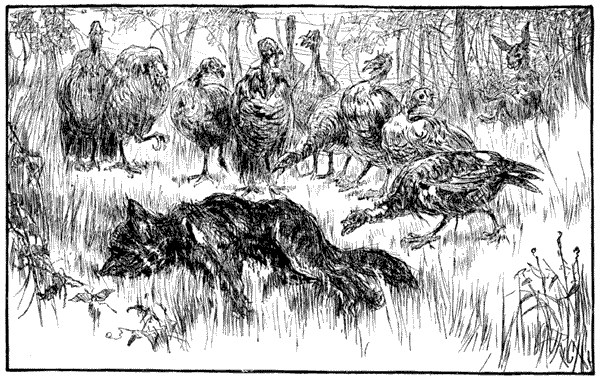
happens, as in the case of the negro story of the Rabbit, the Wildcat,
and the Turkeys, that the stories are built upon until they are made to
fit the peculiarities of the race that borrows them. The Creek version
of the Rabbit, Wildcat, and Turkey story is to the effect that the
Wildcat pretended to be dead, and the Rabbit persuaded the Turkeys to go
near him. When they are near enough, the Rabbit exclaims: "Jump up and
catch a red-leg! jump up and catch a red-leg!" The Wildcat catches one,
and proceeds to eat it, whereupon the Turkeys pursue the Rabbit, and
peck and nip him until his tail comes off, and this is the reason the
Rabbit has a short tail. The Creeks, as well as other tribes, were long
in contact with the negroes, some of them were owners of slaves, and it
is perhaps in this way that the animal stories of the two races became
in a measure blended. The discussion of this subject cannot be pursued
here, but it is an interesting one. It offers a wide field for both
speculation and investigation.
The "Cutta Cord-la" story (p. 241) of Daddy Jack is in some respects
unique. It was sent to the writer by Mrs. Martha B. Washington, of
Charleston, South Carolina, and there seems to be no doubt that it
originated in San Domingo or Martinique. The story of how Brother Rabbit
drove all the other animals out of the new house they had built, by
firing a cannon and pouring a tub of water down the stairway, has its
variant in Demerara. Indeed, it was by means of this variant, sent by
Mr. Wendell P. Garrison, of "The Nation" (New York), that the negro
story was procured.
In the introduction to the first volume of Uncle Remus, a lame apology
was made for inflicting a book of dialect upon the public. Perhaps a
similar apology should be made here; but the discriminating reader does
not need to be told that it would be impossible to separate these
stories from the idiom in which they have been recited for generations.
The dialect is a part of the legends themselves, and to present them in
any other way would be to rob them of everything that gives them
vitality. The dialect of Daddy Jack, which is that of the negroes on the
Sea Islands and the rice plantations, though it may seem at first glance
to be more difficult than that of Uncle Remus, is, in reality, simpler
and more direct. It is the negro dialect in its most primitive
state—the "Gullah" talk of some of the negroes on the Sea Islands,
being merely a confused and untranslatable mixture of English and
African words. In the introductory notes to "Slave Songs of the United
States" may be found an exposition of Daddy Jack's dialect as complete
as any that can be given here. A key to the dialect may be given very
briefly. The vocabulary is not an extensive one—more depending upon the
manner, the form of expression, and the inflection, than upon the words
employed. It is thus an admirable vehicle for story-telling. It
recognizes no gender, and scorns the use of the plural number except
accidentally. "'E" stands for "he" "she" or "it," and "dem" may allude
to one thing, or may include a thousand. The dialect is laconic and yet
rambling, full of repetitions, and abounding in curious elisions, that
give an unexpected quaintness to the simplest statements. A glance at
the following vocabulary will enable the reader to understand Daddy
Jack's dialect perfectly, though allowance must be made for inversions
and elisions.
B'er, brother.
Beer, bear.
Bittle, victuals.
Bret, breath
Buckra, white man, overseer, boss
Churrah, churray, spill, splash
Da, the, that
Dey, there
Dey-dey, here, down there, right here
Enty, ain't he? an exclamation of astonishment or assent
Gwan, going
Leaf, leave
Lif, live
Lil, lil-a, or lilly, little
Lun, learn
Mek, make
Neat', or nead, underneath, beneath
Oona, you, all of you
Sem, same
Shum, see them, saw them
Tam, time
'Tan', stand
Tankee, thanks, thank you
Tark, or tahlk, talk
Teer, tear
Tek, take
T'ink, or t'ought, think, thought
T'row, throw
Titty, or titter, sissy, sister
Trute, truth
Turrer, or tarrah, the other
Tusty, thirsty
Urrer, other
Wey, where
Wun, when
Wut, what
Y'et or ut, earth
Yeddy, or yerry, heard, hear
Yent, ain't, is n't.
The trick of adding a vowel to sound words is not unpleasing to the ear.
Thus: "I bin-a wait fer you; come-a ring-a dem bell. Wut mek-a (or
mekky) you stay so?" "Yeddy," "yerry," and probably "churry" are the
result of this—heard-a, yeard-a, yeddy; hear-a, year-a, yerry; chur-a,
churray. When "eye" is written "y-eye," it is to be pronounced "yi." In
such words as "back," "ax," a has the sound of ah. They are written
"bahk," "ahx."
Professor J. A. Harrison of the Washington and Lee University,
Lexington, Virginia, has recently written a paper on "The Creole Patois
of Louisiana,"[i_21] which is full of interest to those interested in the
study of dialects. In the course of his paper, Professor Harrison says:
"Many philologists have noted the felicitous [Greek: aithiopizein] of
Uncle Remus in the negro dialect of the South. The Creole lends itself
no less felicitously to the récit and to the conte, as we may say on
good authority. The fables of La Fontaine and Perrin, and the Gospel of
St. John have, indeed, been translated into the dialect of San Domingo
or Martinique; lately we have had a Greek plenipotentiary turning Dante
into the idiom of New Hellas; what next? Any one who has seen the
delightful 'Chansons Canadiennes' of M. Ernest Gagnon (Quebec, 1880)
knows what pleasant things may spring from the naïve consciousness of
the people. The Creole of Louisiana lends itself admirably to those
petits poèmes, those simple little dramatic tales, compositions,
improvisations, which, shunning the regions of abstraction and
metaphysics, recount the experiences of a story-teller, put into
striking and pregnant syllabuses the memorabilia of some simple life, or
sum up in pointed monosyllables the humor of plantation anecdote."
Professor Harrison alludes to interesting examples of the Creole negro
dialect that occur in the works of Mr. George W. Cable, and in
"L'Habitation Saint-Ybars," by Dr. Alfred Mercier, an accomplished
physician and litterateur of New Orleans. In order to show the
possibilities of the Creole negro dialect, the following Conte Nègre,
after Dr. Mercier, is given. The story is quoted by Professor Harrison,
and the literal interlinear version is inserted by him to give a clue to
the meaning. The Miss Meadows of the Georgia negro, it will be
perceived, becomes Mamzel Calinda, and the story is one with which the
readers of the first volume of Uncle Remus are familiar. It is entitled
"Mariage Mlle. Calinda."
- Dan tan lé zote foi, compair Chivreil avé compair
Dans temps les autres fois, compère Chevreuil avec compère
- Torti té tou lé dé apé fé lamou à Mamzel Calinda.
Tortue étaient tous les deux après faire l'amour à Mademoiselle
Calinda.
- Mamzel Calinda té linmin mié compair Chivreil, cofair
Mlle. Calinda avait aimé mieux compère Chevreuil, [pour] quoi faire
- li pli vaïan; mé li té linmin compair Torti oucite,
le plus vaillant; mais elle avait aimé compère Tortue aussi,
- li si tan gagnin bon tchor! Popa Mamzel Calinda di li:
il si tant gagner bon cœur! Papa Mlle. Calinda dire lui:
- "Mo fie, li tan to maïé; fo to soizi cila to oulé." Landimin,
"Ma fille, il (est) temps te marier; faut te choisir cela tu
voulez." Lendemain,
- compair Chivreil avé compair Torti rivé tou yé dé coté Mlle. C.
compère Chevreuil avec compère Tortue arriver tous eux de côté Mlle.
C.
- Mamzel C., qui té zonglé tou la nouite, di yé: "Michié Chivreil
avé
Mlle. C., qui avait songé toute la nuit, dire eux: "Monsieur
Chevreuil avec
- Michié Torti, mo popa oulé mo maïe. Mo pa oulé di ain
Monsieur Tortue, mon papa vouloir me marier. Moi pas vouloir dire un
- dan ouzote non. Ouzote a galopé ain lacourse dice foi cate
dans vous autres non. Vous autres va galopper une la course dix fois
quatre
- narpan; cila qui sorti divan, ma maïe avé li. Apé dimin
arpents; cela qui sortir devant, moi va marier avec lui. Après
demain
- dimance, ouzote a galopé." Yé parti couri, compair Chivreil
dimanche, vous autres va galopper." Eux partir courir, compère
Chevreuil
- zo tchor contan; compair Torti apé zonglé li-minme:
son cœur content; compère Tortue après songer lui-même:
- "Dan tan pacé, mo granpopa bate compair Lapin pou
"Dans temps passé, mon grandpapa battre compère Lapin pour
- galopé. Pa conin coman ma fé pou bate compair Chivreil."
galopper. Pas conner (= connaître) comment moi va faire pour battre
compère Chevreuil."
- Dan tan cila, navé ain vié, vié cocodri qui té gagnin
Dans temps cela en avait un vieux, vieux crocodile qui avait gagné
- plice pacé cincante di zan. Li té si malin, yé té pelé li
plus passé cinquante dix ans. Lui était si malin, eux avaient appelé
lui
- compair Zavoca. La nouite vini, compair Torti couri trouvé
compère Avocat. La nuit venir, compère Tortue courir trouver
- compair Zavoca, é conté li coman li baracé pou so
compère Avocat, et conter lui comment lui embarrasser pour sa
- lacourse. Compair Zavoca di compair Torti: "Mo ben
la course. Compère Avocat dire compère Tortue: "Moi bien
- oulé idé toi, mo gaçon; nou proce minme famie; la tair
vouloir aider toi, mon garçon; nous proche même famille; la terre
- avé do lo minme kichoge pou nizote. Mo zonglé zafair
avec de l'eau même quelquechose pour nous autres. Moi va songer
cette affaire
- To vini dimin bon matin; ma di toi qui pou fé."
Toi venir demain bon matin; moi va dire toi que pour faire."
- Compair Torti couri coucé; mé li pas dromi boucou,
Compère Tortue courir coucher; mais lui pas dormir beaucoup,
- li té si tan tracassé. Bon matin li parti couri
lui était si tant tracassé. Bon matin lui partir courir
- coté compair Zavoca. Compair Zavoca dija diboute apé
côté compère Avocat. Compère Avocat déjà debout après
- boi so café. "Bonzou, Michié Zavoca." "Bonzou, mo
boire son café. "Bonjour, Monsieur Avocat." "Bonjour, mon
- gaçon. Zafair cila donne moin boucou traca; min mo
garçon. Cette affaire cela donne moi beaucoup tracas; mais moi
- cré ta bate compair Chivreil, si to fé mékié ma di toi."
crois toi va battre compère Chevreuil, si toi fais métier moi va
dire toi."
- "Vouzote a pranne jige jordi pou misiré chimin au ra
"Vous autres va prendre juge aujourd'hui pour mesurer chemin au ras
- bayou; chac cate narpan mété jalon. Compair Chivreil a
bayou; chaque quatre arpents mettez jalon. Compère Chevreuil va
- galopé on la tair; toi, ta galopé dan dolo. To ben compranne
galopper en la terre; toi, tu va galopper dans de l'eau. Toi bien
comprendre
- ça mo di toi?" "O, oui, compair Zavoca, mo ben
cela moi dire toi?" "O, oui, compère Avocat, moi bien
- couté ton ça vapé di." "A soua, can la nouite vini,
écouter tout cela vous après dire." "Le soir, quand la nuit venir,
- ta couri pranne nef dan to zami, é ta chaché aine dan
toi va courir prendre neuf dans tes amis, et toi va cacher un dans
- zerb au ra chakène zalon yé. Toi, ta couri caché au ra
herbe au ras chacun jalon eux. Toi, toi va courir cacher au ras
- la mison Mamzel Calinda. To ben compranne ça mo di toi?"
la maison Mlle. Calinda. Toi bien comprendre cela moi dire toi?"
- "O, oui, compair Zavoca, mo tou compranne mékié ça vou
"O, oui, compère Avocat, moi tout comprendre métier cela vous
- di." "Eben! couri paré pou sové lonnair nou nachion."
dire." "Eh bien! courir préparer pour sauver l'honneur notre
nation."
- Compair Torti couri coté compair Chivreil é rangé tou
Compère Tortue courir côté compère Chevreuil et arranger tout
- kichoge compair Zavoca di li. Compair Chivreil si tan sire
quelquechose compère Avocat dire lui. Compère Chevreuil si tant sûr
- gagnin lacourse, li di oui tou ça compair Torti oulé.
gagner la course, lui dire oui tout cela compère Tortue vouloir.
- Landimin bon matin, ton zabitan semblé pou oua
Lendemain bon matin, tous habitants assembler pour voir
- gran lacourse. Can lhair rivé, compair Chivreil avé
grande la course. Quand l'heure arriver, compère Chevreuil avec
- compair Torti tou lé dé paré. Jige la crié: "Go!" é yé
compère Tortue tous les deux préparés. Juge là crier: "Go!" et eux
- parti galopé. Tan compair Chivreil rivé coté primié
partir galopper. Temps compère Chevreuil arriver côté premier
- zalon, li hélé: "Halo, compair Torti!" "Mo la, compair
jalon, lui héler: "Halo, compère Tortue!" "Moi là, compère
- Chivreil!" Tan yé rivé dézième zalon, compair Chivreil
Chevreuil!" Temps eux arriver deuxième jalon, compère Chevreuil
- siffle: "Fioute!" Compair Torti réponne: "Croak!" Troisième
siffler: "Fioute!" Compère Tortue répondre: "Croak!" Troisième
- zalon bouté, compair Torti tink-à-tink avé compair
jalon au bout, compère Tortue tingue-à-tingue avec compère
- Chivreil. "Diâbe! Torti la galopé pli vite
Chevreuil. "Diable! Tortue là galopper plus vite
- pacé stimbotte; fo mo grouyé mo cor." Tan compair
passé steamboat; faut moi grouiller mon corps." Temps compère
- Chivreil rivé coté névième zalon, li oua compair Torti
Chevreuil arriver côté neuvième jalon, lui voir compère Tortue
- apé patchiou dan dolo. Li mété ton so laforce
après patchiou! dans de l'eau. Lui mettre toute sa la force
- dihior pou aïen; avan li rivé coté bite, li tendé
dehors pour rien; avant lui arriver côté but, lui entendre
- ton monne apé hélé: "Houra! houra! pou compair Torti!"
tout monde après héler: "Hourra! hourra! pour compère Tortue!"
- Tan li rivé, li oua compair Torti on la garlie apé
Temps lui arriver, lui voir compère Tortue en la galerie après
- brassé Mamzel Calinda. Ca fé li si tan mal, li
embrasser Mlle. Calinda. Cela faire lui si tant mal, lui
- sapé dan boi. Compair Torti maïé avé Mamzel Calinda
s'échapper dans bois. Compère Tortue marier avec Mlle. Calinda
- samedi apé vini, é tou monne manzé, boi, jika
samedi après venir, et tout monde manger, boire jusqu'à
- y tchiak.[i_22]
eux griser.
It only remains to be said that none of the stories given in the present
volume are "cooked." They are given in the simple but picturesque
language of the negroes, just as the negroes tell them. The Ghost-story,
in which the dead woman returns in search of the silver that had been
placed upon her eyes, is undoubtedly of white origin; but Mr. Samuel L.
Clemens (Mark Twain) heard it among the negroes of Florida, Missouri,
where it was "The Woman with the Golden Arm." Fortunately, it was placed
in the mouth of 'Tildy, the house-girl, who must be supposed to have
heard her mistress tell it. But it has been negroized to such an extent
that it may be classed as a negro legend; and it is possible that the
white version is itself based upon a negro story. At any rate, it was
told to the writer by different negroes; and he saw no reason to doubt
its authenticity until after a large portion of the book was in type.
His relations to the stories are simply those of editor and compiler. He
has written them as they came to him, and he is responsible only for the
setting. He has endeavored to project them upon the background and to
give them the surroundings which they had in the old days that are no
more; and it has been his purpose to give in their recital a glimpse of
plantation life in the South before the war. If the reader, therefore,
will exercise his imagination to the extent of believing that the
stories are told to a little boy by a group of negroes on a plantation
in Middle Georgia, before the war, he will need neither foot-note nor
explanation to guide him.
In the preparation of this volume the writer has been placed under
obligations to many kind friends. But for the ready sympathy and
encouragement of the proprietors of "The Atlanta Constitution"—but for
their generosity, it may be said—the writer would never have found
opportunity to verify the stories and prepare them for the press. He is
also indebted to hundreds of kind correspondents in all parts of the
Southern States, who have interested themselves in the work of
collecting the legends. He is particularly indebted to Mrs. Helen S.
Barclay, of Darien, to Mr. W. O. Tuggle, to Hon. Charles C. Jones, Jr.,
to the accomplished daughters of Mr. Griswold, of Clinton, Georgia, and
to Mr. John Devereux, Jr., and Miss Devereux, of Raleigh, North
Carolina.
J. C. H.
Atlanta, Georgia.