It was a dark, chilly night in September,
1884. A heavy gloom had descended
over the streets of A——, a small town
on the Rhine, and was hanging like a
black funeral-pall over the dull
factory burgh. The greater number
of its inhabitants, wearied by their
long day’s work, had hours before
retired to stretch their tired limbs,
and lay their aching heads upon
their pillows. All was quiet in the
large house; all was quiet in the
deserted streets.
I too was lying in my bed; alas, not one of rest, but
of pain and sickness, to which I had been confined
for some days. So still was everything in the house,
that, as Longfellow has it, its stillness seemed almost
audible. I could plainly hear the murmur of the blood,
as it rushed through my aching body, producing that
monotonous singing so familiar to one who lends a
watchful ear to silence. I had listened to it until, in my
nervous imagination, it had grown into the sound of a
distant cataract, the fall of mighty waters ...
when, suddenly changing its character, the ever growing
“singing” merged into other and far more welcome
sounds. It was the low, and at first scarce audible,
whisper of a human voice. It approached, and gradually
strengthening seemed to speak in my very ear. Thus
sounds a voice speaking across a blue quiescent lake, in
one of those wondrously acoustic gorges of the snow-capped
mountains, where the air is so pure that a word
pronounced half a mile off seems almost at the elbow.
Yes; it was the voice of one whom to know is to reverence;
of one, to me, owing to many mystic associations,
most dear and holy; a voice familiar for long years and
ever welcome: doubly so in hours of mental or physical
suffering, for it always brings with it a ray of hope and
consolation.
“Courage,” it whispered in gentle, mellow tones.
“Think of the days passed by you in sweet associations;
of the great lessons received of Nature’s truths; of the
many errors of men concerning these truths; and try to
add to them the experience of a night in this city. Let
the narrative of a strange life, that will interest you, help
to shorten the hours of suffering.... Give your attention.
Look yonder before you!”
“Yonder” meant the clear, large windows of an empty
house on the other side of the narrow street of the
German town. They faced my own in almost a straight
line across the street, and my bed faced the windows of
my sleeping room. Obedient to the suggestion, I directed
my gaze towards them, and what I saw made me for the
time being forget the agony of the pain that racked my
swollen arm and rheumatical body.
Over the windows was creeping a mist; a dense, heavy,
serpentine, whitish mist, that looked like the huge
shadow of a gigantic boa slowly uncoiling its body.
Gradually it disappeared, to leave a lustrous light, soft
and silvery, as though the window-panes behind reflected
a thousand moonbeams, a tropical star-lit sky—first from
outside, then from within the empty rooms. Next I saw
the mist elongating itself and throwing, as it were, a fairy
bridge across the street from the bewitched windows to
my own balcony, nay to my very own bed. As I continued
gazing, the wall and windows and the opposite
house itself, suddenly vanished. The space occupied by
the empty rooms had changed into the interior of another
smaller room, in what I knew to be a Swiss châlet—into
a study, whose old, dark walls were covered from floor to
ceiling with book shelves on which were many antiquated
folios, as well as works of a more recent date. In the
center stood a large old-fashioned table, littered over
with manuscripts and writing materials. Before it, quill-pen
in hand, sat an old man; a grim-looking, skeleton-like
personage, with a face so thin, so pale, yellow and
emaciated, that the light of the solitary little student’s
lamp was reflected in two shining spots on his high
cheek-bones, as though they were carved out of ivory.
As I tried to get a better view of him by slowly raising
myself upon my pillows, the whole vision, châlet and
study, desk, books and scribe, seemed to flicker and
move. Once set in motion they approached nearer and
nearer, until, gliding noiselessly along the fleecy bridge
of clouds across the street, they floated through the
closed windows into my room and finally seemed to
settle beside my bed.
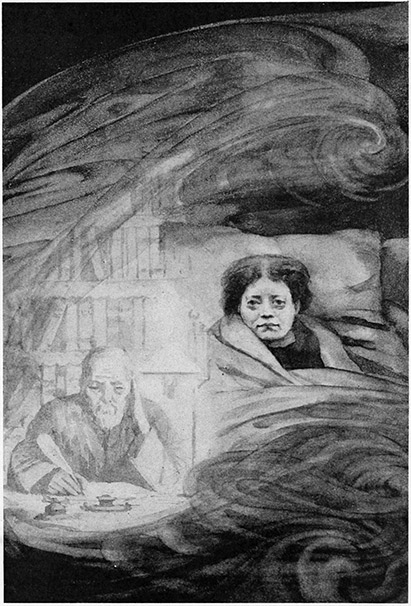
“I NOTICED A LIGHT FLASHING FROM UNDER HIS PEN, A
BRIGHT COLORED SPARK THAT BECAME INSTANTANEOUSLY
A SOUND. IT WAS THE SMALL VOICE OF THE QUILL.”
“Listen to what he thinks and is going to write”—said
in soothing tones the same familiar, far off, and yet near
voice. “Thus you will hear a narrative, the telling of
which may help to shorten the long sleepless hours, and
even make you forget for a while your pain.... Try!”—it
added, using the well-known Rosicrucian and Kabalistic
formula.
I tried, doing as I was bid. I centered all my attention
on the solitary laborious figure that I saw before me, but
which did not see me. At first, the noise of the quill-pen
with which the old man was writing, suggested to
my mind nothing more than a low whispered murmur
of a nondescript nature. Then, gradually, my ear
caught the indistinct words of a faint and distant voice,
and I thought the figure before me, bending over its
manuscript, was reading its tale aloud instead of writing
it. But I soon found out my error. For casting my gaze
at the old scribe’s face, I saw at a glance that his lips
were compressed and motionless, and the voice too thin
and shrill to be his voice. Stranger still, at every word
traced by the feeble, aged hand, I noticed a light flashing
from under his pen, a bright colored spark that became
instantaneously a sound, or—what is the same thing—it
seemed to do so to my inner perceptions. It was indeed
the small voice of the quill that I heard, though scribe
and pen were at the time, perchance, hundreds of miles
away from Germany. Such things will happen occasionally,
especially at night, beneath whose starry shade,
as Byron tells us, we
... learn the language of another world ...
However it may be, the words uttered by the quill
remained in my memory for days after. Nor had I any
great difficulty in retaining them, for when I sat down to
record the story, I found it, as usual, indelibly impressed
on the astral tablets before my inner eye.
Thus, I had but to copy it and so give it as I received
it. I failed to learn the name of the unknown nocturnal
writer. Nevertheless, though the reader may prefer to
regard the whole story as one made up for the occasion,
a dream, perhaps, still its incidents will, I hope, prove
none the less interesting.
My birth-place is a small mountain hamlet, a cluster of
Swiss cottages, hidden deep in a sunny nook, between
two tumble-down glaciers and a peak covered with eternal
snows. Thither, thirty-seven years ago, I returned—crippled
mentally and physically—to die, if death
would only have me. The pure invigorating air of
my birth-place decided otherwise. I am still alive;
perhaps for the purpose of giving evidence to facts I
have kept profoundly secret from all—a tale of horror
I would rather hide than reveal. The reason for this
unwillingness on my part is due to my early education,
and to subsequent events that gave the lie to my most
cherished prejudices. Some people might be inclined
to regard these events as providential: I, however, believe
in no Providence, and yet am unable to attribute
them to mere chance. I connect them as the ceaseless
evolution of effects, engendered by certain direct
causes, with one primary and fundamental cause, from
which ensued all that followed. A feeble old man am
I now, yet physical weakness has in no way impaired
my mental faculties. I remember the smallest details
of that terrible cause, which engendered such fatal
results. It is these which furnish me with an additional
proof of the actual existence of one whom I
fain would regard—oh, that I could do so!—as a creature
born of my fancy, the evanescent production of a
feverish, horrid dream! Oh that terrible, mild and all-forgiving,
that saintly and respected Being! It was
that paragon of all the virtues who embittered my
whole existence. It is he, who, pushing me violently
out of the monotonous but secure groove of daily life,
was the first to force upon me the certitude of a life
hereafter, thus adding an additional horror to one
already great enough.
With a view to a clearer comprehension of the situation,
I must interrupt these recollections with a few
words about myself. Oh how, if I could, would I obliterate
that hated Self!
Born in Switzerland, of French parents, who centered
the whole world-wisdom in the literary trinity of Voltaire,
J. J. Rousseau and D’Holbach, and educated in a German
university, I grew up a thorough materialist, a confirmed
atheist. I could never have even pictured to myself any
beings—least of all a Being—above or even outside visible
nature, as distinguished from her. Hence I regarded
everything that could not be brought under the strictest
analysis of the physical senses as a mere chimera. A
soul, I argued, even supposing man has one, must be
material. According to Origen’s definition, incorporeus[1]—the
epithet he gave to his God—signifies a substance
only more subtle than that of physical bodies, of which,
at best, we can form no definite idea. How then can
that, of which our senses cannot enable us to obtain any
clear knowledge, how can that make itself visible or
produce any tangible manifestations?
Accordingly, I received the tales of nascent Spiritualism
with a feeling of utter contempt, and regarded the
overtures made by certain priests with derision, often
akin to anger. And indeed the latter feeling has never
entirely abandoned me.
Pascal, in the eighth Act of his “Thoughts,” confesses
to a most complete incertitude upon the existence of God.
Throughout my life, I too professed a complete certitude
as to the non-existence of any such extra-cosmic being,
and repeated with that great thinker the memorable
words in which he tells us: “I have examined if this
God of whom all the world speaks might not have left
some marks of himself. I look everywhere, and everywhere
I see nothing but obscurity. Nature offers me
nothing that may not be a matter of doubt and inquietude.”
Nor have I found to this day anything that
might unsettle me in precisely similar and even stronger
feelings. I have never believed, nor shall I ever believe,
in a Supreme Being. But at the potentialities of man,
proclaimed far and wide in the East, powers so developed
in some persons as to make them virtually Gods, at them
I laugh no more. My whole broken life is a protest
against such negation. I believe in such phenomena,
and—I curse them, whenever they come, and by whatsoever
means generated.
On the death of my parents, owing to an unfortunate
lawsuit, I lost the greater part of my fortune, and resolved—for
the sake of those I loved best, rather than
for my own—to make another for myself. My elder
sister, whom I adored, had married a poor man. I
accepted the offer of a rich Hamburg firm and sailed
for Japan as its junior partner.
For several years my business went on successfully.
I got into the confidence of many influential Japanese,
through whose protection I was enabled to travel and
transact business in many localities, which, in those
days especially, were not easily accessible to foreigners.
Indifferent to every religion, I became interested in the
philosophy of Buddhism, the only religious system I
thought worthy of being called philosophical. Thus, in
my moments of leisure, I visited the most remarkable
temples of Japan, the most important and curious of the
ninety-six Buddhist monasteries of Kioto. I have examined
in turn Day-Bootzoo, with its gigantic bell;
Tzeonene, Enarino-Yassero, Kie-Missoo, Higadzi-Hong-Vonsi,
and many other famous temples.
Several years passed away, and during that whole
period I was not cured of my scepticism, nor did I ever
contemplate having my opinions on this subject altered.
I derided the pretentions of the Japanese bonzes and
ascetics, as I had those of Christian priests and European
Spiritualists. I could not believe in the acquisition
of powers unknown to, and never studied by, men of
science; hence I scoffed at all such ideas. The superstitious
and atrabilious Buddhist, teaching us to shun
the pleasures of life, to put to rout one’s passions, to
render oneself insensible alike to happiness and suffering,
in order to acquire such chimerical powers—seemed
supremely ridiculous in my eyes.
On a day for ever memorable to me—a fatal day—I
made the acquaintance of a venerable and learned Bonze,
a Japanese priest, named Tamoora Hideyeri. I met him
at the foot of the golden Kwon-On, and from that
moment he became my best and most trusted friend.
Notwithstanding my great and genuine regard for him,
however, whenever a good opportunity was offered I
never failed to mock his religious convictions, thereby
very often hurting his feelings.
But my old friend was as meek and forgiving as any
true Buddhist’s heart might desire. He never resented
my impatient sarcasms, even when they were, to say the
least, of equivocal propriety, and generally limited his
replies to the “wait and see” kind of protest. Nor could
he be brought to seriously believe in the sincerity of my
denial of the existence of any God or Gods. The full
meaning of the terms “atheism” and “scepticism” was
beyond the comprehension of his otherwise extremely
intellectual and acute mind. Like certain reverential
Christians, he seemed incapable of realizing that any
man of sense should prefer the wise conclusions arrived
at by philosophy and modern science to a ridiculous
belief in an invisible world full of Gods and spirits, dzins
and demons. “Man is a spiritual being,” he insisted,
“who returns to earth more than once, and is rewarded
or punished in the between times.” The proposition
that man is nothing else but a heap of organized dust,
was beyond him. Like Jeremy Collier, he refused to
admit that he was no better than “a stalking machine, a
speaking head without a soul in it,” whose “thoughts
are all bound by the laws of motion.” “For,” he argued,
“if my actions were, as you say, prescribed beforehand,
and I had no more liberty or free will to change the
course of my action than the running waters of the river
yonder, then the glorious doctrine of Karma, of merit
and demerit, would be foolishness indeed.”
Thus the whole of my hyper-metaphysical friend’s
ontology rested on the shaky superstructure of metempsychosis,
of a fancied “just” Law of Retribution, and
other such equally absurd dreams.
“We cannot,” said he paradoxically one day, “hope to
live hereafter in the full enjoyment of our consciousness,
unless we have built for it beforehand a firm and solid
foundation of spirituality.... Nay, laugh not, friend
of no faith,” he meekly pleaded, “but rather think and
reflect on this. One who has never taught himself to
live in Spirit during his conscious and responsible life
on earth, can hardly hope to enjoy a sentient existence
after death, when, deprived of his body, he is limited to
that Spirit alone.”
“What can you mean by life in Spirit?”—I inquired.
“Life on a spiritual plane; that which the Buddhists
call Tushita Devaloka (Paradise). Man can create such
a blissful existence for himself between two births, by
the gradual transference on to that plane of all the
faculties which during his sojourn on earth manifest
through his organic body and, as you call it, animal
brain.”...
“How absurd! And how can man do this?”
“Contemplation and a strong desire to assimilate the
blessed Gods, will enable him to do so.”
“And if man refuses this intellectual occupation, by
which you mean, I suppose, the fixing of the eyes on the
tip of his nose, what becomes of him after the death of
his body?” was my mocking question.
“He will be dealt with according to the prevailing
state of his consciousness, of which there are many
grades. At best—immediate rebirth; at worst—the state
of avitchi, a mental hell. Yet one need not be an ascetic
to assimilate spiritual life which will extend to the
hereafter. All that is required is to try to approach
Spirit.”
“How so? Even when disbelieving in it?”—I rejoined.
“Even so! One may disbelieve and yet harbor in
one’s nature room for doubt, however small that room
may be, and thus try one day, were it but for one
moment, to open the door of the inner temple; and this
will prove sufficient for the purpose.”
“You are decidedly poetical, and paradoxical to boot,
reverend sir. Will you kindly explain to me a little
more of the mystery?”
“There is none; still I am willing. Suppose for a
moment that some unknown temple to which you have
never been before, and the existence of which you think
you have reasons to deny, is the ‘spiritual plane’ of
which I am speaking. Some one takes you by the hand
and leads you towards its entrance, curiosity makes you
open its door and look within. By this simple act, by
entering it for one second, you have established an everlasting
connexion between your consciousness and the
temple. You cannot deny its existence any longer, nor
obliterate the fact of your having entered it. And according
to the character and the variety of your work,
within its holy precincts, so will you live in it after your
consciousness is severed from its dwelling of flesh.”
“What do you mean? And what has my after-death
consciousness—if such a thing exists—to do with the
temple?”
“It has everything to do with it,” solemnly rejoined
the old man. “There can be no self-consciousness after
death outside the temple of spirit. That which you will
have done within its plane will alone survive. All the
rest is false and an illusion. It is doomed to perish in
the Ocean of Mâyâ.”
Amused at the idea of living outside one’s body, I
urged on my old friend to tell me more. Mistaking my
meaning, the venerable man willingly consented.
Tamoora Hideyeri belonged to the great temple of
Tzi-Onene, a Buddhist monastery, famous not only in
all Japan, but also throughout Tibet and China. No
other is so venerated in Kioto. Its monks belong to the
sect of Dzeno-doo, and are considered as the most learned
among the many erudite fraternities. They are, moreover,
closely connected and allied with the Yamabooshi
(the ascetics, or hermits), who follow the doctrines of
Lao-tze. No wonder, that at the slightest provocation on
my part the priest flew into the highest metaphysics,
hoping thereby to cure me of my infidelity.
No use repeating here the long rigmarole of the
most hopelessly involved and incomprehensible of all
doctrines. According to his ideas, we have to train
ourselves for spirituality in another world—as for gymnastics.
Carrying on the analogy between the temple
and the “spiritual plane” he tried to illustrate his idea.
He had himself worked in the temple of Spirit two-thirds
of his life, and given several hours daily to
“contemplation.” Thus he knew (?!) that after he had
laid aside his mortal casket, “a mere illusion,” he explained—he
would in his spiritual consciousness live
over again every feeling of ennobling joy and divine
bliss he had ever had, or ought to have had—only a
hundred-fold intensified. His work on the spirit-plane
had been considerable, he said, and he hoped, therefore,
that the wages of the laborer would prove proportionate.
“But suppose the laborer, as in the example you
have just brought forward in my case, should have no
more than opened the temple door out of mere curiosity;
had only peeped into the sanctuary never to set his foot
therein again. What then?”
“Then,” he answered, “you would have only this
short minute to record in your future self-consciousness
and no more. Our life hereafter records and repeats
but the impressions and feelings we have had in our
spiritual experiences and nothing else. Thus, if instead
of reverence at the moment of entering the abode of
Spirit, you had been harboring in your heart anger,
jealousy or grief, then your future spiritual life would be
a sad one, in truth. There would be nothing to record,
save the opening of a door in a fit of bad temper.”
“How then could it be repeated?”—I insisted, highly
amused. “What do you suppose I would be doing
before incarnating again?”
“In that case,” he said, speaking slowly and weighing
every word—“in that case, you would have, I fear, only to
open and shut the temple door, over and over again, during
a period which, however short, would seem to you an
eternity.”
This kind of after-death occupation appeared to me,
at that time, so grotesque in its sublime absurdity, that I
was seized with an almost inextinguishable fit of laughter.
My venerable friend looked considerably dismayed at
such a result of his metaphysical instruction. He had
evidently not expected such hilarity. However, he said
nothing, but only sighed and gazed at me with increased
benevolence and pity shining in his small black eyes.
“Pray excuse my laughter,” I apologized. “But
really, now, you cannot seriously mean to tell me that
the ‘spiritual state’ you advocate and so firmly believe
in, consists only in aping certain things we do in life?”
“Nay, nay; not aping, but only intensifying their
repetition; filling the gaps that were unjustly left unfilled
during life in the fruition of our acts and deeds,
and of everything performed on the spiritual plane of
the one real state. What I said was an illustration, and
no doubt for you, who seem entirely ignorant of the
mysteries of Soul-Vision, not a very intelligible one. It
is myself who am to be blamed.... What I sought
to impress upon you was that, as the spiritual state of
our consciousness liberated from its body is but the
fruition of every spiritual act performed during life,
where an act had been barren, there could be no results
expected—save the repetition of that act itself. This is
all. I pray you may be spared such fruitless deeds and
finally made to see certain truths.” And passing through
the usual Japanese courtesies of taking leave, the excellent
man departed.
Alas, alas! had I but known at the time what I have
learned since, how little would I have laughed, and how
much more would I have learned!
But as the matter stood, the more personal affection
and respect I felt for him, the less could I become reconciled
to his wild ideas about an after-life, and especially
as to the acquisition by some men of supernatural powers.
I felt particularly disgusted with his reverence for the
Yamabooshi, the allies of every Buddhist sect in the
land. Their claims to the “miraculous” were simply
odious to my notions. To hear every Jap I knew at
Kioto, even to my own partner, the shrewdest of all the
business men I had come across in the East—mentioning
these followers of Lao-tze with downcast eyes,
reverentially folded hands, and affirmations of their possessing
“great” and “wonderful” gifts, was more than
I was prepared to patiently tolerate in those days. And
who were they, after all, these great magicians with
their ridiculous pretensions to super-mundane knowledge;
these “holy beggars” who, as I then thought,
purposely dwell in the recesses of unfrequented mountains
and on unapproachable craggy steeps, so as the
better to afford no chance to curious intruders of finding
them out and watching them in their own dens?
Simply impudent fortune-tellers, Japanese gypsies who
sell charms and talismans, and no better. In answer to
those who sought to assure me that though the Yamabooshi
lead a mysterious life, admitting none of the
profane to their secrets, they still do accept pupils, however
difficult it is for one to become their disciple, and
that thus they have living witnesses to the great purity
and sanctity of their lives, in answer to such affirmations
I opposed the strongest negation and stood firmly by it.
I insulted both masters and pupils, classing them under
the same category of fools, when not knaves, and I went
so far as to include in this number the Sintos. Now
Sintoism or Sin-Syu, “faith in the Gods, and in the way
to the Gods,” that is, belief in the communication between
these creatures and men, is a kind of worship of
nature-spirits, than which nothing can be more miserably
absurd. And by placing the Sintos among the fools and
knaves of other sects, I gained many enemies. For the
Sinto Kanusi (spiritual teachers) are looked upon as the
highest in the upper classes of Society, the Mikado himself
being at the head of their hierarchy and the members
of the sect belonging to the most cultured and educated
men in Japan. These Kanusi of the Sinto form no
caste or class apart, nor do they pass any ordination—at
any rate none known to outsiders. And as they claim
publicly no special privilege or powers, even their dress
being in no wise different from that of the laity, but are
simply in the world’s opinion professors and students of
occult and spiritual sciences, I very often came in contact
with them without in the least suspecting that I was in
the presence of such personages.
Years passed; and as time went by, my ineradicable
scepticism grew stronger and waxed fiercer every day.
I have already mentioned an elder and much-beloved
sister, my only surviving relative. She had married
and had lately gone to live at Nuremberg. I regarded
her with feelings more filial than fraternal, and her
children were as dear to me as might have been my
own. At the time of the great catastrophe that in the
course of a few days had made my father lose his large
fortune, and my mother break her heart, she it was,
that sweet big sister of mine, who had made herself of
her own accord the guardian angel of our ruined family.
Out of her great love for me, her younger brother, for
whom she attempted to replace the professors that could
no longer be afforded, she had renounced her own happiness.
She sacrificed herself and the man she loved,
by indefinitely postponing their marriage, in order to
help our father and chiefly myself by her undivided
devotion. And, oh, how I loved and reverenced her,
time but strengthening this earliest family affection!
They who maintain that no atheist, as such, can be a
true friend, an affectionate relative, or a loyal subject,
utter—whether consciously or unconsciously—the greatest
calumny and lie. To say that a materialist grows
hard-hearted as he grows older, that he cannot love as
a believer does, is simply the greatest fallacy.
There may be such exceptional cases it is true, but
these are found only occasionally in men who are even
more selfish than they are sceptical, or vulgarly worldly.
But when a man who is kindly disposed in his nature,
for no selfish motives but because of reason and love of
truth, becomes what is called atheistical, he is only
strengthened in his family affections, and in his sympathies
with his fellow men. All his emotions, all the
ardent aspirations towards the unseen and unreachable,
all the love which he would otherwise have uselessly bestowed
on a suppositional heaven and its God, become
now centered with tenfold force upon his loved ones and
mankind. Indeed, the atheist’s heart alone—
... can know,
What secret tides of still enjoyment flow
When brothers love....
It was such holy fraternal love that led me also to
sacrifice my comfort and personal welfare to secure her
happiness, the felicity of her who had been more than a
mother to me. I was a mere youth when I left home for
Hamburg. There, working with all the desperate earnestness
of a man who has but one noble object in view—to
relieve suffering, and help those whom he loves—I
very soon secured the confidence of my employers,
who raised me in consequence to the high post of trust
I always enjoyed. My first real pleasure and reward in
life was to see my sister married to the man she had
sacrificed for my sake, and to help them in their struggle
for existence. So purifying and unselfish was this affection
of mine for her that when it came to be shared
among her children, instead of losing in intensity by
such division, it seemed only to grow the stronger.
Born with the potentiality of the warmest family affection
in me, the devotion for my sister was so great, that
the thought of burning that sacred fire of love before
any idol, save that of herself and family, never entered
my head. This was the only church I recognized, the
only church wherein I worshipped at the altar of holy
family affection. In fact this large family of eleven
persons, including her husband, was the only tie that
attached me to Europe. Twice during a period of nine
years, had I crossed the ocean with the sole object of
seeing and pressing these dear ones to my heart. I had
no other business in the West; and having performed
this pleasant duty, I returned each time to Japan to
work and toil for them. For their sake I remained a
bachelor, that the wealth I might acquire should go undivided
to them alone.
We had always corresponded as regularly as the long
transit of the then very irregular service of the mail-boats
would permit. But suddenly there came a break
in my letters from home. For nearly a year I received
no intelligence; and day by day, I became more restless,
more apprehensive of some great misfortune. Vainly I
looked for a letter, a simple message; and my efforts to
account for so unusual a silence were fruitless.
“Friend,” said to me one day Tamoora Hideyeri, my
only confidant, “Friend, consult a holy Yamabooshi and
you will feel at rest.”
Of course the offer was rejected with as much moderation
as I could command under the provocation. But,
as steamer after steamer came in without a word of news,
I felt a despair which daily increased in depth and fixity.
This finally degenerated into an irrepressible craving, a
morbid desire to learn—the worst as I then thought. I
struggled hard with the feeling, but it had the best of
me. Only a few months before a complete master of
myself—I now became an abject slave to fear. A fatalist
of the school of D’Holbach, I, who had always
regarded belief in the system of necessity as being the
only promoter of philosophical happiness, and as having
the most advantageous influence over human weaknesses,
I felt a craving for something akin to fortune-telling!
I had gone so far as to forget the first principle
of my doctrine—the only one calculated to calm our
sorrows, to inspire us with a useful submission, namely
a rational resignation to the decrees of blind destiny,
with which foolish sensibility causes us so often to be
overwhelmed—the doctrine that all is necessary. Yes;
forgetting this, I was drawn into a shameful, superstitious
longing, a stupid, disgraceful desire to learn—if not futurity,
at any rate that which was taking place at the other
side of the globe. My conduct seemed utterly modified,
my temperament and aspirations wholly changed; and
like a weak, nervous girl, I caught myself straining my
mind to the very verge of lunacy in an attempt to look—as
I had been told one could sometimes do—beyond
the oceans, and learn, at last, the real cause of this long,
inexplicable silence!
One evening, at sunset, my old friend, the venerable
Bonze, Tamoora, appeared on the verandah of my low
wooden house. I had not visited him for many days,
and he had come to know how I was. I took the opportunity
to once more sneer at one, whom, in reality, I
regarded with most affectionate respect. With equivocal
taste—for which I repented almost before the words had
been pronounced—I inquired of him why he had taken
the trouble to walk all that distance when he might have
learned anything he liked about me by simply interrogating
a Yamabooshi? He seemed a little hurt, at first;
but after keenly scrutinizing my dejected face, he mildly
remarked that he could only insist upon what he had
advised before. Only one of that holy order could give
me consolation in my present state.
From that instant, an insane desire possessed me to
challenge him to prove his assertions. I defied—I said
to him—any and every one of his alleged magicians to
tell me the name of the person I was thinking of, and
what he was doing at that moment. He quietly answered
that my desire could be easily satisfied. There was a
Yamabooshi two doors from me, visiting a sick Sinto.
He would fetch him—if I only said the word.
I said it and from the moment of its utterance my doom
was sealed.
How shall I find words to describe the scene that
followed! Twenty minutes after the desire had been so
incautiously expressed, an old Japanese, uncommonly
tall and majestic for one of that race, pale, thin and
emaciated, was standing before me. There, where I had
expected to find servile obsequiousness, I only discerned
an air of calm and dignified composure, the attitude of
one who knows his moral superiority, and therefore
scorns to notice the mistakes of those who fail to recognize
it. To the somewhat irreverent and mocking questions,
which I put to him one after another, with feverish
eagerness, he made no reply; but gazed on me in silence
as a physician would look at a delirious patient. From
the moment he fixed his eye on mine, I felt—or shall I
say, saw—as though it were a sharp ray of light, a thin
silvery thread, shoot out from the intensely black and
narrow eyes so deeply sunk in the yellow old face. It
seemed to penetrate into my brain and heart like an
arrow, and set to work to dig out therefrom every
thought and feeling. Yes; I both saw and felt it, and
very soon the double sensation became intolerable.
To break the spell I defied him to tell me what he
had found in my thoughts. Calmly came the correct
answer—Extreme anxiety for a female relative, her husband
and children, who were inhabiting a house the
correct description of which he gave as though he knew
it as well as myself. I turned a suspicious eye upon my
friend, the Bonze, to whose indiscretions, I thought, I
was indebted for the quick reply. Remembering however
that Tamoora could know nothing of the appearance
of my sister’s house, that the Japanese are proverbially
truthful and, as friends, faithful to death—I
felt ashamed of my suspicion. To atone for it before
my own conscience I asked the hermit whether he could
tell me anything of the present state of that beloved
sister of mine. The foreigner—was the reply—would
never believe in the words, or trust to the knowledge of
any person but himself. Were the Yamabooshi to tell
him, the impression would wear out hardly a few hours
later, and the inquirer find himself as miserable as before.
There was but one means; and that was to make
the foreigner (myself) see with his own eyes, and thus
learn the truth for himself. Was the inquirer ready to
be placed by a Yamabooshi, a stranger to him, in the
required state?
I had heard in Europe of mesmerized somnambules
and pretenders to clairvoyance, and having no faith in
them, I had, therefore, nothing against the process itself.
Even in the midst of my never-ceasing mental agony,
I could not help smiling at the ridiculous nature of the
operation I was willingly submitting to. Nevertheless I
silently bowed consent.
The old Yamabooshi lost no time. He looked at the
setting sun, and finding probably, the Lord Ten-Dzio-Dai-Dzio
(the Spirit who darts his Rays) propitious for
the coming ceremony, he speedily drew out a little
bundle. It contained a small lacquered box, a piece of
vegetable paper, made from the bark of the mulberry
tree, and a pen, with which he traced upon the paper a
few sentences in the Naiden character—a peculiar style
of written language used only for religious and mystical
purposes. Having finished, he exhibited from under his
clothes a small round mirror of steel of extraordinary
brilliancy, and placing it before my eyes, asked me to
look into it.
I had not only heard before of these mirrors, which
are frequently used in the temples, but I had often seen
them. It is claimed that under the direction and will of
instructed priests, there appear in them the Daij-Dzin,
the great spirits who notify the inquiring devotees of
their fate. I first imagined that his intention was to
evoke such a spirit, who would answer my queries.
What happened, however, was something of quite a
different character.
No sooner had I, not without a last pang of mental
squeamishness, produced by a deep sense of my own
absurd position, touched the mirror, than I suddenly
felt a strange sensation in the arm of the hand that held
it. For a brief moment I forgot to “sit in the seat of the
scorner” and failed to look at the matter from a ludicrous
point of view. Was it fear that suddenly clutched my
brain, for an instant paralyzing its activity—
... that fear
When the heart longs to know, what it is death to hear?
No; for I still had consciousness enough left to go on
persuading myself that nothing would come out of an
experiment, in the nature of which no sane man could
ever believe. What was it then, that crept across my
brain like a living thing of ice, producing therein a
sensation of horror, and then clutched at my heart as if
a deadly serpent had fastened its fangs into it? With a
convulsive jerk of the hand I dropped the—I blush to
write the adjective—“magic” mirror, and could not
force myself to pick it up from the settee on which I
was reclining. For one short moment there was a
terrible struggle between some undefined, and to me
utterly inexplicable, longing to look into the depths of
the polished surface of the mirror and my pride, the
ferocity of which nothing seemed capable of taming. It
was finally so tamed, however, its revolt being conquered
by its own defiant intensity. There was an opened novel
lying on a lacquer table near the settee, and as my eyes
happened to fall upon its pages, I read the words, “The
veil which covers futurity is woven by the hand of
mercy.” This was enough. That same pride which
had hitherto held me back from what I regarded as a
degrading, superstitious experiment, caused me to challenge
my fate. I picked up the ominously shining disk
and prepared to look into it.
While I was examining the mirror, the Yamabooshi
hastily spoke a few words to the Bonze, Tamoora, at
which I threw a furtive and suspicious glance at both.
I was wrong once more.
“The holy man desires me to put you a question and
give you at the same time a warning,” remarked the
Bonze. “If you are willing to see for yourself now, you
will have—under the penalty of seeing for ever, in the
hereafter, all that is taking place, at whatever distance, and
that against your will or inclination—to submit to a
regular course of purification, after you have learned
what you want through the mirror.”
“What is this course, and what have I to promise?”
I asked defiantly.
“It is for your own good. You must promise him to
submit to the process, lest, for the rest of his life, he
should have to hold himself responsible, before his own
conscience, for having made an irresponsible seer of you.
Will you do so, friend?”
“There will be time enough to think of it, if I see
anything”—I sneeringly replied, adding under my
breath—“something I doubt a good deal, so far.”
“Well, you are warned, friend. The consequences
will now remain with yourself,” was the solemn answer.
I glanced at the clock, and made a gesture of impatience,
which was remarked and understood by the Yamabooshi.
It was just seven minutes after five.
“Define well in your mind what you would see and
learn,” said the “conjuror,” placing the mirror and
paper in my hands, and instructing me how to use them.
His instructions were received by me with more impatience
than gratitude; and for one short instant, I
hesitated again. Nevertheless I replied, while fixing the
mirror:
“I desire but one thing—to learn the reason or reasons
why my sister has so suddenly ceased writing to me.”...
Had I pronounced these words in reality, and in the
hearing of the two witnesses, or had I only thought
them? To this day I cannot decide the point. I now
remember but one thing distinctly: while I sat gazing in
the mirror, the Yamabooshi kept gazing at me. But
whether this process lasted half a second or three hours,
I have never since been able to settle in my mind with
any degree of satisfaction. I can recall every detail of
the scene up to the moment when I took up the mirror
with the left hand, holding the paper inscribed with the
mystic characters between the thumb and finger of the
right, when all of a sudden I seemed to quite lose consciousness
of the surrounding objects. The passage
from the active waking state to one that I could compare
with nothing I had ever experienced before, was so
rapid, that while my eyes had ceased to perceive external
objects and had completely lost sight of the Bonze, the
Yamabooshi, and even of my room, I could nevertheless
distinctly see the whole of my head and my back, as I sat
leaning forward with the mirror in my hand. Then
came a strong sensation of an involuntary rush forward,
of snapping off, so to say, from my place—I had almost
said from my body. And, then, while every one of my
other senses had become totally paralysed, my eyes, as I
thought, unexpectedly caught a clearer and far more
vivid glimpse than they had ever had in reality, of my
sister’s new house at Nuremberg, which I had never
visited and knew only from a sketch, and other scenery
with which I had never been very familiar. Together
with this, and while feeling in my brain what seemed like
flashes of a departing consciousness—dying persons must
feel so, no doubt—the very last, vague thought, so weak
as to have been hardly perceptible, was that I must look
very, very ridiculous.... This feeling—for such it
was rather than a thought—was interrupted, suddenly
extinguished, so to say, by a clear mental vision (I cannot
characterize it otherwise) of myself, of that which I
regarded as, and knew to be my body, lying with ashy
cheeks on the settee, dead to all intents and purposes,
but still staring with the cold and glassy eyes of a corpse
into the mirror. Bending over it, with his two emaciated
hands cutting the air in every direction over its white
face, stood the tall figure of the Yamabooshi, for whom I
felt at that instant an inextinguishable, murderous
hatred. As I was going, in thought, to pounce upon the
vile charlatan, my corpse, the two old men, the room
itself, and every object in it, trembled and danced in a
reddish glowing light, and seemed to float rapidly away
from “me.” A few more grotesque, distorted shadows
before “my” sight; and, with a last feeling of terror and
a supreme effort to realise who then was I now, since I was
not that corpse—a great veil of darkness fell over me, like
a funeral pall, and every thought in me was dead.
How strange!... Where was I now? It was
evident to me that I had once more returned to my
senses. For there I was, vividly realizing that I was
rapidly moving forward, while experiencing a queer,
strange sensation as though I were swimming, without
impulse or effort on my part, and in total darkness.
The idea that first presented itself to me was that of a
long subterranean passage of water, of earth, and stifling
air, though bodily I had no perception, no sensation, of
the presence or contact of any of these. I tried to utter
a few words, to repeat my last sentence, “I desire but
one thing: to learn the reason or reasons why my sister
has so suddenly ceased writing to me”—but the only
words I heard out of the twenty-one, were the two, “to
learn,” and these, instead of their coming out of my own
larynx, came back to me in my own voice, but entirely
outside myself, near, but not in me. In short, they were
pronounced by my voice, not by my lips....
One more rapid, involuntary motion, one more plunge
into the Cimmerian darkness of a (to me) unknown
element, and I saw myself standing—actually standing—underground,
as it seemed. I was compactly and
thickly surrounded on all sides, above and below, right
and left, with earth, and in the mould, and yet it
weighed not, and seemed quite immaterial and transparent
to my senses. I did not realize for one second the
utter absurdity, nay, impossibility of that seeming fact!
One second more, one short instant, and I perceived—oh,
inexpressible horror, when I think of it now; for
then, although I perceived, realized, and recorded facts
and events far more clearly than ever I had done before,
I did not seem to be touched in any other way by what
I saw. Yes—I perceived a coffin at my feet. It was a
plain unpretentious shell, made of deal, the last couch
of the pauper, in which, notwithstanding its closed lid,
I plainly saw a hideous, grinning skull, a man’s skeleton,
mutilated and broken in many of its parts, as though it
had been taken out of some hidden chamber of the
defunct Inquisition, where it had been subjected to
torture. “Who can it be?”—I thought.
At this moment I heard again proceeding from afar
the same voice—my voice ... “the reason or reasons
why” ... it said; as though these words were the
unbroken continuation of the same sentence of which it
had just repeated the two words “to learn.” It sounded
near, and yet as from some incalculable distance; giving
me then the idea that the long subterranean journey,
the subsequent mental reflexions and discoveries, had
occupied no time; had been performed during the short,
almost instantaneous interval between the first and the
middle words of the sentence, begun, at any rate, if not
actually pronounced by myself in my room at Kioto,
and which it was now finishing, in interrupted, broken
phrases, like a faithful echo of my own words and
voice....
Forthwith, the hideous, mangled remains began assuming
a form, and to me, but too familiar appearance.
The broken parts joined together one to the other, the
bones became covered once more with flesh, and I recognized
in these disfigured remains—with some surprise,
but not a trace of feeling at the sight—my sister’s dead
husband, my own brother-in-law, whom I had for her
sake loved so truly. “How was it, and how did he come
to die such a terrible death?”—I asked myself. To put
oneself a query seemed, in the state in which I was, to
instantly solve it. Hardly had I asked myself the question,
when, as if in a panorama, I saw the retrospective
picture of poor Karl’s death, in all its horrid vividness,
and with every thrilling detail, every one of which, however,
left me then entirely and brutally indifferent.
Here he is, the dear old fellow, full of life and joy at
the prospect of more lucrative employment from his
principal, examining and trying in a wood-sawing factory
a monster steam engine just arrived from America.
He bends over, to examine more closely an inner arrangement,
to tighten a screw. His clothes are caught
by the teeth of the revolving wheel in full motion, and
suddenly he is dragged down, doubled up, and his limbs
half severed, torn off, before the workmen, unacquainted
with the mechanism can stop it. He is taken out, or
what remains of him, dead, mangled, a thing of horror,
an unrecognizable mass of palpitating flesh and blood!
I follow the remains, wheeled as an unrecognizable heap
to the hospital, hear the brutally given order that the
messengers of death should stop on their way at the
house of the widow and orphans. I follow them, and
find the unconscious family quietly assembled together.
I see my sister, the dear and beloved, and remain indifferent
at the sight, only feeling highly interested in
the coming scene. My heart, my feelings, even my personality,
seemed to have disappeared, to have been left
behind, to belong to somebody else.
There “I” stand, and witness her unprepared reception
of the ghastly news. I realize clearly, without one
moment’s hesitation or mistake, the effect of the shock
upon her, I perceive clearly, following and recording, to
the minutest detail, her sensations and the inner process
that takes place in her. I watch and remember, missing
not one single point.
As the corpse is brought into the house for identification
I hear the long agonizing cry, my own name
pronounced, and the dull thud of the living body
falling upon the remains of the dead one. I follow with
curiosity the sudden thrill and the instantaneous
perturbation in her brain that follow it, and watch with
attention the worm-like, precipitate, and immensely
intensified motion of the tubular fibers, the instantaneous
change of color in the cephalic extremity of the nervous
system, the fibrous nervous matter passing from white to
bright red and then to a dark red, bluish hue. I notice
the sudden flash of a phosphorous-like, brilliant Radiance,
its tremor and its sudden extinction followed by darkness—complete
darkness in the region of memory—as
the Radiance, comparable in its form only to a human
shape, oozes out suddenly from the top of the head,
expands, loses its form and scatters. And I say to
myself: “This is insanity; life-long, incurable insanity,
for the principle of intelligence is not paralyzed or
extinguished temporarily, but has just deserted the
tabernacle for ever, ejected from it by the terrible force
of the sudden blow.... The link between the
animal and the divine essence is broken.”...
And as the unfamiliar term “divine” is mentally uttered
my “Thought”—laughs.
Suddenly I hear again my far-off yet near voice pronouncing
emphatically and close by me the words ...
“why my sister has so suddenly ceased writing.”...
And before the two final words “to me” have completed
the sentence, I see a long series of sad events, immediately
following the catastrophe.
I behold the mother, now a helpless, grovelling idiot,
in the lunatic asylum attached to the city hospital, the
seven younger children admitted into a refuge for
paupers. Finally I see the two elder, a boy of fifteen,
and a girl a year younger, my favorites, both taken by
strangers into their service. A captain of a sailing
vessel carries away my nephew, an old Jewess adopts
the tender girl. I see the events with all their horrors
and thrilling details, and record each, to the smallest
detail, with the utmost coolness.
For, mark well: when I use such expressions as
“horrors,” etc., they are to be understood as an after-thought.
During the whole time of the events described
I experienced no sensation of either pain or pity. My
feelings seemed to be paralyzed as well as my external
senses; it was only after “coming back” that I realized
my irretrievable losses to their full extent.
Much of that which I had so vehemently denied in
those days, owing to sad personal experience I have to
admit now. Had I been told by anyone at that time,
that man could act and think and feel, irrespective of
his brain and senses; nay, that by some mysterious, and
to this day, for me, incomprehensible power, he could be
transported mentally, thousands of miles away from his
body, there to witness not only present but also past
events, and remember these by storing them in his
memory—I would have proclaimed that man a madman.
Alas, I can do so no longer, for I have become myself
that “madman.” Ten, twenty, forty, a hundred times
during the course of this wretched life of mine, have I
experienced and lived over such moments of existence,
outside of my body. Accursed be that hour when this
terrible power was first awakened in me! I have not
even the consolation left of attributing such glimpses of
events at a distance to insanity. Madmen rave and see
that which exists not in the realm they belong to. My
visions have proved invariably correct. But to my
narrative of woe.
I had hardly had time to see my unfortunate young
niece in her new Israelitish home, when I felt a shock
of the same nature as the one that had sent me “swimming”
through the bowels of the earth, as I had thought.
I opened my eyes in my own room, and the first thing I
fixed upon by accident, was the clock. The hands of the
dial showed seven minutes and a half past five!... I
had thus passed through these most terrible experiences,
which it takes me hours to narrate, in precisely half a
minute of time!
But this, too, was an after-thought. For one brief
instant I recollected nothing of what I had seen. The
interval between the time I had glanced at the clock
when taking the mirror from the Yamabooshi’s hand
and this second glance, seemed to me merged in one. I
was just opening my lips to hurry on the Yamabooshi
with his experiment, when the full remembrance of what
I had just seen flashed lightning-like into my brain.
Uttering a cry of horror and despair, I felt as though
the whole creation were crushing me under its weight.
For one moment I remained speechless, the picture of
human ruin amid a world of death and desolation. My
heart sank down in anguish: my doom was closed; and
a hopeless gloom seemed to settle over the rest of my
life for ever.
Then came a reaction as sudden as my grief itself. A
doubt arose in my mind, which forthwith grew into a
fierce desire of denying the truth of what I had seen. A
stubborn resolution of treating the whole thing as an
empty, meaningless dream, the effect of my overstrained
mind, took possession of me. Yes; it was but a lying
vision, an idiotic cheating of my own senses, suggesting
pictures of death and misery which had been evoked by
weeks of incertitude and mental depression.
“How could I see all that I have seen in less than half
a minute?”—I exclaimed. “The theory of dreams, the
rapidity with which the material changes on which our
ideas in vision depend, are excited in the hemispherical
ganglia, is sufficient to account for the long series of
events I have seemed to experience. In dream alone
can the relations of space and time be so completely
annihilated. The Yamabooshi is for nothing in this
disagreeable nightmare. He is only reaping that which
has been sown by myself, and, by using some infernal
drug, of which his tribe have the secret, he has contrived
to make me lose consciousness for a few seconds
and see that vision—as lying as it is horrid. Avaunt all
such thoughts, I believe them not. In a few days there
will be a steamer sailing for Europe.... I shall leave
to-morrow!”
This disjointed monologue was pronounced by me
aloud, regardless of the presence of my respected friend
the Bonze, Tamoora, and the Yamabooshi. The latter
was standing before me in the same position as when he
placed the mirror in my hands, and kept looking at me
calmly, I should perhaps say looking through me, and in
dignified silence. The Bonze, whose kind countenance
was beaming with sympathy, approached me as he would
a sick child, and gently laying his hand on mine, and
with tears in his eyes, said: “Friend, you must not
leave this city before you have been completely purified
of your contact with the lower Daij-Dzins (spirits), who
had to be used to guide your inexperienced soul to the
places it craved to see. The entrance to your Inner
Self must be closed against their dangerous intrusion.
Lose no time, therefore, my son, and allow the holy
Master yonder, to purify you at once.”
But nothing can be more deaf than anger once aroused.
“The sap of reason” could no longer “quench the fire
of passion,” and at that moment I was not fit to listen to
his friendly voice. His is a face I can never recall to
my memory without genuine feeling; his, a name I will
ever pronounce with a sigh of emotion; but at that
ever memorable hour when my passions were inflamed
to white heat, I felt almost a hatred for the kind, good
old man, I could not forgive him his interference in the
present event. Hence, for all answer, therefore, he
received from me a stern rebuke, a violent protest on my
part against the idea that I could ever regard the vision
I had had, in any other light save that of an empty
dream, and his Yamabooshi as anything better than an
impostor. “I will leave to-morrow, had I to forfeit my
whole fortune as a penalty”—I exclaimed, pale with rage
and despair.
“You will repent it the whole of your life, if you do so
before the holy man has shut every entrance in you
against intruders ever on the watch and ready to enter
the open door,” was the answer. “The Daij-Dzins will
have the best of you.”
I interrupted him with a brutal laugh, and a still more
brutally phrased inquiry about the fees I was expected
to give the Yamabooshi, for his experiment with me.
“He needs no reward,” was the reply. “The order he
belongs to is the richest in the world, since its adherents
need nothing, for they are above all terrestrial and venal
desires. Insult him not, the good man who came to help
you out of pure sympathy for your suffering, and to
relieve you of mental agony.”
But I would listen to no words of reason and wisdom.
The spirit of rebellion and pride had taken possession of
me, and made me disregard every feeling of personal
friendship, or even of simple propriety. Luckily for me,
on turning round to order the mendicant monk out of my
presence, I found he had gone.
I had not seen him move, and attributed his stealthy
departure to fear at having been detected and understood.
Fool! blind, conceited idiot that I was! Why did I
fail to recognize the Yamabooshi’s power, and that the
peace of my whole life was departing with him, from
that moment for ever? But I did so fail. Even the fell
demon of my long fears—uncertainty—was now entirely
overpowered by that fiend scepticism—the silliest of all.
A dull, morbid unbelief, a stubborn denial of the evidence
of my own senses, and a determined will to regard the
whole vision as a fancy of my overwrought mind, had
taken firm hold of me.
“My mind,” I argued, “what is it? Shall I believe
with the superstitious and the weak that this production
of phosphorus and gray matter is indeed the superior
part of me; that it can act and see independently of my
physical senses? Never! As well believe in the planetary
‘intelligences’ of the astrologer, as in the ‘Daij-Dzins’
of my credulous though well-meaning friend, the
priest. As well confess one’s belief in Jupiter and Sol,
Saturn and Mercury, and that these worthies guide their
spheres and concern themselves with mortals, as to give
one serious thought to the airy nonentities supposed to
have guided my ‘soul’ in its unpleasant dream! I loathe
and laugh at the absurd idea. I regard it as a personal
insult to the intellect and rational reasoning powers of
a man, to speak of invisible creatures, ‘subjective intelligences,’
and all that kind of insane superstition.” In
short, I begged my friend the Bonze to spare me his
protests, and thus the unpleasantness of breaking with
him for ever.
Thus I raved and argued before the venerable Japanese
gentleman, doing all in my power to leave on his mind
the indelible conviction of my having gone suddenly
mad. But his admirable forbearance proved more than
equal to my idiotic passion; and he implored me once
more, for the sake of my whole future, to submit to
certain “necessary purificatory rites.”
“Never! Far rather dwell in air, rarefied to nothing
by the air-pump of wholesome unbelief, than in the dim
fog of silly superstition,” I argued, paraphrazing Richter’s
remark. “I will not believe,” I repeated; “but as I can
no longer bear such uncertainty about my sister and her
family, I will return by the first steamer to Europe.”
This final determination upset my old acquaintance
altogether. His earnest prayer not to depart before I
had seen the Yamabooshi once more, received no attention
from me.
“Friend of a foreign land!”—he cried, “I pray that
you may not repent of your unbelief and rashness. May
the ‘Holy One’ (Kwan-On, the Goddess of Mercy) protect
you from the Dzins! For, since you refuse to
submit to the process of purification at the hands of the
holy Yamabooshi, he is powerless to defend you from the
evil influences evoked by your unbelief and defiance of
truth. But let me, at this parting hour, I beseech you,
let me, an older man who wishes you well, warn
you once more and persuade you of things you are still
ignorant of. May I speak?”
“Go on and have your say,” was the ungracious assent.
“But let me warn you, in my turn, that nothing you can
say can make of me a believer in your disgraceful superstitions.”
This was added with a cruel feeling of pleasure
in bestowing one more needless insult.
But the excellent man disregarded this new sneer as
he had all others. Never shall I forget the solemn
earnestness of his parting words, the pitying, remorseful
look on his face when he found that it was, indeed, all to
no purpose, that by his kindly meant interference he had
only led me to my destruction.
“Lend me your ear, good sir, for the last time,” he
began, “learn that unless the holy and venerable man,
who, to relieve your distress, opened your ‘soul vision,’
is permitted to complete his work, your future life will,
indeed, be little worth living. He has to safeguard you
against involuntary repetitions of visions of the same
character. Unless you consent to it of your own free
will, however, you will have to be left in the power of
Forces which will harass and persecute you to the verge
of insanity. Know that the development of ‘Long
Vision’ (clairvoyance)—which is accomplished at will
only by those for whom the Mother of Mercy, the great
Kwan-On, has no secrets—must, in the case of the
beginner, be pursued with help of the air Dzins
(elemental spirits) whose nature is soulless, and hence
wicked. Know also that, while the Arihat, ‘the destroyer
of the enemy,’ who has subjected and made of these
creatures his servants, has nothing to fear; he who has
no power over them becomes their slave. Nay, laugh not
in your great pride and ignorance, but listen further.
During the time of the vision and while the inner
perceptions are directed towards the events they seek, the
Daij-Dzin has the seer—when, like yourself, he is an
inexperienced tyro—entirely in its power; and for the
time being that seer is no longer himself. He partakes of
the nature of his ‘guide.’ The Daij-Dzin, which directs
his inner sight, keeps his soul in durance vile, making of
him, while the state lasts, a creature like itself. Bereft
of his divine light, man is but a soulless being; hence
during the time of such connection, he will feel no human
emotions, neither pity nor fear, love nor mercy.”
“Hold!” I involuntarily exclaimed, as the words
vividly brought back to my recollection the indifference
with which I had witnessed my sister’s despair and
sudden loss of reason in my “hallucination.” “Hold!...
But no; it is still worse madness in me to heed
or find any sense in your ridiculous tale! But if you
knew it to be so dangerous why have advised the
experiment at all?”—I added mockingly.
“It had to last but a few seconds, and no evil could
have resulted from it, had you kept your promise to
submit to purification,” was the sad and humble reply.
“I wished you well, my friend, and my heart was nigh
breaking to see you suffering day by day. The experiment
is harmless when directed by one who knows, and
becomes dangerous only when the final precaution is
neglected. It is the ‘Master of Visions,’ he who has
opened an entrance into your soul, who has to close it by
using the Seal of Purification against any further and
deliberate ingress of....”
“The ‘Master of Visions,’ forsooth!” I cried, brutally
interrupting him, “say rather the Master of Imposture!”
The look of sorrow on his kind old face was so intense
and painful to behold that I perceived I had gone too
far; but it was too late.
“Farewell, then!” said the old bonze, rising; and after
performing the usual ceremonials of politeness, Tamoora
left the house in dignified silence.
Several days later I sailed, but during my stay I saw
my venerable friend the Bonze, no more. Evidently on
that last, and to me for ever memorable evening, he had
been seriously offended with my more than irreverent,
my downright insulting remark about one whom he so
justly respected. I felt sorry for him, but the wheel of
passion and pride was too incessantly at work to permit
me to feel a single moment of remorse. What was it
that made me so relish the pleasure of wrath, that when,
for one instant, I happened to lose sight of my supposed
grievance toward the Yamabooshi, I forthwith lashed
myself back into a kind of artificial fury against him.
He had only accomplished what he had been expected
to do, and what he had tacitly promised; not only so,
but it was I myself who had deprived him of the possibility
of doing more, even for my own protection, if I
might believe the Bonze—a man whom I knew to be
thoroughly honorable and reliable. Was it regret at
having been forced by my pride to refuse the proffered
precaution, or was it the fear of remorse that made me
rake together, in my heart, during those evil hours, the
smallest details of the supposed insult to that same
suicidal pride? Remorse, as an old poet has aptly
remarked, “is like the heart in which it grows:...
... if proud and gloomy,
It is a poison-tree, that pierced to the utmost,
Weeps only tears of blood.”
Perchance, it was the indefinite fear of something of
that sort which caused me to remain so obdurate, and
led me to excuse, under the plea of terrible provocation,
even the unprovoked insults that I had heaped upon the
head of my kind and all-forgiving friend, the priest.
However, it was now too late in the day to recall the
words of offence I had uttered; and all I could do was
to promise myself the satisfaction of writing him a
friendly letter, as soon as I reached home. Fool, blind
fool, elated with insolent self-conceit, that I was! So
sure did I feel, that my vision was due merely to some
trick of the Yamabooshi, that I actually gloated over my
coming triumph in writing to the Bonze that I had been
right in answering his sad words of parting with an
incredulous smile, as my sister and family were all in
good health—happy!
I had not been at sea for a week, before I had cause to
remember his words of warning!
From the day of my experience with the magic mirror,
I perceived a great change in my whole state, and I
attributed it, at first, to the mental depression I had
struggled against for so many months. During the day
I very often found myself absent from the surrounding
scenes, losing sight for several minutes of things and
persons. My nights were disturbed, my dreams oppressive,
and at times horrible. Good sailor I certainly was;
and besides, the weather was unusually fine, the ocean
as smooth as a pond. Notwithstanding this, I often felt
a strange giddiness, and the familiar faces of my fellow-passengers
assumed at such times the most grotesque
appearances. Thus, a young German I used to know
well was once suddenly transformed before my eyes into
his old father, whom we had laid in the little burial
place of the European colony some three years before.
We were talking on deck of the defunct and of a certain
business arrangement of his, when Max Grunner’s head
appeared to me as though it were covered with a strange
film. A thick greyish mist surrounded him, and gradually
condensing around and upon his healthy countenance,
settled suddenly into the grim old head I had
myself seen covered with six feet of soil. On another
occasion, as the captain was talking of a Malay thief
whom he had helped to secure and lodge in jail, I saw
near him the yellow, villainous face of a man answering
to his description. I kept silence about such hallucinations;
but as they became more and more frequent, I
felt very much disturbed, though still attributing them to
natural causes, such as I had read about in medical books.
One night I was abruptly wakened by a long and
loud cry of distress. It was a woman’s voice, plaintive
like that of a child, full of terror and of helpless despair.
I awoke with a start to find myself on land, in a strange
room. A young girl, almost a child, was desperately
struggling against a powerful middle-aged man, who
had surprised her in her own room, and during her sleep.
Behind the closed and locked door, I saw listening an
old woman, whose face, notwithstanding the fiendish
expression upon it, seemed familiar to me, and I immediately
recognized it: it was the face of the Jewess who
had adopted my niece in the dream I had at Kioto. She
had received gold to pay for her share in the foul crime,
and was now keeping her part of the covenant....
But who was the victim? O horror unutterable! Unspeakable
horror! When I realized the situation after
coming back to my normal state, I found it was my own
child-niece.
But, as in my first vision, I felt in me nothing of the
nature of that despair born of affection that fills one’s
heart, at the sight of a wrong done to, or a misfortune
befalling, those one loves; nothing but a manly indignation
in the presence of suffering inflicted upon the weak
and the helpless. I rushed, of course, to her rescue, and
seized the wanton, brutal beast by the neck. I fastened
upon him with powerful grasp, but, the man heeded it
not, he seemed not even to feel my hand. The coward,
seeing himself resisted by the girl, lifted his powerful
arm, and the thick fist, coming down like a heavy
hammer upon the sunny locks, felled the child to the
ground. It was with a loud cry of the indignation of a
stranger, not with that of a tigress defending her cub,
that I sprang upon the lewd beast and sought to throttle
him. I then remarked, for the first time, that, a shadow
myself, I was grasping but another shadow!....
My loud shrieks and imprecations had awakened the
whole steamer. They were attributed to a nightmare.
I did not seek to take anyone into my confidence; but,
from that day forward, my life became a long series of
mental tortures, I could hardly shut my eyes without
becoming witness of some horrible deed, some scene of
misery, death or crime, whether past, present or even
future—as I ascertained later on. It was as though
some mocking fiend had taken upon himself the task of
making me go through the vision of everything that was
bestial, malignant and hopeless, in this world of misery.
No radiant vision of beauty or virtue ever lit with the
faintest ray these pictures of awe and wretchedness that
I seemed doomed to witness. Scenes of wickedness, of
murder, of treachery and of lust fell dismally upon my
sight, and I was brought face to face with the vilest
results of man’s passions, the most terrible outcome of
his material earthly cravings.
Had the Bonze foreseen, indeed, the dreary results,
when he spoke of Daij-Dzins to whom I left “an ingress”
“a door open” in me? Nonsense! There must be some
physiological, abnormal change in me. Once at Nuremberg,
when I have ascertained how false was the
direction taken by my fears—I dared not hope for no
misfortune at all—these meaningless visions will disappear
as they came. The very fact that my fancy
follows but one direction, that of pictures of misery, of
human passions in their worst, material shape, is a proof
to me, of their unreality.
“If, as you say, man consists of one substance, matter,
the object of the physical senses; and if perception with
its modes is only the result of the organization of the
brain, then should we be naturally attracted but to the
material, the earthly”.... I thought I heard the
familiar voice of the Bonze interrupting my reflections,
and repeating an often used argument of his in his
discussions with me.
“There are two planes of visions before men,” I again
heard him say, “the plane of undying love and spiritual
aspirations, the efflux from the eternal light; and the
plane of restless, ever changing matter, the light in
which the misguided Daij-Dzins bathe.”
In those days I could hardly bring myself to realize,
even for a moment, the absurdity of a belief in any kind
of spirits, whether good or bad. I now understood, if
I did not believe, what was meant by the term, though I
still persisted in hoping that it would finally prove some
physical derangement or nervous hallucination. To
fortify my unbelief the more, I tried to bring back to my
memory all the arguments used against a faith in such
superstitions, that I had ever read or heard. I recalled
the biting sarcasms of Voltaire, the calm reasoning of
Hume, and I repeated to myself ad nauseam the words
of Rousseau, who said that superstition, “the disturber of
Society,” could never be too strongly attacked. “Why
should the sight, the phantasmagoria, rather”—I argued—“of
that which we know in a waking sense to be false,
come to affect us at all?” Why should—
Names, whose sense we see not
Fray us with things that be not?
One day the old captain was narrating to us the various
superstitions to which sailors were addicted; a pompous
English missionary remarked that Fielding had declared
long ago that “superstition renders a man a fool,”—after
which he hesitated for an instant, and abruptly stopped.
I had not taken any part in the general conversation;
but no sooner had the reverend speaker relieved himself
of the quotation, than I saw in that halo of vibrating
light, which I now noticed almost constantly over every
human head on the steamer, the words of Fielding’s next
proposition—“and scepticism makes him mad.”
I had heard and read of the claims of those who pretend
to seership, that they often see the thoughts of
people traced in the aura of those present. Whatever
“aura” may mean with others, I had now a personal experience
of the truth of the claim, and felt sufficiently
disgusted with the discovery! I—a clairvoyant! a new
horror added to my life, an absurd and ridiculous gift
developed, which I shall have to conceal from all, feeling
ashamed of it as if it were a case of leprosy. At this
moment my hatred to the Yamabooshi, and even to my
venerable old friend, the Bonze, knew no bounds. The
former had evidently by his manipulations over me while
I was lying unconscious, touched some unknown physiological
spring in my brain, and by loosing it had called
forth a faculty generally hidden in the human constitution;
and it was the Japanese priest who had introduced
the wretch into my house!
But my anger and my curses were alike useless, and
could be of no avail. Moreover, we were already in
European waters, and in a few more days we should be
at Hamburg. Then would my doubts and fears be set
at rest, and I should find, to my intense relief, that
although clairvoyance, as regards the reading of human
thoughts on the spot, may have some truth in it, the
discernment of such events at a distance, as I had
dreamed of, was an impossibility for human faculties.
Notwithstanding all my reasoning, however, my heart
was sick with fear, and full of the blackest presentiments;
I felt that my doom was closing. I suffered
terribly, my nervous and mental prostration becoming
intensified day by day.
The night before we entered port I had a dream.
I fancied I was dead. My body lay cold and stiff in
its last sleep, whilst its dying consciousness, which still
regarded itself as “I,” realizing the event, was preparing
to meet in a few seconds its own extinction. It had been
always my belief that as the brain preserved heat longer
than any of the other organs, and was the last to cease its
activity, the thought in it survived bodily death by several
minutes. Therefore, I was not in the least surprised to
find in my dream that while the frame had already crossed
that awful gulf “no mortal e’er repassed,” its consciousness
was still in the gray twilight, the first shadows of
the great Mystery. Thus my Thought wrapped, as I
believed, in the remnants, of its now fast retiring vitality,
was watching with intense and eager curiosity the approaches
of its own dissolution, i.e., of its annihilation.
“I” was hastening to record my last impressions, lest
the dark mantle of eternal oblivion should envelope me,
before I had time to feel and enjoy, the great, the supreme
triumph of learning that my life-long convictions were
true, that death is a complete and absolute cessation of
conscious being. Everything around me was getting
darker with every moment. Huge gray shadows were
moving before my vision, slowly at first, then with accelerated
motion, until they commenced whirling around
with an almost vertiginous rapidity. Then, as though
that motion had taken place only for purposes of brewing
darkness, the object once reached, it slackened its
speed, and as the darkness became gradually transformed
into intense blackness, it ceased altogether. There was
nothing now within my immediate perceptions, but that
fathomless black Space, as dark as pitch: to me it appeared
as limitless and as silent as the shoreless Ocean
of Eternity upon which Time, the progeny of man’s
brain, is for ever gliding, but which it can never cross.
Dream is defined by Cato as “but the image of our
hopes and fears.” Having never feared death when
awake, I felt, in this dream of mine, calm and serene at
the idea of my speedy end. In truth, I felt rather relieved
at the thought—probably owing to my recent
mental suffering—that the end of all, of doubt, of fear
for those I loved, of suffering, and of every anxiety, was
close at hand. The constant anguish that had been
gnawing ceaselessly at my heavy, aching heart for many
a long and weary month, had now become unbearable;
and if as Seneca thinks, death is but “the ceasing to be
what we were before,” it was better that I should die.
The body is dead; “I,” its consciousness—that which is
all that remains of me now, for a few moments longer—am
preparing to follow. Mental perceptions will get
weaker, more dim and hazy with every second of time,
until the longed for oblivion envelopes me completely
in its cold shroud. Sweet is the magic hand of Death,
the great World-Comforter; profound and dreamless is
sleep in its unyielding arms. Yea, verily, it is a welcome
guest.... A calm and peaceful haven amidst the
roaring billows of the Ocean of life, whose breakers lash
in vain the rock-bound shores of Death. Happy the
lonely bark that drifts into the still waters of its black
gulf, after having been so long, so cruelly tossed about
by the angry waves of sentient life. Moored in it for
evermore, needing no longer either sail or rudder, my
bark will now find rest. Welcome then, O Death, at this
tempting price; and fare thee well, poor body, which,
having neither sought it nor derived pleasure from it, I
now readily give up!...
While uttering this death-chant to the prostrate form
before me, I bent over, and examined it with curiosity.
I felt the surrounding darkness oppressing me, weighing
on me almost tangibly, and I fancied I found in it the approach
of the Liberator I was welcoming. And yet ...
how very strange! If real, final Death takes place in
our consciousness; if after the bodily death, “I” and my
conscious perceptions are one—how is it that these
perceptions do not become weaker, why does my brain-action
seem as vigorous as ever now ... that I am
de facto dead?... Nor does the usual feeling of
anxiety, the “heavy heart” so-called, decrease in intensity;
nay, it even seems to become worse ... unspeakably
so!... How long it takes for full oblivion
to arrive!... Ah, here’s my body again!...
Vanished out of sight for a second or two, it reappears
before me once more.... How white and ghastly it
looks! Yet ... its brain cannot be quite dead, since
“I,” its consciousness, am still acting, since we two fancy
that we still are, that we live and think, disconnected
from our creator and its ideating cell.
Suddenly I felt a strong desire to see how much longer
the progress of dissolution was likely to last, before it
placed its last seal on the brain and rendered it inactive.
I examined my brain in its cranial cavity, through the
(to me) entirely transparent walls and roof of the skull,
and even touched the brain-matter.... How, or with
whose hands, I am now unable to say; but the impression
of the slimy, intensely cold matter produced a very
strong impression on me, in that dream. To my great
dismay, I found that the blood having entirely congealed
and the brain-tissues having themselves undergone a
change that would no longer permit any molecular
action, it became impossible for me to account for the
phenomena now taking place with myself. Here was I,—or
my consciousness, which is all one—standing apparently
entirely disconnected from my brain which
could no longer function.... But I had no time
left for reflection. A new and most extraordinary
change in my perceptions had taken place and now
engrossed my whole attention.... What does this
signify?...
The same darkness was around me as before, a black,
impenetrable space, extending in every direction. Only
now, right before me, in whatever direction I was looking,
moving with me which way soever I moved, there
was a gigantic round clock; a disk, whose large white
face shone ominously on the ebony-black background.
As I looked at its huge dial, and at the pendulum moving
to and fro regularly and slowly in Space, as if its
swinging meant to divide eternity, I saw its needles
pointing to seven minutes past five. “The hour at which
my torture had commenced at Kioto!” I had barely
found time to think of the coincidence, when, to my
unutterable horror, I felt myself going through the
same, the identical, process that I had been made to
experience on that memorable and fatal day. I swam
underground, dashing swiftly through the earth; I found
myself once more in the pauper’s grave and recognized
my brother-in-law in the mangled remains; I witnessed
his terrible death; entered my sister’s house; followed
her agony, and saw her go mad. I went over the same
scenes without missing a single detail of them. But,
alas! I was no longer iron-bound in the calm indifference
that had then been mine, and which in that first
vision had left me as unfeeling to my great misfortune
as if I had been a heartless thing of rock. My mental
tortures were now becoming beyond description and
well-nigh unbearable. Even the settled despair, the
never ceasing anxiety I was constantly experiencing
when awake, had become now, in my dream and in
the face of this repetition of visions and events, as an
hour of darkened sunlight compared to a deadly cyclone.
Oh! how I suffered in this wealth and pomp of infernal
horrors, to which the conviction of the survival of man’s
consciousness after death—for in that dream I firmly
believed that my body was dead—added the most
terrifying of all!
The relative relief I felt, when, after going over the
last scene, I saw once more the great white face of the
dial before me was not of long duration. The long,
arrow-shaped needle was pointing on the colossal disk
at—seven minutes and a-half past five o’clock. But, before
I had time to well realize the change, the needle moved
slowly backwards, stopped at precisely the seventh
minute, and—O cursed fate!... I found myself
driven into a repetition of the same series over again!
Once more I swam underground, and saw, and heard, and
suffered every torture that hell can provide; I passed
through every mental anguish known to man or fiend.
I returned to see the fatal dial and its needle—after what
appeared to me an eternity—moved, as before, only half
a minute forward. I beheld it, with renewed terror,
moving back again, and felt myself propelled forward
anew. And so it went on, and on, and on, time after
time, in what seemed to me an endless succession, a series
which never had any beginning, nor would it ever have
an end....
Worst of all; my consciousness, my “I,” had apparently
acquired the phenomenal capacity of trebling,
quadrupling, and even of decuplating itself. I lived,
felt and suffered, in the same space of time, in half-a-dozen
different places at once, passing over various events
of my life, at different epochs, and under the most
dissimilar circumstances; though predominant over all
was my spiritual experience at Kioto. Thus, as in the
famous fugue in Don Giovanni, the heart-rending notes of
Elvira’s aria of despair ring high above, but interfere in
no way with the melody of the minuet, the song of
seduction, and the chorus, so I went over and over my
travailed woes, the feelings of agony unspeakable at the
awful sights of my vision, the repetition of which blunted
in no wise even a single pang of my despair and horror;
nor did these feelings weaken in the least scenes and
events entirely disconnected with the first one, that I was
living through again, or interfere in any way the one
with the other. It was a maddening experience! A
series of contrapuntal, mental phantasmagoria from real
life. Here was I, during the same half-a-minute of time,
examining with cold curiosity the mangled remains of my
sister’s husband; following with the same indifference
the effects of the news on her brain, as in my first Kioto
vision, and feeling at the same time hell-torture for these
very events, as when I returned to consciousness. I was
listening to the philosophical discourses of the Bonze,
every word of which I heard and understood, and was
trying to laugh him to scorn. I was again a child, then
a youth, hearing my mother’s and my sweet sister’s
voices, admonishing me and teaching duty to all men.
I was saving a friend from drowning, and was sneering
at his aged father who thanks me for having saved a
“soul” yet unprepared to meet his Maker.
“Speak of dual consciousness, you psycho-physiologists!”—I
cried, in one of the moments when agony,
mental and as it seemed to me physical also, had arrived
at a degree of intensity which would have killed a dozen
living men; “speak of your psychological and physiological
experiments, you schoolmen, puffed up with
pride and book-learning! Here am I to give you the
lie....” And now I was reading the works and
holding converse with learned professors and lecturers,
who had led me to my fatal scepticism. And, while
arguing the impossibility of consciousness divorced from
its brain, I was shedding tears of blood over the supposed
fate of my nieces and nephews. More terrible than all:
I knew, as only a liberated consciousness can know, that all
I had seen in my vision at Japan, and all that I was
seeing and hearing over and over again now, was true in
every point and detail, that it was a long string of ghastly
and terrible, still of real, actual, facts.
For, perhaps, the hundredth time, I had rivetted my
attention on the needle of the clock, I had lost the
number of my gyrations and was fast coming to the
conclusion that they would never stop, that consciousness,
is, after all, indestructible, and that this was to be
my punishment in Eternity. I was beginning to realize
from personal experience how the condemned sinners
would feel—“were not eternal damnation a logical and
mathematical impossibility in an ever progressing Universe”—I
still found the force to argue. Yea, indeed; at
this hour of my ever-increasing agony, my consciousness—now
my synonym for “I”—had still the power of
revolting at certain theological claims, of denying all
their propositions, all—save ITSELF.... No; I
denied the independent nature of my consciousness no
longer, for I knew it now to be such. But is it eternal
withal? O thou incomprehensible and terrible Reality!
But if thou art eternal, who then art thou?—since there
is no deity, no God. Whence dost thou come, and when
didst thou first appear, if thou art not a part of the cold
body lying yonder? And whither dost thou lead me,
who am thyself, and shall our thought and fancy have
an end? What is thy real name, thou unfathomable
Reality, and impenetrable Mystery! Oh, I would
fain annihilate thee.... “Soul-Vision”!—who
speaks of Soul, and whose voice is this?... It says
that I see now for myself, that there is a Soul in man,
after all.... I deny this. My Soul, my vital Soul,
or the Spirit of life, has expired with my body, with the
gray matter of my brain. This “I” of mine, this consciousness,
is not yet proven to me as eternal. Reincarnation,
in which the Bonze felt so anxious I should
believe may be true.... Why not? Is not the
flower born year after year from the same root? Hence
this “I” once separated from its brain, losing its balance,
and calling forth such a host of visions ... before
reincarnating....
I was again face to face with the inexorable, fatal
clock. And as I was watching its needle, I heard the
voice of the Bonze, coming out of the depths of its white
face, saying: “In this case, I fear, you would only have to
open and to shut the temple door, over and over again,
during a period which, however short, would seem to you an
eternity.”...
The clock had vanished, darkness made room for light,
the voice of my old friend was drowned by a multitude of
voices overhead on deck; and I awoke in my berth, covered
with a cold perspiration, and faint with terror.
We were at Hamburg, and no sooner had I seen my
partners, who could hardly recognize me, than with their
consent and good wishes I started for Nuremberg.
Half-an-hour after my arrival, the last doubt with
regard to the correctness of my vision had disappeared.
The reality was worse than any expectations could have
made it, and I was henceforward doomed to the most
desolate life. I ascertained that I had seen the terrible
tragedy with all its heartrending details. My brother-in-law,
killed under the wheels of a machine; my sister,
insane, and now rapidly sinking towards her end; my
niece—the sweet flower of nature’s fairest work—dishonored,
in a den of infamy; the little children dead
of a contagious disease in an orphanage; my last surviving
nephew at sea, no one knew where. A whole
house, a home of love and peace, scattered; and I, left
alone, a witness of this world of death, of desolation and
dishonor. The news filled me with infinite despair, and I
sank helpless before this wholesale, dire disaster, which
rose before me all at once. The shock proved too much,
and I fainted. The last thing I heard before entirely
losing my consciousness was a remark of the Burgmeister:
“Had you, before leaving Kioto, telegraphed to the city
authorities of your whereabouts, and of your intention of
coming home to take charge of your young relatives, we
might have placed them elsewhere, and thus have saved
them from their fate. No one knew that the children
had a well-to-do relative. They were left paupers and
had to be dealt with as such. They were comparatively
strangers in Nuremberg, and under the unfortunate
circumstances you could hardly have expected anything
else.... I can only express my sincere sorrow.”
It was this terrible knowledge that I might, at any
rate, have saved my young niece from her unmerited
fate, but that through my neglect I had not done so, that
was killing me. Had I but followed the friendly advice
of the Bonze, Tamoora, and telegraphed to the authorities
some weeks previous to my return much might have been
avoided. It was all this, coupled with the fact that I
could no longer doubt clairvoyance and clairaudience—the
possibility of which I had so long denied—that
brought me so heavily down upon my knees. I could
avoid the censure of my fellow-creatures, but I could
never escape the stings of my conscience, the reproaches
of my own aching heart—no, not as long as I lived. I
cursed my stubborn scepticism, my denial of facts,
my early education, I cursed myself, and the whole
world....
For several days I contrived not to sink beneath my
load, for I had a duty to perform to the dead and to the
living. But my sister once rescued from the pauper’s
asylum, placed under the care of the best physicians,
with her daughter to attend to her last moments, and
the Jewess, whom I had brought to confess her crime,
safely lodged in jail—my fortitude and strength suddenly
abandoned me. Hardly a week after my arrival I
was myself no better than a raving maniac, helpless in
the strong grip of a brain fever. For several weeks I
lay between life and death, the terrible disease defying
the skill of the best physicians. At last my strong constitution
prevailed, and—to my life-long sorrow—they
proclaimed me saved.
I heard the news with a bleeding heart. Doomed to
drag the loathsome burden of life henceforth alone, and
in constant remorse; hoping for no help or remedy on
earth, and still refusing to believe in the possibility of
anything better than a short survival of consciousness
beyond the grave, this unexpected return to life added
only one more drop of gall to my bitter feelings. They
were hardly soothed by the immediate return, during
the first days of my convalescence, of those unwelcome
and unsought for visions, whose correctness and reality
I could deny no more. Alas the day! they were no
longer in my sceptical, blind mind—
The children of an idle brain
Begot of nothing but vain fantasy;
but always the faithful photographs of the real woes and
sufferings of my fellow creatures, of my best friends....
Thus I found myself doomed, whenever I was
left for a moment alone, to the helpless torture of a
chained Prometheus. During the still hours of night,
as though held by some pitiless iron hand, I found myself
led to my sister’s bedside, forced to watch there
hour after hour, and see the silent disintegration of her
wasted organism; to witness and feel the sufferings that
her own tenantless brain could no longer reflect or convey
to her perceptions. But there was something still
more horrible to barb the dart that could never be extricated.
I had to look, by day, at the childish innocent
face of my young niece, so sublimely simple and guileless
in her pollution; and to witness, by night, how the full
knowledge and recollection of her dishonor, of her young
life now for ever blasted, came to her in her dreams, as
soon as she was asleep. These dreams took an objective
form to me, as they had done on the steamer; I had to
live them over again, night after night, and feel the same
terrible despair. For now, since I believed in the reality
of seership, and had come to the conclusion that in our
bodies lies hidden, as in the caterpillar, the chrysalis
which may contain in its turn the butterfly—the symbol
of the soul—I no longer remained indifferent, as of yore,
to what I witnessed in my Soul-life. Something had
suddenly developed in me, had broken loose from its icy
cocoon. Evidently I no longer saw only in consequence
of the identification of my inner nature with a Daij-Dzin;
my visions arose in consequence of a direct personal
psychic development, the fiendish creatures only taking
care that I should see nothing of an agreeable or elevating
nature. Thus, now, not an unconscious pang in my
dying sister’s emaciated body, not a thrill of horror in
my niece’s restless sleep at the recollection of the crime
perpetrated upon her, an innocent child, but found a
responsive echo in my bleeding heart. The deep fountain
of sympathetic love and sorrow had gushed out from the
physical heart, and was now loudly echoed by the
awakened soul separated from the body. Thus had I to
drain the cup of misery to the very dregs! Woe is me,
it was a daily and nightly torture! Oh, how I mourned
over my proud folly; how I was punished for having
neglected to avail myself at Kioto of the proffered purification,
for now I had come to believe even in the efficacy
of the latter. The Daij-Dzin had indeed obtained control
over me; and the fiend had let loose all the dogs of hell
upon his victim....
At last the awful gulf was reached and crossed. The
poor insane martyr dropped into her dark, and now
welcome grave, leaving behind her, but for a few short
months, her young, her first-born, daughter. Consumption
made short work of that tender girlish frame.
Hardly a year after my arrival, I was left alone in the
whole wide world, my only surviving nephew having
expressed a desire to follow his sea-faring career.
And now, the sequel of my sad, sad story is soon told.
A wreck, a prematurely old man, looking at thirty as
though sixty winters had passed over my doomed head,
and owing to the never-ceasing visions, myself daily on
the verge of insanity, I suddenly formed a desperate
resolution. I would return to Kioto and seek out the
Yamabooshi. I would prostrate myself at the feet of the
holy man, and would not leave him until he had recalled
the Frankenstein he had raised, the Frankenstein with
whom at the time, it was I, myself, who would not part,
through my insolent pride and unbelief.
Three months later I was in my Japanese home again,
and I at once sought out my old, venerable Bonze,
Tamoora Hideyeri, I now implored him to take me without
an hour’s delay, to the Yamabooshi, the innocent
cause of my daily tortures. His answer but placed the
last, the supreme seal on my doom and tenfold intensified
my despair. The Yamabooshi had left the country for
lands unknown! He had departed one fine morning into
the interior, on a pilgrimage, and according to custom,
would be absent, unless natural death shortened the
period, for no less than seven years!...
In this mischance, I applied for help and protection to
other learned Yamabooshis; and though well aware how
useless it was in my case to seek efficient cure from any
other “adept,” my excellent old friend did everything
he could to help me in my misfortune. But it was to no
purpose, and the canker-worm of my life’s despair could
not be thoroughly extricated. I found from them that
not one of these learned men could promise to relieve
me entirely from the demon of clairvoyant obsession.
It was he who raised certain Daij-Dzins, calling on them
to show futurity, or things that had already come to
pass, who alone had full control over them. With kind
sympathy, which I had now learned to appreciate, the
holy men invited me to join the group of their disciples,
and learn from them what I could do for myself. “Will
alone, faith in your own soul powers, can help you now,”
they said. “But it may take several years to undo even
a part of the great mischief;” they added. “A Daij-Dzin
is easily dislodged in the beginning; if left alone, he takes
possession of a man’s nature, and it becomes almost
impossible to uproot the fiend without killing his victim.”
Persuaded that there was nothing but this left for me
to do, I gratefully assented, doing my best to believe in
all that these holy men believed in, and yet ever failing
to do so in my heart. The demon of unbelief and all-denial
seemed rooted in me more firmly even than the
Daij-Dzin. Still I did all I could do, decided as I was
not to lose my last chance of salvation. Therefore, I
proceeded without delay to free myself from the world
and my commercial obligations, in order to live for
several years an independent life. I settled my accounts
with my Hamburg partners and severed my connection
with the firm. Notwithstanding considerable financial
losses resulting from such a precipitate liquidation, I
found myself, after closing the accounts, a far richer
man than I had thought I was. But wealth had no
longer any attraction for me, now that I had no one to
share it with, no one to work for. Life had become a
burden; and such was my indifference to my future,
that while giving away all my fortune to my nephew—in
case he should return alive from his sea voyage—I
should have neglected entirely even a small provision
for myself, had not my native partner interfered and
insisted upon my making it. I now recognized with
Lao-tze, that Knowledge was the only firm hold for a
man to trust to, as it is the only one that cannot be
shaken by any tempest. Wealth is a weak anchor in
days of sorrow, and self-conceit the most fatal counsellor.
Hence I followed the advice of my friends, and laid aside
for myself a modest sum, which would be sufficient to
assure me a small income for life, or if I ever left my
new friends and instructors. Having settled my earthly
accounts and disposed of my belongings at Kioto, I
joined the “Masters of the Long Vision,” who took me
to their mysterious abode. There I remained for several
years, studying very earnestly and in the most complete
solitude, seeing no one but a few of the members of our
religious community.
Many are the mysteries of nature that I have fathomed
since then, and many a secret folio from the library of
Tzion-ene have I devoured, obtaining thereby mastery
over several kinds of invisible beings of a lower order.
But the great secret of power over the terrible Daij-Dzin
I could not get. It remains in the possession of a very
limited number of the highest Initiates of Lao-tze, the
great majority of the Yamabooshis themselves being
ignorant how to obtain such mastery over the dangerous
Elemental. One who would reach such power of control
would have to become entirely identified with the
Yamabooshis, to accept their views and beliefs, and to
attain the highest degree of Initiation. Very naturally,
I was found unfit to join the Fraternity, owing to many
insurmountable reasons besides my congenital and ineradicable
scepticism, though I tried hard to believe.
Thus, partially relieved of my affliction and taught how
to conjure the unwelcome visions away, I still remained,
and do remain to this day, helpless to prevent their forced
appearance before me now and then.
It was after assuring myself of my unfitness for the
exalted position of an independent Seer and Adept that
I reluctantly gave up any further trial. Nothing had
been heard of the holy man, the first innocent cause of
my misfortune; and the old Bonze himself, who occasionally
visited me in my retreat, either could not, or
would not, inform me of the whereabouts of the Yamabooshi.
When, therefore, I had to give up all hope of
his ever relieving me entirely from my fatal gift, I
resolved to return to Europe, to settle in solitude for the
rest of my life. With this object in view, I purchased
through my late partners the Swiss châlet in which my
hapless sister and I were born, where I had grown up
under her care, and selected it for my future hermitage.
When bidding me farewell for ever on the steamer
which took me back to my fatherland, the good old
Bonze tried to console me for my disappointments.
“My son,” he said, “regard all that happened to you
as your Karma—a just retribution. No one who has
subjected himself willingly to the power of a Daij-Dzin
can ever hope to become a Rahat (an Adept), a high-souléd
Yamabooshi—unless immediately purified. At
best, as in your case, he may become fitted to oppose
and to successfully fight off the fiend. Like a scar left
after a poisonous wound, the trace of a Daij-Dzin can never
be effaced from the Soul until purified by a new rebirth.
Withal, feel not dejected, but be of good cheer in your
affliction, since it has led you to acquire true knowledge,
and to accept many a truth you would have otherwise
rejected with contempt. And of this priceless knowledge,
acquired through suffering and personal efforts—no
Daij-Dzin can ever deprive you. Fare thee well, then, and
may the Mother of Mercy, the great Queen of Heaven,
afford you comfort and protection.”
We parted, and since then I have led the life of an
anchorite, in constant solitude and study. Though still
occasionally afflicted, I do not regret the years I have
passed under the instruction of the Yamabooshis, but
feel gratified for the knowledge received. Of the priest
Tamoora Hideyeri I think always with sincere affection
and respect. I corresponded regularly with him to the
day of his death; an event which, with all its to me
painful details, I had the unthanked-for privilege of
witnessing across the seas, at the very hour in which it
occurred.