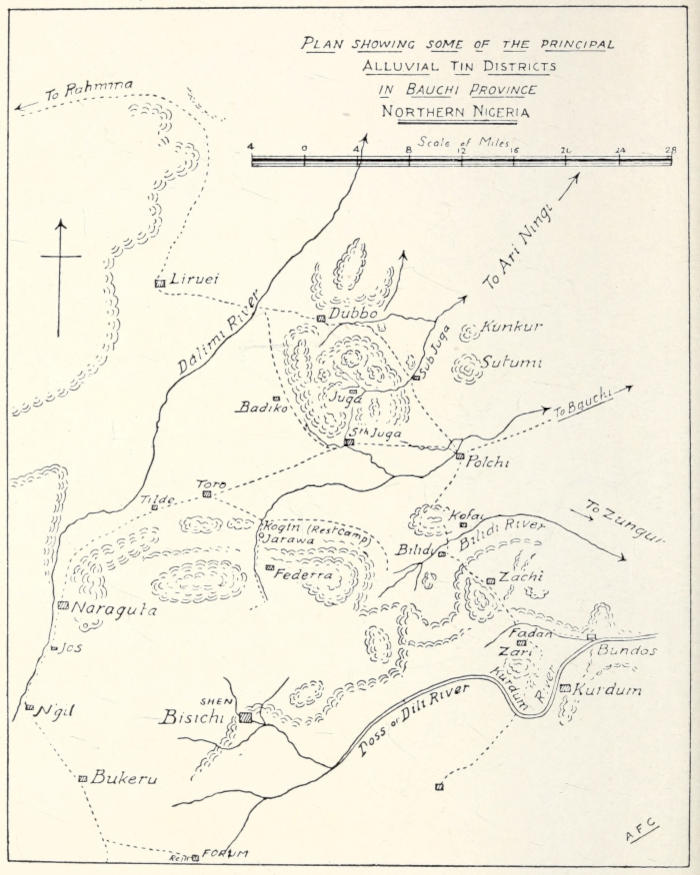
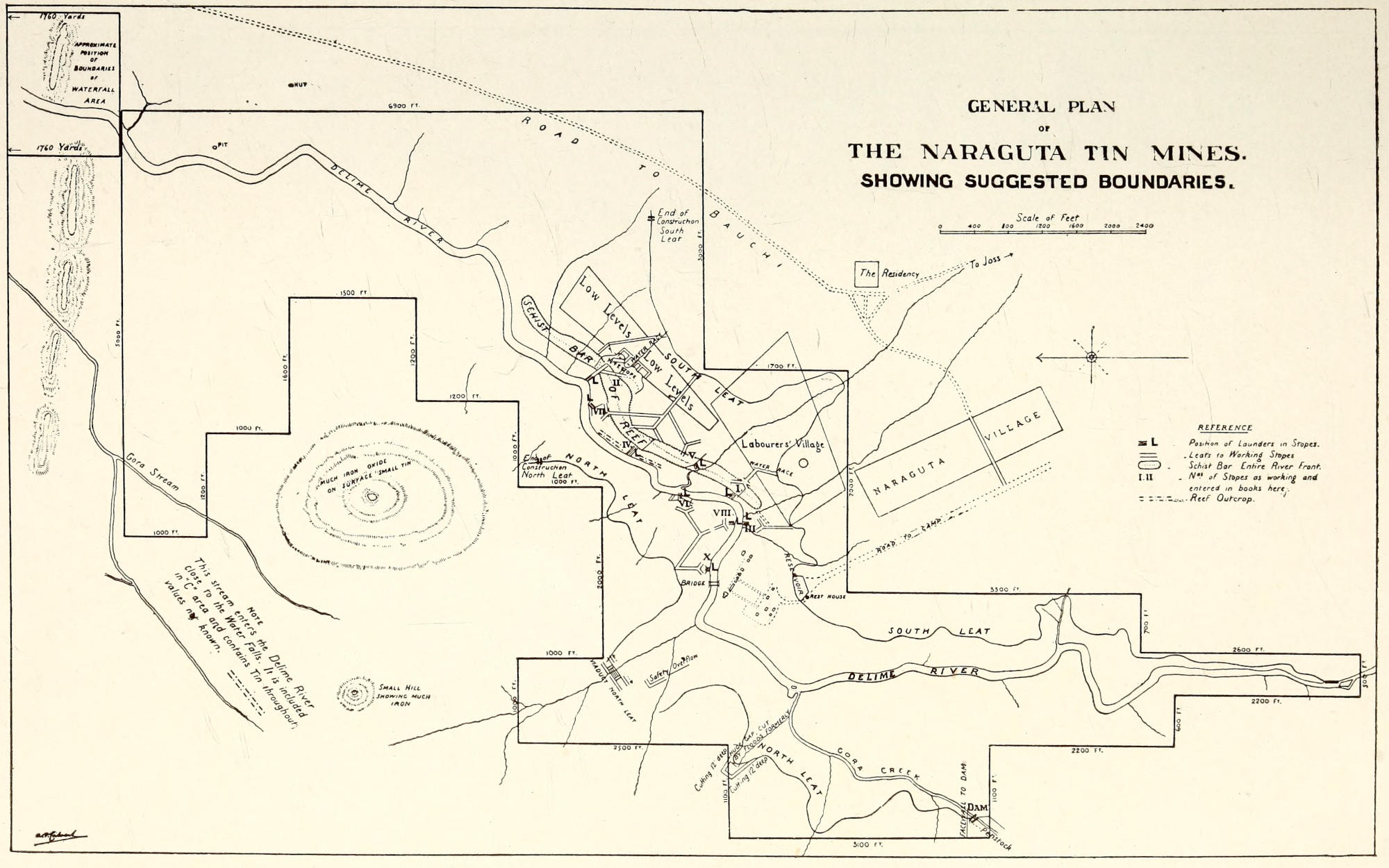
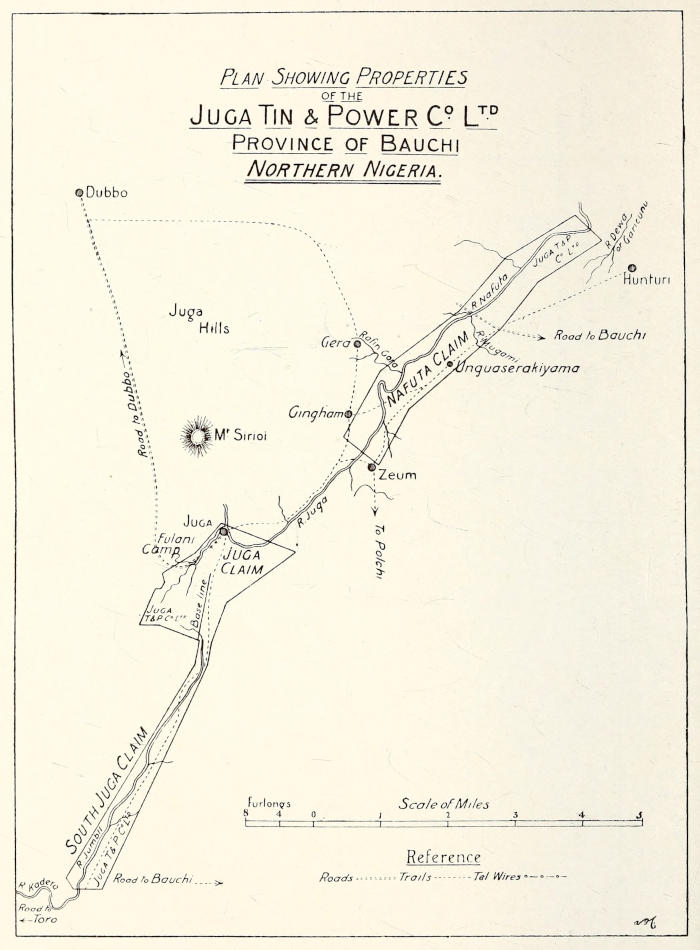
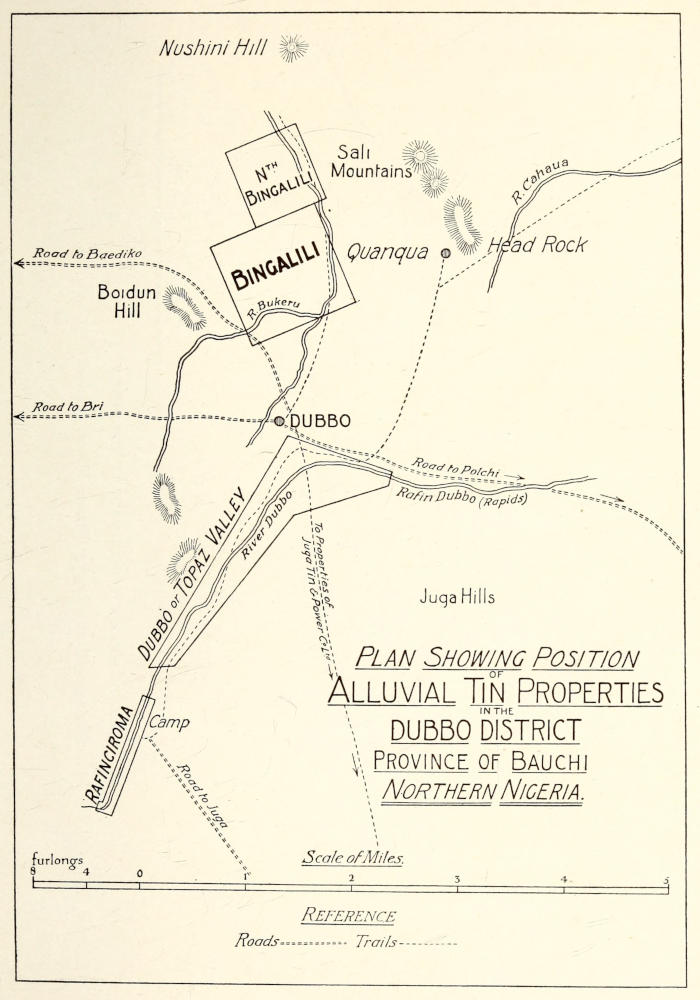
BY
ALBERT F. CALVERT AUTHOR OF “WESTERN AUSTRALIA AND ITS GOLDFIELDS”
“THE MINERAL RESOURCES OF WESTERN AUSTRALIA”
“THE EXPLORATION OF AUSTRALIA,” “THE
POLITICAL VALUE OF OUR COLONIES”
ETC. ETC.
LONDON: EDWARD STANFORD 12, 13, & 14, LONG ACRE, W.C.
1910
Printed by Ballantyne, Hanson & Co.
At the Ballantyne Press, Edinburgh
PREFACE
The present conspicuous position which Northern
Nigeria holds in the public eye is of very recent
attainment, and its development has been, comparatively
speaking, the work of a moment. The
discovery of tin in paying quantities within its
boundaries is the secret of its sudden leap to an
eminence from which it compels interest, and attracts
to itself more than ordinary curiosity and attention.
It is with Northern Nigeria as it was with
New South Wales and California, with the Malay
Peninsula and Rhodesia. Their potentialities
were admitted long before the existence of their
mineral wealth was made known, but it was
not until their minerals were discovered that
they loomed into absorbing prominence.
The importance of Northern Nigeria as a British
possession was demonstrated by the Niger Company;
her possibilities as an exporter of cotton,
rubber, and other vegetable products were early
admitted; but it needed the revelation of her enormous
alluvial tin deposits in the Province of
Bauchi to attract to the development of her
resources the capital and enterprise which alone
can ensure the growth of a country’s commerce.
But this sudden and surprising discovery also
served to expose the widespread ignorance which
prevailed in connection with our newest Protectorate,
while it generated a desire for information
concerning it. This little volume is put
forward to satisfy this new-felt want, and it has,
I think, the merit of being the first issued with
that object. It has been compiled in haste, but
care has been taken to verify the facts, and, as
far as possible, the data has been derived from
official sources.
I believe that no apology will be required for
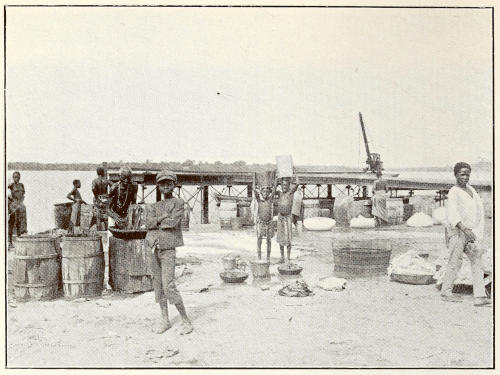
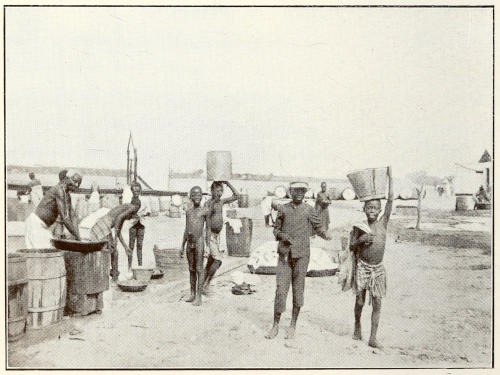
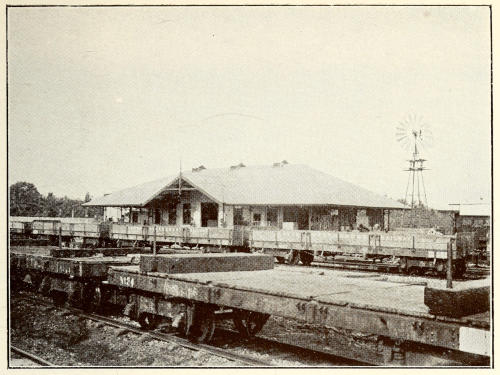
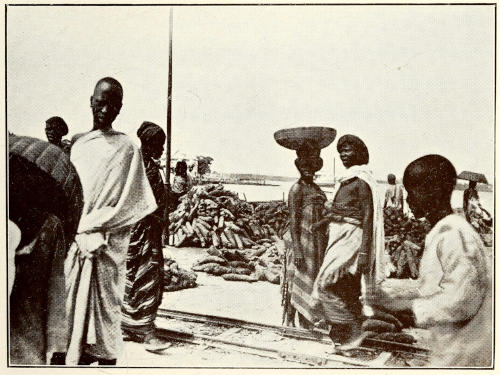
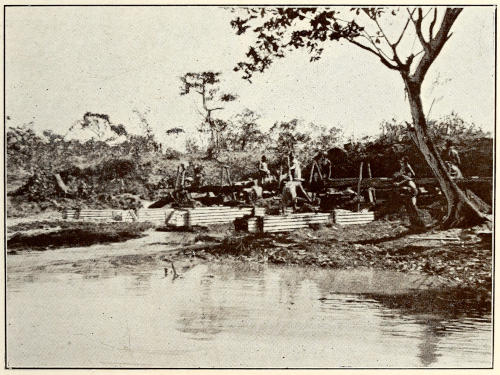
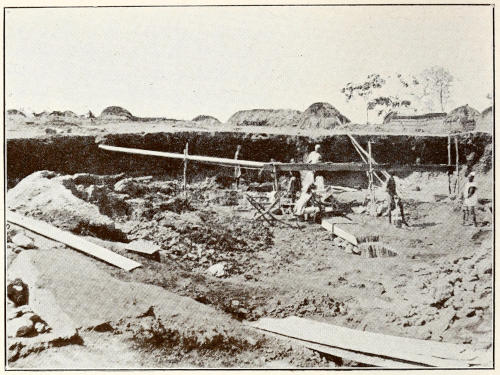
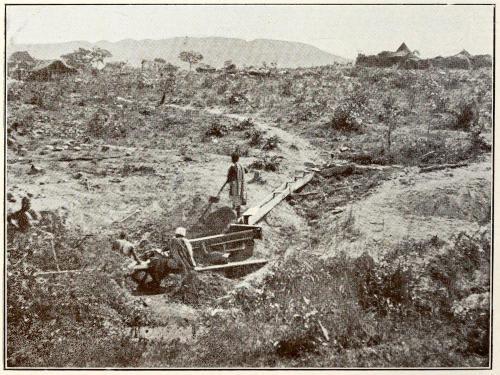
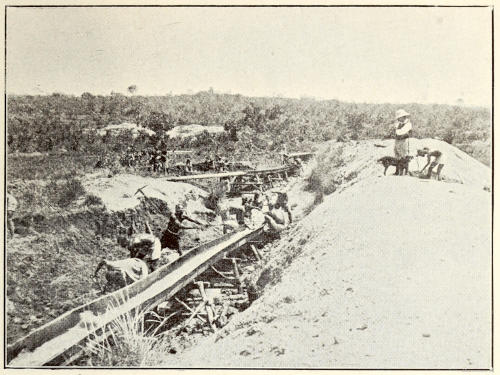
the illustrations, but for the use of the photographs
from which they were produced I tender
my grateful and sincere thanks to his Excellency
Sir Walter Egerton, K.C.M.G., Governor and
High Commissioner of Southern Nigeria; Sir
William Wallace, K.C.M.G., late Acting Governor
of Northern Nigeria; Mr. H. W. Laws, Engineer
to the Niger Company; Mr. C. G. Lush, Consulting
Engineer to the principal Nigerian Tin Companies;
Mr. S. R. Bastard, Chairman and Director of
several of the most important Nigerian tin
mining companies; the Editor of the Engineer,
Mr. R. Ernest Hope; Messrs. John Holt & Co.,
Ltd.; Mr. G. W. Christian; Messrs. E. H.
Stein & Co., Ltd., and other prominent traders in
Northern Nigeria.
In 1879, when Sir George Taubman Goldie
organised the amalgamation of the rival trading
firms of the Lower Niger and formed the United
Africa Company, only a few far-sighted people
could have had any idea of the possibilities of
future commercial greatness that were possessed
by this utterly unattractive and uncivilised region.
“The Niger,” as Colonel Mockler-Ferryman tells
us, “was absolutely tabooed; its name was mentioned
only in whispers, and the British public
regarded it as an unlucky, pestilential spot, out of
which no good could ever come.” It must be
remembered, in explanation of this pessimistic
attitude, that all attempts to explore Nigeria and
open up commerce on the river had failed more
or less completely; a great number of lives had
been sacrificed in successive expeditions, and no
practical good had been accomplished. McGregor
Laird, some quarter of a century earlier, had
founded the African Shipping Company, with
monthly sailings to the West African ports and,
with the grudging co-operation of the Government,
had contracted to keep a steamer on the
Niger. But Laird died in 1857, when his spirited
enterprise appeared to be on the point of yielding
tangible results, and the country was still under a
cloud when, twenty years later, the first organised
attempt was made to develop its commercial
resources.
THE PROTECTORATE PROCLAIMED — THE NIGER COMPANY — PROGRESS OF SOUTHERN NIGERIA — ANTICIPATIONS OF NORTHERN NIGERIA’S FUTURE — NATIVE TIN WASHING — THE DISCOVERY OF BAUCHI TIN — THE NIGER COMPANY’S EXPEDITION — THE FIRST GEOLOGICAL REPORTS — FIRST SHIPMENT OF TIN — OFFICIAL INFORMATION ABOUT THE NEW FIELD — TINSTONE CONCENTRATES ANALYSED — THE REPORTS OF EXPERTS — FRESH DISCOVERIES ANNOUNCED — CONFIDENCE IN THE FIELD ESTABLISHED — THE PIONEERS OF NORTHERN NIGERIAN TIN — THE INACCESSIBILITY OF THE FIELD — COST OF TRANSPORT — THE RAILWAYS OF NIGERIA — NEW LINE ADVOCATED — SIR WALTER EGERTON’S OPINIONS — THE GOVERNMENT AND THE PROJECTED LINE — VARIOUS OPINIONS — THE ROUTE DESCRIBED — THE BAUCHI PROVINCE — CLIMATE AND WATER — LIVING AND PROVISIONS — LICENCES AND LEASES — LABOUR — THE FUTURE OF THE FIELD — ALLUVIAL AND LODE MINING — THE GENERAL PROSPECTS — A DISTRICT FULL OF NARAGUTAS — POLITICAL AND COMMERCIAL OUTLOOK
The United Africa Company’s efforts were
recognised by the grant of a Royal Charter in
1886, but its mission and its potentialities failed
to appeal to the general public; and even when in
1900 the Territory, with its area equal to that of
Germany and the British Isles combined, was
added to the Dependencies of the Empire, the new
Protectorate was regarded with indifference and
suspicion as a present burden and a probable
source of future trouble.
That was but a decade since, yet it was only
the other day that Lord Crewe declared that
“there is no part of the Empire about which
higher hopes may properly be entertained than
the Protectorate of Northern Nigeria;” and the
Colonial Report, in emphatic corroboration of
this optimistic opinion, asserted that “very few
countries have witnessed such great changes for
the better in such a short space of time, as has
been the case with this Cinderella of the British
Dominions.”
It must be admitted that the Nigerias have
been of late years more favoured in the matters
of ocean transport and inter-communication.
Since McGregor Laird started his monthly service
to Lagos, the African Shipping Company
has been succeeded by six shipping lines—the
British and African Steam Navigation, African
Steamship, Elder Dempster, Woermann, Hamburg-America,
and the Hamburg-Bremen-Africa—the
first three of which, to all intents and
purposes, may be classed as Elder Dempster’s.
Twenty-five liners and Elder Dempster’s regular
services call at Lagos each month—one nearly
every day of the week. Two vessels of some
four thousand tons are exclusively employed in
bringing Welsh coal to Lagos; and a cargo service,
another Elder Dempster enterprise, now runs
from inside Lagos Lagoon to Hamburg, thus
avoiding the transhipping of cargo in Lagos Roads
or at Forcados. Persons who only know of
Elder Dempster’s famous service of ocean liners,
which leave Liverpool every Wednesday and arrive
at Lagos Roads sixteen days later, may be surprised
to learn that they have a large and distinct
inter-colonial service between Lagos and Secondi.
These vessels, built of light draught to enable
them to cross Lagos bar, not only afford shippers
a short and rapid means of forwarding their
produce, but are of immense service to the growing
number of natives who travel, mostly for
trade purposes, between Lagos and the smaller
ports along the Gold Coast; while another Elder
Dempster service runs weekly to and from Porto
Novo in Dahomey and Lagos, carrying general
outward cargo and bringing back produce for
shipment to the United Kingdom and the Continent.
These services, which cater for the ramifications
of the commercial activities of West Africa,
are practically unknown at home, and the organisation
and development of this enormous industry
was, to a great extent, the work of one man—the
late Sir Alfred Lewis Jones. It has been said of
him that “when the story of our times comes to
be written comprehensively, he will be bracketed
with Cecil John Rhodes. One obtained a large
territory for the Empire; the other enhanced
immeasurably countries formerly judged as of
questionable value. He was a pioneer in building
up their commerce, and is of still higher
estimate—he was instrumental in making them
more fit to live in by revolutionising the health
conditions.” His varied commercial enterprises in
West Africa are well known, and it is unnecessary
here to enlarge upon them. They ranged from
coaling and engineering companies with dry docks,
to banking—which facilitated relations between the
natives and the European traders—and included
his cold-storage scheme, which the medical faculty
admit has been one of the most powerful factors
in lowering the mortality of West Africa. This
object was also largely assisted by the investigations
carried out at the Liverpool School of
Tropical Medicine. The school was financed by
Sir Alfred Jones, who also provided the means for
putting the resultant discoveries into practice. He
further established a branch of the School at Grand
Canary, and arranged with Elder Dempster a cheap
service from the West African Coast to the Canary
Islands for malaria patients, whose lives depend
upon their reaching that Mecca for invalids. By
such means the dead merchant prince has lowered
the death-rate among Europeans and natives in West
Africa to a degree unthought of fifteen years ago,
and he has built in that part of the Continent a
monument to his name more enduring than brass,
because the foundation was made for the betterment
of his fellow-men.
But if the Elder Dempster Line have accomplished
great things in establishing regular
communication between England and the new
Dependencies, much splendid pioneer work has
been done in the country by the Niger Company.
During the last few years they have opened up
the Bauchi tin field in Northern Nigeria, and
their trading and transport facilities have made
it possible for them to carry out an enormous
amount of development under great difficulties.
The directors have had the courage of their convictions.
In forwarding their own interests they
have benefited the Protectorate, and if they have
profited by their enterprise they have made the
country a source of profit for others.
From the proceeds of the surrender of its charter
to the British Government in 1900, the company
were able to make a special distribution to its
shareholders amounting to 145 per cent., and the
sale of certain of their mining rights in the
Bauchi Province has more than repaid them for
the work that they had carried on in the district
since 1902, and resulted in raising their dividend
payment in 1909 from ten to twenty per cent.
And in addition the Niger Company possess
practically a monopoly of the transport to the
tin fields, the value of which cannot be overestimated.
The Niger Company’s share of the credit that
is due for effecting this great improvement in the
present condition and future prospects of the Protectorate
may be at once admitted; but much has
been accomplished since the control of the country
devolved upon the British Colonial Office. In 1900
only some 30,000 square miles, out of a total of
250,000 in Northern Nigeria, were under some
form of organised control. The remainder was
controlled and ruled under conditions giving no
guarantee of liberty or even life. To-day the
whole condition of the country is entirely altered.
Sixteen provinces, comprising the entire Protectorate,
have been organised by the never-ceasing
efforts of Residents, and the sum total
of the unadministered area does not now exceed
the 30,000 square miles that were under administration
ten years ago.
At the date of the proclamation of the Nigerian
Protectorates the Southern Colony was in a much
more advanced state of development than its
Northern neighbour, and was naturally regarded
as the paramount partner. It had a sea border,
a port at Lagos, which to-day is the most important
town in West Africa, and it was destined
to be the terminus of the first railway to be built
in the new Dependencies. The markets and
trading stations of the Niger Company were
within its boundaries, the fertility of the soil was
proved, its richness in rubber, tobacco, and coal
was established, and its wealth of other vegetable
products was well known. It is not at all surprising,
then, that British pioneers and capitalists
saw the splendid commercial future that was
before Southern Nigeria, and were somewhat
neglectful of the distant, isolated, and inaccessible
Northern territories. Nor were they wrong,
for the advance of its trade justified the most
sanguine predictions, and, as will be seen by a
glance at the appended tables (prepared in francs
by Mr. C. A. Birtwistle, the Commercial Intelligence
Officer of the Colony), its commerce to-day
practically equals the total of the French
Colonies of Senegal, Guinea, the Ivory Coast,
and Dahomey:—
All French West African Colonies. Imports and Exports. Value in Francs.
Nigeria. Imports and Exports. Value in Francs.
1899
116,843,000
78,000,000
1900
129,861,000
90,575,000
1901
131,459,000
96,625,000
1902
130,906,000
112,325,000
1903
161,819,000
111,700,000
1904
155,949,000
130,100,000
1905
152,471,000
128,775,000
1906
163,442,000
144,925,000
1907
177,436,000
192,550,000
1908
193,090,000
184,550,000
It will be noted at a glance that whilst French
West African trade has increased by 65 per cent.,
that of Nigeria has grown by 136 per cent.
Northern Nigeria, however, was known to be
rich in iron, and the existence of other minerals
was suspected; its suitability as a field for the
exploitation of the cotton-growing industry was
realised and the British Cotton-Growing Association
reported a few years ago that “in Northern
Nigeria alone lies the possible salvation of Lancashire.”
Moreover, the Directors of the Niger
Company had always foretold the ultimate importance
that would be attained by the regions
north of the Niger and the Benue. The company’s
trade flourished in the south, new products
were being continually discovered and
new factories opened, and the optimism of its
shareholders was justified by the declaration of
substantial dividends, but Sir George Goldie
consistently predicted the boundless potentialities
of the unopened North, and as far back as 1889
declared: “We can hardly impress too strongly
upon our shareholders that our hopes of future
prosperity rest far less on the lower regions of
the Niger than upon the higher, inner, and recently
explored country.”
Sir Percy Girouard and others have warned the
public against confusing Northern and Southern
Nigeria, and running away with the idea that there
is no great difference between them. As Colonel
Mockler-Ferryman says: “Commencing with what
is called the Niger Delta, we have a land of swamps
and impenetrable forests, intersected by a vast
network of streams and creeks and inhabited by
numerous pagan tribes addicted to every species of
vile custom, including even cannibalism and human
sacrifices.... Above the pagan land—i.e., at the
confluence [of the rivers Niger and Benue] there
is a marked change, not only in the type of the
people but also in the nature of the country.
Mohammedan influence commences to show itself,
and low swampy wastes are superseded by rocky
hills or far-extending grassy plains, well studded
with magnificent trees.”
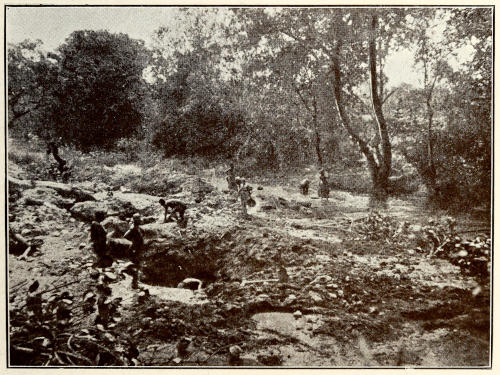
The existence of alluvial tin in these Northern
regions was known for some considerable time,
but until a year or two ago its value as a
commercial asset was not seriously considered.
Rumours of such sources of wealth frequently
reached the Niger Company, and quantities of small
faggots of very pure metal, which occasionally
found their way down to the coast, afforded evidence
that the natives had been working and smelting tin
for a lengthy period. It was subsequently discovered
that the procedure adopted by the native
Nigerian tin miners, and described by Mr. Nicolaus,
is as follows:
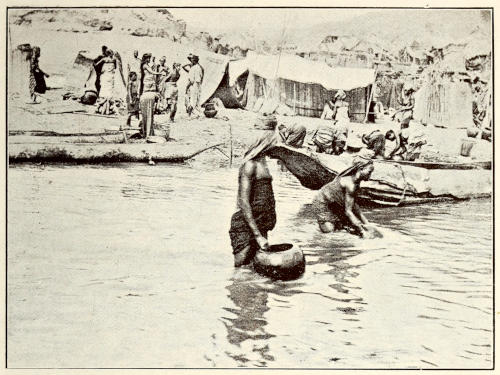
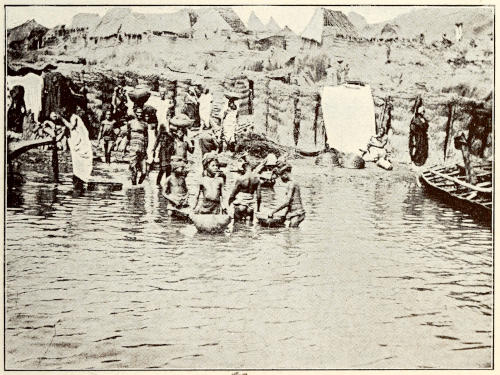
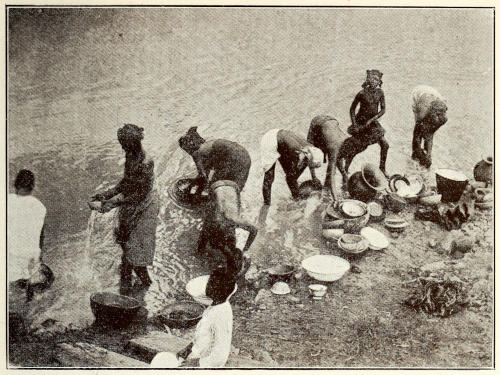
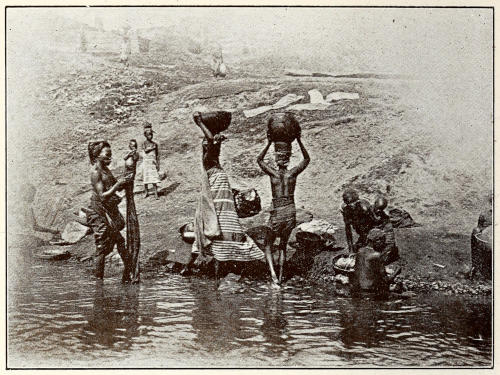
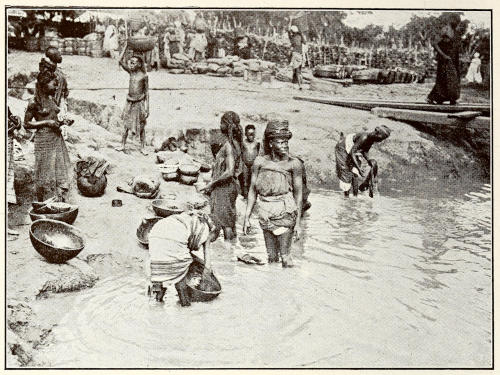
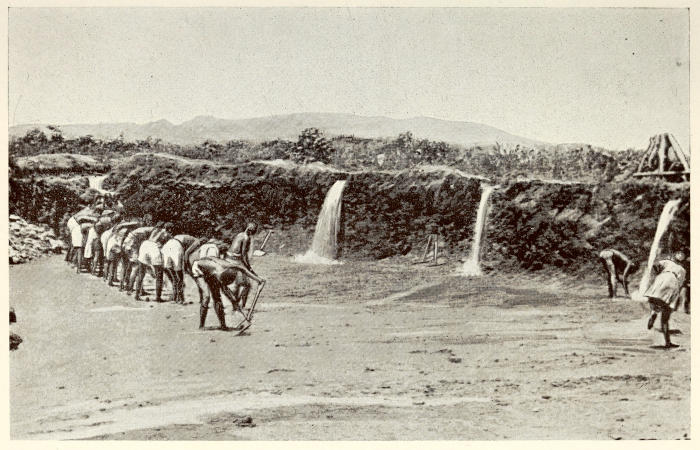
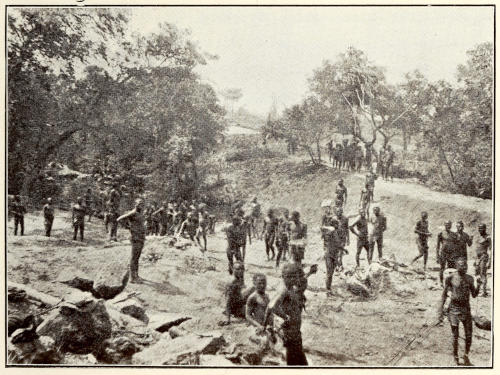
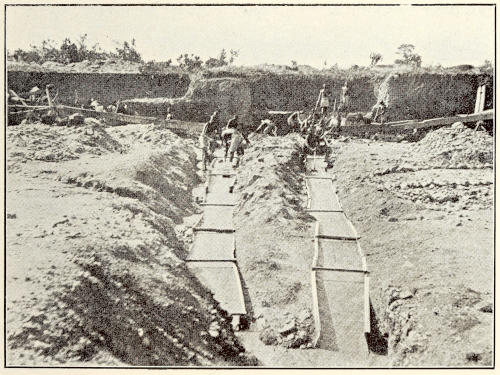
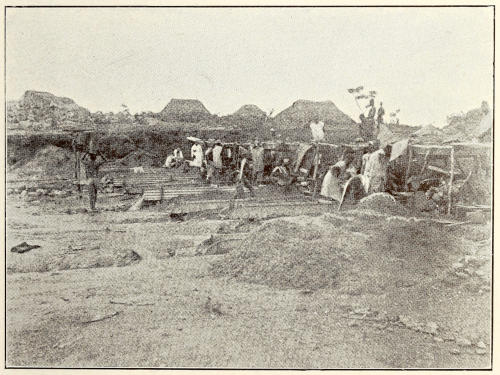
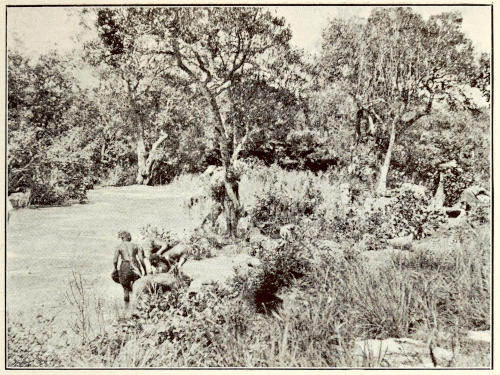
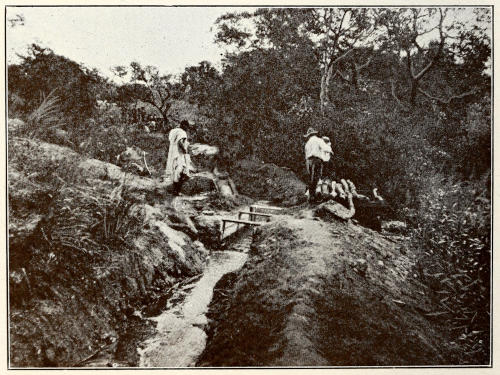
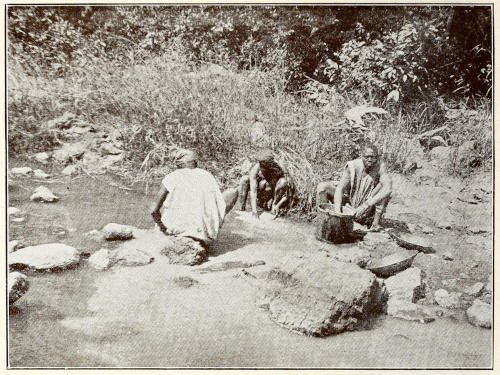
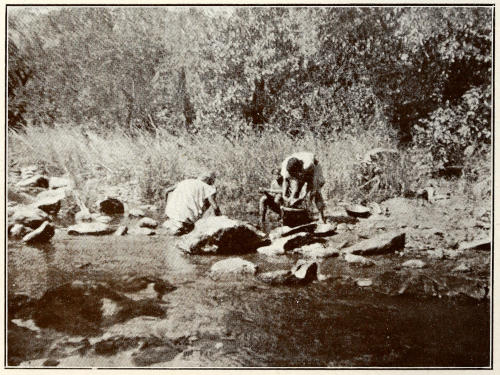
“The washers, usually working in gangs of
three or four, wade into the river, tributary creeks
and gullies, generally at or near some shallow
rapids, and, loosening the gravel under water with
a short hoe-like implement, scoop it into large
calabashes about 18 inches to 24 inches in diameter.
As soon as sufficient gravel is collected
(about 30 lbs.), it is washed, and the resulting
rough concentrate placed in a smaller calabash,
6 inches to 8 inches in diameter, and thoroughly
cleansed, nearly all the fine tinstone being lost.
The resulting ‘black tin’ containing the equivalent
of from 60 to 65 per cent. metal, is sun-dried,
and packed in bags and skins for transport to the
smelting furnaces.
“This ‘black tin’ is usually smelted in various
parcels on a royalty basis, exclusively by members
of one family, who hold the process a profound
secret. Only three native smelting furnaces are
in use, and these are each capable of turning out
about 2 cwt. of metal per diem. They are built
of well-puddled clay, and are 3 feet 6 inches in
diameter, and have at the back four tuyère holes
conducting the blast from primitive sheepskin
bellows to the hearth. The tin is reduced by
means of charcoal, and runs through a channel
2 feet 6 inches long and 4 inches broad to a
catch-pot, whence it is ladled by small gourds or
calabashes and poured. The tin is cast in the
form of thin bars of about an eighth of an inch
in diameter and 12 inches long, which are produced
by pouring the molten metal on semi-circular
banks of clay, 18 inches high, perforated
by dry Guinea corn-halms.”
The first actual discovery of tin in the Protectorate,
or the first conclusive evidence of its
actual existence there, has hitherto been ‘wrop
in mystery,’ but, thanks to the courtesy of
Sir William Wallace, late acting Governor of
Northern Nigeria, I am in a position to dispel
all uncertainty on the subject. In the course of
a letter I received from Sir William, dated 21st
October 1910, he says:—“Up to ’84 we used to
believe that the tin used by the Hausa people for
tinning their brass ware was brought across the
desert. I then, being busily engaged opening
up the Benue River to trade, got a hint that the
tin was being smelted in some of the Hausa
States, and, on making inquiries, found that it
was being produced in Bauchi. We did all
possible to develop the trade in the tin straws,
but with little success, as the pagan tribes would
have no dealings with the Hausa merchants,
and rightly so, as it would have only led to the
subjection of the tribes to the Fulani, whom they
kept at bay till our advent in 1902. Early in
that year I went with the little army as Political
Agent to subdue the Emir of Bauchi, and after
settling that matter I was able to get messengers
through to the Delimi River, close to the
Naraguta, from whence they brought about a
quarter of a hundredweight of the tin sands, the
first ever procured or seen by Europeans. This
sample I brought home, and submitted to the
Directors of the Niger Company, who shortly
afterwards took out a prospecting licence over
1000 square miles. Since then, thanks principally
to Mr. Laws, the mining industry has slowly
forged ahead, until the rush came along this year.
Year in, year out, I have been urging companies
and encouraging prospectors to come along until
I almost despaired of success; but now, given
a railway to the tin field, the industry cannot
but prosper if the Government do not hamper
it with too many restrictions.”
Sir William Wallace’s tribute to the work done
by Mr. Laws, the plucky and importunate mining
adviser of the Niger Company, is entirely merited.
The existence of paying tin was regarded with
some scepticism. It has also been surmised that
the officials and civil servants had too comfortable
berths to risk the disappointments and discomforts
of prospecting work. Moreover, the Niger Company
was in a flourishing condition, and its
directors were not anxious to launch into mining
enterprises. But Mr. Laws and his assistants
were indefatigable. In 1902 and 1903 three
expeditions were despatched to locate the tin areas.
The little party, under the protection of an armed
escort—for at that time the natives, now so
friendly, were somewhat hostile—proceeded to
make a geological examination of the country east
of the Niger, and eventually found tin in the
Province of Bauchi, some 600 miles to the north-east
of Lokoja. Further prospecting located the
stanniferous area to the outlines of the Gura
Mountains, a small range known as the Naraguta
and Shere Hills in the Badiko district of that
province.
The geology of the area, as described by Mr.
R. C. Nicolaus, is composed of granites, igneous
intrusions of diabase and porphyry forming the
prominent peaks of the hill range. Near the
river a coarse grey gneiss forms a contact with
the granite, both of which rocks are traversed by
lenticles and gash veins of quartz, and several
small igneous dykes cross diagonally the general
strike of country, which is north-east and dips
west.
Although the stream tin had so far only been
prospected in the neighbourhood of the rivers,
there was abundant evidence to show that the
source of the tin supply came from a stockwork
formation in the granite at the slopes and at the
base of the foot-hills. A somewhat remarkable
feature of this deposit was that a considerable
quantity of metallic tin was discovered under the
river banks during prospecting operations. It
was found in small grains and nodules about the
size of a bean, its surface very thinly coated
with only a trace of iron. It was very ductile,
and emitted, on crushing, the peculiar tin cry.
Its mode of occurrence in the gravels, associated
with coarse grains of stream tin at a depth of
some 15 feet under the surface, did not at first
allow its genesis being determinable, but it was
unhesitatingly put down as “native tin”—a mineral
up to that time of very rare occurrence.
Mr. Laws and his engineers were so well satisfied
with their work, and the results they produced
were so encouraging, that the Niger Company
applied in 1905 for a number of mining leases in
selected areas. In spite of slight difficulties arising
from a scarcity of water in the dry season, a
considerable amount of development work was
accomplished, and the company secured an output
of one ton of black tin per diem. These results
proved that the gravels could be worked profitably,
while the geological structure of the country compelled
experts to the conclusion that the field
represented by far the most important discovery
of native tin that had been made. Further
examination of the district, which fully confirmed
the expectations raised by the first reports, has
inspired the prediction that this Northern Nigerian
tin field is perhaps the richest in the world.
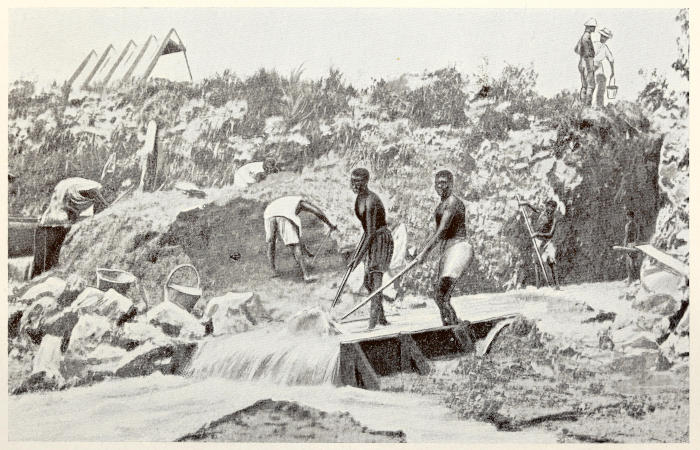
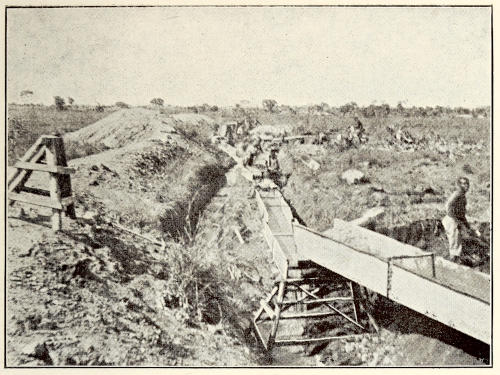
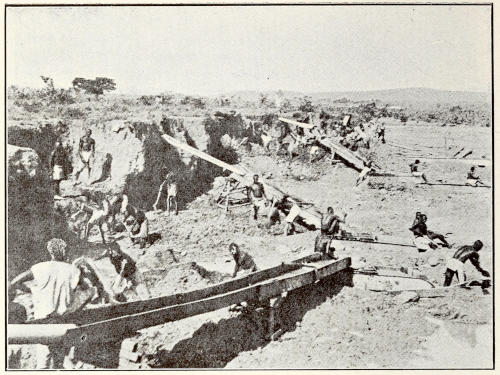
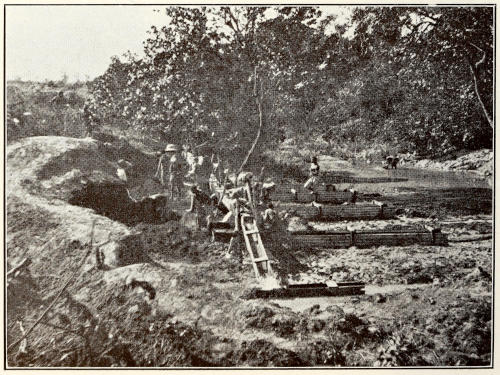
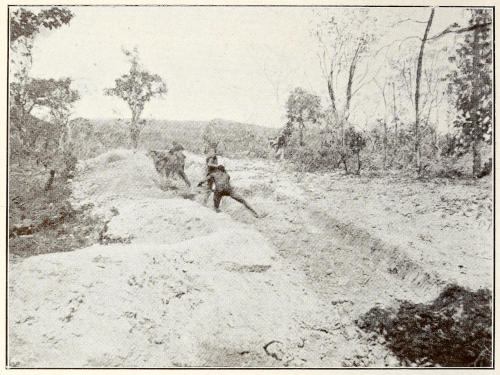
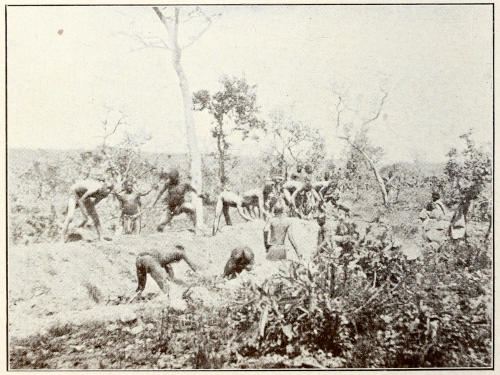
The Niger Company continued to treat the
alluvial in the old primitive method, which consists
in the main of the use of calabash and sluice
boxes, by which they have, up to the present time,
secured over 1000 tons of black tin. Still, the
mineral resources of the colony were not, until
recently, appreciated in accordance with the
proved facts. Lord Scarborough year after
year had told the British public, in his annual
speech to the shareholders of the Niger Company,
that there was treasure in Northern Nigeria in
the shape of alluvial tin. He told them, in March
1907, that during the previous fifteen months
roughly 240 tons of black tin, of the approximate
gross value of £30,000, had been obtained from one
property, the Naraguta, or an average of 16 tons
a month. He told his shareholders in 1908 that
the Niger Company had won £29,933 worth of
tin for that year. Last year he said: “As
regards tin development, we have brought home
and marketed an increased quantity of ore compared
with the previous year.” This year the
chairman of the Niger Company declared a 2s.
dividend per share as a result of the sale of a
small portion of their mining lands.
The first official recognition of the importance
of the Bauchi tin deposits was conveyed to the
public in the Colonial Report on Northern Nigeria
in 1905, and in 1906 was published the First
Report on the Results of the Mineral Survey of
Northern Nigeria, 1904-5. “The mineral resource
of Northern Nigeria being virtually unknown”
(to quote the report), “a mineral survey
of the Protectorate to be carried out under the
general supervision of the Director of the Imperial
Institute by surveyors nominated by him, was
proposed by Sir F. Lugard, the High Commissioner
of Northern Nigeria, and sanctioned by
the Secretary of State for the Colonies in 1904.”
It was arranged that the officers of the Survey
should spend about eight months of each year in
Northern Nigeria in exploring the mineral deposits
of selected districts.
In the general introductory summary of the
first report of the surveyors, the prospects of the
tin fields of Northern Nigeria are described with
the customary official reserve. “Tin, in the
form of cassiterite,” the report stated, “has now
been found in the stream beds of other districts.
It is probable that as soon as suitable transport
is provided Northern Nigeria will become an
important tin-producing country. Already deposits
in the Bauchi Province are being worked
by the Niger Company, and the metal smelted on
the spot. The first consignment of tin from the
Protectorate has reached this country.”
The prospect presented by this information,
backed up by substantial shipments of tin, might
have been expected to stimulate the curiosity of
both prospectors and capitalists, and that other
Richmonds would have made an appearance in
the Bauchi field. But any hopes of such a result
were doomed to disappointment. The Niger Company
continued to win mineral, and the Mineral
Survey persisted in their efforts to prove the
extent of country over which the granites were
tin bearing. It is possible that the remoteness
and inaccessibility of the Protectorate operated
unfavourably in the minds of mining adventurers,
and the evil reputation which had been erroneously
given to the country may have moved financiers
to an excess of cautiousness. The colony made
no new friends, and, as will be shown later, it was
not until last year and then only by the accident
of failure in another direction, that capital was
diverted into the new tin field.
Eleven specimens of tinstone concentrates from
the Zagi River, south of Bauchi, from Bula, Tilde,
and the river beyond Joss were forwarded to the
Imperial Institute, and with only one exception
were found upon analysis to contain tin in
quantities of from mere traces up to 80.85 per
cent, of tin oxide, equivalent to 63.5 per cent. of
metallic tin in the concentrate.
The official general remarks on the specimens
analysed were as follows:
“Most of the concentrates were obtained from
the plateaux of Tilde, Rukuba, Joss, and Ngell. On
the first three of these the principal surveyor reports
that the Niger Company has prospecting
camps. The finest grained tinstone is found on the
Tilde plateau, the coarser material coming from
Joss and Ngell. The tinstone is said to be irregularly
distributed, and adjoining pits may furnish
such different yields as 10 lbs., or less, and
400 lbs. per ton on gravel worked. The
average yield at the Rukuba camp is 25 lbs.
per ton. The present works, it is stated, are
all in the near neighbourhood of the river Delimi,
but it appears that the gravels are more or less
rich in tin over the whole surface of the plateau.
The river-beds in some cases contain valuable
tinstone-bearing gravels, as is shown by the
results of the analysis of the concentrate from
the river-bed at Tilde, which contained 68 per
cent. of tinstone. That from beyond Joss contained
only 40 per cent. of tinstone, possibly
owing to the difficulty of separating the ilmenite
from the tinstone by washing. The concentrate
from the Kende River consisted almost entirely
of ilmenite. The presence of the latter mineral
in the stream beds will introduce a difficulty in
the concentration of the tinstone, as it is not
readily distinguishable by inspection from tinstone,
and collects with it in the first concentration.
“The results so far obtained show that tinstone
is widely distributed in the province of
Bauchi in the alluvium of both the high and low
plateaux. As these tinstone districts are in
process of being prospected, it is scarcely worth
while to discuss the commercial value of the tin
concentrates here, but it may be pointed out that
several of these concentrates contain monazite,
and this may be worth recovering. The amount
of monazite present is usually small, and it is
scarcely likely that its recovery under present
circumstances would pay for the working of an
electro-magnetic concentrator, which would be
required to effect its separation. If, however, it
becomes necessary to use such concentrators in
order to separate the ilmenite, which occurs with
the tinstone, then it would probably be worth
while to recover the monazite as a by-product.
“The question of the origin of the tinstone
occurring in this region is of great interest, and
the officers of the Survey propose to devote
further attention to the subject.”
The Colonial Report for 1907-8 carried us no
further, as the third Survey party which arrived
in the country in December 1907 were still upon
their seven months expedition, and the results
of their work had not been received. The report
referred, however, to the fact that the Niger
Company, continuing its work on its licensed
area in the Bauchi Province, were exporting black
tin to the amount of 500 tons per annum, and
added: “The main difficulty in the development
of this promising industry is its situation. With
the construction of the railway through Zaria it
should be possible to place the mines in close
connection with it by means of a road, which
should also serve the Bauchi Province.”
In one of his reports on the Bauchi tin area,
Mr. Lush says:
“There is not the slightest doubt that before
very long many of the deep alluvial flats that
are some distance from the shallow and more
easily worked tin ground will be worked. The
values may turn out to be poorer than the shallow
ground, but the natural facilities are better owing
to the water supply being sufficient for continuous
working without the expense of erection of dams.
On the other hand, when you get out of the
granite country, the further you are away from
the source of the tin the greater are the impurities
mixed with it. The numerous creeks,
after passing through the schists and other rocks
emptying into the main river, all tend to this, and
titanic iron, tourmaline, rutile, and gem sand
form a large percentage of the concentrates.
However, if on boring, the deep ground turns
out payable, there should be no difficulty in
getting rid of the impurities and dressing the tin
up to 70 per cent.”
Mr. L. H. L. Huddart, writing on this subject
in his report on the South Juga property,
says:
“Sources of the Tin.—The black tin is probably
derived from the granite of which it is a rock
constituent, and from stockworks in the granite
quartz porphyry occurs very similar to the
‘elvans’ in Cornwall.
“Nature of the Wash.—In the upper end the
wash is a fine whitish granite, containing no large
pebbles or boulders, and is near the original
source of some of the Juga tin. The surface is
slightly cemented with iron oxides in which
cassiterite often grows. The whole wash very
easily breaks down with water. The ground
further down the property is similar except that
the alluvial has travelled further, and consequently
has been sorted to a greater extent.
“Taken generally, the tin bearing is the product
of denudation from the granite of which the
bed-rock, and sides of the valley are composed.
The tin occurs in the wash right up against the
granite on both sides of the valley. The topaz
is abundant in the wash, and with some zircon
and rootile is almost the only mineral besides
cassiterite occurring in the concentrates.”
In his report on the Kurdum River Tin Concession,
Mr. Huddart says:
“Geology.—The base rock is a foliated gneiss
and schist; the great granite massif forming the
Jarawa Hills lies to the west of the property.
There is a good deal of granite on the property,
with some dolerite. The rocks are compact,
and show considerable signs of regional metamorphism.
“Source of the Tin.—The tin has been carried
down from the rich placers at the head water of
the Kurdum River, and form feeders that come
in above the property from the Jarawa and
Fuersum country. In one or two places the
natives work the river-bed, an indication in itself
of high value, as it does not pay them to work
any but rich gravel. The alluvial ground is a
quartz gravel with sand near the top. There is
very little clay, and long boulders are unlikely,
and the wash is friable and easy to work. The
river-bed gravel where coarse is very rich.
“Concentrates.—These contain usually minerals
such as ilmenite, rootile, zircon, and some topaz
and garnet. The tin is of good quality, and
varies in colour from black to ruby and pale
yellow. A little monazite is found, and an
occasional colour of gold. There should be no
difficulty in shipping concentrates that will assay
71 or 72 per cent. metallic tin. The tinstone
is of a good average size for saving in the sluice
boxes which can be given a good grade.”
The Government Report on Northern Nigeria
for 1908-9 contained the announcement that
tin in paying quantities had been located in the
Provinces of Bauchi, Nassarawa, and on the
Kobba-Ilorin border, and this information has since
been supplemented by the Akerri (Nigeria) Tin
Company Ltd., which has taken up a tin area in
an entirely fresh district, one day’s journey west
of Zungeru, and one and a half day’s journey
north-east of Jebba.
Meanwhile, in a White Paper on “Nigeria,
September 1910,” issued in the following month
of October, we get an official reference to the
new tin industry:
“Mr. Parkinson states that in the Oban Hills,
Southern Nigeria, there are tourmaline pegmatites,
and Schmeisser has recorded that since the
discovery of an apparently rich tin deposit near
Banyo, there has been much prospecting for that
mineral in the Cameroons. Surface tin is found
in Northern Nigeria by the natives, and sold,
chiefly to the Niger Company, but mines on a
large scale have not as yet been worked. The
geological surveyors sent out by the Imperial
Institute have detected the presence of alluvial
tin in many sand and river gravels. At Uwet, in
Old Calabar, Mr. Parkinson reports the occurrence
of tinstone during the year 1906, and of the
washed samples 80 per cent. was tinstone, and
the remainder was garnet, tourmaline, quartz, and
columbite.”
The Bauchi tin won by the Niger Company is
of rich quality, and commands a considerably
higher price than ordinary English tin; but while
Lord Scarborough persistently told the public of
the results of their operations, mining was
not energetically proceeded with, and as has
been said the new field attracted less attention
than it deserved. But as prospecting work in
the district became more general, it was realised
from the virgin nature of the area, the cheapness
and abundance of labour available in the district,
and the enormous extent of the surface deposits,
that the regions were extremely valuable and
presented potentialities of great and continuous
profits. In the face of this later information the
first feeling of scepticism with which the discovery
was received passed away, doubt yielded to
confidence, and it was soon known that some of
the most astute and influential groups in the
City were interested in the exploitation of the
new field.
But although the future of the Bauchi tin
district was assured, it was necessary for some
one to be first in the systematic development of
the new field. Every report emanating from the
colony confirmed the story of the richness of
Nigerian tin, and a Royal Colonial Institute
address had admitted that “if the professional
reports were anything like approximately correct
and the supply is regulated, a fabulous amount of
wealth is waiting to be extracted,” but the opportunity
to make fortunes out of Northern Nigeria
was neglected until the Champion Gold Reefs
of West Africa, Ltd., who had abandoned their
gold property on the Gold Coast, boldly threw
their remaining capital of £12,000 into the new
field.
The credit, therefore, for placing the Nigerian
tin fields before the British investor is due to
Messrs. Walter and Oliver Wethered, and Mr.
S. R. Bastard. It was Mr. Walter Wethered, being
impressed by the large quantities of metal which
were being brought down by the natives and
sold to the Niger Company, who formed the
opinion that these fields might be suitable for
working on a large scale. Having satisfied
himself on this point he was able to induce Mr.
Bastard, and his brother, Mr. Oliver Wethered, to
join in the business, and as a result the Champion
Gold Reefs of West Africa, Ltd., of which Mr.
Bastard was Chairman, decided in the month of
September 1909 to embark its remaining capital
and all its energies in the exploitation of the new
Nigerian tin field. In October the first members
of their staff were sent out to the properties they
had already secured, to be followed on 3rd
November by Mr. C. G. Lush, the well-known
tin expert, who was to advise them as to the best
method of developing their properties. Everything
that happened satisfied this pioneer group of
the value of the field, and they formed the Tin
Fields of Northern Nigeria, Ltd., which was
registered on 7th October 1909, with a capital
of £100,000. Mr. Bastard became chairman of
this company.
The Nigerian Tin Corporation, Ltd., was registered
on 14th October 1909, with a capital
of £100,000. On this occasion Mr. Oliver
Wethered took the chairmanship. No further
company was floated during the year 1909, but
on 15th January 1910 this same group issued the
Naraguta (Nigeria) Tin Mines, Ltd., with a capital
of £175,000. This company has already, in the
few months it has been working, recovered over
300 tons of tin, and has declared its first
dividend. The next venture to be floated by the
Champion Gold Reefs company was the Northern
Nigerian (Bauchi) Tin Mines, Ltd., registered on
2nd February 1910, with a capital of £200,000,
of which Mr. Oliver Wethered became a director.
The foregoing were the first five companies
registered for the sole purpose of working the
alluvial tin deposits of Northern Nigeria, and they
were all promoted by this pioneer group, comprising
Messrs. Walter and Oliver Wethered, and
Mr. S. R. Bastard. All these companies are doing
excellent work, and showing good results. After
February of this year others entered the field,
and since March last a large number of companies
and syndicates have been registered and formed,
several of which are at work.
It was only to be expected that such brilliant
results as these would have the effect of inducing
the more conservative firms to enter into the fields
of Northern Nigerian mineral enterprise, and now
Messrs. Wernher, Beit, the Consolidated Gold
Fields of South Africa, Fanti Consolidated, and many
other leading groups of bankers and capitalists
are represented in the Bauchi Province.
But while the prospecting and actual mining
work being done on the Bauchi field are establishing
an ever-widening recognition of its mineral
wealth, its inaccessibility and the difficulties of
transport, which represent its chief drawbacks,
have not yet been overcome, and it may be
opportune to explain here the methods of transport
employed in the two Nigerias, to describe the
railway system, and to give some ideas of the difficulties
of carriage with which the mine owners of
Northern Nigeria have to contend.
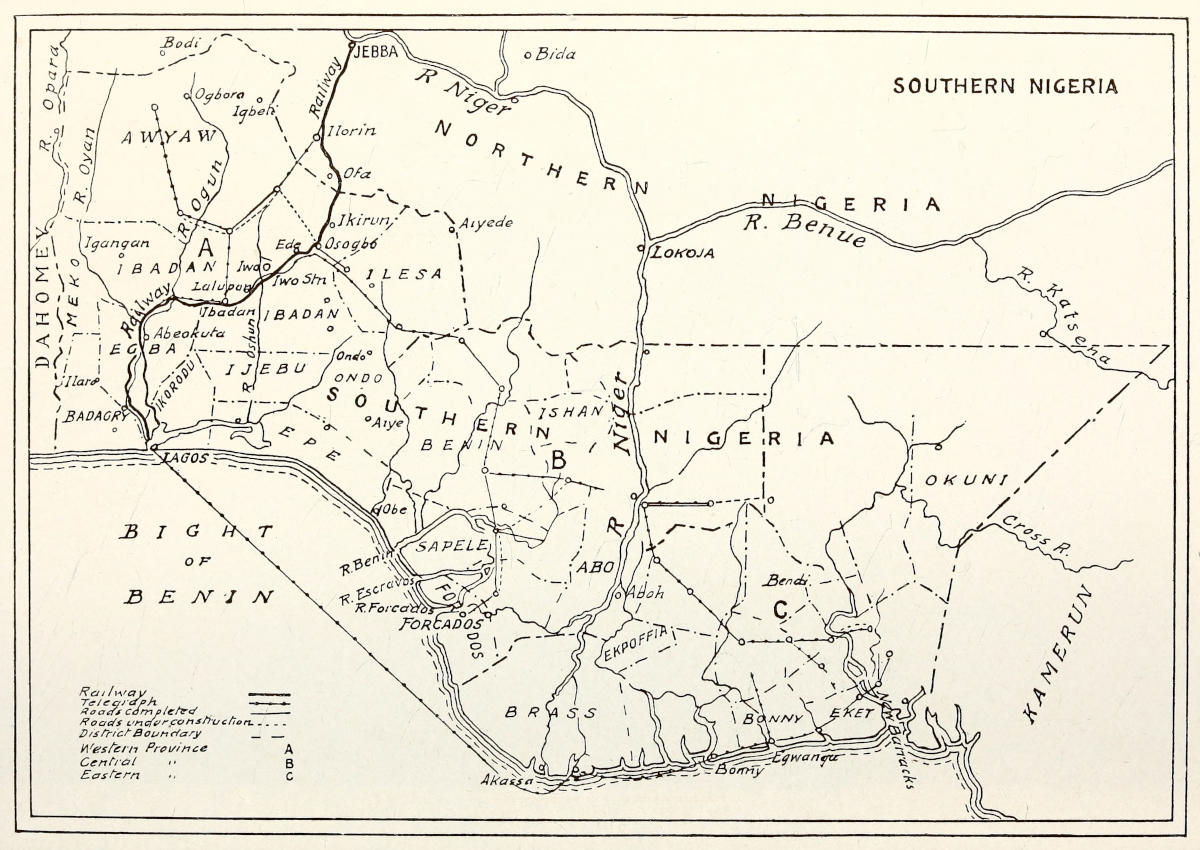
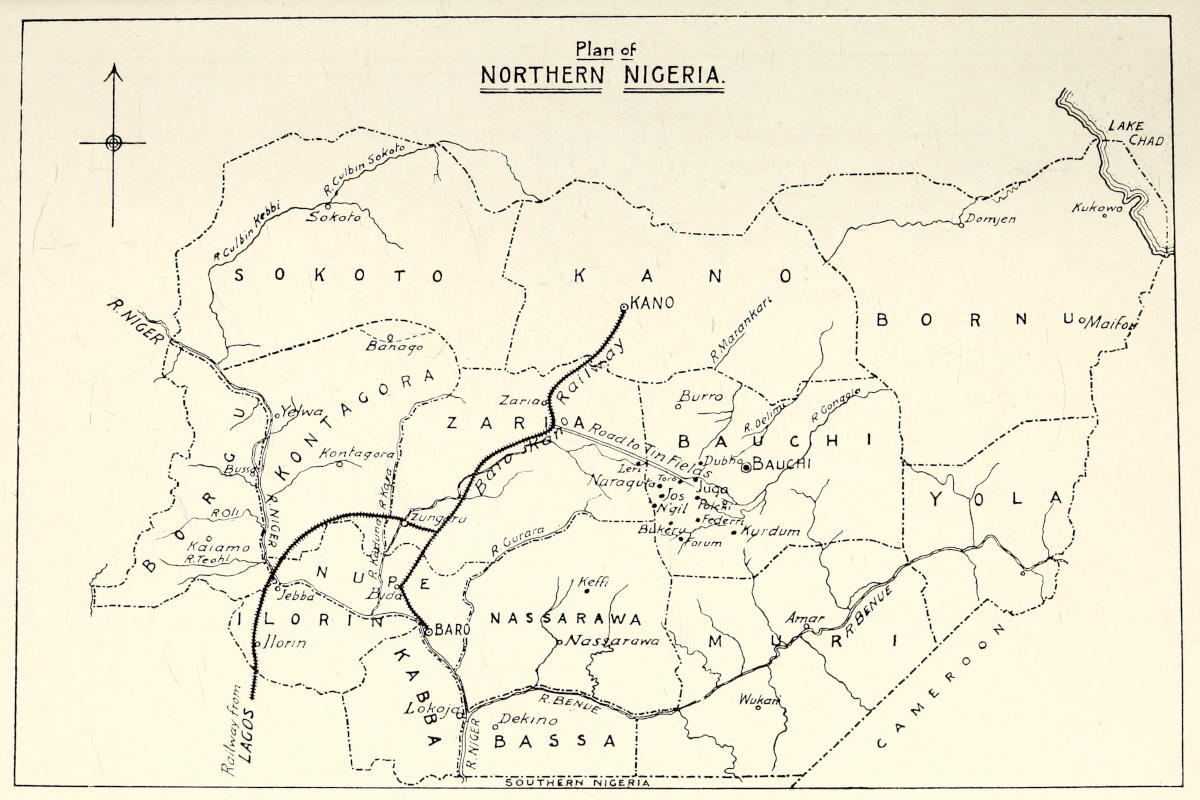
Southern Nigeria, through which the Northern
Protectorate is reached from the coast, is covered
with a network of waterways, which are the
natural transport roads of the entire region, and
the Marine Department is continually surveying
old and overgrown streams and opening up new
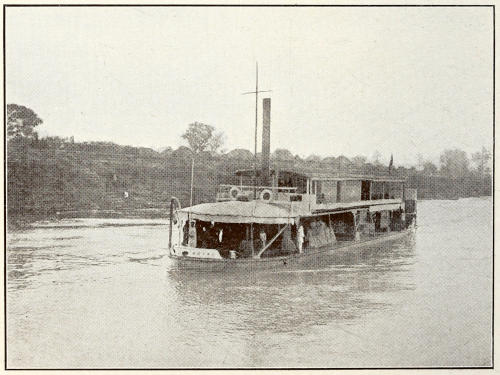
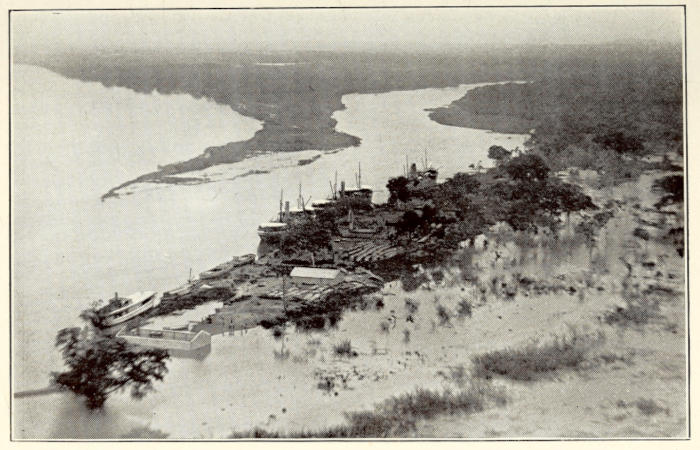
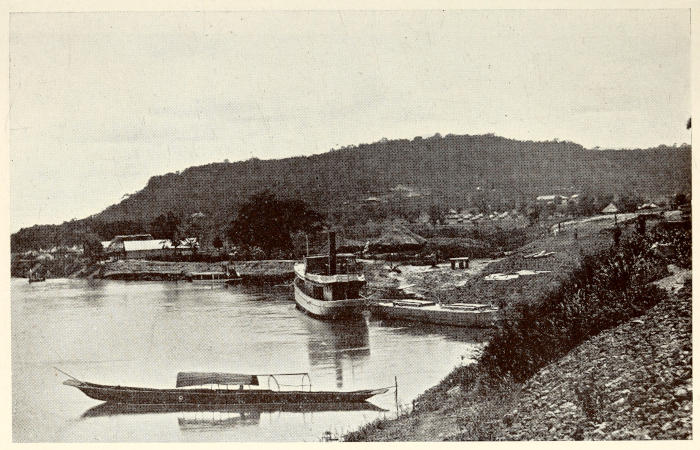
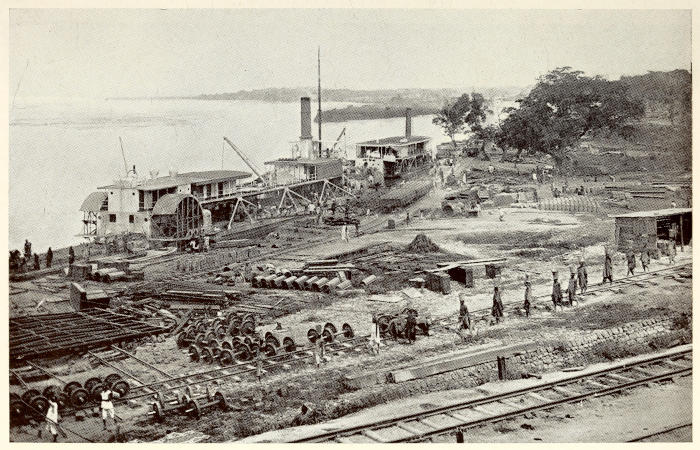
river routes. It is possible, travelling by the
Niger River from Forcados to the confluence at
Lokoja, and following from that point the Benue
River to Loko, to arrive within about 180 miles
of Bauchi, or going by rail from Lagos to Jebba,
the present northern terminus of the line, to get,
as the crow flies, within 300 miles of that centre.
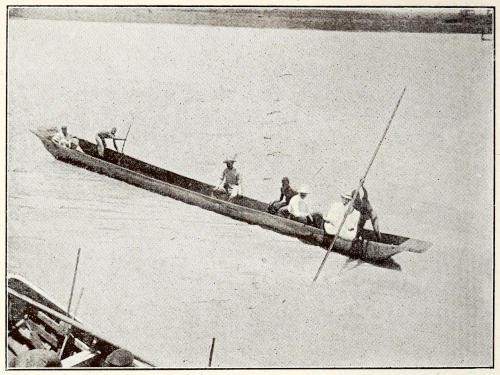
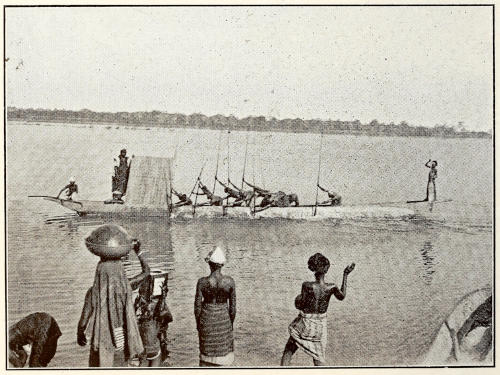
The river route is obviously the quickest and
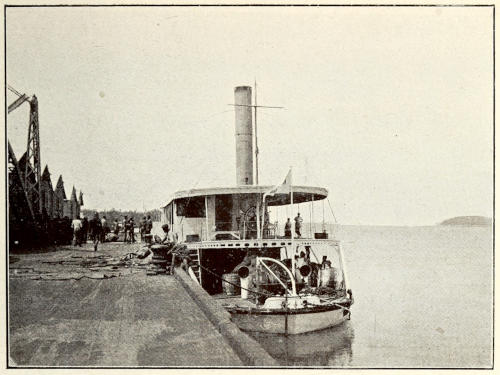
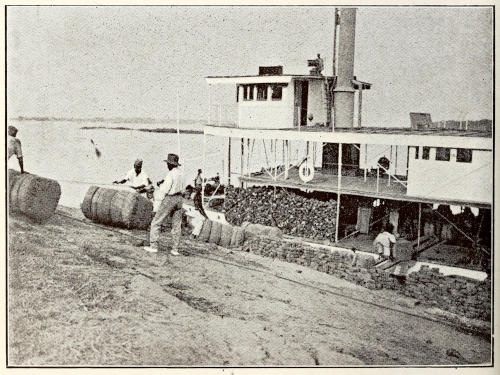
cheapest, and is the one still in use, the natives
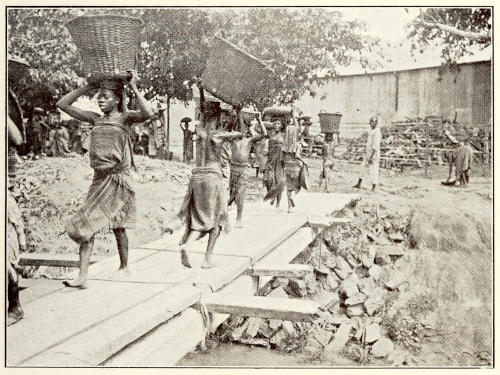
carrying the tin in parcels of 60 lbs. weight
on their heads from the field to Loko, travelling
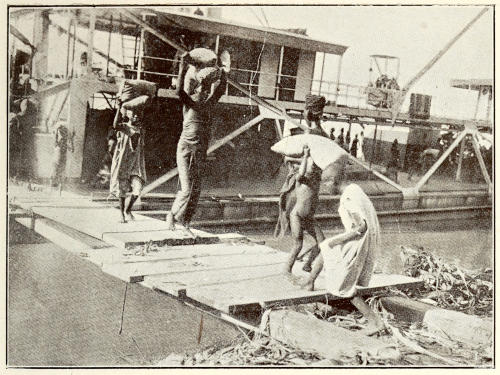
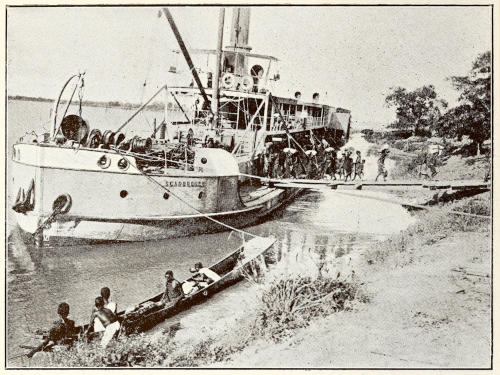
about 15 miles a day. At Loko, the metal is
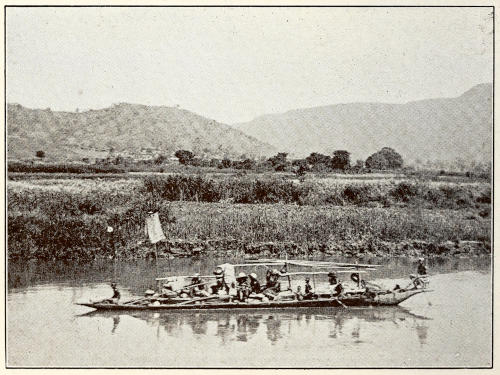
put into small steamers or barges, according to the
season, and conveyed to the confluence, where
it is transferred to Niger boats and taken to
Forcados for shipment to Liverpool, the entire
journey occupying thirty-five days and costing
£29 10s. per ton.
When the construction of the Kano Railway
from Baro on the Niger to railhead is opened, and
the road connecting the railway to Bauchi is
made, the journey will be appreciably shortened.
The completion of the railway from Lagos in 1911
should further reduce it to about twenty-eight days,
and again when motors are available on the new
road, to about three weeks.
The cost per ton by the Forcados-Baro route
will be:—
£
s.
d.
By sea to Forcados
2
0
0
Forcados to Baro by boat and by train from Baro to railhead by cheapest rate
7
12
6
From railhead to tin field, about
9
0
0
£18
12
6
This will be increased when the maximum
rate is charged, and will be reduced when the
motor transport on the new road is available.
The future cost and time of transport depends
upon the completion of the railway construction at
present in hand, and the decision of the Government
with regard to the suggested new line to
connect the tin fields with some selected spot
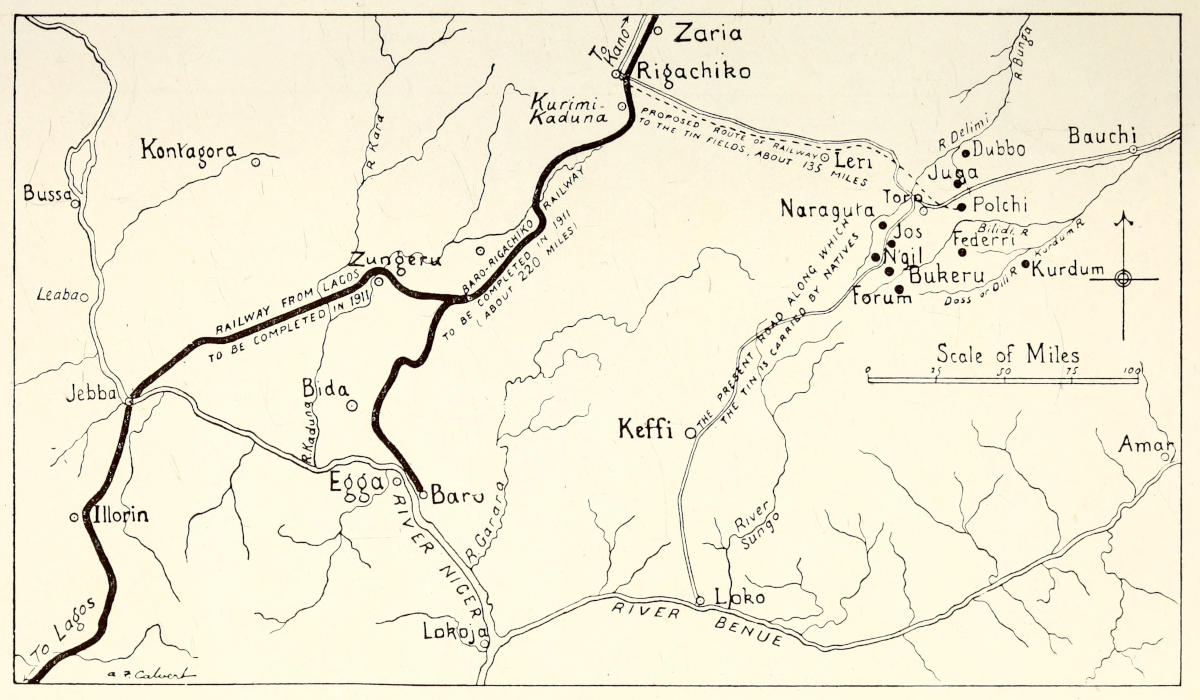
upon the Baro-Kano line of railway. The Lagos
railway to Jebba in Northern Nigeria is 307
miles in length, but although the last constructed
stretch of 60½ miles from Ilorin was only opened
in August last, the line has already been continued
for some 50 miles beyond the Niger, and the
balance of 70 miles to be completed to Zungeru,
the capital of Northern Nigeria, is expected to be
finished early in the coming year. By this
route, when the connecting line from Zungeru to
the Baro-Kano railway is constructed, and the
branch from the latter railway to Bauchi is built,
it will be possible to carry machinery all the
way from Lagos to the new field by train, and
bring the metal down to the port by the same
service.
But although this Lagos railway, as it is still
called, taps a fertile and thickly populated country
and connects the capital of the north with the
coast, it became, with the commencement of the
new Baro-Kano line the second, instead of the
first, most important factor in the development
of Northern Nigeria. Until the year 1907 the
Northern Protectorate possessed in the way of
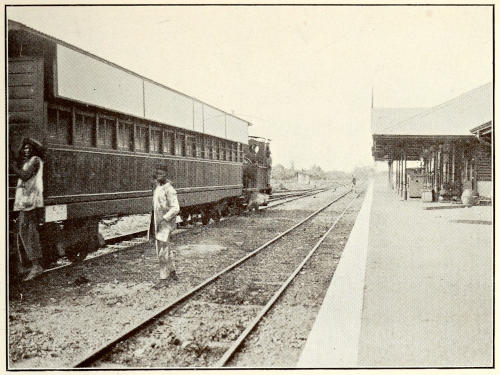
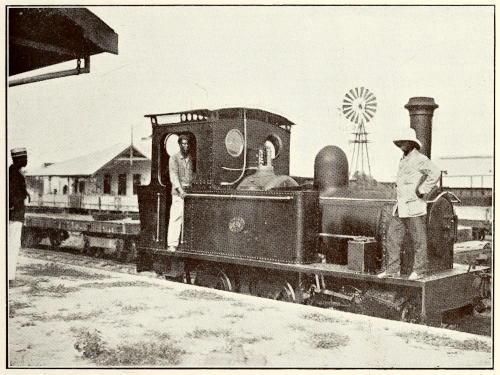
railways but one light 2 feet 6 inch tramway
of 22 miles in length, which connected its capital,
Zungeru, with Baro, the nearest navigable point on
the river.
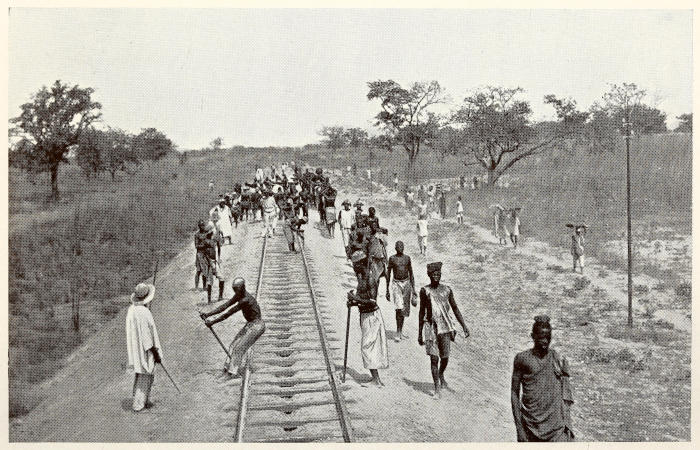
It was in May 1907 that Sir Percy Girouard,
the Governor, whose name had already become
famous in connection with his splendid railway
work in the Sudan and in South Africa, formulated
the railway policy, and recommended the construction
by the Public Works Department of
the Protectorate of a 3 feet 6 inch gauge railway
from Baro, on the Niger River, to Kano, a
distance of a little short of 400 miles, on an
estimate of £3000 per mile. In August of the
same year the Imperial Government sanctioned the
construction of the proposed line.
At the same time the views of the administrative
Southern Protectorate were met by the
extension of the Lagos line into Northern Nigeria,
with a connection to be established from Zungeru
with the Baro-Kano railway, making it possible to
travel from Kano either all the way by rail to
the coast at Lagos, or by rail to Baro, and thence
by river steamers to the mouth of the Niger. It
is expected that the bulk of the exports will follow
the line to Baro, and thence be carried to the sea
by water transport, but the Lagos line serves such
a rich and well populated country, that when the
Port of Lagos has been rendered accessible by
the harbour improvements now in construction,
the line should prove of increasing economic value,
quite apart from any trade it may attract from the
more easterly provinces of Northern Nigeria.
The Baro-Kano railway was put in hand at
an extremely opportune time, and it was while the
work of construction was being rapidly pushed
forward that the discovery of tin in the Bauchi
Province turned the thoughts of railway construction
in an easterly direction, and the continuous
and consistently rich finds which rewarded
the efforts of prospectors in this region called
daily and hourly attention to its remoteness. At
first it was considered that the formation of a
good road from Bauchi to strike the Baro-Kano
line about Zaria would suffice for the needs of the
field, but the extraordinary extent and richness of
the deposits, and the phenomenal success achieved
by the Naraguta (Nigeria) Tin Mines, Ltd., the
Lucky Chance Mines, Ltd., and other companies at
work there, emphasised the self-evident fact that
nothing less than a branch railway would be
sufficient to adequately develop the new industry.
London capitalists expressed their willingness to
find the money to finance the new line, but the
question was, and still is, under the consideration
of the Colonial Office, and Sir Walter Egerton, the
Governor of Southern Nigeria, and Sir Hesketh Bell,
the High Commissioner of Northern Nigeria, and
Sir William Wallace, the late acting Governor of
that colony, all strongly favour the construction of
the line by the Government rather than by private
enterprise.
Sir Walter Egerton, in an interview he granted
to a Press representative in June last, said:
“Everybody believes the tin deposits to be very
rich, and if only half the reports concerning them
are true, there is more than enough to warrant
the expenditure of making a branch to the tin
fields of the Province of Bauchi. This would give
direct access from the sea at Lagos to the tin
fields. The reports show that the tin alluvial is
similar to that of the Malay Peninsula, which produces
more than half the tin of the world.
Southern Nigeria has already lent the money
required for the construction of the railway to
Kano, and it is a question for the consideration
of the Secretary of State whether we should not
also finance the building of the line to the tin
areas. I should think it would be a great advantage
to Southern Nigeria to have such communication,
as a large traffic might be expected.
If the Secretary of State agrees, there is no
reason to expect that there will be any opposition
in Southern Nigeria to financing the line, for the
success of the tin industry will have a wonderful
effect not only on Northern, but also on Southern
Nigeria, for the Protectorates, though two politically,
are one geographically.”
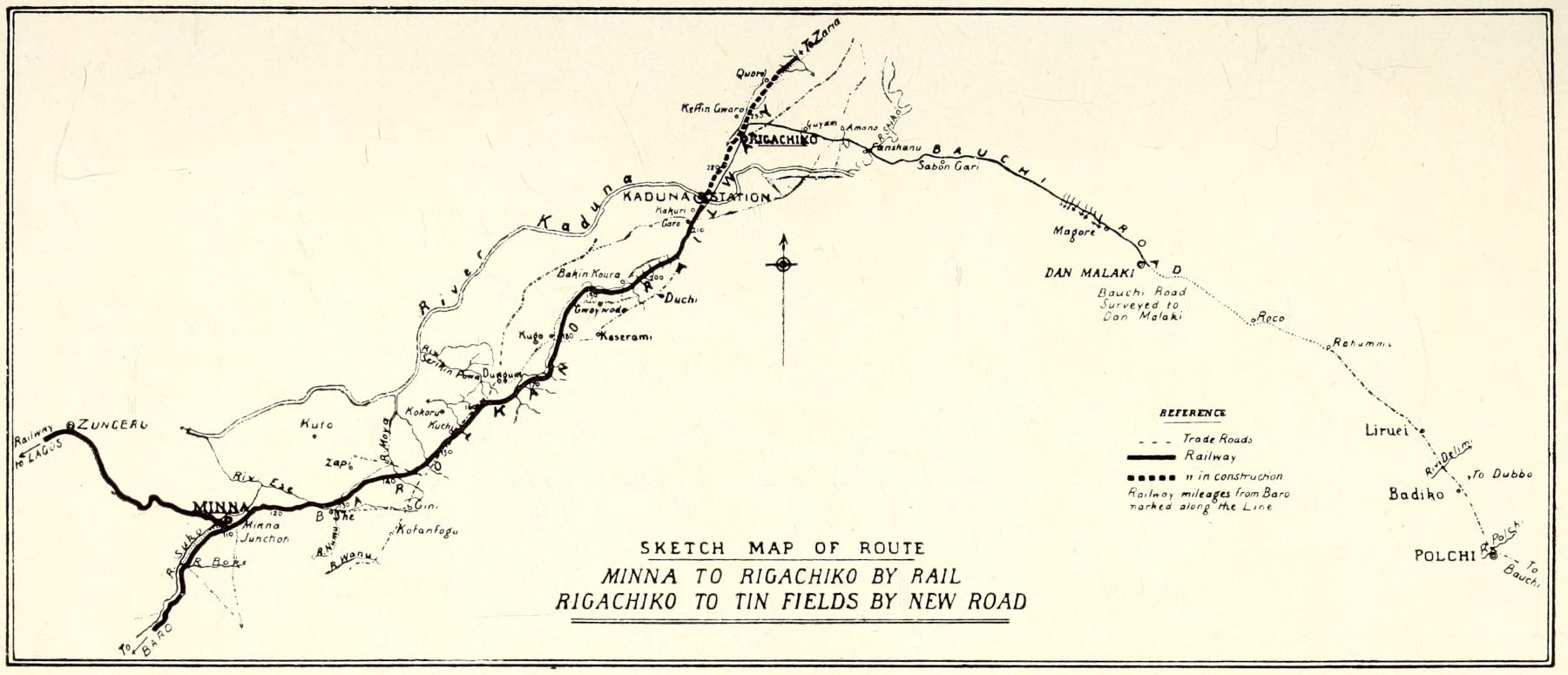
Since this interview was published it has been
persistently rumoured that the Government have
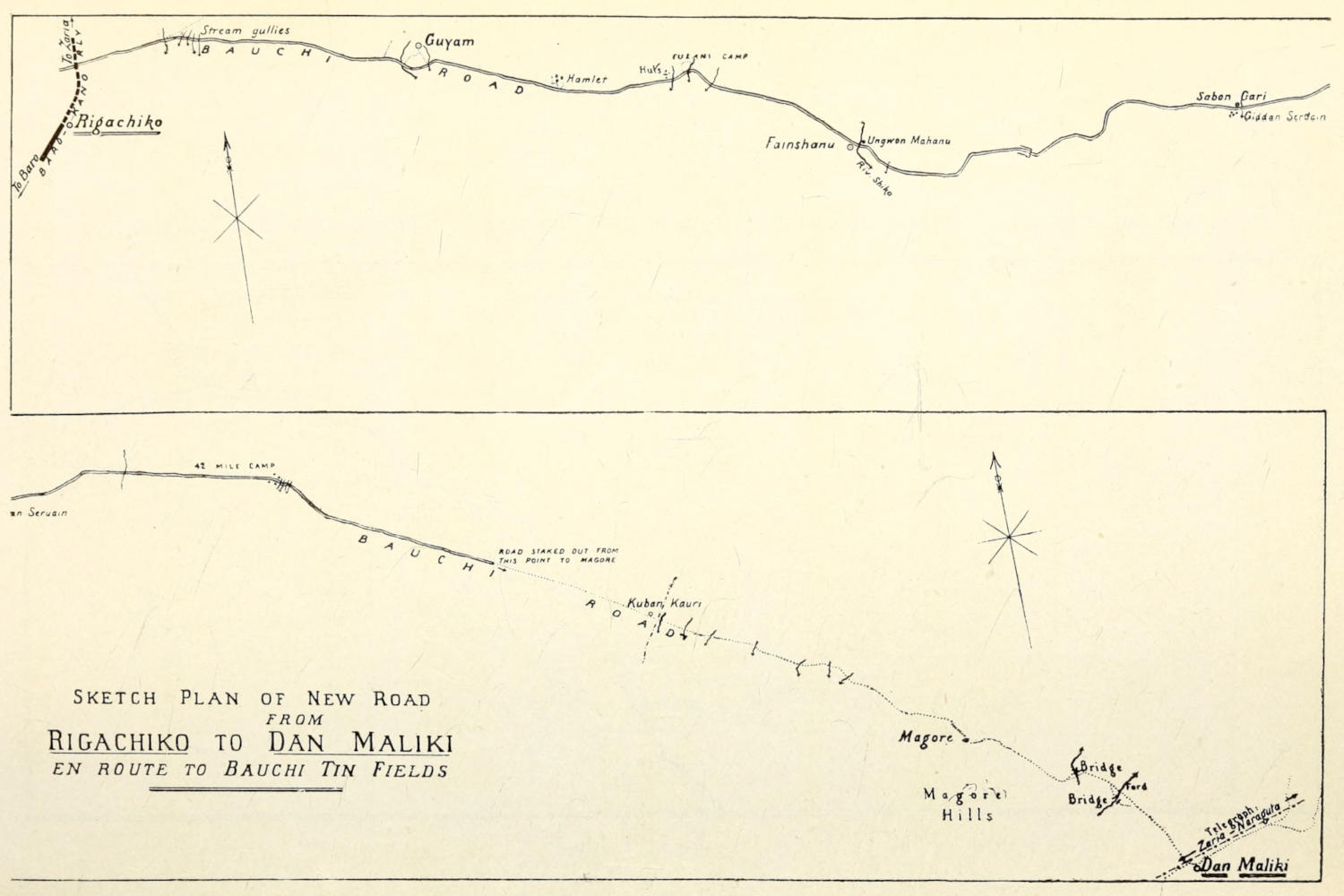
decided to build the suggested line from a point
near Rigachiko, on the Baro-Kano line, to a place
called Toro, between 120 and 130 miles distant,
in the centre of the tin district, and midway
between Naraguta and Juga. The country which
the line would traverse has been surveyed, and a
new road, 12 feet wide throughout, and capable of
conveying light motor traffic in the dry season is
being constructed, and will probably be completed
before the end of the present year. But the
Government have not yet announced their decision,
and it is doubtful, although efforts have been
made to induce them to divert the funds for extending
the line from Zaria to Kano for the purpose
of the tin fields branch, whether they can be
persuaded to do so. It is believed, as Sir Walter
Egerton said, that if the Government acts on the
recommendation of the Governor of Northern
Nigeria, the Government of Southern Nigeria
would be willing to undertake the construction
of the line, and should the Colonial Office decline
to sanction the scheme, representatives of several
of the companies interested in the new tin field
have expressed their readiness to finance the
railway.
As recently as October 22nd a meeting of representatives
of the various Northern Nigerian tin
companies was held at the London Offices of the
Niger Company, when a general committee, to be
named the Northern Nigerian Mines Association,
was formed, composed of a representative of each
of the companies, and a sub-committee, composed
of Lord Scarborough, Mr. S. R. Bastard, Mr.
O. Wethered, Mr. Godfrey, and Mr. Berry was
appointed to deal with urgent business. The chief
attention of this meeting was naturally paid to
the question of transport, and the first business
done was the passing of a resolution urging the
Colonial Office to construct the railway to the
Bauchi tin fields as early as possible. The
Association decided on the appointment of a
medical officer, and they have, furthermore, given
instructions for a hospital to be built on the field
at Joss. It will therefore be seen that everything
possible is being done to urge upon the Government
the importance of pushing forward this
work, which will doubtless be taken seriously in
hand before long.
Everybody connected with the Protectorate or
interested in the new tin field is agreed as to the
absolute necessity of constructing the line.
Mr. J. Tomson, the chief engineer of the
Anglo-Continental Mines Company, who recently
returned to England after an extended tour in the
Bauchi district, declared that the difficulties of
transport are at present tremendous, but he is
of opinion that they could best be overcome
by running a railway from Minna, a point on
the Baro-Kano line to Naraguta, the capital of
Bauchi.
“Before I left,” said Mr. Tomson to a representative
of the Morning Post, “I had an interview
with Sir Hesketh Bell, the Governor, and found
him most sympathetic towards the mining industry.
He recognises that the railway should
be built to the tin fields as quickly as possible,
but of course it is a question of ways and means.
If the Colonial Office came to the rescue and
made a special grant for laying the line, or else
allowed the united mining companies to construct
it themselves, which they are quite willing to do,
all would be well. But it is important that something
should be done at once. If not, there is
going to be a serious difficulty over the food
supply, because so many mining companies have
gone to the Bauchi district that the farmers are
unable to cope with the demand for food. With
a railway to Minna and then along the line now
being laid to Zungeru, which connects up the
Lagos railway and the line from Baro, the ore
would reach port in a few days.”
Mr. Beresford, the Secretary of the Administration
of Northern Nigeria, in an official letter
written to a correspondent, discussing new means
of transport in the Protectorate, says:— “A
survey for a road has just been completed, and it
has been found that the Rishi Pass is not a
practicable line, and it is considered that Toro
or Tilde, and not Liruei, should be the point of
objective. It is hoped that by December next
a rough road, fit for carts or light motors, may
be completed to Toro via the Gusu Pass, but the
Governor is strongly of opinion that nothing but
a railway will suit the requirements of the tin
fields, even in the near future, and he hopes that
it may be possible to find funds for such a
project.”
When the work of seeing these pages through
the press was nearing completion, a letter arrived
at the London offices of the Tin Fields of
Northern Nigeria, Ltd., from their engineer,
Mr. Jerome J. Collins, describing the means of
transport from the coast to the seat of operations
in the Bauchi Province. The particulars, which
are given from personal experience of the journey,
are both interesting and instructive, as they are
also the last word to hand on the subject, and
the excerpts which follow are published by the
courtesy of the directors of the company, by whom
the letter was received.
Writing from Kogin Jarawa, under date
September 13, Mr. Collins says:—
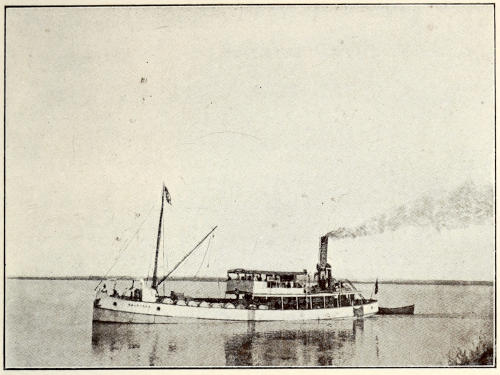
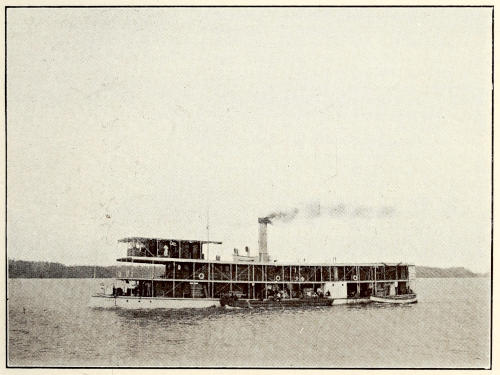
Niger River Transport.—Forcados to Baro.
The distance is 407 miles. The Niger Company,
Ltd., and the Government run shallow
draught steamers carrying passengers and cargo.
The Government steamers run a weekly service
in connection with the mail steamers from Liverpool.
The Niger Company run steamers as
inducement offers.
The time occupied is about ten days by both
services, but a great deal of this time is taken up
with stoppages at the various towns along the
river.
The Government steamers are in a very bad
state of repair, and much time is lost owing to
breakdowns. In the rainy season branch
steamers travel between the coast and Baro, at
present carrying railway material. They have
facilities for handling heavy cargo.
The season extends from July to September.
The Government and Niger Company’s boats
have no facilities for handling heavy cargo, being
limited to packages capable of being handled by
native labour, which is tedious and expensive.
The cost of transport by Government steamers
for ordinary cargo from Forcados to Baro is from
40s. to 60s., and down from Baro to Forcados is
from 21s. to 33s.
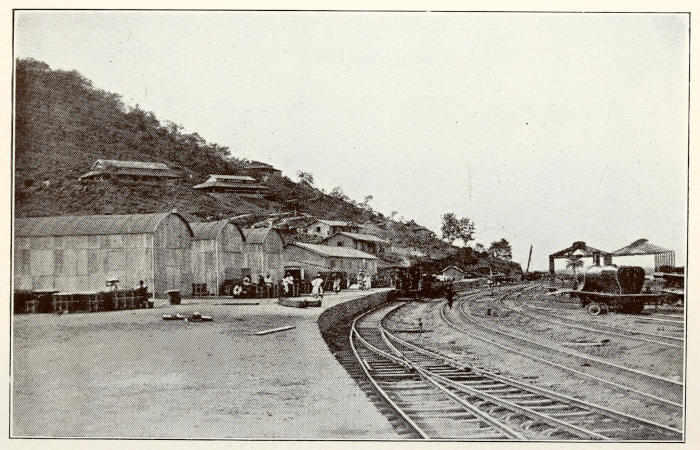
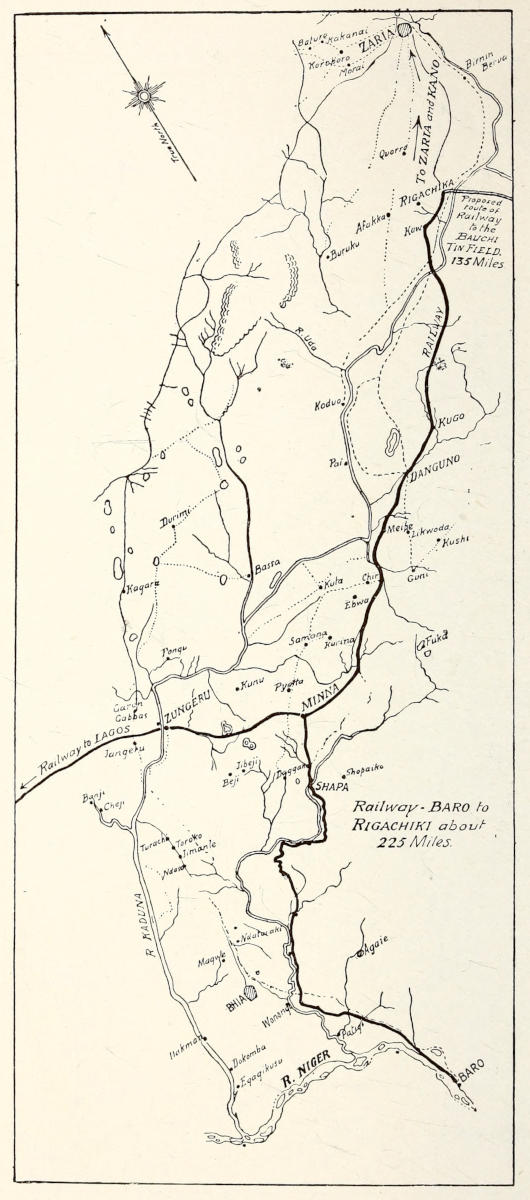
Railway Transport.—Baro to Rigachiko.
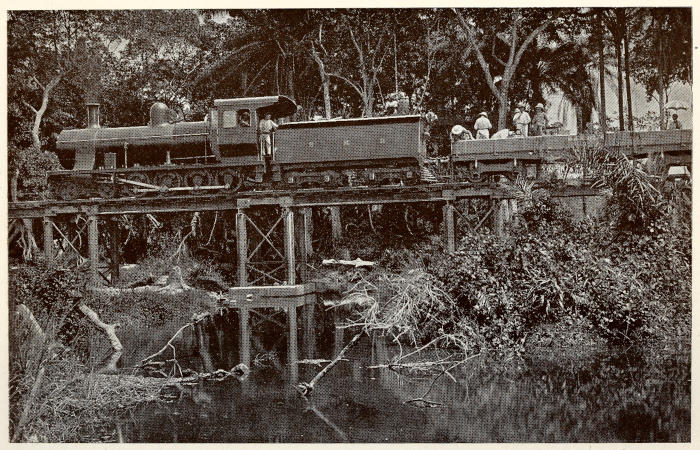
The distance is 225 miles. The railway is
not yet completed to Rigachiko, where the Bauchi
road starts, but I understand from railway
officials that the line will be through by next
March, 1911. Railhead at present is at Kogin
Serikin Pawa, 172 miles from Baro, but rails are
laid to within fifteen miles of Rigachiko, and this
part of the line will be ready as soon as the
bridges are completed.
The railway is 3 feet 6 inch gauge, and has
been constructed with economy always in view.
Up to the present there is no ballast on the line,
and consequently there are serious delays during
the rainy season owing to derailment of engines
and the washout of embankments. My journey
from Baro to railhead occupied fifteen days; the
most of this time was lost owing to breakdowns
on the line.
The journey should occupy two days, and I
have no doubt that by March next it will be
possible to get from Baro to Rigachiko in two
days.
The freight on the line at present is 8s. per
ton per mile, equal to £7 10s. per ton from
Baro to Rigachiko, but at present the railway
company will not undertake to transport cargo
unless it is accompanied, and even then they will
take no responsibility.
I understand that in the next year, when the
railway is open to Zaria, the freight will be
reduced to 6s. per ton per mile, equal to
£5 12s. 6d. per ton from Baro to Rigachiko.
Road Transport.—Rigachiko to Naraguta.
The distance is approximately 135 miles. On
my journey across by this road I took eight days,
which is as quick as can be expected.
The Government engineers are clearing a track
twelve feet wide, and pulling out tree stumps.
They are also grading down banks of creeks to
one in ten.
They are expending £20 per mile on this work,
and have completed fifty miles in two months.
This road track will come into the tin fields at
Toro, twelve miles north-east of Naraguta, and
twelve miles west of the company’s property at
Federri. This track should be finished by the
end of the year.
The country is flat and very easy for road
building. There are four large rivers to cross,
which would require bridges of over 100 feet in
length, and numerous small creeks which could be
bridged cheaply.
There is plenty of stone suitable for road
ballast, available near the road. When the road
track is through to the tin fields it will be possible
to transport stores by carrier in seven days from
railway.
It may be mentioned here that the Niger
Company up to the present have had great
difficulty with the prospectors and others travelling
up to the tin fields, owing, in some cases, to
their not having left themselves entirely in the
hands of the company. The Niger Company
have practically controlled the country, and have
perfected arrangements by which they can supply
large numbers of natives for carrying goods
from the river to the tin field, but on several
occasions their organisation has been interfered
with by persons offering the natives three or four
times their usual pay in order to get them
through quickly to the fields. This, of course,
as will be seen, is a dangerous policy, for if a scale
is not strictly adhered to, the time will come
when the natives will start attempting to dictate
their own terms.
The Niger Company are not in favour of the
motor route from the head of the Baro-Kano to
the fields. Their opinion is that the money
would be wasted on such a road, and that the
mining community should be satisfied to wait
until the railway is made. Their view is that
the mining companies should join together and
come to an arrangement with the Niger Company
for carrying all the goods along their own route
from Loko to the field via Keffi and Bukeru.
This road, they say, could be reserved for mining
business, and they would open up another route,
starting from a point near Sinkai higher up the
Benue River, which could be used for ordinary
commercial purposes. They point out that with
the rush of goods required for the mines, they
have been unable to get up a sufficient and proper
supply of provisions. This question, of course,
requires careful consideration, as although the
Niger Company wish to be considered as offering
this advice in a purely disinterested manner, it
should be remembered that they are asking for
contracts for the whole of the transport, which
would enable them to employ thousands of natives
at a very low figure.
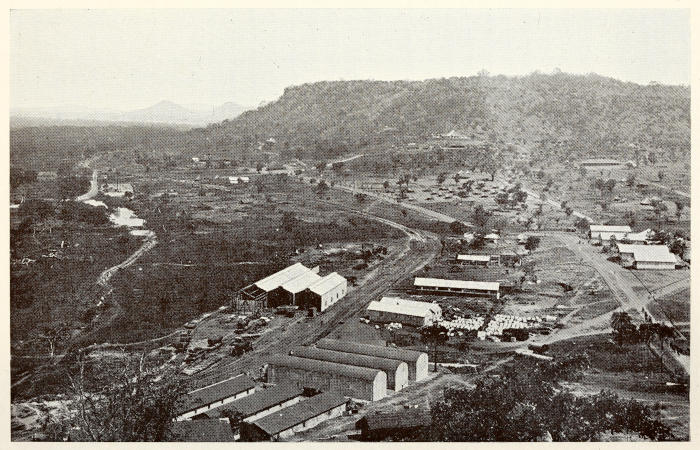
Meantime the energetic prospecting and mining
work that is being done in the Province of Bauchi
is establishing the fact that the new tin area is of
enormous extent and value both in the nature of
alluvial gravels and the more permanent form
of tin lodes. Mr. Lush, the well-known mining
authority, who has examined a great part of the
Province, estimates that these deposits are
scattered over an area of no less than 2,500
square miles, and the tin produced is considered
to be some of the best ever imported into Europe,
and commands a price equal, if not higher, than
the Straits tin. The land is situated about 3,000
to 4,000 feet above sea-level, and the late
Director of Mines in Northern Nigeria states that
the climate is equal to that of Rhodesia, if not
even better.
“Few people have any idea,” Mr. Tomson
asserts, “of the possibilities of this country. It
is quite a mistake to think it is unhealthy.
Naraguta is over 3,500 feet above the sea-level,
and is a healthy and fertile district. Here you are
hundreds of miles away from the malarial swamps
and the coast. If you walk up out of the town
of Naraguta on to rising ground, as far as you
can see stretch out great plains of waving grass,
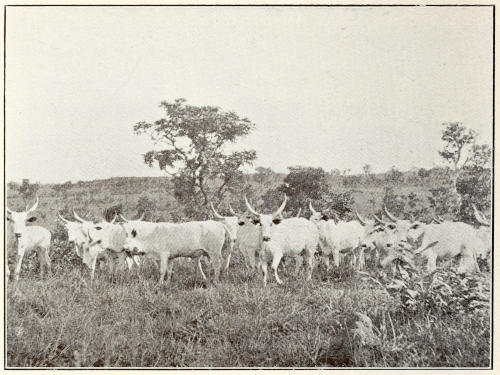
here and there dotted with masses of the Fulani
cattle. It would make a splendid wheat-growing
district, for the land requires very little cultivation,
and there is no bush country. Kano, which lies
nearly two hundred miles to the north, is a remarkable
place. Several travellers have stated
that it is the largest market in the world.”
Mr. Huddart, until recently Director of Mines,
who has declared that the climate of Northern
Nigeria is better than that of Rhodesia, and that the
country is without a single tsetse belt, says:
“The nights are quite cold, and any man who
lives well ought to have perfect health. I do not
reckon it in the least like any other part of West
Africa; it is more like Eastern Soudan, and it is
known as the Western Soudan. With regard to
water, which, as you know, is a very important
question, it is quite erroneous to imagine that
there is very little water here. In Northern
Queensland and South-Eastern and Western
Australia there is much less water than here; in
fact there is no comparison between them. Mr.
Lush and I—and I had the pleasure of travelling
with him—were never at any trouble in getting
water, we never had even to carry water, and
those who have travelled know what that means.”
In Nigeria they have only two well-defined
seasons, the wet and the dry season. The wet
season lasts from April till the end of October,
and during that time it is very difficult to do any
prospecting work, although, of course, mining can
be carried on in certain districts. It is during
the dry season, from the end of October to April,
that most of the work can be accomplished,
especially from a prospector’s point of view.
Mr. Lush, writing on the subject of the cost
of living and provisions, says “living is cheap,
there being plenty of beef, mutton, fowls, milk,
eggs, &c. Any kind of vegetable grows well,
especially English varieties; in fact very few
mining fields that I have visited can be compared
to Northern Nigeria in respect of the various
sorts of wholesome fresh food that can be
obtained. In fact all one requires is flour and a
few groceries. The country will provide the rest.”
The new mining regulations, incorporated in
the “Minerals Proclamation, 1910,” have already
been published in Nigeria, but they are not yet
obtainable in this country, and I am privileged
to be able to reproduce a copy of them as an
appendix to this book. From this document it
will be seen that a prospector must either take
out a prospecting right, which costs £5 per
annum, and entitles the holder to explore for
minerals in those parts of the Protectorate not
already leased or reserved by Government notice,
or an exclusive licence to prospect within an area
not exceeding 16 square miles for a fee of £5
per square mile. Mining leases are only granted
to holders of either one of these permits, who,
upon application, must show that bonâ fide prospecting
operations have been carried on on the
area applied for, and that they possess or command
sufficient working capital to ensure the proper
development and working of the mine. Leases
of tin areas, which are granted for a term up to
twenty-one years, with the option to renew for
a further twenty-one years, are three in number,
viz., lode mining leases, which may be obtained
up to a maximum of thirty claims of 80,000
square feet per claim, at the rental of £4 per
claim per annum; alluvial mining leases, not
exceeding 800 acres in area, with a minimum
width throughout of 400 yards, at a rate of 5s.
per acre per annum; and stream mining leases,
which shall be confined to the bed of a stream,
not exceeding one mile in length, at a rental of
£1 per 100 yards per annum. Penalties in the
shape of fines or imprisonment are to be inflicted
for prospecting without a licence or working a mine
without a lease, for interfering with a prospector
in the exercise of his rights, for giving false information
in an application for a mining lease, or
for “salting” a mine, and the Government reserve
the power to cancel a prospecting right or revoke
a mining lease for certain breaches of the new
regulations. Over and above the fees charged
for yearly rental of leases, the holder is by
statute required to pay a royalty of 5 per cent.
to the Niger Company on the value of all
metal won, and another royalty of 5 per cent.
to the Government, who collect their royalty in
the form of export duty.
A population estimated at seven to nine
millions is already on the land, and although their
labour would not be very efficient so far as
skilled work is concerned, there is plenty of rough
work to be done, for which about 6d. per day is
paid. The costs of treatment are not expected to
exceed 6d. per cubic yard. When it is remembered
that it is possible for one property to
contain many hundreds of thousands of cubic
yards of alluvial wash, and that this alluvial
tinstone is worth approximately 10d. per lb. at
the present time, it will be realised that with the
working costs at the liberal figure of 6d. per cubic
yard, there is a very considerable margin of profit
in these undertakings.
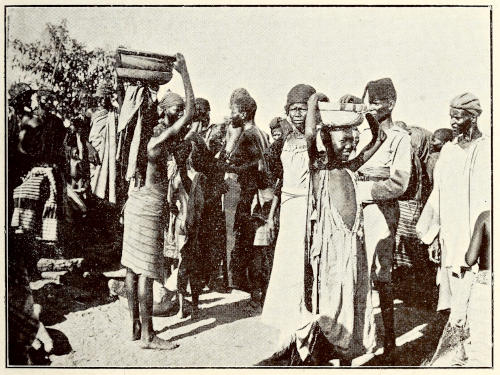
Mr. J. Tomson says of the natives that they
make very good labourers: “They insist on
being paid with English money, ‘threepenny bits’
being very popular. They have no liking for
gold, and do not consider it so valuable as silver.
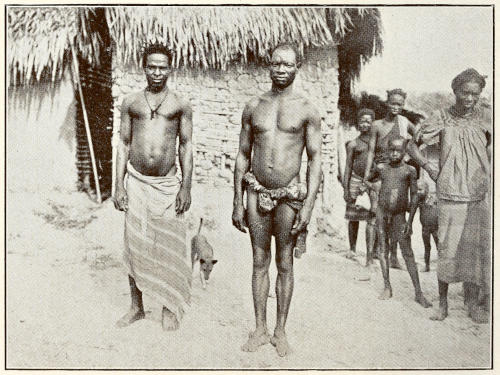
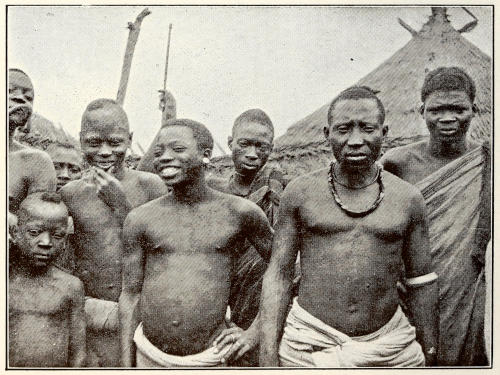
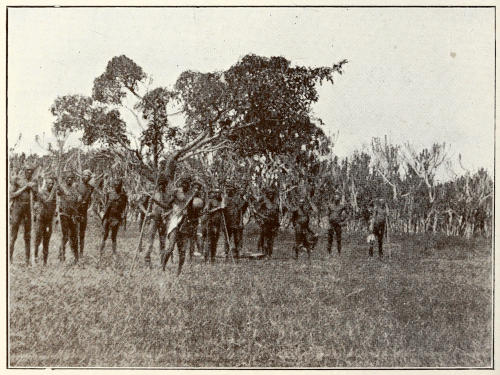
The pagans, who are the farming class, appear to
be a most industrious people. They still live in
fear of invading Fulani, and always take their
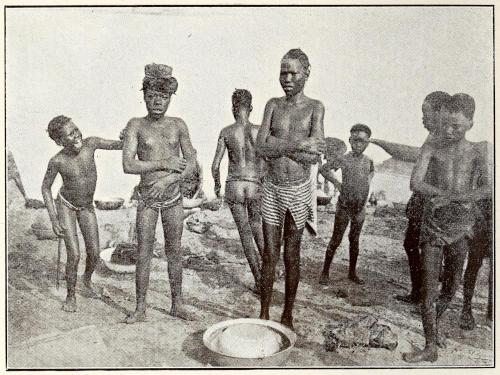
bows and arrows with them to the field. Neither
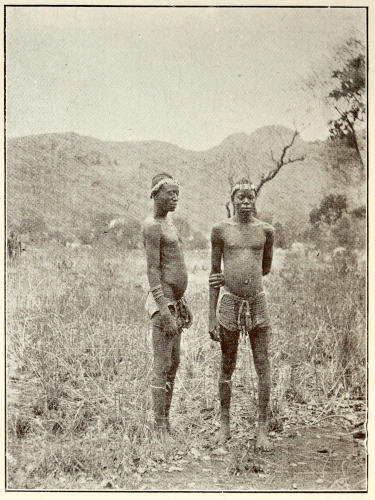
men nor women wear dress of any kind. They
have a juju or secret oath which forbids them to
put on any garment. With these people the
missionaries make no headway at all. Neither
do they with the Mohammedans.”
The manager of the Lucky Chance Mines,
reporting under date 29th August, said he
was still paying 6d. per day for ordinary
labour, and so far he had had little trouble
with the men on day wages, although they
had several times tried to get him to raise
the rate of pay.
Reporting on a property at Juga in the tin
district, Mr. Huddart says:
“The properties are very favourably situated
to obtain labour. The men from Bauchi and the
east come along the main caravan route looking
for work to enable them to earn money to pay
the taxes, &c. As this particular property is near
the market, and the men usually halt at the market,
they can easily be recruited. The cost of ordinary
labour is 1d. per hour, and is easily trained. The
Bornu and Eastern Kanuri are, in my opinion,
the best workers available. A further advantage
lies in the position of the property in settled
country under the control of the Filani Emir of
Bauchi, and the men prefer this to the pagan
country.”
Referring to another property about twenty
miles further south, Mr. Huddart says:
“When all is in proper working order, I am
convinced that ample labour will be forthcoming,
as the property is favourably situated in that it
can tap the Angass country and the western
part of Bornu, as well as the eastern Bauchi
territory. When the proper camps are made,
markets organised, and the natives learn that a
certain income awaits them, I feel sure that labour
will come in without any difficulty, and I speak
as one knowing their language and having an
intimate knowledge of the conditions.”
Mr. H. W. Laws, General Mining Manager
of the Niger Company, in his report to the Bisichi
Company, whose property is near Naraguta, says:
“There is a good supply of labour in the
country; owing to a sudden increase in the
demand for labour a temporary shortage was
reported this wet season, but the labour market
is now rapidly recovering, and in view of the
very large amount of labour available in the
Hausa States, and the Province of Bornu, no
difficulties need be anticipated as to the supply
in future.”
The concensus of opinions held by men who
understand the amount and nature of the work
entailed in this particular form of mining, and
are, at the same time, personally familiar with
the material that the country has to offer for
the purpose, shows that the supply of labour
in Northern Nigeria is entirely adequate, and
although the development of West Africa depends
almost entirely upon the labour question, there
is no prospect of any difficulty on this account.
Mr. Astley Cooper believes the chief grounds
upon which trouble might arise, are the desire
of the majority of the natives not to do too much
work, the fear that a few months’ work in the
mines would give a native sufficient money to live
on for a year or two, and the difficulty of getting
the right sort of European to take charge of the
native labourers. But after all there is little
reason to anticipate trouble on any one of these
counts. No native in any part of the globe does
more work than he is kindly but firmly obliged
to perform, and there is no necessity for employers
to demoralise the native labourers by a
policy of over-payment. But the necessity of
employing the right sort of European to put in
control over the natives is quite to the point.
The West African is more domestic than the
Kaffir—of whom there are over 200,000 at work
in the Transvaal mines—and there is no more
willing worker if he has the proper white man
over him. But it is the duty of the Government
and the trading companies, and the mining corporations,
to select the right men for their purpose,
and if they are wise in this respect there need
be no fear of labour troubles in either Southern
or Northern Nigeria.
The published opinions of Government officials,
engineers of repute, capitalists, traders, and travellers,
all tend to prove that in Northern Nigeria we
have one of the largest, if not the very largest,
of the tin-producing areas of the world. Other
minerals are known to exist, and very big developments
may be looked for in the near future, as
the pioneering efforts of the Niger Company and
the Champion Gold Reefs of West Africa are being
followed by powerful financial houses, but alluvial
tin stands out, and will always stand out, as the
leading product of this remarkable mineral country.
Two such astute men and persons so well acquainted
with the country as Sir Walter Egerton,
the Governor of Southern Nigeria, and the late
Sir Alfred Jones, have expressed the strongest
views as to the extent and importance of these
tin deposits, and the acting Governor of Northern
Nigeria in his latest report asserted that “with
the introduction of more capital and a good means
of transport from the field to the railway a very
large development is anticipated.”
Mr. Lush says the Bauchi tin deposits are
richer than he has seen in any part of the world.
It is, he says, a granite country, and although the
existence of reefs has been proved in one part of
the district, the alluvial deposits—which yield tin
oxide containing about 72 per cent. of metallic
tin—are of principal importance.
Alluvial mining, has, of course, the demerit of
being short-lived. There is no great depth in
the deposits, and especially if they are worked
economically—that is to say rapidly—they are
exhausted in a comparatively short time. But
the attention directed to the district in these
alluvial workings will certainly lead to the discovery
and opening-up of the tin lodes, which in
course of time should prove a more lasting source
of supply than the alluvials. Indeed, at two
points, two tin lodes are already being opened up,
and before long a good idea should be obtained
of their value. The interests at work in the
district will certainly see that every chance is
given to this side of the business, but, of course,
development upon a lode is very different work to
that upon alluvial deposits, and progress may be
slower in their case. It is very unlikely, with
such an enormous area of stanniferous gravels,
that lodes of importance should not be discovered
as time goes on, and there appears to be no doubt
that the tin production of Nigeria will become
quite a factor in the markets of the world. Many
things will have to happen before lode producing
can be carried out upon a large scale, but as the
alluvials are worked out, the labour employed
upon them can be concentrated upon the most
lasting deposits, and the operations of the alluvial
miners should produce a working population which
should be fitted to deal with the higher form of
mining. Certain facilities will doubtless be given
to the district, and some idea of the importance
and the developments in this part of Nigeria can
be gathered from the fact that the Bank of British
West Africa has been earnestly invited to open
an office in Bauchi. At present this matter is
under consideration, since it is difficult to fix upon
a spot which will be most suitable for such an
institution to work, but before long it is probable
that the tin-mining district will have the facilities
offered by a bank.
Mr. Oliver Wethered, whose name is so well
known in connection with the tin industry, has
described to a meeting of shareholders the peculiar
advantages of the country which is now attracting
the attention of the tin markets of the world, and
in the course of his address he said:
“Now as to the country in which our interests
are centred, judging by the information that I
have received from all available quarters, I have
no hesitation in stating that we are interested in
one of the most important virgin alluvial tin fields
the world has ever seen, and certainly the most
important that capitalists have had an opportunity
of working as a new field. In Tasmania,
Australia, and other countries which have produced
large quantities of alluvial tin, the prospectors
have gone in by hundreds, and even
thousands, and have washed out large quantities
of tin greatly to their own individual benefit.
Subsequently the ground has been worked over
and over again, and in recent years again re-worked
by means of modern appliances. I may
say here, that in Cornwall some of the ground
must have been worked eight or ten times, and
big plants are now being erected for the purpose
of working it again by modern methods. It will
be obvious to every one that with a practically
untouched field, and working in the most economical
and thorough way from the start, the results
cannot fail to be extremely satisfactory.
“Undoubtedly one of the factors which has
delayed the opening up of the tin fields of Nigeria
has been the question of economical transport.
But the Nigeria tin is of very high quality. It
fetches, as a rule, anywhere from £6 to £8
more a ton than Cornish tin, and in this connection
I should like to read an extract from a letter
which was written to me by the managing director
of the largest tin smelting works in Europe, to
whom I sent a sample of the tin oxide as it was
received here, and of which, in acknowledging it,
he says, ‘It is about 75 per cent. metallic tin, of
excellent quality, equal to anything being put on
the market, so far as my observation goes.’ I am
very closely connected with Cornish mining, and
there we get Bolivian, Straits, and all kinds of
tin, and it is the general opinion that Nigerian
tin is one of the very best tins imported into
Europe, and will always command a price equal
to, if not better than, that of the Straits. Even
under existing conditions alluvial tin mining in
Nigeria is a highly profitable business, but when
the present railway system is completed, and the
road made from the Government line to the tin
field, the freight should be reduced by many
pounds per ton, and the profit largely increased.
The completion of the road would enable heavy
machinery to be brought to the mines, when
larger quantities of the rich alluvial ground
would be handled in an economical way, and
the work done at a cost much below what is
possible under existing conditions. The lodes,
too, of which there is undoubted evidence, could
be worked. Meanwhile some machinery can be
transported in sections, and the output of tin
should be rapidly increased and the costs greatly
reduced.”
Mr. Assheton Lever, in summing up the
situation generally in Northern Nigeria to a
meeting of shareholders, said:
“We know that there are considerable areas
there which in some cases are very rich in
alluvial tin. There are also tin lodes there;
but that for the present is another story, because
alluvial tin is a thing which is easily and comparatively
inexpensively worked, whereas to work
a lode mine requires good means of transport,
and to be able to get up to the mines easily
expensive and heavy machinery. We have a
good climate, we have a sufficiency of water,
and so far as we can ascertain, we have
a sufficiency of native labour. All the companies
which are interested in Northern
Nigeria appear anxious to co-operate, and are
willing to work together generally for their
mutual benefit, and for the tin industry in
particular.”
Mr. H. W. Lake, the consulting engineer,
speaking in a professional capacity at the same
meeting, referred to the phenomenal richness of
the river banks in the tin district in Northern
Nigeria, while very rich alluvials are found on
the flats, and when it comes to investigation
of the river banks themselves very much larger
quantities of black tin to the cubic yard are won.
“I am speaking now,” he added, “from a certain
amount of experience, because four years ago
we had an expedition in the Bauchi district, and
our engineer obtained some quite remarkable
results from the alluvial. Of course, it is a
new country. There is a great deal of pioneering
work to be done, and what we have still to
look forward to is steady systematic organisation
for the next year or two. We do not want to
make the mistakes that have been made in the
opening up of many new countries—some of
them not very far from Nigeria—but we do want
to settle down to steady systematic development.
As far as the railway is concerned, there
seems no doubt that we shall have a line into
the tin fields, which is going to simplify the
question of transport, and reduce the costs very
materially. With regard to the actual working
of these alluvials, to begin with, I am of
opinion that we should use the simplest methods
possible—ground sluicing and so forth, but there
will come a time when we shall have very
seriously to consider the question of hydraulicing
and treating these alluvials on a very much
larger scale than would be possible by means of
sluicing.”
The extraordinary results obtained by the
Naraguta Company might be regarded as exceptional,
since it was a proved mine when taken
over from the Niger Company, and the actual
work done upon it has only confirmed what was
previously known of its phenomenal value. But
it may be said with great confidence, after careful
examination, by not one, but many engineers,
that the picture is not in any degree overdrawn.
Moreover, the head of a great firm of mining
engineers who was inclined to ridicule the values
reported, has since admitted that he has altogether
changed his opinion, and that he thinks
from advices he has received, that the Malay
Peninsula fields, even in their palmiest days,
were never “in it” with the Northern Nigerian
alluvial tin fields. In one place tin has been
taken out, on the Dubbo property, belonging to
the Lucky Chance Mines, extending over 640
acres, which actually goes 120 lbs. to the cubic
yard. That is to say, that the calabashers must
be getting out tin almost pure. This may be
only a pocket; but the whole character of the
reports from the fields makes it perfectly certain
that the general nature of the Bauchi district,
where the alluvial tin is mostly found, is of an
absolutely phenomenal character.
There is no doubt whatever that in this remote
district of Nigeria, which until a few years ago,
was closed to the white man by the ferocity of
its inhabitants, nature has been concentrating tin
for thousands and tens of thousands of years,
until we have it now in very large quantities in
an almost pure condition. To Sir Percy Girouard
is largely due the honour of opening up this
country, through the discipline he and his subordinates
dealt out to the original inhabitants.
To his successor, Sir Hesketh Bell, fell the duty
and the honour of opening up further the country
by a railway system which will make it a great
Imperial acquisition.
The work of Sir Percy Girouard and Sir
Hesketh Bell may be specially referred to, for
they represent the Imperial Government; but we
must not forget the work of the directors of the
pioneer companies in London, who must have
worked continually to do what they have done.
In the short space of only twelve months they
have accomplished an amount of work which
ordinary directors without enthusiasm would
have taken years to do. The country has been
searched for good properties, engineers have been
despatched and machinery ordered, and such is
the good work done in a small way with high
values, that it is no exaggeration to say that
many properties are now paying their way. All
has been so swiftly done, and with so little fuss,
that it seems like a fairy tale, and the public have
no conception yet of the extraordinary value
of these alluvial tin propositions in Northern
Nigeria.
It is satisfactory to gather from the report of
the acting Governor dated 11th December last,
that the year 1909 was a very peaceful one, the
military operations which it was found necessary
to carry out being on a small scale, and chiefly
on account of highway robberies. From all the
Provinces it is reported that the general feeling
of the Emirs and native chiefs towards the British
Administration continues to be most friendly.
They are beginning to show an intelligent interest
and zeal in the political work, and political officers
are receiving support in any scheme proposed for
the improvement of the Native Administration.
The people show signs of wishing to be on
friendly terms with the Government, and the
agricultural classes are feeling a sense of security
which enables them to spread out in all directions
and take up new holdings. Their present position
is described as “one of progressive tranquillity
and content.” The inter-colonial traffic
in slaves has already ceased; local slave-dealing
is not entirely stamped out, but it is not extensive,
and last year 1,392 slaves were freed, practically
all by means of native courts, the majority of
these ex-slaves being self-redeemed.
The cultivation of food stuffs has increased;
new markets have been established, and the
present safety of the roads has greatly stimulated
the internal trade of the country. A great
improvement in the export trade has followed
the extension of the Baro-Kano Railway. To
the north of Minna there is a most extensive
area of shea butter trees, but very little of the
produce of this area has so far been placed on the
market, partly on account of the cost of transport,
and partly owing to the reluctance of the pagans
to have intercourse with markets outside their
districts. The construction of the railway has
done much towards gaining the confidence of
these people, and the reduction in the cost of
transport, consequent upon the completion of the
railway, will render it possible to place profitably
this sylvan produce on European markets.
Further north the railway will pass through the
rich agricultural and stock-raising Lausa provinces,
which at present export live-stock, skins,
and potass by means of annual caravans. The
idea that Northern Nigeria is an especially
unhealthy place for European residents is scarcely
borne out by the total death-rate of roughly twenty
per thousand, calculated on the average resident
European population; but the proportion of
officers invalided home is still large, though it is
much smaller than it was a few years ago, when
less satisfactory sanitary conditions prevailed at
the stations.
Although the addition of the Nigerian Protectorates
to the Empire is primarily due to the prescience
and enterprise of the Niger Company,
that corporation has no monopoly of trade within
their boundaries nor any special advantage over
other traders. It takes its chances against rival
firms in the many spots in which it comes into
competition with them. At Gana Gana, for
instance, the company’s first station beyond
Burutu, the German firm of Bey & Zimmer has
a depôt. John Holt & Co., E. H. Stern & Co.,
J. T. Palmer & Co., Pagenstecher, and the British
Cotton Growing Association are all represented
in Nigeria, and the firm of G. W. Christian & Co.
has established important trading stations at most
of the principal towns on the river. As recently
as 1904 Messrs. Christian started operations in
Nigeria at a small place named Proropro on the
left bank of the Niger; to-day they have branches
at Forcados, Burutu, Onitsha, Illah, Illushi, Idah,
and Lokoja, and at all these centres they not only
conduct a large cash and barter trade, but undertake
equipments and accept commissions, and
cater in every way for the requirements of both
Europeans and natives. The extraordinarily
rapid rise and progress of this firm is almost
entirely due to the exceptional qualifications for
the trade possessed by the principal, Mr. George
William Christian, who was born in Liverpool in
1872, and who, from the early age of fifteen has
been associated with West Africa, and in twenty-five
years has acquired a thorough experience and
first-hand knowledge of the British and native
needs of the Protectorates.
PARTICULARS OF COMPANIES WORKING TIN PROPERTIES IN NORTHERN NIGERIA — CHAMPION GOLD REEFS OF WEST AFRICA, Ltd. — NARAGUTA (NIGERIA) TIN MINES, Ltd. — LUCKY CHANCE MINES, Ltd. — TIN FIELDS OF NORTHERN NIGERIA, Ltd. — JUGA (NIGERIA) TIN AND POWER COMPANY, Ltd. — PRELIMINARY REPORT BY MR. ARTHUR W. HOOKE, ACCOMPANYING HIS LETTER OF SEPTEMBER 14, 1910. — GONGOLA SYNDICATE, Ltd. — NIGERIA TIN CORPORATION, Ltd. — NORTHERN NIGERIA (BAUCHI) TIN MINES, Ltd. — REPORT ON THE N’GELL RIVER TIN DEPOSITS, NORTHERN NIGERIA — N’GELL STREAM AREAS — TIN AREAS OF NIGERIA, Ltd. — ANGLO-CONTINENTAL MINES CO., Ltd. — JOS TIN AREA (NIGERIA), Ltd. — BISICHI TIN COMPANY (NIGERIA), Ltd. — WEST AFRICAN MINES, Ltd. — BENUE (NORTHERN NIGERIA) TIN MINES, Ltd. — GEL TIN LODE AND ALLUVIAL COMPANY, Ltd. — AKERRI (NIGERIA) TIN COMPANY, Ltd. — NEW AFRICAN COMPANY, Ltd. — THE SOUTH BUKERU (NIGERIA) TIN COMPANY, Ltd. — RIBON VALLEY (NIGERIA) TIN FIELDS, Ltd. — THE REIN RIVER (NIGERIA) TIN MINING CO., Ltd. — ESTIMATES
Capital.—£50,000, in 200,000 shares of 5s. each; all are
issued and fully paid.
Directors.—S. R. Bastard (Chairman), F. N. Best, Sir
Horace C. Regnart, John Waddington.
Secretary.—Newman Ogle.
Offices.—Friars House, New Broad Street, E.C.
To this company belongs the credit of being one
of the first to appreciate the almost unlimited
opportunities the tin fields of Northern Nigeria
offer for the employment of British capital. It
is not surprising, therefore, that it has to-day,
not merely one finger, but the whole of its digits
in the Nigerian “pie,” from which it has already
pulled out a “plum” in the shape of a dividend
of 100 per cent. paid in March last. It is not
always the pioneer in a new mining field who
strikes the richest areas, but under the guidance
of its highly capable engineers, Champion Gold
Reefs of West Africa obtained exclusive rights
over some properties and interests in options over
others which promise a magnificent harvest in
years to come.
It was in September 1909, that the company decided
to abandon gold mining in Ashanti and devote
attention to tin mining in Northern Nigeria.
What were described as “very extensive alluvial
tin areas” were acquired on September 20. In a
circular to the shareholders, dated October 6, it was
stated that the work carried on by the Niger Company,
and the investigations of mining engineers in
the district had “proved the existence of very rich
alluvial ground, and already upwards of 1,000
tons of black tin, won by means of calabashes and
sluice boxes, had been shipped.” It was further
stated that on one of the properties, over which
the company had exclusive rights, there was a
waterfall of 480 feet, which would secure cheap
and ample power; that the properties were
situated some 3,500 feet above sea-level, and the
climate was good; that the district was thickly
populated, and the natives willing and anxious
to work.
The first members of the staff sailed for Northern
Nigeria on October 6, and were followed a month
later by Mr. Charles G. Lush, the well-known
expert on the working of alluvial tin deposits.
Mr. Lush was to advise as to the best method of
developing the company’s property, which was
then stated to be 13 square miles in extent.
Parenthetically it may be mentioned that other
suitable areas were afterwards taken up and
several handed over to subsidiary concerns. Mr.
Lush first went to the Juga and Sub-Juga properties,
and the first communication received from
him was the following cable, dated Bauchi,
December 17: “Have visited Juga, am very
favourably impressed. Up to the present time
proved alluvial extends over 200 acres and averages
9 feet; alluvial contains 4s. per cubic yard; the
value of stream tin, £600,000. I will visit Sub-Juga
this week.” On December 22 he again cabled
as follows: “Sub-Juga—Have visited, am very
favourably impressed. I consider admirably adapted
for the Australian method of working. It will be
necessary to erect a dam; will make survey and
report upon. Alluvial extends over 500 acres and
averages 9 feet. Estimated value of stream tin,
2s. 6d. per cubic yard.” From these and other communications
subsequently received it was evident
that Mr. Lush had been most favourably impressed
with the field generally, and with the value of
the Champion Gold Reefs property in particular.
Four subsidiary companies have been formed
to date, viz.:
Naraguta (Nigeria) Tin Mines, Ltd.
Lucky Chance Mines, Ltd.
Juga (Nigeria) Tin and Power Company, Ltd.
Tin Fields of Northern Nigeria, Ltd.
The Naraguta (Nigeria) Tin Mines is not only
a productive concern, but one that has already
entered the dividend list, 1s. per share having
been distributed. The property was originally
five square miles in extent, but the area has since
been extended. It was held under option by
Champion Gold Reefs, who transferred their option
to the present company. The purchase consideration
paid to the Niger Company was £50,000,
payable as to £30,000 in cash and £20,000 in
fully-paid shares. The Government and the Niger
Company are together entitled to a royalty of 10 per
cent. on the profits. Before the present company
was formed the Niger Company obtained from the
Naraguta property over 1,000 tons of tin concentrates,
and it is stated that in one square mile
of the property, which has been systematically
tested by pits, there are 10,000 tons of black tin
awaiting extraction. Up to the present time,
the ground treated has produced tin to the value
of £3,000 per acre, whereas in other countries,
such as Australia and the Malay Peninsula,
£1,000 per acre is considered phenomenal.
Some of the ground gives fully 5 lbs. of tin to the
cubic yard. There can be no doubt that Naraguta
is going to be one of the “gems” of the district.
The Lucky Chance Mines, Ltd., was originally
formed in May, 1905, to acquire property in New
Zealand, but at the end of 1908 only seven
shares had been issued, and the paid-up capital
was £5 5s., the company having no assets or
liabilities. Towards the end of last year, however,
it was placed on its financial legs by the
Champion Gold Reefs of West Africa. The latter
company sold certain of its tin areas to the Lucky
Chance Company for 200,000 shares, and agreed
to procure the subscription of 8,000 further shares.
To-day the Lucky Chance Company is a robust
and ably-controlled enterprise, with excellent
prospects of development. Its properties comprise
nearly 12,000 acres. The South Juga
property has recently been sold to the Juga
(Nigeria) Tin and Power Company for £10,000.
The Juga (Nigeria) Tin and Power Company
owns what is known as the Juga property, which
is situated on a plateau 3,280 feet above sea-level,
having a total area of 1,600 acres, and the Sub-Juga
property, which lies upon the lower plateau
immediately below Juga, the area in this case
being 6,720 acres. As already remarked, the
South Juga property has recently been added.
Mr. Lush estimates that 200 acres of the Juga
property will be highly payable. For the purposes
of his estimate, he took the average depth as 9
feet, which, extending over 200 acres, equals
2,904,000 cubic yards, each cubic yard containing
6 lbs. “In valuing the ground at 6 lbs. per
cubic yard,” Mr. Lush said, “I am not taking
into account only the high results obtained from
some of the bottom wash, but am reckoning it as
a whole. I do this because working results may
prove that the wash does not extend over the
whole 200 acres, but the gravel does, and I feel
confident will average what I state.” In a similar
way he estimated that the Sub-Juga property
would yield 3 lbs. per cubic yard over 5,808,000
cubic yards.
Tin Fields of Northern Nigeria, Ltd., is a
company owning eight square miles at Federri
and nine square miles near Dila River, both in
the Bauchi Province.
In addition to having floated these companies—in
which, of course, Champion Gold Reefs retains
a large interest—the company has also large
holdings in the following concerns:
Northern Nigeria (Bauchi) Tin Mines.
Anglo-Continental Mines, Ltd.
Anchor Diamond Mines.
It also still owns a lease over five square miles
in Ashanti.
Capital.—£175,000, divided into 175,000 shares of £1
each, of which 158,500 are issued and fully paid.
Directors.—Frank N. Best (Chairman), H. C. Godfray,
Herbert Moir, John Waddington, H. Bousquet, H. S.
Reitlinger.
Secretary.—Newman Ogle.
Offices.—Friars House, New Broad Street, E.C.
This company owns an area of 3,200 acres
at Naraguta, and two further blocks known as
the “C” and “Q” areas of eight square miles.
It was formerly worked by the Niger Company,
who won from the alluvial beds its 1,000 tons of
tin concentrates. The company was registered
on 15th January, and the property was taken
over on 4th February. Mr. C. G. Lush, the
company’s consulting engineer, has inspected the
property, and has stated that on the Naraguta
property they had ground which would give fully
5 lbs. of tin to the cubic yard. He further
reported that ten acres had already been treated
and given that result, which could be taken as a
very fair prospecting whole.
The returns up to and including the month of
October 1910 amounted to a total of 350 tons of
tin oxide made up as follows:
1910
Tons
February
28
March
34
April
36
May
36
June
37
July
44
August
45
September
45
October
45
350
Good profits can be, and are being, made
under the present primitive methods in use, but
the greatly increased profits to which the management
is looking forward can only be secured by
adopting the most up-to-date machinery, such as
is used in Tasmania and other countries. In
order to assure success experienced men are
being brought from Tasmania by the Champion
Gold Reefs group, and the Naraguta Company
will have the benefit of their advice.
At the statutory meeting in April last the
chairman stated: “We have the proud distinction
of owning the property from which the first shipments
of tin were made—not only that, but one
of the richest out there, and I am quite confident
this company can look forward to a very successful
career. The extent of our property is four
square miles, one mile only of which has been
thoroughly prospected, and calculated to contain
10,000 tons of tin oxide. At the present market
price of tin this should yield over £500,000
profit. Our engineer tells me that up to the
present time every acre of ground so far treated
has produced tin to the value of £3,000, whereas
in other countries, such as Australia and Malay,
£1,000 per acre is considered phenomenal: therefore,
I consider we can congratulate ourselves upon
being interested in such a unique proposition.”
As an indication of what may be expected
when improved working methods have been
introduced, Mr. C. G. Lush states that thirty men
and one plant will be able to produce as much
and even more tin than is now being obtained
with three hundred men. “If we put only one
plant on the property,” he says, “it will take us,
perhaps, a hundred years to work it out, but
there is no reason why we should not have four
or five plants, and work it out in a lifetime!”
In Australia, Tasmania, and the Straits Settlements
1½ lbs. of tin per cubic yard is considered
very good, but Mr. Lush is of opinion that in
Naraguta the ground will give fully 5 lbs. of tin
per cubic yard; in fact, 10 acres have already
been treated, and have given that result, which
can be taken as “a very fair prospecting whole.”
All that is necessary is to get the plant there as
soon as possible.
In Mr. Frank D. Bourke the company has an
excellent and indefatigable manager, and recently
the directors engaged the services of Mr. A. F.
Kitto, who left on October 12 to assist Mr.
Bourke in the management.
Capital.—£75,000 in 300,000 shares of 5s. each, all issued
and fully paid.
Directors.—Mr. S. R. Bastard (Chairman), Mr. F. N.
Best, and Mr. Oliver Wethered.
Secretary.—Mr. Newman Ogle.
Offices.—Friars House, New Broad Street, E.C.
This company owns the following properties:—
(1) Dubbo.—A property in Bauchi, Northern
Nigeria, consisting of 632 acres. This property
is under the charge of two engineers.
(2) Rafinsiroma.—This is a small rich property
of 33 acres adjoining Dubbo to the south, and
capable of immediately producing tin by ground
sluicing and calabashing.
(3) Bengalili.—A property of about 320 acres
on the river Bukeru, situated about one mile to
the north of Dubbo, and capable of producing tin
by handworking at once.
(4) Bengalili North.—This is an area of about
120 acres adjoining and to the north of the
Bengalili property, also capable of producing tin
by sluicing and calabashing. The river runs
through this property.
(5) Polchi.—A property of 84 acres adjoining
South Juga, and situated on the main road from
Toro to Bauchi. The property is now being
worked and is producing tin.
(6) Boidun.—This property is situated on the
road from Dubbo to Bri, and is about one mile
west of Dubbo. It extends for a distance of
about a mile along the river.
(7) Bilidi River.—Three square miles, or 1,920
acres. Good tin was found on this property,
besides an appreciable amount of gold in the
wash.
(8) Kurdum.—Five square miles, or 3,200
acres. On the tests made the overburden went
3 lbs. of tin for 7 feet, and the bottom wash went
60 lbs. of tin for 1 foot.
(9) Kwall Falls.—The first application was
made on behalf of this company for this power,
which would be of great value, as it gives 2,000
horse-power in the dry season, and commands
several properties.
The Dubbo property is situated near the village
of Dubbo, on the Dubbo River, and west of the
Soli Hills. It is sometimes described as Topaz
Valley, so named on account of the large quantity
of topaz found in the wash. It is situated about
six miles north of Juga. The Lireui natives
have done a lot of work on this property, sinking
shafts in some cases a hundred yards back from
the Dubbo River. These shafts run from 8 to
10 feet in depth, proving that the bottom wash
must have been very rich for, as a rule, the
Lireuis only mined shallow ground where the
wash is easily got. Mr. Lush said that he had
not seen similar work in any other part of the tin
district.
Mr. Lush reported that the pannings from the
river bed gave very high values, and four shafts
sunk to a depth of 8 feet averaged 6 lbs. of tin to
the cubic yard. One shaft, which bottomed at
5 feet, went 30 lbs. of tin to the cubic yard. An
open-cut on the river bank exposed 17 feet of
gravel, which went 6 lbs. to the cubic yard. The
overburden thrown out at the shafts sunk by the
Lireuis, where tried, gave an average of 5 lbs. of
tin to the cubic yard. At the southern end of
this property Mr. Lush says the river comes
down from a hill with a fall of some 350 feet
through a rocky gorge. By working a dam at
the top of the rapids sufficient water could be
conserved to run a plant by electrical transmission.
This country is mostly granite sand,
no stiff clay or pug. Mr. Lush states that nearly
the whole of the 632 acres are an alluvial deposit,
and in his estimates, in order to be well within
the mark, he estimates that the payable dirt
extends over 300 acres and averages 6 feet
in depth. The manager reported on August
29 that he had 300 men employed, and for the
four weeks ending August 27 he had recovered
31½ tons of tin, and had cut 735 feet of water
leads.
Rafinsiroma adjoins Dubbo to the south, and the
manager, reporting on August 29, said he had just
started work on this property. On September 4
the manager reported that he had already shipped
505 lbs., and a cablegram received October 9
states that a further shipment is being made.
Work has been started on Polchi, and on
October 9 a cablegram was received stating that
the first shipment had been made.
On the Bilidi River property Mr. Lush reported
that he made several tests from wash exposed on
the river bank below the Kofai crossing, and
obtained payable tin results in all. He then
followed up the river for about three miles, and in
one part he says he got gold as well as tin in the
concentrates. In five pannings he reports there
were from six to ten colours of gold in every dish,
which in his opinion was highly satisfactory.
Two miles below the Kofai crossing he found
some very promising flats, where he also got eight
colours of gold in one dish. At the time of
his visit he says there was sufficient water running
in the Bauchi River for centrifugal pump
work.
As regards Kurdum and Dila Rivers, at the
lower end of the ground, near the village of
Bundas, Mr. Lush says he obtained very good
prospects of tin in gravel from the river bed. At
Dawka, some eight miles upstream, the wash
taken out of the river went 80 lbs. to the cubic
yard. Several pits were sunk on the banks, but
owing to soakage water only one bottomed, the
depth of which was 8 feet, and gave the following
result:
Overburden 7 feet went 3 lbs. of tin to the cubic
yard.
Bottom wash 1 foot went 60 lbs. of tin to the
cubic yard.
The river between Dawka and Bundas falls 400
feet, and at the latter town it is 30 feet by 2 feet
deep, flowing at the rate of 60 feet per minute.
Even in the middle of the dry season Mr. Lush
says a race cut from a point about a mile upstream
would give sufficient head to generate
500 h.p. by electricity.
Mr. L. H. L. Huddart, in his report on the
Kurdum River concession, says he feels justified
in making a preliminary estimate in order to give
an idea of what the property may be proved
to contain, and he bases it on the following
reasons:—
(a) The tin falls above the property.
(b) The river has its source in a country rich
in tin.
(c) The good values obtained in the stream bed
and samples taken from the banks.
(d) The method of deposition of the alluvial
which indicates that “wash outs” are
unlikely to be found. In fact some
good leads should have been left by the
river in the older gravels.
Upon these grounds he is of opinion that there
are about 300 acres of alluvial ground that
should prove to be about 2½ yards deep with
values of about 3 lbs. per cubic yard. Mr.
Huddart adds that an output of about 30 tons
per month, or 360 tons per year, should be
reached without difficulty. In conclusion, he says:
“The property is a good one, and its ample supply
of water cannot be too strongly emphasised. Tin
will be produced quickly from the river bed, and
systematic development should bear out the above
estimate, and enable the work to be laid out with
a view on ultimate production of about 40 tons
per month.”
Application for the Kwall Falls for electric
power has been made on behalf of this company,
and great importance is attached to them. They
are situated about 14 miles west of the Niger
(Bauchi) Syndicate’s area, and it is stated that in
the driest months there is ample water flowing
with a drop of 400 feet to generate 2,000 h.p.
without any expense of damming.
Capital.—£100,000 in 100,000 shares of £1 each, of
which 45,000 were issued to the vendors and 24,507 for
cash, 10s. paid.
Directors.—Mr. S. R. Bastard (Chairman), Mr. F. N. Best,
and Mr. C. H. Dudley Ward.
Secretary.—Mr. Newman Ogle.
Offices.—Friars House, New Broad Street, E.C.
This company owns alluvial tin property at
Federri comprising an area of 5,120 acres, and a
further property situated on the Dila River or
Doss, comprising an area of 5,760 acres.
On the Federri property a tin-bearing area of
300 acres has been proved containing tin alluvial
from 2½ to 3½ yards deep, going from 3 lbs. to
6 lbs. per cubic yard, and it is estimated that the
property has a life of twenty-six years.
The second property is the Dila River or Doss,
which has a proved area of tin alluvial deposit
from 3 to 5 yards deep over 400 acres, with an
average value of 3 lbs. per cubic yard. The life
of the property has been estimated at twenty-three
years. A fully qualified engineer is now in charge
of the properties, and production of tin is expected
to commence immediately. The consulting
engineer is Mr. C. G. Lush.
Capital.—£275,000, in 275,000 £1 shares, of which all
are issued.
Directors.—Sir J. West Ridgeway (Chairman), Mr. Segar
Richard Bastard, Mr. Frank Norman Best, Sir Horace G.
Regnart, J.P., and Mr. Henry S. Reitlinger.
Secretary.—Mr. Newman Ogle.
Offices.—Friars House, New Broad Street, E.C.
This company owns three properties, as
follows:—
Acres
(1) Juga
1600
(2) Sub-Juga
6720
(3) South Juga
1280
South Juga.—Mr. C. G. Lush, in reporting on
the South Juga property, said: “On the northern
end there are several native workings, in which
payable prospects can be got. It would be advisable
to have shafts sunk right along the lead
from the Juga boundary to the Bauchi road, and
boring plant used if water hindered sinking to
bed-rock.... Some of the tin carried into Juga
must have found its way into South Juga.” Mr.
L. H. L. Huddart, reporting on the property,
said: “The elevation is about 3,000 feet above
the sea-level, with precipitous granite hills rising
at least 1,500 feet above the valley on both
sides.... The tin occurs in a valley about four
miles long, running north-east and south-west.
Bed-rock is granite with frequent outcrops of
granite and granulite, which form baths more or
less at right angles to the valley. The average
width is about 2,000 feet.... The ground is
friable and easy to work.... A water course
which rises on Juga runs right down to the valley.
From December to April there is practically no running
water, but from May to November the stream
runs freely.... If the small tributaries are
dammed, and skill is used in saving the water,
there should be sufficient for all purposes for six
or seven months in the year. Later on a portable
pump elevating plant would have sufficient water
for at least nine months. There is a considerable
quantity of water held up between the granite
baths, and the water-locked ground provides
natural reservoirs.... A thorough system of
prospecting should be inaugurated.... Pits should
be put in right across the valley at 100 feet
intervals, and a property plan made out showing
the depth of ground valued. These will enable
the mining work to be laid out in a systematic
manner, and will disclose the rich leads.” Mr.
Huddart has formed a favourable opinion of the
property, and gives the following reasons for the
estimates he has prepared: (1) Amount of work
previously done by natives who never touch anything
but rich wash; (2) sampling and inspection
of native working and their tailings; (3) the fact
that this proposition is geographically a part of
Juga on which rich wash exists; (4) personal
knowledge of the ground tested and discoveries on
every known part of this field, and general occurrence
of cassiterite on all parts of the property.
Taking the property as a whole, he estimates
that there are 180 acres of alluvial ground, running
4 lbs. per cubic yard, averaging two yards
deep. In conclusion, Mr. Huddart says this is
an attractive property.... Importance is readily
attached to the fact that the property can be
made an immediate producer.
Juga Property.—This property is on a plateau
3,280 feet above the sea-level, and Mr. Lush
estimates that 200 acres will be highly payable.
He takes the average depth of ground as 9 feet,
and this extending for 200 acres equals 2,904,000
cubic yards. The area is of exceedingly high
quality, and exceptionally free from impurities.
In his report Mr. Lush says: “Valuing the
ground at 6 lbs. per cubic yard, I am not taking
into account only the high results obtained from
some of the bottom wash, but am reckoning it
as a whole. I do this because working results
may prove that the wash does not extend over
the whole 200 acres, but the gravel does, and I
feel confident will average what I state.”
Sub-Juga.—This property, comprising an area
of 6,720 acres, lies upon the lower plateau, or
plain, immediately below Juga. The natives
have done a great deal of work here, and their
beds were extensively tried by Mr. Lush, who
got very rich prospects when panning. Some of
the dish concentrates went as high as 40 lbs. of
tin oxide to the cubic yard, and in no single
instance did he get less than 3 lbs. He considers
that out of the 6,720 acres 400 are proved to
be highly payable, but this only includes the
main lead, which runs right through the property
for 6¼ miles, and does not include any of the
runs coming in from east and west. He takes the
average depth of ground as 9 feet; this extending
for 400 acres equals 5,808,000 cubic yards.
Mr. Lush has recommended movable plants for
these properties. Transmission of electrical
power to run both the nozzle and the gravel
pumps is, of course, the cheapest and best method
of working, but it will be some time, probably
two years, before the contemplated hydraulical
scheme can be installed. Mr. Lush’s recommendations
have been accepted by the board,
and two plants are being constructed, and their
cost when mounted and erected at the mine will
not exceed £10,000. In addition to the sluice
boxes at present on the property, there are now
on the way a further sixty-nine sluice boxes, with
all exhausters complete, and these will enable
sluicing and calabashing to be carried on pending
the arrival and erection of the hydraulic plant.
Mr. Hooke has been appointed manager, with
Mr. Grant as his assistant. Besides sluicing,
surveys have to be completed, dams constructed,
prospecting done, especially by means of boring,
tools being supplied for those parts where the
water is too heavy for the pits to be sunk.
Mr. A. W. Hooke writes under date September
14, 1910, as follows:
“Attached hereto are my notes upon the leases
of the company and the dam site. In setting
forth this general report several difficulties have
faced the writer—the absence of any systematic
sampling record—the flooded condition of the
existing holes, and the short time in which to
cover the ground.
“At the same time also an effort had to be made
to organise the labour and increase the output
under existing circumstances. I give the following
summary to show how the output has increased
in the last four weeks. From August 15
to September 10 the production stands thus:
Week ending.
Calabashers.
Crude Tin Won.
Purchased at
August
20
52
men
768
lbs.
¾d.
per lb.
”
27
102
”
3,319
”
¾d.
”
Sept.
3
127
”
3,327
”
¾d.
”
”
10
133
”
4,925
”
½d.
”
“Some of this ore is being won on Juga, but
by far the greater part comes from Nafuta. It
contains much iron impurity, and a streaming box
has already been made for its re-treatment at
Juga. It will be understood that the natives
bring their weekly winnings from Nafuta to Juga
on Sundays, when it is weighed and purchased
from them. The first three lots shown above
were purchased approximately at ¾d. per lb.,
and the last one at ½d. The condition of the
tin, &c., is a big factor in guiding one as to the
price, but as time goes on I hope to instruct the
native into the way of streaming his tin and
bringing it to a better quality. If I can do this,
and keep the price down, it means a big advantage
to us.
“Labour at 6d. per day is most satisfactory
(9d. is the ruling rate elsewhere except at Dubbo).
This week my whole gang struck work and demanded
an increase from 6d. to 9d. I flatly
refused, and to time of writing have almost as
many new men as I require. Some of the old
hands have since returned to work. I have despatched
a headman to Gingim and Polchi, who
will doubtless secure all that I require.
“At Nafuta sampling shafts are being sunk at
the rate of about nine per week. These cannot be
quite bottomed on account of the water in the
wash, but as the rain eases off they can be completed
and sampled.
“General.—The three leases are all properties
upon which hydraulic sluicing can be carried out
satisfactorily, and the wash and overburden in
each case is ideal material for gravel pumping.
I am quite pleased with the general condition of
things, but am anxious to have my sampling completed,
so that I may form some estimate of
yardage and the average value.”
Juga Property.—This lease stands at the
highest elevation of the three, and practically
forms the divide between South Juga and Nafuta.
Its watershed is large, and the greater portion of
this goes north-east through the Nafuta gorge
to the flats. The lease embraces an area of
1,440 acres and compasses the flats adjacent to
two streams coming from the South, which unite
and continue north-east, passing into the Nafuta
gorge as the Juga River.
The maximum depth of the ground is only
about 12 feet, and much of it is amenable to
ground sluicing, though it could be handled more
advantageously by gravel pumps. This latter
scheme is eventually the policy to adopt, as
thereby most of the material can be stacked after
treatment, and any chance of silting-up be avoided.
The former (ground sluicing) will be a temporary
expedient—I say temporary advisedly, because
the detritus from such operations will
eventually find its way to the area for the dam
site above the Nafuta gorge. It will be readily
understood that the shape of the property is irregular
in order to most economically take in the
desired area.
The rocky surroundings naturally bring down
their storm waters rapidly, and this will always
act as a deterrent in ground sluicing and be a
point in favour of power plants.
The lease carries a sparse supply of timber,
but will justify the installation of a steam plant
of such dimensions as that already under construction.
As time wears on, however, an alternative
power must have consideration.
The contour of the country does not lend itself
to the construction of earthwork headraces, &c.,
being too rocky; service water, will therefore
have to be carried in a pipe service.
I am forwarding a sketch plan showing the
two streams and their confluence under the name
of the Juga. Pits as shown have been sunk
and a sampling done. The samples (Mr. Robinson
informs me) were taken by a native headman,
and run very erratically from 17 lbs. to nil per
cubic yard. Robinson says that some of the
holes at that time had been flooded, and is of
opinion that all the bottom wash in some instances
was not included in the samples taken.
At the present time all the pits are more or
less flooded and silted, but I will re-sample the
whole of these and advise results at the earliest
possible moment.
The two dams shown in the sketch have been
carried away by floods. Higher up the river at
“A,” a much better site exists, which will give
more pressure and command more ground. I
propose to place one here as soon as I can.
The tracts shown on the drawing will give
some idea of the direction in which the other
leases lie.
Viewed in conjunction with the plans, the
directors will have a more concise idea of
their relative positions.
Nafuta or Sub-Juga.—Of the exclusive area
held here some 1,850 acres have been embodied
in the mining lease just issued. It embraces
what appears to be the pick of the Nafuta flats
and encloses a maximum of alluvial drift with
a minimum of rock, and at the same time adheres
to the water-course. The Nafuta gorge terminates
quite abruptly, and opens in an expansive
plain lying some 400 feet below. The lease
commences at the foot of the gorge, and runs
along the river in a north-easterly direction.
Its width embraces the deepest of the flats,
though there is still some ground at the south-west
corner of the exclusive area that warrants
attention. I should say from a cursory examination
that the amount of workable ground is
in excess of that of the other leases, though no
attempt can be made to quote tonnage until
many more pits have been sunk. It is from this
area that most of our present tin is being won.
The tin contains much impurity, such as iron,
and the natives find a difficulty in separating it
by calabashing.
The average depth, judging by the present trial
pits, is 12 feet. The wash is clear and medium
sized, and the overburden is ideal material for
removal where viewed in the old paddocks.
I see no difficulties in it as a gravel sluicing
proposition, once provision is made for power.
The lease carries no timber, and is a power consideration
from the beginning.
Of tin value I can quote last week’s winning of
4,000 odd lbs. of crude tin by 120 men with
calabashes, and this too in the face of many
weather difficulties.
A site has been set aside for a native village,
and already people are congregating and erecting
their grass huts.
South Juga.—This lease, as its name implies,
lies south of Juga. It covers 855 acres, and is
approximately 4 miles long by 2,000 yards wide.
It is traversed for its entire length by the track
which leaves the Toro-Bauchi road and comes on
to Juga. The lease is narrow—it lies in a long
gully, and appears bound by a succession of rocky
bars. These no doubt may be acting as excellent
natural tin savers, but they will make work very
irregular. Of the tin value here I cannot speak
with any definiteness. I have not traversed the
ground in detail, and as no pits have been sunk
upon it, I have no samples to guide me. It will
have my attention so soon as I can get one lease
into a regular producing stage.
Nafuta Dam Site.—In proceeding from Juga to
Nafuta one traverses the basin of this proposed
dam. As a site its position would be hard to
beat. It covers some 356 acres, which narrows
down to a steep rocky neck, through which the
waters debouch on to the Nafuta flat. The sides
of the gorge rise in an abrupt slope, and are composed
of granite. It forms an ideal situation for
a retaining wall which, if reared 100 feet, would
throw back 326 million cubic feet of water. This
quantity of water would develop approximately
550 horse-power for 370 days of 12 hours,
using 1,220,000 cubic feet per day, and allowing
525,000 cubic feet for daily evaporation and
soakage losses.
At present the dam area is enclosed in the
Nafuta exclusive area, which expires at Christmas.
I propose therefore to take it up as an agricultural
lease, which I believe can be secured at annual
rental of 1s. per acre.
The dam is a necessity for the operation of
Nafuta, though, of course once established, it could
generate high tension electricity for transmission
to Juga and South Juga, and operate them as well.
A masonry retaining wall could, I think, be
most cheaply built, as the stone exists on the
site. It would be the installation of a quarrying
plant of say half-dozen rock drills and channelling
machines, also a small aerial line up the bed of
the dam for handling the stone, and a “flying
fox” gear across the gorge for handling all the
stone in the retaining wall.
In some places at the lower end the water is
lost to sight 30 feet or more beneath the huge
granite boulders that lie in the gorge.
Capital Authorised.—£9000. Issued and fully paid,
£6607.
Directors.—Mr. S. R. Bastard (Chairman), Mr. C. G.
Lush, Mr. Walter Wethered.
Secretary.—Mr. Newman M. Ogle.
Registered Offices.—Friars House, New Broad Street,
London, E.C.
This syndicate owns the following properties
in the Bauchi Province:—
Rein.—An exclusive licence to prospect an area
of 4½ square miles near the towns of Rein and
Forum.
South Bukeru.—An exclusive licence to prospect
an area of 3 square miles south of Bukeru,
and sold to the company of that name.
Shen.—A mining licence to work an area of
24 acres on the left bank of the Shen stream.
The Rein property is situated on the south-eastern
side of the Bauchi Tin Fields, between
the pagan towns of Forum and Rein. The area
encloses about six miles of a stream flowing in
the northerly direction from Rein to Forum, where
it junctions with a system of rivers on which the
Ribon, Bisichi, Doss, and other properties are
situated.
The area is three-quarters of a mile wide by
six miles long, an extent of 4½ square miles,
practically the whole of which is tin-bearing
alluvial. The alluvial is composed of a sandy
material of an extremely free nature, and the
bottom is the usual coarse grey granite. The
latter outcrops in very few places, and carries
from about a yard to four yards of alluvial
ground. Although the bottom could be reached
in only a few places in the stream bed, good
prospects of black tin were obtained in nearly all
samples panned, and from the alluvial flats, as
exposed by the banks of the stream, the results
ran from about 3 to 5 lbs. of tin per cubic
yard. The panning concentrates contained 10
to 15 per cent. of titaniferous iron sand (which
was allowed for), but this mineral presents no
difficulties, and can be easily eliminated by the
ordinary dressing operations.
The width of the property (three-quarters of a
mile) does not include the whole of the large
alluvial flats that occur on either side of the
river, but having secured the river and so much
of the adjacent ground, these flats are protected,
and, if necessary, may be taken up when the land
for mining purposes is selected.
Of the area staked, certainly more than two-thirds
carries alluvial ground of the thickness
given above. Except in the bed of the stream,
rich patches are not expected, but a fairly uniform
value throughout.
Water.—There is a continuous flow of water
for sluicing purposes all the year round.
Grades.—Cannot be determined without survey,
but at the lower (Forum) end of the property
there is sufficient fall to allow the tailings to be
inexpensively dealt with.
Costs.—Will compare favourably with other
mines in the district, i.e. with ground of moderate
value the costs would amount to between £10
and £15 per ton of black tin, and present
transport charges £27 10s. per ton inclusive.
Final tests of the flats are capable of being
cheaply and quickly carried out by means of trial
pits; boring is unnecessary. The probability is
that the workable ground will prove to be of too
large an area to be included in one mining lease,
and that it will be necessary to split the present
area into two or more properties.
Shen Property.—This property is situated on
the left bank of the Shen stream, on which it has
been pegged out for some distance with an average
width of about two chains. The Shen property
adjoins the concession acquired by the Bisichi
Tin Company (Nigeria), Ltd.
South Bukeru.—This property, comprising an
area of three square miles, is situated about four
miles south of Bukeru. It is situated on the
top of the Bukeru watershed, a basin heavily
watered with small streams running through
the whole area, which is stated to be alluvial,
and all the ground is tin-bearing from the top to
the bottom of the pits, which have been sunk
to a depth of about fifteen feet. Pump or
boring plant will be necessary to thoroughly
test the property. This property has been
sold to the South Bukeru (Nigeria) Tin Co.,
Ltd.
Capital.—£100,000 in 100,000 shares of £1 each; 34,782
issued; a further 25,000 are under option at 25s. per share
until December 31, 1910.
Directors.—Oliver Wethered (Chairman), H. C. Godfray,
R. J. Hoffmann, H. J. Moir, C. V. Thomas.
Secretary.—George Kerr, A.C.I.S.
Offices.—Capel House, 54 New Broad Street, E.C.
This company owns four areas aggregating
14 square miles in Nigeria, and in addition to
these has large holdings of shares in the leading
companies operating in this field, including:
Champion Gold Reefs of West Africa, Ltd.
Naraguta (Nigeria) Tin Mines, Ltd.
Juga Tin and Power Company, Ltd.
Anglo-Continental Mines, Ltd.
Northern Nigeria (Bauchi) Tin Mines, Ltd.
Another of the company’s assets to which considerable
importance is attached is the interest in
the Juga (Nigeria) Tin and Power Company, whose
property comprises what is known as the Juga
area, situated on a plateau 3,280 feet above sea-level,
amounting to 1,600 acres, and the Sub-Juga
area which, as its name implies, is situated
upon the lower plateau immediately below Juga,
amounting to 6,720 acres. A further property,
known as the South Juga, has also been acquired.
From August 15 to September 10 the quantity of
crude tin produced by the Juga Company was
12,339 lbs., but Mr. C. G. Lush, the consulting
engineer, states that, as in the case of the
Naraguta property, the bed of the river, in
which the richest deposits of tin are contained,
is exposed for calabashing in the dry season,
which is now beginning, so that a much larger
output of tin may be confidently expected in
the near future. New plant is now being supplied
capable of dressing twelve tons of tin oxide
per day.
The Anglo-Continental Mines Company is largely
interested in what are undoubtedly the best gold
mines in the Tarkwa and Prestea, districts of
West Africa, but it has also a substantial
slice of the Nigerian “cake.” It has already
had one profitable “deal” in the successful flotation
of the Northern Nigeria (Bauchi) Tin Mines,
Ltd.—a company holding prospecting licences
over a compact block of 50 square miles in
the Bauchi Province, and mining licences over
three blocks of about 12½ acres each. Portions
of the property have been worked sufficiently
by the Niger Company to prove their exceptional
value as tin-bearing areas. Mr. C. G. Lush,
reporting in February last, stated: “From surface
pannings I should estimate the over-burden,
or rather stanniferous gravelly deposit overlying
the wash, to go 2 lbs. per cubic yard....
Provided sufficient power is obtained, there is
room here for at least four big plants capable
of treating 10,000 cubic yards of gravel each
per week. 40,000 yards at 2 lbs. equals
80,000 lbs. of tin oxide, equal to 35 tons per
week, which, at £80, means £2,800; less cost
of treatment at 6d. per yard £1,000, carriage
on 35 tons of tin (at £15) £525, Government
royalty at 10 per cent. £127, leaving a net
weekly profit of £1,148.” The Anglo-Continental
Mines Company has a large interest in this company,
and is looking for big dividends therefrom
in the not very distant future. But this is not
by any means the full extent of its interest in
Northern Nigeria, for it has acquired an adjoining
area of 50 square miles, which are stated to
afford equally satisfactory prospects.
Apart from the indirect interest the Nigerian
Tin Corporation has in the Northern Nigeria
(Bauchi) Tin Mines, through the Anglo-Continental
Mines Company already referred to, it has
a large holding on its own account.
The original intention, when the Nigerian Tin
Corporation was formed, was that it should confine
itself entirely to taking participation in
deals and promotions, but feeling persuaded that
this is the most important virgin tin field the
world has yet seen, the directors decided to
extend the scope of the corporation’s operations,
and, as already stated, four areas have been
acquired of eight, three, two, and one square
miles respectively.
Mr. H. O. Crighton, late manager of the Pusing
Lama Mine, in the Straits Settlements, has been
appointed the company’s manager in Northern
Nigeria in January last, and has already taken up
three areas on behalf of this company.
Capital.—£200,000 in £1 shares, of which 169,000 are
issued and fully paid, including 100,000 given in part payment
of the property.
Directors.—Sir Robert A. Hampson, J.P. (Chairman),
Mr. Hugh C. Godfray, Mr. George T. Harris, Mr. Oliver
Wethered, and Mr. Hetherington White.
Secretary.—Mr. E. Price.
Offices.—19 St. Swithin’s Lane, E.C.
This company has exclusive prospecting rights
over an area of 50 square miles in the Naraguta
district of Northern Nigeria, together with mining
licences over a further area of 12½ acres
situated at the head-waters of a small river.
The manager of this company in Nigeria is
Mr. Means, who has done a considerable amount
of prospecting on the property. This large
property of 50 square miles was originally secured
by the Anglo-Continental Company. It is believed
there are several large areas of alluvial tin
on the property, which has not yet been properly
prospected.
With regard to the smaller concession of 12½
acres, Mr. Lush confirmed the statement that the
alluvial tin at this point was exceptionally rich,
averaging as much as 12 lbs. per cubic yard.
In his report on this property dated February
21, 1910, Mr. Lush said:
“From surface pannings I should estimate the
overburden, or rather stanniferous gravelly deposit
overlying the wash, to go 2 lbs. per cubic yard.
It would be interesting to see the values and
thickness of the bottom wash. Provided sufficient
power is obtained, there is room here for at
least four big plants capable of treating 10,000
cubic yards of gravel each per week: 40,000
yards at 2 lbs. equals 80,000 lbs. of tin oxide,
equal to 35 tons per week.
“I look for a fair depth of payable ground,
everything points to its being so, but only boring
can decide this.
“Life of property would largely depend on the
depth of the deposit and the number of plants
erected, but presuming the deposit is 15 feet deep,
and you instal four plants capable of putting
through 10,000 yards weekly each, it would take
fully eight years to work out this 500 acres of
the property.
“I understand that the total area of land taken
over by you from the Niger Bauchi Syndicate
is 50 square miles, or 32,000 acres. In this
report I am only dealing with the southern and
south-western part of your holding, some 20
square miles, as I did not visit the northern portion.
I was, however, credibly informed by one
of the Government mining officials that on the
northern block of 30 square miles there are also
stanniferous deposits, and in addition a very
promising tin lode, a continuation of the one that
has been opened up by the Niger Company on
your eastern boundary. The actual value and
life of only the area I have reported upon would,
in my opinion, quite justify your proceeding with
vigorous development work at once. The probable
values of the remaining 30 square miles
may possibly turn out equal to the southern;
there is no reason why they should not, as the
whole of the property is within a rich alluvial
and lode tin district that has hardly as yet been
scratched.”
On June 15 the company’s representative in
Nigeria cabled: “Active sluicing operations will
be commenced as soon as sufficient water is
available. Meantime 6 tons of tin have been
produced by means of calabashes.”
A complete sluicing plant has been shipped,
and pending its arrival washing by means of
calabashes is being continued.
At the first statutory meeting, Mr. Lush said,
since delivering his report:
“I see by a cablegram from Mr. Means that
he has found good tin on other areas. There
are about 4 square miles of about 2,600 acres that
have been proved to carry tin since I left there.”
By Mr. H. W. Laws
The N’Gell River, which is one of the sources
of the Kaduna, rises in the pagan town of N’Gell
on the highest watershed of the country.
Black oxide of tin is found in large quantities
in the bed of this river where it is not deeply
covered with gravel, and in the various streams
flowing into it, especially those coming in from the
south. The ore undoubtedly has a very local
origin, it is derived largely from the denudation
of the small tin-bearing quartz veins in pegmatite
granite on the sources of the tributaries known as
Nos. 1 and 2 streams, and lode matter containing
massive crystals of tin is also breaking down in
the neighbourhood of Nos. 4 and 5 streams.
All these it will be noted are on the south side
of the river.
For the purpose of discussing these tin deposits
as a mining proposition, the river may be
conveniently divided into three portions:
A. The headwaters of the N’Gell River (sections
49 and 50 on plan) with Nos. 1, 2, and 3
streams.
B. The portion of the N’Gell River flowing
through the Niger Company’s area for a
distance of 2½ miles with the tributaries
known as Nos. 4, 5, and 6 streams, and
C. The portion of the N’Gell River flowing for
a distance of six miles through section 46
and 36 to 40 on the plan.
A
This portion is actually on the apex of the
watershed. The streams which fall rapidly to
the valley below on the west are crossed by
numerous bars of granite and quartz reefs, which
act as natural riffles, and have served to concentrate
the ore in high values, but relatively small
quantities of alluvial in the beds and banks of the
streams. Good alluvial also occurs in patches
amongst the granite hills away from the waterways.
The streams get a fairly regular supply of
water from springs and the drainage of the
many veins, but they are also subject to scouring
floods caused by heavy but entirely local
rains. The floods are breaking down the alluvial
with great rapidity, and large quantities of ore
must be washed down to the valley below every
year.
During three months of somewhat irregular
work last year we recovered 30 tons of black
tin from Nos. 1 and 2 streams. Part of this
was won by sluicing the alluvial banks, of which
2,736 cubic yards, worth 10 to 11 lbs. of black
tin per yard, were worked. Operations were
commenced from the boundary, the ground was
worked fairly, and although superficially it only
represents some 300 square yards, it gives a fair
idea of the value of the bank deposits. The
values, of course, would not apply to the alluvial
apart from the streams, nor to that on No. 3
stream, where there is far less grade and more
alluvial, but, taken as a whole, the proposition is
decidedly the richest yet found in Nigeria. Until
further prospecting has been done and a detailed
survey carried out, it is impossible to give any
accurate estimate of the payable alluvial available
on this portion; as a hand-work proposition it is
not of great extent (as will be gathered from my
report to the Niger Company last December,
a copy of which I attach), but as an area
systematically worked with the aid of machinery,
it is undoubtedly a property which should produce
a large tonnage of tin over a period of many
years.
The above-mentioned report also clearly sets
forth the difficulties in the way of systematic mining,
if it is to be regarded as a separate concern.
I have carefully considered the methods suggested
by Mr. Lush in his report. The first we have
already tried. The second is impracticable, because
we have no higher level at which we could
conserve water for hydraulicing the whole of
the alluvial deposits, and the third and fourth
can only be considered in conjunction with one
or both of the other portions of the N’Gell
River.
A modification of the second suggestion might
prove satisfactory as a temporary measure. It
would be possible to conserve in a reservoir constructed
near the head of one of the streams
sufficient water to sluice by gravity—I do not
think there would be pressure for hydraulicing—the
alluvial in and near the main river and
part of that about the three streams. The ground
higher up the streams could not be worked by
this means.
B
This portion of the river flows through the
Niger Company’s area, as shown on the plan
attached. The river, after leaving the town of
N’Gell, falls into a fine open valley within which
is an apparently deep basin filled in with loose
gravels heavily charged with water.
Four important streams numbered 3, 4, 5,
and 6, enter the river from the south, three of
them having falls in the position marked on
the plan.
In addition to the alluvial being washed down
the main stream, this basin must also be enriched
by the tin-bearing wash in the tributaries, which
also show good prospects.
The basin covers an area of roughly 300 acres,
not including the bank deposits on the streams
or the higher level flats. As would be expected
from the nature of the ground, the top gravels
do not carry payable values, but it seems to me
almost impossible for the bottom to be other
than rich when it is remembered that tin will
not travel far without easy outlet and good grades,
and that for a long period tin-bearing dirt has
been emptying itself into this basin from so many
channels. We have been unable to reach bottom
in ordinary trial pits owing to heavy water and
the running nature of the alluvial, and it will now
have to be tested by boring.
Even if it proves only a low-grade show, it
is obviously a big mine, and one that must be
worked by dredging or pumping methods. Possibly
the three falls above mentioned would give
sufficient power, in which case the problem of
working the “A” deposits would be solved at the
same time. Otherwise it would be necessary to
acquire the Kwall Falls, and generate electric
power there.
C
I am not so familiar with this portion of the
river, but, generally speaking, it is of a similar
character to “B,” and the same remarks apply,
but with this important exception, that it is down
stream and therefore farther away from the source
of the tin. I am not in a position to say whether
it is fed by other tin-bearing streams or rocks
further to the west.
As your Chairman very reasonably suggested,
there may be an obstruction in the shape of
rising bedrock or bars about Section 46, in which
case this portion may prove of little value. This
can only be disclosed by continuing the boring
operations, and I would here emphasise Mr.
Lush’s opinion that the greatest care should be
exercised in taking samples from holes in these
loose gravels where boring has a tendency to
concentrate the heavier mineral at the bottom.
RECOMMENDATIONS
As some difficulty is anticipated in holding the
areas as they now stand after this year, I suggest
that they be dealt with as follows:—
(A) The streams and alluvial deposits on this
portion are spread over some six square
miles of country, so that my previous
suggestion that the whole should be
taken up in one rectangular mining area
is not feasible. A mining area should
be acquired over Sections 49 and 50 as
under:—
Commencing at the N’Gell Beacon,
thence 2 miles due west, thence 1 mile
due north, thence 2 miles due east, and
thence 1 mile due south to the starting
point, enclosing an area of 2 square
miles.
Mining licences over Nos. 1, 2, and 3
streams should be renewed.
The above four mining areas will not include
all the alluvial mentioned in this report as existing
on this portion (A), but if the three streams are
held, the alluvial lying between them will be
safe from others, who would have no water for
working it. This is only intended to meet the
case temporarily, and until further surveys have
been made and the Mining Laws revised.
(B) Negotiations should be entered into with
the Niger Company to take over this
part of the river, or with a view to an
amalgamation of interests.
A mining licence should then be
obtained to commence at a beacon
10,343 feet due west of the N’Gell
beacon, thence 2½ miles due west,
thence 1 mile due south, thence 2½
miles due east, thence 1 mile due north
to the starting point, enclosing an area
of 2½ square miles.
(C) I recommend that an exclusive prospecting
licence be applied for, identical with
Sections 36 to 40, enclosing an area
of five square miles. If a prospecting
licence is not allowed in any form, the
expense of holding this piece of land
under mining licences must be borne
until prospecting is completed.
There remains only the river flowing
through Sections 46 and 35. A rectangular
prospecting area (or, if refused,
a mining area) ½ mile wide, east and
west, by about 1¼ miles long, north and
south, will be sufficient to hold this while
its examination is going on.
With regard to staff and the work for the
immediate future, a good surveyor and assistant
must be sent out whose chief duty, apart from the
demarcation of boundaries, would be the determination
of grades in the rivers, measurement of
water, survey of falls, and the preparation of
sections showing the alluvial beds as disclosed by
the pits and bores. An experienced man to carry
out the boring operations should also be provided,
and the whole work placed in charge of a capable
hydraulic mining engineer.
CONCLUSION
It is above all things desirable to aim at working
the whole of the deposits about this river as
one large power proposition, deriving the power
either from falls on the property or from Kwall.
Should it be found impossible to do this (from
failure to secure the land and falls required), then
it will have to be proved whether the deposits on
the six square miles of “A” portion justify the
expense of harnessing falls and conveying power
to the heads of the streams. If not, as much of
the alluvial as possible must be worked out by the
same system of sluicing as was employed last
year, but on an increased scale, and with a more
elaborate method of dealing with the water
supply.
I am of opinion that it will take a year with a
competent staff to prove the six miles of land
referred to in “A” portion.
(Signed) H. W. LAWS, M.I.M.M.
3rd September, 1910.
28th December, 1909.
The Secretary,
NIGER COMPANY, LIMITED, London, W.C.
Dear Sir,—I beg to hand you herewith Summary
of tin returns for the months of November
and December.
Tin Recovery.—Work ceased on the 14th
instant owing to Mr. Carpenter’s time being
completed, and his desire to return to England;
otherwise sluicing on No. 1 stream could have
continued to the end of the year. Sluicing on
No. 2 stream was stopped early in November
owing to want of water.
The black tin recovered for November amounted
to 12 tons and 2 lbs., and from December 1st to
14th, 4 tons 14 cwts. 3 qrs. 12 lbs., making a total
of 30 tons 0 cwts. 1 qr. 3 lbs. for the three
months that mining operations have been carried
on, as shown on the summary.
The ground sluiced at No. 1 stream measures
approximately 2,736 cubic yards, worth 10 to
11 lbs. of black tin per cubic yard.
In arriving at these figures, the tin taken from
the actual river bed, where it was impossible to
measure the ground sluiced, is excluded, and this
value will be found to be a fair average for the
alluvial bank deposits on the N’Gell areas.
I estimate there is sufficient of this to last for
six years on the two areas we have taken up,
but this does not include some fairly extensive
deposits between the three N’Gell streams and
outside our small mining leases, which we have
recently found to exist. We have not attempted
to develop these higher deposits, but wherever
tried they carry good values, and if by careful
selection we added them to the existing areas, the
proposition would become an important one as far
as quantity is concerned. The difficulty lies
in economical working. The present method,
although profitable, is unsatisfactory, at any rate
from an engineering point of view; my experience
of the last three months has proved that sluicing
in a small way can only proceed between seasons—in
the dry season only hand-work can be done,
and at the height of the rains the sluices cannot
be fixed low enough to receive the sluicing water.
It is essentially an elevating proposition, but
without power, fuel, or water, we are helpless.
I therefore recommend you, should an opportunity
occur, to give careful consideration to any amalgamation
scheme which our neighbours on the
N’Gell River might think desirable after they
become familiar with their property, especially if
they decide to work on a large scale.
Should no opportunity of the kind occur, I
advise you to take the best out of the three
streams and their alluvial banks by our present
cheap sluicing methods and handwork during the
next six years or so. A good engineer and an
assistant would be required to supervise, but the
former would only be required at certain seasons
and not permanently on the property. I am
preparing a list of plant required to work economically
on these lines on the three streams.
Export.—The tin won was all first grade,
assaying 72 per cent. to 73 per cent. 644 bags,
weighing net 19 tons 9 cwts. 3 qrs. 7 lbs., were
despatched in November, and 350 bags, weighing
net 10 tons 10 cwts. 1 qr. 24 lbs., were
despatched this month, making a total of 30 tons
0 cwts. 1 qr. 3 lbs.
General.—The plant has been properly laid up
and protected from the weather for the dry season,
and a watchman has been placed in charge.
I am, &c.,
(Signed) H. W. LAWS.
Since the preparation of the foregoing particulars
a report has been received from the company’s
manager giving the first detailed particulars of the
prospecting as follows:—
“Prospecting.—With regard to this important
subject I expect to have a little more to say when
I have a general map ready to forward to you.
The shaft in Section 26 which you asked about
in your letter of 26th July was not got down to
bedrock on account of water, and there were no
results to report. In prospecting the streams of
the central and northern part of the 40-mile area,
we found tin in many places in various quantities,
and irregularly distributed. Apparently the best
stream is that one which runs through Section 28;
while prospecting there we calabashed out five tons
very easily from the bed of the stream, which
tin we have in stock and shall report it to the
Government as soon as the mining lease is applied
for. The prospecting by numerous pits shows that
the ground is too irregular in values outside the
bed of the stream to make satisfactory estimates
until some sluicing is done, which will be a relatively
easy matter when we have the mining
lease. There is another stream about three miles
further north which I think will warrant taking up,
but perhaps not quite so good as that in Section 28.
“In prospecting other streams of the northern
part of the 40-mile area we generally found from
a trace of tin to say a pound or so per yard with
limited yardage, and none of them offer much
encouragement to the company for mining
purposes.
“A part of the N’Gell River, in Sections 49 to
50, I think is suitable for taking up as a mining
lease. The tin, however, appears to be mostly
confined to the river bed, and therefore it is more
suitable for calabashing than for sluicing purposes.
Also the parts of streams Nos. 1 and 2, which are
in the prospecting area, should be included in the
areas applied for.”
The manager further states, in regard to the
drilling operations which are being carried out on
the more remote and westerly portion of the
property, that the results hitherto obtained have
not been very encouraging, but that it is too early
to arrive at a definite conclusion in regard to
final results.
Cable advice has been received of the recovery
of ten tons of tin during the month of October.
The manager adds that the water is falling
rapidly; this should permit of calabashing on an
extended scale. The value of the tin already won
by intermittent working should realise nearly
£4,000, a sum in excess of the outlay in respect
of the surveying and prospecting on which the
small staff has been principally occupied.
Capital.—£60,000 in 240,000 shares of 5s. each.
Directors.—Assheton Leaver (Chairman), Cyril D’Arcy
Leaver, James Ramsay Parsons, Franklin Stokes Saunders,
Lewis Norman Way.
Secretary.—Henry Thomas Miller.
Offices.—St. Bartholomew House, 58 West Smithfield,
E.C.
This company owns two alluvial tin properties
of about one square mile each, and when the
company was formed they had a further option
for an area of about 1,920 acres, which option has
since been exercised, and the property referred
to in it floated as a subsidiary company called
the Jos Tin Area (Nigeria) Limited.
For the purpose of identification the two properties
owned by the company were described
as Jos No. 2 and the Fusa property.
Mr. Malcolm has been appointed manager of
the properties, and on behalf of the company
has applied for and secured permission to take
up a further area on the Fefan River.
Mr. S. W. Carpenter, who was in the employ
of the Niger Company for five years, has been
appointed engineer. Mr. A. Higgins, who has
also joined this company, was formerly in the
Public Works Department of Nigeria, and has
been in the country for the past ten years. He
will make his headquarters at Lokoja, in which
place the company has contracted to acquire a
site and buildings to be used for trading, with
a steam launch and two barges on the river. In
connection with this trading and transport work,
the company have acquired properties in Nigeria
belonging to the firm of Messrs. Siegler & Co.,
and their place in Lokoja occupies the best river
site there.
This company promoted its first subsidiary
company in May 1910, and was called the Jos
Tin Area (Nigeria) Limited. The property was
a producing one.
Capital.—£200,000 in 400,000 10s. shares, of which 300,000
are issued and fully paid.
Directors.—Messrs. W. F. Turner (Chairman), Edmund
Davis, J. Schaar, and H. White.
Secretary.—Mr. A. W. Berry.
Offices.—22 Austin Friars, E.C.
This company, in addition to having interests
in various West African and South African concerns,
is interested in the Nigerian Tin Fields, and
in addition to holding share interest in various
companies, they have a prospecting right over an
area of 50 square miles in the Bauchi district to
the west of the Naraguta area, and to the north
and adjoining the area of the Northern Nigeria
(Bauchi) Tin Mines, Limited.
Capital.—£110,000 in 440,000 shares of 5s. each.
Directors.—Assheton Leaver (Chairman), C. D’Arcy
Leaver, H. T. Miller, J. R. Parsons, F. S. Saunders, A. T.
Schmidt, L. N. Way.
Offices.—58 West Smithfield, E.C.
The company acquired from the Tin Areas of
Nigeria Limited, an area of 1,920 acres which
were originally held by the Niger Company. Mr.
Charles Scott has been engaged as mine manager,
and is now on the property, from which about
20 tons of black tin were won during May, June,
and July.
At the statutory meeting held on 22nd August,
the chairman said:
“I may say that I have had the pleasure on
two or three occasions of meeting Mr. H. W.
Laws, who was the chief mining engineer of the
Niger Company in Northern Nigeria, and is now
their consulting engineer here. He had for some
time the direction of the work on this particular
mine. In the course of friendly conversations
with him, he told me that he was of opinion that
our company should get back its capital, together
with interest commensurate with the risk run in
all mining enterprises. He also told me that he
considered the mine could go on producing indefinitely
anything up to 200 tons of tin per
annum, without any capital expenditure, but he
added that he thought that would be a very
wrong policy to pursue, and that the right thing
to do was to have, as we intend having, a
thorough survey made of the property, and then
come to a conclusion as to the best method of
working it. I think that it is very satisfactory to
hear this from Mr. Laws, because it points to the
fact that we have really got a sound property, and
one which, if properly managed, will prove to be
a sound speculative investment. It is a property
which must be regarded as a low-grade proposition.
Although, of course, it is more fascinating to have
a property which may be called a very rich
one, yet a large low-grade property is really far
more satisfactory from the shareholders’ point of
view than a property which is simply rich in
patches, because with a large low-grade proposition
it is a case of “cut and come again”
and as often as you like. There is always something
to go away with. Mr. Lush, in a report
which he gave us at the time of the flotation of
this mine, estimated that we could reckon upon
having 500 acres containing 2 lbs. of tin per
cubic yard, and if that estimate is realised—and
I have no reason to anticipate that it will not
be realised—and the profits are made that he
foreshadowed might be made, you have a very
handsome property, and one containing apparently
something over half a million sterling worth of tin.”
Capital.—£200,000 in £1 shares.
Directors.—The Earl of Wharncliffe, Sir William Wallace,
K.C.M.G., William Scott Coutts, Samuel Watkin Carlton,
James Gardiner.
Secretary.—Stanley Aldous.
Offices.—51 and 52 Fenchurch Street, E.C.
This company was formed to acquire and work
mining rights over a property known as the
Bisichi Valley Tin Area, comprising an area of
three square miles in extent, situated in the Bauchi
Tin Fields. It is located about 12 miles south-east
of Jos, at the head-waters of the river Gongola, on
the main transport route from Keffi to Naraguta.
Mr. Laws, the general mining manager of the
Niger Company, in his report, says:
“One of the most pleasing features of this
property is its constant supply of water for sluicing
and power purposes, and the ample head of
water given by the three falls for hydraulicing.”
In the Bisichi Valley there is a large alluvial
deposit of light sandy material which is quite
free from clay, and is extremely friable, and
consequently capable of cheap and rapid concentration.
Black oxide of tin occurs abundantly in the
river beds and adjacent alluvial flats, and is of
very good quality, there being practically no iron
or other impurity associated with it. The tin-bearing
alluvial is all on the surface, and varies
in depth from a few inches to some 20 feet in the
vicinity of the river.
Systematic tests of the alluvial by trial pits
were commenced this year, and up to the present
the great proportion of the alluvial of the river
Bisichi has been tested.
The tested ground averages 4 yards in depth,
and contains approximately 2,120,000 cubic yards
of payable alluvial wash. The latter varies in
value from traces to 129 lbs. of black tin per
cubic yard, the average value being 7.27 lbs. of
black tin per cubic yard. The total contents of
the tested portion therefore amounts to 6,800
tons, exclusive of the river bed deposits, which
the Niger Company’s engineers estimate to contain
about 1,000 tons.
The nature of the river-bed wash does not lend
itself to accurate sampling, but Mr. Laws, judging
by actual returns from similar deposits on this
field, considers this estimate of 1,000 tons a
moderate one, and states that it may be taken
that some 7,800 tons of black tin (containing over
70 per cent. of pure metal) have been developed to
date. Taking the costs as estimated by Mr. Laws
at £45 per ton, the above tonnage contained
in the area already proved, shows an available
profit of over £350,000.
Payable tin-bearing alluvial exists on other
portions of the Bisichi Valley area, but as it has
not yet been measured or tested, no exact estimate
can be made of quantities and values. The ground
already tested represents about one-tenth of the
total area; but the very high values and quantities
so far disclosed cannot be taken to apply to the
whole area, as it is natural that the course of the
main stream should carry better values and deeper
ground than the remainder of the land where
the alluvial would be more patchy and shallower.
It will be seen, however, that the estimated
working costs per ton have been placed by Mr.
Laws at a figure which will permit of lower
grade ground being worked than that already
referred to.
Mr. Laws advises the immediate erection of an
hydraulicing plant capable of dealing efficiently
with wash dirt sufficient to produce 800 tons of
black tin annually, an ample head of water being
available for this purpose throughout the year.
He also states that it would be quite possible
to commence work on the property immediately
by ground sluicing; but he is strongly of opinion
that this policy would be unwise, as the disturbance
of the ground might tend to interfere with
the economical working on a large scale such as
is proposed.
Provided no unforeseen difficulties arise, Mr.
Laws is of opinion that the whole of the plant
would be in operation within nine months.
If Mr. Laws’ advice is taken, he estimates that
working cost would amount to about £10 per ton
on ore of the value already found, but, as stated
above, to allow for working a larger quantity of
lower grade ground, working costs should be
placed at £15 per ton of ore. The price of the
ore in the market at Liverpool may be taken at
£90 per ton, which, after deducting £15 for
working costs, and £30 per ton for transport and
contingencies, would leave a margin of profit of
£45 per ton of ore. Although it is proposed in
the earlier stages of development to equip the
mine with plant capable of producing 800 tons
annually, any increase on this rate of working
will depend on surveys determining the head of
water available.
Capital.—£100,200 in £1 shares, of which 100,000 are
ordinary shares and 200 founders’ shares; all are issued and
fully paid.
Directors.—Rt. Hon. Lord Harris (Chairman), Edmund
Davis, Friedrich Eckstein, H. Strakosah, R. G. Fricker
(Managing Director).
Secretaries.—The Consolidated Goldfields of South Africa,
Limited.
Offices.—8 Old Jewry, E.C.
This company, which is managed by the Consolidated
Goldfields of South Africa, Limited, has
secured an interest in a tin business in Nigeria.
The company have sent out Mr. Balfour, who has
had experience in tin dredging in the Straits
Settlements. The tin property which is here
referred to was floated in conjunction with the
Anglo-Continental Mines, Limited, and was called
the Northern Nigerian (Bauchi) Tin Mines,
Limited.
Capital.—£10,000 in £1 shares; 8,500 are issued and fully
paid, the balance are under option at par till 31st March,
1911.
Directors.—Charles E. Pearson (Chairman), C. L. W.
Wallace, H. Kemble, G. F. Jones.
Secretary.—J. H. Dormer.
Offices.—21 Great Winchester Street, E.C.
The company originally held a prospecting
mining licence over an area of ten square miles,
situated in the Benue River district, Northern
Nigeria.
Mr. Harry Kemble, accompanied by an experienced
engineer, left for Nigeria early this
year. The following circular was issued to
the shareholders on 29th August 1910:
“I beg to inform you that Mr. Kemble, writing
from Naraguta, on 21st July, reports as
follows:—
“‘Please inform my brother-directors I have
acquired four square miles of very rich tin area,
as stated in my cable of the 19th inst. It is
mainly in the streams, and will be almost entirely
recovered by calabash washing (i.e. natives
washing the alluvial in calabashes).’”
In a cable from Mr. Kemble, dated 8th August,
he states that he has acquired a further six square
miles, also rich, and on 21st August he cabled
that he has acquired “another square mile extremely
rich.”
With regard to the exact locality of these areas,
Mr. Kemble says: “Mr. Knight will have plans,
report, &c., ready for sending home as soon as
possible.”
The following was issued to shareholders on
15th September 1910:
“Referring to my circular of 29th August, in
which I informed you that Mr. H. Kemble reported
having secured in all eleven square miles of very
rich tin area, in a letter just received from Mr.
Kemble, dated 3rd August, he states that as a
test they have washed 3,000 lbs. of tin in five
days’ work. With reference to seven square
miles which Mr. Kemble has secured for the
company, he says:
“‘(1) Property on which camp is built lies nearly
half-way between Bauchi Town and Naraguta.
It is two miles long by half-mile wide, taking in
the Ademi River in its length. There are other
smaller streams on the property running into the
Ademi, and also containing tin. One square
mile. (2) Property on the river known locally
as the Kogin Zungur, one day’s march due south
of Bauchi Town, and commencing quarter-mile
south-west of the town of Zungur, is six
miles long and one wide. Mr. Knight reports it
rich in tin. Six square miles. It is impossible
for Mr. Knight to make detailed plans yet, as all
his time must be devoted to getting hold of
further concessions.’”
Capital.—£100,000 in 400,000 shares of 5s. each; present
issue 240,000 shares.
Directors.—Mr. P. G. Hamilton-Carvill, J.P. (Director
of the Van Ryn Gold Mining Estates, Ltd.), Mr. T. F.
Dalglish (Director of the Taquah and Abosso Gold Mining
Cos.), Mr. James A. Duncan (Director of New African Co.,
Ltd.), Mr. Leama R. Davis (Director of Millar’s Karri and
Jarrah Co., Ltd.), and Mr. George Ochs (Director of Abosso
Gold Mining Co.).
Secretary.—Mr. H. J. Smith.
Offices.—34 Clement’s Lane, E.C.
This company has secured an area of 5¼ miles
next to Naraguta, the alluvial area comprising
about 785 acres. Mr. H. W. Laws reporting on
these 785 acres, says:
“The bed of the stream is extremely rich in
tin, in fact it is one of the richest in the country.”
Mr. Laws also says that fifty natives with
calabashes can earn 10 tons of tin per month at a
cost of less than £10 per ton, and that the extra
expense for transport, &c., to England, would not
come to more than £30. This would mean that
fifty tributers, with the most primitive methods,
could earn 100 tons per annum, since it is stated
that there is plenty of water for sluicing purposes
during eight months of the year. During the
remaining four dry months of the year there is
ample water left in the pools. In addition to the
alluvial properties, the Gel Company has a half
share in a lode firm on a property covering 640
acres. Upon this lode the Niger Company have
already spent £10,000 in prospecting shafts with
satisfactory results. The lode formation is
20 feet wide on an average, and an analysis of
prospects gave 20 per cent. of tin.
Capital.—£125,000 in £1 shares, issued as fully paid in
part payment of purchase money; 25,000 were offered at
par, and are 2s. paid, and the remaining 35,500 are held in
reserve for future issue.
Directors.—Mr. Charles Vivian Thomas (Chairman of
Tronoh Mines), Mr. Arthur Oliphant Burton, Mr. Louis A.
Neel.
Secretary.—Mr. C. M. Champness, C.A.
Offices.—103 Cannon Street, E.C.
This company acquired their property through
Mr. W. H. Champion, who has also reported on
the property. Most of the other companies
which have been formed up to this date, are working
in the Bauchi Province, and as the Akerri Company
is proposing to work in a new district near
Zungeru, the present capital of the Colony, a copy
of Mr. Champion’s report is given in full:
“Having been appointed by you to prospect
and report on your tin properties in Northern
Nigeria, to which place I proceeded in March, I
have now much pleasure in submitting to you the
following particulars:
“Situation.—Your property is situate one day’s
journey in a south-westerly direction from
Zungeru, the present capital of the Colony, and
one and a half day’s journey north-east of Jebba,
which is an important railway centre.
“There is one important point as regards its
position, which places it far ahead of any property
of any company at present working in this Colony.
That is, you have as boundaries, on the north
the Lagos Railway (Northern Extension), on the
west the Kara River, and on the east the
Kaduna River.
“It is a granite country, and although in the
Naraguta district reefs have been proved to
exist, large alluvial deposits, which yield
cassiterite (tin oxide), are of chief importance.
“Mining.—For a couple of years the natives
have been working in the rivers adjoining, and
also on your property, treating the ore in their
usual primitive way by means of ‘washing’ with
wooden pans or calabashes.
“Under my supervision a large number of
bore-holes were put down, varying in depth from
10 feet to 35 feet. I can form no idea as to the
depths of the tin-bearing soil, as on the western
boundary I have reached 35 feet in depth without
getting to the end, on the eastern boundary
about 30 feet in depth. You have over the whole
of your area alluvial deposits existing on a very
large scale. These deposits yield cassiterite
(tin oxide) containing on an average 62 per
cent. metallic tin, which proves the alluvial to be
as rich or even richer than you find in any other
part of the world.
“I estimate the yield at 7 lbs. per cubic
yard—equal to, say, 5 s. per cubic yard, with tin
oxide at £85 per ton. The cost of production
would be approximately 6d. per cubic yard.
“The extent of the property is great, the
natural facilities for mining are favourable, and
the output of tin will be simply proportionate to
the number of men employed. Assuming that
a minimum of only 250 natives be employed, they
should produce 500 tons of metallic tin per
annum. Taking the price of tin oxide at £85
per ton, there would be a profit of some £36,000
per annum.
“The mining rights are over 3,200 acres, or
five square miles, granted by the Northern
Nigerian Government, and are subject to an annual
rent of 5s. per acre.
“There is also a 10 per cent. royalty on the
net profits derived from production, but I can
assure you that there is every prospect of a
reduction taking place in the near future.
“Labour.—This is undoubtedly one of the most
important questions with which mining companies
will have to deal at a very near date. This I
foresaw, and am now pleased to say that arrangements
have been made with the Zereki, or
Chief of the Village, close by, to provide you
with not less than 300 natives at any time or
date, the same are required.
“Transport.—This is another important question.
“At the present moment the railway has not
been completed, but I assure you that it will be
before the end of the present year. They are now
laying it at the rate of one mile per day, and are
only some forty miles from your property when I
left on 14th May.
“In this matter you have a very great advantage
over those companies who are exploiting
the Bauchi district, for, to quote the words of
their expert, the cost of carriage from their tin
fields to Liverpool is some £27 per ton. The
cost to you will not exceed £12 per ton, so you
will have on every ton arriving in Liverpool a
clear profit of £15 more than they get. This is
a large margin, and when worked out on the
small production of 500 tons per annum (which
I have previously mentioned), means a sum of
£7,500 over and above what they can get on the
same quantity.
“Water.—There is no need for me to dwell
on this point, as the very large rivers you have
as boundaries will be more than ample supply
for all or any companies who will be operating
here in the near future.
“Climate.—Northern Nigeria is far different to
any part of West Africa. You are at an elevation
of some 500 feet. The nights are quite cool,
and any man who takes ordinary care of himself
and lives well ought to have good health. It is,
in my opinion, by far and away the healthiest
part of West Africa, and I say this after sixteen
years spent in different parts of it.
“In conclusion, the results obtained prove conclusively
that there is immense alluvial wealth
which can be cheaply won, and I believe in this
property you have one which will prove an
astonishing success.
“I should recommend you to at once commence
operations on a large scale.
“A large working capital is unnecessary; and
I consider that £25,000 will be more than ample
for all requirements.”
This company, which has been dealing for
some time in South African business, has recently
acquired an interest in a Nigerian tin property
comprising an area of 640 acres, containing a
lode which is claimed to be the mother lode of
the district. Arrangements are now being made
to prove the lode at depth. In addition this
company have also acquired an alluvial property
adjoining, which runs along the bed of a stream
for a distance of about 5¼ miles, and extends to a
width of 200 yards on each bank. The property
has as its northern neighbour the Naraguta
Company, with the Jos Tin Company on the east,
and the Bauchi Tin Syndicate on the west. This
company appears to be working in conjunction
with the Gel Tin Lode and Alluvial Company,
which company is probably a subsidiary company
issued by it.
Capital.—£50,000, divided into 50,000 ordinary shares of
£1 each, of which 20,000 are for working capital.
Directors.—Segar R. Bastard (Chairman, Champion
Gold Reefs of West Africa, Ltd., and Director of Juga
(Nigeria) Tin and Power Co., Ltd.), Wm. F. Jackson (1-2
Great Winchester Street, E.C., and Stock Exchange, E.C.),
John Waddington, J.P. (Director, Naraguta (Nigeria) Tin
Mines, Ltd.).
Consulting Engineer.—Charles G. Lush, M.E.
Secretary.—H. Tuffrey.
Offices.—Blomfield House, 85 London Wall, E.C.
This company has been formed to acquire the
exclusive rights to prospect for minerals, mineral
oils, and precious stones over an area of 3 square
miles, situated about 4 miles south of Bukeru,
in the well-known Bauchi Tin Fields of Northern
Nigeria.
The property is situated on the top of the
Bukeru Watershed, a basin heavily watered with
small streams running through the whole area,
which is stated to be alluvial, and all the ground
is tin-bearing from the top to the bottom of the
pits, which have been sunk to a depth of about
15 feet. Mr. Lush, the consulting engineer
to the principal Nigerian tin mining companies,
who thinks well of the property, has consented
to act as consulting engineer for this
company.
A party, consisting of four engineers with
boring plant and stores, has already sailed for
Nigeria to take possession of and work this
property, as well as two other properties belonging
to the Gongola Syndicate, Limited, and
arrangements have been made for giving to this
company the benefit of this organisation, on
payment of a proportion of the charges incurred
and to be incurred in connection therewith.
There will be set aside £20,000 of the capital
for working capital, of which 10,000 shares will
be subscribed for immediately.
The purchase consideration is 30,000 fully-paid
shares to be allotted to the Wadu Syndicate or its
nominees, and the right to subscribe at par for
the unissued capital of the company.
It may be mentioned that it is estimated that
a profit of at least £45 per ton of ore will be
obtained, taking the actual price at £90 per ton
and deducting £15 for the cost of working and
£30 for transport, &c., which latter item will
shortly be considerably reduced.
Capital.—£200,000 in 200,000 shares of £1 each, of which
50,000 are set aside for working capital.
Directors.—Mr. Edward Hooper (Chairman), Mr. Sidney
J. Messenger, Mr. Herbert Moir, Mr. James Wickett
(Director of the Malay Tin Mines), and Mr. H. W. Pelham
Clinton.
Secretary.—Mr. George Kerr, A.C.I.S.
Offices.—Capel House, New Broad Street, E.C.
This company has acquired a most extensive
property—nine miles in extent—and holds it under
an exclusive prospecting licence from the Northern
Nigerian Government. So far the prospectus
has only been privately issued. The licence
carries with it the right to select areas for mining
purposes for periods of twenty-one years, at an
annual rental of 5s. per acre, and a royalty on the
mineral output. The property is situated on the
head-waters of the river Gongola, the river flowing
through the area being locally known as the
Ribon. It is about 20 miles south-east of
Naraguta, and within easy reach of the main
transport route. There is a constant and unlimited
supply of water, and a large quantity of
timber suitable for fuel. The labour is plentiful,
cheap, and suitable for alluvial mining. The
costs are put approximately at £20 per ton of
black tin, of a minimum of 70 per cent. Mr.
H. W. Laws, M.I.M.M., the chief mining engineer
of the Niger Company, says: “I consider the area
has excellent prospects of proving very large and
profitable, and that in selecting land for mining
purposes it will probably be necessary to acquire
two, and perhaps three, separate leases, owing to
its unusually large extent.” An engineer of wide
experience and an assistant has left London for
the property, and Mr. Walter Wethered, who is
paying his third visit to the Nigerian tin field, is
to attend to the Company’s interests on the spot.
The intention is that the Ribon Company shall
become one of the parent kind, because it is
quite impossible that, unaided, it can develop so
large a sett.
Capital.—£76,000, divided into 270,000 ordinary shares
of 5s. each, and 170 deferred shares of 1s. each.
Directors.—S. R. Bastard, Chairman of Champion Gold
Reefs of West Africa, Ltd., Lucky Chance Mines, Ltd., Tin
Fields of Northern Nigeria, Ltd., South Bukeru (Nigeria)
Tin Co., Ltd., Director of Juga (Nigeria) Tin and Power
Co., Ltd. (Chairman).
C. G. Lush, M.E., Director of Tin Fields of Northern
Nigeria, Ltd., and Goss Moor, Ltd., Consulting Engineer
to South Bukeru (Nigeria) Tin Co., Ltd., and Naraguta
(Nigeria) Tin Mines, Ltd.
Julius L. F. Vogel, M.I.E.E., M.I.M.M.
John Waddington, J.P., Director of Naraguta (Nigeria)
Tin Mines, Ltd., Champion Gold Reefs of West Africa,
Ltd., South Bukeru (Nigeria) Tin Co., Ltd., and Great
Boulder Proprietary Gold Mines, Ltd.
Offices.—Friars House, New Broad Street, E.C.
This company has acquired an exclusive prospecting
licence over about 1,440 acres of alluvial
tin-bearing ground, situated at Forum on the
Rein River, in the Province of Bauchi, which is
at present the richest known tin district in
Northern Nigeria. From this district alone over
one thousand tons of tin have already been won.
The property extends for a distance of about
three miles along the river. Hand-washing by
calabashes and simple sluice-boxes, using a
stream of water, have been employed, and this
method will be adopted by this company for the
present.
By comparison with the results obtained in the
district it is estimated that, when the property is
opened out, an output of 50 tons a month or
600 tons a year of “Black Tin” should be
obtained, and the following results may be anticipated
on the basis of the report:—
Sale of 600 tons of “Black Tin” at £90 per ton (the present
price being over £100 per ton)
£54,000
Cost of production (maximum estimate) at £15 per ton
£9,000
Freight under present conditions at £29 10s. per ton
17,700
Administration, rent, royalties, &c., about
4,300
31,000
Estimated nett annual profit
£23,000
By about March the new freight conditions
should be in force, which would increase the
estimated nett profit to about £29,000 per
annum.
Life and Tonnage.—Assuming Mr. Wethered’s
figures that more than two-thirds of the area
carries 3 to 5 lbs. per cubic yard for a depth of
from 1 to 4 yards, the following is an estimate
of the tonnage of tin and the life of the property:—
1,000 acres 2 yards deep at 3 lbs. per cubic yard should
yield about 13,000 tons of Black Tin over about 20 years,
which at £90 per ton represents a profit (taking into account
reduced freight) in excess of £500,000.
Management.—An arrangement has been made
with the Lucky Chance Mines Limited, for
the superintendence of the company’s interests,
and for organising the work under a suitable
manager.
The following report by Mr. Walter Wethered,
one of the pioneers of the Northern Nigeria Tin
Fields, was made on the original concession,
which comprised an area of six miles along the
river, of which this company have acquired one
half.
“This property is situated on the south-eastern
side of the Bauchi tin fields, between the pagan
towns of Forum and Rein.
“The area encloses about six miles of a stream
flowing in a northerly direction from Rein to
Forum, where it junctions with the system of
rivers on which the Ribon, Bisichi, Doss, and
other properties are situated.
“The area is three-quarters of a mile wide by
six miles long, an extent of four and a half square
miles, practically the whole of which is tin-bearing
alluvial. The alluvium is composed of a sandy
material of an extremely free nature, and the
bottom is the usual coarse grey granite. The
latter outcrops in very few places, and carries
from about a yard to four yards of alluvial
ground. Although the bottom could be reached
in only a few places in the stream bed, good
prospects of black tin were obtained in nearly all
samples panned, and from the alluvial flats, as
exposed by the banks of the stream, the results
ran from about 3 to 5 lbs. of tin per cubic yard.
The panning concentrates contained 10 to 15 per
cent. of titaniferous iron sand (which was allowed
for), but this mineral presents no difficulty, and
can be easily eliminated by the ordinary dressing
operations.
“The width of the property (three-quarters of
a mile) does not include the whole of the large
alluvial flats that occur on either side of the river,
but having secured the river and so much of the
adjacent ground, these flats are protected, and, if
necessary, may be taken up when the land for
mining purposes is selected.
“Of the area staked, certainly more than two-thirds
carries alluvial ground of the thickness
given above. Except in the bed of the stream,
I would not expect rich patches, but a fairly
uniform value throughout.
Water.—There is a continuous flow of water
for sluicing purposes all the year round.
Grades.—Cannot be determined without survey,
but at the lower (Forum) end of the property
there is sufficient fall to allow the tailings to be
inexpensively dealt with.
Costs.—Will compare favourably with other
mines in the district, i.e. with ground of moderate
value the costs would amount to between
£10 and £15 per ton of black tin, and present
transport charges £27 10s. per ton inclusive.
“Final tests of the flats are capable of being
cheaply and quickly carried out by means of trial
pits; boring is unnecessary. The probability is
that the workable ground will prove to be of too
large an area to be included in one mining lease,
and that it will be necessary to split the present
area into two or more properties.”
New Mining Regulations for Northern Nigeria — THE MINERALS PROCLAMATION, 1910 — THE SCHEDULE — APPENDIX
[Note.—The Proclamation as enacted in the Protectorate
differs from this copy in the addition
of a clause suspending—as regards licences to
mine issued under the previous Proclamation—the
operation of Section 26 and Regulation 23
(relating to royalties) until 1st January 1911, to
which date the provisions of the “Minerals Proclamation,
1902,” with regard to duty on profits,
are kept in force.]
A Proclamation regulating the right to search
for minerals and also to dig for, mine, and work
minerals, and for other purposes relating thereto.
Be it enacted by the Governor of Northern
Nigeria as follows:—
Short Title.
1. This Proclamation may be cited as “The
Minerals Proclamation, 1910.”
Interpretation.
2. In this Proclamation, unless the context
otherwise requires:—
Person.
“Person” includes a corporation.
Holder.
“Holder” of a prospecting right or exclusive
licence to prospect means the person to whom
such right or licence was granted in the first
instance, but in the case of an exclusive licence to
prospect includes a person in whom such licence
or a part of the rights thereunder has become
vested by transfer, assignment, or otherwise.
Lessee.
“Lessee” of a mining lease includes all persons
having any right or interest in or under a mining
lease, whether by transfer, assignment, or otherwise.
Treasurer.
“Treasurer” includes any officer appointed by
the Governor to perform any act or duty or to
exercise any authority which by this Proclamation
may be done by, or is imposed upon, the
Treasurer.
Government Inspector of Mines.
“Government Inspector of Mines” includes any
officer appointed by the Governor to perform any
act or duty or to exercise any act or authority
which by this Proclamation may be done by, or is
imposed upon, or may be exercised by, the Government
Inspector of Mines.
Court.
“Court” means the Supreme Court or any
Provincial Court.
Minerals.
“Minerals” means and includes the following
as classed hereunder (a), (b), (c), and (d):—
Metalliferous Minerals.
(a) Metalliferous minerals, including antimony,
arsenic, bismuth, copper, cobalt, chromium, cadmium,
gold, iron, iridium, lead, manganese, mercury,
molybdenum, nickel, platinum, silver, tin, tungsten,
uranium, zinc, and all others of a similar nature
to any of them, and all ores or combinations of
any of them with each other or with any other
substance, excepting only those that occur in the
form of precious stones.
Carbonaceous Minerals.
(b) Carbonaceous minerals, including anthracite,
asphalt, brown coal, bitumen and its compounds,
coal, graphite, lignite, and all substances of a like
nature to any of them, or combinations of any of
them with each other or with any other substance.
Earthy Minerals.
(c) Earthy minerals, including asbestos, barytes,
clays, gypsum, infusorial earth, sandstone, marble,
mica, phosphates, potash, rock salt, soda, sulphur,
steatite, slate, talc, and all other substances of a
like nature to any of them.
Precious Stones.
(d) Precious stones, including amber, amethyst,
beryl, cat’s eye, chrysolite, diamond, emerald,
garnet, opal, ruby, sapphire, turquoise, and all
substances of a similar nature to any of them.
Saving as to quarrying, &c.
3. Nothing in this Proclamation shall prevent
any person from quarrying stone for building
purposes, or any native of the Protectorate from
mining for iron, salt, soda, or potash, except in
any area over which a mining lease has been
granted.
No person to prospect without a prospecting right, or exclusive licence.
4.—(1) It shall not be lawful for any person
to prospect for minerals without having first obtained
a prospecting right or an exclusive licence
to prospect in the prescribed form.
(2) An exclusive licence to prospect shall not
be granted to any applicant who has not, either
by himself or his duly authorised agents, examined
the area over which an exclusive licence to
prospect is applied for.
(3) It shall be in the discretion of the Governor
for good cause to refuse an application for
a prospecting right or an exclusive licence to
prospect.
Prospecting right.
5. A prospecting right shall entitle the holder
to prospect for any minerals in those parts of the
Protectorate which are not included in any
exclusive licence to prospect, and which the
Governor has not by Government Notice in the
Gazette declared to be closed to prospectors.
Prospectors employed by corporations.
In the case of a company or corporation
employing prospecting engineers or prospectors,
each prospecting engineer or prospector shall be
required to take out an individual prospecting
right.
Exclusive licence to prospect.
6. An exclusive licence to prospect shall entitle
the holder thereof, and his duly authorised agents,
to the sole right of prospecting for minerals
within an area not less than one square mile and
not more than sixteen square miles in extent, and
for a period of one year from the date thereof,
subject to renewal in accordance with the prescribed
regulations for further terms of one year
each, but so as not to exceed a period of three
years in the whole.
Right to enter upon land to prospect.
7. A prospecting right and an exclusive licence
to prospect shall, subject to the terms thereof and
to the prescribed regulations, entitle the holder thereof
to enter upon any land and prospect for
minerals, and any person interfering with or
obstructing such holder in the exercise of any
rights hereby conferred upon him shall be guilty
of an offence and shall be liable to a penalty not
exceeding £25 or to imprisonment for a term not
exceeding three months.
Settlement of disputes.
8. All disputes between holders of exclusive
licences to prospect in respect of the exercise of
the rights granted by such licences shall be submitted
through the Government Inspector of
Mines to the Governor for his decision, which
shall be final and conclusive between the parties:
Provided always that the Governor may in his
discretion refer any particular matter in dispute to
a court for its decision.
Penalty for prospecting without a right or licence.
9. Any person prospecting without a prospecting
right or licence to prospect shall be guilty
of an offence and shall on conviction before a
court be liable to a penalty not exceeding £50
or to imprisonment for a term not exceeding six
months.
Transfer of rights and licences.
10. A prospecting right shall not be transferable,
but an exclusive licence to prospect or
any portion of the rights granted under such
licence may be transferred with the consent in
writing of the Governor, signified by endorsement
thereon.
Revocation of licences.
11. In case of any breach by the holder of a
prospecting right or exclusive licence to prospect
or by any attorney, agent, or employee of such
holder, of any of the provisions of this Proclamation
or of any rule or regulation made thereunder,
the Governor may summarily revoke the said
right or licence and thereupon all privileges and
rights conferred thereby or enjoyed thereunder
shall as from the date of such revocation cease:
Provided always that the fact of such revocation
shall not in any way affect the liability of such
holder, attorney, agent, or employee, in respect of
the breach of any provision of this Proclamation
or of any such rule or regulation committed by
him before such revocation.
Surrender of licence.
12. An exclusive licence to prospect or any
portion of the rights granted under such licence
may be surrendered at any time after three
months’ notice in writing has been given of the
intention to surrender: Provided that such surrender
shall not affect any liability incurred by
the holder before such surrender shall have taken
effect.
No grant except to holder of prospecting right or exclusive licence.
13.—(1) It shall not be lawful for the Governor
to grant a mining lease to any person other
than the holder of a prospecting right or an
exclusive licence to prospect, nor to any person
who cannot show to his satisfaction that he has,
either himself or by his duly authorised agent,
carried out bonâ fide prospecting operations on
the area applied for.
Right of exclusive licence holder.
(2) The holder of an exclusive licence to
prospect who has fulfilled all the conditions attached
thereto shall be entitled to the grant of
a mining lease in respect of any portion of the
area covered by such licence subject to the conditions
relating to the grant of such leases.
Applicant must show sufficient working capital.
14. The Governor may require an applicant
for a mining lease to show to his satisfaction
that he possesses or commands sufficient working
capital to ensure the proper development and
working of the mine; and may require any
reports on the matter made by competent engineers
to be submitted for his information. In
the event of such applicant failing to satisfy the
Governor as aforesaid, the Governor may refuse
the application, but the applicant may renew his
application at any time.
Giving false information as to above matters an offence.
15. Any applicant for a mining lease wilfully
or recklessly giving false information as to any
of the matters in respect of which information is
or may be required to be given under this Proclamation
shall be guilty of an offence, and shall
be liable on conviction to a fine not exceeding
£50 or to imprisonment for a term not exceeding
six months.
Duration of lease.
16.—(1) A mining lease may be granted for
any term not exceeding 21 years.
Renewal.
(2) If at the expiration of the term originally
granted the lessee or his assigns shall be carrying
on work in a normal and business-like manner
under the lease, and the lease shall not at that
time be liable to be declared void under any of
the provisions of this Proclamation, and the lessee
or his assigns shall have given to the Government
six months’ notice in that behalf, then the lessee
or his assigns shall be entitled to obtain a renewal
of the lease for a further term not exceeding 21
years, upon the conditions which are then generally
applicable to new mining leases.
Different kinds of mining leases.
17. Mining leases shall be of the following
kinds, viz.:—
(1) Lode mining leases, the unit of area
being one claim of 80,000 square
feet, rectangular, and of such dimensions
that the width shall not be less
than one-half the length. No greater
area than 30 claims shall be included
in one lease. The rent payable under
such lease shall be at the rate of £4
per claim per annum.
(2) Alluvial mining leases, which shall not
exceed 800 acres in area and shall
have a minimum width throughout
of 400 yards. The rent payable
under such lease shall be at the rate
of five shillings per acre per annum.
(3) Stream mining leases, which shall not
be granted in cases where an alluvial
mining lease is applicable, shall be
confined to the bed of a stream and
shall not exceed one mile in length.
The rent payable under such lease
shall be at the rate of twenty shillings
per annum for each 100 yards or part
thereof.
(4) Iron mining leases.
(5) Carbonaceous minerals leases.
(6) Earthy minerals and precious stones
leases.
(7) Dredging leases.
Leases of the kind (4), (5), (6), and
(7) shall be granted subject to regulations
to be made by the Governor
under section 34 of this Proclamation.
(8) Water power leases, which shall be the
subject of special agreements with the
Governor; and such agreements shall
make provision inter alia:
(a) As to the rate to be charged to
consumers for the supply of power,
such rate to be specified in each
agreement, and not increased without
the consent in writing of the
Governor;
(b) As to the compensation to be
paid by the beneficiaries thereunder
in respect of interference with pre-existing
individual rights of any kind
whatever;
(c) To ensure, under penalty of
revocation, the adequate development
of the available power; and
(d) To ensure the supply of power
on equitable terms to all consumers.
Provided that (1) no such agreement shall
be concluded until at least three
months after reasonable advertisement
of the application for the lease;
and (2) the Governor shall at all
times have the power to determine
any such agreement, subject to reasonable
notice and to the payment of
adequate compensation in respect of
expenditure incurred.
Governor may order survey, at cost of applicant.
18. The Governor may in any case where he
shall deem it necessary, before granting a mining
lease, require that the boundaries of the land
affected shall be surveyed by a surveyor approved
by the Governor, and the cost of such survey shall
be paid by the person applying for the lease.
Overlapping areas.
19. In the event of any areas the subject of
mining leases or exclusive licences to prospect
being found to overlap, the ground in dispute
shall be considered as within the area first
granted, and no claim, whether for compensation
or otherwise, shall be allowed in respect thereof
to the lessee or licensee of the area subsequently
granted.
Registration.
20. Every mining lease and every instrument
by or under which the rights or any portion thereof
granted by such lease shall be transferred or
assigned shall be registered as an instrument
affecting land under the provisions of the law for
the time being in force with regard to the registration
of such instruments.
Penalty for mining without a lease.
21. Any person digging for, mining, or working
any mineral without a mining lease shall be
guilty of an offence, and shall be liable upon
conviction thereof to a penalty not exceeding
£500 or to imprisonment for a term not exceeding
twelve months.
Use of water.
22. The lessee of a mining lease shall be
entitled to the use of all water within the area of
his lease, but he shall not, without the consent
in writing of the Government Inspector of Mines,
treat any river or other flowing water or stream
in such a manner as to prevent its return to its
natural channel before it leaves the said area.
Proviso as to existing rights.
Provided that nothing herein contained shall be
construed to affect or prejudice the existing rights
of any person to the reasonable use of the water
flowing in a natural bed or channel through, or
along the margin of, land occupied by him, or
naturally deposited within such land.
Penalty for improper use of water.
23. Any person diverting any river, flowing
water, or stream without consent as aforesaid, or
diverting water in such a manner as to render
it unavailable for use by another person legally
entitled to the use thereof, shall be guilty of an
offence, and shall be liable to a penalty not exceeding
£25, or to imprisonment for a term not
exceeding three months.
Provisions as to surface rights.
24.—(1) A mining lease shall not of itself
confer any rights in or over the surface of the
area included in the lease, but if the lessee shall
apply to the Governor for a right of occupancy
over the whole or any portion of the area included
in his lease, and shall show to the satisfaction
of the Governor that the exclusive use and enjoyment
of the said area or portion thereof is
necessary to the full and effective exercise of the
rights conferred by the lease, the Governor shall
grant a right of occupancy over such area or
portion thereof, subject to the provisions of the
law for the time being in force with regard to
such rights, and to such reservations as he shall
think fit to make in respect of any railway, tramway,
public road, building, burial-ground, or land
appropriated to any public purpose, or land in the
legal occupation of any other person.
(2) A right of occupancy granted as aforesaid
shall run concurrently with the mining lease, and
shall be renewable on application with each
renewal of the mining lease, and no rent shall
be payable thereunder over and above the rent
payable under the mining lease; but compensation
shall be payable in respect of any disturbance
of native rights.
(3) In the event of any application being received
from a third party for any rights in or
over the surface of an area included in a mining
lease, the Governor shall give notice thereof
to the lessee, and if the latter shall within six
months of the date of such notice show to the
satisfaction of the Governor that the application
cannot be granted without loss or damage to
him in respect of the rights conferred by the
said mining lease, the Governor shall assess
reasonable compensation to be paid by the applicant
to the lessee as a condition precedent to the
grant of the application. If, however, the lessee
shall fail to satisfy the Governor as aforesaid, the
Governor may thereupon grant the application and
no action shall lie in respect of any loss or
damage that may ensue in respect thereof.
Compensation for damage.
25. Compensation shall be made to the legal
occupier by the holder of a prospecting right or
exclusive licence to prospect, and by the lessee
of a mining lease other than the holder of a
right of occupancy, for all damage done by himself,
his agents, or employees, to the surface of
any land upon, or under which prospecting or
mining operations are being carried on, or to any
house or building upon any such land, and the
amount of such compensation shall be decided
by the Resident of the province in which such
land is situated: Provided that if either party is
dissatisfied with the decision of such Resident he
may within fourteen days appeal to the Governor,
who may either decide the matter, in which case
such decision shall be final, or refer it to a court
for decision.
Royalty to be paid according
to regulations.
26. There shall be paid by all holders of
mining leases a royalty to the Government on
all ores, minerals, and metals won, which royalty
shall be at such rate as may be laid down in
the regulations made under section 34, and may
be collected in the form of an export duty or in
such manner and subject to such conditions as
may be laid down in such regulations.
Disputes between holders of mining rights as to mining operations.
27. If the holder of any right acquired under
this Proclamation shall consider himself injuriously
affected by the mining or prospecting operations
of another, he shall report the matter in writing
to the Government Inspector of Mines. The
Government Inspector of Mines shall forward a
copy of the report to all persons concerned, and
after due consideration shall give his decision
thereon.
Any person may appeal from the decision of
the Government Inspector of Mines to the
Governor, after first notifying the Government
Inspector of Mines of his intention to do so, and
stating the grounds of his dissatisfaction. The
Government Inspector of Mines shall at once
report the matter to the Governor, who may either
decide the matter himself, in which case his decision
shall be final, or refer it to a court, which,
upon such reference, shall decide the matter in
dispute as though it came before it in the ordinary
course of law.
Interference with railways, public lands, &c., forbidden.
28. No person entitled or claiming to be entitled
to any rights under a prospecting right
or an exclusive licence to prospect or under a
mining lease shall, in the exercise of any such
rights, without the consent in writing of the
Governor, disturb or interfere with any railway,
tramway, public road or building, burial ground
or land appropriated by law to any public purpose,
and any person guilty of any such disturbance
or interference shall be liable on conviction before
a court to a penalty not exceeding £100, and
in addition may be ordered by the court to pay
the costs of making good any damage caused
by him.
Forfeiture for breach of regulations, &c.
29. If there shall be a breach on the part of
the lessee of a mining lease of any condition or
provision of this Proclamation or of any regulation
made thereunder, or of any of the terms
of his lease, and if the lessee shall not make
good such breach within three months from receiving
notice in writing from the Governor so
to do, or if the lessee shall wholly discontinue
operations under the lease during a continuous
period of six months without the consent in
writing of the Governor, then the lease may be
determined by the Governor without prejudice to
any claim against the lessee which shall already
have accrued. The decision of the Governor
determining the lease shall be sufficiently notified
to the lessee by its publication in the Gazette,
and shall operate to vest in the Government all
the plant, buildings, and other property of the
lessee in connection with the land leased without
any payment or compensation to the lessee in
respect thereof.
Fraudulent deposit of metal, and fraudulent sampling.
30. Any person who shall place or deposit, or
be accessory to the placing or depositing of, any
metal, ore, or mineral in any spot or place for the
purpose of misleading any person as to the nature,
quality, or quantity of the mineral naturally
occurring at such spot or place, or who shall
mingle or cause to be mingled with any sample
of metal, mineral, or ore, any valuable metal or
any substance whatsoever which will increase
the value or in any way change the nature of the
said metal, mineral, or ore, with intention to
defraud any person, shall be guilty of felony, and
shall be liable, on conviction, to a penalty not
exceeding £500 or to imprisonment for a term
not exceeding five years.
Accurate accounts and plans to be kept.
31. There shall be kept at the principal office
within the Protectorate of the lessee of a mining
lease or his attorney (1) accurate and regular
accounts containing full entries of all minerals
raised or got under such lease, together with all
such particulars as may be necessary to form
an estimate of the quantity and value of such
minerals; and (2) correct plans and sections of
all mines worked under the rights conferred by
his said lease, and of all the workings thereof,
and of all veins or lodes which shall have been discovered
therein, upon which the extent, position,
and actual condition of the works shall at least
once in every half year be accurately delineated.
The scale of plans and sections shall be, for
underground plans 1 in 500 and for surface plans
1 in 5000.
Government officers prohibited from acquiring rights.
32. No officer, whether civil or military, shall,
while in the service of the Government of the
Protectorate, acquire or hold any right or interest
under any prospecting right, licence to prospect,
or mining lease, and any licence or lease purporting
to confer any such right or interest on any
such officer shall be null and void.
Right of entry to inspect.
33. The Government Inspector of Mines may at
any time enter and inspect any land over which an
exclusive licence to prospect or a mining lease
has been granted, for the purpose of ascertaining
the condition thereof, and may inspect and take
copies of or extracts from any books or papers,
plans, &c., dealing with the operations of the
licensee or lessee, and required by this Proclamation
to be kept.
Power to make rules and regulations.
34. The Governor shall have power to make
rules and regulations for carrying this proclamation
into effect and in particular for all or any
of the following matters:—
(a) The manner in which applications for
prospecting rights, exclusive licences
to prospect, and mining leases shall
be made, the forms to be used, and
the fees payable in respect thereof;
(b) The information to be supplied by the
applicants;
(c) The shape of areas over which exclusive
licences to prospect may be granted
and the manner in which the same
shall be surveyed and beaconed;
(d) The manner in which the right of entry
upon land shall be exercised; and
the conditions on which shafts, pits,
temporary buildings, and other works
may be made or erected for the
purpose of prospecting;
(e) The amount of work to be done under
an exclusive licence to prospect;
(f) The construction of roads, tramways, and
railways;
(g) The construction and erection of houses,
machinery, and other works to be
used for mining purposes;
(h) The fencing off or rendering secure of
any of the works constructed, erected,
or made for prospecting or mining
purposes;
(i) The grazing of cattle and other animals,
and the cutting down and use of
timber for the purpose of carrying on
prospecting operations;
(k) For securing the safety of persons employed
in mines and for the carrying
on of mining operations in a safe,
proper, and effectual manner;
(l) The reference of disputes to a court for
decision;
(m) The transfer and assignment of rights
under licences and leases;
(n) The amount of royalty payable to the
Government and the form and manner
in which such royalty shall be collected
and paid; and
(o) The grant of leases of the kinds numbered
(3), (4), (5), and (6) in Section
17;
and may attach to the breach of any such rule
or regulation a penalty not exceeding £50 or
imprisonment for a term not exceeding six months
for each such breach.
Until further or other provision be made under
this section, the rules and regulations set forth
in the schedule hereto shall be and remain in
force.
Mining for oil not included in provisions of Proclamation.
35. Nothing in this Proclamation shall be construed
to refer to or to sanction the prospecting
or mining for mineral oil of any kind.
Saving for existing rights.
36. Nothing in this Proclamation shall be construed
to affect any rights existing at the date of
its commencement.
Rules and Regulations
Application for prospecting right.
1.—(1) Any person desiring to obtain a prospecting
right shall apply in writing for the same
to the Governor through the Secretary to the
Administration, and in making such application
shall give the following particulars:—
(a) The name, nationality, and description
of the applicant, and an address in
the Protectorate at which notices, &c.,
may be served;
(b) The parts of the Protectorate in which
the applicant desires to travel; and
(c) A copy of the memorandum and articles
of association of any syndicate or
corporation on behalf of which the
applicant is applying as aforesaid.
(2) The applicant shall show, if required by
the Governor to do so, that he possesses sufficient
money or credit to enable him to pay all reasonable
travelling and prospecting expenses likely to
be incurred in the exercise of the rights conferred
by a prospecting right.
Form.
2. A prospecting right shall be in Form I. of
the Appendix hereto.
Prospecting right, fee to be paid, and duration.
3. The fee to be paid for a prospecting right
shall be £5, and its duration shall be for one
year from the granting of the right.
Application for exclusive licence to prospect.
4. Any person desiring to obtain an exclusive
licence to prospect may apply in writing to the
Governor through the Secretary to the Administration,
and in making such application shall give
the following particulars:—
(a) The name, nationality, and description of
the applicant, and if representing a
corporation or company the like information
with regard to the directors
thereof, and the amount of cash, working
capital, and nominal capital of such
corporation or company, and an address
in the Protectorate at which notices,
&c., may be served;
(b) Copies of the memorandum and articles
of association of any corporation, syndicate,
or company represented by the
applicant;
(c) The class, or combination of classes, of
minerals for which the applicant desires
to prospect; and
(d) The boundaries, area, and situation of
the ground over which an exclusive
licence is desired: Provided that
(1) The boundaries shall be defined
in such a manner as to be a sufficient
guide to others desiring to locate contiguous
areas, and shall have been
demarcated to the satisfaction of the
Inspector of Mines;
(2) A sketch plan shall be furnished
on the scale of 1:25,000, showing the
topography and main drainage in such
a manner as will illustrate the position
of the boundaries and enable them to be
identified upon the ground; and
(3) No statement of latitude and
longitude shall be considered as defining
an exclusive prospecting area.
Applications to be in duplicate and to be filed.
5. Applications under the preceding regulation
shall be submitted in duplicate, and one copy
shall be filed in the office of the Secretary to the
Administration (or at such other place as the
Governor may appoint); and the file shall be
open to inspection at all reasonable times.
Shape of area of exclusive licence to prospect.
6. The shape of an area over which an
exclusive licence to prospect may be granted
shall be such that the average width, as determined
by dividing the area by the greatest length,
is not less than one-third of the greatest length.
Form.
7. An exclusive licence to prospect shall be in
Form II. of the Appendix hereto.
Fee to be paid.
8. The fee to be paid for an exclusive licence
to prospect shall be £5 per square mile or part
of a square mile per annum.
Obligation of exclusive licences.
9.—(1) The holder of an exclusive licence to
prospect shall, under penalty of revocation of
such licence under the provisions of section 11
of the Proclamation, during the whole of the
period for which such licence is granted, either
by himself or his agents, carry on bonâ fide prospecting
operations.
Renewal.
(2) The Governor may refuse to renew any
exclusive licence if satisfied that bonâ fide prospecting
operations have not been carried on.
Rights of prospector.
10. The holder of a prospecting right or an
exclusive licence to prospect may in respect of
the land subject to his right or licence exercise
the following rights for the purpose of prospecting:—
(a) Enter upon the said land unless the
Governor shall by Government notice
declare any part thereof to be closed
to prospectors;
(b) Erect temporary buildings or set up
camp thereon;
(c) Use any water thereon or divert any
watercourse; provided that no stream
of a greater width from bank to bank
than 20 feet shall be diverted without
the consent in writing of the Government
Inspector of Mines;
(d) Sink shafts or wells, or dig trenches;
and
(e) Cut timber for any purpose essential to
the work of carrying on prospecting
operations in an efficient manner.
Licences and authorities to be shown to Government Inspector of Mines.
11. A prospecting right, an exclusive licence
to prospect, and any licence granted under the
provisions of the Proclamation or of these regulations,
and a written authority given by the holder
of an exclusive licence to any person to prospect
upon his area, shall be produced to the Government
Inspector of Mines demanding to inspect
the same, and any person who shall fail to
produce such licence, right, or authority when
demanded as aforesaid shall be guilty of an
offence and be liable to a penalty not exceeding
£25.
Application for mining lease.
12. An application for a mining lease shall be
made through the Secretary to the Administration
and shall contain the following particulars
and information:—
(a) The name, nationality, and description
of the applicant, and if a syndicate or
corporation the like information with
regard to the members or directors
thereof, and the amount of the nominal
and subscribed capital of such syndicate
or corporation, and an address
in the Protectorate at which notices,
&c., may be served;
(b) A map on a scale of 1:5000 showing
the boundaries, extent, and situation of
the area in which it is desired to mine,
and containing sufficient topographical
information to enable the position of
the area to be easily located;
(c) The length of term desired;
(d) Whether it is desired to dig for, mine,
and work all minerals and precious
stones, or some one or more and
which of them; and
(e) A copy of the memorandum and articles
of association of any syndicate or corporation
applying as aforesaid.
Form of lease and assignment thereof.
13. A mining lease shall be in the Form III.,
and an assignment thereof in the Form IV. set
forth in the Appendix hereto, or as near thereto
as circumstances admit.
Boundaries.
14. All mining areas shall be bounded by
straight lines and vertical planes from the surface
boundary lines downwards to an unlimited depth
from the surface.
Permanent beacons to be erected.
13. Within a period not exceeding twelve
months from the date of the commencement of a
mining lease there shall be erected by the lessee
beacons of a permanent character:—
(a) In the case of a lode mining lease, at
the corners of each claim; and
(b) In the case of an alluvial lease, at each
angular point of the polygon formed by
the boundary lines, and at such other
points as may be necessary to secure
that no two consecutive beacons shall be
more than 2000 feet apart: Provided
that where for any reason it may be
impracticable to comply strictly with
these provisions, the Government Inspector
of Mines may authorise the
placing of beacons at such other points
as may in his opinion most conveniently
define the boundaries of the area.
Beacons to be kept in good repair.
16. A lessee of a mining lease shall keep his
beacons and boundary marks in good condition
and repair so that they shall be at all times a
reasonable guide for persons desirous of marking
out contiguous areas.
Commencement of working.
17. The lessee of a mining lease shall within
twelve months of date of granting of such lease,
or within such further time as the Governor by
writing under his hand may grant, commence
mining operations upon the lands subject to his
said lease.
Mines to be effectually worked.
18. The lessee of a mining lease will at all
times during the continuance thereof, except
during the first twelve months, and unless prevented
by any disturbances, or by unavoidable
accident, effectually and vigorously work and develop
and carry on mining operations on the
land subject to the said lease.
Conditions of adequate working.
19. No mine shall be considered to be effectually
or properly worked within the meaning
of the preceding regulation unless it can be
shown that an expenditure per annum has been
incurred in respect of working on the ground of
at least £2 per acre in the case of an alluvial,
and £100 per claim in the case of a lode mining,
lease.
Concentrated working.
Provided that in the case of contiguous leases
held by the same person or corporation, the
Governor may, on cause being shown, allow any
two or more of the said leases to be regarded
as one for the purpose of calculating the expenditure
required by this regulation.
Deposit of tailings and waste matter.
20. In any case where tailings or any other
products whatever from the operations of mining
or metallurgy are being discharged, or about to
be discharged, in such a manner as to hinder
or injuriously affect any other person in the
execution of his legal mining rights, or the future
development of mining, it shall be lawful for the
Government Inspector of Mines to order the
disposal of such products or tailings in some
other manner not detrimental to present or future
mining.
Explosives.
21. It shall not be lawful for any person to
construct underground any magazine for the
storage of explosives, or to erect a magazine for
such purpose upon the surface of the ground
without previously having obtained permission in
writing from the Government Inspector of Mines.
Any such magazine shall be erected subject to
the following conditions:—
(a) It shall be constructed at a distance of
at least 100 yards from any occupied
building, public road, bridge, aqueduct,
or railway, or structure that might
sustain damage in the event of an
explosion;
(b) The walls shall be of suitable and
substantial construction;
(c) The roof shall be as light as possible,
but fire-proof;
(d) It shall be provided with a reliable
lightning conductor, which shall have
its lower end attached to a metal
plate at least four square feet in
area which shall be buried at least
three feet in the ground, and the
point at which the conductor enters
the ground, and the ground in which
it is buried, shall be as far as possible
kept damp;
(e) It shall have no windows;
(f) The door shall be provided with a stout
lock and be kept fastened when not
in use;
(g) The ground within a radius of sixty
yards shall be kept clear of bushes
and grass.
Monthly reports to Government.
22. On or before the 8th of each month, or
as soon after as circumstances will permit, every
manager or person in charge of mining operations
shall lodge with the Government Inspector
of Mines a written statement setting forth:—
(1) The name and designation of the
property;
(2) The name of the owners of the mine;
(3) The nature of the mine;
(4) The output of mineral in the preceding
month;
(5) A statement of working costs;
(6) The number of employees and labourers
in the preceding month, and the total
amount of wages paid to the labourers
and the total amount of salaries of
Europeans that are a charge on the
mine, including those on leave;
(7) The particulars of any deaths or accidents
that may have occurred during the
preceding month; and
(8) Any further particulars that may be
required by the Government Inspector
of Mines for the purpose of compiling
statistics.
Royalty.
23.—(1) There shall be payable to the Government
by all lessees of mining leases a royalty
of £5 per centum upon the value of all
metal won.
Form of collection.
(2) If such metal or any ore containing metal
be exported from the Protectorate, such royalty
shall be collected in the form of an export duty
payable upon exportation at any customs station
in the Protectorate.
Value, how computed.
(3) The value of such metal shall be deemed
to be the actual market price of the metal in
the London market on the 1st day of January,
April, July, or October next preceding the exportation.
Tin ore.
(4) The value of tin ore shall be deemed to
be at the rate of 70 per centum of the value
of metallic tin computed as aforesaid.
Penalties.
24. Any person wilfully committing a breach
of these regulations or refusing to obey an order
lawfully given under any of the provisions thereof
shall in addition to any liability to forfeiture provided
by the Proclamation be liable to a penalty
not exceeding £50, or in default to imprisonment
for a term not exceeding six months.
FORM I.
The Minerals Proclamation, 1910 (Northern
Nigeria).
Prospecting Right ____, No. ____.
Licence, subject to the provisions of the said
Proclamation and of the rules and regulations
made thereunder, is hereby granted for twelve
months from the date hereof to E. F. [here insert
name, address, and description of licensee] to
prospect for minerals [or as the case may be] in
such parts of the Protectorate as may not from
time to time be closed to prospectors by Government
Notice in the Gazette.
This ____ day of ____ 19____
(Signed) Governor.
FORM II.
The Minerals Proclamation, 1910 (Northern
Nigeria), Exclusive Licence to Prospect.
No. ____.
The exclusive right, subject to the provisions
of the said Proclamation, and of the rules and
regulations made thereunder, for one year from
the ____ day of ____ is hereby
granted to A. B. [here insert name, address, and
description of licensee] to prospect for minerals
[or as the case may be] within the following
limits [here insert boundaries of area] as the same
are delineated on the map attached hereto and
coloured.
This ____ day of ____ 19____
(Signed) Governor.
FORM III.
The Minerals Proclamation, 1910 (Northern
Nigeria), Mining Lease.
[Insert nature of lease. See s. 17.]
This lease is granted to ____ of
____ for mining purposes upon or
under [here describe area with boundaries] as the
same is delineated on the map attached hereto
for the period of ____ years from
the date hereof according to the true intent and
meaning of the said Proclamation and subject
to the provisions of the said Proclamation or of
any Proclamation amending, altering, or repealing
the same, and to all such rules and regulations
as may from time to time be made under such
Proclamation or Proclamations.
Dated this ____ day of ____ 19 ____
(Signed) Governor.
FORM IV.
The Minerals Proclamation, 1910 (Northern
Nigeria), Assignment of Mining Lease.
Whereas under the provisions of the above-mentioned
Proclamation a lease for mining purposes
upon or under [here describe area with boundaries,
&c., as in original lease] was on the ____day
of ____ 19____, granted to ____ of
____ for a term of ____ years from the
date thereof, and duly registered in Vol. ____
page ____ of the register of instruments affecting
land. Now these presents witness that in consideration
of the sum of ____ the said ____
[lessee] doth hereby assign to ____of
____ all his right title and interest in
and under the said lease as from the ____ day
of ____ for the remainder of the term thereof.
BRISTOL, ENGLAND, ARE
Buyers of Tin Ores and Residues.
Please send Samples or Analyses.
JOHN HOLT & COMPANY
(LIVERPOOL), LIMITED, West African Merchants,
COLONIAL HOUSE, WATER STREET, LIVERPOOL.
Chief Branches in Southern and Northern Nigeria at Lagos, Warri, Onitsha, Lokoja, Baro, Ibi, &c. &c.
EUROPEAN PROVISIONS, BEERS, WINES,
SPIRITS, TOBACCOS, &c., always in Stock.
Canteen Lists supplied upon application.
Large Assortment of Goods of all kinds suitable for
European as well as Native Trade
kept in Stock.
RIVER TRANSPORT.
By our River Steamers we undertake the carrying up
and down River of goods of every description as well as
Tin Ore, and all kinds of Produce, attending to the
necessary receiving, storing, and transhipping work connected
therewith at reasonable rates of freight and charges.
Passengers also carried.
ROBERTSON & BENSE,
HAMBURG, FERDINANDSTRASSE 25-27, are Buyers of
TIN ORES for their own Smelting Works at
TOSTEDT.
SILVER, GOLD, COPPER, ARGENTIF, LEAD ORE,
COPPER MATTE, SILVER SULPHIDES, &c., for the
ROYAL PRUSSIAN SMELTING WORKS,
ROYAL SAXON SMELTING WORKS,
at Freiberg, &c.
SIEGFRIED PELS, HAMBURG,
26/28, Neuerwall.
SELLING BROKER FOR SEVERAL IMPORTANT
COMPANIES AND BANKS
is open to buy
TIN ORE,
WOLFRAM ORE & SCHEELITE.
Correspondence and Consignments Solicited.
Telegraphic Address:—“SIEGPELS, HAMBURG.”
Marshall, Sons & Co., Ltd.,
GAINSBOROUGH, ENGLAND.
MANUFACTURERS OF
Portable Engines for all kinds of Fuel.
Long Stroke Engines (Condensing and Non-condensing).
Quick Speed Horizontal Engines.
Vertical Engines.
Special Engines and Boilers for Oil Well Drilling.
Britannia Boilers for Colonial use.
Works cover 33 acres, employing over 4800 men.
Over 140,000 Engines, Boilers, &c., made and supplied.
Catalogues free on application.
Juga (Nigeria)
Tin and Power Company, Ltd.
CAPITAL £275,000.
Divided into 275,000 Shares of £1 each.
Directors.
Rt. Hon. Sir J. WEST RIDGEWAY (Chairman).
SEGAR RICHARD BASTARD.
FRANK NORMAN BEST.
Sir HORACE C. REGNART, J.P.
HENRY S. REITLINGER.
Secretary
NEWMAN OGLE.
OFFICES.
Friars House, New Broad Street, E.C.
LUCKY CHANCE MINES, LTD.
CAPITAL £75,000.
Divided into 300,000 Shares of 5s. each.
Directors.
S. R. BASTARD (Chairman).
F. N. BEST.
OLIVER WETHERED.
Secretary.
NEWMAN OGLE.
OFFICES.
Friars House, New Broad Street, E.C.
The Rein River (Nigeria) Tin
Mining Company, Limited.
CAPITAL £76,000.
Divided into 270,000 Ordinary Shares of 5s. each, and
170,000 Deferred Shares of 1s. each.
Shippers of
High-class Provisions, Cottons, Clothing,
Silks, Hardware, Spirits, Salt, and all
kinds of Goods suitable for the West
African Markets.
Our Principal having had Twenty-four Years’ personal
experience in various parts of West Africa, we have the
knowledge of the Special Goods required for the various
ports. We are prepared to Execute Indents by return
for all classes of goods when accompanied by remittances
either in Produce, Cash, or approved Bills of Exchange.
Produce Sold on Commission. Absolute satisfaction
assured. All Produce held covered under our Marine
Policies. Proceeds of Sale dealt with according to instructions.
Travellers to the Tin Mines desiring Provisions or
Kit, should call at our Forcados, Onitsha, Idah,
and Lokoja Depots.
Camp Equipments, Chop Boxes, &c., may also be obtained from
our Liverpool Headquarters.
Agents at
MANCHESTER, HAMBURG, ROTTERDAM, ANTWERP.
THE
NIGERIAN AGENCY
has been established for the purpose of
dealing in Alluvial Tin Properties in
Northern Nigeria.
THE
NIGERIAN AGENCY
in addition to being in a position to
acquire and work properties itself has been
requested by several prominent financiers
and Companies to acquire properties on
their behalf. Owners and Concessionaires
are invited to communicate with
THE
NIGERIAN AGENCY
4 UNION COURT,
OLD BROAD STREET,
LONDON, E.C.
Telegraphic Address—“SPINIFEX, LONDON.”
A SELECTION OF THE MOST RECENT MAPS OF WEST AFRICA
Published and Sold by EDWARD STANFORD
WEST AFRICA.
London Atlas Map of West Africa, showing the British
Possessions. Scale 94 miles to an inch. In sheet,
3s.; mounted to fold in case, 5s.
SOUTHERN NIGERIA—Central and Eastern Provinces.
Compiled under the authority of H. E. Sir Walter
Egerton, K.C.M.G., by Captain W. H. Beverley,
Intelligence Officer, Southern Nigeria. Showing roads,
native paths, provincial and district headquarters, courts
and rest-houses, customs, factories, postal and telegraph
offices, mission stations, &c. Scale, 1:500,000 (8 miles
to an inch). Two sheets, size 56 by 34 inches. Prices:
Coloured sheets, 20s.; mounted to fold in case, 30s.
Enlarged edition of the above map, in black only.
Scale, 1:253,440 (4 miles to an inch). Ten sheets,
each 30 by 22 inches, 2s. each.
SOUTHERN NIGERIA.
Compiled in the Geographical Section, General Staff.
Scale, 1:1,000,000 (16 miles to an inch). In one
sheet, 3s.; or mounted to fold in case, 6s. 6d.
An edition of this map can also be supplied with
Districts and District headquarters clearly indicated
in red.
SKETCH MAP OF NIGERIA, N. & S.
Compiled by the Geographical Section, General Staff.
Scale, 1:2,000,000 (32 miles to an inch). In one
sheet, 2s.; mounted to fold in case, 4s. 6d.
NORTHERN NIGERIA.
Compiled in the Geographical Section, General Staff.
Provincial, district, and tribal names in colour. Scale,
1:2,000,000 (32 miles to an inch). In one sheet, 3s.;
mounted to fold in case, 5s. 6d.
An edition of this map orographically coloured can
also be supplied at the same prices.
NORTHERN NIGERIA, Political Map of.
Compiled at Intelligence Office, Zungeru. Scale,
1:2,000,000 (about 32 miles to an inch). In one
sheet, 2s. 6d.; mounted to fold in case, 4s. 6d.
GOLD COAST, ASHANTI, AND NORTHERN TERRITORIES.
Compiled in the Geographical Section, General Staff.
Scale 1:1,000,000 (16 miles to an inch). In 2 sheets,
mounted to fold in cloth case, 8s. 6d.
GOLD COAST.
1:125,000 (2 miles to 1 inch). Published under the
direction of Major F. G. Guggisberg, R.E., F.R.G.S.,
Director of Surveys, Gold Coast. Complete in 34
sheets, each 22 by 30 inches, 2s. each; complete set,
mounted in cases, 130s. The particular district required
should be specified. Index on application.
Stanford’s Catalogue of Maps, Atlases, and Books,
New Edition (1910), gratis on application
LONDON: EDWARD STANFORD
12, 13, & 14, LONG ACRE, W.C.
Cartographer to His Majesty the King