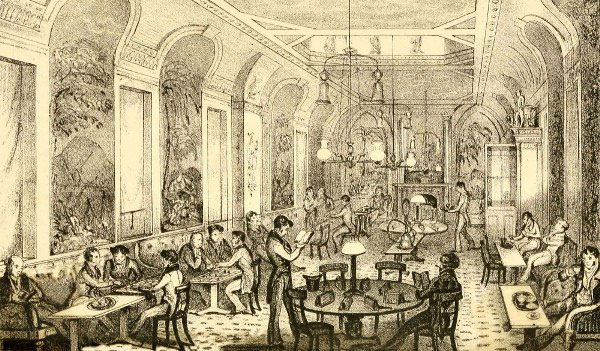
What soothes the peasant when his toil is done?
He cheerly sits beside his cottage door,
In the sweet light of ev’ning’s parting sun,
His young ones sporting o’er the sanded floor:—
What cheers the seaman, when the fight is won,
And vict’ry smiles upon our naval band?
Toiling no longer at the murd’rous gun,
His thoughts are proudly of his native land.
What charms the Turk, Greek, Frenchman, fop or sage,
In this enlighten’d comfort-loving age;
Since health, and pleasure’s cheerful reign began,
But lov’d tobacco, sovereign friend of man?—M. S. |
“For the taking of fumes by pipes, as in tobacco and other things, to
dry and comfort.”—Bacon.
“Bread or tobacco may be neglected: but reason at first recommends
their trial, and custom makes them pleasant.”—Locke.
Hail! inspirers of the profoundest and the brightest things that have been
said and done since the creation, and, in the strength and plenitude of
our recollections of thy divine virtues, aid us to sing thy praises! What
though there be those, who, in the whim, caprice or ignorance of thy
merits, would run ye down in the plenitude of their prejudices—have ye
not stood the test of time, that criterion of excellence? Are ye not, most
sublime of pleasures, independent of your other numerous claims upon
public and private favour—are ye not immortalized by the hallowed names
of the great, the good, the wise, the witty and the learned, whose
encomiums of your worth shall descend with you, through the future ages of
unborn posterity.
What! shall it ever be said that the disaffected to the great public
cause, the innovators upon common taste, shall be allowed to progress in
their rash undertaking, of seeking to undervalue the importance of those
gentle consolers through life, the snuff-box and pipe. Never! while
there’s a Woodville—nay, even a Dhoodeen,[11] to smoke them to defiance,
or a pinch of ‘high dried,’ to father a witty reply.
Much-injured and defrauded of habits—friends of past and present
learning and genius—of every land and every clime—sought by rich, as
well as poor, and alike soothing to the king as slave, how have ye not
been calumniated by the weak and designing! As the poet saith, “Envy doth
merit as its shade pursue,” and so is it with you. Oh that those standing
highest in the popular favour—the ‘tried and trusty’—should ever be the
objects of attack to the discontented!
Most delectable of companions! how many tender reminiscences and
recollections are associated with you, from the last pipe of the murdered
Raleigh in Newgate, to the dernier pinch of the equally unfortunate Louis
XVI, ere they mounted scaffolds, it is hoped, for a better world. If we
turn to the imagination, how many endearing recollections connected with
our subject throng upon us, even from the once happy days of our boyhood,
when in secret we pored over the pages of genius in preference to
scholastic lore. Rise up before us, thou soul of philanthropy, and
humorous eccentricity, my uncle Toby! with thy faithful and humble
serviteur the corporal.[12] Methinks, indeed, we now see ye together in
the little cottage parlour, lighted up by the cheerful fire, discoursing
of past dangers and campaigns under the soothing influence of the narcotic
weed, whose smoke, as it rises in fantastic curls from either pipe,
harmonizes together like your kindred souls. And thou, too, poor monk,[13]
offspring of the same pervading mind, yet picturing many a sad reality,
must thou be forgotten, absorbed as thou art from all the grosser passions
of our nature? Our memory paints thee, impelled by the courtesy of thy
gentle nature, proffering thine humble box of horn, thy pale and
intellectual face, so sensitive, half-shrinking from the fear of ‘pride’s
rebuff:’ whilst thou thyself, from the sneers of the affluent, seekest
consolation in—a pinch of snuff!
Good Vicar of Wakefield![14] man of many sorrows, we greet thee in our
reminiscences, sitting in thine happier days beneath the elm that shades
thy rustic roof, as, under the influence of thy much loved pipe, thou
inculcatest to the youthful circle around thee maxims of truth and piety.
What peculiar feelings of veneration must we attach to these pipes and
snuff-boxes. Without them, indeed—with such a true knowledge of life are
they introduced—the stories would lose half their force, and nearly all
their effect. How naturally do we associate with a smoker, a blandness and
evenness of voice and gesture, which we can by no means ascribe to men in
common. The same almost in regard to the snuff-box: the mind seems to
acquire a polish and fire at its very sight. Nay, absolutely such is our
profound respect for the sympathising herb, that even the quids of poor
Lieutenant Bowling[15] himself would appear venerable in our eyes were
they but in existence.
Lowering our Pegasus a peg or two from the loftier flights of conception,
we will proceed more immediately to analyze the merits of these legitimate
offsprings of the parent plant, smoking and snuff-taking; first of all,
however, having recourse to a pinch of Welsh, to clear our head for so
arduous an undertaking. That smoking and snuff-taking have, as habits
pernicious to the health, been attacked repeatedly by the heads of
science, is no less true than that they have escaped each intended
flagellation, and thrived under the fostering lip and nose of a discerning
public. Previous, however, to proceeding further, we shall take a review
of the different enemies arrayed against the good old customs we have had
handed down to us from our fathers. These may most generally, we think, be
divided into three classes—the ladies,—physicians, and a certain class
of thin and pallid gentlemen, remarkable for the delicate susceptibility
of their noses.
The ladies of England designate smoking and snuffing, filthy and dirty
habits. If you chance, dear reader, to ask why—because—because—they are
vile and dirty habits, and thereby—‘hangs a tale.’ Then, as a matter of
course, comes to be cited a list of the most gentlemanly men, young and
old, who are never guilty of committing the sin. Now, what does all this
come to?—that they do dislike the habits, and therefore none but brutes,
among the more refined orders, would think of annoying them by practising
either in their sweet presence. The understandings of women generally, in
comparison with those of men, are proverbially weak. Following the erratic
course of the first of their sex, who brought misery and woe upon the
devoted head of man, they in turn would fain deprive him of his two
cheapest comforts, left to console him in this vale of sorrow.
Reader, if thou should’st chance to be a married man, when thy rib—so
vulgarly called in epitome, though perchance the better half of
thyself—rails against thy only consolation in domestic
broils,—smoking—answer not, we beseech thee. No, not a word of the
volume of eloquence we fancy rising indignantly in thy throat, against the
cruel calumnies levelled at thy favorite Virginia, as thou valuest the
safety of thy tube, whether Dutch or Merschaum. The voice of an angel
would not avail thee in thy cause.
With reference to the faculty, though divided in opinions, we shall only
notice those arrayed against the plant divine. Indeed, the enmity of a
physician dependent upon his profession for support may be always known;
he detests anything cheap and soothing, conducive to health, and thence
his frequent antipathy to tobacco in smoking. In regard to snuff he is
wisely meek; for what were he himself without the stimulating dust in his
pocket? In former times, indeed, its influence perhaps was greater and
more respected than the wig and cane together, as Swift says:—
“Sir Plume, of Amber snuff-box, justly vain,
And the nice conduct of a clouded cane.”
Well, and what do the faculty say with reference to smoking? Some will
tell you it is hurtful to the lungs; others, that the head and heart are
more particularly affected by it; very few of them agreeing precisely as
to ill effects to be attributed to it.
Grant us patience to bear such ingratitude! While they are indebted for
their consequence and fluency of discourse, to the wit-inspiring influence
of the herb in grain, they are running it down in another and not less
delightful preparation and form. Then, by way of conclusion, like a crier
of last dying speeches, comes to be related the death of some very
promising young man, who, through the frequent habit of smoking, which he
practised against the continued advice of the grave Monitor—made his exit
in a consumption. So if a man habituated to the pleasures of a pipe goes
off in a consumption, the anti-smokers must immediately assert it was
brought on by the use of tobacco. How do we know, indeed, but that its
magic influence kept him alive much longer than he would have been,
without it: supposing—and we suppose it only for the sake of argument,
that one or two, nay, say twenty in the thousand, suffer in their health
through smoking,—the abuse and not the use of which we candidly admit
may slightly impair some peculiar constitutions,—where is the recreant
who does not, feeling the joys of smoking, say with us, a “short life and
a merry one!” What, after all, are a few years in the scale of human
existence! Is the fear of losing one or two of their number, to deter us
from availing ourselves of innocent pleasures within our reach?—if so,
London, methinks, would soon be deserted by the scientific and intelligent
portion of its inhabitants, merely because the Thames water chances to be
a little poisonous, or so, and the air of the town notoriously unhealthy.
By the same silly fear, too, the gourmand must abstain from the pleasures
of the table,—fashionables from late hours, and the army and navy from
hard drinking; in all of which the aforesaid, like true spirits,
exclusively delight and take a pride; doubtless, inspired in seeking to
indulge in what our own bard, Byron, says:
“aught that gave,
Hope of a pleasure, or peril of a grave.”
An evident proof, if any be wanting, that beings of a pacific disposition
are as careless of facing death as those who have served an apprenticeship
to it. Once more, taking the most virulent of the medical enemies of
smoking, on their own assertions, and supposing people are killed outright
by smoking, why should this deter others from practising it? What is more
common, than that each year presents us with numerous deaths in every
department of recreation, whether riding, sailing, shooting or bathing;
and yet we should be surprised to learn that ever it deterred others from
following similar pursuits; then, wherefore, on their own shewing, should
the harmless happy recreation (that to the poor comprehends all the above
amusements) be excepted?—Why, indeed?—O! ye sons of the ‘healing art,’
we throw reason away upon ye, and we have too much reason to fear that
the true lights of science are lost to ye for ever, when ye attack that
which is so beneficial to man.
The next, and in fact the most excusable of the triumvirate confederacy
against smoking and snuff-taking, the former more particularly, that now
calls for our attention, are the gentlemen of weak palates. These, first
caught by the look of the thing, from perceiving the mild serenity ever
attendant upon a smoker, and marking the sententious discourse of wisdom
flowing like honey from his lips, have essayed the practice, without
effect. At length, finding their nerves could never sustain the
delightful fumes, without certain inward admonitions, that were not to be
neglected or trifled with, they gave up all thoughts of that, which seemed
to make so many happy. Now, nothing is more common in metaphysics, than to
know that when a fancy or love is not returned by the object of affection,
it generally turns into as great a hatred. Nothing, therefore, is more
easily exemplified than the violence of the dislike expressed by this
order of ‘tobacco’s foemen.’ Although the efforts of the above, with the
exception of an occasional treatise against the pernicious effects of
tobacco from the medical department, are confined to oral discussion of
the subject; the genial herb has enemies of a more aspiring and determined
cast. These parties are not contented with throwing their antipathies on
the sympathy of their own friends, but they must even occasionally cast
them upon the public in the awful form of a printed sheet. Some of these,
though written in a very grave style, are really amusing, and we shall
note a couple of them, among many other originals before us, in proof. The
first of these is the celebrated Counterblaste by King James the First,
written apparently in all the rancour of prejudice, and occupying rather
a curious place among his learned works. The second is a tract (published
in 1824) entitled, “An Appeal to Humanity, in behalf of the Brethren of
the Heathen World: particularly addressed to Snuff-takers and
Tobacco-smokers in all Christian Lands.—Second Edition.”
The application and tendency of this most facetious of pamphlets is,
neither more nor less, than to induce the world at large to abstain from
tobacco and snuff-taking altogether, and bestow the money formerly applied
for that purpose, to the promotion of the missionary society to convert
our ‘heathen brethren.’
Such is the benevolent object of this barbarian himself—for what else can
we, in the indignation that almost overwhelms us at his audacious attempt,
call him. When we reflect but for a moment, if he succeeded by the
powerful and charitable arguments he uses, the national wealth, powers,
and consequences of the kingdom would be undermined. For what, we say,
were Englishmen without tobacco?—no more than a Turk without his opium, a
Frenchman without his snuff, or any man without an agreeable stimulant to
the mind. Had he now only sought to deprive us of a meal in the day, our
dinner even, for instance, we could have borne patiently with him; but to
seek,—to conceive,—to attempt, banishing one of the most
soothing,—sympathising, and truest friends from the mansions of John
Bull, is an atrocity we scarcely can credit; did not the identical
barbarous proposition glare us in the face in good long-primer. Write of
the heathen, indeed! he wants converting himself to a just and proper
sense of the darkness in which he walks, or rather we should say, writes,
when he could conceive such an enormity. However, after thus premising, we
shall allow him an opportunity of speaking for himself.
In the first instance, he states, that he had long seriously thought, that
the abuse of tobacco in every form is altogether inconsistent with the
grand rule of the inspired volume—“Whatsoever ye do, do all to the glory
of God.” (I Cor. x. 31.)
After stating what truly astonishing large sums of money are annually
expended in tobacco and snuff, he details the following anecdote.
“Travelling some time ago in a stage-coach, an elderly lady and a
gentleman sat opposite to me. It was not long before the old gentleman
pulled out his snuff-box, and, giving it a tap with his finger as the
manner is, asked the lady if she would take a pinch; but she declined. As
the lady particularly eyed me, I could scarcely refrain from
smiling.—(most facetious!) ‘Perhaps, ma’am, you do not decline taking a
pinch, because you think there is any sin in snuff-taking?’ ‘Oh no. I do
take snuff: do YOU think there is sin in it, Sir?’ ‘Yes ma’am,’ said I, ‘I
think in some cases it is sinful,’ (as cases are in italics we should
feel happy to know whether they are of tin or composition he alludes to,
but to proceed.) At this, the lady expressed great surprise (as well she
might) and would not be satisfied, unless I would assign some reason for
thinking that snuff-taking was sinful. At length, for she teazed me, I
said to her, ‘Pray ma’am, (cannot he drop the field-preacher and write
Madam) how much in the week may you spend in snuff?’ ‘Perhaps 7d.’ ‘And
how many years have you been in the habit of taking snuff?’ ‘Well, I
suppose,’ she replied, ‘upwards of forty years.’ ‘Seven-pence a week, you
say,—that is something more than thirty shillings in the year,—and if
you have taken snuff at this rate for forty years, the same will amount to
more than 60l.’ ‘You surprise me,—you must be mistaken, Sir.’ ‘No,
Ma’am,’ said I, ‘I am not mistaken. It amounts to more than 60l.
without the interest (profound calculation!) Now, do you think that God
will reward you for taking snuff?’ ‘Reward me for taking snuff!’ said she,
‘No, Sir, I do not expect that.’ ‘But suppose, instead of spending this
60l. in snuff, you had spent it in feeding the hungry, clothing the
naked;’”—we really can follow these opinions no further, as we have more
than one old maiden lady within our ken, that would have actually
fainted outright at such a want of modesty.
Trusting our reader will bear with us, we shall notice a little more of
this self-created minister’s appeal in favour of the heathens, who,
doubtless, if favoured with the knowledge, could not but feel highly
indebted for the exertions of so powerful an advocate in their cause. At
the same time we strongly suspect, from the love he has of showing his
knowledge of the tables of pence, that the writer was formerly an
officiating deputy in a huckster’s or chandler’s shop, until seduced by
the influence of the “spirit that moves” for a nobler call of action. The
following is another specimen of his figurative powers.
“A few days ago, I mentioned the above anecdote in the house of a farmer.
‘Why,’ said the farmer, ‘I could never have thought that 7d. a week
would have come to so much.—Do you know my wife and I can assure you,
that awhile back, we smoked an ounce a day.’ ‘An ounce a day,’ said I,
(the echo!) ‘What is tobacco an ounce?’ (ignoramus!—we thought he knew
not the value of what he attempts to depreciate). ‘Four-pence,’ said he.
‘Four-pence an ounce, and an ounce in the day, that is 2s. 4d. per
week, and 52 weeks in the year will be the sum of 6l. and 4d.
annually.—O Sir!—I am very sorry for you.’”—(kind hearted soul!)
Pursuing his system, apparently, of poking his head into the affairs of
country farmers, he gives us another trite anecdote, too rich a morceau
to be passed in silence; since it so admirably serves to shew the
estimation the pipe is held in by the true representatives of John Bull.
“Since I commenced writing of this, I had occasion to call upon a
respectable farmer, who is a member of your society—(we smell a
rat)—and a leader I suppose, greatly esteemed by his neighbours, who
certainly have the best opportunity of knowing him as a truly pious, and
useful man. Almost immediately after we were seated, he called for his
pipe (for some people cannot be cheerful or make a wise bargain—symptoms
of the shop)—unless their heads are enveloped in smoke. ‘Now, Sir,’ said
he, ‘can you smoke any, will you have a pipe?’ ‘No, Sir,’ said I, ‘I
never smoked a pipe in all my life;’—(miserable man! this he says
doubtless by way of shewing his Christian self-denial). ‘I have for a
long time considered it sinful, and therefore I never smoke.’ ‘Sinful,’
said he, laughing—(jolly fellow!)—‘how can it be sinful?’ ‘Because,’
said I, ‘it wastes our power of doing good. Did you never consider that.’
Upon this his wife who was sitting by, pleasantly observed, ‘Our John is a
terrible smoker’—(worthy man!)—‘For goodness sake don’t make him
believe that it is sinful to smoke. If he can’t get his pipe, we shall
have no peace: he’ll be quite out of temper.’ ‘Nay,’ said I, ‘surely not
out of temper.’ ‘Yes, for sure, out of temper enough,—quite peevish and
fretful.’ ‘Now,’ said John, ‘how thou talks my dear.’ ‘Talk! why is it not
true? Thou wants it first thing in the morning—then again at breakfast
time—then again at noon, and then again at night—just as it happens.
Why, I’ll warrant you (turning to me) he has seven or eight pipes in a
day, and sometimes more,’—(sensible man!)—‘Perhaps,’ said I, ‘he’s
sick, and smokes for his health.’ ‘Nay, nay, sick, bless him! he’s none
sick, he has got a habit of it you see, and so he thinks he wants it. Oh,
he must have his pipe—he can’t do without his pipe—sin in it! nay,
surely it cannot be sinful.’ (He concludes with his favorite
computation). Upon inquiry, I found, that though the only smoker in the
family, yet at a moderate reckoning, he contrives to consume about 5l.
worth of tobacco every year.”
This would, doubtless, have been better employed in the hands of the good
promoter of the Missionaries, of whom we now take our leave; and to whom,
we wish no further punishment for his cruel attempt at seeking to banish
the cheerful companionship of the pipe from mansions of peace, than being
compelled to the smoking of a pipe of the oldest shag himself.
In reference to King James’ Counterblaste, although, from its antiquity,
as well as the rank and learning of the author, it occupies a serious
claim upon our attention, yet, upon the whole, it may be termed nearly as
ridiculous as the foregoing, although not in its application. It, indeed,
fully bears the stamp of those antipathies that, once conceived, the
monarch was seldom or never known to waive. This is more singular, as they
were formed against a plant, received into the greatest favour and esteem
among all ranks, and, as a medicine, was in far greater request than it
is even now. Facts like these plainly establish, that James’ dislike,
however acquired, proceeded from prejudice and prejudice alone.
In the first paragraph, he tells us, that it was first introduced into
England from the Indians, who used it as an antidote against “a filthy
disease, whereunto these barbarous people (as all people know) are very
much subject.”
After bestowing a volley of abuse upon smoking, not of the most elegant
description, he refers to the acquiring of the fashion that certainly
generally applies in all things now, as well as it did in his own times.
“Do we not daily see, that a man can no sooner bring ouer from beyond the
seas any new forme of apparell, but that he cannot be thought a man of
spirit that would not presently imitate the same? and so, from hand to
hand it spreads, till it be practised by all; not from any commodity that
is in it, but only because it is come to be the fashion.”
Of the popularity of smoking in his time, he says himself, “You are not
able to ride, or walk, the journey of a Jew’s Sabbath, but you must have a
reekie cole brought you from the next poor-house, to kindle your tobacco
with?”
“It is become in place of a care, a point of good fellowship, and hee that
will refuse to take a pipe of tobacco among his fellowes, though by his
owne election he would rather not feel the savor of the stinke, is
accounted peevish and no good company; even as they do tippling in the
COLD Eastern countreys.”
Of the consequences then often attending the habit of smoking, he
observes, “Now how you are by this custome disabled in your goods, let the
gentry of this land beare witness; some of them bestowing THREE, some FOUR
HUNDRED POUNDS A YEERE upon this precious stinke, which I am sure might be
bestowed upon far better vses.”
Than the assertion of the above individual enormous expenditure, nothing
perhaps is better calculated to display James’s exaggeration, which
actually here can only be considered hyperbolical. The idea, the bare
possibility, is scarcely conceivable for a moment, that in those days,
three hundred pounds, at least equal to nine hundred of our present money,
was ever laid out by a single individual in smoking; excepting, indeed,
perhaps, as a very rare and singular occurrence. King James concludes his
Counterblaste in the following piece of declamation.
“Have you not reason then to be ashamed, and to forbeare this filthie
noveltie so basely grounded, so foolishly received, and so grossly
mistaken, in the right use thereof? In your abuse thereof, sinning against
God, harming yourselves both in persons and goods, and raking also
thereby, the markes and vanities vpon you: by the custome thereof, making
yourselves to be wondered at by all forreinne civill nations, and by all
strangers that come among you, to be scorned and contemned: a custome
loathsome to the eye, hateful to the nose, harmefull to the braine,
dangerous to the lungs, and in the black, stinking fume thereof, nearest
resembling the horrible Stigian smoke of the pit that is bottomlesse.”
What a pity it is, James never smoked; instead of this long tirade against
the most cheerful of all pastimes, we should have had an eulogy, glowing
with the warmth and feeling of truth from the head and heart. From the
very gall perceivable at times, one could easily know he was an utter
stranger to the gentle sympathy of a pipe. He ridicules and condemns that,
which, like many others, he knows not, and therefore cannot appreciate.
Had he but put the pipe fairly upon its trial, and found it guilty of the
mischiefs ascribed to it, then could we have excused him; but to conceive
ideas not founded upon truth and justice and the welfare of the kingdom he
was called upon to govern, and to act upon those ideas, by the framing of
arbitrary laws, repressing the tastes of the nation at large, raises in
its remembrance an indignation in our mind, that takes repeated whiffs of
our ‘German’ to quell.
Now the truly immense extent of the benefits Europe is indebted to for the
introduction of the tobacco-plant, is by no means generally known. For the
instruction of our fellow creatures—we say instruction, because
probably our numerous readers may never have met with them before,—we
shall proceed to enlighten the world upon the subject. If we look backward
to the earlier periods of History, what barbarous and savage manners do we
not mark characterizing the people and the times. Rapine and murder
stalking hand in hand among them, and scarce at all repressed by laws,
divine or human. Now mark, sweet readers, especially if true lovers of the
invaluable herb, whose praises we are about singing! Mark what “great
effects from little causes spring.” No sooner did tobacco make its
appearance and get into notice and use, than the passions of all men
wooing its soothing influence, gradually began to receive a change. As it
got more generally diffused, its influence might almost be termed magical;
the sword, in a great degree, was exchanged for the quill, the wine-cup
for the coffee-cup (thence its use in Turkey always with smoking), and
letters began to flourish—the first grand step towards that civilization
I shall prove it was gradually destined to effect in the world. Doubtless,
like many other great writers, who open out a new light to the world, we
shall have enough of sceptics, as opponents, to contend with; but we are
sanguine from the facts we shall clearly establish, that far more is to be
attributed to the powers of tobacco, than millions dream of.
In the first place, it is too well known to admit of much doubt, that
tobacco, whether smoked or taken as snuff, exercises a very considerable
power upon the mind, more especially when taken in considerable
quantities. When such is the case, the faculties are refined and exalted
to a degree of spirited buoyancy, that forms a strange and pleasing
contrast to the usual unstimulated lethargic state of the mind. We can
only compare it, though in a much milder, and more inoffensive degree, to
the species of delirium the Turks so vividly describe, when labouring
under the effects of opium. The intellectual senses, more particularly
that part of them forming the imagination, become so much more powerful
and pervading, that its conceptions receive a warmth and strength of
colouring they never can, under common excitement.
Now tobacco, as we have recorded, was first brought to England in the
reign of Elizabeth, who greatly patronized it among the nobles and poorer
orders, by whom it came speedily into general use. Most mighty herb!—the
effects of thy worship were soon visible, for where do we find a reign so
great and glorious either for victories by land and sea, or the
distinguished talent and genius, whether in the camp or cabinet, it
fostered at home. Then was it, that Shakespeare—the magnificent
Shakespeare, (blest and honored was the reign in which he drew life) burst
forth like a star destined to excite the astonishment of the world he came
to throw the effulgent light of his genius upon. He was a smoker.
Then, to sketch forth the gigantic march of intellect, in the ages of
which we write, came forth those luminaries of the world; Hobbes, the
parent of Locke’s philosophy, the profound philosopher Lord Bacon, the
most illustrious mathematician and philosopher, Sir Isaac Newton, and the
singularly talented metaphysician Locke, each and all of whom were
celebrated for their devotion to the soothing and stimulating powers of a
pipe! It is related of Hobbes, who was one of the most profound thinkers
of his time, that as soon as the dinner was over, he used to retire to his
study and had his candle with ten or twelve pipes of tobacco laid by
him; then shutting the door he fell to smoking, thinking and writing for
several hours together. Locke and Bacon smoked much for recreation; the
latter of whom probably was indebted to the practice for the preservation
of his life in the plague of 1665, from whose contagious influence in
London he sought safety in the country and his pipe.
Now, to what, we should like to know, are to be attributed the mighty and
successful efforts of these wonderful men, who may justly be considered
the founders of modern civilization and literature, but the all—the far
pervading fumes of the sovereign tobacco-leaf they worshipped with such
devotion. To its exhilarating influence and invigorating aid, exciting the
imagination to realms of undiscovered beauties, are we indebted for those
works that shall live, while time is,—the wonder of this and all future
ages.
Are we singular in our opinion? Mark, learn, and inwardly digest, ye
unbelievers, what the learned Dr. Raphael Thorious says on the subject:—
“Of cheering bowls I mean to sing the praise,
And of the herb that can the poet’s fancy raise;
Aid me, O! father Phœbus I invoke,
Fill me a pipe (boy) of that fragrant smoke,
That I may drink the God into my brain;
And so enabled, write a noble strain.
For nothing great or high can come from thence,
Where that blest plant denies its influence.” |
Smile on, ye critics; but let us ask ye, if those works that have so
strong a claim to our respect, would ever have come into existence had
there been no tobacco, to rarify and stimulate the mind. No!—must be your
candid answer, if only in verification of the old saying, ‘No pipe, no
Parr.’ Then, what mighty blessings are we not indebted for to the
much-aspersed, calumniated, and insulted herb. Nor is the fact of its
consequence in regard to these first great discoverers in science, the
only proofs that exist of its reputation; successive generations, under
the weed’s cheering auspices, have but continued what they so ably began.
Dr. Johnson,[16] Dr. Thorious, Dr. Aldrich, Dr. Parr, Pope, Swift,
Addison, Steele, and a host of other approved writers of celebrity,
independent of those of the present day, are all similarly indebted to the
genial influence of tobacco, under one preparation or another, for the
stimulus of their inspiration. The fact is incontrovertible. Where was
transcendant literary ability before the introduction of
tobacco?—Nowhere—it was unknown:—but, no sooner, we repeat, did IT
become known and in use, than its generative powers became quickly
visible: the minds of men, though previously barren, became fructified by
its influence, and letters flourished. With truth it is observed, we
formerly were a nation of readers; but, who is so ignorant as not to know,
that as tobacco has become diffused, with knowledge, we are now a nation
of smokers and writers. It may, indeed, be fairly set down as an axiom we
may rely upon, that nearly every one occasionally gets a penchant for
scribbling who smokes or snuffs; from the cobler, whose “soul on higher
things is bent,” that composes a ditty to the measure of some admired
production gracing his stall, to the peer of the realm, who, lounging on
an ottoman under the inspiration of prince’s mixture, dictates a sonnet,
or a novel, to his secretary, as the humour may chance to be of the
moment. That tobacco has effected wonders in the promotion and
promulgation of knowledge, we flatter ourselves we have plausibly shown;
that it is equally distinguished in diplomacy and war, is a fact we
shall now proceed to demonstrate. To commence then: who ever knew or heard
of a plenipotentiary without his jewelled snuff-box?—The thing were out
of nature: without it, indeed, he were but an automaton—a body without
a head—a mere ‘cypher in the great account,’ unbacked and unsupported. So
well aware, indeed, are civilized governments of this fact, that
snuff-boxes set with brilliants to the value of a thousand pounds are
given them, that they may be stimulated to business; diving into the
cabals and intrigues of the state,—concealing their own, and, in a word,
never be deserted at a PINCH. Nay, so much is snuff the fashion, that a
courtier in most European countries without it were a sort of curiosity.
Many of the greatest of men, have been remarkable for the snuff they took.
Napoleon was among this number; he (acute and penetrating) was up to
snuff, disdaining your common methods of worshipping that “spirit
stirrer” of the human mind, he took it out of his waistcoat-pocket, and
when vexed or thwarted by any unexpected occurrence, was always observed
to have recourse to it, previous to exerting his mind on the subject. The
greatness of his fortunes was commensurate with the quantity he consumed:
the greatest snuff-taker in the French territories, it is by no means
singular to relate, he became the first in grandeur and consequence, as
well as the most idolized of men. At the same time, he was by no means
insensible of the powers of smoking, for we find it recorded, that his
greatest relief from extreme fatigue (as he used to declare) arose from “a
CIGAR, a cup of coffee, and a warm bath;” three things, we affirm,
highly creditable to the taste of so great a genius. Nor did Buonaparte
confine the use of it solely to his own person: fully impressed with its
powers, he ordered its use throughout the whole of the French army. The
immediate consequence was, that under his influence and that of the
stimulating weed, they conquered all before them, and became renowned
throughout Europe for their discipline and determined bravery. This may,
by those who dive no further than the surface, be attributed to the
ability of their general, to a certain degree we in our candour
acknowledge; but the grand secret and mover of it was tobacco—sovereign
tobacco! What sceptic so rash, dares breathe a doubt of the truth of this
statement? Does he require additional evidence?—If so! let him turn his
eyes to the British navy. What is it, ever since the time of Elizabeth,
from the defeat of the Spanish Armada up to the victory at Trafalgar, has
rendered them invincible and the terror of the world?—what, we exclaim,
but tobacco! To quids! quids! alone is their success to be attributed; but
deprive them of these, and you take the spirit of the men away. Immortal,
godlike pigtail! And well too does government know this fact, and wisely
institute an allowance to each man. Hunger, thirst, and every hardship is
borne without a murmur by each gallant tar, so long as there is pigtail in
the locker. Go seek the man, whether topman, afterguard, or idler,
who has ever been upon a seven or three years’ station, and ask him whence
his chief consolation in the watch of safety, or peril, and he, if a true
sailor, shall answer with an indescribable roll of the jaw—“Pigtail!!!”
’Tis the essence, in fact, the very quintessence of the man, and its
consideration in his mind may be sufficiently gleaned from the following
well-known epistle—at once an irrefutable proof, if any be needed.
“Warren Hastings East Indyman,
off Gravesend.
March 24, 1813.
Dear Brother Tom;
This comes hopein to find you in good health as it leaves me safe
anckor’d here yesterday at 4 P. M. arter a pleasant voyage tolerable
short and a few squalls.—Dear Tom—hopes to find poor old father
stout, and am quite out of pig-tail.—Sights of pig-tail at Gravesend,
but unfortinly not fit for a dog to chor. Dear Tom, Captain’s boy will
bring you this, and put pig-tail in his pocket when bort. Best in
London at the Black Boy in 7 diles, where go acks for best
pig-tail—pound a pig-tail will do, and am short of shirts. Dear Tom,
as for shirts ony took 2 whereof one is quite wored out and tuther
most, but don’t forget the pig-tail, as I a’n’t had a quid to chor
never since Thursday. Dear Tom, as for the shirts, your size will do,
only longer. I liks um long—get one at present; best at Tower-hill,
and cheap, but be particler to go to 7 diles for the pig-tail at the
Black Boy, and Dear Tom, acks for pound best pig-tail, and let it be
good. Captain’s boy will put the pig-tail in his pocket, he likes
pig-tail, so ty it up. Dear Tom, shall be up about Monday there or
thereabouts. Not so perticuler for the shirt as the present can be
washed, but don’t forget the pig-tail without fail, so am your loving
brother.”
“T. P.”
“P. S.—Don’t forget the pig-tail.”
Treating of the milder virtues of tobacco, who ever knew a smoker—one of
your twenty years’ standing,—ill tempered; or a veteran snuff-taker, who
did not occasionally give utterance to witty sayings?—the thing were
against reason. In conclusion, what can we say more for thee, omnipotent,
prolific herb! than in the inspired lines of thy true admirer Byron?
Sublime tobacco, which from east to west,
Cheers the tar’s labours or the Turkman’s rest;
Which on the moslems’ ottomans divides
His hours, and rivals opium and his brides:
Magnificent in Stamboul, but less grand,
Though not less lov’d, in Wapping or the Strand.
Divine in hookas; glorious in a pipe,
When tipped with amber, mellow, rich and ripe;
Like other charmers, wooing thy caress,
More dazzling fair and glaring in full dress;
Yet thy true lovers more admire, by far,
Thy naked beauties—give me a cigar? |