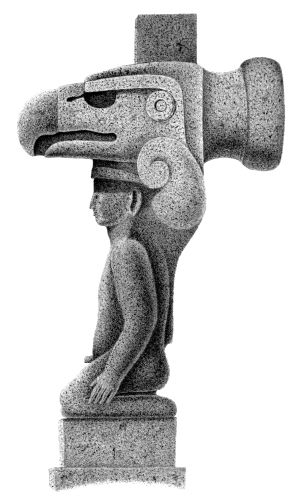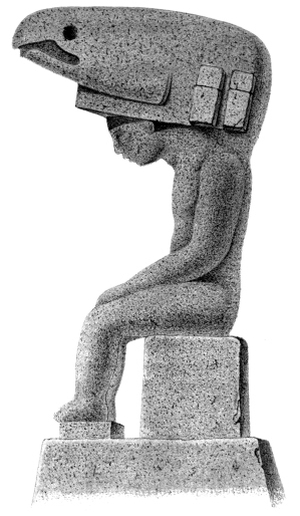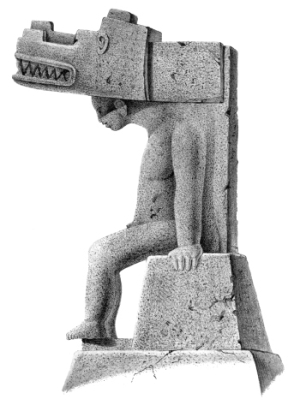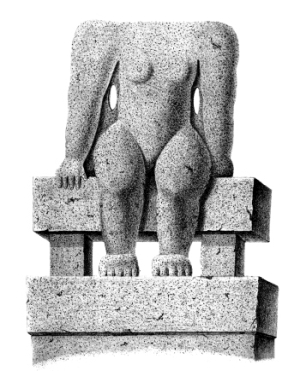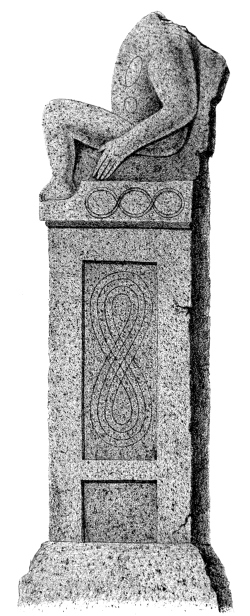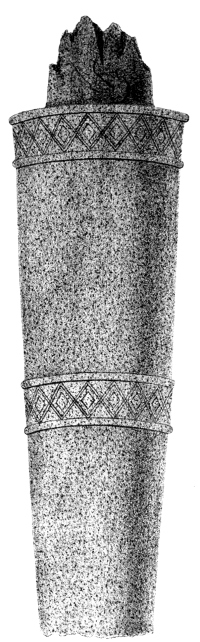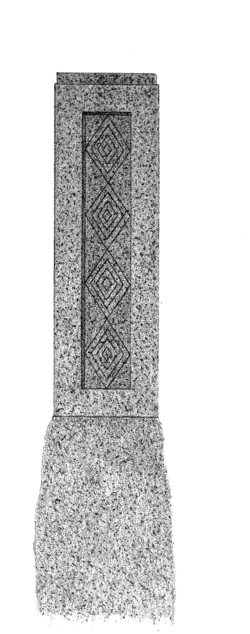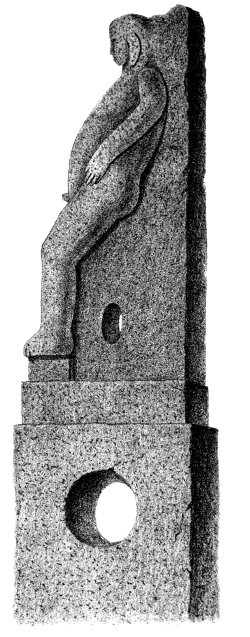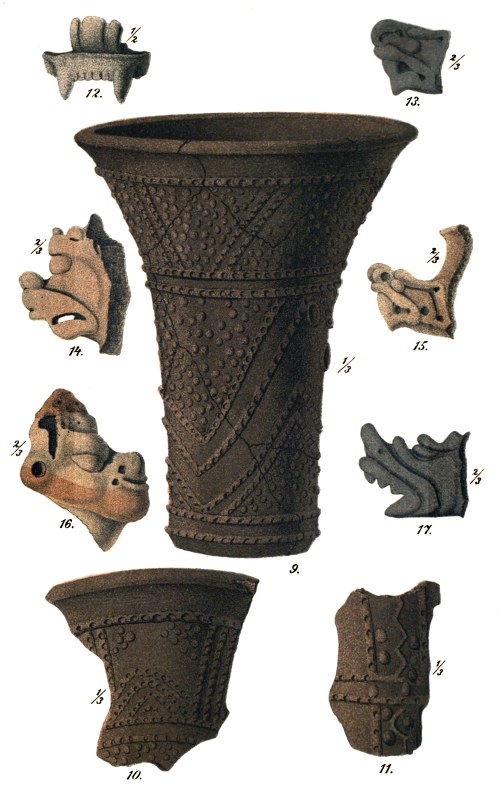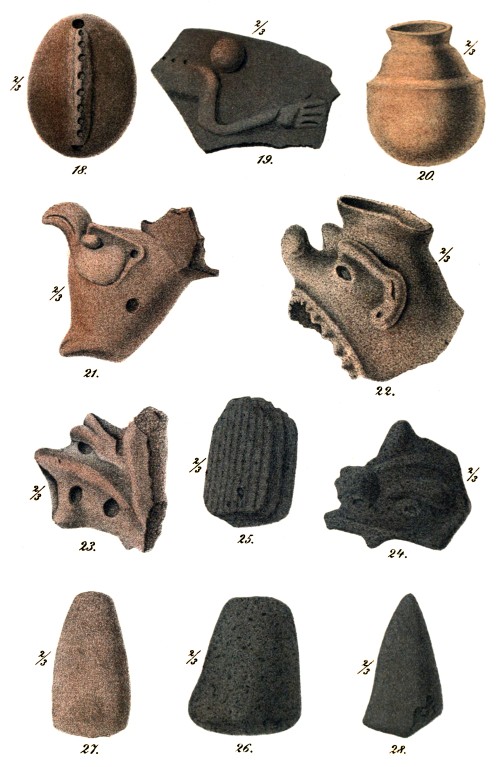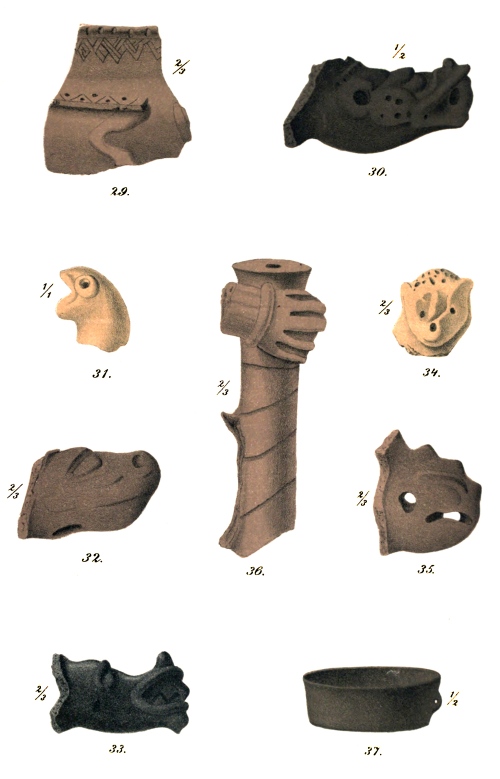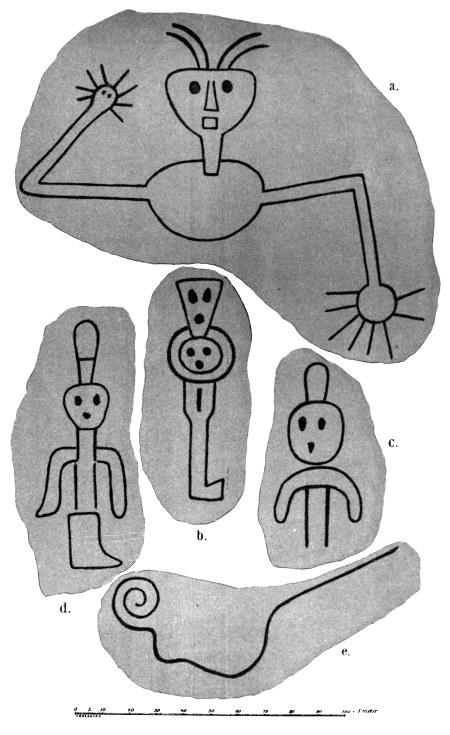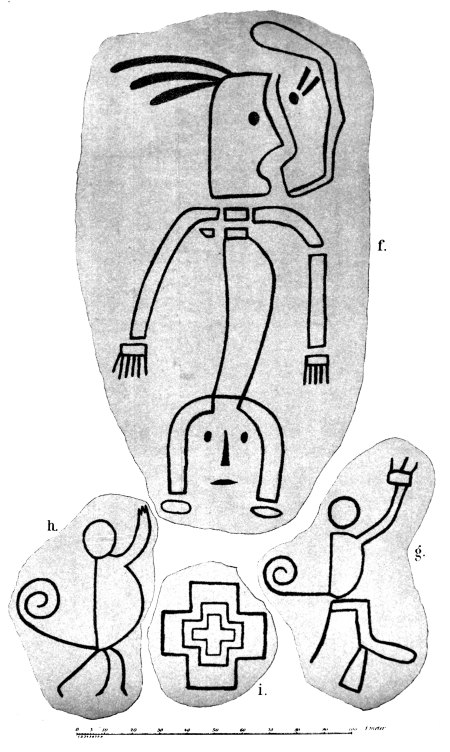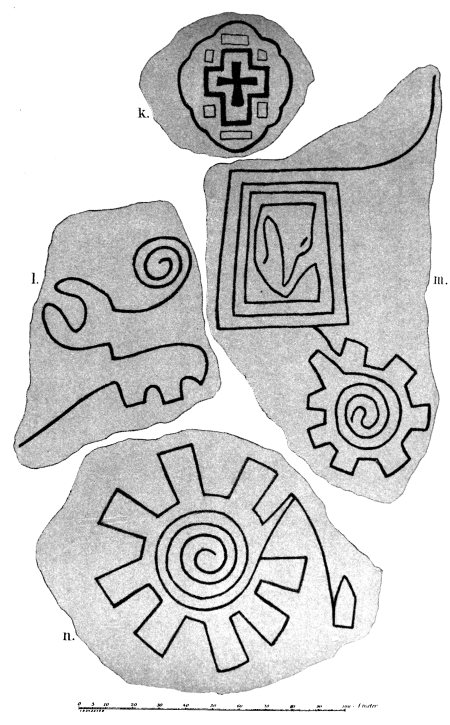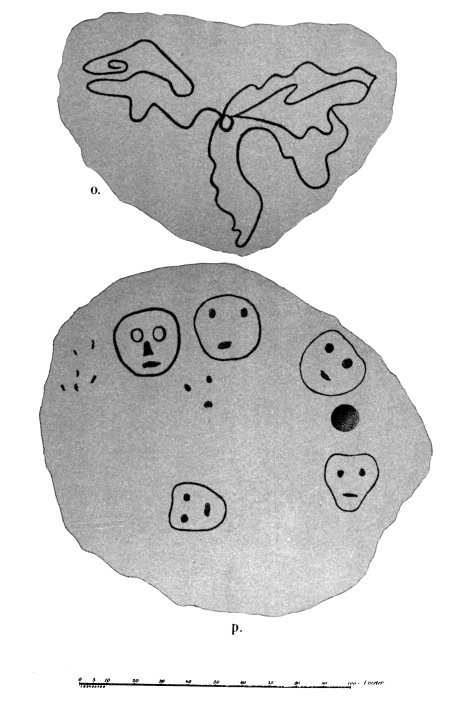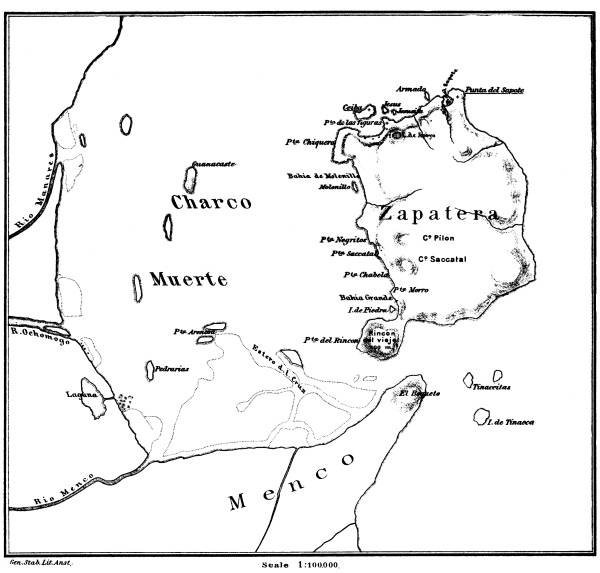
Punta del Sapote
forms a broad, rounded peninsula, the greatest length of which is in
N.E. and S.W. Its middle part is a large plateau, about 150 m. high,
sloping rapidly both towards the lake and the neck of the peninsula,
and thus forming an isolated height of somewhat more than one kilometer
in length by scarcely one kilometer in breadth. The central portion
of this plateau is perfectly level and, judging by the numerous
statues met with here, and the regular form of the stone-mounds, round
which they were placed, appears to have been a sacred place during
the Niquiran period. On the very isthmus between the peninsula and
the island of Zapatera rose a conical
stone-structure, 30-40 m. high; it consisted of enormous, unhewn
blocks, placed upon one another in pretty regular layers. Its diameter
at the base might be estimated at about 40 m. The top of the cone was
truncated, and appeared to form a plane of 6-8 m. in diameter. The
steep sides were so densely covered by spinous bushes and lians, that
I was soon obliged to desist from my attempts to mount the summit.
The whole structure resembled a kind of beacon, and has possibly been
a place of sacrifice, although its dimensions were so large, that it
cannot well be regarded as such a «sacrificial pillar» as is mentioned
by Peter Martyr under the name of
«Tezarit». Maybe a little «casita» has stood
on the platform above. Something of the same kind is known from
Uxmal.
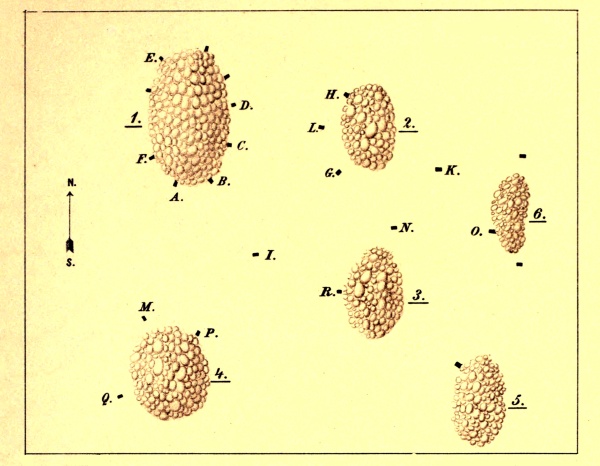
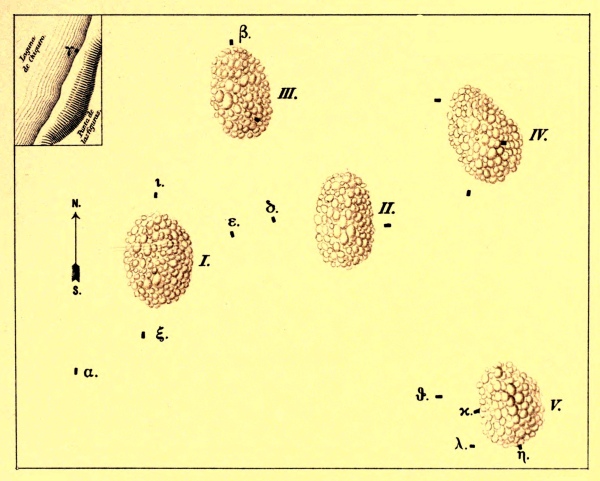
Due north of this cone, on the top of the above mentioned plateau, were
six stone-mounds of oval form, but of very different size. The largest
(Pl. 41: 1) measured about fifty m. in length by thirty m. in breadth,
the smallest (Pl. 41: 6) about fifteen m. in length by somewhat less
than half in breadth. The greatest diameter of each mound was in N. and
S. The stones of these mounds varied of course in size, but for the
most part they were large, more or less cubical, from half a meter to
one meter long and about half a meter broad. Their often regular shape
and pretty plane sides, particularly in the mound 1, might lead one to
infer that some of them have been hewn, and have formed the foundations
and possibly also the walls of buildings, the ground plans of which are
indicated by the form of the mounds and the situation of the statues,
of which we are soon going to speak.
At the mound 1 (Pl. 41), the largest of all, and the one
situated farthest to the north and west, several statues were found remaining
in the same position, that they originally must have occupied, because
the mound was still surrounded by six figures, standing in its
circumference; and larger or smaller fragments of the pedestals of
three others were found in the ground, although the statues themselves
were thrown down beside them, and more or less broken. Judging by the
regular distances between these statues, it is probable, that there
have been twelve figures standing in the periphery of this building or
temple. The fact that those remaining in the ground fronted outwards,
and that their backs, which were turned towards the building, were not
smooth, but only plane-cut, strengthens my hypothesis that the figures
have formed part of a stone- or logwall enclosing the building. All
those statues of the mound 1, of which the upper parts remained, with
the exception of D, and another not delineated one, carried on their
heads a more or less long and broad projection in the form of a tenon,
and on this account I venture to propose the hypothesis, that they have
served to support the wall-plate of a more or less circular building.
All the statues were monoliths, cut from blocks of blackish basalt of a
pretty considerable hardness. The roof itself has probably been covered
with palm leaves, a supposition confirmed by certain indications in
Cerezeda and Oviedo.
That the temples should have been open, as Squier
seems to think, I venture to doubt, on account of the above described
form of the statues; this appears to show that they must have been
united with one another by a wall, probably of cut stones.
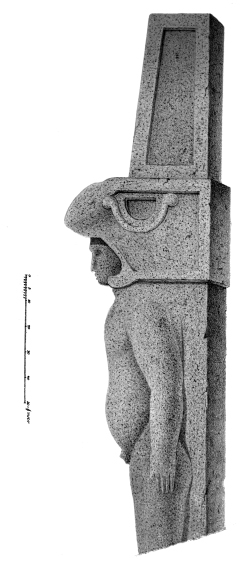
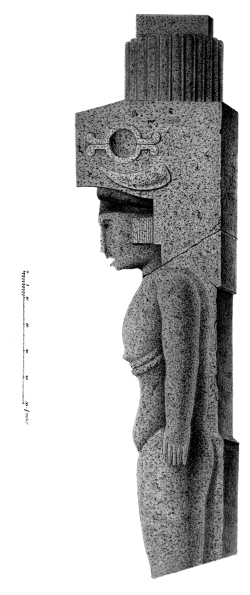
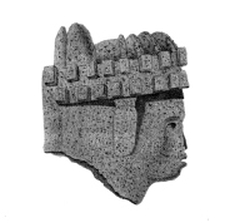
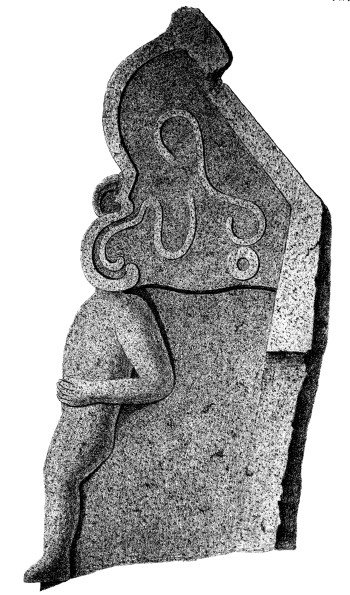
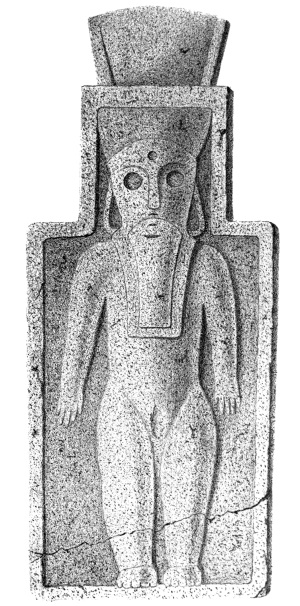
A
Pl. 1.
Male, standing figure, in an easy posture, with the arms hanging
straight down. It stood quite upright, but was buried in the earth
to the elbows; by digging round it, it was laid bare to just below
the knees. It was the finest and most nobly sculptured of all the
Nicaraguan statues that I have had an opportunity of seeing. The face,
neck, and chest were carefully elaborated, the mouth closed with full
lips, the Adam’s apple marked out at the throat, the muscles of the
chest, as well as of the arms, correctly rendered; the hands on the
contrary were somewhat stiff, with the thumbs in the same plane with
the other fingers. The shoulders, elbows, and hips were well formed
(the arms were, however, not detached from the body), but passed
gradually backwards into the plane-cut back of the stone. The head
was covered with a large, rounded hood or cap, projecting above, and
drawn out in rounded flaps at the sides of the neck. Upwards and
backwards this hood passed into a kind of capital, ornamented at the
sides with a semi-circular depression, bordered by a rounded rim, with
globularly enlarged ends. The tenon-shaped projection above the head
was unusually large, tapering upwards, surrounded in front by a double
frame, at the sides by a simple, broad, sharply cut one. The statue
was perfectly equilateral. It did not seem to have been exposed to any
injury whatever, and was on the whole the best preserved of all in this
locality. The whole length of the statue from the upper edge of the
tenon to the knee was 225 cm., the breadth across the shoulders 58 cm.,
the length of the tenon 65 cm.
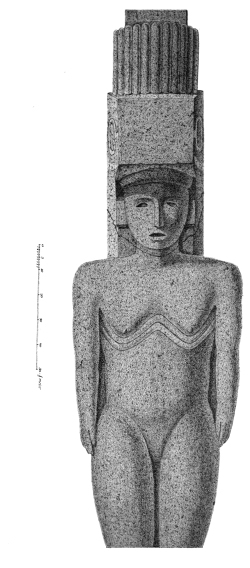
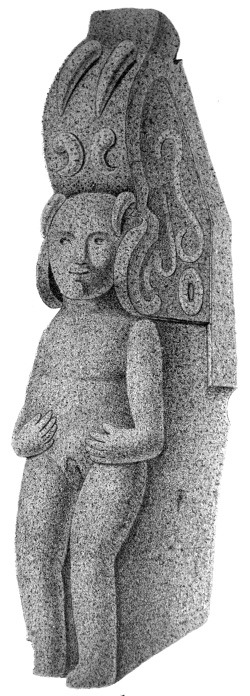
B
Pl. 2 and 3.
Female, standing figure, its head slightly bent forwards, and its arms
hanging straight down. It was found erect, but imbedded in the earth to
the navel; the head was broken off, but was found close to the statue.
The statue was very well sculptured, but not so carefully finished
as the preceding one. The forehead was adorned with a low turban or
round band, upon which was placed the heavy capital, with carvings in
relief on the sides. The capital was surmounted by the square-shaped
tenon, the lower part of which was surrounded by twenty staves with
rounded tips. These ornaments seem to indicate, that in this statue,
as well as in the former one, which was adorned with a double frame,
the lower part of the tenon has been visible, and only its uppermost
portion inserted into the plate of the building. The face and chest
were well preserved, although not so accurately rendered as in A. The
mouth was half-open, the eyes were well marked, deep cut, the ears
hidden by large, square, flat, and grooved pieces. The breasts were
held up by a double, round band. The breadth across the shoulders was
extraordinarily great. The shoulders were high and thin, the arms very
short and feeble in proportion to the body, not entirely detached, but
much more so than in A. The length of the statue from the upper edge of
the tenon to the knee was 226 cm., the breadth across the shoulders 66
cm.; the length of the tenon 34 cm.
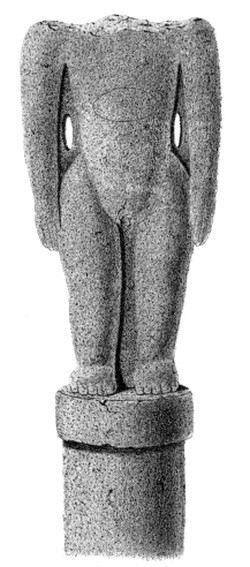
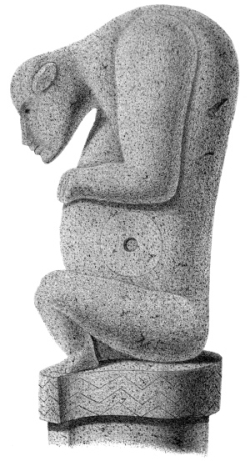
C
Pl. 4.
Male, half-sitting figure, with straight hanging arms; of considerably
less size than A and B, and very badly damaged. The head and neck
were broken off, and crushed into small fragments, impossible to
reconstruct. The pedestal was round, column-shaped, without any
ornaments. The figure had powerful arms, detached from the sides of the
body. The legs were unusually thick and strong, the feet clumsy, with
thick, short toes. In the middle of the chest there was a carved oval,
with a little circle in its centre. The length of the statue from the
shoulder to the sole of the foot was 110 cm., the breadth across the
shoulders 56 cm.
C 1
Not figured.
Male, sitting figure, with its hands crossed on its knees. The pedestal
was square, remaining erect in the ground. The statue itself was broken
in six pieces, its face entirely crushed. It carried on its head
a round, column-shaped head-dress, similar to that delineated in
figure F, ornamented with transverse furrows and ending upwards in a
tenon. The ears were hidden by square, flat pieces 21 cm. in length,
resembling those of figure B. The head itself was 39 cm. long from the
base of the head-dress to the chin; 31 cm. broad across the forehead.
The breadth across the shoulders was 60 cm.
D
Pl. 5.
Male, standing figure. Head, chest with arms, and upper part of legs
broken off, and lying in four pieces on the ground. The pedestal
was square, with the upper part ornamented with angular wreaths; it
remained fixed in the ground in its original place, and carried still
the feet and the legs (to the knees) of the figure. The face was of
quite a different type from those of A and B, with very prominent
cheek-bones, large lips, and strongly protruding under-jaw; it was
adorned with a crown-shaped head-gear. The ears were also here hidden
by flat pieces, thickening upwards, with the lower corners rounded.
The back of this statue, as well as its position in the periphery of
the stone-mound, points to its having formed part of the wall of the
building; but it seems not, however, to have served the purpose of
supporting the roof, because the upper part of the crown was finely
chiselled, and exhibited no trace of a tenon. It differed in this point
from all the other statues in the circumference of the mound 1, with
the exception of E 1, that was situated almost opposite to D at the
western longside. The height of the head from the upper rim of the
crown to the lower edge of the chin was 45 cm. The length of the trunk
from the shoulders to the thighs was 60 cm. The breadth across the
shoulders was 54 cm.
D 1
Not figured.
At a distance of 5 m. from D, in the periphery of the mound, there rose
obliquely from the ground a male, half-sitting statue with its arms
crossed. The head and the uppermost part of the chest with the
exception of the right shoulder were wanting, and could not be
identified among the existing fragments. It wore a beard reaching to
the crossed arms, being in this respect as well as in posture and
workmanship very like F. It measured 102 cm. from the shoulder to the
thighs. The breadth across the shoulders seemed to have been less than
50 cm.
D 2
Not figured.
Near the place that ought to have been occupied by the next statue,
there were lying fragments of an unusually narrow, square pedestal or
pillar. It was narrower than the following E, but in other respects it
resembled this more than it did any of the others found here.
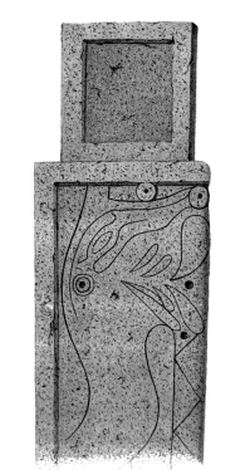
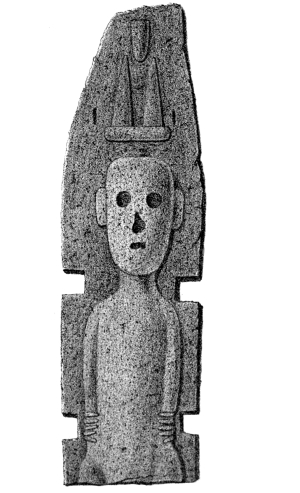
E
Pl. 5.
Contrary to the other images of this mound, indeed, of this whole
locality, it did not represent a human figure, but formed a square
pillar, provided with carvings on its front side. It carried a narrower
superstructure (tenon), bordered in front by a sharp-cut frame, 6 cm.
broad, 3 cm. deep. The carvings on the front side of the pillar itself
consisted of wreaths somewhat more than 2 cm. deep with a breadth
varying from 3 to 5 cm. They appeared to represent the head of an
animal with an eye surrounded by two concentric circles. The sides of
the pillar were narrower, smooth, without any traces of wreaths, but
bordered by a square-cut frame, 6 cm. broad and 3 cm. deep. The back of
the pillar, which was turned towards the building, was rough, without
any frame. The front side was provided with a frame only above, and
along the eastern side. The front side of the pillar was 50 cm. broad,
the lateral sides 37 cm. broad. The tenon was 40 cm. in height by 38
cm. in breadth. The pillar was so deeply imbedded in the ground, that
in spite of our digging strenuously, I did not succeed to lay bare more
than about 125 cm. of its length, reckoned from the upper edge of the tenon.
E 1
Not figured.
Male, standing, much damaged. The human figure supported on his head
the head of a massive animal of the feline genus, by its form most
reminding one of the African or Persian lion(!). The statue was
thrown down and broken in several pieces; only the head of the animal
was so far preserved as to enable one to discern something of the
original sculpture. Upon this head was part of a square tenon. The
length of the statue from the upper edge of the forehead to the thighs
was 84 cm., the breadth across the shoulders 39 cm., the length of the
face 24 cm. The head of the animal was 54 cm. high and 52 cm broad.
E 2
Not figured.
Fragments of a female, sitting statue were shattered in the vicinity
of the place, that should have been occupied by the tenth statue. The
head was adorned with a turban-shaped head-dress, without any trace of
a tenon. It is, however, very uncertain whether this statue has formed
part of the series.
Between the last-mentioned statue and F there was not the least vestige
to be found of that statue which ought to have been the eleventh in
number, when reckoned from A.
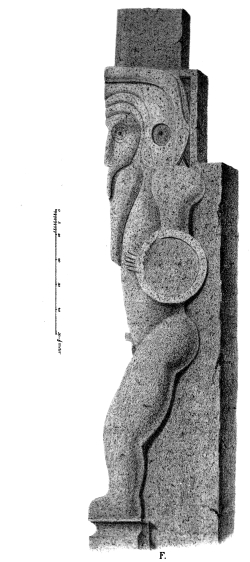
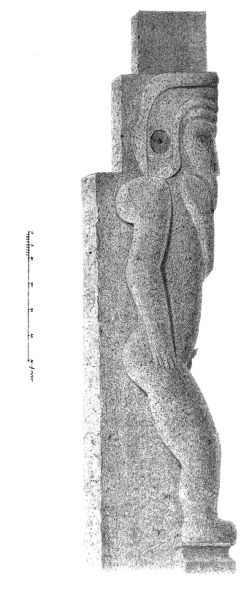
F
Pl. 6,
7, and 8.
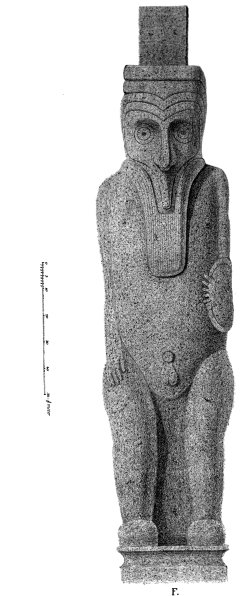
Male, half-sitting figure, with its right arm hanging straight down,
and its left one bent, and resting on the chest. According to my
impression, received on regarding the statue and sketching it, it
represented a chieftain or warrior with a mask before his face and a
helmet on his head. I have arrived at this conclusion from the reasons,
viz. that the face was here incomparably much stiffer than in the other
images, without the slightest attempt of indicating the muscles, the
cheeks, or the mouth; further that the eyes were marked by two
concentric circles with a little (peeping-)hole in the centre, and
that the whole face and the covering of the head were so much broader
proportionally to the breadth of the body than in the other statues.
(A somewhat similar head was found on the heavily injured statue at
the mound 5.) The head-cover may be considered to exhibit the form
of a helmet; this reached to the shoulders at both sides, hiding the
ears completely; but nearly at the place of the ears there was on each
side a shallow circular depression with a small excavation, probably
representing a hole, in the centre. From the lower part of the helmet
a thick elevation, grooved length-wise in front, came down over the
chest. It may be regarded as representing a breast-armour, or possibly
a beard. From the face itself, below the nose, a piece of the same
shape as the just described elevation was seen to descend, but it was
of much smaller dimensions. The left shoulder with the bent arm was
somewhat more raised than the right. Both shoulders were uncommonly
large and broad, so that the artist almost seems to have intended to
indicate the blade-bone. The arms were pressed close to the body,
disproportionately narrow when viewed from the front, but more than
sufficiently broad when viewed from the side. On its left bent fore-arm
the statue held a little round shield, at the anterior margin of which
the hand projected, showing, unusually enough, the thumb of the same
length with the index. The chest and abdomen were sculptured with some
signs of muscles. The legs were short and thick, the feet clumsy, with
no traces of toes. The image stood on a pedestal, the upper part of
which showed a deep cavetto. The pedestal was deeply immersed into the
ground. Immediately above the helmet was the square tenon. The length
of the statue from the upper edge of the tenon to the upper edge of
the pedestal was 207 cm. The breadth across the shoulders was 57 cm.,
that of the head 36 cm. The statue was on the whole well preserved, and
stood, no doubt, in its original situation.
As it seems to be beyond a doubt that the above described statues,
which were found standing more or less erect, and at almost equal
distances, nearly five meters from one another, remained in the
situations where they had been originally placed, it cannot be
considered too bold, to suppose that we have here before us an ancient
temple exhibiting an example of how such a building might be arranged
with the Niquirans. It is evident that the ground-plan of the edifice
has been a broad oval, and it is highly probable, on account of the
back of the statues not being elaborated, but only roughly cut, that
it has not been open, but enclosed by walls, the statues serving as
pilasters. However, it must be admitted that this latter circumstance
is far from being proved. The figures A and B, being larger than the
others in the periphery, and more deeply fixed in the ground, may
possibly have stood at each side of the entrance or perhaps of a flight
of steps, leading up into the temple. The roof was probably supported
by a plate of stone or wood, carrying light rafters, covered with
palm leaves or such like materials.
This mound, also oval, was much smaller than mound 1; its longer
diameter was eighteen meters, the shorter twelve. It was situated due
E. of 1, separated from it by a depression in the ground, ten to twelve
meters in breadth, and was made up of more or less irregular stones. It
is impossible to decide whether this mound has also been surrounded by
a series of statues, and in such a case, by which, because even those
statues which were found in the neighborhood of it, did not remain
in situ, but were overthrown, and more or less broken. The same was
also the case with the four remaining stone-mounds. Thus I shall only
briefly indicate their situations, and then return to the description
of the statues in the order that they were measured and delineated.
It was situated due S. of mound 2, and held rather the same dimensions,
but it was less symmetrical in form. Near it only R and R 1, two large
stone-slabs, lids, or parts of a wall, ornamented with human figures in
high-relief, were found.
Due S. of mound 1. Respectively twelve and ten meters in diameter.
Near it the statues M, P and Q were found, none of which can, however,
be with certainty alleged to have been roof-supporter. P has surely stood
quite free.
Situated furthest southwards, of the same dimensions as mound 2, but
containing a much less quantity of stones. Only one statue, F 1, was
found there.
The smallest of all, situated furthest to the east, of a more irregular
form. In its vicinity three statues were found, of which only one, O,
was delineated. The others were crushed into small fragments.
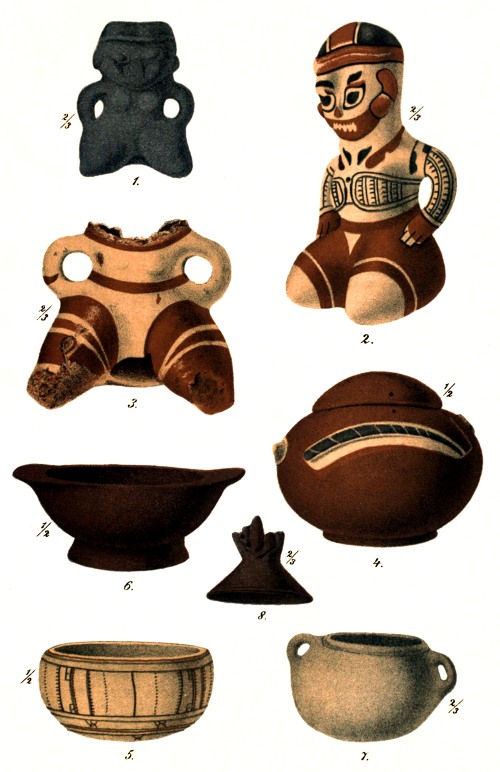
The smaller objects found by excavations made in, and beside these
mounds, will be spoken of in connection with the other ceramic relics,
discovered in Ometepec and Zapatera.
I now return to the description of the several statues.
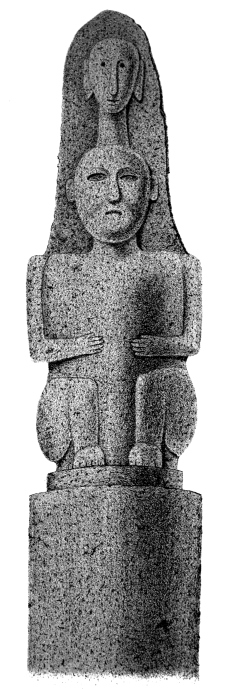
G
Pl. 9 and 10.
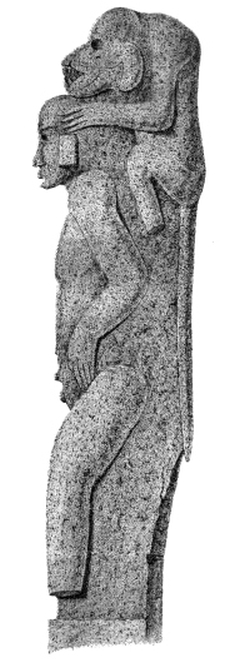
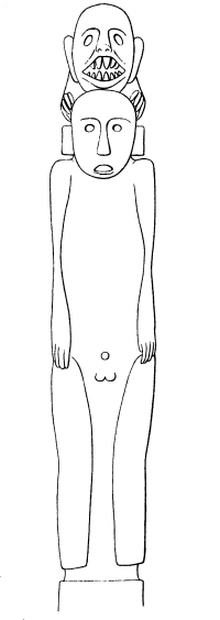
This statue, a double figure, was dug up out of the ground between
the mounds 1 and 2. It has probably stood free, because considerable
portions of its back were well elaborated. It is quite evident, that it
has not served to support a roof, as the upper part of the head of
the upper figure wanted every trace of a tenon, and was carefully
finished. It represented a male figure, somewhat stooping, with bent
arms, the hands leaning on the hips. Upon this human figure that of an
animal was seated, embracing with its fore-paws the head of the male
figure. The animal was probably intended to represent a monkey. The
male figure had an ugly face, with a long straight nose; the eyes were
formed by quite circular cavities, the mouth was widely open, and the
chin very short. The ears were covered by thick, square, flat pieces,
as in the image B. The neck was long, the shoulders were much raised,
large and powerful; the arms were bent, pressed close to the sides of
the body, very narrow when seen from the front, broad and flat when
seen side-ways. The chest and stomach were pretty roughly worked; the
muscles however were sharply marked. The legs were short, without any
trace of muscles or even of knees. The feet were completely wanting,
the legs being abruptly cut off. The second figure, the monkey, rested
its lower jaw upon the head of the principal figure, clasping the hind
part of it with its long fingers. The head was large, with prominent
muzzle and jaws, low, curved forehead, and broad nose, with round
nostrils. The hanging ears were long and broad, rounded backwards. The
mouth was open, showing strong, sharp teeth. The fore-legs or arms
were very long, the fore-arm was bent at a right angle to the upper
arm, the shoulder-blades were very broad and powerful. The back was
strongly curved inwards, the tail long, longer than the animal itself,
hanging straight down. The hind legs were short, strongly bent, drawn
up towards the abdomen, and abruptly cut off above the feet, as in the
principal figure. The length of the statue from the top of the animal’s
head to the upper edge of the pedestal was 175 cm. The breadth of the
human figure across the shoulders was 31 cm.; the breadth of the monkey
across the shoulders was 21 cm.
G 1
Not figured.
It was of the same kind as G, i. e. representing a human figure, on
whose shoulders and head an animal was seated. It was much damaged, and
almost impossible to delineate. The anterior portion of the animal’s
head was crushed, as were also the legs and arms of the human image,
whose face seemed designed to represent a skull with a long neck. The
face of the principal figure was 21 cm. long. The length of the animal
from the crown of the head to the root of the tail was 50 cm. The legs
and claws of this animal were larger than those of the monkey in G.
G 2
Not figured.
Male torso, impossible to complete. It was lying near G, and seemed to
have belonged to the mound 2. It measured 57 cm. from the shoulder to
the thighs. The breadth across the shoulders was 48 cm.
H
Pl. 11.
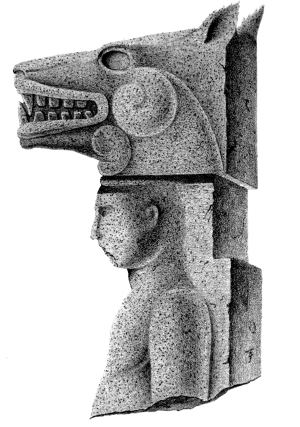
Male, sitting image. This is the first representative of a kind of
idol, of which, as far as I know, not more than a single one from
Central America previously has been figured.[6]
Squier has also given an illustration of a
statue from Pensacola (Las Isletas), in
which a head of an animal is placed upon the head of a human figure,
but there the animal’s head evidently serves only as a helmet; this
seems also to be the case with the above-mentioned image E 1, from
the western side of the stone-mound 1. With regard to the present
image, on the contrary, I believe that the head of the animal is the
more important figure, representing a deity, the human figure being
nothing but the bearer of the god, viz. a kind of caryatid. I formed
this opinion on account of the very strongly marked supporting postures
exhibited by the three human figures, bearing heads of animals,
which follow next in my description. Of the image H only the upper
portion remained; this showed, that the human figure had been sitting,
or half-sitting, but not in what manner the arms had been used as
supports. The head of the animal was a splendid head of a jaguar, very
finely elaborated, and pretty well preserved. The mouth was somewhat
open, showing distinctly elaborated lips, blunt molars and
sharp, large cuspids. The muzzle was somewhat longer than necessary,
the nostrils oval, somewhat widened; the eyes formed oval cavities,
powerfully cut; the ears were rather small, with the margins, as it
were, indented. Two volutes and a powerful intumescence at the sides
were possibly designed to mark the strong muscles of the head. The
human figure was carefully elaborated. The face was well preserved,
with the exception of the mouth and the chin, that were cut off with
a chisel, or some other keen instrument. The forehead was rather low
and separated from the head of the jaguar, by a roll or fillet. The
nose was large, almost straight; the eyes were rather small, the cheeks
full, the cheek-bones not prominent. The ears were unusually small, of
natural shape. The neck was particularly vigorous, the muscles of the
breast well developed. The shoulders and upper arms were full, and well
cut, the arms not quite detached from the sides. The back of the statue
not being elaborated seems to indicate that it has been placed against
or in a wall. That it has not served the purpose of supporting a roof,
is proved by the finely hewn upper side of the jaguar’s head with its
erect ears. The head of the jaguar was 63 cm. long; its height from the
top to the lower hinder corner was 42 cm. The height of the ear was 10
cm. The length of the face of the human figure was 24 cm.
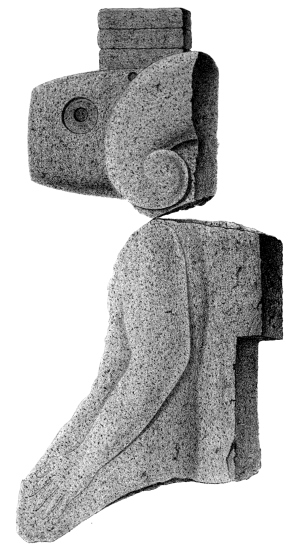
I
Pl. 12.
Male, kneeling figure, supporting the head of a great vulture or «Rey
de Zopilotes». It belonged to the same category as H, but has probably
stood isolated, as the back was as neatly cut as the front. The head of
the vulture was colossal in proportion to the human figure supporting
it, and very carefully sculptured. The beak was very true to nature,
the eye formed a semi-circular cavity, the anterior corner of the eye
was well indicated. Backwards projected a massive round process, a
sort of crest on the back of the head. On the top of the head was a
tenon-shaped projection, which, however, could hardly have served the
purpose of a tenon, as it was unusually thin in comparison with the
tenons found on the statues around the mound 1. It may possibly have
been designed to represent the comb of the beak of the vulture, though
in such a case it was placed too far backwards. The anterior part
of the head and the cheeks were carved with softness and elegance.
Behind the head of the human figure the head of the vulture was united
to its support by a snailshaped spiral (volute) with wide aperture.
Although the kneeling male figure was not perhaps so well worked as
the image H, yet it was well balanced, and of an easy posture. The
forehead was straight, the nose slightly curved, the mouth closed,
the lower lip thin, prominent; the cheeks were rather thin, the ears
disproportionately large, and placed too far backwards. The neck
was long, the Adam’s apple was indicated on the throat. The chest
was rather little developed, the shoulders and upper arms vigorous,
the hands pressed against the sides of the legs. The male organ was
placed high up on the abdomen. The legs below the knees were of equal
thickness throughout, without any trace of muscles, smoothly rounded
backwards, without feet. The pedestal being broken, the statue was
thrown down in the middle of the «plaza», the open place or square
between the mounds 1, 2, 3 and 4. The length of the vulture’s head from
the anterior edge of the beak to the posterior edge of the process at
the back of the head was 100 cm., the height of the head from the top
to the inferior edge of the lower jaw 37 cm. The whole length of the
statue from the upper edge of the tenon-shaped projection to the upper
edge of the pedestal was 154 cm. The upper part of the pedestal formed
a square plinth, on which the human figure was kneeling.
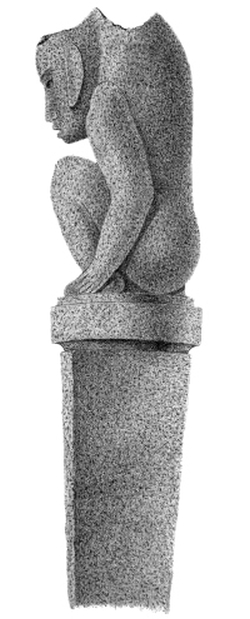
K
Pl. 13.
Male, sitting figure, with its head strongly bent forward, supporting
on its shoulders and the back of its head the large head of an animal,
which was possibly meant to represent the head of a tortoise or a
lizard. This head was rather little elaborated, evenly rounded above,
having in front a round, beak-shaped mouth. A circular cavity before
and over the posterior corner of the mouth represented the eye. At the
back this head carried two high, rectangular, double plates, which may
possibly be regarded as representing the beginning of the back armour
of the tortoise, or perhaps the scales of a lizard or a serpent. The
human figure was very well elaborated; next to the figure A it was
certainly, from an artistic point of view, the most carefully finished
one of all the statues at Punta del Sapote. The head was bent strongly
forwards, as if depressed by the gigantic load; the forehead was high,
the nose straight, the eyes were well cut out, the cheeks rounded, the
ears small. The neck was stretched forth, very thick and muscular.
The shoulders were not so powerful as should have been expected from
the thickness of the neck, but they were neatly molded. The trunk and
the back were very nobly and elegantly sculptured, and formed the
best portion of the statue. The upper arms were rigorous and well
proportioned, the lower arms perhaps a little too short. The hands
were closed, resting on the knees. The legs were thick, and not so
well worked as the upper portion of the statue, the feet clumsy,
without distinct toes. The figure was seated on a high socle, with a
low foot-stool under its feet. As was demonstrated by the unusually
careful workmanship expended on the back portions, the statue has quite
certainly stood isolated. The height of the statue from the summit of
the head of the animal to the upper edge of the pedestal was 137 cm.
The length of the face of the human figure was 20 cm. The length of the
head of the animal was 82 cm., its greatest height 36 cm. This statue
was pretty deeply imbedded in the earth, and was found nearly in the
middle of the open place between the stone-mounds 2, 3, and 4.
K 1
Not figured.
Male, standing figure. This statue did not belong to the same category
with H, I and K, but had probably served as support in the wall of a
building, because the turban-shaped head-dress was surmounted by a
tenon, and the back was not elaborated. It had suffered so much from
the violence of human hands, and from the effects of the climate, that
its outlines could hardly be distinguished. From the upper edge of the
tenon to the thighs it measured 123 cm. The length of the face was 24
cm. It was found immediately north of the mound 6.
L
Pl. 14.
Male, sitting figure, with its head bent forward, supporting the
gigantic head of a crocodile. The back side being only plane-cut, it
has probably stood against a wall; but as it wanted a tenon, it did
not seem to have supported the roof. In posture it much resembled K
and M, but it was worked without the elegance that distinguished K. It
is highly probable that the head of the animal represented that of a
crocodile, although it was executed, in a rough manner, the style being
altogether peculiar to this statue; the head was square-cut and the
outlines not at all rounded. The characteristic knob or protuberance
on the snout of the crocodile was boldly molded, but square. The eyes
were marked by triangular cavities, the teeth pyramidal, sharp-pointed.
The ears were the only portions of the head exhibiting curved outlines;
their form was almost human. The human figure, as has been said before,
was of far coarser workmanship than the statue K. The face was well
preserved, the forehead high, the nose small, the mouth half-opened,
the ears large and hanging, resembling those of a dog. The neck was
very long and thick. The muscles of the breast were vigorous. The arms
were fleshy and vigorous, straight, stretched down, leaning with the
palms against the upper surface of the block, on which the figure was
seated. The thick fingers were extended straight down. The legs were
rather thick; the feet, which were short and clumsy, with slightly
indicated toes, rested on a little foot-stool. The figure, sitting with
the hands pressed against the stone block, exhibited a posture quite
able to support a very heavy weight. The block that served as a seat,
had the form of a truncated pyramid. The statue was overthrown; it was
lying pretty close to the mound 2, between it and mound 1. The height
of the statue from the highest point of the head of the crocodile to
the upper edge of the pedestal was 147 cm. The length of the face of
the human figure was 19 cm. The length of the head of the crocodile was
91 cm., its height 47 cm.
M
Pl. 15.
Female, sitting with straight arms, the hands pressed against the stone
seat in a posture just able to sustain the pressure of a heavy load.
The head was wanting, but the well marked posture, as compared with
that of the just described figure, seems to justify the conclusion that
this figure has also supported upon its head the large head of some
animal. The entire figure was heavy and clumsy, but the circumstance
of the muscles of the body being indicated both in front and behind,
makes it not improbable that this statue has stood insulated, like K.
The arms were quite detached from the body, and uncommonly thick and
heavy, as were also the legs. The hands were heavily pressed against
the block, on which the figure was seated, the right hand with the
palm, the left one with the knuckles. The most remarkable feature of
this statue was perhaps the bench on which it was seated; this was cut
out from the block so as to be quite free and detached. The statue,
like all above described ones, was sculptured from a single block, a
monolith. The height of the statue from the shoulders to the upper edge
of the pedestal was 107 cm. The breadth across the shoulders was 69 cm.
It was found pretty close to the mound 4.
M 1
Not figured.
Male, standing figure, its head adorned by a high conical head-dress.
Very like the figure F. Its face was hidden by a mask, with round holes
for the eyes. It had a long, hanging beard or breast-armour. The arms
were stretched straight down. It was broken in four fragments, and was
found in the periphery of the mound 5.
N
Pl. 16.
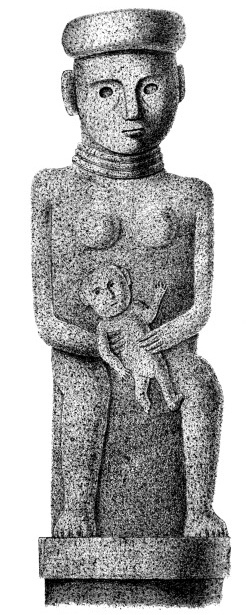
Female, sitting figure, with a child in its lap. It has probably stood
insulated, as the back portions were pretty well elaborated, and,
besides, the pedestal was adorned with a free border, which was not
the case in any of the statues remaining in the circumference of the
mound 1. This statue was, more-over, remarkable by its large head, not
being turned straight forward, but somewhat upwards and side-ways. The
statue was rudely executed, far inferior in workmanship to most of
those mentioned before. There was no attempt at imitating the muscles
of the body; the arms and legs were thin and short, not detached from
the block. It was only in the molding of the face that some endeavours
to follow nature were to be detected; the eyes were formed by deep,
oval cavities; the nostrils and cheeks were indicated; the mouth was
closed, with thick lips; the ears were very large and projecting. The
short, vigorous neck was ornamented by a broad neck-lace, formed of
three round bands. The head was covered by a turban-shaped head-dress.
The right shoulder was somewhat higher than the left. On the front of
the body only the two semi-spherical breasts were elaborated; with
this exception, the chest and abdomen were on a line with the block
itself. The figure held before it a child or a smaller figure with
very large head, large, projecting ears, clumsy body, and short, thin
legs. In execution this statue strongly reminded of the figure η from
Punta de las Figuras, though it was superior with regard to the face.
It was found near the mound 3, but not in its periphery. The height
of the statue from the upper edge of the turban to the upper edge of
the pedestal was 170 cm. The length of the face from the lower edge of
the turban was 34 cm. The breadth across the shoulders was 60 cm. The
length of the smaller figure was 51 cm.
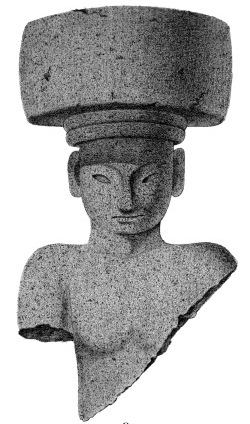
O
Pl. 17.
Female, standing figure. It reminded somewhat of the preceding one,
but was much better executed. It certainly had a free position, as the
back and shoulders were well sculptured. It carried on its head a very
large, round, thick slab of stone, between which and the head there
was a kind of turban, made of two round rolls. The face was unusually
broad, and particularly remarkable in that respect that the eyes were
placed obliquely. It was the only statue in which such was the case.
The nose was large, straight; the mouth broad, closed; the ears very
large, prominent, the left one longer than the right one. The shoulders
and breast were pretty well elaborated. The lower portions were broken
in many pieces. The diameter of the slab on the head was 72 cm.; its
thickness 45 cm. The length of the face from the lower edge of the
turban was 32 cm., its breadth 31 cm. The breadth across the shoulders
was 72 cm. The statue was found at the periphery of the mound 6.
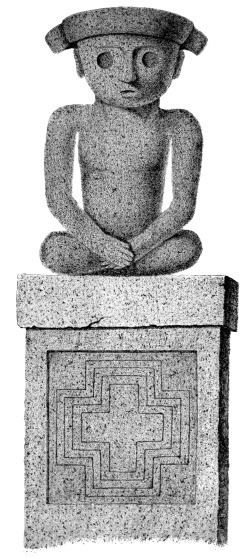
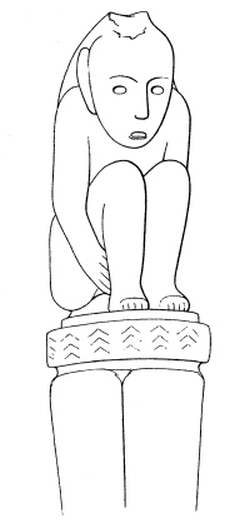
P
Pl. 18.
Male, sitting figure, with crossed legs, and the hands crossed in
its lap. The figure was unusually small, and not very artistically
executed. The head was large and very broad, adorned by a low turban
with flaps projecting side-wise. The forehead was low, the nose large;
the eyes were formed by unusually large, circular cavities; the mouth
was small; the ears were large, but not so prominent as in the image O.
The chest and back were equally elaborated, though the muscles were but
slightly marked. The arms were long, and, unusually enough, cut out so
as to be perfectly detached from the sides. The legs were very short
and weak. The figure was seated immediately on the square pedestal,
that was surrounded above by a prominent border on all the sides. The
front of the pedestal was ornamented by an engraved cross, its sides
and back by rhombic figures, forming inter-woven garlands. This statue
has certainly been insulated. It measured 92 cm. from the upper edge of
the turban to the upper edge of the pedestal. The length of the face
from the lower edge of the turban was 25 cm., its breadth 35 cm. The
breadth across the shoulders was 54 cm.
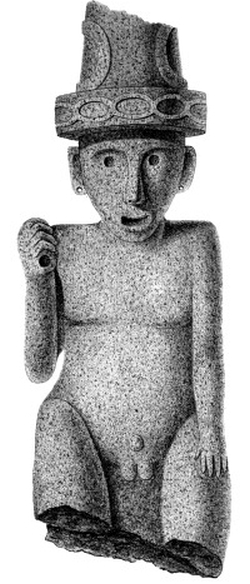
Q
Pl. 19.
Male, sitting figure. The broad, short face showed it to appertain
to the same type as the figures N, O and P, which it resembled also
with regard to the careless workmanship. It wore on its head a conical
hat, with a raised, circular ornament on each side; the hat widened
below into a thick brim, adorned by an ornament in relief, formed like
a chain. The face was but little elaborated, the forehead low, the
nose long, broad, and straight; the eyes were middle-sized, circular
cavities; the mouth was broad, open, almost square. The ears were long,
extending, with perforated lobes. The neck was short. The chest
and abdomen showed some signs of muscles. The shoulders were quite
straight. The arms were narrow, without muscles; the left one hanging
straight down, with the fingers extended; the right one bent upward
towards the shoulder, with the fingers doubled, so as to form a hole.
It has probably clasped a lance or stick, or something of that kind.
The legs were rather large, broken above the knees. The back of the
statue was only plane-cut. The length from the lower edge of the hat to
the thighs was 103 cm.; that of the face from the same point 33 cm.;
the breadth of the face 32 cm. The breadth across the shoulders was 52
cm. The statue was found near the western margin of the mound 4.
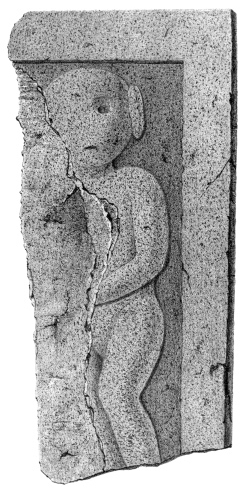
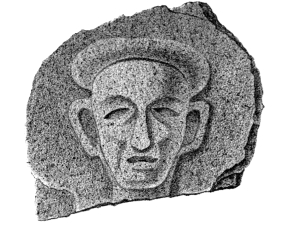
R
Pl. 20.
High-relief, representing a female figure. With regard to the type of
the face, it came near to the immediately preceding ones. It was a
big-headed figure of full size, sculptured in feeble high-relief on
a large rectangular slab of stone, about 25 cm. in thickness. It had
been very badly injured, so that only the left half of the figure could
be anyhow discerned. The face was almost circular, the eye a circular
cavity, the nose wanting, the mouth closed, the ear large, hanging,
like the ear of a dog, the shoulder rounded, the arm bent inwards
across the body, the leg slightly bent. The figure has been surrounded
by a frame, nearly 20 cm. broad, and 4 cm. high. The length of the
figure to the thighs was 106 cm. The length of the face 38 cm.; the
breadth of the face 37 cm.
With regard to the type of the face, the
figures found in this locality may be divided into two distinctly
different classes viz., the images A to M, with oval faces, and, in
general, of more artistic workmanship, and the images N, O, P, Q, R,
with broad, almost circular faces, and more rudely executed. The latter
are possibly of more ancient date than the former. None of the latter
was found at the mound 1.