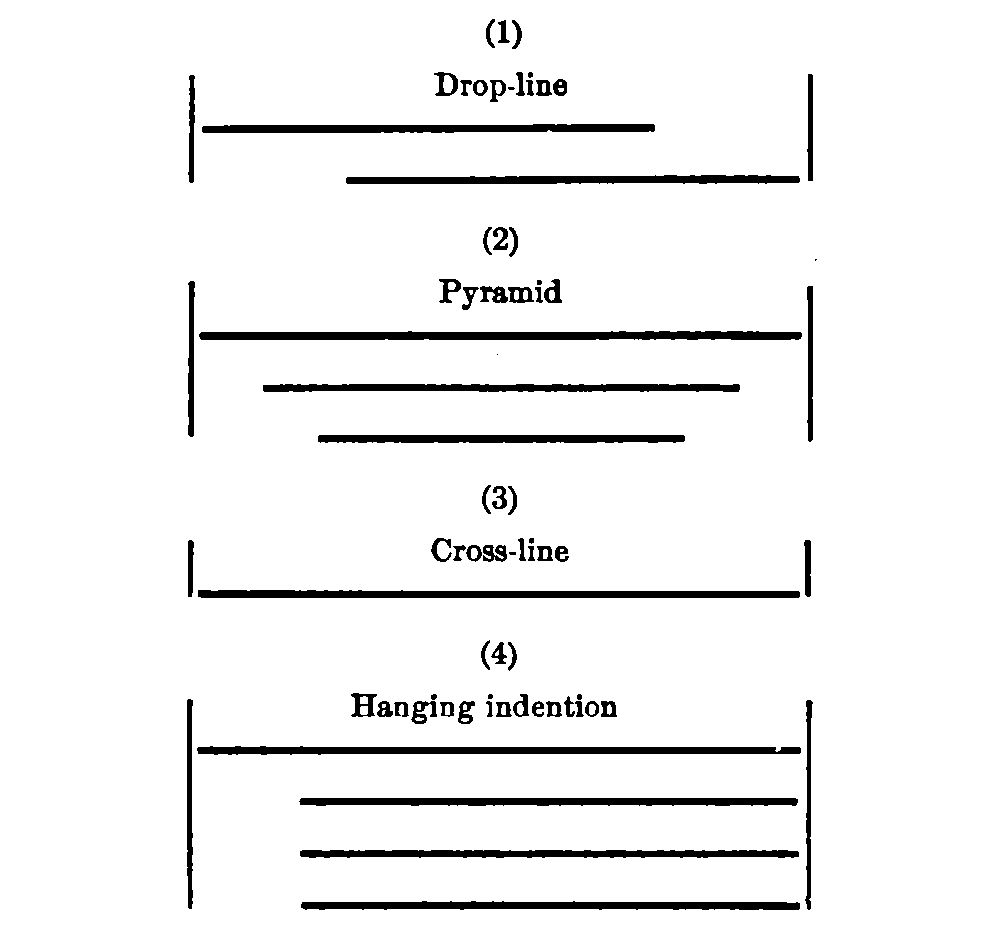
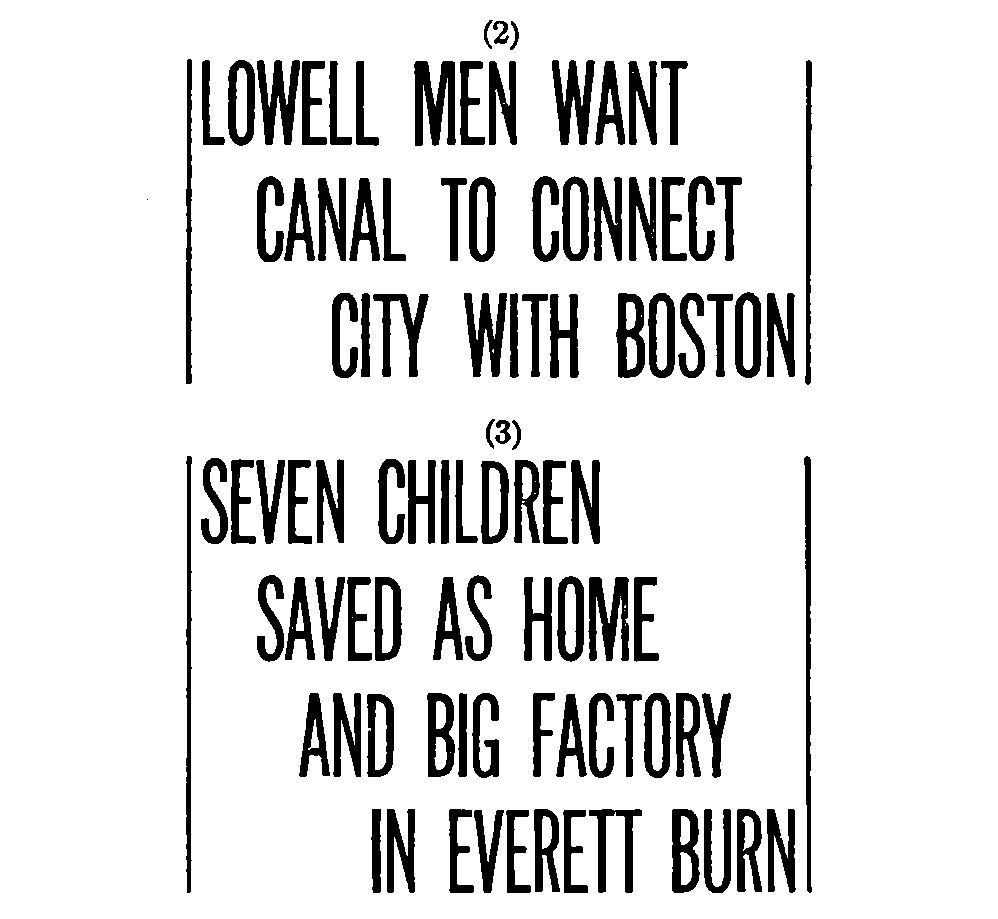
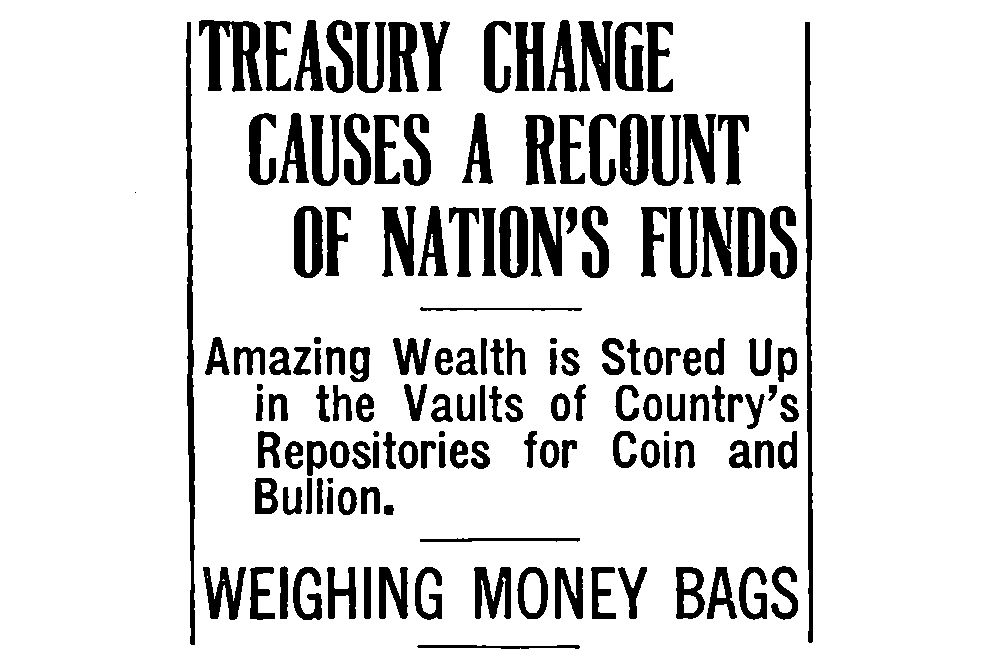
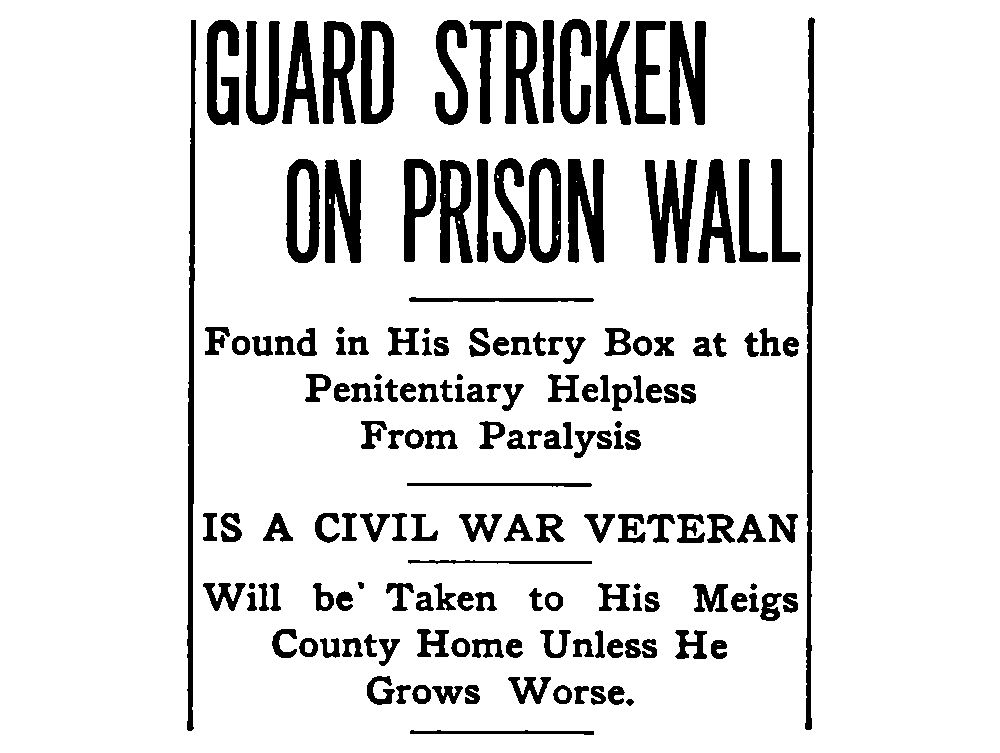
PREFACE
Seven years’ experience in trying to train college
students in methods of newspaper writing and editing
has convinced the author of the need of text-books in
journalism. Newspapers themselves supply the student
with so miscellaneous a collection of good, bad, and mediocre
work that, with an uncritical taste, he does not
always discriminate in the character of the models which
he selects to imitate. Lectures by experienced editors
and writers, although fruitful of much inspiration and
general information, seldom give the student sufficiently
specific and detailed directions to guide him in his daily
work. What he needs is a handbook containing typical
examples of all of the kinds of newspaper work that he
is likely to be called upon to do during the first years
of his newspaper experience. These examples should
be carefully selected from well-edited newspapers and
should be analyzed to show the fundamental principles
that underlie their construction. With such a book illustrative
of current practices in newspaper making, he
can study more intelligently the newspapers themselves
and can assimilate more completely the advice and information
given by newspaper men in active service.
Furthermore, such a book, by giving specific suggestions
with examples of their application, serves as a guide
to aid the student in overcoming his difficulties as he
does his work from day to day. It is to furnish a handbook
and guide of this kind that the present text-book
has been prepared.
This book is adapted both for use in college classes
in journalism and for study by persons interested in
journalism who are not attending college. The needs of
these two groups are not essentially different. Both desire
to know the basic principles of newspaper writing
and editing and to get the necessary training in the
application of these fundamental principles to their own
work. In each chapter, accordingly, explanation and
exemplification are supplemented by material for practice
work.
To formulate a large number of rules for the writing
of news stories, the editing of copy, the writing of headlines,
and other kinds of newspaper work, is plainly
impossible, even if it were desirable. Methods of newspaper
making during the last fifty years have undergone
so constant and rapid a readjustment to new conditions
in the transmission of news, in mechanical production,
and in the sources of income, that only a few traditions
have remained unchanged. The tireless effort to secure
novelty and variety in present-day journalism prevents
the news story or the headline from becoming absolutely
fixed in form or style. Instead of attempting to formulate
dogmatic rules and directions, the author has undertaken
to analyze current methods of newspaper work
with the purpose of showing the reasons for them and
the causes which have produced them. The examples
selected to illustrate these methods have been taken
from newspapers in all parts of the country and are intended
to represent the general practices now prevailing.
For obvious reasons names and addresses in most
of these stories have been changed. To retain the newspaper
form as far as possible, the examples have been
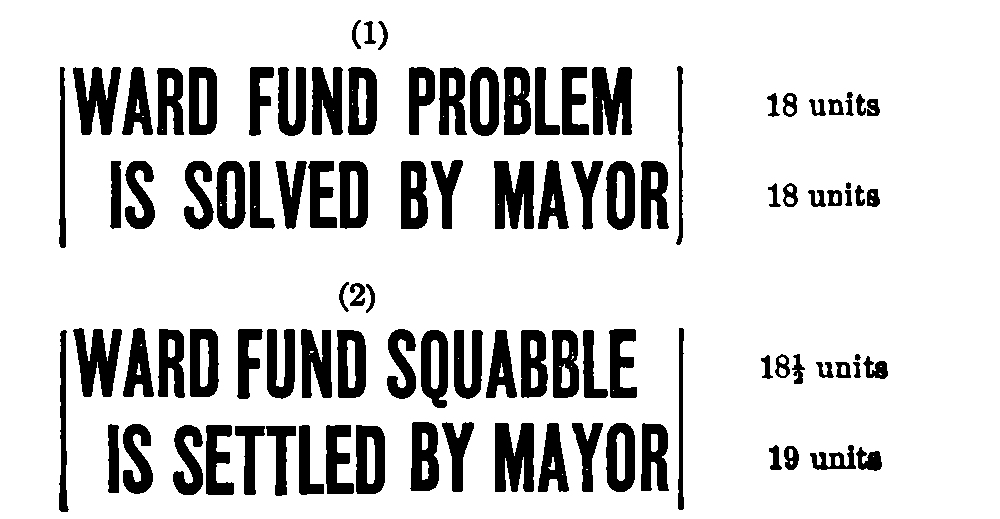
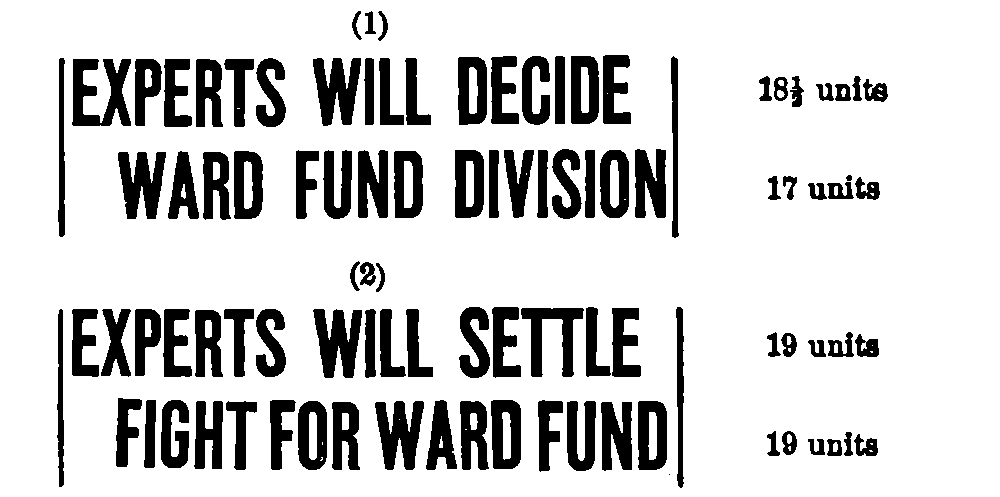
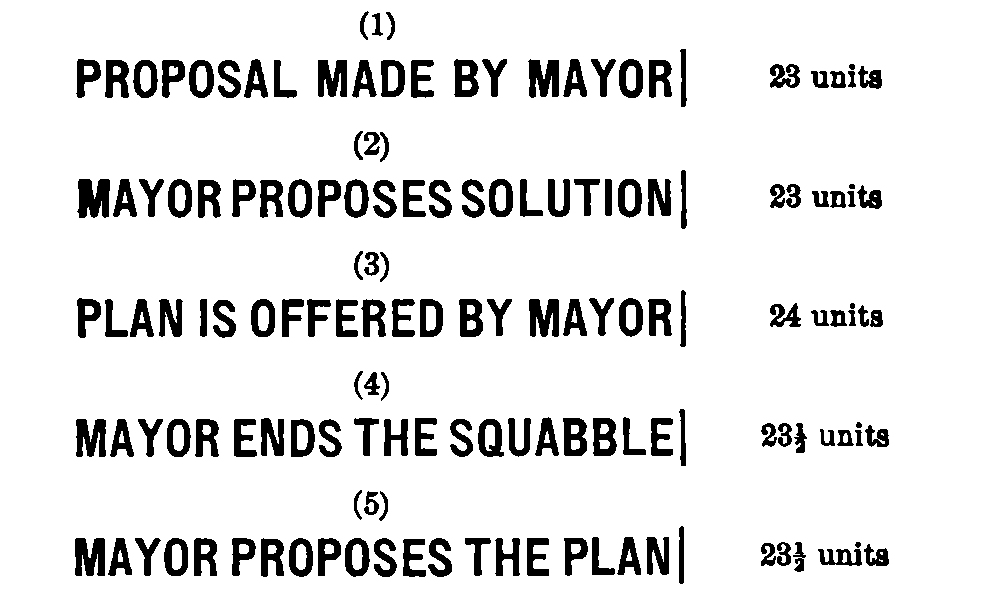
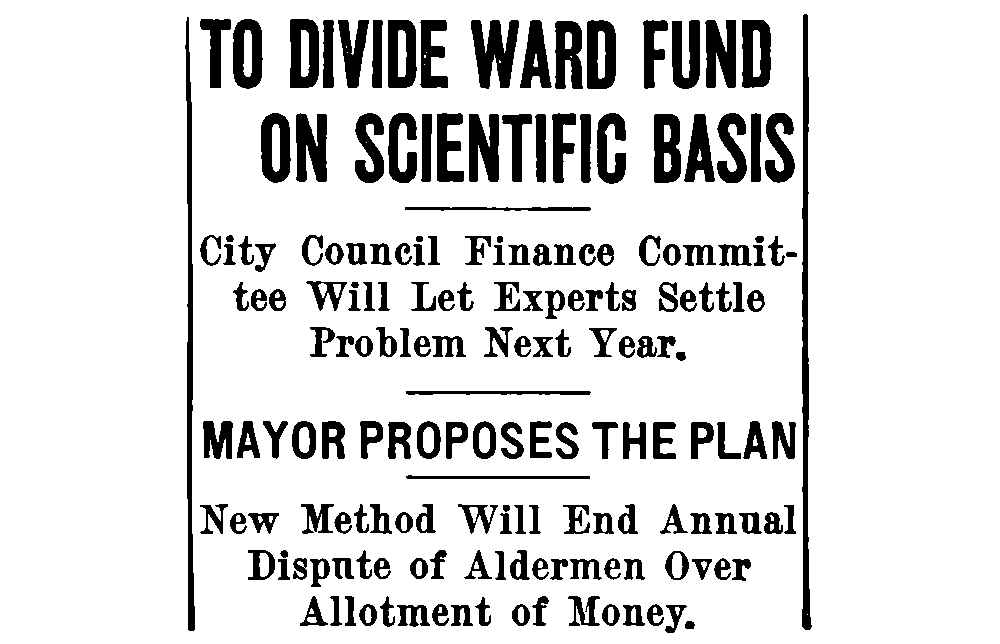
printed between rules in column width.
Inasmuch as this book is intended to prepare the student
for the kind of work which he is likely to do during
the first years of his newspaper experience, it does
not consider editorial writing, book-reviewing, or musical
and dramatic criticism. To discuss these subjects
adequately would require more space than a handbook
on reporting and editing permits.
It is assumed throughout this book that the student
of journalism is familiar with the elementary principles
of grammar and rhetoric, and has had sufficient training
in composition to be able to express ideas in simple,
correct English. Faults in such rudimentary matters
as grammar, spelling, punctuation, and capitalization
are not considered at all. No attention is given to diction
or questions of good usage. All these matters are
fully treated in numerous books on English composition.
In the discussion of the news story, an emphasis has
been given to the “lead” that may seem disproportionate.
This has been done in the belief that the rapidity
with which newspapers are generally read makes the
beginning the most important part of the story. The
average reader gleans the significant facts of each piece
of news from the headlines and the first paragraphs.
He expects in the “lead” the “feature” as well as the
gist of the news. To the student this problem of massing
skillfully, in a compact and interesting form, the
substance of his material, is a new one, and he must be
shown all the varied possibilities of this treatment. The
author has not been unmindful of the fact that efforts
are being made to break away from the “gist-of-the-news”
beginning, and has given examples of other
forms. For stories in which entertainment rather than
information is the purpose, beginnings that do not summarize
may undoubtedly be used to advantage. In such
stories the student must be shown how to arouse the
reader’s interest and curiosity in the first sentences so
that he will read further.
The function of the newspaper has been discussed at
some length in order to call the student’s attention to
the importance of the newspaper as an influence in a
democratic government and to point out the significance
of his own work in relation to society. An effort has
been made to analyze the problems of newspaper making
in order to show the fundamental issues involved.
The purpose has been, not to settle these questions dogmatically,
but to stimulate the student to think for himself.
“Newspaper English” has so long been regarded by
many teachers of English as a term of reproach, and
instruction in journalistic writing has been so recently
introduced into the college curriculum, that some English
instructors still question the value of systematic
training of students in newspaper writing as a part
of the teaching of English composition. Nevertheless,
every teacher of English in the secondary schools and
colleges recognizes the fact that one of the most serious
weaknesses of present-day training in composition
is the lack of a definite aim for the student in his writing,
and a corresponding lack of interest on his part in
doing work that has no real purpose. To report actual
events for publication, either in a local newspaper or in
a school paper, gives the student both material and purpose,
and to that extent increases his interest and his
desire to write well. If the application of the principles
of English composition to newspaper writing and editing
can be demonstrated to the student, as the author
has attempted to do in this book, the student can undoubtedly
be given valuable practice in these principles
through systematic training in newspaper work.
“Every professor of journalism must write a textbook
on journalism in order to justify his claim to his
title,” was the facetious remark made at the first Conference
of Teachers of Journalism. Until journalism
has been taught in colleges and universities long enough
to have developed generally accepted methods of instruction,
the text-book produced by every teacher of
the subject must be regarded, not as a demonstration
of his claims to the title, but as a contribution to the
development of methods of teaching based on his own
experience. If this book is of assistance to those who
aspire to become newspaper workers or to those who
are undertaking to train students of journalism, it will
have accomplished its purpose.
The author is indebted to the publishers of Collier’s
Weekly, of the American Magazine, and of the Independent
for permission to reprint material from these
magazines. Acknowledgment is also due to the many
newspapers throughout the country from which examples
have been taken and to which due credit has
been given whenever the “stories” thus reproduced
have been important or distinctive in character.
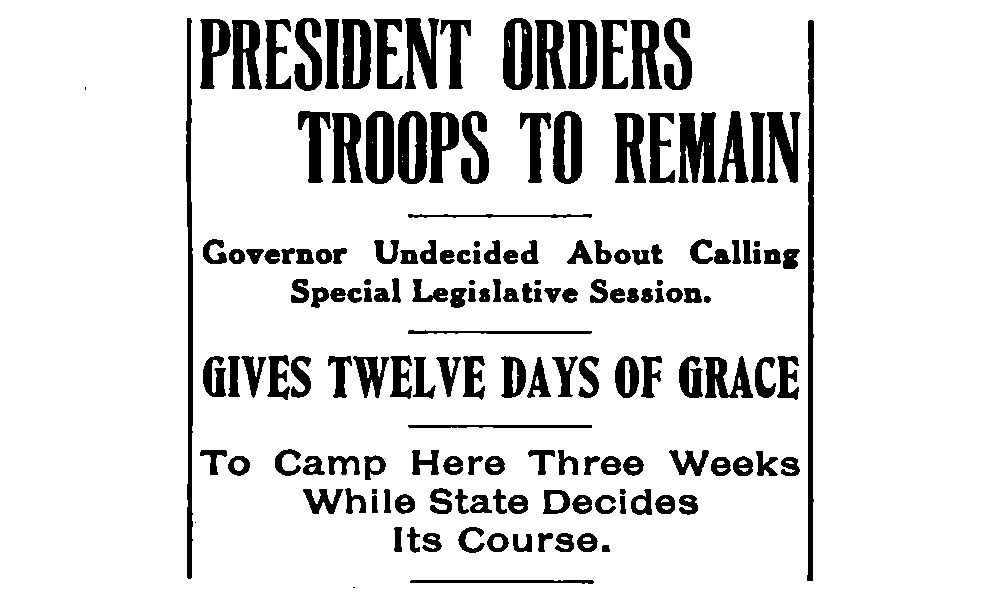
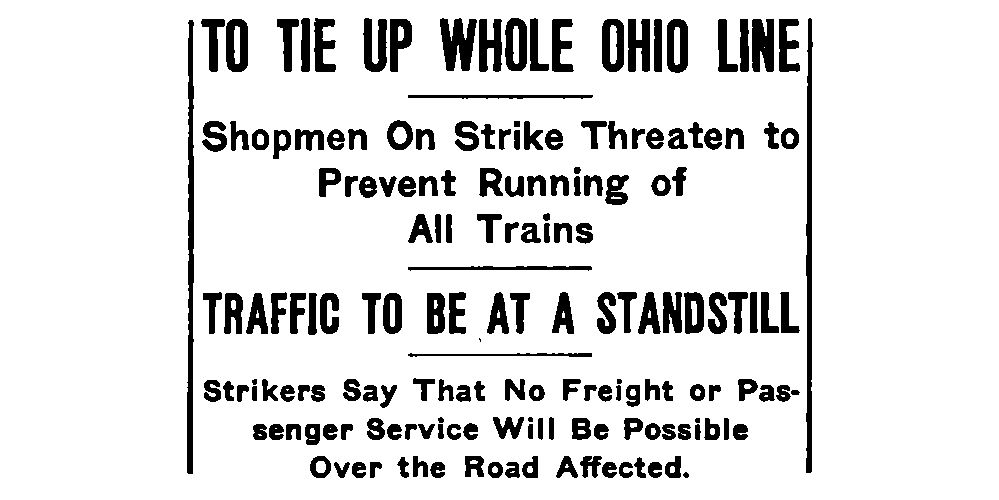
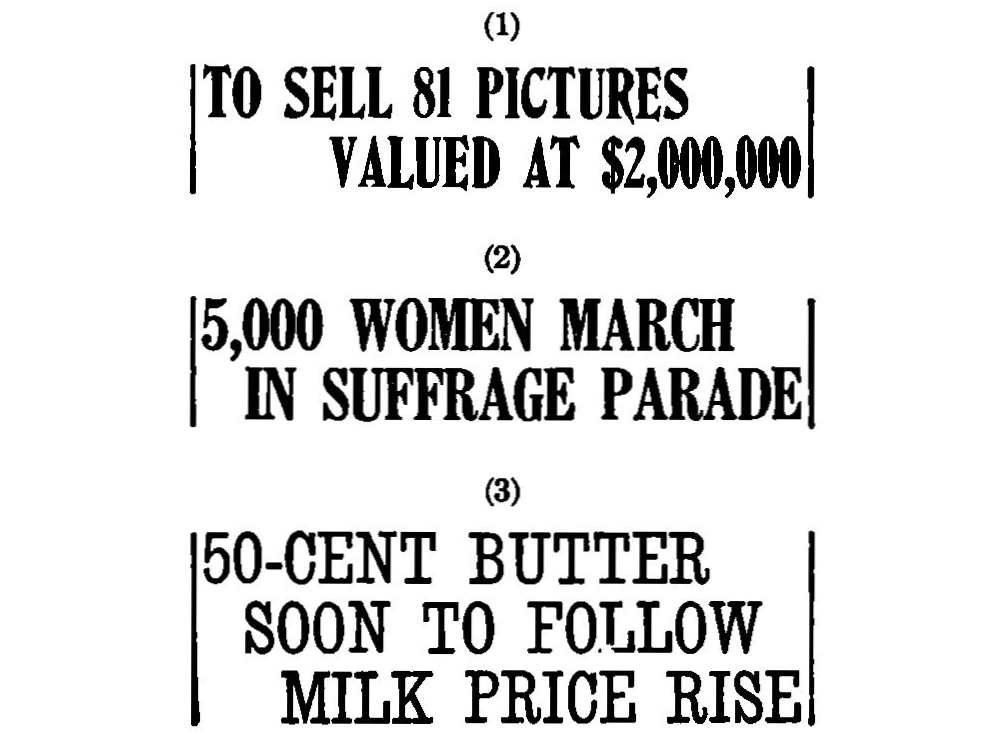
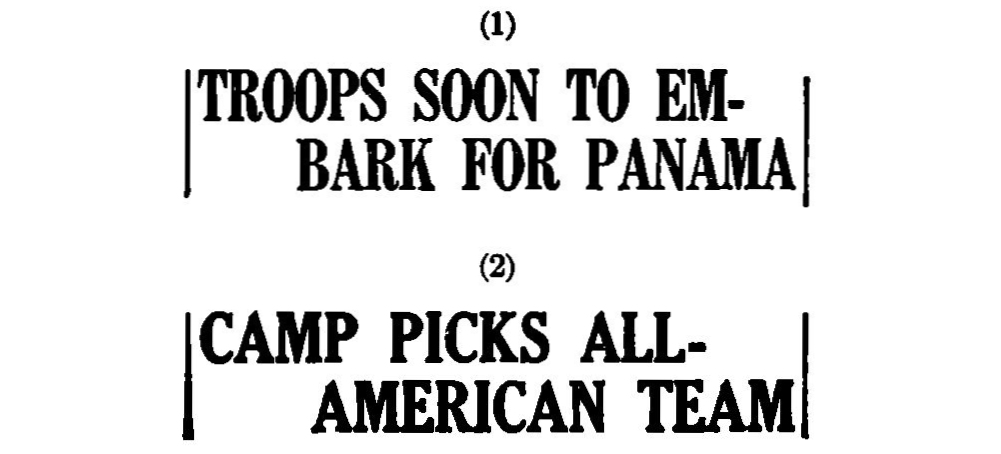
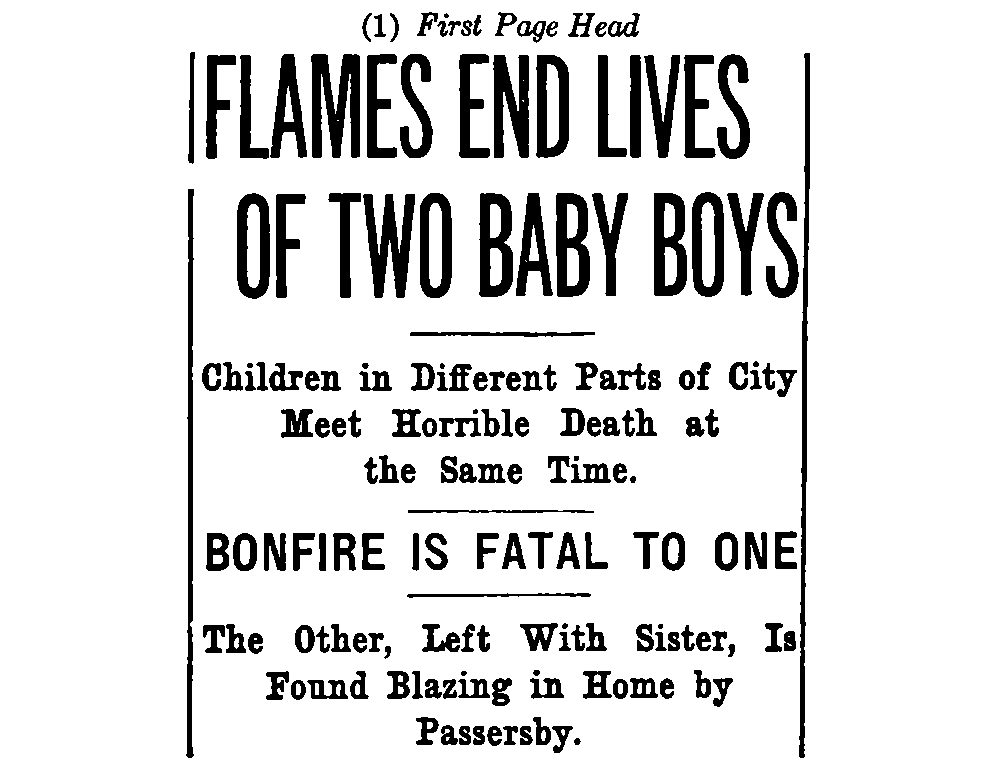
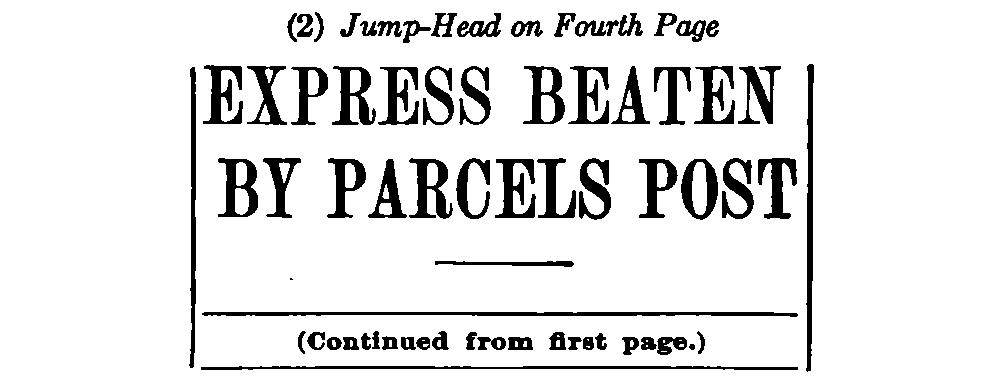
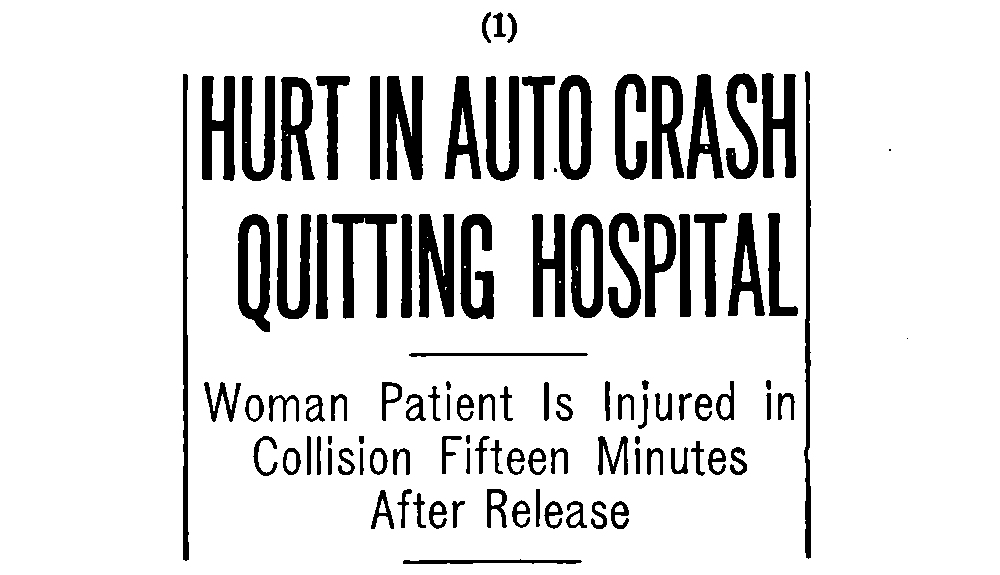
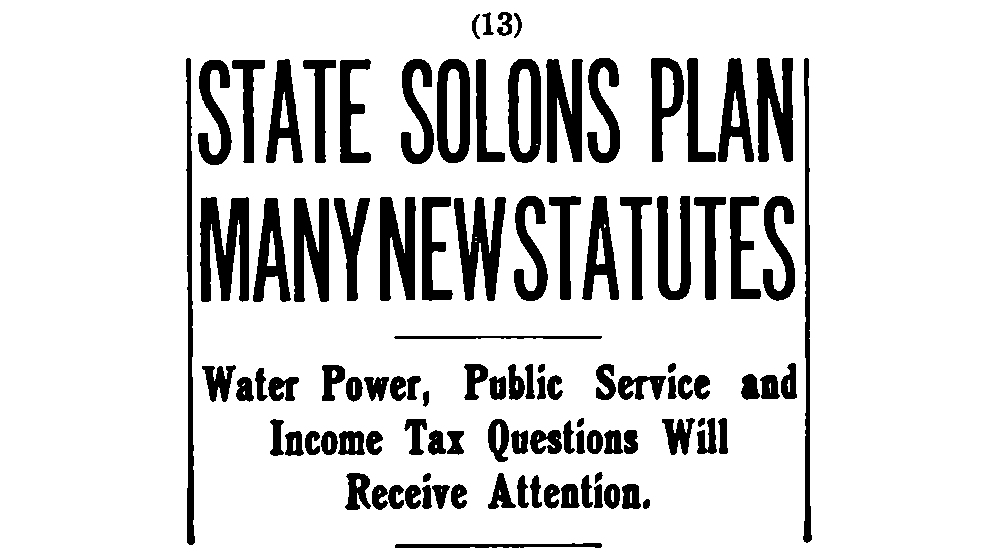
The facsimile newspaper headings reproduced in this
book represent styles of type used in newspaper offices
throughout the country. These specimens are included
by courtesy of the Mergenthaler Linotype Company
of New York.
University of Wisconsin,
Madison, March 3, 1913.
CHAPTER I
NEWSPAPER WRITING
AND EDITING
HOW A NEWSPAPER IS MADE
Newspaper Production. To furnish for a cent or
two a fairly complete record of important events that
take place in any corner of the world, editorial comment,
market quotations, reviews of new books, critiques of
plays and concerts, fashion hints, cooking recipes, cartoons,
and illustrations, as well as advertisements of
all kinds, would seem a stupendous, not to say impossible,
task if it were not an everyday phenomenon.
A single copy of a daily newspaper in a large city contains,
exclusive of advertising, from 60,000 to 80,000
words, or as many as does the average novel. These
metropolitan papers print from 100,000 to 900,000 copies
each day, numbers far in excess of the editions of
most successful novels. While it takes the novelist
months to produce his work, and his publishers months
to print it, the newspaper is made and printed in from
one to ten editions within twenty-four hours.
The successful achievement of such an undertaking,
day by day, requires extensive equipment and effective
organization. The rapid production of a large edition
demands many expensive machines to transform written
matter quickly into type, and huge presses to print the
papers at the highest speed. Furthermore, it makes
necessary a large staff to gather and prepare news and
other reading matter, a large force to put this material
into type, to print it, and to distribute the papers, besides
managers and clerks to carry on the many business
transactions involved in so big an enterprise.
Newspaper Organization. Although in its main
divisions the organization of newspaper publishing is
essentially the same, the size of a paper determines to
a considerable extent the number of employees and the
degree of division of labor among them, as well as the
character and the extent of the equipment. On large
papers where many men are employed and many editions
are printed daily, there needs must be considerable
specialization in editing and reporting; while on
small papers the size of the staff requires that each
man perform a variety of tasks. Sometimes conditions
of ownership or control, and on older papers office traditions,
modify the usual duties and authority of different
members of the staff.
No one form of organization that can be described in
detail, therefore, will apply to all newspaper offices even
when they are of the same relative size, but a composite
type of organization for large newspapers may be explained
to show the division of work.
Newspaper publishing consists of three distinct parts
with three entirely different classes of workers: (1) the
business management, (2) the mechanical force, (3) the
editorial staff.
The Business Management. The business organization,
as its name implies, has charge of the commercial
side of newspaper publishing. From the financial
point of view the purpose of the newspaper is to make
enough money to maintain the paper and to pay dividends
to the stockholders. The object of the business
department is to sell as much advertising space and as
many copies of each issue as it possibly can; and, on
the other hand, to pay out for wages and expenses only
so much as is necessary to keep the paper up to a standard
that will insure a good circulation and enough
advertising. In short, a newspaper company, regarded
purely in the light of a business enterprise, is not essentially
different from any manufacturing company
that produces and sells a commodity.
The business department is organized with a business
manager at its head, who has complete control of the
finances of the paper, subject, of course, to the owner
or board of directors of the company. Under him are:
(1) the circulation manager, (2) the advertising manager,
(3) the cashier. The circulation manager directs
the work of subscription canvassers, the drivers and
the assistants on the paper’s distributing wagons, the
mailing clerks and helpers, and a force of office clerks
and bookkeepers. In the advertising department are
the advertising solicitors and the office clerks and bookkeepers.
The cashier has assistants and a bookkeeper
to aid him. The business office of the newspaper is frequently
referred to as the “counting room.”
The Mechanical Force. The mechanical side of
newspaper making is divided into three relatively distinct
departments: (1) the composing room, where,
under the direction of a foreman and a copy-cutter, the
type is set up by compositors or is cast in linotype or
monotype machines by operators, and where the type is
arranged by make-up men in pages as it is to appear
in print; (2) the stereotyping room, where these pages
of type are used to make molds into which lead plates
are cast by stereotypers under the direction of the foreman
of the room; (3) the press-room, where the papers
are printed, in charge of a superintendent with pressmen
and machinists as his assistants. Attached to the
composing room is the proof-reading department with
a head proof-reader, several assistant readers, and as
many copy-holders who read aloud the copy for the proof
which is to be corrected.
The Editorial Staff. The writing and editing of a
newspaper, with which this book is particularly concerned,
is divided into two distinct parts: (1) the gathering,
the writing, and the editing of the news; and
(2) the interpreting of the news. The two branches are
different in the kind of work involved, and are relatively
independent in the organization of the office. To
present clear, concise, accurate, timely, and interesting
reports, or “stories” as they are called, of everything
that is going on in the world of sufficient importance
to be of interest to any considerable number of readers,
is the aim of the news department. The more quickly,
the more attractively, the more completely the news
can be presented, the greater is considered the success
of the newspaper from the point of view of the news
staff. The editorials of a newspaper attempt to interpret
and to explain the news, or to make the news the
basis of argument upon issues growing out of questions
of the day. The attitude taken by a newspaper on the
questions at issue is determined by what is known as
its “editorial policy.”
The editor-in-chief, under whom are one or more editorial
writers, has charge of the editorial columns and
determines the editorial policy, subject to whatever
control of this policy the owner or directors desire to
exercise. The editorial writers and the editor-in-chief
confer daily to consider the attitude that the paper
shall take in its editorials and to divide the work of
writing them. Some of the editorials are written by
men in other professions who are not on the regular
staff, and often by such members of the news staff
as the financial editor or the dramatic critic. Most of
the editorials, however, are the work of the editorial
writers.
The news staff is in charge of the managing editor,
who is usually responsible directly to the owner or the
directors. As aids the managing editor has the assistant
managing editor, and the news editor, or the night
editor, to take charge of “making up” the newspaper
The gathering and writing of local news is in charge of
the city editor and the night city editor, with an assistant
city editor. The news of the state, the nation,
and the world, as it comes by mail, telegraph, and telephone,
is under the control of the telegraph editor. The
city editor directs the reporters; the telegraph editor
the correspondents. Particular kinds of news are collected
and edited by persons in especially designated
positions, such as the sporting editor, the society editor,
the financial and market editor, the dramatic and musical
editor, the real estate editor, the railroad editor,
the marine editor, the labor editor, all of whom usually
work under the direction of the managing editor. The
special magazine sections of the Saturday or the Sunday
issues are in charge of the magazine, or Sunday, editor.
An exchange editor goes over all the newspapers
received in exchange to clip and edit material worth
reprinting. Cartoonists, artists, and photographers
supply the materials for newspaper illustrations, or
“cuts,” as they are called. A librarian has charge of
the reference books and newspaper files, as well as of
the collection of biographical sketches and portraits
of prominent people known as the “morgue.”
All of the manuscript, or “copy,” is edited and is supplied
with headlines at the copy desk in charge of a head
copy-reader with a number of copy-readers as assistants.
“Rewrite men” are often employed to take the facts of
a story from another newspaper and rewrite them, or to
receive material over the telephone from reporters and
correspondents and write it up for publication. Unsatisfactory
work of a reporter may be turned over to a
rewrite man to be put in the desired form, for rewrite
men must be able to take the raw material of the news
furnished by others and turn it into a well-written news
story.
Getting News into Print. The relation of all these
departments to one another is best shown by following
through the process by which a piece of news gets into
print. The telegraph editor on a newspaper in the capital
city of the state, for example, gets from an office
telegraph operator, a typewritten dispatch signed by
the paper’s correspondent in a city of a neighboring
state to the effect that the attorney-general has dropped
dead in the lobby of a hotel. The telegraph editor at
once notifies the city editor so that he may assign reporters
to get the local phases of the piece of news, or
“to cover the local end of the story,” as the newspaper
workers say. One reporter is sent to interview the members
of the late attorney-general’s family; another is
dispatched to the governor’s office for an interview with
the governor on the deceased official; a third is asked
to look up the statute concerning such an unexpected
vacancy in the office; a fourth is assigned to find out
the probable successor to the position.
After informing the city editor and the managing
editor, the telegraph editor at once turns over the dispatch
to the head copy-reader to have it edited and to
have a headline written. Meanwhile one of the rewrite
men is delegated to get a biographical sketch of the
attorney-general from the office “morgue” and to write
an obituary. The artist looks up the half-tone engraving,
or “cut,” of the official in the “morgue” and selects
an appropriate border or “frame” in which to
put it. The editor-in-chief is informed of the attorney-general’s
death so that he may make appropriate editorial
comment. Meanwhile the telegraph editor has
sent a telegram to the correspondent who furnished the
first news of the event instructing him to “wire” five
hundred words more giving all the particulars.
When the dispatch has been edited and a headline
written by one of the copy-readers, the latter returns
it to the head copy-reader, who glances over it and
sends it in a pneumatic tube to the composing room.
The tube delivers it at the copy-cutter’s desk. The
copy-cutter glances at the sheet with the headline for
the story, and then at the two pages of copy. The headline
he sends by the copy distributor to the headline
machine to be set up. The two pages of copy he cuts
into three pieces or “takes” so that the story may be
set up on three different linotype machines. If the copy
of the whole story were given to one machine operator,
it would take three times as long to get it into type.
Meanwhile some of the reporters have returned from
their assignments. Each one reports what he has found
to the city editor, and is told how long a story to write,
and possibly what to emphasize in the beginning, or
“lead.” As each story is finished it is turned over to
the city editor, who glances over it and passes it on to
the head copy-reader. Thence it goes through the same
course as the first dispatch.
After the copy of the dispatch has been set up in
type, it is taken to a small hand press, and several impressions
called “galley proofs,” or “proofs,” are
printed, or “pulled,” from the type. One of the proofs,
with the original copy, goes to the proof-room to be
compared with the copy and carefully corrected by the
proof-readers. Another proof-sheet is sent to the managing
editor, who is responsible for everything that
goes into the paper; a third proof is delivered to the
news editor who arranges, or “makes up,” the news
stories on each page of the paper before it is printed.
After the proof-readers have corrected the proof, and
the editors have made any necessary changes in it, the
proof-sheets are returned to the operators so that they
may make the necessary alterations by resetting whatever
is changed. From the type thus corrected a second
set of proofs, called the “revise,” is printed and these
are distributed to the editors as the first were. The
type is then ready to be used in the process of printing
the paper.
Half an hour or more before an edition is to be
printed, the news editor gathers the proofs of the news
stories that are to be put into that edition, and goes
to the composing room to arrange this news on the
several pages. The importance of the news of the attorney-general’s
death would warrant its being given
a prominent place on the first page. The most prominent
position is the right-hand outside column. If
there is no news of greater importance, the news editor
directs the “make-up” men in the composing room to
put the type of this story in the outside column of the
first page “form.” The “form” consists of a “chase,”
or steel frame, somewhat larger in inside dimensions than
the page as it appears when printed. Into this “chase,”
which rests upon a smooth iron-top table, the type is
arranged between the brass or lead column rules which
make the lines between the columns of type. The advertisements
are placed in the forms under the direction of
the advertising department just as the news matter is put
in under the direction of the news editor, the page and
position on the page usually having been stipulated by
the advertiser in making a contract for a certain “position”
for his “ad.” When each page is filled with
type, the whole page is “locked” in the “form” by a
series of screws or wedges (called “quoins”), so that
the form may be handled without letting the type drop
out. If the type falls out and gets mixed up, it is said
to be “pied,” and the mixture is called “pi.”
The forms, after being locked, are taken to the stereotyping
room where a paper mold, or matrix, commonly
called a “mat,” is made of each page. These
matrices, bent in semicircular form, are placed in a
casting box into which molten lead is poured to make
the semicircular lead plates to be used in printing. In
large offices the casting of these plates is done by placing
the matrix in an automatic stereotyping machine,
known as the autoplate, which turns out completed
plates in less than a minute. After the plates have been
trimmed and planed on the back to make them exactly
the right thickness, they are ready to be put on the
press.
These semicircular lead plates, which are thus cast
in exact reproduction of the page forms of type, are
fastened on the cylinders of the press. As the cylinders
revolve, ink rollers touch the surface of the plates and
ink the projecting letters. The paper from a large roll,
as it passes between the cylinders and the blanket rolls
which press the paper against the inked plates on the
cylinders, takes up the ink and thus has printed on it
the impression of the page of type. Besides printing
the pages, the press cuts, folds, and counts the papers
so that the complete newspaper comes from the press
ready for sale or delivery.
As soon as the newspapers are printed, they are
turned over to the circulation department for distribution.
Some copies go to the mailing room to be labeled
with little orange-colored address slips and to be put
into the mail sacks, in which they are taken to the post
office or mail trains. Other copies are sold to waiting
newsboys, and still others are taken in the company’s
wagon to news stands and carriers all over the
city.
Despite the number and variety of these details in
the process of newspaper making, the news of the
death of the attorney-general would reach the readers
in a comparatively short time after the event occurred.
In half an hour from the time the last piece of copy is
written, a complete newspaper containing it is printed
and ready for distribution.
Speed of Production. The invention and the perfection
of various mechanical devices used in newspaper
making have made possible this great speed. In the
front rank of ingenious pieces of machinery that have
added greatly to rapidity in newspaper publishing
stands the linotype. This machine, which casts solid
lines of type, or “slugs” as they are called, has increased
four-fold the speed of production and has made
possible much larger editions. The monotype, which
casts each type separately, has also proved a valuable
addition to the means of turning “copy” into type
quickly. For the casting of semicircular stereotype
plates the autoplate machine is an important time-saving
device. The time required for “running off” an
edition is now reduced from two- to five-fold by making
duplicate sets of these stereotype plates and by putting
them on from two to five large presses so that
these presses print the same edition simultaneously.
Improvements in newspaper-printing machinery have
resulted in huge presses that take paper from large
rolls and turn out completed newspapers printed in one
or two colors, cut, folded, and counted, ready for distribution.
They can be adjusted to print papers from
four to forty-eight pages in size, and can produce
twelve-page papers at the rate of 144,000 copies an
hour. Magazine sections and “comics” are printed in
four colors, usually yellow, red, blue, and black, on
large presses under conditions practically the same as
those just described.
In order to insert the latest news without taking the
time necessary to make up new forms, prepare new
matrices, and cast new stereotype plates, a device called
the “fudge” is employed. After the first page form of
a late edition has been used to make a matrix, about
six inches of type is taken out from two columns in the
lower left hand corner or the upper right hand corner
of the page, and a new matrix and a stereotype plate
are made in which this corner is a blank. This new
plate with the blank space is then put on the press in
place of the regular first page plate. As fast as late
news is received, it is set up on linotype lines, or
“slugs,” and these lines are clamped on a small cylinder
in the press. When the paper runs through the
press, these linotype lines on the cylinder are printed,
often in red ink, in the space on the front page left unprinted
by the blank in the plate. To save more time
with this device, a telegraph wire is run to the press
room and a linotype machine is installed beside it, so
that the latest news can be cast on linotype “slugs”
and put on the “fudge” cylinder as fast as the reports
are received by telegraph. Results of baseball games,
races, and other sporting events can be printed to advantage
by means of the “fudge.”
Recently a mailing machine has been introduced that
folds, wraps, and addresses each copy separately as fast
as papers are fed into it.
In no other process of manufacture that is as complicated
as newspaper making, it is safe to say, has equal
speed of production been attained.
Handling a Big Story. The scene in a metropolitan
newspaper office following the receipt of the first news
of the “Titanic” disaster, as graphically portrayed by an
editor of a New York morning paper, illustrates the conditions
under which important news, received late, is hurried
into print.[1] The account in part is as follows:
At 1:20 a.m. Monday, April 15, [1912], the cable editor opened
an envelope of the Associated Press that had stamped on its face
“Bulletin.” This is what he read:
Cape Race, N. F., Sunday night, April 14.—At
10:25 o’clock tonight the White Star Line steamship
“Titanic” called “C. Q. D.” to the Marconi station here,
and reported having struck an iceberg. The steamer said
that immediate assistance was required.
The cable editor looked at his watch. It was 1:20 and lacked
just five minutes of the hour when the mail edition goes to press.
“Boy!” he called sharply.
An office boy was at his side in a moment.
“Send this upstairs; tell them the head is to come; double
column, and tell the night editor to rip open two columns on the
first page for a one-stick dispatch of the ‘Titanic’ striking an iceberg
and sinking.”
Every one in the office was astir in a moment and came over to
see the cable editor write on a sheet of copy paper the following
head [which he indicated was to be set up in this form]:
“Boy!” he called again; but it was not necessary—a boy in a
newspaper office knows news the first time he sees it.
“Tell them that’s the head for the ‘Titanic.’”
Then he wrote briefly this telegraphic dispatch, and as he did
so he said to another office boy at his side: “Tell the operator to[Pg 13]
shut off that story he is taking and get me a clear wire to Montreal.”
This is what he wrote to the Montreal correspondent, probably
at work at his desk in a Montreal newspaper office at that hour:
Cape Race says White Star Liner “Titanic” struck
iceberg, is sinking and wants immediate assistance. Rush
every line you can get. We will hold open for you until
3:30.
“Give that to the operator and find out if we caught the mail
on that ‘Titanic’ dispatch,” he said quickly to the boy.
In a moment the boy returned.
“O.K. on both,” he said.
The city editor, who had just put on his coat previous to going
away for the night, took it off. The night city editor, at the head
of the copy-desk, where all the local copy (as a reporter’s story is
called) is read, and the telegraph editor stood together, joined
later by the night editor, for the mail edition had left the composing
room for the stereotypers and then to the pressroom and
from thence to be scattered wherever on the globe newspapers find
readers.
The “Titanic” staff was immediately organized, for at that hour
most of the staff were still at work. The city editor took the
helm.
“Get the papers for April 11—all of them,” he said to the
head office boy, “and then send word to the art department to
quit everything to make three cuts, which I shall send right
down.”
Then to the night city editor: “Get up a story of the vessel itself;
some of the stuff they sent us the other day that we did not
use, and I ordered it put in the envelope. Play up the mishap at
the start. Get up a passenger list story and an obituary of Smith,
her commander.”
There was no mention of Smith in the dispatch, but city editors
retain such things in their heads for immediate use, and this probably
explains in a measure why they hold down their job; also
having, it might be added, executive judgment, which is sometimes
right.
“Assign somebody to the White Star Line and see what they’ve
got.”
The night city editor went back to the circular table where the
seven or eight men who read reporters’ copy were gathered.
“Get up as much as you can of the passenger list of the ‘Titanic.’
She is sinking off Newfoundland,” he said briefly to one.
And to another: “Write me a story of the ‘Titanic,’ the new
White Star liner, on her maiden trip, telling of her mishap with
the ‘New York’ at the start.”
And to another: “Write me a story of Captain E. J. Smith.”
[Pg 14]
Then to a reporter sitting idly about: “Get your hat and coat
quick; go down to the White Star Line office and telephone all you
can about the ‘Titanic’ sinking off Newfoundland.”
Then to another reporter: “Get the White Star Line on the
phone and find out what they’ve got of the sinking of the ‘Titanic.’
Find out who is the executive head in New York; his
address and telephone number.”
And in another part of the room the city editor was saying to
the office boy: “Get me all the ‘Titanic’ pictures you have and a
photo or cut of Captain E. J. Smith.”
Two boys instantly went to work, for the photos of men are
kept separate from the photographs of inanimate things. The city
editor selected three:
“Tell the art department to make a three-column cut of the
‘Titanic,’ a two-column of the interior, and a two-column of
Smith.”
In the mean time the Associated Press bulletins came in briefly.
Paragraph by paragraph the cable editor was sending the story
to the composing room. What was going on upstairs every one
knew. They were sidetracking everything else, and the copy-cutter
in the composing room was sending out the story in “takes,”
as they are called, of a single paragraph to each compositor. His
blue pencil marked each individual piece of copy with a letter and
number, so that when the dozen or so men setting up the story had
their work finished, the story might be put together consecutively.
“Tell the operator,” said the cable editor again to the office
boy, “to duplicate that dispatch I gave him to our Halifax man.
Get his name out of the correspondents’ book.”
“Who wrote that story of the ‘“Carmania” in the Icefield’?”
said the night city editor to the copy-reader who “handled” the
homecoming of the “Carmania,” which arrived Sunday night and
the story of which was already in the mail edition of the paper
before him. The copy-reader told him. He called the reporter to
his desk.
“Take that story,” said the night city editor, “and give us a
column on it. Don’t rewrite the story; add paragraphs here and
there to show the vast extent of the icefield. Make it straight
copy, so that nothing in that story will have to be reset. You have
just thirty minutes to catch the edition. Write it in twenty.”
“Get the passenger lists of the ‘Olympic’ and the ‘Baltic,’”
was the assignment given to another reporter, all alert waiting for
their names to be called, every man awake at the switch.
In the mean time, the story from the Montreal man was being
ticked off; on another wire Halifax was coming to life.
“Men,” said the city editor, “we have just five minutes left to
make the city [edition]. Jam it down tight.”
Already the three cuts had been made, the telegraph editor was
handling the Montreal story, his assistant the Halifax end, and[Pg 15]
the cable editor was still editing the Associated Press bulletins and
writing a new head to tell the rest of the story that the additional
details brought. The White Star Line man had a list of names of
passengers of the “Titanic” and found that they numbered 1300,
and that she carried a crew of 860.
In the mean time proofs of all the “Titanic” matter that had
been set were coming to the desk of the managing editor, in charge
over all, but giving special attention to the editorial matter. All
his suggestions went through the city editor, and on down the line,
but he himself went from desk to desk overlooking the work.
“Time’s up,” said the city editor; but before he finished, the
cable editor cried to the boy: “Let the two-column head stand
and tell them to add this head:”
At 12:27 this Morning Blurred Signals by Wireless
Told of Women Being Put off in Lifeboats—Three
Lines Rushing to Aid of 1300 Imperiled Passengers and
Crew of 860 Men.
“Did we catch it?” asked the cable editor of the boy standing
at the composing-room tube.
“We did,” he said triumphantly.
“One big pull for the last [edition], men,” said the city editor.
“We are going in at 3:20. Let’s beat the town with a complete
paper.”
The enthusiasm was catching fire. Throughout the office it was
a bedlam of noise—clicking typewriters, clicking telegraph instruments,
and telephone bells ringing added to the whistle of the
tubes that lead from the city room to the composing room, the
pressroom, the stereotype room and the business office, the latter,
happily, not in use, but throughout the office men worked; nobody
shouted, no one lost his head; men were flushed, but the
cool, calm, deliberate way in which the managing editor smoked
his cigar helped much to relieve the tension.
“Three-fifteen, men,” said the city editor, admonishingly;
“every line must be up by 3:20. Five minutes more.”
The city editor walked rapidly from desk to desk.
“All up,” said the night city editor, “and three minutes to the
good.”
At the big table stood the city editor, cable editor, night city
editor, and managing editor. They were looking over the completed
headline that should tell the story to the world.
“That will hold ’em, I guess,” said the city editor, and the
head went upstairs.
The men waited about and talked and smoked. Bulletins came
in, but with no important details. Going to press at 3:20 meant a
wide circulation. At 4:30 the Associated Press sent “Good-night,”
but at that hour the presses had been running uninterruptedly for
almost an hour.
SUGGESTIONS
- Find out all that you can about the organization of the
paper on which you are employed.
- Know the names, at least, of the heads of all the departments.
- Learn as much as possible about advertising and subscription
rates and methods.
- Familiarize yourself with the details of all the mechanical
processes connected with newspaper making.
- Interest yourself in the welfare of the paper as if it were
your own property.
CHAPTER II
NEWS AND NEWS VALUES
Problems of the News. As news is the sine qua
non of the newspaper, the problem of newspaper making
resolves itself into the three questions: What is news?
Where and how is news to be obtained? and, How is
news to be presented to the reader? The first question
involves the definition of news and the determination
of its value, the second concerns the gathering of news,
and the third has to do with structure and style in the
writing of news.
What is News? Although every good newspaper
worker recognizes news at once, and almost instinctively
decides upon its value, most of them find it difficult
to express in brief form what news is and what
determines its value. In a symposium recently conducted
by an American magazine,[2] a number of editors
throughout the country undertook to define news, giving
the following definitions:—
News is whatever your readers want to know about.
Anything that enough people want to read is news, provided
it does not violate the canons of good taste and
the laws of libel.
News is anything that happens in which people are interested.
News is anything that people will talk about; the more it
will excite comment, the greater its value.
News is accurate and timely intelligence of happenings,
discoveries, opinions, and matters of any sort which
affect or interest the readers.
Whatever concerns public welfare, whatever interests or
instructs the individual in any of his relations, activities,
opinions, properties, or personal conduct, is news.
News is everything that happens, the inspiration of happenings,
and the result of such happenings.
News is the essential facts concerning any happening,
event, or idea that possesses human interest; that affects
or has an influence on human life or happiness.
News is based on people, and is to be gauged entirely on
how it interests other people.
News comprises all current activities which are of general
human interest, and the best news is that which interests
the most readers.
The essentials of news, as brought out by these definitions
are: (1) that it must be of interest to the
readers; (2) that it includes anything and everything
that has any such interest; and, (3) that it must be
new, current, timely. Furthermore, these definitions
emphasize the fact that the value of news is determined
(1) by the number of people that it interests,
and (2) by the extent to which it interests them. The
composite of these definitions, therefore, would be:
News is anything timely that interests a number of
people; and the best news is that which has the greatest
interest for the greatest number.
By the application of these tests to each event, idea,
or activity, the reporter can determine for himself
what is news and what is not, as well as what value a
piece of news possesses. He must ask himself concerning
each piece of news that he gets: “Is it new and
timely?” “How many readers will it interest?” “Has
it great interest for a large number?”
Many times an incident seems, at first glance, to
possess little that will interest, but, on closer examination,
reveals some phase that is of considerable news
value. Keen observation and insight to see the significant
aspect of a person, an event, an idea, often leads
to the discovery of news that may escape the notice of
less acute observers. The reporter must find for himself
those aspects of the day’s events which are of the
greatest interest to the greatest number.
Timeliness in News. Freshness, timeliness, newness
is one vital qualification for all news. “Yesterday”
has almost ceased to exist for the newspaper man. Even
“to-day” has become “this morning,” “this noon,”
“this afternoon.” “Up to date” has given way to “up
to the minute.” Improved mechanical equipment, which
makes possible lightning speed in turning news stories
into a complete newspaper in less than half an hour,
has made possible a degree of freshness in the news
that would seem marvelous were it not a daily, in fact,
almost an hourly phenomenon. Competition among
newspapers, and the publication of frequent editions,
increase the necessity for the latest news. The reporter
must catch this spirit of getting the news while
it is news, and of getting it into print before it loses its
freshness.
What Interests Readers. How general will be
the interest in any activity, idea, or event is determined
by what the average person likes to hear, read, or see.
Whatever gives him pleasure or satisfaction, interests
him. Consideration of the fundamental bases of news
values, therefore, involves a determination of the general
classes of things that give pleasure and satisfaction
to the average individual.
The Extraordinary. The unusual, the extraordinary,
the curious, wherever found, attracts attention
and is interesting because it is a departure from the
normal order of life. Humdrum routine whets the appetite
for every break in the monotony of regularity.
So long as the daily life of the average man conforms
to the generally accepted business and social standards
and is not affected by any unusual circumstances, it
has little interest for his fellow men. As soon as he
violates the usual order, or is the victim of such violation,
his departure from the level of conformity becomes
a matter of greater or less interest according to the
extent of the departure. Because hundreds of thousands
of bank employees are honest, the dishonesty of
one of them is news. So all crime, as a violation of
established law and order, is news, unless, as unfortunately
is sometimes the case, it becomes common enough
to cease to be unusual. Every notable achievement in
any field of activity, because it rises above the level, is
news. A record aeroplane flight, an heroic action, the
discovery of a new serum, the invention of a labor-saving
device, the finding of remains of a buried city,
the completion of a great bridge,—all are sufficiently
out of the ordinary to attract attention. Accidents and
unexpected occurrences, because they break in upon
the usual course of events, are matters of news. The
thousands of trains that reach their destination safely
are as nothing compared to one that jumps the track.
Millions of dollars’ worth of property that remains unharmed
from day to day does not interest the average
man, but the loss of some of it by fire, wind, or flood
immediately lifts the part affected out of the mass and
gives it interest to hundreds of persons in no way concerned
in the loss. It is not the crimes and misfortunes
of others that give the reader pleasure; it is the fact
that these are departures from the normal course that
makes them satisfy his desire for something different
from the usual round of life.
In almost every event the good newspaper man can
find something that is out of the ordinary, and by giving
due emphasis to this unusual phase can give interest
to what might otherwise seem commonplace. What that
something will be is determined by the reporter’s or
the editor’s appreciation of what will appeal to the
average reader as the most marked departure from the
customary and the expected. If, as in a recent accident,
the front trucks of a trolley car jump the track and
upset a baby carriage, throwing out the baby; and if
the baby alights unharmed on a pillow that was tossed
out of the carriage by the collision, such peculiar circumstances
the reporter knows will appeal to most
readers as the interesting feature of the accident. That
a sneak thief should be caught as he was escaping from
a house with a few dollars’ worth of plunder, will attract
the average reader much less than the fact that
he jumped through a plate-glass window in his effort to
escape, or that he gained access to the house by wearing
a Salvation Army uniform, or that he carried away
a pie as part of his booty. How a man lost a purse containing
$50 is scarcely worthy of notice, but how, while
looking for his purse, he found a diamond ring, is
strange enough to make good reading. A lecture at an
agricultural society meeting on the advantages to the
farmers of the state of raising barley would not ordinarily
be considered of much interest to city readers,
but an interruption of the lecture by an advocate of
prohibition with the charge that to urge barley growing
is to aid the brewing interests, might make a good
news story. The character and the extent of the departure
from the usual, considered from the point of view
of most of the readers, measure the news value of any
phase of an event that is out of the ordinary.
Struggles for Supremacy. Struggles for supremacy,
also, have an almost universal appeal. Competition
in business, contest in sport, rivalry in politics, are
based on the love of fighting to win. Strikes and lockouts,
as part of the contest between labor and capital,
appeal to this interest. So does the fight to secure control
or monopoly in any part of the commercial field.
The enthusiasm manifested over baseball, football, boxing,
racing, and other sports grows out of the love of
contest for supremacy. In political warfare the interest
of many is largely in the struggle for victory, with the
power that victory brings, rather than any results that
will affect the individual directly. Accounts of all these
forms of fighting to win make good news stories.
“Human Interest.” The fellow feeling that makes
all the world akin, the sympathy that binds together
men who have little in common, is the basis of interest
which we have in the actions, thoughts, and feelings of
others. The “human interest” which newspaper and
magazine editors demand, involves emphasis on the personal
element in the affairs of life. The characters that
appear in news stories, fiction, or special articles must
be made to appeal to the readers as real flesh and blood
men and women. The human side of events is what the
average reader wants. How one man is saved by a new
serum is read with more attention than is a discussion
of the therapeutic value of the serum. The privations
of an arctic explorer in reaching the pole have almost
as much interest for most readers as the discovery of
the pole itself. The experiences of strikers and their
families are read by many who know little and care
less about the economic conditions that produce the
strike. So vitally do we feel ourselves concerned with
the fate of our fellow men, even when we do not know
them personally, that accounts of human life lost or
endangered are read with great eagerness. “Many lives
lost!” is the cry that the newsboy knows will sell the
most papers. From the point of view of the newspaper
the greater the number of lives thus involved in the
event, the better is the news.
The Appeal of Children. The unusual appeal that
children make gives news of their activities especial
value. Whenever a little child plays a part in an event,
it is pretty sure to be the best feature of the story. The
letter which a small girl writes to the mayor asking
that her pet dog be restored to her from the dog pound,
will take a place in the day’s news beside the interview
with the mayor outlining his policies of city government
for the following two years. A child witness
holds the attention of the entire court room and is
“featured” in the story of a trial, partly, no doubt,
because the appearance of a child in these circumstances
is unusual, but largely because of our interest
in children. Just as a child’s plea to a judge saves its
worthless father or drunken mother from a prison sentence,
so the story of that plea will move every reader.
Anecdotes and sayings of children readily find a place
in newspapers and magazines.
Interest in Animals. The popular interest in animals,
wild or tame, in captivity or at large, makes news
stories about them good reading. Whether we are attracted
by the almost human intelligence that animals
often display, or by their distinctly animal traits, we
read of their doings with keen interest. Anecdotes of
animal pets if well told are always readable. The fascination
which the “zoo” or the circus menagerie has
for most people is akin to the pleasure given by anecdotes
of animals in captivity. Every city editor knows
the value of the zoölogical garden as a source of effective
stories when other fields fail. Wild animals at large,
particularly when they come into any relation with
men, afford good material for the reporter or correspondent.
Amusements and Hobbies. The favorite pleasures
and amusements of readers form another large
group of activities that must be considered in measuring
the value of news. Besides the contest element in
sports that interests the spectator, there is the attraction
of athletics for the players. Golf, tennis, automobiling,
and similar activities furnish news that is read
by those who engage in these diversions. Accounts of
the theatre, of concerts, and of all forms of amusements
are read by the thousands who patronize these entertainments.
Pastimes and hobbies, such as amateur
photography, book-collecting, fishing and hunting, canoeing
and sailing, whist and chess, have enough devotees
to give value to news of such avocations. Here
again the number of readers to whom such news appeals
determines the space and the prominence that it is worth.
Degree of Readers’ Interest. Persons, places, or
things that go to make up news excite a degree of interest
proportional to (1) the reader’s familiarity with
them, (2) their own importance and prominence, (3) the
closeness of their relation to the reader’s personal affairs.
Local Interest. Local events interest readers because
they know the places and often the persons concerned.
Local news, accordingly, takes precedence over
news from elsewhere of equal or greater importance as
measured by the general standards of news value. Interest
in most news stories may be said to vary inversely
in proportion to the distance between the place of the
event described and the place where the paper is published.
Just as the splash is greatest where a stone
strikes the water, the ripples growing less and less
marked as the force of the shock spreads out over the
pond, so the impression made by an occurrence grows
less and less the farther one goes from the scene of
action. We read more eagerly the account of a small
fire in a building that we pass every day than the dispatch
telling of a fire that wiped out a whole town two
thousand miles away. The arrest of a man for speeding
his automobile will cause more comment among his
friends than the capture of a gang of automobile bandits
that has terrorized another city. Local phases, or
“local ends,” as they are called, of events that take
place some distance away quite overshadow in interest
more important phases of the event itself. Every effort
is made in the newspaper to bring events, ideas, and
activities elsewhere into some local relation.
Interest in the Prominent. The interest which all
readers have in what is familiar to them extends to
persons, places, and things that they may not know
personally but that they recognize as important or
prominent. They like to read about men and women
who are leaders in social, business, or political activities
in the city, the state, the nation, or anywhere in the
world, even though these persons exist for them only in
name. A high position itself gives added importance to
news concerning the person who occupies it, although
many readers may not have heard of him before. Thus,
in order to appeal to this general interest in the doings
of persons of position, some less scrupulous reporters
and editors describe the characters in their news stories
as “prominent,” “well-known,” “a college graduate,”
“a beautiful young society girl,” when the facts do not
warrant it. Personages who are well known do not need
such introduction; their names alone serve to identify
them. The value of news concerning a person may be
said to vary in direct proportion to his prominence. A
slight accident to a candidate for the presidency of
the United States attracts much more attention than a
serious one to a candidate for Congress. A story of the
wedding of the daughter of a multi-millionaire has
thousands of readers because of the prominence of her
father, whereas the account of the wedding of the corner
grocer’s daughter attracts only a small number who
know the families. The daily life of the great affords
daily pleasure to the humble.
Places that readers have often heard of, but in many
cases have never seen, such as New York, Paris, Washington,
Coney Island, Niagara Falls, possess an attraction
that makes news from them the more interesting
even though it may consist of no more than gossip and
trivial happenings. Well-known places as the setting
for events give added importance, therefore, to the
news value of these events. Institutions, such as universities
of national reputation, the Library of Congress,
the Rockefeller Institute, the Young Men’s
Christian Association, the Salvation Army, because
they are generally known, likewise attract attention to
news involving them. Familiar names of great ocean
steamships, of large commercial companies, and of important
railroad systems, increase the news value of
stories in which they appear. Size and prominence,
then, of places and things, like importance and prominence
of persons, determine news values.
Home and Business Interests. The most vital
concerns of both men and women, however, are their
business and their home, their prosperity and their
happiness. Whatever in the daily round of events
affects these interests most directly will get their closest
attention. Upon this principle depends the news
value of many newspaper stories. Stock brokers and
investors read the stock market reports; buyers and
farmers, the produce and live stock quotations; owners
and agents of real estate, the records of transfers and
mortgages; business men generally, commercial and
industrial news, because of the relation of such news to
their own business affairs. A marked rise or fall in the
price of butter, eggs, meat, or other staple articles of
food concerns not only the dealers but housewives and
other purchasers of such commodities. Announcement
of the proposed construction of a new trolley line appeals
to readers whose transportation facilities or property
are affected. Income tax legislation, parcel post,
adjustments of railroad rates, state or federal supreme
court decisions, the tariff, and other political and economic
problems, usually interest the average reader in
proportion as he thinks that they will affect him and
his business. For most women readers home-making
and fashions are of vital concern. Besides matters pertaining
to the cost of living, which affect men and
women alike, pure food laws and their enforcement,
schools, the health and welfare of children, the servant
problem, the milk and the water supplies, as well as
the latest styles of dress,—all come very close to the
everyday lives of women, who constitute no small part
of the number of newspaper readers. Incidental concerns
of both men and women readers, such as organizations
to which they belong, general movements with
which they are connected, or the social life of which
they are a part, give interest for them to news concerning
these activities. News values, therefore, are measured
by the extent to which news affects directly the
lives of readers; the greater the effect and the larger
the number of readers affected, the better the news.
Combination of Interests. If one event possesses
several of these different kinds of interest it is very
good news, because of the greater number of readers to
whom it appeals and because of the stronger appeal that
it makes. Thus, for example, the “Titanic” disaster was
extremely unusual in that the largest ocean liner on its
first trip was sunk by an iceberg while proceeding at a
high rate of speed on a clear night. Greater still was its
interest because of the very large number of human lives
involved. Added to this was the fact that many of the
passengers were prominent. The result was that news
of the disaster was read with the greatest eagerness
by all classes everywhere in this country as well as
abroad. The combination of sources of interest and the
greater degree of interest that results must be taken
into consideration in measuring the final value of news.
SUGGESTIONS
- Ask yourself concerning every piece of information,
How many readers will it interest? How much will it
interest the average reader? Is it really new and timely?
- Examine every phase of an event or idea for what will
be of greatest interest to the greatest number.
- Look always for what will appeal to the average reader
as most unusual, curious, remarkable.
- Consider the things that give most persons great pleasure
and satisfaction.
- Don’t overlook the “human interest” element in the
day’s events.
- Remember that a good fight interests many, whether it
is in politics, business, or sport.
- Don’t neglect children in the news; though small they
make a big appeal.
- Keep on the look-out for good stories of animals.
- Provide reading for men and women with hobbies.
- Measure the value of your news on the basis of its local
interest.
- Remember that readers are most interested in persons
and places that they know.
- Consider the news value given by the importance and
prominence of persons and things.
- Bring your news as close as possible to the reader’s home
and business.
- Sharpen your “nose for news” on the grindstone of experience.
CHAPTER III
GETTING THE NEWS
The Problem of News Gathering. The mystery
of newspaper making, to the uninitiated, is how editors
and reporters find out everything that happens and
how they get it into print in a very short time. It seems
strange to the average person that when an accident
occurs in the block in which he lives, the first news of
it often reaches him through the newspaper. The apparent
omnipresence, not to say omniscience, of the
reporter leads to the not unnatural assumption that the
news gatherer walks about the city waiting Micawber-like
for “something to turn up.” The size of the staff
of reporters that would be required to maintain a patrol
of the streets would approximate that of the police
force, and would bankrupt the most prosperous
newspaper. Such a system is not only impossible but
quite unnecessary. News gathering is really no mystery
at all, but merely a good example of efficient organization.
In organizing its news collecting, the newspaper only
takes advantage of information filed for various official
purposes by many different persons in no way connected
with the newspaper. Policemen, firemen, sheriffs,
coroners, and practically all officials of local, state, and
national governments, as well as doctors, lawyers, and
merchants are all unintentionally serving as reporters
of news. The public records in all public or private
offices are the reports which these men, many times
quite unconsciously, furnish for the newspapers. What
the news editors do is to see that a careful watch is
maintained by their reporters at all places where news
is thus recorded so that they may select whatever part
of it is of interest to their readers.
News Sources. The places where news is recorded,
not primarily for the newspapers but really to their
great advantage, and the kinds of news to be found at
each place are indicated by the following list of news
sources:—
Police Headquarters |
|
—crimes, arrests, accidents, suicides,
fires, disappearances, sudden deaths, and news of the police department
organization. |
Fire Headquarters |
|
—fires, fire losses, and news of the fire
department organization. |
Coroner’s Office |
|
—fatal accidents, sudden deaths, suicides, and murders. |
Health Department |
|
—deaths, contagious diseases, sanitary reports,
and condition of city water. |
Recorder or Register of Deeds |
|
—sales and transfers of property and mortgages. |
City Clerk |
|
—marriage licenses. |
County Jail |
|
—crimes, arrests, and executions. |
Mayor’s Office |
|
—appointments and removals, municipal policies. |
Criminal Courts |
|
—arraignments, hearings, and trials. |
Civil Courts |
|
—complaints, answers, trials, verdicts,
and decisions in civil suits. |
Probate Office |
|
—estates, wills. |
Referee in Bankruptcy |
|
—assignments, failures, appointment of
receivers, meetings of creditors, settlements of bankrupts. |
Building Inspector |
|
—permits for new buildings and alterations,
condemnations of unsafe buildings, regulation of fire escapes, and
fire prevention devices. |
Public Utilities Commission |
|
—hearings and decisions of rates and regulations. |
Board of Public Works |
|
—municipal improvements.[Pg 31] |
Shipping Offices |
|
—arrival and sailing of ships, cargoes, rates, marine news. |
Associated Charities |
|
—poverty, destitution, and relief. |
Board of Trade, Stock Exchange, Mining Exchange, and Chamber of Commerce |
|
—quotations, sales, and news of stock, produce, grain, metals, live stock, etc. |
Hotels |
|
—arrival and departure of guests, banquets,
dinner parties, and other social functions. |
News “Runs.” To get all the news that develops
at each of these and many other similar places, the city
editor divides the news sources into “runs” or “beats,”
and details a reporter to each “run.” The reporter assigned
to get or “cover” the news of police headquarters
is said to have the “police run”; another assigned
to the city hall has the “city hall run,” or is “city
hall reporter”; one who gets the news of the child welfare
movement, of social centers, benevolent organizations,
etc., is said to have the “uplift run”; another is
on the “hotel run.” To cover adequately these news
sources, the reporter visits each office on his run from
one to six times a day, examining records, interviewing
officials, and chatting with secretaries and clerks. The
number of times that he visits an office and the length
of time that he stays are determined approximately by
the amount and value of the news likely to be obtained.
As the reporter is held responsible for all the news
of the places on his “run,” he must not let anything
escape his notice, because a keener, quicker-witted man
on the same “run” for a rival paper may get what he
misses. When a reporter obtains a piece of news that
reporters on other papers do not get, he is said to have
a “scoop” or “beat,” and the unsuccessful paper and
its reporters are said to have been “scooped.”
City News Associations. In large cities, like New
York and Chicago, the gathering of all the official
or routine news is done by a central news association
which furnishes each paper that belongs to the association
or which pays for its services, with a mimeographed
copy of every news story that its reporters secure in
covering all the usual runs. By this method each paper
is saved the expense of providing for the scores of runs
necessary in a large city in order to cover adequately
all the news sources each day. When the city editor
gets a news bulletin or a complete story from the news
association, he can have it rewritten or can send out
one of his reporters if he desires to have the event more
fully covered. Such a system of local news gathering
makes possible a staff of reporters relatively small as
compared with the size of the city. Reporters employed
by the city news association work under conditions
practically the same as those in a newspaper office.
Inasmuch as the stories that a news association reporter
writes are edited in at least half a dozen newspaper
offices by different editors and copy-readers, the reporter
has the advantage of seeing how various papers treat
the same news story.
Assignments. In organizing news gathering, the city
editor and his assistants keep a “future” book or file
with a page or compartment for each day in the year.
Into this are placed, under the appropriate day, all
notes, clippings, and suggestions regarding future news
possibilities. If, for example, on December 10, the state
legislature passes a law in regard to the size of berry
boxes, to take effect on March 1 of the following year,
the city editor puts a clipping of the dispatch from the
state capital telling of this action, or a note recording
the fact, into the compartment or page labeled February
25, so that a week before March 1, he may assign
one of his reporters to find out from wholesale commission
dealers, berry-crate manufacturers, and the inspector
of weights and measures, what steps are to be taken
to carry out the provisions of the law. A similar news
record is kept by the telegraph and state editors covering
future events in their fields, so that correspondents
may be given instructions and advice.
The city editor also has an assignment book or sheet
on which is entered every important news possibility
for the day, with the name of the reporter assigned to
cover it, and with any information or suggestions that
the editor wants to give the reporter. When the reporter
arrives at the office to begin his day’s work, or
when he reports to the office by telephone, he gets his
assignments for the day. These assignments are usually
connected with his run, so that while he is on his daily
round of news gathering he may get in addition the
special news assigned to him.
“Covering” Important Events. To secure an adequate
report of an important event, such as a state political
convention, a visit of the President of the United
States, a serious crime, or a wide-spread flood, the city
editor arranges the work of the various members of his
staff so that every important phase of the event will
be “covered.” On the occasion of a day’s visit of the
president, for example, one reporter is assigned to follow
the chief executive about all day from the time he
arrives until he leaves, and to write the general story
of his visit. Another is detailed to report his arrival,
the ovation given him, and possibly the short speech
that he makes in response. A third is told to “cover”
the reception tendered by the Merchants and Manufacturers
Club; a fourth to report the luncheon given for
him at the City Club; and a fifth who can write shorthand
to get a verbatim report of his speech at the Coliseum
in the afternoon. Practically every event that
can be anticipated is provided for in advance by the
city editor, and to that extent is easier to handle than
the unexpected ones.
When Big News “Breaks.” Important events
that occur unexpectedly are the real test of the editor’s
ability to organize his staff quickly and effectively.
What is involved in arranging to get all phases of a
big news story is shown by the manner in which such
an event as the attempted assassination of Mayor Gaynor
of New York on August 9, 1910, was handled by
the New York papers. The following summary of an
account given by one of the city editors illustrates the
methods employed.[3]
The first news of the attempt to assassinate the mayor
came at 9:30 A.M. in the form of a news association bulletin
which read:
Mayor Gaynor was shot this morning while on the deck of
the Kaiser Wilhelm der Grosse in Hoboken. It is rumored
he is dead.
The city editor on a morning paper at once got in
touch with as many of his reporters as he could reach
on the telephone. The first three reporters that he telephoned
to were told the substance of the bulletin and
were sent to Hoboken to get the details.
The second bulletin from the news association, received
a few minutes after the first, was as follows:
The mayor was taken to St. Mary’s Hospital, Hoboken.
As soon as another reporter was available, the city
editor told him to go to St. Mary’s Hospital to see the
doctors and to report the result at once. The fifth reporter
was sent to find Mrs. Gaynor at her city home
or at her country house, as the city editor knew that
she was not accompanying the mayor on his trip abroad.
The third news association bulletin, or “flash,” gave
these facts concerning the assassin:
The man who shot the mayor has been arrested. His
name is James J. Gallagher. He lives at No. 440 Third
Ave.
The city editor thereupon gave a reporter this assignment.
“Go up there; get all you can about him. Get
a picture. Find out to what political party he belongs.
Run him to the ground and phone me later; I may be
able to give you something additional.” To another reporter
the city editor said: “Gallagher is to be arraigned
in the police headquarters in Hoboken; go over there
quickly.”
The next bulletin opened up a new phase of the subject,
the motive for the crime:
Gallagher was a night watchman in the dock department
until July 1, when he was discharged from the city employ.
After the reporter who had been sent out to get the
history of Gallagher telephoned that Gallagher had
been a disgruntled employee of the city who had been
constantly writing letters of complaint to his superiors,
the city editor assigned a reporter to get the facts, saying:
“Gallagher was a chronic kicker. Go down to the
Department of Docks and to the Civil Service Commission
and get copies of all the correspondence.”
A reporter was sent to see John Purroy Mitchel, the
acting mayor, another to find out the city charter provisions
regarding a possible vacancy in the office of
mayor under such circumstances. A rewrite man was
told to get from the office collection of biographical
sketches, or “morgue,” the material on file concerning
the life of the mayor and to write an obituary. A tip
by telephone from a man who had once employed Gallagher
to the effect that he had often done strange,
uncanny things, led to a reporter’s being sent to get
further particulars from this informant.
The complete list of assignments as they appeared
on the city editor’s sheet was as follows, each being preceded
by the name of the reporter detailed to cover that
particular phase of the event: (1) Main story of Gaynor
shooting, (2) Interviews on board the Kaiser Wilhelm,
(3) Gallagher on board the Kaiser Wilhelm, (4)
Gallagher, the man, and his correspondence, (5) Gaynor
at St. Mary’s Hospital, (6) The arraignment of
Gallagher and his plans, (7) Mrs. Gaynor and family,
(8) John Purroy Mitchel, the acting mayor, (9) City
Hall, (10) What the charter says, with interviews,
(11) Obituary of Gaynor, (12) The strange, uncanny
things Gallagher did.
Getting the Facts. A large part of news gathering
consists of getting information from persons by asking
questions. To ask questions that will elicit the desired
facts most effectively is not so easy as it seems. Most
persons, although not unwilling to give information,
are not particularly interested in doing so, and in replying
do not discriminate between what is news and
what is not. Tact and skill are necessary to get many
persons to tell what they know. A stranger who insists
on asking questions is very naturally regarded with
suspicion. Even when it becomes known that the stranger
is a newspaper reporter, he is not always cordially
received. Often he finds that it is easier to get the
facts when his identity as a reporter is revealed.
Nevertheless, there are not infrequent occasions when
all the skill of an astute lawyer examining a witness
is required to get the desired information. Reporters
should never hesitate to ask tactfully as many
questions as are necessary, and to persist until they
get what they want.
The way in which the reporter works in gathering
together the various phases of an event before he is
ready to write the story is best shown by an example.
The city editor, let us say, receives a bulletin to the effect
that an unknown, well-dressed man of about sixty
years has been seriously injured by falling off the platform
in the subway station at 65th Street and Western
Avenue, and that he has been removed to St. Mary’s
Hospital. The city editor sends out one of his reporters
to find out what he can about the accident.
The reporter starts at once for the subway station.
At the corner near the station he sees a policeman
with whom he carries on the following conversation:
Reporter.—Did you send in a report on the old man who
fell on the subway tracks an hour ago?
Policeman.—Yes.
R.—Do you know who he is?
P.—No, I couldn’t find out his name.
R.—Was he badly hurt?
P.—I guess he was. His head was cut behind, and he
hadn’t come to when the ambulance took him to the hospital.
R.—How did it happen?
P.—I don’t know. The first I knew a kid came running
up to me and told me a man was hurt in the subway. When
I got down there, they had him on the platform, and a
crowd was standing around him. I saw the old man was hurt
pretty bad, so I telephoned for St. Mary’s ambulance. We
put some water on his face, but he didn’t come to. When
the ambulance doctor came he said he was alive all right.
R.—How did he fall off the platform?
P.—I don’t know; I guess he fainted.
R.—Thanks; I’ll go down and see the ticket chopper.
The reporter thereupon goes down into the subway
station. The ticker chopper, he finds, has just come on
duty and does not know anything about the accident.
He therefore decides to inquire of the girl in charge of
the news-stand. The conversation between her and the
reporter is as follows:
Reporter.—I hear that an old man was hurt down here.
How did it happen?
Girl.—He fell on the tracks and cut his head.
R.—What was the matter with him?
G.—I don’t know; I guess he got dizzy.
R.—Did you see him fall?
G.—No; I was busy selling a lady a magazine when I
heard some one yell.
R.—How did they get him out?
G.—Two men jumped down to get him, but they couldn’t
lift him up on the platform. Then they heard the train coming
and jumped over to the side.
R.—Did the motorman stop the train when he saw
them?
G.—No; I ran over to the ticket chopper’s box and
grabbed his red lantern, and jumped down to the track and
waved it.
R.—Good for you! Weren’t you afraid of being run
over?
G.—I didn’t think of being scared. I just kept waving
the lantern, and the motorman saw it and put on the brakes.
My, but the sparks flew!
R.—How soon did he stop?
G.—Oh, the train was only about ten feet away when
it stopped, and I kept stepping back all the time to keep out
of the way.
R.—Well, you must have had a pretty close call. Who
got the old man out?
G.—The motorman and one of the guards climbed down
and lifted him up with the two other men.
R.—What did they say about your stopping the train
that way?
G.—Oh, nothing. One man said, “Good for you, little
girl,” and another man wanted to know my name, and said
I ought to have a medal, but I told him I hadn’t done any
thing and didn’t deserve a medal.
R.—Did you give him your name?
[Pg 39]
G.—Yes, because he kept asking me and telling me that
he thought I ought to have a medal.
R.—Well, I want your name, too, for the News.
G.—No; I don’t want my name in the newspaper for I
didn’t do anything.
R.—But I must tell how you stopped the train in writing
about how the man was hurt.
G.—All right; my name is Annie Hagan.
R.—Where do you live?
G.—At 916 East Watson Avenue.
R.—Have you been working here long?
G.—No; I just started last week. I quit school and got
this job here.
R.—You didn’t hear any one say who the old man was?
G.—No; I guess he was alone.
R.—Did the doctor say how badly he was hurt?
G.—No; he felt his pulse, and listened to his heart, and
said he was alive all right.
R.—Thanks; I’ll go over to St. Mary’s and see how he
is getting along.
On reaching the hospital, which is only two blocks
from the subway station, the reporter asks for the
superintendent, with whom he carries on the following
conversation:
R.—I want to find out about the old man who fell off the
platform in the 65th Street subway station an hour and a half
ago. How badly was he hurt?
S.—What was his name?
R.—I don’t know.
S.—I’ll look up the record. Here it is. He died at 1:15.
His skull was fractured, and he died of a cerebral hemorrhage.
R.—Did they find out who he was?
S.—No; this card is the only clue we have.
R.—May I see it?
It is a business card of the Blair Photographic Studio,
712 Broadway, on the back of which is written in pencil
the words, “Oliver, Ithaca.” To save time, the reporter
telephones from the office of the hospital to the
Blair Studio, and the conversation over the telephone
between the reporter and the clerk is as follows:
Reporter.—An old man who was hurt in the subway this
noon had in his pocket one of your cards with “Oliver”
written on the back. Do you know who he is?
Clerk.—That must be the old man who came in this
morning to see Mr. Williams, one of our retouchers, but Mr.
Williams went to Ithaca last week.
R.—Was Mr. Williams’ first name Oliver?
C.—Yes; his initials were O. R., and the old man said
he was his uncle.
R.—Where did Mr. Williams live here?
C.—I don’t know. But hold the line; I’ll ask Mr. Baxter.
C.—Mr. Baxter says that Mr. Williams’ address was
3116 Easton Street, near Brown.
R.—All right. Thank you. Good-bye.
From the hospital the reporter hurries to the place
where Mr. Williams lived before he left for Ithaca.
The conversation between the landlady of the rooming
house at 3116 Easton Street and the reporter follows:
Reporter.—Did Oliver R. Williams live here?
Landlady.—He ain’t here now. He moved away last
week.
R.—Did a well-dressed old man ever come to see him
when he was here?
L.—What do you want to know for?
R.—Oh, the old man fell in the subway this noon and
was badly hurt. He said Mr. Williams was his nephew.
L.—I always said something would happen to him. He
fainted on the steps here one day just after he rung the bell,
and when I got to the door he was all in a heap right here.
I knew he wanted Mr. Williams, because he came to see
him a week before, so I called him, and Mr. Williams came
and got him some whiskey, and after a little he came to. Mr.
Williams told me after he went away that his uncle had
heart trouble. Did he get hurt bad?
R.—Yes, he died at the hospital an hour ago.
[Pg 41]
L.—Oh my, that’s too bad! He was a nice old fellow and
Mr. Williams thought a lot of him.
R.—What was his name?
L.—Mr. Williams called him Uncle Frank, and when he
introduced him to me after he came to, he called him Mr.
Dutcher.
R.—Do you know where he lived?
L.—No. I don’t think he lived in the city because he
didn’t come here often, and when he came to, Mr. Williams
told him he oughtn’t to come all the way alone.
R.—Do you know what his business was?
L.—No. He looked like he had some money.
R.—When was it that he fainted here?
L.—Let’s see. It was about three weeks ago, I guess.
R.—Did Mr. Williams have any relatives in the city?
L.—I don’t know. I guess not. He came from up state
somewhere. He only lived here since January. He didn’t
like the city very well. He said he couldn’t sleep.
R.—Thank you.
The reporter then stops at the drug store on the next
corner to find out whether or not the name of Frank
Dutcher appears in the city directory. No such name
is to be found in this directory or in the telephone directory.
As no more information is apparently obtainable,
he returns to the News office and reports to the
city editor what he has found. The city editor tells him
to write about 500 words playing up the girl’s part in
stopping the train, and saying that the man is “supposed
to be” Frank Dutcher.
Putting the Facts into the News Story. The
story that the reporter writes is as follows:—
By jumping to the subway tracks
and waving a red lantern before an
oncoming train at the risk of her life,
Miss Annie Hagan, in charge of the
news-stand in the subway station at
65th St. and Western Avenue, saved
a man, supposed to be Frank Dutcher,
from being crushed to death as he lay
unconscious across the tracks. The[Pg 42]
man’s skull was fractured by the fall
from the platform to the tracks, and
he died soon after being removed to
St. Mary’s Hospital.
The accident occurred shortly before
noon when the station was
crowded. The man, who was well
dressed and appeared to be about 60
years old, was seen walking down the
platform when he suddenly staggered
and pitched forward. Before anyone
could run to his assistance, he fell
head foremost on the tracks.
Knowing that a train might come
at any moment, two men jumped
down to the roadbed and tried to lift
the man, but found it impossible to
get him up to the level of the platform.
While they were striving to
get him off the tracks, the rumble of
the oncoming train warned them of
their danger. After another vain attempt
to lift the unconscious man up
to the platform, they jumped to the
side of the track to save themselves.
Miss Hagan, realizing the situation,
ran to the ticket chopper’s box and
seizing his red lantern jumped down
to the tracks. Waving the lantern
before her she ran along the track in
the glare of the headlight of the train.
When the motorman saw the red
light, he applied the emergency
brakes, and the locked wheels slid
along the track sending out a shower
of sparks.
The train came to a stop within ten
feet of the plucky girl, who then
called to the motorman and one of
the guards to help lift up the injured
man. When he had been placed
on the platform, she climbed up and
started back to the news-stand as if
nothing had happened.
“You ought to get a Carnegie
medal,” declared one of the bystanders,
who asked the girl her name and
address, evidently to present her
claims for the life saving award.
Miss Hagan modestly disclaimed any
credit for her heroism, and at first[Pg 43]
refused to give her name, but was
finally prevailed upon to do so.
The unconscious man was taken in
an ambulance to St. Mary’s Hospital,
where it was found that he was suffering
from a fractured skull. He was
rushed to the operating room, but
he died of a cerebral hemorrhage.
The only means of identifying him
was a business card of a Broadway
photographer with the name, “Oliver,
Ithaca,” written in pencil on the back.
At this studio it was found that an
elderly man had inquired this morning
for Oliver Williams, a retoucher,
who last week went to Ithaca, N. Y.
At Williams’ former rooming place
it was learned that his uncle, Frank
Dutcher, who answered to the description
of the victim of the accident, had
suffered from an attack of heart failure
while visiting his nephew recently
and had fallen unconscious on the
doorstep. As the name of Frank
Dutcher does not appear in the city
directory, it is believed that the dead
man was not a resident of this city
but had come to pay his nephew a
visit.
An analysis of this story shows how the reporter wove
together all the important pieces of information which
he had gathered by interviewing the policeman, the
news-stand girl, the hospital superintendent, the clerk
in the studio, and the landlady, none of whom are
specifically mentioned as the sources of his information.
In accordance with the instructions of the city
editor, he “played up” the “feature” of the story, the
bravery of the girl, by putting it at the beginning
and by describing the accident in detail to show her
heroism.
Following up the News. Many news stories, like
the one just considered, do not exhaust the news possibilities
of the event, but may be followed up in later
editions or in the next day’s issues by completing what
was necessarily left incomplete for lack of time, or by
giving new phases of the event that have developed
since the first story was written. A reporter on a morning
paper, for example, would be given a clipping of
the above story taken from the afternoon edition, and
would be told by the city editor to see the coroner to
get the results of his telegram to Williams, the man’s
nephew, at Ithaca, and any other information available
regarding the identity of the old man. Often unexpected
and important news develops, which makes the
“follow-up,” or second story a bigger one than the first.
Each reporter and correspondent should read carefully
as many newspapers as possible before he begins his
day’s work so that he may get suggestions for “follow-up”
stories on his “run,” or for “local ends” of news
stories sent in from outside the city. In large offices,
one of the editors goes over all the local newspapers to
clip out the stories to be “followed up,” or to be rewritten
in the office.
Interviewing. In obtaining the information for the
foregoing story by means of conversations with several
persons, the reporter’s aim was to get what they said
rather than how they said it; that is, he wanted primarily
the facts that they had to give, not the way that
they expressed these facts. In the news story it was not
necessary to refer specifically to the persons who furnished
the information or to quote what they said. In
many instances, however, it is important to “interview”
persons in order to obtain their opinions or their versions
of current events and to give what they say just
as they said it. The terms “interviewing” and “interview”
in newspaper work are often limited to this
method of reporting practically verbatim what is said
by the persons “interviewed.” Interviewing of this
type requires great skill and tact, and successful interviewers
are highly valued on all newspapers.
The two problems that the reporter has to meet are
how to gain access to the person to be interviewed and
how to induce him to talk for publication. Busy men
have not time or inclination to give interviews to every
reporter who desires them. Many times such men do
not wish to say anything for publication on the desired
subject, and absolutely refuse to talk. The resourcefulness
of the reporter is tested again and again in getting
access to men who are surrounded in their offices by
office boys, private secretaries, and clerks, and who on
public occasions such as banquets and receptions are
sometimes equally well guarded against newspaper men.
When it is impossible to see the man personally, it may
be possible to submit to him several written questions
and thus lead him to issue a statement answering or
evading the questions.
Even when an audience is secured with the person to
be interviewed, his not infrequent unwillingness to talk
for publication has to be overcome. On some occasions
to ask immediately and directly for the desired information
is the best way to secure results. At other times,
to engage him in conversation on some subject in which
he is interested and then to lead to the one on which
the reporter wishes to interview him, proves successful.
Young reporters often insist on giving their own views
on the subject on which they are trying to interview a
person. The reporter should remember that he is an
impartial observer, not an advocate on one side or the
other. If in an effort to get information from the person
whom he is interviewing he suggests opposing opinions,
these opinions should not be given as his own but
as those of others. Tact and a knowledge of human
nature are essential.
In interviewing, as in all reporting, the newspaper
man should not take notes in the presence of the person
with whom he is talking unless he feels sure it can
be done without affecting the freedom and ease with
which the man will talk. As soon as a reporter begins
to take notes, the speaker at once realizes that his statements
are to appear in black and white for the world
to read. That realization leads to caution, and caution
leads to silence, partial or complete. To get the person
to talk as freely and naturally as possible is the object
of all interviewing, for the best interviewers want more
than words; they want the fullest expression of personality,
an expression that is only possible when all feeling
of restraint is absent. The good interviewer cultivates
verbal memory so that he can reproduce verbatim
all the significant statements which he has obtained as
soon as he is out of the presence of the man that he has
interviewed. At the first convenient place immediately
after the interview is over, the reporter writes out as
much as he desires to print, word for word as he remembers
it.
Reporting Speeches. In reporting speeches, addresses,
lectures, and sermons, the newspaper man either
takes long-hand notes and writes out later what he wants
to use, or writes a long-hand verbatim report of such
parts as he desires. Few reporters can write short-hand,
and the few who can generally do not use it extensively
because of the length of time required to transcribe
short-hand notes. It is much quicker, and therefore
more important in newspaper work, to write a connected
or “running” story, or verbatim report of a
speech or lecture while it is being delivered, by selecting
significant statements and by omitting the explanatory
ones. With a little practice, the average person of
intelligence can remember a statement, word for word,
as the speaker makes it, long enough to put it in writing,
and then by repeating this process for every important
statement, can give an accurate verbatim, but
necessarily condensed, report of any speech. As newspapers
generally want only a small part of the average
address, the reporter has little difficulty in writing a
good account of it in long-hand. When a complete verbatim
report is desired, a short-hand reporter is assigned
to cover the address.
“Covering” Trials and Hearings. The same general
principles governing the reporting of speeches apply
to the reporting of trials where testimony is given
in response to questioning by attorneys, or when witnesses
appear before investigating committees of the
state legislature, Congress, or other bodies. Questions
and answers may be taken down, or if the substance of
the testimony is desired in either verbatim or indirect
form, the reporter can fit together the answers into a
continuous account of what the witness testifies, neglecting
partially or entirely the questions that elicit the
testimony. A “running story” of the trial or investigation
is generally written in the room where it is going on,
so that the copy may be put into type as fast as possible.
In reporting important trials the newspaper sometimes
arranges to get a complete verbatim report from
the official short-hand court reporter or occasionally
from an expert stenographer employed for the purpose,
and from this complete record those facts that are
desired for publication are selected.
Advance Copies. It is always a great advantage to
a newspaper to secure in advance a copy of a speech, a
report, a decision, or any document, so that it may be
put in form for publication and may be set up in type
ready to print as soon as possible after it is given to the
public. Such advance news is marked to be “released”
for publication when it becomes public. For example,
when a copy of the speech to be delivered by the governor
of the state at the laying of a corner-stone at
eleven o’clock in the morning on Washington’s Birthday,
is obtained a day or two in advance, it is marked
“Release 12 M., Feb. 22.” The result will be that in
the first edition of the afternoon paper published after
12 o’clock noon on February 22 as much of the speech
as is desired can be printed, perhaps a few minutes after
the governor has concluded his address. Newspapers
always regard most scrupulously the release date which
the reporter or correspondent puts at the top of his advance
story. To violate the confidence of men who furnish
news in advance by publishing it before it should
be released, is considered by newspaper men a serious
breach of trust. Reporters and correspondents should,
therefore, mark plainly at the top of the first sheet of
copy the word “release” followed by the hour and
date when it can be printed. If the date and hour at
which the news will become public cannot be fixed in
advance, the copy is marked, “Hold for Release, which
will probably be at 12 M., Feb. 22”; and the reporter
or correspondent notifies his paper of the exact time of
release as soon as it is fixed.
Getting News by Telephone. The telephone, both
in local and in long distance service, is extensively used
in getting news and in communicating it to the newspaper
office. Editors often telephone their instructions
to reporters and correspondents. Newspapermen use
the telephone to “run down” rumors and “tips,” to
verify news reports, to get “interviews,” and, in short,
to obtain all kinds of information. Although some men
refuse to be “interviewed” over the telephone, it is
often possible to get “interviews” more easily by this
means than by any other. Reporters, or “watchers,” at
police headquarters and at other news sources telephone
important information to the city editor so that he may
assign men to get the news involved. When lack of
time prevents the reporter from returning to the office
to write his story, he telephones the facts to a “rewrite
man,” who puts them in news-story form. Or the reporter
may dictate his story over the telephone to a man
in the newspaper office, who, using an overhead receiver
like that worn by telephone operators, takes it down
rapidly on a typewriter. Experienced reporters can dictate
their stories in this way with only their notes before
them. The long distance service is used in the
same manner by correspondents when it can be more
advantageously employed than the telegraph.
Photographs. Illustrations, or “cuts,” have come to
be an important part of almost all newspapers. Although
most of the photographs used for illustrations are made
by the staff photographer or are secured from companies
that make a specialty of taking pictures of current
events, reporters and correspondents are often able
to supply their papers with pictures of persons, places,
or events that are a part of the day’s news. Good photographs
may sometimes be secured from amateurs who
happen to get snapshots of some interesting occurrence.
Every reporter and every correspondent should have a
camera and should learn how to take pictures to illustrate
the stories that he writes, even though he may
not have occasion to take such photographs frequently.
Unmounted photographic prints with a glossy surface
and with strong contrasts are the most satisfactory ones
from which to make newspaper halftones. A brief description
of the picture should be written on the back
of every photograph. Unmounted photographs should
always be mailed flat. Correspondents are paid for
photographs that are used by newspapers.
Special Kinds of News. Special kinds of reporting,
such as is done by sporting, market, financial, railroad,
labor, marine, society, dramatic, and musical editors,
naturally requires special training and experience in
the subject matter of these fields. The methods of
gathering these special kinds of news are not particularly
different from those of collecting general news.
The sporting editor and his assistants often have to
write a “running” account of a baseball game or football
game as it progresses. The musical and dramatic critics,
of course, express their opinions on productions,
instead of simply reporting what took place at the theatre
or concert. The railroad, labor, market, or marine
editors report the news in their particular fields, sometimes
in special forms, such as market reports or quotations,
but their work of news gathering is like that of
the general reporter.
Qualifications of the Reporter. Rapidity, perseverance,
accuracy, intelligence, and tact, as well as the
“news sense,” or “nose for news,” are the essential
qualifications for successful reporting.
Nowhere is it truer that “time is money” than in
newspaper making. The reporter, as the news collector
and news writer, must save as much time as possible
by working fast. To know just where to get the news
and how to get it quickly, always means great economy
of time and effort. Rapid, accurate judgment of news
values, likewise, is an important qualification for a good
newspaper man. “Get all the news and get it quick,”
was the command that a certain city editor of the old
school used to thunder at his cub reporters.
Perseverance. To get all the news, or sometimes
to get any news, demands perseverance. The reporter
must follow one clue after another until he finds what
he is looking for, or is convinced that there is nothing
to find. By stopping in his pursuit before he has all
there is to get, he may miss the biggest “feature” of
the story. Every neglected clue may mean a “scoop”
by a rival. To return empty-handed is to admit defeat.
News hunting is often discouraging business, but the
reporter must always keep up his determination by a
firm belief that what is eluding him may be a big story,
probably the biggest story of his career.
Accuracy. Accuracy must extend to every detail of
reporting. As the reporter is seldom on the spot when
an unexpected event happens, he must rely upon the
accounts of it given by eye witnesses. These accounts
often differ materially because of the common inaccuracy
of observation and judgment. The reporter must
weigh the testimony of each witness, much as a juryman
does in a trial, and must decide which version
is the most probable one. When time permits, he can
verify doubtful details by questioning other witnesses
on the particular parts in which the versions differ. He
should always make every reasonable effort to get all
particulars as accurately as possible.
Great care should invariably be taken to have names
and addresses correct. The reporter will do well to ask
his informants to spell unfamiliar names for him. City,
telephone, and society directories, the various kinds of
“Who’s Who” volumes, and similar lists, are convenient
sources for getting names, initials, and addresses.
Even the necessity for speed in newspaper
work is not a valid excuse for carelessness and inaccuracy
in news gathering. The minutes required to verify
names, addresses, and other details, are always well
spent. Rumors and unconfirmed statements generally
should be carefully investigated before they are given
much credence, especially when they reflect upon the
reputation of persons, organizations, or business enterprises.
A false rumor given wide currency through a
newspaper may ruin a man or a woman, or seriously
injure a bank or business firm. No correction or retraction
that a newspaper can make ever counteracts
completely the effects of the original story. A rumor is
often valuable as a news “tip,” but like all news tips
it needs to be traced to its source and confirmed by
evidence before it is really news. Often it is mere gossip
or the product of a fertile imagination, with little
or no basis in fact. False and inaccurate statements are
not what newspapers or their readers want.
Tact and Courtesy. On the stage the reporter runs
about with note-book and pencil in hand; in real life,
he carries some folded sheets of copy paper on which to
take notes when necessary, in a way to attract the least
possible attention. He neither conceals nor displays
his profession. An impersonal, anonymous observer of
persons and events, he does not obtrude his personality
upon those with whom his work brings him in contact.
Tactful, courteous, friendly, he elicits his information
as quickly as possible. When a more aggressive attitude
is necessary to secure what he wants and has a right to
have, he is equal to the occasion. But whatever may be
the circumstances, the reporter never forgets that he is
a gentleman, and that the newspaper which he represents
never expects him to do anything to get the news
that he or it need be ashamed to acknowledge to the world.
Some papers may not hold up this ideal to their reporters
and editors, but every self-respecting newspaper must.
To cultivate personal acquaintance with those with
whom news gathering brings the reporter in contact,
is the best means of increasing his ability to get the
news. When men come to have a friendly interest in
the reporter and his work, and find that they can trust
him to report accurately the news that they give him,
they often go out of their way to help him. Many a
“scoop” has been the result of the friendly aid of
some one who had news to give and who saved it for
the reporter in whom he had become personally interested.
In other instances, where official news must be
given to all alike, the favored reporter may be given a
“tip” in advance as to some important phase of this
official news which he can use to advantage in his paper,
or he may be able to get an advance copy of a report
or of a public document so that his paper will have a
good story on it ready to print as soon as it is given to
the public.
Through his personal relations with men, however,
the reporter is sometimes put in a difficult position. In
conversation with friends, for example, he may learn
of important news that would make a good story and
perhaps give him credit for a “scoop.” But he must
remember that when he obtains news in the confidence
of private conversation, he has no right to use it without
the consent of those from whom he gets it in this
way. At other times he may be given news with the
request that it be not published, and again he must beware
of violating confidence. No self-respecting reporter
will fail to regard the trust placed in him by those with
whom he comes in contact either in social or professional
relations. Another problem confronts the reporter when
friends or acquaintances request him to suppress the
whole or a part of a news story that it is his duty to write.
Since a reporter is supposed to give all the important
facts in a fair and impartial manner, he has no right to
omit any of them without the knowledge of his superiors.
The best way out of the difficulty, therefore, is to
tell those who desire the suppression of any news that
the decision in such matters rests with the editor and
not with the reporter.
How the Correspondent Works. The work of the
correspondent is very much the same as that of the
reporter. Like the reporter, he gets assignments or
instructions from time to time; he asks his superiors
how much of a story they want on a particular event; he
watches the news sources in the city or town for which
he is responsible. As he is frequently on the staff of a
local paper as well, he has the advantage of whatever
news is collected for this paper. Whenever an important
event is to take place in the district which he covers,
he receives instructions a day or two in advance from
the telegraph editor telling him what the paper wants
and how much he is to send. If the telegraph editor
desires some phase of an unexpected happening looked
up by the correspondent, he telegraphs to him the necessary
directions. The correspondent, likewise, telegraphs
to the editor whenever he has a story on which
he wants instructions. When a correspondent telegraphs
for instructions, he is said to send a “query” or “to
query” his paper. A query usually consists of a brief
statement of the news in a sentence or two followed by
the number of words in which the correspondent thinks
he can write the story adequately. The typical form of
a query would be:
Buffalo Express, Buffalo, N. Y.
Easthampton, N. Y., Jan. 16.—Western Steel Co.’s mill
burning, loss $150,000, two firemen killed. 300. Filed 9:23
P.M.
Wilson.
The telegraph editor can use the facts thus given in
the query by turning the dispatch over to the copy desk
to be edited for the next edition; and at the same time
he may telegraph to Wilson, the Easthampton correspondent,
to send 150 instead of 300 words on the fire.
The correspondent, on receiving these instructions, telegraphs
at once as much of the story as he can in 150
words. He always puts at the end of the dispatch before
his signature the hour at which he files the story
at the telegraph office, so that he will not be held responsible
for any delay in transmitting or delivering
the telegram.
When the correspondent has a number of news stories
of interest on which he desires to have instructions,
he sends his “queries” in the form of a “schedule”
in which each story is numbered. For example:
Philadelphia Times, Philadelphia, Pa.
Erie, Pa., March 10.—No. 1. Northern Hospital for Insane
burns, all inmates rescued. 800.
2. C. H. Hartman, cashier Miners’ Bank, commits suicide.
250.
3. Principal Walters of high school prohibits football. 100.
4. Mayor Altmeyer removes Health Commissioner Murphy
for incompetency. 150.
5. Minister delivers strong sermon on “Is There a Devil?”
300.
R. N. Wilson.
The telegraph editor might reply to this schedule
with the following instructions, which would indicate
how much the correspondent is to send on each of the
stories that he has scheduled, as well as the fact that
nothing is wanted on story No. 5.
Philadelphia, Mar. 10.—R. N. Wilson, Erie, Pa. Rush
one and two; 50 three; 100 four.
Times.
The correspondent is paid a regular salary if the
amount of news that he sends daily is considerable, but
more often he is paid every month at a regular space
rate for the amount printed of the news that he sends
during the month. On some papers the correspondents
clip out all of their news stories and paste them together
in a “string” which they send in once a month,
so that the telegraph editor may pay them according to
the length of the “string.” In many offices the telegraph
editor keeps a record by crediting every correspondent
with what he furnishes, and sends monthly a
check for the amount due.
News Associations. Most of the news of the state,
nation, and world generally is furnished to newspapers,
not by their own correspondents, but through one of
the several news or press associations, such as the Associated
Press, the United Press, and the International
Press Service. The Associated Press is a coöperative
news-gathering and news-distributing organization with
a membership consisting of many of the leading
papers throughout the country. The expenses of the
association are divided equally among the newspapers
that are members. Each paper that belongs to the association
agrees to furnish all the others with the news
that it gets in the local field. The Associated Press
also has correspondents everywhere in the world, most
of whom are paid for what news they furnish, while
others at important news centers are regularly employed
to gather and send news to the association. To
facilitate the handling of the news, the Associated
Press has divided the country into four divisions with
a central office and a superintendent in each; and in
these divisions there is a bureau at every important
news center with a correspondent who is responsible
for all the news in his district of the division. Associated
Press correspondents send the news of the cities,
towns, or sections for which they are responsible to the
district bureau, or the division office, where it is edited
and distributed to the newspapers of the division, and
is sent on to the other division offices to be edited and
distributed to papers in these divisions. The United
Press is a corporation which furnishes its news service
to afternoon papers at a rate determined by the distance
of the newspaper from the distributing point and
by the amount of news sent. It differs from the Associated
Press in the fact that it is not a coöperative organization.
The International Press Service connected
with the papers controlled by Mr. W. R. Hearst also
furnishes newspapers generally with news service.
The instructions given by the Associated Press and
the United Press to their correspondents, from which
the following extracts are taken, indicate the general
rules to be followed by a correspondent who is sending
out news that is of more than local interest.
Be able always to give a valid reason for sending a dispatch.
File news with the telegraph operator at the earliest possible
moment. Dispatches should be filed before 9 A.M. for
the noon editions; before 12 M. for the 3 o’clocks; and before
2 P.M. for the 5 o’clocks; nothing should be filed after
2:15 P.M. except night matter, which should be marked
N.P.R. (night press rate). If there should be news of great
importance, file a bulletin of 100 words at any hour. All
matter for afternoon papers should be filed at the earliest
possible moment without regard to editions.
When the news is of extraordinary character, or very sensational,
file at once a bulletin of 100 words, and wait instructions
before sending the details, as the number of words
desired will be ordered. Should the news prove to be more
important than the facts first available indicated, a second
bulletin of 100 words should be filed as soon as the additional
facts are known.
The news in every dispatch should be given in the first
paragraph, details following. A story should be told as briefly
as is consistent with an intelligent statement of the facts.
Notify, if possible, the general office by mail at least a
week in advance in regard to the date of every meeting of
national and state organizations, and of any gathering or
coming event not of a local character, including the state and
congressional conventions of political parties announced to
be held in your city. Instructions will be given you as to the[Pg 58]
number of words to be sent in covering the events designated.
All matter should be telegraphed unless “by mail” is specified
in an order.
Advance copies of speeches and addresses of public men,
and important platforms and resolutions of assemblies and
conventions, whenever possible should be secured in advance
and mailed to the general office to be held until released.
All advance matter is to be sent “subject to release.” The
time of release of advance matter should be stated instead of
the edition for which the matter is released.
Accuracy, speed, and brevity are what we desire.
The correspondent should be fair toward all interests.
Do not send matter of merely local interest. Any matter
sent must be of general or exceptional state interest.
SUGGESTIONS
- Always have at hand several soft black pencils.
- Take notes on folded copy paper rather than in a notebook.
- Keep a pocket date-book for all future events and news
possibilities.
- Get all the news; don’t stop with half of it.
- Run down every clue whenever the character of the
news warrants it.
- Work rapidly; don’t putter.
- Don’t make the necessity for speed an excuse for carelessness
or inaccuracy.
- Be especially careful about names, initials, and addresses.
- Don’t take rumors for facts.
- Persevere until you get what you were sent for; don’t
come back empty-handed.
- Be resourceful in devising ways and means of getting
news.
- Study your paper to see to what kind of news it gives
greatest space and prominence.
- Familiarize yourself thoroughly with the whole city, and
especially with every place on your own run.
- Never neglect even for a day a news source on your
regular run.
- Make acquaintances among all classes of people with
whom your work brings you in contact.
- Interest your friends and acquaintances in your work so
that they will coöperate with you in getting news.
- Gather all news quietly and unobtrusively.
- Be tactful with every one; never make an enemy.
- Never betray a confidence no matter how big the “scoop”
would be if you did.
- Remember that you can always be both a gentleman and
a good reporter.
- Don’t take notes in interviewing.
- Always know exactly what information you desire before
beginning to interview a person.
- Get advance copies of anything to be quoted directly or
indirectly in a news story.
- Mark the release date plainly at the beginning of all advance
copies or stories.
- Get photographs of persons and events if possible, and
write a description on the back of the photographs.
- File telegraph stories at the earliest possible moment.
- Always follow instructions.
- Mail stories, either by regular or special delivery, whenever
they will surely reach the newspaper in time for the
edition for which they are intended.
- Never put off till to-morrow sending news that is new
to-day.
CHAPTER IV
STRUCTURE AND STYLE IN NEWS STORIES
Writing the News. After the reporter has found
the news and has collected all the important details
concerning it, he must write it up for publication. To
present the news effectively is as important as to get
it. Many a good piece of news has been spoiled in the
writing. The raw material of fact must be transformed
skillfully into the finished product of the news story.
The reporter is supposed to be able to write an adequate
report. When he does not, the copy-reader or the
“rewrite man” is called upon to make good the reporter’s
failure. Ordinarily the copy-reader needs only to polish
off the rough edges. The work of the good reporter
ought to require little or no editing. The careless, slovenly
writer is not a welcome addition to the staff of any
paper. The less editing a reporter’s copy requires the
more satisfactory will he be.
Essentials of Good Copy. The first essential of
good copy is legibility. Typewritten copy, double or
triple spaced, is always preferred. In long-hand writing,
likewise, liberal space should be left between the lines
and for margins. In such copy the “u’s” should be underscored
and the “n’s” overscored in order to differentiate
them. Proper names in long-hand copy should
be printed to avoid errors in spelling. If the story is
begun halfway down the first page, the copy-reader will
have enough space on that sheet to write the headline.
Quotation marks, or “quotes” as they are called, should
be enclosed in half-circles, thus, “⁾stunt,⁽” to indicate
whether they are beginning or end marks. A small
cross may be used to advantage for a period. Numerical
figures and abbreviations that are to be spelled out
should be enclosed in a circle. Each paragraph should
be indented, and the first word of it should be preceded
by an inverted “L,” thus ⅃; if a new paragraph is desired
where there was none in the copy as first written,
the paragraph sign (¶) should be used. At the end of
every complete story should be placed the end mark
(#); if the story is incomplete, the word “more” is
written beneath the last sentence. Additions to follow
the last sentence of the story are marked with the name
of the story and the abbreviation for additions; thus,
“Add 2 Hotel Fire” means that the piece of copy is
the second addition to the hotel fire story; “Add 1
Wilkins Suicide” means the first addition to the story
of Wilkins’ suicide. Additions to be inserted in the
story are marked “Insert A—Johnson Will Case” for
the first insert in the “Will Case” story; “Insert B—Trolley
Collision” for the second insert in the collision
story. The place at which the new piece of copy is to
be inserted is often indicated thus: “Insert after first
paragraph of lead—Murder Trial.” Copy must never
be written on both sides of the paper.
Style and Structure. In the writing of the news
story two elements must be considered: (1) the style;
and (2) the structure. The first has to do with the expression;
the second with the arrangement of material.
Clearness. Clearness is the first requisite of newspaper
style as it is of all writing. Newspapers are read
rapidly, and rapid reading is possible only when the
words yield their ideas with little effort on the part of
the reader. The less the effort required to get the meaning,
the more easily and rapidly can he read. Clearness
is most readily obtained by comparative simplicity of
style. However effective elaborate sentence construction,
learned diction, and carefully wrought figures of
speech may be in other kinds of writing, they ordinarily
have no place in the news story. This does not
mean that literary devices must be abandoned in newspaper
writing or that newspaper style is bald and unattractive.
News stories demand all the literary ability
that the reporter possesses, for besides presenting the
news clearly they must be interesting and attractive.
Effectiveness in a simple style lies in that choice and
arrangement of words which enables the reader to get
the meaning with the least effort and the greatest interest.
Conciseness. Conciseness is the second essential of
the style of the news story. This, again, does not mean
that only the bare skeleton of news is required, for good
news stories are clothed with flesh and blood to make
them real and to give them human interest. Conciseness
demands that not a single needless word shall be
used, that every detail shall be necessary for the effectiveness
of presentation, and that the length of the
story shall be exactly proportionate to its interest and
to its news value. If the reporter tests the value of
each detail and can give a good reason for using it, he
will not go far wrong as to the length of his story.
If he can give an equally good reason for every word
that he uses, his style is likely to have the desired
conciseness.
Originality. Originality of expression in newspaper
work is the quality that distinguishes the good writer
from the fair and the mediocre ones. Constant rapid
writing on similar subjects leads to the use of the same
words and phrases over and over again. Trite, hackneyed
expressions can be used with less effort and
greater rapidity than is required to find new and fresh
phrases, unless the writer has accustomed himself to
think clearly and accurately in concrete, specific terms.
The only way that the newspaper writer can make his
work rise above the level of the average is by seeing
more in persons and events than does the ordinary
reporter and by expressing what he sees with greater
freshness and individuality. The classic bit of advice
given by Flaubert to De Maupassant, the French master
of the short story, is of the greatest value to the
newspaper reporter who would cultivate in his style both
conciseness and originality. It is in part as follows:
Everything which one desires to express must be looked
at with sufficient attention, and during a sufficiently long time,
to discover in it some aspect no one has as yet seen or described.
The smallest object contains something unknown.
Find it.
Whatever one wishes to say, there is only one noun to express
it, only one verb to give it life, only one adjective to
qualify it. Search, then, till that noun, that verb, that adjective
are discovered; never be content with “very nearly”;
never have recourse to tricks, however happy; or to buffooneries
of language, to avoid a difficulty.
This is the way to become original.
Typographical “Style.” For such details of typographical
“style” as capitalization, abbreviation, hyphenation,
and use of numerical figures, every newspaper
has a set of special rules, generally printed in a
so-called “style book,” that are invariably followed by
copy-readers and compositors. When a reporter begins
work on a newspaper, he should study carefully all these
peculiarities, so that he may follow them in preparing
his copy. He also should learn as quickly as possible
the paper’s printed style rules, or, if there are no printed
rules, he should study the news stories as examples of
the practice followed in the office. Some newspapers
have an “index expurgatorius,” or list of words and
phrases to be avoided. These “don’ts” generally embody
common errors of diction, but they not infrequently
include also some pet aversions of the editor-in-chief,
the managing editor, or the city editor, that are
matters of preference rather than of good usage. Reporters
will do well to observe carefully how their stories
are changed by editors and copy-readers, and in all
matters of style should make their work conform to the
preferences of their superiors.
Paragraph Length. One of the distinctive peculiarities
of newspaper style is the brevity of the paragraph.
The width of newspaper columns permits about
seven words in a line. The result is that a paragraph of
the length usual in prose style generally, i.e., from 150
to 250 words, would occupy from 20 to 35 lines and would
appear disproportionately long for its width. Paragraphs
that are long, or appear to be so, make a piece of writing
look solid and heavy, hence uninviting to the rapid
reader. In newspaper work, accordingly, it has come
to be recognized that shorter paragraphs are more effective.
Paragraphs of from 50 to 150 words are considered
the normal type for newspaper writing.
This means that often a paragraph, and particularly
the first paragraph of a news story, consists of but one
sentence. Paragraphs of two or three sentences are very
frequent. A comparison of the structure of these short
paragraphs with that of paragraphs in other kinds of
prose, shows that what would be subdivisions, each with
a sub-topic, in the common type of longer paragraphs,
become independent paragraphs in newspaper style.
The unity of the newspaper paragraph, therefore, is not
less marked because of its brevity.
Sentence Length. Journalistic style has sometimes
been said to be characterized by short, disconnected
sentences that produce a choppy, staccato effect.
Kipling, for example, is often described as “journalistic”
in his abrupt short-sentence style. As a matter of
fact the style of the American news story is marked
neither by distinctly short sentences nor by particularly
abrupt transitions. The sentences in news stories, on
the whole, are as long as those in modern English
prose generally. The first sentence of the story, which
gives the gist of the news contained, is many times
from 50 to 75 words in length, and is therefore to be
classed as decidedly long.
Emphatic Beginnings. The emphasis given by
initial position is especially important in news stories.
The beginning rather than the end is the most emphatic
position. The reason is obvious. As the eye glances
down the column in reading rapidly, the first group of
words in each paragraph stands out prominently. Any
climactic effect with the strongest emphasis at the end
is lost to the rapid reader unless he follows the development
of the thought from sentence to sentence to the
close of the paragraph. The important element if placed
at the end of a long sentence, likewise, loses its emphasis
for a rapid reader.
This principle of emphasis at the beginning determines
the structure of the news story. Into the first
paragraph, as the place of greatest prominence, is put
the most important part of the news. Into the first
group of words of the first sentence of each paragraph
is placed, if possible, the most significant idea of the
paragraph. The least important details go to the latter
part of the story, so that unless the reader is particularly
interested he need not follow through the account
to the end; and so that, if necessary, parts may
be cut off entirely without causing any loss that will be
evident. The fitting together into columns of stories of
different lengths after they are in type often requires
that the last paragraph or paragraphs be cut off. This
possibility adds to the importance of putting the least
significant elements into the latter part of the story,
and of concentrating the essentials at the beginning. It
also requires that each paragraph be so rounded that
it may serve as the end of the story if those following
it have to be thrown away.
The “Lead.” The beginning, or “lead,” of the story
is the part that requires the greatest skill in the choice,
the arrangement, and the expression of the essential
elements of the piece of news. Nowhere is it truer than
in the news story that “Well begun is half done.” In
the typical “lead” the reporter gives the reader in
clear, concise, yet interesting form the gist of the whole
story, emphasizing, or “playing up,” the “feature” of
it that is most attractive. The “lead,” as the substance
of the story, should tell the reader the nature of the
event, the persons or things concerned, as well as the
time, the place, the cause, and the result. These essential
points are given in answer to the questions:
What? Who? When? Where? Why? How?
The “lead” may consist of one paragraph or of several
paragraphs according to the number and complexity
of the details in the story. For short stories a one-paragraph
“lead” consisting of a single sentence is
often sufficient, because the gist of the news can be
given in from 30 to 75 words. For a long, complex
story consisting of several parts, each under a separate
heading, an independent lead of a number of paragraphs
may be written as a general introduction to the different
parts. Usually, however, the lead is an integral
part of the story, giving the substance of the news in
a paragraph or two, in such form that all the rest of
the story may be cut off without depriving the reader of
any essential point.
“Playing up the Feature.” Before the reporter
begins to write, he must determine what is the most
significant and interesting phase of his piece of news;
in other words, the “feature” of it. It is this phase
that must be emphasized, “played up” or “featured,”
as newspaper men say. As the “feature” of a piece of
news is the most interesting phase of it, the reporter
must apply to his raw materials of fact the tests of news
values discussed in Chapter II. The element of his
news, therefore, that will be of greatest interest to the
greatest number as measured by these tests, he should
select as the “feature.” In addition to the “feature”
he must present all the important facts that are necessary
to make clear the “feature” and its relation to
the rest of the news of which it is a part.
In accordance with the principle of emphasis at the
beginning of the paragraph, the “feature” of the story
should be placed in the first group of words of the opening
sentence of the lead. Although any of the essential
points may be “played up,” some are less likely than
others to deserve that emphasis. The time of the event,
for example, is generally not a significant point in the
story, and therefore stories should seldom begin with
“Early this morning,” “At two o’clock this afternoon,”
“Yesterday,” or similar unimportant phrases. Occasionally
the exact hour of some action, such as the adjournment
of Congress or of the state legislature, which has
been anticipated but could not be definitely fixed in advance,
has enough interest to warrant giving it the initial
position in the lead. The names of persons should
not be placed at the beginning unless they are sufficiently
prominent to deserve this emphasis. When a man is not
known to a number of readers, his name is of less interest
than details of the news in which he is involved.
Names of prominent persons, on the other hand, attract
the desired attention at the beginning of the story. The
place of the event is generally indicated by the date line
in telegraph news, and is not played up in local news
stories except in unusual cases. News stories should not
begin with “At 116 Western Avenue,” “In the lobby
of the Manhattan Theatre,” “On the corner of Williams
and Chestnut streets,” “Near the New York Central
Station,” for rarely is the exact location the most important
point. Peculiar or important causes, results,
or circumstances are likely to be the best features, because,
as has been said, unusual, curious, new phases of
activities have the greatest interest for most readers.
How each of the different essential elements of the lead
may be given emphasis in the initial position is shown
in the following examples:
The Time
At 3:30 this afternoon the session
of the legislature came to an end
when the senate adjourned sine die.
The Place
In the lion’s cage of Barnum’s circus
was performed last night the
marriage ceremony uniting Miss Ada
Rene, trapezist, and Arthur Hunt,
keeper of the lions, Justice of the
Peace Henry Duplain officiating from
a safe distance outside the cage.
The Name
Governor Wilkins denied the rumor
today that he will call a special session
of the legislature to consider the
defects in the primary election law
passed at the last session.
The Event
Fire completely destroyed the four-story
warehouse of the Marburg Furniture
Co., 914 Oxford Street, today,
causing a loss of $30,000, covered by
insurance.
The Cause
The desire to have maple syrup on
his pancakes led to the capture of
Oscar Norrie, who was arrested by
Deputy United States Marshal Congdon
this morning charged with desertion
from the army. He was on
his way from his mother’s home, 116
Easton Street, to the nearby grocery
store to buy some syrup.
The Result
Twenty miners are entombed in the
Indian Creek Coal Company’s main
shaft as the result of an explosion
early this morning which blocked up
the entrance, but which did not, it
is believed, extend to the part of the
mine where the men imprisoned were
at work.
The Significant Circumstance
Posing as a gas meter inspector,
a thief gained access to the home of
John C. Schmidt, 1416 Cherry Lane,
yesterday afternoon, and carried off
a gold watch and a pocketbook containing
$20.
How to Begin. The grammatical form in which
the feature is presented in the first group of words
of the lead varies according to the character of the
point to be emphasized. Some of the convenient
types of beginning are: (1) the subject of the sentence,
(2) a participial phrase, (3) a prepositional
phrase, (4) an infinitive phrase, (5) a dependent
clause, (6) a substantive clause, and (7) a direct
quotation.
The subject of the sentence frequently contains the
most telling idea of the lead and therefore occupies the
emphatic position at the beginning, as in the following
stories:
(1)
Three unknown bandits robbed a
conductor on the Hartford and North
Haven Electric Railroad at the Westlawn
siding shortly before midnight,
and secured about $25. One of the
robbers covered the motorman with
a revolver while the other two went
through the pockets of the conductor.
No passengers were in the car.
(2)
Government ownership of telegraph
lines is urged by Postmaster-General
Hitchcock in his annual report made
to Congress today.
(3)
Fire of unknown origin damaged
the four story warehouse of Louis
Berowitz & Co., wholesale wine dealers,
131 Arlington Court, early this
morning, causing a loss of $5,000.
(4)
Vivid blue and green lights playing
about Brooklyn Bridge led early risers
to believe that the structure was
on fire. A broken live wire coming
in contact with a steel girder, electricians
found, was responsible for the
unexpected illumination.
A participial phrase, as the first group of words, is
often a convenient form in which to “play up” a significant
feature. The participle must always modify the
subject of the sentence. The “hanging” or “dangling”
participle which does not modify the subject, and the
participle used substantively as the subject, are faults
to be avoided. The effective use of the participial phrase
is shown in the following leads:—
(1)
Speeding homeward from Europe to
see their daughter who is ill in Chicago,
Mr. and Mrs. Arthur Spraugton
arrived here on the Mauretania this
morning and an hour later were on
board an 18-hour train for Chicago.
(2)
Run down by her own automobile
which she was cranking, Dr. Kate
Mather, 151 97th Street, was seriously
injured last night, near St. Luke’s
Hospital.
(3)
Accused of embezzling $4,700 from
the Erie Trust Company, John Fletcher,
a bookkeeper employed by the
company for three years, was arrested
this morning.
(4)
While demonstrating a patent fire
escape of his own invention, Oscar
Winkel, a machinist, 1718 Amsterdam
Avenue, fell from the second story
of the apartment house at that number,
and escaped with a broken arm
and a dislocated shoulder.
Prepositional phrases, either adjective or adverbial,
may be used to bring out an emphatic detail; for example:
(1)
With a million coal miners striking
in England, with nearly a million out
in Germany today, and with the prospect
of a walk-out in France tomorrow,
the coal supply of Europe will
be seriously affected.
(2)
By sliding down three stories on a
rope fire-escape, John Wilcox, wanted
in New York for forgery, eluded City
Detectives Dillingham and Bronson
last night, while they were trying to
gain access to his room in the Western
House.
(3)
In the guise of a postoffice inspector,
a bandit gained access to the
mail car on the Occidental Limited of
the Western Pacific Railroad, and
after overpowering the clerks, rifled
the registered mail sacks.
Infinitive phrases may be employed to advantage, as
in the following cases:
(1)
To rescue his three-year-old son
from death when his own home
burned yesterday afternoon, fell to
the lot of John Morrissey, of Engine
14, when, with his company, of which
he was temporarily in charge, he responded
to an alarm of fire from Box
976, near his home at 161 10th Street.
(2)
To prevent private monopoly of the
water powers of the state, Senator
H. G. Waters introduced a bill into
the senate this noon providing for the
purchase or control by the state of
desirable sites for the development of
water power.
Causal, concessive, conditional, and temporal clauses
at the beginning of a story make possible the desired
emphasis in an effective form; for example:
(1)
Because a multiplex money-making
machine failed to transform tissue
paper into crisp dollar bills, Jacob
Montrid yesterday afternoon swore
out a warrant for the arrest of Isaac
Rosenbaum, 116 East Broadway, who
had sold him the machine for $800.
(2)
Although Senator Cameron again
refused yesterday to say that he
would be a candidate for reëlection,
his opponents claim that he has been
planning a systematic campaign in his
district for several weeks.
(3)
Unless the $150,000 guarantee fund
for the democratic national convention
Is raised before tomorrow night,
the executive committee of the Commercial
Club will not extend an invitation
to the national democratic
committee to hold the convention in
this city next July.
(4)
While a surgeon was dressing a
bullet wound in his arm at Williamstown
Hospital, George Johnson, colored,
was placed under arrest by
Detectives Gilchrist and Hennessey,
charged with shooting and seriously
wounding Frank F. Taylor, a colored
barber, 117 Washington Place.
A substantive clause as subject of the first sentence
of the story is often convenient, particularly for an indirect
quotation in reports of speeches, interviews, testimony,
etc. The different forms available are shown in
the following leads:
(1)
How the Standard Oil Company
grew from a firm with $4,000 capital
in 1867 to a $2,000,000 corporation in
1875, was told this morning by John
D. Rockefeller in the course of the
direct examination conducted by his
attorney, John G. Milburn, in the suit
for the dissolution of the Standard
Oil Trust before Special Examiner
Franklin Ferris in the Custom House.
(2)
Why the United States needs an
income tax, was explained by Senator
William E. Borah in his address before
the Progressive Republican Club
in the Auditorium last night.
(3)
That the United States government
should operate a number of coal mines
in Alaska and that it should take as
its share approximately 25 per cent of
the net profits on all coal development
by private lease on the public
domain in the territory, was the plan
offered today by Senator Hitchcock
of Nebraska, a member of the territories
committee which is hearing
the Alaska railroad testimony.
A direct quotation at the beginning is the means of
getting before the reader at once the important statement
of a speech, report, interview, confession, etc.
The following examples and those given in the discussion
of reports of speeches and interviews in Chapter VI
illustrate the effective use of the quotation.
(1)
“I took the shoes so that my little
girl could go to school on Monday,”
was the defense that John Hoppiman
offered in the Police Court this morning
when charged with stealing a pair
of shoes from the Palace Shoe Company’s
store on Eagle Street last
night.
(2)
“No cigarettes sold to minors” is
the sign conspicuously posted in all
places where tobacco is sold, because
the new ordinance recently passed by
the board of aldermen went into
effect today.
Beginnings to be Avoided. The rule that a news
story should never begin with the articles “a,” “an,”
or “the,” is neither supported by actual newspaper practice
nor based on entirely sound principles. Good emphasis
at the beginning is what such a rule strives to
secure and in so far as it calls attention to the desirability
of beginning the story with an important word in
place of an article, it is justified. Often, however, in
order to get the most significant element into the first
group of words it is absolutely necessary to use one of the
articles. Sometimes an article is unnecessary before the
noun at the beginning; for example: “Fire destroyed,”
etc., is more concise than, “A fire destroyed,” etc.,
and, “Government ownership of telegraph lines was
urged,” than, “The government ownership of telegraph
lines was urged.”
Numerical figures should not be used at the beginning
of any sentence in a news story. To avoid putting the
figures first when round numbers are given, such forms
may be used as, “About 250 students,” “Over 1,200
chickens,” “Nearly 750 gallons of milk.” If it is considered
desirable to have numbers at the very beginning,
they may be spelled out, thus: “Three thousand
citizens greeted,” etc., “Two hundred pounds of candy
were strewn along Broadway,” etc.
Explanatory Matter. In the lead of all stories of
events that are closely associated with preceding events,
such as “follow-up” stories, it is customary to give
briefly sufficient explanatory information to make the
event described clear in its relations to the earlier ones.
This is necessary because readers may have overlooked
the stories of the preceding occurrences. An explanatory
phrase or clause is generally sufficient, but sometimes
a whole sentence is necessary.
Unconventional Leads. In place of the usual
summary lead containing all the essential points of the
event, some stories begin with the particulars leading
up to the event and thus keep the reader in suspense
as to the nature and result of the happening until he
has read the greater part of the story. These stories in
their structure approximate fictitious narratives such
as the short story. Various forms of beginnings that
depart from the normal summary lead are illustrated
by the following examples:
(1)
Half a dozen clerks were standing
near the big vault in the Chelsea
National Bank this afternoon, their
backs toward the street.
A blinding flash filled them with
terror, and taking it for granted that
another earthquake had visited the[Pg 76]
city, they jumped into the big vault
and shut the door.
When they tried to get out they
could not. Some time later when the
cashier saw the door closed, he
opened it and found the clerks nearly
smothered.
A Wilson banner, soaked with rain,
had fallen across a trolley wire and
caused the flash.
(2)
“What time is it, please?” asked
an innocent looking blond boy in
short trousers of Harry G. Lampe on
the steps of his hotel at 101 Johnson
Street last night.
“I haven’t a watch,” said Lampe
politely. The boy pulled one out and
explained that it was 7:30, whereupon
they fell into a conversation
and Lampe went upstairs in great
good humor, only to come running
down again. Two sets of false teeth
were gone from his back trousers
pocket—all the teeth he had in the
world.
The boy was seen talking to a
group of men and was taken to the
White Street station.
Strange to relate, Sergeant William
McCarthy, until recently a marine in
the Washington Navy Yard, was
there explaining to the desk lieutenant
how a blond haired boy had just
asked to carry his suit-case containing
clothes, discharge papers from a
twenty-three years’ army service, and
medals for bravery.
“Sure, he said he’d show me a good
hotel and we came to a doorway that
was dark. Just like that the wallops
came, and me not being able to see
who was hitting me. They took my
bag and my watch and when I got
up and felt for my purse they grabbed
that, too; $140 was in it.” The door
opened on the stealer of teeth.
“That’s him, B’ George!”
So it happened that the child stood
before Magistrate Hinton in the[Pg 77]
Tombs court today on two charges of
larceny.
“Stand up,” said the court, and
noting everything, blond curls downward,
pronounced: “You are a most
interesting psychological and sociological
study, sir.”
Detective De Groat said that the
youth worked for a gang as Oliver
Twist once did. Despite his youth
and apparent innocence, therefore, he
was held in $2,500 bail for the Grand
Jury.
(3)
Two men knocked on the door of
Mrs. Mary Martin’s apartment at 210
Easton Place yesterday afternoon and
said they had come to fix the gas
meter. Mrs. Martin through the keyhole
told them to go right away, but
they kicked down the door instead
and walked in.
The woman got out on the fire
escape and yelled for help, while the
men put the parlor clock in a bag
and rummaged about in search of
money.
Policeman Cox answered Mrs. Martin’s
call for help and ran upstairs.
The men heard him coming and
scrambled out of a skylight to the
roof. Cox followed, but the two had
disappeared.
In their flight, however, they spilled
a bag of flour over their clothes, and
so when Policeman Cox, two hours
later, saw two men with their shoulders
white with flour, carrying a bag
down First Avenue, he arrested them.
Mrs. Martin identified the men as
William Kelley and James Hammond,
and said they had both lived in the
house where her apartment is.
They were locked up on a charge
of burglary.
(4)
Mary Hand, 7 years old, who was
run down by a mail automobile last
night in Third Avenue at Seventy-fourth
Street, said she wasn’t hurt
and asked to go home.
[Pg 78]
“Please don’t arrest that man,” she
added, pointing to the driver; “he
didn’t mean to hurt me.” So Policeman
O’Reilley took the chauffeur’s
name and address, Henry P. Miller,
117 Walnut Street, and let him go on
his way with the mail.
The policeman insisted on sending
Mary to the hospital though she
wasn’t scratched. She had been
there just one hour when she died.
The hospital folk said they couldn’t
account for it, except by undetected
internal injuries that she might have
sustained.
The little girl was the daughter of
John Hand, 214 East Holton Avenue.
On hearing of her death the police at
once began a search for Miller, the
chauffeur.
Another example of this type of story that follows
the chronological order instead of beginning with a
summary of the facts, is the following from the New
York Sun, in which it was printed at the top of a
column on the first page:
Tom Flynn, a coal passer who
works next to the Fort Lee Ferry over
on the Jersey side, was gazing dreamily
out over the Hudson early yesterday
morning. Suddenly he dropped
his shovel and let out a wild yell.
“Gee whiz, look Bill!” he said to
his fellow worker. “There’s a deer
out there on the ice.”
About 200 feet off shore a red doe
was floating down stream, poised on
a large cake of ice. Pretty soon
another cake drifted along and jostled
the doe’s floe and she slid gracefully
into the water and started for
shore.
Flynn gave the alarm, and although
this is not the open season in New
Jersey, the game laws were disregarded
and in a few minutes fifty odd
deckhands, ticket takers, and commuters
were engaged in a deer hunt.[Pg 79]
Boat hooks, brooms, and shovels were
immediately pressed into service, and
the excited crowd waited for the deer
to come ashore.
When the doe saw them she
changed her direction, veering toward
the ferry-boat Englewood, which
is hibernating in the Edgewater slip,
and took refuge in the lee of the
paddle wheel. Having rested, the
deer swam out into open water,
headed directly for the ferry slip and
splashed merrily about below the
astonished crowd of amateur stalkers.
Someone got a rope and attempted
to noose the animal, but she
couldn’t see it that way, calmly
ducked and continued to cavort about
in the water.
Finally the doe became bored, dove
under the edge of the slip, and was
lost to sight momentarily. She then
appeared on the other side of the
ferry house. Before the crowd could
reach her, she scrambled ashore opposite
Terry Terhune’s Dairy Lunch,
looked wonderingly into Gantert Bros,’
thirst quenching parlors, dashed up
Dempsey Avenue and with a whisk
of her tail disappeared up the mountain
beyond Palisade Park.
“Well, suffering Jumbo!” said Tom
Flynn, “these guys don’t know nothing
about deer catching,” and he
went sadly back to his coal car.
Several weeks ago three deer escaped
from the Harriman preserves
up the river, and the doe of yesterday’s
chase is supposed to be one of
them.
Originality in the treatment of the ordinary material
of a news story is illustrated in the following beginning
of a report of a conference on rural problems.
The little red schoolhouse and the
big yellow ear of corn, how to develop
each and how to correlate their interests,
was the problem discussed
yesterday afternoon by a committee[Pg 80]
of the Wisconsin Bankers’ association
and a number of distinguished
educators and public officials. After
the meeting at agricultural hall was
over, it was apparent that the problem
of the big ear of corn was in
a fair way of solution, but the little
red schoolhouse still remained an
enigma.
The various speakers painted glowing
pictures of how two ears of corn
could be made to grow where one or
none is growing now, and how farm
life could be beautified and uplifted
so that the boys and girls would quit
rushing to the cities to add to the
poverty of the nation and would remain
on the soil to add to the
country’s wealth. How to hook the
country schoolhouse on this uplift
movement did not seem so easy.
The various educators present who
knew something of the problem it
presented, smiled at the altruistic
simplicity of the bankers in taking
up the problem and were loud in
their praise of the monied men for
so doing. The bankers could count on
co-operation, they said.
The meeting was an informal conference
between the committee on
agricultural development and education
of the Wisconsin Bankers’ association
and other organized activities
along allied lines, and was held in a
classroom of agricultural hall. L. A.
Baker, of New Richmond, chairman
of the committee, presided.
How a bit of police court news may be worked up into a
story the lead of which piques the reader’s curiosity, is
shown in the following story from the New York Sun:
It took only two eggs in the hands
of Annie Gallagher, a cook, buxom
and blond, to spoil a sunset. That is
why Annie was in the West Side police
court yesterday. She had been
summoned by Jacob Yourowski.
Yourowski, who is a sign painter,
works at 355 Columbus avenue, next
door to 64 West Seventy-second
street, where Annie is employed. He
was painting a sunset as a background
for an advertising sign last
Monday when the trouble began.
“I was on the ladder,” he told
Magistrate Steinert, “when I was
struck by some eggshells. I watched
the open window where this woman
is employed and pretty soon I saw
her peeking out. At first I took it as
a joke.”
“Pretty soon there were some more
shells. I caught her looking out the
window. So in a playful manner I
made believe to throw back at her.”
“Judge, then the eggs came at me
strong. They weren’t only shells;
they had the goods. Pretty soon my
sunset looked like an omelet. Then I
got mad.”
“Yes,” interrupted Annie, “and in
his anger he threw ice in the window
at me. One piece struck me and
hurt me. Then I got mad and
dumped the hot water on him.”
The cook was held in $300 bonds to
insure future good behavior.
Another example of an opening that stimulates the
reader’s desire to know more of an unusual incident is
seen in the following story:
If it hadn’t been for a woman’s curiosity
Wadislaus Brinko, who owns a
Lithuanian rooming house at 231 East
Hain street, wouldn’t have confessed
to the police yesterday that he shot
and killed Jacob Watus, a roomer in
his house, on Oct. 23.
A coroner’s inquest was proceeding
in a routine way the day following the
shooting and the jury was about to
render a verdict of death by suicide,
when Mrs. Anna Hannok, 416 Highland
place, appeared on the scene.
She had been attracted by the crowd
outside the undertaking rooms, she
said.
[Pg 82]The testimony up to the time of
Mrs. Hannok’s appearance had plainly
indicated suicide. Suddenly she electrified
the jury by pointing to Brinko
and crying:
“Ask him where he got the gun.”
The inquiry, interrupted by this dramatic
incident, was adjourned until
yesterday. Shortly before the inquest
was resumed, Brinko broke down and
admitted that he had killed Watus.
He asserted, however, that it was an
accident.
Distinctive beginnings which are also calculated to attract
attention by reason of the question form are shown
in the following stories taken from the Chicago Tribune:
(1)
Have you lost a $1,000 bill?
No, this isn’t a joke; have you?
Somebody was so careless as to
drop a $1,000 bill in the lobby of the
Majestic Theatre on Friday afternoon.
And if some theatre-goer had
held his head a trifle lower he might
have seen the currency and not
stepped on it.
The bill was dropped near the box
office as the audience was entering
the house for the matinee. Just when
it fell to the tile floor and how long it
was kicked around nobody knows.
Herbert Klein, the doorman, happened
to glance at the floor and saw
a piece of paper. Persons were walking
over it. He took another look and
then he reached for it. Walking back
to the door where the light was better
he slyly took a peek at it. He saw
the big yellow “M” and whistled. He
hurried to the office of A. S. Rivers,
treasurer of the theatre. He did not
wait for the elevator.
Mr. Rivers placed the $1,000 bill in
the vault, where he thinks $1,000 bills
belong. He was somewhat surprised
yesterday when there was no inquiry
for the money. Then he became suspicious.
Thinking the bill might be[Pg 83]
one of the notes of the $173,000 in
government money that disappeared
from the Chicago subtreasury two
years ago, he notified Capt. Thomas I.
Porter and Peter Drautzberg of the
secret service bureau.
The number of the bill was sent
to the treasury department at Washington.
It is not known whether the
government possesses the numbers of
the $1,000 bills which were missed
from the subtreasury.
(2)
“Shall we shoot old preachers?”
Several aged ministers attending
the Rock River conference at the
First Methodist Church of Evanston
sat bolt upright in their seats last
evening when Rev. George P. Eckman,
editor of the Christian Advocate
of New York, asked the question.
They blinked hard and in unison
when he repeated it.
“Shall we shoot old preachers?”
A general sigh of relief was
heard when he offered his explanation.
“We might as well shoot them,”
he said, “as let them starve on the
pitiably small incomes which some
of them have. Shooting them would
be more humane. They have served
long and useful lives. Why should
their last days be spent in want and
suffering?”
Rev. Eckman was the principal
speaker at the anniversary of the Society
for Superannuated Preachers.
He dwelt at length on the increasing
hardships that confront the preacher
who has grown too old to perform active
service.
(3)
Who is responsible for the collapse
of the Pearl Theatre in Western avenue?
Who permitted the construction of
a roof which the results show was
a menace to the lives of many people[Pg 84]
from the time the theatre was
opened?
How much of the blame is on the
city building department?
How much blame attaches to the
city council?
How about the architect and the
owner of the theatre?
How many other Chicago theatres—picture
theatres and theatres of various
types—are as dangerous potentially
as was the Pearl theatre?
Questions such as these will be met
by the council committee on buildings,
which tomorrow will take up
an inquiry into the Pearl 5-cent theatre
case. The roof of the Pearl,
Western avenue and Downey street,
caved in last Monday morning and a
disaster was averted because no
show was in progress at the time.
A type of lead that has some vogue has a very short
first sentence that usually states the most significant
fact in the story. This short statement may be followed
by a longer explanatory one that contains the other
essential details, or by a series of short sentences each
of which contains an important detail. This kind of lead
is in reality only the breaking up of the long one-sentence
lead containing all the essentials, into two or more
shorter sentences. Greater emphasis is thus gained for
the particulars set off in the short sentences. Examples
of these leads are:
(1)
Col. Roosevelt is back. He spoke
tonight at Madison Square Garden to
15,000 people. They cheered him for
forty-two minutes.
There was no indication throughout
this storm of applause that it was
anything but spontaneous. It was directed
at Col. Roosevelt himself.
(2)
The “fatherless frog” is in Washington.
He arrived here this morning.
He has two big bulging green[Pg 85]
eyes, a big white throat, and for all
the world looks just the same as millions
of his brothers who occupy
thrones on lily pads in some muddy
creek. According to Prof. Jacques
Loeb of the Rockefeller Institute of
Research, however, this particular
Mr. Frog, on exhibition before the
Congress of Hygiene and Demography
here, was hatched from the
egg of a female by chemical process.
While visitors are greatly interested
in this orphan frog, learned professors
are busy challenging his
chemical parentage.
Professor Loeb says that his
fatherless frog is the culmination of
years of effort and that with but little
more study he will be able to produce
other forms of life resulting from his
study of parthenogenesis.
In the less conventional types of leads, various beginnings
are used, often to excellent advantage, for novelty
and variety. The two examples given below show some
marked departures from the usual kinds of beginnings.
(1)
I SOLD YOU THE GLASSES
NOT THE COMET
By this sign displayed to-day in an
optical shop in Fifth Avenue, a dealer
in binoculars, who is weary of explaining
that he is not responsible for
unsatisfactory views of Halley’s comet,
hopes to make plain his position to
customers that desire to return their
purchases.
(2)
WANTED—Young woman as governess
for ten year old child, to travel
through Europe this summer. Give
references, age, and experience. Address
E 740, Times Office.
This[Pg 86] innocent looking advertisement
in the Times led to the arrest of William
Houghton, alias Wilson Hulton,
at the National Hotel yesterday afternoon
on the charge of swindling Miss
Fannie Hopkins, Denver, out of $200
last month, by means of a similarly
alluring advertisement in the Denver
papers.
“Boxed” Summaries. To give greater prominence
to interesting statistics, summaries, excerpts, and lists
than is possible in the lead, these facts are often put
before the regular lead, usually surrounded by a frame
or “box,” and printed in black face type. Although
this arrangement is determined by the editors and copy
readers, the reporter may select and group significant
facts in such a way that those who edit his copy can
readily mark them to be “boxed” and set in the desired
kind of type. Lists of dead and injured in accidents;
telling statements from speeches, reports, or testimony;
statistics of interest; summaries of facts; and brief histories
of events connected with the news story at hand,
are frequently treated in this way. If not placed before
the lead, these “boxed” facts are put at a convenient
place in the body of the story. Brief bulletins, likewise,
containing the latest news are often “boxed” and set
in heavier type.
(1)
| SOUTH POINT FIRE LOSS |
| Elevator B |
|
$300,000 |
| Wheat, 377,000 bu. |
|
403,390 |
| Flax, 227,000 bu. |
|
274,670 |
| Barley, 7,000 bu. |
|
3,360 |
| Western Pacific Dock |
|
30,000 |
| |
|
———— |
| Total Loss |
|
$1,011,420 |
Over a million dollars’ worth of
property on South Point was consumed[Pg 87]
within two hours yesterday afternoon
when fire destroyed Elevator B of the
Northern Elevator Company and the
dock of the Western Pacific Railroad
Company, and imperiled surrounding
property valued at another million.
(2)
REPUBLICAN STATE PLATFORM
Repudiation of Payne-Aldrich Tariff Act.
Non-Partisan Tariff Commission.
Government Regulation of Monopolies.
Taxation of Water Powers.
Conservation of Natural Resources.
National Income Tax.
Limited Hours of Labor for Women and Children.
Popular Election of U. S. Senators.
Employers’ Liability Laws.
Workingmen’s Compensation Acts.
With the adoption of a strong platform
on state and national issues, the
Republican State Convention came to
a close late last night.
(3)
TAFT ON THE IRISH
They have accentuated American wit.
They have added to American tenderness.
They have perhaps instilled in the
American a little additional pugnacity.
They have increased his poetic imagination.
They have made him more of an optimist.
They have suffused his whole existence with the spirit of
kindly humor.
Eight hundred members of the
Charitable Irish Society gave President
Taft a notable ovation at their
175th annual dinner held at the Hotel
Somerset last night.
(4)
TROLLEY CRASH VICTIMS
The Killed
Muckly, Mrs. Theresa, 47 years, cook,
1916 Flushing Avenue.
Flesner, Jacob, 26 years, machinist,
2717 Hawthorn Street.
Block, Marie, 16 years, cash girl, 616 Parkway.
The Injured
Claxton, Mary, 10 years, 1414 Cedar
Street, broken nose, scalp wounds,
St. Mary’s Hospital.
Shumacher, Mrs. Ida, 42 years, 191
12th Avenue, right arm broken, internal
injuries, St. Mary’s Hospital.
Perkins, Charles, 31 years, 157 Washington
Street, dislocated hip, scalp
cut, Roosevelt Hospital.
Three passengers were killed, three
seriously injured, and a dozen more
badly shaken up when a south bound
trolley car on the Wellington Park
line crashed into one ahead that had
stopped to take in passengers, at
Fifty-second Avenue and Howard
Place last night.
The Body of the Story. Following the lead is the
body of the story, which generally consists of a more or
less detailed account of the event. The main part of the
report usually presents the incidents in the order in
which they took place. In choice and arrangement of
particulars, therefore, it does not differ from narration
in general. As in all narration, so in news stories, it is
essential to pick out those particulars that are most interesting
and most significant in relation to the feature
of the news. If the details are arranged in chronological
order and this order is made evident by means of
connective words and phrases, the reader can follow the
account easily from beginning to end.
All of the methods used by writers of fiction to make
short stories and novels realistic and attractive may be
applied to the writing of news. Concise descriptive
touches that suggest the picture rather than portray
it by detailed description, are always effective. Accounts
of eye-witnesses, exclamations and remarks made by the
bystanders, comments by those concerned, dialogue between
persons involved, when given in the form of direct
quotations, all add to the life and interest of the story.
Every legitimate literary device can be used to advantage
in the writing of the day’s news, provided that it
does not require too much space, for above everything
else the news story must be concise.
Good emphasis at the beginning of each paragraph
should always be sought, because in rapid reading, as
has already been pointed out, the eye catches first the
initial group of words at each indention. Unimportant
connective phrases and clauses should seldom be given
this position of prominence, but should be buried in
the sentence. The emphasis at the end of each paragraph
in the news story is not great and can therefore
be disregarded. Although each paragraph need not end
emphatically, it should be rounded out to give the
effect of completeness.
The organization of details in the body of a story is
shown in the account of a train robbery given below:
Spokane, Wash., March 15—In the
guise of a postoffice inspector, a
bandit obtained admittance to the
postal car on the Great Northern
Oriental Limited at Bonners Ferry,
Idaho, early this morning, and after
overpowering the two clerks, calmly
rifled the through registered mail
pouches while the train was proceeding
to Spokane.
During the run of over 100 miles to
Spokane, the robber received the
mail at three stations where the train[Pg 90]
stopped and threw off the newspaper
mail.
Just before the train entered the
yards here, the bandit leaped from
the car and, with the booty in a small
satchel, made his escape. It is not
known how much money and valuables
the bandit obtained, but it is
supposed he got a big haul. Six registered
mail sacks were cut and their
contents rifled.
When the train reached this city,
John Wilson, one of the postal clerks,
was found locked in the clothes
closet, while Henry Devine, the other,
was under the table with a jumper
drawn over his head and his arms
tightly bound with a rope. It was
then that the story of the robbery
was learned.
When the train stopped at Bonners
Ferry at four o’clock this morning,
a man came to the door of the postal
car, and throwing in a mail sack and
a small satchel, announced that he
was R. F. Burton, a postoffice inspector.
“I will return in a few minutes and
ride with you to Spokane,” he said
to Wilson, the clerk on duty. Devine,
the other, was asleep under the
table that was covered with mail
sacks.
After the man left the car, Wilson
awoke Devine, and told him that an
inspector was to ride with them to
this city, and that he, Wilson, would
awaken him again shortly.
Just before the train started from
the Idaho town, the man entered the
car again. “Is there any mail for
me?” he inquired of the clerk.
“There ought to be some. Please
look.”
Wilson looked over some mail and
when he turned around to inform the
supposed inspector that there was
none, he found a big revolver pointed
at his head.
The robber, after warning the clerk
to make no outcry, ordered him to[Pg 91]
get into the clothes closet, which is
scarcely large enough to permit a
man to stand erect.
Ignorant of the robbery that was
going on in the car, Devine continued
to sleep. Finally when the train was
leaving Big Bend, Devine awoke and,
looking up from underneath the table,
saw the stranger opening letters.
As Devine crawled out, the bandit
whipped out a revolver from his overcoat
pocket.
“Keep quiet, or I’ll blow your head
off,” he commanded.
The robber then threw a jumper
over the clerk’s head, bound his hands
behind him, and pushed him under
the table where he had been asleep.
When a story covers considerable time because the
incidents leading up to the principal event took place a
week or more before, care must be taken to keep the
time element before the readers in order to make the
series of incidents clear in their relation to one another.
The following story shows the arrangement of material
in such a story:
Because he unknowingly tried to
swindle the same young woman twice
within three weeks by means of a
“want ad,” Arthur M. Howell, who
says his home is in Yukon, Alaska,
was arrested at the Hixon Hotel last
night. The similarity of a “want ad”
in the Sun a few days ago to one in
a Denver paper recently, led Miss
Emma Bunde of Denver, who had
been swindled out of $280, to notify
the local police, and through her efforts
Howell was placed under arrest.
When, three weeks ago, an advertisement
appeared in the Denver
paper for a young woman to act as
secretary to a business man during
a three months’ trip through Europe,
Miss Emma Bunde, then a stenographer
in a railroad office in Denver,[Pg 92]
answered it, offering her services. In
reply to her application, Howell arranged
a meeting with her and engaged
her for the position.
At her new employer’s suggestion,
she withdrew her savings amounting
to $280 from one of the Denver banks,
and accompanied him to Kansas
City. When they arrived there, he
offered to take her money for safe
keeping and she entrusted the whole
amount to him. At the same time he
gave her $25, as an advance payment
on her salary, and told her that they
would continue their journey that
afternoon after he had transacted
some business.
When she returned to the hotel
after a shopping tour in which she
had bought a dress for $22.50, she
found a note from her employer,
which informed her that he had been
suddenly called to Columbia, Mo., on
business. A railroad ticket and sleeping
car reservation were enclosed
with the note which requested her to
proceed to St. Louis that night and
meet him the following day at a hotel
in St. Louis.
Miss Bunde went to St. Louis and
awaited the arrival of Howell at the
hotel designated. After waiting in
vain for a week, she decided that she
was the victim of a clever swindling
game. Being without funds she
wrote to friends here and with their
aid came to this city.
In looking through the “want ads”
in the Sun last Friday, she came upon
an advertisement for a young woman
secretary to accompany a business
man on a tour throughout the states
and Alaska. The similarity of this
“ad” and that which she had answered
in Denver, led her to inform
the police of her suspicion that the
author was the same person who had
taken her money. Detectives were
at once detailed to watch for Howell
when he called for replies to his advertisement
at the Sun office.
The[Pg 93] young woman in reply to the
advertisement again offered her services
as secretary, giving a fictitious
name but her real telephone number.
The advertiser failed to call for his
mail for nearly a week, and the detectives
abandoned their watch. Then
on Wednesday Howell called at the
Sun office where he found twenty
letters, including the one from Miss
Bunde.
Unfortunately for the swindler, the
first letter that he opened was evidently
Miss Bunde’s, for he called her
up Wednesday afternoon and made
an appointment at the Hixon Hotel
for last evening.
She at once notified the police and
Detective Sullivan was detailed to accompany
her to the hotel. When
Howell appeared and recognized Miss
Bunde as his Denver victim, he endeavored
to leave but was arrested by
Sullivan.
At the police station he gave his
address as Yukon, Alaska. In his
pockets were found letters from several
Kansas City women who had
replied to his advertisements in that
city, and the police believe that he
is wanted in other places on similar
charges.
SUGGESTIONS
- Write legibly; use a typewriter whenever possible.
- Double or triple space your typewritten or longhand copy.
- Never write on both sides of the sheet.
- Make your meaning absolutely clear to the rapid reader.
- Be concise; don’t use needless words.
- Use superlatives sparingly.
- Find the one noun to express the idea, the one adjective,
if necessary, to qualify it, and the one verb needed to
give it life.
- Get life and action into your story whenever circumstances
warrant.
- Use original expressions; avoid trite and hackneyed
phrases.
- Remember that every one of your mistakes adds to the
work of your superiors.
- Study and follow the peculiarities of the style of your
paper.
- Make your paragraphs short and concise.
- Avoid choppy, disconnected short sentences.
- Don’t overload the first sentence by elaborating on the
essential points.
- Select the most interesting phase of the news as the
“feature” of the story.
- Put the “feature” in the first group of words at the beginning
of the lead.
- Answer satisfactorily in the “lead” the questions—Who?
What? When? Where? Why? and How?
- Seldom “play up” the time or place as the feature.
- Avoid the hanging, or dangling, participle, particularly
at the beginning of the lead.
- Don’t put important particulars of the story in the last
paragraphs where they may be cut off in the “make-up.”
- Avoid beginning successive paragraphs with the same
phrase or construction.
- Use an unconventional form of “lead” when the news
justifies it.
- Tabulate on a separate sheet significant statistics, lists,
excerpts, or summaries, so that they may be “boxed.”
- Don’t suppress news; refer all requests for such suppression
to your superiors.
- Put the mark (#), or the figures 30 enclosed in a circle,
at the end of every story.
PRACTICE WORK
(1) Point out the faults in the following story and
correct them by rewriting it.
Suspected of starting over a score of fires in the downtown district
within a month and confessing starting nineteen, with six[Pg 95]
false alarms in three months, Henry Handifort, a South Side boy,
was arrested after a fire early today.
In a confession to the police Handifort, who is 16 years of age,
said he began his career as a firebug when 5 years old, but after
starting three fires was so punished by his parents that he refrained
from further operations until a few months ago. He said his ambition
was to be a fireman and that he started the fires to be on
hand when the firemen came so he could help them. He said he
enjoyed seeing the apparatus turn out.
The fires to which he confessed caused a total loss of $25,000.
His climax came Sunday night, when three fires caused $8,000
loss. The boy, then under suspicion, was watched carefully, and a
fire early today brought his arrest.
(2) What are the faults in the following story printed in a
weekly paper, and how should they be corrected in rewriting?
Mr. Ed. Williams of this city met with a very severe and painful
accident in the zinc works in this city.
Mr. Williams, who is employed as a cart driver at the works,
was performing his usual duties, when in some way the horse became
frightened and started to run away. Ed was thrown out of
the heavy ore cart and fell in such a position, that the wheels of
the cart passed over his body, causing severe injuries to his head
and fracturing four ribs, besides bruising him internally. He was
at once taken to the hospital rooms of Dr. Hulton, where his injuries
were dressed. He was then conveyed to his home, where he
is recovering nicely at present. It will be some time however before
he will be at his post again.
(3) What is the weakness of the following story and how
could you improve it by rewriting?
Mrs. William Black, wife of the caretaker of the Yewdale Yacht
Club house, which is on the end of the long bulkhead of the South
Basin at the foot of Ring street, Lawton Park, sent her eleven-year-old
daughter, Madelaine, to Dresden Avenue yesterday morning
to get some oranges.
Mrs. Black sat by an upper window of the club house waiting
for Madelaine to come back. Pretty soon the little girl put in an
appearance. The wind was blowing so hard that the mother feared
for the child’s safety and she arose to go to her assistance. When
she looked out of the window again, Madelaine had disappeared.
She hurried out and saw the child’s cloak floating on the water.
Charles Blaine, a sailor on the yacht Elizabeth E., and Otto
Grey of the schooner John Bull, dived for the body several times
before Blaine succeeded in bringing it up.
The child’s father is on a fishing trip to Block Island.
(4) Play up the unusual element in this story by putting it
in the first group of words.
Mrs. Minnie Greene, a colored janitress, was burned to the point
of death by a fire started by the son’s rays focused by a large
reflector which she carried. Mrs. Greene, with the big brass reflector
under her arm, was standing in front of the First Presbyterian
church when suddenly she felt a sharp pain in her left leg.
Looking down she saw that her skirt was afire. Screaming in terror
she ran down the street and in and out of three stores before
she could be stopped by two policemen. It is not believed that she
can recover.
(5) Compare the leads of the two following stories of the same
event, pointing out their merits and defects; then write a
new lead embodying the best points of each.
(1)
Princeton, N.J., Nov. 3—Governor Woodrow Wilson had a
narrow escape from serious injury at an early hour this morning
when the automobile in which he was returning home from Red
Bank ran into a rut in the main street leading into the little village
of Hightstown, throwing him with great force against the top of
the limousine, inflicting a painful cut in the top of his head.
When he appeared in his library this afternoon to meet many
callers and the newspaper men the governor wore across the top
of his head a broad plaster bandage, covering part of the scalp
that had been shaved when the cut was dressed.
Captain “Silent Bill” McDonald, the Texas ranger traveling
companion of the governor, received a severe jolt, but escaped any
other injury than a bruise on his neck.
(2)
Princeton, N.J., Nov. 3—Gov. Woodrow Wilson wears a strip
of collodion and gauze across the top of his head covering a scalp
wound three inches long which he received early on Sunday in a
motor mishap on the way home from Red Bank, N.J. His automobile
struck a mound in the road and jolted him up against a
steel rib in the roof of the limousine car.
The wound is not serious and the democratic presidential nominee
will fulfill his speaking engagements in Paterson and Passaic,
N.J., on Monday.
At night the governor was in the parlor of his home the center
of a group of friends. There was nothing in his manner to indicate
that he had met with any mishap. He said he did not feel the
wound in the slightest degree and had not even developed a headache
from it.
“I guess I’m too hardheaded to be hurt,” he said smilingly as
he received the correspondents.
The mishap occurred in the early hours of the morning. The
governor had spoken at Red Bank and left for Princeton, a distance
of forty-five miles, shortly before 11 o’clock. He rode in the
limousine car of Abraham I. Elkus, a New York lawyer who lives
at Red Bank, accompanied by Capt. William J. McDonald, his
personal body guard, who was shaken up and bruised.
(6) Criticize the following story and rewrite it in accordance
with your criticism.
Another hero of the sea was disclosed today through a collision
of the Norwegian steamer Noreuga with the Norwegian sailing
ship Glenlui. It appeared that he saved, not only the passengers
and crews, but the ships.
The Noreuga arrived at Norfolk last night in a sinking condition
in tow of the revenue cutter Onondaga and is preparing to dock.
The Glenlui is expected later.
The Noreuga will be repaired at the Newport News ship yards,
where its eleven passengers, including eight women, and its
freight will be transferred to the steamship Mexicana. The passengers
were brought to port on the Onondaga.
The man to whom credit is given is the wireless operator on the
Noreuga who declined to tell his name and whose desire to avoid
notoriety was respected by Captain Hansen.
When the crew favored deserting the stricken Noreuga after
the collision last Friday the wireless operator refused to leave his
post. With death riding the gale he continued to flash his appeals
for help. He succeeded finally in raising both shore stations and
vessels of the Atlantic fleet. The rescue of the Norse vessels was
accomplished as they were about to founder.
(7) From the following account, as given by an eye-witness,
write a news story for a local daily paper.
John Quinn, foreman of the E. J. Mackey Co., 356 W. 40th St.,
gave the following account of an accident in his plant this noon:
“I was working on the fifth floor of our new six story warehouse
just before dinner time today when Oscar Taub who lives out at
216 W. 139th St., one of the men who works for us, came up and
said that Mr. Mackey wanted him to find out how much whiskey
there was in the big tank on my floor. Taub put a ladder against
the side of the big tank and, catching hold of the cord of one of
the electric lights, started up to the top of the tank. When he got
up to the top he called to me saying that there were 7,705 gallons
of whiskey in it. When he started down the ladder again, the
bulb of the electric light slipped from his hand and broke on the
edge of the tank.”
“Then there was a big explosion and I saw Taub flying
through the air against the side of the wall about 30 feet away.[Pg 98]
Then the whiskey in the tank started to burn and the flames
spread out along the ceiling as if the tank were a big furnace.
When I saw that the whiskey was afire, I jumped over to turn on
the outlet valve so that the whiskey would run off into the drain
pipe. I turned on the water so it would run into the tank and put
out the fire. I hurried over to see if Taub was hurt, for the water
had put out the blaze and all of the whiskey was running out into
the sewer. I found Taub lying against the wall unconscious with
his hands and face burned. I was just going to carry him over
to the elevator when the firemen came rushing up. I told them
the fire was out and asked them to help me carry Taub downstairs.
Then Mr. Mackey called the ambulance and they took Taub
who had regained consciousness and was groaning with pain from
his burns to Roosevelt Hospital.
“There wasn’t any damage done but we lost all the whiskey
and I guess the building would have burned if I hadn’t let the
whiskey run out and turned on the water. The ambulance doctor
said Taub would be able to get back to work in about a week.”
(8) Compare these three stories in regard to the effectiveness
of the introductory statement.
(1)
Within hailing distance of several
costly north shore residences, Henry
Hoskin, 132 Welcome place, was held
up late last evening and robbed of $14
and a watch. Hoskin was crossing
Bellevue place on Lake Shore drive
when a black limousine car drove up
and a man with a revolver leaped out
in front of the pedestrian. Hoskin
turned over his money promptly.
The robber jumped back into the car,
where Hoskin could see two others,
and the car dashed on to the north.
(2)
The latest thing in highway robbery
is to have a $7,000 limousine and
a handsome chauffeur, and then to
watch for victims strolling through
fashionable neighborhoods. Henry
Hoskin, who lives at 132 Welcome
Place, was a victim at 1 o’clock this
morning.
“I was just passing Harold McCormick’s
mansion at the Lake Shore
Drive and Bellevue Place,” he said,[Pg 99]
“when it happened to me. The finest
looking limousine I ever saw slowed
up right in front of the McCormick
house. The machine looked so expensive
that I thought the occupant
must be the millionaire himself—until
out he leaps at me with a revolver
leveled at my head. It took
the man about four seconds to get my
money—it was only $14. And then
I was ordered to be on my way.
“There were two of the robbers, the
operating man and the chauffeur, who
looked like a real one.”
Hoskin told his story to the police
at the East Chicago Avenue Station
and they started a search for the robbers.
(3)
Stepping out of one of the finest
limousine cars ever seen in Lake
Shore Drive, three young men held
up a pedestrian early today at the
point of their pistols in front of the
Harold McCormick home. The victim,
Henry Hoskin, 132 Welcome
Place, told the police of the East Chicago
Avenue Station that he would
not have been more surprised if the
St. Gaudens statue of Lincoln in Lincoln
Park had stepped off its pedestal
and picked his pocket.
“I was just passing Harold McCormick’s
mansion at the Lake Shore
Drive and Bellevue Place,” he said,
“when it happened to me. The finest
looking limousine I ever saw slowed
up right in front of the McCormick
house. The machine looked so expensive
that I thought the occupant
must be the millionaire himself—until
out leaped three men with revolvers
leveled at my head. It took the men
about four seconds to get my money—it
was only $14. And then I was
ordered to be on my way.
“The three robbers were well-dressed
young fellows. The chauffeur
wore a uniform and looked like a
real chauffeur.”
(9) Analyze the treatment of material in the second
story below and compare it with that in the first.
(1)
A quarrel over the merits of the
North and South in the civil war resulted
in the shooting through the
right cheek of John White, 3100 Renton
street, at the saloon of William
Lubin, Brinton avenue and Hamilton
street, by Charles McGuire. The latter
was arrested.
(2)
The war of the rebellion was resumed
in Chicago yesterday after a
preliminary skirmish on Saturday.
Three men were engaged, and after
the smoke of battle had cleared away
the casualties were found to be: one
shot, one prisoner of war, and one incapacitated
for conflict.
The skirmish and ultimate battle
occurred in the saloon of William
Lubin, Brinton avenue and Hamilton
street. Charles McGuire and his
brother carried the colors of the
South and John White defended the
North.
The three men were drinking together
on Saturday when the issues
between the North and South caused a
dispute. They parted in wrath.
“We’ll show that fellow where he
gets off at,” the McGuire brothers are
reported to have said as they left for
the loop to buy arms to protect the
honor of the South.
Charles McGuire, with a revolver
as his artillery, went alone yesterday
to the saloon. His brother, not feeling
well, remained at home. Soon
Charles met White and had no
trouble in drawing an attack from
him.
He drew the revolver and shot
White through the cheek. Then the
police arrived and took Charles
prisoner. White was rushed to St.
Anne’s hospital.
CHAPTER V
NEWS STORIES OF UNEXPECTED OCCURRENCES
Kinds of Occurrences. Reports of unexpected
occurrences of various kinds may be taken as typical
of news stories generally. Fires, railroad and trolley
wrecks, mine and tunnel accidents, floods and storms,
marine disasters, explosions, runaways, automobile accidents,
etc., form one large group of events in this class.
Murders, suicides, robberies, embezzlements, and all
other crimes constitute the second important division.
The application to each of these groups of the principles
of structure and style discussed in the preceding
chapter will be considered separately.
Fires and Accidents. In news stories of fires and
accidents, the number of lives lost or endangered, the
character and extent of the damage, and the cause are
the features in which readers are most interested. Lists
of the killed or injured are always included in local
stories, and should be sent in telegraph stories when the
persons are known in communities in which the newspaper
circulates. The names, the addresses, the occupations
or business connections, and often the age of persons
killed, are given, and the same details are reported
for the seriously hurt, as well as the extent of the
injuries and the hospital to which each person is taken.
The form in which such lists are arranged is shown in
the explanation of “boxed” lists (pages 86–88). The
extent and the character of the damage caused by a disaster
are important, particularly when the amount or the
area affected is large. Curious and unusual causes and
results, remarkable escapes, pathetic or humorous incidents,
and novel circumstances generally are frequently
“played up,” particularly in telegraph stories of occurrences
in which the persons involved are known only
locally. In such cases the peculiar circumstances are
the only reason for publishing the stories outside of the
community in which the events happen. Unusual incidents
are also good in the lead of local stories when the
other phases are not more important.
The chief considerations in writing the body of news
stories of unexpected occurrences are to select and emphasize
important details, to eliminate or subordinate
minor ones, and to connect firmly the different parts
of the narrative. Whether the reporter is limited to a
given number of words or is instructed to write as much
as the news is worth, he must choose and reject particulars
with great care, remembering always that what
he retains must be so arranged that to the rapid reader
the relation of one part to another will be perfectly
clear. In a complex story with a series of incidents
taking place simultaneously, different threads of narrative
must be woven together skillfully to make it evident
how the several incidents took place at the same time.
Greater life, action, and interest can always be given
to accounts of fires, accidents, and disasters that cause
loss of life, by giving in direct quotations the accounts
of eye-witnesses and survivors. When the magnitude
of the catastrophe warrants it, every effort is made to
get interviews and statements from persons involved.
Conversation between those concerned in the event can
sometimes be used effectively. Every form of direct quotation
gives variety and interest to the news story and is
therefore an excellent method to use.
In the excitement naturally produced by the news
of a disaster, many rumors quickly gain currency. The
first estimates of the number of lives lost or endangered
and of the extent of the damage are frequently too
large. The young reporter must not let himself be carried
away by wild reports, and should discount liberally
these estimates. By keeping calm no matter
how great the catastrophe and attendant excitement, he
not only can judge the more accurately of the character
of the information that he gets from others, but he inspires
a certain amount of calmness in those from whom
he is getting his information and thus secures the facts
more accurately. He should not accept reports of a
disaster without question and investigation, or if it is
impossible to investigate them, he should give them as
rumors and not as facts. To magnify a catastrophe often
means to cause needless anxiety to many whose relatives
or friends may be involved in it. As in all reporting, a
simple narrative, picturing clearly, accurately, and interestingly
the unexpected occurrence, is the best news story.
The Lead of the Fire Story. Because accounts of
fires involve all the points to be considered in the
average news story, they are taken as typical of the
whole group of accidental occurrences. In fire stories
the feature to be “played up” may be, (1) the cause,
(2) the extent of the damage, (3) the danger to surrounding
property, (4) the number of lives endangered
or lost, (5) prominent persons or places involved, or (6)
any unusual incident or phase. The following examples
illustrate methods of giving prominence to each of the
significant details at the beginning of the lead.
Cause
(1)
Spontaneous combustion of turpentine
and paints caused a fire that completely
destroyed the one-story frame
paint shop of John Nelson, 213 Higginson
Street, shortly before midnight,
causing a loss of $5,000.
(2)
Candles on a Christmas tree set
fire to lace curtains in the home of
Robert Whitcomb, 1716 Charter
Street, last night, and before the
blaze was extinguished $500 damage
had been done to the house and furnishings.
(3)
The breaking of an incandescent
light set fire to a can of gasoline in
the garage of the Wheeler Automobile
Company, 731 Winter Place, early
this morning, and two taxi-cabs were
badly scorched.
Damage and Danger
(1)
Over a million dollars’ worth of
property was consumed on South
Point within two hours yesterday afternoon
when fire destroyed Elevator
D of the Consolidated Elevator Company,
and the docks and sheds of the
Western Pacific Railroad Company.
(2)
Nearly 3,000,000 feet of lumber
were burned at Mystic Wharf early
this morning with a loss of $120,000
to the Export Lumber Company and
the Atlantic Coast Lumber Company.
(3)
About $2,000,000 worth of property
was threatened by fire in the manufacturing
district along the Ohio river
front last night when the plant of the
Rockton Woodworking Company was
completely destroyed with a loss of
$125,000.
Lives Lost or Endangered
(1)
Nearly 300 frightened girls ran
down stairways, jammed themselves
into elevators, or jumped to roofs
of adjoining buildings this noon when
fire did $20,000 damage to the twelve
story building at 652 Bleecker Street.
(2)
Nine firemen were overcome by ammonia
fumes while fighting a fire in
the cold storage warehouse of R. C.
Rinder, 48 to 52 May Street, this
morning.
(3)
One person was suffocated, one fatally
and three seriously burned, and
the lives of many others endangered
when fire swept through the five-story
flat house at 122 West 127th Street
today.
(4)
Three children were burned to
death this noon while locked in the
house by their mother, Mrs. Frank
Lincoln, 1719 Belleville Place.
Persons and Places
(1)
Market Square Theatre was damaged
by fire to the extent of $5,000
late last night, evidently the result of
a lighted cigar or cigarette thrown on
the gallery steps at the close of the
performance.
(2)
Robert Camp’s summer home at
Rockton, L. I., was completely destroyed
yesterday by fire said to have
been started by tramps. The loss Mr.
Camp estimates at $25,000, fully covered
by insurance.
(3)
Wilton C. McClay, broker, 71 Exchange
Place, was suffocated by
smoke in his rooms in the Oxford
Arms early this morning, when fire,
originating in a defective flue, damaged
the building to the extent of
$1,500.
Unusual Circumstances
(1)
Overcoats used as life nets saved
the lives of a dozen women and children
last night when fire, believed
to be of incendiary origin, gutted the
three-story frame tenement at 137
Hoverton Avenue, Brooklyn.
(2)
Rotten hose, which burst as fast as
it was put in use, imperiled the lives
of firemen today in a fire that destroyed
the foundry of the National
Tubing Co., Wilson and Pierce
Streets.
(3)
More than 300 chickens and ducks
were cremated last night in a blaze
in the basement of the meat market
of John Holton, 16 Erie Street.
(4)
To rescue his money, which he
hoped would raise him from the rank
of workman to that of merchant, Woo
Wing Lee, Chinese laundryman, 3031
Nicollet Avenue, ran back into his
burning laundry today and was so
badly burned that physicians say he
cannot live.
Fire Stories. After the lead has been completed,
the main part of the story remains to be written. The
structure of the body of the story offers no particular
difficulties in arrangement as the incidents usually follow
each other in the order of time. In the account of
a fire, it is usual, after the lead, to give the facts concerning
the discovery of the fire, the sounding of the
alarm, the arrival of the fire department, the progress
of the fire, and the different incidents, with little or no
variation from chronological order.
How a fire story is arranged is shown in the following
example:
By sliding down a swaying extension
ladder through fire and smoke,
with an unconscious woman in his
arms, Fireman Daniel Walter rescued
her from death in a fire that early
this morning swept through a five-story
apartment house at 122 West
Thirty-ninth Street, and caused a loss
of $15,000. Mrs. Mary Owen, the
woman saved, is in a serious condition
as a result of inhaling smoke,
but at the Harlem Hospital it was
said that she would probably recover.
When the firemen on Truck 30
reached the burning building, they
saw Mrs. Owen leaning out of a front
window on the fifth floor, screaming
for help and apparently preparing to
jump to the street.
“Don’t jump,” shouted the firemen.
“We’ll be up there in a minute.”
She stood motionless in the window
with the smoke pouring out around
her when the big eighty-foot extension
ladder began to rise slowly in
response to vigorous cranking.
While the ladder was swaying like a
pendulum as it ascended, Fireman
Walter and Driver Frank Lawson began
to climb up.
“Hold on just a second longer,”
shouted Lawson as he saw that Mrs.
Owen was again leaning forward as if
about to jump.
When he reached the top of the ladder
a moment later, Mrs. Owen
swayed and fell back into the room.
At the same instant flames burst out
of the windows on the third floor and
swept through the ladder.
“You go down,” called Walter to
Driver Lawson below him on the ladder.
“I’ll get her and slide for it. Be
at the bottom to catch us.”
Lawson slid back through the
flames, and Walter climbed into the[Pg 108]
window. Mrs. Owen was lying unconscious
on the floor with her dress
ablaze. Walter beat out the flames
and then wrapped his coat around
her to protect her from the sparks
and embers that were swirling
through the window.
Laying the unconscious woman on
the window-sill, Walter climbed out
on the ladder. Then he reached over
and took Mrs. Owen, placing her
across his arms. Seeing that a slow
descent through the flames bursting
out of the windows on the floors below
meant certain death, Walter
wrapped his legs around the sides of
the ladder and took hold of both sides
with his hands, balancing Mrs. Owen
across his arms.
“Catch us down there,” he shouted
and started to slide down the ladder
through the flames and smoke, as
though it had been greased.
For a few seconds he was hidden
from view; then he reappeared with
his clothes ablaze but with his burden
still safe across his arms. Firemen
caught him as he reached the
sidewalk, and took Mrs. Owen who
was still unconscious.
It was all the police reserves could
do to keep the crowd from breaking
through the fire lines to congratulate
Walter and carry him off on their
shoulders. They cheered again and
again as he was hurried into the Harlem
Hospital ambulance. His hands
and face were scorched, but after his
burns had been dressed at the hospital
he gamily returned to his quarters
in the fire station.
Mrs. Owen was the only occupant
of the house who did not succeed in
reaching the fire escapes in the rear
of the apartment and thus getting out
safely.
The fire started in the basement,
evidently from an overheated furnace,
and shooting up through the air
shafts, spread into the apartments on
the third, fourth, and fifth floors. As[Pg 109]
most of the tenants left the doors
of their apartments open when they
fled, the draught swept the fire
through floor after floor. The interior
of the whole five floors was destroyed.
Three alarms were turned
in and the fire was not under control
until 10 o’clock.
Stories of Accidents. News stories of accidents
are constructed on the same plan as those of fires, and
the features are practically the same. The story of the
accident in the subway (page 41) and the following
one may be taken as typical reports of accidents.
In attempting to protect the lives
of others against danger from a
broken electric light wire, Patrolman
Patrick Wilson, 751 Erie St., was electrocuted
at 3:30 this morning on
Depere Place between 75th and 76th
streets. The body of the policeman
was discovered an hour later by
Oscar Wilkins, a milkman, as he was
driving along Depere Place on his
morning rounds. A small red burn
across the back of his right hand
and a live wire with a rope attached
dangling from a tree a few feet
away, showed how Wilson had lost
his life.
Patrolman Wilson talked with
Police Sergeant William Strong about
the broken wire on Depere Place
near 75th Street about 3:15 this
morning. As he did not report to
the police station from the patrol
box as usual at 3:35, it is assumed
that he was killed shortly before that
time.
“There’s a live wire hanging down
from a tree on Depere Place,” said
Wilson to Sergeant Strong when they
met shortly after three o’clock. “I’m
afraid someone will be killed. I’ve
been watching it all night. I believe
I will try to fasten it up in the tree
so that no one will run into it.”
[Pg 110]“You had better be careful; you
may be killed,” suggested Strong.
“No danger of that,” he replied.
“The wire is insulated.”
“Well, you had better get a rope
at the car barns, anyway,” urged the
sergeant, and Wilson agreed to go
over to the barns on 75th Street for
a rope. He was last seen alive when
he left the car barns with some rope
about 3:20.
Evidently he threw the rope over
a branch of the tree, and then tried
to put the deadly wire through a
noose in one end of the rope so that
it could be drawn up into the tree
out of the way of passers-by. The
wire must have squirmed around unexpectedly
striking Wilson on the
back of the hand and killing him instantly.
Wilson, who was 27 years old and
had been on the police force for five
years, is survived by a wife and two
small children.
Stories of Crime. Accounts of crime, or “police
news stories,” are constructed on practically the same
principles as those of fires and accidents. In all crimes
in which human lives are destroyed or endangered,
the essential points are the names of the persons involved,
the nature of the crime, its cause, its results,
and, if the perpetrator escapes, clues to his identity
and whereabouts. In murders, attempted murders, suicides,
and defalcations, the motives for the crime are
always matters of great interest. The value of what
was stolen or what might have been stolen should be
given in reports of robberies or embezzlements. Ingenious
methods used to gain entrance to places robbed
make interesting features. In defalcation or fraud peculiar
means of deception employed may be “played
up.” The “human interest” in the accused or the victim
must not be overlooked in crime stories. When
either individual is well known, his name is the important
“feature.”
The reporter must always remember that a person
charged with a crime is not a criminal until he is proved
guilty in court. Unless he confesses, the person charged
with crime is presumed to be innocent until convicted.
In writing police stories, therefore, the reporter should
always make it plain that the person involved is
“charged” with a crime, and that he is “alleged,” or
“said,” by the police to be guilty. While he is charged
with the crime, he may be said to be, not “the murderer,”
but “the alleged murderer”; or not “the embezzler,”
but “the alleged embezzler.” The reporter
should present both sides of the case by giving the
prisoner’s version, as well as that of the police, not only
because it is just to do so but because it is usually good
news.
Stories of crime, like all other news stories, should
be told in a simple, direct style that presents in an accurate
and interesting manner the account of the crime
as it was actually committed. Exaggerated and sensational
stories of crime or those in which attempts are
made to arouse sentiment for or against the perpetrator
or his victim, have no place in the news columns of reputable
newspapers. If readers are to be appealed to
to right a wrong, such appeals should be made in the
editorial columns and should not be allowed to color
the facts in the news stories. The actual facts truthfully
presented make the best possible appeal. To try,
in the newspapers, a person accused of crime, before or
during his legal trial, is not to give him the fair trial to
which he is entitled.
The way in which various phases of crime may be
“featured” in the lead without making the story in
any way sensational is shown by the following examples,
in which some interesting or extraordinary
phase of the crime is put in the emphatic position at the
beginning of the story.
(1)
After confessing to a shortage of
$21,500 lost in speculation, Robert
Crook, Jr., assistant paying teller of
the Security Loan & Trust Co., was
arrested this afternoon on the charge
of embezzlement.
(2)
“I played the ponies and lost,” is
William Dieb’s explanation of the
theft of $1,200 from Wilson Brothers,
clothiers, 121 Williamson Street,
where for eighteen months he has
been employed as cashier.
(3)
On the charge of robbing thousands
of women and other small investors
of nearly $25,000 by fake
mining schemes, Allan Gotham, a
mining broker with offices at 117
Chambers Street, was arrested by
U. S. Marshal Harshaw this morning.
(4)
To avenge a beating, Giovanni
Ricci, a laborer, shot and instantly
killed Guiatto Cimbri, section foreman
on the Pennsylvania Railroad,
this noon, near Harcourt Road, just
west of this city. Ricci immediately
disappeared among the freight cars
in the railroad yards nearby, and as
the other workmen were unable to
find any trace of him, it is believed
that he boarded a freight train as
it drew out of the yards.
(5)
By leaping from his aeroplane at a
height of 2,000 feet, Luis Reveri, a
young Spanish aviator, committed
suicide early today, following a quarrel
late last night with a young
woman to whom he is said to have
been engaged.
(6)
Seized by thugs in broad daylight
while crossing the railroad tracks at
the foot of Washington Street, this
noon, William Williams, a stone
mason from Chicago, was robbed of
a gold watch and $20.
(7)
With all the skill of professional
thieves, two neatly dressed little
girls robbed several stores in the
neighborhood of Amsterdam Avenue
and 159th Street yesterday, by arranging
that the younger, about 12
years old, should engage the proprietor
in conversation while the
older, about 14 years, proceeded to
take whatever she could carry away
conveniently.
(8)
Sticky fly paper pasted on show
windows to prevent the crash of falling
glass, was used by burglars who
broke the plate glass windows of
three jewelry stores on Third street
last night, and got away with about
$15,000 worth of plunder.
The following story of a robbery shows how various
details are grouped in the lead and in the body of the
story:
Westhampton, Ind., April 10.—By
drilling through a fourteen inch fireproof
wall of the vault of the temporary
post office from an adjoining
store, expert cracksmen got away
with $18,653, all in stamps, some time
last night. So skillfully did they
operate that mail clerks at work all
night fifty feet away from the vault
knew nothing of what took place.
The police and post office inspectors
have no clue.
The robbery was discovered at
7:30 o’clock this morning by Oscar
Otter, a clerk in the United States[Pg 114]
Furniture Co., which occupies the
store adjoining the post office. When
Otter was unable to open either of
the front doors of the store with his
keys he became suspicious and called
Patrolman Frank Parker. Throwing
their weight against the doors they
forced an entrance and found that
both had been fastened by large
screw eyes.
On examining the store, they discovered
below the main stairway on
the first floor a hole in the wall about
eighteen inches square. An electric
drill with wires attached to an electric
light socket under the stairs
showed how the robbers had succeeded
in cutting through the fourteen
inch fireproof wall. Drills,
chisels, and a small bottle of nitroglycerine
were found a few feet away
covered with dust. The floor in front
of the hole and the wall about it
were covered with blankets and quilts
taken from the company’s stock, apparently
to deaden the sound of drilling.
The bricks of which there was
a small pile had evidently been
drawn out one by one as fast as
they were loosened, with the aid of
a small pulley and tackle that were
lying in the hole.
Some footprints in the dust at the
foot of the stairs indicated that one
of the men had been stationed there
as a look-out to command a view of
the street through the big plate glass
windows of the store. These with
the tools and tackle were the only
clues.
Patrolman Parker notified the detectives
of the central police station
while Mr. Otter informed Postmaster
White. When the post office vault
was opened everything was found to
be in confusion. The stamp cases
had been rifled to the extent of over
$18,000 worth of stamps of all denominations.
The cash boxes had
evidently been overlooked for they
were found to be intact.
[Pg 115]“At no time of the night was the
post office unguarded,” said Postmaster
White. “Arthur Cummings
and Henry Leister, mailing clerks,
were in the mailing and sorting rooms
until they were relieved by the day
force. Patrolman Cutting, a messenger,
and mail wagon drivers were in
and out of the office at all hours of
the night.”
Post Office Inspector A. B. Holmes
of Cincinnati was notified of the robbery
by telegraph, and Inspector G.
C. Helms of Fort Wayne, whom he
detailed to come here to investigate,
arrived late tonight.
SUGGESTIONS
- Find an interesting “feature” in every unexpected occurrence.
- Give all the facts and stick to them.
- Don’t be carried away by wild reports; investigate every
rumor.
- Keep cool, no matter how great the disaster.
- Don’t overestimate the extent of the damage and the
number of persons killed or injured.
- Remember that not all persons who appear in the news
are necessarily “prominent” or “well known.”
- Avoid describing persons or property as “endangered”
or “threatened” when they are not actually in danger.
- Don’t overload your story with minor details.
- Give life and action by using direct quotation whenever
it is appropriate.
- Include verbatim accounts of eye-witnesses or survivors
in big disasters.
- Make clear to the rapid reader the exact relation of all
incidents to the principal event.
- Look for the motive in murders, suicides, embezzlements,
and similar crimes.
- See the “human interest” in police news.
- Don’t call an accused person a criminal unless he confesses
or has been convicted of crime before.[Pg 116]
- Don’t try criminal cases in your news stories; leave that
to the court.
- Give both sides; the accused as well as the accuser has
a right to be heard.
- Avoid predictions of “sensational developments” when
they are not likely to occur.
- Don’t put a “mystery” in your story when none exists.
- Remember that the truth, and nothing but the truth, interestingly
written, makes the best news story.
PRACTICE WORK
1. Criticise and rewrite the following fire story:
In a fire which destroyed the plant of John B. May & Co., paint
and varnish makers, 20 East Harmon street, late yesterday, five
men who took desperate chances in escaping from the blazing
structure were injured and Mme. Celloni’s famous bohemian restaurant
was temporarily put out of commission.
Mme. Celloni’s, for twenty years renowned as a gathering place
for Chicago’s litterati, adjoins the burned building on the south.
It was flooded by water, shaken by explosions and overrun by
firemen, who fought to confine the flames to the May rooms.
The damage to the building, which was a three-story brick, and
contents of the paint house is $65,000. The loss on paintings,
decorations and furnishings in Mme. Celloni’s is placed at $5,000.
All is reported covered by insurance.
The injured men were employes of the paint company. Driven
by a succession of explosions to the roof, they were hemmed in by
flames. They slid down a rope to safety. The injured are:
Joseph Hinners, 312 North Wilson avenue; hands and face
burned.
Michael Lorenz, 614 William square; hands burned, right wrist
sprained.
William Gee, 6651 North Washington street; hands cut and
burned.
James Green, 84 New street; body bruised and contused.
Charles Speer, 916 First street; body bruised.
The men were at work on the third floor when the alarm was
sounded. The stairway was in flames and three explosions of wood
alcohol tanks in the basement and minor explosions caused by the
ignition of smaller containers of oil on the third floor drove them
to the roof.
[Pg 117]
A line was passed to them from the street. Hinners, a foreman,
made it fast. He ordered his men to precede him down the rope.
When he undertook his slide for life the entire building was afire.
The flames licked the slender cord and, just before Hinners
reached the ground, it was severed.
Miss Mary Devine of Walnut Park, stenographer for John
B. May, was in the office of the building with Mr. May when the
fire was discovered. Although the other employes fled she remained
and assisted Mr. May in placing valuable papers in the
safe before leaving. There were fifteen persons in the building
when it took fire, Mr. May said.
The fire is believed to have originated in the rear of the basement
where the wood alcohol was stored. The explosions splintered
the rear partitions and ceilings and spread the flames.
The building was an old one and burned rapidly. Within a few
minutes after the alarm was sounded the flames enveloped it.
Twelve engine companies were summoned and Fire Chief Classon
took personal charge of the work. Tenants of the apartment building
on the north of the paint company fled, but their rooms were
not damaged.
The fire was fought with difficulty. Firemen “Jim” Moore
and Samuel Walters of engine company No. 11 risked their lives
on a ladder to keep the flames from an oil tank in front of the
third floor which threatened to ignite the top apartments of Mme.
Celloni’s.
Firemen caused most of the damage to Mme. Celloni’s. Costly
tapestry and hangings were knocked down and trampled under
foot. The place will be reopened soon. It has long been the meeting
place of the “true bohemians” of Chicago’s literary world and
art circles.
The building occupied by the May company was owned by
Esther McNain of Hyde Park.
2. Analyze the following story; can you improve it by rewriting?
Riverside residents’ New Year resolutions were jolted at the
outset. Just at the break of the first day of 1913 the 110 foot
water tower, sole source of supply for the town, burned to the
ground.
From 5:30 to 10 o’clock no water was to be had. Then hard personal
effort by members of the village board resulted in fire hose
being connected with outlying hydrants of Berwyn, next village
east; water trickled once more into kitchen sinks of Riverside
homes. There was not sufficient power, however, to force the
water to second floors.
The cause of the fire is unknown. It is believed to have been
caused by a defective chimney, as the fire originated near the roof.[Pg 118]
The flare of light over the roofs and through the trees warned the
suburb. The citizens promptly filled bathtubs, buckets, pitchers,
and all other available receptacles. This exhausted the supply in
the mains and the firemen found they had no pressure of water
with which to fight the fire.
Half an hour after the blaze was discovered the tower was transformed
into a pillar of flame. The fire swept around it in a circling
whirlwind, crackling and snapping until it reached the top,
when it billowed into a black cloud. Most inhabitants of Riverside
and nearby towns came to the blazing tower. The firemen
found themselves helpless. In an hour the chemical truck from
Cicero arrived, but the fire had too big a start.
When the tank collapsed there was a dense smoke and a scattering
of brands, but the effect of the loosened water did little to
extinguish the fire.
The water tank was built in 1870 and was a landmark for many
years, especially valued by automobilists entering and leaving
Chicago along the Riverside road. There was $15,000 insurance,
but the total loss was estimated to amount to approximately
$50,000.
During the interval when Riverside was without water children
were sent both to Lyons and to Berwyn for bottled water. Then
John H. Rogers, a grocery man, obtained wagons and automobiles
and brought 2,000 gallons of water into the town from a nearby
bottling works. At the breakfast hour automobiles were lined up
in front of his store with customers waiting their turn to be served
with water.
In many residences where hot water heat is used it was necessary
to let the fire go out. For the relief of these persons Arthur
Hughes, commissioner of public works, sent men to bring what
water wagons and sprinkler carts they could from the neighboring
towns. Water for the heaters and also for live stock thereby
was provided.
The town board held an emergency meeting in the morning and
made preliminary arrangements for a new plant. The water is
pumped from two artesian wells 2,000 feet deep.
“We will have a temporary power plant in here by next Saturday,”
announced Henry G. Riley, president of the board. “When
we are ready to install our new plant it will be on a different plan
than this one, which was inefficient, anyway.”
3. Are the essential facts presented most effectively in the
“leads” of the following stories?
(1)
Belleview, Wis., Jan. 3.—William Schmidt, a farm hand of
Branch Township, confessed to-day that it was he who attacked
Miss Lizzie Martin of this city last Saturday, and injured her so[Pg 119]
severely that she died a week later. Schmidt insisted that he had
mistaken Miss Martin for a man on whom he sought revenge, and
that he had not meant to kill her.
Until Schmidt confessed the police and the county authorities
were without a single clue as to Miss Martin’s slayer. Bloodhounds
and Belgian sheep dogs had been used to trace the slayer, but
they had failed. Several men, black and white, had been arrested,
but each one proved his innocence. Rewards totaling more than
$2,500 had been offered, but not until a day or so ago was the
least clue found.
Then Miss Mildred Green, a trained nurse, attending a case on
a farm near Richland, noticed that a new farm hand was extremely
nervous, and that he talked of almost nothing but the Martin
murder. He discussed the probable penalty for such a crime, and
was eager to know whether any trace had been found of the slayer.
The nurse, convinced that the man, who was Schmidt, knew something
of the crime, told Dr. Henry F. Schley, a local physician, of
her suspicions, and last night Dr. Schley brought Schmidt here.
The physician got a room for Schmidt in a local hotel, and this
morning communicated with Prosecutor Frank Firling. The latter,
with several policemen, concealed himself in a room in the
hotel through the walls of which holes had been bored into the
adjoining room, and then Schmidt was led into this second room.
There, under Dr. Schley’s questioning, he gradually made a full
confession, which was overheard by Firling and the policemen,
who entered the room and arrested him.
Schmidt took his arrest very calmly. In fact, he seemed to be
relieved after he had made his confession. He even whistled cheerfully
as he was taken to jail. Later he was arraigned before the
Justice of the Peace and held without bail on a charge of murder,
to await the action of the January Grand Jury.
Prosecutor Firling, beyond saying that Schmidt had made a
confession, was not much disposed to talk about the case. He said,
however, that Schmidt denied that robbery was his motive, and
that the prisoner said he did not discover that he had mistaken
the woman in the darkness for a man against whom he had a
grievance, until after he had felled her.
(2)
Paul Schein, said to have confessed to having illicitly distilled
liquor in his home at 421 Maryland street, was arrested today by
government officers and is locked up in the county jail. He confessed
to Marshal Weed this afternoon, according to the marshal.
Held as evidence is a copper tea-kettle still, found in his house.
Schein is 25 years old.
The discovery of the outfit came as the result of a fire in the
home of the accused man. Detectives Harry Weiler and Arthur
Winter found the tea-kettle distillery. They took the apparatus[Pg 120]
to the police station, learned its purpose, and notified the government
authorities.
Special Gauger Frank Heiler was put upon the case, and the
arrest of Schein followed. Schein is said to have told Marshal
Weed that he made cheap brandy, using dried grape mash. He
said, however, that he has only been making the brandy for fourteen
days, for his own use. Schein is a wine-maker.
4. Rewrite the following story, giving it a summary lead
and improving it in every possible way.
Fresh from an evening of shopping in 125th Street, Mrs. Margaret
Werner started down Broadway about 10:30 last night,
headed for her apartment at 627 West 109th Street, and talking
Christmas plans with her friends, Miss Ethel Hinkey, of
421 Cathedral Parkway, and Jennie Fielding, of 301 Harrison
Avenue.
Their thoughts were full of the Yuletide and their arms were
full of bundles, and as they were walking down from 118th Street
past the long, lonesome stretch of the Columbia University buildings
they were so absorbed in their chatting that they paid no attention
to three men speeding to catch up with them.
Suddenly two of the men stepped around in front of them, and
one reached for the capacious handbag swinging by a strap from
Mrs. Werner’s wrist. The other two men devoted themselves
solely to keeping the other two women quiet, and Mrs. Werner was
practically left to fight it out with the highwayman. She was a
pretty good match for him.
Her first thought was to clench her fist grimly on the straps of
her handbag. Her second was to scream, and she carried this
second idea into such good effect she could be heard a block away,
despite her assailant’s swift reach for her throat. Once his fingers
closed, she did not make any more noise, but just struggled and
twisted while the highwayman thrust her against the wall.
But her first cry had been heard by a broad-shouldered muscular
stranger who was swinging up Broadway and changed his
walk to an interested run at the sound of the cries for help. He
reached out a long arm for Mrs. Werner’s assailant, and after
wrenching him around gave him a stinging buffet over the head.
Then the two men locked, and the highwayman’s assistants
stood at a nervous and respectful distance while the stranger did
his work. He finally had the chief offender so suppressed that
his only remaining weapon was his teeth, and these he imbedded
in the rescuer’s shoulder.
This was the way matters stood when Mrs. Werner and her
friends heard the sound of Patrolman McDonald fairly racing
up Broadway from his post two blocks below, where he had been
standing when he first heard the cries. At sight of him the two[Pg 121]
minor highwaymen just turned on their heels and fled, while
McDonald closed on their friend.
The stranger, released from his chivalrous police duties, rubbed
his shoulder ruefully, and identified himself as Harry Rogers, a
civil engineer. He helped to calm Mrs. Werner, who was very
much wrought up, and not at all pleased to find that for all her
valiant self-defense two five-dollar bills were missing from her
opened bag, to say nothing of her eyeglasses. All her Christmas
bundles were intact, however, lying strewn on the pavement at
the very spot where she had dropped them and from which the
highwayman had pushed her over toward the wall.
As for the highwayman, he went peaceably enough to the
West 125th Street Station, where he gave his name as Arthur G.
Duffy, his age as 21, his occupation that of a driver, and his address,
961 West Forty-fifth Street. Mrs. Werner’s money was
not to be found in his pockets, but her glasses were.
5. What are the faults in the following story, and how can
you correct them?
Charles Johnson of 641 Washington Avenue, Jersey City, who
is employed as a bookkeeper by the Harrison Felt Company in
the company’s Mill No. 3, 16 Erie Street, started out from the
factory yesterday morning to draw the money for the weekly payroll,
following his custom. An associate of Johnson who usually
made the trip to the bank with him was ill, and in his absence
the bookkeeper was accompanied by Edward Wiley of 412 Oak
Place, Jersey City, the 19-year-old son of the manager of the
factory, who is also an employe of the establishment.
The man and the youth, carrying a small satchel, went first to
the New York County Bank, Fourteenth Street and Eighth
Avenue. A part of the pay roll was drawn out there, and then
they went to the Gansevoort Branch of the Security Bank, Fourteenth
Street and Ninth Avenue, where were withdrawn the remaining
funds needed to make up the weekly wages.
Ordinarily, the weekly payroll of the Erie Street mill reaches
a total of $3,000 to $3,500, but at the Christmas holidays a part
of the employes had been paid off in advance. As a result, Johnson
and Wiley drew from the two banks, instead of the usual
amount, just $1,194, in currency and specie of small denomination.
They proceeded west on Fourteenth Street one block to Hudson
Street, and south on Hudson Street four blocks to Abingdon
Square. Here they crossed the street from east to west, and,
going two blocks further, turned into Erie, rounding the corner
where stands the saloon of Schmidt Brothers. Scarcely a block
away in the same street is the factory of the Harrison Felt Company.
Jutting out on the north side of Erie Street from Schmidt
Brothers’ saloon is a glass vestibule, and about ten feet to the[Pg 122]
west of it is an iron railing fronting a five-story brown stone
apartment house. The railing and the vestibule form something
like a retreat from the sidewalk. As Johnson and Wiley neared
this spot they saw two men standing in the space between the
railing and the vestibule, but took no especial notice of them as
they walked along, each holding to the handle of the satchel,
Johnson on the outside and Wiley next to the building.
All of a sudden the two men who had been standing in the inclosure,
drawing blackjacks from their pockets, pounced down
upon the pay roll messengers. The foremost man made for Wiley
first, got a wrestler’s hold around his neck and sent him whirling
to the pavement as the bandit struck vigorously at his head. At
almost the same instant Johnson was attacked by the second robber,
who sank his fingers into the bookkeeper’s throat, and hurled him
to the sidewalk. The satchel remained in the hands of Wiley.
The bookkeeper and his companion fought valiantly, but Johnson
was quickly overcome by the short, heavily built man, while
Wiley, still clutching the handle of the satchel, was rolled over
the edge of the sidewalk by his assailant. Wiley was still holding
to his satchel and trying to keep it from the grasp of his
assailant, when a third man, wearing a gray overcoat, ran over
from the south side of the street and gave him a violent kick on
the arm, releasing his grip on the satchel. The man in the gray
overcoat snatched it up and darted off west on Erie Street to
Greenwich Street, followed closely by the first two assailants and
a fourth man, who had been observed standing on the south side
of Erie Street. Johnson and Wiley, regaining their feet, started
in pursuit of the fleeing men, both yelling, “Stop thief!”
The man in the gray overcoat, carrying the satchel, turned
north into Greenwich Street with another of the bandits close at
his heels. The other two, according to confused statements made
by the pay roll messengers, turned south into Greenwich Street.
The first two men leaped into a black five-passenger automobile
waiting just around the corner in front of Pietro Gatti’s barber
shop, 551 Greenwich Street. They were whisked away at full
speed just as Johnson and Wiley turned into Greenwich Street.
They saw the fleeing automobile, several blocks away, swing into
Gansevoort Street. The second pair jumped into an automobile
waiting in Greenwich Street, south of Erie Street, which started
off also at top speed.
Meanwhile a large crowd had collected, but none of those who
were in the vicinity in time to see the struggle would venture to
give any assistance, because, as several of them afterward said,
they thought it was an affair between gangmen, and discretion
forbade their interference.
One of the first men to reach the place of the hold-up was Detective
Patrick Sullivan, who was standing at Eleventh and Washington
Streets, two blocks away, waiting to catch a car. He[Pg 123]
arrived in time to see only clouds of dust cast up by the flying
automobiles, but he succeeded in getting from some of the eyewitnesses
several license numbers.
Mounted Patrolman Hartwig of Traffic Squad C reached the
spot with Sullivan, and while the latter was gathering information
from the spectators, the former telephoned the Charles
Street Police Station and notified Police Headquarters. The reserves
under Lieut. Green were rushed to Erie and Greenwich
Streets, but arriving there too late to make any arrests, withdrew,
leaving the apprehension of the highwaymen to Acting Captain
Charles Du Frain.
Capt. Du Frain, after working on the case all day, said last
night that he could report but little progress. He declared that
the descriptions he had obtained from eyewitnesses were incomplete
and confused, and that the numbers of the automobiles
were likewise conflicting.
Julius H. Schnitzler, shipping clerk for the Scholz & Gamm
pickle firm at 665 Wilson Street, an eyewitness of the affair, said
yesterday afternoon that he had seen the hold-up and robbery
from his desk, which faces almost the exact spot where the two
messengers were first attacked. Before the attack Schnitzler declared
that he had observed two men standing across Erie Street.
It was most probably they, be said, who gave the signal of the
approach of Johnson and Wiley.
Schnitzler said that these men were dressed, one in a black
suit with a black derby, and the other in a blue suit under a dark
overcoat. The man in the black suit pulled a yellow blackjack,
with which he attacked Wiley, while the second man attacked
Johnson. Schnitzler further said he had noticed one of the autos
when he went to his office shortly before 8 o’clock. His story was
corroborated in practically every detail by Arthur Hansen, a
clerk in the office with him.
Another complete account of the affair was obtained from
Mary Harrigan, a maid in the home of Judge John R. Winch,
961 Greenwich Street, across the street from where the first automobile
was kept waiting.
Johnson was able to continue his work at his desk. He corrected
some of the details in his first version of the attack, and
declared that he had not been struck with a blackjack. He as
well as Wiley, however, received a number of bruises in the
struggle.
6. Combine the later bulletin (1) with the first news story
(2) in rewriting the following material.
(1)
Norfolk, Va., Jan. 4.—A wireless message received tonight
from the revenue cutter Apache says the British steamer Indrakuala[Pg 124]
rescued six of the crew of the steamer Luckenbach, with
which she collided in Chesapeake Bay today. One of the men,
W. M. McDonald, a coal passer, died from the effects of the long
exposure in the Luckenbach’s rigging.
(2)
Norfolk, Va., Jan. 4.—With the abatement today of the wind
and snowstorm that raged over the eastern states last night, came
harrowing tales of shipwrecks at sea, thrilling rescues, increased
loss of life and damage to property.
Eight men, the survivors of the crew of twenty-two of the
steamer Julia Luckenbach, which was rammed and sunk by the
British tramp Indrakuala in Chesapeake bay, arrived in Norfolk
late today, and after being revived, started for New York.
The eight men clung to the rigging for six hours until they were
taken off by the crew of the steamship Pennsylvania. The Indrakuala
was badly damaged and had to be beached. She lies about
two miles from the Luckenbach, whose spars alone are visible
rising out of forty-five feet of water near Tangiers sound.
The eight survivors of the Luckenbach are George Hunt, first
officer; William Bruhn, second officer; George Little, first assistant
engineer; George Doyle, third assistant engineer; George Davis,
quartermaster; William Hoffman, fireman; and Theodore Losher
and P. Anderson, seamen.
Describing his experience Davis said tonight:
“None of us knew what hit us. I was knocked down and when
I got up water was pouring over me. I saw men climbing into the
rigging and I followed. I saw Capt. Gilbert swimming around the
ship and calling for his wife, who was an invalid. Both were lost.
Waves that appeared to be two hundred feet high broke over the
ship and she sank in a hurry. Lifeboats were lowered from the
Indrakuala but none came toward us. The ship turned her nose
around and started for the beach.”
“We pleaded and cried for help,” said Theodore Losher, “but
were either unheard or ignored. The Indrakuala was less than 100
yards away when she started for the beach. I thought every minute
we would be blown into the sea. The wind was terrific. Our
chief engineer, Kris Knudson, told me he could not hold on much
longer, because his hands were frozen. I told him to stick it out
a little longer. When the Danish steamer Pennsylvania hove in
sight, I called to him, but he was gone.
“We were six hours in that rigging. But there were men on the
Pennsylvania. When they saw our signals of distress they put away
in small boats in spite of the tremendous seas. The boats would
get near us and then be carried fifty feet in the air on the crest of
a wave and lost to sight, but those men stuck and took everyone
of us off. First Officer Hunt was unconscious when they reached[Pg 125]
him. He had been holding on with one hand and holding an unconscious
man on his perch with the other.”
The Indrakuala is commanded by Capt. Smith, but the ship
does not carry wireless and no statement from him was obtainable
tonight.
According to the survivors, Capt. Gilbert and the first and
second officers were standing on the bridge when the collision occurred.
There was no opportunity to give alarm to those below.
7. What are the objections to the first paragraph as the beginning
of the following story, and how can you improve it
in rewriting?
About 5 o’clock yesterday morning a wagon load of thieves arrived
in front of the tenement house at 841 Holton Place. Leaving
one of their number to hold the horse, the others went to the roof
of the house and thence to the loft building at 837 Holton Place,
on the top floor of which are the store and show rooms of the International
Jewelry Company, of which Henry Hertel is President.
The thieves cut a big hole through the roof of that building and
then with the aid of a rope ladder let themselves down into the
show room, where they packed a dozen suitcases belonging to
traveling salesmen with loot, the value of which Mr. Hertel last
night estimated to be about $5,000.
The International Jewelry Company is wired everywhere with
burglar alarms, but the directing mind of yesterday’s theft evidently
knew where all the wires were, for the hole was cut in one
of the few places in the ceiling which had not been wired. After
packing the suitcases the thieves retraced their steps over the roofs
of 839 to 841 Holton Place, and then proceeding down the stairways
of the tenement house, deposited the suitcases in the wagon
and drove away.
The theft was discovered when the place was opened for business
yesterday morning. An investigation was started, and tenants
in 841 Holton Place told of seeing the wagon in front of that house
at about 5 A.M. Detectives from the Reynolds Street Station are
working on the case. So far they have reported no progress.
CHAPTER VI
SPEECHES, INTERVIEWS, AND TRIALS
Various Forms of Utterances. As news stories of
speeches, sermons, lectures, official reports, and interviews,
as well as of testimony, decisions, and arguments
in trials and investigations, are concerned largely with
direct or indirect quotation of written or spoken expression,
the writing of them involves several elements
that do not enter into the composition of the typical
news story. In the types of news thus far considered,
such as fires, accidents, and crime, the story was a narrative
of what had happened. Although the facts were
gleaned largely from observation and interviews, usually
no person’s ideas or opinions were quoted. News stories
of addresses, reports, or similar documents, interviews
and court trials, on the other hand, have only a small
incidental narrative-descriptive element to present the
circumstances under which the utterance was made.
The large and important part of such stories consists
of a reproduction in complete or condensed form of the
original expression.
Verbatim Quotation. Direct verbatim quotations
of all utterances are generally preferred for news stories,
because they are exact reproductions of the originals.
Whenever a copy of any of these forms of
expression can be obtained, it is desirable for the reporter
to get one either before or after the utterance is
made, because of the accuracy of the quotation which
a copy makes possible. Frequently copies of addresses,
lectures, sermons, reports, decisions, and testimony can
be had, and exactness of reproduction is thus secured.
When a copy cannot be obtained, the reporter is dependent
upon himself to get the equivalent of it by taking
down as nearly as possible a verbatim reproduction
of such parts of the utterance as he desires.
Methods of Reporting Speeches. The two problems
in reporting these various forms of oral or written
expression are, how to get the exact words of the
speakers, and how to condense long utterances effectively.
The body of news stories of speeches can often be
written while the speaker talks, in what is called a
“running story,” particularly when it is necessary for
the reporter to have his copy ready for publication soon
after the speaker finishes. In such cases the reporter
picks out and combines into a connected verbatim report
the most important statements, summarizing briefly
the less important ones. To do this he depends on long-hand
writing so that what he writes can be used as copy
without being transcribed. If time permits, he may take
notes during the address, sermon, or trial, and write up
his story later. Short-hand, although occasionally convenient,
is not commonly used by newspaper reporters,
and very few of them can write it.
The greatest skill is required to condense all of these
forms of expression within a comparatively limited space.
A speech, for example, that in complete form would
fill three columns must often be cut down to half a
column; and a report that would fill a page often cannot
be given more than three quarters of a column. To
select and combine separate parts into a unified, coherent
reproduction that is only one-fifth or one-tenth of
the original, is no easy task. Despite this great condensation
the news story must be an accurate presentation
of all the important material in the original. When
a newspaper reporter or editor is satisfied to pick a few
striking statements out of their context, and present
them in a new combination, the result too often is that
neither the spirit nor the substance of the original is accurately
given; in fact, not infrequently the speakers’
ideas are completely, though often unintentionally, misrepresented.
“Playing Up” Misleading Statements. This distortion
is often brought about by taking a striking sentence
out of its context, in which it may be modified or
explained, and by “playing it up” as a feature of the
lead in a way that gives an entirely false or very misleading
impression of the speaker and his utterance.
The accuracy of the quotation under such circumstances
does not justify the inaccuracy of the effect produced.
Nor does the supposed news value of a striking but misleading
quotation at the beginning of the lead justify
the misrepresentation involved. Unless when taken from
its context a quotation, direct or indirect, gives accurately
not only the expression but the point of view and
spirit of the original, it should not be used. Generally,
by means of some connective or explanatory matter, such
a quotation can be made to represent the original accurately.
Great care should be taken not to give a wrong
impression in the lead.
How to Begin the Lead. In news stories of
speeches, lectures, and sermons, or of reports and similar
documents, eight different forms for the beginning
of the lead may be suggested: (1) a direct quotation
of one sentence; (2) a direct quotation of one paragraph;
(3) an indirect quotation of one statement;
(4) an indirect quotation of several statements; (5) the
keynote; (6) the title quoted; (7) the name of the
speaker; and (8) the conditions under which the utterance
was made. The reporter should choose the form
best suited to the subject, the substance, and the occasion
of the speech or report.
The single sentence quotation, as in the following
form, should be used when the thought or expression
which it contains is the most significant feature:
“The sentiment of the working
class everywhere is for peace rather
than for war,” declared Charles P.
Neill, United States commissioner of
labor, in speaking on “The Interest of
the Wage Earner in the Present Status
of the Peace Movement,” before the
Lake Mohonk Conference of International
Arbitration.
The paragraph of direct quotation is necessary when
the most important point of the speech is not expressed
in a single sentence but requires several connected sentences,
or when the single sentence is sufficiently long
to fill a whole paragraph, thus:
(1)
“The treatment for bad politics is
exactly the modern treatment for tuberculosis—it
is exposure to the open
air. One of the reasons why politics
took on a new complexion in the city
in which the civic center movement
originated was that the people who
could go into the schoolhouse knew
what was going on in that city and
insisted upon talking about it; and
the minute they began talking about
it, many things became impossible,
for there are scores of things in politics
that will stop the moment they
are talked about where men will listen.”
So said Gov. Woodrow Wilson of
New Jersey in speaking on “The Social
Center: A Medium of Common
Understanding” at the opening of the
first national conference of civic and
social center development last night.
(2)
“Whatever method of control over
water-power resources may be
deemed most equitable and expedient,
it is imperative that a definite policy
by both the federal government and
the states be speedily adopted, first
because of the obvious desirability of
utilizing all commercially available
water power, and second because of
the possibility of public water powers’
passing absolutely into private control.”
With these significant words Herbert
Knox Smith, commissioner of
corporations, closes a report to the
President of the United States on
“Water Power Development in the
United States.”
The indirect quotation is of advantage when it is not
possible or convenient to give a direct quotation, and
when it is desirable to give the most important point at
the beginning of the lead; for example:
That the tariff problem cannot be
successfully solved until Congress has
adequate data upon which to base its
conclusions, was the statement of
Senator Albert J. Beveridge of Indiana
in the senate this afternoon in
advocating a tariff commission.
“The tariff is fixed by facts; how
to get at all these facts is the first
question in the whole tariff problem,”
said Senator Beveridge. “Common
sense and experience, [etc].”
The main points in a report or speech may be effectively
summarized in several indirect quotations at the
beginning of the story, but the separate clauses must
not be too long or complicated in structure. The following
examples show how these indirect quotations
can be used:
(1)
That the present one cent a pound
postage rate on newspapers and magazines
should be doubled; that the
actual cost of handling such second
class matter is 5½ cents a pound;
and that the proposal to charge a
higher rate on the advertising sections
of magazines is not feasible, is
the substance of the report of the
commission on second class mail matter
submitted to Congress by President
Taft today.
(2)
That the initiative is the most effective
means of giving the people absolute
control over their government;
that the initiative and referendum do
not overthrow representative government
but fulfill it; and that truly representative
government must represent
not misrepresent the people, was
the declaration of William J. Bryan in
an address before the Ohio Constitutional
Convention today.
The keynote beginning gives the dominant idea that
runs through the whole utterance, thus:
(1)
The establishment of an expert
tariff commission by Congress as the
best solution of the tariff problem was
urged by Senator Albert J. Beveridge
in a speech in the senate this afternoon.
(2)
How every country in Europe has
suffered from the increase in the cost
of living is shown in a report submitted
by President Taft in a special
message to Congress last night.
When the subject is stated in a particularly novel
or interesting form it may be the best feature of the
story and should accordingly be in the lead. For
example:
“Why Working Children Need Voting
Mothers” was discussed by Mrs.
Florence F. Kelley in an address on
equal suffrage before a large audience
in the Assembly Chamber last
night.
The prominence of the speaker or author of the
report frequently justifies the placing of his name at
the beginning, thus:
(1)
Postmaster General Frank Hitchcock
advocates government ownership
of the telegraph lines of the
country in a report made to Congress
today.
(2)
Ambassador James Bryce explained
the method of drawing up bills to be
presented for adoption by the British
parliament, in addressing the members
of the congressional committee
at the hearing on the bill providing
for the congressional legislative library.
Unusual or significant conditions under which the
address was delivered, or the report made, may become
the “feature” and may be played up, as in these stories:
(1)
Despite the pouring rain, nearly
5,000 people heard Senator La Follette
discuss the issues of the campaign
at the Auditorium last night.
(2)
By their demonstrations of approval
and frequent expressions of
enthusiasm the members of the legislature
gave evidence of their endorsement
of the policies of President
Taft when he addressed them in the
State House this afternoon.
The Body of the Story. Whatever form of lead is
used for speeches, reports, or interviews, the body of
the story generally consists of paragraphs of direct
verbatim quotations, combined often with summarizing
paragraphs. As the interest lies not only in what a man
says but also in the way he says it, verbatim quotations
are usually preferred to indirect ones. It is frequently
necessary to condense speeches and reports so much
that large portions must either be omitted or be briefly
summarized. It is desirable, as far as possible, to
avoid combining in the same paragraphs both direct
and indirect quotations, or both direct quotations and
summarizing statements.
In paragraphs of direct quotation it is often necessary
to insert explanatory phrases, such as, “said Mr.
White,” “declared the speaker,” “the report continues,”
“explained Mr. White in conclusion,” “the report
concludes,” etc., but such phrases should be buried in
an unemphatic position in the first sentence of the paragraph.
Paragraphs of direct quotation should not begin
with such unemphatic phrases as, “Mr. Blank continued
by saying, etc.,” “The speaker then said,” “The
report continues.” It is likewise ineffective to begin with
phrases like, “I believe,” “I feel sure,” “I think,” “I
know.” The newspaper reader will take for granted
that what the speaker says is what he “thinks,” “believes,”
“knows,” or “is sure of,” and the reporter,
therefore, may omit these needless phrases entirely or
may put them in a less prominent place. Instead of
beginning a paragraph with,
“I believe that the income tax is
the fairest of all taxes,” said Senator
Borah.
it is preferable to omit entirely the phrase “I believe,”
or else to put the quotation in the following form:
“The income tax, I believe, is the
fairest of all taxes,” said Senator
Borah.
In paragraphs of indirect quotations or of summaries,
it is as necessary to use explanatory phrases as in those
of direct quotations, and this explanatory matter should
be put in unemphatic positions. The form of the
phrases should be varied as much as possible so that
the repetition will not be evident. Among the active
verbs that may be used in explanatory matter are:
“say,” “point out,” “show,” “declare,” “explain,”
“insist,” “ask,” “advocate,” “demand,” “continue,”
“conclude.” Passive forms include: “considered,”
“discussed,” “given,” “described,” “demonstrated.”
It must always be made plain by these and other means
that all matter not quoted directly gives the substance
of the speech or report.
When the body of the story consists of a series of
direct quotations, these paragraphs are introduced by
such phrases as: “He said in part,” “He spoke in part
as follows,” “The report in brief follows,” “His address
in full is as follows,” or “The complete report follows.”
Such introductory statements end with a colon,
and usually stand alone as a separate paragraph. In
a continuous quotation extending through several paragraphs,
quotation marks are placed at the beginning
of each paragraph but at the end of only the last
paragraph of the quotation. Quotations within quotations
are set off by single quotation marks, and quotations
within quotations within quotations by double
marks.
It is not always necessary to arrange the matter in
the body of the story so that it will follow the exact
order in which it was given in the original. When the
lead presents the most important statement, the following
paragraphs frequently explain or amplify this statement,
and then other parts of the speech follow,
although in the original they may have preceded. In
rearranging the order of quotations, care should be
taken to establish close connection between them and
to avoid misrepresenting the thought or spirit of the
original. How a long speech is given in brief form
partly by direct quotation, partly by indirect quotation,
and partly by summarizing statements, is shown in the
following example:
Washington, Jan. 2.—Taking up the
gage of battle offered by Senator Bailey
in his denunciation of direct government
measures, Senator Ashurst,
of Arizona, the state whose progressiveness
delayed her entry into statehood,
today made eloquent defense of
the initiative, the referendum, and
the recall. That the people in the
states now using the initiative and
referendum, have taken a more active
interest in voting upon measures
brought before them at the polls than
have the members of the United
States senate in adopting or rejecting
laws, was Ashurst’s reply.
“There is not one record,” he declared,
“of an instance where a law
has been rejected or accepted under
the initiative and referendum by less
than 40 per cent of the entire number
of voters within a state, yet in the
senate itself, composed of 96 members,
each paid $7,500 per year to remain
there and vote upon measures,
generally only 55 to 60 per cent of
the total membership vote upon a bill,
and frequently a bill is passed or defeated
by 29 or 30 per cent of the
entire membership.”
The bill to construct a railroad in
Alaska, the senator pointed out,
passed the senate by a vote of only
32 per cent of the entire membership;
on the army appropriation bill in the
62nd Congress only 36 per cent of the
membership voted.
“Thus, while it is true that under
the initiative and referendum only[Pg 136]
about 70 to 80 per cent of the voters
of a state go to the polls, at times it
is very difficult for the Senate to keep
a quorum, notwithstanding that the
senators are paid handsome salaries
for that very purpose.
“During the trial of the Archbald
impeachment case frequently there
were only 15 to 20 senators present,
though two distinguished republicans
and an equal number of distinguished
democratic senators to my knowledge
have pleaded with senators to remain
and listen to the testimony.”
Ashurst then went into an extended
legal argument, quoting “fathers
of the country,” and the federal supreme
court to prove that no special
form of government was defined as
“republican” in the constitution. He
declared that congress was the only
court that could declare a given form
of government “unrepublican” and
that by its action in admitting to
membership senators and representatives
from states that have adopted
the system of direct legislation, congress
itself has recognized this form
of government to be republican under
the terms of the constitution.
Finally the senator defended the
right of the people to express themselves
directly without regard to precedent,
and declared that “in such free
expression alone lay the safety of human
society, for whose service governments
were maintained.”
How to Combine a Series of Speeches. In reporting
meetings it is frequently desirable to give
indirect or direct quotations from the remarks of the
speakers. When several speakers are quoted, the
speaker’s name is put at or near the beginning of
the paragraph in which he is quoted, so that in a rapid
reading of the report, the eye catches at once the
change from the words of one speaker to those of
another. The following report of a convention illustrates
the method of handling a series of quotations,
as well as the manner of giving fairly both sides in a
debate:
DENVER, Aug. 26.—Benzoate of
soda is not harmful when used to preserve
food.
This is the declaration of the convention
of the association of State and
National Food and Dairy departments,
which today indorsed the findings of
the Remsen referee board, which had
given the preservative a clean bill of
health.
The vote, which was 57 to 42, was
taken after a hot debate.
The federal government was accused
of licensing the sale of “medicated
food fit only for the sewer.”
Dr. Charles A. L. Reed of Cincinnati,
in attacking the Remsen board of scientific
experts, which urged the government
to allow the use of benzoate
of soda as a food preservative, made
the charge.
“That recommendation to the department
of agriculture benefited only
two classes of people,” asserted Dr.
Reed, “the manufacturers of benzoate
of soda and the manufacturers
of food of such a character that it
could not be sold without being preserved
by the addition of a chemical.
The government is now licensing food
for consumption which has to be medicated
and which otherwise would be
fit only for the sewer.
“The referee board experimented
with healthy young men, but all of
these young men were stuffed with
great quantities of food while taking
the samples of benzoate of soda and
the results observed in them would
not apply to the average consumer.”
Dr. Reed’s remarks followed speeches
by members of the referee board,
including one by Dr. Ira Remsen, its
chairman.
[Pg 138]A special committee appointed by
the association to investigate the referee
board, reported adversely upon
its findings.
Dr. Russell H. Chittenden of New
Haven, Conn., a member of the
referee board, said that three-tenths
of a gram of benzoate of soda was administered
daily to each of six young
men subjects during two months. In
the one month each man received
per day during the first week six-tenths
of a gram, the second week
one gram, the third week two grams
and the fourth week four grams.
“From our experiments, only one
logical conclusion seems possible,”
said Dr. Chittenden. “Benzoate in
small and large doses up to four
grams per day is without deleterious
effects upon the human system.”
Dr. Remsen, in discussing the report
of the referee board, said in part:
“Since the appointment of the
board by President Roosevelt my dealings
have been directly with Secretary
Wilson. The board understands
we have nothing to do with the administration
of the pure food law.
Our function is to answer such questions
as the secretary may put. In
regard to benzoate of soda the board
was asked to determine two points:
“1. Whether benzoate of soda in
such quantities as are likely to be used
is or is not injurious to health.
“2. Whether the quality or strength
of a food to which benzoate of soda
has been added is thereby reduced,
lowered, or injuriously affected.
“You know the conclusions to which
the board has been led by its work.
We agreed upon the form of the report
and the knowledge I had gained
during the investigation of the subject
was of such a character that I felt
justified in signing the report.”
Dr. Remsen said he had nothing to
do with the actual experimenting
with benzoate of soda.
[Pg 139]The position taken by Commissioner
J. Q. Emery of Wisconsin and his
followers, who are vigorously attacking
the use of benzoate of soda is:
“If there is any doubt as to the harmfulness
of chemicals in food the public
should have the benefit of the doubt.”
The Form of the Interview. The interview, as a
statement made to one man, the reporter, instead of to
a number of persons, as in the case of a speech, may
have practically the same kind of beginning as the
address or report. Owing to the interest in the man interviewed,
his name frequently begins the story, but as
what he says is likewise of value, some form of beginning
that gives his opinions can also be used advantageously.
Although in an interview all of the information
is obtained from the person interviewed in
response to the reporter’s questions, it is not necessary
or generally desirable to include these questions in the
written story of the interview. Readers are interested
in the statements of the person interviewed, not in the
reporter’s questions or actions. When a man refuses to
give any information by declaring in response to questions
that he has nothing to say, it may be desirable as
a matter of news to give the reporter’s questions and
the man’s non-committal answers. Generally, however,
neither the reporter nor his questions and remarks are
given a place in the story of an interview. The following
examples illustrate the application to interviews of
some of the forms suggested for speeches and reports:
(1)
“Two-cent letter postage between
the United States and England is a
business proposition which should
have been put into effect twenty years
ago,” was the comment of John Wanamaker,
former postmaster general,
on the adoption of the reduced rate.
[Pg 140]“I urged this reform in 1890 when
I was postmaster general,” said Mr.
Wanamaker. “Now I hope that the
over-sea postage will be followed by
national one-cent postage.
“Within three years the income
from over-sea postage under the two-cent
charge for stamps will be as
great as under the five-cent charge. In
fact, two years ago I made the offer
to the government in conjunction with
several other gentlemen to guarantee
that there would be no deficit under
the two-cent foreign postage.
“If railroad rates for the carrying of
mails were lessened to equality with
commercial rates, the two-cent rate
might be cut to one-cent without loss
to the government.”
(2)
The claim that the equal suffrage
bill might be repealed at the coming
special session of the legislature because
the Political Equality League
has not filed expense statements under
the new corrupt practice law, is
sheer nonsense, according to Miss
Mary K. Block, secretary of the
league.
“Since equal suffrage was not
mentioned in the call for the special
session of the legislature, it cannot be
considered,” said Miss Block. “The
story is the work of those opposed
to ‘votes for women’ because they
know how strong the sentiment for
woman suffrage is in this state.”
Combining Several Interviews. When a number
of interviews are included in one story, the lead usually
presents the consensus of opinions given, and explains
or summarizes the results. The separate interviews may
be combined in one of several ways. Not infrequently
the name of the person expressing the opinion is put at
the beginning of the paragraph and is followed by the
quotation. In other cases the quotation for each person
is put first in the paragraph, and the explanatory matter
follows at the end of the first sentence. The following
examples illustrate both forms:
(1)
With almost complete unanimity
public officials and other prominent
men today disapproved of the plan of
the Carnegie Foundation to give ex-presidents
of the nation an annual pension
of $25,000. That the acceptance
of such a gratuity was beneath the
dignity of one who had held the highest
office in the land, was the general
objection to the plan. A few public
men lauded the pension scheme as
giving an opportunity for the nation
to profit by the experience and knowledge
of those who had served the people.
“If it has come to the point where
ex-presidents cannot take care of
themselves, we ought to make provision
for their admission to a charitable
institution,” said Congressman Henry
of Texas.
“It isn’t worth doing,” was the comment
of Speaker Champ Clark.
“The scheme doesn’t strike me very
favorably,” said Senator McCumber.
“I don’t see any objection to it or
any great value in it. I think any man
elected for a public office ought to
work himself back into citizenship
when his term expires,” declared Senator
Sutherland of Idaho.
(2)
That the question of adopting the
commission form of government for
Hamilton should be submitted to the
voters at the election next spring, was
the opinion expressed by many Hamilton
business men and professional
men today. The recent adoption of
this form of municipal government by
several other cities of the state has
led to the discussion of the advisability[Pg 142]
of adopting the commission system
here.
The centralization of authority and
the fixing of responsibility in the management
of city affairs are urged by its
advocates as important elements in
the proposed method of administration.
A number of business men expressed
the belief that better business
methods in the city’s finances
would result from the new method.
When interviewed today, those who
were in favor of the plan included
the following:
WILSON R. HARRISON, President
of Commercial National Bank—“The
question of commission form of government
should certainly be submitted
to the citizens at the next election,
and I believe that the plan will
be adopted.”
ARTHUR C. PERKINS, Secretary
of the Harrison Building House Association—“Government
by commission
appeals to me as the best method
of managing municipal affairs in a
city of the size of Hamilton, and I
hope that the question will be
brought before the electorate next
spring.”
HENRY R. DE RAIN, of Hawley,
Jenks, and De Rain, lawyers—“The
adoption of the commission form by
seventeen cities of the state indicates
a widespread appreciation of the advantages
of this centralized control of
municipal government. Voters here
should have an opportunity to put
Hamilton in the list of progressive
cities of this state.”
(3)
Leaders in finance and business appear
to be of the opinion that questions
relating to the tariff will be
handled conservatively by the Democratic
administration. In this belief
it is held that the business of the
country, which has gained such remarkable[Pg 143]
headway, will continue uninterrupted.
James J. Hill, commenting upon the
result of the election, declared that
the success of the Democratic party
would not have an adverse effect on
business. He said:
“I feel better over the general outlook
than I did before election. An
attempt was made to bring about a
political revolution, but the American
people, while desiring a change,
showed their good sense by repudiating
the revolutionary doctrines offered
them and by sticking to sound
principles and established methods of
bringing about their wishes.
“Governor Wilson, a deep student
of the history of nations, has the
training and qualifications which
should make him an able president.”
W. E. Corey, formerly president of
the United States Steel Corporation,
now identified with many industrial
and railroad companies, favors a gradual
reduction in the tariff, but not a
reduction sufficiently drastic to disturb
the country’s commercial and
financial equilibrium.
“I am convinced,” said Mr. Corey,
“that Mr. Wilson will make an able
and conservative business president
and that the business of the country
as a whole will reap great benefits
during his administration. That he
will handle the tariff and other problems
ably and conservatively there
seems to be no question.
“All indications point to a continuation
of the prosperity the country
is now enjoying, and business should
be given a further impetus by the outcome
of the election.”
Alvin Krech, president of the Equitable
Trust Company, predicted a
slowing up of business as a result of
the Democratic victory and coming
tariff revision.
“This will occur,” he said, “until the
country can find out definitely what[Pg 144]
the new administration intends to do
with the tariff, and how drastic and
how precipitately the question is attacked.
If the new congress proceeds
cautiously and gradually there
is no doubt that business will finally
adjust itself to any changes without
serious disturbance.”
B. F. Yoakum, chairman of the
board of the ’Frisco Lines, said:
“I am very much pleased with the
election of Wilson. From my personal
acquaintance with him I am confident
he will carry out all the policies he
has promised during the campaign. I
am sure he is earnestly in favor of
everything he advocated, and is entirely
competent.
“The Democratic victory does not
by any means settle all the big economic
questions of the day. In meeting
these the Democratic party is on
probation. The entire country looks
to it for results during the next four
years.”
Francis L. Hine, president of the
First National Bank, declared that the
election of Mr. Wilson presented no
immediate possibility of danger for
the country, and as regards the future
“one can only wait and see.”
News Stories of Trials. In trials in court the reporter
has to deal with material not unlike that in
speeches, reports, or interviews. The arguments by the
attorneys are in the nature of addresses. The questioning
of the witnesses on direct and cross examination
is not unlike the question and answer method of interviewing.
The decisions handed down by the judges are
the reports which those officials make. In general, then,
many of the same points that have been considered in
regard to addresses, reports, and interviews may be
applied to court reports.
Writing the Lead. What the lead of the trial story
should contain is determined by the status of the case
in court. If a verdict or decision is rendered, that news
is naturally the feature. If the trial is not completed,
either the most significant testimony or the net result
of the day’s proceedings may be made the feature. As
the trial goes on from day to day, it is necessary to explain
briefly in each story, usually in the lead, what the
case deals with, who the parties are, and before whom
and where the trial is being conducted, so that the situation
will be clear to readers who have not seen the
preceding stories of the trial. The reporter must not
take for granted that, because all this information was
given once when the accused person was arrested, or
when the trial was begun, he need not give his readers
information every day as to the essential elements of
persons, time, place, cause, result, etc. Each of these
essentials, as in other stories, may be the feature of the
lead. When, for example, a jury has been deliberating
for a long time in an interesting case, the exact time
at which they reached their verdict may be placed in
the first group of words, before the verdict itself.
Hearings before committees of legislative bodies that
are getting information and arguments from men for
and against proposed legislation, and the taking of testimony
by investigating committees, partake so nearly
of the nature of trials that the forms and methods of
the one apply to the other with little or no modification.
Various forms of leads for reports of trials, hearings,
and investigations, given below, show some of the possibilities.
(1)
To continue its study of the best
methods of issuing railroad stocks and
bonds, President Taft’s Railway Securities
Committee met today in the
banking house of J. W. Smith & Co.,
3 William St.
(2)
That the government was a year too
late in bringing its suit against the
Standard Oil Company for accepting
secret rebates, and the suit in which
Judge K. M. Landis imposed the $29,000,000
fine, was brought out yesterday
in the government suit for the dissolution
of the Standard Oil Company
of New Jersey under the Sherman
Anti-trust Law, before Special Examiner
Franklin Ferris in the Custom
House.
(3)
Fraudulent scales were used to
weigh raw sugar on the Brooklyn
piers of the Sugar Trust, according to
the testimony of Special Agent Richard
Parr of the United States Treasury
Department, this morning in the
preliminary hearing of the government’s
suits against the American
Sugar Refining Company before Commissioner
Shields in the Federal
Building.
(4)
How suddenly and how radically a
woman can exercise her inalienable
right to change her mind was shown
yesterday before Judge Thomas in the
probate court, when in the hearing on
the contested will of Mrs. Jane L.
Whiting it was shown that she had
made one will at 3 o’clock on July 4
last, and another at 7 o’clock in the
evening of the same day.
(5)
“Go home and serve time with your
families,” was the sentence imposed
on two men charged with being
drunk and disorderly, by Judge Wilkinson
in the police court this morning.
(6)
“Would you send this venerable and
honorable man to his grave with the
taint of criminal conviction upon his
great name?”
Thus Delancey Nicoll inquired of
the jury today in Judge Hard’s court,
where William E. Williams, aged 83,
for forty years a leader of the American
bar, is being tried with three
other directors of the Cotton Trust on
the charge of criminally conspiring to
violate the Sherman Anti-trust Law.
(7)
“Never in the twenty years that I
have been at the head of the women’s
department of Blank University have
I discriminated against any student
because of race or religion.”
This statement made on the witness
stand today was the answer of Dean
Sarah Brown to the charge preferred
by Miss Della Smith in her $10,000
slander suit against Dr. Brown, that
she had been driven out of the university
because of her religious views.
Forms for Testimony. The bodies of stories of
trials and investigations, like those of speeches and reports,
consist of direct quotations of the most significant
testimony or arguments, with indirect quotations or
summaries of other parts not worth quoting verbatim.
The same general principles apply, except when it is
necessary to give question and answer in direct or cross
examination of witnesses in order to bring out significant
points. Several forms are used for verbatim reports of
such testimony. Sometimes, particularly in New York
papers, the attorney’s questions are preceded by the letter
“Q” and the witness’s answers by the letter “A,”
each question with its answer constituting a separate
paragraph. More commonly, the questions and answers
are given in dialogue form as in short stories and novels,
with the question followed by the explanatory material
in one paragraph, and the answer with necessary explanatory
material in another paragraph.
Occasionally, if on direct examination a witness’s testimony,
although interrupted by questions, is fairly
continuous, the questions may be omitted, and the story
told by the witness can thus be given uninterruptedly.
When the facts of the testimony rather than the form
of it are sufficient, these facts may be given without
using either direct or indirect quotations.
How the several forms of reporting testimony appear
in newspapers is shown by the following examples
which are taken from the body of the story, the leads
being omitted here:
(1)
Thomas W. Farlin of Freeport, the
next witness called before the committee,
said that he was engaged in
the real estate and fire insurance business,
and that he represented Davis,
Hibbard & Company, fire insurance
brokers of this city.
“Was there a general increase in
insurance rates on dwellings and
stores in Freeport during the last
three years?” asked William C.
Brown, counsel for the committee.
“Yes, all the rates have gone up,”
said Mr. Farlin.
“Did you learn why the rates were
raised?”
“Oh, they joined the Fire Insurance
Exchange.”
“Who did?”
“Davis, Hibbard & Company.”
“That’s why the rates were raised?”
“I suppose so.”
“You joined the Exchange too?”
“Yes.”
“Why?”
“They told me I’d have no trouble
with the new rates.”[Pg 149]
“Were you forced into joining the
Exchange?”
“I found that it was necessary in
order to write policies.”
Mr. Farlin said that he preferred
belonging to the exchange to doing
business as an independent broker because
it meant more money and less
trouble.
“So you’re in favor of the higher
rates?”
“Oh, no.”
“But you get more premium, don’t
you?”
“Yes.”
(2)
Mr. Green then took the stand. In
response to questions of Henry T.
Williams, his counsel, he said that he
was 57 years old, had lived in the city
50 years, and was a man of family.
He named several social and charitable
as well as financial institutions
with which he was associated. In
1870, he said, he had entered the employ
of the Harrington & Wilson Co.
as a shipping clerk in the sugar department,
subsequently he had been
promoted to the position of cashier,
and for the last 23 years had received
in that position a salary of $5,000 a
year.
Mr. Williams then sought to show
that his client had no connection with
the weighing of raw sugar on the
docks, where the fraudulent practices
are alleged to have taken place.
Q.—How much money was paid
through your office in the course of a
year? A.—Four million dollars.
Q.—So yours was a busy office?
A.—Decidedly so.
Q.—How long were the raw sugar
clerks in your office? A.—About
twenty years.
Q.—Did you regulate their duties in
any way? A.—No.
Q.—Were you connected with the
docks in any way? A.—No, that was
a separate department.[Pg 150]
Q.—How many times a year would
you be on the raw sugar docks? A.—Twice
a year.
Q.—How often were you in the dock
department offices? A.—Only five or
six times in twenty-five years.
Q.—Were you ever in the scale
houses? A.—Never.
At this point the court adjourned
until this afternoon when the direct
examination of Mr. Green will be continued.
(3)
Mr. Hiller, Mr. Hart’s attorney, then
asked Mrs. Hart why it was necessary
to have so many gowns.
“At Palm Beach I had to change my
gowns three times a day, and I had
to have outfits of automobile clothes
besides,” said Mrs. Hart.
“Do you wear the same dinner gown
twice?” said the attorney.
“Women who can afford it never
wear the same gown again at the same
place,” she replied smilingly.
“What do you pay for your dinner
gowns?”
“Three hundred dollars; sometimes
five or six hundred.”
“Apiece?”
“Certainly,” snapped back the witness.
Court Decisions. The body of reports of important
court decisions consists of summaries of the decisions
with explanation of their significance, or of quotations
from the decision when the language of the decree is
important. The following stories are examples:
(1)
The first decision of the court of
commerce to be received by the supreme
court of the United States was
reversed in an opinion handed down
today.
The highest court gave a signal victory
to the interstate commerce commission[Pg 151]
by deciding that it has power
to compel water lines to report to it
regarding intrastate as well as interstate
business.
The court of commerce has been
subjected to sharp attack in congress
because of a series of decisions over-turning
work of the interstate commerce
commission, and a bill for the
abolishment of the tribunal is now
pending in the house on a favorable
report from a committee.
While the case before the court
concerned immediately only water
lines, the government attorneys declared
that the defeat of the commission
in this case would mean that
railroads also need not report regarding
intrastate business and the commission’s
whole system of gathering
reports relative to commerce would
be worthless.
The order in question required reports
regarding operating expenses
and operating revenues of water lines,
and affected principally lines on the
great lakes. The commerce court held
that the commission had power to require
reports only regarding traffic
carried under joint arrangement with
railroad carriers, but not as to purely
intrastate and port-to-port business.
Justice Day said that a mistake had
been made by the commerce court in
confusing knowledge of intrastate
commerce with regulation of it. He
said it was within the power of the
commission to require a “showdown of
the whole business”, intrastate as well
as interstate. Justices Lurton and
Lamar dissented.
(2)
Power of the Interstate Commerce
commission to force “inside information”
from steamship lines as to their
earnings was affirmed today by the
Supreme Court. The proposed scope
of the commission’s inquiry into the
steamship business of the great lakes[Pg 152]
to secure information for adjusting
rates, was approved, and the commerce
court decision in the matter
overruled.
This is the first of the cases involving
a dispute of jurisdiction between
the commerce court and the
commission.
Applications for writs, rehearings, and new trials are
often worth reporting at some length, as is shown in the
following story:
Declaring that the issues involved
in the case are of the “greatest public
importance,” the department of justice
today joined in the application of
the losers in the so-called patent monopoly
case, asking a rehearing before
a full bench of the Supreme Court.
The case was recently decided four to
three in favor of the contention that
the patentee’s control of his product
is absolute.
The government’s application signed
by Attorney-General Wickersham and
Solicitor-General Lehmann vigorously
declares that the court’s decision sustaining
the right of a patentee to attach
to the sale of an invention, restrictions
stipulating that the purchaser
must use only such supplies which
are not patented as are bought from
the patentee of the invention, seriously
concerns the United States in a
number of civil and criminal cases
now pending under the Sherman law.
The decision, the government submits,
“extends the power of property
held under letters patent beyond the
warrant of the constitution and the
grant of the patent laws, and publishes
it above authority of Congress
to regulate commerce among the several
states, and above the universal
limitation expressed in the maxim
‘So use your own as not to injure another’s.’”
How to Make Court Proceedings Interesting.
The selection and arrangement of interesting details in
legal proceedings is shown in the following court story
of a bankruptcy case, in which the reader’s attention is
attracted by the feature played up at the beginning:
How to start a furniture installment
house on less than $1000, vote yourself
a salary of $10,000 a year, furnish
a mansion and live like a prince—all
on the income from the original invest-
ment—was revealed to District Judge
Van Buren yesterday in the questioning
of John C. Winifred. The court
was astounded and angered. When
the hearing ended Winifred was on his
way to the county jail to begin an indeterminate
sentence for contempt as
a result of “mushroom” financing.
The story of Winifred’s remarkable
success at furniture finance was told
during the court’s investigation of the
bankrupt Bijou Furniture Company,
610 Devine Street, of which Winifred
was owner. Winifred had a branch
store at Plaintown. Two days before
his creditors filed an involuntary petition
of bankruptcy Winifred sold the
branch “Furniture Club” business to
Frances Hankow for $1,100.
John Whittle, counsel for the receiver,
thought the $1,100 belonged
to the creditors. Judge Van Buren
agreed with him. Winifred was ordered
to produce the money. When
he appeared in court without it, the
judge sent him to jail until he changes
his mind.
Winifred operated a “furniture
club,” members paying from 25 cents
to $1 each week. Its 2,500 members
had paid in more than $40,000 when
the crash came.
The “furniture wizard” said he began
business about two years ago with
a capital of less than $1000. He voted
himself an annual salary of $10,000,
the money being taken from the accumulated[Pg 154]
payments of club members.
Attorney Whittle further found that
the residence at 4621 Oakland Place
had been purchased and then furnished
without regard to expense. This
property rests in the name of Mrs.
Winifred. It was admitted that this
luxury was paid for by the poor who
can afford to buy furniture only by
making a small payment each week.
Quoting from Publications. Government publications,
pamphlets, books, and magazines often contain
material for good news stories, particularly when copies
can be secured so that the story may be printed simultaneously
with the publication of the book or magazine.
The use that may be made of an article in a scientific
publication is shown in the following story, which in
form is like the stories of speeches and other utterances
discussed above:
Serious dangers in children’s parties,
dancing schools, and even kindergartens
are pointed out by Dr. Thomas S.
Southworth of New York, writing in
the Journal of the American Medical
association. He finds them agents in
spreading infectious colds leading to
more serious ailments.
Against “light colds” themselves he
warns parents, and urges the use of
rational preventive measures. To parental
carelessness, selfishness, and
lack of common sense he attributes
much of the illness among little children.
“The amount of injury done to
young children each year by such colds
can scarcely be estimated,” says Dr.
Southworth. “During their prevalence
the possibilities of infection are excellent
if the child rides in public conveyances,
or is taken to hotels or
crowded shops.
“Children’s parties or dancing
schools for the very young come under[Pg 155]
the same ban. It is an open question
whether the greatly increased opportunity
for major and minor infections in
kindergartens does not more than offset
the real advantages they offer.
“Excluding exceptional cases, I am
of the opinion that safeguarding the
health of the young child is the more
important consideration, and that any
home worthy of the name should be
able to furnish all the simple instruction
and direction of the play instinct
the child requires.”
SUGGESTIONS
- Get advance copies of speeches, statements, and reports
when it is possible.
- Give direct, verbatim quotations whenever they are effective.
- Don’t misrepresent a speaker by “playing up” a quotation
that, taken from its context, is misleading.
- Combine excerpts into a coherent, unified story.
- Select the form of beginning best suited to the subject
matter.
- Set off as a paragraph a direct quotation of more than
one sentence at the beginning of a story.
- Avoid too many or too involved “that” clauses in the
lead.
- Put strong direct or indirect quotations at beginnings of
paragraphs.
- Don’t place unemphatic phrases at the beginning of a
paragraph, such as, “The speaker then said that,” etc.
- Avoid as far as possible combinations of direct and indirect
quotations in the same paragraph.
- Avoid “I believe,” “I think,” etc., at the beginning of
sentences of direct quotation.
- Make separate paragraphs of introductory statements
like “He said in part,” and end them with a colon.
- Give in the lead of each day’s story of a trial, the essential
explanatory details concerning the case.
- Vary explanatory phrases; don’t use repeatedly in the
same story “he said,” “the report continues,” etc.
- Don’t fail to enclose in quotation marks every direct
quotation.
- Use single quotation marks for quotations within other
quotations.
- Use quotation marks only at the beginning of each paragraph
of a continuous quotation of several paragraphs
and at the end of the last paragraph.
- Quote important testimony verbatim.
- Keep yourself out of your interviews.
PRACTICE WORK
1. Write a news story of 500 words on the following address
by Senator William E. Borah of Idaho on “Why We Need
an Income Tax,” which you may say was delivered before
a large audience at the Auditorium last night under the
auspices of the Progressive Republican Club:
One of the many unfortunate things imposed from first to last
upon this country by reason of the existence of slavery was the
compromise in the constitution of the United States providing
that direct taxes should be imposed in accordance with population.
To levy taxes according to population upon any kind of property
is impracticable and cumbersome even when the tax is confined
to the kind of property contemplated by the framers of the
constitution. It is not too much to say that the clause with reference
to imposing a direct tax would never have found its way into
the constitution but through the fear which arose out of the belief
that the North might impose an arbitrary and unjust tax upon
slaves.
The discussion first arose over the protection of the slaves, and
to guard against this the Southern delegates insisted upon an
equal representation in Congress with the North. Gouverneur Morris
and others declared they would never consent to counting a
slave equal to his master. The discussion finally took a wider
range owing to the existence of large tracts of land in the South
of less value per acre than the land in the North; hence it was
believed that these lands might be taxed unfairly.
At last, therefore, it was provided that direct taxes should be
imposed according to population, and direct taxes, in my opinion,[Pg 157]
referred alone to slaves and lands and the improvements on
lands.
The Supreme Court in the Pollock case extended and broadened
the terms of this somewhat unfortunate compromise so that
it now not only covers lands but income from land, personal property,
and income from personal property. This decision was made
possible by invoking a mere technicality, that is, that a tax upon
the rents of land is a tax upon the land.
I am not going to discuss at this time the decision further than
to say I am one of those who believe that the income tax decision
is as indefensible as a matter of law as the Dred Scott decision,
and fraught with far more danger in its ultimate effect, if it is to
become the settled law of the land, to the Republic.
The income tax is the fairest and most equitable of all the taxes.
It is the one tax which approaches us in the hour of prosperity
and departs in the hour of adversity. The farmer though he may
have lost his entire crop must meet the taxes levied upon his property.
The merchant though on the verge of bankruptcy must respond
to the taxes imposed. The laborer who goes to the store to
buy his food, though it be his last, must buy with whatever extra
cost there may be imposed by reason of customs duties.
But the income tax is to be met only after you have realized
your income. After you have met your expenses, provided for
your family, paid for the education of your children for the year,
then, provided you have an income left, you turn to meet the obligations
you owe to the government. For instance, according to
amendments recently pending relative to the income tax, a man
with an income of ten thousand dollars would pay the modest sum
of one hundred dollars. “Man as a human being owes services to
his fellows, and one of the first of these is to support the government
which makes civilization possible.”
It seems incomprehensible that anyone would seriously contend
that property and wealth should not bear their fair share of the
burdens of the general government. Adam Smith says, “The subjects
of every state ought to contribute toward the support of the
government as nearly as possible in proportion to their respective
abilities, that is, in proportion to the revenue which they respectively
enjoy under the protection of the state.”
Notwithstanding our large standing army, our large navy, our
all but criminal extravagance as a government, men are found
who still unblushingly argue that this burden must all be laid
upon consumption and nothing upon wealth, that is, that the man
of most ordinary means must pay practically as much to the general
government as the man with his uncounted millions. It is
strange indeed that men can bring themselves to believe in so unfair
and unjust a position.
They soothe their consciences to some extent by saying that it
is a just tax, a fair tax, and that the property should indeed bear[Pg 158]
its proportion of the expenses of the general government but an
income tax causes men to commit perjury! Of course the man
who says this would resent the idea that he would commit perjury,
but his evangelical spirit leads him to look with particular care
to the salvation of his neighbor’s soul. There is not a state in the
Union today but has laws just as exacting with reference to accounting
with personal property, just as onerous as an income tax
law would be, and just as liable to encourage perjury. Yet the
tax gatherer does not stop gathering taxes.
They say it is inquisitorial. Do you know of any kind of taxes
which are not inquisitorial? For instance, under the internal revenue
system now in existence, the whiskey of the citizen is taken
possession of by the government, placed in a warehouse, locked up,
and a key given to a United States official. In the collection of
our customs duties, packages and the baggage of the citizen are
taken, opened and inspected, and, male or female though the citizens
may be, they are sometimes taken into a room and searched.
Nothing could be more inquisitorial than this.
All these arguments are put forth in the hope of leading us
away from the great and fundamental principle of equity in taxation,
and that is that every man should respond to the burdens of
the government in accordance with his ability. It is nothing less
than a crime to put all the burdens of this government on consumption.
I think those who advocate the income tax merely as a revenue
producing proposition rob the proposition of its moral foundation.
We should contend for an income tax not simply for the purpose
of raising revenue but for the purpose of framing a revenue system
which will distribute the burdens of government between consumption
and accumulated wealth, which will enable us to call
upon property and wealth not in an unfair and burdensome way
but in a just and equitable way to meet their proportionate expenses
of the government, for certainly it will be conceded by all
that the great expense of government is in the protection of property
and of wealth.
A tax placed upon consumption is based upon what men want
and must have. A tax placed upon wealth falls upon those who
have enough and to spare and therefore have more which it is
necessary for the government to protect. “All the enjoyments
which a man can receive from his property come from his connection
with society. Cut off from all social relations, a man
would find wealth useless to him. In fact, there could be no such
thing as wealth without society. Wealth is what may be exchanged
and requires for its existence a community of persons with reciprocal
wants.”
The general government, as we have said, has its armies and
its navies and its great burden of expense for the purpose, among
other things, of protecting property, protecting gathered and accumulated[Pg 159]
wealth, of enabling men to make fortunes and to preserve
their fortunes, and there is no possible argument founded
in law or in morals why these protected interests should not bear
their proportionate burden of government.
No man in his right mind would make an assault upon wealth
as such, or upon property as such, or upon the honest acquisition of
property—we simply call upon those who have the good fortune
to have accumulated wealth to respond to the expenses of the
great government under which they live and thrive.
2. Write a news story of 250 words on the following excerpts
from a report made by the Division of Education of the
Russell Sage Foundation on “A Comparative Study of
Public School Systems in the Forty-eight States,” playing
up the feature that you think will be of general interest
to the readers of a daily paper in the metropolis of
your state:
The average annual salary paid to public school teachers in the
United States as a whole is $485. In one state, North Carolina,
the average is only $200 per year. In another, Mississippi, it is
$210, and in South Carolina $212. The wages received by school
teachers constitute a measure of two things: first, the quality of
ability of the teacher; second, the value the community puts upon
the teacher’s services. The fact that the teacher’s wages are lower
than those paid for almost any other sort of service means that as
a nation we are neither asking for nor getting a high grade of
service, and as a nation we place a low valuation on the teacher’s
work.
While it is difficult to get accurate data on wages, the best
available figures indicate that the average annual wages received
by workers in five great occupations are about as follows:—
| Carpenters |
$802 |
| Coal miners |
600 |
| Factory workers |
550 |
| Common laborers |
513 |
| Teachers |
485 |
Throughout the southern states thousands of rural teachers earn
less than $150 per year. In one New England state hundreds of
teachers earn less than $6.00 per week. In one county in a central
Atlantic state the average for all teachers is $129 per year. In
one southern state convicts from the penitentiaries are let to contractors
at the rate of about $400 per year, while the state pays
its teachers about $300 per year.
The average annual salary of teachers in the public schools in[Pg 160]
each state in 1910 and the rank of the state, based on the average
annual salary of school teachers, is as follows:—
1. California, $918; 2. Arizona, $817; 3. New York, $813;
4. Massachusetts, $757; 5. New Jersey, $731; 6. Washington,
$692; 7. Montana, $645; 8. Colorado, $642; 9. Rhode Island,
$647; 10. Utah, $592; 11. Illinois, $588; 12. Connecticut, $561;
13. Pennsylvania, $554; 14. Idaho, $549; 15. Ohio, $524; 16. Indiana,
$523; 17. Oregon, $516; 18. Maryland, $515; 19. Minnesota,
$486; 20. Michigan, $480; 21. Nevada, $470; 22. Wisconsin,
$456; 23. Missouri, $443; 24. Wyoming, $439; 25. Kansas,
$429; 26. Louisiana, $415; 27. Delaware, $414; 28. Nebraska,
$411; 29. Oklahoma, $408; 30. Texas, $384; 31. New Mexico,
$348; 32. North Dakota, $339; 33. Kentucky, $337; 34. South
Dakota, $329; 35. New Hampshire, $328; 36. West Virginia,
$323; 37. Alabama, $314; 38. Iowa, $302; 39. Tennessee, $293;
40. Arkansas, $284; 41. Florida, $276; 42. Virginia, $268; 43.
Vermont, $266; 44. Georgia, $250; 45. Maine, $244; 46. South
Carolina, $212; 47. Mississippi, $210; 48. North Carolina, $200.
CHAPTER VII
SPECIAL KINDS OF NEWS
Special News Fields. Although practically all
kinds of news stories conform to the general principles
explained and illustrated in preceding chapters, the
application of these principles to particular kinds of
news may be considered in detail. On all but small
papers the gathering and the writing of news in such
special fields as sports, society, and markets are regarded
as sufficiently different in character from general
reporting to warrant having special editors for
these departments. Each of a number of special kinds
of reporting requires more or less expert knowledge,
which a reporter who specializes in that field acquires
as a result of training and experience. Sometimes, however,
a general reporter may be sent out to cover an
athletic contest or a society event, and he should be
prepared to do either successfully. Every reporter
should familiarize himself with the best methods of
handling all kinds of news.
Sporting News Stories. The constantly increasing
importance attached by newspapers to news of sports,
particularly to that of baseball, makes it important for
reporters to know the peculiarities of sporting news
stories. The reporting of athletic contests is not always
an easy task even when the reporter is familiar with all
the details of the sport. In a football game, for example,
it is difficult to determine which of the players
carries the ball or makes a tackle in a given play unless
the reporter knows each player and can recognize him
quickly on the field. In baseball games the reporter
must be able to keep a complete score from which to
write his story and make his summary score. Quickness
and accuracy of observation are essential in getting the
facts correctly in any sporting event.
Reporting a Football Game. A football game
affords a good opportunity for the student reporter to
get excellent practice in covering an athletic contest. In
preparing to report a game, he should get from the coach
or the captain the correct line-up of each team and the
names of the officials. If the line-up is written on a
piece of cardboard and arranged so that the exact position
of each player can be seen at a glance, the writer
can refer to it constantly in reporting the plays. The
way to arrange the line-up is shown below:
| Chicago |
|
Wisconsin |
| Williams—L.E. |
| |
R.E.—Halpin |
| McDonald—L.H.B. Frean—L.T. |
| |
R.T.—Muldon R.H.B.—Lynch |
| Johnson—L.G. |
| |
R.G.—Peake |
| Smith—F.B. Pinch—Q.B. Hool—C. |
| |
C.—Du Plain Q.B.—Keeler F.B.—Holt |
| Skillub—R.G. |
| |
L.G.—O’Neil |
| Kidder—R.H.B. Dillon—R.T. |
| |
L.T.—Minton L.H.B.—Dye |
| Reisen—R.E. |
| |
L.E.—Schmidt |
The reporter watches both teams carefully to see
which men make each play, and as soon as the teams
line up again, he notes the position that each of these
men takes, so that he may identify them from his line-up
card. As the game progresses he is able to recognize
some of the players who repeatedly take prominent
parts, and he need not refer to the line-up so frequently.
The reporter may take notes on the plays as they are
made, or, if it is necessary to mail or telegraph the
story very soon after the game is over, he may write a
running account as the game progresses, adding the
lead after it is over.
In the choice and the arrangement of details, the
story of a football game is not unlike other news stories.
In the lead are placed the essential facts, which are
the result, the score, the causes of victory and defeat,
the teams engaged, the time and place of the contest,
and any important circumstances. Because every reader
is most interested in the result, that fact is usually
“played up” as the feature. Why one team lost and
the other won, or why the score was tied, the second
fact in point of interest, is likewise given a prominent
place at the beginning of the lead. A characterization
of the playing of each team, an account of how and
when the scoring was done, mention of the work of star
players, and a description of the crowd, the condition
of the field, and the weather, are the other details which
are put in the lead. Following the lead is the story of
the game told in as much detail as the assignment requires.
If a short account is desired, only the important
plays are given; if a full report is wanted, every play
is described. After each score is made, and at the end
of the report of each quarter, the complete score up to
that point is given. At the end of the story are placed
the line-up, a summary of the plays, and the names of the
officials. The story given below may be taken as typical:
New Haven, Conn., Nov. 23.—Harvard
trampled over Yale with a score
of 20 to 0 on Yale field today, when
the crimson eleven, taking advantage
of Yale’s back field errors, made two
touchdowns and two field goals. This
victory carries the football championship
of the East to Cambridge.
Harvard scored a touchdown and
a field goal in both the first and
third periods. The first score came
when Storer recovered the ball which
Wheeler, the Yale quarterback, dropped
on being tackled, and sprinted twenty-five
yards to the goal line. Hardwick
kicked goal. A minute later,
another Yale muff gave Brickley his
chance to kick the first field goal.
A fumble by Flynn at the opening of[Pg 164]
the third period gave the ball to Harvard,
and in the scrimmage Brickley
dashed eighteen yards for the second
touchdown. He caught a Yale forward
pass a few minutes later and ran
forty-two yards, and, after a few plays,
kicked the ball over the cross bar for
the second field goal.
At no stage of the game did Yale
have a chance to win, and only once
did the team have a chance to score.
That opportunity came during the
fourth period, when they showed a
versatility of attack that fairly swept
the crimson eleven off their feet and
brought the ball in a steady series of
rushes over a stretch of sixty yards
before it was lost on downs. But the
flash came too late, and while it was at
its height the most optimistic of the
blue supporters could see nothing
more than a chance to blot out the
ignominy of a scoreless defeat.
What Yale did not do would fill a
volume. Failure to catch punts was
the great fault, a fault which happened
so often that it might be called a
habit. Wheeler muffed one in the
opening period which paved the way
for the first Harvard touchdown;
Flynn missed one in the third period
and opened the avenue for the other.
Between times the ball was dropping
from Eli arms so often that it seemed
strange when it was caught.
Harvard’s splendidly finished team,
good in all around play, worked to
its limit a consistent kicking game
against a team unable to handle punts.
Little effort was made to test the
strength of the blue line. The crimson
offense was based almost entirely
on getting down the field under Felton’s
high spiral punts and taking advantage
of the slippery fingers of
Wheeler and Flynn. When stopped
from tackle to tackle, they twice used
fake plays with wide end runs for
clever gains.
As in all this season’s games, the[Pg 165]
brilliancy of Brickley’s running and
goal kicking outshone the individual
play of his team-mates. Twice he intercepted
Yale forward passes, one of
which he turned into a run of forty-two
yards. The second touchdown
was due solely to his speed down the
field and to his keen eye in recovering
Flynn’s muff, which he converted into
a touchdown in the next scrimmage.
He scored two out of his four attempts
at field goals and missed the
other two by a few feet.
Bomeisler, Yale’s star end, although
twice taken out of the game because
of the old injury to his shoulder, did
the most remarkable work seen on
Yale field since the days of Tom Shevlin.
He was down the field like a
race-horse under Lefty Flynn’s punts,
and besides tackling with unerring accuracy,
he threw himself so hard that
the man was forced back considerably
from the spot where he caught the
ball.
Yale won the toss and chose to defend
the north goal, the Crimson facing
the sun. Flynn kicked off for Yale.
The ball sailed behind the Harvard
goal and was taken out to Harvard’s
20-yard line for scrimmage. Felton,
on first down, kicked it back to the
Yale 20-yard line. Flynn’s short kick
drove the ball out of bounds at the Eli
40-yard line. Harvard’s backs then
crashed through irresistibly until they
reached the 20-yard line. The Yale
defense grew compact at her 20-yard
line, and two of Wendell’s smashes
netted only a yard apiece. On the
third down Brickley tried his first
drop kick for goal, the ball going outside
of the upright. Flynn punted to
Harvard’s 40-yard line and Felton immediately
returned it to the Yale 20-yard
mark. A 15-yard penalty set
Yale back to her 5-yard line. Flynn’s
beautiful punt was muffed by Gardner
at the Harvard 40-yard line, but
it was recovered by Hardwick. Felton[Pg 166]
punted out of bounds at Yale’s
40-yard line. Twice the Felton-Flynn
duel brought exchanges of kicks without
gains. The last Felton effort,
however, dropped the ball into
Wheeler’s lap and he muffed squarely.
Storer seized it at the Yale 30-yard
line and, aided by splendid interference
by O’Brien and Parmenter, tore
all the rest of the way for a touchdown.
Hardwick kicked the goal.
Score: Harvard 6, Yale 0.
Flynn kicked off behind the Harvard
goal, and, from the Harvard 20-yard
line, Felton immediately returned
it. Yale was now in a panic,
and Wheeler’s second muff dropped
the ball under three sliding Harvard
tacklers at the Yale 30-yard line.
Yale got in hotter water through a
15-yard penalty, but Wendell’s plunges
were held till third down, when
Brickley registered Harvard’s second
score through a faultless drop-kicked
goal from the Yale 30-yard line. Following
Felton’s return of Flynn’s
kick-off, the first period closed. Score:
Harvard 10, Yale 0.
[The detailed report of the other quarters follows,
and then the line-up is given.]
The line-up:
| YALE. |
|
HARVARD. |
| L. E. |
Avery |
| |
Felton |
L. E. |
| L. T. |
Gallauer |
| |
Storer |
L. T. |
| L. G. |
Cooney |
| |
Pennock |
L. G. |
| C. |
Ketcham |
| |
Parmenter |
C. |
| R. G. |
Pendleton |
| |
Trumbull |
R. G. |
| R. T. |
W. Warren |
| |
Hitchcock |
R. T. |
| R. E. |
Bomeisler |
| |
O’Brien |
R. E. |
| Q. |
Wheeler |
| |
Gardner |
Q. |
| L. H. |
Philbin |
| |
Hardwick |
L. H. |
| R. H. |
Spaulding |
| |
Brickley |
R. H. |
| F. |
Flynn |
| |
Wendell |
F. |
Substitutions: Yale—Cornell, for Wheeler;
Dyer, for Cornell; Wheeler, for Dyer;
Sheldon, for Bomeisler; Bomeisler, for
Sheldon; Sheldon, for Bomeisler; W. Howe,
for Sheldon; Carter, for Avery; Talbot, for
Gallauer; Pumpelly, for Philbin; Merkle,
for Flynn; Baker, for Merkle; Martin, for
Pendleton; Reed, for W. Warren.[Pg 167]
Harvard—T. Frothingham, for Storer;
Wigglesworth, for Parmenter; Driscoll, for
Trumbull; Lawson, for Hitchcock; Hollister,
for O’Brien; Bradley, for Gardner;
Bradlee, for Hardwick; Lingard, for
Brickley; Graustein, for Wendell.
Summary: Score—Harvard 20, Yale 0.
Touchdowns—Storer, Brickley. Goals—Hardwick
2. Goals from field—Brickley 2.
Referee—W. S. Langford, Trinity. Umpire—D.
L. Fultz, Brown. Head Linesman—W.
N. Morice, Pennsylvania. Time—15:00
periods.
“Covering” a Baseball Game. The accepted
methods of reporting baseball games and other athletic
contests, and the form in which stories of them are
written, are very similar to those described above for
football. The example given below shows the application
of the general principles to baseball:
New York, May 6.—New York took
second place from Philadelphia in a
3 to 2 game today notwithstanding
that the Quakers hit Mathewson two
and a quarter times as hard as the
Giants hit Foxen.
Of their four hits New York
grouped three in one inning, the sixth,
in which they made their three runs;
while Philadelphia got three of their
nine hits in the eighth with but two
runs. There was a shade of difference
in the consecutiveness of the
bunched hits, and that was where
Mathewson was more effective than
Foxen. A comparison of the work of
the two pitchers, however, from the
point of view of adverse runs, shows
that there was an error by “Matty”
which accounted for one Quaker tally,
a wild throw in running down Bates,
who soon afterwards scored.
The game was sharply played with
a good deal of snappy fielding. Devlin
and Knabe were fine on ground
balls, each ranging swiftly to the left
and gathering up everything within
the limit. Doyle in the fifth made a
star pickup of a hard ball to his right.[Pg 168]
Poor base running lost the Phillies
a run in the fourth. Grant opened up
with a hit, Magee sacrificed, and
Bransfield hit to Doyle, who fumbled.
The ball went through Doyle, and had
Grant been watchful and kept right
on home, he would have scored. As
it was, he hesitated, then started for
the plate, and was caught trying to
get back to third.
New York’s scoring in the sixth began
with Doyle’s liner to center. Murray
laid down a bunt and put it where
it did the most good. Titus was far
out when he dropped Seymour’s fly to
let Doyle and Murray move up a base
each. Fletcher hit a fine one to right
and brought Doyle and Murray home.
Seymour scored on Doyle’s fly to
Magee.
In the eighth with Foxen out, Philadelphia
started off on their two tallies.
Titus sent a two-base hit out
along the chalk-mark to the south-east.
Bates laced a single through
the diamond and brought in Titus.
Mathewson caught Bates napping,
but overthrew the base in the run
down and Bates scurried back to first.
Grant was thrown out by Mathewson,
Magee was passed, and Bransfield
singled, letting Bates score. Two were
left on bases when Knabe went out,
Mathewson to Merkle.
The score:
| PHILADELPHIA. |
| |
NEW YORK. |
| |
ab. |
h. |
p. |
a. |
e. |
| |
|
ab. |
h. |
p. |
a. |
e. |
| Titus, rf |
5 |
1 |
2 |
0 |
1 |
| |
Devore, lf |
4 |
0 |
0 |
0 |
0 |
| Bates, lf |
4 |
2 |
2 |
0 |
0 |
| |
Doyle, 2b |
3 |
1 |
1 |
6 |
1 |
| Grant, 3b |
4 |
1 |
1 |
1 |
0 |
| |
Murray, rf |
4 |
1 |
1 |
0 |
0 |
| Magee, cf |
1 |
0 |
5 |
0 |
0 |
| |
Seym’r, cf |
4 |
0 |
1 |
0 |
0 |
| B’field, 1b |
4 |
2 |
12 |
0 |
0 |
| |
Fleth’r, ss |
3 |
1 |
1 |
0 |
0 |
| Knabe, 2b |
4 |
1 |
0 |
7 |
0 |
| |
Devlin, 3b |
2 |
0 |
1 |
4 |
0 |
| Dool’n, ss |
4 |
1 |
1 |
1 |
0 |
| |
Merkle, 1b |
2 |
0 |
18 |
1 |
0 |
| Dooin, c |
4 |
0 |
1 |
1 |
0 |
| |
Meyers, c |
3 |
0 |
4 |
2 |
0 |
| Foxen, p |
3 |
1 |
0 |
2 |
0 |
| |
Math’on, p |
3 |
1 |
0 |
7 |
1 |
| *Ward |
1 |
0 |
0 |
0 |
0 |
| |
|
|
|
|
|
|
| –––––––––––– |
| |
–––––––––––– |
| Totals |
34 |
9 |
24 |
12 |
1 |
| |
Totals |
28 |
4 |
27 |
20 |
2 |
*Batted for Foxen in the ninth inning.
| Philadelphia |
0 0 0 0 0 0 0 2 0—2 |
| New York |
0 0 0 0 0 3 0 0 .—3 |
Runs—Philadelphia—Titus, Bates. New
York—Doyle, Murray, Seymour. First base
on errors—Philadelphia, 1; New York, 1.[Pg 169]
Left on bases—Philadelphia, 8; New York,
5. First base on balls—Off Foxen, 3; off
Mathewson, 2. Struck out—By Foxen, 1;
by Mathewson, 3. Two base hit—Titus.
Sacrifice hit—Magee. Sacrifice fly—Devlin.
Stolen base—Fletcher. Balk—Foxen. Umpire
in chief—Rigler. Assistant umpire—Emslie.
Time—1 hour and 30 minutes.
The Style of Sporting News Stories. The style
of sporting news stories is marked by the use of terms
peculiar to the game or sport and often by the slang
that is popular at the time, particularly the slang that
is in vogue among those interested in each sport. Young
reporters, and some older ones, too, seem to think that
they can best prove their knowledge of sports by using
in their stories as much as possible of the slang current
among the professionals and their followers in the sport.
On the other hand, some of the recognized authorities
on sports write interesting and readable accounts of
contests without indulging in such sporting slang. A
number of sporting editors, in order to give variety to
their daily reports of baseball games, have sought to
coin new phrases and figures of speech, and the result
has sometimes been so clever and amusing that these
writers have established a considerable reputation for
novelty of expression. Too frequently, however, the
imitations of the work of the successful, clever few
have not been effective, and consequently have not been
so good as simple, direct reports. Originality of expression
is as desirable in sporting news stories as it is elsewhere,
but a style that is marked by little more than
cheap humor and vulgar slang has nothing to commend
it.
Society News. Society news is usually collected,
written, and edited by the society editor, almost invariably
a woman. In order to insure accuracy, facts
for such stories should be obtained directly from those
concerned in the event. Announcements of engagements
and of weddings, particularly, must never be
accepted for publication unless furnished by the persons
themselves or their families, as would-be practical jokers
not infrequently undertake to make victims of their acquaintances
by sending to newspapers false announcements
of this kind. Some newspapers distribute printed
forms to be filled out by those giving important social
entertainments, and these are sent out several days in
advance so that they may be returned in time and the
facts correctly reported.
The form and style of news stories of many society
events are determined to some extent by social usages.
Those who desire to become society editors, and reporters
generally, because they may be assigned to cover
society events, should notice carefully how news of this
sort is written up in society columns. The typographical
style often differs from that of the other parts of the
paper. The whole story of a wedding, reception, or
other social event, in many papers is given in one paragraph,
although it may consist of several hundred
words. A concise story giving all the essential details,
and avoiding trite expressions like “charming,”
“beautiful,” and “tastily,” is the most acceptable
one.
Conventional forms for such typical events as weddings,
receptions, and announcements of engagements
are given below:
Announcements of Engagements
(1)
Mr. and Mrs. William Gideon Hethrington
of Trenton, N. J., formerly of
Chicago, announce the engagement of
their daughter, Marjorie, to Ernest
Wilson Swan, son of Mr. and Mrs.
Carl J. Swan, of Cleveland.
(2)
The engagement is announced of
Miss Ida Wellington Winter of St.
Paul, to Milton Gilman Wells, son of
Col. John Ottway Wells, U. S. A.,
Military Attaché in Panama, and
nephew of Mayor Stephen S. Wells,
Military Attaché to the American Embassy
in Paris. The announcement
was made by Mr. and Mrs. Gordon S.
Stanford of St. Paul, aunt and uncle
of Miss Winter, at whose home at
Leonard Place the wedding will take
place some time next month. Mr.
Wells was graduated from Princeton
in 1906, and is in business in this
city. He lives at the Princeton Club,
121 East Twenty-first Street.
Weddings
(1)
Mr. and Mrs. James H. Hayes of
Winton, N. Y., announce the marriage
of their daughter Helen to Eugene
Payson Drown, formerly of
Chicago. The wedding took place
Wednesday in Brookville, N. Y. Mr.
and Mrs. Drown will reside in Brookville.
(2)
The marriage of Miss Rose Eldred
White, daughter of Mr. and Mrs. Joseph
White of 230 Wilmington Avenue,
to Nathaniel Robert Owen, will
take place Monday evening, Dec. 9,
at the Hotel Sherman in the presence
of the immediate families.
(3)
The marriage of Miss Ruth Oswick,
daughter of Mr. and Mrs. Pemberton
Hines Oswick of 511 North
Highland avenue, Pembroke Park,
to Franklin Isquith, was celebrated
last night at 9 o’clock at the
First Congregational Church of Pembroke
Park, Dr. John Howard Grosvenor
performing the ceremony.
Mrs. Holton, sister of the bride, was
matron of honor. Miss Ina Isquith,[Pg 172]
sister of the bridegroom, was maid of
honor, and there were six bridesmaids—the
Misses Vera Pynch of St.
Louis, Bertha Marquis, Ethel High,
Marguerite Winton, Doris Hyde, and
Edna Stone. Franklin Williams Oswick,
brother of the bride, was best
man and the ushers were W. W. Collins,
Leonard Danzic, Richard De
Long, Pembroke Johns, Chester Danzic,
and Richard Lewis of Chicago.
Elizabeth Reed, cousin of the bride,
was flower girl and Burton Davies of
Oak Park acted as master of ceremonies.
The bridal gown was of
ivory charmeuse satin with an overdress
of chantilly trimmed with pearls,
and the bridal shower bouquet was of
lilies of the valley and brides’ roses.
The matron of honor wore lavender
brocaded satin trimmed with lace and
crystals and carried lavender sweet
peas. The maid of honor’s gown was
of pink embroidered Japanese brocaded
silk trimmed with Venetian
lace. She carried lavender chrysanthemums.
The bridesmaids wore
frocks of the different colors of the
rainbow. Two were in blue, two in
yellow, and two in green. They carried
white chrysanthemums. A reception
for 500 guests followed at the
Colonial Club of Pembroke Park. The
decorations were chrysanthemums,
smilax and palms. Mr. and Mrs. Isquith
will be at home in Los Angeles
after Feb. 1.
Luncheons, Receptions, Etc.
(1)
Mrs. Wilson McHain gave a luncheon
yesterday at the Woman’s Athletic
Club in honor of Miss Florence
Raymond Baugh, who is to be married
to Dale Cranford Haynes of Buffalo,
N. Y., on Saturday. Covers were
laid for six, and the guests were Miss
Gertrude Binton, Mrs. Harrison Stanton,
Mrs. Arthur G. Nain, and Mrs.
Willard S. De Long of Buffalo.
(2)
Mr. and Mrs. Donald White McNabey,
Markham Place, will give a
reception on Thursday from 5 to 7, in
honor of their daughter, Miss Dorothy
McNabey, who will be presented
to society. Following the reception,
the young people in the assisting
party will be entertained at a supper
and informal dance.
Club News
(1)
The civics and philanthropy class of
the Highland Park Culture Club will
hold its first meeting of the year this
morning at 10 o’clock at the Hotel
Van Buren. Mrs. Arthur G. Antwick
is chairman.
(2)
An ornamental public drinking
fountain of marble and granite, bearing
arc electric lights at its top, will
be erected by the Woman’s Outdoor
League and placed in some prominent
public place, according to plans arranged
at a meeting of the league in
the Hamilton Hotel yesterday afternoon.
“The league has erected and
placed six small public drinking fountains
in congested districts of the
city,” said Mrs. Franklin Renton,
president of the league, “and we will
now erect a fountain that will be a
credit to the outdoor work of our organization
and a beauty spot for the
city. As soon as we have determined
upon the site where the fountain will
be placed we will arrange for proper
public ceremonies dedicating it to the
city.” During the last year the
league has erected a bungalow in the
Zoölogical Gardens besides supervising
other outdoor work. Officers
chosen for 1913 were:
President—Mrs. Dean C. White.
First vice-president—Mrs. Albert D. Halen.[Pg 174]
Second vice-president—Miss Willa Murray.
Secretary—Mrs. Parkins Greene.
Treasurer—Miss Clarice Morgan.
(3)
The Social Economics Club met yesterday
afternoon at 2 o’clock in the
Woman’s Temple. Mrs. John Robins
Bell in a paper on “Industrialism”
advocated vocational training in the
public schools in connection with the
regular school course. Miss Viola
Harding sang, accompanied by Miss
Alice Lanning.
Banquets and Holiday Celebrations. News
stories of banquets and of various forms of holiday
celebrations are not usually put in the society columns
and are not covered by the society editor. If at a banquet
after-dinner speaking is the important part of
the event, such portions of the speeches as are of great
interest are given the most space. If the speaking is
not a feature, a description is given of the occasion,
and particularly of any interesting incidents or unusual
circumstances. For stories of holiday celebrations, such
as Christmas festivities, a general descriptive lead
serves to introduce accounts of various forms of celebration
by societies, at public institutions, and on the streets.
How such an event as a banquet may be written up
at some length in an unconventional manner with
enough life and interest to make it entertaining reading,
is shown in the following news story taken from
the New York Sun:
If you’ve ever sat in the enemy’s
camp when the Blue eleven lunged its
last yard for a touchdown and had
your hair ruffled by the roar that
swept across the gridiron, you can
guess how 1,500 Yale men yelled at
the Waldorf last night for Bill Taft
of ’78.[Pg 175]
It came all at once, a terrific, ear-jarring
crash of cheers that danced
the glasses on the table tops and fluttered
the big flags around the balconies.
They had ceased the pounding
chant of “Boola.” The classes
from ’53 to ’08 had flung the Brek-a-kek-kek,
Ko-ax, Ko-ax from wall to
wall, and the orchestra, away up under
the roof, had dropped the horns
and fiddles from sheer weariness.
There was a moment of unexpected
quiet.
Suddenly the electric lights died all
over the grand ballroom. A searchlight
sprayed its rays squarely on a
drop curtain which pictured the old
Brick Row as it was in the days when
President Taft was a freshman. You
could see the rail fence, even the
initials cut along the boards—“W. H.
T.,” “O. T. B.,” “A. T. H.” Tall elms
leaned toward the ancient buildings
and spread their foliage over the
dingy roofs.
The broad band of light moved up
and down over the picture, hesitated,
then fell squarely on President Taft
as he sat with President Arthur
Twining Hadley of the university and
President James R. Sheffield of the
Yale Club. The President’s head was
half turned toward the picture of the
old Brick Row. He wasn’t smiling.
The yell started, spread all over
the room and gathered force as man
after man opened the throttle of his
lungs and turned on the full power
that was in him and roared and thundered
until the lights went out again.
In the darkness presently the old
Brick Row appeared and took form.
Soft lights gleamed at the windows of
the dormitories. The chapel bell tolled
faintly. The cheerful voices of freshmen
calling to freshmen were heard
very faintly. A shout only less mighty
than the salute to the President shook
the big room and shortly passed to
laughter.[Pg 176]
Somebody started a chant. The
Yale graduates took it up by hundreds
until 1,500 of them shouted in
rhythm:
Oh, Freshman, put out that light!
Oh, Freshman, put out that light!
Oh, Freshman, put out that light!
That was Yale’s greeting to Taft of
’78. The welcome to President William
Howard Taft, who happened to
have been graduated from Yale and
not some other university—Harvard,
say, or Princeton—came later, when
President Sheffield of the Yale Club
and President Hadley sent big words
over his head and admitted that the
character of the man had something
to do with his rise in the world as
well as the Yale training.
But there were many moments
when the graduates put aside the fact
that they were entertaining the President.
The old men who were graduated
a little before or a little after
Mr. Taft and had known him in college
gravitated toward the dais by
twos and threes, laughing and chuckling
and poking each other in the
ribs. Mr. Taft was on his feet most
of the time.
“Bill, I wonder if you remember
this one—” and Tom of ’78 or Jack of
’79 would reel off a story or a joke
that hadn’t been released maybe for
thirty years. There was the story of
the little red hen—but it need not be
repeated. Mr. Taft remembered it,
that was certain.
And while the handshaking and the
reminiscences and the old jokes were
keeping Mr. Taft busy on the dais, a
cannonading of cheers and songs was
fired at him from every table in the
room. They sang him “The Old Brick
Row” and “Yale Will Win,” and when
they had run through these they took
up “Boola” again and again until the
sweep of its rhythm had drawn the
voice of every man in the room, including
the President’s.[Pg 177]
It was the biggest dinner ever held
in the Waldorf-Astoria, which means
perhaps the biggest in New York city.
Several years ago the Republican
Club entertained Col. Roosevelt at the
Waldorf and upward of 1,200 men
crammed themselves in to eat and
drink and cheer. Last night’s broke
all the records. There were exactly
1,448 at the tables and more than 100
who came late were not able to sit
down at all. Every square foot of
space in the grand ballroom except
the narrow lanes for the waiters was
occupied. The dinner overflowed into
the Astor gallery, where elbow room
was desired and denied. There were
tables in the hallways and tables set
in the two levels of boxes—something
that doesn’t happen in a generation.
The stage was set with attention
to detail shown by professionals. Besides
the big drop curtain behind the
head table, which depicted the old
Brick Row as it was in Taft’s time,
they had strung a section of rail fence
in front of the table, a replica of the
fence on which Mr. Taft used to
whittle his initials. The elms of the
picture sent their tops as far outward
on the canvas as possible, and then
the illusion was carried out cunningly
by the greenery that underhung the
ceiling. The ballroom floor was the
campus of Yale, and the illusion was
produced pretty successfully.
All through the smilax and vines of
the ceiling were thousands and thousands
of pink roses, roses past all
counting. There were clusters and
pots of them on the table tops, hung
from the balconies and draped around
swinging incandescents, which glowed
pink when the lights were lowered.
All of these things were accomplished
by Noble F. Hoggson of ’88, who got
busy in the banquet room at 2 o’clock
yesterday morning after a ball had
danced itself out.
The following description of a newsboys’ Christmas
“feast,” as reported in the New York Tribune, illustrates
another type of work which the reporter is called
upon to do:
A game dinner where the eaters
were game,—that was the newsboys’
Christmas feast, provided last night
in the Brace Memorial Newsboys’
Lodging House, No. 14 New Chambers
street, by William M. Fliess, Jr. The
happiness of poverty without responsibility,
of boyhood unchecked, of
sporting blood untamed, of divine independence,
shone from the eyes of
those noisy “newsies,” thrilled in
their laughter, barked in their shouts.
And envy, not pity, stirred the hearts
of the men and women who had left
comfortable homes, in immaculate attire,
to watch the children of the
street absorb their little mountains of
food.
No separate courses, no cocktails
and caviar, no after-dinner speeches
were needed to make that dinner palatable,
to separate mind from stomach,
to create buoyancy of spirits. A
big bowl of thick, steaming soup; a
plate heaped with turkey, potatoes
and mashed turnips; a cupful of
smoking coffee and a whole pie, as
round as the smiling face of the sun,
greeted each separate appetite simultaneously,
and caused no gorge to
rise. Not a bit of space was wasted
on those long, white tables, flanked
by their narrow, red benches. Big
bunches of celery took the place of
inedible decorations, and appealed infinitely
more to the artistic souls of
the grimy little guests than would
flowers or ferns.
All ages from five to twenty were
represented, and big boy and infant
sat side by side in perfect comradeship,
since age counts for little in the[Pg 179]
freemasonry of the street. Some
pinched, white little faces there were,
but not many, to set off by comparison
the wind reddened cheeks of most of
the throng. None had an overcoat;
some were even without jackets, but
they all looked warm. One young
man of six marched in with a drum,
which matched his countenance for
expansive roundness and noisy Christmas
cheer. He sat down with it
strapped to his side, which crowded
his neighbor somewhat, but there was
no complaint, for not even a “newsy”
could entertain the thought of separating
him for a moment from such
a present.
The feast started at 7 o’clock, but
at 8 o’clock there were many places
still empty and waiting, for the late
“extras” with news of the Johnson-Burns
prizefight detained many of the
older boys who had important stands.
And for the same reason there was
little of the organized cheering of
former years for the benefactor and
for Superintendent Heig, since “Chicago
Tom,” “Wise Joe” and other
leaders were still selling “papes” at
the bridge entrance. But it was a
“handout till midnight,” and time
enough to “stick on de job” and “get
in on de feed,” too.
It was hard, though, on the shivering,
shuffling line of beggared outcasts
which hugged the Brace Memorial
building on three sides, waiting
until all the “newsies” had got
“theirs.” Here was no Christmas
buoyancy, only hopeless patience in
wasted faces, in huddled forms, in
gnawing hunger which sprang not
from red blood. That dim, silent
fringe which pressed tight up against
the brick walls, as if seeking warmth
and sustenance from the contact, expressed
the antithesis of the scene
within. Emphasis of this was not
wanting as groups of boisterous
“newsies,” clattering down the stairs[Pg 180]
and bursting out of the door, haled
different members of the company.
“Hungry, Bill?”
“Wait till next Christmas.”
And the replies, accompanied by
wan smiles:
“Say, kid, what dey handin’ out?”
“Are ye leavin’ enough fer us?”
These men were to get what the
“newsies” left, and yet not all either,
for following them would come the
women, the tattered hags of the
night. And so the feast, begun in
brightness, would end with the saddest
chapter of civilization.
The women did not line up. They
shrank from the stares of passersby,
and waited until the last before crawling
forth from their lairs.
Two thousand newsboys and homeless
men and women were fed
through the generosity of Mr. Fliess,
who provides such a feast every
Christmas. His father began giving
these annual dinners forty-five years
ago, and his son is continuing them
in his memory. Seven hundred pounds
of turkey, three hundred of ham, four
barrels of potatoes and four of turnips,
fifteen hundred pies and countless
gallons of coffee, tea, and soup
were the principal items of his provision
last night. Two hundred applicants
were seated at a time. There
was no disorder.
One man, arriving late, when the
last dishes were being cleared away,
was referred to Mr. Heig.
“Misteer,” he said, “I came from
Peekskill, walking all the way, and I
am most famished. Can I have something
to eat?”
“There is a cup of tea or coffee left,
anyway, and a piece of bread. Give
it to him,” Mr. Heig said, turning to
his assistants.
Presently a plate of steaming turkey
and vegetables was placed in
front of the man. Mr. Heig said one
of the girls helping in the kitchen,[Pg 181]
who hadn’t eaten anything since
morning, had insisted that her share
go to the traveller.
Mr. Heig said the closing of many
manufacturing plants in the last year
had set thousands of boys adrift. The
Newsboys’ Lodging House had become
a haven, he said, for all the
homeless and friendless lads in the
city, and in the last year had sheltered
3,844 different boys.
Christmas and other holidays give occasion for accounts
of various forms of celebration, of which the
following story from the New York Evening Post is a
good example:
Just when the afternoon shadows
were beginning to lengthen in Trinity
churchyard, the snow-hedged paths
were filled with children hurrying to
the service known as the “Visit to
the Manger.” By scores they surged
along, bearing banners, until the
church doors swallowed them up. It
was the day of one of Trinity’s most
hallowed customs. Nobody knows
exactly when it was instituted, although
tradition says that it began
during the late Dr. Dix’s incumbency.
With the passing years the “Visit to
the Manger” has become the recognized
prelude to the Sunday School
feast and Christmas tree, on the day
before Christmas.
In the church long streamers of
greens twined the pillars, and here
and there gleamed holly; above the
rows of heads the banners with their
inscriptions trembled. Shrill young
voices joined in the carols. Notes of
the processional rang clearly.
Once in royal David’s city
Stood a lowly cattle shed,
Where a mother laid her Baby
In a manger for His bed;
Mary was that mother mild,
Jesus Christ her little Child.[Pg 182]
Afterward they sang “O Come, All
Ye Faithful,” and when the address
had been delivered by the presiding
clergyman, the children chanted that
other wonderful old carol, “The Snow
Lay on the Ground.”
The snow lay on the ground,
The stars shone bright,
When Christ our Lord was born
On Christmas night!
When Christ our Lord was born
On Christmas night!
Then came the “Visit to the Manger.”
Long ranks of children were
formed in the aisles, and, led by two
trumpeters from the Metropolitan
Opera House blowing “Waken, Christian
Children,” they marched in solemn
procession to the vestibule under
the spire, right in the main entrance,
where the manger was situated.
On a platform, raised so that everybody
could see it, was a representation
of the Night at Bethlehem. All
the characters in that first drama of
Christianity were there; the sheep
and cattle stood munching straw—or
so it seemed. Lighted candles glowed
on them, and overhead boomed the
great organ, while the children’s
voices sang as they looked and
marched on:
Waken, Christian children.
Up! and let us sing
With glad voice the praises
Of our new-born King.
Up! ’Tis meet to welcome,
With a joyful lay.
Christ, the King of Glory,
Born for us to-day!
When all of them—and there must
have been three or four hundred—had
made the “Visit to the Manger,” and
were back in their seats once more,
so many orderly rows of Sunday
school children, instead of little pilgrims
wandering a road far older than
that which leads to Canterbury, the
service was resumed, and soon came
the recessional “O Little Town of
Bethlehem.”[Pg 183]
The service over, the congregation,
a very much excited array, was marshalled
to the parish house in the rear
of the church where the great Christmas
tree and a gorgeous feast were
awaiting them. There were moving
pictures, too, that showed the journey
of the Wise Men from the East and
the Star that guided them.
Writing Obituaries. News stories of deaths, with
the biographical sketch, or obituary, which usually
accompanies such announcements in the case of men
of more or less prominence, constitute another type
that differs somewhat from general news stories. The
essential facts for the lead are the name of the person,
his position, his address, the cause of his death
and the duration of his illness, the names of the members
of his family that survive him, and any important
circumstances connected with his death. The significance
of his career, or an estimate of his life work,
may often serve to connect the lead with the biography
that follows. Every well organized newspaper office
files biographies of well-known men of the city, state,
or nation, when these are published in newspapers or
magazines, or are furnished by news bureaus, so that
they may be ready for instant use when an obituary is
to be written. To this “morgue,” or “graveyard,” as
it is called, the reporter or editor goes to get whatever
material is on hand concerning the person whose obituary
he is to write. “Who’s Who,” biographical dictionaries,
city, county, and state histories, and other
similar books of reference, furnish valuable data for
biographies.
How a biographical sketch of a well-known man
may be written up in the newspaper office when the
news of his death is received, is shown in the following
story of Dr. Koch and his work, which appeared in
the Boston Transcript:
Baden Baden, May 28.—Professor
Robert Koch, the famous bacteriologist,
died here yesterday afternoon
from a disease of the heart. He was
born at Klausthal, Hanover, Dec. 11,
1843.
The name of Dr. Robert Koch is one
of the most illustrious in that comparatively
small group of the world’s
great medical specialists. He was one
of the very few men who have demonstrated
entirely new principles and
developed them to practical results.
Dr. Koch’s investigation of anthrax,
to which Pasteur had devoted a great
deal of attention, first brought him
into general recognition as an authority.
A visitation of cholera at Hamburg
afforded him scope for experiments
in that direction, and to Koch
undoubtedly belongs the distinction
of specifying and demonstrating the
cholera bacillus. He was placed at
the head of the cholera commission,
and subsequently visited Egypt and
India, when those countries were
scourged by a cholera epidemic, his
services being recognized by various
decorations of honor and by a substantial
honorarium of 100,000 marks
($20,000).
In the course of his cholera investigations
he exemplified the fact that
the bacillus, or active organism of
the disease, seldom enters deeper
than the living membrane of the intestines.
His discoveries in demonstrating
separately and specifying the
bacillus or micro-organism of disease,
have also contributed most valuable
knowledge of the cause of typhoid
fever and erysipelas.
In the popular mind he was perhaps
best known as the discoverer of a
supposed cure for consumption, a
remedy which failed to fulfil the[Pg 185]
hopes of an over-expectant public.
Yet the tremendous strides made in
recent years toward the stamping
out of that supposedly incurable disease
are due, more than to any other
one man, to the great German experimenter.
Medical men today freely
attribute the striking decrease in the
death rate from tuberculosis to Koch’s
discovery in 1882 that the disease is
infectious. To this achievement he
added important studies of malaria,
cholera, bubonic plague, rinderpest,
cattle plague, splenic fever and
wound poison.
Dr. Koch received a medical education
at Göttingen. After his graduation,
in 1866, he became assistant surgeon
in the Hamburg General Hospital.
Later he took up private practice
at Langenhagen, Hanover; at
Rakwitz, Posen; and at Wollstein,
Posen. By 1872 he had already a
standing in his profession which won
him an appointment to the Imperial
Board of Health. Ten years later he
succeeded in isolating the tubercle
bacillus, and his standing as an expert
was secure.
Honors followed fast. He was made
privy councillor in 1883, and became
director of the Cholera Commission
to India and Egypt. In 1884 he discovered
the cholera spirillum, regarded
as the positive test of Asiatic
cholera, and for this signal service he
received by legislative act a gift of
$20,000. The following year he became
a professor in the University of
Berlin, director of the newly established
Hygienic Institute of Berlin,
and also director of the Prussian
Board of Health.
But so far the winner of scientific
honors had escaped the popular notice.
It was in November, 1890, that
word was suddenly flashed around the
world that a German scientist had
discovered an infallible remedy for
tuberculosis. “Koch’s consumption[Pg 186]
cure” became a talismanic phrase of
hope to millions. Consumptives
rushed to Berlin from every corner of
the earth. Men in the last stages of
the disease died in railway carriages
on their way to the great physician.
No one regretted this tragic manifestation
more than Dr. Koch. He had
known that his experiments were incomplete
and that he was not yet
ready to put his tuberculin to practical
use. He sought to keep it from
the public, but sensationalists garbled
his modest report, and the mischief
was wrought.
Nevertheless, the student continued
his work undaunted. The Robert
Koch Institute for the investigation of
tuberculosis was founded in Berlin.
Andrew Carnegie contributed $125,000
to its work. From it has proceeded
the most valuable backing of the
world-wide war on the white plague.
Dr. Koch’s latest work was the investigation
in South Africa of sleeping
sickness, in recognition of which
Emperor William conferred on him
the title of Excellency. From August,
1906, to October, 1907, the doctor and
his assistants carried on these investigations
on the Sesse Islands, in
the Victoria Nyanza. The work was
not without its dangers, as the disease
manifested itself there in its
most virulent form. Natives were
dying on all sides. He discovered the
origin of the disease in the tsetse fly.
To destroy this fly and thus end the
scourge he recommended the annihilation
of the crocodile, on whose
blood the fly feeds.
On one point Dr. Koch differed radically
from most other authorities on
tuberculosis. He maintained that tuberculosis
in cattle was not transferable
to man. This position he held
to most vigorously at the Tuberculosis
Congress in London, in 1901. In 1908,
however, when he came to this country
to attend the congress at Washington,[Pg 187]
he was fated to hear his conclusions
voted down by a resolution
of the body. He made no reply, and
many believe his opinions had been
modified. This journey to the United
States in 1908 was his first trip to
this country and America’s savants
strove to pay him the honors due. He
was the distinguished guest at a New
York dinner. It was there that Andrew
Carnegie called him one of the
“heroes of civilization.”
Dr. Koch received the Harden medal
in recognition of his eminent services
to medical science and public
health, the Nobel Medicine Prize,
amounting to $40,000, for his researches
looking to the prevention
and cure of tuberculosis, and many
minor honors.
The following obituary of a writer, though meagre
in biographical detail, is well adapted to convey an
impression of her personality and of the quality of her
work. It appeared in the New York Sun.
Myra Kelly (Mrs. Allan Macnaughton),
affectionately known to many
thousands of readers as the writer of
stories of Ghetto children, died yesterday
in Torquay, England.
Ten years or so ago a newspaper
man was dining one evening with
Dr. James T. Kelly, who asked for
advice concerning his daughter’s
troubles with magazine editors. This
seemed like the preface to a familiar
story—the young woman had literary
ability which the editors persistently
refused to recognize. What was to
be done?
But the story was not along that
familiar line.
“My daughter, Myra,” said Dr. Kelly
when his companion asked how he
could help, “is teaching in a downtown
East Side school. All of us at[Pg 188]
home have been entertained by her
stories of her pupils and I urged her
to write some of them. She was
timid about it because of the tales of
often rejected manuscripts by unknown
writers and did not say that
she would make the trial.
“Unknown to me she did, though,
and, determined to get over the agony
of unanimous rejection as soon as
possible, she made three copies of
her story and posted one each to
three magazine editors.
“This morning she came to me in
distress with three letters from three
editors, three checks, and three requests
for more stories.”
Dr. Kelly’s companion agreed to act
as diplomatic agent; he saw the three
editors, settled the matter of first
choice by lot, and gave the bewildered
young school teacher’s promise of
other stories in turn to the other two
editors.
That was the unusual manner of
entrance into the field of story writing
of Myra Kelly, then a teacher in
the primary grade of Public School
147.
The opinions of the magazine editors
were speedily justified. Readers
demanded more stories about “Isidore
Belchatosky,” there were enthusiastic
encores for further comment by “Morris
Mogilewsky,” subscribers would not
be denied more of the wisdom of
“Becky Zalmonowsky,” and “Patrick
Brennan,” whose father had resisted
the tide which had swept most of his
race away from Poverty Hollow, had
friends by the thousands among magazine
readers.
For the first story Myra Kelly was
glad to accept $50; within a year she
got $500 for every story she wrote.
And all she had done, she often
said, was simply to write down the
stories she told at home of the queer
deeds and views of the Ghetto children
to whom she was teaching a, b,[Pg 189]
c,—and deportment. But these stories
were so very unlike any others from
out of that world “east of the Bowery,”
reproduced so quaintly the dialects,
so accurately the points of view,
gave such a new, deep insight into
that seething world where there were
hundreds of thousands of citizens in
the making, that their author quickly
became famous and prosperous.
But Miss Kelly kept on with her
work in that East Broadway school,
and remained where she had elected
to teach, in the lower grade. She
might have had higher grade classes,
for she had been specially prepared
for her profession by post-graduate
studies. But the little folk from the
tenements seemed to her to deserve
the best instruction that could be
given to them not only in a, b, c, but
in how to look upon life, domestic
and civil. Also she kept on writing
stories until they grew into books,
“Little Citizens,” “Isle of Dreams,”
and “Wards of Liberty,” and these
books, selling by many large editions,
had a big influence in shaping the
work of many societies and organizations
trying to help make good citizens
out of the children of the Ghetto.
“Miss Bailey” was the name of the
“Teacher” in those stories, and what
teacher had to overcome in respect
to her pupils’ views on some familiar
aspects of American history is shown
in this scene from one of her stories:
“Ain’t George Washington made shoots
mit pistols?” demands Isidore.
“Yes, he did,” admitted Miss Bailey.
“Ain’t Teddy Rosenfelt hit mans? Und
ain’t they made him President over it?
On’y that ain’t how they makes mit mine
uncle. They don’t make him Presidents
nor papas, neither. They takes and puts
something from iron on his hands so he
couldn’t to talk, even. Then they puts him
in a wagon und they says they sends him
over the water.”
“Where?” asked the teacher.
“Over the river where islands is and
prisons stands. That’s how they makes
mit him, the while he hits somebody mit
pistols. I guess they don’t know about[Pg 190]
George and Teddy. They makes them—mine
uncle tells you how they makes
George and Teddy—Presidents over it.”
“But that was from long, Izzie,” Eva
reminded him.
“And altogether different,” added Miss
Bailey.
“An’ me pop wasn’t there; he’d a pinched
’em,” said Patrick.
“Und George had his gang along,” observed
Nathan Spiderwitz.
“Und Izzie,” said Morris Mogilewsky,
summing the matter up, “George Wash’ton,
he ain’t hit mans in legs mit shootin’ pistols
out killin’ ’em. You couldn’t to be
Presidents or papas over that. George
Wash’ton he kills ’em all bloody und dead.
He kills bunches of tousens of mans. Why
ain’t your uncle kill somebody?”
“He hits him in the leg,” reiterated Isidore
sadly.
“But he ain’t killed ’em. Und, Izzie,
sooner you ain’t killed somebody bloody
und dead, you couldn’t to be President
and papas of countries.”
In 1905 Miss Kelly married Allan
MacNaughton. Her husband met
financial reverses, her own health
failed, and she was unable to do much
more literary work.
Mrs. MacNaughton, who was born in
Dublin, Ireland, about thirty years
ago, came to this city with her
father, Dr. James E. Kelly, when she
was a young child and received her
education in this city.
SUGGESTIONS
- Familiarize yourself with the form of all kinds of news
stories.
- Remember that neither slang nor cheap humor is essential
to a good sporting news story.
- Be fair in your characterization of the playing of each
team.
- Avoid elaborate descriptions in the average society news
story.
- Don’t use hackneyed phrases in reporting society news.
- Be accurate in the biographical data of obituaries.
PRACTICE WORK
1. Criticize the following football story and rewrite it:
Mid the strains of “O You Beautiful Doll” with variations of
“We Won’t Get Home Until Morning” played in the gloaming,
wherever that is, of a windy autumn eve, Referee Williams judiciously
called a halt on the annual St. Clair-Winton battle at the
Baseball park last night, just when the top edge of the moon
peeped over Lake Erie and the cardinal cohorts were leading in
the battle by a score of 25 to 7.
That’s the official count, three touchdowns, one goal from touchdown
and two drop kicks against the green and white’s one lone
touchdown, scored in the final quarter of a hectic struggle featured
by good open play on the part of both elevens, Harry Hurson’s
great kicking and marred by the poor tackling of both elevens.
It was just another St. Clair victory and thus it will go down in
history. The old hoodoo still abides with the St. Clair boys south
of the river, and Winton was not so much outplayed as outlucked.
The cardinals keyed to the minute for the struggle were on their
toes from the opening whistle. They played football at all times,
took advantage of every weakness and never lagged no matter how
great the advantage and as a result they copped the city laurels which
are theirs by virtue of the victory, in a decidedly easy manner.
Winton on the other hand, outside of one or two individuals on
the whole were content to take matters as they came and appeared
averse to any exceptional effort, combined or otherwise. There was
not that scrap and pep, that characterizes the annual fight between
the two teams, and this more than any superior ability on the part
of Schmidt’s champions, militated against anything like a victory
for the Wintoners.
The first quarter was a feeler for both elevens. In an offensive
way, the green and white did little, playing purely on the defensive,
being content to punt on every first or second down, keeping
the ball in cardinal territory. This worked well in the first quarter
and the Winton men were never in danger of being counted on.
The same holds true of St. Clair.
The second period brought a change of goals and although at
the very start the ball was in St. Clair territory, the advantage of
the wind now lay with the cardinals and Hurson’s sturdy boot soon
made that fact known to the defenders of the east goal.
While Johnson in a measure held his own at this period with
the St. Clair oval mixer, he was decidedly slow in getting off his
spirals. A few minutes after the start of the quarter, St. Clair,
with the advantage of the wind, worked well into their rival’s
preserves and by sturdy plunges carried the pigskin to the thirty
yard line. Winton held finally and after three futile flings at the[Pg 192]
cardinal line by the green and white backs, Johnson again stepped
back to boot the leather into safe ground. He made a miscue,
however, in holding onto the ball too long, an accident which
featured his play in the North side game. Devine opposing Franklin
at tackle, wormed his way through the Winton defense and
was on Johnson before the latter was aware of his presence. He
blocked the attempted punt and followed up the ball which rolled
well behind Winton’s goal, made one futile attempt to corral the
oval as it rolled over the grass carpet, hopped to his feet again and
this time drove true gathering the ball in his arms for the first
score. A punt out by Hurson was properly heeled and the same
Hurson booted the ball squarely between the goal posts, making
the count 7 to 0. [Etc.]
2. Compare the following two reports of weddings and rewrite
the first:
(1)
The beautiful autumn evening Tuesday, was the scene of a
happy wedding at the pleasant country home of Mr. and Mrs.
William A. Milton of Pembroke Park, when their only daughter,
Ada May Milton, was united in marriage to Henry P. Williams,
of Harrington, N. Y. Promptly at 4:30 p. m., the wedding party
descended the stairway to the sweet melody of the wedding march,
with Miss Kathrine Parker presiding at the piano. The procession
was led by the small flower maiden, Miss Mabel Teller,
dressed in pure white with a wreath of white daisies on her head
and a large bunch of the same flowers in her hand. The bride was
richly but simply clad in white satin trimmed in gold jetted passementerie
and gold jetted neck yoke, with a filmy bridal veil
daintily covering her golden brown hair and falling gracefully to
the floor.
She carried fragrant white roses and pink carnations, and she
was met in the hallway by the groom. The groom wore the conventional
attire. He was accompanied by his friend Frank J.
Norton, of Watertown, N. Y. The bride was accompanied by her
cousin, Miss Henrietta Strong, now a student of Harrington normal.
Miss Strong was dressed in pure white with a bouquet of
pink roses and carnations. Together the bride and groom entered
the flower festooned parlor to the soft strains of music. Rev.
Herrin, of Pembroke Park, united the popular young couple according
to the solemn ritual of the Methodist Episcopal church.
After a shower of congratulations the wedding party entered
the dining room where a sumptuous feast of good things was
served to about seventy guests amidst the usual social conversation
whilst the Pembroke Park Brass Band played its choicest
selections. Later there was music by Mrs. Henry Delton and her
son, Master Harry Delton, on the piano and violin, the latter being
a pupil of the bride, who is a music teacher in her town. Her education[Pg 193]
is as follows: Harrington, N.Y., for normal course; Baltimore,
Md., for business, besides Wesleyan College, Middleton, Pa.,
and Marietta, O., for musical education. The groom was for some
time a telegraph operator at Buffalo, N. Y. but at present, being
the last unmarried of the family, he has lived with his mother,
Mrs. Elizabeth Williams. He belongs to one of Polk county’s well
known families, and is a member of the Harrington Brass Band.
The bride belongs to one of the oldest and best families of her
home county of Madison. Both are popularly and well known in
the home circles of many friends.
Among pleasantly noted friends present were Cashier W. M.
Schmidt of the Harrington bank, Miss Emma Miles of Harrington
normal, James B. Rogers, merchant, of Littletown, and
brother-in-law of the groom, accompanied by his small son, Robert,
and Misses Jessie and Nettie Williams, cousins of the groom.
The wedding presents were numerous and of excellent selection,
several arriving days before from invited guests unable to be
present.
(2)
The wedding of Miss Gladys Virginia Du Frain, daughter of
Mr. and Mrs. J. Cutter Du Frain, to William Battlesea, adopted
son and heir of the late William Battlesea, was celebrated at
noon yesterday at the Hotel Royal, the Rev. George S. St. Clair,
rector of St. John’s Protestant Episcopal Church of this city,
officiating.
Only relatives and a few intimate friends were present for the
ceremony, which was performed in the Renaissance room. There
was a temporary altar erected beneath a bower of palms and
white chrysanthemums, and standards draped with white satin
ribbon and topped with clusters of pink and white chrysanthemums
formed an aisle through which the bridal party passed. An orchestra
played during the service.
The bride walked to the altar with her father, who gave her
away. She wore a gown of white satin trimmed with duchess lace,
and a veil of old point lace which fell over a court train. She
carried a bouquet of lilies of the valley and white orchids, and among
her ornaments was a pearl necklace, the gift of the bridegroom.
Miss Charlotte Hinchkin, a cousin of the bridegroom, was the
flower girl. Her costume was of white lace over pink satin. She
wore a hat to match trimmed with pink tulle and she carried a
basket of pink roses. Arthur Du Frain, brother of the bride, acted
as page, and William J. Hinchkin, a cousin of the bridegroom, was
the best man. There were no ushers.
After the ceremony there was a reception, followed by a wedding
breakfast in the ballroom. The bridal party sat at a heart
shaped table in the centre of a group of five tables. Mr. Battlesea
and his bride left afterward for a short trip. They will live at
144 West Sixty-ninth street.
CHAPTER VIII
FOLLOW UP AND REWRITE STORIES
News Possibilities. The possibilities contained in
a piece of news are seldom completely exhausted by
the first story published concerning it. Causes, results,
and significant phases many times cannot be ascertained
when the first story is written. New facts sometimes
develop from hour to hour, and very frequently from
day to day. It is the constant aim in newspaper making
to give in each edition the latest possible phase of every
important event. Accordingly, news stories must be
rewritten or must be given new leads as often as the
character of the latest news warrants it. A story is
worth rewriting or following up as long as it is likely
to be of interest to any considerable number of readers.
Even when it is evident that the first story contains
all the significant facts and that additional details cannot
be obtained, the first story may, nevertheless, have
sufficient interest to deserve a rewriting by papers
which have not as yet had an opportunity to publish
the news that it contains. A new feature is sought for
in the first story, and this feature, when played up in
the rewritten story, gives it a new turn. New significance,
likewise, may be given to the event in the
rewritten story by looking at it from a different point
of view or by showing its relation to other events.
Probable causes, possible results, or striking coincidences
may be “played up” as new features. Often
the next development can be anticipated to bring the
rewrite up to the time of going to press. Imagination
is necessary for success as a rewrite man, not in order
to invent fictitious details, but to see the event in all its
relations and to select the most significant of these for
emphasis in rewriting.
Whether or not a story is worth “following up,” and
how long it shall be “followed up,” as well as whether
or not a story is worth rewriting, is determined by the
newspaper man’s appreciation of news values. Editors
must be keen and accurate judges of popular interest in
current events to know when to continue to give space
and prominence to developments of a piece of news and
when to drop it.
The division of the twenty-four-hour day between
morning and evening papers results in editors and reporters
on papers of one of these groups depending, to
some extent, on those in the other for part of the day’s
round of news gathering. Consequently when the men
on the evening papers begin work early in the morning,
they read with great care all the morning papers, in
order to find out what news has developed since the last
edition of their papers went to press on the preceding
day. The men on morning newspapers, likewise, scan
every edition of the evening papers in order to watch
the course of events during the day. This careful examination
of newspapers is not confined to those of the
city; papers published in other cities of the state or of
adjacent states are gone over for any pieces of news
that have local phases, or “local ends.” The reading of
all these newspapers furnishes the editors with many
stories that must be rewritten and brought up to the
moment.
Rewriting. When news is to be rewritten without
additional details, the stories clipped from other papers
are turned over to rewrite men or to reporters to be
put at once in a new form for publication. If the editor
desires more facts or later phases, he gives the clipping
to a reporter, who, taking the first story as a basis, proceeds
to get the desired additions before writing the
new story. In either case the first thing to do is to
study carefully the first story to see what it contains
and what are its possibilities. Every bearing of the
piece of news on past, present, and future events must
be carefully considered. The importance of every possible
relation should be weighed so that the most timely
and most interesting feature may be given due prominence.
Because of the rapid judgments on news values and
the hurried writing of news stories that newspaper
making necessitates, the first story may not bring out
at all or may not give prominence to what is in reality
the most interesting aspect of the story, and it remains
for the man who is rewriting the story to take advantage
of this neglected opportunity. In his effort to tell
all the details of the event itself, the reporter who
wrote the first story may not have considered ulterior
causes and motives or he may not have had time to see
the event in its relation to other events. With the
perspective that a few hours often gives, the rewrite
man can judge more accurately of these elements and
in the rewritten story can give them the emphasis that
they deserve.
In the rewriting of stories where no more facts are
available, the possibilities to be considered for the new
lead are: (1) some feature entirely overlooked by the
writer of the first story, (2) some element not given
prominence in the first story, that may be made the
feature, (3) the next probable consequence or development,
(4) some cause or motive not suggested or
emphasized in the first story, and (5) the relation of
the piece of news to some previous or coincident one.
The rewriting with no new facts but with a new
feature played up in the lead is illustrated in the following
stories:
(1)
Lead in Evening Paper.
After a week’s search of all the
cities of the state, the police found
Mary Sheldon, the twelve-year-old
daughter of Roswell Sheldon, millionaire
paper manufacturer of Wilton, at
the Park Hotel today where she has
been living for several days. She had
informed the clerk at the hotel on
her arrival Wednesday that she was
waiting for her mother who would
arrive in a few days. When asked by
the police why she had left home, she
replied that she liked to travel.
(2)
Lead of Rewritten Story in Morning
Paper of Following Day.
“I like to travel,” was the only explanation
offered by Mary Sheldon,
the twelve-year-old daughter of Roswell
Sheldon, millionaire owner of
large paper mills at Wilton, for running
away from home a week ago, and
coming to this city last Wednesday.
She was found by the police at the
Park Hotel where she told the clerk
when she arrived that she expected
her mother to join her in a day or
two.
(1)
Lead of First Story in Evening Paper.
A giant hippopotamus, a cook, and
the ship’s crew, as principals, enacted
for 2,000 passengers aboard the steamship
“President Lincoln” which arrived
here today from Hamburg, a “near
sea tragedy” last Tuesday when three
days out from Southampton.
Otto Winkle, the fourth cook, was[Pg 198]
sitting on the rail forward, dozing in
the sunshine. Just then from the
nearby cage of the hippo, consigned
to the zoo at Cincinnati and the largest
ever brought to America, came a
tremendous sneeze. The shock of the
hippo’s sneeze was too much for the
somnolent cook who unceremoniously
toppled overboard and in a moment
was struggling in the wake of the
ship. A cry from some of the passengers
who saw the mishap resulted
in a boat’s being lowered, and the
cook’s being rescued.
(2)
Lead of Rewrite Story in Morning
Paper on the Following Day.
To be blown overboard in mid-ocean
by a hippopotamus’ sneeze was
the fate of Otto Winkle, fourth cook
on the President Lincoln, which arrived
from Hamburg yesterday with
2,000 witnesses of the narrow escape
of the assistant chef. Prompt action
in lowering a boat saved the cook
from drowning. The big hippo, said
to be the largest in captivity in
America, went on his way to the
Cincinnati zoological gardens today
without being aware of the excitement
that his sneeze had caused.
Anticipating News in Rewriting. One of the
simplest ways of bringing a story up to the time of the
edition in which it is to appear in rewritten form, is to
anticipate the probable result or the next development.
In the morning editions of evening papers, particularly,
much of the day’s news can be forecast and
the news stories written accordingly. Persons arrested
during the evening and night, for example, it is safe to
say in advance, will have their cases considered in the
police court the next morning. Accordingly, the fact
that a person will be charged in court with his offense
“this morning” rather than the fact that he was
arrested “last night,” constitutes the feature of the
first morning edition of the afternoon paper. Stories
of trials, conventions, investigations, legislative sessions,
and other events extending over a number of
days or weeks can often be given a new turn before
anything new actually has been done by setting forth
in the lead what is to be done. The early morning
resumption of a search abandoned because of darkness
the night before can be played up in the rewritten
story of a drowning, disappearance, or similar occurrence.
A midnight railroad wreck reported in a morning
paper, it is safe to say in the morning editions of
the afternoon papers, will be investigated by the railroad
company and by inspectors of the state railroad
commission in order to fix the responsibility. Conjectures
as to his successor may be made a feature of a
rewrite story following the announcement of the resignation
of a public official. To look forward to what
will happen is practically to give the news before it
actually happens, and this can frequently be done.
How without any additional facts the next development
of a piece of news may be anticipated and the
time changed from “last night” to “this morning” is
shown by the rewritten leads following:
(1)
Lead of First Story in Morning Paper.
Fire gutted the warehouse of the L.
C. Whitney Seed Company, 113 Canal
Street, shortly before midnight, causing
a loss of $75,000. Robert S. Wilber,
a night watchman employed by
the firm, was reported missing and is
believed to have lost his life in the
fire.
(2)
Lead of Rewritten Story in First
Morning Edition of Evening Paper.
Firemen this morning are searching
the ruins of the L. C. Whitney Seed
Company, 113 Canal Street, for the
body of Nightwatchman Robert S.
Wilber, 1913 3rd Street, who is believed
to have lost his life when the
warehouse was destroyed by fire last
night. The loss was $75,000.
(1)
Lead of First Story in Morning Paper.
As a result of an altercation with a
taxi-cab driver, Harold S. Parkins,
broker, 17 Hoosac Building, was arrested
last night in front of the City
Club of which he is a member,
charged by William Works, the driver,
with assaulting him when he attempted
to get the amount of his fare.
(2)
Lead of Rewritten Story in First
Morning Edition of Evening Paper.
Harold S. Parkins, a broker with
offices in the Hoosac Building, will
answer in the police court this morning
to the charge of assault and battery
preferred by William Works, a
taxi driver, with whom he got into a
dispute last night over the amount of
the fare, in front of the City Club, of
which Parkins is a member.
Finding the Relation of Events. What seemed
a single and isolated event when the first story was
written may be seen to be part of a series of similar
or related events by the time the story is to be rewritten,
and this fact can be used as a new, interesting,
and important phase of the rewritten story. Several
burglaries, as reported in the morning papers, may
be found to have some peculiar details in common,
and this fact may give rise to the conjecture, as the
feature of the rewritten story, that they were the work
of the same burglars. A local storm story when rewritten
may have as a feature the extent of the storm
as shown by telegraph stories received after the first
story was written. A fire, the origin of which was unknown
when the first story was written, may be connected
with other recent fires that broke out under
similar conditions, and the probability of all of them
being the work of a “firebug” may be pointed out in
the rewritten story. By seeking relations between
events, the newspaper worker often finds important
features for stories to be rewritten.
“Follow-up” Stories. In “follow-up” stories the
gathering of new details is the first step necessary to
rewriting. Not infrequently the latest details can be
obtained by telephone, and the “follow-up” story can
be written in the office in as short a time as a rewrite
story that requires no additional facts. The condition
of a victim of an accident, for example, may be
ascertained by telephoning to his home or to the hospital
where he was taken, and the facts thus obtained
may be put at the very beginning of the “follow-up”
story. More often the reporter must go out to get
the latest developments of the event, just as he would
for a first story. However obtained, the new particulars
are the important ones to be emphasized in the
lead.
Some of the different directions in which a story
may be “followed up” are similar to those suggested
for rewrite stories; they are: (1) causes and motives
other than those given in the first story if these are
uncertain or inadequate, (2) results and consequences
of the first piece of news, (3) interviews with prominent
persons in regard to the event and its significance,
(4) clues to the identity of unknown persons or to the
unknown whereabouts of those who figured in the first
news story.
Popular interest in the causes of fires, accidents, and
disasters generally, make such causes good “second day”
features when the explanation given in the first story
is insufficient or unsatisfactory. Motives for crimes or
for any significant action are to be sought for by the
reporter. The important question always to be asked
in connection with practically every piece of news is,
Why? Every result of an event has new possibilities
and should be “followed up.” In stories of crime the
identity of the culprit and his whereabouts, if not given
in the first story, are, of course, of great news value
for a “second day” story. Finally, the opinions of those
concerned or in any way interested in the event, as
obtained by interviews, make good material for stories
following the first one.
In writing the lead of a “follow-up” story the reporter
must not fail to give as many of the essential
elements of the first story as are necessary to make the
new details intelligible to those who did not read the
first story, and to recall the main facts to the minds of
those who did read it. This explanatory material is
made subordinate to the latest particulars, but cannot
well be omitted.
The way in which a story is “followed up” from
hour to hour and from day to day by “featuring” the
latest news and reporting in slightly varied form the
same essential details, is made evident in the following
leads of a railroad wreck, the developments of which
had news value for two days.
(1)
Lead of Story in First Morning
Edition of Evening Paper.
Cincinnati, O., Nov. 13.—Two men
are known to have been killed and a
score or more injured when a Cincinnati,
Lake Huron and Western
passenger train bound from Cleveland
crashed into a freight on a siding at
Wilmington at 6:30 this morning.
(2)
Lead of Story in Noon Edition of
Same Paper.
Cincinnati, O., Nov. 13.—Fourteen
persons were killed and twenty more
were injured when a Cincinnati, Lake
Huron and Western passenger train
running between Cleveland and this
city crashed head-on into a standing
freight in an open switch at Wilmington,
a suburb of Cincinnati, early today.
(3)
Lead of Story in Last Afternoon
Edition of Same Paper.
Cincinnati, O., Nov. 13.—Failure of
the head brakeman to close the
switch, according to his own confession
late today, was the cause of the
head-on collision between a passenger
train and a freight train on the Cincinnati,
Lake Huron and Western
railroad at Wilmington, a suburb of
Cincinnati, early this morning, in
which fifteen lives were lost, and a
score or more passengers seriously
injured.
(4)
Lead of Story in Morning Paper
of the Following Day.
Cincinnati, O., Nov. 13.—Delay in installing
a block system as ordered
three months ago by the railroad
commission of the state, in the opinion
of the inspectors of that body resulted[Pg 204]
in the disastrous wreck on the
Cincinnati, Lake Huron, and Western
railroad at Wilmington, a suburb of
Cincinnati, early this morning, when
fifteen persons lost their lives and
fifteen others were seriously injured.
The wreck was caused by the failure
of the head brakeman on the
freight, Otto Hansen, to close the
switch to the siding. [etc.]
(5)
Lead of Story in Evening Paper on
Second Day.
Cincinnati, O., Nov. 14.—Three separate
investigations were begun today
into the cause of the Wilmington
wreck on the Cincinnati, Lake Huron
and Western railroad, which killed
fifteen and severely injured as many
more, with a view to fixing the blame
on those responsible and to punishing
them. The Williams County grand
jury under order of Judge Hanty began
to investigate the wreck, while
Coroner Hardy and District Attorney
Collum worked on the matter independently.
Lack of important additions to facts in the first
story often makes the lead of the “follow-up” story
less striking in new features than those given above,
but the very absence of new facts in itself has some
news value, as is shown by the two following leads:
(1)
Lead of Story in Evening Paper.
When Mrs. Herman Hansen, Hampshire
Apartments, widow of a former
director of the so-called “bread trust,”
unlocked her bedroom door early this
morning in answer to a plea “the
baby is dying,” she was faced by a
masked burglar, who pointed a revolver
at her. She had supposed that
the voice was that of her son and that
his child was very ill.[Pg 205]
The burglar searched all over the
house for jewelry, but failed to find
anything of value, as the diamonds
owned by Mrs. Hansen were in a
safety deposit vault. Her companion,
Miss Ida Schnell, a trained nurse, was
threatened with death by the burglar,
who later made his escape.
It is believed that the burglar had
gained admittance to the apartment
early in the evening and had concealed
himself until after the family
had retired.
(2)
Lead of Story in Next Morning’s
Paper.
The identity of the burglar who
after concealing himself for hours in
the home of Mrs. Herman Hansen,
Hampshire Apartments, entered her
room early yesterday morning and at
the point of a revolver demanded
money and jewels, remains a mystery,
according to the police.
There is not a clew to the identity
or whereabouts of the marauder and
as he had covered his entire face and
head with a black mask similar to
that placed on a condemned man,
neither Mrs. Hansen nor Miss Ida
Schnell, her companion, could give an
adequate description of his face. He
had also turned his coat inside out,
giving it the appearance of being
ragged.
A report that one of the servants
was suspected of being in league with
the burglar and that she gave him entrance
during the daytime, was denied
by both Police Captain Sullivan and
Henry Hansen, a son. Mr. Hansen
visited police headquarters last night
to inquire whether any clews had
been found.
“Boiling Down” News to One Paragraph. For
some stories the rewriting consists of “boiling down
the news” to a sentence or two containing the essential
facts, in order that they may be used as “fillers”
or may be grouped with similar short items under general
headings, such as “Sparks From the Wires,”
“Telegraph Ticks,” “City News In Brief,” “Told In
Brief,” “State News.” Local news stories of this type
are rewritten from other city papers, and state news is
often rewritten from daily and weekly papers received
in exchange and known as “state exchanges.” Some
of the news associations furnish brief stories of this
kind which may be grouped under one head or which
may be used as “fillers.” A single cross-line head, or
a side head, is often put on these short “items” by
the man who rewrites them. Examples of rewritten
stories of this kind follow:
(1)
First Story in Evening Paper.
Three boys, Joseph Dant, 19;
Charles Herrig, 19; and Oscar Kellin,
19; were brought into district court
this morning for tearing up small
trees recently planted on Hartford
Avenue. The boys attended a dance
Saturday night and on their way
home, according to the testimony of
Patrolman Higgins, destroyed the
trees.
“You are each fined $10 and costs,”
said Judge Bellows. “You boys deserve
even more severe punishment.
There would be slight encouragement
for people to beautify their homes,
were boys like you allowed to go unpunished.”
(2)
Rewritten Story and Head in Next
Morning’s Paper.
THEY PULLED UP TREES.
After Patrolman Higgins had testified
that he found them pulling up
young trees on Hartford Avenue Saturday[Pg 207]
night, Joseph Dant, Charles
Herrig, and Oscar Kellin, each 19
years old, were fined $10 and costs in
District Court on Monday.
(1)
First Story in Evening Paper.
Amelia Minkle, 19, 656 Second St.,
was run down and injured by an automobile
driven by Mrs. H. M. Greene,
931 Hillside Ave., at 7 o’clock this
morning at Eleventh and National
Avenues. The girl was on her way to
work. She alighted from a car and
started to cross the street when the
automobile turning the corner struck
her and knocked her to the pavement.
Mrs. Greene stopped her machine and
called the police ambulance. The girl
was removed to the Emergency Hospital.
Although painful, her injuries
are not serious.
(2)
Rewritten Story and Head in Next
Morning’s Paper.
GIRL HURT BY AUTO—While
crossing Eleventh Avenue on her way
to work Monday morning, Amelia
Minkle, 19, 656 Second street, was
knocked down and slightly injured by
an automobile owned and driven by
Mrs. H. M. Greene, 931 Hillside Avenue.
SUGGESTIONS
- Read all the local papers every day before beginning
your work.
- Remember that few first stories exhaust all the news
possibilities.
- Follow up every story as long as indications point to
new and interesting developments.
- Look for ulterior causes and motives as new phases.
- Look forward for new features to possible results and
consequences.
- Get interviews with persons of prominence and authority
on all important events, as new features.
- Look at the event from a new angle before beginning
your rewrite story.
- Play up the latest possible phase of the news in the lead.
- Find a new feature to play up in rewriting when you
have no more facts.
- Anticipate the next development of the event in beginning
the lead of your rewrite story.
- Bring the rewritten story “up to the minute” by giving
prominence to features of “to-day.”
PRACTICE WORK
1. Rewrite the following story, putting the unusual feature
at the beginning of the story.
Samuel J. Willsie, an insurance broker living at 1991 Riverside
Drive, did not appear in the City Court yesterday for examination
in the supplementary proceedings in a suit over a loan of $200,
and Hein & Krug of 281 Broadway, the attorneys who obtained
the order, concluded that Mr. Willsie didn’t feel that he had been
properly served.
The lawyers had turned the order over to Samuel Greenman,
a process server of 188 East Ninety-Eighth Street. After trying
to serve the order without success he finally notified the lawyers
that he had seen Mr. Willsie sitting at his window in the Riverside
Drive house one night and that he had tied a copy of the
order to a brick and thrown the brick into the window, hitting
Mr. Willsie with it. The process server said that when Mr. Willsie
picked up the paper and looked at it he, the process server, immediately
read the original to Mr. Willsie at long distance and
said “You’re served.”
Mr. Willsie said yesterday that no attempt, so far as he knew,
had been made to serve the order on him, and that he could be
found at his office every day. He said that while he and his family
were at dinner one night something landed on the floor of the
room by way of an open window. His son, he said, went in to see
what it was and threw the stone back into the street. The boy
told his father the object was a stone wrapped in a piece of paper.
That was all Mr. Willsie knew of the alleged “service.”
2. In rewriting this story, summarize the essential facts in
the opening sentence.
When a Third avenue elevated train reached the 166th street
station late yesterday afternoon the guards announced that the
next stop would be 177th street, the intervening stations being
skipped.
At once there was a rush for the platform, which was already
full of people, and by the time the train was ready to go on, men
and women were jammed tight against the cars. The conductor
was warned not to start the train, but he pulled the bell and the
moving cars rolled the front row of those on the platform along
with it. Six panes of glass were broken and fully a dozen persons
cut or bruised.
Six men who had been injured went to the Morrisania police
station and made a complaint. They were R. Nothstein, a clerk
of 451 East 171st street; Frank Schwartz, a mechanic living at
415 East 176th street; John Hurley, an engineer of 5415 Third
avenue; William Balk, a clerk of 3661 Third avenue, Charles
Wold, of 1695 Franklin avenue; and Thomas O’Brien of 341
West 167th street.
The police set out to find the conductor who started the train,
but as none of the complainants had taken his number, they were
still hunting for him last night.
3. Improve the lead of the following story by playing up a
better feature.
Interstate Commerce Commissioner Clark, in a statement issued
today in connection with the numerous wrecks on railroads in the
United States, said that conditions are deplorable.
“Most of the wrecks,” he said, “may be put in the class of
avoidable accidents. Poor rails, speed craze, and human negligence
are the causes.”
Mr. Clark declared that the commission is powerless to prescribe
adequate regulations to prevent wrecks, and that, though
its recommendations have been generally observed, they cannot
be enforced. He intimated that Congress should give the commission
more power to compel railroads to observe safety rules
which are deemed necessary from the commission’s many investigations.
4. Give this story an entirely different lead without beginning
with a summary.
Julius R. Wein literally sang himself into matrimony, and then
sang himself into a jail cell. The dulcet tones of his tenor voice
won him a bride and also caused his arrest on a charge of forgery.
[Pg 210]
A few months ago Wein, under the name of Jule LeGrande,
was singing in theatres in Chicago. Among others who admired
his singing was Miss Winnie Riley who characterized his singing
as “divine.” So much was Miss Riley attracted to the voice that
she consented to marry its owner. After the ceremony the two
rented apartments at 1961 Western Avenue. As before, the husband
continued to sing in local theatres.
After a few weeks the young wife decided that vaudeville did
not offer sufficient opportunity and requested Wein to seek employment
in the field of business. He sought for and obtained a
position as cashier for the Universal Furniture Company at 1032
16th Street.
The salary of a young cashier was not so large as that he was
accustomed to earn as a singer, so Wein is said to have forged
checks amounting to more than $1,200, signing the name of the
firm by which he was employed.
Detectives who sought his arrest determined to use the voice
which had won Wein’s bride as a “bait” to cause his arrest.
The following advertisement was inserted in papers throughout
the United States:
FOR SALE—A Moving Picture Theatre, cheap. Can be operated
to great advantage by man or woman who is good singer and
entertainer.
Three days ago an answer was received from Wintonville, Miss.
The writer signed his name as W. R. Reinhard. The handwriting
was recognized by experts as that of Wein, and the young man
was yesterday arrested by operatives of the Pinkerton Detective
Agency in the Mississippi city. Both Wein and his wife will be
brought to Chicago tomorrow.
CHAPTER IX
FEATURE STORIES
Kinds of Feature Stories. Most news stories, it has
been seen, aim to be nothing more than concise presentations
of the essential facts concerning current events.
They are intended primarily to inform rather than to
instruct or entertain. In a feature story, on the other
hand, the writer takes the day’s events and tries to present
entertaining or instructive phases of them that
cannot well be developed in the limited compass of the
news story itself.
For one type of feature story the reporter takes the
facts of the news and finds behind them the real meaning
of the event to those who play a part in it. The event
thus becomes an episode in the drama of human life,
sometimes comic, sometimes tragic. Such a story involves
feelings as well as facts. To write it successfully
the reporter must be able to see the picturesque, humorous,
and pathetic phases of life about him; he must feel
with those to whom the events mean much. Keen insight
into human nature, and sympathy with its strength and
its weakness, are essential. This type of story, which
is often called the “human interest” story, enjoys no
small degree of popularity because it appeals to the
reader’s feelings. In some newspapers it takes a place
of prominence beside the best news stories; in many
of them it is given a less conspicuous position; only a
few neglect it entirely.
Another kind of feature story, quite different in character,
undertakes to explain, interpret, and describe
fully significant phases of the day’s news and timely
topics generally. Brief news stories often arouse the
reader’s curiosity to know more of the persons and
things that they mention. It remains for the feature
story to supply causes, motives, results,—the full significance
of the bare facts of the news. Accordingly,
some newspapers set aside two or three columns on the
editorial pages each day for a feature story of this
kind. In magazine sections of Saturday and Sunday
issues such articles are supplied in greater numbers.
These feature stories are frequently illustrated. They
seldom fill less than a column; more often they are
several columns in length.
“Human Interest” Stories. Material for the “human
interest” type of feature story is to be found anywhere
and everywhere in the reporter’s daily round of
news gathering. The many police court cases furnish
an abundance of humorous and pathetic incidents. Accidents
and minor crimes of all kinds many times are
worth only a few lines as news, but as the basis for feature
stories, they contain great possibilities. An incident
in a crowded street car, a mishap on the street, a bit of
conversation between two newsboys, a mistake made by
a person unaccustomed to the ways of the metropolis,
or any one of the hundred little episodes in the daily
life of a city may be taken by the reporter as the subject
of his feature story. Little children, because of the
great appeal that they make to men and women of all
classes, often furnish good material. Animals, wild or
tame, are always available as subjects. A visit to the
“zoo” is sure to furnish at least one good story. For
the alert reporter with a knowledge of human nature
and an appreciation of the humor and the pathos of
life, there is never any dearth of material.
Style in Feature Stories.—Feature stories require
some literary ability beyond that necessary for
routine reporting. From the point of view of its composition
the feature story is like a miniature short story.
Therefore no definite rules can be laid down for its
treatment. There need be no summary of essential
facts at the beginning as in the typical news story.
Like the short fiction story, the feature story may begin
in any way that will attract the reader’s attention, and
may be developed by conversation, by narration, or by
description that suggests rather than portrays in great
detail. A good feature story frequently tells itself; all
that the writer does is to record the incidents without
comment or adornment. A simple, restrained treatment
is far preferable to elaboration of detail. Pathos can
easily be made bathos, and humor can readily descend
to cheap buffoonery.
The style of humorous and pathetic feature stories
needs careful attention. Words must be chosen not
only with reference to their general meaning but with
consideration for the feelings which have come to be
associated with them and which they therefore arouse
in the reader. One word with the wrong connotation
may spoil the whole effect of an otherwise well-written
pathetic story. As in the structure of the feature story
so in its style, no definite rules or principles can be laid
down to guide the reporter. Careful reading of well-written
short stories and novels will show him various
methods of producing the effects that he desires.
The rescue of a small boy from drowning in a cistern
would ordinarily pass unnoticed in the newspapers of
a large city and might be worth a few lines in those
of a small one. A reporter with a sense of humor might
see something in the incident that would make good
material for a humorous feature story, as did the reporter
on the Chicago Tribune, who wrote it in the
following form. The editor gave the story a place on
the front page.
“Billy” Dyer, 2 year old son of
William Dyer, owner of the Dyer
foundry in Chicago, was playing in
the yard of his home at 1716 North
Elmwood avenue, Hyde Park, yesterday
with his little sister Mary. Suddenly
“Billy,” who was standing on
the wooden top of a cistern, disappeared.
There was nothing supernatural in
his disappearance, because the wood
in the cistern cover was rotten, but
it struck little Mary as being so remarkable
that she lost the power of
speech. She is little more than a
year old, and she couldn’t talk much,
anyway.
Just at this moment a peddler came
into the backyard. He saw Mary
gazing fixedly at the open cistern and
asked her what she saw.
“Bruvver’s down there,” vouchsafed
Mary, regaining her tongue and pointing.
The peddler took a look into the
cistern and then seized a near-by
mop. “Billy’s” head was still bobbing
above the surface of the water when
the peddler got back with the mop,
but when he looked into the cistern
again the boy slipped off the cover of
the cistern, which had gone down
with him, and went under. The peddler
waited until the boy’s head appeared
again and then he deftly stuck
the end of the mop under Billy’s chin
and pinned his head against the
masonry.
Meanwhile the peddler had not
been silent. Mrs. Dyer heard his
shouts, and, gathering their portent,
rushed to the telephone and called
the fire department. Axel Hansen
also heard the sounds. Axel has long
legs. He came running.[Pg 215]
When Axel looked into the cistern
a scheme of rescue immediately
formulated itself in his mind. He got
down on his knees and told the terrified
Mrs. Dyer and some neighbors
to take a good hold on his ankles.
The peddler was busy holding
“Billy’s” head above the water with
his mop.
Then Axel let himself head foremost
down into the cistern. His legs
were just long enough to reach. With
outstretched arms he was able to get
“Billy” by the scruff of the neck.
Having got a good grip, he ordered
“Hoist away.” Mrs. Dyer and the
neighbors hoisted, and in a moment
“Billy,” scared and much bedraggled,
was safe in his mother’s arms. The
fire department arrived about this
time.
“O, look at the pretty firemen,” exclaimed
Mary, and turned her entranced
gaze away from the cistern to
the new object of interest.
The capture of an unusually large turtle, in and of
itself, has little news value, but out of the incident
a New York Sun reporter by simple literary devices
worked up a feature story that holds the reader’s interest
and makes an entertaining little “yarn.”
They that go down to Gravesend
Bay in fishing craft were talking
about It all day yesterday in the back
room of Hogan’s place. Here, where
swings the lantern that once lighted
emperors of China on their way to
bed and to the rope of which there
hangs a wondrous tale, and where the
pistol that shot O’Donovan Rossa lies
in its evil rust, the fishermen gathered
and roared in each others’ ears
about It. Between whiles they all
went up to Lew Morris’s barn and
gazed at It. It was the biggest that
any of them had ever seen. Also It[Pg 216]
was old. You could tell that by the
barnacles that covered It. It was
prodded over on Its ancient back by
inquisitive toes and It slapped itself
across Its chest like a cabby on a cold
night.
Lew told how he caught It. He and
Hogan went out in a rowboat about 9
o’clock yesterday morning to look
over their weakfish nets. It was flopping
around in Lew’s best net. Lew
leaned over and got hold of a flipper.
He found himself in all sorts of
trouble right away and called for Hogan.
The latter changed position too
quickly and they both went in. Lew
had hold of the flipper and never let
go. If Al Girard and Nelse Williams
hadn’t come along in a launch just
then there is no telling what would
have happened. Al and Nelse got
Hogan and Lew out and Lew had hold
of the flipper.
It is the biggest turtle—there, it’s
out now—that ever has been caught
in Gravesend. A deep sea turtle at
that and weighs anywhere from 150
to 200 pounds.
Lew hasn’t said yet what he will
do with the turtle, but he hints darkly
of soup. Maybe it isn’t a soup turtle.
How a bit of information gleaned from a janitor
may furnish the basis for an amusing little story,
developed almost entirely by conversation, in this instance
with the added flavor of Irish brogue, is well
illustrated by this example taken from the New York
Tribune:
Mike, one of the cleaners at the
Hall of Records, beamed with satisfaction
yesterday afternoon—so much
so that every one noticed it. The corners
of his mouth wrinkled upward,
and he acted as if he had found a
pocketbook for which there would be
no claimant.[Pg 217]
“It’s all about thim clocks,” said
Mike.
“The clocks in this building?”
“The same—the same,” said Mike.
“Ye see, we’ve had the divil’s own
time wid these clocks, but they’re all
right now. They’re all together, like
people at the pay window on Saturday
afthernoon. I wisht I had the wurrud
to fit what has happened to thim
clocks. They’s a rare wurrud for it,
an’ I heard wan of the assistants up
in Pendleton’s office spit it out careless
like whin he went out to lunch
to-day. But thim clocks is near killin’
all av us. They’re run by electricity,
an’ the city paid enough f’r thim to
have thim right. But not till to-day
have they all struck together, like
bricklayers on a job wid the contract
time limit two days off. To-day they
all got busy to wanst, and now they’re
runnin’ dead heats. But I wisht I had
the wurrud that tells what happened
to thim.”
“Didn’t they keep correct time till
to-day?”
“They did not,” said Mike, emphatically.
“In the Register’s office the
clock took itself for a six-cylinder
auto goin’ to the Polo Grounds, and
rushed the clerks out of the office an
hour and a half ahead of time. Up in
the Corporation Counsel’s office it was
usually 6 o’clock p. m. whin the honest
old City Hall clock gave the hour
of 10 in the morning. Down in Captain
Bell’s office in the tax department
the clock made such a record for
itself as a liar and a chate that the
captain had to hang a paper over the
dial. He said he was ashamed to
have an honest man look the clock in
the face. An’ so it was all around the
buildin’. The clock winder wuz doin’
the windin’ by conthract, an’ he near
went plumb crazy. But now thim
clocks is all right, fur a wonder. But
I wisht I had the wurrud that tells
what happened. Here comes Captain[Pg 218]
Davis, of the armory board. He
knows the wurrud that fits thim
clocks when they all got together.”
Captain Davis was held up by Mike,
who explained what he wanted.
“An’ I’ll buy a perfecto cigar-r-r if
ye’ll give me the wurrud that fits
thim clocks.”
“I guess you mean the clocks have
at last been synchronized,” said the
captain, politely.
“That’s it—that’s it—that’s the
wurrud!” shouted Mike. “Thim
clocks has been syn—syn—syn”—
Mike paused and the joy died out
of his eyes.
“Say, captain,” said he, “phwat the
divil is the rest of it?”
“Synchronized,” repeated the captain.
“Yes, that’s it, whativer it is,” said
Mike.
The adventures of a trained elephant that escaped in
the streets of New York furnished a reporter on the
Sun with an opportunity for a humorous animal story
that he took every advantage of, as is seen in the following
result:
An East Indian elephant weighing a couple of tons or so
and bearing the Anglo-Saxon name of Nellie, moved into the
tenement house at 336 East Thirty-fourth street early yesterday
morning carrying her trunk with her. At or about the
same hour most of the other tenants of the house moved out.
Shortly afterward the tenants of the house at 338 followed
suit, and it was only a few moments later that the tenants in
340 emulated the example of their neighbors in 336 and 338.
Andrew Diehl, the owner of the tenement, did not welcome
Nellie with any enthusiasm. He said later that he did
not cater to elephants, and anyhow all the flats in his house
were occupied. He seemed a bit peevish about the whole
affair, apparently having conceived the idea that if it got
around the neighborhood that he made a practice of entertaining
elephants unawares it might prejudice his house in
the eyes of prospective tenants.
[Pg 219]
In short, he spoke quite sharply about the matter, did Mr.
Andrew Diehl. But several thousand persons who saw Nellie
moving in at 336 appeared to be having a really good
time.
Before Nellie moved into 336, and thence through the
backyard fence into 338, and thence through another backyard
fence into 340, her place of residence was quite a number
of blocks further uptown. But she is hard to suit with
regard to her surroundings. In fact, before she consented to
move into 336, 338 and 340 she insisted on making a number
of extensive alterations.
Nellie’s uptown residence was the Hippodrome. She wasn’t
exactly an old resident there either, the janitor says, for she
moved in there no longer ago than Friday morning, coming
directly from the steamship Georgic on the recommendation
of a travelling companion, one Alfredo Rossi, who told her
that it was a good place to live and that he thought that between
them they could do themselves some good there in the
way of making a living. This sounded pretty good to Nellie,
and as soon as they had hoisted her out of the Georgic’s hold
in an enormous sling and deposited her on the island of Manhattan,
she started directly for the Hippodrome on Prof.
Rossi’s recommendation. Besides, Prof. Rossi had a good
sharp goad and some disposition to use it.
In addition to Prof. Rossi, Nellie’s companions of the voyage
included three more elephants, Petie, Rosa and Pierrette.
Prof. Rossi having some influence with them too, they also
went along to board with Nellie at the Hippodrome. The
new tenants behaved themselves so admirably at first that
the neighbors had no complaints whatsoever to make.
Prof. Rossi came around very early yesterday morning to
put the elephants through a little drill preparatory to going
into the performance regularly to-morrow afternoon. All
would have continued well had Nellie been accustomed to
having pigs in the house. But such was not the case. At least
the Hippodrome janitor says so. He blames it all on Marcelline’s
pig, though he declares that no other tenants of his
apartment house ever have complained about the pig.
But Nellie was clearly of the opinion that a pig was out of
place in the same house with herself. At all events when she
heard that pig squeal and saw him come romping in his usual
debonair manner over the stage, she gave one wild blast of
her trumpet and determined to go elsewhere. In fact she[Pg 220]
went elsewhere, did Nellie, and that forthwith. But she went
out, as a perfect lady should, by the customary stage entrance,
taking most of it with her and subsequently accumulating
large portions of the storm door as well.
Once in Forty-third street Nellie turned toward the east.
She was closely pursued by Bill Milligan, a Hippodrome
groom, who endeavored with the aid of a shovel to dissuade
her from her intention to travel. Mr. Milligan was
subsequently reproached severely by Prof. Rossi because he
did not use a goad. But Mr. Milligan rejoined with some
asperity that he was shaving at the time Nellie tiptoed past
him and it was only by the merest chance that he happened
to notice her. “And,” added Mr. Milligan, “I don’t use no
goad to shave with, anyhow.”
Putting this aside for the moment, the fact remains that
Nellie proceeded eastward as far as Fifth avenue. Here she
turned to the south. As she approached Forty-second street
Traffic Policeman John Finnerty raised one commanding
hand, thereby stopping all traffic that had been previously
headed in Nellie’s direction. But Policeman Finnerty complains
that Nellie did not obey his order to stop. He says he
can prove it, too, because there were a number of persons
around and several of them in all probability noticed the elephant
and can swear that she did not stop when he raised
his hand. For a moment, he says, he thought of arresting
her, but abandoned the idea, thinking perhaps it would be
making too much of a trifling infraction of the traffic rules
by a stranger in the city.
At all events Nellie turned to the eastward again when
she reached Forty-second street and moved along as far as
Second avenue without meeting a soul she knew. In fact she
didn’t meet so very many persons face to face, though there
were quite a number of people in the lobby of the Manhattan
Hotel and the Grand Central Station, and a little group now
and then shinning up a casual lamp post or roosting on the
top of a subway pagoda. And there weren’t more than 10,000
or 20,000 behind her either.
It looked so lonesome in Forty-second street that Nellie
turned southward again when she got to Second avenue out
of sheer yearning for human companionship. As a matter of
fact there were several persons in Second avenue until a few
seconds after Nellie turned the corner, but they all seemed
to be in some haste and went away from there before Nellie[Pg 221]
could come up to them. In fact Second avenue was so solitary
a place that when Nellie got to Thirty-fourth street she
thought she would try that just for luck.
She would probably have continued right on to the ferry
because nobody thereabouts appeared to have any objection,
had it not been for the fact that a fire engine and hose cart
galloped through First avenue to answer an alarm turned in
from the box at First avenue and Thirty-second street. Nellie
was not interested in fire engines. So she took to the sidewalk
in front of 334, and at 336 she seemed to say to herself:
“This is the place I’ve been looking for.”
At all events she entered the doorway at that number. On
the ground floor is Henry Gruner’s barber shop. Henry was
shaving a customer when Nellie passed his window and
turned into the hall next door. The customer left the chair
so promptly that he nearly got his throat cut and disappeared
down the street with the towel still about his neck, in the direction
of the East River. Nellie walked right through the
narrow hall, taking with her a segment of the balustrade.
The door that leads into the back yard was not built to accommodate
elephants, as Mr. Diehl explained some time later,
but Nellie managed to wiggle through it, though she knocked
down about half the coping in the process.
High board fences separate 336 from 338, and 338 from 340.
That is to say, they did. They don’t now, because Nellie walked
through them as if they had been paper. But before this she
took a look in at the kitchen window on the ground floor of
336, where Mrs. Gruner, the barber’s wife, and their children,
Tessie, Henry and Louisa, were eating breakfast. The
happy family looked up from their oatmeal and beheld an
uncommon face at the window, the face of an elephant seeking
companionship.
Mrs. Gruner and all the little Gruners experienced spots
before the eyes and a sudden loss of appetite. In fact, they
beat it for the street. It was then that Nellie, again abandoned,
moved into 338. There was nobody there either, except
up above on the fire escape. So she moved through the fence
into 340. Every one had gone away from there too. It was
then that the elephant broke down and wept. At least, she
lifted up her trunk and trumpeted to the high heavens.
Meantime Prof. Rossi and his staff of assistants had been
trailing the wandering Nellie. She was never out of their
sight, but they never could quite catch up with her because[Pg 222]
there were so many people in the streets who had important
engagements and were trying their best to fill them. But by
the time Nellie had moved into 340 Rossi and his force had
arrived. There were also the police reserves from three stations,
several fire companies with hooks and ladders, a squad
of mounted cops, the entire force from the Grand Central
Station, and enough mere spectators to do credit to a Chicago-New
York baseball game at the Polo Grounds.
Vainly did Prof. Rossi endeavor to coax Nellie out by the
way in which she had made entrance. Nothing would budge
her, and if, as might well have been the case, the courtyard
had been entirely surrounded by houses, it might have been
necessary to pull one of them down to get her out. Fortunately,
however, there’s a vacant lot behind 340, but it was
needful to break down two high board fences from the Thirty-third
street side in order to get at her.
In the meantime Rossi’s assistants had thoughtfully led
the other three elephants, Petie, Rosa and Pierrette, down
from the Hippodrome and lined them up in Thirty-third
street, and when Nellie looked through the broken fences and
saw her merry companions, she let out trumpet peals of delight
and all but fell on their necks. So they marched her
out into Thirty-third street and back to the Hippodrome
without further incident of note. And considering the pains
she took to get into her Thirty-fourth street tenement she
left it with extraordinarily little apparent regret.
When Prof. Rossi was asked last evening how he accounted
for Nellie’s performance, he replied in part:
“Name of a name! Name of a dog! Name of a pig! Sacred
thousand thunders! Holy blue!”
In the separation of an old colored couple a reporter
might see little to record in a news story, but, with an
appreciation of the human interest in the event or with
insight into the lives and feelings of the persons concerned,
he might write a pathetic story like the following
one adapted from the Pittsburgh Gazette Times:
They had climbed the hill together; well on the tottering
way down they decided that they must travel the rest apart.
Sylvester and Eva Hawkins signed papers to that effect yesterday.
They are black folk, these two, old and black, but[Pg 223]
they have in their natures a meed of proper sentiment. When
the parting came they both wept and the tears were not
maudlin.
They have lived for the most part as good citizens should;
they reared a family that numbers even more than the Rooseveltian
figure; they saved their little earnings until they had
their modest home in addition to having given their children
better than they had themselves.
But the husband and father, it was alleged, was cruel. It
is not denied even by himself that Sylvester was wont to give
way to outbreaks of temper. He always was sorry afterward,
but sometimes regret did not make up for the harm done.
It is charged that once he almost killed his son and only last
Saturday choked his daughter nearly to insensibility. This
last act was the cause of the son’s making the information
against the old man. A preliminary hearing was held last
Tuesday and the old man was committed to jail until yesterday.
The son, Sylvanus, wanted his father committed to jail for
a term, but the mother would not agree to this. She admitted
that she feared her husband when he became violent and that
his abuse of her and her children had become unbearable.
But she said she still loved him and she did not want him
behind the bars. When a bill of separation was suggested she
agreed.
Hawkins wept then, as did his wife. He begged to be
given another chance, but between her sobs the woman said
he had promised to reform so often, all to no effect, that she
could trust him no longer. She thought it best for all that
they should part.
“I love you still, honey,” the old man murmured, and to
show his statement true, he bravely agreed to sign over their
little property to her. She bade him a tender good-bye.
The old man walked out alone, over the steps of the municipal
building, where he sat down. He saw the family that
had renounced him come up, watched them as they took a
car, and looked longingly as it rolled away. Then he wiped
his eyes again, put his head between his hands and stared
vacantly at the ground.
Special Articles. The second type of feature story,
that prepared for the magazine sections of Saturday
and Sunday editions or for the editorial pages of any
issue, usually consists either of a detailed narrative or
of an exposition of some interesting and timely subject.
In the news columns there is room for only concise
announcements of such events as a scientific discovery,
an important invention, the destruction of a landmark,
the death of an old actor, a new design for coins or
postage stamps, an auction of rare books or paintings,
a new theory of the origin of life, the results of an
investigation of child labor conditions, a report on decreasing
soil fertility, or the adoption by a state of a
plan for government life insurance. Any one of these
and thousands of other news stories whets the reader’s
curiosity for more details. It remains for the editors of
magazine sections to try to satisfy their readers’ curiosity
and to supply interesting reading matter, by publishing
feature articles that are based on these news
stories or are suggested by them. Feature stories may
also be given timeliness, not by particular pieces of
news, but by such events as Christmas, college commencements,
the exodus to summer resorts, the opening
of the hunting or fishing season, the beginning of a
session of Congress. Timeliness, although not absolutely
essential if the subject or the treatment has sufficient
interest to attract readers, is regarded by editors
as an important asset.
These special articles for newspapers are written by
regular reporters, by “free lance” writers not connected
with any publication, or by men and women in other
professions whose special knowledge and whose ability
to write make them particularly well equipped to prepare
articles on subjects in their own fields. Former
newspaper writers, as well as reporters and correspondents
in active service, are qualified to do good work of
this type because their training has developed a keen
appreciation of what is interesting, important, and
timely in current events. Reporters and correspondents
also have ample opportunity in the course of their daily
round of news gathering to get valuable material which
may be worked up into special articles. Editors of
magazine sections often suggest or assign subjects to
reporters, correspondents, or “free lance” writers, but
they are glad to have suggestions from members of the
staff or to get well-written articles suitable for their purpose.
Subjects for Feature Articles. Material for special
articles is obtained in a variety of ways. Interviews
with persons who can furnish the desired information
are an effective means of getting facts and impressions,
and they have the advantage of giving the reporter
material for the “human interest” element which not
infrequently adds to the readableness of the article.
From books of reference can be gleaned historical and
biographical data. Reports and official documents, such
as government publications, can frequently be used to
secure detailed information. In fact, printed reports
of such government work as that of agricultural
experiment stations, divisions of the department of
agriculture, various testing laboratories, the geological
survey, the departments of commerce and labor, or the
interstate commerce commission, and reports of corresponding
work carried on by various cities and states,
furnish quantities of valuable data that need only to be
presented in popular form to be of general interest.
Some of these reports are summarized briefly in news
stories; others receive no mention at all. Although
they are called public documents, the general public
does not know of their existence. Personal observation
also furnishes material for feature stories. An assignment
that takes the reporter to the state penitentiary
may at the same time give him the opportunity to get
facts and impressions for a special article on some
phase of prison life. Statistics, if not too numerous and
if skillfully handled, add to the effectiveness of the presentation.
Photographs and other forms of illustration
make an article attractive. In short, every available
source of information can at different times be used
to advantage, and often a single article requires interviews,
books of reference, personal observation,
and printed documents to make it complete and accurate.
Some examples of different kinds of feature articles
and their sources will suggest how to find subjects and
what to do with them. A reporter whose regular work
takes him daily to the mayor’s office may get from the
mayor’s secretary some of the hundreds of letters containing
complaints and requests for assistance that are
sent to the mayor constantly, and may make them the
basis of a good feature story. Or, if the mayor writes
characteristic replies to these letters, he may secure
these answers and make an article out of them, as did
a magazine writer recently out of those of Mayor Gaynor
of New York. From the reports that he hears from
day to day of the devious devices used by burglars and
sneak thieves to gain entrance to homes, a police reporter
may write an interesting article on how to protect
homes against robbery. A sign, “Canaries and
Parrots Boarded Here,” may give a reporter a suggestion
that he can follow up by visiting the birds’ boarding-house
and getting material for an article on those
who leave their pets at this house during their absence
from the city. From the real estate column a news
story to the effect that an old building is to be torn
down may suggest a feature story on this landmark and
its history, the material being obtained partly from
local histories and partly from interviews with “old inhabitants.”
A brief announcement of the death of an
old-time circus clown might lead the reporter to write
an entertaining “human interest” story of his career
from facts secured from the clown’s friends. By spending
a few hours watching the building of a big tunnel
under a river, and by talking to the superintendent and
the workmen, a reporter could work up a good story on
the undertaking.
The popularizing of scientific and technical material
affords excellent opportunity to a writer whose college
training or practical experience has familiarized him
with special fields. A new theory in regard to the construction
of airships presented before a learned society
in a paper on “Some Principles of Aerodynamics,”
might make an excellent popular article if the reporter
were able to present the new idea in a simple, concrete,
and interesting manner. The effect of using up the
phosphorus in soil under cultivation, as discussed in an
agricultural experiment station report, may seem to be
a subject of little interest to the average reader, but an
explanation by specific examples of the results of this
exhaustion of phosphorus upon the cost of living and
upon the welfare of the race, may be made a readable
story. To explain clearly how the transmission of the
germ of infantile paralysis by means of the ordinary
house fly is being determined by laboratory experiments,
requires knowledge of bacteriology. For a writer
familiar with electricity and its application in the telephone,
the problem of explaining in an interesting
manner a new device for wireless telephony is less difficult
than for one who knows little about the subject.
Many writers specialize in the particular field in which
they are most interested, and present in popular form
all the available new material in this field.
To those interested in social, political, and economic
problems there is an abundance of good material for
feature articles. A report of the interstate commerce
commission on railroad accidents or on safety devices
can be worked up into a good article at the time that
the report is issued or after a disastrous wreck, when
such information has peculiar timeliness. Proposed
legislation for state life insurance, mothers’ pensions,
workingmen’s compensation for accidents and illness,
or old age pensions, gives opportunity for timely articles
with concrete examples of the workings of these measures
elsewhere and discussion of their probable effects
under local conditions. A story of child labor in certain
industries as reported by a social worker at a legislative
investigation, may be followed up by a feature story
with a strong “human interest” element developed
from further material secured from the investigator.
The printed report of a committee of a state teachers’
association on rural schools and the remedies proposed
for their defects, has possibilities for an article on these
problems.
The Personality Sketch. The personality sketch,
or article that undertakes to present a vivid impression
of the character and individuality of some person who
plays a part in the news of the day, is another type of
feature story that is popular. The interest of most
readers in the human, personal side of famous or infamous
characters in current events is so great that
they eagerly read articles of this kind. Dates and facts
of biography have little attraction for them; they want
the man to be portrayed so vividly that they can see
and know him. Not infrequently it is an unusual,
quaint, picturesque character who has not appeared in
the current news at all that lends himself to such a
sketch. Every city furnishes plenty of examples of
persons who make good subjects for feature stories.
Incidents, anecdotes, and characteristic utterances, if
well chosen and effectively presented, make the best
reading and give the most definite impression of personality.
The Style of Special Articles. The style and
manner of treatment of the feature story deserve careful
consideration. Simple, concrete expression, free from
technical or learned terms except when they are fully
explained, is always desirable. Specific examples serve
most effectively to bring home to the reader a general
principle and its application. To lead from these concrete
illustrations to generalizations is to follow the
natural order of inductive reasoning. Furthermore, the
story-like character given to an article by an incident
or anecdote at the beginning catches the reader’s attention
and interests him at once. Striking statistics in
the opening sentence may have a similar effect, although,
of course, they lack the “human interest” of
the story form. A vivid bit of description is sometimes
used to advantage at the beginning. Exposition by
narrative methods throughout the article is popular because
of the story form thus given to the subject. If,
instead of merely describing and explaining a mechanical
process, the writer portrays men actually performing
the work involved in the process, he adds greatly
to the interest of the article. The effectiveness of an
explanation of a new surgical operation can be increased
to a marked degree by picturing a surgeon as he performs
the operation upon a patient at a clinic. The
method of procedure and the benefits under a workingmen’s
compensation act are best made clear by telling
the experiences of several typical workingmen and
their families who have come under the operation of
the law. Every legitimate literary device for catching
and holding the reader’s attention may be employed to
advantage.
How a current event, in this instance the opening of
a trial, gives opportunity for an interesting feature
article explaining the situation, picturing vividly the
persons involved, and developing the “human interest”
element in the case, is well illustrated in the following
story written by a correspondent of the New York
Tribune:
Union City, Tenn., Dec. 13.—Clad in rough homespun,
with ragged trousers tucked deep into cowskin boots innocent
of polish, with straggling beards and huge slouch hats, but
always with the inevitable long barrelled rifle or big pistol
in plain view, the denizens of the Reelfoot Lake region are
assembling in this quaint little town to-night for the opening
scene to-morrow of the Night Rider trials.
They are friends and relatives of the men who are held
under military guard at the barracks. They ignore the townspeople,
or look at them with scowls. When they meet one
another a silent nod or a whispered word is all that passes.
Silently and singly they wander through the streets, or stand
for hours outside the barracks, gazing curiously up at the
windows of the room in which their friends are held incommunicado.
Sometimes they approach the trim young sentries
on guard, taking careful inventory of the glistening bayonets
and rifles.
They feel keenly this trouble, these rough but simple men
of the Tennessee backwoods. They believe that they are persecuted
and that the entire world is against them. “Old
Tom” Johnson, who, the state says, was the first leader of
the band, but was deposed because his immense stature and
huge hand easily identified him, expresses the belief of most
of them when he says:
“It’s like this heah, stranger. God, He put them red hills
up theah. An’ He put some of us pooh folks, that he didn’t
have no room foh nowheah else, up theah, too. An’ then He
saw that we couldn’t make a livin’ farmin’, so He ordered
an earthquake, an’ the earthquake left a big hole. Next He
filled the hole with watah an’ put fish in it. Then He knew
we could make a livin’ between farmin’ and fishin’. But[Pg 231]
along comes these rich men who don’t have to make no livin’,
an’ they tell us all that we must not fish in the lake any mo’,
’cause they owns the lake an’ the fish God put theah foh us.
It jus’ nachally ain’t right, stranger; it ain’t no justice.”
This is the Night Riders’ original view, but the primary
object of the band was forgotten by many, officers say, and
the organization began to use its persuasion to vent the personal
spites of members and to regulate private affairs of
many persons for miles around.
For instance, merchants whose total sales did not exceed
$2 a day were ordered to sell goods at cost, plus 10 per cent
profit; tenants of farms were ordered to pay no cash rent,
but to insist on working the ground on shares; growers of
grain or tobacco were ordered to plant only so many acres of
soil; landlords were bidden by advertisement not to lease
their property for cash rents. A woman who had left her
drunken husband was ordered to return to him, and when
she refused she was taken to the woods, stripped, tied to a tree
and lashed with a cat-o’-ninetails until her back and shoulders
were one big wound. Other women, fond of pretty
clothing, were told to cease wearing it. And every case of
refusal to comply instantly was followed by a visit of the
black-masked crew, a swift, violent seizure of the recalcitrant,
a rapid ride to the depths of the forest and an awful whipping.
For nearly two years these terrors of the wilderness rode
nightly. For two years no man not a member ever retired to
rest without breathing a silent prayer that he and his family
be spared the terrors of a midnight visitation.
Then the riders extended their operations. They began to
visit the larger towns, such as Troy, Dyersburg, Union City.
This extension was followed by the murder of Captain Quentin
Rankin. Finally the people became enraged, the Governor
interfered, and in frenzy many persons said:
“We will stamp out this organization, legally or by mobs,
or we will be stamped out by it.”
And so came a special grand jury, instructed by Judge
Jones and advised by Attorney General Caldwell. Quickly,
too, came the defiance of the Night Riders:
“Dismiss the grand jury, stop the investigation or we will
send jury, judge and prosecutor to join Captain Rankin.”
The answer was the numerous arrests of alleged Night
Riders by the militia and 125 indictments for capital offences.[Pg 232]
For the trials on these indictments, which will open to-morrow,
the issue is clearly drawn. It is a struggle between
organized lawlessness and the forces of order.
The proposed destruction of an historic landmark
recorded in a news story and subsequently made prominent
by protests against the action, furnished a reporter
on the New York Evening Post with an occasion for
the following article, in which he blends suggestive description,
emotional coloring, and historical background
into an harmonious whole:
Mellow notes from an old organ filled the nave of St.
John’s Chapel, on Varick Street, to-day. It was Stainer’s
“Nunc Dimittis in A” that the organist was playing. Somehow
it seemed peculiarly appropriate, for, as every one
knows, they are going to discontinue the work of this chapel,
which has stood for more than a hundred years. This means
that, unless present plans are abandoned, the stately church
will be sold within a very short time, and then razed to make
place for factory or office building.
There is little doubt that this will occur, although Trinity
Corporation has received numerous protests from those to
whom the place of worship has meant much, who still regard
it as one of the few links connecting them with things that
are gone. The corporation cannot see its way clear to provide
for a chapel officially regarded as unnecessary. And
yet old St. John’s, with its towering brown spire, its richly
colored stones, its heavy columns, and chipped, time-stained
façade—a replica of old St. Martin’s in the Fields, of London—stands
benignly, bearing its past with a genuine dignity.
The peal of the organ ebbed and flowed over the pews
with their faded crimson cushions. In one of them sat the
priest in charge, listening, very young; until he talked of the
church he loved, he seemed strangely apart from the all-pervading
atmosphere of things that were old.
Near by was an earnest woman in the garb of the Episcopal
sisterhood, and the under-sexton had paused in his work
about the pews. When St. John’s organist is at the keys, the
roar of the street is repulsed. The rumble of freight cars,
the shouts of the handlers of merchandise, the beat of horses’
hoofs enter but gently, mere suggestions of outer confusion.
[Pg 233]
Inside, to-day, all was harmony and peace. Sunshine flowing
through plain glass windows lay athwart the floor of
choir and chancel; when the music ceased there came a twittering
of birds on the window ledges. Yes, agreed the priest,
it was a beautiful old organ. In a few years, he said, it would
be a hundred years old. Then he told a story concerning it.
He could not vouch for it himself, although he had heard it
vouched for by reliable persons.
At the time of the war of 1812, when the church was comparatively
new, it had sufficient money in hand for a pipe
organ, which was ordered of a company in Philadelphia, and
when completed was shipped to New York by water. On
the way the vessel which bore it was captured by a British
frigate, and the organ was taken to London. Here it remained
two years, and was then yielded up after the payment
of two thousand dollars. Time has imparted to it a rare tonal
richness. It is just the organ for this edifice, so suggestive of
things that once were.
Men who know say that you will find such chapel interiors
only in the old Sir Christopher Wren churches in London.
The cruciform architecture of more modern houses of worship
is not here in St. John’s. Lines are sweeping, stately. Heavy
fluted columns support the gallery. The windows are of the
older sort, unstained, and the walls and ceilings are an even
gray, undecorated.
Notes of color are confined to organ pipes and choir stalls,
which are red and blue and white, with gilding. But these
are not as bright as they once were; neither are the blue-starred
arches above chancel and choir.
Years ago, when St. John’s Park was not covered by a
freight station, and when many of the “first families” lived
hereabouts, the congregations bore comparison with those of
any church in the city. But tide of travel made uptown before
encroaching commerce, which eventually flowed over the
district, converting it utterly.
Congregations which gather here each Sunday are not so
fashionable as in years gone. But they are none the less
faithful and earnest and devout. You will find ’longshoremen
and their families here now—dwellers of the Laight and
Vestry and Hudson Street tenements; you will find their
children in the Sunday-school. To-day there are nearly, if not
quite, 500 communicants in this parish—no indication, it
might be thought, that the church has outlived its usefulness.
[Pg 234]
This year, according to a parishioner who should know,
this congregation of the lowly contributed $300 to the diocesan
mission fund, and that, he asserted, was a better showing
comparatively than St. Thomas’s twelve or fifteen thousand
dollar contribution. Certainly, as he said, the St. John’s
parishioners gave all they could afford, probably more; and
since the teachings of the church hold that it is the spirit in
giving rather than what is given that counts, St. John’s has
no need to be ashamed.
It has been suggested by the Rev. Dr. Manning, rector of
Trinity, that St. Luke’s Chapel can adequately attend to the
needs of the parishioners of the older chapel. But, as a matter
of fact, St. Luke’s is a mile above, and is more a Sunday-school
room than a church edifice at best. Those who attend
service on Varick Street say that congregations average from
two hundred and fifty to three hundred each Sunday morning.
The breaking up of a company of worshippers of this
size presents a problem in parish economics and ethics that
the Trinity Corporation has probably seriously considered in
contemplating abandonment of the chapel.
Many houses in the vicinity of the chapel, formerly the
abodes of wealthy parishioners, now shelter four and five
families. Huge warehouses adjoin each side of the parish
property, but there is no impression of crowding. The churchyard
is wide. On one side is a playground for children. There
are many shade trees here, and bushes which in summer bear
flowers, making of the place a beauty spot amid a grimy environment.
Directly across the street is the great New York
Central freight station, where dummy trains receive and deposit
freight. The station site was formerly a private playground,
as Gramercy Park is to-day, but those who lived
in the houses which surrounded it had begun to move away
before the depot was erected in 1868.
St. John’s Park was laid out in order to attract persons to
the chapel, which, when built, in 1807, had been spoken of
as “too far uptown,” small congregations for the first year
or so justifying this contention. As a means of attracting
dwellers to the vicinity, the park was planned, and took the
name of the chapel. This design succeeded beyond all expectations.
Alexander Hamilton and Gen. Schuyler were among
the early migrants north of Great Jones Street, and the section
soon received the stamp of fashionable approval.
Many of these old dwellings still stand. You may see them[Pg 235]
on Hudson Street, on Laight Street, on Vestry Street, with
their dormer windows, their fanlight doorways, and high
porches, flanked by tall iron posts. In those days, St. John’s
vied with Trinity itself, and with St. Paul’s.
In 1839, when Trinity Church, deemed unsafe, was pulled
down and work on the present structure was begun, many
communicants of that church came to St. John’s, following
their great organist, Dr. Hodges, who played here during
the seven years occupied in the building of the new Trinity.
Organists who followed were devoted to the task of maintaining
St. John’s excellent repute in music.
In 1876, long after the environment of this chapel had been
given over to commercialism, George F. Le Jeune came to
the chapel as organist, and under his ministrations the chapel
was famous as a place where the most excellent sacred music
in the city was to be heard. Le Jeune it was who introduced
the cathedral form of service in this city. In 1877 he instituted
a series of musical services which continued at St.
John’s for ten years, and served to familiarize the public with
a large number of cantatas and oratorios not generally known.
Old residents often speak of the music they used to hear at St.
John’s, and there is not a Sunday morning that does not find
some one of them here, reviving old memories. This is not difficult,
because the music at St. John’s is still altogether excellent.
South of the church stands the vine-clad parish house.
Here, each Saturday morning, year in and year out, rain or
shine, sixty-seven loaves of bread are distributed to the poor
women and children of the district, in accordance with provisions
of the will of Gen. Leake, a wealthy communicant of
the parish, who died in 1792, leaving $5,000 to be put out at
interest, the income to be laid out in sixpenny wheaten loaves,
to be distributed among the poor. This charity, known as
the “Leake Dole of Bread,” has been faithfully observed for
more than a century.
Back of the chapel there was a little street called St. John’s
Lane, a beautiful tree-shaded bypath in the old days. In the
course of years the city advanced, blotting it out of usefulness.
Few know it still exists. It is a quiet, deserted, odd little
nook of a place, a harbor where shelter may be found from
the roar of the city.
By noticing the various odd ways in which some men
make a living in New York, a reporter on the Sun
secured interesting material for an article which the editor
entitled, “Little Wants of a Big City.” A selection
from the article follows:
Anybody can be a clerk or a clergyman or a bank president
or a teamster. It takes more individuality to strike out in a
career like that of the man who works but one week in the
year. This man is Santa Claus. His head is covered with a
mass of snow-white hair. It falls down over his venerable
shoulders and mingles with his equally white beard. The latter
falls far down his chest and the old gentleman looks for
all the world like the pictures of Santa Claus. Every holiday
season he can be found working in some store, posing as the
holiday saint, rattling shiny toys before the fascinated gaze
of New York’s million children.
Fifty-one weeks in the year he works not at all, and how
he subsists and has enough money to buy his little red drinks
no man can tell.
The line-up man is a product of New York and of nowhere
else. He belongs to a clan of agile, sinewy legged brethren
who infest back yards, and his business is to shin up the poles
from which are suspended innumerable clotheslines, to fix up
frayed out lines, tie on new ropes and get the courtyard rigging
into shipshape condition against the Monday wash. He
will climb the highest pole in Harlem without the aid of a net
and fix your ropes for 25 cents.
“Lady, it is decidedly unsafe to trundle your baby about
in that rickety carriage,” is the greeting of the vender of
rubber tires for perambulators.
After convincing a startled mother that she has been carelessly
subjecting her child to terrible danger from capsizing,
the crafty salesman swoops down upon the carriage, tacks on
a set of new tires, tinkers up a rickety spoke, slaps a cracked
hub together and goes on his way with a merry quarter in his
jeans. It’s another odd job.
Take the industrious sellers of keys. They come up to
your tenement home, knock at the door and ask whether you
need a new key to the chateau. If you have just lost your
last key the keyhole genius stoops down, twiddles around with
a blank key and some beeswax, files a couple of notches in the
blank, and presto—you have a shining new key all for ten
cents. A locksmith would take two days and charge you a
quarter.
[Pg 237]
Precisely speaking, the man with the camera cannot be included
in this list of people who make a living out of curious
jobs. Most folks have seen him anchored on a bright corner
of a Sunday afternoon taking the pictures of one and all for
the small sum of 10 cents.
When you have on your best bib and tucker you strike a
dignified pose, with your smaller sister leaning against you,
and in two jerks of a lamb’s tail your likeness is slipped upon
the post card, which is kept forever after in the family album,
where in years to come you gaze upon it and wonder how
two such spindly legs supported such a large child.
The man with the telescope doesn’t make a handsome income,
and he usually looks unhappy and ill at ease, but for
a nickel he will show you the ridges in the moon and the
canals on Mars, and if the bulbous top piece of the Metropolitan
tower gets in the way it’s your own fault and your nickel
is lost.
Next comes what is in reality a woman’s calling, but
strangely enough it is followed by a large man with an extremely
red face and a stubby mustache. Children must like
him because his business is checking them while bargain
seeking mammas thread their ways through the aisles of
stores.
He stands at the head of a line of baby carriages, soothing
his round faced charges and waving a tinkling strapful of
ragged edged checks. Upon delivery to him of the check
which he gave you when you entered the store you may receive
again your baby. No check, no baby, just as in the
Chink’s place.
You mightn’t think that a man could eke out an existence
selling catnip. One does, though. He stands at an uptown
corner with a basketful of cat’s delight, selling it for two
cents a bunch, and the old maids in the vicinity make daily
trips to his corner. When you’re inclined to growl about
your present salary, think of the man selling catnip for two
cents a bunch.
Here’s another funny occupation. A man goes around
through the sweatshop district mending shoes. If you are a
sweatshop employee you generally have one pair of shoes,
and of necessity they are on your feet. You can’t leave them
with the cobbler when the roof springs a leak or the uppers
secede from the lowers. You haven’t time to sit around his
shop in your stockings.
[Pg 238]
So this itinerant cobbler hunts you up at your shop, takes
off your shoes while you sew and caulks up the seams, tacks
on soles and heels, and you pay him with a cheerful smile
and some small change.
People who go downtown at night rarely miss seeing the
man who advertises various things through an electric sign
on his chest. He presses a button at intervals and a light
flashes urging you to buy a cigar or a stick of gum or something
else. The right thing to say, because everyone says it
upon passing this individual, is, “That’s a fine thing for a
grown man to be doing.”
Down the bay there is another industry most people never
hear of. Enterprising venders owning their own boats meet
incoming tramp freighters and sell the crews everything from
a pair of mittens to a cough cure. They load their craft with
most things you find in a department store and they drive
fine bargains with the sailors.
Among the newly arrived immigrants a number of men
manage to scrape a living by selling first lessons in English
to the strangers struggling with the tongue. These lessons
are in the form of simple English sentences followed by the
translation in the tongue of the foreigner. Five cents will buy
enough assorted conversation to last a new immigrant several
weeks.
When in the course of his regular work the reporter
comes upon a picturesque bit of local color, as did a
writer on the New York Evening Post in going through
the Italian quarter of that city, he may use it to as
good advantage as the Post reporter did in the following
feature story:
Under the tinsel, gilt, and colored paper shrine erected
before a café in Mulberry Street, just north of the Bend,
there is a picture of St. Mary of the Virgin Mount, and the
devout who pass by drop their mites into the plates. The
clinking of pennies, nickels, and quarters rings fair and true
through the medley of sounds which rise from the crowds
about the push-carts, and it is music to the ear of Michel
Siniscalchi, giver of this year’s festa in honor of the saint.
A year ago they gave a festa in honor of Maria SS. di
Monte Vergine, as the placards and lithographs displayed in[Pg 239]
the shop windows style her, and it proved a financial failure.
It costs money to give a festa—that is to say, a festa of the
style and extent which are necessary in doing adequate honor
to this saint. In Italy, in the villages from which the people
who live about the Bend come, it is customary to have a festa
in honor of the saint every year. And it seemed hard when
the people who got up last year’s festa decided that they did
not again wish to have to shoulder the burden of the festa’s
bad debts.
At this time, when everybody else had backed down,
Michel Siniscalchi, who deals in colored glass bulbs and similar
decorations, stepped to the fore. He said it seemed a
shame that they could not honor the saint. Indeed he was so
pained by the thought that he would be willing to bear the
expenses of the festa himself. He would, of course, furnish
all the decorations himself, and his name would appear as
president of the comitato on the banners and placards.
This offer was accepted with glee by the men and more
especially by the women, who would have taken to heart the
loss of a chance to honor their saint. And Michel Siniscalchi
set to work to organize his festa. It was, by the way, part of
the agreement, that the offerings placed in the saint’s shrine
should go to help Siniscalchi.
Colored lights were strung in arches over the narrow street
at frequent intervals, banners and yards of bunting draped
the house windows, the confetti men and peddlers of fruit
and sweetmeats came from blocks around, and on Saturday
night the festa opened with much braying of music and no
little religious devotion.
The most important decoration was the shrine of the saint’s
picture. In a niche of the shrine the picture was placed, and
rows of candles were set before it and the tasseled cloth of
gold on which it rests. Then there were the plates and certain
lithographic reproductions of the picture.
Since Saturday night the festa has held full sway. There
is a preliminary celebration in the morning, and then everybody
stops until two o’clock in the afternoon. For a brief
spell around dinner time, every one but the band rests, and
after dinner the people turn out to listen to the music and to
gossip. It is a great occasion for gossip, the festa.
At present everybody is talking about the amount of money
Michel Siniscalchi may lose by his speculations. The old men
sit before the banca across the street from the shrine and[Pg 240]
chuckle over his discomfiture, for, while yesterday and Saturday
night the coins clinked in the dishes with merry rapidity,
now they barely dribble, and, when a clink is heard, by its
very novelty it strikes through all other noises.
“Caught,” they chuckle. “Yes, our Michel is caught this
time. A cute one, he is. Yes, a cute one, Signor. No, not a
politician. But cute, so cute. Ay, and this time he has been
caught. Has the signor heard? The signor has but to cross
the street and examine the blessed saint’s shrine. ’Tis bare,
Signor. Nought but pennies.”
But there are others who are not so sure that Michel
Siniscalchi is going to lose by his speculation. Among the
younger generation of Italians his scheme is treated with
considerable respect, and his Bowery friends wink when
Michel’s intelligence is aspersed.
“Lose?” queried Jack Gallagher, sitting with a group of
friends in the café behind the shrine. “Lose, did you say?
Aw, g’wan. Say, Michel wasn’t born yesterday. He’s got
his brains in his head. He’s too rapid for dese wops. Michel’s
got a business eye, he has. He’s thinking of advertisin’. See
that sign up there? See Michel’s name on it, good and big?
See them lights? All from Michel’s store. Aw, he’s a wise
guy. He knows his game.”
While Gallagher talked, the infrequent pennies, with an
occasional nickel, dropped into the plates, and presently the
figure was carried toward Spring Street, with at least 150
women and children and a band in the procession.
Simplicity and naturalness may be given to an explanatory
article by putting it in the form of an interview
with the person from whom the information is
obtained; this was done in the following story from
the New York Sun:
“For the last three years I have devoted my summer to
making balanced aquariums to order,” said a woman who is
now in middle life. “I earn enough by this work to keep
me comfortably during the winter, so I call myself a successful
woman wage earner.
“I make my aquariums as nearly a perfect reproduction
of natural conditions as possible. It is only since the discovery
of balanced aquariums that the full decorative effect[Pg 241]
of displays of aquatic life has begun to be realized. Now
many architects and interior decorators include them in their
plans. This is true not only of country places but of many
of the newest city homes. Certainly there is no easier and
cheaper way to keep some living thing about the house. The
care of the balanced aquarium amounts to so little that it
may be practically disregarded.
“The cost of the vessel depends entirely upon the wishes
of the person who is filling it. It may be an ordinary fruit jar
with a wide mouth or a glass tank costing $20 or more. The
simplest tanks cost about $1 and are of something more than
one gallon capacity. They may be had either rectangular in
shape or globular. For an eight gallon tank of domestic
glass I have paid as little as $2.50. The main essential is to
have a tank perfectly tight and clean, with no paint or other
injurious material to contaminate the water.
“To begin with, the water should be as pure as the water
we drink. The bottom should be covered with pebbles and
sand to the depth of two inches with the plants rooted in it.
There is a great variety of aquatic plants that may be had
at a cost of from 10 cents to half a dollar a bunch. Of them
all fanwort is the most valuable. Hornwort, water starwort,
tape grass, water poppy, willow moss, milfoil and a number
of floating plants such as lemma, duckweed, salvinia, hydrocharis
and hyacinth are among the most important varieties.
If one has lived long enough on any water course in the
country to know these plants, taking them from their native
soil and transplanting them to the sand of the aquarium is a
simple matter.
“The most important occupants of the aquarium are the
fish, and great care should be taken not to put in too many
for the size of the tank. The basis of the balanced aquarium
is one fish, say three inches in length, to each gallon of water.
If your tank holds five gallons of water you could not make
a well balanced aquarium by putting ten fish three inches
long in it. If the fish are smaller the number to the gallon
can be very greatly increased.
“Gold fish or golden carp are the most popular stock for
an aquarium, and the common varieties can be had for ten
cents each. This price means the best fish of these varieties.
If there is more money to be spent I would advise purchasing
some of the really marvellously colored Japanese
varieties.
[Pg 242]
“These fish have wonderful flowing tails with colors that
change as though by magic from week to week. In the case
of the variety known as the telescope fish the color to begin
with is velvety black and gradually becomes silvery, then
white, and after three years a wonderful orange red. Nearly
all varieties of goldfish are constantly changing their colors,
which range from black to silver and many shades of amber
and golden red.
“There is an almost endless variety of these beautiful
Japanese fish to choose from, the more common of which include
the fantails, fringetails and comets. Good specimens
of these varieties may be bought at from 25 cents to $5
each. The bulgy eyed telescope fish, the aristocrats of the
aquarium world, will cost from $5 apiece up, according to
size, color, shape and eyes.
“In addition to the Japanese fish there are many other
rare varieties suited to balanced aquariums. Among the
most popular are the banded tench, the banded sunfish, the
paradise fish, the bitterling and the golden tench. Besides
these I have orders for many varieties of our own native
waters.
“Such orders usually come to me singly, and the one giving
the order is quite willing to pay the cost of having his
taste suited. These people, usually men, want an aquarium
with the fish of their boyhood days. They candidly admit
that they wish them as reminders of the happy days long
past.
“Where native fish are wanted I usually use sunfish, dace,
catfish, minnows, sticklebacks, chub, mirror carp, rockfish,
small eels, alligators, newts, frogs and turtles of all sizes and
shapes and colors. I always when possible have a snail, tadpole
or a few newts in my aquariums, as they are scavengers
and will consume much of the decaying matter thrown off by
the plants, besides preventing the green scum that will form
in still bodies of water.
“Beginners must be particular not to mix their fish indiscriminately.
They must always remember that goldfish cannot
live in peace with catfish, sunfish, eels, turtles, crawfish,
rockfish or sticklebacks. If this rule is not observed, the
goldfish will eventually lose the battle for life and be killed.
“Goldfish if properly cared for live to a great age. There
is an aquarium in Washington where the goldfish are known
to be more than fifty years old.
[Pg 243]
“Balanced salt water aquariums are as easily made and
kept as those of fresh water. Of course they must be filled
with sea water fresh from the sea and all the inhabitants
must be the young of various sea creatures, such as crabs,
starfish, shrimps, and anemones. The plant life also must be
the varieties that flourish in the sea, and where possible I believe
in taking the pebbles and sand from a sea washed beach.
“Beginners must be careful about two points. First, in
making aquariums they must not overcrowd them by trying
to have too many fish for the volume of water. Second, they
must not overfeed their pets. Failure to observe these two
rules causes more trouble than all other points connected
with the making and care of aquariums.
“In a balanced aquarium the daily care consists in feeding
the fish with prepared wafers, dried ants’ eggs, or fish
food. Fish should never be fed more than they will eat up
clean at the time.
“Fortunately fish are subject to few diseases. The amateur
has only to remember that salt water is the cure-all for
sick fish. If a fish is out of health and the trouble is caused
neither by overcrowding nor by overfeeding, a five minutes
bath in salt water every day for a week will in nine cases
out of ten restore it to its usual good health and spirits.
“All that is necessary to catch the sick fish is a small net
that can be conveniently handled in the aquarium. Though I
have been making aquariums of different sorts ever since I
was a small country girl, I still use a net and avoid touching
the inmates with my hands unless it is positively necessary.
“When I catch my own fish from their native waters I
use a small net, very little larger than the one used in the
aquariums, and a minnow bucket. These are my only tools.
“I find a ready sale for all the aquariums I have time to
make after filling my special orders. Of course there are
seasons when the demand is more brisk than others. When
those times come I always have a dozen aquariums on hand
which I have stocked either for my own satisfaction or to try
some new theory.”
The interview form may be combined with a character
sketch and biographical material in order to give
the reader a glimpse of the speaker’s personality as well
as an account of his or her work. The selection from
the New York Times given below is the first part of a
long article which is in the form of an interview after
this introduction:
Even when Mrs. Alice Stebbins Wells fishes about in her
bag and produces her policeman’s star for verification one can
hardly believe that she is the famous first “policewoman” of
Los Angeles. Scarcely five feet in height, slender, with a
mild, almost timorous voice and a pair of very round blue
eyes, Mrs. Wells presents an appearance about as formidable
as that of a kitten. Yet she has been permanently appointed
as a regular member of the police force of a city of 400,000,
subject to the same regulations, vested with the same authority,
and under civil service, as any male member of Los Angeles’
bluecoat squad. She makes arrests and prefers charges
in the same way and with as much success as any policeman,
and is a very substantial vindication of the power of personality
in an institution where brute force and a six-foot stature
have formerly been thought to be indispensable prerequisites.
Here is what she says of a phase of police work:
“And do I carry weapons? No, indeed. That is something
which I do not feel called upon to do. I am very firmly
convinced that under the right conditions a policeman would
not have to carry a weapon at all. But before the policeman
can give up his gun and his stick, weapons must not be sold
indiscriminately to citizens. The only reason now that a policeman
requires a weapon is because the other fellow may
have one, and the law must enforce its demands against all
objection. It is a very sad commentary on our civilization that
guns and brass knuckles are displayed openly for sale, and
that almost the only restriction in our most careful communities
is a provision for a license, which is easily obtained.”
Mrs. Wells is the first woman to be appointed to a police
force in any city of the United States. The woman detective,
the police matron, the probation officer, the district nurse, are
all places which have been filled by women, and were of course
the forerunners of the policewoman. But while they were
vested with partial police authority their power was greatly
restricted along certain well-defined lines, and they did not
work in recognized co-operation with the police department.
Before entering her work on the Los Angeles police force
Mrs. Wells had been in active training as a social worker.
The general attitude which she takes toward that stratum of[Pg 245]
society with which she comes most in contact is hinted at in
her adaptation of the philanthropist’s, the cheery social worker’s,
vocabulary. Mrs. Wells never resorts to the threadbare
term of “uplift,” but puts in its place that rather more welcome
“upbuilding.”
Returning to California from social work in the East, Mrs.
Wells entered upon a scientific study of crime. She became
impressed with the importance of the police department in its
capacity to prevent crime as well as to punish it, and was
convinced of the need of women workers on the inside of the
police department to strengthen the emphasis on the side of
prevention. She set to work to obtain signatures to a petition
for a woman police officer, which resulted very promptly in
her appointment to the police force of Los Angeles, where
she has been at work for the last three years.
In addition to her regular police duties, Mrs. Wells conducts
a bureau of information to which clubs and civic organizations
which are working to obtain women on the police force
of their home cities may apply. She is now on a six months’
leave of absence, not only to investigate conditions throughout
the country, but to carry on her “campaign” for women police.
She is speaking before city clubs and organizations of every
sort, and is visiting the mayor and chief of police in every city.
“I have spoken all the way across the continent and I
shall speak all the way back. I realize that I am in a way
doing propaganda work. When I applied for my appointment
in Los Angeles I thought chiefly of the immediate work
to be done right there by a woman. But when I was appointed,
then came this—this terrifying publicity—and I
realized what it meant.
“I realized that I should have to stand behind a sort of
‘movement’ for women in the police departments of other
cities, just because I was the first in the field.”
Effective presentation of the life and the character
of a man who has “done things” is illustrated by the
following “personality sketch” by Mr. Brand Whitlock,
published in the American Magazine, but equally well
adapted for newspaper publication:
Those citizens of Ohio who a dozen years ago used to
throng the big circus-tent in which Tom L. Johnson was then[Pg 246]
making his first campaigns in the country districts will recall
the figure of the slender youth with the Grecian profile and
the fair hair who used to stand there under the flaring light
and speak of fundamental democracy. They, or those of them
who were accessible to such impressions, caught something
of the spirit of youthful idealism that was in the young man;
if they did not, his presence and personality gave them reassurance,
for attendance on one of Tom Johnson’s meetings in
those days was, in Ohio, an enterprise to impart the thrill of
a spicy and dangerous adventure. Time flies, and time has
flown fast in this last decade, and the political ideas that
Herbert S. Bigelow was helping Tom Johnson to disseminate,
though they were flouted and scorned then as heretical, insane,
and wicked, have since become, by the inevitable and
monotonous operation of the universal law of progress, conventional,
respectable, orthodox, and popular.
Herbert Bigelow was then not many years out of Lane
Theological Seminary—strange spectacle in Ohio, that of a
minister addressing Democratic meetings!—and he was
pastor of the Vine Street Congregational Church, in Cincinnati.
Vine Street Congregational Church was in itself an
instance of the operation of the old law. Before the Civil
War it was a hotbed of abolition when abolition was unpopular
and unorthodox even in Ohio, though everybody in Ohio
is an abolitionist to-day, and, if he is old enough, claims to
have been so then. But after the war the Vine Street Church
became respectable, with a cold and formal atmosphere of
black walnut and musty cushions of a magenta shade, and
when Herbert Bigelow began to preach a somewhat too literal
application of the social ethics of Jesus, not to Hankow
or Kordofan, but to Cincinnati, there was a disconcerting
rustle in the pews, the tendency of that doctrine being to
decrease the revenues of the church in an inverse ratio to the
increase in the number of human beings in the congregation.
It is an interesting story, not to be told here in detail, of
how Herbert Bigelow struggled, of how they tried to get him
out of his pulpit, and of how he worked for a long time without
salary, until Daniel Kiefer devised means of financing
the institution, so that it lost its ecclesiastical atmosphere, became
a People’s Church or forum for free speech, and moved
into a theater where radicals preach their various and conflicting
heresies on Sunday afternoons, after moving pictures
have illustrated the progress of the species.
[Pg 247]
Meanwhile Herbert Bigelow was increasingly prominent
in political reform movement; he lectured everywhere, wrote
articles for radical publications, organized the Ohio Direct
Legislation League, and poured all his energy into the propaganda
of the initiative and referendum. The privileged
interests opposed him, of course, and still oppose him. One
way they did it was to call him Reverend; whenever it was
necessary to frighten “good” people, by holding up his image,
they printed the Reverend with the subtle and sinister
implication of quotation-marks; whenever it was necessary
to influence “bad” people, printing the Reverend without
the quotation-marks.
But Herbert Bigelow was an idealist growing day by day
more practical. He had had hard knocks in boyhood; he
knew what it was to be poor; he had a love of his fellow
man; he was saddened and appalled by the shadow of poverty
everywhere, the shadow which so many are too blind to
see, or too selfish and cowardly to admit. But this spirit of
sympathy and of pity in him had been somehow ordered,
organized, and made coherent by the philosophy of Henry
George, and when that vision came to him, as does nearly
every other who has a vision, he went to work for social justice.
His great opportunity came when, last year, a convention
was called to draft a new constitution for Ohio, and he set
out to impress the people with the fact that it was their
opportunity. He organized the Ohio Progressive Constitution
League, with subsidiary leagues in every county; he worked
all summer; and through that league, aided and inspired by
what the lecturers call the Spirit of the Times, a majority of
delegates elected to the convention were pledged to the principles
of direct legislation.
And for the first half of the year Mr. Bigelow was at Columbus,
presiding over the constitutional convention as its
president. At forty his figure is no longer slender; it has
taken on the rotundity of the middle years; but as he sat
there in gray tweeds, with the yellow hair hanging over his
forehead, smiling, it must have been gratifying to him now
and then to reflect that his old heresies had become so orthodox
in his own time. The convention adopted articles providing
for home rule for cities, for a license system to control the
liquor traffic, for equal suffrage, for verdicts in civil cases by
a three-fourths vote of the jury, for the welfare of labor, and,
under Mr. Bigelow’s leadership, a clause adopting the initiative[Pg 248]
and referendum in the State. When the vote was taken,
and Herbert Bigelow had the satisfaction of announcing the
triumph of the principle he had so long advocated, it was a
moment that all his friends were glad to have him experience.
The irony in which the fates usually award their laurels was
not wanting in that instance, for in the clause there is a proviso
that the initiative and referendum shall not be used by
the people to adopt the single tax, supposed, in Ohio, to be a
method of despoiling farmers by taxing land according to its
superficial area. But Herbert Bigelow, whom fate taught
long ago, like Josh Whitcomb, to accommodate himself to
circumstances and to take what he can get, smiles and is
happy; and his friends are happy with him.
SUGGESTIONS
- Find the “human interest” in current events.
- Notice the comedy and tragedy in life.
- Look for good subjects for character sketches.
- Look to future events as well as to current news for subjects
for feature articles.
- Jot down suggestions for feature articles.
- File news clippings, statistics, and other material bearing
on good subjects.
- Write your feature article while it is new and timely.
- Give your article timeliness by connecting it with topics
of current interest.
- Don’t forget that the story that touches the reader’s
heart is the story he remembers.
- Make your pathetic story simple and restrained.
- Don’t confuse sentiment with sentimentality.
- Avoid cheap humor and vulgar slang.
- Don’t ridicule another’s religion, race, or nationality.
- Make your explanation clear to a reader who knows
nothing about the subject.
- Use incidents, anecdotes, and concrete examples for clearness
and interest.
- Avoid technical and scientific terms.
- Let your first sentence arouse interest and curiosity.
PRACTICE WORK
1. Write a humorous animal story based on the material in
the following news story:
Just because they thought an ostrich was a timid, harmless sort
of creature, two men, one white and one black, were badly hurt
at Mineola, Long Island, yesterday. Each of the men tried to
catch and hold an ostrich at the Mineola Fair Grounds. The negro
was kicked in the face, and landed about 20 feet from the bird;
the white man was kicked in the chest and knocked down and had
his clothes torn off him.
The ostrich that did all the damage is named Fleetwing. He
and another ostrich, named Fleetfoot, arrived from Florida in two
crates yesterday morning. They were brought to Mineola to race
on the fair grounds this week at the fair of the Queens-Nassau
County Agricultural Society. The birds have been trained to run
races and pull light sulkies to which they are harnessed.
They are bad tempered, however, and are kept blindfolded frequently
when they are not racing. A blindfolded ostrich is gentle
as a lamb.
The blinding hood slipped off the eyes of Fleetwing at the fair
grounds yesterday morning and in an instant the big bird was out
of its crate, which was not covered. It started off on a run, and
about two hundred persons ran after it. There was a merry chase
around and around the racing track, and finally the ostrich was
cornered.
A big negro looked at the ostrich and said:
“I reckon there ain’t no chicken ever were raised that I couldn’t
hold, boss. I’ll hold his laig, an’ then you grab his haid.”
The negro wrapped his arms about one of Fleetwing’s legs and
in a second was lifted into the air and landed about 20 feet away,
with an ugly wound in the side of his face. Then Keeper Ford
approached the ostrich from the front, and got an uppercut on his
diaphragm, cutting his chest and tearing his clothes. Finally the
ostrich was roped and recrated.
“That ain’t no chicken,” said the negro as he watched these
proceedings from a safe distance. “That there’s a two-laiged
mule.”
2. Make a more entertaining “Zoo” story out of the facts in
the following article:
The Chinese wildcat in the Central Park Zoo has received a
new lease of life, according to the keepers there, and a graphophone
may be used now to make life seem more worth while to[Pg 250]
him. If this plan is adopted one of the machines will collect
sounds in Mott Street that are expected to help to cure the cat’s
recurrent fits of nostalgia, which is the dictionary name for homesickness.
There is a box nailed to the wall by the side of the quarters of
the lady hippopotamus and her young son, and on a shelf of this lies
all day long a slim and long-bodied little animal with green eyes
and a sweeping tail. The yellow sign says that it is a “Felis Chinensis.”
He may take exercise at night, but all day he is motionless,
still, apparently melancholy, noticing nothing.
He is in surroundings that offer little congeniality. The lady
hippo and her young son are out of his class. The capybara not
only is from South America, but is like a rat magnified some two
hundred times. The lions across the aisle are from climes unknown
to the Chinese wildcat. Practically everything in the Central Park
Zoo has long ago learned how to eat peanuts, and has thus become
more or less Americanized. The Felis Chinensis will not
have peanuts.
Last week a couple of Chinamen, rare visitors at the Zoo,
strayed into the lion house, stopping before the home of the wildcat.
The minute he heard their talk he jumped from his shelf and
began purring and rubbing himself against the side of his box.
He played ball with a chicken bone on the floor, and had a good
time. The uplift he got from this rode him along joyously for two
days afterward.
And there is a plan on foot, say the keepers, to collect Mott
Street sounds in a graphophone for the Felis Chinensis, if more
laundrymen don’t visit the Zoo. There is some apprehension, however,
as to how the lions and the tiger will take the graphophone.
3. Use the facts in the following clipping as the basis for an
amusing hunting story:
A rabbit that residents of Sayville, L. I., declare plays on the
piano has taken possession of a big house near Oakland, owned by
Alexander H. Hunter. Mr. Hunter and his family are in Europe,
and until they return bunny will lord it over parlor and pantry.
The rabbit didn’t go into the house because it wanted to. It
was chased there by men with guns and dogs intent on taking its
life, and the rabbit, unwilling to yield itself up for stew, bolted
into the Hunter house via a drain pipe.
This was the way of it:
Herman Schmidt and a friend went out with dogs and guns
yesterday for a hunt, and the hounds soon started the particular
Br’er Rabbit who is making faces at the hunters from the front
window of the Hunter place. When the dogs got close Br’er Rabbit
didn’t hesitate. He laid his ears back and was away like a
streak, with dogs and men in hot pursuit.
[Pg 251]
Toward the Hunter home ran the hunted and hunters, and it
looked as if Schmidt would have a rabbit stew for supper. But
the hunters had not calculated on a drain pipe which stuck out of
the ground about 150 yards from the house, and great was their
chagrin when cunning Br’er Rabbit whisked into it and disappeared.
Now that pipe leads right into the Hunter house, and pretty
soon the hunters saw bunny at one of the windows. When they
approached he retreated to the piano and kept running back and
forth over the keys, making soft music.
There is no caretaker in the house, and the possibility of the
damage that the rabbit will do, for which the hunters may have
to pay, is appalling.
On the other hand, the rabbit may have to come out of the
house to get something to eat. If he does he will get a warm reception
at the end of the drain pipe. A couple of dogs are lurking
about there. They tried hard to get into the pipe but they were
too wide.
4. Write a pathetic story, using the particulars given in the
following narrative:
Dog Catcher Larson visited the Home for the Friendless with
his little blue wagon Thursday afternoon, and he left behind him
one hundred little tots with saddened hearts and cheeks that
burned with scalding tears.
The bewhiskered dog catcher is no respecter of persons or of
dogs. The high and low are the same to him, and he recognizes
no distinction between the poodle and the fice. And so Thursday
afternoon he gathered in the little pet of the children of the
Home of the Friendless.
True, it was the pet of these little unfortunates. True, that
they had raised this little dog, and that now it was only seven
months old—not old enough to know about Atlanta’s dog law.
Still, Jerry had no tag, and tagless Jerry therefore must take his
place in the blue wagon and must await his turn to be ducked to
death.
The children had no money and so could not pay the dollar for
the tag. Now that the dog was arrested, still less did they have
the $2.25 necessary to save him from a watery grave.
One and all they went to bed with heavy hearts, and as they
knelt down beside their beds they did not forget to put in a word
for “Poor Jerry!”
Friday morning the pangs of sorrow were too great, and their
grief burst forth in wails. Jerry had been a companion to them,
a faithful friend and a source of solace and comfort. He had
never deserted them—and then Jerry was theirs, had been fed
by them, raised by them, taught by them.
[Pg 252]
They knew it was not their fault he had not been tagged, and
also they knew that Jerry was not to blame. And so they appealed
to the superintendent. They begged, pleaded, cried. Nothing
would suffice but the restoration of their fice.
The superintendent appealed to the mayor, the mayor to the
probation officer, and now the probation officer is trying to touch
the heart of the dog catcher.
All of the children are writing letters to city officials. “The
cook got mad with Jerry,” writes little Ruth Wilson, “because
he stole two of Mother Henry’s chickens, but Jerry didn’t mean
any harm. Cook gave the dog to the dog catcher. We have got
all the cats we want, but only one little dog—and that is Jerry.
Please give him back to us, for we love him very much.”
5. With the facts given in the news story below as a basis,
write a pathetic feature story.
Moving pictures inspired ten boys to “lynch” Harry Werner,
their 9-year-old playmate, in Glencoe yesterday. So serious are
his injuries that he may be crippled for life.
It was a “wild west” picture, absurd to the practical mind in
its unrealities, that gave the boys their idea.
They saw in the flickering pictures a score of “cowboys,” their
revolvers strapped on the wrong side, while they mounted their
horses also from the wrong side, and rode with the grace and skill
of wooden Indians.
The boys did not notice these details. They saw only the rakishness
and swaggering daredeviltry. They applauded vociferously
the “stringing-up” of the actor-cowboy.
“Let’s play wild west,” one 10-year-old enthusiast proposed
after the show. The vote was unanimous.
Wooden revolvers were fashioned. Fathers’ discarded hats took
the place of sombréros. Broom sticks served as prancing bronchos.
“Who’ll we lynch?” one asked. Harry Werner was selected.
His dark hair and eyes led to his unwilling selection by them for
the rôle of “villain.”
They tied a clothes-line under his arms and threw the rope
over a branch of a tree. Whooping madly, in true moving-picture-wild-west
fashion, they pulled him up until his feet were
far from the ground.
The thin rope cut into his tender flesh. He struggled and implored
his comrades to let him down. His pleas brought renewed
whoops. Had not the “villain” in the moving-picture struggled
and cried for mercy?
For half an hour they kept him there. Then they cut the rope
and let his body fall to the ground. Their childish eyes did not
see that he was unconscious. They seized the rope and dragged[Pg 253]
him for several minutes, leaving him on the ground to find his
way home alone.
Physicians who examined him declared that he may be disabled
permanently.
6. Rewrite the following humorous story, making it more
effective in every way possible.
Tommy is a hero to-day. All his playmates that live on Greene
street, near Wolcott avenue, are envious, and speak to him in
awed whispers, for did he not go to hunt a Saracen and return
covered with bean-juice and glory? All their mothers, too, are
keeping a sharp watch on the family crockery.
This is how it happened:
Papa Devine had told Tommy about a lot of men who called
themselves Crusaders, who went to lick a lot of other chaps
known as Saracens. And when papa told him how the Crusaders
wore armor plates on their chests and backs and arms and legs
and big helmets on their heads, Tommy decided that he would
take a crack at the Saracens himself.
When Papa Devine went out, and Mamma Devine was busy
upstairs, Tommy thought it would be a good time to start on his
crusade.
Going into the kitchen, he tied a frying pan about his neck so
that it hung down over his stomach, strung the lid of the clothes
boiler over his back, and then sought a helmet that would resist
the swords and battle-axes of the enemy.
As he pondered he sniffed the air. Then a bright idea came.
Cautiously he opened the stove door. Mamma Devine was cooking
beans à la Boston and Tommy Devine drew forth a big round
stone pot full of the delicious fruit. Carefully he emptied the
contents into the sink and thrust the pot on his head.
The bean juice ran down into his eyes and ears, but that didn’t
matter—he was going to hunt Saracens. Then the pot felt uncomfortable,
and Tommy decided to take it off and refit it to his
head.
Horrors! The pot would not budge. It was stuck on his head.
Pull as he might he could not get it off. He sat down in the corner
to plan a campaign of action, and consoled himself with licking
the dripping bean treacle from his nose end. That got tiresome
after a while, so Tommy sought his mother.
Mrs. Devine scolded over the lost beans at first, and then tried
to remove the pot, but she, too, was unsuccessful. Then she became
alarmed. In desperation she started for the doctor’s with
the pot still on Tommy’s head, the pans jangling around his neck,
and the bean juice running down his back.
Passengers in the street car dropped their papers in amazement,
for they did not know that Tommy was a crusader, while Mrs.[Pg 254]
Devine looked out of the window and tried to make it appear
that crusading was an every day affair.
But Tommy’s tears and wails attracted the attention of an old
man. He stopped the car and called the motorman, who came
with his controller handle in his hand.
“Crack the blamed thing off,” ordered the old man.
The motorman cracked, and off fell the jar. Tommy set up a
whoop of joy, and Mrs. Devine hurried home to give the erstwhile
crusader a bath—and a spanking.
CHAPTER X
EDITING COPY
What Copy-Reading Means. All news stories,
whether written by reporters, sent through the mail by
correspondents, or received by telegraph or telephone,
must be read and edited before they are set up in type.
This work is done either by the editor in whose department
the news belongs or by a copy-reader. The reading
and editing of copy consists of:
(1) Correcting all errors whether in expression or
in fact.
(2) Making the story conform to the so-called
“style” of the newspaper.
(3) Improving the story in any respect.
(4) Eliminating libelous matter.
(5) Marking copy for the printer.
(6) Writing headlines and subheads.
The good copy-reader must be able to catch instantly,
and correct quickly, errors of all kinds. Good copy,
or “clean copy,” as it is called, should be free from
mistakes in spelling, grammar, and rhetoric; but rapid
writing too often leads to carelessness, and the copy-reader’s
work is correspondingly increased by the
necessity of doing what the writer has neglected to do.
The correction of such errors, however, is not the most
important part of his work. He must be able to detect
and correct errors of fact. As every art, science, business,
occupation, sport, recreation,—in short, every
form of activity, is the subject of news, the copy-reader
should be able to pass intelligent judgment on the accuracy
of stories written about these various activities.
He must also be familiar with proper names that appear
in the news, such as names of prominent persons
and places the world over, the titles of well-known
books, plays, pictures, and musical compositions, the
names of railroads and important corporations, and
special trade-mark names. To no one in the newspaper
office and to few outside of it, can the words of Terence
more truly be applied than to the copy-reader,
humani nihil a me alienum puto, “I consider nothing
human to be outside of my sphere.”
Like the good reporter, the copy-reader must be an
accurate judge of news values. He must be able to see
the significance of the news in the story. He must be
able to decide how much space it is worth. If the real
point of the news has been buried by the writer, the
copy-reader must get it out and give it the prominence
that it deserves. The ineffective lead must be rewritten,
the needless details cut out, and the parts of the
story rearranged for the best effect.
To improve the style of the story, he must consider
carefully the construction of paragraphs and sentences,
the choice of words and figures. Each paragraph should
be given an effective beginning that will catch the reader’s
eye in rapid reading. Close connection should be
maintained between the sentences in the paragraph.
The copy-reader must transform the weak, rambling
sentence into a firm, coherent statement with an emphatic
beginning. For the trite, colorless word or
phrase, he must substitute the fresh, picturesque one.
The too figurative flights of exuberant fancy in one
young reporter’s copy must be toned down, and the
bald, prosaic narrative or description in another’s given
life and interest. In short, the copy-reader’s work is constructive
as well as critical; it is as important for him
to rewrite and rearrange as to cut out and boil down.
The responsibility of determining whether or not any
statements or implications of the story as written are
libelous also rests upon the copy-reader. He must know
the law of libel, therefore, as it is construed in his
state, and must prevent violations of it in the matter
that he edits. Less often he is called upon to decide
whether or not anything in the news story violates laws
regulating the transmission of printed matter through
the mail. Whenever the copy-reader is uncertain on
any important point involving the management of the
newspaper, he refers the question to his superiors.
Some Common Errors. In reading copy rapidly
the beginner will do well to be on the lookout for certain
kinds of common errors in spelling, grammar, and
punctuation. The quick eye of the copy-reader will
catch the frequently misspelled words without difficulty,
but uncommon proper names are more likely to cause
trouble, and in cases of doubt, books of reference should
be consulted. To prevent errors in grammar from slipping
through in a story, the copy-reader should note
such points as (1) the agreement of the verb with the
subject, particularly when they are separated from each
other by words or phrases; (2) the relation of pronouns
to their antecedents; (3) the position of participles
in relation to the words that they modify; (4) the
use of coördinate conjunctions to connect elements of
the same kind; (5) the position of correlative conjunctions
with relation to the elements that they connect.
In punctuation, not infrequent errors are (1) the use
of a comma instead of a semicolon to separate independent,
grammatically unconnected statements; (2)
the omission of apostrophes in the possessive case and
in contractions; (3) the omission of a period after
abbreviations; (4) the use of double instead of single
quotation marks; (5) the failure to put quotation
marks at the beginning of each paragraph of a continuous
quotation and at the end of only the last paragraph.
Following the “Style Book.” As each newspaper
has its peculiar “style,” so-called, the copy-reader must
learn the rules set forth in the “style book” which his
newspaper prints for the guidance of its reporters, editors,
copy-readers, and compositors. These rules have
to do with capitalization, abbreviation, hyphenation,
punctuation, use of numerical figures, and also with the
use of certain words and phrases. The form and size
of each kind of headline and the number or letter by
which it is to be designated in the copy, are sometimes
included in the style book. Every newspaper office has
its own method of designating the heads, either by
number or letter, whether or not the method is printed
in the style book. Almost every style book has a long
or short list of “Don’ts,” which includes common errors
to be avoided and frequently those words and phrases
that are pet aversions of the editor-in-chief or of the
managing editor.
How the Copy-Reader Works. In all this work
of the copy-reader the important element is speed.
Every minute is valuable in the newspaper office, and
only those who can work rapidly as well as accurately
can expect to hold a position long. To rearrange, to
reconstruct, to correct, rather than to rewrite, and to
do this quickly and skillfully, is the real work of the
copy-reader. To putter over details is an inexcusable
fault. The combination of speed and accuracy in a
copy-reader is the ideal of the editor.
On large newspapers under the plan of having all
news copy read at one desk by copy-readers under the
direction of a head copy-reader, every news story goes
to the head copy-reader, who, after deciding on its
value, determines how much space it is worth and what
size head it shall have. Before passing the story over
to one of the copy-readers, the head reader gives it a
catch-line, or “slugs” it, to indicate its character and
to serve as a means of identification. He also indicates
by means of a number the size of head to be written for
it; for example, “No. 1 Wreck” indicates the name of
the story and the style of head.
If the copy is being read page by page as fast as it
is written rather than after the whole story is completed,
the guide or catch-line may be repeated at the
top of each page, thus “4 Storm,” which means that
this is page 4 of the storm story. The head copy-reader
also keeps a record of all copy that passes through his
hands, the entries in which may be something like this,
“Walters—Wreck—500—No. 1—11.15 A.M.—more,”
which means that from one of the members of
the staff named Walters, he received a story of a wreck
that contained about 500 words; that he gave it a No. 1
head; that it went to the composing room to be set up
in type at 11.15 A.M.; and that more of the story is to
follow.
When the head copy-reader passes over the story to
the copy-reader who is to edit it, he may give verbal
directions in regard to cutting it down, “playing up”
important facts buried by the writer, or improving the
form or expression as he thinks best; or he may leave
all these details to the discretion of the copy-reader.
The latter begins to correct and improve the story as
soon as he has finished the piece of work that he has in
hand. It is not unusual during the rush hours when
time is very valuable to send stories to the copy desk
as each page is written, and as the page is edited, to
send it up to the composing room to be put into type,
without waiting for the complete story. Under these
circumstances a copy-reader is often editing alternate
pages of several entirely different stories, all the details
of which he must carry in mind in order to handle
them intelligently and to write a complete and accurate
headline if, as is sometimes the case, this is written only
after the last page of copy on the story has been read.
Use of Guide Lines. Catch-lines, such as “Society,”
“State,” “Sport,” aid in assembling news that is to go
on one page or in one department. When several independent
stories, each with a separate head, are to be
assembled so that one will follow the other, the catch-lines
may indicate this thus: “Lead Convention,” “Follow
Convention,” “First Follow Convention,” “Second
Follow Convention,” etc. In making up a report of a
state or national political convention, these catch-lines
are of considerable assistance. When, on the other hand,
copy is being edited that is to follow immediately upon
the lead or any part of the story without a separate
head, the copy is marked “Add Convention,” “First
Add Convention,” “Second Add Convention,” etc.
Not infrequently after the story has gone to the composing
room new facts of sufficient importance develop
to warrant the writing of a new lead or of a new paragraph
or two to be inserted somewhere in the story. In
the case of a new lead the copy is marked “New Lead
Convention,” and the copy of the inserts is marked
“First Insert Convention” or “Insert A Convention.”
Whenever it is known in advance that there are to be
additions to the story later, the copy-reader writes
“more” at the end of the piece of copy, instead of
the end mark (#). If the head is not sent to the composing
room with the copy, the copy is marked “Head
to Come.” This is often done when it is known that important
news is coming that should be embodied in the
head. If this later news is to be put into the lead, the
story may be sent up without a lead and with the explanation
“Lead to Come.” Stories to be used in a particular
edition are marked “Noon Edition,” “Market
Edition,” etc. All these catch-lines should be taken out
when the type is assembled in the forms in making up.
The typewritten copy of telegraph news furnished
by news distributing agencies like the Associated Press
and the United Press has guide lines on stories for the
benefit of the editors whenever such explanatory matter
is necessary. In order to keep their newspaper clients
informed of the latest phases of the news, these associations
send brief bulletins and “flash” statements,
which they follow with more complete stories as the
news develops. The first news of an accident, for example,
comes as a bulletin, and later more details are furnished
in one or more additions to the original bulletin
or in substitution for it. The following example taken
from the United Press telegraph news service illustrates
how news stories, the parts of which are furnished at
intervals during the day, are supplied with guide lines:
(1)
BULLETIN
Norfolk, Va., Nov. 2.—Six men have been reported injured,
two probably fatally, in an explosion on the battleship
Vermont, early today.
(2)
(ADD BULLETIN ... NORFOLK)
The Vermont is now in Hampton Roads and only meagre
details of the reported accident were received by the navy
yard here. It was understood that the explosion occurred in
the boiler room of the vessel.
(3)
(SUBSTITUTE)
Norfolk, Va., Nov. 2.—In an explosion in the boiler room
of the battleship Vermont last night, six men were scalded,[Pg 262]
two receiving possibly fatal injuries. While the ship was
cruising a short distance off the capes which form the entrance
to Hampton Roads, a part of the boiler burst, filling
the engine room with scalding water and steam. Captain
Hughes immediately sent a wireless message to the hospital
ship Solace and the wounded men were transferred at sea to
that vessel, which brought them to the Norfolk hospital to-day.
The injured men are:
R. M. Wagner, fireman second class.
M. C. Horan, coal passer.
J. R. Newberry, fireman first class.
M. T. Green, fireman first class.
C. A. Hoteling, coal passer.
P. W. Cramer, coal passer.
(MORE)
(4)
(ADD ACCIDENT VERMONT ... NORFOLK)
The accident occurred while the Vermont was anchored
off the southern battlefield drill grounds, where the annual
fall target practice began today. The head of the boiler burst
and a torrent of boiling water and steam poured out over the
firemen and coal passers. Wagner and Haran (correct) who
were nearest the boiler head, were the most seriously injured,
both being scalded from head to foot. The hospital ship
Solace asked that the navy hospital here make ready for the
injured men and said that she expected to reach Norfolk this
afternoon. It was reported, but without confirmation, that
Haran had died of his injuries.
(5)
BULLETIN
(LEAD)
Norfolk, Va., Nov. 2.—Two men are dead and four others
this afternoon lie swathed in bandages suffering terribly from
scalds, as a result of a boiler explosion on the battleship Vermont
early today. R. M. Wagner, a fireman, first class, and
M. C. Haran, a coal passer, are the dead.
The hospital ship Solace brought the dead and wounded[Pg 263]
to the naval hospital here today. The Vermont broke all her
former speed records in a run
(MORE)
(6)
(ADD BULLETIN LEAD ... NORFOLK)
in a run from the southern drill grounds, outside the capes,
to Hampton Roads, arriving here late this afternoon.
Wagner and Haran both died on the Solace, suffering terribly
from the scalds that covered them from head to foot.
(1)
FLASH: Salem, Mass., Nov. 26.—Ettor, Giovannitti, and
Caruso acquitted.
(2)
BULLETIN: SUBSTITUTE FLASH ALL
Court House, Salem, Mass., Nov. 26.—Ettor, Giovannitti
and Caruso, the three labor leaders who have been on trial
nearly two months charged with murder as the result of the
killing of a woman striker during the textile troubles at Lawrence,
were acquitted to-day
(MORE)
Sizes and Kinds of Type. Editors and copy-readers
need some knowledge of type in order to do
their work efficiently. The size of type is measured by
the point system. The unit of measure, a point, is one
seventy-second of an inch. Six-point type, accordingly,
is six seventy-seconds of an inch, 10-point is ten seventy-seconds
of an inch, and 36-point is thirty-six
seventy-seconds, or one half, of an inch in size. Before
the point system was adopted, each size of type had a
name, and these names are still in common use. Thus,
5½-point type is known as agate, 6-point as nonpareil,
7-point as minion, 8-point as brevier, 9-point as bourgeois,
10-point as long primer, and 12-point as pica.
Nonpareil, or 6-point, is the size commonly used by large
newspapers, and minion and brevier by smaller papers.
Type is classified as body type and display type.
Body type is that which is used in newspapers for all
reading matter; display type is the large sizes, or
“faces,” of type used in headlines and in advertising.
As distinguished from the light-face body type, the
heavy faces, that print blacker than the body type, are
known as bold-face type (abbreviated, “b.f.”). Thus
the boxed summaries and lists on pages 86–88 were
marked to be set in 6-point bold-face type (abbreviated,
“6-pt. b.f.”).
Type is further classified on the basis of the proportion
of the height of the letter to its width, as extra-condensed,
condensed, regular or medium, and extended.
Extra-condensed and condensed faces are used
in the top deck of large headlines, and medium, or
regular, faces are usually used for banner heads extending
across the page, as well as in underline and overline
heads for cuts. As distinct from slanting or Italic
type, the usual perpendicular type is called Roman.
Different kinds, or faces, of type are given names by
type founders, such as “Caslon,” “Cheltenham,” “De
Vinne,” “Ronaldson.” Each kind or face is generally
made in different sizes, body sizes commonly ranging
from 5½-point to 12-point, and display type from 8-point
to 120-point.
A “font” of type of a particular size and kind consists
of a complete set of letters, figures, etc., each character
being furnished in numbers proportional to the frequency
with which it appears in ordinary printed matter.
Type is kept in shallow wooden trays, or “cases,”
divided into compartments, or “boxes,” one for each
character. Capital letters (abbreviated “caps.”) are
often called “upper case,” and small letters are always
known as “lower case” (abbreviated “l. c.”), because
the capital letters are in the upper of the two type cases
and the small letters in the lower one.
The amount of type set is measured by the number
of “ems” (from the letter “M”). An “em” is a
square of a given size of type; i.e., an em in 8-point
type is eight seventy-seconds of an inch square. The
standard unit of measure for type matter is usually the
12-point, or pica, em. A column of a newspaper that is
thirteen ems wide, therefore, is thirteen 12-point ems,
or thirteen picas, in width; i.e., it is one hundred and
fifty-six seventy-seconds of an inch, or two and one
sixth inches wide. Advertising space is measured by
the so-called “agate line,” on the basis of fourteen agate
lines to one inch.
In setting type by hand, the compositor has a small
metal tray, or “stick,” inclosed on three sides and adjusted
to the width of a column or a line, into which he
places the type, letter by letter, as he picks it out of
the case before him. As a stick holds about two inches
of type, a “stickful” has come to be a common expression
for about two or two and one half inches of printed
matter. A news story is spoken of by editors and compositors
as being two or three “stickfuls” long, and an
editor often tells a reporter to “write a stickful or
two” on a particular story, or directs a copy-reader to
“cut it down to a stickful.”
Type is “leaded” when thin strips of lead or brass
are placed between the lines, these “leads” being two
points in thickness. When two of these 2-point leads
are placed between the lines, the type is “double-leaded.”
If no leads are used, the type is said to be
“solid.” The first paragraphs of news stories are often
leaded, and very important news, particularly short
bulletins for extra editions, are frequently double-leaded.
In most parts of a newspaper, however, the
type is solid. All type and cuts are made of the same
height—that is, they are “type-high”—so that when
used together they will present an even surface for
printing and stereotyping.
Marks Used in Copy Reading. The marks used
in editing copy are a few simple time-saving devices to
indicate to the compositor how the matter is to be set
in type. They are as follows:
The image above shows seven marks used in copy reading. More
are shown in the image at the top of the next page. The marks shown here are
| Three short lines under a letter or word
indicate that it is to be set in capital letters.
| Two short lines under a letter or word
indicate that it is to be set in small caps.
| One line under a letter or word indicates
that it is to be set in Italics.
| A circle around figures or abbreviations
indicates that they are to be spelled out.
| A circle around a word or numbers spelled out
indicates that they are to be abbreviated or figures used.
| A caret is placed at the point in the
line where the words written above the line are to be inserted.
| The paragraph mark (¶) or the sign ⅃
is placed at the beginning of each paragraph. |
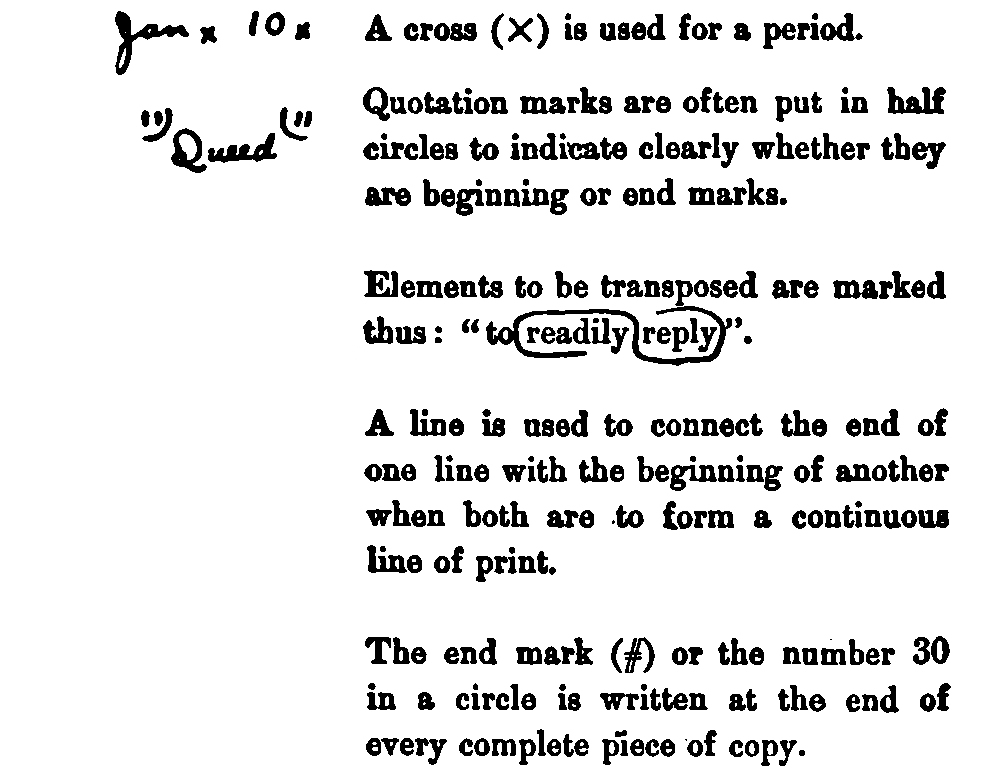
The image above is the continuation from the previous page
of marks used in copy reading. Five more marks are shown or described here.
| A cross (X) is used for a period.
| Quotation marks are often put in half
circles to indicate clearly whether they
are beginning or end marks.
| Elements to be transposed are marked thus:
| The example shows a line starting underneath the first element then
continuing to the left then up around its top then down between
it and the second element, continuing under then around the end
of the second element to end on the top of the second element.
| A line is used to connect the end of one line with the beginning of another
when both are to form a continuous line of print.
| The end mark which is the hash symbol (#), or the number 30 in a circle, is
written at the end of every complete piece of copy. |
The application of these marks and the catch-lines
in the editing of copy are shown by the following typical
pages:
The two images above show the typewritten copy
of a short news item which has been edited by a copy reader who has
applied these marks to indicate to the compositor how the matter is to
be set in type.
SUGGESTIONS
- Familiarize yourself thoroughly with all details of the
typographical style of your paper.
- Read every word of copy carefully.
- Work as rapidly as is consistent with accuracy; don’t
putter over corrections.
- Make all corrections and changes so clear that the compositor
can not misunderstand them.
- Revise and rearrange whenever possible instead of rewriting.
- Cut out all needless words and phrases.
- Don’t think that your own way of expressing an idea is
the only good way.
- Scrutinize carefully all participles, pronouns, conjunctions,
correlatives, and “only’s.”
- Watch for the omission of the apostrophe in possessives
and contractions.
- See that all quoted matter is properly enclosed in
“quotes.”
- Be sure to put single “quotes” on quotations within
quotations.
- Verify names, initials, addresses, dates, and facts generally.
- Be on the lookout for libelous matter.
- Give every story a distinctive guide line.
- Don’t confuse “add’s” and “follow’s” in marking copy.
- Keep a record of all copy read with size of head, length
of story, author, and time.
- Draw a line around all directions intended for the compositors.
- Consult your superior when in doubt about the propriety
of anything in copy.
PRACTICE WORK
Point out all changes that should be made in editing the
following piece of copy and show how each change should
be indicated:
Washington, D. C. August 21—
According to a statement issued
here to day by the treasury department the first deposits of the
Governments fifty million dollar fund to aid crop movements will be
made in the Southern States in Aug. and Sept. All deposits in
all states, declares William B. MacAdoo, secretary of the Treasury
and who orginated the plan of assisting banks of the South
and West, will be made in 2 equal allottments. He outlined the
Treasury Department’s requirements for security in to-days
statement
While all deposits may be recalled without notice the treasury
expects to recall 25 per centum Dec. 15th, another 25 per centum
on Jan. 15th, another February 15 and the final portion on March
1. The banks will pay two per cent. interest and all expenses
Secretary McAdoo’s statement says the government expect by
making the deposits in National Banks in principle cities the funds
will be used in good faith for releiving stringancy and not to
speculate with and that it will be distributed to smaller banks at
moderate and reasonable interest. Deposits only will be placed
with banks who have forty per cent of their circulation of banknotes
out standing.
10 per cent of the security must be in Government Bonds and the
remaining 90 per cent. may be high class state, municipal and
other bonds at 75 per cent of their market value and approved by
the secretary. Prime commercial or business paper will be excepted
at 65 per cent. of their face value when indorsed by the
bank, approved by the Secretary and unanimously approved by
a “securities committee” of 6 members in the clearing house district
in which it comes. The secretary of the treasury will name
one member of each comittee. Commercial paper the statement
point out must represent legitinate commercial transactions preferably
endorsed with two names and the borrowing bank but
single name paper will be accepted in the judgement of the
Treasury.
Any of the banks may return the deposits at any time before
Mar. 1.
The Secretary’s statement of to day outlined many details which
are chiefly of interest to bankers concerned.
CHAPTER XI
THE WRITING OF HEADLINES
The Function of the Headline. Headlines as
developed by the American press during the last half-century
have come to be, next to the news itself, the
most important part of our newspapers. From mere
labels to indicate the kind of reading matter to be found
in the columns under them, headlines in this country
have developed into bulletins giving the substance of
the articles to which they are attached. By presenting
conspicuously in large type the important facts of the
story which it precedes, the headline serves a double
purpose: it makes possible rapid reading of the news
thus outlined in the head, and it becomes an advertisement
of the news to attract the purchaser.
Heads Promote Rapid Reading. As concise summaries
of the facts of the news, headlines fill an important
place in contemporary American life, for, by
reading only the headlines, the busy man or woman
can get in brief outline the news of the whole world.
The size of the type and the arrangement of the parts
of the headline aid in a marked degree this rapid reading.
Well-written heads that give clearly and accurately
the information of greatest significance in the stories
under them are an integral part of the newspaper, the
function of which, as has been said, is to give the readers
in a clear and interesting form the news of the day.
How Heads Advertise News. By their form and
position, likewise, the headlines act as advertisements
for what the paper contains. Like all good advertisements,
headlines should create interest and lead to the
sale of the paper. By arousing the reader’s curiosity
and at the same time partially satisfying it, the head,
when skillfully written, attracts the reader’s attention
and influences him to read the story.
A newspaper that aims to have large street sales will
naturally take advantage of the advertising element in
the heads, by making them as attractive as possible. In
fact, the efforts of some newspapers of this class to
make the most powerful appeal possible, have led to
extreme forms of headlines with great black type and
with varicolored effects. In general, morning papers
and evening papers with regular subscribers are less
inclined to employ large heads for advertising their
news than are those evening papers with several street
editions that seek to have large sales. Large heads extending
across several columns and printed in green,
red, or black ink set forth the latest phases of the news
in a manner well calculated to catch the eye as the paper
is displayed on the news stand or in the hands of the
newsboy. As in advertising in general there is always
a temptation to make alluring statements at the expense
of truth, so in headline advertisement there is a tendency
to exaggerate and magnify in order to catch the
unwary reader.
Large Heads and “Yellow Journalism.” Since
the more sensational papers have taken advantage of
this advertising element and have yielded at times to
the temptation to exaggerate or even to misrepresent,
as is not unheard of in advertising generally, large display
effects in headlines have come to be associated in
the popular mind with so-called “yellow journalism.”
The connection between the two is by no means inevitable,
however, for large headlines need not be any
more sensational or inaccurate than smaller ones, and
may legitimately be used to attract attention to the
real features of the news. Conservative papers that do
not depend to any considerable extent on street sales
tend to keep up the smaller headlines long used in
American newspapers, which, while giving the substance
of the news in outline, do not attempt to advertise
prominently the contents.
Clearness and Conciseness. Regarded as a bulletin
of the most important facts in the news, the headline
should present these facts in a clear and concise
manner. To be clear the form should be one that can
be taken in by the eye at a glance. The relation of the
divisions, or “decks,” of the head should be evident, so
that the reader may get a clear idea of the bearing of
one statement on another. The statements should be
concrete and specific. The limitations of space make
it necessary for the headline to be concise so that
the maximum number of important facts may be included.
Action in Headlines. As news is largely concerned
with activities, headlines should express the action related
in the news story. In defining oratory Demosthenes
said that the three essential elements are: first,
“action”; second, “action”; and third, “action.” The
same characteristics may well be ascribed to the most
effective headlines. Life and vividness of expression
give interest to heads as they do to the news story.
Freshness and originality of phrasing are also successful
provided the uncommon form is clear. Short, crisp,
specific words constituting definite statements that can
be readily grasped in rapid reading, generally make the
best headlines.
Headlines are Impartial. Headlines, like the news
stories of which they are summaries, should be impartial.
It is possible to “color” headlines so that they
give a false impression of the news in the stories to
which they are attached. The reader tends to carry
over into the news story the impression which he gets
from the headline, and a “colored” head, therefore,
tends to “color” even an impartial, accurate news
story. Headlines likewise should not comment on the
news; comments on the news should be made in the
editorial columns.
Divisions of Headlines. The headline is composed
of one or more divisions called “lines,” “decks,” or
“banks.” These divisions are separated by dashes and
are frequently different in form and in size of type. In
the following head, each deck has a distinct form and
size of type.
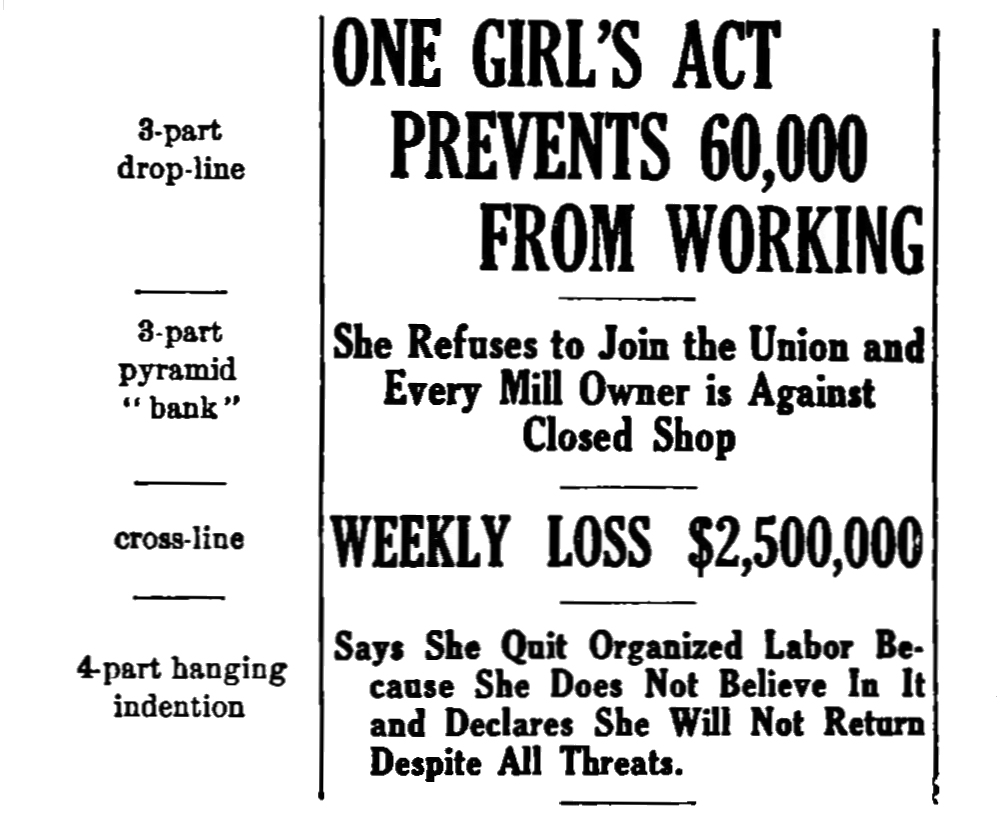
In the image above, the top deck is labelled
| 3-part drop-line |. It shows three lines of upper-case text in a large
font. Each line is of about equal length and are shorter than the
width of the column. The start of each line is shifted further to the
right. This creates a staircase effect on the right-hand side of the
head.
The first line reads | ONE GIRL’S ACT | and its
beginning is pushed up against the left-hand column rule. The middle
line says | PREVENTS 60,000 | and is centered between the column rules.
The third line says | FROM WORKING | and its end is pushed up against
the righ-hand column rule. Together the three lines of the head says | ONE
GIRL’S ACT PREVENTS 60,000 FROM WORKING |.
The next deck in the image is labelled | 3-part
pyramid “bank” |. It is a three line head, each line graduated in
length to produce an inverted pyramid effect. These three lines of
mixed-case text are in a font that is smaller than that used in the
deck above. The first line of the bank says | She Refuses to Join
the Union and |. This line takes up the full width of the column. The
second line is shorter than the first and is centered between the
column rules. It says | Every Mill Owner is Against |. The third line
of the inverted pyramid is shorter again than the previous two lines
and is also centered between the column rules. It says | Closed Shop |.
Together the three-line head says | She Refuses to Join the Union and
Every Mill Owner is Against Closed Shop |.
The third deck in the image is labelled
| cross-line |. Its form is a single line of upper-case text. In this
instance the line of text spans the full width of the column. It is
displayed in a font whose size is midway between the font used in the
first deck and that used in the second deck. The line says | WEEKLY
LOSS $2,500,000 |.
The fourth and final deck in the image is labelled
| 4-part hanging indention |. By that it means there are four lines of
text with a hanging indent. That is, the first line of the headline
spans the full width of the column while the next three lines are
indented by the width of two characters from the left-hand column rule.
This deck is in mixed-case whose font size is smaller than that used in
the other three decks. Together the four parts of the head says | Says She Quit
Organized Labor Because She Does Not Believe In It and Declares She
Will Not Return Despite All Threats. |
Headlines are constructed on the basis of the four
forms that appear in the above example, which may be
called respectively, (1) the drop-line; (2) the pyramid;
(3) the cross-line; and (4) the hanging indention.
Graphically these forms may be represented
thus:
The graphical representation shown in the diagram
above is a simpler representation of the previous example. It replaces the
lines of headline text with thick lines to more clearly demonstrate
the structure of each of the forms. The four forms shown in the image
are labelled | (1) Drop-line |, | (2) Pyramid |, | (3) Cross-line | and | (4)
Hanging indention |.
Drop-Line Heads. The drop-line head may consist
of two, three, or four parts arranged as in the following
three heads:
The image above is example | (1) |. It shows a
drop-line head in two parts. The first line or part of the head says
| MOVING PICTURE MEN |, the second says | START WAR ON TRUST |. Together
the two parts of this drop-line head says | MOVING PICTURE MEN START
WAR ON TRUST |.
The image above exhibits the remaining two examples
of drop-line heads. Example | (2) | shows a drop-line head in three
parts. The first part or line of the head says | LOWELL MEN WANT |, the
second says | CANAL TO CONNECT | and the third says | CITY WITH BOSTON |.
Together the three parts of this drop-line head says | LOWELL MEN WANT
CANAL TO CONNECT CITY WITH BOSTON |.
Example | (3) | shows a drop-line head in four parts.
The first part or line of the head says | SEVEN CHILDREN |, the second
says | SAVED AS HOME |, the third says | AND BIG FACTORY | and the fourth
says | IN EVERETT BURN |. Together the four parts of this drop-line head
says | SEVEN CHILDREN SAVED AS HOME AND BIG FACTORY IN EVERETT BURN |.
Cross-Line Heads. The cross-line head consists of
but one line which may or may not fill the whole space
between the column rules. In the following examples,
the first head fills the line, and the second only part of
the line.
The image above contains two examples of cross-line
heads. Example | (1) | says | POSTAL BANK BILL PASSES |. It spans the
full width between the column rules.
Example | (2) | says | SEES PERIL IN TARIFF |. It
is shorter than the line in the example above so is centered between
the column rules.
Pyramid Banks. The pyramid head may consist
of two, three, or four parts, graduated in length to
produce the inverted pyramid effect. The following
“bank” illustrates the pyramid of three parts:
The image above displays a pyramid bank of three
parts. The first line reads | Promoters of International Av- | and
fills the whole space between the column rules. The last word on the
line, which would be | Aviation |, is divided with a hyphen so the rest
of the word starts the next line of the pyramid bank. That next line
reads | iation Tournament Decide |. This line is shorter than the one
above and is centered between the column rules. The third and final
line of the pyramid bank reads | to Use Race Track. | and is shorter still.
Like the line above, it is centered between the column rules.
Together the three lines of the pyramid bank says | Promoters of
International Aviation Tournament Decide to Use Race Track. |
Hanging Indention. The hanging indention head
consists of several parts, the first of which begins at the
column rule on the left, while all the others are indented
the width of one or two letters.

The image above is an example of a hanging
indention head in four parts. It is in mixed-case as is normal for this
type of head. The first line fills the whole space between the column
rules. The second, third and fourth lines of the head are indented two
characters from the left-hand column rule but each of those line fills
the rest of the column width except for the last line which is shorter
and ends with a full stop.
The first line reads | Immense Wealth is Stored Up |.
The second line reads | in Vaults of Country’s Repos- |, the last word
of which should be | Repository |, but it is divided with a hyphen
so the rest of the word starts the next line of the head. That next
line reads | itories for Coin, Bullion, and |. The last line of the
head reads | Other Precious Metals. | Together the four lines of the
hanging indention head says | Immense Wealth is Stored Up in Vaults of
Country’s Repositories for Coin, Bullion, and Other Precious Metals. |
The drop-line, cross-line, or pyramid may be used in
any deck, whereas the hanging indention head is used
only for a deck other than the first.
Combinations of Forms. Various combinations of
these four forms may be used to give the variety required
for all kinds of stories. For large heads a combination
of a two part drop-line, a three part pyramid, a cross-line
or another drop-line, and a second pyramid, constitutes
a frequent form, as is seen in the following example:
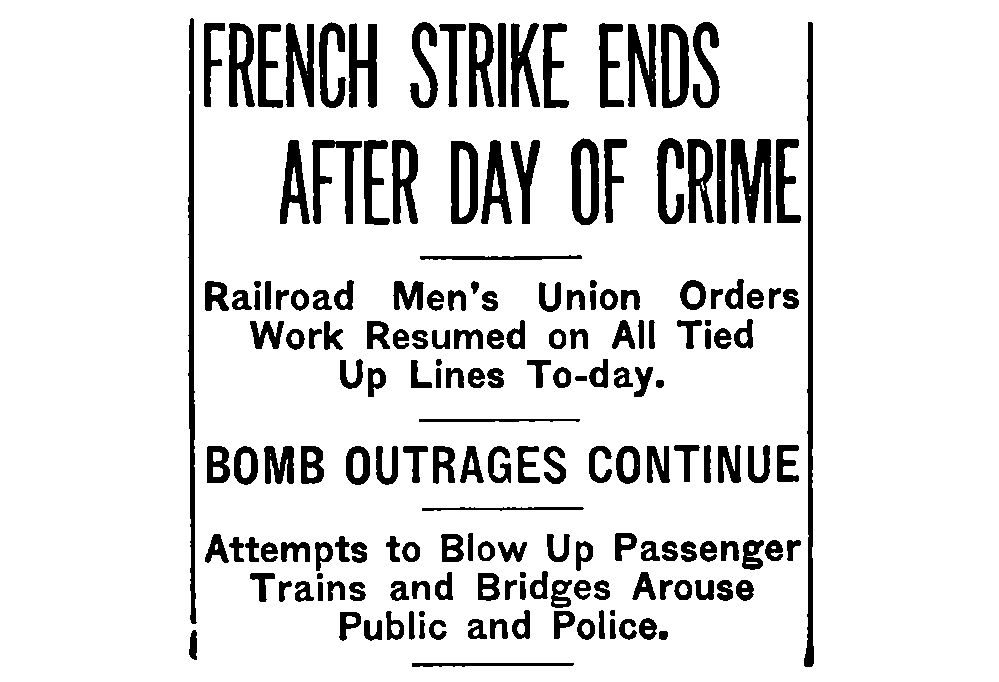
The image above contains a head made up of a
four-deck combination of forms, each deck separated from the one below
with a short horizontal rule.
The first deck is a drop-line head in two parts.
Each line is upper-case and displayed in a thin but large font. The
first line reads | FRENCH STRIKE ENDS | and the second | AFTER DAY OF
CRIME |.
The second deck is a pyramid bank of three parts.
It is in mixed-case and displayed in a smaller font size. The parts
say | Railroad Men’s Union Orders | Work Resumed on All Tied | Up
Lines To-day. | Together the three parts of the head reads as | Railroad
Men’s Union Orders Work Resumed on All Tied Up Lines To-day. |
The third deck is a cross-line head in upper-case
and displayed in a font slightly larger than the one used in the
preceding deck. The line reads | BOMB OUTRAGES CONTINUE |.
The fourth and final deck of this large headline is
another pyramid head in three parts. It is in the same case and font
size as the second deck which was also a pyramid. The parts of this
head say | Attempts to Blow Up Passenger | Trains and Bridges Arouse |
Public and Police. | Together the three parts of the head says
| Attempts to Blow Up Passenger Trains and Bridges Arouse Public and
Police. |
A large three part drop-line head may be followed
by a hanging indention line and by a cross-line, as in
the following case:
The image above contains three decks separated by
short horizontal rules.
The first deck is a large drop-line head in three
parts. It is all upper-case displayed in a medium-weighted font. The parts of
this head say | TREASURY CHANGE | CAUSES A RECOUNT | OF NATION’S
FUNDS |. Together the three parts says | TREASURY CHANGE CAUSES A RECOUNT
OF NATION’S FUNDS |.
The middle deck is a hanging indention head in four
parts. It is displayed as mixed-case in a smaller and thinner font. The
parts of the head say | Amazing Wealth is Stored Up | in the Vaults
of Country’s | Repositories for Coin and | Bullion. | Together the
four parts says | Amazing Wealth is Stored Up in the Vaults of Country’s
Repositories for Coin and Bullion. |
The third deck is an upper-case cross-line head in
a font of medium weight and size which says | WEIGHING MONEY BAGS |.
For smaller heads there are several sizes of two part
drop-heads, or of cross-lines combined with pyramids
or hanging indentions of two or three parts; for example:

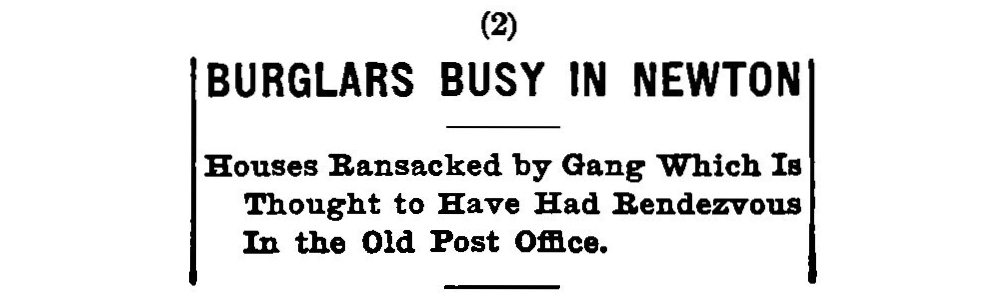
The image above contains two examples of smaller
heads. Example | (1) | is constructed of two decks separated by a short
horizontal rule. The first deck is a cross-line head in upper-case. It
is displayed in a small font, probably of a similar size to that used
for column text that would follow. It reads | COLLEGE BOYS TURN WAITERS
|.
The second deck of this example is a pyramid head
of two parts. It is mixed-case displayed in an even smaller font than
that used in the deck above. Its two parts say | Break Strike in
Evanston Restaurant | When Girls Walk Out. | Together the lines of the
two decks in the example says | COLLEGE BOYS TURN WAITERS Break Strike
in Evanston Restaurant When Girls Walk Out. |
Example | (2) | is again constructed of two
decks, each separated by a short horizontal rule. The first deck is a
cross-line head in upper-case and displayed in a font slightly larger
than that used in the example above. It reads | BURGLARS BUSY IN NEWTON
|.
The second deck is a hanging indention head of
three parts displayed as mixed case in a slightly smaller font. The
three parts of the head say | Houses Ransacked by Gang Which Is |
Thought to Have Had Rendezvous | In the Old Post Office. | Together the
lines of the two decks says | BURGLARS BUSY IN NEWTON | Houses Ransacked
by Gang Which Is Thought to Have Had Rendezvous In the Old Post Office. |
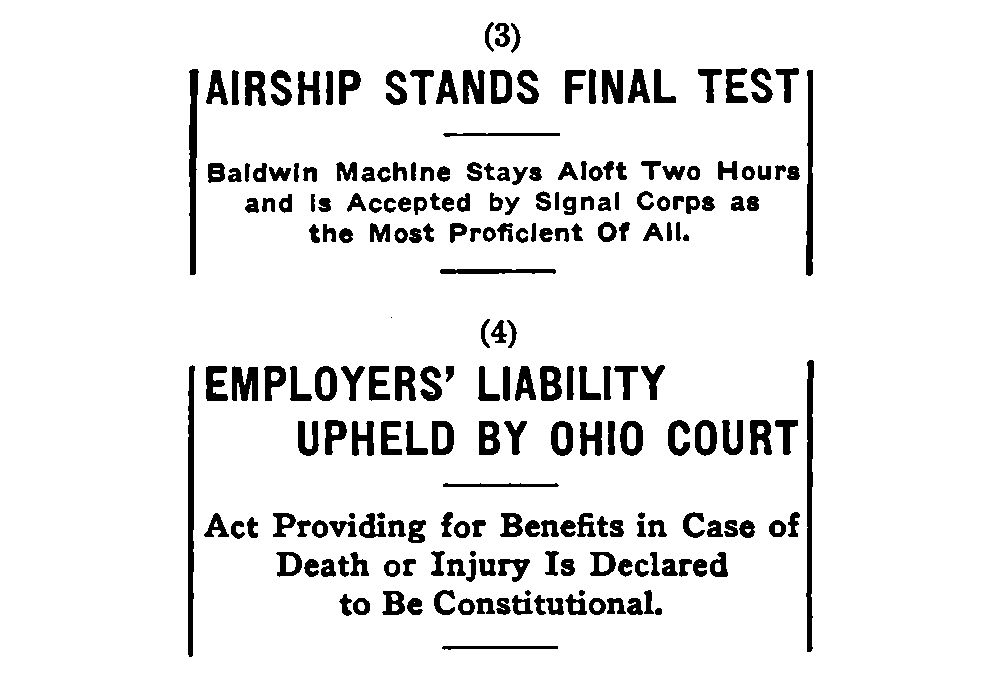
The image above contains two more examples of
smaller heads. The first example is labelled | (3) | and is constructed
of two decks separated by a short horizontal rule. The first deck is a
cross-line head in upper-case and displayed in a small font about the
size of capital letters in the column text that would follow. It says
| AIRSHIP STANDS FINAL TEST |.
The second deck is a pyramid head of three parts.
It is in mixed-case displayed in a smaller font than that used in the
deck above. Its three parts say | Baldwin Machine Stays Aloft Two
Hours | and is Accepted by Signal Corps as | the Most Proficient Of
All. | Together the lines of the two decks says | AIRSHIP STANDS FINAL
TEST | Baldwin Machine Stays Aloft Two Hours and is Accepted by Signal
Corps as the Most Proficient Of All.”
The second example in the image is labelled | (4) |
and again is constructed of two decks, each separated by a short
horizontal rule. The first deck is a drop-line head in upper-case and
displayed in a font about the same size as that used in the example
above. Its two lines say | EMPLOYERS’ LIABILITY | UPHELD BY OHIO
COURT |.
The second deck is a pyramid head of three parts.
It is in mixed-case displayed in a smaller font than that used in
the deck above it. The three lines of the head say | Act Providing
for Benefits in Case of | Death or Injury Is Declared | to Be
Constitutional. | Together the lines of the two decks says
| EMPLOYERS’ LIABILITY UPHELD BY OHIO COURT | Act Providing for Benefits
in Case of Death or Injury Is Declared to Be Constitutional. |
Practically every symmetrical arrangement of the
four forms of heads can be found in various newspapers,
but the principles underlying the writing of any
of the combinations are the same.
Type Limits of Heads. The typographical limitations
are the most important considerations governing
the writing of headlines. These limitations are determined
by the size of type and the form of each deck of
the head. The possible variation in the parts of the first
deck is not more than a letter or two from the normal
form. So small is the variation possible within the
column width that the size of the letters used has to be
considered. Thus the letters “M” and “W” are one
and one-half times the size of all the other letters except
“I,” which is only one-half as large as the others.
In the counting of unit letters in a headline, the writer
must consider “M” and “W” as one and one-half
units each, and the letter “I” and the figure “1” as
half a unit each. Each space between words is counted
as one unit. Since the form and symmetry of a head are
marred or entirely destroyed by having too few or too
many units in any part, great skill is necessary in the
choice and the arrangement of words to secure as nearly
as possible the exact number of units required for a
perfect head.
The effect produced by having too many units is
shown in the following heads for which 18 units is the
normal number in each half of the two-line drop
head.
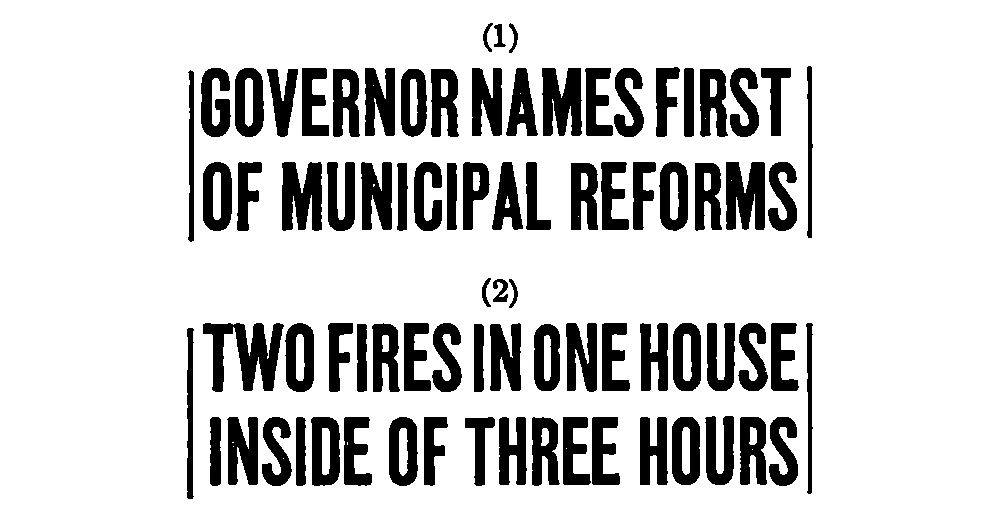
The image above contains two examples of heads with
too many units on a line. The effect that creates is made worse because
the spacing between words has been reduced in order to fit all the
words to a line.
Example | (1) | is constructed of a single deck
with a drop-line head of two parts, each line spanning the full width
between column rules. The first line consists of 20 units and says |
GOVERNOR NAMES FIRST |. The second line also consists of 20 units and
says | OF MUNICIPAL REFORMS |. Together the two parts of the drop-line
head says | GOVERNOR NAMES FIRST OF MUNICIPAL REFORMS |.
Example | (2) | is also constructed of a single
deck with a drop-line head of two parts, each line spanning the full
width between column rules. The first line consists of 21½ units and
says | TWO FIRES IN ONE HOUSE |. The second line consists of 20 units
and says | INSIDE OF THREE HOURS |. Together the two parts of the
drop-line head says | TWO FIRES IN ONE HOUSE INSIDE OF THREE HOURS |.
When the number of units is less than that required
for the best effect, the headline is not so unsatisfactory
as when too many units are crowded into it, because the
short line is more legible than the long one. In each of
the following heads the first half contains only 15 units
instead of 18, and as a result there is too much space
at the end of each of these halves. Both, however, are
much more easily read than the crowded ones given
above.
The image above contains the example labelled | (1) |.
It is constructed of a single deck with a drop-line head of two parts
with slightly expanded inter-word spacing. Both parts are in upper-case
text. The first line is of 15 units and says | STATE SECRETARY |. The
second line is of 15½ units and says | ON TRIP TO COAST |. The whole
drop-line head says | STATE SECRETARY ON TRIP TO COAST |.
The image above contains the example labelled
| (2) |. It is also constructed of a single deck with a drop-line head of
two parts with slightly expanded inter-word spacing. Both parts are in
upper-case text. The first line is of 15 units and says | WEISS REASSURES |.
The second line is of 14 units and says | BUSINESS WORLD |. The whole drop-line
head says | WEISS REASSURES BUSINESS WORLD |.
That much better results are produced by having
each half contain more nearly the required number of
units is shown by comparing the next two heads with
those preceding.
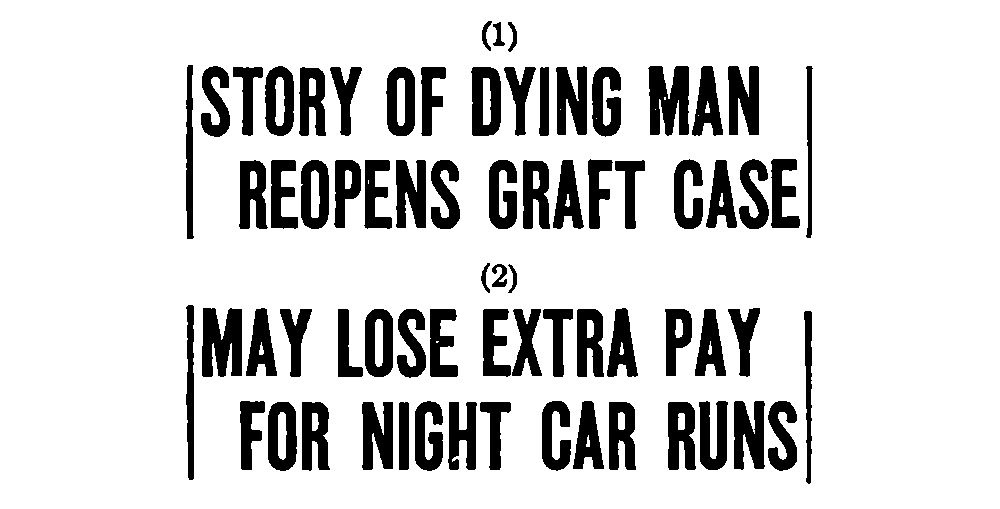
The image above contains two examples. The first
one is labelled | (1) | and is again constructed of a drop-line head in
two parts but now there is less space between the end of the first line
and the right-hand column rule and before the start of the second line
and the left-hand column rule. The first line is of 18 units and says
| STORY OF DYING MAN |. The second line is also of 18 units and says |
REOPENS GRAFT CASE |. The whole drop-line head says | STORY
OF DYING MAN REOPENS GRAFT CASE |.
The second example is labelled | (2) |. It is
also constructed of a drop-line head in two parts. Like the example
above there is less space between the end of the first line and the
right-hand column rule and before the start of the second line and the
left-hand column rule. The first line is of 18½ units and says | MAY
LOSE EXTRA PAY |. The second line is of 17½ units and says | FOR NIGHT
CAR RUNS |. The whole drop-line head says | MAY LOSE EXTRA PAY FOR
NIGHT CAR RUNS |.
In headline writing a number of points must be
borne in mind. It should be remembered, however,
that these are not hard and fast rules but general principles
based on newspaper practice.
Why the Head is Based on the “Lead.” As in
the normal type of news story all the important facts
are given in the lead, the headline, as the bulletin of
these facts, is based largely, if not entirely, on the material
in the lead. One reason for giving all the essential
details in the lead, as has already been pointed out,
is that the story may be cut down before or after it is
in type. This possibility that the story may be cut down
is an additional reason why the headline should be
based on the first part of the story, for if the headline
contains only the substance of the lead, it need not be
rewritten when any part of the story is cut off.
The Tone of the Head. To adapt the character of
the headline to the tone of the story is important for
the best effect of both. The head should prepare the
reader for what is to follow. A humorous or witty headline
is well adapted for a story written in a light vein
but usually is out of keeping with a plain news story.
A suggestion of pathos even may be given in the headline
when the story warrants it. Efforts to be funny or
tearful, however, ought always to be carefully considered
and should not be made unless the circumstances
justify them.
Avoiding Repetition. It has come to be a generally
recognized point that there should be a minimum
amount of repetition of words throughout the
head. The same word should not be used more than
once either in the same deck or in different decks unless
the lack of synonyms makes it absolutely necessary, or
unless emphasis is gained by so doing. This, of course,
applies in only a limited degree to the necessary connective
words, such as conjunctions and prepositions,
and parts of the verb “to be.” The writer of heads
should have at his command a number of synonymous
words and expressions, so that, when he must refer to
the same person, object, or action a second or third
time, he may be able to vary the expression.
The Interrelation of the Decks. If the grammatical
subject remains the same in statements made in two
or more decks, it need not be repeated, as it will be understood
with the verbs in the following deck or decks.
In the head given below, the subject of the verb
“stricken” in the first deck, serves as the subject of the
verbs “found” in the second deck, “is” in the third,
and “will be taken” in the fourth.
The image above is a headline constructed of four
decks of various forms which say | GUARD STRICKEN ON PRISON WALL |
Found in His Sentry Box at the Penitentiary Helpless From Paralysis |
IS A CIVIL WAR VETERAN | Will be Taken to His Meigs County Home Unless
He Grows Worse. |
Since the subject, when suppressed in any deck, is
understood to be the same as that in the deck just preceding,
care must be taken to have the verb agree with
it grammatically. There is a not unnatural tendency,
for example, to use in one deck a singular verb with a
collective noun like “common council,” or “faculty” (of
a college), and then, changing the idea to the members
of these bodies, to use in the next deck a plural verb
with the subject suppressed. Thus, in the following
head, “tariff board” should not be made the subject of
“reports” and “declare.”
The image above is a head constructed of two decks.
They say | TARIFF BOARD REPORTS ON ALL WOOL SCHEDULES | Declare That
Many of the Rates are Too High.
Failure to remember that a verb without a subject is
assumed to have the same subject as the statement in
the deck immediately preceding, not that in any other
of the preceding decks, also leads to confusion. The
following head, for example, is poor because it is not
clear that “president” is the subject of “gives,” since
“governor” is the subject of the statement in the preceding
deck; nor is it evident that “troops” of the first
deck is the subject of “to camp” in the fourth.
The image above is a head constructed of four
decks of various forms. They say | PRESIDENT ORDERS TROOPS TO REMAIN |
Governor Undecided About Calling Special Legislative Session | GIVES
TWELVE DAYS OF GRACE | To Camp Here Three Weeks While State Decides Its
Course. |
The subject is sometimes incorrectly suppressed in
one deck when there is no subject in the preceding
deck that can be understood for that verb; for example,
in the following head there is no word in the first deck
that can be taken for the subject of “was” in the second.
The image above is a head constructed of two decks.
They say | ARREST REVEALS DOUBLE LIFE | Was Both Traveling Man and
Burglar at Same Time, Say Police. |
Often it is necessary to repeat in other decks with
additional details or in more definite form the statement
made in the first deck; for example:
The image above is a head constructed of two decks.
They say | TO TIE UP WHOLE OHIO LINE | Shopmen on Strike Threaten
to Prevent Running of All Trains. |
When such repetition is necessary for greater clearness,
there is no objection to it, but to make several
decks merely repetition in other words of the first is a
not uncommon fault that should be avoided. If, for
example, the foregoing head had been expanded into
four decks by mere repetition, the result might have been
the following head, in which but one fact is presented.
The image above is a head constructed of four decks.
They say | TO TIE UP WHOLE OHIO LINE | Shopmen On Strike Threaten to
Prevent Running of All Trains | TRAFFIC TO BE AT A STANDSTILL |
Strikers Say That No Freight or Passenger Service Will Be Possible
Over the Road Affected. |
Most newspapers prefer to have the statement in each
deck grammatically independent of that in the preceding
deck; that is, they avoid extending a statement
through two decks. How such a continuous statement
is sometimes made, however, is shown in the following
head from the New York Sun:
The image above is constructed of two decks. The
first deck is a cross-line head in upper case which says | MORSE SAYS
IT WASN’T FAIR |. The second deck is a pyramid head in two parts. The first
line begins with the preposition | TO |. The head says | TO PUT HIS STORY IN
THE HANDS OF GOVERNMENT AGENTS |. The full headline says | MORSE SAYS
IT WASN’T FAIR TO PUT HIS STORY IN THE HANDS OF GOVERNMENT AGENTS |.
One peculiar form of headline, some of the best examples
of which are found in the Cincinnati Enquirer,
depends for its effect upon this continuation of a statement
through several decks. Only one word is used for
the first deck of large heads of this type, and only one
or two in the first deck of smaller heads, as is seen in
the following examples:
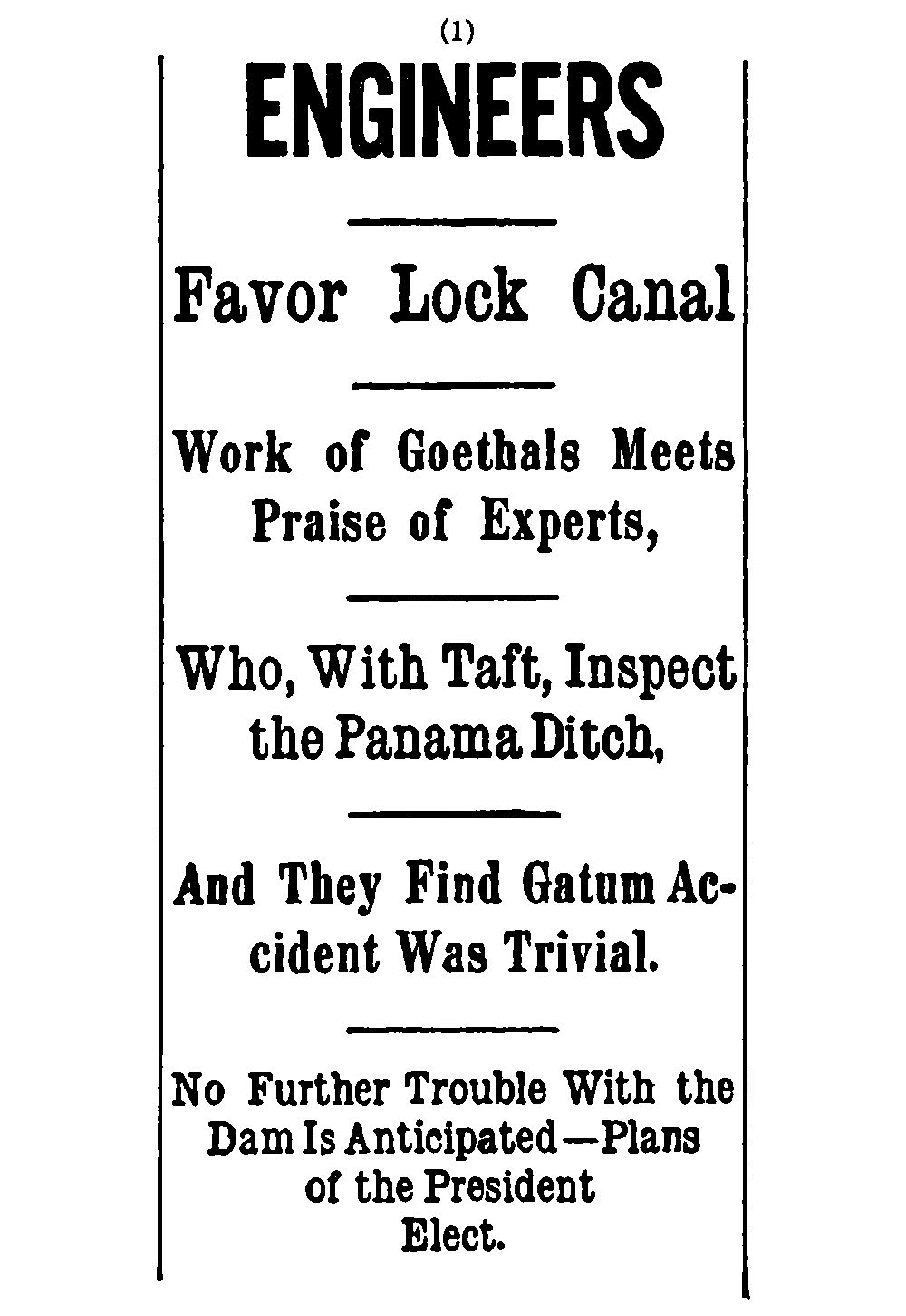
The image above is example | (1) | of
this peculiar form of headline. It is a head with six decks. The first
deck is cross-line form with the centered word | ENGINEERS | in a
large, heavy-weighted, font.
The second deck is also cross-line but is
mixed-case in a slightly smaller font of medium weight. It spans
the full width of the column and says | Favor Lock Canal |.
The remaining four decks are all pyramid form
in mixed-case and displayed in a font of similar size. They say
| Work of Goethals Meets Praise of Experts, | Who, With
Taft, Inspect the Panama Ditch, | And They Find Gatum Accident Was
Trivial. | No Further Trouble With the Dam Is Anticipated—Plans of the
President Elect. |
The complete headline reads | ENGINEERS Favor Lock
Canal | Work of Goethals Meets Praise of Experts, Who, With Taft,
Inspect the Panama Ditch, And They Find Gatum Accident Was Trivial. |
No Further Trouble With the Dam Is Anticipated—Plans of the President
Elect. |
It should be noted that the final pyramid deck is
in four parts and is constructed so that the last line of the pyramid
is the single word | Elect. | Visually, this means you have the first
and last lines of this six-deck head centered between the column rules.
All other lines between these are either centered or are the full width
of the column so the overall appearance has a symmetry.
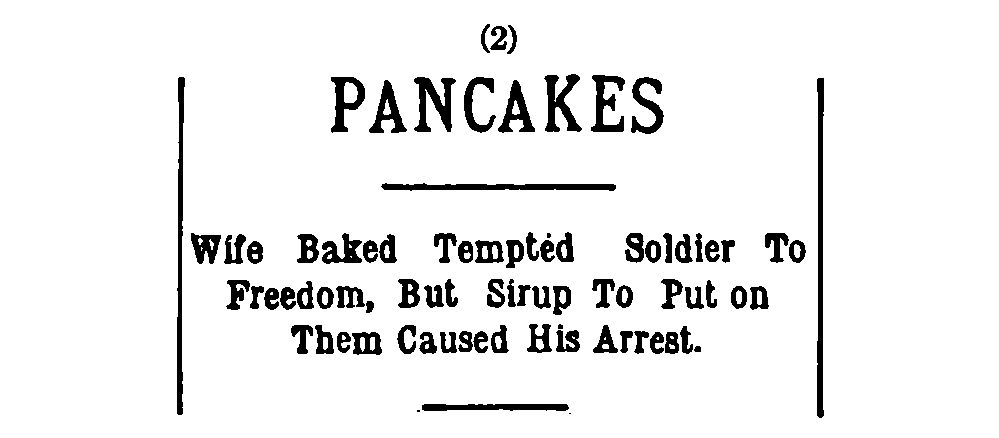
The image above is example | (2) | of a headline
that depends for its effect upon the continuation of a statement
through several decks. This one has just two decks. The first deck is
cross-line form with the single, centered, upper-case word | PANCAKES |
in a largish, thin, font.
The second deck is pyramid form in mixed-case and
a smaller font and says | Wife Baked Tempted Soldier To Freedom, But
Sirup To Put on Them Caused His Arrest. |
The full headlines says | PANCAKES Wife Baked
Tempted Soldier To Freedom, But Sirup To Put on Them Caused His Arrest. |
Style in Heads. Rhyme and alliteration may be
used to advantage on rare occasions, but generally this
similarity of sound produces a jingling result that is
not pleasing. Originality and novelty can be given by
choice and combination of words much more effectively
than by the artificial means of similar sounds.
To make headlines as concise as possible the articles
“a,” “an,” and “the” are omitted, and auxiliary verbs
not absolutely necessary are suppressed. When articles
and auxiliaries are convenient to fill out the line to the
required number of units, they may be retained, but
should not be used at the beginning of a deck.
To give freshness and vividness to the head, the verb
is usually put in the present tense even though the
action is in the past; for example, “Roosevelt Speaks
in Cleveland.” Future action is expressed by the infinitive
or by the regular future form with “will”; for
example, “Roosevelt to Speak in Cleveland,” or
“Roosevelt Will Speak in Cleveland.”
The active voice of the verb is preferred to the passive
because the active is more vivid and more concise.
“Cornell Wins Intercollegiate Regatta,” is better than
“Intercollegiate Regatta Won by Cornell.” When,
however, the passive is required to give the more significant
part of the statement prominence in the first
part of the top deck it should be used in preference to
the active. In the following head the important point is
that the post office has been robbed, rather than the
fact that it was robbed by tramps.
The image above is a drop-line head of two parts
that says | POST OFFICE ROBBED | BY BAND OF TRAMPS |.
This head would be less effective with the active verb,
since the robbery of the post office would then go into
the second part of the deck, thus:
The image above is a drop-line head of two parts
that says | BAND OF TRAMPS ROB | POST OFFICE SAFE |.
News value rather than rules must determine in any
case whether the active or passive voice is desirable.
The use of abbreviations, likewise, cannot be fixed by
rule. In general, only commonly used abbreviations,
like “Dr.,” “Prof.,” “Mrs.,” “Mr.,” “St.,” “Co.,”
are to be found in headlines. In particular cases, however,
others are employed because they are convenient
and clear. In Boston, for example, “Tech” as an abbreviation
for “Massachusetts Institute of Technology,”
is common, and the Boston Herald, therefore, used it
to advantage in the head:
The image above is of a single drop-line head that says
| 200 TECH MEN SEE YULE LOG BLAZE |.
During a long campaign for “immediate municipal
ownership” in Chicago, the newspapers of that city
used almost daily the abbreviation “I.M.O.” So “L”
for “elevated railroad” is perfectly clear to readers in
New York, Boston, and Chicago. The names of states
are not usually abbreviated, although “U.S.” is frequent.
Abbreviations like “auto,” “taxi,” and “phone”
are so general that they are used without question in
headlines.
Colloquial contractions like “can’t,” “we’re,” etc.,
although not common, may give the life and naturalness
often well suited to a story, as for example in the
following head:
The image above is a head constructed from two
decks. The first is a cross-line head that says | ROCKEFELLER, HE’D
HELP HER |. The second deck is a pyramid form that says | So Mary
Mayogian, Who is 12, Came Here to See Him. |
In the first deck short words are preferred, because
in rapid reading they are more easily grasped than long
ones, and because two or three words in each part of
the line make a better looking, more symmetrical head.
To meet the need for short equivalents for long words
that are generally accepted terms, new words have been
coined and new functions given to old ones. For the
long noun “investigation” and the verb “to investigate,”
the words “probe” and “quiz” are favorites
with the headline writer, and are often used to excess.
Long words like “criticize,” “censure,” “rebuke” give
way to shorter ones like “hit,” “rap,” and “score.”
The concise but inelegant “nab” is a headline substitute
for “arrest.” The verb “peril,” rarely used elsewhere,
appears in heads as an equivalent for “imperil”
or “endanger,” as in “Shipwreck Perils Many.” The
verb “wed” is a convenient short form for “marry.”
Words condemned by good usage, such as “to suicide”
and “to kill self,” have found a place in the headlines of
some newspapers because of their clearness and brevity.
Slang, likewise, on account of its conciseness, novelty,
and colloquial character, is not infrequently found
in heads, although some newspapers have a rule against
its use. If the slang word or phrase is put in quotation
marks, it is considered by some newspapers as less objectionable.
All that may be said for or against slang
in newspapers as a whole, applies with equal force to
its use in heads. If the question of good taste is involved
in the use of a slang word, the safe course is to
avoid it.
Some newspapers have a rule that numerical figures
should be put into headlines only when they are absolutely
necessary, an injunction that implies a very limited
use of them, whereas the general practice clearly
is to employ figures when they are the most effective
means of conveying the important facts. The advantage
of figures is seen in the following heads taken from
representative newspapers:
The image above has three examples of heads that
contain numerical figures. Each example is a single deck with a
drop-line head of two or three parts.
Example | (1) | says | TO SELL 81 PICTURES |
VALUED AT $2,000,000 |.
Example | (2) | says | 5,000 WOMEN MARCH | IN
SUFFRAGE PARADE |.
Example | (3) | is a drop-line head in three parts
and says | 50-CENT BUTTER | SOON TO FOLLOW | MILK PRICE RISE |.
The image above is example | (4) | and is a pyramid
head in three parts which says | 40 MORE GRAFTERS | TO BE ARRESTED | IN
PITTSBURG |.
Figures for numbers under ten appear less frequently
in headlines, particularly at the beginning of
a deck, but again the practice in regard to this usage
is not uniform. Newspapers, like the New York Evening
Post, that have but one line in the top deck of
their large headlines, not infrequently use figures below
ten at the beginning or anywhere in the first deck.
With the greater space of the drop-line head it is easier
to avoid small figures.
The division of words in headlines so that one syllable
is in one part of the deck and one in another
part, is to be avoided. Similarly, hyphenated words, or
two words constituting a name or term each word of
which is not clear alone, should not be divided between
parts of the top deck. The following four heads
illustrate these undesirable divisions:
The image above has examples | (1) | and | (2) | of
undesirable word divisions. Example | (1) | is a drop-line head in
two parts. The first line of the head ends with the first syllable of
a divided word. It says | TROOPS SOON TO EM- |. The second line says |
BARK FOR PANAMA |. The full head should say | TROOPS SOON TO EMBARK FOR
PANAMA |.
Example | (2) | is also a drop-line head in two
parts. The first line ends with the hyphen that joins the hyphenated
term | ALL-AMERICAN |. It says | CAMP PICKS ALL- |. The second line says | AMERICAN
TEAM |. The full head should say | CAMP PICKS ALL-AMERICAN TEAM |.
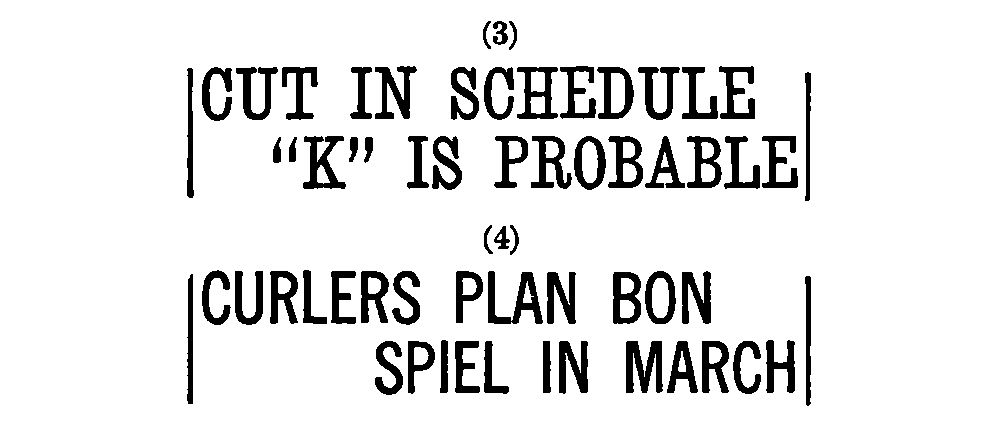
The image above has examples | (3) | and | (4) | of
undesirable divisions. The first of these is a drop-line head in two
parts. It is intended to say | CUT IN SCHEDULE “K” IS PROBABLE | but
the construction of the drop-line head places the word | SCHEDULE | on
the first line and the label | “K” | on the second line thus creating an
undesirable division.
Example | (4) | in the image is also a drop-line
head in two parts. It is intended to say | CURLERS PLAN BON SPIEL IN
MARCH | but the construction of the drop-line head places the word
| BON | on the first line and | SPIEL | on the second line thus creating
another undesirable division.
The use of unemphatic words, like “of,” “to,”
“for,” “and,” “but,” “if,” “a,” “the,” at the end of
parts of the top deck is not desirable, as in this position
they are given prominence and emphasis out of all
proportion to their importance. Typographical limitations
and the exigencies of rapid headline writing,
however, result not infrequently in their appearance
in these positions. Whenever it is possible, they should
be avoided at the end of parts of the top deck.
Punctuation. Punctuation in headlines and subheads
follows the accepted rules. When marks are
not absolutely necessary for clearness, they should be
omitted. In the first deck, and in cross-line heads, independent
sentences not connected by conjunctions are
separated by semicolons; for example:
The image above is a drop-line head in three parts.
The first two lines say | HATTERS GUILTY | OF BOYCOTTING; | and is
terminated by a semicolon. The third line of the head says | FINED
$222,000 |.
In other decks dashes are usually used to separate independent
unconnected statements. Care should be taken
to avoid a dash at the end of one of the parts of a deck.
The use of the dash is shown in the following example:
The image above is a head with two decks separated
by a short horizontal rule. The first deck is a cross-line head that
reads | TAFT PREPARES FOR YALE POST |.
The second deck is a pyramid head in three parts.
It says | President Leases Residence at New | Haven—Expects to Go There
| in the Spring. | It demonstrates the careful use of a dash which appears
in the middle of the second line of the pyramid. The dash serves to
separate the unconnected statements | President Leases Residence at New
Haven | and | Expects to Go There in the Spring. |
Headline punctuation in various forms is illustrated
in the heads given below:
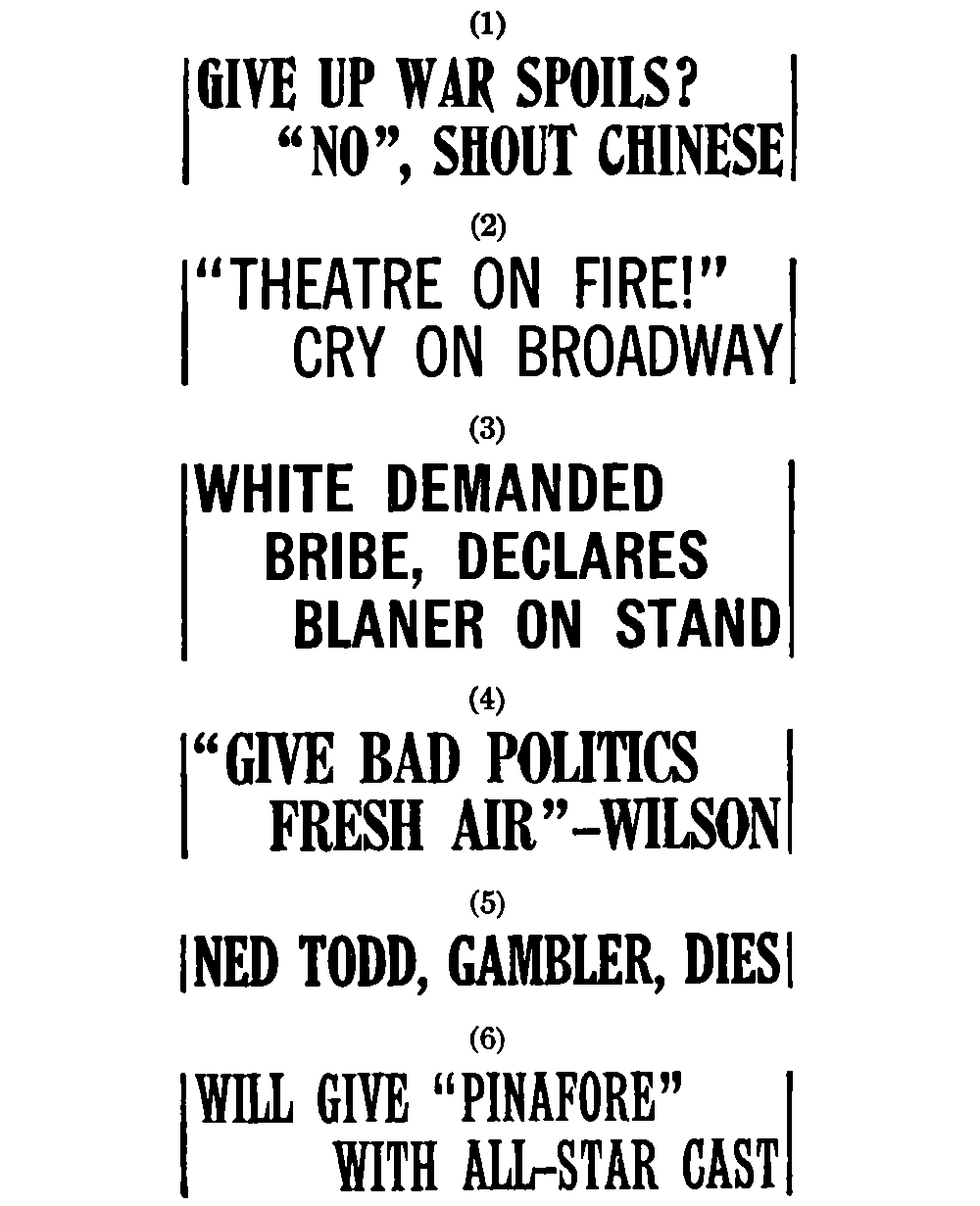
The image above contains six examples of headline
punctuation in heads. They are all single decks and are
labelled | (1) | to | (6) |.
Example (1) is a drop-line head in two parts. The first line
ends with a question mark. The second line begins with the word “NO” in inverted
commas. The head says GIVE UP WAR SPOILS? | “NO”, SHOUT CHINESE.
Example (2) is also a drop-line head in two parts.
The first line says | “THEATRE ON FIRE!” | and ends with an exclamation
mark. The whole line is enclosed in quotation marks. The second line
says | CRY ON BROADWAY |.
Example (3) is a drop-line head in three parts.
There is a comma following the word | BRIBE, | in | WHITE DEMANDED |
BRIBE, DECLARES | BLANER ON STAND. It separates the statements
| WHITE DEMANDED BRIBE | and | DECLARES BLANER ON STAND |.
Example (4) is a drop-line head in two parts. Its
purpose is to quote a statement by a person named Wilson. The statement
says | GIVE BAD POLITICS FRESH AIR |. That statement is enclosed in
quotation marks and its author's name | WILSON | is appended to the
statement by a dash. The two parts of the head as actually displayed
say | “GIVE BAD POLITICS | FRESH AIR”—WILSON |.
Example (5) is a simple cross-line head that says
| NED TODD, GAMBLER, DIES |. There are commas after | NED TODD, | and
| GAMBLER, | in this head.
Example (6) is a drop-line head in two parts. It refers
to a show that's to be performed called | “PINAFORE” |. That show name is in
quotation marks. The two parts of the head as actually displayed say
| WILL GIVE “PINAFORE” | WITH ALL-STAR CAST |. Displayed as a single line,
the head says | WILL GIVE “PINAFORE” WITH ALL-STAR CAST |.
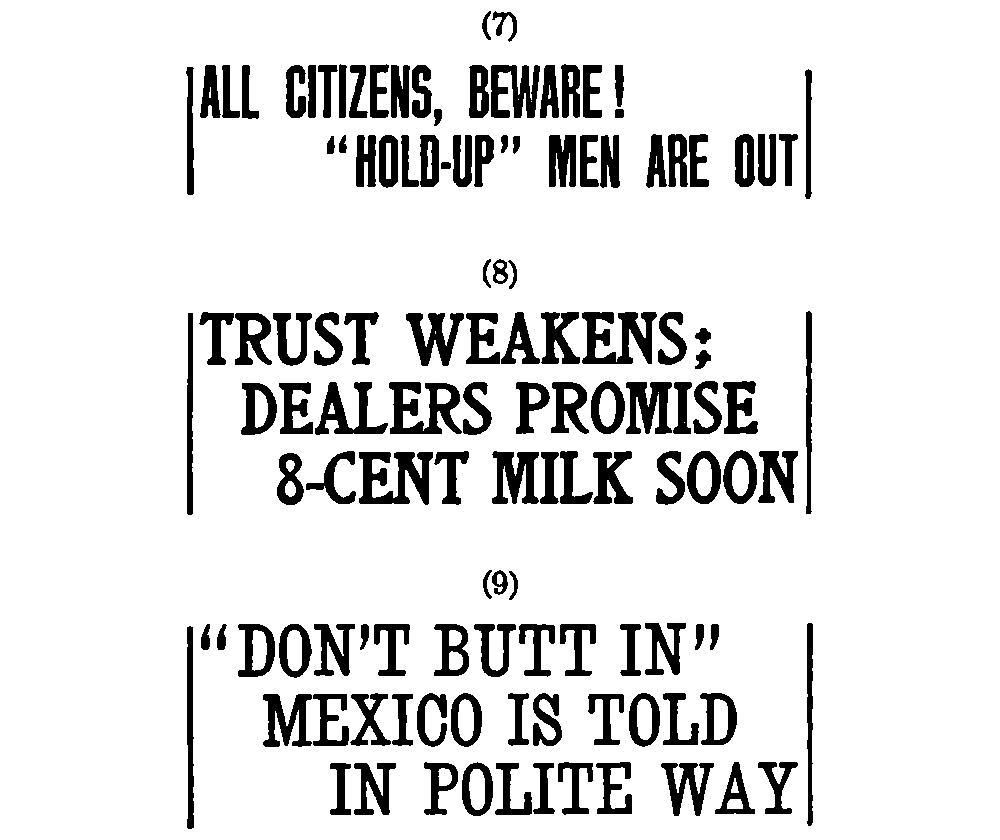
The image above contains three more examples of headline
punctuation in heads. Each example is a single deck and they are
labelled | (7) | to | (9) |.
Example (7) is a drop-line head in two parts. It is
in the form of a warning, with the first line of the head ending in an
exclamation mark. That line says | ALL CITIZENS, BEWARE! |. The second
line says what to beware of. It is, apparently, | “HOLD-UP” MEN |. The
hyphenated word | “HOLD-UP” | is enclosed in quotation marks. The two
parts of the head as actually displayed say | ALL CITIZENS, BEWARE! |
“HOLD-UP” MEN ARE OUT |.
Example (8) is a drop-line head in three parts. The
first line is a statement that ends in a semicolon. It says | TRUST
WEAKENS; |. That line is followed by another statement split over two
more lines and says | DEALERS PROMISE | 8-CENT MILK SOON |. Displayed
as a single line, the head says | TRUST WEAKENS; | DEALERS
PROMISE 8-CENT MILK SOON |.
Example (9) is also a drop-line head in three
parts. The first line quotes a source who says | “DON’T BUTT IN” |. As
it is a quotation, it is correctly enclosed in quotation marks. The
other two lines of the head state who that quote is directed at. Those
lines says | MEXICO IS TOLD | IN POLITE WAY |. Displayed as a single
line, the head says | “DON’T BUTT IN” MEXICO IS TOLD IN
POLITE WAY
Methods of Building Headlines. The editor or
copy-reader who is constantly writing heads comes to
think unconsciously in headline units; that is, his daily
practice makes it possible for him to frame readily
statements of the essential facts that will fulfill the requirements
of each deck of the head. Nevertheless, he
always counts the units to be sure that the number is
correct. For the beginner the process of building up
the several decks of a typical headline is analyzed at
some length in the following pages, in order to demonstrate
the methods pursued.
The story selected for showing the process of headline
writing has been taken from the Chicago Record-Herald,
which gave it a headline constructed on the
following plan:
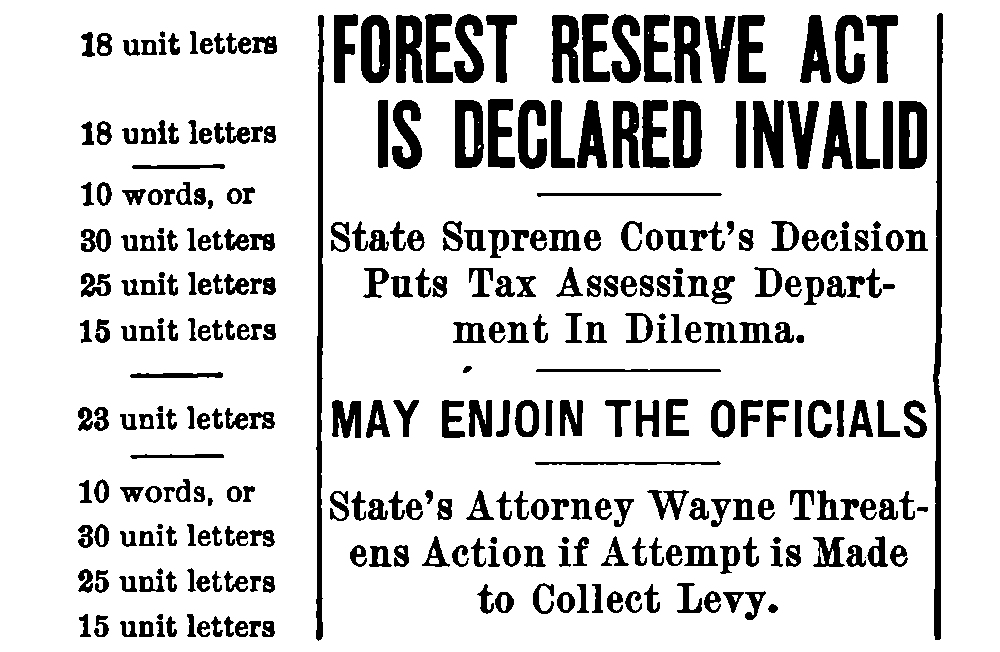
The image above is of a headline constructed of four
decks, each separated by a short horizontal rule. The font size and
weight differs between decks and to the left of each line in a head is
the number of headline units that line contains.
The first deck is a drop-line head in two parts and
displayed in a large, weighted, font. Each of the two lines contains 18
unit letters and say | FOREST RESERVE ACT | IS DECLARED INVALID |.
The second deck is in a smaller, mixed-case,
font of lighter weight. It is a pyramid head in three parts that
contains 10 words. Each part contains, respectively, 30, 25 and 15
unit letters. The parts say | State Supreme Court’s Decision | Puts
Tax Assessing Depart- | ment In Dilemma. | Displayed as a single line
without the division of words, the head says | State Supreme
Court’s Decision Puts Tax Assessing Department In Dilemma. |
The third deck is a cross-line head in upper-case
displayed in a font of medium weight and smaller than that used in
the first deck. It contains 23 unit letters and says | MAY ENJOIN THE
OFFICIALS |.
The fourth deck is similar to the second deck being
a pyramid in three parts and displayed in the same font. It also contains
10 words. Each part of the head contains, respectively, 30, 25 and
15 unit letters. The parts say | State’s Attorney Wayne Threat- | ens
Action if Attempt is Made | to Collect Levy. | Displayed as a single
line without the division of words, the head says | State’s Attorney
Wayne Threatens Action if Attempt is Made to Collect Levy. |
The story for which the headline is to be written
follows:
The city council finance committee last night unanimously
agreed to a proposition made by Mayor Harrison to have a
committee of experts decide each year how much money
shall be spent in each ward for street cleaning and garbage
and refuse collection.
The mayor said the plan could not be adopted this year,
as the committee was engaged in making up the budget for
1912 and there would not be time.
The suggestion of the mayor came during the annual
“squabble” of the committee over the ward appropriations.
As usual every member was contending for an increase.
“I’ll tell you, gentlemen,” suddenly broke in Mayor Harrison,
“this helter skelter method of making up ward appropriations
should be discontinued. It is a system that is out
of date and one that works an injustice on many sections of
the city. I would suggest that we have a commission or a
committee of experts begin next year, about three months
before the committee begins making up the budget, and work
out a scientific plan for the proper distribution of the street
cleaning and garbage removal funds.”
[Pg 296]
“I’m with you there,” declared Aldermen Cermak and
Egan in unison, and every alderman around the table enthusiastically
endorsed the proposition.
The work of making the ward appropriations was continued
after the mayor’s suggestions and raises were granted
along the line.
In editing this story of the meeting of the city council
finance committee, the copy-reader would get these
four main points:
(1) Mayor Harrison’s proposal to the finance committee in regard to the
allotment of ward funds was approved.
(2) His plan is to have experts decide the division on a scientific
basis.
(3) The new method cannot be put into operation until next year on
account of lack of time.
(4) The fight, or “squabble,” among the
aldermen on this matter has been an annual one.
As the subject of the story is the “ward funds,” the
headline may be constructed around these words. The
words “ward fund” contain 9½ units, and the plural
“ward funds,” 10½ units, which, on the basis of 18 units
to be filled in each half of the first deck, will leave 7½
or 8½ units to be filled, according as the singular or
plural form of “fund” is used. If a verb is desired
for the first half deck, the “dividing” or “allotting”
of the fund expresses the idea involved; and, since the
action is in the future, “to divide” or “to allot” (8
units each), or “will divide” or “will allot” (10 units
each), are possibilities. The combination of these elements
gives “To Allot Ward Fund” (18½ units) and
“To Divide Ward Fund” (18½ units), either of which
may be used for the first half of the top deck. This
deck may be completed in the second half by introducing
the second point; namely, that the allotment
is to be made “On a Scientific Basis” (19 units), which
can be reduced to 17 units by omitting the article
“a.” The result will then be as follows:

The image above is the resulting drop-line head.
It is in two parts. The first line is 18½ unit letters and says | TO
DIVIDE WARD FUND |. The second line is 17 unit letters and says | ON
SCIENTIFIC BASIS |. Displayed as a single line the head says
| TO DIVIDE WARD FUND ON SCIENTIFIC BASIS |.
Or the second point may be used in the form of the
allotment’s being made “with the aid of experts” (22½
units), which may be reduced to 18½ units by omitting
the article “the.” The resulting combination will
be:
The image above is a another drop-line head in two
parts. The first line is 18½ unit letters and says | TO ALLOT WARD
FUND |. The second line is also 18½ unit letters and says | WITH AID
OF EXPERTS |. Displayed as a single line the head says | TO
ALLOT WARD FUND WITH AID OF EXPERTS |.
If it is desired to emphasize the fact that the mayor has
solved the ward fund problem, or has ended the “grab,” or settled the
“squabble,” or dispute, or fight, these phrases may be arranged in the
following forms:
Two of four examples are displayed on this page.
Example | (1) | is a drop-line head in two parts. The first line
is 18 units and says | WARD FUND PROBLEM |. The second line is also 18
units and says | IS SOLVED BY MAYOR |. Displayed as a single line the
head says | WARD FUND PROBLEM IS SOLVED BY MAYOR |.
Example | (2) | is an alternative wording but
emphasises those same facts. The first line is 18½ units and says |
WARD FUND SQUABBLE |. The second line is 19 units and says | IS SETTLED
BY MAYOR |. Displayed as a single line the head says | WARD FUND
SQUABBLE IS SETTLED BY MAYOR |.
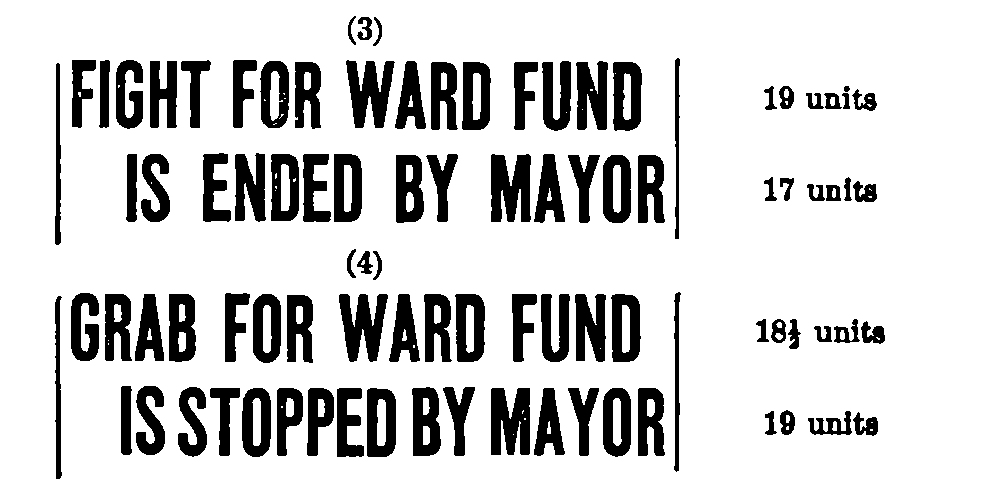
This image is at the top of the following page and
contains two more examples showing how phrases may be arranged in a
head to emphasize facts of a story.
Example | (3) | is a drop-line head in two parts. The
first line is 19 units and says | FIGHT FOR WARD FUND |. The second
line is 17 units and says | IS ENDED BY MAYOR |. Displayed as a single
line the head says | FIGHT FOR WARD FUND IS ENDED BY
MAYOR |.
Example | (4) | is an alternative wording but
emphasises those same facts. The first line is 18½ units and says
| GRAB FOR WARD FUND |. The second line is 19 units and says | IS
STOPPED BY MAYOR |. Displayed as a single line the head says | GRAB FOR
WARD FUND IS STOPPED BY MAYOR |.
Still greater prominence can be given to the mayor
by putting the word at the beginning of the first half of
the first deck, but by so doing the real subject, that is,
the ward fund division or wrangle, must go over into the
second half. In this arrangement the forms would be:
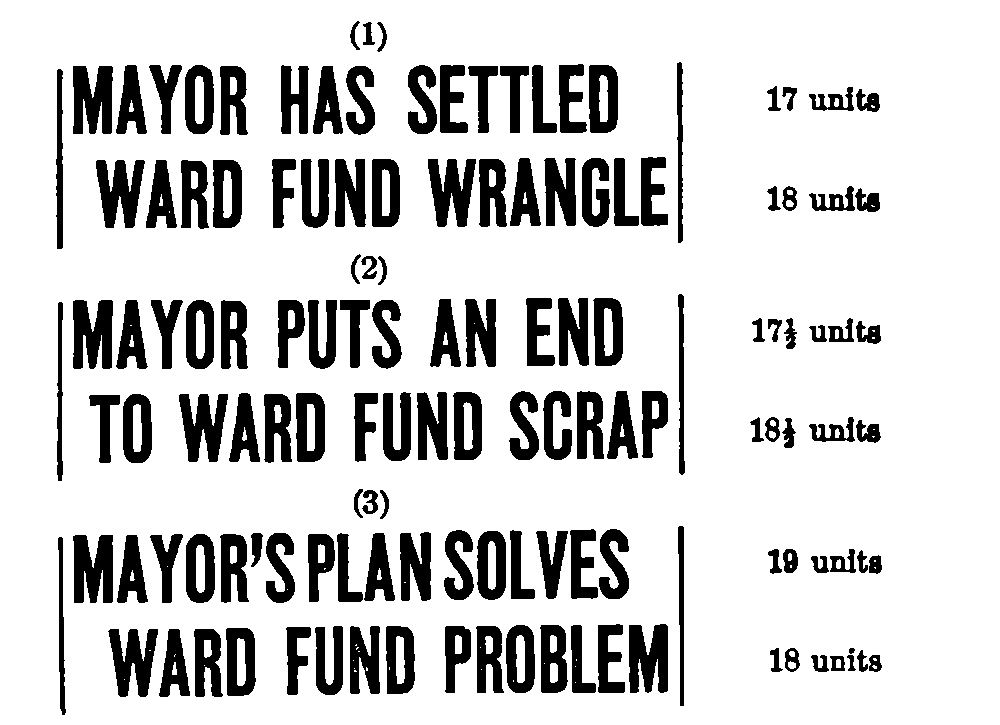
The image above has three examples. Example | (1) |
is a drop-line head in two parts. The first line is 17 units and says |
MAYOR HAS SETTLED |. The second line is 18 units and says | WARD FUND
WRANGLE |. Displayed as a single line the head says | MAYOR HAS SETTLED
WARD FUND WRANGLE |.
Example | (2) | is also a drop-line head in two
parts. The first line is 17½ units and says | MAYOR PUTS AN END |. The
second line is 18½ units and says | TO WARD FUND SCRAP |. Displayed
as a single line the head says | MAYOR PUTS AN END TO WARD FUND SCRAP
|.
Example | (3) | is another drop-line head in two
parts. The first line is 19 units and says | MAYOR’S PLAN SOLVES |. The
second line is 18 units and says | WARD FUND PROBLEM |. Displayed as a
single line the head says | MAYOR’S PLAN SOLVES WARD FUND PROBLEM |.
If more emphasis is desired for the point that experts
are to settle or decide the ward fund division or
fight, these statements may be combined as follows, but
again the real subject, by going into the second half
of the deck, is less conspicuous:
The image above has two examples. Example | (1) |
is a drop-line head in two parts. The first line is 18½ units and says
| EXPERTS WILL DECIDE |. The second line is 17 units and says | WARD
FUND DIVISION |. Displayed as a single line the head says | EXPERTS
WILL DECIDE WARD FUND DIVISION |.
Example | (2) | is also a drop-line head in two
parts. The first line is 19 units and says | EXPERTS WILL SETTLE |. The
second line is 19 units and says | FIGHT FOR WARD FUND |. Displayed as
a single line the head says | EXPERTS WILL SETTLE FIGHT FOR
WARD FUND |.
These various forms for the top deck show some of
the possibilities of variety of emphasis and tone in the
headline. As the first half of the top deck is more conspicuous
than the second, the most significant part of
the statement should, if possible, be placed in the first
half. Consequently those forms in which the idea of
the allotting or dividing of the ward funds is placed
first, would generally be preferred. The words “squabble,”
“scrap,” and “grab,” although colloquial and inelegant,
might be admissible to characterize effectively
the situation growing out of the efforts of each alderman
to get the most for his own ward, if the circumstances
of the dispute were undignified.
The other decks of the headline for this story may
be constructed to follow any one of these top decks,
but, for convenience, only two of the top decks will be
used for illustration. If the one chosen is “To Divide
Ward Fund On Scientific Basis,” it may be developed
by the other points already given (page 296); that
is, (1) The mayor’s proposal was approved by the
finance committee; (2) The division is to be made
by experts; (3) The method cannot be put into operation
until next year for lack of time; and (4) the
fight on the matter has been an annual one. The second
deck of ten words should explain the “scientific
basis” of division and give the action of the finance
committee by which this plan was determined upon, both
of which points may be stated in the following forms:
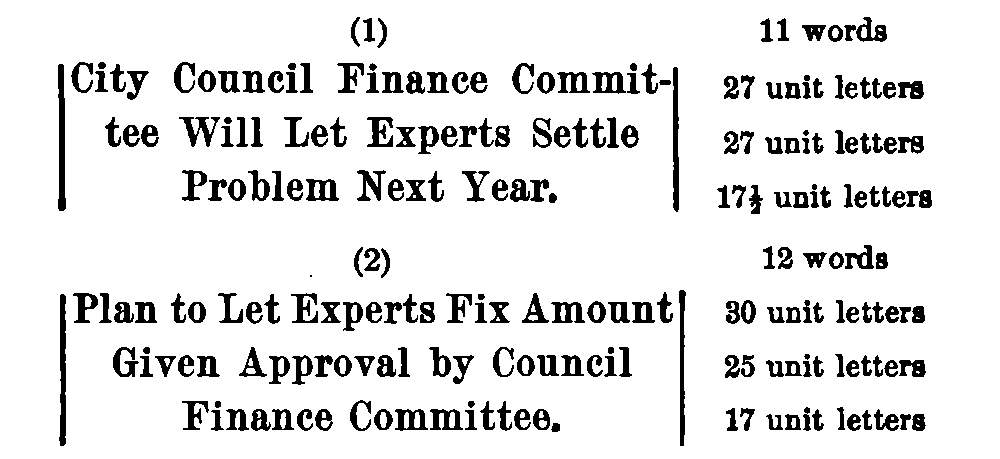
The image above has two examples. Example | (1)
| is a pyramid head in three parts. It contains 11 words of which |
Committee | is divided over two lines. The three parts are respectively
27, 27 and 17½ unit letters long and say | City Council Finance Commit-
|, | tee Will Let Experts Settle |, | Problem Next Year. | Displayed as
a single line the head says | City Council Finance Committee Will Let
Experts Settle Problem Next Year. |
Example | (2) | is also a pyramid head in three
parts. It states the same facts as the example above but phrases
them in a different way. It is 12 words long and avoids dividing the
word | Committee |. The three parts are respectively 30, 25 and 17
unit letters long and say | Plan to Let Experts Fix Amount |, | Given
Approval by Council |, Finance Committee. | Displayed as a single
line the head says | Plan to Let Experts Fix Amount Given
Approval by Council Finance Committee. |
The third deck, which, because of the size of type, is
next in prominence to the top deck, should contain the
mayor’s part in the solution, and within the limits of 23
unit letters, this may be expressed in the following forms:
The image above has five examples of cross-line
heads that state the mayor's role in the solution with each using different
wording. Example | (1) | is 23 units and says | PROPOSAL MADE BY
MAYOR |. Example | (2) | is also 23 units and says | MAYOR PROPOSES
SOLUTION |. Example | (3) | is 24 units and says | PLAN IS OFFERED
BY MAYOR |. Example | (4) | is 23½ units and says | MAYOR ENDS
THE SQUABBLE |. Example | (5) | is also 23½ units and says | MAYOR
PROPOSES THE PLAN |.
If the third or fifth forms are used, they should not
be combined with the second form, “Plan To Let Experts,
etc.,” suggested for the second deck, because of
the repetition of the word “plan.”
For the fourth deck the idea that the dispute is an
annual one, and, if not already used, the point that
the plan is going into effect next year, may both be
expressed within the limits, which are the same as
those for the second deck, as follows:
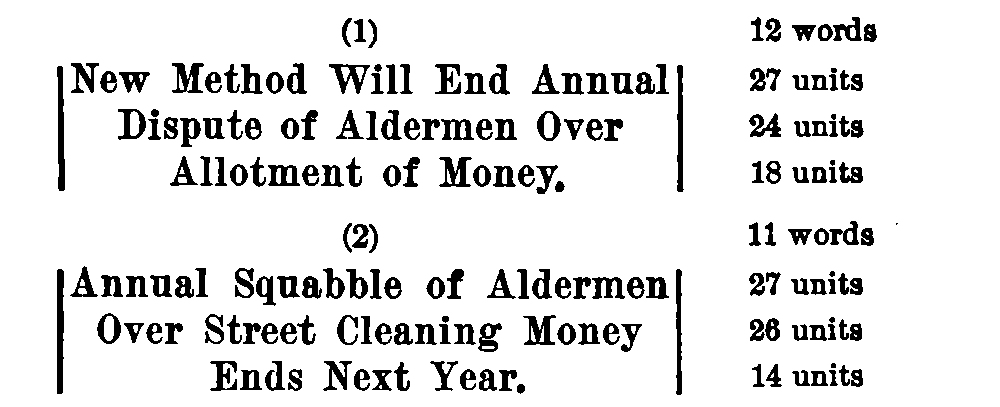
The image above has two examples. Example | (1) |
is a pyramid head in three parts which contains 12 words. The three
parts are respectively 27, 24 and 18 units long and say | New Method
Will End Annual |, | Dispute of Aldermen Over |, | Allotment of Money.
| Displayed as a single line the head says | New Method Will End Annual
Dispute of Aldermen Over Allotment of Money. |
Example | (2) | is also a pyramid head in three
parts. This one contains 11 words. It again communicates the idea that
the dispute is an annual one and that the plan is going into effect
next year. The three parts are respectively 27, 26 and 14 units long
and say | Annual Squabble of Aldermen |, | Over Street Cleaning Money
|, | Ends Next Year. | Displayed as a single line the head says
| Annual Squabble of Aldermen Over Street Cleaning Money Ends Next
Year. |
In complete form with one of each of these possibilities
chosen to avoid repetition, the head will read:
The image above displays the complete head which is
made up of four decks.
The first deck is a drop-line head in large, bold,
capital letters and says | TO DIVIDE WARD FUND |, | ON SCIENTIFIC BASIS
|. It is followed by a pyramid head in mixed case and a smaller,
lighter, font which says | City Council Finance Commit- |, | tee Will
Let Experts Settle |, | Problem Next Year. |
The third deck is a cross-line head and says |
MAYOR PROPOSES THE PLAN |. The fourth and final deck is a pyramid head
like the second deck and says | New Method Will End Annual |, | Dispute
of Aldermen Over |, | Allotment of Money. |
Displayed as a single line the head says
| TO DIVIDE WARD FUND ON SCIENTIFIC BASIS | City Council Finance
Committee Will Let Experts Settle Problem Next Year. MAYOR PROPOSES THE
PLAN | New Method Will End Annual Dispute of Aldermen Over Allotment of
Money. |
If the first deck chosen is one of the forms in
which the part played by the mayor in the solution of
the problem is emphasized, the other three decks could
be so composed as to include the other points, without
repetition, as follows:
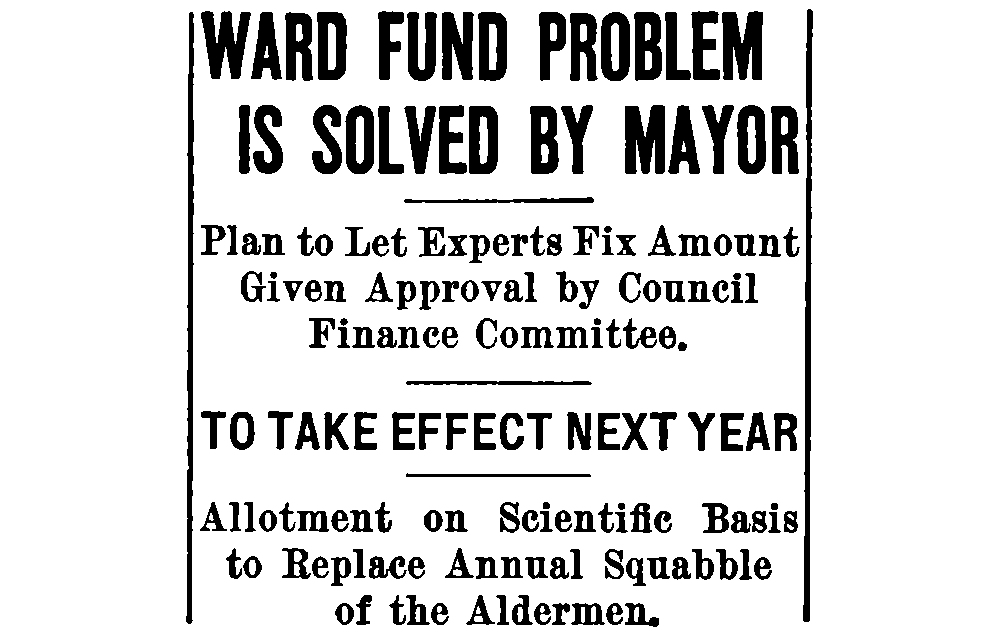
The image above displays this alternate emphasis of
the facts. The first deck is a drop-line head in large, bold, capital
letters and says | WARD FUND PROBLEM |, | IS SOLVED BY MAYOR |. It is
followed by a pyramid head in mixed case and a smaller, lighter, font
which says | Plan to Let Experts Fix Amount |, | Given Approval by
Council |, | Finance Committee. |
The third deck is a cross-line head and says | TO
TAKE EFFECT NEXT YEAR |. The fourth and final deck is a pyramid head
like the second deck and says | Allotment on Scientific Basis |, | to
Replace Annual Squabble |, | of the Aldermen. |
Displayed as a single line the head says
| WARD FUND PROBLEM IS SOLVED BY MAYOR | Plan to Let Experts Fix Amount
Given Approval by Council Finance Committee. | TO TAKE EFFECT NEXT
YEAR Allotment on Scientific Basis to Replace Annual Squabble of the
Aldermen. |
Subheads. Besides writing headlines for stories, the
copy-reader inserts subheads at intervals to break up
the solid masses of type which are unrelieved except
by paragraph division. These subheads make possible
more rapid reading.
The subhead, which is set up either in bold face
capitals or in bold face capitals and lower case, is like
a cross-line head that does not fill the entire column
width. The subhead should be an announcement in
three or four words of the most significant point in the
section of the story which it precedes. The same limitation
as to the number of units exists as in any cross-line
head. In a story of some length subheads are
placed at intervals of about 200 words, and in shorter
stories at intervals of from 100 to 150 words. The insertion
of these subheads at comparatively regular
intervals makes for symmetry of effect. Significant
matter in the story, or an important change of topic,
warrants a subhead, regardless of the regularity of
the interval. It is generally considered preferable not
to place a subhead immediately after a sentence ending
with a colon and introducing a quotation, because
the subhead interrupts the quotation and appears to
be part of it. This difficulty can usually be avoided by
placing the subhead just before the introductory sentence,
thus:
NEW YORK, Dec. 14.—On the eve
of his retirement from the post of
British ambassador at Washington,
which he has occupied with distinction
for six years, James Bryce Saturday
night paid an extraordinary tribute to
the constitution of the United States.
The occasion was the annual dinner of
the Pennsylvania society of New York,
and he spoke from the topic: “The
Commemoration of the One Hundred
and Twenty-fifth Anniversary of the
Framing of the Constitution of the
United States.”
Work of Men of Genius.
The ambassador said in part:
“The constitution was the work of
an extraordinary group of men such as
has seldom been seen living at the
same time in any country and such as
had never been brought together in
any other country to undertake the
immensely difficult task of framing a
fundamental instrument of government
for a nation. The nation was then a
small one, and it is one of the most
striking tributes to the genius and
foresight of the men that the frame of
government which they designed for
37,000,000 people should have proved
fitting to serve the needs of 93,000,000.”
Jump-Heads. When a story is continued from one
page to another, a head called a jump-head, or “run-over”
head, is placed above the continuation. This jump-head
may be either the top deck of the head at the
beginning set in the same type or in smaller type, or it
may be a new head. Examples of jump-heads follow:
Two examples are provided. Each example is in two
sections. The first section displays the head of a story from the
first page and the second section displays the jump-head that is placed
above the continuation of the story on another page.
The image above displays section | (1) | of the
first example. It is the | First Page Head | of a story and is a
conventional looking head made up of four decks of various forms.
The decks say | FLAMES END LIVES OF TWO BABY BOYS |, | Children in
Different Parts of City Meet Horrible Death at the Same Time. |, |
BONFIRE IS FATAL TO ONE |, | The Other, Left With Sister, Is Found
Blazing in Home by Passersby. |
The image above displays section | (2) | of the
first example. It is the | Jump-Head on Third Page | which is placed
above the continuation of the story. It is a simple cross-line form in
upper-case which says | FIRE ENDS BABIES’ LIVES |. Just below this in a
small font are the words | Continued from Page One. |
The image above displays section | (1) | of the
second example. It is the | Top Deck of First Page Head | of a story and is a
drop-line form in three parts which says | EXPRESS BEATEN | BY PARCELS POST |
IN INITIAL TEST |.
The image above displays section | (2) | of the
second example. It is the | Jump-Head on Fourth Page | which is placed
above the continuation of the story. This time it is a drop-line head
in two parts which says | EXPRESS BEATEN | BY PARCELS POST |. Just
below this in a small font are the words | (Continued from first page.) |
Big Heads. In this discussion only one column heads
have been considered, but the same general principles
apply to the construction of headlines extending over
any number of columns. Important news may be given
a head of one, two, or three parts extending across the
whole front page. Such a head is often called a “banner.”
SUGGESTIONS
- Get the important facts of the story clearly and accurately
in mind before writing the head.
- Study carefully each kind of headline to find out its possibilities
and limitations.
- Give the story a headline proportionate in size to its
importance.
- Base the head as far as possible on the facts in the
lead.
- Have the tone of the head in keeping with that of the
story.
- Don’t make the head a comment on the news.
- Avoid trite, hackneyed words or phrases.
- Make the statement in each deck clear, concise, and
specific.
- Put the most significant fact into the first deck.
- Use short, specific words in the first deck.
- Count the unit letters and spaces in every deck.
- Don’t try to crowd in more units than the space will
permit.
- Don’t fill out a short line with weak words.
- Make clear the relation of the statement of each deck to
that in the preceding deck.
- Use only such abbreviations as are commonly to be found
in heads.
- Omit articles and unnecessary auxiliary verbs whenever
it is possible.
- Punctuate only when clearness requires it.
- Use figures when they are the significant facts.
- Avoid repetition of words other than connectives.
- Use the present tense of the verb for past events and the
infinitive or future tense for coming ones.
- Keep the tenses uniform throughout the head.
- Avoid libelous statements.
PRACTICE WORK
Criticize the following heads and rewrite each, retaining
as far as possible the ideas and point of view of
the original:
The image above is example (1) of sixteen examples
of heads to be criticized. In this example, as in all the examples that
follow, the top deck is a drop-line head. In that context it is worth
recalling from page 280 that each line of a drop-line head should ideally
be 18 unit letters wide.
In this example, the drop-line head in the top deck
is in two parts of 17½ and 16½ unit letters respectively. It says | HURT
IN AUTO CRASH | QUITTING HOSPITAL |. The second deck is a pyramid
in three parts and says | Woman Patient Is Injured in | Collision
Fifteen Minutes | After Release |
The image above is example (2). It is a head of
three decks. The top deck is a drop-line head of two parts with 17 and
16 unit letters respectively. It says | PARCELS POST PLAN | STARTS
TOMORROW |. The second deck is a head in pyramid form which says | New
System Makes It Possible | to Mail Packages Weighing | Up to 11
Pounds. | The third decks is a cross-line head which says | REQUIRE
SPECIAL STAMPS |
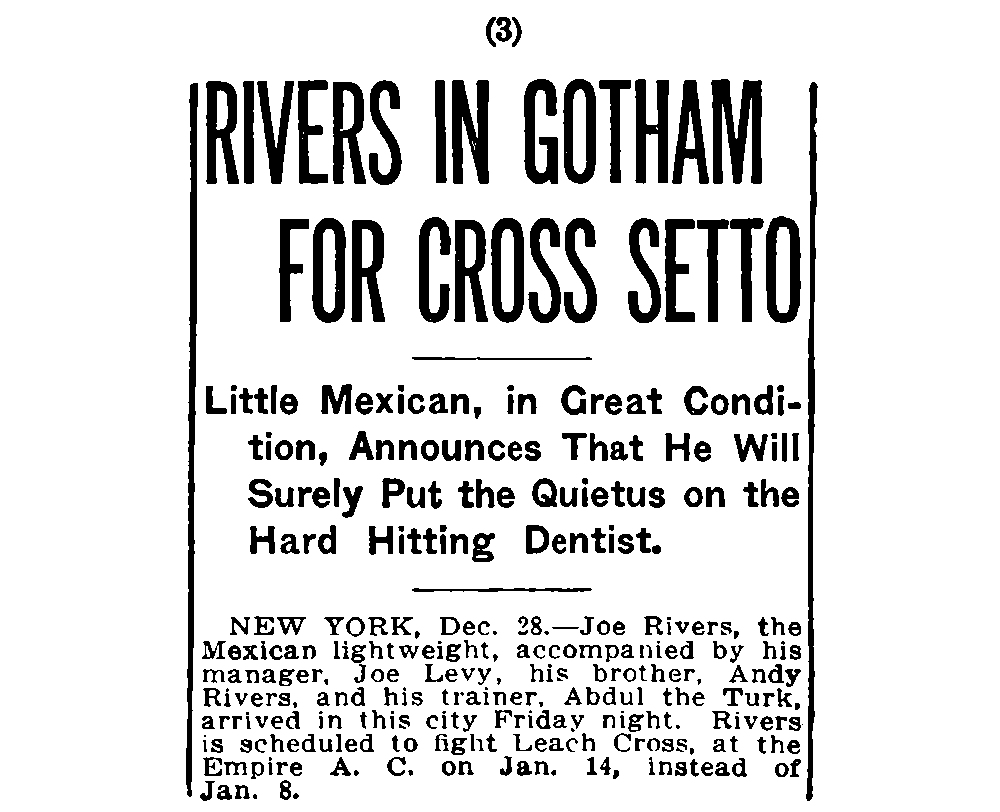
The image above is example (3). It is a head of two
decks and is followed by the first paragraph of the story it heads. The
top deck is a drop-line head of two parts with 15½ and 15 unit letters
respectively. It says | RIVERS IN GOTHAM | FOR CROSS SETTO |. The
second deck is a four-part hanging indention head which says | Little
Mexican, in Great Condi- | tion, Announces That He Will | Surely
Put the Quietus on the | Hard Hitting Dentist. |
The opening paragraph of the story follows the
head. It says | NEW YORK, Dec. 28.—Joe Rivers, the Mexican lightweight,
accompanied by his manager, Joe Levy, his brother, Andy Rivers, and his
trainer, Abdul the Turk, arrived in this city Friday night. Rivers is
scheduled to fight Leach Cross, at the Empire A. C. on Jan. 14, instead
of Jan. 8. |
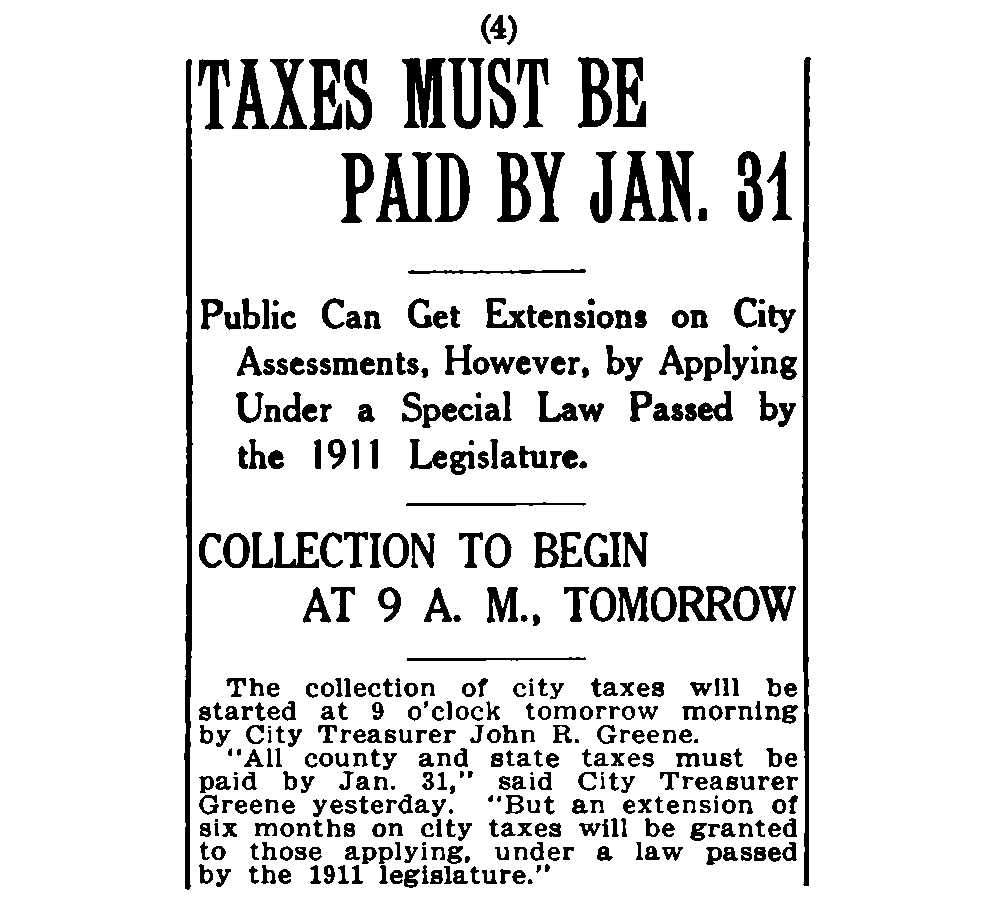
The image above is example (4). It is a head of
three decks and is followed by the opening paragraphs of the story it
heads. The top deck is a drop-line head of two parts with 13½ and 13½
unit letters respectively. It says | TAXES MUST BE | PAID BY JAN.
31 |. Note the second line of the head uses | JAN. 31 | as a shortened
form of | JANUARY THIRTY FIRST |
The second deck is a four-part hanging indention
head in a small font which says | Public Can Get Extensions on City |
Assessments, However, by Applying | Under a Special Law Passed by |
the 1911 Legislature. |
The third deck is a drop-line head in two parts
which say | COLLECTION TO BEGIN | AT 9 A. M., TOMORROW |
The opening paragraphs of the story follow the
head. They say | The collection of city taxes will be started at 9
o’clock tomorrow morning by City Treasurer John R. Greene. | “All county
and state taxes must be paid by Jan. 31,” said City Treasurer Greene
yesterday. “But an extension of six months on city taxes will be
granted to those applying, under a law passed by the 1911 legislature.” |
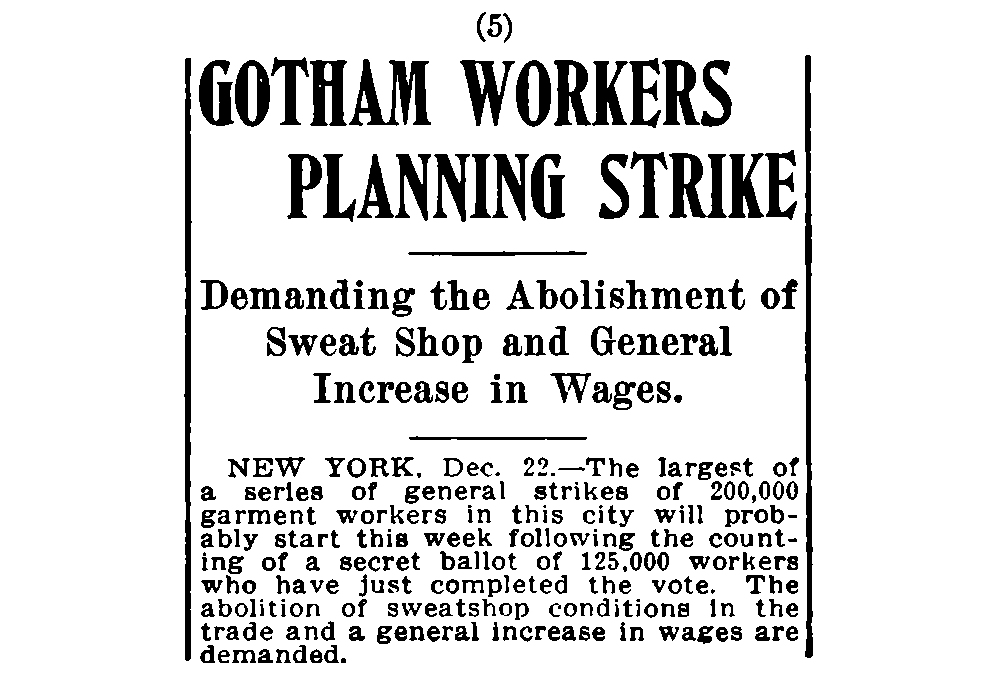
The image above is example (5). It is a head of two
decks and is followed by the first paragraph of the story it heads. The
top deck is a drop-line head of two parts with 15 and 14 unit letters
respectively. It says | GOTHAM WORKERS | PLANNING STRIKE |
The second deck is a pyramid of three parts which
say | Demanding the Abolishment of | Sweat Shop and General |
Increase in Wages. |
The opening paragraph of the story says | NEW YORK.
Dec. 22.—The largest of a series of general strikes of 200,000 garment
workers in this city will probably start this week following the
counting of a secret ballot of 125,000 workers who have just completed
the vote. The abolition of sweatshop conditions in the trade and a
general increase in wages are demanded. |
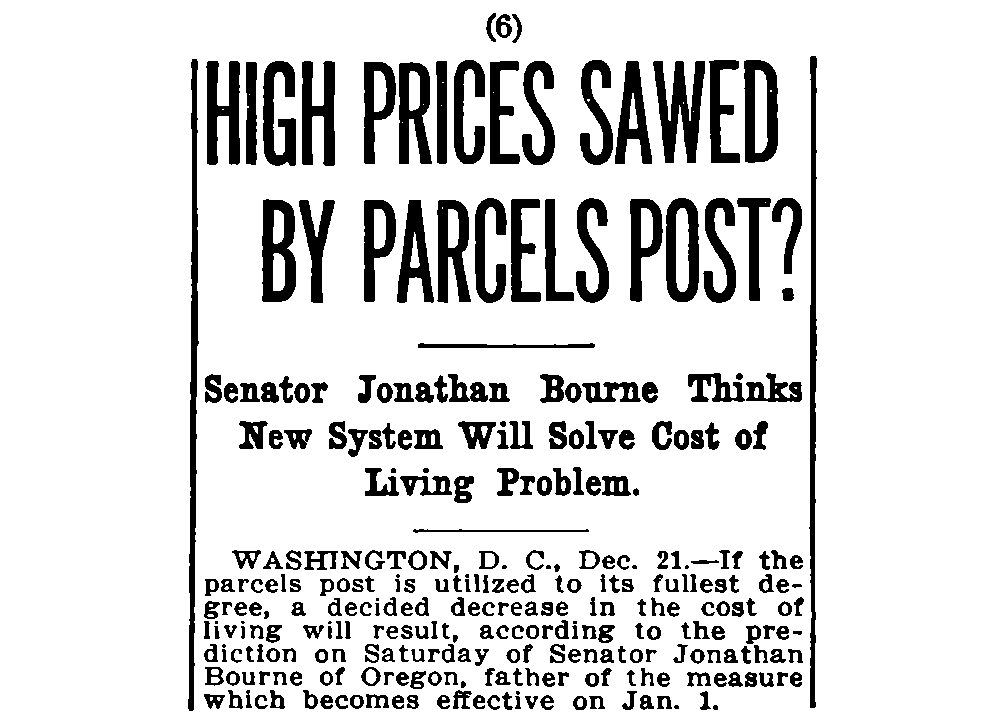
The image above is example (6). It is a head of two
decks and is followed by the first paragraph of the story it heads.
The top deck is a drop-line head of two parts with 16½ and 16 unit
letters respectively. It says | HIGH PRICES SAWED | BY PARCELS POST?
|. It is posed as a question with the second line of the head ending in a
question mark.
The second deck is a pyramid of three parts which
say | Senator Jonathan Bourne Thinks | New System Will Solve Cost
of | Living Problem. |
The opening paragraph of the story says |
WASHINGTON, D. C., Dec. 21.—If the parcels post is utilized to its
fullest degree, a decided decrease in the cost of living will result,
according to the prediction on Saturday of Senator Jonathan Bourne of
Oregon, father of the measure which becomes effective on Jan. 1. |
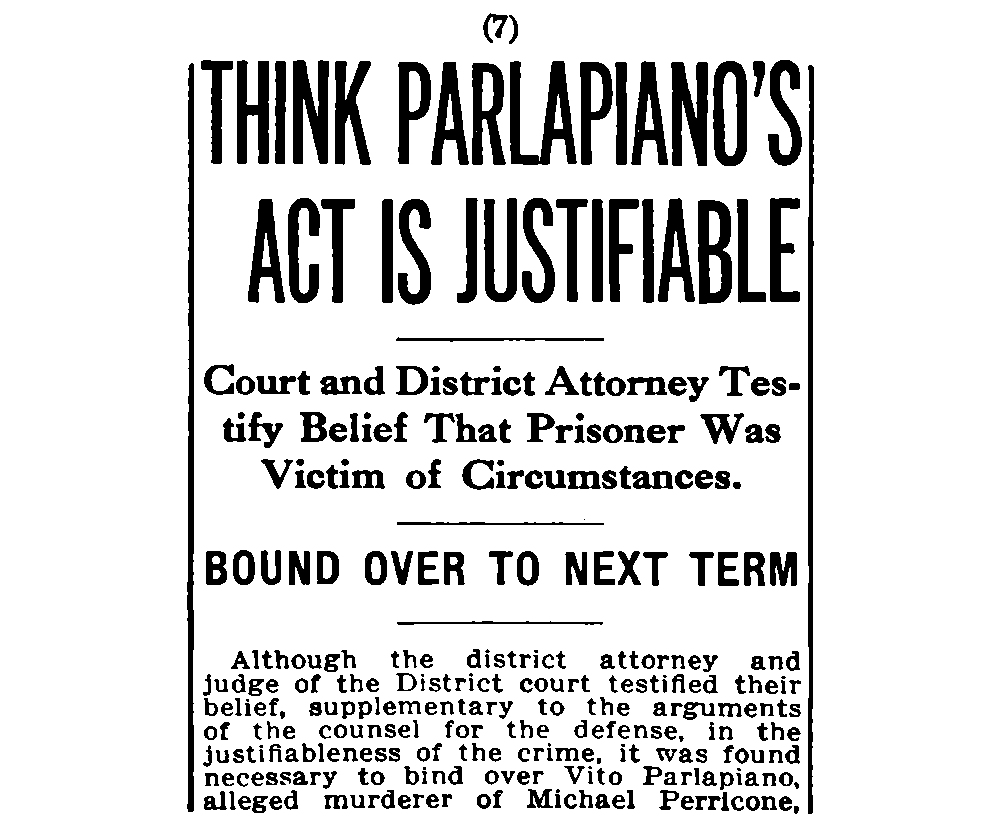
The image above is example (7). It is a head of three
decks and is followed by the opening paragraphs of the story it heads.
The top deck is a drop-line head of two parts with 16½ and 16½ unit
letters respectively. It says | THINK PARLAPIANO’S | ACT IS JUSTIFIABLE |
The second deck is a pyramid of three parts which
say | Court and District Attorney Tes- | tify Belief That Prisoner
Was | Victim of Circumstances. | The word | Testify | in the head is
divided over two lines.
The third deck is a cross-line head which says
| BOUND OVER TO NEXT TERM |
Part of the opening paragraph of the story follows.
The remainder of that paragraph plus the second paragraph are contained
in an image at the top of the next page. The part displayed here says
| Although the district attorney and judge of the District court
testified their belief, supplementary to the arguments of the counsel
for the defense, in the justifiableness of the crime, it was found
necessary to bind over Vito Parlapiano, alleged murderer of Michael
Perricone, |
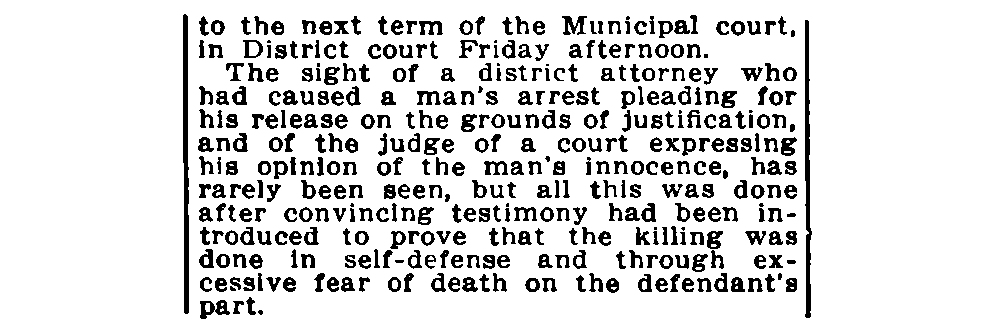
The image above is the continuation of paragraph
text from the previous page. It says | to the next term of the
Municipal court, in District court Friday afternoon. | The sight of
a district attorney who had caused a man’s arrest pleading for his
release on the grounds of justification, and of the judge of a court
expressing his opinion of the man’s innocence, has rarely been seen,
but all this was done after convincing testimony had been introduced to
prove that the killing was done in self-defense and through excessive
fear of death on the defendant’s part. |
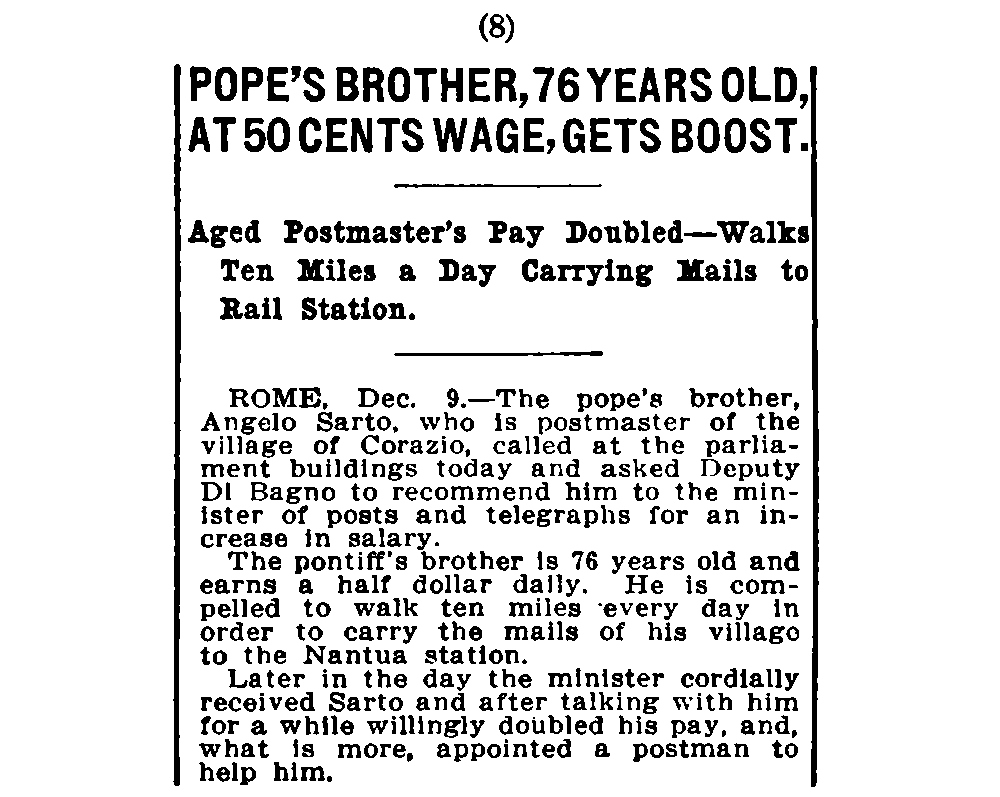
The image above is example (8). It is a head of two
decks and is followed by the opening paragraphs of the story it heads.
The top deck is a drop-line head in a smaller font than usual. It is in
two parts with 27½ and 28 unit letters respectively. Both lines use the full
width of the column but the letters look crowded thus making it difficult
to see where one word ends and the next starts. This head says | POPE’S
BROTHER, 76 YEARS OLD, | AT 50 CENTS WAGE, GETS BOOST. |
The second deck is a three-part hanging indention
head which says | Aged Postmaster’s Pay Doubled—Walks | Ten Miles a
Day Carrying Mails to | Rail Station. |
The opening paragraphs of the story follow. They
say | ROME, Dec. 9.—The pope’s brother, Angelo Sarto, who is postmaster
of the village of Corazio, called at the parliament buildings today
and asked Deputy Di Bagno to recommend him to the minister of posts
and telegraphs for an increase in salary. | The pontiff’s brother is
76 years old and earns a half dollar daily. He is compelled to walk
ten miles every day in order to carry the mails of his village to the
Nantua station. | Later in the day the minister cordially received
Sarto and after talking with him for a while willingly doubled his pay,
and, what is more, appointed a postman to help him. |
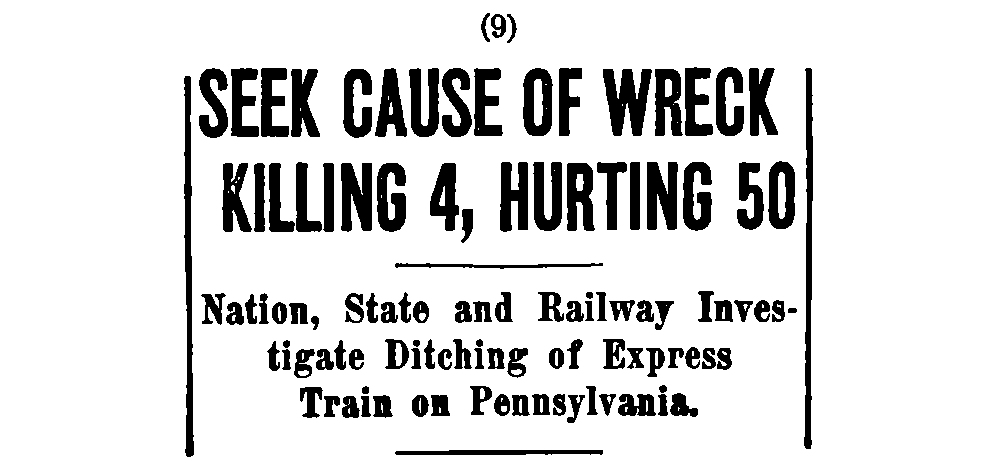
The image above is example (9). It is a head of two
decks with no following paragraph text. The top deck is a drop-line
head in two parts with 19½ and 18½ unit letters respectively. It says | SEEK
CAUSE OF WRECK | KILLING 4, HURTING 50 |
The second deck is a pyramid of three parts and
says | Nation, State and Railway Inves- | tigate Ditching of Express |
Train on Pennsylvania. | The word | Investigate | is split
between two lines of the head.
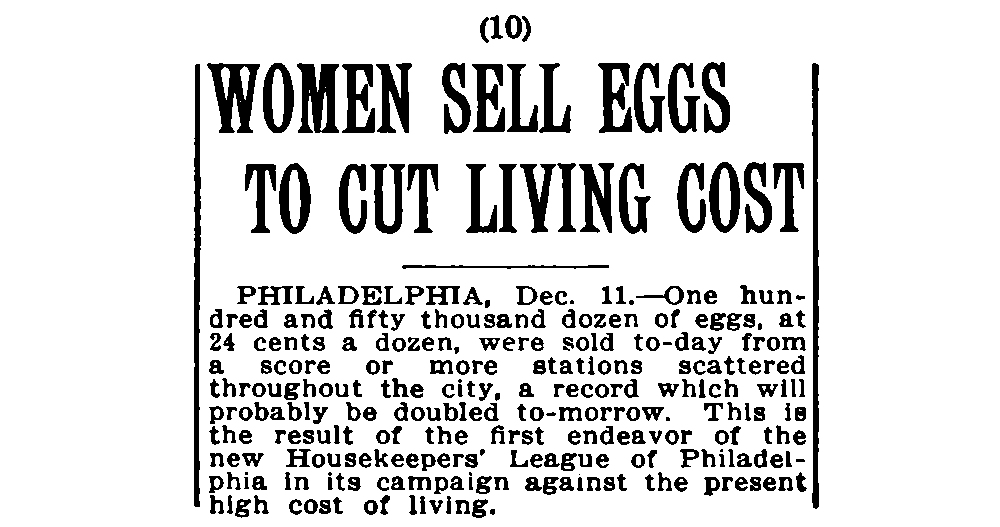
The image above is example (10). It is a
single-deck head and is followed by the opening paragraph of the story
it heads. The deck is a drop-line form in two parts with 16 and 17
unit letters respectively. It says | WOMEN SELL EGGS | TO CUT LIVING COST |
The opening paragraph of the story follows. It
says | PHILADELPHIA, Dec. 11.—One hundred and fifty thousand dozen
of eggs, at 24 cents a dozen, were sold to-day from a score or more
stations scattered throughout the city, a record which will probably
be doubled to-morrow. This is the result of the first endeavor of the
new Housekeepers’ League of Philadelphia in its campaign against the
present high cost of living. |
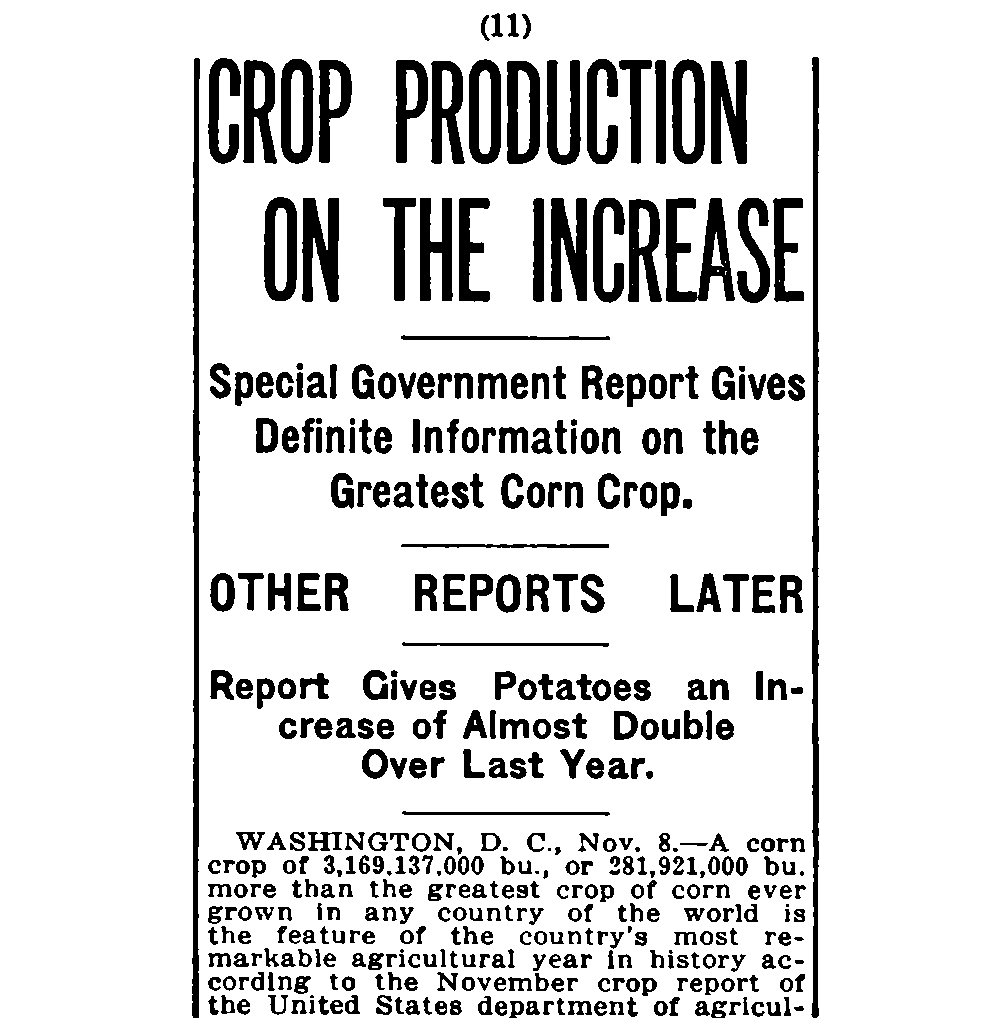
The image above is example (11). It is a head of
four decks and is followed by the opening paragraphs of the story it
heads. The top deck is a drop-line head of two parts with 14½ and
14½ unit letters respectively. It says | CROP PRODUCTION | ON THE
INCREASE |
The second deck is a pyramid of three parts which
say | Special Government Report Gives | Definite Information on the |
Greatest Corn Crop. |
The third deck is a cross-line head which says |
OTHER REPORTS LATER |
The fourth deck, like the second, is a pyramid of
three parts which say | Report Gives Potatoes an In- | crease of
Almost Double | Over Last Year. | The word | Increase | in the head
is split over two lines.
Part of the opening paragraph of the story follows.
The remainder of that paragraph plus the second paragraph are contained
in an image at the top of the next page. The part displayed here says
| WASHINGTON, D. C., Nov. 8.—A corn crop of 3,169,137,000 bu., or
281,921,000 bu. more than the greatest crop of corn ever grown in any
country of the world is the feature of the country’s most remarkable
agricultural year in history according to the November crop report of
the United States department of agriculture |
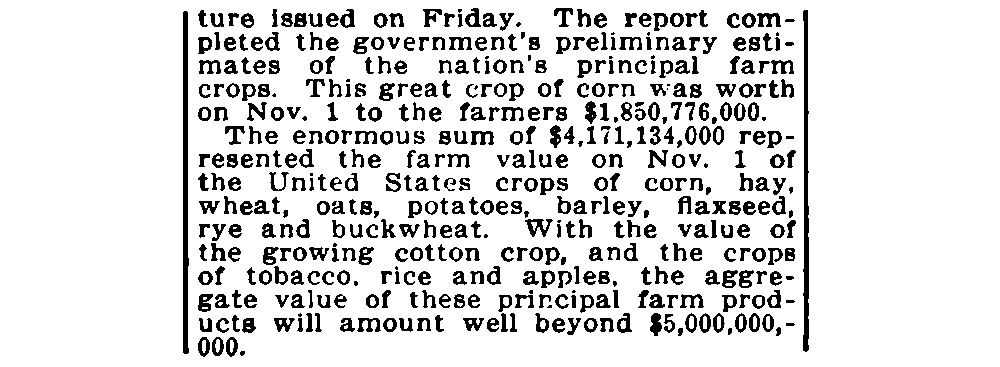
The image above is the continuation of paragraph
text from the previous page. It says | issued on Friday. The report
completed the government’s preliminary estimates of the nation’s
principal farm crops. This great crop of corn was worth on Nov. 1
to the farmers $1,850,776,000. | The enormous sum of $4,171,134,000
represented the farm value on Nov. 1 of the United States crops of
corn, hay, wheat, oats, potatoes, barley, flaxseed, rye and buckwheat.
With the value of the growing cotton crop, and the crops of tobacco,
rice and apples, the aggregate value of these principal farm products
will amount well beyond $5,000,000,000. |
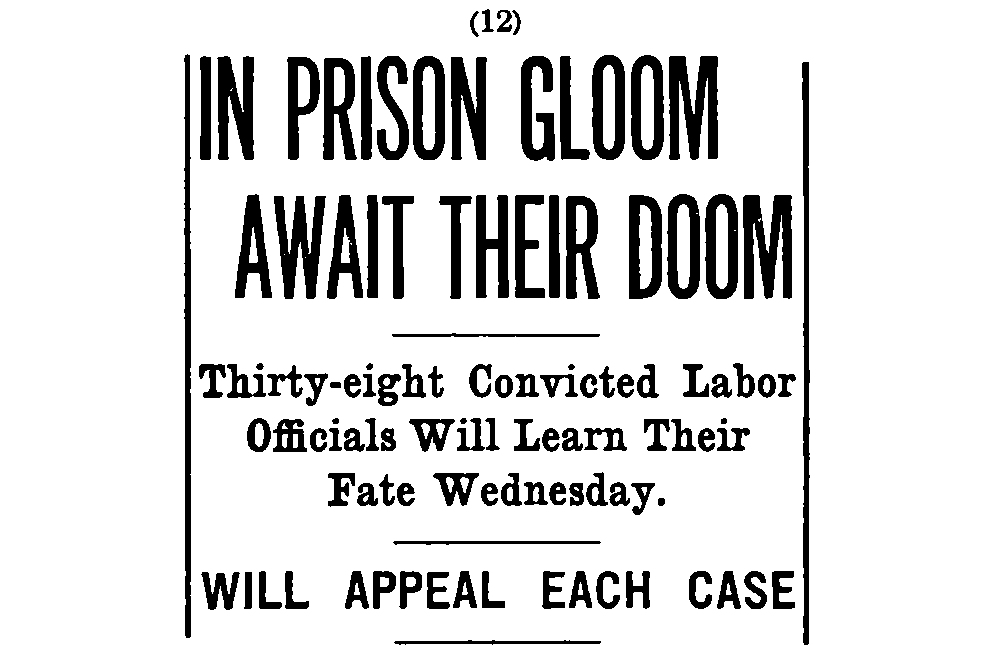
The image above is example (12). It is a head
of three decks with no following paragraph text. The top deck is a
drop-line head in two parts with 14½ and 16 unit letters respectively. It says
| IN PRISON GLOOM | AWAIT THEIR DOOM |
The second deck is a pyramid of three parts which
say | Thirty-eight Convicted Labor | Officials Will Learn Their |
Fate Wednesday. |
The third deck is a cross-line head which says |
WILL APPEAL EACH CASE |
The image above is example (13). It is a head of
two decks with no following paragraph text. The top deck is a drop-line
head in two parts with 17 and 18 unit letters respectively. It says | STATE
SOLONS PLAN | MANY NEW STATUTES |
The second deck is a pyramid of three parts which
say | Water Power, Public Service and | Income Tax Questions Will |
Receive Attention. |
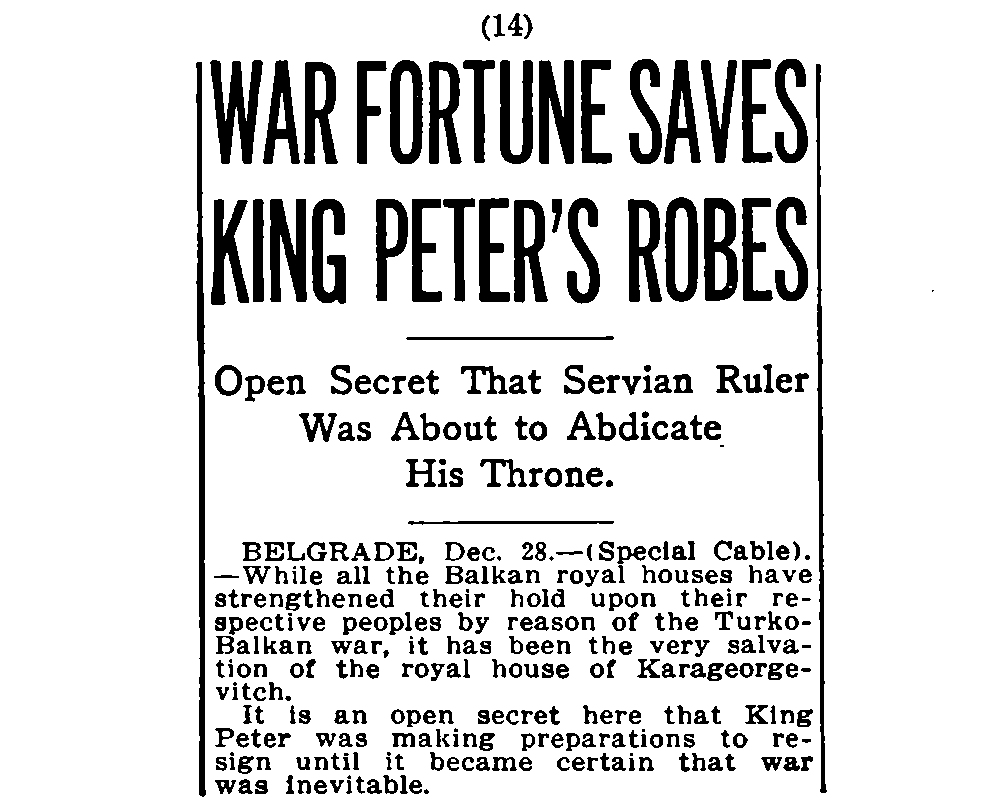
The image above is example (14). It is a head of
two decks and is followed by the opening paragraphs of the story it
heads. The top deck is a drop-line head of two parts with 17½ and
17 unit letters respectively. It says | WAR FORTUNE SAVES | KING PETER’S ROBES |
The second deck is a pyramid of three parts which
say | Open Secret That Servian Ruler | Was About to Abdicate | His
Throne. |
The opening paragraphs of the story follow. They
say | BELGRADE, Dec. 28.—(Special Cable).—While all the Balkan royal
houses have strengthened their hold upon their respective peoples by
reason of the Turko-Balkan war, it has been the very salvation of the
royal house of Karageorgevitch. | It is an open secret here that King
Peter was making preparations to resign until it became certain that
war was inevitable. |
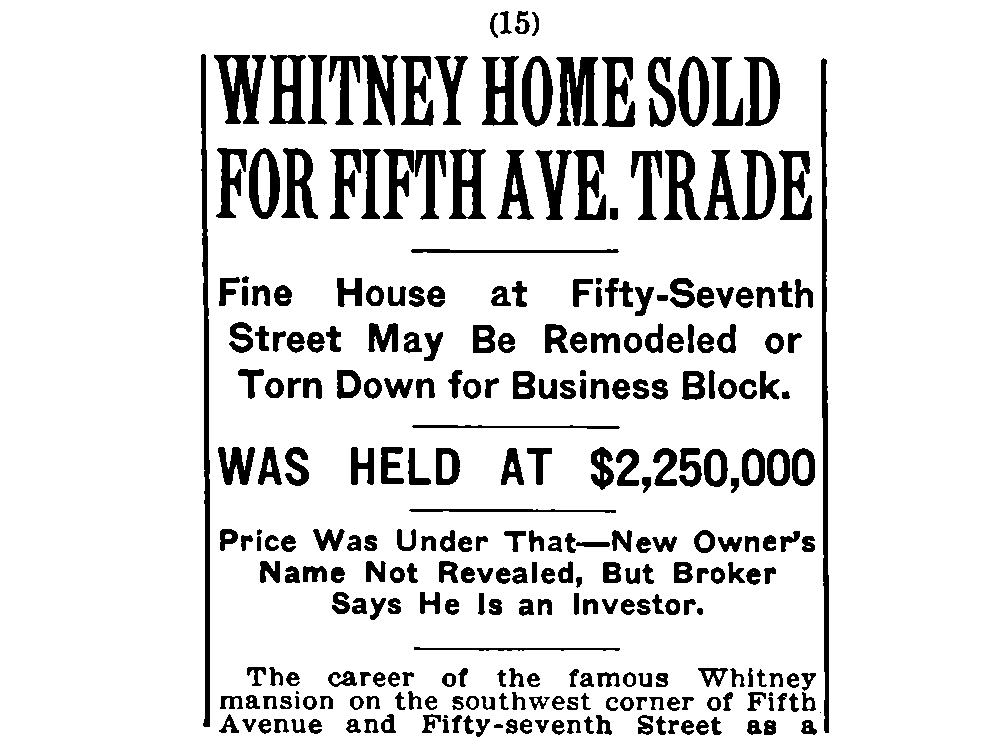
The image above is example (15). It is a head of
four decks and is followed by the opening paragraphs of the story it
heads. The top deck is a drop-line head of two parts with 16½ and
19 unit letters respectively. It says | WHITNEY HOME SOLD | FOR FIFTH AVE. TRADE |
The second deck is a pyramid of three parts which
say | Fine House at Fifty-Seventh | Street May Be Remodeled or | Torn
Down for Business Block. |
The third deck is a cross-line head which says |
WAS HELD AT $2,250,000 |
The fourth deck, like the second, is a pyramid of
three parts which say | Price Was Under That—New Owner’s | Name Not
Revealed, But Broker | Says He Is an Investor. |
Part of the opening paragraph of the story follows.
The remainder of that paragraph is contained in an image at the top
of the next page. The part displayed here says | The career of the
famous Whitney mansion on the southwest corner of Fifth Avenue and
Fifty-seventh Street as a |
The image above is the continuation of the opening
paragraph from the previous page. It says | city residence is over. The
house was sold yesterday by Harry Payne Whitney, and it was announced
that the new owner would utilize the corner for business. The entire
property, according to Worthington Whitehouse, who represented Mr.
Whitney in the sale, was held at $2,250,000, but it is understood that
the price paid was under that figure. Frank D. Veiller, who represented
the buyer, declined to give the name, only saying that he was an
investor. |
The image above is example (16). It is the last one
in this set of practice examples. It is a head constructed of a single
deck which is a drop-line form in three parts. It is displayed in a
thin font. The parts are 14, 14 and 14½ unit letters respectively and
say | THUGS ARE BOLD | HOLD UP WOMAN | AS CROWD GAPES |
CHAPTER XII
PROOF-READING
How Proof is Corrected. After copy has been set
up in type, the type is put into a long, narrow metal
tray called a “galley.” On a small hand or power press
a printed sheet of each galley is made, or “pulled,”
called a “proof,” or “galley proof.” To “pull a galley
proof” is to make a printed copy of the type in the
tray.
Each “proof” is carefully compared with the copy
so that errors made by compositors or operators in setting
up the copy in type may be discovered and corrected.
On large newspapers the proof is corrected by
proof-readers employed for the purpose, and the proof-reading
room is connected with the composing room.
Each proof-reader is assisted by a copy-holder who
reads in a monotone everything in the copy including
punctuation, capitalization, and paragraphing, so that
the proof-reader may see whether or not the printed
form corresponds exactly to the copy. In smaller
offices editors and reporters read proof, comparing the
printed form with the copy only when it is necessary.
Every one who writes for publication should know
how to correct proof, so that he may be able to do
this work quickly and accurately when occasion demands
it.
By the use of a few marks and signs it is easy to
indicate clearly just how proof is to be changed and
corrected. The least possible change should be made
because every correction means a loss of time. When
linotypes are used, every change makes necessary the
recasting of one whole line at least, while when monotypes
are used, each piece of type must be handled
separately. Accordingly, when one or more words have
been inadvertently omitted and must be inserted, effort
is made to cut out other words of about the same length
and not absolutely necessary in the same line, in the
preceding line, or in the following one, so that not more
than one or two lines will have to be recast or reset to
make room for the added words. Likewise, when one
or more words must be taken out, others should be inserted
in the same line or adjoining lines to fill up the
space.
As in the editing of copy, so in the correcting of
proof, the changes should be indicated in a manner that
makes unmistakable to the compositor the exact character
of the modifications. Confused correction of proof,
like poor editing of copy, causes loss of time and increases
the probability of error.
Errors in proof are most readily detected if a card is
used to cover all lines except the one that is being corrected.
The card is moved down from line to line as
each is read and corrected. By having but one line
before him at a time and by scrutinizing sharply every
word, the reader more readily catches any errors.
Marks used in Correcting Proof. The proof-reading
signs and marks, grouped according to their use,
are as follows:
The image above shows three | Paragraphing | marks. The
descriptions say | Begin a new paragraph. | Don’t begin a new paragraph. |
Make one element follow the other in the same line. |
The image above shows seven | Spacing | marks. The
descriptions say | Correct uneven spacing between words. | Put in space.
| Reduce the space. | Close up by taking out all the spacing. | Close
up but leave some space. | Push down a space that prints. | Put in thin
spaces between letters, i.e., “letter space.” |
The image above shows nine | Position | marks. The
descriptions say | Move to the left. | Move to the right. | Move up. |
Move down. | Indent one em. | Make lines parallel. | Make letter align.
| Turn over element that is upside down. | Transpose order of words,
letters, or figures. |
The image above and the last image of the previous
page show eight marks for | Kind of Type |. The descriptions of the
marks say | Change to Roman type. | Change to Italic type. | Change to
capital letter. | Change to small capital letter. | Change to lower
case, or small, letters. | Change to black, or bold face type. |
Substitute type from regular font for that of wrong font. | Substitute
perfect for imperfect type. |
The image above shows twelve | Punctuation | marks. The
descriptions say
| Insert period.
| Insert comma.
| Insert semi-colon.
| Insert colon.
| Insert apostrophe.
| Insert double quotation marks.
| Insert single quotation marks.
| Put in one-em dash.
| Put in two-em dash.
| Put in hyphen.
| Put in question mark.
| Put in exclamation point. |
The image above and the last image of the previous
page show four marks for | Insertion and Omission |. The descriptions say
| Put in element indicated in margin at place shown by caret.
| Take out element indicated.
| Don’t make change indicated; let it stand as it is.
| A line of dots is placed under the element that is to remain as it is. |
The image above shows two marks indicating | Uncertainty |.
The descriptions say
| Look this up to see whether or not it is correct.
| See what has been omitted in proof by comparing with the copy. |
The image above shows two marks for | Abbreviation |.
The descriptions say
| Substitute full form for abbreviation.
| Substitute numerical figures. |
The signs used to indicate changes should always be
placed in the margin of the proof-sheets, and only those
marks that show what elements are to be changed
should be put in or between the lines of the proof-sheets.
The marks in the printed lines and the signs
in the margin are often joined by a line to show the
connection between them. If this is not done, the signs
for the corrections in each line are arranged in the
margin in the order in which the marks indicating the elements
to be changed appear in the printed line, each sign
being set off by a line slanting from right to left. How
proof is corrected is shown in the following example:
The image above is the first six lines of an example
of a corrected proof. The remaining part of this example is an image
that takes up the whole of the next page.
The image above is the continuation of the example
of a corrected proof.
SUGGESTIONS
- Read proof word by word.
- Cover with a card all lines following the one being read.
- Always compare with copy all names, figures, and unusual
terms.
- Put all correction signs in the margin of proof.
- Indicate clearly the element to be changed.
- Make changes and corrections so that they cannot be
misunderstood.
- Watch for errors in punctuation.
- Be on the lookout for omission of quotation marks.
- Put in one or more words to fill space created by taking
out other words.
- Take out one or more words to make room for those inserted.
- Make only such changes as are absolutely necessary.
- Read proof accurately and rapidly.
CHAPTER XIII
MAKING UP THE PAPER
Importance of the “Make-Up.” Although the
editing of a newspaper is often regarded as completed
when the managing editor has passed upon the proofs
of all the matter that the newspaper is to contain, yet
the arranging of this material on the several pages, the
so-called “making up,” still remains to be done under
the direction of one of the editors. The arrangement,
or “make-up,” particularly of the front page, plays a
very important part in the success of the newspaper.
To display the important news of the day in the most
effective way is to attract readers. What has been said
elsewhere of the advertising value of headlines applies
equally to the “make-up.” The best arrangement is
that in which the important news stands out prominently,
and can therefore be most easily read. A symmetrical
balancing of the headlines, half-tones, and
cartoons adds greatly to the attractiveness and readableness
of the newspaper. Although the average reader
does not analyze this element any more than he does
any of the other elements of the newspaper that he
reads daily, still the “make-up” doubtless leaves an
impression upon him.
How the “Make-Up” Varies. Newspaper practice
regarding make-up varies as greatly as it does in
the case of headlines. The seven-column page is still the
normal type, but the eight-column page is rapidly superseding
it, because the narrower columns and margins
make possible a considerable saving in paper. Some papers
like the New York Sun, the New York Evening
Post, the Chicago Daily News, and the Springfield
(Mass.) Republican, follow a very simple plan of placing
large heads at the top of alternate columns, and of
having small heads on all the other stories on the front
page, so that the four top heads in the first, third, fifth,
and last columns are the only ones that stand out prominently.
Other papers, like the Chicago Tribune, put
a three-column cartoon in the fourth, fifth, and sixth
columns, an arrangement which makes possible large
heads in the first, third and last columns and somewhat
smaller heads of several decks in the fourth and sixth
columns under the cartoon. Still other papers, keeping
to the general scheme of alternate columns for large
heads, use one-, two-, three-, or four-column cuts of
people, places, or events that figure in the news, at the
top of the columns and then use slightly smaller heads
under these cuts. Two-column heads in the first and
second columns are often balanced with two-column
heads in the sixth and seventh columns. Some newspapers
have practically abandoned the symmetrical arrangement
of the front page, and spread headlines in
black, red, or green ink, and cuts over the front page
in a way that seems to have no other purpose than to
produce as bizarre an effect as possible.
Principle of Contrast. The two general principles
that underlie the make-up are those of contrast and
symmetry. Large heads are alternated at the top of the
column with smaller heads so that the large heads will
stand out in contrast with the other columns of less
prominence. Two or more large heads side by side at
the top of the columns do not stand out with as marked
effect as when they alternate with smaller heads or no
heads at all at the tops of the columns. The same is
true when cuts or cartoons serve to furnish the contrast.
With heads not at the top of the columns, effort
is made to secure contrast by some form of alternation.
A careful study of a number of papers will show a
variety of ways in which the principle of contrast determines
the arrangement of material on each page.
Principle of Symmetry. That this alternation of
the prominent and the less prominent should be closely
related to symmetry in arrangement, is evident. In the
seven-column form, which is the usual one, the large
heads in alternate columns produce a naturally symmetrical
effect. When somewhat smaller heads are
used lower down on the page, a similar alternation
continues to carry out the symmetry. Large two-column
heads in the first and second and in the sixth and seventh
columns, or smaller two-column ones in the second and
third and in the fifth and sixth columns, produce an
even balance. In an eight-column page, in which this
regular alternation is impossible, some symmetry is
often maintained by means of cuts. Many papers do
not attempt to have perfect balance on the front page,
because of the desire to have the daily cartoon or a cut
at the top of the right half of the page where it will
attract most attention. Usually when symmetry is sacrificed,
the regularity of arrangement is departed from
by putting the largest heads, or the illustrations, on the
right half of the front page.
Positions of Prominence. The most important
news is generally put in the last column to the right on
the first page. This is done for two reasons: first, because
a long story in this column can run on continuously
to the first column of the second page without a
jump-head; and second, because, as the papers are laid
out on the news stand, the right side of the paper is
prominently displayed. This fact accounts for the
placing of cuts and cartoons on the right side. If there
are two very important stories carrying larger heads
than usual, the one second in importance is put into the
first column, partly for symmetry and partly for the
reason that, as the paper is read, the first column is
prominent. In fact, some papers, especially those that
do not count much on street sales, put the most important
news in the first column in preference to the last.
On all pages except the front one, the first column is
usually considered the best.
“Breaking Over” Front Page Stories. In order
to preserve the alternation of large heads with smaller
ones on the front page, as well as to get as much of the
most important news as possible on this page, long
stories with large heads are continued from the first
page to one of the inside pages. One column of these
stories, or often only one-half or two-thirds of a column,
is put on the first page, according to the make-up of the
lower half of the page, and the remaining part is put
with a jump-head on an inside page. When a story is
“broken over” from the front page, a dash or rule is
put at the end, with the words “Continued on third
page” beneath, if the break is at the end of a column;
and a dash, or rule, and these words followed by another
rule are used if the break is not at the end of a
column, the purpose of the second rule being to set off
the explanation “Continued on third page,” from the
following matter. The jump-heads, as was shown in
Chapter XI, are of several kinds: (1) a reproduction
of the whole of the original head, (2) a reproduction
of the top deck of the original head, or (3) an entirely
new head, usually in smaller type than the original one.
Grouping News. Various kinds and forms of news
matter are grouped in various ways. Local, state, national,
and foreign news is often arranged each kind on
a separate page, as is also the society, the sporting, and
the market news. Short one-paragraph news stories,
usually with one line of type for a head, are often assembled
under such heads as “City News In Brief,”
“News of the State,” “Sporting Gossip,” and are arranged
in order of size, the smallest being put first, or
vice versa. The society news is also frequently arranged
in order of size, the longest stories being put at the beginning.
In some papers, the heading of these one-paragraph
stories, instead of being a separate line,
forms a part of the first line of the story and is separated
by a dash from the beginning of the story, which fills
the remaining third or quarter of the first line.
The “Make-Up” Page by Page. The pages that
contain little or no live news matter are made up as far
as possible in advance of the first edition of the paper
so that they will be out of the way when the news pages
are to be arranged. The editorial page, and special
pages such as the woman’s page, the theatrical page, the
continued story or feature page, can usually be made
up, stereotyped, and put on the press ready for printing
before the news pages are made up. The first page is,
as a rule, made up last, so that all of the very latest
news may be given a prominent place. Evening papers
that make a special feature of the financial and market
page, make up that page last in order to print the closing
quotations of the day and to get the papers out on
the street as soon as possible after the closing hour of
the exchanges.
The Man Who “Makes Up.” The actual work of
arranging the type in the page forms is done by the
make-up men of the composing room under the direction
of one of the editors. On some newspapers the managing
editor directs the make-up, on others the assistant
managing editor, and on still others the night editor,
or the news editor. With a set of proofs at hand
the editor directing the make-up indicates where all the
important stories and cuts are to be placed, and then
usually allows the make-up men to fill in the shorter
matter with the smaller heads. The experienced editor
can picture in his mind the appearance of the first page
in print, as he directs the arrangement of the masses of
type and the cuts. A diagram, or schedule, is usually
made out by the editor in advance to indicate the position
of the most important news and cuts.
“Making Up” Different Editions. As every
large newspaper prints several editions, the page forms,
after being stereotyped, are returned to the composing
room to be made over for the next edition. On a morning
paper the first edition, intended for places at a considerable
distance, is made up to leave the composing
room about 9.30 in the evening. A second mail
edition follows this at about 11.30 P.M., another at
1.30 A.M., and the regular city edition at about 2.30 or
3.30 A.M.
On an afternoon paper the first edition may be made
up at 6 o’clock in the morning, and other editions may
follow at intervals of about two hours throughout the
day. Generally, however, the noon edition, made up
about 10.30, is the first. This is followed by a mail edition
made up at about 12.30; by the home edition for
distribution by carriers made up at 2.30; and by the
market edition made up at about 3.15, or as soon as the
closing quotations are received from the leading exchanges
all over the country. The sporting extra, following
the market edition, is made up the instant the
complete score is received of the baseball game in which
the local team played, or whenever the result of the
most important sporting event of the day is announced.
Following the sporting edition, many afternoon papers
get out a special mail edition, dated the following morning,
for distribution to distant points in competition
with the earliest mail edition of the morning papers.
In making up the several editions, it is desirable to
change as few pages as possible in order to save time
and to avoid additional stereotyping. When arranging
the news on the inside pages for the first edition, the
editor can make up some of the news pages so that they
need not be made over for several editions at least.
The front page is made over for each edition and usually
one or two inside pages. As the value of news changes
considerably in the five or six hours between the first
and the last editions, the longer stories with large
heads that occupy prominent places on the front page
in the earlier editions are often cut down, given smaller
heads, and put in less conspicuous places when later
news requires the best position. Front-page stories of
the first editions often go over into the inside pages
with headlines unchanged, sometimes with the story cut
down and sometimes in the original form. Often only
the top deck of the head is rewritten to be set in smaller
type, and one or two of the decks are cut off to reduce
the size and prominence of the head.
Composing-Room Terms. In the composing-room
the editor in charge of the make-up finds a number of
technical terms in common use in addition to those pertaining
to type that are explained in Chapter X.
When all the “takes,” or pieces, of copy have been
given out to the linotype operators or compositors,
the copy is said to be “all in hand”; when it is all in
type, or all set, it is said to be “all up.” Each operator
puts a “slug” containing his number at the beginning
of matter that he sets as his take. Advertisements are
set in the part of the composing-room known as the
“ad alley.” Matter set by hand or on a linotype machine
is arranged by “bank men” in proper order in
galleys on a “bank,” or sloping shelf. After type has
been used or has been killed, it is “distributed” by
hand, letter by letter, into the cases. Linotype slugs,
and usually all type smaller than 12-point that is cast
on a monotype, are thrown into the “hell-box” to be
taken to the stereotyping-room and melted up, so that
the metal can be used again.
Page forms are made up on the “stone,” a smooth
table top, formerly of stone, now of metal. Forms are
“justified” to make all of the columns exactly the same
length by inserting leads here and there between the
lines when a column is too short, and by taking out a
few leads when it is too long. After being “justified,”
the forms are “planed down,” or leveled, with a
“planer,” or wooden block, which is tapped with a mallet
to force all type and cuts down to the level surface
of the stone. Type that does not stand squarely on its
base is said to be “off its feet.” The forms are “locked”
by means of screws, or of wedges known as “quoins.”
After the first page form is thus “closed,” it may have
to be “ripped open” for late news. The forms are
“put away” when they are sent to the stereotyping-room.
SUGGESTIONS
- Observe carefully the “make-up” of representative newspapers
in different parts of the country.
- Study the “make-up” of your own paper.
- Display the important news in a conspicuous position on
the front page.
- Arrange the front page to secure as much symmetry as
possible.
- Put the most important news story in the last, or outside,
column of the first page.
- Place the second best story in the first column of the
front page.
- Break over into the inside pages front-page stories of
more than a column in length.
- Alternate large and small heads at the top of the columns
for contrast.
- Remember that the upper right hand quarter of the first
page is the most conspicuous.
- Group on separate pages market, society, sporting, state,
foreign, and other distinct kinds of news.
- See that all guide lines are taken out when the type is
assembled in the form.
- Don’t use any matter before it is “released.”
- Have some good two or three line “fillers” on hand.
- Don’t “hold over” or “kill” really live news matter.
- Remember that the number of street sales depends considerably
upon the “make-up” of the front page.
CHAPTER XIV — FOOTNOTES
THE FUNCTION OF THE NEWSPAPER
The Newspaper Worker and His Work. Any
discussion of newspaper writing and editing would be
incomplete if it did not consider the function of the
newspaper and the relation of the newspaper worker
to that function. In this presentation of methods of
newspaper making the object has been to explain and
to exemplify current practices in journalism rather than
to discuss the ultimate purpose and results of such
methods. It is evident, however, that unless the reporter
and the editor, consciously or unconsciously, set up for
themselves ideals based on their conception of the function
of the newspaper, they have no standards by which
to measure the character of their work. Merely to accept
existing methods without analyzing them to determine
their results, is to overlook their underlying
purpose. Not until a reporter or an editor realizes the
effect that his news story or his headline produces
upon the opinions, and hence upon the lives, of the
thousands of persons who read it, does he appreciate
the full significance of his work. Ideals and standards
for any kind of work appeal much more strongly to the
average worker when he knows the ultimate effect of
what he is doing.
The Newspaper and the Community. Like all
other undertakings, public and private, newspaper making
tends to conform to the current ideals and tastes
of the community. As far as it is a private business
enterprise, it is influenced by the conditions and the
practices prevailing in the business world. As a medium
of information and publicity, it is measured by the
standards of the community in which it circulates. It
is a product of its environment, and at the same time
it is a force in creating that environment.
Conditions in newspaper making to-day are the outgrowth
of the journalism of preceding generations.
The changes that have produced these conditions are
to a considerable extent the results of social, political,
and economic forces. A brief survey of the development
of newspaper editing and publishing, with special reference
to present problems in journalism, will help to
a better understanding of the function of the newspaper
of to-day.
Growth of the Business Element. In the last
seventy-five years in this country, the editing and the
managing of newspapers have undergone a significant
development. From being a comparatively simple undertaking,
newspaper publishing has become a big,
complex, highly organized enterprise. In 1835 it was
possible for one man, James Gordon Bennett, Sr., to
start the New York Herald with a cash capital of $500,
and to perform the greater part of the work connected
with its publication, for the owner-editor’s duties
ranged from editorial writing to keeping books, from
gathering police news to making out bills, and from
commenting on conditions in Wall Street to writing
advertisements. The first instance of ownership of a
newspaper by an incorporated stock company came ten
years later when Horace Greeley and Thomas M’Elrath,
editor and business manager respectively of the New
York Tribune, decided to share their personal ownership
of that paper with five assistant editors and with
the five employees of the business and mechanical departments
who had been connected with the Tribune
for the longest time. This joint ownership plan Greeley
and his assistants hoped would in time result in the
“still further application of the general principle that
the workman should be his own employer and director,
and should receive the full reward of his labor.” The
amount raised by this stock company, $100,000, was
considered at that time a very large sum to be devoted
to newspaper publishing. How rapidly the conditions
of newspaper making changed is shown by the fact that
less than thirty years after the New York Tribune was
incorporated with its shares at $100 each, these shares
sold for as much as $10,000 each, and in 1869, less
than thirty-five years after the New York Herald began
with $500 cash capital, Bennett refused an offer of
$2,000,000 for his paper. Within the lifetime of these
two great editor-publishers newspaper making had become
a big business enterprise.
Newspapers Require Large Capital. During
the last quarter of a century the amount of capital required
for success in newspaper publishing has been
further increased by the need for huge presses, expensive
linotypes and other type-casting machines, and
more elaborate stereotyping apparatus, as well as for
better news service, new special features, and more
numerous illustrations. Expensive additions to the
mechanical equipment and other exigencies often
make it necessary for the newspaper company, like
other business enterprises, to secure financial assistance
by borrowing considerable sums from banks. Such has
become the magnitude of the business side of the newspaper
that ownership by stock companies is the rule
to-day instead of the exception as it was in 1845. Not
infrequently the majority of the stock of a newspaper
is held by one man or in one family, and one person,
often known as the publisher-owner, directs the publishing.
In large cities the amount of capital required
to establish and maintain a daily newspaper is so great
that the publisher-owner must be a man of considerable
wealth. Stock in newspaper companies, however, is not
held exclusively by those directly connected with the
paper. From the point of view of the stockholders of
a newspaper company, who are not directly connected
with the newspaper and who are interested in it largely
if not entirely as an investment, the important consideration
is that the newspaper shall be profitable, that
dividends shall be adequate and regular. In short,
newspaper publishing has become a large business
undertaking subject to the conditions of big business
enterprises.
Increase in Advertising. Another important factor
in newspaper publication, that has developed in the
last twenty-five years almost step by step with the increased
cost, has been the remarkable growth of newspaper
advertising. With growing combination and
competition in business, managers of great retail stores
discovered that daily news of their establishments, in
the form of description of new goods, bargains, and
special prices and sales, was read by many with as
much interest as were other kinds of news. Newspaper
advertising of this kind has proved very profitable both
to the advertiser and to the paper.
Half-page, full-page, and even two-page advertisements
of department stores and other retail business
concerns have necessitated an increase in the size of
regular editions of daily papers from eight pages to
twelve, sixteen, or twenty-four pages. The number of
classified advertisements, such as “want ads,” has also
increased greatly within recent years. The large revenues
from all forms of advertising have made it possible
to give the reader a better paper as well as a bigger
one, and at the same time to reduce the price generally
from three or five cents to one or two cents a copy.
The reduction in price, in turn, has resulted in remarkable
gains in circulation. Whereas a generation ago
50,000 copies daily was considered a very large circulation,
we now have newspapers printing daily editions
of from 150,000 to 900,000 copies. Thus, although the
cost of producing the newspaper has constantly increased,
the price to the reader has been reduced.
The result of these readjustments has been that from
two thirds to three quarters of the cost of maintaining
a newspaper comes from the advertising, and only from
one quarter to one third from subscriptions and sales.
This means that when a man buys a penny paper, he is
buying for one cent what it costs three or four cents to
produce, and that the difference between the cost and
the price he pays is paid for by the advertisers.
Decline of Personal Journalism. Coincident with
the change in the financial organization of newspapers,
significant changes have taken place in the editing of
them. Two generations ago the owner-editor who established
a newspaper with a limited amount of capital,
as Greeley did the Tribune, was the real head of his
paper, who expressed vigorously his own opinions in its
editorial columns. Personal journalism, as the expression
of the political, social, and economic beliefs of
great editors, like Greeley, Bennett, Bowles, Raymond,
Dana, and Godkin, was an important influence in
American life. These men were recognized as leaders.
The opinions set forth in their editorials were accepted
by readers as significant contributions to the solution
of current problems. In short, it was a period of great
editorial leadership.
With the development of the telegraph, the telephone,
and the railroad mail service, and with the expansion
of the nation and its interests, the amount of news
available for publication increased many fold. Distance,
once a formidable obstacle to newsgathering, practically
ceased to exist when news could be flashed in a few
minutes from one end of the world to the other. The
news field was enlarged from the city and its suburbs
to include the whole earth. The newspaper became
truly a paper of news, a budget of facts rather than a
medium for expressing the editor’s opinions. As a purveyor
of the news, it increased in circulation and prosperity.
With an ample supply of facts upon which to
base their opinions, the readers no longer needed to
accept opinions ready-made from the editor. With
greater independence in thinking and in voting on the
part of the reading public the editorial leadership of the
newspapers declined. At present the three or four columns
of editorials are relatively unimportant as compared
with the ten or twelve pages of news. To-day the
names of the editors are unknown to the majority of
the readers. Company ownership has contributed toward
minimizing the opportunities of personal editorship,
until now it is said that personal journalism, in
the old sense of the term, has all but ceased to exist in
this country.
Wars Develop Newspapers. In the gathering of
news and in the effective presenting of it, the two most
important influences have been the Civil War and the
Spanish-American War. The great demand from readers
of all classes for the latest reports from the front
during the War of the Rebellion was a great stimulus
to newspaper editors and publishers. The beginning of
the present summary “lead,” and of the long bulletin
form of headline for news stories, is to be found in connection
with the telegraph dispatches of war news. The
advent of “yellow journalism,” especially in New York
City, coincided with the breaking-out of the Spanish-American
War. Big headlines, and news displayed in
larger type, served to advertise the latest reports, which
the public eagerly sought. The climax of large headlines
is found in two metropolitan newspapers which
announced the declaration of hostilities with the single
word “WAR,” spread over the whole of the front page.
Banner heads in red and black, and large headlines two
and three columns in width, that are now not uncommon
in newspapers as a means of advertising the news,
had their beginning in the Spanish-American War days.
The Growth of Cities. The growth in the population
of cities, partly as a result of the movement from
the country to the city, and partly as a result of immigration,
has made possible large increases in newspaper
circulation. New papers have not been established generally
to meet this growth in population; existing papers,
rather, have added to the number of their readers. The
result has been that a few large papers are to be found
in all the big cities of the country rather than an ever-increasing
number of small ones. In great centres of
population, like New York and Chicago, the influx of
foreign immigrants has also been a factor in the development
of so-called “yellow journalism.” With a limited
knowledge of the English language and of American
institutions, this foreign element has been attracted by
large, striking headlines, sensational news stories, diagrammatic
illustrations, and well-displayed editorials,
and has become a considerable part of the total number
of readers of the “yellow journals.”
The Development of Features. Hand in hand
with the remarkable growth of advertising in newspapers
has gone the development of important features
in the editing of them. The success of department store
advertisements, for example, depends to a considerable
extent on the number of women readers. To secure and
retain these readers, newspapers have, accordingly, developed
a number of features primarily intended for
women. Fashion news, cooking and household recipes,
discussions of etiquette, articles on health and beauty,
advice in affairs of the heart, society news, reports of
women’s clubs, and similar subjects have been given
greater space from year to year because of the constantly
growing importance of women readers as a
factor in the business success of the newspaper.
The increase in the amount of advertising has made
possible also the expansion, in size and scope, of the
Sunday paper. Special articles, fiction, humor, and
illustrations in black and colors, fill special supplements,
magazine sections, and “comics.” In fact, aside
from the news sections, the reading matter in Sunday
newspapers has become practically identical in character
with that of the popular weekly and monthly magazines.
Reading matter the primary purpose of which is
entertainment rather than information has always had
a place in daily papers. Despite the great increase in
the amount of news available, this kind of material has
not been crowded out. The daily short story, a chapter
of a serial novel, feature articles, humor in verse and
prose, and similar forms of entertaining reading matter
are a recognized part of every issue of many newspapers
in all parts of the country.
The perfecting of photo-engraving processes, by which
half-tone illustrations and zinc etchings can be made
rapidly at relatively small cost, has added another important
feature to the newspaper. Photographs of persons,
places, and events that appear in the day’s news
are now quickly reproduced by the newspaper half-tone.
Cartoons printed by means of zinc etchings occupy a
prominent place in many papers.
Aims of the Newspaper. The present-day newspaper,
as a result of this evolution, undertakes to accomplish
five ends: (1) to furnish news, (2) to interpret
the news and to discuss current issues, (3) to give
useful information and practical advice, (4) to supply
entertaining reading matter, and (5) to serve as an advertising
medium. The primary purpose of the newspaper
is undoubtedly to furnish news and editorial
discussions; the secondary one to supply useful information
and entertaining reading matter. These results,
however, can be accomplished with the present small
cost to the reader only by reason of the fact that the
newspaper is a valuable purveyor of advertising publicity.
The interrelation between the advertising matter and
the other contents of the newspaper is a vital one. The
value of newspaper advertisements is determined by
the number and the character of the persons who read
the “ads,” that is, by the circulation of the newspaper.
The circulation, in turn, depends on the amount and
the character of the news and other features of the newspaper.
Increases in circulation make possible higher
advertising rates, and higher rates produce larger revenues
from advertisements. The greater income received
from advertising and circulation is generally used to
increase and improve the reading matter. Decreases in
advertising revenues usually mean retrenchment in expenses
and a reduction of reading matter. If this reduction
in news and other features of the newspaper is
marked, the paper will lose readers. Advertising, circulation,
and the character of the contents of a newspaper
are thus closely bound up with one another.
Recognition of Its Public Function. That in its
primary purpose, of furnishing the news of the day
with an interpretation of it and a discussion of current
issues, the newspaper is a public institution, has been
recognized from earliest times both in this country and
abroad. Although the American newspaper has at all
times been a private enterprise, its public function has
always been emphasized. In guaranteeing the freedom
of the press, the framers of the first amendments to the
Constitution realized that it is necessary in a democracy
to have full information and free discussion on all questions,
social, economic, and political. They believed as
did Milton when he wrote, in his great defense of liberty
of the press addressed to the English Parliament
at the very dawn of English journalism, “Where
there is much desire to learn, there of necessity must
be much arguing, much writing, many opinions, for
opinion in good men is but knowledge in the making.”
The responsibility of the press to the public has been
repeatedly emphasized. In condemning the appointment
of editors to public office as a means of securing
their support, Daniel Webster, in 1832, declared: “In
popular governments, a free press is the most important
of all agents and instruments. The conductors of the
press, in popular governments, occupy a place in the
social and political system of highest consequence. They
wear the character of public instructors.”
That the newspapers are the teachers of the people
has been reiterated on the platform, in the pulpit, and
in the newspapers themselves. Wendell Phillips, a generation
ago, in speaking of the importance of newspapers
in this country, said: “It is a momentous, yes,
a fearful truth, that millions have no literature, no
schools, almost no pulpit but the press. It is parent,
school, college, pulpit, theatre, example, counselor, all
in one. Let me make the newspapers, and I care not
who makes the religion or the laws.”
The Function of Newspapers in a Democracy.
To accept this generally recognized function of the
newspaper as the distributor of information on all
the varied subjects presented in the day’s news, is to
give the newspaper a place of great responsibility in a
democracy like ours. If we consider only its news-distributing
function and disregard editorial influence,
the place of the newspaper is still a vital one in our
country, for the success of a democratic form of government
depends upon intelligent action by the individual
voter. Such voting must be based upon accurate information
concerning all important events of the day,—events
of a social, commercial, and industrial significance,
as well as those of political import,—because
many of the important questions upon which the voter
should cast an intelligent ballot concern economic and
social problems rather than purely political ones. Practically
the only source of information for the average
voter concerning local, national, and international
events, is the newspaper.
The rapidly increasing tendency of citizens in voting
to disregard party affiliations, and the recent extension
of methods of direct making of laws by means of the
initiative and the referendum, require that citizens have
accurate information on a great variety of subjects to enable
them to vote intelligently on men and issues. Any
influence that tends to affect the accuracy of statements
concerning current events thereby tends to affect the basis
underlying the opinions of the voters. Upon the accuracy
of the newspapers in matters of news, therefore, depends
to a great extent the character of our government.
Limitations to Accuracy and Completeness.
Absolute accuracy in gathering and presenting the news
is subject to human limitations. Seldom do two eye-witnesses
from whom the reporter gets information
agree in their accounts of what happened. The reporter
must judge of the value of the testimony of each witness,
and must make up a composite account of the
truth as he sees it in these different narratives. The
copy-reader, in editing the reporter’s story, frequently
finds it necessary to cut it down considerably because
of the importance of other news. Again the accuracy
of the report may be affected by reason of this “boiling
down.” The headline writer, working under strict limitations
of space, may modify the impression produced
upon the reader by the original story. Even on the mechanical
side the accuracy of the news may be affected
by a careless compositor or proof-reader. The rapidity
with which all the processes of newspaper making are
performed greatly increases the possibility of error.
The personal equation, for which allowance is made in
all scientific and technical work, enters into every part
of the process of newspaper making, from the gathering
and writing of the news by the reporter, through the editing
of it and the writing of a headline for it, to the
compositor, proof-reader, and make-up man. The chances
of printing inaccurate statements under such conditions
may be reduced to a minimum only by the exercise of
the greatest possible care on the part of all those concerned
in the rapid production of newspapers, but mistakes
of this type can never be entirely eliminated.
Failure to give a complete report of the day’s news
is due in part to the amount of news available. Inasmuch
as the average newspaper in a large city receives
from two to three times as much news daily as it can
publish, it is necessary for editors to select from the
available news, and to decide quickly which news is the
most important for their readers. The fact that this
news comes in by mail, telephone, and telegraph, as well
as from reporters, at intervals throughout the day and
the night, makes it impossible for the editors to judge
with absolute accuracy of the relative value of each
piece of news as it is received. Consequently news values
are constantly being readjusted as each important piece
of news reaches the office. In the final decision in
regard to what news shall be printed, what shall be
omitted, and how much space shall be given to each
piece of news that is published, the personal judgment
of the editors is the determining factor.
Besides inaccuracy and incompleteness in presenting
the news of the day due to the personal judgment of
those responsible for the making of the newspaper,
other forms of suppression or distortion of news are to
be found in newspaper publishing due to the influence
of various forces. It is to these influences that peculiar
significance attaches from the point of view of the
ethics of newspaper publishing, because in such cases
the incomplete and inaccurate presentation of the news
is deliberate.
Some Sinister Influences. The forces that make
for the suppression and the “coloring” of news as
well as for the restriction of editorial independence,
critics of newspapers assert, are the result of the changes
in business and editorial management during the last
seventy-five years. The charge is made that too many
newspapers are “edited from the counting-room.”
Business interests, it is said, particularly those of
advertisers, influence news and editorials. Because of
stock company ownership and the absence of editorial
management by men known to the public, as were the
editors in the days of personal journalism, wealthy men
or corporations, it is charged, have been able quietly to
buy up the stock of some newspapers and through hired
editors, of whom in these days the public knows nothing,
to direct secretly the news and editorial policies
for personal advantage. Some banks, these critics declare,
have refused loans to newspapers the policies of
which were inimical to the interests largely represented
among the stockholders or the customers of the banks;
and when loans have been made to newspapers by other
banks, such indebtedness has sometimes been used to
prevent the newspapers from maintaining or adopting
policies hostile to their interests. So-called “yellow
journalism,” critics of newspapers point out, furnishes
another example of the commercializing of the press,
because, in order to increase their circulation and profits,
the publishers of “yellow” journals pander to their
readers’ cravings for the sensational. A number of
newspapers have published advertisements of fraudulent
and questionable enterprises because of the additional
revenues to be obtained from this source. Whether
these charges are true of a number of newspapers or of
only a few, the existence of these conditions and the
possibility of these dangers make the subject one of
vital importance not only to newspaper men but to
every citizen of the country.
Suppression of News. If, for example, owners of
retail stores request newspapers in which they advertise
to suppress all news of elevator accidents in their stores
because such news hurts their business, the newspaper
publishers might consent to this suppression on the
ground that it is more important to retain the good will
and patronage of these advertisers than to give their
readers the news of the accidents. The very existence
of the paper, they may argue, depends upon these advertisers,
and, after all, newspapers give their readers
the accounts of so many other accidents that those concerning
elevators in department stores will never be
missed. This seems to be a logical argument for omitting
news of this kind, but when the results of such suppression
are traced, the action, it is realized, is unjustifiable.
In the first place, elevator accidents are often
due to carelessness and haste on the part of passengers,
and newspaper accounts of them accordingly
serve to warn many people to be more careful. Thus
the publication of the news helps to prevent accidents.
Again, the accidents may be due in part to the employment
of young, inexperienced, or careless operators.
When it is proposed to correct these difficulties by a
local ordinance or by a state law providing that elevator
operators must be over eighteen years of age and must
be licensed as competent, the importance of passing
such a regulation is more evident to the average voter
if he knows of the frequency of such accidents. The
suppression of news of these accidents would deprive
most citizens of knowledge upon which to base an
opinion as to the need of laws governing elevator
operators.
The business interests of some cities, it is said, have
urged newspapers to suppress the news of epidemics or
threatened epidemics of such diseases as typhoid fever,
smallpox, and even bubonic plague, because reports of
the presence of these diseases in a city keep away
travelers and hurt business. At first glance this plea
might seem a just one, and records show that it has
been successful in a number of instances. But the question
inevitably arises, Has not the tourist, the buyer,
and every one else who is planning to go to that particular
city a right to know of the health conditions that
prevail there, in order to decide whether he wishes to
expose himself to the possibility of sickness and death?
Again, Has not every citizen and voter of the city a
right to know of these conditions, not only that he may
protect himself and his family, but that he with other citizens
and voters may remedy the conditions responsible
for the epidemic and may provide for stamping it out?
Reformers in some cities have declared that local newspapers
have refused to give publicity to campaigns
against graft and vice because the exposure of such
conditions, the publishers said, would reflect on the
reputation of the city and would hurt business. Others
have said that newspapers have reported and upheld
investigations of municipal corruption as long as those
affected by such exposure were persons of little influence
or importance in the community, and that as soon
as more important business interests were threatened
by the investigations, the attitude of the newspapers
changed completely. The question to consider is, Should
the business interests of the city be paramount to the
welfare of all the people? The vital questions for editors
to decide must be, Are newspapers in such cases doing
their duty as distributors of complete and accurate reports
of the news of the day? Are they not morally
responsible when they fail to perform this duty?
“Coloring” the News. The so-called “coloring”
or “shading” of news is in the same category as the
suppression of news. It is possible to change the facts
more or less completely so that a story not only is
incomplete but produces a false impression on the mind
of the reader. The sin is then no longer one of omission;
it becomes one of commission. To belittle the
campaign of the opposing political party, newspapers
have misrepresented the size of the political meetings,
the enthusiasm of the audiences, the arguments of the
speakers, and in general, the success of the efforts to
win votes. Candidates, likewise, have been assailed and
misrepresented in news stories. In economic disturbances,
such as strikes and lockouts, some newspapers
have given their readers colored reports by “playing
up” the disorder of the strikers, their threats of violence,
and their unreasonableness in refusing terms of
settlement. Other newspapers, representing the labor
interests, have printed “shaded” reports to show that
employers have treated their men unjustly, that the
militia has been brutal, and officers of the law unfair
to strikers.
Newspaper editors and publishers, in these and other
instances, often maintain that they only print what their
readers want. The questions involved, therefore, are,
Do readers want unbiased news reports of the events
of the day, or do they prefer to have them “colored”
or “shaded” to favor the side in which they as a class
are interested? Does the business man who takes a
conservative, well-edited newspaper want news stories
written to suit his point of view? Does the workingman
who buys the Socialist daily or the labor union daily
really want his news “shaded” to favor the cause of
labor? In the case of a strike in which business or manufacturing
interests are involved, do not both employers
and employees want the actual facts as an unprejudiced
reporter sees them? If readers do want “colored” news
in such cases, are editors justified in departing from
the truth in order to satisfy them?
Some men of wealth and some big business corporations
have undoubtedly bought existing newspapers or
have established new ones, secretly or openly, with the
evident intention of using news and editorial columns
to advance their own interests. Ambition to secure
political office or power has obviously been the purpose
of some of these men. Creation of public opinion favorable
to their business interests has undoubtedly been
the aim of other men and of corporations. Suppression
of unfavorable news, and the “coloring” of other news
to make it more favorable, as well as editorial argument
and comment, are the means used to accomplish these
ends. In one notorious example in a large city in the
Middle West, reporters and editors were furnished with
a list of certain business enterprises that were not to
be mentioned in any unfavorable connection in the
news, because the owner of the paper was financially
interested in these enterprises. Although men and corporations
have a right to present their side of any case
through the medium of the newspapers, and although
there may be no valid objection to the ownership or
control of newspapers by men with political ambitions
or by corporations, it is plain that such ownership and
control are fraught with danger to public welfare by
reason of the public opinion thus created.
Making News “Yellow.” “Yellow journalism,” it
is conceded, has been developed largely by furnishing
the readers with sensational phases of the day’s events.
In order to make the everyday news seem more startling,
large headlines with bold-face type printed in
black, green, and red have blazoned forth the striking
facts of the news. Sensational news stories of all kinds
have constantly been “played up” prominently. When
the facts were not particularly unusual or striking, they
have been “colored” to seem so. This “sensationalizing”
of the news has been the result of an effort to
attract large numbers of readers and by enlarging circulation
to increase profits. The effect on the readers
of this giving over of a large part of the news columns
to sensational news, and this “coloring” of news to
make it more sensational, is, of course, to give them a
distorted idea of current events. To what extent this
distorted view of life affects the relation of these readers
to society is the question to be determined in analyzing
the effects of “yellow journalism.”
Three Causes. The three principal reasons for suppressing
or coloring news, as we have seen, therefore,
are: (1) the desire of the owners of the newspaper to
use it to advance their own private interests or those of
their party or faction; (2) the influence of advertisers
and other business interests that wish to protect their
own enterprises; (3) the effort to make the news more
attractive and sensational than it really is in order to
gain readers.
Effects of Adulterated News. Whatever may be
the reason for the “coloring” or the suppression of
news, the effect of this distortion or suppression upon
the opinions and the votes of citizens is a matter of
sufficient importance to the people generally to warrant
careful consideration, not only by citizens but by
newspaper men themselves. If the social and political
interests of the community are vitally affected by news
furnished in the newspapers, as has been shown in the
examples given, publishers cannot claim that the purpose
of the newspapers is to sell as many copies as possible,
to get as much advertising as possible, and to
give the people what they want to read, rather than
to furnish their readers with a record of the interesting
and significant activities of the day, as complete and
accurate as it can be made. Like common carriers, such
as railroads, the newspapers have a public function as
well as the private one of making money, and that public
function is to furnish news, the commodity in which
they deal, in a complete and accurate form.
News adulterated and “colored” is as harmful to
the opinions of newspaper readers as impure and poisonous
food is to their physical constitutions. Before
pure food legislation prohibited adulterating, coloring,
and misbranding of foods, the buyer was at the mercy
of the unscrupulous manufacturer, just as the newspaper
reader is at the mercy of the unscrupulous newspaper
maker. Although public sentiment has demanded
laws to prevent impure food, it has not yet insisted that
its food for thought be furnished unadulterated. A generation
ago government regulation of railroad rates,
foodstuffs, and the size of business combinations would
have been regarded as unjustifiable interference with
personal liberty. To-day any government interference
with newspapers is considered as an attack on the freedom
of the press. Is it not possible that the next generation
may see every newspaper of this country compelled
by public opinion, if not by legislation, to give
complete, unbiased reports of all events of general interest?
Questionable Advertisements. As an advertising
medium, the newspaper also has an obligation to the
community. By giving widespread publicity in their
advertising columns to fraudulent investment schemes,
dangerous patent nostrums, disreputable medical practitioners,
and other objectionable matter, some newspapers,
doubtless unintentionally, have aided in grossly
deceiving and seriously injuring the reading public that
they claimed to serve. For such practices the excuse
has been offered that the business of the newspaper is
to sell advertising space to any one who will buy it, and
that it is not the business of advertising managers and
publishers to investigate the truthfulness or moral character
of the advertisements that they publish. Realization
by newspapers of the fact that by printing objectionable
advertising they may cause great harm to their
readers has led many of them to reject entirely all forms
of questionable advertisement even though to do so has,
in some instances, cut off annually from $50,000 to
$200,000 of possible revenue.
Honesty in Journalism. The discussion of these
various undesirable tendencies in newspaper making,
and the presentation of these criticisms of some newspapers,
do not imply that all newspaper editors and
publishers have subordinated public welfare to private
gain, or that all have permitted sinister external influences
to affect their news and editorial policies. Neither
is it to be assumed that these questionable methods are
necessary for business success in newspaper publishing.
There are many notable examples of honest, independent
newspapers that have enjoyed marked financial
success. In fact, a careful survey of the whole country
would doubtless show that few newspapers that have
continued to juggle with the truth in news and editorials
have been permanently successful in making money
or in keeping the confidence of their readers. Lincoln’s
words are as true of newspapers as of politicians, “You
can fool all the people some of the time, and some of
the people all of the time, but you cannot fool all of the
people all of the time.”
The stronger a newspaper grows because of the size
and the character of its circulation, and because of the
money value of the good will thus acquired, the more
independent it becomes of the external influences that
may seek to modify its news and editorial policy. Unless
such papers are maintained to represent special
business or political interests, well-established papers
with adequate capital behind them are not likely to be
affected by the demands of advertisers or other outside
forces. Strong, independent newspapers can publish the
facts in the news and can print editorial comments
without fear or favor.
Unfortunately the rapidly increasing cost of newspaper
production has reduced the margin of profit of a
large number of newspapers to a point where the loss
of any considerable amount of advertising or other support
means financial failure. Under such circumstances,
publishers have yielded to pressure from various interests
and have made concessions which doubtless they
would not have done if they had been in positions of
greater financial independence. A few editors and
publishers have simply regarded newspaper making as an
enterprise in no wise different from business and politics,
and have accepted the less commendable standards
that have resulted from competition in business and
rivalry in politics. Whatever the explanation that is
offered for deliberate failure to give newspaper readers
the truth, it must not be regarded as condoning the offense,
however great or slight.
The Reporter and His Problems. The student of
journalism should know the conditions as they exist, so
that he may face the problems squarely and choose
deliberately the course that he desires to pursue. Too
often reporters, editors, or publishers have not weighed
fully the ultimate effects produced by suppressing or
coloring the news. It is only by full consideration of
the public function of the newspaper as a factor in the
social and political life of the community that the true
significance of dealing lightly with the truth as a crime
against society is revealed in unmistakable colors.
Although the news policy of the newspaper is determined
by those above him in authority, the reporter must
decide his own attitude toward that policy. If he finds
that he cannot conscientiously accept the ideas and
ideals of his superiors because these do not conform to
his own standards of truth and honesty, he must look
for a position on a paper that does conform to those
standards. A man cannot retain his self-respect if he
undertakes to do work that he believes to be false or
dishonest.
On any newspaper, however, the reporter finds himself
confronted with various problems that involve the
public function of the newspaper. He may be requested
by an acquaintance, or by some person with whom his
work brings him into contact, to suppress, as a whole
or in part, a piece of news that it falls to his lot to
report. Men and women threatened with exposure or
disgrace because of one wrong step, will plead with him
to spare them and their families by suppressing the
news of their downfall. In all such cases the reporter
will do well to refer the request to his superiors and to
avoid promising to suppress any news. Older and more
experienced newspaper men in positions of authority
on the paper are usually better able to judge of the
desirability of yielding to requests and pleas of this
kind than is the young reporter.
How “Faking” Does Harm. In collecting and
presenting facts the reporter should make every reasonable
effort to have them as complete and accurate
as possible. He is not justified in defending his failure
to get and present the truth and the whole truth on the
ground that as long as a story is interesting it makes
little difference whether or not it is entirely true. The
first temptation to depart from the truth not infrequently
comes in an apparently innocent form. In the absence
of real news, or in an effort to show his cleverness, the
reporter takes some trivial incident and, by amplifying
it with humorous but imaginary details, makes of it an
amusing little feature story. Such stories often seem
quite harmless in their effects on the readers or on the
persons mentioned in the stories. Instances are on record,
however, of persons who have committed suicide
because their acquaintances bantered them about the
ridiculous situations in which they had been portrayed
in such newspaper stories. The reporter must remember
that the persons who play a part in his stories are human
beings with feelings, and that to hold them up
before thousands of readers in a ridiculous situation
may cause them much suffering. But besides any effect
it may have on particular individuals, this embroidering
of the truth with fictitious fancies, even when it
does not deceive the reader in the least, tends to form
in the reporter the habit of embellishing all his stories
with imaginary details. Thus it becomes the first step
in so-called “faking.”
Newspaper “faking” often appeals to the young
reporter as clever and commendable, particularly when
he hears older newspaper men tell stories of successful
“fakes.” The “cub” may even hear his humorous
little feature story praised for its cleverness by his superiors
who know that it is largely imaginary. If he does
not stop to consider, he may consciously or unconsciously
decide that fiction makes better news than truth, and
may proceed to write his stories accordingly. Encouraged
by some other newspaper man’s account of a similar
exploit, he “fakes” an interview when he fails to
get one that has been assigned to him. His “fake”
interview may deceive the city editor, and when printed
may not be repudiated by the man falsely quoted.
Although apparently a success from the reporter’s
point of view, the “fake” story injures him more than
he realizes, for it dulls his moral sense, makes less keen
his appreciation of the difference between truth and
falsehood. If his superiors discover the deception, they
lose confidence in his reliability and may discharge him
at once. If his identity is known to the victim of the
“fake,” the reporter loses that man’s respect and often
makes him an enemy, from whom he cannot hope to
secure news in the future. In fact, “faking” is another
term for “lying” and the reporter guilty of it deserves
to be called by the “short and ugly word.”
Furthermore, every “fake,” whether it deceives few
or many, lowers both the newspaper that publishes it
and newspapers generally in the estimation of all who
know that it is false. Stories recognized by the reader
as untrue, either as a whole or in part, shake his confidence
in the truth of all newspaper reports and lead
him to discount all the news that he reads. Thus the
value of the press as a source of reliable information
is seriously impaired. From whatever point of view
“faking” is regarded, therefore, it is indefensible. It
hurts the guilty writer; it hurts the victim of “the
fake”; it hurts the newspaper that publishes it; it
hurts journalism generally.
The Dangers of Inaccuracy. Inaccuracy due to
carelessness or failure to verify facts is less reprehensible
because it is not deliberate, but it is nevertheless
a form of misrepresentation that in its results may be
as bad as “faking.” An error made by a reporter in
the initials or spelling of the name of a person charged
with some crime has often injured an innocent man or
woman whose name happened to be the same as the
incorrect form of the real criminal’s name. In one instance,
a firm spent hundreds of dollars in sending out
letters contradicting an erroneous newspaper report of
its failure, the error having been due to the reporter’s
carelessness in confusing the solvent firm with an insolvent
one engaged in the same business and having
the same name except for different initials. In such
cases the newspaper is put in an embarrassing position
by its careless reporter, and is compelled to make a
public retraction of his mistake. Even if he is not discharged,
he is not likely thereafter to be entrusted with
important assignments, and everything that he does
will be carefully scrutinized until he has established a
reputation for accuracy.
If reporters and correspondents remember that every
story they write not only affects themselves, their newspapers,
and the persons they write about, but also contributes
toward forming the readers’ opinions, they will
consider carefully whether or not they can afford to
permit haste and carelessness to impair the completeness
and accuracy of their work. Although they are at
the foot of the journalistic ladder when they begin
their work, reporters and correspondents should realize
that upon the character of their work in gathering and
writing the news depend, to some extent, at least, the
opinions of the citizens and voters who read their paper.
How Editors Determine the News Policy. The
editors of the news, by determining what shall be printed
and how it shall be printed, naturally have greater responsibility
for the general character of the newspaper
than have the reporters. The editor’s failure to verify
facts in the work of reporters and correspondents means
that any errors in such work receive his approval
and he thereby becomes responsible for them. The results
of faithful, accurate reporting, on the other hand,
may be entirely destroyed by the editor’s efforts to
make the news more striking and sensational. By their
instructions to reporters, correspondents, and copy-readers,
editors directly determine the character of the
newspaper. When an editor tells a reporter, a rewrite
man, or a copy-reader to play up a certain “feature”
in a news story, he determines to a considerable extent
what the effect of that piece of news will be upon the
readers. By cutting out important details, by shifting
the emphasis from one particular to another, by inserting
a word here and there, editors and copy-readers
may completely alter the impression made by the news.
The size and character of the headline given a story
produce quite as great an impression on the reader as
the story itself. Headlines, as has already been pointed
out, have played no small part in so-called “yellow
journalism.” All that has been said of the importance
of giving readers complete and accurate news reports,
and of the evils growing out of suppressing or distorting
the news, applies quite as much to editors and
copy-readers as it does to reporters and correspondents.
The Newspaper Worker’s Problem. A vital
question for every one engaged in newspaper writing
or editing is whether or not he will obey the orders of
his superiors when these orders do not square with his
own standards of truth and right. The reporter must
decide the question when the city editor gives him his
instructions; the city editor must decide when the managing
editor directs him in his work; the managing
editor must decide when the owners announce to him
their policy for the paper. Then it is that every newspaper
worker is brought face to face with the problems
of present-day newspaper making. Then it is that these
problems cease to be general questions for discussion
and become a personal matter that each newspaper
worker must decide for himself. When it becomes a
personal question to him, its solution does not always
seem so easy as when it is a general problem, because to
disobey the orders of his superiors usually means to
lose his position.
This question, however, is not peculiar to the newspaper
profession. The problem is not unlike that which
confronts men engaged in every kind of business or
professional work. Every business man, every lawyer,
every physician finds himself called upon again and
again to settle for himself the same ethical question.
Competition in business not infrequently leads to questionable
practices for getting the better of business
rivals, employees, or customers; and it is repeatedly
necessary for men in positions of all grades to determine
whether or not they will carry out their employers’
policies when these do not agree with their own
standards of right and wrong. Lawyers and physicians
in their struggle to build up a practice are tempted to
resort to methods condemned as unethical by the standards
of their profession, or in the offices of established
practitioners they find practices in use which do not
harmonize with their own ethical ideals. In the older
professions of law and medicine the members have
directly or indirectly regulated the conditions of admission
to practice, and have established codes of professional
ethics. Such regulation, reinforced by government
legislation, has tended to maintain better professional
and ethical standards than would be possible without
it.
Journalism, among the last of the callings to be generally
recognized as a profession, has established neither
standards of admission nor a formulated code of ethics.
Only recently has the need of professional college courses
in preparation for journalism been recognized by the
public and by newspapers themselves. With the quickening
of the public conscience in regard to political and
social conditions has come a keener appreciation of the
importance of the newspaper as the greatest single
source of information in our democracy, and a realization
of the dangers of abuse of this power by editors
and publishers. Whatever opinions may be held as to
present-day standards in journalism, every one will grant
that it is the duty of those who enjoy the advantages of
university training in preparation for this profession to
maintain the highest ideals in their own work. Opportunity
to know the truth carries with it responsibility
for making the truth prevail. Noblesse oblige is as true
of the privilege of knowledge as it ever was of the privilege
of rank.
SUGGESTIONS
- Remember that whatever you write is read by thousands.
- Don’t forget that your story or headline helps to influence
public opinion.
- Realize that every mistake you make hurts someone.
- Don’t embroider facts with fancy; “truth is stranger
than fiction.”
- Don’t try to make cleverness a substitute for truth.
- Remember that faking is lying.
- Refer all requests to “keep it out of the paper” to those
higher in authority.
- Stand firmly for what your conscience tells you is right.
- Sacrifice your position, if need be, rather than your principles.
- See the bright side of life; don’t be pessimistic or cynical.
- Seek to know the truth and endeavor to make the truth
prevail.
ENGLISH FOR COLLEGE COURSES
EXPOSITORY WRITING
By Mervin J. Curl.
Gives freshmen and sophomores something to write about,
and helps them in their writing.
SENTENCES AND THINKING
By Norman Foerster, University of North Carolina, and J. M.
Stedman, Jr., Emory University.
A practice book in sentence-making for college freshmen.
A HANDBOOK OF ORAL READING
By Lee Emerson Bassett, Leland Stanford Junior University.
Especial emphasis is placed on the relation of thought and
speech, technical vocal exercises being subordinated to a study
of the principles underlying the expression of ideas. Illustrative
selections of both poetry and prose are freely employed.
ARGUMENTATION AND DEBATING (Revised Edition)
By William T. Foster, Reed College.
The point of view throughout is that of the student rather
than that of the teacher.
THE RHETORICAL PRINCIPLES OF NARRATION
By Carroll Lewis Maxcy, Williams College.
A clear and thorough analysis of the three elements of narrative
writing, viz.: setting, character, and plot.
REPRESENTATIVE NARRATIVES
Edited by Carroll Lewis Maxcy.
This compilation contains twenty-two complete selections of
various types of narrative composition.
THE STUDY AND PRACTICE OF WRITING ENGLISH
By Gerhard R. Lomer, Ph.D., and Margaret Ashmun.
A textbook for use in college Freshman courses.
HOW TO WRITE SPECIAL FEATURE ARTICLES
By Willard G. Bleyer, University of Wisconsin.
A textbook for classes in Journalism and in advanced English
Composition.
NEWSPAPER WRITING AND EDITING
By Willard G. Bleyer.
This fully meets the requirements of courses in Journalism
as given in our colleges and universities, and at the same time
appeals to practical newspaper men.
TYPES OF NEWS WRITING
By Willard G. Bleyer.
Over two hundred typical stories taken from representative
American newspapers are here presented in a form convenient
for college classes in Journalism.
HOUGHTON MIFFLIN COMPANY
Edited by ADA L. F. SNELL
Associate Professor of English, Mount Holyoke College
The purpose of the Riverside Essays is to present to
students of English composition essays by modern authors
which deal in a fresh way with such subjects as
politics, science, literature, and nature. The close study
of vigorous and artistic writing is generally acknowledged
to be the best method of gaining a mastery of the technique
of composition.
In the Riverside Essays the material consists of essays
which, with few exceptions, have been printed entire.
Other advantages of the Riverside Essays for both instructor
and student lie in the fact that the material is
presented in separate volumes, each of which is devoted
to a single author and contains two or more representative
essays.
Finally, the series has none of the earmarks of the
ordinary textbook which the student passes on, marked
and battered, to the next college generation. The books
are attractively printed, and bound in the Library Binding
of the Riverside Literature Series. The student will
therefore be glad to keep these books for his own library.
PROMOTING GOOD CITIZENSHIP
By James Bryce. With an Introduction. Riverside Literature
Series, No. 227, Library Binding.
STUDIES IN NATURE AND LITERATURE
By John Burroughs. Riverside Literature Series, No. 226,
Library Binding.
UNIVERSITY SUBJECTS
By John Henry Newman. Riverside Literature Series, No. 225,
Library Binding.
THE AMERICAN MIND AND AMERICAN IDEALISM
By Bliss Perry. With an Introduction. Riverside Literature
Series, No. 224, Library Binding.
HOUGHTON MIFFLIN COMPANY
DRAMATIC TECHNIQUE
By George Pierce Baker, Harvard University.
THE TUDOR DRAMA
By C. F. Tucker Brooke, Yale University.
An illuminating history of the development of English Drama during
the Tudor Period, from 1485 to the close of the reign of Elizabeth.
CHIEF CONTEMPORARY DRAMATISTS, First Series
Edited by Thomas H. Dickinson, formerly of the University of
Wisconsin.
CHIEF CONTEMPORARY DRAMATISTS. Second Series
Edited by Thomas H. Dickinson.
This book supplements the First Series by making available in a
companion volume plays which represent the later tendencies in the
drama of Europe and America.
CHIEF EUROPEAN DRAMATISTS
Edited by Brander Matthews, Columbia University, Member
of the American Academy of Arts and Letters.
This volume contains one typical play from each of the master
dramatists of Europe, with the exception of the English writers.
A STUDY OF THE DRAMA
By Brander Matthews.
Devoted mainly to an examination of the structural framework
which the great dramatists of various epochs have given to their plays;
it discusses only incidentally the psychology, the philosophy, and the
poetry of these pieces.
THE CHIEF ELIZABETHAN DRAMATISTS
Edited by W. A. Neilson, President of Smith College, formerly
Professor of English Literature in Harvard University.
This volume presents typical examples of the work of the most
important of Shakespeare’s contemporaries, so that, taken with
Shakespeare’s own works, it affords a view of the development of the
English drama through its most brilliant period.
A HISTORY OF THE ELIZABETHAN DRAMA
By Felix E. Schelling, University of Pennsylvania. 2 vols.
SHAKESPEAREAN PLAYHOUSES
By Joseph Quincy Adams, Cornell University.
A History of English Theatres from the Beginnings to the Restoration.
Fully illustrated.
SHAKESPEARE QUESTIONS
By Odell Shepard, Trinity College. Riv. Lit. Series. No. 246.
An outline for the study of the leading plays.
HOUGHTON MIFFLIN COMPANY
THE CAMBRIDGE POETS—STUDENTS’ EDITION
Robert Browning’s Complete Poetical and Dramatic Works.
Burns’s Complete Poetical Works.
Byron’s Complete Poetical Works.
Dryden’s Complete Poetical Works.
English and Scottish Ballads.
Keats’s Complete Poetical Works and Letters.
Longfellow’s Complete Poetical Works.
Milton’s Complete Poetical Works.
Pope’s Complete Poetical Works.
Shakespeare’s Complete Works.
Shelley’s Complete Poetical Works.
Spenser’s Complete Poetical Works.
Tennyson’s Poetic and Dramatic Works.
Whittier’s Complete Poetical Works.
Wordsworth’s Complete Poetical Works.
ANTHOLOGIES: POETRY AND DRAMA
The Chief Middle English Poets.
Translated and Edited by Jessie L.
Weston.
The Chief British Poets of the Fourteenth and Fifteenth
Centuries. Edited by W. A. Neilson and
K. G. T. Webster.
The Leading English Poets from Chaucer to Browning. Edited by
L. H. Holt.
A Victorian Anthology. Edited by Edmund
Clarence Stedman.
The Chief American Poets. Edited by C. H.
Page.
An American Anthology. Edited by Edmund
Clarence Stedman.
Little Book of Modern Verse. Edited by Jessie B. Rittenhouse. R.L.S. No. 254.
Second Book of Modern Verse. Edited by Jessie B. Rittenhouse. R.L.S. No. 267.
Little Book of American Poets. Edited by Jessie B. Rittenhouse. R.L.S. No. 255.
High Tide. Edited by Mrs. Waldo
Richards. R.L.S. No. 256.
A Treasury of War Poetry. Edited by George H. Clarke. R.L.S. No. 262.
The Chief Elizabethan Dramatists. Edited by W. A. Neilson.
Chief European Dramatists. In Translation. Edited by Brander Matthews.
Chief Contemporary Dramatists, First Series. Edited by Thomas H. Dickinson.
Chief Contemporary Dramatists, Second Series. Edited by Thomas H. Dickinson.
HOUGHTON MIFFLIN COMPANY
Riverside Literature Series
LIBRARY BINDING
Sir Gawain and the Green Knight, and Piers the Ploughman.
Webster and Neilson.
Chaucer’s The Prologue, The Knight’s Tale, and The Nun’s
Priest’s Tale. Mather.
Ralph Roister Doister. Child.
The Second Shepherds’ Play, Everyman, and Other Early Plays.
Child.
Bacon’s Essays. Northup.
Shakespeare Questions. Shepard.
Milton’s Of Education, Areopagitica, The Commonwealth. Lockwood.
Boswell’s Life of Johnson. Jensen.
Goldsmith’s The Good-Natured Man, and She Stoops to Conquer.
Dickinson.
Sheridan’s The School for Scandal. Webster.
Shelley’s Poems. (Selected.) Clarke.
Huxley’s Autobiography, and Selected Essays. Snell.
Selections from the Prose Works of Matthew Arnold. Johnson.
Selected Literary Essays from James Russell Lowell. Howe and
Foerster.
Howells’s A Modern Instance.
Briggs’s College Life.
Briggs’s To College Girls.
Perry’s The American Mind and American Idealism.
Burroughs’s Studies in Nature and Literature.
Newman’s University Subjects.
Bryce’s Promoting Good Citizenship.
Eliot’s The Training for an Effective Life.
English and American Sonnets. Lockwood.
The Little Book of American Poets. Rittenhouse.
The Little Book of Modern Verse. Rittenhouse.
High Tide. An Anthology of Contemporary Poems. Richards.
Minimum College Requirements in English for Study.
The Second Book of Modern Verse. Rittenhouse.
Abraham Lincoln. A Play. Drinkwater.