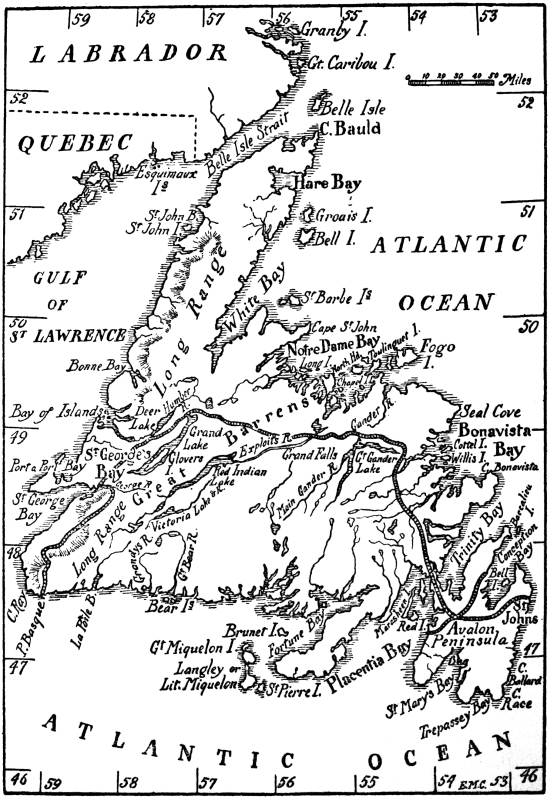
As Labrador adjoins the provinces of Quebec and
Ungava, it is often erroneously thought that the
whole of it is under the jurisdiction of the great
Dominion of Canada, and the majority of boys
will be surprised to hear that the coast of this
little-known country is a dependency of Newfoundland.
It is associated with the life of the Eskimos, a
people who dwell in “thrilling regions of thick-ribb’d
ice,” and is considered by the outside world as
“A land forsaken and dead,
Where the ghostly icebergs go.”
There is a great deal of tradition interwoven
with the discovery of Labrador. Some historians
contend that as early as A.D. 1000 Europeans had
found their way to this bleak shore, and some are
of the opinion that the Icelanders and Greenlanders
had set foot on the barren rocks at a much earlier
date. The true discoverer of Labrador, say other
historians, was John Cabot, of whose voyages we
have given an account in an earlier chapter.
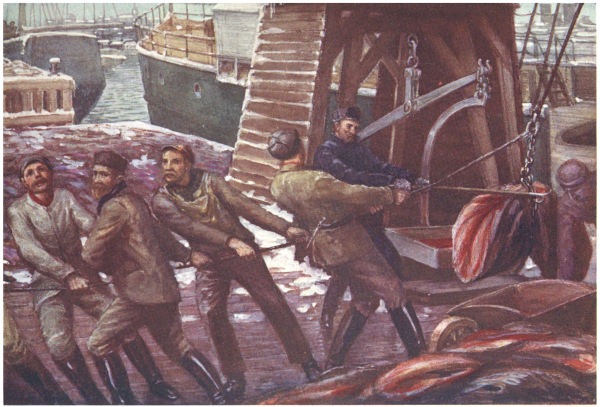
UNLOADING THE HIDE AND FAT OF SEALS AT ST. JOHN’S.
The present inhabitants obtain a livelihood by
fishing and hunting, and are really a peaceful people.
Strange as it may seem, the best educated people in
Labrador are the Eskimos, which is due solely to the
untiring efforts of the Moravian missionaries. And
when the inhabitants are brought into closer communication
with the outer world by increased steamer,
mail, and telegraphic services, there will be a greater
future reserved for the country than has ever been
thought possible by even those who know the Eskimo
well, and the conditions under which he maintains
his existence.
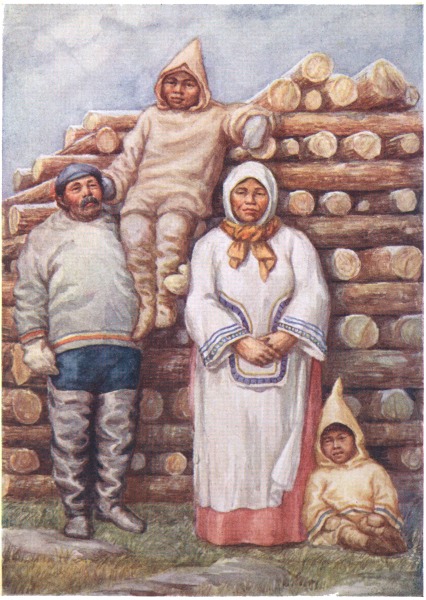
The life of the Eskimo boy is a very hard one,
but in their own way the children enjoy themselves,
and their days are not without pleasure and sunshine.
The baby boys are carried in a bag on the backs of
their mothers until they are able to eat a slice of
walrus, and then they are put into a pair of trousers,
which the mother makes from seal-skins. Their
homes are made of wood and mud, or snow if the
winter is unusually cold. They consist of one room,
through the top of which is a hole to carry away the
smoke from the open fire.
Before the Eskimo boys are very old, they are
taught to repair tents, use an oar, cast a line, and
handle a gun. In addition, they are taught how to
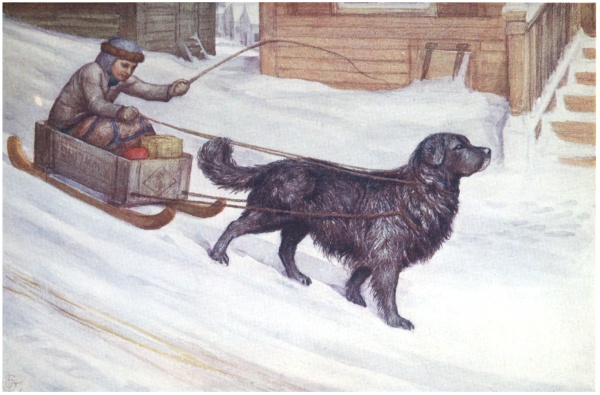
drive a team of dogs across snow and ice, for dog-sleds
in that far-off country take the place of trains,
trams, and hansom-cabs. These dogs, however, are
very treacherous. In appearance they are exactly
like wolves, and are often as ferocious. Any strange
animal is at once put to death by them. Domestic
animals and farmyard stock are soon killed and
devoured. At certain seasons of the year, too, they
will snarl and snap at their owners. Quite recently
a family of three were reported to have been killed
outright by these savage brutes. It is expected that
when the deer have been trained to do the work of
these dogs, an effort will be made to exterminate the
entire breed. It is astonishing, however, the amount
of work the Eskimo dogs will accomplish. A good
team will travel from six to ten miles an hour, and
cover a distance of sixty miles in the day without
showing fatigue. Even at the end of such a day’s
work, the team find no difficulty in despatching a fox
or a wolf should one dare to cross their path.
In the month of May, when the sealing season is
practically over, the salmon-nets are prepared, and away
go the families with their belongings to the salmon
areas along the well-known rivers. Salmon are so
abundant that hundreds are caught in one week. Great
skill is sometimes shown by the Eskimo boys in the
manipulation of their nets, for unless they were
watched and handled cautiously they would be torn
to pieces or carried away entirely by the masses of
ice that go rumbling down the rivers at the approach
of warmer weather.
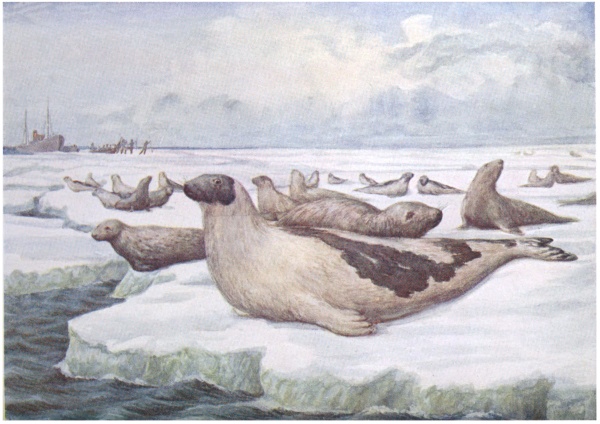
In the springtime the boys accompany their fathers
on sealing expeditions. Off they go, jumping from
ice-pan to ice-pan with their gaff for killing their
victims. The boy has a keen eye, and if an old seal
pops his head above water, a bullet goes through it
in a moment. One method of capturing the seals is
to build a barricade of ice, behind which the hunters
hide. As the seals appear above water they are shot,
and then harpooned, before they have a chance to
sink.
The man who is destined to bring about the
salvation of these people, spiritually, intellectually, and
commercially, is Dr. W. T. Grenfell. To record all
that this great man has accomplished, with his
experiences on land and sea, would be to fill a book
many times larger than the one in which these few
references to him and his work are now recorded.
Dr. Grenfell is descended from an old Devonshire
stock. He was born on the banks of the Dee, close
to the Irish Sea, and he cannot remember the time
when he did not love the roar of the ocean, and
longed for romantic adventure in the far-off land
towards which the billows rolled. His youth was
spent at Oxford, where he became a popular figure
in athletic circles. A surprising incident decided his
future for him. One evening during his medical
course he went by chance into the Tabernacle in
East London, just at the time when Mr. Moody
was conducting evangelistic services in England.
Here he received a conviction that his own religious
life was a humbug. He wrestled with that conviction
until it led him to decide that he would go to
Labrador as a missionary under the auspices of the
Royal National Mission to Deep-Sea Fishermen.
In 1892 he took charge of the little steamer Alert,
and began his work among the people of Northern
Newfoundland. If you would like to know more
of this self-denying man’s work, and to read of his
hairbreadth escapes from death, you should read his
book entitled “Vikings of To-day.”
Dr. Grenfell has made a study of the Eskimo dog,
the animal that has played such a part in the doctor’s
missionary work. One of his experiences runs thus:
“Modesty is a virtue of which the Eskimo dog is
seldom guilty. I was visiting one day a bedridden
patient. As the outer door opened, a fragrant
scent as of a dinner preparing was wafted outward.
Suddenly an avalanche swept me off my legs, and
a pack of dogs, whisking the stew-pot off the fire,
began to fight savagely over its contents, the more
so as each having burnt his nose in the boiling liquid
attributed his affliction to his neighbour. Meanwhile,
the house filling with steam and Eskimo
imprecations, the latter rendered forcible by long
harpoon handles, made me almost sorry I had called.
“The ‘trail’ is usually over the frozen sea, the
land being too uneven. Good dogs will cover from
70 to 100 miles in a day. When starting in the
morning, the snow is covered with little icicles,
formed by the midday sun melting the frozen surface.
As this is apt to make the feet of the dogs bleed,
they are shod with a bag of sealskin, tied round the
ankle. Three small holes are cut for the claws. A
pup shod for the first time holds up his paws in the
air alternately, but once he learns to appreciate the
fact that shoes save his feet from being cut, though
he will always eat any ordinary piece of skin, such as
a kavak or a skin boot, he rarely eats his own shoes.
They do, however, bite at and eat the harness,
especially of the dog in front of them. Mr. Young
tells of a big dog which, though apparently always
hard at work, never seemed to get tired like the rest.
It always seemed to strain at its trace, and kept
looking round, apparently for the driver’s approval.
His suspicions, however, were aroused, and one day,
cutting loose the trace, he fastened it by a single
thread to the komatik. Sure enough, the dog
strained and worked as hard as ever, but it never
broke a single thread!
“Ploughing is a humdrum task which these dogs
do not enjoy. The only way it can be done is for
one man to march solemnly in front dragging a seal’s
flipper, while another man has to shove and guide
the plough.
“These dogs are fearless in retrieving birds by
the seashore.
“When a flock passes, all the guns are discharged
simultaneously, and the ducks, which at times
respond in showers, are nominally divided equally.
“But now comes the excitement. As a rule a
huge Atlantic surf, with these north-east winds, breaks
over the point, and the splendid pluck and endurance
of the dogs is taxed to the uttermost. Dashing into
the waves, I have seen them repeatedly hurled back,
bruised and winded, high on to the ledges of rock,
only to be dragged off by the return wave and once
more pounded on to the rocks. To avoid this, the
brave beasts hold on with the energy of despair, and
many times have I noted their bleeding paws, and
nails torn off in the unequal struggle. Yet they
would at once return to the charge, and, waiting their
chance, leap right over the breaking crest, and so
get clear of the surf. Once they seize a duck they
never let it go, and I have often felt sorely tempted
even to jump in and give the brave creatures a
hand when it seemed impossible for them to keep up
the struggle any longer. Yet, after being lost to
view, engulfed by a huge breaker, one would soon
see a duck appear, and after it a dog’s head, still
true to its hazardous duty. Sometimes, however,
they are really lost.”
The Eskimo is not without some vague idea of a
future state, as one might expect when the religion
of his progenitors is borne in mind. He believes
that death involves the separation of the spirit from
his body, and the spirit either soars to an unknown
country in the sky, or descends, he knows not where,
into a subterranean resting-place. The destiny of
the soul is decided by the Eskimo’s manner of
life and death upon the earth. The Eskimos who
die a violent death on the ice or in the hunting-grounds
are transported to the abode above. One
would naturally expect that every Eskimo coveted a
death that would insure his passage to the sky, but
such is not the case. Those who go below are
considered to enjoy luxuries that are denied to those
who go above. Moreover, the inhabitants of the
lower region are privileged to communicate with
their friends on earth, such communication being
impossible to the inhabitants of the other region.
The Eskimo also believes that the affairs of his
earthly life are ordered by an attendant spirit, who
has power to destroy the labours of his hands or
crown them with success. This spirit is understood
to be extremely malignant, and only by sacrificial
offerings is it possible to propitiate him. Very
frequently an idol of this malignant spirit is carried
by the Eskimo in his ammunition-bag if he wishes
his hunting expedition to be successful.
There is something very poetic, if crude, about
their notions of the sky and clouds. They believe
that the sky is a hard substance forming a gigantic
arch above the earth, and that the clouds are in
charge of two old women, who spread them across the
sky and then roll them up again. When it thunders,
the old women are conversing together, and the
lightning is supposed to be a lamp to light them on
their way beneath the arch of blue. The whistling
wind is interpreted as the breath of two large-headed
spirits who stand one at each corner of the earth. It
is natural for ignorant people to associate superstition
with the magnificent displays of the Aurora Borealis.
These beautiful lights, say the Eskimos, are
torches held in the hands of spirits who come to
seek the souls of those who have recently passed
away. By the aid of these torches the souls are
led across the dark abyss at the edge of the world to
a celestial region where sorrow and death never come,
and where they no longer feel the pangs of hunger,
for food and water are abundant there.
BILLING AND SONS, LIMITED, PRINTERS, GUILDFORD