FIRE AND WATER
A long time ago, that is to say, in the twilight of
Maori tradition, the chief Ngatoro and his wife,
attended by a slave, landed on the shores of the Bay of
Plenty. Thence they wandered inland through forests
and over ferny downs, reaching at last a great central
lake, beyond which high mountains stood sentry in the
very heart of the island. One of these snow-clad
summits they resolved to gain; but half-way on the
climb the slave fell ill of sheer cold. Then the chief
bethought him that in the Bay of Plenty he had
noticed an island steaming and smoking, boiling with
heat. Hot coals brought thence might warm the party
and save the slave’s life. So Ngatoro, who was
magician as well as chieftain, looked eastward and made
incantations; and soon the fire rushing through the air
fell at his feet. Another more prosaic version of the
tale says that, Maori fashion, the kind-hearted hero
despatched a messenger to bring the fire; he sent his
wife. She, traversing land and sea at full speed, was
soon back from White Island with a calabash full of
glowing embers. From this, as she hurried along,
sparks dropped here and there on her track. And
wherever these fell the earth caught fire, hot springs
bubbled up, and steam-jets burst through the fern. All her
haste, however, went for nought; the slave died. Furious
at his loss, her lord and master flung the red embers
down one of the craters of Mount Tongariro, and from
that day to this the mountains of Taupo have been
filled with volcanic fires, smouldering or breaking out
in eruption.[1]Such is one of the many legends which
have grown up round the lakes and summits of the
most famous volcanic province of New Zealand. It
indicates the Maori understanding that the high cones
south-west of Lake Taupo are one end of a chain of
volcanic forces, and that the other end is White Island
(Whaka-ari), the isolated crater which lifts its head
above the sea twenty-seven miles out in the wide Bay of
Plenty. It is a natural sulphur factory. Seen from
the shores of the bay it looks peaceful enough. Its
only peculiarity seems to be a white cloud rising high or
streaming on the wind to leeward from the tip of its cone.
At a distance the cloud appears not unlike other white
clouds; but in the brightest weather it never vanishes
away. I once spent three sunny spring days in riding
round the great arc of the Bay of Plenty, often cantering
for miles together along the sandy beach. There, out
to sea, lay White Island always in view and always
flying its white vapour-flag. In reality the quiet-looking
islet seethes with fiery life. Seen at close
quarters it is found to be a shell, which from one side
looks comically like the well-worn stump of a hollow
tooth. It is a barren crater near a thousand feet high,
enclosing what was a lake and is now shrunk to a warm
green pool, ringed with bright yellow sulphur. Hot
springs boil and roar on the crater-lake’s surface, ever
sending up columns of hissing and roaring steam many
hundred feet into the air. At times, as in 1886, the
steam has shot to the almost incredible height of fifteen
thousand feet, a white pillar visible a hundred miles
away. You may thrust a stick through the floor of the
crater into the soft hot paste beneath. The walls of
the abyss glow with heat, steam-jets hiss from their
fissures, and on the outside is a thick crust of sulphur.
The reek of the pit’s fumes easily outdoes that of the
blackest and most vicious of London fogs. “It is not
that soft smell of Roto-rua,” wrote Mr. Buddle, who
smelt the place in 1906, “but an odour of sulphurous
acid which sticks in one’s throat.” Yet commerce once
tried to lay hands on White Island, and men were
found willing to try and work amid its noisome
activities. Commerce, however, failed to make Tartarus
pay. Not far away from White Island lies Mayor
Island, which once upon a time must have been an even
stranger spot. It also is a high crater. On the rim of
its yawning pit are to be seen the ruins of a Maori
stockade, which, perched in mid-air and approachable
only over the sea, must have been a hard nut for
storming parties to crack in the bygone days of tribal
wars. All is quiet now; the volcano has died out and
the wars have become old tales.
Needless to say, the scenes between Ruapehu and the
sea-coast are not all as terrific as this. The main
charm of the volcanic province is, indeed, its variety.
Though in a sense its inhabitants live on the lid of a
boiler—a boiler, too, that is perforated with steam
holes—still it is a lid between five thousand and six
thousand square miles in size. This leaves ample room
for broad tracts where peace reigns amid apparent
solidity and security. Though it is commonly called
the Hot Lakes District, none of its larger lakes are
really hot, that is to say hot throughout; they are
distinctly cold. Roto-mahana before it was blown up
in the eruption of 1886 was in no part less than lukewarm;
but in those days Roto-mahana only covered
185 acres. At Ohinemutu there is a pool the water of
which is unmistakably hot throughout; but it is not
more than about a hundred yards long. Usually the
hot lagoons are patchy in temperature—boiling at one
end, cool at the other. Perhaps the official title, Thermal
Springs District, is more accurate. The hot water comes
in the form of springs, spouts, and geysers. Boiling
pools there are in numbers, veritable cauldrons. Boiling
springs burst up on the beaches of the cold lakes, or
bubble up through the chilly waters. The bather can
lie floating, as the writer has, with his feet in hot and
his head in cold water. Very agreeable the sensation is
as the sunshine pours from a blue sky on to a lagoon
fringed with ferns and green foliage. There are places
where the pedestrian fording a river may feel his legs
chilled to the marrow by the swift current, and yet find
the sandy bottom on which he is treading almost burn
the soles of his feet. The first white traveller to
describe the thermal springs noted a cold cascade falling
on an orifice from which steam was puffing at intervals.
The resultant noise was as strange as the sight. So do
hot and cold mingle and come into conflict in the
thermal territory.
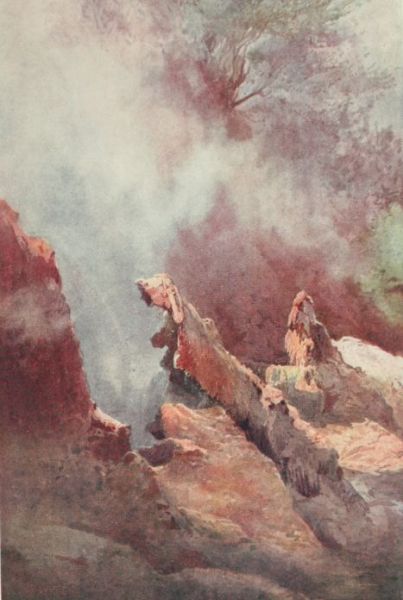
“THE DRAGON’S MOUTH”
The area of this hydro-thermal district, which Mr.
Percy Smith, the best living authority on the subject,
calls the Taupo volcanic zone, is roundly about six
thousand square miles. As already said, part of it lies
under the sea, above which only White Island, Mayor
Island, and Whale Island rise to view. Its shape, if we
could see the whole of it, would probably be a narrow
oval, like an old-fashioned silver hand-mirror with a
slender handle. In the handle two active volcanoes
lift their heads—Ruapehu, and Tongariro with its three
cones. At the other end of the mirror White Island
stands up, incessantly at work. This exhausts the list
of active volcanoes; but there are six or seven extinct
or quiescent volcanoes of first-class importance.
Mayor Island, in the Bay of Plenty, is a dead crater
rimmed by walls five miles round and nearly 1300
feet high, enclosing a terrible chasm lined with dark
obsidian. Mount Edgecombe, an admirably regular
cone, easily seen from the coast, has two craters in its
summit; and the most appalling explosion ever known
in the country occurred in the tract covered by Mount
Tarawera and the Roto-mahana Lake. How terrific
were the forces displayed by these extinct volcanoes in
ages past may be judged by the vast extent of country
overlaid by the pumice and volcanic clay belched forth
from their craters. Not only is the volcanic zone
generally overspread with this, only sparse patches escaping,
but pumice is found outside its limits. Within
these, it is, loosely speaking, pumice, pumice everywhere,
dry, gritty, and useless,—a thin scattering of
pumice on the hill-tops and steep slopes,—deep strata of
pumice where it has been washed down into valleys and
river terraces. Mingled with good soil it is mischievous,
though two or three grasses, notably that called
Chewing’s fescue, grow well in the mixture. Unmixed
pumice is porous and barren. Fortunately the tracts
of deep pumice are limited. They soak up the ample
rainfall; grass grows, but soon withers; in dry weather
a sharp tug will drag a tussock from the roots in the
loose, thirsty soil. The popular belief is that it only
needs a long-continued process of stamping and rolling
to make these pumice expanses hold water and become
fertile. Those who think thus point out that around
certain lonely lagoons, where wild horses and cattle
have been wont to camp and roll, rich green patches of
grass are found. Less hopeful observers hold that the
destiny of the pumice country is probably to grow trees,
fruit-bearing and other, whose deep roots will reach far
down to the water. Already the Government, acting
on this belief, has taken the work of tree-planting in
hand, and millions of young saplings are to be found in
the Waiotapu valley and elsewhere in the pumice land.
Prison-labour is used for the purpose; and though a
camp of convicts, with movable prison-vans like the
cages of a travelling menagerie, seems a strange foil to
the wonders of Nature, the toil is healthy for the men
as well as useful to the country. From the vast extent
of the pumice and clay layers it would seem that, uneasy
as the thermal territory now is, it has, for all its geysers,
steaming cones, and innumerable springs, become but a
fretful display of slowly dying forces. So say those
who look upon the great catastrophe of 1886 as merely
the flicker of a dying flame.
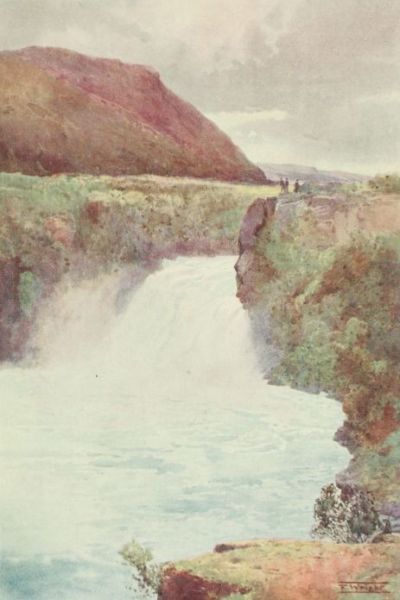
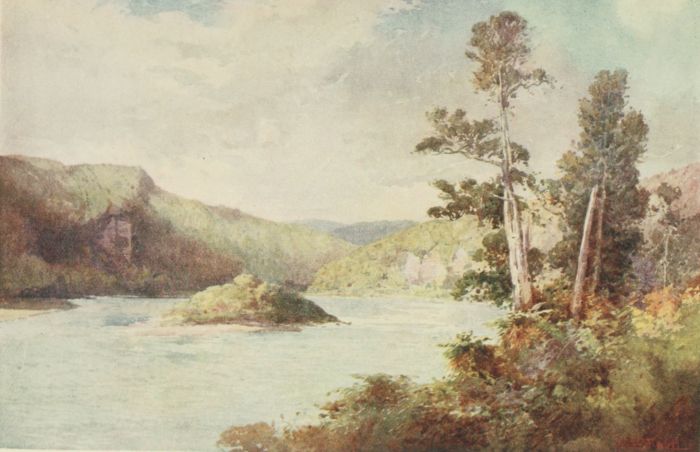
HUKA FALLS
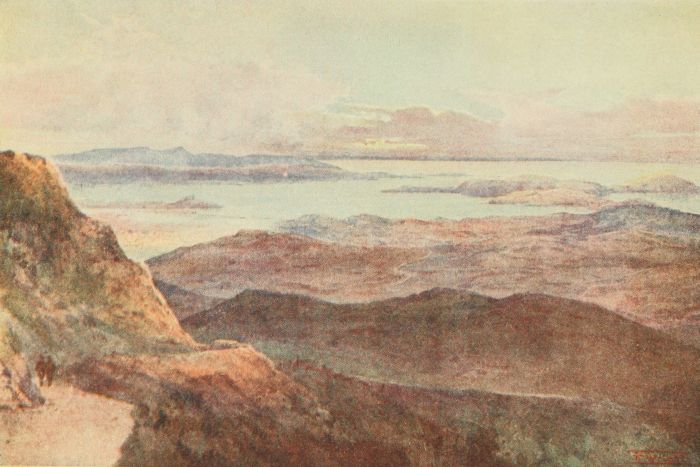
As already said, the volcanic zone is a land of lakes,
many and beautiful. Four of the most interesting—Roto-rua,
Roto-iti, Roto-ehu, and Roto-ma—lie in a
chain, like pieces of silver loosely strung together.
South of these Tarawera sleeps in sight of its terrible
mountain, and south again of Tarawera the hot springs of
Roto-mahana still draw sight-seers, though its renowned
terraces are no longer there. Lake Okataina is near,
resting amid unspoiled forest: and there is Roto-kakahi,
the green lake, and, hard by, Tikitapu, the blue lake,
beautiful by contrast. But, of course, among all the
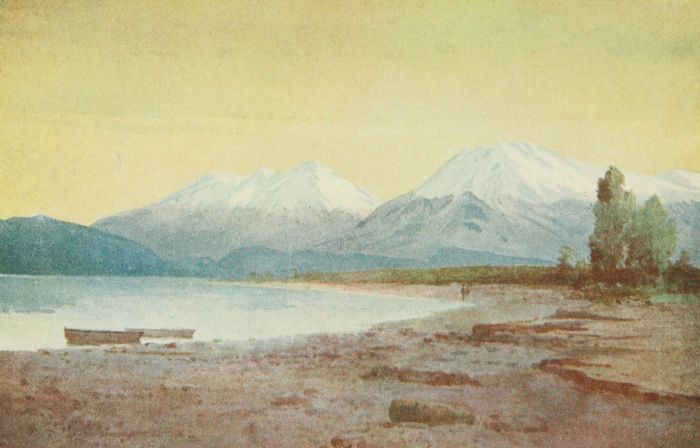
waters Taupo easily overpeers the rest. “The Sea” the
Maori call it; and indeed it is so large, and its whole
expanse so easily viewed at once from many heights,
that it may well be taken to be greater than it is.
It covers 242 square miles, but the first white
travellers who saw it and wrote about it guessed it
to be between three and five hundred. Hold a fair-sized
map of the district with the eastern side uppermost
and you will note that the shape of Taupo is that
of an ass’s head with the ears laid back. This may
seem an irreverent simile for the great crater lake, with
its deep waters and frowning cliffs, held so sacred and
mysterious by the Maori of old. Seldom is its surface
flecked by any sail, and only one island of any size
breaks the wide expanse. The glory of Taupo—apart
from the noble view of the volcanoes southward of it—is
a long rampart of cliffs that almost without a break hems
in its western side mile after mile. At their highest
they reach 1100 feet. So steep are they that in
flood-time cascades will make a clean leap from their
summits into the lake; and the sheer descent of the
wall continues below the surface, for, within a boat’s
length of the overhanging cliff, sounding-leads have
gone down 400 feet. Many are the waterfalls which
in the stormier months of the year seam the rocky
faces with white thread-like courses. On a finer scale
than the others are the falls called Mokau, which,
dashing through a leafy cleft, pour into the deep with
a sounding plunge, and, even from a distance, look
something broader and stronger than the usual white
riband.
By contrast, on the eastern side of the lake wide
strips of beach are not uncommon, and the banks,
plains, and terrace sides of whitish pumice, though not
inconsiderable, are but tame when compared with the
dark basaltic and trachytic heights overhanging the
deep western waters. Many streams feed Taupo;
only one river drains it. It is not astonishing, then,
that the Maori believed that in the centre a terrible
whirlpool circled round a great funnel down which
water was sucked into the bowels of the earth. A
variant of this legend was that a huge taniwha or saurian
monster haunted the western depths, ready and willing
to swallow canoes and canoemen together. The river
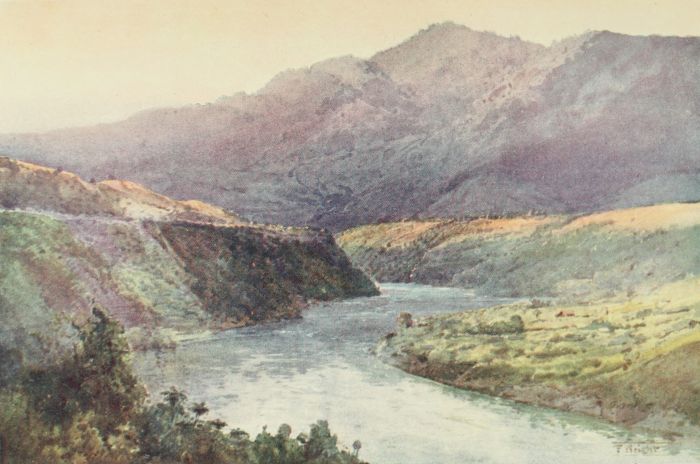
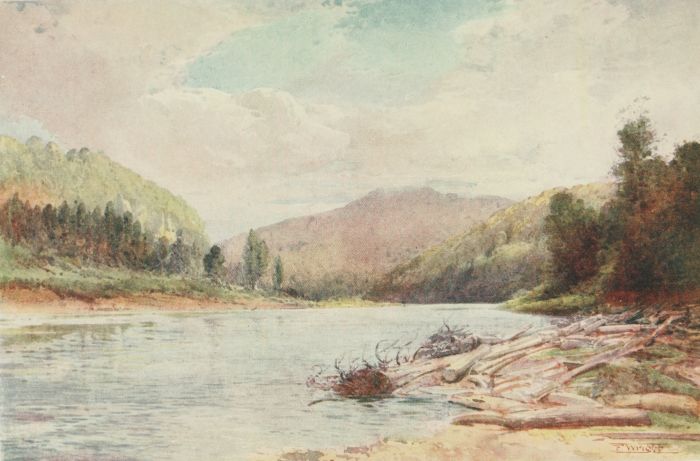
issuing from Taupo is the Waikato, which cuts through
the rocky lip of the crater-lake at its north-east corner.
There it speeds away as though rejoicing to escape,
with a strong clear current about two hundred yards
wide. Then, pent suddenly between walls of hard rock,
it is jammed into a deep rift not more than seventy feet
across. Boiling and raging, the whole river shoots from
the face of a steep tree-clothed cliff with something of
the force of a horizontal geyser. Very beautiful is the
blue and silver column as it falls, with outer edges dissolving
into spray, into the broad and almost quiet
expanse below. This waterfall, the Huka, though one
of the famous sights of the island, does not by any
means exhaust the beauties of the Upper Waikato. A
little lower down the Ara-tia-tia Rapids furnish a
succession of spectacles almost as fine. There for
hundreds of yards the river, a writhing serpent of
blue and milk-white flecked with silver, tears and zig-zags,
spins and foams, among the dripping reefs and
between high leafy rocks, “wild with the tumult of
tumbling waters.”
Broadly speaking, the Taupo plateau is a region of
long views. Cold nights are more often than not
followed by sunny days. The clear and often brilliant
air enables the eye to travel over the nearer plains and
hills to where some far-off mountain chain almost always
closes the prospect. The mountains are often forest-clad,
the plains and terraces usually open. Here will
be seen sheets of stunted bracken; there, wide expanses
of yellowish tussock-grass. The white pumice and
reddish-brown volcanic clay help to give a character to
the colouring very different to the black earth and vivid
green foliage of other parts of the island. The smooth
glacis-like sides of the terraces, and the sharply-cut
ridges of the hills, seem a fit setting for the perpetual
display of volcanic forces and an adjunct in impressing
on the traveller that he is in a land that has been
fashioned on a strange design. Nothing in England,
and very little in Europe, remotely resembles it. Only
sometimes on the dusty tableland of Central Spain, in
Old or New Castile, may the New Zealander be
reminded of the long views and strong sunlight, or
the shining slopes leading up to blue mountain ranges
cutting the sky with clean lines.
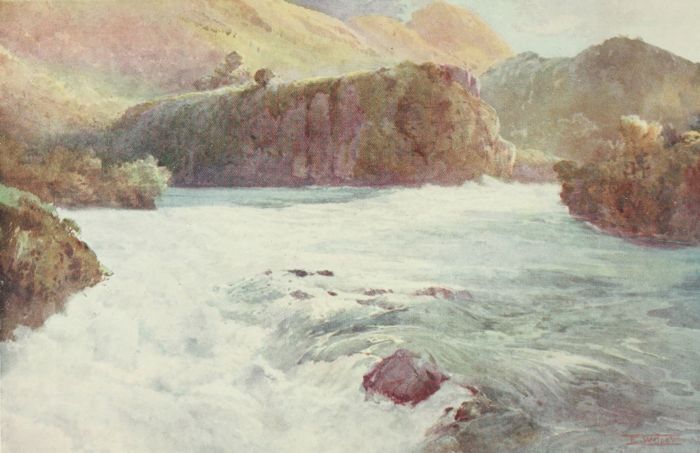
ARA-TIA-TIA RAPIDS
Some of the finest landscape views in the central
North Island are to be seen from points of vantage on
the broken plateau to the westward of Ruapehu. On
the one side the huge volcanic mass, a sloping rampart
many miles long, closes the scene; on the other,
the land, falling towards the coast, is first scantily
clothed with coarse tussock-grass and then with open
park-like forest. The timber grows heavier towards the
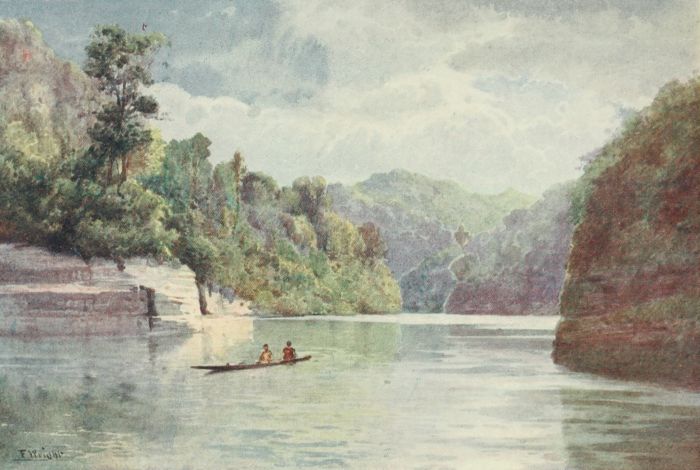
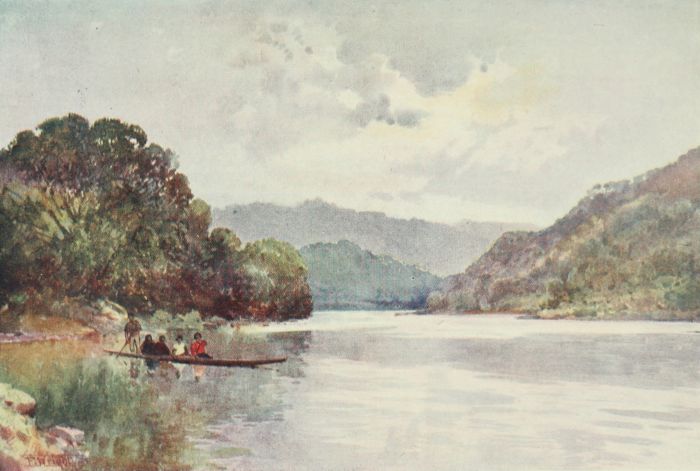
coast, and in the river valleys where the curling Wanganui
and the lesser streams Waitotara and Patea run
between richly-draped cliffs to the sea. Far westward
above the green expanse of foliage—soon to be hewn
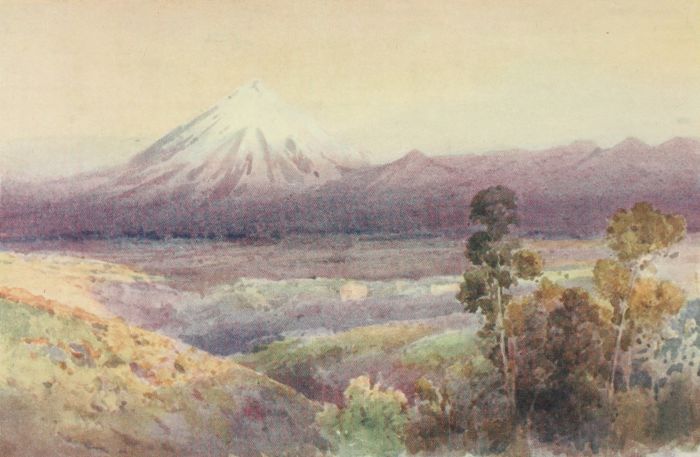
by the axe and blackened by fire—the white triangle
of Egmont’s cone glimmers through faint haze against
the pale horizon.
Between Taupo and the eastern branch of the Upper
Wanganui ran a foot-track much used by Maori
travellers in days of yore. At one point it wound
beneath a steep hill on the side of which a projecting
ledge of rock formed a wide shallow cave. Beneath
this convenient shelf it is said that a gang of Maori
highwaymen were once wont to lurk on the watch for
wayfarers, solitary or in small parties. At a signal
they sprang out upon these, clubbed them to death,
and dragged their bodies to the cave. There these
cannibal bush-rangers gorged themselves on the flesh of
their victims. I tell the story on the authority of the
missionary Taylor, who says that he climbed to the
cave, and standing therein saw the ovens used for the
horrid meals and the scattered bones of the human
victims. If he was not imposed upon, the story
supplies a curious exception to Maori customs. Their
cannibalism was in the main practised at the expense
of enemies slain or captured in inter-tribal wars; and
they had distinct if peculiar prejudices in favour of fair
fighting. I have read somewhere that in the Drakensberg
Mountains above Natal a similar gang of cannibal
robbers was once discovered—Kaffirs who systematically
lured lonely victims into a certain remote ravine, where
they disappeared.
One of the curiosities of the Taupo wilderness is the
flat-topped mountain Horo-Horo. Steep, wooded
slopes lead up to an unbroken ring of precipices
encircling an almost level table-top. To the eyes of
riders or coach-passengers on the road between Taupo
and Roto-rua, the brows of the cliffs seem as inaccessible
as the crown of Roraima in British Guiana in the days
before Mr. Im Thurn scaled it. The Maori own
Horo-Horo, and have villages and cultivations on the
lower slopes where there is soil fertile beyond what is
common thereabout. Another strange natural fortress
not far away is Pohaturoa, a tusk of lava, protruding
some eight hundred feet hard by the course of the
Waikato and in full view of a favourite crossing-place.
Local guides are, or used to be, fond of comparing this
eminence with Gibraltar, to which—except that both
are rocks—it bears no manner of likeness.
The Japanese, as we know, hold sacred their famous
volcano Fusiyama. In the same way the Maori in
times past regarded Tongariro and Ruapehu as holy
ground. But, whereas the Japanese show reverence to
Fusi by making pilgrimages to its summit in tens of
thousands, the Maori veneration of their great cones
took a precisely opposite shape,—they would neither
climb them themselves nor allow others to do so. The
earlier white travellers were not only refused permission
to mount to the summit, but were not even
allowed to set foot on the lower slopes. In 1845 the
artist George French Angas could not even obtain
leave to make a sketch of Tongariro, though he
managed to do so by stealth. Six years earlier Bidwill
eluded native vigilance and actually reached the summit
of one of the cones, probably that of Ngauruhoe, but
when, after peering down through the sulphurous clouds
of the inaccessible gulf, he made his way back to the
shores of Lake Taupo, the local chieftain gave him a
very bad quarter of an hour indeed. This personage,
known in New Zealand story as Old Te Heu Heu, was
one of the most picturesque figures of his race. His
great height—“nearly seven feet,” says one traveller;
“a complete giant,” writes another—his fair complexion,
almost classic features, and great bodily
strength are repeatedly alluded to by the whites who
saw him; not that whites had that privilege every day,
for Te Heu Heu held himself aloof among his own people,
defied the white man, and refused to sign the treaty of
Waitangi or become a liegeman of the Queen. His
tribesmen had a proverb—“Taupo is the Sea; Tongariro
is the Mountain; Te Heu Heu is the Man.”
This they would repeat with the air of men owning a
proprietary interest in the Atlantic Ocean, Kinchin
Junga, and Napoleon. He was indeed a great chief,
and a perfect specimen of the Maori Rangatira or
gentleman. He considered himself the special guardian
of the volcanoes. Like him they were tapu—“tapu’d
inches thick,” as the author of Old New Zealand would
say. Indeed, when his subjects journeyed by a certain
road, from one turn of which they could view the cone
of Ngauruhoe, they were expected at the critical spot to
veil their eyes with their mats so as not to look on the
holy summit. At any rate, Bidwill declares that
they told him so. Small wonder, therefore, if this
venturesome trespasser came in for a severe browbeating
from the offended Te Heu Heu, who marched
up and down his wharé breaking out into passionate
speech. Bidwill asserts that he pacified the great man
by so small a present as three figs of tobacco. Of
course, it is possible that in 1839 tobacco was more
costly at Taupo than in after years. The Maori
version of the incident differs from Bidwill’s.
In the uneasy year of 1845 Te Heu Heu marched
down to the Wanganui coast at the head of a strong
war-party. The scared settlers were thankful to find
that he did not attack them. He was, indeed, after
other game, and was bent on squaring accounts with a
local tribe which had shed the blood of his people.
Bishop Selwyn, who happened to be then in the
neighbourhood, saw and spoke with the highland
chieftain, urging peace. The interviews must have
been worth watching. On the one side stood the
typical barbarian, eloquent, fearless, huge of limb, with
handsome face and maize-coloured complexion, and
picturesque in kilt, cloak, and head-feather. On the
other side was a bishop in hard training, a Christian
gentleman, as fine as English culture could furnish,
whose clean-cut aquiline face and unyielding mouth
had the becoming support of a tall, vigorous frame
lending dignity to his clerical garb. Here was the
heathen determined to save his tribe from the white
man’s grasping hands and dissolving religion; there
the missionary seeing in conversion and civilisation the
only hope of preserving the Maori race. Death took
Te Heu Heu away before he had time to see his
policy fail. Fate was scarcely so kind to Selwyn, who
lived to see the Ten-Years’ War wreck most of his
life’s work among the natives.
As far as I know, Te Heu Heu never crossed
weapons with white men, though he allied himself with
our enemies and gave shelter to fugitives. His region
was regarded as inaccessible in the days of good
Governor Grey. He was looked upon as a kind of
Old Man of the Mountain, and in Auckland they told
you stories of his valour, hospitality, choleric temper,
and his six—or was it eight?—wives. So the old
chief stayed unmolested, and met his end with his
mana in no way abated. It was a fitting end: the
soil which he guarded so tenaciously overwhelmed him.
The steep hill-side over his village became loosened by
heavy rain and rotted by steam and sulphur-fumes. It
began to crack and slip away. According to one
account, a great land-slip descending in the night
buried the kainga and all in it save one man. Another
story states that the destruction came in the day-time,
and that Te Heu Heu refused to flee. He was said
to have stood erect, confronting the avalanche, with
flashing eyes, and with his white hair blown by the
wind. At any rate, the soil of his ancestress the Earth
(he claimed direct descent from her) covered him, and
for a while his body lay there. After some time his
tribe disinterred it, and laying it on a carved and
ornamented bier, bore it into the mountains with the
purpose of casting it down the burning crater of Tongariro.
The intention was dramatic, but the result
was something of an anticlimax. When nearing their
journey’s end the bearers were startled by the roar of
an eruption. They fled in a panic, leaving the remains
of their hero to lie on the steep side of the cone on
some spot never identified. There they were probably
soon hidden by volcanic dust, and so, “ashes to ashes,”
slowly mingled with the ancestral mass.[2]
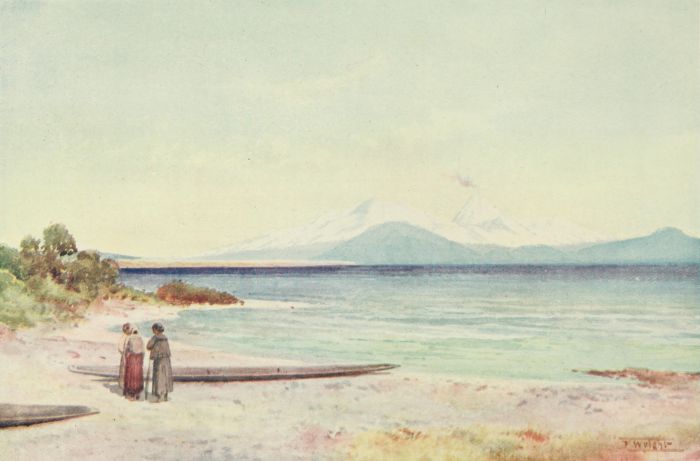
LAKE TAUPO
The chiefs of the Maori were often their own
minstrels. To compose a panegyric on a predecessor
was for them a worthy task. Te Heu Heu himself
was no mean poet. His lament for one of his forefathers
has beauty, and, in Mr. James Cowan’s version,
is well known to New Zealand students. But as a
poem it was fairly eclipsed by the funeral ode to his
own memory composed and recited by his brother and
successor. The translation of this characteristic Maori
poem, which appeared in Surgeon-Major Thomson’s
book, has been out of print for so many years that I
may reproduce some portions of it here:—
See o’er the heights of dark Pauhara’s mount
The infant morning wakes. Perhaps my friend
Returns to me clothed in that lightsome cloud.
Alas! I toil alone in this lone world.
Yes, thou art gone!
Go, thou mighty! go, thou dignified!
Go, thou who wert a spreading tree to shade
Thy people all when evil hovered round!
Sleep on, O Chief, in that dark, damp abode!
And hold within thy grasp that weapon rare
Bequeathed by thy renownéd ancestor.
Turn yet this once thy bold athletic frame,
And let me see thy skin carved o’er with lines
Of blue; and let me see again thy face
Beautifully chiselled into varied forms!
Cease, cease thy slumbers, O thou son of Rangi!
Wake up! and take thy battle-axe, and tell
Thy people of the coming signs, and what
Will now befall them. How the foe, tumultuous
As are the waves, will rush with spears uplifted,
And how thy people will avenge their wrongs.
No, thou art fallen; and the earth receives
Thee as its prey! But yet thy wondrous fame
Shall soar on high, resounding o’er the heavens
Loosely speaking, New Zealand is a volcanic
archipelago. There are hot pools and a noted
sanatorium in the Hanmer plains in the middle of
the Middle Island. There are warm springs far to
the north of Auckland, near Ohaeawai, where the
Maori once gave our troops a beating in the early days
of our race-conflict with them. Auckland itself, the
queen of New Zealand towns, is almost a crater city.
At any rate, it is surrounded by dead craters. You are
told that from a hill-top in the suburbs you may count
sixty-three volcanic cones. Two sister towns, Wellington
and Christchurch, have been repeatedly taken and well
shaken by Mother Earth. Old Wellington settlers
will gravely remind you that some sixty years ago a
man, an inoffensive German baron, lost his life in a
shock there. True, he was not swallowed up or
crushed by falling ruins; a mirror fell from a wall on
to his head. This earthquake was followed in 1855
by another as sharp, and one of the two so alarmed
a number of pioneer settlers that they embarked on
shipboard to flee from so unquiet a land. Their ship,
however, so the story runs, went ashore near the mouth
of Wellington harbour, and they returned to remain,
and, in some cases, make their fortunes. In 1888 a
double shock of earthquake wrecked some feet of the
cathedral spire at Christchurch, nipping off the point
of it and the gilded iron cross which it sustained, so
that it stood for many months looking like a broken
lead-pencil. A dozen years later, Cheviot, Amuri, and
Waiau were sharply shaken by an earthquake that
showed scant mercy to brick chimneys and houses of
the material known as cob-and-clay. Finally, in the
little Kermadec islets, far to the north of Cape Maria
Van Diemen, we encounter hot pools and submarine
explosions, and passing seamen have noted there sheets
of ejected pumice floating and forming a scum on the
surface of the ocean. As might be supposed, guides and
hangers-on about Roto-rua and Taupo revel in tales of
hairbreadth escapes and hair-raising fatalities. Nine
generations ago, say the Maori, a sudden explosion of a
geyser scalded to death half the villagers of Ohinemutu.
In the way of smaller mishaps you are told how, as two
Maori children walked together by Roto-mahana one
slipped and broke through the crust of silica into the
scalding mud beneath. The other, trying to lift him
out, was himself dragged in and both were boiled
alive. Near Ohinemutu, three revellers, overfull of
confidence and bad rum, stepped off a narrow track at
night and perished together in sulphurous mud and
scalding steam. At the extremity of Boiling Point
a village, or part of a village, is said to have been
suddenly engulfed in the waters of Roto-rua. At the
southern end of Taupo there is, or was, a legend
current that a large wharé filled with dancers met, in
a moment, a similar fate. In one case of which I
heard, that of a Maori woman, who fell into a pool
of a temperature above boiling-point, a witness assured
me that she did not appear to suffer pain long: the
nervous system was killed by the shock. Near Roto-rua
a bather with a weak heart was picked up dead. He
had heedlessly plunged into a pool the fumes and chemical
action of which are too strong for a weak man. And
a certain young English tourist sitting in the pool nicknamed
Painkiller was half-poisoned by mephitic vapour,
and only saved by the quickness of a Maori guide.
That was a generation ago: nowadays the traveller need
run no risks. Guides and good medical advice are to
be had by all who will use them. No sensible person
need incur any danger whatever.
Among stories of the boiling pools the most pathetic
I can recall is of a collie dog. His master, a shepherd
of the Taupo plateau, stood one day on the banks of a
certain cauldron idly watching the white steam curling
over the bubbling surface. His well-loved dog lay
stretched on the mud crust beside him. In a thoughtless
moment the shepherd flung a stick into the clear
blue pool. In a flash the dog had sprung after it into
the water of death. Maddened by the poor creature’s
yell of pain, his master rushed to the brink, mechanically
tearing off his coat as he ran. In another instant he
too would have flung himself to destruction. Fortunately
an athletic Maori who was standing by caught
the poor man round the knees, threw him on to his
back and held him down till all was over with the dog.
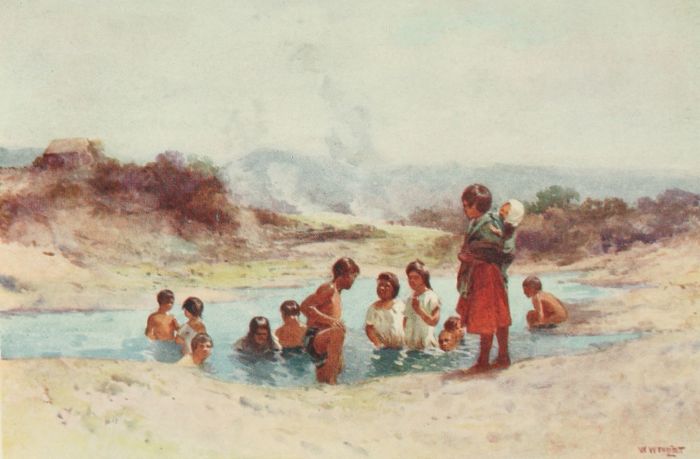
IN A HOT POOL
Near a well-known lake and in a wharé so surrounded
by boiling mud, scalding steam, hot water, and burning
sulphur as to be difficult of approach, there lived many
years ago two friends. One was a teetotaller and a
deeply religious man—characteristics not universal in
the Hot Lakes district at that precise epoch. The
other inhabitant was more nearly normal in tastes and
beliefs. The serious-minded friend became noted for
having—unpaid, and with his own hands—built a
chapel in the wilderness. Yet, unhappily, returning
home on a thick rainy evening he slipped and fell
into a boiling pool, where next day he was found—dead,
of course. In vain the oldest inhabitants of
the district sought to warn the survivor. He declined
to be terrified, or to change either his dangerous
abode or his path thereto. He persisted in walking
home late at night whenever it suited him to
do so. The “old hands” of the district shook their
heads and prophesied that there could be but one end
to such recklessness. And, sure enough, on a stormy
night the genial and defiant Johnnie slipped in his turn
and fell headlong into the pool which had boiled his
mate. One wild shout he gave, and men who were
within earshot tore to the spot—“Poor old Johnnie!
Gone at last! We always said he would!” Out of
the darkness and steam, however, they were greeted
with a sound of vigorous splashing and of expressions
couched in strong vernacular.
“Why, Johnnie man, aren’t you dead? Aren’t
you boiled to death?”
“Not I! There’s no water in this —— country
hot enough to boil me. Help me out!”
It appeared that the torrents of rain which had been
falling had flooded a cold stream hard by, and this,
overflowing into the pool, had made it pleasantly tepid.
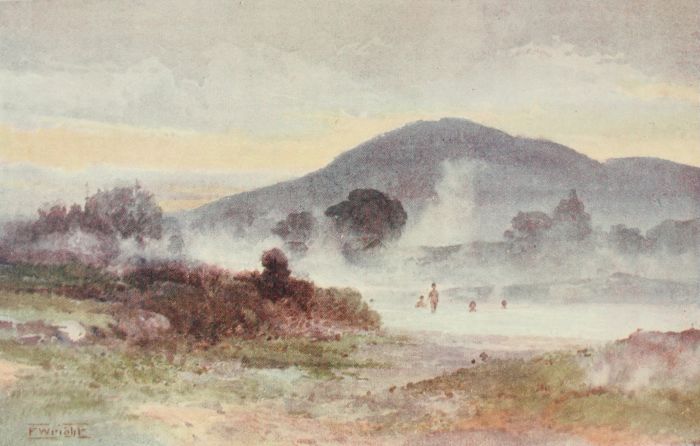
NGONGOTAHA MOUNTAIN
Needless to say, there is one fatal event, the story of
which overshadows all other stories told of the thermal
zone. It is the one convulsion of Nature there, since
the settlement of New Zealand, that has been great
enough to become tragically famous throughout the
world, apart from its interest to science. The eruption
of Mount Tarawera was a magnificent and terrible
spectacle. Accompanied as it was by the blowing-up
of Lake Roto-mahana, it destroyed utterly the beautiful
and extraordinary Pink and White Terraces. There
can be no doubt that most of those who saw them
thought the lost Pink and White Terraces the finest
sight in the thermal region. They had not the
grandeur of the volcanoes and the lakes, or the glorious
energy of the geysers; but they were an astonishing
combination of beauty of form and colour, of what
looked like rocky massiveness with the life and heat of
water in motion. Then there was nothing else of their
kind on the earth at all equal to them in scale and
completeness. So they could fairly be called unique,
and the gazer felt on beholding them that in a sense
this was the vision of a lifetime. Could those who
saw them have known that the spectacle was to be so
transient, this feeling must have been much keener.
For how many ages they existed in the ferny wilderness,
seen only by a few savages, geologists may guess at.
Only for about twelve years were they the resort of
any large number of civilised men. It is strange how
little their fame had gone abroad before Hochstetter
described them after seeing them in 1859. Bidwill,
who was twice at Roto-rua in 1839, never mentions
them. The naturalist Dieffenbach, who saw them in
1842, dismisses them in a paragraph, laudatory but
short. George French Angas, the artist, who was the
guest of Te Heu Heu in 1845, and managed, against
express orders, to sketch Tongariro, does not seem to
have heard of them. Yet he of all men might have
been expected to get wind of such a marvel. For a
marvel they were, and short as was the space during
which they were known to the world, their fame must
last until the Fish of Maui is engulfed in the ocean.
There, amid the green manuka and rusty-green bracken,
on two hill-sides sloping down to a lake of moderate
size—Roto-mahana or Warm Lake,—strong boiling
springs gushed out. They rose from two broad platforms,
each about a hundred yards square, the flooring
of craters with reddish-brown sides streaked and
patched with sulphur. Their hot water, after seething
and swirling in two deep pools, descended to the lake
over a series of ledges, basins, or hollowed terraces,
which curved out as boldly as the swelling canvas of a
ship, so that the balustrades or battlements—call them
what you will—seemed the segments of broken circles.
Their irregular height varied from two to six feet, and
visitors could scale them, as in Egypt they climb the
pyramids. One terrace, or rather set of terraces, was
called White, the other Pink: but the White were tinged
lightly with pink in spots, and their rosy sisters paled
here and there, so as to become nearly colourless
in places. “White,” moreover, scarcely conveys the
exact impression of Te Tarata, except from a distance
or under strong light. Domett’s “cataract of marble”
summed it up finely. But to be precise, where it was
smoothest and where water and the play of light made
the surface gleam or glisten, the silica coating of the
White ledges reminded you rather of old ivory, or
polished bone tinted a faint yellow. As for the
“Pink” staircase, one traveller would describe it as
bright salmon-pink, another as pale rose, for eyes in
different heads see the same things differently. The
White Terrace was the higher of the two, and
descended with a gentler slope than the other. The
skirts of both spread out into the lake, so that its
waters flowed over them. The number and fine succession
of these ivory arcs and rosy battlements made
but half their charm. The hot water as it trickled
from shelf to shelf left its flinty sediment in delicate
incrustations—here like the folds of a mantle, there
resembling fringing lace-work, milk outpoured and
frozen, trailing parasites or wild arabesques. Or it
made you think of wreathed sea-foam, snow half-melted,
or the coral of South Sea reefs. Then among
it lay the blue pools, pool after pool, warm, richly
coloured, glowing; while over every edge and step fell
the water, trickling, spurting, sparkling, and steaming as
it slowly cooled on its downward way. So that, though
there was a haunting reminder of human architecture
and sculpture, there was none of the smug finish of
man’s buildings, nothing of the cold dead lifelessness
of carved stone-work. The sun shone upon it, the
wind played with the water-drops. The blue sky—pale
by contrast—overarched the deeper blue of the pools.
Green mosses and vivid ferns grew and flourished on
the very edge of the steam. What sculptor’s frieze
or artist’s structure ever had such a framework? In
the genial water the bathers, choosing their temperature,
could float or sit, breathing unconfined air and wondering
at the softness and strange intensity of colour.
They could bathe in the day-time when all was sunshine,
or on summer nights when the moonlight turned
the ledges to alabaster. Did the tribute of his provinces
build for Caracalla such imperial baths as these?
No wonder that Nature, after showing such loveliness
to our age for a moment, snatched it away from the
desecration of scribbling, defacing, civilised men!
The eruption of Tarawera was preceded by many
signs of disturbance. Science in chronicling them
seems to turn gossip and collect portents with the
gusto of Plutarch or Froissart. The calamity came
on the 10th of June, and therefore in early winter.
The weather had been stormy but had cleared, so no
warning could be extracted from its behaviour. But,
six months before, the cauldron on the uppermost
platform of Te Tarata had broken out in strange
fashion. Again and again the water had shrunk far
down, and had even been sucked in to the supplying
pipe, leaving the boiling pit, thirty yards across and as
many feet deep, quite dry. Then suddenly the water
had boiled up and a geyser, a mounting column or
dome many feet in thickness, had shot up into the
air, struggling aloft to the height of a hundred and
fifty feet. From it there went up a pillar of steam four
or five times as high, with a sound heard far and wide.
Geyser-like as the action of the terrace-pool had been,
nothing on this scale had been recorded before. Then
from the Bay of Plenty came the news that thousands
of dead fish had been cast up on the beaches, poisoned
by the fumes of some submarine explosion. Furthermore,
the crater-lake in White Island suddenly went dry—another
novelty. Next, keen-eyed observers saw steam
issuing from the top of Ruapehu. They could scarcely
believe their eyes, for Ruapehu had been quiescent as far
back as man’s memory went. But there was no doubt
of it. Two athletic surveyors clambered up through
the snows, and there, as they looked down four hundred
feet on the crater-lake from the precipices that ringed
it in, they saw the surface of the water lifted and
shaken, and steam rising into the icy air. Later on,
just before the catastrophe, the Maori by Roto-mahana
lost their chief by sickness. As he lay dying some of
his tribe saw a strange canoe, paddled by phantom
warriors, glide across the lake and disappear. The
number of men in the canoe was thirteen, and as they
flitted by their shape changed and they became spirits
with dogs’ heads. The tribe, struck with terror, gave
up hope for their chief. He died, and his body lay
not yet buried when the fatal night came. Lastly, on
the day before the eruption, without apparent cause,
waves rose and swept across the calm surface of Lake
Tarawera, to the alarm of the last party of tourists who
visited the Terrace. Dr. Ralph, one of these, noted
also that soft mud had apparently just been ejected from
the boiler of the Pink Terrace, and lay strewn about
twenty-five yards away. He and his friends hastened
away, depressed and uneasy.
No one, however, Maori or white, seriously conceived
of anything like the destruction that was impending.
The landlord of the Wairoa hotel grumbled
at the native guide Sophia for telling of these ominous
incidents. And a Maori chief, with some followers,
went to camp upon two little islets in Roto-mahana
lying handy for the hot bathing-pools. Why should
any one expect that the flat-topped, heavy looking
mountain of Tarawera would burst out like Krakatoa?
True, Tarawera means “burning peak,” but the hill,
and its companion Ruawahia, must have been quiescent
for many hundred years. For were not trees growing
in clefts near the summits with trunks as thick as the
height of a tall man? Nor was there any tradition of
explosions on the spot. Thirteen generations ago, said
the Maori, a famous chief had been interred in or near
one of the craters, and Nature had never disturbed his
resting-place. The surprise, therefore, was almost complete,
and only the winter season was responsible for
the small number of tourists in the district on the 10th
of June. It was about an hour past midnight when
the convulsion began. First came slight shocks of
earthquake; then noises, booming, muttering, and
swelling to a roar. The shocks became sharper. Some
of them seemed like strokes of a gigantic hammer
striking upwards. Then, after a shock felt for fifty
miles round, an enormous cloud rose above Tarawera
and the mountain spouted fire, stones, and dust to the
heavens. The burning crater illumined the cloud, so
that it glowed like a “pillar of fire by night.” And
above the glow an immense black canopy began to
open out and spread for at least sixty miles, east, north-east
and south-east. Seen from far off it had the shape
of a monstrous mushroom. In the earlier hours of the
eruption the outer edges of the mushroom shape were
lit up by vivid streams and flashes of lightning, shooting
upward, downward, or stabbing the dark mass with
fierce sidelong thrusts. Forked bolts sped in fiery zig-zags,
or ascended, rocket-fashion, to burst and fall in
flaming fragments. Sounds followed them like the
crackling of musketry. Brilliantly coloured, the flashes
were blue, golden or orange, while some were burning
bars of white that stood out, hot and distinct, across
the red of the vomiting crater. But more appalling
even than the cloudy canopy with its choking dust, the
tempest, the rocking earth, or the glare of lightning,
was the noise. After two o’clock it became an awful
and unceasing roar, deafening the ears, benumbing the
nerves, and bewildering the senses of the unhappy beings
within the ring of death or imminent danger. It made
the windows rattle in the streets of Auckland one
hundred and fifty miles away, and awoke many sleepers
in Nelson at a more incredible distance. And with
the swelling of the roar thick darkness settled down—darkness
that covered half a province for hours. Seven
hours after the destruction began, settlers far away on
the sea-coast to the east were eating their morning
meals—if they cared to eat at all—by candle-light. To
say that it was a darkness that could be felt would
be to belittle its horrors absurdly—at any rate near
Tarawera. For miles out from the mountain it was a
darkness that smote and killed you—made up as it was
of mud and fire, burning stones, and suffocating dust.
Whence came the mud? Partly, no doubt, it was
formed by steam acting on the volcanic dust-cloud;
but, in part, it was the scattered contents of Roto-mahana—a
whole lake hurled skyward, water and ooze
together. With Roto-mahana went its shores, the
Terraces, several neighbouring smaller lakes and many
springs. Yet so tremendous was the outburst that
even this wreck was not physically the chief feature of
the destruction. That was the great rift, an irregular
cleft, fourteen or fifteen miles long, opened across the
Tarawera and its companion heights. This earth-crack,
or succession of cracks, varied in depth from three
hundred to nine hundred feet. To any one looking
down into it from one of the hill-tops commanding it,
it seemed half as deep again. It, and the surrounding
black scoria cast up from its depths, soon became cold
and dead; but, continuing as it did to bear the marks
of the infernal fires that had filled it, the great fissure
remained in after years the plainest evidence of that
dark night’s work. When I had a sight of it in 1891,
it was the centre of a landscape still clothed with
desolation. The effect was dreary and unnatural.
The deep wound looked an injury to the earth as
malign as it was gigantic. It was precisely such a
scene as would have suggested to a zealot of the
Middle Ages a vision of the pit of damnation.
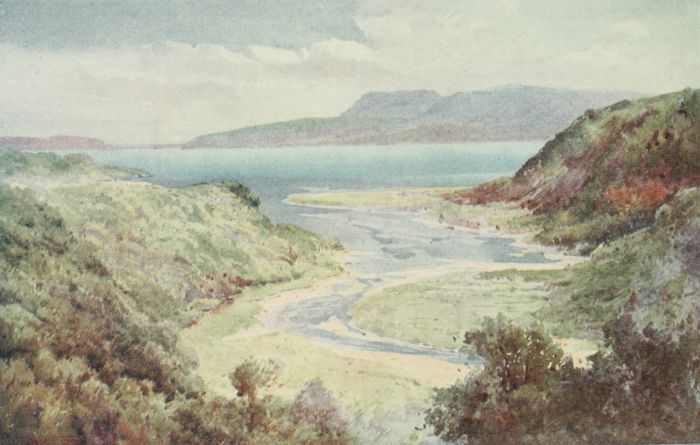
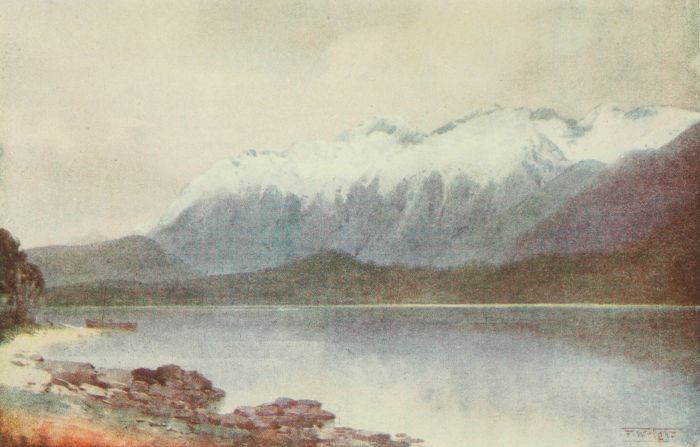
LAKE AND MOUNT TARAWERA
Until six in the morning the eruption did not
slacken at all. Hot stones and fireballs were carried
for miles, and as they fell set huts and forests on fire.
Along with their devastation came a rain of mud,
loading the roofs of habitations and breaking down the
branches of trees. Blasts of hot air were felt, but
usually the wind—and it blew violently—was bitter
cold. At one moment a kind of cyclone or tornado
rushed over Lake Tikitapu, prostrating and splintering,
as it passed, the trees close by, and so wrecking a forest
famous for its beauty.[3] What went on at the centre of
the eruption no eye ever saw—the great cloud hid it.
The dust shot aloft is variously computed to have risen
six or eight miles. The dust-cloud did not strike down
the living as did the rain of mud, fire, and stones.
But its mischief extended over a much wider area.
Half a day’s journey out from the crater it deposited
a layer three inches thick, and it coated even islands
miles off the east coast. By the sea-shore one observer
thought the sound of its falling was like a gentle rain.
But the effect of the black sand and mouse-coloured
dust was the opposite of that of rain; for it killed the
pasture, and the settlers could only save their cattle
and sheep by driving them hastily off. Insect life was
half destroyed, and many of the smaller birds shared
the fate of the insects. By Lake Roto-iti, fourteen
miles to the north of the crater, Major Mair, listening
to the dropping of the sand and dust, compared it to
a soft ooze like falling snow. It turned the waters of
the lake to a sort of soapy grey, and overspread the
surrounding hills with an unbroken grey sheet. The
small bull-trout and crayfish of the lake floated dead on
the surface of the water. After a while birds starved
or disappeared. Wild pheasants came to the school-house
seeking for chance crumbs of food, and hungry
rats were seen roaming about on the smooth carpet
of dust.
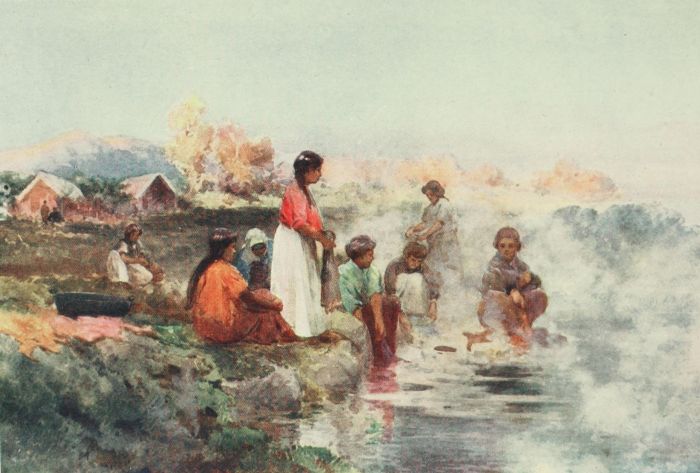
MAORI WASHING-DAY, OHINEMUTU
How did the human inhabitants of the district fare
at Roto-rua and Ohinemutu? Close at hand as they
were, no damage was done to life or limb. They were
outside the range of the destroying messengers. But
nearer to the volcano, in and about Roto-mahana, utter
ruin was wrought, and here unfortunately the natives
of the Ngati Rangitihi, living at Wairoa and on some
other spots, could not escape. Some of them, indeed,
were encamped at the time on islets in Roto-mahana
itself, and they of course were instantly annihilated in
the midst of the convulsion. Their fellow tribesmen
at Wairoa went through a more lingering ordeal, to
meet, nearly all of them, the same death. About an
hour after midnight Mr. Hazard, the Government
teacher of the native school at Wairoa, was with his
family roused by the earthquake shocks. Looking
out into the night they saw the flaming cloud go up
from Tarawera, ten miles away. As they watched the
spectacle, half in admiration, half in terror, the father
said to his daughter, “If we were to live a hundred
years, we should not see such a sight again.” He
himself did not live three hours, for he died, crushed
by the ruin of his house as it broke down under falling
mud and stones. The wreck of the building was set
alight by a shower of fireballs, yet the schoolmaster’s
wife, who was pinned under it by a beam, was dug out
next day and lived. Two daughters survived with her;
three children perished. Other Europeans in Wairoa
took refuge in a hotel, where for hours they stayed,
praying and wondering how soon the downpour of fire,
hot stones, mud and dust would break in upon them.
In the end all escaped save one English tourist named
Bainbridge. The Maori in their frail thatched huts
were less fortunate; they made little effort to save
themselves, and nearly the whole tribe was blotted out.
One of them, the aged wizard Tukoto, is said to have
been dug out alive after four days: but his hair and
beard were matted with the volcanic stuff that had
been rained upon him. The rescuers cut away the
hair, and Tukoto’s strength thereupon departed like
Samson’s. At any rate the old fellow gave up the
ghost. In after days he became the chief figure in
a Maori legend, which now accounts for the eruption.
It seems that a short while before it, the wife of a neighbouring
chief had denounced Tukoto for causing the
death of her child. Angry at an unjust charge, the old
wizard prayed aloud to the god of earthquakes, and
to the spirit of Ngatoro, the magician who kindled
Tongariro, to send down death upon the chief’s wife
and her people. In due course destruction came, but
the gods did not nicely discriminate, so Tukoto and
those round him were overwhelmed along with his
enemies. At another native village not far away the
Maori were more fortunate. They had living among
them Sophia the guide, whose wharé was larger and
more strongly built than the common run of their huts.
Sophia, too, was a fine woman, a half-caste, who had
inherited calculating power and presence of mind from
her Scotch father. Under her roof half a hundred
scared neighbours came crowding, trusting that the
strong supporting poles would prevent the rain of
death from battering it down. When it showed signs
of giving way, Sophia, who kept cool, set the refugees
to work to shore it up with any props that could be
found; and in the end the plucky old woman could
boast that no one of those who sought shelter with her
lost their lives.
The township of Roto-rua, with its side-shows
Ohinemutu and Whaka-rewa-rewa, escaped in the great
eruption scot free, or at any rate with a light powdering
of dust. The place survived to become the social
centre of the thermal country, and now offers no suggestion
of ruin or devastation. It has been taken in hand
by the Government, and is bright, pleasant, and, if
anything, too thoroughly comfortable and modern.
It is scientifically drained and lighted with electric
light. Hotels and tidy lodging-houses look out upon
avenues planted with exotic trees. The public gardens
cover a peninsula jutting out into the lake, and their
flowery winding paths lead to lawns and tennis-courts.
Tea is served there by Maori waitresses whose caps and
white aprons might befit Kensington Gardens; and a
band plays. If the visitors to Roto-rua do not exactly
“dance on the slopes of a volcano,” at least they chat
and listen to music within sight of the vapour of
fumaroles and the steam of hot springs. A steam
launch will carry them from one lake to another, or
coaches convey them to watch geysers made to spout
for their diversion. They may picnic and eat sandwiches
in spots where they can listen to muddy cauldrons
of what looks like boiling porridge, sucking and
gurgling in disagreeable fashion. Or they may watch
gouts of dun-coloured mud fitfully issuing from cones
like ant-hills—mud volcanoes, to wit.
For the country around is not dead or even sleeping,
and within a circuit of ten miles from Roto-rua there is
enough to be seen to interest an intelligent sight-seer for
many days. Personally I do not think Roto-rua the
finest spot in the thermal region. Taupo, with its lake,
river, and great volcanoes, has, to my mind, higher
claims. Much as Roto-rua has to show, I suspect that
the Waiotapu valley offers a still better field to the man
of science. However, the die has been cast, and Roto-rua,
as the terminus of the railway and the seat of the
Government sanatorium, has become a kind of thermal
capital. There is no need to complain of this. Its
attractions are many, and, when they are exhausted, you
can go thence to any other point of the region. You may
drive to Taupo by one coach-road and return by another,
or may easily reach Waiotapu in a forenoon. Anglers
start out from Roto-rua to fish in a lake and rivers
where trout are more than usually abundant. You can
believe if you like that the chief difficulty met with by
Roto-rua fishermen is the labour of carrying home their
enormous catches. But it is, I understand, true that
the weight of trout caught by fly or minnow in a season
exceeds forty tons. At any rate—to drop the style of
auctioneers’ advertisements—the trout, chiefly of the
rainbow kind, are very plentiful, and the sport very
good. I would say no harder thing of the attractions
of Roto-rua and its circuit than this,—those who have
spent a week there must not imagine that they have
seen the thermal region. They have not even “done”
it, still less do they know it. Almost every part of it
has much to interest, and Roto-rua is the beginning,
not the end of it all. I know an energetic colonist
who, when travelling through Italy, devoted one whole
day to seeing Rome. Even he, however, agrees with
me that a month is all too short a time for the New
Zealand volcanic zone. Sociable or elderly tourists
have a right to make themselves snug at Roto-rua or
Wairakei. But there are other kinds of travellers; and
holiday-makers and lovers of scenery, students of
science, sportsmen, and workers seeking for the space
and fresh air of the wilderness, will do well to go
farther afield.
At Roto-rua, as at other spots in the zone, you are
in a realm of sulphur. It is in the air as well as the
water, tickles your throat, and blackens the silver in
your pocket. Amongst many compensating returns
it brightens patches of the landscape with brilliant
streaks of many hues—not yellow or golden only, but
orange, green, blue, blood-red, and even purple. Often
where the volcanic mud would be most dismal the
sulphur colours and glorifies it. Alum is found frequently
alongside it, whitening banks and pool in a
way that makes Englishmen think of their chalk
downs. One mountain, Maunga Kakaramea (Mount
Striped-Earth), has slopes that suggest an immense
Scottish plaid.
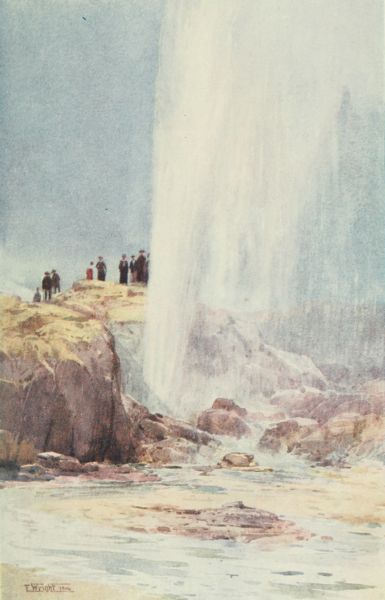
WAIROA GEYSER
But more beautiful than the sulphur stripes or the
coloured pools, and startling and uncommon in a way
that neither lakes nor mountains can be, are the geysers.
Since the Pink and White Terraces were blown up,
they are, perhaps, the most striking and uncommon
feature of the region, which, if it had nothing else to
display, would still be well worth a visit. They rival
those of the Yellowstone and surpass those of Iceland.
New Zealanders have made a study of geysers, and
know that they are a capricious race. They burst into
sudden activity, and as unexpectedly go to sleep again.
The steam-jet of Orakei-Korako, which shot out of
the bank of the Waikato at such an odd angle and
astonished all beholders for a few years, died down
inexplicably. So did the wonderful Waimangu, which
threw a column of mud, stones, steam, and boiling
water at least 1500 feet into mid-air. The Waikité
Geyser, after a long rest, began to play again at the
time of the Tarawera eruption. That was natural
enough. But why did it suddenly cease to move after
the opening of the railway to Roto-rua, two miles
away? Mr. Ruskin might have sympathised with it
for so resenting the intrusion of commercialism; but
tourists did not. Great was the rejoicing when, in
1907, Waikité awoke after a sleep of thirteen years.
Curiously enough, another geyser, Pohutu, seems likewise
attentive to public events, for on the day upon
which the Colony became a Dominion it spouted for
no less than fourteen hours, fairly eclipsing the numerous
outpourings of oratory from human rivals which
graced the occasion. There are geysers enough and to
spare in the volcanic zone, to say nothing of the chances
of a new performer gushing out at any moment. Some
are large enough to be terrific, others small enough
to be playful or even amusing. The hydrodynamics of
Nature are well understood at Roto-rua, where Mr.
Malfroy’s ingenious toy, the artificial geyser, is an exact
imitation of their structure and action. The curious
may examine this, or they may visit the extinct geyser,
Te Waro, down the empty pipe of which a man may
be lowered. At fifteen feet below the surface he will
find himself in a vaulted chamber twice as roomy as a
ship’s cabin and paved and plastered with silica. From
the floor another pipe leads to lower subterranean depths.
In the days of Te Waro’s activity steam rushing up
into this cavern from below would from time to time
force the water there violently upward: so the geyser
played. To-day there are geysers irritable enough to
be set in motion by slices of soap, just as there are
solfataras which a lighted match can make to roar, and
excitable pools which a handful of earth will stir into
effervescence. More impressive are the geysers which
spout often, but whose precise time for showing energy
cannot be counted on—which are, in fact, the unexpected
which is always happening. Very beautiful are
the larger geysers, as, after their first roaring outburst
and ascent, they stand, apparently climbing up, their
effort to overcome the force of gravity seeming to
grow greater and greater as they climb. Every part
of the huge column seems to be alive; and, indeed, all
is in motion within it. Innumerable little fountains
gush up on its sides, to curl back and fall earthwards.
The sunlight penetrates the mass of water, foam, and
steam, catching the crystal drops and painting rainbows
which quiver and dance in the wind. Bravely the
column holds up, till, its strength spent, it falters and
sways, and at last falls or sinks slowly down, subsiding
into a seething whirlpool. Brief, as a rule, is the
spectacle, but while the fountain is striving to mount
skyward it is “all a wonder and a wild desire.”
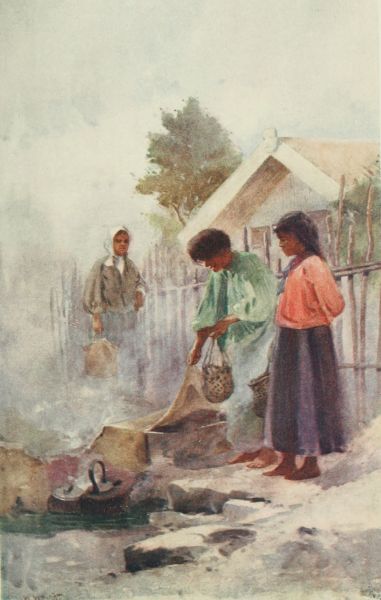
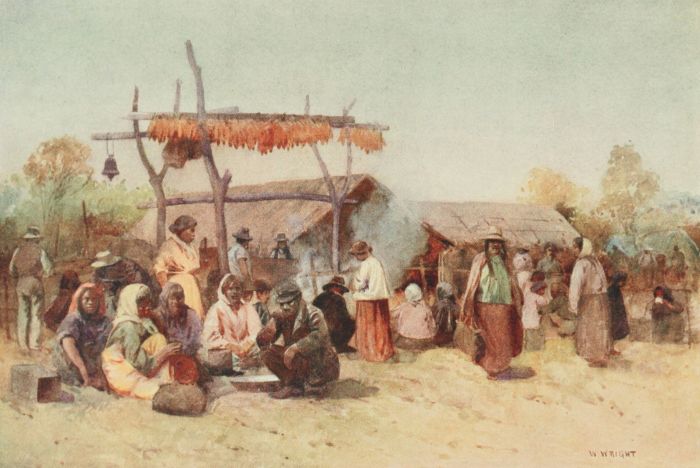
COOKING IN A HOT SPRING
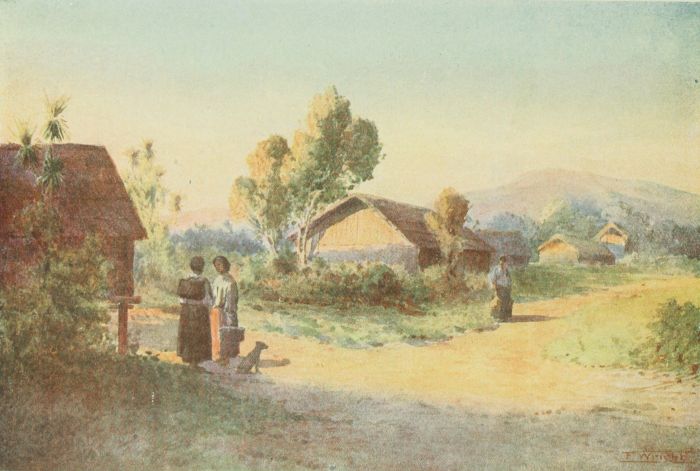
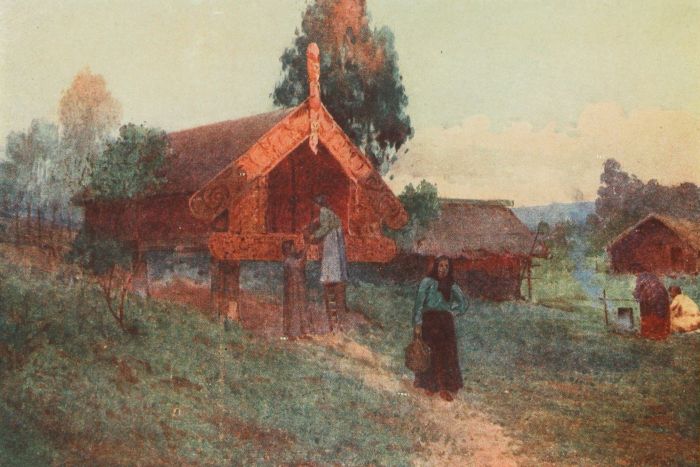
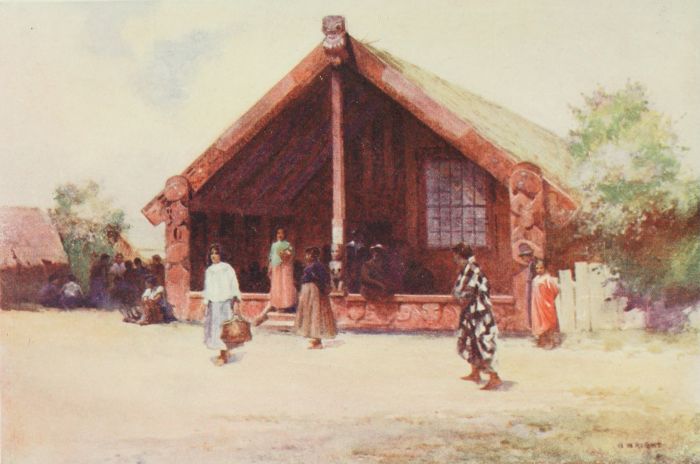
Two Maori villages, one at Ohinemutu, the other at
Whaka-rewa-rewa, are disordered collections of irregular
huts. Among them the brown natives of the thermal
district live and move with a gravity and dignity that
even their half-gaudy, half-dingy European garb cannot
wholly spoil. Passing their lives as they do on the
edge of the cold lake, and surrounded by hot pools and
steam-jets, they seem a more or less amphibious race,
quite untroubled by anxiety about subterranean action.
They make all the use they can of Nature’s forces,
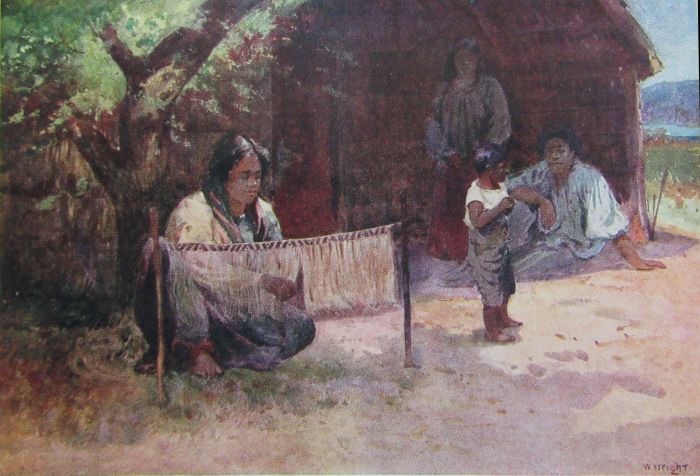
employing the steam and hot water for various daily
wants. Of course they bathe incessantly and wash
clothes in the pools. They will sit up to their necks in
the warm fluid, and smoke luxuriously in a bath that
does not turn cold. But more interesting to watch is
their cooking. Here the steam of the blow-holes is
their servant; or they will lay their food in baskets
of flax in some clean boiling spring, choosing, of course,
water that is tasteless. Cooking food by steam was and
still is the favourite method of the Maori. Where
Nature does not provide the steam, they dig ovens in
the earth called hangi, and, wrapping their food in
leaves, place it therein on red-hot stones. Then they
spread more leaves over them, pour water upon these,
and cover the hole with earth. When the oven is
opened the food is found thoroughly cooked, and in
this respect much more palatable than some of the
cookery of the colonists. In their culinary work the
Maoris have always been neat and clean. This makes
their passion for those two terrible delicacies, putrid
maize and dried shark, something of a puzzle.
Life at Roto-rua is not all sight-seeing; there is a
serious side to it. Invalids resort thither, as they do
to Taupo, in ever-increasing numbers. The State
sanatorium, with its brand-new bath-house, is as well
equipped now as good medical bathing-places are in
Europe, and is directed by a physician who was in
former years a doctor of repute at Bath. Amid the
embarras des richesses offered by the thermal springs
of the zone, Roto-rua has been selected as his headquarters,
because there two chief and distinct kinds
of hot healing waters are found in close neighbourhood,
and can be used in the same establishment.
The two are acid-sulphur and alkaline-sulphur, and
both are heavily loaded with silica. Unlike European
springs they gush out at boiling-point, and their
potency is undoubted. Sufferers tormented with gout
or crippled with rheumatism seek the acid waters;
the alkaline act as a nervous sedative and cure various
skin diseases. There are swimming baths for holiday-makers
who have nothing the matter with them, and
massage and the douche for the serious patients.
Persons without money are cared for by the servants of
the Government. Wonderful cures are reported, and
as the fame of the healing waters becomes better and
better established the number of successful cases steadily
increases. For the curable come confidently expecting
to be benefited, and this, of course, is no small
factor in the efficacy of the baths, indisputable as their
strength is. Apart, too, from its springs, Roto-rua
is a sunny place, a thousand feet above the sea. The
air is light even in midsummer, and the drainage
through the porous pumice and silica is complete.
In such a climate, amid such healing influences and
such varied and interesting surroundings, the sufferer
who cannot gain health at Roto-rua must be in a bad
way indeed.
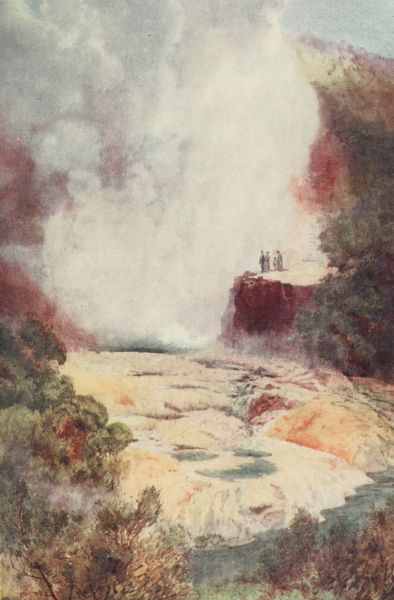
THE CHAMPAGNE CAULDRON
In the middle of Roto-rua Lake, a green hill in the
broad blue surface, rises the isle of Mokoia. There is
nothing extraordinary in the way of beauty there. Still,
it is high and shapely, with enough foliage to feather
the rocks and soften the outlines. Botanists know it as
one of the few spots away from the sea-beach where
the crimson-flowering pohutu-kawa has deigned to
grow. In any case, the scene of the legend of Hinemoa
is sure of a warm corner in all New Zealand hearts.
The story of the chief’s daughter, and her swim by
night across the lake to join her lover on the island,
has about it that quality of grace with which most
Maori tales are but scantily draped. How many
versions of it are to be found in print I do not dare to
guess, and shall not venture to add another to their
number. For two of New Zealand’s Prime Ministers
have told the story well, and I can refer my readers to
the prose of Grey and the verse of Domett. Only do
I wish that I had heard Maning, the Pakeha Maori,
repeat the tale, standing on the shore of Mokoia,
as he repeated it there to Dr. Moore. In passing I
may, however, do homage to one of the few bits of
sweet romance to be found in New Zealand literature.
Long may my countrymen steadfastly refuse to disbelieve
a word of it! For myself, as one who has
bathed in Hinemoa’s bath, I hold by every sentence of
the tradition, and am fully persuaded that Hinemoa’s
love-sick heart was soothed, as she sat on her flat-topped
rock on the mainshore, by the soft music
of the native trumpet blown by her hero on the
island. After all, the intervening water was some
miles broad, and even that terrific instrument, a native
trumpet, might be softened by such a distance.
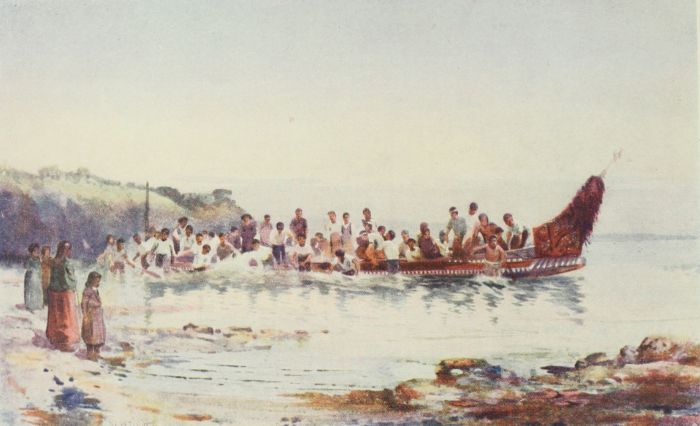
Long after the happy union of its lovers, Mokoia
saw another sight when Hongi, “eater of men,”
marched down with his Ngapuhi musketeers from
the north to exterminate the Arawa of the lake
country. To the Roto-rua people Mokoia had in
times past been a sure refuge. In camp there, they
commanded the lake with their canoes; no invader
could reach them, for no invader could bring a fleet
overland. So it had always been, and the Mokoians
trusting thereto, paddled about the lake defying and
insulting Hongi and his men in their camp on the
farther shore. Yet so sure of victory were the Ngapuhi
chiefs that each of the leaders selected as his own booty
the war-canoe that seemed handsomest in his eyes.
Hongi had never heard of the device by which Mahomet II.
captured Constantinople, but he was a man of original
methods, and he decided that canoes could be dragged
twenty miles or more from the sea-coast to Lake
Roto-iti. It is said that an Arawa slave or renegade
in his camp suggested the expedient and pointed out
the easiest road. At any rate the long haul was
successfully achieved, and the canoes of the Plumed
Ones—Ngapuhi—paddled from Roto-iti into Roto-rua.
Then all was over except the slaughter, for the
Mokoians had but half-a-dozen guns, and Hongi’s
musketeers from their canoes could pick them off
without landing.
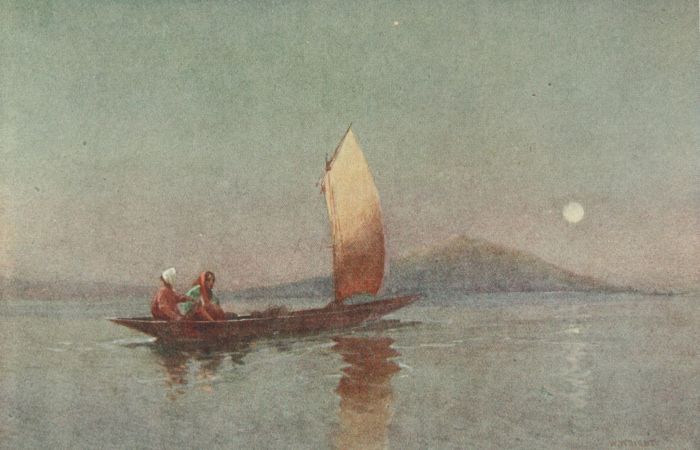
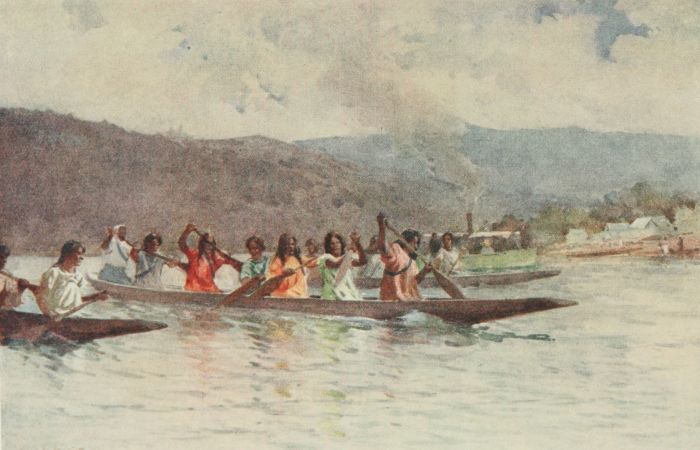
EVENING ON LAKE ROTO-RUA
Fifteen hundred men, women, and children are said
to have perished in the final massacre. Whether these
figures were “official” I cannot say. The numbers of
the slain computed in the Maori stories of their wars
between 1816 and 1836 are sometimes staggering; but
scant mercy was shown, and all tradition concurs in
rating the death-roll far higher than anything known
before or after. And Mokoia was crowded with refugees
when it fell before Hongi’s warriors. Of course, many
of the islanders escaped. Among them a strong
swimmer, Hori (George) Haupapa, took to the lake
and managed to swim to the farther shore. The life
he thus saved on that day of death proved to be long,
for Haupapa was reputed to be a hundred years old
when he died in peace.
The famous Hongi was certainly a savage of
uncommon quickness of perception, as his circumventing
of the Mokoians in their lake-stronghold shows. He
had shrewdness enough to perceive that the Maori tribe
which should first secure firearms would hold New
Zealand at its mercy; and he was sufficient of a man
of business to act upon this theory with success and
utter ruthlessness. He probably did more to destroy
his race than any white or score of whites; yet his
memory is not, so far as I know, held in special
detestation by the Maori. Two or three better
qualities this destructive cannibal seems to have had,
for he protected the missionaries and advised his
children to do so likewise. Then he had a soft voice
and courteous manner, and, though not great of
stature, must have been tough, for the bullet-wound in
his chest which finally killed him took two years
in doing so. Moreover, his dying exhortation to his
sons, “Be strong, be brave!” was quite in the right
spirit for the last words of a Maori warrior.
Hongi would seem to be an easy name enough to
pronounce. Yet none has suffered more from “the taste
and fancy of the speller” in books, whether written by
Englishmen or Colonists. Polack calls him E’Ongi,
and other early travellers, Shongee, Shongi, and Shungie.
Finally Mr. J. A. Froude, not to be outdone in inaccuracy,
pleasantly disposes of him, in Oceana, as
“Hangi.”
“Old Colonial,” in an article written in the Pall
Mall Gazette, gives Mokoia as the scene of a notable
encounter between Bishop Selwyn and Tukoto, a
Maori tohunga or wizard. To Selwyn, who claimed
to be the servant of an all-powerful God, the tohunga
is reported to have said, as he held out a brown withered
leaf, “Can you, then, by invoking your God, make
this dead leaf green again?” The Bishop answered
that no man could do that. Thereupon Tukoto, after
chanting certain incantations, threw the leaf into the
air, and, lo! its colour changed, and it fluttered to earth
fresh and green once more.
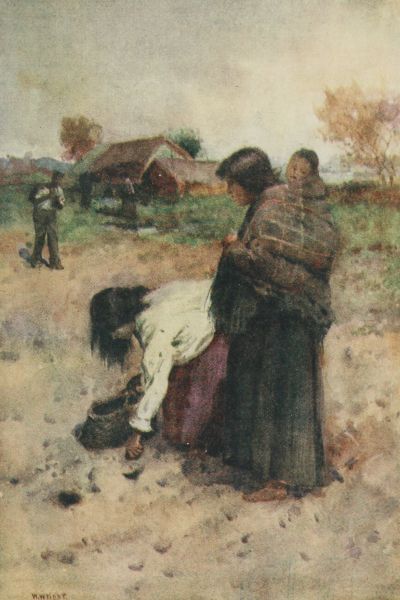
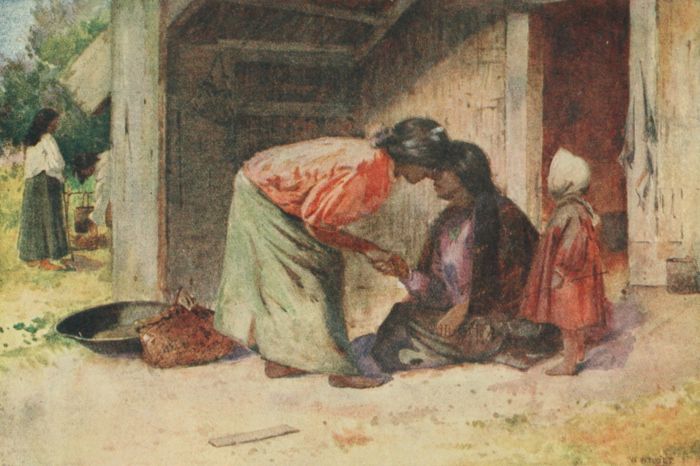
PLANTING POTATOES
Among many odd stories told of the juggling feats
of the vanishing race of tohungas this is one of the
most curious. More than one version of it is to be
found. For example, my friend Edward Tregear, in his
book The Maori Race, relates it as an episode of a
meeting between Selwyn and Te Heu Heu, where
the trick was the riposte of the chief to an appeal by
the Bishop to him to change his faith. In that case
the place of the encounter could scarcely have been
Mokoia, or the tohunga have been Tukoto.
Whatever may be said—and a great deal may be
said—against the tohunga as the foe of healing and
knowledge, the religious prophets who from time to
time rise among the Maori are not always entirely bad
influences. A certain Rua, who just now commands
belief among his countrymen, has managed to induce
a following to found a well-built village on a hill-side
among the forests of the Uriwera country. There,
attended by several wives, he inhabits a comfortable
house. Hard by rises a large circular temple, a
wonderful effort of his native workmen. He has
power enough to prohibit tobacco and alcohol in his
settlement, to enforce sanitary rules, and to make his
disciples clear and cultivate a large farm. Except
that he forbids children from going to school, he does
not appear to set himself against the Government. He
poses, I understand, as a successor of Christ, and is
supposed to be able to walk on the surface of water.
His followers were anxious for ocular proof of this,
and a hint of their desire was conveyed to the
prophet. He assembled them on a river’s bank and
gravely inquired, “Do you all from your hearts believe
that I can walk on that water?” “We do,” was the
response. “Then it is not necessary for me to do it,”
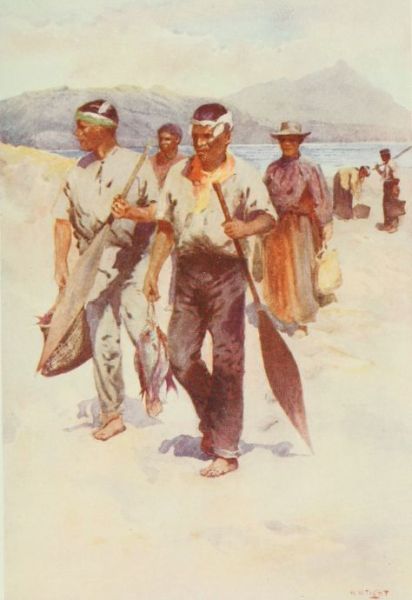
said he, and walked composedly back to his hut.