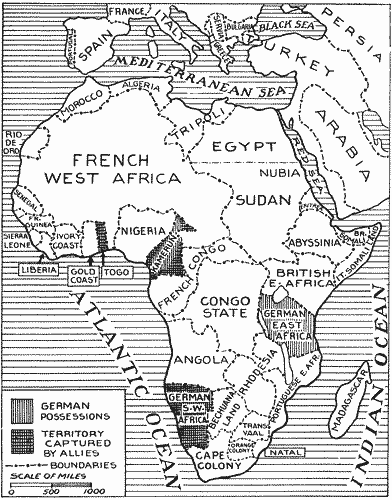
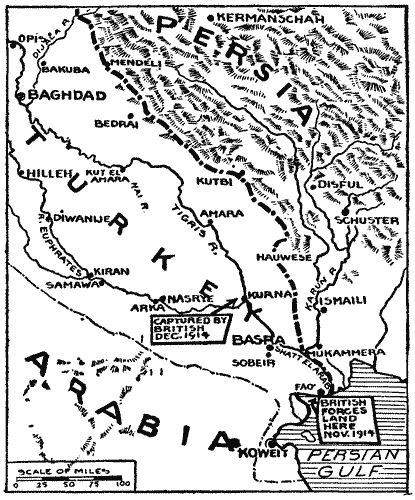
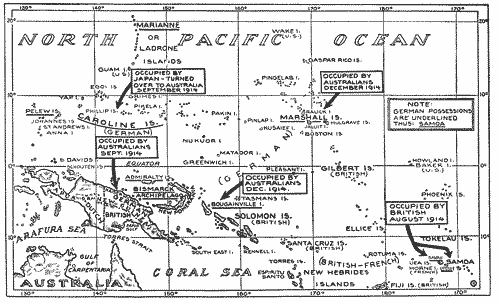
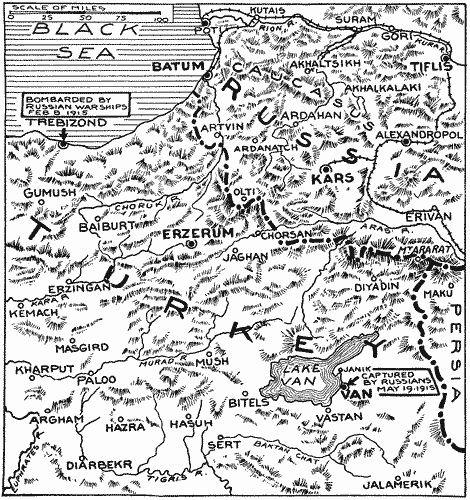
By special cable to The New York Times from London on July 1, 1915,
came the following information:
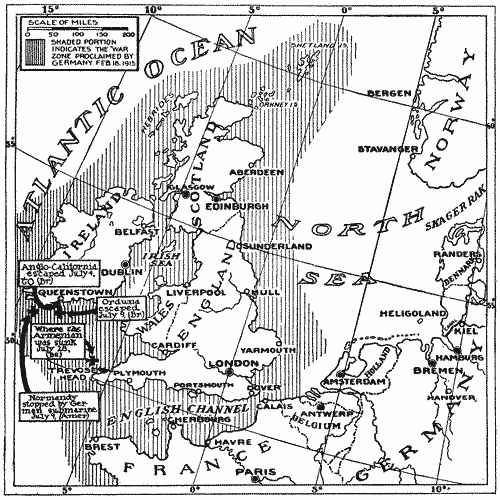
Count von Reventlow, in last Sunday's Deutsche Tageszeitung, explains
the importance and meaning of Calais as a German objective in the west
and as a key to the destruction of the British Empire. Dr. Ernst
Jaeckh, in an article called "Calais or Suez," maintained that if an
English statesman had to make a choice he would undoubtedly give up
Calais and cling to Suez rather than give up Suez and control Calais.
Reventlow maintains there is no reality about this alternative.
About the importance of Suez, Jaeckh and Reventlow are agreed.
Reventlow for his part declares England's main interest in the
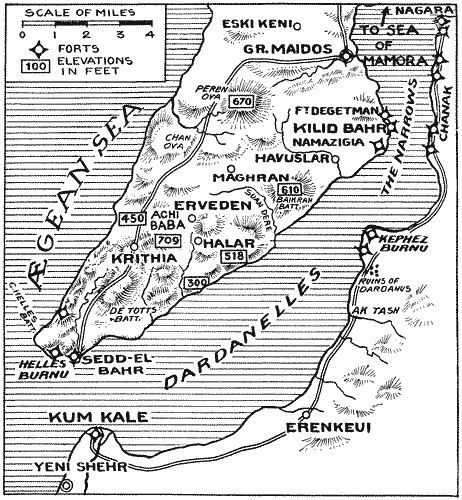
Dardanelles operations is the desire to protect Egypt and that this is
the explanation of all her efforts to range the Balkan countries
against Austria-Hungary, Germany, and Turkey. As translated in The
Times he proceeds:
"These efforts are not yet at an end, and they will be continued with
a desperate expenditure of strength and all possible means. It was
believed that the Russian armies and influence exercised upon the
Balkan peoples would make Egypt safe. These hopes are now tottering or
vanishing. All the greater must be the energy of our triple alliance
in order completely to clear the way and then at the proper moment to
take it with firm determination to see the thing through. Here also we
see the correctness of our old argument, that for Germany and her
allies success lies in a long war and that time works for them if they
employ the time in working. Our forces are increasing with time and,
as has been said, Germany has the assured possibility of gaining time.
To strike our chief enemy at a vital point is worth the greatest
efforts and sacrifice of time, quite apart from the fact that we owe
it to the Turkish Empire to assist with all our strength in restoring
Egypt, which was stolen by England."
Reventlow then says that a comparison of "the Calais idea" with Suez
is as idle as the comparison of a chair with a table. He says Jaeckh
is mistaken in supposing Calais does not concern more than the south
coast of England or that it merely threatens one of many ways to and
from England. Reventlow says:
"This by no means completes the Calais idea. From a military or
political or economic point of view one should look at the matter with
the eyes of Great Britain and define the Calais idea as a possibility
for a seafaring continental power to conduct a war against Great
Britain from the continental coast channel and with all military
resources while holding open communication between the Atlantic Ocean
and the North Sea."
This article, dealing with the consequences of the war,
originally appeared in La Revue of Paris, and is here
reproduced by permission of Mr. Galsworthy.
IN these times one dread lies heavy on heart and brain—the thought
that after all the unimaginable suffering, waste, and sacrifice of
this war, nothing may come of it, no real relief, no permanent benefit
to Europe, no improvement to the future of mankind.
The pronouncements of publicists—"This must never happen again,"
"Conditions for abiding peace must be secured," "The United States of
Europe must be founded," "Militarism must cease"—all such are the
natural outcome of this dread. They are proclamations admirable in
sentiment and intention. But human nature being what it has been and
is likely to remain, we must face the possibility that nothing will
come of the war, save the restoration of Belgium, (that, at least, is
certain;) some alterations of boundaries; a long period of economic
and social trouble more bitter than before; a sweeping moral reaction
after too great effort. Cosmically regarded, this war is a debauch
rather than a purge, and debauches have always to be paid for.
Confronting the situation in this spirit, we shall be the more
rejoiced if any of our wider hopes should by good fortune be attained.
Leaving aside the restoration of Belgium—for what do we continue to
fight? We go on, as we began, because we all believe in our own
countries and what they stand for. And in considering how far the
principle of nationality should be exalted, one must well remember
that it is in the main responsible for the present state of things. In
truth, the principle of nationality of itself and by itself is a quite
insufficient ideal. It is a mere glorification of self in a world full
of other selves; and only of value in so far as it forms part of that
larger ideal, an—international ethic, which admits the claims and
respects the aspirations of all nations. Without that ethic little
nations are (as at the present moment) the prey—and, according to the
mere principle of nationality, the legitimate prey—of bigger nations.
Germany absorbed Alsace-Lorraine, Schleswig, and now Belgium, by
virtue of nationalism, of an overweening belief in the perfection of
its national self. Austria would subdue Serbia from much the same
feeling. France does not wish to absorb or subdue any European people
of another race, because France, as ever, a little in advance of her
age, is already grounded in this international ethic, of unshakable
respect for the rights of all nations which belong, roughly speaking,
to the same stage of development. The same may be said of the other
western democratic powers, Britain and America. "To live and let
live," "to dwell together in unity," are the guiding maxims of the
international ethic, by virtue of which alone have the smaller
communities of men—the Belgiums, Bohemias, Polands, Serbias,
Denmarks, Switzerlands of Europe—any chance of security in the
maintenance of their national existences. In short the principle of
nationality, unless it is prepared to serve this international ethic,
is but a frank abettor of the devilish maxim, "Might is right." All
this is truism; but truisms are often the first things we forget.
The whole question of nationality in Europe bristles with
difficulties. It cannot be solved by theory and rule of thumb. What is
a nation? Shall it be determined by speech, by blood, by geographical
boundary, by historic tradition? The freedom and independence of a
country can and ever should be assured when with one voice it demands
the same. It is seldom as easy as all that. Belgium, no doubt, is as
one man. Poland is as one man in so far as the Poles are concerned;
but what of the Austrians, Russians, Germans settled among them? What
of Ireland split into two camps? What of the Germans in Bohemia, in
Alsace, in Schleswig-Holstein? Compromise alone is possible in many
cases, going by favor of majority. And there will always remain the
poignant question of the rights and aspirations of minorities. Let us
by all means clear the air by righting glaring wrongs, removing
palpable anomalies, redressing obvious injustices, securing so far as
possible the independent national life of homogeneous groups; but let
us not, dazzled by the glamour of a word, dream that by restoring a
few landmarks, altering a few boundaries, and raising a pæan to the
word Nationality, we can banish all clouds from the sky of Europe, and
muzzle the ambitions of the stronger nations.
In my convinced belief the one solid hope for future peace, the one
promise of security for the rights and freedom of little countries,
the one reasonable guarantee of international justice and general
humanity, lies in the gradual growth of democracy, of rule by consent
of the governed. When this has spread till the civilization of the
Western world is on one plane—instead of as now on two—then and then
only we shall begin to draw the breath of assurance. Then only will
the little countries sleep quietly in their beds. It is conceivable,
nay probable, that the despotic will of a perfect man could achieve
more good for his country and for the world at large in a given time
than the rule of the most enlightened democracy. It is certain that
such men occupy the thrones of this earth but once in a blue moon.
If proof be needed that the prevalence of democracy alone can end
aggression among nations, secure the rights of small peoples, foster
justice and humaneness in man—let the history of this last century
and a half be well examined, and let the human probabilities be
weighed. Which is the more likely to advocate wars of aggression?
They, who by age, position, wealth, are secure against the daily
pressure of life and the sacrifice that war entails, they who have
passed their time out of touch with the struggle for existence, in an
atmosphere of dreams, ambitions, and power over other men? Or they,
who every hour are reminded how hard life is, even at its most
prosperous moments, who have nothing to gain by war, and all, even
life, to lose; who by virtue of their own struggles have a deep
knowledge of, a certain dumb sympathy with, the struggles of their
fellow-creatures; an instinctive repugnance to making those struggles
harder; who have heard little and dreamed less of those so-called
"national interests," that are so often mere chimeras; who love, no
doubt, in their inarticulate way the country where they were born, and
the modes of life and thought to which they are accustomed, but know
of no traditional and artificial reasons why the men of other
countries should not be allowed to love their own land and modes of
thought and life in equal peace and security?
Assuredly, the latter of these two kinds of men are the less likely to
favor ambitious projects and aggressive wars. According as "the
people" have or have not the final decision in such matters, the
future of Europe will be made of war or peace; of respect or of
disregard for the rights of little nations. It is advanced against
democracies that the workers of a country, ignorant and provincial in
outlook, have no grasp of international politics. This is true in
Europe where national ambitions and dreams are still for the most part
hatched and nurtured in nests perched high above the real needs and
sentiments of the simple working folk who form nine-tenths of the
population of each country. But once those nests of aggressive
nationalism have fallen from their high trees, so soon as all Europe
conforms to the principle of rule by consent of the governed, it will
be found—as it has been already found in France—that the general
sense of the community informed by an ever-growing publicity (through
means of communication ever speeding-up) is quite sufficient trustee
of national safety; quite able, even enthusiastically able, to defend
its country from attack. The problem before the world at the end of
this war is how to eliminate the virus of an aggressive nationalism
that will lead to fresh outbursts of death. It is a problem that I,
for one, frankly believe will beat the powers and goodwill of all,
unless there should come a radical change of Governments in Central
Europe; unless the real power in Germany and Austria-Hungary passes
into the hands of the people of those countries, as already it has
passed in France and Britain. This is in my belief the only chance for
the defeat of militarism, of that raw nationalism, which, even if
beaten down at first, will ever be lying in wait, preparing secret
revenge and fresh attacks.
How this democratization of Central Europe can be brought about I
cannot tell. It is far off as yet. But if this be not at last the
outcome of the war, we may still talk in vain of the rights of little
nations, of peace, disarmament, of chivalry, justice, and humanity. We
may whistle for a changed world.
JOHN GALSWORTHY.
[The body of Claude Joseph Rouget de Lisle, who composed
"The Marseillaise," was placed, on July 15, 1915, in the
Hôtel des Invalides, Paris.]
Up from the land of fair Provence,
Land of the vineyard and olive green,
Flushed with a new hope's radiance
Glow of glorious visions seen,
Joyous Marseilles' Battalion came,
Singing a song since known to fame.
List as the drums the quickstep beat!
List to the Chant of Liberty!
Ringing through dawn or noonday heat—
"Allons enfants de la Patrie!"
List to the chant on the dusty way,
"Death to the tyrant! Vive le Marseillais!"
Orchards and vineyards caught up the song,
France seemed but waiting that martial lay,
Born of poet's heart-beats strong!
Sung by the sons of the South that day,
Voicing the hero-soul of strife,
Marching song of a nation's life!
Days of Terror that chant ushered in,
Falling of thrones and baubles and crowns—
Bastille walls and guillotine,
Sack of Tuileries, Temple frowns.
Heard that Chant of the Marseillais,
"Le jour de gloire est arrivé."
Reds of the Midi! The song you sung
Thrilled the hearts of all who heard!
Song of a people with hearts tense-strung,
Rhythm that every pulse quick stirred!
Echoes that song as France now pays
Honor to singer of "La Marseillaise!"
Copyright, 1915, by Arnold Bennett
The pessimistic attitude toward the military situation
assumed by a large part of British society, after the
arrival of warm weather, without the heralded concerted
advance of the Allies in France and Belgium, is dealt with
by Mr. Bennett in the subjoined article, which appeared in
the London Daily News of June 16, 1915. It is here
reproduced by Mr. Bennett's express permission.
IN a recent article I said that for reasons discoverable and
undiscoverable the military situation had been of late considerably
falsified in the greater part of the Press. This saying (which by the
way was later confirmed by the best military experts writing in the
Press) aroused criticism both public and private. That it should have
been criticised in certain organs was natural, for these organs had
certainly been colouring or manipulating their war news, including
casualties, chiefly by headlines and type, and even influencing their
expert analysis of war-news, to suit what happened to be at the moment
their political aims.
Even the invasion scare was last week revived by the "Daily Mail" as
an aid to compulsion. The "Daily Mail" asserted that, whatever we
might say, invasion was possible. True. It is. Most things are. But
invasion is responsibly held to be so wildly improbable that our
military, as distinguished from our naval, plans are permitted
practically to ignore the possibility. Compulsion or no compulsion,
those plans will be the same. They will be unaffected by any amount of
invasion-scaring, and therefore to try to foster pessimism in the
public by alarums about invasion is both silly and naughty.
Newspapers quite apart, however, there has been in the country a
considerable amount of pessimism which I have not been able to
understand, much less sympathise with; pessimism of the kind that
refuses to envisage the future at all. It has not said: "We shall be
beaten." But it has groaned and looked gloomy, and asked mute
questions with its eyes. It has resented confident faith and demanded
with sardonic superiority the reasons for such faith.
Of the tribe of pessimists I count some superlative specimens among my
immediate acquaintances. The explanation of their cases is, I contend,
threefold. First, they lack faith, not merely in the Allied arms, but
in anything. They have not the faculty of faith. Secondly, they
unconsciously enjoy depression, and this instinct distorts all
phenomena for them. Thus they exhibited no satisfaction whatever at
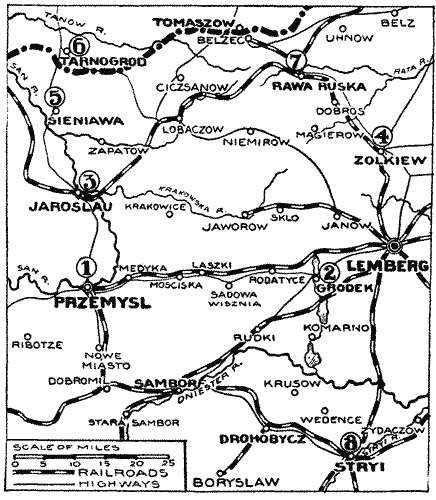
the capture of Przemysl full of men and munitions by the Russians,
whereas the recapture of Przemysl empty of men and munitions by the
Germans filled them with delicious woe. Thirdly, they lack patience,
and therefore a long-sustained effort gets on their nerves. Others I
can inoculate with my optimism, but the effect passes quickly, and
each succeeding reinoculation has been less and less effective, with
the monotonous questioning, ever more sardonic in tone: "How can you
be deluded by the official bulletins?" or: "What do you know about
war, to make you so cocksure?"
The truth is that I am not deluded by the official bulletins. I don't
know how long it is since I learnt to appreciate official bulletins at
their true value, but it is a long while ago. A full perception of
the delusiveness of official bulletins can only be obtained by reading
histories of the war. The latest I have read are those of Mr. John
Buchan and Mr. Hillaire Belloc. (Mr. Buchan's is good. Mr. Belloc's is
more than good: it is—apart from a few failures in style, due either
to fatigue or to the machinery of dictation—absolutely brilliant,
both militarily and politically. I am inclined to rate the last dozen
pages of Mr. Belloc's book as the finest piece of writing yet produced
by the war.) And when one compares, in these works, the coherent,
impartial, and convincing accounts of, say, the first month of the
war, with the official bulletins of the Allies during that month, one
marvels that even officialism could go so far in evasion and
duplicity, and the reputation of official bulletins is ruined for the
whole duration of the conflict. No wonder the contents of the Allied
newspapers in that period inspired the Germans with a scornful
incredulity, which nothing that has since happened can shake.
It is not that official bulletins are incorrect; they are incomplete,
and, therefore, misleading. The policy which frames them seems now to
be utterly established, but my motion that it is a mistaken policy
remains unaltered. When the policy is pushed as far as the suppression
of isolated misfortunes which flame in the headlines of the enemy
Press from Cologne to Constantinople, then I begin to wonder whether I
am living in three dimensions or in four.
If, then, he does not rely on the official bulletins, and he has no
military expertise, how is the civilian justified in being optimistic?
The reply is that the use of his common-sense may justify his
optimism. The realm of common-sense being universal, even war comes
within it. And the fact is that the major aspects of the war are no
more military than they are political, social, and psychological. Take
one of the most important aspects—the character of generals. It
cannot be denied that after ten months, confidence in Joffre has
increased. At the beginning of the war, when the German plan was
being exactly followed and was succeeding, when the Germans had an
immense advantage of numbers, when their reserves of men and munitions
were untouched, when everything was against us, and everything in
favour of the Germans, Joffre, aided by the British, defeated the
Germans. He defeated them by superior generalship. Common-sense says
that now, when the boot is on the other leg, Joffre will assuredly
defeat the Germans—and decisively, and common-sense is quite prepared
to wait until Joffre is ready. Again, take the case of the Grand Duke.
The Grand Duke has shown over and over again that he is an extremely
brilliant general of the first order. In the very worst days, when
everything was against him and everything in favour of the Germans, as
in the West, he held his own and he has continually produced many more
casualties in the German ranks than the Germans have produced in his
ranks. He still has many things against him, but it is not possible
reasonably to believe that the Grand Duke will let himself in for a
disaster. That he should avoid a disaster is all that the West front
demands of him at present.
On the other side, General von Moltke, head of the German Great
General Staff, has been superseded. What German General has advanced
in reputation? There is only one answer—von Hindenberg. Von
Hindenberg won the largest (not the most important) victory of the war
in the Battle of Tannenberg. He won it because the ground was
exceedingly difficult, and because he knew the ground far better than
any other man on earth. He was entitled to very high credit. He got
it. He became the idol of the German populace, and the bugbear of the
Allied countries. But he has done nothing since. Soon after Tannenberg
he made a fool of himself on the Russian frontier, and showed that
success had got into his head. He subsequently initiated several
terrific attempts, all of which were excessively costly and none of
which was carried through. If he has not ceased to be an idol, he has
at any rate ceased to be a bugbear.
As for the average intelligence of the opposing forces, it may be said
that Prussian prestige, though it dies very slowly, is dying, even in
the minds of our pessimists. Their zest for elaborate organization of
plan gave the Germans an immense advantage at the start, but it is
proved that, once the plan has gone wrong, they are at the best not
better in warfare than ourselves. Their zest for discipline, and their
reserves, have enabled them to stave off a catastrophe longer than
perhaps any other nation could have staved it off. But time is now
showing that excessive discipline and organization produce defects
which ultimately outweigh the qualities they spring from. The tenacity
of the Germans is remarkable, but does it surpass ours? Man for man, a
soldier of the Allies is better than a soldier of the Central
Powers—or ten thousand observers have been deceived. As for the
intelligence of the publics upon whose moral the opposing forces
ultimately depend, it is undeniable that the German public is
extremely hysterical, and far more gullible even than ourselves at our
very worst. The legends believed by the German public today are
ridiculous enough to stamp Germany for a century as an arch-simpleton
among nations. Its vanity is stupendous, eclipsing all previously
known vanities. The Great General Staff must know fairly well how
matters stand, and yet not the mere ignorant public, but the King of
Bavaria himself, had the fatuity as late as last week to talk about
the new territory that Germany would annex as a result of the war!
In numbers we in the West had got the better of them, and were slowly
increasing our lead, before Italy, by joining us, increased the
Allies' advantage at a stroke by over three-quarters of a million
fully mobilised men, and much more than as many reserves.
In financial resources there is simply no comparison between the enemy
and ourselves. We are right out of sight of the enemy in this
fundamental affair.
We lack nothing—neither leading, nor brains, nor numbers, nor
money—save ammunition. Does any pessimist intend to argue that we
shall not get all the ammunition we need? It is inconceivable that we
should not get it. When we have got it the end can be foretold like
the answer to a mathematical problem.
Lastly, while the Germans have nothing to hope for in the way of
further help, we have much to hope for. We have, for example, Rumania
to hope for; and other things needless to mention. And we have in hand
enterprises whose sudden development might completely change the face
of the war in a few hours; but whose failure would not prejudice our
main business, because our main business is planned and nourished
independently of them. One of these enterprises is known to all men.
The other is not. The Germans have no such enterprises in hand.
For all the foregoing argument no military expertise is necessary. It
lies on a plane above military expertise. It appeals to common-sense
and it cannot be gainsaid. I have not yet met anybody of real
authority who has attempted to gainsay it, or who has not endorsed it.
The sole question is, not whether we shall win or lose, but when we
shall win.
For this reason I strongly object to statesmen, no matter who they be,
going about and asserting to listening multitudes that we are fighting
for our very existence as a nation. We most emphatically are not. It
is just conceivable that certain unscrupulous marplots might by
chicane produce such domestic discord in this country as would
undermine the very basis of victory. I regard the thing as in the very
highest degree improbable, but it can be conceived. The result might
be an inconclusive peace, and another war, say, in twenty years, when
we probably should be fighting for our very existence as a nation.
But we are not now, and at the worst shall not be for a long time,
fighting for our very existence as a nation. Nobody believes such an
assertion; pessimists themselves do not believe it. And when
statesmen give utterance to it in the hope of startling the
working-class into a desired course of conduct, they under-rate the
intelligence of the working-class and the result of such oratory is
far from what they could wish.
Our national existence is as safe as it has been any time this
century; indeed, it is safer, for its chief menace has received a
terrible blow, and the Prussian superstition is exploded. All that can
be urged is that we have an international job to finish; that in order
to finish it properly and within a reasonable period we must work with
a will and in full concord; and that if we fail to do this the job
will be botched, with a risk of sinister consequences to the next
generation. The notion that to impress the public it is necessary to
pile on the agony with statements that no moderately enlightened
person can credit, is a wrong notion, and, like all wrong notions, can
only do harm. The general public is all right, quite as all right as
the present Government or any other. Had it not been so we should not
be where we are today, but in a far less satisfactory position. Not
Governments, not generals, but the masses make success in these mighty
altercations. Read Tolstoi's "War and Peace."
Major Leonard Darwin, in his presidential address on "Eugenics During
and After the War" to the Eugenics Education Society at the Grafton
Galleries yesterday, said that our military system seemed to be
devised with the object of insuring that all who were defective should
be exempt from risks, whilst the strong, courageous, and patriotic
should be endangered. Men with noble qualities were being destroyed,
whilst the unfit remained at home to become fathers of families, and
this must deteriorate the natural qualities of the coming generations.
The chances of stopping war were small, and we must consider how to
minimize its evils. If conscription were adopted future wars would
produce less injury to the race, because the casualty lists would more
nearly represent a chance selection of the population; though whether
a conscript army would ever fight as well as our men were doing in
France was very doubtful. The injurious effects of the war on all
useful sections of the community should be mitigated. Military
training was eugenic if the men were kept with the colours only for
short periods. Officers must, of course, be engaged for long periods,
and amongst them the birth rate was very low. An increase of pay would
be beneficial in this respect, but only if given in the form of an
additional allowance for each living child. In the hope of increasing
the birth rate attempts were likely to be made to exalt the "unmarried
wife," a detestable term against which all true wives should protest.
If a change in moral standards was demanded in the hope that an
increase in the habit of forming irregular unions would result in an
increase in the population, that plea entirely failed because the
desired effect would not thus be produced. A special effort ought now
to be made on eugenic as well as on other grounds to maintain the high
standards of home life which had ever existed in our race, and which
had been in large measure the basis of our social and racial progress
in the past. If we did not now take some steps to insure our own
racial progress being at least as rapid as that of our neighbours, and
if our nation should in consequence cease in future to play a great
part in the noble and eternal struggle for human advancement, then the
fault would be ours.
A group of sixty-seven Russian writers and publicists,
comprising the best men of letters of the nation, with the
exception of Vladimir Korolenko, who is at present in
France, have signed a reply to the tribute to the writers of
Russia by English men of letters, a translation of which was
printed in Current History for February, 1915. The text of
the reply, given below, is taken from the Moscow daily
newspaper, Outro Rossii; its translation into English by Leo
Pasvolsky appeared in the New York Evening Post of June
20th.
WE have known you for a long time. We have known you since we Russians
came to a communion with Western Europe and began to draw from the
great spiritual treasury created by our brethren of Western Europe.
From generation to generation we have watched intently the life of
England, and have stored away in our minds and our hearts everything
brilliant, peculiar, and individual, that has impressed itself upon
the English word, the English thought, and the English life.
We have always wondered at the breadth and the manifoldness of the
English soul, in whose literature one finds, side by side, Milton and
Swift, Scott and Shelley, Shakespeare and Byron. We have always been
amazed by the incessant and constantly growing power of civic life in
England; we have always known that the English people was the first
among the peoples of the world to enter upon a struggle for civic
rights, and that nowhere does the word freedom ring so proud and so
triumphant as it does in England.
With wonder and veneration, have we watched the English people, that
combines the greatest idealism with the most marvellous creative
genius, that constantly transforms words into deeds, aspirations into
actions, thoughts and feelings into institutions, go onward, from step
to step, reaching out into the heavens, yet never relinquishing the
earth, higher and higher along its triumphant road, still onward in
its work of creating the life of England.
Kingdoms and peoples, cultures and institutions, pass away like
dreams. But thoughts and words remain, whether they be of white men,
or black, or yellow, whether they be of Jews or of Hellenes, whether
they be inscribed on slabs of stone, or on boards of clay, or on
strips of papyrus. Words and thoughts live to the present day; they
still move us and uplift us, even though we have already forgotten the
names of those who spoke them. And we know that only the winged words
live on, the words that are intelligible to the whole of mankind, that
appeal to the whole of humanity, to the common human mind, the common
heart.
We know the vast power of the English word. We know what a marvellous
contribution the English writers have made to the life not of England
alone, but to that of the whole world, the whole humanity. It is with
a feeling of long-standing affection and veneration that we turn to
the ancient book, called "England," whose pages never grow yellow,
whose letters are never effaced, whose thoughts never become dim,
whose new chapters bear witness to the fact that the book is still
being written, that new pages are still being added, and that these
new pages are permeated with that same bright and powerful spirit of
humanity that illumines and enlivens the pages of the past.
We feel proud because you have recognized the great individual worth
of the Russian literature, and we are moved by your ardent expressions
of sympathy and friendship. You scarcely know what Lord Byron was to
us at the dawn of our literature, how our greatest poets, Poushkin and
Lermontov, were swayed by him. You scarcely know to what an extent the
Shakespearean Hamlet, the Prince of Denmark, has become a part of our
literature, how near to us is Hamlet's tragedy.
We, too, pronounce the names of Copperfield and Snodgrass with a
little difficulty, but the name of Dickens is as familiar to us and as
near to our hearts as the names of some of our own writers.
We trust, and we even permit ourselves to hope, that our friendship
will not end on the fields of battle, but that our mutual
understanding will continue to grow, as it lives on together with
those sincere and heartfelt words, with which you have addressed us.
We trust that it will be transformed into a spiritual unity between
us, a unity based on the universal achievements of the spirit of
humanity.
We trust even further. We trust that evil will finally become
extinguished in the hearts of men, that mutual ill-feeling will be
bitter and poignant no longer, and that, when ears of corn will be
again fluttering upon the fields, mutilated by trenches and ramparts,
and drenched in human blood, when wild flowers will begin to grow over
the countless unknown graves, time will come, when the nations that
are separated by such a tremendous gulf today, will come together
again upon the one great road of humanity and will turn back once more
to the great, universal words, that are common to all men.
We trust, and we hope.
Greetings to you.
(Signed)
- L. Andreev,
- K. Arseniev,
- I. Bunin,
- U. Bunin,
- I. Belousov,
- M. Gorky,
- V. Veresaev,
- A. Grusinsky,
- N. Davydov,
- S. Elpatievsky,
- I. Ignatov,
- S. Melgunov,
- A. Serafimovich,
- N. Teleshov,
- I. Shmelev,
- N. Morozov,
- Count A.N. Tolstoy,
- N. Rusanov,
- F. Kriukov,
- A. Gornfeld,
- A. Pieshechonov,
- N. Kareyev,
- F. Batushkov,
- L. Panteleyev,
- N. Kotliarevsky,
- V. Miakotin,
- V. Vodovosov,
- P. Sakulin,
- Olnem-Tsekhovskaya,
- A. Koni,
- W. Kranikhfeld,
- B. Lazarevsky,
- P. Potapenko,
- Th. Sologub,
- T. Schepkina-Kupernik,
- W. Bogucharsky,
- K. Barantsevich,
- S. Vengerov,
- P. Miliukov,
- A. Prugavin,
- M. Kovalevsky,
- A. Posnikov,
- E. Letkova-Sultanova,
- D. Ovsianniko-Kulikovsky,
- A. Remezov,
- D. Merezhkovsky,
- Z. Hippics,
- F. Zelinsky,
- N. Tchaikovsky,
- A. Blok,
- E. Tchirikov,
- A. Petrischev,
- I. Bielokonsky,
- Prince A. Sumbatov,
- W. Fritche,
- A. Veselovsky,
- W. Nemerovich-Danchenko,
- Prince E. Troubetskoy,
- I. Shpazhinsky,
- Th. Kokoshkin,
- Count E.L. Tolstoy,
- N. Temkocsky,
- M. Artisibashev,
- U. Baltrushaitis,
- U. Aichenwald,
- Prince D. Shakhovsky,
- W. Brusov.

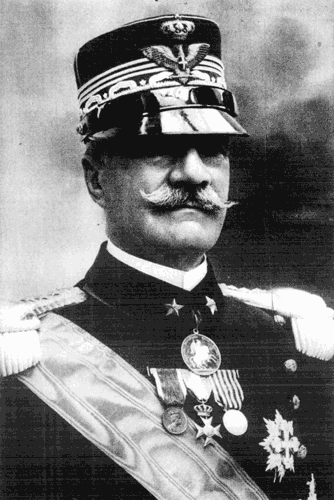
Mr. Archer's article praising the Italian decision and
purpose appeared originally in The London Daily News.
ONE of the most beautiful and memorable of human experiences is to
start, one fine morning, from some point in German Switzerland or
Tyrol and, in two or three days—or it may be in one swinging
stretch—to tramp over an Alpine pass and down into the Promised Land
below. It is of no use to rush it in a motor; you might as well hop
over by aeroplane. In order to savor the experience to the full, you
must take staff and scrip, like the Ritter Tannhäuser, and go the
pilgrim's way. It is a joy even to pass from the guttural and
explosive place names of Teutonia to the liquid music of the southern
vocables—from Brieg to Domo d'Ossola, from Göschenen to Bellinzona,
from St. Moritz to Chiavenna, from Botzen and Brixen to Ala and
Verona. It is a still greater joy to exchange the harsh, staring
colors of the north for the soft luminosity of the south, as you
zigzag down from the bare snows to the pines, from the pines to the
chestnuts, from the chestnuts to the trellised vineyards. And just
about where the vineyards begin, you come upon two wayside posts, one
of them inscribed "Schweiz" or "Oesterreich," the other bearing the
magic word "Italia." If your heart does not leap at the sight of it
you may as well about-turn and get you home again; for you have no
sense of history, no love of art, no hunger for divine, inexhaustible
beauty. For all these things are implicit in the one word, "Italy."
Alas! the charm of this excursion has from of old made irresistible
appeal to the northern barbarian. That has been Italy's historic
misfortune. For certain centuries, under the dominance of Rome, she
kept the Goths and Huns and Vandals aloof by what is called in India a
"forward policy"—by throwing the outworks of civilization far beyond
the Alpine barrier. But Rome fell to decay, and, wave upon wave, the
barbarian—generally the Teuton, under one alias or another—surged
over her glorious highlands, her bounteous lowlands, and her marvelous
cities. It is barely half a century since the hated Tedeschi were
expelled from the greater part of their Cisalpine possessions; and
now, in the fullness of time, Italy has resolved to redeem the last of
her ravished provinces and to make her boundaries practically
conterminous with Italian speech and race.
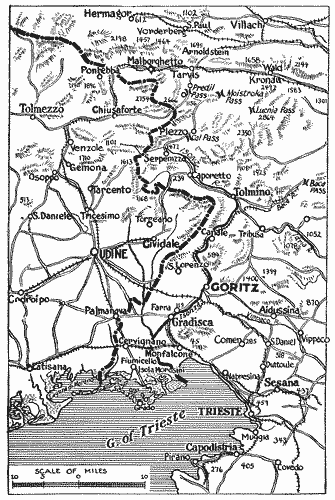
The political and military aspects of the situation have been fully
dealt with elsewhere; but a lifelong lover of Italy may perhaps be
permitted to state his personal view of her action. While the
negotiations lasted, her position was scarcely a dignified one. It
seemed that she was willing, not, indeed, to sell her birthright for a
mess of pottage, but to buy her birthright at the cost of complicity
in monstrous crime. Neither Italy nor Europe would have profited in
the long run by the substitution of "Belgia Irredenta" for "Italia
Irredenta." But now that she has repudiated the sops offered to her
honor and conscience, her position is clear and fine. She has rejected
larger concessions, probably, than any great power has ever before
been prepared to make without stroke of sword; and she has thrown in
her lot with the Allies in no time-serving spirit, but at a point when
their fortunes were by no means at their highest. This is a gesture
entirely worthy of a great and high-spirited people.
It is true that she had no guarantee for the promised concessions
except the "Teutonica fides," which has become a byword and a
reproach. But I am much mistaken if that was the sole or main motive
that determined her resort to arms. She took a larger view. She felt
that even if Germany, by miracle, kept her faith, the world, after a
German victory, would be no place for free men to live in. She was not
moved by the care for a few square miles of territory, more or less,
but by a strong sense of democratic solidarity and of human dignity.
After the events of the past ten months, she felt that, to a
self-respecting man or nation, German hate was infinitely preferable
to German love. It was, in fact, a patent of nobility.
And now that Italy is ranked with us against the powers of evil, it
becomes more than ever our duty to strain every nerve for their
defeat. We are now taking our share in the guardianship of the world's
great treasure house of historic memories and of the creations of
genius. We have become, as it were, co-trustees of an incomparable,
irreplaceable heritage of beauty. Italy has been the scene of many and
terrible wars; but since she emerged from the Dark Ages I do not know
that war has greatly damaged the glory of her cities. She has not, of
recent centuries, had to mourn a Louvain or a Rheims. But if the
Teuton, in his present temper, should gain any considerable footing
within her bounds, the Dark Ages would be upon her once more. What
effort can be too great to avert such a calamity!
I am not by way of being versed in the secrets of Courts; but I recall
today, with encouragement, a conversation I had some years ago with an
ex-Ambassador to Italy (not a British Ambassador) who had been on
intimate terms with the King, and spoke with enthusiasm of his
Majesty's character. He told me of his bravery, his devotion to duty,
his simple manners, his high intelligence. One little anecdote I may
repeat without indiscretion. A Minister of Education said to my friend
that when he had an interview with the King he felt like a schoolboy
bringing up to an exacting though kindly master a half-prepared
lesson; and when this was repeated to his Majesty, he smiled and said:
"Ministers come and go, but I, you see, am always here." He merited
far better than his grandfather (said my informant) the title of "il
Re Galantuomo." Under such a Chief of State Italy may, with high hope
and courage, set about her task of tearing away her unredeemed fringes
from that patchwork of tyrannies known as the Austrian Empire.
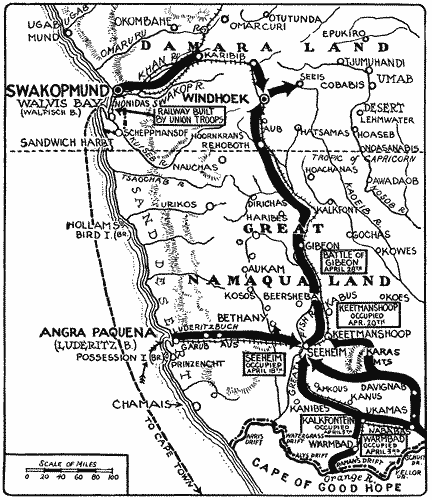
Rex and Wilfred Winslow were the first men who died on the
field of German South West Africa. The epitaph on the cross
on the grave ran thus:
"Tell England ye that pass this monument,
That we who rest here died content."
—Daily Newspaper.
Far the horizon of our best desires
Stretches into the sunset of our lives:
The wavering taper of the achieved expires,
And only the irrevocable will survives.
Content to die for England! How the words
Thrill those who live for England, knowing not
The stern, heroic passion that upgirds
The loins of such as, ardent, for her fought.
Content! It is a word that brooks no bounds,
If from the heights and depths it takes its name:
Upon the proud lips of great men it sounds
As if the clear note from the Heavens came;
A word that, sea-like, shrinks and grows again;
A little word on lips of little men!
John Hogben.
The subjoined extracts of official documents are translated
from a book published in Paris by Hachette et Cie., the full
title of which is "The Germans, Destroyers of Cathedrals and
of Treasures of the Past: Being a Compilation of Documents
Belonging to the Ministry of Public Instruction and Fine
Arts." The official documents are offered to "the literary
and artistic associations of foreign countries." The
editorial notes and comment are reproduced from the original
text.
To the Artistic and Literary Associations of Foreign Countries and to
all Friends of the Beautiful, in order that the System of Destruction
of the German Armies be brought to their knowledge, the present
Memorial is offered by:
- Mme. JULIETTE ADAM.
- PAUL ADAM.
- M. ANQUETIN.
- ANDRE ANTOINE, Founder of the Théâtre Libre.
- PAUL APPELL, Dean of the Faculty of Sciences, member of the Institute.
- MAURICE BARRES, Deputy, member of the Académie Française.
- ALBERT BARTHOLOME.
- JEAN BERAUD.
- TRISTAN BERNARD.
- ALBERT BESNARD, Director of the Académie de France at Rome, member of the Institute.
- PIERRE BONNARD.
- LEON BONNAT, member of the Institute, Director of the Ecole des Beaux-Arts.
- EMILE-ANTOINE BOURDELLE.
- ELEMIR BOURGES, member of the Académie Goncourt.
- EMILE BOUTROUX, member of the Institute.
- ADOLPHE BRISSON, President of the Association de la Critique.
- ALFRED BRUNEAU.
- Dr. CAPITAN, Professor at the Collège de France, member of the Académie de Médecine.
- ALFRED CAPUS, member of the Académie Française.
- M. CAROLUS-DURAN, member of the Institute.
- GUSTAVE CHARPENTIER, member of the Institute.
- CAMILLE CHEVILLARD, Director of the Concerts-Lamoureux.
- PAUL CLAUDEL.
- GEORGES CLEMENCEAU, Senator, former President of the Council.
- ROMAIN COOLUS.
- ALFRED CORTOT.
- GEORGES COURTELINE.
- P.A.J. DAGNAN-BOUVERET, member of the Institute.
- CLAUDE DEBUSSY.
- Mme. VIRGINIE DEMONT-BRETON.
- JULES DESBOIS.
- LUCIEN DESCAVES, member of the Académie Goncourt.
- MAXIME DETHOMAS.
- AUGUSTE DORCHAIN.
- PAUL DUKAS.
- J. ERNEST-CHARLES, President of the Société des Conférences Etrangères.
- EMILE FABRE.
- EMILE FAGUET, member of the Académie Française.
- GABRIEL FAURE, member of the Institute, Director of the Conservatory of Music.
- CAMILLE FLAMMARION, President of the Société Astronomique de France.
- ROBERT DE FLERS.
- ANDRE FONTAINAS.
- PAUL FORT.
- ANATOLE FRANCE, member of the Académie Française.
- A. DE LA GANDARA.
- FIRMIN GEMIER, Director of the Théâtre-Antoine.
- ANDRE GIDE.
- CHARLES GIRAULT, member of the Institute.
- EDMOND GUIRAUD.
- LUCIEN GUITRY.
- EDMOND HARAUCOURT.
- LOUIS HAVET, member of the Institute.
- MAURICE HENNEQUIN, President of the Société des Auteurs et Compositeurs Dramatiques.
- JACQUES HERMANT, President of the Société des Architectes Diplomes par le Gouvernement.
- A.F. HEROLD.
- PAUL HERVIEU, member of the Académie Française.
- VINCENT D'INDY, Director of the Schola Cantorum.
- M. INGHELBREGHT.
- FRANCIS JAMMES.
- FRANTZ JOURDAIN, President of the Syndicat de la Presse Artistique, President of the Autumn Salon.
- GUSTAVE KAHN.
- VICTOR LALOUX, member of the Institute.
- HENRI LAVEDAN, member of the Académie Française.
- GEORGES LECOMTE, President of the Société des Gens de Lettres.
- Mlle. MARIE LENERU.
- PIERRE LOTI, member of the Académie Française.
- MAURICE MAGRE.
- ARISTIDE MAILLOL.
- PAUL MARGUERITTE, member of the Académie Goncourt.
- HENRI MARTIN.
- M. MATISSE.
- MAX MAUREY.
- Mme. CATULLE MENDES.
- ANTONIN MERCIE, member of the Institute, President of the Société des Artistes Français.
- STUART MERRILL.
- ANDRE MESSAGER.
- OCTAVE MIRBEAU, member of the Académie Goncourt.
- CLAUDE MONET.
- Mme. DE NOAILLES.
- J.L. PASCAL, member of the Institute.
- EDMOND PERRIER, President of the Institute, Director of the Muséum.
- GABRIEL PIERNE, Director of the Concerts-Colonne.
- M. PIOCH.
- CHARLES PLUMET.
- Mme. RACHILDE.
- J.F. RAFFAELLI.
- ODILON REDON.
- GEORGES RENARD, Professor at the Collège de France.
- JEAN RICHEPIN, member, of the Académie Française.
- AUGUSTS RODIN.
- ALFRED ROLL, President of the Société Nationale des Beaux-Arts.
- J.H. ROSNY, aîné, member of the Académie Goncourt.
- EDMOND ROSTAND, member of the Académie Française.
- SAINT-GEORGES DE BOUHELIER.
- CAMILLE SAINT-SAENS, member of the Institute.
- GABRIEL SEAILLES.
- PAUL SIGNAC, President of the Société des Artistes Indépendants.
- M. STEINLEN.
- FRANCIS VIELE-GRIFFIN.
- ADOLPHE WILLETTE.
To the Literary and Artistic Associations of Foreign Countries and to
all Friends of the Beautiful:
"... It is not true that our troops brutally destroyed Louvain. It is
not true that we make war in contempt of the rights of mankind. Our
soldiers commit neither undisciplined nor cruel acts...."
MANIFESTO OF THE GERMAN INTELLECTUALS.
"If the savants make science what it is, science does not make the
character of the savants what it is."
EDMOND PERRIER.
"... Scientific barbarism."
EMILE BOUTROUX.
If we were able—at this hour, when, through the act of the Teutonic
Empire, the world may witness unnamable deeds—if we were able to cite
the most odious of them, we should say that, after the massacre of
innocent people and all the assaults on the rights of mankind
committed by the German armies, the worst has seemed to us the
shameless manner in which the superior intellects beyond the Rhine
have dared to cover up these crimes. It is not that we ever believed
that from any corner of Germany there could come to us an appearance
of fellow-feeling, in these circumstances wherein no one has any other
right than that of giving himself body and soul to his native land. We
know that, before speaking for the universe, men threatened by the
enemy should be faithful to their flag, in the face of everything and
against everything—and with resolution. At no hour, therefore, have
we thought that German savants and artists could raise their voice to
repudiate their armies, when the latter were going to war with the
object of further extending their empire. But, at least, they should
keep silence, and before the horror of crimes to be judged especially
by the tribunal of the élite they should not have shown their
miserable enthusiasm. "You see," as a clear-sighted Dutch professor[5]
has well written on this point, "if these intellectuals were not
blinded they would rather have asked themselves if, in this war that
stains Europe with blood, the Prussian military authorities were not
losing for centuries the reputation of the great name of Germany." And
suppose it were even a small matter if they had lost only the great
name of Germany, that the epoch of Goethe, Kant, and Beethoven had
covered with glory. But with it they have vilified as well the noble
rôle of the philosopher, of the historian, of the savant, and of the
artist. In truth they have betrayed their own gods, and the
professions to which they belong can no longer be honored by them—so
far as the question of conscience goes, at least. And as for the
sacred thing called civilization, which is above our interests and our
vanities of an hour, they may have served it usefully by their
personal work in the past, but they were unequal to the task of
remaining its protectors when their mere silence would perhaps have
helped to save it.[6] They have thus shown that, with their more or
less sparkling black eagles and under the bedizenment of their Court
costumes, they are for the most part narrow fanatics or paid scribes
whose pen is only a tool in the hands of their master of a day. It is
not even sure whether through their cult of this "militarism," to
which they have given the most shameful blind-signature, they have not
hopelessly condemned it, by testifying that under the rule of the
German sabre human thought has no other course than to humiliate
itself!... But on the score of what they are worth in professional
morality and courage, agreement is certain today, everywhere.
Their great affair—and that of every thinking German—is to object,
when spoken to of their crimes, either that they were born of
necessity or that they did not take place. As against these
allegations, unsupported by any proof, the most formal denials have
officially been given. But to the latter we shall now add the true
description of the facts. And we think that, in spite of the power and
the dogmatic authority of its élite, the activity of its emissaries in
all parts of the world, and, finally, all its vast apparatus of
conquest—military and civil—Germany cannot long make its stand
against the humble little truth, which advances, noiselessly but also
fearlessly, with the tenacious light in its hand that it received from
Reality—from unquenchable and ardent Reality.
We come to you armed with the facts. It is only these unanswerable
witnesses that we have wished to oppose to the gratuitous affirmations
of our colleagues beyond the Rhine. We might have taken you into the
mazes of twenty frightful dramas, for at every place where the German
troops have advanced they have trodden under foot the rights of
mankind and counted as nothing the civilization and the patrimony of
nations. We have thought it wiser to limit ourselves to the relation
of certain events bearing the seal of certainty.
Not all the cities which may have suffered have as yet opened their
gates to our brothers. Not being able to collect authentic testimony
there we prefer, then, not to speak of them—for the moment. But in
all those evacuated by the enemy, commissions[7] have hurried to
ascertain the losses on the spot. It is from these legal examinations
that we have written this report, which, in impartial fashion, makes
you the judges.
Unhappy cities have been tortured in body and soul, that is to say, in
their population and in the works built by their hands, the immortal
relics of the dead. Of the miseries the people have suffered it is not
permitted us to speak. But as to those noble houses built with art
which have been destroyed, as to those constructions erected by our
ancestors for the edification of men of all classes, of all times, and
all countries, which are today but ruins; as to those masterpieces in
which all the elegant poetry of our race was realized and that
belonged to the civilized world, of which they were a glory and an
ornament, and which subsist as nothing but a mournful heap of
débris—of these we are not bound to keep silent. But not one
exaggerated word shall be uttered by us. The account we shall give is
established by high testimony and by irrefutable documents.
But let us cease all this preparation and come to the events of
Rheims.
M. Henry Jadart, Librarian of the City of Rheims and Curator of the
Museum of that city, was present at the bombardments of the 4th and
the 19th of September. He was well placed to enlighten us on the
destruction accomplished at the time.
He was kind enough to send us the communication which we publish
below. From the testimony of M. Jadart, it will appear how many
monumental constructions at Rheims were mutilated or destroyed, and
how these attest, not less than the ruins of the cathedral, the
vandalism of the German armies:
Friday, Sept. 4.—The bombardment, which took place suddenly from
half-past 9 till quarter-past 10 in the morning, caused some accidents
to the cathedral, more or less notable from the point of view of art,
(some stained glass more or less ancient, some slight scratches to the
statues;) at the Church of Saint-Rémi (ancient stained glass, tapestry
of the sixteenth century, pictures of the seventeenth and eighteenth
centuries, altar screen, statues, south portal, and vault of transept)
and at the Museum of Fine Arts, Rue Chanzy, 8, (salle Henry Vasnier
broken in by a shell, about twenty modern pictures damaged.) Besides,
among the houses struck, the Gothic house, 57 Rue de Vesle, suffered
mutilation in the sculpture of a fireplace—it was entirely demolished
by the bombardment and fire of Sept. 19.
Saturday, Sept. 19.—This was the day of the great destruction by the
bombs and the fires caused in the cathedral, the ancient residence of
the Archbishop, in the houses of the Place Royale, and the Cérès
quarter. On the afternoon of this day and during the night from
Saturday to Sunday, flames consumed the most precious collections of
the city, at the Archbishop's palace and in private houses, an
inventory of which it will never be possible to prepare.
The top of the cathedral burned after the scaffolding of the northern
tower of the great portal had taken fire, toward 3 o'clock in the
afternoon. The statues and sculptures of this side of the same portal
were licked by the flames and scorched through and through. The eight
bells in this tower also were caught by the flames, and the whole
thing fell down near the cross aisle of the transept. The spire of the
Belfry of the Angel, at the apse, fell, and with it disappeared the
leaden heads which decorated its base. In the interior the sculptures
and the walls of the edifice were damaged by fire in the straw which
had been strewn about for the German wounded; the great eighteenth
century tympanums of the lateral doors, west side, were damaged
likewise. The thirteenth century stained glass suffered shocks from
the air and were perforated, in the rose windows as also in the high
windows of the nave. The pictures in the transept were spared, but the
choir stalls (eighteenth century work) were consumed—at the left on
entering.
Of the adjacent palace all the buildings were attacked by the flames
and are now nothing but ruined walls, save the chapel of the
thirteenth century, of which the main part subsists intact, and the
lower hall of the King's Lodge, under the Hall of Anointment, (of the
end of the fifteenth century.) The anointment rooms on the ground
floor, reconstructed in the seventeenth century, contained a great
number of historical portraits and furniture of various periods, which
were all a prey to the flames. It was the same in the apartments of
the Archbishops, which also contained numerous pictures and different
views of the city, transported from the Hôtel de Ville and intended
for the formation of a historical museum of Rheims. Precious
furniture, bronzes of great value—like the foot of the candelabra of
Saint Rémi and the candelabra of the Abbaye d'Igny—were also in these
apartments, of which nothing is left but the walls. The archaeological
collections of the city were consumed in the upper apartments, as also
a whole museum, organized and classified to represent the ethnography
of la Champagne by a thousand objects tracing back the ancient
industries, the trades, the arts, and usages of this province.
Finally, the rich library founded by Cardinal Gousset, offering superb
editions and assembled in a vast paneled hall, was totally burned up
in the modern building constructed for it at the expense of the State.
After the disasters to the arts at the cathedral and the palace, we
must note also the mansions and private houses, remarkable through
their architecture and their decoration, that were demolished, burned,
and annihilated. No. 1 Rue du Marc, Renaissance mansion—damage to the
sculptured ceiling and the sculptures of the court. Two pavilions of
the Place Royale, creations of the eighteenth century, are now only
calcined walls. The same fate overtook the Gothic house, 57 Rue de
Vesle, (of which mention was made above;) the house, 40 Rue de
l'Université, built in the eighteenth century; the house next to the
Ecu de Rheims, of the same period; the mansion at 12 Rue la Grue,
which was decorated with carved lintels and forged iron banisters; the
mansion at 19 Rue Eugène-Destenque, in the style of the Henri IV.
period, having a great stone fireplace and decorative paintings in one
gallery. Finally, in the Rue des Trois-Raisinets, the remains of the
monastery of the Franciscans, with a cloister, and the framework of a
granary of the Middle Ages.
These notes are really only observations to be completed later with
the aid of descriptions of ancient date, but they offer sure
information of the lamentable losses suffered by our unfortunate city
during the first month of its bombardment.
Paris, Jan. 20, 1915.
From M. Auguste Dorchain we receive this striking observation:
The idea of destroying the cathedral haunted them for a hundred years,
at least. Three dates, three texts, three proofs:
April, 1814, Jean-Joseph Goerres, an illustrious professor, the pious
author of a "Christian Mysticism," in four volumes, wrote, in the
Rheinische Merkur:
"Reduce to ashes that basilica of Rheims where Klodovig was anointed,
where that Empire of the Franks was born—the false brothers of the
noble Teutons; burn that cathedral!..."
Sept. 5, 1914, we read in the Berliner Blatt:
"The western group of our armies in France has already passed the
second line of defensive forts, except Rheims, whose royal splendor,
which dates back to the time of the white lilies, will not fail to
crumble to dust, soon, under the fire of our mortars."
Jan. 1, 1915. In the artistic and literary supplement of the Berlin
Lokal-Anzeiger M. Rudolf Herzog sings an ode "in honor of the
destruction of the Cathedral of Rheims":
"The bells sound no more in the cathedral with two towers. Finished is
the benediction!... With lead, O Rheims, we have shut your house of
idolatry!"
A lyric cry of the heart, when the national wish, a century old, is at
last accomplished.
No comment on these three texts—it suffices to bring them together.
AUGUSTE DORCHAIN.
Feb. 20, 1915.
M. l'Abbé Dourlent, Curate Archpresbyter of the Cathedral of Senlis,
was one of the principal witnesses of the drama. So he has had to
speak of it several times. But up to now we had no written deposition
from him over his signature. Here is the document which comes from
this priest. It attests his courage and sincerity at the same time.
Diocese of Beauvais, Archpresbytery and Parish of Senlis, (Oise.)
SENLIS, Jan. 8, 1915.
Monsieur: You do me the honor to ask for my testimony as to the
actions of the enemy at Senlis at the time of the occupation, on the
2d of September.
I beg to send you my attestation, and express my confusion and regret
at not having been able to do so sooner.
On the 2d of September an engagement took place between the French and
German troops on the plain of Senlis from 10 o'clock till about
half-past 2, and it was ended by the bombardment of our beautiful
cathedral and a part of the city. The enemy entered the city about
half-past 3 and were received at the end of the Faubourg St. Martin by
a fusillade directed against them by delayed soldiers and a company
armed with machine guns, charged with arresting the pursuit of the
French Army, which was bending back toward Paris.
Immediately the superior officer, who was conversing with M. Odent,
the Mayor of Senlis, accused the civilians of having fired on the
German Army, and rendered him responsible for it. Then began the
burning of the whole Rue de la République. This untruth was
immediately spread about, and two hours after the affray a General
said at Villers-Saint-Frambourg what another General said next morning
at Nanteuil-le-Haudouin: That Senlis was burned because the civilians
had fired on the German Army. The thirty-seven hostages brought to
Chamant heard the same statement.
To this testimony I will add my own, which will only confirm what is
said above: As soon as the enemy arrived soldiers of the cyclist corps
obliged me to conduct them to the top of the belfry of our cathedral,
from which they pretended that they had been shot at. Their inspection
revealed nothing of what they thought to find, for I alone had the key
and I had confided it to no one. Some moments later I was consigned to
the Hôtel du Grand-Cerf as a hostage. The German General Staff had
gone to Chamant. Some hours later I accosted a superior officer and
asked him what I should do, seeing no one of whom I could inquire the
reason for my arrest. "Remain here, where you will at least be in
safety. Poor curate! Poor Senlis! But, then, why did you receive us as
you did? The civilians shot at us, and we were fired at from the tower
of your church. So Senlis is condemned. You see that street in flames?
(and, in fact, the Rue de la République was burning everywhere, 114
houses in ruins) well, this night the city itself will be entirely
burned down. We have the order to make of Senlis a French Louvain. At
Louvain the Belgians shot at us from their houses, from their
belfries—Louvain no longer exists. Tomorrow it will be the same with
your place. We admit fighting among soldiers, that is war; but we are
pitiless with civilians. Paris and the whole of France need a terrible
example which shall remind them that warfare by civilians is a crime
that cannot be too severely punished."
My energetic protest against the accusation concerning the cathedral
and my other doubts formulated against the intervention of civilians
(I did not know what was the nature of the engagement in the Faubourg)
seemed to interest the officer, who promised to make a report to the
General and to plead our cause. Thanks to God, the sentence was
repealed; our poor Mayor and ten hostages were shot, but the city was
spared.
Such are the facts, which I thought might be of interest in your
researches. I am at your orders to complete them if you need more.
I beg you, Sir, to accept the expression of my most respectful
sentiments.
(Signed.) DOURLENT.
Curate Archpresbyter of Senlis.
To close the series of depositions collected by us, here is that of
M. Paul Delannoy, Librarian of the University of Louvain. The few
lines he was kind enough to address to us will suffice to show the
extent of the treasure formerly at Louvain and also of the disaster
accomplished, which seems irreparable:
The library of the University of Louvain possessed 500 manuscripts,
about 800 incunabulae, and 250,000 to 300,000 volumes. One noted
especially the original of the bull of foundation of the university in
1425, an example on vellum of the famous work of André Vésale, De
Humani Corporis Fabrica, an example given to the university by Charles
V., a precious manuscript by Thomas à Kempis. The bibliographical
curiosities were numerous; the collection of old Flemish bindings of
the sixteenth and seventeenth centuries contained some curious
specimens. The souvenirs of the ancient university, seals, diplomas,
medals, &c., were preciously guarded in cases. The old printed matters
of the sixteenth century formed an extremely rare treasury; all the
pieces, pamphlets, and placards on the reform of the Low Countries
were kept together in a "varia" volume, thus constituting a unique
ensemble. It was the same with a host of pieces relating to Jansenism.
The great halls of the books, with artistic woodwork, were jewels of
eighteenth century architecture; the Salle des Pas-Perdus of the
Halles Universitaires, with its vaults and capitals, has been
reproduced in manuals of art and archaeology.
The reading room of the library contained a whole gallery of portraits
of professors of the ancient university; this museum was a very
precious source for the literary history of the Low Countries.
PAUL DELANNOY.
Finally, covering these various testimonies, and deriving from his
illustrious signature a character of high distinction, here is what M.
Pierre Loti writes us:
More or less, everywhere in the north and east of our dear France, I
have seen with my eyes the German abominations, in which, without this
experience, I could not have believed.
In indignation and horror I associate myself with the protestations
above, as well as with all those, not yet formulated, which will come
out later on and which will always be below the monstrous reality.
PIERRE LOTI.
So we may say that the present memorial, tempered many a time, is
less an excessive than a perfectly moderate picture.
It will be remembered that on the 11th of October a Taube, having
managed to penetrate the zone of Paris, flew over the city, hovered
just above Notre Dame, and dropped several bombs on the cathedral.
Note that this was on Sunday and that at the hour when this Taube
accomplished its disastrous mission there was in Notre Dame a very
great crowd of worshippers. None of them was hurt, but the distinction
was undeniably that of killing unarmed people and mutilating a marvel
of French art.
Let us now read the first report, signed by M. Harancourt, who was
able to proceed to interesting discoveries on the very day of the
attempt:
Musée des Thermes et de l'Hôtel de Cluny.
Sunday, Oct. 11, 1914.
To the Under Secretary of State for the Fine Arts, Service of Historic
Monuments.
As I reside in the arrondissement of Notre Dame, I got to the
cathedral some moments after the explosion of the bombs. In the
company of a Commissary of Police, of an architect of the city, of a
Canon, and of two Sergeants of the Fire Department, I examined the
damage caused in order to be able to advise the Service of Historical
Monuments immediately if the case should be urgent.
The bomb exploded on the west slope of the roof of the north transept,
a little above the gutter, near the clock. After having pierced the
lead covering it seems to have exploded only after having struck the
transverse beam, whose end is splintered. The explosion, having thus
taken place under the covering, pushed the edges of the tear outward,
making a hole in this covering through which a young person could
pass; six small beams were split round about. The bomb was loaded like
shrapnel, apparently with leaden bullets of different calibres, for
the roof is riddled with circular holes to a distance of twenty meters
from there. The holes are of various diameters, but none of the
bullets could be found. The nearest turret was damaged—several
ornaments were broken from it—the modern clockstand that incases the
big clock was riddled by pieces of shell. The bomb thrown at the apse
and which fell in the garden was not this time a shrapnel bomb, but an
incendiary bomb, which only threw out a sheet of flame. The third
having fallen into the Seine, toward the south side of the porch, it
is difficult to say whether it was a shrapnel bomb or an incendiary.
To sum up, the damage from the artistic point of view is almost nil;
it simply calls for some work by carpenters and roofers.
But the intention to harm the building is evident, and I have thought
that perhaps it would be well to take certain precautions to protect,
if possible, the fine fourteenth century statue of the Virgin that
stands near the pillar, and that it is not impossible perhaps to
transfer it to a safer place.
E. HARANCOURT,
Member of the Commission on Historical Monuments.
A report from M. Paul Boeswillwald, Inspector General of Historical
Monuments, confirms the first statements:
Historical Monuments, Cathedral of Paris.
PARIS, Oct. 12, 1914.
The Inspector General of Historical Monuments to the Under Secretary
of State for the Fine Arts.
I have the honor to report that I went this morning to Notre Dame to
examine the damage caused by the bomb thrown yesterday afternoon on to
the cathedral by a German aviator. The bomb struck the lower part of
the west slope of the top of the north transept, tearing the lead,
breaking a piece of the wooden frame, and smashing by its explosion
the crown of the pinnacle which cuts the balustrade at the right of
the flying buttress intermediary in the sexpartite vault of the
transept. Other effects of the explosion were the striking of some
stones and the leads of the dormer window which carries the frame of a
clock, as also some small windows. The fragments of the pinnacle fell
on the roof of the lower slope, where they made a deep imprint on the
lead cover without breaking it through.
The projectile was not an incendiary bomb, since the wood splintered
by it bears no trace of fire.
To resume, the damage is, fortunately, quite unimportant.
The order has been given to set aside all the fragments of stone
belonging to the decoration of the pinnacle, remains of crockets,
ornaments, &c.
(Signed) PAUL BOESWILLWALD.
With all the friends of civilization and of art, we think that the
question of the slightness of the damage caused by this Taube is not
to be considered at all. But the fact of this Taube having
accomplished such a raid with the sole design of bombarding a
cathedral in a peaceful city, 100 kilometres off from the military
operations—is it not the most patent and evident demonstration of the
kind of Neronian dilettantism which, along with calculation, inspires
the crimes of the barbarians?
Here is a page published by Anatole France apropos of the bombardment
of Soissons:
I had just read in a newspaper that the Germans, who have been
bombarding Soissons these four months, have dropped eighty shells on
the cathedral. A moment later chance brought before me a book of M.
André Hallays, where I find these lines, which I take pleasure in
transcribing:
"Soissons is a white city, peaceful and smiling, that raises its tower
and pointed spires at the edge of a lazy river, at the centre of a
circle of green hills. The city and the landscape make one think of
the little pictures that the illuminators of our old manuscripts
lovingly painted.... Precious monuments show the whole history of the
French Monarchy, from the Merovingian crypts of the Abbaye de
Saint-Médard to the fine mansion erected on the eve of the Revolution
for the Governors of the province. Amid narrow streets and little
gardens a magnificent cathedral extends the two arms of its great
transept; at the north is a straight wall, and an immense
stained-glass window; at the south, that marvelous apse where the
ogive and the full centre combine in so delicate a fashion." ("Around
Paris," Page 207.)
That charming page from a writer who dearly loves the cities and
monuments of France brought tears to my eyes. It charmed my sadness. I
want to thank my colleague for it publicly.
The brutal and stupid destruction of monuments consecrated by art and
the years is a crime that war does not excuse. May it be an eternal
opprobrium for the Germans!
To illustrate this memorial, which is first addressed to the Friends
of the Beautiful, and whose object is to touch the heart, we give a
sonnet of M. Edmond Rostand. It is entitled, "The Cathedral," and will
show that pride may be taken by the victim of violence, and that a
crime against the beautiful diminishes only the brute who commits it:
Nought have they done but render it more immortal! The work does not
perish that a scoundrel has struck. Ask Phidias, then, or ask of Rodin
if before bits of his work men no longer say, "It is his!" The
fortress dies when once dismantled, but the temple shattered lives but
the more nobly; and our eyes, of a sudden, remember the roof with
disdain and prefer to see the sky in the lace work of the stone. Let
us give thanks, since till now we lacked what the Greeks possess on
the hill of gold—the symbol of beauty consecrated by insult! Let us
give thanks to the layers of the stupid cannon, since from their
German skill there results for them—shame; for us—a Parthenon!
We mean the one issued on the 29th of October by the Académie
Française at one of its sessions, meeting under the Presidency of M.
Marcel Prévost, M. Etienne Lamy being Perpetual Secretary. The
President of the Republic, M. Raymond Poincaré, made it a point to be
present at this session, and here is the document that, after long
deliberation, was approved by the unanimous vote of the members
present:
The Académie Française protests against all the affirmations by which
Germany lyingly imputes to France or to its allies the responsibility
for the war.
It protests against all the negations opposed to the evident
authenticity of the abominable acts committed by the German armies.
In the name of French civilization and human civilization, it
stigmatizes the violators of Belgian neutrality, the killers of women
and children, the savage destroyers of noble monuments of the past,
the incendiaries of the University of Louvain, of the Cathedral of
Rheims, and those who wanted also to burn Notre Dame.
It expresses its enthusiasm for the armies that struggle against the
coalition of Germany and Austria.
With profound emotion it salutes our soldiers who, animated by the
virtues of our ancestors, are thus demonstrating the immortality of
France.
When these words were published they may have appeared excessive to
certain minds outside of the best-informed circles.... Since then
diplomatic documents have appeared, followed by various official
reports on German atrocities, and today the truth is known to all.
On the 9th of November the President of the Council, M. René
Viviani, traveled to Rheims in order to deliver to the Mayor, M.
Langlet, the Cross of the Legion of Honor that his courage had gained
for him. On this occasion the President of the Council pronounced the
discourse from which the following is cited as exhibiting French
thought on the present war:
As if it were really necessary to accentuate the rôle of France,
German militarism has raised its voice. It proclaims, through the
organ of those whose mission it is to think for it, the cult of force
and that history asks no accounts from the victor. We are not a
chimerical people, nor dreamers, we do not despise force; only we put
it in its place, which is at the service of the right. It is for the
right that we are contending, for that Belgium is struggling by our
side, she who sacrificed herself for honor; and for that, also, our
English and Russian allies whose armies, while waiting till they can
tread this unchained force under foot, oppose it with an invincible
rampart. France is not a preying country; it does not stretch out
rapacious hands to enslave the world. Since war has been forced upon
her, she makes war. Soon the legitimate reparations will come which
shall restore to the French hearth the souls that the brutality of
arms separated from it. Associated in a work of human liberation we
shall go on, allies and Frenchmen united in war and for peace, as long
as we have not broken Prussian militarism and the sword of murder with
the sword of freedom.