The cover image was created by the transcriber and is placed in the public domain.
NEW PATHS
THROUGH OLD PALESTINE
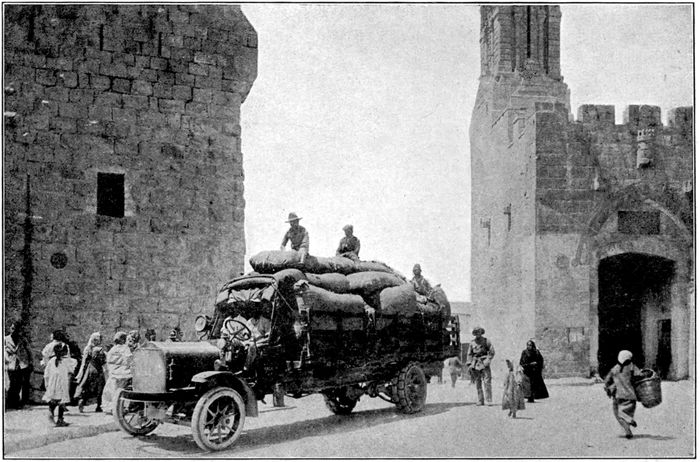
Instead of the soft-footed camels, the motor truck stood at the gates of the Holy City.
BY
MARGARET SLATTERY
Printed in U. S. A.
THE PILGRIM PRESS.
BOSTONCHICAGO
Copyright 1921
by
SIDNEY A. WESTON
THE PILGRIM PRESS
BOSTON
TO
M. R. H.
THE UNDERSTANDING COMPANION
OF THE PILGRIMAGE
A WORD ABOUT THE NEW PATHS
vii
From our earliest childhood when at Christmas
time we gazed with intense interest at the
Wise-men on their gaily caparisoned camels,
those great awkward ships of the desert have
been associated in our minds with Palestine.
The Child held close in Mary’s arms as she sat
upon the donkey while Joseph urged it on
through the day and the night in the hurried
flight into Egypt has made that faithful little
beast a part of Palestine.
We saw both the donkeys with loaded panniers
driven along by wandering Arabs and the
strings of camels, soft-footed, heads held
proudly high, moving off over the yellow sands
up to the hills. But we sat in a modern train,
with comfortable leather seats, and a madly
puffing engine dragged us over the wind-blown
sands up through the hills of Judea to the little
modern station just without the walls of Jerusalem.
Once when we stopped at old Lydda we
heard a rushing, whirring sound over our heads.
It grew louder and, as we searched the sky, a
viiiplane swept out from the soft clouds into the
clear blue, came down nearer, nearer to earth,
rose again, and passed out of sight. It had
come from the City of Zion: it would go into
Egypt.
The Wilderness, the Dead Sea and the forty
long years of wandering, the victories over the
Philistines, the waters of Jordan parted for the
passing of the hosts of Jehovah, the tumbling
walls of Jericho, the spots where “the arm of
the Lord prevailed”: with these we had long
been familiar. They were associated in our
minds with tents, with much cattle, with slow
beasts of burden, with men, women, and children
who moved leisurely in times of peace and
fled in wild confusion in times of war.
The Wilderness, the Dead Sea, the Jordan,
and Jericho we saw. A motor car driven by the
son of an Arab chief took us over and past them
all in less than a day!
Old Palestine still lies between the great
desert and the seas. The women still grind
the corn, stand gossiping about the well, and
wrap their babies in swaddling clothes. The
shepherds wander through the bare hills with
their sheep and lead them, when spring comes,
ixto the green pastures and the still waters. But
there are New Paths Through Old Palestine.
They cross age-worn desert-ways, go down into
the shadows of deep valleys, climb hoary mountains,
follow Elijah’s chariot through great
spaces of the sky. The new paths bring new
days fraught with possibilities. In time they
may bring a new Palestine: not the mystic land
of the Zionists but the promised land of which
the prophets and poets of Israel sang. Old
Palestine died in nineteen-fourteen with the rest
of the world that was and will never be again.
New Palestine is born. What its future shall
be depends upon the souls of those who follow
the new paths. They may lead only to temporary
triumph, to the selfish goals of the kingdoms of
men: they may lead to the Kingdom of God.
There was a moon that night. Now it
was half hidden by soft clouds, now clear,
brilliant, white against a velvet sky. We
stood crowded close to the heavy ropes stretched
across the bridge, which had swung open to permit
one boat after another to pass. We were
at Kantara on the Suez. Across the canal was
the train dimly lighted, standing on the tracks
that seemed half buried in the soft, yellow,
desert sand. We waited impatiently. Nearly
three hours had passed since the train from Port
Said had left us there to attend to baggage and
troublesome passports, and to eat a meager supper
from boxes brought with us from the Port.
Now a Japanese boat passed slowly along
the canal; then a smaller craft with cargo, flying
the Dutch flag; a British boat brilliantly
lighted, its passengers, many of them in uniform,
dancing on deck. The canal is so narrow
that great ships must creep slowly and carefully
along, with no place for miles where one
boat may pass another. It is a miracle, this
4Suez Canal, and the story of its building a most
fascinating tale. Its banks are scarred by the
battles of the great war. Barbed wire, old dugouts,
the remains of hastily constructed forts
reminded us of the desperate struggle made by
the Allies to protect it against the enemy in the
air and under the water. Had any one of their
many attempts successfully closed the canal,
the war would have had a very different ending.
We had just spent nineteen and one-half
hours coming through the canal at the slow
speed permitted by law—five miles an hour.
Even then our boat twice grazed the retaining
wall. In a single year over three thousand
boats passed through the locks, crept along
through the canal, then hurried to far ports,
east or west.
As the fifth boat swung lazily past, a sigh of
relief went up from the crowd pressed against
the ropes. A moment and the great bridge
moved back into place and we were given the
signal to cross. It was a weird group that
hurried along in the moonlight—a party of
Americans, a group of British officers, some
Australian soldiers, Jews from Russia clutching
their permits to enter the land of promise,
5Egyptians, Syrians, Arabs in native dress.
There were but few women. Our porter found
us seats close to the window in one of the compartments.
We were sorry for this later, as
the fine sand sifted in and covered clothing and
baggage. No sleeping-car was possible, so we
made ourselves as comfortable as we could with
bags for pillows and heavy coats for blankets.
We were most grateful for this railroad from
Kantara to Jerusalem, realizing that before
the war we would have been compelled to make
the inconvenient and dangerous landing in the
small boats at Jaffa.
We made our way slowly through the night
across the desert that stretched as far as the eye
could reach in the moonlight and slipped away
into blackness when the moon had set. What
it had cost the men who had laid those ties in
that wilderness of sand, under the scorching
rays of a pitiless sun, no history of war can
adequately relate. How often in those days, as
we looked reverently at old battlegrounds, we
searched for words with which to describe the
miracles performed by the engineering corps
of the fighting armies!
With the morning light, we began to see signs
6of life on the desert. Great masses of cacti, in
clumps as tall as trees, with stems as thick as a
man’s body, were growing but a few feet from
our windows. Here, during the war, the enemy
had hidden their machine guns, a refuge from
which they might safely do their deadly work,
practically certain that they could not be captured.
Many a brave soldier of the Allies gave
up his life in agony, caught in the cactus hedge
to which the rush of battle had driven him, and
many an heroic rescue of a comrade held by
the cruel thorns took place on that desert plain.
When the cactus growth cleared and the desert
was unbroken we stared in amazement at what
seemed to be a line of dark earth—a road
made in the shifting sand. When we got nearer
we found it to be strips of chicken wire. This
wire was the solution of a problem that at first
threatened to tie up all the plans of Headquarters,
for the heavy artillery and the loaded
motor lorries, sinking deep into the sand, made
progress impossible. The wire road was the
result of the ingenuity of some of the men in
the ranks. As the fine and coarse net used
alternately pressed down upon the sand it gave
the resistance that enabled the great guns and
7loads of supplies to pass over places otherwise
uncrossable. When they had passed, soldiers
rolled up the wire, loaded it on the camels to
be used again over some hard stretch ahead.
The war over, it lay there rusting in the sand.
Again and again, as one crossed the battlefields
of Palestine, he saw evidences of the triumph
of man’s mind over earth’s obstacles.
Nothing was too ordinary, too commonplace,
too insignificant to be used to further the success
of the great cause. For fresh supplies of
food and water, for “heavies” with which to
batter down the defenses of the enemy, the army
was for a time dependent upon temporary
tracks of chicken wire laid in a waste of moving
sand!
Against the horizon we could see the slow
moving train of camels. A group of Arabs on
horseback halted to watch us pass. We were
in Palestine, that land of small distances and
great deeds.
“I cannot believe that I am in Palestine,”
said the young daughter of a British officer who
was to see her father for the first time in four
years. “I have not been able to think of it as a
real land. I know, in a way, that Moses and
8Joshua fought here. But think of father’s fighting
here, too!” The girl had expressed the
thought of hundreds of others who have studied
the Bible stories, become familiar with the difficult
names, drawn maps and located the cities
of Moses and of Paul, marked the journeyings
of Christ, but to whom the land has never
been a real land and its records, shrouded in
vague mystery, have never seemed a part of the
earth. But now we knew it to be real. We
began to comprehend “the wilderness and the
solitary place.”
It is only about the size of my own state of
Massachusetts, I told myself again and again.
Its greatest length is but one hundred eighty
miles and it is nowhere more than fifty-five
miles wide. If I had the railways and engines
of home I could cross it in less than two hours.
I could travel its entire length easily in five or
six. But the present train, with its light engine,
on a roadbed hastily made, parts of it finished
under fire from enemy guns, moves slowly. We
are stopping at Gaza.
Once Gaza was the largest city of the old
country of the Philistines. I can almost see
Samson, strong and powerful, coming down
9over the hill called today Samson’s Ridge, bearing
the great city gates upon his shoulders while
men stood aghast. I can see him too, blinded
and powerless, walking the treadmill of his enemies.
As I look out over the desert road, I
remember the Ethiopian struggling to find the
meaning of the words of the prophet Isaiah and
young Philip running by his chariot, eagerly
responding to the invitation to sit with him and
explain the prophecy. Riding along through
the dust, I can hear him talking with the ruler
about Jesus and what He had taught of God
and man; and, half-astonished at the quick
response, I can hear the Ethiopian, as they came
near to a place with water, saying, “Behold,
here is water, what doth hinder me to be baptized?”
But I am brought back suddenly from
the long past. Men in British uniform are on
the platform of the little station. They follow
the mail bag eagerly, joking each other in clear
English accents about the probable contents.
For eight months in nineteen hundred and
seventeen, Gaza became again the center of
a great battle area. We could see the remains
of the Turkish trenches, dug deep into the
earth and protected by great masses of wire
10or by sand bags made from the gay colored
hangings and curtains taken from the houses
of its people. But in spite of all their careful
preparations and their gallant defence, Gaza
fell into the hands of the British troops whose
splendid officers and men had braved heat, terrible
thirst, sand-storms, deadly fire that robbed
them of hundreds of their comrades, that they
might take this important post on the road that
was to lead them through untold suffering up
to Jerusalem, as it had led other armies of days
long ago. The British Tommies read their
Bibles in their spare time these days. They
read over again the battles of Israelites and
Philistines which they had found very stupid
when they were boys in Sunday schools but which
are exceedingly interesting to them now. As
they fought, step by step, for possession of that
same land, they asked themselves if, battling
against a foe to whom the desert was home, on
trackless wastes whose every spring and rock
was known, they could ever win. Never for a
moment did they hesitate in their answer, but
many a brave young officer and many a hardy
soldier of Australia or New Zealand must have
had misgivings as he looked at the cactus hedge,
11miles deep, or out over the still, barren, hopeless
desert hills.
We left Gaza to climb slowly up to Lydda,
now called Ludd, where we were obliged to
change cars. On all sides were signs of the fighting
of two years before, and now and then white
crosses or Turkish graves reminded us of the
terrible price youth has paid throughout the
long centuries of history to make this land holy
indeed.
As we climbed up into the hills, it began to
rain, the air was fresh and cool, the vineyards
here and there on the hillsides brought great
relief after the glare of the sands through which
we had been passing for so many hours. Our
first glimpse of Jerusalem was in the soft mist
through which the sun was attempting to shine.
The walls looked high and forbidding, the whole
city, from its point of vantage crowning the hilltops,
seemed to look down upon us as though
we were but very little things, little and unimportant,
come to gaze, without half understanding
what we should see, upon all man has
dreamed and suffered in his reach for God and
happiness.
A thrill of anticipation had passed up and
12down the corridor of the train. Not a person
sat in his compartment. Corridor windows
were opened and eager faces crowded about
them. The face of the young girl who was to
see her father after the four years of separation
was flushed with excitement, but the face of her
mother was pale and there were tears in her
eyes. She had given her two sons—one in
France and one in Mesopotamia—to the world’s
great effort to preserve its freedom. I shall
never forget the light in the eyes of two thin,
haggard, long-bearded Hebrews, looking out
from the windows, then turning to speak with
each other in Russian words that, though unintelligible
to us, seemed to be on fire with passion.
Their gestures were expressive of emotion that
could not be restrained. Long before the train
stopped they were at the door.
The faces of young British officers on leave,
coming up for the first time to see the city for
whose delivery they had prepared the way down
on the dry parched plain, were keen with interest;
no detail of the approach escaped them.
The residents accustomed to the journeyings
from the Port to the city looked at us all with
mild curiosity and kind tolerance.
13From the station, the horses dragged us up
through gray mud that flew about us in showers,
covering carriage, baggage, and robes,—there
was no escape from it. From the mist the walls
of the “city of cities” emerged, clear, strong,
unbroken, no mark of battle upon them. As we
went through the great gate, the sun, breaking
through the mist, flooded with light, for a few
moments, the narrow street and brightened the
faces of the crowd of people of every nation that
poured ceaselessly in and out. We stopped
before the hotel that during the war had served
as the Red Crescent Hospital. Lunch was waiting
and we sat down with the Mohammedan in
his red fez, the Bedouin in his long, beautiful,
gay-colored coat, the French officer and the
British officer on leave, Jewish business men,
the Greek and the Syrian—the world, it seemed
to us as we listened to the various languages.
All orders for food were given in French, and
in French men of different nations spoke with
each other in courteous greeting.
We were in Jerusalem. Here Samuel sat;
here at the gate was David’s tower; King Solomon
once lived over there on the hill in his
glittering palace and by his wealth and wisdom
14made himself famous throughout the world,
and here he lost his wisdom as has many another
in the courts of the women. Herod and Pilate
looked out over these hills; the Crusader
stormed the walls and the Turk brought terror
and slavery with his sword. Twenty-three
times in its history Jerusalem has been captured.
It has been pillaged, plundered, burned,
utterly destroyed, rebuilt only to be plundered
again. Yet here it stood. Upon what unspeakable
sorrow the stars of Palestine have looked
down! We gazed from our balcony out over
the low buildings of solid rock, out through the
break in the wall made that the Kaiser, on his
visit to the Holy Place, might enter in great
pomp and glory with his impressive army of
followers, the break redeemed by the simplicity
of the entrance of the victorious General
Allenby into the city that he had conquered
without the destruction of a single building or
a foot of wall and accepted, when surrendered,
as a sacred trust placed once more in the hands
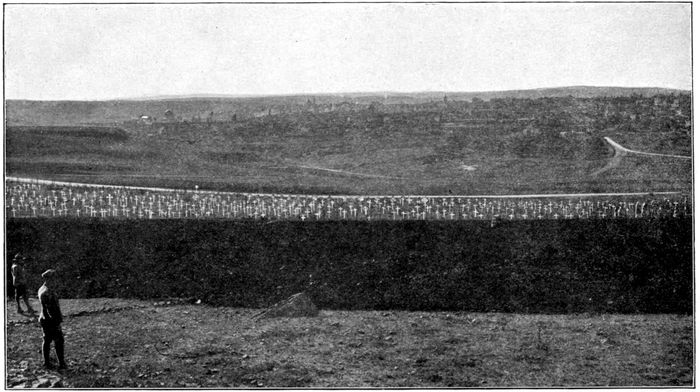
of Christians. It may be that the white crosses
in long rows, out on the hillside, guarding the
graves of soldiers from every part of the British
Empire, young, very young, will continue
15to remind these latest conquerors of the tremendous
cost of the victory that left the city
unharmed and help them govern the land with
an unselfishness of purpose that will measure
up to the high standard of their victory.
After lunch we found that dark clouds had
gathered low over the hills, and before we could
leave our room the rain came. We studied the
map of the city, searched out the location of its
sacred places, read over again the words of
poet and prophet describing the days of its
great glory, when from Mount Zion king and
shepherd could look over at Mount Moriah
where the smoke of the sacrifice from the temple
of Jehovah ascended to heaven.
Late in the afternoon the rising wind scattered
the clouds and the sun set in a blaze of glory.
We stood just outside the gate on the city wall
looking down across the valley over toward
Bethlehem. The hills, deep purple, reached up
on every side to touch the sky. Their bare rocky
slopes became soft as velvet in the fading light.
A young British private, leaning against a
part of the parapet, took out a khaki Testament
and turned the leaves slowly. He seemed
to find what he wanted and read, following the
16lines with his finger. Then he closed the book,
put it back in his pocket and turned, half apologetically
to a companion not in uniform.
“We fought out there,” he said, “the 53rd
division. We fought around the very hills
where the angels sang about Peace on earth.”
A moment of silence and the other spoke:
“Yonder is the road He must have climbed
when He came up to Jerusalem.”
“I’ll take you over it tomorrow,” was the
answer. “We’ll see all the places where He
used to go. It makes the story in the Book
very plain.”
They moved away. Reluctantly, in the face
of coming darkness, we left the great wall and
joined the group of Arabs who, with camels and
donkeys, were passing in and out of the gate.
As we climbed the long stairs to our room, we
remembered that tomorrow would be Sunday
at home. In thousands of churches all over the
world, trusting little children, strong, courageous
youth, men and women bearing heavy
burdens, the old, the sick, the missionaries would
read the story of what He did and said centuries
before, in and about Jerusalem—the story that,
despite the limitations of those who have told it,
17has changed the world and that must continue to
change it until it shall become what He prayed
it might be—the kingdom of God upon the earth.
Tomorrow we, like the young soldier in khaki,
would begin our journeys to “all the places
where He used to go.” And we hoped that for
us, too, the sacred spots would “make the story
in the Book very plain.”
In a long procession with torches the worshipers
of the Greek church, chanting an evensong
for their feast day, passed beneath our
balcony. A torch lighted up the cross held high
over the heads of the marchers. Out over the
hills of Bethlehem, hidden now by the night,
bright stars were shining. We fell upon our
knees and worshiped Him.
I GO OVER TO BETHLEHEM
19
20There was a baby born in Bethlehem.
I know they say
That this and that’s in doubt, and, for the rest
That learned men who surely should know best
Explain how myths crept in, and followers’ tales confused the truth.
I know—but anyway
There was a baby born in Bethlehem
Who lived and grew and loved and healed and taught
And died—but not to me.
When Christmas comes I see Him still arise,
The gentle, the compassionate, the wise,
Wiping Earth’s tears away, stilling her strife;
Calling, “My path is Peace; My way is Life!”
—Author Unknown.
21
I GO OVER TO BETHLEHEM
It was clear and cold. The hills of Moab were
deep blue. They seemed very near. In a
low carriage that bore every mark of long
service, drawn by two thin dark horses and
driven by an Arab in a dull brown Bedouin
coat, with the long, heavy head-dress falling
over his shoulders and protecting him from
rain or sun, we drove out through the gate.
Dark eyes watched us curiously. The horses at
first were swift of foot and the carriage lurched
and rolled down the steep grade of the valley
of Hinnom, past the former German colony,
over the new bridge; then, losing their enthusiasm,
they climbed slowly. On a hillside the
sheep were feeding, but how they could find
enough to sustain life on those bare rocky slopes
is hard to understand. Now we passed a flock
following the shepherd in his vari-colored coat
down a steep incline and through a valley which
in the rainy season would be a rushing stream.
We could hear the lambs call, and now and then
the shepherd’s reprimand to a straying sheep.
22Over there were the fields of Boaz. How beautiful
they must have looked when the heavy
sheaves of wheat were yellow in the sun. The
land of Moab seemed such a short distance away
as we who had been half-way round the world
thought of distance, but to loyal, faithful, loving
Ruth those desert plains, rounded hills, and
deep valleys meant distance enough to separate
her forever from the home and kindred she must
leave behind. The brave words came back to
us: “Whither thou goest, I will go; thy people
shall be my people and thy God my God.” She
deserved the happiness she won out there in the
fields as she followed the reapers. As if agreeing
with our unspoken thoughts our guide
turned and looked down at us. “Boaz, the
owner of the field, married Ruth, the Moabite
girl. She was very beautiful,” he said.
The wind was bleak on the hilltop as it was
that night centuries ago and we were glad when
we reached the protection of the low stone
houses of the village of Bethlehem. Such a tiny
village! Nothing was left of the glory of that
other day when the busy tax-gatherers checked
up the names of the people and the keeper of
the Inn hurried about trying in vain to find room
23for his guests, when officers of the army in
resplendent uniform and civil officers proud and
haughty made every Jewish pilgrim conscious
of the power of great Rome.
Nothing remains of the old inn or khan which
was crowded on that night to its very gates.
Thankful indeed must both Joseph and Mary
have been for the protection of the cave with
its great manger hewn out of the rock. Over
that spot to which they went so gratefully for
shelter now stands the Church of the Nativity.
It is a simple beautiful church, but the shrines
within are garish indeed.
By General Allenby’s command, the high forbidding
walls of stone that have so long divided
the interior and marred its beauty have been
taken down. The walls had formerly separated
the church into sections claimed by the various
faiths. The nave of the church belongs to the
Greeks, one transept to the Coptic Christians,
the other to the Armenians. The Romanists
have built a church and monastery close beside
the little church of the Nativity, but worshipers
could only reach the grotto to kneel at the
manger of stone through a devious, difficult
underground path. When the Turks captured
24Palestine they compelled the Armenians to open
a passage through their wall that the Romanists
might enter. As we stepped into the church we
heard the chanting of their choir, and soon
through the door in the Armenian transept
came priests and altar boys in the rich robes
of the church to say mass. We stood aside until
they had passed and only the echo of their voices
could be heard floating up from the cave below.
Ever since the coming of the Turks, Christmas
and Easter services have been marred by
desperate quarreling and bloodshed. At each
service Turkish soldiers were on guard and
swords and guns punished offenders but were
unable to prevent the paying of old scores by
Armenian and Romanist, Copt and Greek. The
British general was exceedingly anxious that no
such quarrels should mar the celebration of the
first Christmas and Easter after the return of
the holy places into the hands of Christians, to
be theirs no matter what their creeds might be.
In many languages, he made his appeal to the
people. The American Colony of Jerusalem
was asked to be present at the services to help
quiet any trouble-makers, but they did not wish
to assume the responsibility. Therefore certain
25individual members of the Red Cross Commission
answered the General’s appeal, and were
present all day at the services, quietly warning
any of the rougher element who, as in the past
days, attempted to start trouble by taunting
words. Not a British soldier was present. The
Commission members, wise, alert, and friendly,
did their work well and the day passed in dignified
impressive worship for the first time since
the Turks took the Holy City. The General
expressed his gratitude in most cordial notes of
thanks to the men who had so successfully
endeavored to carry out his wishes.
We waited until the mass was over and then,
with our lighted candles, went down into the
shadowy grotto. Myth and legend, superstitions
weird and fantastic have gathered about
all the sacred places. While these things mean
little to the modern Christian, he is bound to
respect the reverent belief in them held by many
of his comrades in the faith. With confidence
the guide tells of the hundreds of years the fire
in the hidden place has burned, not once going
out, just as it has burned in the Church of the
Holy Sepulchre at Jerusalem. If, as one kneels
and prays, holding his taper close to the opening,
26it is lighted by the unseen holy fire, rich
blessings will come to him and those he loves.
I shall never forget the thin, tired, sorrow-marked
face of an Armenian woman whose
taper, as she knelt murmuring prayers, suddenly
caught the sacred flame. It was transformed.
She went up the shadowy steps in
a transport of joy. Nor shall I soon forget
the face of a Russian woman as she swayed
back and forth on her knees in an agony of
prayer. When at last she rose she could not
stand and a kindly attendant steadied her.
He spoke to her in Russian and they talked
softly for a moment. She was in Jerusalem on
a pilgrimage when the war broke out. Her husband,
her son, and a son-in-law were in the Russian
army. Of them she had had no word. She
had received a month since confirmation of the
news of the death of her two daughters in
prison. She could not go back to her home in
the hot-bed of Bolshevism. She took a taper
from the hand of a priest and went toward the
place of the holy fire.
Copyright, Underwood & Underwood
“’Twas a humble birthplace, but oh, how much God gave to us that day!”
27I was glad when we were in the fresh crisp
air again, wandering through the streets of the
little village, stopping for a few moments for
coffee with a Syrian shopkeeper who wanted to
sell us olive-wood beads with a beautiful carved
cross as pendant. His son, a boy of twelve,
spoke English. The father brought him out
proudly. He attended a Quaker school for boys
over in Ramallah and was having a holiday.
The souvenirs offered for our inspection were
poor tawdry things, but the faces of the salesmen
were so eager that we could not disappoint them.
Visitors had been exceedingly rare during the
years of the war and curious friendly eyes followed
us hopefully everywhere. There had been
great excitement in the village that morning.
An Indian prince who was a Christian had visited
the church, had left a gift for the priests,
had made purchases in all the little shops—his
taper had been lighted by the holy fire.
We were just about to go back to our carriage
when, turning the corner abruptly, we were face
to face with the young Britisher and his friend
who had stood on the wall with us in the sunset
the night before. He was pointing out over the
hills. We smiled our recognition and asked if
we too might hear of the coming of the army
to Bethlehem.
“There is not much to tell,” he said, in the
28way of those who have risked all in battle. He
told us a little about the difficulty of the fighting
in the Judean Hills, the gigantic task of feeding
the army and supplying it with water, the intense
sufferings of the men in the cold drizzling
rain and the chilling wind on the hills. Wrapping
our own coats tightly about us, we could
understand something of what they must have
endured lying out on the bare unprotected hillsides
as they did those nights before the city of
Jerusalem was captured. After a moment he
pointed out to us the hill Beit Jabor two miles
northwest of Bethlehem won by the Welsh Division
troops and opening the door for the
entrance into Bethlehem, showed us the great
house just south of Bethlehem where the Turks
had seven mountain guns turned upon the road
over which the troops must pass. But a thick
heavy impenetrable fog settled down and, taking
the risk, the heavy guns of the British
passed up the road within easy reach of the
enemy had they known. “Whenever a fog
settled down like that, to our advantage, the
boys would say, ‘the Lord sent a great fog,’ or
‘the Lord hath covered the moon with a cloud’;
but when rain or moonlight favored the enemy
29they said nothing.” He smiled. “The war is
over,” he said, “yet it seems as if at any moment
this silence might be interrupted by the booming
of a gun.” “God forbid!” said our guide
fervently. “We have had enough of guns.”
We echoed his words heartily as we said a warm
word of appreciation of what British arms had
done and went back to our carriage.
Two miles or more outside the village we
looked down upon the place of Rachel’s tomb.
There have been few more beautiful stories of
devoted service for love than that of Jacob who
had “loved Rachel” and laid her there with a
breaking heart. The simple, homely record of
the joys and sorrows of every-day life written
in the Book that is so full of human interest
seems very real indeed as one looks into the
faces of men and women about him, almost any
one of whom might have played the part of hero
or heroine without change of costume on a stage
with scenery set. A little further down the long
hill we stopped while the guide pointed to the
place where the shepherds had watched their
flocks. It was a plain lying close between the
higher hills. Even on a chilly night it would
be a sheltered spot and, huddled dose together
30with the fire blazing near and the watchman at
the gate of the fold, shepherds and sheep would
be safe and warm. So they lay that night when
the dark sky was suddenly flooded with light
and voices sang over the awestruck hills of
Judea.
We looked back at the little spot on the hill
that was Bethlehem, where that night was born
the baby who turned the world upside down—the
baby who inspired the world’s best art, its
finest literature, its greatest music,—there in
that little town with its stone houses, its irregular
streets, its simple people struggling with
poverty! There was Bethlehem, the city of
David, the shepherd boy of the hills, strongest
and best of all the sons of Jesse, born to be a
king and through his long line of descendants at
last to give to the world the King of kings.
When we stopped at the desk for our keys
and to ask for a fire in the little square stove in
our room the clerk, in hesitating, careful English,
said, “You have found it cold out on the
hills. You have seen Bethlehem. It is a small
place, Bethlehem. There is little there that a
man may do. Many travelers are disappointed
by Bethlehem.”
31“That depends upon how much one sees when
he looks at Bethlehem,” I thought. For me it
held no disappointment.
That night in the great hall, around the stove
that could not warm it, men talked of the future
of Palestine. A good friend, who understood
many languages and spoke Arabic fluently,
interpreted much of the talk for us. The present
population of Palestine, Jews, Christians
and Mohammedans, is not even a million! Jews
and Christians together number perhaps less
than one-third. The Mohammedans make up
most of the population and are found in every
city and village. Arabic is the language of the
people, but in Jerusalem and in Jaffa most
European languages are freely spoken. The
people who live in the towns are called Madaniyeh,
the villagers are the Fellaheen, and those
who live in tents, whom we called Bedouin, are
Arabs. Despite its rocky, unpromising hillsides
and its deserts, Palestine is an agricultural
country and that must be its future, the men
told each other. Wheat and barley, maize and
lentils, figs, watermelons, grapes, pomegranates,
mulberries, apricots, tomatoes, oranges,
and olives could be easily raised. We heard
32glowing descriptions of the Jaffa oranges and
some sent later to our room fulfilled all that
had been said of them. There was much talk of
the day when the cultivation of raisins and the
manufacture of olive oil would make men rich;
talk of the bananas that could be made to grow
in large quantities at Jericho and of the date
palms that would make Gaza prosper once more.
There must be new plows, new machinery of
many sorts. They talked of the Zionist movement,
but the talk was cut short by an Arab
who would not hear of it and, as some faces
darkened and voices grew louder, our friend
rose and took us to our room. Sometimes in
these days a friendly talk about Palestine’s
future ends in hot words and even blows. The
Arab does not want Palestine to be passed over
into the hands of the Jews. Many of the Jerusalem
Jews express no pleasure whatever over an
influx of their brothers from many lands. The
problems of Palestine today are very grave and
only great wisdom, unselfishness and patience
will solve them.
After trying in vain to warm ourselves over
our small wood stove we put on our heavy coats
and stepped out upon our little balcony. There
33was no moon. Save for a light over the Jaffa
gate and soft rays from the windows of our
hotel, Jerusalem was dark. The narrow little
street at our left was black. The stars were
clear, sparkling, very near. One star seemed
larger and brighter than all the rest. As if
unconscious of my presence my friend sang
softly:
“O little town of Bethlehem,
How still we see thee lie!
Above thy deep and dreamless sleep
The silent stars go by.
Yet in thy dark streets shineth,
The everlasting Light;
The hopes and fears of all the years
Are met in thee tonight.”
We hurried to our beds with their gay
colored hangings and lay buried under blankets
and rugs for warmth. For a long time, gazing
out into the darkness, I could see the star.
O little town of Bethlehem! Small indeed—but
spreading over all the earth. Only a few
days before in America millions of children
had heard its story, hugged their precious gifts,
and thought of the angels and the shepherds.
Thousands of parents, forgetting the pressure
of dull gray days, filled with problems of food,
clothing and shelter had smiled upon their own
34children and thought tenderly of the Child, and
many men and women without a child to love
remembered the days of their own childhood
and greeted each other with “Merry Christmas.”
Small indeed—but I had heard the children
of Japan with beaming faces sing its story;
I had heard the youth of China with strong,
beautifully serious faces tell of white gifts to
be given in the name of the Child who found His
way into the world out there on the hilltop of
Judea; in India I had heard the story told by a
girl whose face shone in the telling, as rows and
rows of little dark faces looked up at her. I
knew that in the sands of African deserts, in
the snows of Arctic lands, in the farthermost
islands of the sea, they had heard of Bethlehem.
A long line of familiar words surged through
my mind—democracy, freedom, liberty, justice
for all, the brotherhood of man, love—as women
may say it in Christian lands: ... how many
of them were also born with Him that night in
Bethlehem!
No, “thou Bethlehem in the land of Judah
art not the least among the princes of Judah,
for out of thee shall come a ruler ... and his
name shall be called Wonderful, Counsellor,
35Mighty God, Everlasting Father, Prince of
Peace.”
The wounded, hungry, puzzled world—the
memory of the sufferings I had looked upon
pressed hard upon me. I closed my eyes to
pray that men may have the courage so to love
and the faith so to act that the Prince may soon
come into the possession of His kingdom.
When I opened my eyes, low over the hills
against the blackness of the sky the star was
still shining.
I GO DOWN TO JERICHO
37
38“He passed by on the other side.”
That ‘other side’ is trodden smooth
And worn by footsteps passing all the day;
Where lie the bruised ones faint and torn
Is seldom more than an untrodden way.
Our selfish hearts are for our feet the guide,
They lead us by upon the other side.
—Author Unknown.
39
I GO DOWN TO JERICHO
An interested group surrounded us that
morning at nine o’clock as the car which
was to take us down to the Dead Sea and
the Jordan drew up to the door of the hotel.
I call it a car by courtesy. It had seen hard
service. It had a battered running board, a
mudguard with many dents, a front seat bending
in the middle to the breaking point, no windshield
and no horn. We protested, but our guide
said it was the best that could be had.
“It is the engine that is important,” he said,
“the engine and the brake both are good. As for
the horn, no fear—he is a horn with his mouth.”
He was a most successful human horn as we
found when we passed through the gate into the
traffic outside the wall. Our guide was not an
enthusiast on the subject of motor vehicles. As
we swept around the hairpin curves he was restless.
“The Arab is not the temperament for a
driver of cars,” he said seriously, “he is the
temperament for a horse.” And again after a
pause, “It is well to go to Jericho in a carriage.
40The inn near Elijah’s Spring is a good place for
a rest, and three days—it is a good time for the
trip.”
There was little traffic passing after we turned
onto the long hill—donkeys with panniers
loaded with products to be exchanged in the
markets of Jerusalem, a boy driving a few sheep
slowly up the steep hill, a lone Arab on his horse.
The air was still, crisp, and very clear. We were
exceedingly thankful for the road built by the
Turks in excellent fashion for the visit of the
Kaiser twenty-three years before and carefully
repaired by the British troops for military service.
We passed the rest house built that William
Hohenzollern might refresh himself before
approaching the Holy City. Lower and lower
into the valley we went. The road now had a
thin covering of soft gray mud. Suddenly, turning
to avoid a huge rock that had rolled down
the hillside into the road, the car skidded. A
second and the light machine had crashed into
the retaining wall of rock and cement. The
axle bent, the front wheels turned at an angle,
we were thrown back and forth in our shaky
seat. The car stopped. We heard the sickening
thud of the rocks as they fell to the dry bed of
41the stream below. Then we climbed down carefully
over the loosened mass of cement.
“Thank God we are to live!” said the guide
reverently. The driver was trying to turn the
wheels back. He pushed the car into the road.
The engine would still run but the axle looked
hopeless. The guide spoke again—“As I have
said, a carriage is better for Jericho.” After
all our effort, we had failed to impress him with
the fact that for us to give three days to the
trip was impossible. “Of old,” he continued,
“they fell here among the thieves. We have
fallen among the rocks.” We could not help
smiling at his look of dismay as he walked
around the car again and again. He was so
proud of his record of over thirty years as guide
to whose care was due the fact that no serious
mishaps had ever befallen any of his people.
We were so grateful that we were not lying
down there among the jagged rocks in the dry
bed of the stream that our present difficulty
seemed slight indeed. We were midway between
Jerusalem and Jericho. If no help came
we could walk in either direction twelve and a
half miles though the prospect was not tempting.
While we were discussing it we heard a
42rumbling, then a horn. It was a British hospital
car taking an officer down to Jericho. It was
pay day for the soldiers and he was late. The
driver of his car felt sure that with a little
help the axle might be repaired enough to enable
our driver to crawl back to Jerusalem, but the
steering gear had been damaged and it would
be an uncertain venture. A lorrie was on its
way to Jerusalem and was to wait at the Good
Samaritan Inn to give a message to the officer.
He would leave instructions for them to help
our driver back to the city and he could get aid
for us. The men in the lorrie which came
along according to schedule looked the car over
with the air of expert mechanics. They spent
a half hour or more on it with the help of our
driver and then the little Ford turned and
climbed slowly and bravely up the hill, keeping
with greatest difficulty close to the safe side of
the road. The lorrie was out of sight in a few
moments flying along to make up for lost time.
It would take word of our trouble and send
another car.
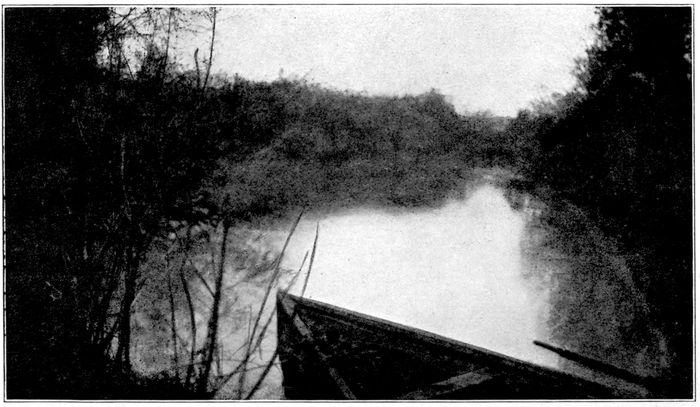
There lay the boat in which one might row across the Jordan to the land of Moab.
43There was nothing to do but wait and nothing
to see but bare hills. We climbed one great
rocky mound only to see more hills with deeper
valleys lying between as far as the eye could
reach. They reminded us of the hills in the
most desolate part of the Mormon trail in our
own American desert. The sun rose higher and
the heat became almost unbearable. We drew
down our hats, put on our dark glasses and sat
on the rocks in the dry bed of the stream. There
was not a sound, not a bird note, no bleating of
sheep. There were caves in the side of the hill.
They looked dark, cool, and inviting, they had
sheltered many people good and bad during the
long centuries, but the guide warned us that they
were full of vermin and unclean. There was a
tiny boulder half-way up the hill which made on
one side a narrow strip of shade and we made
ourselves as small as possible and sat there.
Noon came and we ate our chicken and hard
boiled eggs, French bread, figs, dates and
oranges made ready by the hotel, and drank the
water in our thermos bottles sparingly. A
group of Arabs clattered past us over on the
road. One sang a couplet in a clear, ringing
voice and the others joined as in a chorus. They
did not see us, or, if they did, made no sign.
“When the Turks ruled Palestine,” said our
guide, “we could not sit here so safe. There
44was much danger on this road and no man
traveled over it at nightfall.” He told us tales
of brigands in league with Turkish high officials
with whom they shared their spoil that would
have made excellent material for certain types
of American motion pictures. Suddenly the
simple story that Jesus told to the crowd in
answer to the half-mocking question of the keen
Jewish lawyer came vividly before us. It was
in these hills, in the desperate loneliness of
them, that the certain man, stripped of all his
goods, beaten and half dead, lay helpless. He
might wait for help for many an hour before out
of this place of emptiness any would come! How
could Priest and Levite pass him by on the other
side and leave him in this forsaken spot that their
own journey might be undisturbed? To them
he was only a man robbed by the bandits. He
would die as had many another. It was a common
thing, and, inhuman as it seems, they went
on to their task of holy worship and to the seat
of judgment.
How keen was the mind of Christ! How
quickly and unerringly He put his finger upon
the very center of sin! It was easy to see, coming
down the narrow camel path in the hills,
45the hated Samaritan with the spirit of justice,
mercy, and brotherhood in his soul. He stopped—the
man one would least expect to stop—and
rescued with generous tenderness the suffering
victim of thieves, while the servants of Jehovah
and his law passed by on the other side, doing
in that day even as, in all the days since, the followers
of the letter and not of the spirit of the
law have done.
There was only one answer to the question
the lawyer had asked of Jesus and he was forced
to give it—“He that showed mercy.” I doubt
if any who had heard the question, “But who is
my neighbor?” ever forgot the answer, or the
command that followed it: “Go and do thou
likewise.”
I was so lost in a new sense of the significance
and sincerity of His wonderful teaching
that I did not see our guide make his way toward
the road. “A car comes,” he called, but we,
lacking his desert-trained senses, heard nothing.
Two or three minutes and we could see it
coming rapidly along the white road on the
farther hillside. The guide was overjoyed when
he saw the new driver. “Ah!” he said, “this
is the man I wanted. He drives anything that
46can go. Through the war he drove over hills
with no road—always safe! He speaks English,
too.” He examined the car. It had both windshield
and horn. It had an extra tire and seats
that were straight. Hope revived.
“We shall now get quickly back to Jerusalem,”
said the guide. “Tomorrow, perhaps, we
shall have the carriage.” “To Jerusalem!”
we said. “It is only one o’clock. With such a
driver we can surely get to the Dead Sea and
the Jordan. If it is late we can stay tonight at
the Inn near Elijah’s Spring and go back to
Jerusalem in the morning. Our time is short
and we cannot take another whole day.” Jamil
looked at the driver. “They are Americans,”
he said, “and when they will go, they will go!”
After a moment he added, “The sun has been
very hot. Perhaps for you it has dried the
roads.”
So we climbed the steep grade, ran along a
level strip, then a steeper grade to the Inn of the
Good Samaritan where Arab traders and men
of the caravans stop for coffee. There was a
tank in the yard where one could buy gasoline!
The road before us was down grade now, and
the driver more than lived up to his reputation.
47Once Jamil turned to show us a Mohammedan
mosque in ruins in a desolate spot high up in
the hills and again to point out a tomb. “It is
the tomb of Moses by the word of the Mohammedans,”
he said; “but we do not believe it,
for no man knoweth where God hath buried him.
He never came into the land so we shall not
believe it.”
Neither of us who took it will ever forget
that ride through the Wilderness. There was
no road. Two deep ruts here and there marked
our way. We wound through soft ooze turning
now into the rut, now out again. On every side
were hillocks of soft gray sand. “This is a
good place to ride the donkey’s back,” said
Jamil as we bounced up and down in the car,
but he smiled. We told him we had motored to
Germany over the shell-torn roads fording the
bridgeless streams and this seemed very simple.
Three miles of it and we were on a rough road
close by the Dead Sea.
It lay still and calm, a blue gray thing crossed
here and there by ribbons of silver where the
sun glistened upon it. I should have said it
had no motion but for the tiny little ripples that
broke on the pebbly beach made frosty with salt
48deposit. A thousand feet and more below the
Mediterranean it lay there. Sitting beside it
we were lower than any submarine has ever
been. The city of Jerusalem is two thousand
five hundred feet above the level of the sea so
our descent had been over thirty-five hundred
feet since morning. It was very warm. Though
the great body of water lay there now so still,
Jamil told us that when the Turks were using it
to transport supplies, fierce storms swept over
it, thunder roared in the hills and over the
plains, and giant waves dashed upon the smooth
shore. We looked across the fourteen miles of
sea to the plateau in the hills of Moab and knew
that there was no living thing in it nor on its
whole great stretch of fifty miles! Hungrily it
swallows up the rivers and the tiny streams,
the Jordan alone pouring millions of gallons
into it every day, but never, never does it send
out even a tiny streamlet. It grants no answer
to the plea of the thirsty land that seems to
reach down into it hopefully. We put our hands
into the water four times as heavy as the Atlantic
and they were covered with an oily salty
deposit that would not come off until we had
scrubbed with hot water. Suddenly we heard a
49sound—the bleating of a sheep. It was so welcome
in that dead silence! Beyond the bend in
the shoreline was a tiny house with children and
the sheep!
We walked slowly along over the smooth gaily
colored little pebbles to the spot, half a mile
beyond, where the car was waiting. But we
turned to look back again and again. The great
silent sea held for us the awful fascination of
death.
There was a road of a sort across the plain to
the Jordan. When the river is in flood this plain
is covered inches deep with ooze, rank vegetable
growths spring up, the brown bushes are green,
clouds of mosquitoes, scorpions, vipers and all
manner of crawling things make their home
here for a season; but now there were only long
cracks that crossed and recrossed in the dried
mud. Twice our wheels spun round in pockets
of soft gray clay, but small thick boards, a spade
and dry sand helped us out. A turn and we
could see the river!
To one who has never studied the geography
of Palestine or to whom books of travel are
strangers, that first sight of the Jordan must
bring far greater disappointment than to one in
50a way prepared for the dark, muddy stream
whose swift current hurries on ceaselessly,
gathering silt as it goes. Within its normal
banks it is such a narrow stream! We stopped
for a moment in the house where sweet Turkish
coffee and oranges were served us and where the
boats used by fishermen and by tourists who
like to row across to touch the land of Moab lay
moored to a tiny wharf. The banks were steep
here and soft willows bent over them. We sat
down in the little boat that swung lazily at its
moorings. It seemed the strangest and the most
wonderful of rivers, this little muddy stream!
Over it the great hosts of Israel passed; along
its banks John, coming out of the desert,
preached the kingdom of heaven to the multitude;
and here came even Jesus Himself to be
baptized in the waters His presence made
sacred. We dipped our bottles carefully into
the stream and filled them with water as all pilgrims
do. We listened to the stories of the feast
days when pilgrims come down to the river to
worship there; we read the story of Naaman
and understood why the proud leper of the
king’s court, even at the command of the stern
prophet, hesitated to bathe in its waters. We
51lived in another day. Proud armies marched
over the plain toward Jericho and we could
almost hear Joshua’s ringing commands. We
were brought back to our own day suddenly by
the sound of a voice, a very American voice,
singing in the distance, “Roll, Jordan, Roll.”
We looked at each other in amazement. After
a moment’s silence the voice rang out again,
nearer now:
“Some day I’m going to murder the bugler!
Some day you’re going to find him dead!
I’ll amputate his reveille
And stamp upon it heavily,
And spend the rest of my life in bed.”
We climbed out of the boat and up the bank.
A man in the early thirties stood there with
a sapling, root and all, in his hand. He was
an American working with the British under
a commission for reforestation. He was most
enthusiastic over his work and painted for us a
wonderful picture of the hills, now bare and
desolate, and the banks of the river, with the
low scrubby growth, transformed some future
day into valuable fruit and olive orchards, irrigated
pastures, great stretches of light timberland.
Jamil shook his head. “There is much
talk these days about the changes that are coming
52to this land, but we shall see—we shall see
and then we shall believe,” he said. Our friend
went into the little house for food and rest and
we stood in silence watching the stream which
artists for centuries have painted, the river
which has always stood for separation, under
whose spell poets have written their sad hymns—watched
it rushing on pouring more and more
water into the Sea that is Dead.
The dunes, yellow and gray, between which
we rode on to Jericho were round as though a
giant hand had played with them, smoothed
them over, and left them there. Twice we
passed low stone houses with cisterns of water
cut in deep rock hidden below the surface, and
there were oranges and green things in the garden
in the midst of the desert. It was cooler
and the air was soft and balmy. The walls of
Jericho—City of Palms—though now there are
none, had indeed fallen, but there was no fear
upon the faces of the people. The once mighty
city is now but an ordinary village of lower class
Arabs, with a supply station, a few shops, and
the hotel where British officers live. Traces of
recent battle over the very ground where the
men of Joshua had routed the ancient enemy
53were all about us. The story of the taking of
Jericho from the Turks by British troops when
the river at its flood had to be bridged by boats
and the temperature ran to 120° and more, is as
thrilling, as fascinating, and as triumphant as
that of Joshua himself.
Passing through the center of the town, we
came to the orange groves. The air was fragrant
with the perfume of thousands of jonquils
growing wild along the edges of the irrigated
section. The children offered two huge bunches
for sale and we rejoiced in them. Our driver
took twenty bunches for a friend to sell in Jerusalem.
He tucked them away neatly in the
folded top of the car. We bought delicious
oranges and our machine became a chariot of
delight. We went out to Elijah’s Spring, whose
waters, made sweet and wholesome by the
prophet, were responsible for the luxuriant
flowers and delicious fruit, past the home of
Rahab who had saved the spies in Joshua’s day,
stopping for a moment at the spot where the
sycamore tree had sheltered the rich publican
Zacchæus when he determined to see Jesus. It
was easy to imagine the consternation that
filled the city when it became known that Jesus
54had commanded him to come down because He
would be a guest in his house that day—the
house of a publican. It was on this road, too,
that Bartimæus met Jesus and, despite the demand
of the multitude that he be quiet, continued
to cry aloud until the Healer saw him,
opened his eyes and set his soul on fire with
gratitude. How close the multitude must have
pressed in those narrow streets, as driven by
curiosity and longing for help, they followed
Him! How often the body and soul of the Master
must have cried out for the shelter of the
mountain, the stillness of that waiting desert
where in the night God could come very near
with a new message and new strength for the
coming day! It was at times like these, when
half carelessly they pointed out to us the spots
where on common days Jesus passed by, changing
forever the lives that He touched, that we
loved Him.
The sun was creeping on toward the horizon.
We must turn back toward Jerusalem. Every
foot of the road the driver assured us he knew.
He would leave us in the Inn with the guide if
we wished and send for us early in the morning,
but he would get back to Jerusalem. So
55would we and he was content. He got all possible
speed out of the car. It must climb back
over those thirty-five hundred feet we had come
down such a short time since.
We stopped a moment to peer at the lonely
monastery where monks still live on the Mount
of Temptation and pray daily for all who are
tempted. The road which had been so lonely in
the morning was stirring with life. Groups of
Arabs on horses and little swift-footed donkeys
moved aside to let us pass. Twice at a signal
from a man riding ahead on horseback we
stopped to let a great caravan pass us. The
leading camels wore gorgeous trappings and
tinkling bells. Once a camel without cargo, following
in dignified fashion behind two others,
stood perfectly still, trembled, then turned and
ran ahead of us. We were amazed to see how
swiftly he ran. In vain the rider of the other
camel shouted and called. Had it not been for
a friendly companion, who, coming down the
hill, drove his own camel straight across the
path, spoke soothingly to the great beast while
a man on a donkey grasped his chain, he might
have led us a chase all the way to Jerusalem.
They did not attempt to take their prisoner past
56us in the road but turned off into a deep defile.
When we looked back from the hilltop they were
again on the road moving on toward Jericho.
But most of the camels bearing their burdens
merely sniffed and passed us by in scorn.
It grew very cold as we reached the heights
and the discarded robes and coats were welcome.
We could see shepherds and sheep seeking
places of shelter. Sometimes we caught
glimpses of herds of goats reluctantly following
or plunging ahead silhouetted against a soft
violet sky. The sun set calmly and we missed
the blazing glory. Suddenly it was night. We
were glad to be well past the scene of our morning’s
mishap and nearing Jerusalem. When
we stopped at the door of the hotel, Jamil gave
a sigh of relief. “We have had a wonderful
day,” we said. “We have had a day of miracles,”
was his answer in a solemn, devout tone.
Both he and the driver were most happy a moment
later when they received their extra fee.
Dinner was over for most of the guests, but
we were given a warm corner and more food
than it would be possible to eat in many meals.
We found that the entire hotel had joined in
Jamil’s sigh of relief when we returned. There
57was a snapping wood fire in the little stove and
hot water bottles that made the great curtained
beds seem more inviting. The maid wished us
“sleep without dreaming.”
But for a long time, lying there in the darkness,
I dreamed with my eyes wide open. Dreamed
of the forty years wandering in the wilderness
while one generation passed and a new one was
born. Dreamed of the kings and the prophets,
of David hunted like a wild thing through the
desolate hills and caves, of captives marching
across the sands to Babylon. Dreamed of the
Man who, with weary feet, in the heat and the
dust walked about the Jordan Valley, through
Jericho, walked up the long, long hills even to
Jerusalem with men and women following,
always seeking, only a few sharing. Dreamed
of the demand that He made upon all who did
have the courage to share—that they love God—and
the challenge that they love their fellow men
as He loved them, ... dreamed of the day
when the challenge would be answered and the
other man’s welfare would become each man’s
passion.
I GO TO BETHANY
59
60I tell you when I looked upon these fields,
And stony valleys,—through the purple veil
Of twilight, or what time the Orient sun
Made shining jewels of the barren rocks,—
Something within me trembled; for I said:
This picture once was mirrored in His eyes;
This sky, that lake, those hills, this loveliness,
To Him familiar were; this is the way
To Bethany.
—Richard Watson Gilder.
61
I GO TO BETHANY
One afternoon when we were driving about
the busy semi-modern streets that lie outside
the walls of Jerusalem we suggested
to Jamil, our guide, that some afternoon we
walk to Bethany. He answered briefly that it
was too far and turned to call our attention to
the well-equipped postoffice, the modern looking
shops, the Italian hospital, the well-built
hospices of the French, Italians and Russians
which before the war were thronged at the
feasts with devout pilgrims. There was an
atmosphere of western life about the outer city.
Signs over some of the shops looked amazingly
like New York’s East Side. Books, pictures
and maps, school supplies, men and boys’ clothing
of every sort, girls and women on the streets
dressed in European fashion, together with
Cairo papers in French and English, helped us
to see the trend of the new, growing city without
the walls. The streets were wide and well kept.
The church of St. George was an artistic, beautiful
reminder of the reason why the word of
62the capture of the Holy City had been received
with solemn joy in every English household.
We passed the dignified Damascus Gate and the
Sheep Gate before which camels knelt grunting
and little groups of sheep huddled close each
around its shepherd; lorries passed us on the
road, then a motor taking General Storrs to
confer with the High Commissioner on important
business. We stopped to visit the British
High School for girls, doing its work against
great odds in a former German orphanage
poorly equipped for school work. The girls of
twelve nationalities with most excellent ésprit
de corps were studying there; the principal, a
real educator, formerly head of the girls’ school
at Beirut had wise, far-seeing plans for the
future of the school and, through it, for the welfare
of the city. As I listened to them I wished
that my purse were well filled that I might make
some of them possible now in the day of crisis
when the whole future of Palestine is in the
making. Surely there are new paths through
old Palestine.
When we again entered the city through the
Jaffa Gate it seemed centuries older than when
we had left it, so great was the contrast between
63the air, sunshine, and breathing spaces outside
the walls and the narrow, dark, and crowded
little cobble-stoned alleys, shared by man and
beast, where no full ray of sun ever shines.
Only the flat roofs of the houses save the people
within the city from life in a semi-dungeon. It
was this plunge back into the city of age-old
days and deeds that made us long the more to
walk leisurely to Bethany and so, on Saturday
night, we told Jamil we should not need him
until Monday morning at nine.
We left the city just after noon on Sunday by
St. Stephen’s Gate, stopping reverently for a
few moments close by the steep hillside to think
of the brave words of the young martyr as he
looked into the hard faces of his accusers and
his wonderful address, recalling to them each
step of their history and the reason for each
great defeat. We remembered the daring
words: “Which of the prophets have not your
fathers persecuted? and they have slain them
which showed before of the coming of the Just
One; of whom you have been now the betrayers
and murderers: who have received the law by
the disposition of angels, and have not kept it.”
In fierce anger they ground their teeth and
64hissed their reproaches at him. But he did not
even see them. Suddenly, looking up to heaven,
they heard him saying, “Behold, I see the heavens
opened and the Son of Man on the right
hand of God.” It was enough. Seizing him,
they rushed him through the narrow street and
cast him out of the city. They laid their garments
at the feet of a keen young man named
Saul, who watched with approval as they hurled
down upon their helpless, suffering victim the
jagged stones of the hillside. But above the
noise of their mutterings of revenge the young
man Saul heard the words of prayer: “Lord
Jesus, receive my spirit.” And again, “Lord,
lay not their sin to their charge.” And Stephen
died—but Saul never forgot.
From St. Stephen’s Gate the smooth, broad
road makes a steep descent down to the valley
of the brook Kedron, then it climbs again
around the shoulder of Olivet, where we stopped
to look back at the city with the dome of the
mosque of Omar glistening in the sun. The air
was clear and the hills, with the light, shifting
clouds above them, changed color every moment.
Jamil had told us that the hills about Jerusalem
bore always “a luxuriant crop of stones” and
65his words seemed true indeed, a crop made even
more abundant by the heavy shell-fire of the
months past. Still, in little square patches between
the ridges, men were plowing. One plowman
had a thin, patient ox and a donkey together
under what seemed a heavy yoke. Here and there
thick vines leaned against sunny walls as in the
days when Jesus used them for the text of His
great sermon “I—the vine: ye—the branches.
Without me, ye can do nothing.”
It was when we walked out a little from the
main road to Bethany to look over into a deep
valley that we saw a carpenter at work in his
sunny yard, making yokes for the oxen. He
worked deftly with his clumsy tools at his primitive
bench. The court-yard was swept clean,
save for the corner where the shavings fell.
There were green things growing in a garden.
After a moment a woman appeared in the doorway.
She looked curiously at us but answered
our smile. “Ing-leesh?” she queried. We
shook our heads. “American,” we said very
distinctly. The man at the bench turned
quickly. A shower of words in the Hebrew
tongue and a motion to wait answered us. The
woman hurried into the house and was back in
66a moment with a photograph in her hand—a
man, a woman, two children. The photograph
was taken in New York! She pointed proudly
to the word. As we were about to leave, being
limited to conversation by means of nods, smiles
and gestures only, a boy came from the rear of
the house. He had great, dark, dreamy eyes,
his head was a mass of thick curls, in his hands
he had two irregular blocks of wood which he
gave to his father. He smiled at us shyly, but
turned to look again with frank interest and
curiosity when his mother repeated the word
American.
It was hard to tear ourselves away from this
picture of the carpenter with his little son and
the mother at the door, but there was no excuse
for lingering. We could only hope that this
young son of a carpenter might sometime know
the story of that other Son, of whose early days
in the village of Nazareth he served so forcibly
to remind us.
It was here that He came to talk with one who seemed to understand—and there were so few.
67It is not a long walk to Bethany, a little over
four miles they told us, and we soon saw the low
gray stone houses with their roofs of mud not
far ahead. As we approached the village, a veritable
host of children rushed to meet us, calling,
with a score of accents, words supposed to be
English. At first we covered our ears then
motioned to one child to speak. We learned
that they were offering their services as guides.
The moment we appeared to understand, the
babel began again. “Mary and Martha,” they
called. “Simon-Lazarus, I will show.” When
we spoke they listened, but only for a moment.
“You cannot all be our guides,” I said. “If
you all follow we will go back to Jerusalem and
no one will have back-sheesh—not one. We shall
not look at the house of Mary and Martha.”
The tallest among them, a lad of fourteen, he
told me afterward, evidently repeated our words
and he emphasized them with a flourish of a
stout cane which he carried. He showed us a
soiled card with a name written upon it which
he said was his. We chose him and one other
guide, a little girl of six who had pointed to
herself proudly, saying, “I know—I know, Mary—Martha—Lazarus.”
At a word from a villager
passing on his donkey the children scattered
and it was a great relief.
Our young guide knew the method perfectly.
Driving the dogs out of the way with his cane,
he led us up a steep path to the house of a man
68who was a dwarf, badly crippled. He was to
take us to the tomb of Lazarus which he did,
when we had paid the piastres he asked. He
insisted upon telling us the story before we
went down the long winding stone steps worn
smooth by the passing of men’s feet for centuries.
He told it in very graphic fashion. We
had only the dripping candles to light our way.
Following him, we could hear his call at each
turn, “Have care! Have care!” We decided
not to make the entire descent of sixty steps but
contented ourselves with looking down from
the fortieth step into the black pit below. The
air and sunshine were most welcome when we
climbed back and, giving more piastres for the
shepherds’ slings the old dwarf took from his
pocket, we left him happy. We stood for a few
moments at the entrance to the tomb, thinking
of all that spot had meant in the centuries since
it was recorded that, in warm human sympathy
with the suffering sisters, “Jesus wept.”
We stood a long time on the wall of the ruins
that covered the spot where the home of the
three friends of Jesus had stood. It looked out
over the valley on one side and toward Jerusalem
on the other. Our guides, big and little,
69sat down on the stones and were silent. Nowhere
in our journeys through Palestine did
we trouble our souls over the arguments of men
as to exact spots and identical places. If not
to the place of this ruined wall, then to some
spot near by Jesus came. Came to receive rest
for His body and comfort for His soul. Came
to forget for the moment Jerusalem with its
noise and confusion, its need and its hate.
Came to talk with one who seemed to understand
and sympathize—and there were so few. What
it would mean to us today if we could know the
many things about which Jesus talked that have
never been recorded for us! We remembered
that it was from Bethany over the hills through
which we had come that Jesus made his way to
Jerusalem on the day when He found the colt
and rode triumphantly through the streets to the
temple, amidst the shouted hosannas and waving
palms that filled the Pharisees with jealous
anger. It was here that he may have spent the
nights of that last crowded week until the night
of the Supper when he sought the Garden. One
could feel, standing there looking toward Jerusalem,
something of the agonizing sorrow that
swept over that household when they learned of
70the trial that was a mockery of justice and the
condemnation of their beloved friend to death
on a cross.
When we were ready to leave, the young guide
asked if we would like to go into one of the
houses and see the upper room where a guest
may sleep. We hesitated to walk in this fashion
into a home but he explained that we were sure
of a welcome and a little back-sheesh would pay.
The upper room was a dean and quiet spot.
There were small woven rugs, a cot with handmade
covers spread over it. A bed roll stood
in the corner. There was a heavy metal basin
for washing and two lamps, ages old, filled with
oil. The window was open toward the road that
leads to Jericho. It was a place where one might
rest his soul. “Many guests came to this room
before the war,” said the boy, “the family is
large. Some live far away in Damascus. They
come for the feasts. But not since the war—there
is not money and some have died.” The
back-sheesh was accepted gratefully with many
words of thanks by the two women below—one
very young with a baby in her arms.
Our next stop was at the spot where once had
stood the home of Simon the leper where a
71woman did the Great Teacher high honor as she
broke her very precious box of alabaster and,
in an abandonment of love and gratitude, poured
the fragrant perfume over His head. We could
hear the petulant voices of those who complained
because the ointment had not been sold
for a good price and the money given to the
poor. But Jesus understood.
“This is all for Bethany,” said the guide of
fourteen years. “It is not large and it is poor.”
We did not need his words to make us realize it.
The little girl who had called herself guide so
proudly had not spoken a word, but, as she
had climbed over the steep places, had waited
patiently, had listened intently to the boy, and
had given us at every turn a smile which we
remembered for many a day, she had earned her
fee. When she received it she ran madly toward
a house near by and disappeared. The boy
walked with us courteously to the edge of the
village. In response to our query as to where he
had learned English he said, “Off a merchant I
worked for since I was six. He lives just outside
the city.” The “off” with which he began
his sentence sounded as though the merchant
might at one time have lived in America.
72At the outskirts of the village, where we had
met them as we entered, were the children.
They ran beside us shrieking “back-sheesh”
and holding out their very dirty little hands.
We shook our heads vehemently. It meant
nothing. Then we stopped and reminded
them that we had paid our two guides and
all the people who had helped us, but that
they had done nothing for us. “We are
poor,” said a girl with a baby in her arms
as though that were reason enough for her
demand. I shall never forget the thin face,
the piercing black eyes of a boy, perhaps ten.
“America rich,” he said, “plendy, plendy,
plendy money.” There was the deepest reproof
in his voice.
“Some people are very poor,” I said, “the
children cry for bread. In the winter they are
very cold. There are many very poor people in
America.”
“No,” said the boy stoutly, and I saw that he
did not believe me, but he repeated what I had
said to the others. It was very hard to refrain
from giving them money, but we remembered
the request that we should not help to train a new
generation of beggars and steeled our hearts.
73When we started on again a few accompanied
us but we paid no attention and one by one they
dropped out, having followed us almost a mile.
Some said good-bye cheerfully, others made
gestures of disgust. One lone lad still walked
patiently beside us. He had great hollows under
his eyes and, now that we could see him separated
from the others, we noticed how very thin
and pale he was, how ragged and dirty. In his
arms he carried a baby whose eyes were in a
pitiable condition, one so swollen that it was
entirely closed. He said faintly in a weak, tired
voice, “back-sheesh—back-sheesh” over and
over. He looked as though in dogged determination
he would follow us back to the city gates.
Unable to resist the pleading we yielded, gave
him some coins, watched the light come into his
eyes, saw him turn and make his way slowly
back—one of these little ones who so easily
perish while waiting for the coming of the kingdom
of God—the kingdom that Jesus said was
theirs. It may be that the school now being
opened in the little village will help to bring
them their rights.
When we told Jamil next day of the children
he said, “Ah, that is why you should have me!
74The guide saves you. You should not go alone,
and walking you cannot get away.”
“Where are the parents of these children,”
we asked.
“Poor,” he said slowly, “very, very poor.
Always poor and the war has made it very
hard. It will be better now, but they have
learned bad habits.”
A turn in the road and the village was entirely
out of sight. We overtook a flock of sheep and
for a time walked slowly behind them. The
bleating of the lambs who seemed weary
sounded like the voices of the children. The
shepherd turned into a narrow path between
the hills, called in clear, urging cadences, and
the sheep followed him. We climbed up from
the road and sat on the rocks under gnarled old
trees. A tower on the mount of Olives stood
out clear against the sky. We read aloud of the
Holy City from the words of the prophets and
the Psalms of David.
Night would soon steal down over the valleys,
so reluctantly we moved on past a cluster of
tiny stone houses, past the cemetery of the Hebrews,
when, flying up the hill at reckless speed,
shaking us rudely back from the past into the
75present, came a motor rushing toward Bethany.
Bethany that seemed to be out of the world of
motors! It was the doctor’s car from the hospital,
they told us when we described it. Just
before the road drops abruptly into the valley
we stopped to look again at the City. There
was always something strangely gripping in the
sight. The words of Jesus wrung from Him
as, in deep compassion that was agony, He
looked at the City, feeling the weight of its sin,
its pain, its need, came back to us—“O, Jerusalem,
Jerusalem, that killeth the prophets and
stoneth them that are sent unto her! how often
would I have gathered thy children together even
as a hen gathereth her chickens under her wings,
and ye would not!” We hurried on through St.
Stephen’s Gate.
On the hills it was light but in the narrow
streets with their gateways and buttresses it
was quite dark. We took out our faithful flashlights,
and with our canes to help over the
shadowed steps went rapidly up to the hotel
that stood as a strong and sheltering friend in
the faint glow that still lingered in the western
sky.
“Not much in Bethany,” they said to us at
76the desk as they had said of Bethlehem. “Too
far to walk for the few stone houses and the
ruins.”
How could they know what we saw in Bethany?
How could they know the overwhelming
sympathy that surged in upon us as we stood
on the walls of “the house of Mary and
Martha,” looked upon the hills and valleys He
saw in their purpling shadows, thought how
much harder the friendship and fellowship of
that home must have made it to remain true to
the message that was to take Him to Jerusalem
to die, thought of the short day of triumph, waving
palms and lavish praise, thought of his
youth and his glorious undaunted soul!
No, they did not know what we saw in
Bethany.
I GO OUT TO THE MOUNT OF OLIVES
77
78He turneth a wilderness into a pool of water,
And a dry land into watersprings
And there he maketh the hungry to dwell,
That they may prepare a city for habitation,
And sow fields and plant vineyards.
Instead of the thorn shall come up the figtree;
and instead of the briar shall come up the
myrtle tree: and it shall be to Jehovah for a
name, for an everlasting sign that shall not be
cut off.
The latter glory of this place shall be greater
than the former, and in this place will I give
peace, saith Jehovah.
—The Bible.
79
I GO OUT TO THE MOUNT OF OLIVES
Before we met our carriage at the
Damascus Gate to ride out to the farthest
point on the Mount of Olives we walked
through David Street to the Wailing Place of
the Jews. Every book we had studied warned
us of the unspeakable condition of the narrow
filthy streets in this Jewish quarter of Jerusalem
the Golden. But they were all written
before British arms had captured the Holy
City and, even in these short months, made it
in so many ways a new Jerusalem. In the windows
of the shops we had seen the quaint pictures
of the water-carrier with his leather bag,
but not one had we seen in the streets of the
city. The menace of the water bag with its
myriad germs is already a thing of the past.
For the first time in all its long history, under
rulers of many great faiths and names, the City
has water, plenty of water, fresh, clear, safe.
What that simple statement means can be
appreciated only by those who know by experience
80what a priceless boon water is to cities that
have little. One could change the whole record
and history of Oriental cities with water
systems!
When the history of Palestine in the war is
fully recorded, one of the most thrilling chapters
will be written about the lead pipes now
standing boldly in the city streets two feet above
the ground, capped by very modern shining
faucets. The girls and women who come to
them with their water jars beamed with joy as
they watched the silver stream pouring out in
the sun. For four hundred years the Turks
ruled in Jerusalem and in all that time no
attempt was made to establish a water system
although more than once the inhabitants were
taxed with the promise of water that was some
day to come. In a little over two months the
British engineers had brought running water
into every street of the city. New paths are so
rapidly making their way through old Palestine!
For its water Jerusalem had depended upon
winter rains to fill its great cisterns. The
houses had underground reservoirs, some of
which had not been cleaned in more than twenty
years. At the Mosque of Omar was a large
81reservoir where the water from the springs
about Solomon’s Pools flowed down through a
great aqueduct built by the Romans when Herod
ruled over the Jews. The searching engineers
had found springs in the hills with fresh, pure
water running to waste and, at the rate of fourteen
thousand gallons an hour, it is now pumped
up to the top of a high hill, run by gravity down
through a long pipe-line to a great reservoir
that has been built and carefully protected on
the outskirts of the city. Direct lines take this
pure water to the hospitals and into the city
streets. Despite the shrinking of the population,
caused by the evacuation of the Turk, more
than ten times as much water has been used as
in previous years, which silences the oft-repeated
statement that the people would not
appreciate the water if they had it. We were
interested to learn that some of the pipes had
been sent to Egypt to be forwarded for use in
Palestine by the American Red Cross Commission
after we entered the war. But the Commission
found that the need for water which we had
anticipated had been practically answered by
the Royal Engineers.
One is deeply impressed by the change in the
82record of contagious diseases. The reduction
in cholera, smallpox, typhoid, and typhus is
remarkable. Even under the sound of booming
guns, children’s welfare bureaus were organized,
lessons in health given, nurses trained and
kitchens opened to provide food for the babies,
the sick and the old. The workers of the American
Red Cross deserve and receive full gratitude
for their enthusiastic and intelligent work
in and about the City in those days immediately
following its surrender.
The people on David Street seemed to have
lost something of the fear that writers of the
past saw in their haunted faces. It may be the
fact that now they are free. The old-time pressure
and petty persecution by corrupt officials
is past. The Turkish prison no longer yawns
threateningly. A trader may go unmolested
about his work. The heavy taxation demanded
in the past by a succession of officers, from the
least to the greatest, has disappeared. Contentment
not known for untold generations reigns
in humble homes.
From the brow of the Mount of Olives where they lay sleeping under white crosses—these also “fling to us the torch.”
83It may be for this reason that on both occasions
of our visit to the Wailing Place there
were but few present and they were old men,
old women, and some very young children.
Young manhood was not there, it was hard at
work. Many of the older boys and girls were
in school. The leader of the group chanting
the Lamentations that morning was an old
white-haired patriarch with eyes of fire. He
was the only one of the group that did not interrupt
his wailing to look at us. One tall, strong,
impressive specimen of womanhood moved along
the line to quiet some women whose wailing had
become a piercing shriek or to straighten out a
child who irreverently chased a playmate up
and down the path. The guide said that her
name was Miriam and that she had a son with
much money in England. Erect and fine, forceful
and devout, she reminded us of that other
Miriam who led her people to victory. Here
and there one saw women’s strong faces stained
with tears and marked with suffering. They
leaned against the foundation stones of the old
Temple area in an abandonment of emotion and
sorrow. Near the end of the line was a very old
man leaning tremblingly upon his staff. Jamil
said that he was repeating one phrase over and
over. “O God, the heathen are come into thine
inheritance!” His voice was bitter and full of
84anguish. A great wave of pity swept over us
for these and all they have suffered, and yet
survived. Against those massive walls of the
past, Babylonian, Assyrian, and Egyptian had
hurled their hosts and battered them to earth.
They had risen again only to meet the Roman
and the Saracen, the brave Crusader and the
unspeakable Turk until in very truth they lay
“in heaps.” Piled one above another, the various
cities lie waiting until the hammer and
spade of the excavator shall open up all their
secrets for us. Buried deep down in the earth
is that early city of the Jebusites, over it the
glorious city of Solomon, the city heroically
brought again into being by Nehemiah, the city
of Herod which Titus hammered into ruins and
Hadrian rebuilt, above it the city of the Saracens
built after their wave of conquest, the city
of the Crusaders, and now the city of the Turks,
standing boldly above the ruins of the long past.
It stands, the protected property of a new
conqueror who loves it, whose army chose the
hardest road to victory to save it from the
marks of war, whose people have come into it
with knowledge that they may overcome its
ignorance, a conqueror who bears no malice,
85who is tolerant of the Jew and the Mohammedan
though he worships at the Cross which they hate.
As if reading our thoughts, the guide said
quietly, “Some day it will be only the wall for
the wailing that we shall see. There will be no
more need for wailing, and the children will forget.
So the young prophets among the Jews
say in the markets. We shall see.”
We walked through a section of the Temple
area and out past the Austrian Hospice through
the Damascus Gate where, according to agreement,
the carriage waited.
The road out to the spot where the Mount of
Olives drops abruptly to the plain has been
repaired, stray shell holes filled in and a large
section of new road built since that wonderful
day when the last line of Turks were driven
from the position they thought secure. The air
was as clear as an October day at home and the
shining city “compact together” seemed substantial
and strong. It was along the high ridge
of Olivet that, in the pressure of the days when
relief workers toiled twelve and fifteen hours
without respite, they came to renew their
strength. In the home of the Greek Patriarch
more than one strong soul, overcome for the
86moment by the ceaseless stream of dirty, hopeless,
despairing human things that he must
strive to save from the wreckage of war, found,
in the white moonlight sifting down over the
hill, in the kindly stars, in the silence and in
sacred memories, courage to attempt again
tasks that had been called impossible.
We had been gazing so steadily at the city
that when the driver suddenly stopped we
turned in surprise. There on a gently sloping
stretch of ground, close to the road at the left,
stood row after row of crosses over the resting
places of Scot and Londoner, Welshman and
Irishman, Indian and Anzac who had paid for
the Holy City with his life. On some of the
crosses fresh green garlands were hanging, and
on one a wreath with English holly.
We got down from our carriage and walked
slowly along, looking now at the crosses and
now at the place where in agony of soul Christ
had prayed for the strength to meet the test
of Calvary that has made the Cross forever the
symbol which shall mark the spots on earth most
sacred to us. These lying out on the hillside
had also been to Calvary.
A little farther on in the road we passed men
87in the British uniform. They had survived the
terrible test of those wind-swept hills with the
rain falling in torrents, the benumbing cold, the
soft, thick, gray mud, the night in the open with
no shelter save a little wall of stones built up
with care only to be blown over by a sudden
vicious blast, with little food and only the ammunition
that could reach them on the backs
of the pack donkeys. It was through this they
had won that peaceful city lying contentedly
there in the sun, even the shining dome of its
Mohammedan Mosque unharmed.
The German hospice, Kaiserin Augusta Victoria,
lies out on this road. It is exceedingly
well built and untouched by shell fire. Although
the Turk utterly demolished the mosque of
Nebi Samwill and shot away its stately minaret,
he turned no gun on this that was German
property. Even when his airmen, flying over
Olivet, knew that an enemy signal station had
been set up in the garden of the hospice no
shot fell upon it. “This house,” said Jamil, “is
like a German castle on the inside. The tower
was built higher than any tower on the Mount,
the trees set out with care. The picture of the
Saviour is painted in the chapel and the pictures
88of the Kaiser and the Kaiserin are on the long
wall. It was common talk at the beginning of
the war that the Crown Prince should live here
when he became King in Palestine. Now it is
the Headquarters for the British Army.... It
is the Will of God!” he added solemnly after a
moment. We took a picture of the hospice with
two British Tommies standing at the gate.
We had to leave our carriage and walk to the
point where the Greek Church tower looks down
over the stretch of rugged upland crossed by
many a wadi, over the walled-in level spaces
where green things were growing, over the
plains of the Jordan and the Dead Sea so blue
in the distance, away to the far mountains of
Moab. It was a wonderful picture at which
one could look for long hours and come back to
enjoy again and again. It was from this point
of vantage that the relief workers watched the
taking of Jericho. In the grove we found the
“husks that swine did eat,” lying about on the
ground. Jamil picked one of the long brown
pods from the tree and under the pressure of
his urging we tasted it. It was sweeter than
sugar cane, nauseatingly sweet. It took no
imagination to understand why one would
89accept it as food only as a last resort. In this
grove we found the hyssop which the women at
the hospice use both as medicine and for the
whitening of their clothes. In a sunny sheltered
spot we found violets, although we were
wearing our warmest wraps.
Jamil sat down on a stone to talk with a workman
while we, wandering about on the slopes
of the hill, found a warm sheltered spot looking
toward Mount Moriah. In all the days that we
were in Jerusalem we could not fully sense the
fact that the Christian was now free to visit
all the sacred places, that the Temple area was
open to him, that he might enter the sacred
Mosque of Omar which once it had been death
to enter. The Turk had gone! We took out
the Book and read the old instructions for the
building of the Tabernacle, read the orders for
the building of Solomon’s temple and the majestic
words of its dedication when at last the building
was finished:—“and Solomon stood before
the Altar and said—‘O Jehovah, God of Israel,
there is no God like thee in heaven above or on
the earth beneath; who keepest covenants in loving
kindness with thy servants that walk before
thee with all their hearts.... But will God in
90very deed dwell on the earth? behold the heaven
and the heaven of heavens cannot contain thee;
how much less this house that I have builded!...
When thy people Israel are smitten down
before the enemy because they have sinned
against thee; if they turn again to thee and confess
thy name and pray and make supplication
unto thee in this house then hear thou in heaven
and forgive thy people Israel and bring them
again unto the land which thou gavest to their
fathers.’” Of Solomon’s Temple scarce a vestige
remains, yet Israel again is returning to the
land of its fathers. We read of the visits of
Jesus to the new temple which, great as it was,
had so little of the glory of the old. How it must
have thrilled Him, a little country boy from the
village of Nazareth, when He saw it for the first
time at the great feast. He seems to have had
no fear, as with all simplicity He pressed near
to the great doctors of learning, listening eagerly
and asking keen questions, the keenest questions
that can be asked—those that leap from
the alert and hungry mind of a boy of twelve.
And we read of that other day when He heard
the quarrelings and cursings, saw the gross
wickedness of the bargainings of the money-changers
91and those who bought and sold the
sacrifices, and cried aloud in words of burning
denunciation, “My house shall be called of all
nations the house of prayer but ye have made it
a den of thieves!”
Little wonder that the scribes and Pharisees
looked aghast at the crowds that pressed to
hear as He taught daily in the temple, or that
they demanded by whose authority He did these
things and asked each other helplessly what they
could do, since “the people were very attentive
to Him,” and “the whole world had gone after
Him.” In the temple courts how keen were His
answers to their clever questioning designed to
condemn Him, so keen that after awhile none
dared ask Him any more questions. Yet when
the teaching was over and, leaving the half-hostile,
half-admiring crowd, He went out to
the Mount of Olives to pray—then He knew
that He must die.
It all seemed very real as we sat looking down
upon the City. So real that we dreaded to read
of the days before Him, of the hard way that
the rulers of the synagogue, because of their
jealous conservatism, the desire to make their
own places secure, the fear lest the people should
92follow Him as prophet and leave them as priests,
had already in their hearts condemned Him to
go. So we closed the Book.
Leaving the carriage again at the Damascus
Gate we wandered back past the convents,
through Christian Street. The city was becoming
a very live thing to us. The children smiled
at us as we passed through the narrow arcade
to our hotel. Oranges and dainty soft spring
flowers from the valley were in our room.
“I have lived thousands of years today,” said
my friend. “I have been fighting all the battles
from the days of King David to the days of
King George and I am weary.” I smiled in
sympathy, for one does not live in days or
years in Palestine but in centuries. The
march of events over broken cobblestones, past
walls crumbling with age, catches one in its
onward sweep and leaves him breathless as he
hurries on from what has been to what is, and
from what is to what is to be.
We took up our American mail. The steady
tread of history’s myriad marchers halted for
a moment. The clippings from the papers told
us of the wedding of a girl whom we love.
Across the top of the clipping was written in the
93girl’s own hand, “Unspeakable happiness. The
greatest day of my life!” Names of guests, the
most minute details as to flowers and gowns followed.
In another clipping we read of the
divorce of a girl we had known in school. She
had been married twenty years. I remembered
the account of her wedding. In the hall we heard
laughter. Marie was listening to the extravagant
compliments of Alphonse. A letter from a
boy of eleven asked for stamps from Egypt and
Palestine. “I want them more than anything in
the world,” he wrote. The next letter brought a
clipping making passing reference in six short
lines to a critical misunderstanding in the Far
East. While we were reading it, a woman came
to tell us a story of great sorrow and desperate
need. The wild storm of human wrath and
revenge that swept over Russia had left her,
who had never known anything but love, happiness
and plenty, stranded, utterly alone, with
not even a ruble of her vast estates.
It is a confusing world. Great events and
small jostle each other along its highways.
Wrapped securely about with affairs of self,
old and young fail to see the momentous hours
of human destiny as they pass—pass so swiftly,
94to leave them on some future day dumb with
surprise, aghast at the significance of the things
which, having eyes, they saw not and, having
ears, they heard not. It is a most confusing and
perplexing world, but alas for him who does not
love it, pity for him who does not believe in it,
shame upon him who will not share the task of
saving it.
Tomorrow would be Sunday and we would go
to the Garden.
I GO TO THE GARDEN
95
96Who fathoms the Eternal Thought?
Who talks of scheme and plan?
The Lord is God! He needeth not
The poor device of man.
I walk with bare, hushed feet the ground
Ye tread with boldness shod;
I dare not fix with mete and bound
The Love and Power of God.
Ye praise His Justice; even such
His pitying love I deem:
Ye seek a King; I fain would touch
The robe that hath no seam.
Ye see the curse which overbroods
A world of pain and loss;
I hear our Lord’s Beatitudes
His prayer upon the Cross.
—John G. Whittier.
97
I GO TO THE GARDEN
Light clouds hung over the city that Sunday
morning when we looked out at the
tower of David, one of the oldest monuments
of Jerusalem, standing directly across
the open space in front of our balcony. It still
looks the part it long played as a watch-tower
and a place of refuge and strong defense. The
people call it the Citadel, and until the coming
of the British it served as a garrison for Turkish
soldiers. During our first days in Jerusalem
we had walked about Mount Zion, had read
of the various controversies waged over exact
locations, had gone into the House of Caiaphas,
the House of Annas, and had looked at the upper
room. They may or may not have been the
exact spots made tragic or sacred by that last
week of the Great Life. It did not matter to us.
The stone courtyards, the little chapels, the
marks of Crusaders’ crosses, the burial stones
made us conscious indeed of the triumphs and
tragedies of men and nations that had written
98themselves from that hilltop into the history of
Palestine and so into the making of the world.
It was very easy, standing in that upper room,
bare now save for an ancient picture, to imagine
the long table, the couches, the reclining disciples.
One is almost overwhelmed as he realizes
the effect of that simple supper of bread
and wine upon the characters of succeeding generations
of men. What breaks in the ranks of
Christendom the varied interpretations of its
significance have made! To what heights of
spiritual power, to what depths of shame, sorrow
and repentance has it led those who, following
His request, have celebrated it in remembrance
of Him. In wonderful cathedrals, in
rude chapels, in the lonely spots of earth, in the
jungle, in the desert, on the islands of the sea,
in the hospitals, in prison, on the fields of war
kneeling before improvised altars within sight
of the no man’s land which tomorrow would be
their graves, men have heard the words: “As
oft as ye eat this bread and drink this wine—”
How intensely He struggled, in those hours in
the upper room, to make them understand that
He loved them, to lead them to a comprehension
of the meaning of service, to help them to accept
the great commission His death would leave
them to fulfil.
Copyright, Underwood & Underwood
Out there on the wind-swept hills, without priest or altar, we could better understand the words of the Book.
99We could almost hear the voice of our Lord
saying: “Behold the hour cometh, yea is now
come, that ye shall be scattered every man to
his own and shall leave me alone: yet—I am not
alone because the Father is with me.
“These things have I spoken unto you that in
me ye might have peace. In the world ye shall
have tribulation, but be of good cheer. I have
overcome the world.”
It was easy to see Peter standing by the fire
in the place which they showed to us and to hear
the cowardly words, “I never knew him,” but
easier still, as though a beam of light had fallen
upon a dark picture, to hear Jesus saying, “Tell
my disciples and Peter.... Peter, lovest thou
me?... Peter, feed my sheep.”
From the background of Mount Zion we went
to the Garden, not to the formal garden of Latin
or Greek, with their chapels, their neat little gardens,
their oranges and their olive trees planted
about with fragrant flowers and green grass,
though they are very beautiful, terraced there
upon the steep sloping hillside. We went
instead to the Armenian Garden, kept as nature
100made it, a wall with the vine leaning over it, a
fallen trunk covered with doll moss, and the
olive trees, large and small, gray green with
twisted boughs ages old, grass as in a meadow,
with lilies of the field nodding here and there in
sunny spaces, though it was still winter. A soft
mist hung about the hill and settled in low lines
over the Garden. In one of the trees, hugging
a branch, was a tiny gray bird. We could hear
its song in the silence.
The friend who had come with us had been
often in the Garden. He told us of the beautiful
service of the Relief Workers here on Easter
morning, of the night after Allenby entered
Jerusalem when the workers filled with joy over
the manner of the victory came to this sacred
spot to pray in gratitude and for strength for
the long wearying days of toil which lay ahead.
He told us of the Armenian girl, kneeling early
one morning in the damp grass, trying to repeat
Gethsemane’s prayer. She was a graduate of
the American Woman’s College, was teaching
in a girls’ high school when deportation orders
came, and from then until her rescue had been
an Arab’s slave in his dirty tent.
It was very still. The walls of the city shut
101out its sounds, and it was too early for regular
traffic along the road to Bethany. A British
Tommy climbed over the wall and sat upon a
great rock under a gnarled old tree, his hat in
his hand. Pictures of the old masters painted
on walls of cathedrals, hanging in great galleries,
hymns tender and sweet that had thrilled
the souls of thousands, poetry that had comforted
man in his deepest hours of need, shadowy
forms of Crusaders who had dared the
perils of sea and land, hunger and thirst and the
swords of the enemy, the monk, the pilgrim, the
student searching for truth:—all these passed
before us under the olive trees and went out
into the mist.
Suddenly the day seemed to fade and that
night of centuries ago came stealing into the
Garden. Kneeling there under the olive trees,
we saw Love make its supreme sacrifice and were
not ashamed of the overwhelming emotion that
stirred our souls to greater depths than ever
had been touched before. We read the words
softly—“if possible—if possible—nevertheless
thy will be done.” The rest of the picture was
not so hard to look upon for He had triumphed.
He rose from His prayer a Conqueror.
102There was more than one grassy hollow near
the sheltering wall where the disciples might
have slept in the open, as did many at the time
of the Passover. Regretful, He wakened them.
The Roman soldiers with staves and smoking
torches were coming down over the hill. His
doom was sealed. What the law gave them no
right to do, misunderstanding, cunning, and
craft had done. Judas kissed him. We read
the rest of the story from a little book that made
it very plain.[1] Then we prayed, but not with
words—there were no words.
On the little bridge that crosses over the
Kedron to the Bethany road we stood for a long
time looking back, loathe to leave. We remembered
the white crosses of yesterday standing in
long rows over there on the other side of the
mount. He was not alone in the Garden! With
Him there had gathered through the centuries
an understanding multitude, young and loving
life as did He, who had met their own Gethsemanes
and gone out from them bravely to die.
Again we went through St. Stephen’s Gate
and along the path where the Roman guards had
led their prisoner. We stopped at Pilate’s Hall.
103Like a king indeed he met the false testimony of
his accusers, the cynical questions of Pilate,
the jesting soldiers who had seen many a man
condemned to die but none who met the madness
of a multitude that cried “Crucify! Crucify!”
with such dignity and calm. No wonder
Rousseau cried aloud as he studied the story,
“Socrates died like a philosopher, but Jesus
died like a God!” With what ardent devotion
have the great artists of the past attempted to
paint for us those scenes. So vivid were they as
we stood there in Jerusalem, looking up at the
tower of Antonius where Jesus suffered the
scourging, that their reality pierced our souls.
When the fickle crowd left the hall shouting
curses as they had shouted hosannas, they
moved along the narrow street which still bears
the name Via Dolorosa.
Opposite the Pretorium is a convent. In it
are orphans and stray waifs picked up about
Palestine. The ravages of war have added to the
usual number and the place is crowded. On this
Sunday they were at service, and the clean
happy faces as they sang made us feel that it
was because of the Sorrowful Way over which
He had walked that they were sheltered and fed.
104Although intended for Jews, Turk and Armenian,
Jew and Gentile sat together in the Chapel
of Love and Forgiveness. It is under this convent,
many feet below the level of the present
street that one finds bits of the old Roman pavement
over which the multitude, curious, cruel,
mocking, followed Him to the place of crucifixion.
Each spot along the Via Dolorosa is marked—the
place where the Master took up His cross,
the turn in the narrow street where in answer
to the tears and prayers of the women He said,
“Daughters of Jerusalem, weep not for me, but
weep for yourself and your children,” the spot
where, staggering from weakness, He fell beneath
His cross and Simon lifted it and carried
it to the hill of Death, dumbly sharing the
Saviour’s pain. At each place of suffering as
we passed, we saw men and women praying and
making the sign of the cross. All men walked
silently.
Via Dolorosa, since the coming of the British,
is scrupulously clean. The houses of stone with
beautiful doorways and old carvings on the
doorposts make a solid unbroken wall on either
side, and very early the street is quite dark.
Narrow and not even a mile in length, it stands
105out in the memory above all the great highways
of the world.
We did not follow the narrow streets to the
Church of the Holy Sepulchre where reverent
worshipers were at that moment kneeling before
the tomb, or kissing the stone upon which are
the marks of the three crosses. It seemed
incredible to us at first that this small church
could cover both the spot which was called Calvary
and the tomb in the garden of Joseph of
Arimathea. Within the church are the chapels
of the Greeks, the Romans, the Armenians and
the Copts. In each are beautiful shrines with
very precious lamps studded with jewels, lamps
that burn in honor of each of the four Christian
groups. Once there were four great doors of
entrance to the Church of the Holy Sepulchre,
but so frequent were the quarrels of those coming
to worship that these doors were closed
leaving only one way of entrance. The key to
this door is still held by a Mohammedan according
to the command of General Allenby, in memory
of the fact that the Caliph Omar spared
and continually protected this Church. Priceless
jewels are hidden within it, the gifts of
Pilgrims from every land. Its treasury is
106the richest in the world. Jamil saw it when it
was shown to the former German Emperor for
whom he interpreted, but could never find it
again, so devious were the ways that led to it.
The Kaiser’s gift, presented as with impressive
ceremony he knelt to pray, was of great value—in
gold.
But it was not to this church of the Holy
Sepulchre with its wonderful shrines, its most
sacred associations reaching back into the long
past, filled with memories of devout men and
women, rich and great, poor and lowly, young
and strong, weak and old, who had reverently
worshiped before the rent in the rock, the
place where the soldiers parted His garments,
the tomb in the solid stone down in the very
bowels of the earth, worn smooth as glass
by the feet of pilgrims who, like Peter and
John, must stoop to enter it, and Golgotha,
reached by winding steps cut in the rock and
leading up almost to the roof of the church—it
was not this place which we sought as we came
from the garden of Gethsemane, following Him
along the Sorrowful Way. It was out on the
hills beyond the Damascus Gate to the spot
called Gordon’s Calvary that we went, not because
107we cared to enter into all the reasons
why many believe it to be the place of suffering,
rather than the other, but because out there
on the wind-swept rocks under a darkening sky,
with a garden in the little valley and the tombs
cut in solid rock, their “great stones” lying
near—out there with no priest and no altars it
was easier to read the words of the Book and
try to understand them.
It was on this Mount of Calvary, looking
down upon the city, that there came to us an
overwhelming sense of the sin of selfishness
and greed. In the ruins of Belgium we had
felt it, in the tumult of war on the battlefields
of France we had seen what it could do,
in the records of the desperate struggles of
the Peace Table we had caught glimpses of its
power, in China we saw its work, in Korea we
looked upon its suffering victims, and here on
Calvary the weight of the world sorely wounded
and dismayed by sin, pressed hard upon us. It
would not have been possible to bear had we
not read also of the stone rolled away and the
great triumphant Victory.
A deep conviction settled down upon us until
it possessed every muscle and fiber of body and
108mind, until it possessed our souls—the thing
that He preached and that only can save the
world. His great command that man love his
God and serve his neighbor—this principle
alone can rescue humanity from the abyss of
chaos into which blind greed, individual and
national, has plunged it. As the pilgrims knelt
at the Holy Sepulchre, we knelt there under the
open skies on the hill that is called Calvary to
accept again His first great commandment, and
the second that is like unto it, in repentance and
humility to pray for pardon for past failures
and strength for new endeavors.
That night at evening service in clear soprano
voice a boy in the choir sang:
There is a green hill far away
Without the city wall
Where the dear Lord was crucified
Who died to save us all.
Oh dearly, dearly has He loved
And we must love Him too,
And trust in His redeeming blood
And try His works to do.
There was no other good enough
To pay the price of sin:
He only could unlock the gate
Of Heaven and let us in.
Oh dearly, dearly has He loved
And we must love Him too,
And trust in His redeeming blood
And try His works to do.
109The echo of the last line followed us home.
There is work to be done—challenging, mighty
world-building tasks—and for the doing of them
those who call themselves servants and followers
of Him whose brave, suffering footsteps
we had traced from the Garden along the Sorrowful
Way to Calvary have waited too long.
I GO DOWN INTO EGYPT
111
112The strings of camels come in single file
Bearing their burdens o’er the desert sand;
Swiftly the boats go plying on the Nile
The needs of men to meet on every hand.
But still I wait
For the messenger of God who cometh late.
—Author Unknown.
113
I GO DOWN INTO EGYPT
It was sitting on a housetop overlooking
Jerusalem on the last day of our visit to
the Holy City that we heard in detail the
story of the official entry of the British forces.
The woman who told us had spent the years of
the war as well as most of her life in Jerusalem
though she is an American. Her children
were born there, she speaks many of its languages,
she knows its people and she loves it.
She is one of the women appointed by Lord
Samuel, the High Commissioner, to serve on an
advisory council to assist the government in
establishing policies for the protection and betterment
of women. She is the Christian representative,
the others being Mohammedan and
Hebrew.
The story, as she told it, revealing all the fear
and anxiety of those hard years, the pressure
of uncertainty, the daily, hourly struggle for
food with sufficient nourishment to keep the
children and the old people alive, made us feel
again, as so many times before, the sharp stab of
114the fact that it is not those who bear arms alone
who go to war. Little faces, whose right it is
to be round and rosy, covered with smiles, must
be pale and wan, yes, must even forget how to
smile, as millions of little ones have forgotten
since nineteen hundred and fourteen. Old faces,
whose right it is to bear the marks of peace and
contentment after the struggle of the years,
must be left instead with marks of pain and
anguish as have millions of the aged since nineteen
hundred and fourteen. He is a cruel monster,
War, and if man, after what he has seen
these past years, does not imprison him, starve
him, and leave him to die, then man deserves
the bitterness of the fate that will be his.
When we opened our eyes, the Nile lay almost at our feet.
115Threatened deportation, first by the German,
then by the Turk, had been again and again
postponed for the little group known as the
American Colony but finally word came that in
ten days all must go. The men of military age,
though neutral, had been ordered away a week
before and were expecting the arrival of a Turkish
officer at any moment, to tell them the time
had come. Food was very scarce, there was no
sugar, little flour, and no fats. The woman who
told us the story was herself doing all-day and
sometimes all-night duty as a nurse in the Red
Crescent Hospital which was our present hotel.
Some of the letters she showed to us proved
what a consolation she must have been to the
young British soldiers, who lay with the Turks,
prisoners, and sorely wounded. The thundering
of the guns had been drawing nearer but,
despite rumors that crept into the streets and
the hospital wards that the Turks were slowly
losing ground, they themselves reported progress.
Great airplanes droned over the city,
cannon roared in the hills. One afternoon
there was unusual commotion in the open
space before the hotel and, standing by the window,
our friend saw the Germans making hurried
preparations for leaving. Signal wires,
telephone wires, rugs, removable furniture, tons
of supplies, went out through the Jaffa Gate.
The Turkish General visited her—he must leave
the wounded in her care. The German doctors
would go with the troops. He would leave two
days’ provisions and medicines, after that—
When he had gone, half afraid to believe it,
she whispered the word to the British patients.
They were nearly mad with joy, and there was
little sleeping that night. “When? When?”
116they would whisper as she or her helper passed
them. She could only answer, “I do not know.
We have provisions for two days.” Very early
in the morning, before it was fully light, the
Mayor of the city, one of the direct descendants
of Mohamet, sent her a message saying that he
was about to surrender the city.
At half-past eight that morning the outposts
saw the white flag approaching. General Shea
was the officer sent by General Allenby to accept
the surrender of the city. At half-past twelve
Jerusalem had passed into the hands of the
British, guards were placed at all public buildings,
and instructions given to the Chief of
Police. The joy of the people—Jew, Christian,
and Moslem—was shown in the crowds that
filled the street, the tears and embraces, the
shrill cries in many tongues. Even the Turkish
sick and wounded in the hospital showed relief.
For the twenty-third time in its history Jerusalem
had surrendered. But this time there were
no cries for mercy, no bitterness, no wailing,
no terrible fear of the conqueror.
Outside the walls the guns banged and hammered
at the Turkish defences. Much had to be
done before Jerusalem was safe from attack, but
117although, spurred on by advices from Germany,
the Turks made an attempt to recapture the
City, it was a disastrous failure.
One of the young men joined us on the roof
and contributed his share of the description of
the next thrilling days. It was on December
11th, 1917, that General Allenby, Commander-in-Chief,
took formal possession of the City. He
would not enter through the break in the old
wall made when the former Kaiser with his
great retinue entered as a Crusader. Indeed
orders have been given to have the break closed.
Allenby would carry no flag. On foot and
accompanied by a Guard that altogether numbered
about one hundred fifty, he stood on
Mount Zion on the steps of the Citadel at the
entrance to David’s Tower. He had been met
outside the narrow gate by the Guard representing
all branches, faiths and races that make
up the British Army. Behind him, as he stood
on the steps with his staff, were the leading men
of the City, ready to listen to the reading of the
Proclamation. There were no shouts of victory,
no trumpets, no evidence of the spirit of triumph
over a foe. The Proclamation was read in Arabic
and English, in Hebrew and Greek, in Russian,
118in French and Italian. As the people, standing
respectfully in the open spaces and upon the
housetops, heard each in his own tongue that all
men might “pursue their lawful business without
fear,” and the promise that “every Holy
Place, revered and held sacred by any faith,
will be defended and protected,” a look, first
of incredulity, then of confidence, passed over
their faces. Many Mohammedans ran from the
square to repeat the words in homes from which
some fearful ones had not dared to come. Murmurs
and gestures of approval were given on
every side. The windows of the Red Crescent
Hospital were filled with faces of those who,
though very ill or badly wounded, could not miss
this significant moment of the Great War. All
the promises made that day have been sacredly
kept, our friends told us.
In the old Turkish barrack square the Commander-in-Chief
met the heads of all the religious
communities. The sheikhs in charge of
the Mosque of Omar, the representatives of the
Priests and Patriarchs of the Latin, Greek
Orthodox, Armenian, and Coptic churches who
had been deported by the Turks, the heads of the
Jewish communities, the Syrian Church, the
119Greek Catholic, the Abyssinian and the Anglican
Churches, all were there. It was indeed a cosmopolitan
company as to religious faiths.
“The bright color of the holiday dress which
most of the people had put on, I can see in detail
at this moment,” said our friend. “Not one
step in that simple ceremony shall I ever forget.
In two hours, leaving guards over all holy
places, with Mohammedan officers and soldiers
from the Indian regiments to guard the Mosque
of Omar, the General walked back through the
Old Jaffa Gate as he had come, received the
salute of his troops, entered his car and went
down to the fighting area.”
The relief workers took up the heavy burden
of bringing food to the people whose thin bodies
and pale faces showed the effect of months of
starvation diet. All supplies must come up over
roads muddy and torn by heavy traffic, crowded
with army food and equipment that must have
right-of-way. The task was one that taxed
patience and energies to the utmost. The health
commission assumed the equally great task of
clearing the streets of unspeakable filth left in
the wake of the Turkish rule, our friends shouldered
their burden of securing medical attention
120and food for the sick, helpless and wounded
men.
“Only gradually,” said our friend walking
up and down on the roof, her cheeks flushed by
the memories of days so vividly recalled, “did
we come to realize that this Holy City was free.
It was as though we had been going about in
heavy chains that, suddenly taken from us, had
left us too dazed to move. We unconsciously
looked for old restrictions, old threats, old taxes
suddenly to be laid upon us. Despite the glory
of its past,” she added, leaning far over the
parapet to look out upon it, “the City in all its
long history was never so truly the City of
Zion as now.”
When we went back to our hotel, standing at
the windows from which the wounded had
looked, we felt that though other scenes of many
cities in many lands would fade with the years,
the description of that day when a victorious
army under the leadership of a great General,
a true soldier, and a Christian gentleman had,
beneath the shadow of the Tower, proclaimed a
message of possession more truly in accord with
the word and teaching of Jesus than any ever
recorded in history, would never leave us.
121The sunset that night was more glorious than
any we had seen. The hills were on fire with it,
the Gate was gold. Then the valleys darkened,
the streets were still, the crowd of Arab and
Greek, Jew and Moslem, the shepherds, the merchant
with his camels, the shopmen and the
traveler, all sought shelter. It was night, and
we looked for the last time out on the hills to
the place where the stars shone over Bethlehem.
Never did more reluctant pilgrims leave a Holy
Place.
The train, going twice each week down from
Jerusalem and connecting with the train for
Cairo, had begun to carry both sleeping compartments
and dining car. We boarded it late
that night at the foot of the long hill. Before it
was light, we had pulled out of the Jerusalem
station and did not get even one more glimpse
of the city set on a hill. Instead when we opened
our eyes we were almost out of the Judean Hills
and soon were moving along through desert-rimmed
lowlands. Then the desert itself lay
about us for hours, livened by occasional caravans
that also were going down to Egypt. Once
an airplane flew over us and on into the glare
of the cloudless sky. We thought often of
122Joseph and Mary and the Child fleeing through
this lonely desert, to find in alien Egypt refuge
from the jealous wrath of the Roman king.
How rapidly the world has learned to cover
time and space since then! How slow has been
its progress toward the kingdom the Child,
whom Herod feared, had come to build. God
grant that now over the new paths through old
Palestine messengers bearing Good Will may
come with all speed.
At Kantara we saw a company of Jews sent
by the Zionists into Palestine. They were a
weary group, their faces bore marks of deep suffering.
They spoke Russian only, so we could
not talk with them. They were going by train to
Haifa. We could only hope that their sorrows
were over and that in the land of their fathers
they would find peace, a chance to forget, shelter,
food and a home. But we could not feel
sure. The threatening words we had heard
from the lips of the Arab, the protests on the
part of the Jews that there was not land enough
in Palestine capable of bearing crops to give
food to those who now struggled to live, the bitter
race hatreds and religious feuds very near
the surface always ready to burst into flame,—these
123things made us doubtful. The transformation
within a generation of this land of
Palestine into a safe and happy home for all the
Jews of all the world seems but the futile day
dream of children when one faces conditions as
they are. Many lands have done many things
to the Jew who once in simplicity worshiped
the God of Abraham, Isaac, and Jacob and tried
sincerely, not only to obey the great commandments
of Moses, but to teach them to his children.
Whether again they can gather from all
lands and bring with them the best who shall
say? It may be that the fervent exhortations of
rabbis, the wisdom of judges, the training of
educators, the science of agriculturists, the
modern irrigation miracles of engineers, the
proper placing of peoples, will make of Palestine
a modern state where the dream of economists,
political and social, will one day be demonstrated
in action. The only spot we saw that
seemed like the coming of the day was Ramallah,
the city that had to be taken by storm before
the troops could reach Jerusalem and visited
by us to see the splendid work of the schools of
the Quakers who for long years have given
learning and new life to children of Syrian and
124Armenian, and now and then to a Moslem or a
Jew. From that little town between six and
seven hundred Jews and Syrians had emigrated
to America. Since the war many had returned
and were rapidly building the city. Others had
sent money to rebuild the homes of their families.
These homes were of stone built two stories
high with the flat roof but with plenty of
space for light and air. Gardens surrounded
many of them and trees were being planted
everywhere. The children were well nourished,
well clothed, and well trained. It helped us to
have more confidence in the dreams with the
fulfilment of which all Christendom is in sympathy.
If only patience and unselfishness can
be set as watchmen over against the door of
enthusiasm! We were told that the Hebrew
High Commissioner of Jerusalem looks to
Ramallah as a prophecy.
We sat for a while on the journey from Kantara
to Cairo with a British officer and a nurse
who had seen hard service during the war and
is now in charge of a number of stations where
the native nurses meet her to report progress
and receive further instructions. She helps
them to understand the care of mothers and
125young babies and trains them to fight the terrible
diseases of the eye that result in a staggering
percentage of blindness. The native girls
are taking up their work with enthusiasm, even
the little children are sharing in the campaign
against flies. “That is a far harder campaign
than any we have ever waged when you consider
the people you have to train to fight,” said the
officer. And remembering the flies on our days
at Suez and Port Said, we could agree with him.
It was nearly midnight when she left the train
at a little station in the sand. Her man-servant
was waiting with her horse and we watched her
ride off to her hospital out there somewhere in
the blackness. “No finer women on God’s earth
than those who wear that uniform,” said the
officer.
A half hour or more and he left us. He was a
lover of the desert and almost made us forget
how pitiless, how cruel, how destitute of all that
makes life for most of us, it is. He knew the
names of all the stars and when they would
appear in the velvet sky over his great stretch
of camps. He loved the cold of the night and
was not afraid of the heat of midday, he loved
the sunrise and sunsets and “the desert-folk
126worth many times the puny men of cities.”
He, too, rode off into the darkness.
At last—Cairo—and we left the train through
the long station, bright as day. A car was waiting.
The luxury of our room made us feel that
we had entered fairyland. It had been so long
since we had seen the things for rest, comfort
and cleanliness that had in our past been common
necessities, that now after these months of
journeying about the world they seemed
extravagances indeed!
The next morning we looked through the open
French windows with their rose hangings, out
upon the Pyramids and the Nile. The river lay
almost at our feet. The beauty of it was intoxicating
in the soft light of the rising sun. When
my friend broke the silence she said, “It is
indeed beautiful,” then smiling she added
“but,—
If I forget thee, O Jerusalem,
Let my right hand forget her skill.
Let my tongue cleave to the roof of my mouth,
If I remember thee not,
If I prefer not Jerusalem
Above my chief joy....
Awake, awake, put on thy strength; put on thy beautiful
garments, O Jerusalem, the holy city.... Shake thyself
from the dust; arise, sit on thy throne, O Jerusalem.—Peace
be unto thee, O Zion.”
TRANSCRIBER’S NOTE
Silently corrected typographical errors and variations in spelling.
Retained anachronistic, non-standard, and uncertain spellings as printed.