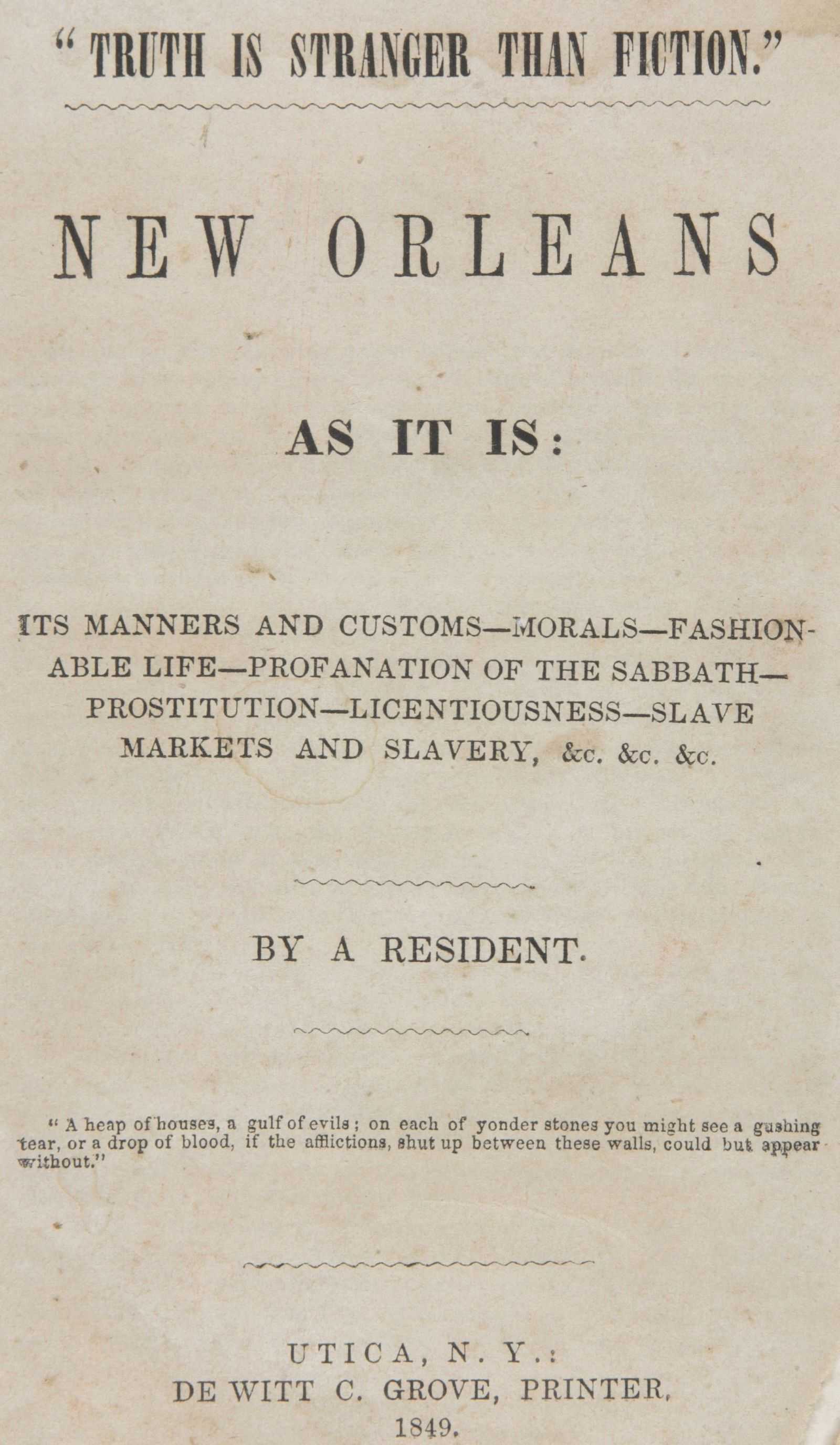
NEW ORLEANS AS IT IS. — ITS SETTLEMENT. — ITS LOCATION. — ITS HISTORY. — FIRST IMPULSE TO COMMERCIAL ENTERPRISE. — THE PURCHASE OF LOUISIANA. — STEAM NAVIGATION. — CHARACTER OF THE FIRST SETTLERS. — THE FLAT-BOATMEN. — CITY GOVERNMENT AND POLICE. — COMMON SCHOOLS. — THE LOCATION OF THE CITY. — SOURCES OF DISEASE. — WATER IN NEW ORLEANS. — POPULATION. — THE CREOLES. — SPLENDID BUILDINGS. — THE OLD SPANISH CATHEDRAL. — PUBLIC GROUNDS. — THE PLACE D’ARMES. — DWELLING HOUSES. — “GOING SOUTH TO SEEK A FORTUNE.” — THE CHURCHES. — THE SABBATH. — SOCIAL RELATIONS. — ILLEGITIMATE FAMILIES. — CONCUBINAGE. — KEPT MISTRESSES. — EXTENT OF LICENTIOUSNESS. — REGULAR PROSTITUTES. — PROSTITUTION OF WIVES. — FASHIONABLE LADIES. — AMALGAMATION. — A MAN SELLING HIS OWN CHILDREN. — SLAVE GIRLS HIRED AS BED COMPANIONS. — QUADROON GIRLS BOUGHT FOR BED COMPANIONS. — DISREGARD OF THE SABBATH. — DRINKING HOUSES. — “DANGEROUS AND SUSPICIOUS.” — VAGRANTS. — DEPOSITORIES OF THE DEAD. — SLAVERY. — APOLOGIES FOR SLAVERY. — FARE OF SLAVES ON PLANTATIONS. — WHIPPING OF SLAVES. — A WOMAN WHIPPED TO DEATH. — THE “BREAK-DOWN WHIPPINGS.” — WOMAN WHIPPING ON THE PLANTATIONS. — RESTRICTIONS UPON SLAVES. — CHAIN-GANGS OF WOMEN. — SLAVES COMPELLED TO FIND WORK. — CHIVALROUS LADIES. — SLAVE MARKET. — DEPRAVITY OF SLAVE-HOLDERS. — REFLECTIONS.
The history of New Orleans, if fully written out from its earliest
day, in connection with the first adventures and discovery of
the Mississippi Valley, would be one possessing more interest to
the people of this country, than that of almost any other portion of
the American Continent. To do this, in any degree to satisfy the inquiring
mind, is not the purpose of the author of these few pages.
The writer only designs to give a brief portrait of the breathing
mass, that fills up the great emporium of the Valley of the Mississippi.
To say that all live, in the common understanding of the
term, who spend their time there, would be to give a false coloring to
a large portion of the picture, which the reader may be assured is
true in all its lineaments. It is important, however, to the reader,
to know something of the early history of this section of the country,
as well as a general description of the city, and some things
connected with it, to be able to duly appreciate and understand,
why a life in New Orleans differs so widely from any other in the
whole range of civilization. And while standing on the Levee,
and looking over that great busy mart, where the products and
treasures of that vast region of the Mississippi Valley and its
tributaries, are constantly being poured out, it would seem that a word
could not be said of New Orleans, without requiring a full history
of its discovery, beginning of settlement, adventures of individuals
in other portions of the Valley, along the banks of this great
artery of the breathing earth, which is constantly pouring its floods
into the bosom of the ocean. As a brief sketch is demanded of the
early times of this range of our country, I shall only notice a few
things.
One among the most singular facts in the history of discoveries,
is that this mighty flood of many waters, was first met with more
than one thousand miles from its mouth. The first discoverer was
a Spaniard, by the name of De Soto. He started from the Island
of Cuba, in the year 1538, with six hundred men, landed on the
coast of Florida, passed to the North, through Georgia, Tennessee
and Kentucky, and came to the river, at the place now known as
Chickasaw Bluffs.
In passing from 1538, down to 1717, many adventurers from the
old countries, as well as from the colonies, came, and scarcely
more than roused the panther and alligator from their lairs, and
passed on, leaving them quietly to return to their repose, and there
to remain, until another should come after them in search of the
“fountain of immortal youth,” which was the object sought after
by those who first traversed this region of our country, and whom
the Indians had now made to believe there existed such a fountain,
in which, if a man should bathe, he would, even if old, return back
to the sunny days of youth, his life be without end and clothed in
immortal youth. But this glorious fountain was never realized,
yet on they came, for many years, company after company; and
most of them found a resting place, unburied, in the midst of the
swamps and desolation of a wild and unbroken wilderness.
The result of these several companies, in search of the fountain
of “living waters,” was a settlement under the patronage of the
French government, after the purchase from Spain, one at Natchez,
and one at Balize, on Lake Pontchartrain; and finally, in the year
1718, at the city of New Orleans, this Babel of all Babels, this Sodom
of all Sodoms, was commenced. And here let me ask the reader
to pause and contemplate the scenes which have been enacted
in this modern Golgotha. Turn back to the pages of its history,
although never written; yet to read it, let the imagination have its
widest range, excite it as livid as the lightning flash amid the lowering
thunder cloud; and then call up the fullest measure of human
woe, of moral degradation, of human suffering, and contemplate
the blackest rage of human passion, and all the dark and
damning deeds that the fiends of the infernal regions could perpetrate,
and you would have before you a faint moonlight picture
of the early days of New Orleans. But now, a change has come
over the drama of life, yet not in the spirit of her dreams. For
the same boiling caldron of human passion is still there, swallowing
up its victims, and as in olden times, leaving not a shred or a
remnant, to tell from whence they came or whither they have
gone.
This was New Orleans a century ago, and this is New Orleans
to-day. And notwithstanding a change is in her outward forms,
by throwing aside the bowie knife, the dirk and pistol, yet the weapons
by which destruction is now accomplished, are none the less
sure, none the less fatal. For unlike the knife and pistol, they
never maim, but strike strong and deep into the very life blood of
the victim.
The City of New Orleans is on the west bank of the river,
about ninety miles from its entrance into the Gulf of Mexico.—The
City of Lafayette has a distinct city charter, yet the increase
of New Orleans has been so rapid, for a few years past, that it has
grown up, so that by buildings they are united, and now appear
like one vast city, occupying about seven miles in length, and about
one mile in width, along the bank of the river, which, at this point,
takes a wide circle and passes to the north-east. The two cities
occupy the bend of the river, in form like the new moon, and hence
has been given it the name of the Crescent City. The valley
above and below is very level and low, and were it not for the
Levee, as it is called, would be inundated, by the overflowing of
the river, for nearly half of the year. The Levee is an embankment
of earth, thrown up from six to eight feet high, and sufficiently
broad to make an excellent road. This embankment, commences
about forty miles below the city, and on the east side of
the river extends as far up as Baton Rouge, a distance of one hundred
and forty miles. On the west side it has been necessary to
build it, with but very little interruption, up to the line of the State
of Arkansas, a distance of five hundred and fifty miles. Were it
not for this embankment, not a rod of this vast extent of country
could be cultivated. Yet it is now one of the most fertile and productive
portions of the South, and on which is grown almost the
entire crop of Sugar in Louisiana, as well as large quantity of
Cotton.
From the commencement of the city of New Orleans up to the
time of the “Seven Years War,” which is now always spoken of
as “The Old French War,” between England and France, and in
which many of our fathers participated, the province of Louisiana,
being then in possession of the French, passed through many trying
scenes; and several times barely escaped annihilation, not only
by sickness and starvation, but by well concerted plans of massacre
by the Indians who inhabited that range of country. At the
termination of the “Seven Years War,” came up a new era, upon
which soon followed those mighty developements, which to us
now in the distance appear like the work of enchantment. The
cession by France of all her rights and lands in North America to
England, except the province of Louisiana, was stipulated by the
deputies of the two governments, and the boundary line between
their possessions, in the wilds of America, was determined should
run along the middle of the Mississippi river from the gulf of Mexico,
up as far as Ibberville, thence along the centre of that river,
through Lakes Maurepas and Ponchartrain. This treaty was made
in 1763, twelve years before the war of the Revolution. Immediately
following the treaty, France ceded the entire province of
Louisiana to Spain. This act of cession, however, for certain
considerations, existing with the government of France, was not made
known until about two years after the date of the treaty. When,
the decree was first published, making, by a mere dash of the pen,
Frenchmen into Spaniards, it produced the utmost consternation
among the inhabitants of the province. The act of being thus secretly
passed into Spanish hands, with new lords and masters, and
without being consulted, or even a knowledge of the fact imparted
until long after the consummation of the matter, was too revolting
to those who had abandoned home and friends, and braved the
difficulties and dangers of the savage wilds of the Mississippi valley,
and who were as true and loyal Frenchmen as ever paid court
to Crown or King. Public meetings were called, and they resolved
as one man, not to submit to the outrage which the new order
of things would impose upon them. And they further determined,
that if they were to be thus dealt with, and finally deserted by
the Mother Country, they would endeavor, with the limited means
and power which they possessed, to commence business on their
own capital; and thus brave the displeasure of both Spain and
France. This determination they at once prepared fully to sustain.
On the arrival of the Spanish Governor, Don Ulloa, with a strong
force, in 1766, they met him at the point of the bayonet, and succeeded
in driving him off, forcing him to leave the country and return
home and lay down his commission. At this unexpected defeat
and defiance of authority, the King of Spain was highly enraged.
In consequence, however, of other troubles then on hand,
which were such as to engage his whole attention, no further attempt
was made to take possession of the province until 1769,
when the King succeeded in finding a man, with all the requisite
qualifications to undertake the work of royal vengeance, which had
been three years waiting to glut itself with the blood of Frenchmen.
The fit instrument to do this work, was a man by the name
of Don O’Reilly, a renegade Irishman, who had “left his country
for his country’s good,” to whom he gave the appointment of Governor.
To accomplish a purpose by any means within the scope of
human ingenuity, a fitter tool, or a more arch fiend, could not
be found within the compass of royal favor. He came to the citizens
of the province with fair promises of government patronage
and favor, pledging them at the same time, that he would, in a great
degree, respect the laws and regulations which they had enacted,
and retain in office a due share of the citizens. By these assurances,
impressed with so much apparent honesty, he succeeded in
prevailing upon the authorities and the people to lay aside their
arms, and meet him on the terms he proposed, and acknowledge
him as Governor. For some time he continued to respect his
pledges, and yet, while doing this, he was secretly fortifying himself,
and arranging his plans, by placing his own chosen and subservient
tools where he could at once call them out to do his bidding,
when the time should come to throw off the mask of hypocrisy.
He then assumed the power of the Dictator, made laws to
suit his own purpose, trampled under foot and disregarded written
contracts, and finally, to consummate his fiendish acts of treachery,
and to gratify the vengeance of his Spanish Master, and in defiance
of the most solemn pledges, he caused five of the principal men of
the city to be arrested, and, without trial, to be shot. Five others
he sent to the dreary dungeons of the “Moro Castle,” at Havanna,
on the Island of Cuba. These acts of outrage and vengeance,
together with violations of every assurance which he had given to
seduce the too credulous people, soon brought down upon him the
execration and abhorrence of the whole colony. The final result
was, he soon worked out his own downfall. Following the dictates
of his own inclinations, and supposing, at the same time, he
was courting royal favor, the King was forced to recall him, and
cast him off disgraced. Under his successor, a Spanish nobleman
by the name of Unzoga, who remained with the colony a short
time, the province enjoyed a short time of comparative peace and
prosperity.
This, however, was soon broken up by the war between England
and Spain, which was declared in 1779. This occasion enabled
the Governor, Don Galvez, to display his martial prowess,
by invading Florida, then in possession of the English. Without
meeting much to contend with, he took Baton Rouge, and Fort
Charlotte, which stood near where now stands the city of Mobile.
From thence he marched down upon Pensacola, which, after a long
and determined resistance, finally yielded to the Spanish arms. By
this decisive blow the laws and power of Spain were established
in Florida, and the thorough introduction of the Spanish colonial
system. This, however, was too severe a blow for the proud and
independent English and French to bear quietly, without showing
some signs of the galling nature of the yoke, which was thus being
formed upon them. Yet the impositions succeeded so well for a
time, that an attempt was made in 1785, to establish an office or
branch of the Grand Inquisition in the city of New Orleans.—Against
this assumption and scourge of despotism, the spirit of the
hitherto subservient Frenchmen took fire. They arrayed themselves
at once in the most determined hostility against it, and so
daring and fearless were they in their opposition, that it was crushed
without leading to a collision between the people and the
troops. The agent who had the authority to arrange the matter
was taken from his bed in the night, and put on shipboard, and sent
back to Spain. Thus, ere it saw the light, was strangled one of
the most hideous monsters that was ever permitted to prey upon
the lives, property, and liberty of an unoffending people. And
yet, this was to come into a city, and among a population who had
no sympathy with the power that ruled them, nor any motive for
obedience except fear and self-preservation; and what is most astonishing
in this event, is, that such a system as the Spanish Inquisition
should be attempted on this continent, in the midst of the light
and spirit of that age, ten years after the announcement to the
world of the Declaration of Independence.
Finally, after a few minor vicissitudes, through which the colony
passed, up to 1792, Baron Corondelet appeared as Governor.
Two years following his appointment, the treaty of St. Lorenzo was
entered into between the United States and Spain, by which was
granted free navigation to every kind of water craft, belonging to
the United States, through the lower waters of the Mississippi.
The effect of this treaty at once aroused a spirit of enterprise, and
gave an impetus to trade and speculation, which fixed forever the
prosperity and preeminence of the crescent city, as the great emporium
of the western world. The Spanish Governor, however, not
deeming the stipulations of the treaty of sufficient account for
his consideration, continued to exercise his authority, much to the
detriment of those who had been induced to embark in business,
as permitted by the stipulations of the treaty. This interference on
the part of the governor, did not much accord with the enterprising
spirit of that class of traders who had embarked their all upon
the waters of the Mississippi. This class of men differed widely
from those with whom the governor had hitherto been accustomed
to meet. They were schooled under different teachers than the
servile minions of Spain, or the too credulous and confiding
Frenchmen, who had long been submissive to his will. But the
“live yankee,” and such too, as constituted the boatmen of the
Mississippi, had never before crossed his path, and how to meet
them, was a task which he was not able to accomplish. The traders
from the beginning assumed a position to maintain their rights,
and this begat in the governor an impression that they were insolent
in the extreme, in daring to oppose his authority. The consequence
was, the restrictions upon the traders were more stringent
than ever; until finally, by an armed force under Andrew Elliot,
the territory was taken possession of, and the refractory governor
compelled to acknowledge the stipulations of the treaty and respect
the right of the traders. From this time until 1803, the territory
was quite prosperous, when Spain re-transferred all her rights
and interest to France.
Immediately following this treaty between France and Spain,
on the 30th of April of the same year, France sold the whole territory
to the United States, for fifteen millions of dollars. Gen.
Wilkinson was ordered to take possession of the new purchase,
which he did, amid the rejoicings of the warm hearted Frenchman,
whose love of liberty had increased as the galling yoke of
his Spanish master bore down upon his neck. To him the day
was one that he had long desired, the day for knocking off his
chains and throwing them in the face of the insolent Spaniard.—From
this hour, the riches of the Mississippi Valley were unlocked.
The march of improvement, and the swelling tide of business,
poured out her treasures into every clime, and at once determined
that this valley was the grand centre to which the extremes and every
part of the circle of this vast continent must yield their homage.
Nine years after this event was an important and memorable era
in the scenes of the Mississippi Valley; and never will it be effaced
from the memory of the thousands and tens of thousands who
lined the banks of the river to witness the crowning efforts of
genius, and the almost omnipotent power of man over matter. It
was at this time, the first steam boat was taken into the bosom of
the father of waters. Although it was but yesterday that the astonished
multitude stood amazed, yet they are still there, and are
now witnessing thousands of these floating palaces flying to and
fro, bearing upon their huge frames the productions of this vast region
of our country. In the vision of the master genius of our
land, the immortal JEFFERSON, the reality which now lays before
us, was vividly drawn up, a short time before he consummated
the purchase of Louisiana, and in the language of another it is
thus presented:
“The purchase of Louisiana is considered the greatest political
event, next to the Revolution, commemorated in American history.
The circumstance ought not to be overlooked that this mighty conquest,
exceeding in territory the greatest monarchy in Europe, was
achieved, without the guilt or calamities of blood, from a military
autocrat, whose ceaseless ambition was an universality of empire,
and who, in the untamable pursuit of his purpose, went on demolishing
nations at a blow, and partitioning the earth at pleasure, until
vanquished by the consolidated power of Europe. The mind is
lost in the magnificence of the achievement, and the vastness of its
consequences; its glories can only be commemorated in the unceasing
homage of the unborn millions who will participate of its
blessings. ‘There is no country,’ says a writer, ‘like the valley
of the Mississippi on the face of the globe. Follow the mighty
amphitheatre of rocks that nature has heaped around it. Trace
the ten thousand rivers that unite their waters in the mighty Mississippi;
count the happy millions that already crowd and animate
their banks, loading their channels with a mighty produce. Then
see the whole, bound by the hand of nature in claims which God
alone can sever, to a perpetual union at one little connecting point;
and by that point fastening itself by every tie of interest, consanguinity,
and feeling, to the remotest promontory on our Atlantic
coast. A few short years have done all this; and yet ages are now
before us: ages in which myriads are destined to multiply
throughout its wide spread territory, extending the greatness and
the happiness of our country from sea to sea. What would we
have been without the acquisition of Louisiana? what were we
before it? God and nature fixed the unalterable decree, that the nation
which held New Orleans should govern the whole of that vast
region. France, Spain, and Great Britain, had bent their envious
eyes upon it. And their intrigues, if matured, would eventually
have torn from us that vast Paradise which reposes upon the
western waters.’”
I have thus given a brief sketch of a few of the leading incidents
which tended to bring into existence and develope the resources
of this important section of our country. What makes it of
so much interest, at this time, is, that its birth and youth, and
transformation, as by magic, has been before the eyes of the present
generation. Nevertheless, they seem to pass it by as being among the
most common incidents in the life-time of every man. It is like the
idle tale of a school boy. And here it is proper to call the reader
to one important consideration, from which will readily be recognized
the causes which have produced this state of things, so peculiar
in New Orleans, and which gives a character to this city unlike
any other in the world. These causes commenced with the
beginning of the settlement, and increased by the frequent changes
which so often occurred, in the government and possession of the
territory of Louisiana. First came the French adventurer in
search of the “Fountain of Immortal Youth.” Then came the
bigoted, iron rule of the dark frowning Spaniard; and, mixed up
with these, from all parts of the world, were fugitives from justice,
disaffected politicians, and desperate adventurers of all descriptions.
At length appeared also the shrewd and ever calculating Yankee,
with a force and power to leave the unmistaken impress of his
guessing nature upon every thing that he laid his hands upon. And
finally the poor African, stolen from his native home, was brought
to mingle with the heterogeneous mass, and impress his nature and
give a shade of character upon the length and breadth, the height
and depth of every thing that has had existence in New Orleans.
This crushed and down-trodden being came in with the commencement
of the cultivation of sugar cane, in 1751. African slaves
were sent from the Island of St. Domingo, by the Jesuits, to their
brethren in New Orleans, to superintend the making of sugar.
From their first introduction, the females have been to all intents
and purposes, the wives of both the French and Spanish, and are
now the same with the Americans who have taken up their abode
here. And in this there has been no respect to color, from the
dark sooty black, down to the soft and mellow tinge of the beautiful
quadroon. Thus, it will be freely acknowledged, the African
has had no small share in impressing the peculiarities of his nature
upon the living picture of a life in New Orleans. From this heterogeneous
mass, which in the beginning was thrown suddenly and promiscuously
together, has originated a state of society differing widely
from any other part of the civilized world. And now, as at the
beginning, the Spaniard is there, with his low dark brow, concealing
deep under its arch the small keen black eye, with snake-like
language, which tells of treachery, deceit, and midnight assassination.
Here too figures the brilliant, the proud and restless Frenchman,
with all the life and animation peculiar to his nature, with his
heart constantly running off at his tongue’s end. And now, at every
turn, you meet the cool, calculating, determined emigrant from
the Northern States, who moves on, with an eye single to the “almighty
dollar.” To these may be added, within a few years past,
the warm-hearted son of the Emerald Isle, together with the cold
and ever measured tread of the plodding Dutchman. And to complete
the picture, in this mixed mass of living beings the neat and
tidy Quadroon is seen, civil, courteous, unassuming in all his manners,
yet with a down cast look, indicative of a deep realizing sense
of the damning curse that rests upon him in consequence of the
yellow tinge of his brow.
And now to be considered alone, and distinct, that nondescript
of all human demonstrations, are the “Flat Boatmen,” of the
Mississippi River. Of this class there are annually visiting the city
of New Orleans not less than ten thousand, and yet when there,
that is their home. They are, indeed, an amphibious race of beings,
living on land or water, and always enjoying the comforts of a hotel
wherever night overtakes them. They belong, however, to the
Mississippi, and are, to the length and breadth of that mighty river,
what the wild Arab is to the deserts of Arabia. Daring and fearless,
they never regard danger, as more than the common incidents
of every day life. In their composition, they present the striking
features and peculiarities of the disciplined sailor, the fearless
whaleman, and the bold and strong backwoodsman, added to all
the free and social qualities of the well educated New Englander.
And while combining, and being made up of such traits of character,
they present a class distinct, original, eccentric, and unique;
yet, with all the better attributes of the human soul cultivated to a
high degree, presenting a noble and generous nature, and as warm
a heart as ever beat in the human breast. This class of “half horse
and half alligator,” as they claim to be, have borne such a conspicuous
part in the great Valley of the Mississippi, that a better view
of their character cannot be given than the following narrative, taken
from the lips of the celebrated James Girty, a short time before
his death.
“In the year 1814, I was captain of the barge Black Snake,
belonging to the Poyntz’s at Maysville. I started with the barge,
about two-thirds loaded, for New Orleans, in the latter part of November.
When I reached the mouth of Cumberland, I found a considerable
quantity of arms belonging to the United States, which had
been despatched from Pittsburgh for the troops engaged under
General Jackson, in the defence of New Orleans. They had
been taken down thus far, depending on an engagement made
with Ben Smith of Cincinnati, under which he had contracted
to deliver them within a given time at New Orleans. The
government agent had been waiting some days for Smith, who had
not yet made his appearance; and finding an opportunity offering,
and fearing they would be needed, immediately decided to send
them by me. I made all possible despatch, and happily succeeded
in reaching New Orleans with my precious freight on the 3d
of January, 1815. Eager to have a hand in the approaching battle,
I reported myself immediately to Gen. Jackson, who gave me
the appointment of Captain, with authority to impress into service
the whole body of barge and keel-boat men in port. I entered on
the work without delay, and with great activity and success. You
know as much as I can tell you of the glorious 8th. After every
thing in the shape of a red coat had disappeared, I discharged the
remaining part of the cargo and crew, for which last I had no further
use until I could get a freight up the river, which I did not
get until the latter part of May, when I hired a crew and started
for Pittsburgh. I reached Natchez in June. It was the custom
of those days to give the hands a holiday at Natchez, one at the
mouth of the Ohio, and one also at Louisville or Shippingsport.—It
was four o’clock in the afternoon that we threw up our poles and
fastened our bowlines at Natchez. The men were eager for a
dance, and some would not wait even for their supper, scampering
off to the dance houses under the hill. I got my supper and
went up also. I looked on until 11 or 12 at night, when finding
all my entreaties to get them back to the boat unavailing, I left
them, some engaged in dancing, others betting with the gamblers
on the Roulettes, and went on board the Black Snake. As the day
dawned, all hands were also at their posts, but in a wretched plight,
many of them having their heads badly cut and bruised.
“It seems the gamblers had won all their money, and a fight ensued,
in which those gentry came off victorious. After breakfast, I
judged by the threats of the hands, and other circumstances, that
it would be advisable to get the Black Snake under way; but on
giving orders to that effect, not a man would raise a pole, until he
had had his accustomed frolic out, and I was compelled to give
way, determining in my own mind, to leave at 4 o’clock, when
the day of privilege would be out. When that hour came, it was
of no use to propose starting, none of the men would budge, until
they had obtained revenge; and they had privately agreed that
they would not assist me up any farther, if I would not go with
them and help whip the gamblers.
“I saw there was no alternative, and after supper, I repaired with
my whole crew to the dance house, armed with knives, chopping
axes and setting poles. The gamblers had expected us and were
prepared with pistols, knives, and rifles, for the fight. The
scrimmage commenced without exchanging a word. At first they gave
us hard usage, but their ammunition was soon spent, and they
gave way, bearing three of their number off who were killed in the
scuffle. One of our men was mortally wounded, who made out
to walk to the boat, where he died in half an hour. We cut cable
and crossed the Mississippi, worked the Black Snake three miles
up the river, and came to for the night. About day-light next
morning, while burying the dead man, the Sheriff of Adams county
and a posse of almost an hundred men, came up and made us
all prisoners.
“They left a man of the party in charge of the barge, and took
us all down to the ferry-boat and across to Natchez, where we
were brought before a judge and tried. No evidence being found
against any but myself and Bill Lloyd, one of my hands, the rest
of the crew were set free, while Bill and I were sent to Washington
jail; my barge was sent on, and I was detained to stay in jail
until Court, which was to sit the first Monday in October. After I
had been in jail about two weeks, one of the Associate Judges of
the Court by which I was to be tried, came out to Washington to
see me. I found in him an old Pennsylvania acquaintance, on
whom I had some claims. He gave me poor encouragement, telling
me he feared the Court would not let me out on bail. I told
him I had $2,700, which I could leave with my security. Still he
discouraged me. He said the evidence was point-blank against
me and Lloyd, but promised he would call again, ordering the jailor
to see that I did not want for anything that lay in his power to
give, and bade me good-bye. In about a week, he came again,
and told me he had succeeded in making it a bailable case of $3,000,
and had also obtained a man to go my security. The door was
opened. I gave the Judge $2,700 and the necessary security.—The
Judge advised me to leave immediately, and never show myself
in Natchez, saying he would willingly pay the $3,000, if I
would keep away. I told him I would be in Washington at the
sitting of the Court, if I lived—on this I was determined. That
afternoon I wrote a letter to a friend of mine in Natchez, who was
a woman that kept a dance-house—now living and wealthy, and of
course, respectable—requesting her to get clear of the evidence
against me. I received an answer to this next morning, assuring
me I need fear nothing; that I might make my appearance at the
proper time with perfect safety, for there would be no one present
to witness against me. I left Natchez the same day, on foot for
Pittsburgh, which I reached in the latter part of July. I lost no
time collecting money, and gathered up $1,500, and started in a
large covered skiff on my return to Natchez. This was the last
of August. My skiff had two pairs of oars, and I took three yankees
on board to work their passage as far as Cincinnati, and the
oars were plied night and day till we got there. At Cincinnati I
hired a man to help me the rest of the way down; by the time we
reached Louisville, he got tired and ran off. I went over Falls by
myself, and landed at Shippingsport in search of another hand,
and the first man that met my eye was Bill Lloyd. You may
guess my astonishment. My first words were, “Why, Bill, how
did you get out of jail?” “Oh,” said he, “it got so d—d sickly
among the thieving scoundrels in there, that the jailer was glad to
open my door to get me to take charge of the sick. I opened the
door for the rest, and all went out that could walk out, and then I
walked off to the mouth of Tennessee, and there I got a chance to
push up on that keel-boat there,” said he, pointing to it. “Well,
Bill, you need not fear anything while you are with me,” I remarked;
“I am going back to stand my trial, and I want to hire a
hand to help me down. The river is low, and if I don’t get some
good hand to help me row, I fear I shan’t get there in time.” In
short, I agreed to give Bill a dollar a day, and to let him off at
Walnut Hills: so he came on with his horn and blanket, and we
were off in a jiffy. Bill was a worthless fellow, and I knew it, but
he was a stout and good oarsman. He had not been long with
me, till he found out that my chest was heavy, and I watched him
close. When we were near the mouth of the Ohio, he became dissatisfied,
and objected to going any further towards Natchez, proposed
to go trapping up the Mississippi, insisting there could be a
great deal made on the Missouri, with other suggestions of the sort.
I paid little attention to his statements or arguments, keeping
down the Mississippi, and told him, if he wanted to stop, to do so;
as for me, I should go on to Natchez. He said no more until we
were in the bend above Beef Island, when he broke out afresh,
accusing me of suspicioning him of a wish to rob me. I told him
I was not afraid of him in any shape. A fight ensued, which I
knew must end in the death of one or the other, with the skiff and
my money for the victor’s spoils. After much struggling, I put
him overboard. I set the blade of an oar against him, shoving him
off from the skiff, then thrusting the oar to him, told him to save
his life. He made no other reply, than to clench the oar and threw
it back to me, telling me to “go to hell,” and swimming about fifty
yards, safely reached the head of Beef Island. I landed at Natchez
at one o’clock, and on the morning of the first Monday in October,
I left the skiff, and with my chest on my shoulder, walked up
to the dance-house. My friend was still up, as were several more.
I deposited my chest with her, and looking around the room, I espied
the most important witness against me. I turned to her, reminding
her of the promise she had made me. She told me she had
been trying to get rid of him all summer; that he was the only
evidence against me left in the country, and that she would yet
get him out of the way. I observed the time was short, and calling
him forward, told him I would give him five hundred dollars to
leave the place that morning, and not appear against me. He
swore there was no use to talk to him, for he had braved the worst
of the yellow fever for the purpose of remaining there and appearing
against me, and I might depend upon it, he would be on the
spot when called to testify. My friend said, never fear, all
would be right; and as I was about bidding her and witness good-bye,
proposed that we should take a gin-sling together. She mixed
one for witness, one for me, and one for herself. Having all
drank, I started for Washington, and reached there by 9 o’clock.
Being quite tired, I lay down on the door-step and directly fell
fast asleep and did not awake until the sheriff, calling the Court,
awoke me. Every body seemed astonished at my presence. My
case was the first one called. I answered to my name, and when
the judge enquired of me if I was ready for trial, my counsel did
not happen to be present, and I answered that I was as ready then
as I ever should be; that I had no evidence when I was sent to
jail, and had none now. The attorney for the State directed the
Sheriff to call his witnesses, to see if he was ready for trial, who
called 11 names in succession, not one of whom was present, but
some one answered, name by name, as they were called, what had
become of them. Some had left the country, and some had died
of the yellow fever, until the name of the one I had left in Natchez
was called, and the answer was that he had died that morning at
half past eight. There being no evidence against me, I was, of
course, discharged, and returned the same evening to Natchez. I
asked my friend what had caused the fellow’s death who was to
have been the witness. She said she supposed it was in the course
of nature, nor could I, then or afterwards, get any satisfaction
from her on this point. Next day, I called on my security, settled
my business with him, then went to my friend’s house, opened my
chest, and counted out $500 for her. She perceived what I was
doing, and told me, if I wanted to make her my enemy for life, I
could have a chance, and if I dared to offer her money, she would
blow my brains out. I made several excuses to induce her to take
the money, saying that I owed it to her honestly for her kind treatment
of me, and that I did not mean anything dishonorable by it.
She remained resolute, and said if I wanted to continue friends
with her, I must not offer her money. I then bade her good-bye,
and before dark, my chest and skiff and myself were all on the way
to New Orleans.”
For one to look upon the visage of such a man as Girty, there
would at once arise a suspicion of damning deeds, as dark and
dread as his own sun-burnt brow; yet in him was always found
an integrity of purpose, from which many in the higher walks of
life, could learn a lesson, and profit by it. In his time, thousands
of dollars’ worth of property and money were confided to his care,
and accounted for to the last farthing. Nor was he ever known to
break an engagement, or betray a trust.
And now the reader has before him all that New Orleans is to-day,
and from this mass of elements is constituted its society; and certainly,
short-sighted indeed must be any one who cannot in some
decree anticipate the leading features which would be presented
from such a mingling of the impulses of human passion, and form
some opinion of the perfect Babel of human tongues, as well as human
actions, that is found there.
There is not a city in the United States so well regulated, and so
thorough in enforcing laws and regulations, as are the authorities of
the city of New Orleans. And in no place is a person, in purse
and property, more safe, at all times of day and night, and in every
part of the city. And yet, in this respect, it is far different from
what is understood by the people of the Northern States. The impression
exists with almost every one, that to walk the streets at
night, or to be caught in the suburbs of the city, the bowie knife,
the dirk, and the pistol, will be the first thing to flash in his face;
and to escape the gang of assassins is impossible. But far from
this are the facts. Even females can walk the streets after dark
without an attendant, and be perfectly secure from insult or molestation.
The city is divided into three municipalities, each being under a
distinct and separate government. Hence, no doubt, a strife arises,
in enacting and enforcing wholesome and salutary laws, at least so
far as security for person and property are concerned. Certainly
there are fewer murders, robberies, and burglaries, according to
the population, than in any other place in the civilized world of its
size. Another very important and very salutary regulation is, the
disposition they make of vagrants. A man appearing ragged, dissipated,
and degraded, and laying about the streets, without any
visible means of support, either by labor or money, is arrested and
taken before the Recorder, and unless he can make some show for
himself, he is sentenced to the work house for sixty or ninety days,
and in all this transaction you find no low unprincipled pettifogger,
as is the case in New York, volunteer to defend him. Such an interference
by a lawyer, in New Orleans, would forever disgrace him.
After the vagrant has served his time of sentence out, you
will see him make his way out of the city, cursing the very stones
on which he treads, not even venturing to look behind him, fearing
that he may be again arrested before he can escape. The effect of
this stringent regulation is to keep the city entirely clear of this
class of day and night peculators. It is also a note of warning to
that horde of plunderers and robbers who operate on a larger scale;
for they are sure there will be no favor shown them by a pettifogging
construction of the laws, nor flaws found in the indictment,
by which he can escape against the evidence of his guilt. And in
more than this, you will find New Orleans differing from other cities.
You cannot find here a coat of mail thrown around the culprit by
the influence of money, through which the law cannot penetrate.
Neither can you find in the halls of justice, a back-door avenue by
which you can reach the jury box, or the prosecuting attorney, or
the Court. Hence the vicious are cautious how they lay their
hands on their neighbor’s property, and woe to him who invades
his neighbor’s rights, so as to fall within the meshes of the law.
These regulations and features in the government of the city are
the only wholesome rules of which it can boast, and present the
only redeeming trait in the whole frame-work of its laws, its manners
or customs, except the system of common schools.
The system of common schools is deserving of more than a passing
remark; yet what is due, in commendation of such a gem in
the midst of such a mass of corruption, cannot be allowed within
the compass of the design of these pages. Suffice, however, to
say, that it is one of the most perfect models for common school
education ever instituted, and it is to be hoped that other, and older
States, may profit by the example. The citizens of Louisiana
feel a pride in this great work, and well may they. In particular
the citizens of New Orleans should be proud of this monument of
their wisdom and benificence. Some of the municipal arrangements
of this system, are as follows. Large and commodious buildings
are erected, to which all the children of a certain district are
sent. Each school is divided into four classes, according to the
ability and knowledge of the child. When they have passed the
several departments, and been subjected to the rigid and thorough
examinations which are necessary in passing from one to the other,
and have gone through and received a diploma, they are qualified
to enter the junior class of any college in the United States. And
here the road is open to all, the poor as well as the rich, the system
forbidding any distinction, and to all classes free of expense for
every thing which the pupils require for instruction, in books,
maps, charts, and other materials, all of which are furnished by the
State.
To give the reader a correct idea of the city of New Orleans,
and the great curse to which it will ever be exposed, it is important
to know its peculiar location. The range of country along the
banks of the Mississippi, is called the coast, commencing about
forty miles below and about sixty miles from what is called the
“Balize.” This is a term signifying a sea mark, or pole elevated as
a guide for seamen, and this was done by those who first made the discovery
of the mouth of the Mississippi. No other term is now used,
but “Balize,” when going out of the river. The coast is a
narrow strip of low, flat land, from one to two miles wide, and in rear of
which, running nearly parallel with the river, is deep, dismal
swamp land, filled with legions of the most deadly, poisonous
snakes, and herds of alligators. This belt of land is perfectly level,
until it meets a ridge at “Baton Rouge,” on the east side of the river,
about one hundred and twenty-five miles above the city. The soil
is a deep black sandy alluvial, of great fertility, and seems not to
deteriorate by cultivation. This whole coast along the river is now
occupied by the sugar planter, and for nearly eight months in the
year the eye of the traveler sees nothing before him but the waving
sugar cane, presenting one unbroken livid landscape of the most
beautiful green ever beheld upon the lap of nature.
The city is located on the west bank of the river, and the wide
and graceful sweep which the river takes at this point, in crescent
shape, crowds it far back into the belt of land, leaving but a narrow
space between the river and the swamp. This swamp is several
miles wide, skirting the rear of the city the whole length, and into
this mud hole, the water and filth (what little passes off) are taken.
This boiling fountain of death is one of the most dismal, low
and horrid places, on which the light of the sun ever shone. And
yet there it lies under the influence of a tropical heat, belching up
its poison and malaria, from whence it is constantly being
swept through the city, feeding the living mass of human beings
who stand there, ready, as it were, to take down the dregs of the
seven vials of wrath, that is incessantly being poured out upon
them. Another evil is, the city, by the bend of the river, is thrown
so near the swamp that the range of land on which it stands, is
exceedingly low. Consequently, during a rain or in a wet season,
it is almost entirely under water, and always after a heavy shower,
or several days of damp wet weather. The state of the atmosphere
and heat are such that in a few hours the water in the gutters
and in the yards and vacant lots, becomes covered with a
yellow greenish scum, in which there appears to be a fermentation,
which you can distinctly hear, as you pass along the side-walk.
In connection of the swamp, is being thrown off, unceasingly,
from the whole surface, in and around the city, one dense sheet of
thick malaria. And to thicken this up, and add to its qualities, the
whole city, from one extreme to the other, is filled with the most
filthy masses of stench and corruption, that were ever suffered to
remain above ground in a community claiming to be decent or
civilized. In proof of this, go to that part of the city where you
would certainly expect neatness and order, and look for some place
to locate, to escape the steam and odor from piles of filth, and you
will find on one side or the other of almost every dwelling, a horse
stable, a mule yard, a negro pen, or piles of offals, from some lane
or alley, which have been there from time immemorial. Again,
you may look for a desirable dwelling, but none can you find,
unless on one side or the other is a miserable shanty or hovel, filled
with the most degraded human beings, either black or white. In
further proof of what New Orleans is, in this respect, the following
incident will give some idea of what is found there. In the summer
of 1847, during the rage of the yellow fever, when hundreds
were dying daily, the citizens and authorities, from some cause
which I believe has never yet been made public, and perhaps only
known to but few, got an impression, that filth and corruption
might possibly beget disease. Consequently they appointed a
committee of examination to search the city, to ascertain if any thing
could be found that would have such a tendency. In this arrangement, a
very worthy and efficient gentleman, Mr. N., was assigned to Gravior,
one of the principal streets in the second municipality. While
on his mission he went into the chamber of a house, but a few rods
in rear of the St. Charles Hotel, occupied by an Irish family, and
while conversing with the lady of the house, his attention was
attracted to another room by a noise like the grunting of swine,
yet for the moment, he concluded it could not possibly be up
chamber. The report, however, soon came again, and was so convincing
that he arose and opened the door, and to his astonishment met an old
sow nursing five pigs, which she had reared in that room, until they
were almost large enough to become gentlemen hogs. And this is
life in New Orleans. In connection with all this, every mouthful of
food a person gets on the table is a mass of poison, disease and death.
I refer now to meats, of every description. The animals of all
kinds, to supply the city, are brought down from the upper States,
bordering on the Ohio and Mississippi, in Steam Boats, and are,
generally, from ten to fifteen days on the passage. They are forced
into a change in food, water and other circumstances, during the
passage. They eat but very little, and when they arrive in the
city, are in a state of starvation; and in this condition are killed,
and taken into the markets. Now this meat is as improper for the
table as if the animal had died of ship fever; for the whole body is
in a state of feverish inflammation, produced by the change of diet
and the starving condition in which the animal is when killed.
Consequently, the meat must produce a deleterious influence upon
the health of those who eat it.
To present clearly, the condition that meats are in, when taken
into the markets, the following facts are given. The Steamer
Dove, in her trip to New Orleans, in Oct. 1848, was completely
covered on her deck with coops full of chickens, as thick as could
be crowded in, amounting to several thousand. The passage was
long and tedious. For two days after being taken on board, the
poultry began to sicken and die. The number dying daily increased,
and for two or three days, before we arrived in the city,
a large number died. On arriving, those living were immediately
sold, and the next day, many of them were on the tables of the
Hotels and boarding houses. Now if these chickens were wholesome,
and proper food to be eaten, and would promote “health and
long LIFE,” then may we look for health in consuming
the pent up damps and vapors of the dungeon or an emigrant ship. It is
also in almost a putrid condition that butter and preserved meats
are received, and they both have generally a rancid and forbidding
taste and smell. Vegetables may be classed with other things, for
they are usually produced by a forced growth; consequently, cannot
become healthy and vigorous plants.
And now comes the water, and while I am writing, before me
stands a tumbler of as pure water as was ever thrown from the bosom
of the earth; hence those who have been in New Orleans,
can fully realize that I can well appreciate the contrast. To dig
a well and procure water in New Orleans, is a very easy matter;
for you would have it, for more than two thirds of the time, even
with the surface of the ground, and never, in the dryest time,
more than a foot below. To drink freely of this water, no person
would probably live but a short time. To furnish a supply of water
for dwellings, every house has a cistern, from ten to fifteen feet
high, standing above ground, for rain water. This water is used
for drinking, cooking, and washing. Standing as this cistern does,
exposed to the heat of the sun, the water becomes exceedingly
warm, and always has a brackish, insipid taste. Another supply
of water, to those who prefer it, is from the river. It is taken
through the main part of the city in pipes, and this is the most disgusting
and loathsome beverage, that a person ever put to his lips.
To have some proper conception of this water, for drink, call to
mind the filth from cities, towns, and villages, for an extent of two
thousand miles, together with the dregs that are constantly being
poured off from ten thousand boats of every class, from the floating
palace of the magnificent “Autocrat,” down to the shabby coal
carriers of the Monongahela, which are constantly floating upon its
surface. And then look at the dirty gurgling mass, as it rolls along,
and constantly boiling up from the bottom: dip up a tumbler full,
each of which is thick with what you may call “mud,” if you
please, and each glass-full will have at least, when left to settle, a
tea spoon full of this “delicious” mud; and I am sure, it being so
well mixed, that no other “mud” can be found as rich as this.
Yet those who live here, along the range of the Mississippi,
drink it, and say they “like it.” But one thing is as certain as
any cause and effect, that a more frightful source of disease does
not exist in the Mississippi Valley, than the use of the river water
for drink. As evidence of this, is the change it produces with almost
every person when he commences taking it. The effect is
a very powerful alterative influence upon the system, terminating
as thorough as the most drastic cathartic. This derangement,
in a majority of cases, follows with great obstinacy for weeks, and
often months, baffling all remedies. The effect is a great irritation
of the mucous coat of the stomach and alimentary canal, resulting
in extreme prostration of the physical powers, and a general derangement
of the whole system; thus rendering it an easy prey to the
various diseases peculiar to a hot southern climate. Now,
all these causes, and all the circumstances by which the inhabitants
of New Orleans are surrounded, together with the excessive
dissipation, in every manner prompted by human passion,
make that city, as it truly is, “one great charnel house.”—Although
there are periods when New Orleans is called “very healthy;”
yet that time is, when the Yellow “Jack,” the Cholera,
or “Danza,” is not sweeping the inhabitants off by scores every
day. At all other times, while the mortality is three times as
great as any other city of its size, with corresponding sickness,
yet you will then hear, that it is “exceedingly healthy.” But
notwithstanding all these reports, New Orleans never can be healthy.
As well could health be enjoyed while living upon the adder’s
breath, or breathing the odor from the deadly Upas tree.
The population of New Orleans is about one hundred thousand,
and this includes that portion who reside there during the fall and
winter months. The number who may be regarded as residents,
according to the proper understanding of what constitutes a residence,
will probably not exceed sixty or seventy thousand. There
is doubtless, every winter, a transient population of thirty or forty
thousand, who spend from six to eight months in the city, and as
soon as the warm season commences, take their departure in
swarms, as regular as wild geese do from the North on the first
appearance of a flake of snow. But on the return of cold weather
they are not all of them found to return; for, as a general thing,
a large majority get enough of New Orleans in one season. And
separate from the Creole population, or that portion who are descendants
of the first settlers, the French and Spanish, I do not think
there is one in twenty of the residents of New Orleans, men who
are now in business, who design to spend their days in the City.
They are now, however, engaged in a routine of business that fixes
them there for a time; yet they are firmly resolved, at no distant
day, to seek another home. But before that time will be determined
upon, by many who are now moving in the busy scenes of that
fated City, they will be taken to a house and a resting place that
will be more certain and unchanging than the bed of that mighty
river which will forever pour its immense flood into the bosom of
the Ocean. To the man of middle life, when he begins to turn the
“descending scale,” and the warm current of his youthful blood
begins to cool, and run sluggish through the channels of life, and
before the bright visions of his fancy begin to flit the dark clouds of
the uncertain future, to such a man will New Orleans present no
charms, and the longer he remains there, will its varied and blighting
realities appear more and more desolating. The Creole population
know no other home, and consequently have nothing before
them from which to make a comparison that will enable them to appreciate
a higher and better state of existence. Hence they will
always be found there. But to the adventurer, he who has
come in from the Northern States, and whose early life is filled
up with the impressions of the pure and wholesome associations of
a well educated, refined and moral people, this City presents nothing
that can call up the pleasing and delightful scenes of his early
days, but the contrast is calculated to beget an insatiable hankering
for his early home.
The Creole population of New Orleans are a peculiar and singular
people. And here it is proper to explain who are recognized
as Creoles, for I find, that almost without exception, every person
of the North understands the term, Creole, to mean that portion
of the inhabitants who are, more or less, shaded with African
blood; and in short, the impression is, that when you speak of them
you are speaking of those called Quadroons. Yet they believe
that in this class are included those of a much darker shade than the
yellow persons or mulattoes who come strictly within the class of
quarter-blooded Africans or Quadroons. The term Creole simply
means native born. The Creoles are principally descendants of the
French and Spanish settlers. They are exceedingly genteel, civil
and courteous, and in all the embellishments that adorn the gentleman
and lady, they excel, and in all their articles of dress they exhibit
a degree of taste and perfection in arrangement, that makes
them easily recognized in the common walks of life as well as in
the promiscuous assembly. And yet they are strongly attached to
the footsteps and ways of their fathers, and are exceedingly cautious
in preserving their identity, and consequently do not desire to become
familiar with the manners and custom of those “Goths and
Vandals,” who have come down upon them from the North. This
portion of the population of New Orleans reside principally in the
first municipality, which is now the center of the City. The second
municipality, or American part, as it is termed, is above, and the
third is below. In the third, the inhabitants are a mixed mass, of
all nations, kindreds, people, and tongues. The Creoles being thus
hemmed in, are gradually yielding and giving way to the superior
energy and force of character and adaptation to business of those
who surround them, and have given tone and vigor to every thing
of a business nature in New Orleans. Hence, the Creole reads in
the future his destiny, and is compelled to reflect that what he now
looks upon as Vandalism, will ere long crush every thing of his
name and character in the dust. This foreshadowing of his doom
makes him jealous of his more busy neighbors, and oftentimes, in
view of the change that is going on like magic before him, he becomes
exceedingly captious, and thus forbids himself to become
social with his Yankee neighbors. But the immutable laws of population
which will ever make the weak give room for the strong,
force of character, influence and power of change in associations,
the ingenuity and adaptation to business of those who surround
them, and who already begin to mark them as their prey, will take
every thing from their hands, and leave them in the shades of oblivion,
only to be found by the cold and speechless marble that
marks their final resting place.
Of costly and splendid buildings in New Orleans, there are but
very few worthy of note. The St. Charles Hotel, however, presents
the proudest monument of that city, and of buildings of that
character it stands unrivalled, and without a comparison in the
world. This magnificent establishment, in size and beauty, in its
external appearance, and architectural designs, impresses upon the
beholder that sublimity and grandeur, which perfection in the science
of architecture is ever calculated to produce. The most casual
observer, when unconsciously brought to view this speaking
monument, feels an awe stealing over him, which at once charms
him into the stillness of a statue; and he stands a silent gazer upon
that tongueless yet speaking mass before him. There are other
buildings in our country that are costly and magnificent in structure;
yet in comparison to the St. Charles Hotel they fail in that
speaking eloquence which it is the power of perfection in the science
of architecture to display.
This immense structure was commenced in the spring of 1835
by an incorporated company, and was completed in three years.—The
entire cost of the building was between five and six hundred
thousand dollars. The front, on St. Charles Street, as viewed in
passing down, presents a projecting portico of six Corinthian columns,
standing on a granite basement, and four similar columns, on
each side of the portico, ranging with the front wall of the centre
part of the building. Behind these four columns is an open space,
one hundred and forty feet long, covered with large granite slabs,
thus affording a wide and extensive range for promenading. The
entrance to the bar-room is on the front of the portico, in the
basement, on each side of which is a range of stores in front. It
occupies the centre of the main building, and is octangular, or eight
square, and is seventy feet in diameter and twenty feet high. To
support the floor above, is a range of heavy Ionic columns, in a circle
round the room. In rear of this is a bathing establishment,
consisting of fourteen rooms, perfectly arranged, and adapted to
warm or cold baths. In the basement also are the wine and liquor
cellars, store house, and other domestic apartments, necessary for
such an immense establishment. The saloon, or reception room,
for gentlemen, in which also is the office, is directly over the bar-room,
and of equal size. In the centre of this room commences a
winding stair-case, that leads through the upper stories to the
dome. As it ascends up, in each story, around the stair way, is a
space or gallery, that leads into a suite of bed rooms. The gentlemen’s
dining room is one hundred and twenty feet long, fifty wide,
and twenty-two feet high, beautifully finished in the Corinthian order
of architecture. The floor above is supported by two rows of columns,
arranged so as to give space for four tables, through the
whole length of the rooms. The ladies’ dining room is in another
part of the building, entirely separate, and is fifty two feet long and
thirty six wide. The angle in front, and to the right of the portico,
is the ladies drawing room, and is forty feet long and thirty two
wide. The gentlemen’s sitting room is also in front, on the opposite
side of the building, to the left of the portico. It is thirty eight
feet square. There are, in the whole establishment, three hundred
and fifty-two rooms, besides nine private parlors, with bedrooms
adjoining. These rooms, throughout the whole building, are
furnished with a taste and elegance, unsurpassed by any other Hotel
in this or any other country. To complete and perfect this
magnificent structure, a dome, in diameter and heighth, surmounts
the centre of the building, that appears so perfectly in harmony
with all the other parts, that to add to or diminish it would seem to
destroy every line of beauty, which is now so richly displayed.—And
yet to finish and fill up the conceptions of the imagination,
on the top of this dome, away in the dizzy height, is a beautiful
Corinthian turret, that keeps up, in its proportion, the image of
perfection, that looks out from every part of this unrivalled specimen
of architecture. The dome is fifty-six feet in diameter, and
around this, at a distance of eleven feet, is a range of columns that
support the projecting cap of the dome, thus making a beautiful gallery
for promenade, from whence the eye can range at a glance
over the whole city, and trace in the far distance the windings of
the rushing tide of many waters that lays before it.
The influence that this vast and magnificent structure has upon
every one, is such that it places every other building in New Orleans
so far in the back ground, that they will not receive even a
passing notice. The St. Louis Hotel, however, is a building of
much elegance and taste, yet presenting nothing remarkable to attract
the attention of the passer by, except its immense size and
the space it occupies. It fills the entire block, between Royal and
Chartre Street, fronting on St. Louis, three hundred and ten feet,
and on Royal and Chartre, in width, one hundred and twenty.—The
original design of this immense building, was for a City Exchange,
a Bank and Stores, a Hotel, and a large dancing room, in
imitation of the Saloons of Paris. For a Hotel, the arrangements
for such are, perhaps, the most complete and perfect of any other in
the world; yet it has failed in every particular in being sustained,
and this is in consequence of its location, being in the first
municipality, or the French part of the city. Hence it can never become
the resort of business men, or him who comes in for pasttime or
pleasure. The determination of every thing in New Orleans is in
another direction, and nothing hereafter will succeed unless it
comes within the range of the American part of the City,—the second
municipality. It is of no use to try in any other part, for “Capt.
Scott” is there, and they may as well “give in” and “come down,”
first as last, for they will surely be killed, if they don’t. There are
no other buildings of note, or any that will rank with the common
average in cities generally.
Perhaps, however, as an exception to this, may be considered the
“Old Spanish Cathedral,” or Church of St. Louis. It stands in the
centre of the “Crescent” and also of the City, overlooking the
“Place d’Armes” or Parade Square. This unique and singular
structure forcibly impresses the stranger by its ancient and venerable
appearance, and is calculated to excite in the beholder, suspicion,
that within its cold and gloomy walls have been perpetrated,
dark and damning deeds, on which will dawn no light, until
that time shall come when the crimes which have been committed
within pent up walls, and in the dark haunts of vice, and under
the fall of midnight, shall be spread out upon the long scroll that
eternity has been rolling up. But the suspicion, that wrong or an
impious act has been done within these consecrated doors, or within
view of those sacred altars, would be sacrilege indeed, although
it has stood here for more than half a century, and is now
bearing upon its floor the footprints of three generations who have
daily assembled here, and bowed in humble reverence and adoration
before the image of their Savior. Yet could it reveal and unfold
the records of the “confessional,” what tales of bleeding penitence—what
strange and incomprehensible impulses of the human heart,
would here be developed. But all these things are locked
in the silent chambers of death, and rest with that venerable old
man, Pere Antonio de Sedella, who was Curate of the parish for
nearly fifty years. His image will live in the memory of succeeding
generations, for the story of his virtues and the overflowings of
his warm and generous heart will be told by the happy recipients
of his favors, and impressed upon the records of every age. He
was gathered to the home of his fathers in 1837, in the fullness of
days, at the age of ninety years. His remains were deposited
within these sacred walls, and lie buried at the foot of the altar
where for half a century he daily knelt, presenting the case of
some wayward and wandering child, who had poured into his ear,
confessing the deeds and errors of the carnal heart, beseeching him,
in the spirit of true penitence, to ask for mercy at the throne of
grace.
Of public grounds, or places for promenade, there are none in
New Orleans, and yet in no place in this country could beautiful
walks and promenade grounds be made so enchanting as in that
city. The climate and soil are such that every thing necessary to
make such places desirable, and even charming, would come up, as
by magic, if a beginning was only made. But as yet there has
scarcely been a “picayune” devoted for any thing of this purpose.
There are, however, inclosures of considerable extent, which no
doubt were designed for this purpose. One of these is the “Place
d’Armes,” inclosing about six acres of ground by a strong and well
constructed iron fence. Although this place has long been noted,
yet it is without ornament of any description, and has no attractions
at any time, except on every Sabbath day, when it is filled with
the military of the city, who assemble here, under their respective
officers, for inspection and review. This is also the place of reception
for distinguished men, on all occasions of public demonstration
in their behalf. And it was here, within this inclosure, four days
after the “battle of New Orleans,” that General Jackson assembled
the heroes of the 8th of January, and bade them farewell. And
yet below, and in full view of this place, which on that memorable
day, to all human conception, was a doomed city, to be given up to
rapine and robbery, lay the “Plains of Chalmetta,” the “Battle
ground,” the Waterloo of America, that field of glory and of arms,
and not a stone, or a memento, meets the eye of the passer by, to
tell where our brave soldiers, with their hearts on their bayonets,
fought against such fearful odds, and the deeds of noble daring of
those fathers and brothers, who there faced the cannon’s mouth,
to save their homes, their wives and daughters, their mothers and
sisters, from the grasp of an infuriated and brutal soldiery. But
here, within the “Place d’Armes,” and in the very place, is fixed a
stone, about eighteen inches square, where stood that “iron nerved
old man,” and like an “infant wept,” when he received the warm
grasp, and bade each soldier adieu, as the long line in single file
passed before him. The stone is fixed deep in the ground, and is a
“silent and impressive lecturer” on the records of the past; yet it
is here simply as a memento of the footprints of the savior of his
country. And here too, again and again, has the soldier, the statesman,
and the civilian, met the warm embrace, and received the gratitude
of the grey-haired old man, the mother, the son and daughter,
presenting a monument more splendid and magnificent and enduring,
than the lofty structure of granite or marble.
Of this somewhat interesting place, I cannot present a more
graphic description, than the following, from a New Orleans paper.
What a queer neighborhood is that in the immediate vicinity of
the Place d’Armes, in the First Municipality! A stranger can
scarce realize that he is in an American city, so foreign an air pervades
the vicinage. There one beholds the time-worn buildings of
the old Spanish architects of the last century, crumbling and mouldering
slowly away. In a few short years they will be numbered
among the things which were, and in their places will soon spring
up smart rows of brand new brick buildings, rejoicing in all the
freshness of newly moulded clay and coatings of bright fresh paint,
looking as if age could never creep on them and sap their foundations,
loosen the mortar, rot the heavy beams and joists, cause great
chinks and cracks to open in the walls and the roof, letting the rain
and wind in to assist in the work of ruin and decay. Even the old
Place d’Armes itself has a queer, ancient, foreign look. The tall
and aged sycamores, with the brown bark peeled off in great blotches
from their trunks, leaving white-bald places; the dead and crackling
branches, the dying leaves, changed by the approach of winter,
but still clinging pertinaciously to the parent stock as if loth to fall
and perish, seem to moan and mourn as the wind whistles through
them, at the desolation which has crept into that old square. Where
are its trim well-kept walks, where its neat benches, on which
many a lover has uttered his devotion to his mistress and received
from her lips his judgment? Where those gay promenaders, full
of life and hope, uttering soft nothings and prattling in foreign
tongues of la Belle France, or of deeds in old Spain! Where those
children, rosy cheeked and cherry lipped, lightly bounding over the
smooth grass and indulging in the pure and innocent sports of childhood,
known only to that happy state of existence? Generations
have slipped away while those old trees have been growing there—death
has gathered them in by scores, and the cemeteries still tell
the time when they retired to their quiet homes from the cares of
the world forever. Bright wreaths of gay flowers sometimes may
be seen upon the final receptacles of some of those old frequenters;
evergreens growing around their graves, wetted by the tears of
those in whose breasts the memory of the departed dwells ever.
Where is the little fountain that once spouted so gaily in the centre
of the square? where those funny, finny little denizens of the basin,
in whose sportiveness the children took so much delight? Fish or
fountain exist no longer; the little dolphins who never wagged their
little tails, and who kept continually blowing little jets of water
from their mouths—the plaster naiads, who watched over all, with
a perpetual smile upon their lips, are gone also. The basin is filled
up, and the next generation can only learn that there was once a
fountain there! There is one old relic left yet—the black old gun
which has bellowed forth from its great round throat a command to
all blacks to get home as soon as possible, night after night, for
many a long year. There stands the stout and hale old fellow yet,
with iron constitution, affected but slightly by the hand of Time,
and looking like some weather-beaten old veteran of the wars, who
has been banged about a good deal, stood fire in frequent campaigns,
but is still as rough and tough as the best youngster in the service.
Then there is the old cathedral, with its old towers and turrets
frowning—all old places are by special poetical license invested with
the power of frowning—over all, flanked on each side by the Court
House and Municipal Hall, built in the olden time, and though furbished
up, and whitewashed, and painted, still bearing the date of
their origin upon them as plainly as the black looking ancient Cathedral.
Those bells, too, in what time they first tolled a knell or
rang for the quiet rest of some departed soul we cannot now tell.
For many a year they have been cracked, but still are made to
perform their office morning, noon and night, in obedience to the
will of the founder of the Cathedral. No ghosts would infest those
belfries or their neighborhood. In front stand a string of crazy old
hacks and cabs, jingling jarvies and barouches, built long and long
ago; the horses have a dejected air, and exhibit many points of a
character which would indicate that they subsisted, like chameleons,
upon very thin air, or dragged on a miserable existence in hopes of
better days, living upon the force of imagination merely. You will
be told, though, that these nags, “rum ’uns to look at though they
be,” are “reg’lar good ’uns to go.” The drivers are mostly
negroes who indulge in bad French and drink root beer at the
stand of the fat old black woman at the corner. On one side of the
square we have drinking houses, cafes and restaurants—scarce
any thing else. The corner is the resort of all the inhabitants of the
region, a well kept place, where persons can indulge in dominoes, strong
cafe and all sorts of drinks from orange flower water and eau
sucre up to Cogniac. Every afternoon it is thronged, and a babel like
confusion prevails from the mixture of languages, French, Spanish, German,
Italian and English. In the same row of buildings is the well known Cafe
de Quatre Saisons, and Victor’s restaurant, one of the crack
places of resort in the city, where bon vivants and epicures
have a decided propensity to congregate. On the opposite side is the
queerest combination of trades. Here is a depot of the fruits of Pomona,
with stacks of apples, piles of oranges, strings of bananas, baskets of
pecans, walnuts and shell-barks; little monuments of guava jelly and
pyramids of cocoa nuts, piled up like cannon balls. Presiding over all is a
stout, olive colored Spaniard, in a striped guernsey shirt and fur cap—he
is the deputy of the goddess, handles her luscious offerings and pockets
the proceeds. Side by side with this is a hardware store, with
long-legged spiders, and griddles, and sprawling gridirons; podgy,
apopleptic looking iron pots and wide-mouthed copper kettles;
casks of spike, coils of wire, shelves of knives and forks; packages
of locks and bolts and bars and hooks, mute commentators upon
the dishonesty of mankind. Then comes another fruit depot, another
and another, all looking exactly alike, arranged the same and
all attended by individuals of the same pattern. Hardware, perishable
fruits and spirits are the commodities exclusively dealt in in
this row. How the second story is occupied no one can say. The
balcony railings are usually hung with damp and dingy looking
clothes, sheets, towels, stockings, gowns, pants, and vests. Broken
flower pots with starvling rose bushes and blighted geraniums,
dragging out a miserable existence, may occasionally be seen, and
pale, attenuated females with uncombed hair and drabbled dresses,
deluging them with soap suds. An old man sometimes smokes
his short clay pipe moodily, silent and alone, leaning over the balcony
and listlessly watching the passers-by; and now and then a
child will clamber upon the railings and terrify the beholder by
demonstrations of descending head foremost to the pavement below.
The inhabitants by day are few, but at night the place swarms—it
is alive. Fiddles, flutes, tamborines, grinding organs are going it
at a great rate; busy feet are toeing and heeling it, but whereaway
it is hard to tell. The sounds issue through the chinks of the
window shutters, creep out beneath the doors, curl out of the chimney
tops with the smoke; a strange jumble of queer sounds, half
expressed notes, abridged cachinations, bits of German glees,
replete with consonants melodiously uttered, pervades the atmosphere
with the indistinctness of a dream, till the Cathedral clock
sonorously peals forth the hour of 12. Then the noise which has
been gradually growing less and less distinct, suddenly subsides
entirely—the lights fade away and the quiet of the night is disturbed
no more.
The dwelling houses in New Orleans, at least seven-tenths of
them, are the most miserable apologies for the comfort and convenience
of a family that can be imagined, and there are but very
few modern built, and well arranged, and completed, with a view
to make a house desirable for a residence. The reason for this,
doubtless, is the excessively high price for building lots; and the
enormous expense of building obliges those who build, to erect as
cheap buildings as possible. A house designed for renting, also, is
built as cheap as can be done, for such an one will command nearly
as much rent as the most splendid mansion, if it has equally as
much room and as favorable location. Hence you will find, in
every part of the city, in the best locations, the miserable old Spanish
house, only one story high, renting from eight to twelve hundred
dollars a year, and the building is not worth twenty dollars. And
yet these buildings will remain where they are until swept away,
either by fire or water. The excessively high price of rents for buildings,
for any purpose, together with the enormous expense of living,
will very much retard the rapid improvement, and permanent
advancement of New Orleans.
The impression prevails very generally, in almost every section
of this country, that wealth can be accumulated with great ease, and
quite rapidly here, and this has caused a great excess of business
men, and much competition. Consequently profits are small, and
but very few make annually more than enough to meet expenses,
and many very soon become satisfied with the experiment of
“going South” to make a fortune. You will not, therefore, find
but very few “old merchants,” in New Orleans. And with this
view also, “to seek their fortunes,” will you find hundreds of young
men, in the fall of the year, wending their way South, to look up
a way of business for themselves, and yet not one in every fifty
obtain employment, or meet with any thing to do. I have seen
many such come into New Orleans, with letters of introduction
and recommendation of the highest character, and failing to get
business, and too proud to return home, and being on expense, and
without any income, would soon spend all their means in hand,
and finally, from necessity as it were, would drop into the floods
and whirlpools of dissipation, and be taken as straitway down to
ruin and destruction, as if they were forced by the irresistible laws
of gravitation. I have also watched the bright hopes and cheerful
countenance of many a young man when he first looked in upon
the wild and animating scenes which are here presented. He feels
at once a new impulse stealing over him, and the bright visions of
his fancy, which have led him on, he imagines will be more than
realized, for the substance and the life before him he
believes to be real, and in which he will soon participate. But little does
he dream that all he witnesses is as false and groundless as the baseless
fabric of his own wild fancy. I have thus followed him, a few
short months, moving among the busy throng that fill up these
streets, and finally night after night have left him in the low roofless
hovel, feeding at the table with the most miserable and degraded
herd of Slaves in human form. This is no sketch of scenes drawn
out in vivid colors of fancy, for it is stern, living reality, and language
contains no power to embellish them, for they are before you,
in the history of thousands, who have been buried here, and gone
down to a premature grave. And here let me say to the young
man of the north, if you should have a desire, or an idea come up,
of “going South,” check it at once,—crush the thought, ere it
brings before you treasures of a golden harvest, which you may
imagine is in store for you there; for let me assure you that the
day has long since passed when fortunes can be easily gathered at
the “South,” or in New Orleans; and no other place in this
widespread country can be found, where so few realize the anticipations
which urge them on to engage in the pursuits and business of the
day and when the hour of trial comes, and blasted hopes gather
thick around, so many sink away into the vortex of irretrievable
ruin, and if ever known again it is amid the scenes of vice and
dissipation, herding with vagabonds and gamblers. And this is the
fate of hundreds of the business men of New Orleans. And this
too is no fancy sketch, but the reality of every day life. And yet
these men are worthy of a better fate.
Of the churches in this city, not including those of the Roman
order, and the influence of professing christians, there cannot be
much said in their favor; yet there has been something done by
them, and some influence of a favorable tendency has been quietly
and slowly working, which in some degree checks the wild rage of
human passion, or at least has driven it back from the public
view, and to a great extent from the light of day. And the reason,
doubtless, why more has not been done, and why a more salutary
influence is not produced by religious efforts, is that the christian
standard is as much below the Bible requirements of christian life, as
the moral standard is degraded below that point which justly forbids
almost every man a character for morality. Hence, when the
christian standard falls far below, as it does here, the ordinary
estimation of a moral life, it cannot be expected that the influence
of professing christians of such a grade, can be very forcible or of
much avail. And I apprehend that nothing will ever be done here
to crush those monster evils that stalk through these streets at midday,
and to indulge and participate in which is not unbecoming a
gentleman, a good citizen, a moral man, and a
christian, unless it is by raising up a proper moral standard, by
which men shall be tested who are to be the recipients of patronage and
public favor. This, however, would look like a hard beginning, for some
one would be called upon “to throw the first stone.” And I fear echo
would answer, Where is he?
There are a number of Churches in the City, and many of them
of recent organization. The Episcopalians have five, Presbyterians
three, Methodists two, Baptists one, Universalists one. The Clergymen
who officiate in them are generally men of distinguished
talent and ability, and the morning service, on the Sabbath, is usually
well attended. In the afternoon the audience is very small,
consisting only of a small portion even of the members. No
Church could be well sustained in New Orleans, with a second rate
preacher. They must be men of popular talent, of forcible and
attractive eloquence, and withal not very close preachers. Hence
the influence of preaching and of Christian teaching is superficial
indeed. The principal cause, and doubtless, the great obstacle
in the christian and moral standard of New Orleans, is the total
disregard and desecration of the Sabbath. Not only is this done
by professed christians, but by those who have been differently
educated and early impressed with the benefits and wholesome
and salutary influence produced by a due observance of this day.
The Sabbath appears to be regarded by almost every one as a
holiday, and its return is as much desired for a day of pleasure, as
if no other day was appropriate for such purposes. Military Parades
are never on any other day but the Sabbath. Horse racing,
when a large purse is at stake on the most famous races, are on
the Sabbath. Theatres and circuses have the most attractive bills
and greatest display on Sabbath evening. Bull fights also are never
on any other day, and in fact, exhibitions of every kind are usually
on the Sabbath. And yet, in this enlightened age and against the
good sense and judgment of every other section of this country,
and in full view of the evils that flow from these examples, the
authorities grant permits and licenses for these things, and men in
the highest official stations in the State and city favor them by
their presence on the Sabbath. And also, against these outrages
and other evils that are begotten by them, the pulpit is as silent as
if they were in accordance with the rituals of the church. And
more than this, will you be astonished to see, not only good men,
but professing christians, mingling in the crowded throng that keep
up these rounds of moral pollution and dissipation. But in all these
evils the authorities are chargeable with more censure than all others,
for they have the power to prevent and suppress entirely these
blighting curses that pervade this city. But compared with other
causes that seek no hiding place, amidst the whirlwind and rage of
human passion that lays desolate every refined and noble impulse
of the human heart, the desecration of the Sabbath is but as the
breath of the summer breeze, compared to the tornado’s blast.
The social relations of the great mass of the citizens of New
Orleans are peculiar, and doubtless unlike any other place within
the wide range of civilization. And the principles by which the
intercourse in society is regulated, are strange indeed; especially
to those who have been educated and taught to believe there is some
meaning and worth in virtue and chastity, and that licentiousness,
fornication, and adultery are crimes, if not in the sight of heaven,
at least should be so considered in a moral point of view, as well
as against the sacredness of the domestic circle and peace of society.
But here these evils, together with the outrages of prostitution,
appear to be regarded as matters that come as much within the
routine of the social relations, and the open and unrestricted indulgence
of the citizens, as a general thing, as any of the common
civilities of life. Hence, to be openly known in the practice of
these vices—as a libertine, or living in adultery, or as an excessively
licentious man, does not degrade him, or make him the less
favored or less respectable. In fact, there appears to be no such
condition known here as adultery, fornication, or prostitution; and
I doubt very much whether they have any such words in their
Dictionary. To the man who is notoriously of this description it
appears to give a force of character, and a degree of consequence,
that commands respect and deference, that makes him the beau
ideal of a fine fellow and a gentleman. The light in which these
things are regarded here, and the present practice in respect to
them, at an earlier day than this, would have surprised any one,
but considering the character of the early settlers, it would perhaps
be remarkable indeed if this had not been exhibited; for those
who first came into New Orleans were mere adventurers, without
attachments to home or place, and many of them without social
relations or even kindred. Consequently they were creatures of
circumstance, and while mingling in the varied scenes of the Mississippi
valley, it would be strange indeed if they should not have
met with females of the same class, and to whom they would become
attached as companions. To presume otherwise would be to
conclude against the experience of every age, as well as against
the natural impulses of the human heart.
There are hundreds of men and women now living together,
who have around them large families, and yet were never married.
Connections of this kind exist in New Orleans to a much greater
extent than is generally known. As evidence on this point, a very
worthy and intelligent lady living in the Third Municipality informed
me that a Methodist minister accidentally left at her house his
book of record for marriages, which the law now requires every
clergyman to keep. In looking it through, she found that he had
married within the last two years thirty-three of her neighbors,
heads of families, and many of them having children that were
married, who had been living together as man and wife, and as
such every one regarded them. They had been privately married
to enable the children to inherit their property, as a law in Louisiana
has been enacted with a view to meet these very cases.
There is also another condition in the social relations, that but
very few individuals could reconcile themselves to sustain. It is
in supporting and having two families. There are a large number
of business men from the North—captains and officers of Steam
Boats, and captains of French, English, and American vessels—who
spend more than half the time in this city, and many of them
have families at home; yet here they have their mistresses and
children, and are as much at home with them as with their lawful
wives. The condition and connection of these persons together are
perfectly understood, as is also the fact, with most of them, that
they have another family. Yet these things are not often made a
matter of others’ business, and consequently they are all “very
respectable.” This class of females, to some extent, live as confidingly
honest, and as strictly preserve the character of a wife, as
if the man had no other attachments. And any act on her part of
infidelity would be regarded as a sufficient cause of separation, and
she would be discarded as readily as if they were lawfully married.
Such separations often occur from jealousy, or from suspicion of
attachment to another. And when a separation has actually been
made, the parties appear more hostile, and manifest a more deadly
hatred towards each other, than is ever witnessed in separations of
those lawfully connected. And these quarrels are seldom if ever
reconciled, but continue to increase with a savage hatred, that not
unfrequently ends sadly to the one or the other, or to the individual
who has seduced the woman from her alliance. These men who
thus live in these connections are generally persons of ample means,
and usually appear to be proud of the distinction of being able to
support two families.
There is another class of individuals here who have not the
means to support two families. They are usually men engaged in
the same business with the others, and required to be absent from
the city nearly half of the time. These men have their mistresses,
either white or colored, with whom they live as companions.
And the regulations of these connections are that while the man is
in the city, the house which the woman occupies is their home,
jointly and as distinctly as if they were married; and when he is
absent, the women seeks other companions, for the time being, and
in doing this does not hazard the displeasure of “her husband,” as
she calls him. By this liberty that she has of seeking promiscuous
company, and the assistance she gets from “her man,” she is able
to support herself in great style, and with as much ease and comfort
around her as can be desired. They usually occupy a room,
or suite of rooms, a parlor and bed room, that are furnished with as
much elegance and splendor as money can purchase. Most of the
females living in these connections have been flattered and seduced
away from their homes, by glowing descriptions and representations
of the pleasures and gaities and unceasing enjoyments which
constitute a life in New Orleans. Connections of this character
are as much a matter of contract, and the terms and conditions by
which each shall be governed are as definite, as any other business
transaction can be, and thus they live for years, and in many instances
an attachment for each other is the result, and they finally
settle down as man and wife, and often sooner or later are married,
and become comparatively respectable.
The extent of licentiousness and prostitution in New Orleans is
doubtless without a parallel, and probably is double that of any
other place in the whole range of the civilized world. The indulgence
and practice is so general and common that men do not seek
to cover up their acts, or go in disguise; but in all these things,
keeping their mistresses, or frequenting bed houses, and having women
come to their rooms at night, they do it as openly, and as
much before the eyes of the world, as any other act among the
common civilities of the social circle. Some idea of the extent of
prostitution and licentiousness which is exhibited on every side,
can be formed from the fact that at least three-fifths of the dwellings
and rooms in a large portion of the city are occupied by prostitutes,
or by one or the other class of kept mistresses. Those women
who are the companions of one man, and hold that position
under a pledge of confidence not to seek intercourse with others,
hold themselves very much above the character of prostitutes, and
regard themselves as respectable; and as such many of them
move in society with some degree of favor and consequence. But
however true and devoted the men who keep them may think they
are, not one-twentieth part of them but what have other favorites,
with whom they meet, not only in their own rooms, but also at the
houses of assignation. And in this same condition are living many
men with their wives, in whom they have most implicit confidence;
yet they have their chosen and confidential companions and
friends with whom they meet, not only in their own houses, but at
the rooms of assignation. Yet in doing this they are only indulging
in the same course that their husbands are following, in meeting
other companions in the same way and under the same circumstances.
And with all these individuals, of every class, is carried
out the wild rage of human passion, that is nursed and fostered
by every association and connection in the social relations of New
Orleans.
The regular prostitutes come in at the opening of business in
the fall, and return to the North in the spring as business closes, as
regular as the merchant; many of them come out from New York
and other northern cities under the protection of young men, a
certain class of gamblers and black-legs who have long made this
city their field of operation during the winter months. The prostitutes
of this migratory class form the great mass of the inmates of
the regular kept brothels, of which there is an immense number in
the city. These houses are easily recognized, as the girls who occupy
them are constantly to be seen at the doors or windows, inviting
men as they pass by to come in. And in some of the principal
streets in the city, just at evening, it is not unusual to see the windows
and doors of almost every house as far as the eye can recognize
them, filled with these girls. The municipal regulations are
such that these creatures are prohibited from promenading the
streets; hence they are obliged to resort to other measures to make
themselves known. In view of all these abominations, doubtless
the main cause of so much licentiousness, and the immense number
of prostitutes, of every class and grade, is the large number of
irresponsible men who frequent this place. Under such circumstances
as men meet here, they almost lose their identity as responsible
beings, and having no checks around them, and under no obligations
to society, consequently no pride of character, they become
as bold and reckless in licentiousness, as if the pall of
night covered their deeds. And yet men, and some women too,
will come in here, and mingle in the rounds of dissipation and pollution,
who before and while at home and in other associations,
would shudder at the sight, and even at the very thought of
deeds which they have been engaged in. Another cause that aids
in promoting these evils, is the small portion of men who have
families there. Probably not one in twenty is married, and if so,
leaves a family at the North, and while here, entirely forgets that he
has left at home a wife, who is little dreaming of the rounds of
licentiousness and dissipation, that is the almost daily track of her
husband. To say that there is a righteous Lot among them—these
husbands of confiding wives, would be hazarding too much more
than I am willing to do, in view of what I have witnessed in the
conduct of men of whom better things should be expected. And
thus it is, from such men, together with the thousands of transient
and floating population in this city, that makes it more than a Sodom,
and causes the sins of licentiousness, adultery and prostitution, to
be regarded as the proper elements of society, and perfectly consistent
with a respectable and moral standing in community and with
the character of a gentleman. And more than this is met
with here, and withal, the most astonishing exhibition of degration
“in high life” that was ever witnessed.
It is in the practice of a large number of men with their wives,
who visit New Orleans and spend the winter, and who to support
themselves, take the round of the gay and fashionable throng, and
while moving here, the wife, with a perfect understanding of the
matter with her husband, suffers herself to become seduced, and
thus falls into the arms of some dashing wild young man, who is
proud of his conquest. He lavishes upon her costly presents
and money, and in fact will bestow upon her any thing that she
may demand, within the compass of his purse. And when he
ceases to give, not unfrequently will her husband make the accidental
discovery of their intimacy, and in the fearless rage of an
injured and outraged husband, threaten to come down upon him
with all the vengeance of Southern chivalry. And to save himself
he will pay almost any sum the husband may demand. Thus
she will go on, for months, making conquest after conquest, and
being seduced at least by half a dozen, and with all of them, practising
the most cunning and deceptive arts, charging each one to
be exceedingly circumspect and cautious, so as to avoid the least
suspicion in the eyes of the world and her husband. And yet,
during all this time, her hands are being filled with costly and
magnificent presents and money, and in fact, any thing that she
may desire, while each one regards himself as the sole possessor
of the stolen fruit! She is enabled to pursue this course, and avoid
suspicion among her favorites of being intimate with more than
one, by meeting them at the houses of assignation. The regulations
by which these houses are kept, throw around a female the
most perfect security against detection that can be imagined. They
usually go in disguise and often in mask, and very frequently are
unknown to the men who see them there, and their name is never
enquired for, as it is generally understood that none but respectable
ladies, both married and unmarried, frequent these houses. And
yet during all these love scenes, captivations and seductions, the
lady and her husband are in the foremost rank of the fashionable
circle, supporting a style and splendor of equipage that few can
surpass or even imitate. Of those who possess this extraordinary
faculty of adapting their sense of propriety to circumstances, there
are many who come here as regular as the returning season, and
have become so familiar and intimate with the routine of fashionable
life, that they may be regarded as the principal “stars,” around
which all others must circle to enable their lights to become visible
to the world. These ladies are usually well educated, highly
accomplished and intelligent, all of which give them a ready command
of every thing that can be available in the scenes of dissipation
which make up the holidays and sporting season of New Orleans.
And in this round of enjoyment and gaiety, there is no place
that can equal it in lowering the moral sense, and prostrating
every virtuous impulse, and creating in the feelings of almost every
person, male and female, a light estimate of a life of fidelity
and chastity between the sexes, not only among the married but the
unmarried. Thus it is, the moulding of all these things is done by
those who, for their own gratification, arrange all the rules of social
intercourse to favor their own seductive schemes and plots.
Hence, the manner and style of dress are always of that character
to present and expose the charms of the female form, and are in
every respect calculated to present them to the consideration of the
other sex, as not being very modest or reserved. Under such circumstances,
a ready familiarity is produced, which is increased by her
more familiar conversation and ready intimacy, and all designed
and tending directly to the accomplishment of her purpose.
And here it is, into this circle, are thrown the virtuous and unsuspecting
visiters who come into this city for pleasure and pastime,
and if they can pass through and come out unsullied, and as pure
in mind and as chaste in their sense of propriety and as virtuous
in feeling as when they entered, they will hereafter be perfectly
secure against the vices and contaminations of the world. But
those who do so are few indeed; for they must be more than
“Cesar’s wife,” that can enter these enchanting scenes, where every
thing they come in contact with is an appeal to the passions,
and not a thought or an expression do they hear, but what is calculated
to betray and seduce, and forever banish the purest impulses
of the heart.
I come now to another singular demonstration, to be met with
only in New Orleans. It is a circle of “fashionable ladies,” who
occupy a position in society only a step below the leaders among
the “upper ten thousand.” They are also girls of excellent education,
of superior accomplishments, and of great personal beauty,
and present a combination of all the charms that can make a female
attractive. There are quite a large number of them here, and they
occupy no mean position in point of influence and condition in the
circle of society. By their course of life they have amassed large
fortunes, and are living in a style that few can imitate. Their dwellings
and every thing around them, are of the greatest comfort and
ease; and every thing they can desire, in servants, horses and carriages,
is at their command. They have brought themselves into this
position by their superior charms and attractions, in being able
to select their companions from among the rich and reckless young
men, who annually come down here to learn the ways of the world.
In their intercourse in society they claim to be entirely above the
common herd of prostitutes, and regard themselves quite respectable.
The reigning belle, at the present time, among them, is a girl
from Louisville, Kentucky. And in all that can render a female
beautiful, attractive and charming, she doubtless presents more in
form and features that captivates the beholder, than was ever before
met with in a human being. In addition to all these combinations,
the splendor of her costume, when in full dress—the display of
costly diamonds and jewels, together with her artful and winning
smiles and transcendent beauty, strike the beholder with an awe
that banishes from the mind every idea that he is in the presence
of and looking upon a corrupt and vicious being, whose whole current
of life has been one continued stream of pollution and death.
It is so unnatural that a being of such mould, angelic in form and
expression, and with a mind of superior caste flashing out from
every glance, should stand before you with every impulse and
every attribute of the soul prostrated to the most venal and debasing
practices that sicken and disgust the moral sensibilities. And
yet at her shrine, and in her wake, are found the rich and exalted
in society, who are proud and even boast that they have been her
companions, and being thus favored is a climax in “fashionable
life,” which they regard as a distinguished honor. And here she
moves, a being that attracts more attention, and is followed by more
eyes, and with a longer gaze, when she walks or rides out, than
any prince or princess that moves in royal sphere. It is said that
her jewelry and diamonds, in finger-rings, ear-jewels, and breast
pins, and wristlets, and gold chains, and watch, are worth upwards
of thirty-five thousand dollars. And these have all been lavished
upon her by those who have fallen within the circle of those seductive
charms, that, serpent-like, never miss their victim.
I come now to another, and I believe the most extraordinary
exhibition of degradation to which human nature can be reduced;
and here I would gladly pass it by, and if it were possible, I would
forever conceal from my countrymen, not only this complete annihilation
from the human breast of every particle of self-respect
that keeps man above the brute, but the most blighting and damning
national disgrace that was ever exhibited. It is the connections
that are formed between white men and colored women who
are slaves. Individuals there are, of the first respectability, who
take for their bed companions not only the Quadroon, but those of
darker hue, and frequently those of the blackest shade, and live
with them as with a wife, and by whom they have large families.
As an instance of this kind, the late collector of the port of New
Orleans, a man who was the recipient of government favor, and
receiving a salary of six thousand dollars a year, has lived for years
with a mulatto woman, by whom he has had six children; and
finally becoming displeased with her in the fall of 1847, he discarded
her, and since has taken for his companion one of his own
slaves, who is as black as charcoal. Another instance: One of the
first lawyers in the city, a man of transcendent powers of eloquence
and ability, has had for his bed companion for the last four years a
black woman, a slave that he hires, and pays her master fifteen
dollars a month. Another lawyer, a native of New York, and
brother of one of the most distinguished judges in the State, had
for his bed companion a mulatto girl for seven years. During this
time he was paying his addresses to a highly accomplished young
lady in the city, and last winter was married to her. His new
white companion of course required him to discard his black one.
After he was married, the poor discarded slave who had been his
devoted companion for years, and had watched and nursed him
through long and dreary nights of sickness, and whose very soul
was the living embodiment of woman’s pure affection, became a
raving maniac. She rushed in all the horrors of her madness to
the River, and attempted to drown herself, yet was saved by a
flash of returning reason that came over her, and she was thus left
another living monument of the deep and damning shame that
should forever follow him, who has thus outraged every moral
impulse of the human soul. And it will follow him, although not
in pointing the finger of scorn at him as he walks the streets, for
he has not violated any of the conventional rules of the moral sense
of the community in which he lives. But in his own conscience
and heart will he find an image, that when he calls it up before
him, will change the warm current of his blood into a blush of
remorse and shame upon his cheek. There are hundreds of instances
of this kind, men of the first respectability, having for their
bed companions slave women of every degree of color, from the
darkest hue to the soft and mellow tinge of the beautiful Quadroon.
Another exhibition in these alliances is, a man by the name of B——,
a celebrated sportsman, and owner of the race course opposite the
city, and known to all the gentlemen of the turf in this country.
He is a man of great wealth, and is regarded as second on the list
of horse racers and sportsmen in this country, Col. Johnson being
at the head. He has had a mulatto woman for his bed companion
for years, and has now living four children—one son and three
daughters. A young man from the North, by the name of P——,
who was engaged in training horses, and had charge of his stable,
married one of his daughters, a beautiful Quadroon girl, well educated
and highly accomplished. Her father hired him to marry her
by giving him a large sum of money.
Another connection of this kind, was a man who bought a beautiful
girl from Kentucky, for a bed companion, and paid for her
eleven hundred dollars. He lived with her about sixteen years
and had five children. In the fall of 1837 he determined
to remove from the city, and take up his residence in the Island of
Barbadoes. Before leaving he sold this woman and his five children
for thirty-three hundred dollars. I was informed that this
family was the most interesting and lovely group of children ever
witnessed, and in only one of them could be traced the least shade
of African blood. Instances of this kind often occur, and yet men
who do it are regarded as human, and those who make laws to
legalize such acts are christian in their tendencies and
education, and those who support them are a proud and chivalrous
people, and claim to be civilized!! Alliances of this nature have
been continued so long between slave women and white men, that there
are a great many slaves in whom cannot be traced the least shade,
either in form or feature, of the Ethiopian; and they are also of all
complexions, from the light flaxen hair and bright blue eye, and
the sandy and freckled countenance, and the keen black piercing
eye, and clear beautiful white skin with rosy cheeks, making the
very perfection of loveliness and beauty. Yet they are forbidden
by the rules of society to hold rank above the blackest slave, and
the common civilities of the social circle are never extended to
them. The life of a mulatto girl, or Quadroon, as they are called
at the South, is as strictly marked out, and the path which she is to
take has been so long beaten, that she is as much confined to it as
if it was a fixed law in the slave code.
And this class of girls also claim the privilege, as a matter of
right, when one arrives at the age of puberty, from twelve to fourteen,
if not previously engaged by the master, to look for a man
such as she may fancy, and engage herself to be his bed companion.
And in this relation she remains with him for a specified sum
per month, which she pays to her master. The amount paid these
girls is usually from twelve to twenty dollars a month. If they
are genteel and beautiful, and combine all the perfections in form
and features that can be presented in a female, they will command
a price accordingly. And thus in proportion as their qualities and
charms are regarded, will they be considered valuable, and their
price in market is in that proportion. They have their points of
ambition, and pride of situation, and assume an air of aristocracy
according to the rank and station of the man with whom they live,
as much as any other class in society. To be the paramour and
bed companion of some man of great wealth, or lawyer, or professional
man, or some popular and distinguished gentleman, gives
them a condition and standing that is enviable indeed to those of
the same class, who are living with men of less means and lower
standing in society. And this makes a circle of the “upper ten
thousand,” as clearly marked as among the white aristocracy.
These girls are usually educated and instructed by their masters
in a certain way, for the express purpose of producing all the
attractions and charms that can be presented in a female, whose
value is much increased by a greater combination of all that is beautiful
and lovely in woman. It is very frequent that these girls are
engaged while children for bed companions, as soon as they shall
arrive at the age of puberty, by some wealthy man, and not unfrequently
will some disgusting drunken old bloat meet with a beautiful
Quadroon child, and engage her of her master for a bed companion,
as soon as she becomes of proper age, and the price which
he agrees to pay is of no consideration with him. Her loveliness
and charms, even in the purity and simplicity of innocent childhood,
have aroused the impulses of his beastly nature, and have her he will
at any price. And this outrage is too horrid for contemplation, for
they are thus forced into a situation where they pass their days in
the greatest misery and grief that can be imagined. Girls of this
class also are often purchased by men expressly for bed companions;
not only when they are children, but when they are of mature
age.
The price paid for a healthy Quadroon girl, from the age of
twelve to fourteen, ranges from one thousand to two thousand dollars,
according as the purchaser may fancy them, and as they are
regarded to present the beauty and charms of a Quadroon. Connections
of this kind, not only between those who purchase them,
but those who hire them, often continue for years, and frequently
become such, that an attachment and even an affection grows up,
as strong and as enduring as was ever witnessed between man and
wife. And many instances of these connections have been known,
where a man, after living with a girl for a number of years, will turn
her off for the purpose of being married; and yet when he is so,
and has a family around him, his attachment still continues to the
being in whom he has so long confided, and whose heart he knows
to be as warm and as devoted to him as is her love of life. In
view of this, he drags out a miserable and disconsolate existence;
and the discarded and broken hearted Quadroon, on whose brow
is a tinge of yellow shade that will forever doom her to unending
disgrace, sinks away into a lone and premature grave, a poor forgotten
and wretched slave, and never more to be remembered only
by him whose heart has melted into hers, in the true spirit of
unending affection. Not only such scenes as these are frequently
witnessed, but instances often occur, when a man has discarded
one of these girls and has been married, he is forced to purchase
her for the purpose of selling her again, and binding the one to
whom he sells her, that he will take her away from the city, so
that he may never meet her and that she shall never return. He
is obliged to do this, in consequence of her affection for him, and
also his attachment to her. When these girls, while being kept as
mistresses, have children, they are usually sent back to their master,
who either hires them boarded with some negro woman, or
“turns them into the yard” with his other slaves, until the child is
old enough to be left from its mother. Thus the father of this
child—the lawyer, the gentleman, or the merchant, or
whatever he may be—has the pleasure as well as the gratifying
reflection that his kindred will not become extinct, and that
his blood will continue to course in the veins of another human being
through the next generation, and also he can remember with the pride
of a father, that when the mother of his child has lost her charms, there
is another beautiful Quadroon girl to take her place who has been
cast off as a worthless and useless thing. And this is, almost
without exception, the course that is forced upon them by a long
established custom. When they are of no account in this way, they
usually hire their time, at a low rate, from three to five dollars a
month, and resort to various means to support themselves. Some
will keep houses of assignation, and others will rent a house, with
rooms furnished, and rent them to men who keep a bed companion,
and board them. While others will rent a house, and hire negro
girls, slaves of the lowest class, who will steal away from their pens,
and come in and spend the night. They will also agree with
“negro traders” to send in a number of girls from their slave pens.
These are the lowest grade of brothels in New Orleans, and there
are hundreds of them scattered through every street and lane in
the city. And yet with these women are a large number of men,
boarding and lodging, who are seen in the morning, creeping out
through some back lane or alley. And follow these same men,
and you will meet them in the Saloon of the “St. Charles;” and in
all the rounds of dissipation and pleasure, they appear as well
dressed and as intelligent and accomplished in their manners and
conversation, as any person you meet with in the city. Many, and
doubtless most of these persons are here from necessity, in not
being able to meet expenses that would accrue in any other boarding
place; and also, a large portion of these men who are found in
these dens are those who come in from the North to “seek their
fortunes,” and as I have before said of them, when failing to obtain
employment, join in some catch-penny concern, in the way of
“Peter Funks,” or gambling on a small scale, and borrowing of
some acquaintance on account of respectable connections, succeed
in obtaining a small pittance to pay for board and accommodations
at a negro brothel. And I repeat again, young man, keep away
from this city. Banish every idea that may come up, of the great
advantages and facilities that you may think are found here for
making money and soon a fortune, for they are no part nor beginning
of things in New Orleans.
There is in this city so much to be met with of a demoralizing
tendency, and the tone of moral sense is so clearly out-spoken, that
a person is not aware of what surrounds him, until he pauses and
contemplates the scene in which he is moving, and the complete
prostration of any thing like a controlling influence of public opinion.
And it is a truth recognized in every civilized country, that
good order and even common decency cannot be promoted or maintained,
unless it is by the concentrated force of the opinion of good
men against the overt acts of the vicious. And when we see, as
we do in this city, the best men, public officers, the mayor and
common council, giving countenance and sanction to outrages and
desecrations, it is evident that the most wholesome regulations
cannot sustain a healthy tone of moral feeling. And there is also a
total disregard of an institution, that all good men revere and respect,
as of divine origin; and if not as such, hold it to be, in its
observance, the great conservator of the best interests of society,
and that no people or community can preserve its character for
morality and good order, without a due observance in christian
form of its requirements. But here the civil authorities, together
with all good men, by official acts and personal example, desecrate
this day to every purpose that the baser passions may demand.
And these official acts are, in granting licenses for horse racing,
bull fighting, theatres and exhibitions of all kinds, and even brothel
balls, on the Sabbath. As evidence of the countenance given to
these things, and of the state of public feeling, the following notices
will give some evidence how the Sabbath is regarded by the mayor
and common council, and the good people of New Orleans. These
announcements are made in the city papers, and also in large attractive
bills, put up in every part of the city.
“Washington Society Balls.
“At a meeting of the subscribers, the following gentlemen were
elected managers:
A. D. Crossman, Mayor of the city,
Joshua Baldwin, Recorder,
I. E. Caldwell,
W. P. Converse,
A. B. Bien,
H. G. Stetson,
J. B. Byrn,
Maj. Gen. J. L. Lewis,
Col. J. B. Walton,
Capt. Jordy,
E. A. Tyler,
J. W. Behan,
Dr. Luzenberg,
Wm. Emerson,
Wm. Freret,
J. Stroud,
J. L. Poulk,
W. F. Flowers,
W. J. Earthman,
A. H. Way,
N. C. Judson,
J. S. Wallis,
R. C. Faulkner,
H. S. Hatch.
“At the same time, it was Resolved, that the series should consist
of ten Balls, which will be all MASKED.
“The managers will meet every Sunday! during the season, at
1 o’clock. Office hours, from 9 in the morning until 9 in the evening.”
Now here are the Mayor and Recorder, and twenty-two of the
best citizens of a civilized and christian city of over one hundred
thousand inhabitants, meeting every Sabbath to make arrangements
for a Masked Ball! and in view of such examples from such
men, what else but a perfect Sodom could be expected of New Orleans?
“Grand Balloon Ascension.
“The seventh ascension of Madame Emma V., of Bordeaux,
will take place on Sunday next, between the hours of 1 and 2
o’clock, from the corner of St. Charles and Poydras streets. Madame E. V.
returns her thanks to the public for the patronage bestowed upon
her last Sunday, having proved to the citizens of New Orleans that
nothing has been exaggerated in her previous advertisement. A
special stand is reserved for the Ladies!”
This is done by permit of license from the Mayor.
“Pontchartrain Ball Room.
“The proprietors of this well known establishment respectfully
inform their friends and the public generally, that it will be opened
on Sunday next for the season, and that nothing on their part
has been left undone to render this house one of the most agreeable
in all respects. The dress and masked Balls will be given
in the following order.
“For White persons—Sundays, Tuesdays, Thursdays and Fridays.
“For Quadroons—Mondays, Wednesdays and Saturdays.
“The Orchestra is without doubt, the best in the city. The Bar
is furnished with the choicest LIQUORS, and the tables supplied
with every delicacy that the market affords.”
Now with such attractions, who could refuse to attend such a
place even on the Sabbath!! provided that license is given by
the authorities. And yet the attractions and entertainment
are not all advertised in the bill.
But the matter of astonishment in these things is, that in this enlightened
age, and in a civilized community, and in this country too,
public officers in a city could be found, who would, under
the sanction and seal of their office, grant a license for a regular
brothel Ball Room. The assemblage of prostitutes and lewd women
at these rooms, is without exception, taking all the circumstances
into account under which they meet, the most wanton, debasing
and licentious exhibition of human passion ever witnessed.
There are three of these Ball Rooms licensed in the city, open
every night and filled to overflowing. The prostitutes all appear
with MASKS on their faces, and so well concealed that it is
impossible to recognize them. The excessive drinking and carousing
practiced at these places, enables the girls to induce men under
such circumstances to accompany them home.
Women are admitted free of charge, and men pay one dollar
for admission. The Bar and the eating tables are the principal
sources of revenue, and that is immense. It is at these places
where many rich scenes are exhibited in the detection by some
confiding and much abused mistress, who has long been haunted
by the green-eyed monster with visions of unfaithfulness on
the part of her paramour. She becomes confirmed in the belief,
that he is playing “fond dalliance” with some beautiful Quadroon,
or some other bright-eyed “Donna,” and to be sure of a capture
under circumstances that will allow of no escape, she goes in MASK
to the Ball Room, and there she beholds all that her imagination
has conceived of inconstancy, of treachery, of false hearts and
love unrequited. And here she watches, with more than argus
eyes, and follows their every step, and listens until she hears the
outpourings of the soft words of honeyed love, and then, with
more than a tiger’s rage, she rushes upon the unsuspecting girl
with whom “her man” is so devotedly playing the agreeable, and
with the jerk of a whirlwind, the mask is torn from her face, her
dress flies in shreds, and what is left of the poor torn and tattered
creature, is a miraculous escape from annihilation. After thus
accomplishing all that she desires in making this public demonstration
of their long continued intimacy, she leaves the room in triumph,
and returns to her house and settles the affair with “her
man,” by a course of “curtain lectures,” usually being satisfied in
settling the play as an even game. And there too, in mask, will
many a confiding and devoted wife look for her husband, and witness
the realities of all the forebodings of her imagination, through
long nights of lone watching. She has found him here, and follows
his footsteps while, arm in arm, he joins in the whirl of the
giddy dance, with the wild and polluted being who is holding her
loved and cherished one by charms as fatal and deadly as the serpent’s
steady gaze. It will be seen by the announcement in the
bill that three nights in the week balls are given to Quadroons,
or mulattoes; and on these evenings the attendance of men is nearly
double that of the white balls. And this affords a confirmation
of the truth of the old saying, “there is no accounting for tastes;”
and also of the truth of what is asserted of the gentlemen of the
South that they will seek for companions among the yellow and
even black women, and discard the white ladies. Notwithstanding
these things, Southern men regard the act of eating at the table
with a colored person as a disgrace, and an outrage and an insult
too great to be submitted to. And yet they will have colored
girls and colored men for their bed companions, for body servants,
for cooks; and in fact, every thing they eat, drink or wear,
they will see pass through their hands without the least shudder or
repugnance, or sickness of stomach.
The following notice presents still further the tone of moral sense
of the authorities and the people of this city. It was displayed in
large bills for twelve successive Sundays in the winter of 1847-8.
“Bull Fight.
“On Sunday, Dec. 12, on Washington Square, Third
Municipality.”
“The proprietor respectfully begs to inform the public, that a
splendid Bull Fight will take place as above. Four of the finest
and largest Attakapas Bulls will be brought into the ring, two
of which will be slain by the Matadores, and the other two teased
by the Banderilleros and Capeadores.
“The company is composed of the following persons: Gregorio
Camerenas, chief, and first swordman; Juan Gonzales, Lancer;
Mondragon, Camerena and Jacome, Banderilleros, or arrowmen
and M. Rocha, P. Gomes and A. Blancas, Capeadores or teasers.
Performance to commence at 4 o’clock P. M. Admittance one
dollar.”
This announcement gives the reader a programme of the interesting
performance of bull fighting. Yet sports of this kind are
very little understood in this country, and are not what it is generally
supposed they are. The idea of them has arisen from the expression
used when speaking of such scenes as bull fights, giving the
same understanding as those of kindred performances, as “cock
fights,” or “dog fights,” which every one knows to be contests
between two animals, usually trained for the purpose, and the same
impression prevails almost, universally in regard to “bull fights;”
supposed to be a contest between two fierce bulls. But such is not
this SPORT! and that the public may not be misled, and to correct
a general false impression, such sports should be announced as “bull
murdering.”
The arrangements for such displays are in a circular inclosure,
about six rods in diameter, with a very strong fence. Around this
circle are seats in amphitheatre form, capable of holding five or six
thousand persons. Into this ring a single bull is admitted. At
the same time in the ring are usually eight men, trained to the
civilized and christian sport of bull-murdering. Those
who performed in New Orleans were native Mexicans, and came from Matamoras
for the express gratification of the Mayor, Common Council,
and good people of the city. When they appear in the ring, they are
dressed in fantastic style, and each one wearing a small crimson
cloak. And this is his main protection, and used mostly, in “teasing”
the bull; for when in the fierceness of his rage he fixes his eye upon
his victim, and plunges at him with tremendous velocity, and death
seems almost inevitable, the man adroitly slips the cloak from his
shoulders and steps one side, and holds it precisely where he stood,
and on this point the blow of the animal is sure to strike.—Hence
the cloak receives the full force of the goad of the bull’s
horns. It is evident from the actions of the animal, that the bright
and dazzling color of the cloak charms his eye so that he is unable
to turn his attention from it; for he will often strike the cloak
down, and turn round and examine it with great minuteness in
search of the man, and seems astonished that he has not caught
him. When the bull is cut loose and passes into the ring, a man
sits over the gate-way and drives into his back a barbed dart. It
is prepared and put in a stick about eighteen inches long, and
when driven into the animal it remains there to tear and lacerate
the flesh, for the purpose of exciting his rage and making him
more furious. And this it does, for when the dart strikes him,
with a roar of vengeance, he rushes in with tremendous fury, and
often clears the ring in a moment of every man in it. There appear
to be paroxysms of terrible rage in the expression of the
eyes of the animal, that strikes a fearful awe in the men; and they
will throw themselves out of the ring in an instant, although the
bull is standing perfectly still. The performers with the cloaks are
Capeadores, or “teasers.” After this part of the “sport” has
continued for a sufficient time, four other performers come in, each
having four bearded darts, the body of which is a stick about six
inches long, and beautifully trimmed with colored tissue paper representing
rosettes. There are the Banderillas or arrow-men. The great
feat and climax in this part of the “fight” is to fasten, by a
stroke with the hand, one of these rosettes in the curl between the
eyes of the bull, and escape the goad of his horns. To do this, is
a triumph that is greeted with stamping and rounds of applause,
which convinces the daring one that the audience is fully alive to
the great feat that he has performed in decorating a bull’s face
with a beautiful rosette! There are but few performers who have
the courage to attempt this act, as a failure is always treated with
hisses and cries of “turn him out”—“turn him out.”
The next great expert act with the darts is to fasten one in the
centre between the horns, on the neck, and escape unhurt. This
act also is greeted with rounds and shouts of applause, all of which
excites the audience and arouses the fury of the bull. The darts
being disposed of, and most of them sticking in the head and neck
of the animal, the same men take each three bearded rockets, prepared
on sticks about eighteen inches long, and so constructed
that when they are driven into the bull they will ignite, and after burning
and hissing for a time, will explode with as much force and
noise as a heavily charged musket. These are alternately driven
into the head and sides of the bull, and while they are burning,
hissing, and tearing his flesh, a more wild and terrific scene can
scarcely be imagined. He roars, plunges and lashes his sides, with
the most intense writhings of maddening pain and fury that can be
conceived. After the rockets are exhausted, the chief or swordsman
comes in, with a straight sword two feet and a half long, for the purpose
of ending the contest by taking the life of the bull. To perform
this act, and strike the animal through the heart at the first
blow, is the climax of all feats in the whole round of bull-fighting.
The swordsman is obliged to do it according to prescribed rules
in the science of the sport. He must strike his blow in a particular
spot, and when it is done, must stand on the left side and drive the
sword in just forward of the point of the right shoulder through
the heart of his victim. And while this attempt is being made,
and the swordsman is following the infuriate animal, it in turn
rushes furiously after him, and seems fully conscious that the
time has come for the exhibition of that part of the “sport,” as
announced in the bill to be performed by the chief. During this
struggle the audience becomes wrought up to the highest tone of
excitement. The swordsman while seeking for an opportunity to
strike the fatal blow, if successful in the first attempt, is greeted
with shouts and rounds of the most frantic applause ever witnessed,
and at the same time showers of money are poured in upon
him from almost every hand in the audience, and often amounting
to several hundred dollars. He is allowed to strike three times,
and if he fails in giving a deadly thrust, the other extreme of
disapprobation is meted out upon him in long continued hisses and
cries of “take him out,” “take him out,” and thus the audience
will magnanimously interfere and save the life of the unconquered
bull, who has at least for an hour defied the power of eight men to
destroy him; and yet here he is, foaming and lashing his sides, and
writhing under the most intense agony, full of ghastly and bleeding
wounds, and the tearing of dozens of darts and rockets that
goad him at every step; while thousands of human beings are
looking on with an intensity of feeling and exultation of pleasure,
that is impossible to be expressed by language. Under these
circumstances and cries of “take him out,” a man comes in on
horse-back with a lasso, and catches the bull by the horns and drags
him out. Another bull is then let in, and the same round of teasing
and goading with darts and rockets is gone through with, and
then he is dragged out with the lasso. The darts and goads are
cut out, and the next Sabbath he is let in again, and goes through
the same “fight,” with the addition of its being his turn to be killed.
Thus as the bill announces, four bulls are let into the ring for
the “sport” of one Sabbath, and two are teased, and two are
slain. In witnessing scenes of this kind, there is exhibited throughout
the whole assemblage, a blood thirsty and savage desperation,
and withal, a strong desire that the bull may succeed in goading
tearing out the very vitals of some one of the inhuman monsters
against whom he is contending. It would seem that the “sports”
could not be agreeable, and meet the expectations and
desires of the audience, unless a scene of that kind could be exhibited;
for when the bull makes a deadly and determined plunge,
and his victim barely escapes as by a miracle, as will often occur,
the spectators appear disappointed in not seeing the man gored
through and through, and crushed into a mangled and bleeding
corpse. And to see this done, it appears that every one would go
away perfectly satisfied in having witnessed all that could be done
in the “sport” of “bull-murdering.” Take it all in all, a more
brutal and fiendish exhibition of cruelty cannot be conceived, and
yet, on the Sabbath day, in this civilized land, will the good men
of New Orleans legalize and sanction this horrid practice. But
in this, no one will be disappointed, for it is in perfect harmony and
character with other scenes in the great drama of human life in this
city. The same kindred and brutal exhibitions are allowed, and
usually come off on the Sabbath, in cock fighting and dog fights,
with animals trained expressly for such “sports,” and they are often
made up by bets of large sums. There are many who make these
“sports” a matter of permanent business, and to which their
whole time is devoted as a science. A fight of this kind was
made up in the winter of 1837, in which a “ruling passion strong
in death” was exhibited to an extent almost incredible. A gentleman
who was in the last stages of consumption, had arranged a
cock fight to come off in about six weeks, when the animals would
be properly trained. The bet was $3,000 a side. It was evident,
however, that he would not survive the time, either to witness his
triumph or defeat, for he could scarcely be expected to live from
one hour to another. Yet the excitement and struggle, and determination
on his part was so great, to live until the day of the fight,
that he was assured by his Physician for three weeks before the
time, that were it not for his determination and anxiety, he would
not live an hour. The day came, and the fight was made, and he
was victorious. He immediately passed from the cock pit to his
carriage, and on reaching the side walk, he sunk down and was a
corpse in a moment.
Of the accumulation of the sources of evil and causes of contamination,
there is none perhaps stands out so glaring as the immense
number of drinking houses in every part of the city, sustained only
in selling liquor by the dram. And of this practice, it may be
asserted without dispute, it is the great propelling power that
drives on the maddening car of human passion into every other scene
of vice and pollution that is its proper element. This practice of
almost constant drinking through the day, pervades all classes of
society. Not only the male portion, with scarcely an exception,
but the ladies, or a large majority of them, indulge in the daily
use of intoxicating drinks. Under all circumstances, in the social
relations, in the interchange of civilities, wines and liquors of all
kinds constitute the principal offerings in the courtesies of every
day life. And it is astonishing indeed, to see how perfectly hardened
and proof against the intoxicating effects of Alcohol, the
great mass of the people have become. But notwithstanding this
constant steeping in liquor, and being able to keep up under it,
more than three-fourths of the men who are moving about the
streets, have become literally sots, and according to the northern
standard of intoxication, are confirmed drunkards. And how can
this be otherwise, for there are but few who take less than a dozen
drams, and from that number up to twenty-five and thirty a day,
and yet these are all high-minded, sober, and respectable
gentlemen, full of Southern chivalry—incapable of brooking
an insult, and ready to fight in defence of their honor and good name. It
is under such circumstances, that we see men of the South so tenacious
of their character, and manifest so much pride in having the world
understand that they are gentlemen. But of this Southern chivalry,
and those high-minded and noble traits of Southern men, of
which we have heard so much boast, it is all gammon. It is not
there, and the high-toned sense of propriety in observing the practice
and rules of what constitute the true gentleman, does not prevail
in society at the South, in as great a degree as it does in the
more northern states. And certain it is, the standard of what constitutes
a good and respectable man, is far, very far below the wholesome
and elevated standard which prevails at the north. For no
man here could live and sustain a common respectability, should
he be guilty of the sayings and doings of a Southern gentleman.—And
in all that is mean and low and contemptible in society, in
backbiting, neighborhood scandal, and tea-table slander, there is as
much, according to the population and facilities for such matters,
as in any other section of the country. And in addition to this,
there are among these high-toned and chivalrous bloods, more drunken
brawls, and breaking canes over each others heads, and hair
pulling, and cat fighting, than is met with in any other part of the
world. As evidence of this, the scenes that are often witnessed in
the popular resorts and drinking houses in New Orleans, will convince
any one of the true nature of Southern chivalry. Seldom
does a week pass without some of these magnanimous fights, of
hair pulling, scratching, and the lowest kind of puppy squabbles,
will be exhibited among the gentlemen, those of the first
respectability in the city. And yet all these fights will occur, from a
high sense of honor and self respect, prompted by an elevated tone of
genuine Southern chivalry. The number of grog shops sustained
by these gentlemen in New Orleans, is more than legion. They
are found in whole blocks—on three of every four corners, where
one street crosses another, and ranges of buildings from street to
street, every door leading into a drinking house. The style and
splendor in which some of these establishments are fitted up, surpasses
the most costly and richly furnished parlor in the mansion
of any millionaire in this country. At the head of these “enchanting
resorts” may be regarded the “Gem,” opposite the Post Office on
Royal street. The magnificence and rich display of furniture and
fixtures in this grog-shop, shows at once to what extent dram
drinking is practiced among the “upper ten thousand” in this city; for
none other but a gentleman, with white kid gloves and burnished
boots, would dare presume to enter within its brilliant and shining
walls. The expense of fitting up this room in furniture and fixtures,
simply for the purpose of a drinking house, was upwards of
eight thousand dollars. The floor is covered with a beautiful Saxony
carpet, costing three dollars and half a yard. Cast-iron settees
and chairs, with rich crimson cushions. Two mirrors suspended
back of the counter, costing seven hundred dollars each, together
with beautiful landscape paintings from the pencils of the best artists
in the country. Three massive chandeliers light the room,
making it as light as the sun at midday. And thus, is carried out,
in perfect order and taste, every article of fixture and furniture in
this “Guillotine” for the legs of gentlemen in this city.
This “Gem” was opened in November, 1848, and the first day
the receipts were three hundred and seven dollars for drams at ten
cents a drink. There are a number of other houses of this character
fitted up in the same costly style, and among them is the “Verandah,”
the “Orleans House,” and “Phenix,” with many others, and
all of which furnish their bars with the most costly wines,
liquors and cordials, that can be obtained from all parts of the
world. In this display of attraction, where gentlemen can become
drunken, fight and quarrel, and pass it away without the event being
noticed, except for a few days when the conqueror and his
friends will exhibit their prowess in boasting and bragging of the
“fine licks” and the “black eyes” given an antagonist, and who
perhaps was twice his superior in force and strength, yet being a
little more “tight” of the two, and perhaps having met with
an unlucky blow from some side arm of a friend of his competitor,
he came off second best. And here it is in these pot house brawls
among the boasted chivalry of the South, originate nine-tenths of
the duels and deadly combats which take place. From fights of
this kind often originate hostile and angry feelings, that finally
on the next occasion are followed by direct insult designed to
provoke a challenge.
From these houses downwards there is every grade of grog shops,
to the lowest sipping of whiskey from a tin cup in negro pens,
where slaves steal away and imitate the example of their masters
in taking a few social glasses in view of participating in the common
civilities and courtesies of fashionable life. The practice of drinking
so often during the day, with almost every one, is such that
eating and sleeping is of small account, and they are indulged in
with very little regard to regularity except the meal at dinner.
The hour for dining is usually from three to four, and this is the
feast for fat things, and the only time at which much food is taken.
Breakfast is usually coffee in abundance, and generally is taken in
bed before rising. And after rising coffee is taken again with some
light article, and this is done from eight o’clock in the morning
and at any other time as they may happen to get from their beds
before the hour for dinner. Tea is usually taken from seven to
eight in the evening, and usually amounts to nothing in the consideration
of the good livers in New Orleans. The rounds and revels
of dissipation are at their height from nine o’clock in the evening
until two in the morning, by which time the devotees of pleasure
and the great mass of the inhabitants have become fully surfeited
with the things of this world, until they are overcome with the load
that is upon them, and one by one they pass away from their
labors and repose for a few hours, when they return on the morrow
refreshed and invigorated, and repeat the same round in the
drama of “life in New Orleans.” From the low dens and grog
shops, the miserable victim who crawls away in his poverty and
rags, is caught up at first sight by the minions of the law, and
hurried before the Recorder’s Court on “suspicion” of being a
vagrant, and unless he can find some one to vouch for him he is
thrown into the work house for sixty or ninety days, while the
proud and chivalrous southern gentleman who has been drinking,
carousing, and fighting at the “Gem,” the “Verandah,” the “Orleans
House,” or “Hewlett’s,” comes out next day as one of the
bloods of the city. But follow for a short time these chivalrous
knights, and you will see their steps as sure downwards as that
hour succeeds hour, until they are found in the lowest “picayune
groggery,” steeped in the very dregs of pollution and death. An
illustration and graphic commentary upon a life in New Orleans,
was exhibited before the Recorder’s Court in the fall of 1848, in
the arrest under the vagrant law of “DANGEROUS and
SUSPICIOUS,” in the person of one of those shocking and abandoned
wrecks of the “noblest works of God,” a man of mind and genius who had
fallen, and had become as he said of himself “like the gnarled oak
shorn of its green boughs,” yet he had in his better days moved and
revelled in the rounds of fashionable life, and having a ready and
fluent speech, and flashings of caustic wit and good humor, it called
around him warm and devoted friends, whose kindness was showered
upon him in repeating glass after glass until he fell below the
standard of a gentleman, and finally was cast off, and thus took a
downward leap, and when he appears again it is as a “dangerous
and suspicious person” before the bar of justice as a criminal. But
the scene does not stop here, for that very authority before which
he now stands arraigned on “suspicion,” sets the machinery in
motion that takes the victim in at the “LICENSED PALACE,” and
carries him along through every grade down to the lowest dens of
degradation and misery, and finally brings him up before the same
authority as the natural and legitimate fruit of that document to
which its hand and seal is fixed as a license for these blighting and
damning curses, these groggeries that fill up this city at every turn.
The following incident occurred before the Recorder, and is
copied from a city paper.
“But where is the iron-bound prisoner? where?”—Campbell.
A very haughty and gloomy-looking individual might be seen
passing upwards from Baronne street Watchhouse, towards the
Recorder’s office, yesterday morning, about nine o’clock. He was
one of the number who seemed to have undergone the Cæsarean
operation at the hands of Madame Fortune, but who, more than any
of the rest, seemed to have been ripped untimely from the womb
of the circumstances by which he had been surrounded. There
was a sullenness of manner about him, perfectly in keeping with
the bitter sneer which sat enthroned on his cynical lip. His dark
eye flashed indignation towards the officer in whose keeping he
was, and every now and then, as he raised his iron-bound hands to
heaven, he shut his teeth as though he could have crunched a bar
of adamant into a pulp. Anon he shut his eyes, and opening them,
there came the searching glance and the dark scowl, which seemed
to ask, in the language of Shakspeare,
“Which of you has done this?
Thou canst not say I did it: never shake
Thy gory locks at me.”
The garb of the outer man was indicative of the severe storms
which had passed over it—its looped and windowed raggedness
told a tale of misery and wretchedness too often repeated by the
numerous children of misfortune.
As the officer unloosened the handcuffs, preparatory to the old
man’s being placed in the dock, for examination before the Recorder,
not a muscle of his face, nay, of his frame, but was in motion.
Shortly after being placed there, he burst into a flood of tears, and,
in a paroxysm of the extremest agony, swooned into the arms of a
fellow prisoner. After a few moments, however, he recovered his
consciousness, and staring wildly round the Court, (as though he
were among a horde of savages in the wild desert,) he exclaimed,
after a manner which showed him to be well conversant with the
drama:
“I did not faint—no, though a sickening pang
Tugg’d at my heart, and made the cold sweat creep,
Like ice-drops, o’er my body; yet, even then,
Did conscious innocence uphold my soul,
And turn’d the horrid words to senseless sounds,
That ought not to dismay.”
“Verulan Langdale!” said the crier of the court. The prisoner
raised himself slowly up from his seat, and running his fingers
through the grey and tangled locks, which fell scantily over a well
formed forehead, bowed to the court, in token of his identity.
Recorder.—You are charged with being a dangerous and suspicious
person, following no honest occupation or calling for a livelihood.
Have you any good citizen to vouch for you?
Prisoner.—May it please the court, I know of none—the world
knows me not—I am as you see me, the gnarled oak, shorn of its
green boughs. I am like Othello—my occupation’s gone. I came
here to look after a daughter, who eloped a long time ago with a
merchant of this city who, dying, left her all his worldly effects,
and she became rich. By chance, I heard she was in this city.
She was—she is—but she is the occupant of the Lunatic Asylum,
and she has rendered me well nigh fit to occupy the same cell. I
have craved from those who have had charity—my wants were
small and they were over supplied. I was going towards Ohio,
where I have a son engaged in the profession of the law.
Recorder.—May I ask you if you yourself have any profession
on hand, and if you are an American citizen?
Prisoner.—I recollect Wordsworth saying in one of his fine
poems, when speaking of a foreigner in England—
From Indian blood you deem him sprung:
Ah, no! he spake the English tongue,
And bare a soldier’s name;
And when America was free
From battle and from jeopardy,
He cross the ocean came.
I bear a “soldier’s name”—I have held a commission in the British
service, under the last but one of the Georges’. I have fought,
long before I became an American citizen, under the stars and
stripes, and have been but lately mustered out of the American
service—I have ever thought and do think with Chateaubriand that—“The
fairest crown of an old man is his silver hair, and the recollection
of an honorable life.” Pronounce your sentence, if you think
me dangerous and suspicious.
As the old man repeated the last sentence in a firm and energetic
tone, he drew back the folds of his old woolen vest with the hands
which had lately been in fetters, and pointing to some half dozen
scars, said—
I don’t know how suspicious you may think me, but the enemies
of my adopted country always declared me dangerous.
As he gave utterance to these words, a thrill of sensation passed
through the crowd, which the Recorder did not ask to check. He
himself turned aside to—peruse some other charge entered on the
watch sheet. After a short pause, the Recorder, addressing the
prisoner, told him he was at liberty to seek his son, and he hoped
his search in that quarter would be more successful than it had been
on another occasion.
Prisoner.—I hope so.
It is unnecessary to say that the old veteran had funds liberally
supplied him. A subscription was set on foot in court, to which the
Recorder most liberally subscribed, and “words, cheery words,”
fell upon his ear as he left the court, where, but a few moments
before, he had stood, to all appearances, a vagrant of the worst
class. He did not leave the dock without bowing to his fellow
prisoners; then turning to the crowd who ushered him out, he
looked again on those he left behind him, as though loth to leave his
fellows in misfortune. It was a momentary gleam of commiseration,
for it lit up the face with the sunshine of the soul, until the
recollection of his past sufferings, awakening all the misanthropic
feelings which lay lurking in his breast, found a vent in the language
of the gifted Maturin:
“I was a blighted branch—the storm was on me—
And in my rifted core the winds of heaven
Sung wintry welcome, and made stern abode.
The mildewed moss upon my brown sere bark
Made verdure seem like blasting. Such was I.
The sun is on me now, the storm on thee.
Bear it as I have done.
Such oftentimes are the slender grounds on which our laws deprive
men of one of the choicest blessings said to be ensured by
our republican form of government—their liberty.
The life-drawn scene which is here presented in the person of
the old man, is a sad tale of desolation and woe, with which the
Recorder’s court and the work-house of this city is familiar; yet
the subjects for such exhibitions are usually much younger, having
been like the old man, “shorn of their green boughs” long before
they could point to a head with “silver locks,” and claim for them
the respect and reverence due to a ripe old age, even though clothed
in rags.
For a time, so great was the increase of the class of vagrants,
that the common council was forced to pass a law requiring the
police to arrest every such person on “suspicion” of having no
regular calling, and if no one will vouch for his ability to gain an
honest living, his doom is the work-house without further ceremony.
To be sick and die, and disposed of after death in New Orleans,
is more than a fearful scene to be presented for the contemplation
of any one away from his kindred, his home and friends; and there is
not a place in the wide world where a man would have so many
fearful forebodings in passing these ordeals, from the sick chamber
to the tomb, as would come upon him while alone, and in the silent
watchings of the night he could feel his strength gradually giving
away as the hour of his dissolution drew nigh. And when he takes
his sick bed, in almost every individual, the impression is almost
certain to come upon him that recovery is very doubtful; and every
thing by which he is surrounded, and all the circumstances under
which he is placed, have a strong tendency to make the impression
change to certain conviction; and the longer he is sick the more
clearly can he anticipate the day of his death. These convictions
come upon him more firmly, from the fact that if he has been long
in the city, he learns that it is the most sickly and dying place on
earth. Hence he looks forward with dread and fear to the approach
of the morrow. And what renders the sick room more fearful
and terrific in this city to the stranger—to the individual
without a family—to one alone and without kindred and near
friends, is all that he requires, all his wants, and all that is done for
him, come from those who have an eye single to his purse, and upon
that the nurse, the attendants, and physician lay hold, as if “to the
victor belong the spoils.” The charge per day for nursing is usually
from two to four dollars, attending physician from four to eight
dollars, and prescriptions for medicine at apothecaries, from ten to
twenty dollars a week. Cupping and bleeding and incidental expenses
at least twenty dollars more; and thus, if he can get through
a course of sickness for less than one hundred to one hundred and
fifty dollars a week, he may think he has had his day under a very
lucky star indeed. And then if he should die, whatever amount of
means he may have, it will all be consumed, for every bill will be
made out with special reference to the amount which he may possess.
Such is the fashion in this city, and few there are who do
not follow it to the letter.
The bodies of the dead are deposited in vaults or tombs, as they
are called; yet all above ground, as it is impossible to dig a grave
in consequence of meeting water within a few inches of the surface
of the ground. There is, however, a ridge of land about three
miles from the city which is occupied for a burial ground, where
the poor and the slaves are put in holes about two feet deep, and
this is called the “Potter’s Field.” The old French depository for
the dead lies in rear of the centre of the city, on the skirt of the
swamp, yet it is surrounded by dwellings, and may be considered
as a part of the city. And a more gloomy, deathly, and pestiferous
place cannot be found within the range of the civilized globe.
And why such arrangements for disposing of the dead should be
permitted, is a matter of great astonishment to any one who can
reason from cause to effect. For there immediately within the heart
and centre of that city, above ground, inclosed only in brick walls,
lay thousands and tens of thousands of bodies in every possible
stage of decomposition that can be presented. And the odor from
these vaults in hot weather is perceptible a great distance, and
near by is almost suffocating. And such is the stench within the
inclosures that it brings on the most deathly and horrid sickness.
And yet this is in New Orleans, and there it lies, and I know of no
more proper place for such an arrangement, so “divil take the
hindmost,” as that is the rule by which all are governed. Consequently
no matter what exists around them. These grounds are about
a mile in length and fifty or sixty rods wide. They are divided
into three parts, all of which are enclosed in a solid wall of
brick masonry about ten feet wide and nine feet high. In these
long ranges of walls are holes resembling an oven, just large enough
to slide in one coffin. When the coffin is put in, the opening is filled
up with brick laid in mortar, and a small marble slab is also put in,
cut on purpose to the shape of the opening, on which is the name
and age of the deceased, and any other device the friends may
think proper to add. From the bottom of the wall close to the
ground is the first opening or vault, and upwards one directly over
the other are four, and thus in the whole surface of the side and cross
walls, as thick as can be allowed, are these “holes in the wall,” as
they are usually jokingly spoken of, making graves for thousands
and tens of thousands who are being constantly swept into them by
the besom of destruction, made up from the malaria, the effluvia,
from the swamps and city. And to render the dose complete, the
exhalation from this great charnel house, this mass of corruption
and death, is mingling with the sirocco that is pouring in upon
them from every point, and is drank down by the living mass
who tread those streets as greedily as though it was the vital principle
of their existence. These receptacles for the dead belong to
the city, and each vault is rented for the term of twenty-five years
for fifty dollars. At the expiration of that time, if not re-rented by
the friends of the deceased, it is opened, and all that remains of what
was once life and animation, bearing the impress and image of its
maker, is scraped out, thrown together with the remains of hundreds
of others, and burned up. And thus in ashes lie mingled in one
common mass the rich and the poor, the proud and haughty aristocrat,
and the low and humble plebian—the hard and iron frame of
the daring mariner, and the lovely and beautiful form of the bright
eyed and laughing girl.
The ground inclosed within the several walls is more than one
hundred acres, and is divided into small plots, generally about ten
feet long and five wide. On these are built single vaults or those
large enough for five or six persons. Those belonging to individuals
or families are never disturbed. There are some receptacles of
this kind built on a larger plan, from thirty to forty feet square,
and twenty to thirty feet high, and large enough to contain upwards
of an hundred vaults. These are built by societies or military
companies, and some of them are beautiful splendid structures.
There are also some elegant family tombs built of the finest Italian
marble and costing an immense sum. The most perfect and beautiful
one in architectural structure and design, is said to have cost upwards
of forty thousand dollars. It contains six vaults, three on
each side of a niche, which is open on the front, and the walls on
each side contain the vaults or openings just large enough to slide
in a coffin. In the niche are arranged some of the most perfect
specimens of Italian sculpture from the hands of the best artists of
the age, representing the Savior, the Virgin Mary, and several
other symbols of the Romish church. As a receptacle for the dead
it is without exception the most imposing and forcible appeal to the
heart of the living that can be contemplated. And while standing
before it in all the perfection of art and science and the genius of
man, an awe of awful sublimity steals over the soul, hushes every
earthly thought, while those “silent and impressive lecturers,” the
image of our Savior, surrounded by types of the heavenly hosts, and
though presented by the cold and speechless marble, yet tell us in
language too plain to be misunderstood, that all the desires and
anticipations of the heart will end as a weary care, and when summed
up in the substance and riches of this world they can never
enter the portals of the tomb.
I come now to the subject of slavery as exhibited in New Orleans,
Louisiana, and Mississippi. And as an American citizen, in
view of the Declaration of Independence, and the boasted genius
of the institutions of my country, I would gladly crush every thought
and banish every feeling of shame and disgrace that comes over
me, while contemplating this blighting and damning curse of humiliation
to every man who feels a pride in the glory and prosperity
of his country. But when in the spirit of pride for FREEDOM and
EQUALITY, to contemplate the horrors, the miseries, the cold
blooded murders, that are the accumulated wrongs of man upon his fellow
man in this land of LIBERTY, it banishes every aspiration of the
human soul. Every noble impulse of love of country is buried in
shame and deep humiliation. I have seen too much, and I have
learned what I know, not from the idle tales of the demagogue, nor
the preaching of wild fanaticism, nor from what have been charged
as the embellished stories of runaway slaves, but from having been
an eye-witness, and having heard the groans and shrieks of the mangled
and bleeding slave, while being murdered under the lash and blows
of the most inhuman of all monsters, the drivers and traffickers in
human flesh. That such things can be done and be tolerated in
this enlightened age, and among a people claiming to be moral,
civilized, and christian too, is a mystery that will remain
unexplained until the attributes of the human heart shall change. That
fathers and mothers in this christian land can look around them and
know what is the conduct and character of their sons, (in almost
every instance pursuing a life of indolence and licentiousness,) and
witness growing up around them grand children, sons and daughters
of their slave women, and then see those same children of their
own kindred blood sold as slaves and chattels in the market. And
there are fathers too who will take their own children bearing the
impress of themselves, and throw them into market like beasts of
the stall. I know it will be said that such are few and far between
and isolated cases. But such are not the facts. They are the
scenes of every-day life, and they are the sons and daughters, and
grandsons and grand-daughters of your Governors, your Judges,
your Senators, and members of Congress; and also men in every
condition of life. Ah, and more too—your Presidents and Vice
Presidents of this christian and civilized land, this land of
FREEDOM. And yet these distinguished men are the recipients of the
tolerance and favor of LIBERTY-loving men, and voted for to be the
guardians of our institutions. They are held up as honest men, as
patterns of piety, whose oblations are daily offered upon the altars of
christianity!!
Of the impulses of such men I know nothing, and I cannot form
any conception of the feelings of an American, of a Christian—of
the one who gets his lessons from the Declaration of Independence,
and of the other who learns his duty from him who taught the inspired
precepts of the Gospel. That persons can thus act is an
anomaly that cannot be explained by any principle that governs
the human heart. But in this view, with the slaveholder, I know
the force of habit—the influence of circumstances—the power of
avarice—the desire of ease, all combined with custom, will sheath
the heart in a bond harder and less impenetrable than the unyielding
adamant. But while I know this I cannot offer an excuse for
them; and there is no apology at this day and age which they can
plead, that will screen an American citizen or a christian in sustaining
these outrages upon the genius of our institutions—upon the
spirit of the age—against morality, humanity, upon kindred ties,
christianity and nature itself.
The assurance that is often given as an apology for slavery, that
the slaves are contented and happy—that they are not abused, and
are well provided for, is as basely false and untrue, as the system is
infamous, horrid and cruel. For an individual to plead such an
excuse for Southern Slavery, in view of occupying the place of a
slave himself, even in its mildest form, I apprehend that such a man
who knows any thing of slavery—of its abuses—its cruelties—its
lashes and murders, his tongue would become palsied on his lips,
and a shudder as stiffening as the chill of death would come over
him at the prospect of a life of so much pleasure and
happiness, as he boldly asserts is the enjoyment of the slave. Put
him there, and let him feel for one short month what he knows the slave
feels, and then let him come out with an apology for such bondage, and
tell of its blessings, its beauties and happiness. And I ask him in
all sincerity, if he does not think the slave feels, when he is brought
out to be sold, somewhat as he would, if he was forced to stand
upon the same block, and hear the Auctioneer tell of his good
qualities, his strength, his ingenuity, his powers of endurance, his
unblemished character, and “fully guarantied against all the vices
and maladies prescribed by law.” Let the experiment be tried
with some of these apologists, and take them into the Arcade in
the city of New Orleans and sell them at auction, and then let
them be taken on to a Sugar or Cotton plantation in the same fields
to work with the other happy slaves, and go to his bed in the same
long range of “beautiful white cottages,” that look so neat and
inviting as you pass down the Mississippi River. After he has been
here a few years, nay, only through one season of growing cane or
cotton, living upon their good fare, their daily rations and
doing their daily task, then let him come up, and tell how happy he
has been, and what a curse liberty is, and how much better slavery
is than freedom. And yet, the reply to all this is, “oh, the negroes
don’t know enough to realize anything better, and they cannot take
care of themselves.” Ah, and why are they thus brutalized, and
how does it happen that they know so little? Any one who knows
any thing of Southern slavery, can explain these things, for they
know that every part and parcel of the system, in every particular,
is framed with direct design to brutalize, degrade, and deprave the
slave. And they know too, that when a slave aspires to be a man,
that it is a crime, and the charge is brought up against him, “he
is getting too damned smart,” and for which is meted out upon his
naked back the severest punishment that can be given by the lash,
for the express purpose of breaking him down, and make him cower
before his master like a dog. They have seen men with a whiter
skin than themselves, and mulattoes too, but a shade darker,
who were sons and grandsons of the first men in Kentucky and
Virginia, and men who would consecrate talent and powers of intellect,
and serve even in Southern bondage, as long as the Patriarch
of old did, for a wife, if they could possess one. And do you
not think such men can feel, and will they hug their chains, and
tell you, when they are not under the fear of the lash, that they
are contented and happy? And these apologists know too, that with
American Slavery, as a condition of human bondage, there has never
been, in any age, nor with any people, whether barbarous or
civilized, any thing to compare in point of brutality, cruelty and
extreme suffering, resulting from a combination of causes, that
destroy life and shorten the days of its victims to an extent that
legalizes murder; for it is a fact, proven by the acknowledgment
of slave owners themselves, that of an hundred young men, taken
from Kentucky and Virginia, put on Plantations in Louisiana and
Mississippi, seven years will be the average of their lives. And
this is produced by a change of climate, unwholesome food, over-working,
miserable and filthy lodgings, and a general want of cleanliness
in clothing and every thing they have.
A more loathsome and disgusting place cannot be imagined, than
the huts in a negro yard of a plantation. They are generally
about twenty feet square, and the hands on a plantation are divided
into families, each of which occupies one of these pens. These
families number from five to twenty, and the arrangements for
sleeping are miserable in the extreme, and what is used for their
beds is seldom if ever washed, or cleansed in any manner, and is
used until rotted or worn into shreds. The same practice is pursued
with their clothing. It consists of a coarse wrought fabric,
of cotton and wool, and also of linen. The men wear pantaloons,
and a heavy stout frock. The women who work in the field,
wear only a long frock, without under clothes of any kind. These
are put on and never changed or cleansed, or taken off night or
day, until they are worn out. The provision for clothing the
slaves, is usually one suit a year to each negro, and they are generally
obliged to make this last or go without. But many cannot,
and you will often see negroes with only the tattered and torn rags
remaining on them, as evidence of a slight degree of modesty and
shame, that is manifest in keeping them around him. And thus
they live in the most filthy, degraded and beastly condition that
can be conceived, and there is not a single provision of any kind,
either in food, clothing or cleanliness, or for beds, or dwellings, or
labor, but what is calculated to debilitate, exhaust and destroy the
physical powers, and produce disease and death; and I make the
assurance without the fear of contradiction, that there is scarcely a
plantation in the whole range of the Sugar and Cotton growing
districts, if examined by a competent board of health, that would not
excite their astonishment, that human beings could live, even an average
of seven years. In the first place, it will be found that many
herds of slaves are kept on short rations, having allowed to
each one, from three to three and a half pounds of meat a week,
with only corn meal, which they wet with water, and roast on the
fire. This is their regular daily food, and the meat is often the
most loathsome, disgusting, rotten mass that can be imagined. On
this point, I am aware it will also be said, there are but few, very
few indeed, of such cases. But it is not true, and every produce
dealer in the city of New Orleans, if he has not the fear of the
planter before his eyes, will bear testimony to this fact, for I have
seen it myself, and know that they sell thousands of packages,
weighing from eight to ten hundred each, of smoked hams and
sides of pork, that were so rotten that the bones had become loose
and separated from the meat, and when they were opened for the
examination of the Planter, the maggots would roll over the side
of the cask upon the floor.
An instance of this kind I saw in the store of a produce dealer
in the winter of 1837. A planter from Mississippi bought eleven
casks of smoked meat from a merchant in Lafayette street, which
he had purchased the day before for one and a half cents per pound.
He sold it to the planter for one and three fourth cents, and when
the casks were opened they were literally alive with maggots.
After the purchase was made, the clerk, a fine honest New Jersey-man,
being astonished at what he had done in selling such stuff to be
eaten by human beings, for he knew that a dog in New Jersey
could not be found but what would turn from it, asked the planter
why he bought such food for his negroes? The planter replied,
that it was pretty hard times and cotton was low, and the boys do
about as well on it as any. Now in view of this, I know it will be
said again, that “such are rare cases;” but the reports of sales of
meat in New Orleans tell a different account; for there are hundreds
and thousands of such packages of rotten putrid meat sold to
planters every year, and the negroes are obliged to eat it or starve,
and at the same time the planters tell you “the boys do about as
well on it.”
And yet in full knowledge of all these facts, we can find men who
will speak of such things as trivial matters, and have some very
cogent apology to offer as an excuse to justify the outrage. But
with many who practice this treatment with their slaves there is
some show for excuse, and that is in their extreme ignorance; for
there are a large number of planters, overseers, and drivers, who
know nothing of the influence and effect of such food on the system,
and that it has a tendency to produce disease and death. Hence
for the reason the planters do not know their own interest, the loss
to them annually by death is ten fold greater than the expense
would be to give the slaves good comfortable quarters, with good
wholesome fare, and treat them as human beings. But there are
plantations on which these worst features are not found; yet in
almost every case the slaves are over-worked, at least one-third
beyond what is possible for the physical powers of any human
being to endure. They are usually driven out soon as daylight,
and often before, and work from fourteen to eighteen hours a day,
and in the other part of the time, they are obliged to prepare their
food, eat and sleep. This time of excessive hard work is only
about five months in the year, during the gathering of the crops.
The other part of the season they are only worked from light in
the morning until darkness at night. I know it is said they are
obliged to work thus to save the crops from perishing. Very true.
But why force such an immense crop into existence that will require
so much labor to secure it? Cannot avarice be checked nor satisfied
without working men and women into a premature grave? As
well may it be said, that a farmer of the north is obliged to
work night and day to tend his crop of corn, having planted with
his cultivator twenty acres in four days; consequently he is obliged
to work night and day for forty days to hoe and keep it in good
condition that he may get a large yield. And in view of the condition
of slaves on plantations generally, without taking into account
the whipping, beating and cruelties that are imposed upon them,
their treatment from beginning to end is an open violation and
outrage upon the laws of animal life, and every thing by which
they are surrounded is calculated directly to undermine the constitution
and engender disease, and thus destroy them. And I make
the assertion without the fear of contradiction from any apologist
for slavery who knows any thing about it, from its great champion
John C. Calhoun down to the most brutal driver that can be found,
they cannot show one plantation in five hundred where the
proper provisions necessary for the health and comfort of human
beings are made. I know this to be a fact, and so does every man
who has looked in upon a plantation in the sugar and cotton growing
States of the South. And there is no excuse or apology with
the planter for this, for he can do better if he would gamble less,
drink and carouse less, and spend less money in sports and
horse racing, and not trust these matters to overseers and drivers.
Of the cruelties, in whipping, beating and murdering slaves, it
has never been told nor described worse than is practised; and I
have been told by overseers on plantations themselves, of what is
necessary in the discipline of a set of hands, first to
subdue them, and then to keep them in subjection. The first
exhibition I had of slavery, was at Louisville in Kentucky, in the fall of
1837, and I shall never forget the nature of the scene before me; for it
was the first time that this singular phenomenon was presented to my
view, that in this land of freedom, where liberty was
engraven upon the escutcheon of every shield, and yet, not a stone upon the
earth, but what was pressed by the bondsman’s foot; nor an inch of soil,
but what was watered by tears, and the sweat of his brow, and
whose very flesh too was torn and reeking from the chains and
lash of the inhuman task-master. And who is doing all this?
was the enquiry. It is Kentucky—the noble, proud and chivalrous
Kentucky; whose sires and sons, on the battle fields of the
revolution, poured out their blood like water, and when expiring
in their last struggle, while their voice ceased in whispers, would
breathe out the magic words, “Liberty or Death.” And it
was thus with Kentucky, on the bloody fields of the second revolution.
And on that day, her sons were in arms, struggling for their country’s
rights and the extension of American Freedom. And here
was this singular phenomenon before me, of a proud and chivalrous
people, offering up their oblations upon the altar of Freedom, and
bearing in one hand the standard of Liberty, while in the other
were forged chains for the bondman’s limbs, and the scourge for his
back, and whose groans and shrieks were borne off upon the same
breeze with their own shouts of Liberty or Death!! And
this is no sketch of scenes drawn out with vivid colors of fancy; for it
was stern living reality, and human language conveys no impressions
and has not power to embellish them with ideal matter, for
there was before me at almost every corner of the streets, that
proud emblem of our nation’s greatness. It was the STARS and
STRIPES calling upon the sons of Kentucky to again rally in
defence of their country’s honor. And yet beneath the ample folds
of this cherished emblem of Freedom were passing almost every
moment the native born citizens of this proud State, driven to their
daily task from the fear of the scourge and the lash. And more
than that did I witness on a steamboat where was thrown out to
the breeze our nation’s Flag, significant that the sons of Kentucky,
her soldiers in arms, were there marching to and fro upon her deck
and hurrying down to the plains of Mexico, to the field of battle
and strife; while below them on the same boat, confined in chains
like a pen of cattle, were their own brothers, upwards of an hundred
citizens of this proud land, who were being dragged down to that
bourne from whence none ever return—the great charnel house of
American slavery, the low land and swamps of the Mississippi
Valley. The next scene of interest that I saw was on a plantation
a few miles above the city of New Orleans. I passed into the
negro yard and the first slave I met was grinding corn with a
double hand-mill like a common coffee-grinder. He was chained
to a post and was literally naked. A plank lay within reach of
his chain, the soft side of which was his bed. His punishment was
for running away, and he had been confined there to his mill seven
weeks. In passing along to a shop, I found two negroes working
at blacksmithing. Both were chained to the block, and were hampered
with rings and chains on their legs. One of these was a
heavy stout mulatto man, and on his right ancle was a ring of iron
weighing from six to eight pounds. On the same leg near the
knee was another ring weighing from four to six pounds, and a
chain fastened from one ring to the other, making at least on this
leg sixteen pounds of iron. The rings had worn and irritated the
leg, and they were almost completely imbedded in the swollen
flesh. From the knee to the top of the foot was one continued
putrid running sore; and without exception the most loathsome
and forbidding exhibition I ever witnessed. And yet he was at
work preparing the heavy irons for a sugar mill. I asked him
what he had those chains on for? He replied; “I run away, and
by G—d I will again when I get these off and am well.” He had
worn them eight weeks. The rings and chain on the other negro
were not as large, nor was he much mutilated by them. The first
was a noble fine looking mulatto man, with large head and prominent
reflective faculties, and evidently with much force of
character—presenting nothing of the African blood, except in the shade of
his skin. He informed me that he came from Kentucky, and had
been on the plantation seven years, and in that time he had seen
the drivers kill eighteen boys. All slave men are called boys.
Whether this was true or not, I had no other testimony except the
circumstantial evidence which was around me on all sides, and I
am sure this was sufficient to convince any one that an effort was
being made to kill at least four more. In passing towards the
sugar field, I found a negro setting on a block. A physician from
Mobile, who was with me, spoke to him, and as he raised his head
a swarm of flies started off, and looking on the right side of his
head above the ear, I discovered the hair full of maggots, and the
whole side was one mass of putrid matter. The skull was evidently
broken in, as the matter which was running out indicated
diseased bone. How he came in this condition I know not, yet the
same effect would be produced by striking him with a heavy bludgeon
or club. He was perfectly unconscious, and did not answer
a question intelligibly, as he was insane. After this scene I was
perfectly convinced that the negro in the shop had told the truth,
that “eighteen boys had been killed on that plantation within seven
years.”
And here I am aware that I shall be met with the usual reply—“that
such acts as killing slaves are improbable, for it is so decidedly
against the interest of the planter to allow his property to be
destroyed in this manner.” I have myself before I learned to the
contrary made the same reply; and yet one thing is sure, the
reply does not make or prove these things false; and of their truth,
I have the testimony of a large portion of the passengers, gentlemen
and ladies, on the steamer “Allen Glover,” on her first trip
down to New Orleans, in November, 1837. And I repeat that
these cruelties are not isolated cases; for men and women are
whipped to death, and murdered by inches, and shot down, as a
common occurrence in the more Southern States. In proof of this,
I was told, on a plantation about twelve miles below the city of
New Orleans, by the overseer, that but very few plantations passed
more than three or four years without having a slave killed by the
driver. He said the season before the driver on this plantation
killed the best boy they had. He was beating and kicking the
boy, and finally the negro knocked him down. The driver rose
up and shot him through the heart. He was a spirited boy from
Kentucky, about twenty-three years old, and had been often beaten
by the driver for the most trivial thing, and often without the least
provocation. And he had borne the goads of the lash so long
that his proud spirit broke loose in the fatal blow which he knew
would send him to his grave in an instant. And while telling me
this, the overseer pointed to the second plantation below, and said
the driver about two months before killed a boy by shooting him.
When these occurrences take place they are seldom known beyond
the limits of the plantation; for it is lawful to kill a negro if he
raises his hand against a white man; and I can assure you that
few ever make the attempt without being instantly killed.
A most brutal and inhuman case of whipping and murdering
negroes was done by the driver on J. R.’s plantation, about forty
miles from Natchez, in November, 1848. I will give the fiendish
monster’s account of it in his own blasphemous language, while
boasting of the deed to another driver. He said, “G—d d—n my
soul, if I didn’t whip a woman last week until she childed right on
the ground while I was whipping her; and a few days before I
whipped another woman till I thought she was dead, but she revived
a little and I told the niggers to carry her in the hut. The
next day she sent for me, and when I went in she told me that
she was going to die, and that I had killed her. I told her I was
G—d d—n glad of it, and I was d—n sorry I hadn’t done it for
her yesterday; and she died that night.” Yet this is all legalized,
“moderate correction;” and doubtless will be considered as an
“isolated case.”
The driver’s duty on a plantation is to see that the negroes are
at work, and to do this he usually follows them into the field, and
exercises a general supervision over their labor. His equipments
are a heavy knife, a revolver pistol, and a large whip, the lash of
which is about seven feet long. While in the field, if the negro
does not work rapidly, or if he violates the rules of the plantation,
this lash comes down upon him with a power and force that cuts
through his clothes and tears his skin and flesh in shreds. These
blows will often be repeated by a peculiar swing of the lash from
right to left, every one of which will cut a hole where it hits like a
scoop with a gouge.
The “break-down whippings,” as they are termed on the plantations,
are usually done by placing the slave with his face to a post
in which is framed a cross bar. An iron collar or ring is put round
his neck and fastened to the post. The arms are extended each
way and fastened to the cross-bar by rings around the wrist. They
are then stripped bare, and thus are whipped from twenty-five to
fifty lashes and upwards, and sometimes as long as a man can
continue to use the whip without being exhausted, and they often
die there under the lash. If a slave is brought down from Kentucky
or Virginia, and sold to a planter at the South, and it is understood
that he has any pride, or occasionally assumes a degree
of independence unbecoming a slave, or shows any reluctance
against being driven beyond what is consistent and human, he is,
as the drivers say, “getting too damned smart” and must have a
small touch of the “Mississippi break-down;” and without any
further ceremony he is put on to the post and whipped until the
driver thinks he “will not be quite so smart.” And in many cases
it is necessary to repeat this “break down” operation a number of
times before the “smartness” will all pass out of them.
The change from Kentucky and Virginia slavery, to a large cotton
or sugar plantation in the more Southern States, is as great
almost as liberty and slavery, and there are many slaves taken from
these States and sold far South, that can never be subdued only by
death; and this they are sure to meet unless they give up their
“smartness.” And in them is only seen exhibited the motto of
every American citizen, “Liberty or Death.” They will
never yield, for they have the feelings of an American, and the pride and
spirit of their own fathers who are among the most distinguished
men of their native State. And this is American slavery—one of
our “cherished institutions!” and the forbidding of its further extension
is now threatening the existence of this happy Union, and
to deluge this land in blood!!
The whipping of women on plantations is in a different manner.
Their frock is turned up over their head, and they are made to lie
down with their face to the ground, their arms extended and tied
to a stake. A board is then taken which is prepared in shape like
a shovel. The wide part is bored full of small holes, and with this
they are beaten on the bare flesh, from twenty-five to two hundred
blows. After these blows are repeated a few times the skin tears
away, and the blood and flesh is forced through these holes with
great force and flies several feet from them; and yet this is very
modest and “moderate correction.”
Females are required to do as much work on a plantation as
men, and there are generally about thirty women to seventy men.
The treatment of slave women is so severe, and their labor so hard,
that very few children are raised on the sugar or cotton plantations;
and if they are alive at birth they grow up feeble and puny, and
from neglect and the want of proper cleanliness and care very few
become men and women.
The relations and intimacy among slaves on plantations are managed
with great care, and every thing that is allowed to exist between
the men and women, is permitted with a view to degrade and
brutalize them, and destroy all moral sense, as well as self-respect.
A rule or regulation of any kind calculated to elevate the
thoughts above the brute, or a disposition on the part of the slave
to cultivate the moral sense, would be crushed at once, and an
attempt on the part of a slave to do so would meet with the most
severe and cruel punishment. Hence kindred ties, and parental
affection, and the attachment between man and wife, are among the
first things to be broken up, as the permission of such demonstrations
would have a tendency to humanize the slave, and make him,
under such circumstances, somewhat an object of sympathy. A
connection among them as “man and wife,” in which the planter
sometimes officiates in a mock ceremony of marriage, is allowed
under certain rules, yet care is taken that such alliances do not
continue for a long time. When they are broken up they are allowed
to seek other companions for a short time. Thus they succeed
in preventing anything like an affection, or attachment, or respect
for an alliance in the character of “man and wife.”
The following extract of a letter from a highly respectable gentleman
in Galveston, has been kindly furnished me, and a more truthful
picture, to the life, cannot be drawn, and one too on which
the good people of this country can look, and stand rebuked by the
lesson of moral sense, which came up in the honesty of his soul from
this poor slave, in view of the life which he would have entailed
upon himself and kindred, had he fulfilled the marriage vow with
poor Lucy. The occurrence took place in December, 1848—
“Bob had agreed to be married, and on the night of the wedding
did not appear. His lady love came for him the next night after,
and the matter was thoroughly discussed between them. She, poor
thing, reproached him for his inconstancy with tears and sighs at a
great rate. Bob finally said to her by way of comfort—‘Lucy
what is de sense ob niggers marrying—it don’t mean any ting.
When white folks marry, dey say matches made in heben—when
nigger marry children all slaves—nigger dont own he wife—nigger
woman dont own her husband—more misery, misery, all come
ob nigger marrying.’”
Alas! too true. How often we laugh when we ought to be
ashamed that our sensibilities are not more deeply shocked.
The restrictions over the slave in New Orleans are exceedingly
rigid and severe. At 8 o’clock in the evening a cannon is fired in
the Place d’Armes, as a note of warning for all slaves to leave the
streets and “turn in.” If they are caught out after this hour without
a written pass from their masters, they are taken by the watch
to the calaboose or city prison; and in the morning are whipped
twenty-five lashes, and their master is obliged to pay three dollars
to get them discharged. When the slaves become too “damned
smart,” or for any thing which they may do, require punishment,
the general practice with the slave owners is to send them to the
calaboose, where they have all the shackles and preparations necessary
to do up such jobs in good order and on short notice.
In doing this, also, the masters save themselves from the indignation of
the slave, which would naturally become aroused if the punishment
was inflicted by the hand of the master himself. The slave to be
whipped is sent with a note to the calaboose, in which is money to
pay for the job. If twenty-five cents is in the note he gets
twenty-five lashes,—if fifty cents or a dollar he gets accordingly. And
this whipping slaves at the calaboose at one cent a blow is a very
lucrative business, and many a poor fellow comes away with scarcely
a shred of skin on his back, and very often he does not know for
what crime or for what purpose the whipping has been given him,
unless it is because “he is getting too damned smart.” For the
crime of attempting to gain his liberty, for running away, a slave
is punished more severely than for any thing that he may do where
death is not the penalty. And very often for repeated acts of this
kind, where the design is only to whip him within “an inch of his
life,” a mistake is made in the distance of an inch, and he is
whipped within a quarter of an inch and dies in a few moments. Next
on the list of crime, a slave is punished for stealing almost as severely
as for running away, and they are often whipped severely
on mere suspicion of having stolen. For the punishment of slave
women in New Orleans, for any crime, either theft or being “quite
smart,” or for general correction, they are usually sent to the work
house, and from here they are organized in chain gangs, and put
in charge of a driver, and sent out to clean the markets and collect
the dirt and rubbish in the streets. When a slave woman is sent
to the work house by her master for punishment, he is obliged to
pay twenty-five cents a day for the privilege of having her worked
in the chain gang. In November, 1848, I saw a chain gang of
forty-nine women and girls in Exchange street, cleaning away the
rubbish, brick and dirt, that had accumulated in tearing down
buildings for the purpose of extending the street through from
Custom to Bienville streets. They were shoveling dirt and brick
into large boxes, on each side of which were fastened long sticks
extending each way far enough for handles. They would load
the boxes and carry them some distance to be taken away by carts.
These chain-gangs are formed by fastening together two women
with a chain about ten feet long around the waist of each, and in
this situation they are driven about the city day after day as street
scavengers, and among them are often many fine appearing and
delicate looking mulatto girls; yet they are here driven to the hard
toil of shoveling dirt, and doing the heavy labor of a beast; while
the proud and chivalrous southern gentleman will pass by and see
these women thus degraded and brutalized, and never have thought
or feeling of shame, nor a blush come over them, that such scenes
are an outrage upon humanity, and a deep and damning disgrace
to the civilized world. And yet here too, in this christian land,
will christian men and women, witness this more than savage
brutality, and heed it less than they would if the women were dogs,
while at the same time these pious ladies will contribute money
and means to civilize and christianize the poor heathen in some
far distant land. And more than this, they will indite long prayers
and repeat them time and again, that heaven would prosper the
great cause which lies so near their heart, of turning the brutal
heathen from his inhuman practices; and yet these same heathen,
if they could promenade the streets of this city with these pious
ladies, they would be shocked at sights of barbarity and cruelty,
such as savages would never inflict, unless to punish their most
deadly enemy. And here let me ask, in view of such scenes as
are daily witnessed under the sanction of public authority; if there
is any sense of propriety in men, or any regard for common decency,
should not public opinion frown upon such men who make these
regulations with a force that would drive them into the haunts
of savages where they properly and constitutionally belong.
The treatment of slaves in New Orleans as a general thing is
horrid in the extreme. There are many who are driven daily into
the streets and obliged to find work, and at night return with their
wages, and if they do not do it, are sent to the calaboose and
whipped from fifty to an hundred lashes. There are also hundreds
of slaves owned by Irish draymen, who are worked from fifteen
to twenty hours a day, and do it continually for months in
succession. The most severe and cruel master that ever had power
over flesh and blood, is an unlearnt and ignorant Irishman, and
in New Orleans, you cannot frighten a negro so badly by any thing
that you may say or do, as to tell him you will sell him to an Irishman.
They almost prefer death to an Irish master, and they certainly
are the most unfeeling, inhuman monsters that can be found
on earth. There are also a large number of slaves who are obliged
to steal or beg their living, and yet are forced to work and
give every farthing they earn to their masters. The sleeping
pens also of the slaves generally are unfit for the meanest cur that
runs the street; and yet in connection with all this, the practice of
whipping, kicking and beating the slaves is so common that sympathy
does not appear to be one of the attributes of the human
soul. An instance of severity in punishment that came under my
own observation, was inflicted on a mulatto girl about twenty-three
years old. She was whipped by a negro trader, two hundred
lashes and was literally cut to pieces. There was scarcely a particle
of skin on her back, and her breasts were torn open in gashes
and hung in shreds cut almost entirely from her body. Another
mulatto girl I saw who had been beaten by a lady, one of the
wealthy, accomplished and fashionable women in the city. She
knocked the girl down, stamped on her head and face and broke
out two of her front teeth. She was blind with one eye, and her
head and face was swollen as full as the skin could be pressed.
It is a very common thing to hear a lady in New Orleans, boast of
beating and whipping negro men and women, and they will do it
with as much pride and manifestation of prowess, as though they
had bearded a lion in his den; and yet the poor negro, when a
lady attempts to whip him, is only obliged to stand and bear what
comes upon him without daring to move or raise his hand. If he
should be so uncourteous as to stir, or run away when a lady was
beating him, it is a crime for which he is sent to the calaboose and
is more severely whipped than for almost any thing that he may
do. And yet such are the ladies of New Orleans, and they are
pious and christian ladies too, and their hearts are BIG
with sympathy for the poor heathen who are so degraded and suffering so
much for the blessings of civilization.
Go to the slave market in New Orleans, in the Arcade, on days
of Auction sales for slaves and you will see and learn what you
cannot in any other place in the world but a slave market. For it
is here before you in unmistakable character, how completely unfeeling,
inhuman and brutalized a man can become, and yet be a “gentleman
and respectable.” And surely it would be unkind
and ungenerous in the extreme, to say that those
fine looking, rich and generous hearted men who stand
there daily and only sell slaves, are not “gentlemen and
respectable.” And notwithstanding all the brutality which you see
them exhibit, they claim to have in a large degree, the common sympathies
of our nature, as well as moral sensibilities. But an astonishment
amounting to amazement comes over you when you view these men as they are
truly exhibited here. You see before you an hundred men, women and children
of all ages, colors and complexions, and many of them as white
and even whiter than the auctioneer or the purchaser. You hear
their rude jokes and loud laugh, while describing the qualities and
condition of some female, and you can see her shrink back and
drop her head with the true feelings and sense of female delicacy;
and yet this just rebuke upon them only calls out another rude
joke as evidence of greater brutality, while the delicacy and
blush of shame, which their rudeness has brought upon the
brow of a slave, should teach them even in a slave market to observe
the common rules of decency, while treating with females,
although they may be slaves. For certainly man should never forget
that modesty is one of the natural impulses of the female
heart, and never can be invaded in the broad light of day, without
changing the warm current of her blood into a blush of shame upon
her brow.
When slaves are put upon the block to be sold, their age is told,
their capabilities for different kinds of labor are described, their
disposition, their perfections and imperfections all come out in detail,
and if they are healthy and in good condition, the Auctioneer
proclaims that “they are fully guarantied against all the vices and
maladies prescribed by law,” and “now, how much is bid for him!”
and while the sale is progressing, the slave usually stands like a
statue, not a muscle in his countenance moves, nor an expression
other than a wandering gaze. And yet you can see that there is
an agony and struggle with the feelings of the soul, deeper than
tears can call up, or groans express. Here they stand as cold and
chilled as the speechless marble, awaiting their doom and destiny.
And while all this is going on, you can hear in the crowd of slaves,
in low whispers, the mother pleading with the inhuman slave-dealer,
and begging and beseeching him in all the agony of a mother’s
heart, that her child may not be torn from her. And in return for
this she gets the blasphemous curse and a look of more than demon’s
glare, that bid her be silent, and tells her that the child is
not her own.
And now of such scenes as are here witnessed, I only ask that
the people of this LIBERTY-loving land, that fathers and mothers,
those whose impulses have never been chilled by avarice and the
desire of ease, and the blighting and deadly influence of long familiar
custom; let them stand in the slave Auction, in the city of
New Orleans, for one hour only, and then let them answer whether
they have nothing to do as moral beings, as Christians, and
as American citizens, with this outrage upon humanity—this mountain
of shame and disgrace that bears down upon the soul of every
American—this libel upon the genius of our institutions. If they
must go away with sealed lips from such scenes as are here presented,
and never raise their voice against them, then may all the
accumulated wrongs of the earth be set upon this land, and never
be rebuked, nor resisted by the moral sense of community.
The number of slaves sold here at auction is very great, and it
is the only place in the city for such sales. There are a large
number of traders’ pens, where slaves are received on consignment,
and sold on commission. The traders also buy for speculation.
The largest of these establishments is in Esplenard Street.
They are a long row of low buildings, and on the front step, on
the side-walk, the slaves are made to stand for exhibition from 9
o’clock in the morning till 4 o’clock in the afternoon. There are
often in these slave-pens, arranged in a line on the side-walk, from
five to eight hundred, and these are all fine-looking, robust, stout
young men and girls, from the age of sixteen to twenty-five. There
are also, in rear of the public sale-room in the Arcade, a number
of small rooms, occupied by negro traders and speculators, who
bring the negroes from their pens every day, and keep them here
for exhibition. This depot in the Arcade is the largest slave market
in New Orleans.
To satisfy curiosity, in the fall of 1848, I stepped into one of the
rooms, in which were about thirty slaves, principally girls from the
age of fifteen to twenty. I observed a fine-looking mulatto girl,
about seventeen years old, and enquired her qualities. The trader
called her up, and replied, that “she was an excellent sewer, and
a first-rate dress-maker—good body-servant and lady’s waiting-maid
and nurse—good disposition, kind and careful with children,
and perfectly healthy, and without a fault or blemish of any kind.”
After this description, he said to her—“Put out your foot and pull
up your clothes. See what a fine foot and ancle she has got.”
He then bid her turn round, and putting his hands on her waist and
hips, said—“See what a beautiful form.” And then removing the
slight covering from her neck, he remarked—“And what fine
full breasts she has: she will raise at least eight children.” And
during all this common place exhibition, I closely watched the blood
course through her veins, and could discover a deep tinge of crimson
flash over her cheek, and her eyes fell to the floor, as evidence
that she involuntarily shrunk from the rudeness that was thus being
forced upon her, while the trafficker in human flesh stood there as
brutal and unfeeling as though every heart was as callous to moral
sensibility as his own. I turned away with a shudder from the
scene before me, ashamed of the curiosity that had prompted me
to make this invasion upon female delicacy, and call out such an
exhibition of human depravity as this trader presented, while her
sense of propriety and delicacy had not even the privilege of covering
her face, nor the apology of temptation.
There is no place in the world in open day light, where every
shade of modesty and common decency is so entirely disregarded,
as in these slave Auctions and slave pens, in charge of traders and
speculators. And they are without exception the most thoroughly
schooled in all that can annihilate every sense of propriety and self
respect. Although they are generally wealthy and respectable, and
usually men of families, yet they herd in with the slave women
that they have in market, like beasts of the field, and in this have
no concealment or regard for public observation, or of the ultimate
consequences in filling up the slave market with their own children.
And this wanton intercourse with slave women is general
on plantations, and in small towns and villages, among planters,
overseers and drivers, and also among young men of every class
and condition in life. It is also a uniform practice with the planters
in the lower slave states, when called upon by those to whom they
extend their hospitalities, to offer them a bed companion from
among their slaves. And in doing this they only treat their friends
with the common civilities of the day. And Southern gentlemen
will often take with them when travelling a slave woman for a
companion, and do it with as little regard to concealment in the
matter as though she was his wife, in occupying the same state
room on steam boats and at public houses. As excuse for such
things, I am aware of the same old argument—“that these instances
are rare occurrences, and only practiced by a few men of no
account.” But I repeat the assurance, and I give it from what I
have seen, and have learned from reputable sources, and the
acknowledgements of slave holders and traders themselves, that these
things are a part of the social system against which the moral sense
of community has never raised its voice.
As an instance of this kind, the following is in character. In the
fall of 1848, while the steamer Dove, was on her passage from Louisville
to New Orleans, a negro trader was on board with sixteen
slaves, nine cows, and two horses. He was an old trader, and had
acquired a large property—was a gentleman and respectable,
and had a wife and several beautiful daughters in Louisville, Kentucky,
where he resided. But, trader-like, he herded in with his negro
women for bed companions during the whole voyage, as openly
and as shameless as though he was only conforming to the most
chaste and refined sentiments of the travelling public.
Another of those isolated cases of southern refinement was
witnessed in the steamer “New Orleans,” on her upward trip in Dec.
1848. A gentleman (of course,) had with him for a travelling
companion a fine looking mulatto girl, who occupied the same state
room with him, and this intimacy was known to the captain and
officers of the boat, and all the passengers. I refer to these things
thus particular as evidence, the truth which can easily be ascertained
that there are at least isolated cases of these outrages, and
I again repeat the assurance that these demonstrations are among the
legalized practices of every day life in the slave States; for
certainly whatever is so common, must by all the rules of common
law be legal!!
I leave this matter without comment, and only request the reader
to ask himself from whence come these exhibitions? Why this
utter annihilation of every particle of moral sense that places
man above the brute? And why this degradation of their own
feelings, and want of self-respect? And yet to answer these questions,
you can only say, that they are the legitimate fruits of slavery—of
man being empowered by the laws of his country to hold his
fellow beings in bondage,—and wherever this might creates the
right, these things will be prominent in the social relations. I
know it is said that under this blessed system the slaves enjoy
themselves, are contented and happy, and will “hug their chains.”
And I know too that this assertion is false in every particular,
and that those who make it do so with the full knowledge of the
falsehood which they utter; for it is thrown back in his face in language
that he cannot misunderstand, every time he looks upon a
slave in the deep agony of spirit which he is witness to every day,
coming up from the dark recesses of that poor slave’s heart that he
has stricken down by the laws of the land, and kneels cowering
before him like a dog! If you do not believe this, just turn the
scene upon yourself, and let the laws of the slave code and the
condition of the slave come down upon you for a few short months,
and then go among and tell your fellow citizens whether these
things are true, and whether these are only a few “isolated” cases
of these wrongs, and whether you think the picture is overdrawn
and embellished with ideal matter. But before you take this load
upon yourself, I can tell you this is no fancy sketch; for the poet’s
wild and delirious imagination has not power to portray these
scenes with the colors of fancy; for the breathings of the deep
agonies of the human soul cannot be portrayed by the impotence of
thoughts uttered in language from the tongue of man. For I have
seen the aged slave mother, who had dragged through a life of
prostitution, and had around her daughters, who were being driven
out into the same ceaseless round of degradation. And I have
witnessed a mother’s feelings poured out from the fountain of tears,
and have heard her mourn and lament that the monster death had
not taken her child before she had become the fit sport and prey of
the monster man. And in view of such a life, I have heard the
slave mother exult and rejoice, as they ever do, while her daughter
and child lay before her a cold and stiffened corpse. And yet you
may think this is an idle tale, but when you have seen what I have
often witnessed, the slave mother look on her child who had just
closed its eyes in death, and say, “I am glad she is dead—master
has been trying to sell her for a long time, and she is now well sold.
God has got her, and he is a good kind master, and I am glad she
has gone, for she will not have to suffer misery, misery, as the poor
slaves do.” And this is literally true word for word, as I heard
uttered by a slave mother in New Orleans, over the corpse of her
daughter about twelve years old. And this is the universal expression
of feeling with the slave mothers when their children die.
They never mourn nor weep, but rejoice and seem happy.
I now leave all the facts and representations with the reader,
with the most positive assurance that they are true in every particular,
and so far as the subject of slavery is presented, human language
contains no power adequate to portray the reality to the
conception of him who has never witnessed it. It must be seen
and heard to be realized. You must look over a Sugar or Cotton
plantation—you must look into the slave pens in the city of New
Orleans—you must stand in the Auction market on the day of sale,
and hear the mother plead that her child may not be torn from her.
You must witness brothers and sisters bid each other farewell,
forever too, as they follow their new master off to an early and
premature grave. You must witness the deep agony of spirit,
deeper than can be called up from the fountain of tears. You
must witness the sundering of kindred ties, and hear the happy
mother rejoice that her child is dead. All this you must witness,
and then the long days of unending toil—the cruelties—the tortures
of the lash—the murders by the club, the knife and the pistol,
and when you have seen these things you can realize what slavery
is; but you cannot feel what it is, for none but a slave can do
this, and you cannot tell it, nor describe it to him who has not witnessed
it.
In view of the institution of slavery in all its phrases, there is not
a redeeming feature—not one bright spot—not one solitary rule or
regulation in the whole system, can be offered as an apology for its
abuses, and from beginning to end it is one scene of pollution and
death; for its base is avarice, its superstructure idleness,
its summit licentiousness, and can there be any thing but wrong in a
fabric sustained by such principles? And I ask if the moral
sentiment, the spirit of Liberty, and the promptings of
humanity, have nothing to do with this mountain of wrongs—this great
national curse—this damning shame, that shocks with a blush the
countenance of every American when he is pointed to, and taunted with this
libel upon the genius of our institutions—upon humanity itself? And must
American citizens forever forbear and submit to these outrages?—And
must the philanthropist seal in perpetual silence his lips, and
never plead for the wrongs of his crushed and bleeding fellow men?
Is moral indignation never to be aroused only by crimes committed
at our own door? Are Liberty and Freedom mere empty sounds
to be forever stayed by the power of tyrants, and the threats of
those who trample them under their feet? And must the American
citizen forever suffer the disgrace, and be taunted by this libel
upon the Declaration of Independence? If this must be—if the
patriot, the philanthropist, and the christian, can submit to these
things and discharge their duty to themselves, to their God and
their country, then more criminal than the slaveholder will they be,
for they must answer it to the bar of their own conscience, as well
as to the spirit of the age in which they live. And if they are now
idle their condemnation will be overwhelming. But this cannot be
so—the warning note has gone out—“Slavery must fall.” The
eyes of the civilized world are upon it. The philanthropist, the
patriot and the christian, are bearing down upon it with a force of
moral power that never fail to crush the wrong and drive the evil
from the land. And blind indeed must that man be who cannot
see the tendencies of the spirit of the age. And dark and benighted
must he be, who has not yet learned that the people of this
country have determined that this mountain of wrong, this curse
of all curses, shall be driven from among us, for it has been seized
hold of by the divine aspirations of the human soul, and no power
on earth can stay it. That morbid sensibility, that fawning sycophant
servility to the slave power, that fearful foreboding of the
future, that came up a few years ago against the light and truth,
that demonstrated itself in burnings, mobs and riots, have become
changed, and in place of madness and alarms the spirit of justice
and Liberty have become the ruling passions of the day.
Equality before the Laws is engraven upon the escutcheon of every
shield, and it cannot be stricken out by the breath of an orator, nor
made less potent by the cry of disunion. The slaveholders may
meet in convention—manifesto may follow manifesto, from the
great champion of slavery and bondage—the threat and cry of dissolution
may be thrown out to call up the servility and obsequiousness
of the North, to check the current of thought and speech that
is bearing down so fearless upon every part of this great citadel—the
“peculiar institution” may be held up as guarded by the sanctity
of age and law, and constitutional entrenchments, but “IT IS
TOO LATE,” and they will be swept away by the MORAL SENSE
which is aroused in a spirit of action through the length and breadth of
this land. And the evidence that this work has begun, is that the
slaveholders themselves have become aroused, and they see in letters
of “livid light” its doom and destiny, written upon the walls—Mene,
Mene, Tekel. And although they are lashing themselves
into phrenzy and madness, yet when the storm of passion shall
become hushed, and the “second sober thought” prompted by reason
and justice comes over them, they will be caught up by the
spirit of the age—their moral sensibilities will be awakened, and
while the hoary headed fabric is trembling to its base, they will
seize its trembling pillars and tear them away, and thus hasten its
fall; and when the deed is done, they will look over the ruins with
amazement, and wonder how they could “live and breathe” amid
those scenes of pollution and death.