It may undoubtedly be thought astonishing that, in
the first editions of this work, having for its object the
horse's education, I should not have commenced by speaking
of the rider's seat. In fact, this, so important a part
of horsemanship, has always been the basis of classical
works on this subject. Nevertheless, it is not without
a motive that I have deferred treating of this question
until now. Had I had nothing new to say on this subject, I
might very easily have managed, by consulting old
authors, by transposing a sentence here and changing a
word there, to have sent forth into the equestrian world
another inutility. But I had other ideas; I wished to
make a thorough reform. My system for giving a good
seat to the rider, being also an innovation, I feared lest
so many new things at one time should alarm even the
best intentioned amateurs, and give a hold to my adversaries.
They would not have failed to say that my
means of managing a horse were impracticable, or
that they could not be applied without recourse
to a seat still more impracticable. But now I have
proved the contrary—that, upon my plan, horses have
been broken by troops without regard to the men's
seat. To give more force to my method, and render it
more easily comprehensible, I have divested it of all
accessories, and said nothing about those new principles
that concern the rider's seat. I reserved these last until
after the indisputable success of the official trials. By
means of these principles, added to those I have published
upon the art of horse-breaking, I both shorten the
man's work, and establish a system not only precise, but
complete in these two important parts of horsemanship,
hitherto so confused.
By following my new instructions relating to the man's
seat on horseback, we will promptly arrive at a certain
result; they are as easy to understand as to demonstrate.
Two sentences are sufficient to explain all to the rider,
and he will get a good seat by the simple advice of the
instructor.
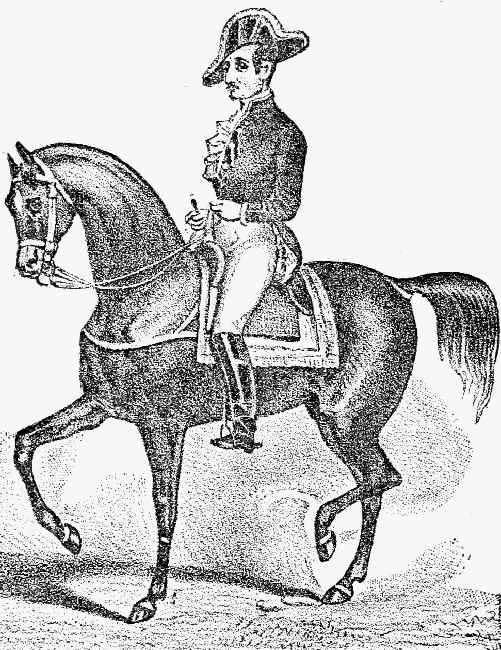
The seat of the rider.—The rider will expand his chest
as much as possible, so that each part of his body rests
upon that next below it, for the purpose of increasing
the adhesion of his buttocks to the saddle; the arms will
fall easily by the sides. The thighs and legs must, by
their own strength, find as many points of contact as
possible with the saddle and the horse's sides; the feet
will naturally follow the motion of the legs.
You see by these few lines how simple the rider's
seat is.
The means which I point out for quickly obtaining a
good seat, remove all the difficulties which the plan pursued
by our predecessors presented. The pupil used to
understand nothing of the long catechism, recited in a
loud voice by the instructor, from the first word to the
last, consequently he could not execute it. Here one
word replaces all those sentences; but we previously go
through a course of supplings. This course will make
the rider expert, and consequently intelligent. One
month will not elapse without the most stupid and awkward
recruit being able to seat himself properly without
the aid of the word of command.
Preparatory lesson (the lesson to last an hour, two
lessons a day for a month).—The horse is led upon the
ground, saddled and bridled. The instructor must take
two pupils; one will hold the horse by the bridle, all the
while watching what the other does, that he may be able
to perform in his turn. The pupil will approach the
horse's shoulder and prepare to mount; for this purpose
he will lay hold of and separate, with the right hand, a
handful of mane, and pass it into the left hand, taking
hold as near the roots as possible, without twisting
them; he will seize the pommel of the saddle with the
right hand, the four fingers in, and the thumb outside;
then springing lightly, will raise himself upon his wrists.
As soon as his middle is the height of the horse's withers,
he will pass the right leg over the croup, without
touching it, and place himself lightly in the saddle. This
vaulting being very useful in making the man active, he
should be made to repeat it eight or ten times, before
letting him finally seat himself. The repetition of this
will soon teach him what he is able to do, using the
powers of his arms and loins.
Exercise in the saddle.—(This is a stationary exercise
on horseback; an old, quiet horse to be chosen in preference;
the reins are knotted, and hang on his neck.)
The pupil being on horseback, the instructor will examine
his natural position, in order to exercise more frequently
those parts which have a tendency to give way
or stiffen. The lesson will commence with the chest.
The instructor will make use of the flexions
of the loins, which expand the chest, to straighten the
upper part of the pupil's body; he whose loins are slack
will be made to hold himself in this position for some
time, without regard to the stiffness which this will
bring along with it the first few times. It is by the exertion
of force that the pupil will become supple, and not
by the abandon so much and so uselessly recommended.
A movement at first obtained by great effort, will, after
a while, not require so much, for he will then have gained
skill, and skill, in this case, is but the result of exertions
combined and employed properly. What is first done
with twenty pounds of force, reduces itself afterwards to
fourteen, to ten, to four. Skill will be the exertion
reduced to four pounds. If we commenced by a less, we
would not attain this result. The flexions of the loins
will be often renewed, allowing the pupil often to let
himself down into his natural relaxed position, in order
to make him properly employ the force that quickly
gives a good position to the chest. The body being well
placed, the instructor will pass: 1st. To the lesson of
the arm, which consists in moving it in every direction,
first bent, and afterwards extended; 2d. To that of the
head; this must be turned right and left without its
motions reacting on the shoulders.
When the lessons of the chest, arms, and head give a
satisfactory result, which ought to be at the end of four
days (eight lessons), they will pass to that of the legs.
The pupil will remove one of his thighs as far as possible
from the quarters of the saddle; and afterwards
replace it with a rotatory movement from without
inwards, in order to make it adhere to the saddle by as
many points of contact as possible. The instructor will
watch that the thigh does not fall back heavily; it
should resume its position by a slowly progressive
motion, and without a jerk. He ought, moreover, during
the first lesson, to take hold of the pupil's leg and
direct it, in order to make him understand the proper
way of performing this displacement. He will thus save
him fatigue, and obtain the result more quickly.
This kind of exercise, very fatiguing at first, requires
frequent rests; it would be wrong to prolong the exercise
beyond the powers of the pupil. The motions of
drawing in (adduction, which makes the thigh adhere to
the saddle), and putting out (abduction, which separates
it from the saddle), becoming more easy, the thighs will
have acquired a suppleness which will admit of their adherence
to the saddle in a good position. Then comes
the flexion of the legs.
Flexion of the legs.—The instructor will watch that
the knees always preserve their perfect adherence to the
saddle. The legs will be swung backward and forward
like the pendulum of a clock; that is, the pupil will raise
them so as to touch the cantle of the saddle with his
heels. The repetition of these flexions will soon render
the legs supple, pliable and independent of the thighs.
The flexions of the legs and thighs will be continued for
four days (eight lessons). To make each of these movements
more correct and easier, eight days (or sixteen lessons),
will be devoted to it. The fifteen days (thirty lessons),
which remain to complete the month, will continue
to be occupied by the exercise of stationary supplings;
but, in order that the pupil may learn to combine the
strength of his arms, and that of his loins, he will be made
to hold at arm's length, progressively, weights of from ten
to forty pounds. This exercise will be commenced in the
least fatiguing position, the arm being bent, and the
hand near the shoulder, and this flexion will be continued
to the full extent of the arm. The chest should not
be affected by this exercise, but be kept steady in the
same position.
Of the knees.—The strength of pressure of the knees
will be judged of, and even obtained, by the aid of the
following method: this, which at first sight will perhaps
appear of slight importance, will, nevertheless, bring
about great results. The instructor will take a narrow
piece of leather about twenty inches long; he will place
one end of this strap between the pupil's knee and the
side of the saddle. The pupil will make use of the force
of his knees to prevent its slipping, while the instructor
will draw it towards him slowly and progressively.
This process will serve as a dynamometer to judge of the
increase of power.
The strictest watch must be kept that each force
which acts separately does not put other forces in action;
that is to say, that the movement of the arms does not
influence the shoulders; it should be the same with the
thighs, with respect to the body; the legs, with respect
to the thighs, etc., etc. The displacement and suppling
of each part separately, being obtained, the chest and
seat will be temporarily displaced, in order to teach the
rider to recover his proper position without assistance.
This will be done as follows: the instructor being placed
on one side, will push the pupil's hip, so that his seat will
be moved out of the seat of the saddle. The instructor
will then allow him to get back into the saddle, being
careful to watch that, in regaining his seat, he makes
use of his hips and knees only, in order to make him use
only those parts nearest to his seat. In fact, the aid of
the shoulders would soon affect the hand, and this the
horse; the assistance of the legs would have still worse
results. In a word, in all the displacements, the pupil
must be taught not to have recourse in order to direct
the horse, to the means which keep him in his seat, and,
vice versâ, not to employ, in order to keep his seat, those
which direct the horse.
Here, but a month has elapsed, and these equestrian
gymnastics have made a rider of a person, who at first
may have appeared the most unfit for it. Having mastered
the preliminary trials, he will impatiently await
the first movements of the horse, to give himself up to
them with the ease of an experienced rider.
Fifteen days (thirty lessons) will be devoted to the
walk, trot and gallop. Here the pupil should solely
endeavor to follow the movements of the horse; therefore,
the instructor will oblige him to occupy himself
only with his seat, and not attempt to guide the horse.
He will only exact that the pupil ride, at first, straight
before him, then in every direction, one rein of the
snaffle in each hand. At the end of four days (eight
lessons), he may be made to take the curb-rein in his
left hand.
The right hand, which is now free, must be held alongside
of the left, that he may early get the habit of sitting
square (with his shoulders on a level); the horse will
trot equally to the right and to the left. When the
seat is firmly settled at all the paces, the instructor will
explain simply, the connection between the wrist and the
legs, as well as their separate effects.
Education of the horse.—Here the rider will commence
the horse's education, by following the progression I
have pointed out, and which will be found farther on.
The pupil will be made to understand all that there is
rational in it, and what an intimate connection exists
between the education of the man and that of the horse.
Recapitulation and progression.—
| |
Days |
Lessons |
| 1. Flexion of the loins to expand the chest |
4 |
8 |
2. Extending and replacing of the thighs,
and flexion of the legs |
4 |
8 |
| 3. General exercise of all the parts in succession |
8 |
16 |
4. Displacement of the man's body, exercise of
the knees and arms with weights in the hands |
15 |
30 |
5. Position of the rider, the horse being at a
walk, trot and gallop, in order to fashion and
settle the seat at these different paces |
15 |
30 |
| 6. Education of the horse by the rider |
75 |
150 |
| |
---- |
---- |
| Total |
121 |
242 |
Of their causes and effects.—The horse, like all organized
beings, is possessed of a weight and a force peculiar
to himself. The weight inherent to the material of which
the animal is composed, renders the mass inert, and tends
to fix it to the ground. The force, on the contrary, by
the faculty it gives him of moving this weight, of dividing
it, of transferring it from one of his parts to another,
communicates movement to his whole being, determines
his equilibrium, speed and direction. To make this
truth more evident, let us suppose a horse in repose. His
body will be in perfect equilibrium, if each of its members
supports exactly that part of the weight which devolves
upon it in this position. If he wishes to move
forward at a walk, he must first transfer that part of the
weight resting on the leg he moves first to those that
will remain fixed to the ground. It will be the same
thing in other paces, the transfer acting from one diagonal
to the other in the trot, from the front to the rear,
and reciprocally in the gallop. We must not then confound
the weight with the force; the latter determines,
the former is subordinate to it. It is by carrying the
weight from one extremity to the other that the force
puts them in motion, or makes them stationary. The
slowness or quickness of the transfers fixes the different
paces, which are correct or false, even or uneven, according
as these transfers are executed with correctness or
irregularity.
It is understood that this motive power is subdivided
ad infinitum, since it is spread over all the muscles of the
animal. When the latter himself determines the use of
them, the forces are instinctive; I call them transmitted
when they emanate from the rider. In the first case,
the man governed by his horse remains the plaything of
his caprices; in the second, on the contrary, he makes
him a docile instrument, submissive to all the impulses
of his will. The horse, then, from the moment he is
mounted, should only act by transmitted forces. The
invariable application of this principle constitutes the
true talent of the horseman.
But such a result cannot be attained instantaneously.
The young horse, in freedom, having been accustomed
to regulate his own movements, will, at first, submit
with difficulty to the strange influence which comes to
take the entire control of them. A struggle necessarily
ensues between the horse and his rider, who will be
overcome unless he is possessed of energy, patience, and,
above all, the knowledge necessary to gain his point.
The forces of the animal being the element upon which
the rider must principally work, first to conquer, and
finally to direct them, it is necessary he should fix his
attention upon these before anything else. He will
study what they are, whence they spring, the parts
where they contract the most for resistance, the physical
causes which occasion these contractions. When this is
discovered, he will proceed with his pupil by means in
accordance with his nature, and his progress will then be
rapid.
Unfortunately, we search in vain in ancient or modern
authors, on horsemanship, I will not say for rational
principles, but even for any data in connection with the
forces of the horse. All speak very prettily about
resistances, oppositions, lightness and equilibrium; but
none of them have known how to tell us what causes
these resistances, how we can combat them, destroy
them, and obtain this lightness and equilibrium they so
earnestly recommend. It is this gap that has caused the
great doubts and obscurity about the principles of horsemanship;
it is this that has made the art stationary so
long a time; it is this gap that, I think, I am able to
fill up.
And first, I lay down the principle that all the resistances
of young horses spring, in the first place, from a
physical cause, and that this cause only becomes a moral
one by the awkwardness, ignorance and brutality of the
rider. In fact, besides the natural stiffness peculiar to
all these animals, each of them has a peculiar conformation,
the more or less of perfection in which constitutes
the degree of harmony that exists between the forces
and the weight. The want of this harmony occasions
the ungracefulness of their paces, the difficulty of their
movements; in a word, all the obstacles to a good education.
In a state of freedom, whatever may be the bad
structure of the horse, instinct is sufficient to enable him
to make such a use of his forces as to maintain his equilibrium;
but there are movements it is impossible for
him to make until a preparatory exercise shall have put
him in the way of supplying the defects of his organization
by a better combined use of his motive power. A
horse puts himself in motion only in consequence of a
given position; if his forces are such as to oppose themselves
to this position, they must first be annulled, in
order to replace them by the only ones which can lead
to it.
Now, I ask, if before overcoming these first obstacles,
the rider adds to them the weight of his own body, and
his unreasonable demands, will not the animal experience
still greater difficulty in executing certain movements?
The efforts we make to compel him to submission, being
contrary to his nature, will they not find in it an insurmountable
obstacle? He will naturally resist, and with
so much the more advantage, that the bad distribution
of his forces will of itself be sufficient to paralyze those
of the rider. The resistance then emanates, in this case,
from a physical cause: which becomes a moral one from
the moment when, the struggle going on with the same
processes, the horse begins of his own accord to combine
means of resisting the torture imposed on him, when
we undertake to force into operation parts which have
not previously been supplied.
When things get into this state, they can only grow
worse. The rider, soon disgusted with the impotence of
his efforts, will cast back upon the horse the responsibility
of his own ignorance; he will brand as a jade an
animal possessing the most brilliant resources, and of
whom, with more discernment and tact, he could have
made a hackney as docile in character, as graceful and
agreeable in his paces. I have often remarked that
horses considered indomitable are those which develop
the most energy and vigor, when we know how to remedy
those physical defects which prevent their making
use of them. As to those which, in spite of their bad
formation, are by a similar system made to show a semblance
of obedience, we need thank nothing but the softness
of their nature; if they can be made to submit to
the simplest exercises, it is only on condition that we do
not demand anything more of them, for they would soon
find their energy again to resist any further attempts.
The rider can then make them go along at different paces
to be sure; but how disconnected, how stiff, how
ungraceful in their movements, and how ridiculous such
steeds make their unfortunate riders look, as they toss
them about at will, instead of being guided by them!
This state of things is all perfectly natural, unless we
destroy the first cause of it: the bad distribution of their
forces, and the stiffness caused by a bad conformation.
But, it is objected, since, you allow that these difficulties
are caused by the formation of the horse, how is it
possible to remedy them? You do not possibly pretend
to change the structure of the animal and reform the
work of nature? Undoubtedly not; but while I confess
that it is impossible to give more breadth to a narrow
chest, to lengthen too short a neck, to lower too high a
croup, to shorten and fill out long, weak, narrow loins, I
do not the less insist that if I prevent the different contractions
occasioned by these physical defects, if I supply
the muscles, if I make myself master of the forces so as
to use them at will, it will be easy for me to prevent
these resistances, to give more action to the weak parts,
and to moderate those that are too vigorous, and thus
make up for the deficiencies of nature.
Such results, I do not hesitate to say, were and still
are forever denied to the old methods. But if the
science of those who follow the old beaten track finds so
constant an obstacle in the great number of horses of
defective formation, there are, unfortunately, some horses
who, by the perfection of their organization, and the
consequent facility of their education, contribute greatly
to perpetuate the impotent routines that have been so
unfavorable to the progress of horsemanship. A well
constituted horse is one, all of whose parts being regularly
harmonized, induce the perfect equilibrium of the
whole. It would be as difficult for such a subject to
leave this natural equilibrium, and take up an improper
position for the purpose of resistance, as it is at first
painful for the badly formed horse to come into that just
distribution of forces, without which no regularity of
movement can be hoped for.
It is then only in the education of these last that the
real difficulties of horsemanship consist. With the
others the breaking ought to be, so to say, instantaneous,
since all the springs being in their places, there is
nothing to be done but to put them in motion; this result
is always obtained by my method. Yet the old principles
demand two or three years to reach this point, and
when by feeling your way without any certainty of
success, the horseman gifted with some tact and experience,
ends by accustoming the horse to obey the
impressions communicated to him, he imagines that he
has surmounted great difficulties, and attributes to his
skill a state so near that of nature that correct principles
would have obtained it in a few days. Then as the
animal continues to display in all his movements the
grace and lightness natural to his beautiful formation,
the rider does not scruple to take all the merit to himself,
thus showing himself as presumptuous in this case
as he was unjust when he would make the badly formed
horse responsible for the failure of his attempts.
If we once admit these truths:
That the education of the horse consists in the complete
subjection of his powers;
That we can only make use of his powers at will by
annulling all resistances;
And that these resistances have their source in the
contractions occasioned by physical defects;
The only thing will be to seek out the parts where
these contractions operate, in order to endeavor to
oppose and destroy them.
Long and conscientious observations have shown me
that, whatever be the fault of formation that in the
horse prevents a just distribution of his forces, it is
always in the neck that the most immediate effect is felt.
There is no improper movement, no resistance that is
not preceded by the contraction of this part of the animal;
and as the jaw is intimately connected with the
neck, the stiffness of the one is instantly communicated
to the other. These two points are the prop upon
which the horse rests, in order to annul all the rider's
efforts. We can easily conceive the immense obstacle
they must present to the impulsions of the latter, since
the neck and head, being the two principal levers by
which we direct the animal, it is impossible to obtain
anything from him until we are master of these first and
indispensable means of action. Behind, the parts where
the forces contract the most for resistance, are the loins
and the croup (the haunches).
The contractions of these two opposite extremities are,
mutually the one to the other, causes and effects, that is
to say, the stiffness of the neck induces that of the
haunches, and reciprocally. We can combat the one by
the other; and as soon as we have succeeded in annulling
them, as soon as we have re-established the equilibrium
and harmony that they prevented between the fore and
hind-parts, the education of the horse will be half finished.
I will now point out the means of infallibly arriving at
this result.
This work being an exposition of a method which upsets
most of the old principles of horsemanship, it is
understood that I only address men already conversant
with the art, and who join to an assured seat a sufficiently
great familiarity with the horse, to understand all that
concerns his mechanism. I will not, then, revert to the
elementary processes; it is for the instructor to judge if
his pupil possesses a proper degree of solidity of seat,
and is sufficiently a part of the horse; for at the same
time that a good seat produces this identification, it
favors the easy and regular play of the rider's extremities.
My present object is to treat principally of the education
of the horse; but this education is too intimately
bound up in that of the rider, for him to make much
progress in one without the other. In explaining the
processes which should produce perfection in the animal,
I will necessarily teach the horseman to apply them himself;
he will only have to practise tomorrow what I
teach him today. Nevertheless, there is one thing that
no precept can give; that is, a fineness of touch, a delicacy
of equestrian feeling that belongs only to certain
privileged organizations, and without which, we seek in
vain to pass certain limits. Having said this, we will
return to our subject.
We now know which are the parts of the horse that
contract the most in resistances, and we feel the necessity
of suppling them. Shall we then seek to attack,
exercise and conquer them all at once? No; this would
be to fall back into the old error, of the inefficiency of
which we are convinced. The animal's muscular power
is infinitely superior to ours; his instinctive forces, moreover,
being able to sustain themselves the one by the
others, we will inevitably be conquered if we set them in
motion all at once. Since the contractions have their
seat in separate parts, let us profit by this division to
combat them separately, as a skillful general destroys, in
detail, forces which, when together, he would be unable
to resist.
For the rest, whatever the age, the disposition, and
the structure of my pupil, my course of proceeding at
the start will be always the same. The results will only
be more or less prompt and easy, according to the degree
of perfection in his nature, and the influence of the
hand to which he has been previously subjected. The
suppling, which will have no other object in the case of
a well-made horse than that of preparing his forces to
yield to our impulsions, will re-establish calm and confidence
in a horse that has been badly handled, and in a
defective formation will make those contractions disappear,
which are the causes of resistances, and the only
obstacles to a perfect equilibrium. The difficulties to
be surmounted will be in proportion to this complication
of obstacles, and will quickly disappear with a little perseverance
on our part. In the progression we are about
to pursue in order to subject the different parts of the
animal to suppling, we will naturally commence with the
most important parts, that is to say, with the jaw and
neck.
The head and neck of the horse are at once the rudder
and compass of the rider. By them he directs the animal;
by them, also, he can judge of the regularity and
precision of his movements. The equilibrium of the
whole body is perfect, its lightness complete, when the
head and neck remain of themselves easy, pliable and
graceful. On the contrary, there can be no elegance, no
ease of the whole, when these two parts are stiff. Preceding
the body of the horse in all its impulsions, they
ought to give warning, and show by their attitude the
positions to be taken, and the movements to be executed.
The rider has no power so long as they remain contracted
and rebellious; he disposes of the animal at will,
when once they are flexible and easily handled. If the
head and neck do not first commence the changes of
direction, if in circular movements they are not inclined
in a curved line, if in backing they do not bend back
upon themselves, and if their lightness is not always in
harmony with the different paces at which we wish to go,
the horse will be free to execute these movements or not,
since he will remain master of the employment of his
own forces.
From the time I first noticed the powerful influence
that the stiffness of the neck exercises on the whole
mechanism of the horse, I attentively sought the means
to remedy it. The resistances to the hand are always
either sideways, upward or downward. I at first considered
the neck alone as the source of these resistances,
and exercised myself in suppling the animal by flexions,
repeated in every direction. The result was immense;
but, although, at the end of a certain time, the supplings
of the neck rendered me perfectly master of the forces
of the fore-parts of the horse, I still felt a slight resistance
which I could not at first account for. At last I
discovered that it proceeded from the jaw. The flexibility
I had communicated to the neck even aided this stiffness
of the muscles of the lower jaw, by permitting the
horse in certain cases to escape the action of the bit. I
then bethought me of the means of combating these
resistances in this, their last stronghold; and, from that
time, it is there I always commence my work of
suppling.
First exercise on foot.—Means of making the horse
come to the man, of making him steady to mount,
etc., etc.
Before commencing the exercises of flexions, it is essential
to give the horse a first lesson of subjection, and
teach him to recognize the power of man. This first act
of submission, which might appear unimportant, will
have the effect of quickly rendering him calm, of giving
him confidence, and of repressing all those movements
which might distract his attention, and mar the success
of the commencement of his education.
Two lessons, of a half hour each, will suffice to obtain
the preparatory obedience of every horse. The pleasure
we experience in thus playing with him will naturally
lead the rider to continue this exercise for a few moments
each day, and make it both instructive to the horse and
useful to himself. The mode of proceeding is as follows:
the rider will approach the horse, his whip under his arm,
without roughness or timidity; he will speak to him
without raising the voice too much, and will pat him on
the face and neck; then with the left hand will lay hold
of the curb-reins, about six or seven inches from the
branches of the bit, keeping his wrist stiff, so as to present
as much force as possible when the horse resists.
The whip will be held firmly in the right hand, the point
towards the ground, then slowly raised as high as his
chest, in order to tap it at intervals of a second. The
first natural movement of the horse will be to withdraw
from the direction in which the pain comes; it is by backing
that he will endeavor to do this. The rider will follow
this backward movement without discontinuing the
firm tension of the reins, nor the little taps with the whip
on the breast, applying them all the time with the same
degree of intensity. The rider should be perfectly self-possessed,
that there may be no indication of anger or
weakness in his motions or looks. Becoming tired of this
constraint, the horse will soon seek by another movement
to avoid the infliction, and it is by coming forward that
he will arrive at it; the rider will seize this second instinctive
movement to stop and caress the animal with
his hand and voice. The repetition of this exercise will
give the most surprising results, even in the first lesson.
The horse having discovered and understood the means
by which he can avoid the pain, will not wait till the
whip touches him, he will anticipate it by rushing forward
at the least gesture. The rider will take advantage
of this to effect, by a downward force of the bridle hand,
the depression of the neck, and the getting him in hand;
he will thus early dispose the horse for the exercises that
are to follow.
This training, besides being a great recreation, will
serve to make the horse steady to mount, will greatly
abridge his education and accelerate the development of
his intelligence. Should the horse, by reason of his
restless or wild nature, become very unruly, we should
have recourse to the cavesson, as a means of repressing
his disorderly movements, and use it with little jerks. I
would add that it requires great prudence and discernment
to use it with tact and moderation.
Flexion of the jaw.—The flexions of the jaw, as well
as the two flexions of the neck which follow, are executed
standing still, the man on foot. The horse will be led
on the ground saddled and bridled, the reins on his
neck. The man will first see that the bit is properly
placed in the horse's mouth, and that the curb-chain is
fastened so that he can introduce his finger between the
links and the horse's chin. Then looking the animal
good-naturedly in the eyes, he will place himself before
him near his head, holding his body straight and firm,
his feet a little apart to steady himself, and dispose
himself to struggle with advantage against all resistances.[B]
1st. In order to execute the flexion to the right, the
man will take hold of the right curb-rein with the right
hand, at about six inches from the branch of the bit, and
the left rein with the left hand, at only three inches from
the left branch. He will then draw his right hand
towards his body, pushing out his left hand so as to turn
the bit in the horse's mouth. The force employed ought
to be entirely determined by and proportioned to the
resistance of the jaw and neck only, in order not to affect
the aplomb, which keeps his body still. If the horse
backs to avoid the flexion, the opposition of the hands
should still be continued. If the preceding exercise has
been completely and carefully practised, it will be easy
by the aid of the whip to prevent this retrograde movement,
which is a great obstacle to all kinds of flexions of
the jaw and neck. (Plate I.)
2d. As soon as the flexion is obtained, the left hand
will let the left rein slip to the same length as the right,
then drawing the two reins equally will bring the head
near to the breast, in order to hold it there oblique and
perpendicular, until it sustains itself without assistance
in this position. The horse by champing the bit will
show his being in hand as well as his perfect submission.
The man, to reward him, will cease drawing on
the reins immediately, and after some seconds will allow
him to resume his natural position. (Plate II.)
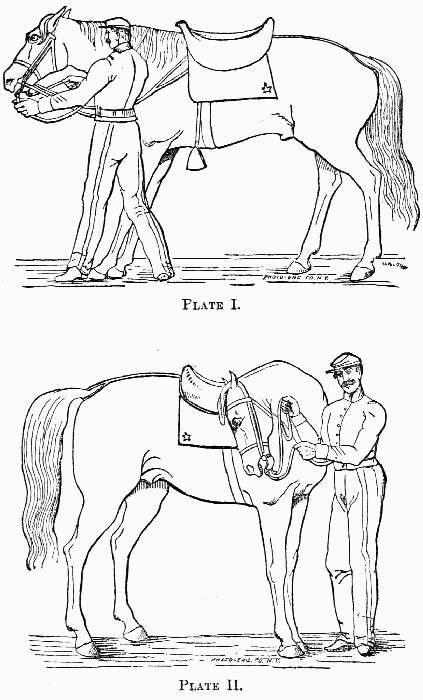
Plates I. and II.
The flexion of the jaw to the left is executed upon the
same principles and by inverse means to the flexion to the
right, the man being careful to pass alternately from one
to the other.
The importance of these flexions of the jaw is easily
understood. The result of them is to prepare the horse
to yield instantly to the lightest pressure of the bit, and
to supple directly the muscles that join the head to the
neck. As the head ought to precede and determine the
different attitudes of the neck, it is indispensable that the
latter part be always in subjection to the other, and respond
to its impulsions. That would be only partially
the case with the flexibility of the neck alone, which
would then make the head obey it, by drawing it along
in its movements. You see, then, why at first I experienced
resistances, in spite of the pliability of the neck, of
which I could not imagine the cause. The followers of
my method to whom I have not yet had an opportunity
of making known the new means just explained, will
learn with pleasure that this process not only brings the
flexibility of the neck to a greater degree of perfection,
but saves much time in finishing the suppling. The exercise
of the jaw, while fashioning the mouth and head,
brings along with it the flexion of the neck, and accelerates
the getting the horse in hand.
This exercise is the first of our attempts to accustom
the forces of the horse to yield to ours. It is necessary,
then, to manage it very nicely, so as not to discourage
him at first. To enter on the flexion roughly would be
to shock the animal's intelligence, who would not have
had time to comprehend what was required of him. The
opposition of the hands will be commenced gently
but firmly, not to cease until perfect obedience
is obtained, except, indeed, the horse backs against a
wall, or into a corner; but it will diminish or increase
its effect in proportion to the resistance, in a way always
to govern it, but not with too great violence. The horse
that at first will, perhaps, submit with difficulty, will end
by regarding the man's hand as an irresistible regulator,
and will become so used to obeying it, that he will soon
obtain, by a simple pressure of the rein, what at first
required the whole strength of our arms.
At each renewal of the lateral flexions some progress
will be made in the obedience of the horse. As soon as
his first resistances are a little diminished, we will pass
to the perpendicular flexions or depression of the neck.
Depression of the neck by the direct flexion of the
jaw.—
1. The man will place himself as for the lateral
flexions of the jaw; he will take hold of the reins of the
snaffle with the left hand, at six inches from the rings,
and the curb-reins at about two inches from the bit. He
will oppose the two hands by effecting the depression
with the left and the proper position with the right.
(Plate III.)
2. As soon as the horse's head shall fall of its own
accord and by its own weight, the man will instantly
cease all kind of force, and allow the animal to resume
his natural position. (Plate IV.)
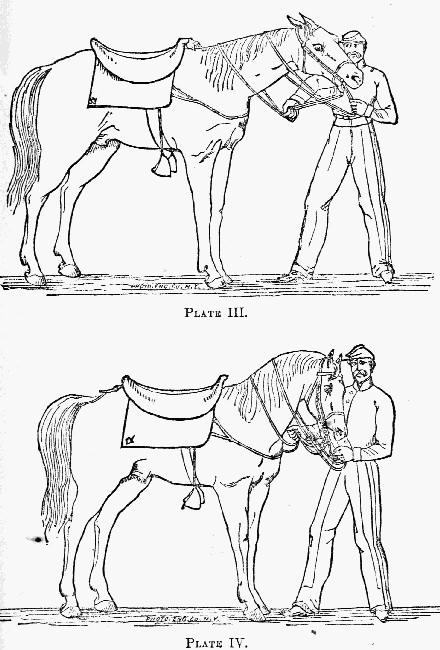
Plates III. and IV.
This exercise being often repeated, will soon bring
about the suppling of the elevating muscles of the neck,
which play a prominent part in the resistances of the
horse, and will besides facilitate the direct flexions and
the getting the head in position, which should follow the
lateral flexions. The man can execute this, as well as
the preceding exercise, by himself; yet it would be well
to put a second person in the saddle, in order to accustom
the horse to the exercise of the supplings with a
rider. This rider should just hold the snaffle-reins, without
drawing on them, in his right hand, the nails downward.
The flexions of the jaw have already communicated
suppleness to the upper part of the neck, but we have
obtained it by means of a powerful and direct motive
power, and we must accustom the horse to yield to a less
direct regulating force. Besides, it is important that
the pliability and flexibility, especially necessary in the
upper part of the neck, should be transmitted throughout
its whole extent, so as to destroy its stiffness entirely.
The force from above downward, practised with the
snaffle, acting only by the headstall on the top of the
head, often takes too long to make the horse lower his
head. In this case, we must cross the two snaffle-reins
by taking the left rein in the right, and the right rein in
the left hand, about six or seven inches from the horse's
mouth, in such a way as to cause a pretty strong pressure
upon the chin. This force, like all the others, must
be continued until the horse yields. The flexions being
repeated with this more powerful agent, will put him in
a condition to respond to the means previously indicated.
If the horse responded to the first flexions represented
by Plate IV., it would be unnecessary to make use of
this one. (Plate V.)
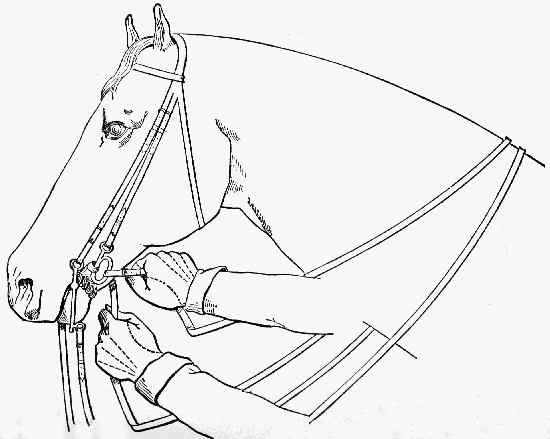
Plate V.
We can act directly on the jaw so as to render it
prompt in moving. To do this, we take the left curb-rein
about six inches from the horse's mouth and draw it
straight towards the left shoulder; at the same time
draw the left rein of the snaffle forward, in such a way
that the wrists of the person holding the two reins shall
be opposite and on a level with each other. The two opposed
forces will soon cause a separation of the jaws and
end all resistance. The force ought to be always proportioned
to that of the horse, whether in his resistance,
or in his lightness. Thus, by means of this direct force
a few lessons will be sufficient to give a pliability to the
part in question that could not have been obtained by
any other means. (Plate VI.)
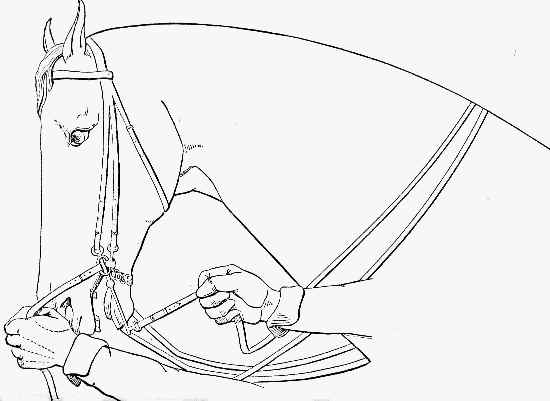
Plate VI.
Lateral flexions of the neck.—
1. The man will place
himself near the horse's shoulder as for the flexions of
the jaw; he will take hold of the right snaffle-rein, which
he will draw upon across the neck, in order to establish an
intermediate point between the impulsion that comes from
him and the resistance the horse presents; he will hold up
the left rein with the left hand about a foot from the bit.
As soon as the horse endeavors to avoid the constant
tension of the right rein by inclining his head to the
right, he will let the left rein slip so as to offer no
opposition to the flexion of the neck. Whenever the
horse endeavors to escape the constraint of the right rein
by bringing his croup around, he will be brought into
place again by slight pulls of the left rein. (Plate VII.)
2. When the head and neck have entirely yielded to
the right, the man will draw equally on both reins to
place the head perpendicularly. Suppleness and lightness
will soon follow this position, and as soon as the horse
evinces, by champing the bit, entire freedom from stiffness,
the man will cease the tension of the reins, being
careful that the head does not take advantage of this
moment of freedom to displace itself suddenly. In this
case, it will be sufficient to restrain it by a slight support
of the right rein. After having kept the horse in this
position for some seconds, he will make him resume his
former position by drawing on the left rein. It is most
important that the animal in all his movements should do
nothing of his own accord. (Plate VIII.)
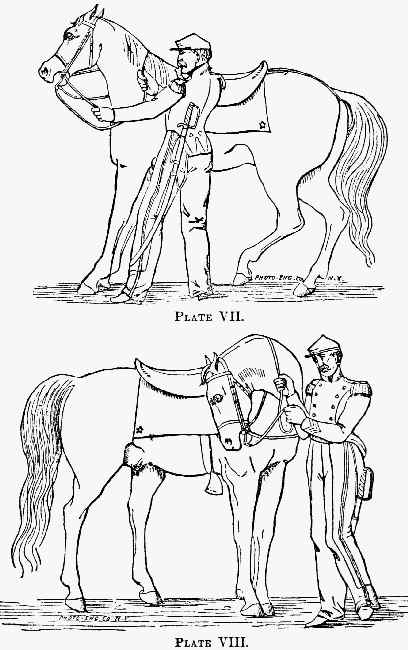
Plates VII and VIII.
The flexion of the neck to the left is executed after
the same principles, but by inverse means. The man can
repeat with the curb what he has previously done with
the snaffle-reins; but the snaffle should always be
employed first, its effect being less powerful and more
direct.
When the horse submits without resistance to the preceding
exercises, it will prove that the suppling of the
neck has already made a great step. The rider can,
henceforward, continue his work by operating with a less
direct motive power, and without the animal's being
impressed by the sight of him. He will place himself in
the saddle, and commence by repeating with the full
length of the reins, the lateral flexions, in which he has
already exercised his horse.
Lateral flexions of the neck, the man on horseback.—
1. To execute the flexion to the right, the rider will
take one snaffle-rein in each hand, the left scarcely feeling
the bit; the right, on the contrary, giving a moderate
impression at first, but which will increase in proportion
to the resistance of the horse, and in a way always
to govern him. The animal, soon tired of a struggle
which, being prolonged, only makes the pain proceeding
from the bit more acute, will understand that the only
way to avoid it is to incline the head in the direction the
pressure is felt. (Plate IX.)
2. As soon as the horse's head is brought round to the
right, the left rein will form opposition, to prevent the
nose from passing beyond the perpendicular. Great
stress should be laid on the head's remaining always in
this position, without which the flexion would be imperfect
and the suppleness incomplete. The movement being
regularly accomplished, the horse will be made to
resume his natural position by a slight tension of the left
rein. (Plate X.)
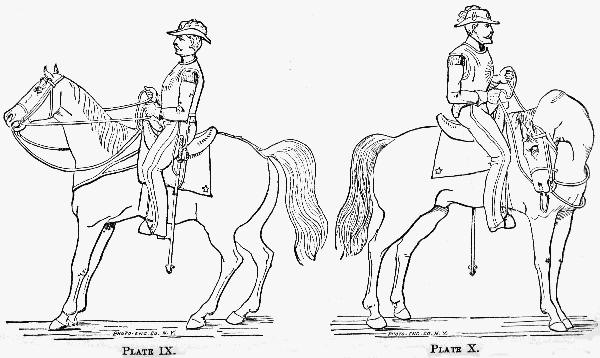
Plates IX and X.
The flexion to the left is executed in the same way, the
rider employing alternately the snaffle and curb-reins.
I have already mentioned that it is of great importance
to supple the upper part of the neck. After mounting,
and having obtained the lateral flexions without resistance,
the rider will often content himself with executing
them half-way, the head and upper part of the neck
pivoting upon the lower part, which will serve as a base
or axis. This exercise must be frequently repeated, even
after the horse's education is completed, in order to keep
up the pliability, and facilitate the getting him in hand.
It now remains for us, in order to complete the suppling
of the head and neck, to combat the contractions
which occasion the direct resistances, and prevent your
getting the horse's head in a perpendicular position.
Direct flexions of the head and neck, or ramener.[C]—
1. The rider will first use the snaffle-reins, which he will
hold together in the left hand as he would the curb-reins.
He will rest the outer edge of the right hand (see Plate
XI.) on the reins in front of the left hand in order to increase
the power of the right hand; after which he will
gradually bear on the snaffle-bit. As soon as the horse
yields, it would suffice to raise the right hand to diminish
the tension of the reins and reward the animal. As the
hand must only present a force proportioned to the resistance
of the neck, it will only be necessary to hold the
legs rather close to prevent backing. When the horse
obeys the action of the snaffle, he will yield much more
quickly to that of the curb, the effect of which is so
much more powerful. The curb, of course, needs more
care in the use of it than the snaffle. (Plate XI.)
2. The horse will have completely yielded to the
action of the hand, when his head is carried in a position
perfectly perpendicular to the ground; from that time
the contraction will cease, which the animal will show,
as in every other case, by champing his bit. The rider
must be careful not to be deceived by the feints of the
horse—feints which consist in yielding one-fourth or one-third
of the way, and then hesitating. If, for example,
the nose of the horse having to pass over a curve of ten
degrees to attain the perpendicular position (Plate XI.),
should stop at the fourth or sixth and again resist, the
hand should follow the movement and then remain firm
and immovable, for a concession on its part would
encourage resistance and increase the difficulties. When
the nose shall descend to No. 10, the perpendicular position
will be complete and the lightness perfect. The
rider can then cease the tension of the reins, but so as
to keep the head in this position, if it should offer to
leave it. If he lets it return at all to its natural situation,
it should be to draw it in over again, and to make
the animal understand that the perpendicular position
of the head is the only one allowed when under the
rider's hand. He should, at the outset, accustom the
horse to cease backing at the pressure of the legs, as all
backward movements would enable him to avoid the
effects of the hand or create new means of resistance.
(Plate XII.)
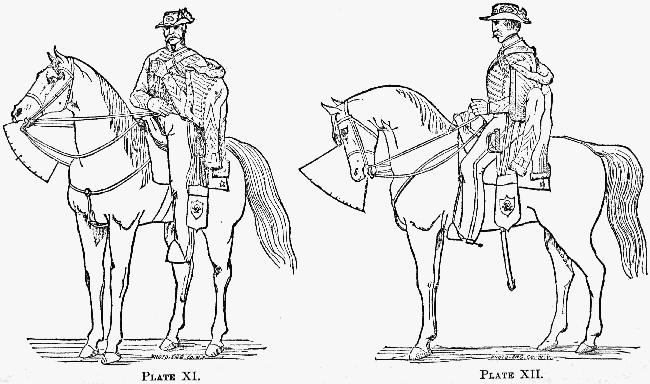
Plates XI and XII.
This is the most important flexion of all; the others
tended principally to pave the way for it. As soon as it
is executed with ease and promptness, as soon as a
slight touch is sufficient to place and keep the head in
a perpendicular position, it will prove that the suppling
is complete, contraction destroyed, lightness and equilibrium
established in the fore-hand. The direction of this
part of the animal will, henceforward, be as easy as it is
natural, since we have put it in a condition to receive all
our impressions, and instantly to yield to them without
effort.
As to the functions of the legs, they must support the
hind-parts of the horse, in order to obtain the ramener,
in such a way that he may not be able to avoid the effect
of the hand by a retrograde movement of his body. This
complete getting in hand is necessary to drive the hind-legs
under the centre. In the first case, we act upon the fore-hand;
in the second, upon the hind-parts; the first serves
for the ramener, the second for the rassembler, or gathering
the horse.[D]
Combination of effects.—I published four editions of
my Method, without devoting a special article to the
combination of effects. Although I myself made a very
frequent use of it, I had not attached sufficient importance
to the great necessity of this principle in the case
of teaching; later experiments have taught me to consider
it of more consequence.
The combination of effects means the continued and
exactly opposed force of the hand and legs. Its object
should be to bring back again into a position of equilibrium
all the parts of the horse which leave it, in order
to prevent him from going ahead, without backing him,
and vice versâ: finally, it serves to stop any movement
from the right to the left, or the left to the right. By
this means, also, we distribute the weight of the mass
equally on the four legs, and produce temporary immobility.
This combination of effects ought to precede and
follow each exercise within the graduated limit assigned
to it. It is essential when we employ the aids (i.e. the
hand and legs), in this, that the action of the legs should
precede the other, in order to prevent the horse from
backing against any place, for he might find, in this
movement, points of support that would enable him to
increase his resistance. Thus, all motion of the
extremities, proceeding from the horse himself,
should be stopped by a combination of effects;
finally, whenever his forces get scattered, and
act inharmoniously, the rider will find in this a powerful
and infallible corrective.
It is by disposing all the parts of the horse in the
most exact order, that we will easily transmit to him the
impulsion that should cause the regular movements of
his extremities; it is then also that we will address his
comprehension, and that he will appreciate what we
demand of him; then will follow caresses of the hand
and voice as a moral effect; they should not be used,
though, until after he has done what is demanded of him
by the rider's hand and legs.
The horse's resting his chin on his breast.—Although
few horses are disposed by nature to do this, it is not the
less necessary, when it does occur, to practise on them all
the flexions, even the one which bends down the neck.
In this position, the horse's chin comes back near the
breast and rests in contact with the lower part of the
neck; too high a croup, joined to a permanent contraction
of the muscles that lower the neck, is generally the
cause of it. These muscles must then be suppled in
order to destroy their intensity, and thereby give to the
muscles that raise the neck, their antagonists, the predominance
which will make the neck rest in a graceful
and useful position. This first accomplished, the horse
will be accustomed to go forward freely at the pressure
of the legs, and to respond, without abruptness or
excitement, to the touch of the spurs (attaques); the
object of these last is to bring the hind legs near the
centre, and to lower the croup. The rider will then
endeavor to raise the horse's head by the aid of the curb-reins;
in this case, the hand will be held some distance
above the saddle, and far from the body[E]; the force it
transmits to the horse ought to be continued until he
yields by elevating his head. As these sorts of horses
have generally little action, we must take care to avoid
letting the hand produce an effect from the front to the
rear, in which case it would take away from the impulse
necessary for movement. The pace commencing with
the walk, must be kept up at the same rate, while the
hand is producing an elevating effect upon the neck.
This precept is applicable to all the changes of position
that the hand makes in the head and neck; but is particularly
essential in the case of a horse disposed to depress
his neck.
It should be remembered that the horse has two ways
of responding to the pressure of the bit; by one, he
yields but withdraws himself at the same time by
shrinking and coming back to his former position; this
kind of yielding is only injurious to his education, for if
the hand is held too forcibly, if he does not wait till the
horse changes of his own accord the position of his
head, the backward movement of his body would precede
and be accompanied by a shifting of the weight
backwards. In this case, the contraction of his neck
remains all the while the same. The second kind of
yielding, which contributes so greatly to the rapid and
certain education of the horse, consists in giving a half or
three-quarter tension to the reins, then to sustain the
hand as forcibly as possible without bringing it near
the body. In a short time the force of the hand, seconded
by the continued pressure of the legs, will make
the horse avoid this slight but constant pressure of the
bit, but by means of his head and neck only. Then the
rider will only make use of the force necessary to displace
the head. It is by this means that he will be able
to place the horse's body on a level, and will obtain that
equilibrium,[F] the perfect balance of which has not
hitherto been appreciated.
Resuming what we have just explained in the case of
a horse who rests his chin on his breast, we repeat that
it is by producing one force from the rear to the front
with the legs, and another from below upwards with the
hand, that we will soon be enabled to improve the position
and movements of the horse. So that whatever may
be his disposition at first, it is by first causing the depression
of the neck that we will quickly gain a masterly and
perfect elevation of it.
I will close this chapter by some reflections on the
supposed difference of sensibility in horses' mouths, and
the kind of bit which ought to be used.
Of the horse's mouth and the bit.—I have already
treated this subject at length in my Comprehensive Dictionary
of Equitation; but as in this work I make a complete
exposition of my method, I think it necessary to
repeat it in a few words.
I cannot imagine how people have been able so long to
attribute to the mere difference of formation of the bars,[G]
those contrary dispositions of horses which render them
so light or so hard to the hand. How can we believe
that, according as a horse has one or two lines of flesh,
more or less, between the bit and the bone of the lower
jaw, he should yield to the lightest impulse of the hand,
or become unmanageable in spite of all the efforts of two
vigorous arms? Nevertheless, it is from remaining in this
inconceiveable error, that people have forged bits of so
strange and various forms, real instruments of torture,
the effect of which is to increase the difficulties they
sought to remove.
Had they gone back a little further to the source of
the resistances, they would have discovered that this one,
like all the rest, does not proceed from the difference of
formation of a feeble organ, like the bars, but from a
contraction communicated to the different parts of the
body, and, above all, to the neck, by some serious fault
of constitution. It is, then, in vain that we attach to the
reins, and place in the horse's mouth a more or less murderous
instrument; he will remain insensible to our
efforts as long as we do not communicate suppleness to
him, which alone can enable him to yield.
In the first place, then, I lay down as a fact, that there
is no difference of sensibility in the mouths of horses;
that all present the same lightness when in the position
called ramener, and the same resistances in proportion as
they recede from this position. There are horses hard
to the hand; but this hardness proceeds from the length
or weakness of their loins, from a narrow croup, from
short haunches, thin thighs, straight hocks, or (a most
important point) from a croup too high or too low in
proportion to the withers; such are the true causes of
resistances; the contractions of the neck, the closing of
the jaws are only the effects; as to the bars, they are
only there to show the ignorance of self-styled equestrian
theoricians. By suppling the neck and the jaw,
this hardness completely disappears. Experiments a
hundred times repeated give me the right to advance this
principle boldly; perhaps it may, at first, appear too
arbitrary, but it is none the less true.
Consequently, I only allow one kind of bit, and this
is the form and the dimensions I give it, to make it as
simple as it is easy.
The branches straight and six inches long, measuring
from the eye of the bit to the extremity of the branch;
circumference of the canon,[H] two inches and a half; port,
about two inches wide at the bottom, and one inch at the
top. The only variation to be in the width of the bit,
according to the horse's mouth.
I insist that such a bit is sufficient to render passively
obedient all horses that have been prepared by supplings;
and I need not add that, as I deny the utility of severe
bits, I reject all means not coming directly from the
rider, such as martingales, piliers, etc.
The hind-parts.—In order to guide the horse, the rider
acts directly on two of his parts: the fore-parts and the
hind-parts. To effect this, he employs two motive powers:
the legs, which give the impulse by the croup; and
the hand, which directs and modifies this impulse by the
head and neck. A perfect harmony of forces ought then
to exist always between these two motive powers; but
the same harmony is equally necessary between the parts
of the animal they are intended particularly to impress.
In vain would be our labor to render the head and neck
flexible, light, obedient to the touch of the hand; incomplete
would be the results, the equilibrium of the whole
imperfect, as long as the croup remained dull, contracted
and rebellious to the direct governing agent.
I have just explained the simple and easy means of
giving to the fore-parts the qualities indispensable to a
good management thereof: it remains to tell how we
will fashion, in the same way, the hind-parts, in order to
complete the suppling of the horse, and bring about a
uniform harmony in the development of all his moving
parts. The resistances of the neck and croup mutually
aiding one another, our labor will be more easy, as we
have already destroyed the former.
The flexions of the croup, and making it movable.—
1. The rider will hold the curb-reins in the left hand, and
those of the snaffle, crossed, in the right, the nails of the
right hand held downward; he will first bring the horse's
head into a perpendicular position, by drawing lightly
on the bit; after that, if he wishes to execute the movement
to the right, he will carry the left leg back behind
the girths and fix it near the flanks of the animal, until
the croup yields to this pressure. The rider will at the
same time make the left snaffle-rein felt, proportioning
the effect of the rein to the resistance which is opposed
to it. Of these two forces transmitted thus by the left
leg and the rein of the same side, the first is intended to
combat the resistance, and the second, to determine the
movement. The rider should content himself in the beginning
with making the croup execute one or two steps
only sideways. (Plate XIII.)
2. The croup having acquired more facility in moving,
we can continue the movement so as to complete to the
right and the left reversed pirouettes.[I] As soon as the
haunches yield to the pressure of the leg, the rider, to
cause the perfect equilibrium of the horse, will immediately
draw upon the rein opposite to this leg. The
motion of this, slight at first, will be progressively
increased until the head is inclined to the side towards
which the croup is moving, as if to look at it coming.
(Plate XIV.)
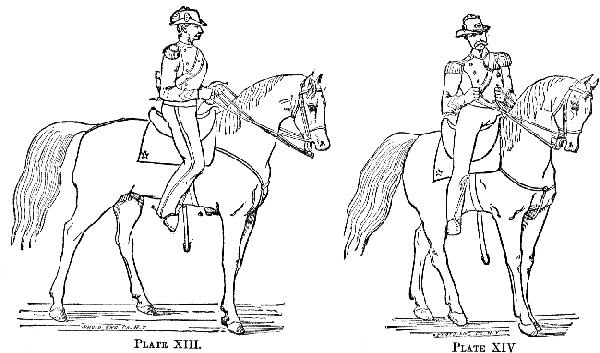
Plates XIII and XIV.
To make this movement understood, I will add some
explanations, the more important as they are applicable
to all the exercises of horsemanship.
The horse, in all his movements, cannot preserve a
perfect and constant equilibrium, without a combination
of opposite forces, skillfully managed by the rider. In
the reversed pirouette, for example, if when the horse
has yielded to the pressure of the leg, we continue to
oppose the rein on the same side as this leg, it is evident
that we will shoot beyond the mark, since we will be
employing a force which has become useless. We must
then establish two motive powers, the effect of which
balances, without interfering; this, the tension of the
rein on the opposite side from the leg will produce in
the pirouette. So, we will commence with the rein and
the leg of the same side, until it is time to pass to the
second part of the work, then with the curb-rein in the
left hand, and finally, with the snaffle-rein opposite to
the leg. The forces will then be kept in a diagonal position,
and in consequence, the equilibrium natural, and
the execution of the movement easy. The horse's head
being turned to the side where the croup is moving, adds
much to the gracefulness of the performance, and aids
the rider in regulating the activity of the haunches, and
keeping the shoulders in place. For the rest, tact alone
will be able to show him how to use the leg and the rein,
in such a way that their motions will mutually sustain,
without at any time counteracting one another.
I need not remind you that during the whole of this
exercise, as on all occasions, the neck should remain supple
and light; the head in position (perpendicular) and
the jaw movable. While the bridle hand keeps them in
this proper position, the right hand, with the aid of the
snaffle, is combating the lateral resistances, and determining
the different inclinations, until the horse is sufficiently
well broken to obey a simple pressure of the bit. If,
when combating the contraction of the croup, we permitted
the horse to throw its stiffness into the fore-parts,
our efforts would be vain, and the fruit of our first labors
lost. On the contrary, we will facilitate the subjection
of the hind-parts, by preserving the advantages we have
already acquired over the fore-parts, and by keeping
separated those contractions we have yet to combat.
The leg of the rider opposite to that which determines
the rotation of the croup, must not be kept off during
the movement, but remain close to the horse and keep
him in place, while giving from the rear forward an
impulse which the other leg communicates from right to
left, or from left to right. There will thus be one force
which keeps the horse in position, and another which
determines the rotation. In order that the pressure of
the two legs should not counteract one another, and
in order to be able to use them both together, the leg
intended to move the croup will be placed farther
behind the girths than the other, which will remain held
with a force equal to that of the leg that determines the
movement. Then the action of the legs will be distinct,
the one bearing from right to left, the other from the
rear forwards. It is by the aid of the latter that the
hand places and fixes the fore legs.
To accelerate these results, at first, a second person
may be employed who will place himself at the height
of the horse's head, holding the curb-reins in the right
hand, and on the side opposite to which we wish the
croup to go. He will lay hold of the reins at six inches
from the branches of the bit, so as to be in a good position
to combat the instinctive resistances of the animal.
The one in the saddle will content himself with holding
lightly the snaffle-reins, acting with his legs as I have
already shown. The second person is only useful when
we have to deal with a horse of an intractable disposition,
or to aid the inexperience of the one in the saddle;
but, as much should be done without assistance as possible,
in order that the practitioner may judge by himself
of the progress of his horse, seeking all the while for
means to increase the effects of his touch.
Even while this work is in an elementary state, he will
make the horse execute easily all the figures of the manège
de deux pistes.[J] After eight days of moderate exercise,
he will have accomplished, without effort, a performance
that the old school did not dare to undertake
until after two or three years' studying and working at
the horse.
When the rider has accustomed the croup of the horse
to yield promptly to the pressure of the legs, he will be
able to put it in motion, or fix it motionless at will, and
can, consequently, execute ordinary pirouettes.[K] For
this purpose he will take a snaffle-rein in each hand, one
to direct the neck and shoulders towards the side to
which we wish to wheel, the other to second the opposite
leg, if it is not sufficient to keep the croup still. At the
beginning, this leg should be placed as far back as
possible, and not be used until the haunches bear against
it. By careful and progressive management the results
will soon be attained; at the start, the horse should be
allowed to rest after executing two or three steps well,
which will give five or six halts in the complete rotation
of the shoulders around the croup.
Here the stationary exercises cease. I will now explain
how the suppling of the hind-parts will be completed, by
commencing to combine the play of its springs with those
of the fore-parts.
Backing.—The retrograde movement, otherwise called
backing, is an exercise, the importance of which has
not been sufficiently appreciated, and which yet ought to
have a very great influence upon his education. When
practised after the old erroneous methods, it would have
been without success, since the thread of exercises that
ought to precede it were unknown. Backing properly differs
essentially from that incorrect backward movement which
carries the horse to the rear with his croup contracted
and his neck stiff; that is, backing away from and
avoiding the effect of the reins. Backing correctly supples
the horse, and adds grace and precision to his natural
motions. The first of the conditions upon which it is to
be obtained, is to keep the horse in hand; that is to say,
supple, light in the mouth, steady on his legs, and perfectly
balanced in all his parts. Thus disposed, the
animal will be able with ease to move and elevate equally
his fore and hind legs.
It is here that we will be enabled to appreciate the
good effects and the indispensable necessity of suppling
the neck and haunches. Backing, which at first is tolerably
painful to the horse, will always lead him to combat
the motions of our hand, by stiffening his neck, and
those of our legs, by contracting his croup; these are the
instinctive resistances. If we cannot obviate the bad
disposition of them, how will we be able to obtain that
shifting and re-shifting of weight, which alone ought to
make the execution of this movement perfect? If the
impulsion which, to back him, ought to come from the
fore-parts, should pass over its proper limits, the movement
would become painful, impossible in fact, and occasion,
on the part of the animal, sudden, violent movements
which are always injurious to his organization.
On the other hand, the displacements[L] of the croup,
by destroying the harmony which should exist between
the relative forces of fore and hind-parts, would also
hinder the proper execution of the backing. The previous
exercise to which we have subjected the croup will
aid us in keeping it in a straight line with the shoulders,
in order to preserve the necessary transferring of the
forces and weight.
To commence the movement, the rider ought first to
assure himself that the haunches are on a line with the
shoulders, and the horse light in hand; then he will
slowly close his legs, in order that the action they will
communicate to the hind-parts of the horse may make
him lift one of his hind legs, and prevent the body from
yielding before the neck. It is then that the immediate
pressure of the bit, forcing the horse to regain his equilibrium
behind, will produce the first part of the backing.
As soon as the horse obeys, the rider will instantly
give the hand to reward the animal, and not to force the
play of his fore-parts. If his croup is displaced, the
rider will bring it back by means of his leg, and if necessary,
use for this purpose the snaffle-rein on that side.
After having defined what I call the proper backing
(reculer), I ought to explain what I understand by backing
so as to avoid the bit (l'acculement). This movement
is too painful to the horse, too ungraceful, and too
much opposed to the right development of his mechanism,
not to have struck any one who has occupied himself
at all with horsemanship. We force a horse backwards
in this way, whenever we crowd too much his
forces and weight upon his hind-parts; by so doing we
destroy his equilibrium, and render grace, measure and
correctness impossible. Lightness, always lightness!
this is the basis, the touchstone of all beautiful execution.
With this, all is easy, as much for the horse as the
rider. That being the case, it is understood that the
difficulty of horsemanship does not consist in the direction
to give the horse, but in the position to make him
assume—a position which alone can smooth all obstacles.
Indeed, if the horse executes, it is the rider who makes
him do so; upon him then rests the responsibility of
every false movement.
It will suffice to exercise the horse for eight days (for five
minutes each lesson), in backing, to make him execute it
with facility. The rider will content himself the first few
times with one or two steps to the rear, followed by the
combined effect of the legs and hand, increasing in proportion
to the progress he makes, until he finds no more
difficulty in a backward than in a forward movement.
What an immense step we will then have made in the
education of our pupil! At the start, the defective
formation of the animal, his natural contractions, the
resistances we encountered everywhere, seemed as if they
might defy our efforts forever. Without doubt they
would have been vain, had we made use of a bad course
of proceeding, but the wise system of progression that
we have introduced into our work, the destruction of the
instinctive forces of the horse, the suppling, the separate
subjection of all the rebellious parts, have soon
placed in our power the whole of the mechanism to
such a degree as to enable us to govern it completely,
and to restore that pliability, ease, and harmony of the
parts, which their bad arrangement appeared as if it
would always prevent. As I shall point out hereafter in
classing the general division of the labor, it will be seen
that eight or ten days will be sufficient to obtain these
important results.
Was I not right then in saying that if it is not in my
power to change the defective formation of a horse, I
can yet prevent the evil effect of his physical defects, so
as to render him as fit to do everything with grace and
natural ease, as the better formed horse? In suppling
the parts of the animal upon which the rider acts
directly, in order to govern and guide him, in accustoming
them to yield without difficulty or hesitation to the
different impressions which are communicated to them, I
have, by so doing, destroyed their stiffness and restored
the centre of gravity to its true place, namely, to the
middle of the body. I have, besides, settled the greatest
difficulty of horsemanship: that of subjecting, before
everything else, the parts upon which the rider acts
directly, in order to prepare for him infallible means of
acting upon the horse.
It is only by destroying the instinctive forces, and by
suppling the different parts of the horse, that we will
obtain this. All the springs of the animal's body are
thus yielded up to the discretion of the rider. But this
first advantage will not be enough to make him a complete
horseman. The employment of these forces thus
abandoned to him, demand, in order to execute the different
paces, much study and skill. I will show in the
subsequent chapters the rules to be observed. I will
conclude this one by a rapid recapitulation of the progression
to be followed in the supplings.
Stationary exercise, the rider on foot. Fore-parts.—
1. Flexions of the jaw to the right and left, using the
curb-bit.
2. Direct flexions of the jaw, and depression of the
neck.
3. Lateral flexions of the neck with the snaffle-reins
and with the curb.
Stationary exercise, the rider on horseback.—
1. Lateral flexions of the neck with the snaffle-reins, and with the
curb-reins.
2. Direct flexions of the head or placing it in a perpendicular
position with the snaffle, and with the curb-reins.
Hind-parts.—
3. Lateral flexions, and moving the croup
around the shoulders.
4. Rotation of the shoulders around the haunches.
5. Combining the play of the fore and hind legs of the
horse, or backing.
I have placed the rotation of the shoulders around the
haunches in the nomenclatere of stationary exercise.
But the ordinary pivoting, or pirouettes, being a pretty
complicated movement, and one difficult for the horse,
he should not be completely exercised in it until he has
acquired the measured time of the walk, and of the trot,
and will easily execute the changes of direction.
When the supplings have subjected the instinctive
forces of the horse, and given them up completely into
our power, the animal will be nothing more in our hand
than a passive, expectant machine, ready to act upon the
impulsion we choose to communicate to him. It will be
for us, then, as sovereign disposers of all his forces, to
combine the employment of them in correct proportion
to the movements we wish to execute.
The young horse, at first stiff and awkward in the use
of his members, will need a certain degree of management
in developing them. In this, as in every other case, we
will follow that rational progression which tells us to
commence with the simple, before passing to the complicated.
By the preceding exercise, we have made our
means of acting upon the horse sure. We must now
attend to facilitating his means of execution, by exercising
all his forces together. If the animal responds to
the aids of the rider by the jaw, the neck and the
haunches; if he yields by the general disposition of his
body to the impulses communicated to him, it is by the play
of his extremities that he executes the movement. The
mechanism of these parts ought then to be easy, prompt
and regular; their application, well directed in the different
paces, will alone be able to give them these qualities,
indispensable to a good education.[M]
The walk.—This pace is the mother of all the other
paces; by it we will obtain the cadence, the regularity,
the extension of the others. But to obtain these brilliant
results, the rider must display as much knowledge as tact.
The preceding exercises have led the horse to bear the
combined effect of hand and legs, which could not have
been done previously to the destruction of the instinctive
resistances; we have now only to act on the inert resistances
which appertain to the animal's weight; upon the
forces which only move when an impulse is communicated
to them.
Before making the horse go forward, we should first
assure ourselves of his lightness; that is to say, of his
head being perpendicular, his neck flexible, his hind-part
straight and plumb. The legs will then be closed lightly,
to give the body the impulse necessary to move it. But
we should not, in accordance with the precepts of the old
method, give the bridle hand at the same time; for then
the neck, being free from all restraint, would lose its
lightness; would contract, and render the motion of the
hand powerless. The rider will remember that his hand
ought to be to the horse an insurmountable barrier,
whenever he would leave the position of ramener. The
animal will never attempt it, without pain; and only
within this limit will he find ease and comfort. By the
application of my method, the rider will be led to guide
his horse all the time with the reins half tight, except
when he wishes to correct a false movement, or determine
a new one.
The walk, I have said, ought to precede the other
paces, because the horse having three supports upon the
ground, his action is less, and consequently easier to
regulate than in the trot and gallop. The first exercises
of the supplings will be followed by some turns in the
riding-house at a walk, but only as a relaxation, the rider
attending less to animating his horse than to making
him keep his head, while walking in a perpendicular
position. Little by little he will complicate his work, so
as to join to the lightness of the horse that precision of
movement indispensable to the beauty of all his paces.
He will commence light oppositions of the hand and
legs to make the forces of the fore and hind-parts work
together in harmony. This exercise, by accustoming the
horse always to yield the use of his forces to the direction
of the rider, will be also useful in forming his
intelligence, as well as in developing his powers. What
delights the expert horseman will experience in the progressive
application of his art! His pupil at first rebellious
will insensibly yield himself to his every wish; will
adopt his character, and end by becoming the living personification
of him. Take care, then, rider! If your
horse is capricious, violent, fantastic, we will have the
right to say that you yourself do not shine by the amenity
of your disposition, and the propriety of your proceedings.
In order to keep the measure and quickness of the
walk equal and regular, it is indispensable that the impulsive
and governing forces which come from the rider,
should themselves be perfectly in harmony. We will
suppose, for example, that the rider to move his horse
forward, should make use of a force equal to twenty
pounds, fifteen for the impulse forward, and five to bring
his head into position. If the legs increase their motion
without the hands increasing theirs in the same proportion,
it is evident that the surplus of communicated force
will be thrown into the neck, cause it to contract, and
destroy all lightness. If, on the contrary, it is the hand
which acts with too much violence, it will be at the
expense of the impulsive force necessary to move the horse
forward; on this account, his forward movement will be
slackened and counteracted, at the same time that his
position will lose its gracefulness and power.
This short explanation will suffice to show the harmony
that should exist between the legs and hands. It is
understood that their motion should vary according as the
formation of the horse renders it necessary to support
him more or less before or behind; but the rule is the
same, only the proportions are different.
As long as the horse will not keep himself supple and
light in his walk, we will continue to exercise him in a
straight line; but as soon as he acquires more ease and
steadiness, we will commence to make him execute
changes of direction to the right and left, while walking.
Changes of direction.—-The use of the wrists, in the
changes of direction, is so simple that it is unnecessary
to speak of it here. I will only call attention to the fact,
that the resistances of the horse ought always to be
anticipated by disposing his forces in such a manner that
they all concur in putting him in the way of moving.
The head will be inclined in the direction we wish to go
by means of the snaffle-rein of that side, the curb will
then complete the movement. General rule: the lateral
resistances of the neck are always to be opposed by the
aid of the snaffle, being very careful not to commence to
wheel until after destroying the obstacle that opposed it.
If the use of the wrists remains very nearly the same as
formerly, it is not so with the legs; their motion will be
diametrically opposite to that given them in the old style
of horsemanship. This innovation is so natural a one, that
I cannot conceive why some one never applied it before
me.
It is by bearing the hand to the right, and making the
right leg felt, people have told me, and I have myself at
first repeated it, that the horse is made to turn to the
right. With me, practice has always taken the precedence
of reasoning; and this is the way I first perceived
the incorrectness of this principle.
Whatever lightness my horse had in a straight line, I
remarked that this lightness always lost some of its delicacy
when moving in small circles, although my outside
leg came to the assistance of the inside one. As soon as
the hind leg put itself in motion to follow the shoulders
in the circle, I immediately felt a slight resistance. I
then thought of changing the use of my aids, and of
pressing the leg on the side opposite to the direction of
wheeling. At the same time, in place of bearing the
hand immediately to the right, to determine the shoulders
in that direction, I first, by the aid of this hand,
made the opposition necessary to render the haunches
motionless, and to dispose the forces in such a way as to
maintain the equilibrium during the execution of the
movement. This proceeding was completely successful;
and in explaining what ought to be the function of the
different extremities, I recognize this as the only rational
way of using them in wheeling.
In fact, in wheeling to the right, for example, it is the
right hind leg which serves as pivot and supports the
whole weight of the mass, while the left hind leg and
the fore legs describe a circle more or less extended. In
order that the movement should be correct and free, it is
necessary that this pivot upon which the whole turns be
not interfered with in its action; the simultaneous action
of the right hand and the right leg must necessarily produce
this effect. The equilibrium is thus destroyed, and
the regularity of the wheeling rendered impossible.
As soon as the horse executes easily the changes of
direction at a walk, and keeps himself perfectly light,
we can commence exercising at a trot.
The trot.—The rider will commence this pace at a very
moderate rate of speed, following exactly the same principles
as for the walk. He will keep his horse perfectly
light, not forgetting that the faster the pace, the more
disposition there will be on the part of the animal to fall
back again into his natural contractions. The hand
should then be used with redoubled nicety, in order to
keep the head and neck always pliable, without affecting
the impulse necessary to the movement. The legs will
lightly second the hands, and the horse between these
two barriers, which are obstacles only to his improper
movements, will soon develop all his best faculties, and
with precision of movement, will acquire grace, extension,
and the steadiness inherent to the lightness of the
whole.
Although many persons who would not take the
trouble to examine thoroughly my method, have pretended
that it is opposed to great speed in trotting, it is
not the less proved that the well-balanced horse can trot
faster than the one destitute of this advantage. I have
given proofs of this whenever they have been demanded
of me; but it is in vain that I have tried to make people
understand what constitutes the motions of the trot, and
what are the conditions indispensable for regularity in
executing it. So, I was obliged in a race of which I was
judge, to make the bets void, and to prove that the pretended
trotters were not trotting really, but were ambling.
The condition indispensable to a good trotter, is perfect
equilibrium of the body. Equilibrium which keeps
up a regular movement of the diagonal fore and hind
feet, gives them an equal elevation and extension, with
such lightness that the animal can easily execute all
changes of direction, moderate his speed, halt, or increase
his speed without effort. The fore-parts have not, then,
the appearance of towing after them the hind-parts,
which keep as far off as possible; everything becomes
easy and graceful for the horse, because his forces being
in perfect harmony, permit the rider to dispose of them
in such a way that they mutually and constantly assist
each other.
It would be impossible for me to count up the number
of horses that have been sent me to break, and whose
paces have been so spoiled that it was impossible for them
to trot a single step. A few lessons have always been
sufficient for me to get them back into regular paces, and
these are the means I employed.
The difficulty which the horse experiences in keeping
himself square in his trot, almost always proceeds from
the hind-parts. Whether these be of a feeble construction,
or be rendered useless by the superior vigor of the
fore-parts, the motions of these parts, which receive the
shock and give the bound, in each case become powerless,
and in consequence, render the movement irregular.[N]
There is, then, weakness in one extremity, or excess of
force in the other. The remedy in each case will be the
same, viz: the depression of the neck, which by diminishing
the power of the fore-parts, restores the equilibrium
between the two parts. We have practised this
suppling on foot, it will be easy to obtain it on horseback.
We here see the usefulness of this perpendicular
flexion, which allows us to place on a level the forces of
the two opposite extremities of the horse, in order to
make them harmonious, and induce regularity in their
working. The horse being thus placed, can bend and
extend his fore and hind legs, before the weight of the
body forces them to resume their support.
The practice of this and some other principles that
I explain in this work, will place in the rank of choice
horses, animals whose inferiority caused them to be considered
jades, and that the old method would never
have raised from their degradation. It will suffice to
accustom the horse to trot well, to exercise him at this
pace only five minutes in each lesson. When he acquires
the necessary ease and lightness, he can be made to execute
ordinary pirouettes, as well as the exercise on two lines, at
a walk and a trot. I have said that five minutes of trotting
were enough at first, because it is less the continuance of
an exercise than its being properly done that perfects
the execution of it. Besides, as this pace requires a considerable
displacement of forces, and as the animal will
have been already subjected to a rather painful exercise,
it would be dangerous to prolong it beyond the time I
mention. The horse will lend himself more willingly to
your efforts when nicely managed, and of short duration;
his intelligence, becoming familiar with this efficient progression,
will hasten success. He will submit himself
calmly and without repugnance to work in which there
will be nothing painful to him, and we will be able thus
to push his education to the farthest limits, not only
without injury to his physical organization, but in restoring
to their normal state organs that a forced exercise
might have weakened. This regular development of all
the organs of the horse will not only give him grace,
but also strength and health, and will thus prolong his
existence, while increasing a hundredfold the delights of
the true horseman.
The rider now understands that the only means of
obtaining precision and regularity of movement in the
walk and trot is to keep the horse perfectly light while
he is exercised at these paces. As soon as we are sure
of this lightness while going in a straight line, in changes
of direction, and in circular movements it will be easy
to preserve it while exercising on two lines.[O]
I would here treat immediately of the gallop; but
this pace, more complicated than the two others, demands
an arrangement on the part of the horse, and a power
on the part of the rider, that the preceding exercises have
not yet been able to give. The proper placing of the
horse's head spreads his forces over the whole of his
body; it is necessary, in order to perform correctly the
different exercises at a gallop, and to enable yourself
properly to direct the forces in energetic movements, to
bring them into a common focus—that is, to the centre
of gravity of the animal. I am about to explain how
this is to be done.
The use of the spurs.—Professors of equitation and
authors upon this subject have said that the spurs are to
punish the horse when he does not respond to the legs,
or when he refuses to approach an object that frightens
him. With them, the spur is not an aid, but a means of
chastisement. With me it is, on the contrary, a powerful
auxiliary, without which it would be impossible to
break any horse perfectly. How! you exclaim, you
attack with the spur, horses that are sensitive, excitable,
full of fire and action—horses whose powerful make
leads them to become unmanageable, in spite of the
hardest bits and the most vigorous arms! Yes, and it is
with the spur that I will moderate the fury of these too
fiery animals, and stop them short in their most impetuous
bounds. It is with the spur, aided of course by the
hand, that I will make the most stubborn natures kind,
and perfectly educate the most intractable animal.
Long before publishing my "Comprehensive Dictionary
of Equitation," I was aware of the excellent effects
of the spur; but I abstained from developing my principles,
being prevented by an expression of one of my
friends, whom I had shown how to obtain results, which
to him appeared miraculous. "It is extraordinary! It
is wonderful!" he exclaimed; "but it is a razor in the
hands of a monkey." It is true that the use of the
spurs requires prudence, tact, and gradation; but the
effects of it are precious. Now that I have proved the
efficacy of my method; now that I see my most violent
adversaries become warm partisans of my principles, I
no longer fear to develop a process that I consider one
of the most beautiful results of my long researches in
horsemanship.
There is no more difference in sensibility of different
horses' flanks than in their sensibility of mouth—that is
to say, that the direct effect of the spur is nearly the
same in them all. I have already shown that the organization
of the bars of the mouth goes for nothing in
the resistances to the hand. It is clear enough that
if the nose being thrown up in the air gives the horse a
force of resistance equal to two hundred pounds, this
force will be reduced to one hundred pounds, when we
bring the horse's head half-way towards a perpendicular
position; to fifty pounds when brought still nearer that
position, and to nothing when perfectly placed. The pretended
hardness of mouth proceeds in this case from the
bad position of the head caused by the stiffness of the neck
and the faulty construction of the loins and haunches of the
horse. If we carefully examine the causes that produce
what is called sensibility of the flanks, we will discover
that they have very much the same kind of source.
The innumerable conjectures to which people have
devoted themselves, in attributing to the horse's flanks a
local sensibility that had no existence, have necessarily
injured the progress of his education, because it was
based upon false data. The greater or less sensibility
of the animal proceeds from his action, from his faulty
formation, and bad position resulting therefrom. To a
horse of natural action, but with long weak loins, and
bad action behind, every motion backward is painful,
and the very disposition that leads him to rush ahead,
serves him to avoid the pain of the spur. He returns to
this movement whenever he feels the rider's legs touch
him; and far from being a spirited horse, he is only
scared and crazy. The more he feels the spur, the more
he plunges out of hand, and baffles the means intended
to make him obedient. There is everything to fear from
such a horse; he will scare at objects from the very ease
he possesses of avoiding them. Now since his fright proceeds,
so to say, from the bad position we allow him to
take, this inconvenience will disappear from the moment
we remedy the first cause of it. We must confine the
forces in order to prevent every displacement. We must
separate the physical from the moral horse, and force
these impressions to concentrate in the brain. He will
then be a furious madman whose limbs we have bound
to prevent him from carrying his frenzied thoughts into
execution.
The best proof we have that the promptness of a horse
in responding to the effect of the legs and spurs, is not
caused by a sensibility of the flanks, but rather by great
action joined to bad formation, is that the same action
is not so manifest in a well-formed horse, and that the
latter bears the spur much better than one whose equilibrium
and organization are inferior.
But the spur is not useful only in moderating the too
great energy of horses of much action; its effect being
equally good in combating the dispositions which lead the
animal to throw its centre of gravity too much forward,
or back. I would also use it to stir up those that are
wanting in ardor and vivacity. In horses of action, the
forces of the hind-parts surpass those of the fore-parts.
It is the opposite in dull horses. We can thus account for
the quickness of the former; the slowness and sluggishness
of the latter.
By the exercise of suppling, we have completely
annulled the instinctive forces of the horse. We must
now reunite these forces in their true centre of gravity,
that is, the middle of the animal's body; it is by the
properly combined opposition of the legs and hands that
we will succeed in this. The advantages we possess
already over the horse, will enable us to combat from
their very birth, all the resistances which tend to make
him leave the proper position, the only one in which we
can successfully practice these oppositions. It is also of the
first importance to put into our proceedings tact and
gradation, so that, for example, the legs never give an
impulse that the hand is not able to take hold of and
govern at the same moment. I will make this principle
more clear by a short explanation.
We will suppose a horse at a walk, employing a force
of forty pounds, necessary to keep the pace regular till
the moment of the opposition of the hands and legs
which follow. By and by comes a slow and gradual
pressure of the legs, which adds ten pounds to the
impulse of the pace. As the horse is supposed to be
perfectly in hand, the hand will immediately feel this
passage of forces, and must then make itself master of
them to transfer them to the centre. Meanwhile the
legs will continue their pressure, to the end that these
forces thus driven back may not return to the focus they
had left, which would be but a useless ebbing and flowing
of forces. This succession of oppositions well combined
will bring together a great quantity of forces in
the centre of the horse's body, and the more these are
increased, the more the animal will lose its instinctive
energy. When the pressure of the legs becomes insufficient
to entirely collect the forces, more energetic means
must be employed, viz.: the touches of the spur.
The spurring ought to be done, not violently, and
with much movement of the legs, but with delicacy and
management. The rider ought to close his legs so gradually,
that before coming in actual contact with the
horse's flanks, the spur will not be more than a
hair's breadth off, if possible. The hand should ever be
the echo to the light touches with which we commence;
it should then be firmly held, so as to present an opposition
equal to the force communicated by the spur. If by
the time being badly chosen, the hand does not exactly
intercept the impulse given, and the general commotion
resulting therefrom, we should, before recommencing,
gather the horse together, and re-establish calm in his
motions. The force of the spurring will be progressively
increased until the horse bears it, when as vigorously
applied as possible, without presenting the least resistance
to the hand, without increasing the speed of his
pace, or without displacing himself as long as we operate
with a firm foot.
A horse brought thus to bear spurring, is three-fourths
broken, since we have the free disposition of all his
forces. Besides, his centre of gravity being where
his forces are all united, we have brought it to its
proper place, viz.: the middle of the body. All the oscillations
of the animal will then be subordinate to us, and
we will be able to transfer the weight with ease, when
necessary.
It is easy now to understand where the resistances
have their origin; whether the horse kicks up behind,
rears, or runs away, the cause is always the centre of
gravity being in the wrong place. This very cause
belongs to a defective formation that we cannot change,
it is true, but the effects of which we can always modify.
If the horse kicks up, the centre of gravity is in the
shoulders; in his croup when the animal rears, and too
far forward when he runs away. The principal thought
of the rider, then, ought to be to keep the centre of
gravity in the middle of the horse's body, since he will
thereby prevent him defending himself, and bring back
the forces of the badly formed horse to their true place,
which they occupy in the finest organizations. It is this
that makes me assert that a well-formed horse will not
make resistance nor move irregularly, for to do so
requires supernatural efforts on his part to destroy the
harmony of his moving parts, and so greatly displace
his centre of gravity. So, when I speak of the necessity
of giving the horse a new equilibrium, in order to
prevent his defending himself, and also to remedy the
ungracefulness of his form, I allude to the combination
of forces of which I have been treating, or, rather, of
the removal of the centre of gravity from one place to
another. This result obtained, the education of the
horse is complete. When the horseman succeeds in
obtaining it, his talent becomes a truth, since it transforms
ugliness into grace, and gives elegance and lightness
to movements which were before heavy and confused.[P]
The rider's employment of force, when properly
applied, has a moral effect also on the horse, that accelerates
the results. If the impulse given by the legs finds
in the hand the energy and àpropos necessary to regulate
its effects, the pain the animal sustains will be always
proportioned to his resistances, and his instinct will soon
make him understand how he can diminish, and even
avoid altogether this constraint, by promptly yielding
to what we demand of him. He will hasten then
to submit, and will even anticipate our desires. But, I
repeat, it is only by means of tact and delicate management
that we will gain this important point. If the legs
give too vigorous an impulse, the horse will quickly
overcome the motion of the hands, and resume with his
natural position all the advantages it gives him to foil
the efforts of the rider. If, on the contrary, the hand
presents too great a resistance, the horse will soon overcome
the legs, and find a means of defending himself by
backing. Yet these difficulties must not be allowed to
frighten us; they were only serious ones when no
rational principle gave the means of surmounting them.
The application of my method will enable ordinary
horsemen to obtain results that otherwise could be
obtained only by the most favored equestrian organizations.
When the animal becomes accustomed by means of
the spur to such oppositions, it will become easy enough
to combat with the spur all the resistances that may
afterwards manifest themselves. Since the resistances
are always caused by moving the croup sideways, or getting
it too far back, the spur, by immediately bringing
the hind legs towards the centre of the body, prevents
the support of the hocks, which were able to oppose the
proper harmony of forces, and prevent the right distribution
of the weight.
This is the means I always employ to make the horse
pass from a swift gallop to a halt, without straining his
hocks, or injuring any of the joints of his hind-parts.
In fact, since it is the hocks which propel the mass forward,
it suffices to destroy their motion to stop the
bound. The spur, by instantly bringing the hind legs
under the horse's belly, destroys their power from the
moment the hand comes in the nick of time to fix them
in that position. Then the haunches bend, the croup is
lowered; the weight and forces arrange themselves in
the order most favorable to the free and combined play
of each part, and the violence of the shock, infinitely
decomposed, is scarce perceptible to either horse or
rider.
If, on the contrary, we stop the horse by making the
hand move first, the hocks remain far in the rear of the
plumb-line; the shock is violent, painful for the animal,
and especially injurious to his physical organization.
Horses that are thus stopped, set themselves against the
bit, extending their neck, and require an arm of iron and
a most violent opposing force. Such is the custom of
the Arabs, for example, in halting suddenly their horses,
by making use of murderous bits that break the bars of
their horses' mouths. Thus, notwithstanding the wonderful
powers with which nature has gifted them, are
these excellent animals injured. The use of the spur
must not be commenced till by gathering him we get the
horse well in hand; then the first touch of the spur
should be made felt. We will continue to make use of
it, at long intervals, until the horse, after his bound forward,
presents no resistance to the hand, and avoids the
pressure of the bit, by bringing in his chin towards his
chest, of his own accord. This submission once obtained,
we can undertake the use of the spurs with oppositions,
but we must be careful to discontinue them when the
horse is in hand. This means has the double advantage
of acting morally and physically. The first attacks will
be made with a single spur, and by bearing on the opposite
rein; these transverse oppositions will have a better
effect and give more prompt results. When the horse
begins to contain himself, the two spurs being used separately,
we can make them felt together and with an
equal gradation.[Q]
To the work, then, cavaliers! If you will follow my
principles, I can promise you that your purse will be less
often emptied into the hands of horse-dealers, and that
you will render the meanest of your hacks agreeable.
You will charm our breeders of horses, who will attribute
to their efforts of regeneration that elegance and
grace that your art alone could have given to your
chargers.
Lowering the hand.—The lowering the hand consists
in confirming the horse in all his lightness—that is, in
making him preserve his equilibrium without the aid of
the reins. The suppleness given to all parts of the
horse, the just oppositions of hands and legs, lead
him to keep himself in the best possible position. To
find out exactly whether we are obtaining this result,
we must have recourse to frequent lowering of the hand.
It is done in this way: After having slipped the right
hand to the buckle, and having assured yourself that the
reins are even, you will let go of them with the left
hand, and lower the right slowly to the pommel of the
saddle. To do this regularly, the horse must neither
increase nor diminish the speed of his pace, and his head
and neck continue to preserve their proper position.
The first few times that the horse is thus given up to
himself, he will perhaps only take a few steps while keeping
in position, and at the same rate of speed; the rider
ought then to make his legs felt first, and the hand afterwards,
to bring him into his previous position. The frequent
repetition of this lowering of the hand, after a complete
placing of the horse's head in a perpendicular position,
will give him a most exquisite mouth, and the rider
a still greater delicacy of touch. The means of guiding
employed by the latter will immediately be answered by
the horse, if his forces have been previously disposed in
a perfectly harmonious state.
The lowerings of the hand ought to be practised first
at a walk, then at a trot, afterwards at a gallop. This
semblance of liberty gives such confidence to the horse
that he gives up without knowing it; he becomes our
submissive slave, while supposing that he is preserving
an entire independence.
Of gathering the horse, or rassembler.—The preceding
exercise will render easy to the rider that important part
of horsemanship called rassembler. This has been a great
deal talked about by people, as they have talked about
Providence, and all the mysteries that are impenetrable
to human perception. If it were allowable for us to compare
small things to great, we might say that the more
or less absurd theories that have been put forward upon
the subject of divine power have not, fortunately, hindered
in any way the unchangeable march of nature;
but with regard to the progress of horsemanship, the
case is not the same as to what has been said and written
on the subject of the rassembler. The false principles
propagated on this subject have made the horse the plaything
and the victim of the rider's ignorance.
I proclaim it, the gathering a horse has never been
understood or defined before me, for it cannot be perfectly
executed without the regular application of the
principles that I have developed for the first time.
You will be convinced of this truth when you know that
the rassembler demands:
1. The suppling, partial and general, of the neck and
haunches.
2. The perfect position that results from this suppling.
3. The entire absorption of the forces of the horse by
the rider.
Now, as the means of obtaining these different results
have never been pointed out in any treatise on
horsemanship, am I not justified in saying that the true
rassembler has never been practised until now? It is,
nevertheless, one of the indispensable conditions of the
horse's education; consequently I think I am right
in saying that before my method, horses of defective
formation have never been properly broken.
How is the rassembler defined in the schools of horsemanship?
You gather your horse by raising the hand
and closing the legs. I ask, what good can this movement
of the rider do upon an animal badly formed, contracted,
and that remains under the influence of all the
evil propensities of its nature? This mechanical support
of the hands and legs, far from preparing the horse for
obedience, will only make him redouble his means of
resistance, since, while giving him notice that we are
about to demand a movement on his part, we remain
unable to dispose his forces in such a way as to force him
to it.
The real rassembler consists in collecting the forces of
the horse in his centre in order to ease his extremities,
and give them up completely to the disposition of the
rider. The animal thus finds himself transformed into a
kind of balance, of which the rider is the centre-piece.
The least touch upon one or other of the extremities,
which represent the scales, will immediately send them
in the direction we wish. The rider will know that his
horse is completely gathered when he feels him ready, as
it were, to rise from all four of his legs. The proper
position first, and then the use of the spurs, will make
this beautiful execution of the gathering easy to both
horse and rider; and what splendor, grace and majesty it
gives the animal! If we have been obliged at first to
use the spurs in pushing this concentration of forces
to its farthest limits, the legs will afterwards be sufficient
to obtain the gathering necessary for the precision
and elevation required in all complicated movements.
Need I recommend discretion in your demands? I
think not. If the rider, having reached this stage of
his horse's education, cannot comprehend and seize
that fineness of touch, that delicacy of process indispensable
to the right application of my principles, it
will prove him devoid of every feeling of a horseman;
nothing I can say can remedy this imperfection of his
nature.
Of the gallop.—I have said that, until now, the
greater part of the resources of horsemanship have not
been understood, and had I need of another proof to support
my opinion, I would draw it from the error, the
suppositions, the innumerable contradictions that have
been heaped together in order to explain so simple a
movement as the gallop. What contrary opinions upon
the means to employ to make the horse go off with his
right foot? It is the support of the rider's right leg
which determines the movement, one pretends; it is that
of the left leg, says another; it is the equal touch of the
two legs, affirms a third; no, some others remark, very
seriously, you must let the horse act naturally.
How can the truth be made out in the midst of this
conflict of such contrary principles? Besides, they come
from such respectable sources; the most of their authors
were possessed of titles and dignities which are generally
only granted to merit. Have they all been deceived for
a hundred and fifty years? This is not possible; for
many of them joined to long practice a perfect knowledge
of physics, anatomy, mathematics, etc., etc. To
doubt such authorities would be as presumptuous as imprudent;
it would have been considered a crime of high
treason against horsemanship. So the riders kept their
ignorance and the horses their bad equilibrium; and if
any one succeeded, after two or three years of routine
labor, in making certain horses of a privileged organization
start with the desired foot, and in making them
change feet finally, at a fixed point, the difficulty then
was to prevent them from always repeating this movement
at the same place.
Thus it is that the most palpable errors gain credit,
and often are perpetuated, until there comes a practical
mind, gifted with some amount of common sense, who
contradicts by practice all the learned theories of its predecessors.
They try hard at first to deny the knowledge
of the innovator; but the masses who instinctively know
the true, and judge from what they see, soon range themselves
on his side, turn their backs upon his detractors,
and leave them to their solitude and vain pretensions.
To the mass of horsemen I address myself, when I
say, either the horse is under the influence of your forces,
and entirely submissive to your power, or you are struggling
with him. If he gallops off with you, without
your being able to modify or direct with certainty his
course, it proves that, although subject to a certain
extent to your power in thus consenting to carry you
about, he, nevertheless, uses his instinctive forces. In
this case, there is a perpetual fight going on between
you and him, the chances of which depend on the temperament
and caprice of the animal, upon the good or
bad state of his digestion. Changes of foot, in such a
state, can only be obtained by inclining the horse very
much to one side, which makes the movement both difficult
and ungraceful.
If, on the contrary, the animal is made submissive to a
degree that he cannot contract any one of his parts
without the intervention and aid of the rider, the latter
can direct at his pleasure the whole of his moving parts,
and, consequently, can easily and promptly execute
changes of feet.
We know the contraction of any one part of the horse
reacts on the neck, and that the stiffness of this part prevents
the proper execution of every movement. If,
then, at the moment of setting off on a gallop, the
horse stiffens one of his extremities, and consequently
his neck, of what use in determining him in starting
with the right foot can be the support of one or the
other leg of the rider, or even of that of both at once?
These means will evidently be ineffectual until we go
back to the source of the resistance, for the purpose of
combating and destroying it. Here, as in every other
case, we see that suppleness and lightness alone can
make the execution of the work easy.
If, when we wish to make the horse start with the
right foot, a slight contraction of one part of the animal
disposes him to start with the left foot, and we persist in
inducing the pace, we must employ two forces on the
same side, viz.: the left leg and the left hand; the first
to determine the movement, the second to combat the
contrary disposition of the horse.
But when the horse, perfectly supple and gathered,
only brings his parts into play after the impression given
them by the rider, the latter, in order to start with the
right foot, ought to combine an opposition of forces
proper for keeping the horse in equilibrium, while placing
him in the position required for the movement. He
will then bear the hand to the left, and press his right
leg. Here we see that the means mentioned above,
necessary when the horse is not properly placed, would
be wrong when the animal is properly placed, since it
would destroy the harmony then existing between his
forces.
This short explanation will, I hope, suffice to make it
understood that things should be studied thoroughly
before laying down any principles of action. Let us
have no more systems, then, upon the exclusive
use of such or such leg to determine the gallop; but a
settled conviction that the first condition of this or any
other performance is to keep the horse supple and light—that
is rassemblé; then, after this, to make use of one or
the other motive power, according as the animal, at the
start, preserves a proper position, or seeks to leave it.
It must also be understood that, while it is the force
that gives the position to the horse, it is position alone
upon which the regularity of movement depends.
Passing frequently from the gallop with the right foot
to that with the left, in a straight line, and with halts,
will soon bring the horse to make these changes of feet
by the touch without halting. Violent effects of force
should be avoided, which would bewilder the horse and
destroy his lightness. We must remember that this
lightness which should precede all changes of pace and
direction, and make every movement easy, graceful and
inevitable, is the important condition we should seek
before everything else.
It is because they have not understood this principle,
and have not felt that the first condition to dispose a
horse for the gallop is to destroy all the instinctive forces
of the animal (forces that oppose the position the movement
demands), that horsemen have laid down so many
erroneous principles, and have all remained unable to
show us the proper means to be employed.
Of leaping the ditch and the bar.—Although the combinations
of equestrian science alone cannot give to
every horse the energy and vigor necessary to clear a
ditch or a bar, there are, nevertheless, principles by the
aid of which we will succeed in partly supplying the
deficiencies in the natural formation of the animal. By
giving a good direction to the forces, we will facilitate
the rise and freedom of the bound. I do not pretend by
this, to say, that a horse of ordinary capabilities will
attain the same height and elegance in this movement
as one that is well constituted, but he will, at least, be
able to display in it all the resources of his organization
to more purpose.
The great thing is to bring the horse to attempt this
performance with good will. If all the processes prescribed
by me for mastering the instinctive forces of the
animal, and putting him under the influence of ours, have
been punctually followed, the utility of this progression
will be recognized by the facility we have of making the
horse clear all the objects that are encountered in his
way. For the rest, recourse must never be had, in case
of a contest, to violent means, such as a whip in the
hands of a second person; nor should we seek to excite
the animal by cries; this could only produce a moral
effect calculated to frighten him. It is by physical
means that we should before all bring him to obedience,
since they alone will enable him to understand and execute.
We should then carry on the contest calmly, and
seek to surmount the forces that lead him to refuse, by
acting directly on them. To make the horse leap, we
will wait till he responds freely to the legs and spur, in
order to have always a sure means of government.
The bar will remain on the ground until the horse goes
over it without hesitation; it will then be raised some
inches, progressively increasing the height until the animal
will be just able to clear it without too violent an
effort. To exceed this proper limit would be to risk causing
a disgust on the part of the horse that should be
most carefully avoided. The bar having been thus gradually
raised, ought to be made fast, in order that the
horse, disposed to be indolent, should not make sport of
an obstacle which would be no longer serious, when the
touch of his feet sufficed to overturn it. The bar ought
not to be wrapped in any covering that would lessen its
hardness; we should be severe when we demand possibilities,
and avoid the abuses that always result from an
ill-devised complaisance.
Before preparing to take the leap, the rider should hold
himself sufficiently firm to prevent his body preceding
the motion of the horse. His loins should be supple, his
buttocks well fixed to the saddle, so that he may experience
no shock nor violent reaction. His thighs and legs
exactly enveloping the body and sides of the horse will
give him a power always opportune and infallible. The
hand in its natural position will feel the horse's mouth
in order to judge of the effects of impulsion. It is in this
position that the rider should conduct the horse towards
the obstacle; if he comes up to it with the same freedom
of pace, a light opposition of the legs and hand will
facilitate the elevation of the fore-hand, and the bound
of the posterior extremity. As soon as the horse is
raised, the hand ceases its effect, to be again sustained
when the fore legs touch the ground, and to prevent
them giving way under the weight of the body.
We should content ourselves with executing a few
leaps in accordance with the horse's powers, and, above
all, avoid pushing bravado to the point of wishing to
force the animal to clear obstacles that are beyond his
powers. I have known very good leapers that people
have succeeded in thus disgusting forever, so that no
efforts could induce them to clear things only half the
height of those that at first they leaped with ease.
Of the piaffer.[R]—Until now, horsemen have maintained
that the nature of each horse permits of only a
limited number of movements, and that if there are
some that can be brought to execute a piaffer high and
elegant, or low and precipitate, there are a great number
of them to whom this exercise is for ever interdicted.
Their construction, they say, is opposed to it; it is then
nature that has so willed it; ought we not to bow before
this supreme arbiter, and respect its decrees?
This opinion is undoubtedly convenient for justifying
its own ignorance, but it is none the less false. We can
bring all horses to piaffer, and I will prove that in this
particularly, without reforming the work of nature,
without deranging the formation of the bones, or that of
the muscles of the animal, we can remedy the consequences
of its physical imperfections, and change the
vicious disposition occasioned by faulty construction.
There is no doubt that the horse whose forces and weight
are collected in one of his extremities will be unfit to execute
the elegant cadence of the piaffer. But a graduated
exercise, the completion of which is the rassembler, soon
allows us to remedy such an inconvenience. We can now
reunite all these forces in their true centre of gravity,
and the horse that bears the rassembler perfectly has all
the necessary qualifications for the piaffer.
For the piaffer to be regular and graceful, it is necessary
that the horse's legs, moved diagonally, rise
together and fall in the same way upon the ground at as
long intervals as possible. The animal ought not to bear
more upon the hand than upon the legs of the rider, that
his equilibrium may present the perfection of that balance
of which I have spoken in another place. When
the centre of the forces is thus disposed in the middle of
the body, and when the rassembler is perfect, it is sufficient,
in order to induce a commencement of piaffer, to
communicate to the horse with the legs a vibration at
first slight, but often repeated. By vibration I mean an
invigoration of forces, of which the rider ought always
to be the agent.
After this first result, the horse will be put at a walk,
and the rider's legs gradually brought close, will give the
animal a slight increase of action. Then, but only then,
the hand will sustain itself in time with the legs, and at
the same intervals, in order that these two motive powers,
acting conjointly, may keep up a succession of
imperceptible movements, and produce a slight contraction
which will spread itself over the whole body of the
horse. This reiterated activity will give the extremities
a first mobility, which at the beginning will be far from
regular, since the increase of action that this new exercise
makes necessary will for the moment break the harmonious
uniformity of the forces. But this general
action is necessary in order to obtain even an irregular
mobility, for without it the movement would be disorderly,
and there would be a want of harmony among the
different springs. We will content ourselves, for the
first few days, with a commencement of mobility of the
extremities, being careful to stop each time that the
horse raises or puts down his feet, without advancing
them too much, in order to caress him, and speak to him,
and thus calm the invigoration that a demand, the object
of which he does not understand, must cause in him.
Nevertheless, these caresses should be employed with
discernment, and when the horse has done well, for if
badly applied they would be rather injurious than useful.
The fit time for ceasing with the hands and legs is more
important still; it demands all the rider's attention.
The mobility of the legs once obtained, we can commence
to regulate it, and fix the intervals of the
cadence. Here again, I seek in vain to indicate with the
pen the degree of delicacy necessary in the rider's proceedings,
since his motions ought to be answered by the
horse with an exactness and à propos that is unequaled.
It is by the alternated support of the two legs that he will
succeed in prolonging the lateral balancings of the
horse's body, in such way as to keep him longer on one
side or the other. He will seize the moment when the
horse prepares to rest his fore leg on the ground, to make
the pressure of his own leg felt on the same side, and
add to the inclination of the animal in the same direction.
If this time is well seized, the horse will balance
himself slowly, and the cadence will acquire that elevation
so fit to bring out all its elegance and all its majesty.
These times of the legs are difficult, and require great
practice; but their results are too splendid for the rider
not to strive to seize the light variations of them.
The precipitate movement of the rider's legs accelerates
also the piaffer. It is he, then, who regulates at will
the greater or less degree of quickness of the cadence.
The performance of the piaffer is not elegant and perfect
until the horse performs it without repugnance, which
will always be the case when the forces are kept together,
and the position is suitable to the demands of
the movement. It is urgent, then, to be well acquainted
with the amount of force necessary for the performance
of the piaffer, so as not to overdo it. We should, above
all, be careful to keep the horse rassemblé, which, of itself,
will induce the movement without effort.
I have developed all the means to be employed in completing
the horse's education; it remains for me to say
how the horseman ought to divide his work, in order to
connect the different exercises and pass by degrees from
the simple to the complicated.
Two months of work, consisting of two lessons a day
of a half hour each—that is to say, one hundred and
twenty lessons—will be amply sufficient to bring the
greenest horse to perform regularly all the preceding exercises.
I hold to two short lessons a day, one in the
morning, the other in the afternoon; they are necessary
to obtain good results.
We disgust a young horse by keeping him too long
at exercises that fatigue him, the more so as his intelligence
is less prepared to understand what we wish to demand
of him. On the other hand, an interval of twenty-four
hours is too long, in my opinion, for the animal to
remember the next day what he had comprehended the
day before.
The general work will be divided into five series or
lessons, distributed in the following order:
First lesson. Eight days of work.—The first twenty
minutes of this lesson will be devoted to the stationary
exercise for the flexions of the jaw and neck; the rider
first on foot, and then on horseback, will follow the progression
I have previously indicated. During the last
ten minutes, he will make the horse go forward at a walk
without trying to animate him, but applying himself all
the while to keeping his head in the position of ramener.
He will content himself with executing a single change
of hand, in order to go as well to the right hand as to
the left. The fourth or fifth day, the rider, before putting
his horse in motion, will make him commence some
slight flexions of the croup.
Second lesson. Ten days of work.—The first fifteen
minutes will be occupied in the stationary supplings,
comprising the flexions of the croup performed more
completely than in the preceding lesson; then will begin
the backing. We will devote the other half of the lesson
to the moving straight ahead, once or twice taking the
trot at a very moderate pace. The rider during this
second part of the work, without ceasing to pay attention
to the ramener, will yet commence light oppositions
of hands and legs, in order to prepare the horse to bear
the combined effects, and to give regularity to his paces.
We will also commence the changes of direction at a
walk, while preserving the ramener, and being careful
to make the head and neck always go first.
Third lesson. Twelve days of work.—Six or eight
minutes only will at first be occupied in the stationary
flexions; those of the hind-parts should be pushed to the
completion of the reversed pirouettes. We will continue
by the backing; then all the rest of the lesson will be
devoted to perfecting the walk and the trot, commencing
at this latter pace the changes of direction. The
rider will often stop the horse, and continue to watch
attentively the ramener during the changes of pace or
direction. He will also commence the exercise de deux
pistes at a walk, as well as the rotation of the shoulders
around the haunches.
Fourth lesson. Fifteen days of work.—After five
minutes being devoted to the stationary supplings, the
rider will first repeat all the work of the preceding lessons;
he will commence, with a steady foot, the
attaques,[S] in order to confirm the ramener and prepare
the rassembler. He will renew the attaques while in
motion, and when the horse bears them patiently, he
will commence the gallop. He will content himself in
the commencement with executing four or five lopes
only before resuming the walk, and then start again
with a different foot, unless the horse requires being
exercised more often on one foot than the other. In
passing from the gallop to the walk, we should watch
with care that the horse resumes this latter pace as
quickly as possible without taking short steps on a trot,
all the while keeping the head and neck light. He will
only be exercised at the gallop at the end of each lesson.
Fifth lesson. Fifteen days of work.—These last
fifteen days will be occupied in assuring the perfect execution
of all the preceding work, and in perfecting the
pace of the gallop until we can execute easily changes of
direction, changes of feet at every step, and passaging.
We can then exercise the horse at leaping the bar and
at the piaffer. Thus in two months, and upon any
horse, we will have accomplished a work that formerly
required years, and then often gave incomplete results.
And I repeat, however insufficient so short a space of
time may appear, it will produce the effect I promise, if
you follow exactly all my directions. I have demonstrated
this upon a hundred different occasions, and
many of my pupils are able to prove it as well as
myself.
In establishing the above order of work, be it well
understood that I found myself on the dispositions of
horses in general. A horseman of any tact will soon
understand the modifications that he ought to make in
their application, according to the particular nature of
his pupil. Such a horse, for example, will require more
or less persistence in the flexions; another one in the
backing; this one, dull and apathetic, will require the
use of the spurs before the time I have indicated. All
this is an affair of intelligence; it would be to insult my
readers not to suppose them capable of supplying to the
details what it is elsewhere impossible to particularize.
You can readily understand that there are irritable,
ill-disposed horses, whose defective dispositions have
been made worse by previous bad management. With
such subjects it is necessary to put more persistence into
the supplings and the walk. In every case, whatever
the slight modifications that the difference in the dispositions
of the subjects render necessary, I persist in saying
that there are no horses whose education ought not
to be completed by my method in the space I designate.
I mean here, that this time is sufficient to give the forces
of the horse the fitness necessary for executing all the
movements; the finish of education depends finally on
the nicety of touch of the rider. In fact, my method
has the advantages of recognizing no limits to the progress
of equitation, and there is no performance equestrianly
possible that a horseman who understands
properly applying my principles cannot make his horse
execute. I am about to give a convincing proof in support
of this assertion, by explaining the sixteen new
figures of the manège that I have added to the collection
of the old masters.
The persons who systematically denied the efficacy of
my method ought, necessarily, also to deny the results
shown to them. They were forced to acknowledge that
my performance at the Cirque-Olympique was new and
extraordinary, but attributed it to causes, some more
strange than others; all the while insisting that the
equestrian talent of the rider did not go for nothing in
the expertness of the horse. According to some, I was
a second Carter, accustoming my horses to obedience
by depriving them of sleep and food; according to
others, I bound their legs with cords, and thus held
them suspended to prepare them for a kind of puppet-show;
some were not far from believing that I fascinated
them by the power of my looks. Finally, a certain
portion of the public, seeing these animals perform in
time to the sound of the charming music of one of my
friends, M. Paul Cuzent, insisted seriously that they
undoubtedly possessed, in a very great degree, the
instinct of melody, and that they would stop short with
the clarionets and trombones. So, the sound of the
music was more powerful over my horse than I was
myself! The animal obeyed a do or a sol nicely touched;
but my legs and hands went for nothing in their effects.
Would it be believed that such nonsense was uttered by
people that passed for riders? I can comprehend their
not having understood my means at first, since my
method was new; but before judging it in so strange a
manner, they ought, at least, it seems to me, to have
sought to understand it.
I had found the round of ordinary feats of horsemanship
too limited, since it was sufficient to execute one
movement well to immediately practise the others with
the same facility. So, it was proved to me that the rider
who passed with precision along a straight line sideways
(de deux pistes) at a walk, trot and gallop, could go in the
same way with the head or the croup to the wall, with the
shoulder in, perform the ordinary or reversed volts, the
changes and counterchanges of hands, etc., etc. As to
the piaffer, it was, as I have said, nature alone that
settled this. This long and fastidious performance had
no other variations than the different titles of the movements,
since it was sufficient to vanquish one difficulty
to be able to surmount all the others. I then created
new figures of the manège, the execution of which rendered
necessary more suppleness, more ensemble, more
finish in the education of the horse. This was easy to
me with my system; and to convince my adversaries
that there was neither magic nor mystery in my performance
at the Cirque, I am going to explain by what
processes purely equestrian, and even without having
recourse to piliers, cavessons or horse-whips, I have
brought my horses to execute the sixteen figures of the
manège that appear so extraordinary.
1. Instantaneous flexion and support in the air of
either one of the fore legs, while the other three legs
remain fixed to the ground.
The means of making the horse raise one of his fore
legs is very simple, as soon as the animal is perfectly
supple and rassemblé. To make him raise, for example,
the right leg, it is sufficient to incline his head slightly
to the right, while making the weight of his body fall
upon the left side. The rider's legs will be sustained
firmly (the left a little more than the right), that the
effect of the hand which brings the head to the right
should not react upon the weight, and that the forces
which serve to fasten to the ground the over-weighted
part may give the horse's right leg enough action to
make it rise from the ground. By a repetition of this
exercise a few times, you will succeed in keeping this
leg in the air as long a time as you wish.
2. Mobility of the haunches, the horse resting on his
fore legs, while his hind legs balance themselves alternately
the one over the other; when the hind leg which
is raised from left to right is moved, and is placed on
the ground to become pivot in its turn, the other to be
instantly raised and to execute the same movement.
The simple mobility of the haunches is one of the exercises
that I have pointed out for the elementary education
of the horse. We can complicate this performance
by multiplying the alternate contact of the legs, until we
succeed in easily carrying the horse's croup, one leg
over the other, in such a way that the movement from
left to right and from right to left cannot exceed one
step. This exercise is good to give great nicety of touch
to the rider, and to prepare the horse to respond to the
lightest effects.
3. Passing instantly from the slow piaffer to the precipitate
piaffer, and vice versâ.
After having brought the horse to display great mobility
of the legs, we ought to regulate the movement of
them. It is by the slow and alternated pressure of his
legs that the rider will obtain the slow piaffer. He will
make it precipitate by multiplying the contact. Both
these piaffers can be obtained from all horses; but as
this is among the great difficulties, perfect tact is indispensable.
4. To back with an equal elevation of the transverse
legs, which leave the ground and are placed again on it
at the same time, the horse executing the movement
with as much freedom and facility as if he were going
forward, and without apparent aid from the rider.
Backing is not new, but it certainly is new upon the
conditions that I lay down. It is only by the aid of a
complete suppling and ramener that we succeed in so
suspending the horse's body that the distribution of the
weight is perfectly regular and the extremities acquire
energy and activity alike. This movement then becomes
as easy and graceful as it is painful and devoid of elegance
when it is changed into acculement.[T]
5. Simultaneous mobility of the two diagonal legs, the
horse stationary. After having raised the two opposite
legs, he carries them to the rear to bring them back again
to the place they first occupied, and recommences the
same movement with the other diagonal.
The suppling, and having got the horse in hand,
make this movement easy. When he no longer presents
any resistance, he appreciates the lightest effects of
the rider, intended in this case to displace only the least
possible quantity of forces and weight necessary to set
in motion the opposite extremities. By repeating this
exercise, it will in a little while be rendered familiar to
the horse. The finish of the mechanism will soon give
the finish of intelligence.
6. Trot with a sustained extension; the horse, after
having raised his legs, carries them forward, sustaining
them an instant in the air before replacing them on the
ground.
The processes that form the basis of my method reproduce
themselves in each simple movement, and with still
more reason in the complicated ones. If equilibrium is
only obtained by lightness, in return there is no lightness
without equilibrium; it is by the union of these two
conditions that the horse will acquire the facility of
extending his trot to the farthest possible limits, and
will completely change his original gait.
7. Serpentine trot, the horse turning to the right and
to the left, to return nearly to his starting point, after
having made five or six steps in each direction.
This movement will present no difficulty if we keep
the horse in hand while executing the flexions of the neck
at the walk and trot; you can readily see that such a
performance is impossible without this condition. The
leg opposite to the side towards which the neck turns
ought always to be pressed.
8. Instant halt by the aid of the spurs, the horse
being at a gallop.
When the horse, being perfectly suppled, will properly
bear the attaques and the rassembler, he will be fit
to execute the halt upon the above conditions. In the
application of this we will start with a slow gallop, in
order to go on successively to the greatest speed. The
legs preceding the hand, will bring the horse's hind legs
under the middle of his body, then a prompt effect of the
hand, by fixing them in this position, will immediately
stop the bound. By this means we spare the horse's
organization, which can thus be always kept free from
blemish.
9. Continued mobility or pawing, while stationary, of
one of the horse's fore legs; the horse, at the rider's
will, executing the movement by which he, of his own
accord, often manifests his impatience.
This movement will be obtained by the same process
that serves to keep the horse's leg in the air. In the
latter case, the rider's legs must impress a continued
support, in order that the force which holds the horse's
leg raised keep up its effect; while, for the movement
now in question, we must renew the action by a quantity
of slight pressures, in order to cause the motion of the
leg held up in the air. This extremity of the horse will
soon acquire a movement subordinate to that of the
rider's legs, and if the time is well seized, it will seem,
so to say, that we make the animal move by the aid of
mechanical means.
10. To trot backwards, the horse preserving the same
cadence and the same step as in the trot forwards.
The first condition, in order to obtain the trot backwards,
is to keep the horse in a perfect cadence and as
rassemblé as possible. The second is all in the proceedings
of the rider. He ought to seek insensibly by the
combined effects to make the forces of the fore-hand
exceed those of the hind-parts, without affecting the
harmony of the movement. Thus we see that by the
rassembler we will successively obtain the piaffer stationary,
and the piaffer backwards, even without the aid
of the reins.
11. To gallop backwards, the time being the same as
in the ordinary gallop; but the fore legs once raised, in
place of coming to the ground, are carried backwards,
that the hind-parts may execute the same backward
movement as soon as the fore-feet are placed on the
ground.
The principle is the same as for the preceding performance;
with a perfect rassembler, the hind legs will find
themselves so brought under the centre, that by raising
the fore-hand, the movement of the hocks can only be an
upward one. This performance, though easily executed
with a powerful horse, ought not to be attempted with
one not possessing this quality.
12. Changing feet every step, each time of the gallop
being done on a different leg.
In order to practise this difficult performance, the
horse ought to be accustomed to execute perfectly, and
as frequently as possible, changing feet at the touch.
Before attempting these changes of feet every step, we
ought to have brought him to execute this movement at
every other step. Everything depends upon his aptness,
and above all, on the intelligence of the rider; with this
latter quality, there is no obstacle that is not to be surmounted.
To execute this performance with the desirable
degree of precision, the horse should remain light,
and preserve the same degree of action; the rider, on
his part, should also avoid roughly inclining the horse's
fore-hand to one side or the other.
13. Ordinary pirouettes on three legs, the fore leg on
the side towards which we are turning: remaining in the
air during the whole time of the movement.
Ordinary pirouettes should be familiar to a horse
broken after my method, and I have above shown the
means to make him hold up one of his fore feet. If these
two movements are well executed separately, it will be
easy to connect them in a single performance. After
having disposed the horse for the pirouette, we will prepare
the mass in such a way as to raise the fore leg; this
once in the air, we will throw the weight on the part
opposite to the side towards which we wish to turn, by
bearing upon this part with the hand and leg. The leg
of the rider placed on the converging side, will only act
daring this time so as to carry the forces forward, in
order to prevent the hand producing a retrograde effect.
14. To back with a halt at each step, the right leg of
the horse remaining in front motionless and held out at
the full distance that the left leg has passed over, and
vice versâ.
This movement depends upon the nicety of touch of
the rider, as it results from an effect of forces impossible
to specify. Though this performance is not very
graceful, the experienced rider will do well to often
practise it, in order to learn to modify the effects of
forces, and acquire all the niceties of his art in perfection.
15. Regular piaffer with an instant halt on three legs,
the fourth remaining in the air.
Here, also, as for the ordinary pirouettes upon three
legs, it is by exercising the piaffer and the flexion of one
leg separately, that we will succeed in uniting the two
movements in one. We will interrupt the piaffer by
arresting the contraction of three of the legs so as to
leave it in one only. It is sufficient, then, in order to
accustom the horse to this performance, to stop him
while he is piaffing, by forcing him to contract one of
his legs.
16. Change of feet every time at equal intervals, the
horse remaining in the same place.
This movement is obtained by the same proceedings
as are employed for changing feet every time while
advancing; only it is much more complicated, since we
must give an exact impulsion sufficiently strong to determine
the movement of the legs without the body
advancing. This movement consequently demands a
great deal of tact on the rider's part, and cannot be practised
except on a perfectly broken horse, but broken as
I understand it.
Such is the vocabulary of the new figures of the manège
that I have created, and so often executed before the
public. As you see, this performance, which appeared
so extraordinary that people would not believe it
belonged to equestrianism, becomes very simple and
comprehensible as soon as you have studied the principles
of my method. There is not one of these movements
in which is not discovered the application of the
precepts I have developed in this book.
But, I repeat, if I have enriched equitation with a new
and interesting work, I do not pretend to have attained
the farthest limits of the art; and one may come after
me, who, if he will study my system and practise it with
intelligence, will be able to pass me on the course, and
add something yet to the results I have obtained.
Question. What do you understand by force?
Answer. The motive power which results from muscular
contraction.
Q. What do you understand by instinctive forces?
A. Those which come from the horse—that is to say,
of which he himself determines the employment.
Q. What do you understand by transmitted forces?
A. Those which emanate from the rider, and are
immediately appreciated by the horse.
Q. What do you understand by resistances?
A. The force which the horse presents, and with
which he seeks to establish a struggle to his advantage.
Q. Ought we first to set to work to annul the forces
the horse presents for resistance, before demanding any
other movements of him?
A. Without doubt, as then the force of the rider,
which should displace the weight of the mass, finding
itself absorbed by an equivalent resistance, every movement
becomes impossible.
Q. By what means can we combat the resistances?
A. By the methodical and separate suppling of the
jaw, the neck, the haunches, and the loins.
Q. What is the use of the flexions of the jaw?
A. As it is upon the lower jaw that the effects of the
rider's hand are first felt, these will be null or incomplete
if the jaw is contracted or closed against the upper one.
Besides, as in this case the displacing of the horse's body
is only obtained with difficulty, the movements resulting
therefrom will also be painful.
Q. Is it enough that the horse champ his bit for the
flexion of his jaw to leave nothing more to wish for?
A. No, it is also necessary that the horse let go of the
bit—that is to say, that he should separate (at our will)
his jaws as much as possible.
Q. Can all horses have this mobility of jaw?
A. All without exception, if we follow the gradation
pointed out, and if the rider does not allow himself to be
deceived by the flexion of the neck. Useful as this is, it
would be insufficient without the play of the jaw.
Q. In the direct flexion of the jaw, ought we to give
a tension to the curb-reins and those of the snaffle at the
same time?
A. No, we must make the snaffle precede (the hand
being placed as indicated in Plate No. III.), until the head
and neck are lowered; afterwards the pressure of the bit,
in time with the snaffle, will promptly make the jaws
open.
Q. Ought we often to repeat this exercise?
A. It should be continued until the jaws separate by
a light pressure of the bit or snaffle.
Q. Why is the stiffness of the neck so powerful an
obstacle to the education of the horse?
A. Because it absorbs to its profit the force which
the rider seeks in vain to transmit throughout the whole
mass.
Q. Can the haunches be suppled separately?
A. Certainly they can; and this exercise is comprised
in what is called stationary exercise.
Q. What is its useful object?
A. To prevent the bad effects resulting from the instinctive
forces of the horse, and to make him appreciate
the forces transmitted by the rider without opposing
them.
Q. Can the horse execute a movement without a shifting
of weight?
A. It is impossible. We must first seek to make the
horse take a position which causes such a variation in
his equilibrium that the movement may be a natural consequence
of it.
Q. What do you understand by position?
A. An arrangement of the head, neck and body, previously
disposed according to the movements of the
horse.
Q. In what consists the ramener?
A. In the perpendicular position of the head, and the
lightness that accompanies it.
Q. What is the distribution of the forces and weight
in the ramener?
A. The forces and weight are equally distributed
through all the mass.
Q. How do we address the intelligence of the horse?
A. By the position, because it is that which makes the
horse know the rider's intentions.
Q. Why is it necessary that in the backward movements
of the horse, the legs of the rider precede the
hand?
A. Because we must displace the points of support
before placing upon them the mass that they must sustain.
Q. Is it the rider that determines his horse?
A. No. The rider gives action and position, which
are the language; the horse answers this demand by the
change of pace or direction that the rider had intended.
Q. Is it to the rider or to the horse that we ought to
impute the fault of bad execution?
A. To the rider, and always to the rider. As it
depends upon him to supple and place the horse in the
way of the movement, and as with these two conditions
faithfully fulfilled, everything becomes regular, it is then
to the rider that the merit or blame ought to belong.
Q. What kind of bit is suitable for a horse?
A. An easy bit.
Q. Why is an easy bit necessary for all horses, whatever
may be their resistance?
A. Because the effect of a severe bit is to constrain
and surprise a horse, while it ought to prevent him from
doing wrong and enable him to do well. Now, we cannot
obtain these results except by the aid of an easy bit,
and above all, of a skillful hand; for the bit is the hand,
and a good hand is the whole of the rider.
Q. Are there any other inconveniences connected with
the instruments of torture called severe bits?
A. Certainly there are, for the horse soon learns to
avoid the painful infliction of them by forcing the rider's
legs, the power of which can never be equal to that of
this barbarous bit. He succeeds in this by yielding
with his body, and resisting with his neck and jaw,
which misses altogether the aim proposed.
Q. How is it that nearly all the horsemen of renown
have invented a particular kind of bit?
A. Because being wanting in personal science, they
sought to replace their own insufficiency by aids or
strange machines.
Q. Can the horse, perfectly in hand, defend himself?
A. No; for the just distribution of weight that this
position gives supposes a great regularity of movement,
and it would be necessary to overturn this order that
any act of rebellion on the part of the horse should take
place.
Q. What is the use of the snaffle?
A. The snaffle serves to combat the opposing forces
(lateral) of the neck, to make the head precede in all the
changes of direction, while the horse is not yet familiarized
with the effects of the bit; it serves also to
arrange the head and neck in a perfectly straight line.
Q. In order to obtain the ramener, should we make
the legs precede the hand or the hand the legs?
A. The hands ought to precede until they have produced
the effect of giving great suppleness to the neck
(this ought to be practised in the stationary exercises);
then come the legs in their turn to combine the hind and
fore-parts in the movement. The continual lightness of
the horse at all paces will be the result of it.
Q. Ought the legs and the hands to aid one another
or act separately?
A. One of these extremities ought always to have the
other for auxiliary.
Q. Ought we to leave the horse a long time at the
same pace in order to develop his powers?
A. It is useless, since the regularity of movements
results from the regularity of the positions; the horse
that makes fifty steps at a trot regularly is much further
advanced in his education than if he made a thousand
in a bad position. We must then attend to his position,
that is to say, his lightness.
Q. In what proportions ought we to use the force of
the horse?
A. This cannot be defined, since these forces vary in
different subjects; but we should be sparing of them,
and not expend them without circumspection, particularly
during the course of his education. It is on this
account that we must, so to say, create for them a reservoir
that the horse may not absorb them uselessly, and
that the rider may make a profitable and more lasting
use of them.
Q. What good will there result to the horse from this
judicious employment of his forces?
A. As we will only make use of forces useful for certain
movements, fatigue or exhaustion can only result
from the length of time during which the animal will
remain at an accelerated pace, and will not be the effect
of an excessive muscular contraction which would preserve
its intensity, even at a moderate pace.
Q. When should we first undertake to make the horse
back?
A. After the suppling of the neck and haunches.
Q. Why should the suppling of the haunches precede
that of the loins (the reculer)?
A. To keep the horse more easily in a straight line
and to render the flowing back and forward of the weight
more easy.
Q. Ought these first retrograde movements of the
horse to be prolonged during the first lessons?
A. No. As their only object is to annul the instinctive
forces of the horse, we must wait till he is perfectly
in hand to obtain a backward movement, a true reculer.
Q. What constitutes a true reculer?
A. The lightness of the horse (head perpendicular),
the exact balance of his body, and the elevation to the
same height of the legs diagonally.
Q. At what distance ought the spur to be placed from
the horse's flanks before the attaque commences?
A. The rowel should not be farther than two inches
from the horse's flanks.
Q. How ought the attaques to be practised?
A. They ought to reach the flanks by a movement
like the stroke of a lancet, and be taken away as
quickly.
Q. Are there circumstances where the attaque ought
to be practised without the aid of the hand?
A. Never; since its only object should be to give the
impulsion which serves for the hand to contain (renfermer)
the horse.
Q. Is it the attaques themselves that chastise the horse?
A. No. The chastisement is in the contained position
that the attaques and the hand make the horse assume.
As the latter then finds himself in a position where it is
impossible to make use of any of his forces, the chastisement
has all its efficiency.
Q. In what consists the difference between the attaques
practised after the old principles, and those which the new
method prescribed?
A. Our predecessors (that we should venerate) practised
spurring in order to throw the horse out of himself;
the new method makes use of it to contain him;
that is, to give him that first position which is the
mother of all the others.
Q. What are the functions of the legs during the
attaques?
A. The legs ought to remain adherent to the horse's
flanks and in no respect to partake of the movements of
the feet.
Q. At what moment ought we to commence the attaques?
A. When the horse supports peaceably a strong pressure
of the legs without getting out of hand.
Q. Why does a horse, perfectly in hand, bear the spur
without becoming excited, and even without sudden
movement?
A. Because the skillful hand of the rider, having prevented
all displacings of the head, never lets the forces
escape outwards; it concentrates them by fixing them.
The equal struggle of the forces, or if you prefer it, their
ensemble, sufficiently explains the apparent dullness of
the horse in this case.
Q. Is it not to be feared that the horse may become
insensible to the legs and lose all that activity necessary
for accelerated movements?
A. Although this is the opinion of nearly all the people
who talk of this method without understanding it,
there is nothing in it. Since all these means serve only
to keep the horse in the most perfect equilibrium,
promptness of movement ought necessarily to be the
result of it, and, consequently, the horse will be disposed
to respond to the progressive contact of the legs, when
the hand does not oppose it.
Q. How can we judge whether an attaque is regular?
A. When, far from making the horse get out of hand,
it makes him come into it.
Q. How ought the hand to be supported at the moments
of resistance on the part of the horse?
A. The hand ought to stop, fix itself, and only be
drawn sufficiently towards the body to give the reins a
three-quarter tension. In the contrary case, we must
wait till the horse bears upon the hand to present this
insurmountable barrier to him.
Q. What would be the inconvenience of increasing
the pressure of the bit by drawing the hand towards
the body in order to slacken the horse in his paces by
getting him in hand?
A. It would not produce an effect upon a particular
part, but would act generally upon all the forces, in displacing
the weight instead of annulling the force of
impulsion. We should not wish to incline to one side
what we cannot stop.
Q. In what case ought we to make use of the cavesson,
and what is its use?
A. We should make use of it when the faulty construction
of the horse leads him to defend himself, when
only simple movements are demanded of him. It is also
useful to use the cavesson with restive horses, as its
object is to act upon the moral, while the rider acts upon
the physical.
Q. How ought we to make use of the cavesson?
A. At first, the longe of the cavesson should be held
at from fifteen or twenty inches from the horse's head,
held out and supported with a stiff wrist. We must
watch the proper times to diminish or increase the bearing
of the cavesson upon the horse's nose, so as to use
it as an aid. All viciousness that leads him to act badly
is to be repressed by little jerks, which should be given
at the very moment of defense. As soon as the rider's
movements begin to be appreciated by the horse, the
longe of the cavesson ought no longer to act; at the
end of a few days the horse will only need the bit, to
which he will respond without hesitation.
Q. In what case is the rider less intelligent than the horse?
A. When the latter subjects him to his caprices, and
does what he wishes with him.
Q. Are the defenses of the horse physical or moral?
A. At first they are physical, but afterwards become
moral; the rider ought then to seek out the causes that
produce them, and endeavor, by a preparatory exercise,
to re-establish the correct equilibrium that a bad natural
formation prevented.
Q. Can the naturally well-balanced horse defend himself?
A. It would be as difficult for a subject uniting all
that constitutes a good horse to give himself up to disorderly
movements, as it is impossible for the one that
has not received the like gifts from nature, to have regular
movements, if art did not lend him its aid.
Q. What do you mean by rassembler?
A. The reunion of forces at the centre of gravity.
Q. Can we rassembler the horse that does not contain
himself under the attaques?
A. This is altogether impossible; the legs would be
insufficient to counterbalance the effects of the hand.
Q. At what time ought we to rassembler the horse?
A. When the ramener is complete.
Q. Of what service is the rassembler?
A. To obtain without difficulty everything of a complicated
nature in horsemanship.
Q. In what does the piaffer consist?
A. In the graceful position of the body and the harmonized
precision of movement of the legs and feet.
Q. Is there more than one kind of piaffer?
A. Two; the slow and the precipitate.
Q. Which is to be preferred of these two?
A. The slow piaffer, since it is only when this is
obtained that the equilibrium is perfect.
Q. Ought we to make a horse piaffe who will not bear
the rassembler?
A. No; for that would be to step out of the logical
gradation that alone can give certain results. Besides,
the horse that has not been brought forward by this
chain of principles would only execute with trouble and
ungracefully what he ought to accomplish with pleasure
and nobly.
Q. Are all riders alike suited to conquer all the difficulties
and seize all the effects of touch?
A. As in horsemanship, intelligence is the starting
point for obtaining every result, everything is subordinate
to this innate disposition; but every rider will have
the power to break his horse to an extent commensurate
with his own abilities to instruct.
Everybody complains now-a-days of the degeneration
of our breeds of horses. Apprehensive too late of a
state of things which threatens even the national independence,[U]
patriotic spirits are seeking to go back to the
source of the evil, and are arranging divers systems for
remedying it as soon as possible. Among the causes
which have contributed the most to the loss of our old
breeds, they forget, it seems to me, to mention the
decline of horsemanship, nor do they consider that the
revival of this art is indispensable in bringing about the
regeneration of the horse.
The difficulties of horsemanship have long been the
same, but formerly constant practice, if not taste, kept
it up; these stimulants exist no longer. Fifty years
ago, every man of rank was expected to be able to handle
a horse with skill, and break one if necessary. This
study was an indispensable part of the education of
young people of family; and as it obliged them to
devote two or three years to the rough exercises of the
manège, in the end they all became horsemen, some by
taste, the rest by habit. These habits once acquired
were preserved throughout life; they then felt the
necessity of possessing good horses, and men of fortune
spared nothing in getting them. The sale of fine horses
thus became easy; all gained by it, the breeder as well
as the horse. It is not so now; the aristocracy of
fortune, succeeding to that of birth, is very willing to
possess the advantages of the latter, but would dispense
with the onerous obligations which appertained to an
elevated rank. The desire of showing off in public places,
or motives still more frivolous, sometimes lead gentlemen
of our times to commence the study of horsemanship,
but, soon wearied of a work without satisfactory results,
they find only a monotonous fatigue where they sought
a pleasure, and are satisfied they know enough as soon as
they can stick passably well in the saddle. So insufficient
a knowledge of horsemanship, as dangerous as it is
thoughtless, must necessarily occasion sad accidents.
They then become disgusted with horsemanship and
horses, and as nothing obliges them to continue the
exercise, they give it up nearly altogether, and so much
the more easily as they naturally care very little about
the breeds of horses and their perfection. We must
then, as a preliminary measure in the improvement of
horses, raise up horsemanship from the low state into
which it has fallen. The government can undoubtedly do
much here; but it is for the masters of the art to supply,
if necessary, what it leaves undone. Let them render
attractive and to the purpose studies which have hitherto
been too monotonous and often barren; let rational and
true principles make the scholar see a real progress, that
each of his efforts brings a success with it; and we will
soon see young persons of fortune become passionately
fond of an exercise which has been rendered as interesting
to them as it is noble, and discover, with their love for
horses, a lively solicitude for all that concerns their
qualities and education.
But horsemen can aim at still more brilliant results.
If they succeed in rendering easy the education of common
horses, they will make the study of horsemanship
popular among the masses; they will put within reach of
moderate fortunes, so numerous in our land of equality,
the practice of an art that has hitherto been confined to
the rich. Such has been the aim of the labors of my
whole life. It is in the hope of attaining this end that I
give to the public the fruit of my long researches.
But I should say, however, that if I was upheld by
the hope of being one day useful to my country, it was
the army above all that occupied my thoughts. Though
counting many skillful horsemen in its ranks, the system
they are made to follow, impotent in my eyes, is the true
cause of the equestrian inferiority of so many, as well as
of their horses being so awkward and badly broken. I
might add that to the same motive is to be attributed
the little taste for horsemanship felt by the officers and
soldiers. How can it be otherwise? The low price
allowed by government for horses of remount, causes
few horses of good shape to be met with in the army,
and it is only of these that the education is easy. The officers
themselves, mounted upon a very common sort of
horses, strive in vain to render them docile and agreeable.
After two or three years of fatiguing exercise,
they end by gaining a mechanical obedience, but the
same resistances and the same faults of construction are
perpetually recurring. Disgusted by difficulties that
appear insurmountable, they trouble themselves no more
about horses and horsemanship than the demands of the
service actually require.
Yet it is indispensable that a cavalry officer be
always master of his horse, so much so as to be able, so
to say, to communicate his own thoughts to him; the uniformity
of man[oe]uvres, the necessities of command, the
perils of the battle-field, all demand it imperatively. The
life of the rider, every one knows, often depends upon
the good or bad disposition of his steed; in the same
way the loss or the gain of a battle often hangs on the
degree of precision in man[oe]uvring a squadron. My
method will give military men a taste for horsemanship,
a taste which is indispensable in the profession they
practise. The nature of officers' horses, considered as so
defective, is exactly the one upon which the most satisfactory
results may be obtained. These animals generally
possess a certain degree of energy, and as soon as
we know how rightly to use their powers by remedying
the physical faults that paralyze them, we will be astonished
at the resources they will exhibit. The rider fashioning
the steed by degrees will regard him as the work
of his hand, will become sincerely attached to him, and
will find as much charm in horsemanship as he previously
felt ennui and disgust. My principles are simple, easy
in their application, and within the reach of every mind.
They can everywhere make (what is now so rare) skillful
horsemen. I am sure that if my method is adopted and
well understood in the army, where the daily exercise of
the horse is a necessary duty, we will see equestrian
capacities spring up among the officers and sub-officers
by thousands. There is not one among them who, with
an hour a day of study would not soon be able to give
any horse in less than three months the following qualities
and education:
1. General suppling.
2. Perfect lightness.
3. Graceful position.
4. A steady walk.
5. Trot steady, measured, extended.
6. Backing as easily and freely as going forward.
7. Gallop easy with either foot, and change of foot by
the touch.
8. Easy and regular movement of the haunches, comprising
ordinary and reversed pirouettes.
9. Leaping the ditch and the bar.
10. Piaffer.
11. Halt from the gallop, by the aid of first, the pressure
of the legs, and then a light support of the hand.
I ask all conscientious men: have they seen many horsemen
of renown obtain similar results in so short a time?
The education of the men's horses, being less complicated
than that of those intended for officers, would on
that account be more rapid. The principal things
will be the supplings and the backing, followed
by the walk, the trot and the gallop, while
keeping the horse perfectly in hand. The colonels
will soon appreciate the excellent results of this
exercise, in consequence of the precision with which all
the movements are made. The important flexions of
the fore-hand can be executed without leaving the stables,
each rider turning his horse around in the stall.
It is not for me to point out to the colonels of regiments
the exact way of putting my method in practice;
it is enough for me to lay down my principles
and to explain them. The instructors will themselves
supply the details of application too long to enumerate
here.
I must again repeat, this book is the fruit of twenty
years of observation constantly verified by practice. A
long and painful work without doubt, but what compensation
I have found in the results I have been
happy enough to obtain. In order to let the public
judge of the importance of my discoveries, it is sufficient
here to give their nomenclature, and I present
these processes as new ones, because I can conscientiously
say that they never were practised before me.
I have added then successively to the manual of the
horseman the following principles and innovations:
1. New means of obtaining a good seat.
2. Means of making the horse come to the man, and
rendering him steady to mount.
3. Distinction between the instinctive forces of the
horse and the communicated forces.
4. Explanation of the influence of a bad formation upon
the horse's resistances.
5. Effect of bad formations on the neck and croup,
the principal focuses of resistance.
6. Means of remedying the faults, or supplings of the
two extremities, and the whole of the horse's body.
7. Annihilation of the instinctive forces of the horse,
in order to substitute for them forces transmitted by the
rider, and to give ease and beauty of motion to the
ungraceful animal.
8. Equality of sensibility of mouth in all horses;
adoption of a uniform bit.
9. Equality of sensibility of flanks in all horses; means
of accustoming them all to bear the spur alike.
10. All horses can place their heads in the position of
ramener and acquire the same lightness.
11. Means of bringing the centre of gravity in a badly-formed
horse to the place it occupies in a well-formed one.
12. The rider disposes his horse for a moment, but he
does not determine the movement.
13. Why sound horses often are faulty in their paces.
Means of remedying this in a few lessons.
14. For changes of direction, use of the leg opposite
to the side towards which we turn, so that it may precede
the other one.
15. In all backward movements of the horse the rider's
legs ought to precede the hands.
16. Distinction between the reculer and the acculement;
the good effect of the former in the horse's education;
the bad effect of the latter.
17. The use of the spurs as a means of education.
18. All horses can piaffer; means of rendering this
movement slow or precipitate.
19. Definition of the true rassembler; means of obtaining
it; of its usefulness to produce grace and regularity
in complicated movements.
20. Means of bringing all horses to step out freely at
a trot.
21. Rational means of putting a horse at a gallop.
22. Halt at a gallop, the legs or the spur preceding the
hand.
23. Force continued in proportion to the forces of the
horse; the rider should never yield until after having
annulled the horse's resistances.
24. Education of the horse in parts, or means of exercising
his forces separately.
25. Complete education of horses of ordinary formation
in less than three months.
26. Sixteen new figures of the manège proper for giving
the finishing touch to the horse's education, and for
perfecting the rider's touch.
It is understood that all the details of application
appertaining to these innovations are new also, and likewise
belong to me.
THE END.
| |
Page |
| Backing |
64-107 |
| Back to, with a halt |
111 |
| Bit, false and true, yielding to the |
55 |
| " form of |
57 |
| " pressure, of the |
54 |
| Breaking, succinct exposition of the method of |
113 |
| Croup, flexions of the |
59 |
| Horse, concentration by the rider of the forces of the |
78 |
| " education of the |
23 |
| " " first lesson |
100 |
| " " second lesson |
101 |
| " " third lesson |
101 |
| " " fourth lesson |
102 |
| " " fifth lesson |
102 |
| " employment of the forces of the, by the rider |
69 |
| " gathering the |
88 |
| " how to make him come to you |
35 |
| " of the forces of the |
25 |
| " resting his chin on his breast |
53 |
" education of Partisan, Capitaine Neptune, and
Buridan |
104 |
| Jaw, flexion of the |
36 |
| Knees, flexions of the |
22 |
| Leaping |
94 |
| Leg, flexions of the |
21 |
| Neck, depression of the |
40 |
| " direct flexions of the head and |
48 |
| " lateral " " on foot |
45 |
| " " " " horseback |
47 |
| Piaffer, the |
94 |
| Riding, preparatory lessons for |
19 |
| Saddles, exercises in the |
19 |
| Seat, new means for obtaining a good |
17 |
| " of the rider |
18 |
| Spurs, the use of the |
78 |
| Supplings, the head and neck |
32-58 |
| " Recapitulations |
67 |
| Trot, the |
74 |
| " " backward |
109 |
FOOTNOTES
"The commission was composed of Lieutenant-General Oudinot, Col.
Carrelet, Commander of the Municipal Guard, the Chef d'Escadrons De Novital,
commanding the Cavalry Riding-School, and the Captain-instructors deGues,
of the 5th Cuirassiers, and De Mesanges, of the 3d Lancers." (Return)
I have divided all the flexions into two parts, and, in order to facilitate
the understanding of the text, I have added to it plates representing the
position of the horse at the moment the flexion is about to commence, and at
the moment it is terminated. (Return)
Ramener means to place the horse's head in a perpendicular position.—
Translator. (Return)
The full meaning of the word rassembler will be understood after reading
the chapter, further on in this work, under that head. With regard to the
other word, ramener, to avoid the constant circumlocution of saying, "placing
the horse's head in a perpendicular position," it will be used in future
wherever it occurs.—Translator. (Return)
This position of the hand at a distance from the saddle and the body will
be criticised; but let the rider be reassured, eight or ten lessons will suffice
to make the horse change the position of his head, and allow the hand to
resume its normal position. (Return)
The word equilibrium, so often repeated in the course of this work,
must be categorically explained. People have never rightly understood what
it means, this true equilibrium of a horse, which serves as the basis of his
education, and by which he takes instantly, at the rider's will, such a pace,
or such a change or direction.
It is not here a question of the equilibrium which prevents the horse from
falling down, but of that upon which depends his performance, when it is
prompt, graceful and regular, and by means of which his paces are either
measured or extended at will.
Equilibrium of Baucher.
Croup————————————————————————Head.
Here the weight and the forces are equally distributed. By means of this
just distribution the different positions, the different paces, and the equilibriums
that belong to them, are obtained without effort on the part of
man or horse. (Return)
The bars are the continuations of the two bones of the lower jaw
between the masticating and the front teeth. It is on these that the bit rests. (Return)
The mouth-piece of the bit consists of three parts: the port, to give freedom
to the tongue, and the two canons, which are the parts that come in
contact with the bars.—Translator. (Return)
See note, page 63. (Return)
"La piste is an imaginary line upon which the horse is made to walk.
When the hind legs follow the same line as the fore ones, the horse is said to
go d'une piste, or on one line. He goes de deux pistes, or on two lines, when
his hind legs pass along a line parallel to that traced by the fore legs."—Baucher's
Dictionnaire d'Equitation. (Return)
"The pirouette is executed on the fore or hind legs, by making the horse
turn round upon himself, in such a way, that the leg on the side he is going,
acts as a pivot, and is the principal support around which the other three
legs move."—Baucher's Dictionnaire d'Equitation. (Return)
These displacements of the croup mean sideway displacements, or the
horse's croup not being in a line with the shoulders.—Translator. (Return)
It must not be forgotten that the hand and legs have their vocabulary
also; and a very concise one. This mute, laconic language consists of these
few words. You are doing badly; this is what you should do; you do well now.
It is sufficient for the rider to be able to translate, by his mechanism, the
meaning of these three remarks, to possess all the equestrian erudition, and
share his intelligence with his horse. (Return)
I am not of the opinion of those connoisseurs who imagine that the qualities
of the horse, as well as his speed in trotting, depend principally on the
height of his withers. I think, that for the horse to be stylish and regular
in his movements, the croup should be on a level with the withers; such was
the construction of the old English horses. A certain kind of horses, very
much à la mode, called steppers, are constructed after an entirely different
fashion; they strike out with their fore legs, and drag their hind-parts after
them. Horses with a low croup, or withers very high in proportion to their
croup, were preferred by horsemen of the old school, and are still in favor
now-a-days among amateur horsemen. The German horsemen have an
equally marked predilection for this sort of formation, although it is contrary
to strength of the croup, to the equilibrium of the horse, and to the regular
play of his feet and legs. This fault of construction (for it is one) has been
scarcely noticed till now; nevertheless, it is a great one, and really retards
the horse's education. In fact, we are obliged, in order to render his movements
uniform, to lower his neck, so that the kind of lever it represents, may
serve to lighten his hind-parts of the weight with which they are overburdened.
I ought also to say, that this change of position, or of equilibrium, is
only obtained by the aid of my principles. I explain the cause and effect,
and I point out the remedies. Is this not the proper way for an author to
proceed? (Return)
Previously explained. (Return)
I have often proved that horses that were considered dull, or unable
to move their shoulders freely, have not the defect that is supposed; in
other words, that it is very rare that they are paralyzed in their shoulders so
as to injure the regularity and speed of their paces, principally as regards
trotting. The shoulders of the horse, if I may use the comparison, resemble
the wings of a wind-mill; the impulse given by the hocks replaces the
motive force. There undoubtedly exist some local complaints that affect the
shoulders; but this is very rare; the defect, if there is one, has its origin in
the hind-parts. For my part, I have been able to make all such horses very
free in their movements, and that after fifteen days of exercise, half an
hour a day. The means, like all I employ, are very simple. They consist in
suppling the neck to get the horse in hand, and then, by the aid of the legs,
and afterwards slight use of the spurs, in bringing his haunches nearer the
centre. Then the hocks will obtain a leverage, by which they can propel
the mass forward, and give the shoulders a freedom that people would not
expect. (Return)
I would never have thought that this means, which serves as a corrective
to the processes used by all horsemen, would have aroused the sensibility
of some amateurs. These latter have preferred to be affected by exaggerated
or erroneous reports, rather than satisfy themselves by observation,
that this pretended cruelty is in fact the most innocent thing in the world.
Must we not teach the horse to respond to the spur as well as to the legs and
the hand? Is it not by this spurring, judiciously applied, that we bring in at
will the hind legs more or less near the centre of gravity? Is not this the
only way of increasing or diminishing the leverage of the hocks, whether
for extending or raising them in motion, or for the purpose of halting? (Return)
"The piaffer is the horse's raising his legs diagonally, as in the trot, but
without advancing or receding."—Baucher's "Dictionnaire d'Equitation." (Return)
The use of the spurs. (Return)
Acculement and reculer have been previously explained; one is the horse
backing falsely, the other backing correctly.—Translator. (Return)
Much in this chapter, though written for France, applies with great
appropriateness to our own country. (Return)