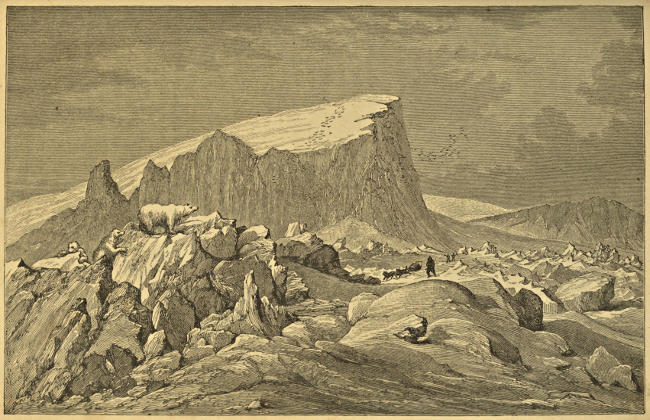
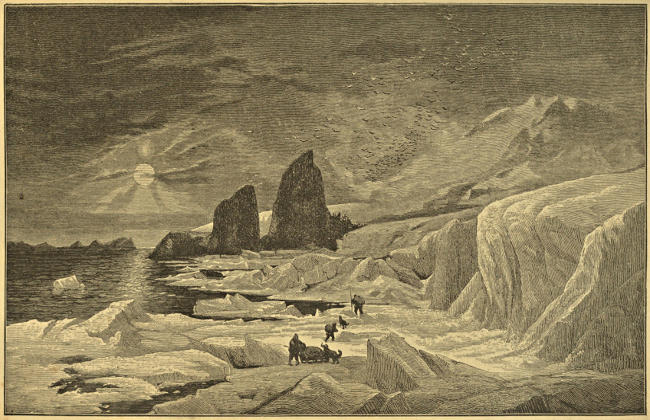
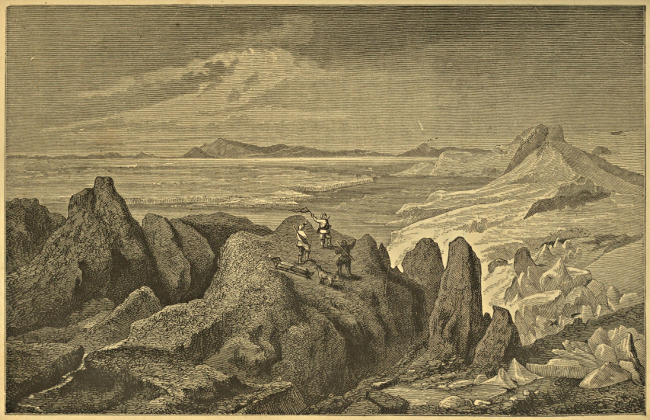
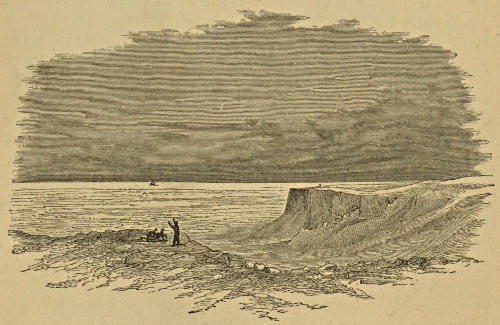
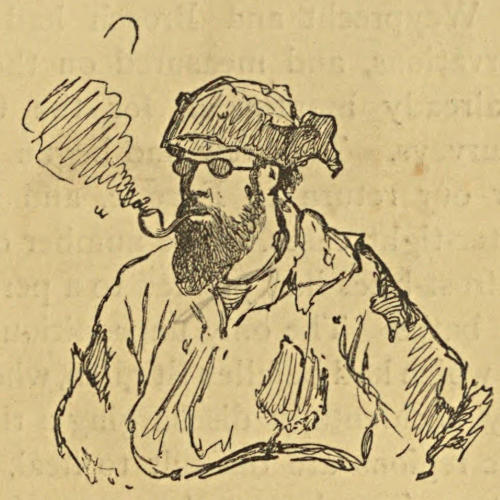
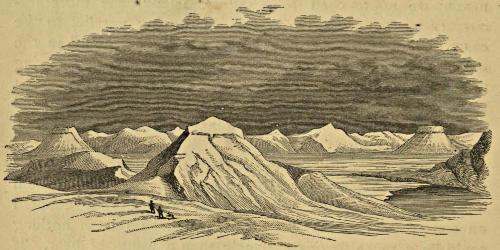
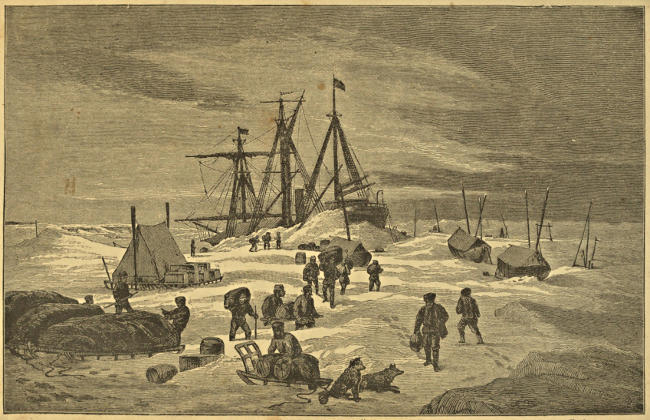
JUNE, 1872-SEPTEMBER, 1874.
I.
FROM BREMERHAVEN TO KAISER FRANZ-JOSEF LAND.
1. He who seeks to penetrate the recesses of the Polar world
chooses a path beset with toils and dangers. The explorer of
that region has to devote every energy of mind and body to
extort a slender fragment of knowledge from the silence and
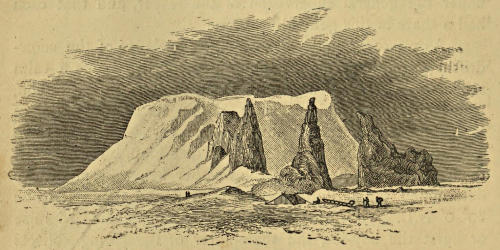
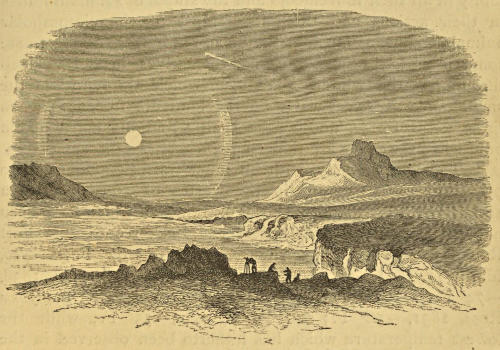
mystery of the realm of ice. He must be prepared to confront
disappointments and disasters with inexhaustible patience,
and pursue devotedly his object, even when he himself becomes
the sport of accident. That object must not be the admiration
of men, but the extension of the domain of knowledge. He
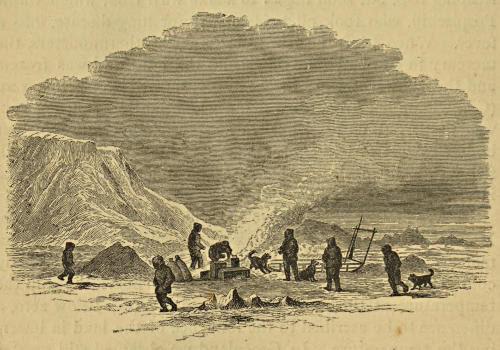
spends long years in the most dreadful of all banishments,
far from his friends, from all the enjoyments of life, surrounded
by manifold perils, and bearing the burden of utter loneliness.
The grandeur therefore of his object can alone support him,—for
otherwise the dreary void of things without can only be
an image of the void within. How many are the preconceptions
with which the novice begins the voyage to the rugged,
inclement north! Books can tell him little of the stern life
to which he dooms himself, as soon as he crosses the threshold
of the ice, thinking perhaps to measure the evils that await
him by the physical miseries of cold instead of by the moral
deprivations in store for him.
2. In the year 1868, while employed on the survey of the
Orteler Alps, a newspaper with an account of Koldewey’s
first expedition one day found its way into my tent on the
mountain side. In the evening I held forth on the North
Pole to the herdsmen and Jägers of my party as we sat
round the fire, no one more filled with astonishment than
myself, that there should be men endued with such capacity
to endure cold and darkness. No presentiment had I then
that the very next year I should myself have joined an
expedition to the North Pole; and as little could Haller, one
of my Jägers at that time, foresee that he would accompany
me on my third expedition. And much the same was it with
the three-and-twenty men who early in the morning of June
13, 1872, came on board the vessel in Bremerhaven, to cast
in their lot with the ship Tegetthoff, whatever that lot might be;
for we had all bound ourselves by a formal deed, renouncing
every claim to an expedition for our rescue, in case we should
be unable to return. Our ideal aim was the north-east passage,
our immediate and definite object was the exploration of the
seas and lands on the north-east of Novaya Zemlya.
3. A bright day rose with us, and no augur’s voice could
have heightened the glad hopes which animated every one of
us. Friends from Austria and Germany had come to bid us a
last farewell; but, as every venture should be, so our departure
that morning was, quiet and without pretension. About six
o’clock in the morning the Tegetthoff lifted her anchor and
dropped down the Schleusen and the Weser, towed by a
steamer. Down the broad stream we calmly glided, full of
satisfaction at the fulfilment of long-cherished plans. There
lay the same pastures, the same trees and meadows which
had so delighted us on our return from Greenland. Yet unmoved
we saw all the charms of nature grow young under the
morning sun and then fade away in the evening twilight—as
the land gradually disappeared behind us, and the coasts of
Germany were lost to view. With the feeling that we were
leaving them for so long a time, our thoughts turned to our
new life in the narrow limits of a ship, and the resolve to live
and labour in harmony animated each breast. How often we
should be liable to casualties which no eye could foresee, we
were soon to find out, when in almost dead calm and without
steam we came on the shallow waters of Heligoland. What
would have become of the expedition, had we not discovered
in time, that we had only a few feet of water under the keel!
4. The vessel, 220 tons burden, was fitted out for two years
and a half, but was over-freighted by about thirty tons, so
that our available space was much curtailed. Yet the cabin,
which Weyprecht, Brosch, Orel, Kepes, Krisch, and I occupied,
was far more commodious than the miserable hole in which
eight of us had been crowded together on our Greenland
expedition. Our supply of coals, 130 tons, was large in proportion
to the size of the ship, being calculated not only for
our daily wants, but to enable us to keep up steam for about
sixty days. But to economise this store we used our sails, as
much as possible, even in the ice. Both ship and engine—of
100 horse power—tested in the trial trip of June 8, sustained
their character during the expedition, and did great credit to
the Tecklenborg firm.
5. The wind being unfavourable, it took us some time to
cross the North Sea and reach the coast of Norway. My
journal describes this part of our voyage. “Light winds from
the south carried the Tegetthoff on her lonely course over the
North Sea. In undimmed brightness the blue sky stretched
overhead, the air was balmy and mild. In the grey distance
frowns the iron rampart of countless cliffs encircling the
barren wastes of Norway. Occasionally a sea-gull comes near
us, or some bird rests on the mast-head; now and then a sail
is seen on the horizon,—but save this, no life—no event.
Every one feels, though no one utters it, that a grave future
lies before him; each may hope what he wishes, for over the
future there is drawn an impenetrable veil. All, however, are
animated with the consciousness, that while serving science, we
are also serving our Fatherland, and that all our doings will
be watched at home with the liveliest sympathy.
6. “On board the Tegetthoff are heard all the languages of
our country, German, Italian, Slavonic, and Hungarian;
Italian, however, is the language in which all orders are given.
The crew is lighthearted and merry: in the evening a gentle
breeze carries the lively songs of the Italians over the blue
sea, glowing under the midnight sun, or the monotonous
cadence of the Ludro of the Dalmatians recalls the sunny home
which they are so soon to exchange for its very opposite,
which remains a sort of mystery to all their powers of fancy.
Thus begins so peacefully our long voyage into the frozen
ocean of the north. In a few weeks the ice will grate on the
bows of the Tegetthoff, the crystal icebergs will surround her,
and with many a strain will the good ship force her way
through the icy wastes, sometimes inclosed on every side,
sometimes free in coast-water, or threatened by the ‘ice-blink’
foreboding danger.”
7. The officers and crew of the Tegetthoff amounted in all
to twenty-four souls.
- Lieutenant Carl Weyprecht, }
- Lieutenant Julius Payer, } Commanders of the Expedition.
- Lieutenant Gustav Brosch,[14] }
- Midshipman Edward Orel, } Officers of the Ship.
- Dr. Julius Kepes, Physician to the Expedition.
- Otto Krisch, Engineer.
- Pietro Lusina,[15] Boatswain.
- Antonio Vecerina, Carpenter.
- Josef Pospischill, Stoker.
- Johann Orasch, Cook.
- Johann Haller, }
- Alexander Klotz, } Jägers, from Tyrol.
- Antonio Zaninovich, Seaman.
- Antonio Catarinich, ditto.
- Antonio Scarpa, ditto.
- Antonio Lukinovich, ditto.
- Giuseppe Latkovich, ditto.
- Pietro Fallesich, ditto.
- George Stiglich, ditto.
- Vincenzo Palmich, ditto.
- Lorenzo Marola, ditto.
- Francesco Lettis, ditto.
- Giacomo Sussich, ditto.
- Captain Olaf Carlsen, Icemaster and Harpooner.
- We had eight dogs on board; two we got in Lapland, the rest were brought from Vienna.
8. Stormy weather detained us for some time among the
Loffoden Isles, so that we made Tromsoe only on July 3.
Here we were received most courteously by the Austro-Hungarian
Consul, Aagaard, who invited us to a banquet.
We remained here a week, in order to complete our equipment.
The ship, which had leaked considerably ever since we
left Bremerhaven, was thoroughly examined by divers, the
stores were landed, the ship repaired and reladen. Our supply
of coals was replenished, a Norwegian whale-boat added to
our equipment, and, lastly, the harpooner, Captain Olaf
Carlsen, was taken on board. On July 6 we received our last
news from Austria, letters and newspapers. The Ukase
granted by the Russian Government also arrived, drawn up
both for Weyprecht and myself in case of our being separated,
a document of great importance, if the ship should be lost
and we had to return through Siberia; an issue only too probable
when the vast length and enormous difficulties of the
north-east passage were considered. While Lieutenant
Weyprecht was engaged in stopping the leak of the ship,
some of us ascended—a Lapp of the name of Dilkoa being
our guide—a pinnacle of rock, 4,000 feet high, towering over
Tromsoe’s labyrinth of fiords, in order to compare our aneroid
and mercurial barometers. From the summit we beheld an
enormous dark column of smoke rising perpendicularly to the
height of about 1,500 feet in the still air—the northern extremity
of Tromsoe was in flames. Most gladly would we
have learned something of the state of the ice this year; but
as yet this was impracticable, for none of the walrus hunters
had returned from their grounds in the north.
9. On the morning of Saturday, July 13, officers and crew
heard mass from a French priest, and bidding adieu to our
Tromsoe friends, we left the quiet little city, the most
northerly of Europe, early on Sunday morning. The passengers
of the Hamburg mail steamer, entering the harbour
as we left it, greeted us with loud and long cheers, and steaming
through the narrow Grötsound, close under the cliffs of
Sandoe and Rysoe we came into the open sea, Captain
Carlsen acting as our pilot. As we issued from the Scheeren,
a mist arose which covered and obscured the huge rock of
Fingloe. Here the engine fires were put out and the sails set,
and the first and last voyage, which the Tegetthoff was destined
to make, began. On July 15 we steered towards the
north, the Norwegian coast with its many glaciers in full
view, and on the 16th we sighted the North Cape in the blue
distance.
1. Unfavourable winds had hindered our progress for some
days; we now encountered heavy seas. On July 23 a sudden
fall of the temperature and dirty rainy weather told us that we
were close to the ice, which we expected to find later and
much more to the northward, and on the evening of July 25,
lat. 74° 0′ 15″ N., we actually sighted it, the thermometer
marking 32·5° F., and 34·5° F. in the sea. The northerly
winds, which had prevailed for some time had broken up the
ice, and it lay before us in long loose lines. Its outer boundary
was consequently the very opposite of those solid walls of ice
which we met with in Greenland in 1869, and two years
afterwards on the east of Spitzbergen. Though surprised at
finding the ice so far to the south, we never imagined that
this was anything but a collection of floes, which had drifted
out perhaps from the Sea of Kara through the Straits of
Matotschkin. But only too soon the conviction was forced
upon us that we were already within the Frozen Ocean, and
that navigation in the year 1872 was to differ widely from
that of the preceding year. Lieutenant Weyprecht had the
day before fastened “the crow’s nest” to the mainmast of the
Tegetthoff, and henceforth it became the abode of the officer
of the watch. On July 26, while steering in a north-easterly
direction, the ice became closer, though it was still navigable;
but we nowhere saw the heavy fields which had astonished us
on the east coast of Greenland, and which Lütke found to be
so dangerous to navigation. The temperature of the air and
the sea fell rapidly, and during the two following weeks it
remained below the freezing point almost uniformly, and
without any essential difference between day and night.
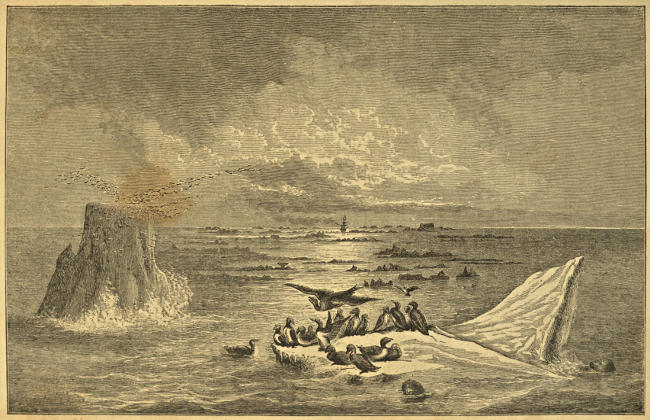
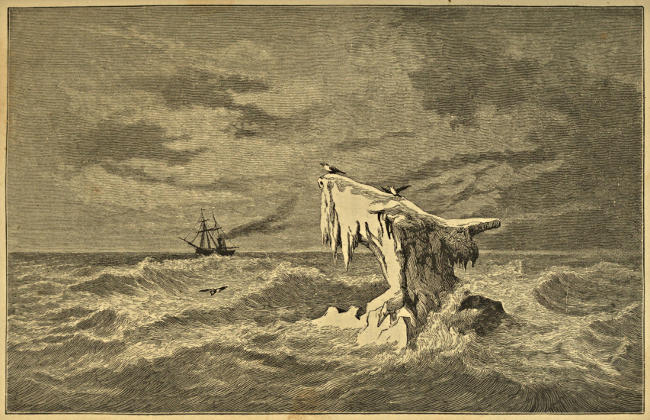
STILL LIFE IN THE FROZEN OCEAN.
2. The frozen sea of Novaya Zemlya is characterized by
that inconstancy of weather which in our lower latitudes we
attribute to the month of April; the same variability is met
with, though in lesser degree, in the Greenland seas during the
summer months. Snowstorms now alternated with the most
glorious blue skies. The black-bulbed thermometer showed
113° F. in the sun, with 39° F. in the shade. The hunting
season began, and the kitchen was well provided with auks
and seals. Our Dalmatians soon learnt to like the dark flesh
of the latter.
3. The ice gradually became closer; July 29 (74° 44′ N.
Lat., 52° 8′ E. Long.) we were able to continue our course
only under steam, and heavy shocks were henceforward inevitable;
in many cases the vessel could not force a passage
except by charging the ice. In the night a vast, apparently
impenetrable barrier stopped our progress; but the tactics
of charging under steam again cleared a passage, and we
penetrated into a larger “ice-hole.” We now glided along
over the shining surface of its waters, as if we were navigating
an inland lake, save that no copsewood clothed the
shores, but pale blocks of ice, which the mist, that now
fell and enveloped us, transformed into the most fantastic
shapes, and at last into mere shapelessness itself. In all that
surrounded us neither form nor colour was discernible; faint
shadows floated within the veil of mist, and our path seemed
to lead no whither. A few hours before the glowing fire of
the noonday sun had lain on the mountain wastes of Novaya
Zemlya, while refraction raised its long coast high above the
icy horizon. Nowhere does a sudden change in Nature
exercise so immediate an effect on the mind as in the
Frozen Ocean, where, too, all that brings delight proceeds
from the sun.
4. For some days we had entered into a world utterly
strange to most of us on board the Tegetthoff. Dense mists
frequently enveloped us, and from out of the mantle of snow
of the distant land the rocks, like decayed battlements,
frowned on us inhospitably. There is no more melancholy
sound than that which accompanies the decay and waste of
the ice, as it is constantly acted on by the sea and thaw, and no
picture more sad and solemn than the continuous procession
of icebergs floating like huge white biers towards the south.
Ever and anon there rises the noise of the ocean swell breaking
amongst the excavations of the ice-floes, while the water
oozing out from their icy walls falls with monotonous sound
into the sea; or perhaps a mass of snow, deprived of its
support, drops into the waves, to disappear in them with a
hissing sound as of a flame. Never for a moment ceases
the crackling and snapping sound produced by the bursting
of the external portions of the ice. Magnificent cascades
of thaw-water precipitate themselves down the sides of the
icebergs, which sometimes rend with a noise as of thunder as
the beams of the sun play on them. The fall of the titanic
mass raises huge volumes of foam, and the sea-birds, which
had rested on its summit in peaceful confidence, rise with
terrified screams, soon to gather again on another ice-colossus.
5. But what a change, when the sun, surrounded by glowing
cirrus clouds, breaks through the mist, and the blue of the
heavens gradually widens out! The masses of vapour, as they
well up, recede to the horizon, and the cold ice-floes become
in the sunlight dark borders to the “leads” which gleam
between them, on the trembling surface of which the midnight
sun is mirrored. Where the rays of the sun do not directly
fall on it, the ice is suffused with a faint rosy haze, which
deepens more and more as the source of light nears the
horizon. Then the sunbeams fall drowsily and softly, as
through a veil of orange gauze, all forms lose at a little
distance their definition, the shadows become fainter and
fainter, and all nature assumes a dreamy aspect. In calm
nights the air is so mild that we forget we are in the home
of ice and snow. A deep ultramarine sky stretches over all,
and the outlines of the ice and the land tremble on the glassy
surface of the water. If we pull in a boat over the unmoved
mirror of the “ice-holes,” close beside us a whale may emerge
from its depths, like a black shining mountain; if a ship
penetrates into the waste, it looks as weird as the “Flying
Dutchman,” and the dense columns of smoke, which rise in
eddies from her funnel, remain fixed for hours until they
gradually melt away. When the sun sinks at midnight to
the edge of the horizon, then all life becomes dumb, and the
icebergs, the rocks, the glaciers of the land glow in a rosy,
effulgence, so that we are hardly conscious of the desolation.
The sun has reached its lowest point,—after a pause it begins
to rise, and gradually its paler beams are transformed into a
dazzling brightness. Its softly warming light dissolves the
ban under which congelation has placed nature, the icy
streams, which had ceased to run, pour down their crystal
walls. The animal creation only still enjoys its rest; the
polar-bear continues to repose behind some wall of ice, and
flocks of sea-gulls and divers sit round the edge of a floe,
calmly sleeping, with their heads under their wings. Not a
sound is to be heard, save, perhaps, the measured flapping
of the sails of the ship in the dying breeze. At length the
head of a seal rises stealthily for some moments from out the
smooth waters; lines of auks, with the short quick beat of
their wings, whiz over the islands of ice. The mighty whale
again emerges from the depths, far and wide is heard his
snorting and blowing, which sounds like the murmurs of a
waterfall when it is distant, and like a torrent when it is
near. Day reigns once more with its brilliant light, and the
dreamy character of the spectacle is dissolved.
6. We had sailed over one “ice-hole,” and again a dense
barrier of ice frowned on us; as we forced our way into it,
the ice closed in all round us—we were “beset.” The ship
was made fast to a floe, the steam blown off, its hot breath
rushing with a loud noise through the cold mist; every open
mesh in the net of water-ways was closed by the ice, which
soon lay in such thick masses around us, that any one provided
with a plank might have wandered for miles in any
direction he liked. July 30, the Tegetthoff remained fast in
her prison; no current of water, nor any movement among
the floes lying close to us was discernible; a dead calm
prevailed, and mist hung on every side. On the following
day we made vain efforts to break through a floe which lay
on our bows. The calm still prevailed, Aug. 1 (74° 39′ N. L.
53° E. L.), and no change was to be seen in the ice. Aug. 2,
the crew began with hearty good-will the toilsome work of
warping, but with no success, the smallness of the floes hardly
admitting of this manœuvre. In the evening of the same
day it seemed as if a fresh breeze would set us free; but after
we had gone on for a few cable-lengths, a great floe once
more barred the route, while at the same time the wind fell.
At length, when the ice became somewhat looser, we got up
the engine fires, and in the following night broke through,
under steam, a broad barrier of ice, which separated us from
the open coast-water of Novaya Zemlya. In the morning of
Aug. 3, we forced our way into coast-water, twenty miles
broad, to the north of Matotschkin Schar, and steered due
north, the mountainous coasts still in sight. A belt of
ice 105 miles broad lay behind us. The country greatly
resembled Spitzbergen, and we observed with pleasure its
picturesque glaciers and mountains rising to the height of
nearly 3,000 feet, though inconsiderable compared with the
mountains of Greenland. Far and wide not a fragment of
ice was to be seen; there was a heavy swell on, the air was
unusually warm (41° F.), in the evening rain fell, and on Aug. 4
we had dense mists and driving snow-storms, which forced us
to keep to the west of Admiralty Peninsula. During the night
of Aug. 6, the snow-storms were heavier than before, and the
deck was quite covered. Towards the north and west very close
ice was seen, and since the temperature of the air, even with
the winds in the south-west, remained constantly below zero,
it was evident that the ice must stretch far in that direction
also. Aug. 7, we ran on the white barriers to the west of
Admiralty Peninsula, and far to the north, beyond a broad
field of ice, refraction indicated open water and showed the
forms of “Tschorny Nos” floating in the air. In the afternoon
of Aug. 8 the ice in 75° 22′ N. L. became so thick
around us that we were compelled to have recourse to steam-power;
but the Tegetthoff, even with this auxiliary was unable
against a head-wind to penetrate a broad strip of close ice,
and banking up our fires, we determined to wait its breaking
up. Close under the coast open water was again observed,
and in it—a Schooner! Every one now hastened to write
letters to his friends and relations, but the schooner, to which
we meant to give our letters and despatches, by running into
the heart of Gwosdarew Bay escaped the duty we had in
store for it. About half-past ten P.M. the wind had fallen and
the ice began to open out, and we were able to continue our
voyage under steam in a north-westerly direction. The sun
lay before us, the clear mirror of distant “leads” glowed with
a glorious carmine, the barriers of ice which lay between these
“leads” appeared as stripes of violet, and only our immediate
neighbourhood was pale and cold. The Tegetthoff laboured
through the dense accumulation of floes and about midnight
reached open water, and the steam was again blown off.
Aug. 9, we sailed in coast-water perfectly free from ice,
excepting the icebergs we encountered, some about forty
feet high. These, generally, were so numerous and so small
in size, that they were at once seen to be offshoots from
the small glaciers of Novaya Zemlya as they plunge into
the sea. Their surface was frequently covered with débris.
Loose drift-ice showed itself, Aug. 10, but the ship continued
to steer between the floes towards the north. In the forenoon
of that day we were again nearly “beset,” but happily
escaped that fate after four hours’ warping. Aug. 11, our
course was continued without impediment in a northerly
direction through the loose drift-ice. The land, from which
we had hitherto remained distant about eight or twelve
nautical miles, now declined in height from three thousand
to fifteen hundred or a thousand feet, and quickly lost its
picturesque character. On the noon of August 12, on
account of a thick mist, we made fast to a great floe, and
were able to commence on it the training of the dogs to
drag the sledges.
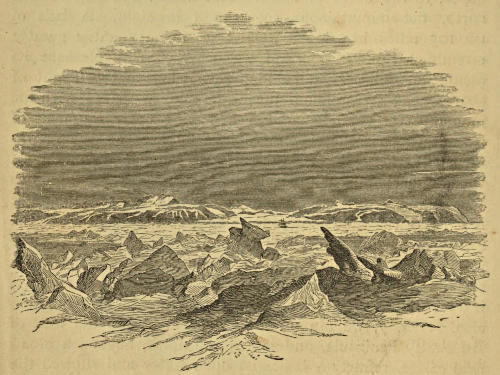
GWOSDAREW INLET.
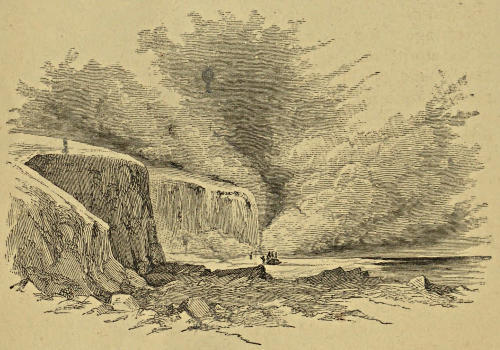
7. In the neighbourhood of the Pankratjew Islands, a
ship suddenly and unexpectedly appeared on the horizon,
and endeavoured to gain our attention by discharges from
a mortar, and by the hoisting of flags. How great was our
astonishment and our joy when we beheld the Austro-Hungarian
flag at the peak of the Isbjörn, and were able to greet
Count Wilczek, Commodore Baron Sterneck, Dr. Höfer, and
Mr. Burger half an hour afterwards on board the Tegetthoff.
Coming from Spitzbergen in the Isbjörn (the ship of our precursory
expedition of 1871) they had sighted us two days before.
That in a sailing vessel, and without any sufficient equipment,
they had succeeded in following and overtaking the Tegetthoff,
which had penetrated so far with difficulty and by the aid of
steam was a proof both of skill and resolution. Their object
was to establish a depôt of provisions at Cape Nassau, at whatever
personal risk to themselves. About two o’clock in the
morning our guests returned to the Isbjörn, and both ships now
sailed in company, and without meeting any hindrance in the
ice-free coast-water, in a northerly direction. In the forenoon
of Aug. 13, in 76° 18′ N. Lat. and 61° 17′ E. Long., we came
upon closer ice, amid mist and stormy weather, and the two
ships anchored to some firm land-ice two cable-lengths from
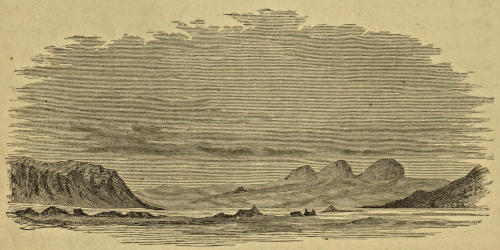
each other, about a mile from the land. Close to the south
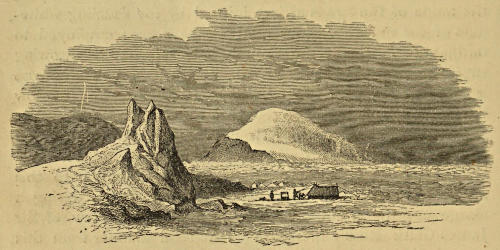
of us lay the Barentz Isles with their singularly formed hills,
which the walrus-hunters call by the somewhat gloomy name
of “The Three Coffins.” On our north an enormous iceberg
rose in dazzling whiteness above a faintly glimmering field
of ice, a harbinger of new countries—for its size forbade us
to think that it owed its origin to the glaciers of Novaya
Zemlya. Continuous winds from the W.S.W., close ice,
mist, downfalls of snow, the necessity of determining the
geographical position of the depôt of provisions which we
had established, compelled us to lie for eight days before the
Barentz Islands. The opportunity we thus had of putting
our feet once more on the land was exceedingly agreeable.
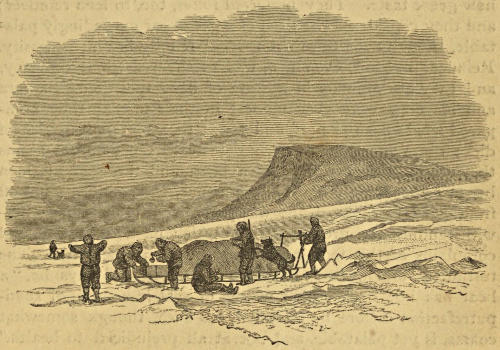
We made repeated visits to the shore with two dog-sledges,
in company with Professor Höfer; and as his observations
on the phenomena of the country are those of a distinguished
geologist, I here insert those he has kindly placed at
my disposal.
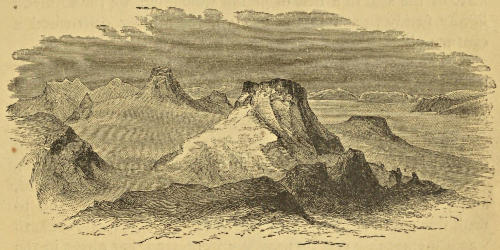
8. “The Barentz Isles are flat, girt with cliffs, and separated
by narrow straits from the coast, which rises up terrace on
terrace. Its rocks consist of a black, very friable slate, frequently
alternating with strata of mountain limestone of
the carboniferous period, varying in breadth from one to
ten metres. These strata are filled with a countless number of
fossilized inhabitants of the sea, trilobites, mussels, brachiopodes,
crinoides, corals, &c., which are utterly foreign to the Frozen
Ocean as it now is, and whose cognates live only in warm
seas.
9. “The animal world, therefore, buried in the limestone
of these islands, is an indisputable proof that there was once,
in these high latitudes, a warm sea, which could not possibly
co-exist with such great glaciers as those which now immerse
themselves in the seas of Novaya Zemlya. That portion
of the earth, now completely dead and buried in ice, once
knew a period of luxuriant life. In its sea there revelled a
world of life, manifold and beautiful in its forms, while the
land, as the discoveries on Bear Island and Spitzbergen
prove, was crowded with gigantic palm-like ferns. This age of
the earth’s history is called the carboniferous period; it was
the rich and fertile youth of the high north, which lived out
its time more rapidly than the southern zones, now in all their
vigour and variety. If we compare the Fauna buried in the
chalk formations of the Barentz Isles, with the contemporaneous
Fauna which we know from the carboniferous formation
of Russia, specially that of the Ural, we find a very
remarkable agreement, not only in their general character,
but also in particular organisms. Many of the fossils of the
carboniferous limestone of these high degrees of latitude
(76°-77°) are found in analogous strata of the Ural, and are
proved by the researches of Russian geologists to exist there
as far as the fiftieth degree of latitude. Without stopping to
insist on the great similarity between the stratification of
Novaya Zemlya and the Ural—the former being the real
continuation of the latter—we dwell here on the fact that in
the carboniferous period there was a sea which stretched
from the fiftieth to the seventy-seventh degree of north latitude,
i.e. twenty-seven degrees, or 405 geographical miles, which
was animated by the same Fauna, and which consequently
must have presented the same relations, especially a like
warm temperature. From these signs it would appear that
the zones of climate now so decisively marked on the surface
of the earth did not exist at the carboniferous period. The
horizontal surface of the land leads us at the first to infer
horizontal stratification; but we find the contrary to be the
case; the marine deposits once horizontal, have been so
raised at a later period that they are now vertical. Since the
friable slate degrades rapidly, and the limestone layers very
gradually, it may be assumed that the former wasting away
leaves the limestone layers standing like walls between them—a
thing which, in a small scale, may often be elsewhere
observed. If a glance at these buried fossils awakens in us
an image, as in a dream, of a creation rich in organic forms, a
glance at the present state of the Barentz Isles impresses us
with the gloomiest feelings.
10. “Before us lies this small greyish brown fragment of
the earth. The cold, level ground is covered with sharp-edged
pieces of rock, which appear to be as it were macadamised,
so closely are they rammed together. Here and there, about
a fathom’s length from each other, lie brownish green masses
like mole-hills. When we examine them more closely, each
mass resolves itself into a vast number of small plants of the
same species (Saxifraga oppositifolia), whose little stalks are
covered with dark green leaves, which are alive, and also with
brown leaves, which have been dead for years and years, but
wither in the cold much more gradually than with us. From
this small heap, tender rosy blooms raise their little heads,
bidding defiance to the bitter snowy weather which sweeps
over the miserable plain. Another species of saxifrage (Saxifraga
cœspitosa), with shorter stalks and yellowish-white
flowers, growing in thick clumps, forms, together with the first-named
variety and the more rarely appearing Saxifraga
rivularis, the hardiest representatives of this family of plants
so frequently found in the Polar regions. If to these we add
Draba arctica with its little yellow flowers, forming in valleys
large patches of sward, the yellow flowering poppy (Papaver
nudicaule), and a rare willow (Salix polaris), which with some
few leaves peeps forth from the soil, we have described the
whole Flora of that desolate waste, in which a mere passing
glance would scarce detect the existence of vegetable life
among the débris of rocks and the heaps of snow. Mosses
are found here and there in the moister fissures of rocks, and
especially on the coast, where old drift-wood, or the bones of
whales or other animals, afford the nourishment they need,
and in some places the mosses spread themselves out into
small carpets. Lichens love to shelter under the clusters of
the different kinds of saxifrage, though sometimes they are
found by themselves. Of this class we will mention merely the
so-called Iceland moss (Cetraria islandica), and a reindeer lichen
(Cladonia pyxidata); the few other forms are nearly related
to those mentioned, and belong to the so-called creeping
lichens. One peculiarity of the Flora of the far north, which
we have already mentioned, is their growth in clumps. Only
thus can these tender organisms maintain their existence
against the stern elements; and this indeed is a characteristic
of all Arctic creation, which is seen in the animal
world also, when its means of nourishment are hard to find.
We will point only to the herds of reindeer, of lemmings, of
walruses, of seals, &c., lastly to the vast flocks of birds; all
of which illustrate the principle: common danger begets common
defence.”
11. Our involuntary leisure at the Barentz Isles enabled us
to make some precautionary preparations for our future contests
with the ice; for a ship may be crushed by the ice and
sink in a few minutes, as had happened some days previously,
not far from us, to the yachts Valborg and Iceland. Provisions
and ammunition for four weeks were got ready, and each man
was entrusted with a special service, if it should ever come to
this extremity. To guard against the dreaded pressures of
the ice, heavy beams were hung round the hull of the vessel,
so that the pressure on the ship might be distributed over a
larger surface, and the vessel itself be raised instead of crushed.
Our space on deck, somewhat limited at first, had been considerably
enlarged, although our numerous sledges, our stock
of drift-wood, and the rudder which had been unshipped,
formed inconvenient obstacles, while the chained-up dogs
occasioned some unpleasant surprises to those who had not
succeeded in gaining their affections. These poor animals,
without protection, suffered much from the cold rough weather
which now prevailed, though subsequently some provision was
made for their comfort. Sumbu and Pekel, the two Lapland
dogs, were the most hardy, and slept without stirring, even
when they were completely covered with snow. It was only
after a long and stout resistance that the dogs became accustomed
to the flesh of seals; at first they growled at every
one who offered it to them.
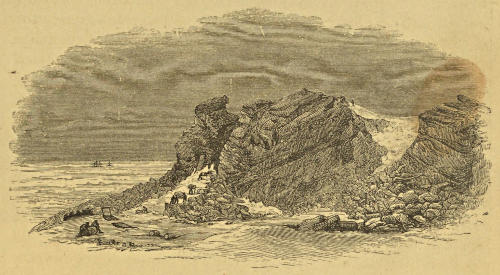
FORMATION OF THE DEPÔT AT “THE THREE COFFINS.”
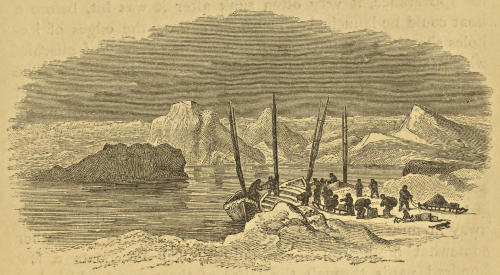
12. Aug. 14, we were threatened by the advance of an
enormous line of pack-ice, which inclosed us in the little
“docks” of the land-ice, and caused the Isbjörn to heel over.
In the evening a bear came near this vessel, which was shot
by Professor Höfer and Captain Kjelsen. On the following
day, with the help of the dogs and sledges, we removed over
the land-ice to “The Three Coffins” the provisions which were
to form the depôt: 2,000 lbs. of rye-bread in casks, 1,000 lbs.
of pease-sausages in tin cases. These were deposited in the
crevice of a rock and secured against the depredations of
bears. We felt assured of the conscientiousness of Russian or
Norwegian fishermen, that they would make use of these
provisions only under the pressure of urgent necessity. This
depôt was intended to be the first place of refuge, in the event
of the ship being lost.
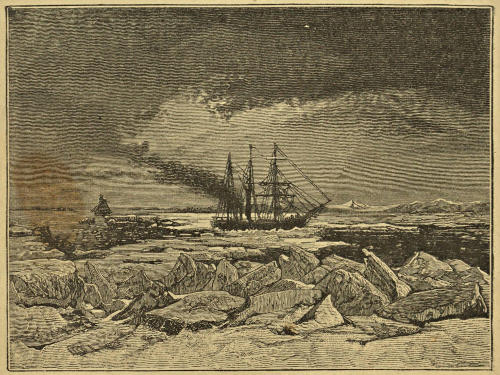
THE “TEGETTHOFF” AND “ISBJÖRN” SEPARATE.
13. Both ships were dressed with flags, and round one
common table we celebrated the birthday, Aug. 18, of the
Emperor and King, Francis Joseph I. On Aug. 19 we fetched
some drift-wood from the land, and saw from a height an
“ice-hole” stretching to the north at no great distance from
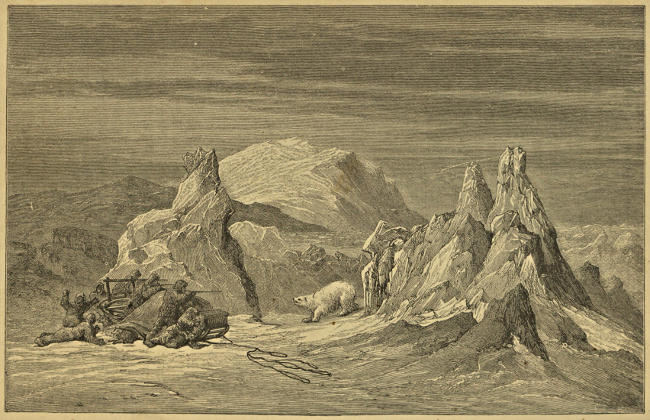
the coast. As we returned to the ship we came across a bear,
which, being assailed by so many hunters at once, took to
flight. Aug. 20, some changes in the ice seemed to make
navigation possible, and we forthwith went on board the
Isbjörn to bid adieu to our friends. It was no common farewell.
A separation to those who are themselves separated
from the world moves the heart to its depths. But besides
this, in bidding adieu to Count Wilczek, we felt how much we
were indebted to him, as the man who had fostered the work
we were about to undertake, who dreaded no danger while
providing for our safety in the event of a catastrophe to the
expedition. Our high-minded friend was at this moment the
embodiment of our country, which, honouring us with its
confidence and trust, demanded that we should devote all our
energies to the high objects of the expedition. Often afterwards
did this adieu return to our memories. With a fresh
wind from the north-east we passed the Isbjörn as we steamed
towards the north, while this vessel, veiled in mist, soon
disappeared from our eyes.
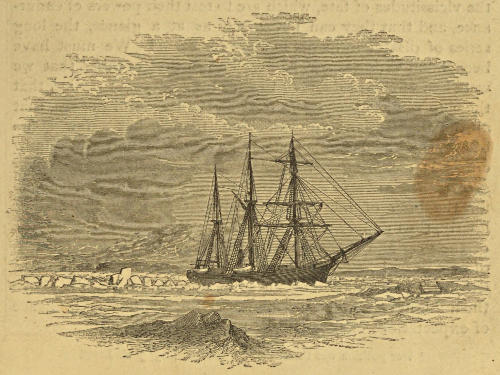
THE “TEGETTHOFF” FINALLY BESET.
14. Our prospects, so far as the object of our expedition
was concerned, had meantime not improved. To cross the
Frozen Sea to Cape Tscheljuskin in the present year was not
to be dreamt of, and yet the thought of wintering in the
north of Novaya Zemlya was positively intolerable. The
navigable water was becoming narrower every day, and the
ice seemed to increase in solidity, especially in the neighbourhood
of the coast. In the afternoon of this day we ran into
an “ice-hole,” but in the night barriers of ice stopped our
further progress. As usual, the ship was made fast to a floe,
the steam blown off, and we awaited the parting asunder of
the ice.[16] Five walruses who had been watching us from a
rock as we entered that ill-starred “ice-hole,” sprang into the
water and disappeared.
15. Ominous were the events of that day, for immediately
after we had made fast the Tegetthoff to that floe, the ice closed
in upon us from all sides and we became close prisoners in its
grasp. No water was to be seen around us, and never again
were we destined to see our vessel in water. Happy is it for
men that inextinguishable hope enables them to endure all
the vicissitudes of fate, which are to test their powers of endurance,
and that they can never see, as at a glance, the long
series of disappointments in store for them! We must have
been filled with despair, had we known that evening that we
were henceforward doomed to obey the caprices of the ice, that
the ship would never again float on the waters of the sea, that
all the expectations with which our friends, but a few hours
before, saw the Tegetthoff steam away to the north, were now
crushed; that we were in fact no longer discoverers, but passengers
against our will on the ice. From day to day we hoped
for the hour of our deliverance! At first we expected it
hourly, then daily, then from week to week; then at the seasons
of the year and changes of the weather, then in the chances
of new years! But that hour never came, yet the light of hope,
which supports man in all his sufferings, and raises him above
them all, never forsook us, amid all the depressing influence
of expectations cherished only to be disappointed.
1. At the end of August the temperature in the Frozen
Ocean is generally at the freezing point of the Centigrade
thermometer, but this year (1872) it was constantly six degrees
below it. A cold bleak air enveloped us, there was abundance
of snow, the sun showed himself rarely, and for some days he
had sunk, at midnight, under the horizon. The ship and her
rigging were stiff with ice, and everything indicated that for us
winter had begun. As the masses of ice which inclosed us
consisted only of small floes, we were led to hope that the
strong east winds would soon disperse them. But the very
contrary really happened, for the low temperatures, the calms,
and falls of snow, bound the floes of ice only the more closely
together, and within a few days congealed them into one
single field, in the midst of which the ship remained fast and
immovable. Our surroundings were monotonous beyond
description,—one vast unattractive white surface, and even the
high-lands of Novaya Zemlya were covered with freshly fallen
snow.
2. To reach the coast of Siberia under these circumstances
had become an impossibility, and even in the event of our
being liberated, the search for a winter harbour in Novaya
Zemlya would be a matter of peril and difficulty. Yet we
calculated confidently on this contingency and employed our
enforced inactivity in completing our preparations for sledge
journeys during the autumn, although we could not but feel,
that their importance must be of secondary interest and value
in a country so well known as Novaya Zemlya. Meantime
we drifted slowly along the coast in a northerly direction and
apparently under the influence of a current, which has been
often observed on the northern coasts of Novaya Zemlya.
But the gloom of our situation, as we became conscious of
our captivity, was more distinctly and painfully felt. On the
1st of September the temperature sank nine degrees below
zero (12° F.), and the few and limited spaces of open water
round our floe disappeared. The sun now remained six hours
below the horizon, and the formation of young ice in a single
night often reached such a thickness, that we soon perceived
that our last hope for this year lay in the setting-in of heavy
equinoctial storms to break up the ice-fields.
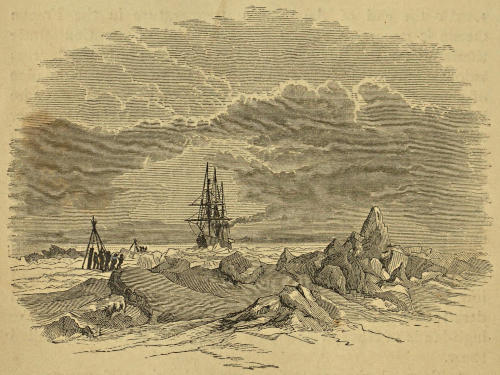
ATTEMPTS TO GET FREE IN SEPTEMBER.
3. On the 2nd of September a fissure running through our
floe reached the after-part of the Tegetthoff and opened into
a “lead,” and even our floe partially broke up; but this
availed us nothing, for the ship itself remained fast on a huge
fragment. During the night of Sept. 3, the after-part of the
Tegetthoff was gently raised for the first time by the pressure
and driving from beneath of the ice; yet of the formidable
nature of such pressure we had as yet no presentiment.
Though our situation seemed desperate, it was not attended
by immediate danger, and, condemned as we were to inactivity,
we found the amusement and occupation we needed in skating
on the young ice, which covered many of the newly-formed
ice-holes between the ice-floes. Besides the duty of making
and recording meteorological observations, the training of the
dogs, the bringing ice to the kitchen to be transformed into
water, the manufacture of oil, expeditions on foot to explore
the country, were the only forms in which our energies could
be exerted. Absolute loneliness surrounded us; even the
Arctic sea-gull (Larus glaucus) and the grey stormy petrel
(Procellaria glacialis, L.) of the polar regions, were but rarely
seen, and a bear, which, Sept. 5, came within forty paces of
the ship, was driven away by the awkwardness of our hunters.
The cold became more and more intense and the weather
more gloomy. Sept. 2, the cabin lamp had to be lit for the
first time about half-past nine o’clock, and on the 3rd we
began to heat the interior parts of the ship, the temperature
of which had been for some time at zero; and on
the 11th, the first fiery belts of the Aurora flamed in the
northern heavens. On the 9th and 10th, there was a very
heavy storm from the north-east, which drove us back for a
short time towards the west, and partially broke up our floe,
but all the efforts of the next week to destroy the connection
of what remained by sawing and blasting proved unsuccessful.
Blasting with powder, whether above or below the surface-ice,
proved ineffectual. Even old fissures in the ice appeared to
defy further disruption, segments which had been laboriously
made by sawing, froze again almost immediately, and even
the application of steam was powerless to set our floe in
motion and force the breaking-up of the parts which had
been sawn through. It was of no avail that, up to Oct. 7, we
kept open a trench round the ship, by destroying in the day
the ice which had been formed during the night: the expected
disruption of our ice-field never happened. Dark streaks in
the heavens still proclaimed that we were in the neighbourhood
of open water, and though they seemed only to indicate
“leads” of no great breadth or extent, they helped to sustain
our hopes. But these were soon doomed to be disappointed,
for even these “leads” closed up, and at the same time the
temperature fell to an unusually low degree. On the 15th of
September we had 15 degrees of cold, and on the 19th
the temperature fell 18·6 degrees below zero (C.). To add to
this, there were frequent falls of drifting snow. As long as
fissures remained we had opportunities of seal-hunting, but
by the end of the month the “ice-holes” were overspread with
spongy ice, which hindered the movements of our boats within
them. The alternate openings and closings of the water-ways
around us seemed in our monotonous life a harmless spectacle,
for the lofty walls of piled-up ice had not as yet for us the
language of imminent and threatening dangers.
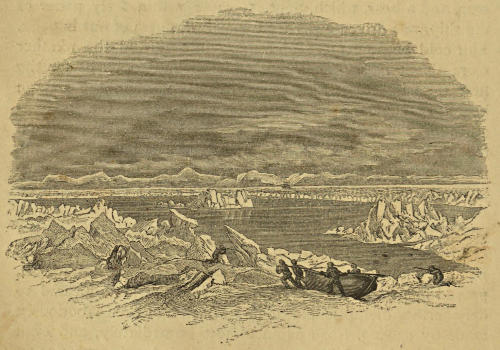
SEAL-HUNTING—SEPTEMBER 1872.
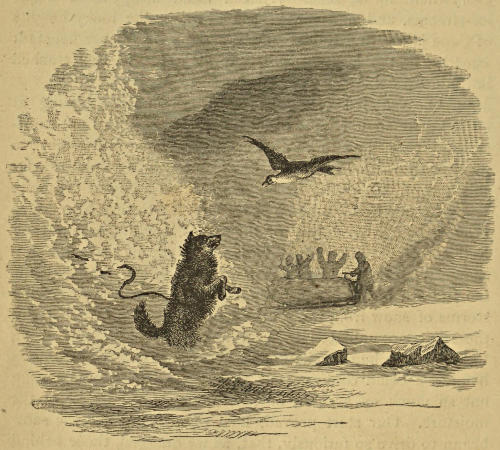
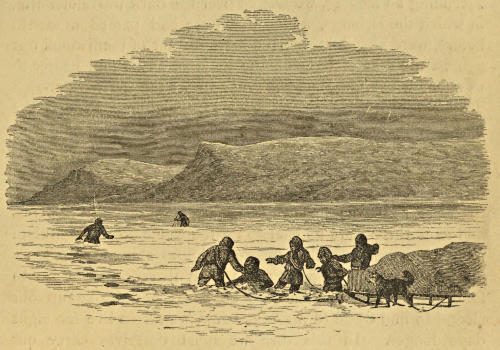
4. Sept. 22, there was a fissure in the ice about thirty paces
from the ship, and we quickly put on board all the materials
which were lying on the floe, believing that the moment of
our deliverance had come. But no such moment came, nor
did the equinoctial storms which we expected set in; we continued
to drift still further to the north; and on Oct. 2, we had
passed the seventy-seventh degree of north latitude. In the
beginning of this month a storm, which lasted but a short
time, opened up a large “ice-hole” near the after-part of the
ship, and forthwith we set to work to open a passage through
our floe in order to reach it, but two days afterwards this
“ice-hole” also closed up. Yet amid all our mishaps we
forgot not on October the 4th—the name-day of his Majesty
the Emperor Francis Joseph I.—the homage which was due
to our noble and gracious Sovereign. The ship was gaily
dressed with flags, and a rifle-match, in which watches and
pipes were the prizes, scared away for a short afternoon the
sad impressions of the moment.
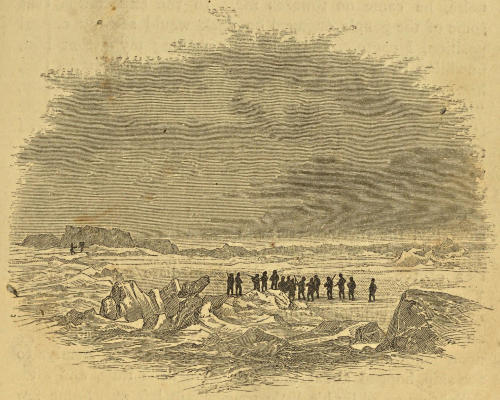
SHOOTING AT A TARGET, OCTOBER 1872.
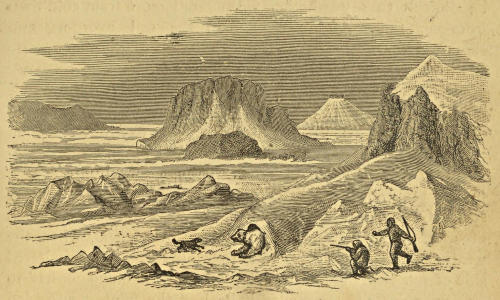
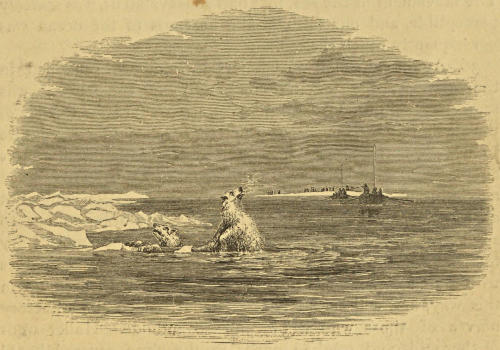
5. Encounters with polar bears afforded us much excitement.
On the 6th of October our first bear was killed and divided
among the dogs, for as yet we had not learnt to regard the
flesh of these animals as the most precious part of our provisions.
A fox also, the first seen during this expedition,
showed himself during the previous night. He had evidently
come from Novaya Zemlya, and his curiosity had led him
close to the ship, from whence he was driven by the dogs.
It now became indispensable for everyone who left the immediate
neighbourhood of the ship to carry arms with him, and
the neglect of this precaution had sometimes rather ludicrous,
at other times somewhat serious, consequences. On the 11th
of October I left the ship unarmed, and with no other companion
than our Lapland dog, Pekel, to employ myself in the
harmless occupation of piling up a tower of ice. Working as
I was in a stooping position, I was unconscious of what was
immediately around me, when on a sudden the loud barking
of Pekel caused me to raise myself, and I saw a bear quite
close before me. Shaking his head and making a snuffling
noise, he came on towards me. In the expectation that
some of the people engaged on deck would see my critical
position, I contented myself with shaking my fist at him,
unwilling to reveal any weakness to my enemy. As this,
however, seemed to produce no effect, I cried out repeatedly,
“A bear!” At last I saw Klotz, who was on deck, go to the
stand of arms, but with such stoical composure, that I ceased
to trust to others, and left to the bear, who had now advanced
to a distance of about fifteen paces from me, the glory of
forcing his enemy to take to flight.
6. In the first days of October the temperature rose considerably,
the thermometer standing a little below zero (C.).
This was due to south-west winds, and to the temporary extension
of the “ice-holes” in our immediate neighbourhood.
The days now became shorter, the sun surrounded with red
masses of clouds set behind barriers of blackish-blue ice, and
an ever-deepening twilight followed his disappearance. Sept.
29, a “snowfinch” flew from the coast of Novaya Zemlya to
the ship, hopped about the deck for a little time, and after
delighting us all by his little song, again left us. Some few
sea-gulls still wended their flight to the spaces of water in our
neighbourhood. Skimming over the top of the mast, they
seemed to gaze down upon us, and then with a shrill cry darted
away like arrows towards the south. There was something
melancholy in this departure of the birds; it seemed as if all
creatures were retiring from the long reign of night which was
before us. In order to divert our attention from the dreadful
monotony of our captivity by some occupation in the open
air, we fell on the plan of building houses of ice round the
ship. The activity of a building-yard reigned on our ice-floe;
heavy ice-tables were broken or sawed through, the dogs in
the sledges carried the fragments to their appointed places,
and with these blocks we raised crystal walls and towers.
Snow, mixed with sea-water, furnished an inexhaustible
source of the most excellent mortar; and while we worked
laboriously at these meaningless erections, we earned at least
by our labour the reward of sleep free from care.
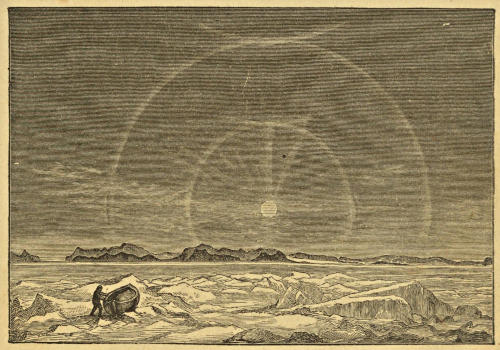
PARHELIA ON THE COAST OF NOVAYA ZEMLYA.
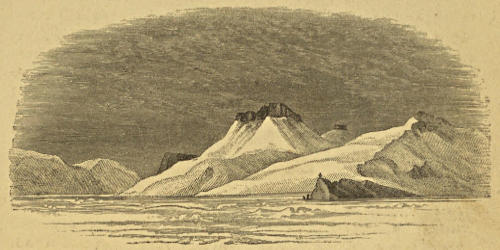
7. As we drifted helplessly northward, the coasts of Novaya
Zemlya receded gradually from our gaze. Hitherto we had
lain close to the land, which with its rounded mountains and
valleys filled with glaciers seemed a miniature of Alpine
scenery. Daily almost the gigantic luminous arcs of parhelia
stood above it, the usual precursors of stormy weather or
heavy falls of snow. Towards the north and north-east the
country becomes flatter, and runs into glacier-wastes little
raised above the level of the sea. The topography of the
northern parts of Novaya Zemlya is complete confusion. The
only survey which exists—that of Lütke—extends no further
than Cape Nassau. The maps of the Barentz Isles are
frequently in contradiction with fact, and their correction is
extremely desirable. Though this land was of no value for
our object, yet it was still land, and it seemed also to us,
drifting as we did, the symbol of the stable and immovable.
But now it was gradually disappearing from our eyes. During
September we had moved slowly, but with October we drifted
at a greater rate, so that by the 12th of this month we saw
nothing but a line of heights some thirty miles off, towards
the south. At last every trace of land disappeared from our
gaze; a hopeless waste received us, in which no man could
tell how long we should be, or how far we should penetrate.
1. Autumn was passing away, the days were getting shorter,
and in our immediate neighbourhood no movement in the ice
was perceptible, save that we had drifted continuously towards
the north-east; sometimes, though rarely, a fissure in the ice
grew to the proportions of an “ice-hole,” only, however, to
be quickly frozen over and present a surface for our skates.
There lay the frozen sea, the picture of dull, hopeless monotony;
shelter there was none. Our floe, though it seemed
to combine the conveniences of a winter harbour, could not
stand the test of closer observation, the illusion of such a
notion must be short-lived. But many signs now indicated
the insecurity of our position. Fields of ice in our neighbourhood
cracked and split asunder, and piled-up masses
floated round us, silent preachers, as it were, of the destruction
which ice-pressure could produce.
2. A change, however, was soon to come over the scene.
On the evening of October 12 we imagined that the cabin
lamp oscillated, and consequently that our floe was in motion.
On the same night we were conscious of a violent movement
in the ice. A dreadful day was the 13th of October,—a
Sunday; it was decisive of the fate of the expedition. To
the superstitious amongst us the number 13 was clothed
with a profound significance: the committee of the expedition
had been constituted on February 13; on the 13th of January
the keel of the Tegetthoff had been laid down; on the 13th
of April she was launched; on the 13th of June we left
Bremerhaven; on the 13th of July, Tromsoe; after a voyage
of 13 days we had arrived at the ice, and on the 13th of
October the temperature marked 16 degrees below zero (C.).
In the morning of that day, as we sat at breakfast, our floe
burst across immediately under the ship. Rushing on deck
we discovered that we were surrounded and squeezed by the
ice; the after-part of the ship was already nipped and pressed,
and the rudder, which was the first to encounter its assault,
shook and groaned; but as its great weight did not admit
of its being shipped, we were content to lash it firmly. We
next sprang on the ice, the tossing tremulous motion of which
literally filled the air with noises as of shrieks and howls, and
we quickly got on board all the materials which were lying
on the floe, and bound the fissures of the ice hastily together
by ice-anchors and cables, filling them up with snow, in the
hope that frost would complete our work, though we felt that
a single heave might shatter our labours. But, just as in the
risings of a people the wave of revolt spreads on every side,
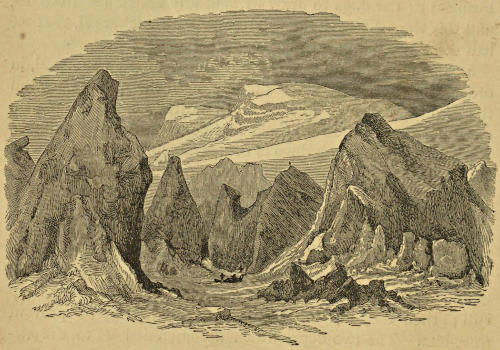
so now the ice uprose against us. Mountains threateningly
reared themselves from out the level fields of ice, and the low
groan which issued from its depths grew into a deep rumbling
sound, and at last rose into a furious howl as of myriads of
voices. Noise and confusion reigned supreme, and step by
step destruction drew nigh in the crashing together of the
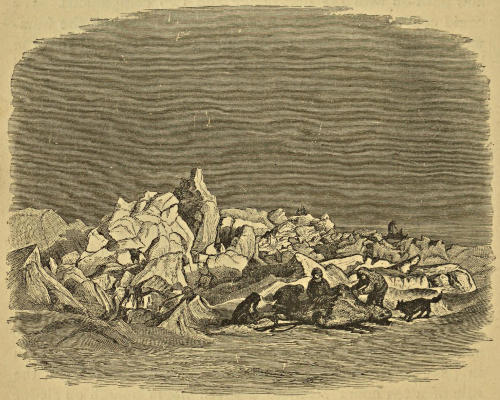
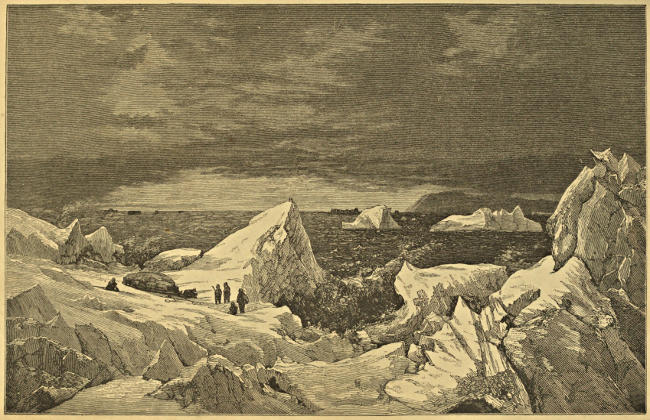
fields of ice. Our floe was now crushed, and its blocks, piled
up into mountains, drove hither and thither. Here, they
towered fathoms high above the ship, and forced the protecting
timbers of massive oak, as if in mockery of their purpose,
against the hull of the vessel; there, masses of ice fell down
as into an abyss under the ship, to be engulfed in the rushing
waters, so that the quantity of ice beneath the ship was continually
increased, and at last it began to raise her quite above
the level of the sea. About 11.30 in the forenoon, according
to our usual custom, a portion of the Bible was read on deck,
and this day, quite accidentally, the portion read was the
history of Joshua: but if in his day the sun stood still, it was
more than the ice now showed any inclination to do.
3. The terrible commotion going on around us prevented
us from seeing anything distinctly. The sky too was overcast,
the sun’s place could only be conjectured. In all haste
we began to make ready to abandon the ship, in case it
should be crushed, a fate which seemed inevitable, if she
were not sufficiently raised through the pressure of the ice.
About 12.30 the pressure reached a frightful height, every
part of the vessel strained and groaned; the crew, who had
been sent down to dine, rushed on deck. The Tegetthoff had
heeled over on her side, and huge piles of ice threatened to
precipitate themselves upon her. But the pressure abated,
and the ship righted herself; and about one o’clock, when
the danger was in some degree over, the crew went below to
dine. But again a strain was felt through the vessel, everything
which hung freely began to oscillate violently, and all
hastened on deck, some with the unfinished dinner in their
hands, others stuffing it into their pockets. Calmly and
silently, amid the loud sounds emitted by the ice in its violent
movement, the officers assumed and carried out the special
duty which had been assigned to each in the contemplated
abandonment of the ship. Lieutenant Weyprecht got ready
the boats, Brosch and Orel cleared out the supply of provision
to be taken in them; Kepes, our doctor, had an eye to
his drugs; the Tyrolese opened the magazine, and got out the
rifles and ammunition—I myself attended to the sledges, the
tents, and the sacks for sleeping in, and distributed to the
crew their fur coats. We now stood ready to start, each with
a bundle—whither, no one pretended to know! For not a
fragment of the ice around us had remained whole; nowhere
could the eye discover a still perfect and uninjured floe to
serve as a place of refuge, as a vast floe had before been to
the crew of the Hansa. Nay, not a block, not a table of ice
was at rest, all shapes and sizes of it were in active motion,
some rearing up, some turning and twisting, none on the level.
A sledge would at once have been swallowed up, and in this
very circumstance lay the horror of our situation. For, if
the ship should sink, whither should we go, even with the
smallest stock of provisions?—amid this confusion, how reach
the land, thirty miles distant, without the most indispensable
necessaries?
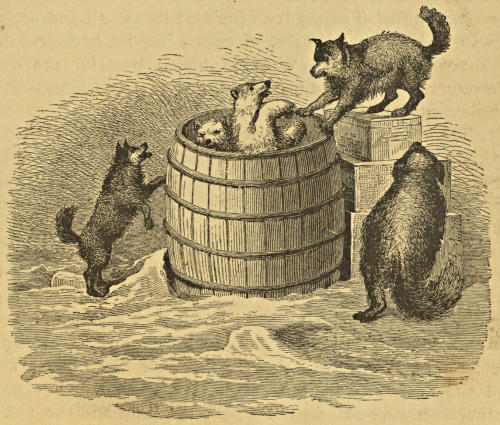
4. The dogs, too, demanded our attention. They had sprung
on chests, and stared on the waves of ice as they rose and
roared. Every trace of his fox-nature had disappeared from
“Sumbu.” His look, at other times so full of cunning, had
assumed an expression of timidity and humility, and, unbidden,
he offered his paw to all passers by. The Lapland dog, little
Pekel, sprang upon me, licked my hand, and looked out on
the ice as if he meant to ask me what all this meant. The
large Newfoundlands stood motionless, like scared chamois,
on the piles of chests.
5. About 4 P.M. the pressure moderated; an hour afterwards
there was a calm, and with more composure we could
now survey our position. The carpenter shovelled away the
snow from the deck in order to inspect the seams. They
were still uninjured. The knees and cross-beams still held,
and no very great quantity of water was found in the hold.
This result we owed solely to the strength of our ship and to
her fine lines, which enabled her to rise when nipped and
pressed, while her interior, so well laden as to become a solid
body, increased her powers of resistance. Everything was
again restored to its place, so that it was possible to go up
and down the cabin stairs without great difficulty, and in the
evening the water in the hold, which had risen 13 inches, was
pumped out to its normal depth of 6 inches. We went down
into the cabin to rest, but though thankful and joyful for the
issue, our minds were clouded with care and anxiety. Henceforth
we regarded every noise with suspicious apprehensions,
like a population which lives within an area of earthquakes.
The long winter nights and their fearful cold were before us;
we were drifting into unknown regions, utterly uncertain of
the end. When night came, we fell asleep with our clothes
on, though our sleep was disturbed every now and then by
onsets of the ice, recurring less frequently and in diminished
force; but daily—and for one hundred and thirty days—we
went through the same experiences in greater or lesser
measure, almost always in sunless darkness. It was, however,
a fortunate circumstance for us that we encountered the first
assaults of the ice at a time when we were still able to see;
for instead of the calm preparations we were able to make,
hurry and confusion would have been inevitable had these
assaults surprised us amid the Polar darkness.
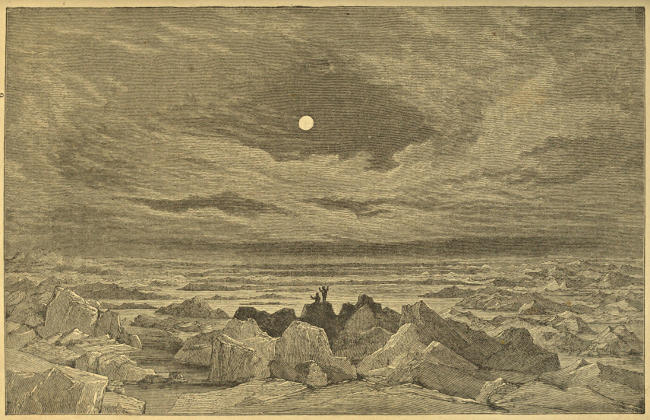
AN OCTOBER NIGHT IN THE ICE.
6. Early in the morning of Oct. 14 we all met at breakfast,
but on every face there lay an expression of grave thoughtfulness,
for each of us was contemplating the long perspective of
those dreary nights, in which we should drift without a goal
in the awful wastes of the Frozen Sea. The speedy restoration
of our floe was now our most earnest desire. It was only
severe frost and heavy falls of snow—as we vainly imagined—which
could cement the chaos of broken fragments around
us and form from them a new floe; for as yet we had not
learnt by experience, that severe cold in itself, unaccompanied
with wind, is sufficient to break up the fields of ice, from the
contraction which it causes. We deluded ourselves with
another consolation—we imagined that the ice-pressures
would cease as soon as we passed the eastern extremity of
Novaya Zemlya, and that in the Sea of Kara we should drift
without encountering the pressures, due, as we conceived, to
our nearness to land. But vain also was this hope, for we
were drifting not into the Sea of Kara, but towards the north-east.
We should have found, even in that sea, that pressures
from the ice may occur within the Frozen Ocean, however,
as well as at its coasts. The masses of ice which caused our
disasters probably came from that sea.
7. The time subsequent to this crisis was full of painful and
anxious moments, but a chronological description of the
events of each day, involving a mere repetition of our sad
impressions, would be wearisome to the reader. I will, therefore,
transfer from my journal such portions of it as most
forcibly express the thoughts that passed through the minds
of the handful of men on board the Tegetthoff during those
terrible days:—
“October 14.—About half-past eight o’clock in the evening
a new fissure in the ice appeared astern of the ship; a strain
was felt throughout her timbers; in a moment every one in
his fur dress and with his bundle in his hand was on deck: so
will it be, perhaps, throughout the winter—what a life!
“October 15.—All had slept in their clothes. Fresh pressures
from the ice were felt about eight o’clock in the morning, not
so powerful as on the 13th, but of such force that all sprang
from their berths and within a minute again stood ready on
the deck. Much ice had been forced under the after-part of
the ship, which was raised up by the pressure. When all was
calm every one set to work to make a bag to contain the gear
he meant to take if the ship should be crushed. Mine contained
the following articles: one pair of fur gloves, one pair
of woollen gloves, a pair of snow spectacles, six pencils, a
rubber, three note-books, the journal of my Greenland expedition,
a book of drawings, ten ball-cartridges, two pairs of
stockings, a knife, a case of needles and thread. On the 13th
we had neglected to provide ourselves with maps of Novaya
Zemlya; two of these I now included among my stock of
necessaries. Six Lefaucheux rifles, four Werndl-rifles, two
thousand cartridges, two large and two smaller sledges, a tent
for ten, one for six men, two great sleeping sacks, each for
eight, and a smaller one for six men, were placed in the boats.
Although all these preparations would have been quite vain
if the ship had sunk with the ice in motion to crush us, we
must, for our mutual encouragement, keep up the appearance
of believing in them. About six o’clock in the evening the
full moon rose, like a copper coin fresh from the mint, above
our horizon on the deep blue of the heavens. In the evening
the ice was at rest, and for the first time for some days we
ventured to undress on going to bed.
“October 16.—Slept without care or disturbance till two
o’clock in the morning, when pressure from the ice again set
in, and all rushed on deck. Some of the crew threw out on
the ice the antlers of a reindeer of Novaya Zemlya,—for
according to a superstition of the seamen the horns of a reindeer
are the generators of mischief! The ice again calm, and
I fell asleep from exhaustion; but about half-past five in the
morning there was a new pressure of about twenty minutes’
duration, and almost as fearful as on the 13th of the month.
The exceeding haste with which every one rushes up from
below as soon as the ship begins to strain, shows the effect
which the noise makes on us; it is impossible to become
accustomed to it; every one runs on deck. Again the ice
rests, but about half-past seven in the morning, another
pressure, which almost tore away the beams protecting the
hull and the davits to which they were fastened. The ship,
however, rights herself. To-day the ice which overhung our
bulwarks was dug away to prevent masses of it falling on
the deck. In the evening, diminished pressure from the
ice; at night, glorious moonlight scenery; nothing more
peaceful, but nothing more illusive, than such a scene at such
an hour.
“October 17.—All quiet during the night till Lusina came
to announce, with a voice as from the grave, that the ship was
making more water, sixteen inches in the forepart, eleven
inches amidships. East wind, with heavy drifting snow-storms—during
the day once only a strain of short duration was
felt in the ship, as a new fissure opened in the piled-up ice on
our starboard quarter.
“October 18.—Our anxieties somewhat abate and our watchful
state of preparation to leave the ship relaxes, and most
of us determine once more to undress for the night. After
several weeks the sun, which had been obscured by the
weather, becomes visible, rising 2° 25′ above the horizon; the
temperature stands at -20° F., and our latitude is 77° 48′.
“October 19.—Straining in the ship; the sun rose about a
quarter past eight, but was soon veiled in frosty vapours.
“October 20.—The hull of the ship is still without its
necessary protection of ice and snow, while we are wrapt in
furs and wear reindeer-shoes and felt-boots. In the evening
a faint mock moon was visible.
“October 21.—At night we were alarmed by a loud sound,
and in few minutes all were on deck with their fur clothes on—a
fissure had opened on the starboard side of the ship, connecting
itself with that which had been formed astern of the
ship. In an hour this fissure had widened about four feet,
and we worked for some hours by the light of lamps to fill it
up with snow and pieces of ice. The low temperature (-21°
F.) led us to expect that this chasm would be bridged over
without further effort on our part. The moon stood surrounded
by a vast halo in the heavens and illuminated the awful loneliness
of our abode. Once more a calm! When any one comes
down from the deck into the cabin, the eyes of all are
involuntarily turned upon him to read in the expression of
his face what is going on above, and each dreads to hear it
said, that the ice is in motion. In the afternoon, when the
fissure closed, we heard the old dull sound from the ice, and
the ship strained violently, and all were on deck ready to
leave. About nine o’clock in the evening the motion of the
ice was again felt. Uncertain and full of fears as to what the
night might bring forth, we go early to rest; no one knows
how short that rest may be. Even Klotz lays aside his stoical
calmness, and the philosophical dignity of his remarks departs
when his comrades spring from their berths and rush on deck
with their bundles. The frozen pumps are daily thawed by
boiling water; to-day the shaft of one of them broke, through
the excessive strain put upon it.
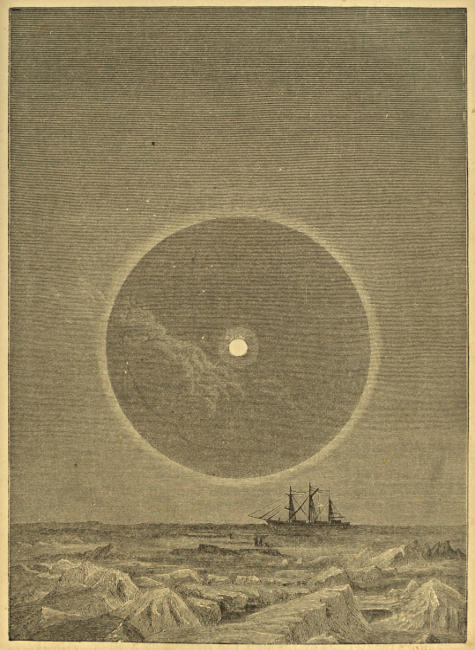
THE MOON WITH ITS HALO.
“October 22.—During the night, motion in the ice. At
9.30 A.M. the sun rose, and attains its meridian altitude at
1° 41′. In the evening the fissure in the ice again opens.
Rents and small ‘ice-holes’ are all round us, and frosty
vapour fills the air. To-day the skull of a bear was thrown
out on the ice, the crew asserting that mischief comes from
the possession of it!
“October 23.—During the night violent movement in the ice;
the sound produced resembles the noise of a fleet of paddle-wheel
steam-ships, steaming now with full, now with half
power. The height of the sun to-day above the horizon was
a little above one degree, its form was distorted by refraction
into an egg-like shape, and its edges were in constant
vibration.
“October 24.—The daylight is now so feeble that the lamps
have to be lighted during the day, with the exception of two
or three hours in the forenoon. Many of the crew are suffering
from frost-bites on their hands, in consequence of their
exposure in removing the unnecessary rigging, and in the
preparations to facilitate the removal of our stock of provisions
in the event of our being forced to abandon the vessel.
“October 25.—In the afternoon we made an attempt to drive
the dog sledges, but the snow, in spite of the low temperature,
lay in such masses between the small hummocks and on the
few level places, that they sank deep into it. It is storms of
wind only that harden the snow, and for some time we have
had calms or light breezes. In the evening there was a movement
in the ice astern of the ship, accompanied with the
highest soprano tones. The noise the ice makes in its pressure
very much resembles the piping and howling of a storm
among rocky cliffs or through the rigging of a ship. About
half-past ten at night, the oscillating movements of the ice,
occurring at definite intervals, made it appear as if they arose
from a swell of the ocean. The ship groans and creaks constantly;
indeed, creaking and groaning are weak expressions
for such a noise. Once more all are ready. We begin to fear
that the ice will never rest.
“October 26.—Pressure throughout the whole night. Armed
and provided with lanterns, we used the sledges to remove
two boats, 150 logs of wood, fifty planks, and a supply of
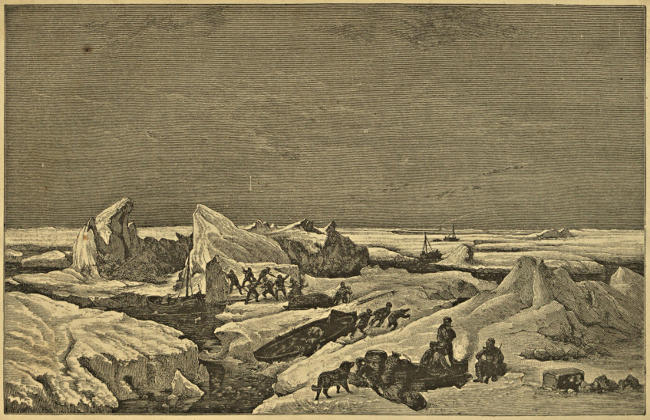
coals, to the port side of the vessel, and chose a stronger floe,
on which to build a house of refuge. Tired and exhausted,
we fell asleep, in spite of the straining and creaking of the
vessel.
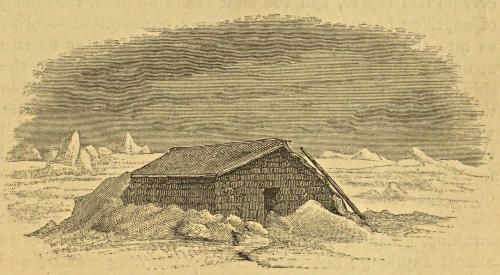
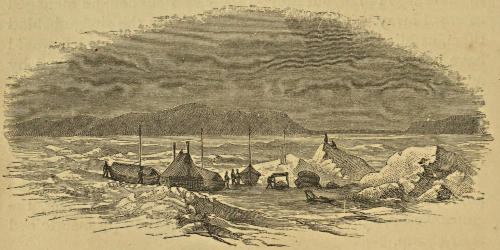
OUR COAL-HOUSE ON THE FLOE.
“October 27.—The sun at noon was scarcely visible above
the horizon. At night of the same day a strong wind from
the south-east opened a fissure on the starboard side of the
vessel and about 150 paces from it, which grew into the
dimensions of an ‘ice-hole.’
“October 28.—To-day the sun took leave of us. Only with
its upper edge had it appeared above the horizon, and sent
towards us its mild beams like the consoling glance of a
departing friend. The coal-house is finished. But what
reliance can be placed on such an abode in such a position?
A storm may carry away the planks which form its roof;
sparks from a fire may set fire to its walls and consume it;
and at any moment, through a pressure opening up an abyss
beneath, it may sink and be engulfed. Two o’clock in the
afternoon, the groaning sound comes from the piles of ice
around us; our floe appears to twist somewhat, and the
pressure of the ice will probably soon begin.
“October 29.—During the night a noise in the ice, which,
though it did not further disturb us, was yet witness enough
that it is ever ready to disturb us. The sun no longer
appears; only a rosy light at noon in the heavens.
“October 30.—At half-past three o’clock in the morning there
was a dreadful straining and creaking in the ship: at once
we sprang out of our berths, and stood on deck with our fur
garments on, and with our bags as before. New fissures had
appeared which rapidly enlarge themselves; the two boats
and the coal-house are now surrounded by up-forced masses
of ice and separated from us. Then a pause! There is however
no real repose, and the least sound on deck, the falling
of anything heavy—at other times quite unnoticed—alarms
us into the expectation of new onsets. At noon, as we sate
at dinner, there was renewed and excessive straining in the
ship, and even in the cabin we heard such a rushing sound in
the ice without, that it seemed as if the whole frozen sea
would the next moment boil and rise in vapour. During all
the afternoon the noise continues, and all the fissures send
forth dense vapours, like hot springs. During the day no
quiet for reading or working, and every night almost our
sleep is disturbed by a horrible awaking within a great
creaking, groaning coffin. Men can accustom themselves to
almost anything; but to these daily recurring shocks, and
the constantly renewed question as to the end and issue of
it all, we cannot grow accustomed.”
8. There is however such an intolerable monotony in my
diary, that, to spare my readers, I thus, in a few words,
resuming its contents, describe our situation:—“One of us,
to-day, remarked very truly, that he saw perfectly well how
one might lose his reason with the continuance of these
sudden and incessant assaults. It is not dangers that we fear,
but worse far; we are kept in a constant state of readiness
to meet destruction, and know not whether it will come
to-day, or to-morrow, or in a year. Every night we are
startled out of sleep, and, like hunted animals, up we spring
to await amid an awful darkness the end of an enterprise
from which all hope of success has departed. It becomes at
last a mere mechanical process to seize our rifles and our bag
of necessaries and rush on deck. In the daytime, leaning
over the bulwarks of the ship, which trembles, yea, almost
quivers the while, we look out on a continual work of destruction
going on, and at night, as we listen to the loud and
ever-increasing noises of the ice, we gather that the forces of
our enemy are increasing.”
1. In the beginning of November we were already environed
by a deep twilight; but our dreary waste had become of
magical beauty; the rigging, white with frost, stood out,
spectre-like, against the grey-blue of the heavens; the ice,
broken into a thousand forms and overspread with a covering
of snow, had now assumed the cold pure aspect of alabaster
shaded with the tender hues of arragonite. Southward at
noon we saw veils of frosty vapour rise into the carmine-coloured
sky out of the fissures and “ice-holes,” in which the
water seemed to boil.
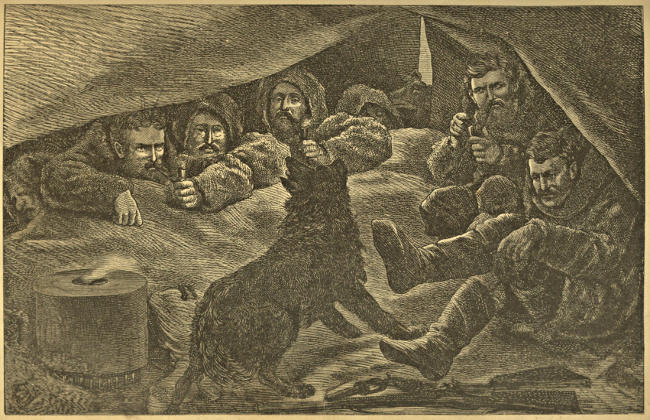
2. All our preparations for wintering had now been
completed. Lieutenant Weyprecht struck the top-masts to
diminish pressure from the wind; some sails were still kept
set, in order that the ship, in the event of her being set free,
might at once get under weigh. The fore-part of the ship
only could be covered in as a tent, for the preparations to
abandon her in case of need compelled us to leave her after-part
uncovered. There, in perfect order, lay all the materials
we meant to take with us, our provisions, ammunition, tents,
sledges, &c. The ship was surrounded with a wall of snow
and ice, which we constantly restored, whenever it was injured
by pressure from without, and her deck was gradually overspread
with a mantle of snow, which contributed, however, to
maintain an equable warmth in the ship. Our distance from
land rendered it impossible to cover the deck with a layer of
sand, which would have prevented the melting of the snow
from the warmth of the ship.
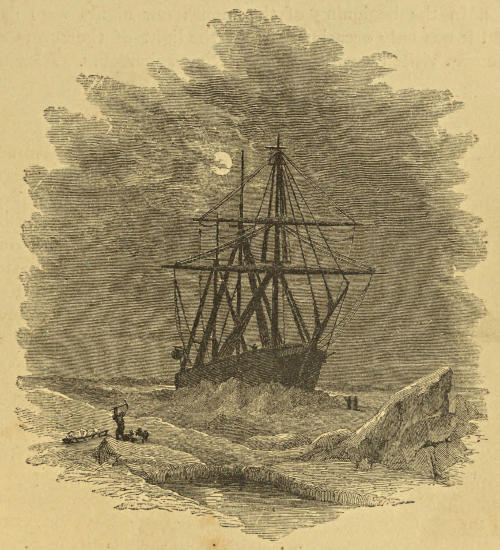
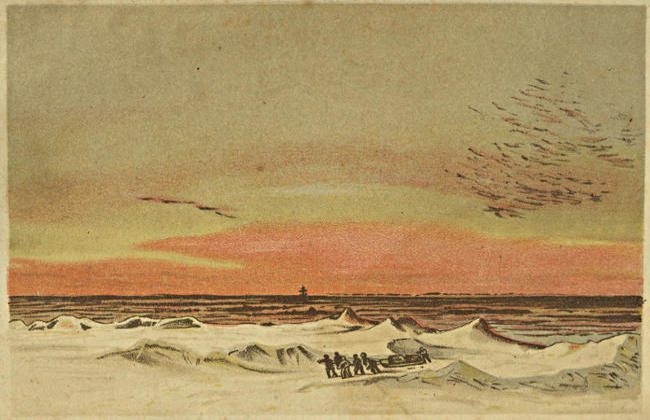
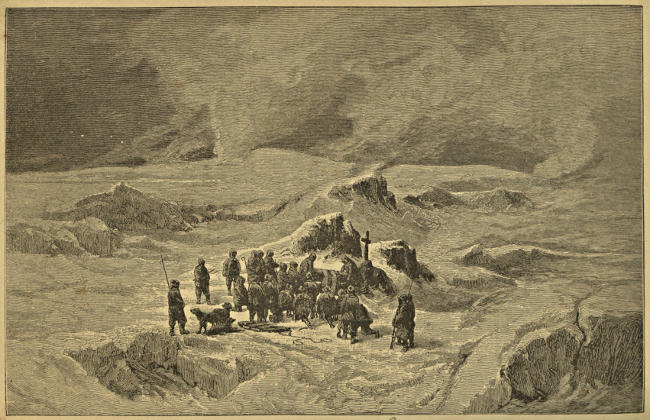
THE TWILIGHT IN NOVEMBER, 1872.
3. The temperature of November rose once only—about
the middle of the month—considerably; but, except on that
occasion, the thermometer stood with tolerable regularity
below -13° F., and on the 20th of the month it reached its
minimum at -33° F. Winds, from whatever quarter they
might blow, constantly raised the temperature, because the
colder air was thus modified by the warmer which lay above
the open spaces of sea-water; calms were accompanied by
a rapid intensification of cold. Wind, increased drifting,
pressure, and the formation of fissures—all these are naturally
connected. New openings were quickly covered with young
ice, which presented a smooth surface when formed by less
intense cold, but when the temperature fell lower its saline
contents were exuded in a moist, tough layer, which lay on
its surface about an inch thick. In this state of the ice, sledge-travelling
was rendered more difficult, and even walking was
far from easy; for it is only under a temperature ranging
from -4° F. to -13° F. that this layer is frozen. The incessant
rending of the ice-sheet, by exposing the warmer surface
of the sea, tends to mitigate the cold, while, on the other
hand, the freezing of these fissures augments the quantity
of ice.
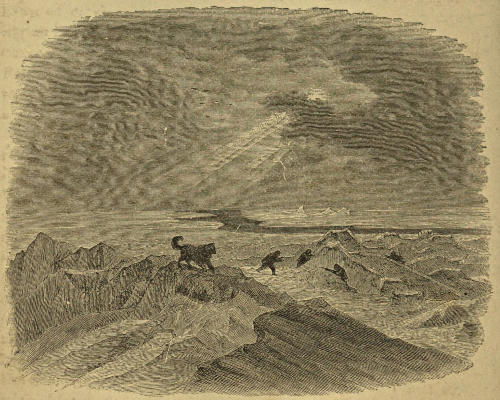
SUMBU CHASED FOR A FOX.
4. In the beginning of the month our nights were dark,
and it was only occasionally that the light of the aurora and
meteors visited us with their fleeting splendours. Although
in clear weather day was still distinguishable from night, yet
the darkness, even at noon, was so great, that mists could not
be seen, but felt only, and it was no longer possible, without
the light of a lantern, to make even the slightest sketch, or to
take aim with the rifle. Hence, when we met with bears we
could not be certain of our aim, if they were at any distance
from us, and, on one occasion, Sumbu was mistaken for a fox,
chased, and but for my coming up would have been shot.
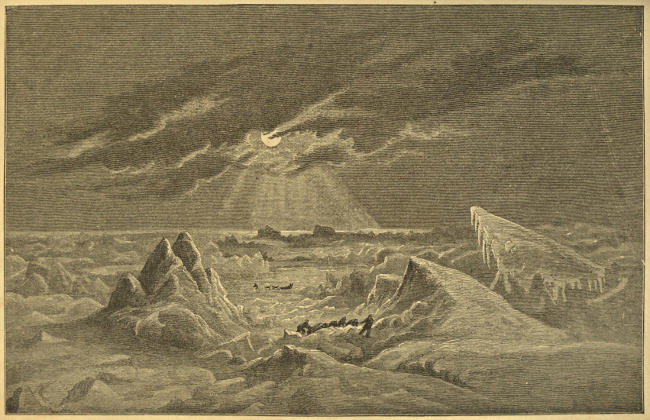
WANDERINGS ON THE ICE IN OUR FIRST WINTER.
5. The first days of November passed away without any
new disturbance from the movement of the masses of ice,
and our feeling of security grew apace, and with it our hopes
revived, never again to leave us entirely, not even when the
pressures returned, as they did too soon. Once more the
fields of ice, firmly pressed together, were rent asunder;
fissures opened out, and shone in the moonlight like rivers
of silver. The night of Nov. 20 was one of extreme anxiety.
A mountain formed of piles of broken ice bore down on us
amid a fearful din, threatening to bury the ship. Silent, and
conscious of our utter helplessness, we watched this gigantic
heap of crashing ice-tables drifting nearer and nearer, crushing
as it advanced the heaviest pieces of ice with a noise which
echoed through our ship. Escape seemed impossible: and
Providence alone arrested its career. This night the crew
received each an extra glass of grog to obliterate the impression
of this terrible crisis.
6. With the exception of books, we had no other amusement
than short expeditions, never extending beyond a mile
from the ship, in which we were accompanied by all the dogs.
We generally set out with two small sledges, and, when the
moon was not shining, with our rifles ready to fire, for the
darkness and the utter absence of open spaces on the ice
imposed the utmost caution against bears. At a very short
distance we could see nothing of the ship, and only by our
footsteps on the snow could we make out where we were and
find the way back. In these expeditions we were exposed to
another danger—the risk of being cut off from the ship by the
breaking-up of one of the drifting floes. Even the dogs felt
the insecurity of recently-formed ice, and put their feet on it
with fear and hesitation, and only by compulsion. There
seemed to be a cunning agreement among them to shirk
the work altogether; for they often rushed away into the coal-house,
and threw the harness of the sledges into inextricable
confusion.
7. December came, but it brought no change in our situation.
Our life became more and more monotonous; one
day differed in no respect from another, it was but a mere
succession of dates, and time was reckoned merely by the
hours for eating and sleeping. The ice, however, did not
share in the universal repose. It was never weary of threatening;
no day elapsed without movement on its part. My
journal records December 1, 8, 9, 19, 20, 21, 24, 26, 28, 29, 30,
and 31, as days of special disturbance and agitation. On the
20th, as we were talking in the coal-house of the approaching
festival of Christmas, a sudden violent movement of the ice
surprised us, and rushing out we found that the floe on which
the house stood was breaking up. With all haste we endeavoured
to save as much as possible of the coal and materials,
and moved them close to the ship. The minimum temperature
of December was -26° F.; the mean of the whole
month amounted to -22° F.; and the extreme of cold,
-33° F., was reached on the 26th. A few days before
Christmas the temperature rose to a little below -13° F.
It may be observed that the lower temperatures were
registered during the prevalence of winds from the south-east,
and the higher during winds from the north.
8. When the moon returned in the middle of December,
our sledge expeditions were extended to a distance of 1½ miles
from the ship, over snow and hummocks, to recently frozen
ice-holes, the lonely beauty of which, edged with dark masses
of ice, in the distance, and lying under the clear silver light of
the moon, filled us with feelings of profound melancholy. On
returning from one of these expeditions to our vessel, after
we had unharnessed the dogs, we heard loud barks from
Sumbu, and looking round saw a bear close beside him, which
Orel managed to shoot dead when he was not above five
paces from the rope-ladder on the port side of the vessel.
He was at once cut up, the dogs meanwhile looking on with
profound attention; and in reward for his watchfulness,
Sumbu was indulged with an extra good feast—the heart
and tongue of the bear, which, as yet, we ourselves had not
learnt to eat and enjoy. On the 18th, however, he encountered
our heavy displeasure for the offence of frightening
off a fox, which had ventured to come very near the vessel.
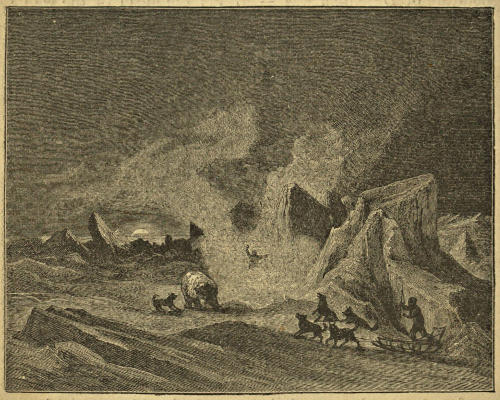
ENCOUNTER WITH A POLAR BEAR.
9. When there was no moon it was perfectly dark, even
during the day; but on December 14, in a very clear forenoon,
we saw in the south a tender orange segment of light,
three or four degrees above the horizon, edged with green,
sharply defined against the dark sky, and when the moon,
high in the heavens, faced this arch of light, a peculiar faint
twilight was observable. But generally there was no difference
between the light of midday and the light of midnight. The
heavens were usually overcast, and the light of the aurora,
during the few minutes of its greatest intensity, seldom exceeded
that of the moon in its first quarter. But how deep
would be the night of the Polar regions, if the land, instead
of being white with snow, were covered with forests! On
December 20 we were unable, even at noon, to read anything
but the titles of books of the largest type; a man’s eyes were
invisible at the distance of a few paces, and at fifty even the
stoutest ropes of the ship were scarcely discernible. The
effect of the long Polar night—when the range of the light
of a lamp is the whole world for man—is most oppressive to
the feelings; nor can habit ever reconcile those who have
lived under the influences of civilization to its gloom and
solitude. It can be a home only to men who spend their
existence in eating and drinking and sleeping, without any
disturbing recollection of a better existence. The depression
was made more intense by the consciousness that we had
been driven into an utterly unknown region and with our eyes
bound. Work, incessant work, was the only resource in these
circumstances.
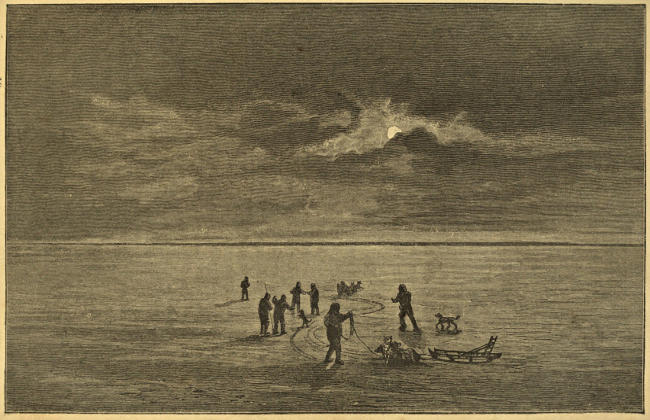
ICE-HOLE COVERED WITH YOUNG ICE.
10. Again from my journal I reproduce some passages
which express the feelings which passed through our minds—through
mine at least—during this season of the Tegetthoff’s
first winter in the ice:—“December 21—The middle of the
long night. It is noon, and, though nothing can be lighter
than the colour of all that surrounds us—of the snow—yet it
is as dark as midnight. Nothing but a pale yellow sheen
hovers over the south. The sun has sunk below the horizon
11° 40′, and we should have to ascend a mountain eighteen
and a half (German) miles high in order to behold it. Nothing
is to be seen, neither bears nor men, and we only hear the
steps of those who are near us. We see but the confused
outline even of the ship, as she drifts hither and thither with
the floe, a prisoner in the fetters of the ice, the sport of winds
and currents, carrying her further and further into the still and
silent realm of death. A definite object, with hope to inspire
them, raises men above toils and troubles of every kind; but
exile like ours, when the sacrifice seems useless, is hard to be
borne. An inexorable ‘No’ lays its ban on every hope, and
daily struggle for self-preservation is our lot. If we attempt
to fathom destiny, our utmost hopes are liberation from our
icy captivity some time next summer, and the reaching the
coast of Siberia. Siberia a hope! And yet how changeable
are the feelings when the reign of monotony is interrupted!
The moon is up—darkness exists no more. In the North the
moon is an event—it is life, everything almost; it is the only
link which connects us with the far-distant home. As its
beams fall on the meanest forms, diamonds blaze forth in its
light from the snow and the frost, and the soul feels the beauty
of the transformation. She looks down on us like a returning
friend that watches over us, and unfolds bewitching forms and
magic images to cheer us. Two weeks ago she rose above the
horizon, first as a blood-red disk, then paled as she climbed
higher and higher, till she stands out the clear, silver-bright,
full moon.”
11. Christmas had come; the season when in the forests of
our far-distant home the branches of the pine-trees are heavy
laden with snow, and which ever comes back with the memories
of the days of our youth, and with the remembrances of our
families and absent friends. Only for a short time, about
noon, we were made uneasy by a movement and pressure of
the ice. But the alarm passed away, and we gathered together
for a choice and gorgeous feast, both on Christmas Eve
and Christmas Day, and each of the cabin-mess had a bottle
of good wine to himself. Carlsen and Lusina were our guests.
Each of the crew received half a bottle of wine, together with
a quarter of a bottle of “artificial wine,”[17] and in addition an
allowance of grog, so weak, however, that even a baby might
have drunk it without harm. Dried fish, roast bear well kept
and seasoned, nuts and the like, contributed in their way
to heighten the joyous feelings which, this day at least,
animate even the most miserable of men. The dogs, at other
times so insatiable, had for once enough and to spare, and
carried off the fragments to bury them in the snow. The
contents of a chest full of presents, which we had brought
with us, were distributed by lot, and great was the delight of
those who won a bottle of rum or a few cigars.
12. The last day of the year 1872 afforded us no very
happy thoughts as we looked back on its events; it had been
to us a year of disappointments. The comparison drawn
between our actual condition and the expectations we had so
ardently cherished seemed full of the bitterest irony. This
day also, about noon, a pressure from the ice, which lasted but
a short time, alarmed us all, and we rushed on deck to make
our usual preparations. The enemy, however, passed away
without further disturbance, and cheerfully and socially we
awaited the first hour of the new year. With a bottle of
champagne, one of the two still left, we meant to greet its
coming in with that hopefulness of mind which seems inextinguishable
in all the changes and chances of life. But the
champagne, alas! proved a delusion. Klotz, the Tyrolese, in
one of his brown studies exposed this precious bottle for four
hours to a temperature of -19° F., and when he produced it
the bottle had burst and the wine was thoroughly frozen. At
midnight the crew serenaded us, and we afterwards marched
forth in a body with torches, and walked round the ship, whose
rigging glowed in the light of the tarred torches. The frosted
fur garments of the men seemed edged with shining light, and
a red glare fell on the masses of ice.
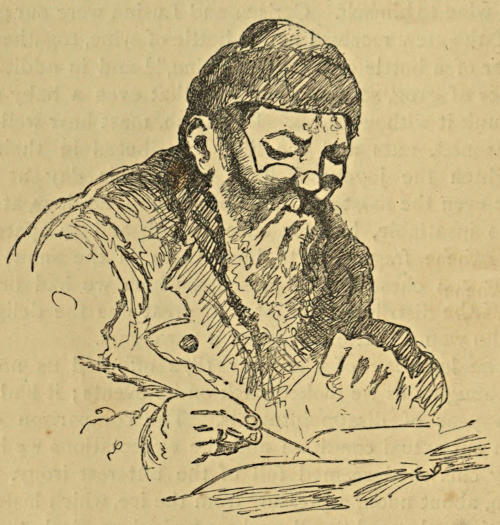
CARLSEN MAKES THE ENTRY IN THE LOG.
13. To-day, too, we allowed the dogs to descend into our
cabin,—the constant object of their longings. The poor
animals were so dazzled by looking at our lamp, that they
almost took it for the sun itself; but by and by their attention
was directed exclusively to the rich remains of our dinner, the
sight of which appeared completely to satisfy their notions of
the wonders of the cabin. After behaving themselves with
great propriety, they again quietly withdrew, all except
Jubinal, who appeared to be indignant at the deceitfulness of
our conduct, inasmuch as we had allowed him to starve so
long on dried horse-flesh and on crushed bear’s head, while
we revelled in luxury. He accordingly made his way into
Lieutenant Brosch’s cabin, where, discovering a mountain of
macaroni, he immediately attacked it, and warned us off from
every attempt to rescue it, by growling fiercely till he had
finished it all. Sumbu, however, with much levity, suffered
himself to be made drunk by the sailors with rum, and everything
which he had scraped together for weeks and buried in
the snow and so carefully watched, was stolen from him by
the other dogs in one night.
14. Another year had now glided away. Looking anxiously
into the future, we shortsighted mortals saw the fulfilment
of our highest wishes in being liberated from the floe. In the
pious manner of the whalers of the Arctic Ocean, Carlsen
wrote this day in the log: “Önsker at Gud maa vere med os
i det nye aar, da kan intet vare imod os—May God be with
us in the new year and nothing can be against us.” In this new
year, with its happier issues, was verified again the eternal
truth, that Providence acts in ways not to be fathomed, and
that it is folly in man to mark out his own path beforehand
according to his own mind. The sun of this new year, whose
beams were to light us to new lands and discoveries, was still
low beneath the horizon.
1. Like a spectre in white, the ship stretches out her arms, as
if in silent complaint, towards the heaven, and rests, in cruel
mockery of her destiny, on a mountain, not of water, but of
ice, and seems like a building ready to fall in. A wall of
snow and ice surrounds her hull, snow lies thick on her deck,
and her rigging is stiffened in icy lines. Could we see through
her sides, we should then behold four-and-twenty men parted
off in two spaces under the suns of two lamps. Let us inspect
them, and first the cabin of the officers in the after-part of the
ship.
2. Neither few nor slight were our struggles to remedy the
various inconveniences which we encountered; their enumeration
here is meant to aid the experience of future adventurers.
Though our arrangements were far from complete or perfect,
we had never to complain of the discomforts which previous
expeditions, even the second German expedition to Greenland,
had to endure from the excessive condensation of moisture.
Against this enemy we protected ourselves by the snow wall
which we raised round the ship, by covering in the deck
windows of the cabin, by lining our quarters with vulcanized
india-rubber, by sheds built over the cabin stairs, all acting as
condensers. Before, however, I enter on the unavoidable inconveniences
to which we were exposed by the formation of
ice, or by damp and the sudden change of temperature, I
would preface my remarks by observing, that all these discomforts
and inconveniences are to be endured far more easily
than would seem possible to the reader, and that life on board
a ship of a North Pole expedition, under normal circumstances,
is free from annoyances worthy of mention.
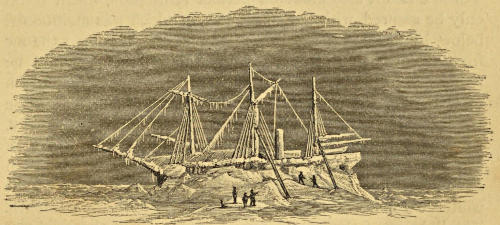
THE “TEGETTHOFF” IN THE FULL MOON.
3. It is a matter of the last importance to keep the air pure
and wholesome, and to maintain an equable warmth in the
quarters of the officers and crew. The accumulation of
moisture and consequent congelation in them is an inconvenience
which requires incessant watchfulness to avert.[18]
The destruction of the snow wall which surrounded the ship
increased the condensation; for that snow covering was
nothing but a greatcoat for the ship and those on board. In
the beginning of November 1872 the frost on the bulk-heads
of the berths, and on those parts of the cabins which were
impervious to warmer air, was very perceptible. The bed-clothes
were frozen at night to the sides of the ship, the iron
knees of the beams—not, alas! covered with felt—gleamed
like stalactites, small glaciers were formed under the berths,
and even in October the skylight was frozen, inches thick.
Every rise in the temperature caused this formation of ice
to fall down like a “douche,” and with the opening of a
door a white vapour, even in October, streamed along the
deck. We prevented the increase of moisture by cutting the
openings in the deck, over which we placed two chimneys,
each a foot high and covered with a thin metal cap. We
boarded up the skylight, leaving a lid by which to air the
cabin. But in spite of all this the variations of temperature
within our quarters were extraordinary. If the heat of the
air in the middle of the cabin and on a level with our heads
rose from -2° F. to 76° F.—our usual mean temperature—it
amounted on the floor to a little above 34° F., and fell
during the night not unfrequently below freezing-point.
4. But the greatest inconvenience perhaps with which we had
to contend, arose from the removal of the protection of the
tent roof, which was stretched over the after-part of the ship.
The want of this prevented our walking on the deck in bad
weather, and it also hindered perfect ventilation, which could
only be secured, with the constant heat which was maintained
below, by keeping the deck windows open. Warming the air
from underneath the floor of the cabin would possibly be
preferable to the best stove. We had the stove of Meidingen
of Carlsruhe, the excellence of which had been tested on the
Germania. This stove consumed only 20 lbs. of coals daily,
with a thermometer at -13° F., and after the adoption of
certain arrangements to save the fuel, its consumption
amounted to only 12 lbs. Even in the coldest period of the
winter we never consumed more than 4½ cwt. in a month.
The lighting of the messroom and quarters of the men was
effected by petroleum, the daily consumption of which
amounted to about 2⅔ lbs. Altogether there were in the ship
two large and two small lamps, besides the deck-lantern,
which were burning day and night. The berths were lighted
with train-oil; for special purposes, such as drawing, candles
were used.
5. The stove had one troublesome enemy in the shape of a
hole, as big as a man’s head, in the door of the mess-room,
through which a cold stream of air poured itself; and as the
ship dipped forward considerably, and the hearth was only
about a foot above the floor of the mess-room, this stream
filled the whole space with a lake of cold air from three to
four feet deep. Hence, while in the berth close by the stove
there was a temperature ranging between 100° F. and 131° F.,
in the other, there was one which would have sufficed for the
North Pole itself. In the former a hippopotamus would have
felt himself quite comfortable, and Orel, the unhappy occupant
of it, was often compelled to rush on deck, when the
ice-pressures alarmed us, experiencing in passing from his
berth to the deck a difference of temperature amounting to
189° F. In the other berth of the mess-room, water, lemon-juice,
and vinegar froze on the floor. Those who occupied it,
as they lay in beds, or those who sat at the table to read, were
in a cold bath reaching up to their neck. But the hole was
an indispensable necessity, for it was better to endure the discomfort
even of such a draught than to impede ventilation.
Other causes, too, disturbed the equilibrium of temperature.
At night the stove was sometimes, from sanitary considerations,
not lighted, and then all had to sleep in that cold bath.
With the increase of cold and wind, our inconveniences often
assumed somewhat ludicrous forms. Some passages from my
journal will make this clear:—“When any come below the
temperature falls. If the door be opened there rolls in a
mass of white vapour; if any one opens a book which he has
brought with him, it smokes as if it were on fire. A cloud
surrounds those that enter, and if a drop of water falls on
their clothes, it is at once converted into ice, even at the stove.
Frequently the upper stratum of air in the mess-room becomes
so heated, that the deck light has to be opened, and then it
rises up, like smoke out of a chimney, to blend itself with the
cold air without.”
6. The arrangements of the officers’ mess-room are simple
and in harmony with its purpose. Here stands a large table,
used for study and for meals; the smaller berths, where the
officers sleep, are round the sides of the mess-room—just
large enough to enable a man to breathe in. There, in a
recess between two pillars, an untold resource, the library (of
about 400 volumes, chiefly scientific); close beside it the
chronometers; and lastly, the inevitable evils, the medical
stores, ranged round the mast. By the side of scientific
works stand Petermann’s Mittheilungen; and between Milton’s
Paradise Lost and Shakespeare’s immortal works, a whole
tribe of romances, which were read with never-tiring delight.
Our instruments, too, frosted with ice, are here, and a chest
containing our journals. Once a month a cask, filled with
wine—the chemical wine—concocted of snow, alcohol, tannin,
sugar, and glycerine, was placed there. Dr. Kepes was not
only our physician, but our wine brewer. One thing more we
have to mention, which, alas! incommoded us much too little—wine;
that is, wine made in Austria, from grapes. As we
have already mentioned, the want of room in the cabin prevented
our laying in a large stock, and the supplies we had
were frozen in a cellar below the mess-room, about the middle
of December, for the temperature of even this place was
about 16° F. or 14° F. Each, however, had a bottle of rum
as an allowance for eighteen days. But quite inexhaustible
was the supply of our common drink—melted snow—a great
jar of which, filled to the brim, stood always on the table.
Under the cabin were our supplies of alcohol and petroleum,
accessible only by well-fitting pipes, but possible volcanoes as
far as our safety was concerned. From the accumulation of
so many combustible materials, together with 20,000 cartridges,
and with several lamps constantly burning, it is clear
that the danger of fire was great. But once only had we an
alarm from this source—when Carlsen caused us much trepidation
by accidentally discharging a rifle in the cartridge
magazine.
7. Let us now turn to the persons who occupied this mess-room.
Marola, the steward, lights the lamp, and kindles
the fire, and awakens those who were not already awoke
by the smoke from the stove, with the cry, “Signori, le sette
e tre quarti, prego d’alzarsi;” and after a pause of a quarter
of an hour, during which the sleepers seem carefully to deny
their existence, he startles this silence of indifference by
the second call: “Colazion’ in tavola.” Out of every berth
now comes forth its occupant, each in picturesque costume;
costumes teach us how superficial after all is civilization in
man!
8. The day’s work begins. The watch, as ever, walks the
deck, lest the ice should slip away from the world unobserved;
in the mess-room meanwhile calculations or drawing or writing
are in full operation. Our daily meals consist of a breakfast
of cocoa, biscuit, and butter; of a dinner of soup, boiled
beef, preserved vegetables, and café noir, and of tea in the
evening, with hard biscuit, butter, cheese, and ham. I would
recommend potage instead of tea for the evening meal to all
future expeditions. Many of the articles of food must be
thawed before the process of cooking begins, the greater part
of the provisions being frozen as hard as iron. The tins with
preserved meat stand for hours in boiling water, and the
things for supper on the cabin stove, in order to be thawed.
A plate of cheese that steams, butter as hard as a stone,
which has thrown off the salt it contained in great lumps
from the action of frost, a ham as hard as the never-thawed
ground of the Tundra of Siberia, form an icy repast, specially
if we use knives, which are so cold that they often break
with the least exertion of force. I will here notice the
sanitary importance—insisted on by Parry and Ross—of
fresh bread, which the cook in an Arctic ship should be
able to bake about twice a week. On board the Tegetthoff
we used at first Liebig’s “baking-powder,” but this from
being kept too long gave such a disagreeable taste to the
bread, that we gave it up and contented ourselves with a
defective leaven.
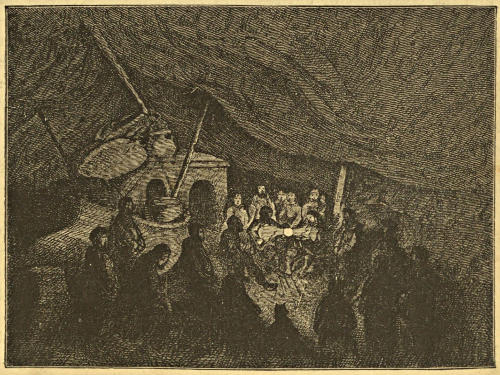
DIVINE SERVICE ON DECK.
9. Every Sunday at noon we celebrated Divine Service.
Under the shelter of the deck-tent, the Gospel was read
to the little band of Christians gathered together by the
sound of the ship’s bell, in all that grave simplicity which
marked the worship of the early Christian Church. The
Service over, we then sat down to the Sunday dinner, which
was graced by a glass of wine and cake. Carlsen and
Lusina were our guests by turns. Carlsen always appeared
in his wig, trimmed with extra care, and on the high festivals
of the Church decorated also with the cross of the order
of St. Olaf. Lusina, our excellent-boatswain, was ready to
talk with enthusiasm on any subject whatever, prefacing his
stream of words with some sententious remark or with some
far-fetched introduction. During our meals the conversation
turned on our plans for the future; we talked of Polar bears;
we discussed the question of the existence of Gillis’ Land
and the possibility of our reaching Siberia; but very seldom
did we venture to speak of what filled the minds of all—our
captivity in the ice. Political combinations formed a
favourite theme; and as we had some old numbers of the
Neue Frei Presse on board, they furnished an inexhaustible
source of topics for conversation. The events of the year
1870 were related as the latest news, and we thought anxiously
of the issue of the war between Germany and France,
and feared lest Austria should be compelled to take part
in it.
10. After dinner came the hour for contemplation; in our
lonely berths and by the side of our beds we sat down to
brood—to listen to our watches beating seconds. The
English Arctic expeditions, during the long period of their
enforced leisure, found a great source of amusement and
distraction in theatricals. But the ships of these expeditions
had far larger crews than the Tegetthoff, and the men could
be more easily spared for these recreations. But there were
other reasons why we could not think of following the example
of the English. Our situation during the first winter
was far too serious for such things, and no other place for the
theatre was at our disposal except the barricaded deck;
and we should have had to sit there with a thermometer
marking from 25° to 37° of cold, on the centigrade scale,
and see how the actors and the audience suddenly rubbed
their frost-bitten feet with snow! There was one other
potent reason for this renunciation—our performances must
have been in four different languages.
11. Monotonous beyond all monotony is life in the long
night of a Polar winter, and exile can never on earth be so
entire as here under the dreadful triumvirate—darkness, cold,
and solitude. In such a life, the man who surrenders himself
to idleness, or even to sleeping during the day, must necessarily
be utterly demoralized. In fact, nothing can be more
destructive to an expedition wintering in the Arctic regions
than the indulgence of mental or bodily lassitude. The real
ground of the failure of the attempts made in earlier times
to winter in Jan Mayen and other places in the far North was
probably the utter want of discipline. There is, however,
a widely spread, though mistaken view, that the long day
of Polar lands is oppressive to man. Nothing is more
untrue; for not continual light, but constant darkness, is
distressing. Continual daylight heightens the energies and
vital powers; and yet, in our own first winter, it was less
the darkness which wore us than the perpetual anxiety;
when our greatest consolation was found in the Arabic
proverb, “In niz beguzared” (This too will pass away), inscribed
on our cabin wall.
12. After supper, before going to bed, we smoked our
cigars in the shed over the cabin steps, with a thermometer
from 25° to 37° below zero C., and talked pleasantly over
bygone days, though our thoughts were not unmixed with
gloomy forebodings, as we heard ever and anon the ominous
sounds that issued from the moving ice. Existence on board
a straining and groaning ship resembles life over a volcano.
It was only after we had been some time in this ice-covered
wooden grotto that the temperature rose, through our own
heat, a few degrees, and it was certainly some testimony to
the excellence of my down-quilted clothes that I could
wear them in the cabin without being distressed by the heat,
and yet I was able to sit the whole evening in this freezing
hole without suffering from cold. A train-oil lamp sends
out almost more smoke than light, and when the snow drifted,
we had to contend with the importunities of the dogs, who
seemed to regard the deck shed as a great dog-kennel.
With a sudden rise of the outer temperature this shed became
utterly uninhabitable, for its coating of ice then melted and
fell down like rain.
13. The effect of the long winter night is even greater
on the body than on the mind, because of the insufficient
opportunities for exercise. Middendorf contrasting the influence
of climate on men remarks:—“I consider travels in
cold regions, even in the most unfavourable conditions of
climate, to be far less dangerous to life than travels under
the tropics. The former certainly are unutterably more
miserable, but as certainly less deadly. I say this notwithstanding
the danger which threatens ships when they
penetrate far within the realms of ice. We are never secure
from sudden and deadly attacks of illness in tropical countries,
but the longer we remain in them the less is the danger;
whereas the high North deteriorates the constitution of the
blood, and after three winters, very few can stand a fourth.”
To the influences of Polar life detrimental to health must be
added the constant hindrance to perspiration from wearing
an extra quantity of woollen clothing—more or less hurtful as
it is more or less waterproof—the want of fresh animal and
vegetable food, and last, but not least, the periodic departure
of light and warmth.
14. Our sanitary condition during the two winters we
spent on board the Tegetthoff was not altogether satisfactory.
Scorbutic affections of the mouth and diseases of the lungs
appeared sometimes in distressing shapes, and scarcely a day
passed in which we had not one or two on the sick-list. I
believe, however, that our trying situation had far more to do
with these evils than the southern blood and breeding of
our people. The incessant watchfulness and care of Dr.
Kepes left nothing undone which would counteract the evil
influences to which we were exposed. The berths of the crew
were changed in rotation, and those which were exposed
to the greatest accumulation of ice were dried by warm
air conveyed through movable pipes. Want of exercise,
constant change of temperature, depression of mind, the
periodic scarcity of fresh meat, were the causes of the
scurvy. In our first winter it appeared only in the more
crowded quarters of the crew. It was then also that the
first symptoms of lung-disease appeared in Krisch, the
engineer, which he probably contracted from “catching cold.”
From that time he liked to sit by the stove and always
complained of cold. Our supplies of preservatives against,
and remedies for scurvy were rather limited, although we had
at our disposal several hundred tins of preserved vegetables,
a cask of cloud-berries (Rubus chamæmorus), which we had
brought from Tromsoe, and above a hundred bottles of lime-juice.
Wine also is an important preservative; we therefore
served out to the crew, notwithstanding our small supply,
twice a week, not Kepes’ artificial, but real wine—at the rate
of two bottles for eighteen men. No doubt scorbutic
symptoms would have been far more general and severe,
had we not been fortunate enough to shoot no less than
sixty-seven Polar bears, a larger number than had fallen
to any previous expedition. It was more a sign of our good
intentions to leave nothing undone or untried in our efforts
against this malady, than any actual service it was to us, that
we sowed cress and cabbage—radishes did not succeed—in
a bed which we suspended over the stove. It was interesting,
however, to observe how the little plants of cress, with
every change of position, always turned to the light of the
lamp, growing to the height of three inches, and in spite
of their brimstone colour retaining the true cress flavour.
15. The use of the bath tends greatly to promote health,
for without it the skin of the body has no other stimulant;
but the insecurity of our position rendered bathing sometimes
a somewhat doubtful enjoyment. I remember many cases,
when some of us, while bathing in the cold dark washing
place in lukewarm water an inch deep, were alarmed by a
sudden pressure of ice. Ultimately we gave up this practice,
finding that it produced a troublesome amount of damp.
16. To a stranger, who should have visited us during this
winter, nothing in the ship would have been so surprising
and interesting as a visit to the quarters of the crew. Except
for an hour, from five to six o’clock in the evening, when they
were encouraged to take exercise in the open air, the rest of
their time was spent in school, or in the duties of the watch,
or in the work of the ship. Our supply of Slavonic books
was unfortunately not very ample, and besides, not all the
crew were able to read; the greater therefore was their
tendency, like men of southern climes, to harmless noise,
and I believe that some of our people, during the whole
expedition, never ceased to speak. Here I beg to insert
some passages from my journal:—“Passing by the steaming
kitchen, we enter their messroom. Here in a narrow space
we find the toilers of the sea and the mountains—eighteen
in number. A little band of Dalmatians who for the first
time encounter darkness and cold, the horrors of which are
increased tenfold to men born and bred in the sunny South.
Truly it could be no little thing to such men to be torn from
sleep almost every night by the movement of the ice, to sit
day after day in the long night of winter without any real
intellectual occupation, and yet not to become demoralized,
but remain calm and composed, and ever ready to obey and
oblige. Can anything higher be said in their praise? Those
men slept, each by himself, in a double row of berths; only
Lusina the boatswain, and Carlsen the harpooner, who had
circumnavigated Spitzbergen and Novaya Zemlya, occupied
a separate partition. The clatter of the tongues of so many
vehement Southerners was like the sound made by the smaller
wheels of a machine, while the naive simplicity of the grave
Tyrolese came in between times, like the steady beat of a
great cog-wheel. It was a miniature reproduction of the
confusion of tongues of Babel. Lusina speaks Italian to
the occupants of the officers’ cabin, English with Carlsen,
French with Dr. Kepes, and Slavonic with the crew. Carlsen
had adopted for the ‘Slavonians,’ as he called our people, a
kind of speech compounded of Norwegian, English, German,
Italian, and Slavonic. The crew, with the exception of the
two Italians, speak Slavonic among themselves. The head
of the little German colony is the cook, a Styrian; his heart
is better than his culinary skill, for only too readily he leaves
his work to be done by the stove. There is also among them
a Moravian, Pospischill, the Vulcan of the ship; but we must
return to the predominant race—the Slavonic. There is
Lukinovich, a very Harpagon, always collecting, finding
treasures in nails, empty bottles, lamp wicks, and searching
even under the snow for articles wherewith to fill his sack—the
sack which he was one day to leave behind him, much
against the grain, when we abandoned the ship. There is
Marola, the steward, and Fallesich, who had worked at the
Suez Canal; these are our great singers. Then Palmich with
his lance, the man whose zeal never bated, and whose very
glance transfixed everything; Vecerina, the Job of the party,
and the merry Titans, Sussich and Catarinich; Latkovich
and Lettis, ‘the philosophers;’ Stiglich, the immovable confessor
of passive obedience and the unlawfulness of resistance;
Zaninovich, the ‘pearl;’ Haller the herdsman and Klotz
the prophet. Five of these men had run away from their
wives. Klotz the prophet was under all circumstances, not
indeed the most useful, but the most interesting person of this
little community. A lofty calm worthy of an Evangelist
graced his outer man; of still greater stature than Andreas
Höfer, he wore, like him, a large black beard. As a hunter,
a guide, a collector of stones, and a lonely enthusiast, he had
moved about the mountains of his home, leading a life of
visions. At home he was regarded as an incomparably bold
mountaineer, and the ropes of the ship were to him so many
convenient foot-paths. His reputation as a physician in his
native land was great, and on board ship he failed not with
his good offices. Haller, his fellow-countryman, shared with
Klotz the office of armourer, and the duties of hunter and
driver of the sledge-dogs; and when we began our sledge
journeys, both of them were ready to relieve others in
dragging. Both had served in the army, Klotz on the Tonale,
Haller on the Stelvio, and in 1868 the latter had been my
useful companion when I was engaged in the survey of the
Ortler and Adamello Alps. ‘The philosophers’ of our
party, Latkovich and Lettis, had drawn a fine distinction
between the different layers of ice, according as they contained
a greater or less amount of saline matter: Ghiaccio
della prima and Ghiaccio della seconda qualità.”
17. To obviate as far as possible the evils of too much
leisure among the men, a school was instituted at the
beginning of the January of the second year; Lieutenant
Weyprecht, Brosch, and Orel undertook the Italians and
Slavonians, and I the Tyrolese. To avoid all confusion I
retired with my smaller body of pupils to the shed on deck.
Here, with the thermometer at 25° to 37° below zero C., the
seed of wisdom was sown in the hearts of these sons of
nature; but alas! the climate was not favourable to its
growth. After many painful disillusions, the Pole was
ascertained to be the intersection of lines in a point, of which
nothing was to be seen in reality. If in this little lecture-room
an exercise had to be examined, and the scholars were
obliged to hold in their breath, in order that the teacher, who
spoke out of a cloud, might be able to see the slate; or when
the pupils engaged in a division sum had suddenly to stop to
rub their hands with snow, was it a matter of wonder if the
school did not flourish exceedingly?
18. The food of the crew consisted principally of preserved
meats, different kinds of pulse, and the products of the chase,
amounting on an average to two bears a week. Bear-flesh,
roasted, was liked by all; the seal was at first despised, till
necessity corrected taste. Besides artificial wine, water was
their strongest drink.
1. When compared with the tortures we endured from the
thought that we were captives in the ice, little to us seemed
the dangers which threatened our existence, though these
assumed the appalling form of ice-pressures. Daily almost
the ship had to sustain the attacks of our old enemy, and
when the ice seemed to repose, threatening indications were
not wanting to warn us how short that repose might be. My
journal records a long series of commotions in the ice on
almost every day of January 1873, and even during the pauses
the timbers of the ship continually shook and trembled and
creaked. The pressures accompanied by a low grumbling
noise were very great on the 3rd, and lasted till the oldest ice
was shattered, during which our hatchways were displaced.
On the 4th the pressures continued without intermission
during the whole day. But on the 22nd they exceeded all
we had hitherto experienced. When we awoke in the morning,
the crashing of the masses of ice was dreadful. In the
messroom we heard a deep, grumbling, rumbling noise—the
ship trembled like a steam-vessel under very high pressure.
When we hastened on deck we were greeted by the long
howls which issued from the ice, and we were soon convinced
of the exceedingly formidable character of this special onset!
Ten paces astern of the ship, the ice had been heaved up in a
moment into mountains. With the greatest difficulty, amid
the profound darkness that prevailed, the boats were got on
board, and many stores re-shipped, though some of our coals
had to be sacrificed. A tent formed of sails was engulfed,
and our water-hole utterly displaced by the pressures; it was
only after many attempts that we succeeded in finding a
thinner ice-table, which we pierced till we found water.
January 26, again tremendous pressures roused us from sleep.
In half an hour every preparation was made to leave the
ship, and I believe that many of us, while waiting the issue
amid the fearful din heard from the deck, longed that the
ship might be crushed, in order to escape from the torture of
continually preparing to depart.
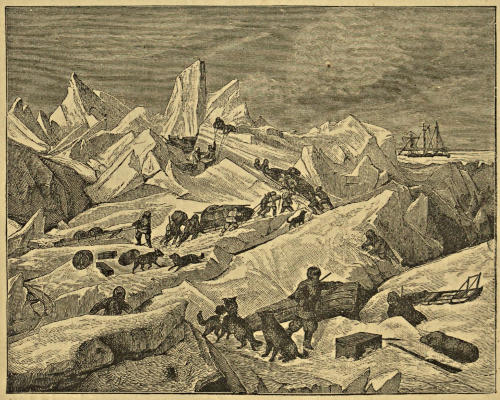
ICE-PRESSURE IN THE POLAR NIGHT.
2. I will not, however, fatigue the reader with the monotonous
rehearsal of our ever-recurring daily dangers, but will
here insert a few passages from my journal of that date, which
will suffice to explain our position:—
“Scarcely asleep after the exhaustion and cares of the
day, the timbers of the ship begin to moan and groan close
by our ear, and we awake and lie listening to the onset of the
ice. We hear the step of the watch on deck crackling on the
ice as he paces to and fro; as long as it is measured and
steady we know there is nothing to be feared. Again that
uncanny creaking in the timbers, and the watch comes to
announce to those below that the terrible movement in the ice
has begun, and once more we all spring from our beds, put
on our fur clothes, seize our ready-filled bags, and amid the
darkness stand ready on deck, and listen to the war between
the ice and the elements. In autumn, when the ice-fields
were not nearly so large as in the winter, their collision was
accompanied by a deep dull sound; but now, rendered hard
and brittle by the extreme cold, a sound as of a howl of
rage[19] was emitted as they crashed together. Ever nearer
come the rushing, rattling sounds, as if a thousand heavy
waggons were driving over a plain. Close under us the ice
begins to tremble, to moan and wail in every key;—as the
fury of the conflict increases, the grumbling becomes deeper
and deeper, concentric fissures open themselves round the
ship, and the shattered portions of the floes are rolled up into
heaps. The intermitting howls become fearfully rapid,
announcing the acme of the conflict, and anxiously we listen
to the sound which we know too well. Then follows a crash
and crack, and many dark lines wander over the ice: these
are for a moment narrow fissures, the next moment they
yawn asunder like abysses. Often with such a crash the force
of the pressure seems broken; the piles of ice collapse, like
the undermined walls of a fortress, and calm is again restored.
But to-day this was but the commencement, and with renewed
violence a second assault of the ice begins,—then a third, yea
a fourth. Tables of ice broken off from the floes around us
rise perpendicularly from the sea; some are bent under the
enormous pressure, and their curved shapes attest the elasticity
of ice. Like a giant in the conflict, a veteran floe, many
winters old, crushes in its rotations its feeble neighbours, and
in turn succumbs to the mighty iceberg—the leviathan of all
ice-forms, which forces its way through a phalanx of opposing
masses, crushing them to pieces as it advances. And in this
wild and fearful tumult a ship—squeezed, pressed, all but
crushed, by the ice; her crew on deck, ready to leave her at
a moment’s notice. Boats and sledges, tents, provisions,
arms and ammunition, everything prepared, if the ship should
at last be destroyed—but for what?—for an escape? No one
really thought this possible, though all were ready for the
attempt. But again the conflict ceases, and once more we
breathe freely, and can contemplate the wonderful change that
has come on everything round us. A few minutes have
sufficed to create a maze of mountain chains from a plain
of ice. The flat surfaces covered with snow, which we saw
yesterday, are gone. Ice ruins are visible on every side.
Abysses gape between the shattered masses, and show the
dark sea beneath. Gradually a calm has crept over all;
equilibrium is reinstated in the desolate realm of ice; new
‘leads’ and ‘ice-holes’ have been opened up, but for the
Tegetthoff no liberation.”
1. Although the sun was mounting higher, there was no
essential change in the gloom and darkness which surrounded
us. In fact we were drifting during the whole of January
towards the north, and were wintering nearer the Pole than
any who had ever preceded us.[20] On gloomy days, noon was
not distinguishable. We were now four hundred miles within
the Frozen Ocean, and had been for five months the sport
and play of winds and currents, and nothing indicated any
change in our situation. Yet, in spite of our desperate position,
the first, ever so faint, indications of the return of light
filled us with joy. With a clear atmosphere, January 10, we
observed for the first time at noon a decided brightness, and
on the 19th a brilliant carmine was seen in the sky, an hour
before noon on the southern horizon. After a long obscuration
from cloudy weather, the morning twilight increased
gradually, and by the end of the month it was discernible in
the forenoon. As the light increased, the signs of the convulsions
were more distinctly seen. Round us there rose
piles of craggy ice, which, hurled up, as from a crater, by the
ice-pressure of the 22nd, kept us in a state of constant fear,
lest the ice-walls would break up and fall in upon us. At a
little distance off, nothing was to be seen of the ship but the
tops of its masts: the rest of it was hidden behind a lofty
wall of ice. The ship itself, raised seven feet above the level
of the sea, rested on a protuberance of ice, and, removed from
its natural element, looked a truly miserable object. This
ice protuberance had been formed from a floe which had
been often rent asunder and frozen again, and had been
rounded in a singular manner from the under-driving of the
ice and the lateral pressure in its recent movements. In
other respects, also, our environment had been completely
changed. Before the movement in the ice on the 22nd, a
narrow strip of level ice wound like a river through a maze of
hummocks, and throughout the winter this had been diligently
used for exercising the dogs. Of this nothing was now to be
seen: walls of ice rose, where a fortnight before our coal-house
had stood: fissures gaped on every side. In every
respect the weather during this month was capricious and
unaccountable. In the first two weeks, the temperature fell
several times below -35° F., and on January 8, 13 and 14,
quicksilver, exposed to the cold, froze to a solid mass; gin
also froze, and alcohol only maintained its fluid state. Yet,
notwithstanding this low temperature, the snow was always
soft; and it continued to be so, amid all the variations of
temperature and the high winds of this month. January 22
and 23, the temperature rose for a short time to 26° F.; everything
in the ship then began to thaw, and a disagreeable
moisture penetrated both our clothes and our quarters. The
mean temperature of this month, in consequence of these
abnormal variations, did not exceed -8° F., and was therefore
about ten degrees higher than might have been expected.
2. The bears had in these last weeks kept at a regrettable
distance from us. On the 12th, however, a very large fellow
ventured to come within ten paces of the rope-ladder on the
starboard side. We fired at him with explosive balls and he
fell; but his strength was so great, that even after these
terrible wounds he was able to get up and run. Explosive
bullets, however, are to be recommended for encounters with
bears, though their flight is rather uncertain. A bear-hunt,
on the 29th and 30th, had a somewhat tragical result. About
ten o’clock at night, when it was quite dark, a bear approached
the ship, and with the agility of a tiger fell on Sumbu, who
got away very cleverly, and by his loud barking summoned
Krisch, who was then on watch, to his aid. When he was not
more than ten feet from the deck Krisch fired at him and
wounded him. The noise brought some of us at once, and
though it was exceedingly dark and the snow very deep, a
useless chase, in which I joined, forthwith began. The pursuit
through the midst of driving snow became weaker; until
at last I found myself alone with Palmich. We could see
nothing; and heard only an occasional howl of pain. We
hastened our steps through the whirling snow, till we saw, by
the dim light of our lantern, Matoschkin lying howling on
the ground, and the bear a few steps from him, vigorously
assailed by Sumbu, who seized him by the foot whenever he
began to retreat. As Matoschkin incautiously approached
too near, the bear turned, seized him, and carried him off.
To fire with effect was impossible; we were too far off to
take aim with our rifles. The bear continued to drag the dog
along, and at last a puff of wind put out our lantern, and we
soon discovered our inability to keep up with our enemy.
Bitterly as we lamented the fate of the poor dog, whose
howls were brought to our ears by the wind, we had nothing
for it but to return to the ship. About noon next day when
it was sufficiently clear, Brosch, the two Tyrolese, and I set
out to ascertain the fate of the dog. The snow was drifting
heavily, and we constantly sank into it as we advanced. After
a toilsome walk we came on traces of blood, which Sumbu
followed up, while Gillis timidly stuck to us. At last, after we
had gone on for the third of a mile, Sumbu came back in a
great state of excitement, and then ran on before us till he
stopped at an ice-hummock, where he renewed his angry barks.
We advanced with quickened steps and with our rifles cocked,
and when we were about twenty paces from it the bear came
out from behind, apparently in great astonishment. After
several shots the bear fell, but again gathering himself up he
dragged himself along like a walrus, in spite of his broken
spine, with extraordinary activity towards an “ice-hole”
covered with young ice. Two other shots with explosive
bullets terminated his career, and Matoschkin, whose body we
afterwards found behind the ice-hillock, was avenged.
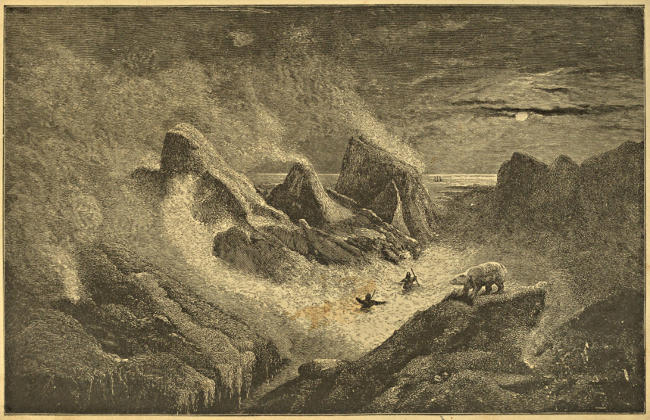
FRUITLESS ATTEMPT TO RESCUE MATOSCHKIN.
3. The cold set in with great intensity with the month of
February and maintained itself throughout it: the mean
monthly temperature being -31° F. Repeatedly the quicksilver
froze, and in the last eight days it remained solid.
Even the petroleum was frozen on the 17th at -49° F. in
the globe of the lamp, though it was throwing out a considerable
heat. The lowest temperature we experienced was
on the last day of the month, -51° F. Notwithstanding the
extreme cold, the light had increased so much that a thermometer,
in which the degrees were strongly marked, could
be read off, even on the 3rd of the month, at ten o’clock in the
forenoon without the aid of lamplight; and on the 20th we
were able to carry on our meteorological observations, without
any artificial light at six o’clock in the evening. The
ruddiness we observed at noon in the south grew more and
more decided. On clear days we could discern, about seven
o’clock in the morning, a faint twilight, and at noon of
February 14 the near approach of the sun was distinctly to
be traced by a bright cloud that was resting over it, though it
was still below the horizon. About the middle of the month
there was light enough to cause the different forms and groups
of ice to cast shadows. In spite of the low temperature, we
remained for hours in the open air, though previously to
this period we had ventured on deck for a few minutes only
at a time—the watch of course excepted. But as the daylight
increased, we saw also what a dark, gloomy grave had
been our abode for so long a period. All our thoughts and
conversations were concentrated on the returning light of
the sun. The movements of the ice ceased to be a source
of dread, though for several days during the month they
had been exceedingly formidable. In the course of our
drifting we had penetrated into a region where never ship had
been before. The following table exhibits the course of the
Tegetthoff, as she drifted from August 21, 1872, to February
27, 1873:—
| Time. |
N. Lat.
° ′ |
E. Lon.
° ′ |
| Aug. |
21 |
1872, |
76·22 |
62·3 |
day when the
ship was beset |
|
|
| Sept. |
1 |
1872 |
76·25 |
62·50 |
| ” |
4 |
” |
76·23 |
62·49 |
| ” |
11 |
” |
76·35 |
60·18 |
| ” |
14 |
” |
76·37 |
60·50 |
| ” |
21 |
” |
76·28 |
63·9 |
| ” |
26 |
” |
76·36 |
64·8 |
| ” |
27 |
” |
76·38 |
64·4 |
| ” |
28 |
” |
76·37 |
64·10 |
| Oct. |
1 |
” |
76·50 |
65·22 |
| ” |
2 |
” |
76·59 |
65·48 |
| ” |
3 |
” |
77·4 |
66·1 |
| ” |
17 |
” |
77·50 |
69·22 |
| ” |
18 |
” |
77·48 |
69·8 |
| ” |
22 |
” |
77·46 |
69·26 |
| ” |
31 |
” |
77·53 |
69·12 |
| Nov. |
5 |
” |
77·53 |
69·30 |
| ” |
9 |
” |
78·15 |
69·42 |
| ” |
14 |
” |
78·8 |
71·16 |
| ” |
18 |
” |
78·10 |
70·31 |
| ” |
28 |
” |
78·13 |
69·48 |
| Dec. |
4 |
” |
78·19 |
69·1 |
| ” |
8 |
” |
78·21 |
69·2 |
| ” |
12 |
” |
78·25 |
68·57 |
| ” |
16 |
” |
78·22 |
67·42 |
| ” |
19 |
” |
78·13 |
67·11 |
| ” |
26 |
” |
78·10 |
68·19 |
| Jan. |
2 |
1873 |
78·37 |
66·56 |
| ” |
19 |
” |
78·43 |
69·32 |
| ” |
26 |
” |
78·50 |
71·47 |
| Feb. |
2 |
” |
78·45 |
73·7 |
| ” |
14 |
” |
78·12 |
72·20 |
| ” |
19 |
” |
78·15 |
71·38 |
| ” |
23 |
” |
79·11 |
|
| ” |
27 |
” |
79·12 |
|
4. The inspection of this table shows that the movement
of the ship was retarded as the increasing cold closed the
open places of the sea, and when we fell under the influence
of the Siberian ice-drift from east to west. It may be
remarked, too, that we drifted generally straight before the
wind, and that we and our floe during the first four months
turned only one degree in azimuth. By the end of January
all the open places of the sea were closed; and the masses of
ice were thus driven one over the other from their mutual
pressure, and pile thus rose upon pile. It seems probable,
also, that wind was the main cause of our drifting, while sea
currents were only of secondary moment. From the beginning
of the month of February we drifted constantly toward
the north-west, and from this deviation in our course we
indulged in the hope that we were approaching the mysterious
Gillis’ Land. But at this time the liberation of the ship in
the summer was the sum of our expectations and desires. In
fact, there was not one of us who doubted this eventuality.
Fully convinced, as we were, that our floes, firmly attached to
each other, would ultimately break up and drift southwards,
we determined to make them the bearers of the record of
what had befallen us. Hence we threw out, February 14th,
round the ship a number of bottles, inclosing a narrative of
the main events of the expedition from the departure of
Count Wilczek up to that date.
1. Though the sun did not return to our latitude (78° 15′, 71°
38′ E. long.) till the 19th of February, we were able to greet
his beams three days previous to that date, owing to the strong
refraction of 1° 40′, which accompanied a temperature of -35
(F.). To the Polar navigator the return of the sun is an event
of indescribable joy and magnificence. In those dreadful
wastes he feels the force of the superstitions of past ages,
and becomes almost a worshipper of the eternal luminary.
As of old the worshippers of Belus watched its approach on
the luxuriant shores of the Euphrates, we, too, standing on
mountains of ice or perched on the masts of the ship, waited
to hail the advent of the source of light. At last it came!
A wave of light rolled through the vast expanse of heaven,
and then—up rose the sun-god, surrounded with purple clouds,
and poured his beams over the world of ice. No one spoke
for a time. Who indeed could have found words to embody
the feelings of relief which beamed on the faces of all, and
which found a kind of expression in the scarcely audible exclamation
of one of the simplest and least cultured of the
crew, “Benedetto giorno!” The sun had risen with but half
his disk, as if reluctant to shine on a world unworthy of his
beams. A rosy hue suffused the whole scene, and the cold
Memnon pillars of ice gave forth mysterious whispers in the
flood of heat and light. Now indeed with the sun had a new
year begun—what was it to bring forth for us and our prospects?
But alas, his stay was short—he remained above the
horizon for a few minutes only; again his light was quenched,
and a hazy violet colour lay over distant objects, and the
twinkling stars shone in the heavens.
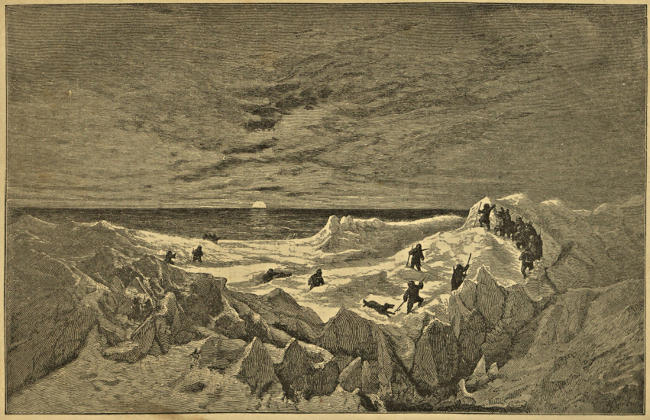
SUN-RISE (1873).
2. While we watched the sun’s return, we had also an opportunity
of looking on each other. How shocked and surprised
were we with the change which had been wrought on us in
the long Polar night! Our sunken cheeks were overspread
with pallor; we had all the signs of convalescence after a
long illness—the sharp-pointed nose, the sunken eye. The
eyes of all had suffered from the light of lamps which had
burnt for months; those especially who had used them for
hard work. But all these consequences were of short duration
under the beneficent influence of the daylight and the
spring sun, which soon brought colour into our faces. Cheerfulness
gradually returned to all on board the Tegetthoff, as
we revelled in the warm beams of the sun. We built a house
without a roof, and open to the south, and thither the healthy
and the sick on calm fine days used to repair from the dreary
ship, and sun themselves like lizards. But within the ship it
was still night.
3. The visits of bears again became numerous. February
17th one of about five feet long was shot very close to the ship,
and two days afterwards a second came near us, but was
scared away by the awkwardness of the hunters. The dogs
however pursued him, and we were compelled from fears for
their safety to follow up the chase. The temperature of -33° F.,
and a pretty strong wind against which we had to run in
the pursuit, brought on in some of our party palpitation of
the heart and spitting of blood, and our return to the ship
was a matter of some difficulty. On the morning of the
20th another bear came close to the ship, was fired at, but
missed, and got away. Palmich, Haller, and Klotz immediately
gave chase, though the temperature was -40° F., and
the wind high. After a short time Palmich returned with
his face frost-bitten, and the Tyrolese after several hours,
without any success, but with their feet so frost-bitten that
they had lost all feeling in them. The second stage of the
malady had begun, which renders amputation almost a necessity.
For several hours their feet had to be rubbed with
snow till sensation returned, and with returning sensation
much suffering; large swellings as big as a man’s fist rose on
their feet, which were reduced only after the application of
ice for several days. Again, in the grey of the morning of
February 22nd a bear came within eighty paces of the ship,
which Sussich, the watch on deck, after several shots, which
the animal seemed not in the least to regard, at last hit and
killed. By a wound on his right forepaw we recognised our
friend whom we had hotly chased a few days before. He
was six feet in length, and in his stomach there was nothing
but a small piece of the skin of a seal. Sussich was overjoyed
with his success, and for the whole day tried to drag
everyone outside the ship to show the result of his prowess,
“Se mi non era, il copava tutti,” he added, with a look of
contempt on those who had not been so successful as himself.
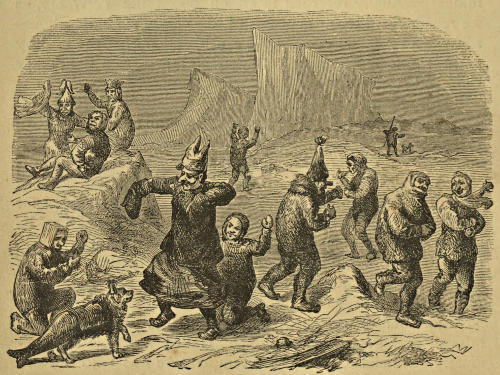
THE CARNIVAL ON THE ICE.
4. Although at the end of February the sun rose with a
carmine light which imparted an indescribable charm to the
fields of snow and ice, we were doomed to disappointment in
our expectation of bright and clear weather in the after-part
of the day. Soon after sun-rise, white frosty mists gathered
over the ice-fields, making the sun as he shone through them
a mere ball of light, or completely concealing him. On
February 24th we enjoyed the peculiar spectacle of seeing
the sun appear, the temperature being -44° F., distorted by
refraction, through the thick mists on the horizon, as if he
were quite flat, beamless, and of a coppery red. The end of
February reminded us of the carnival time of the land of the
South, and the crew appeared in such masques as they could
command; but their masquerading formed a sad and mocking
contrast with the gravity of our position. The men
bestowed all their art on “Sumbu,” who was dressed up as the
demon “Lindwurm,” and deported himself in a manner highly
becoming his costume.
5. With the month of March the spring had, in name at
least, begun; but in our sense of the word no spring as yet
appeared. Instead of the joyous gleams of early vegetation,
a blinding white waste environed us; instead of the perfumed
breath of flowers and the soft air of spring, there rose driving
clouds of ice-needles; and parhelia of almost daily occurrence
shone in a heavy sleepy fashion through white frosty
mists. The atmosphere was filled with snow; to be convinced
of this we had only to look at the sun when the
weather seemed clear and bright. This continual fall of snow
as fine as dust was the cause of the retardation of the evaporation
of the ice. The influence of the sun was so great,
that on March 3 the black-bulb thermometer indicated the
unusual temperature of 45° F., and a layer of snow on the
bows of the vessel showed evident signs of diminution. The
thermometer, in the sun, rose eight degrees March 6, and
nine degrees two days after. The weather was calm and
clear, and the increasing influence of the sun was a most
joyful sensation. A cube of ice freely suspended showed
during the second half of March a daily diminution of 1/100 of its
weight from evaporation; while in the sea itself its behaviour
was the very opposite; the cube of ice, which was submerged
to a depth of ten feet from February 19th to March 5th,
showed at the latter date an increase of its mass, amounting
to ¾ of an inch round its surface. In the beginning and end
of March the cold was so severe, that the thermometer every
day for three weeks marked -35° F. Calms and clear
weather, however, characterized this period of the spring, and
snow-drifting and a clouded sky were rare. On the 13th of
March the full moon again appeared in the azure twilight of
the western heavens, and its soft light fringed with silver the
dark ranges of ice. The days became longer, and the
shadows cast by the masses of ice were shorter and more
marked, and every one who remained long in the open air
was forced to use snow-spectacles. Small avalanches began
to fall from the rigging, and the masts, spars, and ropes lost
their white frosted aspect. On the 22nd the fore-part of the
ship’s hull facing the south was completely free from snow
and its dark colour was visible. On the 29th the temperature
in the sun exceeded the temperature at 9.30 A.M. by 34° F.;
and on the 30th we could for the first time observe the melting
of the snow on the seams of the timber of the ship’s hull.
The enumeration of these events, insignificant as they may
appear, will serve to show with what attention the Polar
navigator notes the minutest occurrence due to the influence
of the sun.
6. Welcome, though illusive, harbingers of the returning
summer were the first birds, whose arrival we greeted on
the 19th. These were little divers, which flew over the ship
to the open spaces of water amid the ice, there to seek
their food in the countless crustaceæ which abound in them.
Magnificent auroras continued to illuminate our nights; and
although the duration of their intensity was much too brief
to serve as a source of light, there was a charm in these
phenomena which their daily recurrence could not weaken.
7. While under these various influences the health of all on
board the Tegetthoff greatly improved, we were threatened
with the serious calamity of losing our excellent physician,
Dr. Kepes, who fell ill on the 13th of the month. For two
weeks we were kept in a state of anxious fear for him; and
our anxieties were increased as we had to treat his malady
without the necessary knowledge and experience. To our
great joy, however, he was spared to us; and our supply of
fresh bear’s-flesh was henceforth reserved for him.
8. For some time the bears had observed a very distressing
reserve and shyness in their visits, On the 15th one came
near us, and as Pekel had for some time announced his approach,
he found a long front of rifles drawn up behind some
masses of ice to give him a warm reception. He, as usual,
came on under the wind, showing considerable interest in our
edifices. He then ascended a small ice-crag, and, after
balancing himself carefully, sat down on the top of it, with his
snout uplifted, snuffing all round. This seemed so ludicrous
to some of our party that they burst out into a laugh so loud,
that the bear came down from his pinnacle in evident astonishment,
and with much circumspection drew nearer and nearer
till at a short distance from us he fell mortally wounded. He
was, alas! a very small animal, about 5½ feet long, and his
stomach was absolutely empty. On the 30th of March
another came close to the ship; the watch on shore fired
at, but missed him, whereupon both the watch and the bear
took to flight.
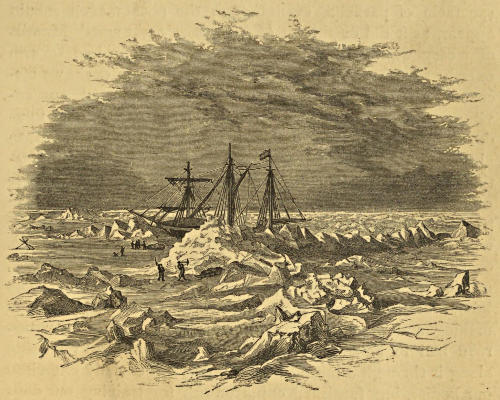
THE “TEGETTHOFF” DRIFTING IN PACK-ICE.—MARCH 1873.
9. April at last arrived, and with it the time of icicles, which
hung down from every yard of the ship, and from every rope
of the rigging, from every icy ridge and crag. The melting
and decaying of the ice, though always a source of satisfaction
when the question of its breaking up is discussed, went on,
to our impatient desires, with intolerable slowness. What was
it to us that we were able to read even at midnight on the
2nd of April; that the number of divers and sea-gulls constantly
increased; that on the 6th the difference of temperature
between sun and shade was 18°; that the black-bulb
thermometer on the 20th showed 43° F.; that the sun on
the 11th rose about two o’clock in the morning, and from the
16th remained constantly in the heavens? What did all this
matter? The constant light notwithstanding, we were still
environed with the signs of deepest winter, and the forms and
masses of ice collapsed with a slow deliberation that tortured
us. We were no longer to be satisfied and amused with the
spectacle of parhelia, even though the phenomenon should
appear, as it did on the 1st of April, with eight suns. Months
of weary waiting still lay before us; daily we had to arm
ourselves with patience, as, when we came on deck, we discovered
the apparently unchangeable character of our environment,
with all its forms, which had become familiar to us
down to the smallest details. Reluctantly condemned to
almost total idleness, we filled up our time with such occupations
as fancy suggested. Some of our people built a tower
of ice on a level part of our floe; others tried their rifles—tried
often enough before—at empty bottles as targets. Along
with the Tyrolese I constructed a road through hills of ice,
over passes and ridges, going up and down in serpentine paths,
making a circuit of about three miles round the ship. The
labour of weeks with picks and shovels was expended in
making and preserving it; after each downfall of snow this
road had to be dug out afresh. Our passing and repassing
along it through a maze of ice not only beneficially exercised
our bodies, but furnished opportunities for training our dogs
to drag heavy-laden sledges. I continued also to fill my
portfolio with studies of scenery in the ice, and I accustomed
myself, whenever there was no wind, whatever might be the
temperature, to draw for hours together with no other protection
to my hands than light gloves.
10. April had begun with a temperature of -38° F.; as
the month advanced it steadily increased. At the end of
the month the extreme of cold was but -20° F. But the
weather had now lost the clearness of the early spring; and
constant calms, together with the frequent falls of snow,
undid the work of the few hours of the day on which the sun
shone. The ice was covered with deep snow; on the level
we sank ankle deep, while among the hummocks it was up to
our knees. Sledging would have been impracticable. Among
the changes produced by the softening of the weather, none
was greater or more agreeable than the return of daylight to
the cabin, when we took off the covering of the skylight and
removed the tent-roof from the fore-part of the ship. Once
more to be able to read without the dull glimmer of artificial
light was an extraordinary event in our monotonous life.
For five months our lamps had been burning in our mess-room,
so that the walls were black with smoke, and it was a work of
no small labour to make them clean and pleasant. The
unloading of the ship’s hold was, however, a far heavier, though
necessary task; the thick crusts of ice which had accumulated
on its sides must be removed, lest the provisions should be
damaged by their thawing; and there was no time to lose,
for the temperature in the hold was only 1° below zero. The
provisions, which had been left out on the ice, were again
stowed in the ship, the cessation of the ice-pressures rendering
this precautionary measure useless.
11. Round a ship which has wintered in the ice there is
gradually accumulated a mass of rubbish of all kinds, of
which cinders form a considerable constituent. These, when
thrown out in small quantities, sink at once into the snow,
while larger quantities act as a non-conducting layer. Hence
we were surrounded by a maze of holes, big and little, alternating
with plateaus, under which winter still continued to
linger. When thaw-water made its appearance, all this was
transformed into a succession of lakes and islands, which we
bridged over by planks.
12. Meantime we began our labours of digging out the
ship. We removed the wall of snow, which had served as an
outer garment and protection during the winter, and the hard-trodden
layer which covered the deck a foot thick. In clearing
away from the after-part of the ship, we discovered that
the machinery protecting the screw had been torn away
by the ice-pressures. The mischief done, however, was not
considerable; and as the ship made no water, we consoled
ourselves with the thought, that she had sustained no material
injury, though she had lain so long out of water perched on
the floe.
13. The continued cessation of movements in the ice induced
Weyprecht to erect a tent at no great distance from
the ship, to carry on in it observations of the magnetic constants,
which were taken on certain appointed days. On the
night of one of such days, Orel, who conducted these observations,
was surprised by the visit of a bear. His shouts for
help brought us on deck, but before we could actually reach
him, the seaman on the watch had killed the bear with an
explosive bullet. Hitherto these animals had shown little
courage in the neighbourhood of the ship, and to shoot
them from the deck exposed no one to any danger; but this
incident showed us that we could not count securely on their
actions. Soon after this we had another surprise. Stiglich,
the seaman on watch on shore, suddenly found himself confronted
with a bear about eight paces off. Throwing his cap
to the bear, he made a rush for the rope-ladders of the ship,
but fell in his hurry and confusion. Carlsen, hearing his cries
for help, hastened to the rescue, and dexterously shot the
pursuer. A glorious event for Carlsen! who used to tell us
strange stories of his encounters with bears: how he had
scared them away with the glance of his eye; and how once
in Novaya Zemlya he had frightened away a whole pack of
them by the magic of his glance. All doubts in the prowess
of his eye were silenced to-day by the more unquestionable
prowess of his rifle. On the 28th of May a bear clambering
over the wall of ice close astern of the ship was shot dead
with an explosive bullet. His stomach was empty, but notwithstanding
his leanness, he furnished more meat than many
others, for he was fully seven feet long.
14. At the end of April the force of the winds so loosened
the compactness of the ice, that dark strips hanging above the
horizon in all directions announced the existence of numerous
fissures, although they were invisible even from the masts of
the ship. We counted on these signs with such unshaken
confidence, that when on the 2nd of May we heard in the
distance the now familiar sound of the ice-pressures, we
heard them not only without dismay, but as the voice of a
joyous message. Three-quarters of a year had passed away
since we were first caught in the ice—a time laden to us with
bitter disappointments to our hopes, and great dangers to our
lives. The hour of our long and ardently desired liberation
seemed at hand. If once we got free, it lay within the bounds
of possibility that we might reach, if not the somewhat
mythical Gillis’ Land, then at least the uninhabited Arctic
coasts of Siberia. Siberia had, in fact, become the rosiest of
our hopes. Some, indeed, still indulged in extravagant expectations
and counted on the discovery of new lands, even
while they drifted with the ice. But our wishes for the most
part had become so subdued, that the discovery of the smallest
cliff would have satisfied our ambition as discoverers.
15. But Nature’s laws held their own course, undisturbed
by our desires. Snow continued to fall in abundance, and
spread its mantle over the ice. The constant round of downfalls
and evaporation was a sad bar to our hopes. In the
beginning of May the snow began to thaw on the surface, and
became soft and sticky. Even in the depth of winter it was
never hard, but like the fine dry grains of driving sand. This
change in the snow, which occurs a fortnight earlier than in
Greenland, compelled us to substitute our black leather boots
for those of sailcloth, which we had hitherto worn. On the
2nd of May the temperature fell to -8° F., but it now began
to rise gradually, so that it sometimes reached the freezing
point about the end of the month, and on the 29th rose
five degrees above it. The mean temperature of the month,
however, was not above 16° F. But the difference of temperature
in the sun and the shade became greater and greater.
The thermometer marked -18° F. at 6 P.M. of the 1st of May,
and on the 11th the black-bulb thermometer showed 90° F.
at 3 P.M., while the common instrument gave only 14° F.
In the middle of the month, after the heavy winds fell,
we were enveloped with dark fog banks; stray beams of the
sun broke through the warm misty atmosphere, and dark
skies were succeeded by masses of white vapour illuminated
by the sun. Just as in our happier clime, the Arctic April
has her alternations of cloud and sunshine.
16. Hitherto the only birds which had visited us were
divers and gulls. Once only a snow-bunting flew among us,
and fearlessly settled on the ship. On the 24th of May the
auks made their appearance, and from that date we were constantly
entertained by the whirring sounds of their flight. As
they keep one direction in their flight, we could shoot those
only which passed over the ship; they were a useful addition
to our table, though they had to be steeped in vinegar to
make them palatable. The majestic Burgomaster Gull appeared
somewhat later, and later still the “Ice-birds” frequented
the shores of the lakes around us, and hovered round
the remains of the bears we had shot. These birds settled
with the greatest boldness in the immediate neighbourhood
of the ship, and day and night filled the air with their wild
shrill cries.
17. By the middle of March, Krisch, the engineer, had put
the steam machinery in working order, but another month
elapsed before the screw-propeller, which had been frozen
fast, was set free; our fears lest it should refuse to act proved
to be groundless. As, however, there was no prospect of our
being able to use steam for some time, it was thought
advisable to dig out and raise the rudder in order to secure it.
18. On the 26th of May a partial eclipse of the sun was
visible in our latitude; but from an error in our calculations
we had ante-dated the commencement of the observation by
about two hours and a half. Everyone on board who had an
instrument at his command stood ready to observe the passage
of the moon over the sun’s disk. After waiting for some
time in vain, we discovered the error we had committed as to
the time of the beginning of the eclipse, but in order that the
dignity of astronomical observation might not be degraded in
the eye of the crew, we still held our ground with the telescopes
in our hands. Two hours of such suspense enabled us
to feel that there could be no more perfect fulfilment of the
punishment of Sisyphus than being condemned to wait for an
eclipse of the sun which would not come off! At last the
eclipse took place, but not until great disgust had been excited
in the minds of men who were too much inclined to regard
the whole thing as a piece of humbug. At the height of the
eclipse about one-third only of the sun’s disk was obscured,
and the sun was so covered with mist that we could look at
it without the use of coloured glasses. The whole duration
of the eclipse was one hour and fifty-six minutes.
19. From the 1st of the month the number of living
creatures belonging to the expedition had been increased by
the birth of four Newfoundland puppies, who passed the
earliest days of their youth in a tent erected on the ice, and
artificially heated to the temperature of a European May.
But all our care in rearing this litter was frustrated by one of
these little Polar wretches, who, after sucking his mother till
he was as round as a drum, lay on his brothers as they slept,
and stifled them. This little criminal received the name of
Torossy, and soon became the pet of the crew, and a favourite
with all the other dogs. The fame which he afterwards gained
made him an important member of the expedition. All the
dogs had become so hardy during the past winter, that they
now slept outside their kennels, finding the inside too warm
for them.
1. The time crept away with indescribable monotony. The
crew performed their heavy labours, but of events there were
none. The only change in our position was the constant
decay of the buttresses and walls of ice, until the frozen sea
lay like a snowy chaos before us. Pure sharp-edged ice was
nowhere to be seen; the edges were no longer transparent;
evaporation had transformed the surface into a kind of
glacier-snow. June 1, we had the greatest degree of cold of
the month, the thermometer marking 13° F.; but on the
last day it rose to 32·2° F.; the mean temperature being
31·1° F. Every week brought us promises of summer. On
the 1st the black-bulb thermometer reached 98° F.; on the
14th rain fell for the first time; on the 16th the temperature
at 9 o’clock A.M., was 41·5° F., on the 26th 46·4° F., and on
the 29th even 50·2° F. On these days the air seemed to
have the pleasant mildness of southern climes, and when there
was no wind we felt an oppressive sultriness. Wreaths of
mist moved along the icy wastes which glowed with sunlight,
while the long dark lines of ice-wall lay in deep shadow.
The air was filled with flocks of birds; day and night we
heard the shrill cries of the Robber-gulls, ever and anon
mingled with the barking of the dogs in full pursuit of them.
Flocks of rotges congregated without fear in the narrow
basins of distant “leads;” and the “great gulls,” shunning
companionship, sat for hours on the top of an ice-cliff, or in
the middle of a floe.
2. No one who has not actually seen it, can imagine the
blaze of light in the Arctic regions on clear days, or the glow
which floats sometimes over the cold white ice-floes, with
their outlines in constant vibration, while refraction transforms
the icebergs into a variety of shapes. The sun’s power is
sometimes so great as to blister the skin in a few hours, and
the glare from snow and ice produces snow-blindness, if the
eyes be not carefully protected. At a little distance the sea
appears to be of a deep black colour, though it still preserves
its ultramarine hues in the narrow “leads;” even the pure
blue of the heavens may be called almost black when
compared with the dazzling sheen of the ice. In the middle
of June there was an incessant dripping and oozing in the
ice-world, and streams of thaw-water flowed into the open
fissures. By the end of the month the surface of the ice
resembled snow; and even at some depth it was viscous,
instead of brittle and hard as glass, as it is during the colder
season. Streams of thaw-water ran through the softened and
saturated snow. Small lakes were formed on the levels, and
swamps of snow, wearing a traitorous exterior, surrounded
their borders. In the summer of 1873 we observed a vertical
decrease of five or six feet in the thickness of the ice; but
this diminution in thickness was from the surface downwards,
while in the sea itself there was little or no thawing, because
the temperature of its surface was still below zero. The
moisture, from which there was no escape, became exceedingly
troublesome. In spite of our stout leather boots we had
never the comfort of dry feet during the whole of the
summer, and this we felt the more, as our labours to free the
ship, which we had commenced at the beginning of May,
necessitated our being constantly amid the snow and ice.
3. At the end of May the ship began slowly to settle, and
the water rose between the ice and the hull on the fore-part
of the ship. But we soon discovered that these small changes
would not suffice to free us from our prison-house, but that
we must ourselves endeavour to loosen the fetters which held
us fast, if it were only to banish gloomy thoughts of the
future by action of some kind or other. Hence constant
digging, sawing, and blasting on our floe, through May, June,
July, and August—labours in which the whole crew of the
ship, with the exception of the sick and of the cook, took
part; labours, alas! which admonished us of the impotence
of man when he contends against the power of Nature.
Only on the port side of the ship were our efforts to dig
through the floe at all successful; on the starboard side the
floe had been so enormously increased by the tables of ice
forced upon one another, that we had not pierced through the
ice after sinking a shaft eighteen feet deep; and at last the
water, forcing itself through the pores of the ice, compelled
us to desist from the labour of sinking deeper. The process
of sawing was possible only where we had broken through
the ice—that is, on the port side; yet even there the great
thickness of the floe necessitated the construction of longer
instruments, for which the iron casing of the engine-room had
to furnish the material. The difficulty of sawing increases
with the thickness of the ice in an almost incredible manner.
It is easy enough to cut through a floe, four or five feet thick,
but to break up one, eight or ten feet thick, is a matter
of great difficulty. Our saws too, even when they were
lengthened, permitted a play of only a foot; and their
twisting, as they cut deep, proved a great hindrance. Besides,
when we had cut to the depth of a fathom, the saws were
always frozen fast, and when we attempted to free them by
blasting they were very often broken in pieces. But even the
sections, made with so much difficulty, often proved to be
quite useless, as they were frozen together again by broken ice
left in the cut. Blasting with gunpowder proved as ineffectual
as in the previous year; in fact, the process was only applicable
to ice-blocks which had been loosened by sawing, and which
could not be broken up by the crow-bar alone.
4. By the middle of June we were at last convinced that
the thickness of the ice rendered it impossible to join together,
by sawing, the two-and-twenty holes which we had dug out
round the ship. Henceforward our labours were confined to
the formation of a basin at the fore-part of the ship. Although
we saw the impossibility of liberating the vessel, as long as
she rested on a mountain of ice, we hoped that the basin
would help to break up the floe, and that the Tegetthoff would
of itself return to its normal position. The gliding down of
the ship, raised as it was, to its natural water-line might
indeed easily end in a catastrophe, but we braved this peril
when we thought of the vain attempts we had made to free
her. Though the ship sunk so much in the course of the
summer, that its height above the water-line was a little more
than two feet in the fore-part of the ship, and three feet in
the after-part, this circumstance in our favour was outweighed
by the disadvantage of the rapid melting away of the ice at
its sides. The ship, freed from its covering of ice, stood so
high above it, that in order to guard against the danger of its
overturning we were obliged, in the second half of the
summer, to shore it up by strong timbers fastened to its masts.
It looked no longer like a ship, but like a building ready to
fall in! In the middle of July Lieutenant Weyprecht ordered
Krisch, the engineer, to construct heavy chisels and borers to
ascertain the thickness of the ice. After long and hard
labour, we found that after boring through several ice-tables,
to a depth of twenty-seven feet, we still struck on ice!
Every attempt, therefore, to break through this accumulation
had to be given up, and we contented ourselves with leading
the basin we had formed on the fore-part round the larboard
side of the ship. On the 27th of the month, twenty tons of
coal were removed to the ice, in order to lighten the ship as
much as possible, and every day we had to look to the props
which steadied the ship, as the melting of the ice rendered
them unsafe. In the following weeks, the bows continued to
sink into the water, while the after-part as a natural consequence
was raised up.
5. Even in the month of July, the weather was generally
gloomy and unsettled. We had several times two or three
inches of snow, and the showers were mingled with mist, rain,
and snow, as had been the case in June. The winds were
generally from the west; the mean temperature of the month
was 34·7° F.; on the 8th of July, the black-bulb thermometer
marked 108° F., and the temperature in the shade at
the same date amounted to 34° F. But neither wind nor
temperature made any change in our position. The sun on
which our liberation depended was seldom visible; and the
winds on which we had counted failed to blow. For weeks
we watched for the formation of fissures round the ship.
Fissures indeed were formed, but at such a distance that they
were utterly useless to us. On the 16th of June, one
opened towards the south-east; but it was at least two miles
distant, and in the middle of July it was only half a mile
nearer to us. Nothing, absolutely nothing, was to be seen
from the deck but ice, and Klotz, coming down one day from
the top-sail yard, described our position with a melancholy
laconic brevity: “Nix als Eisch, und nix als Eisch, und nit a
bisserl a Wosser. (Nothing but ice, ice everywhere, and not a
patch of water.)” Amid such impressions all hope gradually
left us. The drifting of the ice ceased to animate our hopes.
Even the approach of a fissure on the 29th of July to the
distance of three-quarters of a mile, in consequence of heavy
gales from the south and west, ended in miserable disappointment.
A movement in the ice which began a little way off on
the 6th of August resulted only in the diminishing of our floe.
There was no essential change in the remainder of this
month, except that the monthly mean temperature fell to
32·7° F. We had the greatest extreme of heat on the 4th
of August, 41·9° F.; but on the last day of the month we
had 5·7 degrees of cold.
6. For some time we had been surprised by the appearance
of a dark mass of ice, the distance of which prevented
us from making a closer acquaintance with it. Our life on
the narrow space of our floe had quite assumed the character
of that of mere insects, who dwell on the leaf of a tree and
care not to know its edges. Excursions of one or two miles
were regarded as displaying an extraordinary amount of the
spirit of enterprise and discovery. On the 14th some of
us pushed on for about four miles to the group of ice just
mentioned, and discovered it to be a very large iceberg. Two
moraines lay on its broad back. These were the first stones
and pieces of rock we had seen for a long time, and so great
was our joy at these messengers of land, that we rummaged
about among the heaps of rubbish, with as much zeal as if
we had found ourselves among the treasures of India. Some
of the party found what they fancied to be gold (pyrites), and
gravely considered whether they would be able to take a
quantity of it back to Dalmatia. Although the glaciers of
Novaya Zemlya could not shed icebergs of such magnitude
as that on which we now stood, we all held it for certain that
it had come from thence. Not one of us had the least presentiment
that it could belong to new lands, to which at that time
we were near. Even the other icebergs which we discovered in
increasing numbers on the following days, did not as yet
speak to us the language of a message to fill us with hope
and ardour. Our walk to the “dirt iceberg” was an event
in our monotonous life, and was often repeated. These expeditions
enabled us also to form some conception of the size of
our floe, the diameter of which could not be less than six or
seven miles.
7. August 18—the birthday of his Majesty our Emperor,—the
ship was dressed with flags, the only form left to us of
expressing our loyalty. Our dinner was as sumptuous as the
circumstances permitted, though fasting would have been more
appropriate, as the third day after this was the anniversary
of that sad and gloomy day on which we were inclosed in
the ice. In order to visit an iceberg which lay to the north-west
of us, we ventured beyond our floe for the first time, and
passed over a fissure to some drifting ice-floes which lay in
the way. A seal lying on the ice was immediately attacked
by our dogs, but succeeded after many efforts in reaching its
hole. From the top of the iceberg, which was about sixty feet
high, we discovered that the few openings in the ice were not
navigable “leads,” but isolated holes utterly unconnected, and
therefore useless for navigation.
8. We had continually drifted, since the beginning of
February, first to the north-west and then to the north, with
few modifications; at that date, we had reached our greatest
East Longitude, and winds appeared as before to be the main
cause of this drifting. At the end of that month there was
a succession of calms, and we lay almost motionless in
latitude 79°, and longitude 71°. The subjoined table shows
our change of place in the following months.
| Time. |
Latitude.
° ′ |
Longitude.
° ′ |
| March |
3 |
1873 |
79 |
13 |
69 |
32 |
| ” |
9 |
” |
79 |
19 |
68 |
28 |
| ” |
14 |
” |
79 |
20 |
68 |
28 |
| ” |
20 |
” |
79 |
33 |
68 |
52 |
| ” |
25 |
” |
79 |
23 |
67 |
17 |
| ” |
27 |
” |
79 |
15 |
67 |
29 |
| ” |
29 |
” |
79 |
14 |
67 |
35 |
| April |
2 |
” |
79 |
5 |
66 |
49 |
| ” |
3 |
” |
79 |
5 |
66 |
42 |
| ” |
7 |
” |
79 |
4 |
— |
| ” |
10 |
” |
79 |
12 |
68 |
1 |
| ” |
12 |
” |
79 |
19 |
67 |
43 |
| ” |
13 |
” |
79 |
20 |
67 |
40 |
| ” |
15 |
” |
79 |
14 |
67 |
0 |
| ” |
19 |
” |
79 |
18 |
65 |
51 |
| ” |
20 |
” |
79 |
19 |
65 |
37 |
| ” |
27 |
” |
79 |
13·5 |
64 |
37·0 |
| ” |
28 |
” |
79 |
12·2 |
64 |
41·8 |
| May |
1 |
” |
79 |
15·8 |
64 |
58·8 |
| ” |
2 |
” |
79 |
17·1 |
65 |
3·9 |
| ” |
6 |
” |
79 |
16·0 |
65 |
0·5 |
| ” |
10 |
” |
79 |
20·4 |
65 |
41·9 |
| ” |
11 |
” |
79 |
20·2 |
65 |
32·4 |
| ” |
13 |
” |
79 |
19·7 |
65 |
15·8 |
| ” |
14 |
” |
79 |
19·8 |
64 |
45·6 |
| ” |
16 |
” |
79 |
15·5 |
63 |
39·0 |
| ” |
17 |
” |
79 |
13·1 |
63 |
21·7 |
| ” |
22 |
” |
79 |
9·2 |
62 |
3·5 |
| ” |
29 |
” |
79 |
2·4 |
62 |
55·5 |
| ” |
30 |
” |
79 |
2·5 |
62 |
54·2 |
| ” |
31 |
” |
79 |
2·5 |
62 |
53·9 |
| June |
1 |
” |
79 |
2·4 |
62 |
43·2 |
| ” |
3 |
” |
79 |
0·4 |
62 |
29·7 |
| ” |
5 |
” |
79 |
1·3 |
62 |
24·8 |
| ” |
6 |
” |
79 |
1·1 |
62 |
20·2 |
| ” |
9 |
” |
79 |
5·4 |
61 |
31·4 |
| ” |
10 |
” |
79 |
5·3 |
61 |
23·6 |
| ” |
11 |
” |
79 |
4·3 |
61 |
21·3 |
| ” |
18 |
” |
79 |
6·6 |
61 |
5·2 |
| ” |
20 |
” |
79 |
8·6 |
61 |
2·8 |
| ” |
22 |
” |
79 |
9·2 |
60 |
54·9 |
| ” |
24 |
” |
79 |
8·4 |
60 |
31·8 |
| ” |
25 |
” |
79 |
11·2 |
60 |
14·6 |
| ” |
26 |
” |
79 |
13·3 |
59 |
55·3 |
| ” |
27 |
” |
79 |
13·7 |
59 |
46·0 |
| ” |
28 |
” |
79 |
15·5 |
59 |
35·4 |
| July |
3 |
” |
79 |
15·2 |
59 |
14·8 |
| ” |
4 |
” |
79 |
14·8 |
59 |
13·3 |
| ” |
8 |
” |
79 |
15·2 |
59 |
5·8 |
| ” |
10 |
” |
79 |
13·2 |
59 |
9·0 |
| ” |
15 |
” |
79 |
9·8 |
59 |
52·6 |
| ” |
18 |
” |
79 |
7·3 |
59 |
50·4 |
| ” |
19 |
” |
79 |
7·6 |
59 |
35·1 |
| ” |
20 |
” |
79 |
8·7 |
59 |
33·6 |
| ” |
21 |
” |
79 |
9·2 |
59 |
33·1 |
| ” |
22 |
” |
79 |
9·0 |
59 |
34·1 |
| ” |
23 |
” |
79 |
6·6 |
59 |
34·2 |
| ” |
24 |
” |
79 |
7·1 |
59 |
29·5 |
| ” |
25 |
” |
79 |
6·6 |
59 |
27·3 |
| ” |
31 |
” |
78 |
58·5 |
60 |
25·5 |
| August |
1 |
” |
78 |
56·9 |
60 |
40·6 |
| ” |
4 |
” |
79 |
0·4 |
61 |
6·2 |
| ” |
13 |
” |
79 |
25·4 |
61 |
6·6 |
| ” |
14 |
” |
79 |
24·5 |
61 |
16·3 |
| ” |
16 |
” |
79 |
27·8 |
61 |
7·6 |
| ” |
19 |
” |
79 |
29·1 |
61 |
31·0 |
| ” |
21 |
” |
79 |
31·3 |
61 |
44·8 |
| ” |
30 |
” |
79 |
43·0 |
60 |
23·7 |
| ” |
31 |
” |
79 |
42·5 |
60 |
5·6 |
| Sept. |
2 |
” |
79 |
40·2 |
60 |
32·9 |
| ” |
5 |
” |
79 |
41·3 |
60 |
12·5 |
| ” |
8 |
” |
79 |
34·2 |
59 |
47·3 |
| ” |
9 |
” |
79 |
33·6 |
59 |
45·9 |
| ” |
10 |
” |
79 |
32·2 |
59 |
53·1 |
| ” |
16 |
” |
79 |
45·6 |
61 |
30·5 |
| ” |
23 |
” |
79 |
49·6 |
61 |
58·1 |
| ” |
30 |
” |
79 |
58·3 |
60 |
41·1 |
| Oct. |
16 |
” |
79 |
54·6 |
60 |
34·7 |
| ” |
19 |
” |
79 |
53·9 |
60 |
40·6 |
| ” |
23 |
” |
79 |
44·5 |
60 |
7·9 |
| ” |
26 |
” |
79 |
44·3 |
59 |
17·1 |
| ” |
27 |
” |
79 |
44·0 |
59 |
14·1 |
| ” |
28 |
” |
79 |
43·8 |
59 |
6·6 |
| ” |
29 |
” |
79 |
44·8 |
59 |
9·8 |
| ” |
30 |
” |
79 |
49·0 |
58 |
59·9 |
| ” |
31 |
” |
79 |
50·6 |
58 |
53·7 |
| Ship in Land ice |
79 |
51·1 |
58 |
56·0 |
9. The meteorological observations of the expedition, and
the course of the Tegetthoff have been ably analysed by Vice-Admiral
Baron von Wüllersdorf-Urbair in the Mittheilungen of
the Imperial Academy of Sciences of Vienna, and while I refer
the curious reader to these reports for a fuller discussion of
these questions, I subjoin the most important paragraphs of
the Admiral’s report which concern the course of the
Tegetthoff:—
“Under ordinary circumstances a ship drifts on with the
floe; is imprisoned, and necessarily obeys the force of the
wind and the sea-currents. Its course, consequently, corresponds
to the combined effect of these forces. But, inasmuch
as the Tegetthoff was not in the free sea, but was driven along
for the greater part of the time in close pack-ice, the ship not
only obeyed the general movement of the ice, which was
dependent on the direction of the winds and currents of the
sea, but was also influenced by its vicinity to coasts and by
the greater or lesser accumulation of ice.
“In so far as the Tegetthoff with her hull and masts presented
a greater surface to the wind, the floe, on which it was
imprisoned, would necessarily receive an excess of movement
in the direction of the wind. If this excess formed an angle
with the direction of the movement of the ice, the ship’s floe
would deviate to the side of the least resistance, and drift
according to the resultant between wind and resistance. Thus
it might be that the ship’s course deviated from the wind, even
in a direction opposed to it. But these anomalies certainly
were not great, and could not well be estimated, because the
deviations which thus arose depended on the direction of the
wind, on the density and mass of the ice, on causes, in fact,
which could not be exhibited under numerical relations.
“If we compare the statements, as given in the Meteorological
Journal,[21] concerning the ice-drift and ice-pressures, it
is seen that the maximum of both occurred in those parts of
the sea in which the ship was within the action of the ice
coming from the Sea of Kara, and that the greatest deviations
in the ship’s course necessarily happened there.
“With respect to another abnormal deviation in the ship’s
course, it cannot be doubted that this depended on the vicinity
of Franz-Josef Land, towards which the masses of ice drifted
under the action of continuous south-west winds; and were
again driven back, thus forming a circle in their movement. It
would seem natural to assume the existence of a sea-current
in order to explain this peculiarity; but the configuration of
that land and its coasts, or the greater or lesser amount of
immovable ice, or, lastly, the prevailing winds in those regions,
may have influenced the direction of the movement of the ice,
and consequently of the ship’s course.
“If we consider the prevalence of winds, as furnished by
Weyprecht’s observations for more than two years, we find
south-west winds prevailing in the southern part of the seas
that were navigated, and north-east winds in the northern part
of those seas.
“If the sea to the east of Franz-Josef Land should not
be broken by larger groups of islands, or by masses of
land, but be a vast range of ocean, the winds would be free
from the influence of land, and blow in a north-easterly direction,
and exhibit, so to speak, the phenomenon of a Polar
north-east trade wind. If it should be the case that north-east
winds prevail to the north of the 78th or 79th degree
of north latitude, and, at the same time, south-west winds to
the south of that same degree, the notion of a sea-current
must be dismissed, and a revolving movement in the ice
assumed, in the opposite direction to the hands of a clock.
The observations of Weyprecht on these winds establish their
circulatory character. The curve of deviation in the course of
the Tegetthoff seems to be in harmony with this assumption.
But these suppositions cannot be accepted, until observations
be made on the winds to the south of 79° N. L. at the same
season of the year with those which were so successfully made
by Weyprecht to the north of this degree.
“The following arguments, however, would seem to favour
the supposition of the existence of a sea-current. The curve
at the commencement of its deviation corresponds pretty
nearly with the direction which the Gulf Stream would
take after passing round Norway, and in its further course
with that current, which comes out of the Sea of Kara
between Novaya Zemlya and Cape Taimyr, and which undoubtedly
exists, though its course has to be more accurately
determined.
“However small may be the value we assign to the winds
in explanation of the deviation in the Tegetthoff’s course, it is
at any rate impossible to ascribe those phenomena to the
influence of the coast formation. We must, therefore, assume
either, that the different directions of the wind produce a
constant circulation of the ice in the sea to the north of 79°;
or that currents known to exist in this and contiguous seas
cannot be excluded from the small part of the ocean lying
between Novaya Zemlya and Franz-Josef Land.”
From these and other grounds the Vice-Admiral Baron von
Wüllersdorf draws the following conclusions:—
“It is probable that there exists a sea-current in the seas
between Novaya Zemlya and Franz-Josef Land; that at any
rate, its existence cannot positively be denied, although the
prevailing winds may produce similar phenomena.
“That there is a great probability that the Ocean stretches
far to the north and east beyond the eastern end of Novaya
Zemlya.”
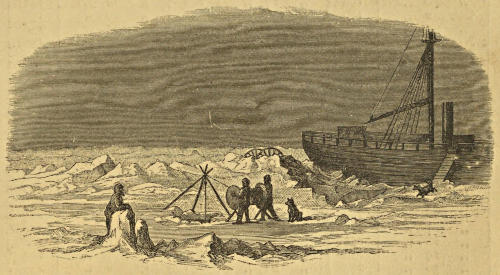
SOUNDING IN THE FROZEN OCEAN.
10. During the summer Orel took soundings of the depth
of the sea, which he was prevented from continuing in the
winter by the frost. These show its shallowness on the north
of Novaya Zemlya, especially towards Franz-Josef Land. A
bank, over which we drifted in the summer of 1873, and which
we explored with a drag-net, was the principal source of the
collection of marine fauna, which we shall speak of in a later
chapter. These soundings also enabled Orel to prove the
small increase of the temperature of the sea at any considerable
depth. He used in his experiments the maximum and
minimum thermometer of Casella. The specimens we collected
showed, that the bottom of the sea consists of layers
of mud and shells. The soundings are exhibited in the
following table:—
| Time. |
Metres. |
| July |
20 |
1872 |
400 |
| ” |
28 |
” |
115 |
| ” |
31 |
” |
250 |
| Aug. |
3 |
” |
130 |
| ” |
4 |
” |
80 |
| ” |
22 |
” |
36 |
| ” |
30 |
” |
170 |
| Sept. |
16 |
” |
100 |
| ” |
25 |
” |
90 |
| ” |
29 |
” |
85 |
| ” |
30 |
” |
190 |
| Oct. |
2 |
” |
170 |
| ” |
9 |
” |
450 |
| Nov. |
14 |
” |
345 |
| Jan. |
28 |
1873 |
510 |
| Mar. |
27 |
” |
450 |
| April |
28 |
” |
350 |
| May |
17 |
” |
230 |
| ” |
18 |
” |
187 |
| ” |
19 |
” |
172 |
| ” |
20 |
” |
163 |
| ” |
21 |
” |
138 |
| ” |
22 |
” |
186 |
| ” |
23 |
” |
162 |
| ” |
25 |
” |
177 |
| ” |
25 |
” |
182 |
| ” |
26 |
” |
186 |
| ” |
27 |
” |
249 |
| ” |
28 |
” |
251 |
| ” |
29 |
” |
254 |
| ” |
30 |
” |
253 |
| ” |
31 |
” |
256 |
| June |
1 |
” |
238 |
| ” |
2 |
” |
210 |
| ” |
3 |
” |
183 |
| ” |
4 |
” |
207 |
| ” |
5 |
” |
200 |
| ” |
6 |
” |
198 |
| ” |
7 |
” |
190 |
| ” |
8 |
” |
215 |
| ” |
9 |
” |
231 |
| ” |
10 |
” |
203 |
| ” |
11 |
” |
240 |
| ” |
12 |
” |
218 |
| ” |
13 |
” |
211 |
| ” |
14 |
” |
235 |
| ” |
15 |
” |
161 |
| ” |
16 |
” |
184 |
| ” |
17 |
” |
222 |
| ” |
18 |
” |
200 |
| ” |
19 |
” |
186 |
| ” |
20 |
” |
220 |
| ” |
21 |
” |
195 |
| ” |
22 |
” |
200 |
| ” |
23 |
” |
169 |
| ” |
24 |
” |
178 |
| ” |
25 |
” |
195 |
| ” |
26 |
” |
220 |
| ” |
27 |
” |
227 |
| ” |
28 |
” |
233 |
| ” |
29 |
” |
240 |
| ” |
30 |
” |
240 |
| July |
1 |
” |
240 |
| ” |
3 |
” |
245 |
| ” |
4 |
” |
250 |
| ” |
5 |
” |
235 |
| ” |
6 |
” |
235 |
| ” |
7 |
” |
274 |
| ” |
8 |
” |
266 |
| ” |
9 |
” |
250 |
| ” |
10 |
” |
250 |
| ” |
11 |
” |
236 |
| ” |
12 |
” |
265 |
| ” |
13 |
” |
247 |
| ” |
14 |
” |
215 |
| ” |
15 |
” |
195 |
| ” |
16 |
” |
184 |
| ” |
17 |
” |
200 |
| ” |
18 |
” |
240 |
| ” |
19 |
” |
232 |
| ” |
20 |
” |
231 |
| ” |
21 |
” |
231 |
| ” |
22 |
” |
226 |
| ” |
23 |
” |
198 |
| ” |
24 |
” |
205 |
| ” |
25 |
” |
216 |
| ” |
26 |
” |
218 |
| ” |
27 |
” |
218 |
| ” |
28 |
” |
236 |
| ” |
29 |
” |
260 |
| ” |
30 |
” |
236 |
| ” |
31 |
” |
234 |
| Aug. |
1 |
” |
225 |
| ” |
2 |
” |
219 |
| ” |
3 |
” |
173 |
| ” |
4 |
” |
188 |
| ” |
5 |
” |
210 |
| ” |
6 |
” |
107 |
| ” |
7 |
” |
216 |
| ” |
8 |
” |
184 |
| ” |
9 |
” |
244 |
| ” |
10 |
” |
225 |
| ” |
11 |
” |
209 |
| ” |
12 |
” |
214 |
| ” |
13 |
” |
189 |
| ” |
14 |
” |
177 |
| ” |
15 |
” |
170 |
| ” |
16 |
” |
170 |
| ” |
17 |
” |
174 |
| ” |
18 |
” |
148 |
| ” |
19 |
” |
152 |
| ” |
20 |
” |
138 |
| ” |
21 |
” |
130 |
| ” |
22 |
” |
131 |
| ” |
23 |
” |
128 |
| ” |
24 |
” |
145 |
| ” |
25 |
” |
140 |
| ” |
26 |
” |
185 |
| ” |
27 |
” |
219 |
| ” |
28 |
” |
180 |
| ” |
29 |
” |
132 |
| ” |
30 |
” |
211 |
| ” |
31 |
” |
197 |
| Sept. |
1 |
” |
260 |
| ” |
2 |
” |
142 |
| ” |
3 |
” |
212 |
| ” |
4 |
” |
215 |
| ” |
5 |
” |
178 |
| ” |
6 |
” |
188 |
| ” |
7 |
” |
204 |
| ” |
8 |
” |
250 |
| ” |
9 |
” |
240 |
| ” |
10 |
” |
218 |
| ” |
11 |
” |
168 |
| ” |
12 |
” |
127 |
| ” |
13 |
” |
132 |
| ” |
14 |
” |
137 |
| ” |
15 |
” |
111 |
| ” |
16 |
” |
134 |
| ” |
17 |
” |
178 |
| ” |
18 |
” |
175 |
| ” |
19 |
” |
275 |
| ” |
20 |
” |
300 |
| ” |
21 |
” |
220 |
| ” |
22 |
” |
188 |
| ” |
24 |
” |
237 |
| ” |
25 |
” |
325 |
| Oct. |
28 |
” |
165 |
| ” |
31 |
” |
210 |
1. We Spent the latter half of August in seal-hunting, for it
was only by the use of fresh meat that we were able to
contend with, if not prevent, cases of scurvy. Day after day
lines of hunters lay in wait before the fissures at the edge of
our floe, and in the evening our dogs generally had to drag in
the sledges several seals to the ship. Many of these creatures
which we wounded sank and disappeared. All these seals
belonged to the class Phoca Grœnlandica. Walruses were
never to be seen, and once only in an “ice-hole” we came
across a shoal of white whales, which however seemed to be
moving on. In the capture of seals we sometimes used a
light boat, made of water-proof sailcloth, which two men
could easily drag out of the water. Some of our people too
had learnt the use of the harpoon. By the end of September
we had killed in one way or another some forty seals, and as
we shot many of the birds which flew round us, and on an
average one bear a week, we were seldom without fresh meat.
With the exception of Krisch, the engineer, who suffered
from lung disease, and of the carpenter, who had become
lame from a scorbutic contraction of the joints, all on the sick
list recovered under the influence of work in the open air and
of the improved diet.
2. The covering of deep soft snow, which had been so
troublesome, almost disappeared at the beginning of autumn,
and the surface of the ice had been transformed by evaporation
into a firm mass like the congealed snow of a glacier, so
that we were able to walk on its hard surface without sinking;
only the numerous small ice-lakes, on the floes, impeded our
excursions. In all these signs, we were reminded of the near
approach of winter, and it seemed that, drifting as we were
constantly towards the north, we should spend it nearer to
the Pole than any other expedition had ever done. On the
25th the sun set at midnight. The period intervening between
this and the time when the sun ceases to reappear
may be regarded as the autumn of the Arctic region. For
some time the light had so diminished, that our quarters again
became dark at night, and from the 19th of July we were
obliged to use a light in order to read at midnight. On the
29th of August, after falls of rain and snow succeeded by
north winds, the ship was stiffened in a coating of ice. The
rigging was covered with an incrustation of ice of an inch
thick, and pieces of ice of a pound weight sometimes fell
on the deck, rendering walking on it neither comfortable nor
safe. After a succession of frosts and thaws, complete congelation
at last set in, and when the moon was up, the masts
and rigging shone like burnished silver.
3. The second summer was gone. It had come in with the
hope and promise of liberation, and patiently had we awaited
this result. With sad resignation we now looked forward to
another winter. But once more it was to be seen, in our case,
how great is the power of men to endure dangers and hardships,
when these come upon them not suddenly but gradually.
A few months ago, the thought that we should be prisoners
on the ice, bound to our floe, for a second winter, would have
been unendurable. But now that the intolerable thought had
become a stern fact, we accepted and endured it. But often
as we went on deck and cast our eyes over the wastes, from
which there was no escape, the despairing thought recurred,
that next year we should have to return home—without
having achieved anything, or at most with a narrative of a
long drift on the ice. Not a man among us believed in the
possibility of discoveries, though discoveries beyond our
utmost hopes lay immediately before us.
4. A memorable day was the 30th August 1873, in 79° 43′
Lat. and 59° 33′ E. Long. That day brought a surprise, such
as only the awakening to a new life can produce. About
midday, as we were leaning on the bulwarks of the ship and
scanning the gliding mists, through which the rays of the sun
broke ever and anon, a wall of mist, lifting itself up suddenly,
revealed to us, afar off in the north-west, the outlines of bold
rocks, which in a few minutes seemed to grow into a radiant
Alpine land! At first we all stood transfixed and hardly
believing what we saw. Then, carried away by the reality of
our good fortune, we burst forth into shouts of joy—“Land,
Land, Land at last!” There was now not a sick man on
board the Tegetthoff. The news of the discovery spread in
an instant. Every one rushed on deck, to convince himself
with his own eyes, that the expedition was not after all a
failure—there before us lay the prize that could not be
snatched from us. Yet not by our own action, but through
the happy caprice of our floe and as in a dream had we won
it, but when we thought of the floe, drifting without intermission,
we felt with redoubled pain, that we were at the
mercy of its movements. As yet we had secured no winter
harbour, from which the exploration of the strange land
could be successfully undertaken. For the present, too, it
was not within the verge of possibility to reach and visit it.
If we had left our floe, we should have been cut off and lost.
It was only under the influence of the first excitement that
we made a rush over our ice-field, although we knew that
numberless fissures made it impossible to reach the land.
But, difficulties notwithstanding, when we ran to the edge of
our floe, we beheld from a ridge of ice the mountains and
glaciers of the mysterious land. Its valleys seemed to our
fond imagination clothed with green pastures, over which
herds of reindeer roamed in undisturbed enjoyment of their
liberty, and far from all foes.
5. For thousands of years this land had lain buried from
the knowledge of men, and now its discovery had fallen into
the lap of a small band, themselves almost lost to the world,
who far from their home remembered the homage due to
their sovereign, and gave to the newly-discovered territory the
name
KAISER FRANZ-JOSEF’S LAND.
With loud hurrahs we drank to the health of our Emperor
in grog hastily made on deck in an iron coffee-pot, and then
dressed the Tegetthoff with flags. All cares, for the present
at least, disappeared, and with them the passive monotony
of our lives. There was not a day, there was hardly an hour,
in which this mysterious land did not henceforth occupy our
thoughts and attention. We discussed whether this or that
elevation in the grey and misty distance were a mountain, or
an island, or a glacier. All our attempts to solve the question
of the extent of the land lying before us were of course still
more fruitless. From the headland which we had first seen
(Cape Tegetthoff), to its hazy outline, in the north-east, it
seemed to extend nearly a degree; but as even its southernmost
parts were at a great distance from us, it was impossible
to arrive at anything more definite than a mere approximation
to its configuration. The size and number of the icebergs
which we had recently fallen in with were now amply
explained,—they were indisputable witnesses of its great
extent and its vast glaciation.
6. At the end of August and the beginning of September
north winds drove us somewhat towards the south, so that
the outlines of the land were still more faintly defined. But
at the end of September we were again driven towards the
north-west and reached 79° 58′, the highest degree of latitude
to which the Tegetthoff and its floe drifted. We now saw an
island at some distance off—afterwards called Hochstetter
island—lying before us. Its rocky outlines were distinctly
visible, and the opportunity of reaching the land by a forced
march seemed more favourable than any which had been presented.
It might also be the last chance offered to us, for our
fears lest we might drift out of sight of this land were well
founded. Six of her crew now left the Tegetthoff and committed
themselves to the destiny which the movement of the
ice had in store for them. The east winds, which had prevailed
during the last days, had forced the ice landward, and
the pressures had crushed in the edges of our floe, and greatly
diminished its size. We rushed over the grinding, groaning,
broken walls of drifting ice, and so great was our ardour, that
we took no notice when some one or other of the party
tripped and fell. Each panted to reach the land. We had
already gone half way, the ship having long disappeared from
our eyes, when there arose a mist which enveloped everything,
so that the masses of ice looked like high mountains through
the hazy atmosphere. Of the land itself we could see nothing,
and no choice was left to us but to return to the ship through
the mist. The compass was little help, and within the barriers
of recently broken ice the traces of our steps were lost. We
took at last a wrong direction and were following it up, in
spite of Jubinal’s loud barks to divert us. As he ran backwards
and forwards, magnified in the mist he ran many risks
of being mistaken for a bear. What the sagacity of six men
could not do, this the instinct of the animal effected. Exhausted
by our own exertions, we yielded ourselves to his
guidance, and he actually brought us into the right track—and
back to the ship.
1. The autumn was unusually mild, though stormy and
gloomy. The thermometer up to the 20th of September fell
daily some degrees below zero (C.), and occasionally we had
rain. At the end of the month the minimum temperature
ranged from 14° to 5° F., and the mean temperature of
the month was as low as 24·5° F. The mildness of the
season was, perhaps, connected with the unusual recession of
the ice-barrier in the south; though it might have been a consequence
of the open water which had been formed under the
land during the drifting of the floes. The land itself was but
seldom visible, and heavy masses of dark-blue clouds, which
are peculiar to southern latitudes, generally hung over it.
Frequent falls of snow again covered everything around us.
Parhelia were sometimes visible, and these were generally the
precursors of driving snow, which reared deep drifts round
the ship. The numerous little lakes on the ice-floes were
frozen over in the night even in the earlier part of August,
and at the end of the month these bore us during the day.
The clear mirror of their surface cracked whenever the temperature
fell suddenly some degrees, while the effect of contraction
in the ship was followed by the noises which we
called “Schüsse.” The “ice-holes” were overspread with a
viscous ropy ice, which was strong enough to bear us at
their edges. The ship now stood out from the ice; her
hull was about fourteen feet above the surrounding surface of
snow. To facilitate egress and ingress, we constructed steps
of ice on each side of the vessel. After the 7th of September
our efforts to free the ship were given up. The little basin at
the fore-part of the ship—the result of the toil of many
months—was completely frozen over, and afforded us the
recreation of skating as a reward for our labours.
2. The experience of the past greatly strengthened all the
grounds and motives which so readily presented themselves
to abandon our helpless vessel in the following summer and
attempt the return to Europe by means of sledges and
boats. If there had been no other reason for this resolution,
regard for our health would have dictated the step.
Our supply of lemon-juice was so reduced, as to leave scarcely
a doubt as to the necessity of attempting to return. But
amid these prudential considerations, we were filled with fear
lest we should be unable to explore the mysterious land we
had discovered.
3. The daylight now began to fail. On the 9th of September
the sun set at 8.30 and the stars were visible at night.
About the middle of the month lamps were kept burning all
the night through in our quarters below, and our environment,
never very animated, again wore the aspect of the dark realm
of ice. The visits of birds became rarer, although they did
not quite leave us as long as there was any open water near.
The divers and auks had already disappeared. They flew in
long lines southward, and as they whizzed past us through
the rigging of the ship, we acknowledged the superiority of
these little creatures to us and to our ship, which was never
to hoist its sails again. The ice-birds, and the robber-gulls
still remained with us. We once shot a rose-coloured gull
(Ross’s gull), said to belong only to North America and
Iceland. On the 28th we saw the last snow-bunting. The
first aurora was seen on the 22nd, and during the winter its
light fell not merely on the Frozen Ocean but on the distant
Franz-Josef’s Land, showing us that we were not drifting away
from it. By the end of the month we had drifted to the
eightieth degree of latitude, nearly; and every cliff of the
land, even the most insignificant, emerging at a distance from
the ice, had charms enough to call us all on deck.
4. In the second half of October, winds from the north and
north-east had driven us towards the south and south-west,
and as we neared the land we saw that the ice-fields were
broken up by their contact with its immovable barrier. Our
own floe had been greatly diminished from the general pressure
of the ice. On the 1st of October we were driven so
near the land that we found ourselves in the midst of the
destruction going on in the ice. Our ice-floe was shattered
and broken, and so rapidly had it diminished in size, that the
distance of the ship from the edge of the floe, which was
1,300 paces on the 1st, amounted to only 875 two days afterwards.
On the 6th it had diminished to 200 paces, so that it
was reduced to a mere fragment of its former size. The
shocks it now received caused the ship to quiver and shake,
and we heard the cracking and straining in its timbers, which
kept us on the tenter-hook of expectation lest the ice should
suddenly break up. It seemed as if we were doomed to a
repetition of the trials and dangers of the preceding winter.
The bags of necessaries to be taken with us if we should be
forced to leave the ship, were kept in readiness for immediate
use. As we watched the advancing wall of ice, and heard
the too well known howl it sent forth, and saw how fissures
were formed at the edge of the floe, the days of the ice-pressures
were painfully recalled, and the thought constantly
returned—what will be the end of all this? The Land we
had so longed to visit lay indeed before us, but the very sight
of it had become a torment; it seemed to be as unattainable
as before; and, if our ship should reach it, it appeared too
likely that it would be as a wreck on its inhospitable shore.
Many were the plans we formed and debated, but all were
alike impracticable, and all owed their existence to the wish
to escape from the destruction that stared us in the face.
Such were our out-looks when on the 31st of October we were
driven close to a headland of no great height, about three
miles distant from the ship, and found ourselves in the midst
of icebergs, several of which were of considerable magnitude.
Towards this, the bergs, or we ourselves, or both, were
rapidly drifting, as the soundings showed. If the icebergs
drifted they would of course crush all the ice-fields which
stood in their way. We were now in 79° 51′ N. Lat.
and 58° 56′E. Long. Here exactly in the longitude of
Admiralty peninsula of Novaya Zemlya, and with the ship
lying north and south, we were to pass the winter—but
harbourless.
5. On the forenoon of the 1st of November, the land lay
to the north-west of us in the twilight. The lines of rocks
were so clearly and distinctly seen, that we were convinced
that it could be reached without endangering our return to
the ship. There was no room for hesitation; full of energy
and wild excitement, we clambered over the ice-walls lying to
the northward, which consisted of barriers, fifty feet high, of
huge pieces of ice recently forced up amid the pressure.
These passed, we came on a broad surface of young ice,
which showed that there had been open water there a short
time before. Over the surface of this young ice we now ran
towards the land. We crossed the ice-foot and actually
stepped on it. Snow and rocks and broken ice surrounded us
on every side; a land more desolate could not be found on
earth than the island we walked on; all this we saw not. To
us it was a paradise; and this paradise we called Wilczek
Island.
6. So great was our joy at having reached the Land at last,
that we bestowed on all we saw an attention which, in itself
it in no way merited. We looked into every rent in the rocks,
we touched every block, we were ravished with the varied
forms and outlines which each crevice presented. We talked
in grand style of the frozen slopes of its hollows as glaciers!
Nothing was of greater moment in these first hours than the
question of its geological character, and great was our surprise
to find here the same rocks, with which we had become
acquainted at the Pendulum Islands during the second
German North Polar Expedition. The columnar conformation
of these Dolerite rocks singularly resembled those of
Griper Roads and Shannon Island. The vegetation was
indescribably meagre and miserable, consisting merely of a
few lichens. The drift-wood we expected to find was no
where to be seen. We looked for traces of the reindeer and
the fox, but our search was utterly fruitless. The land
appeared to be without a single living creature. We then
ascended a rocky height on the southern margin of the island,
whence we had a view of the frozen ocean extending some
miles beyond the ship. There was something sublime to the
imagination in the utter loneliness of a land never before
visited; felt all the more from the extraordinary character of
our position. We had become exceedingly sensitive to new
impressions, and a golden mist which rose on the southern
horizon of an invisible ice-hole, and which spread itself, like
an undulating curtain, before the glow of the noontide
heavens, had to us the charm of a landscape in Ceylon.
7. How vexatious was it to feel, that if we had reached
this Land some weeks earlier, we might have explored it
without the risk of being cut off from the ship. For some
days the sun had sunk below the horizon, and the twilight
of noon admitted of only a few short excursions from the
ship, quite insufficient to satisfy our earnest desire to learn
more of its structure and configuration; and we much feared
lest the constant north winds should cause us to drift out
of sight of it. Southwards stretched a flat surface of bluish-grey
ice, and beyond the distant ship, a large “ice-hole”
from whose yellow mirror there arose undulating mists.
Beyond this again stretched dark lines of floes running
parallel to the horizon, over which, in the south, hung the
sky in deep carmine. We scrambled over a rugged slope
covered with ice as smooth as glass, which ran into the
interior of the little island, in order to get a clear view
northward; but we were compelled to return without achieving
our purpose, for we feared to absent ourselves longer
from the ship. We accordingly went back, but returned
next day to explore. But these barren days and small
events made a profound impression on our minds, and even
Carlsen, the old and tried navigator of the frozen deep, wore
on his breast, beneath his fur coat, the star of the order
of St. Olaf, to do due honour to the dignity of discovery.
We built a pyramid of stones six feet high on the island,
and fixed in it one of our flags attached to a pole.
8. On the 3rd of November a party of us started about
eight o’clock in the morning, when it was quite dark, to
attempt to reach a glacier which we had seen, on the north
of the island and on the other side of a frozen inlet of the
sea. We took with us a small sledge drawn by three dogs,
and, in constant fear of being cut off from the ship, we pressed
on over a level surface of snow towards some objects suffused
with a dim rosy light, which seemed to float over them. As
we neared them we found them to be icebergs, which sparkled
like jewels, and which we took to be the terminal precipice
of the glacier we were in search of. It was only, however,
after some hours that we came actually in sight of it; the
ship having meanwhile disappeared from our view. Suddenly
there emerged before us, in the east, a white band, which
proved to be the terminal front of the glacier, which, as we
approached it, we were surprised to find had an inclination of
only two or three degrees. Its highest point, therefore, must
have been at a very great distance. On its left side there
was a moraine of great depth. When we began our return
to the ship, the rosy evening light had disappeared from the
higher clouds, while it became clearer behind the gigantic
mass of the glacier, so that its dark outline stood out strongly
marked on the heavens. It was quite dark when we again
drew near the ship, but the brave Carlsen, armed with rifle
and walrus-lance for any emergency, came out to meet us.
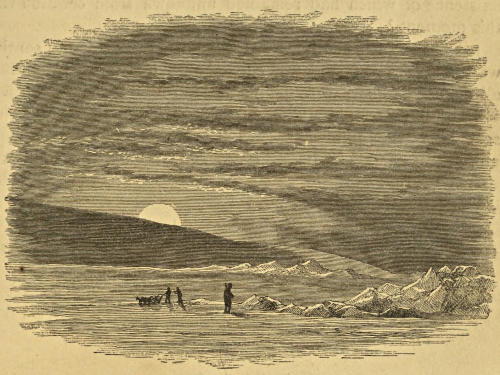
APPROACHING THE LAND BY MOONLIGHT.
9. In an excursion on the 6th of November we reached
a point on the north-west of Wilczek Island—passing for the
first time during this expedition beyond the eightieth degree
of north latitude—whence we could see the mainland of the
new country stretching before us under the silver light of the
moon. An indescribable loneliness lay on its snowy mountains,
faintly illuminated by the span of twilight in the south
and by the light of the moon. If the ice on the shore, as it
was moved by the ebb and flow of the tide, had not sent forth
shrill notes, and had not the wind sighed as it passed over
the edges of the rocks, the stillness of death would have lain
on the pale and spectral landscape. We hear of the solemn
silence of the forest or of the desert, or of a city buried in
sleep during the night; but what is this silence to the silence
of a land with its cold glacier mountains losing themselves in
snows and mists which can never be explored, and the very
existence of which had remained unknown from creation till
this moment?
10. On the 7th another short expedition towards the south-west
of Wilczek Island was carried out; but notwithstanding
all our exertions we were unable to determine its configuration,
even of the parts immediately contiguous to us. Until the
spring of the following year, the whole island, except
perhaps a portion of its southern side, remained a mystery
to us.
1. The Land had meantime been thickly enveloped in its
pure white mantle, and wreaths of snow-drifts lay over the
rocks scattered over its surface. The light became fainter.
Sometimes the precipitous faces of the glaciers seemed to
glow in subdued rose-colour through the leaden grey of the
atmosphere. When new “ice-holes” appeared, a frosty vapour
rose and spread over the surface of the ice; the ship and
surrounding objects were covered as if with down; even the
dogs were frosted white. We used to stand on deck and
gaze on the sun as it sank, surrounded by the evening clouds,
behind the jagged edges of the hummocks. Raised by refraction,
he appeared for the last time on the 22nd of October
with half his disc above the horizon, and the whole southern
sky was for a time like a sea of fire over the cold, stiff forms
and lines of ice. At length the disc disappeared, and masses
of dark clouds moved up and obscured the light still lingering
in the sky. The long reign of night began, and the wastes
around us relapsed into the stern sway of winter. A pale
twilight still lingered for some time, but its faint arc became
smaller and feebler. No shadows accompanied the forms of
those who strayed over the ice. The wind moaned in the
frozen desert. The darkness and the cold continually increased,
till the dome of night vaulted the lonely spot which had
become our home.
2. But the hope and expectation of successes to be achieved,
and the feeling that our safety was not immediately threatened,
rendered this second winter a happy contrast to the preceding
one. We had now leisure and calmness for intellectual occupations,
which were, indeed, the only means of relieving the
monotony of the long period of darkness. We lived like
hermits in our little cabins in the after-part of the ship, and
learned that mental activity without any other joy suffices to
make men happy and contented. The oppressive feeling of
having to return ingloriously home, which had always been
disagreeably present to our minds during the first winter, was
no longer felt. We had now a hope, the charms of which
grew day by day, that in the spring we should be able to leave
the ship and start on expeditions to explore the land we had
discovered. Happy in this expectation, we could enjoy the
indescribable pleasures of good books, all the more that we
were far from the busy haunts of men, and that the presence
of danger clears and sharpens the understanding. Nowhere
can a book be so valued as in such an isolated position as ours
was. Great, therefore, was the advantage we possessed in a
good library, consisting of books of science, and of the classics
of literature. In fact, freed from the constantly recurring
perils, which had been our portion in the first long Arctic
night, this second winter was, to all who actively employed
their minds, comparatively a state of happiness, undisturbed
by cares. With regard to the crew, they were kept in good
humour by the increase of their comforts. As we had not the
prospect of a third winter in the ice—which would have
rendered a greater economy of our provisions imperative—we
were enabled to provide them with a more generous diet.
3. In the last three weeks of November we had complete
darkness, the sky clouded over and the weather bad. So
dark was it, that our environment, though it was overspread
with countless hummocks and ice-cliffs, looked like one black
unbroken level. On the 31st of October most of the stars
were visible about 3 o’clock in the afternoon; by 4 o’clock
actual night prevailed. On the 16th of November large print
was barely legible even at noon. On the 18th of the month
we were able to read the larger letters on the title-page of
Vogt’s Geology at the distance of a foot. At noon, on the
13th of December, not a letter of this same title-page was
legible, even in clear weather. On the 5th of November there
was a total eclipse of the moon, which then sank below the
horizon and did not return till the 29th of that month. Its
beams then fell on a large ice-hole, which had formed itself
twenty miles to the south of the ship, which made us apprehensive
lest our floe should be driven by the north winds in
a southerly direction. On the 4th of December the moon
reached its highest declination, but, as it waned, it was constantly
obscured by bad weather. I had reckoned on the
return of moonlight to make an excursion of some days to
the mainland. But the fickleness of the weather at the
beginning of December compelled me to confine my wanderings
to Wilczek Island, which I frequently visited, although
with a thermometer at -35° F. I was exposed to frost-bites
in the face and hands, whenever I attempted to draw by the
light of a lamp, and with only the protection of light woollen
gloves.[22]
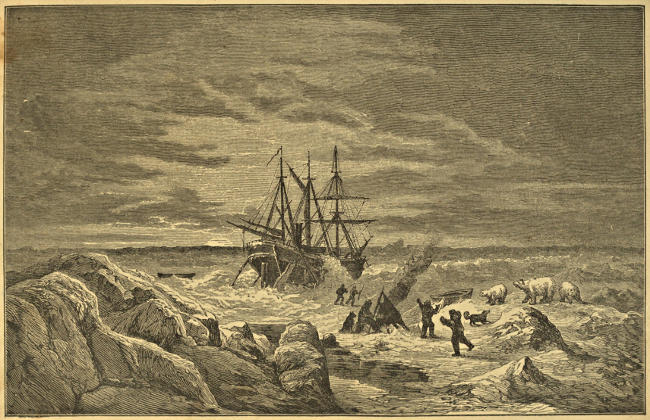
DEPARTURE OF THE SUN IN THE SECOND WINTER.
4. We observed during this winter, that, on the clearest
nights, snow of the finest texture continued to fall, so that we
saw the heavenly bodies, as it were, through a veil of fine
gauze. In the moonlight this fine snow sparkled faintly, and
its presence could only be discovered by a prickling on the
skin. The constancy of these downfalls added of course to
the depth of the snow under which the Tegetthoff was almost
buried; indeed at the beginning of the spring she no longer
stood out from the covering of snow, although her fore-part
was eleven-and-three-quarter feet, and her after-part four-and-a-half
feet, above the ice on which she rested. The air was
also often filled with an indescribable quantity of driving
snow; and when the wind dropped and permitted it to fall,
we were struck with the profound stillness of our environment.
The cold constantly increased and penetrated all the parts
of the interior of the ship which were not artificially heated,[23]
and almost all the fluids, which were not specially protected,
were frozen. The various kinds of spirits on board were
exposed on the 23rd of November to the cold at -26° F.; at
the end of an hour-and-a-half they still remained fluid.
When the temperature fell to -31° F., hollands, common gin
and maraschino were congealed in two-hours-and-a-half, but
rum and brandy remained unchanged. On another occasion
a mixture of two parts of pure alcohol to one part of water
froze at -47° F., cognac at -53° F. This low temperature
had so increased the thickness of the ice, that the basin of
open water, which had been sawed through in the previous
summer, was covered on the 3rd of January with ice three-and-a-half,
and on the 20th with ice six-and-a-half feet thick.
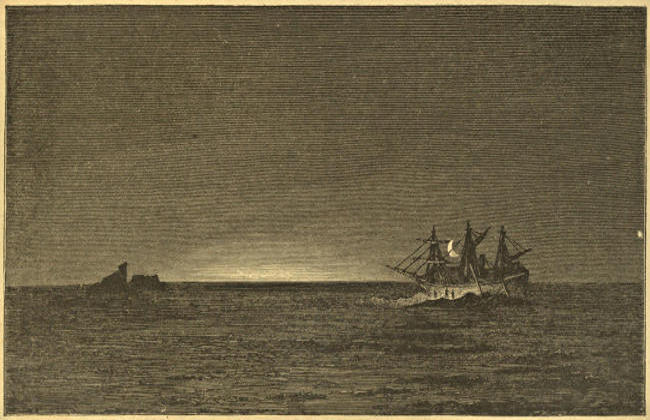
NOON ON DECEMBER 21, 1873.
5. On the 21st of December, the middle of the second
long Polar night—which lasted in all 125 days—was reached;
and although we knew where the south lay, every trace of
twilight had disappeared, and for six weeks we were enveloped
in unbroken darkness. The figure of a man could not be discerned
at a very short distance. In order to be able to sketch
the ship, I had to illuminate it by torches. Those who made
expeditions afoot were struck, as it were, with blindness. If
they approached what seemed to be a lofty chain of mountains,
over the ridge of which the planet Jupiter hung like a
glowing point, they came at once on a dark wall of ice; and
when they ascended the apparently far distant ridge, the
planet stood almost in the zenith. There was something
approaching to twilight only when the crescent moon shone
in her first quarter. On the 7th of December the sun was
12°, and on the 21st 14½°, below the horizon. We should not
have seen the sun, could we have ascended the pinnacle of the
Alps, which Pliny imagined to be 120,000 feet high, or even
from that summit of the Caucasus which Aristotle reckoned
at 230,000 feet.
6. Distrusting the quiescent state of the ice, we had again
stretched a tent over one-half of the ship’s deck, while the
other portion was covered with snow trodden down as hard as
a skating-rink. The space for free movement was narrowed
still further by the long-boat placed between the two masts,
by the stores of provisions kept in readiness for the possible
disaster which might compel us to leave the ship, by the stand
of rifles, by dog-kennels, and other inevitable impediments.
In bad weather the dogs sheltered themselves under the tent,
and sometimes showed ill-temper if their feet were trod on.
There were places on deck where only their particular friends
were safe from being bitten; Sumbu especially had a bad
habit of lying behind a cask and springing out on every one
that passed by. Here under its friendly shelter the men
waited the summons to their meals. Hither came Carlsen to
enjoy the opportunity of talking Norwegian with some one or
other. The deck light shone feebly on all this, shedding its
rays on the fine snow which fell through the tent-roof. In the
second half of the winter, when the deck was less frequented,
the lantern became, like the crew—more sleepy; and its dull
light fell on hard-frozen sailcloth, boards covered with snow,
and on empty tin cases. Here, too, walked, of course, the
deck-watch, enveloped in clothes from head to foot, with only
their eyes uncovered, looking more like moving figures than
men. The deck-watch had also to keep open the water-hole
in the ice, to look out for bears, and to assist in reading off
the thermometers exposed on the ice. They were on duty for
two hours, and the moment they were relieved, they shot
down into their quarters, as quickly as a harpooned whale
dives under the waves. He, too, whose duty it was to fetch
the snow to be converted into water was often to be seen on
deck. Although the store of snow in which we lived was
inexhaustible, yet, in order to be exempt from this duty in
bad weather, it was the practice of those who were told off
for this service to lay up a supply of blocks of frozen snow
under the tent. Some of the crew showed the scrupulosity of
chemists in their work. Before they proceeded to build up
their pile, they brought specimens to the cook, in order to
learn his opinion as to the residuum of salt in the ice.
7. With December a new era began for the dogs. A large
snow house was built for them outside the ship, in which were
placed their kennels, well filled with straw. The name of
each dog was written on his house. And here let me remark,
that the winter quarters of the dogs should always be on the
ice. To keep them under the deck-tent is unhealthy and inconvenient,
and would be an impossibility if their numbers
were great. Every morning Haller opened the door of the
snow house, and out rushed the dogs, with their tails in the
air, to begin forthwith a general fight. No shouts, no blows,
not even the discharge of a rifle could separate the combatants.
Pouring water over them at a temperature of -35° F., though
a somewhat barbarous way of producing peace, was successful
only with the younger dogs. When the fight was over, the
next object was to find out their special patron, and the instant
they recognised him they rushed upon him, tugged at his
clothes, and thrust their noses inquiringly into his pockets.
Each then made his morning round, visiting the places where
he had hid in the snow a piece of bread or covered up a bit
of seal. When they had satisfied their appetite, it was curious
to observe how they would make it smooth over the hole in
which they deposited their treasure, all the time cunningly
turning their eyes right and left to see whether they were
observed.
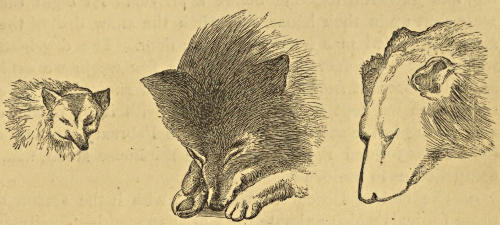
PEKEL, SUMBU, AND JUBINAL.
8. Their violence and eagerness having somewhat abated,
we may observe the members of our pack one by one. The
red giant there, who offers his paw as huge as a bear’s, is
named after a god of the heathen days of Lapland, “Jubinal;”
and not a few legends surrounded the accounts of his early
life. A Siberian Israelite, so it was said, brought him from
the north of Asia over the Ural. He was the victor in all
fights, the leader of the sledge team, and could drag four men
on a hard level path without any effort. The day before we
sailed from Bremerhaven he tore a sheep to pieces. Every
summer when he changed his coat, the sailors clad him in a
canvas dress. Bop was his inferior in strength, but his superior
in wisdom; Matoschkin surpassed him in gravity. The
latter used to sit for hours in a moody manner on a pile of
chests looking at the ice world. Bop and Matoschkin were
Newfoundlands; the first died of cold in our first winter, the
latter, as our readers may remember, was carried off by a
bear and torn to pieces. We had also two Newfoundland
bitches, who were called respectively “Novaya” and
“Zemlya;” the former died in the first year, the latter, though
she was of little use in sledging from her laziness, may claim
indisputably the merit of being the mother of her hopeful
son, “Torossy,” who grew to a considerable size, and was the
pride of the whole crew. He knew no other world than the
frozen ocean, and no other destiny than to draw a sledge; and
to this work he had devoted himself zealously since the commencement
of winter. In the happy courage of ignorance
he wagged his tail all day on deck; wagged his tail as he
followed us on the ice; wagged it, even when Sumbu stole
his dinner; wagged it, even before the jaws of a bear. Gillis,
the fifth Newfoundland, was incessantly quarrelling, and was
the irreconcilable enemy of Jubinal; he was a favourite with
no one, chiefly because he had killed the two cats which we
brought from Tromsoe as pets for the dogs. His body was
covered with scars, and half his time was spent under the
medical treatment of the Tyrolese. He was not wanting in
docility, but he was essentially an eye-pleaser; all his efforts
in the sledge were mere sham. Pekel, the Lapp, was the
smallest of all the dogs. In his early days he had tended the
reindeer at the North Cape and on the plains of Tana Elf, and
his ways did not fit him for life amid the ice, but for the brown
herd which roamed at the foot of Kilpis. Hence he was
quarrelsome, and showed special enmity to Sumbu, the mere
sight of whom was enough to stir up the most hostile feelings.
He was therefore banished with his house to a high ice-cliff,
but the thaw destroying its supports, house and dog fell plump
into an ice-lake. Among all the dogs there was no such desperate
hypocrite as Sumbu, the most demonstrative in his friendship,
but withal the most greedy and dissatisfied. He was the
first to slink away with tail between his legs and find out the
most secluded nook, when he saw the other dogs being harnessed
in the sledges; and, when pulled out and put in a
team, at once laid himself down on the sledge, not to draw,
but to be drawn. When at last he was set in motion, he was
no longer the same dog. He was then full of action, unsurpassed
in speed and agility, and his sportiveness was as great
as his cunning. From the carpenter he would carry off a hoop,
or a bag of nails from the stoker, or he lay flat on his belly and
thrust out his long nose in the snow. His agility stood him
in good stead, for it enabled him to catch all the mice that
ventured on deck. Neither the stores of provisions for the
dogs nor the depôt of food for the crew were safe from his
depredations. He hated bears so fiercely, that he began to
howl like a wolf when we turned out to hunt them. Boldly
he followed up their trail, even when at a distance from the
hunters and close to the heels of the bear. The dogs were
fed once a day with bear’s flesh or blubber, or dried horse-flesh,
as long as it lasted.[24] They well knew the hour of feeding,
and gathered together before it arrived. At night they
were shut up in their house, and when the snow drifted they
all lay huddled in a heap before the door. The dog-house
was about eight feet high, but after a few weeks we could
scarcely discern it from the accumulation of snow-drifts. For
some time we kept up communication with it by means of
a shaft dug in the snow; but one day in February a fissure in
the ice was formed right across where the house stood, which
compelled us to remove it.
9. The end of December came, and with it the season of
those festivals which animate the Christian world—Christmas-tide
and the New Year. In order to celebrate them in
common, we built a snow house, decorated its interior with
flags, and placed in it a Christmas tree, which, however, more
resembled a wooden hedgehog or a cheval de frise. About
six o’clock in the evening all our preparations were made, and
the ship’s bell, sounding mournfully in the dark and misty
atmosphere, summoned us to our snow house on the ice. Here
lots were drawn, and cigars, watches, knives, pipes or rum fell
to the fortunate drawers. For all these presents we had to
thank friends in Vienna, or Pola, or Hamburg. Then came
the Christmas dinner, but no one’s heart was in the matter.
Our bodies, indeed, were present, but our thoughts were far
away with those we loved at home. New Year’s Eve passed
off somewhat more cheerfully. Better grounded seemed our
expectations that 1874 would at last bring us our long-desired
activity and a not inglorious return to Europe. Scarcely had
the new year begun than the crew knocked at our cabin
doors with their congratulations, and such salutations continued
to be the order of the day. On the whole this second winter
both before and after the new year (1874), passed away without
the fearful events of the preceding. Although floes lay
close to us on every side, and we had no harbour in which to
pass the winter with comfort—like a bear in its winter sleep—the
quiescent state of the ice allowed us to hope that our floe
would remain in the position it had hitherto maintained. This
hope, indeed, lay at the mercy of the winds; for if north
winds should set in, it was extremely probable that the ice
would break up and drift asunder.
10. The life we now led below in the ship had ceased to be
in any way disagreeable, and cheerful and entertaining reading
seemed to be healthier than bodily exercise. We did not
suffer from any want of the necessaries of life; the temperature
of our living-rooms generally admitted of our sitting for
hours even without our overcoats. The long night of this
Polar winter was gloomy and oppressive only to those who had
time and leisure to weigh the burden of the hours. There
were, of course, even in this second winter, some of those discomforts
and dangers of which the reader has heard enough,
and which lead him when he reads of life in the frozen
regions to think of ice-floes rather than of a room in which
comfort is quite possible. We had, indeed, the usual inconveniences.
As early as the middle of October the skylight
was so covered with frost that we could scarcely read
even at noon. On the 20th of that month we were obliged
to keep the lamps constantly burning, and to close in the skylight,
which brought night into the mess-room before the night
of Nature had arrived. By the middle of November the
condensation of moisture was perceptible, and our bed-clothes
were frequently frozen to the wall, and had to be torn from it
before we could go to rest. Yet what signified all this? We
all slept soundly notwithstanding, and during the day had to
complain rather of warmth than of cold. The condition of
the crew, however, was not so happy. We could not follow
the example set by Hayes and others of removing the contents
of the hold to the land, and so transforming it into
quarters for the men. On board the Tegetthoff we suffered
some of the evils of over-population, and the moisture was so
much increased from it, that some of the berths were completely
saturated. The employment of hammocks would
perhaps avert this evil.
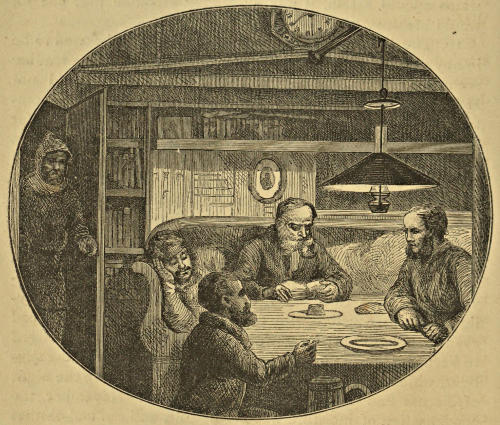
IN THE MESS-ROOM.
11. The number of those afflicted with scurvy decreased
with the approach of spring. Their gums recovered their
fresh and natural appearance, and the general weakness, the
pains in the joints, the leaden weight of the feet, the depression
of spirits—symptoms of this terrible malady—abated,
and the scorbutic marks disappeared from their bodies.
Pachtusow, when he wintered in Novaya Zemlya, so abundant
in supplies of drift-wood, caused his people to use the
bath once a week in a log house constructed on the land, as a
preservative against scurvy, and had their inner clothing
washed twice a week, but even these steps were insufficient to
avert the malady. In our case baths so added to the moisture
that we were obliged to put a stop to them, and our under-garments
could be changed only as our stock of them
permitted. Hence we could hope to prevent the spread of
scurvy only by the improvement of our diet. Several hundred-weight
of potatoes and a large supply of preserved meat had
been kept in store for the second winter. These now came
into use, and were the more welcome as our supply of lemon-juice—the
most important preservative against scurvy—was
diminishing. By the advice of our physician, Dr. Kepes, we
departed from the maxim, so generally adhered to in Arctic
expeditions, of avoiding spirituous liquors. From the beginning
of October our men daily received rations of brandy.
When I compare the sanitary condition of the crew of the
Tegetthoff with the better state of that of the Germania, I
attribute this to the lesser power of resistance to disease in
some of our people on board the Tegetthoff and to the moral
depression so easily explained by our disasters in this ship.
12. The Arctic voyager is exposed to no disease so much
as to scurvy. Its appearance among a crew exercises a most
untoward influence. Its causes are still but little known; the
means, however, of combating it are numerous. It is no
longer the scourge it was in the days of Barentz, when he and
all his men were attacked with it on the short summer excursion
of 1595, or when in Munk’s expedition of 1619 all
died but two. In Behring’s expedition of 1741, out of seventy-six
men, forty-two were attacked and thirty died. In Tschirikoff’s
summer expedition during that same year (1741), out of
seventy men, twenty died. Rossmyslow, who passed the
winter of 1768-69 in “Matoschkin-Schar,” lost seven out of
thirteen men. When the disease gains the mastery, the utter
incapacity of the expedition for further exploration follows as
a necessary consequence. Lassinius, who was sent out to
explore Novaya Zemlya in 1819, had to return in the height
of summer, all his men having fallen down with the scurvy.
This disease has been a frightful enemy to expeditions which
have wintered in that region, and carried off numerous victims.
All these, it is true, were miserably equipped, and depended on
the medicinal virtues of the “Löffel-kraut” of that country
for remedies against the disease. In 1832-33 Pachtusow,
wintering in the south of the island, out of ten men lost three;
in 1834-35, two more died of the same disease. In the expedition
of Ziwolka and Mojsejew, 1838-39, the scurvy gained
such mastery that at the end of February half of the crew were
attacked, and Ziwolka himself with eight men died. Parry
regarded damp, especially damp bedding, as the principal cause
of the malady. During his wintering at Melville Island he
found sorrel an effective remedy or palliative. He attributed
the greatest anti-scorbutic effect to beer; and according
to him and to most of the English expeditions, beer and wine
take the place of brandy. The disease generally has a fatal
issue when there has been excessive loss of blood, or when
dropsy supervenes. Most of Ross’s second expedition suffered
more or less from it, and the experience of that expedition
showed that vegetable nourishment alone was not competent
to make head against it. Ross regarded the addition of fish
or seals to the ordinary diet as an effective preservative, and
did not disdain the use of blubber for the same purpose.
Lemon-juice, uncooked potatoes, fruit with much acidity,
fresh vegetables and fresh meat, wine and yeast, exercise in
the open air, and cheerfulness, have always proved sufficient to
prevent its appearance, or at any rate to render it improbable.
But however valuable these may be as preventives, they
almost cease to have any effect when the disease has once
broken out. The lime-juice must be fresh, and, like vinegar,
be taken in as concentrated a form as possible. It is decomposed
and useless by being kept too long, and also by the
action of frost. This was the case with the lemon-juice which
Sir John Ross found among the stores of the Fury. An anti-scorbutic
effect has been attributed also—and with justice—to
the chewing of tobacco. It appears that liability to scurvy is
very different among different races, and that neither vegetable
nor animal food is an absolute preservative. The
Eskimos, and even the Lapps, who seldom or never use vegetables,
are almost exempt from it, and McClure’s men fell
down with it in their second winter, although they had fresh
meat three times a week. Steller relates that in Kamschatka
scurvy attacks strangers only, but not the natives, who live
largely on vegetables; he states also, that the scurvy when it
does appear among strangers and visitors there, is cured by a
diet of the fresh fish of spring.
1. An unbroken sleep for the whole winter would, undoubtedly,
be a blessing to the Arctic navigator, and the most
energetic among us resigned himself to slumber for a few
hours in the afternoon—the profane time of the day for all
zones of the earth—especially after the coming in of the New
Year, when the long unbroken night is intensely felt. The
darkness diminished very gradually, and as the weather was
frequently cloudy and dull, it was little lessened by the full
moon, which we had at the beginning of January and February.
December 26, we were able to read only the title of New
Free Press, at the distance of a few inches, but not a word
of Vogt’s Geology. January 11, the word Geology on the
title of that book was discernible in clear weather, but
only when the book was held up to the light of the midday
twilight. On the following day it was as dark at nine
o’clock in the morning as at noon on December 1st. The
moon returned again on the 24th of January, and after it
was four days old we could distinguish the common print
of the “Press” by its light, and for the first time read off
the degrees of the thermometer without artificial means.
During the whole of the month we had alternations of high
temperatures and snow-drifting, and at the end of it the wind
dropped and the cold became exceedingly great, causing the
ice to break up to the south of our position. It would be
difficult to give in an illustration any notion of the wonderful
forms produced by the twilight, and its glowing colour-effects,
and quite impossible to describe the blaze of the
meridian heavens, while deep shadows still lay over the ice-plains
and a dark ridge fringed and closed the horizon.
2. At noon on the 23rd of February the rolling mists
glowed with a red light, announcing the reappearance of the
sun. The next day the sun himself, raised and distorted into
an oval shape, appeared above the horizon about 10 A.M.
Again there was spread over the snow that magical rosy hue,
those bright azure shadows, which impart a poetical character
even to the landscape of the frozen north. The return of the
sun was this year the deliverance from our long night of 125
days.[25] Anxiously had we waited his return, and joyously we
greeted it, but not with the frenzied feelings of the previous
year. Then the reappearance of the sun was tantamount
almost to a deliverance from hell itself; but now the sun was
nothing to us but as a means to an end: would it enable us to
begin our sledge-journeys to explore the Kaiser Franz-Josef
Land? The mere thought of the possibility of making new
discoveries threw us into a feverish impatience, and our fears
became intense lest the ship with its floe should drift away
and frustrate the execution of our plans just as they seemed
feasible.
3. On that same day Lieutenant Weyprecht and I resolved
to abandon the ship after the termination of our projected
sledge-journeys of discovery, and to attempt to return to
Europe by means of the boats and sledges. No arguments
were needed to convince every one of the ship’s company of
the absolute necessity of this resolution. Our ship lay on its
icy elevation, beyond the power of man to liberate her, and
the provisions would not be sufficient to sustain us for
another year. But fear lest the state of our health should
greatly deteriorate in a third winter spoke more forcibly than
anything else in favour of our decision. When we looked at
our medical stores, once so ample, now so reduced, at the few
bottles of lemon-juice we could count on, all saw the impossibility
of our remaining longer in these latitudes. The
melancholy issue of Franklin’s expedition forced itself on our
mind as an instructive example and warning. In all likelihood
that ill-fated expedition had delayed its return a year longer
than it should have done, and began it in so weakened a condition,
that it was next to an impossibility that they should
have succeeded in their purpose. We began to be pinched
also in many of our stores, in spite of the greatest economy
in their use. To add to our perils, the doctor drew a sad
picture of the sanitary condition of our crew. Of nineteen
men, several had fallen sick: Krisch still suffered from scurvy
and consumption; Marola from the first scorbutic symptoms;
Fallesich from its consequences; Vecerina from the utter inability
to move his lower extremities produced by the same
malady; Palmich from a constant tendency to it and the contraction
of his lower extremities; Pospischill from lung disease;
and Haller from a rheumatic affection of his extremities
which almost incapacitated him for any exertion.
1. The Northern lights had shone for these two winters with
incomparable splendour, not, indeed, with the quiet diverging
beams, sometimes observed in our northern latitudes, and
different also from the phenomena which have been seen and
noted in recent years, even in Central Europe; they resembled
rather those we saw in East Greenland, save that the brilliancy
and intensity of their colours were far greater.
2. It is very difficult to characterize the forms of this phenomenon,
not only because they are manifold, but because
they are constantly changing. Sometimes the Aurora appears
like flaming arches with glowing balls of light; sometimes in
irregular meridians painted on the heavens, sometimes in
brilliant bands and patches of light on the sky. Each of
these forms was frequently developed from a different one,
but towards morning the last-named appearance was the most
general.
3. The movement of the waves of light gave the impression
that they were the sport of winds, and their sudden and
rapid rise resembled the uprising of whirling vapours, such as
the Geysers might send forth, which generally assumed the
form of enormous flames, except that they were transparent
and mist-like. In many cases the Aurora much resembled a
flash of summer lightning conceived as permanent. It
appeared almost always in the south, and was visible from
September till March, during which period it was to us the
only external excitement which we had. The illuminating
power of the Aurora, when its colours were most brilliant and
intense, was inferior to the illuminating power of the full moon.
Some rare cases excepted, this was either so small or so transitory,
that it had no influence on the darkness of our long
winter nights. Like a stream, or in brilliant convolutions, the
light rushed over the firmament, as well from east to west as
from west to east. The formation of the corona (or the convergence
of the streamers in the direction of the inclination
needle) was sudden, and short in its duration, and frequently
happened more than once in the course of a night. Its greatest
intensity was from eight till ten o’clock at night. It was
never accompanied with sound.[26] The sketch we have given
represents one of its most characteristic forms. The inner
parts of the flames are usually whitish green, and their edge
on the upper side red, on the lower green.
4. Brilliant auroras were generally succeeded by bad
weather. Those on the other hand which did not rise to any
great height in the sky, or which did not show any special
mobility, were regarded as the precursors of calms. None of
the theories which have been ventilated are in exact accordance
with all the manifestations of these northern lights. The
undulating motion of their waves of light, their rolling forth
like pillars of smoke driven by winds, has hitherto remained
unexplained. Although electrical processes, still unknown,
seem to be the main causes of the Aurora, atmospheric
vapours may, however, have a considerable part in producing
the phenomenon; and nothing so much favours this supposition
as the indefinite form in which it often appears. Its
occurrence during the day, i.e. light clouds with its characteristic
movement, has been rather imagined than actually
observed. The transition of white clouds into auroral forms
at night has never at least been satisfactorily proved. Falling
stars pass through the northern lights without producing any
perceptible effect, or undergoing any change. A dirty sulphur
yellow was characteristic of all auroras when the sky was
overcast with mists or when they were seen by moonlight.
In clear weather they were colourless.
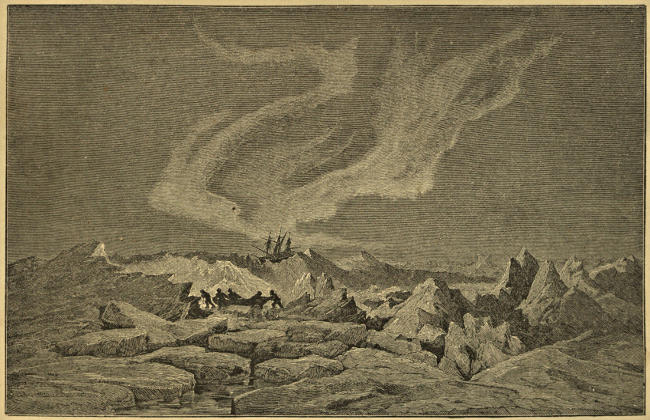
THE AURORA DURING THE ICE PRESSURE.
5. Their influence on the magnetic needle was very variable.
While the quiescent and regular arches had little or no effect,
the quicker and more fitful streamers, especially when accompanied
with prismatic colours, produced great disturbance in
it. Sir John Ross remarked, that the aurora when tinged
with deep red colour had a great effect on it, although he
completely stultifies his observation by his supposition, that the
phenomenon was produced by rays of the sun reflected on
the vast fields of snow and ice surrounding the Pole. Parry
in 1820 could discover no effect from it either on the magnetic
needle or on the electrometer. During the winter of 1872-3,
the character of the northern lights was much altered, though
their colour remained constant. At first they consisted chiefly
of bands of light, running from the south-northwards. At
a later period of that winter they assumed for the most
part the appearance of coronæ, and then their direction was
from the north southwards. During the voyage of the
Tegetthoff the observations of the behaviour of these lights
and of the magnetic constants were taken by Weyprecht,
Brosch, and Orel by means of a magnetic theodolite, a
dipping needle, and three variation instruments. The extraordinary
disturbances of the needle rendered the determination
of exact mean values for the magnetic constants impossible.
The diminution of their intensity was considerable
during the continuance of auroras. In 79° 51′ N. Lat. and
58° 56′ E. Long. the declination amounted to 19½° E. and the
inclination to 82° 22′. The ice-pressures which occurred in
December, 1873 together with the tedious preliminaries in
fixing the magnetic instruments, prevented these officers from
carrying out their labours regularly till the next month. The
following are the principal results of these observations: (1)
The magnetic disturbances were of extraordinary magnitude
and frequency. (2) They were closely connected with the
aurora; and they were greater as the motion of the rays was
more rapid and fitful, and the prismatic colours more intense.
Quiescent and regular arches, without changing rays or
streamers, exercise almost no influence on the needle. (3) In
all the disturbances the declination needle moved towards
the east, and the horizontal intensity decreased while the
inclination increased.
6. In spite of the extreme difficulty of describing the
appearances of those fitful and changing lights, I believe that
the following description of Lieutenant Weyprecht will be
found equally faithful and effective:—
“There in the south, low on the horizon, stands a faint
arch of light. It looks as it were the upper limit of a dark
segment of a circle; but the stars which shine through it in
undiminished brilliancy convince us that the darkness of the
segment is a delusion produced by contrast. Gradually the
arch of light grows in intensity and rises to the zenith. It is
perfectly regular; its two ends almost touch the horizon and
advance to the east and west in proportion as the arch rises.
No beams are to be discovered in it, but the whole consists of
an almost uniform light of a delicious tender colour. It is transparent
white with a shade of light green, not unlike the pale
green of a young plant which germinates in the dark. The
light of the moon appears yellow, contrasted with this tender
colour so pleasing to the eye, and so indescribable in words, a
colour which nature appears to have given only to the Polar
regions by way of compensation. The arch is broad, thrice
the breadth, perhaps, of the rainbow, and its distinctly marked
edges are strongly defined on the profound darkness of the
Arctic heavens. The stars shine through it with undiminished
brilliancy. The arch mounts higher and higher. An air of
repose seems spread over the whole phenomenon; here and
there only a wave of light rolls slowly from one side to the
other. It begins to grow clear over the ice; some of its
groups are discernible. The arch is still distant from the
zenith; a second detaches itself from the dark segment, and
this is gradually succeeded by others. All now rise towards
the zenith; the first passes beyond it, then sinks slowly
towards the northern horizon and as it sinks loses its intensity.
Arches of light are now stretched over the whole
heavens; seven are apparent at the same time on the sky,
though of inferior intensity. The lower they sink towards
the north, the paler they grow, till at last they utterly fade
away. Often they all return over the zenith, and become
extinct, just as they came.
“It is seldom, however, that an aurora runs a course so
calm and so regular. The typical dark segment which we
see in treatises on the subject, in most cases does not exist.
A thin bank of clouds lies on the horizon. The upper edge
is illuminated; out of it is developed a band of light, which
expands, increases in intensity of colour, and rises to the
zenith. The colour is the same as in the arch, but the intensity
of the colour is stronger. The colours of the band
change in a never-ceasing play, but place and form remain
unaltered. The band is broad and its intense pale green
stands out with wonderful beauty on the dark background.
Now the band is twisted into many convolutions, but the
innermost folds are still to be seen distinctly through the
others. Waves of light continually undulate rapidly through
its whole extent, sometimes from right to left, sometimes from
left to right. Then again it rolls itself up in graceful folds.
It seems almost as if breezes high in the air played and
sported with the broad flaming streamers, the ends of which
are lost far off on the horizon. The light grows in intensity,
the waves of light follow each other more rapidly, prismatic
colours appear on the upper and lower edge of the band, the
brilliant white of the centre is inclosed between narrow stripes
of red and green. Out of one band have now grown two.
The upper continually approaches the zenith, rays begin to
shoot forth from it towards a point near the zenith, to which
the south pole of the magnetic needle, freely suspended,
points. The band has nearly reached it, and now begins a
brilliant play of rays lasting for a short time, the central
point of which is the magnetic pole—a sign of the intimate
connection of the whole phenomenon with the magnetic forces
of the earth. Round the magnetic pole short rays flash and
flare on all sides; prismatic colours are discernible on all
their edges; longer and shorter rays alternate with each
other; waves of light roll round it as a centre. What we see is
the auroral corona; and it is almost always seen when a band
passes over the magnetic pole. This peculiar phenomenon
lasts but a short time—the band now lies on the northern side
of the firmament; gradually it sinks, and pales as it sinks; it
returns again to the south to change and play as before. So
it goes on for hours; the aurora incessantly changes place,
form, and intensity. It often entirely disappears for a short
time only to appear again suddenly, without the observers
clearly perceiving how it came and where it went: simply—it
is there.
“But the band is often seen in a perfectly different form.
Frequently it consists of single rays, which, standing close
together, point in an almost parallel direction towards the
magnetic pole. These become more intensely bright with
each successive wave of light; hence each ray appears to flash
and dart continually, and their green and red edges dance up
and down as the waves of light run through them. Often
again the rays extend through the whole length of the band
and reach almost up to the magnetic pole. These are sharply
marked but lighter in colour than the band itself, and in this
particular form they are at some distance from each other.
Their colour is yellow, and it seems as if thousands of slender
threads of gold were stretched across the firmament. A glorious
veil of transparent light is spread over the starry heavens;
the threads of light with which this veil is woven are distinctly
marked on the dark background; its lower border is a
broad, intensely white band, edged with green and red, which
twists and turns in constant motion. A violet-coloured
auroral vapour is often seen simultaneously on different parts
of the sky.
“Or again, there has been tempestuous weather, and it is
now—let us suppose—passing away. Below on the ice the
wind has fallen, but the clouds are still driving rapidly across
the sky, so that in the upper regions its force is not yet laid.
Over the ice it becomes somewhat clear; behind the clouds
appears an aurora amid the darkness of the night. Stars
twinkle here and there; through the openings of the clouds
we see the dark firmament and the rays of the aurora
chasing one another towards the zenith. The heavy clouds
disperse; mist-like masses drive on before the wind. Fragments
of the northern lights are strewn on every side; it
seems, as if the storm had torn the aurora bands to tatters
and was driving them hither and thither across the sky.
These threads change form and place with incredible rapidity.
Here is one! lo, it is gone! scarcely has it vanished before it
appears again in another place. Through these fragments
drive the waves of light; one moment they are scarcely
visible, in the next they shine with intense brilliancy. But
their light is no longer that glorious pale green, it is a dull
yellow. It is often difficult to distinguish what is aurora and
what is vapour—the illuminated mists as they fly past are
scarcely distinguishable from the auroral vapour which comes
and goes on every side.
“But, again another form. Bands of every possible form
and intensity have been driving over the heavens. It is now
eight o’clock at night, the hour of the greatest intensity of
the northern lights. For a moment some bundles of rays only
are to be seen in the sky. In the south, a faint scarcely-observable
band lies close to the horizon. All at once it rises
rapidly and spreads east and west. The waves of light begin
to dart and shoot; some rays mount towards the zenith. For
a short time it remains stationary, then suddenly springs to
life. The waves of light drive violently from east to west;
the edges assume a deep red and green colour, and dance up
and down. The rays shoot up more rapidly; they become
shorter; all rise together and approach nearer and nearer to
the magnetic pole. It looks as if there were a race among
the rays, and that each aspired to reach the pole first. And
now the point is reached, and they shoot out on every side, to
the north and the south, to the east and the west. Do the
rays shoot from above downwards, or from below upwards?
Who can distinguish? From the centre issues a sea of flames;
is that sea red, white, or green? Who can say?—it is all three
colours at the same moment! The rays reach almost to the
horizon; the whole sky is in flames. Nature displays before
us such an exhibition of fireworks as transcends the powers
of imagination to conceive. Involuntarily we listen; such a
spectacle must, we think, be accompanied with sound. But
unbroken stillness prevails, not the least sound strikes on the
ear. Once more it becomes clear over the ice, and the whole
phenomenon has disappeared with the same inconceivable
rapidity with which it came, and gloomy night has again
stretched her dark veil over everything. This was the aurora
of the coming storm—the aurora in its fullest splendour. No
pencil can draw it, no colours can paint it, and no words can
describe it in all its magnificence. And here below stand
we poor men, and speak of knowledge and progress, and
pride ourselves on the understanding with which we extort
from Nature her mysteries. We stand and gaze on the
mystery which Nature has written for us in flaming letters on
the dark vault of night, and ultimately we can only wonder
and confess that, in truth, we know nothing of it.”