The character ſ (long-form s) has been replaced by the normal s.
Footnote anchors are denoted by a number in [ ], and the footnotes
have been placed at the end of the book.
These footnotes make numerous references to pages in Josselyn’s
“An Account of Two Voyages to New-England”. This book can be accessed at:
https://www.gutenberg.org/ebooks/66922
This edition of 1865 is a faithful reproduction of the original
Josselyn edition of 1672, and the original spelling and punctuation
have been carefully preserved without change, in both the printed
1865 book and in this etext.
The page numbering of the 1672 book has been preserved and inserted
at the appropriate points of the text. These page numbers were in [ ]
in the 1865 edition, but have been changed to { } in this etext to
avoid confusion with the footnote numbering notation.
The cover image was created by the transcriber
and is placed in the public domain.
Some minor changes to the text are noted at the end of the book.
These are indicated by a dashed blue underline.
NEW-ENGLAND’S RARITIES.
NEW-ENGLAND’S
RARITIES
DISCOVERED IN BIRDS, BEASTS, FISHES,
SERPENTS, AND PLANTS OF
THAT COUNTRY.
By JOHN JOSSELYN, Gent.
With an Introduction and Notes,
By EDWARD TUCKERMAN, M.A.
Boston:
WILLIAM VEAZIE.
MDCCCLXV.
Two Hundred and Fifty Copies printed, Small Quarto.
BOSTON: PRESS OF JOHN WILSON AND SON.
Publisher’s Advertisement.
IN the reproduction of this quaint and curious
treatise, which is one of the earliest, on the
Natural History of New England, it has
been the intention of the Publisher to enhance
its value as a literary curiosity, by making it as
nearly as possible an exact Fac-simile of the original
edition, in accordance with the projected plan of a series
of reprints, in which the present work is comprised.
In the furtherance of this intention, the precise orthography,
punctuation, and also the arrangement,—with the
exception of the commencement and termination of pages,—have
been preserved.
The valuable Introduction and Notes of Prof. Tuckerman,
incorporated in this edition, have been previously
issued in vol. iv. of “The Transactions of the American
Antiquarian Society,” which contains a reprint of “The
Rarities” in a more modern style. The notes have, however,
undergone a thorough revision by the author; and
some few additions have been made by him, during the
progress of the present edition through the press.
Some additional matter concerning the Genealogy of
the Josselyn Family may be found contained in the Preface
of the “Two Voyages to New England in 1638 and 1663,
by John Josselyn,” published in uniform style with the
present work.
BOSTON, May 15, 1865.
INTRODUCTION.
MR. John Josselyn, the writer of
this book, was only brother, as he says,
to Henry Josselyn, Esq., many years of
Black Point in Scarborough, Me.; and
both were sons to Sir Thomas Josselyn,
Knt., of Kent, whose name is at the
head of the new charter obtained by Sir Ferdinando
Gorges for his Province in 1639, but who did not come
to this country. Mr. Henry Josselyn was at Piscataqua,
in the interest of Capt. John Mason, at least as early as
1634; but, in 1636, he is one of the Council of Gorges’s
Province in Maine, and continued in that part of the
country the rest of his life. He succeeded in 1643, by
the will of Capt. Thomas Cammock, to his patent at
Black Point, and soon after married his widow. He
is afterwards Deputy-Governor of the Province; and
until 1676, when the Indians attacked and compelled him
to surrender his fort, he was, says Mr. Willis,—whose
valuable papers are cited below,—“one of the most active
and influential men in it;” holding, “during all the
changes of proprietorship and government, the most important
offices.” He is then a magistrate of the Duke of
York’s Province of Cornwall, and, as late as 1680, a resident
of Pemaquid; when he is spoken of, in a letter of
Gov. Andros to the commander of the fort at Pemaquid,
as one “whom I would have you use with all fitting
respect, considering what he hath been and his age.” He
is living in 1682; but had died before the 10th of May,
1683,[1]
leaving no descendants.[2]
Notwithstanding the evidence, above afforded, of the
social position of the family of which Henry and John
Josselyn were members, the present writer failed in
tracing it, doubtless from not knowing in which county
it had its principal seat. In this uncertainty, it occurred
to him to make application to the eminent English antiquary,—the
Rev. Joseph Hunter, Vice-President of
the Society of Antiquaries of London,—to whom he
was indebted for former kind attentions; and was
favored by this gentleman with such directions as left
nothing to be desired. “The Josslines,” writes Mr.
Hunter “(the name is written in some variety of orthographies,
and now more usually Joceline), are quite one
of the old aristocratic families of England, having several
knights in the early generations; being admitted
into the order of baronets, and subsequently into the
peerage.... Their main settlement was in Hertfordshire,
at or near the town of Sabridgeworth; and accounts
of them may be read in the histories—of which
Chauncy’s, Salmon’s, and Clutterbuck’s are the chief—of
that county. But a fuller and better account is to
be found in the ‘Peerage of Ireland,’ by Mr. Lodge,
keeper of the records in the Birmingham Tower, Dublin:
4 vols. 8vo, 1754.”[3]
According to Lodge, the family begins with a Sir
Egidius, who passed into England in the time of Edward
the Confessor, and was descended from “Carolus
Magnus, King of France, with more certainty than the
houses of Lorraine and Guise.” Of this Sir Egidius was
Sir Gilbert de Jocelyn, who accompanied the Conqueror,
and had Gilbert—called St. Gilbert, being canonized by
Pope Innocent III. in 1202—and Geoffry. To this Geoffry
is traced back John Jocelyn, living in 1226; who married
Catherine, second daughter and co-heir to Sir Thomas
Battell, and had Thomas, who married Maud, daughter
and co-heiress of Sir John Hide, of Hide Hall in Sabridgeworth,
county of Hertford, Knt., by his wife Elizabeth,
daughter of John Sudeley; Baron Sudeley, in the
county of Gloucester. He had Thomas Jocelyn, Esq., who
married Joan, daughter of John Blunt, and had Ralph,
who married Maud, daughter of Sir John Sutton alias
Dudley, and had Geoffry of Hide Hall, 1312. Geoffry
married Margaret, daughter of Robert Rokell or Rochill,
and had Ralph, who married Margaret, daughter and heir
to John Patmer, Esq., and had Geoffry (died 1425), who
married Catherine, daughter and heir to Sir Thomas Bray,
and had four sons and two daughters. Of these, the eldest
was Thomas Jocelyn, Esq., living in the reign of Edward
IV., who married Alice, daughter of Lewis Duke of
Dukes in Essex, Esq., by his wife Anne, daughter of John
Cotton, Esq., and had issue George, his heir, called Jocelyn
the Courtier, who married Maud, daughter and heir to
Edmond Bardolph,—Lord Bardolph,—and had one
daughter and three sons. John Jocelyn, Esq.,—“auditor
of the augmentations, upon the dissolution of the abbeys
by King Henry VIII.,”—was son and heir to the last-mentioned
George, and married Philippa, daughter of
William Bradbury, of Littlebury in Essex; by whom he
had Sir Thomas, of Hide Hall,—created a Knight of the
Bath at the coronation of King Edward VI.,—who married
Dorothy, daughter of Sir Geoffry Gales or Gates,
Knt., and had issue;[4] one daughter marrying Roger Harlakenden,
of Carnarthen in Kent, Esq.; and the fifth son
being Henry Jocelyn, Esq., who married Anne, daughter
and heir to Humphrey Torrell, otherwise Tyrrell, of Torrell’s
Hall in Essex,—became seated there, and had six
sons and six daughters. The second son of this family was
Sir Thomas Jocelyn (father to our author), who was twice
married. His first wife was Dorothy, daughter of John
Frank, Esq.; by whom he had six sons and five daughters,—Torrell,
born 28th May, 1690; Henry, and Henry,
both died infants; Thomas, who died without issue, in
1635, at Bergen op Zoom; Edward, who, by a lady of
Georgia, had a daughter Dorothy, and died at Smyrna in
1648; Benjamin, born 19th May, 1602; Anne, married to
William Mildmay, Esq., by whom she had Robert, John,
Anne, and Elizabeth; Dorothy, married to John Brewster,
Esq., and left no issue; Elizabeth, married to Francis Neile,
Esq., and had Francis, John, and Mary; Frances, born
26th March, 1600, and married Rev. Clement Vincent;
and Mary, died unmarried. The second wife of Sir
Thomas Jocelyn was Theodora, daughter to Edmond
Cooke, of Mount Maschall in Kent, Esq.; and by her he
had Henry, John, Theodora, and Thomazine. Torrell, the
eldest son, married, first, Elizabeth, daughter of Sir Richard
Brooke of Cheshire,—heir to her grandfather (by the
mother), Dr. Chaderton, Bishop of Lincoln,—by whom
he had a daughter, Theodora, married to Samuel Fortrie,
Esq.,[5] to whom our author dedicates the present volume,
with acknowledgment of the “bounty” of his “honored
friend and kinsman.”
The principal line of the family was continued by Richard,
heir to Sir Thomas of Hide Hall; the said Richard
being brother to our author, John Josselyn’s grandfather.
In 1665, Sir Robert Jocelyn of Hide Hall was advanced
to the dignity of baronet. The fifth son of this Sir Robert
was Thomas; whose son, Robert Jocelyn, Esq., was bred
to the law; was Solicitor-General and Attorney-General
and Lord High Chancellor of Ireland; and created, in
1743, Baron Newport of Newport, and Viscount Jocelyn
in 1755. Robert, son and successor of this nobleman, was
created, in 1771, Earl of Roden, of High Roding, County
of Tipperary; and was ancestor to the present Lord
Roden.[6]
Our author, John Josselyn, made his first voyage to New
England in 1638; arriving in Boston Harbor the 3d of
July, and remaining with his brother at Black Point till the
10th of October of the following year. While at Boston,
he paid his respects to the Governor and to Mr. Cotton,
being the bearer to the latter of some poetical pieces from
the poet Quarles; and, as he says, “being civilly treated
by all I had occasion to converse with.” In the account
of his first voyage, there is no appearance of that dislike to
the Massachusetts government and people which is observable
in the narrative of the second, and may there not
unfairly be connected with his brother’s political and religious
differences with Massachusetts.[7] His second voyage
was made in 1663. He arrived at Nantasket the 27th of
July, and soon proceeded to his brother’s plantation, where
he tells us he staid eight years, and got together the matter
of the book before us. This was first printed in 1672, but
occurs also with later dates. It was followed, in 1674, by
“An Account of Two Voyages to New England; wherein
you have the Setting-out of a ship, with the Charges; the
Prices of all Necessaries for furnishing a Planter and his
Family at his first Coming; a Description of the Country,
Natives, and Creatures; the Government of the Countrey
as it is now possessed by the English, &c. A large Chronological
Table of the most Remarkable Passages, from the
first Discovering of the Continent of America to the Year
1673.” 12mo, pp. 279. Reprinted in the third volume of
the Third Series of the Collections of the Historical Society;
which edition is quoted here. A large part of the
“Voyages” is taken up with observations relating to natural
history; and it is quite likely that the author tried in
this second work to supply some of the defects of his
“Rarities.” Compare especially the accounts of beasts of
the earth, of birds, and of fishes; each of which is better
done in the “Voyages.”
Josselyn was, it appears, a man of polite reading. He
quotes Lucan, Pliny, and Du Bartas; he has Latin and
Italian proverbs; he is acquainted with the writings of
Mr. Perkins, that famous divine; with Van Helmont;
with Sandys’s “Travels,” and Capt. John Smith’s. His
curiosity in picking up “excellent medecines” points to an
acquaintance with physic; of his practising which, there
occur, indeed (pp. 48, 58, 63), several instances.[8] Nor is
he, by any means, uninterested in prescriptions for the
kitchen; as see his elaborate recipe for cooking eels
(Voyages, p. 111), and also that (ibid., p. 190) for a compound
liquor “that exceeds passada, the Nectar of the
country;” which is made, he tells us, of “Syder, Maligo-Raisons,
Milk, and Syrup of Clove-Gilliflowers.” But his
curiosity in natural history, and especially in botany, is his
chief merit; and this now gives almost all the value that
is left to his books.[9] William Wood, the author of
“New-England’s Prospect” (London, 1634[10]), was a better
observer, generally, than Josselyn; but the latter makes
up for his other short-comings by the particularity of his
botanical information.
The “Voyages” was Josselyn’s last appearance in print.
He was already advanced in years, and alludes to this at
page 69 of the present book, where he says he shall refer
the further investigation of a curious plant—of which a
neighbor, “wandering in the woods to find out his strayed
cattle,” had brought him a fragment—“to those that are
younger, and better able to undergo the pains and trouble
of finding it out.” “Henceforth,” he declares in his
“Voyages,” p. 151, “you are to expect no more Relations
from me. I am now return’d into my Native Countrey;
and, by the providence of the Almighty and the bounty
of my Royal Soveraigness, am disposed to a holy quiet of
study and meditation for the good of my soul; and being
blessed with a transmentitation or change of mind, and
weaned from the world, may take up for my word, non est
mortale quod opto.”
We may suppose that a rude acquaintance with the
more common or important animals of a new country will
commence with the discovery of it. Thus the beginning
of European knowledge of the marine animals of America
goes back, doubtless, to the earliest fisheries of Newfoundland;
and these began almost immediately after the
discovery of the continent. Game and peltry were also
likely to come to the knowledge of the earliest adventurers;
and scattered among these, from the first, were
doubtless men capable of regarding the world of new
objects around them with an intelligent, if not a literate
eye. Descriptions in this way, and specimens, at length
reached Europe, and became known to the learned there—to
Gesner, Clusius, and Aldrovandus—from as early as
the middle of the sixteenth century. Without being
naturalists, such observers as Heriot in Virginia (1585-6)
and Wood in Massachusetts (1634) could give valuable
accounts of what they saw; and more, it may well be,
was due to the Christian missionaries, who accompanied or
followed the adventurers, for the conversion of the heathen.
Gabriel Sagard was one of these missionaries, a recollet or
reformed Franciscan monk, who went from Paris to
Canada in 1624, and spent two years in the country of the
Hurons; publishing his “Grand Voyage du Pays des Hurons”
in 1632, and enlarging it in 1636 to “Histoire du
Canada et Voyages que les Freres Mineurs recollets y ont
faits pour la Conversion des Infidelles,” &c., in four books;
of which the third treats of natural history,[11] and is cited
by Messrs. Audubon and Bachmann (Vivip. Quadrupeds
of N.A., passim) for a good part of our more common
and noticeable Mammalia. Something considerable thus
got to be known of marine animals of all sorts, and of
quadrupeds. But it was much longer before our birds—if
we except a very few, as the blue-jay and the turkey—came
to the scientific knowledge of Europeans; and this
remark is, as might be expected, at least equally true of
our reptiles.
Quite as accidental, doubtless, was the beginning of
European acquaintance with our plants. There are, indeed,
traces of the knowledge of a few at a very early
period. Dalechamp, Clusius, Lobel, and Alpinus—all
authors of the sixteenth century—must be cited occasionally
in any complete synonymy of our Flora. The Indian-corn,
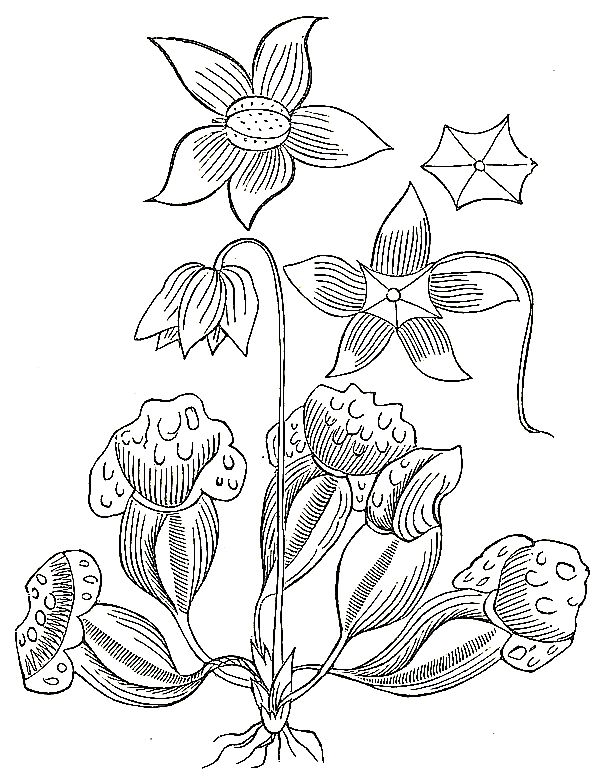
the side-saddle flower (Sarracenia purpurea and
S. flava), the columbine, the common milk-weed (Asclepias
Cornuti), the everlasting (Antennaria margaritacea),
and the Arbor vitæ, were known to the just-mentioned
botanists before 1600. Sarracenia flava was sent
either from Virginia, or possibly from some Spanish monk
in Florida. Clusius’s figure of our well-known northern
S. purpurea—of which he gives, however, only the
leaves and base of the stem (Clus. Hist. Pl., cit. Gerard a
Johnson)—was derived from a specimen furnished to him
by one Mr. Claude Gonier, apothecary at Paris, who himself
had it from Lisbon; whither we may suppose it was
carried by some fisherman from the Newfoundland coast.
The evening primrose (Œnothera biennis) was known in
Europe, according to Linnæus, as early as 1614. Polygonum
sagittatum and arifolium (tear-thumb) were figured
by De Laet, probably from New-York specimens, in his
“Novus Orbis,” 1633. Johnson’s edition of Gerard’s
“Herbal” (1636)—which was possibly our author’s manual
in the study of New-England plants—contains some
dozen North-American species, furnished often from the
garden of Mr. John Tradescant, who had other plants from
“Virginia” beside the elegant one which bears his name;
and John Parkinson—whose “Theatrum Botanicum”
(1640) is declared by Tournefort to embrace a larger
number of species than any work which had gone before
it—describes, especially from Cornuti, a still larger number.
But the first treatise especially concerned with
North-American plants was that of the French author just
mentioned; which, on several accounts, deserves particular
attention.
John Robin—“second to none,” says Tournefort, “in
the knowledge and cultivation of plants”—was placed
in charge of the Royal Botanical Garden at Paris, about
the year 1570; and Vespasian Robin, “a most diligent
botanist,” followed, in similar connection[12] with the larger
garden founded by Lewis the Thirteenth. Both are said
to have assisted the writer whose book we are to notice;
but especially the latter,[13] who, there is little doubt, deserves
credit for all the American species described in it.
The history of Canadian and other new plants—“Canadensium
Plantarum, aliarumque nondum editarum Historia”
of Jacobus Cornuti, Doctor of Medicine, of Paris—was
printed in that city (pp. 238) in 1635, under the
patronage just mentioned; and contains accounts, accompanied,
in every case but one, with figures on copper, of
thirty-seven of our plants; of which the meadow-rue is
known to botanists as Thalictrum Cornuti; and the common
milkweed, as Asclepias Cornuti. Though himself
not eminent as a botanist,[14] the work of Cornuti was valuable
for its elegant presentation of much that was new; and
it will always deserve honorable remembrance in the history
of our Flora. There are several passages of it—as
at pp. 5 and 7, and in the account of the two baneberries
at p. 76, where we read, “Opacis et sylvestribus locis in
eadem Americæ parte frequentissimum est geminum genus”—which
look a little like a proper botanical collector’s
notes on his specimens; and these specimens, and the
others from the same region, may well have been results
of the herborizing of that worthy Franciscan missionary,
whose early observations on the natural history of Canada
have been mentioned already above. Nor were the
North-American plants possessed by Cornuti entirely confined
to this region; for he speaks at the end (p. 214) of
his having received a root, ex notha Anglia, as he strangely
calls it, known, it appears, by the name of Serpentaria, or,
in the vernacular, Snaqroel,—a sure remedy for the bite
of a huge and most pernicious serpent in notha Anglia,—which
was no doubt the snake-root so famous once as a
cure for the bite of a rattlesnake, and one of the numerous
varieties of Nabalus albus (L.) Hook., if not, as Pursh
supposed, what is now the var. Serpentaria, Gray. But
some view of the scantiness of scientific knowledge of our
Flora, near forty years after Cornuti, may be had by reckoning
the number of species for which Bauhin’s “Pinax”
and “Prodromus” (1671) are cited by Linnæus in the
“Species Plantarum.” Most of them are Southern plants;
and the few decidedly Northern ones which meet us—as
Cornus canadensis, Uvularia perfoliata, Trillium erectum,
Arum triphyllum, and Adiantum pedatum—are all indicated,
by Bauhin’s phrase, as from Brazil!
We have nothing illustrating the Flora of New England
from Cornuti till Josselyn. In Virginia, Mr. John Banister,
a correspondent of Ray’s, began to botanize probably not
long after the middle of the seventeenth century. He was
succeeded by several eminent names; as Mark Catesby,
F.R.S. (born 1679), John Clayton, Esq. (born 1685), and
John Mitchell, M.D., F.R.S.,—a contemporary of the
other two,—who together gave to the botany of Virginia
a distinguished lustre; as did Cadwalader Colden, Esq.
(born 1688),—a selection from whose correspondence has
been lately edited by Dr. Gray,—to that of New York;
John Bartram (born 1701), “American botanist to his
Britannic Majesty,” to that of Pennsylvania; and, somewhat
later, Alexander Garden, M.D., F.R.S. (born 1728),
to that of South Carolina. Josselyn himself is, indeed,
little more than a herbalist; but it is enough that he gets
beyond that entirely unscientific character. He certainly
botanized, and made botanical use of Gerard and his other
authorities. The credit belongs to him of indicating
several genera as new which were so, and peculiar to the
American Flora. It may at least be said, that, at the time
he wrote, there is no reason to suppose that any other
person knew as much as he did of the botany of New
England. “The plants in New England,” he says in his
“Voyages,” p. 59, “for the variety, number, beauty, and
virtues, may stand in competition with the plants of any
countrey in Europe. Johnson hath added to Gerard’s
‘Herbal’ three hundred, and Parkinson mentioneth many
more. Had they been in New England, they might have
found a thousand, at least, never heard of nor seen by any
Englishman before.”[15] Nor did our author fail to adorn
his “Rarities” with recognizable figures, as well as descriptions,
of some of these new American plants; and
his arrangement is also creditable to his botanical knowledge.
By this arrangement, his collections are distinguished
into—
1. “Such plants as are common with us in England.”
2. “Such plants as are proper to the country.”
3. “Such plants as are proper to the country, and have no name.”
4. “Such plants as have sprung up since the English planted and kept cattle in New England.”
The last of these divisions is the most valuable part of
Josselyn’s account, as it affords the only testimony that
there is to the first notice among us of a number of now
naturalized weeds, which it is an interesting question to
separate from the more important class of plants truly
indigenous in, and common to, both hemispheres; and the
author’s treatment of the latter—as indeed of the other
two lists mentioned above—shows that he was competent,
in a measure, to reckon the former. This furnishes a date,
and an early one; and there is no other till 1785, when
Dr. Manasseh Cutler’s Memoir, to be spoken of, enables us
to limit the appearance of some other species not mentioned
by Josselyn.
There is no work of any size or importance on New-England
plants, after Josselyn, for the whole century which
followed. We were not, indeed, without men in distinguished
connection with the European scientific world.
The most eminent New-England family gained honors in
science, as well as in the conduct of affairs. John Winthrop
the younger, eldest son of the first Governor of
Massachusetts,—and the “heir,” says Savage, “of all his
father’s talents, prudence, and virtues, with a superior
share of human learning,”[16]—was himself the first Governor
of Connecticut, and had, in this connection, a certain
scientific position and reputation. “The great Mr.
Boyle, Bishop Wilkins, with several other learned men,”
says Dr. Eliot, “had proposed to leave England, and establish
a society for promoting natural knowledge in the new
colony of which Mr. Winthrop, their intimate friend and
associate, was appointed Governor. Such men were too
valuable to lose from Great Britain; and, Charles II. having
taken them under his protection, the society was there
established, and obtained the title of the Royal Society of
London.... Mr. Winthrop sent over many specimens of
the productions of this country, with his remarks upon
them: ‘and, by an order of the Royal Society, he was in
a particular manner invited to take upon himself the charge
of being the chief correspondent in the West, as Sir
Philiberto Vernatti was in the East Indies.’ ‘His name,’
says the same writer, Dr. Cromwell Mortimer, Secretary of
the Royal Society, in his flattering dedication of the fortieth
volume of the Philosophical Transactions to the Governor’s
grandson, ‘had he put it to his writings, would
have been as universally known as the Boyles’s, the Wilkins’s,
and Oldenburghs’, and been handed down to us
with similar applause.’”[17] There is, in the volume of
Philosophical Transactions for 1670, “An Extract of a
Letter written by John Winthrop, Esq., Governor of Connecticut
in New England, to the Publisher, concerning
some Natural Curiosities of those Parts; especially a very
strange and curiously-contrived Fish, sent for the Repository
of the Royal Society” (pp. 3); in which are mentioned,
as sent, specimens of scrub-oak; “bark of tree
with fir-balsam, which grows in Nova Scotia, and, as I
hear, in the more easterly part of New England;” pods of
milk-weed, “used to stuff pillows and cushions;” and “a
branch of the tree called the cotton-tree, bearing a kind of
down, which also is not fit to spin.”
Fitz John Winthrop, Esq., F.R.S. (died 1707), son of
the last, and also Governor of Connecticut, is said to have
been “famous for his philosophical” (that is, scientific)
“knowledge.”[18] And the second Governor’s nephew, John
Winthrop, Esq., F.R.S. (died 1747), who left this country
and passed the latter part of his life in England, is declared
by the author of the dedication already above cited, to
have “increased the riches of their” (the Royal Society’s)
“repository with more than six hundred curious specimens,
chiefly in the mineral kingdom; accompanied with an
accurate account of each particular.” “Since Mr. Colwell,”
it is added, “the founder of the Museum of the
Royal Society, you have been the benefactor who has
given the most numerous collection.” Dr. John Winthrop,
F.R.S. (died 1779), Hollisian Professor of Mathematics at
Cambridge, N.E., whose important papers on astronomical
and other related phenomena are to be found in the Philosophical
Transactions, was of another line of the same
family.
Paul Dudley, Esq., F.R.S. (born 1675), son of Gov.
Joseph Dudley, and himself Chief Justice of Massachusetts,
was author of several papers in the Philosophical Transactions;
one of which is an “Account of the Poison-wood
Tree in New-England” (vol. xxxi. p. 135); and another,
“Observations on some Plants in New-England, with
Remarkable Instances of the Nature and Power of Vegetation”
(vol. xxxiii. p. 129). This last is of only seven
pages, and of little scientific account: though we learn
from it, that, in 1726, when Mr. Dudley wrote, the Pearmain,
Kentish Pippin, and Golden Russetin, were esteemed
apples here, and the Orange and Bergamot cultivated
pears;[19] that, in one town in 1721, they made three thousand,
and in another near ten thousand barrels of cider;
and that, to speak of “trees of the wood,” he knew of a
button-wood tree which measured nine yards in girth, and
made twenty-two cords of wood; and of an ash, which, at
a yard from the ground, was fourteen feet eight inches
in girth. He also expresses an intention to treat separately
the evergreens of New England; and this treatise, which
was possibly more valuable than the one just noticed, was
in the possession of Peter Collinson, the eminent patron of
horticulture, and was given by him to J. F. Gronovius;
but has not, that I am aware of, appeared in print.[20]
It is likely that the early physicians of New England
gave special attention to those simples of the country, the
virtues of which were known to the savages; and perhaps
it was partly in this way that the Rev. Jared Eliot (born
1685), minister of Killingworth in Connecticut,—who is
called by Dr. Allen “the first physician of his day,”—is
also designated, both by him and by Eliot, a botanist; and
by the latter, “the first in New England.” There is no
doubt he was a friend of Dr. Franklin’s, and a scientific
agriculturist according to the knowledge of his day; and
he is said to have introduced the white mulberry into
Connecticut.[21] His Agricultural Essays went through more
than one edition, but is now rare. Mr. Eliot died while
our next character, the first native New-England botanist
who deserves the name, was a student of Yale College.
Manasseh Cutler, LL.D. (born 1743), was minister of
the Hamlet in Ipswich—afterwards incorporated as the
town of Hamilton—fifty-one years, and was also a member
of the Medical Society of Massachusetts. He is author
of “An Account of some of the Vegetable Productions
naturally growing in this part of America, botanically
arranged,” which makes nearly a hundred pages of the first
volume of the Memoirs of the American Academy, 1785.
In the introduction to this paper, the author speaks of
Canada and the Southern States having had attention
given to their productions, both by some of their own
inhabitants and by European naturalists; while “that extensive
tract of country which lies between them, including
several degrees of latitude, and exceedingly diversified
in its surface and soil, seems still to remain unexplored.”
He attributes the neglect, in part, to this,—“that botany
has never been taught in any of our colleges,” but principally
to the prevalent opinion of its unprofitableness in
common life. The latter error he combats with the then
important observation, that, “though all the medicinal
properties and economical uses of plants are not discoverable
from those characters by which they are systematically
arranged, yet the celebrated Linnæus has found that the
virtues of plants may be, in a considerable degree, and
most safely, determined by their natural characters: for
plants of the same natural class are in some measure similar;
those of the same natural order have a still nearer
affinity; and those of the fame genus have very seldom
been found to differ in their medical virtues” (p. 397).
This shows, perhaps, that Dr. Cutler appreciated (for the
Italics in the just-quoted passage are his own) that adumbration
of a natural system which was afforded or suggested
by the artificial; and his instances—the Gramineæ, the
Borraginaceæ, the Umbelliferæ, the Labiatæ, the Cruciferæ,
the Malvaceæ, the Compositæ, &c.; though these are cited
under the divisions, not of the natural, but of the sexual
system—are still more to the point. There are other
observations of interest; and the suggestion is made, that
persons should collect the plants of their districts, and send
them from time to time to the Academy.
Dr. Cutler was thus, possibly, the first to suggest a botanical
chair in our colleges, and a general herbarium to
illustrate the Flora of New England; and perhaps it was
this last which led him to propose a still more important
undertaking. “It has long been my intention,” he says in
a letter to Prof. Swartz, of Upsal, dated 15th October,
1802, “to publish a botanical work, comprising the plants
of the northern and eastern States; and [I] have been
collecting materials for that purpose. But numerous avocations,
and a variety of other engagements, has occasioned
delay. It is, however, still my intention, if my
health permits, to do it. But, at this time, far less than in
years past, there is very little encouragement given here to
publications of this kind.”[22]
About three hundred and seventy plants are indicated in
the published “Account” of Dr. Cutler. It was not to be
expected, that, in this beginning, numerous mistakes should
not be made. It could not possibly have been otherwise.
There is still evidence enough of the author’s genius,
which perhaps needed only opportunity and encouragement
to anticipate a part of what botany now owes to a
Nuttall, a Torrey, and a Gray. The “Account” was
favorably received by other botanists of the time, both in
this country and abroad. In a letter of Muhlenberg to
Cutler, dated 9th February, 1791, the former says, “Not
till a few months ago, I was favored with the first volume
of the Memoirs of the American Academy of Arts and
Sciences, printed at Boston, 1785. Amongst other valuable
pieces, I found your ‘Account of Indigenous Vegetables,
botanically arranged;’ with which I was infinitely
pleased, as this was the first work that gives a systematical
account of New-England plants. Being a great friend to
botany, and having studied it in my leisure-hours upwards
of fourteen years in Pennsylvania, I know the difficulty of
arranging the American plants according to
the Linnæan system; and I was always eager to hear of some gentleman
engaged in similar researches, that, by joining hands, we
might do something towards enlarging American Botany....
This is the reason why I intrude upon your leisure-hours,
and crave for your acquaintance and friendship.”[23]
Drs. Withering and Stokes, of England, were other correspondents
of Cutler, and furnished him with important
observations upon his printed Memoir, besides specimens;
as did also Swartz, and, it appears, Payshull of Sweden.
Dr. Stokes followed up his various suggestions for
the improvement of the Memoir, by proposing to dedicate
a plant, which he took to be new, to its author.
“A plant,” he says, “like a woolly heath, and which I
wished to call Cutleria ericoides, turns out to be Hudsonia
ericoides. I hope, however, your herborizations may
furnish a new genus for you, not likely to be disturbed.”—Letters
of Stokes to Cutler, from “Feb. 14 ’91, to Aug.
17, ’93.”[24]
But Dr. Cutler’s printed memoir on the plants of New
England is much surpassed in interest by his manuscript
volumes of descriptions, still extant. These manuscript
volumes commence with “Book I., 1783,” and continue, so
far as I have seen them, to 1804. The late Mr. Oakes
possessed six of these books; and two were given to me by
my valued friend, the late Dr. T. W. Harris. They are
generally entitled, “Descriptions and Notes on American
Indigenous Plants,” and contain a vast number of observations
and analyses, sometimes accompanied by pen-and-ink
sketches. This was evidently the material accumulated
for the author’s Flora above mentioned; and the following
extracts will serve to show that he was in many respects
qualified to undertake such a work. Thus, in describing
the several hickories, he points out those differences from
Juglans, upon which Nuttall afterwards constituted his
genus Carya. Again, in the same volume,—that for
1789,—there is a N. Gen. Anonymos, minutely described
in several pages, which is no other than Thesium umbellatum,
L., afterwards distinguished by Nuttall as his genus
Comandra. Again, under Anonymos, Yellow-Sandbind,
there is a full description of what Nuttall after named
Hudsonia tomentosa. The same volume shows that the
author had anticipated Prof. Gray in referring Orchis
fimbriata, as it was called by Pursh and other botanists, to
O. psychodes, L.; and the remark is also made that O.
lacera Michx.,—which Muhlenberg and our other writers
had mistakenly referred to O. psychodes, till Dr. Gray corrected
the error,—“must be a new species,” which it then
certainly was. Again, there is another Anomolos described
at length, which is the same afterwards constituted by
Nuttall his genus Microstylis. So Campanula humida
(Cutler mss.) is what Pursh designated, long after, C.
aparinoides. Again, in another volume (for 1800), he
anticipates Pursh by proposing for our water-shield the
name Brasenia ovalifolia; and, in yet another, he is before
Bigelow in describing as a new species what the latter,
many years later, published as Prunus obovata. This may
suffice to indicate the merits of the botanist of Ipswich
Hamlet. A little shrub-willow, with clean, shining leaves,
and modest catkins,—inhabiting, almost everywhere, the
alpine regions of the White Mountains, and gathered by
him there, before any other botanist had penetrated those
solitudes,—still reminds us of his name, which deserves to
be remembered by his countrymen.
After Cutler, there appeared nothing of importance[25] on
our botany, till the present elder school of New-England
botanists—a school characterized by the names of an
Oakes, a Boott, and an Emerson—was founded, now more
than forty years ago, by the classical Florula of Bigelow.
1672 edition by Josselyn.
New-Englands
RARITIES
Discovered:
IN
Birds, Beasts, Fishes, Serpents, and Plants
of that Country.
Together with
The Physical and ChyrurgicalRemedies wherewith
the Natives constantly use to Cure their Distempers, Wounds, and Sores.
ALSO
A perfect Description of an Indian SQUA, in all
her Bravery; with a POEM not improperly
conferr’d upon her.
LASTLY
A CHRONOLOGICAL TABLE
of the most remarkable Passages in that Country
amongst the English.
Illustrated with CUTS.
By JOHN JOSSELYN, Gent.
London, Printed for G. Widdowes at the Green Dragon in St. Pauls Church yard, 1672.
To the highly obliging,
His Honoured Friend and Kinsman,
Samuel Fortrey Esq;
SIR,
IT was by your assistance (enabling me) that I commenc’d
a Voyage into those remote-parts of the World
(known to us by the painful Discovery of that memorable
Gentleman Sir Fran. Drake.) Your bounty then and
formerly hath engaged a retribution of my Gratitude,
and not knowing how to testifie the same unto you otherwayes,
I have (although with some reluctancy) adventured
to obtrude upon you these rude and indigested
Eight Years Observations, wherein whether I shall more
shame my self or injure your accurate Judgment and
better Employment in the perusal, is a question.
We read of Kings and Gods that kindly took
A Pitcher fill’d with Water from the Brook.
The Contemplation whereof (well knowing your noble
and generous Disposition) hath confirm’d in me the
hope that you will pardon my presumption, and accept
the tender of the fruits of my Travel after this homely
manner, and my self as,
Sir, Your highly obliged, & most humble Servant, John Josselyn.
New-Englands
RARITIES
Discovered.
IN the year of our Lord 1663. May 28.
upon an Invitation from my only Brother,
I departed from London, and arrived at
Boston, the chief Town in the Massachusetts,
a Colony of Englishmen in New-England,
the 28th of July following.
Boston (whose longitude is 315 deg. and 42 deg. 30
min. of North Latitude) is built on the South-west side
of a Bay large enough for the Anchorage of 500 Sail of
Ships, the Buildings are handsome, joyning one to the
other as in London, with many large streets, most of them
paved with pebble stone, in the high street towards the
Common, there are fair buildings, some of stone, and at
the East End of the {2} Town one amongst the rest, built
by the Shore by Mr. Gibs, a Merchant, being a stately
Edifice, which it is thought will stand him in little less
than 3000 l. before it be fully finished.[26] The Town is
not divided into Parishes, yet they have three fair Meeting-houses
or Churches, which hardly suffice to receive the
Inhabitants and Strangers that come in from all parts.[27]
Having refreshed my self here for some time, and opportunely
lighting upon a passage in a Bark belonging to a
Friend of my Brothers, and bound to the Eastward, I put
to sea again, and on the Fifteenth of August, I arrived at
Black-point, otherwise called Scarborow, the habitation of
my beloved Brother,[28] being about an hundred leagues to the
Eastward of Boston; here I resided eight years, and made it
my business to discover all along the Natural, Physical, and
Chyrurgical Rarities of this New-found World.
New-England is said to begin at 40 and to end at 46 of
Northerly Latitude, that is from de la Ware Bay to New-found-Land.
The Sea Coasts are accounted wholsomest, the East and
South Winds coming {3} from Sea produceth warm weather,
the Northwest coming over land causeth extremity of
Cold, and many times strikes the Inhabitants both English
and Indian with that sad Disease called there the Plague
of the back, but with us Empiema.[29]
The Country generally is Rocky and Mountanous, and
extremely overgrown with wood, yet here and there beautified
with large rich Valleys, wherein are Lakes ten,
twenty, yea sixty miles in compass, out of which our great
Rivers have their Beginnings.[30]
Fourscore miles (upon a direct line) to the Northwest
of Scarborow, a Ridge of Mountains run Northwest and
Northeast an hundred Leagues, known by the name of the
White Mountains, upon which lieth Snow all the year, and
is a Land-mark twenty miles off at Sea. It is rising
ground from the Sea shore to these Hills, and they are
inaccessible but by the Gullies which the dissolved Snow
hath made; in these Gullies grow Saven Bushes, which
being taken hold of are a good help to the climbing Discoverer;
upon the top of the highest of these Mountains
is a large Level {4} or Plain of a days journey over,
whereon nothing grows but Moss: at the farther end of
this Plain is another Hill called the Sugar-Loaf, to outward
appearance a rude heap of massie stones piled one
upon another, and you may as you ascend step from one
stone to another, as if you were going up a pair of stairs,
but winding still about the Hill till you come to the top,
which will require half a days time, and yet it is not
above a Mile, where there is also a Level of about an
Acre of ground, with a pond of clear water in the midst of
it; which you may hear run down, but how it ascends is a
mystery. From this rocky Hill you may see the whole
Country round about; it is far above the lower Clouds,
and from hence we beheld a Vapour (like a great Pillar)
drawn up by the Sun Beams out of a great Lake or Pond
into the Air, where it was formed into a Cloud. The
Country beyond these Hills Northward is daunting terrible,
being full of rocky Hills, as thick as Mole-hills in a
Meadow, and cloathed with infinite thick Woods.[31]
New-England is by some affirmed to be an Island,
bounded on the North with the {5} River Canada, (so
called from Monsieur Cane) on the South with the River
Mohegan, or Hudsons River, so called because he was
the first that discovered it.[32] Some will have America to be
an Island, which out of question must needs be, if there be
a Northeast passage found out into the South Sea; it contains
1152400000 Acres. The discovery of the Northwest
passage (which lies within the River of Canada) was
undertaken with the help of some Protestant Frenchmen,
which left Canada and retired to Boston about the year 1669.
The Northeast people of America i.e. New England, &c.
are judged to be Tartars called Samoades, being alike in
complexion, shape, habit and manners, (see the Globe:)
Their Language is very significant, using but few words,
every word having a diverse signification, which is exprest
by their gesture; as when they hold their head of one side
the word signifieth one thing, holding their hand up when
they pronounce it signifieth another thing. Their Speeches
in their Assemblies are very gravely delivered, commonly
in perfect Hexamiter Verse, with great silence and
attention, and answered again ex tempore after the same
manner.[33]
{6} Having given you some short Notes concerning the
Country in general, I shall now enter upon the proposed
Discovery of the Natural, Physical, and Chyrurgical Rarities;
and that I may methodically deliver them unto you,
I shall cast them into this form: 1. Birds. 2. Beasts. 3.
Fishes. 4. Serpents and Insects. 5. Plants, of these, 1.
such Plants as are common with us, 2. of such Plants as
are proper to the country, 3. of such Plants as are proper
to the Country and have no name known to us, 4. of such
Plants as have sprung up since the English Planted and
kept Cattle there, 5. of such Garden Herbs (amongst us)
as do thrive there and of such as do not. 6. Of Stones,
Minerals, Metals, and Earths.
First, Of Birds. [34]
The Humming Bird.
The Humming Bird, the least of all Birds, little bigger
than a Dor, of variable glittering Colours, they feed
upon Honey, which they suck out of Blossoms {7} and
Flowers with their long Needle-like Bills; they sleep all
Winter, and are not to be seen till the Spring, at which
time they breed in little Nests, made up like a bottom of
soft, Silk-like matter, their Eggs no bigger than a white
Pease, they hatch three or four at a time, and are proper
to this Country.
The Troculus, a small Bird, black and white, no bigger
than a Swallow, the points of whose Feathers are sharp,
which they stick into the sides of the Chymney (to rest
themselves, their Legs being exceeding short) where they
breed in Nests made like a Swallows Nest, but of a glewy
substance, and which is not fastened to the Chymney as a
Swallows Nest, but hangs down the Chymney by a clew-like
string a yard long. They commonly have four or five
young ones, and when they go away, which is much about
the time that Swallows use to depart, they never fail to
throw down one of their young Birds into the room by
way of Gratitude. I have more than once observed, that
against the ruin of the Family these Birds will suddenly
forsake the house and come no more.
The Pilhannaw or Mechquan, much like the description
of the Indian Ruck, a monstrous great Bird, a kind
of Hawk, some say an Eagle, four times as big as a Goshawk,
white Mail’d, having two or three purple Feathers
in her head as long as Geeses Feathers they make Pens
of the Quills of these Feathers are purple, as big as
Swans Quills and transparent; her Head is as big as a
Childs of a year old, a very Princely Bird; when she
soars abroad, all sort of feathered Creatures hide themselves,
yet she never preys upon any of them, but upon
Fawns and Jaccals: She Ayries in the Woods upon the
high Hills of Ossapy, and is very rarely or seldome seen.
The Turkie, who is blacker than ours; I have heard
several credible persons affirm, they have seen Turkie
Cocks that have weighed forty, yea sixty pound; but out
of my personal experimental knowledge I can assure you,
that I have eaten my share of a Turkie Cock, that when he
was pull’d and garbidg’d, weighed thirty {9} pound; and
I have also seen threescore broods of young Turkies on
the side of a marsh, sunning of themselves in a morning
betimes, but this was thirty years since, the English and
the Indians having now destroyed the breed, so that ’tis
very rare to meet with a wild Turkie in the Woods; But
some of the English bring up great store of the wild kind,
which remain about their Houses as tame as ours in
England.
The Goose, of which there are three kinds; the Gray
Goose, the White Goose, and the Brant: The Goose will
live a long time; I once found in a White Goose three
Hearts, she was a very old one, and so tuff, that we gladly
gave her over although exceeding well roasted.
The Bloody-Flux Cured.
A Friend of mine of good Quality living sometime in
Virginia was sore troubled for a long time with the
Bloody-Flux, having tryed several Remedies by the advice
of his Friends without any good effect, at last was induced
with a longing desire to drink the Fat Dripping
{10} of a Goose newly taken from the Fire, which absolutely
cured him, who was in despair of ever recovering
his health again.
The Gripe and Vulture.
The Gripe, which is of two kinds, the one with a White
Head, the other with a black Head, this we take for the
Vulture. They are both cowardly Kites,[39] preying upon
Fish cast up on the shore. In the year 1668 there was a
great mortality of Eels in Casco Bay, thither resorted at
the same time an infinite number of Gripes, insomuch
that being shot by the Inhabitants, they fed their Hogs
with them for some weeks; at other times you shall seldom
see above two or three in a dozen miles travelling.
The Quill Feathers in their Wings make excellent Text
Pens, and the Feathers of their Tail are highly esteemed
by the Indians for their Arrows, they will not sing in
flying; a Gripes Tail is worth a Beavers Skin, up in the
Country.
A Remedy for the Coldness and pain of the Stomach.
The Skin of a Gripe drest with the doun on, is good to
wear upon the Stomach for the Pain and Coldness of it.
{11} The Osprey.
The Osprey, which in this Country is white mail’d.
A Remedy for the Tooth-ach.
Their Beaks excell for the Tooth-ach, picking the
Gums therewith till they bleed.
The Wobble, an ill shaped Fowl, having no long Feathers
in their Pinions, which is the reason they cannot fly,
not much unlike the Pengwin; they are in the Spring
very fat, or rather oyly, but pull’d and garbidg’d, and laid
to the Fire to roast, they yield not one drop.
For Aches.
Our way (for they are very soveraign for Aches) is to
make Mummy of them, that is, to salt them well, and dry
them in an earthern pot well glazed in an Oven; or else
(which is the better way) to burn them under ground for
a day or two, then quarter them and stew them in a Tin
Stewpan with a very little water.
{12} The Loone.
The Loone is a Water Fowl, alike in shape to the Wobble,
and as virtual for Aches, which we order after the
same manner.[41]
The Owl.
The Owl, Avis devia, which are of three kinds; the
great Gray Owl with Ears, the little Gray Owl, and the
White Owl which is no bigger than a Thrush.[42]
The Turkie Buzzard.
The Turkie Buzzard, a kind of Kite, but as big as a
Turkie, brown of colour, and very good meat.[43]
What Birds are not to be found in New-England.
Now, by what the country hath not, you may ghess at
what it hath; it hath no Nightingals, nor Larks, nor Bulfinches,
nor Sparrows, nor Blackbirds,
nor Mag{13}pies,
nor Jackdawes, nor Popinjays, nor Rooks, nor Pheasants,
nor Woodcocks, nor Quails, nor Robins, nor Cuckoes, &c.[44]
The Bear, they live four months in Caves, that is all
Winter; in the Spring they bring forth their young
ones, they seldome have above three Cubbs in a litter, are
very fat in the Fall of the Leaf with feeding upon Acorns,
at which time they are excellent Venison; their Brains are
venomous; They feed much upon water Plantane in the
Spring and Summer, and Berries, and also upon a shell-fish
called a Horse-foot; and are never mankind, i.e. fierce, but
in rutting time, and then they walk the Country twenty,
thirty, forty in a company, making a hideous noise with
roaring, which you may hear a mile or two before they
come so near to endanger the Traveller. About four
years since, Acorns being very scarce up in the Country,
some numbers of them came down {14} amongst the
English Plantations, which generally are by the Sea side;
at one Town called Gorgiana in the Province of Meyn
(called also New-Sommerset-shire) they kill’d fourscore.
For Aches and Cold Swellings.
Their Grease is very good for Aches and Cold Swellings,
the Indians anoint themselves therewith from top
to toe, which hardens them against the cold weather. A
black Bears Skin heretofore was worth forty shillings,
now you may have one for ten, much used by the English
for Beds and Coverlets, and by the Indians for Coats.
For Pain and Lameness upon Cold.
One Edw. Andrews being foxt,[47] and falling backward
cross a Thought[48] in a Shallop or Fisher-boat, and taking
cold upon it, grew crooked, lame, and full of pain, was
cured, lying one Winter upon Bears Skins newly flead off,
with some upon him, so that he sweat every night.
The Wolf, of which there are two kinds; one with a
round-ball’d Foot, and {15} are in shape like mungrel
Mastiffs; the other with a flat Foot, these are liker Greyhounds,
and are called Deer Wolfs, because they are
accustomed to prey upon Deer. A Wolf will eat a Wolf
new dead, and so do Bears as I suppose, for their dead
Carkases are never found, neither by the Indian nor
English. They go a clicketing twelve days, and have as
many Whelps at a Litter as a Bitch. The Indian Dog[50] is
a Creature begotten ’twixt a Wolf and a Fox, which the
Indians lighting upon, bring up to hunt the Deer with.
The Wolf is very numerous, and go in companies, sometimes
ten, twenty, more or fewer, and so cunning, that
seldome any are kill’d with Guns or Traps; but of late
they have invented a way to destroy them, by binding four
Maycril Hooks a cross with a brown thread, and then
wrapping some Wool about them, they dip them in melted
Tallow till it be as round and as big as an Egg; these
(when any Beast hath been kill’d by the Wolves) they
scatter by the dead Carkase, after they have beaten off the
Wolves; about Midnight the Wolves are sure to return
again to the place where they left the slaughtered Beast,
and the {16} first thing they venture upon will be these
balls of fat.
For old Aches.
A black Wolfs Skin is worth a Beaver Skin among the
Indians, being highly esteemed for helping old Aches in
old people, worn as a Coat; they are not mankind, as
in Ireland and other Countries, but do much harm by
destroying of our English Cattle.
The Ounce or Wild Cat, is about the bigness of two
lusty Ram Cats, preys upon Deer and our English Poultrey:
I once found six whole Ducks in the belly of one I
killed by a Pond side: Their flesh roasted is as good as
Lamb, and as white.
For Aches and shrunk Sinews.
Their Grease is soveraign for all manner of Aches and
shrunk Sinews: Their Skins are accounted good Fur, but
somewhat course.
The Raccoon liveth in hollow trees, and is about the
size of a Gib Cat; they feed upon Mass, and do infest
our Indian Corn very much; they will be exceeding fat
in Autumn; their flesh is somewhat dark, but good food
roasted.
For Bruises and Aches.
Their Fat is excellent for bruises and Aches. Their
Skins are esteemed a good deep Fur; but yet as the
Wild Cats somewhat coarse.
The Porcupine.
The Porcupine, in some parts of the Countrey Eastward
towards the French, are as big as an ordinary Mungrel
Cur; a very angry Creature, and dangerous, shooting a
whole shower of Quills with a rowse at their enemies,
which are of that nature, that wherever they stick in the
flesh, they will work through in a short time, if not prevented
by pulling of them out. The Indians make use of
their Quills, which are hardly a handful long, to adorn
{18} the edges of their birchen dishes, and weave (dying
some of them red, others yellow and blew) curious bags
or pouches, in works like Turkie-work.[53]
The Beaver, whose old ones are as big as an Otter, or
rather bigger, a Creature of a rare instinct, as may apparently
be seen in their artificial Dam-heads to raise the
water in the Ponds where they keep, and their houses
having three stories, which would be too large to discourse.[54]
They have all of them four Cods hanging outwardly
between their hinder legs, two of them are soft or
oyly, and two solid or hard; the Indians say they are
Hermaphrodites.
For Wind in the Stomach.
Their solid Cods are much used in Physick: Our Englishwomen
in this Country use the powder grated, as much as
will lye upon a shilling in a draught of Fiol Wine, for
Wind in the Stomach and Belly, and venture many times
in such cases to give it to Women with Child: Their
Tails are flat, and covered with Scales without hair, {19}
which being flead off, and the Tail boiled, proves exceeding
good meat, being all Fat, and as sweet as Marrow.
The Moose Deer, which is a very goodly Creature, some
of them twelve foot high, with exceeding fair Horns with
broad Palms, some of them two fathom from the tip of
one Horn to the other; they commonly have three
Fawns at a time, their flesh is not dry like Deers flesh,
but moist and lushious somewhat like Horse flesh (as they
judge that have tasted of both) but very wholsome. The
flesh of their Fawns is an incomparable dish, beyond the
flesh of an Asses Foal so highly esteemed by the Romans,
or that of young Spaniel Puppies so much cried up in our
days in France and England.
Moose Horns better for Physick Use than Harts Horns.
Their Horns are far better (in my opinion) for Physick
than the Horns of other Deer, as being of a stronger
nature: As for their Claws, which both Englishmen and
French make use of for Elk, I cannot {20} approve so to
be from the Effects, having had some trial of it; besides,
all that write of the Elk describe him with a tuft of hair
on the left Leg behind, a little above the pastern joynt on
the outside of the Leg, not unlike the tuft (as I conceive)
that groweth upon the breast of a Turkie Cock, which I
could never yet see upon the Leg of a Moose, and I have
seen some number of them.
For Children breeding Teeth.
The Indian Webbes make use of the broad Teeth of the
Fawns to hang about their Childrens Neck when they are
breeding of their Teeth. The Tongue of a grown Moose,
dried in the smoak after the Indian manner, is a dish for a
Sagamor.
The Maccarib, Caribo, or Pohano, a kind of Deer, as
big as a Stag, round hooved, smooth hair’d and soft as silk;
their Horns grow backwards a long their backs to their
rumps, and turn again a handful beyond their Nose, having
another Horn in the middle of their Forehead, about
half a yard long, very straight, but {21} wreathed like an
Unicorns Horn, of a brown jettie colour, and very
smooth: The Creature is no where to be found, but upon
Cape Sable in the French Quarters, and there too very
rarely, they being not numerous; some few of their Skins
and their streight Horns are (but very sparingly) brought
to the English.
The Fox, which differeth not much from ours, but are
somewhat less; a black Fox Skin heretofore was wont to
be valued at fifty and sixty pound, but now you may have
them for twenty shillings; indeed there is not any in New-England
that are perfectly black, but silver hair’d, that is
sprinkled with grey hairs.
The Jaccal, is a Creature that hunts the Lions prey, a
shrew’d sign that there are Lions upon the Continent; there
are those that are yet living in the Countrey, that do constantly
affirm, that about six or seven and thirty years since
an Indian {22} shot a young Lion,[59] sleeping upon the body
of an Oak blown up by the roots, with an Arrow, not far
from Cape Anne, and sold the Skin to the English. But
to say something of the Jaccal, they are ordinarily less
than Foxes, of the colour of a gray Rabbet, and do not
scent nothing near so strong as a Fox; some of the Indians
will eat of them: Their Grease is good for all that
Fox Grease is good for, but weaker; they are very numerous.
The Hare in New-England is no bigger than our
English Rabbets, of the same colour, but withall having
yellow and black strokes down the ribs; in Winter they
are milk white, and as the Spring approacheth they come
to their colour; when the Snow lies upon the ground
they are very bitter with feeding upon the bark of Spruce,
and the like.[61]
{23} Thirdly, Of Fishes. [62]
Pliny and Isadore write there are not above 144 Kinds
of Fishes, but to my knowledge there are nearer
300: I suppose America was not known to Pliny and
Isadore.
A Catalogue of Fish, that is, of those that are to be seen
between the English Coast and America, and those proper
to the Countrey.
Alderling.
Alize, Alewife, because great-bellied; Olafle, Oldwife,
Allow.[63]
Frutola, a broad plain Fish with a Tail like a half Moon.
Sea Flea.
Gallyfish.
Grandpiss[76] or Herring Hog, this, as all Fish of extraordinary
size, are accounted Regal Fishes.
Grayling.
Greedigut.
Groundling.
Gudgin.
Gulf.
Sea Grape.
Gull.
Gurnard.
Hake.
Haccle or Sticklebacks.
Haddock.
Horse Foot or Asses Hoof.
Herring.
Hallibut or Sea Pheasant. Some will have the Turbut all
one, others distinguish {27} them, calling the young
Fish of the first Buttis, and of the other Birt. There
is no question to be made of it but that they are distinct
kinds of Fish.[77]
The Sturgeon, of whose Sounds is made Isinglass, a
kind of Glew much used in Physick: This Fish is here in
great plenty, and in some Rivers so numerous, that it is
hazardous for Canoes and the like small Vessels to pass to
and again, as in Pechipscut River to the Eastward.
The Cod.
The Cod, which is a staple Commodity in the Country.
To stop Fluxes of Blood.
In the Head of this Fish is found a Stone, or rather a
Bone, which being pulveriz’d and drank in any convenient
liquor, will stop Womens overflowing Courses notably:
Likewise,
{33} For the Stone.
There is a Stone found in their Bellies, in a Bladder
against their Navel, which being pulveriz’d and drank in
White-wine Posset or Ale, is present Remedy for the
Stone.
To heal a green Cut.
About their Fins you may find a kind of Lowse, which
healeth a green Cut in short time.
To restore them that have melted their Grease.
Their Livers and Sounds eaten, is a good Medicine for
to restore them that have melted their Grease.
The Dogfish.
The Dogfish, a ravenous Fish.
For the Toothach.
Upon whose Back grows a Thorn two or three Inches
long, that helps the Toothach, scarifying the Gums therewith.
Their Skins are good to cover Boxes and Instrument
Cases.
{34} The Stingray.
The Stingray, a large Fish, of a rough Skin, good to
cover Boxes and Hafts of Knives, and Rapier sticks.
The Tortous.
The Turtle or Tortous, of which there are three kinds:
1. The land Turtle; they are found in dry sandy Banks,
under old Houses, and never go into the water.
For the Ptisick, Consumption, and Morbus Gallicus.
They are good for the Ptisick and Consumptions, and
some say the Morbus Gallicus.
2. The River Turtle, which are venomous and stink.
3. The Turtle that lives in Lakes and is called in
Virginia a Terrapine.
The Soile.
The Soile or Sea Calf, a Creature that brings forth her
young ones upon dry land, but at other times keeps in
the Sea preying upon Fish.
{35} For Scalds and Burns, and for the Mother.
The Oyl of it is much used by the Indians, who eat of
it with their Fish, and anoint their limbs therewith, and
their Wounds and Sores: It is very good for Scalds and
Burns; and the fume of it, being cast upon Coals, will
bring Women out of the Mother Fits. The Hair upon
the young ones is white, and as soft as silk; their Skins,
with the Hair on, are good to make Gloves for the Winter.
The Sperma Ceti Whale.
The Sperma Ceti Whale differeth from the Whales that
yield us Whale-bones, for the first hath great and long
Teeth, the other is nothing but Bones with Tassels hanging
from their Jaws, with which they suck in their prey.
What Sperma Ceti is.
It is not long since a Sperma Ceti Whale or two were
cast upon the shore, not far from Boston in the Massachusetts
Bay, which being cut into small pieces and boiled in
Cauldrons, yielded plenty of Oyl; the Oyl put up into
Hogsheads, and flow’d into Cellars for some time, Candies
at the {36} bottom, it may be one quarter; then the Oyl is
drawn off, and the Candied Stuff put up into convenient
Vessels is sold for Sperma Ceti, and is right Sperma Ceti.
For Bruises and Aches.
The Oyl that was drawn off Candies again and again, if
well ordered; and is admirable for Bruises and Aches.
What Ambergreece is.
Now you must understand this Whale feeds upon Ambergreece,
as is apparent, finding it in the Whales Maw in
great quantity, but altered and excrementitious: I conceive
that Ambergreece is no other than a kind of Mushroom
growing at the bottom of some Seas; I was once
shewed (by a Mariner) a piece of Ambergreece having a
root to it like that of the land Mushroom, which the
Whale breaking up, some scape his devouring Paunch, and
is afterwards cast upon shore.
A kind of Coccle, of whose Shell the Indians make their
Beads called Wompampeag and Mohaicks, the first are
white, the other blew, both Orient, and beau{37}tified
with a purple Vein. The white Beads are very good to
stanch Blood.
The Scarlet Muscle.
The Scarlet Muscle, at Paschatawey a Plantation about
fifty leagues by Sea Eastward from Boston, in a small Cove
called Bakers Cove there is found this kind of Muscle
which hath a purple Vein, which being prickt with a
Needle yieldeth a perfect purple or scarlet juice, dying
Linnen so that no washing will wear it out, but keeps its
lustre many years: We mark our Handkerchiefs and
Shirts with it.[100]
Fish of greatest Esteem in the West Indies.
The Indians of Peru esteem of three Fishes more than
any other, viz. the Sea Torteise, the Tubaron, and the
Manate,[101] or Sea Cow; but in New-England the Indians
have in greatest request, the Bass, the Sturgeon, the Salmon,
the Lamprey, the Eel, the Frost-fish, the Lobster and
the Clam.
The Pond Frog, which chirp in the Spring like Sparows,
and croke like Toads in Autumn: Some of
these when they set
upon their breech are a Foot high;
the Indians will tell you, that up in the Country there
are Pond Frogs as big as a Child of a year old.
For Burns, Scalds, and Inflammations.
They are of a glistering brass colour, and very fat,
which is excellent for Burns and Scaldings, to take out
the Fire, and heal them, leaving no Scar; and is also very
good to take away any Inflammation.
The Rattle Snake, who poysons with a Vapour that
comes thorough two crooked Fangs in their Mouth; the
hollow of these Fangs are as black as Ink: The Indians,
when weary with travelling, will {39} take them up with
their bare hands, laying hold with one hand behind their
Head, with the other taking hold of their Tail, and, with
their teeth tear off the Skin of their backs, and feed upon
them alive; which they say refresheth them.
For frozen Limbs, Aches, and Bruises.
They have Leafs of Fat in their Bellies, which is excellent
to annoint frozen Limbs, and for Aches and
Bruises wondrous soveraign. Their Hearts swallowed
fresh, is a good Antidote against their Venome, and their
Liver (the Gall taken out) bruised and applied to their
Bitings is a present Remedy.
Of Insects. [105]
A Bug.
There is a certain kind of Bug like a Beetle, but of a
glittering brass colour, with four strong Tinsel
Wings; their Bodies are full of Corruption or white
Matter like a Maggot; being dead, and kept awhile, they
will stench odiously; they beat the Humming Birds from
the Flowers.
{40} The Wasp.
The Wasps in this Countrey are pied, black and white,
breed in Hives made like a great Pine Apple, their
entrance is at the lower end, the whole Hive is of an Ash
Colour, but of what matter its made no man knows;
wax it is not, neither will it melt nor fry, but will take
fire suddenly like Tinder: this they fasten to a Bow, or
build it round about a low Bush, a Foot from the
ground.
The flying Gloworm.
The flying Gloworm, flying in dark Summer Nights
like sparks of Fire in great number; they
are common likewise, in Palestina.
{41} Fifthly, Of Plants. — 1. Of such Plants as are common with us in ENGLAND.
Stichwort, commonly taken here by ignorant People
for Eyebright; it blows in June.[109]
Blew Flower-de-luce; the roots are not knobby, but long
and streight, and very white, with a multitude of strings.[110]
To provoke Vomit and for Bruises.
It is excellent for to provoke Vomiting, and for Bruises
on the Feet or Face. They Flower in June, and grow
upon dry sandy Hills as well as in low wet Grounds.
Yellow bastard Daffodill; it flowereth in May, the green
leaves are spotted with black spots.[111]
Dogstones, a kind of Satyrion, whereof there are several
kinds groweth in our Salt Marshes.[112]
{42} To procure Love.
I once took notice of a wanton Womans compounding
the solid Roots of this Plant with Wine, for an Amorous
Cup; which wrought the desired effect.
Adders Tongue comes not up till June; I have found it
upon dry hilly grounds, in places where the water hath
stood all Winter, in August, and did then make Oyntment
of the Herb new gathered; the fairest Leaves grow
amongst short Hawthorn Bushes, that are plentifully growing
in such hollow places.[116]
White Hellibore, which is the first Plant that springs
up in this Country, and the first that withers; it grows
in deep black Mould and Wet, in such abundance, that
you may in a small compass gather whole Cart-loads
of it.[123]
Wounds and Aches Cured by the Indians. For the Tooth-ach.
For Herpes milliares.
The Indians Cure their Wounds with it, annointing
the Wound first with Raccoons greese, or Wild-Cats
greese, and strewing upon it the powder of the Roots;
and for Aches they scarifie the grieved part, and annoint
it with one of the foresaid Oyls, then strew upon it the
powder: The powder of the Root put into a hollow Tooth,
is good for the Tooth-ach: The Root sliced thin and boyled
in Vineager, is very good against Herpes Milliaris.
Water Lilly, with yellow Flowers, the Indians Eat
the Roots, which are long a boiling, they tast like the
Liver of a Sheep, the Moose Deer feed much upon them,
at which time the Indians kill them, when their heads are
under water.[138]
Dragons, their leaves differ from all the kinds with
us, they come up in June.[139]
Violets of three kinds, the White Violet which is
sweet, but not so strong as our Blew Violets; Blew Violets
without sent, and a Reddish Violet without sent; they
do not blow till June.[140]
{45} For swell’d Legs.
Wood-bine, good for hot swellings of the Legs, fomenting
with the decoction, and applying the Feces in the form
of a Cataplasme.[141]
Salomons-Seal, of which there is three kinds; the first
common in England, the second, Virginia Salomons-Seal,
and the third, differing from both, is called Treacle Berries,
having the perfect tast of Treacle when they are ripe;
and will keep good along while; certainly a very wholsome
Berry, and medicinable.[142]
Achariston is an excellent Medicine for stopping of the
Lungs upon Cold, Ptisick, &c.
Oak of Cappadocia, both much of a nature, but Oak
of Hierusalem is stronger in operation; excellent for stuffing
of the Lungs upon Colds, shortness of Wind, and the
Ptisick; maladies that the Natives are often troubled with:
I helped several of the Indians with a Drink made of two
Gallons of Molosses wort, (for in that part of the Country
where I abode, we made our Beer of Molosses, Water,
Bran, chips of Sassafras Root, and a little Wormwood,
well boiled,) into which I put of Oak of Hierusalem, Cat-mint,
Sowthistle, of each one handful, of Enula Campana
Root one Ounce, Liquorice scrap’d brused and cut in
pieces, one Ounce, Sassafras Root cut into thin chips, one
Ounce, Anny-seed and sweet Fennel-seed, of each one
Spoonful bruised; boil these in a close Pot, upon a soft
Fire to the consumption of one Gallon, then take it off,
and strein it gently; you may if you will {47} boil the
streined liquor with Sugar to a Syrup, then when it is
Cold, put it up into Glass Bottles, and take thereof three
or four spoonfuls at a time, letting it run down your throat
as leasurely as possibly you can; do thus in the morning,
in the Afternoon, and at Night going to Bed.
Mushrooms, some long and no bigger than ones finger,
others jagged flat, round, none like our great Mushrooms
in England, of these some are of a Scarlet colour, others
a deep Yellow, &c.[160]
The making of Oyl of Akrons. To strengthen weak Members.
For Scall’d-heads.
There is Oak of three kinds, white, red and black,
the white is excellent to make Canoes of, Shallopes,
Ships, and other Vessels for the Sea, and for Claw-board,
and Pipe-staves, the black is good to make Waynscot
of; and out of the white Oak Acorns, (which is the Acorn
Bears delight to feed upon): The Natives draw an Oyl,
taking the rottenest Maple Wood, which being burnt to
ashes, they make a strong Lye therewith, wherein they
boyl their white Oak-Acorns until the Oyl swim on the
top in great quantity; this {49} they fleet off, and put into
bladders to annoint their naked Limbs, which corrobarates
them exceedingly; they eat it likewise with their
Meat, it is an excellent clear and sweet Oyl: Of the Moss
that grows at the roots of the white Oak the Indesses make
a strong decoction, with which they help their Papouses or
young Childrens scall’d Heads.[169]
Juniper, which Cardanus saith is Cedar in hot Countries,
and Juniper in cold Countries; it is hear very
dwarfish and shrubby, growing for the most part by the
Sea side.[170]
Alder; An Indian Bruising and Cutting of his Knee
with a fall, used no other remedy, than Alder Bark, chewed
fasting, and laid to it, which did soon heal it.[176]
To take Fire out of a Burn.
The decoction is also excellent to take {50} the Fire out
of a Burn or Scalld.
For Wounds and Cuts.
For Wounds and Cuts make a strong decoction of Bark
of Alder, pour of it into the Wound, and drink thereof.
Filberd, both with hairy husks upon the Nuts, and setting
hollow from the Nut, and fill’d with a kind of water
of an astringent taste; it is very good for sore Mouths,
and falling of the Pallat, as is the whole green Nut
before it comes to Kernel, burnt and pulverized. The
Kernels are seldom without maggots in them.[177]
The Figure of the Walnut.
Walnut; the Nuts differ much from
ours in Europe, they being smooth, much
like a Nutmeg in shape, and not much
bigger; some three cornered, all of them
but thinly replenished with Kernels.[178]
{51} Chestnuts; very sweet in taste, and may be (as
they usually are) eaten raw; the Indians sell them to
the English for twelve pence the bushel.[179]
Coals of Birch pulverized and wrought with the white of
an Egg to a Salve, is a gallant Remedy for dry scurfy
Sores upon the Shins; and for Bruised Wounds and
Cuts.
Birch, white and black; the bark of Birch is used by
the Indians for bruised Wounds and Cuts, boyled very
tender, and stampt betwixt two stones to a Plaister, and the
decoction thereof poured into the Wound; And also to
fetch the Fire out of Burns and Scalds.[183]
Spunck, an excrescence growing out of black Birch,
the Indians use it for Touchwood; and therewith they
help the Sciatica, or Gout of the Hip, or any great Ach,
burning the Patient with it in two or three places upon
the Thigh, and upon certain Veins.[189]
2. Of such Plants as are proper to the Country.
To ripen any Impostume or Swelling. For sore Mouths.
The New-Englands standing Dish.
Indian Wheat, of which there is three sorts, yellow,
red, and blew; the blew is commonly Ripe before
the other a Month: Five or Six Grains of Indian Wheat
hath produced in one year 600. It is hotter than our
Wheat and clammy; excellent in Cataplasms to ripen
any Swelling or impostume. The decoction of the blew
Corn, is good to wash sore Mouths with: It is light of
digestion, and the English make a kind of Loblolly of it
{53} to eat with Milk, which they call Sampe; they beat
it in a Morter, and sift the flower out of it: the remainder
they call Homminey, which they put into a Pot of two or
three Gallons, with Water, and boyl it upon a gentle Fire
till it be like a Hasty Pudden; they put of this into Milk,
and so eat it. Their Bread also they make of the Homminey
so boiled, and mix their Flower with it, cast it into a
deep Bason in which they form the Loaf, and then turn
it out upon the Peel, and presently put it into the Oven
before it spreads abroad; the Flower makes excellent
Puddens.[190]
Bastard Calamus Aromaticus, agrees with the description,
but is not barren; they flower in July, and grow in
wet places, as about the brinks of Ponds.[191]
To keep the Feet warm.
The English make use of the Leaves to keep their Feet
warm. There is a little Beast called a Muskquash, that
liveth in small Houses in the Ponds, like Mole Hills, that
feed upon these Plants. Their Cods sent as sweet and as
strong as Musk, and will last along time handsomly
wrap’d up in Cotton wool; they are very good to lay
amongst Cloaths. May is the best {54} time to kill them,
for then their Cods sent strongest.
Wild-Leekes, which the Indians use much to eat with
their fish.[192]
A Plant like Knavers-Mustard, called New-England
Mustard.[193]
Mountain-Lillies, bearing many yellow Flowers, turning
up their Leaves like the Martigon, or Turks Cap, spotted
with small spots as deep as Safforn, they Flower in July.[194]
Tobacco, there is not much of it Planted in New-England.
The Indians make use of a small kind with short
round leaves called Pooke.[196]
For Burns and Scalds.
With a strong decoction of Tobacco they Cure Burns
and Scalds, boiling it in Water from a Quart to a Pint,
then wash the Sore therewith, and strew on the powder of
dryed Tobacco.
Hollow Leaved Lavender.
Hollow Leaved Lavender, is a Plant that grows in salt
Marshes overgrown with Moss, with one straight stalk
about the bigness of an Oat straw, better than a Cubit
high; upon the top standeth one {55} fantastical Flower,
the Leaves grow close from the root, in shape like a Tankard,
hollow, tough, and alwayes full of Water, the
Root is made up of many small strings, growing only in
the Moss, and not in the Earth, the whole Plant comes to
its perfection in August, and then it has Leaves, Stalks,
and Flowers as red as blood, excepting the Flower
which hath some yellow admixt. I wonder where the
knowledge of this Plant hath slept all this while, i.e.
above Forty Years.[197]
Tree Primerose, taken by the Ignorant for Scabious.[199]
A Solar Plant, as some will have it.
Maiden Hair, or Cappellus veneris verus, which ordinarily
is half a Yard in height. The Apothecaries for
shame now will substitute Wall-Rue no more for Maiden
Hair, since it grows in abundance in New-England, from
whence they may have good store.[200]
{56} Lysimachus or Loose Strife, it grows in dry
grounds in the open Sun four foot high, Flowers from
the middle of the Plant to the top, the Flowers purple,
standing upon a small sheath or cod, which when it is
ripe breaks and puts forth a white silken doun, the stalk
is red, and as big as ones Finger.[203]
Marygold of Peru, of which there are two kinds, one
bearing black seeds, the other black and white streak’d,
this beareth the fairest flowers, commonly but one upon
the very top of the stalk.[204]
Earth-Nuts, differing much from those in England, one
sort of them bears a most beautiful Flower.[205]
For the Scurvy and Dropsie.
Sea-Tears, they grow upon the Sea banks in abundance,
they are good for the Scurvy and Dropsie, boiled
and eaten as a Sallade, and the broth drunk with it.[206]
Indian Beans, better for Physick use than other Beans.
Indian Beans, falsly called French beans, are better for
Physick and Chyrurgery {57} than our Garden Beans.
Probatum est.[207]
Squashes, but more truly Squontersquashes, a kind of
Mellon, or rather Gourd, for they oftentimes degenerate
into Gourds; some of these are green, some yellow,
some longish like a Gourd, others round like an Apple,
all of them pleasant food boyled and buttered, and season’d
with Spice; but the yellow Squash called an Apple
Squash, because like an Apple, and about the bigness of
a Pome-water is the best kind;[208] they are much eaten by
the Indians and the English, yet they breed the small
white Worms (which Physitians call Ascarides,) in the
long Gut that vex the Fundament with a perpetual itching,
and a desire to go to stool.
Water-Mellon, it is a large Fruit, but nothing near so
big as a Pompion, colour, smoother, and of a sad Grass
green rounder or more rightly Sap-green; with some
yellowness admixt when ripe; the seeds are black, the
flesh or pulpe exceeding juicy.[209]
For heat and thirst in Feavers.
It is often given to those sick of Feavers, and other hot
Diseases with good success.
{58} New-England Daysie, or Primrose, is the second
kind of Navel Wort in Johnson upon Gerard; it flowers
in May, and grows amongst Moss upon hilly Grounds and
Rocks that are shady.[210]
For Burns and Scalds.
It is very good for Burns and Scalds.
An Achariston, or Medicine deserving thanks.
An Indian whose Thumb was swell’d, and very much
inflamed, and full of pain, increasing and creeping along to
the wrist, with little black spots under the Thumb against
the Nail; I Cured it with this Umbellicus veneris Root and
all, the Yolk of an Egg, and Wheat flower, f. Cataplasme.
Briony of Peru, (we call it though it grown hear) or
rather Scammony; some take it for Mechoacan: The
green Juice is absolutely Poyson; yet the Root when dry
may safely be given to strong Bodies.[211]
Wild Damask Roses, single, but very large and sweet,
but stiptick.[212]
Sweet Fern,[213] the Roots run one within another like a
Net, being very long and spreading abroad under the
upper crust of {59} the Earth, sweet in taste, but withal
astringent, much hunted after by our Swine: The Scotchmen
that are in New-England have told me that it grows
in Scotland.
For Fluxes.
The People boyl the tender tops in Molosses Beer, and in
Possets for Fluxes, for which it is excellent.
Sarsaparilia, a Plant not yet sufficiently known by the
English: Some say it is a kind of Bind Weed; we have,
in New-England two Plants, that go under the name of
Sarsaparilia: the one not above a foot in height without
Thorns, the other having the same Leaf, but is a shrub as
high as a Goose Berry Bush, and full of sharp Thorns;
this I esteem as the right, by the shape and savour of the
Roots, but rather by the effects answerable to that we
have from other parts of the World; It groweth upon
dry Sandy banks by the Sea side, and upon the banks of
Rivers, so far as the Salt water flowes; and within Land
up in the Country, as some have reported.[214]
Bill Berries, two kinds, Black and Sky Coloured, which
is more frequent.[215]
{60} To cool the heat of Feavers, and quench Thirst.
They are very good to allay the burning heat of Feavers,
and hot Agues, either in Syrup or Conserve.
A most excellent Summer Dish.
They usually eat of them put into a Bason, with Milk,
and sweetned a little more with Sugar and Spice, or for
cold Stomachs, in Sack. The Indians dry them in the
Sun, and sell them to the English by the Bushell, who
make use of them instead of Currence, putting of them
into Puddens, both boyled and baked, and into Water
Gruel.
Sumach, differing from all that I did ever see in the
Herbalists; our English Cattle devour it most abominably,
leaving neither Leaf nor Branch, yet it sprouts again next
Spring.[217]
For Colds.
The English use to boyl it in Beer, and drink it for
Colds; and so do the Indians, from whom the English had
the Medicine.
Wild Cherry, they grow in clusters like {61} Grapes, of
the same bigness, blackish, red when ripe, and of a harsh
taste.[218]
For Fluxes.
They are also good for Fluxes.
Transplanted and manured, they grow exceeding fair.
Board Pine, is a very large Tree
two or three Fathom
about.[219]
For Wounds.
It yields a very soveraign Turpentine for the Curing of
desperate Wounds.
For Stabbs.
The Indians make use of the Moss boiled in Spring
Water, for Stabbs, pouring in the Liquor, and applying
the boiled Moss well stamp’d or beaten betwixt two
stones.
For Burning and Scalding.
And for Burning and Scalding, they first take out the
fire with a strong decoction of Alder Bark, then they lay
upon it a Playster of the bark of Board Pine first boyled
tender, and beat to a Playster betwixt two stones.
To take Fire out of a Burn.
One Christopher Luxe, a Fisher-man, having burnt his
Knee Pan, was healed {62} again by an Indian Webb, or
Wife, (for so they call those Women that have Husbands;)
She first made a strong decoction of Alder bark, with
which she took out the Fire by Imbrocation, or letting of
it drop upon the Sore, which would smoak notably with
it; then she Playstered it with the Bark of Board Pine, or
Hemlock Tree, boyled soft and stampt betwixt two stones,
till it was as thin as brown Paper, and of the same Colour,
she annointed the Playster with Soyles Oyl, and the Sore
likewise, then she laid it on warm, and sometimes she
made use of the bark of the Larch Tree.
To eat out proud Flesh in a Sore.
And to eat out the proud Flesh, they take a kind of
Earth Nut boyled and stamped, and last of all, they apply
to the Sore the Roots of Water Lillies boiled and stamped
betwixt two stones, to a Playster.
For Stitches.
The Firr Tree, or Pitch Tree,[220] the Tar that is made of
all sorts of Pitch Wood is an excellent thing to take away
those desperate Stitches of the Sides, which perpetually
afflicteth those poor People that are {63} stricken with the
Plague of the Back.
Note, You must make a large Toast, or Cake slit and
dip it in the Tar, and bind it warm to the Side.
The most common Diseases in New England.
The Black Pox, the Spotted Feaver, the Griping of the
Guts, the Dropsie, and the Sciatica, are the killing Diseases
in New-England.
The Larch Tree, which is the only Tree of all the Pines,
that sheds his Leaves before Winter; The other remaining
Green all the Year: This is the Tree from which we
gather that useful purging excrense, Agarick.[221]
For Wounds and Cuts.
The Leaves and Gum are both very good to heal
Wounds and Cuts.
For Wounds with Bruises.
I cured once a desperate Bruise with a Cut upon the
Knee Pan, with an Ungent made with the Leaves of the
Larch Tree, and Hogs Grease, but the Gum is best.
Spruce is a goodly Tree, of which they make Masts for
Ships, and Sail Yards: It is generally conceived by those
that have {64} skill in Building of Ships, that here is
absolutely the best Trees in the World, many of them
being three Fathom about, and of great length.[222]
An Achariston for the Scurvy.
The tops of Green Spruce Boughs boiled in Bear, and
drunk, is assuredly one of the best Remedies for the Scurvy,
restoring the Infected party in a short time; they
also make a Lotion of some of the decoction, adding
Hony and Allum.
Hemlock Tree, a kind of Spruce, the bark of this Tree
serves to dye Tawny; the Fishers Tan their Sails and
Nets with it.[223]
To break Sore or Swelling.
The Indians break and heal their Swellings and Sores
with it, boyling the inner Bark of young Hemlock very
well, then knocking of it betwixt two stones to a Playster,
and annointing or soaking it in Soyls Oyl, they apply it
to the Sore: It will break a Sore Swelling speedily.
The Chips of the Root boyled in Beer is excellent to
allay the hot rage of Feavers, being drunk.
For Bruises and dry Blowes.
The Leaves of the same Tree are very good made into
an Oyntment, for Bruises and dry Blows. The Bark of
the Root we use instead of Cinamon; and it is Sold at the
Barbadoes for two Shillings the Pound.
And why may not this be the Bark the Jesuits Powder
was made of, that was so Famous not long since in England,
for Agues?
Cran Berry, or Bear Berry, because Bears use much to
feed upon them, is a small trayling Plant that grows in
Salt Marshes that are over-grown with Moss; the tender
Branches (which are reddish) run out in great length,
lying flat on the ground, where at distances, they take
Root, over-spreading sometimes half a score Acres, sometimes
in small patches of about a Rood or the like; the
Leaves are like Box, but greener, thick and glittering; the
Blossoms are very like the Flowers of {66} our English
Night Shade, after which succeed the Berries, hanging by
long small foot stalks, no bigger than a hair; at first they
are of a pale yellow Colour, afterwards red, and as big as
a Cherry; some perfectly round, others Oval, all of them
hollow, of a sower astringent taste; they are ripe in
August and September.[226]
For the Scurvy.
They are excellent against the Scurvy.
For the heat in Feavers.
They are also good to allay the fervour of hot Diseases.
The Indians and English use them much, boyling them
with Sugar for Sauce to eat with their Meat; and it is a
delicate Sauce, especially for roasted Mutton: Some make
Tarts with them as with Goose Berries.
Vine, much differing in the Fruit, all of them very
fleshy, some reasonably pleasant; others have a taste of
Gun Powder, and these grow in Swamps, and low wet
Grounds.[227]
{67} 3. Of such Plants as are proper to the Country, and have no Name.
(1.)
Pirola, or Winter Green, that kind which grows with
us in England is common in New-England,[228] but
there is another plant which I judge to be a kind of Pirola,
and proper to this Country, a very beautiful Plant; The
shape of the Leaf and the just bigness of it you may see
in the Figure.
The Leaf of the Plant judged to be a kind of Pirola.
The Ground whereof is a Sap Green, embroydered (as
it were) with many pale yellow Ribs, the whole Plant
in shape is {68} like Semper vivum, but far less, being not
above a handful high, with one slender stalk, adorned with
small pale yellow Flowers like the other Pirola. It
groweth not every where, but in some certain small spots
overgrown with Moss, close by swamps and shady; they
are green both Summer and Winter.[229]
For Wounds.
They are excellent Wound Herbs, but this I judge to
be the better by far. Probatum est.
(2.)
This Plant was brought to me by a neighbour, who
(wandering in the Woods to find out his strayed Cattle,)
lost himself {69} for two Dayes, being as he ghessed
eight or ten Miles from the Sea-side. The Root was
pretty thick and black, having a number of small black
strings growing from it, the stalks of the Leaves about a
handful long, the Leaves were round and as big as a
Silver five Shilling piece, of a sap or dark green Colour,
with a line or ribb as black as Jeat round the Circumference,
from whence came black lines or ribs at equal
distance, all of them meeting in a black spot in the Center.[230]
If I had staid longer in the Country, I should have purposely
made a Journey into those Parts where it was
gathered, to discover if possible, the Stalk and Flower;
but now I shall refer it to those that are younger, and
better able to undergo the pains and trouble of finding it
out; for I understood by the Natives, that it is not common,
that is, every where to be found, no more then the
embroydered Pirola, which also is a most elegant Plant,
and which I did endeavour to bring over, but it perished at
Sea.
For Wounds.
Clownes all heal, of New-England, is another Wound
Herb not Inferiour to {70} ours, but rather beyond it:
Some of our English practitioners take it for Vervene, and
use it for the same, wherein they are grosly mistaken.
The Leaf is like a Nettle Leaf, but narrower and
longer; the stalk about the bigness of a Nettle stalk,
Champhered and hollow, and of a dusky red Colour;
the Flowers are blew, small, and many, growing in spoky
tufts at the top, and are not hooded, but having only four
round Leaves, after which followeth an infinite of small
longish light brown Seed; the Roots are knotty and
matted together with an infinite number of small white
strings; the whole Plant is commonly two Cubits high,
bitter in taste, with a Rosenie favour.[231]
{71}
(3.)
This Plant is one of the first that springs up after White
Hellibore, in the like wet and black grounds, commonly by
Hellibore, with a sheath or Hood like Dragons, but the
pestle is of another shape, that is, having a round Purple
Ball on the top of it, beset (as it were) with Burs; the
hood shoots forth immediately from the Root, before any
Leaf appears, having a Green {72} sprig growing fast by
it, like the smaller Horse Tayl, about the latter end of
April the Hood and Sprig wither away, and there comes
forth in the room a Bud, like the Bud of the Walnut Tree,
but bigger; the top of it is of a pale Green Colour,
covered with brown skins like an Onion, white underneath
the Leaves, which spread in time out of the Bud,
grow from the root with a stalk a Foot long, and are as
big as the great Bur Dock Leaves, and of the colour; the
Roots are many, and of the bigness of the steel of a
Tobacco Pipe, and very white; the whole Plant sents as
strong as a Fox; it continues till August.[232]
{73}
A Branch of the Humming Bird Tree.
{74} (4.)
This Plant the Humming Bird feedeth upon, it groweth
likewise in wet grounds, and is not at its full growth till
July, and then it is two Cubits high and better, the
Leaves are thin, and of a pale green Colour, some of them
as big as a Nettle Leaf, it spreads into many Branches,
knotty at the setting on, and of a purple Colour, and garnished
on the top with many hollow dangling Flowers of
a bright yellow Colour, speckled with a deeper yellow as
it were shadowed, the Stalkes are as hollow as a Kix, and
so are the Roots, which are transparent, very tender, and
full of a yellowish juice.[233]
For Bruises and Aches upon stroaks.
The Indians make use of it for Aches, being bruised
between two stones, and laid to cold, but made (after the
English manner) into an unguent with Hogs Grease, there
is not a more soveraign remedy for bruises of what kind
soever; and for Aches upon Stroaks.
In August, 1670. in a Swamp amongst Alders, I found a
fort of Tree Sow Thistle, the Stalks of some two or three
Inches, {75} about, as hollow as a Kix and very brittle,
the Leaves were smooth, and in shape like Sonchus lævis,
i.e. Hares Lettice, but longer, some about a Foot, these
grow at a distance one from another, almost to the top,
where it begins to put forth Flowers between the Leaves
and the Stalk, the top of the stalk runs out into a spike,
beset about with Flowers like Sow Thistle, of a blew or
azure colour: I brought home one of the Plants which
was between twelve and thirteen Foot in length, I wondered
at it the more for that so large and tall a Plant
should grow from so small a Root, consisting of slender
white strings little bigger than Bents, and not many of
them, and none above a Finger long, spreading under the
upper crust of the Earth; the whole Plant is full of Milk,
and of a strong favour.[234]
{76}
The Plant when it springs up first.
{77}
The Figure of the Plant when it is at full growth.
(5.)
This Plant I found in a gloomy dry Wood under an
Oak, 1670. the 18th of August, afterwards I found it in
open Champain grounds, but yet somewhat scarce: The
Root is about the bigness of a French Walnut, the Bark
thereof is brown, and rugged, within of a yellowish
Colour, from whence ariseth a slender stalk, no bigger
than an Oat straw, about two Cubits in height, somewhat
better than a handful above the Root shooteth out
one Leaf of a Grass Green colour, and an Inch or two
above that, another Leaf, and so four or five at a greater
distance one from another, till they come within a handful
of the top, where upon slender foot stalks grow the Flowers
four or five, more or fewer, clustering together in pale
long green husks milk white, consisting of ten small
Leaves, snipt a little on the edges with purple hair threads
in the midst; the whole Plant is of a brakish tast: When it
is at its full growth the stalks are as red as Blood.[235]
{78}
{79} (6.)
This Plant Flowers in August, and grows in wet
Ground; it is about three or four foot in height, having
a square slender stalk, chamfered, hollow and tuff, the
Leaves grow at certain distances one against another, of
the colour of Egrimony Leaves sharpe pointed, broadest
in the midst about an Inch and half, and three or four
Inches in length, snipt about the edges like a Nettle Leaf,
at the top of the Stalk for four or five Inches thick, set
with pale green husks, out of which the Flowers grow,
consisting of one Leaf, shaped like the head of a Serpent,
opening at the top like a mouth, and hollow throughout,
containing four crooked pointels, and on the top of every
pointel a small, glistering, green button, covered with a
little white woolly matter, by which they are with the
pointels fastened close together and shore up the tip of
the upper chap, the crooked pointels are very stiff and
hard, from the bottom of the husks, wherein the Flower
stands, from the top of the Seed Vessel shoots out a
white thread which runs in at the bottom of the Flower,
and so {80} out at the mouth; the whole Flower is milk
white, the inside of the chaps reddish, the Root I did not
observe.[236]
{81} (7.)
This Plant I take for a varigated Herb Paris, True Love
or One Berry, or rather One Flower, which is milk white,
and made up with four Leaves, with many black threads
in the middle, upon every thread grows a Berry (when
the Leaves of the Flower are fallen) as big as a white
pease, of a light red colour when they are ripe, and clustering
together in a round form as big as a Pullets Egg,
which at distance shews but as one Berry, very pleasant
in taste, and not unwholsome; the Root, Leaf, and
Flower differ not from our English kind, and their time of
blooming and ripening agree, and therefore doubtless a
kind of Herba Paris.[237]
{82}
The small Sun Flower, or Marygold of America.
{83}
{84} (8.)
This Plant is taken by our Simplists to be a kind of
Golden Rod, by others for Sarazens Consound. I judge
it to be a kind of small Sun Flower, or Marygold of the
West Indies; the Root is brown and slender, a foot and
half in length, running a slope under the upper face of the
Earth, with some strings here and there, the stalk as big as
the steal of a Tobacco pipe, full of pith, commonly brownish,
sometimes purple, three or four foot high, the Leaves
grow at a distance one against another, rough, hard, green
above, and gray underneath, slightly snipt and the ribs
appear most on the back side of the Leaf, the Flower is of
a bright yellow, with little yellow cups in the midst, as in
the Marygold of Peru, with black threads in them with
yellow pointels, the Flower spreads it self abroad out of a
cup made up of many green beards, not unlike a Thistle;
Within a handful of the top of the stalk (when the Flower
is fallen), growes an excrense or knob as big as a Walnut,
which being broken yieldeth a kind of Turpentine or
rather Rosen.[238]
What Cutchenele is.
The stalk beneath and above the knob, covered with a
multitude of small Bugs, about the bigness of a great flea,
which I presume will make good Cutchenele, ordered as
they should be before they come to have Wings: They
make a perfect Scarlet Colour to Paint with, and durable.
{85} 4. Of such Plants as have sprung up since the English Planted and kept Cattle in New-England. [239]
Q. What became of the influence of those Planets that
produce and govern these Plants before this time!
I have now done with such Plants as grow wild in the
Country in great plenty, (although I have not mentioned
all) I shall now in the Fifth place give you to under{87}stand
what English Herbs we have growing in our Gardens
that prosper there as well as in their proper Soil, and of
such as do not, and also of such as will not grow there at
all.
5. Of such Garden Herbs (amongst us) as do thrive there, and of such as do not. [262]
Naked Oats,[266] there called Silpee, an excellent grain used
insteed of Oat Meal, they dry it in an Oven, or in a Pan
upon the fire, then beat it small in a Morter.
Another standing Dish in New-England.
And when the Milk is ready to boil, they put into a
pottle of Milk about ten or twelve spoonfuls of this Meal,
so boil it leasurely, stirring of it every foot, least it burn
too; when it is almost boiled enough, they hang the Kettle
up higher, and let it stew only, in short time it will thicken
like a Custard; they season it {89} with a little Sugar and
Spice, and so serve it to the Table in deep Basons, and it is
altogether as good as a White-pot.
For People weakned with long Sickness.
It exceedingly nourisheth and strengthens people weakned
with long Sickness.
Sometimes they make Water Gruel with it, and sometimes
thicken their Flesh Broth either with this or Homminey,
if it be for Servants.
Pompions, there be of several kinds, some proper to the
Country,[278] they are dryer then our English Pompions, and
better tasted; you may eat them green.
The ancient New-England standing Dish.
But the Houswives manner is to slice them when ripe,
and cut them into dice, and so fill a pot with them of two
or three Gallons, and stew them upon a gentle fire a whole
day, and as they sink, they fill again with fresh Pompions,
not putting any liquor to them; and when it is stew’d
enough, it will look like bak’d Apples; this they Dish,
putting Butter to it, and a little Vinegar, (with some Spice,
as Ginger, &c.) which makes it tart like an Apple, and so
serve it up to be eaten with Fish or Flesh: It provokes
Urin extreamly and is very windy.
As first, the Emrald which grows in flat Rocks, and is
very good.
Rubies, which here are very watry.
I have heard a story of an Indian, that found a stone, up in
the Country, by a great Pond as big as an Egg, that in a
dark Night would give a light to read by; but I take it to
be but a story.
Diamond, which are very brittle, and therefore of little
worth.
Crystal, called by our West Country Men the Kenning
Stone; by Sebegug Pond is found in considerable quantity,
not far from thence is a Rock of Crystal called the Moose
Rock, because in shape like a Moose, and
Muscovy Glass, both white and purple of reasonable
content.
Iron, in abundance, and as good bog Iron as any in the
World.
Copper. It is reported that the French have a Copper
Mine at Port Royal, that yieldeth them twelve Ounces of
pure Copper out of a Pound of Oar.
I shall conclude this Section with a strange Cure effected
upon a Drummers Wife, much afflicted with a Wolf in
her Breast; the poor Woman lived with her Husband at
a Town called by the Indians, Casco, but by the English,
Famouth; where for some time she swaged the Pain of her
Sore, by bathing it with strong Malt Beer, which it would
{94} suck in greedily, as if some living Creature: When
she could come by no more Beer, (for it was brought from
Boston, along the Coasts by Merchants,) she made use of
Rhum, a strong Water drawn from Sugar Canes, with
which it was lull’d a sleep; at last, (to be rid of it altogether)
she put a quantity of Arsnick to the Rhum, and
bathing of it as formerly, she utterly destroyed it, and Cured
her self; but her kind Husband, who sucked out the Poyson
as the Sore was healing, lost all his Teeth, but without
further danger or inconvenience.
{95} An Addition of some RARITIES overslipt .
The Star Fish,[282] having fine points like a Star, the
whole Fish no bigger than the Palm of a Mans
hand, of a tough substance like leather, and about an Inch
in thickness, whitish underneath, and of the Colour of a
Cucumber above, and somewhat ruff: When it is warm in
ones hand, you may perceive a stiff motion, turning down
one point, and thrusting up another: It is taken to be poysonous;
they are very common, and found thrown up on
the Rocks by the Sea side.
Sea Bream, which are plentifully taken upon the Sea
Coasts, their Eyes are accounted rare Meat, whereupon
the proverbial comparison, It is worth a Sea Breams
Eye.[283]
{96} Blew Fish, or Horse, I did never see any of them
in England; they are as big usually as the Salmon, and
better Meat by far: It is common in New-England and
esteemed the best sort of Fish next to Rock Cod.
Cat Fish, having a round Head, and great glaring Eyes
like a Cat: They lye for the most part in holes of Rocks,
and are discovered by their Eyes: It is an excelling
Fish.
Munk Fish, a flat Fish like scate, having a hood like a
Fryers Cowl.
Clam, or Clamp, a kind of Shell Fish, a white Muscle.
An Achariston, For Pin and Web.
Sheath Fish, which are there very plentiful, a delicate
Fish, as good as a Prawn, covered with a thin Shell like
the sheath of a Knife, and of the colour of a Muscle.
Which shell Calcin’d and Pulveriz’d, is excellent to take
off a Pin and Web, or {97} any kind of Filme growing
over the Eye.
Morse, or Sea Horse, having a great Head, wide Jaws,
armed with Tushes as white as Ivory, of body as big as a
Cow, proportioned like a Hog, of brownish bay, smooth
skin’d and impenetrable; they are frequent at the Isle of
Sables, their Teeth are worth eight Groats the Pound; the
best Ivory being Sold but for half the Money.[284]
For Poyson.
It is very good against Poyson.
For the Cramp.
As also for the Cramp, made into Rings.
For the Piles.
And a secret for the Piles, if a wise Man have the ordering
of it.
The Manaty, a Fish as big as a Wine pipe, most excellent
Meat; bred in the Rivers of Hispaniola in the West
Indies; it hath Teats, and nourisheth its young ones with
Milk; it is of a green Colour, and tasteth like Veal.
{98} For the Stone Collick.
There is a Stone taken out of the Head that is rare for
the Stone and Collect.
To provoke Urine.
Their Bones beat to a Powder and drank with convenient
Liquors, is a gallant Urin provoking Medicine.
For Wound and Bruise.
An Indian, whose Knee was bruised with a fall, and the
Skin and Flesh strip’d down to the middle of the Calf of
his Leg; Cured himself with Water Lilly Roots boyled
and stamped.[285]
For Swellings of the Foot.
An Indian Webb, her Foot being very much swell’d
and inflamed, asswaged the swelling, and took away the
inflamation with our Garden or English Patience, the Roots
roasted. f. Cataplas. Anno 1670. June 28.
To dissolve a Scirrhous Tumour.
An Indian dissolv’d a Scirrhous Tumour in the Arm and
Hip, with a fomentation of Tobacco, applying afterwards
the Herb stamp’d betwixt two stones.
A DESCRIPTION OF AN INDIAN SQUA . [286]
{99}
Now (gentle Reader) having trespassed upon your
patience a long while in the perusing of these rude
Observations, I shall, to make you amends, present you by
way of Divertisement, or Recreation, with a Coppy of
Verses made sometime since upon the Picture of a young
and handsome Gypsie, not improperly transferred upon the
Indian SQUA, or Female Indian, trick’d up in all her
bravery.
The Men are somewhat Horse Fac’d, and generally
Faucious, i.e. without Beards; but the Women many of
them {100} have very good Features; seldome without a
Come to me, or Cos Amoris, in their Countenance; all of
them black Eyed, having even short Teeth, and very white;
their Hair black, thick and long, broad Breasted; handsome
streight Bodies, and slender, considering their constant
loose habit: Their limbs cleanly, straight, and of a
convenient stature, generally, as plump as Partridges, and
saving here and there one, of a modest deportment.
Their Garments are a pair of Sleeves of Deer, or Moose
skin drest, and drawn with lines of several Colours into
Asiatick Works, with Buskins of the same, a short Mantle
of Trading Cloath, either Blew or Red, fastened with
a knot under the Chin, and girt about the middle with a
Zone, wrought with white and blew Beads into pretty
Works; of these Beads they have Bracelets for their Neck
and Arms, and Links to hang in their Ears, and a fair
Table curiously made up with Beads likewise, to wear
before their Breast; their Hair they Combe backward, and
tye it up short with a Border, about two handfulls broad,
{101} wrought in Works as the other with their Beads:
But enough of this.
The POEM .
Whether White or Black be best
Call your Senses to the quest;
And your touch shall quickly tell
The Black in softness doth excel,
And in smoothness; but the Ear,
What, can that a Colour hear?
No, but ’tis your Black ones Wit
That doth catch, and captive it.
And if Slut and Fair be one,
Sweet and Fair, there can be none:
Nor can ought so please the tast
As what’s brown and lovely drest:
And who’ll say, that that is best
To please ones Sense, displease the rest?
{102} Maugre then all that can be sed
In flattery of White and Red:
Those flatterers themselves must say
That darkness was before the Day:
And such perfection here appears
It neither Wind nor Sun-shine fears.
A {103} Chronological Table
Of the most remarkable passages in that part of
America, known to us by the name of NEW-ENGLAND.[287]
Anno Dom. 1492. Christ. Columbus discovered America.
1516. The Voyage of Sir Thomas Pert, Vice Admiral
of England, and Sir Sebastian Cabota to Brazile, &c.
1527. New-found-Land, discovered by the English.
1577. Sir Francis Drake began his Voyage about the
World.
{104} 1585. Nova Albion discovered by Sir Francis
Drake, and by him so Named.
1585. April 9. Sir Richard Greenevile was sent by Sir
Walter Rawleigh with a Fleet of Seven Sail to Virginia,
and was stiled the General of Virginia.
1586. Captain Thomas Candish, a Suffolk Gentleman,
began his Voyage round about the World, with three
Ships past the Streights of Magellan, burn’d and ransack’d
in the entry of Chile, Peru, and New-Spain, near the great
Island Callifornia in the South Sea; and returned to
Plymouth with a precious Booty Anno Dom. 1588. September
the 8th; being the third since Magellan that circuited
the Earth.
1588. Sir Walter Rawleigh first discovered Virginia,
by him so Named, in honour of our Virgin Queen.
1595. Sir Walter Rawleigh discovered Guiana.
{105} 1606. A Collony sent to Virginia.
1614. Bermudas Planted.
1618. The blazing Star; then Plymouth Plantation
began in New-England.[288]
1628. The Massachusets Colony Planted, and Salem the
first Town therein Built.[289]
1629. The first Church gathered in this Colony was at
Salem; from which Year to this present Year, is 43 Years.
In the compass of these Years, in this Colony, there
hath been gathered Fourty Churches, and 120 Towns built
in all the Colonies of New-England.
The Church of Christ at Plymouth, was Planted in New-England
Eight Years before others.
1630. The Governour and Assistants {106} arrived
with their Pattent for the Massachusets.
1630. The Lady Arabella in New-England.
1630. When the Government was established, they
Planted on Noddles Island.[290]
1631. Captain John Smith Governour of Virginia, and
Admiral of New-England, Dyed.
1631. Mr. Mavericke Minister at Dorchester in New-England.[291]
1631. John Winthorpe Esq; chosen the first time Governour,
he was eleven times Governour; some say Nineteen
times; eleven Years together; the other Years by
intermission.
{107} 1631. Sir R. Saltingstall at Water Town came
into New-England.[291]
1631. Mr. Rog. Harlackinden was a Majestrate, and a
Leader of their Military Forces.[292]
Dr. Wilson gave 1000 l. to New-England, with which
they stored themselves with great Guns.[293]
1633. Mr. Thomas Hooker, Mr. Haynes, and Mr. John
Cotton, came over together in one Ship.
1634. The Country was really placed in a posture of
War, to be in readiness at all times.
1635. Hugh Peters went over for New-England.
1636. Connecticut Colony Planted.
{108} 1637. The Pequites Wars, in which were Slain
Five or Six Hundred Indians.
Ministers that have come from England, chiefly in the
Ten first Years, Ninety Four: Of which returned Twenty
Seven: Dyed in the Country Thirty Six: Yet alive in the
Country Thirty One.
The Number of Ships that transported Passengers to
New-England in these times, was 298, supposed: Men,
Women, and Children, as near as can be ghessed 21200.
1637. The first Synod at Cambridge in New-England,
where the Antinomian and Famalistical Errors were confuted;
80 Errors now amongst the Massachusets.
1638. New-Haven Colony began.
Mrs. Hutchinson and her erronious companions banished
the Massachusets Colony.
{109} A terrible Earth quake throughout the Country.[294]
Mr. John Harvard, the Founder of Harvard College
(at Cambridge in New-England) Deceased, gave 700 l. to
the erecting of it.
1639. First Printing at Cambridge in New-England.
1639. A very sharp Winter in New-England.
1642. Harvard College Founded with a publick Library.
Ministers bred in New-England, and (excepting about
10,) in Harvard College 132; of which dyed in the Country
10; now living 81; removed to England 41.
1643. The first combination of the Four United Colonies,
viz.Plymouth, Massachusets, Connecticut, and New-Haven.
{110} 1646. The second Synod at Cambridge, touching
the duty and power of Majestrates in matters of Religion:
Secondly, the nature and power of Synods.
Mr. Eliot first Preached to the Indians in their Native
Language.
1647. Mr. Thomas Hooker Died.
1648. The third Synod at Cambridge, publishing the
Platform of Discipline.
1649. Mr. John Winthorpe Governour, now Died.
This Year a strange multitude of Caterpillers in New-England.[295]
Thrice seven Years after the Planting of the English in
New-England, the Indians of Massachusets being 30000
able Men were brought to 300.
1651. Hugh Peters, and Mr. Wells came for England.
{111} 1652. Mr. John Cotton Dyed.
1653. The great Fire in Boston in New-England.
Mr. Thomas Dudley, Governour of the Massachusets,
Dyed this Year.
1654. Major Gibbons Died in New-England.
1655. Jamaica Taken by the English.
1657. The Quakers arrived in New-England, at Plymouth.
1659. Mr. Henry Dunster the first President of Harvard
College now Dyed.
1661. Major Atherton Dyed in New-England.
1663. Mr. John Norton Pastor of Boston in New-England,
Dyed suddenly.
{112} Mr. Samuel Stone, Teacher of Hartford Church,
Dyed this Year.
1664. The whole Bible Printed in the Indian Language
finished.
The Manadaes, called New Amsterdam, now called
New York; surrendred up to His Majesties Commissioners
(for the settling of the respective Colonies in New-England,
viz. Sir Robert Carr, Collonel Nicols, Collonel
Cartwright, and Mr. Samuel Mavericke,) in September,
after thirteen Dayes the Fort of Arania, now Albania;
twelve Dayes after that, the Fort Awsapha; then de la
Ware Castle Man’d with Dutch and Sweeds; the Three
first Forts and Towns being Built upon the great River
Mohegan, otherwise called Hudsons River.
In September appeared a great Comet for the space of
three Months.[296]
1665. Mr. John Indicot, Governour of the Massachusets
Dyed.
{113} A thousand Foot sent this Year by the French
King to Canada.
Captain Davenport killed with Lightning at the Castle
by Boston in New-England, and several Wounded.
1666. The Small Pox at Boston. Seven slain by Lightning,
and divers Burnt: This Year also New-England had
cast away, and taken 31 Vessels, and some in 1667.
1667. Mr. John Wilson Pastor of Boston Dyed, aged
79 Years.
1670. At a place called Kenibunck, which is in the
Province of Meyne, a Colony belonging to the Heir of that
Honourable Knight Sir Ferdinando Gorges; not far from
the River side, a piece of Clay Ground was thrown up by
a Mineral vapour (as we supposed) over the tops of high
Oaks that grew between it and the River, into the River,
stopping the course thereof, and leaving a hole two Yards
square, wherein were thousands of {114} Clay Bullets as
big as Musquet Bullets, and pieces of Clay in shape like
the Barrel of a Musquet.[297]
1671. Elder Penn dyed at Boston.
1672. Mr. Richard Bellingham, Governour of the
Massachusets in New-England.
NOTE.
The book is reprinted literally, except in the following items:—
Page 86, line 21, “Planets” is corrected to Plants.
Page 104, line 4, “Richards” is printed Richard; and, line 5, “Water” is corrected
to Walter.
FOOTNOTES:
[1] Willis, in N. E. Geneal. Register, vol. ii. p. 204; and New Series of the
same, vol. i. p. 31. Williamson, Hist. of Maine, vol. i. p. 682.
[2] Dr. T. W. Harris, in N. E. Geneal. Register, vol. ii. p. 306, has corrected
the mistake of Williamson and other writers as to Henry Josselyn of Scituate’s
being of kin to Mr. Josselyn of Black Point; and Mr. Willis, who had adopted
the same error in his first paper, already cited, now admits, in his second, that
there is not “any evidence that” the proprietor of Black Point “left any children,
or ever had any.”
[4] See also a Pedigree of Joselyne from the Visitation of Hertfordshire in 1614,
furnished by Mr. S. G. Drake to the New-England Genealogical Register, vol. xiv.
p. 16. This is probably one of the sources from which Lodge’s account was derived.
[5] Lodge, Peerage of Ireland, vol. iii. p. 65, and ante.
[6] Lodge, ubi supra. Annual Register, 1771, p. 174.
[7] But there is no doubt that the author was himself as far from sharing in the
serious English thought of the Puritans of Massachusetts Bay as he was from
joining in their evangelical faith. Yet there is hardly more than one place in
either of his books (Voyages, pp. 180-2) where this is offensively brought forward.
It is worthy of remark, however, that Josselyn’s family, in England, was attached
rather to the Puritan side. “His family connections,” says Mr. Hunter, in the
letter already referred to, “appear to have been adherents to the cause of the
Parliament; particularly the Harlakendens, in whose regiment a Jocelyn, named
Ralph, was a chaplain.” Nor is this all. “In the year 1663,” continues the
learned authority just cited, “there was a slight insurrectionary movement in
the North; which was easily put down by the government, and the leaders executed.
In a manuscript list of persons who were either openly engaged, or who
were vehemently suspected of being favorers of the design, I find in the latter
class the name of Capt. John Jossline.” This plot was not discovered till January,
1664; and our John Josselyn “departed from London,” as he says at page one of
this volume, “upon an invitation of my only brother,” the 28th of May of the
year previous. But, if it be possible that our author was the person intended in
the manuscript list as one strongly suspected of being engaged in a design against
the Royal Government, the evident uncertainty of this is too great to permit us
to discredit his own exposure of his political leanings,—as in the Voyages, p.
197, where, speaking of Sir F. Gorges, he says, “And, when he was between
three and fourscore years of age, did personally engage in our royal martyr’s
service, and particularly in the siege of Bristow; and was plundered and imprisoned
several times, by reason whereof he was discountenanced by the pretended
Commissioners for Forraign Plantations,” and so forth,—or in the face
of another passage to be quoted further on, in which he acknowledges “the
bounty of his royal sovereigness,” to question the sincerity—which there is
nothing in either of his books to throw doubt upon—of his general adhesion to
the Royalist side. “The family in Hertfordshire,” says Mr. Hunter, “were nonconformists;
but the spirit of nonconformity seems to have spent itself at the
death of Sir Strange Jocelyn, the second baronet, who died in 1734. But we may
trace the Puritan influence in the present Earl of Roden, who is a conspicuous
member of the religious body in England called the Evangelical.”—Ms. ut sup.
[8] And see the Voyages, p. 187, for an account of a “Barbarie-Moor under
cure” of the author, when he “perceived that the Moor had one skin more than
Englishmen. The skin that is basted to the flesh is bloudy, and of the same
Azure colour with the veins, but deeper than the colour of our Europeans’ veins.
Over this is an other skin, of a tawny colour, and upon that [the] Epidermis, or
Cuticula,—the flower of the skin, which is that Snake’s cast; and this is tawny
also. The colour of the blew skin mingling with the tawny, makes them appear
black.” Dr. Mitchell, the botanist of Virginia, has a paper upon the same topic,—the
cause of the negro’s color,—in the Philosophical Transactions; but this
appears less in accordance with more recent researches (Prichard, Nat. Hist. of
Man, p. 81) than Josselyn’s observations.
[9] “His book is a curiosity, sometimes worth examining, but seldom to be implicitly
relied on.”—Savage, in Winthrop, N. E., vol. i. p. 267, note.
[10] Reprinted, the third edition, with an introductory essay and some notes;
Boston, 1764,—the edition made use of in these notes.
[12] He is called Botanicus Regius by Cornuti, p. 22; and the same title is given
to both the Robins, in the printed catalogue of plants cultivated by them.
Tournefort indicates the office of Vespasian Robin, at the new Botanic Garden,
as follows: “Brossæus ... primus Horti præfectus, studiosis plantas indigitandi
numeri præposuit Vespasianum Robinum diligentissimum Botanicum.”—Inst.
Rei Herb., vol. i. p. 48. And the recent writer in the Biographic Universelle,
says, more expressly, that the royal ordonnance establishing the garden names
Vespasian Robin “sub-demonstrator” of botany, with a stipend of two hundred
francs yearly. According to this writer, the two Robins were not, as has been
said, father and son, but brothers; and Vespasian the elder. This one must have
reached a great age, as the celebrated Morrison, who visited France in 1640, and
remained there twelve years, calls himself his disciple.—Biog. Universelle, in
loco.
[14]Cornuti autem parum fuit in plantarum cognitione versatus, ut manifestum
est ex ineptis appellationibus quibus utitur in Enchiridio Botanico Parisiensi, et
descriptionibus speciosis ab Herbariorum stylo tamen alienis.—Tournef. Inst.,
vol. i. p. 43. Compare, as to the botanical merits of Cornuti, the writer in Biographic
Universelle, who says that Cornuti’s terminology, to which Tournefort
took exception, was that of Lobel; and farther, that the catalogue—Enchiridium
Botanicum Parisiense—which is annexed to Cornuti’s larger work, is in several
respects creditable to him.—Biog. Univ., in loco.
[15] Mention of New-England plants may be found in earlier writers than Cornuti
or Josselyn; but what is said is now rarely available. Gosnold’s expedition
was in 1602; and the writer of the account of it tells us that the island upon
which his party proposed to settle (Cuttyhunk, one of the Elizabeth Islands) was
covered with “oaks, ashes, beech, walnut, witch-hazel, sassafrage, and cedars,
with divers others of unknown names;” beside “wild pease, young sassafrage,
cherry-trees, vines, eglantine, gooseberry-bushes, hawthorn, honeysuckles, with
others of the like quality;” as also “strawberries, rasps, ground-nuts, alexander,
surrin, tansy, &c., without count.”—Mass. Hist. Coll., vol. xxviii. p. 76. And so
the writer of Mourt’s Relation, in 1620, speaks of “sorrel, yarrow, carvel, brook-lime,
liverwort, watercresses, &c.”, as noticed, “in winter,” however, at Plymouth.—Hist.
Coll. vol. viii. p. 221. There is much here which is true enough, though
the “eglantine” of the first writer is an evident mistake, as doubtless also the
“carvel” of the other; but we have no reason to suppose that either of these
passages ever had any scientific value. Josselyn, so far as his Botany goes, does
not belong to this class of writers. There are important parts of his account of
our plants, in which we know with certainty what he intended to tell us; and,
farther, that this was worth the telling. And the credit which fairly belongs to
the new genera of American plants, in some sort indicated by him, shall illustrate
as well those other portions of his work where what he meant is a matter
rather of deduction from his particulars, such as they are, in the light of his only
here-and-there-cited authorities, than of plain fact. His English names—common,
and perhaps often indefinite, as they strike us—had more of scientific
value, in botanical hands at least, when he wrote, than now; and, there is good
reason to suppose, were meant to indicate that the plants intended, or in some
cases the genera to which they belonged, were the same with those published,
under the same names, by Gerard, Johnson, and Parkinson.
[16] Winthrop’s Journal, by Savage, edit. 1, vol. i. p. 64, note. See also Bancroft’s
character of the younger Winthrop, in History of the United States, vol.
ii. p. 52.
[19] Interleaved Almanacs of 1646-48, cited by Savage (Winthrop, N. E., vol. ii.
p. 332), mention “Tankard” and “Kreton” (perhaps Kirton) apples, as well as
Russetins, Pearmains, and Long-Red apples; beside “the great pears,” and apricots,
as grown here. In the Records of the Governor and Company of the
Massachusetts Bay (Records of Mass., vol. i. p. 24), there is an undated memorandum,
“To provide to send for Newe England ... stones of all sorts of
fruites; as peaches, plums, filberts, cherries, pear, aple, quince kernells,” &c.,
which the “First General Letter of the Governor,” &c., of the 17th April, 1629,
again makes mention of (ibid., p. 392); and Josselyn (Voyages, p. 189) remarks
on the “good fruit” reared from such kernels. But, if this were the only source
of our ancestors’ English fruit, the names which they gave to the seedlings must
have been vague.—For other early notices of cultivated fruit-trees, see Savage
Gen. Dict. 4, p. 258, and the same, 4, p. 621. Saml. Sewall, jun. Esq., of Brookline,
had trees grafted with ‘Drew’s Russet,’ and ‘Golden Russet’ apples, in
1724. (Gen. Reg. 16, p. 65.)
[20] Gronov. Fl. Virg., edit. 2. In Mr. Dillwyn’s (unpublished) “Account of
the Plants cultivated by the late Peter Collinson,” from his own catalogue and
other manuscripts, I find Collinson quoting Mr. Dudley’s paper on Plants of New
England, above mentioned; but not that on the Evergreens.—Hortus Collins.,
p. 41.
[21] Eliot, Biog. Dict., and Allen, Amer. Biog. Dict., in locis.
[25] The late Dr. Waterhouse, Professor of Medicine at Cambridge, read lectures
on Natural History to his classes as early as 1788, and published the botanical
part of these lectures in the Monthly Anthology, 1804-8; reprinting this in 1811,
with the title of the Botanist (Boston, 8vo, pp. 228). In the preface to this volume,
the author’s are claimed to have been the first public lectures on Natural
History given in the United States. The Massachusetts Professorship of Botany
and Entomology was founded in 1805, and the Botanical Garden in 1807; but the
eminent naturalist who first filled the chair left little behind him to bear witness
to his acknowledged “learning and genius.”—Quincy, Hist. Harv. Univ., vol. ii.
p. 330. The studies of Peck were not, however, confined to the Fauna and
Flora of New England; and his distinguished successors in the lecture-room
and the botanical garden—Mr. Nuttall, the late Dr. Harris, and Professor Gray—may
be said to have maintained a like general, rather than local character, in
the entomological and botanical investigations pursued at the University.
[26] This house was one Mr. Robert Gibbs’s “of an ancient family in Devonshire,”
says Farmer (Geneal. Reg., p. 120); and it stood on Fort Hill, the way
leading to it becoming afterwards known as Gibbs’s Lane, and a wharf at the
waterside, belonging to the property, as Gibbs’s Wharf. Mr. W. B. Trask, who
obligingly examined for me the early deeds concerning this estate in Suffolk
Registry, furnishes a memorandum, that on the 6th June, 1671, Robert Gibbs of
Boston, merchant, conveys to Edward and Elisha Hutchinson, in trust, for Elizabeth,
wife of said Robert, during her life, and after her decease to such child or
children as he shall have by her, his land and house on Fort Hill, with warehouse
on wharf, ‘which land was formerly my grandfather, Henry Webb’s.’ The wife
of said Robert Gibbs was daughter to Jacob Sheafe by Margaret, daughter to
Henry Webb, mercer. Sampson Sheafe, a Provincial councillor of New Hampshire,
and the ancestor of a family of long standing there, married another daughter of
Jacob Sheafe. Mr. Gibbs was father to the Rev. Henry Gibbs, minister of Watertown,
and had other children; and the family continues to this day.
[27] Compare the author’s Voyages, pp. 19, 161, 173, for other notices of Boston,
and as to the first of these, which represents the town (in 1638) as “rather a
village, ... there being not above twenty or thirty houses,” see the note in
Savage’s Winthrop, edit. 1, vol. i. p. 267.
[28] Mr. Henry Josselyn was probably living at Black Point in 1638, when his
brother first visited it (Voyages, p. 20). It was then the estate (by grant from
the council at Plymouth) and residence of Captain Thomas Cammock; but he,
dying in 1643, bequeathed it, except five hundred acres which were reserved to his
wife, to Josselyn, who, marrying the widow, succeeded to the whole property,
which was described as containing fifteen hundred acres (Willis infra), but is
called by Sullivan five thousand (History of Maine, p. 128). In 1658, this and
other adjoining tracts were erected into a town by Massachusetts, under the name
of Scarborough, which is thus further noticed by our author in his Voyages, p.
201, as “the town of Black Point, consisting of about fifty dwelling-houses, and a
Magazine, or Doganne, scatteringly built. They have store of neat and horses,
of sheep near upon seven or eight hundred, much arable and marsh, salt and
fresh, and a corn-mill.”—Comp. Williamson’s Hist. of Maine, vol. i. pp. 392,
666; Willis in Geneal. Register, vol. i. p. 202.
[29]Empyema is a result of disease of the lungs. See Voyages, p. 121.
[30] Compare the accounts of the first appearance of the country by the Rev.
Francis Higginson and Mr. Thomas Graves, both well-qualified observers, in New-England’s
Plantation, London, 1630; reprinted in Mass. Hist. Coll., vol. i. p. 117.
And see Wood’s New England’s Prospect, a book which our author was probably
acquainted with; as compare p. 4 of Wood (edit. 1764) with the beginning of p. 3
of the Rarities, and some other places in both.
[31] The earliest ascents of the White Mountains were those made by Field and
others in 1642, of which we have some account in Winthrop’s Journal (by Savage,
edit. 1, vol. ii. pp. 67, 89). Darby Field, “an Irishman living about Pascataquack,”
has the honor of being the first European who set foot upon the summit
of Mount Washington. He appears at Exeter in 1639, and was at Dover in 1645,
and died there in 1649, leaving a widow, and, it is said, children (A. H. Quint,
N. E. Geneal. Reg., vol. vi. p. 38). It seems likely, from his account, that Field,
on reaching the Indian town in the Saco Valley, “at the foot of the hill” where
the “two branches of Saco river met,” pursued his way up the valley either of
Rocky Branch or of Ellis River, till he gradually attained to the region of dwarf
firs, on what is known as Boott’s Spur, which is between the “valley” called
Oakes’s Gulf, in which the “Mount Washington” branch of the Saco has its
head, and the valley in which the Rocky Branch rises (see G. P. Bond’s Map of
the White Mountains). There is no other way that shall fulfil the conditions
of the narrative except that over Boott’s Spur; but of the three streams, that is,
“the two branches of Saco River,” which come together at or near the probable
site of the Indian town, the Rocky Branch is the shortest, and its valley the most
ascending. Field repeated his visit, with some others, “about a month after;”
and later, in the same year, the mountains were visited by the worshipful Thomas
Gorges, Esq., Deputy-Governor, and Richard Vines, Esq., Councillor of the Province
of Maine, of which Winthrop takes notice at p. 89. Whether Josselyn
went up himself, or had his account from others, does not appear. But his calling
the mountains “inaccessible but by the gullies,” leaves it at least supposable,
that he, or the party from which he got his information (perhaps Gorges’s),
instead of gradually ascending the long ridges, or spurs, penetrated into one of
the gulfs (as they are there called), or ravines, of the eastern side; the walls of
which are exceedingly steep, and literally inaccessible in many parts, except by
the gullies. The “large level or plain of a day’s journey over, whereon grows
nothing but moss,” is noticed in Winthrop’s account of Gorges’s ascent, but not
in that of Field’s; and this plain—which doubtless includes what has since been
called “Bigelow’s Lawn” (lying immediately under the south-eastern side of the
summit of Mount Washington), but understood also, in Gorges’s account, to extend
northward as far as the “Lake of the Clouds”—furnishes another ground
for supposing that the last-mentioned explorer, or, at least, Josselyn, may have
penetrated the mountain by one of its eastern ravines; several of which head in
the great plain mentioned, while that is rather remote from what we have taken
for Field’s “ridge.” Our author is the only authority for the “pond of clear
water in the midst of” the top of Mount Washington; though a somewhat capacious
spring, which was well known there before the putting-up of the house on
the summit, may have been larger once; or he may rather have mistaken, or
misremembered, the position of the Lake of the Clouds.
[32] Compare, as to the insulation of the tract understood by Josselyn as New
England, Palfrey, Hist. N. E., vol. i. pp. 1, 2, and note, and the accompanying
map.
[33] See the author’s larger account of the natives in his Voyages, pp. 123-150.
[34] There is a much fuller account—to be noticed again—of our birds, in the
Voyages, pp. 95-103. Wood’s (N. E. Prospect, chap, viii.) is also curious. In
the notes which immediately follow, on the birds, beasts, fishes, and reptiles, the
oldest writers on our natural history will be found often to explain or illustrate
each other.
[36] “The pilhannaw is the king of birds of prey in New England. Some take
him to be a kind of eagle; others for the Indian ruck,—the biggest bird that is,
except the ostrich. One Mr. Hilton, living at Pascataway, had the hap to kill
one of them. Being by the sea-side, he perceived a great shadow over his head,
the sun shining out clear. Casting up his eyes, he saw a monstrous bird soaring
aloft in the air; and, of a sudden, all the ducks and geese (there being then a
great many) dived under water, nothing of them appearing but their heads. Mr.
Hilton, having made readie his piece, shot and brought her down to the ground.
How he disposed of her, I know not; but had he taken her alive, and sent her
over into England, neither Bartholomew nor Sturbridge Fair could have produced
such another sight.”—Josselyn’s Voyages, p. 95. These notices have been taken
to be sufficient by some writers to show the probable existence of “a bird of prey,
very large and bold, on the back of some of our American plantations.” But our
author’s account indicates clearly a crested eagle, which we cannot explain by
any thing nearer home than the yzquautli, or crested vulture of Mexico and the
countries south of it (Falco Harpyja, Gmel.); two notices of which (cited by
Linnæus) had been published some twenty years before Josselyn wrote, and may
have been supposed by him to be applicable to a large bird which he had heard
of as inhabiting mountains about Ossipee. The great heron—an inhabitant of
the coast, and so uncommon inland that “one ... shot in the upper parts
of New Hampshire was described to” Wilson “as a great curiosity” (Amer.
Ornith., by Brewer, p. 555)—has the size and the crest of Josselyn’s bird; and,
if this last was only (as is possible) the name of a confused conception made up
from several accounts of large birds, the heron may well be thought to have had
a share in it.
[37] “Of these, sometimes there will be forty, threescore and a hundred, of a
flock; sometimes more, and sometimes less. Their feeding is acorns, hawes,
and berries: some of them get a haunt to frequent English corn. In winter,
when the snow covers the ground, they resort to the seashore to look for shrimps,
and such small fishes, at low tides. Such as love turkey-hunting must follow it
in winter, after a new-fallen snow, when he may follow them by their tracks.
Some have killed ten or a dozen in half a day. If they can be found towards an
evening, and watched where they perch,—if one come about ten or eleven of the
clock,—he may shoot as often as he will: they will sit, unless they be slenderly
wounded. These turkies remain all the year long. The price of a good turkey-cock
is four shillings; and he is well worth it, for he may be in weight forty
pounds; a hen, two shillings.”—Wood, N. Eng. Prospect, chap. viii. See also
Josselyn’s Voyages, p. 99.
[38] “The geese of the country be of three sorts. First, a brant goose; which is
a goose almost like the wild goose in England. The price of one of these is sixpence.
The second kind is a white goose, almost as big as an English tame
goose. These come in great flocks about Michaelmas: sometimes there will be
two or three thousand in a flock. Those continue six weeks, and so fly to the
southward; returning in March, and staying six weeks more, returning to
the northward. The price of one of these is eightpence. The third kind of
geese is a great grey goose, with a black neck, and a black and white head;
strong of flight: and these be a great deal bigger than the ordinary geese of
England; some very fat, and, in the spring, full of feathers, that the shot can
scarce pierce them. Most of these geese remain with us from Michaelmas to
April. They feed in the sea upon grass in the bays at low water, and gravel, and
in the woods of acorns; having, as other fowl have, their pass and repass to the
northward and southward. The accurate marksmen kill of these both flying and
sitting. The price of a grey goose is eighteen-pence.”—Wood, N. E. Prospect,
l. c. The white goose here mentioned is probably the snow-goose; upon which
compare Nuttall, Mass. Ornith., Water-Birds, p. 344. Josselyn (Voyages, p. 100)
says the brant and the gray goose “are best meat; the white are lean and tough,
and live a long time; whereupon the proverb, ‘Older than a white goose:’”
which is not supported by Wood or later writers. The snow-goose has become
much less frequent with us since the settlement of the country. The great grey
goose of Wood is our well-known Canada goose.
[39] This was the best that our author could say of the eagles of New England.
Wood assists us once more here: “The eagles of the country be of two sorts,—one
like the eagles that be in England; the other is something bigger, with a
great white head and white tail. These be commonly called gripes.”—New-Eng.
Prospect, l. c. The first spoken of by Wood—and perhaps, also, what Josselyn
names last—may be the common or ring-tailed eagle, now known to be the
young of the golden eagle. The second of Wood, and first of our author, is
without doubt, the bald eagle; the (so to say) tyrannical habits of which bird
are sufficiently well known, at least in the vivid pages of Wilson. See the
Voyages, p. 96; where we learn also that “hawkes there are of several kinds; as
goshawks, falcons, laniers, sparrow-hawkes, and a little black hawke highly
prized by the Indians, who wear them on their heads, and is accounted of worth
sufficient to ransom a sagamour. They are so strangely couragious and hardie
that nothing flyeth in the air that they will not bind with. I have seen them
tower so high, that they have been so small that scarcely could they be taken by
the eye” (p. 95-6). Wood makes like mention of this little black hawk (New-Eng.
Prospect, l. c.); and R. Williams (Key into the Language of the Indians of
N. E., in Hist. Coll., vol. iii. p. 220) calls it “sachim, a little bird about the bigness
of a swallow, or less; to which the Indians give that name, because of its
sachem or prince-like courage and command over greater birds: that a man shall
often see this small bird pursue and vanquish and put to flight the crow and
other birds far bigger than itself.” This was our well-known king-bird; and
Josselyn, on the same page, tells us of “a small ash-colour bird that is shaped
like a hawke, with talons and beak, that falleth upon crowes; mounting up into
the air after them, and will beat them till they make them cry:” which was, perhaps,
the king-bird’s half-cousin, as Wilson calls him,—the purple-martin.
[40] Nuttall (Manual, Water-Birds, p. 520) says that the young of the red-throated
diver is called cobble in England. Our author elsewhere (Voyages, p.
101) makes mention of the “wobble” and the “wilmote” (that is, guillemot) as
distinct; but his wilmot was “a kind of teal.”
[41] “He maketh a noise sometimes like a sow-gelder’s horn.”—N. Eng.
Prospect, l. c.
[42] The first is the great-horned or cat-owl; the second, probably, the mottled
or little screech-owl, which Wood notices more fully as “small, speckled like a
partridge, with ears” (l. c.); and the third, the Acadian or little owl. There are
but two owls reckoned in New-England’s Prospect; the second of which—“a
great owl, almost as big as an eagle; his body being as good meat as a partridge”
(l. c.)—is, perhaps, the snowy owl, which, according to Audubon, is good eating.—Peabody
Report on Birds of Mass., p. 275.
[43] It is not clear what is meant here. The author merely mentions the bird
again, in Voyages, p. 96.
[44] So Wood: “There are no magpies, jackdaws, cuckoos, jays, &c.”—New-England’s
Prospect, l. c. Our author, in his Voyages, adds to the above list of
New-England birds the following: “The partridge is larger than ours; white-flesht,
but very dry: they are indeed a sort of partridges called grooses. The
pidgeon, of which there are millions of millions.... The snow-bird, like a chaffinch,
go in flocks, and are good meat.... Thrushes, with red breasts, which
will be very fat, and are good meat.... Thressels, ... filladies, ... small
singing-birds; ninmurders, little yellow birds; New-England nightingales, painted
with orient colours,—black, white, blew, yellow, green, and scarlet,—and
sing sweetly; wood-larks, wrens, swallows, who will sit upon trees; and starlings,
black as ravens, with scarlet pinions. Other sorts of birds there are; as the troculus,
wagtail or dish-water, which is here of a brown colour; titmouse,—two
or three sorts; the dunneck or hedge-sparrow, who is starke naked in his winter
nest; the golden or yellow hammer,—a bird about the bigness of a thrush, that
is all over as red as bloud; woodpeckers of two or three sorts, gloriously set out
with variety of glittering colours; the colibry, viemalin, or rising or walking-bird,
an emblem of the resurrection, and the wonder of little birds. The water-fowl
are these that follow: Hookers, or wild swans; cranes; ... four sorts of
ducks,—a black duck, a brown duck like our wild ducks, a grey duck, and a
great black and white duck. These frequent rivers and ponds. But, of ducks,
there be many more sorts; as hounds, old wives, murres, doies, shell-drakes,
shoulers or shoflers, widgeons, simps, teal, blew-wing’d and green-wing’d didapers
or dipchicks, fenduck, duckers or moorhens, coots, pochards (a water-fowl like a
duck), plungeons (a kind of water-fowl, with a long, reddish bill), puets, plovers,
smethes, wilmotes (a kind of teal), godwits, humilities, knotes, red-shankes, ...
gulls, white gulls or sea-cobbs, caudemandies, herons, grey bitterns, ox-eyes, birds
called oxen and keen, petterels, king’s fishers, ... little birds that frequent the
sea-shore in flocks, called sanderlins. They are about the bigness of a sparrow,
and, in the fall of the leaf, will be all fat. When I was first in the countrie” (that
is, in 1638; in which connection, what follows is not without its interest to us),
“the English cut them into small pieces to put into their puddings, instead of
suet. I have known twelve-score and above killed at two shots.... The cormorant,
shape or sharke” (pp. 99-103).
[45] Compare the account given in the Voyages, pp. 82-95, which is much fuller;
as also New-England’s Prospect, chap. vi.
[46] “Most fierce in strawberry-time; at which time they have young ones; at
which time, likewise, they will go upright, like a man, and climb trees, and swim
to the islands: which if the Indians see, there will be more sportful bear-baiting
than Paris garden can afford; for, seeing the bears take water, an Indian will
leap after him; where they go to water-cuffs for bloody noses and scratched sides.
In the end, the man gets the victory; riding the bear over the watery plain, till
he can bear him no longer.... There would be more of them, if it were not for
the wolves which devour them. A kennel of those ravening runagadoes, setting
upon a poor, single bear, will tear him as a dog will tear a kid.”—New-Eng.
Prospect, l. c., which see farther; and also Josselyn’s Voyages, pp. 91-2.
[49] “The woolves be in some respect different from them in other countries. It
was never known yet that a wolf ever set upon a man or woman: neither do they
trouble horses or cows; but swine, goats, and red calves, which they take for
deer, be often destroyed by them; so that a red calf is cheaper than a black one,
in that regard, in some places.... They be made much like a mungrel; being
big-boned, lank-paunched, deep-breasted; having a thick neck and head, prick
ears and long snout, with dangerous teeth; long, staring hair, and a great bush-tail.
It is thought by many that our English mastiff might be too hard for them:
but it is no such matter; for they care no more for an ordinary mastiff than an
ordinary mastiff cares for a cur. Many good dogs have been spoiled by
them.... There is little hope of their utter destruction; the country being so
spacious, and they so numerous, travelling in the swamps by kennels: sometimes
ten or twelve are of a company.... In a word, they be the greatest inconveniency
the country hath.”—New-England’s Prospect, l. c.
[50] Spoken of again in the Voyages, pp. 94 and 193; and in Hubbard, Hist.
N. England, p. 25. Josselyn’s may be compared with Lewis and Clark’s notice of
the Indian dog (Travels, vol. ii. p. 165).
[51] Called also “lusern, or luceret,” in the Voyages, p. 85; the loup-cervier of
Sagard (Hist. Can., 1636, cit. Aud. and Bachm. Vivip. Quad. N. A., p. 136);
of Dobbs’s Hudson’s Bay, &c.; but more commonly called gray cat, or lynx, in
New England. Wood calls it “more dangerous to be met withal than any other
creature; not fearing either dog or man. He useth to kill deer.... He hath
likewise a device to get geese: for, being much of the colour of a goose, he will
place himself close by the water; holding up his bob-tail, which is like a goose-neck.
The geese, seeing this counterfeit goose, approach nigh to visit him; who,
with a sudden jerk, apprehends his mistrustless prey. The English kill many of
these, accounting them very good meat.”—New-Eng. Prospect, l. c. Audubon
and Bachman (l. c., p. 14) give a similar good account of the flesh of the bay-lynx,
or common wild-cat.
[52] The raccoon is, or has been, an inhabitant of all North America (Godman,
Nat. Hist., vol. i. p. 117), and was one of the first of our animals with which European
naturalists became acquainted. Linnæus (Syst. Nat.) cites Conrad Gesner
among those who have illustrated or mentioned it. Wood says they are “as
good meat as a lamb;” and further, that, “in the moonshine night, they go to
feed on clams at a low tide, by the seaside, where the English hunt them with
their dogs.”—New-Eng. Prospect, l. c.
[53] The author’s account of the Indian works in birch-bark and porcupine-quills
is much fuller in his Voyages, p. 143.
[54] Wood’s account is far better.—New-Eng. Prospect, chap. vii. See page 53
of the Rarities for mention of the musk quash.
[55] See Voyages, pp. 88-91. Called moos-soog (rendered “great-ox; or, rather,
red deer”) in R. Williams’s Key (Hist. Coll., vol. iii. p. 223): but this is rather
the plural form of moos; as see the same, l. c. p. 222, and note, and Rasles’
Dict. Abnaki, in loco. It is called mongsöa by the Cree Indians; and, it should
seem, mongsoos by the Indians of the neighborhood of Carlton House; as see
Richardson, in Sabine’s Appendix to Franklin’s Narrative of a Journey to the
Polar Sea, pp. 665-6. “The English,” says Wood, “have some thoughts of
keeping him tame, and to accustome him to the yoke; which will be a great
commodity.... There be not many of these in the Massachusetts Bay; but,
forty miles to the north-east, there be great store of them.”—New-Eng. Prospect,
l. c. On hunting the moose, as practised by the Indians, see Josselyn’s
Voyages, p. 136.
[56] Wood (N. E. Prospect, l. c.) has but two kinds of deer: of which the first is
the moose; and the second, called “ordinary deer,” and, in the vocabulary of
Indian words, ottuck (compare attuck or noonatch, deer,—R. Williams, l. c.;
but atteyk, in the Cree dialect, signifies a small sort of rein-deer,—Richardson,
in Appendix to Franklin’s Journey, p. 665; and it is observable that Rasles’ word
for chevreuil is norke), is our American fallow-deer. R. Williams also appears
to distinguish with clearness but two; which are, perhaps, the same as Wood’s.
Josselyn, in this book, passes quite over the common, or fallow-deer: but, making
up in the Voyages for the fallings-short of the Rarities, he goes, in the former,
quite the other way; reckoning the roe, buck, red deer, rein-deer, elk, maurouse,
and maccarib. What is further said of these animals, where he speaks more at
large, makes it appear likely that the second, third, and fourth names, so far as
they have any value, belong to a single kind,—the “ordinary deer” of Wood
(whose description possibly helped Josselyn’s), or our fallow-deer; to which the
“roe” is also to be referred: and the “elk” he himself explains as the moose.
But, beside these two kinds, Josselyn has the merit of indicating, with some
distinctness, one, or possibly two, others,—the maurouse and the maccarib.
The maurouse—of which only the Voyages make mention—“is somewhat like
a moose; but his horns are but small, and himself about the size of a stag. These
are the deer that the flat-footed wolves hunt after.”—Voyages, p. 91. This is to
be compared with the mauroos, rendered “cerf,” of Rasles’ Dict., l. c., p. 382;
and, in such connection, is hardly referable to other than the caribou, or rein-deer,—a
well-known inhabitant of the north-eastern parts of New England, and
likely, therefore, to have come to the knowledge of our author; while there seems
to be no testimony to its ever having occurred in Massachusetts and southward,
where Wood and Williams made their observations. The last, or the maccarib,
caribo, or pohano, of Josselyn, is described above; and, in the Voyages (p. 91),
he only repeats that it “is not found, that ever I heard yet, but upon Cape Sable,
near to the French plantations.” The “round” hoofs of the maccarib might lead
us to take this for the caribou of Maine; the round track of which differs much
from that of the fallow-deer. But the former is more likely to have been the
American elk; so rare, it should seem, where it occurred, when our author wrote,
and so little known in the New-England settlements, that his fancy, fed by darkling
hearsay, could deck it with the honors of the “unicorn.”
[57] “There are two or three kinds of them,—one a great yellow fox; another
grey, who will climb up into trees. The black fox is of much esteem.”—Josselyn’s
Voyages, p. 82; where is also an account of the way of hunting foxes in New
England. Wood has nothing special, but that some of the foxes “be black.
Their furrs is of much esteem” (l. c.) Williams (l. c.) has “mishquashim, a red
fox; pequawus, a gray fox. The Indians say they have black foxes, which they
have often seen, but never could take any of them. They say they are manittooes.”
Beside the common red fox, or mishquashim, we have in all these accounts—and
also in Morell’s Nova Anglia, l. c., p. 129—mention of a black
fox; which may have been the true black or silver fox, or, in part at least, the
more common cross-fox (Aud. and Bachm., Viv. Quadr. N. A., p. 45); the pelt
of which is also in high esteem. For Williams’s gray fox, see the next note.
Josselyn’s climbing gray fox is perhaps the fisher (Mustela Canadensis, Schreb.),
notwithstanding the color. According to Audubon (l. c., pp. 51, 310, 315), this is
called the black fox in New England and the northern counties of New York. I
have heard it more often called black cat in New Hampshire. But the true gray
fox (Vulpes Virginianus) “has, to a certain degree, the power of climbing trees.”
Newberry Zoology, Expl. for Pacific Railroad, vi, part 4, p. 40.
[58] “A creature much like a fox, but smaller.”—Voyages, p. 83. Probably the
gray fox, called pequawus by R. Williams (Vulpes Virginianus, Schreb.); which
has not the rank smell of the red fox.—Aud. and Bachm., l. c., p. 168.
[59] “They told me of a young lyon (not long before) kill’d at Piscataway by an
Indian.”—Voyages, p. 23. Higginson says that lions “have been seen at Cape
Anne.”—New-Eng. Plantation, l. c., p. 119. “Some affirm,” says Wood, “that
they have seen a lion at Cape Anne.... Besides, Plimouth men” (that is, men
of old Plymouth, it is likely) “have traded for lion-skins in former times. But
sure it is that there be lions on that continent; for the Virginians saw an old lion
in their plantation,” &c.—New-Eng. Prospect, l. c. The animal here spoken of
may well have been the puma or cougar, or American lion.
[60] “The rabbits be much like ours in England. The hares be some of them
white, and a yard long. These two harmless creatures are glad to shelter themselves
from the harmful foxes in hollow trees; having a hole at the entrance no
bigger than they can creep in at.”—Wood, New-Eng. Prospect, l. c. Wood’s
rabbit and Josselyn’s hare, so far as the summer coloring goes, appear to be the
gray rabbit (Lepus sylvaticus, Aud. and Bachm., l. c. p. 173); and the white hare
of Wood—as also, probably, the hare, “milk-white in winter,” of Josselyn—is
doubtless the northern hare (Lepus Americanus, Erxl., Aud. and Bachm., l. c.,
p. 93).
[61] The Voyages mention, beside the quadrupeds above named, also the skunk
(ségankoo of Rasles’ Dict., l. c.); the musquash (mooskooéssoo of Rasles, l. c.), for
which see also p. 53 of this; otter; marten, “as ours are in England, but blacker;”
sable, “much of the size of a mattrise, perfect black, but ... I never saw but two
of them in eight years’ space;” the squirrel, “three sorts,—the mouse-squirril,
the gray squirril, and the flying-squirril (called by the Indian assapanick).” Our
author’s mouse-squirrel, which he describes, is the ground or striped squirrel:
probably the “anequus, a little coloured squirrel” of R. Williams, l. c.; and the
anikoosess (rendered suisse) of Rasles, l. c. The mattrise of our author is, according
to him, “a creature whose head and fore-parts is shaped somewhat like a
lyon’s; not altogether so big as a house-cat. They are innumerable up in the
countrey, and are esteemed good furr.”—Voyages, p. 87. The sable is compared
with the mattrise, at least in size; and the name is perhaps comparable with
mattegooéssoo of Rasles, l. c.; but this is rendered lièvre. Wood adds to this list
of our quadrupeds, mistakenly, the ferret; and R. Williams, the “ockquutchaunnug,—a
wild beast of a reddish hair, about the bigness of a pig, and rooting like
a pig;” which seems to answer, in name as well as habits, to our woodchuck, or
ground-hog.
[62] The author’s attempt here at a general catalogue of the fishes, mollusks, &c.,
of the North-Atlantic Ocean, affords but a poor make-shift for such a list as we
might fairly have expected from him of the species known to the early fishermen
in the waters and seas of New England; and the account in his Voyages (pp.
104-15) is again an improvement on the present, and is confined to the inhabitants
of our waters. The present editor has little to offer in elucidation of the
list; which indeed, in good part, appears sufficiently intelligible. Compare
Wood, New-Eng. Prospect, chap. x.
[63] “Like a herrin, but has a bigger bellie; therefore called an alewife.”—Voyages,
p. 107. The other names, alize and allow, are doubtless corruptions of
the French alose, also in use among London fishmongers to designate shad from
certain waters.—Rees’s Cyc., in loco. The old Latin word alosa, supposed to
have been always applied to the fish just mentioned, is adopted by Cuvier for the
genus which includes our shad, alewife, and menhaden.
[64] The tunny is so called on the coast of New England.—Storer’s Report on
the Fishes of Mass., p. 48.
[65] It is, notwithstanding, set down in the author’s list of fishes “that are to be
seen and catch’d in the sea and fresh waters in New England.”—Voyages, p. 113.
And compare Storer, Synops. (Mem. Am. Acad., N. S., vol. ii.), p. 300.
[66] See Voyages, p. 108. The first settlers esteemed the bass above most other
fish. See Higginson’s New-England’s Plantation (Hist. Coll., vol. i. p. 120).
Wood calls it (New-Eng. Prospect, chap. ix.) “one of the best fish in the country;
and though men are soon wearied with other fish, yet are they never with bass.
The Indians,” he says, eat lobsters, “when they can get no bass.” The head was
especially prized; as see Wood, and also Roger Williams’s Key (Hist. Coll., vol.
iii. p. 224). The fish is our striped bass (Labrax lineatus, Cuv.; Storer’s Report
on Fishes of Mass., p. 7). Our author, at p. 37, again mentions it as one of the
eight fishes which “the Indians have in greatest request.”
[67]See p. 96 as to the blue-fish, or horse-mackerel; and Storer, l. c., p. 57.
[68] The bonito of our fishermen is the skipjack.—Storer, l. c., p. 49.
[70]See p. 96. Josselyn’s character of the fish as food is confirmed by Dr. Storer,
l. c., p. 69.
[71] The clam is one of the eight fishes mentioned at p. 37 as most prized by the
Indians. “Sickishuog (clams). This is a sweet kind of shell-fish, which all
Indians generally over the country, winter and summer, delight in; and, at low
water, the women dig for them. This fish, and the natural liquor of it, they boil;
and it makes their broth and their nasaump (which is a kind of thickened broth)
and their bread seasonable and savoury, instead of salt.”—Williams’s Key, &c.,
l. c. p. 224. “These fishes be in great plenty in most parts of the country: which
is a great commodity for the feeding of swine, both in winter and summer; for,
being once used to those places, they will repair to them as duly, every ebb, as if
they were driven to them by keepers.”—Wood, N. Eng. Prospect, l. c. The
mollusk thus approved is the common clam (Mya arenaria, L.); but the poquauhock,
or quahog (Venus mercenaria, L.), “which the Indians wade deep and dive
for” (R. Williams, l. c., p. 224), was also eaten by them, and the black part of
the shell used for making their suckauhock, or black money. Wood speaks also
of “clams as big as a penny white loaf, which are great dainties amongst the
natives” (N. E. Prospect, l. c.); doubtless the giant clam (Mactra solidissima,
Chemn.) of Gould (Report on Invertebr. of Mass., p. 51), which is still esteemed
as food.
[72]See p. 36; by which it appears that the author has in view the meteauhock
of the Indians; “the periwinkle, of which they make their wompam, or white
money, of half the value of their suckauhock, or black money” (R. Williams, l. c.):
supposed to be Buccinum undatum, L. (Gould, l. c., p. 305); and possibly, also,
one or two other allied shell-fish.
[73] “Cod-fish in these seas” (that is, Massachusetts Bay) “are larger than in
Newfoundland,—six or seven making a quintal; whereas they have fifteen to
the same weight.”—New-Eng. Prospect, l. c. Compare Storer, l. c., p. 121.
Josselyn has an entertaining account of the sea-fishery, in his Voyages, pp.
210-13.
[74] See further of eels, and the author’s several ways of cooking them, in his
Voyages, p. 111. At p. 37 of the Rarities, eels are mentioned among the fishes
most prized by the Indians. “These eels be not of so luscious a taste as they be
in England, neither are they so aguish; but are both wholesome for the body,
and delightful for the taste.”—Wood, New-Eng. Prospect, chap. ix.
[75]See p. 37, where it is said to be one of the fishes which “the Indians have in
greatest request.”—“Poponaumsuog” of R. Williams, l. c., p. 225. He says,
“Some call them frost-fish, from their coming up from the sea into fresh brooks
in times of frost and snow.”
[77] “These hollibut be little set by while bass is in season.”—Wood, l. c.,
chap. ix.
[78] “The sea-hare is as big as grampus, or herrin-hog; and as white as a sheet.
There hath been of them in Black-Point Harbour, and some way up the river;
but we could never take any of them. Several have shot sluggs at them, but lost
their labour.”—Voyages, p. 105. The Lepus marinus of the old writers is a naked
mollusk of the Mediterranean; Laplysia depilans, L.: but Josselyn’s was a very
different animal.
[79] One of the fishes most valued by the Indians (p. 37); but “not much set by”
by the English, according to Wood, l. c.
[80] “I have seene some myselfe that have weighed 16 pound; but others have
had, divers times, so great lobsters as have weighed 25 pound, as they assure
me.”—Higginson’s New-Eng. Plantation, l. c., p. 120; with which compare
Gould’s Report, &c., p. 360. “Their plenty makes them little esteemed, and
seldom eaten.”—Wood, New-Eng. Prospect, chap. ix. At p. 37, Josselyn counts
them among the fishes, &c., most esteemed by the Indians; but Wood (l. c.)
qualifies this in a passage already cited. The Indians, it seems, sometimes dried
them, “as they do lampres and oysters; which are delicate breakfast-meat so
ordered.”—Josselyn’s Voyages, p. 110. See the Indian way of catching lobsters,
in Voyages, p. 140.
[81] “Munk-fish, a flat-fish like scate; having a hood like a fryer’s cowl” (p. 96).
Lophius Americanus, Cuv., the sea-devil of Storer (Synops. of Amer. Fishes, in
Mem. Amer. Acad., N. S., vol. ii. p. 381), is called monk-fish in Maine.—Williamson,
Hist., vol. i. p. 157.
[83] “The muscle is of two sorts,—sea-muscles (in which they find pearl) and
river-muscles.”—Voyages, p. 110. See p. 37, of the present volume, for an account
of “the scarlet muscle,” which ... “yieldeth a perfect purple or scarlet
juice; dyeing linnen so that no washing will wear it out,” &c. This could scarcely
have been a Purpura or Buccinum.
[84] See Voyages, p. 110. “The oysters be great ones,” says Wood; “in form
of a shoe-horn: some be a foot long. These breed on certain banks that are bare
every spring-tide.”—New-Eng. Prospect, chap. ix. This was in the waters of
Massachusetts Bay, where Higginson (New-Eng. Plantation, l. c., p. 120) also
speaks of their being found. The question whether the oyster is an indigenous
inhabitant of our bay, or only an introduced stranger, is considered by Dr. Gould
(Report on Invert. Animals of Mass., pp. 135, 365).
[85] One of the fishes “in greatest request” among the Indians (p. 37). Wood
says it “is as good as it is in England, and in great plenty in some places.”—New-Eng.
Prospect, chap. ix.
[86] “The shads be bigger than the English shads, and fatter.”—Wood, l. c.
[87] “Taut-auog (sheep’s-heads).” So Roger Williams’s Key, l. c., p. 224. It is
probable, therefore, that our author had the fish that we call tautog in his mind
here. What is now called sheep’s-head is not known in Massachusetts Bay and
northward.—Storer, l. c., p. 36.
[89]See p. 96. It appears to be the mollusk, the shell of which is well known as
the razor-shell (Solen ensis, L.).—Gould, Report, p. 28.
[90]See p. 32. “The sturgeons be all over the country; but the best catching of
them is upon the shoals of Cape Cod and in the river of Merrimack, where much
is taken, pickled, and brought to England. Some of these be 12, 14, and 18 feet
long.”—Wood, New-Eng. Prospect, chap. ix. R. Williams says that “the natives,
for the goodness and greatness of it, much prize it; and will neither furnish
the English with so many, nor so cheap, that any great trade is like to be made of
it, until the English themselves are fit to follow the fishing.”—Key, l. c., p. 224.
It is one of Josselyn’s eight fish which are in “greatest request” with the Indians
(p. 37). He calls “Pechipscut” River, in Maine, “famous for multitudes of
mighty large sturgeon.”—Voyages, p. 204.
[94]See p. 34 of this, and p. 109 of the Voyages, where the author says, “Of
sea-turtles, there are five sorts; of land-turtles, three sorts,—one of which is a
right land-turtle, that seldom or never goes into the water; the other two being
the river-turtle and the pond-turtle.”—See also the author’s observations on sea-turtles,
at p. 39 of the Voyages.
[95] “Trouts there be good store in every brook; ordinarily two and twenty
inches long. Their grease is good for the piles and clifts.”—Voyages, p. 110.
[97]See p. 35; and Voyages, p. 104. “The natives cut them in several parcel,
and give and send them far and near for an acceptable present or dish.”—R.
Williams, Key, l. c., p. 224.
[98] See Voyages, p. 110. This is the common sea-egg; Echinus granulatus,
Say.—Gould’s Rep., p. 344.
[100] Our author’s account of the fishes of New England may take this of old
Wood (N. E. Prospect, l. c.) for a tail-piece. “The chief fish for trade,” says
he, “is a cod; but, for the use of the country, there is all manner of fish, as followeth:—
“The king of waters,—the sea-shouldering Whale;
The snuffing Grampus, with the oily seal;
The storm-presaging Porpus, Herring-hog;
Line-shearing Shark, the Cat-fish, and Sea-dog;
The scale-fenced Sturgeon; wry-mouthed Hollibut;
The flouncing Salmon, Codfish, Greedigut;
Cole, Haddick, Hake, the Thornback, and the Scate,
(Whose slimy outside makes him seld’ in date;)
The stately Bass, old Neptune’s fleeting post,
That tides it out and in from sea to coast;
Consorting Herrings, and the bony Shad;
Big-bellied Alewives; Mackrels richly clad
With rainbow-colour, the Frost-fish and the Smelt,
[102] The account in the Voyages (pp. 114-23) is better; and Wood’s, in New-England’s
Prospect, chap. xi. (to which last, Josselyn was possibly indebted), far
better.
[103] See “the generating of these creatures,” in Voyages, p. 119. “Here, likewise,”
says Wood, “be great store of frogs, which, in the spring, do chirp and
whistle like a bird; and, at the latter end of summer, croak like our English
frogs.”—N. Eng. Prospect, l. c. In his Voyages, Josselyn speaks (as Wood
had done) of the tree-toad, and also of another kind of toad; and of “the eft,
or swift, ... a most beautiful creature to look upon; being larger than ours,
and painted with glorious colours: but I lik’d him never the better for it” (p.
119).
[104] Wood’s account (New-Eng. Prospect, l. c.) is worth comparing with Higginson’s
(New-England’s Plantation, l. c.) and with Josselyn’s, both here and at pp.
23 and 114 of the Voyages. Wood justly says of this “most poisonous and dangerous
creature,” that it is “nothing so bad as the report goes of him.... He is
naturally,” he continues, “the most sleepy and unnimble creature that lives;
never offering to leap or bite any man, if he be not trodden on first: and it is
their desire, in hot weather, to lie in paths where the sun may shine on them;
where they will sleep so soundly, that I have known four men to stride over
them, and never awake her.... Five or six men,” he adds, “have been bitten
by them; which, by using of snake-weed” (compare the preface to this, p. 119),
“were all cured; never any yet losing his life by them. Cows have been bitten;
but, being cut in divers places, and this weed thrust into their flesh, were cured.
I never heard of any beast that was yet lost by any of them, saving one mare”
(l. c.). Of other serpents, Wood mentions the black snake; and Josselyn, in his
Voyages (l. c.), speaks of “infinite numbers, of various colours;” and especially
of “one sort that exceeds all the rest; and that is the checkquered snake, having
as many colours within the checkquers shadowing one another as there are in a
rainbow.” He says again, “The water-snake will be as big about the belly as the
calf of a man’s leg” which is, perhaps, the water-adder. Josselyn adds, “I never
heard of any mischief that snakes did” (l. c.); and so Wood: “Neither doth any
other kind of snakes” (the rattle-snake always excepted, as no doubt dangerous
when trodden on) “molest either man or beast.” There are perhaps no worse
prejudices in common life, than those which breed cruelty. In the Voyages (p.
23), our author makes mention “of a sea-serpent, or snake, that lay quoiled up
like a cable upon a rock at Cape Ann. A boat passing by with English aboard,
and two Indians, they would have shot the serpent: but the Indians disswaded
them; saying, that, if he were not kill’d outright, they would be all in danger of
their lives.” This was from “some neighbouring gentlemen in our house, who
came to welcome me into the countrey;” and it seems, that, “amongst variety of
discourse, they told me also of a young lyon (not long before) killed at Piscataway
by an Indian;” which, indeed, was possibly not without foundation. And
as to the serpent, compare a Report of a Committee of the Linnæan Society of
New England relative to a large marine animal, supposed to be a serpent, seen
near Cape Ann, Mass., in August, 1817 (Boston, 1817); which contains also a
full account of a smaller animal—supposed not to differ, even in species, from
the large—which was taken on the rocks of Cape Ann.—See also Storer, Report
on the Reptiles of Mass.; Supplement, p. 410.
[105] The author continues his entomological observations, in his Voyages, p. 115;
and the account is fuller than Wood’s; New-England’s Prospect, chap. xi.
[106] Gerard by Johnson, p. 17,—Carex flava, L.; the first species of this genus
indicated in North America, and common also to Europe. There is no doubt of
the reference, taking Josselyn’s name to be meant for specific, and to refer to
Gerard’s first figure with the same name. But it is certainly possible that our
author had in view only a general reference to Gerard’s fourteenth chapter, “Of
Hedgehog Grasse,” which brings together plants of very different genera; and,
in this case, his name is of little account. Cutler (Account of Indig. Veg., l. c.,
1785) mentions three genera of Cyperaceæ, but not Carex; nor did he ever publish
that description of our true Gramineæ “and other native grasses,” which, he
says (l. c., p. 407), “may be the subject of another paper.” The first edition of
Bigelow’s Florula Bostoniensis (1814) has seven species of Carex, which are increased
to seventeen in the second edition (1824); the list embracing the most
common and conspicuous forms. The genus has since been made an object of
special study, and the number of our species, in consequence, greatly increased.
A list of Carices of the neighborhood of Boston, published by the present writer
in 1841 (Hovey’s Mag. Hort.), gives forty-seven species; and Professor Dewey’s
Report on the Herbaceous Plants of Massachusetts, in 1840, reckons ninety-one
species within the limits of his work.
[107] Johnson’s Gerard, p. 42,—English matweed, or helme (the other species
being excluded, as not English, by our author’s caption); which I take to be
Calamagrostis arenaria (L.) Roth, of Gray, Man., p. 548; called sea-matweed
in England, and common to Europe and America. But if the author only intended
to refer to Gerard’s “Chapter 34, of Mat-weed,”—which is perhaps, on
the whole, unlikely,—his name is of no value.
[108] Gerard, p. 46,—Typha latifolia, L.,—common to America and Europe.
[109] Gerard, p. 47,—Stellaria graminea, L.; for which our author mistook, as
did Cutler a century after, the nearly akin S. longifolia, Muhl.
[110] Appears not to be meant for a specific reference to any of Gerard’s species;
but only an indication of the genus, with the single distinguishing character of
color, which was enough to separate the New-England plants from the only
British one referred by Gerard to Iris. Both of our blue-flags are peculiar to the
country.
[111] Not one of Gerard’s bastard daffodils, but his dog’s-tooth, p. 204 (Erythronium,
L.). Our common dog’s-tooth was at first taken for a variety of the
European, but is now reckoned distinct.
[112] Gerard, p. 205,—Orchis, L., etc. It is here clear that the name is used only
in a general way. The second name (Satyrion), perhaps, however, makes our
author’s notion a little more definite, and permits us to refer the plants he had
probably in view to species of Platanthera, Rich. (Gray, Man., p. 444), of which
only one is certainly known to be common to us and Europe.
[113] Gerard, em. p. 257,—Nasturtium officinale, L. Reckoned also by Cutler,
and indeed naturalized in some parts of the country (Gray, Man., p. 30); but our
author had probably N. palustre, DC. (marsh-cress), if any thing of this genus,
and not rather Cardamine hirsuta, L. (hairy lady’s smock), in his mind. Both
the last are common to us and Europe.—Gray, l. c.
[114] Gerard, p. 192. Lilium bulbiferum (the garden red lily) is meant; for which
our author mistook our own red lily (L. Philadelphicum, L.).
[115] Of the two plants,—either of which may possibly have been in view of the
author here,—the sorrell du bois, or white wood-sorrel of Gerard, p. 1101 (Oxalis
acetosella, L.) which is truly common to Europe and America, and the sheep’s
sorrel (Gerard, p. 397,—Rumex acetosella, L.), which inhabits, indeed, the whole
northern hemisphere, but is taken by Dr. Gray to be a naturalized weed here, I
incline to think the latter less likely to have escaped Josselyn’s attention than the
former, and to be what he means to say appeared to him as native, in 1671. For
the yellow wood-sorrel, see farther on.
[116] Gerard, em., p. 404,—Ophioglossum vulgatum, L.; common to us and
Europe.
[117] Gerard, em., p. 409,—Smilacina bifolia (L.), Ker; common to us and
Europe.
[118] Gerard, em., p. 410. A mistake of our author’s, which can hardly be set
right. The station is against the plant’s having been Smilacina trifolia (L.),
Desf. But it may be that Clintonia borealis (Ait.) Raf., was intended.
[119]Alisma plantago, L., common to Europe and America; “called, in New
England, water suck-leaves and scurvie-leaves. You must lay them whole to
the leggs to draw out water between the skin and the flesh.”—Josselyn’s Voyages,
p. 80. As to its medicinal properties, see Gerard, p. 419; and Wood and Bache,
Dispens., p. 1293.
[120]Plantago maritima, L. (Gerard, p. 423), a native of Europe and America, is
our only sea-plantain. One of the others was probably Triglochin.
[121]Sagittaria sagittifolia, L. (now called arrowhead), common to Europe and
America; though here passing into some varieties which are unknown in the
European Floras.
[122]Gentiana saponaria, L., peculiar to America, but nearly akin to the European
G. pneumonanthe, L., which our author intended.—Johnson’s Gerard, edit.
cit., p. 438.
[123] The plant is green hellebore (Veratrum viride, Ait.); so near, indeed, to
the white hellebore (V. album, L.) of Europe, that it was taken for it by Michaux.
In his Voyages, the author, after speaking of the use of opium by the Turks, says,
“The English in New England take white hellebore, which operates as fairly with
them as with the Indians,” &c. (p. 60); and see p. 76, further.
[124]Polygonum lapathifolium, L. (Hydropiper of Gerard, p. 445),—for which,
perhaps, P. hydropiper, L., was mistaken,—and P. Persicaria, L. (Persicaria
maculosa of Gerard, l. c.), are what the author means; being the two sorts figured
by Gerard himself. The third, added by Johnson, is unknown in this country;
and the fourth belongs to a very different genus. P. Persicaria is marked as
introduced in the late Mr. Oakes’s catalogue of the plants of Vermont; and both
this and P. hydropiper are considered to be naturalized weeds by Dr. Gray (Man.,
p. 373). Josselyn’s testimony as to the former, as appearing to him to be native
in 1671, is therefore not without interest; and possibly it is not quite worthless as
to the latter.
[125]Chamæsyce, or spurge-time, of Gerard (edit. cit., p. 504), is Euphorbia
chamæsyce, L., a species belonging to the Eastern continent; for which Sloane
(cit. L. Sp. Pl. in loco) appears to have mistaken our Euphorbia maculata, L.;
while Plukenet (Alm. 372, cit. L.) recognizes the affinity of the same plants,
calling the latter Chamæsyce altera Virginiana. Josselyn’s spurge-time may be
E. maculata; but quite possibly, taking the station which he gives into the
account, E. polygonifolia, L.
[126] There are “several sorts of spurge,” according to the Voyages (p. 78); of
which this, which I cannot specifically refer, is possibly one.
[127] To this species of Saxifraga, L., unknown to our Flora (Gerard, p. 528),
our author, with little doubt, referred the pretty S. Virginiensis, Michx.—See p.
58 of this, note.
[128] Gerard, em., p. 535,—Salicornia herbacea, L. But Linnæus referred one of
Clayton’s Virginia specimens (the rest he did not distinguish from S. herbacea)
to a variety, β. Virginica (which he took to be also European; Sp. Pl.), and
afterwards raised this to a species, as S. Virginica, Syst. Nat., vol. ii. p. 52,
Willd. Sp. Pl., vol. i. p. 25. To this the more common glasswort of our salt
marshes is to be referred; and we possess, beside, a still better representative of
the European plant in S. mucronata, Bigel. (Fl. Bost., edit. 2, p. 2), which may
perhaps best be taken for a peculiar variety (S. herbacea, β. mucronata, articulorum
dentibus squamisque mucronatis, Enum. Pl. Cantab., Ms.; and S. Virginica
may well be another) of a species common to us and Europe. It is certain
that we have plants strictly common to American and European Floras, in which
the differences referable to difference of atmospheric and other like conditions are
either not apparent or of no account; and it is possible that there are yet other
species, now considered peculiar to America, which only differ from older European
species in those characters—whether of exuberance mostly, or also of
impoverishment—in which an American variety of a plant, common to America
and Europe, might beforehand be expected to differ from an European state of
the same. “Linnæus ut Tournefortii errores corrigeret, varietates nimis contraxit.”—Link,
Phil. Bot., p. 222.
[129]Hypericum perforatum, L. (“Hypericum, S. John’s-wort; in shops, Perforata.”—Gerard,
edit. cit., p. 539). The species is considered to have been introduced,
by most American authors; and it is possible that Josselyn had H.
corymbosum, Muhl., in his mind.
[130]Hypericum quadrangulum, L. (Gerard, p. 542); for which our author doubtless
mistook H. mutilum, L. (H. parviflorum, Willd.), a species peculiar to
America; to which Cutler’s H. quadrangulum (Account of Indig. Veg., l. c., p.
474) is probably also to be referred.
[131]Veronica arvensis, L. (Gerard, p. 613),—a native, at present, of Europe,
Asia, Northern Africa, and North America (Benth., in DC. Prodr., vol. x. p. 482);
but considered to have been introduced here.
[132]Veronica, L. The species is perhaps V. officinalis, L.; which, together with
V. serpyllifolia, L., is considered by Prof. Gray to be both indigenous and introduced
here.—Man. Bot., pp. 200-1.
[133]Hedeoma pulegioides (L.) Pers. (American pennyroyal), is doubtless meant.
The specific name indicates its resemblance—in smell and taste particularly—to
Mentha pulegium, L.; for which our author and Cutler (l. c., p. 461) mistook it.
But the former is peculiar to America.
[134]Mentha aquatica, L. Sp. Pl. (Gerard, p. 684); for which it is likely our
author (and also Cutler, l. c., p. 460) mistook M. Canadensis, L., Gray.
[135]Nepeta cataria, L. (Gerard, em., p. 682); considered by American botanists
to have been introduced from Europe.
[136]Agrimonia Eupatoria, L. (Gerard, em., p. 712); common to America and
Europe.
[137]Xanthium strumarium, L., Gray (Gerard, p. 809); common, as a species, to
both continents; but in part, also, introduced.—Gray, Man., p. 212.
[138]Nuphar advena, Ait.,—the common American species,—is meant; and
this, though resembling N. lutea, Sm., of Europe, is distinct from it.
[139]Arum, L. (Gerard, p. 381). The New-England species “differ,” as our
author says, “from all the kinds” in the Old World.
[140] None of the species, presumably here meant, are common to America and
Europe. Our author’s white violet is Viola blanda, Willd.
[141] All our true honeysuckles (“woodbinde, or honisuckles,”—Gerard, p. 891;
Caprifolium, Juss.) are distinct from those of Europe; but what the author meant
here is uncertain.
[142]Convallaria, L.; Polygonatum, Tourn.; Smilacina, Desf. Many botanists
have referred our smaller Solomon’s seal to the nearly akin C. multiflora of Europe;
but Dr. Gray (Manual, p. 466) pronounces the former a distinct American
species. The second of Josselyn’s species is the “Polygonatum Virginianum, or
Virginian’s Salomon’s seale” of Johnson’s Gerard (p. 905), and also of Morison
(Hist., cit. L.), and earliest described and figured by Cornuti as P. Canadense,
&c., which is Smilacina stellata, (L.) Desf.; peculiar to America. The third is
set down by our author, at p. 56, among the “plants proper to the country;” and
Wood (New-Eng. Prospect, chap. v.) mentions it among eatable wild fruits, by
the same name. It is probably Smilacina racemosa, (L.) Desf.,—a suggestion
which I owe to my friend Rev. J. L. Russell’s notes upon Josselyn’s plants, in
Hovey’s Magazine (March, April, and May, 1858); papers which were published
after the manuscript of this edition had passed from the hands of the editor,—and
is also confined to this continent.
[143]Geranium, L. The first is G. Carolinianum, L., which nearly resembles
Gerard’s dove’s-foot (p. 938); the second is G. Robertianum, L., common to us
and Europe; and the third (Gerard, p. 940)—which cannot be G. dissectum—was
meant, it is likely to be taken for synonymous with the fourth, or raven’s-claw,—doubtless
our lovely G. maculatum, L., which belongs to that group of
species which the old botanists distinguished by the common name Geranium
batrachioides, or crow-foot geranium, which flowers in May, and is of well-known
value in medicine; and the “knobby” root, attributed to Josselyn’s third kind,
favors this opinion.
[144] The genus Potentilla, L., in general, is perhaps intended by cinque-foil;
and although our author probably confounded the common and variable Potentilla
Canadensis, L., with the nearly akin P. reptans and P. verna, L., of Europe,
yet the larger part of our New-England species are, with little doubt, common to
both continents. What Josselyn referred to Tormentilla, L.,—a genus not now
separated from Potentilla,—was probably a state of P. Canadensis, which resembles
P. reptans, L., as remarked above (and was, indeed, mistaken for it by Cutler,—l.
c., p. 453), as this does Tormentilla reptans, L.
[145]Geum strictum, Ait.,—not found in England, but European (Gray, Man.,
p. 116),—is indicated by the author’s phrase; and see the Voyages, p. 78, for his
opinion of its medicinal virtue.
[146]Fragaria vesca, L. (the common wood-strawberry of Europe), is native
here, according to Oakes (Catal. Verm., p. 12), “especially on mountains;” and
I have even gathered it, but possibly naturalized, on the woody banks of Fresh
Pond in Cambridge. Our more common strawberry was not separated from the
European by Linnæus, but is now reckoned a distinct species. “There is likewise
strawberries in abundance,” says Wood (New-England’s Prospect, l. c.),—“very
large ones; some being two inches about. One may gather half a bushel in
a forenoon.”—“This berry,” says Roger Williams (Key, in Hist. Coll., vol. iii.
p. 221), “is the wonder of all the fruits growing naturally in those parts. It is of
itself excellent; so that one of the chiefest doctors of England was wont to say,
that God could have made, but God never did make, a better berry. In some
parts, where the natives have planted, I have many times seen as many as would
fill a good ship, within few miles’ compass. The Indians bruise them in a mortar,
and mix them with meal, and make strawberry-bread.” Gookin also speaks of
Indian-bread.—Mass. Hist. Coll., vol. i. p. 150.
[147] The two plants here intended, and supposed by the author to correspond
with the “wild angelica” and “great wilde angelica” of Gerard (pp. 999-1000),
may perhaps be taken for the same which Cornuti (Canad. Pl. Hist., pp. 196-200),
thirty years before, had designated as new,—Josselyn’s Angelica sylvestris
minor being Angelica lucida Canadensis of Cornuti, which is A. lucida, L. (and
probably, as the French botanist describes the fruit as “minus foliacea vulgaribus,”
also Archangelica peregrina, Nutt.); and his Angelica sylvestris major
being A. atropurpurea Canadensis of Cornuti, or A. atropurpurea, L.
[148]Smyrnium aureum, L. (golden Alexanders), now separated from that genus,
was mistaken, it is quite likely, for S. olusatrum, L. (true Alexanders), to which
it bears a considerable resemblance.—Gerard, p. 1019.
[149]Achillea millefolium, L. Oakes has marked this as introduced (Catal. Vermont,
p. 17): but it appeared to our author, in 1672, to be indigenous; and Dr.
Gray reckons it among plants common to both hemispheres.—Statistics of Amer.
Flora, in Am. Jour. Sci., vol. xxiii. p. 70. The author’s reference is to common
yarrow.—Gerard, p. 1072.
[150]Aquilegia Canadensis, L. As elsewhere, the author probably means here
only that the genus is common to both continents.
[151] At p. 56, both of these are set down among the “plants proper to the country.”
The first, to follow Gerard (p. 1108), is Chenopodium botrys, L.,—a native
of the south of Europe, and considered as an introduced species here. It has
reputation in diseases of the chest.—Wood & Bache, Dispens., p. 213. Josselyn’s
oak of Cappadocia (Gerard, p. 1108) is an American species,—Ambrosia elatior,
L. Cutler says of it (l. c., p. 489), “It has somewhat the smell of camphire. It
is used in antiseptick fomentations.”
[152]Galium aparine, L. (Gerard, edit. cit., p. 1122), common to America and
Europe.—Compare Gray, Man., p. 170.
[153] The “Filix mas, or male ferne,” of Gerard, edit. cit., p. 1128 (for, says he, of
the “divers sorts of ferne ... there be two sorts, according to the old writers,—the
male and the female; and these be properly called ferne: the others have
their proper names”), is the collective designation of four species of Aspidium;
of which all, according to Pursh, and certainly three, are natives of both continents,—AA.
cristatum, Filix mas, Filix fæmina, and aculeatum, Willd. “Filix
fæmina (female ferne, or brakes,)” of Gerard, l. c. is Pteris aquilina, L.; also
common to us and Europe. The other Filices mentioned by our author are
Ophioglossum vulgatum, L. (p. 42); and Adiantum pedatum, L. (p. 55).
[154]Oxalis corniculata, L. (Gerard, em., p. 1202), common to Europe and
America.
[155]Ulmus, L. There are no species common to America and Europe.
[156] See the Voyages, p. 69, where the author has it “the line-tree, with long
nuts: the other kind I could never find.” The former was Tilia Americana, L.,—a
species peculiar to America.
[157]See p. 48; and Voyages, p. 69. None of our species are found in Europe.
[158] The plant intended is doubtless the same with that spoken of in the Voyages,
p. 80.—“Rosa solis, sundew, moor-grass. This plant I have seen more of than
ever I saw in my whole life before in England,” &c. Both our common New-England
species of Drosera are also natives of Europe.
[159] “Differing much from those in England. One sort of them bears a most
beautiful flower” (p. 56, where it is rightly placed among plants “proper to the
country”). The author refers here, doubtless, to Apios tuberosa, Moench.
(ground-nut of New England), which was raised at Paris, from American seeds,
by Vespasian Robin, and figured from his specimens by Cornuti (Canad., p. 200)
in 1635; but it was celebrated, ten years earlier, in “Nova Anglia,”—a curious
poem by the Rev. William Morrell, who came over with Capt. Robert Gorges in
1623, and spent about a year at Weymouth and Plymouth, publishing his book
in 1625 (repr. Hist. Coll., vol. i. p. 125, &c.),—as follows:—
“Vimine gramineo nux subterranea suavis
Serpit humi, tenui flavo sub cortice, pingui
Et placido nucleo nivei candoris ab intra,
Melliflua parcos hilarans dulcedine gustus,
Donec in æstivum Phœbus conscenderit axem.
His nucleis laute versutus vescitur Indus:
His exempta fames segnis nostratibus omnis
Dulcibus his vires revocantur victibus almæ.”
[160]See p. 52 and Voyages (pp. 70, 81) for other notices of Fungi; and Voyages,
p. 81, for the only mention of Algæ.
[161] Female pimpernell (Gerard, em., p. 617),—Anagallis arvensis, γ, Sm.; A.
cærulea, Schreb.,—but scarcely differing, except in color, from the scarlet pimpernel,
which has long (“in clayey ground,”—Cutler, l. c., 1785) been an inhabitant
of the coasts of Massachusetts Bay, though doubtless introduced.
[162]Hepatica triloba, Chaix. (Anemone hepatica, L.), common to Europe and
America; occurring occasionally with white flowers.—Gerard, em., p. 1203.
[163]Rubus, L. The red raspberry of this country is hardly other than an American
variety of the European (R. Idæus, var. strigosus, caule petiolis pedunculis
calyceque aculeato-hispidissimis, Enum. Pl. Agri Cantab, 1843, Ms.); upon which
see Gray (Man., p. 121; and Statistics, &c., l. c., p. 81). R. triflorus, Richards., is
also very near to, and was once considered the same as, the European R. saxatilis,
L. The rest of our New-England raspberries and blackberries appear to be specifically
distinct from those of Europe. The cloud-berry, mentioned at p. 60, is
there set down among plants proper to the country; and may therefore not be the
true cloud-berry (Gerard, p. 1273), or Rubus chamæmorus, L., which is common
to both continents.
[164] The New-England gooseberries are peculiar to this country. The author no
doubt intends Ribes hirtellum, Michx. (Gray, Man., p. 137); as see further his
Voyages, p. 72.
[165]Cratægus, L. But the species are peculiar to this country, as Josselyn implies
with respect to the haws which he notices. These, no doubt, included C.
tomentosa, L., Gray; and perhaps, also, C. coccinea, L. Wood says, “The white
thorn affords hawes as big as an English cherry; which is esteemed above a
cherry for his goodness and pleasantness to the taste.”—New-England’s Prospect,
chap. v. At page 72 of his Voyages, the author mentions “a small shrub, which
is very common; growing sometimes to the height of elder; bearing a berry like
in shape to the fruit of the white thorn; of a pale, yellow colour at first, then red
(when it is ripe, of a deep purple); of a delicate, aromatical tast, but somewhat
stiptick,”—which may be Pyrus arbutifolia, L. Higginson (New-England’s
Plantation, l. c., p. 119) speaks of our haws almost as highly as Wood.
[166] Great toad-flax (Gerard, em., p. 550); Linaria vulgaris, Moench. Compare
De Candolle (Geog. Bot., vol. ii. p. 716) for a sketch of the American history of
this now familiar plant, which the learned author cannot trace before Bigelow’s
date (Fl. Bost., edit. 1) of 1814. But it is certainly Cutler’s “snapdragon; ...
blossoms yellow, with a mixture of scarlet; common by roadsides in Lynn and
Cambridge” (l. c., 1785): though he strangely prefixes the Linnæan phrase for
Antirrhinum Canadense, L.; and there seems no reason to doubt that Josselyn
may very well have seen it in 1671.
[167] Gerard, p. 653 (Teucrium, L.). The author may have intended to reckon
the genus only. Our species is peculiar to this continent.
[168] The designation is uncertain. The old botanists gave the name Auricula
muris, or mouse-ear, to species of Myosotis, Draba, Hieracium, and Gnaphalium.
Josselyn’s plant may most probably be Antennaria plantaginifolia, Hook. (mouse-ear
of New England), which is very near to A. dioica of Europe.—Gray, Statistics,
&c., l. c., p. 81.
[169]Quercus alba, L.; Q. rubra, L.; and Q. tinctoria, Bartr. Wood’s account of
the oaks (New-England’s Prospect, chap. v.) is similar. In his Voyages, p. 61,
Josselyn gives us “the ordering of red oake for wainscot. When they have cut it
down and clear’d it from the branches, they pitch the body of the tree in a muddy
place in a river, with the head downward, for some time. Afterwards they draw
it out; and, when it is seasoned sufficiently, they saw it into boards for wainscot;
and it will branch out into curious works.”
[170]Juniperus communis, L.; common to both continents. But the author did
not probably distinguish from it J. Virginiana, L.; which is frequent, and often
dwarfish, near the sea.
[171]Salix, L.; the genus only meant here, it is likely.
[172]Daphne Laureola, L. (Gerard, p. 1404), with which Josselyn may have
considered Kalmia angustifolia, L., in some sort allied. The latter has long
been known in New England as dwarf or low laurel.
[173]Myrica Gale, L. (Gerard, p. 1414); common to Europe and America.
[174]Sambucus, L. Our S. Canadensis, L. differs very little from the common
elder of Europe, except, as our author in his Voyages says (p. 71), in being
“shrubbie,” and in not having “a smell so strong.”—Cf. DC. Prodr., vol. ii. p.
322; Gerard, p. 1421. The other North-American elder (S. pubens, Michx.) is
at least equally near to the European S. racemosa, L., according to Prof. Gray.
[175] “There is a sort of dwarf-elder, that grows by the sea-side, that hath a red
pith. The berries of both”—that is, of this and of the true elder mentioned
above—“are smaller than English elder; not round, but corner’d.”—Voyages,
p. 71. Gerard’s dwarf-elder (p. 1425) is Sambucus ebulus, L. Josselyn’s may
have been a Viburnum; for this genus was confused with Sambucus by the elder
botanists. Wood (New-England Prospect, chap. v.) speaks of—
“Small eldern, by the Indian fletchers sought;”—
which was perhaps arrow-wood, or Viburnum dentatum, L.
[176]Alnus, Tourn. One of the three New-England species (A. incana, Willd.) is
common to Europe and America. Another (A. serrulata, Willd.) “bears so
great a resemblance,” says F. A. Michaux, to the common European alder (A.
glutinosa, Willd.) “in its flowers, its seeds, its leaves, its wood, and its bark, as
to render a separate figure unnecessary; the only difference observable between
them” being “that the European species is larger, and has smaller leaves.”—Sylva,
vol. ii. p. 114. Compare Gray, Statistics, &c., l. c., p. 83. A. viridis, our
third species, is common to Europe and this country.
[177]Corylus, L. Our species, which are peculiar to America, are both indicated:
the “filberd, ... with hairy husks upon the nuts,” being C. rostrata, Ait.
(beaked hazel); and that “setting hollow from the nut,”—that is, larger than
the nut.—C. Americana, Wangenh. (common hazel).
[178]Carya, Nutt. In the Voyages, p. 69, the author speaks of the “walnut,
which is divers: some bearing square nuts; others like ours, but smaller. There
is likewise black walnut, of precious use for tables, cabinets, and the like”
(Juglans nigra, L.). “The walnut-tree,” continues Josselyn, “is the toughest
wood in the countrie, and therefore made use of for hoops and bowes; there being
no yews there growing. In England, they made their bowes usually of witch-hasel”
(that is, witch-elm,—Ulmus montana, Bauh., Lindl.; as see Gerard, p.
1481: but Carpinus, “in Essex, is called witch-hasell,”—ib.), “ash, yew, the best
of outlandish elm; but the Indians make theirs of walnut.” This was hickory,
and what Wood says belongs doubtless to the same. He calls it “something
different from the English walnut; being a great deal more tough and more
serviceable, and altogether heavy. And whereas our guns, that are stocked with
English walnut, are soon broken and cracked in frost,—being a brittle wood,—we
are driven to stock them new with the country walnut, which will endure all
blows and weather; lasting time out of mind.” After speaking favorably of the
fruit, he adds (New-Eng. Prospect, chap. vi.), “There is likewise a tree, in some
parts of the country, that bears a nut as big as a pear,”—the butternut, doubtless
(Juglans cinerea, L.). Josselyn has told us (p. 48) of the oil which the Indians
managed to get from the acorns of the white oak. Roger Williams (Key, l. c., p.
220) says our native Americans made “of these walnuts ... an excellent oil,
good for many uses, but especially for the anointing of their heads.” Michaux
(Sylva, vol. i. p. 163) says the Indians used the oil of the butternut, and also (p.
185) of the shag-bark, “to season their aliments.” Williams adds (l. c.), “Of the
chips of the walnut-tree—the bark taken off—some English in the country
make excellent beer, both for taste, strength, colour, and inoffensive opening
operation.”
[179]Castanea vesca, Gaertn.; common to Europe and America. Our chestnut
is considered to differ from the European only as an American variety of a species
common to both continents might be expected to. “The Indians have an art of
drying their chestnuts, and so to preserve them in their barns for a dainty all the
year.”—R. Williams, l. c.
[180] Neither Wood nor R. Williams makes mention of it. The younger Michaux
considered our beech distinct from the European; but Mr. Nuttall makes it only
a variety of it; while Prof. Gray puts both trees in his list of “very close representative
species.”—Statistics, &c., l. c., p. 81.
[181]Fraxinus, L. Our species are peculiar to this continent. I cannot account
for Wood’s saying, “It is different from the ash of England; being brittle and
good for little, so that walnut is used for it.”—New-Eng. Prospect, chap. vi.
[182]Sorbus, L. (Gerard, p. 1473). Our mountain-ash (S. Americana, Willd.) is
quite near to the quicken, or mountain-ash of the north of Europe (S. aucuparia,
L.); but hardly, perhaps, to be reduced to an American variety of it, as the
elder Michaux (Fl. Amer., vol. i. p. 290) proposed. Compare Gray, Statistics,
&c., l. c., p. 82.
[183] Except the small white birch (B. populifolia, Ait.), which Mr. Spach reduces
to a variety of the European B. alba, L.,—in which he is sustained by Prof. Gray
(Man., p. 411),—and the dwarf-birch (B. nana, L.) of our alpine regions, all our
species are peculiar to this continent.—See the author’s Voyages, p. 69, for another
mention of the birches.
[184]Populus, L. Our species are peculiar to the country, as the author’s remark
suggests. Wood (l. c.) notices “the ever-trembling asps.”
[185] “The plumbs of the country be better for plumbs than the cherries be for
cherries. They be black and yellow; about the bigness of damsons; of a reasonable
good taste.”—New-Eng. Prospect, chap. v. Prunus maritima, Wangenh.
(beech-plum), and P. Americana, Marsh. (wild yellow plum), are no doubt here
intended; as also, it is likely, by Josselyn, who, it is evident, in this place had
only the genus in mind as “common with us in England.”—See p. 61 for the
author’s mention of the “wild cherry.”
[186]Portulaca oleracea, L. (Gerard, p. 521). “In cornfields. It is eaten as a
pot-herb, and esteemed by some as little inferior to asparagus.”—Cutler; Account
of Indigenous Vegetables (1785), l. c., p. 447. Considered to have been
introduced here; but our author enables us to carry back the date of its introduction,
without reasonable doubt, to the first settlement of the country. “Purslain,
Mr. Glover says, is also very common in Virginia, and troublesome too, to the
tobacco-planters.” Sir Philip Skippon to Ray, Feb. 11, 1675-6, in Ray Society’s
Corresp. of John Ray, p. 121. Mr. Nuttall regarded the species as indigenous on
the plains of the Missouri; but this plant, “too closely resembling the common
purslane,” according to Prof. Gray (Man., p. 64), has been separated as specifically
distinct by Dr. Engelmann.
[187]Genista tinctoria, L. (Genistella tinctoria,—greenweed, or dyers’ weed;
Gerard, p. 1316). “We shall not need to speake of the use that diers make
thereof,” says the latter. Our author could hardly have been mistaken about so
well-known a plant as this; which he probably met with in one of his visits to
the neighborhood of Boston,—long the only American station for it. There is a
tradition that it was introduced here by Gov. Endicott; which may have been
some forty years before Josselyn finished his herborizing,—enough to account for
its naturalization then. It was long confined to Salem (“pastures between New
Mills and Salem,”—Cutler, l. c., 1785); but occurred to me sparingly, in 1841,
on the shores of Cambridge Bay, and also on roadsides in Old Cambridge.
“Woad-seed” is set down, in a memorandum of the Governor and Company of
Massachusetts Bay, before February, 1628, to be sent to New England (Mass. Col.
Rec., vol. i. p. 24); and though Isatis tinctoria, L., is true woad, Reseda luteola,
L. (wold, or weld), and our Genista (woadwaxen), have, it is said (Rees’s Cycl.,
in loco), been known “in English herbals under that name.”
[188] “Current-bushes are of two kinds,—red and black. The black currents,
which are larger than the red, ... are reasonable pleasant in eating.”—Voyages,
p. 72. Our black currant is Ribes floridum, Herit.,—considered by Linnæus (Sp.
Pl., p. 291) only a variety of R. nigrum, L., the true black currant of the gardens;
and our red currant, which I have gathered in the White Mountains,—far
below the region of R. rigens, Michx., the more common red currant there,—appears
to be undistinguishable from R. rubrum, L. (the red currant of gardens);
unless, possibly, as an American variety of it. This is probably R. albinervium,
Michx. (Fl., vol. i. p. 110; Pursh, Fl., vol. i. p. 163).
[189]Polyporus, Mich., sp.—In his Voyages, p. 70, the author speaks of “a stately
tree growing here and there in valleys, not like to any trees in Europe; having a
smooth bark, of a dark-brown colour, the leaves like great maple in England
called sycamor; but larger,”—which may be Platanus occidentalis, L. (button-wood).
And Wood enables us to add one more to this early account of the genera
of plants, which we possess, common to the Old World. He tells us (New-England’s
Prospect, chap. v.) “the hornbound tree is a tough kind of wood, that
requires so much pains in riving as is almost incredible; being the best to make
bowls and dishes, not being subject to crack or leak. This tree growing with
broad-spread arms, the vines twist their curling branches about them; which
vines afford great store of grapes,” &c. This was our American hornbeam (Carpinus
Americana, L.). And the same author again alludes to it, in verse, as—
“The horn-bound tree, that to be cloven scorns;
Which from the tender vine oft takes his spouse,
Who twines embracing arms about his boughs.”
A pleasant enough illustration of what taught classical husbandry,—“ulmis
adjungere vites.”—Georg., i. 2.
[190] See also the Voyages, p. 73. “It is almost incredible,” says Higginson
(New-England’s Plantation, l. c., p. 118), “what great gaine some of our English
planters have had by our Indian corne. Credible persons have assured me,—and
the partie himselfe avouched the truth of it to me,—that, of the setting of
thirteen gallons of corne, hee hath had encrease of it 52 hogsheads; every hogshead
holding seven bushels, of London measure: and every bushell was by him
sold and trusted to the Indians for so much beaver as was worth 18 shillings.
And so, of this 13 gallons of corne, which was worth 6 shillings 8 pence, he made
about 327 pounds of it the yeere following, as by reckoning will appeare; where
you may see how God blessed husbandry in this land. There is not such greate
and plentifull eares of corne, I suppose, any where else to bee found but in this
countrey; because, also of varietie of colours,—as red, blew, and yellow, &c.:
and of one corne there springeth four or five hundred.” Roger Williams (Key,
l. c., pp. 208, 221) has some interesting particulars of the Indian use of their corn.
According to him, the Indian msickquatash (that is succotash, as we call it now)
was “boiled corn whole,” and nawsaump, a kind of meal pottage unparched.
From this the English call their samp; which is the Indian corn beaten and
boiled, and eaten, hot or cold; with milk or butter,—which are mercies beyond
the natives’ plain water, and which is a dish exceeding wholesome for the English
bodies.
[191]Acorus Calamus, L.; common to Europe and America. In his Voyages, p.
77, the author drops properly, in mentioning this, the injurious prefix. It seems
that our New-England forefathers used the leaves to cover their cold floors, as
they had used rushes at home; and, according to Sir W. J. Hooker (Br. Fl., vol.
i. p. 159), the pleasant smell of the plant has recommended it, in like manner,
“for strewing on the floor of the cathedral at Norwich, on festival days.”
[192]Allium Canadense, L., probably.—See also p. 55, note 4.
[193] “Knaves’-mustard (for that it is too bad for honest men).”—Gerard, p. 262.
The “New-England mustard,” which was like it, may be Lepidium Virginicum,
L.; which, having “a taste like common garden-cress, or peppergrass” (Bigel.,
Fl. Bost., in loco), perhaps attracted the first settlers.
[194] The “many flowers,” with reflexed sepals, perhaps refer this to our noble
American Turk’s-cap (Lilium superbum, L.), rather than to the yellow lily (L.
Canadense, L.).
[196] “They take their wuttammauog,—that is, a weak tobacco,—which the men
plant themselves, very frequently. Yet I never see any take so excessively as I
have seen men in Europe; and yet excess were more tolerable in them, because
they want the refreshing of beer and wine, which God had vouchsafed Europe.”—R.
Williams, Key, l. c., p. 213. And, in another place, the same writer says that
tobacco is “commonly the only plant which men labour in” (he is speaking of
the Indians); “the women managing all the rest” (p. 208). Wood, in his list
of Indian words (New-Eng. Prospect, ad ult.), spells the Indian word, above
given, ottommaocke,—(perhaps both are comparable with “wuttahimneash,
strawberries” Williams, l. c., p. 220), and “weetimoquat, it smells sweet”
(Vocab. of Narraganset Lang., in Hist. Coll., vol. v. p. 82); og, ock, and ash,
being all plural terminations; between which and “the noun in the singular one
or more consonants or vowels are frequently interspersed” (ibid., vol. iii. p. 222,
note); and oquat, from the context, the verbal; and the root appearing possibly
the same,—and also defines it as tobacco. There is much other testimony that
the New-England savages were found using “tobacco” (as Mourt’s Relation, l. c.,
p. 230; and Winslow’s Relation, l. c., p. 253); but our author’s text, above, appears
to distinguish the true herb, “not much planted,” from “a small kind
called pooke,” which “the Indians make use of.” And again, more clearly, in
his Voyages, we have to the same effect: “the Indians in New England use a
small, round-leafed tobacco, called by them or the fishermen poke. It is odious
to the English.... Of marchantable ... tobacco, ... there is little of it
planted in New England; neither have they” (both clauses appear to refer to the
English) “learned the right way of curing of it.” This “marchantable tobacco”
was no doubt mainly Nicotiana tabacum, L.; but the other kind, the weak tobacco,—cultivated,
as Williams tells us, by the Indians, and recognized as
tobacco by the English,—was not, as Wood says (N. E. Prospect, l. c.), colt’s-foot,
but Nicotiana rustica, L. (the yellow henbane of Gerard’s Herbal, p. 356),
well known to have been long in cultivation among the American savages, and
now a naturalized relic of that cultivation in various parts of the United States.
The name, poke, or pooke,—if it be, as is supposable, the same with “puck,
smoke,” of the Narraganset vocabulary of R. Williams (Hist. Coll., vol. v. p. 84),—was
perhaps always indefinite, and, since Cutler’s day, has been applied in
New England to the green hellebore (Veratrum viride, Ait.); but this was not, it
is evident, the poke of the first settlers. The name is also given to Phytolacca
decandra, L. (the skoke of Cutler), and the hellebore apparently distinguished
from this as Indian poke; but the application of the name to the former, at least,
probably had its origin among the whites.
[197] The figure sufficiently exhibits Sarracenia purpurea, L.
[198] “Live-for-ever. It is a kind of cud-weed.... It growes now plentifully in
our English gardens.... The fishermen, when they want” (that is, lack) “tobacco,
take this herb; being cut and dryed.”—Voyages, p. 78; where the author
adds the peculiar medicinal virtues of the plant, which are the same as those
assigned by Gerard (p. 644) to the genus. Compare, as to this, Wood and
Bache, Dispens., p. 1334. The species intended by Josselyn is our everlasting
(Antennaria margaritacea (L.) Br.), described by Gerard, and figured by Johnson
in his edition of the former (p. 641), and first published by Clusius (Gnaphalium
Americanum, Rar. Pl. Hist., vol. i. p. 327) in 1601. Clusius had it from
England, says Johnson. The dried herb, used by the fishermen instead of tobacco,
and no doubt called by them poke, may have been mistaken by Wood for
colt’s-foot, the leaves of which were “smoked by the ancients in pulmonary complaints;
... and, in some parts of Germany, are at the present time said to be
substituted for tobacco.”—Wood and Bache, Dispens., p. 1401. Cornus sericea,
L.,—“called by the natives squaw-bush” (Williamson’s Hist. Maine, vol. i. p.
125), and by the western Indians kinnikinnik (Gray, Man., p. 161); furnished, in
its inner bark (on the medicinal properties of which, see especially Rees’s Cycl.,
Amer. ed., in loco), a substitute for Nicotiana,—very widely approved among
the native Americans. The name, Indian tobacco, given to Lobelia inflata, L.
(the emetic-weed of Cutler, l. c., p. 484; who “first attracted to it the attention
of the profession”), by the whites, is in some connections confusing, and might
well be displaced by wild tobacco, which is also in popular use.
[199]Œnothera biennis, L. (Johnson’s Gerard, p. 475),—known to Europeans,
according to Linnæus (Sp. Pl., p. 493), as early as 1614; but first described and
figured by Prosper Alpinus, in his posthumous De Pl. Exoticis, p. 325, t. 324, cit.
L. Johnson says that Parkinson gave it the English name of tree-primrose,
which it still keeps. It is “vulgarly known by the name of scabish (a corruption,
probably of scabious)” in the country.—Bigel. Fl. Bost., in loco. Josselyn describes
the plant in his Voyages, p. 78.
[200]Adiantum pedatum, L.—The European A. Camillus veneris, L., long used
as a pectoral (the sirop de capillaire of French shops being made of it), is, according
to Messrs. Wood and Bache (Dispens., p. 1290), “feebler” than our
species, which Josselyn recommends.
[202] Johnson’s Gerard, p. 183: which is perhaps Allium magicum, L.; for which
our A. tricoccum, Ait., may have been mistaken.—See also p. 54 of this; note.
[203]Epilobium angustifolium, L. (rosebay willow-herbe of Gerard by Johnson);
which last figures it at p. 477: common to Europe and America; but some
botanists have, like Josselyn, reckoned the American plant “proper to the
country.”
[204]Helianthus, L. (Gerard, p. 751), a genus peculiar to America; called
“American marygold” in the Voyages (p. 59), where it is set down among the
more striking of our New-England flowers. At p. 82 of this book, the author
gives a cut of the “marygold of America,” which he describes. It is probably
the second one above mentioned, and perhaps H. strumosus, L., Gray. The
other kind, with “black seeds,” was probably H. divaricatus, L.
[205]See p. 47. The earth-nuts of Gerard (p. 1064) are species of Bulbocastanum
of authors.
[206] Not clear to me. But, taking the alleged virtues and the station into account,
our author may mean here the rather striking American sea-rocket (Cakile
Americana, Nutt.); which, it is likely, occurred to him. Spurge-time (p. 43)
also grows on “sea-banks.”
[207] “French beans; or, rather, American beans. The herbalists call them
kidney-beans, from their shape and effects; for they strengthen the kidneys.
They are variegated much,—some being bigger, a great deal, than others; some
white, black, red, yellow, blue, spotted: besides your Bonivis, and Calavances,
and the kidney-bean that is proper to Ronoake. But these are brought into the
country: the other are natural to the climate.”—Josselyn’s Voyages, p. 73-4. R.
Williams (Key, l. c., p. 208) gives manusquussedash as the Indian word for beans.
Cornuti (whose book, indeed, is not confined to Canadian plants; though, on
the other hand, he was sometimes ill informed of the true locality of his specimens;
as in the case of Asclepias Cornuti, Decsne, which he published as A.
Syriaca) figures and describes, at pp. 184-5, Phaseolus multiflorus, L.; and this
may possibly have been raised from seeds procured by French missionaries from
the Canadian savages: but P. vulgaris, L., our well-known bush-bean, is doubtless
what Josselyn has mainly in view, as cultivated by the native Americans.
[208] “Askutasquash,—their vine-apples,—which the English, from them, call
squashes: about the bigness of apples of several colours.”—R. Williams, Key,
&c., l. c., p. 222. “In summer, when their corn is spent, isquotersquashes is their
best bread; a fruit much like a pumpion.”—Wood, New-Eng. Prospect, part 2,
chap. vi. The late Dr. T. W. Harris made the ill-understood edible gourds a
special object of study, and devoted particular attention to the ascertaining of the
kinds cultivated by the American savages; but his papers have not as yet seen
the light. The warted squash (Cucurbita verrucosa, L.) and the orange-gourd
(C. aurantium, Willd.)—the fruit of which last is of the size and color of an
orange, and “more tender than the common pompion” (Loudon, Encycl. Pl.)—are
perhaps, in part, intended by our author.
[209] “Pompions and water-mellons, too, they have good store,” says our author
(Voyages, p. 130); and again, at p. 74 of the same, “The water-melon is proper
to the countrie. The flesh of it is of a flesh-colour; a rare cooler of feavers, and
excellent against the stone.” The water-melon (Cucurbita citrullus, L.) is “the
only medicine the common people use in ardent fevers,” in Egypt (Loudon, l. c.).
Cucurbita pepo, L. (Gr. πέπων; Low Dutch, pepoen, pompoen; Fr., pompone),
is our English pompion, or pumpkin. At p. 91, Josselyn speaks of pompions
“proper to the country.” Compare Gerard’s chapter “of melons, or pompions”
(Johnson’s Gerard, p. 918), where are two Virginian sorts; and see “the ancient
New-England standing dish,” at p. 91 of this book. The evidence appears to be
sufficient, that our savages had in cultivation, together with their corn and tobacco,—and,
like these, derived originally from tropical regions,—several sorts of
what we call squashes, some kinds of pompion, and also water-melons; and,
Graves’s letter (New-England Plantation, l. c., p. 124) adds, musk-melons. See
further, especially, Champlain (Voy. de la Nouv. France, passim) and L’Escarbot
(Hist. de la Nouv. France, vol. ii. p. 836). Mr. A. De Candolle (Geogr. Bot.,
vol. ii. pp. 899, 904) disputes the American origin of the edible gourds, but does
not appear to have examined all the early authorities for their cultivation by the
savages before the settlement of this country. Such cultivation appears to be
made out, and to indicate that these vegetables have probably been known, from
very remote antiquity, in the warmer parts of America. But this does not touch
the difficult question of origin; and it may still appear that the gourds are equally
ancient in Europe, and derived, both here and there, from Asia (De Cand., l. c.);
such derivation being explainable, in the case of America, by old migrations from
Asia through Polynesia.—Pickering, Races of Man, chap. 17.
[210] Johnson’s Gerard, p. 528; where the same plant is also called “jagged or
rose penniwoort,” and is probably what our author intends at p. 43 of this. It
was no doubt our pretty Saxifraga Virginiensis, Michx., which Josselyn had in
view. In his Voyages, p. 80, he assigns to it the medicinal virtues which Gerard
attributes to the great navel-wort, or wall-pennywort (Cotyledon umbilicus,
Huds.).
[211]Convolvulus sepium, L. (great bind-weed) is exceedingly like to C. Scammonia,
L., the inspissated juice of which is the officinal scammony; and is common
to Europe and North America. Gerard’s bryony of Peru (p. 872-3), to which
Josselyn refers, is, whatever it be, not found here. Compare Cutler’s remarks on
C. sepium (Account of Veg., &c., l. c., p. 416). Mechoacan, “called ... Indian
briony, or briony, or scammony of America,” from the Caribbee Islands, &c., is
described in Hughes, Amer. Physitian (1672), p. 94; and see Wood and Bache,
Dispens., p. 424, note.
[212]Rosa Carolina, L. (Carolina rose), probably.—See Cutler’s observations,
l. c., p. 451. Higginson also notices “single damaske roses, verie sweete.”—New-Eng.
Plantation, l. c., p. 119. Our Carolina rose is said to be common in
English shrubberies.
[213] See also Voyages, p. 72. Our author is the earliest authority that I have
met with for this name; and his plant, which is placed among those “proper to
the country,” may very well be what has long been called sweet-fern in New
England,—Comptonia asplenifolia (L.) Ait.; still used in “molasses beer,”
and medicinal in the way mentioned.—Emerson, Trees and Shrubs of Mass.,
p. 226.
[214] See Josselyn’s Voyages, p. 77. The first of the two plants which the author
mentions here is probably Aralia nudicaulis, L. (wild sarsaparilla); and the
other, A. hispida, Michx. The last, which is what is spoken of in the Voyages,
has been recommended for medicinal properties by Prof. Peck.—Wood and
Bache, Dispens., p. 116.
[215] “Attitaash (whortleberries), of which there are divers sorts; sweet, like
currants; some opening, some of a binding nature. Sautaash are these currants
dried by the natives, and so preserved all the year; which they beat to powder,
and mingle it with their parched meal, and make a delicate dish which they call
sautauthig, which is as sweet to them as plum or spice cake to the English.”—R.
Williams, Key, &c., l. c., p. 221. The fruitful and wholesome American
whortleberries, or bilberries, were, it is likely, a very pleasant discovery to our
forefathers. It was, no doubt, those species that we call blueberries which they
made most of, and particularly the low blueberry (Vaccinium Pennsylvanicum,
Lam.) and the swamp-blueberry (V. corymbosum, L.). From these the common
black whortleberry (Gaylussacia resinosa, Torr. and Gray) differs no less in quality
than in structure. Sa’té (compare sautaash, above), in Rasles Dict. of the
Abnaki Language, l. c., p. 450, is rendered “frais, sans etre secs; lorsq’ils s’t secs,
sikisa’tar.”
[216] The cloud-berry—Rubus chamæmorus, L. (Gerard, p. 1420)—is found in
some parts of the subalpine region of the White Mountains; and Mr. Oakes
detected it at Lubec, on the coast of Maine. It is common to both continents;
and perhaps, therefore, as our author gives his cloud-berry a place in this division
of his book, he may have meant something else.
[217]Rhus, L.; the species differing, as our author repeats in his Voyages (p. 71),
“from all the kinds set down in our English herbals.” Wood (N. Eng. Prospect,
chap, v.) calls it “the dear shumach.” Josselyn’s account of the virtues of our
species, here, and especially in the Voyages (l. c.), agrees so well with what Gerard
says of the properties of the European tanner’s sumach (R. coriaria, L.),
that the latter may very likely have, in part, suggested the former. But see Cutler,
l. c., p. 427.
[218] “The cherry-trees yield great store of cherries, which grow on clusters like
grapes. They be much smaller than our English cherry; nothing near so good,
if they be not fully ripe. They so furr the mouth, that the tongue will cleave to
the roof, and the throat wax hoarse with swallowing those red bullies (as I may
call them); being little better in taste” (that is, than bullaces). “English ordering
may bring them to an English cherry; but they are as wild as the Indians.”—New-England’s
Prospect, chap. v. The choke-cherry (Cerasus Virginiana
(L.) DC.) and the wild cherry (C. serotina (Ehrh.) DC.) are meant.
[219]Pinus Strobus, L. (white pine). “Of the body the English make large
canows of 20 foot long, and two foot and a half over; hollowing of them with an
adds, and shaping of the outside like a boat.”—Josselyn’s Voyages, p. 64; where
is more concerning the use of this tree in medicine. “I have seen,” says Wood,
“of these stately, high-grown trees, ten miles together, close by the river-side;
from whence, by shipping, they might be conveyed to any desired port.”—New-Eng.
Prospect, chap. v.
[220]Abies balsamea (L.) Marsh, (balsam-fir). “The firr-tree is a large tree, too;
but seldom so big as the pine. The bark is smooth, with knobs, or blisters, in
which lyeth clear liquid turpentine,—very good to be put into salves and oyntments.
The leaves, or cones, boiled in beer, are good for the scurvie. The
young buds are excellent to put into epithemes for warts and corns. The rosen is
altogether as good as frankincense.... The knots of this tree and fat-pine are
used by the English instead of candles; and it will burn a long time: but it
makes the people pale” (Josselyn’s Voyages, p. 66); besides being, as Wood says
(l. c., speaking of the pine), “something sluttish.” But Higginson says they
“are very usefull in a house, and ... burne as cleere as a torch.”—New-Eng.
Plantation, l. c., p. 122.
[221]Larix Americana, Michx. (Larch; “taccamahac,” Cutler; tamarack; hackmatack.)
“Groundsels, made of larch-tree, will never rot; and the longer it
lyes, the harder it growes, that you may almost drive a nail into a bar of iron as
easily as into that.”—Josselyn’s Voyages, p. 68. “The turpentine that issueth
from the cones of the larch-tree (which comes nearest of any to the right turpentine)
is singularly good to heal wounds, and to draw out the malice (or thorn, as
Helmont phrases it) of any ach; rubbing the place therewith, and throwing upon
it the powder of sage-leaves.”—Ibid., p. 66.
[222]Abies nigra, Poir. (black or double spruce), and probably also A. alba,
Michx. (white or single spruce). “At Pascataway there is now a spruce-tree,
brought down to the water-side by our mass-men, of an incredible bigness, and
so long that no skipper durst ever yet adventure to ship it; but there it lyes and
rots.”—Josselyn’s Voyages, p. 67.
[223]Abies Canadensis (L.), Michx. (hemlock spruce). Beside the coniferous
trees here set down, our author mentions in his Voyages (p. 67) “the white cedar,
... a stately tree, and is taken by some to be tamarisk.” This, which is
probably our white cedar (Cupressus thyoides, L.), he says “the English saw into
boards to floor their rooms; for which purpose it is excellent, long-lasting, and
wears very smooth and white. Likewise they make shingles to cover their houses
with, instead of tyle. It will never warp.” Wood (New-Eng. Prospect, chap. v.)
makes mention of a “cedar-tree, ... a tree of no great growth; not bearing
above a foot and a half, at the most; neither is it very high.... This wood is
more desired for ornament than substance; being of colour red and white, like
eugh; smelling as sweet as juniper. It is commonly used for ceiling of houses,
and making of chests, boxes, and staves.” This seems likely to have been the
American Arbor vitæ (Thya occidentalis, L.); also called white-cedar.—Compare
Emerson, Trees and Shrubs of Mass., pp. 96, 100. For mention of the juniper,
see ante, p. 49.
[225]Sassafras officinale, Nees. “This tree growes not beyond Black Point,
eastward.”—Josselyn’s Voyages, p. 68. Michaux (Sylva, vol. ii. p. 144) says,
“The neighbourhood of Portsmouth ... may be assumed as one of the extreme
points at which it is found towards the north-east;” but, according to Mr. Emerson
(Trees and Shrubs of Mass., p. 322), it is “found as far north as Canada,”
though ... “there a small tree.”
[226]Vaccinium macrocarpum, Ait. Our author seems not to have known the
European cranberry (V. oxycoccus, L., the marish-wortes, or fenne-berries, of
Gerard, p. 1419); which is also found in our cold bogs, especially upon mountains.
This is called by Sir W. J. Hooker (Br. Fl., vol. i. p. 178), “far superior to the
foreign V. macrocarpon;” but, from Gerard’s account, it should appear that it
was formerly much less thought of in England than was ours (according to Josselyn)
here, by both Indians and English. Linnæus speaks of the European fruit
in much the same way, in 1737, in his Flora of Lapland, where he says, “Baccæ
hæ a Lapponibus in usum cibarium non vocantur, nec facile ab aliis nationibus,
cum nimis acidæ sint” (Fl. Lapp., p. 145): but corrects this in a paper on the
esculent plants of Sweden, in 1752; asking, not without animation, “Harum vero
cum saccharo præparata gelatina, quid in mensis nostris jucundius?” (Amæn.
Acad., t. iii. p. 86.) Our American cranberry was probably the “sasemineash—another
sharp, cooling fruit, growing in fresh waters all the winter; excellent in
conserve against fevers”—of R. Williams, Key, l. c., p. 221.—Compare Masimin,
rendered [fruits] “rouges petits.”—Rasles’ Dict., Abnaki, l. c., p. 460.
[227] Wood says the “vines afford great store of grapes, which are very big, both
for the grape and cluster; sweet and good. These be of two sorts,—red and
white. There is likewise a smaller kind of grape which groweth in the islands”
(that is, of Massachusetts Bay), “which is sooner ripe, and more delectable; so
that there is no known reason why as good wine may not be made in those parts,
as well as Bordeaux in France; being under the same degree.”—New-Eng. Prospect,
chap. v. “Vines,” says Mr. Graves (in New-Eng. Plantation, Hist. Coll.,
vol. i. p. 124) “doe grow here, plentifully laden with the biggest grapes that ever
I saw. Some I have seene foure inches about.”—“Our Governour,” adds Higginson,
“hath already planted a vineyard, with great hope of encrease.”—New-England’s
Plantation, l. c., p. 119. Vitis Labrusca, L. (fox-grape),—for some
principal varieties of which, see Emerson, l. c., p. 468,—furnished, probably, most
of the sorts known favorably to the first settlers; but V. æstivalis, Michx. (summer
grape), also occurs on our seaboard.
[228]Pyrola, L., emend. (Gerard, p. 408). All but one of our species are common
also to Europe.
[229]Goodyera pubescens (Willd.), R. Br., is plainly meant by the author; and
the common name of the plant—rattlesnake plantain—still preserves the memory
of its supposed virtues as a wound-herb. It seems, by the next page, that
Josselyn tried to carry living specimens to England; but they “perished at sea.”
The putting this among the Pyrolæ (as if by some confusion of Goodyera with
Chimophila maculata) was a bad mistake.
[230]See p. 55; where the author refers to his figures of two kinds of “Pyrola”
of which this must be one. The Voyages (p. 202) also make mention of an
adventure of a neighbor of Josselyn’s, who, “rashly wandering out after some
stray’d cattle, lost his way; and coming, as we conceived by his Relation, near to
the head-spring of some of the branches of Black-Point River or Saco River, light
into a tract of land, for God knows how many miles, full of delfes and dingles and
dangerous precipices, rocks, and inextricable difficulties, which did justly daunt,
yea, quite deter him from endeavouring to pass any further.” And this account
may quite possibly relate to the same occasion of our author’s getting acquainted
with his “elegant plant.” Plukenet (Amalth., p. 94; Phytogr., tab. 287, f. 5)
mistakenly refers Josselyn’s “sufficiently unhappy figure” to his Filix Hemionitis
dicta Maderensis; which is Adiantum reniforme, L.
[231] “There is a plant, likewise,—called, for want of a name, clowne’s wound-wort,
by the English; though it be not the same,—that will heal a green wound
in 24 hours, if a wise man have the ordering of it.”—Voyages, p. 60. Verbena
hastata, L. (blue vervain), is perhaps, notwithstanding the author’s disclaimer,
what he had in view. This is certainly different from the common, once officinal,
vervain of Europe (V. officinalis, L.),—on the virtues of which, as a wound-herb,
see Gerard, p. 718; but yet more so from true clown’s all-heal (Gerard, p.
1005), which is Stachys palustris, L. As to other medicinal properties of our
vervains, compare Cutler, l. c., p. 405,—where they are said to have been used
by the surgeons of our army in the Revolutionary War,—and Wood and Bache,
Dispens., p. 1403.
[232]Symplocarpus fœtidus (L.) Salisb. (skunk-cabbage). Our author’s appears
to be the first figure and account of this curious plant, which he rightly places
among such “as are proper to the country, and have no name.” Cutler’s description,
in 1785 (Account of Indig. Veg., l. c., pp. 407-9),—which is followed
by the remark, that “the fructification so essentially differs from all the genera
of this order, it must undoubtedly be considered as a new genus,”—was the next
contribution of importance, and so continued till Dr. Bigelow’s elaborate history;—Amer.
Med. Bot., vol. ii. p. 41, pl. xxiv. Josselyn’s “sprig” of a horse-tail
might perhaps be added to his Filices, at p. 47, note 2, 3.
[233]Impatiens fulva, Nutt, (touch-me-not; balsam). Wilson says this plant
“is the greatest favorite with the humming-bird of all our other flowers. In some
places where these plants abound, you may see at one time ten or twelve humming-birds
darting about, and fighting with and pursuing each other.”—Amer.
Ornithol., by Brewer, p. 120. As to Josselyn’s note on its use in medicine by the
Indians, compare Wood and Bache, Disp., p. 1345. A kix, or kex, or kexy,—used
in the expression, “hollow as a kix,”—is a provincialism, in various parts
of England, for hemlock; “the dry, hollow stocks of hemlock” (whence Webster’s
query,—Fr., cique; Lat. cicuta); and also of cow-parsley, according to Holloway
(Dict. of Provincialisms): that is to say, secondarily, any hollow-stemmed plant
like hemlock. Gerard’s figure of Impatiens noli tangere, L., the European balsam,—of
which the earlier botanists considered our species to be varieties,—is
so poor, and the plant so rare in Britain, that it is perhaps little wonder that our
author took the showy American balsam to be quite new.
[234]Mulgedium leucophœum, DC. (Gray, Manual, p. 241). This fine plant is
peculiar to America.
[235]Nabalus albus (L.) Hook. (Snake-weed): the genus peculiar to America.
[236]Chelone glabra, L. (snake-head). Plukenet quotes this figure under Digitalis
Verbesinæ foliis, &c. (Amalth., p. 71; Mant., p. 64); which is referred by
Linnæus to Gerardia pedicularis, L. Plukenet has himself figured our plant,
and but little better than Josselyn, in Phytogr., t. 348, fig. 3. The genus is peculiar
to America.
[237] Upon this figure, Plukenet founds his Solanum quadrifolium Nov’ Anglicanum,
flore lacteo polycoccum (Amalth., p. 195); clearly taking the plant, as
Josselyn did, for “a kind of Herba Paris” (Paris quadrifolia, L.), which is Solanum
quadrifolium bacciferum of Bauhin (Pin., p. 167, cit. L.). The plant is
doubtless Cornus Canadensis, L. (dwarf-cornel; bunch-berry); and it certainly
resembles the figure of Herb Paris, given by Gerard (p. 405), much more than
that of Cornus suecica, L. (European dwarf-cornel, p. 1296),—a shrub ill understood
by the old botanists.
[238]Helianthus, L., sp. (sun-flower); a genus peculiar to America. The species
is perhaps H. strumosus, L. (Gray, Man., p. 218).—See p. {56} of this book;
note.
[239] The importance of this list has been already spoken of. Its value depends
on its having been drawn up by a person of familiarity with some of the botanical
writers of his day, as part of a botanical treatise; and the (in this case) not unfair
presumption that the names cited are meant to be accurate. Mr. A. De Candolle
(Geogr. Botanique, vol. ii. p. 746) appears to be unacquainted with any authority
for the naturalized plants of the Northern States earlier than the first edition of
the Florula of Dr. Bigelow, in 1814. The treatise of Cutler extends this limit to
1785; and that of Josselyn, so far as it goes, to 1672.
[240] Doubtful. Gerard’s couch-grass, p. 23, appears to be Holcus mollis, L.,—“the
true couch-grass of sandy soils” in England; and English agricultural
writers reckon yet other grasses of this name, beside the well-known Triticum
repens, L.
[241] Gerard, p. 276,—Capsella Bursa Pastoris (L.), Moench. “Cornfields, and
about barns,”—Cutler (1785), l. c. Naturalized.
[242] Gerard, p. 290,—Taraxacum Dens Leonis, Desf.; looked, to our author,
like a new-comer. Dr. Gray (Man., p. 239; and comp. Torr, and Gray, Fl., vol.
ii. p. 494) regards it as “probably indigenous in the north,” but only naturalized
in other regions. “Grass land,”—Cutler (1785), l. c.
[243] Gerard, p. 278,—Senecio vulgaris, L.; one of the adventive naturalized
plants, as defined by Mr. De Candolle (l. c., vol. ii. p. 688; and Gray, Man. Bot.,
pref., p. viii.), according to the evidence of Dr. Darlington (Fl. Cestr., p. 152),
and Gray, l. c. It has long been a common weed in eastern New England.
[244]Sonchus, L. S. oleraceus, L., as understood by Linnæus, was no doubt
intended: but this is now taken to include two species, both recognized in this
country (Gray, l. c., p. 241); between which there is no evidence to authorize a
decision.
[245] The genera Chenopodium, L., and Atriplex, L., were much confused in
Josselyn’s day; and his wild orach may belong to either. Gerard’s wild orach is
in part Atriplex patula, L. (p. 326); but the first species to which he gives this
name (p. 325) is Chenopodium polyspermum, L. The latter is a rare, adventive
member of our Flora (Gray, l. c., p. 363); and the former is, according to Bigelow
(Fl. Bost., ed. 3, p. 401), the well-known orach of our salt-marshes: but Dr.
Gray now refers this (Man., p. 365) to the nearly allied A. hastata, L. This
plant, in either case, is reckoned truly common to both continents. It is possible
that Josselyn intended it.
[246] Garden nightshade (Gerard, p. 339); Solanum nigrum, L. “Common
among rubbish,”—Cutler (1785), l. c. Naturalized.
[247] Common stinging-nettle, or great nettle (Gerard, p. 706),—Urtica dioica,
L.
[248] Field-mallow (Gerard, p. 930), Malva sylvestris, L., and wild dwarf-mallow
(ibid.), M. rotundifolia, L., are the only sorts likely to have been in view. The
latter was, I doubt not, intended; and the former, adventive only with us, may
also have occurred at any period after the settlement.
[249] “It is but one sort, and that is broad-leaved plantain” (Josselyn’s Voyages,
p. 188). Broad-leaved plantain (Gerard, p. 419),—Plantago major, L.; one of
the most anciently and widely known of plants, and inhabiting, at present, all the
great divisions of the earth. An account, similar to our author’s, of the name
given to it by the American savages, is found in Kalm’s Travels. “Mr. Bartram
had found this plant in many places on his travels; but he did not know whether
it was an original American plant, or whether the Europeans had brought it
over. This doubt had its rise from the savages (who always had an extensive
knowledge of the plants of the country) pretending that this plant never grew
here before the arrival of the Europeans. They therefore gave it a name which
signifies the Englishman’s foot; for they say, that, where a European had walked,
there this plant grew in his footsteps.”—Kalm’s Travels into North America, by
Forster, vol. i. p. 92. But Dr. Pickering considers it possible, that, in North-west
America at least, the plantain was introduced by the aborigines (Races of Man,
pp. 317, 320): and, uncertain as this is admitted to be, the old vulgar names of
the plant in Northern languages—as Wegerich and Wegetritt of the German,
Weegblad and Weegbree of the Dutch, Veibred of the Danish, and Weybred of
old English, all pointing to the plantain’s growing on ways trodden by man—suggest,
perhaps, a far older supposed relation between this plant and the human
foot than that mentioned above; and thus favor the derivation of the original
Latin name (as old as Pliny, H. N., vol. xxv. 8, in § 39) from planta, the sole of the
foot,—whether because the plantain is always trodden on, or, taking the termination
go in plantago, as some philologists take it, to signify likeness (as doubtless
in lappago, mollugo, asperugo; but this signification does not appear so clear in
some other words with the like ending), because its leaves resemble the sole of
the foot in flatness, breadth, marking, and so on. The possible derivation from
planta, a plant, “per excellentiam, quasi plantam præstantissimam” (Tournef.,
Inst., vol. i. p. 128), though less open to question than that of Linnæus (“planta
tangenda,” Phil. Bot., § 234), is certainly less significant than the other; which,
with the statements (independent, so far as appears, of each other) of Josselyn
and Kalm, if these may be relied on, seems to point to a very ancient co-incidence
of thought, not unworthy of attention. Something else of the same sort is
to be found in R. Williams, where he says (Key, l. c., p. 218) that the Massachusetts
Indians called the constellation of the Great Bear mosk, or pawkunnawaw;
that is, the bear.
[250] Gerard, p. 353,—Hyoscyamus niger, L. Adventive only: having “escaped
from gardens to roadsides,” according to Dr. Gray (Man., p. 340); but “common
amongst rubbish and by roadsides,” in 1785 (Cutler, l. c.), and perhaps long
known on the coasts of Massachusetts Bay.
[251] Broad-leaved wormwood, “our common and best-knowne wormwood” (Gerard,
p. 1096),—Artemisia absynthium, L. “Roadsides and amongst rubbish,”
1785,—Cutler, l. c. Omitted by Bigelow, and not very frequent.
[252] Gerard, p. 388. If this is to be taken for Rumex acutus, Sm. (Fl. Brit.),
which seems not to be certain, it is now referable to R. conglomeratus, Murr.,
which is “sparingly introduced” with us, according to Gray (Man., p. 377). But
it is more likely that Josselyn had R. crispus, L. (curled dock), in view: which is,
I suppose, the “varietie” of sharp-pointed dock, “with crisped or curled leaves,”
of Johnson’s Gerard, p. 387; and is the only mention of the species by those
authors.
[253] Gerard, p. 389,—Rumex Patientia, L. This and the next were garden pot-herbs
of repute: and, at p. 90, our author brings them in again as such; telling
us that bloodwort grows “but sorrily,” but patience “very pleasantly.” This
may very likely have crept out of some garden: but the great water-dock (R.
Hydrolapathum, Huds.) is, says Gerard, “not unlike to the garden patience”
(p. 390); and Dr. Gray says the same of the American variety of the former.—Man.,
p. 377.
[254] Gerard, p. 390,—Rumex sanguineus, L., “sown for a pot-herb in most gardens”
(Gerard); and so our author, p. 90. Linnæus took it to be originally
American: but it is common in Europe; and Dr. Gray marks the American plant
as naturalized. Dr. Torrey indicated the species as occurring about New York
in 1819 (Catal. Pl., N.Y.); but New-England botanists do not appear to have
recognized it. Josselyn’s plant was perhaps the offcast of some garden.
[255] Gerard, p. 404.—Compare p. 42 of this; where our author more correctly
reckons it among plants truly common to Europe and America.
[256] “Common knot-grasse” (Gerard, p. 565),—Polygonum aviculare, L. Common
to all the great divisions of the earth, and reckoned indigenous in America.—De
Cand. Geogr. Bot., vol. i. p. 577; Gray, Man., p. 373.
[257] There are many chickweeds in Gerard; but that most likely to have been in
the author’s view here is the universally known common chickweed,—the middle
or small chickweed of Gerard, p. 611. This was “common in gardens and rich
cultivated ground” in 1785.—Cutler, l. c. Few plants have spread so widely
over the earth as Stellaria media.
[258] Great comfrey (Gerard, p. 806),—Symphytum officinale, L.: also in the list
of garden herbs at p. 90. “Sometimes found growing wild,”—Cutler (1785),
l. c. Not admitted by Dr. Bigelow (Fl. Bost.), but included by Dr. Gray as an
adventive.—Man., p. 320.
[259] Gerard, p. 757,—Maruta cotula (L.), DC.; a naturalized member of our
Flora, now become a very common ornament of roadsides; where Cutler notices
it, also, in 1785.
[260] “Great burre-docke, or clott-burre” (Gerard, p. 809),—Lappa major, Gaertn.
“About barns,”—Cutler (1785), l. c.
[261] “White-floured mullein” (Gerard, p. 773),—perhaps Verbascum Lychnitis,
L.; which is adventive in some parts of the United States (Gray, Man., p. 283),
but is not otherwise known to have made its appearance in New England. Great
mullein (V. Thapsus, L.) was “common” in Cutler’s time. The moth-mullein
(V. Blattaria, L.) he only knew “by roadsides in Lynn” (l. c., p. 419). Other
plants referable to this list of naturalized weeds are “wild sorrel,” p. 42; Polygonum
Persicaria, p. 43; St. John’s wort, speedwell, chickweed, male fluellin, cat-mint,
and clot-bur, p. 44; yarrow, and oak of Jerusalem, p. 46; pimpernel, and
toadflax, p. 48; and wild purslain, and woad-waxen, p. 51. See also spearmint,
and ground-ivy, p. 89; and elecampane, celandine, and tansy, p. 90.
[262] The earliest, almost the only account that we have of the gardens of our
fathers, after they had settled themselves in their New England, and had tamed
its rugged coasts to obedience to English husbandry. What with their garden
beans, and Indian beans, and pease (“as good as ever I eat in England,” says
Higginson in 1629); their beets, parsnips, turnips, and carrots (“our turnips,
parsnips, and carrots are both bigger and sweeter than is ordinary to be found in
England,” says the same reverend writer); their cabbages and asparagus,—both
thriving, we are told, exceedingly; their radishes and lettuce; their sorrel, parsley,
chervil, and marigold, for pot-herbs; and their sage, thyme, savory of both
kinds, clary, anise, fennel, coriander, spearmint, and pennyroyal, for sweet herbs,—not
to mention the Indian pompions and melons and squanter-squashes, “and
other odde fruits of the country,”—the first-named of which had got to be so well
approved among the settlers, when Josselyn wrote in 1672, that what he calls
“the ancient New-England standing dish” (we may well call it so now!) was
made of them; and, finally, their pleasant, familiar flowers, lavender-cotton and
hollyhocks and satin (“we call this herbe, in Norfolke, sattin,” says Gerard;
“and, among our women, it is called honestie”) and gillyflowers, which meant
pinks as well, and dear English roses, and eglantine,—yes, possibly, hedges of
eglantine (p. 90 note),—surely the gardens of New England, fifty years after the
settlement of the country, were as well stocked as they were a hundred and fifty
years after. Nor were the first planters long behindhand in fruit. Even at his
first visit, in 1639, our author was treated with “half a score very fair pippins,”
from the Governor’s Island in Boston Harbor; though there was then, he says
(Voyages, p. 29), “not one apple tree nor pear planted yet in no part of the countrey
but upon that island.” But he has a much better account to give in 1671:
“The quinces, cherries, damsons, set the dames a work. Marmalad and preserved
damsons is to be met with in every house. Our fruit-trees prosper abundantly,—apple-trees,
pear-trees, quince-trees, cherry-trees, plum-trees, barberry-trees. I
have observed, with admiration, that the kernels sown, or the succors planted,
produce as fair and good fruit, without graffing, as the tree from whence they
were taken. The countrey is replenished with fair and large orchards. It was
affirmed by one Mr. Woolcut (a magistrate in Connecticut Colony), at the Captain’s
messe (of which I was), aboard the ship I came home in, that he made five
hundred hogsheads of syder out of his own orchard in one year.”—Voyages, p.
189-90. Our barberry-bushes, now so familiar inhabitants of the hedgerows of
Eastern New England, should seem from this to have come, with the eglantines,
from the gardens of the first settlers. Barberries “are planted in most of our
English gardens,” says Gerard.
[263]Portulaca oleracea,; L. β. sativa, L. (garden purslain). The wild variety is
also reckoned by our author, in his list of plants, common to us and the Old
World (p. 51).
[265]Vicia Faba, Willd., of which the Windsor bean is a variety. The author
compares it, at p. 56, with kidney-beans (Phaseolus vulgaris, L.), called Indian
beans by the first settlers, who had them from the savages, to the advantage of
the last-mentioned sort; which probably soon drove the other out of our gardens.—Compare
Cobbett’s American Gardener, p. 105.
[266] Gerard, p. 75,—Avena nuda, L.; derived from common oats (A. sativa,
L.) according to Link; and also (in Gerard’s time, and even later) in cultivation.
It was called pillcorn, or peelcorn, because the grains, when ripe, drop naked
from the husks. But is it not possible that our author’s Silpee (comparable with
apee, a leaf; toopee, a root; ahpee, a bow, in the Micmac language,— Mass.
Hist. Coll., vol. vi., pp. 20, 24) was really the American name of the well-known
water-oats, or Canada rice,—Zizania aquatica, L.; the deciduous grains of
which are said to afford “a very good meal” (Loudon, Encycl., p. 788), with the
qualities of rice?—See Bigel., Fl. Bost., edit. 3, p. 369. This has long been used
by our savages; but I have not met with any mention of it in the early writers.
The “standing dish in New England” has its interest, if it were really made of
Canada rice.
[267] Gerard, p. 680,—Mentha viridis, L. It perhaps soon became naturalized.
“In moist ground” (1785).—Cutler, l. c.
[268] Perhaps only an inference of the author’s, from the southern origin of these
three shrubs. Lavender also belongs naturally to a warmer climate.
[269] Gerard, p. 1109,—Santolina Chamæ Cyparissus, L.
[270] Gerard, p. 856,—Glechoma hederacea, L.; once of great medicinal repute:
which accounts for our author’s finding it, as it should seem, among garden-herbs.
It has become naturalized and very familiar in New England. Cutler
finds it wild in 1785. Mr. Bentham refers it to Nepeta, but substitutes a new
specific name for that given by Linnæus, which is based on the ancient names,
and has at least the right of priority.
[271] “Gilliflowers thrive exceedingly there, and are very large. The collibuy, or
humming-bird, is much pleased with them.”—Josselyn’s Voyages, p. 188.
[272] Elecampane (Gerard, p. 793),—Inula Helenium, L. “Roadsides” (1785),—Cutler,
l. c.; and now extensively naturalized in New England.
[273] Gerard, p. 1272,—Rosa rubiginosa, L.; and R. micrantha, Sm. Since
naturalized, especially in Eastern New England, and not uncommon on roadsides
and in pastures. First indicated as a member of our Flora by Bigelow in
1824.—Fl. Bost., in loc. “Eglantine, or sweet-bryer, is best sowen with juniper-berries,—two
or three to one eglantine-berry, put into a hole made with a stick.
The next year, separate and remove them to your banks. In three years’ time,
they will make a hedge as high as a man; which you may keep thick and handsome
with cutting.”—Josselyn’s Voyages, p. 188. And what next goes before
seems to show that the author picked up this information here; which is not
uninteresting.
[275] Brier-rose, or hep-tree (Gerard, p. 1270); “also called Rosa canina, which
is a plant so common and well knowne, that it were to small purpose to use many
words in the description thereof: for even children with great delight eat the
berries thereof, when they be ripe,—make chaines and other prettie gewgawes
of the fruit; cookes and gentlewomen make tarts, and such like dishes, for pleasure
thereof,” &c. (Gerard, l. c.). Rosa canina, L., was once the collective name
of what are now understood as many distinct species; but that which still retains
the name of dog-rose is reckoned the finest of native English roses. This familiar
plant may well have been reared with tender interest in some New-England gardens
of Josselyn’s day; but it did not make a new home here, like the eglantine.
Cutler gives the name of dog-rose to the Carolina rose,—R. Carolina, L.,—which
it has not kept; and he also makes it equivalent to the officinal R. canina.
Our Flora will possibly one day include one or two other garden-roses. A damask
rose is well established and spreading rapidly in mowing-land of the writer’s,
and elsewhere on roadsides of this country; and that general favorite, the cinnamon-rose,
which is now naturalized in England, may yet become wild with us.
[276] Great celandine (Gerard, p. 1069), as the west-country name of kenning-wort—that
is, sight-wort—makes manifest; the juice being once thought to be
“good to sharpen the sight,”—Chelidonium majus, L. Small celandine (Ranunculus
Ficaria, L.) was quite another thing. The former had got to be “common
by fences and amongst rubbish” in 1785 (Cutler, l. c.), and is now naturalized in
Eastern New England.
[277] Gerard, p. 650,—Tanacetum vulgare, L. In “pastures” (1785).—Cutler,
l. c. Now widely naturalized in New England.
[278]See p. 57, note. “The ancient New-England standing dish” was doubtless
far better than Gerard’s fried pompions (p. 921), and has more than held its
own.
[279] “For such commodities as lie under ground, I cannot, out of mine own
experience or knowledge, say much; having taken no great notice of such things:
but it is certainly reported that there is iron-stone; and the Indians informed us
that they can lead us to the mountains of black-lead; and have shown us lead-ore,
if our small judgment in such things does not deceive us; and though nobody
dare confidently conclude, yet dare they not utterly deny, but that the Spaniard’s-bliss
may lie hid in the barren mountains. Such as have coasted the country
affirm that they know where to fetch sea-coal, if wood were scarce. There is
plenty of stone, both rough and smooth, useful for many things; with quarries of
slate, out of which they get coverings for houses; with good clay, whereof they
make tiles and bricks and pavements for their necessary uses. For the country
it is well watered as any land under the sun; every family, or every two families,
having a spring of sweet water betwixt them; which is far different from the waters
of England, being not so sharp, but of a fatter substance, and of a more jetty
colour.... Those that drink it be as healthful, fresh, and lusty as they that
drink beer.”—Wood, New-Eng. Prospect, chap. v. “The humour and justness
of” this writer’s “account recommend him,” says the editor of 1764, “to every
candid mind.” There is certainly no view of New England, as it was at its settlement,
that surpasses Wood’s in understanding, and homeborn English truth, not
always without beauty. What he says in this place of “quarries of slate” points
to a very early discovery. Higginson says, in 1629 (New-Eng. Plantation, l. c.,
p. 118), “Here is plenty of slates at the Isle of Slate in Masathulets Bay:”
and there is a court order of July 2, 1633, granting “to Tho: Lambe, of slate in
Slate Ileand, 10 poole towards the water-side, and 5 poole into the land, for three
yeares; payeing the yearely rent of ijs. vjd.”—Mass. Col. Rec., vol. i. p. 106.
There are other later grants of the same island, which “lies between Bumkin
Island and Weymouth River.”—Pemberton, Desc. Bost., Mass. Hist. Coll., vol.
iii. p. 297. Josselyn, in his Voyages, p. 46, says that tables of slate could be got
out (he does not tell us where), “long enough for a dozen men to sit at.” Argillaceous
slate is, according to Dr. Hitchcock, “the predominating rock on the
outermost of these islands;” and he adds, that “there can be but little doubt that
the peninsula of Boston has a foundation” of this rock.—Report on Geol. of
Mass., p. 270.
[280] “Mr. John Winthrope, jun., is granted ye hill at Tantousq, about 60 miles
westward, in which the black-leade is; and liberty to purchase some land there
of the Indians” (13th November, 1644).—Mass. Col. Rec., vol. ii. p. 82; and
Savage, in Winthrop, N. E., vol. ii. p. 213, note. The place mentioned is what
is now Sturbridge; which is called “the most important locality” of black-lead
in Massachusetts, by Dr. Hitchcock.—Geol., pp. 47, 395.
[281] “The mountains and rocky hills are richly furnished with mines of lead,
silver, copper, tin, and divers sorts of minerals, branching out even to their
summits; where, in small crannies, you may meet with threds of perfect silver:
yet have the English no maw to open any of them;” and so forth.—Josselyn’s
Voyages, p. 44.
[282]Asterias rubens, L.—Gould, Report on Invert., p. 345.
[283] See the chapter on Fishes, p. 23, for this and the others here spoken of.
[284] “Numerous about the Isle of Sables; i.e., the Sandy Isle.”—Voyages, p.
106. “Mr. Graves” (year 1635) “in the ‘James,’ and Mr. Hodges in the ‘Rebecka,’
set sail for the Isle of Sable for sea-horse, which are there in great number,”
&c.—Winthrop’s N. E., by Savage, vol. i. p. 162. And I cite one other
mention of this pursuit: “Eastward is the Isle of Sables; whither one John
Webb, alias Evered (an active man), with his company, are gone, with commission
from the Bay to get sea-horse teeth and oyle.”—Lechford’s Newes from
New England (1642), Mass. Hist. Coll., vol. iii. 3d series, p. 100. The Magdalen
Islands, in the Gulf of St. Lawrence, are the most southern habitat of the
animal spoken of by Godman.—Amer. Nat. Hist., vol. i. p. 249.
[285] Compare Cutler (Account of Indig. Veg., l. c., p. 456) and Wood and Bache
(Dispens., p. 1369).
[286] The author has something to the same effect in his Voyages, p. 124; but
Wood’s account of the Indian women (New-England’s Prospect, part ii. chap.
xx.) is far better worth reading. Both appreciated, in one way or another, their
savage neighbors. Wood has a pleasant touch at the last. “These women,” he
says, “resort often to the English houses, where pares cum paribus congregatæ,—in
sex, I mean,—they do somewhat ease their misery by complaining, and
seldom part without a relief. If her husband come to seek for his squaw, and
begin to bluster, the English woman betakes her to her arms, which are the war-like
ladle and the scalding liquors, threatning blistering to the naked runaway,
who is soon expelled by such liquid comminations. In a word, to conclude this
woman’s history, their love to the English hath deserved no small esteem; ever
presenting them something that is either rare or desired,—as strawberries, hurtleberries,
rasberries, gooseberries, cherries, plumbs, fish, and other such gifts as
their poor treasury yields them” (l. c.). And, if Lechford’s Newes from New
England (l. supra c., p. 103) can be trusted, the savages became “much the
kinder to their wives by the example of the English.”
[287] In the author’s Voyages, this chronological table is greatly extended; beginning
with “Anno Mundi, 3720,” and ending with A.D. 1674.
[289] The author, in the “chronological observations” appended to his Voyages,
enlarges this, but confounds Conant’s Plantation at Cape Ann, and Endicott’s,
as follows: “1628. Mr. John Endicot arrived in New England with some number
of people, and set down first by Cape Ann, at a place called afterwards Gloster;
but their abiding-place was at Salem, where they built the first town in
the Massachusets Patent.... 1629. Three ships arrived at Salem, bringing a
great number of passengers from England.... Mr. Endicot chosen Governour.”
The next year, Josselyn continues as follows: “1630. The 10th of July, John
Winthrop, Esq., and the Assistants, arrived in New England with the patent for
the Massachusetts.... John Winthrop, Esq., chosen Governour for the remainder
of the year; Mr. Thomas Dudley, Deputy-Governour; Mr. Simon Broadstreet,
Secretary.”—Voyages, p. 252. The title of Governor was used anciently, as it
still is elsewhere, in a looser sense than has been usual in New England; and
derived all the dignity that it had from the character and considerableness of the
government. Conant and Endicott were directors or governors of settlements in
the Massachusetts Bay before Winthrop’s arrival; but when the Massachusetts
Company in London proceeded, on the 20th October, 1629, to carry into effect
their resolution to transfer their government to this country,—and chose accordingly
Winthrop to be their Governor; Humphrey, their Deputy-Governor; and
Endicot and others, Assistants (Young, Chron. of Mass., p. 102),—the record
appears sufficient evidence that they had in view something quite different from
the fishing plantation which Conant had had charge of at Cape Ann, or the little
society (“in all, not much above fifty or sixty persons,” says White’s Relation in
Young, Chron., p. 13; which the editor, from Higginson’s narrative, raises to
“about a hundred”) “of which Master Endecott was sent out Governour”
(White, l. c.) at Naumkeak.
[290] That is, Noddle’s Island was already planted on (by Mr. Maverick) when
the government was established.—Compare Johnson, cited by Prince, N. E.
Chronol., edit. 2, p. 308, note.
[291] The date set right in Prince, N. E. Chronol., p. 367.
[292] The date corrected in Prince, N. E. Chronol., edit. 2, p. 367.
[293] Compare Prince, p. 367, and Mass. Col. Rec., vol. i. p. 128. “The will,”
says Dr. Mather, “because it bequeathed a thousand pounds to New England,
gave satisfaction unto our Mr. Wilson; though it was otherwise injurious to
himself.”—Magnalia, vol. iii. p. 45, cit. Davis, in Morton’s Memorial, p. 334,
note.
[294] Compare Winthrop, N.E., vol. i. p. 265; Johnson’s Wonder-working Prov.
lib. ii. c. 12, cit. Savage; and Morton’s Memorial, by Davis, p. 209, and note, p.
289.
[296] 1664, “December, a great and dreadful comet, or blazing star, appeared in
the south-east in New England for the space of three moneths; which was accompanied
with many sad effects,—great mildews blasting in the countrey the
next summer.”—Josselyn’s Voyages, Chronol. Obs., p. 273; and see p. 245 of
the same for a fuller account.—Compare Morton’s Memorial, by Davis, p. 304.
As to the blasting and mildew of 1665, see the same, p. 317; and that of 1664, p.
309.
[297] See Josselyn’s Voyages, p. 204 and p. 277, where the “hole” is said to have
been, not “two,” but “forty, yards square:” and we are farther told that “the
like accident fell out at Casco, one and twenty miles from it to the eastward,
much about the same time; and fish, in some ponds in the countrey, thrown up
dead upon the banks,—supposed likewise to be kill’d with mineral vapours.”
Hubbard (Hist. N.E., chap. 75) tells this, partly in the same words with the
account in the Voyages, and adds, “All the whole town of Wells are witnesses
of the truth of this relation; and many others have seen sundry of these clay
pellets, which the inhabitants have shown to their neighbours of other towns.”
And compare also the following, at p. 189 of the Voyages: “In 1669, the pond
that lyeth between Watertown and Cambridge cast its fish dead upon the shore;
forc’t by a mineral vapour, as was conjectured.”
TRANSCRIBER’S NOTE
Footnote [54] is referenced twice from page 53.
Footnote [143] is referenced four times from page 88.
Footnote [144] is referenced twice from page 88.
Footnote [153] is referenced twice from page 91.
Footnote [160] is referenced twice from page 92.
Footnote [177] is referenced twice from page 96.
Footnote [291] is referenced three times from page 162.
A few minor typographical errors and punctuation errors have been
corrected after careful comparison with other occurrences within
the text and consultation of external sources.
Hyphenation is inconsistent in this book but has not been changed.
Except for those changes noted below, all misspellings in the text,
and inconsistent or archaic usage, have been preserved.
Title page: Pg 29: ‘Ilustrated with CUTS’ replaced by ‘Illustrated with CUTS’.
Errors likely introduced in this 1865 printing: Pg 76: ‘upon their breeeh’ replaced by ‘upon their breech’. Pg 79: ‘are common liewise’ replaced by ‘are common likewise’. Pg 115: ‘two or three Fadom’ replaced by ‘two or three Fathom’.
Changes made to the inserted original page numbering {}: Pg 46: ‘nor Mag{12}pies’ replaced by ‘nor Mag{13}pies’. Pg 125: Missing {71} inserted before the Illustration. Pg 137: Missing {85} inserted before ‘4. Of such plants ...’. Pg 156: Missing {99} inserted before the Illustration.