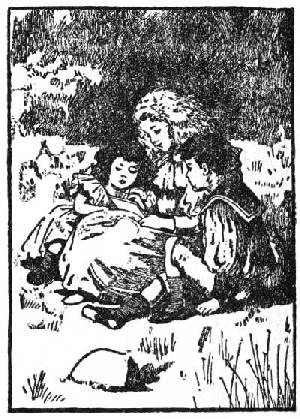
It had been such a weary hunt for lodgings.
Not that lodgings are scarce in London. There
are scores of streets, whole districts, indeed, where
the house that did not say “Apartments” in its
window would be the exception.
But Miss Endell wanted to combine a great deal.
She must be economical, for her funds were running
low; she must be near the British Museum, for she
wanted to consult many authorities for the book
about “Noted Irishwomen,” by which she hoped to
retrieve her fortunes; she wanted quiet, too, and
reasonably pretty things about her.
For a week she had spent most of her time in
quest of the place where she could settle herself
comfortably for a few months. It was the gray
March weather. The mornings were dark, and the
gloom of coming dusk settled down early; and, during
all the hours between, Miss Endell had been
busy in that weary work of which Dante speaks,
“climbing the stairs of others.”
At last, after much consideration, she had decided
to make a certain flight of stairs her own.
She had taken the drawing-room floor of No. 30
Guilford Street; and with a comfortable feeling of
success she had paid her bill at the Charing Cross
Hotel, and driven to her new home.
The drawing-room floor—that is to say, the
suite of rooms up one flight of stairs from the street—is
the most important part of a London lodging-house.
Whoever is kept waiting, when “the drawing-room”—as
it is the fashion to designate the
lodger who occupies that apartment—rings, the
ring must at once be “answered to.” That floor
rents for as much as all the rest of the house put
together, and is the chief dependence of anxious
landladies.
Miss Endell, accordingly, was received as a person
of importance. Her boxes were brought upstairs,
and her landlady, Mrs. Stone, bustled about
cheerfully, helping her to arrange things.
At last every thing was comfortably placed,
and the tired new-comer settled herself in a low
chair in front of the glowing coal-fire, and glanced
around her.
Mrs. Stone was still busy, wiping away imperceptible
dust. The door was open, and in the doorway
was framed a singular face, that of a pale,
slender child, with a figure that looked too tall for
the face, and great eager eyes, with such a wistful,
silent longing in them as Miss Endell had never
seen before.
At the same moment Mrs. Stone also caught
sight of the child, and cried out a little crossly,—
“Go away, you plague! Didn’t I tell you as
you wasn’t to ’ang round the new lady, a-worritin’
her?”
The child’s wistful face colored, and the tears
sprang to the great, sad eyes; but he was silently
turning away, when Miss Endell herself spoke. She
was not specially fond of children; but she had a
kind heart, and something in the wan, pitiful face
of the child touched it.
“Don’t send him away, Mrs. Stone,” she said
kindly. “Come in, my little man, and tell me
what your name is.”
The child sidled in, timidly, but did not speak.
“Don’t be afraid,” Miss Endell said. “What is
your name?”
“Bless you, ma’am, he can’t speak!” said Mrs.
Stone.
“Can’t speak?”
“No; he was born with something wrong. Laws,
he can hear as well as anybody, and he knows all
you say to him; but there’s something the matter.
The last ‘drawing-room’ said that there was doctors,
she was sure, as could help him, but I haint
any money to try experiments.
“Johnny was my brother’s child. His father
died before he was born, and his mother lived just
long enough to ’and over Johnny to me, and ask me
to take care of him.
“I’ve done my best; but a lodging-house is a
worrit. What with empty rooms, and lodgers as
didn’t pay, and hard times, I never got money
enough ahead to spend on doctors.
“But you mustn’t have Johnny a-worritin’
round. You’d get sick o’ that. The last ‘drawing-room’
said it made her that nervous to see
him; and I halways thought she went off partly for
that.”
“I will not let him trouble me, don’t be afraid;
but let him sit down here by the fire, and when I
find he disturbs me I’ll send him away.”
Mrs. Stone vanished, and Johnny took up his
station on a stool in a corner of the hearth-rug.
Miss Endell busied herself with a book, but from
time to time she looked at the boy. His face was
pale and wistful still, but a half-smile, as sad as
tears, was round his poor silent mouth, and he was
gazing at his new friend as if he would fix every
line of her face in his memory for ever.
For a long hour he sat there; and then Mrs.
Stone came to lay the cloth for dinner, and sent
him away to bed.
The next morning he appeared again; and soon
it grew to be his habit to sit, almost all the day
through, and watch Miss Endell at her tasks. In
spite of her absorption, he occupied a good many of
her thoughts.
Like him, she was an orphan; and she had few
close and vital interests in her life. She got to feel
as if it belonged to her, in a certain way, to look
after this silent waif of humanity more lonely still
than herself.
Often she took an hour from her work to read
little tales to him, and it was reward enough to see
how his eyes brightened, and the color came into
his pale little face. She used to think that if her
work succeeded, Johnny should also be the better
for it. As soon as the first edition of “Noted Irishwomen”
was sold, she would have the best medical
advice for him; and if there were such a thing
as giving those lips language, it should be done.
“Should you like to speak to me, Johnny?” she
asked one day suddenly.
The boy looked at her, for one moment, with
eyes that seemed to grow larger and larger. Then
came a great rush of sobs and tears that shook him
so that Miss Endell was half-frightened at the effect
of her own words. She bent over and put her
hand on his head.
“Don’t, Johnny! Don’t, dear!” she said tenderly.
I doubt if any one had ever called the poor little
dumb boy “dear” before, in all his eleven years of
life. He looked up through his tears, with a glad,
strange smile, as if some wonderful, sweet thing
had befallen him; and then, in a sort of timid rapture,
he kissed the hem of Miss Endell’s gown, and
the slippered foot that peeped out beneath it.
I think there is an instinct of motherhood in good
women that comes out toward all helpless creatures;
and it awoke then in Miss Endell’s heart.
After that she and Johnny were almost inseparable.
Often she took him with her on her walks,
and always when she worked he kept his silent
vigil on the hearth-rug.
Miss Endell had one extravagance. She could
not bear to be without flowers. She did not care
much for the cut and wired bouquets of the florist,
but she seldom came home from her walks without
some handful of wall-flowers, or a knot of violets
or forget-me-nots. Now and then she bought a
tea-rose bud; and then Johnny always noticed
how lovingly she tended it—how she watched it
bursting from bud to flower.
He got to know that this strange, bright creature
whom he idolized loved flowers, and loved tea-roses
best of all. A wild desire grew in him to
buy her tea-roses—not one, only, but a whole
bunch. He spent his days in thinking how it was
to be done, and his nights in dreaming about it.
A penny was the largest sum he had ever possessed
in his life, and a penny will not buy one tea-rose,
much less a bunch of them.
One day Miss Endell took him with her when
she went to see a friend. It was a prosperous, good-natured,
rich woman in whose house they found
themselves. “Go and see the pictures, Johnny,”
Miss Endell said; and Johnny wandered down the
long room, quite out of ear-shot.
Then she told his pathetic little story, and her
friend’s careless yet kind heart was touched. When
it was time for Miss Endell to go, she summoned
Johnny; and then the lady they were visiting gave
the boy a half-crown, a whole shining, silver half-crown.
Johnny clasped it to his heart in expressive pantomime,
and lifted his wistful, inquiring eyes.
“Yes, it is all yours,” the lady said, in answer;
“and don’t let any one take it away from
you.”
Small danger, indeed, of that! The piece of silver
meant but one thing to Johnny,—tea-roses, unlimited
tea-roses.
The next day he was taken ill. He had a fever,—a
low, slow fever. His aunt was kind enough to
him, but she had plenty to do, and Johnny would
have been lonely indeed but for Miss Endell.
She had him brought each morning into her
room, and kept him all day lying on her sofa, giving
him now a kind word, now a draught of cold water,
and then a few grapes, with the sun’s secret in
them.
One day Johnny drew something from his bosom,
and put it into Miss Endell’s hand. It was
the silver half-crown. He made her understand,
by his expressive gestures, that she was to keep it
for him; and she dropped it into a drawer of her
writing-desk.
At last Johnny began to get well. June came,
with all its summer sights and sounds, and strength
came with its softer winds to the poor little waif.
One day he stood before Miss Endell, and put out
his hand. She understood, and dropped the half-crown
into it. He hid it, with a sort of passion, in
his bosom, and Miss Endell smiled. Did even this
little waif, then, care so much for money?
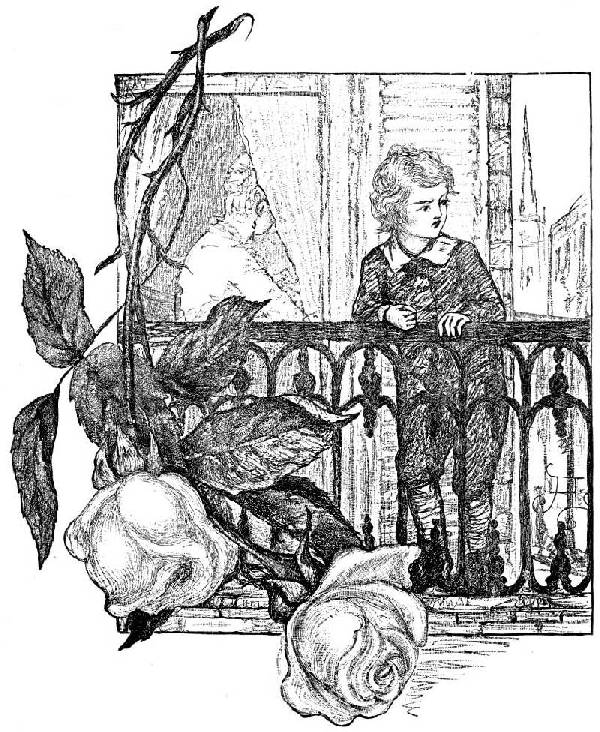
As soon as he could stand, he took up his station
on the balcony outside the windows, and watched
and watched.
His friend thought only that the sights and
sounds of the street amused him. She was working
on at the “Noted Irishwomen,” which was
nearing its conclusion, and it quite suited her that
Johnny found the street so interesting.
As for the child, he was possessed by only one
idea,—tea-roses. He watched to see the hand-barrows
come along, flower-laden and tempting.
These same hand-barrows are a feature of London
street life. They are full of plants growing
in pots, and also there are plenty of cut flowers.
The venders cry, as they pass along, “All a-growin’
and a-blowin’!” and there is something exciting in
the cry. It seems part of the summer itself.
Day after day, day after day, Johnny watched
and watched. Flowers enough went by,—geraniums
glowing scarlet in the sun, azaleas, white
heath, violets,—only never any tea-roses.
But at last, one morning, he heard the familiar
cry, “All a-growin’ and a-blowin’!” and lo! as if
they had bloomed for his need, there were tea-roses—whole
loads of tea-roses!
Miss Endell was busy, just then, with Lady
Morgan. She never noticed when the little silent
figure left the window, and hurried downstairs.
Out into the street that little figure went, and
on and on, in hot pursuit of the flower-barrow,
which by this time had quite the start of him.
Down one street, up another, he ran, and always
with the silver half-crown tightly clasped in the
palm of his little hand.
At last a customer detained the barrow; and
Johnny hurried up to it, panting and breathless.
He put his hand out towards the tea-roses, and
then he held out his silver half-crown.
The flower-seller looked at him curiously,
“Why don’t you speak, young ’un?” he said.
“Are you dumb? You want this ’alf-crown’s wuth
o’ them tea-roses?”
Johnny nodded vehemently.
The man took up a great handful of the pale
sweet flowers, and thrust them into the boy’s
hands, taking in exchange the half-crown, and putting
it away in a sort of pouch, along with many
silver mates.
As for Johnny, there are in every life supreme
moments, and his came then. He held in his hand
the flowers that Miss Endell loved, and he was
going to give them to her.
All his life he had felt himself in every one’s
way. She, only, had made him welcome to her
side. She had called him “dear,”—and now
there was something he could do for her. She
had loved one tea-rose: how much, then, would
she love a whole handful of tea-roses! His heart
swelled with a great wave of pride and joy.
He thought of nothing but his flowers,—how
should he?—and he never even heard or saw the
butcher’s cart, tearing along at such a pace as John
Gilpin never dreamed of. And in a moment,
something had pushed him down,—something
rolled and crunched over him,—and he knew nothing;
but he held the flowers tight through it all.
“Why, it’s Mrs. Stone’s dumb Johnny!” said
the butcher-boy, who had got down from his cart
by this time, and was addressing the quickly
assembled London crowd. “Gi ’e a hand, and
lift un up into my cart, and I’ll carry un home.”
An awful inarticulate groan came from the poor
child’s dumb lips as they lifted him; but his hold
on the tea-roses never loosened.
They carried him home, and into the house.
Mrs. Stone was shocked and grieved; and she
took her troubles noisily, as is the fashion of her
class. Miss Endell, still fagging away at Lady
Morgan, heard cries and shrieks, and dropped her
pen and hastened downstairs.
“He’s dead! Johnny’s dead!” cried Mrs. Stone
and Miss Endell, white and silent, drew near.
But Johnny was not dead, though he was dying
fast. The butcher-boy had hurried off for a doctor
and the three women, Mrs. Stone, her maid,
and her lodger, stood by helplessly.
Suddenly Johnny’s wandering look rested on
Miss Endell. A great sweet smile of triumph
curved his mouth, lighted his eyes, kindled all his
face. With one grand last effort, he put out the
bunch of tea-roses, and pressed them into her hand.
And then, as if death had somehow been more
merciful to him than life, and had in some way
loosed his poor bound tongue, he stammered out
the only words he had ever spoken—was ever to
speak,—
“For you!”
At length the doctor came and stood there, helpless
like the rest, for death was stronger than all
his skill. The shock and the hurt together had
quenched the poor frail life that was ebbing so
swiftly.
Miss Endell bent and kissed the white quivering
lips. As she did so, the tea-roses she held touched
the little face.
Was it their subtile fragrance, or this kiss, or
both together, which seemed for one moment to
recall the departing soul?
He looked up; it was his last look, and it took
in the sweet woman who had been so gentle and
so loving to him, and the flowers in her hand.
His face kindled with a great joy. A hero
might have looked like that who had died for his
country, or a man who had given his life joyfully
for child or wife.
Johnny Stone had loved one creature well, and
that creature had loved tea-roses. What could
life have held so sweet as the death that found
him when he was striving to give her her heart’s
desire?
MY VAGRANT.
We were in pursuit of Laura’s dressmaker,
and had just rung the bell at her door,
when a little boy presented himself, and, standing
on the lower step, uplifted a pathetic pair of blue
eyes, and a small tin cup held in a little grimy
hand. A large basket was on one arm; and
round his neck was one of those great printed
placards, such as the blind men wear who sit at
the street corners. Laura’s purse was always
fuller than mine; and she was extracting a bit of
scrip from it, while I bent my near-sighted eyes
on the boy’s label. Could it be that I read
aright? I looked again. No, I was not mistaken.
It read, in great, staring letters—
I HAVE LOST MY HUSBAND IN THE WAR.
In the war! And those blue eyes had not
opened, surely, till some time after the war was
ended! His husband! I was bewildered. I
bent my gaze on him sternly, and asked, as
severely as I could,—
“Young man, can you read?”
Laura was fumbling away at the unanswered
door-bell. The boy looked as if he wanted to
run; but I put my hand on his arm.
“Can you read?” I repeated gravely. I think
he shook in his shabby boots, for his voice was
not quite steady as he answered,—
“Not much.”
“Not much, I should think. Do you know
what this thing says that you’ve got round your
neck?”
“Does it say I’m blind?” he asked, with a
little frightened quaver.
“No, it says—but do you know what a husband
is?”
“Yes, he comes home drunk, and beats Mag
and me awful.”
“Did you ever know a boy of your age to have
a husband?”
The blue eyes grew so wide open that I wondered
if they could ever shut themselves up
again; and Laura, who had turned round at my
question, looked as if she thought I had suddenly
gone mad. The little dressmaker had opened the
door, and stood there waiting meekly, with the
handle in her hand. But my spirit was up, and I
did not care for either of them. I asked again,
very impressively, as I thought, with a pause after
each word,—
“No, marm,” he gasped, “husbands belongs to
women.”
“Then what do you wear this thing for? It
says that you have lost your husband in the war.”
The imp actually turned pale, and I almost pitied
him.
“Will they put me in prison?” he asked, an
abject little whine coming into his voice. “Will
they?”
“Did you steal it?”
“I didn’t to say steal it—I just took it. I’d
seen the rest put them on when they went out
begging, and this was old Meg’s. She wasn’t
going out to-day, and I thought no harm to
borrow.”
“Then you can’t read?”
“Well, not to say read, marm. I think I could
make out a word now and then.”
“Do you want to?”
The face brightened a moment, and, with the
curving lips and eager eyes, was really that of a
pretty boy.
“Oh, if I could!” half sighed the quivering
lips; and then the smile went out, and left blank
despair behind it. “It’s no use, marm; she
won’t let me.”
“Who won’t? Your mother?”
“No, Mag’s mother—old Meg. My mother’s
dead, and I never had any father that ever I heard
of; and since mother died old Meg does for me;
and every day she sends me out to beg; and if I
don’t get much she whips Mag.”
I was growing strangely interested.
“Whips Mag, because you don’t get much?”
I said doubtfully. “What for?”
“I guess there’s a hard place on me, marm.
She found that it didn’t seem to hurt much, when
she whipped me; and so one night Mag was teasing
her to stop, and she turned to and whipped
Mag, and that made me cry awful; and ever
since, if I don’t get enough money, she whips
Mag.”
“Are you sure you are telling me the truth?”
I don’t know why I asked the question, for I
saw honesty in those clear eyes of his. He looked
hurt. Yes, you may laugh if you want to, I’m
telling you just as it was—the boy looked as
hurt as any of you would if I doubted you.
There came a sort of proud shame into his manner.
He clutched at the placard round his
neck, as if he would tear it off, and answered,
sadly,—
“I s’pose I can’t expect anybody to believe me
with this round my neck; but, if you would go
home with me, Mag could tell you, and you would
believe her.”
By this time Laura had gone in, leaving me to
finish my interview alone. I reflected a moment.
The other day I had heard Tom say he wanted an
errand boy. Why should he not have this one?
Tom was my brother. I knew just the difficulties
he would make,—want of reference, a street beggar,
a regular rat of the gutter. I could fancy
just how he would talk. I knew, too, that I could
overrule his objections. That’s a power women
have when a man loves them; whether he be husband
or brother or friend. I hated the thought
of vice and ignorance and poverty. What if I
could save just one small boy from their clutches?
I said resolutely,—
“Will you go home with me, and have a comfortable
home and good food and honest work,
and no one ever to beat you, and learn to read?”
I had seen no assent in his eyes till I came to
this last clause of my sentence. Then he asked
shrewdly,—
“Who’ll teach me? I can’t go to school and
do my work, too.”
“I will teach you. Will you go and work
faithfully for my brother, and learn to read?”
“Won’t I, just?”
“Well, then, let me speak to the lady who went
in, and I’ll take you home at once.”
He shuffled uneasily.
“If you please, marm, I can’t go till I’ve been
back to Meg’s, and carried her this board.”
“But I’ll get a policeman to send a messenger
with that. If you go, perhaps she won’t let you
come to me.”
“Yes, marm, I shall come. But you wouldn’t
believe me, sure, if I could steal away, like, and
never say good-by to Mag, and let her cry both
her eyes out thinking I’d been shut up, or somebody
had killed me.” And his own great blue
eyes grew pathetic again over this picture of sorrowful
possibilities.
“Well, you may go,” I said, half reluctantly,
for the little vagabond had inspired in me a singular
interest. “You may go, and be sure you
come to-night or in the morning, to 70 Deerham
Street, and ask for Miss May.”
He looked at me with a grave, resolved look.
“I shall come,” he said; and in an instant he
was gone.
That night, after dinner, I told Tom. He was
mocking, incredulous, reluctant—just as I knew
he would be. But it all ended in his promising to
try “My Vagrant,” if he ever came.
Just as I had brought him to this pass, the bell
rang, and I sprang to the dining-room door. The
dining-room was the front basement, and the outside
door was so near that I opened it myself. It
was, indeed, my vagrant.
“I want Miss May,” he said, with the air which
such a gamin puts on when he speaks to a servant,—an
air which instantly subdued itself into propriety
when he heard my voice.
I took him in to Tom; and I saw the blue eyes
softened even the prejudiced mind and worldly
heart of Mr. Thomas May. He spoke very kindly
to the boy, and then sent him into the kitchen for
his supper.
“Where do you propose to keep this new acquisition?”
he asked me, after the blue-eyed was out
of sight.
“In this house, if you please. There is a little
single bed all ready for him in the attic, and I’ve
arranged with cook to give him a bath and then
put him into some of the clothes her own boy left
behind him when he went away to sea. I mean
to rescue this one soul from a starved and miserable
and wicked life, and I’m willing to take
some pains; and if you aren’t willing to do your
part I’m ashamed of you.”
Tom laughed, and called me his “fierce little
woman,” his “angry turtle-dove,” and half-a-dozen
other names which he never gave me except when
he was in good humor, so I knew it was all right.
Before three days were over Tom owned that my
vagrant, as he persisted in calling the boy (though
we knew now that his name was Johnny True),
was the best errand boy he had ever employed. I
myself taught him to read, as I had promised, and
brighter scholar never teacher had. In four
months he had progressed so fast that he could
read almost any thing. There had been a sort of
feverish eagerness in his desire to learn for which I
was at a loss to account. Sometimes, coming home
from some party or opera, I would find him studying
in the kitchen at midnight.
We grew fond of him, all of us. Cook said he
was no trouble, and he made it seem as if she had
her own boy back again. He waited on Tom with
a sort of dog-like faithfulness; and, as for me,
I believe that he would have cut his hand off for
me at any time.
Yet one morning he got up and deliberately
walked out of the house. When his breakfast was
ready cook called for him in vain, and in vain she
searched for him from attic to cellar. But before
it was time for Tom to go to business another boy
came, a little older than my vagrant,—a nice,
respectable-looking boy,—and asked for Mr. May.
He came into the dining-room and stood there, cap
in hand.
“If you please, sir,” he said bashfully, “Johnny
True wants to know if you’ll be so good as to take
me on in his place, considering that he isn’t coming
back any more, and I have done errands before,
and got good reference.”
He had made his little speech in breathless haste,
running all his sentences together into one.
Tom looked at him deliberately, and lit a cigar.
“Johnny isn’t coming back, hey?”
“No, sir.”
“Where is Johnny gone?”
“He didn’t tell me, if you please, but he said he
should be hurt to death if it troubled you to lose
him, and he knew I could do as well as he could.”
I saw a refusal in Tom’s eyes, so I made haste to
forestall it.
“Do take him,” I said in a low tone to Tom, and
then I said to the boy that just now he had better
go to the store, and Mr. May would see him presently,
when he came to business.
Tom laughed, a half-amused, half-provoked
laugh, when he went out, and said,—
“Well, my dear, I don’t think your vagrant
has proved to be such a success that you need
expect me to let him choose my next errand boy.”
“I think, at least, that if he has sent you one as
good as himself you will have no fault to find,” I
said hotly. But all the time there was a sore
place in my own heart, for I had thought that my
vagrant would have loved me too well to run away
from me in this way.
That night Tom said that the new errand boy
was doing well, and he had concluded to keep him
on. I think Tom missed my vagrant; but not, of
course, so much as I missed my bright scholar—my
grateful little follower.
Of course, the new boy lived in his own home,
wherever that might be. I did not concern myself
about him, or feel any disposition to put him in
the little bed in the front attic.
Two or three weeks passed and we heard no
word from Johnny True. But at last a rainy
day came, and with it Johnny, asking for Miss
May.
“I guess he’s repented,” cook said, coming upstairs
to tell me. I went down to Johnny, resolved
to be equal to the occasion—to meet him with all
the severity his ungrateful behavior deserved.
But, somehow, the wistful look in his blue eyes
disarmed me. He was a little thin and pale, too;
and my heart began to soften even before he
spoke.
“I couldn’t stay away, ma’am,” he said, with the
clear accent he had caught so quickly from my
brief teaching, “and not let you know why I
went.”
“To let me know when you went would have
been more to the purpose,” I answered, with what
sternness I could command. “I had thought better
of you, Johnny, than that you were capable of
running away.”
“But you see, ma’am, I was afraid you would
not let me go if I told you.”
“And why did you want to go? Were you
not comfortable?”
“Yes, ma’am—that was the worst of it.”
“Why the worst of it? Have you any especial
objection to be comfortable?”
Suddenly the blue eyes filled with tears, like a
girl’s; and there was a pitiful sob in the voice
which answered me.
“Oh, it hurt me so, when I was warm, and had
a good supper, and everybody’s kind word, to
think of poor Mag there at home, cold and hungry,
and with old Meg beating her. I never should
have come and left her but for the learning to read.
She wanted me to come for that.”
“So you could read to her?”
“So I could teach her, ma’am. You never in all
your life saw anybody so hungry to learn to read
as Mag; and when I went home that first day and
told her all you said, and told her that after all I
couldn’t go and leave her there to take all the
hard fare and hard words, she just began to cry,
and to tease me to go and learn to read, so I could
teach her, until I couldn’t stand it any longer, and
I came.”
“And how did she know she would ever see you
again?” I asked. “It would have been most natural,
having learned what comfort was, to stay on
here and enjoy it.”
“Mag knew me, ma’am,” said my vagrant, as
proudly as a prince could speak if his honor were
called in question. “Mag knew what I was, and I
learned as fast as I could to get back to her—don’t
you think so, ma’am?”
“You learned faster than any one else could; I
know that,” I answered. “But, Johnny, how
could you bear to go back to begging again?”
“I couldn’t bear it, ma’am, and I didn’t. I had
money enough, that Mr. Tom had given me, to buy
myself a stock of papers. I’m a newsboy now, and
I teach Mag to read out of the papers I have left.
And old Meg knows better now than to beat Mag,
and we are so much happier. It’s all owing to you;
and I came back to thank you,—but I never could
forsake Mag for long. I must stay with my own.”
“But they are not your own.”
“Mag is, ma’am.”
He was as resolute to ally himself, for that girl’s
sake, with poverty, and, if need were, shame, as
ever was a hero to live or die for the land of his
birth; and out in the rain, down the desolate
street, I watched my vagrant go away from me for
ever. But I did not pity him. No soul is to be
pitied which has reached life’s crowning good,—the
power to love another better than itself. Nor
do I know any curled darling of fortune who seems
to me happier than was my vagrant.
HELEN’S TEMPTATION.
The sun was almost setting, but its low light
came in at the western windows, and lit up a
pale face lying upon the pillows, till it seemed to
the watchers beside the bed as if some glory from
heaven had already touched the brow of the dying.
These watchers were only two,—a girl of fourteen,
rather tall of her age, with gray eyes that
were almost green sometimes, and dark hair, short
like a boy’s, and curling all over her head; and
a middle-aged woman, who had tended this girl
when a baby, and was half friend, half servant, to
the dying mother.
Mrs. Ash had been lying all the day, almost in
silence. Her husband had brought her, a year
before, to California, because she was stricken
with consumption, and he hoped the change
from the harsh east winds of New England to
the balmy airs of the Pacific coast might restore
her to health.
For a time the result had seemed to fulfil his
hope; but, very suddenly, he himself had been
taken ill and died; and then the half-baffled disease
seized again on the mourning wife, who had
now no strength to repel its onset.
I think she would fain have lived—even then,
when all the joy seemed gone from her life—for
her daughter Helen’s sake; but she was too weak
to struggle, and so she lay there dying, quite
aware of what was before her.
All day she had seemed to be thinking, thinking,
and waiting till she had settled something in
her own mind before she spoke. At last, with the
sunset light upon her face, she beckoned to the
woman, who bent nearer.
“As soon as all is over, Woods,” she said, as
tranquilly as if she were speaking of the most ordinary
household arrangement, “you will take Helen
to my sister’s in Boston. You must make the
journey by easy stages, so as not to tire her too
much. Fortunately she will not be dependent.
She has money enough, and she needs only care
and love, which my sister will give her, I know
well.
“I shall be glad if you can stay with her; but
that must of course be as Mrs. Mason will arrange.
You will find when my affairs are settled that you
have been remembered. You will lay me by my
husband’s side, and then take Helen away.
“All is arranged so that there can be no trouble,
and now, if you please, leave me a little while with
my daughter.”
The woman went out of the room, and then Mrs.
Ash opened her arms, and Helen crept into them
and lay there silently, as if she were a baby again
whom her mother comforted.
She was a strange compound, this Helen Ash, of
impulsiveness and self-control. She had an intense
nature, and her temptations would grow chiefly
out of her tendency to concentrate all her heart on
a single object,—to seek whatever thing she wished
for with an insistence which would not be denied.
This quality has its great advantages certainly,
but it has its extreme dangers.
Helen had no brothers or sisters or special
friends. She had loved only her father and
mother, but she had loved them with an almost
excessive devotion.
When her father died she had borne up bravely,
that she might comfort and help her mother, and
now she was bearing up still, that she might not
sadden that parting soul with the anguish of her
own.
As she lay there in her mother’s arms, her eyes
were wide open and tearless, but they were full of
a desperate gloom sadder than tears. She was
almost as pale herself as was her mother.
“Darling,” the mother said tenderly, “how can
I bear to leave you all alone? Promise me one
thing only, to open your heart to new love. It
would be so like you to shut yourself up in your
grief, and to fancy you were loving me less if you
let yourself care for your Aunt Helen.
“She will love you for my sake, and she must
be your second mother now. We were dearer
than most sisters to each other, and she is a wise
and good woman.
“Her daughter, my namesake Laura, is just
about your own age, and being her mother’s daughter,
she must be worth loving. Try to care for
them, my darling. The life which has no love in
it is empty indeed. Will you try?”
“O mamma,” the girl cried, with a sudden, desperate
sob, “I will try because you bid me! I will
try; but oh, how can I love them? How can I
bear to see another girl happy with her mother,
and to know that you will never be with me any
more—never in all the world? If I call all day
and all night, you will never hear nor answer! O
my own mother, must you leave me?”
“My darling, yes. I would have lived for your
sake if I could. You have been my comfort always.
Comfort me a little longer. Let me feel that in all
the future you will try to live nobly for my sake.”
The last words had been spoken with an evident
effort, and it seemed to Helen that the cheek
against which her own rested was already colder
than it was half an hour ago.
She clung closer to the poor wasted form that
was her whole world of love, and closed her lips
over the bitter cry that was rising to them; and so
the two lay, very, very quietly in that last embrace
they were ever to know.
And the twilight gathered round them, and at
last a young moon, hanging low in the western sky,
looked in and touched with its pale glory the pale
faces on the pillow.
The mother stirred a little, and with a last effort
clasped her child closer, and said, in a voice like a
sigh, faint and sweet and strange, “Good-by,
darling!” and then she seemed to sleep.
Perhaps Helen slept, also. She never quite
knew; but it was an hour afterwards when Woods
touched her shoulder, and said, with a kind firmness
in her tone,—
“You must get up now, Miss Helen, and leave
her to me. She went off just as quiet as a lamb,
poor dear, and if ever a face was peaceful and
happy, hers is now.”
No one knew what the few days that followed
were to Helen Ash. She shut her lips, as her
manner was, over her grief. She turned away,
with her great tearless eyes, from the two graves
where her father and mother lay side by side, and
she helped, with a strange unnatural calmness, in
all the preparations for the long journey she was
to take.
When at last she reached her aunt’s home in
Boston, this strained, unnatural composure gave
way a little.
Her Aunt Helen looked so much like her
mother that at first she thought she could not
bear it. Then, when her aunt’s arms closed round
her almost as tenderly as her mother’s would have
done, she shivered a little, and burst into one
wild passion of tears, which almost instantly she
checked.
“I am to love you for her sake,” she said.
“Those were almost her last words; and indeed,
indeed, I will try, but I think I left my heart all
those miles away in her grave.”
Mrs. Mason was, as her sister had said, a wise
and good woman,—wise enough not to attempt to
force the love or the interest of her niece. She
contented herself with being exquisitely gentle and
considerate towards her, and with trying, in countless
little ways, to make her feel that she was at
home.
Laura Mason had looked forward to Helen’s
coming with a feeling that at last she was to find
in her the sister she had longed for all her life, but
Helen’s cold and self-contained manner disappointed
her. She felt the atmosphere of Helen’s
reserve almost as tangibly as if her orphan cousin
had pushed her away.
The summer months passed, and scarcely brought
them any nearer together. Try as Helen might, she
could not get over the sting of pain when she saw
this other girl happy in her mother’s love, or running
gayly to meet her father when he came home
at night. They had each other, she used to say to
herself, but she had only her dead. She had not
even Woods to speak to, for Mrs. Mason had decided
not to retain her; and since there was no one to
whom Helen ever spoke of the past, she pondered
it all the more in her heart.
Things were a little better when school commenced
in the autumn. Helen and Laura were in
the same classes, and that brought them somewhat
more together; still there was no real intimacy
between them.
In the spring there was to be a competitive
examination, and a medal was to be bestowed on
the leading scholar in the class. By midwinter it
was quite evident that Helen and Laura led all the
rest, and a real spirit of rivalry grew up between
the cousins which bade fair to become a passion.
Mrs. Mason looked on regretfully, adhering to
her difficult policy of non-interference. One day
Helen heard Laura say to her mother,—
“Mamsie, dear, you know you have the key
to that French method locked up in your desk, for
you taught us from it last summer. Won’t you be
a dear, and lend it to me for a little while?
“If I only could have that to help me, I should
be sure of success. I would study just as hard.
It would only be the difference between knowing
when one was right, and floundering on in an awful
uncertainty.”
Helen was behind the curtain of the library
window, and evidently they did not know of her
presence. She waited for her aunt’s answer. If
Laura had the key, then, indeed, she would be
sure of success.
Mrs. Mason spoke in a sad voice, with a subtile
little thrill of reproach in it.
“I did not think you would so much as wish,
my dear, to do any thing that was not quite open
and straightforward. You know Mademoiselle
does not expect you to see the key. The very
test of your power is that you should work without
its aid, and the examination will prove how
far you have succeeded.”
“I suppose there’s no use in coaxing, when you
say that. I do wish you weren’t such an uncoaxable
mamma.”
“No, you don’t,—you only fancy that you wish
it; but, in your inmost soul, you would rather
have me as I am,” Mrs. Mason answered; and
Helen heard the sound of a kiss, and felt, for the
thousandth time, how bitter it was that this other
girl should have home and mother, while she had
only a far-off grave.
But, at least, she would triumph in this school
contest! If Laura came off best there, it would
be more than she could bear.
The weeks passed on, and the spring came.
The deep old garden back of the house—the garden
Helen’s mother had played in when she was a
child—grew full of bird-songs and blossoms.
There was a sweet laughter on the face of nature.
The springs bubbled with it; the flowers
opened to the light; the sunshine poured down its
tender warmth, and the soft coo and call of the
birds gave voice to the general joy.
But both Laura and Helen were too eager and
too tired to be gay. They only studied. They
went to sleep with books under their pillows;
they woke with the first light, and began to study
again.
It was the very week of the examination, at
last. Helen felt satisfied with herself in all but
her French. If she could only have that key for
one little half-hour, she knew she would have no
weak spot in her armor.
She brooded over the idea until the temptation
possessed her like an evil fate. In her passionate
girl’s heart she said to herself that she wanted to
die if Laura triumphed over her at school. Laura
had every thing else; why should she have that,
also?
She had said at first, “If only it were right to
have the key!” Then she said, “if only she
could chance on the key, somehow!” Then, “if
only she could get at her aunt’s desk and find the
key!” At last it was,—
“I will get at the key, somehow!”
This last was the very morning before the examination.
She rose from her bed in the dainty
blue-hung room her aunt had taken such pains to
make pretty for her, and went softly downstairs,
in the young spring morning.
Her bare feet made no sound on the thick stair-carpet.
She looked like a little white-clad ghost
that had forgotten to flee away at the first cock-crowing,
as an orthodox ghost ought; but no
ghost ever had such glowing cheeks, crimson with
excitement, such great wide-opened gray eyes
with green depths in them.
She held in her hand a large bunch of keys belonging
to her mother. It was just a chance
whether one of them would fit her aunt’s desk.
She fairly trembled with excitement. She had
lost all thought of the wrong she was doing—of
the shame and meanness of this act, which must be
done in silence and mystery; she thought only of
the triumph which success would mean.
She stood before the desk, and tried key after
key with her shaking fingers.
At last one fitted. In a moment more the key
to the French method was in her hand.
In desperate haste she compared her own work
with it, and made corrections here and there.
She was so absorbed that she quite failed to see
another white-clad figure which had followed her
noiselessly down the stairs, and stood in the doorway
long enough to see what she was doing, and
then went away.
Hurriedly Helen went through her evil task,
and then stole back to bed, with her glittering
eyes and burning cheeks.
Meantime Laura had gone, full of excitement,
to her mother. Mr. Mason was away on business,
and Laura crept into the empty half of her mother’s
great bed.
“Mamsie,” she said, “wake up quickly, and
listen.”
Patient Mrs. Mason rubbed the sleep out of her
eyes, and turned over. Then followed Laura’s
breathless story.
“Of course she’ll win, now,” Laura said, in
conclusion, “unless I tell Mademoiselle what she
has done; and I suppose you wouldn’t like that,
would you, mamsie?
“But it was her French that was the shakiest
of any thing. Oh, did you ever see any thing quite
so mean? Think of getting into your desk with
her keys, and then slying off all those corrections!”
“Yes, I do think,” Mrs. Mason answered, with
almost a groan.
“And she is Laura’s child—my poor Laura,
who was honor and honesty itself!
“You don’t know, dear, what a bitter thing
this is to me. Poor Laura! what if she
knows?”
“But what shall we do, mamsie, dear? Are
we just to keep still, and let her win the
medal, and let every one think she has beaten
fairly, or will you tell her what we know?”
“Will you go away now,” Mrs. Mason said,
“and come back again before breakfast? I don’t
want to say any thing until I am quite sure what
it is best to do.”
When Laura came again, Mrs. Mason had settled
upon her course of action, or rather of inaction.
“Don’t be vexed, girlie,” she said to Laura; “I
know it will seem hard to you to be beaten unfairly;
but there are things of more consequence
even than that. The thing that seems to me most
important, just now, is to know what Helen’s
character really is. If she is not utterly unworthy
of her mother, she will repent before the thing
comes to an end. If she does not, it will be time
enough to think what to do next.”
“And I must let her beat unfairly, and never
say one word?” Laura asked, with a little strain of
rebellion in her voice.
“Yes, if you are the obedient and generous
Laura I like to believe you.”
“Mamsie, you have a flattering tongue, and you
always get your way.”
“And who is pretty sure always to admit, in the
end, that it was the best way?” asked Mrs. Mason,
laughing.
“Mamsie, you are getting spoiled. See if I say
yours was the best way this time!”
French came on the first of the two examination-days.
Laura and Helen led their class. Laura
did very well, but Helen acquitted herself triumphantly,
and sat down amid a little buzz of
congratulations and praises.
But somehow the triumph left a bitter taste in
her mouth. She did not look at Laura, and even
if she had she would not have understood the
scorn on Laura’s face, since she was quite unaware
that her raid on her aunt’s desk had been observed.
Still she was not happy. She needed no scorn
from outside, she had already begun to feel such
bitterness of self-contempt scorching her soul. It
seemed to her that up to this moment she had been
as one under an evil spell.
She had thought of no single thing except her
triumph over her cousin—quite careless as to the
means to this hotly desired end. Now she began
to realize how base those means had been, and to
long to exchange her success for any direst possible
failure.
Mrs. Mason was watching her, and when they
started to go home, she found an instant in which
to whisper to Laura,—
“Be gentle to her, girlie; she will suffer enough
to-night.”
At supper Helen’s place was vacant. She sent
word that her head ached too much to come.
Her aunt despatched to her room tea and strawberries
and bread-and-butter enough for the hungriest
of girls, and then left her to herself.
The poor, lonesome, miserable girl lay upon her
bed and thought. It was not quite a year since
she had lain in her mother’s arms and heard her
say,—
“Try to live nobly for my sake.”
Those had been almost her mother’s last words;
after them there was only the low sigh, faint as if
it came already from far-off worlds,—
“Good-by, darling.”
The low sun-rays stole in softly, and touched her
sad, pale face, and then went away; and after a
while some cold, far-off stars looked down into the
window, and saw the girl lying there still, fighting
her battle with herself.
One thing her conscience told her,—that she
must undo this wrong, at whatever cost of shame.
Once she started up, half-resolved to go to her
aunt and tell her the whole story, and seek her
help and counsel. But she lay down again, without
the courage to confess her shame.
Through the long night she scarcely slept; but
before morning she had resolved what to do. In
public she had taken the wages of her sin; in
public she would make atonement, and eat the
bitter bread of humiliation.
When she had once settled on her course of
action, sleep touched her weary eyes, and soothed
her into a forgetfulness from which only the breakfast-bell
awoke her.
That day every one noticed a singular calmness
and resolve in her manner. She passed the remaining
examinations with thorough success, yet with
an evident lack of interest in their result which all
save her aunt were at a loss to understand.
At last the time came for the awarding of the
medal. There was a little consultation among the
examining committee, and then their chairman
rose, with the medal in his hand.
“To Miss Helen Ash,” he began; but before he
could proceed farther, Miss Helen Ash herself
interrupted him.
Her face was as white as the dress she wore,
and her eyes glittered with some strange fire of
resolve or courage; but her voice was absolutely
without a quiver of emotion in it, as steady and
even as if she were beyond hope or fear.
“The medal does not belong to me,” she said.
“My success was a false success. I dishonestly
found the key to the French method, and corrected
my mistakes by it, or I should have failed.
The prize belongs, of right, to my cousin, Laura
Mason.”
The chairman was a fussy little man, and was
thoroughly discomposed by this interruption. He
had had his little speech all ready, but it began
with the name of Helen Ash, and he found it
difficult to change it at a moment’s notice.
“Bless my heart!” he said quite unconsciously,
and looking helplessly around him, he repeated,
“Bless my heart!”
“Miss Laura Mason,” suggested one of his
brethren on the committee; and thus reinforced,
he began again,—
“Miss Laura Mason, I am very sorry—I mean
I am very glad, to bestow on you this medal, which
you have fairly earned by your success.”
And then he sat down, and his confusion was
covered by a gentle little clapping of hands.
That night Mrs. Mason went to Helen in her
own room, when the twilight shadows were falling,
and as she entered the door she said, “My darling,”
in a voice so like Helen’s mother’s that the
girl’s very heart sprang to meet it.
“My darling, I know now that you are true
enough and brave enough to be my sister’s
child.”
But Helen shrank back into the darkness, and
this time the voice was broken with tears which
faltered,—
“Is there any one who could know what I have
done, and yet not despise me?”
“There is no one, dear, who dares to scorn the
soul that repents and atones.”
And then loving arms held the poor lonesome
girl close, and she knew that she was no longer
alone. She had found a new home—the home
her mother bade her seek—in the heart of that
mother’s sister.
THE SURGEON OF THE DOLLS’ HOSPITAL.
It was nearly four years ago that I first noticed,
in one of the quiet side-streets in the West
Central district of London, a sign over a door on
which I read:—
DOLLS’ HOSPITAL.
Operations from 9 A.M., to 4 P.M.
Whenever I passed through the street—and
that was often, for it was a short cut to Mudie’s,—the
largest circulating library in the world,—I used
to notice this quaint sign, and wonder, laughingly,
who was the superintending physician to this place
of healing for the numerous race of dolls.
I often thought I would go in and see the establishment;
but one is always busy in London, so,
very likely, I should never have entered its door
but for a casualty at my own fireside.
When I went downstairs one morning, I heard
a sound of weeping, as bitter as that of Rachel of
old mourning for her children. The mourner in
this case was Mistress Brown-Eyes, as I was wont
to call my friend’s little girl.
She was a pretty child, this little Milicent; but
you forgot to think about the rest of her face when
you saw her wonderful eyes—soft and clear, yet
bright, and of the warmest, deepest, yet softest
brown. She had made her home in my heart, and
so her grief, whatever it was, appealed at once to
my sympathies.
“My darling,” I said, as I tried to draw away
the little hands from before the sorrowful face,
“what can be the matter?”
“Bella is dead!” and the sobs recommenced
with fresh violence.
Bella was the best-beloved of a somewhat large
family of dolls,—a pretty Parian creature, with
blue eyes and fair hair. I had myself lately
assisted in making a trunk of clothes for Bella;
and I grudged sorely all my wasted labor, if she
had come to an untimely end.
I looked at the dear remains, stretched out sadly
upon a chair. Bella was evidently very dead indeed.
Her pretty neck was broken, her fair,
foolish head lay quite severed from her silken-clad
body. Suddenly there flashed into my
mind the thought of the dolls’ hospital. I spoke
cheerfully.
“Brown-Eyes,” I said, “I think that Bella may
recover. I am pretty sure that her collar-bone is
broken; but I have heard of people who got well
after breaking their collar-bones.”
The child looked up, her eyes shining through
tears, and said, with that air of grave, old-fashioned
propriety which was one of the most amusing
things about her,—
“It is a very serious accident. Do you think
Bella could recover?”
“I hope she may; and I shall at once take her
to the hospital.”
“The hospital!” cried Mistress Brown-Eyes;
“but that is where Mary Ann went when she had
a fever. She was gone six weeks. Will my Bella
be gone six weeks?”
“I think not so long as one week, if she can be
cured at all.”
In five minutes more I was in the street, with
Bella in a basket on my arm. Her little mother
had covered her carefully from the cold, though it
was already May; and I felt as if I were in a
position of grave responsibility as I hurried to the
dolls’ hospital.
A bell rang when I opened the door, and the
oddest little person stood before me. At first I
thought it was a child masquerading in long
clothes; for she was not more than half the height
of an ordinary woman.
But, looking more closely, I saw the maturity of
her face, and realized that I stood in the presence
of a grown-up dwarf, who might really have been
taken for Dickens’s Miss Mowcher, herself.
She was dressed in a long, straight gown of rusty-looking
black alpaca, and her rusty-looking black
hair was drawn straightly back from as plain a
face as one often sees. It was a kind, honest face,
however, and I liked the voice in which she asked
how she could serve me. I explained my errand.
“Please to let me see the patient.”
She spoke with as much gravity as if she had
been the superintending physician of the largest
hospital in London. I unveiled poor Bella, and
the dwarf lifted her from the basket with grave
tenderness.
“Poor little beauty!” she said. “Yes’m, I
think I can cure her.”
“Will the operation take long?” I asked,
humoring her fancy.
“I should prefer that the patient should not be
moved, ma’am, before to-morrow.”
“Very well; then I will leave her.”
Just at that moment I heard a voice call, “Sally!
Sally!”
It was a well-trained, ladylike voice, but somewhat
imperious.
“Yes, Lady Jane, I’ll be there in a moment,”
answered the dwarf, whom I now knew to be
Sally. Then a door opened, and the most beautiful
creature I ever saw stood in it, looking in.
The hospital was a bare enough place. There
was a great table covered with dolls,—dolls with
broken legs, dolls with punched heads, dolls with
one arm gone, hairless dolls, broken-backed dolls,
dolls of every kind, awaiting the ministrations of
Sally; and dozens of other dolls were there, too,
whom those skilful fingers had already cured of
their wounds.
There was a shelf, on which was ranged the
pharmacy of this hospital,—white cement, boxes
of saw-dust, collections of legs and arms, wigs,
every thing, in short, that an afflicted doll could
possibly require. Then there were two or three
wooden stools, and these completed the furniture
of the apartment.
Standing in the doorway, Lady Jane looked as
if she were a larger doll than the rest,—a doll
with a soul. She seemed a lady’s child, every
pretty inch of her. I should think she was about
twelve years old. She wore a blue dress, and a
blue ribbon in the bright, fair hair that hung all
about her soft, pink-and-white face, out of which
looked two great, serious, inquiring blue eyes.
“I will be through soon, Lady Jane,” Sally said
quietly; and the girl turned away, but not before
I had taken in a complete picture of her loveliness,
and had noticed also a somewhat singular
ornament she wore, attached to a slender golden
chain. It was so strange a vision to see in this
humble little shop that my curiosity got the better
of me, and, after the door had closed on Lady
Jane, I asked, “Does she live here?”
“Yes’m,” answered Sally proudly. “In a
way, she is my child.”
I hesitated to inquire further; but I think my
eyes must have asked some questions in spite of
myself; for Sally said, after a moment,—
“You seem interested, ma’am, and I don’t mind
telling you about her. I saw Lady Jane first
some eight years ago. A man had her who used
to go round with a hand-organ. She was such a
pretty little creature that everybody gave her
money, and she was a great profit to Jacopo, for
that was his name.
“It used to make my heart ache to see the little
beauty trudging round all day on her patient feet.
When Jacopo spoke to her, I’ve seen her turn
pale; and she never used to smile except when
she was holding out her bit of a hat to people for
money. She had to smile then; it was part of
the business.
“I was sixteen, and I was all alone in the
world. I had a room to myself, and I worked
days in a toy-shop. I used to dress the dolls, and
I got very clever at mending them; but I hadn’t
thought of the hospital, then.
“I lived in the same street with Jacopo, and I
grew very fond of the little lady, as the people
in the street used to call Jane. Sometimes I
coaxed Jacopo to let her stay with me at night;
but after three or four times, he would not let her
come again. I suppose he thought she would get
too fond of me.
“Things went on that way for two years; then
one night, in the middle of the night, a boy came
for me, and said Jacopo was dying and wanted me
to come. I knew it was something about Jane,
and I hurried on my clothes and went.
“The child was asleep in one corner. She had
been tramping all that day, as usual, and she was
too tired out for the noise in the room to wake
her. Jacopo looked very ill, and he could hardly
summon strength to speak to me.
“‘The end has come sudden, Sally,’ he said,
‘the end to a bad life. But I ain’t bad enough to
want harm to happen to the little one when I am
gone. There will be plenty of folks after her, for
she’s a profitable little one to have; but if you
want her, I’ll give her to you. You may take her
away to-night, if you will.’
“‘Indeed I will,’ I cried, ‘and thank you.
While I can work, she shall never want.’
“Jacopo had been fumbling under his pillow as
he spoke; and when I said I would take the
child he handed me a curious locket. Maybe you
noticed it at her neck when she stood in the
door?
“He said, as nearly as I could understand, for
it was getting hard work for him to speak, that he
had stolen the child, but he had always kept this
thing, which she had on her neck when he took
her, and perhaps it would help, some day, to find
her people.
“So I took her home. The next morning I
heard that Jacopo was dead, and the Lady Jane
has been mine ever since.”
“Have you always called her Lady Jane?” I
asked.
“Yes’m. There is a coronet on that locket she
wears; and I know she must be some great person’s
daughter, she is so beautiful, and seems so
much like a real lady.”
“And so you’ve struggled on and worked for
her, and taken care of her for six years, now?”
“Yes’m, and I’ve thanked God every day that
I’ve had her to take care of. You see, ma’am,
I’m not like other people; and it was a good fortune
I couldn’t look for to have a beautiful child
like that given into my arms, as you might say.
It was all the difference between being alone and
with no one to care for, and having a home and an
interest in life like other women.
“I gave up working in the shop when I took
her, for I didn’t like to leave her alone. I was a
good workwoman, and they let me take work
home for awhile; then I opened the hospital,
and I’ve done very well. Lady Jane has been to
school, and I don’t think if her true parents met
her, they would be ashamed of her.”
“Do you ever think,” I said, “that they may
meet her some time, and then you would lose her
for ever?”
“Yes, indeed, I think about that, ma’am; and I
make her keep the locket in sight all the time, in
hopes it might lead to something.”
“In hopes!” I said, surprised. “You don’t
want to part with her, do you?”
I was sorry, instantly, that I had asked the
question, for her poor face flushed, and the tears
gathered in her eyes.
“O ma’am,” she said, “if I stopped to think
about myself, I suppose I should rather die than
lose her; but I don’t think of any thing but her.
And how could I want her, a lady born, and beautiful
as any princess, to live always in a little room
back of a dolls’ hospital? Would it be right for
me to want it?
“No; I think God gave her to make a few of
my years bright; and when the time comes, she
will go away to live her own life, and I shall live
out mine, remembering that she was here, once;
and harking back till I can hear the sound of her
voice again; or looking till I see her bright head
shine in the corner where she sits now.”
Just then the bell rang, and other customers
came into the hospital, and I went away, promising
to return for Bella on the morrow.
I walked through the streets with a sense that I
had been talking with some one nobler than the
rest of the world. Another than poor Sally might
have adopted Lady Jane, perhaps, tended her,
loved her; but who else would have been noble
enough to love her, and yet be ready to lose her
for ever and live on in darkness quite satisfied if
but the little queen might come to her own again?
I comforted Mistress Brown-Eyes with a promise
of her “child’s” recovery, and I went to a kettle-drum
or two in the afternoon, and dined out at
night; but all the time, amidst whatever buzz of
talk, I was comparing the most generous persons I
had ever known with the poor dwarfed surgeon of
the dolls’ hospital, and finding them all wanting.
I went for Bella about four the next afternoon.
I wanted to get to the hospital late enough to see
something of the little surgeon and her beautiful
ward. I purchased a bunch of roses on the way,
for I meant to please Sally by giving them to Lady
Jane.
I opened the door, and again, at the ringing of
the bell, the quaint little figure of the dwarf surgeon
started up like Jack-in-the-box.
“Is the patient recovered?” I asked.
“The patient is quite well;” and the surgeon
took down pretty Bella, and proudly exhibited
her. The white cement had done its work so perfectly
that the slender neck showed no signs of
ever having been broken.
I paid the surgeon her modest fee, and then I said,
“Here are some roses I brought for Lady Jane.”
Sally’s plain face beamed with pleasure. “It’s
time to stop receiving patients for to-day,” she
said. “Won’t you walk into the sitting-room and
give the roses to Lady Jane, yourself?”
I was well pleased to accept the invitation. The
sitting-room was as cosy as the hospital itself was
barren of attraction. I really wondered at the
taste with which it was arranged. The hangings
were blue, and two or three low chairs were covered
with the same color; and there were pretty
trifles here and there which made it seem like a
lady’s room.
My roses were received with a cry of delight.—Page 69.
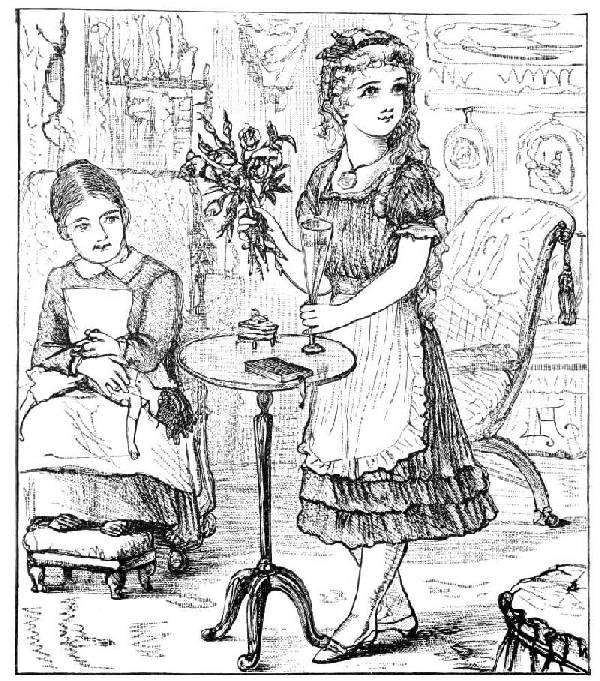
My roses were received with a cry of delight;
and, while Lady Jane put them in a delicate glass,
Sally made me sit down in the most comfortable
chair, and then she asked her ward to sing to me.
The girl had a wonderful voice, soft and clear
and full.
When she had done singing, Sally said, “I have
thought sometimes that, if no better fortune comes,
Lady Jane can sing herself into good luck.”
“I count on something better than that,” the
little lady cried carelessly. “When I ‘come to
my own,’ like the princesses in all the fairy tales,
I’ll send you my picture, Sally, and it will make
you less trouble than I do. It won’t wear out its
gowns, nor want all the strawberries for supper.”
Sally didn’t answer; but two great tears gathered
in her eyes, and rolled down her cheeks.
Lady Jane laughed—not unkindly, only childishly—and
said, “Never mind. Don’t cry yet.
You’ll have time enough for that when it all
comes to pass. And you know you want it to
happen; you always say so.”
“Yes, yes, dear, I want it to happen,” Sally
said hastily; “I couldn’t want to shut you up
here for ever, like a flower growing in a dungeon.”
“A pretty, blue-hung dungeon, with nice soft
chairs,” Lady Jane said pleasantly; and then I got
up to go.
Had this beautiful girl any real heart behind
her beauty? I wondered. If the time ever came
when Sally must give her up to some brighter
fate, would it cost the little lady herself one pang?
Could she be wholly insensible to all the devotion
that had been lavished on her for all these years?
I could not tell; but she seemed to me too light a
thing for deep loving.
I carried Bella home to Mistress Brown-Eyes,
who received her with great joy, and with a certain
tender respect, such as we give to those who have
passed through perils. I stayed in London till
“the season” was over,—that is to say, till the
end of July; and then, with the last rose of summer
in my buttonhole, I went over to the fair sea
coast of France.
It was not until the next May that I found myself
in London again; and going to renew my subscription
at Mudie’s, passed the dolls’ hospital.
I looked up at the quaint sign, and the fancy
seized me to go in.
I opened the door, and promptly as ever, the
dwarf surgeon of the dolls stood before me. It
was nearly four o’clock, and the hospital was
empty of customers. Nothing in it was changed
except the face of the surgeon. Out of that
always plain face a certain cheerful light had
faded. It looked now like a face accustomed to
tears. I said,—
“Do you remember me, Dr. Sally?”
A sort of frozen smile came to the poor trembling
lips.
“Oh, yes’m. You’re the lady that brought the
rose-buds to Lady Jane.”
“And is she well?” I asked.
“I think so, ma’am. Heaven knows I hope so;
but the old days when I knew are over. Won’t
you come into the sitting-room, please?”
I wanted nothing better for myself, and I felt
that it might ease her sad heart to break its silence;
so I followed her into the familiar room. It, at
least, was unchanged. The blue hangings were
there, and the low easy-chairs, and the pretty
trifles; and yet, somehow, the room seemed cold,
for the beauty which had gladdened it last year
had gone for ever.
“Will you tell me what happened?” I asked;
and I know the real sympathy I felt must have
sounded in my voice.
“It wasn’t long after you were here,” she said,
“a lady was driving by, and she saw my sign.
She sent her footman to the door to see if the
place was really what that said; and the next day
she came in herself and brought a whole load of
broken toys. She said she wanted these things
put in order to take into the country, for they
were favorite playthings of her little girl’s.
“I turned then and looked at the child who had
come in with her mother. I can never tell you
how I felt. It was as though Lady Jane had gone
back six years. Just what my darling was when
she came to me, this little girl was now,—the
very same blue eyes, and bright, fair hair, and the
pretty, pink-and-white face.
“Just at that moment, Lady Jane came into the
hospital, and when the lady saw her, she stood
and gazed as if she had seen a ghost. I looked
at the lady herself, and then I looked at Lady
Jane, and then again at the little girl; and true
as you live, ma’am, I knew it was Lady Jane’s
mother and sister before ever a word was spoken.
I felt my knees shaking under me, and I held fast
to the counter to keep from falling. I couldn’t
have spoken first, if my life had depended on it.
“The lady looked, for what seemed to me a long
time; and then she walked up to my darling and
touched the locket that she wore on her neck.
At last she turned to me and asked, with a little
sternness in her gentle voice, if I would tell her
who this girl was, and how I came by her.
“So I told her the whole story, just as I had
told it to you, and before I had finished, she was
crying as if her heart would break. Down she
went on her knees beside Lady Jane, and put her
arms around her, and cried,—
“‘O my darling, my love, I thought you were
dead! I am your mother—oh, believe me, my
darling! Love me a little, a little,—after all
these years!’
“And just as properly as if she had gone
through it all in her mind a hundred times beforehand,
Lady Jane answered,—
“‘I always expected you, mamma.’
“Somehow, the lady looked astonished. She
grew quieter, and stood up, holding Lady Jane’s
hand.
“‘You expected me?’ she said, inquiringly.
“‘Yes, you know I knew I had been stolen;
and I used to think and think, and fancy how my
true mother would look, and what my right home
would be; and I always felt sure in my heart that
you would come some day. I didn’t know when
or how it would be; but I expected you.’
“‘And when will you be ready to go with me?’
asked the mother.
“‘When you please, mamma.’
“The lady hesitated, and turned to me. ‘I owe
you so much,’ she said, ‘so much that I can never
hope to pay it; and I do not like to grieve you.
But her father and I have been without Jane so
long, could you spare her to me at once?’
“‘That must be as you and she say, ma’am,’ I
answered, trying as hard as I could to speak quietly.
‘I never have wanted any thing but that
she should be well off and happy so far, and won’t
begin to stand in her light now.’
“Then the lady turned to the little girl who
had come in with her. ‘Ethel,’ she said, ‘this is
your sister. She has been lost to us eight years,
but we will keep her always, now.’ And then,
with more thanks to me, she started to go away,—the
stately, beautiful lady, with her beautiful
girls, one on each side of her.
“They got to the door, and suddenly my darling
turned,—O ma’am, it’s the best thing in my
whole life to remember that! Of her own accord
she turned and came back to me, and said she,—
“‘Don’t think, Sally, that I’m not sorry to say
good-by. Of course I can’t be sorry to find my
own mamma and my right home, but I’m sorry to
leave you.’
“And then she put her arms round my neck
and kissed me just as she had done when I took
her home that night from Jacopo’s, six years
before; and then she went away, and the sunshine,
it seemed to me, went out of the door
with her, and has never come back since.”
The poor little surgeon of the dolls stopped
speaking, and cried very quietly, as those cry who
are not used to have their tears wiped away, or
their sorrows comforted.
I wanted to say that Lady Jane seemed to me a
heartless little piece, who cared for nothing in the
world but herself, and wasn’t worth grieving for;
but I felt there would be no comfort for her in
thinking that there had never been any thing
worth having in her life. Far better let her go on
believing that for six years she had sheltered an
angel at her fireside.
At last, when I saw her tears were ceasing to
flow, I said, “And when did you see her again?”
“Oh, I have never seen her since that day. I
think she pitied me too much to come back and
give me the sorrow of parting with her over again.
No, I have never seen her, but her mother sent me
five hundred pounds.”
“And so she ought,” I said impulsively. “It
was little enough for all you had done.”
Surgeon Sally looked at me with wonder, not
unmixed with reproach, in her eyes.
“Do you think I wanted that?” she asked. “I
had had my pay for all I did, ten times over, in
just having her here to look at and to love.
No; I sent the money back, and I think it must
be that my darling understood; for, two months
afterwards, I received the only gift I would
have cared to have,—her portrait. Will you
please to look round, ma’am? It hangs behind
you.”
I looked round, and there she was, even lovelier
than when I had seen her first,—a bright, smiling
creature, silken-clad, patrician to the finger-tips.
But it seemed to me that no heart of love looked
out of the fair, careless face. I thought I would
rather be Surgeon Sally, and know the sweetness
of loving another better than myself.
“She is very beautiful,” I said, as I turned
away.
“Yes; and sometimes I almost think I feel her
lips, her bonny bright lips, touch my face, as they
did that last day, and hear her say, ‘Don’t think,
Sally, that I’m not sorry.’ Oh, my lot isn’t hard,
ma’am. I might have lived my life through and
never have known what it was to have something
all my own to love. God was good.
“And after all, ma’am,” she added cheerfully,
“there’s nothing happier in the world than to
give all the pleasure you can to somebody.”
And I went away, feeling that the dwarf surgeon
of the dolls’ hospital had learned the true
secret of life.
PRETTY MISS KATE.
Everybody called her “pretty Miss Kate.”
It was an odd title, and she had come by it
in an odd way. A sort of half-witted nurse,
whose one supreme merit was her faithfulness,
had tended Squire Oswald’s baby daughter all
through her early years; and she it was who had
first called the girl “pretty Miss Kate.”
It was a small neighborhood where everybody
knew everybody else; and, by dint of much hearing
this title, all the neighbors grew to use it.
And, indeed, at fifteen Kate Oswald deserved it.
She was a tall, slight girl, with a figure very graceful,
and what people call stylish.
She had blue eyes; not the meaningless blue of
a French doll, but deep and lustrous, like the tender
hue of the summer sky. She had hair like
some Northland princess. It had not a tint of
yellow in it, but it was fine and fair, and so light
as to be noticeable anywhere. Her skin was
exquisite, too, as skin needs must be to match
such hair. When any color came to the cheeks
it was never crimson, but just the faintest tint
of the blush rose; her lips alone were of rich,
vivid bloom. A prettier creature, truly, seldom
crosses this planet; and the few such girls who
have lived among us, and grown to womanhood,
have made wild work generally, using hearts for
playthings; and, like other children, breaking
their toys now and then. But pretty Miss Kate
was not at the age yet for that sort of pastime,
and her most ardent worshipper was little Sally
Green.
There was a curious friendship between these
two, if one may call that friendship which is made
up of blind worship on one side and gentle pity
and kindliness on the other.
Squire Oswald owned the poor little house where
Widow Green lived, and whenever there was an
unusual press of work at the great house above,
the family washing used to be sent down to Mrs.
Green at the foot of the hill. Many an hour the
widow worked busily, fluting the delicate ruffles
and smoothing the soft muslins, out of which pretty
Miss Kate used to bloom as a flower does out of its
calyx. And on these occasions Sally used to carry
the dainty washing home, and she nearly always
contrived to be permitted to take it up to Miss
Kate’s room, herself.
Nobody thought much about little Sally Green
any way,—least of all did any one suspect her of
any romantic or heroic or poetical qualities. And
yet she had them all; and if you came to a question
of soul and mind, there was something in
Sally which entitled her to rank with the best.
She was a plain, dark little thing, with a stubbed,
solid, squarely-built figure; with great black eyes,
which nobody thought any thing about in her, but
which would have been enough for the whole
stock-in-trade of a fashionable belle; with masses
of black hair that she did not know what to do
with; and with a skin somewhat sallow, but
smooth. No one ever thought how she looked,
except, perhaps, pretty Miss Kate.
One day, when the child brought home the
washing, Kate had been reading aloud to a friend,
and Sally had shown an evident inclination to linger.
At that time Kate was not more than fourteen,
and the interest or the admiration in Sally’s
face struck her, and, moved by a girl’s quick impulse,
she had said,—
“Do you want to hear all of it, Sally? Wait,
then, and I will read it to you.”
The poem was Mrs. Browning’s “Romance of
the Swan’s Nest,” and it was the first glimpse for
Sally Green into the enchanted land of poetry
and fiction. Before that she had admired pretty
Miss Kate, but now the feeling grew to worship.
Kate was not slow to perceive it, with that feminine
instinct which somehow scents out and delights
in the honest admiration of high or low, rich
or poor. She grew very kind to little Sally. Many
a book and magazine she lent the child; and now
and then she gave her a flower, a bit of bright
ribbon, or some little picture. To poor Sally
Green these trifles were as the gifts of a goddess,
and no devotee ever treasured relics from
the shrine of his patron saint more tenderly than
she cherished any, even the slightest, token which
was associated with the beautiful young lady whom
she adored with all her faithful, reverent, imaginative
heart.
One June evening Sally had been working hard
all day. She had washed dishes, run her mother’s
errands, got supper, and now her reward was to
come.
“You may make yourself tidy,” her mother said,
“and carry home that basket of Miss Kate’s things
to Squire Oswald’s.”
Sally flew upstairs, and brushed back her black
locks, and tied them with a red ribbon Miss Kate
had given her. She put on a clean dress, and a
little straw hat that last year had been Miss Kate’s
own; and really for such a stubbed, dark little
thing, she looked very nicely. She was thirteen—two
years younger than her idol—and while Miss
Kate was tall, and looked older than her years,
Sally looked even younger than she was. Her
heart beat as she hurried up the hill. She thought
of the fable of the mouse and the lion, which she
had read in one of the books Miss Kate had lent
her. It made her think of herself and her idol.
Not that Miss Kate was like a lion at all,—no, she
was like a beautiful princess,—but she herself was
such a poor, humble, helpless little mouse; and yet
there might be a time, if she only watched and
waited, when she, even she, could do pretty Miss
Kate some good. And if the time ever came,
wouldn’t she do it, just, at no matter what cost to
herself? Poor little Sally! The time was on its
way, and nearer than she thought.
She found Miss Kate in her own pretty room,—a
room all blue and white and silver, as befitted
such a fair-haired beauty. The bedstead and wardrobe
were of polished chestnut, lightly and gracefully
carved. The carpet was pale gray, with
impossible blue roses. The blue chintz curtains
were looped back with silver cords; there were
silver frames, with narrow blue edges, to the few
graceful pictures; and on the mantel were a clock
and vases with silver ornaments.
Pretty Miss Kate looked as if she had been
dressed on purpose to stay in that room. She wore
a blue dress, and round her neck was a silver necklace
which her father had brought her last year
from far-off Genoa. Silver ornaments were in her
little ears, and a silver clasp fastened the belt at
her waist. She welcomed Sally with a sweet graciousness,
a little conscious, perhaps, of the fact
that she was Miss Oswald, and Sally was Sally
Green; but to the child her manner, like every
thing else about her, seemed perfection.
“Sit down and stay a little, Sally,” she said,
“I have something to tell you. Do you remember
what you heard me read that first time, when your
eyes got so big with listening, and I made you stay
and hear it all?”
“Yes, indeed,” Sally cried eagerly. “I never
forgot any thing I ever heard you read. That first
time it was ‘The Romance of the Swan’s Nest.’”
“Yes, you are right, and I know I was surprised
to find how much you cared about it. I
began to be interested in you then, for you know
I am interested in you, don’t you, Sally?”
Sally blushed with pleasure till her face glowed
like the June roses in Miss Kate’s silver vases,
but she did not know what to say, and so, very
wisely, she did not say any thing. Miss Kate
went on,—
“Well, that very same poem I am going to read,
next Wednesday night, at the evening exercises in
the academy. The academy hall won’t hold everybody,
and so they are going to be admitted by
tickets. Each of us girls has a certain number to
give away, and I have one for you. I thought you
would like to go and see me there among the rest
in my white gown, and hear me read the old verses
again.”
You would not have believed so small a thing
could so have moved anybody; but Sally’s face
turned from red to white, and from white to red
again, and her big black eyes were as full of tears
as an April cloud is of rain-drops.
“Do you mean it, truly?” she asked.
“Yes, truly, child. Here is your ticket. Why,
don’t cry, foolish girl. It’s nothing. I wanted to
be sure of one person there who would think I
read well, whether any one else did or not. And
I’ve a gown for you, too—that pink muslin,
don’t you know, that I wore last year? I’ve shot
up right out of it, and it’s of no use to me, now,
and mamma said I might give it to you. This is
Saturday; you can get it ready by Wednesday,
can’t you?”
What a happy girl went home that night, just as
the rosy June sunset was fading away, and ran,
bright and glad and full of joyful expectation, into
the Widow Green’s humble little house! Widow
Green wasn’t much of a woman, in the neighbors’
estimation. She was honest and civil, and she
washed well; but that was all they saw in her.
Sally saw much more. She saw a mother who
always tried to make her happy; who shared her
enthusiasms, or at least sympathized with them;
who was never cross or jealous, or any thing
but motherly. She was as pleased, now, at the
prospect of Sally’s pleasure as Sally herself was;
and just as proud of this attention from pretty
Miss Kate. Together they made over the pink
muslin dress; and when Wednesday night came
the widow felt sure that her daughter was as well
worth having, and as much to be proud of, as
any other mother’s daughter that would be at
the academy.
“You must go very early,” she said, “to get a
good seat; and you need not be afraid to go right
up to the front. You’ve just as good right to
get close up there as anybody.”
When Sally was going out, her mother called her
back.
“Here, dear,” she said, “just take the shawl.
Do it to please me, for there’s no knowing how
cold it might be when you get out.”
“The shawl” was an immense Rob Roy plaid,—a
ridiculous wrap, truly, for a June night; but
summer shawls they had none, and Sally was too
dutiful, as well as too happy, not to want to please
her mother even in such a trifle. How differently
two lives would have come out if she had
not taken it!
She was the very first one to enter the academy.
Dare she go and sit in the front row so
as to be close to pretty Miss Kate? Ordinarily
she would have shrunk into some far corner,
for she was almost painfully shy; but now something
outside herself seemed to urge her on. She
would not take up much room,—this something
whispered,—and nobody, no, nobody at all, could
love Miss Kate better than she did. So she
went into the very front row, close up to the
little stage on which the young performers were
to appear,—a veritable stage, with real foot-lights.
Soon the people began to come in, and after a
while the lights were turned up, and the exercises
commenced. There were dialogues and music,
and at last the master of ceremonies announced the
reading of “The Romance of the Swan’s Nest,”
by Miss Kate Oswald.
Other people had been interested in what went
before, no doubt; but to Sally Green the whole
evening had been but a prelude to this one triumphant
moment for which she waited.
Pretty Miss Kate came forward like a little
queen,—tall and slight, with her coronet of fair,
braided hair, in which a shy, sweet rosebud nestled.
She wore a dress of white muslin, as light and
fleecy as a summer cloud, with a sash that might,
as far as its hue went, have been cut from the deep
blue sky over which that summer cloud floated. A
little bunch of flowers was on her bosom, and other
ornament she had none. She looked like one of
the pretty creatures, half angel and half woman of
fashion, which some of the modern French artists
paint.
As she stepped forward she was greeted with a
burst of irrepressible applause, and then the house
was very still as she began to read. How her soft
eyes glowed, and the blushes burned on her dainty
cheeks, when she came to the lines:—
“Little Ellie in her smile Chooseth: ‘I will have a lover, Riding on a steed of steeds! He shall love me without guile, And to him I will discover That swan’s nest among the reeds.
“‘And the steed shall be red-roan, And the lover shall be noble, With an eye that takes the breath, And the lute he plays upon Shall strike ladies into trouble, As his sword strikes men to death.’”
She had the whole audience for her lovers before
she was through with the poem, and the last
verse was followed with a perfect storm of applause.
Was she not young and beautiful, with a
voice as sweet as her smile? And then she was
Squire Oswald’s daughter, and he was the great
man of the village.
She stepped off the stage; and then the applause
recalled her, and she came back, pink with
pleasure. A bow, a smile, and then a step too
near the poorly protected foot-lights, and the
fleecy white muslin dress was a sheet of flame.
How Sally Green sprang over those foot-lights
she never knew; but there she was, on the stage,
and “the shawl” was wrapped round pretty Miss
Kate before any one else had done any thing but
scream. Close, close, close, Sally hugged its
heavy woollen folds. She burned her own fingers
to the bone; but what cared she? The time of
the poor little mouse had come at last.
And so pretty Miss Kate was saved, and not so
much as a scar marred the pink and white of her
fair girl’s face. Her arms were burned rather
badly, but they would heal, and no permanent
harm had come to her.
Sally was burned much more severely, but she
hardly felt the pain of it in her joy that she had
saved her idol, for whom she would have been so
willing even to die. They took her home very
tenderly, and the first words she said, as they led
her inside her mother’s door, were,—
“Now, mother, I know what I took the shawl
for!”
I said how differently two lives would have
ended if she had not taken that shawl. Pretty
Miss Kate’s would have burned out then and
there, no doubt; for if any one else were there
with presence of mind enough to have saved her,
certainly there was no other wrap there like “the
shawl.” And then Sally might have grown up to
the humblest kind of toil, instead of being what
she is to-day; for Squire Oswald’s gratitude for
his daughter’s saved life did not exhaust itself in
words. From that moment he charged himself
with Sally Green’s education, and gave her every
advantage which his own daughter received.
And, truth to tell, Sally, with her wonderful temperament,
the wealth of poetry and devotion and
hero-worship that was in her, soon outstripped
pretty Miss Kate in her progress.
But no rivalry or jealousy ever came between
them. As Sally had adored Kate’s loveliness, so,
in time, Kate came to do homage to Sally’s
genius; and the two were friends in the most
complete sense of the word.
A BORROWED ROSEBUD.
There was a pattering footfall on the piazza,
and Miss Ellen Harding went to look out.
She saw a little figure standing there, among the
rosebuds,—not one of the neighbors’ children, but
a bonny little lassie, with curls of spun gold, and
great, fearless brown eyes, and cheeks and lips as
bright as the red roses on the climbing rosebush
beside her.
A little morsel, not more than five years old, she
was; with a white dress, and a broad scarlet sash,
and a hat which she swung in her fingers by its
scarlet strings. She looked so bright and vivid,
and she was such an unexpected vision in that
place, that it almost seemed as if one of the poppies
in the yard beyond had turned into a little
girl, and come up the steps.
“Did you want me?” Miss Harding asked, going
up to the tiny blossom of a creature.
“No, if you please.”
“My father, then, Dr. Harding,—were you
sent for him?”
The child surveyed her, as if in gentle surprise
at so much curiosity.
“No,” she answered, after a moment. “I am
Rosebud; and I don’t want anybody. Jane told
me to come here, and she would follow presently.”
She said the words with a singular correctness
and propriety, as if they were a lesson which she
had been taught.
“And who is Jane?” Miss Harding asked.
Evidently the process of training had gone no
further. The child looked puzzled and uncomfortable.
“Jane?” she answered hesitatingly. “Why,
she is Jane.”
“Not your mamma?”
“No,—just Jane.”
“And what did Jane want here?”
“She told me to come, and she would follow
presently,” said the child, saying her little lesson
over again.
Evidently there was nothing more to be got out
of her; but Miss Harding coaxed her to come
into the cool parlor, and wait for Jane; and gave
her some strawberries and cream in a gayly painted
china saucer, that all children liked. Rosebud
was no exception to the rest. When she had
finished her berries, she tapped on the saucer with
her spoon.
“I will have it for mine, while I stay,—may
I?” she said. “Not to take away, but just to
call, you know.”
“Surely,” said Miss Harding, more puzzled than
ever. Had the sprite, then, come to stay? Were
there, by chance, fairies after all,—and was this
some changeling from out their ranks? She tried
to entertain her small guest; and she found her
quite accessible to the charms of pictures, and contented
for an hour with a box of red and white
chessmen. Towards night her curiosity got the
better of her courtesy; and, looking from the
window, she inquired,—
“I wonder where your Jane can be?”
“Presently; Jane said presently,” answered the
child, with quiet composure, and returned to the
chessmen.
Miss Harding heard her father drive into the
yard, and slipped out to speak to him. She told
her story, and the doctor gave a low, soft whistle.
It was a way he had when any thing surprised him.
“It looks to me,” said he, “as if Jane, whoever
she may be, intended to make us a present of Miss
Rosebud. Well, we must make the small person
comfortable to-night, and to-morrow we will see
what to do with her.”
The small person was easily made comfortable.
She ate plenty of bread-and-milk for her supper,
and more strawberries; and when it was over, she
went round and stood beside the doctor.
“I think you are a dood man,” she said, with the
quaint gravity which characterized all her utterances.
“I should like to sit with you.”
The doctor lifted her to his knee, and she laid
her little golden head against his coat. There
was a soft place under that coat, as many a sick and
poor person in the town knew very well. I think
the little golden head hit the soft place. He stroked
the shining curls very tenderly. Then he asked,—
“What makes you think I’m a ‘dood’ man,
Pussy-cat?”
“My name is not Pussy-cat,—I am Rosebud,”
she replied gravely; “and I think you are dood
because you look so, out of your eyes.”
The little morsel spoke most of her words with
singular clearness and propriety. It was only
when a “g” came in that she substituted a “d”
for it, and went on her way rejoicing.
As the doctor held her, the soft place under his
coat grew very soft indeed. A little girl had been
his last legacy from his dying wife; and she had
grown to be about as large as Rosebud, and then
had gone home to her mother. It almost seemed
to him as if she had come back again; and it was
her head beneath which his heart was beating. He
beckoned to his daughter.
“Have you some of Aggie’s things?” he asked.
“This child must be made comfortable, and she
ought to go to bed soon.”
“No,” the child said; “I’m doing to sit here till
the moon comes. That means ‘do to bed.’”
“Yes, I have them,” Miss Harding answered.
She had loved Aggie so well, that it seemed half
sacrilege to put her dead sister’s garments on this
stranger child; and half it was a pleasure that
again she had a little girl to dress and cuddle. She
went out of the room. Soon she came running
back, and called her father.
“O, come here! I found this in the hall. It is
a great basket full of all sorts of clothes, and it is
marked ‘For Rosebud.’ See,—here is every thing
a child needs.”
The doctor had set the little girl down, but she
was still clinging to his hand.
“I think,” he said, “that Jane has been here,
and that she does not mean to take away our Rosebud.”
But the little one, still clinging to him, said,—
“I think it is not ‘presently’ yet,—Jane
wouldn’t come till ‘presently.’”
“Do you love Jane?” the doctor asked, looking
down at the flower-like face.
“Jane is not mamma. She is only Jane,” was
the answer.
When the moon rose, the little girl went willingly
to bed; and all night long Miss Ellen Harding
held her in her arms, as she used to hold her
little sister, before the angels took her. Since
Aggie’s death, people said Miss Ellen had grown
cold and stiff and silent. She felt, herself, as if
she had been frozen; but the ice was melting, as
she lay there, feeling the soft, round little lump of
breathing bliss in her arms; and a tender flower
of love was to spring up and bloom in that heart
that had grown hard and cold.
There was no talk of sending Rosebud away,
though some people wondered much at the doctor,
and even almost blamed him for keeping this child,
of whom he knew nothing. But he wanted her,
and Miss Ellen wanted her; and, indeed, she
was the joy and life and blessing of the long-silent
household.
She was by no means a perfect child. A well-mannered
little creature she was,—some lady had
brought her up evidently,—but she was self-willed
and obstinate. When she had said, “I’m
doing to do” such and such a thing, it was hard
to move her from her purpose; unless, indeed,
the doctor interposed, and to him she always
yielded instantly. But, just such as she was, they
found her altogether charming. The doctor never
came home without something in his pocket to reward
her search; Miss Ellen was her bond-slave;
and Mistress Mulloney in the kitchen was ready
to work her hands off for her.
Often, when she had gone to bed, the doctor and
Miss Ellen used to talk over her strange coming.
“We shall lose her some day,” the doctor would
say, with a sigh. “No one ever voluntarily abandoned
such a child as that. She is only trusted to
our protection for a little while, and presently we
shall have to give her up.”
“Should you be sorry, father,” Miss Ellen would
inquire, “that we had had her at all?”
And the doctor would answer thoughtfully
“No, for she has made me young again. I will
not grumble when the snows come because we
have had summer, and know how bright it is.”
But the child lived with them as if she were
going to live with them for ever. If she had any
memories of days before she came there, she never
alluded to them. After the first, she never mentioned
Jane,—she never spoke of a father or
mother. But she was happy as the summer days
were long,—a glad, bright, winsome creature as
ever was the delight of any household.
And so the days and the weeks and the months
went on, and it was October. And one day the
bell rang, and Mistress Mulloney went to the door,
and in a moment came to the room where Miss
Ellen was sitting, with Rosebud playing beside her,
and beckoned to her mistress.
“It’s some one asking for the child,” she said.
“Can’t we jist hide her away? It’ll be hard for
the doctor if she’s took.”
“No; we must see who it is, and do what is
right,” Miss Ellen answered; but her lips trembled
a little. She went into the hall, and there, at
the door, stood a woman, looking like a nursery-maid
of the better sort.
“I have come,” the stranger began; but Rosebud
had caught the sound of her voice, and came
on the scene like a flash of light.
“It is ‘presently!’” she cried; “and there, oh,
there is mamma!” And down the path she flew,
and into the very arms of a lady who was waiting
at a little distance.
Miss Harding went down the steps. “You have
come, I see, to claim our Rosebud, and she is only
too ready to be claimed. I thought we had made
her happy.”
The child caught the slight accent of reproach
in Miss Ellen’s voice, and turned towards her.
“You have been dood, oh, so very, very dood!”
she said, “but this is mamma.”
“I trusted my darling to you in a very strange
way,” the lady began, “but not, believe me, without
knowing in whose hands I placed her. I was
in mortal terror, then, lest she should be taken
from me, and I dared not keep her until she had
been legally made mine, and mine only. But you
have made me your debtor for life, and I shall try
to show it some day.”
“But, at least, you will come in and wait until
my father returns. He loves Rosebud so dearly,
that it would be a cruelty to take her away until
he has had time to bid her good-by.”
“You are right,” the stranger answered courteously.
“Jane, go with the carriage to the hotel,
and I will come or send for you when I want
you.”
In a few moments more the strange lady was
seated in the doctor’s parlor. Miss Harding saw
now where Rosebud had got her bright, wilful
beauty.
“I must explain,” the mother said, as she lifted
her child upon her lap. “I am Mrs. Matthewson.
My husband is dead, and Rosebud has a very, very
large fortune of her own. Her uncles, who were
to have the management of her property, by her
father’s will, claimed her also; and I have had
such a fight for her! They were unscrupulous
men, and I feared to keep Rosebud with me, lest
by some means they should get some hold on her.
So I resolved to lend her to you for the summer;
and, indeed, I never can reward you for all your
care of her.”
“You
can reward us only by not altogether taking
her away from us. We have learned to love
her very dearly.”
And, after a while, the doctor came home and
heard all the story. And it was a week before
Mrs. Matthewson had the heart to take away the
child she had lent them. Then it was not long
before the doctor and Miss Ellen had to go to see
Rosebud. And then, very soon, Mrs. Matthewson
had to bring her back again; and, really, so much
going back and forth was very troublesome; and
they found it more convenient, after a while, to
join their households.
Before Rosebud came, the doctor had thought
himself an old man, though he was only forty-five;
but, as he said, Rosebud had made him young
again; and Rosebud’s mamma found it possible to
love him very dearly. But Miss Ellen always
said it was Rosebud and nobody else whom her
father married, and that he had been in love with
the borrowed blossom from the first.
TOM’S THANKSGIVING.
“It was very provoking that seamstresses and
such people would get married, like the rest
of the world,” Mrs. Greenough said, half in fun
and half in earnest. Her fall sewing was just
coming on, and here was Lizzie Brown, who had
suited her so nicely, going off to be married; and
she had no resource but to advertise, and take
whomsoever she could get. No less than ten
women had been there that day, and not one
would answer.
“There comes Number Eleven; you will see,”
she cried, as the bell rang.
Kitty Greenough looked on with interest. Indeed,
it was her gowns, rather than her mother’s,
that were most pressing. She was just sixteen,
and since last winter she had shot up suddenly, as
girls at that age so often do, and left all her clothes
behind her.
Mrs. Greenough was right,—it was another
seamstress; and Bridget showed in a plain, sad-looking
woman of about forty, with an air of intense
respectability. Mrs. Greenough explained
what she wanted done, and the woman said quietly
that she was accustomed to such work,—would
Mrs. Greenough be so kind as to look at some
recommendations? Whereupon she handed out
several lady-like looking notes, whose writers indorsed
the bearer, Mrs. Margaret Graham, as faithful
and capable, used to trimmings of all sorts, and
quick to catch an idea.
“Very well indeed,” Mrs. Greenough said, as
she finished reading them; “I could ask nothing
better. Can you be ready to come at once?”
“To-morrow, if you wish, madam,” was the
answer; and then Mrs. Graham went away.
Kitty Greenough was an impulsive, imaginative
girl; no subject was too dull or too unpromising
for her fancy to touch it. She made a story for
herself about every new person who came in her
way. After Number Eleven had gone down the
stairs, Kitty laughed.
“Isn’t she a sobersides, mamma? I don’t believe
there’ll be any frisk in my dresses at all if
she trims them.”
“There’ll be frisk enough in them if you wear
them,” her mother answered, smiling at the bright,
saucy, winsome face of her one tall daughter.
Kitty was ready to turn the conversation.
“What do you think she is, mamma,—wife or
widow?” And then answering her own question:
“I think she’s married, and he’s sick, and she has
to take care of him. That solemn, still way she
has comes of much staying in a sick-room. She’s
in the habit of keeping quiet, don’t you see? I
wish she were a little prettier; I think he would
get well quicker.”
“There’d be no plain, quiet people in your
world if you made one,” her mother said, smiling;
“but you’d make a mistake to leave them out.
You would get tired even of the sun if it shone
all the time.”
The next day the new seamstress came, and a
thoroughly good one she proved; “better even
than Lizzie,” Mrs. Greenough said, and this was
high praise. She sewed steadily, and never opened
her lips except to ask some question about her
work. Even Kitty, who used to boast that she
could make a dumb man talk, had not audacity
enough to intrude on the reserve in which Mrs.
Graham intrenched herself.
“He’s worse this morning,” whispered saucy
Kitty to her mother; “and she can do nothing but
think about him and mind her gathers.”
But, by the same token, “he” must have been
worse every day, for during the two weeks she
sewed there Mrs. Graham never spoke of any thing
beyond her work.
When Mrs. Greenough had paid her, the last
night, she said,—
“Please give me your address, Mrs. Graham, for
I may want to find you again.”
“17 Hudson Street, ma’am, up two flights of
stairs; and if I’m not there Tom always is.”
“There, didn’t I tell you?” Kitty cried exultingly,
after the woman had gone. “Didn’t I tell
you that he was sick? You see now,—‘Tom’s
always there.’”
“Yes; but Tom may not be her husband, and I
don’t think he is. He is much more likely to be
her child.”
“Mrs. Greenough, I’m astonished at you. You
say that to be contradictious. Now, it is not
nice to be contradictious; besides, she wouldn’t
look so quiet and sad if Tom were only her
boy.”
But weeks passed on, and nothing more was
heard of Mrs. Graham, until, at last, Thanksgiving
Day was near at hand. Kitty was to
have a new dress, and Mrs. Greenough, who had
undertaken to finish it, found that she had not
time.
“Oh, let me go for Mrs. Graham, mamma,”
cried Kitty eagerly. “Luke can drive me down
to Hudson Street, and then I shall see Tom.”
Mrs. Greenough laughed and consented. In a
few minutes Luke had brought to the door the
one-horse coupé, which had been the last year’s
Christmas gift of Mr. Greenough to his wife, and
in which Miss Kitty was always glad to make an
excuse for going out.
Arrived at 17 Hudson Street, she tripped up two
flights of stairs, and tapped on the door, on which
was a printed card with the name of Mrs. Graham.
A voice, with a wonderful quality of musical
sweetness in it, answered,—
“Please to come in; I cannot open the door.”
If that were “he,” he had a very singular voice
for a man.
“I guess mamma was right after all,” thought
wilful Kitty. “It’s rather curious how often
mamma is right, when I come to think of it.”
She opened the door, and saw, not Mrs. Graham’s
husband, nor yet her son, but a girl, whose face
looked as if she might be about Kitty’s own age,
whose shoulders and waist told the same story;
but whose lower limbs seemed curiously misshapen
and shrunken—no larger, in fact, than those of a
mere child. The face was a pretty, winning face,
not at all sad. Short, thick brown hair curled
round it, and big brown eyes, full of good-humor,
met Kitty’s curious glance.
“I am Tom,” the same musical voice—which
made Kitty think of a bird’s warble—said, in a
tone of explanation. “I can’t get up to open the
door because, don’t you see, I can’t walk.”
“And why—what—Tom”—
Kitty struggled desperately with the question she
had begun to ask, and Tom kindly helped her out.
“Why am I Tom, do you mean, when it’s a
boy’s name; or why can’t I walk? I’m Tom
because my father called me Tomasina, after his
mother, and we can’t afford such long names in this
house; and I can’t walk because I pulled a kettle
of boiling water over on myself when I was six
years old, and the only wonder is that I’m alive at
all. I was left, you see, in a room by myself,
while mother was busy somewhere else, and when
she heard me scream, and came to me, she pulled
me out from under the kettle, and saved the upper
half of me all right.”
“Oh, how dreadful!” Kitty cried, with the
quick tears rushing to her eyes. “It must have
almost killed your mother.”
“Yes; that’s what makes her so still and sober.
She never laughs, but she never frets either; and
oh, how good she is to me!”
Kitty glanced around the room, which seemed
to her so bare. It was spotlessly clean, and Tom’s
chair was soft and comfortable—as indeed a chair
ought to be which must be sat in from morning till
night. Opposite to it were a few pictures on
the wall,—engravings taken from books and
magazines, and given, probably, to Mrs. Graham
by some of her lady customers. Within
easy reach was a little stand, on which stood a
rose-bush in a pot, and a basket full of bright-colored
worsteds, while a book or two lay beside
them.
“And do you never go out?” cried Kitty, forgetting
her errand in her sympathy—forgetting,
too, that Luke and his impatient horse were waiting
below.
“Not lately. Mother used to take me down into
the street sometimes; but I’ve grown too heavy
for her now, and she can’t. But I’m not very dull,
even when she’s gone. You wouldn’t guess how
many things I see from my window; and then I
make worsted mats and tidies, and mother sells
them; and then I sing.”
Kitty stepped to the window to see what range
of vision it offered, and her eye fell on Luke.
She recalled her business.
“I came to see if I could get your mother to sew
two or three days for me this week.”
Tom was alert and business-like at once.
“Let me see,” she said, “to-day is Tuesday;”
and she drew toward her a little book, and looked
it over. “To-morrow is engaged, but you could
have Thursday, Friday, and Saturday, if you
want so much. Please write your name against
them.”
Kitty pulled off her pretty gray glove, and wrote
her name and address with the little toy-pencil at
the end of her chatelaine; and then she turned to
go, but it was Tom’s turn to question.
“Please,” said the sweet, fresh voice, which
seemed so like the clear carol of a bird, “would
you mind telling me how old you are? I’m sixteen
myself.”
“And so am I sixteen,” said Kitty.
“And you have a father and mother both,
haven’t you?”
“Yes, indeed,” said Kitty.
“Oh, I’ve only mother, but she is good as two.
Must you go now? And I wonder if I shall ever
see you again?”
“Yes, you will see me again,” answered Kitty
cheerily; and then, moved by a sudden impulse
of her kind, frank young heart, she bent over and
touched her lips to the bright, bonny face of the
poor girl who must sit prisoner there for ever, and
yet who kept this bright cheerfulness all the time.
“Oh mamma, I’ve had a lesson,” cried Kitty,
bursting into her mother’s room like a fresh wind,
“and Tom has taught it to me; and he isn’t he
at all—she’s a girl just my age, and she can’t
walk—not a step since she was six years old.”
And then Kitty told all the sad, tender little
story, and got to crying over it herself, and made
her mother cry, too, before she was through.
After dinner she sat half the evening in a brown
study. Finally she came out of it, and began
talking in her usual impulsive manner.
“Can’t we have them here to Thanksgiving,
mamma? There’s not a single pretty thing in
that house except Tom herself, and the rose-bush;
and every thing did look so bare and clean
and poverty-stricken; and I know they’ll never
afford a good dinner in the world. Oh, say yes,
mamma, dear! I know you’ll say yes, because
you’re such a dear, and you love to make every
one happy.”
“Yes; but, first of all, I must love to make
papa happy, must I not? You know he never
wants any company on Thanksgiving but grandpa
and grandma and Uncle John. I’m sure you
would not like to spoil papa’s old-fashioned
Thanksgiving Day.”
Kitty’s countenance fell. She saw the justice
of her mother’s remark, and there was no more to
be said. She sat thinking over her disappointment
in a silence which her mother was the one to
break.
“But I’ve thought of a better thing, Puss,”
said this wise mamma, who was herself every bit
as tender of heart as Kitty, and cared just as much
about making people happy. “No doubt Mrs.
Graham and Tom would just as much prefer being
alone together as papa prefers to be alone with his
family; and how will it suit you if I have a nice
dinner prepared for them, and let you go and take
it to them in the coupé? Mrs. Graham is hardly
the woman one could take such a liberty with;
but I’ll beg her to let you have the pleasure of
sending dinner to Tom.”
“Oh, you darling!” and Mrs. Greenough’s neck-ruffle
suffered, and her hair was in danger, as was
apt to be the case when Kitty was overcome with
emotion, which could only find vent in a rapturous
squeeze.
Before bed-time Kitty had it all planned out.
She was to go in the coupé and take Bridget and
the basket. Bridget was to mount guard by the
horse’s head while Luke went upstairs with Kitty
and brought down Tom for a drive; and while
they were gone Bridget would take the basket in,
and see that every thing was right, and then go
home.
Mrs. Greenough consented to it all. I think
she enjoyed the prospect of Tom’s ride, herself,
just as much as Kitty did. While Mrs. Graham
was sewing there she made the arrangement with
her, approaching the subject so delicately that the
most sensitive of women could not be hurt, and
putting the acceptance of both drive and dinner in
the light of a personal favor to Kitty, who had
taken such a fancy to Tom.
The last afternoon of Mrs. Graham’s stay Kitty
called her mother into her room. Mrs. Greenough
saw spread out upon the bed a thick, warm, soft
jacket, a woollen dress, a last year’s hat.
“You know them by sight, don’t you, mother
mine? They are the last winter’s clothes that I
grew away from, and have taken leave of. May
Tom have them?”
“Yes, indeed, if you’ll undertake to give them
to Tom’s mother.”
Kitty had seldom undertaken a more embarrassing
task. She stole into the sewing-room with
the things in her arms.
“You’ll be sure, won’t you, Mrs. Graham, not
to let Tom know she’s going to ride until I get
there, because I want to see how surprised she’ll
look?”
“Yes, I’ll be sure, never fear.”
“And, Mrs. Graham, here are my coat and hat
and dress that I wore last year, and I’ve grown
away from them. Would you mind letting Tom
wear them?”
“Would I mind?” A swift, hot rush of tears
filled Mrs. Graham’s eyes, which presently she
wiped away, and somehow then the eyes looked
gladder than Kitty had ever seen them before. “Do
you think I am so weakly, wickedly proud as to be
hurt because you take an interest in my poor girl,
and want to put a little happiness into her life,—that
still, sad life which she bears so patiently?
God bless you, Miss Kitty! and if He doesn’t, it
won’t be because I shall get tired of asking Him.”
“And you’ll not let her see the hat and jacket
till I come, for fear she’ll think something?”
At last Mrs. Graham smiled—an actual smile.
“How you do think of every thing! No, I’ll
keep the hat and jacket out of sight, and I’ll have
the dress on her, all ready.”
When Thanksgiving came Kitty scarcely remembered
to put on the new fineries that Mrs.
Graham had finished with such loving care;
scarcely gave a thought to the family festivities at
home, so eager was she about Tom’s Thanksgiving.
She was to go to Hudson Street just at
noon, so that Tom might have the benefit of the
utmost warmth of which the chill November day
was capable.
First she saw the dinner packed. There was a
turkey, and cranberry-sauce, and mince-pie, and
plum-pudding, and a great cake full of plums, too,
and fruit and nuts, and then Mr. Greenough, who
had heard about the dinner with real interest,
brought out a bottle of particularly nice sherry,
and said to his wife,—
“Put that in also. It will do those frozen-up
souls good, once in the year.”
At last impatient Kitty was off. Bridget and
the basket filled all the spare space in the coupé,
and when they reached Hudson Street, Luke took
the dinner and followed Kitty upstairs, while
Bridget stood by the horse’s head, according to
the programme. He set the basket down in the
hall, where no one would be likely to notice it in
opening the door, and then he stood out of sight
himself, while Kitty went in.
There was Tom, in the warm crimson thibet,—a
proud, happy-looking Tom as you could find in
Boston that Thanksgiving Day.
“I have come to take you to ride,” cried eager
Kitty. “Will you go?”
It was worth ten ordinary Thanksgivings to see
the look on Tom’s face,—the joy and wonder, and
then the doubt, as the breathless question came,—
“How will I get downstairs?”
And then Luke was called in, and that mystery
was solved. And then out of a closet came the
warm jacket, and the hat, with its gay feather;
and there were tears in Tom’s eyes, and smiles
round her lips, and she tried to say something, and
broke down utterly. And then big, strong Luke
took her up as if she were a baby and marched
downstairs with her, while she heard Kitty say,—but
it all seemed to her like a dream, and Kitty’s
voice like a voice in a dream,—
“I’m sorry there’s nothing pretty to see at this
time of year. It was so lovely out-doors six weeks
ago.”
Through Beach Street they went, and then
through Boylston, and the Common was beside
them, with its tree-boughs traced against the November
sky, and the sun shone on the Frog Pond,
and the dome of the State House glittered goldenly,
and there were merry people walking about
everywhere, with their Thanksgiving faces on;
and at last Tom breathed a long, deep breath
which was almost a sob, and cried,—
“Did you think there was nothing pretty to see
to-day—this day? Why, I didn’t know there
was such a world!”
The clocks had struck twelve when they left
Hudson Street; the bells were ringing for one
when they entered it again. Bridget was gone,
but a good-natured boy stood by the horse’s head,
and Kitty ran lightly upstairs, followed by Luke,
with Tom in his arms.
Kitty threw open the door, and there was a
table spread with as good a Thanksgiving dinner
as the heart could desire, with Tom’s chair
drawn up beside it. Luke set his light burden
down.
Kitty waited to hear neither thanks nor exclamations.
She saw Tom’s brown eyes as they
rested on the table, and that was enough. She
bent for one moment over the bright face,—the
cheeks which the out-door air had painted red as
the rose that had just opened in honor of the day,—and
left on the young, sweet, wistful lips a kiss,
and then went silently down the stairs, leaving
Tom and Tom’s mother to their Thanksgiving.
FINDING JACK.
Conn turned over and rubbed her sleepy blue
eyes. It seemed to her that the world was
coming to an end all at once, there was such a
Babel of noise about her. What was it? Had
everybody gone mad? Then her wits began to
wake up. She remembered that it was Fourth of
July. That worst noise of all—why, that must
be Jack’s pistol, which he had been saving up
money to buy all winter and all summer. And
that other sound—that must be torpedoes; and
there was the old dog, Hero, barking at them, and
no wonder: it was enough to make any respectable
dog bark. Fire-crackers—ugh! Wasn’t the
pistol bad enough, without all these side shows?
Just then Jack called out from the yard below,—
“Conn! Conn!”
The girl’s name was Constantia Richmond; but
she was too slight and bonny for such a long name,
and everybody called her Conn.
She shook back her fair, soft curls, as golden as
a baby’s still, though Conn was fourteen, and,
putting a little shawl over her shoulders, peeped
out of the open window—as pretty a little slip of
a girl as you would care to see—and looked down
on the face, half-boyish, half-manly, which was upturned
to her. If Jack had been her brother, perhaps
she would have scolded at him; for Conn
loved her morning nap, and the general din had
discomposed her, no doubt. But Jack was only
her cousin, and her second cousin, at that,—and
it’s curious what a difference that does make.
Your brother’s your brother all the days of his
life; but your cousin is another affair, and far less
certain. So Conn said, quite gently,—
“What is it? Can I do any thing? But I’m
sure I don’t want to help you make any more
noise. This has been—oh, really dreadful!”
She spoke with a droll little fine-lady air, and
put her pretty little fingers to her pretty little
ears. And Jack laughed; he had not begun to
think of her yet as a charming girl,—she was
just Cousin Conn.
“What!” he cried. “Not like noise on Fourth
of July? Why, you don’t deserve to have a
country.”
“I’m sure I wish I hadn’t,” said Conn, with a
little dash of spirit.
“Are you dressed?” cried the boy, nearly
seventeen years old, but all a boy still.
“No.”
“Well, just hurry, then, and come down. I’m
off in half an hour with the Brighton Blues, and I
want you to see first how this pistol works.”
High honor this, that she, a girl, should be invited
to inspect the wonderful pistol!
Conn began to dress hurriedly. What should
she put on? Her white dress hung in the closet,—such
a white dress as girls wore then,—all
delicate ruffles, and with a blue ribbon sash, as
dainty-fine as possible. She knew that was meant
for afternoon, when Aunt Sarah would have company.
But might she not put it on now? Perhaps
Jack wouldn’t be here then, and she could
be careful. So she slipped into the dainty gown,
and fastened hooks and buttons in nervous haste,
and then looked in the glass, as every other girl
that ever lived would have done in her place.
It was a bright, fair face that she saw there—all
pink and white, and with those violet eyes over
which the long lashes drooped, and that soft, bright
hair that lay in little rings and ripples round her
white forehead, and hung a wavy mass down to
the slender waist which the blue ribbon girdled.
Conn was pleased, no doubt, with the sight she
saw in the mirror,—how could she help being?
She tripped downstairs, and out of the door.
Jack whistled when he saw her.
“What! all your fineries on at this time of
day? What do you think Mother Sarah will say
to that?”
The pretty pink flush deepened in the girl’s
cheeks, and she answered him almost as if she
thought she had done something wrong,—
“I’ll be so careful, Jack. I won’t spoil it. By
and by you’ll be gone; and I wanted to look nice
when I saw the new pistol.”
This seemed extremely natural to Jack. The
pistol was to him a matter of such moment that
no amount of demonstration in its honor would
have seemed too great. Viewed in this light, it
really appeared quite a meritorious act that Conn
should have put on the white dress; and he looked
her over with that air of half-patronizing approval
with which boys are apt to regard the good looks
of their sisters and their cousins.
Then he exhibited the pistol. It had—as a
boy’s knife or gun or boat always has—distinguishing
and individual merits of its own. No
other pistol, though it were run in the same mould,
could quite compare with it, and it was by some
sort of wonderful chance that he had become its
possessor. Conn wondered and admired with him
to his heart’s content. Then came breakfast, and
then the marching of the Brighton Blues. This
was a company of boys in blue uniforms,—handsome,
healthy, wide-awake boys from fourteen to
seventeen years old,—every one of them the pride
of mothers and sisters and cousins. They were
to march into Boston, and parade the streets, and
dine at a restaurant, and see the fireworks in the
evening, and I don’t know what other wonderful
things.
Jack was in the highest spirits. He was sure
he and his pistol were a necessary part of the day;
and he sincerely pitied Conn, because she was a
girl and must stay at home.
“‘Bang, whang, whang goes the drum, tootle-te-tootle the fife; Oh! a day in the city square, there is no such pleasure in life!’”
he quoted; and then he called back to her from
the gate,—
“It’s too bad, Conn, that there’s no fun for
you; but keep your courage up, and I’ll bring you
something.”
And so they marched away, in the gay, glad
morning sunshine, following their band of music,—a
boy’s band that was, too.
Conn stood and watched them, with a wistful,
longing look in her great violet eyes, and the soft,
bright color coming and going on her girlish cheeks.
At last she gathered a bunch of late red roses, and
put them in her bosom and went into the house.
She sewed a little, and then she tossed her work
aside, for who cares to work on holidays? Then
she took up her new book; but the tale it told
seemed dull and cold beside the warm throbbing
life of which the outside world was full. She
wished over and over that she were a boy, that she
might have marched away with the rest. Then
she wondered if she could not go into town and
see them from somewhere in all their glory. Very
little idea had she of a Boston crowd on Fourth of
July. She had been into town often enough, with
her aunt or her uncle, and walked through the
quiet streets; and she thought she should have
little trouble in doing the same now. She looked
in her purse; she had not much money, but enough
so that she could ride if she got tired, and she
would be sure to save some to come home. She
called her Aunt Sarah’s one servant, and made her
promise to keep the secret as long as she could, and
then tell Aunt Sarah that she had gone to Boston
to find Jack and see him march with the rest.
The girl was a good-natured creature, not bright
enough to know that it was her duty to interfere,
and easily persuaded by Conn’s entreaties and the
bit of blue ribbon with which they were enforced.
And so Conn started off, as the boys had done
before her, and went on her way. But she had no
gay music to which to march, and for company
she had only her own thoughts, her own hopes.
Still she marched bravely on.
There were plenty of other people going the
same way; indeed it seemed to Conn as if everybody
must be going into Boston. Excitement upheld
her, and she trudged along, mile after mile,
across the pleasant mill-dam, and at last she
reached Beacon Street. Her head had begun to
throb horribly by the time she got into town. It
seemed to her that all the world was whirling
round and round, and she with it. But she could
not turn back then; indeed, she did not know
how to find any conveyance, and she knew her
feet would not carry her much farther. Surely,
she must see Jack soon. He had said they should
march through Beacon Street. She would ask
some one. She had an idea that every one must
know about any thing so important as the Brighton
Blues. At last she got courage to speak to a kind-looking
servant-maid in the midst of a group on
the steps of one of the Beacon-street houses. The
girl pitied her white face, so pale now, with all
the pretty pink roses faded from the tired young
cheeks, and answered kindly.
She did not know about the Brighton Blues, but
she guessed all the companies had been by there, or
would come. Wouldn’t the young lady sit down
with them on the steps, and rest, and wait a little?
And “the young lady” sat down. What could
she do else, with the whole world whirling, whirling,
and her feet so strangely determined to whirl
out from under her? And then it grew dark,
and when it came light again there was a wet cloth
on her hair, and she lay on a lounge in a cool basement,
and the kind girl who had cared for her told
her that she had fainted. And then she had some
food and grew refreshed a little, but was strangely
confused yet, and with only one thought, to which
she held with all the strength of her will,—that
she had come to see Jack and must look for him
till he came. So on the steps she stationed herself,
and the crowd surged by. Military companies,
grown-up ones, came and went with glitter of
brave uniforms and joyful clamor of music, and
Conn watched, with all her soul in her eyes, but
still no Jack.
It was mid-afternoon at last when suddenly she
saw the familiar blue, and marching down the
street came the boyish ranks, following their own
band—tired enough, all of them, no doubt, but
their courage kept up by the music and the hope of
fireworks by and by. Conn strained her eyes.
She did not mean to speak, but after a little, when
the face she longed for came in sight, something
within her cried out with a sharp, despairing cry,
“Oh, Jack, Jack!”
And Jack heard. Those who were watching
saw one boy break from the long blue line, and
spring up the step where Conn sat, and seize in
strong hands the shoulders of a girl all in white,
her face as white as her gown, and some red roses,
withered now, upon her breast.
“Conn—Conn Richmond!” the boy cried,
“what does this mean?”
“Don’t scold—oh, don’t scold, Jack!” said the
pitiful, quivering lips. “I only came in to see you
marching with the rest, and—I’m tired.”
“Yes,” said the girl who had befriended her,
“and she fainted clean away, and she’s more dead
than alive now; and if you’ve a heart in your bosom,
you’ll let your play soldiering go, and take
care of her.”
And just then Jack realized, boy as he was, that
he had a heart in his bosom, and that his Cousin
Conn was the dearest and nearest thing to that
heart in the whole world. But he did not tell her
so till long years afterwards. Just now his chief
interest was to get her home. No more marching
for him; and what were fireworks, or the supper
the boys were to take together, in comparison with
this girl, who had cared so much to see him in his
holiday glory?
He took her to an omnibus, which ran in those
days to Brighton, and by tea-time he had got her
home. He found his mother frightened and helpless,
and too glad to get Conn back to think of
scolding.
It was six years after that, that in the battle of
Malvern Hill, July 1, 1862, Jack, a real soldier
then, and no longer a boy playing at the mimicry
of war, was wounded; and next day the news
came to the quiet Brighton home.
Conn had grown to be a young lady in the sweet
grace of her twenty summers, and she was her Aunt
Sarah’s help and comfort. To these two women
came the news of Jack’s peril. The mother cried
a little helplessly; but there were no tears in
Conn’s eyes.
“Aunt Sarah,” she said quietly, “I am going to
find Jack.”
And that day she was off for the Peninsula. It
was the Fourth of July when she reached the hospital
in which her Cousin Jack had been placed.
She asked about him, trembling; but the news,
which reassured her, was favorable. He was
wounded, but not dangerously. It was a girlish
instinct, which every girl will understand, that
made Conn put on a fresh white gown before she
used the permission she had received to enter the
hospital. She remembered—would Jack remember
also?—that other Fourth of July on which
they had found each other, six years before. As
if nothing should be wanting of the old attire,
she met, as she passed along the street, a boy
with flowers to sell,—for the flowers bloomed,
just as the careless birds sang, even amid the
horrors of those dreadful days,—and bought of
him a bunch of late red roses, and fastened
them, as she had done that other day, upon her
breast.
The sun was low when she entered the hospital,
and its last rays kindled the hair, golden still as in
the years long past, till it looked like a saint’s aureole
about her fair and tender face. She walked
on among the suffering, until, at last, before she
knew that she had come near the object of her
search, she heard her name called, just as she had
called Jack’s name six years before,—
“Oh, Conn, Conn!”
And then she sank upon her knees beside a low
bed, and two feeble arms reached round her neck
and drew her head down.
“I was waiting for you, Conn. I knew you
would come. I lay here waiting till I should see
you as you were that day long ago,—all in white,
and with red roses on your breast,—my one love
in all the world!”
And the girl’s white face grew crimson with a
swift, sweet joy, for never before had such words
blessed her. She did not speak; and Jack, full of
a man’s impatience, now that at last he had uttered
the words left unsaid so long, held her fast, and
whispered,—
“Tell me, Conn, tell me that you are mine,
come life or death. Surely you would not have
sought me here if you had not meant it to be so!
You are my Conn,—tell me so.”
And I suppose Conn satisfied him, for two years
after that she was his wife, and last night he gave
the old pistol of that first Fourth of July to a
young ten-year-old Jack Richmond to practise
with for this year’s Fourth; and pretty Mother
Conn, as fair still as in her girlhood, remonstrated,
as gentle mothers will, with,—
“Oh Jack, surely he is too young for such a
dangerous plaything.”
Father Jack laughed as he lifted little Conn to
his knee, and answered,—
“Nonsense, sweetheart. He is a soldier’s boy,
and a little pistol-shooting won’t hurt him.”
But how noisy it will be round that house on
Fourth of July!
HER MOTHER’S DAUGHTER.
Syl Graham was an only child. Her name
was Sylvia, but everybody called her Syl,
except that sometimes, half playfully and half chidingly,
her father called her Sylly. But that was a
liberty no one else took,—and for which Mr. Graham
himself was not unlikely to pay in extra indulgence.
Syl was seventeen, and she had never known
any trouble in all her young, bright life. Her
mother had died when she was two years old; and
this, which might easily have been the greatest of
misfortunes,—though Syl was too young to know
it,—had been turned almost into a blessing by the
devotion of her father’s sister, Aunt Rachel, who
came to take care of the little one then, and had
never left her since.
Not the dead Mrs. Graham herself could have
been more motherly or more tender than Aunt
Rachel; and the girl had grown up like a flower
in a shaded nook, on which no rough wind had
ever been allowed to breathe.
And a pretty flower she was; so her father
thought when she ran into the hall to meet him,
as he came in from business at the close of the
short November day.
The last rays of daylight just bronzed her chestnut
hair. Her face was delicately fair,—as the
complexion that goes with such hair usually is,—colorless
save in the lips, which seemed as much
brighter than other lips as if they had added to
their own color all that which was absent from the
fair, colorless cheeks. The brown eyes were dancing
with pleasant thoughts, the little, girlish figure
was wonderfully graceful, and Papa Graham looked
down at this fair, sweet maiden with a fond pride,
which the sourest critic could hardly have had a
heart to condemn.
“Are you cross?” she said laughingly, as she
helped him off with his overcoat.
“Very,” he answered, with gravity.
“I mean are you worse than usual? Will you
be in the best humor now or after dinner?”
“After dinner, decidedly, if Aunt Rachel’s coffee
is good.”
Syl nodded her piquant little head. “I’ll wait,
then.”
The dinner was good enough to have tempted
a less hungry man than Mr. Graham, and the coffee
was perfect. Papa’s dressing-gown and slippers
were ready, upstairs; and when he had sat down
in the great, soft easy-chair that awaited him, and
his daughter had settled herself on a stool at his
feet, I think it would have been hard to find a
more contented-looking man in all New York.
“Now I’m very sure you are as good as such a
bear can be,” said saucy Syl; “and now we’ll
converse.”
To “converse” was Syl’s pet phrase for the
course of request, reasoning, entreaty, by which
Papa Graham was usually brought to accede to all
her wishes, however extravagant. He rested his
hand now on her shining chestnut braids, and
thought how like she was to the young wife he
had loved so well, and lost so early. Then he
said teasingly,—
“What is it, this time? A Paris doll, with a
trunk and a bandbox; or a hand-organ?”
“For shame, papa! The doll was four years
ago.”
“All the more reason it must be worn out.
Then it’s the hand-organ. But I must draw the
line somewhere,—you can’t have the monkey. If
Punch and Judy would do, though?”
“Now, Father Lucius, you know I gave up the
hand-organ two years ago, and took a piano for
my little upstairs room instead; and you know
I’m seventeen. Am I likely, at this age, to want
monkeys, Punch and Judys, and things?”
“O, no! I forgot. Seventeen,—it must be a
sewing-machine. You want to make all your endless
bibs and tuckers more easily. Well, I’ll
consent.”
Syl blushed. It was a sore point between her
and Aunt Rachel that she so seldom sewed for
herself. Aunt Rachel had old-fashioned notions,
and believed in girls that made their own pretty
things.
“Now, papa, you are not good-humored at all.
I had better have asked you before dinner. You
don’t even let me tell you what I want.”
Papa sobered his face into a look of respectful
attention, and waited silently. But now Syl was
not quite ready to speak.
“Don’t you think pomegranate is a pretty color,
papa?”
“What is it like?”
“O, it’s the deepest, richest, brightest, humanest
red you ever saw.”
“Why, I think it must be like your lips;” and
he drew her to him, and kissed the bright young
mouth with a lazy content.
“Perhaps it is like my lips; then, surely it will
look well with them.”
“Where does this blossom of beauty grow?”
“It grows at Stewart’s. It has been woven
into a lovely, soft-falling silk, at four dollars a
yard. Twenty-five yards makes a gown, and
eight yards of velvet makes the trimming and
the sleeveless jacket, and the velvet is six dollars
a yard. And then there is Madame Bodin, she
charges like a horrid old Jew,—forty dollars just
to look at a gown; and then there are the linings
and buttons and things. Have you kept account,
papa, and added it all up in your head?”
“I think it means about two hundred dollars.
Isn’t that what you call it, Sylly?”
“Yes, if you please. It’ll be worth that, won’t
it, to have your daughter look like a love, when
all the people come on New Year’s Day?”
“So that’s it,—that’s what this conspiracy
against my peace and my pocket has for its object,—that
Miss Syl Graham may sit at the receipt of
callers on New Year’s Day, in a robe like a red,
red rose. O Sylly, Sylly!”
Syl pouted a little, the most becoming pout in
the world.
“Well, I’m sure I thought you cared how I
look. If you don’t, never mind. My old black
silk is still very neat and decent.”
“September, October, November,—it’s nearly
three months old, isn’t it? What a well-behaved
gown it must be to have kept neat and decent
so long! And as to the other, I’ll consider,
and you can ask me again when I come home to-morrow.”
Syl knew what Papa Graham’s considers meant,
and how they always ended. She had gained her
point, and she danced off and sang to the piano
some old Scotch airs that her father loved, because
Syl’s mother used to sing them; and Papa Graham
listened dreamily to the music, while his
thoughts went back twenty years, to the first winter
when he brought his girl-bride home, only a
year older, then, than Syl was now. He remembered
how the firelight used to shine on her fair,
upturned face, as she knelt beside him; how
sweet her voice was; how pure and true and
fond her innocent young heart. And now Syl
was all he had left of her.
Should he lose Syl herself, soon? Would some
bold wooer come and carry her away, and leave
him with only Aunt Rachel’s quiet figure and fading
face beside him for the rest of his life?
Just then Syl might have asked him not in vain
for any thing, even to the half of his kingdom.
Next morning Syl went into the sewing-room.
A young girl just about her own age was there—altering,
sewing, making all the foolish little fancies
in which Syl’s heart delighted, though her
idle fingers never wrought at them. Out of pure
kindness of heart Syl found her way into the sewing-room
very often when Mary Gordon was there.
She knew her presence carried pleasure with it,
and often she used to take some story or poem and
read to the young listener, with the always busy
fingers, and the gentle, grateful face.
But to-day she found the girl’s eyes very red as
if with long weeping. If Syl was selfish it was
only because she never came in contact with the
pains and needs of others. She had “fed on the
roses and lain among the lilies of life,”—how was
she to know the hurt of its stinging nettles? But
she could not have been the lovesome, charming
girl she was if she had had a nature hard and
indifferent to the pains of others.
To see Mary Gordon’s red eyes was enough.
Instantly she drew the work out of the fingers
that trembled so; and then she set herself to draw
the secret sorrow out of the poor, trembling
heart.
It was the old story, so sadly common and yet
so bitterly sad, of a mother wasting away and fading
out of life, and a daughter struggling to take
care of her, and breaking her heart because she
could do so little.
“I’m used to all that,” the girl said sadly,
“and I don’t let myself cry for what I can’t help.
But this morning I heard her say to herself, as I
was getting every thing ready for her, ‘O, the long,
lonesome day!’ She thought I did not hear her,
for she never complains; but somehow it broke me
down. I keep thinking of her, suffering and weary
and all alone. But I can’t help that, either; and
I must learn to be contented in thinking that I
do my best.”
“But can’t you stay at home with her and work
there?” cried Syl, all eager sympathy and interest.
“No, I can’t get work enough in that way.
People want their altering and fixing done in their
own houses, and plain sewing pays so poorly.
Sometimes I’ve thought if I only had a machine,
so I could get a great deal done, I might manage
but to hire one would eat up all my profits.”
Syl thought a little silent while; and it was a
pretty sight to see the fair young face settle into
such deep earnestness.
“Well,” she said at length, “at least you shall
stay at home with her to-morrow; for all those
ruffles can be done just as well there as here,
and you shall carry them home with you. And
you’d better go early this afternoon; there’ll
be enough work to last you, and I can’t bear
to think of her waiting for you, and wanting you,
so many long hours. We’ll give her a little surprise.”
Mary Gordon did not speak for a moment. I
think she was getting her voice steady, for when
she did begin it trembled.
“I can’t thank you, Miss Syl,—it’s no use to
try; but the strange part is how you understand
it all, when you’ve no mother yourself.”
“Ah, but you see I have papa and auntie, and I
just know.”
That day, after Syl and Aunt Rachel had
lunched together, Syl said, in a coaxing little
way she had,—
“Aunt Rachel, we never want to see the other
half of that cold chicken again, do we?”
“Why, Syl—we”—
“Why, auntie, no—we never want to-morrow’s
lunch furnished coldly forth by this sad relic.
And there’s a tumbler of jelly we don’t want,
either—and those rolls, and,—let me see, can
sick people eat cake?”
“Why, Syl Graham, what are you talking
about! Who’s sick?”
Syl grew sober.
“I’m thinking about poor Mary Gordon’s
mother, auntie. She’s sick, and dying by inches;
and Mary has to leave her all alone; and I’ve
told her she shall stay at home to-morrow and
make my ruffles, and we’ll pay her just the same
as if she came here. And don’t you see that we
must give her her dinner to take home, since she
can’t come here after it?”
Aunt Rachel never said a word, but she got up
and kissed Syl on each cheek. Then she brought
a basket, and into it went the cold chicken and a
cold tongue and jelly and buttered rolls and fruit,
till even Syl was satisfied; and she took the heavy
basket and danced away with it to the sewing-room,
with a bright light in her dear brown
eyes.
“I think you’d best go now,” she said. “I
can’t get your mother, waiting there alone, out of
my mind, and it’s spoiling my afternoon, don’t
you see? And because you mustn’t come here to
dine to-morrow, you must carry your dinner home
with you; and Aunt Rachel put some fruit and
some jelly in the basket that maybe your mother
will like.”
That night, when Mr. Lucius Graham let himself
into the hall with his latch-key, his daughter
heard him and went to meet him, as usual. But
she was very silent, and he missed his teasing,
saucy, provoking Syl.
“Why, daughter, are you in a dream?” he
asked once during dinner; but she only laughed
and shook her head. She held her peace until she
had him at her mercy, in the great easy-chair, and
she was on the stool beside him, as her wont was.
Then, suddenly, her question came.
“Papa, do you think a pomegranate silk without
velvet would be very bad?”
He was inclined to tease her, and began with
“Hideous!” but then he saw that her lips were
fairly trembling, and her face full of eagerness,
and forbore.
“How did you know you were to have the silk
at all? But you know your power over me.
Here is your needful;” and he put into her hands
ten bright, new twenty-dollar bills.
“O, thank you! and do you think it would be
bad without the velvet?”
“Sylly, no; but why shouldn’t you have the
velvet if you want it?”
And then came the whole story of poor Mary
Gordon, and—in such an eager tone,—
“Don’t you see, with the money the velvet
would cost, and a little more, I could get her the
sewing-machine; and Madame Bodin wouldn’t
ask so much to make the dress if it is plainer?”
Mr. Graham was a rich man, and his first
thought was to give her the money for the machine,
and let her have her pretty dress, as she had
fancied it, first. But a second thought restrained
him. She was just beginning to learn the joy and
beauty of self-sacrifice. Should he interfere? He
kissed her with a half-solemn tenderness, and answered
her,—
“You shall do precisely as you please, my dear.
The two hundred dollars is yours. Use it just as
you like. I shall never inquire into its fate again.”
And then she went away—and was it her voice
or that of some blessed spirit that came to him, a
moment after, from the shadowy corner where the
piano stood, singing an old middle-age hymn,
about the city—
“Where all the glad life-music, Now heard no longer here, Shall come again to greet us, As we are drawing near.”
The next day, who so busy and happy as Syl—dragging
Aunt Rachel from one warehouse to
another—it was in the days when sewing-machines
were costly—till she was quite sure she
had found just the right machine; and then ordering
it sent, at three o’clock, no earlier, no later,
to Miss Gordon, No. 2 Crescent Place.
At a quarter before three Syl went there herself.
The pleasure of witnessing Mary Gordon’s surprise
was the thing she had promised herself, in lieu of
velvet on her gown. She found the poor room
neat and clean, and by no means without traces of
comfort and refinement; and Mrs. Gordon was a
sweet and gentle woman, such as Mary’s mother
must have been to be in keeping with Mary. She
chatted with them for a few minutes, noticing the
invalid’s short breath and frequent cough, and
Mary’s careful tenderness over her.
“It’s too bad Mary can’t be at home all the
time,” said Syl.
“Yes; but then to have her to-day is such a
blessing. If you knew how we had enjoyed our
day together, and our feast together, I know you
would feel paid for any inconvenience it cost you.”
Just then an express wagon rumbled up to the
door and the bell rang loudly. Mary opened
it at once, for their room was on the ground
floor.
“A sewing-machine for Miss Gordon,” said a
somewhat gruff voice.
“No, that cannot be. There is some mistake,”
said Mary’s gentle tones. And then Syl sprang
forward, in a flutter of excitement, which would
have been pretty to see had there been anybody
there to notice it.
“I’m sure it’s all right. Bring it in, please;
and Mary, you will tell them where to put it, in
the best light.”
And in five minutes or less it was all in its
place, and Mary was looking, with eyes full of
wonder, and something else beside wonder, at
Syl Graham.
“It’s nothing,” said Syl hurriedly; “it’s only
my New Year’s present to you, a little in advance
of time.”
She had thought she should enjoy Mary’s surprise;
but this was something she had not looked
for,—this utter breaking down, these great wild
sobs, as if the girl’s heart would break. And
when she could speak at length, she cried with a
sort of passion,—
“O Miss Syl, I do believe you have saved my
mother’s life! She will get better—she must—now
that I can stay here all the time and take
care of her.”
Syl was glad to get out into the street. She
felt something in her own throat choking her.
Just a few steps off she met Dr. Meade,—her own
doctor, as it chanced,—and it struck her that it
would be a good thing if he would go in to see
Mrs. Gordon. So she asked him.
“I’m going there,” he said. “I try to see her
once every week.”
“And will she live—can she?”
The doctor answered, with half a sigh,—
“I’m afraid not. She needs more constant care,
and more nourishing food and other things. I
wish I could help her more, but I can only give my
services, and I see so many such cases.”
“But she would take things from you, and not
be hurt?”
“I should make her if I had a full purse to go
to.”
“Well, then, here are forty dollars for her; and
you are to get her what she needs, and never let
her know where it came from—will you?”
“Yes, I will,” he answered earnestly. And
then, after a moment, he said,—“Syl Graham,
you are your mother’s daughter. I can say no better
thing of you,—she was a good woman.”
Syl had a hundred dollars left; but that
wouldn’t compass the pomegranate silk, and Syl
had concluded now she did not want it. She had
had a glimpse of something better; and that hundred
dollars would make many a sad heart glad
before spring.
On New Year’s Day, Papa Graham was off all
day making calls; and the gas was already lighted
when he went into his own house, and into his
own drawing-room. He saw a girl there with
bands of bright chestnut hair about her graceful
young head; with shining eyes, and lips as bright
as the vivid crimson roses in her braided hair, and
in the bosom of her black silk gown. He looked
at her with a fond pride and a fonder love; and
then he bent to kiss her,—for the room was
empty of guests just then. As he lifted his head
and met Aunt Rachel’s eyes, it happened that he
said about the same words Dr. Meade had used
before,—
“She is her mother’s daughter; I can say of her
no better thing.”
MY QUARREL WITH RUTH.
I suppose if I had not loved Ruth Carson so
much my resentment against her would not
have been so bitter. She was my first friend. She
had no sister, neither had I; and we used to think
that no sisters could be nearer to each other than
we were. She had black eyes,—great, earnest,
beautiful eyes, with pride and tenderness both in
them; sometimes one and sometimes the other in
the ascendant. I was yellow-haired and blue-eyed,
but we always wanted our gowns and hats alike,
and coaxed our mothers into indulging us. I don’t
know whether Ruth suffered more in appearance
when the clear dark of her face was set in my pale
blues, or I, when her brilliant reds and orange
turned me into a peony or a sunflower; but we
thought little about such effects in those days. If
Ruth got her new article of attire first, I must
have one like it, whether or no; and if I was first
favored, she followed my example.
It was thus in every thing. We studied from
the same text-books, keeping a nearly even pace
Ruth was quicker than I at figures, so she helped
me there; and my eyes were better than her near-sighted
ones at finding towns, mountains, and
fivers on the atlas, so we always did our “map
questions” together. Of course our play hours
were always passed in company, and one face was
almost as familiar as the other in each of our
houses. “The twins,” people used to call us, for
fun; and if ever two girls were all and all to each
other, we were.
What did we quarrel about? It is a curious
thing that I have forgotten how it began. It was
some little difference of opinion, such as seldom
occurred between us; and then, “what so wild as
words are?” We said one thing after another,
until, finally, Ruth’s black eyes flashed, and she
cried out passionately,—
“I just about hate you, Sue Morrison!”
Then my temper flamed. It was a different
kind of temper from Ruth’s,—slower to take fire,
but much more sullen and resolute. I loved her
as I did my own life, but I hated her also, just
then,—if you can understand that contradiction.
I looked at her, and I remember I thought, even
then, how handsome she was, with the red glow
on her cheeks, and her eyes so strangely bright.
I could have kissed her for love, or cursed her for
hate; but the hate triumphed. Slowly I said,—
“Very well, Ruth Carson. I shall not trouble
you any more. I shall never speak to you again,
until I see you lie a-dying.”
I don’t know what made me put that last sentence
in. I suppose I thought, even then, that I
could not have her go out of the world, for good
and all, without one tender word from me. When
I spoke, Ruth turned pale, and the light died in
her eyes. I presume she did not think I really
meant what I said; but, at any rate, it startled her.
She did not answer. She just looked at me a moment.
Then she turned away, and, for the first
time in years, she and I walked home, so far as our
roads lay the same way, on opposite sides of the
street.
“Where is Ruth?” my mother asked, when I
went in.
“Gone home, I believe,” was my only answer.
It seemed to me that I could not tell even my
mother of this estrangement, which had changed
in a day the whole current of my life. Of course,
as time went on, she saw that all was different
between Ruth and me; but, finding that I did not
voluntarily tell her any thing, she ceased even to
mention Ruth in my presence.
You cannot think how strange and solitary my
new life seemed to me. For the first time since I
could remember I felt all alone. I don’t think
Ruth thought this unnatural state of things could
last. The first day after our quarrel she spoke to
me, at school, half timidly. I looked at her, and
did not answer. She sighed, and turned away;
and again, when school was over, each of us went
home alone on our separate path.
Sometimes I would find a bunch of roses on my
desk, for it was June when our quarrel took place,
and all the roses were in bloom. Then, later, I
would lift up the desk cover and come upon an
early apple or a peach; later still, a handful of
chestnuts. I always let the roses wither without
touching them; and the fruit I gave away, as if
unconscious where it came from. Ruth would
watch me and sigh; but after that first morning
she never spoke to me. I think my rebuff then
hurt her too much for her to be willing to risk receiving
such another. What a strange, new, sad
thing it was to get our lessons, as we did now, all
alone! How the hateful figures tormented me,
without Ruth’s quick brain to help me unravel
them! How puzzled she looked, as I saw her holding
the map close to her near-sighted eyes, trying
to find the rivers and lakes and mountains all by
herself!
It was a curious thing that after the first two or
three days my anger had passed away entirely. I
held no longer the least bitterness in my heart
toward Ruth; and yet I felt that I must keep my
word. I looked upon my rash utterance as a vow,
for which I had a sort of superstitious reverence.
Then, too, there was a queer, evil kind of pride
about me,—something that wouldn’t let me speak
to her when I had said I wouldn’t,—wouldn’t let
me show her that I was sorry. The teacher spoke
to me about the trouble between me and Ruth, but
he might as well have spoken to a blank wall,—I
did not even answer him. Whether he said any
thing to Ruth I do not know.
In the late fall there was a vacation, which held
over Thanksgiving. I had an idea that my mother
watched me curiously to see how I would pass
those weeks without Ruth. But I was resolute to
show no pain or loneliness. I made occupations for
myself. I read; I worked worsted; I crocheted;
I copied out poems in my common-place book; I
was busy from morning till night. One thing I did
not do,—I did not take another friend in Ruth’s
stead. Several of the girls had shown themselves
willing to fill the vacant place, but they soon found
that “No admittance here” was written over the
door. I think they tried the same experiment with
Ruth, with the same result. At any rate, each of
us went on our solitary way, quite alone. Ruth
had her own pride, too, as well as I; and, after a
little while, she would no more have spoken to me
than I to her; but she could not help those great,
dark eyes of hers resting on me sometimes with a
wistful, inquiring look, that almost brought the
tears to mine.
School commenced again the first of December.
Ruth came, the first day, in her new winter dress.
It was a deep, rich red; and somehow she made
me think of the spicy little red roses of Burgundy,
that used to grow in my grandmother’s old-fashioned
garden. My own new gown was blue. For
the first time in years, Ruth and I were dressed
differently. We were no longer “the twins.” I
thought Ruth looked a little sad. She was very
grave. I never heard her laugh in these days.
When it rained or snowed, and we stayed at school
through the noonings, instead of going home for
our dinner, neither of us would join in the games
that made the noontime merry. I suppose each
was afraid of too directly encountering the other.
But when the good skating came, both of us
used to be on the pond. The whole school, teacher
and all, would turn out on half holidays. Both
Ruth and I were among the best skaters in school
My father had taught us, two or three winters before,
and we had had great pride in our skill. We
had always skated in company before; but now, as
in every thing else we did, we kept at a distance
from each other.
The pond used to be a pretty sight, on those
crisp, keen winter afternoons, all alive with boys
and girls. A steep hill rose on one side of it,
crowned by a pine wood, green all the winter
through. Great fields of snow stretched far and
away on the other side, and in the midst was the
sheet of ice, smooth as glass. Here was a scarlet
hood, and there a boy’s gay Scotch cap. Here
some adventurer was cutting fantastic capers;
there a girl was struggling with her first skates,
and falling down at almost every step. I loved
the pastime,—the keen, clear air, the swift motion,
the excitement. I loved to watch Ruth, too,
for by this time not only was all the bitterness
gone from my heart, but the old love was welling
up, sweet and strong, though nothing would have
made me acknowledge it to myself. Wherever
she moved, my far-sighted eyes followed her; and,
indeed, she was a pretty sight, the prettiest there,
in her bright scarlet skating dress, and with her
cheeks scarcely less scarlet, and her great eyes
bright as stars.
There came a day, at last, when we promised
ourselves an afternoon of glorious skating. The
ice was in excellent condition, the sky was cloudless,
the weather cold, indeed, but not piercing,
and the air exhilarating as wine. I ate my dinner
hurriedly—there was no time to lose out of such
an afternoon. I rose from the table before the
rest, put on my warm jacket and my skating-cap,
and was just leaving the house when my father
called after me.
“Be very careful of the west side of the pond,
Sue. They have been cutting a good deal of ice
there.”
The whole school was out; only when I first
got there I did not see Ruth. The teacher repeated
to us what my father had said, but I remembered
afterward that it was not till he had done
speaking that Ruth came in sight, looking, in her
bright scarlet, like some tropical bird astray under
our pale northern skies. As usual she and I began
skating at some distance from each other, but
gradually I drew nearer and nearer to her. I had
no reason for this. I did not mean to speak to her,
and the pride that held me from her was as untamed
as ever. But yet something for which I
could not account drew me towards her.
Did she see me, and wish to avoid me? I did
not know; but suddenly she began to skate
swiftly away from me, and toward the dangerous
west side of the pond. I think I must have called,
“Come back! come back!” but if I did, she did
not heed or hear. She was skating on, oh, so fast!
I looked around in despair—I was nearer to her
than any one else was. I shouted, with all my
might, to Mr. Hunt, the teacher. I thought I saw
him turn at the sound of my voice, but I did not
wait to be sure. I just skated after Ruth.
I never can tell you about that moment. All
the love with which I had loved her swept back
over my heart like a great flood. Pride and bitterness,
what did they mean? I only knew that I
had loved Ruth Carson as I should never, never
love any other friend; and that if she died I wanted
to die too, and be friends with her again in the
next world, if I could not here. I think I called
to her, but the call was wasted upon the wind
which always bore my voice the other way. So
Ruth skated on and on, and I skated after her.
Whether any one was coming behind me I did not
know. I never even looked over my shoulder.
It seemed to me that some mad wind of destiny
was sweeping us both ahead.
Suddenly there came a plash, the scarlet cap appeared
a moment above the ice, and then that went
under, and there was no Ruth in sight, anywhere.
You cannot think how calm I was. I wonder at it
now, looking back over so many years, to that
bright, sad, far-off winter day. I succeeded in
checking my own headlong speed, and, drawing
near cautiously to the spot where Ruth had gone
down, I threw myself along the ice. It was thick
and strong, and had been cut into squares, so it
bore me up. I looked over the edge. Ruth was
rising toward me. I reached down and clutched
her, I hardly know by what. At that moment I
felt my ankles grasped firmly by two strong hands,
and then I knew that I could save Ruth. I held
her until some one helped me to pull her out,
and then I don’t know what came next.
I waked up, long afterward, in my own bed, in
my own room. I seemed to myself to have been
quite away from this world, on some long journey.
A consciousness of present things came back to
me slowly. I recalled with a shudder the hard,
sharply cut ice, the water gurgling below, and
Ruth, my Ruth, with her great black eyes and her
bright, bonny face, going down, down. I cried
out,—
“Ruth! Ruth! where are you?”
And then I turned my head, and there, beside
me, she lay, my pretty Ruth—mine again, after so
long.
“She clung to you so tightly we could not separate
you,” I heard my mother say; but all my being
was absorbed in looking at Ruth. She was
white as death. I had said I would not speak to
her again until I saw her lie a-dying. Was she
dying now? I lifted myself on my elbow to look
at her. I held my own breath to see if any came
from her half-parted lips; and as I looked, her
eyes unclosed, and she put her arm up,—oh, so feebly!—and
struggled to get it round my neck. I
bent over her, and one moment our lips clung together,
in such a kiss as neither of us had ever
known before—a kiss snatched from death, and full
of peace and pardon, and the unutterable bliss of a
restored love. Then Ruth whispered,—
“Sue, I have been only half a girl since I lost
you. I would rather have died there, in the black
water from which you saved me, than not to find
you again.”
“I thought you were dying, Ruth,” I whispered
back, holding her close; “and if you were, I
meant to die too. I would have gone after you
into the water but what I would have had you
back.”
Then we were too weak to say any thing more.
We just lay there, our hands clasped closely, in
an ineffable content. Our mothers came and went
about us; all sorts of tender cares were lavished
on us of which we took no heed. I knew only one
thing,—that I had won back Ruth; Ruth knew
only one thing,—that once more she was by my
side.
That was our first and our last quarrel. I think
no hasty word was ever spoken between us afterward.
The first one had cost us too dear.
WAS IT HER MOTHER?
Just a little voice, calling through the dark,
“Mamma, O mamma!” and then a low
sound of stifled sobbing.
Colonel Trevethick heard them both, and they
smote him with a new sense of loss and pain. He
had scarcely thought of his little girl since his wife
died, five hours before,—died at the very instant
when she was kissing him good-by, taking with her
into the far heavens the warm breath of his human
love. He had loved her as, perhaps, men seldom
love, from the first hour of their first meeting.
“There is Maud Harrison,” some one had said;
and he had turned to look, and met the innocent
gaze of two frank, gentle, very beautiful brown
eyes. “Brightest eyes that ever have shone,” he
said to himself. Their owner had other charms
besides,—a fair and lovely face, round which the
ruffled hair made a soft, bright halo; a lithe, girlish
figure; a manner of unaffected cordiality, blent
with a certain maidenly reserve, and which seemed
to him perfection. He loved her, then and there.
His wooing was short and his wedding hasty; but
he had never repented his haste, never known an
unhappy hour from the moment he brought his
wife home, nine years ago, till these last few days,
in which he had seen that no love or care of his
could withhold her from going away from him to
another home where he could not follow her,—the
home where she had gone now, far beyond his search.
She was a good little creature, and she did not
rebel even at the summons to go out of her earthly
Eden in search of the paradise of God. She
longed, indeed, to live, for she so loved her own,
and she could have resigned herself to die more
willingly but for her husband’s uncontrollable passion
of woe. That very day she had said to him,
as he knelt beside her,—
“Do not grieve so, darling! I am not going so
far but that I shall come back to you every day.
Something tells me that I shall be always near you
and Maudie. You cannot call, or she cry, but
that I shall hear you. I know that when she most
needs, or you most want me, I shall be close beside
you.”
And with that very last kiss, when her breath
was failing, she had whispered,—
“I shall not go so far as you think.”
Now when he heard the low call of his little
Maudie and her smothered sobbing, he remembered
the words of his dead wife. Did she, indeed,
hear Maudie cry, and was it possibly troubling
her? He got up and went into the little
room where the child had slept alone ever since
her sixth birthday, a couple of months ago. He
bent over her low bed, and asked tenderly,—
“What is it, darling?”
A tiny night-gowned figure lifted itself up and
two little arms clung round his neck.
“Bessie put me to bed without taking me to
mamma. Mamma did not kiss me good-night, and
I want she should,—oh, I want she should! Bessie
wouldn’t carry me to see her; and I want you to.
Bessie said mamma never would kiss me again
but that isn’t true, is it? You know I’ve heard
mamma say Bessie wasn’t always ’sponsible.”
Colonel Trevethick considered for a moment what
he should say to his child—how he could make
her understand the great, sad, awful, yet triumphant
mystery which had come to pass that day
under their roof—the great loss, and the great
hope that hallowed it.
She was such a mere baby it seemed hard to
choose his words. Must he tell her that her mamma
would never kiss her again? But how did he
know that? When the dear Lord promised the
“all things” to those who loved Him, did it not
include the joining of broken threads, the up-springing
of dead hopes, the finding one’s own
again, somewhere? He thought it must; for
what a word without meaning heaven would be
to him if his own Maud were not there! He temporized
a little.
“She cannot kiss you now, my darling, but you
shall kiss her.”
So he lifted the little white figure in his arms,
holding it close, as one who must be father and
mother both together, now, and carried his little
one across the hall to the room, where her dead
mother lay,—oh, so fast asleep!—with a look like
a smile frozen upon her fair, sweet face. He held
Maudie down by the pillow on which her mother’s
head rested, but that did not satisfy her.
“Put me on the bed, please, papa. I get on the
bed every night and kiss her, since she’s been ill.”
So he let her have her will; and for a moment
she nestled close to the still dead heart, which had
always beaten for her so warmly. Then she lifted
up her head.
“Mamma is very cold,” she said, “and she does
not stir. Can she hear what I say?”
Again something invisible seemed to warn him
against taking away from the child her mother.
He answered very gently and slowly,—
“She’s dead, my darling,—what we call dead.
I do not understand it—no one understands it;
but it comes, one day, to everybody, and it is
God’s will. Your mamma cannot speak to us any
more, and soon she will be gone out of our sight;
but she truly believed that she would always be
able to see your face and hear your voice, as when
she was here.”
“She is here. Won’t she be here always?” the
little girl asked, growing cold with the shadow of
an awful fear.
“No, dear, she will not be here long. In a few
days this dear white face will be put away, underneath
the grass and the flowers; but the real
mamma, who loves little Maudie, will not be buried
up. She will be somewhere, I truly believe,
where she can see and hear her little girl.”
For a moment the child slid again from his
arms, and nestled close against the cold breast,
kissed the unmoving lips. Then she said,—
“Good-by, this mamma, who can’t see; and good-night,
other mamma, that hears Maudie.”
Colonel Trevethick marvelled. Had he, indeed,
succeeded in making this little creature understand;
or had some one whom he could not see
spoken to her words of sweet mother-wisdom?
He carried her then, and laid her in her little
bed, and went back to his own loneliness; but half
an hour afterward he heard the small voice calling.
“Papa, papa!” and again he went to her, and the
little arms came up around his neck, and held him
fast.
“Can’t I go too, papa? If you ask God, won’t
He let me? Because I do so love my mamma.”
That afternoon Colonel Trevethick had felt as if
he had nothing at all left in this world; but now
he realized how much emptier still his home might
be if he lost out of it this child who was so like
her mother.
“Mamma would not want you to come,” he
said passionately. “She has all heaven, and I
only you,—only you, little Maudie, in all the
world. Mamma wants you to stay with me.”
After that she was quite quiet; and when he
looked in at her, an hour later, she was sound
asleep, with one little hand like a crushed white
rose under the red rose of her flushed cheek.
She never asked for her mother after that night;
but her father was sure that she never forgot her.
She was the strangest, gravest little creature. She
never made any noise, even at her play; and she
never did any of the things for which her mother
had been used to reprove her. The trouble was
that she was too perfect; there was something
unnatural about it which frightened Colonel Trevethick.
He would have been glad if she had been
naughty, sometimes, like other children. He
longed to have her tease him, to see in her some
spirit of naughtiness or contradiction; but he saw
none. She grew tall quite fast, but she was very
thin,—a little white wraith of a creature, who
looked as if she had been made out of snow, and
might melt away as soon.
It was a good thing for Colonel Trevethick, no
doubt, that he had her to tend, and to be anxious
about. It kept him from surrendering himself to
his own grief.
Nearly two years went on, and all the time the
little girl grew more and more frail; until, at last,
when she had just passed her eighth birthday, she
was taken very ill. Her illness seemed a sort of
low, nervous fever, and she grew daily more feeble.
A skilful nurse came to share with Bessie
the task of tending her, and her father was seldom
far away. Half the day he would be sitting in
her room, and half a dozen times in the night he
would steal in to watch her breathing.
One afternoon, as he sat by her bed, she looked
up at him with a sad, tender look, too old for her
years,—but then all her words and ways were too
old for her years.
“Papa,” she said, “I would get well if I could,
to please you. I should get well, I know, if I had
mamma to nurse me. Don’t you know how she
used, if my head ached, to put her hand on it and
make it stop?”
A sudden mist of tears came between his eyes
and the little white face looking up at him. She
had not spoken before of her mother for so many
months, and yet how well she remembered! Instantly
his wife’s words, that last day, came back
to his memory. She had said, “I know that
when Maudie needs me most, or you most want
me, I shall be there beside you.”
Was she there now? Could she breathe upon
the little wasting life some merciful dew of healing?
or was she, perhaps, by her very love and
longing, drawing the child home to herself?
That night Bessie was to sit up until one
o’clock, and then to call the nurse. As for Colonel
Trevethick, he would be in and out, as
usual.
He went to bed, and fell into sleep and a dream.
His own Maud was beside him as he saw her first,
then as his bride, his wife, then with Baby Maudie
on her breast; just as of old he seemed to have
her with him again,—his pride, his darling, the
one woman he had ever loved.
He woke at last. Had his dream, then, lasted
the night through? Was this red ray that touched
his face the first hint of the rising sun? He
sprang up quickly. The whole night had indeed
passed, and he had not seen Maudie. He hurried
into a dressing-gown and went to her room. He
expected to find the nurse there, but, instead,
Bessie sat beside the table just where he had left
her the night before, but sound asleep. Evidently
she must have been asleep for hours, and had not
called the nurse, who had slept in her turn: they
were all tired enough, Heaven knows. But, meantime,
what of Maudie? What harm had come to
her, alone, unattended?
He drew aside the curtain of her little bed and
looked in. Surely this was not the Maud he had
left the night before, so pale and worn upon her
pillows? A face looked up at him bright as the
new day. A soft, healthy color was in the cheeks,
and the moist lips were crimson.
“I knew I should be well if she tended me,”
a voice cried, gayer and gladder than he had heard
from her lips in two years.
What did the child mean? Had she gone mad?
He controlled himself, and asked,—
“Who tended you, my child? I found Bessie
sound asleep.”
“Yes; mamma made her sleep, and you, and
nurse. She sent all of you the dreams you like
best; and all night long she sat here beside my
bed, with her hand on my head, just as she used
to put it long ago. She was all in white, and her
hair fell about her shoulders, and her eyes were
very, very bright, and her lips, when she kissed
me, seemed somehow to melt away.”
“So you, too, dreamed about mamma, darling?”
“No, indeed, papa, I did not dream. Mamma
sat there all night long, with her hand upon my
head. Sometimes I slept, but more often I woke
up to look at her; and all the time she sat there,
and did not tire, until the first sunshine came in at
the windows; and then she kissed me and went
away. I did not see her go. Perhaps I shut my
eyes a moment. Then I looked and she was gone,
and then I heard you coming in. She said she
was with me every day, but she couldn’t have
come to me like this, except because I needed her
so very, very much. And she wanted to make me
well, because you would grieve for me if I came
to her; and I was to be very good, and tend you
and make you comfortable; and I must laugh and
must make you laugh, for laughter was good, and
the reason I got ill was because I had been sorry
so long, and had not laughed at all. And I was not
to be sorry after her any more, because she was
very happy, and nothing grieved her except when
she saw you and me mourning for her, and
not knowing that she was waiting close beside
us.”
“Was it her mother? Can it be it was the
child’s mother?” the father cried, uttering his
thought aloud unconsciously.
“Of course it was mamma; and she has made
me well. See if Dr. Dale does not tell you I am
well.”
Two hours afterward Dr. Dale came. He stood
for a few moments beside the little bed. He
looked in the child’s glad eyes, he counted the
throbs of her pulse, he made her put out her
healthy little tongue. Then he turned to her
father.
“Trevethick,” he said, “can you swear that this
is the same little girl I left here last night? If the
days of miracles were not gone by, I should say
that one had been wrought here. I left, I thought,
a very sick little person, about whom I was anxious
enough, certainly, to make this my first call
this morning; and I find my small patient so well
that I shall only keep her in bed a day or two
longer, for form’s sake.”
“Perhaps it is a miracle,” Colonel Trevethick
said, smiling. But he did not explain. There are
some experiences too marvellous for belief and
too sacred for doubt or question, and that was
one of them.
Two days afterward little Maudie went down to
tea. She wore a fresh white gown, with lovely
blue ribbons, and looked as much like a little
angel in festal attire as a human child can be
expected to look. But she did not take her usual
seat. She sat down, instead, behind the tea-pot,
where Bessie usually stood to pour out the tea.
“Hadn’t Bessie better do that?” papa asked,
as he saw the little hand close round the handle
of the tea-pot.
But Maud laughed, and shook her head.
“No, I don’t think Bessie is ’sponsible,” she
said; “and mamma said I was to live just on purpose
to do every thing for papa.”
And again Colonel Trevethick asked, but this
time silently,—
“Was it—could it have been the child’s mother?”
THE LADY FROM OVER THE WAY.
It was the twilight of Christmas evening,—that
twilight which always seems so early, since
nobody is ever quite ready for it. The pale gray
of the winter’s sky was scarcely flushed by the
low-lying sunset clouds, though sometimes you
could catch a gleam of their scant brightness as
you turned westward.
The streets of New York were crowded, as
usual, but everybody seemed even more than
usually in a hurry. The air was intensely cold,
and nipped the noses of those who were late with
their Christmas shopping; but, in spite of it, men
and women still jostled each other upon the sidewalk,
or stopped to look at the tempting displays
of holiday goods in the shops. Everybody, it
seemed, had some small person at home who must
be made happy to-morrow.
From the window of a large but rusty-looking
house on one of the avenues, two children looked
down at the throng below, as they had been looking
all day. They were in the fourth story of the
house, and they could not see into the street very
distinctly, but still the movement and the bustle
interested them, and their mother was thankful
that they had it to watch.
She herself was sewing, catching the last glint
of the sunset light for her work, as she had the
first ray of the dawning. She had been a beautiful,
high-bred woman; indeed, she was so still,
though there was no one to note the unconscious
elegance of her gestures or the graceful lines of
her curving figure and bent head. She was very
thin now, and very poorly clad, but a stranger
would have felt that she was a lady, and wondered
how she came in the fourth story of this
house,—a great house, which had been handsome,
too, in its day, but which was now let out to innumerable
lodgers, mostly of the decent sort of
honest, hard-working, half-starved poor people.
Not with such neighbors had Mrs. Vanderheyden’s
lot been formerly cast, nor for such uses as this
had the old house itself been designed. It had
been a stately mansion in its time, belonging to
the estate of a good old Knickerbocker family,
which was quite run out now. But there was one
great comfort in this house: it had been so well
built that its thick walls shut out all alien noises
effectually, and made solitude possible even in a
tenement house. Perhaps Mrs. Vanderheyden had
thought of this when she chose her abode there.
There was something in the faded grandeur of
the old mansion that harmonized with the lingering
grace of her own faded beauty. Its lofty
walls were wainscoted with carved oak, almost
black with time; and any imaginative person
would have been likely to people it with the
ghosts of the beautiful girls whose room no doubt
this was in the old days. There, between those
windows, hung, perhaps, their great, gleaming
mirror, and into it they looked, all smiles and
blushes and beauty, when they were ready for
their first ball. But Mrs. Vanderheyden’s two
little girls did not think of the other girls who
might have lived there once. They were too
young for that, and too hungry. Ethel, the elder,
was only ten; and shy little Annie, beside her,
scarcely seven. They saw a sight, however, from
the window at which they stood, that interested
them more than any vision of the past would
have done.
The avenue on which they lived was in a transition
state. Trade had come into it and lodging-houses
had vulgarized it, and yet there were some
of the rich old residents who still clung to the
houses in which their fathers and mothers had
lived and died. There was one such directly opposite;
and to look into the parlor over the way,
and see there all the warmth and brightness and
beauty of which they themselves were deprived,
had been one of the chief enjoyments of the
little Vanderheydens ever since they had been in
the house. They were all that Mrs. Vanderheyden
had left, these two girls. Wealth was
gone, friends were gone, father and father’s home,
husband and husband’s home—hope itself was
gone; but she was not quite alone while she had
these two for whom to struggle—to live or to die,
as Heaven would. It was for their sakes that she
had worked from dawning till nightfall, though
she had felt all the time what seemed to her a
mortal sickness stealing over her. Their breakfast
and dinner had been only bread, of which she
herself had scarcely tasted; but to-morrow would
be Christmas, and it should go hard with her but
she would give them better fare then. A dozen
times during the day one or the other little voice
had asked anxiously,—
“Shall we surely, surely, have dinner to-morrow,
because it is Christmas Day?”
And she had answered,—
“Please Heaven, you surely shall. My work is
almost done;” and then she had stitched away
more resolutely than ever on the child’s frock
she was elaborately embroidering. The children
meanwhile were feeding upon hope, and watching
a scene in the house over the way, where, as they
thought, all that any human creature could possibly
hope for had already been given. Busy
preparations had been made in that other house
for Christmas. There was a great Christmas-tree
in one corner, all full of little tapers, and a large,
fair, gentle-looking woman had been engaged
much of the afternoon in arranging gifts upon
it. Now, with the twilight, a boy and girl had
come in and were watching the lighting up of the
Christmas-tree.
“It’s so good of them not to pull the curtains
down,” Ethel said, with a sigh of delight. “It’s
almost as good as being there—almost.”
“I do suppose that’s the very grandest house in
all New York,” little Annie said, in a tone of awe
and admiration.
“Nonsense! You only think that because you
are so little,” answered Ethel, from the height of her
three years more of experience. “You forget, but
I can remember. We had a finer house ourselves,
before poor papa died. There are plenty of them,
only we’re so poor we don’t see them.”
“Oh, it’s good to be that little girl!” cried
Annie. “See how pretty her dress is, and how
her hair curls; and she’ll have lots of presents
off that Christmas-tree.”
“So should we, if we had papa,” Ethel answered
gravely. “Mamma, when we get up to
heaven, do you think papa will know we’re his
little girls?”
“I’m sure he will,” Mrs. Vanderheyden answered;
and then she rose wearily. “It’s all
done,” she said, as she shook out the lovely little
robe into which she had wrought so many patient
stitches. “I cannot carry it home just yet, I am
so tired; I must lie down first; but you shall
have a good dinner to-morrow, my darlings.”
The children had seen her very tired before,
and they didn’t think much about it when she
groped her way to a bed in the corner and lay
down, drawing the scant bed-clothes up over her.
They stood at the window still, and watched the
merry children opposite, until at last a servant
came and pulled down the curtains and shut away
from them the Christmas-tree, with all its gleaming
lights, and the boy and girl, who were dancing round
it to some gay tune which their mother played.
Then Ethel and Annie began to realize that
they were cold and hungry and the room was
dark. Ethel lit a candle. The fire was nearly out,
but she would not make another till morning.
“I won’t wake up mamma,” she said, with the
premature thoughtfulness that characterized her;
“she’s so tired. We’ll just have supper, and
then I’ll hear you say ‘Our Father,’ and we’ll
get to bed, and in the morning it will be Christmas.”
Some vague promise of good was in the very
word: Ethel did not know what would come, but
surely Christmas would not be like other days.
“Supper” was the rest of the bread. And then
the two little creatures knelt down together and
said their well-known prayers, and I think “Our
Father” heard, for their sleep was just as sweet
as if they had been in the warm, soft nest of the
children over the way, tucked in with eider down.
Through the long evening hours they slept,—through
the solemn midnight, when the clear,
cold Christmas stars looked down, just as they
had looked centuries ago when the King of Glory,
Himself a little child, lay asleep in an humble
manger in Judea. Nothing troubled their quiet
slumber until the sunshine of the Christmas morning
broke through their dingy windows, and the
day had begun.
“It must be ever so late,” said Ethel, rubbing
her sleepy eyes, “and mamma isn’t awake yet.
But she was so tired. You lie still, Annie, and
I’ll build the fire, and when she wakes up she’ll
find it all done.”
Very patiently the poor little half-frozen fingers
struggled with the scant kindlings and the coal
that seemed determined never to light; but they
succeeded at last, and the room began to grow a little
warm. Then she dressed Annie, and then it began
to seem very late indeed, and she wondered if
mamma would never wake up. She went to the
bedside and, bending over, kissed her mother gently,
then started back with a sudden alarm.
“Why, Annie, she’s so cold—almost like poor
papa—only you can’t remember—just before they
took him away.”
“No, she can’t be like papa,” Annie said stoutly,
“for he was dead, and mamma is asleep.”
“Yes, she’s asleep,” said the elder sister firmly.
“We must wait till she wakes up. We’ll
look over the way, and then, maybe, it won’t seem
so long.”
But over the way was brighter than ever this
Christmas morning. The curtains had been looped
back once more, the table glittered with lovely
gifts, and presently the little girl who lived there
came to the windows. She looked up at them—they
were sure of it; but they could not have
guessed what she said, as she turned away, and
spoke to her mother.
“O mamma,” cried the sweet young voice,
“won’t you come and see these two poor little
girls? They stood there all day yesterday and
last night; and now see how sad they look. I can’t
eat my Christmas candies or play with my Christmas
things while they look so pale and lonesome.
Won’t you go over and see them, mamma dear?”
Mrs. Rosenburgh was a woman of warm and earnest
sympathies when once they were aroused.
When she was a girl she too had had quick impulses
like her child’s; but she had grown selfish,
perhaps, as she grew older, or maybe only careless;
for the quick sympathies were there still, as you
could see, now that her little girl had touched them.
“To be sure I will,” she answered at once.
“Poor little things! I wish we could make merry
Christmas for all New York; but since we can’t,
at least we won’t have faces white with want looking
in at our very windows.”
So the watching, wondering children saw the
large, fair lady wrap herself in a heavy shawl and
tie a hood over her head, and then come out and
cross the street and enter their house.
“What if she saw us, and what if she is coming
here!” Ethel said breathlessly.
Then they listened as if their hearts were in
their ears. They heard feet upon the stairs and
then a gentle tap, and the lady from over the way
stood in their room.
“I saw you at the window,” she said, “and came
over to wish you a merry Christmas. How is
this? Are you all alone?”
“No, ma’am, mamma is in the bed there; but she
was very tired yesterday, and she hasn’t waked
up.”
An awful terror seized Mrs. Rosenburgh. Had
this woman died of want and weariness, in sight of
her own windows? She stepped to the bedside,
and drew away the clothes gently from the face of
the sleeper. She looked a moment on that fair,
faded face, and then she grew white as death.
“Children,” she asked, “what are your names?”
“I am Ethel Vanderheyden,” the oldest girl answered,
“and she is Annie.”
“And your mother—was she Ethel Carlisle
once?”
“Yes, ma’am, before she married papa.”
“And your little sister is Annie?”
“Yes; she was named for mamma’s best friend,
one she hadn’t seen for a long, long time.”
Meanwhile Mrs. Rosenburgh had knelt by the
bedside. She had lifted the low-lying head upon
her arm, and drawn a bottle of pungent salts from
her pocket, and she was crying as if her heart
would break, while the children looked wondering
on.
“O Ethel, my own old Ethel, wake up!” And
then she dropped her cheek, all wet with tears,
against the white, cold cheek, that was so
still.
Oh, was it the warm tears, or the voice that
sounded from far away out of the past, or only the
strong odor that roused the poor soul from that
long, heavy sleep of exhaustion that had so nearly
been the sleep of death? I do not know, but I
know the eyes did open, and beheld the tender
face bending above them. And then, like a little
child, the children heard their mother cry,—
“O Annie, Annie, have I been dreaming all
this time?”
And then there were explanations, and the story
of the long years since Annie Bryant and Ethel
Carlisle were girls together was told. But the
best of it all, the children thought, was when the
lady from over the way took them home with her,
and told them the boy and girl there should be
their brother and sister, and they should live there
henceforth; for she, who had found again her best
friend, would never more let her struggle with
want alone.
And so the children had gifts and dinner, and a
merry, merry Christmas in the bright, warm, crimson-hung
room, which had seemed to them such a
paradise of delights when they looked down into it
from their fourth-story window through the falling
shadows of Christmas Eve.
HIS MOTHER’S BOY.
The days were growing very dark for George
Graham. He had not known at first what
it meant that black specks should so dance between
him and the page he tried to read, that
his eyes should ache so much, that all things
should seem so strangely dim about him. It
would have been better, no doubt, had he stopped
work as soon as he felt these symptoms; but how
could he? This was his last term at school, and
if he passed his examination creditably, especially
if he thoroughly mastered the bookkeeping he was
trying so hard to conquer, he was to have a place
in Deacon Solomon Grant’s store, with wages that
would not only take care of himself, but greatly
help his mother.
His mother was a widow, and George’s love for
her was a sort of passion of devotion. When he
could scarcely talk, the first two words he put
together were, “Pretty mamma,” and ever since
then she had been the first and fairest of created
beings to him. He was very fond of Susie Hale,
but Susie was only a nice girl,—a dear, sweet,
good girl, such as any fellow would like; but his
mother was the elect lady to whom were due his
love, his care, his uttermost duty.
Mrs. Graham was the kind of woman for a son
to be romantic about. She was only seventeen
when George was born; and now, when he was
sixteen and she was thirty-three, she was, so he
thought, more beautiful than ever. She had been
a pretty, rather helpless little creature all her
life,—one of those women toward whom every
man feels the instinct of protection. George’s
father had felt it always, and had never allowed
care to come near his dainty darling. His one
great agony, as he lay dying, was that he must
leave her almost unprovided for. That was when
George was thirteen, and the boy would never forget
how his father had called him to his bedside,
and charged him to take care of his mother.
“You are old enough to be her staff, even
now,” the dying man had said, clinging to his boy’s
hand. “You can be good to her in a thousand
ways, save her a thousand cares, and in a few
years more you can work for her, and keep her
comfortably, as I have done.”
George never forgot this trust for one moment.
The plans he made in life were all for his mother’s
sake—his future was to be spent in her service.
He wanted to come out of school at the time of
his father’s death, and try by all manner of little
industries to help take care of the household, but
his mother was too wise to permit this. She developed
a strength of mind and of body for which
no one who saw her pink-and-white prettiness,—the
prettiness of a girl still, despite all her years
of married life,—would have given her credit.
She saw clearly that if her boy’s education
stopped at thirteen, he would be held in check
all his life by his own ignorance—he must be
drudge always, and never master. So she made
him go to school three years longer.
How she lived and kept up her refined little
home puzzled all lookers-on, and indeed she
hardly knew herself. She lived simply; she was
busy from morning till night. She sewed for one
neighbor, she helped another through some season
of sickness, she taught a naughty child who had
worn out its welcome at school, but who could not
wear out Mrs. Graham’s sweet patience,—and all
these things helped. It is true, it was very often
hard work to compass the simple necessaries of
life, but she struggled on bravely.
When George was sixteen he should come out
of school, well trained, she hoped, for a business
man, and then things would be so much easier.
With this hope in view, she never repined. She
kept her strength of soul and her sweetness of
temper, her fresh beauty and her fresh heart.
She kept, too, her boy’s adoration,—an adoration
which was, as I said, the romance of his life.
When the days began to grow so dark for
George Graham, it was of his mother that he
thought. So far he had no ambitions, no hopes,
that were not centred in her. What if this growing
shadow about him was to increase until all
was dark, until dense night shut him in,—a night
through whose blackness no star of hope could
shine? What if he must be no help to his
mother, but only a burden on her for ever, a burden
lasting through heaven only knew how many
helpless years?
He rebelled against such a fate madly. He
stretched out his hands toward heaven, he lifted
the dumb prayer of his darkening eyes, but no
help came.
Dimmer and dimmer grew the world about
him, more and more desperate the gloom of his
hopeless heart. His scholarship had been so fine
that his teacher hesitated to reprove his now continual
failures; and George said nothing of the
increasing darkness around him,—nothing to his
mother, for he felt that it would break her
heart; nothing to teacher or school-mates, for
it seemed to him his grief would be nothing to
them. But one afternoon the crisis came.
His recitation had been an utter failure, and, at
last, his teacher spoke in severe terms of the
neglect which had become habitual. No one who
was present that day—not even the smallest
child—will ever forget the look of despair that
swept over George Graham’s face, or the gesture
of helpless anguish with which he stretched out
his hands, as if to seek among them all some
friend, as he cried,—
“God help me, sir! I have been going blind;
and now I cannot see one figure in my book—I
can hardly see your face.”
There was a silence after this, through which
came no sound but the audible beating of George
Graham’s tortured heart. Then the master sent
away the others, for school hours were nearly
over, and tried his best to comfort his stricken
pupil. It might not be so bad as he feared, an
oculist might help him, perhaps it was only
temporary.
To all these well-meant consolations George
listened in a sort of dreary silence. The words of
the teacher entered his ears, but they did not
reach his heart or kindle his hope.
As soon as he could, he went away. He did
not go straight home. How could he face his
mother and tell her what he must tell her now,—what
she would be sure to hear from others, if not
from him? He kept thinking how she would take
it. Would not all the light go out of her face?
Maybe she would faint away, as he remembered
she had done when his father died.
He sat down on a bank, a little removed from
the road-side, a bank which overhung a swift and
deep, yet narrow stream.
An awful temptation came over him,—such a
temptation as, thank Heaven! comes to few boys of
sixteen, with the young, glad life running riot in
their veins. He thought, what if he should die,
then and there? It seemed to him the one desirable
thing. To be sure, to die would be to leave
his mother to fight her battle of life alone; but
also it would relieve her from the heavy burden
he must needs be to her if he lived. The river
rushing down there below invited him with its
murmur. Should he seek refuge there, and let his
mother hear that he was dead, before she heard
that he was blind? He bent forward over the
stream. Then he drew back, for a longing came
over him to go home first, and see his mother just
once more; and then an exceeding bitter cry
burst from his lips,—
“See her! What am I talking about? Do I
not know I shall never see her again?”
And a girl’s voice, soft and cooing and tender,—an
utterly unexpected voice,—answered
him,—
“Yes, you will see her again. Surely you will
see her again.”
The boy turned his face toward the sound.
“How did you come here, Susie Hale?” he
asked.
“Don’t be angry, George,” the gentle voice
entreated. “I waited for you. I could not go
home till I had told you how sorry I was, and
tried to comfort you.”
“Comfort me!” There was a sort of scornful
bitterness in the cry. “How can I be comforted?
Do you think what it will be never to see the
green earth or the blue sky, or any dear face any
more, for ever and ever?”
“But you will see them,” she said gently.
“I did not mean that you must be reconciled to
give up hope. I mean that you must take heart,
and try to be cured. I have known people who
could not see at all to be helped, and why not
you? At least, you must try.”
An evil mood was upon George Graham, and he
answered harshly,—
“Where is the money to come from, if you
please? It has been all mother could do just to
live and she has struggled on, in the expectation of
my being able soon to help her. She has no money
for experiments. There is nothing for it but for
me to rest a dead weight upon her hands, or—die.”
He said the last word with a sort of gasp. Susie
Hale shivered. She drew closer to him. She
looked into his poor, tortured face, with her dark
and tender eyes, and said very quietly,—
“You believe in God, George Graham, and you
will not defy Him. If He means you to bear this
you will bear it like a man, and not try to get rid
of the burden. But I do not believe He does
mean you to bear it; and I will not believe it till
every means has been tried for your cure. Just
now, it seems to me, you ought to go home.
Would you like your mother to hear this first
from some one else?”
He rose slowly.
“You are right,” he said, “and you are a good
girl. Good-by, Susie.”
She did not try to go with him; she followed
him only with her eyes. She was contented if she
could but send him home in safety to his mother.
His mother met him at the gate. When she
took his hand in hers the poor fellow felt that she
knew all. She was very quiet and self-controlled.
“Your teacher has been here,” she said, “and
he has told me. My darling, why have you sat in
the darkness, and shut your mother out from any
share in your trouble?”
“Oh, I couldn’t tell you, mother!” he sobbed,
with his head upon her breast, at last,—“I
couldn’t, I thought it would break your heart.”
“Ah! that was because you did not know. If
you should die and leave me alone in the world,
that, indeed, would break my heart; but while I
have you beside me, nothing can make me altogether
miserable, and nothing must make you so.
There is help somewhere, and we will find it, please
God; or, if not, we will bear what others have
borne, and find a way to lighten the darkness.”
Meantime, Susie Hale had gone home full of an
absorbing purpose. Somehow money must and
should be raised to try what a skilful oculist
could do for George Graham.
Susie was the orphan niece of Deacon Solomon
Grant, in whose store a place was awaiting George.
She knew that she had a modest little fortune of
her own, but it was all in her uncle’s hands, and
without his consent she could not dispose even of
her slender income. But would he not be persuaded
to let her have enough of her own money
to accomplish her desire? She asked him, using her
utmost power of persuasion to touch his heart,
but he refused with peremptory decision. He
wouldn’t mind contributing moderately to a fund
for young Graham’s help—he would not even
mind letting her have five or ten dollars of her
own for that purpose—but beyond that the duty
of one neighbor did not go. And Deacon Solomon
shut his lips together as tightly as he buttoned up
his pocket.
Susie had in the world one treasure,—a diamond
ring which had been her mother’s, with a
stone white and clear as a dew-drop. This must,
she knew, be worth three or four hundred dollars.
It was her very own. She had meant to keep it all
her life for her mother’s sake, but surely this great
need of George Graham’s justified her in parting
with it.
She had one friend in Boston,—an old teacher,—in
whose good faith and judicious management
she felt implicit confidence, and to him she sent her
mother’s ring, with a request that he would sell
it as speedily and on as good terms as possible,
and remit her the price of it in bank-notes, not in
a check, and keep for ever the secret that she had
disposed of it.
It was a week after George Graham had given
up hope, when a most unexpected hope came to
him. A neighbor, going by from the post-office,
handed in at the door a letter addressed to him.
Mrs. Graham opened it, for George’s vision had
failed with every day, and his eyes were utterly
useless now.
“George,” she cried, after a moment, in an eager,
trembling voice, “here are three one-hundred dollar
bills, and this is the letter that comes with
them:—
“‘This money is from a true friend of George
Graham’s, and is to be applied to taking him to
an oculist, in the hope that his sight may be
restored. The giver withholds his name, both
because he desires no thanks, and because he
wishes to make the return of the money impossible.’
“It is from Heaven, itself!” the mother cried.
“George, we will start for Boston to-morrow. I
feel in my soul that you are to be cured.”
The next day a mother and her blind son sought
rooms at a quiet boarding-house, of which they
had found the number in the advertisement column
of a city paper, and the day after that
they were among the earliest patients of Doctor
Annesley. The first examination of George’s eyes
was unpromising enough. They would be worse
before they were better; an operation might or
might not restore sight to them, but the time for
it had not yet come. Meanwhile the doctor
wanted to see him daily.
Those were weary days and weeks that followed,
both before the operation and afterward,
when the poor eyes were carefully bandaged from
the light, and mother and son sat day after day in
the dark together, wondering, wondering, wondering
what the result would be. It was curious
that the mother was always hopeful, and the son
always despairing. At last it almost irritated him
to hear her speak of hope to him; and one day he
turned on her with the first burst of passionate impatience
she had ever experienced from him.
“Mother,” he said, “for the love of Heaven do
not talk to me as if it was a sure thing that I am
going to see again. I want to think it doubtful,
almost impossible. If you should make me expect
a sure cure, and then it shouldn’t come,
don’t you see that I should go mad? I think I
should dash my head against the wall. I can only
live by expecting nothing.”
After that the mother held her peace; but
whenever she went out of that darkened room
those who saw her marvelled at the light of joy in
her eyes, the bloom of hope upon her cheeks. At
last the time came—the bandage was removed.
There was just one wild cry, “Mother, I see you!”
and then George Graham lay at the doctor’s feet,
swooning and helpless in his great joy.
It was weeks yet before he went home again,
but the good news preceded him. The mother
wrote it to Deacon Grant, who had agreed still to
keep the place in his store open, while awaiting
the result of this experiment.
The deacon read the letter in full family conclave,
with the slow deliberation of a man unused
to correspondence. He little knew how his niece
longed to snatch the paper from his hand and read
it for herself; nor did he heed the tears that swam
in her dark eyes.
Deliberately he smoothed out the letter, and
folded it. Deliberately he took off his spectacles,
and wiped them, and put them on again. Then
he said, with the half pompous, half solemn manner
which became his position,—
“Well, well, I’m ready always to rejoice with
those that rejoice; and I’m sure I’m thankful
that the Widow Graham hasn’t got to struggle
with so much trouble as it looked as if Providence
was laying on her; but wherever she got that
money the Lord knows.”
Another letter came, afterward, to tell when the
widow and her son were to return, and to ask
Deacon Grant, in whose keeping the key of their
house had been left, to put it in their door on that
day as he was passing by to the store.
It was Susie who walked over with the key,
early in the afternoon, carrying with her a basket
of dainties for the travellers’ supper, from Mrs.
Grant, a woman who knew how to be a good
neighbor, and to make life pleasant with cheap
kindnesses. Susie’s black eyes danced, and her
heart sang within her as she set the table in the
little parlor and lighted a fire in the kitchen stove,
ready to make a fresh cup of tea whenever the
widow and her son should arrive. Then she
dusted every thing; and then she gathered some
of the flowers of September,—for already the summer
was over,—and put them in the vases on the
mantel, and on the widow’s little round sewing-table.
And at last the travellers came, as at last every
thing does come, if we wait long enough for it.
They had expected to find an empty house; they
found instead, warmth and brightness and good
cheer and Susie Hale.
DR. JOE’S VALENTINE.
There were half-a-dozen of the girls together,—pretty
creatures, in the very first season
of their long dresses,—the eldest not quite sixteen.
They were all braids and puffs and fluffy
curls, all loops and ruffles and ribbons, all
smiles and dimples. It was the Saturday before
Valentine’s Day, in a certain year of grace, of
which I will not give you the precise date, but
less than ten years ago, and more than five. Of
the half-dozen girls, two are busy teachers now,
two are married, one is playing mother to her
brother’s little brood of orphan children, and the
sixth, not less happy than the rest, has gone on to
“the next country,” where they tell us she will
never grow old, never be sick or sorry any more,—happy
Bertha, whom, surely, God loved.
But, that day in February, none of them
thought much about the future: the present was
enough, with its fun and frolic, its wealth of all
the pleasures which girlhood holds dear. The six
were passing the long day together. Two of them
were sisters and belonged in one house, and the
rest had come there to be with them; for they
were all going to make valentines. They had
made funny ones and foolish ones, tender ones,
with just a little dash of satire in them, poetic
ones and prosy ones; and at last it was dinner-time,
a feast of all the things that school-girls
love, and these were hungry girls. At least they
were all hungry girls but Nelly Hunt, and she
scarcely ate any dinner at all, she was so busy
thinking. She was Bertha’s sister, and this was her
home and Bertha’s, and it was to the girls’ own
room that the little party went back again, after
they had eaten and praised Mrs. Hunt’s dinner.
“What are you thinking about, Nell?” Bertha
asked, sitting on the arm of Nelly’s chair.
“These valentines,” Nelly answered slowly.
“Well, surely they need not make you sober,—they
are absurd enough.”
“Yes, and it’s just because they are so absurd
that they make me sober. I was wondering why
we couldn’t just as well have said something to
help somebody—to make somebody think—to do
some good.”
“Nelly’s heroics!” cried Kate Greene flippantly.
“Miss Hunt as a moral reformer!”
Nelly blushed from her pretty ears to the roots
of her sunny hair; but her eyes shone clear, and
there was a ring of earnestness in her voice as she
answered,—
“You can laugh if you will, but I mean what I
say, and I’m going to try an experiment. I will
write one boy a valentine, such as I think a girl
ought to write, and I’ll send it.”
“So you shall,” Bertha said gently,—Bertha
always was peacemaker,—“and we’ll all go away
and see mamma and the baby while you write it.
When it’s done you must call us.”
“Yes, and you must show it to us,” cried Kate
Greene, as she went away; “that’s only fair. We
promised this morning to show each other all we
sent, and we sha’n’t let you off.”
And then the five fluttered away like a flock of
birds, and Nelly was quite alone.
Her task was harder than she had imagined. It
is only the old, perhaps, who are sage in counsel
by nature. At any rate, to give good advice did
not come naturally to pretty Nelly. But she had
an idea of what she wanted to say, and at last she
got it said. She had written and rewritten it, and
finally concluded that she could do no better, and
then copied it out into her neatest handwriting
before she called the others. It was a little stiff,
to be sure, and preachy and high-flown, but it
sounded like a lofty effort and a complete success
to the listening girls. This was what it
said:—
“My Valentine,—You will have plenty of
fine speeches and praises, and, perhaps, of fun and
fancy from others, so I shall not give you those,—I
who have but one interest in you, namely, that
you should be the best boy and the best man
which it is possible for you to become. If you are
selfish, if you are indolent, if you are mean, you
will never be happy in your own society, until you
have sunk so low that you don’t know the difference
between goodness and badness. But if you
set out to be a gentleman and a man of honor
and a faithful worker, you will do good deeds and
live a happy life, and be worthy the everlasting
esteem of
Nelly read it with rising color and a little quiver
about her mouth, which Bertha understood; but
she read it with firm voice and careful, deliberate
accent.
“Then,” she said, when she had finished, “I
shall burn up all the rest of my valentines, and
send only this one; for it is what I mean, in earnest,
and, as old Aunty Smoke says, ‘Ef it don’t do
no good, it can’t do no harm.’”
“To whom shall you send it, dear?” Bertha
asked gently, a little subdued by Nelly’s epistolary
success.
“I hadn’t made up my mind,” Nelly answered
thoughtfully; “they all need it.”
“O, send it to Joe, my cousin Joe,” cried Kitty
Greene. “He is staying with us, and he needs it—bad
enough. If ever a boy was full of his
pranks, Joe is, and if ever a boy tormented a girl’s
life out, Joe does mine.”
A color clear and bright as flame glowed on
Nelly Hunt’s cheeks. Had she had dark-eyed Joe
in her mind all the while? She only answered
very quietly,—
“I don’t mind. I had just as lief send it to Joe.
That is, I’ll send it to him if you’ll promise, on
your sacred honor, never in any way to let him
know who wrote it.”
“Oh, I will—true as I live and breathe I’ll
never tell him, and never let him guess, if I can
help it.”
“And all you girls?” Nelly asked, with the
pretty pink glow deepening in her cheeks. “Will
you all promise?”
And they all promised; for there was a sort of
honest earnestness in Nelly’s nature to which they
found it natural to yield.
So the valentine was directed in Nelly’s most
neat and proper manner to “Mr. Joe Greene,”
and was dropped into the post-office with the rest
of the valentines the girls had written that day.
On the fifteenth the six girls were all together
at school, comparing notes and exchanging confidences.
But Kitty Greene drew Nelly aside, and
said, while they walked up and down the hall together,
their arms around each other as girls will,—
“I saw Joe get it, Nelly.”
Nelly’s pretty cheeks glowed and her eyes shone
like stars, but she asked no questions. Indeed,
they were scarcely necessary, for Kitty was eager
enough to tell her story.
“He got it, don’t you think, along with half-a-dozen
others, and he read them all before he came
to this one. I knew this, you know, by the shape
of the envelope. When he came to it I saw him
read it all through, and then I saw him go back
and read it again. I heard him say to himself,—
“‘That’s an honest letter from some little saint.’
“Then he came up to me and held it toward
me, while I pretended to be very busy with my
valentines. Then he asked,—
“‘Do you know that handwriting, Kit?’
“I felt like an awful little liar, but I had promised
you. I stretched out my hand for it, and said
carelessly,—
“‘Why, ain’t it Sue’s?’
“Sue is his sister, you know. So he thought I
did not know who it came from, and he changed
his mind, and put it into his pocket, and went off.
When I teased him afterward to let me see it, he
said,—
“‘No; there are some things a fellow would be
a cad to show.’
“So I saw it hit home, and well it might. It
was a tremendous letter, Nelly.”
And Kitty ended with a hug and a kiss, and a
look of that loyal admiration which a girl can give
another girl now and then.
When the spring came Joe Greene went away
from Chester, and did not come back there any
more. No doubt Nelly Hunt would have forgotten
his very existence but for the valentine, which
she could not forget. She used to blush, as she
grew older, to think how “bumptious” it was, as
she used to call it to herself. What was she, that
she should have undertaken to preach a sermon to
that boy? What if he remembered it only to
think how presuming it was, and to laugh at it?
But, luckily, he did not know from whom it came;
and with that thought she cooled her blushes.
Nelly was twenty when Joe Greene came back
to Chester again. And now he came as a physician,
just through his studies, and anxious to build
up a practice. Soon his fame grew. His patients
were among the poor at first, and he cured them;
and then richer people heard of it, and sent for
him. But, while he took all the patients that
came, he never gave up his practice among those
who most needed him. His praise was in all their
mouths. There had never been any doctor like
this one.
Nelly was Miss Hunt now, for Bertha had gone
away from her into the other, unknown country,
and Nelly’s grief had made her gentle heart yet
more gentle, and her helpful spirit yet more
helpful.
Toward night, one summer day, she had gone to
see an old woman who had been her nurse once,
and had found her very ill,—quite too ill to be
left alone, and certainly in need of a physician.
So Nelly tore a leaf from her memorandum-book
and wrote on it a few lines, begging Dr. Greene
to come at once, and then called to the first
passer-by and entreated him to take it to the
doctor.
It was scarcely half an hour before Dr. Greene
came in, quietly and gravely. He attended to his
patient with that careful consideration which made
all those poor souls whom he visited adore him.
Then he turned to Nelly.
“Who will stay with her to-night?” he asked;
“for, indeed, she hardly ought to be left alone.”
“I shall stay,” was the quiet answer.
“Then come to the door with me, please, and
let me give you your directions.”
Nelly followed, and stood there, in the soft summer
dusk,—a pretty picture, with the wild-rose
flush dawning in her cheeks, and a new light kindling
her eyes. She listened carefully to all his
injunctions, and then turned as if to go. But he
put out a hand to detain her.
“How very much I owe to you!” he said.
“You, how?” And a deep, deep crimson dyed
Nelly’s face and throat. In that moment she
thought of her “bumptious” valentine, which had
not crossed her mind before for a long time.
He looked at her with a smile in his eyes, but
with a face that preserved all its respectful gravity.
He took a red leather case out of his pocket,
and from the case he took the very old valentine
which Nelly remembered so well. Then he produced
the brief note she had written that afternoon;
and still there was light enough left in the
day to see them by, as he held them side by side.
“Your hand has matured somewhat since this
valentine was written,” he remarked quietly;
“but some of these letters I should know anywhere.
No one could deceive me.”
“I did not suppose you had kept that foolish
thing,” Nelly said, with a pitiful little quiver in
her voice, as if she were just on the point of bursting
into tears. “I am so ashamed!”
Dr. Joe looked at her a moment, as she stood
there in the waning light,—a lovely, graceful girl
from whom any man might be proud to win even
a passing interest. So this was the woman, the
thought of whom he had carried in his heart for
years! If he had ever done any good thing, he
was paid for it in the satisfaction of that hour.
“Are you sorry,” he asked slowly, “that you
have helped one man to be his best self? Those
words of yours were to me like the voice of my inmost
soul. Since then this paper has never left
me, nor have I ever ceased to strive to be worthy
of the esteem of my unknown ‘valentine.’ If ever
I have been generous instead of selfish, brave instead
of cowardly, strong instead of weak, it has
been because I have remembered the words written
here, and meant to live in their spirit. Are
you sorry for that? or do you grudge me the dear
pleasure of thanking you?”
“No, I’m not sorry, nor do I grudge you any
thing; but it was a girl’s freak, and I am not
worthy of so much praise and honor.”
“It was a good girl’s good intention,” he said
almost solemnly. “Let us be thankful that it succeeded.”
Nelly went back to the bedside of the old woman
with a fluttering heart. How strange it seemed to
think this sick woman was old enough to have
outlived all anxieties except those about her pains
and her supper! Had not she been young once?
and had no one ever looked at her as Dr. Joe
looked?
The next morning he came again. His medicine,
a night’s sleep, Nelly’s care,—something
seemed to have given the poor old patient a fresh
lease of life. There was no need that Nelly should
stay with her any more; but she went to see her
daily, and it was curious how often Dr. Joe’s visits
happened at the same time.
One night the doctor had left his horse at home,
and he and Nelly walked away together. They
talked about the lingering sunset and the soft
south wind and even the old woman; for Nelly,
woman-like, was struggling desperately to keep
Dr. Joe from saying what she desperately wanted
to hear. But, at last, it came,—a half-blunt, half-awkward
speech, yet with Dr. Joe’s honest heart
in it,—
“I’ve lived all these years just to earn your
esteem, and now I find I don’t care a thing about
that unless I can also win your love.”
I think Nelly’s answer must have satisfied him,
for she is Mrs. Joseph Greene now; and that valentine—worn
and old, but choicely framed—always
hangs over the doctor’s study table.
Bright; Lively, and Enjoyable
“Jolly Good Times” Series
By Mary P. Wells Smith
JOLLY GOOD TIMES; or, Child Life on a Farm.
JOLLY GOOD TIMES AT SCHOOL; also, Some Times not so Jolly.
THE BROWNS.
THEIR CANOE TRIP.
JOLLY GOOD TIMES AT HACKMATACK.
MORE GOOD TIMES AT HACKMATACK.
JOLLY GOOD TIMES TO-DAY.
A JOLLY GOOD SUMMER.
With Illustrations, 12 mo,
cloth, gilt, $1.25 per volume.
The set of eight volumes, uniformly
bound in cloth, gilt, in
a box, $10.00.
Of these stories the Boston “Transcript” says: “Few series of juvenile
books appeal more strongly to children than the ‘Jolly Good Times’
Series, written by Mary P. Wells Smith. The naturalness of the stories,
their brightness, their truth to boy and girl life and character, and
the skill with which the author manages incident and dialogue, have
given them deserved popularity.”
It is Mrs. Smith’s happy ability to take the incidents of child-life,—such
a life as any child of bright mind and sweet character, blessed with
the surroundings of a good home, might have,—and to record them with
such faithfulness to the child’s character, and yet with such charm in the
narrative, as to make them engagingly interesting to other children.—Gazette
and Courier, Greenfield, Mass.
The Young Puritans Series
By Mary P. Wells Smith
Author of “The Jolly Good Times” Series
THE YOUNG PURITANS OF OLD HADLEY.
THE YOUNG PURITANS IN KING PHILIP’S WAR.
THE YOUNG PURITANS IN CAPTIVITY.
THE YOUNG AND OLD PURITANS OF HATFIELD.
Cloth, 12mo, Illustrated, each, $1.25.
Mrs. Smith deserves very hearty commendation for the admirable
pictures of Puritan life which are drawn with a skilful hand in this book.
She has chosen a representative Puritan village as the scene, and the
period of very early settlement of western Massachusetts for her story, a
village which retains many of its early features to this day. Mrs. Smith
knows the people of whom she writes thoroughly, and holds them in
high and loving esteem. Even the most prejudiced reader can hardly
close this book without seeing in these genuine Puritan people a phase of
human life at once fine in its courage, its endurance of terrible hardships,
and not unbeautiful in its childlike acceptance of God’s dealings and its
daily hunger and thirst after righteousness.—The Churchman.
THE YOUNG PURITANS OF OLD HADLEY. 12mo.
Cloth. Illustrated. $1.25.
A capital colonial story.—Congregationalist, Boston.
She catches the very spirit of Puritan life.—Chicago Inter-Ocean.
The work has historic value as well as unique interest.—Lilian
Whiting, in Chicago Inter-Ocean.
An excellent book for school libraries.—Literary News, New York.
The adventures of the boys while hunting, the trapping of wolves and
panthers, which infested the forests in those early days, the encounters
with the Indians, friendly and otherwise, are incidents which make up a
book which will fascinate all young readers.—San Francisco Bulletin.
The author has studied her subject carefully; and the pictures of this
life, extinct, yet still blood of our blood and bone of our bone, have
unusual interest.—Chicago Dial.
Mrs. Smith has proven that she can write as simple and natural a
story of child-life when the scene is laid two hundred and fifty years ago
as when she chooses to describe country life in the New England of the
present century.—Christian Register.
THE YOUNG PURITANS IN KING PHILIP’S WAR.
Illustrated by L. J. Bridgman. 12mo. Cloth. $1.25.
From a letter written the author by Bishop F. D. Huntington, Syracuse,
N. Y.: “Have read all the pages through, every word,—finding
the whole volume readable, entertaining, and satisfactory. Of course I
feel rather competent to say that, in the phraseology, the territorial descriptions,
the geography, the account of customs, language, family habits,
natural phenomena, you are singularly correct, accurate, and felicitous.”
Mrs. Smith seems to have caught the very breath and echo of those
old days, and she makes one seem not to be merely reading of those
Puritans and their constant struggles with their savage neighbors, but
to be actually beholding them.—Jersey City Evening Journal.
The history of the seventeenth century in New England would gain
new life when read in the light of such books.—Christian Endeavor
Herald.
THE YOUNG PURITANS IN CAPTIVITY. Illustrated
by Jessie Willcox Smith. 12mo. Cloth. $1.25.
Nothing could be more interesting than the period of which this story
treats, and the author has handled the subject in a manner that is highly
creditable. The reader will be for the nonce a Puritan, and will follow
the adventures of three children taken captive by the Indians, feeling
that he is a participant in the scenes so well portrayed. He will sleep in
the Indians’ wigwam and breathe the odor of the pines. He will paddle
a canoe upon the broad waters of the Connecticut, when New England
was but a wilderness, and get an insight into Indian nature which he
probably never had before.—Sacramento Bee.
She shows the same power of graphic description, the same faithful use
of the best available material, and the same logical way of putting it into
shape.—Commercial Advertiser, N. Y.
Mrs. Smith has made history live again in her life-like narrative. The
children of to-day may well learn something of the sterner virtues in
reading this story of the endurance and fortitude of children of two
centuries ago.—Springfield Republican.
THE YOUNG AND OLD PURITANS OF HATFIELD.
Illustrated by Bertha C. Day. 12mo. $1.25.
LITTLE, BROWN, & CO., Publishers,
254 WASHINGTON STREET, BOSTON.
Transcriber's Note
A few minor typographical errors have been silently corrected.
A page number in the Contents was corrected from 77 to 79.