Neufchâtel and Cream Cheese: Farm Manufacture and Use
Whole book · 17 sections
NEUFCHÂTEL AND CREAM CHEESE: FARM MANUFACTURE AND USE
K. J. MATHESON and F. R. CAMMACK
Of the Dairy Division
FARMERS’ BULLETIN 960
UNITED STATES DEPARTMENT OF AGRICULTURE
Contribution from the Bureau of Animal Industry
JOHN R. MOHLER, Chief
Washington, D. C.July, 1918
Show this bulletin to a neighbor. Additional copies may be obtained free from the
Division of Publications, United States Department of Agriculture
WASHINGTON: GOVERNMENT PRINTING OFFICE: 1918
Neufchâtel cheese is named after the town
of that name in northwestern France. Cream
cheese is usually made from milk having about 6
per cent fat, while Neufchâtel is made from ordinary
4 per cent milk. Cream cheese is also marketed in a
number of combinations or flavorings, a popular
form containing pimiento peppers.
This group of soft cheeses can be made with little
trouble and at small expense for equipment. Although
now largely produced in factories, they can
be manufactured at home for family use. Frequently
also the surplus milk of a small dealer can
be marketed advantageously as Neufchâtel, cream,
or pimiento-cream cheese.
While these varieties of soft cheese are highly regarded,
their real food value is often unappreciated.
When served alone or in any one of a multitude of
dishes they are palatable and appetizing as well as
nourishing.
NEUFCHÂTEL AND CREAM CHEESE:
FARM MANUFACTURE AND USE.
CONTENTS.
Page.
Characteristics of the Neufchâtel group of cheeses
CHARACTERISTICS OF THE NEUFCHÂTEL GROUP OF CHEESES.
Cheeses of the Neufchâtel group have been produced in the
United States almost exclusively by a very few factories whose
methods were not readily available to the public and whose extensive
and high-priced equipment created the mistaken notion that it is not
practicable to make these cheeses except upon a factory scale. The
methods of manufacture of Neufchâtel and cream cheese and their
modifications are, however, simple, and the equipment needed for
making them in small quantities is not elaborate; therefore an excellent
opportunity is offered to produce at low cost a fresh, wholesome,
and attractive food for home use. Since Neufchâtel and cream cheese
may be marketed upon a small scale, they often offer to dairymen an
exceptional opportunity for the disposal of surplus milk.
The cheeses of this group are perishable, and their selling prices are
somewhat higher, pound for pound, than the harder cheeses. They
are coming more and more into common use, however, because, in
addition to their rich flavor and high nutritive value, they may be
used with other foods to form many appetizing dishes. When
cheeses of this group are to be sent to market, special, though inexpensive,
equipment is necessary in order to obtain the greatest efficiency
of time and labor in molding them into marketable form.
An expenditure of from $10 to $25 will provide proper equipment
for handling the cheese from several hundred pounds of milk. Such
equipment should enable the dairyman to make and market cheese
directly to the consumer at less cost and in fresher condition than
that shipped from a more distant point. The fact that fresh cheese
can be obtained readily will tend to increase its consumption.
THE MANUFACTURE OF NEUFCHÂTEL AND CREAM CHEESE. — QUALITY OF MILK. — CLEAN UTENSILS. — RIPENING THE MILK. — THE USE OF STARTERS. — STANDARDIZING THE MILK. — PASTEURIZATION. — MAKING THE CHEESE.
In this bulletin the production of the Neufchâtel group of cheese
is considered from two points of view, (1) for home consumption
and (2) for marketing on a small scale.
The quality of milk is the first consideration in the production of
good Neufchâtel or cream cheese. Milk which is sour or has undergone
any abnormal fermentation should not be used. By the use of
fresh, unripened milk without any perceptible change in the acidity,
the normal fermentations which are necessary for cheese of high
quality can be controlled. Milk for cheesemaking should not be
allowed to absorb any odors or taints, and the garlic flavor, especially,
should be guarded against.
Cleanliness of utensils is another essential in producing cheese of
high quality. The following system is advised in washing milk and
cheese utensils:
After using, rinse with cold water.
Wash with hot water to which a washing powder has been added. Always
use a brush.
Rinse in hot water at a temperature above 150° F.
Steam or immerse in boiling water for five minutes.
Do not dry the utensils with a cloth but place them in a clean place free
from dust.
The cheese is made by allowing the acid and rennet, or other curdling
agent, to act simultaneously upon the milk. If great care has
been used in the production and subsequent handling of the milk,
the cheese may be made by adding rennet and allowing the milk to
sour normally. A rather rapid development of acid is most desirable,
as this tends to eliminate undesirable flavors, hastens the making
process, and prevents losses of the curd. The lack of uniformity in
ripening often requires a more definite means of controlling the acid
fermentation, which may be accomplished by the use of a “starter.”
A “starter” is a quantity of milk that has soured and which contains
large numbers of acid-forming bacteria. If the cheese is made
in small quantities for home consumption, a starter is probably not
advisable. The advantages of a starter over the natural souring are:
It hastens the coagulation of the milk.
It suppresses undesirable fermentations that may cause excessive losses
of fat and curd.
It aids in suppressing undesirable flavors and produces more uniform
cheese.
A starter of Bacillus bulgaricus may be used instead of the ordinary
lactic-acid starter, but it is recommended only when there is a
special demand for it.
In making cream cheese for the market, milk testing about 6 per
cent butterfat is most satisfactory. With 4 per cent milk available,
if one-third of the quantity is run through a cream separator and the
cream added to the remaining two-thirds, milk testing approximately
6 per cent is obtained. If the milk tests only 3 per cent it will be
necessary to separate one-half of the quantity and add the cream to
the remaining half. This method gives satisfactory results for home
manufacture, but for more extensive operations it is advisable to use
a Babcock tester in order to standardize the milk accurately.
The following diagram illustrates an easy method of determining
the proportions of milk and cream of different per cent of fat needed
to make up 6 per cent milk:
Cream and milk on hand.Proportions to be used. 34 per cent cream.2 parts cream.
6 per cent
milk desired.
4 per cent milk.28 parts milk.
The desired per cent of fat in the milk, in this case 6, is placed in
the center of the square. At the upper left-hand corner the per
cent of fat in the available cream is placed, in this instance 34.
Immediately below, in the lower left-hand corner, the per cent of
fat in the available milk is placed, which in the instance cited is 4.
Next subtract diagonally across the square the smaller from the
larger numbers and place the differences in the upper and lower
right-hand corners respectively. In the upper right-hand corner 2
represents the number of parts of 34 per cent cream, and in the lower
right-hand corner 28 represents the number of parts of 4 per cent
milk necessary to make 6 per cent milk. If it is desired to make up
a definite quantity of 6 per cent milk, for example, 60 pounds, the procedure
is as follows: 2 added to 28 makes a total of 30 parts of 6 per
cent milk. The quantity of 34 per cent cream necessary is 2/30 × 60, or 4
pounds, while the quantity of 4 per cent milk is 28/30 × 60, or 56 pounds.
It is not always practicable to pasteurize the milk to make cheese
for home use, but if the cheese is to be marketed it is very desirable
to do so. When milk is pasteurized for cheesemaking it becomes absolutely
essential to use a “starter” to obtain uniform results. It is
advisable, also, to use the milk as soon as possible after pasteurization.
Ordinarily, pasteurization is accomplished by heating the milk
in a pail, can, or vat to a temperature of 145° F., and holding at that
temperature for 30 minutes, after which it should be quickly cooled
to 80° F. before adding the starter for ripening. The advantages of
pasteurization are as follows:
It destroys disease-producing organisms.
It tends to reduce losses and increase the yield.
It aids in eliminating undesirable flavors.
Quality of cheese is more nearly uniform from day to day.
The process described is identical for Neufchâtel and cream cheese,
except for a few minor differences which will be mentioned.
Setting.—Unless otherwise noted, 30 pounds, or about 3½ gallons of
milk, is the unit used in these directions; that quantity can be handled
conveniently in a shotgun can. For smaller quantities any enameled
or heavily tinned pail is satisfactory.
If a starter is added, it is advisable to use a quantity equal to 1 or
1½ per cent of the milk; while smaller quantities may be used, the
proportions suggested are usually the most satisfactory.
Neufchâtel is made from ordinary milk, while the cream cheese
requires milk containing about 6 per cent of butterfat. Milk for
Neufchâtel is warmed to 80° F., and one-half pint of starter is added
and thoroughly stirred in with a long-handled spoon or milk agitator.
Then 8 or 10 drops of commercial liquid rennet, diluted in half a
cupful of cold water, is added to the mixture, thoroughly stirred,
and the can of milk set away to coagulate at 80° F. Powdered pepsin,
which is cheaper than rennet, may be used instead, in which case
a quantity equal to one-half of a medium-sized pea, dissolved in a
cupful of cold water, is used. Fresh junket tablets also may be substituted
for rennet. One tablet is dissolved in 10 tablespoonfuls of
cold water and 3 tablespoonfuls of the solution used. For cream
cheese a slightly larger quantity of the curdling agent is desirable.
For cream cheese the milk is warmed to 83° F., the process being
the same in other respects. When starter is not used in making
either kind of cheese, the process is unchanged except that after
thoroughly stirring the milk it is set away, at the temperature described,
for several hours before the rennet or other curdling agent is
added.
After the milk has been set away to coagulate it should be kept as
nearly as possible at the same temperature. Under normal conditions,
after about 15 or 18 hours, about one-half inch of whey collects
upon the surface of
the curd or coagulum;
on the top of
the whey a scum of
fine white curd particles
sometimes collects.
This formation
of whey indicates
a normal fermentation.
When
the fermentation is
abnormal, the coagulum
is more or less
convex, puffed, or
inflated, and there is
little, if any, whey
on the surface.
A gassy fermentation
of the curd does
not necessarily render
a cheese unfit for
consumption; but
for best results, both
as to flavor and
economy in handling,
that condition
should be prevented.
Under ideal conditions the milk usually begins to coagulate in the
course of a few hours, but is allowed to stand undisturbed for from
15 to 18 hours. It is advisable to set it so that the curdling occurs
during the night, and if the cans are not provided with covers they
should be covered with a close-meshed cheesecloth in order to exclude
dirt.
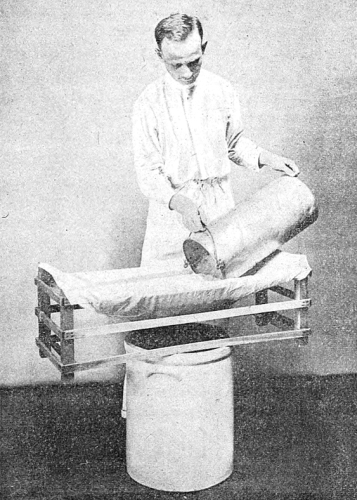
Fig. 1.—Pouring the curd into the drain cloth.
Draining.—After the setting period, when whey has collected upon
the surface of the coagulum, or when the milk is firmly clabbered, the
contents of the can or pail are poured upon a strong drain cloth.
(See fig. 1.)
The can may be shaken slightly before pouring, in order
to loosen any curd which has a tendency to adhere to the sides or
bottom. Unbleached cotton sheeting, which can be obtained in yard
widths, has proved to be the most satisfactory material for drain
cloths. For a small-scale operation the cloth may be thrown over a
pail, can, or wash boiler and the ends tied securely about the draining
receptacle. The curd or coagulum should remain undisturbed in the
cloth for 3 or 4 hours, after which it should be worked toward the
center of the cloth in order to hasten the draining and get it in better
condition for handling.
Drainage is
allowed to continue
until most of the
visible whey has escaped
and the curd
appears rather dry
as compared with its
former mushy condition.
Then the
four corners of the
cloth should be
drawn diagonally
across and tied. For
home consumption,
and especially when
it is not cooled, the
curd should be allowed
to drain for a
longer time before
pressing.
Cooling the curd.—While
the cooling of
the curd is very desirable,
it is not absolutely
necessary.
The object of cooling
is to facilitate the more rapid expulsion of whey during pressing.
Cooling also seems to harden the curd so that it does not pass so
readily into the meshes of the drain cloth and thereby interfere with
and retard the expulsion of the whey. The bags of curd are placed
on ice, or cracked ice is placed about them and left for a few hours.
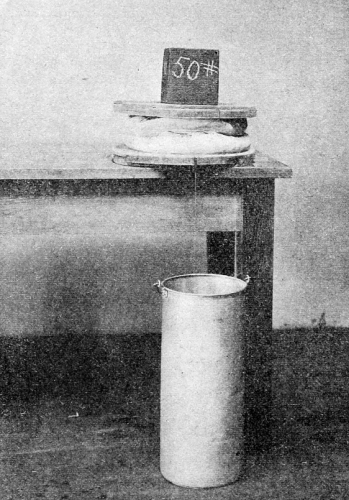
Fig. 2.—An improvised cheese press.
Pressing.—After cooling, several bags of the curd are piled together
between two boards and a weight of 50 pounds placed on top.
(See fig. 2.) Frequent rearrangement of the bags will hasten the
process. After this weight has been left on the cheese overnight,
the curd should be in flat cakes. For Neufchâtel it is preferable
to press the curd from 30 pounds of milk until the pressed curd
weighs 4½ pounds, while for cream cheese it should weigh about 5½
pounds. Special care should be taken in determining the yield of
cheese in order to obtain a uniform quality from day to day, which
can be done by weighing the curd. The manner and length of time
of pressing determines, in a large measure, the texture of the cheese.
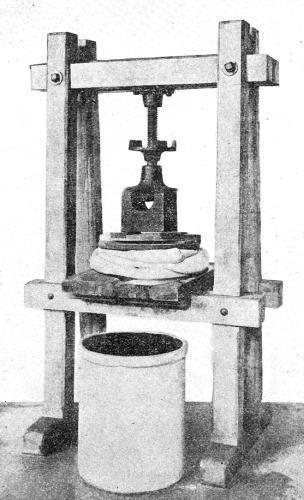
By using a screw
press the curd may
become too dry and
gummy, but under
ordinary conditions
there is little danger
if improvised equipment
is used. (See fig. 3.)
Fig. 3.—A screw press.
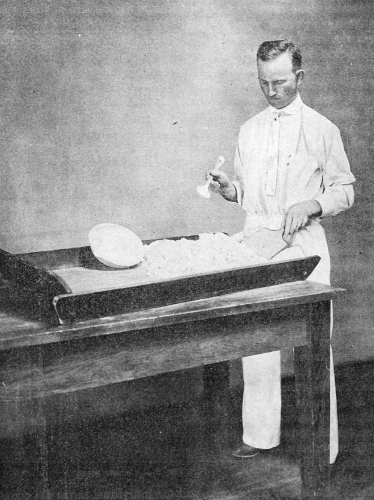
Working and salting.—After
having
been properly
pressed the cakes of
curd are salted and
worked with a potato
masher or butterworker,
or run
through a food
chopper to produce
a smooth, buttery
consistence.
Fine, dry salt is
sprinkled over the
curd at the rate of
about 2 or 2½ ounces
to 10 pounds of
curd, or about two
level tablespoonfuls
to the curd from 30
pounds of milk.
(See fig. 4.) The
quantity of salt may be varied to suit the individual taste; the quantities
recommended, however, usually give the best satisfaction. If the
curd is worked with a potato masher the addition of salt aids in
obtaining the proper smoothness of the cheese.
When cheese is made for home consumption it may be placed in
a glazed crock or porcelain dish immediately after salting and held
at a temperature as near 50° F. as possible until consumed. Under
favorable conditions it will keep in good condition for from 6 to
12 days. When cheese is kept a few days at a temperature of 60°
to 70° F., it will become disagreeably sour. It is most palatable
immediately after it is made, for then it is fresh, soft, and sweet.
When very cold, or after having been kept for some time, it does not
have so fine a flavor.
Fig. 4.—Salting and working the cheese.
Combinations with Neufchâtel and cream cheeses.—Finely chopped
pimiento peppers may be mixed with either Neufchâtel or cream
cheese at the time of salting. Such cheese has a mild though pronounced
flavor and is very popular for sandwiches and salads. The
pimientos seem to have a certain preservative effect and tend to
cover up “off flavors” that may develop. About 1 pound of the
chopped pimientos is added to 12 pounds of cheese, or about one-half
pound for the cheese from 30 pounds of milk.
While there are numerous other cream-cheese combinations, there
are two that are worthy of especial note—olive-pimiento cream and
Roquefort cream cheese. Both of these flavoring ingredients should
be added at the rate of 1 part to 10 parts of cream cheese. When
Roquefort cheese is uniformly incorporated with cream cheese it
gives to the combination a rich and pleasing flavor very similar to
Roquefort cheese, though milder.
Molding.—Cheese for home consumption need not be molded.
When marketed a special device is necessary in order to shape the
cheese into a commercial package. Neufchâtel, cream, and pimiento
cheeses require a special style of package. While there are numerous
devices for molding, many of them are not suited for meeting market
demands. As a result of considerable experimenting the attachments
described below were devised to fit the ordinary food chopper
and proved to be very satisfactory for handling the several kinds
of cheese.
For molding small quantities of cheese the following equipment is
desirable: (See figs. 8 to 12.)
A food chopper.
A hopper.
Two molding attachments for chopper.
A cheese conveyer.
A cheese cutter.
When used for molding, both the knives and the plate should be
removed from the chopper; otherwise the cheese will go through with
great difficulty. The cheese hopper is a boxlike arrangement clamped
to the top of the food chopper to prevent the scattering of particles
of cheese upon the worktable. The cheese is poured into the hopper
at short intervals, since it is not advisable to keep the hopper more
than half full, or the feed screw will not force the cheese so readily
through the hopper. If the hopper is full the cheese may become
too “gummy” and will not only be difficult to force through the chopper,
but will adhere to the long-handled spoon used to push the lumps
of curd into the machine. It is advisable to use a spoon in order to
keep one corner of the hopper free of the cheese and, by allowing
the escape of air, facilitate the grinding of the cheese.
The lips of the molding attachment are fastened to the chopper
by means of a ring. The attachment for molding Neufchâtel cheese
is cylindrical and is about 1½ inches in diameter at its delivery end.
The cheese, forced through this attachment, comes out in the form
of a roll or cylinder.
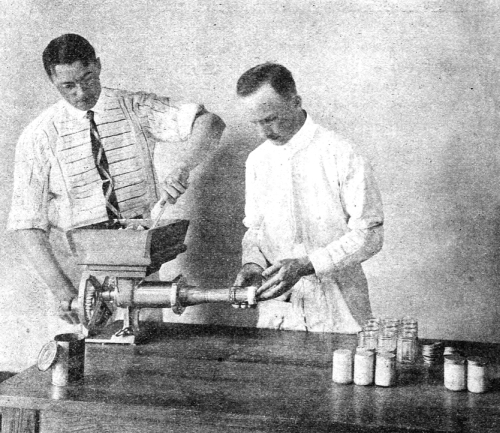
Pimiento cheese is forced into a special glass jar smaller than a
jelly glass or a paraffined wood-fiber container held horizontally over
the end of the Neufchâtel attachment so that the cheese reaches the
end of the container and flattens out without difficulty. (See fig. 5.)
If the pimiento cheese is to be used in a short time, the wood-fiber
containers are especially recommended, as they are less expensive
than glass jars. If the cheese is marketed directly to the consumer,
the glass jars may be returned and used again.
Fig. 5.—Filling jars with pimiento-cream cheese.
The attachment for cream cheese is rectangular at its delivery end.
By its use the cheese may be molded into smooth, ribbonlike bands
which, as in the case of Neufchâtel cheese, may be cut with a wire
into pieces of the desired size.
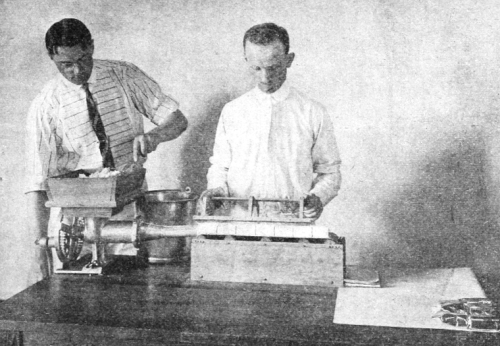
Fig. 6.—Molding and wrapping cream cheese.
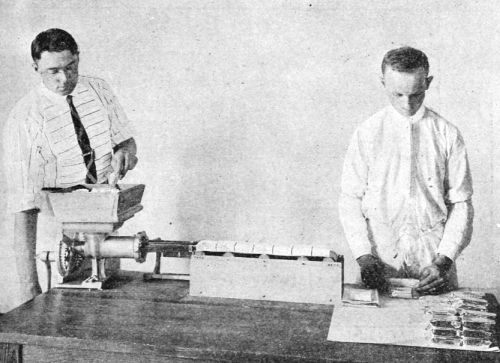
The cheese is delivered from the attachment on a canvas conveyer,
supported by rollers, which turn with sufficient friction to cause the
plastic curd to be firmly pressed together as the cheese is automatically
pushed forward. (See fig. 6.) The first cheese that passes
through the attachment often “frills”; that is, it presents an irregular
surface, but later the difficulty becomes less marked, and the
cheese comes out with a surface well defined and smooth. “Frilling”
occurs more often in molding cream cheese than in Neufchâtel.
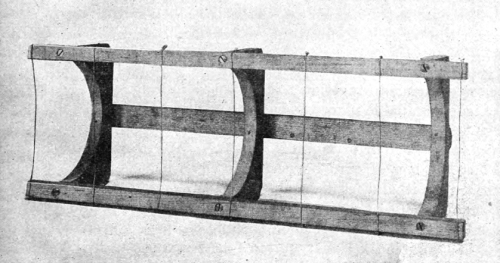
Cutting the cheese.—Cream cheese and Neufchâtel cheese may be
cut into cakes of the desired size by means of fine wires drawn over a
rectangular-shaped framework. (See fig. 11.) The use of this simple
equipment makes it possible to cut half a dozen cheeses simultaneously
and prevents delay, so that one person may do the grinding
while another cuts and wraps the cakes.
Wrapping the cheese.—After cutting the cakes they are slowly
carried along by the carrier and eventually fall upon a flat form
upon which tin-foil wrapping papers are laid. These papers may be
held in place by a cleat or clamp. In many cases it is more convenient
to take the cheese directly from the carrier, but when the
person who does the wrapping is kept very busy the platform may
serve as a place where several cakes may accumulate, thus allowing
the grinding operations to be continued. While one person is engaged
in filling the hopper and molding the cheese another is kept
busy cutting and wrapping. In wrapping, the cheese is placed in
the center of the paper, each side of the paper folded over, and the
ends turned down, to cover the cheese completely. (See fig. 10.)
Yield.—One hundred pounds of milk containing 4 per cent fat
should yield from 14 to 16 pounds of Neufchâtel cheese, while 6
per cent milk should give an average yield of from 17 to 19 pounds
of cream cheese. With milk testing less than the above, a smaller
yield and a lower grade of cheese will be obtained. Although there
may be slight seasonal fluctuations in the solids of milk, yet for the
most part the yield of cheese, other conditions being equal, is almost
directly proportional to the per cent of fat. There may be variations
in yield of cheese, however, due to mechanical factors, such as
longer pressing.
Neufchâtel cheese is sometimes made from skim milk, in which
case it is used for cooking and baking purposes. Commercially,
there are other grades of Neufchâtel made from one-half or two-thirds
skim milk. Such cheeses are labeled as made from “partially
skimmed milk” or “skimmed milk” as the case may be.
Fig. 7.—Types of packages.
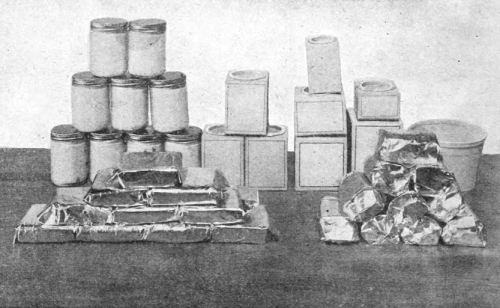
Packages.—Tin-foil or aluminum-foil wrapping paper which has
a parchment paper inside is generally used in wrapping cream and
Neufchâtel cheeses, since it gives each package a bright, uniform, and
attractive appearance. (See fig. 7.) Great care should be taken to
wrap each cake neatly and securely in order to exclude the air as
much as possible. Any “frilling” or other irregularities may be
corrected by drawing the foil tightly about the cheese. Careful and
skillful wrapping tends to increase the length of time the cheese is
salable. The yellow or amber-colored mold which often spreads
over the cheese should be prevented as much as possible, not because
it may render the food harmful or poisonous, but because it causes
deterioration and renders the cheese less appetizing.
The standard Neufchâtel package is cylindrical, about 1½ inches
in diameter by 2½ inches long, and weighs about 2½ ounces net.
Standard packages of cream cheese are about 3 by 2 inches and
1 inch thick, and have a net weight of about 3 ounces. The pimiento
cheese is marketed in 3 or 4 ounce glass jars, each packed full and
covered with a disk of paraffined paper and screw cap.
COST OF MANUFACTURE. — COST OF MAKING CREAM CHEESE. — COST OF MAKING PIMIENTO-CREAM CHEESE. — COST OF MAKING NEUFCHÂTEL CHEESE.
When made upon a small scale the cost of the various items of
making these kinds of cheese for market purposes is difficult to ascertain.
The cost of manufacturing them on a farm scale would
probably be quite different from the cost of manufacturing them
on a factory scale. The figures given are based upon the use of
200 pounds of 4 per cent milk, valued at $2.40 a hundredweight,
which is made into cheese twice weekly with equipment costing about
$25. The cost of the equipment depends, of course, upon that
already available and that which may readily be improvised. Under
average conditions the approximate cost of the various items of expense
involved in making the three kinds of cheese is enumerated
as follows:
With 200 pounds of 4 per cent milk a dairyman should be able to
make 24 pounds of cream cheese, and with the skim milk 12 pounds
of cottage cheese in addition. At present cream cheese is marketed
in 3-ounce packages. Figuring conservatively, the yield from 200
pounds of milk, then, would be about 120 packages of cream cheese
and 12 pounds of cottage cheese. Assigning a value of 6 cents a
pound for the latter, and subtracting the amount received for it,
the cost of the milk used for cream cheese would be reduced from
$4.80 to $4.08. The cost of milk for each package of cream cheese,
then, would be $0.034.
The cost of special equipment necessary for handling the cheese
may be proportioned as follows:
1 food chopper
$8.50
6 shotgun cans
5.10
6 drain racks
4.50
2 molding attachments
2.00
1 carrier
1.25
1 thermometer
.60
1 hopper
.50
1 cheese cutter
.50
6 yards of cloth for draining
.75
1 pail
.85
1 agitator or stirrer.
.25
2 spoons, long-handled
.20
25.00
A good food chopper should last 10 years, a drain rack 5 years,
and a shotgun can about 3 years. Figuring a yearly depreciation
of about 20 per cent, the depreciation charges would be $5. The
interest at 6 per cent on the investment would be $1.50, and the interest
and depreciation charges per cheese would be 1/12000 of $6.50,
or $0.00054.
The labor would require half an hour to pasteurize the milk, about
1½ hours to make the cheese, and another half hour to mold it, or
about 2½ hours, actual time for the various operations. However,
while in pressing it would require but a few minutes to handle the
cheese, the entire pressing operations would extend over several hours.
It is assumed, therefore, that the time not used in working with the
cheese could be utilized in some other manner. The total labor charge
would be 50 cents, figuring labor at 20 cents an hour. The labor
charges would then be 1/120 × 50, or $0.00416 for each cheese.
Figuring the cost of pasteurization and separation as 1 cent a
gallon, the charge for each cheese would be $0.00192. It would
require about 50 pounds of ice for the 24 pounds of cheese, which
would make the ice cost about $0.00016. Figuring the rennet at $10
a gallon and the salt at 1 cent a pound, the charge would be $0.00005,
and $0.004 for tin foil at 90 cents a pound:
Milk
$0.03400
Interest and depreciation
.00054
Labor
.00416
Pasteurization and separation
.00192
Ice
.00016
Salt and rennet
.00005
Tin-foil wrapping paper
.00400
Per cheese
0.04483
Pimiento-cream cheese is made practically the same as cream
cheese, with the single exception that pimiento peppers are added.
The cheese is usually marketed in 4-ounce glass jars, which may be
obtained in gross lots for about 2 cents each. Pimiento peppers cost
about 40 cents a pound and are added to the cheese at the rate of
1 pound to from 10 to 20 pounds of curd, as some people prefer a
higher proportion of the peppers. The figures given are on the
basis of 1 pound of peppers to 12 pounds of cheese. The labor charge
will be somewhat greater for pimiento cheese than for cream cheese;
the labor charges are figured at 3½ hours instead of 2½, as in the case
of cream cheese. There would then be a yield of 26 pounds of cheese,
costing $4.08. When pimiento cheese is produced under the conditions
outlined the cost for each jar may be summarized as follows:
Milk
$0.03457
Interest and depreciation
.00055
Labor
.00593
Pasteurization and separation
.00196
Ice
.00016
Salt and rennet
.00005
Glass jar
.02000
Peppers
.00666
Per jar
.06988
Figuring a yield of 15 pounds of cheese per 100 pounds of milk
and each package weighing 2½ ounces, the cost of making one
Neufchâtel cheese may be summarized as follows:
Milk
$0.02500
Depreciation and interest
.00033
Ice
.00013
Labor
.00260
Pasteurization
.00120
Salt and rennet
.00005
Tin-foil wrapping paper
.00400
Per cheese
.03331
MARKETING. — RETURNS FROM 100 POUNDS OF MILK. — POSSIBILITIES. — KEEPING QUALITIES OF THE CHEESE.
Neufchâtel, cream, and pimiento-cream cheeses are sold by the box.
The wholesale price of a cheese is usually 2 or 3 cents less than the
retail price. Cream cheese retails for about 15 cents a package,
Neufchâtel for 7 cents, and pimiento cream at 15 cents a jar.
Upon the basis of the calculated cost of manufacturing and at
current prices for the cheese, the following returns should be obtained
per 100 pounds of 4 per cent milk, viz, for cream cheese $9,
for Neufchâtel $8.40, and for pimiento cream $8.85. After subtracting
the estimated cost of making the cheese from 4 per cent milk,
valued at $2.40 a hundredweight, there should be a net profit of $6.14
for cream cheese, $6.22 for Neufchâtel, and $4.45 for pimiento cream.
Rent and cost of marketing are not considered.
The desirability of making these varieties of cheese upon a small
scale and successfully marketing them depends upon the skill of the
maker and his ability to obtain a direct and ready market for his
product. When cheese is made and delivered once or twice a week, a
dairyman is in far better position to serve the public by selling a
perfectly fresh product than the larger manufacturers, working at a
distance, who are obliged to dispose of their cheese several days after
it is made, and who must pay the additional expense of boxing and
shipping. If the cheese is marketed directly upon a small scale it is
not necessary to put it into the flat boxes, as is the case if it is handled
commercially. The cheeses may be disposed of satisfactorily by
placing them in one large box and piling one cheese upon another.
When cheese of this type is delivered upon a milk route the use of a
special box provided with two compartments, one for ice and the
other for cheese, is advisable during the warm periods of the year.
Pimiento-cream cheese, because of its keeping quality, is particularly
adaptable to small-scale operations. When sold in glass jars it is
sold as readily as the product of the larger manufacturers. With a
direct outlet, arrangements may be made to use the jars again and
thereby reduce the cost of marketing.
When suitably situated it should be practicable for many dairymen
to supply cheese to a neighboring town at good prices for their milk
and extra trouble. It should be especially feasible for the milk dealer
to dispose of his surplus milk in the form of cheese; in fact, in some
cases for some of these kinds of soft cheese he would receive as much
as or more than for the milk. By beginning in a small way the milk
dealer should be able to develop a trade in fancy cheeses, such as
cottage, Neufchâtel, cream, and pimiento cream, and by selling direct
to the consumer he could compete successfully with larger manufacturers.
When wrapped in foil and put into a cold place immediately after
making, cream and Neufchâtel cheeses should keep from 6 to 12
days without developing objectionable flavors; usually cream cheese
seems to keep somewhat better than Neufchâtel. If pimiento-cream
cheese is placed in the customary jars and held at 50° F. or below, it
should be still palatable at the end of a month. These products develop
a sourish taste rather quickly when held at a high temperature.
The temperature, therefore, is by far the most important factor
concerned in regulating the keeping qualities of the cheese.
There may be considerable variation in both the salt and water content
of the cheese without causing much deterioration.
EQUIPMENT FOR MAKING NEUFCHÂTEL AND CREAM CHEESES.
Little equipment is needed for making these cheeses for home consumption,
and many satisfactory substitutes may be found for that
mentioned. When the cheese is marketed on a large scale a greater
outlay is desirable in order to handle it efficiently.
Floating dairy thermometer.—The use of a reliable and accurate
thermometer is imperative if uniform results are to be obtained. A
thermometer of this kind is not expensive, and when not in use
should always be kept in the case.
Starter bottles.—Pint milk bottles, which may be covered with
glass tumblers, are needed for holding the starter, although the size
of the containers depends, of course, upon the quantity of cheese
made. Pint fruit jars also can be used; and may be covered with
bowls.
Shotgun cans.—These cans are usually 9 inches in diameter, 20
inches high, and hold about 4 gallons of milk. For work on a small
scale a 10-quart, heavily tinned or enameled pail may be used satisfactorily.
Rennet and pepsin.—Commercial liquid rennet and powdered pepsin
have been found to be satisfactory curdling agents. Fresh junket
tablets also produce good results.
Milk agitator.—A stirrer is desirable to cause a uniform distribution
of rennet or starter and to aid in preventing a too rapid rising
of the cream. A long-handled spoon may be used if only a small
quantity of cheese is made.
Draining rack.—The rack shown in figure 1 is rectangular, 13
inches wide, 36 inches long, and 10 inches deep. The corner posts
extend 1½ inches beyond the strips at top and bottom, with the top
rounded, so that a ring may fit over them. The bottom slats fit
loosely into notches and are removable for washing purposes. The
materials required are 4 corner posts 1½ by 1½ by 10 inches, 9 strips 1
by ⅜ by 36 inches, and 6 strips 1 by ⅜ by 12¼ inches, notched to receive
bottom slats, all made of pine. A cloth is fastened upon each frame
and the contents of one can poured upon each cloth. For small-scale
operations an orange crate or a boiler or pail may serve the
same purpose.
Drain cloth.—Unbleached cotton sheeting is recommended for this
purpose. A fine-meshed cloth gives strength and aids in preventing
losses of fat and casein. The size of the cloth depends upon the
nature of the draining rack. Each cloth should be 45 inches long
and a yard wide, with the ends hemmed. After use each should be
quickly and carefully washed and dried in order to increase the
period of its usefulness.
Press.—If a screw press is available, its use is to be recommended.
A 50 or 60 pound weight, such as a can of water or bucket of stones,
left upon the curd overnight usually proves to be satisfactory. (See
figs. 2 and 3.)
Curd worker.—For small-scale operations a bread mixer or a
potato masher may be used to give the curd proper consistence and
to incorporate the salt. When working on a larger scale a butterworker
or food chopper will serve the same purpose.
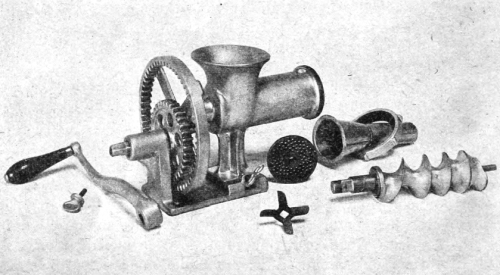
Food chopper.—A food chopper with special attachments and a
hopper are essential for molding the cheese into the desired forms.
Depending upon the quantity of cheese handled, satisfactory food
choppers may be obtained in three sizes, costing about $2, $5, and
$8.50. (See fig. 8.) The smaller machines may be used in handling
Neufchâtel and pimiento-cream cheese, but cream cheese requires the
large size for making the customary flat packages. The large machine
is to be recommended if the weekly output of cheese amounts to a
few hundred pounds, although the medium-sized machine would
probably do the work as effectively, only more slowly and with more
labor.
Fig. 8.—Grinding and molding equipment.
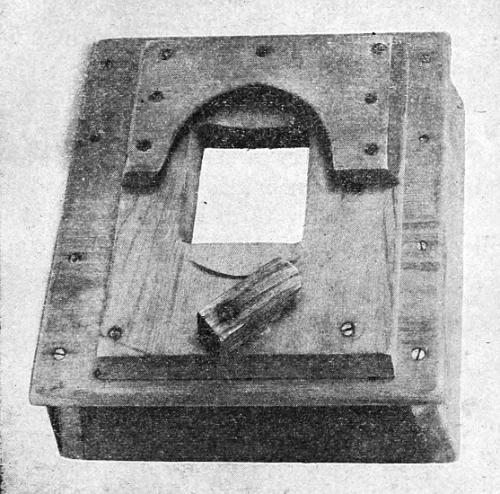
Cheese hopper.—The hopper consists of an open box 3 inches deep,
made of maple, with sides sloping outward about half an inch. The
box has a hole in the bottom 3⅛ by 3⅝ inches. To the bottom of the
box a board five-eighths of an inch thick is screwed, which has a hole
corresponding to that of the box. The hopper is fastened to the
food chopper by means of a beveled strip of wood and button, as
indicated in figure 9. The base of the box will probably have to be
grooved in order to allow the wheel to turn without friction. The
materials required are (1) two quadrangular-shaped pieces of wood 3
inches high, five-eighths of an inch in thickness, and whose tops measure
9⅜ inches and the bottoms 8 inches; (2) two pieces of similar
shape, except that the tops measure 11½ inches and the bases 10¼
inches; (3) one piece 10⅞ inches long, 10⅛ inches wide, and three-quarters
of an inch thick; (4) one piece 9⅜ inches long, 7 inches wide, and
three-quarters of an inch thick: and (5) one piece 7 inches long, 4⅜
inches wide, and five-eighths of an inch thick.
Fig. 9.—Under view of cheese hopper, showing method of
attachment.
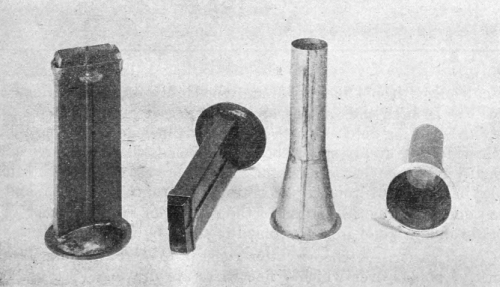
Neufchâtel attachment.—The attachment for molding Neufchâtel
and pimiento-cream cheeses consists of a tin form having a conical
shape with a tube attached. The cone has a 2¼-inch base which
gradually tapers down
to a tube whose diameter
is 1½ inches.
(See fig. 10.) The
distance from the base
of the cone to the tube
attached is 3¼ inches:
the tube is about 5
inches long. A vertical
lip about one-quarter
of an inch across
makes it possible to
connect the tube to
the food chopper; the
attachment fits into
the ring of the chopper.
Fig. 10.—Molding attachments for Neufchâtel and cream cheese.
Cream-cheese attachment.—The
cream-cheese attachment consists
of a ring to which a rectangular-shaped molding tube is soldered.
(See fig. 10.) The base of the tube is 2⅛ inches wide and fifteen-sixteenths
of an inch thick. The delivery end of the tube, which is 2⅛
inches wide and three-quarters of an inch thick, is cut back one-third
of an inch at each corner and V-shaped pieces of tin removed.
The lips of the tube are then drawn together until there is about one-sixteenth
of an inch of free space at each corner.
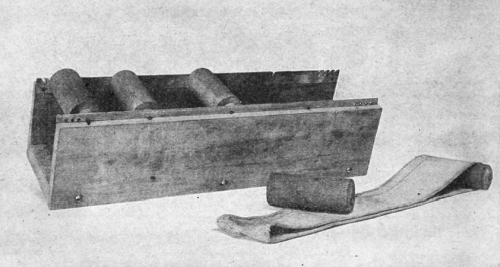
Fig. 11.—Belt conveyer.
Belt conveyer.—The belt conveyer used in removing the cheese as
it leaves the attachment is shown in fig. 11. It is a rectangular-shaped
box, 20 inches long, 6 inches wide, and 4¾ inches deep, with
the ends and top removed. Five bearings fit into the notches on one
side and holes on the other side in two strips of iron fastened to the
upper edges of the two open ends of the box. A 3½-inch canvas belt
runs snugly though not tightly upon the rollers. The materials required
are two pieces of maple 4¾ inches wide, one-half inch thick and
20 inches long; four oak rollers 4⅜ inches long and 1¾ inches in diameter;
one oak roller 4⅜ inches long and 1½ inches in diameter. The
rollers have a one-sixteenth-inch clearance and are beveled one-eighth
of an inch from bearing to outer face. In addition, two 20-inch strips
of galvanized iron 1 inch wide and one-eighth of an inch thick are
needed. In both ends of one of these strips of iron there are four
outward-slanting notches which are one-half inch deep and one-eighth
inch wide, and evenly spaced between the ends there are three additional
vertical notches of the same size. There are 11 one-eighth-inch
holes in the second iron strip, corresponding to, parallel with, and of
the same height as the bottom of the notches of the first strip. The
boards and strips of iron are joined together by means of screws.
Fig. 12.—Cheese cutter.
Cheese cutter.—A cheese cutter consists of a rectangular framework
of poplar over which 7 fine wires are drawn. (See fig. 12.)
The wires are fastened by means of iron pegs or screws to the outer
edge of two half-inch strips 15 inches long. The strips are 5 inches
apart, parallel, and are supported by 3 vertical pieces of wood
5 inches long, 3 inches wide, and one-half inch thick. Each of these
supports is hollowed out in order to give plenty of space for cutting
the cheese. The vertical supports are held in place by means of a
single flat strip 13¾ inches long, seven-eighths inch wide, and one-quarter
inch thick. The wires are placed 2½ inches apart and the
supports 6¾ inches apart. All connections are made with 1-inch
screws.
Tin-foil paper.—Tin foil covered with parchment paper is generally
used to wrap the cheese (cream or Neufchâtel), although of late
aluminum foil has been used quite extensively. The dimensions of
the foil are 4½ by 6 inches, and it is purchased by the pound.
SUMMARY OF DIRECTIONS.
The following outline for making the Neufchâtel group of cheeses
is based on 30 pounds or 3½ gallons of milk.
Except as noted, the process is the same for Neufchâtel as for
cream cheese. For Neufchâtel cheese use whole milk that tests 4 per
cent, and for cream cheese use milk standardized to 6 per cent.
If it is desired to pasteurize, heat the milk to 145° F., hold at that
temperature for 30 minutes, then cool to 80° F. for Neufchâtel and
83° F. for cream cheese. If the milk is pasteurized, a starter must
be added.
Add half a pint of a good starter or clean-flavored sour milk and
stir well. Rennet is then added at the rate of one-third of a cubic
centimeter (about eight drops), diluted in a cup of cold water,
stirred in thoroughly, and the milk set aside to curdle. In place of
rennet, powdered pepsin (one-half the size of a pea) dissolved in a
cup of cold water, or one-third of a junket tablet dissolved in a like
quantity of water, may be added. In making cream cheese it is advisable
to use a very slightly larger quantity of the curdling agent
than for Neufchâtel.
If the milk is not pasteurized, warm or cool it to the temperatures
mentioned above, add starter and rennet as described, and set away
to curdle.
If starter is not used, the milk is set away for several hours, at the
temperature described, before the rennet or other curdling agent is
added. After thoroughly stirring, the milk is set away at the same
temperature to curdle. In either process the time necessary for
proper curdling is from 16 to 18 hours. It is often convenient to set
the milk to curdle overnight.
Pour the coagulum or curdled milk upon the drain cloth and allow
it to drain from 2 to 4 hours, or until practically no whey drips from
the cloth and the curd is comparatively dry.
Scrape the curd toward the center of the cloth and tie the diagonal
corners of the cloth together to facilitate handling.
If ice is available place the bag of curd in crushed ice and leave it
for 3 hours or longer. If ice is not available allow the curd to
drain an extra hour or more.
Place the bag of curd between two clean boards, put a 50-pound
weight upon it, and let it stand. Pressing should cease when there is
a yield of about 4½ pounds of Neufchâtel or about 5½ pounds of cream
cheese. This will take about 6 or 8 hours. If a cider or other screw
press is available the time required for pressing is about 1½ hours.
Remove the curd from the cloth into a pail, sprinkle two level
tablespoonfuls of fine salt over the curd, and thoroughly mix with a
potato masher until it has a smooth, buttery consistence. Running
the cheese through a food chopper or working it with a butterworker
produces the same result.
Place the cheese in a crock or enameled dish until ready for use.
Mold the cheese into commercial packages by means of the food
chopper, special attachment, and cheese cutter.
Wrap in tin foil or aluminum foil, or pack in glass jars.
Keep the cheese at a temperature of 50° F. or below until consumed.
At that temperature Neufchâtel and cream cheese should
keep from 6 to 12 days, and pimiento-cream cheese should keep nearly
a month.
THE USE OF NEUFCHÂTEL AND CREAM CHEESE IN THE DIET.
In nutritive value these cheeses compare favorably with other
staple foods, especially meat. They are easily digested when taken
in moderate quantities and in combinations with other foods, and,
being rich in protein and fat, they easily replace such foods as meat,
fish, and eggs. There are many foods with which they combine to
form appetizing and attractive dishes that are easily and quickly
prepared. These cheeses may be used in a greater number of ways
than other varieties because they are soft in texture, blend well with
most foods, and are rich in protein and fat. Perhaps the most desirable
ways to serve them are in the forms of salads, sandwiches,
and similar dishes.
The Office of Home Economics, States Relations Service, in cooperation
with the Dairy Division, has made the following studies of
cheese cookery:
Either cream or Neufchâtel cheese may be combined with such
foods as olives, green peppers, pimientos, pickles, different kinds of
nuts, various vegetables, and nearly all fruits. In addition to the
desirable blending of the flavors of cheese and the other ingredients,
the combinations give spice, color, and attractiveness, increase the
food value, and afford a variety of dishes easily and quickly prepared.
The following recipes illustrate a few of the many ways of serving
these cheeses. Cream or Neufchâtel cheese may be used in each of
the following recipes unless otherwise noted:
SALADS. — PLAIN CHEESE SALAD. — CHEESE AND PIMIENTO SALAD. — OLIVE AND PIMIENTO-CHEESE SALAD OR SANDWICH. — CHEESE AND LETTUCE SALAD. — TOMATO AND CHEESE SALAD NO. 1. — TOMATO AND CHEESE SALAD NO. 2. — TOMATO AND CHEESE SALAD NO. 3. — BLANCHED GREEN PEPPERS AND CHEESE SALAD. — RADISH AND CHEESE SALAD. — CHEESE AND VEGETABLE SALAD. — POTATO AND CHEESE SALAD. — CHEESE AND CELERY SALAD. — PRUNE AND CHEESE SALAD. — PINEAPPLE AND CHEESE SALAD. — PEACH AND CHEESE SALAD. — ASTORIA SALAD. — HONOLULU SALAD. — CHEESE SALAD AND PRESERVES. — NUT AND CHEESE SALAD. — PEAR AND CHEESE SALAD NO. 1. — PEAR AND CHEESE SALAD NO. 2.
Cut the cheese into small pieces and scatter them over lettuce leaves. Serve
with French or mayonnaise dressing.
Stuff canned pimientos with the cheese and cut in slices. Serve on lettuce
leaves with French or mayonnaise dressing.
Add cream or Neufchâtel cheese, chopped olives, and pimientos in equal parts.
Salt to taste and form into a roll or mold. Cut into slices and serve on lettuce
leaves with French or mayonnaise dressing.
3 leaves of lettuce (chopped).
1 cheese or 4 tablespoons.
½ teaspoon salt.
⅛ teaspoon paprika.
Mix ingredients, roll into balls, and cover with toasted bread crumbs. Serve
plain or on lettuce leaves with dressing.
Choose medium-sized tomatoes, peel, and slice very thick. Drain well and
wipe each slice. On top of each put a thick layer of cheese, mixed with chopped
green peppers. Cover all with French or mayonnaise dressing and serve on lettuce.
Pimiento peppers may be used instead of or with green peppers.
Stuff cold tomatoes with cream, pimiento-cream or Neufchâtel cheese. Serve
on lettuce leaves with French or mayonnaise dressing.
Mix with the cheese chopped pimientos, celery, and olives. Season with salt
and paprika. Wash and remove centers from fresh, medium-sized tomatoes,
and fill the cavity with the seasoned cream cheese. Serve on lettuce leaf with
salad dressing.
Blanch peppers, cut off large end, then remove centers and put peppers on
ice. Mix with the cheese:
While soft, press into the hollowed peppers, chill, and cut into slices. Serve
on lettuce leaves with mayonnaise, or use as a garnish.
Select medium-sized radishes, wash and scrape out the centers, adding the
part removed to cream cheese to which pimientos or nuts have been added.
Mix well and fill radishes with mixture and serve on lettuce leaves with
dressing. This cheese combines well with almost any vegetable or fruit to
make salads and sandwiches.
Slice thin some peeled tomatoes and cucumbers. Make a quantity of cheese
balls, heap them on lettuce hearts in the middle of a flat dish, and put little
piles of cucumbers and tomatoes alternately around them. Cover with French
or mayonnaise dressing and serve.
Salad dressing.
1 egg.
¼ teaspoon of salt.
¼ cup of vinegar.
¼ cup of water.
Mustard or curry powder.
1 cheese or 4 tablespoons.
Diced potatoes.
Add to well-beaten egg the other ingredients and cook over water until thick,
then add the cheese and stir until melted and smooth. Pour over the potatoes,
which have been cubed or diced, and mix well. Chopped celery, sweet peppers,
or celery seed change the taste and give variety.
1 stalk celery.
2 cheeses or ⅔ cup.
1 teaspoon of salt.
2 tablespoons of ground pecan nuts.
¼ tablespoon of paprika.
2 tablespoons of finely cut celery tops and lettuce leaves.
Separate the celery, clean thoroughly, and place on ice until crisp. Mash
cheese until soft, and add salt, paprika, and ground nut meats. Dry the celery,
fill the hollow part with the cheese mixture, and roll in finely chopped parsley
or celery tops. Cut into 2-inch pieces and serve on crisp lettuce leaves with
French dressing.
Cream the cheese with mayonnaise and to each half cup of the mixture add
one-quarter cup of English walnut meats, broken. Roll into tiny balls and
place inside seeded prunes which have been cooked for 10 minutes in lemon
juice and water. Serve on lettuce leaves with mayonnaise.
Place slices of pineapple on lettuce leaves, cover with slices or pieces of
cheese, and serve with mayonnaise dressing.
Peel large peaches and cut into halves; remove stones and put on ice; place
on lettuce and add a spoonful of mayonnaise. In center of each place a ball of
cheese.
4 large figs.
1 teaspoon lemon juice.
1 cup of cheese, creamed.
8 large dates.
½ cup almonds.
Add the lemon juice to the cheese, salt to taste, and beat thoroughly. Remove
stones from dates. Add figs and almonds, chopping all together and beating to
a smooth paste. Add cheese mixture and mix well together, form into molds or
balls, and serve on lettuce leaves with salad dressing mixed with an equal
quantity of whipped cream. Maraschino cherries may be used instead of figs.
Put a slice of raw or canned pineapple on a nest of lettuce leaves. Mix one-half
cup of cheese with a pimiento pepper; add a dash of salt and cayenne or
tabasco. Form into balls and place one in the center of each slice of pineapple.
Serve with mayonnaise dressing.
Place pieces of the cheese on lettuce leaves and cover with French or mayonnaise
dressing. Serve with currants or other fruits, preserved in honey or
sugar.
Cover whole blanched almonds with cheese and form in egg shapes. Roll in
finely ground almonds. Pile in nests of lettuce leaves. Serve with mayonnaise
dressing. Peanuts and many other nuts may be used equally satisfactorily.
Mix chopped pecans with the cheese, form into balls, roll them in finely
chopped nuts, and place in cavities of California white pears. Serve on lettuce
leaves with mayonnaise.
Wash ripe pears and cut in two (crosswise). Scoop out the center from one
half and fill the pear cup thus made with the cheese, to which chopped nuts,
salt, and paprika have been added. Cover with the other half, chill, and serve
with mayonnaise.
CHEESE AND FRUITS. — CHEESE AND CHERRIES. — CHEESE AND DATES. — CHEESE SURPRISE. — CHEESE AND APPLES. — FROZEN CHEESE WITH FIGS. — TOMATO RABBIT. — BAKED CHEESE AND TOMATO.
Select large whole cherries; wash, drain, and stone. Fill the centers with
cheese and serve on lettuce leaves with mayonnaise. The cheese may be prepared
with nut meats or pimientos before filling the cherries.
Select large, firm dates; wash, drain, and stone. Stuff with cream cheese
seasoned with salt and paprika. Chill and serve on a nest of lettuce leaves
with mayonnaise or special cheese dressing.
Select tart apples of uniform size; core, pare, and steam in a sirup of 1 cup
of sugar to 2 cups of boiling water until soft. When cool place on the ice to
chill thoroughly. Season cream cheese with salt and paprika and mix together
until soft. Cover the apples with the cheese mixture. Chill again before serving.
Serve on lettuce.
Mix with one cheese 12 dates (seeded and chopped) and 1 tablespoon of
chopped pecan nuts. Wash and core good eating apples and fill the centers
with the cheese mixture. Chill and serve on crisp lettuce leaves with French
or mayonnaise dressing.
Mash two cheeses and beat them with half a cup of stiffly beaten cream
until smooth; flavor, and sweeten to taste. Put into covered pail or mold and
bury in ice and salt for 4 hours. Slice in pieces 2 inches thick and cut round
with biscuit cutter. In the side of each piece put a preserved fig or some other
fruit.
2 tablespoons of butter.
2 tablespoons of flour.
¾ cup of stewed and drained tomatoes.
5 cheeses, or 1⅔ cups.
¾ cup of milk.
⅛ teaspoon of soda.
Cook the butter and flour together, add milk, and as soon as the mixture
thickens add tomatoes and soda. Then add cheese and seasoning. Serve on
toast, whole wheat, or Graham bread.
Select good whole tomatoes, remove part of contents, stuff with cheese, and
bake. Green peppers may be used in the same way. Serve hot.
CHEESE SANDWICHES. — CUBAN SANDWICH. — TOASTED CHEESE SANDWICHES. — CHEESE AND JELLY SANDWICH. — CHEESE-DATE-NUT SANDWICH. — CHEESE FOR SANDWICHES. — CHEESE PASTE FOR SANDWICHES. — CHEESE AND JAM SANDWICHES.
Between two slices of bread place lettuce with a little salad dressing or salt
on it, then a slice of cheese, and finally thin slices of dill pickles or a little
chopped pickle.
Plain bread and butter sandwiches with fairly thick slices of cheese between
are toasted, and on picnics or at chafing-dish suppers are often browned in a
pan in which bacon has been fried.
Spread slices of bread with a layer of cream cheese, then a layer of jelly.
Place another layer of bread on top to form a sandwich, then toast.
Season cream cheese with chopped dates and nuts and serve as sandwich
filling for graham crackers.
Add salt, a few drops of vinegar, paprika, and a speck of mustard to one
cream or Neufchâtel cheese. Mix thoroughly and spread between thin slices
of bread. Anchovy essence may be added to the mixture if desired.
½ cup of tomato ketchup.
2 tablespoons chopped pecans.
2 cheeses or ⅔ cup.
1 teaspoon onion juice.
1 teaspoon of salt.
¼ teaspoon paprika.
Cream the cheese and mix with the other ingredients. Spread between
thinly cut slices of bread. This will make sufficient paste for about 24 ordinary
sandwiches.
Brown bread.
Cheese.
Cheese with jam, marmalade, or preserved ginger.
Slice bread thin and spread with layer of jam or marmalade; strawberry and
peach flavors give best results. Spread a layer of cheese over jam and cover
with another slice of bread. Press and serve.
CHEESE AND VEGETABLES. — CHEESE AND POTATO PUFFS. — CHEESE-POTATO CAKES. — CHEESE ROLLS. — CHEESE AND BEAN ROAST. — CHEESE AND CELERY RELISH. — TOMATOES AND CHEESE. — CHEESE AND PARSLEY BALLS.
1 cheese or 4 tablespoons.
1 cup hot seasoned mashed potatoes.
1 egg.
½ teaspoon of salt.
1 dash of paprika.
½ teaspoon parsley chopped fine.
Mix cheese and potatoes, add salt, parsley, paprika, and yolk of egg well
beaten. Fold in the stiffly beaten white of egg, place by spoonfuls on a greased
pan, and bake until a golden brown.
Mix one cheese with 2½ cups of cold mashed potatoes; season with salt, pepper,
or a little paprika. Form into cakes and fry quickly in a little fat.
A large variety of rolls may be made by combining legumes—beans of different
kinds, cowpeas, lentils, or peas—with cheese, and adding bread crumbs
to make the mixture thick enough to form into a roll. Beans are usually
mashed, but peas or small Lima beans may be combined whole with bread
crumbs and cheese, and enough of the liquor in which the vegetables have
been cooked may be added to get the right consistence. Chopped spinach, beet
tops, or head lettuce may be used instead of the legumes.
1-pound can kidney beans or equivalent of other cooked beans.
3 cheeses or 1 cup.
Bread crumbs.
Salt.
Mash the beans or put through a meat grinder. Add cheese and bread
crumbs enough to make the mixture sufficiently stiff to be formed into a roll.
Bake in a moderate oven, basting occasionally with fat and water. Serve with
tomato sauce. This dish may be flavored with onions, chopped and cooked in
butter and water.
Cut stalks of deep-grooved celery into pieces about 2 inches long. Fill
grooves with Neufchâtel, cream, or pimiento cheese and serve with bread and
butter as a salad course or serve as a relish.
Broil slices of tomatoes, season with salt and paprika, place on slices of bread,
cover the broiled tomatoes with seasoned cheese, and place in oven until cheese
is melted. Serve at once.
Season the cheese and mold into balls, chill, and roll in finely chopped parsley.
Serve as garnish or on lettuce leaves with French or mayonnaise dressing.
CHEESE AND CEREALS. — OATMEAL WITH CHEESE. — CHEESE WITH MUSH. — BAKED CHEESE AND RICE.
Cheese may be combined with many breakfast foods. It can be melted
with the “ready-to-serve” breakfast foods or simply served with them, and it
may be cooked with the home-cooked kinds. This is a very rational dish as
regards the proportion of nutrients and may be served as the principal item
of a breakfast menu, thereby eliminating the meat. It may be served without
milk and sugar.
2 cups of oatmeal.
1 cup of cheese.
1 tablespoon of butter.
1 level teaspoon of salt.
Cook the oatmeal as usual. Shortly before serving stir in the butter and
add the cheese. Stir until cheese is melted and blended with oatmeal. The
cheese flavor may be increased or decreased by the quantity added. Wheat
breakfast foods (parched or unparched), corn meal, and hominy may be prepared
in the same way.
Cheese may be added to corn-meal mush or to mush made from any of the
corn or wheat preparations now on the market. The addition of cheese is
particularly desirable when the mush is to be fried. Simply put the cheese
in with the meal and cook until well blended. It fries much more satisfactorily
and has a rich, desirable flavor.
1 cup of rice.
3 cheeses or 1 cup milk as needed.
Cook the rice in salted water, and put into a buttered baking dish alternate
layers of rice and cheese. Pour over them milk enough to come halfway to
the top, cover with bread crumbs, and brown in the oven.
CHEESE AND EGGS. — DEVILED EGGS WITH CHEESE. — BAKED EGGS WITH CHEESE. — CREAMED CHEESE AND EGGS. — CHEESE OMELET. — SCRAMBLED EGGS WITH CHEESE. — CHEESE SOUFFLÉ.
Deviled eggs are very much improved by the use of cream or Neufchâtel
cheese mixed with the egg yolk. The cheese prevents the crumbling of the yolk,
as is usually the case with deviled eggs. Beat the eggs slightly, mix them with
the other ingredients, and cook over a very slow fire, stirring constantly so as
to melt the cheese by the time the eggs are cooked.
4 eggs.
2 or 3 cheeses or from ⅔ to 1 cup.
1 cup of fine, soft, stale bread crumbs.
¼ teaspoon of salt.
Few grains cayenne pepper.
Break the eggs into a buttered baking dish or into ramekins, and cook in
a hot oven until they begin to turn white around the edges. Cover the mixture
with crumbs, cheese, and seasoning. Brown in a very hot oven so that the
cheese is brown without the eggs being cooked too much. White sauce may be
put over eggs before the cheese mixture is added.
3 hard-boiled eggs.
1 tablespoon of flour.
1 cup of milk.
½ teaspoon of salt.
Speck of cayenne.
4 slices of toast.
2 or 3 cheeses or from ⅔ to 1 cup.
Make a thin white sauce with the flour, milk, and seasoning. Add the cheese
and stir until melted. Chop the whites of the eggs and add them to the sauce.
Pour over the toast, then cut the yolks in small pieces and sprinkle over the
whole.
2 eggs.
2 teaspoons of milk.
1 cheese or 4 tablespoons.
½ tablespoon of butter.
¼ teaspoon salt.
Dash of pepper.
Cream the cheese until soft, add milk, then the well-beaten yolks of the eggs,
and then the stiffly beaten whites. Place a little butter in an iron skillet and
when hot pour in the omelet. Cook until brown, then place under flame in an
oven until slightly dried out on top, turn, and serve on hot platter. Season
with salt, pepper, and butter.
3 eggs.
3 cheeses, or 1 cup.
1 tablespoon of chopped parsley.
½ teaspoon of salt.
Pinch of nutmeg if desired.
3 eggs.
¼ teaspoon of salt.
1 cheese, or 4 tablespoons.
5 tablespoons of honey.
¼ cup of sour cream.
Beat cream and cheese until smooth. Add honey so that it is well blended,
add yolks, then beaten whites. Fill pastry cases and bake 25 minutes. They
will puff over the cases. If preferred, they may be baked in custard cups
instead of cases. Serve with cheese sauce made by heating thick cream and
cheese, blending with spoon and beater.
Cream or Neufchâtel cheese may be used in preparing many dishes which may
take the place of or supplement meat dishes, as well as in the recipes given
below. It is not recommended to use them instead of American Cheddar or
other cheese, but to show the many ways of using them satisfactorily. Since
these cheeses are not ripened, they have a mild-cheese flavor in contrast to
the strong-flavored cheese. The Cheddar cheese is often cheaper, has a more
pronounced flavor, and when obtainable should be used in the regular way.
When these cheeses are made in the home, and are therefore not so expensive,
or when a mild-cheese flavor is desired, or when the other cheeses are not easily
obtainable, they will be found very acceptable in preparing many dishes, a
number of which are given below. The nutritive value of the menu and the
number of palatable dishes which may be served will be greatly increased by
their use.
In many recipes calling for cheese the omission of butter and the substitution
of a smaller quantity of skim milk or water for whole milk is very desirable
and more wholesome because of the high fat and water content of the
cheese.
2 cups of Lima beans, cooked.
2 canned pimientos, chopped.
2 cheeses or ⅔ cup.
Bread crumbs.
Salt and pepper.
Put the cheese, beans, and peppers through a meat grinder. Mix well and
add bread crumbs until stiff enough to form into a roll. Brown in oven, basting
occasionally with fat and water.
Cut stale bread into thin pieces and put two pieces together with cheese
between them. Dip in a mixture of egg and milk and fry in butter or other fat.
1 cup of milk.
2 tablespoons of flour.
From 1 to 3 cheeses or from 4 tablespoons to 1 cup.
Salt and pepper.
Thicken the milk with flour and add cheese just before serving, stirring until
melted.
This sauce may be used in preparing creamed eggs, to pour over toast, with
macaroni, rice, Welsh rabbit, or for baking with crackers soaked in milk.
1 cup of macaroni broken into small pieces.
1 tablespoon of chopped green peppers.
1 tablespoon of butter.
1 teaspoon of onion juice.
1 teaspoon of chopped parsley.
3 cheeses or 1 cup.
Salt and pepper.
Cook the macaroni in boiling water until tender; rinse in cold water, and
cook parsley, onion, and green peppers in a little water with butter. Mix all
ingredients together with the cheese and bake in a moderate oven about 15
minutes.
Cook macaroni until done, drain water off, add salt and pepper and cheese,
stirring until cheese is melted. Serve at once.
1 cup of cooked rice.
1 teaspoon of salt.
1 cheese or 4 tablespoons.
½ of medium-sized green pepper.
¼ of medium-sized onion.
3 medium-sized tomatoes.
Cook tomatoes, onion, and green pepper 20 minutes. Add cooked rice and
seasoning, then the cheese. When melted, pour over heated crackers or toast.
3 slices of bacon.
1 cheese or 4 tablespoons.
½ teaspoon onion juice.
1 tablespoon of milk.
¼ teaspoon of salt.
Dash of paprika.
Crisp the bacon and break it into small pieces. Mix cheese seasoning and
milk with bacon. Heat thoroughly and serve on toast or crackers.
1 cheese.
¼ cup of fine bread crumbs.
¼ teaspoon of salt.
3 teaspoons of milk.
¼ cup of hot water.
2 eggs.
Cream the cheese and add salt, hot water, bread crumbs, and milk, then the
well-beaten yolks of the eggs. The well-beaten whites are then gently added.
Pour the fondue into a greased baking dish and place in a pan surrounded by
hot water. Cook in a slow oven about 30 minutes or until firm. Test in center
with knife.
Arrange slices of Bermuda onion on toast with salt, pepper, and a drop of
tabasco sauce on each; then add a thin layer of cream cheese. Bake long
enough to melt the cheese.
1 cheese, or 4 tablespoons.
½ teaspoon of salt.
⅛ teaspoon paprika.
Slice bread thin and cut into round pieces with biscuit cutter. Cream the
cheese, add salt and paprika, spread evenly on bread, and brown in oven.
Cut some stale bread in slices 2 inches thick. Trim crusts and spread with
one tablespoon of cheese. Season with salt and paprika. Lay in baking pan
and brown in oven.
½ cup of dry brown or victory bread crumbs.
1 cup of cheese.
1 egg.
¼ teaspoon of salt.
¼ teaspoon of mustard.
A few grains of cayenne pepper.
Mix ingredients, shape in small balls, and fry in deep fat.
4 cheeses, or 1⅓ cups.
1 quart of milk.
1 pint of cream.
2 eggs.
1½ cups of sugar.
Beat the cream and cheese together until smooth. To the well-beaten yolks of
the eggs add the sugar and vanilla to taste, and the milk. Strain and freeze.
When partly frozen add the well-beaten whites of the eggs.
1 cheese, or 4 tablespoons.
2 tablespoons of Roquefort cheese.
½ stalk celery.
1 large Bermuda onion.
1 tablespoon of butter.
2 green peppers.
½ tablespoon of paprika.
Rub the cheese and butter to a smooth paste, then add the paprika and the
onion, celery, and pepper, chopped fine. Chill and serve with hot toasted
cracker.
1 cheese, or 4 tablespoons.
1 egg.
¼ cup cold water.
1 tablespoon vinegar.
¼ teaspoon mustard.
½ teaspoon salt.
1 teaspoon sugar.
Beat the egg until light, add salt, sugar, and mustard, then water and vinegar,
and cook over boiling water until thick. Then add cheese and beat until
light and smooth. Serve when cold. A variety of salads may be served with
this dressing. Chopped hard-boiled eggs, shredded pepper, and chopped olives,
mixed and served on lettuce leaves with this dressing, make an excellent salad.
Whole tomatoes, with centers removed and the center filled with chopped
cabbage, make a good salad with this dressing.
1 egg.
1 cheese, or 4 tablespoons.
1 cup of milk.
½ cup of corn meal (white).
½ teaspoon of baking powder.
½ teaspoon of salt.
Heat milk, salt, and corn meal in double boiler for 5 minutes. Add cheese,
and when melted and cool stir in the baking powder, then add the beaten egg.
Bake in greased muffin rings or bread pan about 20 minutes.
1 cheese, or 4 tablespoons.
1 egg.
3 drops of onion juice.
2 tablespoons of milk.
½ teaspoon of salt.
Soften the cheese, add milk, seasoning, and the yolk beaten until lemon colored,
and lastly fold in the stiffly beaten white of the egg. Place spoonful on
toast or crackers, heat thoroughly, and serve.
Make a gingerbread, reducing the quantity of sugar. When cold cut in two
and put in a layer of the following between the two halves:
2 cheeses or ⅔ cup.
2 tablespoons of chopped dates.
2 tablespoons of pecan nuts (chopped fine).
¼ tablespoon of salt.
Rub to a paste.
1 cheese or 4 tablespoons.
1 cup of cooked rice.
¼ cup of milk.
1 egg.
½ teaspoon of onion juice, if desired.
¼ teaspoon of salt.
Dash of paprika.
Mix rice, cheese, milk, paprika, salt, and onion juice. Beat the egg well and
mix with the other ingredients. Drop by spoonfuls on lightly greased skillet
and turn when brown. Serve plain or with jelly.
Prepare the same as for cheese fritters. Chill the mixture thoroughly, mold
into shape, roll in fine bread crumbs, then in diluted egg (1 tablespoon of milk
or water to an egg), and again in bread crumbs. Place in greased pan and
brown in oven. Serve with tart jelly.
◯
Illustrations have been moved to between paragraphs.
Itemized changes from the original text:
On page 24, changed “or” to “of”, near “If ice is available place the bag”
On page 30, changed “ususal” to “usual”, near “Cook the oatmeal as”
On page 32, changed “cheese” to “cheeses”, near “PIMIENTO AND CHEESE ROAST.”
On page 35, moved “Rub to a paste.” from ingredient list
to instruction list, near “GINGERBREAD.”