Beaded motifs
as dress trimmings
were
never more in
vogue than at
the present
time. Beaded
bags, hat-bands,
belts and ornaments
are all
expensive articles
to purchase,
but they are
quite easy to
make, and the
materials cost
but a little.
There are two modes of making
the hand-made trimmings and bags,
and, of course, this kind is worth
much more than that made by
machinery, as well as being more
lasting and artistic.
In beaded crochet a coloured mercerised
cotton, fine enough to pass
easily through the beads selected,
is used with a crochet-hook corresponding
in fineness to the thread.
The beads are first put on the thread,
using a fine sewing needle for the
purpose, or waxing the thread end;
the beads are then worked into the
design with the usual d c.
In the needle-made variety, which
we are illustrating in this issue, each
bead is attached to the bead immediately
below it, and to the one following
it. A very fine sewing needle,
with fine linen or glazed cotton
thread, is necessary.
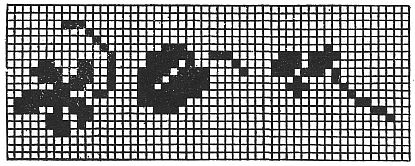
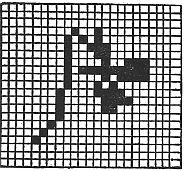
The Rose
Design.
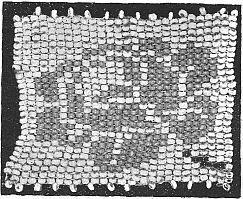
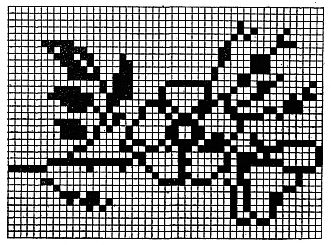
A Needle-made Beaded Rose Motif
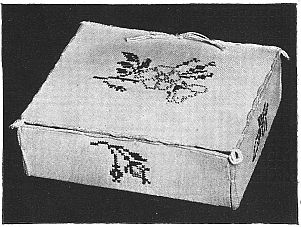
This beautiful design is suitable as
a single motif for dress trimming, or
as a repeat for tops of bags, etc.
Delft-blue china beads compose
the background
for the rose,
which is of a
deep pink
colour, with
small green
stem.
Use fine linen
thread and a
very fine sewing
needle. Thread
29 of the blue
beads (or any
other colour
selected for the
groundwork),
run the needle back through the 28th
bead (that is, insert the needle
through the 28th bead, between the
28th and 29th, and bring it out
through the 28th between that and
the 27th), thread a bead, bring this
bead over the 28th, and run the
needle back through the 28th, as you
did before, but run it through the
27th also; thread another bead, place
it over the 27th, and run the needle
back through the 27th and 26th
beads; repeat with every 2 beads to
the end. Turn.
3rd Row.—Thread a bead, run the
needle back through the last bead in
the 2nd row, thread a bead, run the
needle back through the last bead
again, in the same manner as before,
and through the following bead;
thread a bead, and continue as in the
2nd row, introducing the rose beads.
After working 7 blue (b), there are
5 pink (p), 3 b, 3 p, 10 b.
4th Row.—9 b, 5 p, 1 b, 6 p, 7 b.
5th Row.—7 b, 6 p, 1 b, 5 p, 9 b.
6th Row.—8 b, 2 p, 8 b, 4 p, 6 b.
7th Row.—6 b, 1 p, 2 b, 1 p, 1 b,
6 p, 2 b, 2 p, 7 b.
Needle-made
Motifs.
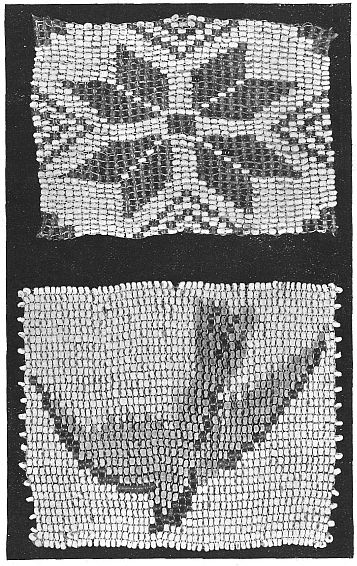
A Needle-made Star Design and a Bird Motif.
8th Row.—7 b, 1 p, 1 b, 2 p, 2 b,
5 p, 2 b, 2 p, 6 b.
9th Row.—7 b, 2 p, 1 b, 2 p, 7 b,
1 p, 1 b, 2 p, 5 b.
10th Row.—5 b, 1 p, 1 b, 1 p, 5 b,
1 p, 1 b, 4 p, 2 b, 3 p, 4 b.
11th Row.—3 b, 5 p, 1 b, 4 p, 1 b,
2 p, 4 b, 1 p,
1 b, 2 p, 4 b.
12th Row.—4
b, 1 p,
1 b, 1 p, 4 b,
2 p, 1 b, 5 p,
1 b, 6 p, 2 b.
13th Row.—2
b, 1 p,
1 b, 1 p, 4 b,
5 p, 1 b, 2 p,
4 b, 1 p, 1 b,
1 p, 4 b.
14th Row.—4
b, 1 p,
1 b, 4 p, 1 b,
2 p, 1 b, 4 p,
2 b, 6 p, 2 b.
15th Row.—3
b, 6 p,
1 b, 4 p, 3 b,
4 p, 1 b, 1 p,
5 b.
16th Row.—3
b, 2 p,
1 b, 1 p, 4 b,
3 p, 1 b, 3 p,
1 b, 6 p, 3 b.
17th Row.—4
b, 5 p,
1 b, 1 p, 3 b,
8 p, 1 b, 2 p,
3 b.
18th Row.—3
b, 3 p,
1 b, 9 p, 2 b,
5 p, 5 b.
19th Row.—7
b, 2 p,
2 b, 1 p, 1 b, 7 p, 2 b, 2 p, 4 b.
20th Row.—6 b, 2 p, 1 b, 6 p, 1 b,
3 p, 9 b.
21st Row.—8 b, 3 p, 3 b, 1 p, 4 b,
4 p, 5 b.
22nd Row.—4 b, 4 p, 1 b, 4 p, 1 b,
1 p, 1 b, 5 p, 1 b, 1 green (g), 5 b.
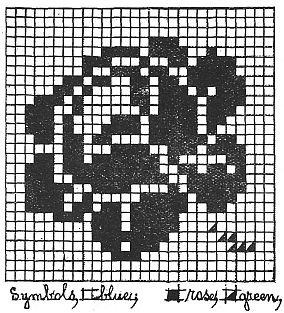
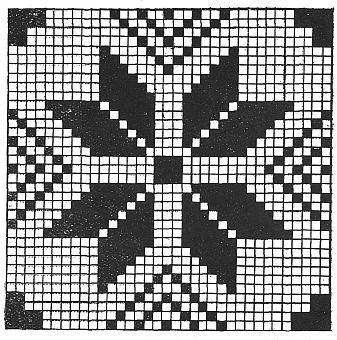
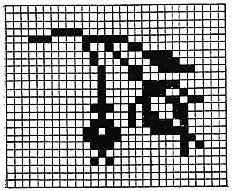
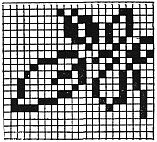
The Rose diagram. The Star diagram is given below.
23rd Row.—4 b, 1 g, 2 b, 5 p, 1 b,
2 p, 1 b, 7 p,
5 b.
24th Row.—5
b, 6 p, 2 b,
3 p, 1 b, 3 p,
3 b, 2 g, 3 b.
25th Row.—3
b, 1 g, 5 b,
5 p, 4 b, 3 p,
7 b.
26th Row.—24
b, 1 g, 3 b.
27th and 28th
Rows.—All
blue.
The bead at
each turning is
not included in
the number
given at the
beginning of
each row; this
is the “turning”
bead, and must be used
in every row as in the
1st and 2nd rows.
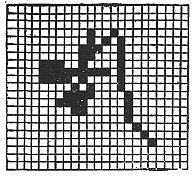
A Needle-made
Star Design.
This lovely design can
be extended each way.
It is made with 2 shades
of blue, but any other
combination will prove
equally attractive if the
shades are well chosen.
Light and dark blue
were used in the sample,
and, of course, the beads
are all of the same size
and shape.
Thread 4 dark blue
(d b), 7 light blue (l b),
1 d b, 2 l b, 1 d b, 2 l b,
1 d b, 2 l b, 1 d b, 2 l b,
1 d b, 7 l b, 4 d b. Turn. In this
design the “turning” bead is
omitted.
2nd Row.—Thread 1 d b bead, run
the needle through the last bead in
1st row at the side next to the 2nd
last, draw out the thread, now run it
through the 1st bead in this row
towards the 2nd bead in 1st row, and
put it through that bead; thread
another d b and continue on with
2 more d b, then 8 l b, 1 d b, 2 l b,
1 d b, 3 l b, 1 d b, 2 l b, 1 d b, 8 l b,
4 d b.
3rd Row.—2 d b, 11 l b, 1 d b, 2 l b,
1 d b, 1 l b, 1 d b, 2 l b, 1 d b, 11 l b,
2 d b.
4th Row.—2 d b, 12 l b, 1 d b, 2 l b,
1 d b, 2 l b, 1 d b, 12 l b, 2 d b.
5th Row.—10 l b, 1 d b, 4 l b, 1 d b,
3 l b, 1 d b, 4 l b, 1 d b, 10 l b.
6th Row.—10 l b, 2 d b, 4 l b, 1 d b,
1 l b, 1 d b, 4 l b, 2 d b, 10 l b.
7th Row.—10 l b, 3 d b, 4 l b, 1 d b,
4 l b, 3 d b, 10 l b.
8th Row.—10 l b, 4 d b, 7 l b, 4 d b,
10 l b.
9th Row.—10 l b, 5 d b, 5 l b, 5 d b,
10 l b.
10th Row.—10 l b, 6 d b, 3 l b,
6 d b, 10 l b.
11th Row.—4 l b, 6 b d, 1 l b, 5 d b,
3 l b, 5 d b, 1 l b, 6 b d, 4 l b.
12th Row.—1 d b, 4 l b, 6 d b, 1 l b,
4 d b, 3 l b, 4 d b, 1 l b, 6 d b, 4 l b,
1 d b.
13th Row.—1 l b, 1 d b, 4 l b, 6 d b,
1 l b, 3 d b, 3 l b, 3 d b, 1 l b, 6 d b,
4 l b, 1 d b, 1 l b.
14th Row.—2 l b, 1 d b, 4 l b, 6 d b,
1 l b, 2 d b, 3 l b, 2 d b, 1 l b, 6 d b,
4 l b, 1 d b, 2 l b.
15th Row.—1 d b, 2 l b, 1 d b, 4 l b,
6 d b, 1 l b, 1 d b, 3 l b, 1 d b, 1 l b,
6 d b, 4 l b, 1 d b, 2 l b, 1 d b.
16th Row.—1 l b, 1 d b, 2 l b, 1 d b,
4 l b, 6 d b, 5 l b, 6 d b, 4 l b, 1 d b,
2 l b, 1 d b, 1 l b.
A Swallow
Design.
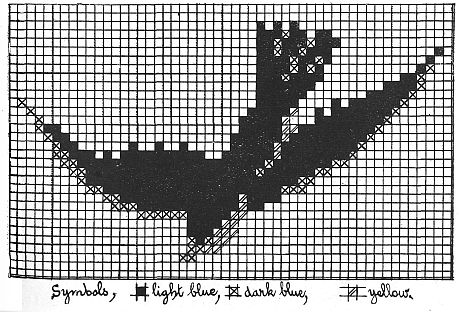
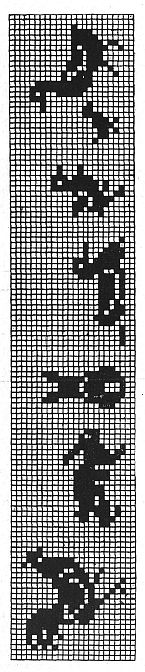
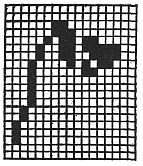
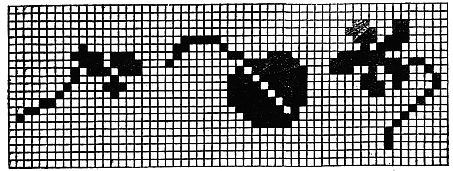
A Diagram for working the Bird.
17th Row.—2 l b, 1 d b, 2 l b, 1 d b.
10 l b, 3 d b, 10 l b, 1 d b, 2 l b, 1 d b,
2 l b.
18th Row.—1 d b, 2 l b, 1 d b, 2 l b,
1 d b, 9 l b, 3 d b, 9 l b, 1 d b, 2 l b,
1 d b, 2 l b, 1 d b.
19th Row.—2 l b, 1 d b, 2 l b, 1 d b,
10 l b, 3 d b, 10 l b, 1 d b, 2 l b, 1 d b,
2 l b.
20th Row.—1 l b, 1 d b, 2 l b, 1 d b,
4 l b, 6 d b, 5 l b, 6 d b, 4 l b, 1 d b,
2 l b, 1 d b, 1 l b.
21st Row.—2 d b, 2 l b, 1 d b, 4 l b,
6 d b, 1 l b, 1 d b, 3 l b, 1 d b, 1 l b,
6 d b, 4 l b, 1 d b, 2 l b, 1 d b.
22nd Row.—2 l b, 1 d b, 4 l b, 6 d b,
1 l b, 2 d b, 3 l b, 2 d b, 1 l b, 6 d b,
4 l b, 1 d b, 2 l b.
23rd Row.—1 l b, 1 d b, 4 l b, 6 d b,
1 l b, 3 d b, 3 l b, 3 d b, 1 l b, 6 d b,
4 l b, 1 d b, 1 l b.
24th Row.—1 d b, 4 l b, 6 d b, 1 l b,
4 d b, 3 l b, 4 d b, 1 l b, 6 d b, 4 l b,
1 d b.
25th Row.—4 l b, 6 d b, 1 l b, 5 d b,
3 l b, 5 d b, 1 l b, 6 d b, 4 l b.
26th Row.—10 l b, 6 d b, 3 l b,
6 d b, 10 l b.
27th Row.—10 l b, 5 d b, 5 l b,
5 d b, 10 l b.
28th Row.—10 l b, 4 d b, 7 l b,
4 d b, 10 l b.
29th Row.—10 l b, 3 d b, 4 l b,
1 d b, 4 l b, 3 d b, 10 l b.
30th Row.—10 l b, 2 d b, 4 l b,
1 d b, 1 l b, 1 d b, 4 l b, 2 d b, 10 l b.
31st Row.—10 l b, 1 d b, 4 l b, 1 d b,
3 l b, 1 d b, 4 l b, 1 d b, 10 l b.
32nd Row.—2 d b, 12 l b, 1 d b,
2 l b, 1 d b, 2 l b, 1 d b, 12 l b, 2 d b.
33rd Row.—2 d b, 11 l b, 1 d b,
2 l b, 1 d b, 1 l b, 1 d b, 2 l b, 1 d b,
11 l b, 2 d b.
34th Row.—4 d b, 8 l b, 1 d b, 2 l b,
1 d b, 3 l b, 1 d b, 2 l b, 1 d b, 8 l b,
4 d b.
35th Row.—4 d b, 7 l b, 1 d b, 2 l b,
1 d b, 2 l b, 1 d b, 2 l b, 1 d b, 2 l b,
1 d b, 7 l b, 4 d b.
Repeat from the 2nd row.
The Bird
Motif.
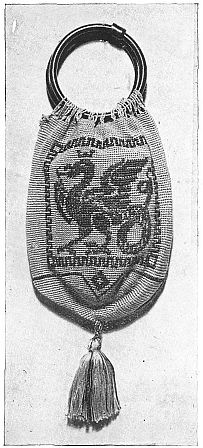
This is worked with two shades of
blue beads—light and dark—bright
yellow, and any colour chosen for
the ground-work.
It is a beautiful design for a beaded
bag intended for a gift. If used for
this purpose there must be a larger
number of beads in the first row for
a foundation, as the number shown
in the diagram (52) only gives a
width of 4 inches. Allow 14 beads
for each extra inch required. Be
sure to keep the bird design exactly
in the centre of the background,
the depth of the design as worked is
3¼ inches, therefore more rows before
and after the bird design will be
necessary to increase the depth.
Using a fine linen or glazed sewing
cotton, thread 53 beads for the
groundwork foundation, turn, run
the thread back through the 52nd
bead, and, working as directed for
the rose design, form the 2nd row of
groundwork, which, in the illustration
is white. The “turning” bead
is not included in the numbers composing
the design, but it must be
used at the beginning of every row.
3rd Row.—30 white (w), 2 dark
blue (d b), 20 w.
4th Row.—21 w, 2 d b, 2 yellow (y),
27 w.
5th Row.—26 w, 2 y, 1 d b, 1 light
blue (l b), 1 d b, 21 w.
6th Row.—21 w, 3 l b, 3 y, 25 w.
7th Row.—25 w, 2 y, 4 l b, 21 w.
8th Row.—15 w, 6 d b, 5 l b, 2 y,
24 w.
9th Row.—22 w, 2 l b, 1 y, 12 l b,
3 d b, 12 w.
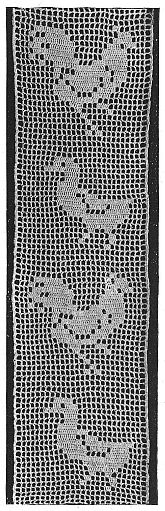
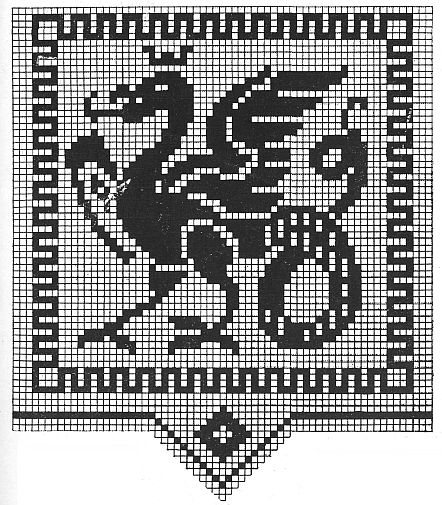
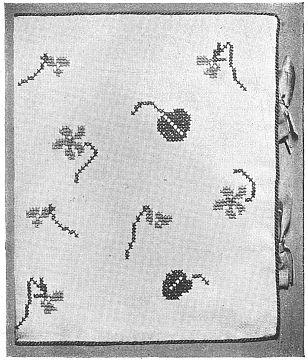
A Nursery Casement
Curtain.
10th Row.—11 w, 2 d b, 14 l b, 1 y,
4 l b, 20 w.
11th Row.—17 w, 3 d b, 21 l b,
2 d b, 9 w.
12th Row.—8 w, 1 d b, 25 l b,
2 d b, 16 w.
13th Row.—14 w, 2 d b, 6 l b,
1 d b, 20 l b, 2 d b, 7 w.
14th Row.—6 w, 2 d b, 22 l b,
1 d b, 7 l b, 2 d b, 12 w.
15th Row.—11 w, 1 d b, 8 l b, 1 y,
6 l b, 2 w, 10 l b, 1 w, 1 l b, 1 w,
3 l b, 2 d b, 5 w.
16th Row.—5 w, 1 d b, 2 l b, 6 w,
1 l b, 2 w, 1 l b, 2 w, 1 l b, 5 w, 5 l b,
1 y, 9 l b, 1 d b, 10 w.
17th Row.—9 w, 1 d b, 9 l b, 1 y,
6 l b, 19 w, 2 l b, 1 d b, 4 w.
18th Row.—3 w, 1 d b, 2 l b, 21 w,
5 l b, 2 y, 9 l b, 1 d b, 8 w.
19th Row.—7 w, 1 d b, 8 l b, 3 w,
1 y, 5 l b, 23 w, 1 d b, 3 w.
20th Row.—2 w, 1 d b, 25 w, 5 l b,
1 y, 2 w, 1 l b, 1 w, 7 l b, 1 d b, 6 w.
21st Row.—5 w, 1 d b, 6 l b, 1 w,
1 l b, 4 w, 5 l b, 27 w, 1 d b, 1 w.
22nd Row.—29 w, 6 l b, 7 w, 5 l b,
1 d b, 4 w.
23rd Row.—3 w, 1 d b, 4 l b, 8 w,
7 l b, 29 w.
24th Row.—29 w, 3 l b, 1 d b, 4 l b,
9 w, 2 l b, 1 d b, 3 w.
25th Row.—2 w, 1 d b, 1 l b, 11 w,
1 l b, 1 d b, 1 l b, 1 d b, 4 l b, 29 w.
26th Row.—29 w, 4 l b, 1 d b, 2 l b,
1 d b, 1 l b, 11 w, 1 l b, 2 w.
27th Row.—1 w, 1 l b, 12 w, 3 l b,
1 d b, 2 l b, 1 d b, 2 l b, 29 w.
28th Row.—29 w, 2 l b, 1 d b, 3 l b,
1 d b, 3 l b, 13 w.
29th Row.—14 w, 2 l b, 1 w, 2 l b,
1 d b, 3 l b, 29 w.
30th Row.—29 w, 1 l b, 1 w, 1 l b,
1 w, 1 l b, 18 w.
31st and 32nd Rows.—All white.
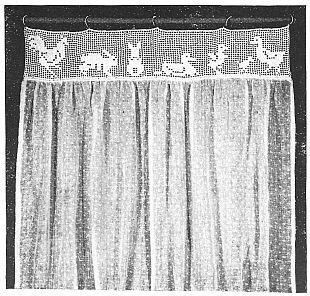
A CASEMENT CURTAIN WITH A
FILET CROCHET TOP.
See
pages 67,
75 and
76.