THE BATTLE OF SENLAC.
Both armies remained within their lines,
that Friday morning, and both were
busily preparing for battle. The commanders
as well as the warriors were making ready.
The instructions given by King Harold to
his men were to act altogether upon the defensive,
and to content themselves with their
strong position along Senlac ridge.
If his orders had been rigidly obeyed by all,
there would have been no victory won by
William of Normandy. The generalship of
the king and the valour of his warriors were
made of no avail by the headlong folly of the
less disciplined part of the Saxon army.
During this day, ambassadors went back
and forth, more than once, as if the last
possibility of peace had not already for ever
passed away. Harold could not consent to
any terms which did not include the immediate
departure of the invaders, and William
could not at this hour abandon his great
military enterprise without fighting a battle.
Both armies were in good spirits. The
Normans might well feel confidence in their
greatly superior numbers and in the established
reputation of Duke William as a successful
general. The Saxons, on the other
hand, appreciated the strength of their position,
and they were able to say to one another
that Harold, the son of Godwin, had never
lost a battle. They believed him to be at
least the equal of any living army leader.
Ned, the son of Webb, and Father Brian
were busy all along the lines, from hour to
hour, but there was nothing warlike for them
to do. When, however, they returned to their
camp at evening, both of them appeared to
have become exceedingly English, or at least
Saxon, in feeling.
"I believe I know what's coming," said
Ned. "The Normans can't break in! We
can cut them all to pieces if they try it on."
"The fight will be long and hard," replied
the missionary, very seriously. "It will be
well for thee and me to obtain places of
observation upon as high ground as we may."
"All right," said Ned. "I want to see it
all. It will be something for me to tell about
when I get home. I shall never forget it as
long as I live!"
"Ah, my boy!" said the good man, "a
great many thousands of these Saxons and
Normans will not live to remember it."
They slept again, and arose with the sun of
Saturday, October 14, A. D. 1066, the day
of the great change which came to England.
It was yet early in the forenoon when Harold
the King rode slowly along his lines and
spoke good words to all his soldiers. Everywhere
they responded to him with loud, enthusiastic
acclamations of love and loyalty,
and fearlessness.
Duke William of Normandy also, attended
by a brilliant escort of celebrated warriors
and men of high rank, rode from one to
another of the serried masses of his mighty
host. He addressed them with fiery eloquence,
assuring them of complete and speedy
victory over the inferior forces opposed to
them.
They, as well as he, however, were able to
see how strong were the Senlac works, and
how warlike and firm was the Saxon array
behind the barriers.
Ned, the son of Webb, and his companion
found that, from their post on the hill, they
had a good view of both armies. They had
been watching all movements and indications
with almost breathless interest. It was not
yet noon when Ned suddenly exclaimed:
"Oh, isn't this magnificent! I don't believe
there was ever anything more splendid
in all the world!"
"It will be a great battle, my boy," said
the missionary, "one of the greatest in all
history. There! Seest thou?"
"I see!" shouted Ned. "The Normans are
advancing! William's whole army is moving!
Oh, how I wish our men were armed
with breech-loaders! I wish we had Maxim
guns and cannon looking out through the palisades.
The Normans would never get near
enough to do any chopping on them, then."
"Chopping?" echoed the good man. "In
a very little, I think thou wilt see good chopping
done by the Saxons. The best of our
ax-men are at the front. Mark thou the
slingers behind them, and note King Harold's
bowmen. I would there were more
of them. The archers and slingers of Duke
William come on in advance of his horsemen."
"They are beginning, too," said Ned. "A
stone from a sling will break a shield. They
say the Norman arrows will go through
armour."
"If they hit!" said the priest. "Mark,
now! This is the advantage of the king's
position."
Ned could understand it in a moment. The
duke's archers had a high reputation, but in
this beginning of the battle they laboured
under a serious disadvantage. All their skill
and strength were of small value, while they
were shooting from low ground at enemies
who were not only above them, but were protected
by walls of wood. It was evident that
until these defences were broken through
stones and arrows would make no important
impression upon Harold's men.
"Ha, ha!" exclaimed Father Brian. "They
sling well, but they are in need of more stones
to throw. A man may not carry a quarry in
a quiver. Small harm have they done, and the
sharp arrows are wasted on the palisades. I
think Duke William must do better than this,
or he will get no nearer London."
"How lead would tell just now!" responded
Ned. "The range is getting short enough
for heavy revolvers. Hurrah! Here come the
Norman spearmen and the mounted knights
in full armour. What can lances do against
palisades? This is grand!"
The duke's archers and slingers had suffered
heavy losses, and they now fell back
discomfited, leaving the Senlac slope littered
thickly with the victims of the shafts and
stones of the Saxons. All was clear, however,
for the desperate assault which was to test the
strength of King Harold's lines. If it were
successful, it would be proved that his judgment
as a general had been wrong, and that
he ought not to have faced the invaders at
Senlac.
The attack was made in excellent order,
and with desperate courage, by masses which
seemed to be overwhelming. As they pressed
onward up the slope, the arrows and javelins
of the Saxons came among them in a death-dealing
storm, slaying or disabling both
horses and men by the hundred. They did
not waver, however, and now their foremost
ranks had reached the palisades to be met by
the long spears, the missiles, and the terrible
pole-axes.
"How they go down, the Normans!"
gasped Ned. "They have not broken
through at any place. They are falling
back! They are beaten! What will the
duke do, now?"
Up to this moment, the King of England
and his two brothers had remained on the
hill, together, that they might better observe
the operations of both armies, and it must
have seemed to them that their plan of battle
promised complete success. On the duke's
left, indeed, his host of Bretons, horse and foot,
had suffered such severe losses that they were
retreating in much disorder. In their panic
rout they were confusing also his left centre,
and at the same time his entire right wing
had staggered back down the slope in dismay.
Terrible was the disappointment and wild
was the wrath of the Norman leader as he
witnessed this first result of the stubborn
valour of the Saxons. They had suffered
small loss, comparatively, and their confidence
in themselves and in their king was
stronger than ever. It was only too strong,
for it became a great danger.
Sometimes the power of a really great
leader of men shows at its best under adverse
circumstances. Dark as seemed the prospect
before him, Duke William had lost neither
heart nor hope. He was among his troops,
now, galloping from point to point, commanding,
directing, encouraging, even threatening.
It was by his own personal exertions and
address that his beaten forces were rallying
at the very moment when the Saxon right
wing, contrary to the strict orders of King
Harold, broke forth from the security of its
defences to pursue the fleeing Bretons.
Ned, the son of Webb, heard, or thought he
heard, a terrible exclamation from the king,
and then both of the earls, his brothers, Gyrth
and Leofwine, spurred away. They went to
recall the mistaken sally of their overconfident
men, but they were too late.
The quick eyes of Duke William had instantly
perceived his opportunity. He was
already reinforcing with fresh troops his
rallying fugitives, and at once, in the open
field, their superior numbers became available.
In vain did their rash Saxon pursuers rally
around the two royal brothers. In vain did
they cut down hundreds of their foemen while
they strove to fight their way back to the
shelter of their Senlac defences.
"Swarms!" groaned Ned. "Oh, what
swarms of Normans are pouring around those
men! William himself is there! More of his
men-at-arms are charging in! His very best
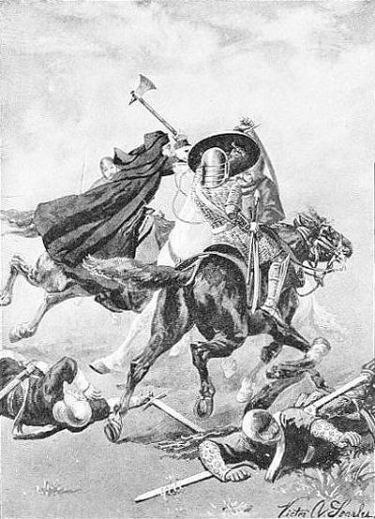
knights! What? There! He and Earl
Gyrth are fighting, hand to hand! William's
horse is killed! He has fallen! He is up
again! Gyrth's horse, too, is killed! They
are fighting again on foot! Is it Gyrth? No,
I can see William! Yes! Oh, dear! Gyrth is
dead!"
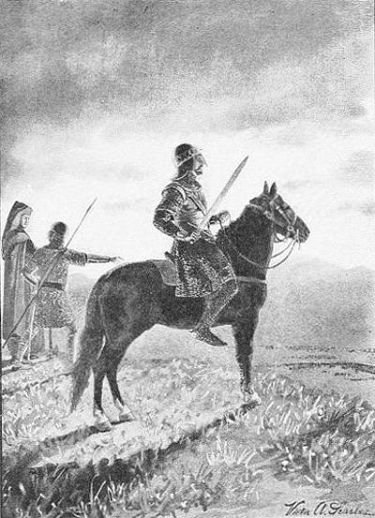
It was terribly exciting to watch such a
struggle as this had become. Near him sat
King Harold, himself, upon his horse, as
motionless as a bronze image.
"Father Brian," whispered Ned, hoarsely,
"Leofwine, too, is down. King Harold hath
no brothers, now. He must fight the rest of
this battle alone. Oh, this is dreadful!"
Dark, indeed, had now become the prospect
before the central body of the Saxon army.
Although the defences in front of it were
unbroken, those at its right as well as at its
left were very soon passed by the Normans.
It was afterward said that Duke William had
cunningly ordered his troops on the Saxon
right also to pretend flight, that their enemies
might be tempted to follow as those on the
left had followed the Bretons.
"NEAR HIM SAT KING HAROLD HIMSELF, UPON HIS
HORSE, AS MOTIONLESS AS A BRONZE IMAGE."
However that may be, the sun was now
sinking, and the centre of King Harold's army
was all that was left of it in good fighting
order. Of its assailants, the number which
had fallen was believed to equal, man for man,
that of all the Saxons who had been present
at Senlac that morning. Nearly a fourth
part of Duke William's army, therefore, lay
upon the field. The remainder of it, however,
still outnumbered, five to one, the remnant
of King's Harold's heroes.
Firm as a rock stood these, and against them
the furious tide of the invaders, horsemen
and footmen, broke in vain. Still they held
their strong position upon the hill of the
standards, the Golden Dragon of England and
the Fighting Man that was Harold's own personal
banner. The king, himself, was now
fighting on foot in the front rank of his house-carles,
and he had performed mighty deeds
of valour.
In this hour, however, the subtle war cunning
of the duke came to his aid. The shields
and the armour of the closely serried Saxons
behind these remaining works prevented the
shafts of his bowmen from injuring greatly
the solid wedge of warriors into which the
thingmen and their comrades had formed
themselves around and on the hill. The
battle could not be altogether lost so long as
this living wall should remain unbroken. All
the Saxons were on foot, and the Normans,
who were mounted, gained little thereby,
since their unarmoured horses were so often
killed by javelins as they pressed forward.
"Shoot up! Shoot up!" shouted the duke
to his archers. "Let the shafts fall upon
them from above. They have no shields over
their heads."
Thousands of strong-armed bowmen at once
obeyed him. In a moment more, it was as if
a thick hail of sharp arrows was falling
among the Saxons behind, while those who
were in front were still compelled to hold
their shields before them. The cunning device
of the duke might yet have been baffled, perhaps,
but for one of its first fatal consequences.
Man after man was going down, and the king
himself looked up to see what this might be.
Even as he raised his head, the battle was lost,
and the crown of England passed to William
of Normandy, for from the sky above, as it
seemed, a hissing shaft came down and pierced
through his right eye to the brain.
"The king hath fallen!" screamed Ned,
the son of Webb. "Harold is dead! He is
dead! We are beaten! England is conquered!"
"Come thou on with me, then," said
Father Brian. "There are plenty of horses.
We must speed away from this place. The
house-carles are wearied with long fighting,
but they will all die where they stand. Thou
and I have no need to die with them.
Quickly, now, my boy!"
Fierce, frenzied, desperate, was the last
stand of the Saxons around the royal standards
and the dying king. Terrible was the
carnage which they made among the Normans,
but it was as Father Brian had said:
the warriors of Harold were worn out with
long fighting, and they were now continually
assailed by arrivals of fresh troops, men who
had hitherto done little or nothing. Flesh
and blood could endure no more, and the
work of destruction was slowly completed.
One strong body of Saxons, it was afterward
related, was actually getting away when the
darkness came. It was closely followed by
the duke himself and his men-at-arms. Then
the Saxons turned again upon their pursuers,
and William not only lost many horsemen,
but came very near losing his own life also in
the hour of victory.
"Where shall we go now?" asked Ned, as
he and his friend clambered into the saddles
of two horses which had been tethered in the
rear of the lost position on the hill.
"I will guide thee, my boy," replied the
missionary. "Thou and I may make good
our escape, if we are prudent."
"How on earth can we get away from the
Normans?" groaned Ned. "Some of them
are between us, already, and all the rest of
England. I don't see how we are to get
through William's army."
"We must get out of the battle, first,"
said Father Brian. "Then we'll ride away
around into the Norman camps at the seashore.
We would do well to obtain speech
with him in the morning. Now that he hath
slain King Harold and considereth himself
the ruler of England, he will gladly welcome
any from among the Saxons who cometh to
him with a peaceful tongue. Be thou mindful
of that, my boy. I am glad that thou art
able to speak French to him."
"So am I," said Ned, with some energy.
"I'd really like to have a good talk with
William the Conqueror. But, oh, Father
Brian! this hath been an awful affair.
They will not need so many surgeons or
ambulances or hospitals as civilised armies
would. As soon as any man is down, somebody
killeth him. They do not seem to know
what mercy is."
"That they do not," said Father Brian.
"Thou wilt bear in mind, however, that
the killing of King Harold and all of his
best men giveth to William of Normandy
all the good title he hath to the crown
of England. If Harold had escaped all
alone from this battle-field he would be
king still."
"The English elected him fairly," replied
Ned. "Not one voter among them put in a
ballot for the duke. I suppose they won't try
to do any more against him after this, though.
Let him have it, then. All I can say is that
I hope there will never be another invasion
of England by anybody."
"No man may foretell concerning that
matter," said the missionary. "There hath
been much fighting on this island. Even
Ireland herself hath been attacked many a
time, and she might be again. It is my
opinion, though, my boy, that England will
for ever continue to be English, whoever is
king, even as Ireland continueth Irish."
"Most likely thou art right," replied Ned.
"The duke may bring in droves on droves of
Normans and all sorts. He won't think of
killing off the Angles, and Saxons, and Danes,
and Welsh, and Scotch. We don't, when
they come to America. Every kind that
lands among us becometh American, and I
shouldn't wonder if even the Normans became
Englishmen."
"Better for them to become civilised," said
the missionary, thoughtfully. "The duke
will kill none unless it may be a few earls
and other high men who may stand in his
way, or such commoners as resist him. I
think he will speak all others fairly and make
peace with them. Were he not to do so,
there are axes enough left in England to
make away with all that the Senlac battle
hath left of his army."
"That's so!" exclaimed Ned. "I've seen
some of them. Anyhow, I don't want to be
an English earl just now. It wouldn't be
safe."
"Come!" said Father Brian. "Faster!
The farther we get away from Senlac the
safer we will be from sword and spear. It is
getting very dark. I am glad of it."
After that he did not again draw his rein
until they had almost reached a line of tents
a little distance inland from the town of
Hastings.
"Now do I wish I knew," he declared,
emphatically, "which of these may happen
to belong to some man who was killed in the
battle. Oh, Ned, the son of Webb, let us
make trial of this large one that is nearest at
hand. Speak thou to yonder gaily apparelled
youth in thy best French."
"Ho! whose tent is this?" Ned asked at
once, as he rode nearer.
He shouted his question at a young man
who appeared to be a sort of esquire, stepping
hastily forward from the canvas doorway to
meet them.
"This is the marquee of the Sieur Raoul
de Berri," replied its custodian. "Whether
he be now alive or dead we know not. What
news, if any, have ye from the battle?"
"Of thy master I know nothing," said Ned,
"but of the battle I can tell thee that the
Saxon army is beaten and that Harold the
King is dead. Hard hath been the fighting,
all day, and the slain are many."
There had been hurrying feet from all
directions toward the spot where the two
newcomers had halted, and so there had
been other hearers besides the gay esquire of
Sieur Raoul de Berri. Loud and prolonged
were the shouts with which the announcement
made by Ned was received, for before
this there had arrived doubtful news from the
hard contested field.
"Dismount ye and come in," said the esquire.
"Well may we feast the bringers of
joyful tidings. Whoever ye may be, ye are
most welcome. Even while ye are eating and
drinking, moreover, we pray you to talk on.
We would gladly hear all that we may concerning
the great battle. How was it fought?
Can ye tell us the names of any that were
slain? How fareth it with our liege lord
the duke, that shall henceforth be King of
England?"
It was truly a good thing that Ned, the
son of Webb, was so well practised in his
French, albeit the kind he spoke varied much
from that which was now being uttered so
volubly around him. For once, indeed, Father
Brian was left to something which to him
painfully resembled silence.
Before long, however, there arrived a swarm
of French and Norman clergymen, all of whom
could understand the kind of Latin taught in
the great school at Clontarf. Speedily, then,
the good missionary went out with them, and
Ned was left alone to entertain his tent-full
of eager and excited listeners. All the
while, moreover, the good news spread rapidly
through all that camp and was carried on to
others.
"Sir," said Ned to the esquire, at last, "I
am tired out! I think there is nothing else
that will use up a man so completely as a
great battle."
"Ay!" exclaimed his new friend, hospitably.
"Thy couch is prepared for thee.
Thou hast fought well this day. Well am
I assured that our liege lord, the Duke of the
Normans, and the Sieur de Berri himself
would have us take all care of thee."
"I shall be glad to get to bed," said Ned.
"Sleep thou well," replied the esquire,
"and on the morrow thou shalt surely be
brought into the presence of the duke, as
thou desirest."
The appointments of that marquee and the
comfort of its arrangements for sleeping were
more in accordance with Norman luxury than
with Saxon plainness. Ned, the son of Webb,
took note of them, weary as he was. Nevertheless,
before his eyes closed he was thinking:
"If here isn't another of these frauds! I
didn't do any real fighting, for either side.
I'm afraid it's as bad, almost, as the Stamford
bridge humbug, and what to do about it I
don't know. Oh, how sorry I am that I had
no opportunity for telling King Harold that I
did not kill Sikend the Berserker. I shall
always have the credit of it, without any
fault of mine. They may put it into books
of history, just like other great exploits."
His slumbers were long and heavy, and
they were broken at last by a friendly shaking
at the hands of Father Brian.
"Up! Up!" he shouted. "O Ned, the son
of Webb, hasten and eat thy breakfast. The
Duke of Normandy cometh. Not yet, I think,
are we to call him the King of England.
That may not be until he hath been duly
crowned as king. My boy, I trust that now
thou art shortly to have speech with him."
Ned became very wide awake while he
heard what the missionary had to say, and
his mind grew very busy.
"I thought likely," he said, "that the
duke would come back to his camp. He
won't march for London till he knoweth what
the other Saxons are doing. His army was
badly mauled, yesterday, anyhow, and he
must get it into shape again."
The army of Norman invaders had indeed
been seriously damaged. If a second English
army could have attacked them on the day
after Senlac, it would have found them unfit
for another such struggle. There was no
such army in existence, however, and William
went on with his plans without armed interruption.
He went first to inspect his fleet,
and he sent the greater part of it back to
Normandy and other places.
At about the middle of the forenoon of that
day, the duke was at a camp a little south
of Hastings, attended by a number of his
great men. Among them were his brother
Odo, Bishop of Bayeux, and Lanfranc, the
famous scholar.
Here it was that Ned, the son of Webb,
and Father Brian were brought before him,
and they had already been named to the stern
and haughty Conquerors as the persons who
had brought the first tidings of the victory.
"They are guests of mine, my liege," said
the Sieur Raoul de Berri, as he saw them
approaching. "The youth is a young thane
from Northumberland, and the priest is his
tutor. They have prayed for an audience."
"This day will I hear but few words from
any," replied the duke, "but if it will please
thee, the boy may speak. Let the priest keep
silence. What wilt thou, O Ned, the son of
Webb?"
Ned had recently become somewhat hardened
to meetings with remarkable men, but
he was now gazing at the Conqueror with
manifest admiration. Harold, the son of Godwin,
himself, had not appeared more royally
majestic or carried in his face such an expression
of conscious power, combined with indomitable
strength of will. Ned kept his
courage up, however, and boldly responded:
"O Duke of Normandy and Conqueror of
England, all I wanted to say to thee is this:
The best thing thou canst do for this country,
now it is thine, is to run in railroads and
telegraph lines and newspapers as fast as
thou art able. Also, thou hadst better have
Mr. Lanfranc appointed Superintendent of
Public Schools. He can set up primary and
grammar schools and academies and universities,
all over the island. I can tell him
what books to get and where to get them.
I will give him, now, a complete list of all I
went through at Grammar School Number
Sixty-eight. He couldn't beat it if he should
try—"
"Halt thou then!" interrupted the duke.
"Lanfranc, this youth's matter appertaineth
to thee. I know naught of such affairs. Let
his tutor lead him away now. He is but
malapert to urge me at such a time as this.
Forward, all! Odo, my brother, we have
much to do ere sunset. England is yet but
half won and we sheathe not our swords yet."
Father Brian's hand had been upon the
bridle of Ned's horse, and he hurried him
away.
"O Ned, the son of Webb!" he exclaimed,
"what is in thee? Thou art overdaring.
The duke was all but wroth with thee!"
"I guess that is so," said Ned. "His eyes
flashed as if he had half a mind to hit me, and
I don't see why. I gave him the best kind
of advice. Didst thou not say that thou hast
some of thy clergymen friends to consult
with?"
"That have I," replied Father Brian, "and
I must go quickly to meet them. Thou
mayest amuse thyself by riding around for
awhile. Then get thee back to the tent of
the good Sieur de Berri. There or elsewhere
I hope to meet thee again, for our companionship
hath been exceedingly pleasant and
profitable. Fare thee well, for the hour. I
must go."
"Good-bye, then, Father Brian," said Ned.
"Come back to the tent, if thou canst. I
hope thou wilt soon have a mission school of
thine own. There will be scholars enough,
but where thou wilt get books and things, I
can't guess."
Away rode the good missionary, and Ned,
the son of Webb, was left to himself. He did
not feel like exploring the camps of the Normans,
and his horse galloped on with him
until he was pulled in at the shore of the sea.
It was at a place where a narrow wooden pier
jutted out from a sandy beach between high
rocks on either hand.
Here Ned dismounted and walked down to
the water's edge, like a boy in a dream. A
small scow-built punt, with a mast and sail in
it, lay rocking on the waves by the pier.
"I will take off my armour before I get in,"
he remarked. "I'm glad I kept on my outing
shirt and my trousers under my mail, all the
while. This is a very curious business. I
saved my hat, too. Oh, don't I feel easier
and lighter? I never want to be an ironclad
again."
His helmet and mail and shield and weapons
were pitched from him across the sand in a
hurry, and he stepped eagerly into the boat.
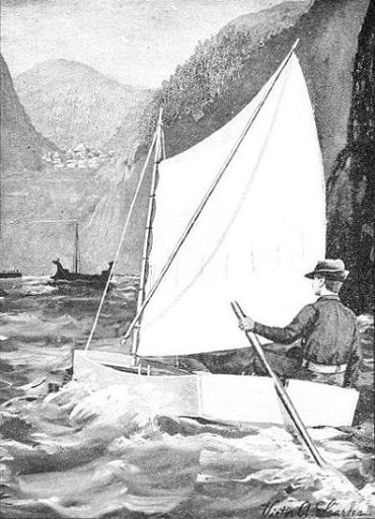
A good wind was blowing offshore and he
put up the sail to catch it.
"I don't feel like rowing," he remarked,
"after such a time as I have had. This
breeze ought to take me to the other side
before sunset. It is a good thing for me that
this is Green Lake and not the Atlantic Ocean
or the North Sea. Oh, what a tremendous
book that is. It's safe in the cubby under the
stern seat, too."
On he sailed, after that, swiftly and silently,
over the sparkling billows of the little lake.
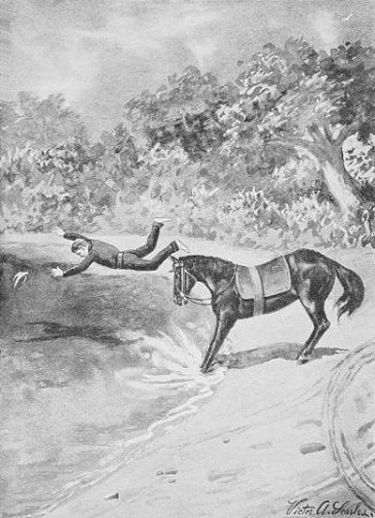
Almost before he was aware of it, the punt ran
ashore at the place where Nanny had so skilfully
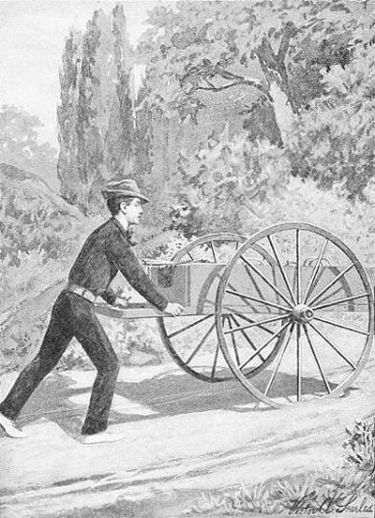
pitched him over her head. He saw the
two-wheeled barrow among the weeds a few
yards away and he went and brought it to the
margin. Into it he carried, with great care
and an appearance of something like respect,
the great folio History of the Normans.
"I'll go home now," he thought, "but I
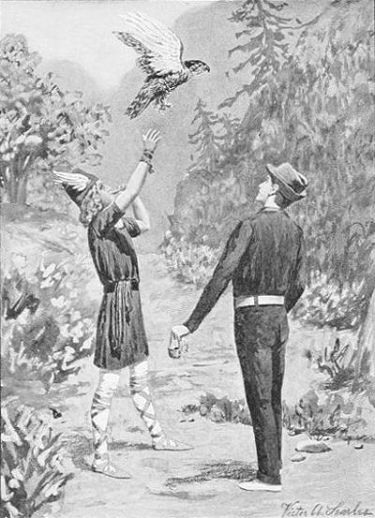
wish I had Lars with me, and Father Brian.
I'd like to show father and mother and all of
them my armour."
He found it tiresome work to trundle the
barrow, and he was both warm and weary
when he reached his grandfather's gate.
"There they are!" he exclaimed. "There's
a whole crowd of them, waiting for me."
"Hullo, Ned!" came loudly from within
the gate. "Where have you been all day?"
"Why, Uncle Jack—"
"My dear child!" interrupted Grandmother
Webb. "I was almost beginning to be
worried about you. Why did you stay so?"
"Did you catch anything?" asked his
grandfather. "Did you get any bites?"
"Well!" responded Ned, hardly knowing
exactly what to say. "I'll tell you how it is.
It was this book."
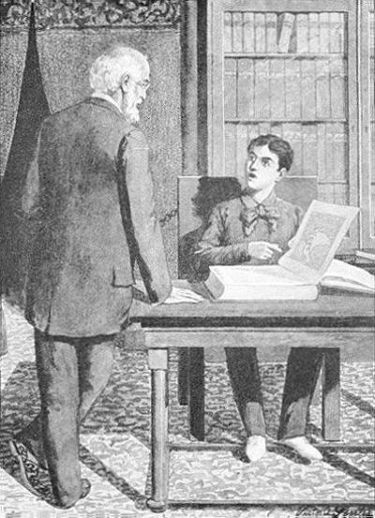
"My folio!" exclaimed Grandfather Webb.
"I had no idea that you really would take it
along. I'd have said no!"
"I did," said Ned. "I've been invading
England with Harold Hardrada of Norway
and the Vikings. Then I went all the way
from York and the battle of Stamford bridge
to the battle of Senlac, with King Harold of
England and Duke William the Conqueror."
"Oh, that's it, is it?" exclaimed Uncle
Jack. "I know how that is, myself. A
man can sit in his own room, nowadays, and
travel all around the world. All he needs is
plenty of guide-books and maps and histories.
You've been doing it, have you? I think you
had better keep it up and learn something.
Travel everywhere. See all there is to be
seen, and know all you can."
"That's what I think I'll do," replied Ned,
"but it's hard work, if there's as much fighting
as I've been having."
He had the folio in his arms now, as if he
were hugging it, but his grandfather took it
away as if he were pleased to get it back
unwetted by a bath in Green Lake, and carried
it back to its place in the library.
THE END.
TRANSCRIBER'S NOTE:
Obvious printer errors have been corrected.
Otherwise, the author's original spelling,
punctuation and hyphenation have been left intact.