Ned Preston read the note to Deerfoot, the
Shawanoe, speaking slowly and distinctly
each word, while the young Indian listened with
an expression of intense interest and pleasure.
"If the Colonel sees that, then will he read
those words you have spoken to me?"
"They will be the same."
"Then he shall see them."
As the young warrior spoke, he extended his
hand for the missive, which was given him. He
deftly drew an arrow from his quiver and began
tying the letter to the missile, doing it with much
care, for the task he was about to essay seemed an
almost impossible one.
"We are a hundred yards from the block-house,"
said Ned Preston; "it is a long shot for
the bow and arrow."
"Would my brother like to use his gun?"
asked Deerfoot with his shadowy smile, his question
being intended to remind his friend of the
superiority of the primitive weapon over the rifle,
at least in such an emergency as the present.
"The gun is of no use just now," said Preston,
"and I mistrust that your bow will not serve you
as well as you think."
"You shall see," was the comment of the
owner, who gave his full attention to the task
before him. He used a shred of deer-sinew
and fastened the letter directly behind the iron
barb. That done, the faithful bow was carefully
strung, and then the youth bent himself to the
work.
His intention was to send the arrow, if possible,
through the narrow window to the left of the front
door of the block-house. This had no glass, nor
screen, but as it was no more than eight inches
wide, although three times as high, and as the
shaft was weighted with a foreign substance, likely
to affect its accuracy of flight, some idea of the
difficulty of the feat may be gained.
Furthermore, it was necessary that the shot
should be fired secretly. Deerfoot had no opportunity
of standing out on the open ground, where his
limbs would be unimpeded, but he must aim from
behind the bank, so that no vigilant Wyandot
would detect him.
He set to work, standing below the bank and
pointing between an intervening bush or two,
making sure, however, that an unobstructed path
was open for his arrow. The missile was pointed
at an elevation of fully forty-five degrees; and,
with one eye closed, he slowly drew back the
string until the head touched the right hand,
which grasped the middle of the bow.
It was held thus ten seconds, during which the
athlete was as rigid and motionless as if moulded
in iron, while his eye rested on the narrow slit-like
window cut in the solid logs, all of a hundred
yards away.
Ned Preston kept his gaze fixed on the Indian,
who at that moment formed a picture worthy of
the finest artist that ever touched brush to
canvas.
Suddenly there was a faint twang, the bow
straightened out like lightning, and the arrowy
messenger started on its path weighted with the
all-important message.
Preston instantly glanced at the block-house,
centering his eye on the straight opening, but
with scarcely a hope that Deerfoot could succeed
in what would certainly be a marvelous exploit.
As the arrow was speeding directly away from
the lads, it was impossible to distinguish its
course through the air, though it could have been
seen easily, had they been stationed at right angles
to its line of flight.
The Shawanoe, having discharged the weapon,
immediately lowered it, and then peered forward to
learn the result of his shot.
But Preston had scarcely time to fix his gaze on
the distant window, when he saw something like
the flutter of a shadow—so to speak—directly in
the opening itself. It came and went with the
quickness of a flash, and he could not define it.
But where was the arrow?
It vanished from sight the instant it left the
bowstring, and Ned had not seen it since. It
should have struck somewhere in a very few
seconds, but had the head buried itself in the
ground between the river and the block-house, the
eagle-feather would have been visible. Had it
fallen on the roof, its sharp point would have held
the shaft motionless.
"You must have sent it over the block-house,"
said Ned, turning to Deerfoot; "and in that
case——"
He stopped, for the same shadowy smile on the
handsome face of the young Shawanoe told the
truth: the arrow had gone directly through the
window, and the curious fluttering shadow which
caught the eye of Preston was the missile with its
message.
"That is the most wonderful shot I ever saw!"
exclaimed Ned in a burst of admiration; "if I
could use the bow as you do, I never would touch
a gun. But, Deerfoot, is there not danger that
some of the Wyandots saw the arrow in its
flight?"
"If they were looking across the clearing, they
saw it perhaps; but Deerfoot hopes they did not."
"Suppose you had missed the window,—that
the arrow had struck the roof, or the ground, or
the logs at the side of the opening, it would have
buried its head and stayed in plain sight, would it
not?"
"Yes, and the Wyandots would be certain to
see it."
"And would soon know where it came from?"
"Nothing could have prevented."
"My gracious!" exclaimed Ned; "you ran a
great risk."
"We did; there was no way to prevent it."
Ned was almost speechless, when he realized
how much had depended on the success of the
shot of the Shawanoe: in fact, had he known all,
he never would have consented that the task
should have been attempted.
Had the arrow gone a few inches to the right
or left, or had it fallen short, or flown too high, the
Wyandots would have swooped down on the archer
and his friends, before they could have left the
spot.
Ned Preston regarded the shot as amazing as
the mythical one made by William Tell; and, but
for the urgency of the danger, would have given
further expression to his admiration. Deerfoot
himself was somewhat uneasy, and, for several
minutes, glanced right and left, and through the
undergrowth for signs of danger; but nothing
appeared, and it looked as though a piece of
extremely good fortune had attended the remarkable
exploit.
Such being the case, Preston now devoted his
attention to the window, from which he expected
to see the hand of his uncle, Colonel Preston,
waving in friendly signal for them to make the
desperate run across the clearing.
While he was thus employed, the keener vision
of the Shawanoe was roaming over the open space,
each side of the stockade, the woods beyond, and
especially did he scrutinize the two deserted
cabins that stood to the right.
The visual search had not continued long, when
it was rewarded by the unwelcome discovery that
in the building nearest him were several Wyandots,
who had probably spent the night there.
He saw their heads and shoulders, as they passed
the windows where they were beyond sight of the
garrison, but were in plain view of the Shawanoe.
This cabin was much nearer the block-house
than were the boys, from which the daring nature
of the project will be understood. Deerfoot was
hopeful before this that the houses were clear of
Wyandots, in which event his friends would have
had a much better prospect of success.
As it was, it all depended on how complete the
surprise could be made for the red men. If they
failed to note the running youths until the block-house
was nearly reached, they would be too late
to head them off, except by a shot from their
guns, and this risk could not be avoided under
any circumstances.
"There it is!"
It was Ned Preston who uttered the exclamation
in such excitement that his voice was dangerously
high.
"Sh! not so loud!" whispered Deerfoot,
scrutinizing the window through which he sent
his arrow a few minutes before.
Ned Preston was right: the hand of a person
was thrust through the opening and waved several
times. It swayed back and forth, and up and
down, with much deliberation, as though the
owner was fearful it would not be observed by his
friends along the river bank.
More than that, Deerfoot was sure he saw the
face of the one who signalled them, though the
distance was such that nothing like a recognition
took place.
After withdrawing his hand, it was put forth
again, and the motion was repeated. Colonel
Preston evidently meant that, if any mistake was
made, it should not be his fault.
Ned Preston now carefully awakened Blossom
Brown and explained what had been done and
what was contemplated.
"You have got to run as you never ran before,"
said his master, "and when you have once started,
there is no turning back."
"What would I want to turn back for?" was
the wondering question of the African.
"You might think it better to stay where
we are, and it may be that it is; but after the
Wyandots learn we are here, it is run or die
with us."
"My brother speaks the truth," said Deerfoot,
who was looking across the clearing at the nearest
cabin: "there are red men there, and they will
try and hinder you from reaching your friends."
There was no reason to hope the prospect would
improve by waiting, and it was decided to start at
once. Deerfoot, it was understood, was to remain
where he was and to make no attempt for the
present to enter the block-house. It was expected
that, after Blossom and Ned were safely within the
building, the guide would hasten to Wild Oaks
and bring assistance to the beleaguered garrison.
When the boys were ready, the Shawanoe impressed
one fact upon them: they were not to
cease running for an instant, unless stopped
beyond all power to overcome, but, fixing their
eyes on the door of the block-house, strain every
nerve to reach the goal.
Each lad was to carry his loaded gun in his
right hand, but not to use it, unless forced to do
so: if Colonel Preston should delay admitting
them, they would be lost; but there was no cause
to fear such a miscarriage.
The boys stealthily moved forward and up the
bank, and, pausing near the margin, awaited the
word from the Shawanoe. The perilous point, in
the eye of the latter, was the cabin where he knew
the Wyandots to be, and he watched it closely for
several minutes. Nothing was to be seen of them
just then, and he said in a low voice—
"Go!"
On the instant, Ned Preston and Blossom
Brown bounded across the clearing in the direction
of the block-house: it was a straight run of a
hundred yards over a level piece of land, on which
only a few stumps remained to show that it was
once covered by the forest.
The African, it need not be said, strained every
nerve and fibre of his being to reach the goal. His
heavy, lumbering build made him less fleet than
Preston, who could have drawn away from the
beginning; but he could not desert his companion
in such extremity and he timed his speed, so as to
keep just ahead of Blossom, and thus urge him to
his utmost.
Crouching under the shelter of the river bank,
Deerfoot watched the run for life with the intensest
interest. He grasped his strong bow with his
right hand, while one of his arrows was held in
the left, ready to use on the instant it might
become necessary for the safety of either of the
fugitives.
Those who knew Deerfoot best, said he was
reluctant to employ his marvelous skill on any
person, and would not do so as long as it was safe
to refrain; but it would have required only a
single glance at his glittering eye and compressed
lips, to understand that he considered the emergency
was now at hand.
It so happened that the fugitives had gone no
more than ten yards on their swift run, when
the Wyandots in the cabin discovered them
and made known the fact in the most alarming
manner.
First several whoops broke the stillness within
the building, and then two sharp reports followed.
The Wyandots had fired, but their aim was so
hurried that, as it seemed to Deerfoot, neither of
the fugitives was harmed. At least they continued
their flight with unabated speed.
But the efforts of the Wyandots to check the
boys was not to end with the simple discharge of
their rifles. The two that had used their pieces,
sprang from the front windows of the cabin and
dashed quartering across the clearing, with the
intent to head off the youths, before they could
reach the block-house.
This brought both in range of the terrible bow
of Deerfoot who placed the arrow in position; but
it was his intention to hold the weapon until it
should become imperatively necessary to use it,
for it will be seen that, if he took part in the
singular contest, it would be such a complete
unveiling of his true character that his usefulness
to the whites would be almost destroyed.
Besides, each boy carried a loaded rifle which he
knew how to use, and it was not to be supposed
that either would allow himself to be tomahawked
or taken prisoner without resistance.
The Wyandots who ran forth in the effort to
throw themselves across the path of the fugitives,
were as daring warriors as ever mingled in the
fierce fight with settlers or those of their own
race. They had emptied their guns in the futile
effort to bring down the boys, and, throwing the
weapons aside, they now sprang forward with the
resolution to make them prisoners, despite the
risk to themselves, for they must have known that
the garrison would endeavor to protect their
friends, and they could not help suspecting that
there was one or more along the river bank, who
were likely to take part in the singular struggle.
Be that as it may, the red men ran straight
from the deserted cabin across the path of the
boys, who found themselves confronted by the
brawny redskins, before they had gone half the
distance to the building.
"Let's sneak 'round ahind de block-house and
climb ober de fence and hide," said Blossom, when
he saw the gauntlet he had to run.
"Straight for the door!" commanded Preston:
"that is our only chance!"
But the youth had scarcely spoken the words,
when he saw that a collision with the Wyandots
was inevitable: they were between them and the
fort, and there was no possible way of flanking
them.
The superior fleetness of Ned held him slightly
in advance of his companion. The former ran
until close to the Wyandots, when he turned to
the left. The warriors immediately leaped forward
so that they were still directly in front of
the fugitives.
"It must be done!" exclaimed Ned, coming to
an instant halt, raising his rifle and aiming at the
nearest Indian, who was in the very act of poising
himself to throw his tomahawk.
Everything passed so swiftly that the spectators
could scarcely follow the movements. At the
moment Ned drew his gun to position, he caught
the flash of the implement as it circled with
lightning quickness over the bronzed skull of his
enemy.
Young Preston knew what was coming. Pausing
only long enough to catch the gleam of the
warrior's eyes, over the sights of his rifle, he
pressed the trigger.
The Indian aimed at the head of the youth
and drove the tomahawk with prodigious force
and unerring accuracy; but the blade of the
implement glanced against the barrel of the
rifle, sending out a streak of flame, and, with
a tremendous rebound or ricochet, shot by the
shoulder of the lad, touching the ground
fifty feet away, and rolling over and over several
times, before it lay still. When it left the hand
of the warrior, it was with a force that would have
cloven the skull of the lad, as though it were
cardboard.
The throw and miss were remarkable, but, by a
striking coincidence, the rifle of Ned Preston was
discharged at the second the two weapons collided.
The violent shock to the gun turned it
aside, and the ball buried itself harmlessly in the
ground, far to the right of the crouching Wyandot.
The latter saw by what a hair's-breadth he had
escaped, and snatching his hunting-knife from the
belt at his waist, he bounded toward the youth,
who, nothing daunted, recoiled a single step, and,
grasping his weapon by its barrel, awaited the
attack.
All this took place in a few seconds, during
which the other Wyandot, feeling that the dark-faced
fugitive was his own, watched the extraordinary
conflict, with an interest as intense as
that of the other spectators further away.
Had the encounter between young Preston and
the sinewy Wyandot been permitted to go on,
there could have been but one result; but Deerfoot,
who was holding his breath, with his eyes
riveted on the combatants, now drew his arrow to
its head and aimed at the assailing warrior.
Although the distance between him and his
target was no more than half way across the
clearing, yet the feat was immeasurably more
difficult than that of sending the letter through
the narrow window; for, unfortunately, Ned Preston
and the Wyandot were standing so nearly in
a line that the young Shawanoe could only see the
head and shoulders of the powerful savage a few
feet beyond.
Beside this, the two were likely to change their
respective positions any instant: they might do so
indeed after the launching of the arrow, which
would not only miss the red man at whom it was
pointed, but was liable to strike the boy himself.
Even Deerfoot doubted his own success and he
therefore aimed with the greater care and caution,
slowly drawing back the shaft, and with nerves
like iron, looked steadily along the reed and at the
tableau far beyond.
But before the fingers let go the string, the
necessity for doing so vanished. The incidents
which we have undertaken to describe, passed
with such swiftness that it would have been
hard for a spectator to follow each phase, few as
they were; but it need not be said that every man
within the block-house was watching the extraordinary
scene on the clearing with an interest as
intense, as absorbing and breathless, as that of
Deerfoot himself.
Colonel Preston was standing by the door, with
one hand on the cumbersome latch, ready to draw
it inward the instant the boys reached the proper
point; while Jo Stinger, Jim Turner and Sam
Megill held their rifles ready to use, the very
second it should become necessary.
There was such bewildering rapidity in the
events narrated, that the spectators within the
block-house did not comprehend the extreme peril
of young Preston, until they saw the Wyandot
advancing on him with his drawn knife.
"Boys," said Jo Stinger, "it's the opinion of
the undersigned that this is a good time of day to
fire off a gun."
"Quick!" called out Colonel Preston from
below, as he peeped through the door; "shoot
that Indian!"
"That's just what is contemplated," replied
Stinger, whose rifle was already thrust through a
loophole, while he was looking along the gleaming
barrel.
But, to the consternation of the veteran, the
moment he drew bead on the warrior, he discovered
he stood in such exact line with young
Preston that it was impossible to shoot the red
man without the absolute certainty of striking the
lad directly beyond.
"I've got to wait," called out Jo, by way of
explaining his inaction, "until they shift their
positions."
Had the vengeful Wyandot comprehended the
vast advantage he gained by holding the youth
directly in front, he would have continued to do
so; but it was almost impossible that he should
have been subtle enough to make such a discovery.
Meanwhile, Ned Preston, daring, resolute and
defiant, grasped the barrel of his rifle, and with
one foot thrown forward, and with the stock of his
gun flung back in the position, and with the pose
of a skilled batsman awaiting the pitching of a
ball, braced himself for the assault.
The Indian, powerful, active and alert, bent his
knees and back slightly, like a panther gathering
for a leap, and glared in the face of the youthful
David, who so calmly confronted the fierce Goliath.
It was a trying position for the boy, who looked
dauntlessly into the hideous countenance daubed
with ochre and paint. It was probably the truth
that the Wyandot was testing the power of his
eye, as the rattle-snake does with the bird. If
such were the case, the result could not have been
gratifying to the warrior.
All at once, without removing his eyes from
those of Ned, the Indian deftly extended his left
foot slightly forward and a brief distance to one
side. Then he gradually shifted the weight of
his body over upon it, until he had transferred
himself nearly a foot out of alignment.
Deerfoot the Shawanoe instantly detected this,
and pointed his arrow with full confidence; Jo
Stinger was equally on the alert, and his keen gray
eye glanced along the barrel with more certainty;
but, not unnaturally perhaps, the two marksmen,
from opposite standpoints, understood the peculiar
maneuvering which the Wyandot had begun: he
intended to circle slowly around the boy, who
stood on the defensive, watching for an opening,
which he would seize with the quickness of lightning.
If such should prove the fact, the spectators
had but a short while to wait: and such did prove
to be the fact.
Once more the Wyandot moved his left foot,
almost as far as the limb permitted, and held it
motionless, with the toe resting on the ground.
All the time his black eyes were fixed with burning
intensity on the youth, and his right hand
grasped the haft of the knife, as though he would
crush it to nothingness.
Ned Preston suspected the purpose of his
assailant and he instantly turned, so as to face
him, who had not such an easy task as might have
been supposed.
For a full minute, the left leg of the Wyandot
remained extended, with nothing but the toe of
the foot daintily touching, as though he meant to
draw a line upon the earth with it. Then his
weight gracefully glided over upon the limb, the
gleaming eyes never once shifting from the pale
face of the boy pioneer.
Scarcely was this movement—slight as it was—completed,
when the oppressive stillness was
broken by the explosive report of a rifle, a blue
puff of smoke curled upward from one of the
loopholes of the block-house, and those who were
looking at the Wyandot, saw him suddenly throw
his hands above his head, walk rapidly and uncertainly
backward several steps, and then, with a
faint cry, fall, with limbs outstretched, stone-dead.
The second warrior became so absorbed in the
scene that he fixed his gaze on the two, paying no
heed to the African, who, he must have believed,
was at his mercy, when he chose to give his
attention to him.
With a shrewdness hardly to be expected, the
servant was quick to see that another's extremity
was his opportunity.
"Nobody aint tinkin' 'bout Wildblossom Brown
jes' now," was the belief of the lad, "which shows
dat it am a good time to tink 'bout hisself."
He immediately began what may be called a
flank movement around the three parties, who
took no notice of him, although Deerfoot and the
onlookers in the block-house observed the prudent
action of the lad. They were greatly relieved,
inasmuch as he could not offer the slightest help
by staying behind.
Thus it came to pass that, at the moment the
rifle was fired from the block-house, Blossom was
well on his way toward it, and his subsequent
action was like that of a runner who awaited the
report as a signal. At the very instant it broke
the stillness, he made a burst of speed and ran
with might and main straight for shelter. The
start that his own foresight had secured, placed
him so far in advance of his enemies that his
safety was virtually obtained.
"Open dat door!" he shouted in a voice that
must have been heard a half mile away; "open
her wide, or I'll smash her in!"
He plunged across the clearing like a steam-engine,
and the door was drawn inward, while he
was twenty paces distant, so that everything was
in his favor.
Without checking himself in the least he "took
a header" through the entrance and went clean
across the lower floor and against the opposite side
of the room, with a force that shook the entire
building.
"My gracious, Blossom, it was a narrow
escape!" exclaimed the Colonel, alluding to the
flight of the lad from the warrior who had marked
him for his own.
"Yes," said Blossom; "I like to have knocked
my brains out agin de oder side de ole fort."
"I'm more afraid the block-house has been
injured than I am that you have suffered; but you
are safe now, and I can only hope that Ned may
be equally fortunate."
The address and courage displayed by the surviving
Wyandot aroused the admiration of the
garrison, for it far surpassed their expectation.
The very instant the first red man was struck,
and while he was staggering backwards, Ned
Preston started with might and main for the
sheltering block-house: he was thus quick to
adopt the only course that offered safety, for the
other warrior still held his knife and tomahawk at
command, and was more alert, cunning and brave
than the one that had fallen.
Young Preston's promptness gained him considerable
start, but he was no more than fairly
under way, when the other made for him with the
speed of a deer. Ned was fleet for his years, but
he was no match for the pursuing warrior, who
gained rapidly.
The amazing daring of this pursuit can scarcely
be explained: the Wyandot was straining every
nerve to overtake the fugitive, who was striving
with equal desperation to reach the block-house
before him. The red man held his formidable tomahawk
in his right hand, and was running straight
toward the building from which the shot was fired,
and from which he must have known others were
certain to come. It was precisely as if a single
soldier should deliberately charge upon a masked
battery, of whose precise location he was well aware.
As may be supposed, the Wyandot had not run
half the intervening distance, when another blue
puff, floating aside from the loophole, accompanied
the report of a rifle. Jim Turner had fired at the
approaching Wyandot, but he did it so hastily
that he missed him altogether.
Ned Makes a Narrow Escape.
"Is there no way of stopping him?" muttered
Sam Megill, hurriedly bringing his gun to bear
and discharging it; but, astonishing as it may
seem, he missed also.
Jo Stinger was hastily reloading his piece,
determined that the daring red man should not
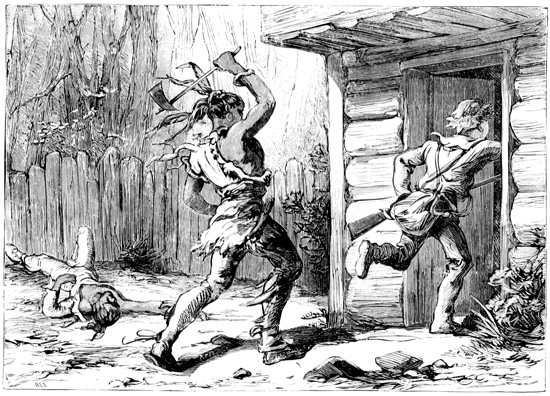
escape him, when Ned Preston dashed through
the door and was safe.
As the Colonel quickly shut and fastened the
entrance, a heavy thud was heard. The Wyandot
had hurled his tomahawk with such prodigious
force at the vanishing fugitive that the blade was
buried half way to its head, and the handle projecting
outward, would have required a power like
that of King Arthur to draw it forth.