Nearest the Pole A Narrative of the Polar Expedition of the Peary Arctic Club in the S. S. Roosevelt, 1905–1906
Transcriber’s Note:
The cover image was created by the transcriber and is placed in the public domain.
NEAREST THE POLE
THE GEOGRAPHICAL LIBRARY
The Opening of Tibet, By Perceval Landon
Flashlights in the Jungle, By C. G. Schillings
The Passing of Korea, By Homer B. Hulbert
Fighting the Polar Ice, By Anthony Fiala
Nearest the Pole, By R. E. Peary, U. S. N.
“NEAREST THE POLE”
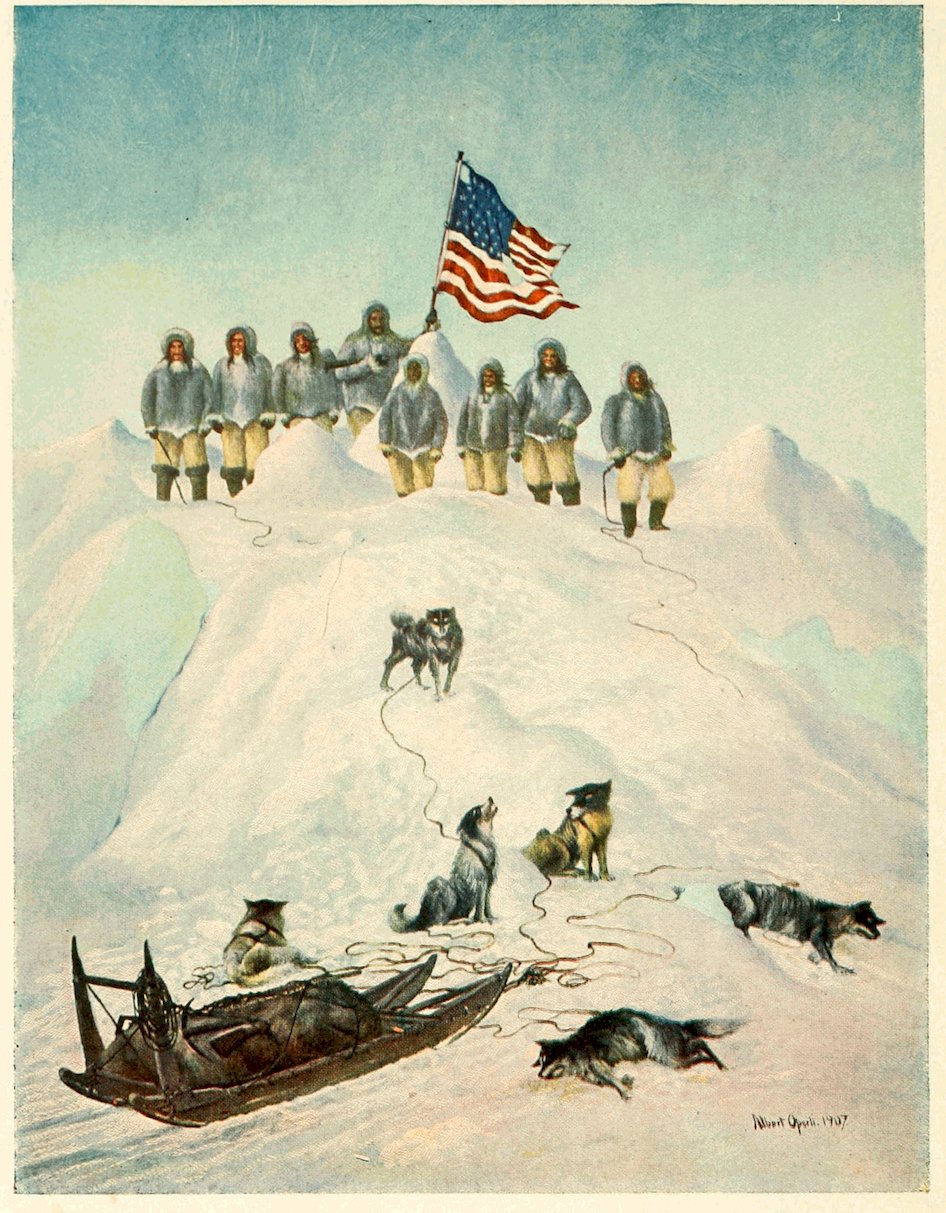
COMMANDER ROBERT E. PEARY PLANTING THE AMERICAN FLAG LATITUDE 87° 6′, APRIL 21, 1906
Painted by Albert Operti, from photographs
By
R. E. PEARY, U. S. N.
With ninety-five photographs by the
author, two maps and a frontispiece
in colour by Albert Operti
New York
Doubleday, Page & Company
1907
Copyright, 1907, by
Doubleday, Page & Company
Published, April, 1907
All Rights Reserved
Including that of Translation into Foreign Languages
Including the Scandinavian
TO HER WHO HAS BEEN
MY CONSTANT AID AND INSPIRATION
AND HAS BORNE THE BRUNT
OF IT ALL
INTRODUCTION
vii
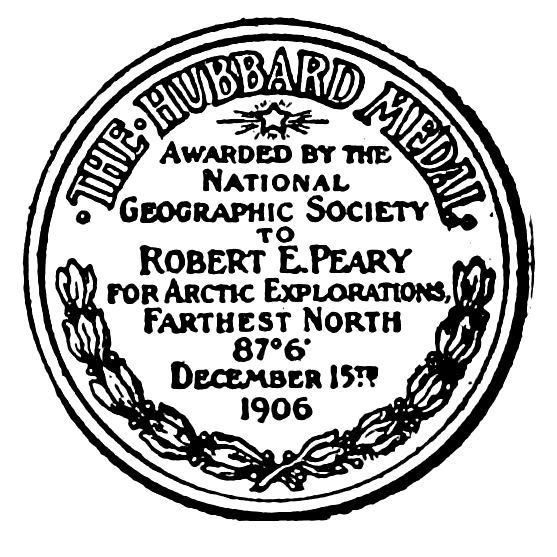
The Address of President Roosevelt on his presentation
of the Hubbard Medal of the National Geographic
Society to Commander Robert E. Peary, at the annual
banquet of the Society, December 15, 1906.
I count myself fortunate in having been asked to be
present this evening at such a gathering and on behalf of
such a society to pay a tribute of honour to an American
who emphatically deserves well of the commonwealth.
Civilised people usually live under conditions of life so
easy that there is a certain tendency to atrophy of the
hardier virtues. And it is a relief to pay signal honour
to a man who by his achievements makes it evident that
in some of the race, at least, there has been no loss of
hardy virtue.
I said some loss of the hardier virtues. We will do
well to recollect that the very word virtue, in itself, originally
signifies courage and hardihood. When the Roman
spoke of virtue he meant that sum of qualities that we
characterise as manliness.
viiiI emphatically believe in peace and all the kindred
virtues. But I think that they are only worth having if
they come as a consequence of possessing the combined
virtue of courage and hardihood. So I feel that in an
age which naturally and properly excels, as it should excel,
in the milder and softer qualities, there is need that we
should not forget that in the last analysis the safe basis of
a successful national character must rest upon the great
fighting virtues, and those great fighting virtues can be
shown quite as well in peace as in war.
They can be shown in the work of the philanthropist;
in the work of the scientist; and, most emphatically of all,
in the work of the explorer, who faces and overcomes
perils and hardships which the average soldier never in
his life knows. In war, after all, it is only the man at the
very head who is ever lonely. All the others, from the
subordinate generals down through the privates, are
cheered and sustained by the sense of companionship and
by the sense of divided responsibility.
You, the man whom we join to honour to-night, you,
who for month in and month out, year in and year out, had
to face perils and overcome the greatest risks and difficulties
with resting on your shoulders the undivided responsibility
which meant life or death to you and your
followers—you had to show in addition what the modern
commander with his great responsibility does not have to
show. You had to show all the moral qualities in war,
together with other qualities. You did a great deed, a
deed that counted for all mankind, a deed which reflected
credit upon you and upon your country; and on behalf of
those present, and speaking also for the millions of your
countrymen, I take pleasure in handing you this
Hubbard medal, and in welcoming you home from the
great feat which you have performed, Commander Peary.
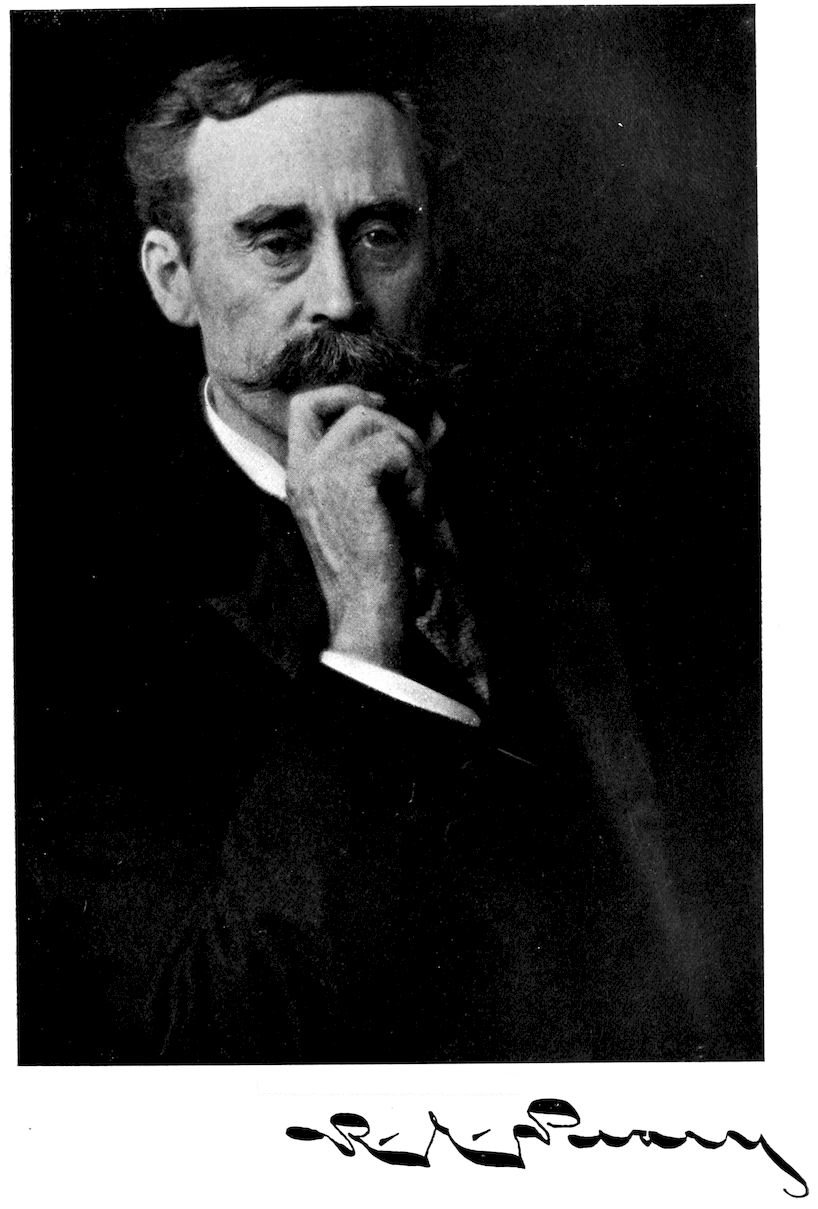
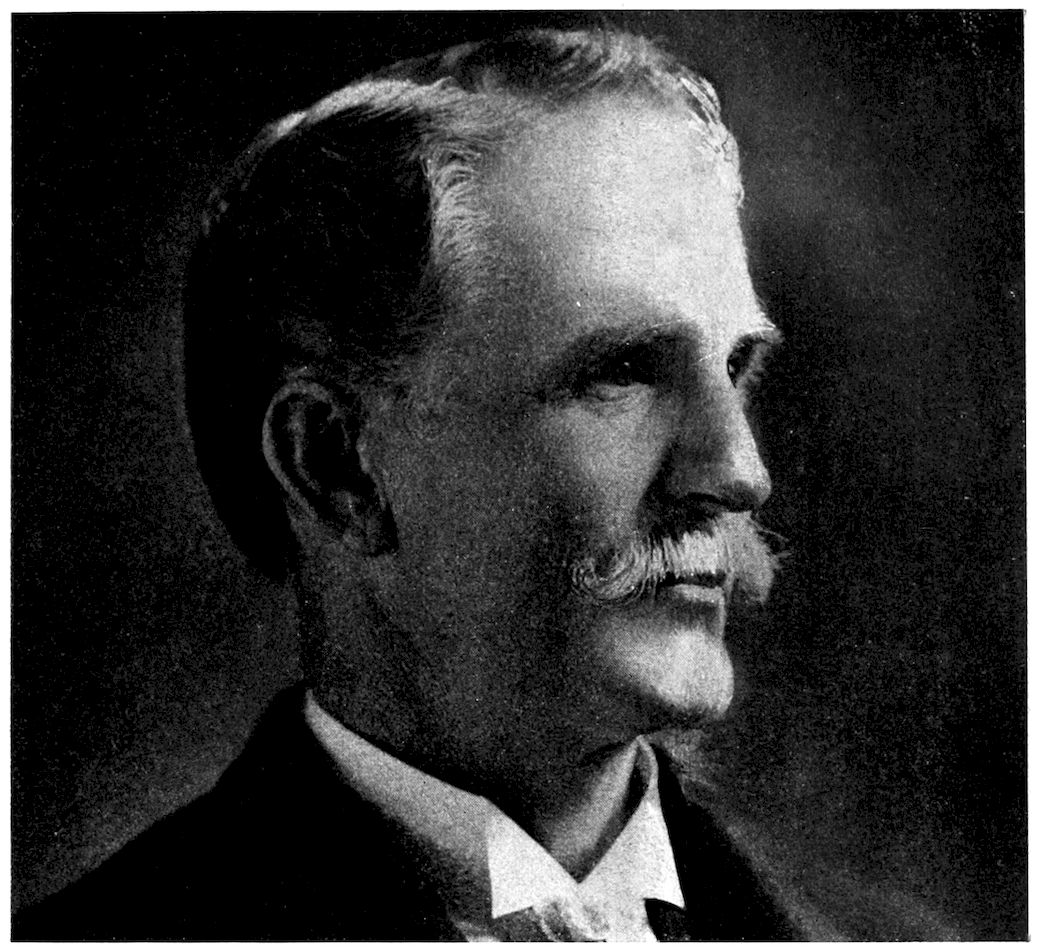
COMMANDER ROBERT E. PEARY
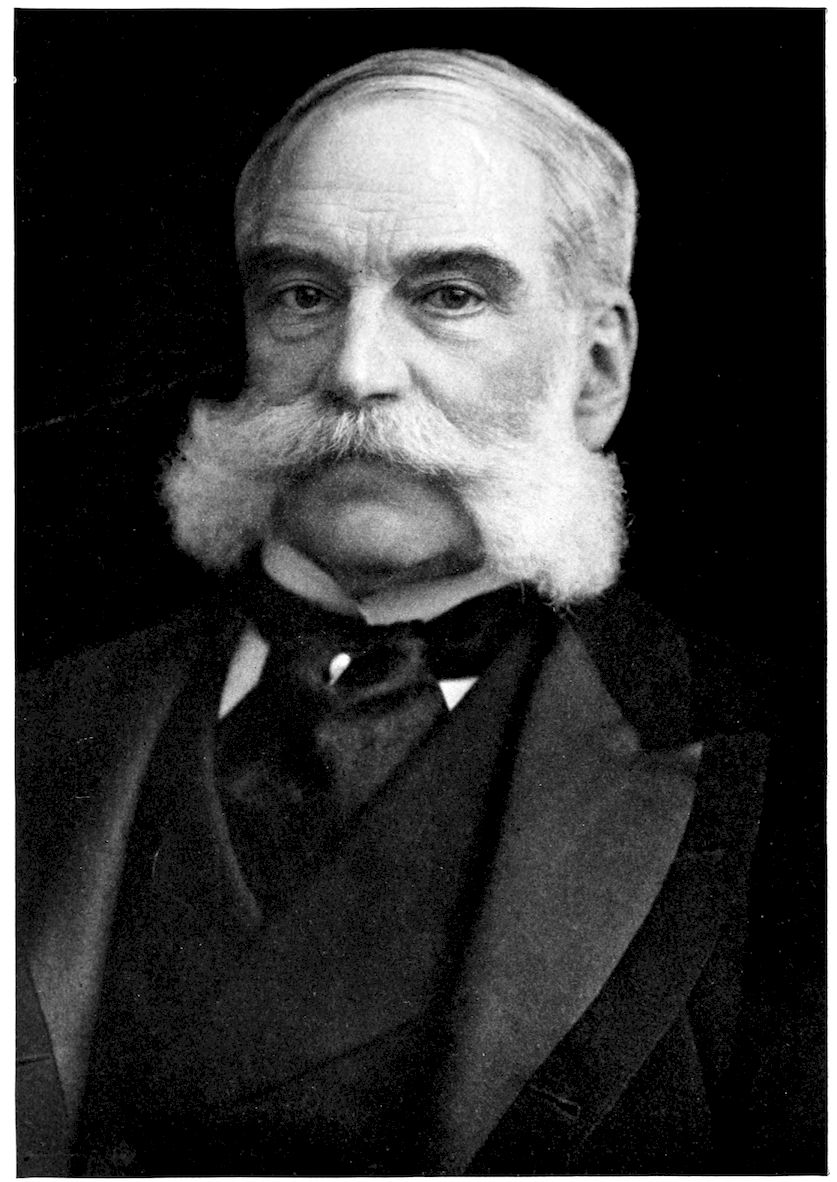
MORRIS K. JESUP
ixPeary’s reply to President Roosevelt on the presentation
of the Hubbard Medal of the National Geographic
Society, December 15, 1906.
President Roosevelt: In behalf of the Peary Arctic
Club and its president, Morris K. Jesup, I beg to express
our deep appreciation of the great honour conferred by the
National Geographic Society in this award of its gold
medal, and the double honour of receiving this medal from
your hand.
Your continued interest, Mr. President, your permission
to name the club’s ship after you, and your name itself
have proved a powerful talisman. Could I have foreseen
this occasion, it would have lightened many dark hours,
but I will frankly say that it would not, for it could not,
have increased my efforts.
The true explorer does his work not for any hopes of
reward or honour, but because the thing he has set himself
to do is a part of his being, and must be accomplished for
the sake of the accomplishment. And he counts lightly
hardships, risks, obstacles, if only they do not bar him
from his goal.
To me the final and complete solution of the Polar mystery
which has engaged the best thought and interest of some
of the best men of the most vigorous and enlightened
nations of the world for more than three centuries, and
to-day quickens the pulse of every man or woman whose
veins hold red blood, is the thing which should be done for
the honour and credit of this country, the thing which it is
intended that I should do, and the thing that I must do.
xThe result of the last expedition of the Peary Arctic
Club has been to simplify the attainment of the Pole
fifty per cent., to accentuate the fact that man and the
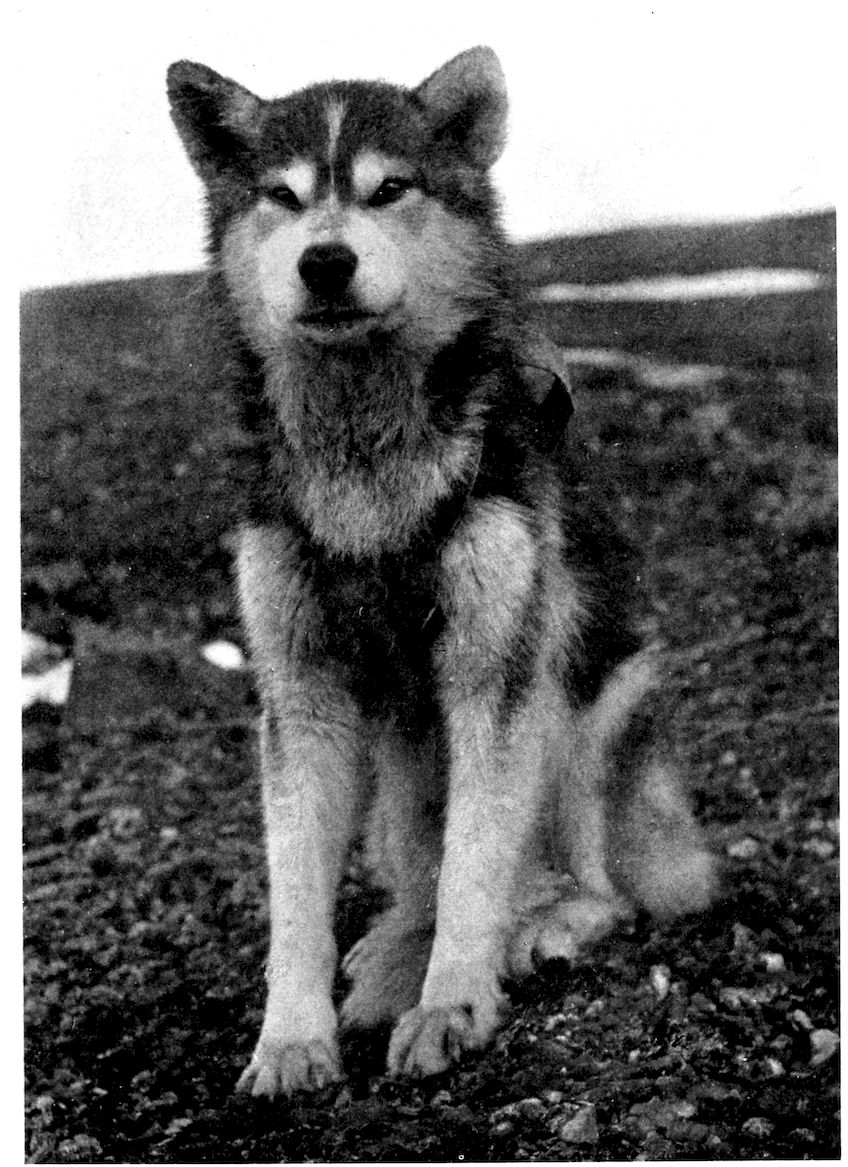
Eskimo dog are the only two mechanisms capable
of meeting all the varying contingencies of Arctic
work, and that the American route to the Pole and
the methods and equipment which have been brought
to a high state of perfection, during the past fifteen
years, still remain the most practicable means of
attaining that object.
Had the past winter been a normal season in the
Arctic region and not, as it was, a particularly open one
throughout the Northern hemisphere, I should have won
the prize. And even if I had known before leaving the
land what actual conditions were to the northward, as I
know now, I could have so modified my route and my disposition
of sledges that I could have reached the Pole in
spite of the open season.
Another expedition following in my steps and profiting
by my experience cannot only attain the Pole; but
can secure the remaining principal desiderata in the
Arctic regions, namely, a line of deep-sea soundings
through the central Polar Ocean, and the delineation of
the unknown gap in the northeast coast line of Greenland
from Cape Morris Jesup to Cape Bismarck. And this
work can be done in a single season.
As regards the belief expressed by some that the
attainment of the North Pole possesses no value or interest,
let me say that should an American first of all men
place the Stars and Stripes at that coveted spot, there is not
an American citizen at home or abroad, and there are
millions of us, but what would feel a little better and a
xilittle prouder of being an American; and just that added
increment of pride and patriotism to millions, would of
itself alone be worth ten times the cost of attaining the
Pole.
President Roosevelt, for nearly four centuries the
world dreamed of the union of the Atlantic and Pacific.
You have planted the Stars and Stripes at Panama and
insured the realisation of that dream.
For over three centuries the world has dreamed of
solving the mystery of the North. To-night the Stars and
Stripes stand nearest to that mystery, pointing and beckoning.
And, God willing, I hope that your administration
may yet see those Stars and Stripes planted at
the Pole itself. For, between those two great cosmic
boundaries, the Panama Canal and the North Pole, lie
the heritage and the stupendous future of that giant whose
destinies you guide to-day, the United States of America.
ANNOUNCEMENT
xiii
New York, March 30, 1907
The Peary Arctic Club at a recent meeting resolved unanimously to
place the Roosevelt on dry dock for a refitting, and to subsequently tender
the same to Commander Peary for a final attempt to be made by him to
reach the North Pole. Believing Commander Peary will be successful,
the Club has taken this action, and they have every confidence in the
gallant and intrepid American, and share in the pride that must animate
the American people to see planted at the North Pole the American flag.
The Peary Arctic Club asks the aid of those who have heretofore contributed,
as well as the co-operation and aid of all or any who are interested
in this patriotic enterprise. The expense of this final expedition it
is estimated will be one hundred thousand dollars.
Morris K. Jesup, President.
New York, March 30, 1907
The fact, as indicated in Mr. Jesup’s letter, that the
Peary Arctic Club hopes to send out another Polar
Expedition the coming summer, will, I trust, be accepted
as an excuse for any shortcomings in this
volume.
The writer has, from the day of his return, been
under the stress of insistent and incessant demands,
and in working and planning for the next campaign,
has found it difficult and at times impossible to put
this narrative of the campaign just finished, in the
shape that would do full justice to himself and his
publishers.
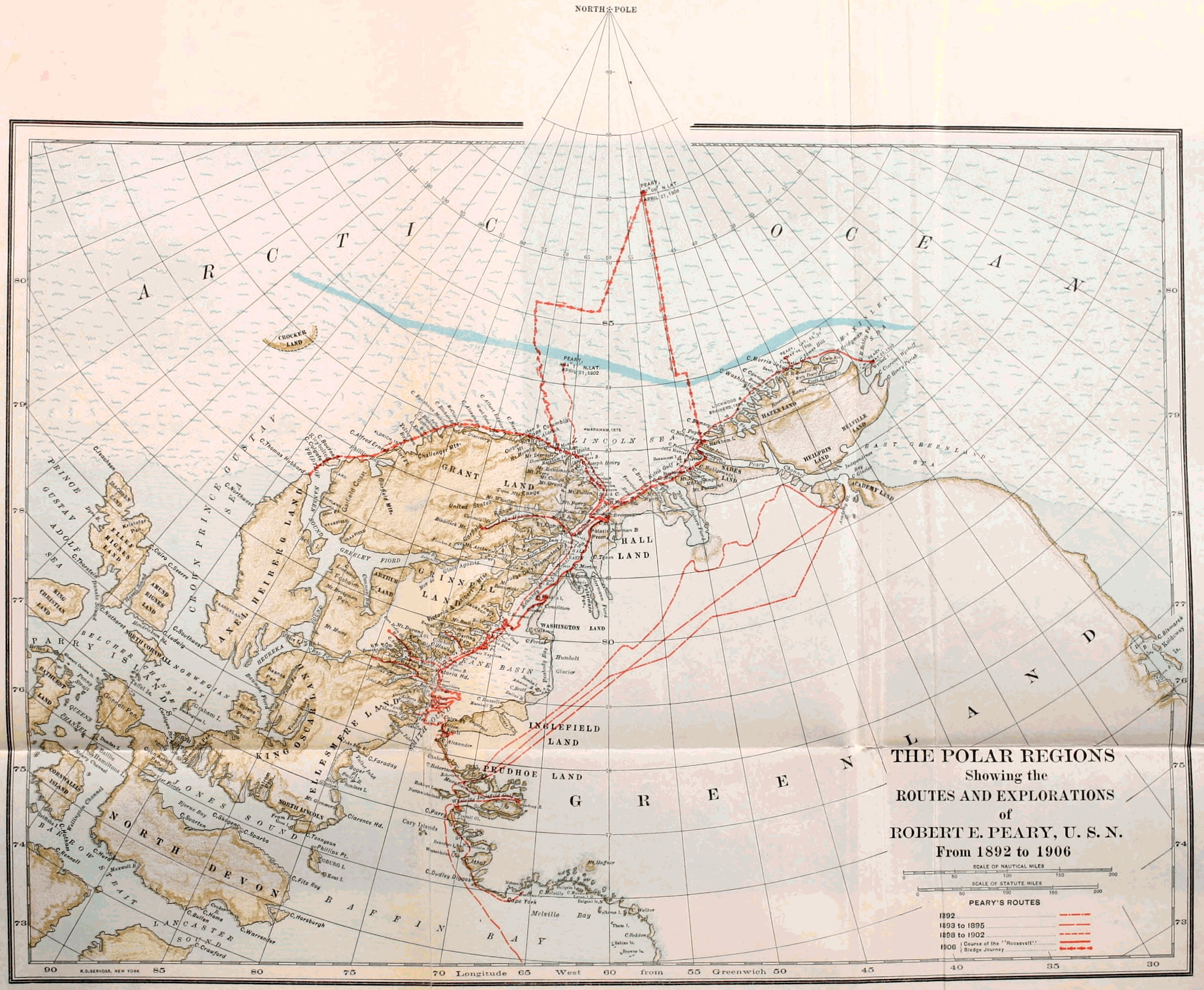
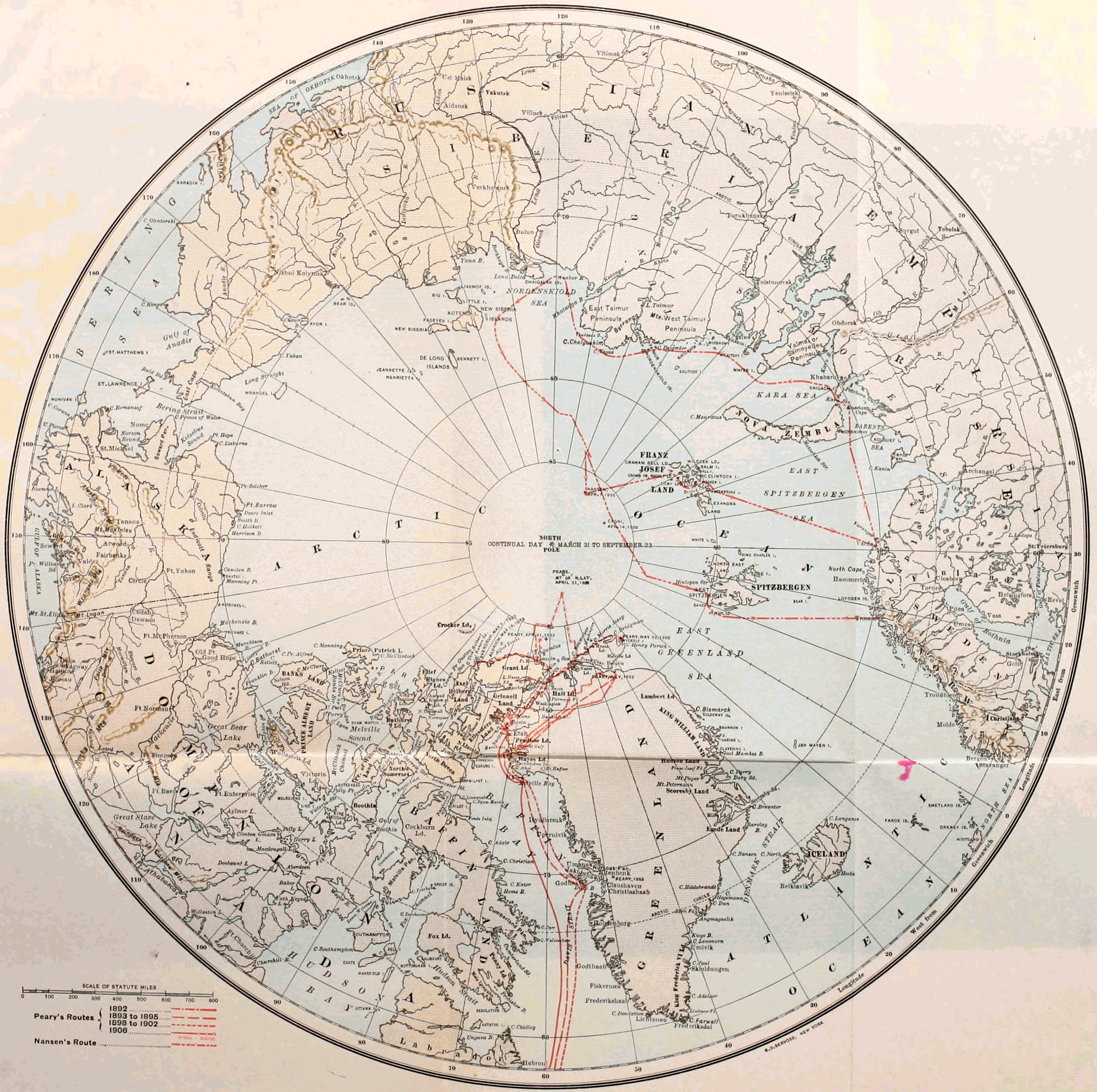
Detail Map of the Polar Regions showing the routes and Explorations of Robert E. Peary, U. S. N. from 1892 to 1906; and General Map of the North Polar Regions
When an expedition starts for distant and
mysterious regions for an uncertain length of
time, and particularly when its objective point is the
frozen heart of the Arctic Circle, it is natural that
those who know and are interested in its objects and
plans should turn with interest to its personnel and
its surroundings and environment while en route to the
scene of action.
The opening scenes of an Arctic voyage are comparatively
familiar to those conversant with Arctic
literature. The main features of the play are much the
same: A crowded and littered ship, regrets at leaving,
confusion, and, if the weather be decent, an effort to get
into shape, or, if the weather be bad, a surrender by most
of the party to abject misery in cramped quarters. In
the present instance, some of these features were entirely
absent, and others appeared only in a mild form.
Experience and a roomy ship almost completely
obviated the lumbering of the decks, beyond the inevitable
and inseparable feature of the coal, a portion
of which must at first always be carried on deck.
Such few things as were dumped on deck at the last
4moment, were quickly and readily disposed of; and
quarters specially arranged for the party and on deck,
insured fair room for each member of the expedition.
As to regrets, no pronounced symptoms were noticeable
in the others, and I had made the voyage too often
to consider it more than a trip to Europe.
Under these favourable circumstances let us look at
the personnel of the party whose home for an uncertain
length of time, in the ice of the Polar Sea, was
to be the good ship Roosevelt. First the captain,
Robert A. Bartlett, sailing master and ice navigator,
who was 30 years of age, 5 feet 10½ inches
tall, and weighed 174 pounds. Bartlett is one of the
new generation of Bartletts, a hardy family of Newfoundland
sailors and navigators, almost all of whom
have been associated with Arctic work. A great
uncle was master of the Tigress when that ship picked
up the drifting floe party of the Polaris expedition;
two uncles, Samuel and John, were respectively
master and mate of the Panther in which Hayes and
Bradford visited Melville Bay; recently Captain Sam
was master of the Canadian Government steamer
Neptune, which wintered in Hudson Bay; and both of
these, as well as Harry, a younger uncle, had been
masters of my ships during one or the other of my several
voyages north. Robert was mate in the Windward
in the expedition of ’98 to ’99.
Blonde, smooth-shaven and close-cropped, stockily
built and clear-eyed, he had already been farther north
in these regions than any of the other Newfoundland
ice masters, and his youth, ambition, and the Bartlett
blood all counted in his favour.
5Moses Bartlett, mate, a second cousin of the captain,
was 47 years old, 6 feet high, and weighed 184 pounds.
He had already been as far north as Cape Sabine
three times; twice as mate of my ships and once
as mate of the Neptune, and had also spent a
year on this ship in Hudson Bay in the employ
of the Canadian Government. Weather-beaten, grizzled,
and keen of eye, he was regarded as one of the
best of the Newfoundland ice pilots.
George A. Wardwell, chief engineer, was a native
of Bucksport, Maine, 44 years of age, 5 feet 11
inches tall, and weighed 240 pounds. Acting as
engineer in the shipyard in which the Roosevelt
was built and intimately employed in her construction,
he was deeply interested in her proposed work
and anxious to join the expedition. His phlegmatic
temperament, and evident capacity for work, combined
with non-use of liquor and tobacco, were all
strong points in his favour.
John Murphy, boatswain, was a native Newfoundlander,
31 years of age, 5 feet 11 inches tall, and
weighed 165 pounds. Sailor and fisherman from the
age of eighteen, he had also been as far north as
Cape Sabine on the Neptune and had wintered with
her in Hudson Bay.
Murtaugh J. Malone, assistant engineer, was a
native of Portland, Maine, 49 years of age, 5 feet
7½ inches tall, and weighed 150 pounds.
Dr. Louie J. Wolf, surgeon of the Expedition, was
a native of Oregon, 30 years of age, 5 feet 9 inches
tall, weighed 150 pounds, was a graduate of the
Cooper Medical College, San Francisco, California,
6becoming later House Surgeon at St. Vincent’s Hospital,
Portland, Oregon, and still later Assistant Attending
Physician at the Cornell University Medical College, and
of the outdoor medical dispensary of Bellevue Hospital.
Ross G. Marvin, secretary and assistant, was a
native of Elmira, N. Y., a graduate of Cornell
University, 25 years of age, 6 feet tall, and weighed
160 pounds. Subsequently he had three years of naval
training on board the school ship St. Mary’s.
Charles Percy, my steward, was a native of Newfoundland,
54 years of age, 5 feet 10 inches high, and
weighed 180 pounds. He had previously made a
summer voyage as far north as Cape Sabine in my
ship the Diana in 1899, and later had spent two
years with Mrs. Peary and myself at Cape Sabine, from
1900 to 1902. Subsequently he had been in my employ
as resident in charge of Eagle Island.
Matthew Henson, my personal attendant, was a
coloured native of the District of Columbia, 39 years of
age, 5 feet 6¾ inches high, and weighed 145 pounds.
In my employ in one capacity or another most of the
time since I took him to Nicaragua with me in 1888,
and a member of all of my Arctic expeditions, his quality
and capabilities were fully known.
The crew and firemen, with the exception of
one of the latter, Charles Clark, a native of Massachusetts,
were natives of Newfoundland, of the
usual type of sailors and sealers common to that island.
One of the firemen had been with me on the Eagle in
1886, and previously to that had been on one of
the whalers in search of the Greely party in 1883.
Another fireman had been north with me in the Hope
in 1898, and one of the sailors had made a voyage to
Hudson Bay.
7
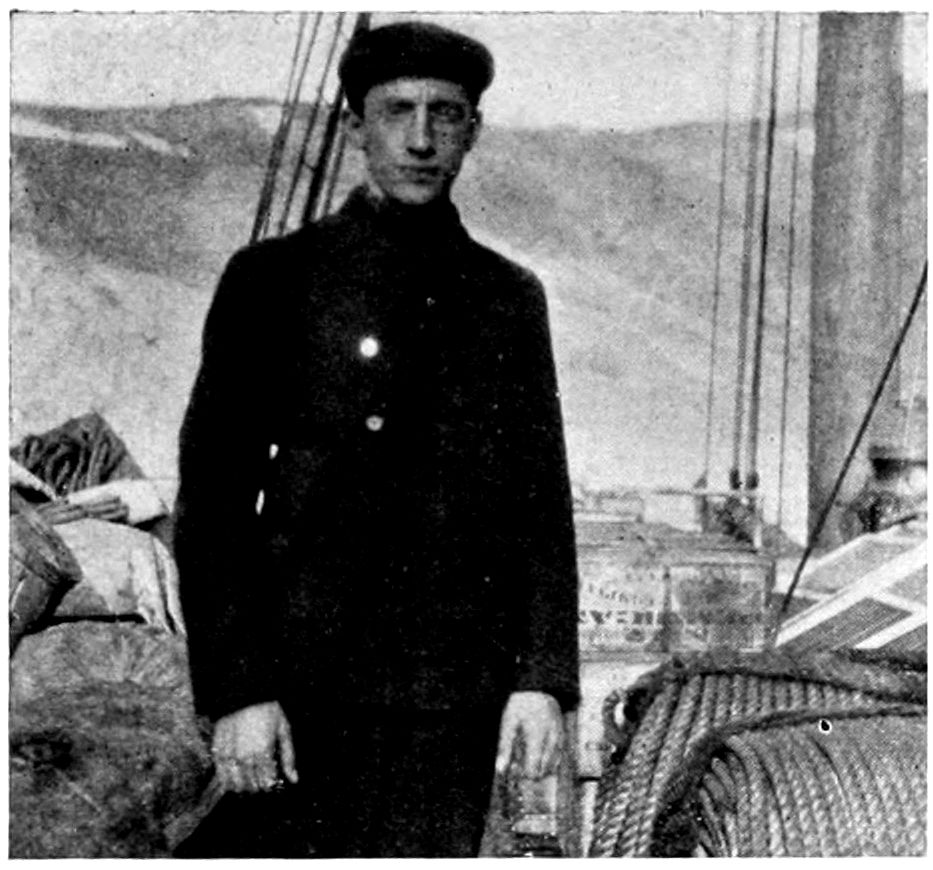
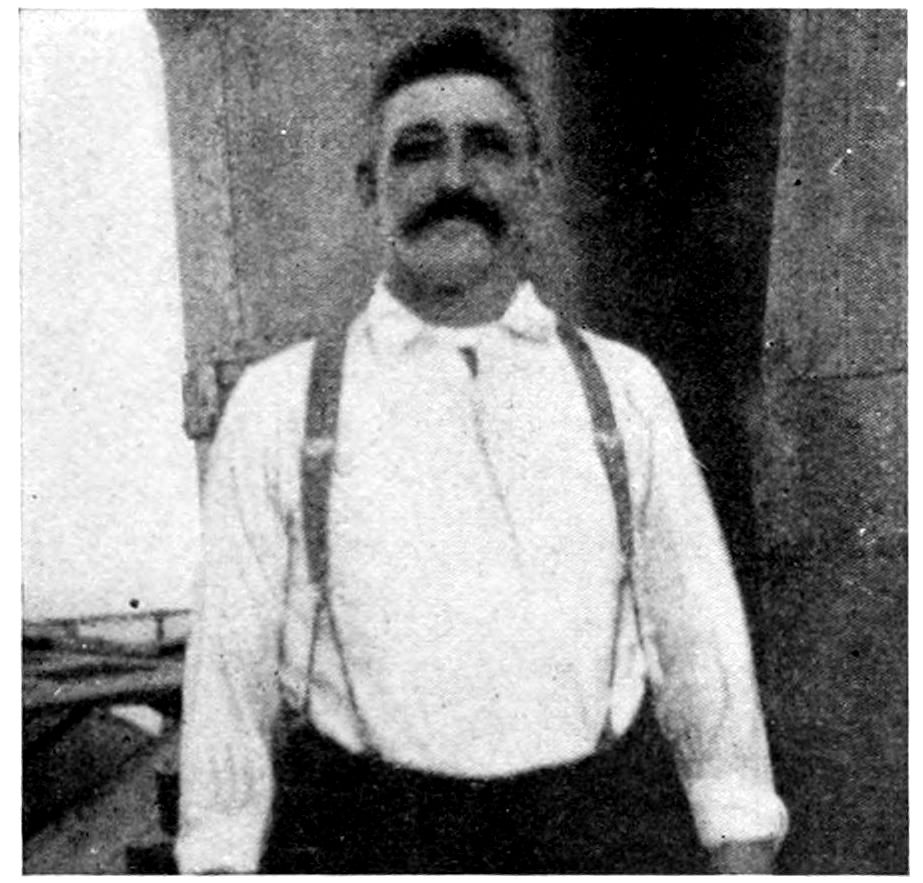
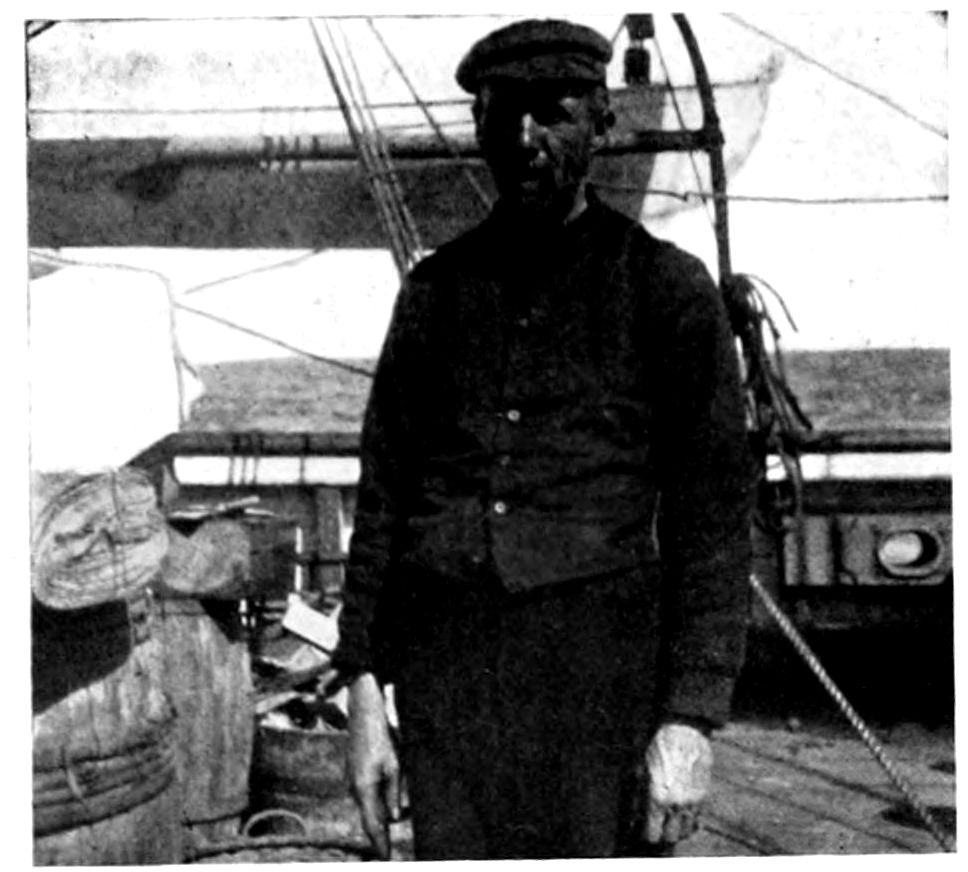
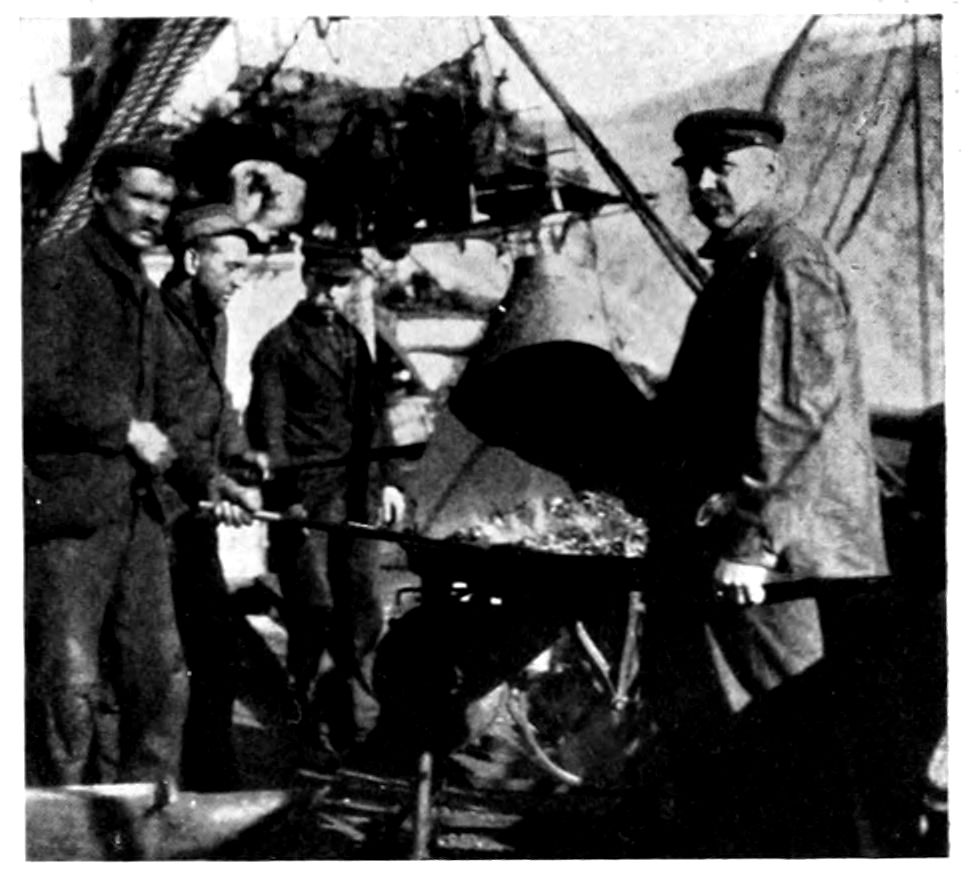
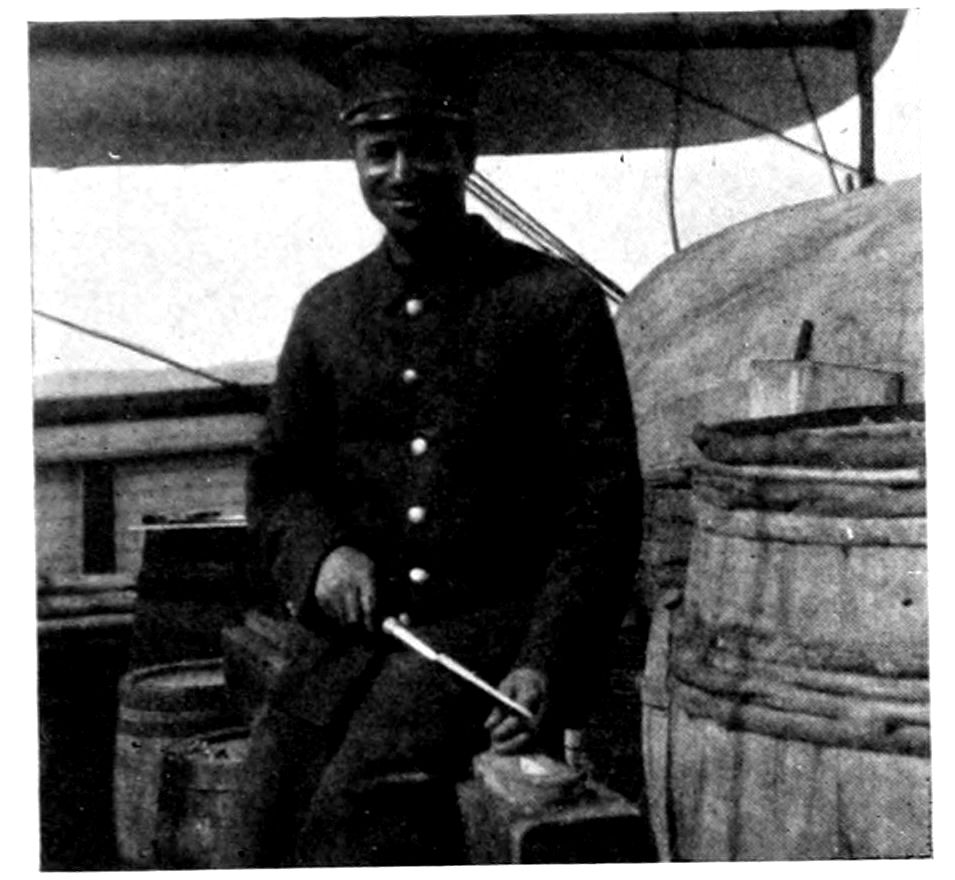
DR. WOLF
CAPT. BARTLETT
COMMANDER PEARY
STEWARD PERCY
MR. MARVIN
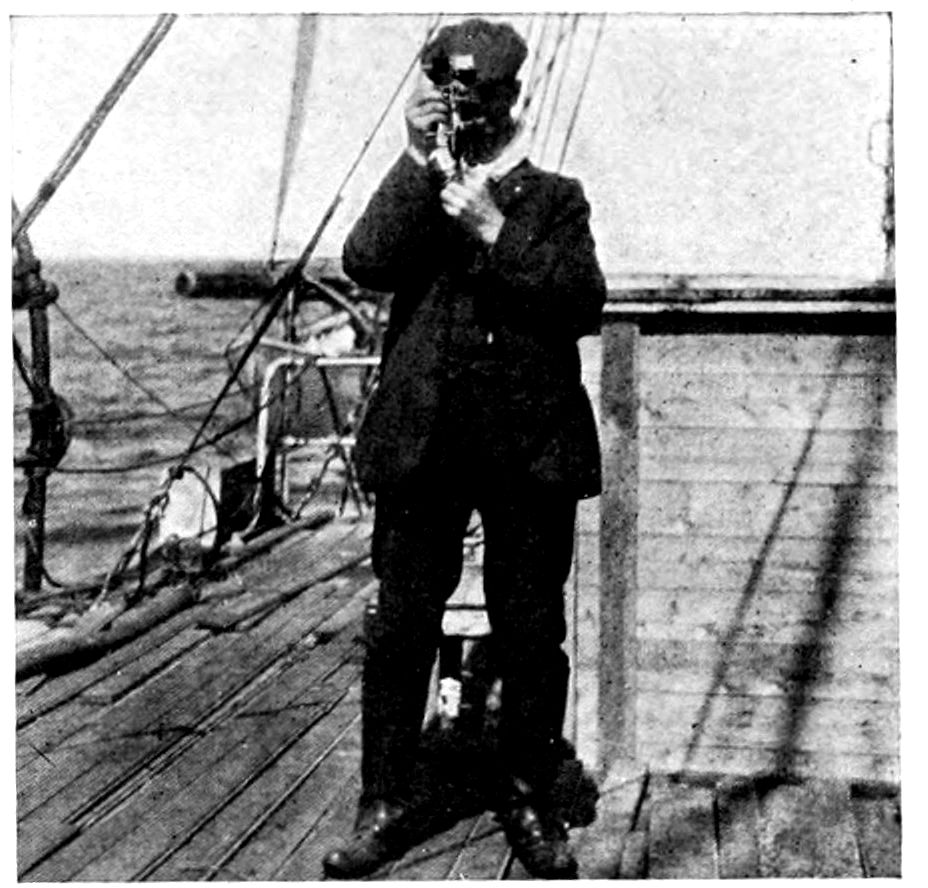
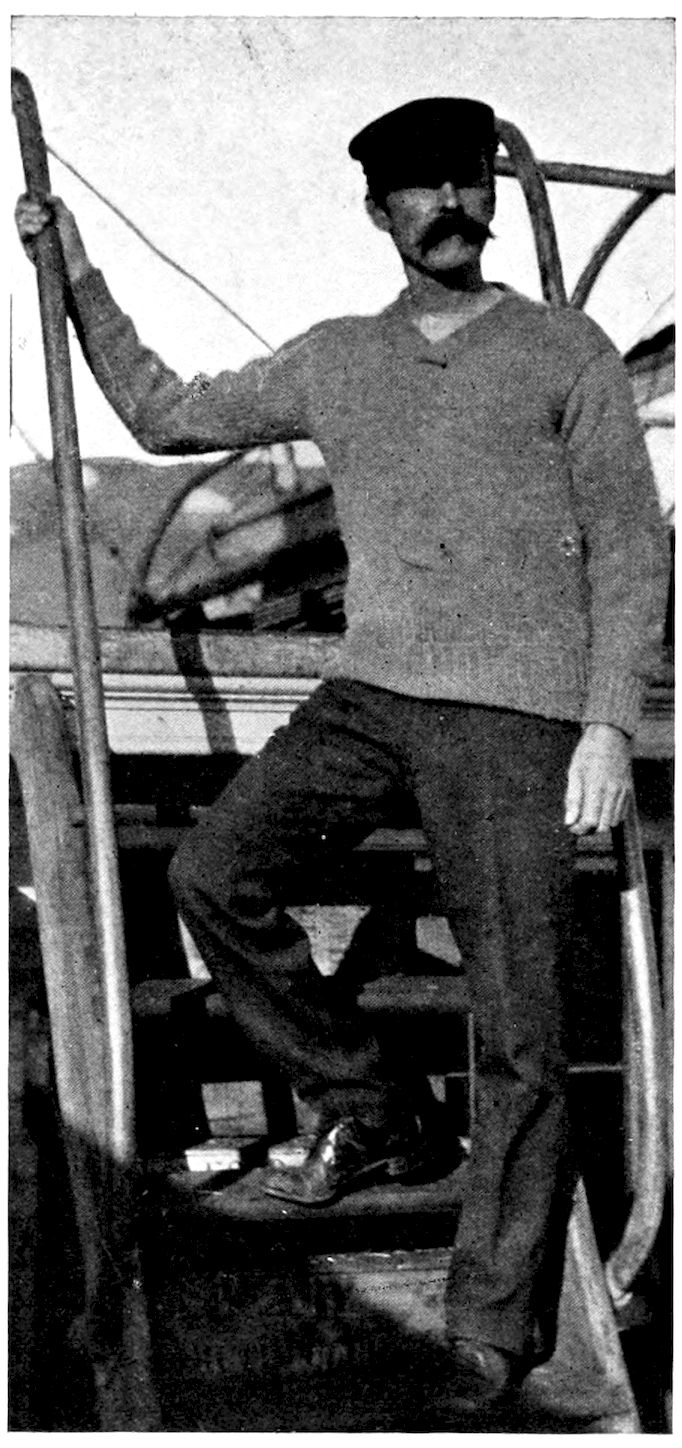
8
MATE BARTLETT
CHIEF ENGINEER WARDWELL
MATTHEW HENSON
“BO’SUN” MURPHY
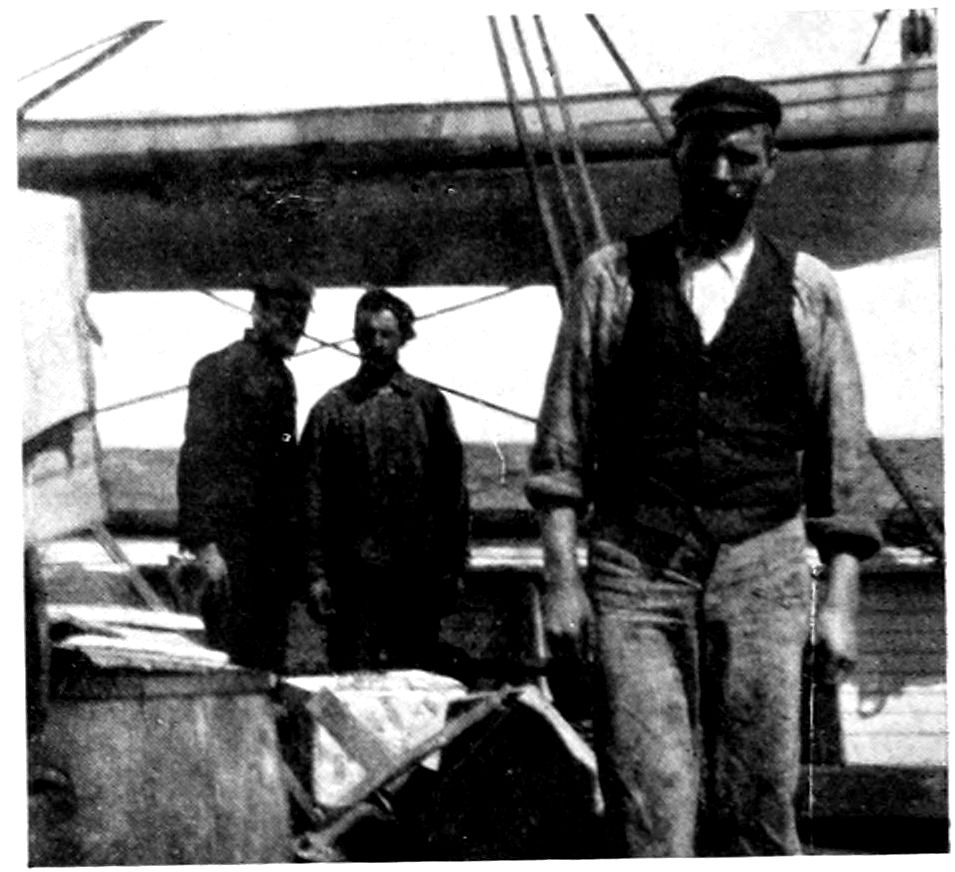
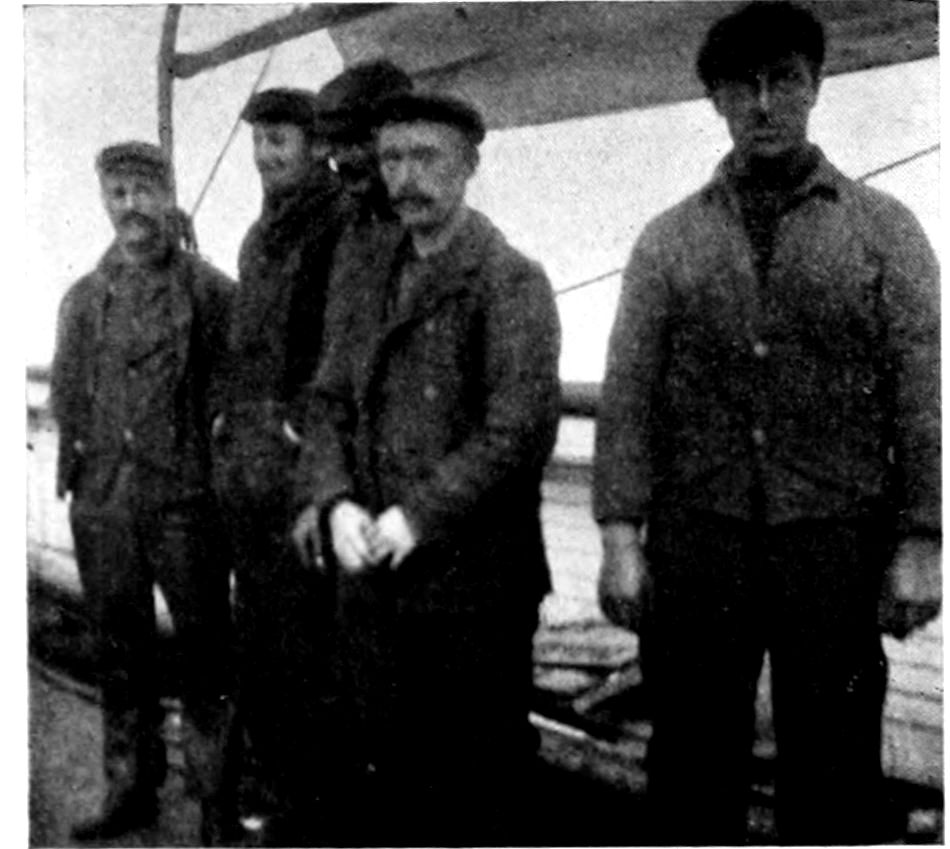
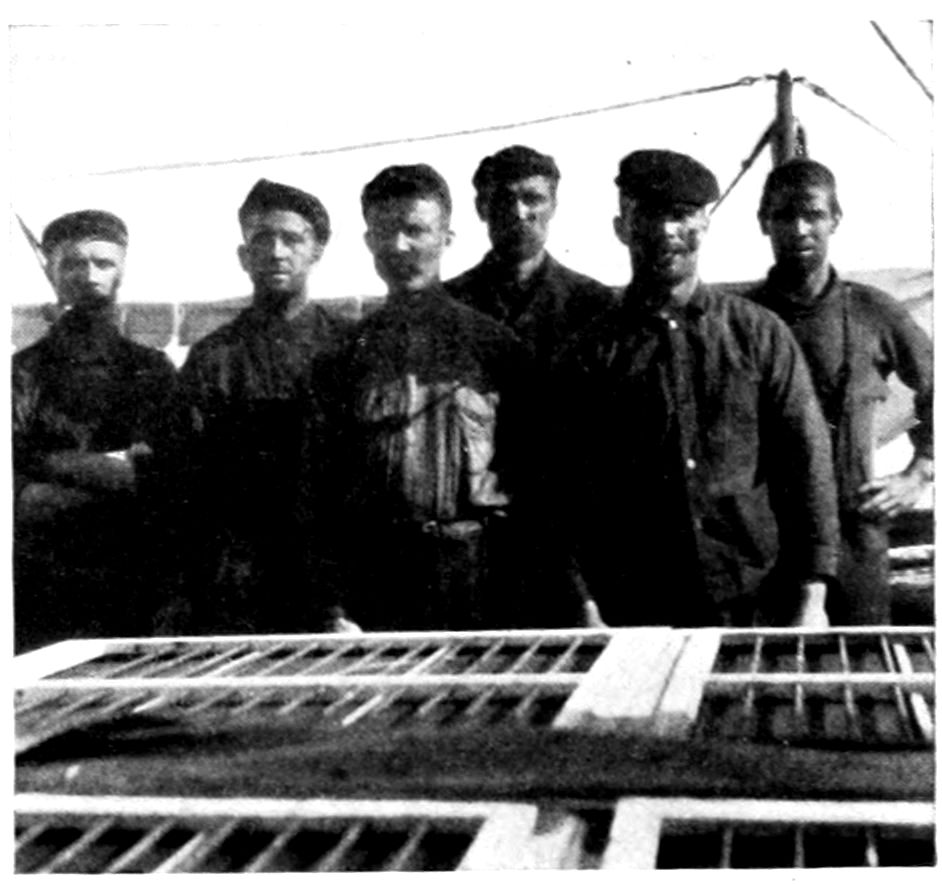
THE SAILORS
THE FIREMEN
9Next after the personnel of the Expedition comes
their environment. In the present case no member of
the party was quartered below deck. The after cabin
for officers, close down against the propeller post, and
the forecastle for the crew, down in the eyes of the ship
forward, to be found in all the old-fashioned ships, and
even in those recently built for Arctic work, were lacking
on the Roosevelt, and in their stead were light, roomy
accommodations on deck.
As to the furnishings of the rooms there was little to
be said. Beginning forward, it is well known that Jack,
particularly if a Newfoundland sealer, does not take
much bric-a-brac to sea with him, his outfit comprising
only his clothes and his bedding. There were therefore
no oil paintings or etchings on the walls of the forward
house. Two tiers of folding bunks, a stove, a table,
and the seamen’s chests for chairs, completed the list.
The furnishings of the after house were hardly less
simple.
In the port saloon, which was lighted by two twelve-inch
ports on the side, and a window looking forward,
a leather-cushioned locker extended around three sides
of the room; and this, with an extension table screwed
to the floor, a clock, a little library presented to the
ship by the Seaman’s Friend Society, and a brief
notice to the members of the Expedition, stating the
object of the Expedition, what was expected of the
members and what success would mean to them,
completed the furniture. Here the ship’s officers,
except the captain, messed.
10In the captain’s room, at the after end of the port
side of the deck house, was a folding berth, a washbasin,
a table and a camp chair, and these, with the
chronometer, a trunk, and several pictures and photos
on the walls, completed its furnishing.
At the after end of the starboard side of the deck
house was my own room. This room, owing to the
thoughtful care of Mrs. Peary and friends, was more
luxuriously furnished than any room occupied by me
on previous expeditions or than it would have been had
I furnished it myself.
The room (10 × 16) was also larger than I had
ever had on a previous expedition. The room
occupied by Mrs. Peary and myself at Redcliffe was
7 × 12 feet, and the one at Anniversary Lodge 8 × 18 feet.
But one of the most annoying circumstances of the long
Arctic winter is always the crowding of cramped
quarters, the inability to move without knocking
against something, the feeling of oppression. This, on
top of the contracted horizon and feeling of compression
from the protracted darkness, is at times
almost intolerable, and in planning the Roosevelt quarters
I felt that I was justified in giving myself a little
more room. Two ports and a window looking aft
lighted the room and, as in the captain’s room, a door
opened aft on to the quarter-deck, while another gave
me direct access to the engine room.
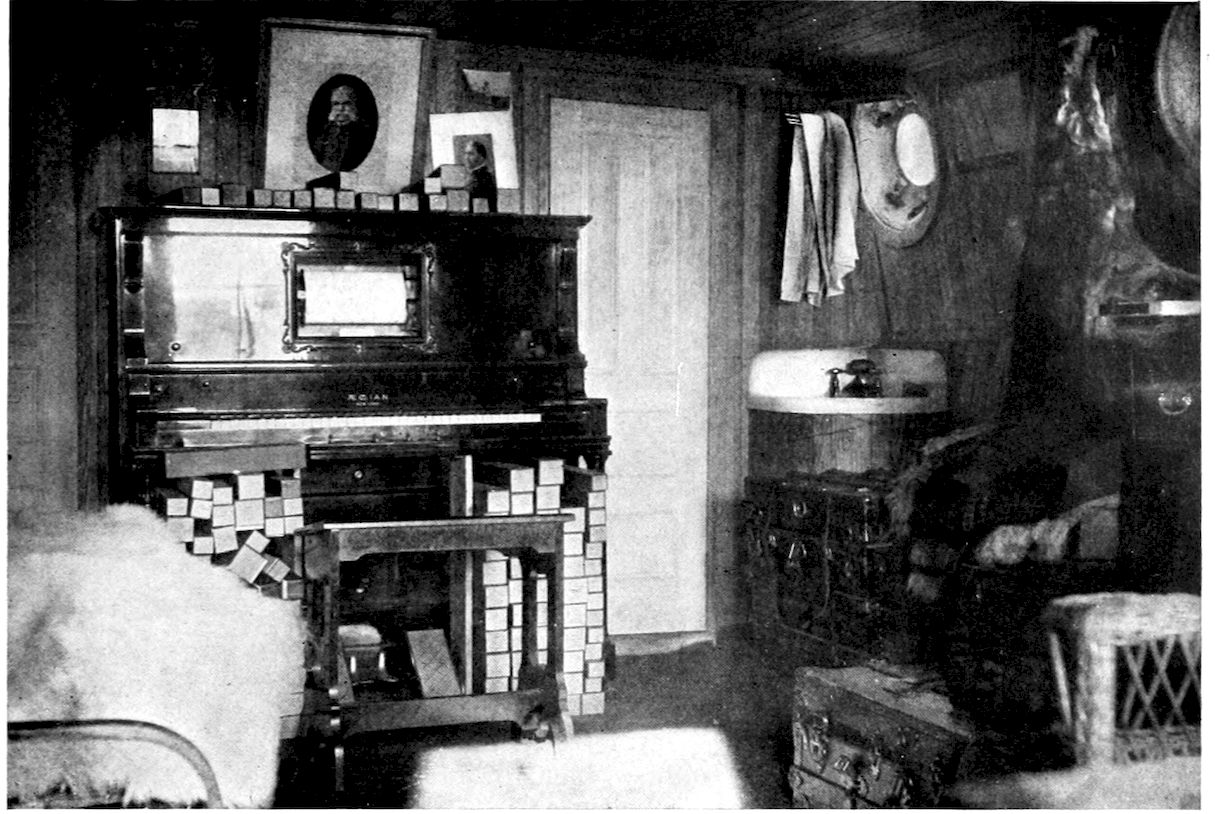
A berth, a table, and a chair, are of course essentials
and were present. Then came the pièce de résistance,
the beautiful pianola given me by my friend
H. H. Benedict. This, with a rack of nearly 150 music
rolls, popular operas, marches, waltzes and rag-time,
11was screwed to the deck at the forward end of the
room. Over it was a large framed portrait of the
founder of the Expedition, Morris K. Jesup, flanked on
either side by an etching of President Roosevelt and
a photo of Judge Darling, Assistant Secretary of the
Navy. In the forward corner was a stationary washstand,
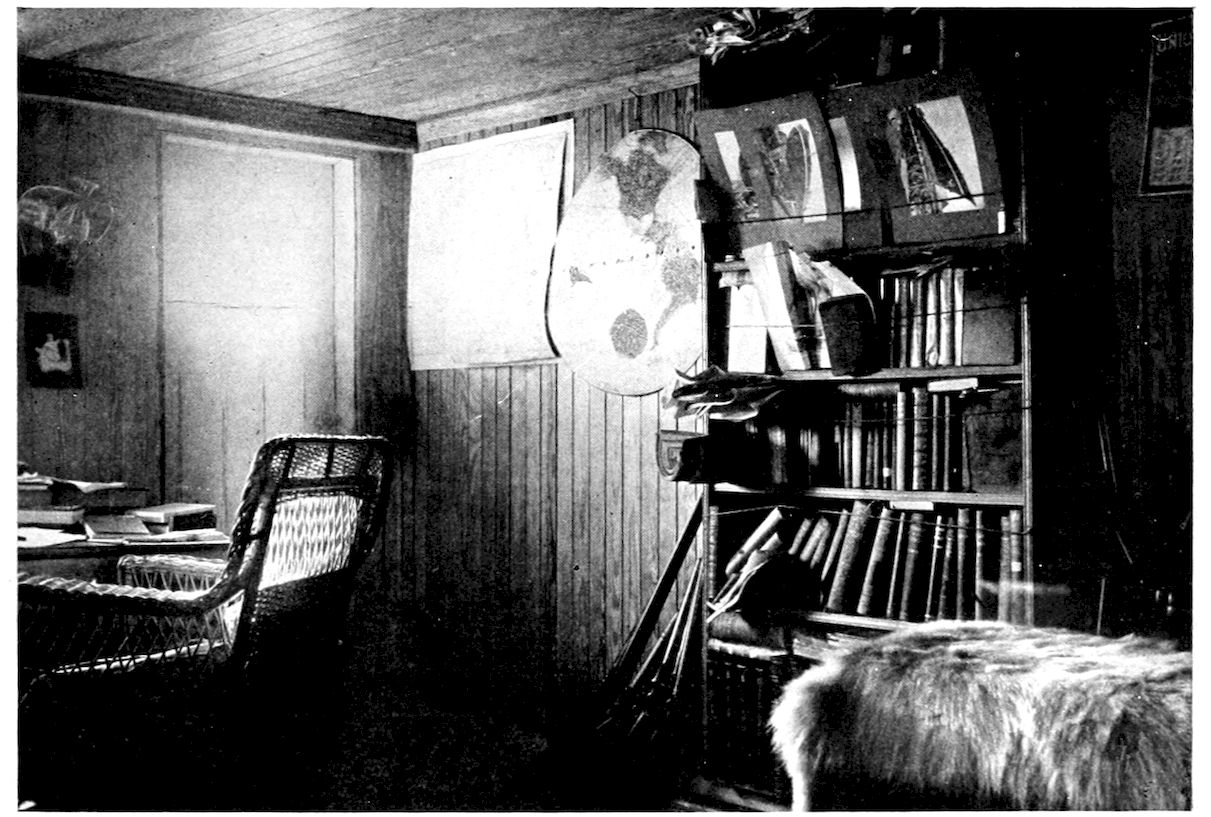
and on the inboard wall a series of shelves containing
a small Arctic library, a few books of reference,
and a few standard works of fiction. A chest of
drawers, a cellarette, a table, a wicker easy chair from
Mr. Jesup, a warm brown rug from Mrs. Peary, pictures
of the home folks and home places, and Arctic maps
upon the walls completed the fittings, not including
a trunk and two chests of stores in the doctor’s
department, for which there was at present no room
below decks.
Wednesday, July 26th, ’05.—All things come to an
end at last, even the starting of this Expedition.
The Roosevelt got away from the Terminal Pier at
North Sydney at 2 P. M.[1] With the exception of the
quarter-deck, which is loaded with bags of coal, to keep
the ship from trimming too deep by the head, the
deck is not nearly so badly littered and cumbered as on
previous voyages.
1. Note.—The Roosevelt sailed from New York on July 16th, touched in
at Bar Harbour to receive Mr. Jesup’s “God-speed,” then loaded with coal
at Sydney, C. B.
The cases of oil and a few miscellaneous casks are
practically all that is not below hatches. We have on
board something over 500 tons of coal, besides our
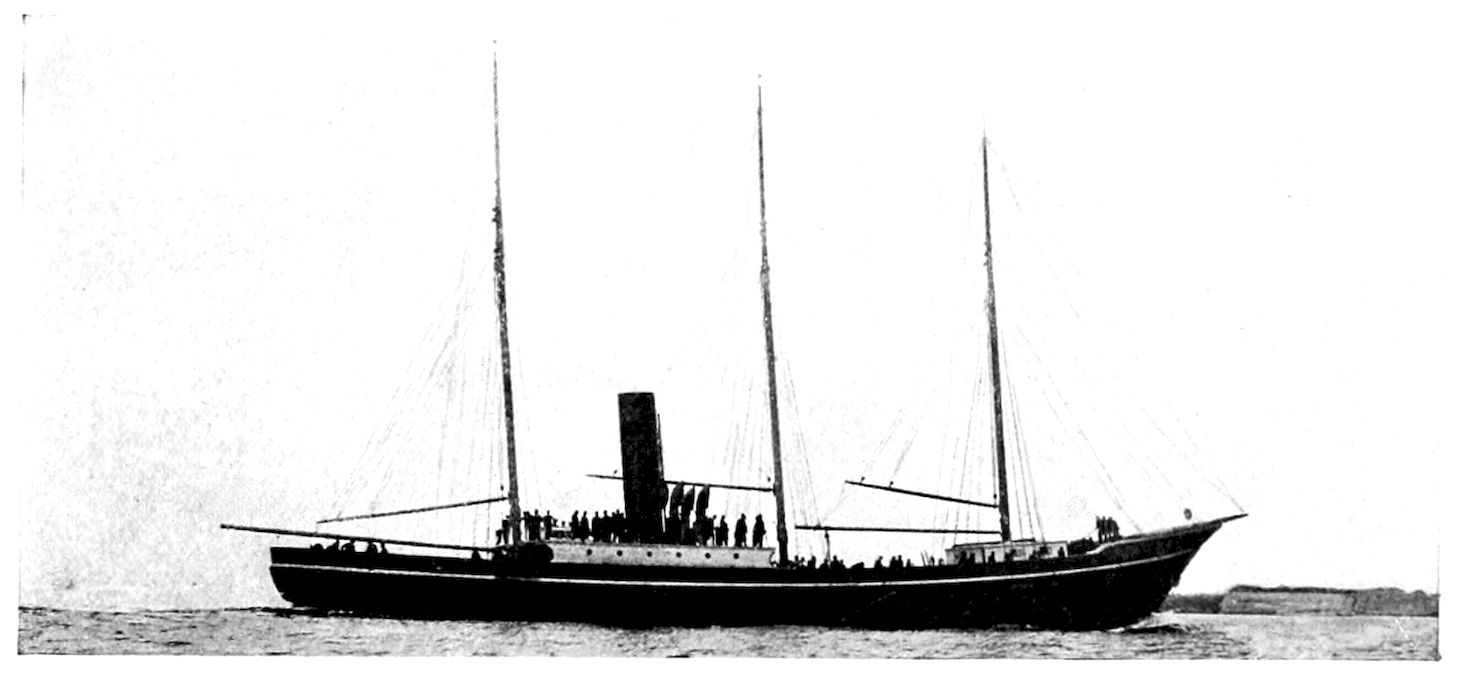
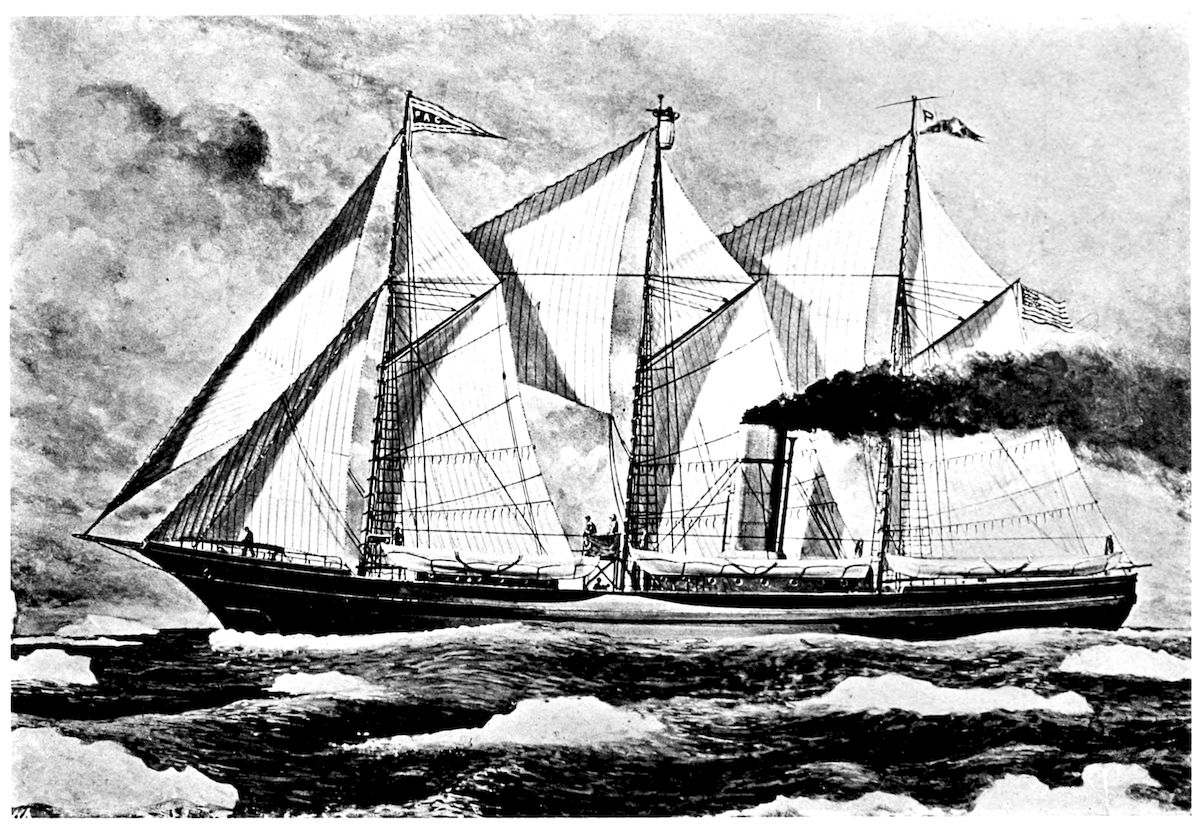
supplies and equipment. In capacity, the Roosevelt
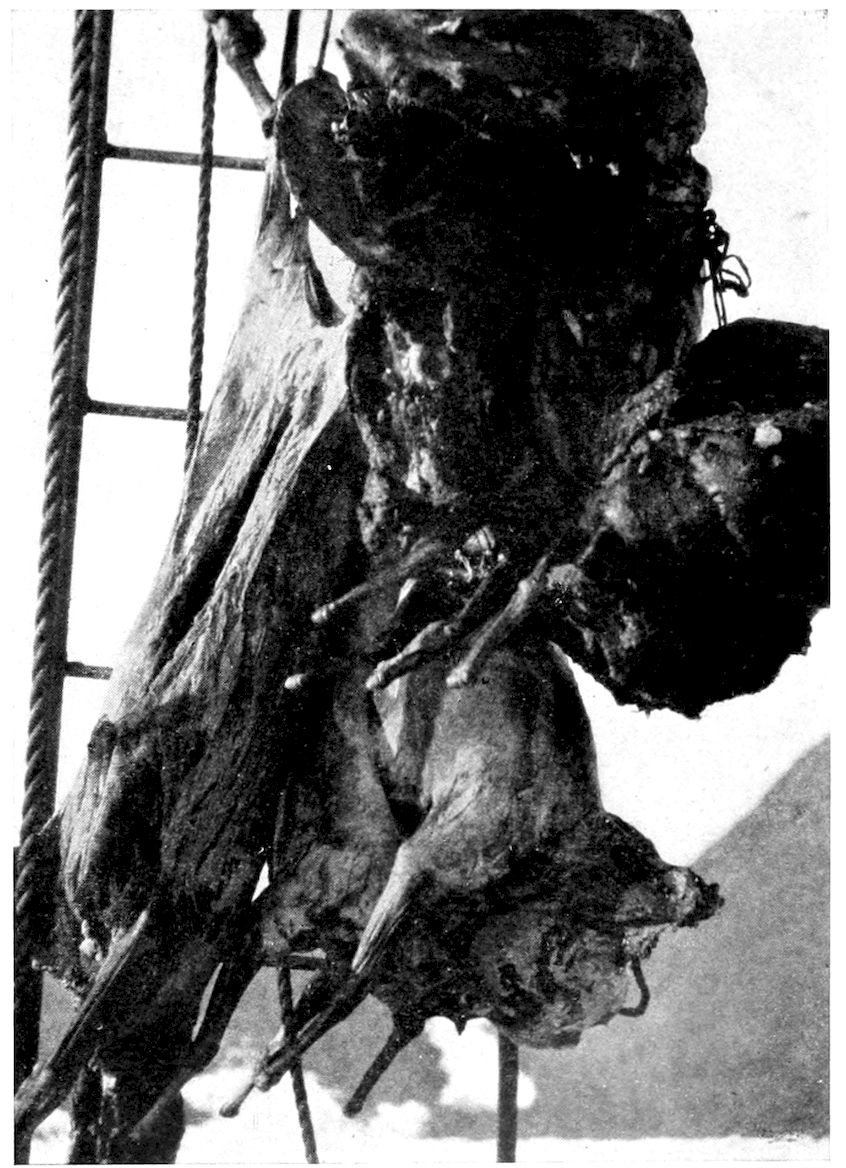
comes fully up to my expectations. There is a quarter
12of beef in the rigging, two or three sheep among the
coal bags aft, and a tank and several casks of water on
deck, besides the full tanks below.
Once under way, I hope to make no stops this side of
Cape York. It is already late in the season and
every day now is precious.
Percy, the steward, has purchased two small porkers,
“Dennis” and “Mike,” which are running contentedly
about the deck, and if they escape the dogs, which is
very doubtful, they may furnish us roast pork for
our Christmas dinner.
Outside the harbour a little swell caused by the
easterly breeze taking the ship broadside on, sets her
rolling a bit until she straightens out on her course to
pass St. Paul’s light.
The next thing in order was the stowing of the
miscellaneous packages which during the past days
have been put in the various rooms, particularly my
room, to prevent their getting mixed up with the provisions
in the hold. This was readily accomplished by
supper time, at least to the extent of permitting a
passage through the room and allowing access to the
bunk, the table, and a camp chair.
Immediately after supper we ran into dense fog and are
now ploughing our way through it across Cabot Strait,
the southern gateway of the Gulf, blowing our whistle
as if we were in Long Island Sound, for we are crossing
the track of the inward- and outward-bound traffic.
Thursday, July 27th.—Heavy thunderstorms last
night with electrical accompaniments as vivid as
those of Gulf storms on the southern voyages.
13
PIANOLA PRESENTED BY H. H. BENEDICT
BOOKCASE AND WRITING TABLE
INTERIOR OF PEARY’S CABIN ABOARD THE “ROOSEVELT”
14
A MELVILLE BAY ICEBERG
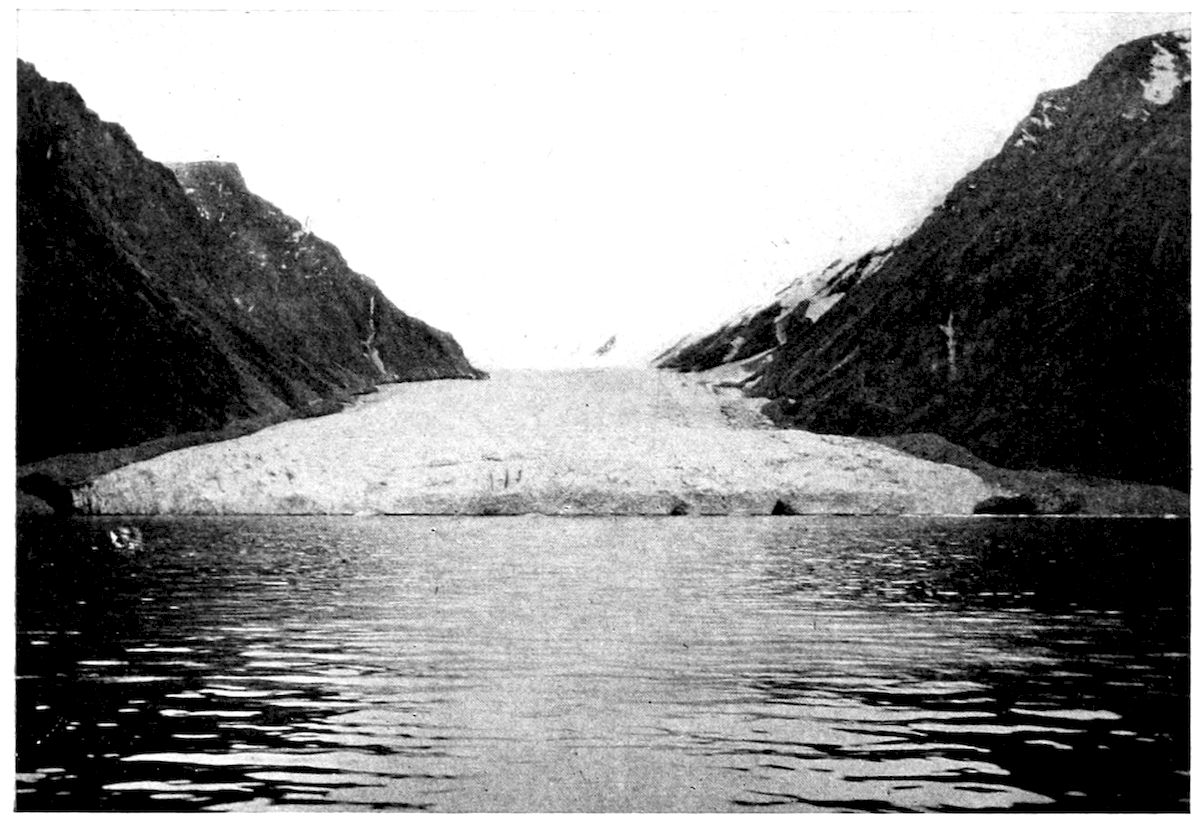
TYPICAL WHALE SOUND GLACIER
15Passed Cape Anguille on the Newfoundland coast
at breakfast time, and Red Island and the bold cliffs
of Cape St. George after noon.
Soon after dinner an alarm of fire was caused by the
catching of one of the main deck beams over the uptake
from the boilers. A stream from one of the fire
hose which was coupled on in readiness and needed but
the opening of a valve to turn the water on, quickly
extinguished the fire, which was apparently caused
by the more gaseous nature of the Sydney coal, and
the combustion and heat in the stack instead of in the
boiler. It was then discovered that several sections of
the water-tube boilers were leaking, and the fires were
immediately drawn to let the boilers cool for examination;
the Roosevelt steaming along under the Scotch
boiler only.
The process of stowage both about the decks and in
the rooms has continued to-day, and most of the oil has
been put down in the forepeak. A fine day, though
with occasional showers, and the Roosevelt as steady as
if steaming up the North River.
Friday, July 28th.—Continuance of the fine weather,
running under Scotch boiler only all night and day.
The engineers working on the Almys. The Chief to-night
fears the damage is more serious than at first
anticipated. At intervals during the day I have been
comparing the readings of the log with the revolutions
of the engines at varying speeds; with results fully up
to my expectation. Another incipient fire in the
same place was immediately extinguished, and I have
had portions of the beams cut away and other means
16taken to prevent a recurrence. At supper time we
passed four or five small bergs which had come
through the straits. Fine weather, with smooth sea
till evening, when the fog shut down on us.
Just before this, two large steamers passed us
heading for the straits, and one hung out the signal,
“Wish you a pleasant voyage,” to which we
replied, “Good-bye.” It is light now till 9 P. M., and
it seems good to be again approaching the Arctic
day.
Saturday, July 29th.—A dirty night. In the dense
fog, which filled the Belle Isle graveyard of ships,
Point Amour Light was invisible, until apparently
hanging over our mast head, and then it was a
matter of feeling our way from fog horn to fog horn
through the Straits. We could hear two or three large
steamers that were laying to, blowing their double
blasts; and numbers of bergs added to the uncertainty
and anxiety of the passage.
Captain Bartlett and myself up all night. At breakfast
time just north of Chateau Bay we ran out of
the wall of fog into bright sunshine, and a field of
beautiful icebergs. Cape York is 1500 miles from here.
Running northward all day, just off the Labrador
coast, in alternate fog and sunshine. Have written
two or three brief personal letters which we shall
leave at Domino Run to-night, before heading across
Davis Strait for Greenland. This is necessitated by
the fog having shut us out of Chateau Bay and Battle
Harbour, from which place our passing may have been
reported to the home folks.
17Sunday, July 30th.—Ran into Domino Run late
last night without dropping anchor, and Captain Bartlett
pulled ashore with the letters, coming off again
at once. He learned that the ice was against the
coast as far down as Cape Harrigan.
Going into the Run it was clear as a bell, and while
lying to, waiting for the Captain’s return, the stars
twinkled as in winter, a biting wind whistled through
the rigging, and a brilliant curtain aurora waved
across the northern sky, while ashore the dogs were
howling merrily.
Pacing the bridge, these familiar sights and sounds
stirred me with the call of the polar mystery. Might
it not be possible that this breath, this presence, as
it were, of the land of the “Great Night” was
reaching down far beyond its usual haunts to greet
and welcome my coming?
When we steamed out, less than an hour after our
arrival, the fog had settled down again, and the temporary
jamming of the rudder chains while negotiating
the narrow channel, caused a slight flurry, but
resulted in nothing serious.
Clear of the harbour, our course was set N. E. by E.
to bring us to the Greenland coast, well up Davis’
Strait. Dense fog all night and to-day, with very
smooth sea. Several narrow shaves from icebergs
during the night, but this morning we were in deep
water, and clear of them.
A light breeze from the southeast, just enough to
fill our headsails, foresail, spanker and balloon staysails,
but with no push to it. There will be no more
sailing lights for us, side or masthead or stern. We are
18beyond the world’s highways now, and shall see no
sail or smoke except our own, until we return.
Monday, July 31st.—To-day the fog has cleared
away a bit. The sea still very smooth, not even a
swell. A very perceptible twilight throughout the
night. To-night there will be no night. We are in
the border land of the region of the “Great Day.”
Tuesday, August 1st.—Continuance of fine weather
and listless sea. At noon we are in the latitude of
Cape Farewell and Cape Chidley, and about midway
between them. A Brunnich’s guillemot passed us
flying south, and at 6 P. M. a small berg was visible
a little west of our course.
At supper time Chief Wardwell, who has been working
over the Almy boilers for the past four days, hands
me a report that makes matters look gloomy. I am
seriously disturbed and perplexed. Have ordered
a complete overhauling and pressure test of the
boilers.
Wednesday, Aug. 2d.—Another day of listless sea,
and opening and clearing fog, with slowly rising
barometer. Two bergs passed during the forenoon.
Am feeling physically something like myself again.
I did not realise until we were actually off, and the
relaxation came, how nearly fagged out I was with
the incessant work, and the last two weeks of intolerable
heat in New York. Were it not for our boilers
I should feel very content.
In the afternoon a “bo’sun” bird, and numbers
19of kittiwakes were flying about the ship, and several
guillemots in the water dove to let us pass.
Thursday, Aug. 3d.—A foggy night and cold. This
morning the sun shining through a low-lying fog, and
a light, but particularly penetrating easterly breeze,
the breath of the East Greenland ice inshore of us.
The noon sights showed us a little south of Sukkertoppen,
and at 2 P. M. an opening in the fog showed
us the Sukkertoppen Islands on the starboard bow.
We are past the East Coast ice without seeing a cake
of it. Since supper dense fog.
Friday, Aug. 4th.—Thick fog all night until about
6:30 A. M., when it began to lift, showing us the bold
Greenland Mountains, near Holsteinburg. Not a piece
of ice inshore or a berg in sight.
We crossed the Arctic Circle at two o’clock this morning,
and Percy, the steward, asserts that the bump when
the ship went over it, woke him up!!
In regard to smoothness of sea, peacefulness of
weather, entire absence of ice, and scarcity of bergs,
the voyage from Sydney to the Arctic Circle has been
most unusual even for this season of the year. With
the exception of the few rolls just outside of Sydney
Harbour, there has not been enough motion of the
ship to spill a glass of water.
The noon sights give us 67° 37′ north latitude.
The water, like glass, and the cliffs of Disco
visible 95 miles away. In 68° we passed through
a fleet of twenty-seven bergs, the output of the
Disco Bay glaciers. During the afternoon a few
20walrus and two whales were seen. The day has been
one of typical Disco Bay summer weather.
Saturday, Aug. 5th.—A perfect Arctic summer night,
clear and brilliant. At two this morning we passed
Godhavn, the little place lying under the southward-facing
cliffs of Disco, which is the capital of the northern
inspectorate of Greenland. Here, nineteen years ago,
I got my first taste of Arctic life, and made plans and
indulged in dreams some of which have since
materialised and others may. Several times since
then I have anchored in the harbour, till I know
the little settlement as I do the streets of Washington.
Though we are now over three degrees beyond the
Arctic Circle, I am sitting in my cabin, with window
and ports open, in my shirt sleeves, wearing clothing
I wore in New York before I left, writing in entire
comfort.
Later, a light breeze from the westward, keen after
its passage over the middle pack, makes the blue
waters look like frosted steel, and sharpens the western
cliffs of Disco, along which we are steaming, into
almost startling clearness.
At noon we are off Hare Island and passing through
a fleet of large bergs, the output of the Tossuketek
glacier, which I visited in 1886, through the Waigatt.
We are ten days from Sydney to the Waigatt.
Sunday, Aug. 6th.—An hour or two of fog at midnight,
then overcast, with a light following breeze,
barely enough to fill the sails at first, then freshens
from southwest and brings up a sea which would give
21the Roosevelt considerable motion were it not for the
sails which hold her almost as steady as a rock.
Occasionally the top of a wave slaps over the port
rail, but not enough to do any harm.
The base of Sanderson’s Hope seen and named
by John Davis 300 years ago, was visible under the
fog in the early morning. Our noon sights gave
us 73° 17′ north latitude, and at 6 P. M. we passed
the Duck Islands on our starboard beam, near
enough to see with the glasses, the old whaler’s lookout
on the summit.
The sea and fresh breeze continued all the evening,
and there is evidently very dirty weather to the south
of us. No sign of ice yet.
Monday, Aug. 7th.—We ran away from the wind
during the night. Cape York was visible at 2 P. M.
and at 7 P. M. we ran past the point of it for the Eskimo
settlement beyond. The run across Melville Bay had
been made in twenty-five hours. No ice or ice sky
was seen, and there is evidently no ice in the bay this
year.
Going ashore, I found four tents at the village,
and learned that some fifteen families are located to
the eastward, at Meteorite Island, and other places.
Among them are some of my best men.
Told the natives to get their things ready to come
on board on my return, and going off to the ship
steamed eastward.
Stopped off the first settlement and, without dropping
anchor, shouted to the men to get ready to move.
Then on to Meteorite Island, where I found four
22tents and learned that four other families were still
farther east in the bay. These I shall not see, as I
cannot take the time to go so far out of my way. At
Meteorite Island are three of my old men, and, in an
hour or two, they are all on board with their
belongings, and we steam away, leaving the place
deserted. Back to the next settlement and the operation
is repeated. Six families move all their belongings
on board and desert their village in about three hours.
Tuesday, Aug. 8th.—It was after breakfast when we
finished at the last settlement, and I lay down for a short
nap while crossing Cape York Bay, having been up
all night.
Again at Cape York the tents were quickly struck
and, with all their belongings, the new men came on
board.
At 2 P. M. we steamed around the Cape, and headed
north to join the Erik at North Star Bay.[2] While
passing Petowik Glacier a steamer was seen to the
westward steaming south. The glasses showed her
to be small and schooner-rigged.
2. Note.—The Erik was the auxiliary, steam whaler chartered by the
Peary Arctic Club to go north as a collier, replenish the Roosevelt’s coal
supply at Etah and deposit there a depot of coal for the Roosevelt on her
return voyage.
Wednesday, Aug. 9th.—On arriving at North Star
Bay this morning at 2 A. M., learned from the Erik
that the steamer we saw was the Danish steamship
Fox, here for the purpose of selecting a site for a
settlement. The Erik came alongside and I transferred
to her with Marvin and “Matt,” to make a round
of the settlements to the north, and to hunt walrus,
while the Roosevelt goes direct to Etah to overhaul
machinery and prepare for the ice.
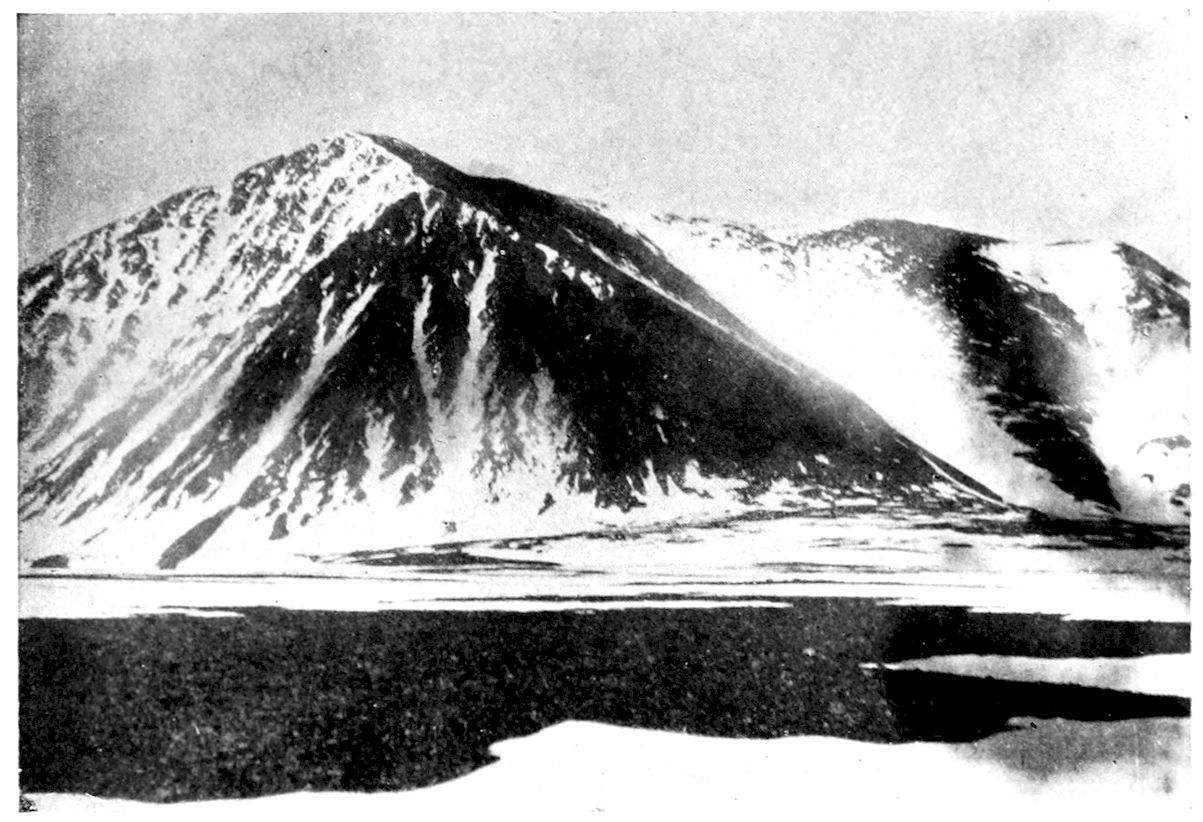
23
OOMUNUI
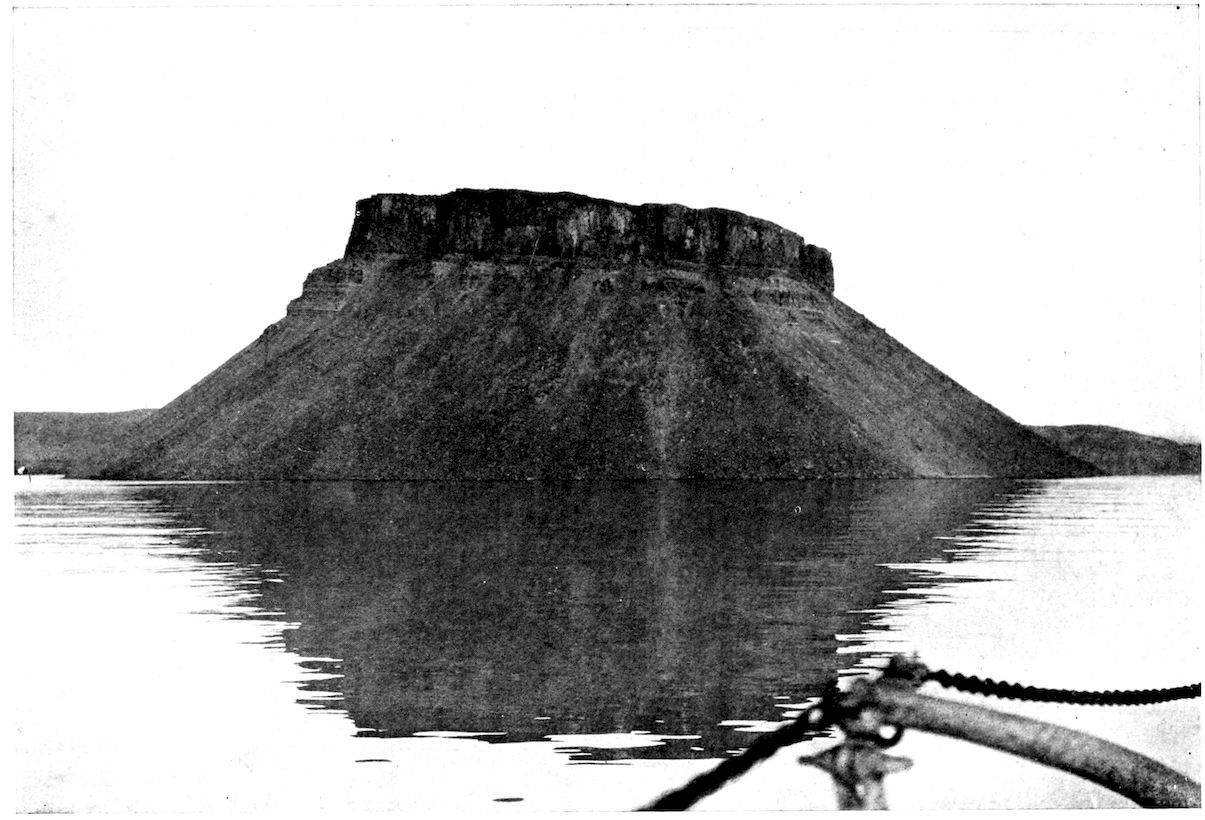
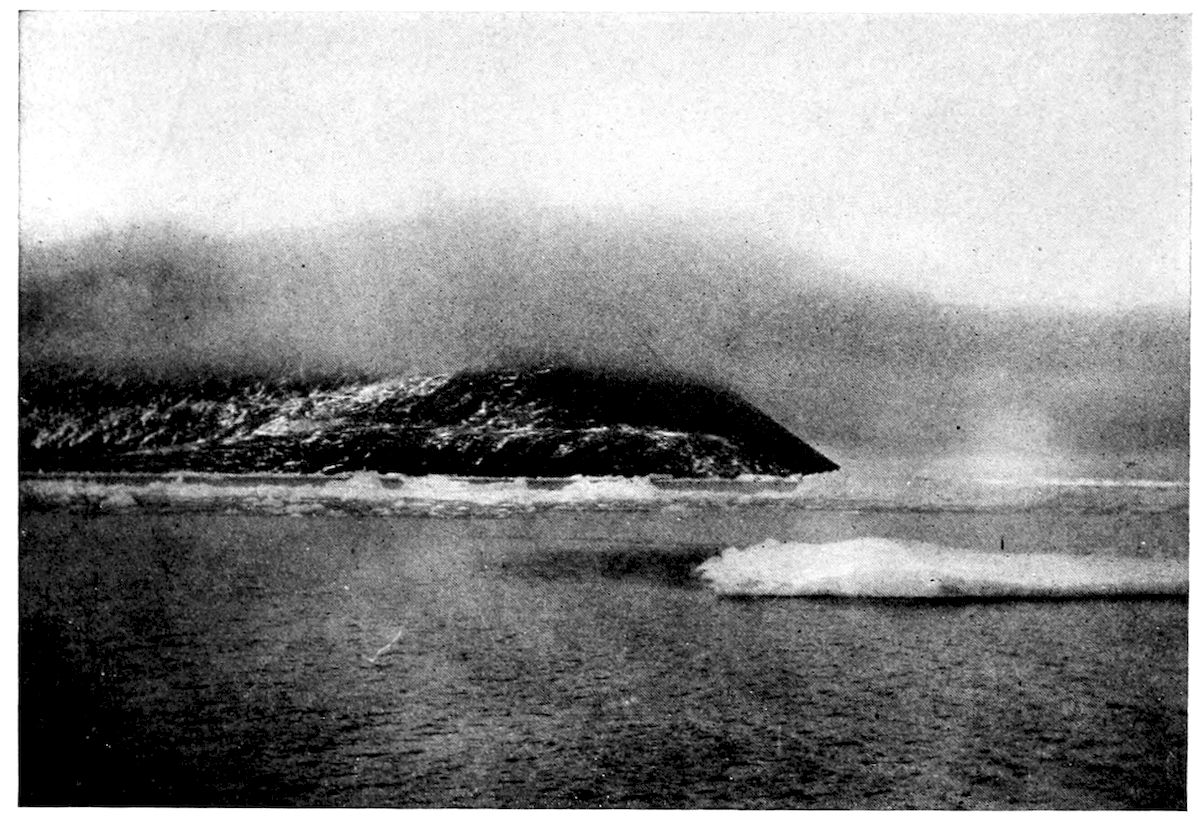
The peculiar peak at the entrance of the North Star Bay, Wolstenholm Sound
24
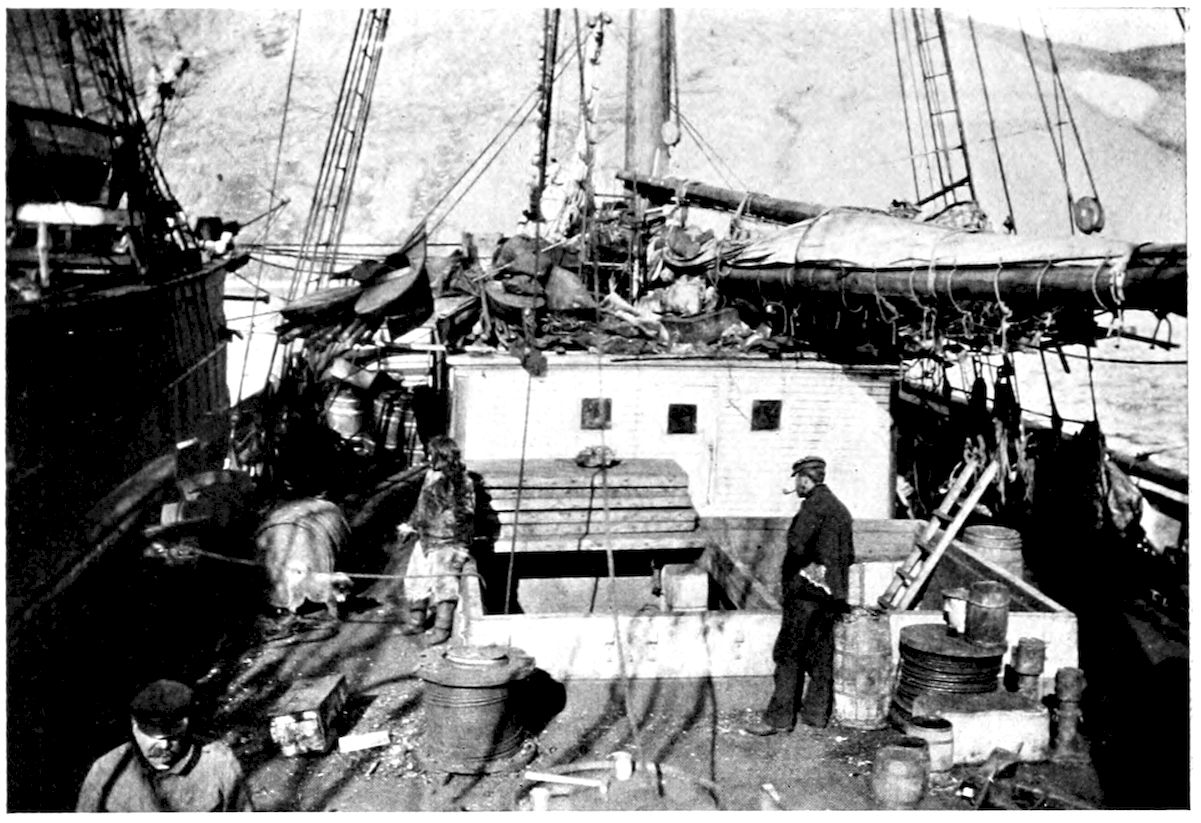
COALING AT ETAH
TRANSFERRING WALRUS MEAT AT ETAH
25The Erik got underway soon after, and made the
circuit of Wolstenholm Sound, looking for walrus,
but without success. There is no ice for them to bask
upon.
At the Saunders Island bird cliffs we then put in
two or three hours shooting, securing 130 birds, and
returned to North Star Bay. Here, the natives that
I wanted were taken on board, and some thirty additional
dogs purchased. Before midnight we steamed
north for Whale Sound.
The next morning we were rounding magnificent
Cape Parry, into Whale Sound, and steamed eastward
along the southern shore to Ittibloo, where I expected
to find more of my people. None were there, however,
and the Erik turned northward across the Sound to
Karnah, where I felt certain to find someone. Six
tents were located here beside the brawling summer
river, and the men were all away at Cape Cleveland,
hunting walrus with one of the whaleboats which I
had given them three years before. From the women,
I learned that about ten families were up the gulf at
Kangerdlooksoah and that vicinity. Telling the natives
here, as at the other places, to get their things
in readiness to come on board when the ship returned,
we steamed eastward into Inglefield Gulf. No ice
was to be seen here, but there was a most unusual
profusion of bergs from the great Heilprin and Melville
Glaciers at the head of the Gulf. At times it
looked as if there were no thoroughfare among the
26bergs, but a closer approach in every case showed
winding passages among them, and off Kangerdlooksoah
there were comparatively few.
Here, where I had left my faithful people three years
before, I found now six tents, the occupants of all but
one of them young and active men. The number of
dogs, and the goodly supply of skins which these people
have, made the process of moving a little slower than
at some of the other places, but everybody and everything
was finally on board, leaving the place, which
a few hours before had been enlivened by the voices
of children and the barking of dogs, deserted. From
Kangerdlooksoah we steamed north across the head
of the Gulf to Harvard Islands, on the northernmost
of which were four tents. These, like the others,
were embarked as soon as possible, and at half-past
two the morning of the 11th, the Erik was ready to
steam down the Gulf again.
The scene and the surroundings during this typical
Arctic summer night were such as to be long remembered.
The surface of the Gulf like a placid mirror,
thickly dotted in every direction with fragments of
ice and icebergs, of all sizes and shapes, and flanked
on the east and north by the gigantic amphitheatre
of the Heilprin, Tracy, and Melville Glaciers rising
to the steel-blue slopes of the “great ice,” while northwest
and west rose the warm red-brown bluffs of
Mounts Daly and Adams, and Josephine Peary Island,
and to the south the rolling slopes of the Kangerdlooksoah
deer pastures. During the remainder of the
night we steamed down the Gulf, and in the forenoon
we were on the walrus grounds between Herbert
Island and the north shore of the Sound.
27
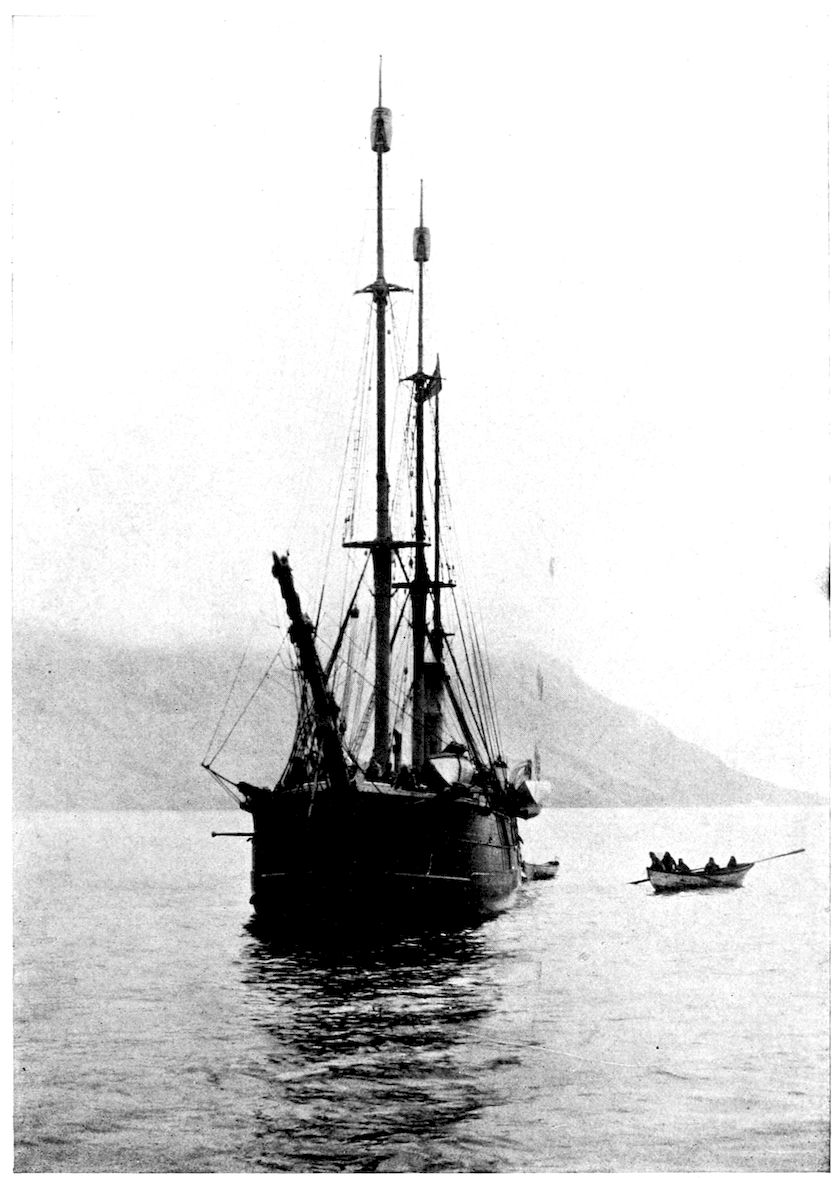
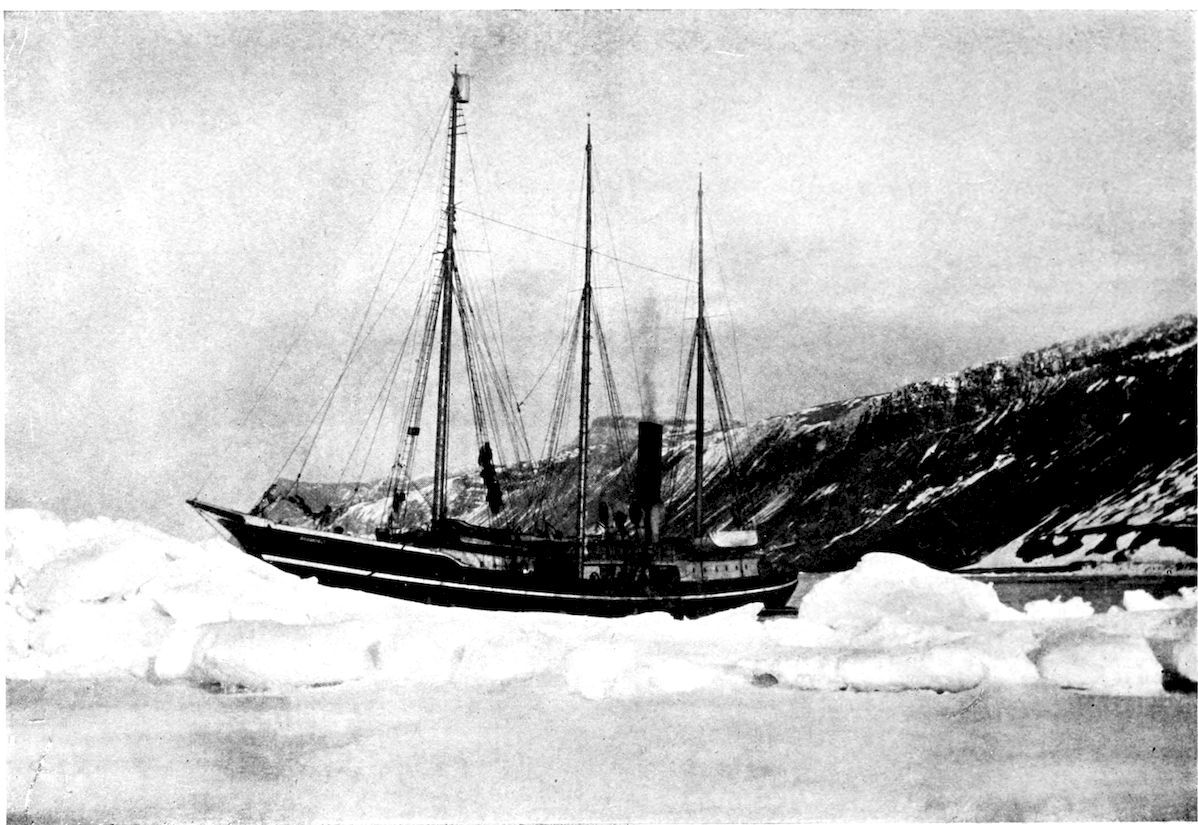
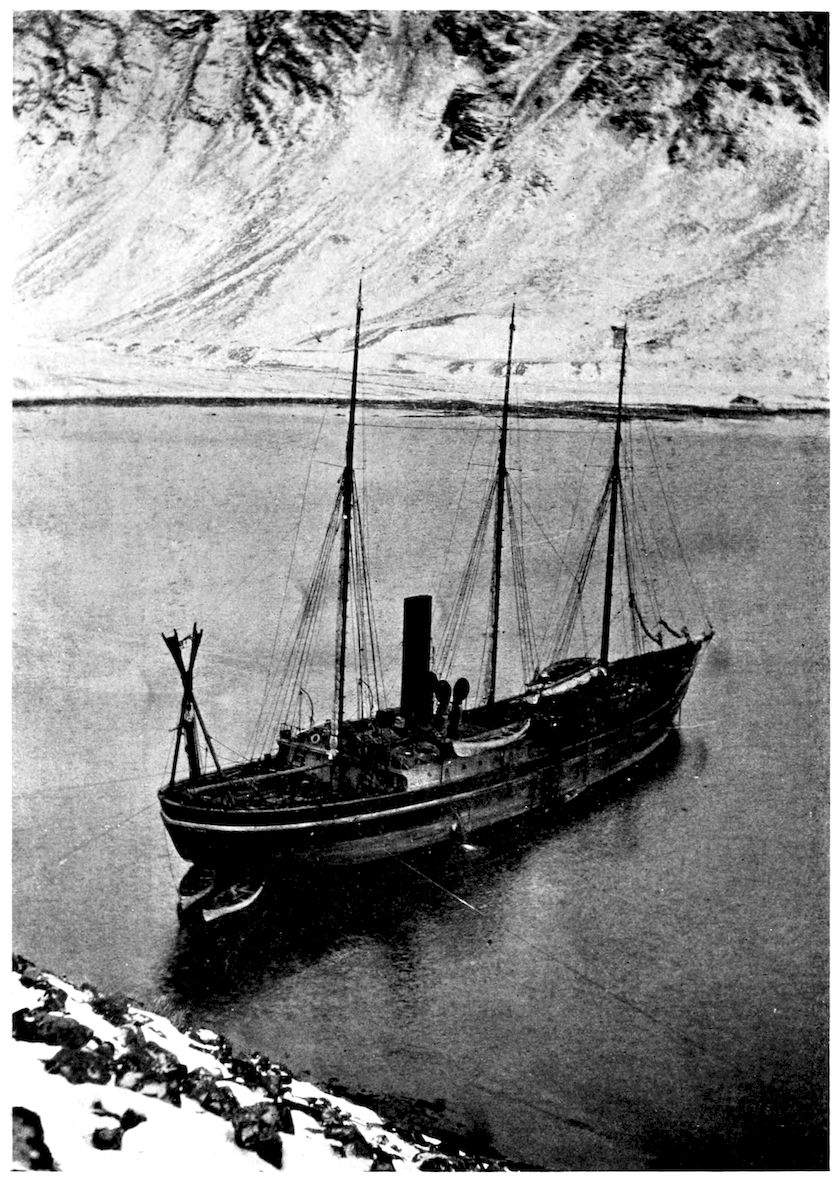
THE AUXILIARY S. S. “ERIK” IN THE HARBOUR OF ETAH
28
THE BARRIER AT CAPE COLLINSON
29Up to this time, the weather, since arriving at Cape
York, has been an uninterrupted sequence of calm
and continuous sunlight—typical Arctic summer
weather. Now, however, wind and fog have their
turn, and render it impossible to secure walrus, wasting
the day for us.
In the evening we steamed back to Karnah, to take
on board the natives there, and be in readiness to attempt
the walrus again the following day. By midnight
this work was completed, and as everyone was
now dead-tired and sleepy, the Erik steamed out into
the middle of the Sound to drift until after breakfast
of the following day, when we again steamed out to
the walrus grounds and by nine o’clock that night
had secured eighteen of the animals. Fog and rain
were now coming in upon us, and we steamed into the
last settlement on our list, Igludiahni, where six tupiks
were found. Our stay here was short as I wanted
but one family here, and it did not take me long to
purchase a number of additional dogs. When the
last dog was on board the Erik, she headed for Cape
Chalon on her way to rejoin the Roosevelt at Etah,
where she arrived at breakfast time Sunday, the 13th.
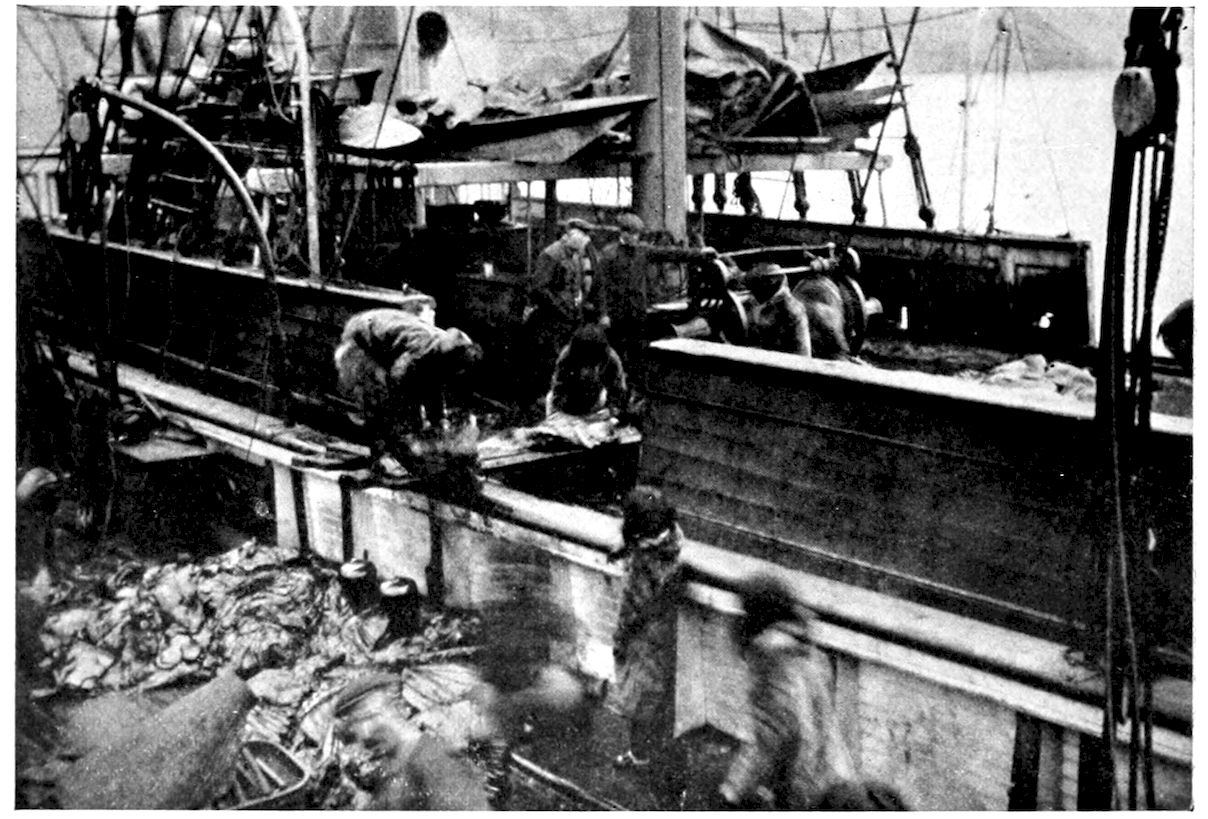
The Roosevelt had landed her coal in bags and broken
out the supplies for the purpose of restowing to give
her the proper trim to enter the ice.
It being Sunday, everyone enjoyed a much needed
rest, except the Eskimos, to whom the work of skinning
and cutting up the walrus was a labour of love and
pleasure.
Early Monday morning the Erik veered alongside
the Roosevelt and, at five o’clock, the work of
30transferring the meat, of restowing the Roosevelt’s
supplies, and of filling her bunkers and ’tween-deck
space with coal from the Erik, was commenced. This
continued during Monday, Tuesday, and till Wednesday
at 2 A. M. when the Roosevelt was ready to steam out and
begin the struggle for which she was built, the fight
with the Arctic ice from Cape Sabine to the northern
shore of Grant Land. Thus far the voyage had been
child’s play: what was now before her was likely to be
the reverse.
The Roosevelt now had on board of her a crew of
twenty, some forty Eskimos, and about 200 dogs.
She also carried, in addition to the supplies and equipment
for the party, about four hundred and fifty tons
of coal and several tons of walrus meat.
I had been agreeably surprised to find the natives
in unusually prosperous condition, with a superfluity
of dogs, abundance of meat, and a good supply
of skins for clothing. Several of my old friends and
acquaintances had died during the last three years,
but there were also a number of new babies and,
although I did not have time for anything in the
nature of a census, I had no doubt that the births
equalled and probably exceeded the number of deaths.
CHAPTER II ETAH TO CAPE SHERIDAN
33
Leaving Etah soon after midnight of August 16th,
the Roosevelt swung out from the harbour of Etah
and severed all communication with the civilised
world. Below decks the ship was filled with coal until
her plank sheer was nearly to the water; on deck were
more than two hundred Eskimo dogs; and on the topgallant
forecastle, and the tops of both forward and
after deck-houses were over half a hundred Eskimos,
men, women and children, and their belongings.
The heavy pack ice surging down Smith Sound, past
Littleton Island, gave me an opportunity to see what
good work the ship could do and as we bored through
it toward Cape Sabine, she realised my expectations
in regard to her, even though very deeply loaded
and her boiler power reduced to one-half. The sharply
raking stem was a revelation even to me, though it
was my idea. Deep and heavy as the ship was,
she rose on the opposing ice without pronounced
shock, no matter how viciously she was driven at it,
and either split it with the impact, or wedged it aside
by sheer weight.
Bartlett obeyed my first orders, to give her full
speed and I would be responsible, with some misgivings.
The sealing captains are always very cautious
with their ships when first going out heavy with coal.
34At the end of an hour or two he was enthusiastic,
both at the ease with which the most crushing blows
could be delivered, and the whaleboat-like facility
with which the ship wheeled and twisted through
the tortuous passages.
But there were some areas of ancient ice which a
thousand Roosevelts merged in one could not have
negotiated, and we were soon deflected to the southwest,
and only when within some ten miles of Cape
Isabella did we find it practicable to work northward
again.
Cape Sabine and Payer Harbour, which had been my
headquarters for sixteen months in 1901–1902, were
densely packed, permitting no near approach, and
we bored away to the northeast, till the ice became
impracticable for further advance, then retraced our
route, and worked towards Bache Peninsula, getting
about half-way across Buchanan Bay when we were
stopped by large floes barring our passage to open
water under Cape Albert. The ice later appearing
more favourable to the eastward, we retraced a portion
of our route and I very carefully reconnoitred
Sabine and Payer Harbour again as I was loath to give
up my sub-base there, this being part of my programme
as outlined to the Club. But the conditions were
entirely impossible, and making a detour to the east,
the Roosevelt gained the open water at Bache Peninsula,
and steaming to the bight south of Victoria Head,
the northwestern headland of the peninsula, landed a
depot of boats, coal, and provisions.
The value of this locality for the southern sub-base
of an expedition going north by the Smith Sound or
35“American” route was immediately apparent to me
in 1898, and in any future work it should be given
preference over Payer Harbour. Its advantages are
contiguity to a valuable game region, accessibility
during any month in the year, and its less changeable
and boisterous climate.
The work of landing the depot occupied about ten
hours of the 18th, and while the work was in progress
I went away with three Eskimos to a neighbouring
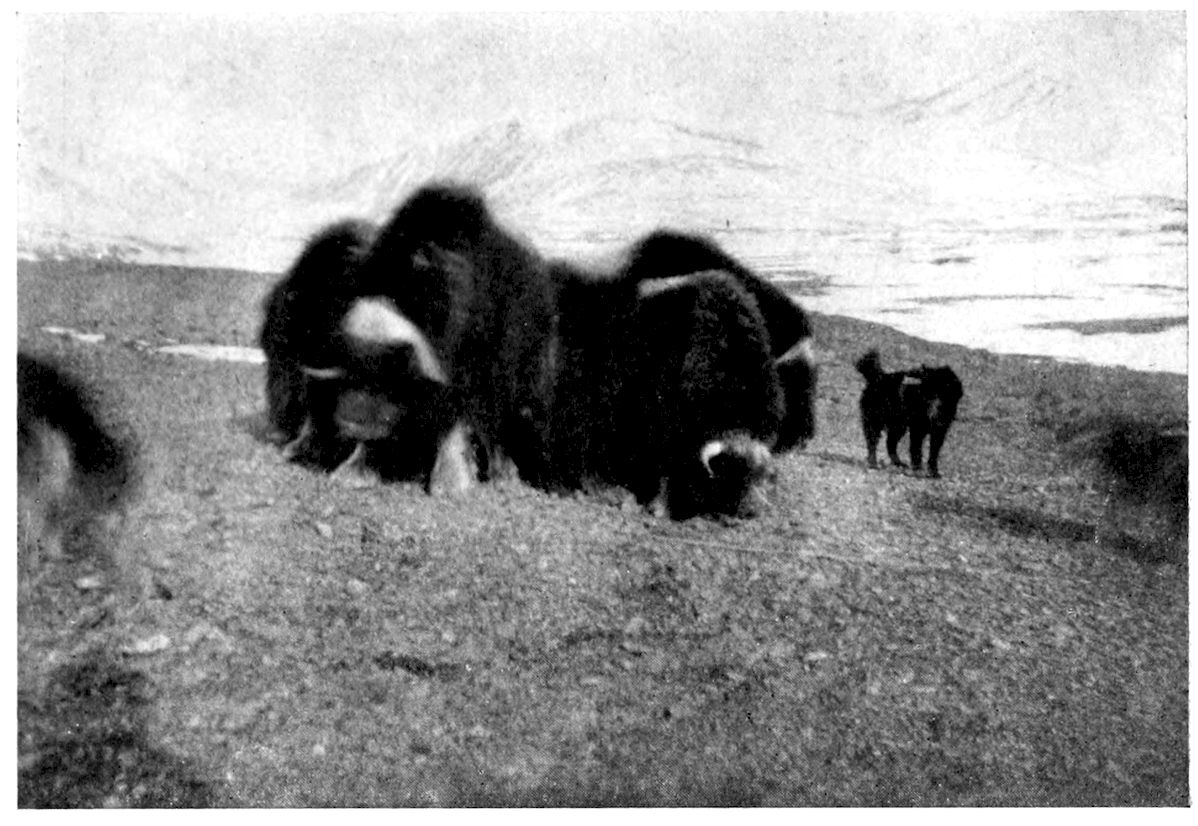
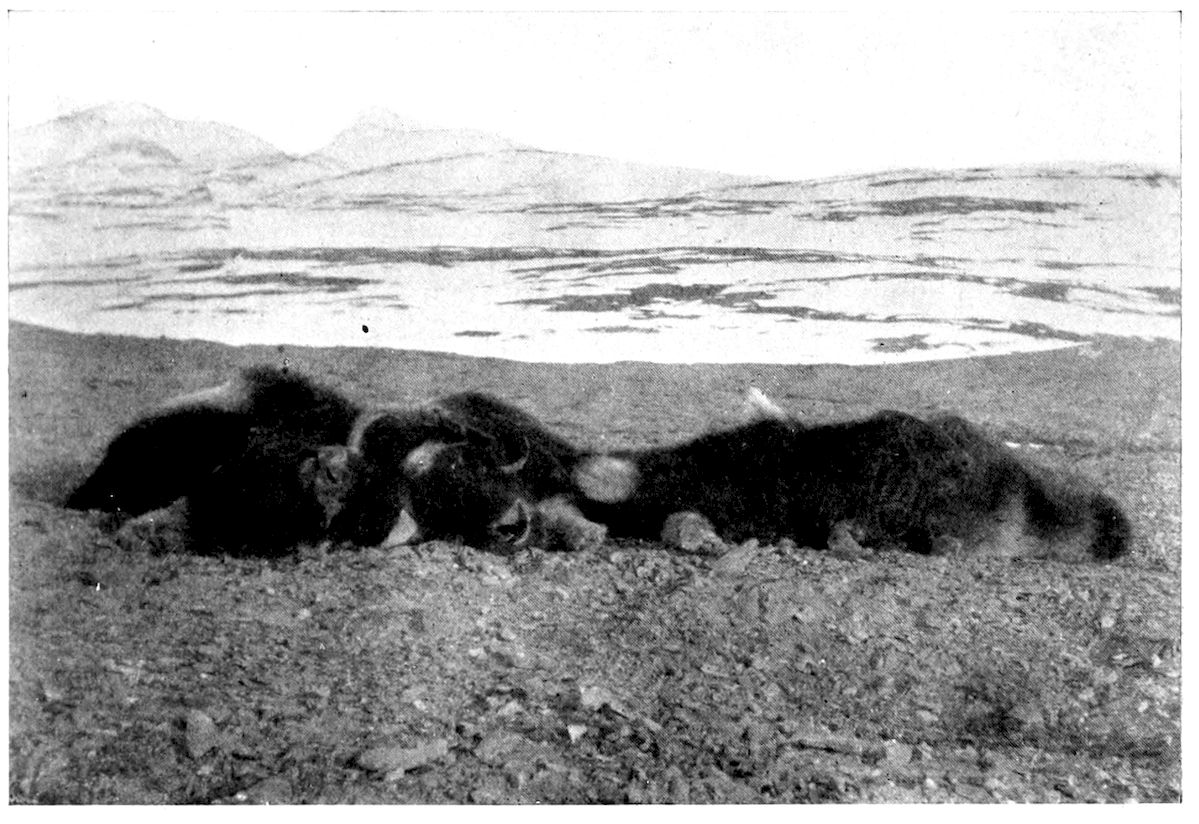
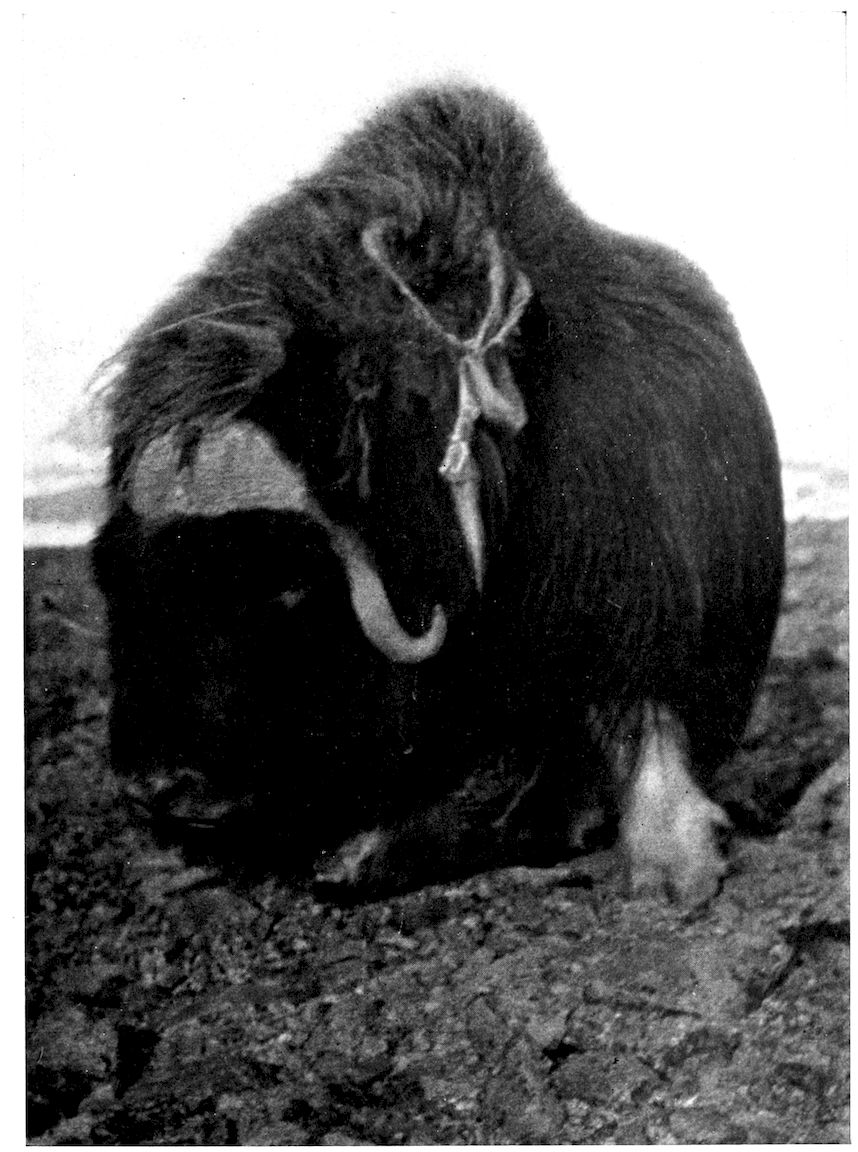
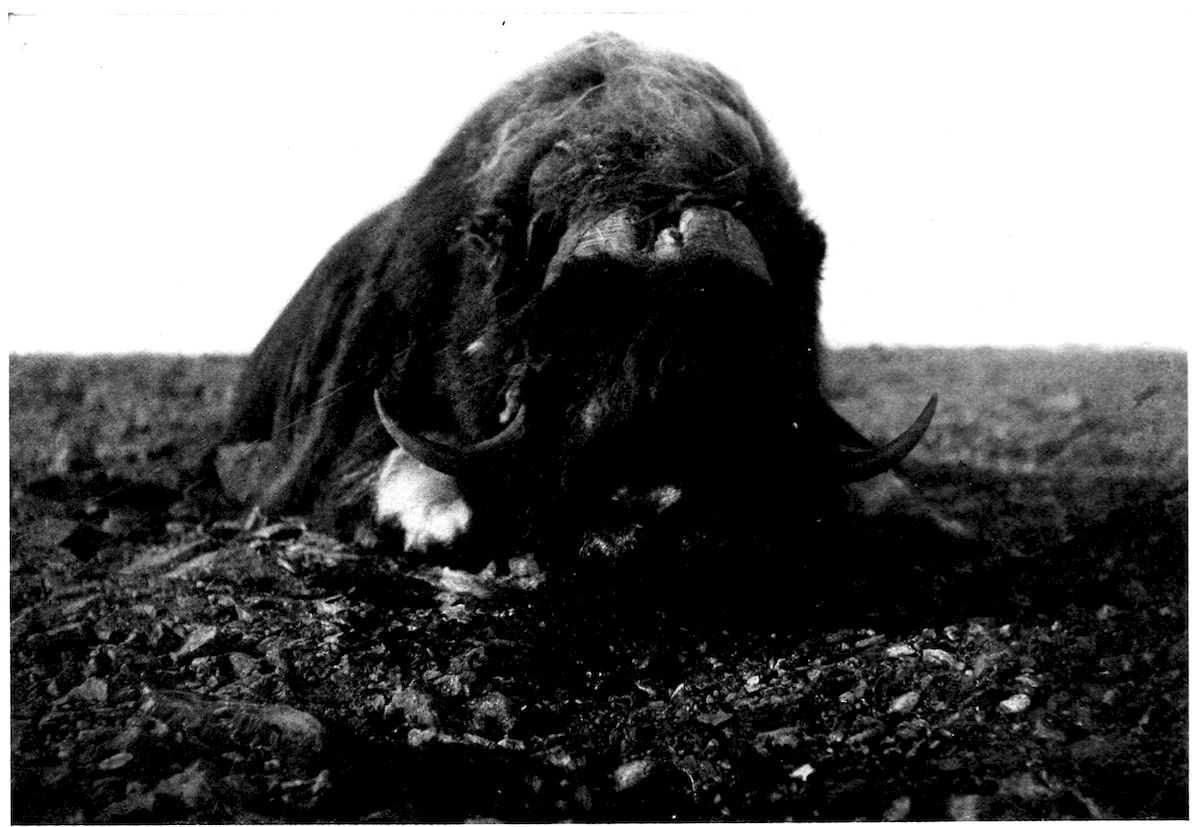
valley which I knew, and secured three musk-oxen,
a large bull, a cow, and a yearling, the latter being
brought aboard alive. This animal was of the greatest
interest to the crew and the “tenderfoot” members
of the expedition, and the arrival of nearly eight
hundred pounds of fine fresh beef created a very agreeable
impression on everyone.
Up to this time the rush of getting on board my
Eskimos and dogs, restowing the ship and fighting
the ice, had left me no time for a thought beyond the
demands of each hour. Now as I trod the moss
patches beside the murmuring stream whose quieter
reaches were crusted with ice, saw the fresh tracks of
big game and a little later the shaggy black bulks of
the musk-oxen with heads lowered and hoofs stamping,
in the way I knew so well, my pulses bounded rapidly
and I felt that I had come into my own again.
From Bache Peninsula we steamed for Hayes Point
through scattered ice, with the heavy pack close
on the starboard hand. Conditions were different
from those of 1898, when the Windward was five days
crossing the mouth of Princess Marie Bay. The night
was fine and I could make out every well-known rock
36along the Cape D’Urville shore where the Windward
wintered in ’98–’99. Looking into the distant depths
of Princess Marie Bay, numerous episodes with bear
and seals and musk-oxen crowded upon me. We
experienced some trouble with ice near Hayes Point
and Cape Frasier, and finally dodged into Maury Bay
and anchored at noon of the 19th, to escape the
large fields of very heavy ice which were moving
rapidly southward before a fresh northerly wind,
crashing with savage fury against the iron bastion
of Cape John Sparrow under which we lay.
Vigilantly watching the ice and taking advantage
of every opportunity, we squeezed and hammered
our way into Scoresby Bay, hugging the shore closely,
and thence to Richardson Bay. Twice we nearly
reached Cape Joseph Goode only to be forced back
by the oncoming floes to a shelter under Cape Wilkes,
close to my “Christmas” igloos of 1898, where on that
unfortunate midwinter journey to Fort Conger, during
which I froze both my feet, I had spent Christmas and
opened a small box from loved ones at home.
Rawlings Bay was packed and the ice along the
Grinnell Land shore apparently unbroken. On the
Greenland side it appeared less dense. During this
time the weather was fine.
The aspect of the ice was so extremely unfavourable,
northward on the Grinnell Land side, that I determined
to test my belief gained in my last four years
of work in this region, that the Greenland side of
Kennedy and Robeson Channels offered as a rule more
favourable opportunities for navigation than the
Grinnell Land side.
37
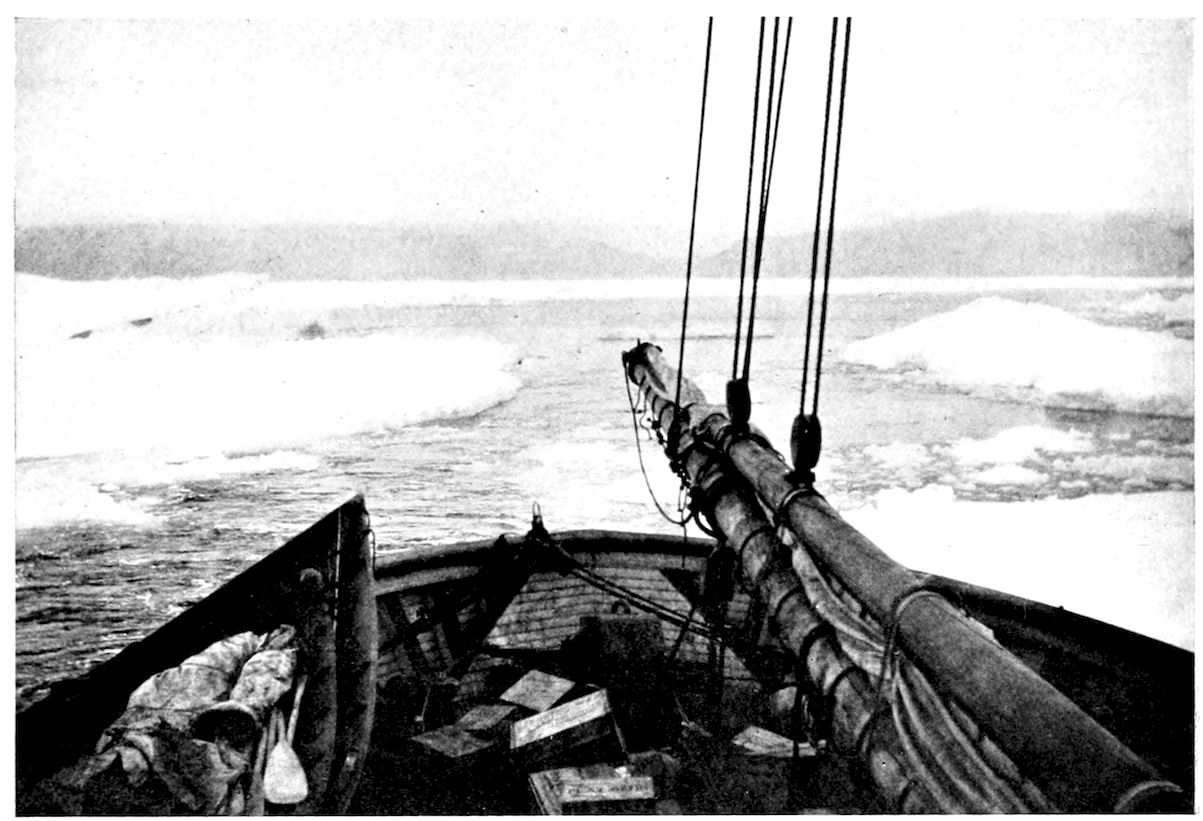
ENTERING THE SMITH SOUND ICE
OPEN WATER OFF CAPE LUPTON
38
THE SQUEEZE NEAR “THE GAP”
39Firm in my confidence in the capabilities of the
Roosevelt and against all the so-called canons of Arctic
navigation in this region, she was headed eastward in
the afternoon of the 21st and driven into the thick of
the channel pack. The ice encountered was very large
and heavy, and its southward drift inevitably swept
us down; still we made fair progress eastward and
after a severe and protracted struggle, during which
Bartlett and the mate remained continuously in the
fore rigging and I in the main rigging, we broke out
into loose ice off Cape Calhoun and began boring
northward towards Crozier and Franklin Islands.
The channel between Franklin Island and Cape
Constitution was attempted and found impracticable.
The main channel pack was then negotiated close
under the vertical western cliffs of Franklin Island.
We then had fairly good going, interrupted by barriers
of heavy but rather loose ice to Joe Island.
Stopped here by an impervious jam, the Roosevelt
was made fast to the ice-foot which along the southern
end of the island is of most stupendous character,
and accompanied by Captain Bartlett I climbed to the
summit of the island, from whence we saw the eastern
portion of Hall Basin clear of ice to Cape Lupton
and apparently to Cape Sumner. The western portion
of the basin and as far as we could see north and south
along the Grinnell Land coast was densely packed
with heavy ice.
With the turn of the tide the tension in the channel
pack along the western shore of the island relaxed
somewhat, and hurrying back to the Roosevelt, a few
hours of severe work forced the barrier, and in the teeth
40of a strong and bitterly cold north wind which kicked
up a very respectable sea and sent the spray flying
over our bows, we steamed to Cape Lupton, reaching
it at midnight of the 22d. While steaming through
this open water we passed Thank God Harbour, the
winter quarters of Hall’s Polaris on our right and
Discovery Harbour, the winter quarters of the Discovery,
and site of Fort Conger, on our left.
A few miles north of Cape Lupton, while smashing
through a narrow tongue of ice, a sudden swirl of the
current which at times runs like a mill-race in this
deep channel, swept the ice together in a way that I
can only liken to the sudden scurry of fallen leaves
before an autumn breeze, pinched the Roosevelt between
the big cakes, and smashing her against the
ice-foot, ground her along its vertical face with a
motion and noise like that of a railway car which has
left the rails and is bumping along over the ties.
Very fortunately for us she scraped into a shallow
niche in the ice-wall, and was hastily secured with
every available line.
The entire flurry lasted less than five minutes, but
in that time the steering gear was almost disabled.
The back of the rudder was twisted on the stock, the
heavy iron head-bands and fittings broken, and the
steel tiller rods snapped. Temporary repairs were
effected, and as soon as the pressure relaxed we steamed
on around Cape Sumner and tied up to the fast ice
in Newman Bay under Cape Brevoort, to repair our
damaged steering gear and await the opening of a
lead across Robeson Channel to Cape Union or vicinity.
41
BRINGING OFF THE “POLARIS” BOAT FROM BOAT CAMP, NEWMAN BAY
42
CAPE SUMNER, GREENLAND
BIRTHDAY CAPE, WRANGEL BAY, GRINNELL LAND
43The winter’s ice was still intact in the bay, its
surface level and granular, and the pools of water upon
it covered with ice strong enough to support a man’s
weight.
As soon as the lines were secured I walked ashore
and climbed to the summit of Cape Brevoort. The
crest of the northward-facing cliffs commanded the
entire northern approaches to Robeson Channel, from
Repulse Harbour across to Cape Rawson and southward
along the Grinnell Land coast to Lady Franklin
Bay. The Greenland coast south of Sumner was
hidden by the cliffs of that cape. The ice all along
the Grinnell Land coast, and in the centre of the
channel, and to the northward as far as I could see,
was densely packed. The water in which we had
come north still remained open and the Roosevelt
could have worked her way close to the shore along
the Greenland coast to Repulse Harbour and possibly
to Cape Bryant, had my objective point been in that
direction. No indication of lead or crack across the
channel was to be seen. While on the summit a school
of narwhal came sporting down the shore close to the
ice-foot below us.
In Newman Bay we remained five days mending
the rudder, replacing the tiller chains with wire cables,
and crossing to the south side of the bay, where I took on
board the Polaris boat left here by Chester and Tyson of
Hall’s party in 1871, at Boat Camp. Then as the
northern ice filled into the bay, we were gradually
crowded out of our shelter behind Boat Camp delta,
and tide by tide forced out to Cape Sumner, sometimes
grazing the shore as we dodged a floe. During this
time the Bay filled completely with ice and the entire
44northern part of the channel was packed solid. Captain
Bartlett and Marvin made several trips to the
top of Cape Sumner to reconnoitre the channel but
without satisfactory results.
The turn of the tide the morning of the 28th set us
out again, and, impatient of the delay, and encouraged
by the behaviour of the Roosevelt in crossing the
channel at Cape Calhoun, fires were cleaned, machinery
thoroughly inspected, and at 4:30 A. M. the Roosevelt
was driven out for another contest with the channel
pack in which at the time no pool or lane of water was
visible.
Just off the point of Sumner a brief nip between
two big blue floes which the swift current was swinging
past the Cape, set the Roosevelt vibrating like a violin
string for a minute or so before she rose to the
pressure.
From this we pushed out and began the attempt
to cross to the west side, through ice almost continuously
up to our plank sheer and frequently of such
height that the boats swinging from the deck house
davits had to be swung inboard to clear the pinnacles.
The delay and inaction of the past five days had
become unendurable.
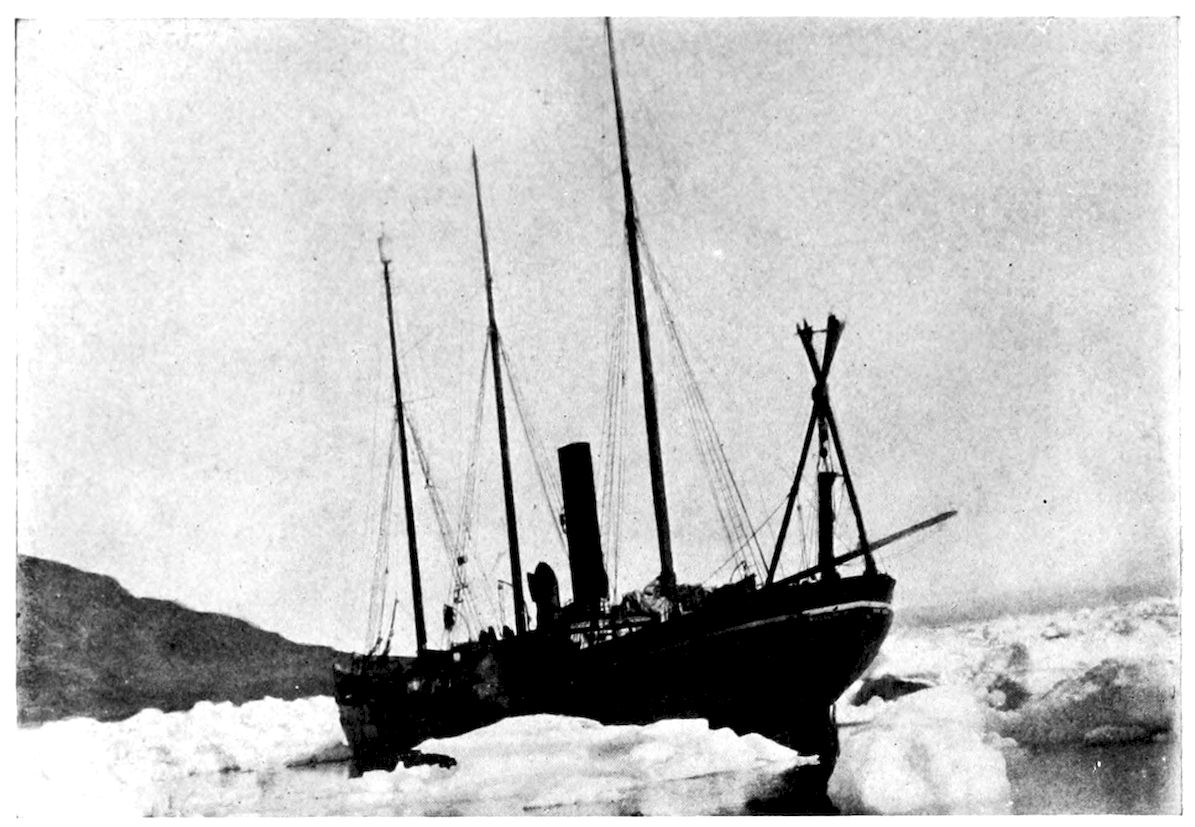
The Roosevelt fought like a gladiator, turning, twisting,
straining with all her force, smashing her full weight
against the heavy floes whenever we could get room
for a rush, and rearing upon them like a steeplechaser
taking a fence. Ah, the thrill and tension of
it, the lust of battle, which crowded days of ordinary
life into one.
The forward rush, the gathering speed and momentum,
45the crash, the upward heave, the grating snarl
of the ice as the steel-shod stem split it as a mason’s
hammer splits granite, or trod it under, or sent it
right and left in whirling fragments, followed by the
violent roll, the backward rebound, and then the
gathering for another rush, were glorious.
At other times, the blue face of a big floe as high
as the plank sheer grinding against either side,
and the ship inching her way through, her frames
creaking with the pressure, the big engines down
aft running like sewing-machines, and the twelve-inch
steel shaft whirling the wide-bladed propeller,
till its impulse was no more to be denied than the
force of gravity.
At such times everyone on deck hung with breathless
interest on our movement, and as Bartlett and
I clung in the rigging I heard him whisper through
teeth clinched from the purely physical tension of
the throbbing ship under us: “Give it to ’em,
Teddy, give it to ’em!”
More than once did a fireman come panting on deck
for a breath of air, look over the side, mutter to himself,
“By G— she’s got to go through!” then drop into
the stoke-hole, with the result a moment later of an
extra belch of black smoke from the stack, and an
added turn or two to the propeller.
At midnight all that could be said was that we
were nearer the west side than the east, and steadily
drifting southward with the pack. I quote from my
journal: “Slow and heart-breaking work. The Roosevelt
is a splendid ice-fighter and if she had her full
boiler power she would be irresistible. The ice is
46very heavy, in large floes, some of them several
miles in diameter and their edges sheer walls of
blue adamant. I shall be glad when we are through.”
In one of her charges the Roosevelt left a considerable
piece of the stem just under the figurehead
as a souvenir upon the top of a berg-piece
which she was obliged to butt out of her path.
In another, a blue floe twelve to fifteen feet in
thickness was split fairly in two.
Until 4 A. M. of the 29th we continued slowly to
near the Grinnell Land side. Then but little progress
was made for several hours, then another start which
was kept up with occasional interruptions until 4 P. M.,
when after thirty-five and one-half hours of incessant
strain and struggle, we drove out into a small pool of
water under the northern point of Wrangel Bay.
The battle had been won by sheer brute insistence
and I do not believe there is another ship afloat
that would have survived the ordeal.
Bartlett and I went to our rooms, worn with the
long tension, and I fell asleep instantly.
It was the second birthday of a man-child in the
distant home, and in my dreams I saw the round
face with its blue eyes and crown of yellow hair,
smiling at me from the savage mass of black clouds
which shrouded the summit of the cape under which
we lay. God bless you, little man.
Soon after getting into Wrangel Bay, and while
I was asleep, a piece of heavy ice whirling under the
stern twisted the back nearly off the rudder, and the
entire night was occupied in temporarily repairing
the damage. A hunting party of Eskimos sent out
47during the night returned the forenoon of the 30th
with eleven hares and six musk-oxen. Late in the
afternoon an unsuccessful attempt was made to reach
Lincoln Bay, from which we were driven back by
heavy floes moving southward, and at midnight we
were again in Wrangel Bay dodging about to keep
clear of the shifting ice, while past the capes the big
floes were going south with almost race-horse velocity,
the channel and summits of all the land dark with fog.
The 31st was spent in the bay keeping clear of the
floes which swung into and around it, the night thick
with falling snow. Made an early start at 3:30 A. M.
September 1st, in fog and a blinding snowstorm, and
steamed to the north side of Lincoln Bay, where the
unbroken pack again barred our passage and we
moored to the exposed face of the ice-foot.
Again I quote from my journal: “A wild morning
with snow driving in horizontal sheets across
the deck, the water like ink, the ice ghastly white,
and the land invisible except close to us as we
almost scrape against it on the port side. Summer
is at an end and winter has commenced.” Scarcely
had we made fast to the ice-foot when the ice filled
the bay completely.
With the ebb-tide at night much of the ice inside
of us passed out, grazing against our side, but no lead
formed at the Cape and no opportunity occurred to
get north.
With the turn of the flood, the ice came in again
with a rush, and the corner of a large floe caught the
stern, bent the back of the rudder over to the other side
and forced the ship bodily ashore. Here she hung
48until high-water, with a heavy berg-piece pressing
against her stern and threatening momentarily to
press her up the shore beyond possibility of floating
again.
Almost unmanageable with her twisted rudder, it
was a slow and difficult job to work her through the
running ice farther up the bay to a supposedly less-exposed
berth, snowing and blowing all this time.
Here the back of the rudder was straightened somewhat.
Early in the morning of the 3d, a moving floe forced
the Roosevelt ashore again, where she hung until the
next high-water, and she was hardly pulled off when
another floe jammed her hard and fast aground again.
I was very anxious to get out of this dangerous and
trying position, where the rapid and vicious movements
of the ice were a constant menace, but a
reconnoissance from an elevation near the Roosevelt
indicated that the channel north of us was simply
solid with ice.
Shortly after midnight of the 3d, the Roosevelt
floated again and, a southerly breeze forming a little
water at the mouth of the bay, we steamed out at
3:30 A. M. and succeeded in getting under the delta
of Shelter River just south of Cape Union, and in
butting into a natural dock among some stranded
berg-pieces. Here the ship had one foot of water under
her keel and as we moored her, the slack ice through
which we had come jammed tight with floes packing
against the barrier at Cape Union. Here we enjoyed
a fine day with the temperature in the low twenties
and experienced a few hours of peace. The river
delta to the north and stranded berg-pieces to the
49south protected us from the attacks of the heavy
floes passing rapidly a few yards outside of us.
Eskimos sent out for hare here obtained thirty-six.
We were now only some fifteen miles from the Alert’s
winter quarters, and a clear run of two or three hours
would enable us to beat the record for ships in this
region, and save the game for us.
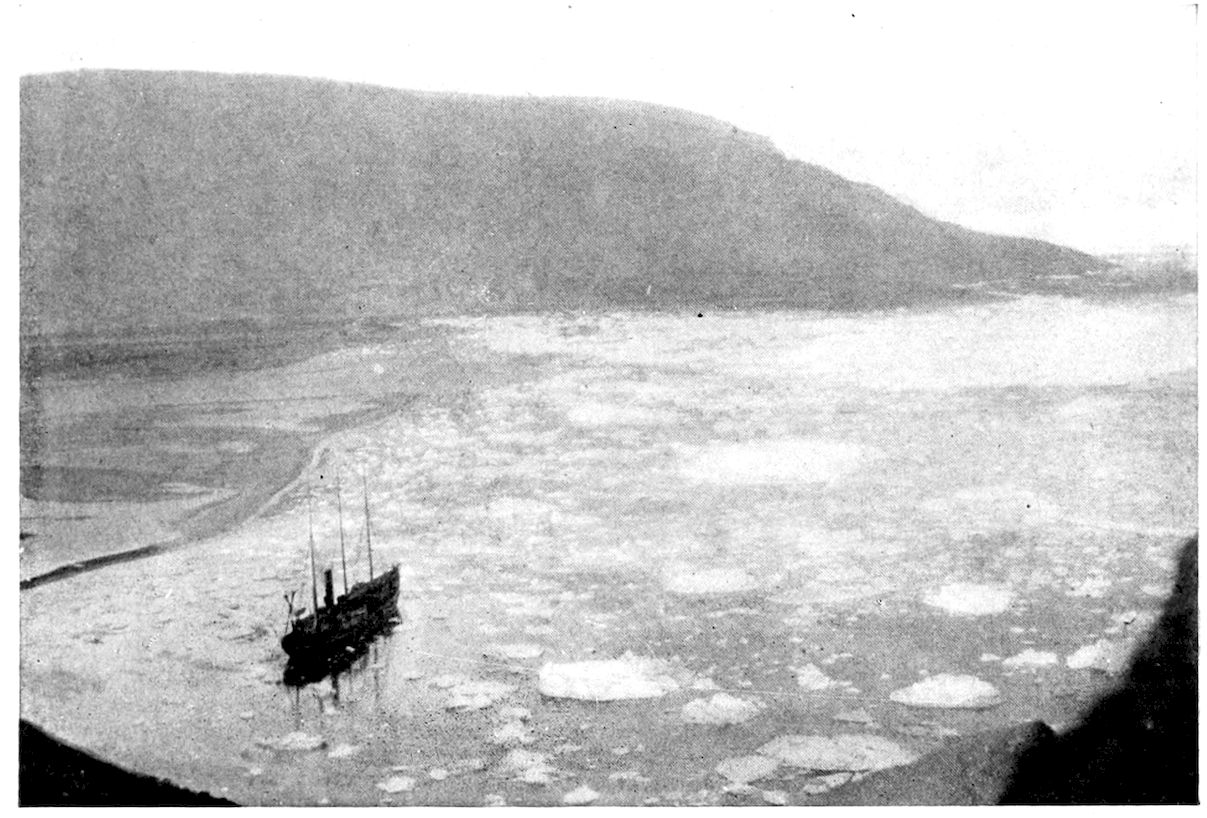
The 5th of September was a memorable day, one
that practically ended my fears and anxieties. At
3:30 A. M. we got under way after about an hour’s
backing and butting to get out of our niche. A
narrow strip of water close inshore showed as far
as Cape Union where a narrow but apparently
dense barrier pressed against the Cape. Would it
let us through? As we neared the barrier it was
evidently only about a mile wide, with water beyond
it extending to Cape Rawson. I kept both
watches of firemen on, and routed out the chief engineer
ahead of his watch, because it was evident that
we must get through now. In a few minutes the
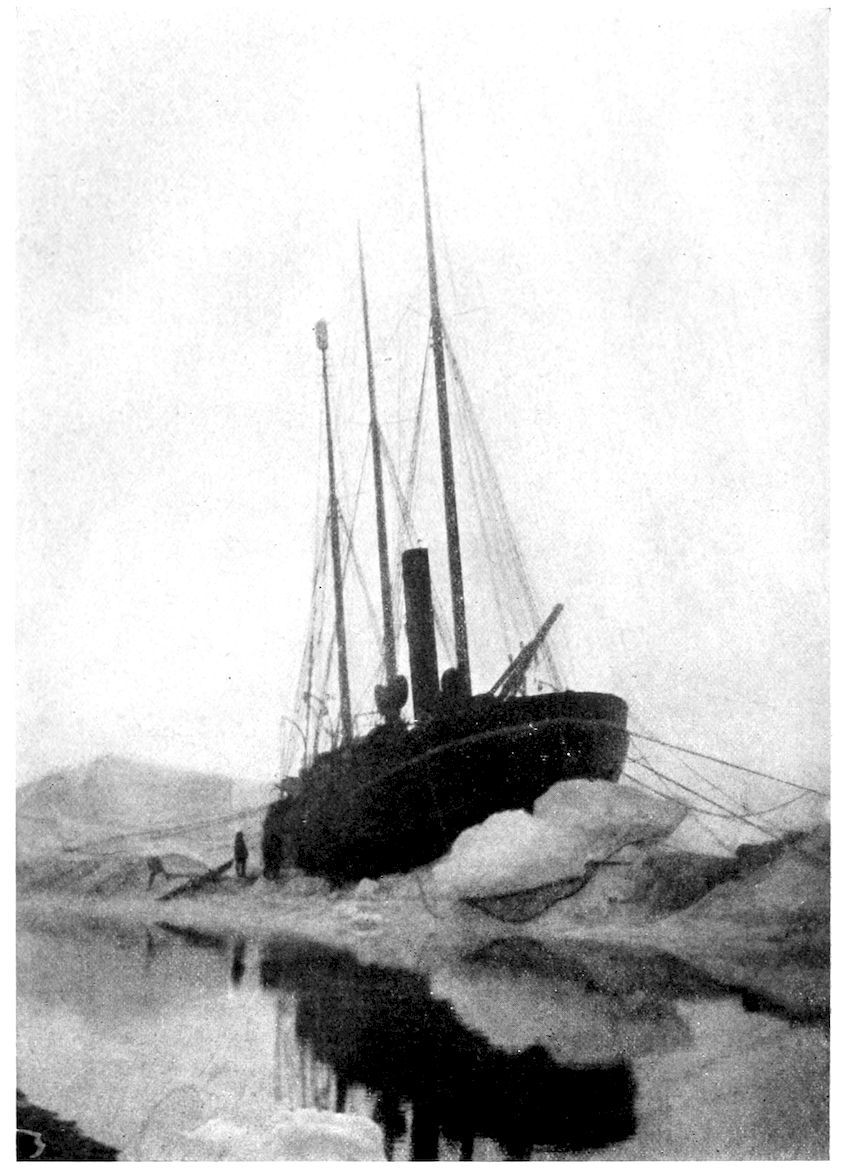
Roosevelt was in the thick of it, throbbing like a motor,
the black smoke pouring from her stack, and successfully
forced her way through. Cape Union was passed
at 4:30 A. M. South of Rawson the ice ran close in
against the shore but was looser outside, and we made
a wide detour to the northeast, the captain, the mate,
and myself in the rigging. The ice was in large,
heavy floes and in rapid motion swinging into the
mouth of the channel on the flood-tide. The anxious
moments were numerous both as to whether we should
get through, and also as to whether we should escape
a serious nip.
50Soon we opened up the Alert’s cairn at Floeberg
Beach and could see a narrow canal of water extending
close to the ice-foot, and at 7 A. M. the
Roosevelt, racing with the incoming pack, was driven
through a narrow stream of ice and fairly hurled
into a niche in the face of the ice-foot under
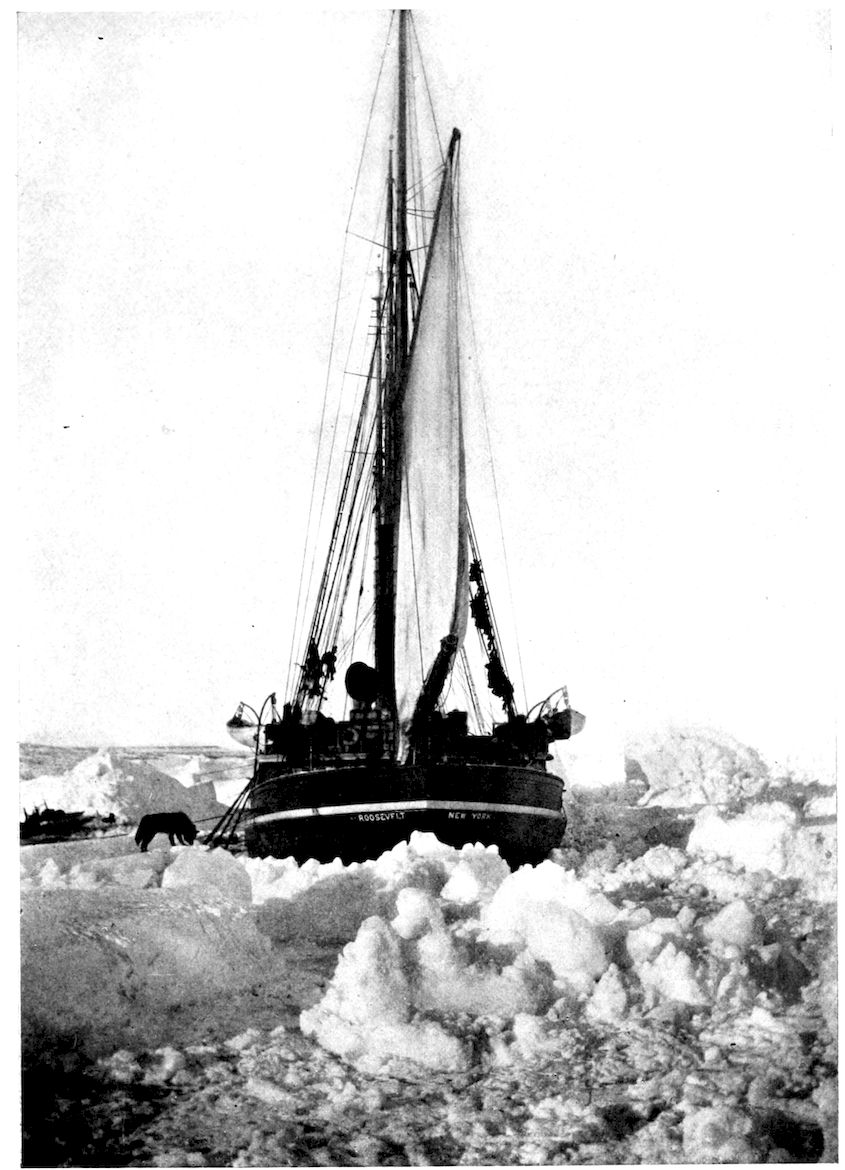
the extremity of Cape Sheridan and made fast. The
ice was packed heavily against the point of the
cape and grinding past it. Before our lines were
made fast the ice had closed in upon us and the open
water behind us was rapidly disappearing.
We were now about two miles beyond the Alert’s
position, moored to the exposed face of the ice-foot,
with the nose of the Roosevelt pointing almost true
north. I felt now that the risks, the chances of the
voyage were past. The ship might be lost by being
forced ashore, for our position was an extremely
exposed one, but we were not likely to lose provisions
and equipment, and with these the remainder of the
programme could be carried out, and even should she
get no farther she would have done her duty and
achieved the purpose of her being.
With my feelings of relief, was a glow of satisfaction
that by a hard-fought struggle we had
successfully negotiated the narrow, ice-encumbered
waters which form the American gateway and route
to the Pole; had distanced our predecessors; and had
substantiated my prophecy to the club, that with a
suitable ship, the attainment of a base on the north
shore of Grant Land was feasible almost every year.
Previous to the Roosevelt, only two other ships, the
Polaris and the Albert, had completely navigated these
51channels; and two others, the Discovery and the
Proteus, had penetrated them as far as Discovery
Harbour.
Our freedom of movement and ability to leave the
shelter of the land and cross and recross the channel
at will through the heaviest ice, was also gratifying
to me.
In the voyage from New York to Etah we had
passed the latitudes of the most northern extremities
of North America, Europe and Asia.
Since leaving Etah, we had passed the latitudes of
the most northern extremities of Spitzbergen and
Franz Joseph Land, and now only the northern points
of the two most northern lands in the world, Cape
Morris Jesup and Cape Columbia, lay a little beyond
us. The northern-reaching fingers of all the rest of
the great world lay far behind us below the ice-bound
southern horizon. We were deep in that gaunt frozen
border land which lies between God’s countries and
inter-stellar space.
CHAPTER III AUTUMN AT CAPE SHERIDAN
55
It was hoped that the next ebb-tide would give
us an opportunity to advance farther, and
immediately after breakfast I hurried ashore to examine
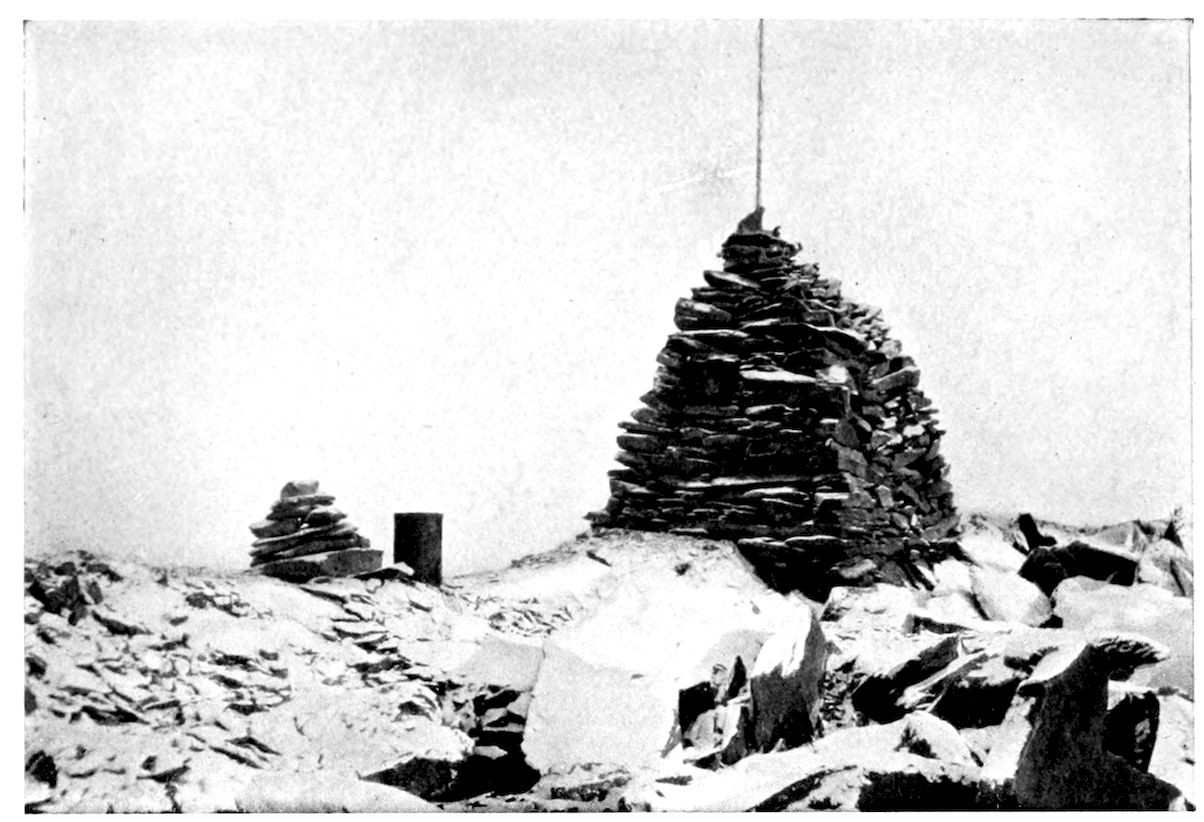
the ice beyond Cape Sheridan and visit the cairn built
by the Alert thirty years before. The weather was too
thick to permit any satisfactory reconnoissance. I
took the Alert’s record from the cairn, a copy of which
Marvin later replaced together with an additional
brief memorandum. All the slopes of the land were
white with snow above which the cairn, and the lonely
grave of Petersen, Danish interpreter of the English
expedition, stood out in sombre silhouette. The Roosevelt
was moored close by a ledge of rocks where, in
1902, I had deposited a small cache for my return.
With the last of the flood-tide the ice pressed in
upon us still harder, jamming the Roosevelt solidly
but not seriously against the ice-foot; and anticipating
still further pressures, I had the edge of the ice-foot
throughout the Roosevelt’s length chopped away on
an incline to the water level, so that the ship might
rise more easily to pressure. A fine snow fell throughout
the day. At midnight of the 5th, the sun’s disk
was apparently about two-thirds below the horizon.
The fine snow continued during the sixth and
the ice remained unchanged. After supper water
56pools off-shore were visible from the summit of
the hill. There was evidently sufficient slack in
the ice for a fresh southerly wind to form a
good shore lead. On the sixth, I sent two parties
of three hunters each, with supplies for ten days,
out for musk-oxen, one party going southeast, the
other southwest. Other Eskimos were sent out for
hare. On the seventh it cleared sufficiently to give
us our first view of Cape Hecla and the United States
Range. September 8th was a brilliant day; three
Eskimos came in from Black Cliffs Bay with twenty-three
hare aggregating two hundred and eleven pounds.
This made the number of hare killed along here nearly
one hundred. The Eskimos were started at overhauling
sledges and making harnesses. The 9th was
a wonderfully mild day of brilliant sunshine for this
time and place. Sent a party to Porter Bay, just
south of Cape Hecla, the objective point I have in
view for the Roosevelt—a beautiful little bay which
I examined in 1902, with southern exposure and
protected from the running ice. A position here
would place us right at the beginning of our work,
would be convenient to the musk-ox haunts of Clements
Markham Inlet, and would be little or no farther than
Sheridan from the musk-ox preserves of the Lake
Hazen region. The dogs were all put ashore and
found the beds of dry gravel along the shore a much
more comfortable sleeping-place than the damp deck.
On the 10th, the temperature rose to 20° and damp
snow fell during the night and day. Early in the
morning of the 11th, a fresh southerly wind commenced,
accompanied by a heavy drift and a lane of water
57formed a few hundred feet outside of the Roosevelt
extending close past the point of Sheridan and on to
Belknap. But the ice which held us against the ice-foot
remained firmly fixed and we were unable to get
into the water. In the evening it had closed again.
Started a party of three Eskimos off for Markham
Inlet after musk-oxen. After dinner three Eskimos
came in with the meat of four musk-oxen killed in
Rowan Bay, and in the evening the Porter Bay party
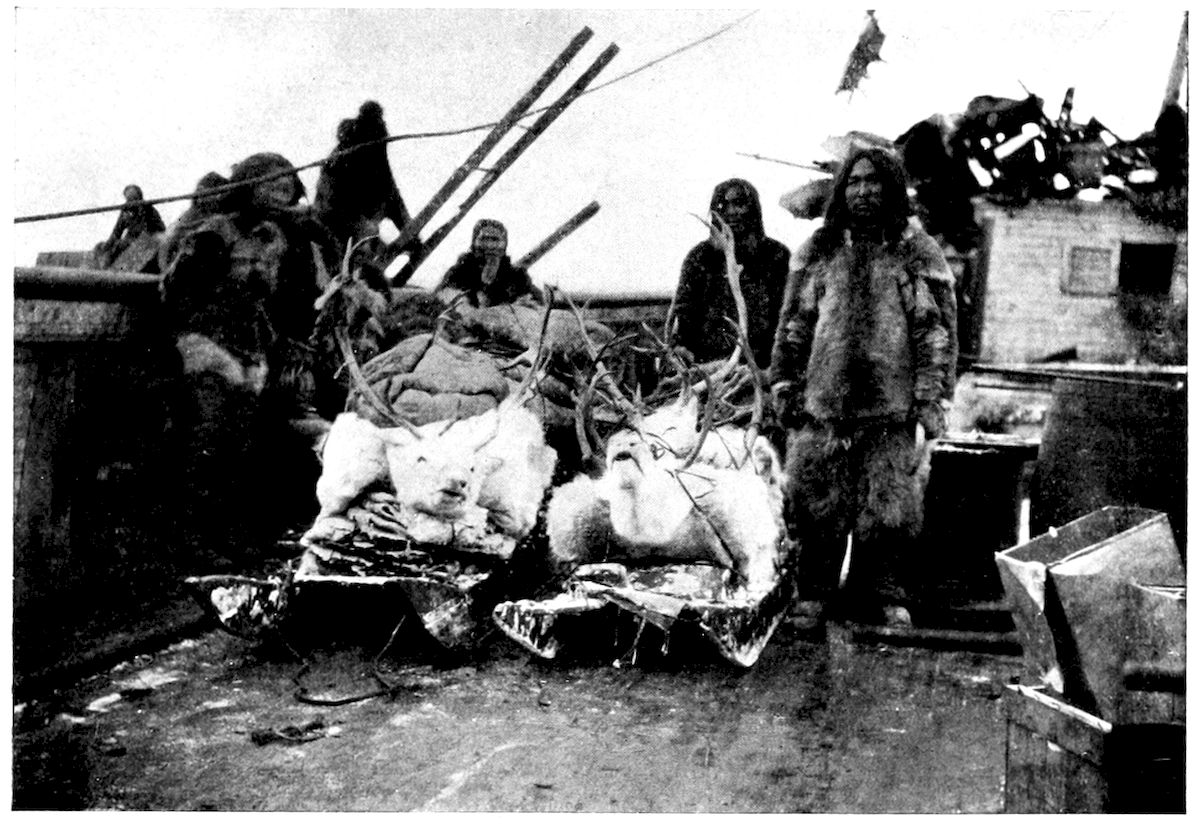
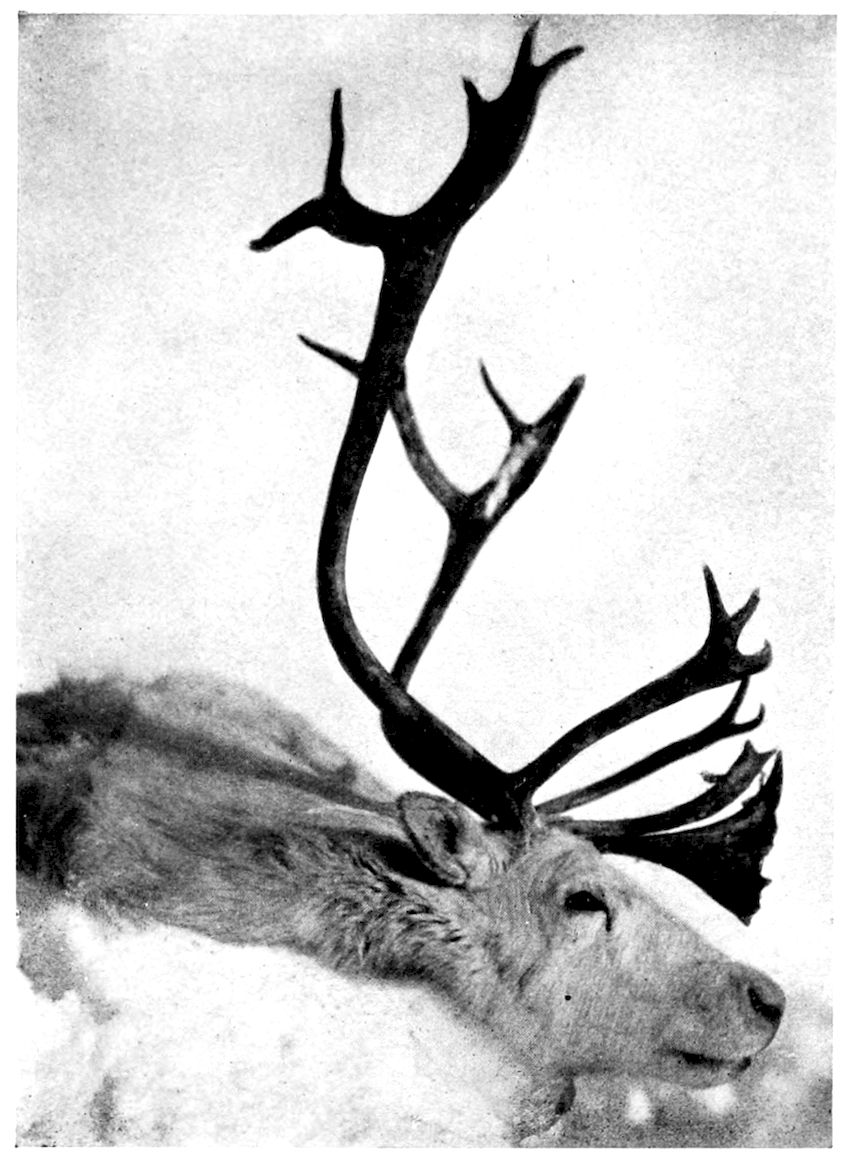
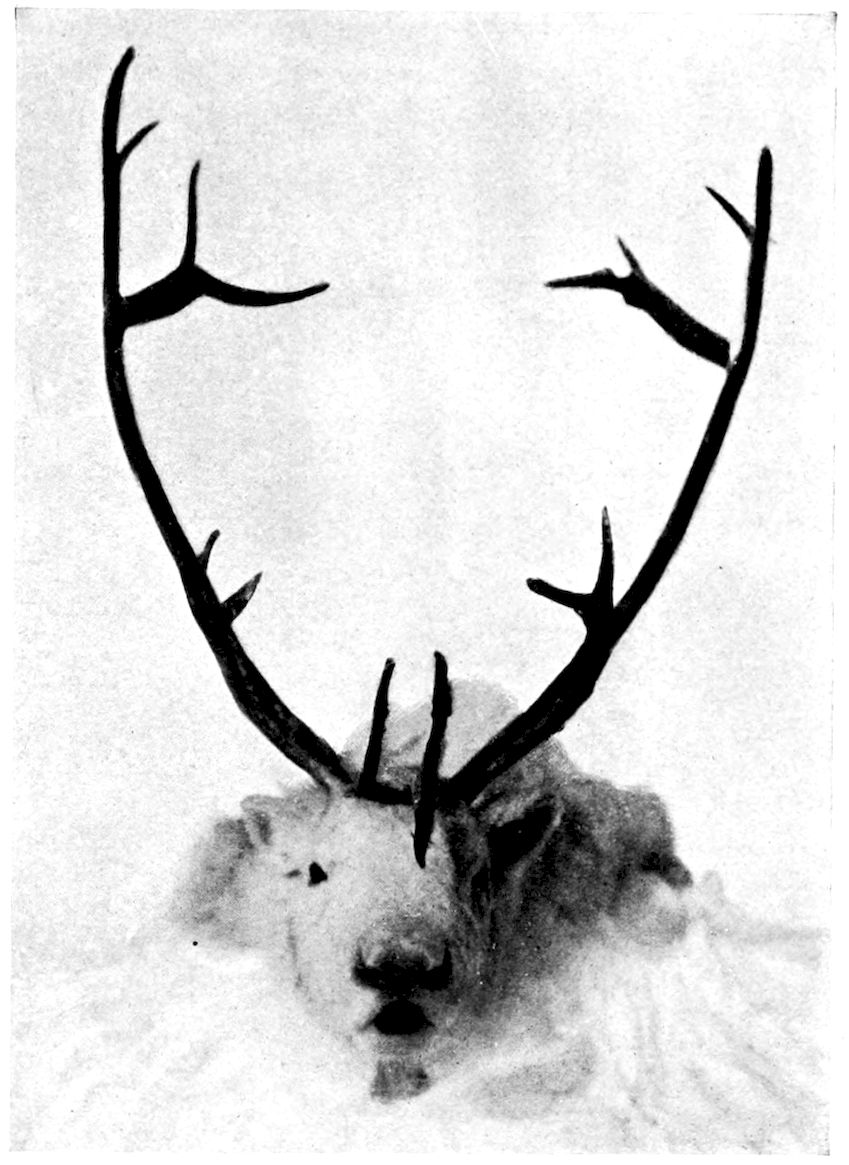
returned with the meat and skins of seven reindeer
killed in a valley on Fielden Peninsula. These, the
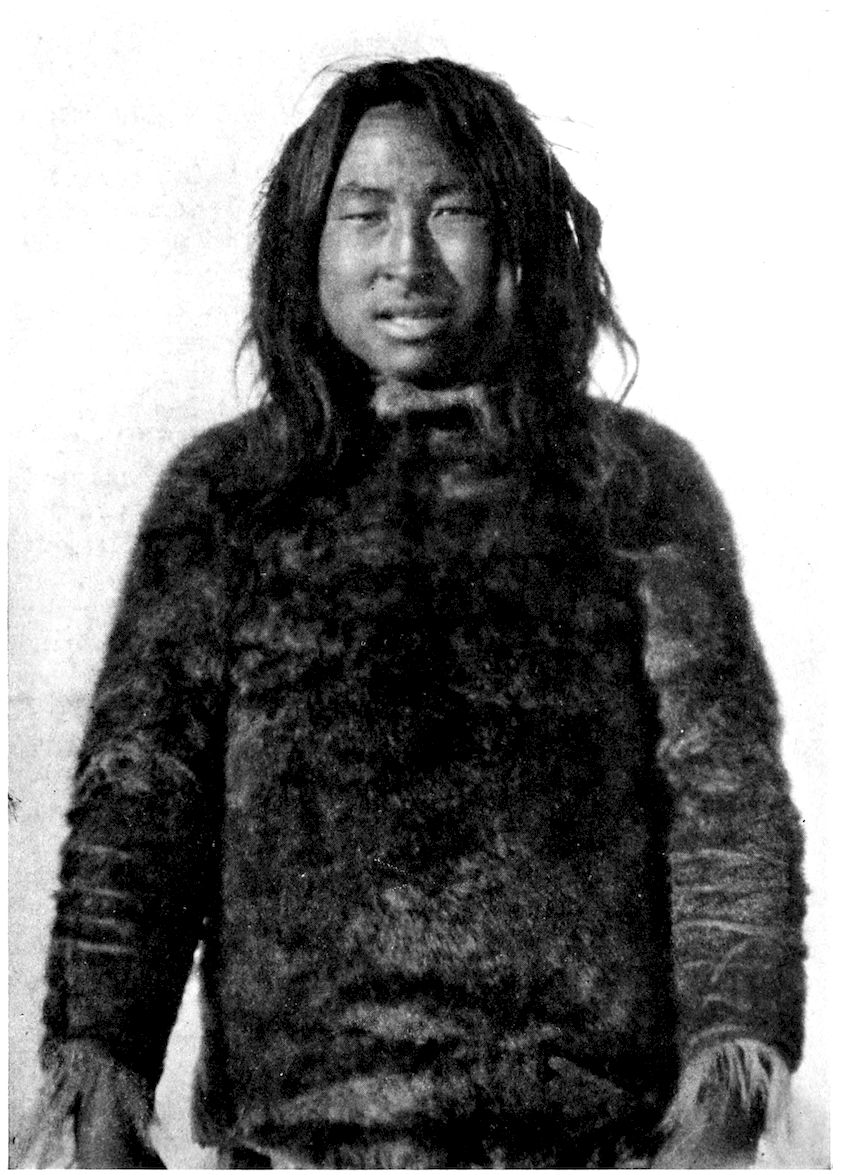
first specimens of this magnificent snow-white animal,
were from a herd of eleven surprised in a valley close
to Cape Joseph Henry, and among the seven was the
wide-antlered buck leader. These beautiful animals,
in their winter dress almost as white as the snow
which they traverse, were later found scattered over
the entire region from Cape Hecla to Lake Hazen, and
westward along the north Grant Land coast, over fifty
specimens in all being secured. The party reported
Porter Bay still filled with the unbroken ice of the
previous winter, and therefore impracticable for our
winter quarters. The night of the 11th was a perfect
Arctic autumn night. To the south over the land
the sky pearl-white; west and northwest, about the
couchant mass of Cape Joseph Henry, orange-yellow;
north, over the Polar Sea, gray-white; east and southeast
the snow-clad Greenland coast lay under the
purple shadows of the coming “Great Night.” On the
12th a fresh southerly wind set the snow drifting
savagely on all the uplands, flung out a long snow-banner
from the summit of Rawson, and formed a
58broad lane of water reaching from behind Rawson
past us and on toward Cape Henry. During the
12th and the 13th every effort was made with pickaxes
and dynamite to effect a passage to this water,
but without success. On the 14th, I sent a party
of four Eskimo hunters off to Lake Hazen. Since our
arrival, the Eskimos, when not otherwise engaged,
were getting the supplies from the main and after holds
up on deck, in readiness for landing as soon as it was
settled where our winter quarters would be.
About 10 P. M. of the 16th, as I was on the bridge
taking a look about before turning in, a large floe
moving on the flood-tide pivoted around the point
of Sheridan and crashed into the smaller ice about
the ship, driving it bodily before it. At the first shock
the Roosevelt reeled and shook a bit, then heeled slightly
toward the crowding ice and turned it under her starboard
bilge. Standing on the starboard end of the
bridge and looking down upon the ice the sensation
was much like that of being on a large sledge moving
over the ice, so rapidly did the rounding side of the
Roosevelt turn the ice under her. Once or twice she
hung for an instant and quivered with the strain, then
heeled and turned the ice under again. This continued
until a corner of the floe itself, some portions
of which were higher than the rail, came full against
the Roosevelt’s starboard side amidships, with no intervening
cushion of smaller ice and held the ship
mercilessly between its own blue side and the unyielding
face of the ice-foot. Its slow resistless motion
was frightful yet fascinating; thousands of tons of
smaller ice which the big floe drove before it, the
59Roosevelt had easily and gracefully turned under her
sloping bilges, but the edge of the big floe rose to the
plank sheer and a few yards back from its edge, was
an old pressure ridge which rose higher than the
bridge deck. This was the crucial moment. For a
minute or so, which seemed an age, the pressure was
terrific. The Roosevelt’s ribs and interior bracing
cracked like the discharge of musketry; the deck
amidships bulged up several inches, while the main
rigging hung slack and the masts and rigging shook
as in a violent gale. Then with a mighty tremor
and a sound which reminded me of an athlete
intaking his breath for a supreme effort, the ship
shook herself free and jumped upward till her propeller
showed above water. The big floe snapped
against the edge of the ice-foot forward and aft and
under us, crumpling up its edge and driving it inshore
some yards, then came to rest, and the commotion
was transferred to the outer edge of the floe which
crumbled away with a dull roar, as other floes smashed
against it, and tore off great pieces in their onward
rush, leaving the Roosevelt stranded but safe.
When the tide turned on the ebb the ship settled
down again considerably but never floated freely
again until the following summer. Anticipating further
pressure with following tides, and to provide
against the contingency of the ship being rendered
untenable, the work of putting some coal and all
supplies and equipment ashore was commenced at
once and prosecuted without interruption by the
officers, crew, and Eskimo men, women, and children,
for some thirty-six hours. Planks were put
60from the rail to the ice-foot on the port bow,
quarter and amidships, and the boxes of provisions
slid down these, when men took them and put them
back from the edge of the ice-foot, where the women
loaded them upon sledges and pushed them beyond
any danger of loss by disruption of the ice-foot itself.
This work was greatly expedited from the fact that
practically all the supplies had been taken out of the
holds during the previous days and were lying on
deck. While the work was in progress one of the
Eskimos of my southwest scouting party came in on
foot reporting twenty-one musk-oxen killed in Porter
Bay. The next night there was a brief and not serious
pressure, then the ice about the ship quieted down
again, though it ran strongly with the tides some
fifty yards outside of us.
Of course this occurrence put all ideas of any
farther advance out of question, and the usual
routine fall work of an Arctic expedition and preparation
for wintering were inaugurated. Hunting
parties of the Eskimos were kept constantly in
the field, covering the country north to Clements
Markham Inlet and south to Wrangel Bay and Lake
Hazen. The results of these parties were satisfactory,
considerable numbers of musk-oxen and
reindeer being secured. Almost every day one or
two hunters went out from the ship and in this way
some hundred or more hare were secured in the
immediate vicinity. But musk-oxen were to be our
mainstay, and while my confidence that we should
find numbers of these animals within a comparatively
short distance of the ship was justified by events
61I still recognised that our main source of supply must
be the drainage basin of Lake Hazen, the northern
portion of which, covering the southern slopes of the
United States Range, had not been drawn upon by me
while at Fort Conger between 1899 and 1902.
This region was now tapped with great success by
parties travelling directly overland from the ship to
Lake Hazen.
The boxes of provisions which had been landed
were fashioned by the crew into three box-houses, a
large one some thirty feet long by fifteen feet wide
which, roofed with the spanker and fitted with a stove
and fuel, was to serve as an immediate refuge in case
of mishap to the ship, and two smaller ones. The
larger tents were also set up ashore, the boats turned
bottom up and the barrels arranged in such a way as
to serve as wind shelters for the dogs. Later on
houses and tents were heavily banked with snow. All
the heavy ice next to the ship on the starboard side
was cut down on a gentle slope ending at the water
level against the ship’s side, and a bank of small
fragments of ice filled against the ship her entire
length to serve as a cushion. On top of this a wall
of snow blocks was built as high as the rail and from
the mainmast to the mizzenmast as high as the top
of the deck house. The deck was covered deep with
snow and the forward and after deck-houses covered
and banked in with the same. No attempt was made
to house in the deck with sails, but snow vestibules
or entrances were constructed at all of the outer doors.
The Eskimo men when not in the field were occupied
in making sledges and harnesses, each man his own
62sledge, and with the waning of the light, I had a fleet
of some twenty-five sledges in commission. Attempts
were made to hoist the rudder on deck so that it could
be repaired, but without success.
Marvin erected a tide gauge on the ice-foot protected
by a snow igloo, and took tidal observations during
a period in excess of a lunar month.
A disagreeable feature of this time was the frequent
occurrence of violent southerly winds varying from
vicious squalls of a few hours’ duration to furious gales
lasting two or three days. These winds invariably
denuded the land in our vicinity of snow and were
always accompanied by more or less extended open
water. As late as October 16th, a ship located south
of Rawson could have come around that cape and
made our present location with even greater ease than
did the Roosevelt on the 5th of September. On one
occasion such a ship could have gone on without
obstruction to Cape Joseph Henry, passing about one
hundred yards outside of our position. Naturally
under these conditions the mean temperature was
unexpectedly high.
October 1st, our large game score reached seventy-three
musk-oxen and twenty-seven reindeer, just an
even hundred. On this date small stoves were set
up for the first time in the after house. October
2d, the boilers were blown off for the winter. October
3d, I started to make a reconnoissance of our spring
route to Hecla, as my observations in 1902 had satisfied
me that there was a better route than that followed
by the English across Fielden Peninsula. I
also wished to examine Clements Markham Inlet for
63musk-oxen. Two marches from the ship took me to the
mouth of Clements Markham Inlet, one day of thick
weather was devoted to a trip part way into the inlet
and back; and the next two brought me back to the
ship, my anxiety for her having prevented my remaining
out as long as I wished. It was a new and
not particularly agreeable feeling to me to be hampered
by the cares of a ship, and thus kept from active fieldwork,
but I accepted the conditions and shifted the
burden of the remainder of the fall and winter work
to the younger shoulders in the party. On the 9th,
our large winter lamps were put in commission for
the first time. On the 13th, I snowshoed to the summit
of Black Cape and saw the sun for the last time,
peering for a moment through the misty ice-filled
opening of Robeson Channel to the south. From
Cape Sheridan, past Rawson, and on down past Cape
Union there was plenty of open water and across the
mouth of the channel to Repulse Harbour there was
nothing but light trash ice. For a few moments the
sun’s rays lit the entire southern summit line of the
United States Range, crested Mount Cheops with rose,
and just touched the peaks of Cape Joseph Henry.
It was so low, however, that the shadow both of Greenland
and of Grant Land reached northward across the
pack ice to the blue-black northern horizon except
where it streamed through between the precipitous
walls of the Channel itself forming a broad band of
yellow light between the shadows on either side,
“the Gateway to the Polar Sea.”
October 16th was marked by the most violent gale
we had had since leaving home. This gale left the
64land almost as bare as in summer, and the water
formed by it was more extensive than at any time
for a month. After all these gales, Cape Joseph
Henry stands out in black and savage profile. Of
all capes fronting the Polar Sea along the coasts
of Greenland and Grant Land, this is the most
ideal.
Soon after this, with almost the suddenness of
lightning from a clear sky, I faced the possibility of
the complete crippling of the expedition by the extermination
of my large pack of dogs. About eighty of
these indispensable animals died before the cause was
traced to poisoning from the whale meat which I had
taken for dog-food. This meat to the amount of
several tons was thrown away, and I found myself
confronted at the beginning of the long Arctic night
with the proposition of subsisting my dogs and most
of my Eskimos upon the country.
Without my previous familiarity with the region,
this would have been an absolute impossibility; even
as it was, it possessed elements of uncertainty, but
with the satisfactory start already made in obtaining
musk-oxen, and knowing that these animals could be
killed by those who knew how, even in the depths of
the great Arctic night, I believed there was somewhat
more than a fighting chance for success.
65
THE “ROOSEVELT” IMMEDIATELY AFTER ARRIVAL AT CAPE SHERIDAN
66
THE “ALERT’S” CAIRN AT FLOEBERG BEACH
PETERSEN’S GRAVE, OVERLOOKING FLOEBERG BEACH
67On the 25th, portions of four hunting parties
from the Lake Hazen region came in, bringing
reports of a bag of one hundred and forty-four
head of musk-oxen and deer. Following the return
of these parties the dogs died rapidly, the number
one night reaching ten. It was evident that prompt
action must be taken, and in three days one hundred
and two dogs, twenty adult Eskimo men and women
and six children were sent into the field in addition
to those already out. From this time until the 7th
of February, the dogs and the greater portion of the
Eskimos remained in the Lake Hazen region, a portion
of the men coming to the ship during the full moon of
each month with sledge loads of meat, and returning
with tea, sugar, oil and biscuit. With their departure
the ship was almost deserted, daylight was nearly gone
and the winter may be said to have commenced, though
for convenience it was assumed to begin on the 1st
of November when the winter routine of two meals
a day went into effect, partly as a measure of economy,
and partly to leave the short and very rapidly decreasing
hours of twilight in the middle of the day
uninterrupted for work.
The ice outside of us was constantly in motion,
more or less active with the currents of the tides, and
about the middle of October the young ice incessantly
forming between the large floes became of such thickness,
that its crushing up rendered the movement of
the ice very audible. First as a loud murmur, later
with increasing cold as a hoarse roar, sometimes
continuous, sometimes intermittent, like heavy surf
upon the shore, which kept the air vibrating, and coming
as it did through the darkness and frequently
snow-filled air, contained a peculiarly savage and
foreboding note. On the 31st, after dinner, I climbed
to the summit of our lookout hill and sat for some
time upon a projecting rock. A fine snow was falling
amidst a semi-luminous fog, through which just the
68outlines of the Roosevelt loomed. I quote from my
journal as follows:
The Roosevelt lies below me, on one side the frozen
shore of the Arctic “Ultima Thule,” on the other
the great white disk of the central Polar Sea with its
mysteries and its terrors, its story of heroic effort,
and its still unconquered secret. No other ship has
been so far north in this region and but one other
ship has reached so high a latitude anywhere in the
entire circuit of the Polar Sea, and that one did not
attain her vantage ground by stress of continued battle,
as has the Roosevelt, but drifted to her position—helpless
and inert in the grasp of the ice.
Yet the Roosevelt lies there, sturdy but graceful,
her slender masts piercing the fog and falling snow;
a nimbus-circled glow of light at every port,
and a broad bar of yellow luminance from the galley
lamp shining forward over her and out through the
mist, just as if she were a steamer anchored in the
North River in a foggy night.
As I look at her a whole series of pictures rises
before me. The bright days at Bucksport, Maine,
when I and one other watched her grow into sturdy
shape under the fostering care of her builder, Captain
Dix; the launching, when Mrs. Peary, smashing an
ice-encased bottle of wine against the steel-clad
stern, christened her “Roosevelt”; New York Harbour,
with the tribute to her mission, from all the surrounding
craft; that black night in the straits of
Belle Isle; the fog-shrouded swell of the North
Atlantic and Davis Strait; the familiar black cliffs
69of Cape York rising directly over her bow; the
perfect summer day at Bache Peninsula; the battleroyal
with the huge floes as we crossed and
recrossed Kennedy and Robeson Channels; the
towering cliffs of Cape Constitution, Franklin Island
and Polaris Promontory as she breasted the fierce
north wind blowing down the Channel, with her engines
stubbornly throbbing “Northward, Northward, Northward”;
and finally the view that gray September
morning when we rounded Rawson and opened up
the ice-bound northern shore of Grant Land, with
the wide-stretching ice-fields of the central Polar Sea
fading away under the northern horizon.
CHAPTER IV THROUGH THE “GREAT NIGHT” ON THE SHORES OF THE CENTRAL POLAR SEA
73
The winter, which for convenience I assume to
comprise the time from November 1st to
February 7th, the date of the return of the last of the
field parties, was marked by practically the same
ice and atmospheric conditions as the fall, accompanied
of course by a greater degree of cold and
almost entire absence of light.
Through all its vicissitudes and against continued
stress of wind and ice, the Roosevelt clung to her
moorings against the ice-foot, presenting a marked
contrast to the usual pictures of Arctic ships in winter
quarters. Having no topmasts to house, the ship’s
slender masts and light but effective rigging rose
aloft just as they did in the summer time. With
decks uncovered and only the houses banked in with
snow, at a little distance in the dim light the ship’s
general appearance was much as when afloat. One very
distinctive, very salient feature, was the galley lamp,
the “eye of the Roosevelt” as it was called, which
night and day from early October, when the sun left
us, until early March when it returned, shone through
the galley window, lighting the main deck and piercing
the darkness, the falling snow, the fog, for a considerable
distance on either bow. This beam of yellow
74light showed clearly from the top of the lookout hill
which some of us climbed every practicable day, and
was visible to every returning party from Hecla or
the hunting fields of the interior as soon as it rounded
Cape Sheridan.
To anyone given to a belief in such things there were
several encouraging omens about the ship’s position.
The Roosevelt’s nose pointed persistently almost
true north, the bright yellow eye looked incessantly
to the northward and the beaten sledge road from the
ship to all points of communication led north along
the ice-foot.
The southerly gales continued to occur with frequency,
and increased in violence as we neared the
depth of winter. The movement of the ice was nearly
continuous, becoming very pronounced on each spring
tide, and the roaring of the pack at these times grew
louder and more vicious as the newly forming ice grew
in thickness and hardness.
This movement of the ice culminated on Christmas
night in the breaking away of the ice from the ice-foot
and the starboard side of the Roosevelt and, so far
as could be determined in the darkness, the complete
disruption of the pack adjacent to the shore and in
the mouth of Robeson Channel. This disruption
probably covered the entire segment of Lincoln
Sea from Cape Joseph Henry to Cape Bryant and
probably beyond.
Open water in the shape sometimes of leads, sometimes
of lakes, was also of almost continuous occurrence.
75
CAPE SHERIDAN AND THE POLAR OCEAN
76
THE “ROOSEVELT” AT CAPE SHERIDAN AFTER A SOUTHERLY GALE
77Repeated pressures were experienced by the Roosevelt,
none of them very serious, but sufficient to keep
us on the qui vive all the time. The snow upon the
land and along the ice-foot, which at first necessitated
the use of snowshoes, eventually became packed by
the recurring winds, until it would support the weight
of a man. Nearly all conditions were almost entirely
the reverse of those experienced by the British expedition
in the same region thirty years previous.
The winter moons in this high latitude were of long
duration and of great brilliancy unless obscured by
bad weather.
The usual monotony of an Arctic winter was entirely
destroyed for us (outside of the continuous excitement
which the movement of the ice afforded us)
by the extensive widening of our horizon as a result
of my settlements in the interior. The largest of
these was located upon the southern slopes of the United
States Range north of Lake Hazen; another near the
head of Lake Hazen; and a third at the Ruggles
River, with intermediate snow houses along the trail
between the settlements and the ship.
From these settlements at the beginning of each
moon sledges came in bringing loads of musk-ox meat
and news of the hunt during the preceding weeks.
These sledges remained a few days at the ship, then
outfitted again and went back with new instalments
of Eskimo families to spend the interval until the
next moon in the interior. As a result of this there
was constantly something to talk of and something to
look forward to.
Preparations for the spring sledge journey were
carried on continuously, more sledges were built and
tents, harnesses, traces, and fur clothing made; the
78Eskimo women in all work demanding sewing proving
themselves invaluable. Pemmican was taken from
the cases, canvassed in packages convenient for handling
and stowing upon the sledges, and numbered,
under the supervision of Mr. Bartlett, the mate.
My own time was fully occupied in planning and
supervision and in devising some new methods and
items of equipment.
Personally I have never spent a winter in the Arctic
regions so free from petty annoyances and discomforts,
both physical and mental. The members of the party
were congenial, cheerful, energetic, and interested in
the work. The ship’s people were interested and
willing, and the atmosphere of the ship lacked entirely
the element of friction which is so often an extremely
disagreeable feature of Arctic winter life.
Captain Bartlett relieved me of all detailed care of
the ship, receiving and carrying out my general suggestions
with great energy and intelligence. I felt
that the physical well-being of the party was safe in
the hands of Dr. Wolf, and Marvin relieved me of the
routine drudgery of observations in addition to assisting
in other ways. Added to this, Percy the steward
was unremitting in looking out for my physical comfort.
There are, however, so many trump cards which can
be played against him who attempts to do serious
work in the highest latitudes, that there is always
some vital point which in spite of every care and provision
and forethought threatens to go wrong.
The present occasion was no exception to the rule.
Besides my anxiety in regard to the Roosevelt,
which in comparison was of minor importance, I was
79in a constant state of apprehension in regard to the
dogs. Each party coming from the interior brought
reports of additional deaths among these animals,
until their number was reduced to the danger limit
below which it would be impossible for me to carry
out essential features of the spring campaign.
In spite of these anxieties, however, my freedom
from minor annoyances afforded me time and suitable
frame of mind to devise new methods and items of
equipment which assisted materially later on. Among
the latter was a quick-acting alcohol camp stove, built
upon a new principle; and among the former a plan
of campaign and method of advance which possesses
valuable possibilities, and which had it not been for
the unusual ice conditions marking the year, and
particularly the disruption of the pack by the April
storm, would have enabled us to grasp the prize which
was the object of the Expedition.
Mingled with this work and these plans and anxieties,
were times for thoughts and impressions some of
which will be given here even though they may interest
no one but myself, because to every normal mind they
are as much a part of the Arctic winter night as the ice,
the darkness, and the cold. Moments of exultation
and moments of depression. Moments of eager impatience
when I wished that the day for the departure
north might be to-morrow. Moments of foreboding
when I dreaded its arrival. Moments of sanguine
hopes, others of darkest misgivings. Thoughts and
memories of the home land, dreams and plans for the
future. At times the days seemed to rush by with
the velocity of the flood-tide past Sheridan, at others
80they were as tardy as if moored to a rock. At all these
times the pianola, Mr. Benedict’s splendid gift, was
invaluable, soothing and lightening many an hour,
and sending me back to my work refreshed and with
new energy. For rest and recreation from the monotony
of incessant planning about the spring campaign,
I began upon plans for another ship of the same general
size and model of the Roosevelt for Arctic or Antarctic
work, but with improvements and details
modified in the light of experience gained with the
Roosevelt.
November 1st I placed a minimum self-registering
thermometer on the top of a hill 410 feet high about
a mile distant from the Roosevelt. On the 2d
among other work some baled hay was opened for use
in connection with the snow houses ashore, and the
perfume of it brought back a rush of associations.
What a contrast—this frozen night-canopied land-
and sea-scape, and warm summer hayfields in God’s
country. It does not seem as if both could be upon
the same planet.
On the 8th four families of Eskimos came in from
the Ruggles River. They have been in the field
twenty-seven days and have secured some seventy-five
musk-oxen, thirty to forty hare and twenty to
twenty-five foxes. Besides musk-ox meat they brought
in some hundred pounds of the peerless salmon trout
from Lake Hazen.
81
A DAY’S HARE SHOOTING AT SHERIDAN
RETURN OF HUNTING PARTY FROM CAPE HENRY WITH SPECIMENS OF NEW REINDEER
(Rangifer Pearyi, Allen) September, 1905
82
LAST VIEW OF THE SUN, BLACK CAPE, OCTOBER, 12, 1905
83On the 15th an aurora, one of several successive
displays of no great brilliancy, was in several respects
different from any that I had ever noticed. Occurring
in the east directly over some pools of open water it
was so low as apparently to emanate from the water,
and at irregular intervals the faint patches of auroral
light would disappear completely to be replaced a
moment later by a single bright spot like a pale parhelion
close to the water. Occasionally in place of
the parhelion a bright narrow vertical bar of light
appeared. The 16th was marked by pronounced
barometric and thermometric fluctuations, the former
downward, the latter upward, these abrupt changes
followed by violent wind from the south, and this in
turn by a mile-wide belt of water reaching from behind
Rawson past the ship and Cape Sheridan, and so
northward toward Henry as far as could be seen in
the obscure moonlight.
The view from the hill in the evening was striking.
The brilliant moonlight; the sky blue-black except
where flecked with silvery clouds; the dead white
of the ice; the inky blackness of the water; the ghostly
shapes of the land; the one tiny speck of yellow light
shining out from the Roosevelt. Accompanying and
adding a touch of action to this outlook was the
rush of the wind which, although laden with drifting
snow, seemed yet to have a touch of warmth in it,
and the cries of the Eskimo children playing on the
ice-foot, mingled with the sound of waves dashing
against the edges of the lead, and the distant hoarse
roar of the ice pack surging back with the flood-tide
into the mouth of Robeson Channel.
The 25th was marked by groans and complaint from
the Roosevelt and the ice about her, accompanied by loud
roaring of the heavier floes as they ground past the point
of Sheridan during the greater portion of the flood-tide.
84Thanksgiving Day was marked by the presence of
plum-pudding, candy and cigars on the dinner table,
and a graphophone performance by the Doctor in
the evening. December 4th, on the first of the moon,
two Eskimos came in from the interior reporting
thirty-three musk-oxen killed during the past month
and that twelve to fifteen more dogs had died. During
the December moon the Doctor made a number
of photos of the ship.
On the 16th Henson and six Eskimos came in and
reported twenty musk-oxen killed since the last report.
This makes sixty-two in all since the exodus from the
ship the last of November. This is very satisfactory,
but is more than balanced by the news of additional
deaths among the dogs. Two large buck reindeer
were found on the southern slopes of the United
States Range with their horns locked, frozen in a death
struggle. On the 17th with the running of the spring
tides there were again serious complaints from the
Roosevelt and the neighbouring ice. On the 18th,
Marvin left with four Eskimos for the Lake Hazen
colonies to remain until the February moon. The
winter solstice occurred on the 22d, the sun (invisible
to us of course) in the early morning hours reaching
his greatest southern declination, the midnight hour
of the “Great Night.” From now on he would be
slowly coming back to us. This is the New Year’s
day of the northern hemisphere, a world-day beside
which our artificial dates and holidays pale, and nowhere
else meaning so much as here in this black
disk of the “Great Night.”
85
SHAPING THE RUNNERS
DRILLING HOLES FOR THE LASHINGS
ESKIMOS MAKING SLEDGES ABOARD THE “ROOSEVELT”
86
SALMON TROUT FROM LAKE HAZEN
ESKIMO WOMAN FISHING ON LAKE HAZEN
ESKIMO MEN FISHING ON LAKE HAZEN
87About 2 A. M. of Christmas Day the wind began
blowing from the south and was soon howling across
the ship in a level torrent of white rage. Every stay
and shroud was humming like a great æolian, and the
ice about us was cracking and groaning with the
strain. So violent was the wind that the window of
the Captain’s stateroom was blown in. At 8 A. M. it
was absolutely calm, the stars shining brilliantly,
temperature at –6° F. and the air resonant with the
dash of waves against the opposite side of the broad
lead of open water.
The mess rooms were decorated with flags by the
Doctor, and there were presents for everyone, principally
candies and other creature comforts contributed
by friends at home, at the head of whom stood Huyler.
Among my own presents were a bottle of special
champagne from home, another of ancient Tokay
from a thoughtful friend, two or three letters, and a
pillow of fragrant fir needles from Eagle Island, in a
case worked by the blue-eyed little one who herself
had been born within the precincts of the “Great
Night.” The Christmas dinner was a special event
shared alike by those forward as well as aft and appreciated
by everyone.
Our Christmas festivities had, however, a somewhat
startling and entirely unexpected ending. After dinner
I paced the ice-foot for a couple of hours, busy with
the crowding thoughts which my letters and presents
had brought to me. Returning to my room I sat
down to listen to the graphophone which the Doctor
had started in the neighbouring mess room. A little
later the ice began cracking and groaning, and in a
moment or two it was evident to me that there was a
88new note in its complaint, entirely different from the
usual accompaniment of the running of the spring
tides. I stepped out upon the quarter-deck and could
not only hear but feel the ice humming and cracking,
not loudly but viciously under intense pressure. I
called the Captain, stepped inside to put on my coat,
extinguished my fire and the one in the adjoining
workroom with a dipper of water, blew but my lamp,
and passed forward through the house to the main
deck.
When I reached there the ice had separated from
the ice-foot, and the heavy floe which had squeezed
us last September was moving off carrying with it
our starboard ice-wall and leaving the starboard
side of the ship completely exposed, with the black
water lapping against the planking.
In a surprisingly short time the ice had disappeared
completely in the inky darkness, and the black water
stretched apparently limitless, giving back the image
of every star. There was no cause for instant apprehension,
the trouble would come when the ice came
back with the turn of the tide, with nothing between
the ship and it to break its momentum or cushion its
blow.
The Eskimos were running about in great excitement,
bringing up their children and household goods from
the ’tweendecks; and not caring to have a lot of women
and children to fall over in case of trouble, I had the
stove in the big box house fired up and sent them all
ashore to that shelter with their bedding and clothing.
One of the crew and one of the Eskimo men who were
temporarily on the sick list were likewise sent ashore.
89
MOONLIGHT VIEW OF THE “ROOSEVELT” IN HER WINTER QUARTERS
Exposed with full moon for three hours, December 12, 1905, by Dr. Wolf, Surgeon of the Expedition
90
THE BOW OF THE “ROOSEVELT” IN WINTER QUARTERS
91Then accompanied by the Captain I made a careful
tour of inspection of and about the ship, pointing out
the possibilities of our position, and indicating what
should be done to provide as far as possible against
all contingencies. A full watch was kept on and
everyone else turned in with their clothes on. The
following day men and officers and Eskimos were
busy running out all available lines from the port
bow, quarter, and amidships, and also from the mastheads.
The weather continued clear and the temperatures
very moderate. The evening flood-tide caused a
great deal of movement and noise all about us, but
brought no direct pressure upon the ship.
I had no fears that the Roosevelt would be crushed
by any onset of the ice, but I did apprehend that she
might be forced bodily up on to the ice-foot, thrown
on her beam ends and pushed so far inshore that it
would be impossible to float her another season.
Another possibility was that a particularly violent
gale, such as might occur at any time, would tear us
from our moorings and carry us out into the moving
pack, in which event there would not be one chance
in a hundred of our being able to get the ship back
to her present position again.
On the morning of the 28th a gust of south wind
blowing through the ventilator holes in my stateroom
door woke me and I went on deck immediately. It
was then very clear, with the wind light and baffling
from every quarter, evidently gathering its forces.
At 5 A. M. it came on with a rush from the south, and
increased in fury until nothing could be heard above
92its roar, and the ship was completely submerged in a
blinding cataract of snow. In a short time a piece
of ice on our starboard quarter began groaning and
grinding against the ship’s side. Fearing it might
break loose and, in the event that our propeller and
rudder post were frozen into it, tear our stern from
its moorings, every piece of line that could be found
was run out from the port quarter and made fast to
the ice-foot. As in all of these gales the temperature
was comparatively high, being in this instance from
seven to fourteen degrees above zero. Otherwise
the work would have been extremely trying and even
dangerous. One of the crew stumbling in a crack a
few yards from the ship lost his bearings and after
some time brought up at the box houses on the shore.
Some of the Eskimos coming from the box houses to
the ship lost their way and groped for some time before
they got their bearings. At noon the wind had
moderated and our stream anchor was attached to
the end of the port chain cable, placed in a hole dug
for it in the ice-foot behind a large grounded floeberg,
and then frozen in.
For several hours during the day the Roosevelt rolled
pronouncedly on the swell, swinging round Rawson
from the wild sea in the mouth of Robeson Channel.
For several days after this there was more open
water in the neighbourhood than at any time since
our arrival. All the upper part of Robeson Channel
was open and everything to the northeast and north
from Rawson round to Sheridan and beyond inky
black. At 3 A. M. of January 1st, the ice came in
against our starboard side with a steady roar, but the
93Roosevelt turned it under her like water running into
a mill-race, and the pressure ceased before any unusually
heavy ice came against her. A little later the ice
swung completely off-shore again.
The night of the 6th was a disagreeable anniversary
to me. Seven years before I was struggling across Lady
Franklin Bay in bitter cold and complete darkness, to
bring up finally at Fort Conger with both feet frozen.
On the 7th a new baby arrived in the Eskimo settlement,
a girl, quite likely the most northerly born of
all children. On the 9th the air all day was full of
the groaning, roaring, grinding of the ice, though no
pressure came upon the ship.
This noise and commotion of the ice occurred almost
continuously during the month, varying in intensity
from time to time and the Roosevelt was subjected to
pressures of more or less force. It was a period of
constant anxiety with the ice pack surging back and
forth along the shore on each tide and liable to crash
in upon us at any time. Every one slept in their
clothes, all lanterns and portable lights were kept
filled and trimmed ready for immediate use, and provision
was made for the instant extinguishment of all
fires. The welcome twilight of returning day steadily
increased, a considerable contingent of the Eskimos
from the interior returned to the ship in the January
moon bringing letters from Marvin containing the
report of more musk-oxen secured. On the 7th of
February, with the first light of the February moon,
Marvin himself came in with the balance of the
Eskimos and dogs and the report of more musk-oxen
killed. This closed the winter campaign.
CHAPTER V SHERIDAN TO THE BIG LEAD
97
On February 19th, Captain Bartlett left finally
for Cape Hecla. Marvin and party followed
the next day, Dr. Wolf and his party the next, and I
two days later.
When I left the Roosevelt there was a lead of open
water extending from Cape Joseph Henry past Capes
Sheridan and Rawson. The northern part of Robeson
Channel was open. There was open water along the
Greenland coast as far as the Black Horn Cliffs and
apparently to Cape Bryant, with numerous pools and
leads in the sweep from Cape Henry to Cape Bryant.
Three marches brought me to Cape Hecla, where
the entire outfit was assembled. Our encampment
comprised Captain Bartlett, Dr. Wolf, Marvin, Henson,
Clark and Ryan, myself and twenty-one Eskimos,
with 120 dogs—the personnel for one main and five
or six division parties, which according to my programme
I hoped would be able to advance supplies
and maintain communication to a base as high
as Abruzzi’s “Farthest” for my final point of
departure.
Point Moss, some twenty miles west of Cape Hecla,
was determined upon as our point of departure from
the land. Two days were spent at Cape Hecla resting
the dogs, repairing sledges, harnesses and equipment,
98and restowing sledge loads, the expedition quartering
in seven snow houses and subsisting upon four musk-oxen
killed just back of Cape Hecla.
On February 28th, Henson left Cape Hecla with a
pioneer party of three light sledges. Captain Bartlett
and his party followed the next day, then Clark and
his party, then Dr. Wolf, then Marvin, Ryan and
myself. During our stay at Cape Hecla there was open
water along the ice foot and a large lead reaching
north from the cape.
I quote from my Journal:
March 4th.—Still blowing viciously from the west
with blinding drift. My men came in from feeding
the dogs, with their clothes driven full of snow.
Of course, everything is still stalled by the furious
wind. Henson should be three marches out on the
ice, Bartlett two, and the Doctor one. Clark is at
Point Moss, I am here with four men, and Marvin
should be on Fielden Peninsula.
I have, however, no reason to complain of the
weather. From the 19th till yesterday there has
been no really bad weather and the first five days
here were perfect, considering the place and the season,
enabling me to get my parties away and attend to all
essential details without serious discomfort.
Now we are well supplied with food, and the
dogs have plenty to eat and are well sheltered.
The wind has closed all the water, for the time
being at least. My new device, the alcohol lamp, is
working out finely and makes tea or coffee almost in
no time.
99
WEIGHING MUSK-OX MEAT
REINDEER AND MUSK-OX MEAT IN THE RIGGING
100
CROSSING FIELDEN PENINSULA
101Marvin came in from the ship at 9 P. M. of the
4th, with three Eskimos and Ryan, the fireman who was
to take young Percy’s place, the latter having been
invalided back to the ship with an injured eye.
On the 5th, the last eight sledges got away for
Point Moss, I bringing up the rear with Inueto, as I
had to see that things remaining at Hecla were left in
order, and the permanent igloo there closed against
wind and drifting snow.
The day was clear and cold with violent gusts of
wind from the northwest driving in our faces.
My sledge being loaded with bulky articles of
spare equipment, was somewhat top-heavy and repeatedly
capsized.
I arrived at Point Moss a little before midnight, after
a good but fatiguing march. It was brilliant moonlight,
and the twilight arc now swung nearly all the
way through north.
March 6th I left Point Moss and headed northward
from the land over the Polar pack.
In 1902 it was just a month later that I left Hecla
going north. And four years previous, on the 6th
of March, I left Payer Harbour with eighteen sledges
on a journey which took me to 84° 17′ north latitude;
a great march as regards distance and latitude covered.
I quote from my Journal: “If I can do as well this
time we shall win. God and all good angels grant it,
and let me seize this great trophy for the Flag.”
We were rather late in getting started and it was
noon when we left the edge of the ice some two miles
north of the land. Here the sun was visible for a few
102moments through a notch in the southern mountains.
Was it a good omen? I thought that it must be.
An ideal day, clear and calm and bitter cold, the
southern sky vivid yellow, the northern rose-coloured
like my dreams.
The going was good at first though our trail was
tortuous, but later became extremely arduous.
Reaching Henson’s first igloo, Marvin, Ryan and I
remained and began working upon an additional igloo,
while I sent my Eskimos ahead with half-loads to form
an advance cache and reconnoitre the ice. They
returned with a report that the ice was heavily
rafted since yesterday’s party passed and the trail
faulted. Two sledges were considerably damaged by
the day’s work. My supper and breakfast of tea and
raw frozen, musk-ox steak were more than enjoyable.
Again I quote from my Journal: “The battle is on
at last. We are straightened out on the ice of the
Polar Sea heading direct for our goal.”
The 7th was another fine day, somewhat milder than
the 6th with more or less mist hiding the land and
partially obscuring the sun. Good going up to the
advance loads, beyond which, after some skirmishing,
we picked up the broken trail again on young ice.
While we were traversing this ice, pronounced movement
occurred and leads and rafters began to form
about us, sometimes occurring between successive
sledges, and it required rapid, effective work to assemble
all the sledges upon a fragment of old floe some
hundred yards across, where we were compelled to
wait some time, until the motion of the ice ceased.
When it did so, after another brief skirmish, we picked
up the trail north of us, and followed it to the
second igloo. Here two Eskimos remained with me,
to build an igloo, Marvin and Ryan taking their
places with the sledges and returning with the others
to bring up the previous day’s advance loads. When
they returned they reported the ice still in motion in
our rear, and that they had reached the cache just in
time to save it from being obliterated by a huge rafter.
103
CAPE HECLA WITH CAPE JOSEPH HENRY IN THE DISTANCE
104
CAPTAIN BARTLETT AT CAPE HECLA
105While at this camp, the floe on which my igloos
were built split in two, shattering the igloos, and the
ice, evidently under severe pressure, rumbled and
groaned continuously. The 8th was a fine day with
some wind from the northwest, and the land hidden
by water-smoke forming over the numerous cracks and
narrow leads resulting from the movement of the ice.
The going was comparatively good on this march,
except where the movement of the ice had faulted the
trail. Two more sledges were broken and held together
just long enough to reach camp. At this camp
again the floe on which my igloos were built cracked
under the terrific pressure, and the igloos shook and
trembled as if by an earthquake shock, so that some of
the Eskimos rushed out in alarm. The cracking and
uneasiness of the ice continued during our stay in this
camp. The rapid increase of daylight was marked
here by the insertion of an ice window in our igloo
which enabled us to distinguish objects inside throughout
the entire night. An early start was made
on the 9th in spite of heavy northwest wind and
disagreeable drift. A few hours later I met the captain
returning with his party from the cache at the
end of the first division, fixed by me at the end of the
1066th march. He had left Henson the day before, and
on the way back met the Doctor and Clark, so that a
few moments’ conversation with him put me in touch
with conditions and the location of everyone ahead
of me. He reported the ice in motion everywhere,
the floe upon which my advance loads were placed
yesterday drifted a mile or more to the southeast,
and the trail disrupted for a long distance. I gave
him detailed instructions and he disappeared in the
rear of my party on his way to Hecla for additional
loads. This was a fairly good march though we were
steadily drifting eastward. I hoped that with the
cessation of the spring tides and the continuance of
the bitter cold the ice would become more stable.
On the 10th the ice was more quiet; there was little
wind: the day was fine and the going comparatively
good. I quote from my Journal: “Things are too
favourable. I am oppressed with the fears of open
water ahead.”
On the 11th I overtook Clark and the Doctor at
cache number one, and was able to simplify and assist
the work of both in some details. The next two days
were a continuance of the fine but bitterly cold weather.
The Three-star brandy on my sledge was frozen
continuously. On the 15th I overtook Henson and
the Doctor with their parties camped together, Henson
claiming to be stalled by the weather. I gave him
explicit instructions and started him out. I then sent
Marvin and his party back to Hecla for additional supplies
in order to give Henson a start, and utilised my
own and Clark’s parties in bringing up supplies from
cache number one, and in pushing loads ahead from this
camp. While at this camp the Captain came in,
having been six marches from Hecla. The men sent
out on Henson’s trail reported that the going beyond
here was the best yet.
107
DELAY CAMP AT THE “BIG LEAD”
84° 38′
108
ESKIMO DRAWINGS MADE AT STORM CAMP
109I quote from my Journal:
March 17th.—A glorious day, clear as a crystal and
the sun is shining nearly twelve hours. The land distinctly
visible, but not as far away as I could wish.
The Captain and his party pulled out early and Clark
and his party soon after. I brought up the rear a
little later with my party.
After working through about a mile of fearfully
rough ice, we came out upon what looked as if it might
be (and God knows I hoped it was) the comparatively
unbroken homogeneous ice of the central Polar Sea.
A beautiful sight, the level, slightly drifted snow plain
stretching away apparently infinitely to the North.
March 18th.—Another glorious day but bitterly cold,
the brandy remaining frozen and the petroleum
white and viscid; my dogs very tired and unambitious.
It is aggravating not to be travelling faster in such
weather and going, and it is not pleasant to be at the
rear attending to loose ends, but I have the consolation
of knowing that my advance parties are, or
ought to be, a good distance ahead, and that before
long I shall be in my proper place at the very head of
the line, breasting the air that comes direct from the
pole uncontaminated by any form of life. At this
camp one new sledge was made out of two broken ones.
And so the work went on, the parties going and
110coming, myself in touch with and pushing those ahead
of me and pulling those in the rear, so to speak, in a
position where I could straighten out any little hitches
and keep the distribution of the parties such as to
minimise the work of igloo building, and prevent confusion
rising when two or three parties got bunched
together. It was brute hard work and bitter cold.
The brandy continued frozen and oil viscid, but everyone
was eager and cheerful. The Captain, Doctor,
and Clark on the qui vive all the time, and the Eskimos
hustling with their usual willingness. On the 22d,
at my camp on a big floe selected for this purpose,
cache number two was established. Although the
work was not moving with the speed which I could
have desired, it was moving with such apparent
smoothness that I constantly feared some insurmountable
obstacle was waiting for us just ahead, and
yet I felt that it might be that twenty years of
work, disappointment and sacrifice would perhaps be
allowed to win. During the night of the 21st at
this camp the wind came on fresh from the west,
blowing with distinct fierceness all night and day of
the 22d and causing pronounced changes in the ice.
Our big floe cracked and rumbled frequently and the
walls of our igloo were split but not so seriously
as to be beyond repair. Wind shelters were constructed
for the dogs and they were double rationed.
Although a bitter day, the 22d was the first day
since I left land that I was held up by the weather,
and I could have travelled on this day had
there been any necessity for it, but to have done
so would only have piled my party up on top
111of the Captain’s, who was now one march ahead of me,
and given us unnecessary and disagreeable labour and
discomfort in building an additional igloo in the wind
and driving snow. When we left this camp, I found,
as I had expected, that the storm had caused pronounced
changes in the ice. Some two miles from
camp a newly formed lane of water a hundred yards
or more wide gave us some trouble to negotiate, and
at two other places enormous pressure leads had been
formed across the Captain’s trail. The northern ice
in every instance had shifted to the eastward.
Several narrow leads that the Captain’s party passed,
and on which the intense cold had already formed
young ice gave us no trouble. Our camp at the end
of this march was located in a hollow between two
enormous hummocks on a large old floe.
I quote from my Journal:
Though I fight against it continuously, I find it
impossible under conditions like to-day not to indulge
in some thoughts of success as I tramp along,
and I get so impatient that I do not want to stop
at the igloos but keep right on and on. At night I
can hardly sleep waiting for the dogs to get rested
sufficiently to start again. Then I think, what will
be the effect if some insuperable obstacle, open
water, absolutely impossible ice, or an enormous fall
of snow knock me out now when everything looks
so encouraging? Will it break my heart, or will
it simply numb me into insensibility? And then I
think, what’s the odds, in two months at the longest
the agony will be over, and I shall know one way or
112the other, and then whichever way it turns out,
before the leaves fall I shall be back on Eagle
Island again, going over the well-known places
with Jo and the children, and listening to the birds,
the wind in the trees, and the sound of lapping waves
(do such things really exist on this frozen planet?).
Four good marches were reeled off from cache
number two in good weather. Ten years ago I would
have called these marches fully fifteen miles each,
now I hoped they were at least twelve. In the second
march there was considerable young ice which I feared
might give the Captain some trouble on his return
march. A vigorous wind at any time would cause the
big floes on either side of this ice to crumble it up like
so much window glass and leave only an irregular rafter
or two to show that it ever existed. At one of our
camps the night was the most uncomfortable yet.
We and everything in the igloo were thickly covered
with our frozen breath, and it seemed impossible to
make the stove give out heat enough to boil our tea.
The thermometer which I carried with me to prevent
breaking had a bubble jarred into it by my falling in
rough ice and was stubborn to remedy. There was
little doubt, however, that our temperature was in
the minus sixties. Several leads in these marches
gave us some trouble, causing considerable detours
and the records of Henson and the Captain in their
igloos showed that they had had the same trouble.
I quote from my Journal:
March 25th.—This morning I discarded the light
deerskin coat in which I had travelled thus far for an
113old but dry one. The former was simply sodden while
I had it on, froze solid as soon as I took it off and it
had to be thawed out in the morning with the warmth
of my hands. Last night was a little more comfortable
than the previous one, but not much. I got the
bubble out of the thermometer and when I took
it outside the igloo it fell so rapidly from minus
25° F. (the temperature of our bed platform where
it had been resting close to my head) that at first I
feared it was broken. It finally stopped at minus
61½° F. During the march it has ranged from
minus 55 and minus 53 to minus 50 in the sun, and yet
to-day has been the most comfortable one for the
past week (my Eskimos corroborate this). Am
sorry now I did not put the thermometer in commission
sooner. We must have had some record
temperatures.
A dog abandoned by one of the parties ahead and
which I picked up yesterday, fed last night and
tied in the other igloo so the wind would not reach
him, pricked up his hitherto dejected ears at my
appearance and after he had eaten another piece
of pemmican lay down and rolled on his back like
any civilised dog. He is utterly useless, poor
thing, but has worked faithfully, no doubt, and as I
have pemmican to spare just now he shall not starve
yet. To-day he has kept on in one of the teams and
his hitherto hopeless eyes brighten, I fancy, when he
looks at me.
Quite a bit of young ice in to-day’s march and several
magnificent old floes with hummocks on them like
ranges of hills. The sun is rapidly creeping around to
114complete the entire circle, and at noon I fancy there
is a slight sensation of warmth in his rays.
To-day has been quite hazy or smoky like the days
immediately after we left the land which I do not like,
as this means cracks or leads in the ice. But the
weather we are having is just the thing, cold and calm,
to cement the ice firmer and firmer, and quickly render
any new cracks or leads passable. I hope it may
continue so till we get back to the land; the colder
and the calmer the better. I want no wind or mild
weather until we are back on board ship.
March 26th.—A glorious day, and a splendid march,
over the finest going and then—bang up against it,
as I have been fearing all along. I have been dreaming
too much these last few days, for which there could
be of course, but one result, a black eye to my hopes
of speedy success.
Early in the morning heard the welcome sound of
grinding ice and turning out found the lead, beside which
we had camped, had narrowed enough to eliminate the
unsafe ice. We were soon packed and over, following
the Captain’s new trail, which gradually swung westward
until it cut Henson’s trail beyond his igloo. (The
thermometer had registered –60° F. during the night,
and stood at –52° F. when I took it up.)
After striking Henson’s trail we kept on over large
old floes of hard surface interrupted by not particularly
difficult pressure ridges, and after a good long
march reached Henson’s igloo.
His record said that he was here during the storm
of the 22d and had left on the 23d. A postscript
115undated said there was an igloo just ahead and a
lead beyond. The Captain’s record of the 25th said
he was leaving about noon to join Henson.
I had noticed in coming up to the igloos a dark
object on the northern edge of the floe, and now assumed
it to be an empty tin, or cast off clothing on
top of an igloo.
When my men came up we fed the dogs, put our gear
inside, and began making tea, when Ahngmalokto said
he could hear dogs up ahead of us. I turned the tea
making over to him, and went out to investigate.
I soon met the Captain coming out to me, and found
three parties banked up here, by a broad open lead
extending east and west across our course, farther
than we could see. I immediately started to investigate
the lead and from a pinnacle it looked as
if there might be a chance to cross during the night.
The northern ice was slowly moving west.
I told Henson to have his men stand watch and
watch, and if the chance came to notify everyone so
that a quick crossing could be effected. I then went
back to my igloo.
After my tea I sent a note to the Captain telling
him if there was a chance to cross, to travel with
Henson for two days and then return, and a note to
Henson to get across the lead at the first possible
moment and push on.
Early in the morning of the 27th I went up to see
how things were going, and met the Captain coming
to report that Henson had started to try and get
across to the west, and he was about to follow.
When he got away I climbed a pinnacle to reconnoitre
116and was not encouraged. The lead was evidently
widening. Came down and sent a note to the Captain
that if he could not get across to return with every
one and I would send him and Clark and their men
back for more supplies. I could not afford to feed all
these teams and people here during what might be a
several days’ wait.
The Captain and Clark got away before noon with
seven sledges, and I moved up beside the lead. At
night the lead was still widening and the ice slowly
moving west. Min. during night –66° F. temperature
during day about –60°.
The northern ice continued slowly in motion to the
west during the 28th, which was a fine day.
I sent Henson and an Eskimo west with a light
sledge to trace the lead. They reported the lead
widening in that direction and a branch swinging
northwest and southwest.
Two Eskimos sent east reported the lead impracticable
in that direction and a branch swinging off to
southeast. The lead was slowly widening so that the
young ice had no time to get firm.
Late in the evening, after a few preliminary cracks,
the ice broke about us with a furious rending sound,
and jarring of the igloo.
Going out I found that a crack some twelve feet
wide had opened in our floe a short distance to
the south, cutting us from the main floe. A good
day though hazy. Movement of northern ice decreasing,
and the lead skimming over. Another fine day
followed. The movement of the ice had practically
ceased, and the lead was skimmed over so as to cut
117off the dense vapour that had been obscuring our view
to the north.
The Eskimos claimed to see water to the north, but
I could see nothing but mirage, and declined to
believe in it until I had it at my feet.
Satisfactory observations with sextant and transit
gave Lat. 84° 38′ + Longitude 74° W. approx, and Var.
107½° W. We were somewhat farther west than I
intended owing to the constant tendency of Henson
and his party to turn to the left in negotiating leads
and areas of rough ice.
I did not sleep much during the night of the 30th
(not but that I was comfortable enough physically)
and we had an early tea.
A raw, cloudy, threatening morning with a breeze
from S. S. W. true which I feared would develop into
a gale. In the afternoon and evening it cleared and
was fine again. I got my observations just in time.
The ice had ceased its motion entirely now, and in
the afternoon of the 31st the young ice on the lead
(now some two miles wide) was safe except a strip
about 100 feet wide in the centre, with a narrow
band of open water in its middle.
I sent Henson with one man and the long sledge to
the east on the young ice, and he reported the main
lead narrowing and branching, one branch running
S. E. true. The band of young ice and the water
crack continued on east.
In the afternoon I had the men cut a sledge road
through the rubble ice, bordering the lead, to the
young ice, as we might be able to get a start the next
day.
118Sunday, April 1st.—This was nearly a perfect day not
a speck or flaw in the blue sky anywhere, and the sun
brilliant and warm (comparatively).
It was a shame to be wasting such weather in idleness,
and yet it could not be helped, nor was it possible to be
seriously downhearted in such sunshine. In the
morning the centre of the lead had closed so that a
man “walking wide” as the polar bear does, could
cross it, but an easterly movement of the northern ice
during the night had opened a place some 200 feet
wide on the northern side of the lead which effectually
barred crossing. The set of the current was
still to the west. A light air from N. E., N. and
N. W. during the day might I hoped shut the lead up
by morning.
We continued drying our clothing in the sun and
doing odd jobs to pass away time and keep from
thinking. It was wearing to be held from one’s
work and object so many days, and yet there were
many chances yet. It was still early in the season,
dogs and men were in good condition, and I could
not help believing that once across this lead (the
“Hudson River?”) which is undoubtedly the tidal
crack between the land ice of Lincoln Sea and the
central polar pack, we should have good going and
little interruption from water.
I had two beacons made of empty pemmican
tins and placed one on the summit of Observatory
Pinnacle, and the other on a high pinnacle to the
west.
I quote from my Journal:
119April 2d.—Across the “Hudson River” at last, thank
God, after a loss of seven days of fine weather.
Ryan came in about nine last evening with his
three men Ahngodoblaho, “Teddy” and Itukashoo.
He brings a story of delay from open leads at the
igloos where the Doctor turned back; again this side
of cache number two, and in his last march here, which
makes my men’s faces very long. The Captain was
also bothered by open water and was three days getting
to the cache. Ryan met him just this side.
On the other hand he says from the “Dr.’s igloos”
in to the land the ice has not moved, and that there
was no wind in near the land on the 22d.
He brought very light loads. But it all helps, and
Marvin and Clark must be close behind.
My impatience about the lead would not let me sleep,
so at 2 A. M. I had tea ready and sent my two men
to reconnoitre. They were gone a long time, and I
made up my mind they could find no crossing, when they
returned, and said they thought the ice would hold at a
place a little west of where we had been watching it.
Turned everyone out, and sent all the sledges across
with light loads on each and, when they returned
hurried everything else on to them and went across
with everyone except Ryan and two of his men (I
took the other one with me), who started right back.
While the men were scouting I had written notes of
instruction to Marvin, Clark, Captain, Doctor, and Ryan
himself, which the last-named took back with him.
With everything over Henson packed his sledges
and got away at 8 A. M. My men built an igloo,
120double rationed their dogs, and I arranged their loads,
and put what remained in a prominent cache on a
hummock of the old floe on which we camped. A
beautiful day but colder, and the going north appeared
to be good. I hoped it was.
The point of view makes a great difference. From
here the broad “Hudson River” looked much fairer
than it did from the other side, and looking across its
shining surface to the purple shadows under the
opposite ice banks, a very strong imagination might
even fancy a resemblance to its namesake.
CHAPTER VI FROM THE “BIG LEAD” TO 87° 6′ N. LAT.
123
The night of April 2d was fine until early morning
when it clouded up, and when we got under
way it was dark and threatening, with a biting
wind right from the direction of the Pole, swinging
later to the west. The ice was shrouded in the shadowless
light peculiar to these conditions, making it almost
impossible to see Henson’s trail. I found that our
camp floe was an island; a broad lane of young ice
separating it from the other ice. After passing two
or three more narrow lanes of young ice, we got beyond
the most pronounced traces of the recent disturbance,
and travelled over heavy old ice, with snow somewhat
deeper and softer than south of the “Big Lead.”
There was no season’s ice and recent pressure ridges
were infrequent. We reached Henson’s igloo where
his record told what a hard march they had and
how tired they were, etc., etc. The sun, now continuously
above the horizon, shone for a bit as we
camped.
Thick and blowing from the north all night, and the
same when we got under way the 4th. The diffused
light made it very difficult to follow the nearly wind-obliterated
trail. Frequent snow squalls from the
north and west added annoyance. At noon it began to
lighten and when we reached Henson’s igloo, the wind
124had ceased and the sun was trying to shine. Some
season’s ice and two narrow leads of recent ice were
crossed in this march. The rest of the way we had
heavy old floes, some of them the blue hummock kind,
on which the going was good, interrupted by old ruptures
and belts of rubble ice over which the going was
very bad. These places served as nets to catch all the
snow blown off the level places, and there it lay soft
and deep. It was going that would seriously discourage
an ordinary party, but my little brown
children of the ice cheerfully tooled their sledges
through it with the skill born of life-long experience
and habit.
The wind and thick weather came on again during
the night of the 4th and continued. We got under
way at 3:30 A. M. and found following the trail very
difficult in the diffused light, and possible only with
constant attention and straining of the eyes. This
was distinctly fatiguing, and added to the depressing
effect of the weather, was a strain which I made up
my mind to avoid as much as possible in future by
not travelling in thick weather except when compelled
to. The going for the first two hours was
through a zone of rafters and rubble with deep snow;
after that came old blue-topped floes (some of them
more massive than I had ever seen) interrupted by old
rafters.
In some places the floes were level, swept free of
snow in large patches, and beautifully blue. One
bit of season’s ice and two or three narrow leads, or
rather cracks, were crossed. I was not surprised at
the end of six hours to come upon Henson in camp
125with his party. “Too thick to travel,” and all more
or less worried at being so far away, the hard travelling,
etc. I set my men building an igloo, and hoped
the sun would clear away the thick weather as it had
the day before, and give a chance to start soon.
While building my igloo a crack opened with a loud
noise nearly all round our place, greatly disturbing
Sipsu’s sensitive nerves. Later thick snow came
on with the increasing wind. Through carelessness
I frosted my entire left cheek during the march and
this I anticipated would cause me some annoyance as
it was in my heavy beard. After the igloo was built
my men overhauled and repaired their sledges thoroughly.
All night the wind and snow continued from
the west, and during the night (probably with the
turn of the tide) the cracks closed up with a good
deal of noise, ending with two severe bumps as our
floe came to a bearing all around.
In the morning another movement began. Henson’s
igloo which was a little nearer the rafter than mine,
was shattered, and his men built another in the centre
of the floe and moved there. The spring tides of the
April full moon were running now, and with the wind
would probably open the “Hudson River” again.
Marvin, however, and I hoped Clark, should be well
over by this time with their supplies, and out on the
road. I hoped this storm would clear the condensation
out of the air, and give us another spell of
fine weather in which we might accomplish something.
The ten days’ delay of Henson’s party, and seven
of mine, in fine weather, had been a terrible set-back.
126Without that we should have been beyond Abruzzi’s
highest now. As it was I was two degrees ahead of
four years ago, when I left Cape Hecla.
The wind and snow continued all night of the 6th
and the forenoon of the 7th, then the sun broke through
and showed that it was no longer snowing, though the
wind continued unabated accompanied by a furious
and blinding drift.
On this date Nansen reached his highest, and but
for the accursed lead, I should now have been ahead
of him. As it was I was behind him and stalled again.
Came on thick again during the night and continued
blowing and drifting without abatement. It seemed as
if it must clear off some time, but as yet there were no
signs of it.
The wind continued its infernal howling past the
igloo and among the pinnacles of the rafter close by
all night. I was so comfortable physically, however
(barring my stumps which were always cold when I
was not walking, and sometimes even then) that there
was nothing to distract me from its hell-born music,
or keep me from thinking of the unbearable delay.
It seemed as if I had been here a month. The wind
which had been a little south of true west swung
more to the south, the drift was less dense, as if the
bulk of the snow were packed, and I fancied there
was less weight in the wind in the evening. I hoped to
God it would clear soon. I was curious also to see
if the continued blow had materially changed our
position to the east. There had been no detectable
disturbance in the ice since the morning of the 6th.
This could be accounted for in two ways; one that the
127ice was already jammed to the eastward, and the
old floes too heavy (and with no young ice between)
to permit any compacting or shutting up; the other
that the central pack (detached from the land ice
along the big lead) was moving eastward as one mass.
I could not help thinking that in the latter case, the
differences of wind pressure and water resistance of
the different floes would cause more or less motion
among them, or at least cause strains that would be
more pronounced. It would be surprising if the “Hudson”
was not wide open now, and I hoped Marvin and
Clark were across it with their supplies, and the former
near enough to overtake me in a march or two from
here. If the “Hudson” was open and they the other
side of it, it would necessitate a decided modification
of my plans, for the season was too late now for me
to wait for them to come up. I must push on with
what I had here, and take the chances of good going,
long marches, and the certainty of eating dog again
before I got back to land.
April 10th was another miserable day. The wind
not quite so violent, but still continuing with a heavy
drift that made travelling out of the question.
Temporarily at least I had got past chafing at
the delay and simply longed for the cessation of
the infernal music, and to see the bright sun
glinting on the ice-fields again, as a thin-blooded
invalid in winter longs for the soft breath of
summer.
I cheated as much of the time away as possible,
planning what I would do when I got back, and then
I ran against the black wall, unless I win here, all these
128things fall through. Success is what will give them
existence. Then I went over again what I should
do in the various contingencies, if it ever cleared,
but that did not take long. I knew what I should do
in every contingency I could think of.
And always through the black shadow of impending
failure showed the steady light of so many days nearer
my island and its people.
I quote from my Journal:
Another day, the sixth of the interminable gale.
Will it never end? The wind and drift continue with
unabated violence. For some three hours to-day, I
pushed, and butted, and at times almost crawled on
hands and knees, back and forth across the small
floe on which we are camped.
This partly for exercise, partly because I could
no longer keep quiet, partly from a desire to determine
with certainty, whether, if I were made of sterner
stuff, I might not be travelling. I am perfectly
satisfied now. No party could travel in this gale,
not because of the cold, though that is not slight, but
because of the physical impossibility. To face the
gale would quickly wear out the strongest man living,
even if it were possible to expose the face directly for
more than an instant to the cutting drift. I am also
satisfied that the effect of the storm will not be to
make the travelling (if it ever clears) worse; or to
obliterate our trail from the “big lead” here.
All the new snow, and some of the old is being
scoured off the floes and deposited in the pressure
ridges, and the tracks of my sledges, dogs and men are
129left in relief. Six years ago to-day I left Conger for
the Greenland coast.
At last the unprecedented gale abated, or at any
rate temporarily suspended, enough for me to get
things moving.
After midnight the violence of the wind moderated,
and in the morning the sun was shining, though a considerable
drift was still running, and a heavy bank
of drift lay all around the horizon.
Gradually this subsided, and I was able to get some
meridian observations with the transit. The drift
made the use of artificial horizon impracticable. These
observations gave our latitude 85° 12′, and our longitude
but slightly west of the ship at Sheridan.
I immediately started Henson off with two of his
men, Panikpah and Pewahtoo, to push ahead, and at
the same time sent off his other man Sipsu, and one of
my men, Ahngodoblaho, to meet Marvin (if he was
north of the “big lead”), and to bring up the supplies
left in the small cache this side the lead if they did not
meet him. As I anticipated after the previous day’s
study of the matter, the storm had improved the going.
On the old floes where it had not scoured the snow
off entirely, it had packed it harder, and the patches
of rough ice, and the pressure ridges were now filled
with snow hammered in until it would bear a mule.
Our tracks were much more distinct than they were
six days before. To the north of us there was a large
floe stretching as far as could be seen.
It was a day of April weather, reminding me very
much of the ice-cap; blue sky with delicate “mare’s
130tail” clouds, then banks of fog, flurries of snow, and blue
sky again, with a continuous light W. S. W. wind carrying
a low drift along the surface. For several hours
there was a fog bank, probably caused by open leads.
It was well that I had discounted the loss of my
provisions at the lead. Soon after midnight, my
two men returned reporting that they had lost the
trail beyond the first igloo south of where we were,
and had been stopped by open water and completely
shattered ice extending as far as they could see from
the highest pinnacles.
It was evident that I could no longer count in the
slightest degree upon my supporting parties, and that
whatever was to be done now, must be done with
the party, the equipment, the supplies which I had
with me. Unfortunately the party was larger than
it need be (eight of us in all), and the supplies much
smaller than I could have wished. I gave my men
their supper and turned over for another nap while
they obtained a few hours’ sleep. I had no occasion
to think or worry, I knew already what I should do
in this contingency.
Early in the morning we started after abandoning
everything which we did not absolutely need, and I
bent every energy to setting a record pace. In the
legacy of irretrievable damage which the storm had
left us was one small codicil of good. Such snow as the
wind had not torn from the face of the floes was beaten
and banked hard, and the snow which had fallen had
been hammered into the areas of rough ice and the
shattered edges of the big floes, so that they gave us
little trouble. North of Storm Camp we had no
occasion for snowshoes or pickaxes.
131The first march of ten hours, myself in the lead with
the compass, sometimes on a dog-trot, the sledges
following in Indian file with drivers running beside or
behind, placed us thirty miles to the good; my Eskimos
said forty.
At the end of the march I was a tired man. Had
raised blisters on the bottom of both my feet, and soft
as I was after the days in camp, was sore in every
bone with the rapid pace, which was not less than three
miles an hour. My Eskimos insisted it was nearer four.
The next day the wind was blowing a half gale from
west southwest (true) with a great deal of drift. But
we had no time to waste in camp, when possible to
travel at all.
Four and one-half hours after starting, we came
upon Henson camped beside a closed lead where he had
been for some twenty hours. He and his men claimed
that it had closed just before I arrived. As I passed
they hitched up and fell in behind my hurrying party.
We travelled ten hours, then camped in very thick
weather. During the march we traversed several
large level old floes, which my Eskimos at once remarked,
looked as if they did not move even in summer.
We also crossed eleven leads during the march which
however gave us no very serious trouble, a short detour
one way or the other always giving us an opportunity
to cross. Several berg-like pieces of ice discoloured
with sand were noted during the march, my Eskimos
saying that these looked as if we were near land. We
travelled at a good pace again during this march,
and I felt that we had covered thirty miles more.
I hoped that it was more than this even.
132When we started on the next march, it was clear
and bright with light wind and drift, but at noon a
dark bank swept over from the west and the wind
increased. At the end of the march we camped
beside an open lead some fifty feet wide, trending
apparently northeast and southwest, but it was now
so thick with the driving snow that it was not possible
to determine this with certainty. Building our igloos
at this camp was a disagreeable job in the violent
wind and driving snow. Our pace during this march
was not less than two and one-half miles per hour.
Several narrow leads were crossed and after noon we
travelled upon almost continuous one season ice.
At this camp our stay in camp was longer than
usual owing to the continuance of the wind and snow.
While here, six worn-out dogs were killed and fed
to the others to save our small store of pemmican,
and the skeleton condition of these dogs as shown
when they were skinned, threw my men into a temporary
panic, as they said that the entire pack might
give out at any time and they wanted to turn back
from here, but I told them I was not ready to turn
back yet, and should not be until we had made at
least five more marches to the north.
I quote from my Journal:
April 18th.—What contrasts this country affords.
Yesterday hell, to-day comparative heaven, yet not such
heaven as most would voluntarily choose. The wind
died down during the night; this morning the position
of the sun was fairly discernible. Started early and
no serious trouble was experienced in crossing the lead
133as I had expected. Very rough going at first through
rafters and big drifts, then very decent for the remainder
of the march.
This was the first entirely calm day since leaving
the big lead. Clear except for cirro strata running
east and west. We crossed much one season’s ice,
and some only a few days old. No old floes. Travelled
ten hours. We must be close to Abruzzi’s highest
now.
During this march the dogs were much excited at
one time by the scent of something to windward, and
for three or four miles struck such a pace that I found
it difficult to keep ahead of them even by running,
so stepped one side and let them pass. At the time
I thought it might possibly be a bear and was strongly
tempted to go in pursuit. Later I was very glad
that I did not, as the scent noticed by the dogs was
undoubtedly from a seal in an open lead.
As we advanced the character of the ice improved,
the floes became apparently larger and the rafters
more infrequent, but the cracks and narrow leads
increased and were nearly all active. These cracks
were uniformly at right angles to our course, and the
ice on the northern side was moving more rapidly
eastward than that on the southern. Our pace was
heart-breaking, particularly so as we were on scant
rations.
As dogs gave out, unable to keep the pace, they
were fed to the others. April 20th we came into a
region of open leads, trending nearly north and south,
and the ice motion became more pronounced. Hurrying
134on between these leads a forced march was made.
Then we slept a few hours, and starting again soon
after midnight, pushed on till a little before noon of
the 21st.
I should have liked to leave everything at this camp
and push on for the one march with one empty sledge
and one or two companions, but I did not dare to do
this owing to the condition of the ice, and was glad as
we advanced that I had not attempted it. I do not
know if any of my Eskimos would have remained
behind. In this last spurt we crossed fourteen cracks
and narrow leads, which almost without exception,
were in motion.
When my observations were taken and rapidly
figured, they showed that we had reached 87° 6′
north latitude, and had at last beaten the record,
for which I thanked God with as good a grace as
possible, though I felt that the mere beating of the
record was but an empty bauble compared with the
splendid jewel on which I had set my heart for years,
and for which, on this expedition, I had almost literally
been straining my life out.
It is perhaps an interesting illustration of the uncertainty
or complexity of human nature that my feelings
at this time were anything but the feelings of exultation
which it might be supposed that I should have.
As a matter of fact, they were just the reverse, and
my bitter disappointment combined perhaps with a
certain degree of physical exhaustion from our killing
pace on scant rations, gave me the deepest fit of
the blues that I experienced during the entire expedition.
135As can perhaps be imagined, I was more than anxious
to keep on, but as I looked at the drawn faces of my
comrades, at the skeleton figures of my few remaining
dogs, at my nearly empty sledges, and remembered
the drifting ice over which we had come and the unknown
quantity of the “big lead” between us and the
nearest land, I felt that I had cut the margin as narrow
as could reasonably be expected. I told my men
we should turn back from here.
My flags were flung out from the summit of the
highest pinnacle near us, and a hundred feet or so
beyond this I left a bottle containing a brief record
and a piece of the silk flag which six years before I
had carried around the northern end of Greenland.
Then we started to return to our last igloo, making
no camp here.
CHAPTER VII FROM 87° 6′ TO THE GREENLAND COAST
139
From the time we left Storm Camp on the upward
march the wind had blown with greater or less
force, but without interruption, from a little south of
true west. Now as we retraced our steps it blew quartering
in our faces, and accompanied by a fine drift of snow,
cut like red-hot needles. We had already made a
good day’s march. Now we had to duplicate it without
rest or food. When at last we stumbled into camp
I was nearly blind from the effects of the cutting snow
and wind, and completely done up with the long
continued exertion. The interest and excitement of
the advance were gone, the reaction had come, and
my feet dragged like lead. As a matter of fact the
return journey, after the eagerness and excitement
of pushing ahead is over, is always the hardest part
of the work. Of the fourteen cracks and narrow leads
passed in this last forced march, all but three had
changed pronouncedly in the few hours elapsing between
our outward and return march, and two or
three of them had moved to such an extent that we
had some difficulty in picking up our trail on the
southern side of them. Once inside the igloo and the
oil stove started to make our tea, I rolled on the sleeping
platform in agony, with my burning eyes, and let
Ahngmalokto make the tea. For an hour or more
140I feared that the cutting wind and snow, together
with the strain upon my eyes in taking the observations,
had given me an acute attack of snow-blindness,
but I repeatedly buried my eyes in the freezing snow
until the eyelids were numb, and after a time experienced
sufficient relief, so that my utter weariness sent
me to dreamless sleep. All regrets and disappointment
had to yield temporarily to the imperious
demand of the overworked body.
At this camp we took a full sleep, the last for several
days, then hurried on at top speed. Deep in my
heart I still had a lingering hope, fathered of course
by the wish, that Marvin might have crossed the big
lead before the storm came on, might have found
Storm Camp, and left provisions there for us in accordance
with my instructions left at the Storm Camp
igloos. I was very anxious, therefore, to keep our
outward trail, as far as Storm Camp, and now that the
number of my dogs had been reduced, and some of my
sledges discarded, I had spare men, and selecting two
of the most experienced trailers among my Eskimos,
I brought them alongside of me a few hundred yards
in advance of the sledges. Thus we travelled, the
three of us, with our eyes fixed upon the ice ahead,
noting each faintest indication of the trail. Whenever
the trail was faulted by the movement of the ice,
we spread out in skirmish line and veered to the right,
to the southwest, until we found it again. When we
came to a crack or lead too wide to jump the sledges
across, one of my Eskimos started to the right at once
on the run, the other to the left, and the one first finding
a practicable crossing signalled to the sledges in
141the rear, in the usual Eskimo way, with waving arm,
and the sledges made directly for him, we crossed the
lead, picked up the trail on the southern side and
went on. In this way the sledges lost no time, and we
were able to keep as rapid a pace on the return as on
the outward march, in spite of the movement of the ice
and the necessity of keeping the trail. The three of
us frequently ran for considerable distances, in order
to keep a sufficient space between us and the sledges
to enable us to reconnoitre the leads before the sledges
came up. At the end of every march we stumbled
into our old igloos utterly exhausted, with eyes aflame
from the wind and driving snow, but thanking God
that we did not have to put ourselves to the additional
effort of building igloos.
As in our outward so in our return journey, scarcely
for an hour did the wind cease its infernal rush and
hiss and assault upon our faces. The last march
into Storm Camp, which we reached God only knows
how, was in the teeth of another blinding western
blizzard with driving snow, through which none but
an Eskimo, and a very good one at that, could have
kept the trail for five minutes. Of course I found no
provisions here. Our igloos were lined with frost
crystals and nearly filled with drifting snow, but they
were havens of refuge from the howling elements outside,
which were more than appreciated. Ootah was
the happiest man in the party. Just before reaching
the igloos he had spied a small fragment of pemmican,
a crumb from somebody’s lunch dropped off the last
sledge when we started north from Storm Camp, and
he had pounced upon it and swallowed it just as
142if he were an Eskimo dog. At Storm Camp we were
held twenty-four hours by the continuance of the gale,
the ice groaning and grinding in the familiar way,
then resumed our march with the number of my dogs
still further reduced. From here I set a “bee-line”
course for the nearest part of the Greenland coast.
I alone of the party knew how far we had drifted and
that our salvation now lay in the direction of the
Greenland coast and its musk-oxen. My Eskimos
thought we were coming down on the Grant Land
coast which we had left; in fact, by some strange
perversion of ideas, they were all fixed in their belief
that we had been drifting westward. The only reason
for this was that the ice on the northern side of the
“big lead” had (so they said) before I joined them at
the lead, been drifting pronouncedly westward.
When we reached the region where my two Eskimos
had been stopped in their attempt to bring up the
cache from the “big lead,” I was not surprised at the
expressions of amazement and almost horror with
which they had returned to me. There was no open
water now, but the chaos of shattered and upheaved
ice which stretched away to the southward was indescribable.
Through this our progress was naturally
slow, but one grim and exhausting march, during
which the pickaxes were constantly in use, carried us
through.
In the third march from Storm Camp we crossed
the scar of the “big lead.” By scar I mean where the
edges of the “big lead” had been driven together and
had frozen fast. There was no mistaking it, and I
foolishly allowed myself to be encouraged by the
143thought that this obstacle was at last behind us and
no longer to be feared. I should have known better
than to feel this way, for I certainly had sufficient
Arctic experience to know that one should never feel
encouraged at anything nor ever expect anything in
these regions except the worst. On the second march
south of the scar we came upon a region of huge pressure
ridges running in every direction. It was an
ominous sign, and I was not surprised a few hours
later when an Eskimo whom I had sent in advance to
reconnoitre a trail for the sledges, signalled to me
from the summit of a pinnacle “open water.” When
I climbed to his side there was our friend the “big
lead,” a broad band of black water, perhaps half a
mile in width, lying across our path and reaching
east and west farther than I could see. The lead here
was thirty to forty miles farther south than where we
had crossed it on the upward journey, but it was the
same lead.
I turned east keeping an Eskimo scouting close to
the lead in search of a practicable crossing while the
sledges advanced parallel to the lead but at some
distance from it, where the going was a little better.
Once he raised our hopes by signalling that he had
found it: but when the sledges came up the place was
impracticable. The next day we continued eastward
and found a mixture of half-congealed rubble ice,
barely sufficient to support us, spanning the lead. The
sledges were hurried on to this and we were within
a few yards of firm ice on the south side, when our
bridge failed us, and the ice under us began to go apart.
It was a rapid and uncertain but finally successful
144scramble to get back. We camped on a piece of big
floe bounded on one side by the steadily widening
lead, and on the other three by rafters of Alpine character.
Here we remained, drifting steadily eastward,
watching the lead slowly widen, as it had done on the
upward march.
On the upward march, when we were delayed at
the “big lead,” in the brilliant, bitter, March days,
and the ice on the distant northern side appeared to
my eager eyes like the promised land, I had given it
the name “The Hudson.” Now as we lay in this
dismal camp, watching the distant southern ice beyond
which lay the world, all that was near and dear,
and perhaps life itself, while on our side was only the
wide-stretching ice and possibly a lingering death,
there was but one appropriate name for its black
waters—“the Styx.”
Each day the number of my dogs dwindled and
sledges were broken up to cook those of the animals
that we ate ourselves. But here let me say that
personally I have no objection whatever to dog,
if only there is enough of it. Serious Arctic work
quickly brings a man to consider quantity only in
connection with the food question. One day leads
formed entirely around the ice on which we were, making
it an island of two or three miles’ diameter.
Later, two Eskimo scouts whom I had sent east
to reconnoitre the lead came hurrying back breathless,
with the report that a few miles from camp
there was a film of young ice extending clear across
the lead—now something over two miles wide—which
they thought might support us on snowshoes. No
145time was lost in hurrying to the place when it was
evident to us all that now was our chance or never,
and I gave the word to put on snowshoes and make
the attempt. I tied mine on more carefully than I
had ever done before. I think every other man did
the same, for we felt that a slip or stumble would
be fatal. We had already tested the ice and knew it
would not support us an instant without snowshoes.
When we started it was with Panikpah, lightest
of us all and most experienced, in the lead, the few
remaining dogs attached to the long broad-runner
sledge—the “Morris K. Jesup”—following him, and
the rest of the party abreast in widely extended skirmish
line, fifty to sixty feet between each two men, some
distance behind the sledge. We crossed in silence,
each man busy with his thoughts and intent upon his
snowshoes. Frankly I do not care for more similar
experiences. Once started, we could not stop, we
could not lift our snowshoes. It was a matter of constantly
and smoothly gliding one past the other with
utmost care and evenness of pressure, and from every
man as he slid a snowshoe forward, undulations went
out in every direction through the thin film incrusting
the black water, The sledge was preceded and followed
by a broad swell. It was the first and only
time in all my Arctic work that I felt doubtful as to
the outcome, but when near the middle of the lead the
toe of my rear kamik as I slid forward from it broke
through twice in succession, I thought to myself
“this is the finish,” and when a little later there was
a cry from someone in the line, the words sprang
from me of themselves: “God help him, which one is
146it?” but I dared not take my eyes from the steady,
even gliding of my snowshoes, and the fascination
of the glassy swell at the toes of them.
When we stepped upon the firm ice on the southern
side of the lead, the sighs of relief from the two men
nearest me in the line on either side were distinctly
audible. I was more than glad myself. The cry I had
heard had been from one of my men whose toe, like
mine, had broken through the ice.
To give an illustration of the temperament of my
Eskimos, the temperament which fits them so especially
for Arctic work, the Chief Engineer of the
Roosevelt was rather a heavy man, weighing something
over 235 pounds; and as we stooped untying our snowshoes,
one of my men, Ahngmalokto, turned sidewise
to me and said, “Pearyaksoah, if the Chief had been
with us, he would be down there now (indicating the
depths below us), wouldn’t he?” And Ahngmalokto
was entirely right.
When we stood up from unfastening our snowshoes,
and looked back for a moment before turning our
faces southward, a narrow black ribbon cut the frail
bridge on which we had crossed, in two. The lead
was widening again and we had just made it.
The ice on the southern side of the lead was an
awful mess, and we climbed to the top of the highest
upheaved mass of it to see if we could make out any
practicable route through. To and beyond the horizon
extended such a hell of shattered ice as I had never
seen before and hope never to see again, a conglomeration
of fragments from the size of paving
stones to literally and without exaggeration the dome
147of the Capitol, all rounded by the terrific grinding
they had received between the jaws of the “big lead”
when its edges were together and shearing past each
other. It did not seem as if anything not possessing
wings could negotiate it, and I turned to my men to
say a few encouraging words, but caught a glint in
their eyes and a setting of the jaws, such as I had noticed
before when they and I had been mixed up with a
roaring herd of infuriated bull walrus or facing a
wounded polar bear, and I shut my mouth and said
nothing, for I knew words were not necessary.
During this march and the next and part of the
next, we stumbled desperately southward through this
frozen Hades, constantly falling and receiving numerous
uncomfortable bruises. My uncushioned stumps
seemed to catch it especially, and it is no exaggeration
to say that at our first camp my jaws were actually
aching from the viciousness with which I had repeatedly
ground my teeth together during the march.
On the next march after we emerged from the southern
edge of the zone of shattered ice, we made out the
distant snow-clad summits of the Greenland mountains,
and this improved the spirits of my men. One
or two of them had said while waiting north of the
lead, that they could see land clouds from one of the
high pinnacles close by the lead, but I could make out
nothing, and the other Eskimos were not sure of it.
There could be no mistake in the matter now, and from
here on the going improved. There were very few
leads and these narrow and finally disappearing, there
was no perceptible movement of the ice, and I recognised
that we were now under the shelter of Cape
148Morris Jesup, and no longer in danger of drifting past
it and out into the East Greenland Sea.
In the next march after sighting the land, we came
upon the trunk of a tree embedded in a large floe.
The part projecting from the ice was about nine or ten
feet long, and the diameter at the ice level some ten
or twelve inches. The wood was soft, apparently
fir, and a small specimen was taken to permit of possible
identification later on.
The land seemed bewitched and appeared every
night to move away from us as far as we had advanced
the day before. Slowly, however, its detail sharpened,
and I headed directly for the rolling bit of shore at
Cape Neumeyer, where I was positive we would find
a few hare and hoped that we might find musk-oxen
round in Mascart Inlet.
Finally, we dragged ourselves on to the ice-foot at
Cape Neumeyer and inside of an hour had four hare,
and very delicious they were, even though unassisted
by such frills as salt or fire.
Just before reaching the land we crossed a fresh
sledge trail running parallel with the land and heading
east. For a moment I thought it might be a party
looking for us, but an inspection of the trail showed
at once that it meant trouble. There were three
light dogs attached to a single sledge followed by four
men walking slowly and with irregular steps. I
thought it might be Marvin and his party, and as soon
as we had had a few hours’ sleep, I sent Ootah and
Ahngodoblaho eastward on the trail to find out just
what it did mean. The next day they returned with
Clark and his three Eskimos. They, like us, had been
149driven eastward, had come down upon the Greenland
coast, and Clark’s Eskimos like mine, possessed with
the crazy idea that they had drifted westward and
were coming down “the back side of Grant Land,”
as they expressed it, had insisted on turning east and
were going directly away from the ship. My two men
had found them a few miles east of our camp in what
would have been their last camp. They were exhausted,
had lived for a few days upon their spare
skin boots, had with them three apologies for dogs
which they were about to kill, and a little later would
have come the finish. With new life given by the news
that I was so near, they had summoned energy enough
to walk to our camp, but they came in skull-faced
and wavering in gait. Fortunately I could give them
something to eat, as more hare had been killed since
the two men went out. I had also sent two men, with
an exhausted dog for rations, round into Mascart
Inlet to look for musk-oxen, and while awaiting their
return, I climbed to the highest point in the neighbourhood
of the Cape, after sending out two other
Eskimos for hare, where I could examine the going as
far as Britannia and Beaumont Islands. I was very
thankful to see that the edge of the bay-ice was farther
off than in 1900, and that the surface across the bays
was smooth and level. I knew that it was likely to
be more or less soft, but we had our snowshoes with
us, and it is surprising what distance men with a
little dogged sand in them can cover, even though
half-starved and almost exhausted, when it is simply
a matter of throwing one’s weight forward a little and
sliding one snowshoe past the other, until the last
150minute of endurance is reached. My Mascart Inlet
men came back unsuccessful, but the two hare-hunters
brought in six, and this made things look somewhat
brighter. As can readily be understood, however,
the addition of four starving men to my party of eight
half-famished ones in no way lightened my responsibilities.
One thing was in my favour. The sledge journey
along this coast in 1900 had shown me the places where
the musk-oxen which must be our salvation would
most likely be found, and leaving Cape Neumeyer,
I led the trail past the end of Ellison Island, and thence
through the channel between Britannia Island and
Nares Land, in order to examine the coast from Nares
Land to Cape May.
CHAPTER VIII ALONG THE GREENLAND COAST TO THE ROOSEVELT
153
Wearily we started westward to regain the
Roosevelt and I kept an Eskimo constantly
scouting the shore abreast of our line of march, looking
for hare, but musk-oxen were to be our salvation and
instead of setting an air-line course for the north end
of Britannia Island on the route which I had followed
in 1900, I determined to go straight for the north
end of Ellison Island and thence round the southern
end of Britannia Island through the passage between
it and the mainland, and from there along the coast
to Cape May and Cape Bryant, as I felt satisfied that
on Nares Land and in the neighbourhood of Cape May
we should find musk-oxen.
Our first camp was just off the precipitous black
northern point of Ellison Island. Clark and Pooblah
of his party did not come in till three hours after the
rest of us. They could just barely crawl along. When
we left camp I started them off as soon as they had
their tea, they travelled so slowly. Fine weather, clear
and calm, and we headed for the south end of
Britannia.
Arriving at the point, which is low, I sent Panikpah
across overland to look for hare. Soon after rounding
the point and heading for Cape May we heard one
shot. We travelled just as long as we possibly could,
154everyone crawling along and Clark and Pooblah out
of sight in the rear. The snow was about three feet
deep; impracticable for a party without snowshoes,
but affording good snowshoeing for a party with snowshoes
and in good condition. For us it was heavy
work. We camped on the ice at the intersection of
a line between Victoria Inlet and Beaumont Island, and
our course. Just before stopping I heard another
shot from Panikpah. We had killed a dog for supper
and were cutting it up when Ootah, who was carefully
examining the land with the glass, yelled—“Ooming-muksue!”
(Musk-oxen.) The cry electrified us all.
I jumped out of the tent and found him looking at
the Nares Land shore, seized the glass, and made out
seven black spots on top of the shore bluff apparently
right over the ice-foot.
I grabbed my mittens, tied on my snowshoes, told one
man to get my carbine and cartridges, and the others
to hitch the dogs to the empty sledge, and started
off as I was, in my blanket shirt, having thrown off
my kooletah (deerskin coat) while working over the
cooker in the tent making tea.
I was as foolish as the others, and only when some
distance from the tent and I realised that I was running,
did I come to my senses.
It was too late to go back for my kooletah and the
oil-stove cooker, but I did call a halt on the pace
which in our excitement we were making.
The musk-oxen were not less than six miles away
and we, weak and footsore, on top of a day’s trying
march, were running in our eagerness. Yet every
once in a while I found myself unconsciously hurrying.
155There were nine of us, Henson, myself and seven
Eskimos. Clark and Pooblah and Panikpah had not
reached camp when we started. Less than half-way
over Henson dropped out and went back. I should
have been glad to, but the musk-oxen meant too much
to us. I felt the safety of the party resting on me, we
had scant cartridges, could not afford to waste one,
and I could not trust my excited men.
When within a couple of miles of the animals I began
to worry. We were in plain sight of them and it
seemed as if our snowshoes made a noise like thunder.
Then I feared the few things of hair and bone which
we called dogs would not have strength to round up our
quarry.
When within a mile I put two Eskimos in advance
with two dogs and followed close behind with my
carbine.
When the gray dog saw the musk-oxen and was
loosened, my fear came on again; had he strength
enough to overtake them and then to dodge their horns?
The shore here was a steep bank like a railway fill,
with a slope of about 30 degrees and three hundred
feet or more in height. The animals were just a little
back of the crest of the bank.
Like a thin shadow the gray dog went straight up the
slope, the little black bitch following, and I saw the
musk-oxen start to run, then round-up together.
Then as the crest of the slope hid them from me, I
saw the body of the poor bitch go into the air from the
horns of the bull. Poor thing, she had been very
faithful but her courage was greater than her strength,
and the sharp horns had been too quick for her.
156Should I be in time, or would the bull send the gray
dog after the bitch, and then put miles of snow and
rocks between us and his shaggy harem before they
stopped?
I went up the slope as rapidly as possible but there
was no hurry in me, my heart was pounding till the
crest of the slope above me danced like the Northern
Lights, and mouth and nostrils together could not
feed air to me half fast enough. The two Eskimos
who had the dogs were just ahead of me, Ahngmalokto
beside me, and the other four lying on the ice-foot
getting their breath. Mounting the crest I saw
the musk-oxen in the usual stellar group of shaggy
forms, white horns and gleaming eyes; the body of
the bitch lying a short distance away, and the gray
dog worrying the bull and dodging his vicious charges.
Poor beggar, his weak legs bent beneath him, he
stumbled repeatedly in trying to avoid the charges of
the bull, and the heaving of his gaunt sides was painful
to see, but the blood lust shone in his eyes, the wolf
heart of his fathers kept him to his work, and every
time the bull swung back to the herd, he returned to
the attack.
“Hold them for a moment or two longer, brave gray,
till I get my breath, then both of us will eat our fill.”
157
A SAMPLE OF THE ARCTIC PACK
158
AS THEY ROUNDED UP
AFTER THE KILLING
THE HERD OF MUSK-OXEN, NARES LAND
159I kicked off my snowshoes and sat down upon them
for a moment to pull myself together. In that moment
there passed before me all the weary days since we
went on scant rations; the grim daily grind; the
dismal waiting at the Styx for a chance to regain the
world; the heart-breaking work through the shattered
ice; the infernal groaning and crashing of the floes;
the ever-present nightmare of more open water; the
incessant gnawing under the belt; the bruised and
aching feet; the burning eyes and face; the growing
weakness; the tantalising mouthfuls of hare since we
reached the land, and always this hope and picture
before me, waking or sleeping—a herd of musk-oxen
that should once more permit us to eat our fill. Here
it was, now to business. I dropped my mittens,
threw a cartridge into the barrel of my carbine, and
advanced toward the herd. Faithful Ahngmalokto
cried out—“Don’t go so near, Peary,” but this puny
herd of musk-oxen was a trifle compared with the lead
whose black embrace we had all faced, and I stepped
between the gray dog and the bull. Crack! a tiny
tuft of hair flew out from just back of the bull’s fore shoulder
and he had something beside the gray dog
to think of, though he did not go down. My bullet
had missed his heart and gone through his lungs.
Crack! the other bull made a jump forward, stopped,
staggered a step or two backward, then lurched over
on his side. My aim was better. Crack! Crack!
the two old cows followed suit. Crack! the younger
cow went the same way. The two yearlings were
standing side by side close together, rigid with fright.
Two or three steps to one side brought their fore shoulders
in line; crack! the one bullet went through both
their hearts and “pinged” on a rock beyond, as one
fell on the other. I was one cartridge to the good and
this I gave to the big bull as an act of mercy to put
him out of his misery, standing there with braced feet,
and blood-clogged nostrils, struggling for breath. I
could not help thinking, as he went down, that it was a
160shame to enter their quiet lives in this murderous way.
But their lives had been peaceful and their end was
quick, while we had walked through the outskirts of
hell, and had been dying by inches, and anyway what
would it matter to any of us a hundred years from
now—their bones bleaching here on these Arctic
slopes, mine—where?
I had been through this same thing eleven years
before, but such experiences do not increase a man’s
elasticity. I threw myself down on the body of the
bull as being less cold and hard than the snow, and
heard the shouts of my Eskimos as they rushed at the
carcasses; then the clicking of the knives and smacking
of lips. Then the cold compelled me to pull myself
together. Wet with perspiration next the skin and
coated with frost outside, I knew the unpleasant hours
before me and eating a few mouthfuls of raw meat,
hastened to roll myself in one of the skins in the effort
to get warm. It was no use. Wet as I was and weak
and tired, the green skin seemed to be no protection
against the biting wind, and for the next twelve hours
I shivered and ached in my blanket shirt while the
Eskimos and dogs ate till they were near bursting.
Then the tent, the little remaining camp gear, and
the remainder of the party were brought up. Perhaps
an hour before they arrived the wind came sweeping
across the land with still greater force, increasing my
discomfort, and I was more than glad to be able to
crawl into the tent, where the night (owing to the
wind), seemed the coldest of the entire trip.
This herd of musk-oxen comprised one large bull,
one smaller bull with slightly deformed horns, two
161adult cows, one with a calf a few days old; the other
ready to calve in a day or two, one small cow, and two
yearlings, one male and one female.
All the animals were very thin, looking almost like
skeletons when their skins were removed, but their
paunches were full, and their coats in good condition,
not at all ragged as were those of the Independence
Bay musk-oxen at the same time of the year in 1892
and 1895. The animals were also smaller and the
patch on the back perceptibly whiter than the Grant
Land musk-oxen.
The tent was pitched as soon as it came up, then a
circular wind-guard was built of snow blocks, the
meat and bones dragged close to it, the skins spread
inside, a tiny fire started with some willow twigs
gathered in the vicinity, and helped out by pieces of
a sledge, then my Eskimos sat themselves round and
with occasional brief winks of sleep ate continuously
for nearly two days and nights. I did my share too,
and at the end of the time the pile of cleaned bones
about the shelter was almost beyond belief. When
I use the word cleaned I use it in its fullest sense.
When a hungry Eskimo leaves a bone a fly could not
find a mouthful about it. The meat has been gnawed
off, the periosteum stripped off with the teeth like the
bark from a twig, the bone split, the marrow removed,
and the cavity sucked and licked till it is dry.
Our first march from the musk-oxen carried us
abreast of Stephenson Island and was a particularly
dragging one. The debilitating effect of our very
generous diet of meat, much of which was eaten
raw, did not show itself so much while we were
162quiescent in camp, but was very pronounced when we
undertook to travel. I imagined at least that I felt
weaker than at any time during the return, but my head
was much more active, and I cheated the time away as I
tramped mechanically in an air-line toward Cape May
setting the trail for the rest of the party to follow, by
plans for my western trip to be undertaken after we
got back to the Roosevelt, and even went beyond the
bounds of the present expedition and lifted myself
out of the weary drag of our present surroundings by
thoughts of home matters.
The next march brought us to Cape May, where we
found numbers of hare tracks but did not secure any
of the animals. A few willow twigs obtained here
enabled us to cook some of the pieces of remaining meat.
I had hoped on the next march to reach Cape Bryant
and so be in a position to scout the neighbouring country
for the musk-oxen which I felt sure we should find
in the region from Cape Bryant to Repulse Harbour.
Our strength, however, was not equal to the entire
width of Sherard Osborn and St. George’s fiords at
one pull, and we camped on the ice some four or five
miles east of Cape Bryant. At this camp we finished
the last of the musk-ox meat. Feeling sure that we
should find musk-oxen in the rolling country from Cape
Bryant westward I had made no attempt to restrain
my men, and both during the march and while in camp
they were eating continuously when not asleep. From
this camp the entire shore from Cape Bryant into St.
George’s Fiord was very carefully examined with the
spy glass for musk-oxen or their tracks, but without
success.
163In the next march we proceeded to Cape Bryant
where we came upon sledge-tracks several days old
coming in from the north. An examination of these
tracks developed the fact that there were two sledges
and that the party with them had proceeded to a
considerable eminence south and east of Cape Bryant
evidently for the purpose of reconnoitring and then
having obtained their bearings had taken the ice-foot
around Cape Bryant and proceeded southwest ward
along the coast. I felt there could be no doubt but
that this was Marvin’s party, but there were no indications
in the trail to show that that they were in serious
straits.
This general scattering of my supporting parties,
however, gave me a great deal of uneasiness as to
Ryan and his party, and whether they had reached
some of the other parties before the storm came on.
The parties of the Captain and the Doctor being nearer
land than the others, would, I felt sure, have been more
out of the sweep of the drift than the others, and would
probably have no serious difficulty in regaining the
Grant Land coast.
At Cape Bryant I started two Eskimos with carbine
and cartridges overland to travel about parallel with
the shore and a few miles from it, in order to detect
any traces of musk-oxen in the region. They had
instructions to return to the shore a little east of Hand
Bay at a place which I designated as being where we
would camp for the night. Following the ice-foot we
passed the cache of musk-ox meat which my supporting
party Ootah and Pooblah, returning from Britannia
Island in the spring of 1900, had obtained and left for me.
164The two hunters joined us at the place designated
for camp, and reported seeing no recent traces of musk-oxen.
They had seen two hare but these were too
wild for them to obtain a shot. So sure did I feel
that there must be musk-oxen somewhere in the region
about Hand and Frankford Bays that after we had
had our tea I started two other men off with rifles,
cartridges, matches, and a little oil, and an empty oil-tin
for melting water, to work round the heads of
these bays and join us at a place just east of the Black
Horn cliffs some time during our stay there at the end
of the next march. This gave them about twenty-four
hours. Our stay at this camp and our march from
here to the eastern end of the Black Horn cliffs was
rendered disagreeable by a bitter and penetrating
gale from the west accompanied by snow. The men
rejoined us at this camp having been entirely unsuccessful,
and feeling much disheartened that they
had not even seen traces of musk-oxen, so we all went
back to our diet of dog. I could not understand the
present absence of musk-oxen in this region as it is a
very considerable area connecting with the rolling
country in the neighbourhood of St. George’s and
Sherard Osborn fiords, and the seven musk-oxen
which we killed here in 1900 certainly could not have
been the only animals in the locality. The only possible
explanation seemed to be that the animals might
just at this time be way in at the heads of the fiords.
From a point of vantage well up the bluffs there was
no indication of open water in front of the Black Horn
cliffs as there had been both going and coming in 1900,
and on leaving this camp we negotiated this difficult
165and treacherous part of the journey along the northwest
coast of Greenland, without serious difficulty.
We found no water, the pack ice in front of the cliffs
was fairly decent, and the ice-foot extending up to the
cliffs on both sides was passable.
Two men sent overland back of the cliffs from the
camp to the east, rejoined us on the west side of the
cliffs. They had secured one hare which they ate in
accordance with my instructions. We saw where they
had killed two ptarmigan near the ice-foot and had
eaten them raw all except the feathers, not even throwing
away the feet or intestines. When they rejoined
us Ootah was still carrying and greedily sucking the
well-cleaned skin of the hare. Our camp at the end
of this march was at Repulse Harbour. All the way
from the western end of the cliffs to the harbour we
faced a strong and bitter wind and drift. We were
now where Beaumont wrote and left his magnificent
record of human endurance and courage ending with
“God help us.” We were not as bad off as he and
his party. We could all of us walk yet and I believed
would all be able to walk to the ship, but it was essential
that we get across the channel at once. We were
getting weaker every day.
From the bluffs back of our camp after we had had
our tea we could make out the Roosevelt lying at Sheridan,
and my men were very much encouraged at the
sight. It was a gratifying sight to me as well, for
while I had not allowed myself to worry or lose sleep
thinking about what might happen to the ship during
our absence, I had of course, been fully aware that
the storm which sent us so far to the eastward, might
166have caused such motion in the ice at Sheridan as to
heave the Roosevelt up high and dry on the ice-foot,
and in our present condition the idea of tramping all
those weary miles which I knew so well between Cape
Sheridan and our cache at Bache Peninsula did not
appear at all attractive. As far as we could make
out with the glasses, however, the ship appeared
to be just as we left her.
At this camp we cached everything but instruments
and records to be brought in later, and headed across
Robeson Channel for a point a little north of Cape
Union, the only direction in which our reconnaissance
with the glass from the top of the cliffs showed the ice
to be practicable. We passed a blinding day at our
camp under the lee of a big ice hummock in the Channel,
several miles off the Grant Land coast. Everyone
was completely used up with the unwonted exertion
of stumbling over the rough ice after our recent marches
upon the nearly dead level snow surface along the
Greenland coast. Clark did not come in until very
late. Pooblah, the lame Eskimo, did not come in at
all. I was partially snow-blind. I had hoped after
a few hours’ sleep and rest here to push right on to the
ship, but what with hunger and fatigue no one seemed
able to sleep, and finally I told the men they could
kill another dog. They hesitated at first saying they
thought that we and the three remaining dogs would
be able to walk to the ship without anything more
to eat, but finally their hunger became too great and
another poor crawling skeleton was killed and devoured.
After the feed Ootah and another suggested
going in to the ship to send someone out with food
167for us but I vetoed the idea at once. I had always
hitherto been able to get back from my trips without
assistance, and intended to do so now.
Three hours of the next march put us on the ice-foot
north of Cape Union and as we stepped upon it
Ootah exclaimed “Tigerahshua keesha, koyonni!” (freely
translated, “We have arrived at last, thank God!”)
Ahngodoblaho who was very lame remained behind
in the camp, and Clark, who was making rather heavy
weather of it, fell rapidly behind from the very first,
but I told him to work along as best he could and take
it easy, that as soon as I reached the ship I should send
someone back to him with something to eat. I think
I never shall forget the march from there to the
Roosevelt. At risk of being regarded as imaginative
I may say that it actually seemed to us as if we had
arrived in God’s country once more. It was a perfect
night, clear and calm, the sunlight softly brilliant and
the rich warm colours of the cliffs offering to our eyes
a very decided contrast to the savage pinnacles of
the sea ice and the snow-covered Greenland coast.
From where we landed the hard level ice-foot
presented the best of walking, and we made good time
to Cape Rawson. As we rounded it the slender spars
of the Roosevelt looked very, very beautiful in the yellow
midnight May sunlight.
Long before we reached the ship some of the Eskimos
in the shore settlement spied us, I saw them scurrying
across the ice-foot to the ship, and a few moments
later several figures came out from the ship to meet us.
Arrived on board I immediately sent two Eskimos
and teams back with food and stimulants to bring in
168the three stragglers. I learned that Marvin and Ryan
and some Eskimos had left for the Greenland coast in
search of Clark, and that Captain Bartlett and Dr.
Wolf were still pegging away at the work north of
Hecla. I sent a messenger to recall Marvin, and
another with a letter to Hecla to reach Captain Bartlett
as soon as he arrived.
Then to my room where I quickly ripped my rank
fur clothing from myself, and threw it out on the
quarter-deck; then to my bath. After that, my
dinner, a real dinner with real food such as civilised
men eat; and then to my blankets and to sleep, unmindful
of the morrow.
I quote from my Journal of the next day:
What a delicious thing rest is. With Jo’s picture
on the wall above my head, with my face buried
in Ahnighito’s pillow of Eagle Island fir needles, and
its exquisitely delicious fragrance in my nostrils, I for
the moment echo from the bottom of my heart
Ootah’s remark, “I have got back again, thank God!”
Yet I know that a little later I shall feel that I might
have done more and yet got back, and yet again still
deeper down I know that we went to the very limit
and that had we not got across the “big lead,” when we
did, we should not have returned.
Since reaching the ship I have had an aversion to
pencil and paper, and have only cared to lie and think
and plan. To think after all the preparation, the
experience, the effort, the strain, the chances taken,
and the wearing of myself and party to the last inch,
what a little journey it is on the map and how far short
169of my hopes it fell. To think that I have failed once
more; that I shall never have a chance to win
again. Then to put this useless repining aside,
and plan for my western trip, and when I have
done my duty by this, to plan for mine and Eagle
Island.
CHAPTER IX WESTWARD OVER THE GLACIAL FRINGE OF GRANT LAND
173
The weather for the week following our return to
the ship was of the most disagreeable character,
beginning within twenty-four hours of our arrival, with
a violent southerly gale which swept up the channel
with great fury, and was followed by continuous thick
weather, with a pronounced rise in temperature, frequent
winds and snow. I congratulated myself every
day that we got in just in time. The gale combined
with the prolonged thick weather and the invariable
drop in the physical barometer accompanying such
rises of temperature, might in our condition have proved
the last straw.
I called my Eskimos together and told them they
had done good work, and now they could rest till the
ship started for home, and could either stay about
the ship, or go in to Lake Hazen, or to Fort Conger with
their families.
For myself and the others there was still work of
value to be accomplished in the weeks remaining before
the Roosevelt would be free, and the programme of
this work shaped itself.
Captain Bartlett would take lines of soundings
across Robeson Channel, Marvin would run a line of
soundings as far north from Hecla as practicable.
The Doctor would utilise the time collecting specimens
174and in making a trip to Conger and I would go west
and endeavour to fill in the unknown gap in the Grant
Land Coast, between Aldrich’s and Sverdrup’s
“farthest.” There were just dogs enough for this
programme. Forty odd out of 120 had survived the
spring campaign.
The change to the ship was so great after our months
of roughing it, that I found it impossible to sleep more
than a few hours at a time, and I had some trouble
in controlling my appetite, but compromised by eating
frequently and lightly.
My feet and legs swelled in a way that might have
troubled a novice, but having been through it all
before, I did not give myself any worry. Henson,
and particularly Clark, were a good deal disturbed by
theirs.
The preparation for the western trip gave me little
trouble. I had worked out the complete list of supplies,
equipment, etc., while tramping mechanically
along the Greenland coast, and had jotted the items down
while in camp, so now I had simply to give my instructions
for such and such things to be made and assembled.
I left the Roosevelt about noon of June 2d with Marvin,
Murphy the ‘Bo’sun,’ Koolootingwah, Egingwah, Ooblooyah,
Tungwee, “Teddy,” and Koodlooktoo, with
six sledges and thirty-nine dogs. The weather was
thick, warm and oppressive, and we were four and one-half
hours working through soft snow, four to six
inches deep, to Williams Island in Black Cliffs Bay.
Here the Primus stoves, which I took on this trip as
an experiment, refused to burn, and I sent Koodlooktoo
back to the ship for others.
175
EGINGWAH AND THE MORRIS K. JESUP SLEDGE
MY ENTIRE WESTERN PARTY
ON THE ROAD TO CAPE COLUMBIA
176
THE TWIN PEAKS AT CAPE COLUMBIA, WITH THE MORRIS K. JESUP SLEDGE IN THE FOREGROUND
177My new tent was only partially dry from its recent
waterproofing, and was still sticky and ill smelling, and
soiled hands and clothing, and everything that came
in contact with it. I was stiff, sore, short of wind and
my feet and legs swollen. Altogether it was rather a
disagreeable “first night.”
Koodlooktoo returned about 3 o’clock in the morning
and we got away soon after. During our stay at this
camp it was cloudy and foggy but this gradually cleared
away as we marched and the sun got higher. Near
Cape Creswell we met the Captain and I took one of
his men and his best dogs.
He told me he was intending to go back out on the
trail again, if he had not received my letter. After
a short stop, he continued on to the ship, and I kept
on my way for six and one-half hours through soft
snow, one foot to two feet thick, to the ice-foot west
of View Point. I intentionally made this a short
march in order to get round to night marches. A
brilliant day and evening.
We left this camp soon after midnight and reached
Cape Hecla in six and one-half hours across Fielden
Peninsula. The snow was hard at first, then very
deep. A brilliant night. This made seventeen and one-half
marching hours from Cape Sheridan to Cape
Hecla.
I quote from my Journal:
Point Moss, June 5th.—What with overhauling the
sounding apparatus, seeing that Marvin’s outfit and
supplies were complete, writing his instructions, selecting
the things to go back to the ship from the cache at
178Hecla, and those to take with me to supplement the
Point Moss cache, sending instructions to the Captain,
and invoicing and putting in order what was to remain
at Hecla, I got but an hour’s sleep there.
Marvin got away about 10:30 P. M., the two boys,
Koodlooktoo and Itookashoo, going with him to take
part of my loads out on to the level bay-ice west of
Hecla.
When they returned I fitted them out with their
loads for the ship, moved everything from the ice-foot
well up the rock talus of the Cape, started them
off and then got away with my party about an hour
after midnight. Finest of weather all the time, clear and
calm. There is more snow now than in March. It is
firm enough to support the dogs, but the sledges
sink much of the time, and a man needs snow shoes
continually.
Three months to a day since I left Hecla the last
time. It seems an age. Twenty years ago to-day I
crossed the Arctic Circle for the first time.
We came on to Point Moss in five and one-half hours.
The entire depth of Clements Markham Inlet visible.
Distinctive names for the prominent mountains lying
east and west south of the Inlet, would be Streaked,
Camel, Saddle, Twin.
Here at Point Moss I have had eight hours’ good sleep,
and for the first time in a long time have leisure after
breakfast to let my breakfast settle a little before
hurrying off. With no vital necessity for hurry, and
with nothing to look out for but my own small party,
this is very agreeable. I shall finally arrange my
loads here, and when we make our next camp beyond
here, I hope to feel that I am really straightened out
for my trip.
179
LIVE BULL MUSK-OX AT CLOSE QUARTERS—CAPE COLUMBIA
180
MUSK-OX AT CAPE COLUMBIA
The same animal as shown in the preceding picture, in death struggles, showing the massiveness of the head and horns
181Our next camp west of Point Moss was off Challenger
Point. The march was made in fine weather and we
encountered for the first time, what later became a
constant and striking feature of the glacial fringe, the
long, prairie-like swells of its surface. My wind was
improving, the swelling in my legs going down and I
felt that I was getting in shape again. As we came
along, we kept a sharp lookout on the shore with the
glasses for musk-oxen, but did not see any. Just
before turning in, a dark spot under Columbia ahead
of us had every appearance of being a musk-ox asleep.
The snow at this camp was three feet deep.
We left the camp off Challenger Point at ten at
night and headed straight for the point of Cape Columbia,
studying the shore very carefully with the glasses.
At last our dark object of the day before was located
again, a musk-ox feeding on a little plateau, and I
went away at once with Koolootingwah and two dogs
and secured the animal with one shot, after taking a
number of photos at short range.
From the elevation where he was, open water could
be seen extending all along the edge of the ice-foot.
The swells which we traversed coming from Point Moss,
showed up beautifully from here as parallel swells following
the main contour of the shore. When the two
men came up with the sledges I found that they had
utilised their time while waiting, in locating four more
musk-oxen farther inland.
Examined from our elevation with the glass, we
saw that there were six. We went away after these,
182and I secured five (one bull, two cows, one two-year-old
heifer, and a two-year-old bull) with five shots.
One bull had separated from the rest before we
arrived, and I did not go after him.
These cows had whiter backs than the bulls, and a
pronounced white spot between the horns. We skinned
the animals, cut them up, fed the dogs on the refuse,
and brought the meat and skins out to where I had
killed the single bull. Then we had a grand feed.
Numerous hare, sandpipers, snow-buntings, and bluebottle
flies, also several caterpillars were seen here.
We camped on the bare dry gravel near the musk-ox
and found it a great relief from the blinding glare of the
ice. Plenty of water nearby.
Again I quote from my Journal:
Cape Nares, June 8th.—To-day has seen the accomplishment
of what I planned last fall, almost as soon as
the Roosevelt reached Cape Sheridan: the building of a
cairn, the display of the Stars and Stripes and the placing
of my record and a piece of the flag, on the summit of
Cape Columbia, the northern extremity of North America.
Caching the meat and getting the musk-ox skins
stretched to dry in the sun took some time, and we did
not get under way till 10:30 P. M. of the 7th, the fine
weather continuing, though a fresh breeze from the
west, heavy clouds over the land to the southwest and
a bank of clouds to the north threatened a change.
At 12:30 this morning, I stopped the sledges at the
foot of the northern twin peak of Columbia, and began
the ascent with two Eskimos, leaving one to look after
the dogs.
183The peak is a steep conical pile of loose stones, and
though only 1,800 feet high, it took us two hours to
make the ascent. I am very much below par, even
more than I thought, no wind and no strength.
Obliged to stop every little way and rest. Arrived at
the top we built a cairn about five feet high and four
to five feet in diameter, with an ash pole in the centre,
hoisted my flag, took some photos, placed a record and
piece of the flag in a tin inside the cairn, then made the
descent down a steep snow-bank, plunging rapidly and
making fast time, though at the expense of my stumps.
The weather was now growing more threatening,
and two or three times banks of fog had momentarily
enveloped us.
We started west again and came on to Cape Nares
where we camped on a patch of bare gravel near two
conical mounds (similar to those on the ice-cap of
Greenland) a few hundred yards out from the base of
the cliffs. We found abundant water close by. The
wind was now increasing, the sky entirely overcast
and there was every indication of a storm.
Before midnight the wind was blowing, the snow
driving in horizontal lines against the tent, which was
flapping and complaining loudly.
This has continued ever since but appears to be
moderating now.
About 3 A. M. of the 9th the weather moderated, but
I did not care to start then and get into day-travelling
again, so I sent Ooblooyah and Egingwah back to
Cape Columbia to feed the dogs and bring the rest of
the bull musk-ox meat up.
184We slept almost continually while here and so made
up for lost time. To me it was particularly acceptable.
Since my return to the ship, I slept very irregularly
and not a great deal, owing to the change from snowhouse
and tent, to the ship; and since starting on this
trip, what with getting things arranged at Cape Hecla
and Point Moss, and then killing the musk-oxen, and
the Eskimos running in and out all the time, eating,
and drying their clothing, I had slept very little.
Here with their stomachs full, and no chance to
putter with their clothes, they have stayed in the tent
and slept. The wind and snow have also made the
temperature of the tent low enough for comfortable
sleeping.
My two men came back from Columbia at noon,
the dogs were fed all they could eat, we ourselves had
a generous feed of musk-ox and tea, then turned in,
the indications being that the dirty weather was nearly
at an end, and that by night we should have it fine
again.
At 7 P. M. I woke to find it snowing and blowing
again.
I made coffee and we hitched up and came on to
Ward Hunt Island in a driving northerly snowstorm,
through some six inches of soft snow on top of the old
snow and constantly increasing in depth.
Owing to my disinclination to exert myself in going
ahead on snowshoes to set the course, it was impossible
to drive the dogs straight, and we came outside
the island instead of inside.
Soon after camping it began to clear, and during
the day while we slept, the sun shone bright and warm
185though the land was covered with clouds and fog,
and only the nearer portions visible.
After this we had a fine travelling night, clear, cool
and calm, and came on to “Rainbow Hill,” Cape
Alexandra, in eight hours. The new light snow made
fine snowshoeing, but was very heavy for the dogs and
sledges; and this heaviness was accentuated in the
series of rolling swells which are a feature of this peculiar
ice-foot (?) along here. These swells are on a
large scale, and reminded me very strongly of portions
of the ice-cap of Greenland. If they are not huge
drifts, I do not know how to account for them. Off
Ward Hunt Island and especially the western end, they
are particularly marked, and here they blend into
drifts formed in the lee of the island.
We camped at Cape Alexandra on a patch of bare,
dry gravel near what seemed to be the site of a river.
As the tent was set up, two brant flew over. A fine
supper here of musk-ox steak, bacon, tea and biscuits,
after which I sent two men up the valley to look
for musk-ox, deer and hare. During this march a man
without snowshoes would go in about knee deep.
My two men returned before noon with three hare,
all small and with very long ears. It occurred to me
this might be a new species or variety. The head of
one was turning brown. One female contained five
young, ready for delivery.
My men saw twelve hare in all. They also saw the
tracks of a large bull musk-ox, made before the recent
snowfall, going east, and the antlers of a deer.
A fine, warm, sunny day enabled us to dry out our
clothing and gear, all wet from the recent snowfall.
186Up to this time, I had not encroached upon the store
of pemmican with which I left Point Moss, the captain’s
small cache of four cans just making the one feed which
I gave the dogs off Challenger Point, and the rest of
their feeds having been from the Columbia musk-ox.
When we turned out at Cape Alexandra we had rabbit
stew for breakfast.
From Cape Alexandra we went on in eight and one-quarter
hours, to McClintock Bay, the going heavy
through the recently fallen snow, and everyone wearing
snowshoes as usual. We attempted to cut across
over the foreshore from Cape Alexandra to Cape Discovery,
but found the grade too heavy, and the snow
still deeper; and as I did not feel like breaking the
trail ahead on snowshoes, we descended again, and
went round it. We camped about in the middle of
McClintock Bay, which looked very little as it appears
on the chart. The eastern arm is a large deep inlet,
running in about west to south (magnetic), and the
middle western arm bends more to the west than shown.
Cape Discovery is a bold mass, with a small glacier
between the two arms of the bay, and there is apparently
a large glacier ahead, for the point of which we
are travelling. This entire bay with its ramifications
is a black-walled indentation, its shores nearly
continuous cliffs, except at the head of the middle arm,
and apparently at the head of the eastern arm.
Any party traversing this coast and having the time,
would do well to examine these two places, and if in
need of meat should certainly do so as they will be
likely to find musk-ox there. The night while we
marched was raw, a fresh easterly wind blowing, and
187everything obscured by fog and clouds until about
4 A. M. when it cleared and gave us brilliant sunlight.
It looked now as if the last of the recent storm had
disappeared, but one can never tell up here. Our
camp here was nearer to the sea ice (the edge of
which was distinctly visible) than any since leaving
Cape Hecla.
I was still inclined to think that the peculiar ice and
snow formations along this coast owe their existence
to the wind.
At the camp off McClintock Bay a clear brilliant day
with light easterly breeze, and late in the afternoon
strata of fog forming and hiding the tops of the land,
was followed by a foggy night for travelling, but better
so than bright sun.
We marched in deep snow until the increased density
of the fog made it impossible to see where we were
going, then camped off the Glacier at Cape Fanshawe
Martin.
Our short marches, abundant food, and my special
care of myself have put me in better condition than
when I left the ship; the swelling of my feet and legs
has apparently ceased, and in this march I took my
regular turn at breaking the trail ahead of the sledges
with snowshoes. An eight-hour march and four of us
gave each two hours, in one-hour spells.
A sandpiper flew over our camp, and during the
march a skua gull and six brant flew over us. Just
before reaching this camp, we saw a hare on the bluff,
and Koolootingwah went in and got two. He reports
last summer’s musk-ox tracks.
The middle point in McClintock Bay is apparently
188an island, and the so-called “spits” from McClintock
Bay on, are true glaciers.
The formation this side of Cape Alexandra is probably
the same.
In this camp we were at the west coast “corner” as
it were, this Cape Fanshawe Martin being in the same
latitude as Hecla, and the cape next ahead of us the
same latitude as Joseph Henry, then the coast trends
more rapidly to the south.
I felt that from here I ought to make Aldrich’s
“Farthest” in four more marches, possibly in three.
From Cape Fanshawe Martin the snow was deeper
than ever, and this combined with fog and snow
squalls, made the march not particularly pleasant.
We came along fairly well, however, and with any luck
at all, I felt that we should make Aldrich’s “Farthest”
in two more comfortable marches. I did much
more than my share of breaking a trail on this march,
owing to the fact that my Eskimos could not keep a
straight course in the fog. The glacier which we followed
along, had a pronounced tidal crack delimiting
its front, and outside of this the ice was pushed up in
a great rounded ridge, a terminal moraine of ice in fact.
It looked very much as if getting on to a coast with a
different exposure (west instead of north) was going
to result in quite different general characteristics.
We were now in Yelverton Bay, the last great indentation
crossed by Aldrich, and the snow about our
camp was so deep and heavy, that I decided to go
straight out to the edge of the ice-foot, and follow it.
This promised several advantages—first, better going
as the snow is almost always deeper in the bays than
189outside, and the tidal overflow at the edge gives patches
of good going. Second, we would have something to
follow in dense fog. Third, there was the chance of
coming upon a bear, and fourth, the certainty of
finding water, which would economise our fuel.
After travelling some four hours about due west, and
not reaching the ice-foot, I got a little irritated and
made up my mind to go to it no matter how far out it
was.
We were all night (8½ hours) reaching it, and then
found it no true ice-foot, only an irregular line between
the ice of the bay and the broken ice outside, with
no tidal joint whatever. A few hundred yards out
was a lead of open water, and a sounding in this gave
no bottom at 155 fathoms. Two hours from camp
we opened up past Cape Albert Edward, what at first
appeared to be an island, but later showed as distant
connected land, and, might, I thought, be the northern
part of Jesup Land.
In any event whether that or a continuation of the
Grant Land coast, I was now looking into the unknown.
This Yelverton Bay is full of glaciers, and one presents
the usual characteristics of the Whale Sound
glaciers (vertical face and crevasses).
The glacial fringe here has a distinct glacier characteristic
in that its surface is undulating, and there
is a gradual descent in going away from the land.
A sandpiper flew over in this march and a seal was
seen while we were making the sounding.
The night, while we marched, was clear, calm and
warm, a striking contrast to previous ones.
I broke the trail for five and one-half hours, and on
190arriving at camp felt the effects of it. I was still
decidedly below par.
June 16th we were off Aldrich’s “Farthest.” It
had been alternately sunny and foggy while we slept,
and at the ice-foot settling down to cloudy with frequent
fog banks during our march.
From our camp at the ice-foot I set a course direct
for the point beyond Cape Alfred Ernest, and marched
for eight and one-quarter hours. The edge of the ice
was still visible, but it was because we were up above
sea-level on the undulating surface of the glacial fringe.
There was water all along the edge of the ice-foot
and out to the westward apparently a large area of it.
A sandpiper flew over as we were breaking camp.
A day’s march beyond Aldrich’s “Farthest,” and
what I saw before me in all its splendid, sunlit savageness
was mine, mine by the right of discovery, to be
credited to me, and associated with my name, generations
after I have ceased to be.
While we were in camp at the “Farthest,” it cleared
completely, and when we turned out, there was not a
cloud nor bit of fog visible anywhere.
The distant land which I had thought to be the north
point of Jesup Land, showed now in the clear atmosphere
to be an extension of the Grant Land coast
appearing over a long glacier.
I changed our course for this most distant point and
kept this course all day.
After marching four hours I made out from one of
the ice swells, land still farther to the right (west).
This land I saw during the march the night before,
when coming out to the edge of the ice, but my Eskimos
191thought it was only the sun shining on large pieces of
ice and as it seemed to change its shape, I was inclined
after a time to agree with them. There was no
question now as to its being land, and I thought it must
surely be Jesup Land this time.
The going was very heavy throughout the march, and
getting worse, the snow deeper than ever.
There had been no strong wind in this region since
we left the ship at least, for the recent falls of snow lay
just as they fell.
The surface of the glacial fringe during this march
was intersected with narrow water cracks which
seemed to delimit the larger swells, and I observed some
hummocks and true crevasses.
Between us and the distant cape which was our
objective point another long flat glacier snout could
be seen pushing far out.
Two smaller glaciers abreast of our camp showed all
the true glacier characteristics of seracs, crevasses, and
vertical faces.
I quote from my Journal:
June 18th.—Fifteen paced miles in eight hours and
forty-five minutes, including fifty minutes stops for
angles. My own speed of three miles per hour (one-half
mile in ten minutes), then a five minute wait for
the dogs, just made things even.
My brain is numb with the incessant ‘one, two,
three’ of counting my paces all day long.
The travelling continuously very heavy. I have
paced the entire fifteen miles, and the men (on snowshoes
as usual) have walked beside their sledges.
192Without snowshoes we should not have made over
half the distance, perhaps not more than five miles.
One dog played out and dragged into camp behind
the sledge, three others next door to it.
We are now abreast of what looks as if it might be
a musk-ox country and I must go in and reconnoitre
it as soon as we have had some sleep and the weather
permits. I cannot give the dogs more than the
allowance of pemmican, and that is not enough for
them in this heavy going.
The first half of the march was clear, following a
brilliant day in camp, then clouds and fog gathered
with a wind directly in our faces, and the latter part
of the march was decidedly bleak and cold, in striking
contrast to the previous one, when I travelled comfortably
in my blanket shirt.
Almost by the time the tent was pitched, it was
snowing, and is now snowing and blowing heavily
from the southwest (true).
The course to-day has been for the most distant
cape, and using this line as a long base, I have fixed
points of the coast by intersections.
It is rather aggravating that the day on which I
begin my running survey, should be worse than previous
ones, but that is the Arctic way.
In to-day’s march we passed the mouth of a black
precipitous-walled bay, some eight to ten miles wide
at its mouth, with apparently several interior ramifications.
Mine!
CHAPTER X WESTWARD OVER THE GLACIAL FRINGE OF GRANT LAND (CONTINUED)
195
It blew and snowed all day of the 18th, and
for several hours of the 19th. Then the snow
ceased, but the wind continued with increased force,
keeping up a blinding cloud of drift.
We broke camp, leaving all but two days’ rations,
and our tent and gear, and went in to the land about
six miles distant. The march, short as it was, was as
disagreeable as I had experienced for a long time, the
bitter wind finding every opening in our clothing and
filling it with snow, which then melted, so that when
we reached the land, we were all thoroughly wet.
Close to the land we got out of the drift, but did not
escape the wind.
I was the first to set foot on the “new land,” a level
patch of fine dark earth and gravel, and was greeted
by numbers of purple Arctic flowers, and a few steps
showed patches of grass, and moss, and old tracks and
droppings of reindeer and hare. A few minutes later
a skua gull flew over, and while the tent was being set
up, a brant.
The tent completed, I filled Egingwah and Ooblooyah
with coffee, and started them to reconnoitre the adjacent
country thoroughly. They were gone about five
hours, one going southeast, and the other southwest.
196Ooblooyah returned with two hare and reported
seeing two others, also old musk-ox tracks. Egingwah
saw one hare.
One of the hare went into the pot immediately,
then we turned in, to turn out again at midnight and
finish the other.
Koolootingwah and Ooblooyah were then sent with
two sledges and all the dogs except three played-out
ones, to reconnoitre a valley up the bay, for the musk-oxen
which were our crying need now. Egingwah at
the same time started out for hare again. All this
time it was thick and blowing with frequent snow
squalls, keeping everything wet.
Egingwah returned after several hours with two
hare, all that he had seen. While he was skinning
these, a flock of eleven brant flew over and settled
in a bit of water not far away, where he secured one
of them. A little later a burgomaster gull was seen.
The “O-o-o-he, O-o-o-he” of the purple sandpiper
was constantly in our ears. The blue flies so abundant
at Columbia seemed to be entirely absent here.
At 10 P. M. my other two men returned unsuccessful.
They reported the valley an attractive one, with a
lake which they thought contained salmon, and showing
plenty of grass, moss, and willow.
They found old tracks, droppings and antlers of
deer, but nothing recent, and no traces of musk-oxen.
Numbers of hare and ptarmigan were seen, and six
of the former and one of the latter secured. Also a
number of brant.
197
THE ALPINE SUMMIT OF CAPE COLGATE
198
CAPE THOMAS HUBBARD
Northern extremity of Jesup Land (Heiberger Land of Sverdrup)
CAPE COLGATE
Northwestern angle of Grant Land
199The wind had ceased now, and the sun was trying
to shine, but it remained very thick with a constant
drizzle of wet snow.
I was much disappointed at the failure to secure
game here, particularly when combined with the
enforced delay by stormy weather.
I could to a certain extent counteract this, and increase
my radius of action with the limited dog-food
I had, by sending a man and team back from here,
and this I decided I must do.
Numbers of lemming burrows were observed here,
also snowy owl exuviæ containing their skeletons and
hair.
The sun shone occasionally during the 21st but the
land remained hidden continuously by dense fog.
With much trouble we succeeded in drying out most
of our clothing, and then broke camp and got out to
the cache, and proceeded on our way.
A snow-bunting was seen and an additional number
of brant. The flock which seemed to be hanging around
here numbered about eighteen. The one shot was a
female and the eggs in the ovaries were small.
The hare killed here (ten in all) were small, very
thin, and the meat tough.
In getting away from the shore camp we marched
through about a mile of knee-deep slush and water,
thoroughly wetting our feet of course, and came out to
the cache; fitted Koolootingwah out and started him
for the Roosevelt; left a small cache of provisions,
and the various specimens; loaded the two sledges
with the remaining stuff (about nine days’ rations of
pemmican) and went on ten paced miles.
This was a disagreeable march; no sun, only fog
200and clouds and snow squalls, straining the eyes and
rendering it very difficult to keep a course; strong
head wind and deep soft snow, but it was good to be
moving again.
It was thick all day while we slept, and continued
so, with the land invisible. Just after we pitched the
tent, there was a brief, sharp flurry of hail, which rattled
on the tent in great shape, and startled the dogs.
Another wearing march, though an improvement on
the previous one; and I had no reason to complain as
we covered sixteen paced miles in seven hours fifty
minutes, including ten minutes for lunch, and fifteen
for examining some moraine tumuli. Though the sun
did not shine through the clouds, it was warm enough
to thaw the surface of the snow, and this layer of
wet snow made very heavy snowshoeing. As a compensation
the sledges ran measurably easier.
I kept the same pace as on previous marches, one-half
mile in ten minutes, then waited for the dogs to
come up. In this march the dogs made each half
mile in twelve and one-half minutes, as against full
fifteen minutes in the two previous marches.
The densest of fog shrouded us for the first five
hours, and I kept my course by the wind-marks in
the snow; then it cleared overhead, and the sun shone
brilliantly, but the land remained shrouded.
There was a persistent “fog eater” (fog bow) ahead
of us during this time. From 3:30 till 7, we could just
make out the low shores on our left. We pitched our
tent on a little patch of just-dried glacial clay in what
seemed to be a small bight of the shore, and having
plenty of water about us the supper was quickly cooked.
201Then the fog shut in again completely, and nothing
could be seen but a bit of the shore nearest us, and this
very dimly.
The ice traversed in this march was a succession of
swells of moderate height. The light and shade after
the sun came out, allowed the undulations of this
remarkable ice-foot to be very clearly seen, and I was
more and more reminded of the ice-cap.
I quote from my Journal:
June 24th.—Occasionally (though rarely) this country
affords complete and surprising changes for the
better. The last twenty-four hours have been a case
in point. A day of comfort, of interest, of accomplishment
after the five days of storm, delay and
disappointment.
It continued foggy all day at the last camp, but
began to clear when I started breakfast, and at 11
P. M. when we got under way, it was as fine and clear
as could be desired.
I went on ahead of the sledges. Two miles from
camp brought me to a low point, then a walk of some
two miles or more over bare, dry gravel, where I saw
a sandpiper, two brant, the recent tracks of four deer
in the snow, the place where they had slept, and picked
up a perfectly bleached buck antler.
Then joining the sledges we came to a low point
six miles from camp. Two hours from this with good
going, at a three-mile-an-hour pace, brought us to
another low point under the mountain for which I have
been setting my course during the last fifty-three miles.
Though this striking peak looked very steep from
202the east, I was satisfied as we came along that it was
practicable and after a brief reconnoissance, I gave
the word to pitch the tent, that we would devote the
rest of the day to the ascent.
I felt this was an opportunity not to be lost; the
brilliant weather, the chance to perfect my principal
angles, and the practical certainty that the elevation
would enable me to see what there was beyond, and,
I hoped, show me the desired north end of Jesup Land.
After preparing lunch of corn-meal mush and tea,
we started for the ascent.
From the summit 2,000 feet above the sea-level and
of a more truly Alpine character than any that I have
seen in northern Greenland, or Grant Land, the view
was more than interesting. East lay the wide white
zone of the ice-foot; west the unbroken surface of
Nansen’s Strait, and beyond it the northern part of
that western land which I saw from the heights of the
Ellesmere Land ice-cap in July, 1898, and named Jesup
Land, though Sverdrup has later given it the name of
Heiberger Land. South, over and beyond some intervening
mountains and valleys, lay the southern reaches
of Nansen’s Strait. North stretched the well-known
ragged surface of the polar pack, and northwest it was
with a thrill that my glasses revealed the faint white
summits of a distant land which my Eskimos claimed
to have seen as we came along from the last camp.
From this point I followed the western shore of
Grant Land south until it began to trend eastward,
hoping to find Sverdrup’s cairn and record, but without
success, though we all searched the shore carefully.
203I then headed directly across the strait to the northern
extremity of the western land. The ice in the
Strait was to all appearance a continuation of that
forming the glacial fringe of the Grant Land coast.
Again I quote from my Journal:
June 28th.—Two red-letter days which have seen
the realisation of another of the objects of this present
trip, i. e., the attainment of the northern point of
Jesup Land.
With my feeling of satisfaction is a feeling of sadness
and regret that this may be the end of my Arctic work.
From now on may simply be putting in shape what
I have already done. Twenty years last month since
I began, and yet I have missed the prize.
Oh, for the untiring energy and elasticity of twenty
years ago with the experience of to-day.
It seems as if I deserved to win this time.
The fog which all day of the 26th hid Jesup Land,
dissipated before we got under way and showed the
entire coast clearly.
Still keeping on a direct line for the foot of the
bluffs of the northern point, one and one-half miles
from camp brought us on to sea ice, and as the snow
was soft and deeper on this, and there was more water
on it, I gave up my “bee-line” course and kept off to
the left on the ice of the Strait.
At twenty miles we touched the ice-foot at a low
bluff point, and found quite a deep bay (five miles
at least) separating this from the northern point.
The snowshoeing had been very heavy thus far, our
204shoes sinking deeply into the saturated snow, and coming
up at each step loaded with several pounds of it;
but from here it was worse, the snow still softer and
underlaid with water, and the last two miles of the
five to the cape, over hummocky ice was almost
continuous wading through one pool after another.
This bay makes up into a wide low valley between
the mountains on the east coast, and the mountains
extending back from the north point.
As the region seemed rather inviting, it was carefully
examined with the glasses, and tracks of musk-oxen
or deer made out in the snow. This was very
pleasing to me as my dogs are sadly in need of an
addition to their pemmican ration.
Just before stepping on the gravel of the foreshore
which makes out from the bluffs of the north point,
I saw two hare, a step or two farther three more, then
another. At 3.50 A. M. I stepped ashore, followed
a few minutes later by my men. A little before this,
a flock of nineteen brant flew over us.
I sent Egingwah away at once after the hare, told
Ooblooyah to look after the dogs, and slinging the
binoculars over my shoulders, started west for the
crest of the foreshore to see what was beyond.
There was more moss on the gravel here than
at any place we touched on the Grant Land coast,
also an occasional tuft of grass and frequent purple
flowers. In the calm air, and brilliant sunshine,
the place had a very warm and inviting look (heightened
by the sound of running water) which even my
aching legs and ankles, and icewater-saturated feet
could not lessen. Only a few steps and I came
205on the recent tracks of six deer in a patch of
snow, and this put me on the alert and made me go
cautiously.
About a mile from the sledges as I rose over a
gravel ridge, there were four deer, two close by, a doe
and fawn farther on.
I dropped down at once, watched them a moment
or two, then turned to signal to Egingwah.
He had secured one hare, and fired at another,
then I saw him start towards me on the run. He had
seen the deer almost as soon as I. When he came
up, I sent him on, and in a short time he had two of
them down, the doe and fawn making off up the foreshore
to the west.
It was now just thirty-five minutes since I had
landed, and we had two deer and a hare. I sent
Egingwah back to Ooblooyah to bring up the dogs and
sledges and while he was gone the cry of the purple
sandpipers was continuous about me and I saw a
white fox skulking along the rocks.
When the boys came up, the tent was pitched near
the deer, and convenient to water, and I made coffee.
Then Ooblooyah was sent after the doe and fawn
and after photographing the deer, Egingwah and I
skinned and cut them up, and fed the dogs generously.
Both were does, neither pregnant, nor very large,
and very thin though evidently putting on flesh, the skin
of course in bad condition and antlers in the velvet.
A very noticeable feature was the length of the hoofs,
and the development of the dew claws into regular
spoons as large as a hare’s ears, thus giving the deer
natural snowshoes, which they need in this country
206not only for the snow, but for the boggy saturated
ground as well, at this time of year.
Some time after the work was completed and I
was sitting in the tent reloading my camera, when
Egingwah came running to say the doe and fawn were
coming back, and regretting that he had no gun. I
gave him my revolver which carried the same cartridge
as the carbine and told him to try that. Before
the deer got in range however, they smelled or
heard the dogs, and started off for the little valley
again.
Then we saw Ooblooyah returning, and he seeing
the deer, ran back and ambushed the doe as she
entered the ravine. Hearing his shot, Egingwah went
off to him, and at 11 A. M. they were back in camp
with the meat of the doe. I had told Ooblooyah to
bring the fawn in alive if possible, and being unable
to catch it, the boys had left it and the skin of the doe,
until they had further instructions.
I had a pot of tea, and another of cooked meat
ready, as we had had only our coffee and biscuit since
our breakfast thirteen hours before (not that this was
a great hardship, but it was enough to give us robust
appetites).
Our zest was increased by the fact that for the
last five days, we had been living on preserved eggs
and mush in order to save the pemmican for the dogs.
This is a very good diet in ordinary climates, but by
no means takes the place of meat for work under these
conditions.
After eating, the two men turned in, but I remained
up till 3 P. M. to get a latitude observation. All
207this time it was calm and brilliantly sunny and
warm.
At 9 P. M. I turned out after practically fruitless
attempts to sleep, owing to the heat in the tent, and
the swarms of big blue flies which, attracted by the
meat, swarmed round and into the tent and over us.
During an hour or two of this time, there were some
heavy squalls which shook the tent viciously, and
overturned my transit but without injuring it.
Coffee finished, and the dogs fed again, they were
all hitched to the one sledge, and we started at 11 P. M.
for the summit of the cape.
A big snow drift on the east side enabled us to
take the sledge to an elevation of about 600 feet.
Here it was left, and the dogs fastened, and we
went on up an easy ascent of loose rocks alternating
with banks of snow, reaching the summit (about 1,600
feet) comfortably in an hour and a half from camp.
On the summit we built a cairn similar to that on
the summit of Cape Columbia, in which I deposited a
brief record and a piece of my silk flag as usual.
The clear day greatly favoured my work in taking a
round of angles, and with the glasses I could make
out apparently a little more distinctly, the snow-clad
summits of the distant land in the northwest, above
the ice horizon.
My heart leaped the intervening miles of ice as I
looked longingly at this land, and in fancy I trod its
shores and climbed its summits, even though I knew
that that pleasure could be only for another in another
season. While I was thus engaged my men made out
three deer in a valley south of us.
208With the completion of my work on the summit, and
the building of the cairn, we came down to the sledge
and dogs, from whence I returned to camp, while the
two men went after the deer we had seen. I started
to return without snowshoes, so the men might take
them along, but as I went into the wet snow to my
hips at every step, I changed my mind and retained
them.
Just below the lower edge of the snow as I came
down, a flock of not less than one hundred brant
were feeding and sunning themselves. When I came
within fifty yards they rose.
Back to camp at 4 A. M. for my breakfast.
Then I started with my transit for the end of the
low point (extremity of the foreshore) to select a place
for a cairn, and take a few angles. After going less
than a mile, I was obliged to give it up and return
to camp, the saturated clayey earth letting my feet
sink in nearly to the top of my boots at every step,
and taking all my strength to pull out. With snowshoes
I could have got along, but I had left those at
the snow-bank a mile or more on the other side of the
camp, and was too lazy to go after them. I was
forcibly reminded of the travelling Trevor-Battye
found in Kolguev.
After this I brought more rocks for the tent guys,
then took a nap to make up for the previous night.
At 2 P. M. the men returned. They found at close
quarters that the three deer seen from the summit of
the cape had increased to six and a fawn, all of which
were secured (three bucks and three does). They
scarcely had the dogs fastened when yesterday’s fawn
209came trotting up to within fifty yards of the tent,
then started off again.
Egingwah went after him, followed him up to the
mother’s skin, and brought both in.
We all had another square feed, the dogs as well,
more stones were added to the tent guys, and the men
were soon snoring.
By this time the wind was blowing very fresh,
clouds were gathering, and there was every indication
that this spell of fine weather was at an end.
I had no reason to complain. It had lasted long
enough for me to get and see what I wanted.
When we awoke about midnight, snow or, more
likely, rain was so evidently imminent, that I had the
men cover the deerskins with the floor cloths, feed the
dogs to repletion, and sew up some holes in the tent.
This was barely completed when the rain began,
driving furiously before a strong southwest gale.
But with a waterproof tent, gravel underneath, all
belongings that were not in the tent protected with
waterproof covers, the dogs and ourselves well fed,
and an ample supply of food at hand, we could take
this kind of weather with a good deal of equanimity.
I quote from my Journal:
July 1st.—Am glad to be over this first stage of our
return journey short as it is.
The storm continued throughout the 29th and 30th,
rain falling during the middle of the day, and snow
the rest of the time, with continuous strong southwesterly
wind.
This morning it moderated, and I got out at once
210and moved everything down to the ice-foot where we
had left one sledge. A small cairn with a piece of box
embedded in the top of it was built not far from the
ice-foot upon the low foreshore. While this was being
done a lemming was caught, thus adding this animal
to the fauna of Jesup Land. No previous cairn exists
on or near this cape nor does it appear from Sverdrup’s
narrative or his map that he reached this point. The
two sledges were then loaded and we started on our
return, but not by the way we had come.
While not exactly an open polar sea, our outward
track was now impracticable to anything unable to
swim.
The four days since we came over it had worked
surprising changes and what with the direct melting,
and the water poured on to it from the land, the ice
was completely flooded.
We made a long detour into the bay lying between
our camp and the next point to the east, picking up
the rest of the meat the boys got on the 28th, and
landed on the point after four hours of wading.
I reached the land a little farther up the bay than
the sledges, and saw a deer grazing.
After the sledges came ashore, the tent was set up,
I made tea, all our gear and clothing, saturated by the
trip, was spread out on the gravel to dry, as the sun
gave symptoms of appearing; then I sent the boys
to bring in the deer which they did in about an hour,
(a buck with small horns in the velvet).
This made twelve obtained thus far. A fresh track
was seen between the tent and the sledge which we
211left; and another deer was seen on the opposite side
of the bay.
Our camp here was well located, the tent pitched
on a mound of fine, dry gravel close to a small brook by
which the dogs were fastened, and which at a pool a
little farther up furnished us with clear cold water.
I found two poppies and a bit of sorrel in bloom
here.
From the top of the bluffs back of the tent, where
I could look across the Strait, I made out a good deal
of water on the ice, but I hoped we should not find it
as bad as during the last march. It was evident,
however, we were going to have lots of trouble going
back and were going to be wet all the time.
Camping in this region in June, July, and August,
if on land, and it is clear and calm, and one is not
under the necessity of travelling every day, can be
very pleasant.
But if it blows or snows, or both, or if one is on the
sea or bay ice and obliged to get somewhere at a certain
time, it is sure to be very unpleasant.
The sun shone enough to quite perceptibly dry our
things, but as it got lower, the fog and clouds gathered
again.
The dogs were fed nearly all they would eat, as
meat carries very much lighter inside them than on
the sledge, and I hoped that with the rest and good
feeding here, they would do better work going back.
The two boys skinned out the deer heads and tried
to dry the skins.
I must confess to a feeling of sadness and regret at
leaving this last camp. It was a striking picture, the
212deer and hare, feeding in the brilliant sunshine under
the high bluffs, the call of the birds, and the sound
of running water. And the picture will be repeated
again and again, summer after summer, but I, to
whom it belongs, should never see it again.
I quote from my Journal:
Southwest Camp, Grant Land. 2 P. M. July 3d.—Back
here again, across the channel, with less
discomfort and hard work than I had reason, in the
light of past experience, to expect.
It rained continuously during the 2d, with fresh
southwesterly breeze, making it not exactly impossible,
but disagreeable for us to travel, and preventing the
drying of the deerskins. As before, however, with a
waterproof tent over us, and plenty of food for our
dogs and ourselves, we were physically very comfortable,
and slept much of the time, my two men
almost literally all the time.
I knew, however, that every hour of the rain was
making our return road more difficult, and as soon as
the rain ceased (about midnight), we broke camp and
started, getting away from the extremity of Twenty-mile
Cape at 2 A. M. this morning. The entire bay
which we crossed on the 1st, was now a continuous
sheet of water.
The first two or three miles of the channel were
very decent. After that, it was only by following
the deep snow along the pressure ridge (a road impracticable
without our snowshoes and broad-runner
sledge) that we were able to advance. On each side
were lakes of water, and deep morasses of slush.
213When we took a step without snowshoes we would
go in to mid-thigh or even hip.
Fortunately the dogs feel the effects of the rest
and generous fare on Jesup Land, and we made practically
the same time as in going over.
Of course our feet and legs were soaked in the ice-water
from the very start, crossing the morasses from
one piece of decent going to another.
At noon we reached the edge of the ice-foot on this
side, and found it a broad river, which we had to ford
to get to the site of our camp.
We have crossed without any time to spare. In one
or two days at most, the channel will be impassable
for two or three weeks (depending upon local conditions)
until the snow has all melted and the water
drained off.
On this side the change has been very pronounced
since we left.
Where there was just enough bare gravel for us
to set the tent a few days ago, are now acres of snow-free
ground.
Looking over this region I am struck with the
pronounced igneous or even volcanic character of
the rock specimens, something very much like
pumice and slag being abundant. Is it possible
that the twin snow-mountains back of us are extinct
volcanoes?
The march from Southwest camp to Observation
Camp was the hardest and most disagreeable of all,
and the thirty-six hours the most uncomfortable of
the entire trip.
214We got away from Southwest Camp at 2 A. M. of
the 4th. The promise of the previous afternoon of
good weather, had not been kept, and all but the base
of the land was buried in cloud (Jesup Land of course
invisible). For an hour we got along fairly well following
the raised edges of a tidal crack, then fog
descended upon us and we waded and floundered
through pools of water to the land at West Point
(which is really one of three islands). Along the
shore of this, and the next island, was decent going
on deep snow, and so across the ice-foot to the edge
of the tidal crack west of Northwesterly Point and
along this to the point itself.
From here to off Intermediate Point we had more
trouble as the tidal crack was not so well marked.
It had commenced to snow at Northwesterly Point
and from Intermediate Point we had it very uncomfortable.
The snowfall steadily increasing blotted
out every thing over a hundred feet distant, and was
accompanied by a penetrating wind from the northeast
and yet was damp enough to melt on our clothing,
and saturate us wherever we had escaped wetting in
our constant wading.
Impossible to pick a route, we could only work
along in a general direction, guided by the wind.
For several hours it looked as if we would have to
camp in the slush on the ice; then it lightened enough
to let us pick a way, and at last after wading the broad
ice-foot river, I stepped on the point at Observation
Camp. Every thread on me was soaked with snow-water,
and every joint and muscle ached with the
exertion of pulling out the slush-laden snowshoes at
215every step. I was not inclined to complain however,
for the gravel here, wet as it was, was much preferable
to a foot of icy slush as a bed.
I still had a dry coat and dry stockings to sleep in,
though my trousers and underwear were all I had, and
should have slept fairly comfortably, but for a blinding
headache from the fumes of the Primus stoves, which
of course went particularly wrong now. This headache
lasted me until I got out for a tramp after Ooblooyah
had laboured five hours sewing my trousers, which
the heavy snowshoeing and lifting on the sledges had
completely wrecked.
It snowed incessantly after we arrived, making it
impossible to pick a road through the icy swamps
east of us.
A seal was seen near the ice-foot just before we got
ashore here, and ten brant flew about our camp at
Southwest Camp.
When I turned out, I was old and stiff in every
joint, my feet and ankles swollen and my left foot
almost out of commission from some wrench. The
doctor’s salve brought it round a good deal, and
I hoped to be able to use it when the weather
cleared.
One thing was sure, I simply could not have done
the work I was doing now, when I left the Roosevelt
or for a good many days after.
It was rather a disagreeable 4th of July celebration
for us, wading through ice-water, and the weather such
that I could not even fly the flag.
I hoped this constant snowfall would squeeze all
the moisture out of the air, so that we might have
216some more fine weather, though I feared that we
were going to have the same weather for our
return that I had in July, 1899, in Princess
Marie Bay.
CHAPTER XI THE RETURN FROM “FARTHEST WEST”
219
I quote from my Journal:
July 6th.—Another day of hell, except that there has
been too much water to comport with the orthodox
understanding of the place.
About 5 P. M. yesterday, the fog and snow lightened
sufficiently for a short time, to permit studying out a
route to the next point to the east, among the
lakes.
We then turned in for some sleep before starting, as
we had already been up and awake over twelve hours.
Waking at midnight, I found the fog had settled down
densely but it was no longer snowing.
We ate our breakfast, then I had the men build a
cairn in which was put a brief record in a bottle, and
we started.
The going was fairly good, and, after wading a wide
ice-foot river, we reached as we supposed the point
and followed the shore of this for some time, then got
mixed up among some of the glacial deposits (all the
time floundering through deep slush and icy lakes), and
finally made camp on a pile of moraine material abreast
of our camp of the 23d.
The land we followed is a low island, snow-covered
when we went out and not noticed. The real land
220which we can just see dimly, is unattainable, by reason
of a wide, unfordable lake.
The sun shone enough at intervals at this camp
to nearly complete drying the six deerskins begun at
Twenty-mile Cape.
Leaving this camp in overcast weather, we reached
the twelve mile tumulus, after wading stream after
stream all running to the land.
From the summit of the tumulus I saw the ice ahead
of us in the same condition; a gigantic potato field
with a long blue lake or a rushing stream in every
furrow.
Wading these constantly, we at last reached the tidal
joint and followed this in comfort to a position almost
abreast of our camp of the 21st. Only the base of the
land was visible at any time. Everything covered with
a pall of inky clouds.
While we slept at the last camp, the temperature fell
below the freezing point, crusting the snow, and freezing
the smaller pools of water, and the northeast wind
which had been blowing ever since we left Southwest
Camp, increased to a half gale, shaking our tent
violently. The low canopy of inky clouds remained
the same.
With all our clothing wet, and our foot-gear saturated,
this was almost serious for us, and made the
first half of this march extremely uncomfortable.
Added to this, I felt pronouncedly off-colour on waking.
The last two days of constant wading and the heaviest
of snowshoeing had taken it out of me quite a bit.
221
EGINGWAH AND REINDEER AT CAPE HUBBARD
222
CROSSING A STREAM ON THE GLACIAL FRINGE
OUR CAMP ON LAND WEST OF ALDRICH’S FARTHEST
223Four hours after leaving camp, we were abreast of
my cache, made where Koolootingwah turned back
and I sent the two men with one empty sledge and all
the dogs to get it. They were bothered a good deal in
reaching it by the lakes and streams. We were following
the only practicable road. Without it, we
would not make more than half our progress. On each
side of our trail was a nearly continuous deep blue lake,
into the outer side of which flowed at short intervals,
streams and from the inner edge of which at every
available spot streams had bored a way through to
the tide crack into which they poured with a rush.
After leaving the cache we travelled for four hours
more. The snow was nearly all gone from the ice here
now, and two or three days more of warm weather
would remove it entirely. The effect of the fall in
temperature was very perceptible in the lowering of
the water level in all the smaller pools.
The sun shone at intervals during the march but
could not make up its mind to clear, and wind, directly
in our faces, continued.
It was a great comfort to start the next morning
with dry foot-gear, even though it did not stay dry
long.
Quite decent travelling most of the day though we
had a few hours of heavy work. There were plenty
of lakes and streams all about us, but keeping along
the crack saved us. Anywhere else was nearly if
not quite impracticable.
The bulk of the snow had already melted, and the
streams were falling, but of course many of the lakes
would remain till they froze the next fall.
The sun shone at intervals alternating with dense
224fog and snow squalls. The wind was fresh while we
slept, and through the greater part of the march, but
died away, about as we camped, and it became dead
calm and foggy.
We camped on the outer swell of the great glacier
forming Aldrich’s last “low-sloping spit.”
The more level ice-foot extending from the base of
this swell to the ragged sea ice, ten to twelve miles
distant, was covered with lakes and rivers.
For a half hour or so, I had some striking views of
the magnificent peaks from Cape Alfred Ernest westward.
Again I quote from my Journal:
Yelverton Bay, July 10th.—Out of my new domain,
and back into the known world again.
It was calm while we slept at the last camp, and the
sun was warm enough through the fog and clouds, to
still further dry our clothing and gear.
Got an earlier start than usual and had good going,
and decent weather (calm and overcast) until 9 A. M.
when we struck the river from a glacier at the head
of the bay, and after deflecting for two miles along its
swampy banks, were obliged to ford it, one hundred
yards wide, knee deep, and running with a current
that threatened to sweep us and the dogs and sledges
away. Then the thick fog making it impossible to
pick a course through the lakes and rivers, I camped.
Our tent here, as at the last camp was in a slushy
swamp, a small spot being made a little firmer by
tamping the snow first with the snowshoes, and then
with our feet.
225Two fine snow-capped mountains back of Alert Point
are deserving of a name.
Off Milne Bay, July 11th.—Another day of watery
hell, beating out in fog and driving snow, through the
devil-inspired labyrinth of lakes and rivers set in a
morass of knee-deep slush which fills this bay.
Nine and one-half hours of uninterrupted travel
brought us out to the series of “rafters” which form
the line of demarcation between the edge of the bay-ice
and the pack. Here the roar of some river or lake
which was pouring through a crack to the sea, filled
our ears.
Whatever obstacles may be in our way now along
this rafter (and God knows there will be enough of
them of one kind or another) there should be no rivers
to ford and such lakes as there are will in all probability
be parallel to our route.
This going is as yet not quite as bad as the return
from the July trip in Princess Marie Bay in 1899, but
there is plenty of room for it to become a good deal
worse in the miles between here and the Roosevelt.
Fifteen years ago to-day, I broke my right leg in
Melville Bay.
Two played-out dogs killed and fed to the others.
Near Cape Richards, July 13th.—At last we are
round the corner (Cape Fanshawe Martin) which we
have been struggling toward for four days (including
to-day) and which has seemed to recede as fast as we
advance.
The going to-day much the same as yesterday,
226perhaps a little better at the end, but I got my worst
wetting, a slip of my feet while pushing the sledges
over a bad place, sending me into the water up to my
waist. This rendered the latter part of the march
somewhat uncomfortable.
But one gets used to this constant wetting (as they
say one gets used to anything) and I no longer mind
my saturated clothing.
I wring it out when I turn in, and give it another
twist when I turn out. It has reminded me of my
Nicaraguan experiences, but the temperature of both
air and water is somewhat different here.
The sun shone a little at the last camp and during
perhaps half of this march, but we have faced throughout
the march, a strong and searching northeast wind
with the temperature below the freezing point.
The glacier west of Cape Fanshawe Martin is an
active one; its face ten feet to forty feet high. A
detached “floeberg” which I estimated to be one and
one-quarter miles long, and one-half mile wide, lies
frozen in a hundred yards or so off its face. The face
of this “floeberg” would average twenty feet to twenty-eight
feet above the water. Two Arctic terns flew
over us while we were coming round the Cape.
McClintock Bay, July 14th.—The wind blew continuously
and violently at the last camp, and the sun
shone occasionally and was shining when we started.
I thought I would try the inside route, i. e. along
the tidal crack well into the bay, but an hour’s travelling
along the glacier face, brought us to a position
where I could overlook the bay, and I saw at once
227that it was entirely impracticable. The surface of the
bay was completely covered with large connecting
lakes and wide streams.
The route along the outer edge of the ice-foot was
the only way, and to reach this we were obliged to
retrace our steps to camp, and were then bothered
by two or three lakes, and one large river which forced
us well out among the floes with their waist-deep
drifts, before we could get around it. In this way
we lost three hours.
After this the going was better, and the course
fairly direct, the slush and water averaging only about
ankle deep. One other river some fifty yards wide,
with a pronounced cataract, forced us again out on
to the floes.
We have travelled very slowly, however, the dogs’
feet being in terrible condition from the sharp ice and
constant wetting. Nearly all are fitted with boots,
but still they only limp along. The gray dog was
killed here, and fed to the others, together with five
of the Jesup Land deerskins which there has been no
chance to dry, and which are spoiling. If we don’t
reach Cape Alexandra it will mean another dog, as I
have no more pemmican. After the first hour to-day,
continuous fog.
Disraeli Bay, July 15th.—Another hell-begotten day,
or rather night. Dense fog, with the sun shining
through it at times, but the land invisible, was the
programme at the last camp. While we were getting
ready to start, portions of the land showed up, and
remained visible for about one hour.
228Since then dense fog with the accompaniment during
the last four hours of wet snow.
The going after the first two hours was fair over old
hummocky ice from which most of the snow has
melted, and on which what water there is, is in small
pools. In clear weather and able to see ahead, it
would be good going.
Under these circumstances, I gave up the idea of
sending the two men in for the Cape Alexandra cache.
We will stick to the outer edge of the foot-ice. If
we can make Columbia, and get the meat there, well
and good; if not, we will keep right on to Hecla and
eat dog till we get there.
Two large streams negotiated to-day. One by fording,
sweeping sledges down and wetting almost everything
on them, the other by bridging a fortunate cañon.
My clothes are now literally rotting from the constant
wet. I have got used to the disagreeableness
of the wet, but not yet to the stench of the last few
days, especially when in camp, and turned in.
A seal was seen out on the ice, but he went into the
water before Egingwah could get near him.
A nearly complete specimen of the same fish as I
found beyond Cape Alfred Ernest was also picked up
to-day, but the dogs got it all except the head.
The whole width of this big glacier from Cape Alexandra
west, is composed of heavy hummocky ice,
which, when broken off, will form “paleocrystic” floes.
“Nungwoodie,” the faithful gray dog, played out, and
was killed here. Very sorry to have him go.
Two more days, or rather a continuous performance
229of this infernal weather, then one decent night, and after
a long forced march which killed one dog, used up
another and left us practically played out, we reached
the low point of Columbia, which forms Cape Aldrich,
and set up the tent on dry gravel, the first time in
twelve days that it had been set up in anything except
slush and water.
Looking out over the ice from the tent, I saw that
where we came in, unpleasant as was the going, was
the only practicable place. From where we came in,
clear round the point, was a wide, deep lake.
The march of the 16th was not only uncomfortable
but very disappointing. Near the close of it, the fog
rose a little, and showed that instead of being abreast
of Cape Albert Edward as I had expected, we were
barely abreast of the west end of Ward Hunt Island.
Our previous march had left us two or three hours short
of Cape Alexandra, and this march had been short as
to distance. Three large streams bothered us, and in
crossing one of them, both my men were taken off
their feet, one wet all over, the other partially, and the
sledge nearly swept away, all my strength just serving
to hold it till they could pull themselves out by it,
and then help haul it out. The white dog was fed to
the others here.
At this camp the temperature fell well below the
freezing point, making us distinctly uncomfortable.
When we began the next march, its effect was immediately
apparent. The snow and the smaller pools were
now frozen firm enough to support sledge and dogs
and myself, on snowshoes; the streams were less in
volume, and the fog, its supply of raw material cut off
230by the stoppage of evaporation, gave signs of relaxing
its grip. Added to this, a considerable number of the
lakes, having found an outlet, had drained off and
were now mere shadows of their former selves. Matters
were mending a little, though we again pitched our tent
in wet snow, somewhat west of Camp Nares. The
old black Sipsu dog was killed here.
Two large streams were negotiated in this march,
one by a detour round where it poured into a crack,
the other over a snow arch.
When we began the next march, the sun was breaking
through the fog; when we were off the middle of
Markham Bay, he had gained full victory, and from
then on till afternoon, he beat down upon us in a
blinding glare which burned my face and scorched
my eyes in spite of my big-vizored cap.
It gave me the opportunity, however, to see the twin
peaks of Columbia from the west and north, and they
are a very striking sight.
After we had our tea, the men went over to the
musk-ox meat which we had left on the outward trip.
They were a little anxious as to whether the foxes
had eaten it all or not.
They returned a few hours later, gorged, and with
the information that the foxes had not disturbed the
meat, and that there was more than what we left,
Koolootingwah having killed two more musk-oxen
here on his return. They also brought back a hare
and one of Koolootingwah’s dogs, which had slipped
his harness and remained with the meat, and was now
in fine condition. All this was very gratifying. The
meat allowed me to remain here two sleeps, which
231were absolutely necessary for my dogs; the fresh
dog was a very welcome recruit, and I appreciated the
hare as an agreeable change from the dog meat of the
previous two days.
After a few hours’ sleep, I went over with the men
and dogs and one sledge, to feed the dogs thoroughly,
bring over the remainder of the meat, and from the
top of the bluff examine the ice eastward, to see what
our route must be to Hecla.
Coming back over the bluffs, to our camp the orography
of the glacial fringe both east and west was very
strongly brought out by the streams and blue lakes
which filled every depression and furrow. I took some
photos, but was not sanguine as to their success. Was
afraid that the blue of the lakes would not show on
the photos.
There was a great deal of water between Columbia
and Hecla, and the only possible route for us was along
the outer rafter. Even there it did not look attractive.
After returning to the tent, I strolled over the low
gravel flat which forms Cape Aldrich, and gathered
a few flowers. The purple flowers were nearly over, but
the poppies were in full season; there were also the
potentilla, which with their bright yellow flowers rising
from the fine, deep-red runners or tentacles which
radiate in every direction, form an even more striking
bit of colour than the poppies. There was a great
granite erratic on this point which I photographed.
After another sleep we resumed our march in a continuation
of fine weather, and with the dogs feeling
the effects of their rest and surfeit of meat. Following
the snow-bank on the west side of the point to its
232extremity, and then straight out to the edge of the ice,
we proceeded with considerable comfort, except for
one large stream, draining Parr Bay and vicinity,
which we had to ford.
The end of the march found us a little east of Gifford
Peak. Two large streams were negotiated, one by
fording, the other by a long detour round where it
poured into a crack in the ice. The streams and lakes
were much reduced in size to what they had been, and
were steadily draining off.
The going was better than I anticipated. At this
camp our supper and breakfast from the musk-ox meat,
which had lain for some three weeks, was not over-attractive.
The next march again was in fine weather but the fog
once more gained the ascendancy, and at the end of
some five hours obliterated everything.
Watching intently for it, I at last made out faint
traces of our trail of last spring from Pt. Moss northward,
and pitching the tent a little beyond it, sent the
two men in to the cache there with the sledge, to bring
off some pemmican and biscuits. They missed their
way in the fog, but eventually found the cache, and
returned with the desired articles which were very
acceptable. Three rivers were negotiated in this
march.
The next march began in fog but ended in brilliant
sunshine. In crossing Clements Markham inlet there
were few lakes, the water taking the shape of the narrow
but deep and widely ramifying pools of ordinary bay
ice. Two considerable rivers we had to ford. We
made the Cape Hecla land at the place where we left
233the ice-foot going out, but the ice-foot was a continuous
deep lake now, and we continued on the sea ice
to within about one-half mile of the Hecla camp, where
open water forced us on to the crest of the ice-foot
ridge, which was followed to the cache. The site of
our spring camp was submerged now under several feet
of water, the entire ice-foot here being a large lake.
Taking a few things from the cache we kept along the
crest until round into James Ross Bay, then camped on
the ice, being unable to get ashore though close by it.
The next evening when we started, dense fog again
covered everything, but as we had the rafter edge to
follow, this did not interfere very much with our progress.
At Crozier Island, I found some tins marking
the site of our igloo in April 1902. Beyond here the
fog lifted enough to show that the overland route
across Fielden Peninsula was entirely impracticable
owing to the absence of snow, and that we must go
round by Joseph Henry. I rather dreaded this, for
I knew what the conditions were on the east side of
that savage cape.
Up to within about five miles of the point of the
cape, the going was much the same as across Clements
Markham Inlet, with two rivers that compelled detours.
Then we had three or four miles of the heaviest
going on raftered sea ice, then perhaps a mile of ice-foot.
The apex of the cape was practically the same
as in 1902. It required the three of us and all the
dogs to each sledge to get along. As I looked back
toward Hecla from the narrow ice-foot shelf at this apex,
there came to me the time I first looked round it upon
Hecla in April 1902, and my feelings at that time. I
234had been a far cry beyond since then. A short
distance beyond the apex began an ice-foot lake. The
tent and camp gear we backed around this along the
steep slope of the talus, pitched the tent and made
supper, then the men went back after more loads,
then another trip for the sledges which were floated
along. Another dog played out in this march and was
killed.
A long and hard day. Several fossils were observed
in the rocks and at the extremity of the cape, and one
was secured.
The next march, in spite of every exertion, took us
only to View Point. With open water and shattered ice
on one side, and the entirely impracticable ice-foot
lake and Cape Henry cliffs on the other, our only
possible route was the crest of the stupendous and
now doubly ragged and chasm-intersected ice-foot.
Along this, after I had dug out a tortuous road with a
pickaxe, the sledges, one at a time, were pushed,
dragged, hauled, hoisted and lowered by all of us, and
sometimes unloaded and backed over the roughest
places.
Then the snow slopes of the shore, interrupted with
patches of bare rocks, past Hamilton Fish Peak, then
the sea ice less broken here, then the shore snow,
and a river and strip of bare land, over which the
sledges were run on pole rollers, and finally to our camp
on dry gravel at View Point, the first time this side of
Columbia. An arduous march, long in time but short
in distance. Fortunately the finest of weather.
Cape Joseph Henry is the most satisfying perhaps
of any of these northern capes, in an æsthetic sense.
235A striking vertical cliff dropping into deep water, there
is no buffer between it and the heaviest floes which
crash and grind against it incessantly, throwing up a
stupendous ice-foot, and making the surroundings of
the cape savage in the extreme throughout the entire
year.
At the View Point camp, I told Egingwah he was to
go on to the Roosevelt in the morning alone, with a
letter to the Captain to send some men and dogs out
to meet me; and Ooblooyah and myself, after caching
one sledge and half our loads, would follow after him.
Of the five dogs remaining only one could really do any
work, and one was entirely useless.
Following Egingwah some two hours later, his
trail was of great assistance in negotiating the cracks
and pools. For perhaps three miles from camp there
was such a labyrinth of these, that I feared it would
take four days to reach the ship. Then the going
improved, and on a direct course to Cape Richardson,
we made good progress. Near the cape the ice was
rotten and we kept out into the bay. Finally after
wading several pools mid-thigh deep, we pitched our
tent on an elevated floe about a mile west of the north
end of William’s Island. Still fine weather. About
eight in the evening, we heard shouts, which were
answered, and a little before eleven, Marvin came in with
Ahwegingwah, Teddylingwah and Sigloo. Marvin told
me the Roosevelt had broken out from winter quarters at
Sheridan on the 4th of July, and had squeezed down
along the shore past Cape Union when she was smashed
against the ice-foot just south of the cape, tearing
another blade from the propeller, and breaking off her
236stern-post and rudder. She was now laying at Shelter
River just south of Cape Union effecting repairs.
Marvin had been unable to get north from Hecla,
owing to the breaking up of the ice, and working
westward had carried a valuable line of soundings
along the Grant Land coast as far west as Cape
Fanshawe Martin.
Captain Bartlett had made cross-sections of Robeson
Channel in accordance with my instructions.
Marvin and the Eskimos had come over to Sheridan to
wait for me. On the arrival of Egingwah they
started overland to meet us.
From my tent to the shore abreast of William’s
Island the going was over hummocky floes which were
now a succession of hummocks and deep pools. With
two inflated floats on the sledge, making a raft of it,
we made nearly direct for the shore, paying no attention
to pools less than hip deep. At the shore, high tide
barred us with a wide strip of clear water. Search in
each direction showing no practicable crossing, we
resorted to the ice cake ferry-boat method, and finally
gained the shore. Here we wrung out our foot-gear
and each taking a back-load, started for Sheridan, leaving
the sledge and other things for another trip.
This twelve mile trip was very unpleasant for me,
my wet foot-gear offering little or no protection to my
feet (softened by three weeks of constant soaking)
from the sharp stones. I was very glad to get to the
boat which had been left on the west side of the Cape
Sheridan River for this purpose, and pulling along the
ice-foot lake, arrived at the tent at noon, Tuesday,
July 26th. Here I found that Egingwah had gone on
to the ship. The two men came in a few hours later,
and I turned in, glad to feel that I did not have to travel
the next day. Friday morning the two men went back
for the other things. In the afternoon the fine weather
ceased, and it began to rain, changing to snow.
237
TYPICAL ESKIMO DOG
238
THE CRUSH NEAR CAPE UNION
Where the Roosevelt lost rudder, stern-post and part of propeller
239The ice-foot now was a broad, deep lake; the floe-bergs,
which lined the bank during the winter, were
gone except one or two, and their places taken by
others; at each ebb-tide there was a good bit of open
water outside them, but beyond this the pack was
apparently unbroken. The shore was not attractive,
strewn as it was with empty cans and refuse.
Saturday morning I started with Sigloo for the
Roosevelt, lying below Cape Union.
It was very foggy, and raining a little at the time,
but Sigloo was positive he knew the trail.
At the end of eight hours he was completely tangled
up; and as we were only about half-way to the ship,
and I did not care to be tramping all night with my
feet already severely bruised and pounded by the rocks,
I took a direct course back to the tent, showing Sigloo
the way to the ice-foot, which he would rather follow
to the Roosevelt than go back. At midnight I was
back to the tent with my feet almost useless. (Sigloo
reached the Roosevelt at eight the next morning.)
My men had come in with the sledge and things.
The rain and snow continued. About 8 A. M. Sunday
Ooblooyah and Ahwegingwah started for the
Roosevelt; between twelve and one, eight Eskimos came
in, in response to my message by Sigloo to the Captain,
and at 7 P. M. I started again, this time with Pewahto,
an older man than Sigloo, leaving Marvin with the
240others to build a cairn, set up a cross which he had
made from sledge runners, place a record, and then
come on with what things were left.
I had given my feet complete rest since my return
from the previous attempt, and had fixed my foot-gear
in every way I could think of, including a pair of
heavy tin inner soles, but my feet were still very tender,
and I dreaded the tramp, and wished it over. At 7
P. M. I started, and anxious to have it over as soon as
possible, set my teeth and struck a good pace. One
thing was in my favour, it was clear now and I should
have to do no unnecessary travelling. At 3 A. M.
Monday, July 30th, I looked down on the Roosevelt
from the bluffs, and at 3:30 I climbed over her side, a
boat having brought me from the shore, thus ending
my western trip of fifty-eight days. Between the 23d
of February and the 30th of July, I had been on board
ship eight days.
My kamiks were cut through, my tin soles broken in
dozens of pieces, and my feet were hot, aching, and
throbbing, till the pain reached to my knees.
Within the next twelve hours Marvin and the rest
of the Eskimos came in, and the western trip was
ended.
The results of this trip had been particularly gratifying
to me in its closing of the gap in the coast line
between Aldrich’s and Sverdrup’s “Farthest,” which
was the main object of the trip; in its determination of
a new land to the northwest, and in its development of
what, I am satisfied, when the facts in regard to it are
known, will form one of the most unique and interesting
features of this region to the glacialist, namely
the broad glacial fringe of the Grant Land coast from
Hecla westward.
241
SIPSU AND HIS FAMILY
Returning to the ship from Fort Conger
242
THE “ROOSEVELT” FORCED AGROUND IN WRANGEL BAY
THE “ROOSEVELT” IN WRANGEL BAY
243The fact that the pleasure of the trip and of these
results was at least temporarily considerably dampened
by the extremely unpleasant features of the return
journey, is only the usual occurrence in all Arctic work.
CHAPTER XII SHERIDAN TO ETAH
247
July 30th and 31st the weather was fine, the
channel pack surging back and forth with the
tides close alongside, and every now and then large
pieces crowding in against us, necessitating shifting
the Roosevelt by the lines to avoid them. The channel
pack consisted of very large floes packed closely together
and showing no signs of leads throughout the
entire width of the channel and as far north and south
as could be seen. The ship’s people assisted by the
Eskimos worked night and day to complete the
finishing touches to the new rudder so that we could take
advantage of the first opportunity to get away from
this exposed and dangerous position. From the
Captain I learned the story of the Roosevelt’s experiences
after the ice opened at Cape Sheridan. She had
had a crucial trial which few if any other ships would
have survived, and twice everything had been landed
from her in the belief that she would never leave her
present position.
The Captain was enthusiastic over the model of the
ship and the ease with which she rose when nipped.
The Chief was enthusiastic about the size and strength
of her shaft which at one time during the nip that
did her so much damage, held the entire weight of the
after part of the ship.
248About 6 A. M. of the 31st, the ice loosened close along
the ice-foot towards Lincoln Bay, but before our lines
could be cast off it had closed in again. From here I
sent five Eskimos across overland after the skins of
some musk-oxen which had been killed earlier in the
season. About breakfast time Sipsu and his wife
came in from Conger. He was dressed out in cavalry
officer’s uniform, and he and his wife and his one dog
were loaded with pots and pans and packs and bundles
of every description till they looked like a troupe of
tramp pedlars.
At 5 P. M. the ice eased off along the ice-foot again
and we got under way. The Roosevelt was very light
and in excellent trim for escaping a nip, but she was
leaking a good deal about the stern, and her twisted
stern-post made her very difficult to steer. After
running into the ice-foot two or three times she managed
to work her way around the point into Lincoln Bay,
along its north shore to its head, and across to the
south side where she was made fast in a comparatively
sheltered place. Her position was a vast improvement
upon her previous one where the caprice of a big floe
might at any moment force her high and dry on the
shore. As soon as we were fast, I sent one man back
to Shelter River to wait the return of the five men,
five others out after hare, and two others south to
assist Ootah, the other Conger Eskimo who was in
camp at Shift Rudder Bay, his wife having given birth
to a boy while en route to the ship. Here for the first
time since June 1st, I undressed and went to bed like
a civilised man. It seemed a bit strange. At 2 P. M.
we got under way again (one of the crew enlivening
249this occasion by falling overboard and narrowly
escaping drowning), and worked along the ice-foot to the
northern point of Wrangel Bay. Here a floe several
miles in diameter delayed us for an hour or more until
it moved enough for us to squeeze between it and the
point into the bay which was full of slack ice. Forcing
a way through this into the head of the bay, we dropped
anchor in water so shoal that it was thought it would
keep all heavy pieces of ice away from us. I was very
glad to reach the shelter of this bay. The stretch of
coast between Wrangel and Lincoln bays is one of the
worst places in this region for a ship to be caught.
The Roosevelt steered a little better than the day before,
but it still required very careful management to
get her along.
The ice offered no opportunity for leaving the bay
during the 2d, and about midnight it filled the bay so
completely that it forced the Roosevelt ashore. She
was pulled off during the 3d, but was again pushed
ashore late in the evening. All the Eskimos including
the family from Shift Rudder Bay came in on this date.
Very early on the 4th an unsuccessful attempt was
made to get around Cape Beechy, the ice crowding
in upon us and compelling the Roosevelt to retreat at
full speed. During the 5th we remained inactive, the
ice densely packed everywhere. During the night of
the 5th a reconnaissance from the peak of Cape Frederick
VIII showed water under the Greenland shore and
early in the morning of the 6th, the Roosevelt for the
third time essayed the crossing of Robeson Channel
through the dense pack, this time heading for Thank
God Harbour. The ice encountered was very heavy,
250but the Roosevelt kept moving slowly until about
2 A. M. of the 7th, when she was somewhat east of
the middle of the channel and a little south of Cape
Beechy. At this time the ice ran together with the
turn of the tide preventing further movement, so we
made fast to a big floe and began drifting southward
with the pack. Soundings in the centre of the channel
gave depths of from 298 to 339 fathoms. During the
7th, 8th, and 9th we drifted southward, and some big
floes jamming across the channel from Cape Lieber to
Joe Island, we were shunted into the mouth of Lady
Franklin Bay on a line between Cape Baird and Discovery
Harbour.
Here we remained without motion for eight days,
parties of Eskimos going ashore every day both to
Cape Baird and Distant Cape and Bellot Island.
These hunting parties secured some hare, a square
flipper seal, a common seal and on two or three
occasions came near getting a narwhal.
251
ESKIMO FAMILY GOING ASHORE AT LADY FRANKLIN BAY FOR WINTER AT FORT CONGER
252
TAKING SOUNDINGS IN KANE BASIN
253On the morning of the 18th the ice in which we were
imprisoned began to set into the bay again, doubtless
owing to pressure from the northward. This motion
continued throughout the day, and, toward midnight
the Roosevelt was subjected to severe pressure which
forced her up on to the heavy floe to which we were
moored, twisted her stern-post over to the port side,
and for a time threatened to tear another blade from
her propeller. We were now in the centre of the Bay
about six miles inside of Cape Baird, and opposite the
western entrance of Discovery Harbour. Motion continued
during the 19th, and at night the Roosevelt was
again subjected to pressures, which increased the leak
and it was necessary to keep the pumps going continually.
In this new position we remained motionless until
the 24th. During this time the hunting parties to the
shore were continued, obtaining more hare, two additional
square flipper seals, one common seal, and nine
musk-oxen. Eight families of the Eskimos also, who
believed that the Roosevelt would not get south this
season, went ashore with all their belongings in order to
begin hunting for their winter food supply as soon
as possible. I was not at all sorry to have them go
and fitted them out with guns and ammunition, for if
we did get away they and their families would be so
many less to look out for during the southern voyage,
and if we did not, their work ashore would count
toward the winter supplies of the entire party.
I confess that, though not admitting it, I was myself
doubtful as to our escape as the days wore along.
The Alert and Discovery got away from Discovery
Harbour August 20th, and the Proteus on the 26th
and they were much nearer to possible avenues of
escape than we, located as we were in the depths of the
bay. The weather and our surroundings also reminded
me altogether too strongly of our experience at Cape
D’Urville in 1898.
The outlook for our escape became so doubtful
that I made plans for another year’s enforced delay,
the programme contemplating the scouting of the
entire region from Cape Desfosse to Lincoln Bay, and
west through the drainage basin of Lake Hazen, by
several hunting parties working simultaneously; and
the establishment of colonies at Conger, Lake Hazen,
and the head of Archer Fiord.
254About noon of the 24th the ice slackened a trifle,
and we were able to work about three miles toward
Cape Baird, then the ice and the fog both shut down
on us. After this we drifted eastward very slowly
until midnight, remained motionless during the 25th,
and on the 26th lost it all and settled back into the
bay again. At 4 A. M. of the 27th, a very light air out
of Lady Franklin Bay began to drift us almost imperceptibly
eastward. At 5:30 the ice slackened
slightly, and we began to hammer our way eastward
for freedom and the water under the Greenland shore.
At first progress was fearfully slow, but improved later
and we worked across toward Cape Tyson, then rounding
an enormous floe were able to work down along
its eastern side and squeeze between it and Joe Island.
Whatever else might be in store for us there was
no longer any danger that we would be pocketed in
Lady Franklin Bay for another year, or that we would
be smashed against the savage cliffs that line the shore
of Daly Peninsula from Cape Lieber to Cape Desfosse.
From this time the Roosevelt made very satisfactory
progress until 6 A. M. of the 29th when she was stopped
by impenetrable ice south and east of Hayes Point.
255
BRINGING THE BEAR TO THE SHIP
SITTING FOR HIS PHOTOGRAPH, WITH KOOLOOTINGWAH, PEWAHTOO, AND TEDDYLINGWAH
POLAR BEAR KILLED IN KANE BASIN
256
THE SHIP BEACHED FOR REPAIRS AT THE HEAD OF ETAH FIORD
257From Joe Island to Hans Island our course lay close
to the Greenland shore among very large and heavy
floes. We passed east of Hans Island, and from Hans
Island to Cape Calhoun had practically open water.
From Cape Calhoun until we came to a stop heavy
floes were encountered again, becoming more and
more closely packed as we advanced. While passing
Franklin and Crozier Islands a fresh northeasterly
wind enabled us to set foresail, mizzenspencer, and
forestaysails, and for a little while gave the Roosevelt a
speed of ten knots. From the afternoon of the 29th
until 6 P. M. of September 5th we were unable to
move, the ice which held us drifting slowly but steadily
to the southwest and packing against Bache Peninsula
and into Buchanan and Princess Marie bays. During
most of this time the weather was fine and numbers
of seals were observed upon the ice, several of which
the Eskimos secured.
In the evening of the 8th, the ice slackened to the
southeast, I abandoned the idea of picking up my
Victoria Head Depot, and the Roosevelt was headed
for Cairn Point on the Greenland coast. From the
evening of September 5th until midnight of September
7th, we were able to make intermittent runs of a
few hours duration, the sum total of which placed
us somewhat more than half across Kane Basin.
During the 8th, 9th, 10th, and 11th we lay imprisoned
among very heavy old floes close to a group of four
icebergs, a position which caused me considerable
uneasiness, particularly as a strong southerly gale was
blowing during two days of the time.
At 7 P. M. of the 11th we made another short run
and during the five following days we worked southeastward
at every opportunity, gaining a mile or two
at almost every tide, then being nipped and crowded
(wedged is the better word, perhaps) southwestward
toward Sabine, by some huge field of ice forging
down along the Greenland coast.
The weather was getting very sharp now, the young
ice formed and became extremely tough with great
rapidity, and while this time I had at heart no doubt
258of our eventual escape unless some unforeseen event
occurred, still the lateness of the season and our
surroundings were such as to make a repetition of the
Polaris’s experience, and a winter’s drift in the pack
by no means impossible.
The unforeseen contingency seemed to have arrived
when it was reported on the 14th that the propeller
was loose, and if we did any backing we would lose it.
Such a loss would of course mean a certainty of wintering
in the pack. Much to my relief an examination of
the propeller showed that only the nuts holding the
blades in place were loose, and these after nearly two
days of effort were with much difficulty tightened up,
and this danger, for a time at least, averted. During
the night of the 14th a floe not less than eight or ten
miles in diameter, crowding south on the ebb-tide,
wedged us and the ice about us over to within ten
miles of Cape Sabine. In return, however, for this
apparent injury it gave us a bear, the first seen by the
Expedition, and left along its northern edge a line of
cleavage through which we were able to butt and squeeze
a passage eastward once more, and reach a series of
areas of young ice from three to five inches in thickness.
To many a ship this ice would have been as impracticable
as the heavy floes through which we had been
working; but to the fine bow of the Roosevelt, which
Captain Dix had so carefully moulded, it proved no
obstacle, and she walked steadily through it in spite
of her crippled propeller and reduced boiler power.
And when after rounding the northeastern angle of
the floe and heading more to the south, it was possible
to set the sails to the fresh northerly wind, she trod
259the ice under her fore-foot with a steady roar at a
four or five knot pace. Finally after one or two
temporary delays where the corners of big floes locked
together, the ship, at 4 A. M. of the 16th, pushed
her nose into open water somewhat north of Littleton
Island and steamed into Etah, thus ending a most
gallant battle with the ice which had begun on July 4th
and lasted for seventy-five days.
During the crossing of Kane Basin six seals, one
bearded seal, two hood seals, and one polar bear were
obtained. Soundings made by Marvin at various
points across the basin, showed a very regular bottom,
and depths much less than in Robeson and Kennedy
Channels or between Sabine and Littleton Island.
These soundings ranged from 101 to 139 fathoms.
At Etah I found not only the Eskimo families
whom I had transplanted there the summer before,
but others who had come since with a view to meeting
the ship on her return. They had given up hopes of
our return this season until some three days previous
when active old Ahmah, Merktoshah’s wife, walking
overland to Anoritok had seen our smoke far out in
Kane Basin. From these natives I learned that the
season had been an unusual one, the ice everywhere
remaining until very late. As soon as we arrived the
heavy anchor and cable which we had left here the year
before were taken on board, and Captain Bartlett
reconnoitred several places in the vicinity looking
for a suitable place to beach the Roosevelt and repair
her stern and propeller. Nothing satisfactory was
found and we steamed up to the head of the fiord in
the northeast corner of which was a place that could
260be made to do. Here the stern of the Roosevelt was
warped close inshore at high tide, and during the next
few tides the stern was calked, the stern-post, which
had been twisted back and forth by the ice so many
times that it was now only a menace to the propeller,
was cut away, and the nuts fastening the propeller-blades
set up again. Some ballast was also taken on
board between times. During all this time the wind
was blowing strongly from the north and Smith Sound
seen out through the mouth of the fiord was a cauldron
of whirling clouds, fog and snow. When this work
was completed we steamed back to Etah and took on
board the coal. This work was greatly hampered
first by the strong wind which on one trip swamped
our boat raft, and afterwards by the young ice through
which it was at times almost impossible to warp the
raft back and forth between the ship and the shore.
The lower portion of the coal also was frozen and had
to be loosened with dynamite. Late in the evening of
the 20th, the Roosevelt steamed out of Etah leaving
about half of my Eskimos there.
263
VIEW OF THE STERN
264
ESKIMO HOUSES AT KOOKAN
CHAPTER XIII ETAH TO NEW YORK
265
As we left Etah loose ice was streaming down
past the mouth of the fiord. Cape Alexander
was reached at midnight and the Roosevelt headed for
Cape Isabella to run a line of soundings across Smith
Sound as far as the ice would permit. About ten
miles from Alexander the solid edge of the ice was
encountered extending unbroken from there to the
Ellesmere Land shore. This ice was very heavy and
appeared to have no cracks or openings in it. The
sounding here was 438 fathoms. The Roosevelt then
headed away for Cape Chalon steaming around a point
of the pack which reached nearly in to the Greenland
shore above Sonntag Bay. Steaming into Whale
Sound, which was filled with icebergs, fragments of
ice and sheets of newly formed young ice, numbers
of walrus were seen and ten secured, though with great
difficulty as the young ice made it almost impossible
to approach them. We then steamed into Kookan
to land more of my Eskimos, and the anchor was hardly
down off the delta of the stream, when a large sheet of
comparatively heavy young ice drove against us and
pushed the Roosevelt’s stern ashore almost at the crest
of high-water.
This extremely annoying incident held us here until
the following noon, but the occurrence was turned to
266account by additional calking of the stern and again
tightening and this time wedging the bolts of the propeller
blades. Steaming out from Kookan the tough
young ice now several inches in thickness, retarded our
progress seriously for some three miles. As we got
out of the bay it became less dense. Heading for
the passage between Herbert and Northumberland
islands, six walrus of those that were directly on our
route were secured and passing between the islands,
we steamed for Cape Parry. Off this cape we got out
of the young ice entirely, and steamed southward in
open water. Another contingent of my Eskimos
wishing to be landed at Oomunui on the south side of
Wolstenholm Sound, we steamed in behind Saunders
Island securing six large bull walrus. Young ice of
too great thickness for us to penetrate, prevented our
reaching Oomunui and an attempt was made to land
the Eskimo at Narksami between Oomunui and Cape
Athol. The anchor was dropped off this place but
the movement and thickness of the young ice was such
that I did not think it advisable to delay here even
for an hour, and the anchor was immediately hoisted
again and we forged slowly out through young ice
which required all the power we could summon to
negotiate it.
267
CAPE YORK, 76° NORTH LATITUDE
Northern limit of Melville Bay and most southerly settlement of the Whale Sound Eskimos
268
HANGING OUR NEW RUDDER AT HOPEDALE
SAWING WOOD TO FEED THE FURNACES ALONG THE LABRADOR COAST
269The nights now were very dark. Off Cape Athol
we got free of the young ice again, and steaming south
in open water, were off Cape Dudley Diggs early the
following morning and steamed into Parker Snow
Bay to land the last of my Eskimos. This day was
a perfect one of brilliant sunshine and pronounced
warmth. The Eskimos worked with a will landing
their belongings, their dogs, and the walrus meat
which I had secured for the purpose of carrying them
through the winter, as I was bringing them back at
the close of the hunting season when they could hope
to secure only a scanty supply of food before the winter
set in. By night everything was landed, and several
tents set up on the shore. As the darkness came down
it began to snow, accompanied by light wind from
the southeast. In the morning the whole country
was white with snow and a vicious southeaster in
progress which held us here until the following morning.
This time was occupied in getting the Roosevelt
ready for rough water. From Cape Union to here all
provisions, ammunition and equipment of all kinds
had been carried on deck ready to be thrown ashore
or out upon the ice whenever the necessity arose.
This deck load was now transferred to the hold, and
the ship generally put in better trim for the mauling
which we were sure to receive at this season of the
year once we got clear of the ice. As soon as the
weather moderated sufficiently we steamed to Cape
York where four families were found. Here we made
fast to the newly formed land ice and remained
three or four hours while repairing a bent eccentric.
The natives here reported that the ice in Melville Bay
had gone out but a short time previous, and during
the entire season no ship had been able to approach
the Cape, an occurrence which has not happened
before since my acquaintance with this region, dating
back to 1891.
Leaving Cape York late in the afternoon of the
26th, in a dense snowstorm, which doubled the gloom
270of the already descending night, we groped our way
in almost complete darkness out through the numerous
icebergs, and felt that we had really begun the homeward
voyage. The darkness during this night was
so intense that we slowed down to half-speed. The
following afternoon a fresh breeze accompanied by
a heavy swell set in from the southeast, and the
rolling of the ship washed out some ashes in the fire-room,
clogging the suctions of all the pumps, and
allowing the water in the fire-room to rise to the stoke-hole
plates before it was noticed. During the next
two days the Roosevelt was hove-to while the fire-room
was cleared of water, the pumps overhauled and
got in commission again, and steps taken to prevent
a recurrence of the trouble. During this time the
weather remained thick and the wind continued from
the southeast. When we got under way it was impracticable
to make the Greenland coast and we continued
down the middle of Baffin’s Bay. At midnight
of September 30th we rounded the end of the
middle pack and in the afternoon of October 1st, in
a fresh southeast breeze and heavy swell, the foretopmast
broke off at the springstay, and went overboard
carrying with it the topmast rigging, barrel,
and flying jib. October 3d we made the west coast
just above Cape Dyer and followed it past Walsingham
and Mercy, and across the mouth of Cumberland Sound,
until 4 A. M. of the 6th, when about seven miles north
of Monumental Island, a sea striking under the starboard
quarter broke the rudder-stock square off,
rendering us helpless.
It was very thick at the time and the Roosevelt271was hove-to heading eastward to avoid being drifted
upon the ragged coast about Cape Haven. A spar
was got ready and rigged out as a jury rudder, but
we were scarcely under way again when the wind
came on from the northeast, and in two or three hours
the rising sea had carried away the improvised rudder.
After this we hove-to again, the storm increasing to
almost hurricane violence for some thirty-six hours and
raising a heavy sea. The Roosevelt proved herself a
fine sea boat, lying to under double-reefed foresail
with the same ease as one of the best of our Banks
fishing schooners, and though she repeatedly rolled
her rail to the water, she did not ship a bucketful of
green sea.
With the slackening of the gale followed some twenty-four
hours of chop sea off the mouth of Hudson Strait
and work was commenced on a second rudder which,
after two days of work under extreme difficulties, was
finally completed and hung, the men being flung back
and forth across the deck as they worked. The next
day we made the Labrador coast at what is perhaps the
worst locality in its northern portion, known as the Pot
Rocks. Threading our way through these in fog and
driving snow, with the breakers on either side, we kept
off the coast and had no distinct view of it until the 13th,
when it could be seen clearly enough for us to determine
that we were just north of Sagdlek Bay. As we were
now entirely out of water and had but a few tons of
coal left, I determined to put into Hebron in hopes
that we might secure a few tons of coal there. Darkness
fell while we were still several miles from Hebron,
but Captain Bartlett had been there some years before
272and he skilfully worked the ship through the crooked
channels to her anchorage. No coal was to be had
here but we obtained water and a few essential supplies,
and early Monday morning started for Nain, taking
the inside passage from Cape Mugford with which
Captain Bartlett fortunately was familiar. Lying to
during the night we reached Nain shortly after noon the
following day.
Here some wood and a little blubber and two or three
tons of coal-dust were obtained after much delay, due
to heavy squalls which prevented the passage of boats
from the ship to the shore. These squalls were so
violent that they tore one of our boats loose and drifted
it away. The Eskimo women here did all the work
of loading and unloading the wood.
Still following the inside route, we proceeded to
Hopedale where more wood was obtained, and more
delay experienced from heavy wind. The second
night the squalls were so violent that even in the inner
harbour the Roosevelt dragged both anchors and went
aground; coming off easily, however, at the next high
tide.
On leaving the harbour the ship was found to be
so light that in the fresh northwester then blowing
she would not answer her helm. Both anchors were
let go and when at night the wind moderated, she
worked back into the harbour where she was beached,
rudder hoisted out and rebuilt, the stern recalked,
natives employed to bring ballast and work the pumps,
while we awaited the arrival of the mail steamer
to secure coal, without which I did not think it advisable
to proceed farther along this coast at this
season of the year with the Roosevelt in her present
condition.
273
HULDA A LABRADOR ESKIMO GIRL AT NAIN
274
HOPEDALE
Moravian missionary station on the Labrador coast
275On the arrival of the mail steamer seven tons of
coal were secured with which in snowstorms and head
winds except for the last few miles, still following the
inside passage through the intricacies of which Bartlett
handled the ship with masterly skill, we reached
the whaling station at Hawke’s Harbour and secured
two more tons which brought us to Battle Harbour,
where we arrived in the evening of November 2d.
The following day forty tons of coal were taken on
board and while the work was in progress a southeaster
set in accompanied by rain. From this time until
the 12th, the wind continued heavy from southeast,
east, and northeast, accompanied by rain, snow,
generally thick weather and a heavy sea. The 12th
was a clear day but the sea heaving into the narrow
and tortuous entrance to the harbour, made it inexpedient
to attempt to go out. On the 13th another
southeaster set in with driving snow but the sea was
down for a few hours and advantage was taken of this
to steam round into Assizes Harbour, which affords
good shelter. The entire time of our stay in Battle
Harbour was a period of continuous anxiety and
efforts to keep the ship from being driven ashore by
the violent undertow which makes this harbour the
worst on the Labrador coast when any sea is running.
During this time the Roosevelt was moored as follows:
on the port bow our heaviest anchor and cable
let go in the middle of the harbour, a heavy chain cable
attached to a ring-bolt on shore, and a 4–inch
line; on the port quarter two 6–inch manila hawsers
276and a ¾–inch diameter steel-wire cable; on the starboard
bow our 1¼–inch light-house-test chain cable
made fast to a projection of the solid ledge on shore,
and two 4–inch manila lines; on the starboard side of
the waist four 3½–inch lines; on the starboard quarter
four 3½–inch lines, and a chain cable attached to a
ring-bolt ashore.
With all these moorings the ship surged back
and forth so violently as to break several of the smaller
lines, tear out two of the ring-bolts let into the rocks,
and break off the stock of our 2,200–pound anchor.
Bartlett’s unremitting efforts, however, kept her
from going ashore. Each mooring as it parted was
replaced by another in spite of every difficulty.
From Battle Harbour, the voyage was a series of
head winds and sea and innumerable delays of one
kind and another.
At early dawn of November 23d the Roosevelt
steamed into Sydney harbour and dropped anchor,
over four months and a half from Cape Sheridan.
This homeward voyage was the most wearing and
annoying part of the entire expedition, compensated
for, in part at least, by the return of every member of
the expedition in as good or better condition than at
starting and the return of the ship with injuries of but
a temporary nature.
From Sydney, the ship as the weather permitted
crept down the coast arriving in New York Harbour
Christmas Eve.
277
OOBLOOYAH
Young Eskimo man of about twenty-three
278
A GROUP OF ESKIMO WOMEN
279The relations of the personnel of the party were
particularly happy. Personally, I never spent a year
in the Arctic regions so entirely free from the petty
annoyances and friction which are usually a most
disagreeable feature of an Arctic expedition. Captain
Bartlett proved himself invaluable and was unsparing
of himself in his efforts for the success of the
expedition and the safety of the Roosevelt. Chief
Engineer Wardwell, from the time of the failure of our
water-tube boilers, two days out from Sydney, had a
particularly trying and difficult time, and found the
fullest scope for all his ingenuity and resources.
Dr. Wolf looked after the health of the expedition
with unremitting care and skill and there was no serious
illness. The Doctor also did his full share of the spring
sledge work.
Mr. Marvin, while on board ship and during the
winter hunting in the interior and throughout the
spring and summer sledging campaigns assumed his
full share of the work. Henson, and Percy, my steward,
tried in years of Arctic experience, again proved their
worth.
The officers and men were interested and willing.
Mate Bartlett was in charge of the Roosevelt during the
absence of Captain Bartlett and myself. Boatswain
Murphy was of material assistance in the field. Two
of the firemen, Clark of Massachusetts, and Ryan of
Newfoundland, took an active part in the spring sledge
work.
The Roosevelt was very effective even with her
reduced power, forcing her way through the heaviest
ice and apparently impassable places, and coming
safely through experiences which I am satisfied no
other ship afloat would have survived. Young ice,
even of very considerable thickness, she trod under
280her with great facility, and under serious pressures
she rose readily and easily.
As a sea boat she was equally satisfactory, lying to in
the October North Atlantic gale off Resolution Island
rudderless under double-reefed foresail, with all the
ease and dryness of one of our best Banks fishing
schooners. For this the fullest credit is due her builder,
Captain Chas. B. Dix, who put his whole heart and
years of experience into her construction.
The main results of the Expedition may be summarised
as follows:
First.—The attainment of the “highest North”
leaving a distance of but 174 nautical miles yet to
be conquered this side of the Pole, narrowing the
unknown area between my highest and Cagni’s to
less than 381 miles, and throwing the major remaining
unknown Arctic area into the region between the
Pole and Bering Strait.
Second.—The determination of the existence of a
distant new land northwest of the northwestern part
of Grant Land, probably an island in the westerly
extension of the North American archipelago.
Third.—The distinct widening of our horizon as
regards ice and other conditions in the western half of
the central Polar Sea.
Fourth.—The traversing and delineation of the
unknown coast between Aldrich’s farthest west in
1876, and Sverdrup’s farthest north in 1902.
Fifth.—The determination of the unique glacial
fringe and floeberg nursery of the Grant Land coast.
Tidal and meteorological observations have been
made, soundings taken in the Smith Sound outlet of
281the Polar Sea, also along the north coast of Grant Land,
and samples of the bottom secured; the existence of
considerable numbers of the Arctic reindeer in the most
northern lands determined; the range of the musk-ox
widened and defined, a new comparative census of the
Whale Sound Eskimos made, etc., etc.
It seems proper also to note that the result of the
last Expedition of the Peary Arctic Club has been to
simplify the attainment of the Pole fifty per cent.;
to accentuate the fact that man and the Eskimo dog
are the only two mechanisms capable of meeting all
the various contingencies of serious Arctic work, and
that the American route to the Pole and the methods
and equipment used remain the most practicable for
attaining that object.
Had the winter of 1905 to 1906 been a normal season
in the Arctic regions and not, as it was, a particularly
open one, there is not a member of the Expedition who
doubts that we would have attained the Pole.
And had I known before leaving the land what
actual conditions were to the northward, as I know
now, I could have so modified my route and my disposition
of sledges that I believe we could have reached
the Pole even in spite of the open season.
Another expedition, following in my steps, and profiting
by my experience, can not only attain the Pole,
but can secure the other remaining principal desiderata
in the central Arctic Sea, namely, a line of deep-sea
soundings from the north shore of Grant Land to the
Pole, and the delineation of the unknown gap in the
northeast coast line of Greenland from Cape Morris
Jesup southward to Cape Bismarck. This work can be
282accomplished by an expedition absent for the same
length of time as the last one, and with a lesser
expenditure.
It must be borne constantly in mind that the
expedition which has accomplished this work, has
been the expedition of the Peary Arctic Club, and
that all results are due entirely to the generosity
and public spirit of the members of that Club, and
particularly to the unfailing interest and unflagging
efforts of its President, Morris K. Jesup.
CHAPTER XIV THE PEARY ARCTIC CLUB — 1898–1902 — 1904–190–(?) — MONTHLY MEANS OF BAROMETRIC READINGS AT CAPE SHERIDAN, 1905–1906 — MONTHLY MEANS OF THERMOMETRIC READINGS AT CAPE SHERIDAN, 1905–1906
285
“To reach the Farthest Northern Point on the Western
Hemisphere; to Promote and Maintain Exploration of the
Polar Regions.”
The history of The Peary Arctic Club divides itself,
first, into that of the subscribers sustaining
the 1898–1902 Expeditions, and second, of the incorporators
of the Club, in 1904, under the laws of the
State of New York. The subscribers met for the first
time at No. 44 Pine Street, N. Y., Jan. 29, 1899, and
having before them Commander Peary’s letters and
reports from Etah, North Greenland, Aug. 12, 1898,
adopted the name of “The Peary Arctic Club” and
a Constitution, setting forth that “the objects of the
Club are to promote and encourage explorations of
the Polar regions, as set forth in Lieutenant R. E.
Peary’s letter dated January 14, 1897, and to assist
him in securing additional information regarding the
geography of the same; to receive and collect such
objects of scientific interest or otherwise as may be
obtainable through Lieutenant Peary’s present expedition
or other expeditions of like nature; to receive,
collect and keep on file narratives and manuscripts
relative to Arctic explorations; to preserve
such records and keep such accounts as may be necessary
286for the purpose of the association; and further
to command in its work the resources of mutual
acquaintance and social intercourse”; declaring that
contributors to the expedition, including those absent,
were Founders of the Club and elected the following
officers: President, Morris K. Jesup; Vice-President,
Frederick E. Hyde; Treasurer, Henry W. Cannon;
Secretary, Herbert L. Bridgman. Alfred C. Harmsworth
(Lord Northcliffe) was elected an Honorary
Member of the Club in recognition of his gift of the
Windward to Commander Peary.
The Club despatched the steamer Diana, Captain
Samuel W. Bartlett of St. John, N. F., in command of its
Secretary, H. L. Bridgman, from Sydney, C. B., on July
27, 1899, whither she returned on September 15th, having
in the meantime successfully accomplished her mission
in depositing at Etah her stores, effecting a junction
with Commander Peary at Etah on August 12th, and
returning with her consort, the Windward, which had
wintered at Cape D’Urville, Ellesmere Land. The Windward,
preceding the Diana one week in her departure
from Etah, arrived at Brigus, N. F., two days earlier,
having on board the scientific records and personal
effects of each officer and man of the Lady Franklin
Bay Expedition; the sextant abandoned in 1876 by
Lieutenant, now Rear-Admiral, Albert Beaumont,
R. N. at Cape Britannia, Greenland, and copies of the
Nares-Markham records from the cairns of Norman
Lockyer and Washington Irving islands, all recovered
by Commander Peary in 1898 and 1899. The personal
effects were subsequently distributed by the Club to
the survivors and next of kin of the deceased, and the
287relics of the Royal Navy deposited, through the Lords
of the Admiralty in the Royal Naval Museum, at
Greenwich.
The Club sent the Windward, repaired and improved
and in command of Captain Samuel W. Bartlett, North
in the following year, 1900, with Mrs. Peary and Marie
Ahnighito Peary on board, leaving Sydney, C. B., on
July 21st, with instructions to proceed to Etah, and
failing to find there Commander Peary, to cross Smith
Sound to Cape Sabine and press forward as far as might
be necessary to open communication with him. The
Windward failing to return, the Club in 1901 chartered
the Erik, and despatched her in command of Secretary
Bridgman from Sydney, C. B., July 18th, with instructions
to proceed first to Etah, and then to act as circumstances
suggested. The Erik arrived at Etah on August
5th, where Commander Peary and the Windward were
found, all on board well, the ship having wintered in
Payer Harbour under Cape Sabine, where she was joined
on May 6th, by Commander Peary from Fort Conger.
The Erik and Windward, after the greater part of
August in the north waters, returned, the former to
Sydney, C. B., September 15th, with Commander
Peary’s report of his delineation in 1900 of the
northern end of Greenland, and Lockwood and Brainard’s
original record from their cairn in 1882 at their
farthest, and the Windward to Brigus, September 24th.
New boilers and engines having been installed in the
Windward, she sailed a third time for the North from
Sydney, C. B., July 20th, 1902, with Mrs. and Miss Peary
on board; effected a junction with Commander Peary
on August 5th at Cape Sabine; and, after a stay of less
288than a day, brought away the expedition with the record
of 84.17 North (the highest on the Western Continent),
in May, 1902. The party, library, instruments, and
all the remaining equipment of the Lady Franklin
Bay Expedition arrived at Sydney, C. B., September
5th.
The founders of the Club were: Morris K. Jesup,
Henry W. Cannon, James J. Hill, John M. Flagler,
Frederick E. Hyde, E. C. Benedict, H. Hayden Sands,
A. A. Raven, Henry Parish, Eben B. Thomas, James
M. Constable, Herbert L. Bridgman, Henry H. Benedict,
and Eliphalet W. Bliss.
Full contributing members, Edward G. Wyckoff
and Clarence W. Wyckoff, of Ithaca, N. Y., and Grant
B. Schley, of New York, were in 1899 elected to membership
in the club, and President Charles P. Daly,
of the American Geographical Society, to its executive
committee, in recognition of the contribution by the
Society.
The Charter of the Peary Arctic Club, April 19,
1904, recites that the objects of the incorporation are
“to aid and assist in forming and maintaining certain
expeditions to be placed under Commander Robert
E. Peary, U. S. N., with the object of continuing his
explorations of the Polar Regions and completing the
geographical data of the same, receiving and collecting
such objects of scientific interest as may be obtainable
through such expeditions; collecting, receiving, and
preserving narratives and manuscripts relating to
Arctic explorations in general; soliciting and administering
289funds for the maintenance of such expeditions,
and, in general, providing funds for Commander
Peary’s efforts to reach the farthest northern point on
the Western Hemisphere, and to coöperate with any
other association for the same purpose,” and names
as incorporators:
Morris K. Jesup
Anton A. Raven
Herbert L. Bridgman
John A. Flagler
Henry Parish
Robert E. Peary
Immediately upon incorporation, the Club addressed
itself to the construction of a ship for its work, plans
for which were designed, based upon the experience
of former expeditions of Commander Peary. Contracts
were made with the late Captain Charles
B. Dix of Bucksport, Me., where her keel was laid
October 15, 1904, and the ship launched and christened
Roosevelt by Mrs. Peary, March 23, 1905. Installation
of machinery at Portland occupied the next two
months, and early in July, the Roosevelt arrived
under her own steam at New York, whence in July
of that year, she was despatched to the North, paying
President Jesup of the Club a parting call at Bar Harbour,
Me. On arriving at Sydney, C. B., Captain
Robert A. Bartlett assumed command and on July
26th she departed for the North. The auxiliary
collier Erik accompanied the Roosevelt as far as Etah,
whence on August 16, 1905, the Roosevelt began her
battle with the ice, and the Erik returned to St.
Johns, N. F.
The subsequent movements of the Club’s expedition
are contained in the preceding pages.
290The list of the contributors to the present Peary
Arctic Club is as follows:
Appalachian Mountain Club
Archer, George A.
Bellows, H. M.
Bement, L. C.
Benedict, H. H.
Benjamin, Julian A.
Berri, William
Bourne, F. G.
Bridgman, Herbert L.
Brockway, R. M.
Bryant, Henry G.
Cannon, H. W.
Chamberlain, Leander
Cheney, Mrs. Charles P.
Church, Alfred W.
Clapp, Henry Lyman
Clarkson, Banyer
Close, Frances H.
Colgate, Jas. C.
Coolidge, J. R.
Crane, Zenas
Crocker, George
Delafield, L. L.
Dodge, Cleveland H.
Doughty, Ella
Drexel, Mrs. Joseph
Ford, Simeon
Geographical Society, American
Gilder, R. W.
Heilprin, A.
Hobson, Richmond P.
Holbrook, L.
Hubbard, Thomas H.
Huntington, A. M.
Huyler, John S.
Jesup, Mrs. Morris K.
Jesup, Morris K.
Jones, Walter R. T.
Kerr, W.
Kimball, A. R.
Kinnicutt, Dr. and Mrs.
Kleybolte, Rudolph
Knapp, Dr. Herman
Low, William G.
Merrill, Fullerton
Mitchell, S. Weir
Moss, Charles H.
Noyes, Henry T., Jr.
Parish, Henry
Parsons, John E.
Perkins, W. H.
Phillips, Dr. John C.
Pyne, M. Taylor
Rae, Samuel
Raven, Anton A.
Reynolds, Edward C.
Robbins, Chandler
Robbins, Harriet L.
Schieren, Charles A.
Schiff, Jacob H.
Schiff, Mortimer L.
Schott, C. M., Jr.
Smith, J. H.
Squires, Grant
Torrance, H.
Trevor, John S.
Upton, Frank S.
Vaill, D. L.
Van Post, H. C.
Victor, J. A.
Wallace, D. H.
Ward, Joseph M.
Williams, G. A.
H. L. Bridgman, Secretary and Treasurer,
Peary Arctic Club.
291
(Regular barometric readings were taken at 7 A. M., 2 P. M., and 9 P. M. daily)
Mean for 27 days in
August, 1905
29.920
inches of Hg
„ „ „ „ „
September, 1905
29.848
„
„ „ „ „ „
October, 1905
30.122
„
„ „ „ „ „
November, 1905
29.897
„
„ „ „ „ „
December, 1905
29.796
„
„ „ „ „ „
January, 1906
30.012
„
„ „ „ „ „
February, 1906
29.955
„
„ „ „ „ „
March, 1906
30.035
„
„ „ „ „ „
April, 1906
29.801
„
„ „ „ „ „
May, 1906
30.245
„
„ „ „ „ „
June, 1906
29.816
„
„ „ first 6 days in
July, 1906
29.664
„
(Regular thermometric readings were taken daily at 7 A. M., 2 P. M., and 9 P. M.)
Mean for 27 days in
August, 1905
+36.86
°F.
„ „ „ „ „
September, 1905
+12.66
„
„ „ „ „ „
October, 1905
–8.40
„
„ „ „ „ „
November, 1905
–17.24
„
„ „ „ „ „
December, 1905
–21.83
„
„ „ „ „ „
January, 1906
–29.55
„
„ „ „ „ „
February, 1906
–31.14
„
„ „ „ „ „
March, 1906
–32.28
„
„ „ „ „ „
April, 1906
–0.40
„
„ „ „ „ „
May, 1906
+19.34
„
„ „ first 17 days in
June, 1906
+32.18
„
CHAPTER XV REPORT OF COMMANDER PEARY, ON WORK DONE IN THE ARCTIC IN 1898–1902 — 1898–1899 — 1900–1901 — 1901–1902 — A New Caribou from Ellesmere Land [4]
295
President Jesup, and Members of the Peary Arctic Club:
In January, 1897, I promulgated my plan for an
extended scheme of Arctic exploration, having for its
main purpose the attainment of the North Pole.
During the spring of 1897, your President, Morris K.
Jesup, became interested in the matter, and suggested
the idea of the present Club. His example was followed
by other prominent men, and late in May,
through the persistent personal efforts of Chas. A.
Moore, backed by letters from these and other influential
men, five years leave of absence was granted
me by the Navy Department, to enable me to carry
out my plans.
It being too late that season to get the main expedition
under way, the summer of 1897 was devoted to a
preliminary trip to the Whale Sound region, to acquaint
the Eskimos with my plan for the coming year, and set
them to work laying in a stock of skins and meat.
These objects were successfully accomplished, and in
addition the great “Ahnighito” meteorite of Melville
Bay, the largest known meteorite in the world, was
brought home.
296In December, 1897, while I was in London, the steam
yacht Windward, which had been used in his Franz
Joseph Land expedition, was tendered to me by Alfred
Harmsworth, who offered to have her re-engined and
delivered to me in New York. This generous offer
I accepted.
In the spring of 1898 the Peary Arctic Club was
organised, Morris K. Jesup, Henry W. Cannon, H. L.
Bridgman, all personal friends of mine, forming the
nucleus about which the rest of you assembled, and
in May the Windward arrived; but, to my regret and
disappointment, the machinists’ strike in England
having prevented the installation of new engines, she
was practically nothing but a sailing craft.
The lateness of the season was such that I had to
make the most of the Windward as she was. But her
extreme slowness (3½ knots under favourable circumstances),
and the introduction of a disturbing factor
in the appropriation by another of my plan and field
of work, necessitated the charter of an auxiliary ship
if I did not wish to be distanced. The Windward
sailed from New York on the 4th of July, 1898, and on
the 7th I went on board the Hope at Sydney, C. B.
Pushing rapidly northward, and omitting the usual
calls at the Danish Greenland ports, Cape York was
reached after a voyage, uneventful except for a nip
in the ice of Melville Bay, which lifted the Hope bodily,
and for a few hours seemed to contain possibilities
of trouble.
297The work of hunting walrus and assembling my
party of natives was commenced at once, the Windward
soon joined us, after which the hunting was prosecuted
by both ships until the final rendezvous at Etah,
whence both ships steamed out on Saturday, August
13th, the Windward to continue northward, the
Hope bound for home. The Windward was four
hours forcing her way through a narrow barrier
of heavy ice across the mouth of Foulke Fiord.
Here the Hope left us, straightening away southward
toward Cape Alexander, and the Windward
headed for Cape Hawkes, showing distinctly beyond
Cape Sabine.
At 4 A. M. Sunday we encountered scattered ice
off Cape Albert. About noon we were caught in the
ice near Victoria Head, and drifted back several
miles. Finally we got round Victoria Head into
Princess Marie Bay at 6 P. M. The bay was filled
with the season’s ice, not yet broken out, while Kane
Basin was crowded with the heavy, moving polar pack.
Between the two, extending northward across the
mouth of the bay, was a series of small pools and
threads of water, opening and closing with the movements
of the tide. At 11:30 P. M. of the 18th the Windward
had worried her way across the bay to a little
patch of open water close under Cape D’Urville.
Here further progress was stopped by a large floe,
several miles across, one end resting against the shore,
the other extending into the heavy ice. While crossing
the bay the more important stores had been stowed
on the deck in readiness to be thrown out upon the ice
in the event of a nip. Pending the turning of the tide,
298when I hoped the big floe would move and let us proceed,
I landed at Cape D’Urville, deposited a small
cache of supplies and climbed the bluffs to look at the
conditions northward.
August 21st, I went on a reconnoissance along the ice-foot
to the head of Allman Bay and into the valley
beyond. The night of the 21st young ice formed,
which did not melt again. On the 28th I attempted
to sledge over the sea ice to Norman Lockyer Island,
but found too many weak places, and fell back on the
ice-foot. The night of the 29th the temperature fell
to –13° F., and on the 31st the new ice was four and a
quarter inches thick. On this day I went to Cape
Hawkes and climbed to its summit, whence I could see
lakes out in Kane Basin, but between them and the
Windward the ice was closely packed—a discouraging
outlook. Only a strong and continued westerly wind
would give me any chance. I could not leave the ship
for fear an opportunity to advance would occur in my
absence.
September 2d, I started on a sledge trip up Princess
Marie Bay. At Cape Harrison the strong tidal current
kept the ice broken, so that I could not round it, and
the ice-foot was impracticable for sledges. I went on
foot to the entrance of Cope’s Bay, surveying the shore
to that point, and returned to the ship after four days.
During this trip I obtained the English record from
the cairn on the summit of Norman Lockyer Island,
left there twenty-two years ago. This record was
as fresh as when deposited.
September 6th, I left the ship to reconnoitre Dobbin
Bay, the head of which is uncharted, returning three
299days later. During this trip the first real snowstorm
of the season occurred, five and a half inches falling.
September 12th, one-third of my provisions, an
ample year’s supply for the entire party, was landed
at Cape D’Urville, my Eskimos sledging loads of 700
to 1,000 pounds over the young ice. The night of the
13th the temperature dropped to –10° F., and all
hope of further advance was at an end. September
15th the boiler was blown off and preparations for
winter commenced.
On the 17th I broached my plans for the winter
campaign, as follows:
The autumn work was simple enough and outlined
itself. It comprised two items: the securing of a
winter’s supply of fresh meat and the survey of the
Buchanan-Strait-Hayes-Sound-Princess-Marie-Bay region.
In spite of the peculiarly desolate character
of that part of the Grinnell Land coast immediately
about the Windward, and the apparent utter absence
of animal life, I felt confident of accomplishing the
former. Various reconnoissances thus far, on the
north shore of Princess Marie Bay, had given me little
encouragement, but I knew that the Eskimos had
killed one or two musk-oxen, in years past, on Bache
Island, and that region looked favourable for them.
As regarded the survey, a presentiment that I must
begin it at the earliest moment had led me to make
attempts to reach the head of Princess Marie Bay.
As to the spring campaign, I proposed to utilise the
winter moons in pushing supplies to Fort Conger, to
move my party to that station early in February, and
on the return of the sun start from there as a base and
300make my attempt on the Pole via Cape Hecla. I
might succeed in spite of the low latitude of my starting
point, and, in any event, could reach the ship again
before the ice broke up, with thorough knowledge of
the coast and conditions to the north.
September 18th, I left the ship with two sledges and
my two best Eskimos, with provisions for twelve days
for a reconnoissance of Princess Marie Bay. September
20th I reached the head of a small fiord running
southwest from near the head of Princess Marie Bay,
and found a narrow neck of land, about three miles
wide, separating it from a branch of Buchanan “Strait.”
Bache “Island” of the chart is, therefore, a peninsula
and not an island. From a commanding peak in the
neighbourhood I could see that both arms of Buchanan
“Strait” ended about south of my position; that the
“strait” is in reality a bay, and that Hayes Sound does
not exist. On the 21st and 22d I penetrated the
arms of Princess Marie Bay, designated as Sawyer and
Woodward bays on the charts, and demonstrated them
to be entirely closed.
September 23d, while entering a little bight about
midway of the north shore of Bache Peninsula, I came
upon two bears. These my dogs chased ashore and
held at bay until I could come up and kill them.
September 25th, I crossed Bache Peninsula on foot
with my two men, from Bear Camp to the intersection
of the northern and southern arms of Buchanan Bay.
Here we found numerous walrus, and could command
the southern arm to the large glacier at its head.
Comparatively recent musk-ox tracks convinced me
of the presence of musk-oxen on the peninsula. The
301next day I returned to the Windward to refit and start
for Buchanan Bay via Victoria Head and Cape Albert
in the quest of walrus and musk-oxen. Henson, in a
reconnoissance northward during my absence, had
been unable to get more than a few miles beyond
Cape Louis Napoleon, the sea ice and the ice-foot
being alike impracticable. A day or two after my
return I started him off to try it again.
September 30th, I started for Buchanan Bay. Between
Victoria Head and Cape Albert I found fresh
tracks of a herd of musk-oxen, and followed them until
obliterated by the wind. The walrus grounds in Buchanan
Bay were reached late on October 4th, and the
next day I secured a walrus and the remainder of my
party arrived. The following day everyone was out
after musk-oxen; but, finding it very foggy on the uplands
of the peninsula, I returned to camp and went
up Buchanan Bay in search of bears. While I was
away one of my hunters killed a bull musk-ox.
On the 7th I sent two men to bring in the meat and
skin, while I went up Buchanan Bay again. Returning
to camp, I found it deserted. A little later some
of the party returned, reporting a herd of fifteen musk-oxen
killed. The next two days were consumed in
cutting up the animals, stacking the meat and getting
the skins and some of the meat out to camp.
October 10th, we started for the ship, which was
reached late on the 12th. The ice in Buchanan Bay
was very rough, and a snowstorm on the 11th made
going very heavy. Five days later, October 17th, I
went with two men to locate a direct trail for getting
the meat out to the north side of the peninsula, but
302found the country impracticable, and returned to the
ship on the 21st. The sun left us on the 20th.
The following week was devoted to the work of
preparation for the winter. A reconnoissance of
Franklin Pierce bay developed nothing but hare tracks,
but Henson came in from Cope’s Bay with a big bear,
killed near the head of the bay. This marked the end
of the fall campaign, with our winter’s fresh meat
supply assured and the Bache-“Island”-Buchanan-“Strait”-“Hayes-Sound”
question settled.
The next step was the inauguration of the teaming
work, which was to occupy us through the winter. I
already had my pemmican and some miscellaneous
supplies at Cape Louis Napoleon and two sledge loads
of provisions at Cape Fraser. The rapidly disappearing
daylight being now too limited for effective travelling,
I was obliged to await the appearance of the next moon
before starting for a personal reconnoissance of the
coast northward. On the 29th I left the ship with
Henson and one Eskimo. The soft snow of the last
two storms compelled me to break a road for the sledges
with snowshoes across Allman Bay and along many
portions of the ice-foot, but in spite of this delay we
camped at Cape Louis Napoleon after a long march.
The next day we reached Cape Fraser, having been
impeded by the tide rising over the ice-foot, and camped
at Henson’s farthest, at the beginning of what seemed
an impracticable ice-foot. It was the only possible
way of advance, however, as the still-moving pack in
the channel was entirely impassable. The following
day I made a reconnoissance on foot as far as Scoresby
Bay, and though the ice-foot was then impracticable
303for sledges, I was convinced that a good deal of earnest
work with picks and shovels, assisted by the levelling
effects of the next spring tides, would enable me to get
loaded sledges over it during the next moon. From
Cape Norton Shaw I could see that by making a detour
into Scoresby Bay the heavy pack could be avoided
in crossing.
This stretch of ice-foot from Cape Fraser to Cape
Norton Shaw is extremely Alpine in character, being
an almost continuous succession of huge blocks and
masses of bergs and old floes, forced bodily out of the
water and up on to the rocks. At Cape John Barrow
a large berg had been forced up on the solid rock of the
high-tide level.
Returning from my reconnoissance, I camped again
at Cape Fraser, building the first of the snow igloos,
which I intended should be constructed at convenient
intervals the entire distance to Fort Conger. The next
three days were occupied in bringing the supplies at
Cape Louis Napoleon up to Cape Fraser, and on the
4th of November I returned to the ship.
The time until the return of the next moon was
fully occupied in making and repairing sledges, bringing
in beef from the cache on Bache Peninsula, and transporting
supplies and dog-food to Cape Hawkes, beyond
the heavy going of Allman Bay. During much of this
time the temperature was in the –40°’s, Fahr.
November 21st, Henson and three Eskimos left with
loads, and on the 22d I followed with a party of three
to begin the work of the November moon. This work
ended just after midnight of December 4th, when the
last sledges came in. It left 3,300 pounds of supplies
304and a quantity of dog-food at Cape Wilkes, on the
north side of Richardson Bay. These supplies would
have been left at Cape Lawrence had it not been for
the desertion and turning back of one of my men,
discouraged with the hard work, while crossing Richardson
Bay. Knowing it to be essential to prevent any
recurrence of the kind, I pushed on to Cape Wilkes,
camped and turned in after a twenty-five-hours day,
slept three hours, then started with empty sledge,
eight picked dogs, and an Eskimo driver, to overtake
my man. He was found at Cape Louis Napoleon, and,
after receiving a lesson, was taken along with me to
the ship.
My party was left with instructions to bring up
supplies which the wrecking of sledges had obliged me
to cache at various places, assemble all at Cape Wilkes,
and then, if I did not return, reconnoitre the ice-foot to
Rawlings Bay, and return to the ship.
The distance from Cape Wilkes to the Windward
was sixty nautical miles in a straight line (as travelled
by me along the ice-foot and across the bays, not less
than ninety statute miles); and was covered in 23
hours and 20 minutes, or 21 hours 30 minutes actual
travelling time. Temperature during the run –50° F.
Every sledge was more or less smashed in this two
weeks’ campaign, and at Cape John Barrow sledges
and loads had to be carried on our backs over the ice
jams. The mean daily minimum temperature for
the thirteen days was –41.2° F., the lowest –50° F.,
which occurred on four successive days.
The experience gained on this trip led me to believe
that the conditions of travel from Cape Wilkes
305northward as far at least as Cape Defosse would not
differ materially from those already encountered, and
enabled me to lay my plans with somewhat greater
detail. With the light of the December moon I would
proceed to Cape Wilkes with such loads as would enable
me to travel steadily without double-banking, advance
everything to Cape Lawrence on the north side of
Rawlings Bay, then go on to Fort Conger with light
sledges, determine the condition of the supplies left
there that I might know what I could depend upon,
and then return to the ship.
In the January moon I would start with my entire
party; move supplies from Cape Lawrence to Fort
Conger; remain there till the February moon, the
light of which would merge into the beginning of the
returning daylight; then sledge the supplies for the
polar journey to Cape Hecla, and be in readiness to
start from there with rested and well-fed dogs by the
middle of March.
In pursuance of this plan, the two weeks intervening
between the departure of the November moon and the
appearance of the December one were busily occupied
in repairing and strengthening sledges, and making
and overhauling clothing and equipment, to enable us
to meet this long and arduous journey in the very
midnight of the “Great Night.” During this interval
the temperature much of the time was at –51° F. and
lower.
December 20th, in the first light of the returning
moon, I left the Windward with my doctor, Henson, four
Eskimos, and thirty dogs, all that were left of the sixty-odd
of four months previous. Thick weather, strong
306winds rushing out of Kennedy Channel, heavy snow and
an abominable ice-foot in Rawlings Bay delayed us,
and it was not until the 28th that I had all my supplies
assembled at Cape Lawrence, on the north side of
Rawlings Bay.
Cape Lawrence presented the advantage of two possible
routes by which these latter supplies could be
reached from Conger, one through Kennedy Channel,
which I was about to follow, and the other via Archer
Fiord and overland. In spite of the delays I felt,
on the whole, well satisfied with the work up to the
end of the year. I had all my supplies half way to
Fort Conger, and had comfortable snow igloos erected
at Cape Hawkes, Cape Louis Napoleon, Cape Fraser,
Cape Norton Shaw, Cape Wilkes, and Cape Lawrence.
December 29th, I started from Cape Lawrence with
light sledges for Fort Conger, hoping to make the distance
in five days. The first march from Cape Lawrence
the ice-foot was fairly good, though an inch or two
of efflorescence made the sledges drag as if on sand.
The ice-foot grew steadily worse as we advanced, until,
after rounding Cape Defosse, it was almost impassable,
even for light sledges. The light of the moon lasted
only for a few hours out of the twenty-four, and at its
best was not sufficient to permit us to select a route
on the sea ice.
Just south of Cape Defosse we ate the last of our
biscuit, just north of it the last of our beans. On the
next march a biting wind swept down the Channel and
numbed the Eskimo who had spent the previous winter
in the United States, to such an extent, that, to
save him, we were obliged to halt just above Cape
307Cracroft and dig a burrow in a snowdrift. When the
storm ceased, I left him with another Eskimo and nine
of the poorer dogs, and pushed on to reach Fort
Conger.
The moon had left us entirely now, and the ice-foot
was utterly impracticable, and we groped and stumbled
through the rugged sea ice as far as Cape Baird. Here
we slept a few hours in a burrow in the snow, then
started across Lady Franklin Bay. In complete darkness
and over a chaos of broken and heaved-up ice,
we stumbled and fell and groped for eighteen hours,
till we climbed upon the ice-foot of the north side.
Here a dog was killed for food.
Absence of suitable snow put an igloo out of the
question, and a semi-cave under a large cake of ice
was so cold that we could stop only long enough to
make tea. Here I left a broken sledge and nine exhausted
dogs. Just east of us a floe had been driven
ashore, and forced up over the ice-foot till its shattered
fragments lay a hundred feet up the talus of the bluff.
It seemed impassable, but the crack at the edge of the
ice-foot allowed us to squeeze through; and soon after
we rounded the point, and I was satisfied by the “feel”
of the shore, for we could see nothing, that we were
at one of the entrances of Discovery Harbour, but
which, I could not tell.
Several hours of groping showed that it was the
eastern entrance. We had struck the centre of Bellot
Island, and at midnight of January 6th we were stumbling
through the dilapidated door of Fort Conger. A
little remaining oil enabled me, by the light of our
sledge cooker, to find the range and the stove in the
308officers’ quarters, and, after some difficulty, fires were
started in both. When this was accomplished, a
suspicious “wooden” feeling in the right foot led me
to have my kamiks pulled off, and I found, to my
annoyance, that both feet were frosted.
Coffee from an open tin in the kitchen, and biscuit
from the table in the men’s room, just as they had
been dropped over fifteen years ago, furnished the
menu for a simple but abundant lunch. A hasty
search failing to discover matches, candles, lamps, or
oil, we were forced to devise some kind of a light very
quickly, before our oil burned out. Half a bottle of
olive oil, a saucer, and a bit of towel furnished the
material for a small native lamp, and this, supplemented
by pork fat and lard, furnished us light for
several days, until oil was located. Throwing ourselves
down on the cots in the officers’ rooms, after everything
had been done for my feet, we slept long and soundly.
Awakening, it was evident that I should lose parts
or all of several toes, and be confined for some weeks.
The mean minimum temperature during the trip was
–51.9° F., the lowest –63° F.
During the following weeks our life at Conger was
pronouncedly a la Robinson Crusoe. Searching for
things in the unbroken darkness of the “Great Night,”
with a tiny flicker of flame in a saucer, was very like
seeking a needle in a haystack. Gradually all the
essentials were located, while my two faithful Eskimos
brought in empty boxes and barrels and broke them
up to feed the fire. The dogs left on Bellot Island
were brought in, but several died before they got used
to the frozen salt pork and beef, which was all I had to
309feed them. The natives made two attempts to reach
and bring in the two men left at Cape Cracroft, but were
driven back both times by the darkness and furious
winds. Finally, some ten days after we left the dug-out,
they reached it again, and found that the two men,
after eating some of their dogs, had started for the ship
on foot, the few remaining dogs following them.
On the 18th of February, the moonlight and the
remaining twilight afforded enough light for a fair
day’s march in each twenty-four hours; and we started
for the Windward. My toes were unhealed, and I
could hardly stand for a moment. I had twelve dogs
left, but their emaciated condition and the character
of the road precluded riding by anyone but myself.
Lashed firmly down, with feet and legs wrapped in
musk-ox skin, I formed the only load of one sledge.
The other carried the necessary provisions.
On the 28th we reached the Windward, everyone
but myself having walked the entire distance, of not
less than 250 miles, in eleven days. Fortunately for
us, and particularly for me, the weather during our
return, though extremely cold, was calm, with the
exception of one day from Cape Cracroft south, during
which the furious wind kept us enveloped in driving
snow. The mean minimum daily temperature while
we were returning was –56.18° F., reaching the lowest,
–65° F., the day we arrived at the Windward.
March 3d I started one of my Eskimos for Whale
Sound with a summons to the hunters there to come
to me with their dogs and sledges. Between the 3d
and the 14th, a party of Eskimos coming unexpectedly,
the last of the musk-ox meat on Bache Peninsula was
310brought to the ship, and another bull musk-ox
killed.
March 13th, the final amputation of my toes was performed.
Pending the arrival of more natives, I sent a
dory to Cape Louis Napoleon to be cached, and had
dog-food and current supplies advanced to Cape Fraser.
March 31st, a contingent of five natives and twenty-seven
dogs came in. My messenger had been delayed
by heavy winds and rough ice, and the ravages of the
dog disease had made it necessary to send to the more
southerly settlements for dogs.
April 3d, Henson left with these natives and thirty-five
dogs, with instructions to move the supplies at
Cape Lawrence to Carl Ritter Bay, then push on with
such loads as he could carry without double-banking
to Fort Conger, rest his dogs and dry his clothing,
and if I did not join him by that time to start back.
April 19th, my left foot had healed, though it was still
too weak and stiff from long disuse for me to move
without crutches. On this day I started for Fort
Conger with a party of ten, some fifty dogs, and seven
sledges loaded with dog-food and supplies for return
caches.
April 23d, I met Henson returning with his party at
Cape Lawrence. From there I sent back my temporary
help and borrowed dogs, and went on with a party
of seven, including five natives. April 28th we reached
Conger.
May 4th, having dried all our gear and repaired
sledges, I started for a reconnoissance of the Greenland
northwest coast. I should have started two days
earlier but for bad weather. Following the very arduous
311ice-foot to St. Patrick’s Bay, I found the bay
filled with broken pack ice covered with snow almost
thigh deep. From the top of Cape Murchison, with
a good glass, no practicable road could be seen. The
following day I sent two men with empty sledges and
a powerful team of dogs to Cape Beechey, to reconnoitre
from its summit. Their report was discouraging.
Clear across to the Greenland shore, and up and down
as far as the glass could reach, the channel was filled
with unheaved floe fragments, uninterrupted by young
ice or large floes, and covered with deep snow.
Crippled as I was, and a mere dead weight on the
sledge, I felt that the road was impracticable. Had
I been fit and in my usual place, ahead of the sledges
breaking the trail with my snowshoes, it would have
been different. One chance remained—that of finding
a passage across to the Greenland side at Cape
Lieber.
Returning to Fort Conger, I sent Henson and one
Eskimo off immediately on this reconnoissance, and
later sent two men to Musk-ox Bay to look for musk-oxen.
Two days afterward they returned reporting
sixteen musk-oxen killed, and Henson came in on the
same day, reporting the condition of the channel off
Capes Lieber and Cracroft the same as that off Capes
Beechey and Murchison, and that they had been unable
to get across. I now gave up the Greenland trip, and
perhaps it was well that I did so, as the unhealed place
on my right foot was beginning to break down and
assume an unhealthy appearance from its severe treatment.
As soon as the musk-ox skins and beef were
brought in, the entire party, except myself and one
312Eskimo, went to the Bellows and Black Rock Vale for
more musk-oxen. Twelve were killed there, and the
skins and meat brought to Conger.
Not believing it desirable to kill more musk-oxen,
and unable to do any travelling north, I completed
the work of securing the meat and skins obtained;
getting the records and private papers of the United
States Lady Franklin Bay Expedition together;
securing as far as possible collections and property;
housing material and supplies still remaining serviceable,
and making the house more comfortable for the
purposes of my party.
May 23d we started for the ship, carrying only the
scientific records of the expedition, the private papers
of its members, and necessary supplies. I was still
obliged to ride continuously. Favoured with abundant
light and continuously calm weather, and forcing
the dogs to their best, the return to the ship was accomplished
in six days, arriving there May 29th.
During my absence Capt. Bartlett had built at Cape
D’Urville, from plans which I furnished him, a comfortable
house of the boxes of supplies, double-roofed
with canvas, and banked in with gravel.
June 1st, I sent one sledge-load of provisions to Cape
Louis Napoleon, and four to Cape Norton Shaw.
June 6th, I sent three loads to Carl Ritter Bay, and two
to Cape Lawrence. On the 23th of June, the last of
these sledges returned to the Windward, and the year’s
campaign to the north was ended. The return from
Carl Ritter Bay had been slow, owing to the abundance
of water on the ice-foot and the sea ice of the bays, and
the resulting sore feet of the dogs.
313June 28th, a sufficient number of dogs had recovered
from the effect of their work to enable me to make up
two teams, and Henson was sent with these, four of
the natives and a dory, to make his way to Etah and
communicate with the summer ship immediately on
her arrival, so that her time would not be wasted even
should the Windward be late in getting out of the ice.
June 29th, I started with two sledges and three natives
to complete my survey of Princess Marie and Buchanan
bays, and make a reconnoissance to the westward
from the head of the former. My feet, which I had
been favouring since my return from Conger, were now
in fair condition, only a very small place on the right
one remaining unhealed. Travelling and working at
night, and sleeping during the day, I advanced to
Princess Marie Bay, crossed the narrow neck of Bache
Peninsula, and camped on the morning of July 4th
near the head of the northern arm of Buchanan Bay.
Hardly was the tent set up when a bear was seen out
in the bay, and we immediately went in pursuit, and in
a short time had him killed. He proved to be a fine
large specimen.
While after the bear, I noticed a herd of musk-oxen
a few miles up the valley, and after the bear had been
brought into camp and skinned, and we had snatched
a few hours’ sleep, we went after the musk-oxen.
Eight of these were secured, including two fine bulls
and two live calves, the latter following us back to
camp of their own accord. The next three days were
occupied in getting the beef to camp. I then crossed
to the southern arm of Buchanan Bay, securing another
musk-ox. Returning to Princess Marie Bay,
314I camped on the morning of the 14th at the glacier,
which fills the head of Sawyer Bay.
During the following six days I ascended the glacier,
crossed the ice-cap to its western side, and, from
elevations of from 4,000 to 4,700 feet, looked down
upon the snow-free western side of Ellesmere Land,
and out into an ice-free fiord, extending some fifty
miles to the northwest. The season here was at least
a month earlier than on the east side, and the general
appearance of the country reminded me of the Whale
Sound region of Greenland. Clear weather for part
of one day enabled me to take a series of angles, then
fog and rain and snow settled down upon us. Through
this I steered by compass back to and down the glacier,
camping on the 21st in my camp of the 15th.
The return from here to the ship was somewhat
arduous, owing to the rotten condition of the one-year
ice, and the deep pools and canals of water on the surface
of the old floes. These presented the alternative
of making endless detours or wading through water
often waist deep. During seven days our clothing,
tent, sleeping-gear and food were constantly saturated.
The Windward was reached on the 28th of July.
In spite of the discomforts and hardships of this
trip, incident to the lateness of the season, I felt repaid
by its results. In addition to completing the notes
requisite for a chart of the Princess-Marie-Buchanan-Bay
region, I had been fortunate in crossing the Ellesmere
Land ice-cap, and looking upon the western
coast. The game secured during this trip comprised
1 polar bear, 7 musk-oxen, 3 oogsook,[3] and 14 seals.
315When I returned to the Windward she was round
in the eastern side of Franklin Pierce Bay. A party
had left two days before with dogs, sledge and boat,
in an attempt to meet me and supply provisions.
Three days were occupied in communicating with them
and getting them and their outfit on board. The
Windward then moved back to her winter berth at
Cape D’Urville, took the dogs on board, and on the
morning of Wednesday, August 2d, got under way.
During the next five days we advanced some twelve
miles, when a southerly wind jammed the ice and
drifted us north, abreast of the starting point. Early
Tuesday morning, the 8th, we got another start, and
the ice gradually slackening, we kept under way,
reached open water a little south of Cape Albert, and
arrived at Cape Sabine at 10 P. M.
At Cape Sabine I landed a cache and then steamed
over to Etah, arriving at 5 A. M. of the 9th. Here we
found mail and learned that the Diana, which the Club
had sent up to communicate with me, was out after
walrus. August 12th the Diana returned, and I had
the great pleasure of taking Secretary Bridgman, commanding
the Club’s Expedition, by the hand.
The year had been one of hard and continuous work
for the entire party. In that time I obtained the
material for an authentic map of the Buchanan-Bay-Bache-Peninsula-Princess-Marie-Bay
region; crossed
the Ellesmere Land ice-cap to the west side of that
land, established a continuous line of caches from
Cape Sabine to Fort Conger, containing some fourteen
tons of supplies; rescued the original records and
private papers of the Greely Expedition; fitted Fort
316Conger as a base for future work, and familiarised myself
and party with the entire region as far north as
Cape Beechey.
With the exception of the supplies at Cape D’Urville,
all the provisions, together with the current supplies
and dog-food (the latter an excessive item), had been
transported by sledge.
Finally, discouraging as was the accident to my feet,
I was satisfied, since my effort to reach the northwest
coast of Greenland from Fort Conger in May, proved
that the season was one of extremely unfavourable ice
conditions north of Cape Beechey, and I doubt, even
if the accident had not occurred, whether I should
have found it advisable on reaching Cape Hecla to
attempt the last stage of the journey.
My decision not to attempt to winter at Fort Conger
was arrived at after careful consideration. Two things
controlled this decision: First, the uncertainty of
carrying dogs through the winter, and, second, the
comparative facility with which the distance from
Etah to Fort Conger can be covered with light sledges.
After the rendezvous with the Diana I went on board
the latter ship, and visited all the native settlements,
gathering skins and material for clothing and sledge
equipment, and recruiting my dog-teams.
The Windward was sent walrus hunting during my
absence. The Diana also assisted in this work.
August 25th the Windward sailed for home, followed on
the 28th by the Diana, after landing me with my
party, equipment, and additional supplies at Etah.
The Diana seemed to have gathered in and taken
with her all the fine weather, leaving us a sequence of
317clouds, wind, fog, and snow, which continued with
scarcely a break for weeks.
After her departure the work before me presented
itself as follows: To protect the provisions, construct
our winter quarters, then begin building sledges, and
grinding walrus meat for dog pemmican for the spring
campaign.
During the first month a number of walrus were
killed from our boats off the mouth of the fiord; then
the usual Arctic winter settled down upon us, its monotony
varied only by the visits of the natives, occasional
deer-hunts, and a December sledge journey to the
Eskimo settlements in Whale Sound as far as Kangerdlooksoah.
In this nine days’ trip some 240 miles were
covered in six marches, the first and the last marches
being of 60 to 70 miles. I returned to Etah just in
time to escape a severe snowstorm, which stopped
communication between Etah and the other Eskimo
settlements completely, until I sent a party with snowshoes
and a specially constructed sledge, carrying no
load, and manned by double teams of dogs, to break
the trail.
During my absence some of my natives had crossed
to Mr. Stein’s place at Sabine, and January 9th I began
the season’s work by starting a few sledge loads
of dog-food for Cape Sabine, for use of my teams in
the spring journey. From this time on, as the open
water in Smith Sound permitted, more dog-food was
sent to Sabine, and as the light gradually increased
some of my Eskimos were kept constantly at Sonntag
Bay, some twenty miles to the South, on the lookout
for walrus.
318My programme for the spring work was to move
three divisions of sledges north as far as Conger, the
first to be in charge of Henson; while I brought up the
rear with the third.
From Fort Conger I should send back a number of
Eskimos; retain some at Conger; and with others
proceed north via Hecla or the north point of Greenland,
as circumstances might determine.
I wanted to start the first division on the 15th of
February, the second a week later, and leave with the
third March 1st; but a severe storm, breaking up the
ice between Etah and Littleton Island, delayed the
departure of the first division of seven sledges until
the 19th.
The second division of six sledges started on the
26th, and March 4th I left with the rear division of
nine sledges. Three marches carried us to Cape Sabine,
along the curving northern edge of the north water.
Here a northerly gale, with heavy drift, detained me
for two days. Three more marches in a temperature
of –40° F. brought me to the house at Cape D’Urville.
Records here informed me that the first division had
been detained here a week by stormy weather, and the
second division had left but two days before my
arrival. I had scarcely arrived when two of Henson’s
Eskimos came in from Richardson Bay, where one
of them had severely injured his leg by falling
under a sledge. One day was spent at D’Urville
drying our clothing, and on the 13th I got away
on the trail of the other divisions with seven sledges,
the injured man going to Sabine with the supporting
party.
319I hoped to reach Cape Louis Napoleon on this march,
but the going was too heavy, and I was obliged to
camp in Dobbin Bay, about five miles short of the cape.
The next day I hoped on starting to reach Cape Fraser,
but was again disappointed, a severe windstorm compelling
me to halt a little south of Hayes Point, and
hurriedly build snow igloos in the midst of a blinding
drift. All that night and the next day, and the next
night, the storm continued. An early start was made
on the 16th, and in calm but very thick weather, we
pushed on to Cape Fraser. Here we encountered the
wind and drift full in our faces, and violent, making
our progress from here to Cape Norton Shaw along
the ice-foot very trying.
The going from here across Scoresby and Richardson
bays was not worse than the year before; and from
Cape Wilkes to Cape Lawrence the same as we had
always found it. These two marches were made in
clear but bitterly windy weather.
Another severe southerly gale held us prisoners at
Cape Lawrence for a day. The 20th was an equally
cruel day, with wind still savage in its strength, but the
question of food for my dogs gave me no choice but
to try to advance. At the end of four hours we were
forced to burrow into a snow-bank for shelter, where
we remained till the next morning.
In three more marches we reached Cape Leopold
von Buch. Two more days of good weather brought
us to a point a few miles north of Cape Defosse.
Here we were stopped by another furious gale with
drifting snow, which prisoned us for two nights and
a day.
320The wind was still bitter in our faces when we again
got under way the morning of the 27th, the ice-foot
became worse and worse up to Cape Cracroft, where
we were forced down into the narrow tidal joint, at
the base of the ice-foot; this path was a very narrow
and tortuous one, frequently interrupted, and was
extremely trying on men and sledges. Cape Lieber
was reached on this march. At this camp the wind
blew savagely all night, and in the morning I waited
for it to moderate before attempting to cross Lady
Franklin Bay. While thus waiting the returning
Eskimos of the first and second divisions came in.
They brought the very welcome news of the killing
of 21 musk-oxen close to Conger. They also reported
the wind out in the bay as less severe than at the Cape.
I immediately got under way and reached Conger
just before midnight of the 28th—24 days from Etah—during
six of which I was held up by storms.
The first division had arrived four days and the
second two days earlier. During this journey there
had been the usual annoying delays of broken sledges,
and I had lost numbers of dogs.
The process of breaking in the tendons and muscles
of my feet to their new relations, and the callousing
of the amputation scars, in this, the first serious
demand upon them, had been disagreeable, but
was, I believed, final and complete. I felt that I had
no reason to complain.
The herd of musk-oxen so opportunely secured near
the station, with the meat cached here the previous
spring, furnished the means to feed and rest my dogs.
A period of thick weather followed my arrival at Conger
321and not until April 2d could I send back the Eskimos
of my division.
On leaving Etah I had not decided whether I should
go north from Conger via Cape Hecla, or take the route
along the northwest coast of Greenland. Now I
decided upon the latter. The lateness of the season
and the condition of the dogs might militate against
a very long journey; and if I chose the Hecla route and
failed of my utmost aims, the result would be complete
failure. If, on the other hand, I chose the Greenland
route and found it impossible to proceed northward
over the pack, I still had an unknown coast to exploit
and the opportunity of doing valuable work. Later
developments showed my decision to be a fortunate
one.
I planned to start from Conger the 9th of April, but
stormy weather delayed the departure until the 11th,
when I got away with seven sledges.
At the first camp beyond Conger my best Eskimo
was taken sick, and the following day I brought him
back to Conger, leaving the rest of the party to cross
the channel to the Greenland side, where I would overtake
them. This I did two or three days later, and
we began our journey up the northwest Greenland
coast. As far as Cape Sumner we had almost continuous
road-making through very rough ice. Before
reaching Cape Sumner we could see a dark water sky,
lying beyond Cape Brevoort, and knew that we should
find open water there.
From Cape Sumner to Polaris Boat Camp, in Newman
Bay, we cut a continuous road. Here we were
stalled until the 21st by continued and severe winds.
322Getting started again in the tail end of the storm, we
advanced as far as the open water, a few miles east
of Cape Brevoort, and camped. This open water,
about three miles wide at the Greenland end, extended
clear across the mouth of Robeson Channel to the
Grinnell Land coast, where it reached from Lincoln
Bay to Cape Rawson. Beyond it, to the north and
northwest, as far as could be seen, were numerous lanes
and pools. The next day was devoted to hewing a
trail along the ice-foot to Repulse Harbour, and on the
23d, in a violent gale, accompanied by drift, I pushed
on to the “Drift Point” of Beaumont (and later Lockwood),
a short distance west of Black Horn Cliffs.
The ice-foot as far as Repulse Harbour, in spite of
the road-making of the previous day, was very trying
to sledges, dogs, and men. The slippery side slopes,
steep ascents, and precipitous descents wrenched and
strained the men, and capsized, broke, and ripped
shoes from the sledges.
I was not surprised to see from the “Drift Point”
igloo that the Black Horn Cliffs were fronted by open
water. The pack was in motion here, and had only
recently been crushing against the ice-foot, where we
built our igloo. I thought I had broken my feet in
pretty thoroughly on the journey from Etah to Conger;
but this day’s work of handling a sledge along the ice-foot
made me think they had never encountered any
serious work before. A blinding snowstorm on the
24th kept us inactive. The next day I made a reconnoissance
to the Cliffs, and the next set the entire
party to work hewing a road along the ice-foot. That
night the temperature fell to –25°F., forming a film
323of young ice upon the water. The next day I moved
up close to the Cliffs, and then with three Eskimos
reconnoitred the young ice. I found that by proceeding
with extreme care it would in most places support a man.
With experienced Ahsayoo ahead, constantly testing
the ice with his seal spear, myself next, and two
Eskimos following, all with feet wide apart, and
sliding instead of walking, we crept past the cliffs.
Returning we brushed the thin film of newly fallen
snow off the ice with our feet, for a width of some four
feet, to give the cold free access to it.
I quote from my diary for the 27th:
“At last we are past the barrier which has been looming
before me for the last ten days—the open water at
the Black Horn Cliffs. Sent two of my men, whose
nerves are disturbed by the prospect ahead, back to
Conger. This leaves me with Henson and three Eskimos.
My supplies can now be carried on the remaining
sledges. Still further stiffened by the continuous
low temperature of the previous night, the main sheet
of new ice in front of the cliffs was not hazardous, as
long as the sledges keep a few hundred feet apart, did
not stop, and their drivers keep some yards away to
one side. Beyond the limit of my previous day’s reconnoissance
there were areas of much younger ice,
which caused me considerable apprehension, as it
buckled to a very disquieting extent beneath dogs and
sledges, and from the motion of the outside pack, was
crushed up in places, while narrow cracks opened up
in others. Finally, to my relief, we reached the ice-foot
beyond the cliffs and camped.”
324The next day there was a continuous lane of water,
100 feet wide, along the ice-foot by our camp, and the
space in front of the cliffs was again open water. We
crossed just in time.
Up to Cape Stanton we had to hew a continuous road
along the ice-foot. After this the going was much
better to Cape Bryant. Off this section of the coast
the pack was in constant motion, and an almost continuous
lane of water extended along the ice-foot. A
long search at Cape Bryant finally discovered the remains
of Lockwood’s cache and cairn, which had been
scattered by bears. Three marches, mostly in thick
weather, and over alternating hummocky blue ice and
areas of deep snow, brought us at 1 A. M. of May 4th
to Cape North (the northern point of Cape Britannia
Island). From this camp, after a sleep, I sent back
two more Eskimos and the twelve poorest dogs, leaving
Henson, one Eskimo, and myself, with three sledges
and sixteen dogs, for the permanent advance party.
From Cape North a ribbon of young ice on the so-called
tidal crack, which extends along this coast, gave
us a good lift nearly across Nordenskjold Inlet. Then
it became unsafe, and we climbed a heavy rubble barrier
to the old floe ice inside, which we followed to Cape
Benêt, and camped. Here we were treated to another
snowstorm.
Another strip of young ice gave us a passage nearly
across Mascart Inlet, until, under Cape Payer, I found
it so broken up that two of the sledges and nearly all
of the dogs got into the water before we could escape
from it. Then a pocket of snow, thigh and waist deep,
over rubble ice under the lee of the Cape stalled us
325completely. I pitched the tent, fastened the dogs,
and we devoted the rest of the day to stamping a road
through the snow with our snowshoes. Even then,
when we started the next day I was obliged to put two
teams to one sledge in order to move it.
Cape Payer was a hard proposition. The first half
of the distance round it we were obliged to cut a road,
and on the latter half, with twelve dogs and three men
to each sledge to push and pull them, snowplow fashion,
through the deep snow.
Distant Cape was almost equally inhospitable, and
it was only after long and careful reconnoissance that
we were able to get our sledges past along the narrow
crest of the huge ridge of ice forced up against the
rocks. After this we had comparatively fair going,
on past Cape Ramsay, Dome Cape, and across Meigs
Fiord, as far as Mary Murray Island. Then came some
heavy going, and at 11:40 P. M. of May 8th we
reached Lockwood’s cairn on the north end of Lockwood
Island. From this cairn I took the record
and thermometer deposited there by Lockwood
eighteen years before. The record was in a perfect
state of preservation.
One march from here carried us to Cape Washington.
Just at midnight we reached the low point, which is
visible from Lockwood Island, and great was my
relief, to see on rounding this point, another splendid
headland, with two magnificent glaciers debouching
near it, rising across an intervening inlet. I knew now
that Cape Washington was not the northern point of
Greenland, as I had feared. It would have been a
great disappointment to me, after coming so far, to
326find that another’s eyes had forestalled mine in looking
first upon the coveted northern point.
Nearly all my hours for sleep at this camp were
taken up by observations and a round of angles. The
ice north from Cape Washington was in a frightful
condition—utterly impracticable. Leaving Cape Washington
we crossed the mouth of the fiord, packed with
blue-top floe-bergs, to the western edge of one of the
big glaciers, and then over the extremity of the glacier
itself, camping near the edge of the second. Here
I found myself in the midst of the birthplace of the
“floe-bergs,” which could be seen in all the various
stages of formation. These “floe-bergs” are merely
degraded icebergs; that is, bergs of low altitude,
detached from the extremity of a glacier, which has
for some distance been forcing its way along a comparatively
level and shallow sea bottom.
From this camp we crossed the second glacier, then
a small fiord, where we killed a polar bear.
It was evident to me now that we were very near the
northern extremity of the land; and when we came
within view of the next point ahead I felt that my eyes
rested at last upon the Arctic Ultima Thule (Cape
Morris K. Jesup). The land ahead also impressed me
at once as showing the characteristics of a musk-ox
country.
This point was reached in the next march, and I
stopped to take variation and latitude sights. Here
my Eskimo shot a hare, and we saw a wolf track and
traces of musk-oxen. A careful reconnoissance of the
pack to the northward, with glasses, from an elevation
of a hundred feet, showed the ice to be of a less impracticable
327character than it was north of Cape Washington.
What were evidently water clouds showed
very distinctly on the horizon. This water sky had
been apparent ever since we left Cape Washington,
and at one time assumed such a shape that I was almost
deceived into taking it for land. Continued careful
observation destroyed the illusion. My observations
completed, we started northward over the pack, and
camped a few miles from land.
The two following marches were made in a thick
fog, through which we groped our way northward,
over broken ice and across gigantic, wavelike drifts
of hard snow. One more march in clear weather over
frightful going—consisting of fragments of old floes;
ridges of heavy ice thrown up to heights of twenty-five
to fifty feet; crevasses and holes, masked by snow;
the whole intersected by narrow leads of open water—brought
us at 5 A. M. on the 16th of May to the northern
edge of a fragment of an old floe bounded by water.
A reconnoissance from the summit of a pinnacle of the
floe, some fifty feet high, showed that we were on the
edge of the disintegrated pack, with a dense water sky
not far distant.
My hours for sleep at this camp were occupied in
observations, and making a transit profile of the northern
coast from Cape Washington eastward.
The next day I started back for the land, reached it
in one long march and camped.
Within a mile of our next camp a herd of fifteen
musk-oxen lay fast asleep; I left them undisturbed.
From here on, for three marches, we made great distances
over good going, in blinding sunshine, and in the
328face of a wind from the east which burned our faces
like a sirocco.
The first march took us to a magnificent cape (Cape
Bridgman), at which the northern face of the land
trends away to the southeast. This cape is in the same
latitude as Cape Washington. The next two carried
us down the east coast to the 83d parallel. In
the first of these we crossed the mouth of a large fiord
penetrating for a long distance in a southwesterly
(true) direction. On the next, in a fleeting glimpse
through the fog, I saw a magnificent mountain of
peculiar contour, which I recognised as the peak seen
by me in 1895, from the summit of the interior ice-cap
south of Independence Bay, rising proudly above the
land to the north. This mountain was then named
by me Mt. Wistar. Finally the density of the fog
compelled a halt on the extremity of a low point, composed
entirely of fine glacial drift, and which I judged
to be a small island in the mouth of a large fiord.
From my camp of the previous night I had observed
this island (?) and beyond and over it a massive block
of a mountain, forming the opposite cape of a large
intervening fiord, and beyond that again another
distant cape. Open water was clearly visible a few
miles off the coast, while not far out dark water clouds
reached away to the southeast.
At this camp I remained two nights and a day,
waiting for the fog to lift. Then, as there seemed to
be no indication of its doing so, and my provisions were
exhausted, I started on my return journey at 3:30 A. M.
on the 22d of May, after erecting a cairn, in which I
deposited the following record:
329COPY OF RECORD IN CAIRN AT CLARENCE WYCKOFF ISLAND
Arrived here at 10:30 P. M., May 20th, from Etah via Fort Conger, and
north end of Greenland. Left Etah March 4th. Left Conger April 15th.
Arrived north end of Greenland May 13th. Reached point on sea ice
latitude 83° 50′ N., May 16th.
On arrival here had rations for one more march southward. Two days
dense fog have held me here. Am now starting back.
With me are my man Matthew Henson; Ahngmalokto, an Eskimo;
sixteen dogs and three sledges.
This journey has been made under the auspices of and with funds
furnished by the Peary Arctic Club of New York City.
The membership of this Club comprises: Morris K. Jesup, Henry W.
Cannon, Herbert L. Bridgman, John Flagler, E. C. Benedict, James J.
Hill, H. H. Benedict, Fred’k E. Hyde, E. W. Bliss, H. H. Sands, J. M.
Constable, C. F. Wyckoff, E. G. Wyckoff, Chas. P. Daly, Henry Parish,
A. A. Raven, G. B. Schley, E. B. Thomas, and others.
R. E. Peary,
Civil Engineer, U. S. N.
The fog kept company with us on our return almost
continuously until we had passed Lockwood Island,
but as we had a trail to follow, did not delay us as much
as the several inches of heavy snow that fell in a blizzard,
which came from the Polar basin, and imprisoned
us for two days at Cape Bridgman.
At Cape Morris K. Jesup, the northern extremity,
I erected a prominent cairn, in which I deposited the
following record:
COPY OF RECORD IN NORTH CAIRN
May 13, 1900—5 A. M.
Have just reached here from Etah via Ft. Conger. Left Etah March
4th. Left Conger April 15th. Have with me my man Henson, an Eskimo
Ahngmalokto, 16 dogs and three sledges; all in fair condition. Proceed
to-day due north (true) over sea ice. Fine weather. I am doing this
work under the auspices of and with funds furnished by the Peary Arctic
Club of New York City.
The membership of this Club comprises: Morris K. Jesup, Henry W.
Cannon, Herbert L. Bridgman, John H. Flagler, E. C. Benedict, Fred’k
E. Hyde, E. W. Bliss, H. H. Sands, J. M. Constable, C. F. Wyckoff,
330E. G. Wyckoff, Chas. P. Daly, Henry Parish, A. A. Raven, E. B.
Thomas, and others.
R. E. Peary,
Civil Engineer, U. S. N.
May 17th.
Have returned to this point. Reached 83° 50′ N. Lat. due north
of here. Stopped by extremely rough ice, intersected by water cracks.
Water sky to north. Am now going east along the coast. Fine weather.
May 26th.
Have again returned to this place. Reached point on East Coast
about N. Lat. 83°. Open water all along the coast a few miles off.
No land seen to north or east. Last seven days continuous fogs, wind,
and snow. Is now snowing, with strong westerly wind. Temperature
20° F. Ten musk-oxen killed east of here. Expect start for Conger
to-morrow.
At Cape Washington, also, I placed a copy of Lockwood’s
record, from the cairn at Lockwood Island
with the following indorsement:
This copy of the record left by Lieut. J. B. Lockwood and Sergt. (now
Colonel) D. L. Brainard, U. S. A., in the cairn on Lockwood Island southwest
of here, May 16, 1882, is to-day placed by me in this cairn on the
farthest land seen by them, as a tribute to two brave men, one of whom gave
his life for his Arctic work.
May 29th, 1900.
For a few minutes on one of the marches the fog
lifted, giving us a magnificent panorama of the north
coast mountains. Very sombre and savage they looked,
towering white as marble with the newly fallen snow,
under their low, threatening canopy of lead-coloured
clouds. Two herds of musk-oxen were passed, one of
fifteen and one of eighteen, and two or three stragglers.
Four of these were shot for dog-food, and the skin of
one, killed within less than a mile of the extreme
northern point, has been brought back as a trophy for
the Club.
331Once free of the fog off Mary Murray Island we made
rapid progress, reaching Cape North in four marches
from Cape Washington. Clear weather showed us the
existence of open water a few miles off the shore, extending
from Dome Cape to Cape Washington. At
Black Cape there was a large open water reaching from
the shore northward. Everywhere along this coast
I was impressed by the startling evidence of the violence
of the blizzard of a few days before. The polar
pack had been driven resistlessly in against the iron
coast, and at every projecting point had risen to the
crest of the ridge of old ice, along the outer edge of the
ice-foot, in a terrific cataract of huge blocks. In
places these mountains of shattered ice were 100 feet
or more in height. The old ice in the bays and fiords
had had its outer edge loaded with a great ridge of ice
fragments, and was itself cracked and crumpled into
huge swells by the resistless pressure. All the young
ice which had helped us on our onward passage had
been crushed into countless fragments and swallowed
up in the general chaos.
Though hampered by fog, the passage from Cape
North to Cape Bryant was made in twenty-five and
one-half marching hours. At 7 A. M. of the 6th
of June we camped on the end of the ice-foot, at the
eastern end of Black Horn Cliffs. A point a few hundred
feet up the bluffs, commanding the region in front
of the cliffs, showed it to be filled by small pieces of
old ice, held in place against the shore by pressure of
the outside pack. It promised at best the heaviest
kind of work, with the certainty that it would run
abroad at the first release of pressure.
332The next day, when about one-third the way across,
the ice did begin to open out, and it was only after a
rapid and hazardous dash from cake to cake that we
reached an old floe, which, after several hours of heavy
work, allowed us to climb upon the ice-foot of the
western end of the cliffs.
From here on rapid progress was made again, three
more marches taking us to Conger, where we arrived
at 1:30 A. M., June 10th, though the open water between
Repulse Harbour and Cape Brevoort, which had now
expanded down Robeson Channel to a point below
Cape Sumner, and the rotten ice under Cape Sumner,
hampered us seriously. In passing I took copies of the
Beaumont English Records from the cairn at Repulse
Harbour, and brought them back for the archives of
the Club. They form one of the finest chapters of the
most splendid courage, fortitude and endurance, under
dire stress of circumstances, that is to be found in the
history of Arctic explorations.
In this journey I had determined, conclusively, the
northern limit of the Greenland Archipelago or land
group, and had practically connected the coast southward
to Independence Bay, leaving only that comparatively
short portion of the periphery of Greenland
lying between Independence Bay and Cape Bismarck
indeterminate. The non-existence of land, for a very
considerable distance to the northward and northeastward,
was also settled, with every indication pointing
to the belief that the coast along which we travelled
formed the shore of an uninterrupted central Polar sea,
extending to the Pole, and beyond to the Spitzbergen and
Franz Joseph Land groups of the opposite hemisphere.
333The origin of the floe-bergs and paleocrystic ice was
definitely determined. Further than this, the result
of the journey was to eliminate this route as a desirable
or practicable one by which to reach the Pole. The
broken character of the ice, the large amount of open
water, and the comparatively rapid motion of the
ice, as it swung round the northern coast into the
southerly setting East Greenland current, were very
unfavourable features.
During my absence some thirty-three musk-oxen
and ten seals had been secured in the vicinity
of Conger; caches for my return had been established
at Thank God Harbour, Cape Lieber, and
Lincoln Bay, and sugar, milk and tea had been
brought up from the various caches between Conger
and Cape Louis Napoleon.
July was passed by a portion of the party in the
region from Discovery Harbour westward, via Black
Rock Vale and Lake Hazen, where some forty musk-oxen
were secured.
During August and early September various other
hunting trips of shorter duration were made, resulting
in the killing of some twenty musk-oxen.
In the middle of September I started with Henson
and four Eskimos to Lake Hazen, to secure musk-oxen
for our winter supply, it being evident that my ship
would not reach us. Going west as far as the valley
of the Very River, by October 4th, ninety-two musk-oxen
had been killed. Later nine more were secured,
334making a total of one hundred and one for the autumn
hunting.
From the beginning of November to March 6th, the
greater portion of the time was passed by my party
in igloos built in the vicinity of the game killed in
various localities, from Discovery Harbour to Ruggles
River.
April 5th I left Conger with Henson, one Eskimo,
two sledges and twelve dogs for my northern trip. At
the same time the remainder of the party, with two
sledges and seven dogs and pups, started south for
Capes D’Urville and Sabine, to communicate with
or obtain tidings of my ship. On reaching
Lincoln Bay it was evident to me that the condition
of men and dogs was such as to negative the possibility
of reaching the Pole, and I reluctantly turned
back.
Arriving at Conger, after an absence of eight days,
I found the remainder of my party there. They had
returned after an absence of four days, having proceeded
one-third of the distance across Lady Franklin
Bay. Fortunately, the night before I arrived, one
of the Eskimos secured several musk-oxen above
St. Patrick’s Bay, which enabled me to feed my dogs
before starting south, which I did with the entire
party on April 17th.
April 30th, at Hayes Point, I met a party from the
Windward attempting to reach Conger, and received
my mail, learning that the Windward was at Payer
Harbour with Mrs. Peary and our little girl on board.
After a rest at the D’Urville box house, I went on to
the Windward, arriving May 6th.
335After a few days’ rest the work of establishing new
caches along the coast northward, toward Conger,
was commenced and continued until the middle of
June. Then the preparing of Payer Harbour for winter
quarters was carried on till July 3d, when the Windward
broke out of the ice and steamed over to the
Greenland side. July was devoted to killing walrus,
and 128 were secured and transported to Payer
Harbour.
August 4th, the Erik, sent up by the Club, in command
of Secretary H. L. Bridgman, to communicate
with me, arrived at Etah. The usual tour of visits
to the Eskimo settlements was then made, and both
ships pressed into the work of hunting walrus, until
August 24th, when the Windward proceeded southward,
and the Erik steamed away to land me and my party
and the catch of walrus at Payer Harbour.
A large quantity of heavy ice blocking the way to
Payer Harbour, I requested Secretary Bridgman to
land me and my party and walrus meat, in a small
bight, some twelve or fifteen miles south of Cape Sabine,
from whence I could proceed to Payer Harbour in my
boats or sledges when opportunity offered. This was
done, and on the 29th of August the Erik steamed
away.
On the 16th of September I succeeded in reaching
Payer Harbour, crossing Ross Bay, partly by sledge
and partly by boat, and going overland across Bedford
Pim Island.
336Soon after this my Eskimos began to sicken, and by
November 19th six of them were dead. During this
time I personally sledged much of the material from
Erik Harbour to headquarters, and Henson went to the
head of Buchanan Bay with some of the Eskimos, and
secured ten musk-oxen.
The winter passed quietly and comfortably. Two
more musk-oxen were secured in Buchanan Bay, and
six deer at Etah.
January 2d, work was begun in earnest on preparations
for the spring campaign, which opened on the
11th of February. On this day I sent off six sledges,
with light loads, to select a road across the mouth of
Buchanan Bay, and build an igloo abreast of Cape
Albert. On the 12th I sent two of my best hunters
on a flying reconnoissance and bear hunt, in the direction
of Cape Louis Napoleon.
On the 13th eight sledges went out, taking dog-food
nearly to Cape D’Urville. On the 16th my two scouts
returned with a favourable report, and on the 18th
ten sledges went out loaded with dog-food to be taken
to Cape Louis Napoleon. This party returned on the
22d. On the evening of the 28th, everything was in
readiness for Henson to start the next day, it being
my intention to send him on ahead with three picked
men and light loads to pioneer the way to Conger; I
to follow a few days later with the main party. A
northerly gale delayed his departure until the morning
of March 3d, when he got away with six sledges and
some fifty dogs. Two of these sledges were to act as a
supporting party as far as Cape Lawrence. At 9
A. M. of March 6th fourteen sledges trailed out of
337Payer Harbour and rounded Cape Sabine for the northern
journey, and at noon I followed them, with my big
sledge, the “Long Serpent,” drawn by ten fine grays.
Two more sledges accompanied me. The temperature
at the time was –20° F. The minimum of the previous
night had been –38° F. We joined the others at the
igloos abreast of Cape Albert and camped there for the
night. Temperature –43° F. The next day we made
Cape D’Urville in temperature from –45° to –49°F.
Here I stopped a day to dry our foot-gear thoroughly,
and left on the morning of the 9th with some
supplies from the box house. Two sledges returned
from here. Camped about five miles from Cape Louis
Napoleon. The next march carried me to Cape Fraser,
and the next to Cape Collinson. During this march,
for the first time in the four seasons that I have been
over this route, I was able to take a nearly direct
course across the mouth of Scoresby Bay, instead of
making a long detour into it.
One march from Cape Collinson carried me to Cape
Lawrence, on the north side of Rawlings Bay. The
crossing of this bay, though more direct than usual,
was over extremely rough ice. Learning from Henson’s
letter at Cape Lawrence, that I had gained a day on
him, and not wanting to overtake him before reaching
Conger, I remained here a day, repairing several
sledges which had been damaged in the last march.
Five men with the worst sledges and poorest dogs
returned from here. Three more marches took us to
Cape L. von Buch on the north side of Carl Ritter Bay,
temperature ranging from –35° to –45° F. Heavy
going in many places.
338Two more marches carried us to the first coast valley
north of Cape Defosse. I had now gained two days on
the advance party. The character of the channel ice
being such that we were able to avoid the terrible
ice-foot, which extends from here to Cape Lieber, and
my dogs being still in good condition, I made a spurt
from here and covered the distance to Conger in one
march, arriving about an hour and a half after Henson
and his party.
I had covered the distance from Payer Harbour to
Conger, some 300 miles, in twelve marches.
Four days were spent at Conger overhauling sledges
and harness, drying and repairing clothing, and scouting
the country, as far as The Bellows, in search of musk-oxen.
None were seen, but about 100 hare were
secured in the four days. Temperature during this
time from –40° to –57° F. Seven Eskimos returned
from here, taking with them the instruments of the
Lady Franklin Bay Expedition, and other items of
Government property abandoned here in 1883.
On the morning of the 24th I started north with nine
sledges. We camped the first night at “Depot B.”
The next march I had counted on making Lincoln
Bay, but just before reaching Wrangel Bay a sudden
furious gale with blinding drift drove us into camp at
the south point of the bay. Here we were storm-bound
during the 26th, but got away on the morning
of the 27th and pushed on to Cape Union, encountering
along this portion of the coast the steep side slopes of
hard snow, which are so trying to men and sledges
and dogs.
Open water, the clouds over which we saw from
339Wrangel Bay Camp, was about 100 yards beyond our
igloo, and extended from there, as I judged, northward
beyond Cape Rawson, and reached entirely across the
channel to the Greenland coast at Cape Brevoort, as
in 1900.
Fortunately, with the exercise of utmost care, and
with a few narrow escapes, and incessant hard work,
we were able to work our sledges along the narrow and
dangerous ice-foot to and around Black Cape.
The ice-foot along this section of the coast was the
same as was found here by Egerton and Rawson in
1876, and Pavy in 1882, necessitating the hewing of an
almost continuous road; but a party of willing, lighthearted
Eskimos makes comparatively easy work of
what would be a slow and heart-breaking job for two
or three white men. Beyond Black Cape the ice-foot
improved in character, and I pushed along to camp at
the Alert’s winter quarters. Simultaneously with
seeing the Alert’s cairn three musk-oxen were seen a
short distance inland, and secured. The animals were
very thin and furnished but a scant meal for my
dogs.
One march from here carried us to Cape Richardson,
and the next under the lee of View Point, where we
were stopped and driven to build our igloo with all
possible speed by one of the common Arctic gales.
There were young ice, pools of water, and a nearly continuous
water sky all along the shore.
As the last march had been through deep snow, I
did not dare to attempt the English short cut across
Fielden Peninsula behind Cape Joseph Henry, preferring
to take the ice-foot route round it.
340For a short distance this was the worst bit of ice-foot
I have ever encountered. By the slipping of my
sledge two men nearly lost their lives, saving themselves
by the merest chance, with their feet already
dangling over the crest of a vertical face of ice some
fifty feet in height. At the very extremity of the cape
we were forced to pass our sledges along a shelf of ice,
less than three feet in width, glued against the face of
the cliff at an elevation which I estimated at the time
as seventy-five feet above the ragged surface of the
floe beneath. On the western side of the cape the ice-foot
broadened and became nearly level, but was smothered
in such a depth of light snow that it stalled us and
we went into camp. The next day we made Crozier
Island.
During April 2d and 3d we were held here by a
westerly storm, and the 4th and 5th were devoted to
hunting musk-oxen, of which three were secured, two
of them being very small. From here I sent back three
Eskimos, keeping Henson and four Eskimos with me.
Reconnoissances of the polar pack northward were
made with the glasses from the summit of the island
and from Cape Hecla.
The pack was very rough, but apparently not as bad
as that which I saw north of Cape Washington two
years before. Though unquestionably difficult, it
yet looked as though we might make some progress
through it unless the snow was too deep and soft.
This was a detail which the glasses could not
determine.
On the morning of April 6th I left Crozier Island, and
a few hours later, at the point of Cape Hecla, we swung
341our sledges sharply to the right and climbed over and
down the parapet of the ice-foot on to the polar pack.
As the sledges plunged down from the ice-foot their
noses were buried out of sight, the dogs wallowed belly
deep in the snow, and we began our struggle due northward.
We had been in the field now just a month. We
had covered not less than 400 miles of the most arduous
travelling in temperatures of from –35° to –57° F., and
we were just beginning our work, i. e., the conquest of
the polar pack, the toughest undertaking in the whole
expanse of the Arctic region.
Some two miles from the cape was a belt of very
recent young ice, running parallel with the general
trend of the coast. Areas of rough ice caught in this
compelled us to exaggerated zigzags, and doubling on
our track. It was easier to go a mile round, on the
young ice, than to force the sledge across one of these
islands.
The northern edge of the new ice was a high wall of
heavily rubbled old ice, through which, after some
reconnoissance, we found a passage to an old floe, where
I gave the order to build an igloo. We were now about
five miles from the land.
The morning of the 7th brought us fine weather.
Crossing the old floe we came upon a zone of old floe
fragments deeply blanketed with snow. Through the
irregularities of this we struggled; the dogs floundering,
almost useless, occasionally one disappearing for
a moment; now treading down the snow round a
sledge to dig it out of a hole into which it had sunk,
now lifting the sledges bodily over a barrier of blocks;
342veering right and left; doubling in our track; road-making
with snowshoe and pickaxe.
Late in the day a narrow ditch gave us a lift for a
short distance, then one or two little patches of level
going, then two or three small old floes which, though
deep with snow, seemed like a Godsend compared with
the wrenching earlier work. We camped in the lee
of a large hummock on the northern edge of a small
but very heavy old floe, everyone thoroughly tired,
and the dogs dropping motionless in the snow as soon
as the whip stopped.
We were now due north to Hecla, and I estimated
we had made some six miles, perhaps seven, perhaps
only five. A day of work like this makes it difficult
to estimate distances. This is a fair sample of our
day’s work.
On the 12th we were storm-bound by a gale from the
west, which hid even those dogs fastened nearest to
the igloo. During our stay here the old floes on which
we were camped split in two with a loud report, and
the ice cracked and rumbled and roared at frequent
intervals.
In the first march beyond this igloo we were deflected
westward by a lead of practically open water, the thin
film of young ice covering it being unsafe even for a
dog. A little further on a wide canal of open water
deflected us constantly to the northwest and then
west until an area of extremely rough ice prevented us
from following it farther. Viewed from the top of a
high pinnacle this area extended west and northwest
on both sides of the canal, as far as could be seen.
I could only camp and wait for this canal, which evidently
343had been widened (though not newly formed)
by the storm of the day before, to close up or freeze
over. During our first sleep at this camp there was a
slight motion of the lead, but not enough to make it
practicable. From here I sent back two more Eskimos.
Late in the afternoon of the 14th the lead began to
close, and hastily packing the sledges we hurried them
across over moving fragments of ice. We now found
ourselves in a zone of high parallel ridges of rubble ice
covered with deep snow. These ridges were caused
by successive opening and closing of the lead. When,
after some time, we found a practicable pass through
this barrier, we emerged upon a series of very small
but extremely heavy and rugged old floes; the snow
on them still deeper and softer than on the southern
side of the lead. At the end of a sixteen-hour day I
called a halt, though we were only two or three miles
north of the big lead.
During the first portion of the next march we passed
over fragments of very heavy old floes slowly moving
eastward. Frequently we were obliged to wait for the
pieces to crush close enough together to let us pass
from one to the other. Farther on I was compelled
to bear away due east by an impracticable area extending
west, northwest, north and northeast as far as could
be seen, and just as we had rounded this and were
bearing away to the north again, we were brought up
by a lead some fifty feet wide. From this on, one day
was much like another, sometimes doing a little better
sometimes a little worse, but the daily advance, in spite
of our best efforts, steadily decreasing. Fog and
stormy weather also helped to delay us.
344I quote from my Journal:
April 21st.—The game is off. My dream of sixteen
years is ended. It cleared during the night and we got
under way this morning, deep snow. Two small old
floes. Then came another region of old rubble and
deep snow. A survey from the top of a pinnacle showed
this extending north, east and west, as far as could be
seen. The two old floes, over which we had just come,
are the only ones in sight. It is impracticable and I
gave the order to camp. I have made the best fight,
I knew. I believe it has been a good one. But I
cannot accomplish the impossible.
A few hours after we halted there came from the ice
to the north a sound like that made by a heavy surf,
and it continued during our stay at this camp. Evidently
the floes in that direction were crushing together
under the influence of the wind, or what was, perhaps,
more probable, from the long continuation of the noise,
the entire pack was in slow motion to the east. A
clear day enabled me to get observations which showed
my latitude to be 84° 17′ 27″ N., magnetic variation,
99° west. I took some photographs of the
camp, climbed and floundered through the broken
fragments and waist-deep snow for a few hundred
yards north of the camp, gave the dogs a double ration,
then turned in to sleep, if possible, for a few hours
preparatory to returning.
We started on our return soon after midnight of the
21st. It was very thick, with wind from the west and
snowing heavily. I hurried our departure in order to
345utilise as much of our tracks as possible before they were
obliterated. It was very difficult to keep the trail
in the uncertain light and driving snow. We lost it
repeatedly, when we would be obliged to quarter the
surface like bird dogs. On reaching the last lead of
the upward march, instead of the open water which
had interrupted our progress then, our tracks now
disappeared under a huge pressure ridge, which I
estimated to be from seventy-five to one hundred feet
high. Our trail was faulted here by the movement of
the floes, and we lost time in picking it up on the other
side.
This was to me a trying march. I had had no
sleep the night before, and to the physical strain of
handling my sledge was added the mental tax of trying
to keep the trail. When we finally camped, it was
only for a few hours, for I recognised that the entire
pack was moving slowly, and that our trail was everywhere
being faulted and interrupted by new pressure
ridges and leads, in a way to make our return march
nearly, if not quite, as slow and laborious as the outward
one. The following marches were much the
same. In crossing one lead I narrowly escaped losing
two sledges and the dogs attached to them. Arrived
at the “Grand Canal,” as I called the big lead
at which I had sent two Eskimos back, the changes
had been such as to make the place almost unrecognisable.
Two marches south of the Grand Canal the changes
in the ice had been such, between the time of our upward
trip and the return of my two men from the canal,
that they, experienced as they were in all that pertains
346to ice-craft, had been hopelessly bewildered and wandered
apparently, for at least a day, without finding
the trail. After their passage other changes had taken
place, and, as a result, I set a compass course for the
land, and began making a new road. In the next
march we picked up our old trail again.
Early in the morning of the 22d, we reached the
second igloo out from Cape Hecla, and camped in a
driving snowstorm. At this igloo we were storm-bound
during the 27th and 28th, getting away on the
29th in the densest fog, and bent on butting our way
in a “bee” line compass course, for the land. Floundering
through the deep snow and ice, saved from unpleasant
falls only by the forewarning of the dogs, we
reached Crozier Island after a long and weary march.
The band of young ice along the shore had disappeared,
crushed up into confused ridges and mounds of irregular
blocks.
The floe at the island camp had split in two, the
crack passing through our igloo, the halves of which
stared at each other across the chasm. This march
finished two of my dogs, and three or four more were
apparently on their last legs. We did not know how
tired we were until we reached the island. The warm
foggy weather and the last march together dropped our
physical barometer several degrees.
347
SIDE
FRONT
HEAD OF RANGIFER PEARYI, ALLEN. Killed near Cape Joseph Henry, October, 1905
348
AHNGMALOKTO
PEWAHTO
AHNGODOBLAHO
PANIKPAH
ESKIMOS OF THE “FARTHEST NORTH” PARTY
349As we now had light sledges, I risked the short cut
across the base of Fielden Peninsula and camped that
night under the lee of View Point. Four more marches
carried us to Conger, where we remained three days,
drying clothing and repairing sledges, and giving the
dogs a much needed rest. Leaving Conger on the 6th
of May, eleven marches brought us back to Payer
Harbour on the 17th of May. A few days after this
I went north to complete the survey of the inner portions
of Dobbin Bay, being absent from headquarters
some ten days. Open water vetoing a trip which I
had planned for June up Buchanan Bay and across to
the west coast of Ellesmere Land, the remainder of
the time was devoted to assiduous hunting, in order to
secure a supply of meat for the winter, in the contingency
of no ship arriving.
On the 5th of August the new Windward, sent north
by the Club, and bringing to me Mrs. Peary and my
little girl, steamed into the harbour. As soon as
people and supplies could be hurried aboard her, she
steamed across the Sound to the Greenland side.
Here my faithful Eskimos were landed, and, after
devoting a week or so to the work of securing sufficient
walrus to carry them in comfort through the winter,
the Windward steamed southward, and, after an uneventful
voyage, arrived at Sydney, C. B., on the 17th
of September, where I had the pleasure of meeting
Secretary Bridgman, of the Club, and forwarding
through him a brief report of my movements during
the past year.
BY J. A. ALLEN
4. Bulletin Am. Museum of Nat. History, Vol. xvi, Article xxxii.
The valuable natural history material brought by the
Arctic explorer, Commander R. E. Peary, U. S. N.,
to the American Museum of Natural History on his
350return from his recent long sojourn in the high North
contains five specimens of Caribou taken in Ellesmere
Land, Lat. 79°, in June, 1902. They comprise four
flat skins of adults without skulls, and more or less
defective, and the complete skin of a young fawn. In
colouration they are strikingly different from any other
known Caribou, being pure white except for a large dark
patch on the middle and posterior part of the back.
ELLESMERE LAND CARIBOU
Rangifer Pearyi, sp. nov.
Type, No. 19231 ♂ ad., Ellesmere Land, N. Lat. 79°, June 15, 1902,
Commander Robert E. Peary, U. S. N.
Entire animal pure white except an oval grayish brown patch over
the posterior half of the dorsal surface, gradually fading into white toward
the shoulders, the hair being white to the base, or of a pale shade of lilac
below the surface, where the surface colour is white. The dorsal patch
occupies an area of about 670 mm. in length by 350 mm. in width, and is
drab-gray, divided by a very narrow median line of white. The legs and
feet are wholly white; the ears are slightly tinged with gray, the hair
beneath the surface being plumbeous and showing slightly at the surface.
The antlers are just budding, being represented by small protuberances,
about an inch and a half in length, covered with short hair. Total length
of flat skin, 1660 mm. Corresponding measurement of flat skins of the
dark form of Caribou from Greenland, 1820 mm.
A female (No. 19232) is similar, except that the dark dorsal area extends
a little further forward at the shoulders, and is a little darker. As
in the male, the patch fades out to whitish toward the shoulders. Length
of the flat skin, 1560 mm.
Two other females are similarly marked, but the dorsal patch in both
is much darker, approaching dark slate gray. The region around the
base of the antlers and ears is clouded with grayish, as are the edges of
the ears; the front surface of the forelegs is dark grayish brown, and of
the hind legs faint buffy grayish brown, increasing in amount and intensity
apically from the tarsal joint to the hoofs. These skins measure
respectively 1610 and 1570 mm. in total length. In one the antlers form
knobs an inch or two in height, covered with short hair.
A fawn (No. 19235), a few weeks old, is grayish white on the head,
ears, neck, limbs, ventral surface and sides of the body, the hairs being
351dusky basally and broadly tipped with white, the dusky basal portion
showing through the white enough to give a general dingy effect. The
top of the nose and a narrow band bordering the nostrils are blackish,
passing posteriorly on the upper part of the rostrum into brownish dusky;
a broad central band from the nose nearly to the ears is darker or more
dingy than the sides of the face; a rusty brownish spot marks the point
where the antlers are to appear, and there is a faint rusty wash on the sides
of the face both before and behind the rusty antler spots. The back is
marked by a strongly defined, very narrow, ferruginous line, running
from the nape to the base of the tail, which, over the middle of the back,
broadens a little and darkens to deep dusky ferruginous; the whole dorsal
area, from a little behind the shoulders to the rump, is pale fawn colour,
darkest medially and fading out on the sides to pale buffy white. This
coloured area corresponds in position and outline with the dark dorsal
patch of the adults. A narrow, ill-defined, dusky chestnut-brown band
borders the hoofs of all the feet, but is rather broader and more distinct
on the hind feet than on the fore feet. The tail is wholly white to the base,
as in the adults.
The adult specimens, though killed in June, are in
winter coat, the hair being long, thick, and very soft,
much softer and finer than in the Greenland Caribou,
and the skins are also much thinner and softer. The
skin of the fawn was preserved in brine, which may
have slightly intensified or darkened the buffy shades
of the dorsal surface.
Rangifer Pearyi is evidently a very distinct insular
form, very different from R. Grœnlandicus in colouration
and doubtless in other features. Unfortunately
only flat skins are available for examination. Specimens
of R. Grœnlandicus in corresponding pelage are
dark slaty brown above, this colour fading gradually
on the sides to the white of the ventral surface, the
Greenland Caribou being very much darker in its winter
pelage than the Newfoundland Caribou, which
heretofore has been the whitest known form of the
group.
352I am indebted to Commander Peary for the following
information regarding the occurrence of Caribou in
Ellesmere Land. In a letter dated Philadelphia,
October 13, 1902, he says: “In answer to your inquiries
I will say that remains and traces of reindeer
have been noted by previous explorers at the following
points in Ellesmere Land and Grinnell Land: Alexandra
Haven, Ellesmere Land; Rawlings Bay, Grinnell
Land, and in the Fort Conger region, Grinnell Land;
and an antler was picked up by a member of my party
in the summer of 1901 at Erik Harbour, some twelve
miles south of Cape Sabine. The published reports
of Sverdrup’s expedition state that he found reindeer
in abundance on the west side of Ellesmere Land.
“I have seen many winter coats of the Greenland
Caribou and they are pronouncedly darker than the
Ellesmere specimens.”
CHAPTER XVI THE ARCTIC S. S. “ROOSEVELT”
355
In July, 1904, in one of the charming villas overlooking
the city of Bar Harbor a meeting took
place, small as to numbers but weighty with importance
in the affairs of the Peary Arctic Club, for at that
meeting was taken the formal step which meant the
building of the Roosevelt.
Four men were present at the meeting: Morris K.
Jesup, Lewis L. Delafield his counsel, Captain Charles
B. Dix, and myself.
Mr. Jesup had stated some time previous, that if
subscriptions to the Peary Arctic Club could be secured
to the amount of $50,000, including his own generous
check for not less than half that sum, he would assume
responsibility for the construction of the ship and
guarantee the contract, thus insuring the construction
of the ship in time to go North in 1905, and giving
nearly a year additional time in which to secure the
additional funds necessary.
Up to this time the interest had not been particularly
widespread. The amount of subscriptions was still
short of $50,000, but time was pressing and the material
must be ordered at once in order to give even a
reasonable chance of completing the ship in time.
Personally I felt no doubt but what the total amount
of money could be raised, and yet it must be admitted
356that the prospects were none too favourable and discussion
did not seem to appreciably clear the situation.
Mr. Jesup was as deeply interested as I, and was not
only willing but anxious to do everything in his power
to put the matter through, but he hesitated at assuming
too much responsibility because, as he frankly told
me, he did not feel, much as he wished to, that he could
properly assume the entire burden of the expedition.
Finally Captain Dix said that he would order the
timber for the building of the Roosevelt on his own
responsibility; that he believed the money would be
raised, and that if it were not, he would assume whatever
loss might result from his action. His
statement was like a ray of sunlight both to Mr. Jesup
and myself, for it brought out clearly the fact that
there was something in the project which appealed
irresistibly to business men of big ideas.
The next scene which I recall most distinctly was in
another beautiful villa in Vermont, commanding miles
and miles of beautiful country and with a regal mountain
and forest domain back of it. It was just before
the 1st of August, the date on which the $50,000 must
be subscribed to insure the signing of the contract for
the construction of the ship. The total still fell several
thousands short of that amount. Mr. Colgate had
already promised a generous check with an intimation
that he might increase it if it were necessary.
At this meeting there were but three: Mr. Colgate,
Judge Darling, Assistant Secretary of the Navy, and
myself. The situation was presented to Mr. Colgate,
and with characteristic promptitude and generosity
his check was increased by an amount that rounded
out the $50,000 and so the building of the Roosevelt
became a certainty.
357
CAPTAIN CHAS. B. DIX. BUILDER OF THE “ROOSEVELT”
THE “ROOSEVELT” ON HER TRIAL TRIP, JUNE, 1905
358
THE PEARY ARCTIC CLUB’S S. S. “ROOSEVELT”
359In approaching the general question of a ship for
Arctic or Antarctic ice navigation, one thing is immediately
apparent to anyone at all conversant with the
matter, i. e., that she should be as small as is consistent
with carrying the party, supplies, equipment,
and coal for the work planned.
The reasons for this are evident. The smaller a ship
is, the stronger she is, and the more easily handled.
In looking for facts to show the results of past experience
in this field, it is at once discovered that
practically all ice boats past and present have been
built by the three countries, Scotland, the United
States, and Norway, for the prosecution of the whale
and seal fisheries.
In this work the Norwegians have operated in the
seas about Spitzbergen, Jan Mayen, East Greenland,
and Nova Zembla; the United States in Hudson Bay
and Bering Sea; and the Scotch principally in the
chain of waters comprising Davis Strait, Baffin Bay,
Lancaster Sound and their tributaries, with a few
voyages to East Greenland and Hudson Bay.
The ice conditions encountered by the Norwegians
and Americans may be very broadly stated as floes and
broken ice drifting in an open sea, through which the
ships have to thread their way.
The ice conditions encountered by the Scotch
whalers, are a nearly solid expanse of one season’s ice
in Melville Bay, and when that is passed, heavy ice
in narrow land-locked channels, notorious for their
360strong currents, the direction of which is opposed to
the course of the whalers.
It has been said by one writer that the American
whalers use their steam to keep out of the ice, while
the Scotch use theirs to get into and through it.
Comparing existing ships of the Scotch, Norwegian,
and United States whaling fleets, it is found that the
following average proportions of beam to length exist:
Scotch,
1:5.75
Norwegian,
1:4.7
American,
1:4.5
It is seen at once that the Norwegians and Americans
have not departed from the old-fashioned sailing ship
model. (The average ratio in our modern Bath-built
schooners is 1:4.78.)
The Scotchmen have a finer model, and since this
model is a practical evolution by shrewd seamen and
builders from an experience of over one hundred and
twenty-five years, in a business where large financial
returns were the lot of the best ship; and the seas where
that experience was secured and for which that evolution
was designed, are the seas to be navigated by
the proposed ship, it seemed clear that the Scotch
model was the one on which to base our studies.
The problem of size did not present itself in the
present instance in quite the form that it did to Nansen,
and the English and German Antarctic Expeditions.
In these instances the size of the party and the length
of time it was to be absent being determined upon, and
the coal consumption of the engines fixed, it was easy
to calculate the cargo to be carried which, plus the
361dead weight of the ship and machinery, gave at once
the displacement needed.
In the present case it was regarded as practicable
to determine in advance upon a size and proportion
of ship which should most nearly balance and meet
the various requirements, and let the difference between
her displacement, and her own dead weight, go for
cargo capacity, of which the greater portion would
be coal.
The size fixed upon was 184 feet over all by 35 feet
beam by 16 feet draft, loaded. (Load water-line 166
feet.) This gives a ship of nearly the same length,
but a little greater beam than the English Antarctic
ship, Discovery. Her length ratio would be 1:5.26,
not quite as fine as the Scotch average, but much finer
than the Norwegian or American models.
Such a ship is in the same class as the Terra Nova,
Bear, Thetis, and Neptune of existing whalers, the
Proteus (lost), and the exploring ship Discovery.
Length and beam having been determined, the form
of hull was next to be considered. In the navigation
of the particular regions contemplated by the Expedition,
a light draft is preferable to a heavier one,
as enabling the ship to go closer to the shore, and thus
get round a barrier, or retreat close in shore from advancing
heavy ice, and let it ground outside of the
ship.
The element of light draft also enters into the consideration
of the lifting of the ship under heavy pressure
from ice-floes. The deeper a ship is in the water, the
more difficult will it be for her to rise and save herself.
It has been well said that while a form of hull that
362would allow a ship to rise easily and readily under ice
pressure is desirable, and this desirability has been
recognised, no ship previous to the Fram had been built
to meet that requirement.
In the Fram almost everything else was sacrificed to
this requirement. Seaworthiness was sacrificed, and
as the Fram’s experience in her two voyages shows,
ability to make her way through ice was sacrificed.
For the purpose for which she was designed, i. e., to
enter the ice and then drift with it, evading destruction
from ice pressure, she was well adapted, but as the
designers of the German Antarctic ship Gauss said in
discussing the Fram model, she would have been even
better adapted for this had she been bowl-shaped.
Contrary to popular ideas, the work which an Arctic
ship has to do is not principally that of breaking up
one season’s ice, as is done by harbour and river icebreakers,
in Canadian and Russian waters for instance.
Such conditions of level, unbroken ice of uniform thickness
are found only in Melville Bay on the upward
voyage, where the one season ice is encountered, and
late in the season when the new ice is beginning to
form. The main work of the Arctic ship is that of
threading and pushing and wedging and prying her
way among and between and around fragments and
cakes and large floes of ice, the latter of such thickness
(twenty to fifty or seventy feet) that nothing could
break a passage through them. Of course, nothing
can be done but squeeze a way around these. It is for
this reason that the powerful Russian Ermack is not
available for a Polar voyage, and why she is not treated
of in this discussion. Fifty Ermacks merged in one could
363not break through these floes, and in squeezing around
them the Ermack could not carry enough coal to take
her half-way to the Pole.
To return to the hull model. In the Fram everything
was sacrificed to secure certainty of lifting under
pressure. In the Gauss, which is a modified Fram,
while the broad beam of the Fram (thirty-six feet)
was retained, greater length was given the ship to
render her a better sea boat for the long voyage from
Germany to the Antarctic Circle. Her ratio is 1 to 4.25
as compared with the Fram’s 1 to 3.25. The Gauss’s
draft, however, is excessive (nineteen feet).
As already noted, great draft is a disadvantage in
the region under consideration, and every increase
in beam makes impassable leads which otherwise
would be available, and greatly increases the power
required and the difficulties of pushing a way through
loose ice.
The English Discovery was built, as was to be expected,
on the lines of the Scotch whalers, with a little
broader beam. Her ratio is 1 to 5.27. Her draft is
a little less than that of the whalers. She was not
specially modelled to rise under pressure, but was
specially constructed (as the Fram and Gauss were
not) for ramming a way through opposing ice.
The model selected for the Roosevelt was intended
to meet the requirements of lifting under pressure,
of being short enough to handle easily, and of being
able to ram a passage through heavy ice effectively and
continuously.
Detailed features of these requirements are as follows:
For lifting under pressure, steel-sheathed sides,
364sloping bilges, flat floor to prevent heeling when lifted,
flush stem and keel, raking stem, raking stern (this a
new feature). For forcing a way through loose ice:
sharp wedge bow, and full counter to keep ice from
propeller. For ramming ice: a sharply raking stem,
steel-sheathed.
From this general description, it will be understood
that while the hull model contained the best features
of preceding ships, it was not a departure from
ordinary models, like the Fram and Gauss, but rather
a modification of them to meet special requirements.
When the question of power was approached, there
was a radical departure, in fact a complete reversal of
previous practice in Arctic ships, and the adoption of
ordinary commercial practice.
Hitherto Arctic ships have had full sail power (full-rigged
bark being the favourite rig) and auxiliary
engines, often of surprisingly puny power. The object
of this has been economy of coal, and the consequent
ability of the ship to cover long distances at slow speed,
and remain away from home for a period of years.
The Roosevelt is a powerful steamer, with all the
engine force she could contain, and with only moderate
sail area. There is no question in my mind but that
this is the correct principle upon which to build a
modern Arctic ship for effective results.
The Smith Sound or “American” route is especially
advantageous for this method, presenting a coasting
voyage, facilities for placing coal depots, the key of
the route condensed in a few hundred miles of heavy
ice navigation, and the possibility of even obtaining
coal in situ along the route.
365The Roosevelt had engines capable of developing
one thousand horse-power. They were of the inverted,
compound type, driving a single eleven-foot propeller,
and steam was supplied by two water-tube boilers and
one Scotch boiler. Her sail plan is a light, American,
three-masted schooner rig, possessing the advantage
of light weight (it is to be remembered that every pound
of weight saved in rigging or fitting means a pound of
coal in the hold), and small surface to be forced through
a head wind; yet sufficient to materially help the
engines in a favouring wind, and to enable the ship
to make her way home should her coal be exhausted.
As to construction: The strength of the hull must
be such that it will resist the terrific pressure of the
ice-floes, and keep its shape intact until the lifting of
the ship bodily releases the pressure; such that if supported
at each end only, or in the middle only, or
thrown up on the ice and resting upon her bilge, during
the paroxysms of the floes, she will not be strained
or injured; and such that she can ram the ice by the
hour when necessary, without injury to seams or
fastenings.
It is a popular fallacy that steel is a suitable material
for the construction of an Arctic ship. A steel ship,
though structurally strong, is peculiarly vulnerable
locally to the ragged, rock-like tongues and corners of
heavy Arctic ice.
The elasticity, toughness and resiliency of thick
wooden sides are essential in an Arctic ship; but the
wood planking may be steel-sheathed on the outside
to enable the ship more easily to slip from the grip
of the ice, and the methods of composite ship building
366may be utilised in the interior of the vessel, to reduce
weight, while at the same time increasing its structural
strength, and not lessening the strength and rigidity
of the interior bracing.
In the interests of strength, the frames of the Roosevelt
were made treble, keel, keelson, stem and stern-post
exceptionally strong; the planking is double;
the deck beams, and especially the ’tween-deck beams,
which are to be just below the water-line, are extra
heavy, and spaced more closely than usual. Additional
struts from the bilges, and strong posts from
the keelson, longitudinal tie plates at the waterways
and on the upper-deck beams, and transverse bulkheads,
add still further to her great strength.
In the interest of lightness there is no ’tween-deck
planking, no interior fittings; and the spars and rigging
are made as light as possible.
The keel, false keel and keelsons are of oak, and
form a rigid backbone to the ship six feet in height.
The stem and rudder and propeller posts also are of
massive oak timbers, the former having a depth on the
ship’s axis of seven to ten feet, to take the blows when
ramming ice. The frames also are of oak, placed
almost close together, and each composed of three
thicknesses of timber bolted together to give great
strength. The planking is double, yellow pine inside
and oak outside.
The sides of the ship are from twenty-four to thirty
inches thick.
367
A STUDY IN BRONZE
Typical face of Eskimo woman
368
AHWEAHGOODLOO
Four-year-old Eskimo girl dressed in blue fox kapetah and sealskin kamiks
369To keep even these heavy sides from being crushed
in, they were reinforced by heavy deck beams placed
unusually close together, and a lower tier of heavy
beams just below the water-line forming with steel
rods and inclined posts and struts to the ship’s sides
and bilges, a strong truss at an interval of every four
feet in the length of the ship.
The housing of the personnel of the expedition in
light structures on deck, which personal experience
has shown to be much the simpler and better plan
than below decks, permits a stronger and more effective
arrangement of these trusses than has been attained
in previous ships. The interior of the bow,
which is to the ship what the cestus was to the ancient
gladiator, is filled in solid with timbers and iron.
The stern also, as well as the stem, is iron-plated,
and the rudder post, which is the Achilles’s heel of an
Arctic ship, is of unusually strong construction. The
rudder is so arranged that it can be hoisted on deck
out of the way of the ice if necessary. The propeller
is so arranged that it can be used either as a two-bladed
or a four-bladed propeller, and is made of
unusual strength. Powerful deck appliances in the
shape of windlass, steam capstans and winch, enable
the ship to warp herself out of a dangerous place, or
pull herself off the bottom should she get aground.
The whole plan and theory of the ship was, first,
that her strength, her power, her weight, her carrying
capacity, should all be below the main deck, and that
everything above deck—houses, bulwarks, spars, sails,
rigging, boats and equipment—should be as light as
possible, to permit more coal in the hold; and second,
that not a dollar was to be wasted on fittings or frills,
everything to be for strength, power, and effectiveness.
The keel of the Roosevelt was laid October 15, 1904,
370in the McKay & Dix shipyard at Bucksport, Maine,
and the ship was launched the 23d of March, 1905,
Mrs. Peary shattering a block of ice containing a bottle
of champagne against the steel-clad stem as the hull
glided down the ways and christening the ship Roosevelt.
The installation of the machinery began two days
later at Portland, Maine, and was practically completed
in less than two months.
The official measurements of the ship are as follows:
length, 184 feet; breadth, 35.5 feet; depth, 16.2
feet; gross registered tonnage, 614 tons; maximum
load displacement, about 1,500 tons. The backbone
of the ship, viz. keel, main keelson, stem and stern
posts, as also her frames, plank sheer, the waterways,
and garboard strake, are white oak. Beams, sister
keelsons, deck clamps, ’tween-deck waterways, bilge
strakes, ceiling, and inner course of planking, yellow
pine. Outer planking, white oak, and decks, Oregon
pine. Both the ceiling and outer course of white oak
planking are edge-bolted from stem to stern and from
plank sheer to garboard strake. The fastenings
are galvanised iron bolts, going through both courses
of planking and the frames, and riveting up over
washers on the inside of the ceiling.
Special features of the ship are as follows:
First, in model, a pronounced raking stem and
wedge-shaped bow; very sharp dead rise of floor,
affording a form of side which cannot be grasped by
the ice; a full run to keep the ice away from the propeller;
a pronounced overhang at the stern to still
further protect the propeller, and a raking stern-post.
Second, peculiarities of construction; the unusual
371fastening, as noted above; the unusual and massive
arrangement of the beams, and bracing of the sides
to resist pressure; the introduction of screw tie rods
to bind the ship together; the development of the
’tween-deck beams and waterways on a water-line,
instead of on a sheer, like the upper-deck beams; the
placing of the ceiling continuous from sister keelson
to upper-deck clamps, and the placing of the ’tween-deck
waterways, deck clamps, and the bilge strakes
on top of the ceiling; the filling in of the bow almost
solid where it meets the impact of the ice; the massive
and unusual reinforcement of the rudder post to prevent
twisting; the adoption of a lifting rudder, which
may be raised out of danger from contact with the ice;
the armouring of the stem and bows with heavy plates
of steel; the protection of the outer planking with
a 2–inch course of greenheart ice sheathing.
Peculiarities of rig are: pole masts throughout; very
short bowsprit, which can be run inboard when navigating
in ice of considerable elevation; three-masted
schooner rig with large balloon staysails. The Roosevelt
carries fourteen sails, including storm staysails,
and has a sail area somewhat less than that of a three-masted
coasting schooner of the same size.
Peculiarities of the machinery installation are: a compound
engine of massive construction; an unusually
heavy shaft of forged steel 12 inches in diameter; a massive
propeller 11 feet in diameter, but with blades
of large area, which are detachable in case of injury;
a triple boiler battery; arrangements for admitting
live steam to the low-pressure cylinder, in order to
largely increase the power for a limited time; an
372elliptical cruiser-type smoke-stack to reduce wind
resistance.
The best quality of material and labour were put
into the ship, and it was believed and has since been
proven that she is the ablest ship ever built for Arctic
exploration.
CHAPTER XVII MY ESKIMOS [5] — CENSUS OF THE SMITH SOUND ESKIMOS [6] SEPTEMBER, 1906 — SUMMARY
375
Plump and rounded figures, emphatically expressive
countenances, bronze-skinned, keen-eyed,
black-maned inhabitants of an icy desert; simple and
honest, occasionally sulky; wandering, homeless people:
these are my children, the Eskimos.
5. For portions of this chapter taken from Peary’s “Northward,” the
courtesy of the Frederick A. Stokes Company is hereby gratefully
acknowledged.
Their origin, no one can tell to a certainty; but their
appearance indicates the strong probability of the
correctness of the theory advanced by Sir Clements
Markham, distinguished President of the Royal Geographical
Society of London, that these people are
remnants of an ancient Siberian tribe, the Onkilon.
Many of them are of strikingly Mongolian type of
countenance.
What first impresses one is their inquisitiveness. Dr.
Hayes records the case of an Eskimo woman who had
subjected herself to a temperature of thirty-five degrees
below zero, with the liability to be caught in a
gale; she had travelled forty miles over a track, the
roughness of which frequently compelled her to dismount
from the sledge and walk; she had carried her
child all the way; her sole motive being her curiosity
to see the white men, their igloo (hut), and their strange
treasures.
376Imagine, then, the arrival of a box—which most
probably in a civilised community, would be looked
upon as a cartload of rubbish. Placed within the
vision of the unspoiled Eskimo, it becomes transformed
into Dantes’s grotto filled with “such stuff as dreams
are made of.” With fox-like inquisitiveness, the object
is approached. Each article is touched, felt and
examined; and later, as the “village gossips” get together,
we listen to the cheery verboseness of “Sairy
Gamp” and Megipsu, discussing the riches of the
Koblunah (white man).
In a country where men, women and children exist
in complete isolation, where vegetation, mineral matter
and even so common a thing as salt are unknown—the
people’s capacity for imitation would ordinarily
be wholly a matter of conjecture; but when brought in
contact with my expedition the Eskimos have shown
wonderful characteristics of Oriental imitation and
adaptation. If given a gun, a hatchet, or a knife as
a model they will reproduce these in miniature, in
walrus ivory, with a faithfulness and accuracy that
seems almost startling in view of their tools and previous
lack of training. The men also pick up with
great ease and celerity the use of the tools of the blacksmith
and the carpenter.
In 1897, an Eskimo boy was brought to New York,
partly because of his unquenchable thirst for novelty
and adventure, and also because we had here a good
opportunity for studying the effects of outside
influence upon primitive innocence. Within a comparatively
short period, this lad acquired a good understanding
of the English tongue; and, in studies as
well as in athletics, he has been considered a match for
the average American youth of his age.
377
INUAHO
Eskimo girl and dog
378
AKATINGWAH
Wife of Ooblooyah, with baby
379In their own country, Eskimos care little or nothing
about acquiring the use of our language. The fact is,
their savage environment and continuous struggle for
existence is hardly conducive to learning of any kind,
beyond the absolute necessaries. Some of the tribe
were taught the use of numerals, the alphabet, and a
few easy words; and, parrot-like, these pupils had an
embarrassing aptitude for picking up the loose words of
the sailors. But as to a common means of communication,
their good sense argued that it was much the
simpler for us to learn their language.
Their vocabulary is composed of many complicated prefixes
and suffixes, and roughly speaking, several hundred
radicals. Naturally quick-witted, they find no difficulty
in expression; and throughout their conversations,
the features and the entire body are brought into
play. I have often observed the remarkable animation
of the eye, the sudden twitching of the mouth, the
laggard or the swift movement of the arms and legs,
when an Eskimo tells his story. It is thus he excites
interest, and the audience is held by the unstudied
dramatic effect.
Shall we mention it? In the Arctic regions as is
the case all over the universe, Woman holds the reputation
for loquacity; hers is the “last word.”
Churches, schools, and governments are unknown
quantities. Yet in every home a perfect system of
training goes on for the benefit of the rising generation.
At the earliest age an Eskimo lad will be taught the
use of his arms in the throwing of a harpoon; a little
380later he learns the hitching up of dog-teams to sledges;
and by the time he has lived twelve winters, he is
taken to the walrus hunting ground to learn to be a
man.
An Eskimo mother loses no time in teaching her
daughter the requirements of a good wife. Household
duties are as carefully practised (allowing for
differences in materials) as in any domestic circle.
Sewing is taught by the fond parent, with as much
patience as was ever evinced by Griselda. At fourteen
or earlier, the young Miss is ripe for marriage.
During my fifteen years of experience with the
Eskimos, I have seen little of the savage treachery
which is so frequently alluded to. Quite the contrary.
These people are subservient to us in a most gratifying
way. It is true that in the beginning of our adventures,
they were inclined to scoff at our awkward
adaptation to Polar conditions; but as we acquainted
them with the use of compass, etc., their laughter
soon changed to expressions of admiration and wonder.
The position of the sun and the movements of the
stars, are the Eskimos’ gauges for time and location.
Thus it will be seen that their ideas of astronomy are
definite, though necessarily limited. For the benefit
of those who have not read my previous work, I shall
retabulate what significance celestial bodies have to
Eskimos. They recognise the Great Dipper as a
herd of reindeer; the three triangular stars of Cassiopeia
are the three stones supporting a celestial stone
lamp; the Pleiades are a team of dogs in pursuit of a
bear; the three glittering brilliants of the belt of Orion
are the steps cut by some celestial Eskimo in a steep
381snow-bank to enable him to climb to the top; Gemini
are the two door stones of an igloo; Arcturus and
Aldebaran are personifications; and the moon and the
sun are a maiden and her pursuing lover. Less observant
than were the Arab shepherds, they have not
noticed that one star is the centre about which all the
others move, nor have they set apart the planets,
which to them are simply large stars. Probably this
is due to the fact that the movements of the stars can
be observed during only three months of the year.
Amongst themselves, punctuality is a thing of
small value. Yet, I have never known the time when
I could not thoroughly trust my “old guard,” among
these people, for carrying out my orders. When told
to get ready for a certain time—say, daybreak, next
morning—sledges would be found packed, and everything
arranged with the utmost precision.
Their sense of humour is very pronounced. It
is seen in their nicknames for each other, and
particularly for the white men, and again in their
drawings. These latter, crude as they are, leave
no doubt as to the victim. Bow-legs, hooked nose,
protuberant stomach, such deformities as these are
gleefully pounced upon by the local artists, and
emphasised in their portraiture.
Much skill is shown in their carvings. To look at
the minute walrus teeth, one-half inch in length, which
have been wrought upon, one is reminded over and over
again of the dexterity of the Chinese and the Japanese.
Notwithstanding all this ingenuity in ornamentation,
Eskimos find little pleasure in trinkets or personal
frills of any kind. Remembering the stories of
382Captain John Smith and the Indians, bracelets, beads
and rings were taken North in our first trips, in the expectation
of finding appreciation. At most, these were
received with gratitude for the good will. None of the
women wore them or seemed particularly to care for
them. Occasionally they were brought forth from a
peg in the wall where they had hung for some time,
and examined with a certain air of curiosity. But as
for adorning themselves—such vanities did not occur
to them.
The tupiks (tents) and igloos (winter-houses) are all
built after the same plans. There is only the superiority
of workmanship to distinguish the abode of one
man from another. We sometimes see an interesting
form of competition when two huts commence building
simultaneously: One man, Nupsah, has discovered
a huge stone and succeeds in placing it in position. The
neighbours, by their approving glances, proclaim him
master builder. Presently, Pooadloonah finds a larger
stone than any secured by his rival. This is placed in
position, silently. Throughout the proceeding not a
word has been spoken; yet within that conqueror’s
breast there thrills an indisputable note of triumph
and satisfaction. It is the peculiarity of this silent
competition that, even when extended to greater
deeds than the hauling of stones, the best of good
nature is preserved on both sides.
Duels and battles never take place; and there is
only one case of Eskimo murder which comes within
my experience.
Kyo was an angakok (medicine man). He knew
exactly how many sinnipahs (sleeps) would elapse
383before this or that man would die—almost as well as
our weather bureau can prophesy the coming of a
storm. Often he went into trances, for this is necessary
when one is an angakok. But people do not like
to be told that they are about to expire, particularly
when time proves that the medicine man must have
miscalculated. Such was the case with our Eskimos.
Those of a more optimistic frame of mind took exception
to a man who could inspire the sick with so much
terror; accordingly, a plot was set for the riddance of
his evil spirit.
Their “plot” was nothing more than a scurvy
trick; they reasoned between them that it was justice.
One day, Kyo was asked to accompany a hunting party,
little suspecting that he was to be the object of the hunt.
About five miles from camp he was struck from behind,
and fell, hardly realising what had taken place. Then,
lest his spirit should escape, he was buried and weighted
with stones.
An Eskimo execution is always done after this manner.
Lacking government and laws of any kind, even
subsisting without a leader, the avenger is at liberty to
decide the fate of the criminal. There is this peculiarity;
the execution is never done in open fight; always by
stealth. Yet Eskimos are far from cowardly—as proved
when attacking the polar bear and musk-ox.
The life of an Eskimo rarely exceeds sixty years.
It is amazing that it should persevere to this extent,
despite the malignity of Nature.
There is a particularly touching case of a native who
has been dependent upon his fellow men for the past
fifteen years. When we first saw him he seemed
384troubled with a slight touch of rheumatism—a malady
not infrequent in those parts. But year after year his
condition grew worse, until to-day he lives practically
ossified—all but his head. Through all these years he
has received consideration; the devotion shown by
his people—is it not wonderful? Nothing is thought
about the matter in that community. Neither age nor
infirmity go neglected; they are cared for without
thought of reward.
The main causes of death are lung and bronchial
troubles.
There exists among these people a form of hysteria
known as piblocto (the same name as given to the
well-known madness among their dogs), with which
women, more frequently than men, are afflicted. During
these spells, the maniac removes all clothing and
prances about like a broncho. In 1898 while the
Windward was in winter quarters off Cape D’Urville,
a married woman was taken with one of these fits in
the middle of night. In a state of perfect nudity she
walked the deck of the ship; then, seeking still greater
freedom, jumped the rail, on to the frozen snow and
ice. It was some time before we missed her, and when
she was finally discovered, it was at a distance of half a mile,
where she was still pawing, and shouting to the
best of her abilities. She was captured and brought
back to the ship; and then there commenced a wonderful
performance of mimicry in which every conceivable
cry of local bird and mammal was reproduced in the
throat of Inaloo. This same woman at other times
attempts to walk the ceiling of her igloo; needless to
say she has never succeeded.
385A case of piblocto lasts from five minutes to half-an-hour
or more. When it occurs under cover of a
hut, no apparent concern is felt by other inmates, nor
is any attention paid to the antics of the mad one. It
is only when an attempt is made to run abroad, that
the cords of restraint are felt.
Of alcohol, and other artificial drinks, there is none.
No excess of any kind—unless we can call “excess”
the hearty eating which is necessary to the Eskimos’
existence. On the other hand, hunger is no particular
hardship to these people. Their bodies are well-rounded,
seemingly to answer the purpose of the camel’s
hump.
Generosity and hospitality are characteristic. There
is no such thing up North as individual poverty and
riches. It is an unwritten law that when one man has
been particularly fortunate in a hunting expedition,
his tribe will share the net results. It is this feeling
of good fellowship which preserves the race. In other
matters, each family is practically independent. Each
man for himself, a Jack-of-all-trades.
As a rule no Eskimo family lives in one place more
than two consecutive years. The reasons are several;
perhaps the most important being a natural feeling of
unrest. The Eskimo feels more keenly than any other
people that it is not possession, but acquisition which
gives men pleasure and sense of power. Then, too,
there is the desire for change of food. A prolonged
diet of bear flesh has quite as much irksome sameness
for him, as hard tack has for the sailor. Scarcity of
game is another vital consideration. After a siege of
several months’ duration, the food supply is likely to
386become exhausted and then nothing is left for the man
to do, but shift.
The seal is the Eskimo’s staple food. It is also his
most valuable resource in that it supplies him with
material for clothing, boots, tents, harpoon lines, heat,
light, and food for his dogs. Winter is calculated upon
as nicely in the northern parts, as in any thrifty community.
The Eskimo moderates his appetite during
these months of animal hibernation, according to the
supplies on hand—cuts the coat after the cloth, as
it were.
One is grieved to note a state of reckless abandon in
the matter of dirt. It is quite beyond the comprehension
of these simple folk why washing should be considered
necessary for the comfort of humans. When
we were caught using a tooth-brush, this was too much.
We must indeed be a filthy tribe! “If the mouth is
unclean, what part of us is clean?” Was ever injured
innocence expressed in more sober language?
In the very water in which a walrus feast is about
to be prepared, may often be found the drippings of
greasy garments hanging above: or perhaps excited
by civilisation, the good woman of the place will take
to washing her hands at this moment.
We despair of ever civilising these people, permanently.
While we are in their midst, they seem to
be progressing. But out of sight, out of mind—so
far as civilisation (and hair-combing!) are concerned.
“From many children and little bread, good Lord
deliver us.” This would seem to be the Eskimo’s
prayer, for in no family will be found more than six
children. Though not lacking in warmth of blood
387they are not a prolific people. “The females arrive at
the age of puberty neither very early nor very late,
but according to their own statements they rarely
have children, even with every possible provocation,
till at least three years later, and I am inclined to think
the statement is substantially correct.
“As the males are considerably in excess there is a
constant demand for wives, and girls frequently marry
while still as flat-chested and as lank-hipped as a boy.
“As regards morals, these people do not stand high
according to our scale. The wife is as much a piece
of personal property, which may be sold, exchanged,
loaned, or borrowed, as a sledge or a canoe. It must
be said in their favour, however, that the children as
well as aged and infirm members of the tribe are well
taken care of, and that, for the former the parents
evince the liveliest affection.
“There seems to be no ceremony for marriage (and
there is none for birth). The matrimonial arrangement
is frequently perfected by the parents while the
parties are children.
“As the female is eligible for marriage much earlier
than the male, a girl may be appropriated by a man
whose wife has died, before her intended is old enough
to marry. This arrangement may continue, or her
intended may claim her when he is old enough. This
is largely a matter of mutual agreement.
“Young couples frequently change partners several
times in the first year or two, till both are suited, when
the union is practically permanent, except for temporary
periods during which an exchange may be effected
with another man, or the wife loaned to a friend.
388“Motherhood and the various female functions cause
them hardly if any more inconvenience than is the
case with animals.
“The causes of death among the men come largely
under the terse Western expression, ‘with their boots
on.’
“A kayak capsizes, and the occupant is hurled into
the icy water; a hunter harpoons a walrus or bearded
seal from the ice, a bight of the line catches round arm
or leg, and the big brute drags him under to his death;
an iceberg capsizes as he is passing it; a rock or snowslide
from the steep shore cliffs crushes him; or a bear
tears him mortally with a stroke of his paw: and so on.
Occasionally, in the past, starvation has wiped out
an entire village.
“On the death of a man or woman, the body, fully
dressed, is laid straight upon its back on a skin or two,
and some extra articles of clothing placed upon it.
It is then covered with another skin, and the whole
covered in with a low stone structure, to protect the
body from dogs, foxes, and ravens. A lamp with some
blubber is placed close to the grave; and if the deceased
is a man, his sledge and kayak, with his weapons
and implements, are placed close by, and his favourite
dogs, harnessed and attached to the sledge are strangled
to accompany him. If a woman, her cooking-utensils
and the frame on which she has dried the family boots
and mittens, are placed beside the grave. If she has
a dog, it is strangled to accompany her; and if she has
a baby in the hood, it too must die with her.
“If the death occurred in a tent, the poles are removed,
allowing it to settle down over the site, and it
389is never used again, but rots or is finally blown away.
If the death occurred in an igloo, it is vacated and not
used again for a long time.
“The relatives of the deceased must observe certain
formalities in regard to clothing and food for a certain
time; the name of the dead person is never spoken, and
any other members of the tribe who have the same
name must assume another until the arrival of an infant,
to which the name can be applied, removes the
ban.
“Of religion, properly speaking, they have none.
The nearest approach to it is simply a collection of
miscellaneous superstitions and beliefs in good and
evil spirits. It may be said, in relation to this latter
subject, that information in regard to it is extremely
difficult to obtain, and probably, the bottom facts of
the matter will be known only when some enthusiast
is willing to devote five or six years of his time to
living with them and doing as they do, becoming in
fact, one of them.
“Their amusements are few. In summer there are
tests of strength between the young men of the tribe,
consisting of wrestling, pulling, lifting, and a rude kind
of boxing. In winter the sole amusements are marital
pleasures, and the songs and improvisations of the
angakoks, or medicine men, of the tribe. In the
choruses of these the entire assembled company join.”
At these choruses which are sometimes all-night affairs,
a sort of tambourine is used to keep time to the
“music.” It is made of membrane from the throat
of a walrus, stretched across the antlers of a reindeer.
Dancing is practised only among some of the southerly
390Greenland folk. These people, without impediment
of clothing are often charmingly graceful; and like
negroes, are indefatigable.
I have often been asked: Of what use are Eskimos
to the world? They are too far removed to be of value
in commercial enterprises, and furthermore they lack
ambition. They have no literature, nor, properly
speaking, any art. They value life only as does a fox,
or a bear, purely by instinct.
But, let us not forget that these people, trustworthy
and hardy, will yet prove their value to mankind.
With their help, the world shall discover the Pole.
391
COMPILED BY ROSS G. MARVIN
Accomadingwah
Acrah
Acutah
Adareingwah
Adareingwah
Adareingwah
Adareteah
Adareteah
Adashungwah
Adicka
Adingnedu
Agootah
Ahcreah
Ahmahmie
Ahmungwah
Ahnenah
Ahnighite
Ahpedah
Ahpelah
Ahwaktungwah
Ahweagoodlu
Ahweah
Ahwegingwah
Ahweingohna
Akageah
Akatingwah
Akatingwah
Akpudashawhu
Akpudashawhu
Akpudie
Akpudingwah
Aleta
Alnadu
Alnaduah
Alnaghite
Alnalnaweah
Alnalnaweah
Alnanungwah
Alnawingwah
Alningwah
Amah
Anahwe
Anowka
Asayu
Ashuah
Atinganah
Atinganah
Atita
Atita
Awatingwah
Awitackshua
Cadahuh
Cahateah
Cahweahshua
Cahweingwah
Cahweingwah
Cahweingwah
Calwahsooh
Clayingwah
Clayouh
Clayouh
Congwah
Contigito
Conughito
Conughito
Cowluhtoo
Cowangwah
Egeah
Egingwah
Egingwah
Ekeah
Emenyah
Etokshawsui
Evalee
Evalee
Eykapingwah
Ewe
Idingwah
392Illyah
Ilquah
Ilquahwishah
Ilquyenah
Ilyatee
Ilyatingwah
Ilyatingwah
Inadleah
Inaloo
Ingyapadoo
Inughito
Inughito
Inughito
Inutah
Inutah
Inuwahsu
Ienah
Ioshowty
Ircra
Isheata
Itookishoo
Itookishoo
Iyakpungwah
Kashadu
Kepehocshaw
Kepeingwah
Keshu
Keshu
Keshungwah
Kudeah
Kudla
Kudla
Kudlanah
Kudlooktoo
Kudlutinah
Kudlutinah
Kulitingwah
Kyangwah
Kyangwah
Kyangwah
Kyooh
Kyoohtah
Makshangwah
Maksingwah
Maksingwah
Mamonah
Mayshowna
Meetil
Meetil
Mehootiah
Mercrah
Merkrisha
Mickeyshoo
Mickgipsu
Moneyshaw
Mooney
Mooney
Mucktah
Mucktoo
Myooh
Nedickta
Nedingwah
Nehatalahow
Nelikateah
Nepsingwah
Netooh
Neuah
Neuahateah
Neuakina
Neuakingwah
Neuakingwah
Neucapingwah
Neuktah
Ongmalooktoo
Ongudablaho
Ongudloo
Ongudloogipsu
Ongwah
Oobluyah
Oobluyah
Oogwhi
Oohasingwah
Ootah
Ooyah
Ouatingwah
Ouheah
Ouweak
Oushakupsie
Oweah
Panikpah
Peowahtah
Poohtah
Puadloonah
Puadloonah
Puadloonah
Publa
Publa
Qouyoupee
Quoyoupee
Seadacuteah
Seakingwah
Segwah
Shakupsungwah
Shatooh
Siglu
Sihmeah
Silmah
Silmingwah
Sineungwah
Sipsu
Socrah
393Sohningwah
Songwah
Taacheah
Taachingwag
Teddylingwah
Tongingwah
Tookamingwah
Tookumah
Touchingwah
Tungwhi
Un-named
Un-named
Un-named
Un-named
Un-named
Un-named
Un-named
Un-named
119 Males, 85 Females, [6]3 Infants sex un-learned. Total 207
August 31, 1895, this tribe numbered 253—males 140, females 113