New original cover art included with this eBook is granted to the public domain.
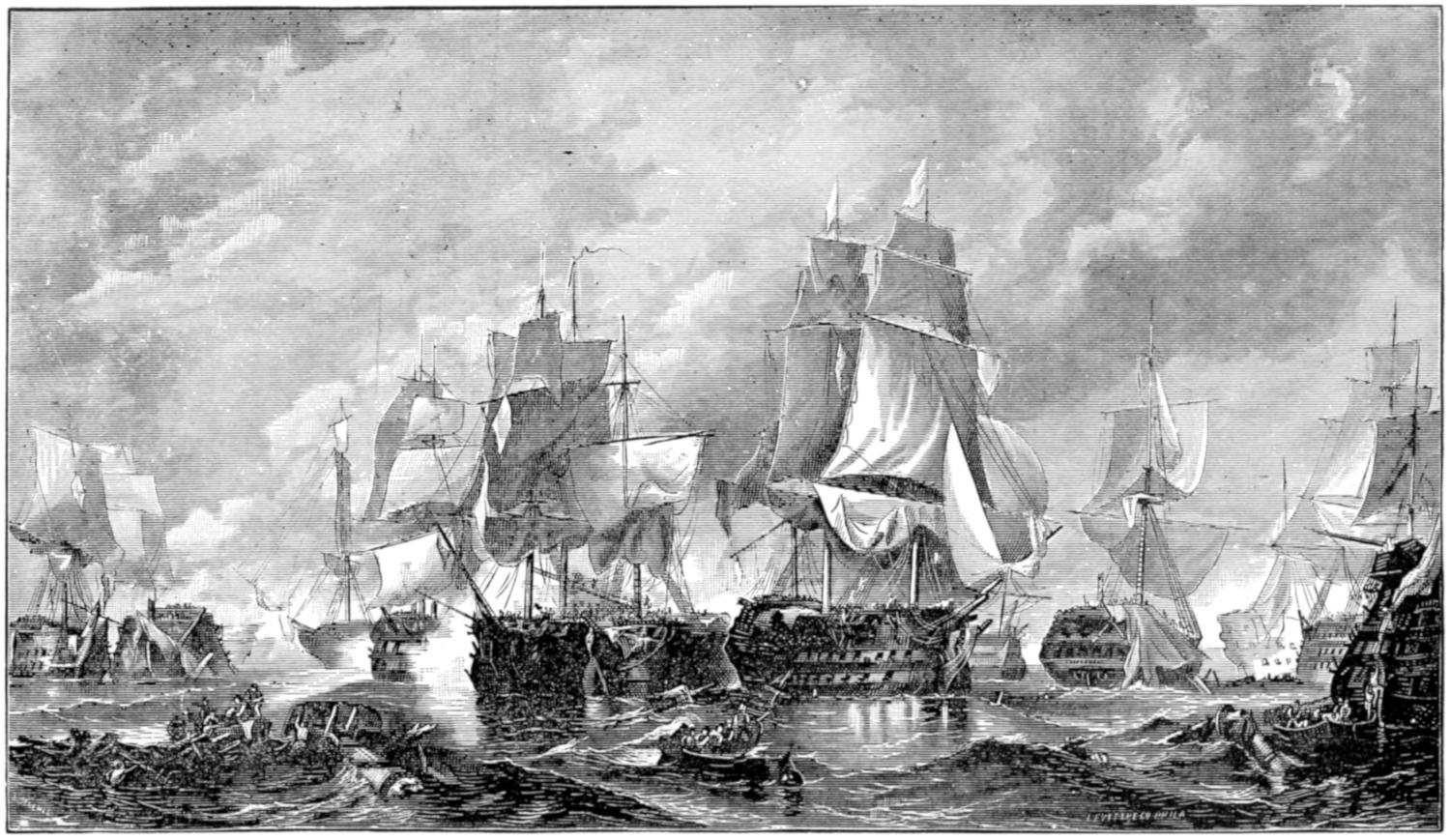
The first part, Naval Battles of the World, starts here,
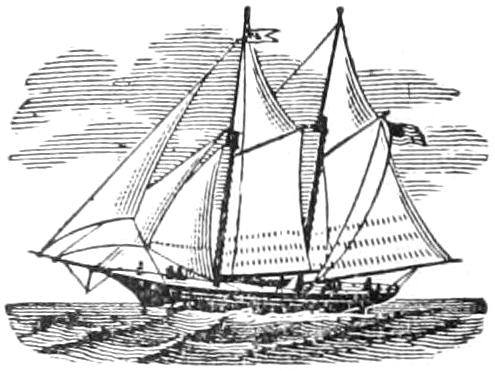
the second part, Naval Battles of America, starts here.
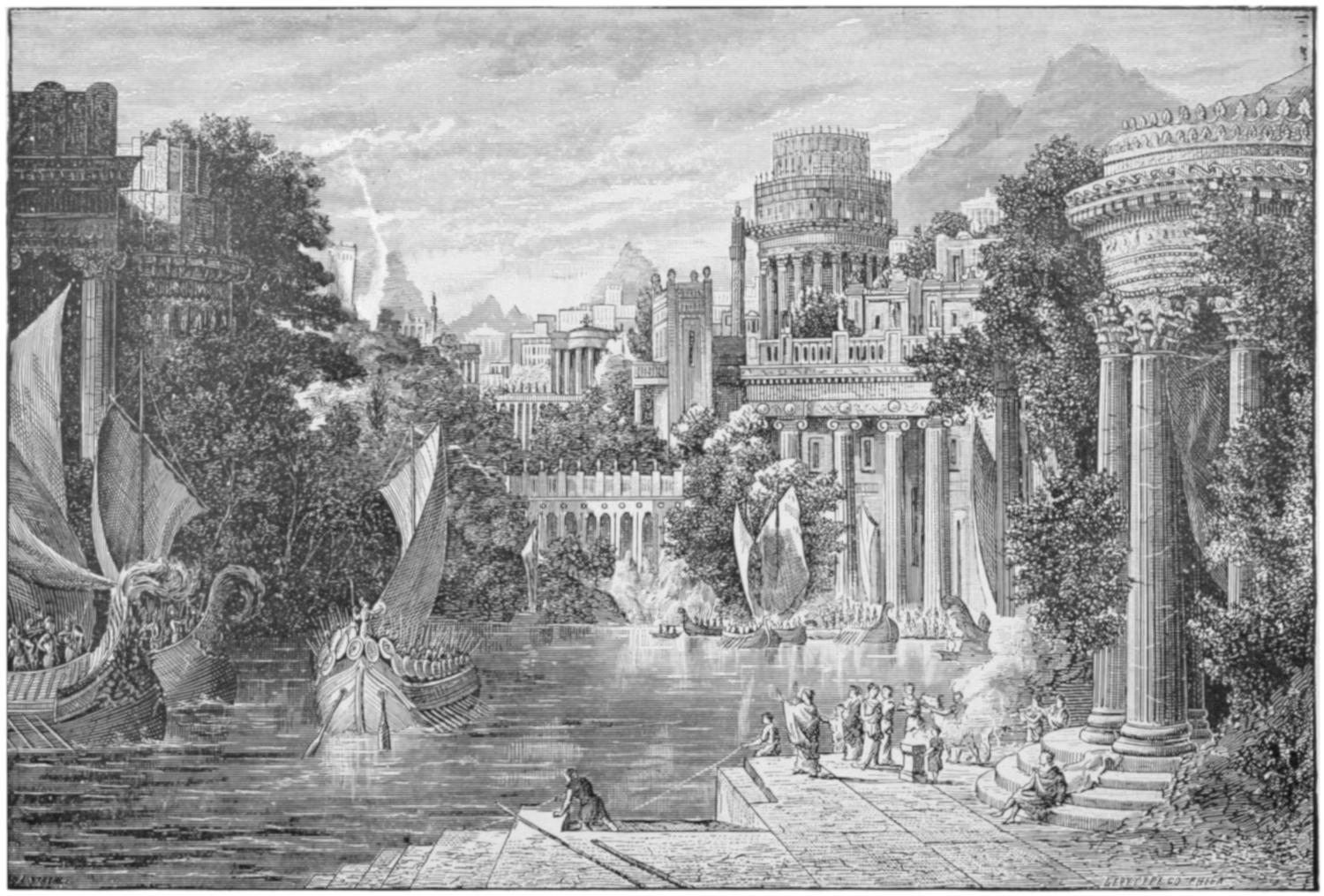
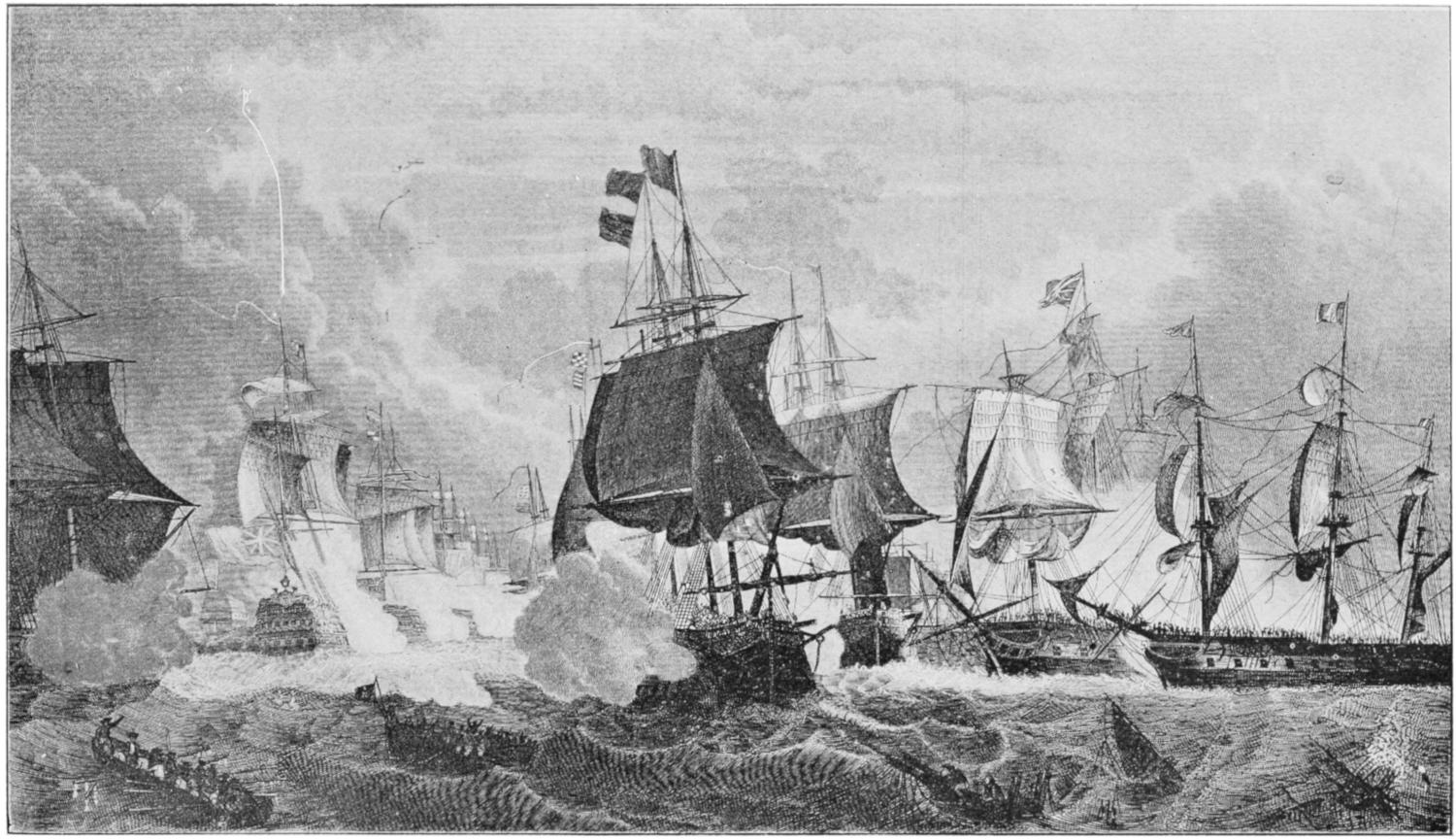
RETURN OF THE GREEKS FROM SALAMIS.
Great and Decisive
Contests on the Sea;
Causes and Results of
Ocean Victories and Defeats;
Marine Warfare and Armament
in all ages;
with an account of the
Japan-China War,
and the recent
Battle of the Yalu.
The Growth, Power and Management of
OUR NEW NAVY
in its Pride and Glory of Swift Cruiser, Impregnable Battleship, Ponderous
Engine, and Deadly Projectile;
Our Naval Academy, Training Ship, Hospital,
Revenue, Light House, and Life Saving Service.
BY EDWARD SHIPPEN,
OF THE UNITED STATES NAVY.
P. W. ZIEGLER & CO.,
PHILADELPHIA AND CHICAGO
COPYRIGHTED BY JAMES C. McCURDY.
1883, 1894, 1898.
PREFACE.
This collection is intended to present, in a popular
form, an account of many of the important naval battles
of all times, as well as of some combats of squadrons and
single ships, which are interesting, from the nautical skill
and bravery shown in them.
In most instances an endeavor has been made to give,
in a concise manner, the causes which led to these
encounters, as well as the results obtained.
As this book is not intended for professional men,
technicalities have been, as far as possible, avoided. But
it is often necessary to use the language and phraseology
of those who fought these battles.
In all there has been a desire to give an unbiased
account of each battle; and, especially, to make no
statement for which authority cannot be found.
A study of naval history is of value, even in the most
inland regions, by increasing a practical knowledge of
geography, and by creating an interest in the great problems
of government, instead of concentrating it upon
local affairs. At the time that this volume was first
issued, some people wondered why such a publication
was necessary. The answer was that it was to inform
the people of the great centre and West of the necessity
of a navy, by showing them what navies had done and
what influence they exercised in the world’s history.
That they are fully aware of this now is also not
doubtful, and the probability is that those representatives
of the people who oppose a sufficient navy for our
country will be frowned down by their own constituents.
Commonsense shows that, with our immense seacoast,
both on the Atlantic and the Pacific, the navy, in the
future, is to be the preponderant branch of our military
force.
CONTENTS.
PAGE
INTRODUCTION.
The Ancients’ Dread of the Sea; Homer’s Account of It; Slow Progress in Navigation before the Discovery of the Lode-stone;
Early Egyptians; The Argonauts; The Phenicians and Greeks; Evidences of Sea-fights Thousands of Years before Christ; Naval Battle Fought by
Rameses III; The Fleets of Sesostris; Description of Bas-relief at Thebes; Roman Galleys Described; Early Maritime Spirit of the Carthaginians;
Herodotus’ Account of the Battle of Artemisium; The Greeks under Alexander; Romans and Carthaginians.
The Island of Salamis; Xerxes; His Immense Power; His Fleet and Army; Events Preceding the Battle; The Contending Hosts Engage
in Worship before the Fight Begins; The Greek Admiral Gives the Signal for Action; Many Persian Vessels Sunk at the First Onset; Fierce Hand-to-Hand
Fighting; A Son of the Great Darius Falls; Dismay Among the Asiatics; Panic-stricken; Artifice of Queen Artemisia; She Escapes; Xerxes Powerless;
He Rends his Robes and Bursts into Tears; Resolves to Return to Asia; Greece Wins her Freedom.
A Bloody Battle; Strength of the Athenians; The Fleet enters Syracuse Harbor in Fine Order; The Sicilians Blockade the Entrance
and Imprison the Fleet; The Perils of Starvation Compel the Greeks to Attempt to Raise the Blockade; Both Fleets Meet at the Mouth of the Harbor;
Confusion Among the Greeks; They are Finally Compelled to Turn Back and Take Refuge in their Docks; Another Attempt to Escape from the Harbor; Mutiny
Among the Sailors; The Syracusans Appear in their Midst and Capture both Men and Ships; End of Athens as a Naval Power.
Carthage a Place of Interest for Twenty Centuries; Romans and Carthaginians in Collision; First Punic War; Rome Begins the
Construction of a Navy; A Stranded Carthaginian Vessel Serves as a Model; They Encounter the Carthaginians at Mylœ; Defeat of the Latter; Renewed
Preparations of both Countries for the Mastery of the Mediterranean: A Great Battle Fought, 260 B. C.; The Romans Finally Victorious; They Land an
Army in Africa and Sail for Home; Encounter a “Sirocco” and Lose nearly all their Galleys on the
Rocks; The Succeeding Punic Wars; Rome in Her Greatness; Antony and Octavius Appear Upon the Scene.
The Decisive Battle of Philippi, B. C. 42; Antony and Octavius Divide the Empire of the World Between Them; Trouble between Antony
and Octavius; Antony’s Dissipations; His Passion for Egypt’s Queen; Octavius (the Future Augustus) Raises Fresh Legions to Oppose Antony; The Latter
Proclaims Cleopatra Queen of Cyprus and Cilicia; The Republic Suspicious of Antony; Octavius Declares War Against Cleopatra; Crosses the Ionian Sea with
his Fleet and Army, and Anchors at Actium, in Epirus; Meeting of the Roman and Antony’s Fleets; Preparation for Battle; A Grand Scene; Cleopatra’s
Magnificent Galley; Discomfiture of Antony’s Centre; Cleopatra Panic-stricken; Flight of the Egyptian Contingent; Antony Follows Cleopatra; His Fleet
Surrenders to Octavius; The Land Forces Refuse to Believe in Antony’s Defection; Despairing of His Return, they Accept Octavius’ Overtures and Pass
Under his Banner; Octavius Master of the World; Suicide of Antony and Cleopatra.
A Momentous Battle that Decides the Sovereignty of Eastern Europe; Naval Events Preceding Lepanto; Turkish Encroachments; Pope
Pius V Forms a League Against Them; Siege and Capture of Famagousta by the Turks; Barbarities of Mustapha; Christian Europe Aroused; Assembly of the
Pontifical Fleet and Army; Don John, of the Spanish Squadron, Placed in Chief Command; Resolves to Seek and Attack the Ottoman Fleet; Encounters the
Enemy in a Gulf on the Albanian Coast; Character of Don John; Preparations for Battle; Strength of his Fleet; A Magnificent Scene; The Turkish Fleet;
Ali Pasha in Command; The Battle Opens; Desperate Fighting at all Points, Barberigo, of the Venetian Fleet, Badly Wounded; Two Renowned Seamen Face to
Face; Uluch Ali Captures the Great “Capitana” of Malta; The Galley of Don John Encounters that of Ali Pasha; They Collide; Terrible Hand-to-Hand Fighting;
Bravery of a Capuchin Friar; The Viceroy of Egypt Killed; Ali Pasha Killed; His Galley Captured; Dismay among the Turks; Uluch Ali Gives the Signal for
Retreat; Terrible Loss of Life in the Battle; Christian Slaves Liberated; The Turkish Fleet Almost Annihilated; Alexander Farnese; Cervantes; Fierce
Storm; Two Sons of Ali Prisoners; Don John and Veniero; Division of the Spoils; The Te Deum at Messina; Joy Throughout Christendom; Colonna in
Rome; The Great Ottoman Standard; Decline of the Ottoman Empire.
Significance of the Term; Philip II; His Character; Determines to Invade England; The Duke of Parma; Foresight of Elizabeth; The Armada
Ready; An Enormous Fleet; It Encounters a Tempest; Mutiny; The Armada reaches the English Channel in July;
Lord Howard, Drake, Frobisher and Hawkins in Command of the English Fleet; Tactics of the English; Capture of the “Santa Anna” by Drake; The Spanish Reach
Calais; Disappointment of the Spanish Commander; Another Storm Sets In; Distress in the Spanish Fleet; The English hang on its Rear and cut off Straggling
Vessels; Shipwreck and Disaster Overtake the Armada on the Scottish and Irish Coast; A Fearful Loss of Life; Apparent Indifference of Philip II Concerning
the Armada’s Failure; The Beginning of Spain’s Decline.
VII. SOME NAVAL EVENTS OF ELIZABETH’S TIME, SUCCEEDING THE ARMADA.
The Armada’s Discomfiture Encourages England to Attack Spain; Drake and Norris Unsuccessful at Lisbon; The Earl of Cumberland’s Expedition;
Meets with a Bloody Repulse; League of Elizabeth with Henri Quatre, against the Duke of Parma; Sir Thomas Howard in Command of an English Fleet to the
Azores; Frobisher and Raleigh’s Expedition of 1592; Prizes Taken on the Coast of Spain; Frobisher Wounded; His Death; Richard Hawkins; Walter Raleigh’s
Expedition to Guiana; Expedition of Sir Francis Drake and Sir John Hawkins; Repulsed at Porto Rico; Death of Hawkins; England Anticipates Philip II in 1596 and
Attacks Cadiz; The City Taken; The English Attack and Capture Fayal; Attempt to Intercept Spanish Merchantmen.
VIII. NAVAL ACTIONS OF THE WAR BETWEEN ENGLAND AND HOLLAND. A. D. 1652-3.
The Dutch Supreme on the Sea; The Commonwealth and the United Provinces; Negotiations for an Alliance Broken Off; An English Commodore
Fires into a Dutch Fleet; Van Tromp sent to Avenge this Insult; Blake in Command of the English; The English Temporarily Masters in the Channel; Great Naval
Preparations in Holland; The South of England at Van Tromp’s Mercy; Blake Collects his Fleet to meet Van Tromp; A Storm Scatters Both; The Dutch People
Dissatisfied with Van Tromp; He Resigns; De Witt Assumes Chief Command; Blake Meets the French Fleet under Vendome; He Captures the Latter’s Fleet; Battle of
North Foreland; De Witt Withdraws at Nightfall; Van Tromp to the Front Again; Denmark Declares Against the Commonwealth; The Dutch and English Meet in the
English Channel; Blake Beaten; Van Tromp Sails Up and Down the Channel with a Broom at his Masthead; Battle off Portland; A Decisive Engagement; Van Tromp
Escorts Dutch Merchantmen into Port; Discontent in the Dutch Fleet; Terrible Loss on Both Sides; Blake Learns of a New Fleet Fitted out by Van Tromp in April;
They Meet Again; A Two Days’ Battle; Another Effort Two Months Later; The Brave Van Tromp Killed; The Power of Holland Broken: The States General Sues for
Peace.
IX. FRENCH AND DUTCH IN THE MEDITERRANEAN. A. D. 1676.
Revolt of Messina and Sicily; Louis XIV Sends Duquesne with a Fleet to Sustain the Insurgents; Sketch of Duquesne; England Makes Peace with
Holland; Duquesne Repulses the Spanish Fleet and Captures the Town of Agosta; Learns of De Ruyter’s Presence in the Mediterranean; Meeting of the Hostile Fleets,
Jan. 16, 1676; Splendid Manœuvres; The Advantage with the French; They Meet Again, in Spring, Near Syracuse; Sharp and Terrible Firing; De Ruyter Mortally
Wounded; The Dutch Seek Shelter in Syracuse Harbor; The Sicilian and French Fleets Encounter the Dutch and Spanish Fleets Again, in May; Destruction of the
Latter; Honors to the Remains of De Ruyter; Recompensing Duquesne; His Protestantism Distasteful to Louis XIV; Humiliates Genoa; Edict of Nantes; His Death and
Private Burial; Subsequent Honors to his Memory.
Louis XIV Prepares to Attack England, to Seat James II on the Throne; Count de Tourville in Command of the French Fleet; Sketch of his Life;
He is Ordered to Sail from Brest; Bad Weather; Arrogance of Pontchartrain, the Minister of Marine; Tourville meets a Powerful English and Dutch Fleet; Bravery of
the Soleil Royal, the French Flag-ship; A Fog Ends the Fight; Louis XIV Compliments Tourville on his Gallant Defence Against Such Great Odds; Bestows the Title of
Field Marshal on Him.
Benbow a Favorite of William III; Queen Anne Declares War Against France; Benbow Sent to the West Indies; He Falls in with a French Fleet; A
Vigorous Attack Commenced; Disobedience of his Captains; He is Badly Wounded and Dies; The Captains Court-martialed; Detailed Account of the Capture and Destruction
of the French and Spanish Fleets.
Sketch of Admiral Byng; War between England and France; Capture of Minorca by the Latter; Byng sent to the Relief of the Island; La Galissonière
in Command of the French; Failure to Engage the Latter’s Fleet, as Directed, by Byng; The English Driven Back to Gibraltar; Byng Superseded Without a Hearing; Tried
by Court-martial and Sentenced to Death; The Sentence Considered Unjustly Severe by Pitt; Wrangling among the Officers of the Admiralty; Final Execution of the
Sentence; Voltaire’s Sarcasm.
Sketch of Hawke; Succeeds the Ill-fated Admiral Byng; In Command of a Blockading Squadron at Brest; Meets the French Fleet Under Admiral
Conflans Near Belleisle; The Latter Inferior in Strength and Numbers; A Gale Arises During the Fight and Many Injured French Vessels Wrecked; The Latter Fleet
Almost Entirely Disabled and Destroyed; Honors to Hawke.
Sketch of De Grasse; Earliest Exploits; Aids Washington in the Reduction of Yorktown; Recognition by Congress; Subsequent Events; Encounters
an English Fleet, Under Rodney; De Grasse Loses Five Line-of Battle Ships; Exultation in England; De Grasse a Prisoner; Assists in Bringing About a Treaty of Peace
Between the United States and England; Career of Rodney; Receives the Title of Baron and a Pension.
LORD HOWE AND THE FRENCH FLEET. JUNE 1, A. D. 1794.
The First of a Series of Memorable Engagements; Traits of Lord Howe; Anecdotes; Watching the French Fleet; The Latter Put to Sea; Skirmishing,
May 28; A Great Battle, June 1; The French Open Fire First; Concentrated and Deadly Firing on Both Sides; The French Lose Six Line-of-Battle Ships; Howe’s Orders
Not Obeyed by Some of the Captains; Some French Ships that Had Struck Escape in the Darkness; Anecdotes Concerning the Battle.
Location of Cape St. Vincent; Admiral Sir John Jervis in Command of the English; Strength of His Fleet; Commodore Horatio Nelson; Chased by a
Spanish Fleet; The Latter in Command of Don Joseph de Cordova; Feb. 14 a Disastrous Day for Spain; Surprised to See so Large an English Fleet; The Battle Opens;
Boarding the San Nicolas; The Spanish Beaten at Every Point; The Battle over by 5 o’clock; Both Fleets Lay To to Repair Damages; Escape of the Spanish During the
Night; Damages Sustained; Description of the Santissima Trinidada; The Cause of the Spanish Discomfiture; Great Rejoicing in Lisbon; Honors and Pensions Awarded to
the English Commanders at Home; Admiral Cordova and His Captains.
English Expedition to the Canary Islands; Cutting Out a Brig in the Harbor of Santa Cruz; Attempt of the English to Capture the Town of Santa
Cruz; An Expedition Under Rear Admiral Nelson Organized for the Purpose; The Garrison Apprised of Their Coming; Nelson Shot in the Arm and Disabled; The English
Agree not to Molest the Canary Islands any Further if Allowed to Retire in Good Order; The Spanish Governor Finally Accepts this Offer; A Disastrous Defeat for
Nelson.
Viscount Duncan; His Early Life; The Mutiny of the Nore; Causes Leading to It; Disgraceful Practices of the English Admiralty of this Period;
War with Holland; The Dutch Fleet Off the Texel under the Command of Vice-Admiral De Winter; The English Immediately Set Out to Intercept them; The Battle Opens
about Noon of October 11th; Hard Fighting; The English Victorious; Accurate Firing of the Hollanders; The Losses
Heavy on both Sides; Actual Strength of both Fleets; Duncan’s Admirable Plan of Attack; Nelson’s Memorandum.
Aboukir Bay; Its History; Learning that a Strong French Fleet Had Left Toulon, Nelson Seeks Them, He Finds the Fleet in Aboukir Bay; He Comes
Upon Them at 6 o’clock in the Evening and Resolves to Attack Them at Once; A Terrible Battle; Misunderstanding of the French Admiral’s Instructions; Many Acts of
Individual Heroism; Death of the French Admiral; Villeneuve Escapes with Four French Vessels; The Battle Over by 11 o’clock; The Most Disastrous Engagement the
French Navy Ever Fought; Detailed Account of the Great Fight; The French Ship L’Orient Blown Up with a Terrific Explosion; Summary of the Losses on both sides;
Masterly Tactics of Nelson; Gallant Behavior of the French; The Loss of This Battle of Immense Consequences to the Latter; Nelson Sails for Naples; Honors to Him
Everywhere; His Official Report; French Officers of High Rank Killed; Anecdotes on Board the Vanguard on the Voyage to Naples.
Contest Between Single Ships; The Leander a Bearer of Dispatches from Nelson; Encounters the French Frigate Généreux; Attempts to Avoid the
Latter; A Close and Bloody Fight of Six Hours; The Leander Surrenders; Captain Le Joille; Plundering the English Officers; Captain Thompson; Another Striking
Incident; A French Cutter in Alexandria Harbor Abandoned on Being Attacked by Two English Frigates; The Officers and Crew of the Former, on Reaching the Shore,
Massacred by the Arabs; General Carmin and Captain Vallette Among the Slain; Dispatches from Bonaparte Secured by the Arabs.
ACTION BETWEEN THE AMBUSCADE AND BAYONNAISE A. D. 1798.
Decisive Single Ship Actions; A Fruitful Source of Discussion; The British Account of It; History and Description of the Ambuscade; Unexpected
Meeting with the Bayonnaise; The English Vessel the Fastest Sailer; A Battle Takes Place; Detailed Account of the Fight; The English Frigate Surrenders to the French
Corvette; Causes of Discontent on Board the Former; Great Rejoicing in France; Promotion of the French Captain.
SIR SIDNEY SMITH AND HIS SEAMEN AT ACRE. A. D. 1799.
Minister to the Sublime Porte; Notified of Bonaparte’s Presence in Syria; The Latter Lays Siege to Acre; He Repairs Thither with a Fleet and
Assists the Turks in Defending the Place; Admiral Perée, of the French Navy, Puts in an Appearance; Desperate Attempts to Storm the Place; Strength of Napoleon’s
Army on Entering Syria; Kleber’s Grenadiers; Repeated and Desperate Assaults of the French; Unsuccessful Each Time; The Siege Abandoned After Sixty-one Days;
Importance of the Place as Viewed by Napoleon.
FOUDROYANT AND CONSORTS IN ACTION WITH THE GUILLAUME TELL. A. D. 1800.
Preliminary History; Rear Admiral Denis Décrès; Sketch of this Remarkable Man; His Tragic End; Engagement of the Guillaume Tell with the
English Fleet Near Malta; Detailed Account of the Fight; Entirely Dismasted and Surrounded by English Vessels, the Guillaume Tell at last Surrenders; A More Heroic
Defence Not To Be Found in the Record of Naval Actions; Taken to England, the Guillaume Tell is Refitted for the English Service, Under the Name of Malta; A Splendid
Ship.
NAVAL OPERATIONS AT ABOUKIR BAY AND CAPTURE OF ALEXANDRIA. A. D. 1801.
Expulsion of the French Determined Upon; An English Fleet and Army Sent Thither Under Command of Lord Keith and Sir Ralph Abercrombie; The French
Under Command of General Friant; The Former Land Troops Under a Galling Fire from Fort Aboukir and the Sand Hills; Sir Sidney Smith in Command of the Marines; A Heavy
Battle Fought March 21; The French Forced to Retire; General Abercrombie Mortally Wounded; The French, Shut in at Alexandria, Finally Capitulate; Renewed Interest in
this Campaign on Account of Recent Events; Points of Similarity.
THE CUTTING OUT OF THE CHEVRETTE. JULY, A. D. 1801.
An Example of a “Cutting-out Expedition”; The Combined French and Spanish Fleets at Anchor in Brest; The English Watching Them; The Chevrette
at Anchor in Camaret Bay; The English Resolve to Cut Her Out; An Expedition Starts Out at Night, in Small Boats; They Board and Capture Her, in Spite of the Desperate
Resistance of the French; Details of the Fight; The Losses on Both Sides.
BOAT ATTACK UPON THE FRENCH FLOTILLA AT BOULOGNE. A. D. 1801.
Another Boat Attack by the English, with Less Favorable Results; Lord Nelson in Command; Darkness and the Tides Against Them; They “Catch a
Tartar”; The Affair a Triumph for the French.
Preliminary History; An English Fleet Under Sir Hyde Parker and Lord Nelson Ordered to the Cattegat; A Commissioner Empowered to Offer Peace
or War Accompanies Them; Denmark Repels Their Insulting Ultimatum and Prepares for Defence; Strength of the English Fleet; They Attempt to Force the Passage
of the Sound, and the Battle Begins; Early Incidents; Difficulties of the Large English Vessels in Entering the Shallow Waters; Strength of the Danish Fleet and
Shore Batteries; Sir Hyde Parker Makes Signal to Withdraw; Lord Nelson Disobeys and Keeps up the Fight; The
Danish Adjutant General Finally Appears and an Armistice is Agreed Upon; A Characteristic Action of Lord Nelson; Death of the Emperor Paul, of Russia; Second
Attack on Copenhagen, 1807; Observations Concerning England’s Conduct; A Powerful English Fleet Appears in the Sound; The Crown Prince Rejects England’s
Humiliating Proposals; Copenhagen Bombarded and Set on Fire; Final Surrender; Plunder by the English.
Napoleon’s Grand Schemes; Nelson in Search of the French Fleet; His Extensive Cruise; Napoleon’s Orders to His Admiral, Villeneuve; The
English Discover the French and Spanish Fleets at Cadiz; Nelson’s Order of Battle a Master-piece of Naval Strategy; Strength of the English Fleet; Villeneuve
Ordered to Sea; Strength of the Combined French and Spanish Fleets; The Hostile Forces Meet at Cape Trafalgar; The Battle; One of the Most Destructive Naval
Engagements Ever Fought; The French Account of It; The Allied Fleet Almost Annihilated; Nelson Mortally Wounded; Further Particulars of the Battle; Estimate
of Nelson’s Character; Honors to His Memory.
Biographical Sketch of Lord Exmouth; Atrocities of the Algerines Prompt the English to Send a Fleet, Under Lord Exmouth, Against Them; A
Dutch Fleet Joins Them at Gibraltar; Strength of the Combined Fleet; Fruitless Negotiations with the Algerines; Strength of their Fortifications; The Allied
Fleets Open Fire on the Forts and City; A Tremendous Cannonade; The Dey Comes to Terms; Capture of the Place by the French, Fourteen Years Later.
Assembly of the Allied English, French and Russian Fleets in the Mediterranean; Their Object; An Egyptian Fleet, with Troops, enters
Navarino Harbor; History and Geographical Position of the Latter; Strength of the Opposing Fleets; Treachery of the Egyptians; The Battle Opens; Desperate
Fighting; Bad Gunnery of the Turks; Destruction of Their Fleet.
History of Sinope; An Abuse of Superior Force on the Part of the Russians; They Encounter the Turkish Fleet in Sinope Harbor and Demand
the Latter’s Surrender; They Decline and the Battle Opens Furiously; The Turkish Fleet Totally Destroyed and That of the Russians rendered Comparatively Useless;
Appearance of the Town of Sinope.
Position of the Island of Lissa; Its History; Attacked and Taken by the Italians; The Austrians Shortly After Come to its Relief; A Great
Naval Battle Takes Place; Strength of the Opposing Fleets; The Ironclads That Took Part; Bad Management of the Italians Under Admiral Persano; They are Badly
Beaten; Sketch of the Italian Admiral; His Court-Martial; William Baron Tegethoff, the Austrian Commander.
SOME NAVAL ACTIONS BETWEEN BRAZIL, THE ARGENTINE CONFEDERATION AND PARAGUAY. A. D.
1865-68.
Origin of the Long and Deadly Struggle; The Brazilian Fleet Starts Out on a Cruise; Lopez, Dictator of Paraguay, Determines to Capture
this Fleet; His Preparations; The Hostile Fleets Encounter each other; Details of the Fight; Bad Management on both sides; The Paraguayans Forced to Retire;
Another Battle in March, 1866, on the Parana River; Full Account of the Desultory Fighting; The Paraguayans Driven Out of their Earthworks; Two Unsuccessful
Attacks, in 1868, on the Brazilian Monitors lying off Tayi; Interesting Account of one of these Attacks.
THE CAPTURE OF THE HUASCAR. OCTOBER 8TH, A. D. 1879.
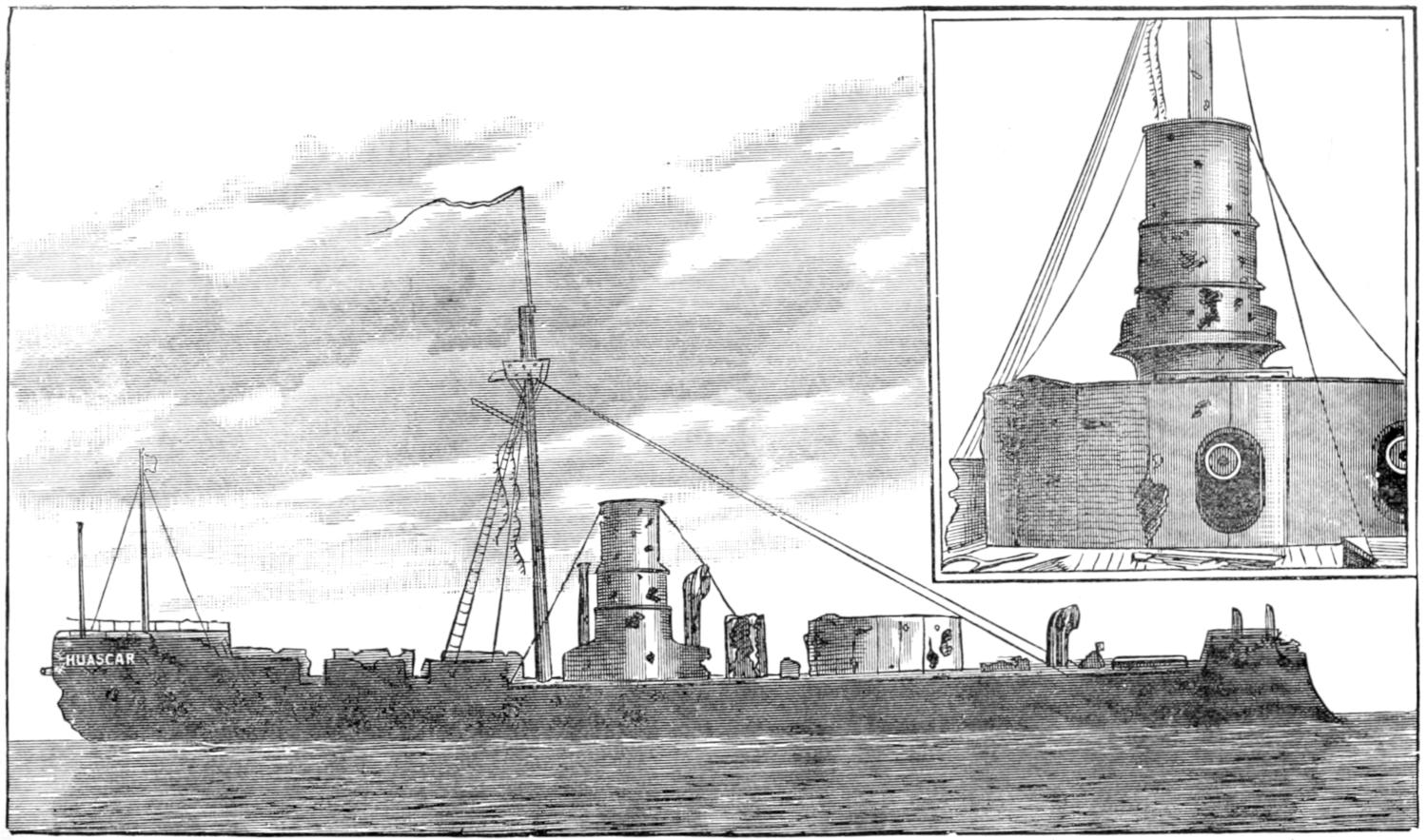
Description of the Huascar; Her Earlier Exploits; Strength of the Chilian Squadron; The Latter Seek the Huascar; The Enemies Recognize
each other; The Battle Begins at Long Range; Full Details of this Spirited Engagement; Terrible Loss of Life on Board the Huascar; She Finally Surrenders;
Condition of the Chilian Fleet.
Political Complications; Arabi Pasha; Important Events Preceding the Bombardment; England Demands that Work on the Fortifications Cease;
Arabi Promises to Desist, but Renews the Work Secretly; A Powerful English Fleet Opens Fire on the Defences; Silenced by the Fleet and Abandoned; Alexandria
Set on Fire and Pillaged; Sailors and Marines from the American and German Fleets Landed to Protect the Consulates; Injury Sustained by the English Fleet.
The Opening of Japan to Foreign Nations; Japanese Geography and History; Early Explorers; Revolution of 1617; First American Efforts
at Intercourse; Commander Glynn’s Attempt; Successful Expedition of Commodore Perry in 1852; First Treaty Signed; Subsequent Development of Japan; Outbreak
of War with China; Sinking of the Kow-Shing; Historic Hostility between the Two Nations; Disputes over Korea; The Battle of the Yalu, September 17th, 1894;
Details of the Fight; Results of this Battle; Importance to Naval Experts; Conclusions Derived; Succeeding Events of the War; Capture of Port Arthur; The
Japanese Emperor; New Treaty with the United States.
The Ancients were full of horror of the mysterious
Great Sea, which they deified; believing that man no
longer belonged to himself when once embarked, but was
liable to be sacrificed at any time to the anger of the
Great Sea god; in which case no exertions of his own
could be of any avail.
This belief was not calculated to make seamen of
ability. Even Homer, who certainly was a great traveler,
or voyager, and who had experience of many peoples,
gives us but a poor idea of the progress of navigation,
especially in the blind gropings and shipwrecks of Ulysses,
which he appears to have thought the most natural
things to occur.
A recent writer says, “Men had been slow to establish
completely their dominion over the sea. They learned
very early to build ships. They availed themselves very
early of the surprising power which the helm exerts over
the movements of a ship; but, during many ages, they
found no surer guidance than that which the position of
the sun and of the stars afforded. When clouds intervened
to deprive them of this uncertain direction, they
were helpless. They were thus obliged to keep the land
in view, and content themselves with creeping timidly
along the coasts. But at length there was discovered a
stone which the wise Creator had endowed with strange
properties. It was observed that a needle which had
been brought in contact with that stone ever afterwards
pointed steadfastly to the north. Men saw that with a
needle thus influenced they could guide themselves at sea
as surely as on land. The Mariner’s compass loosed the
bond which held sailors to the coast, and gave them
liberty to push out into the sea.”
As regards early attempts at navigation, we must go
back, for certain information, to the Egyptians. The
expedition of the Argonauts, if not a fable, was an
attempt at navigation by simple boatmen, who, in the
infancy of the art, drew their little craft safely on shore
every night of their coasting voyages. We learn from
the Greek writers themselves, that that nation was in ignorance
of navigation compared with the Phenicians, and
the latter certainly acquired the art from the Egyptians.
We know that naval battles, that is, battles between
bodies of men in ships, took place thousands of years
before the Christian era. On the walls of very ancient
Egyptian tombs are depicted such events, apparently
accompanied with much slaughter.
History positively mentions prisoners, under the name
of Tokhari, who were vanquished by the Egyptians in a
naval battle fought by Rameses III, in the fifteenth
century before our era. These Tokhari were thought to
be Kelts, and to come from the West. According to
some they were navigators who had inherited their skill
from their ancestors of the lost Continent, Atlantis.
The Phenicians have often been popularly held to have
been the first navigators upon the high seas; but the
Carians, who preceded the Pelasgi in the Greek islands,
undoubtedly antedated the Phenicians in the control of
the sea and extended voyages. It is true that when the
Phenicians did begin, they far exceeded their predecessors.
Sidon dates from 1837 before Christ, and soon
after this date she had an extensive commerce, and
made long voyages, some even beyond the Mediterranean.
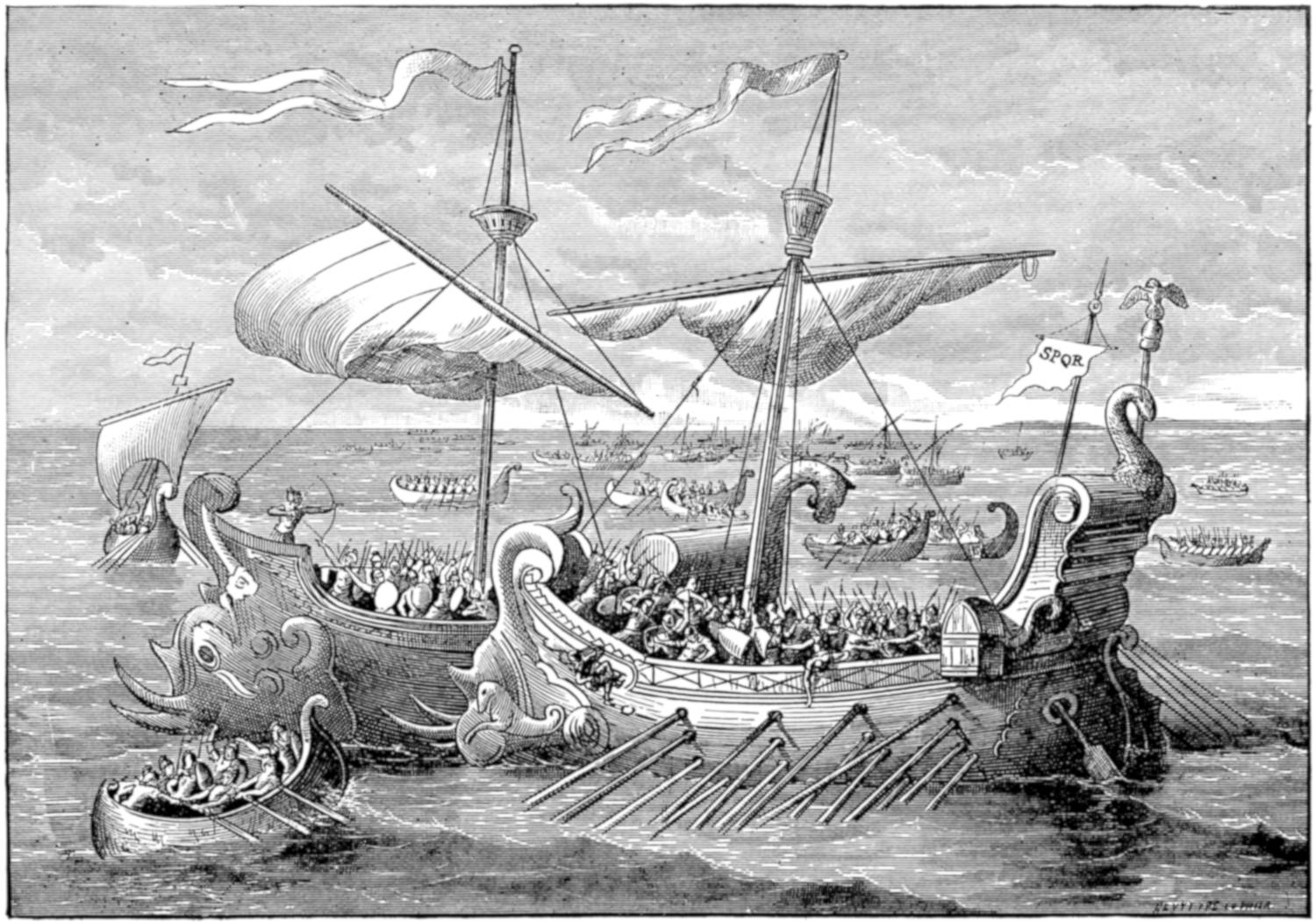
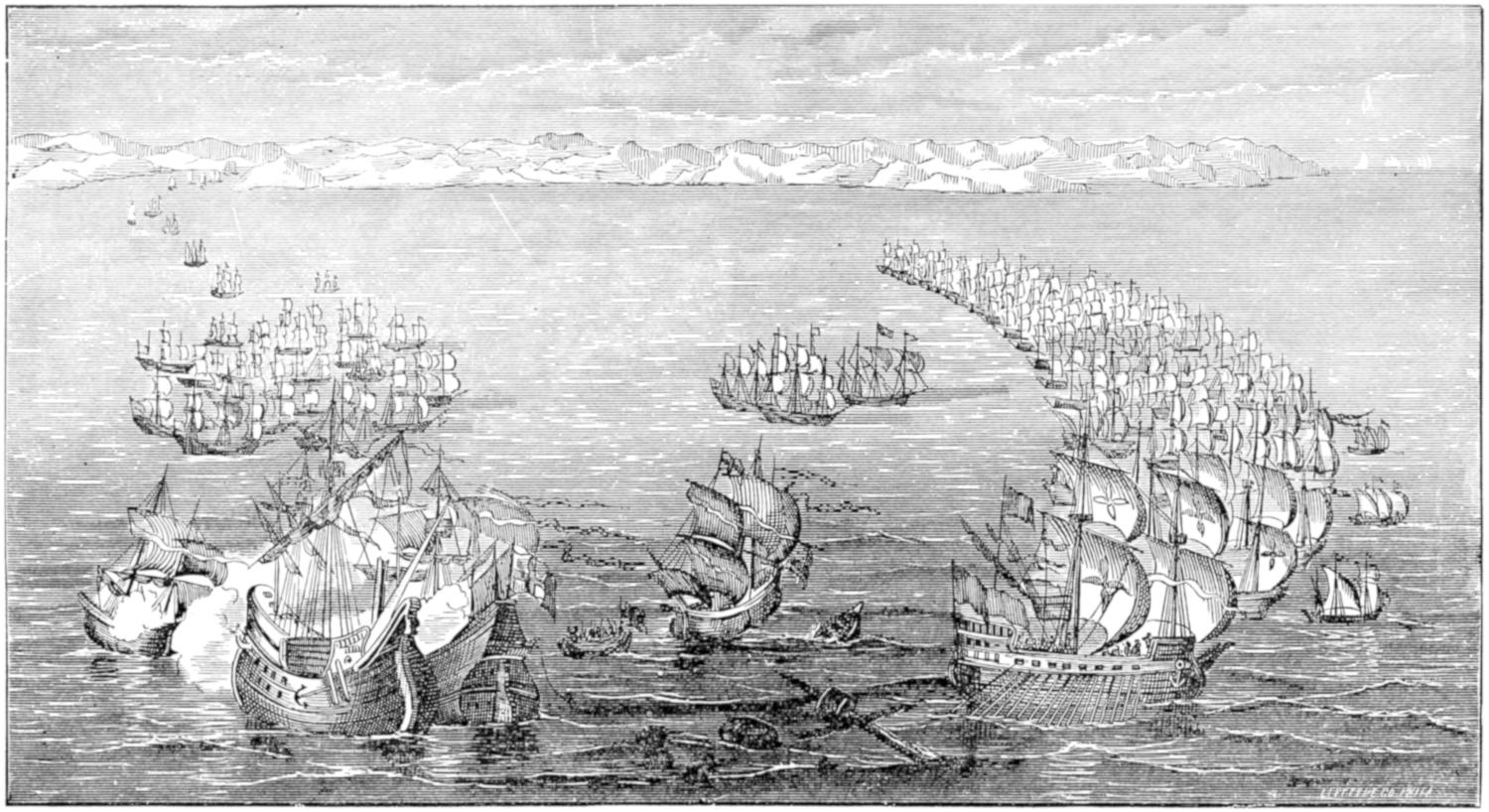
LINE OF BATTLE.
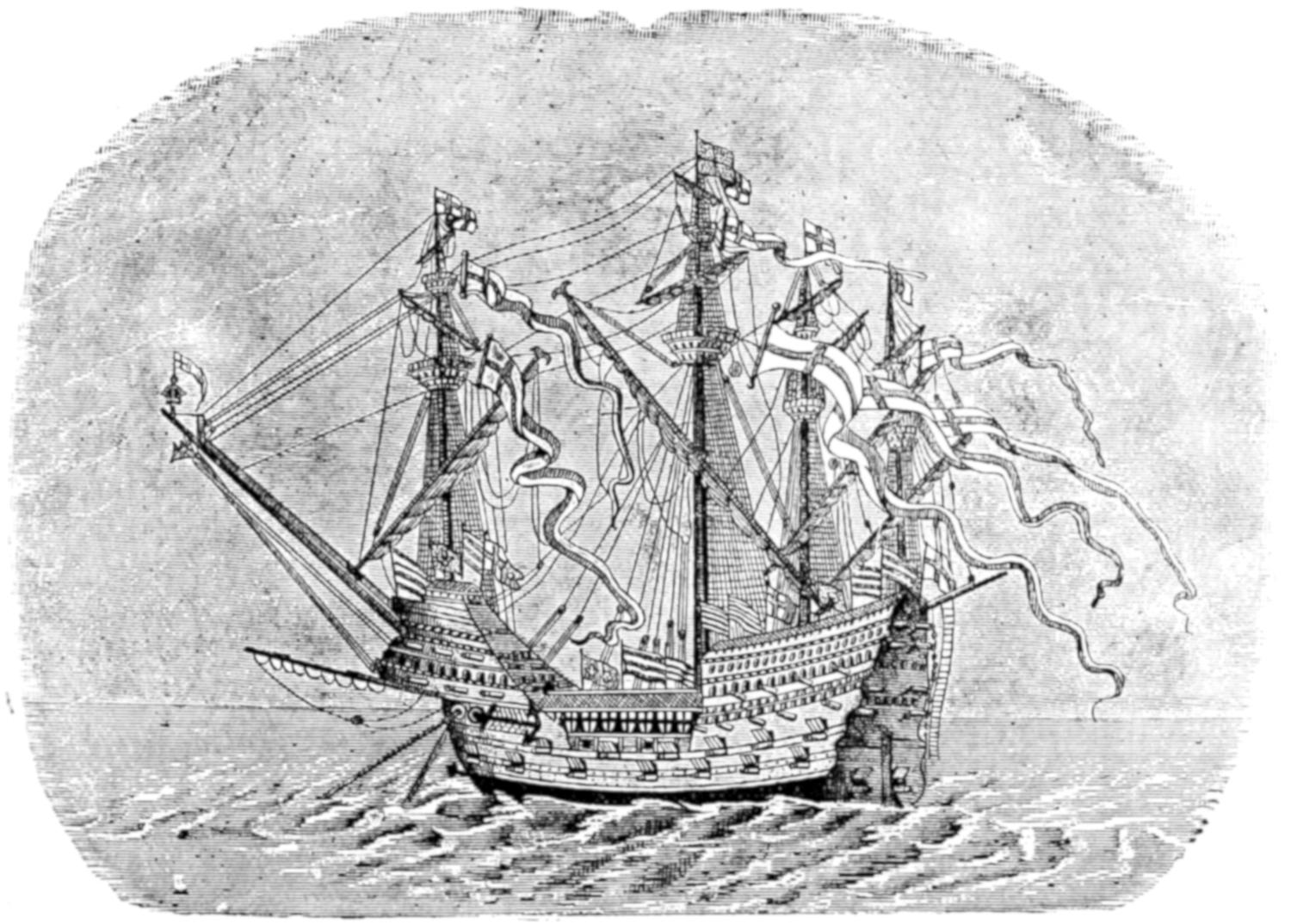
HOSTILE FRIGATES GRAPPLING.
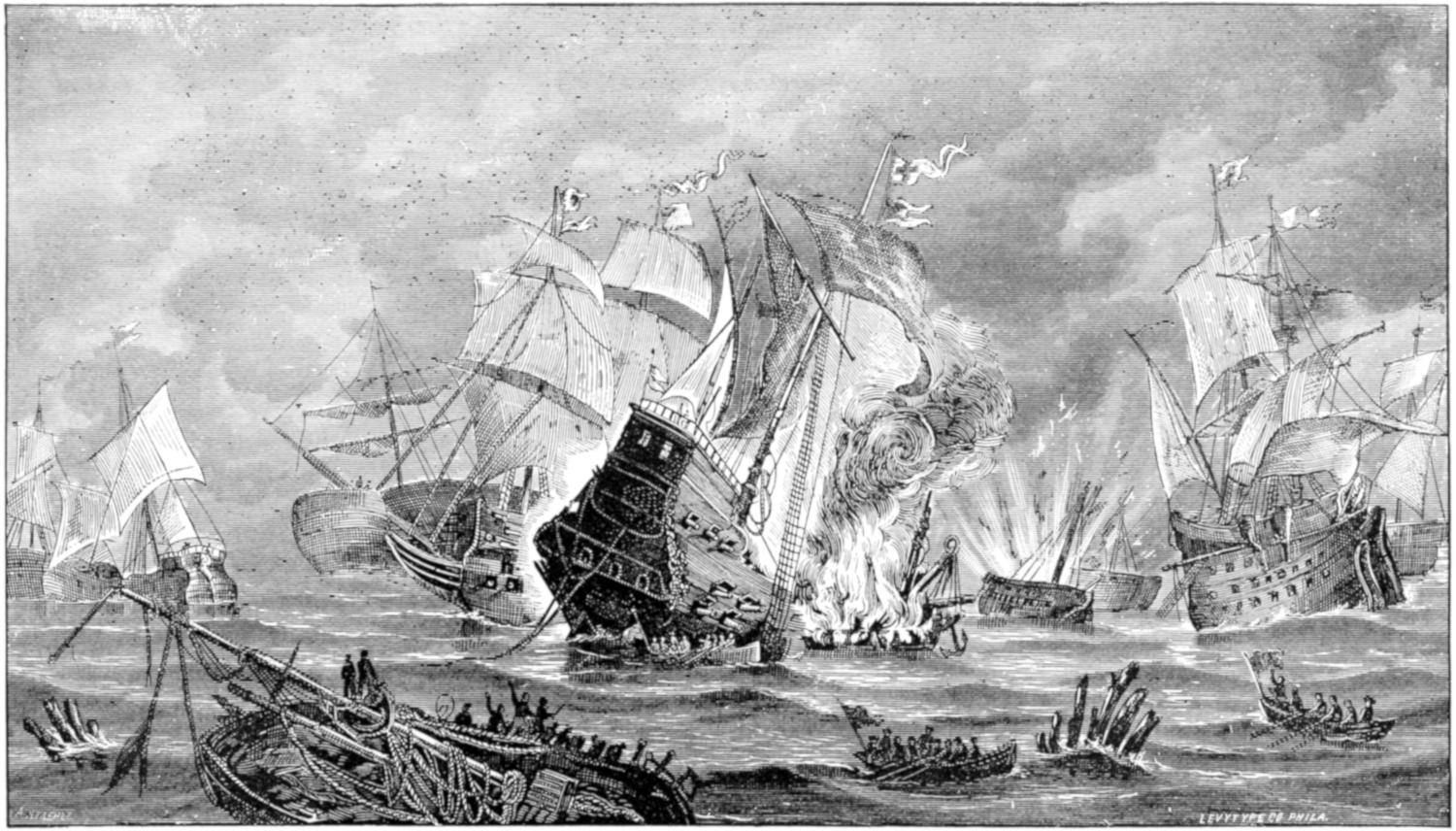
NAVAL BATTLE, EIGHTEENTH CENTURY.
To return to the Egyptians. Sesostris had immense
fleets 1437 years before Christ, and navigated not only
the Mediterranean, but the Red Sea. The Egyptians
had invaded, by means of veritable fleets, the country of
the Pelasgi. Some of these ancient Egyptian ships were
very large. Diodorus mentions one of cedar, built by
Sesostris, which was 280 cubits (420 to 478 feet) long.
One built by Ptolemy was 478 feet long, and carried
400 sailors, 4000 rowers, and 3000 soldiers. Many other
huge vessels are mentioned. A bas-relief at Thebes
represents a naval victory gained by the Egyptians over
some Indian nation, in the Red Sea, or the Persian Gulf,
probably 1400 years before Christ.
The Egyptian fleet is in a crescent, and seems to be
endeavoring to surround the Indian fleet, which, with oars
boarded and sails furled, is calmly awaiting the approach
of its antagonist. A lion’s head, of some metal, at the
prow of each Egyptian galley, shows that ramming was
then resorted to. These Egyptian men-of-war were
manned by soldiers in helmets, and armed as those of the
land forces.
The length of these vessels is conjectured to have been
about 120 feet, and the breadth 16 feet. They had high
raised poops and forecastles, filled with archers and
slingers, while the rest of the fighting men were armed
with pikes, javelins, and pole-axes, of most murderous
appearance, to be used in boarding. Wooden bulwarks,
rising considerably above the main-deck, protected the
rowers. Some of the combatants had bronze coats of
mail, in addition to helmets of the same, and some carried
huge shields, covered, apparently, with tough bull’s hide.
These vessels had masts, with a large yard, and a huge
square sail. They are said to have been built of acacia,
so durable a wood that vessels built of it have lasted a
century or more. They appear to have had but one rank
of oars; although two or three tiers soon became common.
None of the ancient Egyptian, Assyrian, Greek
or Roman monuments represent galleys with more than
two tiers of oars, except one Roman painting that gives
one with three. Yet quinqueremes are spoken of as
very common. It is not probable that more than three
tiers were used; as seamen have never been able to
explain how the greater number of tiers could have been
worked; and they have come to the conclusion that
scholars have been mistaken, and that the term quinquereme,
or five ranks of oars, as translated, meant the
arrangement of the oars, or of the men at them, and not
the ranks, one above another, as usually understood.
Much learning and controversy has been expended
upon this subject, and many essays written, and models
and diagrams made, to clear up the matter, without satisfying
practical seamen.
The Roman galleys with three rows of oars had the
row ports in tiers. These ports were either round or
oval, and were called columbaria, from their resemblance
to the arrangement of a dove-cote. The lower oars could
be taken in, in bad weather, and the ports closed.
The “long ships” or galleys of the ancient Mediterranean
maritime nations—which were so called in opposition
to the short, high and bulky merchant ships—carried
square or triangular sails, often colored. The
“long ships” themselves were painted in gay colors,
carried flags and banners at different points, and images
upon their prows, which were sacred to the tutelary
divinities of their country. The “long ships” could make
with their oars, judging from descriptions of their voyages,
perhaps a hundred miles in a day of twelve hours. In
an emergency they could go much faster, for a short
time. It is reliably stated that it took a single-decked
galley, 130 feet long, with 52 oars, a fourth of an hour to
describe a full circle in turning.
Carthage was founded by the Phenicians, 1137 years
before our era; and not very long after the Carthaginians
colonized Marseilles. Hanno accomplished his periplus,
or great voyage round Africa, 800 years B. C., showing
immense advance in nautical ability, in which the Greeks
were again left far behind. Still later, the Carthaginians
discovered the route to the British Islands, and traded
there—especially in Cornish tin—while 330 years B. C.
Ultima Thule, or Iceland, was discovered by the Marseillais
Pitheas. Thus Carthage and her colonies not only
freely navigated the Atlantic, but some have thought
that they actually reached northern America.
Four hundred and eighty years before the Christian
era the Grecian fleet defeated that of the Persians, at
Salamis; and the next year another naval battle, that of
Mycale (which was fought on the same day as that of
Platæa on land), completely discomfited the Persian
invaders, and the Greeks then became the aggressors.
Herodotus, who wrote about 450 years B. C., gives
accounts of many naval actions, and even describes
several different kinds of fighting vessels. He mentions
the prophecy of the oracle at Delphi, when “wooden walls”
were declared to be the great defence against Xerxes’
huge force—meaning the fleet—just as the “wooden
walls of England” were spoken of, up to the time of
ironclads. Herodotus says the Greek fleet at the battle
of Artemisium, which was fought at the same time as
Thermopylæ, consisted of 271 ships, which, by their very
skillful handling, defeated the much larger Persian armament,
which latter, from its very numbers, was unwieldy.
At Artemisium, the Greeks “brought the sterns of
their ships together in a small compass, and turned their
prows towards the enemy.” And, although largely outnumbered,
fought through the day, and captured thirty
of the enemy’s ships. This manner of manœuvring was
possible, from the use of oars; and they never fought
except in calm weather.
After this, the Greeks, under Alexander, renewed their
energies, and his fleet, under the command of Nearchus,
explored the coast of India and the Persian Gulf. His
fleets principally moved by the oar, although sails were
sometimes used by them.
Among other well authenticated naval events of early
times, was the defeat of the Carthaginian fleet, by Regulus,
in the first Punic war, 335 years B. C. This victory,
gained at sea, was the more creditable to the Romans,
as they were not naturally a sea-going race, as the nations
to the south and east of the Mediterranean were.
When they had rendered these nations tributary, they
availed themselves of their nautical knowledge; just as
the Austrians of to-day avail themselves of their nautical
population upon the Adriatic coast, or the Turks of their
Greek subjects, who are sailors.
Of naval battles which exercised any marked influence
upon public events, or changed dynasties, or the fate of
nations, the first of which we have a full and definite
description is the battle of Actium. But before proceeding
to describe that most important and memorable
engagement, we may look at two or three earlier sea
fights which had great results, some details of which have
come down to us.
I. SALAMIS. B. C. 480.
NAVAL BATTLES, ANCIENT AND MODERN.
This great sea fight took place at the above
date, between the fleet of Xerxes and that
of the allied Greeks.
Salamis is an island in the Gulf of
Ægina, ten miles west of Athens. Its
modern name is Kolouri. It is of about
thirty square miles surface; mountainous,
wooded, and very irregular in shape.
It was in the channel between it and the main land
that the great battle was fought.
Xerxes, in the flush of youth, wielding immense power,
and having boundless resources in men and money,
determined to revenge upon the Greeks the defeat of the
Persians, so many of whom had fallen, ten years before,
at Marathon. After years of preparation, using all his
resources and enlisting tributary powers, he marched
northward, in all the pomp and circumstance of war, and
laid a bridge of boats at the Hellespont, over which it
took seven days for his army to pass. His fleet consisted
of over 1200 fighting vessels and transports, and carried
240,000 men.
Previous to the naval battle of which we are about to
speak, he lost four hundred of his galleys in a violent
storm; but still his fleet was immensely superior in number
to that of the Greeks, who had strained every nerve
to get together the navies of their independent States.
Such leaders as Aristides and Themistocles formed a
host in themselves, while the independent Greeks were,
man for man and ship for ship, superior to the Persians
and their allies. Of the Greek fleet the Athenians composed
the right wing; the Spartans the left, opposed
respectively to the Phenicians and the Ionians; while the
Æginetans and Corinthians, with others, formed the
Greek reserve.
The day of the battle was a remarkably fair one, and
we are told that, as the sun rose, the Persians, with one
accord (both on sea and land, for there was a famous
land battle as well on that day), prostrated themselves in
worship of the orb of day. This was one of the oldest
and greatest forms of worship ever known to man, and
it still exists among the Parsees. It must have been a
grand sight; for 240,000 men, in a thousand ships, and
an immense force on the neighboring land, bowed down
at once, in adoration.
The Greeks, with the “canniness” which distinguished
them in their dealings with both gods and men, sacrificed
to all the gods, and especially to Zeus, or Jupiter, and to
Poseidon, or Neptune.
Everything was ready for the contest on both sides.
Arms, offensive and defensive, were prepared. They
were much the same as had been used for ages, by the
Egyptians and others. Grappling irons were placed
ready to fasten contending ships together; gangways or
planks were arranged to afford sure footing to the
boarders, while heavy weights were ready, triced up to
the long yards, to be dropped upon the enemy’s deck,
crushing his rowers, and perhaps sinking the vessel.
Catapults and balistæ (the first throwing large darts
and javelins, the second immense rocks) were placed in
order, like great guns of modern times. Archers and
slingers occupied the poops and forecastles; while, as
additional means of offence, the Rhodians carried long
spars, fixed obliquely to the prows of their galleys, and
reaching beyond their beaks, from which were suspended,
by chains, large kettles, filled with live coals and combustibles.
A chain at the bottom capsized these on the
decks of the enemy, often setting them on fire. Greek
fire, inextinguishable by water, is supposed, by many, to
have been used thus early; while fire ships were certainly
often employed.
Just as the Greeks had concluded their religious ceremonies,
one of their triremes, which had been sent in
advance to reconnoitre the Persian fleet, was seen returning,
hotly pursued by the enemy.
An Athenian trireme, commanded by Ameinas, the
brother of the poet Æschylus, dashed forward to her
assistance. Upon this Eurybiades, the Greek admiral,
seeing that everything was ready, gave the signal for
general attack, which was the display of a brightly burnished
brazen shield above his vessel. (This, and many
other details may be found in Herodotus, but space prevents
their insertion here.)
As soon as the shield was displayed the Grecian
trumpets sounded the advance, which was made amid
great enthusiasm, the mixed fleets, or contingents, from
every state and city, vying with each other as to who
should be first to strike the enemy. The right wing
dashed forward, followed by the whole line, all sweeping
down upon the Persians, or Barbarians, as the Greeks
called them.
On this occasion the Greeks had a good cause, and
were fighting to save their country and its liberties.
Undaunted by the numbers of the opposing fleet, they
bent to their long oars and came down in fine style. The
Athenians became engaged first, then the Æginetans, and
then the battle became general. The Greeks had the
advantage of being in rapid motion when they struck the
Persian fleet, most of which had not, at that critical moment,
gathered way. The great effect of a mass in motion is
exemplified in the act of a river steamboat running at
speed into a wharf; the sharp, frail vessel is seldom much
damaged, while cutting deep into a mass of timber, iron
and stone. Many of the Persian vessels were sunk at
once, and a great gap thereby made in their line. This
was filled from their immense reserve, but not until after
great panic and confusion, which contributed to the success
of the Greeks. The Persian Admiral commanding
the left wing, seeing that it was necessary to act promptly
in order to effectually succor his people, bore down at
full speed upon the flagship of Themistocles, intending
to board her. A desperate hand-to-hand struggle ensued,
and the vessel of Themistocles was soon in a terrible
strait; but many Athenian galleys hastened to his rescue,
and the large and magnificent Persian galley was sunk by
repeated blows from the sharp beaks of the Greeks,
while Ariamenes, the Admiral, was previously slain and
thrown overboard. At this same moment the son of the
great Darius, revered by all the Asiatics, fell, pierced by
a javelin, at which sight the Persians set up a melancholy
wailing cry, which the Greeks responded to with shouts
of triumph and derision.
Still, the Persians, strong in numbers, renewed and
maintained the battle with great fury; but the Athenian
fleet cut through the Phenician line, and then, pulling
strong with starboard and backing port oars, turned
short round and fell upon the Persian left flank and
rear.
A universal panic now seized the Asiatics; and in
spite of numbers, they broke and fled in disorder—all,
that is, except the Dorians, who, led by their brave queen
in person, fought for their new ally with desperate valor,
in the vain hope of restoring order where all order was
lost. The Dorian queen, Artemisia, at last forced to the
conviction that the fugitives were not to be rallied, and
seeing the waters covered with wreck, and strewn with
the floating corpses of her friends and allies, reluctantly
gave the signal for retreat.
She was making off in her own galley, when she found
herself closely pursued by a Greek vessel, and, to divert
his pursuit, as well as to punish one who had behaved
badly, she ran her galley full speed into that of a Lycian
commander, who had behaved in a cowardly manner
during the engagement. The Lycian sank instantly, and
the Greek, upon seeing this action, supposed that Artemisia’s
galley was a friend, and at once relinquished pursuit;
so that this brave woman and able naval commander
succeeded in making her escape.
Ten thousand drachmas had been offered for her capture,
and this, of course, was lost. Ameinas, who had pursued
her, was afterwards named, by general suffrage, one of the
“three valiants” who had most distinguished themselves
in the hard fought battle against such odds. Polycritus
and Eumenes were the two others.
The victory being complete at sea, Aristides, at the head
of a large body of Athenians, landed at a point where
many of the Persians were. The latter were divided from
the main body of Xerxes’ army by a sheet of water, and
were slain, almost to a man, by the Greeks, under the
very eyes of the Persian monarch and his main army,
who could not reach them to afford assistance.
The discomfiture of his fleet rendered Xerxes powerless
for the time; and, recognizing the extent of the misfortune
which had befallen him, the mighty lord of so many
nations, so many tributaries, and so many slaves, rent his
robes, and burst into a flood of tears.
Thus ended the great battle of Salamis, which decided
the fate of Greece.
The forces of the several independent Greek States
returned to their homes, where their arrival was celebrated
with great rejoicing, and sacrifices to the gods.
Xerxes, as soon as he realized the extent of the disaster
which had befallen him, resolved at once to return with
all possible expedition into Asia. His chief counsellor in
vain advised him not to be downcast by the defeat of his
fleet: “that he had come to fight against the Greeks, not
with rafts of wood, but with soldiers and horses.” In
spite of this, Xerxes sent the remnant of his fleet to the
harbors of Asia Minor, and after a march of forty-five
days, amidst great hardship and privation, arrived at the
Hellespont with his army. Famine, pestilence and battle
had reduced his army from a million or more to about
300,000.
The victory at Salamis terminated the second act of
the great Persian expedition. The third, in the following
year, was the conclusive land battle of Platæa, and subsequent
operations. These secured not only the freedom
of Greece and of adjoining European States, but the
freedom and independence of the Asiatic Greeks, and their
undisturbed possession of the Asiatic coast—an inestimable
prize to the victors.
II. NAVAL BATTLE AT SYRACUSE. B. C. 415.
This battle was not only remarkable for its
desperate fighting and bloody character,
but for the fact that the complete and overwhelming
defeat of the Athenians was the
termination of their existence as a naval
power.
An Athenian fleet had been despatched
to the assistance of the small Greek Republic
of Ægesta, near the western end of Sicily, then
threatened by Syracuse.
The Athenian fleet numbered one hundred and thirty-four
triremes, 25,000 seamen and soldiers, beside transports
with 6000 spearmen and a proportionate force of
archers and slingers. This considerable armament was
designed to coöperate not only in the reduction of Syracuse,
the implacable enemy of the Ægestans, but also to
endeavor to subdue the whole of the large, rich and
beautiful island of Sicily, at that time the granary and
vineyard of the Mediterranean.
The Greek fleet drew near its destination in fine order,
and approached and entered Syracuse with trumpets
sounding and flags displayed, while the soldiers and
sailors, accustomed to a long succession of victories, and
regarding defeat as impossible, rent the air with glad
shouts.
Syracuse is a large and perfect harbor; completely
landlocked, and with a narrow entrance. The Sicilians,
entirely unprepared to meet the veteran host thus suddenly
precipitated upon them, looked upon these demonstrations
with gloomy forebodings. Fortunately for their
independence, they had wise and brave leaders, while the
commander of the great Athenian fleet was wanting in decision
of character and in the ability to combine his forces
and move quickly; a necessity in such an enterprise as
his. It therefore happened that the tables were turned,
and the proud invaders were eventually blockaded in the
harbor of Syracuse, the people obstructing the narrow
entrance so as to prevent escape, while the country
swarmed with the levies raised to resist the invaders by
land, and to cut them off from all supplies.
In the meantime the Greeks had seized a spot on the
shores of the harbor, built a dock yard, and constructed a
fortified camp.
Such being the state of affairs, a prompt and energetic
movement on the part of the Athenians became necessary
to save them from starvation. Nikias, their commander-in-chief,
entrusted the fleet to Demosthenes, Menander,
and Euthydemus, and prepared to fight a decisive battle.
Taught by recent partial encounters that the beaks of
the Syracusan triremes were more powerful and destructive
than those of his own vessels, he instructed his
captains to avoid ramming as much as possible, and to
attack by boarding. His ships were provided with plenty
of grappling irons, so that the Sicilians could be secured
as soon as they rammed the Greek vessels, when a mass
of veteran Greeks was to be thrown on board, and the
islanders overcome in a hand-to-hand fight.
When all was ready the fleet of the Athenian triremes,
reduced to one hundred and ten in number, but fully
manned, moved in three grand divisions. Demosthenes
commanded the van division, and made directly for the
mouth of the harbor, toward which the Syracusan fleet,
only seventy-five in number, was also promptly converging.
The Athenians were cutting away and removing the
obstructions at the narrow entrance, when their enemy
came down rapidly, and forced them to desist from their
labors, and form line of battle. This they did hurriedly,
and as well as the narrow limits would permit. They
were soon furiously attacked, on both wings at once, by
Licanus and Agatharcus, who had moved down close to
the shore, the one on the right and the other on the left
hand of the harbor. The Syracusans, by this manœuvre,
outflanked the Greeks, who, their flanks being turned,
were necessarily driven in upon their centre, which point
was at this critical moment vigorously attacked by the
Corinthians, the faithful allies of the Syracusans. The
Corinthian squadron, led by Python, had dashed down the
middle of the harbor, and attacked, with loud shouts, as
if assured of victory. Great confusion now ensued among
the Athenian vessels, caught at a great disadvantage, and
in each other’s way. Many of their triremes were at once
stove and sunk, and those which remained afloat were so
hemmed in by enemies that they could not use their oars.
The strong point of the Athenian fleet had consisted in
its ability to manœuvre, and they were here deprived of
that advantage.
Hundreds of their drowning comrades were calling for
assistance, while their countrymen on shore, belonging to
the army, witnessed their position with despair, being
unable to come to the rescue. Still, the Athenians fought
as became their old renown. They often beat off the
enemy by sheer force of arms, but without avail. The
Syracusans had covered their forecastles with raw bulls’
hides, so that the grappling irons would not hold for
boarding; but the Greeks watched for the moment of
contact, and before they could recoil, leaped boldly on board
the enemy’s triremes, sword in hand. They succeeded
thus in capturing some Sicilian vessels; but their own loss
was frightful, and, after some hours of most sanguinary
contest, Demosthenes, seeing that a continuance of it
would annihilate his force, took advantage of a temporary
break in the enemy’s line to give the signal for retreat.
This was at once begun; at first in good order, but the
Syracusans pressing vigorously upon the Athenian rear,
soon converted it into a disorderly flight, each trying to
secure his own safety.
In this condition the Greeks reached the fortified docks,
which they had built during their long stay, the entrance
to which was securely guarded by merchant ships, which
had huge rocks triced up, called “dolphins,” of sufficient
size to sink any vessel upon which they might be dropped.
Here the pursuit ended, and the defeated and harassed
Athenians hastened to their fortified camp, where their
land forces, with loud lamentations, deplored the event of
the naval battle, which they had fondly hoped would have
set them all at liberty.
The urgent question now was as to the preservation of
both forces—and that alone.
That same night Demosthenes proposed that they
should man their remaining triremes, reduced to sixty in
number, and try again to force a way out of the harbor;
alleging that they were still stronger than the enemy, who
had also lost a number of ships. Nikias gave consent;
but when the sailors were ordered to embark once more,
they mutinied and flatly refused to do so; saying that
their numbers were too much reduced by battle, sickness,
and bad food, and that there were no seamen of experience
left to take the helm, or rowers in sufficient numbers
for the benches. They also declared that the last had
been a soldiers’ battle, and that such were better fought
on land. They then set fire to the dock-yard and the
fleet, and the Syracusan forces appearing, in the midst of
this mutiny, captured both men and ships. Her fleet
being thus totally destroyed, Athens never recovered
from the disaster, and ceased from that day to be a naval
power.
The subsequent events in this connection, though interesting
and instructive, do not belong to naval history.
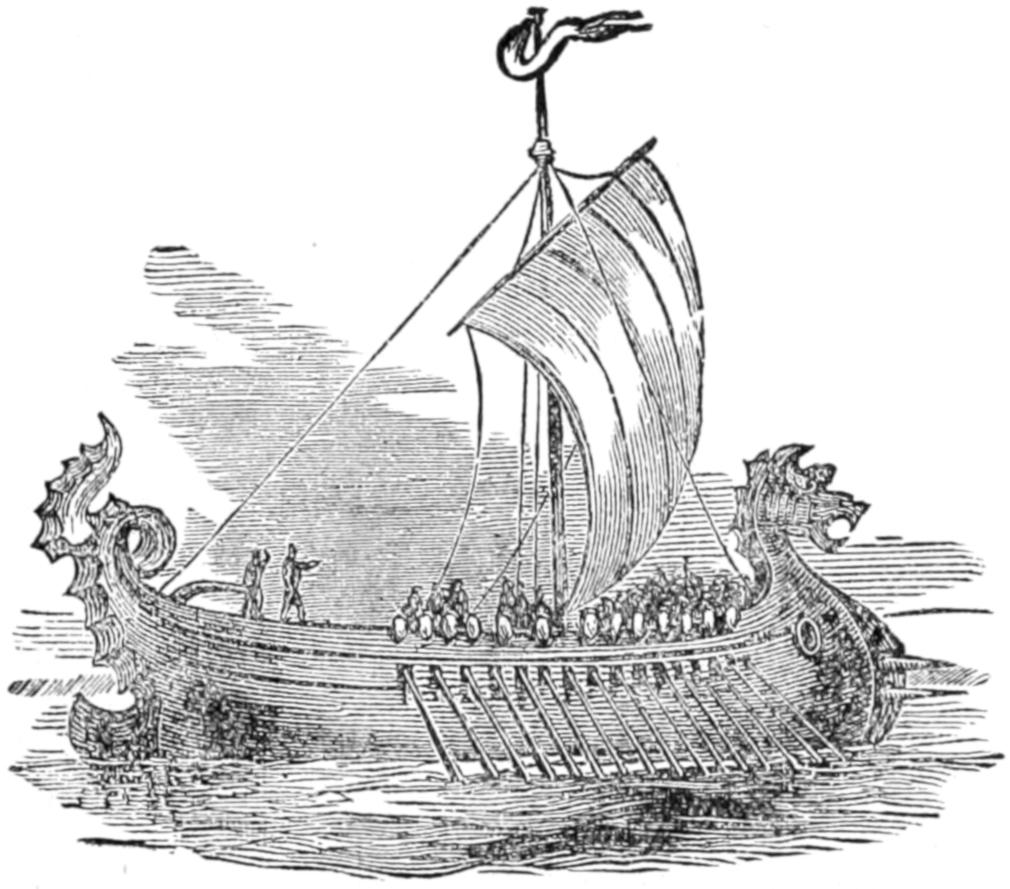
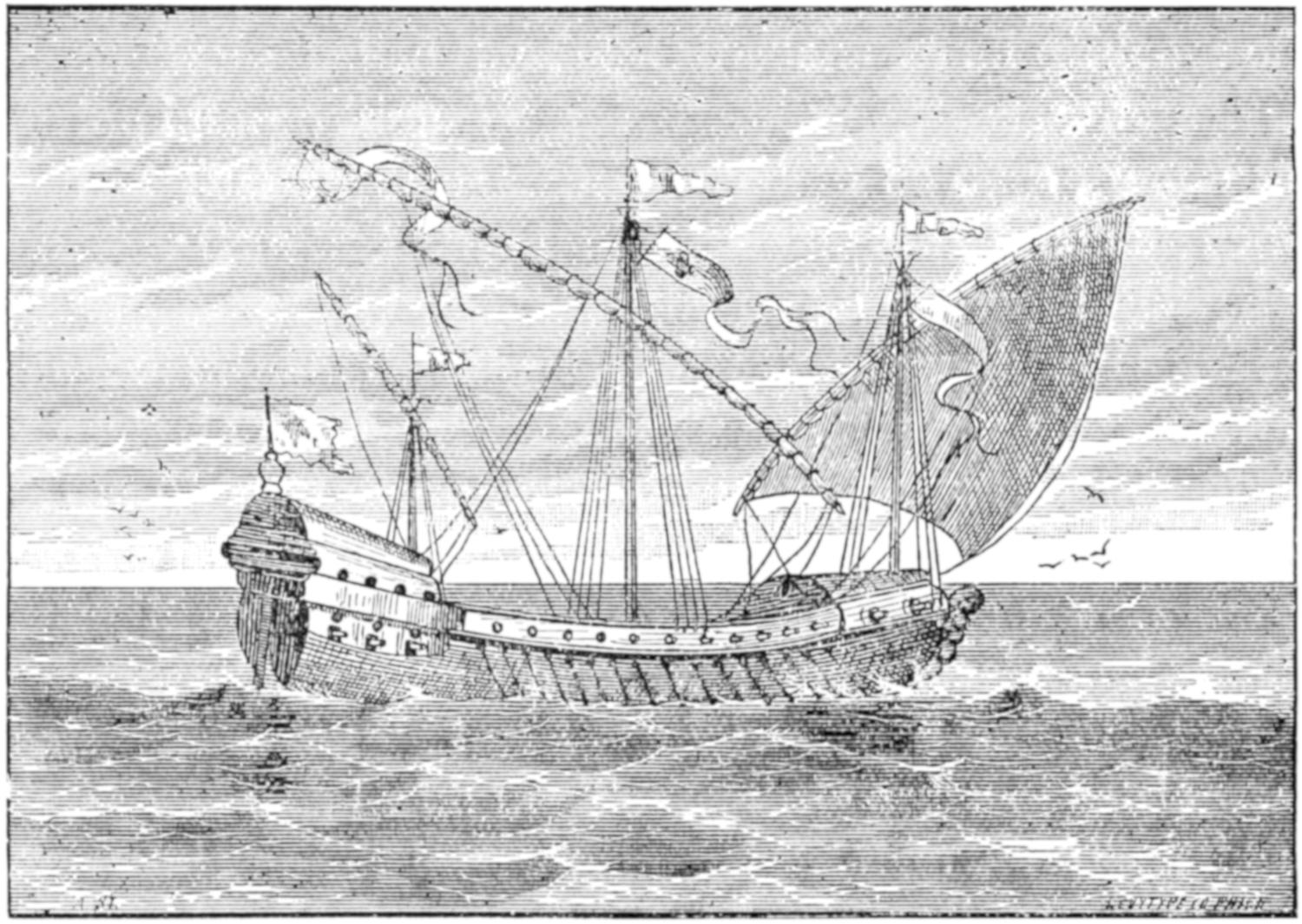
A NORSE GALLEY.
III. ROMANS AND CARTHAGINIANS.
Carthage, the Phenician colony in Africa,
which became so famous and powerful,
was very near the site of the modern city
of Tunis. It has been a point of interest for
twenty centuries. Long after the Phenician
sway had passed away, and the Arab
and Saracen had become lords of the soil,
Louis XI, of France, in the Crusade of 1270,
took possession of the site of the ancient city, only to give
up his last breath there, and add another to the many
legends of the spot. The Spaniards afterwards conquered
Tunis and held it for a time; and, in our own day,
the French have again repossessed themselves of the
country, and may retain it long after the events of our
time have passed into history.
As soon as Rome rose to assured power, and began
her course of conquest, trouble with the powerful State
of Carthage ensued. Their clashing interests soon involved
them in war, and Sicily and the Sicilian waters,
being necessary to both, soon became their battle ground.
The Carthaginians had obtained a footing in Sicily, by
assisting Roman renegades and freebooters of all nations
who had taken refuge there. The Romans therefore passed
a decree directing the Consul, Appius Claudius, to cross
over to Messina and expel the Carthaginians who, from
that strong point, controlled the passage of the great thoroughfare,
the strait of the same name. Thus commenced
the first Punic war. The Romans were almost uniformly
successful upon land, but the Carthaginians, deriving
nautical skill from their Phenician ancestors, overawed,
with their fleet, the whole coast of Sicily, and even made
frequent and destructive descents upon the Italian shores
themselves.
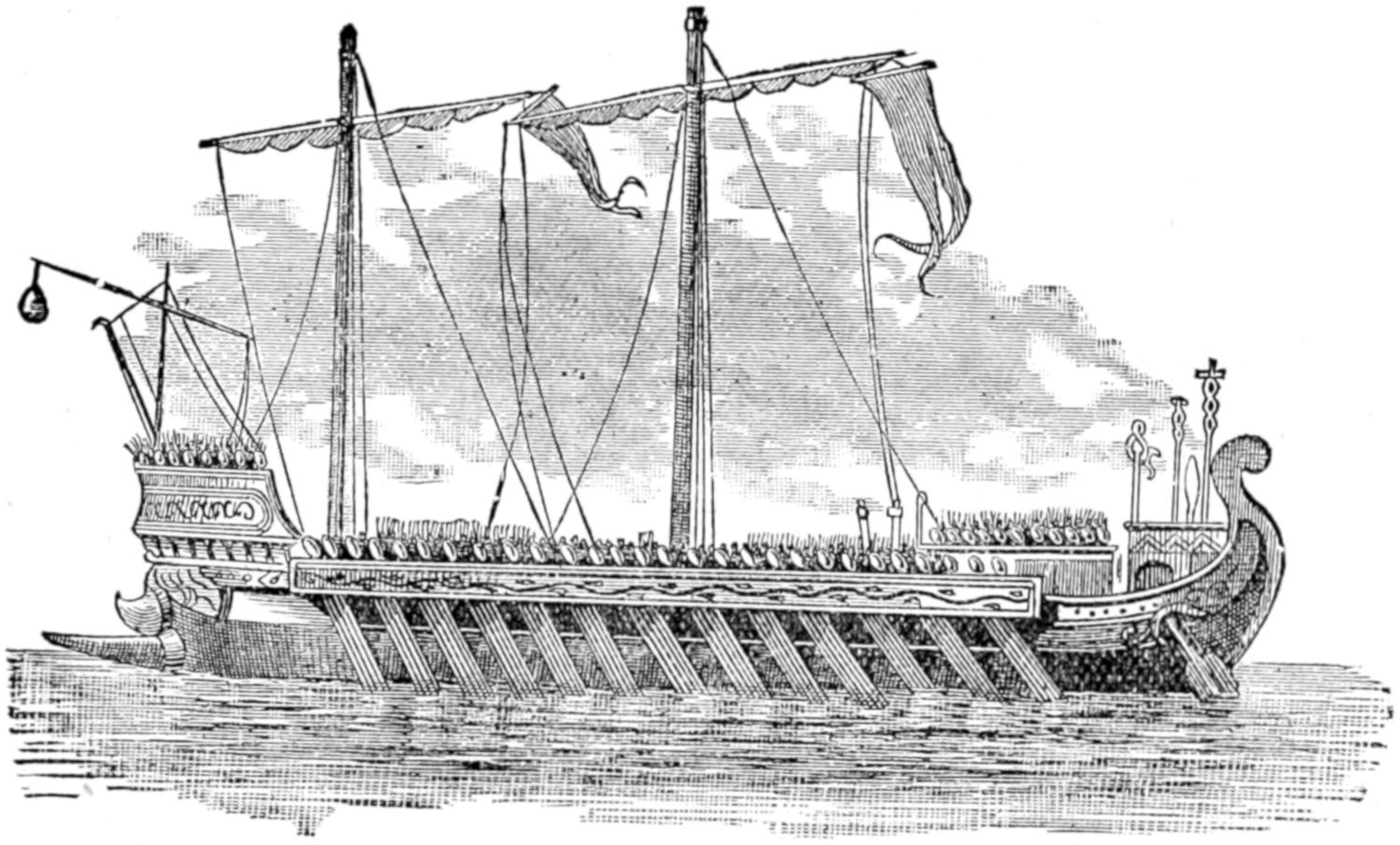
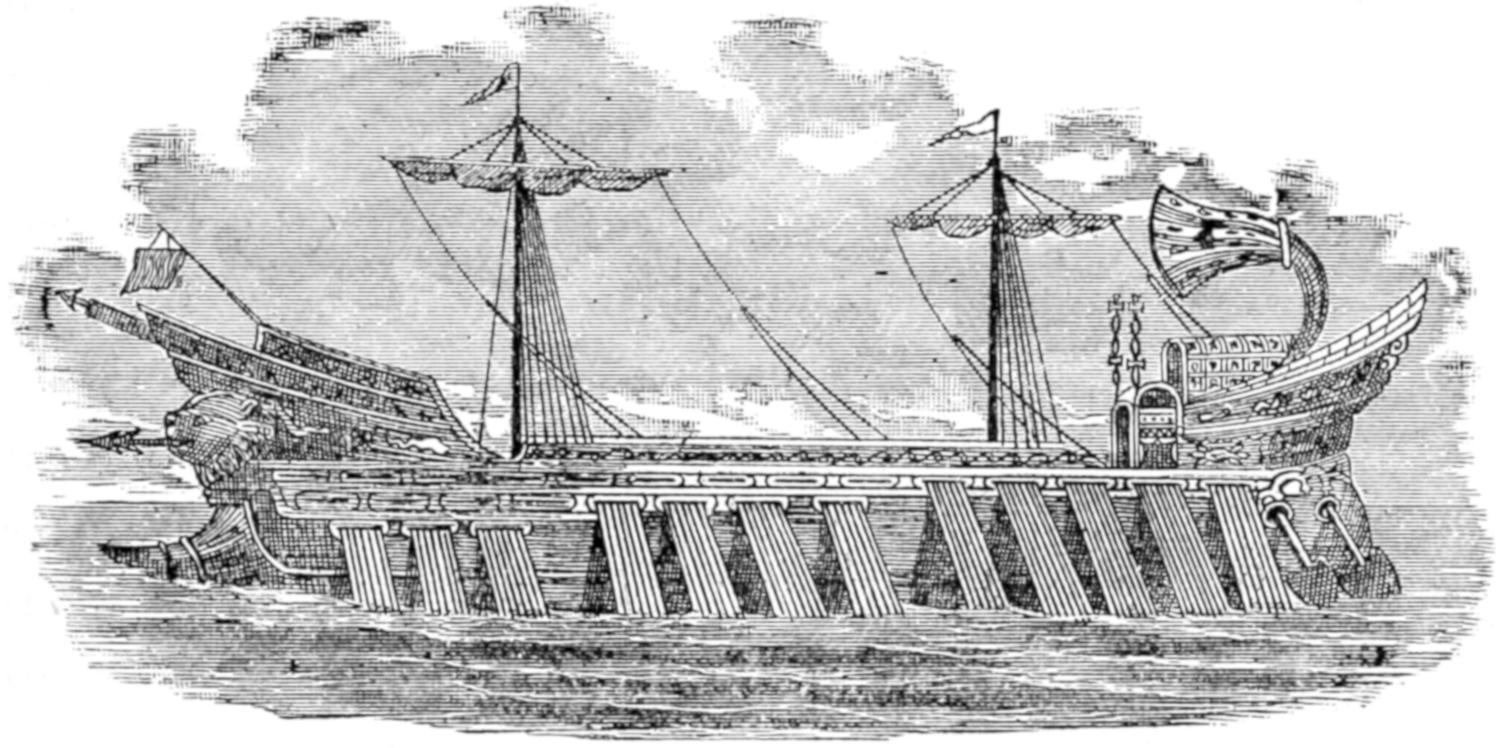
ROMAN GALLEY AND DRAW-BRIDGE.
CARTHAGINIAN GALLEY.
SMALLER ROMAN GALLEY.
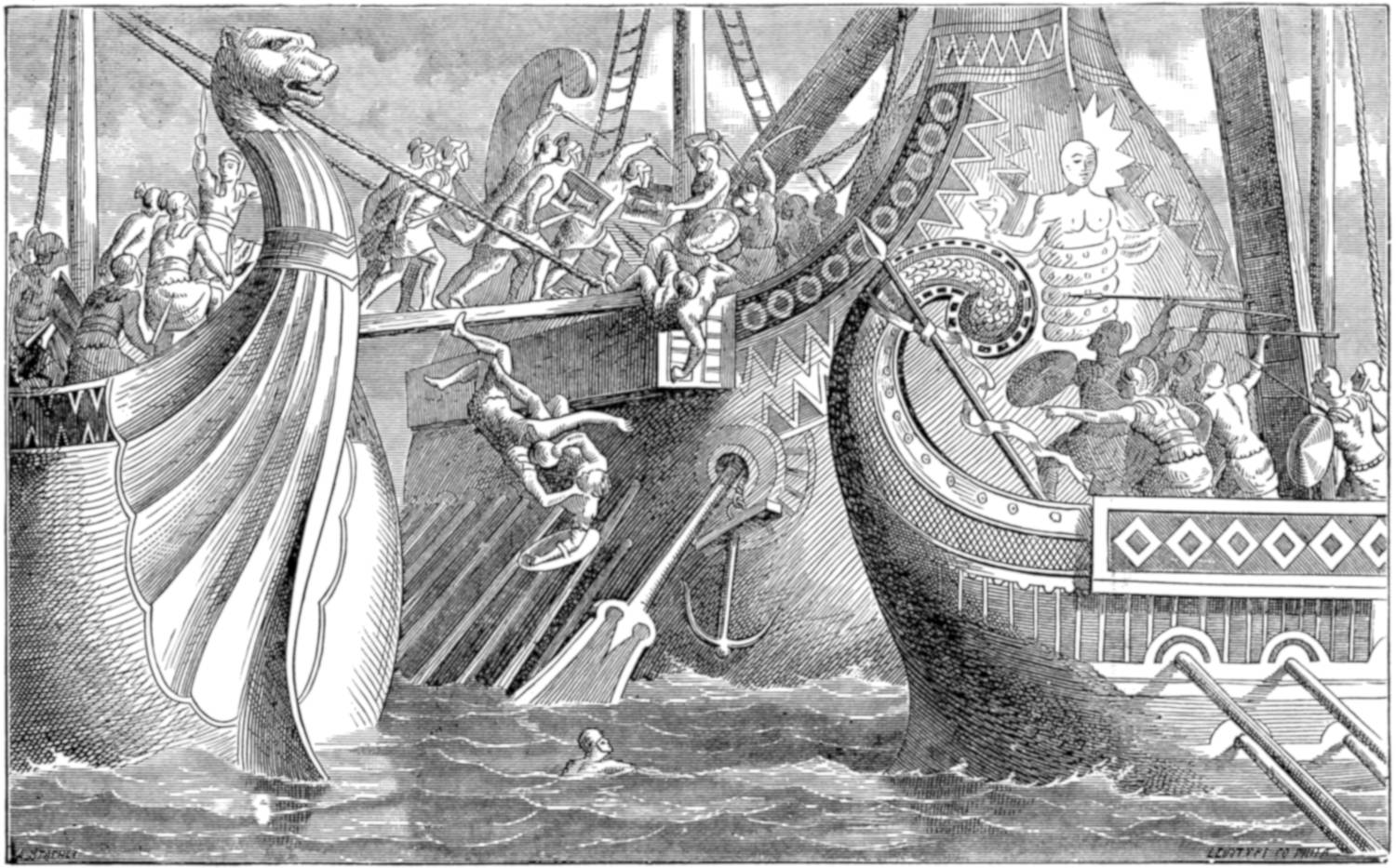
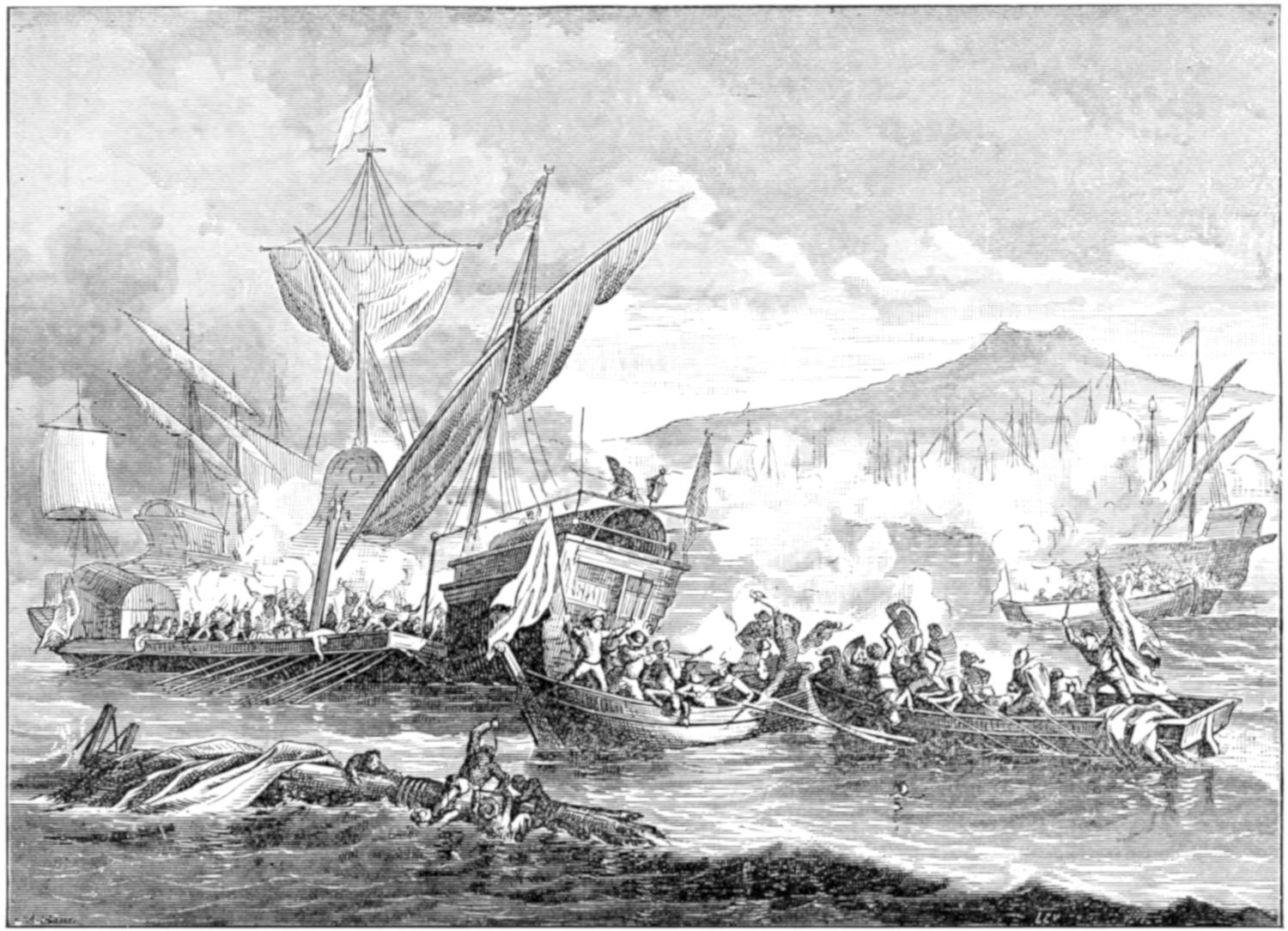
CAPTURE OF THE CARTHAGINIAN FLEET BY THE ROMANS.
The Romans at this time had no ships of war; but they
began the construction of a fleet, to cope with their
enemy, then the undisputed mistress of the seas.
Just at this time a Carthaginian ship of large size was
stranded upon the Italian shores, and served as a model
for the Romans, who, with characteristic energy, in a
short time put afloat a hundred quinqueremes and twenty
triremes. No particular description of these vessels is
necessary, as they were the same in general plan as
those already spoken of as in use among the Egyptians,
Phenicians, and Greeks, for centuries. Able seamen
were obtained from neighboring tributary maritime States,
and bodies of landsmen were put in training, being exercised
at the oar on shore; learning to begin and cease
rowing at the signal. For this purpose platforms were
erected, and benches placed, as in a galley.
It will here be necessary to give a short account of the
Roman naval system, which was now rapidly becoming
developed and established. As has been said, they had
paid no attention, before this period, to naval affairs; and
were only stirred up to do so by the necessity of meeting
the Carthaginians upon their own element.
It is true that some authorities say that the first Roman
ships of war were built upon the model of those of Antium,
after the capture of that city, A. U. C. 417; but the Romans
certainly made no figure at sea until the time of the first
Punic war.
The Roman ships of war were much longer than their
merchant vessels, and were principally driven by oars,
while the merchant ships relied almost entirely upon sails.
It is a more difficult problem than one would at first sight
suppose, to explain exactly how the oars were arranged in
the quadriremes and quinqueremes of which we read.
The Roman ships were substantial and heavy, and consequently
slow in evolutions, however formidable in line.
Augustus, at a much later period, was indebted to a
number of fast, light vessels from the Dalmatian coast,
for his victory over Antony’s heavy ships.
The ship of the commander of a Roman fleet was distinguished
by a red flag, and also carried a light at night.
These ships of war had prows armed with a sharp beak,
of brass, usually divided into three teeth, or points. They
also carried towers of timber, which were erected before
an engagement, and whence missiles were discharged.
They employed both freemen and slaves as rowers and
sailors. The citizens and the allies of the State were
obliged to furnish a certain quota of these; and sometimes
to provide them with pay and provisions; but the
wages of the men were usually provided by the State.
The regular soldiers of the Legions at first fought at
sea as well as on land; but when Rome came to maintain
a permanent fleet, there was a separate class of
soldiers raised for the sea service, like the marines of
modern navies. But this service was considered less
honorable than that of the Legions, and was often performed
by manumitted slaves. The rowers, a still lower
class, were occasionally armed and aided in attack and
defence, when boarding; but this was not usual.
Before a Roman fleet went to sea it was formally
reviewed, like the land army. Prayers were offered to
the gods, and victims sacrificed. The auspices were
consulted, and if any unlucky omen occurred (such as a
person sneezing on the left of the Augur, or swallows
alighting on the ships), the voyage was suspended.
Fleets about to engage were arranged in a manner
similar to armies on land, with centre, right and left
wings, and reserve. Sometimes they were arranged in
the form of a wedge, or forceps, but most frequently in
a half moon. The admiral sailed round the fleet, in a
light galley, and exhorted the men, while invocations and
sacrifices were again offered. They almost always fought
in calm or mild weather, and with furled sails. The red
flag was the signal to engage, which they did with trumpets
sounding and the crews shouting. The combatants
endeavored to disable the enemy by striking off the banks
of oars on one side, or by striking the opposing hulls with
the beak. They also employed fire-ships, and threw pots
of combustibles on board the enemy. Many of Antony’s
ships were destroyed by this means. When they returned
from a successful engagement the prows of the victors
were decorated with laurel wreaths; and it was their
custom to tow the captured vessels stern foremost, to
signify their utter confusion and helplessness. The
admiral was honored with a triumph, after a signal
victory, like a General or Consul who had won a decisive
land battle; and columns were erected in their honor,
which were called Rostral, from being decorated with the
beaks of ships.
And now, to return to the imposing fleet which the
Romans had equipped against the Carthaginians:—
When all was ready the Romans put to sea; at first
clinging to their own shores, and practicing in fleet
tactics. They found their vessels dull and unwieldy, and
therefore resolved to board the enemy at the first opportunity,
and avoid as much as possible all manœuvring.
They therefore carried plenty of grappling-irons, and had
stages, or gangways, ingeniously arranged upon hinges,
which fell on board of the enemy, and afforded secure
bridges for boarding. By this means many victories were
secured over a people who were much better seamen.
After various partial engagements with the Carthaginian
fleet, productive of no definite results, Duilius assumed
command of the Roman fleet, and steered for Mylœ,
where the Carthaginians, under Hannibal, were lying at
anchor.
The latter expected an easy victory, despising the pretensions
of the Romans to seamanship, and they accordingly
left their anchorage in a straggling way, not even
thinking it worth while to form line of battle to engage
landsmen.
Their one hundred and thirty quinqueremes approached
in detachments, according to their speed, and Hannibal, with
about thirty of the fastest, came in contact with the Roman
line, while the rest of his fleet was far astern. Attacked
on all sides, he soon began to repent of his rashness, and
turned to fly—but the “corvi” fell, and the Roman
soldiers, advancing over the gangways, put their enemies
to the sword. The whole of the Carthaginian van division
fell into the Roman hands, without a single ship
being lost on the part of the latter. Hannibal had fortunately
made his escape in time, in a small boat, and at
once proceeded to form the rest of his fleet to resist the
Roman shock. He then passed from vessel to vessel,
exhorting his men to stand firm; but the novel mode of
attack, and its great success, had demoralized the Carthaginians,
and they fled before the Roman advance; fifty
more of Hannibal’s fleet being captured.
So ended the first great naval engagement between
Rome and Carthage; bringing to the former joy and
hope of future successes, and to the latter grief and despondency.
Duilius, the Consul, had a rostral column of marble
erected in his honor, in the Roman forum, with his statue
upon the top.
Hannibal was soon afterward crucified by his own seamen,
in their rage and mortification at their shameful
defeat.
Slight skirmishes and collisions continued to occur,
and both nations became convinced that ultimate success
could only be obtained by the one which should obtain
complete mastery of the Mediterranean Sea. Both, therefore,
made every effort; and the dock-yards were kept
busily at work, while provisions, arms, and naval stores
were accumulated upon a large scale.
The Romans fitted out three hundred and thirty, the
Carthaginians three hundred and fifty quinqueremes;
and in the spring of the year 260 B. C., the rivals took the
sea, to fight out their quarrel to the bitter end.
The Roman Consuls Manlius and Regulus had their
fleet splendidly equipped, and marshaled in divisions,
with the first and second Legions on board. Following
was a rear division, with more soldiers, which served as
a reserve, and as a guard to the rear of the right and left
flanks.
Hamilcar, the admiral of the opposing fleet, saw that
the Roman rear was hampered by the transports which
they were towing, and resolved to try to separate the
leading divisions from them; hoping to capture the
transports, and then the other divisions in detail; with this
intention he formed in four divisions. Three were in
line, at right angles to the course the Romans were
steering, and the fourth in the order called “forceps.”
The last division was a little in the rear and well to the
left of the main body.
Having made his dispositions, Hamilcar passed down
the fleet in his barge, and reminded his countrymen of
their ancestral renown at sea, and assured them that their
former defeat was due, not to the nautical ability of the
Romans, but to the rash valor of the Carthaginians
against a warlike people not ever to be despised. “Avoid
the prows of the Roman galleys,” he continued, “and
strike them amidships, or on the quarter. Sink them, or
disable their oars, and endeavor to render their military
machines, on which they greatly rely, wholly inoperative.”
Loud and continuous acclamations proclaimed the good
disposition of his men, and Hamilcar forthwith ordered
the advance to be sounded, signaling the vessels of the
first division—which would be the first to engage—to
retreat in apparent disorder when they came down close
to the enemy. The Carthaginians obeyed his order to
the letter, and, as if terrified by the Roman array, turned
in well simulated flight, and were instantly pursued by
both columns, which, as Hamilcar had foreseen, drew
rapidly away from the rest of the fleet. When they were
so far separated as to preclude the possibility of support,
the Carthaginians, at a given signal, put about, and
attacked with great ardor and resolution, making a
desperate effort to force together the two sides of the
“forceps” in which the Romans were formed. But these
facing outward, and always presenting their prows to the
Carthaginians, remained immovable and unbroken. If
the Carthaginians succeeded in ramming one, those on
each side of the attacked vessel came to her assistance, and
thus outnumbered, the Carthaginians did not dare to board.
While the battle was thus progressing in the centre—without
decided results—Hanno, who commanded the
Carthaginian right wing, instead of engaging the left
Roman column in flank, stretched far out to sea, and bore
down upon the Roman reserve, which carried the soldiers
of the Triarii. The Carthaginian reserve, instead of
attacking the Roman right column, as they evidently
should have done, also bore down upon the Roman
reserve. Thus three distinct and separate engagements
were going on at once—all fought most valiantly. Just
as the Roman reserve was overpowered, and about to
yield, they saw that the Carthaginian centre was in full
retreat, chased by the Roman van, while the Roman
second division was hastening to the assistance of their
sorely pressed reserve. This sight inspired the latter
with new courage, and, although they had had many
vessels sunk, and a few captured, they continued the fight
until the arrival of their friends caused their assailant,
Hanno, to hoist the signal for retreat. The Roman third
division, embarrassed by its convoy, had been driven back
until quite close to the land, and while sharp-pointed,
surf-beaten rocks appeared under their sterns, it was
attacked on both sides and in front, by the nimble Carthaginians.
Vessel by vessel it was falling into the
enemy’s hands, when Manlius, seeing its critical condition,
relinquished his own pursuit, and hastened to its relief.
His presence converted defeat into victory, and insured
the complete triumph of the Roman arms; so that, while
the Carthaginians scattered in flight, the Romans, towing
their prizes stern foremost, as was their custom in victory,
entered the harbor of Heraclea.
In this sanguinary and decisive battle thirty of the Carthaginian
and twenty-four of the Roman quinqueremes
were sent to the bottom, with all on board. Not a single
Roman vessel was carried off by the enemy; while the
Romans captured sixty-four ships and their crews.
Commodore Parker, of the U. S. Navy, in commenting
upon this important naval action, says, “Had Hanno and
the commander of the Carthaginian reserve done their
duty faithfully and intelligently upon this occasion, the
Roman van and centre must have been doubled up and
defeated, almost instantly; after which it would have
been an easy matter to get possession of the others, with
the transports. Thus the Carthaginians would have
gained a decisive victory, the effect of which would have
been, perhaps, to deter the Romans from again making
their appearance in force upon the sea; and then, with
such leaders as Hamilcar, Hasdrubal and Hannibal to
shape her policy and conduct her armaments, Carthage,
instead of Rome, might have been the mistress of the
world. Such are the great issues sometimes impending
over contending armies and fleets.”
As soon as the Consuls had repaired damages they set
sail from Heraclea for Africa, where they disembarked an
army under Regulus; and most of the naval force, with
the prisoners, then returned home. Regulus, however,
soon suffered a defeat, and the Roman fleet had to be despatched
to Africa again, in hot haste, to take off the scant
remnant of his army. Before taking on board the defeated
Legions the fleet had another great naval battle;
and captured a Carthaginian fleet of one hundred and fourteen
vessels. With the soldiers on board, and their
prizes in tow, Marcus Emilius and Servius Fulvius, the
Consuls then in command, determined to return to Rome
by the south shore of Sicily. This was against the
earnest remonstrances of the pilots, or sailing masters,
“who wisely argued that, at the dangerous season when,
the constellation of Orion being not quite past, and the
Dog Star just ready to appear, it were far safer to go
North about.”
The Consuls, who had no idea of being advised by
mere sailors, were unfortunately not to be shaken in their
determination; and so, when Sicily was sighted, a course
was shaped from Lylybeum to the promontory of Pachymus.
The fleet had accomplished about two-thirds of
this distance, and was just opposite a coast where there
were no ports, and where the shore was high and rocky,
when, with the going down of the sun, the north wind,
which had been blowing steadily for several days,
suddenly died away, and as the Romans were engaged
in furling their flapping sails they observed that they were
heavy and wet with the falling dew, the sure precursor of
the terrible “Scirocco.” Then the pilots urged the Consuls
to pull directly to the southward, that they might have
sea room sufficient to prevent them from being driven on
shore when the storm should burst upon them. But
this, with the dread of the sea natural to men unaccustomed
to contend with it, they refused to do; not comprehending
that, although their quinqueremes were illy
adapted to buffet the waves, anything was better than a
lee shore, with no harbor of refuge.
The north wind sprang up again after a little, cheering
the hearts of the inexperienced, blew in fitful gusts for an
hour or more, then died nearly away, again sprang up,
and finally faded out as before. The seamen knew what
this portended. “Next came a flash of lightning in the
southern sky; then a line of foam upon the southern sea;
the roaring of Heaven’s artillery in the air above, and
of the breakers on the beach below—and the tempest was
upon them!” From this time all order was lost, and the
counsels and admonitions of the pilots unheeded. The
Roman fleet was completely at the mercy of the hurricane,
and the veterans who had borne themselves bravely
in many a hard fought battle with their fellow man, now,
completely demoralized in the presence of this new
danger, behaved more like maniacs than reasonable beings.
Some advised one thing, some another; but nothing
sensible was done—and when the gale broke, out of four
hundred and sixty-four quinqueremes (an immense fleet)
three hundred and eighty had been dashed upon the
rocks and lost.
The whole coast was covered with fragments of wreck
and dead bodies; and that which Rome had been so many
years in acquiring, at the cost of so much blood, labor, and
treasure, she lost in a few hours, through the want of
experienced seamen in command.
During the succeeding Punic wars Rome and Carthage
had many another well contested naval engagement.
Adherbal captured ninety-four Roman vessels off
Drepanum, but the dogged courage of the Roman was
usually successful.
We have few details of these engagements. What the
Romans gained in battle was often lost by them in shipwreck;
so that, at the end of the first Punic war, which
lasted twenty-four years, they had lost seven hundred
quinqueremes, and the vanquished Carthaginians only five
hundred.
At the time spoken of, when the Romans were fighting
the Carthaginians, the former were a free, virtuous and
patriotic people. No reverses cast them down; no loss
of life discouraged them.
After a lapse of two hundred years, Marcus Brutus and
Cassius being dead, and public virtue scoffed at and fast
expiring, an arbitrary government was in process of
erection upon the ruins of the Republic.
The triumvirate had been dissolved, and Octavius and
Antony, at the head of vast armies and fleets, were preparing,
on opposite sides of the Gulf of Ambracia, to
submit their old quarrel to the arbitrament of the sword.
In this emergency Antony’s old officers and soldiers,
whom he had so often led to victory, naturally hoped
that, assuming the offensive, he would draw out his
legions, and, by his ability and superior strategy, force
his adversary from the field. But, bewitched by a woman,
the greatest captain of the age—now that Cæsar and
Pompey were gone—had consented to abandon a faithful
and devoted army, and to rely solely upon his fleet;
which, equal to that of Octavius in numbers, was far
inferior in discipline and drill, and in experience of actual
combat.
ROMAN GALLEY.
IV. ACTIUM. B. C. 31.
Scene VII.Near Actium. Antony’s Camp.
Enter Antony and Canidius.
Ant.
Is it not strange, Canidius,
That from Tarentum and Brundusium
He could so quickly cut the Ionian Sea,
And taken in Toryne? you have heard on’t, sweet?
Cleo.
Celerity is never more admired
Than by the negligent.
Ant.
A good rebuke,
Which might have well becomed the best of men,
To taunt at slackness. Canidius, we
Will fight with him by sea.
Cleo.
By sea! What else?
Canid.
Why will my lord do so?
Ant.
For that he dares us to ’t.
Enob.
So hath my lord dared him to single fight.
Canid.
Ay, and to wage this battle at Pharsalia,
Where Cæsar fought with Pompey: but these offers
Which serve not for his vantage he shakes off;
And so should you.
Enob.
Your ships are not well mann’d;
Your mariners are muleteers, reapers, people
Ingrossed by swift impress; in Cæsar’s fleet
Are those that often have ’gainst Pompey fought;
Their ships are yare; yours, heavy; no disgrace
Shall fall you for refusing him at sea,
Being prepared for land.
Ant.
By sea, by sea.
Enob.
Most worthy sir, you therein throw away
The absolute soldiership you have by land;
Distract your army, which doth most consist
Of war-mark’d footmen; leave unexecuted
Your own renowned knowledge; quite forego
The way which promises assurance; and
Give up yourself merely to chance and hazard,
From firm security.
Ant.
I’ll fight at sea.
Cleo.
I have sixty sails, Cæsar none better.
Ant.
Our overplus of shipping will we burn;
And, with the rest full mann’d, from the head of Actium,
Beat the approaching Cæsar. But if we fail,
We then can do ’t at land.
Shakespeare—Antony and Cleopatra.
Philippi, the decisive battle between Octavius
and Brutus and Cassius, took place
B. C. 42. Octavius, who afterward assumed
the name of Augustus, is very differently
described by historians. It is said
that he did not fight at Philippi; and he is
called a coward by some writers, who declare
that he was always sick on critical
days. Be that as it may, it seems certain that Antony
fought that battle, although Octavius got the credit of
success with the Roman public, which soon endowed him
with every quality which goes to make the title of
“August,” which title he was the first to bear; being the
favorite of the citizens, much more by reason of his
ancestry, and by the judicious bestowal of offices and of
money, than by feats of arms.
After their victory at Philippi, Antony and Octavius
divided the empire of the world between them. But the
two were devoured by an equal ambition; and, although
a common danger had for a time lulled their mutual suspicion
and dislike, and forced them to act in unison, harmony
between them could not long continue. Neither of
them wished to share empire, and each was determined
that the other, sooner or later, should be forced to
renounce power, if not life itself. The repudiation of
Octavia the sister of Octavius, by Antony, added increased
fuel to the fires of hatred, and we learn from contemporary
writers that clear-sighted persons not only foresaw
that a death struggle between the two great leaders
was only a question of time, but they predicted the result,
as Antony, in the midst of feasts and other dissipation,
was fast losing that activity of mind and body which had
brought him his successes, and had, in former days,
gained him the esteem and confidence of Cæsar.
While Antony was placing his laurels and his renown
under the feet of an Egyptian queen, the cool and astute
Octavius, never losing sight of the end he had in view,
turned to his own aggrandizement and elevation, in the
estimation of the Roman people, Antony’s disgraceful
conduct.
The future Augustus, with the full consent of the Senate,
raised fresh legions in Italy, equipped a fleet, and made
every preparation for an enterprise upon which was to
depend the control of the whole civilized world.
As if Antony had taken pains to furnish his already too
powerful rival with the pretexts which should serve as a
mask to his ambitious views, the former caused general
disgust and indignation at Rome by dismembering the
Empire—so to speak—in the interests of Cleopatra, whom
he proclaimed Queen of Cyprus, Cilicia, Cœlesyria,
Arabia and Judea; while he gave to the two sons whom
he had had by her the title of “King of Kings.” This
insane defiance of the susceptibility and pride of the
Republic was one of the principal causes of Antony’s destruction.
People ceased to fear him when they learned
that he had become habitually intemperate; and they no
longer saw in him a redoubtable and successful Roman
general, but an Eastern Satrap, plunged in pleasure and
debauchery.
Octavius, affecting rather contempt than anger at
Antony’s proceedings, declared war against Cleopatra
only, and seemed to regard Antony as already deprived
of the power and majesty which he had sullied in
committing them to the hands of the Egyptian queen.
Octavius could only raise on the Italian peninsula, then
exhausted by civil war, 80,000 legionaries, with 12,000
cavalry, and two hundred and fifty ships—a small force
to oppose to the five hundred ships and 120,000 men of
Antony, without counting the allied troops which his
rival was able to bring against him. But, more active
and daring than Antony, he had, with astonishing celerity,
collected his forces, and crossed the Ionian Sea, while
Antony was lingering in Samos, and indulging in all sorts
of debasing pleasures, with little thought devoted to preparation
for the inevitable and momentous struggle.
At last the imminence of the danger awoke him to the
realities surrounding him, and he brought forward his
powerful fleet, anchoring it near the promontory of
Actium, in Epirus, ready to oppose the advance of
Octavius.
His ships were double in number those of the Romans,
well armed and equipped, but heavy, and badly manned,
so that their manœuvres did not compare in celerity with
those of the western fleet.
Although Octavius had fewer ships and fewer men,
those which he had were Romans; and he was fighting,
ostensibly, to vindicate the wounded pride and honor of
his country, which had been trampled under foot by
Antony and a stranger queen.
The generals of Antony united in imploring him not to
confide his destiny to the uncertainty of winds and waves,
but to give battle on shore, where, they answered for it,
victory would perch upon their banners. But Antony
remained deaf to their supplications, and Cleopatra, who
had joined him with seventy Egyptian ships, also preferred
to fight a naval battle; it is said, in order that, if
her lover was vanquished, she herself could more easily
escape.
Boldly searching for Antony, the Roman fleet came in
contact with his, near the promontory of Actium.
On opposite shores of the bay partly formed by that
promontory lay the two armies, spectators of a conflict
which was to decide their fate, but in which they were not
to join.
The wind and weather were both favorable, but the two
fleets remained for a long time opposite to each other,
as if hesitating to begin the struggle, the issue of which
was fraught with such momentous consequences.
Antony had confided the command of his left wing to
Cœlius; the centre to Marcus Octavius and Marcus
Inteius; while he himself, with Valerius Publicola, assumed
command of the right wing.
The fleet of Octavius was commanded by Agrippa, to
whom all the glory of the victory is due. Octavius and
his admiral at first regarded with surprise and uneasiness
the immobility of the enemy, who were ensconced in the
arm of the sea, which sheet of water contained many shoals
and reefs, and therefore, if the enemy remained there,
deprived Octavius of the advantage to be derived from
the rapidity of manœuvre of his vessels.
BATTLE OF ACTIUM.
But Antony’s officers, eager to show their prowess,
proceeded to get their left wing under way, and moved
to the attack of Octavius’ right. The latter, taking advantage
of this false move, made a retrograde movement,
and endeavored to draw out the whole opposing force
from their commanding position unto the high sea, where
the Romans would have room to manœuvre, and thereby
successfully assail Antony’s heavier vessels.
At this moment the scene was grand. The flashing
of arms, and glinting of the sun upon polished casques,
the streaming flags, and thousands of oars simultaneously
put in motion, gave life and animation; while the blare
of the brazen trumpets and the shouts of the myriads of
combatants were echoed from the shores by the cheers
and cries of two large armies, each encouraging its own
fleet, and inciting them to the greater exertion.
Cleopatra’s large and magnificent galley hovered in
the rear of the fleet, with the purple sails furled, and the
poop occupied by herself and her ladies, surrounded by
all the splendor of the Egyptian court.
Thinking, as we have said, that Octavius’ fleet fled
before them, Antony and his commanders abandoned
their advantageous position, and followed Agrippa out to
sea.
Once there, the Roman fleet quickly put about, in good
order, and a terrible battle at once began—Roman disputing
with Roman the empire of the world.
At last an able movement of Agrippa caused Antony’s
centre to give way; but despite the disorder which
resulted, the action was steadily maintained, the losses on
each side being about equal, and victory undecided.
The force of Agrippa made up by celerity of movement
for the greater number of Antony’s fleet, and the
battle was at its height, when, suddenly, Cleopatra, panic-stricken
by the noise and dreadful carnage, gave a signal
for retreat, hoisted her purple sails, and, with the whole
Egyptian contingent, retreated rapidly, leaving a great
gap in the line of battle. Some were sunk by the beaks
of their pursuers, but the majority made their escape, and
were soon far from the scene.
This shameful action should have opened Antony’s
eyes, and have stimulated him—being even yet superior
in numbers—to repair by renewed exertions the defection
of the beautiful queen. But his movements seemed to be
controlled by her’s, and, forgetting his own honor, his
former glory, his empire, and his duty as commander, as
a soldier and as a man, he abandoned the brave seamen
and soldiers who were fighting for him, and took a
fast, light vessel, and followed the woman who had been
his ruin, and at whose shrine he was about to offer as a
sacrifice the dishonor of Cæsar’s greatest lieutenant.
It is said that for some time he sat upon the deck, his
head bowed between his hands, and wrapped in his own
thoughts. But he only regained sufficient command of
himself to resolve to protect the cause of his ruin. He
therefore continued his flight to the promontory of
Tenaros; and then soon after learned of the entire defeat
of his fleet.
Even after being thus shamefully abandoned by their
commander, his troops and sailors had for a long time;
maintained the combat; but bad weather coming on they
at last surrendered, after a loss of five thousand killed, and
having three hundred ships captured, with their crews.
For a long time the land forces of Antony could not
believe in his defection, and looked for him to reappear,
and, at their head, redeem the fortunes of the sea fight.
Indeed, for many days after the victory they declined the
overtures of Octavius. But at last, despairing of Antony’s
return, their general, with his principal officers and the
troops, passed under the banners of Octavius. This
event left him the undisputed master of the world.
Upon his return to Rome he was decreed a three days’
triumph, and he now assumed in public the imperial
powers which he had long virtually possessed.
The shocking death of both Antony and Cleopatra, by
suicide, hardly belongs to the account of Actium, although
the direct consequence of the overwhelming defeat there
sustained.
THE PTOLEMY PHILOPATER—405 B. C.
(Constructed by Ptolemy Philopater, of Egypt, after a Greek Model.)
V. LEPANTO. A. D. 1571. — THE BATTLE.
Sixteen hundred years after Actium
another great naval battle took place upon
the coast of Greece. It was of momentous
importance, as it is not too much to say that
it decided the future fate and sovereignty
of at least the eastern part of Europe.
Before we speak of Lepanto, however, it
may be well to glance at naval events for
two or three centuries previous to the eventful year 1571.
After the Republic of Venice had become strong, their
first great sea fight was with the Saracens, then a terror
to all the Christian nations of the Mediterranean. The
Venetians, at the solicitation of the Emperor Theodosius,
coöperated with the Greeks against their implacable
enemy. The hostile fleets met at Crotona, in the Gulf of
Taranto, where the Greeks fled at the first onset of the
Saracens, leaving their Venetian allies to fight against
vastly superior numbers. In spite of their courage
and constancy, which maintained the unequal fight for
many hours, the Venetians were defeated, and lost nearly
every one of the sixty ships which they took into the
fight.
Twenty-five years afterwards the Venetian fleet met
the Saracens again, almost in the very spot of their
former discomfiture, and obtained a splendid victory; and
their naval fights continued, almost without intermission,
and with varying fortunes; the Venetians, on the whole,
holding their own.
On February 13th, 1353, there was a remarkable naval
fight between the allied fleets of Venice, Aragon, and
Constantinople, and the Genoese fleet, under the command
of the redoubtable Paganino Doria. The Genoese
were victorious.
In spite of the successful achievements of Doria, which
should have brought him the respect and support of his
countrymen, he was supplanted by his bitter foe, Antonio
Grimaldi, who was put in command of the fleet. He was,
not long after, defeated by the allied fleets of Spain and
Venice, with tremendous loss. Grimaldi, thereupon, fell
out of favor; and the next year the Genoese were
obliged to again place Doria in command of their fleet,
with which he gained a great victory over the Venetians
at Porto Longo, capturing the whole of their fleet.
Peace between the two Republics was then made, and
continued until 1378, when war was again declared.
Victor Pisani, in command of the fleet of Venice, had a
successful battle with the Genoese off Actium, the
scene of the wonderful fight just before the commencement
of the Christian era.
In 1379 Pisani was forced by the Venetian Senate,
against his own judgment, to fight a far superior Genoese
fleet, under Luciano Doria, off Pola, in the Adriatic. The
Venetian fleet was almost annihilated, and Pisani, on his
return, was loaded with chains, and thrown into a
dungeon. The Genoese, after burning several Venetian
towns upon the Adriatic, appeared off Venice, entered
the lagoon, took Chioggia, and filled the Venetians with
consternation and terror. The people flocked to the
Piazza San Marco, in thousands, and demanded that
Pisani be restored to the command of the fleet. The
authorities were at their wits’ ends, and consented, while
Pisani, with true patriotism, condoned his wrongs and ill
treatment, and applied himself at once to the work of
organization. After unheard of exertions he succeeded
in discomfiting the enemy, and Venice was saved.
Pisani afterwards made a cruise in command of the
fleet on the Asiatic coast, but, worn out by hard service
and his former ill treatment, he died soon after his return,
to the common sorrow and remorse of all Venetians.
The Turks took Constantinople in 1453, and the contests
between them and the Venetians continued with
even greater bitterness; and after the capture of Cyprus
by the Moslems, and the fitting out by the Sultan Selim
of an immense and powerful fleet, it became evident to
the western world that some supreme effort should be
put forth to curb the advance of the Turkish power.
Let us now glance at the state of affairs about the time
of Lepanto.
The latter part of the 16th century was a stirring and
eventful period in the world’s history.
Charles V had resigned his empire to that sullen bigot,
his son, Philip II.
About the same time Moscow was being burned by
the Tartars; the Russians having been the abject subjects
of the Tartars but a few years before.
Prussia, so powerful to-day, was then a small hereditary
duchy, Lutheran in religion, and still a fief of Poland.
The Poles were then a much more powerful nation than
the Russians.
The States of the north, Sweden and Denmark, were
very strong, and made their influence felt in all Europe.
Tycho Brahe, the subject of the latter, was then a young
man.
Portugal, from her brilliant maritime discoveries, had
extended relations with Japan, China, India and Brazil;
and had rendered Lisbon the market of the world, usurping
the place of Antwerp. Her decline was, however,
soon to follow.
Soon after Lepanto, Holland, driven to despairing
effort by the tyranny of Philip, revolted, and William of
Orange became Stadtholder. He was succeeded by
Maurice, whose efforts to secure independence were so
ably seconded by Elizabeth of England, as to draw down
upon the latter nation the vengeance of Philip, shown
later in the despatch of his grand Armada, but a very few
years after the event of Lepanto.
The Church of England had been established, and
Elizabeth was enjoying her splendid reign. Sir Walter
Raleigh, Drake, and other heroes of the sea were then
young men.
Florence was about to enjoy her highest distinction as
the home of learning and art, under Cosmo de Medici,
and Pius V was Pope; one of the greatest that ever
occupied the Papal throne.
Rodolph, of Hapsburg, had had his fierce struggle with
the Turks, by land; but Austria then had no naval force.
In France the weak and bloody Charles IX was upon
the throne, and the massacre of Saint Bartholomew was
close at hand.
And now, to come to the great event of Lepanto, which
decided the question of supremacy between Christianity
and Islamism.
The Turks had captured Cyprus; possessed almost
irresistible power, and everything looked very dark for
Christendom.
But in spite of the connivance of Charles IX in their
advance, who by this base conduct preluded the great
crime of his reign; in spite of the calculated inaction of
England; the timidity of Austria; the exhaustion of
Poland, after a long war with still barbarous Muscovy,
the genius of Christianity took a fresh flight, and the star
of the west once more rose in the ascendant.
The honor of being the head of the effort at resistance
to the encroaching Turkish power, and of victorious
reprisals, belongs especially to Pope Pius V, a simple
monk who had been exalted to the Pontifical throne;
a zealous and austere priest, of a disposition naturally
violent, which had been subdued by experience, foresight,
and real greatness of soul.
This Pontiff, upon the first menace of the Turks against
Cyprus, bestirred himself to form a league of several
Christian States.
A crusade was no longer possible, from the condition
of Europe, which was divided by religious schism, and by
the ambition of princes. But, if the Pope could no longer
send the whole of Europe to a holy war, such as was
condemned by Luther as unjust and inhuman, he could
at least, as a temporal prince, take his part in active
operations.
Not even the coolness and calculated slowness of
Philip of Spain—the Monarch from whom he had a right
to expect the most assistance—could arrest the zeal of the
ardent and generous Pontiff, who saw that the time had
come for Christendom to conquer or submit.
Philip II, who was without mercy for the Mahomedans
still scattered throughout his dominions, nevertheless
hesitated to enter upon a struggle with the Turks; and
above all did he dislike to defend Venice against them—so
much did he envy the latter her rich commerce.
The first power asked to join the league against Selim,
he only finally consented upon being given by the Pope
the revenues of the church throughout his vast realm,
for as long as the war should last. But even this gilded
bait became the source of delay, the avaricious and
cunning monarch deferring preparations, and multiplying
obstacles to the undertaking, so as to profit as long
as possible from the rich revenue derived from that
source.
Thus it happened that, by his delay, in spite of the
coalition, and of the allied fleet, equal in number and
superior in condition and discipline to that of the Turks,
the Island of Cyprus was captured, after stubborn sieges
of its two capitals, Nicosia and Famagousta, without any
assistance from the rest of Christendom.
Famagousta was captured after a very prolonged and
obstinate defence, which had been conducted at the
expense of fifty thousand lives to the Turks, who had
made six general assaults. Finally the city was allowed
to capitulate on honorable terms. Mustapha, the same
fierce Moslem general who had conducted the siege of
Malta, requested four of the principal Venetian leaders to
meet him at his quarters. Here a short and angry conference
ensued, when, in violation of the terms of the
capitulation, Mustapha ordered three of them to instant
execution. But he reserved Bragadino, who had held the
supreme command during the siege, and ordered him to
have his ears cut off, and to be set to work to carry earth
to repair the works. After a few days of this humiliation
Mustapha caused him to be flayed alive, in the public
market place. This horrible sentence was not only carried
into effect, but his skin was stuffed and suspended from
the yard arm of Mustapha’s galley; and, with this shocking
trophy thus displayed, he returned to Constantinople.
Here he was rewarded by Selim for the capture of
Cyprus. These terrible events added fuel to the flame
of revenge which the Venetians felt, and were, of course,
additional incentives to their allies.
The capture of Cyprus, and the disgraceful events
following it, aroused the indignation of all Europe. The
iron yoke of the Turk, with his following hosts of Asiatic
robbers and cut-throats, owing to the delay in relief,
extended over the whole of the large, rich and populous
island.
Pius V, in terrible grief at these events, and full of
foreboding for the future, made himself heard throughout
Europe; and with renewed ardor he insisted upon
carrying out the treaty of alliance already made, the
assembly of the allied fleet, and upon vengeance upon
the Ottomans, since succor for Cyprus would arrive too
late.
The greatest mark of his terrible earnestness was the
assembling of a Pontifical fleet and army—a thing
unheard of at that time. The Pope gave the command
to a member of the very ancient Roman family of
Colonna.
In the latter part of 1571, five months after the capture
of Cyprus, the Christian armament appeared upon the
Mediterranean, consisting of galleys to the number of two
hundred, with galleasses, transports and other vessels,
carrying fifty thousand soldiers. Then immediately
followed the most important event of the sixteenth
century.
The Christian fleet made rendezvous at Messina;
whence Sebastian Veniero, the Venetian admiral, would
have sailed at once, and have sought the enemy without
delay, so much did he fear for the Venetian possessions
in the Adriatic, from the rapid advance of the
Ottomans.
But Don John, the supreme commander, with a prudence
worthy of an older and less fiery man, would not
move until he was strengthened by every possible reinforcement,
as he wished to use every means in his power to
avoid a defeat which must be a final and crushing one to
the side which should lose. He was certain that the
great resources of the Ottoman empire would, on this
supreme occasion, be strained to the utmost to equip
their greatest armament. During this delay the Pope
proclaimed a jubilee—granting indulgences to all engaged
in the expedition—such as had formerly been given to the
deliverers of the Holy Sepulchre.
On September 16th, the magnificent armament, unrivaled
since the days of imperial Rome, put to sea from
Messina. They were baffled by rough seas and head
winds on the Calabrian coast, and made slow progress.
The commander had sent a small squadron in advance,
for intelligence. They returned with the news that the
Turks were still in the Adriatic, with a powerful fleet,
and had committed fearful ravages upon the Venetian
territories. The fleet then steered for Corfu, and reached
there on September 26th, seeing for themselves traces of
the enemy in smoking towns and farms, and deserted
fields and vineyards. The islanders welcomed them, and
furnished what they could of needed supplies.
Don John seems to have had his own plans: but he
now called a council, because courtesy required that he
should consult the commanders of the Allies—and because
he had promised Philip to do so—the latter fearing
his fiery and impetuous disposition.
The opinions were divided—as is always the case in
councils of war. Those who had had personal experience of
Turkish naval prowess appeared to shrink from encountering
so formidable an armament, and would have confined
the operations of the Christian fleet to besieging some
city belonging to the Moslems. Even Doria, the old sea-dog,
whose life had been spent in fighting the infidel,
thought it was not advisable to attack the enemy in his
present position, surrounded as he was by friendly
shores, whence he could obtain aid and reinforcement.
He wished to attack Navarino, and thus draw the enemy
from the gulf where he was anchored, and force him to
give battle in the open sea. But, strange to say (for a
proverb has it that councils of war never fight), the
majority took a different view, and said that the object
of the expedition was to destroy the Ottoman fleet, and
that a better opportunity could not present itself than
when they were shut in a gulf, from which, if defeated,
they could not escape.
The most influential of the council held these views:
among them the Marquis of Santa Cruz, Cardona, the
commander of the Sicilian squadron, Barberigo, second
in command of the Venetians, Grand Commander Requesens,
Colonna, and young Alexander Farnese, Prince
of Parma—the nephew of Don John, who was seeing his
first service now, but who was to become, in time, the
greatest captain of his age.
Thus supported in his judgment, the young commander-in-chief
resolved to give the Turks battle in the
position they had chosen. But he was delayed by weather,
and other causes, and the enemy were not actually
met until October 7th.
The Ottoman fleet, two hundred strong, rowed by
Christian slaves, and accompanied by numbers of transports,
was moored in a gulf upon the Albanian coast,
while the Christian fleet, seeking its enemy, came down
from the north, led by the galleys of the Venetian contingent.
As the time of conflict approached, the commander-in-chief,
Don John, rose superior to the timid counsels of the
generals of Philip II, who accompanied him, and who
were, in a manner, charged with his safety.
Don John, of Austria, was the natural son of Charles
V, but was fully recognized, not only by his father, but by
Philip, his legitimate brother, who originally intended him
for high ecclesiastical dignities. But Don John early
showed great predilection for the profession of arms, and
was conspicuous during the revolt of the Moors of
Grenada. In 1570, when only twenty-six years old, he
received the supreme command of the Spanish fleet; and
his ability and success justified an appointment which was
due to favoritism.
After Lepanto he conquered Tunis, and the idea was
entertained of founding a Christian kingdom there, for
him; but the jealousy of his arbitrary and suspicious
brother prevented this. He then received the governorship
of the Low Countries, succeeding the notorious and
bloody Duke of Alva, and he there died, in his camp at
Namur, in 1578, aged thirty-three. It is said that he was
about to undertake an expedition to deliver Mary
Stuart, at the time of his death, which was attributed by
some to poison.
Don John was one of the remarkable soldiers of his
time. Generous, frank, humane, he was beloved by both
soldiers and citizens. He was a fine horseman, handsome,
well made, and graceful.
Don John’s principal force, in ships and fighting men,
was Italian; for, besides the twelve galleys of the Pope,
and those of Genoa, Savoy, and other Italian States and
cities, many were contributed by rich and generous Italian
private citizens. The greater number, however, were
Venetian; this State contributing one hundred and six
“royal galleys” and six galleasses. The galleasses were
large ships, rather dull as sailers, but carrying forty or
fifty pieces of cannon.
Among the complement of the Venetians were many
Greeks—either refugees from the Morea, or recruited in
Candia, Corfu, and other islands, then subject to the
Venetian power. In keeping with the jealous policy of
Venice, none of these subjects had any maritime command
or military rank; but they fought valiantly under the
flag of St. Marc, which lost in the battle its chief admiral
and fifteen captains.
The Spaniards had about eighty galleys; but had also
a number of brigantines, and vessels of small size—and
were better manned than the Venetians—so that Don
John drafted several thousand men from the other Italian
ships, and from those of Spain, to make good the Venetian
complement. Veniero, the Venetian Admiral, took
great offence at this, and much trouble arose from it, but
the imminence of the conflict and the importance of the
result to Venice prevented him from withdrawing his
force, as he at first threatened to do.
The total number of men on board the allied fleet was
eighty thousand. The galleys, impelled principally by
oars, required a large number of rowers. Of the 29,000
soldiers embarked, 19,000 were sent by Spain. They
were good troops, officered by men of reputation, and most
of them illustrious, not only for family, but for military
achievement. It was so also with the Venetian officers,
as it should have been—for her very existence was at
stake, unless the Turks were defeated.
Don John himself arranged the order of battle; and,
standing erect in a fast pulling boat, clad in his armor,
and bearing in his hand a crucifix, he pulled round the
fleet, exhorting the Allies, by voice and gesture, to make
a common cause, and without reference to the flags they
bore, to act as one nationality in the face of the common
foe.
He then returned to his own galley, where a staff of
young Castilian and Sardinian nobles awaited him, and
unfurled the great banner of the League, presented by
the Pope, and bearing the arms of Spain, Venice and
the Pope, bound together by an endless chain.
The Real, or Admiral’s galley of Don John, was of
great size, and had been built in Barcelona, at that time
famous for naval architecture. Her stern was highly
decorated with emblems and historical devices, while her
interior was furnished most luxuriously. But, most of
all, she excelled in strength and speed, and right well did
she do her part when exposed to the actual test of battle.
Lepanto was fought on Sunday. The weather was
beautiful, and the sun shone in splendor upon the peculiarly
clear blue water of those seas.
The sight on that morning must have been surpassingly
grand. The beautiful galleys, with their numerous
oars dashing the water into foam; gaudy pennons streaming
from the picturesque lateen yards; gaily painted
hulls, decorated with shields and armorial insignia; culverins
mounted at the prows, with matches smoking; the
decks filled with men in polished armor and gay plumes,
and armed with sword and spear, matchlock and arquebus,
cross-bow and petronel. Shouts of command and
of enthusiasm went up amid a brandishing of weapons,
while an occasional hush occurred when the holy fathers
of the church gave absolution to those who were about
to meet the fierce infidel.
More than half the ships carried at their mast-heads
the Lion of St. Marc, which waved over the sturdy sea-dogs
of Venice, while other divisions showed the red and
yellow of Spain, the white, with crossed keys and triple
mitre of the Pope, or the varied ensigns of the Italian
cities.
On the other side were the Turks, with their numerous
and powerful galleys, mostly pulled by Christian slaves,
who were driven by cruel blows to put forth their utmost
strength against their co-religionists; for in every galley,
Turkish or Christian, where slaves worked the oars, there
extended between the benches of the rowers, fore and
aft, a raised walk, on which two or three boatswains, with
long rods, walked back and forth, dealing heavy blows
upon those who were not thought to be doing their utmost
at the oars. The slaves were shackled to the benches when
they rowed; and never left them, day or night. Their food
and clothing were scanty, and the filth about them was
seldom cleared away, except by the rain from heaven, or
the seas, which sometimes washed on board. The fighting
men of the galleys were mostly on the fore-deck, and
on outside galleries, or platforms above the gunwales.
The Turks had the wild music which they love to
encourage their fighting men, kettle-drums and pipes,
cymbals and trumpets. The horse-tails of the Pashas
streamed from the poops of their galleys, as with loud
cries they appealed to Allah to deliver the Christian dogs
once more into their hands. And there was every reason
to suppose that their wish would be fulfilled, for they had
the stronger force, and carried with them the prestige
of former victories won over the best efforts of the
Christians.
On the morning of the memorable 7th of October the
Christian fleet weighed anchor for Lepanto, at two hours
before dawn. The wind was light, but adverse, and oars
had to be used. At sunrise they came up with a group
of rocky islets which form the northern cape of the Gulf
of Lepanto. The rowers labored hard at the oars, while
all others strained their eyes for the first glimpse of the
great Moslem fleet. At length they were descried from
the masthead of the Real, and almost at the same
moment by Andrew Doria, who commanded on the right.
BATTLE OF LEPANTO.
Don John ordered his pennon to be displayed, unfurled
the banner of the Christian League, and fired a gun, the
preconcerted signal for battle.
This was answered by an exultant shout from all the
ships.
The principal captains now came on board the Real,
to receive their final orders; and a few, even then,
doubted the propriety of fighting, but Don John sternly
said, “Gentlemen, this is the time for battle, and not for
counsel!” and the armada was at once deployed in fighting
array, according to orders previously issued.
When ready for battle the Christian force had a front
of three miles. On the extreme right was Doria, whose
name was justly held in terror by the Moslem, with sixty-four
galleys. In the centre, consisting of sixty-three
galleys, was Don John, supported on one side by
Colonna, and on the other by Veniero. In his rear was
the Grand Commander Requesens, his former tutor in
military matters. The left wing was commanded by
Barberigo, a Venetian noble, who was to keep his vessels
as near the Ætolian coast as the rocks and shoals would
permit, to prevent his wing being turned by the enemy.
The reserve, of thirty-five galleys, was commanded by
the Marquis of Santa Cruz, a man of known courage and
conduct, who had orders to act in any quarter where he
thought his aid most needed.
The smaller craft took little part in the battle, the action
being fought almost entirely by the galleys.
Each commander was to take space enough for manœuvring,
yet to keep so close as to prevent the enemy
from piercing the line. Each was to single out his adversary,
close with him, and board as soon as possible.
Don John had the beak of his galley cut away; so little
did he rely upon an instrument once, and for so long,
considered formidable.
By this time galleys mounted guns upon their prows,
and beaks were beginning to fall out of use. It is said
that many commanders of the allies followed Don John’s
example.
The Ottoman fleet weighed and came out to the battle.
But they came on slowly, as the wind had suddenly shifted
and was now against them, while, as the day advanced,
the sun, which had been in the faces of the Allies, shone
in those of the Moslem; and both these natural phenomena
were hailed by the Christians as an evidence of
divine interposition.
The Turkish armament proved to be even greater in
number than had been anticipated by the Christians, consisting
of nearly two hundred and fifty “royal galleys,”
most of them of the largest class; and a number of smaller
vessels in the rear, which, however, like the similar ones
of the Allies, do not appear to have come much into action.
The number of the Turks, including rowers, is said to
have been 120,000. As we have said, the rowers were
principally Christian slaves, with some blacks and criminals.
As was usual with the Turks, their order of battle was
crescentic, and, being more numerous than the Allies, they
occupied a wider space than the straight alignment of the
Christians.
As their formidable and magnificent array advanced,
the moving sun shone upon gaudy paint and gilded prows,
thousands of pennons, polished cimeters and head pieces,
and the jeweled turbans of the Pachas, and other chief
men.
In the centre of their long line, and opposite to Don
John, was a huge galley, bearing the Turkish commander,
Ali Pasha.
His fleet was commanded on the right by the Viceroy
of Egypt, a wary but courageous leader. His left was
led by Uluch Ali, a Calabrian renegade and Dey of
Algiers, noted as a successful corsair, who had made more
Christian slaves than all the rest beside.
Ali was, like Don John, young and ambitious, and had
refused to listen to any counsels looking toward declining
battle on that day. Selim had sent him to fight, and he
was determined to do so; although the prudent Viceroy
of Egypt expressed some doubts of success.
Ali found the Christian fleet more numerous than he
had supposed, and at first he did not perceive their left
wing, which was hidden by the Ætolian shore.
When he saw the Christian line in its full extent, it is
said that he faltered for a moment, but only for a moment,
for he at once urged on the rowers to close with the
enemy, and spoke of the prospects of the engagement, to
those about him, in confident terms.
It is said that Ali was of humane disposition, and that
he promised the Christian slaves that, if by their exertions
he won the day, they should all have their freedom.
As he drew near the Allies, Ali changed his order of
battle, separating his wings from the centre, to correspond
to the Christian formation. He also fired a challenge
gun, before he came within shot. This was answered
by Don John, and a second one was promptly replied to
from the Christian flag-ship.
The fleets now rapidly neared each other. Men held
their breath, and nerved themselves for the death grapple,
and a perfect silence reigned, broken only by the plash of
the huge oars, while the light breeze rippled the smiling
blue waters.
Just about noon this beautiful scene, a perfect pageant,
was broken in upon by the fierce yells of the Turks, the
war cry with which they were accustomed to join battle.
At this moment, as if by contrast, every fighting man
of the Christians fell upon his knee, as did Don John
himself, and prayed the Almighty to be with his own that
day. Absolution was then given by the priests, which
were in each ship, and the men stood up, braced for the
contest.
When the foremost Turkish vessels had come within
cannon shot, they opened fire; and this ran along their
line as they advanced, without cessation. The Christian
kettle-drums and trumpets sounded in reply, with a
general discharge of all the guns which would bear.
Don John had caused the galleasses, the large, high,
unwieldy war ships, to be towed about half a mile ahead
of his fleet, where they could intercept the advance of the
Turks.
As the latter came abreast of them, the galleasses
delivered their broadsides, with terrible effect. Ali caused
his galleys to diverge, and pass these vessels, which were
so high and formidable that the Turks did not attempt to
board them.
Their heavy guns caused some damage and confusion
in the Pacha’s line of battle, but this appears to have been
the only part they took in the engagement, as they were
too unwieldy to be brought up again.
The real action began on the Allies’ left wing, which
the Viceroy of Egypt was very desirous of turning. But
the Venetian admiral, to prevent that very thing, had
closed well in with the coast. The Viceroy, however,
better acquainted with the soundings, saw that there was
room for him to pass, and dashed by, thereby doubling up
his enemy. Thus placed between two fires, the Christian
left fought at very great disadvantage. Many galleys
were soon sunk, and several more were captured by the
Turks.
Barberigo, dashing into the heat of the fight, was
wounded in the eye, by an arrow, and was borne below.
But his Venetians continued the fight with unabated courage
and fury, fighting for revenge, as well as for glory.
On the extreme Christian right a similar movement
was attempted by Uluch Ali. With superior numbers he
attempted to turn that wing; but here he met that experienced
and valiant seaman, Andrew Doria, who foresaw
the movement of Uluch, and promptly defeated it.
The two best seamen of the Mediterranean were here
brought face to face. Doria, to prevent being surrounded,
extended his line so far to the right that Don
John was obliged to caution him not to expose the centre.
Indeed, he seriously weakened his own line, and the experienced
Uluch instantly detecting it, dashed down, sank
several galleys, and captured the great “Capitana,” of
Malta. While the battle thus opened badly for the Allies,
on both wings, Don John led his division forward; at
first with indifferent success. His own chief object was
to encounter Ali Pasha, and the Turkish commander was
also intent upon meeting him.
Their respective galleys were easily distinguished, from
their size and rich decoration, besides displaying, the one
the great Ottoman standard, the other the holy banner
of the League.
The Ottoman standard was held to be very sacred.
It was emblazoned in gold, with texts from the Koran,
and had the name of Allah repeated 28,900 times. The
Sultans had passed it from father to son, ever since the
formation of the dynasty, and it was never seen unless
the Grand Signior or his lieutenant was in the field.
Both commanders urged forward their galleys, which
soon shot ahead of the lines, and the two closed with a
fearful shock, so powerful that the Pacha’s, which was the
largest, was thrown upon that of his antagonist so far
that the prow reached the fourth bench of Don John’s
rowers.
As soon as those on board the two vessels recovered
from the shock, the carnage commenced.
Don John had three hundred Spanish arquebusiers, the
flower of the infantry. Ali had three hundred picked
janizaries, and was followed by a small vessel with two
hundred more. He had also one hundred archers on
board; the bow being still much in use among the Turks.
The Pasha opened a terrible fire, which was returned
with even greater spirit by the Spaniards. The latter had
bulwarks, which the Mussulmen had not; and so the
crowded janizaries presented an easy mark. Still, they
filled up the gaps from the reserve in the small vessel,
and the Spaniards wasted away under their fire. For a
long time it was doubtful to which side victory would
incline.
This conflict was now complicated by the entrance of
others. The bravest on each side came to the aid of the
two commanders, and each leader at times found himself
assailed by several enemies. They never lost sight of
each other, however, and after beating off lesser assailants,
returned to the single combat.
The fight was now general, and the movements of both
fleets obscured by clouds of smoke. Separate detachments
desperately engaged each other, without regard
to what was going on in other quarters; and there were
few of the combinations and manœuvers of a great naval
battle.
The galleys grappled each other, and soldiers, sailors
and galley slaves fought, hand to hand, boarding and
repelling boarders, in turn.
There was enormous loss of life; the decks being
encumbered with the dead, and in some ships every man
on board was either killed or wounded. The blood
flowed in torrents out of the scuppers, and the waters of
the gulf were stained for miles. Wrecks of vessels
encumbered the sea, with hulls shattered, masts gone,
and thousands of wounded and drowning clinging to
spars, and crying vainly for help.
As we have already seen, Barberigo, with the Christian
left wing, was early in sore distress; Barberigo himself
being mortally wounded, his line turned, and several of
his galleys being sunk or captured. But the Venetians,
in sheer despair, increased their efforts, and succeeded
in driving off their enemies. In turn they became the
assailants, and boarded Turk after Turk, putting the crews
to the sword. They were led to the assault by a Capuchin
friar, crucifix in hand—as were many other crews.
In some cases the Christian galley slaves of the Turkish
vessels broke their chains and joined their countrymen
against their Moslem masters.
The galley of the Viceroy of Egypt was sunk, and he
himself was killed by John Contarini, the Venetians
having no mercy for even a drowning Turkish enemy.
The death of their commander spread dismay among his
followers, and that division fled before the Venetians.
Those nearest the land ran on shore, escaping, and
leaving their vessels to be captured, and many perished
before they could gain the land. Barberigo lived to
hear the news, and giving thanks, expired in the moment
of victory.
All this time the combat between the two commanders-in-chief
had been going on, with an incessant blaze of
great guns and musketry, making a cloud of smoke,
riven by flame. Both parties fought with stubborn courage.
Twice the Spaniards had boarded, and twice had
been repulsed with severe loss. The enemy was continually
reinforced, in spite of the loss inflicted by the
steady fire of the Spanish arquebusiers. Occasionally
interrupted, they always returned to each other; and both
commanders exposed themselves as fully as any soldier,
there being no honorable place of safety. Don John was
slightly wounded in the foot, but would not have it
dressed. A third time his trumpets summoned the boarders,
and the Spaniards again boldly boarded the great Turkish
galley. They were met by Ali, at the head of his janizaries;
but the Ottoman leader was just then knocked
senseless by a musket ball, and his chosen troops, though
fighting well, missed his voice and presence. After a
short but furious struggle they threw down their arms.
Under a heap of slain the body of Ali was found. Life was
not extinct, but he would at once have been dispatched
had he not told the soldiers who discovered him where
his money and jewels were to be found. In their haste
to secure these, they left him lying upon the deck. Just
then a galley slave, who had been liberated and armed,
severed the head of Ali from his body, and carried it to
Don John, on board his galley. Don John was shocked
at the sight, and, after a glance of horror and pity, ordered
it to be thrown into the sea. This was not done, however,
but, in revenge for Bragadino, it was placed upon a
pike, while the crescent banner was hauled down, and the
cross run up in its place. The sight of the sacred banner
flying on board the captured flag-ship was welcomed by
the Christian fleet with shouts of victory, which rose
above the din of battle. The intelligence of the death
of Ali was soon passed along the line, cheering the Allies,
and disheartening the Turks, whose exertions diminished
and whose fire slackened.
They were too far off to seek the shore, as their comrades
on the right had done, and they had either to fight
or surrender. Most of them preferred the latter, and
their vessels were now carried by boarding, or sunk by
the Allies; and in four hours the centre of the Moslem
fleet, like their right wing, had been annihilated.
On the right of the Allies, however, Uluch Ali, the
redoubted Algerine, had cut Doria’s weakened line, and
inflicted great damage and loss, and would have done
more but for the arrival of the reserve, under the Marquis
Santa Cruz. He had already assisted Don John
when assailed by overwhelming numbers, and had enabled
him again to attack Ali.
Santa Cruz, seeing the critical condition of Doria,
pushed forward to his relief, supported by the Sicilian
squadron. Dashing into the midst of the mêlée, the two
commanders fell like a thunder-bolt upon the Algerine
galleys, few of which attempted to withstand the shock;
and in their haste to avoid it, they were caught again by
Doria and his Genoese.
Beset on all sides, Uluch Ali was compelled to abandon
his prizes and seek safety in flight. He cut adrift his
great prize, the Maltese “Capitana,” which he had
attached by a hawser to the stern of his own vessel, and
on board of which three hundred corpses attested the
desperate character of her defence.
As tidings reached him of the defeat of the centre, and
of the death of Ali Pasha, he felt that retreat alone was
left for him, with as many of his own ships as he could save
from capture. His contingent comprised the best vessels
in the Turkish fleet, with crews in perfect discipline and
hardened to the sea, having always been corsairs, and
accustomed to scour the Mediterranean at all seasons.
Making signal for retreat, the Algerine made off, under
all the sail the battle had left him, and urged forward
also by the exertions of his Christian galley slaves,
smarting under the blows of his enraged comites.
Doria and Santa Cruz followed swiftly in his wake, but
he managed to distance them, and to carry off with him
many of his ships. Don John himself joined in the
chase, having disposed of his own assailants, and they
finally managed to drive a few of the Algerine vessels
upon the rocks of a headland; but their crews in great
part escaped. Uluch’s escape was due to the fact that
the rowers of the Christian fleet had taken part in the
battle, and while many were killed or wounded, the
remainder were much exhausted, while the Algerine
galley slaves, chained to their benches, and passive during
much of the fight, were comparatively fresh.
As already stated, the battle lasted more than four
hours, and before it was over the sky showed signs of
a coming storm. Don John reconnoitred the scene of
action before seeking a shelter for himself and his numerous
prizes. Several vessels were found to be too much
damaged for further service, and as these were mostly
prizes, he ordered everything of value to be removed
from them and the hulls burned.
He then led his victorious fleet to the neighboring
haven of Petala, which was accessible and secure. Before
he reached there the storm had begun, while the late
scene of battle was lighted up by the blazing wrecks,
throwing up streams of fire and showers of sparks.
The young commander-in-chief was now congratulated
upon his signal victory, by his companions in arms.
Officers and men recounted the various events of the
day, and natural exultation was mingled with gloom as
they gained certain tidings of the loss of friends who
had bought this great success with their blood.
The loss of life had indeed been very great; greater
by far than in any modern sea fight. It is supposed that
the Turks suffered most heavily, but their loss was never
known. It has been estimated at 25,000 killed and
drowned, and 5000 prisoners. It was, indeed, a crushing
blow to them.
To the victors great pleasure was given by the fact
that at least 12,000 Christian slaves, who had been (some
of them for many years) chained to the oars of the Turkish
galleys, were made free. Many of them were hopelessly
broken in health; but tears streamed down their
haggard cheeks at the prospect of dying in their own
land and among their own people.
The losses of the Allies, though very great, were as
nothing compared to that of the Moslem. About one
thousand Romans and two thousand Spaniards were
killed, while the Venetians and Sicilians lost about five
thousand. This disparity of loss has been attributed to
the superiority of the Christians in the use of firearms.
The Turks still clung to the bow, and a large proportion
of their fighting men were thus armed. The Turks,
moreover, were the vanquished party, and, as is generally
the case, suffered terribly in the pursuit. Their great
armada was almost annihilated, not more than forty of
their galleys escaping. One hundred and thirty were
actually taken, and divided among the conquerors; the
remainder were either sunk or burned. The Allies had
about fifteen galleys sunk, and had many much damaged;
but their vessels were much better constructed and
stronger than those of the Turks, whom they also excelled
in nautical evolutions.
An immense booty of gold, jewels and brocades was
found on board the prizes; it being said that Ali Pasha’s
ship alone contained 170,000 gold sequins, or nearly
$400,000, a very large sum for those days.
The number of persons of rank and consideration who
embarked in the expedition was very great, both among
the Christians and the Moslem, and many of these were
slain. The second in command of the Venetian force,
the commander-in-chief of the Turkish fleet, and the commander
of his right wing, all fell in the battle. Many a
high-born Christian cavalier closed at Lepanto a long
career of honorable service. On the other hand many
dated the commencement of their success in arms from
that day. Among these was Alexander Farnese, Prince of
Parma, who became a great general, and whom we shall
hear of again, in connection with the Spanish Armada.
Although only a few years younger than his kinsman,
Don John, he was making his first campaign as a private
adventurer. During the battle the galley in which he
was embarked was lying, yard arm and yard arm, alongside
a Turkish galley, with which she was hotly engaged.
In the midst of the fight Farnese sprang on board the
enemy, hewing down with his Andrea Ferrara all who
opposed him, thus opening a path for his comrades, who
poured in, one after another, and after a bloody contest,
captured the vessel. As Farnese’s galley lay just astern
of that of Don John, the latter witnessed, with great
pride and delight, the gallant deed of his nephew. Another
youth was at Lepanto, who, though then unknown,
was destined to win greater laurels than those of the
battle field. This was Miguel de Cervantes, then twenty-four
years of age, and serving as a common soldier. He
had been ill of a fever, but on the morning of the battle
insisted on taking a very exposed post. Here he was
wounded twice in the chest, and once in the left hand,
from which he lost its use. The right hand served to
write one of the most remarkable books ever known,
Don Quixote; and Cervantes always said that, for all
his wounds, he would not have missed the glory of being
present on that memorable day.
A fierce storm raged for twenty-four hours after the
battle of Lepanto, but the fleet rode in safety at Petala;
and it remained there four days, during which Don John
visited the different vessels, providing for their repairs
and for the wounded, and distributing honors among
those who had earned them. His kindly and generous
disposition was not only shown to his own people, but
to the Turkish prisoners. Among these were two young
sons of Ali, the Moslem commander-in-chief. They had
not been on board his galley, and to their affliction at his
death was now added the doom of imprisonment.
Don John sent for them, and they prostrated themselves
before him on the deck; but he raised and embraced
them, and said all he could to console them, ordering
them to be treated with the consideration due to their
rank. He also assigned them quarters, and gave them
rich apparel and a sumptuous table. A letter came from
their sister, Fatima, soliciting the freedom of her brothers
and appealing to Don John’s well known humanity. He
had already sent a courier to Constantinople, to convey
the assurance of their safety. As was the custom then,
Fatima had sent with her letter presents of enormous
value.
In the division of the spoils and slaves, the young
Turkish princes had been assigned to the Pope, but Don
John succeeded in procuring their liberation. Unfortunately,
the elder, who was about seventeen, died at
Naples; but the younger, who was only thirteen, was
sent home with his attendants, and with him were sent
the presents received from Fatima, on the ground that
the young commander-in-chief only granted free favors.
Don John also made friends with the testy old Venetian
admiral, Veniero, with whom he had had a serious
difficulty before the battle.
Veniero afterwards became Doge—the third of his
family to reach that eminence—which office he held until
his death.
Before leaving Petala a council was held, to decide
upon the next operation of the fleet. Some were for an
immediate attack upon Constantinople; while others considered
the fleet in no condition for such an enterprise,
and recommended that it be disbanded, go into winter
quarters, and renew operations in the spring.
Some agreed with Don John, that, before disbanding,
they should do something more. An attack upon Santa
Maura was determined on; but on reconnoitering, it was
found to be too strong to be captured otherwise than by
siege.
A division of spoils among the Allies then took place.
One-half of the captured vessels, and of the artillery and
small arms, was set apart for the King of Spain. The
other half was divided between the Pope and the Republic
of Venice; while the money and rich goods were distributed
among the officers and crews.
The fleet then dispersed; and Don John proceeded to
Messina, where great joy was felt, and immense fêtes
awaited him; for he had been gone from them only six
weeks, and had, in the meantime, won the greatest battle
of modern times. The whole population flocked to the
water side to welcome the victorious fleet, which came
back not without scars, but bearing the consecrated
banner still proudly aloft. In their rear were the battered
prizes, with their flags trailing ignominiously in the water.
There were music, garlands of flowers, triumphal arches,
salvos of artillery, a gorgeous canopy, and a Te Deum
in the Cathedral. A grand banquet followed, when Don
John was presented with 30,000 crowns by the city,
which also voted him a colossal statue in bronze. Don
John accepted the money, but only for the sick and
wounded; and his own share of booty from Ali’s galley
he ordered to be distributed among his own crew.
The news of Lepanto caused a great sensation
throughout Christendom, as the Turks had been considered
invincible at sea. Upon the receipt of the intelligence
the Sultan Selim covered his head with dust, and
refused food for three days—while all Christendom was
repeating, after the sovereign Pontiff, “There was a man
sent from God, whose name was John.”
In Venice, which might be said to have gained a new
lease of life from the results of the battle, there were
ceremonial rejoicings, and, by public decree, the 7th of
October was set apart forever as a national anniversary.
In Naples the joy was great, as their coasts had been
so often desolated by Ottoman cruisers, and their people
carried off as slaves. So, when Santa Cruz returned he
was welcomed as a deliverer from bondage.
But even greater honors were paid to Colonna, in
Rome. He was borne in stately procession, and trophies
were carried after him, with the captives following, quite
in the style of the old Roman triumphs.
Of course, the rejoicing in Spain did not fall short of
that in the other countries concerned.
The great Ottoman standard, the greatest trophy of
the battle, was deposited in the Escorial, where it was
afterwards destroyed by fire.
When the victory was announced to Philip he was at
prayer, which he did not interrupt, and he pretended to
receive the intelligence very coolly. But he ordered
illuminations and masses; and commanded Titian, who
was then in Madrid, and ninety years of age, to paint the
“Victory of the League,” still in the Museum of Madrid.
The Pope made every effort, by special ambassadors,
to have the King press the war, and to extend the alliance
against the Turks.
But Philip was lukewarm, even cold, and said that,
for his part, he feared the Turks less than he did the
Christian dissenters of Belgium, England, and the Low
Countries.
It has been said that Charles V would have followed
his victory to the gates of Constantinople, but the Duke
of Alva thought that, Don John’s force being a mixed one,
he would not have succeeded unless supported by the
united force of Christendom, so great was the Moslem
power at that time.
The battle lost the Turks no territory, but broke the
charm of invincibility which they had possessed. Venice
gained confidence, and the Ottomans never again took the
initiative against that State—while those who have most
carefully studied the history of the Ottoman Empire date
its decline from the battle of Lepanto.
THE ENGLISH FLEET FOLLOWING THE INVINCIBLE ARMADA.
(From the Tapestry in the House of Lords, destroyed in the fire at the Houses of Parliament.)
VI. THE INVINCIBLE ARMADA. A. D. 1588.
Armada signifies, in Spanish, a Sea Army;
and Philip the Second named the great
fleet which he sent forth in 1588 “invincible,”
because he thought that it must
prevail against the forces of the heretic
Hollanders and English, who excited his
disgust and anger much more than the
Moslem enemies with whom we have
seen him last engaged.
Philip II, son of Charles V, was born at Valladolid, in
1527, and, by the abdication of his father, became King of
Spain in 1556. His first wife was Maria, of Portugal,
and his second was Mary Tudor, daughter of Henry VIII.
Philip was the most powerful prince of his time. Spain,
Naples, Sicily, the Milanais, Franche Comté, the Low
Countries, Tunis, Oran, the Cape Verdes, Canaries, and a
great part of the Americas owned his sway.
Always a fanatic, as he advanced in years the extermination
of heretics became his one passion. He sent
the pitiless Duke of Alva to the Low Countries, where,
however, all his cruelties and persecutions could not prevent
the spread of the Reformed religion. Fortunately
for England, as we shall see, the Low Countries secured
their independence in 1581.
In Spain, Philip was employing the Inquisition against
Moors and heretics; and executions were depopulating
the Peninsula and ruining the country. It was only by
serious insurrections that the Milanese resisted the establishment
of the Inquisition there; but to make up for
that, and for his loss of the Low Countries, Philip had
made the conquest of Portugal, and had extended to that
country the practices of Spain.
Elizabeth of England had not only established heretical
practices in her realm, but had executed Mary Stuart,
and also added to her offences, in his eyes, by sending
sympathy and assistance to the persecuted Flemings.
Brooding over these things, in his secret, silent way,
Philip determined to invade England, reëstablish Catholicism,
and avenge the Queen of Scots.
To this end he devoted some years to the assembling
of the most tremendous fleet which the world, up to that
time, had seen.
The Spanish nobility were encouraged to join in this
new crusade, and responded to the invitation in crowds.
The ships, collectively, were to carry more than three
thousand guns. A Vicar-General of the Inquisition was
to accompany the fleet, and establish the Inquisition in
England; and it has been affirmed that complete sets of
instruments of torture were also taken.
The Duke of Parma, with a large army, was to join the
Armada from Belgium, and insure the conquest. This,
we shall see, was prevented by the noble and faithful conduct
of Holland, which, in spite of legitimate cause of complaint
against England, in the recent design of the Earl of
Leicester, came nobly to the rescue, and blockaded Parma,
so that he and his troops were rendered unavailable.
But for this, and some mistakes of the naval commanders,
in all probability English history would have been very
different. Many reports of the expedition had reached
England, but just about the time it was ready Elizabeth’s
fears had been lulled by the prospect of successful negotiations,
and many of her advisers thought the threatened
expedition would never approach English shores.
Elizabeth, fortunately for England, had revived the
navy, as well as the merchant service, which had been so
greatly neglected between the death of her father and
her own accession.
The wealthier nobles and citizens, encouraged by the
queen, built many men-of-war, and the Royal navy was
soon able to take the sea with 20,000 fighting men.
The prudence and foresight of the queen in these
measures was rewarded by the success of her seamen in
disposing of a force such as had hardly ever been arrayed
against any country, by sea. Philip, “who from his closet
in Madrid aspired to govern the world,” and who
hated Protestantism with so great a hatred that he declared
“if his own son was a heretic he would carry wood
to burn him,” had good and devoted soldiers to carry
out his views. The Duke of Alva was inconceivably cold-blooded
and cruel, yet he was a man of great ability. No
more perfect chevalier and enlightened soldier existed
than the young Don John, whose career was so short;
and the famous Duke of Parma, the greatest general of
the day, was to command the army of invasion; while
the Duke of Medina Sidonia, one of the highest grandees
of Spain, was a most gallant soldier. He was no seaman,
and was surrounded by a staff of soldiers, or else
there might have been a different story to tell of Philip’s
Armada. But that does not detract from the Duke’s
personal devotion and gallantry; and the expedition was
accompanied by hundreds of officers of like personal
character.
In regard to the Armada and its destination, Philip at
first preserved the secrecy which was so consonant with
his nature; but at last, when publicity could no longer
be avoided, he had every dock-yard and arsenal in his
dominions resounding with the hum and noise of a busy
multitude, working day and night, to provide the means
necessary to accomplish his purpose. New ships were
built, and old ones repaired; while immense quantities of
military stores were forwarded to the Netherlands, a
convenient base of supplies for the invaders.
The New World was then pouring its treasures into
Philip’s coffers, the product of the enslavement of whole
nations, and this immense wealth Philip poured out in
turn, lavishly, to accomplish his darling ambition, which
was the subjection of all that remained free in the Old
World.
“Rendezvous for the shipment of seamen were opened
in every seaport town; while throughout Philip’s vast
dominions there was not a hamlet so insignificant, or a
cottage so lowly, but that the recruiting sergeant made
his way to it, in his eagerness to raise troops for the grand
army, which, blessed by the Pope, and led by the famous
Duke of Parma, was destined, it was confidently believed,
to march in triumph through the streets of London, and,
by one sweeping auto-da-fé, extirpate heresy from that
accursed land which every Spanish Catholic was taught
to regard as the stronghold of the devil.”
“Volunteers of every degree, and from every corner
of Europe, hastened to enlist under the banner of Castile.
Of these, many were religious bigots, impelled to the
crusade against English heretics by fanatic zeal; a few,
men of exalted character, not unknown to fame; but by
far the greater number, needy adventurers, seeking for
spoil. At length, in April, 1588, after nearly three years
of preparation, the army of invasion, 60,000 strong, was
concentrated at Dunkirk and Nieuport, where large,
flat-bottomed transports were built, ready for its reception.
“But still the Armada, that was to convoy the transports,
and cover the landing of the troops on their arrival in
England, loitered in Lisbon, waiting for a favorable wind.
Toward the end of May it moved out of the Tagus by detachments,
and passing the dangerous shoals called the
Cachopos in safety, took its departure from Cape Roca,
the westernmost point of Portugal, and of the continent
of Europe, on June 1st, sailing due north, with a light
southwesterly breeze. The fleet consisted in all of one
hundred and thirty-two vessels, carrying 3165 guns,
21,639 soldiers, 8745 seamen, and 2088 galley slaves;
and its aggregate burden was not less than 65,000 tons.”
The San Martin, a vessel of fifty guns, belonging to
the contingent furnished by Portugal, carried the flag of
the commander-in-chief, the Duke de Medina Sidonia,
already mentioned.
This great Armada was very unwieldy, and contained
many dull sailers, so that, making its way at the average
rate of only about thirteen miles a day, it passed the
Berlingas, crept by Figuera, Oporto and Vigo, and finally
lay becalmed off Cape Finisterre. Up to this time the
winds, if baffling, had been moderate, the weather pleasant,
and the sea smooth as glass. But now the Spanish fleet
was assailed by a tempest, which might be called fearful,
even in the stormy Bay of Biscay.
Blowing at first fitfully, and in heavy squalls, it by
nightfall settled into a steady gale from west-northwest,
driving before it a tremendous sea, the surges of which
broke with a roar distinctly heard above the fierce howling
of the wind. Yet, though the sea ran high, it was not
irregular, and the Armada, under snug canvas, was
making good weather of it, when, a little after midnight,
the wind shifted very suddenly to northeast, blowing with
the violence of a tornado, and taking every ship under
square sail flat aback. Some of the vessels, gathering
sternboard, lost their rudders, which were in that day
very insecure; some, thrown on their beam-ends, were
forced to cut away their masts and throw overboard their
guns; while all lost sails and top-hamper, and not a few
the upper deck cabins, at that time so lofty.
When day broke the spectacle was presented of a
whole fleet helplessly adrift upon the ocean. Many of
the largest and finest vessels were lying in the trough of
the sea, which every now and then made a clean breach
over them, each time carrying off some of the crews.
Among the fleet was a huge Portuguese galley, the Diana,
which had been knocked down by the shift of wind, lost
her masts and oars, and was lying on her side, gradually
filling with water, and fast settling by the stern. The rest
of the vessels were powerless to assist her, and she soon
sank before their eyes, carrying down every soul belonging
to her, including, of course, the poor galley slaves
chained to her oars.
Then, to add to the horrors of storm and shipwreck, a
mutiny broke out among the rowers of the galley Vasana
(a motley crew of Turkish and Moorish prisoners and
Christian felons), who had been long watching for an
opportunity to secure their freedom; and now, seeing
their galley to windward of all the vessels of the Armada,
with the exception of the Capitana galley, which was a
mile away from them, they judged the occasion favorable
for the accomplishment of their purpose. Led by a
Welshman, named David Gwynne, the mutinous galley-slaves
attacked the sailors and soldiers of the Vasana,
and as they exceeded them in number, and the free men
had no time to seize their arms, while the slaves were
armed with stilettoes made of all kinds of metal, and carefully
concealed for such an occasion, they quite easily
prevailed. The captain of the Capitana, seeing that
something was wrong on board the Vasana, ran down as
close to her as the heavy sea would permit, and, finding
her already in possession of the Welshman and his fellow
galley-slaves, poured a broadside into her, which cut
her up terribly, and filled her decks with more killed and
wounded men. At this critical moment, while engaged
with an enemy without, the crew of the Capitana found
themselves threatened with a greater danger from within.
Their own slaves now rose, broke their chains, and took
part in the engagement. It is not known whether they
had any previous knowledge of an attempt on board the
Vasana, or whether it was the effect of example. At any
rate, they rushed upon their late masters and oppressors
with such weapons as they had concealed, or could seize at
the moment, and attacked them with desperate and irresistible
fury and resolution. The struggle, in the midst of the
gale, for the possession of the Capitana, was furious but
brief. It ended in the triumph of the galley-slaves, who,
like their fellows on board the Vasana, spared no rank
nor age. The massacre was soon over, and the bodies
thrown into the water; and the gale soon after abating,
the galleys were run into Bayonne, where, Motley says,
Gwynne was graciously received by Henry of Navarre.
The crippled Armada, having lost three of its finest
galleys, managed to creep into the different ports on the
northern shore of Spain.
Once more they all made rendezvous at Corunna, and
after a month spent in repairs, sailed again, on July 22d,
for Calais Roads.
With fair winds and fine weather, the Spanish fleet
struck soundings in the English channel on July 28th, and
the following day, in the afternoon, were in sight of the
Lizard, whence they were seen and recognized, and soon,
by bonfires, and other preconcerted signals, all England
knew that the long threatened danger was close at hand;
and, without faltering, one and all prepared to meet it.
The most of the English fleet was in Plymouth at the
time. Many of the principal officers were on shore, playing
at bowls, and otherwise amusing themselves, and the
wind was blowing directly into the harbor, preventing the
fleet from pulling to sea. But the commander-in-chief,
Lord Howard of Effingham, was equal to the emergency;
summoning all to instant exertion; and before daylight
the following morning sixty-seven of his best ships had
been, with extreme labor and difficulty, towed and kedged
into deep water, and, commanded by such men as Drake,
Frobisher, and Hawkins, were off the Eddystone, keeping
a sharp lookout for the Spaniards. Every hour
additional vessels were joining the English fleet.
During the whole forenoon the wind was very light,
and the weather thick; but towards evening a fine south-west
wind set in, and the mist rising, the two fleets
discovered each other.
The Armada, in a half-moon, and in complete battle
array, was so compactly drawn up that its flanking vessels
were distributed but seven miles from each other; and all
were bearing steadily up channel. The Spanish guns were
so numerous, and so much heavier in calibre than anything
the English carried, that the Lord High Admiral saw at
once that the force at his command could not successfully
confront the enemy. He therefore permitted them to
pass without firing a shot; but hung closely upon their
rear, in hopes of cutting off any vessels which might chance
to fall astern of the others. It was not until the next
day, Sunday, July 31st, that an opportunity offered for
attacking to advantage. Then, “sending a pinnace,
called the Defiance, before him, to denounce war against
the enemy, by the discharge of all her guns,” Howard at
once opened fire from his own ship, the Royal Oak, upon
a large galleon, commanded by Don Alphonso de Leyva,
which he took to be the flag-ship of the Spanish commander-in-chief.
In the meantime, the combined squadrons of Drake,
Frobisher and Hawkins opened furiously upon the fleet
of Biscay, or of northern Spain, which, consisting of fourteen
vessels, and carrying 302 guns, was commanded by
Vice-admiral Recalde, an officer of great experience.
This squadron had been formed into a rear guard, in
expectation of just such an attack.
Recalde maintained the unequal fight for some hours,
and with great obstinacy; all the while endeavoring to
get within small-arm range of the English, which he knew
would be fatal to them, as he had a large force of arquebusiers
embarked in his division.
But his wary antagonists, whose vessels, “light, weatherly
and nimble, sailed six feet to the Spaniards’ two, and
tacked twice to their once,” evaded every effort to close,
and keeping at long range, inflicted much damage upon
their enemy without receiving any themselves.
At length, seeing how matters stood, the Duke Medina
Sidonia signaled to Recalde to join the main body of the
fleet; and, hoisting the Royal standard of Spain at his
main, drew out his whole force in order of battle, and
endeavored to bring on a general engagement. This
Howard prudently avoided, and so the Spaniards had to
keep on their course again, up channel, and “maintain
a running fight of it;” the English now, as before, hanging
on their rear, and receiving constant reinforcements
from their seaport towns, in full view of which, as the
Armada hugged the English shore, Howard, with his
gallant ships and men, was passing.
In these days London alone sent forth fifty armed ships.
The night which followed was one fraught with disaster
to the Spaniards. The gunner of the Santa Anna, a
Fleming by birth, who had been reprimanded by his
captain for some neglect of duty, in revenge laid a train to
the magazine, and blew up all the after part of the vessel,
with more than half her officers and crew.
The vessel nearest the Santa Anna hurried to her
assistance, and was engaged in rescuing the survivors,
when, in the darkness and confusion, two galleys fell foul
of the flagship of the Andalusian squadron, and carried
away her foremast close to the deck, so that she dropped
astern of the Armada, and, the night being very dark, was
soon lost sight of by her friends, and assailed by her
vigilant foes.
Being well manned, and carrying fifty guns, she maintained
her defence until daylight, when, finding the English
hemming her in on all sides, Don Pedro de Valdez,
the Admiral, struck his flag to Drake, in the Revenge,
much to the chagrin of Frobisher and Hawkins, who had
hoped to make prize of her themselves.
Don Pedro, who was courteously received by Drake,
remained on board the Revenge until the 10th of August;
so that he was an eye witness of all the subsequent
events, and of the final discomfiture of his countrymen.
Drake sent the captain of the Santa Anna, “a prisoner,
to Dartmouth, and left the money on board the prize, to
be plundered by his men.”
All the following day was spent by the Duke in rearranging
his fleet; and after the vessels were in the
stations assigned them, each captain had written orders
not to leave that station, under penalty of death.
In this new order the rear guard was increased to forty-three
vessels, and placed under the command of Don
Alphonso de Leyva, who had orders to avoid skirmishing
as much as possible, but to lose no opportunity of bringing
on a general engagement, or decisive battle.
On the 2d of August, at daylight, the wind shifted to
the northeast, whereupon the Spanish, being to windward,
bore down upon the English under full sail. But the
latter also squared away, and having the advantage of
greater speed, refused, as before, to allow their enemy to
close with them; so the engagement was without result,
there being little loss on the part of the Spaniards, while
the only Englishman killed was a Mr. Cock, who was
bravely fighting the enemy in a small vessel of his own.
Towards evening the wind backed to the west again,
and the Armada once more continued its course toward
Calais.
On the 3d of August there was a suspension of hostilities,
and the Lord High Admiral received a supply of
powder and ball, and a reinforcement of ships, and
intended to attack the enemy in the middle of the night,
but was prevented by a calm.
On the 4th, however, a straggler from the Spanish fleet
was made prize of by the English.
This brought on a sharp engagement between the
Spanish rear guard and the English advance, under Frobisher,
which would have resulted in Frobisher’s capture
had not Howard himself gone to the rescue, in the
“Ark-Royal, followed by the Lion, the Bear, the Bull, the
Elizabeth, and a great number of smaller vessels.” The
fighting was for some time severe, but as soon as Frobisher
was relieved, Howard, observing that the Duke
was approaching, with the main body of the Spanish
fleet, prudently gave the order to retire. It was, indeed,
high time, for the Ark-Royal was so badly crippled that
she had to be towed out of action.
The Lord High Admiral afterwards knighted Lord
Thomas Howard, Lord Sheffield, Townsend, Hawkins
and Frobisher, for their gallantry on this occasion; but a
convincing proof that the English had the worst of it in
the encounter is the determination of a council of war
“not to make any further attempt upon the enemy until
they should be arrived in the Straits of Dover, where
the Lord Henry Seymour and Sir William Winter were
lying in wait for them.”
So the Armada kept on its way, unmolested, and with
a fair wind, past Hastings and Dungeness, until it got to
the north of the Varne, an extensive shoal in the
Channel.
Then it left the English coast, and hauled up for Calais
Road, where it anchored on the afternoon of Saturday,
August 6th, close in to shore, with the Castle bearing
from the centre of the fleet due east.
The English followed, and anchored two miles outside.
Strengthened by the accession of Seymour’s and Winter’s
squadron, they now numbered one hundred and forty
sail—many of them large ships, but the majority small.
Every day since he had been in the Channel the
Spanish commander-in-chief had despatched a messenger
to the French coast, to proceed by land, and warn the
Duke of Parma of the approach of the Armada, and to
impress upon him the necessity of his being ready to
make his descent upon England the moment the fleet
reached Calais; and especially he desired Parma to send
him, at once, pilots for the French and Flemish coasts,
which those in the fleet had no knowledge of. To his
bitter disappointment, on reaching Calais he found no
preparation of any kind, and none of his requests complied
with. All that night, and all day of August 7th, the
vast Armada lay idly at anchor, vainly watching for the
coming of Parma’s army, and not knowing that its egress
from Nieuport and Dunkirk was a simple impossibility,
since the fleets of Holland and Zealand were in full possession
of all the narrow channels between Nieuport and
Hils Banks and the Flemish shore; and Parma had not
a single vessel of war to oppose to them.
On the evening of the 7th the appearance of the
weather caused great anxiety to the seamen of the
Armada, the sun setting in a dense bank of clouds, and
they realized, much more fully than the soldiers on board,
the insecurity of their anchorage; as a northwest gale,
likely to rise at any moment, would drive them upon the
treacherous quicksands of the French coast.
While this apprehension was troubling the seamen
of the Armada, the English were fearful least Parma’s
transports, eluding the vigilance of the Dutch cruisers,
should suddenly heave in sight. But, as the evening
drew on, and they observed the threatening sky, and
heard the increasing surf upon the shore, both of which
boded a storm, they became reassured. A little before
midnight of the 7th, the weather being very thick, and
a strong current setting towards the Spanish fleet, the
English prepared to send in among them eight fire-ships,
which they had prepared as soon as they found the enemy
anchored close together. The English captains Young
and Prowse towed them in, directing their course, and
firing them with great coolness and judgment. A great
panic resulted among the Spaniards, for they knew that
the English had in their service an Italian, who, three
years before, had created great havoc and destruction at
Antwerp, by ingenious floating torpedoes or mines, and
they no sooner saw the fire-ships, “all alight with flame,
from their keelsons to their mast-heads,” and bearing
down upon them, than they imagined Giannibelli and his
infernal machines in their midst. Shouts of “we are
lost!” passed through the fleet, but in the midst of the
panic the Duke de Medina Sidonia (who had been
warned by Philip to be on his guard lest the dreaded
Drake should burn his vessels) maintained his composure.
He at once made the signal agreed upon, to cut cables
and stand clear of the danger; and the Armada was soon
under sail, and out of harm’s way from fire. But the
fright and confusion had been so great that, next morning,
when the Duke wished to rally his fleet and return
to his anchorage, many ships were out of signal distance,
some far at sea, and others among the shoals of the coast
of Flanders.
The 8th of August dawned with squally, southwest
weather, and the English observed some of the Spanish
vessels to be crippled, and drifting to leeward, while the
San Lorenzo, flag-ship of the squadron of galleasses (the
class of large vessels which had contributed so much to
the victory of Lepanto), was endeavoring to get into the
harbor of Calais. Her rudder was gone, and, although
her rowers were endeavoring to keep her in the narrow
channel leading to the town, she yawed widely across it,
and finally grounded on a sand bank near the town. In
this position she was attacked by the boats of the English
fleet, and after a stubborn resistance, in which many
fell on both sides, was boarded and carried. The Govenor
of Calais claimed her as of right pertaining to him,
and the English, just then not caring to quarrel with the
French, gave her up to him, but not before they had
plundered her.
The boat expedition no sooner returned, than Howard
bore up for the Armada, the bulk of which was then off
Gravelines, sailing in double Echelon, with flanks protected
“by the three remaining galleasses, and the great
galleons of Portugal.” The Duke Medina Sidonia at
once hauled by the wind, with signal flying for close
action, and the Royal standard at his fore. But the
English had speed, handiness, and the weather gauge in
their favor, and were enabled, as before, to choose their
own distance, and after a desultory fight of six hours, the
Duke (finding he was losing men, and had three of his
best ships sunk, as many more put hors-de-combat, and
having exhausted his shot, without a chance of bringing
Howard within boarding distance, or of Parma’s coming
out to join him) telegraphed to the fleet “to make its way
to Spain, north about the British Isles,” and then himself
kept away for the North Sea.
The sands of Zealand threatened him on one hand, and
the hardy English seamen on the other; and with these
odds against him, the proud Spaniard had no resource
left but to retreat.
That night it blew a strong breeze from the north,
and the next day some of the Spanish vessels were in
great danger from the Dutch shoals, but a shift of wind
saved them.
The English kept close after them until August 12th,
when, being themselves short of provisions and ammunition,
they came by the wind, and stood back for their own
shores, where, of course, the intelligence they brought
caused great joy, after the narrow escape from invasion.
An intelligent officer, Commodore Foxhall A. Parker,
United States Navy, commenting upon these actions,
says, “it has been asserted that Medina Sidonia so
dreaded the passage around the grim Hebrides that he
was upon the point of surrender to Howard, when he last
approached him, but was dissuaded from doing so by the
Ecclesiastics on board his vessel; but this story, as well
as one told by the Spanish soldiers who were taken
prisoners in the fight of August 8th, and who wished to
curry favor with their captors, that this fight ‘far exceeded
the battle of Lepanto,’ may be safely classed with the
marvelous relations of the ‘intelligent contraband,’ and
the ‘reliable gentleman just from Richmond,’ so often
brought to the front during the great civil war in America.
Why, indeed, should the Duke have surrendered to a force
unable to fire a shot at him, and which, had it ventured
within boarding distance of the Armada, must have
inevitably fallen into his hands? Was not the Saint
Matthew, when assailed in a sorely crippled condition by
a whole squadron, defended for two long hours? And did
not several Spanish vessels, refusing to strike when they
were in a sinking condition, go down with their colors
flying? Was, then, the Commander-in-chief less courageous
than his subordinates? Let the truth be told.
Medina Sidonia, from his want of experience at sea, was
utterly disqualified to command the great fleet entrusted
to his care; but Spain possessed no braver man than he.”
The history of the Armada, after Howard left it, is
one of shipwreck and disaster. Many of its vessels foundered
at sea, and many more were lost on the rocky coasts
of Scotland and Ireland; and the crews of some, who
managed to reach the land, were massacred by the savage
inhabitants of the west of Ireland.
Few of the leaders lived to return to their native land,
and there was hardly a family in Spain that was not in
mourning.
Upon learning of the disaster Philip affected great
calmness, and merely remarked, “I did not send my fleet
to combat the tempest, and I thank God, who has made
me able to repair this loss.”
But, in spite of that, his disappointment was terrible,
and in his fierce and savage resentment at the depression
of his people he cut short all mourning by proclamation.
A merchant of Lisbon, who imprudently allowed himself
to express some joy at the defeat of the conqueror of his
nation, was hanged by order of Philip—so that, as Motley
says, “men were reminded that one could neither laugh
nor cry in Spanish dominions.”
In other parts of Europe great joy was felt, for both
England and the Continent were delivered from the nightmare
of universal empire and the Inquisition. Well
might England rejoice, and proceed to build up a more
powerful navy.
The Spanish marine was irretrievably wrecked, and
never again rose to its former position; and the loss of
the preponderance of Spain in European affairs began at
this time.
The commander first selected for the Armada, Alvaro
de Bazan, a fine seaman, died just before it left Lisbon.
He would, no doubt, have handled it better than Medina
Sidonia; and he certainly would have attacked the wind-bound
English fleet in Plymouth, in spite of orders, and
if he had done so would probably have destroyed it.
Philip had disregarded the advice of Parma and Santa
Cruz, experienced soldiers, to secure a point in Flanders,
before attacking England; and he erred in binding down
Medina Sidonia not to take the initiative and attack the
English fleet until he had been joined by Parma’s transports.
We may add a few words concerning Philip II. He
survived the loss of his Armada ten years; having succeeded
in making his memory thoroughly odious. Philip
was gifted with high capacity, but was sombre, inflexible
and bloody minded. He was at the same time vindictive,
pusillanimous and cruel; full of joy at an auto-da-fè,
while he trembled during a battle. To sanguinary fanaticism
he added violence of temper almost bestial in its
exhibition. He was close and deceptive in politics—always
covering himself and his designs with the mask
of religion. He seemed, indeed, not to have a human
heart in his breast; and yet he had a taste for the fine
arts—loving painting, but even better, architecture, in
which latter he was learned. He finished the Escorial
and beautified Madrid, which he made the capital of Spain.
Besides the foregoing his sole pleasure was the chase;
while, unlike his father, he was generous to those who
served him, and very sober in living and simple in dress.
A SPANISH GALLEASS OF THE 16TH CENTURY.
EVENTS SUCCEEDING THE ARMADA.—SIR FRANCIS DRAKE IN CENTRAL AMERICA.
VII. SOME NAVAL EVENTS OF ELIZABETH’S TIME, SUCCEEDING THE ARMADA.
The signal discomfiture of the Armada
caused, in England, an enthusiastic passion
for enterprises against Spain; and
this was fostered by the unusual good
fortune of English adventurers, especially
in their attacks upon the commerce and
colonies of the Spanish.
Don Antonio, of Portugal, having advanced
a claim to the crown of that country, then held by
Spain, an expedition was undertaken, in England, to
conquer that country for him. Nearly 20,000 volunteers
enlisted, and ships were hired and arms and provisions
provided by the adventurers. The frugal Queen only
contributed to the enterprise some £60,000 and six of her
ships. Sir Francis Drake and Sir John Norris were at the
head of it, and if they had not allowed themselves to be
drawn off from the main object of their enterprise to
attack a Spanish fleet, fitting at the Groyne for another
invasion of England, it is quite probable that Lisbon
would have been taken by a coup-de-main. In consequence
of their delay Lisbon was too strongly defended,
and the English fleet was obliged to retire. After taking
and burning Vigo they returned to England, having lost
more than half their number by sickness, famine, fatigue,
and wounds. This was, indeed, usually the case with the
maritime adventurers of that day, the losses from illness
alone being perfectly frightful.
As this expedition was returning another was going
out, under the Earl of Cumberland, all the ships, except
one man-of-war sent by the Queen, being equipped at
his own expense. Cumberland went to the Terceras and
took many Spanish prizes, but the richest one, a galleon,
was lost on the Cornish coast, in the attempt to reach
England. Attempting to seize the Islands, Cumberland
met with a bloody repulse, losing nearly half his men, and
a great mortality seizing upon the survivors, left him
hardly men enough to steer his ships back into a home
harbor.
But all these maritime expeditions, whether successful
or not, had a good effect in keeping the Spaniards in
check, as well as in keeping up the spirit and nautical
ability of the English.
At a later period, when Elizabeth was assisting Henri
Quatre, in France, against the Duke of Parma and the
League, she employed her naval power very freely
against Philip, and endeavored at all times to intercept
his West Indian treasure ships, the source of that
greatness which rendered him so formidable to all his
neighbors.
Among other operations she sent Lord Thomas Howard,
with a squadron of seven ships, upon this service.
But Philip, informed of her intentions, fitted out a great
fleet of fifty-five sail, and despatched them to escort home
the fleet of galleons from the West Indies.
The Queen’s seven ships, commanded by Howard, were
the Defiance, the Revenge, the Nonpareil, Bonaventure,
Lion, Foresight, and Crane. They are said to have been
miserably fitted out. Howard went to the Azores, and
anchoring at Flores, there waited six months for the
approach of the treasure ships, which were inconceivably
slow and deliberate in their passages. In the meantime
Don Alphonso Bassano, the commander of the Spanish
escort fleet, hearing of the small English force at Flores,
determined to attack it. The English squadron was at the
time unprepared, beside having much sickness on board.
Howard put to sea hurriedly, leaving many men on shore,
and was attacked by the whole Spanish fleet. The brunt
of the engagement which followed was principally borne
by the Revenge, commanded by Sir Richard Grenville.
The fight began about three o’clock in the afternoon,
and continued until after daylight the next morning.
The Revenge was laid on board at one and the same
time by the St. Philip, of 1500 tons and 78 guns, and four
others of the Spanish men-of-war of the largest size, and
filled with soldiers. The enemy boarded no less than
fifteen times during the night, and were as often repulsed,
although they continually shifted their vessels, and boarded
with fresh men. The gallant Grenville was wounded early
in the action, but refused to quit the deck. About midnight,
however, he was wounded by a musket ball, which
passed through his body. He was then carried below to
have his wound dressed, but while under the surgeon’s
hands, was again wounded in the head, and the surgeon
was killed by his side while attending to his wounds.
The gallant crew held out till daylight, by which time
the ship was a mere wreck, and out of an original crew of
103, forty were killed, and almost all the rest wounded.
The ammunition was expended in the long and constant
firing, and most of their small arms were broken and useless.
In this condition nothing remained but surrender.
But Sir Richard proposed to trust to the mercy of God,
rather than that of the Spaniards, and to destroy themselves
with the ship, rather than yield. The master
gunner and many of the seamen agreed to this, but others
opposed it, and obliged Grenville to surrender as a
prisoner. They refused to strike, however, until they
were promised their liberty, and the Spaniards assenting,
the ship was at last surrendered.
This was the first English man-of-war that the Spaniards
had ever taken, but she was not doomed to be exhibited
as a trophy, for she foundered a few days afterward, with
two hundred of the Spanish prize crew which had been
placed on board of her. It is said that it cost the Spaniards
a thousand lives to capture the Revenge.
Sir Richard Grenville was carried on board the Spanish
admiral’s ship, where he died, two days after, impressing
his enemies very much by his extraordinary behavior
and courage. His last words were: “Here die I, Richard
Grenville, with a joyful and quiet mind; for I have
ended my life as a true soldier ought to do, fighting for
his country, queen, religion and honor. My soul willingly
departing from this body, leaving behind the everlasting
fame of having behaved as every valiant soldier is in his
duty bound to do.”
In the meantime the treasure ships had been detained
so long at Havana, for fear of the English cruisers, that
they were obliged to sail at an improper season, and most
of them were lost at sea before they reached Spanish
harbors.
In 1592 an expedition under Sir Martin Frobisher,
consisting of two men-of-war belonging to the Queen, and
others fitted by Frobisher and Sir Walter Raleigh, made
a cruise on the coast of Spain, and took many Spanish
ships. Among them was a carrack, called Madre de
Dios, of which a description is given, and which must have
been a most extraordinary vessel, more like a floating
castle or tower than a ship. “She had seven decks, of
165 feet from stem to stern, was of 1600 tons burden,
manned with 600 men, and carried thirty-two brass guns.
Her cargo was valued at £150,000 on her arrival in
England, besides what the officers and seamen had
plundered her of when taken.” This was an immense
sum for those times, and an extraordinary booty to be
taken in a single ship.
The Queen’s adventure in this cruise was only two
ships, one of which, the least of the two, was at the taking
of the carrack Madre de Dios; in virtue of which she
assumed power over the whole of the valuable cargo,
taking what portion of it she pleased, and making the
rest of the adventurers submit to her pleasure in the
matter. She is said to have dealt with them rather indifferently,
taking the lion’s share.
In 1594 the brave and skillful Admiral Sir Martin Frobisher
was lost to his country. He had been sent with the
Vanguard, Rainbow, Dreadnought, and Acquittance, to
aid the French in the attack upon Brest, which important
naval station was then held by the Spaniards. The
Admiral entered the harbor with his ships, and attacked
the forts most vigorously. But the place was well
defended, and the attacking party suffered serious loss.
At length the forts surrendered, and the garrison was put
to the sword.
Sir Martin Frobisher was wounded in the hip by a
grape shot, and died soon after he had brought his
squadron safely home.
The accounts of the English naval enterprises of the
latter part of Elizabeth’s reign read like romance. These
enterprises, often entirely of a private nature, though
sanctioned by the State, were a curious mixture of chivalrous
search for glory and of the grasping love of lucre of
a freebooter or pirate.
In 1594 Richard Hawkins, son of the celebrated
navigator, Sir John, made an unsuccessful raid upon the
Spanish possessions in the South Seas, by way of the
Straits of Magellan. And in the same year James Lancaster
was sent by some London merchants to South
America, with a squadron, and took thirty-nine Spanish
ships. He also attacked and captured, against great
odds, the very rich city of Pernambuco, destroying his
boats after his men had landed, so as to force them to
fight or to be slaughtered. He returned safely to England,
with an immense booty.
In 1595, Sir Walter Raleigh took a fleet in search of
the gold mines of Guiana, and ascended the Oronoco in
boats. He suffered immense loss in battle and by disease,
and found nothing of what he went in search for. His
account of his adventures is most marvelous, and has
long been known to be drawn principally from his imagination.
In the same year, Sir Francis Drake and Sir John
Hawkins, with six men-of-war of the Queen’s and twenty
others, proceeded on an expedition against the Spanish
settlements in Central America. They first attacked
Porto Rico, where they were repulsed with very serious
loss, and Hawkins soon after died. Drake then resolved
to go to Nombre de Dios, on the Isthmus of Darien,
whence he made an attempt to cross the isthmus to
Panama. But the resistance of the Spaniards, coupled
with the difficulties of the region and the climate, all
proved too great even for this seasoned adventurer, and
the exposure, vexation and disappointment so worked
upon him that he died. Sir Thomas Baskerville took
command of the expedition, and after an indecisive fight
with a Spanish fleet, returned home empty-handed.
Philip II being known to be making preparations for
another invasion of England, a powerful English fleet was
equipped at Plymouth, consisting of one hundred and
seventy vessels, seventeen of which were first-rate men-of-war.
Twenty ships were added to these by the Hollanders.
This fleet was commanded by the High
Admiral, Lord Effingham, while Elizabeth’s favorite, the
Earl of Essex, commanded the troops embarked. Many
of the first men of England were either commanders or
serving as volunteers.
The fleet sailed from Plymouth on the first of June,
1596, with a fair wind, with orders to rendezvous off
Cadiz. Fast vessels sent in advance intercepted all
traders, and the fleet found the Spaniards unsuspicious
of any attack, and the port full of men-of-war and richly
laden merchantmen.
After a fruitless attack at St. Sebastians, it was resolved
to take the fleet into the bay and attack the Spanish
shipping. The Admiral did not look upon this plan with
much favor, conceiving it to be rash, but at last it was
determined upon, so much to Essex’s joy that he is said
to have thrown overboard his richly jeweled cap, on
hearing the decision of the council of war. His joy was
much moderated when he heard that Effingham had orders
from the Queen not to allow him to lead in the attack,
as he was not to be exposed. Sir Walter Raleigh and
Lord Thomas Howard were appointed to lead, but when
the fight began Essex forgot his orders, and pressed into
the thickest of the fire. The English had great incentives
to do well. The nobles were emulous for glory, while all
were incited by the prospect of great plunder, and by
animosity against their old enemy, the Spaniards. The
English fleet attacked with such ardor that the Spaniards
were soon obliged to slip their cables, and, retreating to
the bottom of the bay, run on shore. Essex landed his
men, and carried the city, sword in hand. After the
place was taken, he is said to have stopped the slaughter
usual on such occasions, and to have treated his prisoners
with great humanity.
The English fell into a great amount of plunder, but a
much richer booty was lost by the burning of the fleet
and the merchantmen, which was ordered by the Spanish
Admiral, the Duke de Medina Sidonia. Thus was immense
loss caused to Spain, not to speak of the humiliation
of that proud nation at seeing one of her principal cities
in the hands of the hated heretics.
In 1597 Spain was busy collecting ships and troops at
Ferrol, for the purpose of a descent upon Ireland. Elizabeth
at once put the Earl of Essex in command of a fleet,
with Sir W. Raleigh, Lord Thomas Howard and Lord
Mountjoy, as commanders, while many of the first nobility
embarked as volunteers.
This fleet sailed from Plymouth on the 9th of July, but
the very next day encountered a severe storm, which
damaged and scattered it. After reassembling and refitting,
the project of going to attack Ferrol was given up,
and it was determined to endeavor to capture the great
annual treasure fleet from the Spanish Indies.
In that age, from the unwieldiness of these great galleons
and from imperfect navigation, these fleets had stated
courses and seasons for going and returning. They had
also certain ports where they touched for water and
provisions, rendered necessary by the immense time they
consumed in their voyages. The Azores was one of these
points, and Essex determined to go there, and to take
the port of Fayal, as a preliminary step to capturing the
fleet. But the English ships becoming separated on the
passage, Raleigh and his squadron arrived alone. Seeing
the Spaniards at work fortifying, he at once attacked and
took the place. Essex, upon his arrival, was much incensed
at being robbed of the glory he so much coveted,
and but for Howard, would have cashiered Raleigh and
his officers. Sir Walter having made due amends, the
matter was arranged, and dispositions were made for
intercepting the galleons. Sir William Monson was
stationed off the islands, in observation, and in due time
made the appointed signal that the Spaniards were in
sight. These, however (owing, as Monson says, in his
memoirs, to Essex’s want of seamanship), almost all managed
to get into the secure and strong port of Angra.
Only three were taken, but these were of such value as
to defray the whole cost of the expedition.
“HENRY GRACE DE DIEU.”—“The Great Harry.”
(Built by Henry VII of England.)
VIII. NAVAL ACTIONS OF THE WAR BETWEEN ENGLAND AND HOLLAND. A.D. 1652-3. — BATTLE OFF THE NORTH FORELAND. — 1652-3. — THE BATTLE OFF PORTLAND.
In 1652 the Dutch naval power was without
a rival in the world. The sea seemed to be
their proper element, and their fleets of
war and commerce penetrated to every
part of the globe. Their colonial possessions
were only inferior to those of Spain,
and their wealth, energy and valor gave
every promise of their extension.
England had better home harbors, and a finer geographical
position; a more numerous population, and
almost equal maritime resources; and it was a natural
and cherished idea of the English Republicans to form
the Commonwealth and the United Provinces of Holland
into one powerful Protestant State, which should be able
to resist all the other powers. The advantages of such a
union were easily to be seen, but the splendid conception
was opposed by commercial jealousies and by dynastic
interests.
William, the second Prince of Orange of that name,
had married a daughter of Charles the First, so that in
addition to a princely antipathy to Commonwealths, an
alliance of this kind would have interfered with a possible
succession of his wife and children to the English
throne.
William was exceedingly popular with the masses, and
so long as he lived the two States remained on bad terms.
He even refused to extend to the agents of Parliament
the protection of the Dutch law, and they were constantly
insulted, and one lost his life at the hands of a
mob, it was said, by the machinations of Montrose. No
redress could be obtained.
Holland’s recent successes, especially at sea, against
Spain and the Barbary States, had made her very confident
in her maritime power. England was then much
exhausted, from internal dissension, and Holland was
anxious to be considered mistress of the Narrow Seas, a
right which England had long claimed, and which the
Dutch had always firmly disputed.
The Prince of Orange died rather suddenly, leaving
his heir yet unborn, and the Democratic party, which
comprised the most liberal and enlightened of the Dutch
people, seized the opportunity to abolish the office of
Stadtholder, and restore a pure Republic. After their
success in this it was thought and hoped that at least a
close alliance, offensive and defensive, might be formed
between the two Republican States. An ambassador was
sent from England to Holland for that purpose, but the
negotiation lagged. The “High Mightinesses” who now
ruled Holland offered a counter-proposition. Delays
followed, and St. John, the English envoy, whose time was
limited to a certain fixed date, had his pride hurt by the
delay. The Dutch, on their side, thought it arrogant and
menacing in the English Parliament to have set a time
for their action and its agent’s return. The exiled court
was then at the Hague, and the exiled cavaliers frequently
made St. John feel their presence. Then, again, Holland
may have wished to see the result of the invasion of Scotland,
and, after long delays, St. John left Holland, more
inclined for war than peace.
The Dutch statesmen saw their mistake after the battle
of Worcester had firmly established the English commonwealth,
and now endeavored to renew negotiations.
But new troubles prevented an understanding. Dutch
privateers had continued to injure English commerce;
while still more insuperable difficulties arose from the
passage by the English Parliament of the Navigation
Act. At that time, in addition to being great traders, the
Dutch were great fishermen. Rotterdam and Amsterdam
were the exchanges of Europe, and immense fortunes
were made by the ship owners of these ports. Under the
Stuarts England had neglected the merchant marine, and
afforded a fine field to the Dutch traders, but the Navigation
Act, in declaring that no goods the produce of Asia,
Africa or America, should be imported into England,
except in vessels either belonging to that commonwealth
or to the countries from which the goods were imported,
put a period, so far as the British Islands, their colonies
and dependencies were concerned, to a very lucrative
branch of Dutch enterprise.
The new Dutch ambassador endeavored to have this
law of exclusion repealed at once; and while urging
the point, hinted that his country then was fitting out a
powerful fleet for the protection of their trade. This
hint was taken as a menace, and Parliament ordered its
sea captains to exact all the honors due the red cross flag
which had been claimed by England in the Narrow Seas
since Saxon times. This order soon made much trouble.
An English Commodore, Young, falling in with a Dutch
fleet returning from the Mediterranean, sent to request
the Admiral in command of the convoy to lower his flag.
The Dutch officer refused to comply with this demand, so
unexpectedly made, without consultation with his superiors.
Young then fired into his ship, and a sharp action
ensued; but the English being stronger, and the Dutch
taken by surprise, the latter were obliged to strike.
To avenge this insult to their flag, the States General
fitted out a fleet of forty-two sail, and placed it under the
command of Van Tromp, with instructions to use his
discretion in resisting the English claim to supremacy.
He was, however, positively required to repel, on all occasions,
and at all hazards, attacks upon the commerce of the
Republic of Holland, and to properly support the dignity
of its flag. Tromp, who had genius as well as courage
and skill, was well suited to carry out these orders. This
celebrated naval commander was born at Briel, in 1597, and
died in 1653. He served on a frigate commanded by his
father when only eleven years old, his father being killed
in an action with the French, and the son made prisoner.
He rose rapidly in the Dutch navy, and was a Vice
Admiral at the age of forty, when he totally defeated a
Spanish fleet, superior in numbers and weight of metal.
This success not only made him very popular at home, but
caused him to be made a French noble. We shall see in
the following pages how Tromp died. He was buried at
Delft, where a splendid monument was raised to him.
When Tromp was put in command of this fleet war
had not been declared, and the Dutch ambassador was
still in England when Tromp and his fleet suddenly
appeared in the Downs. Bourne, who was stationed off
Dover with part of the English fleet, at once sent a messenger
to Blake, who was off Rye with another division
of ships. Upon receipt of the intelligence Blake at once
made all sail for the Downs. This wonderful man, one
of the greatest names in English naval history, was fifty
years old before he became a sailor; and yet, upon being
appointed a “General at Sea,” he performed some of the
greatest exploits, and won some of the greatest victories
recorded in naval annals. Blake found Tromp in and
about Dover Roads. When the English were still about
ten miles off Tromp weighed and stood out to sea, without
lowering his flag. This, under the regulations then
existing, was an act of defiance. Blake fired a gun, to
call attention to the omission, but no answer was
returned. To a second and a third gun, Tromp replied
by a single shot, keeping his flag flying. Stretching over
to the other side of the Straits, he then received some
communication from a ketch which met him, and, as if she
had brought imperative orders, he soon came round and
made toward Blake; his own ship, the Brederode, taking
the van.
Blake felt that, in spite of a want of any declaration of
war, Tromp had received orders to offer battle, and at
once proceeded to prepare for it.
Tromp was superior in force, his numbers being
greater. This was partly made up for by the fact that
the English carried more guns in proportion, and larger
crews, but many of their men were landsmen.
When the fleets had approached within musket shot,
Blake, affecting not to notice the menacing attitude of the
Dutch, stood toward the Brederode, to remonstrate concerning
the lack of honors, in not lowering the flag.
The Dutch ship sent a broadside into the James,
Blake’s flag-ship, and stopped all remonstrance short.
Blake was at this moment in his cabin, with some officers,
and the fire smashed the windows and damaged the
stern. Blake coolly observed, “Well! it is not civil in
Van Tromp to take my flag-ship for a brothel, and break
my windows.” As he spoke, another broadside came from
the Brederode. At this he called to those on deck to
return the fire, and the action at once began.
Few of the English officers in high command had then
any experience of warfare at sea, and Vice Admiral Penn
was the only one who had received a regular naval education.
The Council, in giving Blake chief command at sea,
had left the selection of two vice admirals to himself;
and to these posts he had, with Cromwell’s approval,
named Penn and Bourne. Penn sailed on board the
Triumph, of 68 guns, taking young Robert Blake, the
nephew of the admiral, as his lieutenant. Bourne was
on board the St. Andrew, 60. Not supposing hostilities
likely to occur while the Dutch ambassador was still in
England, Penn was on leave, and there was not a practical
seaman left in high command in the English fleet.
The battle began about four in the afternoon, with a
rapid exchange of broadsides. On the part of the English
no line appears to have been formed; the ships grappled
as they happened to meet. The James, a ship of fifty guns
and 260 men, seems to have borne the brunt of the action.
She received 70 shots in the hull, lost all her masts, and
was completely dismantled as to her battery, by the Dutch
fire. She was exposed to a storm of shot for four hours,
and had several of her officers killed or wounded. In
spite of great loss her men stood well up to their unaccustomed
work, and their energies were aroused afresh,
just before nightfall, by the arrival of Bourne and his
division, which attacked the enemy’s rear. This additional
force came just in time, and Van Tromp withdrew at
dark, after a drawn battle. Blake was too much disabled
to follow, and spent the night in repairs. At daylight
no enemy was in sight, and the English found themselves
unopposed upon the Narrow Seas.
Two Dutch ships had been taken, one of which soon
sank, and the other, of 30 guns, was manned for
immediate service. For such a well contested affair
the loss in killed and wounded had been surprisingly
small.
This sudden encounter, without any declaration of war,
caused profound feeling in both countries. The Dutch
ambassador insisted that Van Tromp was the assailed,
and only stood on the defensive, and that, with his force,
he could have destroyed the English if he had chosen.
The English mob was so indignant that the ambassador
had to be protected by a military guard; and, after long
and angry debate and negotiation, took his leave.
Blake continued to patrol the Channel, with undisputed
sway, harassing the Dutch trade and making many
captures. The Dutch merchantmen were forced to
abandon the route by the Channel, and to go north about;
or else land their goods and tranship them, at great
expense, through France. The English Council not only
fitted out the captured Dutch ships, but added more
men-of-war and some fire-ships to their fleet; while the
seamen’s wages were raised, and a large number enrolled
in the service of the State.
In the meantime the Dutch, a people of vast resources
and inflexible spirit, were not idle. But Blake, who was
the chief authority in naval matters, caused the English
Council to raise the English navy to 250 sail and fourteen
fire-ships. While squadrons were sent to the western
part of the Channel, to the Baltic, and to the Straits of
Gibraltar, one hundred and seventy sail, of all classes, as
well as the fire-ships, were to be placed under Blake’s
immediate orders, to fight the enemy.
The full number of vessels so authorized was never
fitted out; but in a month from the fight off Dover the
Admiral had one hundred and five ships, carrying near
4000 guns, under his immediate command. The great
difficulty was in obtaining men to man the ships; and, to
make up for the scarcity of seamen, two regiments of
foot were taken bodily on board the fleet—and from that
time marines, as a distinct corps, have formed part of the
equipment of English men-of-war.
In the meantime the Dutch were urging their preparations,
and their dock-yards at the Texel, the Maas, and
on the Zuyder Zee, were at work day and night. They
laid the keels of sixty men-of-war, intended to be larger
and more perfect than had ever been seen in the North
Sea. Merchantmen of size were fitted as men-of-war, and
all able seamen lured into service by high pay and the
hope of prize money. In a few weeks Van Tromp found
himself in command of one hundred and twenty sail, of
all classes.
It had become necessary for England to send to the
Baltic for supplies of hemp, tar and spars, and it required
a strong fleet to convoy these vessels safely home.
Another fleet was detailed to intercept the rich Dutch
merchant fleets from the East Indies and elsewhere, as
well as to break up the great herring fishery, which the
hardy and industrious Hollanders had monopolized, and
in which their vessels were employed by the thousand.
The spring fleet of herring vessels, numbering 600, was
now coming home from the neighborhood of the North
British islands, and as Tromp showed no immediate
intention of putting to sea, Blake himself went to the
North, leaving Sir George Ascue, his second in command,
in the Channel, to keep a lookout for Van Tromp.
Blake sailed in the Resolution, with sixty ships, leaving
Dover Road on the 21st of June, and about the time he
had passed the Frith of Forth, Van Tromp appeared in
the Downs with over one hundred men of war and ten
fire-ships. Ascue was compelled to shelter his division
under the guns of Dover Castle, and the whole south of
England was at the mercy of Van Tromp. Couriers
were sent by land, in hot haste, to intercept Blake on the
Scotch coast, and recall him from his ill-judged cruise.
But before they found him he had met the Dutch herring
fleet, escorted by twelve men of war, and captured 600
of the “busses,” with their freight. This was not done,
however, without a most gallant fight by the twelve Dutch
men-of-war, which lasted three hours, against overwhelming
odds, ending in the sinking of three and the
capture of the others. Blake let the fishing boats go,
after warning them never to fish again among the British
islands. For his conduct in thus restoring their all to
these poor people he was afterwards much blamed by
many in England.
Meantime, in the South, hurried preparations were
made to meet Van Tromp. But the latter was detained
in mid-channel by a calm, and when the wind sprung up,
it blew from the land with such force that the Dutch fleet
could not approach, and his intention of crushing Ascue
was foiled. With the same strong wind Van Tromp,
therefore, returned to the Texel, where an immense fleet
of merchant vessels were waiting for him to escort them
clear of all danger from English cruisers. This duty he
accomplished, and then followed Blake to the North.
Blake’s fleet had suffered much from bad weather, and
was now scattered among the roads and havens of the
Orkneys, for repairs. But on hearing that his enemy
was approaching, Blake hastily re-assembled his ships
and prepared for the encounter.
Towards evening on the 5th of August the fleets came
in sight of each other, about half way between the Orkney
and the Shetland islands. Both leaders were confident,
and both anxious to engage. But while preparations
were being made a fierce gale burst upon them, which
damaged and destroyed many of the ships of both fleets,
but particularly those of Van Tromp, so that he was
obliged to make his way home with much loss, followed
by Blake, who ravaged and insulted the Dutch coast
with impunity. Thence he returned to the Downs, and
gathered his fleet once more about him.
In the meantime Ascue and De Ruyter, Van Tromp’s
second in command, had had a drawn battle, and the
States General of Holland, undaunted by recent reverses,
were refitting another large fleet for service in the
Channel.
The failure of Van Tromp to accomplish anything with
the powerful fleet provided him, caused great tumult in
Holland. The Dutch had been so long accustomed to
victory at sea that the mob became ungovernable. Van
Tromp was insulted upon his return, and resigning his
command, retired to private life. De Witt, a renowned
statesman, as well as an Admiral, was called to the command
of the fleet. De Ruyter now wished to resign his
command, pleading long service, advancing years, and
failing health. But his countrymen would not listen to
his retiring, and insisted upon his once more leading
them, as of old, to glory and victory.
When the fleet was ready for sea, De Witt joined De
Ruyter, and assumed the supreme command.
To oppose this new danger Blake summoned Ascue
and his squadron from Plymouth, and the two hostile
fleets were soon at sea, and searching for each other, to
have a renewed trial of strength.
Blake had sixty-eight ships of various force, and was
superior to the Dutch fleet both in number of vessels and
in guns.
While cruising about the Channel in search of the
Dutch, Blake fell in with the fleet of the Duke de Vendome,
which was fresh from a victorious engagement with
the Spanish fleet. The French fleet was intended to
relieve Dunkirk, then besieged and closely pressed by
the Spaniards. The town was in extremity, but the
disaster to the Spanish fleet had left the sea open to
France, and Vendome at once ordered a relief squadron
to Calais Road, to take on board men, arms, stores and
fresh provisions.
At this time privateers from Dunkirk and from Brest
preyed, as they had always done, more or less, upon
English commerce, and English cruisers often retaliated,
but there was no formal declaration of war between
France and England.
As soon as Blake learned of Vendome’s doings at
Calais, without awaiting instructions or reporting his
intentions, he stood for the Roads, and found there seven
men of war, a small frigate, six fire-ships, and a number
of transports with men and provisions on board, all ready
to sail. Such an accession would enable Dunkirk to hold
out indefinitely.
English interests, both commercial and political, required
the downfall of this stronghold of privateers. The Council
of State was convinced that if the place was taken by the
Spaniards they might be induced to cede their conquest
to Great Britain, as was, indeed, afterwards done. Blake
knew the public feeling in England, and was certain that
if he struck a successful blow at the French force, he
would not be held responsible for any trouble it might
occasion with the French Government. Only he must
take care to succeed.
He, therefore, in spite of Vendome’s protest, attacked
the force anchored at Calais, and in a few hours had the
whole—war-ships, fire-ships and transports, Admiral,
officers and men—safe under the guns at Dover Castle.
Dunkirk could do nothing but surrender to the Archduke
Leopold, and the seizure of Vendome’s squadron
in time of peace remained a monument of Blake’s bold
conception and rapid execution, as well as an illustration
of the extreme powers which he exercised at sea, independent
of the Council of State.
The prizes safely bestowed, he sailed again at once,
in quest of De Witt and De Ruyter. On Sept. 28th
Admiral Penn, in the James, came in sight of the Dutch
off the North Foreland. He at once signaled to Blake,
who, in his turn, transmitted to his vanguard the order to
“bear in among them as soon as the fleet was up.”
“Blake was always ready for action; he trusted in God
and kept his powder dry.” De Witt was not really in
condition for battle, for his ships were not in good order,
and his men were very discontented. The brave and
experienced Ruyter urged him to avoid a battle at that
time; but his pride prevented him from listening to the
suggestion; and he resolved to fight at a disadvantage
rather than afford the world the spectacle of a Dutch
admiral retreating before any number of the presumptuous
islanders. His preparations for battle were hastily
made, much confusion prevailing in the fleet.
De Ruyter, always foremost in fight, led the van upon
this occasion; De Witt the main body, and De Wilde
the rear. Evertz, another distinguished Dutch admiral,
was stationed with a reserve, to send succor where it
should be most needed.
Just before the battle opened De Witt sent a despatch
boat round the fleet, to enjoin the captains to do their
duty on this great day. But it is well known that apathy,
intrigue and discontent ruled on every Dutch deck, and
in almost every cabin; and no good could result from
such an appeal at the eleventh hour.
The Brederode, Tromp’s old flag-ship, was in the fleet,
but the admiral appointed in Tromp’s place thought it
not prudent to remain among Tromp’s devoted followers,
and just before the action commenced his flag was
removed to a huge Indiaman. Several other ships,
besides the Brederode, resented the disgrace of their
favorite leader, and either disputed the new admiral’s
orders, or obeyed them without the zeal which is essential
to victory. Hoping that success would restore loyalty,
De Witt hove his topsails to the mast, and formed line.
By four in the afternoon the English line was also
formed and well up, the only order issued from the
Resolution being “to attack, but hold their fire until
close in with the enemy.” Then the whole of the English
van bore down upon the Dutch, who kept up an intermittent
and harmless fire as it approached. Just then
the Dutch line tacked, and the two fleets came into almost
instant collision. They were so close together that an
unusual number of shots told, and the crash of the first
broadside was terrific; the roar of artillery continuing
incessantly for more than an hour.
After that the action became less furious, and there
were pauses in the storm of battle. The Dutch ships
fell off to a greater distance, and, as a breeze arose the
clouds of powder smoke partially cleared away. But,
although the Dutch fell back, they fell back fighting, and
with their faces to the enemy; and, with their usual
obstinate valor they continued the battle until night fell
upon the scene of slaughter. The Dutch had lost most
men, while the English had suffered most severely in
masts and rigging. It was thought by experienced
commanders, in both fleets, that De Witt would have
been completely defeated and broken had he not drawn
off at nightfall.
Ruyter had, as usual, commanded his important division
with consummate skill and bravery. He lost a large
proportion of the crew of his own ship, and his masts and
rigging were almost destroyed, and the hull seriously
shattered. De Witt himself, by his courage and conduct
during the battle, atoned in part for his rashness in
fighting such an enemy in the then condition of his fleet.
But, in spite of their efforts, the Dutch had the worst of it.
Two of their ships foundered in the first shock of battle;
and two others were boarded and taken, one of them
being the Rear Admiral’s flag-ship. As has been seen,
the loss of life in the Dutch fleet was great, and this, in
addition to the general disaffection, caused about twenty
of De Witt’s captains to take advantage of the darkness,
withdraw their ships from the main fleet, and make for
Zealand, where they carried the first news of disaster.
As many of the Dutch fleet remained in sight, and kept
their lights burning during the night, Blake naturally
assumed that they would fight again at daylight. Every
one, therefore, on board the English fleet was engaged
in repairing damages, in securing prisoners, caring for
the wounded and burying the dead.
At daylight the whole fleet bore down for the Dutch
position, and, from the attitude of the latter, it seemed
likely that the bloody work of the previous day would
begin again.
De Witt wished to fight; but a change of counsel took
place before the fleets got within cannon shot of each
other. Evertz and De Ruyter’s opinion prevailed, and it
was decided to collect the scattered ships, to gain one of
their own ports, repair, refit, and re-man the ships, and
await the orders of the States General.
Blake, in his disabled state, could not prevent them
from carrying out this decision; and was obliged to
content himself with petty raids upon the Dutch coasts,
such as Tromp had inflicted upon the English in the
preceding year.
The news of this action was received in London and
throughout England with great exultation. It was the
first great naval action fought by the English since the
days of Elizabeth. England had come off victorious
against the best seamen and most experienced admirals
of the world. Tromp, Evertz, and Ruyter had been
regarded as invincible sea commanders; yet now a land
officer, with but three years’ experience of the sea, with
soldiers and landsmen, had successfully withstood the
attacks of veteran sailors who had swept the great navies
of Spain from the face of the ocean.
Blake took his place at once among the highest of
living Admirals.
Parliament wished at once to release the ships hired
from the merchant service, and to reduce the fortifications
about Deal and Sandown.
This Blake replied to by a demand for thirty new
frigates, but such was the momentary confidence and
security felt that he did not obtain them. Vendome’s
renewed complaints were treated with haughty indifference,
and the Council dreamed of a “mare clausum,” the
dominion of the Narrow Seas, and the exclusion of the
Dutch from all the valuable fisheries.
They little understood the resources and determination
of the people with whom they had to deal.
And now we shall see how sturdy Van Tromp came to
the fore again.
De Witt’s return with his discomfited fleet was the
signal for great disorders in Holland. The enemies of
the Orange party did not hesitate to accuse him of rashness,
cowardice and treason. The sailors of the fleet,
who had been almost mutinous before the battle, really
became so after it.
Even on board his own flag-ship De Witt was not
entirely free from danger. He had, before sailing,
executed some seamen for mutiny, and excited much
silent rage thereby; but when he came back unsuccessful,
the popular passions were aroused, and he was mobbed
as soon as he landed, in Flushing; his proud heart being
almost broken by the insult from a people he had served
so long and well, he fell sick, and relinquished his command.
Ruyter shared some of his unpopularity, but was
persuaded to continue in his command.
Having so often triumphed at sea, the Dutch could not
understand that their reverses were not the result of
gross misconduct in their sea generals; and they now
remembered that, if Tromp’s success in the early part of
the war had not been very great, he had not, at least,
suffered defeat, and they felt that the elements, and not
man, had destroyed the powerful fleet which he had lost.
His reputation became once more the first in Holland,
while personal feeling and his past training peculiarly
fitted him to meet the English.
The States General were ready to reverse their decision
when they found him necessary, and this was confirmed
when they found that the King of Denmark, alarmed by
the sudden growth of England’s maritime power, was
making interest with leading Dutch statesmen, not only
for a vigorous renewal of hostilities, but also for the
restoration of Tromp to his offices and honors.
The most eminent of his rivals in naval ability and in
political influence were, upon his restoration, appointed
to serve under him as Vice and Rear Admirals. These
were De Witt, Ruyter, Evertz and Floritz. De Witt,
completely mortified and disgusted, excused himself on
the plea of ill health; and Ruyter joined the fleet as
second in command.
The Danish King now refused to allow the English
ships, which had been sent to the Baltic for the naval
stores so necessary to the fleet, to return through the
Sound or the Belts, and thus proved a new enemy for the
Commonwealth to deal with.
As the term for which Blake had been appointed sole
General and Admiral of the fleet had expired, he requested
the appointment of two colleagues, as he considered the
coast command of England equally important with that
of the cruising fleet.
Colonel Deane and General Monk were accordingly
so commissioned, both these officers being in the land
service, and at that time actively employed in Scotland.
Winter had now set in, and Blake distributed the
fleet, some for convoy duty, and some for repairs. The
Dutch were hard at work in their dock-yards, and Blake,
with a reduced force, cruised from port to port of the
Channel, not expecting the enemy to appear at sea before
the return of fine weather. In this he had greatly mistaken
the energy and influence of Tromp, who, in an
incredibly short time, fitted out and manned a vast fleet;
and while the English squadrons were dispersed in various
directions, suddenly appeared off the Goodwins with more
than one hundred sail of the line, frigates and fire-ships.
His plan was bold and well conceived. Coming suddenly
into the Downs with this large force, he intended to close
up the Thames, cut off reinforcements preparing there,
and then to fall upon Blake’s division, and either capture
it or drive it westward out of the Channel; then, with the
coast at his mercy, he could dictate terms to the Commonwealth.
At that time a winter cruise or campaign
was hardly thought possible; but Tromp relied upon a
swift and daring blow to finish the war in a few days.
Blake was then in the Triumph, and the first intimation
he had of Tromp’s being at sea was from his own look-out
ships. On the 9th of December the two fleets were in
presence of each other, between Calais and Dover; and
the English Admiral then learned that Tromp was in
command, and accordingly prepared himself for serious
work.
A council of war was held on board the Triumph.
Blake declared his intention to fight, even without his
detached squadrons, rather than leave the coast exposed
to the incursions of the great and uncrippled Dutch fleet.
All that December day the two Admirals worked for
the weather gage. The succeeding night was long, cold
and stormy, and the ships were unable to keep well
together. At daylight of the 10th the manœuvres for the
weather gage were renewed, the two flag-ships, the
Brederode and the Triumph, both drawing toward the
Nase, and by three in the afternoon the fleets were quite
near each other, off that headland of Essex.
Tromp being most anxious to engage, made a sudden
effort to get alongside the English Admiral. The latter’s
ship, however, by a skillful evolution, passed under the
Brederode’s bows to the weather gage. In passing the
two ships exchanged broadsides, and the battle opened.
Blake’s ship was closely followed by the Garland, and
missing the Triumph, Tromp ran afoul of this second ship,
and carried away her bowsprit and head. The Garland
and the Brederode then engaged, the English ship,
though much lighter, fighting bravely until joined by the
Bonaventure, 30, when the two together rather overmatched
the Brederode. Tromp, by every possible
appeal, encouraged his men; but his position was
becoming very precarious, when Evertz, seeing him in such
straits, attacked the Bonaventure, placing that small ship
between the two Dutch flag-ships. The four ships were
all grappled together, and it was more than an hour
before the weight of metal obliged the two English ships
to yield. After they had suffered great loss the Dutch
boarded and captured them. Of the other English ships
the Triumph, the Vanguard and the Victory bore the
brunt of the action. In spite of being surrounded by
enemies, and suffering severely in men, hull, masts and
rigging, they all came out of the desperate encounter
uncaptured. Night came early at that season, and the
fleets were about separating, when Blake heard of the
capture of the Garland and Bonaventure, and he at once
attempted their recapture. This brought on a more
destructive conflict than the previous one. Blake was
surrounded by the Dutch ships, and the Triumph was
three times boarded, and the assailants as often repulsed.
She was reduced to a wreck, and with difficulty kept
afloat, and had it not been for the Sapphire and the
Vanguard, which stood by him with extraordinary courage
and devotion, the English Admiral must have succumbed.
Thick fog and darkness at last interposed and enabled
Blake to draw off his ships toward Dover Roads.
The next morning there was a dense fog, and the
Dutch were not to be seen. His disabled vessels required
a shelter, and the English Admiral, therefore,
resolved to run into the Thames, and there repair damages,
ascertain the enemy’s intentions, and wait the recall
and concentration of his scattered squadrons.
In the action off the Nase the Dutch had had much
the best of it, but had lost many men, and one of their
ships had blown up, every soul on board of her perishing.
Tromp’s and Ruyter’s ships were both unfitted
for further service, and many others were crippled; but
they were the victors, and once more masters of the
Channel.
Blake offered to resign, but the Council would not hear
of this, and only seemed intent upon weeding out of the
fleet those captains who had not shown sufficient zeal and
courage. Several were broken after proper inquiry,
among others, Blake’s own brother, who was reported as
guilty of neglect of duty.
More vessels were concentrated and placed under
Blake’s orders, and the effective force of the navy raised
to 30,000 men.
While reforms, renovations and recruitments were
being carried on under Blake’s own eye, Tromp sailed
up and down the Channel with a broom at his masthead,
typical of his having swept the Narrow Seas; and the
States General proclaimed a state of blockade of the
British Islands.
Caricatures and ballads were circulated in the Dutch
cities, all bearing upon the late naval event. The
fear that Tromp would seize the Channel islands, and the
certainty that he had effectually cut off commerce,
hastened the preparations of the English for a second
winter campaign; and, on the 8th of February, 1653,
Blake, still in the Triumph, sailed, at the head of some
sixty men-of-war and frigates, having Monk and Deane
with 1200 soldiers from the army on board. Penn, the
father of the Quaker proprietor of Pennsylvania, was the
vice admiral, and Lawson the rear admiral.
In the Straits of Dover he was joined by the Portsmouth
squadron, of twenty sail; and with this addition
to his strength, Blake resolved to seek the Dutch fleet,
and once more give battle.
Tromp had gone to the southward, to meet a large
fleet of Dutch traders which had collected near Rochelle,
with the intention of convoying them home. Here
intelligence reached him that the English were about to
quit the Thames with a large fleet, and he hoped to be
able to return in time to block it up in the river mouth,
and to keep the Portsmouth squadron from effecting a
junction with the main body. But Blake had stolen a
march upon the Dutch Admiral, and when the latter came
up with Cape la Hogue, he was surprised to find a force
equal to his own prepared to dispute the passage of the
seas so lately swept by his broom. He, however, accepted
battle eagerly, for he was confident of victory.
Day was just breaking, on the morning of the 18th of
February, 1653, when the Dutch van was made out from
the masthead of the Triumph. Blake was on deck at
once, and a grand spectacle he must have had, as the sun
rose, showing the heaving wintry sea covered with ships,
their sails and pendants lighted up by the early rays.
There were seventy-three Dutch ships of war, convoying
more than three hundred merchant ships. Owing to the
darkness the ships had not seen each other until only three
or four miles apart. The English flag-ships happened to
be all within hailing distance of each other, but General
Monk was some miles astern, in the Vanguard, and the
bulk of the English fleet about five miles astern of Admiral
Blake when the Dutchmen hove in sight.
Tromp, with his seaman’s eye, saw his advantage, and
at once availed himself of it.
With the wind in his favor he might have forced his
way by, and carried his convoy to the Scheldt in safety,
returning at his leisure to give battle. But he chose to
play a bolder game, and fancying that his enemy’s vanguard
of some twenty ships could not resist the weight
of his attack, he sent his fleet of traders to windward, out
of range, with orders to await there the issue of the
engagement.
This great battle was fought under circumstances which
lent it thrilling interest. Both nations had had time to
collect their best fleets, and the largest and finest vessels
they had were there arrayed against each other, commanded
by the most renowned Admirals. Blake, Deane,
Penn and Lawson were on one side; Tromp, De Ruyter,
Evertz, Swers, Floritz and De Wilde, all great names, on
the other.
The fleets were nearly equal in strength, and their
relative merits had to be determined on that day. Even
the common seamen on each side felt that this was the
decisive battle.
At the outset the Dutch had the wind, and therefore,
the advantage of position. They were also well up
together, and when they opened on the English vanguard
it seemed almost impossible for only about twenty
ships to withstand the crash of so many heavy broadsides.
As usual, the Triumph was the first of the English to
engage, and the Brederode, ever in the van, was ready
to meet her, reserving her fire until within musket shot,
when her broadside would have most deadly effect. With
a strong favoring breeze Tromp shot by the Triumph,
pouring a fearful broadside into her as he passed; and
then, tacking, gave her a second and more destructive
one, leaving her with decks strewed with killed and
wounded, and torn canvas, stranded rigging, and tottering
masts. After this the two Admirals parted for the
day, for Penn came dashing up, in the Speaker, followed
by other vessels, to cover Blake from some part of the
circle of fire which threatened him with destruction.
As the other divisions of the English fleet came up the
battle became general. On both sides the wreck and
destruction was awful. In less than one hour after the
first shot was fired almost every ship engaged had
received serious damage. At one moment an English
crew was to be seen boarding a Dutch man-of-war, and
the next they would be driven back, and their own vessel
boarded in turn by the doughty Hollanders. Here
might be seen a ship completely wrapped in flames;
there one foundering, with all her men, their cries for
help unheeded by either friend or foe; perhaps elsewhere
occurred a fearful explosion, which sent ship and crew
into the air together, and added fresh volume to the lurid
cloud which hung over the scene.
Cotemporary writers say that the tremendous roar of
artillery could be heard along the shores of the Channel,
from Boulogne on the one side to Portland Bill on the
other.
About midday Monk succeeded in arriving up with his
division, and the contest was now entirely upon equal
terms. De Ruyter, as ever, in the forefront of battle, added,
if possible, to his already well earned renown. Early in
the day he singled out and engaged the Prosperous, a
hired ship of forty guns, commanded by a Captain
Barker. The English ship maintained so steady a fire,
in response, that De Ruyter, impatient, and wishing to
finish her and pass on to fresh combats, called away his
boarders, ran his ship alongside the Prosperous, and the
Dutchmen gallantly boarded, leaping down on her deck,
sword and pistol in hand. But, to their surprise, they
were driven back again in a very few minutes. Not
satisfied with forcing back his assailants, Barker threatened
De Ruyter in return; but the brave old Dutchman,
singing out, “Come lads! that was nothing! at them
again!” led them to a second and more successful
boarding. Barker and his officers were unable to resist
this renewed assault, and were soon prisoners. At this
very moment Blake, with several vessels, came up to
their assistance. The prize was recovered, and Ruyter
himself was surrounded by the English. Vice Admiral
Evertz and Captains Swers and Krink hastened, in
their turn, to relieve Ruyter from his dangerous position,
and the battle soon raged with extraordinary violence
around this new centre. Penn’s ship, the Speaker, was
so shattered as to be unfit for further service, and when
night put an end to the first day’s engagement he was
despatched to the Isle of Wight, for the ships left at that
station.
The Dutch Captain Cruik, in the Ostrich, was very
conspicuous in this day’s engagement. Like a true sailor,
he fought till he had not a spar showing above his
bulwarks, and his deck was literally covered with the
dead and wounded of his devoted crew. At last he was
boarded by the English; but, as the ship appeared to be
sinking, and her officers and crew were nearly all killed
or wounded, the boarders made hasty plunder of her
valuables and left her to her fate. De Wilde offered his
aid to bring her off; but suddenly it fell calm, and not
having a particle of sail spread, the attempt to tow her
off failed, and she was again abandoned. Next morning
Blake found her floating about, without a living soul on
board, and the unburied corpses lying just as they had
fallen; occasionally, under a more than ordinarily heavy
roll, showing a startling movement.
Captain Swers, afterward a most distinguished Dutch
Admiral, was taken prisoner. He had gone to the
assistance of Captain De Port, who was being roughly
handled by two English frigates, and the four ships were
immediately locked together. De Port’s ship had several
shots between wind and water, and began to fill. He
himself was severely wounded by a large splinter; nevertheless,
as he lay on his back, in great agony, he waved
his sword, and shouted words of encouragement to his
men, until ship and crew all went down into the deep
together.
The Dutch had always been noted for close fire, but on
this occasion the English fire proved quite as deadly and
regular. Swer’s ship foundered from shot holes, himself
and those of the officers and crew left being taken on
board the frigates, and their lives thus preserved.
Toward dusk of the second day Blake felt himself in
a sufficiently strong position to be able to send some of
his best sailing ships with orders to gain the wind, and if
possible prevent the escape of the vast fleet of rich
traders which had remained hove to, awaiting the issue
of the action. Tromp saw the movement, and at once
divined the cause, so he fell back, with a great part of
his fleet, to cover his convoy. This movement put an end
to that day’s action; for, seeing their Admiral make sail
and leave the enemy, some of the Dutch Captains made
sail, and, under the cover of night, were soon far away.
Blake remained on the scene of action, but with his
men too much exhausted, and his vessels too much
damaged, to permit of a chase in a mid-winter night.
Both sides had shown the most devoted valor and untiring
zeal. The Dutch had had eight large ships either
taken or destroyed. During the battle the Prosperous,
the Oak, the Assistance, the Sampson, and several other
English ships had been boarded and taken, although
most of them were afterward recaptured. The Sampson
was so damaged that her Captain, Button, and his officers
and men, were taken out of her, and she was allowed to
sink.
The flag-ship Triumph suffered most severely. Her
Captain, Andrew Ball, was killed, as was the Admiral’s
secretary, Sparrow, who was shot down at his side, and
nearly half her crew were killed. Blake himself was
wounded in the thigh; and the same ball which lamed
him for life tore away a part of Deane’s buff coat.
The Dutch loss was never ascertained, but it was very
heavy, for some of their ships had nearly all the men
killed or wounded; and the appearance of their gun-decks,
spattered with blood and brains, shocked even the
callous captors.
At night Blake sent many of his wounded on shore,
where preparations were made for them, all classes turning
out to relieve and succor them. Collections of money
and clothing were made in all the South and West of
England, and the miserable provision made at that day
for the sick and wounded was supplemented by the
spontaneous gifts of the people.
Blake’s own wound, which was not really dangerous
at first, required repose and proper treatment, but he
would not go on shore.
At night the fleets lay close together, never losing
sight of each other’s lights during the whole of the long
winter’s night. During these dark hours all hands were
employed in stopping leaks, repairing sails, and getting
gun tackle in readiness to renew the contest in the
morning.
A dead calm had succeeded to the fresh breeze which
was blowing when the battle began; and if it continued
the Dutch could have no choice as to renewing the fight.
But at daylight a light breeze sprang up, and Tromp,
anxious to take home his convoy in safety, disposed his
men of war in the form of a crescent, with the traders in
the centre, and crowding all sail, stood directly up Channel.
Blake followed in pursuit, with all his available
ships. It was noon, however, before the Triumph came
within gunshot of the rearmost Dutch ship, and it was
two in the afternoon before the main body came up with
them, off Dungeness.
Seeing that he would be compelled to fight, Tromp
ordered his convoy to make the best of their way to the
nearest Dutch port, keeping close along Calais and
Dunkirk, for protection; and then he turned upon his
pursuers, like a lion at bay.
The battle was renewed with great fury. De Ruyter
again performed miracles of courage and conduct, but
the fortune of war was against him. After some hours
his own ship became unmanageable, and would have
fallen into the enemy’s hands but for Tromp, who saw his
danger, and sent a ship to extricate him. With great
difficulty this was accomplished. An hour or two later
Tromp began to haul off towards Boulogne, but it was not
until night fell again that the hostile fleets separated once
more.
That night proved bitterly cold, but unusually clear, for
winter, so that the English fleet was enabled to keep the
Dutch lights in sight. On this day just closed Blake had
captured or destroyed five of his enemy’s ships, and, in
consequence of the recent reforms, had not had occasion
to complain of the want of courage, steadiness or promptness
of a single commanding officer. In the Dutch fleet
Tromp had to contend against want of concert, party
bitterness and personal envy in many of his captains. At
the close of this day’s fighting several of the latter sent
word on board the Brederode that they were out of
powder, and Tromp was compelled to send them away
in the night, so as to prevent cowardice and treason from
spreading to the other ships. To conceal his true motive
he pretended to give them orders to take a new position,
to windward of the convoy, to protect them from the light
craft of the English, which were hovering about.
But when day dawned Blake saw at a glance that the
Dutch fleet was considerably reduced in numbers, and
inferred that a squadron had been despatched during the
night to cover the convoy; and he at once sent a
squadron of fleet sailers after them, while he himself
bore down once more on his reduced but unconquered
enemy. Tromp met him with undaunted courage, and,
as usual, fought desperately. But the most he could
now hope for, with his reduced fleet, was to occupy Blake
until his richly laden convoy could reach a friendly port.
But even this seemed doubtful. After the first shock
of this day’s renewed fighting he felt that he would be able
to afford them but small protection; and he sent Captain
Van Ness to the merchant fleet, with orders to crowd all
sail for Calais Road. As the fight went on he again sent
another officer to hurry them in, or else the English
frigates would soon be among them. But the wind was
blowing from the French coast, and Van Ness’ most
energetic efforts were insufficient to carry the confused
mass of traders near enough to the Roads to be out of
danger. More than half the men-of-war and frigates of
the Dutch fleet had been scattered, taken, or sunk, by this
time, and many of the captains who were left had,
contrary to Tromp’s orders, retreated upon the flying
convoy. Confusion now reigned, and as the English
came up, the merchantmen, in their alarm, either ran
foul of each other and knocked themselves to pieces, or
fell into the enemy’s hands.
Still engaged with the retreating Dutch men-of-war,
Blake arrived on the scene in the afternoon, and finding
some of the merchant ships actually throwing themselves
into his way, he began to suspect that it was done to lure
him to make captures and give the discomfited fleet time
to rally. He accordingly gave strict orders that every
man-of-war still in condition to follow and fight should
press on after the main body of the enemy, leaving the
traders to be either picked up by the frigates detailed for
the purpose, or driven where they could be captured
after the Dutch fleet was swept from the Channel. At
last darkness put an end to the chase. Tromp ran in
and anchored the remnant of his fleet under the French
shore, about four miles from Calais. They were in
number about one-half what he had sailed with; and all
of them more or less damaged.
Blake’s pilots all agreed that Tromp could not, as the
winds and tides then were, come out to sea again, in
order to get home. He, therefore, anchored his fleet
also, and set to repair damages. The night was dark
and a gale was blowing, and ships’ lights could not be
seen at any distance. At daylight the sea was clear
where so many ships had been at anchor at sunset.
Tromp had slipped away toward Dunkirk; and afterward
succeeded in entering the various ports of Zealand.
Blake felt that it would not be well for him to follow
the enemy into the flats and shallows of his own coast,
and so he stood over for England. The bad weather
continuing, he carried his fleet and the prizes into Stoke
Bay, whence he reported his success to Parliament.
During these successive days of fighting there had
been great loss of life. Seven Dutch captains were
killed, and three taken prisoners. Three English captains
were killed, and Blake himself, Rear-Admiral
Lawson, and many other distinguished officers wounded.
The total loss on each side was never published. A day
of thanksgiving was appointed in England, and provision
made by public subscription, as well as by the State, for
the widows and children of those who had fallen.
Blake took no rest, in spite of his wound, but refitted
and revictualed his ships, intending to strike a blow at
the Brest privateers.
But in April he received information that the equally
indefatigable Tromp was making great efforts to equip
another fleet. He at once proceeded off the Texel, with
about one hundred sail. In the Texel he saw many
men-of-war, but Tromp himself had already gone out to
the Northward, to convoy in an expected fleet of traders
from Spain and the Levant. By good seamanship he
brought them safe home, but not by the Channel which
he had formerly brushed down with his broom.
Then came Cromwell’s assumption of supreme power;
and political events of magnitude usurped, in English
minds, the Dutch war, and all other matters.
Blake’s opinions were known to be unfavorable to the
extreme practices of the Protector, and when the Dutch
heard of the revolution which had occurred in London,
by means of the army, they jumped to the conclusion that
their redoubtable naval enemy would no longer carry on
the war with the same energy. But in this they were
deceived. Blake was loyal to his country and her welfare,
before all, and told his captains that “it was not for
them to mind affairs of State, but to keep foreigners from
fooling us.” Though he suspected Cromwell, and abhorred
military rule, he had patriotism enough not to
deprive his country of such services as he could render,
because it had allowed itself to submit, in an irregular
way, to a power not of his choosing.
It was fortunate that he took this resolution promptly,
for Tromp, Evertz, Ruyter and De Witt, under the impression
that the English fleet was divided by political
discord, sailed for Dover Road, with one hundred and
thirty ships, manned in haste, took some prizes, and
began firing upon the town.
The English fleet was then in three divisions. Deane
and Monk, sailing together, in the Resolution, had under
their orders thirty-eight sail, carrying 1440 guns, and
about 6000 men; Penn had thirty-three sail, with 1200
guns, and 5000 men; and Lawson had thirty-four ships,
with 1200 guns, and about 5000 men. The Dutch had a
few more ships than the English, but were about equal
in guns and men.
When Tromp thus suddenly reappeared, Blake was at
the North, with a small fleet, but couriers rode overland,
day and night, to apprise him that the Dutch were again
in the Channel, and had fired upon Dover.
He made all sail for the South as soon as he heard this
important news, having a favoring breeze, and burning
with anxiety to join the main fleet before a battle took
place.
But on the 2d of June, before he arrived, the hostile
fleets sighted each other near the Gable, and were soon
in collision. Lawson was in advance of the English fleet,
and broke through the Dutch line about midday, separating
Ruyter’s division from the rest, and engaging it
heavily before the main body on either side could get up.
In about an hour Tromp came to Ruyter’s relief, and
the action then became general. One of the first shots
which struck the Resolution killed General Deane, and
Monk threw his cloak over the mangled body, and called
to his men to avenge his death. For some hours the
Dutch fought with reckless courage, and when night fell
both fleets had sustained great damage and loss, but
nothing was decided. All that night, while the hostile
fleets lay to, near each other, repairing damages, Blake
was carrying every possible stitch of sail, to reach the
fleet. He was, of course, unaware of the day’s events,
of the death of his friend and comrade, Deane, and of the
doubtful position of the English fleet. The officers and
men who had been engaged on the English side watched
anxiously for signs of the coming of their great leader,
but when the summer morning dawned no trace of his
sails could be seen on the northern horizon. Tromp was
unaware that Blake was expected that day, as he believed
him to be too far North to be recalled. He, therefore,
spent the whole morning in manœuvres for the weather
gage. A calm put a stop to this at about noon, and then
the great guns opened again on both sides, and the battle
was renewed with great energy, but neither side seemed to
have any decided advantage. If there was any it was upon
the side of the Dutch. But early in the afternoon Blake
managed to draw near, with a light air, and his thundering
broadsides upon the flank and rear of the Hollanders put
new life into the harassed and flagging English. Young
Blake was the first of the English reinforcement to engage
the enemy, and, as if to announce the arrival of the great
captain upon the scene, he broke through the Dutch line,
belching forth death from both batteries, and greeted with
tremendous cheers from the English ships.
By four o’clock the battle was over, and the retreat of
the Dutch began. Tromp fought with the energy of
despair; but nothing could withstand the onset of such a
force, led by Blake himself.
The Brederode boarded Penn’s flag-ship, the James, but
the attack was repulsed by Penn’s crew, who, in turn,
boarded the Brederode, and would probably have captured
that ship had not Tromp, resolved not to fall into
his enemy’s hands alive, thrown a match into the magazine,
and caused an explosion, which sent the upper deck
and the gallant boarders upon it into the air, the planks
shivered into splinters, and the men horribly scorched and
mutilated.
Most strange to relate, Tromp himself was but little
hurt; but a report of his death spreading, many of his
captains, thinking all was lost, bore up and fled. De
Ruyter and De Witt exerted themselves in vain to stem
the tide of disorder and defeat. Tromp, after his marvelous
escape, left the wrecked Brederode for a fast sailing
frigate, and passed through his fleet, encouraging
those who stood fast, and threatening the waverers, while
he fired upon some who fled the scene.
But it was too late. The day was lost, and the brave old
man had at last, reluctantly, to give the order for retreat.
Just then a fresh gale sprang up, but the English fleet
pressed sail after them, sank some ships, captured others,
and were only made to cease by darkness coming on.
Favored by the darkness, Tromp anchored in Ostend
Road, and next day escaped, with the remnant of his fleet,
into Weilingen.
The news of this great defeat threw the United Provinces
into a dangerous ferment. The mob rose in many
towns, and committed great excesses. The Admirals
offered to resign; and they all declared that they would
go to sea no more with such an organized fleet as they
then possessed. De Witt openly acknowledged that the
English were, for the present, masters of the sea.
The naval power of Holland was indeed, for the time,
completely broken; and the final battle of the war,
hazarded and lost two months later, was an expiring effort,
made with crippled resources, and under circumstances
of the greatest discouragement.
The English fleet, though it kept the sea, was scarcely
in better condition than that of their enemy. Blake kept
the Dutch coast blockaded, nevertheless, while their commerce
was intercepted and their fisheries idle. In doing
this his fleet suffered from bad and scanty provisions,
which brought on much sickness. Blake himself fell ill,
and had to be taken on shore, more dead than alive, leaving
to Monk, Penn and Lawson the carrying out of his
plans.
One more blow, and all was over. In the temporary
absence of the English blockading fleet, the Dutch squadrons
at Weilingen and the Texel put to sea, and effected
a junction. But their shattered fleet was felt to be unfit
to cope with their powerful opponents, and when they
met the English fleet, they endeavored to avoid a battle.
But Penn and Lawson pressed sail to come up with them,
and some fighting had already taken place, when night
came on, and stopped it.
Next day a heavy gale prevented a renewal of the
action; but on the next the fleets once more met.
During the close fighting which ensued the aged and
able Van Tromp received a musket ball through the
heart, and fell upon his own quarter-deck,—an appropriate
death for the gallant but unfortunate veteran.
At his death his fleet fled; the English pursuing without
mercy, for the ruthless Monk was now in command,
and had ordered his captains to give no quarter. They
made no prisoners; and the end of the engagement was
rather a massacre than a battle.
Immediately after this the humbled States General sued
for peace.
IX. FRENCH AND DUTCH IN THE MEDITERRANEAN. A.D. 1676.
In the latter part of 1674 Messina and a part
of Sicily revolted against the Spaniards,
and Louis XIV resolved to sustain the
insurrection, in pursuance of his political
designs. In consequence, Duquesne, who
had just been named General of the Naval
Forces, sailed from Toulon, on January
29th, 1675, with eight ships-of-war, bound
for the Sicilian coast.
Before we detail his operations there, it may be of
interest to give some sketch of this very remarkable
man.
Abraham, Marquis Duquesne, one of the greatest
seamen France ever produced, was born in Dieppe, an
important seaport in the north of France. He entered
the navy early, and soon rose to the command of a ship,
in which he joined in the recapture of some of the French
islands from the Spaniards, for which service he was
reported most favorably to the great Richelieu. During
these operations he learned of the death of his father, in
action with the Spaniards, and Duquesne seems ever
after to have entertained the greatest dislike for this
nation, causing them to feel the effects of his resentment
on numberless occasions. In 1638 he, under circumstances
of great difficulty and danger, rescued from under
the guns of St. Sebastian several French vessels which
had been stranded there. The same year, at the battle
of Gattari, Duquesne decided the victory by blowing up
the Spanish admiral’s flag-ship, by means of a fire-vessel.
The next year he served on the Biscayan coast, and, at
Santona, was dangerously wounded in the jaw by a bullet,
while boarding a Spanish galleon.
During 1641 he served against Spain in the Mediterranean,
was constantly engaged, and again wounded.
In succeeding years he was actively employed, at Cape
de Gatte, and at Carthagena, and was again wounded.
Already a veteran, Duquesne was obliged, by the
neglect into which the French navy fell after Richelieu’s
death, to take service under the Swedes, then engaged
in a naval war with Denmark. Queen Christina, who
knew his merit, received him cordially, and made him a
vice-admiral.
In this capacity he was engaged in the naval battle of
1644, under Fleming and Torstensen, against the old
king, Christian IV, of Denmark. He also served in
other naval battles, in the north, under Admiral Wrangel.
Peace being concluded between Denmark and Sweden,
Duquesne left the service of the latter State, and returned
to his own country; and, in 1645, was again actively
employed against Spain, and was again wounded.
In 1647, being then a capitaine de vaisseau, he was sent
to Sweden to purchase four vessels of the line for the
French navy. After this he had command of Dunkirk,
in French Flanders, for five years.
In 1653 occurred the naval operations of the Duke de
Vendome, about the mouth of the Gironde, in consequence
of the civil war of the Fronde. The French navy had at
this time so decreased that the Duke, in summoning
Duquesne from the North Sea to his assistance, was
obliged to ask the latter to man and equip some of the
vessels at his own expense.
On his way down the Channel to join the Duke,
Duquesne met an English squadron, which summoned
him to lower his flag, a token of submission at that time
imposed upon all foreigners by the English, if within
Ushant or even Finisterre. To this demand Duquesne
returned a haughty refusal, whereupon a very close and
murderous engagement took place, which resulted in the
English, although quite equal in guns to the French, being
put to flight.
On arriving off the Gironde a Spanish squadron,
operating in connection with the insurgents, attempted
to bar his progress; but he drove them off, and succeeded
in joining the Duke, and greatly assisted in the reduction
of Bordeaux and all Guienne.
In recognition of his services Anne of Austria bestowed
upon Duquesne a chateau and estate in Brittany, with a
promise of reimbursement for his expenses in fitting out
his squadron.
The peace of 1659 relegated Duquesne to civil life;
but Colbert, during this cessation of arms, had the wisdom
to imitate Richelieu in fostering and rebuilding the navy
of France, so that, when war broke out between France
and Holland, in 1672, the former was able at once to
send to sea a formidable fleet
During this year Duquesne held a high command in
the great naval battles in the North Sea; particularly
those off Southwood, where Vice Admiral d’Estrées was
opposed to the Dutch Admiral Benkaërt; as well as the
two battles where the combined French and English
fleets, under Prince Rupert, Admiral Spragge, and
d’Estrées, fought the Hollanders under Ruyter, Cornelis,
Tromp and Benkaërt.
England suddenly made peace with Holland, but
France continued the war, with the alliance of Spain,
Germany, and the two Sicilies; and it is at this point that
we take up Duquesne’s battles with the Dutch fleet.
When he sailed from Toulon, in January, 1675, he had
on board the Duke de Vivonne, General of the Galleys
of France, who had been named Viceroy of Sicily. He
had in charge a convoy, also, with a great store of wheat
and other provisions for Messina.
On February 11th, in sight of the Sicilian coast,
Duquesne and Vivonne were attacked by a Spanish fleet
of twenty men-of-war and seventeen galleys, commanded
by Don Melchoir de la Cueva. Duquesne sustained the
attack of this large force with such vigor and determination
that he gave time for the Chevalier de Valbelle to
arrive from Messina with a considerable reinforcement,
when, in his turn taking the offensive, he drove off the
Spanish fleet, pursued it until it took refuge in Naples,
and then triumphantly entered Messina with his convoy.
He soon after, in concert with Vivonne, captured the
town of Agosta; after which Duquesne was sent back to
France, with the greater part of the fleet, to bring back
to Sicily munitions of war and reinforcements, then much
needed at Messina.
On his arrival at Toulon, Duquesne learned that the
great Dutch naval commander, Ruyter, had entered the
Mediterranean, to operate in conjunction with the Spanish
fleet. He was placed in command of a very considerable
fleet, to enable him to measure his forces with those of
the redoubtable Hollander who had been so successful
against the English and others. Duquesne was then
sixty-four years of age, and Ruyter was near seventy.
The Dutch Admiral had risen from the lowest origin to
be the Admiral of Holland. This was the result of his
own great ability and bravery; and he was so much the
favorite of the Dutch government and people that,
although he begged to be excused from further service,
on account of age, nothing would satisfy them but that he
should make this one important campaign. Duquesne
sailed again, from Toulon, on the 17th of December,
1675, with a fleet of twenty ships-of-the-line, and six fire-ships,
bound for Messina.
As soon as the veteran Ruyter heard that he had put
to sea, he hastened to meet him. Some days before this
an English trader had met the illustrious Admiral of Holland
off Melazzo, about twenty-five miles from Messina.
The Englishman inquired what he was doing in those
parts, and Ruyter replied that “he was waiting for the
brave Admiral Duquesne.”
The hostile fleets met on the 16th of January, 1676,
off the Lipari Islands, between Salino and Stromboli,
under the very shadow of the ever active volcano.
The whole day was passed in reconnoitring each
other’s strength, and in manœuvring; and during the
whole succeeding night the fleets were working for the
weather gage. Each commander had a true respect for
the courage and ability of his opponent; and each
knew that he must expect an exceptionally vigorous
attack.
On the morning of the 8th, at daylight, Duquesne, who
had obtained the advantage of the wind, crowded sail
down upon the Dutch fleet, which lay about two leagues
to leeward.
The French were in three divisions. Their van was
commanded by Preuilly d’Humières; the rear by Gabaret
l’ainé, both excellent officers; the centre was under the
command of Duquesne himself, who had his flag in the
Saint Esprit, and was immediately supported by the
Chevalier de Valbelle, in the Pompeux, and that splendid
sailor, Tourville, in the Sceptre.
The Dutch fleet, which comprised twenty-four ships-of-the-line,
two flutes, and four fire-ships, was also divided
into three. Their van was commanded by Verschoor,
their rear by De Haan, and the centre by Ruyter himself.
The French came down in such a beautiful line that
Ruyter himself showed and expressed a sailor’s admiration
for the skill and discretion shown. The French van
opened fire at about nine in the morning, and both fleets
immediately engaged. The battle, as may be supposed
from the character of the officers, was a most obstinate
and well contested one, and continued for seven hours,
with very varying fortunes. At the termination each side
claimed a victory; but the advantage was clearly with
Duquesne, for the Dutch fleet, which was there to bar
his passage, was so much injured that Ruyter could not
prevent Duquesne from entering Messina with his fleet;
which he did, on the following day, without molestation
from the Dutch.
In the course of the battle Ruyter’s flag-ship, the Concordia,
and Duquesne’s flag-ship, the Saint Esprit, had
an encounter, which lasted until the Concordia declined
further battle, after so sharp and murderous an engagement
that Ruyter said it was the hottest fight he had ever
been in in his life; and no one was a better judge.
But this battle of the Lipari Islands was only the prelude
to a still more desperate and important one.
The active and enterprising Duquesne, having refitted
at Messina, sailed from that port again, with two objects
in view. The first was to protect important convoys of
stores and provisions expected from France; and the
second to protect the town of Agosta from an expected
attack by the Dutch fleet.
Ruyter, hearing that Duquesne was again at sea, went
straight to meet him, with his fleet reinforced by a Spanish
squadron, under the command of Don Francisco de la
Cerda.
The rival Admirals made each other out on the 21st
of April, and the next day the fleets met off Agosta, which
is some fifteen miles to the northward of Syracuse.
Duquesne had now thirty sail-of-the-line, and eight
fire-ships. Ruyter had twenty-nine sail, nine galleys, and
four fire-ships.
On this occasion the French Admiral had entrusted the
command of his van to Almeiras, his rear to Commodore
Gabaret l’ainé, and himself commanded the centre.
Ruyter, in this battle, preferred to command the van
himself, and not the centre, as was usual for the Commander-in-chief.
The Spanish ships he put in the centre of his line of
battle, and Vice-admiral de Haan in command of his rear
division.
At about two in the afternoon Ruyter, with the van
division, attacked that of Almeiras, which sustained his
vigorous assault with great steadiness. Unfortunately,
however, Almeiras was soon killed by a cannon-ball, and
wavering and indecision at once showed itself in his
division; but the Chevalier de Valbelle coming up, and
assuming command, the temporary confusion ceased, and
the division conducted itself well. Just then Duquesne
came down to the assistance of his van; and the battle
became general all along the line, the firing of the two
well drilled and well appointed fleets being described as
unusually sharp and terrible.
The two Admirals’ ships, the Saint Esprit and the
Concordia, met once more, and a most obstinate and
destructive fight ensued. For a long time it was doubtful
which would have the advantage. At last the Concordia
suddenly and unexpectedly slacked her fire; then
it ceased, and she wore ship, and made sail in retreat.
Ruyter had been badly wounded, his left foot being carried
off, and his right leg broken in two places, while, in falling,
he had injured his head severely.
Even after he fell he continued to exhort those about
him to fight courageously, but, disheartened by the strong
resistance of the French, and by the desperate wounds of
their beloved Commander-in-Chief, the Dutch van, from
that moment, ceased their fire and ran to leeward, leaving
their centre and rear still heavily engaged.
Vice Admiral de Haan was true to his reputation as a
superior sea officer, and made desperate efforts to
retrieve the fortunes of the day, but the victory was with
the French, and De Haan was glad to be able to withdraw
his fleet, at nightfall, and to take refuge in the convenient
port of Syracuse.
Duquesne remained off the port all night, his battle
lanterns burning, and the next day took every means to
provoke the Dutch to come out and renew the battle, but
without effect.
This ended the naval battle of Ætna, or Mount Gibel.
Ruyter died seven days after the battle.
On the 28th of May Vivonne, the Viceroy of Sicily,
came out of Messina with Duquesne, in his flag-ship, the
Saint Esprit, with the intention of attacking the combined
fleets of Holland and Spain, which were then together,
and lying in Palermo. They arrived off that city on the
31st, and next day the Spanish and Dutch fleets came
out. But it was not until the second of June that a
decisive battle was fought. It was decided in a comparatively
short time, for no less than twelve of the Dutch
and Spanish ships, set on fire by the fire-ships of
Duquesne, blew up, destroying, besides their officers and
crews, Admiral de Haan, Don Diégo d’Ibarra, Don
Francisco de la Cerda, Flores, and other admirals and
principal officers.
The French loss in this last engagement was comparatively
insignificant.
Upon his return from this engagement Duquesne met
the “Concordia,” which had left Syracuse with the remains
of Ruyter, which she was carrying back to Holland.
Giving the ship free passage, he saluted the remains of
the illustrious seaman in an appropriate manner. Louis
XIV, in learning of Ruyter’s death, ordered all of his
forts and batteries (in sight of which the Dutch ship
passed while bearing his remains) to salute. This was
considered very remarkable, for Ruyter was a Protestant,
which, in that day, was considered worse, in France, than
being a political enemy.
Still more remarkable, Duquesne was a Protestant,
and when it came to recompensing him for his long
and arduous and distinguished services, Louis XIV
required him to renounce the Protestant faith, promising
him a Marshal’s baton, and other honors. Duquesne
simply replied that, if he was a Protestant, his services
were Catholic. He received the domain of Du Bouchet,
and afterwards a Marquisate, but never was really in
favor with Louis.
It may be of interest to some to continue the history
of this great French sailor.
He continued to serve at sea, though an old man; and
among some other exploits of his of this date, was the
burning of some Spanish vessels in the very port of Barcelona.
After the peace of Nimeguen he kept very quiet,
and seldom went to court, an unusual thing in those
days, especially for those who had such claims as
Duquesne.
In 1682 he was sent with a fleet to Algiers, which city
he bombarded for several days, with great effect, but
was compelled, by bad weather, to return and winter at
Toulon.
In June, 1683, he reappeared before Algiers, completely
reducing the place by his fire, so that the population rose
up against the Dey. All the French slaves were given
up, but Mezzo Morto, who had succeeded to the Dey,
who had been put to death by the insurgents, renewed
the defence, when the bombardment was continued by
Duquesne, to such an extent that it rendered the Algerines
harmless for a long time, by destroying all their
vessels and naval stores.
Two years after this Duquesne commanded the French
fleet which bombarded Genoa, and, at different times,
inflicted so much damage that the Doge and four Senators
were obliged to come to Versailles, to beg pardon, in
person, from the King. It was on this occasion that the
Doge was asked what he found most surprising in Versailles,
and answered “that it was to find himself there.”
The Genoese expedition was Duquesne’s last service.
He had been sixty years in actual service, a time only
rivaled by Doria. The revocation of the Edict of Nantes
distressed the veteran beyond measure. He alone, of all
the Protestants of France, was excepted from proscription,
and enabled to retain his rank and honors. But his
children and friends, his relatives and co-religionists, were
banished from their homes; and this had a most depressing
effect upon the Admiral, and, no doubt, hastened his
death.
He died at Paris, on February 2, 1688, aged seventy-eight
years. With his last words he implored his eldest
son not to serve against his country, as many of the
exiled Huguenots were then doing. So great was the
feeling at the time of his death, that his remains were
privately buried, his son’s request to have them sent to
him in Switzerland being refused; but he erected a tablet
to his memory.
This was in great contrast with the splendid obsequies
and the tomb given by Holland to his adversary, Ruyter.
Louis XVI afterwards tried to make reparation for this
treatment of such a great French naval hero, by placing
Duquesne’s portrait in the royal apartments at Versailles.
In 1844 the City of Dieppe erected a bronze statue in
his honor, and one of the large vessels of the French
navy is generally called “Duquesne.”
A CARAVEL OF THE TIME OF COLUMBUS.
X. BATTLE OF CAPE LA HAGUE. A. D. 1692.
La Hague, or La Hougue, is in the Department
of the Manche, in the north of
France. It is to the westward of Cherbourg
and on the same peninsula. It is often
confounded with La Hogue, another cape
to the eastward of Cherbourg; and the
battle which took place off this point in
1692, and which gave such a fatal blow to
the naval power of Louis XIV, is generally called, in the
histories, La Hogue.
Louis XIV, having seen the failure of the expedition
which he had prepared to attack Ireland, with a view to
the re-establishment of James II, resolved, if possible, to
strike a vital blow at England in another manner. He,
therefore, prepared an armament which was to protect
and take part in a descent upon the territory of England,
herself the hereditary enemy of France.
The French King reckoned not only upon the number
and force of his fleet, but also upon the revulsion in public
opinion which seemed to have taken place in England, in
regard to King William. Many eminent persons, among
others the famous Duke of Marlborough, were known to
have opened secret relations with James II; and that
Prince had reason to count upon many adherents in the
English fleet, which he had for a long time commanded,
previous to his accession. Among others, he is said to
have depended upon Admiral Russel and Rear Admiral
Carter.
Louis XIV, confident in the ultimate result of all his
designs, laid down the plan of a naval expedition, by
which he would be enabled to land a force of 30,000
men, fully equipped, upon the English coast.
Tourville was ordered to the command of the French
fleet. Aimé Hilarion de Cottentin, Count de Tourville,
was born at the Chateau of Tourville, in Normandy, in
1642. He entered the Order of Malta while still a boy,
and at the age of eighteen began to serve in the galleys
of the Order, where he soon made a reputation, so much
so that he was called to court, and given the grade of
Capitaine de Vaisseau. He served under the Duke
de Beaufort, at the relief of Candia, then besieged by
the Turks; and afterward distinguished himself in the
war with Holland; and still later, distinguished himself
at the relief of Messina, which had revolted against the
Spanish rule.
The following year he took part in Duquesne’s brilliant
expedition against the Algerines and Tripolitans, when
the Corsairs received the most crushing blows which had
ever been dealt to them, up to that time.
In 1684 he participated in the bombardment of Genoa,
and four years after, in a successful cruise against the
Dutch. In the same year he inflicted a severe bombardment
upon Algiers.
In 1689, being now an Admiral, he commanded a fleet
which, in connection with one under D’Estrées, was to
support the cause of James II. This combined fleet succeeded
in landing some few men and some munitions of
war in Ireland, but, on the whole, the operation was a
failure. While in command of the French fleet, in the
year following, he had a battle with the Anglo-Dutch fleet,
off the Isle of Wight, which was a most inglorious affair
for the English, their Admiral, the Earl of Torrington,
behaving with great want of spirit. The result was that
Tourville captured and burned many of the English ships,
not losing one himself. The sturdy Dutchmen made a
good fight, and came off much better than their English
allies.
In 1692, as above stated, Tourville was ordered to the
fleet fitted for a descent on England; and now we shall
take up the account of the battle once more.
The bulk of Tourville’s fleet was in Brest, and as the
spring opened he received orders to sail from that port,
enter the Channel, and attack the English fleet, no matter
in what force they might be found, before they could be
reinforced by the Dutch fleet, which was preparing to
join them.
The French King and his ministers had convinced
themselves that, in the event of a collision, a very large
part of the English fleet would go over to the side of the
Allies of James II.
All these projects and all these hopes were brought to
naught, however, by head winds and bad weather, which
detained Tourville in Brest harbor for more than a month,
while the two squadrons from Rochefort and Toulon,
which should have reinforced him, were prevented by the
same bad weather from joining him in time.
Tourville, supposing that the same winds which had
prevented his leaving Brest had facilitated the junction of
the Allies, requested the permission of the Minister of
Marine to remain in Brest until his expected reinforcements
had joined him.
Pontchartrain, at that time minister, and exercising an
enormous influence over the King, ordered him to fight
the English fleet, whether he was strong or weak—“fort
ou faible.” The minister added, “It does not become you
to discuss the King’s orders. Your duty is to execute
them, and to sail for the Channel at once. Send me word
whether you intend to do so; and, if not, the King will
place in command of the fleet some one who is more
obedient and less cautious.”
This was certainly a most insolent and improper
manner for the minister—who was, by the way, profoundly
ignorant of naval matters—to address the greatest
seaman which France, up to that time, had produced.
But Pontchartrain was noted for his arrogant and
overbearing official manners. Tourville having at this
time complained of the bad quality of the powder supplied
him, and reporting that it could not be depended upon, a
subordinate of the Ministry of Marine was deputed to
reply to him that “if he found the powder did not carry
far enough, he had only to approach his enemy a little
nearer.” There seems to be absolutely something
grotesque and ridiculous in such words, addressed in
such a way, to such a man, had it not been for the sad
termination of the action into which he was driven, against
his own professional convictions.
Tourville put to sea with about fifty-six ships, in place
of seventy-eight which had been promised him. He had
hardly got to sea before Louis XIV received information
that the Jacobite plot had completely failed, and that it
was reported that Marlborough and several other persons
of distinction had been arrested; and that the Dutch and
English fleets had effected a junction.
The King at once sent orders, in great haste, to despatch
fast-sailing corvettes to seek for Tourville, and to
warn him not to go into the Channel before he had been
joined by the squadrons expected from the southern
ports. This was just what Tourville had asked for, when
he received such an unmerited rebuke from Pontchartrain.
Unfortunately, none of the vessels despatched for the
purpose found him, and he pressed on into the Channel.
On the 19th of May, at daylight, between Barfleur and
La Hague, he found himself in the presence of the Allied
fleet, the most powerful that, up to that time, had ever
taken the sea. It consisted of ninety-nine ships, thirty-six
of which were Dutch. Seventy-eight of these vessels
were of more than fifty guns. Admiral Russel’s flag
was flying on board the Britannia, of 100 guns; his Vice-Admiral
was Sir Ralph Delaval, in the Royal Sovereign,
100; and the Rear-Admiral, Sir Cloudesley Shovel, in the
London, 100. There were three other 100-gun ships in
the English fleet. The second division, or “Blue Squadron”
of the English fleet was commanded by Admiral
Sir John Ashby, in the Victory, 100; Vice-Admiral George
Rooke, in the Windsor Castle, 90, and Rear-Admiral
Richard Carter. The Dutch fleet was commanded by
Admiral Allemonde.
The total number of guns carried by these ninety-nine
ships was 6998; and they were manned by nearly 41,000
men.
To oppose this great force Tourville had, as we have
said, sixty-three vessels, including seven which had joined
him from Rochefort; and about 3500 guns, with a little
less than twenty thousand men.
When they made each other out the French fleet bore
west of the Allies, and it was quite hazy, so that neither
could tell upon which tack their opponent was. But soon
after sunrise the haze dispersed, and the French were
found to be upon the starboard tack, the same as the van
and centre of the Allies, and forming their line. At 8 A.M.
the Allied line was formed, the Dutch in the van, Admiral
Russel in the centre, and Sir John Ashby in the
rear.
Tourville, at sight of the Allies, and making out their
force and numbers, called a council of war on board his
flag-ship, the Soleil Royal. All his officers of any rank
or experience advised him to avoid a battle against such
odds. By 9 A.M. the French fleet had stretched nearly
as far to the southward as the Allied fleet; the wind
continued light from the southwest, and the French fleet
could with ease have avoided or delayed an engagement.
But Tourville exhibited to his officers the orders he had
received—written orders from the king himself—and at
the sight of these no more was to be said, and at about
half past ten A.M. the French fleet, to the astonishment
of the English, made all sail, and bore down to the
attack. It was certainly an act of temerity, for the
division of Admiral Russel himself would have been not
a bad match for the French.
Tourville, with his division, steered straight for that of
Russel. The latter did not avail himself of the advantage
of firing as his adversaries approached, but allowed
Tourville to come down in silence and choose his own
distance; at the same time he ordered the Dutch fleet to
tack to the northward. In doing so a Dutch vessel fired
at Tourville, and the whole line at once took it up.
Tourville at first had evidently intended to bear down and
cut through the English line; and had he done this the
probability is that the English centre would have been
seriously damaged before the rear or van could have
approached to its assistance, as the light wind dwindled
to a calm as soon as the heavy firing commenced. In
bringing to when he did, the French Admiral relinquished
this advantage.
The engagement which now followed was terribly
destructive, especially in the centre. The English especially
attacked the Soleil Royal, on which Tourville showed
the Admiral’s Standard of France. At times she had to
sustain the fire of five or six ships at once. She was
finally so cut up in sails, rigging, and spars, that she had
to be towed out of action. It is said that the English
excelled the French in rapidity of fire, delivering three
broadsides to two of the French.
During the fight between the centre divisions the
English rear division cut in two a French division
commanded by Admiral Pannetier, and turned the flank
of the French rear. This would have been most disastrous
for the latter had not the greater part of Ashby’s division
pursued four or five vessels of Pannetier, in place of
turning again upon the mass of the French. Gabaret,
the French rear commander, was thus enabled to hold
his own against the rest of Ashby’s division, while a
portion of his ships went to the relief of Tourville, who
was sore beset, as we have seen. Coëtlogon, who
commanded the succoring ships, was an old friend and
comrade of Tourville’s, and he determined to save his
chief or to die with him. He made so vigorous an
attack that he not only extricated the Soleil Royal, but
even made Russel’s division, strong as it was, temporarily
give way.
A dense fog now came on, and firing ceased, as they
could not distinguish friend from foe, the ships drifting
together, with the tide. Gabaret, with the ships of the
rear division which were left him, profited by the respite,
to fall in astern of Tourville’s line, and they then anchored.
Russel’s division not doing so immediately, drifted off to
some distance.
The killed and wounded in this day’s fight were very
numerous, on both sides. The English ship Eagle, a 70,
lost seventy men killed and one hundred and fifty
wounded. Among the English killed was Rear-Admiral
Carter, whom the French always insisted had promised
James II to abandon William, while he was revealing to
the latter the French plans against him.
Ashby’s ships having now abandoned the pursuit of
Pannetier’s, that Admiral joined Tourville, and a brisk
fire was once more opened. Happily for the French, it
was just then impossible for Russel to come up, owing to
lack of wind and a strong tide, or the French fleet must
have been crushed, as it lay between him and Ashby.
The Dutch division had been held in check by the
French van division, owing to the ability with which its
Commander, d’Amfreville, had preserved the weather
gage. Possibly, also, the Dutch did not fight with their
whole heart for those who, as they said, had sacrificed
them off Beachy Head, some years before.
Night was now coming on, and Admiral Ashby, becoming
uneasy at his separation from the rest of the fleet,
determined to rejoin Russel. To do this he had to pass
through the French fleet, and succeeded in doing so, with
some loss.
The French fleet having anchored to stem the flood
tide were soon left far to the westward by the English,
who kept under way. On the morning of the 20th the
bulk of the French vessels were seen nine or ten miles to
the westward, and a general chase ensued.
Thus far no French ships had been taken, and only one
or two destroyed. Tourville gathered most of his vessels,
except eight or ten which had made for Brest, when
chased off the day before, and finding many of them
much injured, ordered them to endeavor to reach any
port they could, in Normandy or Brittany. In the unfortified
places they were at once stranded, and as much of
their armament and stores were saved as possible. Some
fifteen of their finest ships, in this position, were soon
afterward burned by the English, and it was this which
pointed out more forcibly to the French government the
necessity of a military port either at La Hague or Cherbourg,
as had been repeatedly urged by Colbert and
Vauban.
Had the English understood the intricate navigation
about the Channel Islands and Saint Malo as well as the
French did, there is no doubt that they would have
secured some of the French ships as trophies. As it was,
not one was brought in to an English port.
The moral effect of a victory remained the same, however,
rendering William III more firm upon his throne,
while the hopes of James II were completely dissipated.
Louis XIV, the real author of the defeat suffered by
his fleet, wrote to Tourville the following singular letter:—
“I have had so much joy in learning that, with forty-four
of my ships, you have fought, for a whole day, ninety
of my enemies, that I feel no sorrow for the great loss
which I have suffered.”
This letter was intended, no doubt, to soothe the
wounded feelings of Tourville. Indeed, Louis seems to
have taken upon himself the whole responsibility of the
defeat, as he should have done.
The following year he bestowed upon Tourville, in
company with the Duke de Villars, Marquis de Boufflers,
the Duke de Noailles, and Catinat, the baton of a
Marshal of France.
XI. BENBOW. A. D. 1702.
For some reason Benbow has always been
considered the typical seaman of the latter
part of the 17th century, a distinction which
he appears to owe to his honesty and
bravery, together with the fact that he was
almost always actively employed in the
service of King William III, with whom he
was a favorite. He was born in 1650, and
entered the navy as a midshipman in the reign of
James II.
Queen Anne ascended the English throne on the 8th
of March, 1702, and on the 2d of May declared war
against France.
In September, 1701, Vice-Admiral Benbow had sailed
to the West Indies with a squadron of ten sail of third- and
fourth-rate ships, under orders to detain the Spanish
galleons, which were to make their yearly voyage home,
with treasure and valuables.
Admiral Chateau Renaud also sailed from Brest, with
the same destination, with fourteen sail-of-the-line and
sixteen frigates, to meet the galleons and escort them to
Cadiz. Benbow was very active in the West Indies, not
only in protecting English trade, but in combating the
plans of Chateau Renaud, of which he had managed to
become informed.
On the 19th of August, 1702, in the evening, Benbow,
with his small squadron, being off Santa Martha, fell in
with ten sail of French ships, under Admiral Du Casse.
His squadron, consisting of four ships, each mounting
sixty or seventy guns, one large Dutch ship, another full
of troops, and the remainder chiefly small vessels, were
running down close in shore, under their topsails.
Benbow immediately gave chase; but his ships being
very much separated, he was under the necessity of waiting
their arrival up before commencing an attack upon
the French. At about four o’clock in the afternoon, his
ships being up, the engagement began.
The British squadron consisted of the Breda, of 70
guns, Benbow’s flag-ship, one sixty-four, one fifty-four,
and four forty-eight-gun ships.
Benbow’s intention seems to have been to overtake the
leading French ship, and as soon as his second astern was
abreast of this ship, to have commenced the action. If
these were disabled, the rest would have fallen an easy
prey; but the Falmouth, 48, disobeyed his orders, and,
being in the rear, closed with and engaged the Dutch
ship. The Windsor, 48, and Defiance, 64, also engaged
the ships nearest to them, but after an interchange of
broadsides, hauled off, and stood out of gunshot, in a
most cowardly manner. The brunt of the action thus
fell upon the Breda, the flag-ship, which was opposed to
the two sternmost French line-of-battle ships, by which
she was seriously cut up and disabled.
The fight lasted until night fell, and Benbow continued
the pursuit of the enemy until the next morning, but at
daybreak he found he had only the Ruby, 48, near him,
the rest of his ships being five miles astern.
At 2 P.M. on the 20th, the sea breeze having set in, the
French formed line and made sail on their way, followed
by the Breda and two other English ships; the remaining
four making no effort to join in the pursuit of their
enemy. The ships with Benbow could only annoy
the enemy’s rear, but he continued to follow them, under
every disadvantage, for the next two days. At 2 A.M. of
the 24th the Breda was enabled, by a change in the wind,
to pass close to the sternmost French ship, and a smart
action ensued. Benbow, in person, boarded the French
ship three times, in doing which he received a severe
wound in the face and another in the arm; and shortly
afterward the gallant Admiral had his right leg shattered
by a chain-shot, and was carried below; but he insisted
upon being again taken on deck, and there he remained,
lying in his cot and continuing to give orders as to the
engagement.
The Breda’s immediate opponent was in a short time
reduced to a mere wreck, having lost her fore-top-mast,
main yard and mizzen-mast, and having her hull
completely riddled by shot. Soon after daylight Benbow
observed the other French ships bearing down to her
assistance; and at the same time he had the extreme
mortification of seeing the Windsor, Pendennis, Greenwich
and Defiance, of his own squadron, actually bearing up,
and running away to leeward, in despite of his signal,
then flying, for “close action.”
The French, observing the dastardly conduct of Benbow’s
captains, steered for the Breda, and opened fire
upon that ship, which shot away some of her spars, and
otherwise considerably damaged her. They then sent
fresh hands on board the Breda’s late opponent, and
taking her in tow, made sail and went away, without any
attempt on the part of the English ships to prevent it.
One of Benbow’s lieutenants, at this time expressing
his sympathy on the loss of the Admiral’s leg, the brave
man replied, “I am sorry for it too; but I had rather lost
them both than have seen this dishonor brought upon
the English nation. But do you hear,” he continued,
“if another shot should take me off, behave like brave
men, and fight it out!”
In spite of his condition and that of his flag-ship,
Benbow determined still to follow the enemy, so he communicated
with his captains, and ordered them to keep
their stations in the line, “and behave like men.” Upon
this Captain Kirkby, of the Defiance, came on board the
flag-ship, and told the Admiral “that he had better desist;
that the French were very strong, and from what was
passed he might guess he could make nothing of it.”
Upon sending for the captains of the other ships, to his
great disgust, surprise, and chagrin, he found they coincided
in opinion with Kirkby; and although at that time
the English squadron possessed advantages of both
strength and position, the gallant Benbow had to yield,
give up the pursuit, and proceed with his squadron to
Jamaica, where he died of his wounds, on November 4th,
at the age of fifty-two.
Before his death a court-martial assembled, to try
Captain Kirkby on charges of cowardice, disobedience
of orders and neglect of duty, and these charges having
been most clearly proven, he was justly sentenced to be
shot. Captain Constable, of the Windsor, was tried on
the same charges, but cowardice not being proved, he
was only cashiered. Wade, of the Greenwich, was tried
for like offences, which were proven, as well as drunkenness,
and he was shot. Wade and Kirkby were both
shot to death on board the Bristol, at Plymouth, on the
16th of April, 1703. Captain Hudson, of the Pendennis,
died before his trial came on, and the other two captains
were cleared by the court-martial. Altogether, this was
one of the most disgraceful affairs that ever happened in
the British navy.
Shortly before his death Benbow received the following
letter from his late adversary, Admiral Du Casse, which
speaks for itself:—
“Carthagena, August 22d, 1702.
“Sir: I had little hopes on Monday last but to have supped in your
cabin, but it pleased God to order it otherwise; I am thankful for it. As
for those cowardly captains who deserted you, hang them up, for by —— they
deserve it.
Yours, Du Casse.”
The galleons which poor Benbow was to intercept did
not finally escape. They succeeded in crossing the
Atlantic, under convoy of the French fleet, and put into
Vigo. Admiral Sir George Rooke was off Cadiz, with
the English fleet, and as soon as he heard of the arrival
of the galleons and their escort at Vigo, sailed for that
place. Arriving off that bay he sent in a boat to obtain
intelligence respecting the force and disposition of the
French and Spanish ships.
This being determined, it was considered that the whole
fleet could not act, in the bay, upon the enemy’s ships;
but, on the contrary, that they would only impede each
other. It was therefore arranged that fifteen English
and ten Dutch men-of-war (acting with them), and a
number of fire-ships, should be sent in to destroy the
Franco-Spanish fleet. The frigates and bomb vessels were
to follow this detachment, and the larger ships were to come
in afterward, if their services should be required. Some
troops were to be landed at the same time, and attack a
fort at the south of the harbor. All the English and
Dutch flag officers went in the attacking squadron, leaving
their heavy flag-ships outside. Vice-Admiral Hopson
led the van, followed by the Dutch Vice-Admiral Van
der Goes. Sir George Rooke himself, Rear-Admiral Sir
Stafford Fairborne, and the Dutch Admirals Callemburg
and Wassenaer, commanded the centre; while Rear-Admiral
Graydon and Vice-Admiral Pieterson brought
up the rear, with the mortar vessels and fire-ships. Seldom
has it happened that so few vessels should have so
many officers of high rank in command, but it was done
to give eclat, and to ensure the success of a difficult
undertaking.
On the 12th of October, in the morning, the attacking
squadron got under way, and made sail for the harbor,
the entrance to which is very narrow, and was protected
by a strong boom, composed of masts and yards, secured
to anchors dropped in mid-channel, and the ends attached
to two of the largest French ships, the Espérance and
the Bourbon.
Within the boom five ships of from sixty to seventy
guns were moored, with their broadsides bearing upon
the mouth of the harbor.
The van division of the attacking fleet had hardly
reached within gunshot of the batteries when the wind
died away, and they were obliged to anchor. But a strong
breeze soon sprang up, and Vice-Admiral Hopson cut his
cable, and, crowding all sail, bore down upon the boom.
The velocity acquired by his ship, the Torbay, broke the
boom, and he at once found himself between the two
large French ships. Owing to a flaw of wind, the other
ships could not just then follow, but Admiral Van der Goes
and the remainder of the squadron soon found a way
through the passage Hopson had made, and the Bourbon
was captured.
In the meantime the Torbay was in great danger, from
a fire-ship, and owed her preservation to a rather singular
circumstance.
The fire-ship was a French merchant ship, which had
on board a large cargo of snuff, which, in the hurry of
preparing her for a fire-ship, had not been removed.
When the fire reached the snuff it was so deadened that
the Torbay was saved from otherwise certain destruction.
This ship, however, suffered very severely, as she had no
less than one hundred and fifteen killed and drowned
and very many wounded, including her captain. Her
masts and rigging were so injured by fire that Admiral
Hopson had to shift his flag to another ship.
The English ships, Association and Barfleur, then
attacked the batteries on both sides of the harbor, with
great success, and the French Admiral, finding that the
English land forces, which had attacked at the same time,
had gained possession of a part of the town of Vigo, and
that more English ships were coming in, gave orders for
setting fire to the shipping. Before this order could be
carried into effect, however, a great many ships were
taken possession of by the English and Dutch.
There were burned or destroyed seven ships, carrying
334 guns and over 2000 men, while the English took four
ships of 284 guns and 1800 men, and the Dutch, six ships
of 342 guns and over 2000 men. This was the French
loss.
Three Spanish men-of-war, carrying about 180 guns,
were destroyed, and of fifteen galleons found there, and
which had really caused poor Benbow’s death and this
important naval battle, four were taken by the English,
five by the Dutch, and four destroyed. The gold and
silver on board this fleet was computed at twenty millions
of pieces of eight (dollars); fourteen millions of which
had been removed previous to the attack, the remainder
being either taken or sunk in the galleons. Merchandise
of nearly equal value was taken or destroyed, besides
much plate belonging to individuals.
The capture and destruction of this fleet was a severe
blow to the French and Spaniards, and was accomplished
with a very small loss to the fleet of the Allies, if we
except the Torbay. Hopson was adequately rewarded for
his gallantry.
Sir George Rooke, in leaving Vigo Bay, after this
event, entrusted to Sir Cloudesley Shovel the fitting out
of the prizes, and the rescuing of treasure from the
sunken galleons. He also recovered the Dartmouth, an
English 50-gun ship, which had been captured in the
previous war; and took out of the French ships which
were lying aground many very fine brass guns. Every
ship which he could not bring away was completely
destroyed.
NORMAN SHIP OF THE 14TH CENTURY.
XII. BYNG AND LA GALISSONIÈRE. A.D. 1756.
Admiral the Hon. John Byng, was the
fourth son of Viscount Torrington, and
upon entering the British navy, served
under his father, who was a very distinguished
officer.
In 1745 Byng, then a Rear-Admiral,
commanded a squadron on the coast of
Scotland, which prevented supplies from
being thrown into that country, from France, and did
much to defeat the designs of the young Pretender, the
grandson of James II.
War between England and France was formally declared
in 1756, but long before that, it had been known
that the French were equipping an expedition at the port
of Toulon, which was intended for the capture of Minorca,
then in possession of the English. The French, to cover
their real design, gave out that it was intended for a
descent upon England. Although warned, the Ministry
of George the Second showed blind incredulity in regard
to the designs of the French upon Minorca. When their
eyes were at last opened to the true state of affairs, it was
too late, and the British Cabinet then acted with foolish
haste and precipitation. The French had thrown a large
body of troops into the island and obtained complete
possession of it, with the exception of Fort St. Philip, at
Port Mahon, which still held out.
Byng was advanced to the rank of full Admiral, and
appointed to the command of the expedition intended for
the relief of Fort Philip, which was blockaded by sea and
besieged by land. The fleet with which he was provided,
instead of being of a character fit to obtain command of
the Mediterranean, consisted of ten sail-of-the-line only,
and these wretchedly fitted out. Unaccountable negligence
was also observable in manning this fleet; for,
being ordered to convey a reinforcement of troops to
Gibraltar and Minorca, the marines of the ships were
ordered to be landed, to make room for the troops, and
thus the proper complement of each ship was much
reduced.
The fleet should have sailed early in the year, but
delay followed delay, and Byng’s remonstrances were
unheeded. The crews of the ships were left incomplete,
although they might have been filled by drafts from
vessels lying in home ports.
The expedition finally sailed from England on the 10th
of April, 1756, having on board the troops alluded to
above and thirty or forty officers whose regiments were
in garrison in Minorca.
Even at this time, from the instructions given to Byng,
the English ministry did not seem fully to believe that
Minorca was to be found in possession of the French, as
Byng was directed to detach a portion of his squadron,
under Rear-Admiral West, to America, in case he should
learn, on arriving at Gibraltar, that the French fleet had
passed out of the Straits into the Atlantic. Byng arrived
at Gibraltar on May 2d, after a stormy passage, and here
all uncertainty in regard to the motions of the French was
relieved. A French armament, commanded by M. de la
Galissonière, with thirteen ships-of-the-line, and transports
conveying 15,000 troops, had taken full possession of the
island, from which Byng’s informant, Captain Edgecomb,
had retired upon their landing. This intelligence the
Admiral despatched to England, accompanied by remarks
little likely to win the favor of those who then misdirected
the naval affairs of England. “Byng’s admonitory tone
irritated their Lordships excessively, and undoubtedly led
them thus early to take measures to transfer any blame
from themselves to the officer who could presume to
complain of their fatal tardiness in then attempting to
defeat the enemy’s designs.”
At daybreak, on May 19th, the English fleet arrived
in sight of Minorca, and reconnoitred Port Mahon, with
a view of endeavoring to communicate with General
Blakeney, in command of Fort St. Philip, and the fleet
stood in shore. But the appearance of the French fleet
soon changed the nature of the British Admiral’s movements.
Galissonière’s well appointed fleet stood down,
and towards night were within a few miles, when they
tacked to obtain the weather gage, and Byng tacked his
fleet to preserve it. They both continued working to
windward all night, with light variable winds, and at day-break,
on May 20th, were not visible to each other, as it
was very hazy. Soon, however, the French fleet was
discovered to leeward, but at so great a distance that it
was two in the afternoon before Byng considered it necessary
to form his line of battle.
The French had twelve sail-of-the-line and five frigates,
carrying 976 guns and 9500 men. Byng had thirteen
sail-of-the-line (having been reinforced at Gibraltar), four
frigates and a sloop-of-war, carrying 948 guns and 7000
men.
About three o’clock Byng made signal for his ships to
approach and engage the enemy in an oblique direction,
so as to avoid exposing them to a raking fire as they
approached the French line, which was lying waiting for
them, with main-top-sails aback. The signal was to bear
away two points, but Admiral West, who was leading,
misinterpreted the signal, bore away seven points, and
brought the French to action in a manner which it would
have been well for the Commander-in-chief to have followed;
for had West’s mode of attack been generally
adopted in the British fleet, it would have saved Byng’s
life as well as some disgrace to the British navy. Byng
shortly bore up to the support of his Rear-admiral, but the
Intrepid, the last ship of the leading division, soon had
her fore-top-mast shot away, and in an entirely unaccountable
manner, threw all the ships astern of her into
confusion. Such a loss, with the wind on her quarter,
ought not to have occasioned any trouble, as the other
ships could pass her to leeward. The next ships luffed
up, to pass her to windward, but, in fact, did not pass her
at all, remaining on her weather quarter, nor did several
other of the rear ships, including Byng’s flag-ship, the
Ramillies, of 90 guns. This ship did not get into action
at all, although her crew wasted much ammunition by
firing while completely out of gunshot. In this she was
imitated by four other heavy ships. The division of
Admiral West, who was really in action, suffered a good
deal, and would probably have fallen into the hands of
the French, if the latter had not, after about three hours’
cannonading, filled, and made sail out of action.
After this partial and rather disgraceful affair Byng
returned to Gibraltar, leaving the English garrison of
Fort Philip to its fate.
The French account of the action was the first to reach
England. It claimed decided advantage for the French,
and stated that the English had appeared unwilling to
fight; that the engagement was not general; and that,
on the next morning, to the surprise of the French
Admiral, the English fleet had disappeared. Most of
this was true; indeed, all of it, except West’s gallant
fight.
Immense indignation was excited in England by this
news; and this excitement was fostered by many in
authority.
Without waiting for Byng’s despatches, the Admiralty
appointed Sir Edward Hawke and Admiral Saunders to
supersede Byng and West, directing Hawke to place
them both under arrest, and send them home prisoners,
to England. This feverish and unusual haste had
the effect upon the public mind of a condemnation of
Byng. Hawke and Saunders reached Gibraltar on the
3d of July; and Byng, West, and other officers arrested,
reached England on the 26th of that month.
Byng was immediately placed in close confinement, and
his younger brother, who had hastened to see him, was
so struck by the abuse of the Admiral in every town he
passed through that at sight of him he was taken suddenly
ill, and died in convulsions. Byng had been burned
in effigy in all the large towns, before he arrived in
England; and his place in the country was mobbed, and
the house with difficulty saved from destruction.
The streets and shops were filled with caricatures and
libelous ballads, abusing the ministry, as well as Byng;
the ministry being held responsible popularly for not
having sent an efficient fleet sooner.
Such public excitement and universal condemnation,
upon slight knowledge of the facts, was most unusual, and
most unjust to the Admiral, who had faults enough to
answer for.
From Portsmouth he was sent to Greenwich, to await
trial. Here he was again in close confinement, and an
impression was sought to be conveyed to the public that
he desired to make his escape.
But Byng always manifested a desire to be put upon
his trial, and seemed, to the last, confident of an honorable
acquittal.
In December he was taken back to Portsmouth, with
the same parade of guards as when he had been brought
up.
The Court-martial to try him assembled at Portsmouth,
on board the St. George, on the 28th of December, 1756,
and sat every succeeding day, except Sunday, until the
27th of the following month.
The charges against him were seventeen in number,
but the court ignored most of them, and only imputed
blame to Byng in that, during the engagement, he did
not do his utmost to “take, seize and destroy” the ships
of the French, and to assist such of his chief officers as
were engaged.
The prisoner’s conduct fell under a part of an Article
of War providing for such offence; and the court had
no other alternative than to pass sentence of death upon
the unfortunate Admiral, as provided in the Article.
But as all evidence showed that he did not lack personal
courage, the court refused to find him guilty of
“cowardice or disaffection,” and earnestly recommended
him to mercy.
In a letter to the Admiralty, signed by every member
of the court, they say, “we cannot help laying the distress
of our minds before your Lordships, in finding ourselves
under the necessity of condemning a man to death from
the great severity of the 12th Article of War, part of which
he falls under, and which admits of no mitigation, even
if the crime should be committed by an error of judgment;
and therefore, for our own conscience’s sake, we
pray your Lordships, in the most earnest manner, to
recommend him to his Majesty’s clemency.”
This the Lords of the Admiralty did not do, but simply
requested the King to submit the case to the twelve
judges, as to whether the sentence was a legal one.
There had been no question of its legality. The judges
declared the sentence legal.
On the very same day they did so, the Lords of the
Admiralty, at the head of whom was Lord Temple, signed
a warrant for carrying the sentence into execution, on
February 28th.
Admiral Forbes, one of the Board of Admiralty, refused
to sign it; and the sentence was generally considered by
naval officers cruel in the extreme. Admiral West
demanded a revision of the 12th Article, and declared he
would resign unless it was abrogated. Wm. Pitt characterized
it as unjustly severe, but it was only modified
twenty-two years afterwards, by inserting, after the word
death, “or to inflict such other punishment as the nature
and degree of the offence shall be found to deserve.”
As Byng was a member of the House of Commons it
was necessary to expel him before execution, and this led
to a long and acrimonious debate as to an appeal to the
throne for mercy. Nothing was done, however. Byng’s
political enemies were too strong for his friends, among
whom was Mr. Fox, and pardon was no longer hoped
for. In the meantime the execution had been postponed,
but was finally ordered for the 14th of March. This
decision was met by Byng almost with cheerfulness, as
he was to be relieved from imprisonment, indignities and
protracted anxiety, which had lasted for seven months.
The sentence was carried into effect on the day appointed,
on board the Monarch, in Portsmouth Harbor.
About noon, having taken leave of two friends and a
clergyman who had attended him, Byng walked out of
the state cabin on to the quarter-deck, where two files of
marines were drawn up to execute the sentence. He
advanced with a firm and deliberate step, and composed
and resolute countenance, and wished to suffer with his
face uncovered; but his friends represented that perhaps
his look might intimidate the marines, and prevent them
from taking proper aim. So he allowed a handkerchief
to be tied over his eyes, and kneeling on a cushion,
dropped his handkerchief as a signal for the marines to
fire. Five balls passed through his body, and he dropped
dead instantly. The time consumed from the moment
he left the cabin until his body was in its coffin was just
three minutes.
He left a paper containing a solemn protest against the
malice and persecution he had encountered, and saying
that he felt justice would ultimately be done his memory.
He also declared that he had done his duty, to the best of
his judgment, and that he forgave his enemies.
Byng had not been a popular officer; something of a
martinet, he was cold and haughty in manner, but no one
had ever accused him of want of personal courage, any
more than his gallant father. He was opinionated, and
self-willed, and it was shown on his trial that, if he had
listened to the sensible and seamanlike suggestions of
Gardner, the captain of his flag-ship, the result of his
engagement with Galissonière might have been different,
and have prevented him from taking refuge under the
decision of a Council-of-war partly composed of the land
officers, passengers in the fleet, which had much hurt the
pride of the navy. It was by advice of this Council that
he withdrew from Minorca.
Byng’s execution, in spite of his manifest lack of criminality,
was an opprobrium to the ministers of two administrations,
for he was denounced and persecuted as a coward
and traitor under that of the Duke of Newcastle and
Lord Anson, while the Duke of Devonshire and Lord
Temple sanctioned his death.
The court which tried him expressly acquitted him of
cowardice and treachery, and complained of the severity
of the law which awarded the punishment of death on a
secondary charge, recommending him to mercy.
The famous Voltaire remarked that the English had
just shot an Admiral “pour encourager les autres.”
VENETIAN GALLEY OF THE 16TH CENTURY.
(A specimen of the Venetian Fleet at the Battle of Lepanto.)
XIII. SIR EDWARD HAWKE AND CONFLANS. A. D. 1759.
It may be of interest to have some account of
the successor of the ill-fated Admiral Byng,
in the command of the fleet in the Mediterranean.
Sir Edward Hawke, who was born in
1705, and died in 1781, was the son of a
barrister. He entered the Navy early, and
in 1733 had risen to the command of a
ship. In an engagement with the French, off Toulon, in
1744, he broke from the line of battle to engage a vessel
of the enemy; and, although he caused her to strike her
colors, he was dismissed from the service for the breach
of discipline. He was, however, restored almost immediately,
by the King’s command, and in 1747 made a
Rear-Admiral. In October of that year he was sent
with a squadron to intercept a large fleet of French merchant
vessels bound to the West Indies, under convoy of
nine men-of-war, and many transports filled with troops.
Coming up with them off Isle d’Aix, he succeeded, after
a severe struggle, in capturing six of the men-of-war, but
darkness coming on most of the convoy escaped. The
delay of the French expedition, caused by this action,
contributed very materially to the capture of Cape
Breton. In consequence of his success, Hawke was
made a Knight Commander of the Bath; and soon after
became Member of Parliament for Bristol.
In 1748 he was made a Vice-Admiral, and in 1755 an
Admiral; and the following year succeeded Admiral
Byng—but much too late to succor Minorca.
Hawke had no opportunity of again distinguishing
himself until 1759, when he was in command of the
squadron blockading Brest. Having been driven by
stress of weather into Torbay, he sailed from thence to
resume his station off Brest, on the 14th of November,
and on the same day Admiral Conflans put to sea with a
strong fleet-though not equal to that of Hawke.
The latter conjectured that the French had gone to
Quiberon Bay, to attack an English squadron cruising
there, and he pressed sail in that direction. Owing to
strong head winds it was the 20th before he arrived off
Belleisle. When that island bore about east, the
French fleet was discovered. The weather was thick,
and it was blowing a very fresh gale of wind from the
northwest, with a heavy sea.
Hawke made all haste to get his ships together,
and then sent one of them in to make the land, and ascertain
the exact position. Soon after the weather cleared,
and the French fleet was seen, crowding sail to get away;
and Hawke ordered a part of his fleet in chase, and
followed with the rest. The fresh gale rendered it impossible
for either fleet to carry much sail. Early in the
afternoon the leading English ships caught up with the
French rear, and a very animated action ensued. The
French Rear-Admiral, Verger, in the Formidable, 80,
was set upon by five or six ships at once, and was obliged
to surrender, after having had two hundred men killed.
The English Magnanime, 74, Captain Lord Howe, soon
became closely engaged with the Thesée, 74; but the
latter being disabled, dropped astern, and was engaged
by the Torbay, while Howe pushed on in search of a
fresh opponent, which he found in the Héros, 74.
Captain de Kersaint, of the Thesée, imagining from a
slight lull in the wind that he could fight his lower
deck guns, unfortunately tried the hazardous experiment,
and commenced firing at the Torbay. Captain
Keppel, of the latter ship, followed de Kersaint’s
example, and narrowly escaped the same fate.
A heavy squall struck the Thesée, and she filled
and went down; and out of her crew of 800 men only
twenty were saved by the British boats. The Torbay
shipped a great deal of water, but, by great exertions,
was preserved. The Superbe, a French 70-gun ship,
also capsized and sank, from the same cause. At 5
P.M. the Héros surrendered to Howe, and anchored, but
the sea ran so high that they could not lower a boat to
take possession of her. The night came on very dark,
and exceedingly tempestuous, and, being among the
rocks and shoals of a treacherous coast, and without
pilots, it was considered prudent to discontinue the
chase, and anchor. During the night the Resolution, 74,
drove on shore, and was totally wrecked, with the loss of
most of her crew.
At daybreak of the next day the Héros was discovered
aground, and the flag-ship of Conflans, the Soleil Royal,
dismasted. Shortly after being discovered she cut her
cables, and also went on shore. The Essex, a 64, was
ordered to stand in and destroy her, but that ship got on
a sand bank and was wrecked; her crew, however, being
saved. The two French vessels which were on shore
were finally set on fire, and destroyed. Seven or eight
others, by their knowledge of the coast, had got to the
mouth of the river Vilaine, and by means of taking out
their guns, crossed the bar, and reached a place of
security.
In effecting all this damage and loss upon the enemy’s
fleet, the loss in killed and wounded among the English
must have been severe. But in those days they were not
very particular in reporting such things. For his success,
under exceptional difficulties and dangers, Sir Edward
Hawke received the thanks of Parliament, and a pension
of two thousand pounds per annum.
In 1765 he was appointed Vice-Admiral of Great
Britain, and First Lord of the Admiralty; and in 1776
was raised to the peerage, under the title of Baron Hawke
of Towton.
BUCENTORO
(Barge of the Doges, used annually, on Ascension Day, in the Ceremony of “Venice Wedding
the Adriatic.”)
DE GRASSE AND RODNEY. A. D. 1782.
Francis Joseph Paul, Count de Grasse,
Marquis de Grasse-Tilly, Count de Bar,
and Lieutenant-General of the marine forces
of France, was born in 1723, of a noble Provençal
family, and was destined from childhood
to enter the order of Malta. At eleven
years of age he went to sea in the galleys
of the Order, and made several cruises in
the Levant. In 1740 the young sailor entered the French
naval service, and in 1747 was serving in the frigate
Emerald, in the squadron of La Jonquiere, which was
convoying to Pondichery twenty-five ships of the French
East India Company. The squadron, which consisted of
six ships-of-the-line and six frigates, was met off Cape Finisterre,
by a fleet of seventeen English ships, commanded
by Anson. After a vigorous resistance most of the
French ships were captured, and De Grasse was taken a
prisoner to England, where he remained two years.
Upon his return home he was promoted, and continued
to cruise in various parts of the world, and was especially
employed in surveying the Guinea coast.
In January, 1762, he served in the West Indies, as
captain of a line-of-battle ship, and soon after his return
was made a Chevalier of St. Louis, and served in the
French fleet which bombarded Sallee. In 1772 he
commanded a ship in the squadron of the Count d’Orvilliers,
and about the time of the breaking out of the
American Revolution was present at a naval battle off
Ushant, in which he particularly distinguished himself.
In 1779 he went out to the West Indies, in command
of four line-of-battle ships and seven frigates, to join the
fleet of Count d’Estaing, off Martinique, and participated
in the action of July 6th, between d’Estaing and Admiral
Byron. The following year he took part, in the same
latitude, in the three battles between the Count de
Guichen and Admiral Rodney, after the last of which he
returned to France.
At the commencement of 1781 he was sent out with an
important convoy, to Martinique. He sailed from Brest
on March 24th, with twenty-three ships-of-the-line, carrying
troops, and having on board a very large sum of
money, and a quantity of arms and ammunition, all
intended for the succor of the young and struggling
Republic of the United States.
On the twenty-eighth of April De Grasse arrived off
Port Royal, Martinique, where he found eighteen English
line-of-battle ships, detached from Admiral Sir George
Rodney’s fleet, and under the command of Rear-Admiral
Sir Samuel Hood, who was there to oppose the landing
of the convoy at Martinique.
Hood, recognizing the superior force of De Grasse,
contented himself with distant firing, and did not attempt
to engage; De Grasse chased him off to the westward of
Saint Lucie, and then returned to Martinique Road with
his convoy.
Soon after he left there, to attack, in concert with the
Marquis de Bouillé, the English island of Tobago; and,
on June 1st obtained possession of the chief town of that
island. De Grasse then sailed for San Domingo, took on
board three thousand soldiers; touched at Havana, where
he effected a loan; and then came through the Bahama
Channel, a route not then used by large ships, to the
American coast; which he followed up until he entered
the Chesapeake. Here he, with his fleet, and in concert
with General Washington, made the well known dispositions
which led to the surrender of Cornwallis, at Yorktown.
On September 5th, hearing of the approach of the
English fleet, De Grasse left his anchorage in Lynnhaven
Bay, just inside of Cape Henry, and put to sea. Bougainville
commanded the van division of his fleet, in the
Auguste, 80; De Grasse himself the centre, in the Ville
de Paris, 104; and the Chevalier de Monteil the rear
division, in the Languedoc, 80.
The English fleet, of twenty line-of-battle ships, was
commanded by Admirals Graves, Hood and Drake.
A partial engagement followed, which was mostly
confined to the van divisions of the two fleets, and which
continued about two hours and a half. Four or five days
were consumed in manœuvres, De Grasse not being able
to bring Graves to a general engagement, and finally the
French fleet returned to their anchorage in Lynnhaven
Bay; having, on the return, captured two English frigates.
To De Grasse and his fleet certainly belong a considerable
share in the glory of the surrender of Cornwallis’
army, and of the consequent firm establishment of American
independence. In recognition of this, Congress offered
De Grasse four pieces of cannon, taken at Yorktown; of
which the French King authorized his acceptance; and
they were placed in his Chateau of Tilly, with a suitable
inscription engraved upon them.
Returning with his fleet to Martinique, he made several
expeditions against the English islands; and had also
several partial engagements with Sir Samuel Hood, in
none of which he was very successful.
Some months elapsed in this manner, and the month
of April, 1782, arrived. De Grasse was on his way to join
a Spanish squadron, on the coast of San Domingo, when
he fell in with the English fleet again, near Dominica.
In consequence of the junction of Rodney and Hood,
the English now numbered thirty-six ships-of-the-line,
fourteen frigates, three sloops-of-war, and two fire-ships.
Admiral Rodney had his flag in the Formidable, 90; Sir
Samuel Hood was in the Barfleur, 90; and Rear-Admiral
Drake was in the Princessa, 70.
De Grasse at this time had about thirty line-of-battle
ships, and a proportion of frigates, but was hampered by a
convoy of about one hundred and fifty merchant vessels.
Sir Samuel Hood’s division was in the van of the
English fleet, which, having got the sea breeze early,
stretched to the northward in chase, while the centre and
rear were still becalmed. The French, on the starboard
tack, observing the isolated position of the English van,
bore up, in hopes of cutting them off. De Grasse, in
this evolution, executed a novel and ingenious plan, which
was done full justice to by his adversaries.
The British van was, about 10 A.M., hove to, to enable
their centre and rear to close. In consequence, the
French ships, by keeping under way, were enabled to
manœuvre as they chose. Hood kept his division well
closed up, however, opposing vigorous and well directed
broadsides to his enemy’s attacks. He thus resisted De
Grasse until the sea breeze reached the rest of the English
fleet, when the French Admiral tacked and stood inshore
to rejoin his fleet and convoy. When the sea breeze
reached them the English were to windward; but the
sailing of the French ships was so superior that they could
not come up with them. This was the end of the operation,
except some distant and ineffectual cannonading.
The two succeeding days were occupied in chasing;
but it was evident that only a change in the wind, or some
accident, would enable Admiral Rodney to force an
engagement; so superior were the French in sailing
qualities.
On the 12th of April the French were again seen, near
the Saintes, and one of their ships, having lost her foremast
and bowsprit, was seen, in tow of a frigate, standing
in for Guadaloupe. Rodney made signal for four ships
to chase, which being perceived, De Grasse bore up, with
his fleet, to protect them. But finding that by persevering
in this course, he should give the British the weather-gage,
he gave up his intention, and formed line on the
port tack. Rodney, perceiving an engagement inevitable,
recalled his chasing ships, and made signal to form
line of battle on the starboard tack, Rear-Admiral
Drake’s division leading. The two fleets gradually neared
each other, the French only just crossing the bows of the
English, to windward.
At 8 A.M. the leading English ship, the Marlborough,
74, opened the action, firing upon the French centre and
rear. Sir George Rodney then made signal for “close
action,” and Drake’s division was at once closely engaged.
The rest of the English were nearly becalmed, as were
the French soon after. The wind then hauled to the
southward, and while this completely disarranged the
French line, it did not so much affect the English, and
Rodney, perceiving an opening in his adversaries’ line,
kept a close luff and passed through it, cutting off their
rear. It is not thought that Rodney deliberately planned
this, but it was the first time that the stiff notion of preserving
a line-of-battle at all hazards, and when advantage
could be gained from departing from it, was broken
through.
This movement of Rodney’s was the main cause of the
loss of the battle to the French; and although many
assert that the preservation of his line would have
rendered the victory more decisive, yet when the sailing
qualities of the two fleets are taken into account, it is
very doubtful. By pursuing the plan he did, Rodney
separated his ship, and the six ships which followed him,
from the van, part of the centre, and the rear. It is said
that his manœuvre was inadvertently performed; but
this could hardly be, for the Formidable luffed out of line,
which could not have been done inadvertently and without
distinct intention, and it is, therefore, not fair to impute
the movement, and the consequent victory, to mere accident.
A French writer distinctly says that “Rodney’s
able manœuvres completely got the better of De Grasse.”
With the fine and well trained fleet which the French
Admiral commanded, it is probable that no great advantage
would have accrued to the English under the old plan
of fleet fighting. The advocates of the theory that
Rodney’s movement was an accident have some foundation
for what they allege, however, in that Sir Alan
Gardner, who commanded the Duke, 90, Rodney’s second
astern, was heard to say, “the wind was very light at
the commencement of the action, but as it advanced it
fell calm; my ship dropped through the enemy’s line, and
I, thinking I was wrong, and out of my station, did everything
I could to get back again, but was unable to do
so.” The state of the wind prevented Hood from
following Rodney through the French fleet, and, by continuing
his course he soon became opposed to the French
van, separated from the centre, and here a warm and
close action took place, and continued, until at length the
smoke and concussion of the firing, which had also
“killed” the wind, so completely enshrouded the ships
of both fleets, that a cessation of firing was necessary.
About noon the smoke cleared away, by which time the
French ships, to effect a re-junction, all bore up, and were
seen to leeward, retreating, and in considerable disorder,
and a general chase succeeded. The English victory was
complete, if not overwhelming. Five French line-of-battle
ships were taken or destroyed; the Glorieux, Cæsar,
Hector, Ardent, and the flag-ship Ville de Paris. The
English accounts say that three of their line-of-battle ships
concentrated upon the Ville de Paris; the French accounts
say five. Certain it is that she made a gallant fight for
hours after the battle was decided; and when, at last, she
hauled down her flag, she had one hundred and twenty
killed, and almost all the rest more or less wounded.
Count De Grasse himself, although he had not left the deck,
escaped unscratched, as did a very few others on board.
The Ville de Paris was considered the finest ship afloat
at that time. She measured 2300 tons, and had been
presented to Louis XV, by the City of Paris, at the close
of the preceding war. She is said to have had a large
amount of specie on board. She was towed to Jamaica
by her captors, but was so damaged that she foundered
in an attempt to take her to England; as did the Hector
and Glorieux. The Cæsar, a very fine ship, was burned
on the night following her capture, and four hundred of
her crew, as well as an English lieutenant and fifty
seamen who were in charge, lost their lives. In fact, not
one of the French ships captured in this battle ever
reached England.
The victory caused great exultation in England. Sir
George Rodney and Sir Samuel Hood were both made
peers, and Rear-Admiral Drake and Commodore Affleck
made baronets. Public monuments were erected in Westminster
Abbey to those captains who were killed.
The French loss was very heavy, some reported it as
3000, in killed and wounded. The English loss was
reported as 253 killed and 816 wounded.
As for the French ships, twenty-four of which escaped,
they were at last collected, in a very damaged condition,
under the Marquis de Vaudrueil, but they were obliged
to abandon the West India islands.
De Grasse was sent a prisoner to England, where he
was most courteously received by the King and court
circles. Indeed, he was accused of enjoying his popularity
too much, and of lowering the dignity which became a
prisoner of his rank. He was instrumental in forwarding
the negotiations which led to the peace between England
and the United States, which was concluded at Versailles,
in 1783.
Upon his return from captivity De Grasse was tried
for the loss of the battle of April 12th, and honorably
acquitted; but he was never again employed, and died in
Paris, at the age of sixty-five.
The opinion concerning De Grasse, both in France and
England, was that he had brilliant courage, but a lack of
judgment.
Sir George Bridge Rodney, the victor in the battle of
April 12th, 1782, was born in 1717, and survived the battle
ten years. George the First was his godfather, and with
such patronage his advancement in the Navy was rapid.
In 1759 he commanded at the bombardment of Havre;
and two years afterwards he captured the French West
India islands of Saint Lucie, Saint Pierre, Grenada and
Saint Vincent. He was made an Admiral in 1771; but,
in consequence of debts contracted in an election for
Parliament, he was obliged to take refuge on the Continent.
While in France he was, one day, at the table of
the Marshal de Biron, and was holding forth upon his
hopes of one day defeating the combined French and
Spanish fleets. Biron jokingly offered to pay his debts,
so as to enable him to put his threat into execution.
Rodney, whose bravery and ability were equal to his
arrogance and self-conceit, justified what he had said in
less than three years, for, in February, 1780, he utterly
defeated Don Juan de Langara, and a Spanish fleet, off
Cape St. Vincent, being the first naval battle of that
name; and in April, 1782, he defeated De Grasse. He
received the thanks of Parliament, the title of Baron, and
a pension of two thousand pounds, with reversion to his
heirs.
LE SOLEIL ROYAL
(A famous French 120-Gun Ship, 17th Century, Built by Colbert.)
HOWE’S ACTION OF JUNE 1st, 1794.
LORD HOWE AND THE FRENCH FLEET. JUNE 1st , A. D. 1794.
This naval battle is memorable as the first
of any importance in the long series which
followed, in the wars between the English
and the French Revolutionary government,
the Republic, and the Empire.
Lord Howe, the English Commander-in-chief,
had had experience in the last war of
the English with France, and on our own
coast during the Revolutionary war. But some of his
captains and most of his junior officers had no experience
of war, and this, perhaps, is one of the great reasons why
the battle of the first of June did not have the magnificent
results afterwards obtained by the British ships against
the French.
At the time of the battle in question Howe was an old
man; and the fatigues and anxieties of the week preceding
the action must have told upon him.
In his youth and middle age he had been celebrated
for his endurance and coolness in emergency, but at
sixty-nine he was not able to bear the strain of hard and
continuous service so well, and so the results of his
great action were incomplete as compared with those
of Nelson.
To illustrate Howe’s natural disposition, we may relate
one or two well-known anecdotes.
While captain of the Princess Amelia, of 80 guns, the
flag-ship of the Duke of York, the lieutenant of the watch
suddenly appeared at his bedside, at night, and called out,
in great agitation, “My Lord! the ship is on fire, close to
the magazine; but don’t be frightened, my Lord, it will
soon be got under.”
“Frightened, Sir; what do you mean by that? I never
was frightened in my life!” and looking the lieutenant
full in the face, he said to him, coolly, “Pray, Sir, how does
a man feel when he is frightened? I need not ask how he
looks. I will be with you immediately; but take care that
His Royal Highness is not disturbed.”
At another time, when Captain of the Magnanime, he
was obliged to anchor in a gale of wind, on a lee shore.
In the course of the night the wind increased, almost to a
hurricane, but Howe, having two anchors ahead, went
down to his cabin, and took up a book. Presently the
lieutenant of the watch came below hurriedly, and, with a
woful face, said, “I am sorry to inform you, my Lord,
that the anchors are coming home.” “They are much
in the right,” replied Howe, coolly, “I don’t know who
would stay abroad on such a night as this.”
But to return to the great battle of the first of June:—
In the latter part of May, 1793, Lord Howe hoisted his
flag on board the Queen Charlotte, at Portsmouth. She
was a ship of 100 guns. His principal instructions were
in regard to protecting the English trade from the French
privateers.
By the middle of July he put to sea, and steered down
Channel with twenty-three sail-of-the-line, in two divisions,
under Vice-admiral Graves and Sir Alexander Hood.
For several months the doings of this fleet might be
comprised in saying that they had occasional glimpses of
squadrons and fleets of the French, varied by gales of
wind, which invariably did much damage, and necessitated
the putting in at some western port of England. The
fleet was so continually in trouble, indeed, and so much
in port, that great dissatisfaction was felt.
Howe expressed himself as decidedly against keeping
a heavy fleet of line-of-battle ships at sea, at the mouth
of the Channel, and in the Bay of Biscay, during the
autumnal and winter gales. Nor did he believe in the
blockade of Brest, at that season, although it was his
enemy’s great naval port. He said that “to keep a fleet
at sea, watching an enemy’s fleet lying snugly in port,
and ready to start the moment the weather has driven
the blockading squadron from the coast, and probably
disabled many of them, appeared to be a mistaken system,
and ruinous in the extreme to the ships themselves,
hateful to the seamen, and extravagant beyond measure
in expense.”
In fact, long periods of this kind had so much weakened
the larger English ships that private yards had to be
employed for repairs, as well as building new ships.
What Lord Howe recommended was, keeping a fleet
at St. Helen’s Roadstead, near Spithead, all ready for sea,
while a few frigates watched the enemy’s movements.
Another fleet he recommended to lie at Torbay, where,
in event of the enemy’s putting to sea from Brest, the
contending fleets might meet on equal terms, being each
fresh from port; while a blockading fleet, keeping the
sea for months, and exposed to all kinds of weather, was
not on a par with one fresh from the dockyards; and
still less in a condition to follow them abroad. “The
public does not care for such considerations, but judge by
the results, and require a battle and a victory; or else
blame must rest somewhere, most appropriately on the
shoulders of the commander-in-chief.”
There was plenty of this fault-finding in England, in
1793. The French fleet was known to be often at sea—had
been seen by Lord Howe—and yet no battle had
been fought, no captures made.
The caricaturists and the press were very hard upon
Lord Howe, but he was not a man to be very much
affected by sarcasm or abuse. He wished to save wear
and tear of ships and men, and to improve the discipline
and health of his fleet. The laurels earned by the veteran
sailor were too deeply planted to be plucked away
by scribblers, and Mr. Pitt and Lord Grenville would not
listen to Howe’s retirement, which he urged, on account
of infirmities and advancing age.
The sequel proved that they were right.
In the middle of April, 1794, the fleet, having been
repaired, assembled at St. Helen’s. Howe had thirty-two
sail-of-the-line, six of which, with some frigates, were
detailed to convoy in and out of the Channel the East
India Company’s ships and the West Indian traders. On
May 2d the fleet put to sea, and cruised, generally in bad
weather, off Ushant, and on the 19th discovered that the
French fleet had sailed from Brest. They were twenty-four
sail-of-the-line and ten frigates, and had come out
to give protection to an immensely large and valuable
homeward-bound convoy of French merchant ships, from
North America and the West Indies.
On the 25th, after a fruitless search for the enemy, two
French corvettes steered into the midst of the English
fleet, mistaking it for their own. They were both taken.
Not to diminish the efficiency of his ships by sending
prize crews, Howe destroyed them, as well as several
other prizes and recaptures. He then continued his
search for the main French fleet.
The following is, in the main, an extract from the private
journal of Lord Howe himself. It is to be premised
that, on the morning of May 28th, with a fresh southwest
wind and a rough sea, he had sighted a portion of the
French fleet, bearing southeast.
“May 28th. They (the French) were some hours
before they had formed their line, on the larboard tack,
which they proceeded to do while three or four leagues
distant; the British fleet being in the order of sailing,
with the advanced squadron, under Rear Admiral Paisley,
on the weather quarter of the body of the fleet; the whole
under as much sail as the weather would safely permit,
standing to the eastward, by the wind. At 11 A.M. tacked
to approach nearer the enemy, the centre of their fleet
then in the S. S. W.
“At 4 in the evening tacked back to the eastward. Soon
after 5 o’clock, the Bellerophon arriving up abreast of the
rear ship of the enemy, the Revolutionnaire, of three
decks, though too far distant for close action, began to fire
upon her, and received the fire from that ship, and some
others ahead of her. But observing that the other ships
of the advance squadron, the Russell, Marlborough and
Thunderer, though gained more to windward of the
enemy, had shortened sail, and the two last backed their
main-top-sails, and firing at the enemy from a distance
far too considerable, their particular signals were made
to attack the enemy’s rear; and soon after the general
signal to the same effect. The Bellerophon, having her
main-top-sail lowered and aback, and making signal to
denote that her main-top-mast was disabled, the other
ships also, of the advanced squadron, still keeping astern,
with little sail set, and firing far distant, the general signal
was made for assisting ships in action; and a few minutes
after the particular signals for the Russell and Marlborough
for the same purpose; enforcing it by a gun, to
obtain the notice that was not duly shown to the former
signal.” In other words these ships were not behaving
very handsomely, and the beginning of their collision
with the French did not augur well for success.
“The three aforementioned ships thereupon made sail
to the eastward, the Marlborough having been observed
to have set her courses, and the Leviathan pressing forward,
commenced action with the rear ship of the enemy,
to the relief of the Bellerophon.
“As the day was closing in, the Audacious was seen to
advance; to the attack of the Revolutionnaire, in apparent
very close action. The body of the enemy’s fleet keeping
on in order of battle, and being approached to about
three miles distance from them; their force consisting of
twenty-six ships-of-the-line, besides frigates, it was judged
requisite to form the British fleet in such order of battle
ahead as the ships by their accidental situation at the
time could be so arranged, ahead and astern of the
Charlotte, to be in suitable disposition for any service
which might occur in the night; nothing more of the
action being distinguishable, and the firing ceasing at
dark. Information was given, by the Marlborough and
Niger, that the sternmost ship of the enemy was beaten
out of their line by, and supposed to have struck to, the
Audacious.”
The crews of the Audacious and Russell declare that
the Revolutionnaire struck; but whether she did or
not, she was clearly beaten and defenceless, as she only
answered three guns from her one hundred and twenty
to the last broadside of the Audacious. The Revolutionnaire’s
loss was nearly 400 men. The Audacious was
so crippled that she could hardly keep clear of the
French fleet, but after an engagement with a frigate and
a corvette made her way to Plymouth. The Revolutionnaire
afterwards lost her masts, but was towed into
Rochefort.
Thus ended the first day’s collision.
For the next two days indecisive manœuvres took
place. There was a very fresh breeze, heavy seas, fogs,
and various other reasons why no general action could be
brought on. During this time Lord Howe passed through
the French fleet in his flag-ship, but as only one or two
of his ships were able to follow him no general action
occurred. One or two of the ships of each fleet lost masts
in the heavy sea, and between the 29th and 31st of May
Rear-Admiral Nielly joined Admiral Villaret de Joyeuse,
with five line-of-battle ships, and then left the French fleet.
This left twenty-six line-of-battle ships to the French;
many of these had very revolutionary names, such as
Tyrannicide, Convention, Trente et un Mai, Montagne,
Jacobin, Republicaine, etc., and many were very large
ships, one being of 120 guns, and two of 110.
During these days Lord Howe was far from satisfied
with the behavior of some of his captains, and we find in
his journal the following: “The centre of the British fleet
drawing fast up with the van, the signal was repeatedly
made for the Cæsar, leading the line, and then under treble
reefed topsails and foresail, to make more sail;” and this
ship, by her conduct, threw out the whole line, and interfered
materially with the operations of the day.
Again Lord Howe says, “the ships of the fleet (called
up by signals, and appointed to fall into line, ahead and
astern of the flag-ship, as most convenient) came forward
to meet her, which had stood toward them, as the enemy
approached. When arrived they came up so crowded
together that they afforded an opportunity for the enemy
to have fired upon them with great advantage. But they
‘(the French)’ having covered their disabled ships, and
giving a distant fire as they passed to leeward of our
fleet, wore again to the westward; and the English
fleet, preserving the weather gage, kept on after them.”
“Most of the time the Queen Charlotte was engaged the
sea was so rough that much water was taken in at the
lower deck ports, and the pumps were constantly at
work.”
Lord Howe goes on to say, “soon after noon on the
31st, the fog clearing off, the enemy were seen to leeward,
forming again in order of battle.” “But before our fleet
could get abreast of them the day was too far advanced
for bringing them promptly to action. It was, therefore,
deemed expedient to keep the wind, with frigates of
observation to notify any change in the enemy’s motions
during the ensuing night.”
It is hard in these days to realize the slow and laborious
movements of a fleet of the old line-of-battle ships.
And it is also curious to observe the adherence to old
ideas in regard to battle, as well as the lukewarmness,
and want of conduct and seamanship, which amounted
to bad behavior, and which characterized some of the
captains of Howe’s fleet. As we shall see, further on,
only one captain was brought to a court-martial, and he
was only lightly punished. Had the action of the first
of June been less successful, it is probable that more would
have been tried for misconduct, and disobedience of
orders. But success condones many offences. A few
years after this a British fleet of the force of Howe’s
would have dashed at any French fleet, without regard to
the time of day, and not risked losing the enemy in the
night, or the chance of his changing his mind about
fighting.
But to come to the decisive day, June 1st. It is
impossible to follow Lord Howe’s journal further, for, at
the risk of being irreverent, we must observe that the
gallant and noble Lord’s English is almost as much
involved as that of those other English seamen, Captains
Cuttle and Bunsby.
The French fleet being six miles to leeward on the
morning of June 1st, Howe made signal that he intended
to attack the enemy’s centre, and engage to leeward.
The British fleet filled away for the French, each ship
being directed to steer for and engage her proper opponent.
Both fleets were under single-reefed topsails, the
French backing and filling, to preserve their stations in
their line, which extended from east to west. The wind
was very fresh, at south by west, and with the signal to
engage flying, Lord Howe closed his signal book, as the
matter was so clear that it was impossible for any captain
to mistake his duty.
The French first opened fire. The flag-ship of Lord
Howe, setting a noble example, steered for the Montagne,
120, receiving a heavy fire from other ships in
reaching her. The ship passed close under the French
flag-ship’s stern, giving her a tremendous raking broadside.
She was so close that the French ensign brushed
the Queen Charlotte’s rigging. In a moment she was
attacked by the Jacobin, but succeeded in giving her a
like raking. The Queen Charlotte lost her fore-top-mast,
but, in spite of this, stuck to the Montagne, and killed
and wounded 300 on board of her. At last the Montagne
hauled out of the line, and several other French
vessels followed her, when Howe made signal for a
general chase.
It would be tedious to follow the action of the particular
ships up to this period of the battle. Suffice it to say
that the fire was most concentrated and deadly on both
sides. Some of the French ships fought most desperately.
Among others, the Vengeur lost her masts, and
lay rolling her lower deck ports in the water, many of
which had been torn off or shot away by the English ship
Brunswick. The Vengeur soon filled with water, and
although fast sinking, her colors were kept flying. By
great exertions of some of the English vessels, some 400
of her crew were rescued, but many sank with the ship.
Among the survivors were the brave French Captain,
Renaudin, and his son, only twelve years old. Being
taken off to different ships, each believed the other to
have perished. To their great joy, they met again in
Portsmouth.
Many of the French ships which struck were enabled
to make off during the succeeding night, as the English
had not been able to take possession of them. But they
secured the 80-gun ships, Sans Pareil and Juste, and 74-gun
ships, América, Impetueux, Achille, and Northumberland,
and the Vengeur, 74, was sunk.
The British loss in the battle was 1140, in killed and
wounded. The French loss is not exactly known, but
was much greater.
The damage to the masts and rigging of the British
ships generally was so considerable that the 2d and 3d
of the month were passed in securing the injured masts,
fixing jury-masts when required, and removing the prisoners,
and taking the six prizes in tow.
Fine weather prevailed, and light westerly breezes, and
the fleet arrived in the Channel on the 11th; part of it,
under Rear-Admiral Graves, going to Plymouth, and the
rest, led by the Queen Charlotte, anchoring at Spithead
on the 13th of June.
It had been many a year since Portsmouth had seen
the arrival of a victorious fleet, with six of the enemy’s
line-of-battle ships in tow. Crowds flocked to witness it,
from all parts of England; and to see the landing of the
2300 prisoners.
Rear-Admirals Paisley and Bowyer each lost a leg, and
Admiral Graves was very badly wounded in the arm,
while three English captains were killed. There was no
doubt about the behavior of these officers, but the report
of Lord Howe omitted the mention of many captains,
most of whom thought themselves aggrieved, and made
a great commotion. The fact appears to be that more
were delinquent in the previous operations than on the
day of the great battle; and this, in many cases, was no
doubt due to want of seamanship and experience.
The Cæsar being especially mentioned in an unfavorable
light, her captain, Molloy, demanded a court-martial,
which the Admiralty was bound to grant. Lord Howe
was much annoyed at this, and did all that he could to
prevent captain Molloy from persisting, but without avail.
Howe, like all others who had fought a successful action,
did not want the scandals and delinquencies of his command
exposed to the public gaze. After a long trial,
Molloy was found delinquent, and was dismissed from the
command of his ship.
As regards the conduct of the other captains, it is
certain that Howe’s orders as to passing through the
French line and engaging to leeward were not carried into
effect by a very large portion of his fleet.
In some this was caused by the bad sailing of the ships
and by the very compact form in which the French formed
their line, so that only five captains of the British fleet
had the nerve to let their ships “make their own way,”
as the Queen Charlotte did, through the French line.
Signals were misunderstood, or not seen, in the smoke
and confusion, and Howe made, at last, a discretionary
signal, which left each captain to engage his opponent to
windward or to leeward, as circumstances might arise.
Howe’s fame as a naval commander will not bear comparison
with some others who were to immortalize themselves
in the long wars which his action inaugurated.
But we must remember that this was the first great naval
battle of that eventful period, and that it had an immense
influence upon the French; as well as in forming the
British Navy for their future glorious achievements. Had
the action of June 1st been the last of that series of great
actions, instead of the first, it is probable that few ships
of the French fleet would have escaped. Lord Howe,
although not making much complaint of his want of
efficient support, nevertheless felt the defection of some
of his captains strongly.
In the year 1799, not many months before his death,
he wrote, concerning Nelson’s splendid victory at the
Nile, “I will only say, on the splendid achievement of
Nelson, that one of the most remarkable features in the
transaction consists in the eminently distinguished conduct
of each of the captains of the squadron.” Perhaps it
never before happened that every captain had equal
opportunity to distinguish himself in the same manner, or
took equal advantage of it.
There is one point upon which Lord Howe’s conduct
has been censured. It is said that he gave way to the
opinion of Sir Roger Curtis, his Captain of the Fleet,
who advised him not to pursue the five dismasted French
ships which went off unmolested, under sails set on the
stumps of their masts, and which succeeded in joining the
rest of their vessels.
The prevailing opinion in the English fleet certainly
was that these ships of the enemy were suffered to escape,
when they might have been captured with ease. That
they were not captured was the fault of having a Flag
Officer at sea who was too old to command, and who had
a Fleet Captain who was not enterprising.
But the victory was sufficient, and settled the fate of
the war, as far as the naval part was concerned.
The general reader may be interested in some remarks
and anecdotes concerning the battle.
During the hottest part of the engagement between
the Marlborough and the Vengeur, the former ran the
latter aboard to windward, her anchor hooking the French
ship’s fore shrouds and channels. The master of the
English ship wanted to cut her adrift, but Captain Harvey
exclaimed, “No! we have got her, and we will keep her.”
“The ships then swung broadside to broadside, and both
paid off before the wind, locked together, dropped out of
line, and engaged furiously. So close were these ships
locked that the Marlborough was unable to open her
midship lower-deck ports, which were consequently blown
off by her eager crew, etc.”
The flag-ship, the Queen Charlotte, as in duty bound,
set a brilliant example to the rest of the fleet. On the
29th of May, when she broke through the French line,
she was followed, gallantly, by the Leviathan and Bellerophon,
commanded by Captains Lord Seymour, Conway
and Hope, and both these ships were most conspicuous
in the whole engagement.
The foremast of the Leviathan was crippled, and in
danger of falling, and Lord Howe, observing this, stood
to her rescue. Lord Seymour, in his own journal, says,
“quarter before four; being very near, and pointing into
the body of the French fleet, which had then appeared,
to succor their rear, the Queen Charlotte wearing, we
did the same, but not without exposing ourselves for a
long time to be raked by the French Admiral and three
other ships, which had stood back to the relief of two of
their ships that were in danger of being cut off by our
fleet.
“On this occasion the gallant conduct of the Queen
Charlotte, in coming down to draw the enemy’s fire from
the Leviathan, has made too strong an impression upon
my mind, and is too much the subject of general applause
on board of her, for me to resist expressing my sense
of it, and offering, in the name of all the officers, as well
as my own, this feeble though grateful tribute of our
admiration of our noble chief, Lord Howe.”
But the day most glorious for Howe was the 1st of
June, when he broke through the French line again,
brushing the ensign of Admiral Villaret Joyeuse’s flag-ship
on the one side, and grazing, on the other, the
Jacobin’s mizzen shrouds with her jib-boom.
Collingwood, eleven years after, in the battle of Trafalgar,
did much the same thing, in the Sovereign, when he
cut the line, and grazed the stern of the Santa Anna.
Had not the Queen Charlotte’s fore-top-mast been shot
away, and the main-top-mast gone over the side just as
the French Admiral’s fire had about ceased, there is little
doubt he would have captured the French flag-ship; but
she made off to leeward, and it was impossible for the
Charlotte to follow her. The French flag-ship’s hull was
completely knocked to pieces, and her battery rendered
almost useless. The tremendous broadsides which the
Charlotte poured into her stern, in passing through the
line, made a hole large enough, the sailors said, to row
the Admiral’s barge through.
As the Queen Charlotte was coming down on the
French line, determined to pass through, it appeared so
close and compact that Howe expressed a doubt as to
whether there was room to pass between the Montagne,
120, and the Jacobin, 80, which had got partly under the
lee of the former, as if afraid of the Charlotte’s broadside,
thus occupying the place the Charlotte intended to take.
Howe was determined either to go through, or to run the
French flag-ship or the Jacobin on board. His Master,
Bowen, in a blunt and resolute tone, called out, “That’s
right, my Lord, the Charlotte will make room for herself.”
On his first appointment to the flag-ship this unpolished
but shrewd and excellent seaman was in the habit, in
addressing the commander-in-chief, of so constantly using
the expression “My Lord,” that one day Howe said to
him, “Bowen, pray, my good fellow, do give over that
eternal ‘My Lord! My Lord;’ d’ont you know I am
called Black Dick in the fleet?” This was his usual
sobriquet among the sailors.
Just as the Queen Charlotte was closing with the
Montagne, Lord Howe, who was himself conning the
ship, called out to Bowen to starboard the helm. On
this Bowen remarked that if they did they would be on
board the next ship, the Jacobin. His lordship replied,
sharply, “what is that to you, sir?” Bowen, much nettled,
said, in an undertone, “D—n my very eyes if I care, if you
d’ont. I’ll go near enough to singe some of our
whiskers.”
Howe heard him, and, turning to his Captain, said,
“That’s a fine fellow, Curtis!”
Lord Howe appears to have had but a dim conception
of a joke. Shortly after the return of his flag-ship to
Portsmouth, he sent for the First Lieutenant, Mr. Larcom,
whom he thus addressed: “Mr. Larcom, your conduct in
the action has been such that it is necessary for you to
leave this ship.”
Larcom, who was as brave as the Admiral, and a good
officer, and good seaman, was perfectly thunder-struck,
and, with tears in his eyes, exclaimed “Good God! My
Lord, what have I done? Why am I to leave the ship?
I have done my duty to the utmost of my power.”
“Very true, Sir,” said the Admiral, “but leave this ship
you must; and I have great pleasure in presenting you with
this commission as Commander, for your conduct on the
late occasion.”
It appeared that it was at the solicitation of his Fleet-Captain,
Sir Roger Curtis, that Howe appointed the Cæsar
to lead the van in the order of battle of May 29th.
It was against Lord Howe’s own opinion. Circumstances
occurred, on the very day, which induced Lord
Howe to place another ship in that station. But he again
yielded the point, at Curtis’ earnest request to give
Molloy another trial, the Admiral remarking, at the same
time, “You have mistaken your man; I have not.” On
the 1st of June, when the Cæsar hauled up, instead of
going through the enemy’s line, Howe, who was standing
on the poop of the Queen Charlotte, tapped Sir Roger
Curtis on the shoulder, and, pointing to the Cæsar, said,
“Look, Curtis, there goes your friend. Who is mistaken
now?”
Certainly Lord Howe’s biographer is mistaken in recording
this anecdote of the man whom he delights to
honor. It is an old story, and has been true of Admirals,
in peace or war, time out of mind. But it shows a
culpable weakness in Howe, to allow himself to be
swayed against his own convictions by any one, in so
vitally important a matter.
The conduct of the Marlborough, Captain Berkeley, is
interesting, and illustrates the phases of naval actions of
that day.
The Marlborough first engaged the Impetueux for
about twenty minutes, when the French ship paid off,
and dropped with her bowsprit over the Marlborough’s
quarter, where she lay exposed to a heavy raking fire.
Every one was driven from her decks, and some of the
Marlborough’s men boarded her, but were ordered back.
Just then the three masts of the French ship went over
the side, and a 74 which was astern attempted to weather
and rake the Marlborough. But he met with such a fire
that he dropped on board his consort’s quarter, and then
luffing up, boarded the Marlborough upon the bow. But
the steadiness of the English small-arm men and the fire
of her carronades prevented the French from succeeding.
In a few minutes this second ship’s masts also went over,
and they both lay, without firing a gun, without any
colors, and with no one on the upper deck. At last the
English fleet came up and took possession of them both.
Captain Berkeley proceeds to say: “I now attempted to
back off from the two vessels, and unfortunately accomplished
it just as the French Admiral came under our
stern and raked us, by which he did us considerable
damage, and carried away our three masts. It was from
this ship I received my wound, and, therefore, the remainder
is the account of my First Lieutenant.”
Lieutenant Monckton then proceeds: “At the time
Captain Berkeley was obliged to quit the deck we were
still on board, but backing clear of our opponents. Our
masts being then shot away by the three-decker under
our stern, carried away the ensign staff, and deprived us
of hoisting any colors for a few minutes. I ordered the
wreck to be cleared away from the color-chest, and
spread a Union Jack at the sprit-sail yard, and a St.
George’s ensign on the stump of the foremast; but perceiving
that the latter was mistaken by some of our own
ships for the tri-colored flag, I ordered that flag to be cut off.
“At this time we were laying along the Impetueux,
within pistol shot, and finding she did not return a gun, I
ordered our ship to cease firing at her, and suffered them
quietly to extinguish the flames, which I could easily have
prevented with our musketry. While clearing away the
wreck, the rear of the enemy’s fleet was coming up, and
perceiving that they must range close to us, and being
determined never to see the British flag struck, I ordered
the men to lie down at their quarters, to receive their
fire, and return it afterwards, if possible. But, being
dismasted, she rolled so deep that our lower deck ports
could not be opened. The event was as I expected: the
enemy’s rear passed us to leeward, very close, and we
fairly ran the gauntlet of every ship which could get a gun
to bear, but, luckily, without giving us any shot between
wind and water, or killing any men, except two, who
imprudently disobeyed their officers, and got up at their
quarters. Two of their ships, which had tacked, now
came to windward of us, and gave us their fire, upon
which one of their dismasted ships, that had struck,
hoisted her national flag, but, upon our firing some guns
at her, she hauled it down again; and a three-decker,
having tacked, also stood toward us, with a full intention,
I believe, to sink us, if possible.
“The Royal George, however, who I suppose had tacked
after her, came up, and engaged her very closely, carried
away her main and mizzen masts, and saved the Marlborough
from the intended close attack. I then made
the signal for assistance, on a boat’s mast, but this was
almost instantly shot away. At five the Aquila took us
in tow, and soon after we joined the fleet.”
A curious incident is said to have taken place on board
this ship, when lying entirely dismasted, and otherwise
disabled, the captain and second lieutenant severely
wounded, and the ship so roughly treated that a whisper
of surrender was heard. Lieutenant Monckton resolutely
exclaimed, “he would be d——d if she ever should
surrender, and that he would nail her colors to the stump
of the mast.” At that moment a cock, having been
liberated from a broken coop, suddenly perched himself on
the stump of the mainmast, clapped his wings, and crowed
aloud. In an instant three hearty cheers rang through
the ship, and there was no more talk of surrender. The
cock was afterwards given to the Governor of Plymouth,
lived to a good old age, and was frequently visited by the
Marlborough’s men.
The Brunswick, 74, had a large figure-head of the Duke
of that name, with a laced cocked hat on. This hat was
carried away by a shot, during the battle. The crew sent
a deputation to the captain to ask him to give his own
laced hat to supply the place; and he did so; the
carpenter nailing it on the Duke’s head, when they
continued the action.
Nothing could exceed the gallant conduct of this ship,
as we have already noticed. The Defence, Captain Gambier,
also behaved most gallantly, being terribly cut up,
and totally dismasted. She was one of the few that
passed through the enemy’s line, and got into the midst
of the French ships. Captain Gambier was an excellent
officer, and a gentleman of strict principles of religion
and morality. At the close of the action, Captain Pakenham,
a rattling, good-humored Irishman, hailed him from
the Invincible, “Well, Jimmy, I see you are pretty well
mauled; but never mind, Jimmy, whom the Lord loveth
he chasteneth.”
When the Sans Pareil was taken possession of, the
English Captain Trowbridge was found on board, a
prisoner, having been captured in the Castor, when in
charge of the Newfoundland convoy. On the morning
of the 1st of June, the French officers, seeing the British
fleet under easy sail, going parallel to the French line,
taunted him by saying, “there will be no fighting to-day;
your Admiral will not venture down.” “Wait a little,”
said Trowbridge, “English sailors never like to fight with
empty stomachs; I see the signal flying for all hands to
breakfast; after which, take my word for it, they will pay
you a visit.” When the Sans Pareil had got enough of the
battle, and was prepared to surrender; her captain sent
down to request Trowbridge to come on deck and do him
the honor of striking the colors. This he very properly
declined to do.
Anecdotes of the action are too numerous for all to
find a place here. But we may mention that on board the
captured French ships the cartridges were found to be
mostly made of the fine painted vellum on which church
music was painted, and of the titles and preuves de
noblesse of the principal French families, many hundred
years old, and illuminated, in many instances, with the
genealogical tree. There was a decree of the French
Convention, applying the archives of the nobility to that
particular purpose. The great convoy of ships from the
West Indies and America, consisting of more than two
hundred sail of ships, of immense value, and of so much
importance to the French government that they risked
the loss of their great Brest fleet for its safety, arrived
safely in port a few days after the battle of the first of
June.
BATTLE OF CAPE ST. VINCENT. A. D. 1797.
Although Rodney had fought a celebrated
action off Cape St. Vincent a few
years before, yet the one which occurred
in 1797 so far eclipsed it that Rodney’s
action is scarcely ever thought of.
St. Vincent is the name of the most
southwestern point of Portugal, in the
old Kingdom of Algarve.
Admiral Sir John Jervis, with an English fleet under
his command, left the Tagus on the 18th of January, 1797,
with eleven ships-of-the-line. Before crossing the bar of
the Tagus the St. George, a three-decker, got on shore,
and, being got off with difficulty, was found to be so much
injured as to render it necessary to send her back to
Lisbon. So with ten sail-of-the-line Sir John put to sea,
having for his first object to escort some Brazil merchantmen
and their Portuguese convoy to a safe latitude;
thence he intended to proceed off Cape St. Vincent,
where he had appointed a rendezvous for the St. George
to join him. He also hoped to be there joined by long
and anxiously expected reinforcements from England.
His fleet consisted of the Victory, of 100 guns, his
flag-ship; the Britannia, 100, Vice Admiral Thompson;
the Barfleur and Blenheim, 98s; and the Captain, Culloden,
Egmont, Excellent and Goliath, 74s, and the
Diadem, 64.
On the 6th of February Sir John had parted from the
Portuguese ships, and was upon his return to his station
off Cape St. Vincent, where five sail-of-the-line, sent from
the Channel fleet to reinforce him, effected their junction.
These were the Prince George, 98, Vice Admiral Parker;
the Namur, 90; and the Colossus, Irresistible, and Orion,
74s. It so happened that the accession of force did no
more than make up that which the Admiral had with him
when he sent home for an addition to his force. A sixth
serious accident soon deprived him of the use of another
ship; for, early on the morning of February 12th, while yet
quite dark, as the ships were tacking in succession, the
Colossus, keeping her wind a little too long, compelled
the Culloden to bear up, to clear her. The former ship
then suddenly bore up also, and the two ran foul of
each other. The Colossus escaped almost without injury,
but the Culloden received damages which would have
sent most ships home to a dockyard. She was, however,
commanded by the gallant Captain Trowbridge, and he
managed, after a time, to repair damages at sea, and to
be ready for action again.
Sir John Jervis, with his fifteen ships, persevered in
working up to his station, against a strong southeast
wind, not doubting that he should there gain a sight, or
at least have tidings, of the Spanish fleet, of which he was
in quest, which could not be less than nineteen, and might
be thirty sail-of-the-line.
Whatever the force might be, it was to be broken up,
if possible, and a heavy blow struck against the Spanish
navy.
On the morning of February 13th the English frigate
Minerve, bearing the flag of Horatio Nelson, then a
Commodore, came into the fleet, with the intelligence that
on the 11th, soon after quitting Gibraltar, he had been
chased by two Spanish line-of-battle-ships, and that, afterwards,
when in the mouth of the Straits, he got sight of
the Spanish fleet of whose strength and probable intentions
Commodore Nelson communicated some important
information. In the course of the same evening the
Niger frigate joined the fleet, with the same information;
she having kept the Spaniards in sight for several days.
Captain Foote, of the Niger, informed the Admiral that
their fleet could not be more than fifteen miles off.
It was then near sunset. Signal was made for the
British fleet to prepare for battle, and to keep close
order for the night, during which the signal guns of the
Spaniards could be distinctly heard.
While the English are thus keeping a bright lookout
for them, let us take a glance at the Spanish fleet, soon to
be engaged in a momentous battle.
The grand fleet of Spain, under the command of Don
Josef de Cordova, in the Santissima Trinidada, a huge
ship of 130 guns, had sailed from Carthagena on the first
of the month. He had, besides his flag-ship, six of 112
guns, two of 80, and eighteen of 74 guns; in all twenty-seven
sail-of-the-line, with ten frigates, and two or three
brigs.
Some gun-boats, and about seventy transports, having
on board two battalions of guards and a Swiss regiment,
and a great quantity of military stores and ammunition,
accompanied the fleet, all bound to the camp of St. Roche.
The Spanish fleet passed Gibraltar at daylight of the
5th, and some of them escorted the transports to Algesiras,
where the troops and stores were disembarked. It
was these ships, upon their return to the main fleet, which
had seen and chased Nelson.
The report was that this fleet was to proceed to Brest,
then to join the French fleet, which was in turn to be
joined by the Dutch fleet; and that with the whole united,
England was to be invaded. Be that as it may, the
destination of the Spanish Admiral was, in the first
instance, Cadiz. But the strong easterly gale that had
given him a quick passage through the Straits soon blew in
his teeth and drove his ships considerably to the westward
of their port. On the night of the 13th, the wind still
adverse, the lookout frigates of the Spanish fleet, which
now consisted of twenty-five sail-of-the-line and eleven
frigates, got sight of several of the British ships; but the
latter, being taken by them for part of a convoy, excited
little attention.
The Spaniards were busy in taking advantage of a
favorable change of wind which just then occurred, and
were crowding sail to make the land, without much
regard to order.
The morning of the 14th of February, a disastrous day
long to be remembered by the Spaniards, broke dark and
hazy. The two fleets were in full sight of each other.
The British were formed in two compact divisions, on the
starboard tack, with the wind at west by south. Cape
St. Vincent then bore east by north, distant about twenty-five
miles.
At about half-past six the Culloden, 74, made signal
for five sail, S. W. by S. The frigates immediately confirmed
the same, adding that the strangers were by the
wind, on the starboard tack. A sloop-of-war was at once
sent to reconnoitre, and the English Admiral made signal
to his fleet to form in close order and prepare for battle.
Soon after three ships-of-the-line were sent to chase to
the S. W., and, upon the sloop signaling that she saw
eight sail in that direction, three more line-of-battle ships
were sent.
The Spanish reconnoitring frigates soon made out
and recognized these detached English ships, and it was
not until then that the Spaniards recovered from their
delusion that the ships they had seen were part of a
convoy.
Then they fell into another. An American ship, which
had passed through the British fleet some days before,
while the Culloden was away in chase, had afterwards
been spoken by the Spanish Admiral, and informed
him that Sir John Jervis had but nine sail-of-the-line.
The partial view of the British fleet now obtained
through the fog and haze tended to confirm this statement,
and the Spanish were in high glee at the idea that
they should soon make a triumphant entry into Cadiz,
with some English ships as prizes; for their force was too
great for nine ships to resist, however well handled and
bravely fought.
About 10 A.M. the English frigate Minerve made signal
for twenty sail in the southwest, and presently for eight
more.
By this time the fog had cleared away, and left the two
fleets to count their enemy’s numbers.
The Spanish were, of course, greatly surprised at seeing
fifteen instead of nine sail-of-the-line; and these fifteen,
found in two close lines, were steadily advancing to cut
off those of their ships that, owing either to mismanagement
or to a blind confidence in numerical strength, had
been allowed to separate from their main body. Their
main body, formed in a sort of a square, were running
before the wind, under all sail, while their leewardmost
ships, with their starboard tacks on board, were striving
hard to effect a junction with the former, in time to frustrate,
if possible, the evident design of the British Admiral.
As, besides the object of cutting off the six detached
sail-of-the-line, it was now equally important to be ready
to receive the nineteen sail bearing down from to windward,
the British Admiral, soon after eleven A.M., ordered
his fleet to form in line-of-battle, ahead and astern, as was
most convenient, and to steer south-southwest.
The advanced position of the Culloden in the morning’s
chase conferred upon her the honor of being the leading
ship in the line, which, when all the ships had fallen into
their stations, and were close hauled on the starboard
tack, was closed by the Excellent.
Thus arranged the fifteen British ships steered direct
for the opening, still wide, but gradually narrowing,
between the two divisions of the Spanish fleet.
About this time the advanced ships of the Spanish
weather division began wearing and trimming on the port
tack.
At 11.30 A.M., the Culloden, coming abreast of the
leewardmost of these ships, opened fire upon them, as
they passed her starboard broadside. She then stood on,
followed by the Blenheim, which ship also gave and
received a distant fire.
As soon as she reached the wake of the enemy’s line
the Culloden tacked again and stood towards it.
The three rearmost Spanish ships, the Conde de Regia,
112; Principe d’Asturias, 112; and Oriente, 74, being
some way astern of their companions, and therefore in
danger of being cut off by the leading British ships, bore
up together, athwart the hawse of the Prince George, 98,
(Vice-Admiral Parker’s flag-ship). The latter, being
rather too far from her leader, had left a sufficient opening
for the purpose.
The three Spaniards then hauled up on the starboard
tack, and joined four others that lay a little to windward
of the remaining three of their lee division.
Upon the Prince George and Blenheim tacking, half an
hour after noon, the advanced portion of the Spanish lee
division put about also, and thus both divisions of the
Spanish fleet were brought on the port tack. The
English ships astern of the Prince George, as they increased
their distance from the van, lessened it from the
rear division, several of the ships of which opened, and
received in return, a sharp fire, evidently to the disadvantage
of the Spanish, as they all, but one, wore round on
the other tack.
The Egmont, 74, at this time received damaging shots
through both main and mizzen-masts; while the Colossus,
another English 74, lost important spars, which compelled
her to wear out of line, and afforded an opportunity to a
Spanish three-decker, which was to windward and astern
of the others, to bear up, with the intention of raking the
crippled English ship. The Orion, 74, seeing this, backed
her main-top-sail, and lay to, to cover the Colossus;
whereupon the three-decker wore, and stood away to the
southward, after her friends.
The Spanish ship which had not accompanied their lee
division in its retreat was the Oriente. She hauled up,
on the port tack, and stretching along, under the lee of
the remainder of the British line, from which she was
partly concealed by the smoke, succeeded in running the
gauntlet, and in regaining her own line, to windward.
This was the most gallant and seamanlike act performed
by any Spanish ship on that day. About 1 P. M.,
as the rearmost ship of that part of the British line which
was still upon the starboard tack had advanced so far
ahead as to leave an open sea to leeward of the Spanish
weather division, then passing in the contrary direction,
the ships of the latter, as the last effort to join their lee
division, bore up together. Scarcely was the movement
made ere it caught the attention of one who was as quick
in seeing the consequences of its success as he was ready
in devising the means for its failure. Nelson, then a
Commodore, directed Captain Miller to wear the Captain,
74, on which ship he bore his pennant, and in which he
achieved much of his renown.
The Captain, a smart working ship, was soon round,
and, passing between the Diadem and the Excellent, ran
athwart the bows of the Spanish ships, as far as the ninth
from the rear, which was the huge Santissima Trinidada,
of 130 guns, a four-decker. The Captain instantly
opened fire upon the large ship and those about her,
with the rearmost of which the Culloden, which had
recommenced firing a few minutes before, was warmly
engaged. Soon the Spanish Admiral and the ships
about him, not liking to present their bows, even to so
insignificant a force, hauled nearly to the wind, and soon
opened a very heavy fire upon the Captain and Culloden.
By 2 P. M. the latter had stretched so far ahead as to
cover and to afford a few minutes respite to the Captain.
Of this Nelson took advantage, replenishing her racks
with shot, and splicing and repairing running rigging.
The Captain then renewed the battle with great animation.
At about half-past two the Blenheim, 98, came crowding
up, and, passing to windward of the Captain, afforded
her a second respite, which was taken advantage of as
before.
The two more immediate opponents of the Captain and
Culloden had been the San Ysidro, 74, and the Salvador
del Mundo, 112; these, being already with some of their
topmasts gone, and otherwise in a crippled state, the
Blenheim, by a few heavy broadsides, sent staggering
astern, to be cannonaded afresh by the Prince George
and other advancing ships.
The Excellent, 74 (Captain Collingwood, afterwards
Lord Collingwood), was now coming up. This ship had
been ordered by the Admiral to quit her station in the
line and lead the weather division, consisting of the
Victory, 100; Barfleur, 98; Namur, 90; Egmont, 74;
Goliath, 74, and Britannia, 100. The latter was a dull
ship, and a long distance off, though under all sail.
This weather division was intended to pass to windward
of the Spanish line.
About half-past two, the Excellent, having by a press
of sail arrived abreast of the Salvador del Mundo’s
weather quarter, brought to, and engaged her warmly,
until the latter, ceasing to fire in return, and as it appeared,
striking her colors, the Excellent stood on to the next
ship, the San Ysidro, whose three top-masts had already
been shot away. This ship she closely engaged on the
lee side, for some time, when the San Ysidro, after a
gallant defence, in his crippled state, hauled down the
Spanish, and hoisted the British flag.
The Excellent then made sail ahead, and soon came
into close action with the San Nicolas, 86, whose foremast
was gone, and who, as well as the ship abreast and
rather ahead of her, to windward, the San Josef, 112, had
been occasionally firing at the Captain, which we have
seen so busily engaged with others.
The Excellent, passing within a few feet of the San
Nicolas’ starboard side, poured in a destructive fire, and
then stood on. The San Nicolas, in luffing up to avoid
Collingwood’s broadside, ran foul of the San Josef, whose
mizzen-mast was already shot away, and which had
received very considerable other damage from the fire
of four English ships.
The Captain, as soon as the Excellent was sufficiently
ahead of her to be clear, luffed up as close to the wind as
her shattered condition would admit, when her fore-topmast,
which had been shot through, fell over the side.
In this unmanageable state, with her wheel shot away,
and all her sails, shrouds and running rigging more or
less cut, with the Blenheim far ahead, and the Culloden
crippled, astern, no alternative remained but to board
the San Nicolas. Previous to doing this the Captain
reopened her fire within less than twenty yards, and the
San Nicolas returned it, with great spirit, for some time.
The Captain then put her helm a starboard, and encountered
the two Spanish ships drifting down upon her. As
the Captain came to, she hooked, with her port cat-head,
the San Nicolas’ starboard gallery, and with her sprit-sail
yard, the San Nicolas’ mizzen-rigging. What immediately
ensued is in Nelson’s own language.
There was a detachment of the 69th Regiment on
board, and Nelson says:—
“The soldiers of the 69th, with an alacrity which will
ever do them credit, and Lieutenant Pearson, of that regiment,
were almost the foremost on this service. The
first man who jumped into the enemy’s mizzen-chains was
Captain Berry, late my first lieutenant; (Captain Miller
was in the very act of going, also, but I directed him to
remain;) he was supported from our sprit-sail yard, which
hooked in their mizzen-rigging.
“A soldier of the 69th Regiment, having broke the
upper quarter gallery window, I jumped in myself, and was
followed by others, as fast as possible. I found the cabin
doors fastened; and some Spanish officers fired their
pistols; but, having broke open the doors, the soldiers
fired, and the Spanish Brigadier (Commodore with a distinguishing
pennant) fell, as he was retreating to the
quarter-deck. I pushed immediately onward for the
quarter-deck, where I found Captain Berry in possession
of the poop, and the Spanish ensign hauling down. I
passed, with my people and Lieutenant Pearson, on the
larboard gangway, to the forecastle, when I met three or
four Spanish officers, prisoners to my seamen; they
delivered me their swords. A fire of pistols or muskets
opening from the stern-gallery of the San Josef, I directed
the soldiers to fire into her stern: and calling Captain
Miller, ordered him to send more men into the San
Nicolas; and directed my people to board the first-rate,
which was done in an instant, Captain Berry assisting me
into the main-chains.
“At this moment a Spanish officer looked over the
quarter-deck rail and said they surrendered. From this
most welcome intelligence it was not long before I was
on the quarter-deck, when the Spanish Captain, with a
bow, presented me his sword, and said the Admiral was
dying of his wounds.
“I asked him, on his honor, if the ship was surrendered.
He declared she was; on which I gave him my hand, and
desired him to call on his officers and ship’s company, and
tell them of it; which he did, and, on the quarter-deck of
a Spanish first-rate, extravagant as the story may seem,
did I receive the swords of vanquished Spaniards; which,
as I received, I gave to Wm. Fearney, one of my bargemen,
who put them, with the greatest sang-froid, under
his arm. I was surrounded by Captain Berry, Lieutenant
Pearson, of the 69th Regiment, John Sykes, John
Thompson, Francis Cooke, all old Agamemnons, and
several other brave men, seamen and soldiers. Thus fell
these ships.”
The foregoing is part of a report signed by “Horatio
Nelson,” “Ralph Willett Miller,” and “T. Berry.”
The loss of the Captain in boarding the San Nicolas
did not exceed seven killed and ten wounded. That of
the San Nicolas was about twenty. But the taking of
the first-rate San Josef did not cost the Captain a man,
nor does it appear that the prize herself lost above one or
two men, in the trifling exchange of small-arm shot which
had preceded her surrender.
The previous loss of the San Josef had, however,
been severe, principally from the fire of the St. George.
During this brilliant service of the Captain she had
been so disabled that Commodore Nelson returned to the
Minerve, and at five o’clock the same day shifted his
broad pennant to the Irresistible.
But other ships besides those already mentioned did
good work.
The Victory, next astern of the Excellent, came up in
time to throw a most destructive fire into the Salvador
del Mundo, whose colors had been once lowered but
were then again flying. The Barfleur, close astern of the
Victory, seconded the blow. Having already lost her
fore and main-top-masts, and being seriously shattered in
the hull; observing, also, that her two antagonists were
preparing to round upon her bow, and that a third three-decker,
the Namur, was not far off, to windward, the
Salvador del Mundo hauled down her colors.
The Diadem and Irresistible had previously been
ordered to suspend their fire at the Salvador del Mundo,
until the Victory and her second passed clear, and they
were now directed, by signal, to take possession of the
Spanish ship. Soon after this the Excellent got close
under the lee of the Santa Trinidada, which vessel she
engaged for nearly an hour, assisted by the Orion,
Irresistible, and particularly the Blenheim. At last the
Spanish four-decker, having her fore and mizzen-masts
shot away, and having suffered immense damage in hull,
rigging and sails, hauled down her colors, after a splendid
resistance to odds.
BATTLE OF CAPE ST. VINCENT, 1797.
Just then two of the Spanish van ships, having wore,
were standing to the support of the Santa Trinidada.
Two fresh ships were coming down from the southwest;
and the lee Spanish division, of nine sail, well formed, and
including among them the Conde de Regla, and the
Principe d’Asturias, three-deckers, were approaching from
the southeast. All these ships, closing round their sorely
harassed comrade, saved him from further molestation.
By five o’clock the victory was won. At this time all
firing ceased, and at that season of the year night was at
hand. The British Admiral made the signal for his fleet
to bring to, on the starboard tack. This he did, chiefly to
cover the prizes and his own disabled ships from the
nine Spanish ships of the lee division, which, having made
a good stretch to windward, on the starboard tack, were
now rapidly coming up on the opposite one.
The determined front of the British changed their
purpose, and after firing a few ineffectual broadsides, they
stood on to the assistance of their chief.
Both fleets lay to during the night, to repair damages,
and day-break discovered them on opposite tacks, each
in line-of-battle ahead.
The Spanish had the weather gage, and still possessed
eighteen or twenty effective sail-of-the-line, but they made
no attempt to renew the action. Probably some of their
ships were not in condition to fight. The great Santa
Trinidada was nearly out of sight to leeward, in tow of a
frigate. As it was necessary to keep the British fleet
together, Sir John Jervis sent no vessels in chase of her.
The whole Spanish line was standing to the northward,
while the British fleet, which—including the Colossus and
Culloden, neither of which was fit to take a place in the
line—could muster but fourteen ships-of-the-line, then took
their four prizes and the Captain in tow, and very slowly
made their way southward.
The damage sustained from the contest by the British
ships was not so great as might have been expected,
from the severity of the contest. The only ship of theirs
dismasted was the Captain, which ship also suffered much
in the hull.
The Colossus and Culloden were both very much cut
up, and the latter had suffered especially in the hull, and
was very leaky. She had only one carronade dismounted,
however, and two first and two second deck guns.
The loss of life among the British was comparatively
small. Except in the cases of the Colossus and Egmont,
those ships which suffered most in hull and rigging had
most killed and wounded. The total for the fleet was
73 killed and 227 wounded. Of course, these were only
the badly wounded; for it was not the custom, in those
days, to report the slightly wounded. It is, therefore, fair
to consider the total as about 400; an amazingly small
number, considering the nature of the action.
According to the Spanish accounts, ten of their ships,
besides those crippled, suffered materially, but not more
than half of them showed any signs of being at all
crippled. The Santa Trinidada, Soberano, Principe
d’Asturias and Conde de Regla were very much damaged.
The damages of the prizes are better known. All four
ships had lost masts, and all were so hulled as to be very
leaky. The San Nicolas was badly on fire, but her
captors extinguished it. Their loss in killed and wounded
amounted to about 1000.
The detached and confused state of the Spanish fleet
at the beginning of the battle, and the consequent partial
and irregular manner in which their ships came into
action, would render any statement of comparative force,
by comparing the totals on each side, very unfair.
It would be correct to say that the British line consisted
of fifteen ships-of-the-line, and the Spanish line (if
it could be called so) of twenty-five, and afterwards of
twenty-seven, ships-of-the-line.
The Santissima Trinidada was a monster in size. She
was built in Havana, in 1769, as a 112-gun ship, except
that she had greater beam than was usual with that class.
Some time about 1796 her quarter-deck and forecastle
were formed into a whole deck, barricades built along
her gangways, with ports in them, and she was made into
a flush four-decker, but was not really much superior in
force to the three-decked 112s.
The most striking feature in this victory is the boldness
of the attack. Another commander might have paused
before running into the midst of twenty-five sail with
fifteen. If he had paused to weigh the chances, the
separated ships would have closed, and the Spanish line
then have been too compact to be attacked with hopes of
success.
Sir John Jervis, relying upon the character of his force,
and viewing with a general’s eye the loose and disordered
state of his enemy’s line, resolved to profit by it, attacked
promptly, and conquered. It cannot be said that he
broke the Spanish line, for there was no line to be broken.
He simply chose the proper moment for advance, had a
leader who never flinched or fell back, and he had all
about him those who were emulous to follow so bright
an example.
On the other hand, the bold front he put on was calculated
to sink the hearts of those among the Spanish
fleet who had little experience of naval warfare. The
Spanish fleet was not only in confusion at the outset, but
continued to be so; and some of their ships undoubtedly
fired into their comrades, while they were so huddled
together that if a shot missed one it was sure to strike
another of them.
Then the British were better sailors, and repaired
damages more quickly; and to many of them the battle
was more like a rattling game than a grim matter of life
and death and national renown.
It is reported that the Captain actually expended all
her shot in this action, and when grape was needed for
her 32-lb carronades, used 7-lb shot as a substitute.
This at a short distance must have caused great
execution.
When the Spanish Admiral at last formed his scattered
divisions into line, he found the British in equal, if not
better, alignment; and each side then drew off, the one
to lament, the other to exult, over the events of the
day.
The Spanish were never accused of a lack of courage,
either by sea or on land, and their discomfiture appears
to have been caused principally by the worthlessness of
the crews which manned their ships. These were composed
of pressed landsmen, and soldiers of new levies,
with a very few seamen in each ship. It has been reported
that these “poor panic-stricken wretches,” when
called upon to go aloft, to repair the damaged rigging,
fell upon their knees, and cried out that they preferred
being sacrificed on the spot to performing a duty where
death seemed inevitable from more than one cause. The
numerical superiority of their guns seemed little in their
favor, for some of the San Josef’s were found with their
tompions in, on the side which had been engaged, after
the battle was over. Indeed, the numbers on board some
of the Spanish ships seem to have been rather a detriment
to them.
A rather prejudiced writer says that if eight of their
twenty-five ships had been left at Carthagena, and had
the five or six hundred seamen they probably contained
been substituted for twice that number of raw hands,
taken from the remaining seventeen ships, the latter
would probably have made a better stand; and the
victory, if achieved at all, have been at the expense of a
much greater number of lives in the British fleet. Whatever
the fault of the crews, the officers fought well.
“Upon the whole, the victory off Cape St. Vincent,
although from its consequences pre-eminently great, from
its results, dispassionately considered, cannot be pronounced
in an equal degree glorious.”
At about 3 P.M. of the 16th the British fleet and the
prizes anchored in Lagos Bay. Here the Spanish
prisoners, numbering about 3000 men, were landed; and,
a receipt being given by the proper authority, were
allowed to remain.
On the 23d, after riding out a gale of wind with much
difficulty, it blowing dead on shore, Sir John Jervis sailed,
and in five days the whole were in safety in Lisbon. It
was remarked that the prizes, under jury-masts, beat all
the English ships in working into the Tagus.
Great congratulations and celebrations took place at
Lisbon, for the Portuguese had every reason to rejoice
at this victory, while in England the news was met with
immense enthusiasm. Sir John Jervis was created a peer
of Great Britain, by the title of Baron Jervis of Meaford,
and Earl of St. Vincent; with a pension of £3000 per
annum. Vice-Admiral Thompson and Admiral Parker
were created Baronets, and Vice-Admiral the Hon. William
Waldegrave was appointed to a lucrative post abroad.
Commodore Nelson, who had so often proved in his own
person that the danger of a bold enterprise required only
to be met to be overcome, was not mentioned in Sir John
Jervis’ despatches, but received the insignia of the Bath,
and the freedom of the City of London.
Thanks of Parliament were voted to the fleet, and gold
medals were given to all the flag-officers and captains, as
on similar occasions. The four Spanish prizes were
commissioned, and retained in service on the Lisbon
station.
The gale which had assailed the British fleet in Lagos
Bay caught the remainder of Admiral Cordova’s fleet at
sea. It dispersed his ships, and prevented them from
reaching Cadiz until March. Among them was the huge
Santissima Trinidada, which, being so much injured by
shot, was least able to stand bad weather.
On the morning of the 28th of February, as she was
striving to regain the coast, the English frigate Terpsichore
appeared in sight, to the westward. Her captain knew
of the battle, and divined, at once, that the four-decker
must be the Sta. Trinidada. He instantly cleared for
action, and bore down upon her, and began engaging,
so manœuvring that he kept clear of her broadside. The
great ship had, therefore, only her chasers with which to
chastise the temerity of her pigmy foe. The frigate kept
her company until March 2d, doing her considerable
damage, and receiving some in return.
On that date twelve sail of Spanish men-of-war
appeared, and the Terpsichore hauled up for the Mediterranean.
Several ships from England joined the fleet, and the
Admiral cruised off Cadiz, with twenty-one sail-of-the-line,
blockading twenty-six Spanish ships, and the latter did
not again appear at sea that year.
Admiral Cordova, and his two divisional flag-officers,
Montlez and Merino, together with eleven captains, were
brought before a council of war, to answer for their
conduct in the battle. Nothing appears to have come of
it, for the personal gallantry of the officers was beyond
all dispute.
One fact is certain, that a Spanish three-decker, bearing
a Vice-Admiral’s flag, did her best to cut through the
line, between the Victory and Egmont.
In cases of this kind the officers are too frequently
made the scapegoats of a blundering Administration.
ENGLISH FLEET IN CANARY ISLANDS. A. D. 1797.
In addition to the blockade and bombardment
of Cadiz, with which Lord St. Vincent was
carrying on an active warfare against the
Spaniards, he detached two expeditions
against Santa Cruz, in the Canary Islands, in
the more important of which Rear-Admiral
Nelson was not only repulsed, but lost his
arm, a model of which is still among the
trophies and ex-votos to be seen in the Cathedral of that
place.
On May 28th, 1797, Captain Hallowell, of the Royal
Navy, in command of the Lively frigate, with the Minerve
frigate in company, stood into the bay of Santa Cruz,
Teneriffe, and discovered at anchor in the road an armed
brig, which, as the frigate approached, hoisted French
colors.
The two commanders deeming it practicable to cut her
out, the boats of the frigates were next day manned, and
placed under the orders of Lieut. Thos. Masterman Hardy
(who afterwards much distinguished himself, and became
an Admiral). At about half-past two in the afternoon,
Hardy, with three other naval lieutenants, and one of the
Lieutenants of Marines, in the boats of the Lively, and two
lieutenants of the Minerve, with her boats, and their
respective crews, made a very resolute attack upon the
brig, as she lay at anchor, and, in the face of a smart fire
of musketry, boarded, and almost immediately carried her.
This alarmed the town, and a heavy fire of musketry
and artillery was opened upon the brig, not only from
every battery, but from a large ship which lay in the road.
The lightness of the wind at the time retarded the
weighing of the brig’s anchor, and then made it necessary
for the boats to take the brig in tow. During nearly an
hour an unremitting fire was kept up from the shore and
ship. At length, at a little before four o’clock, they
succeeded in getting the vessel out of gun-shot. She
was the French national brig, Mutine, mounting fourteen
guns, twelve of them long 6-pounders, and the remaining
two brass 36-pounder carronades.
She had on board 113 men, the rest of her ship’s
company, with her captain, being on shore at the time of
the capture.
Hardy, in effecting this handsome capture, did not lose
a man, but had fifteen wounded.
The Mutine was a remarkably fine brig, and was put
in commission by Earl St. Vincent; and the command of
her given to the officer in command of the party that
cut her out. Lord St. Vincent set an example which was
not followed by all other commanders in-chief, in those
stirring times. “He appointed, and gave out that he would
always appoint, to the command of any of the enemy’s
armed vessels the senior lieutenant of the party that
captured her.” This “win her wear her” plan was a better
way to multiply Nelsons, than by filling up the vacancies
with the oftener high-born than deserving gentlemen sent
out by the Admiralty.”
So ended the first small and successful expedition.
Let us now look at the second. This was of a much
more serious character.
The rumored arrival at Santa Cruz, on her way to
Cadiz, of a richly-freighted Manilla ship, the Principe
d’Asturias, and the represented vulnerability of the town
to a well conducted sea attack, induced Earl St. Vincent
to attempt another enterprise.
Accordingly, on the 15th of July, 1797, his lordship
detached upon that service a squadron of three sail-of-the-line,
the Theseus, Culloden, and Zealous, 74s; the
Seahorse, Emerald, and Terpsichore, frigates, the Fox,
10-gun cutter, and a mortar boat. The whole were under
the orders of Rear-admiral Nelson, in the Theseus.
In about five days the squadron arrived off the island.
Every arrangement that sound judgment could devise
having been completed, two hundred seamen and marines
from each of the line-of-battle ships, and one hundred
from each of the three frigates, exclusive of commissioned
officers and servants, and a small detachment of Royal
artillery, the whole together amounting to about 1050
men, were placed under the command of Captain Trowbridge,
of the Culloden. Each captain, under his direction,
commanded the detachment of seamen from his own
ship; and Captain Thomas Oldfield, of the marines, as
senior marine officer, the entire detachment from that
corps.
On the night of the 20th of July the three frigates,
accompanied by the cutter and mortar-boat, and most of
the boats of the squadron, stood in close to the land, to
debark the shore party.
A strong gale in the offing, and a strong current against
them, near the shore, prevented them from reaching the
intended point of debarkation. At about half-past three
on the morning of the 22d the squadron bore up for
Santa Cruz, and soon after daylight was joined by the
frigates and small craft. The unavoidable appearance of
the latter off the coast gave the islanders the very warning
it was so desirable, for the success of the expedition,
they should not have. A consultation of the principal
officers of the squadron now took place, and decided that
an attack should be made on the heights immediately
over the fort at the northeast part of the bay; and then,
from that commanding position, to storm and carry the
fort itself. At nine o’clock on the night of the 22d the
frigates anchored inshore, off the east end of the town,
and landed their men; but the latter finding the heights
too strongly guarded to be attempted, re-embarked in
the course of the night, without loss. The three line-of-battle
ships had meanwhile kept under way, to batter
the fort, by way of diversion; but, owing to calms and
contrary currents, were unable to approach nearer than
three miles.
Nelson, not being one to abandon an enterprise until
after a stout struggle to accomplish it, resolved to give his
seasoned men a chance at the Santa Cruz garrison as
soon as possible. On the 24th the 50-gun ship Leander
joined the squadron, having been sent to reinforce it, by
Lord St. Vincent. Her captain had considerable experience
as a cruiser in those parts, and his local knowledge
was therefore valuable; while the additional force was
very acceptable and added to the hopes of the attacking
party.
On the afternoon of the 24th, at five o’clock, everything
being in readiness, and secrecy no longer possible,
the whole squadron anchored to the northeastward of
the town: the line-of-battle ships about six miles off, and
the frigates much nearer. At eleven o’clock at night,
about 700 seamen and marines embarked in the boats of
the squadron, 180 more in the Fox cutter, and about 75
on board a large boat that had just been captured;
numbering altogether, with the small detachment of Royal
artillery, about eleven hundred men. The different
detachments of seamen, under the immediate command
of their respective captains, the marines under Captain
Oldfield, the artillery under Lieut. Baynes, and the whole
force under command of the Rear-Admiral, in person,
then pushed off for the shore.
Every precaution had been taken to keep the boats
together, in order that the attack might be simultaneous;
but the rough state of the weather, and the extreme
darkness of the night, rendered it almost impossible for
them to keep each other within sight or hearing. At
about half-past one in the morning, the Fox cutter, with
the Admiral’s boat, those of Captains Fremantle and
Bowen, and one or two others, reached, undiscovered,
within half gunshot of the head of the Mole, when,
suddenly, the alarm bells on shore began to ring, and
a fire was opened by many pieces of artillery and by
infantry stationed along the shore.
Two shots raked the Fox, and another struck her
between wind and water; so that she sank instantly. Of
those on board no less than ninety-seven were lost; and
among them her commander, Lieut. Gibson.
Another shot struck Rear-Admiral Nelson on the elbow,
just as he was drawing his sword and stepping out of
his boat. The wound completely disabled him, and he
was carried back to his ship at once. Another shot sank
the boat in which Captain Bowen was about approaching
the Mole, and seven or eight seamen of her crew perished.
In spite of this very spirited and determined opposition,
the British effected a landing, and carried the Mole,
although it was defended by about three hundred men
and six 24-pounders. Having spiked these guns, the
English were about to advance, when a heavy fire of
musketry and grape-shot from the citadel and from the
houses at the Mole head began to mow them down by
scores. Captain Bowen, of the Terpsichore, and his first
lieutenant were almost immediately killed, and the whole
party which landed then were either killed or wounded.
Meanwhile, Captain Trowbridge, of the Culloden, being
unable to hit the Mole, the spot appointed for landing,
pushed on shore under a battery close to the battery to
the southward of the citadel.
Captain Waller, of the Emerald, and a few boats with
him, landed at the same time, but the surf was so high
that many of the boats put back; and all that did not
were filled with water, which spoiled the ammunition in
the men’s pouches.
Captain Trowbridge advanced as soon as he had
collected a few men, accompanied by Captain Waller.
They reached the great square of the town, the appointed
rendezvous, in hopes of there meeting the Admiral and
the rest of the landing party; but we have seen already
how these were disposed of.
Captain Trowbridge now sent a sergeant, accompanied
by two citizens of the place, to summon the citadel to
surrender. No answer was returned, and the sergeant
is supposed to have been killed on the way. As the
scaling ladders which had been brought were lost in the
surf, there was no way of storming the citadel, and after
waiting there an hour, Trowbridge went to join Captains
Hood and Miller, who, with a small body of men, had
landed to the southwest. At daybreak it was found that
Trowbridge was in command of about three hundred and
forty survivors, consisting of marines, pikemen, and seamen
with small arms. Having procured a small quantity of
ammunition from some Spanish prisoners whom they had
taken, Trowbridge resolved to try what could be done
with the citadel without ladders, and then found that the
streets were commanded by field-pieces, while an overwhelming
force was approaching them by every avenue.
The boats being all stove, there was no possibility of
getting any reinforcements; they were short of ammunition,
and their provisions had been lost in the boats.
Trowbridge now sent Captain Hood, with a flag of
truce, to the Governor, expressing a determination to
burn the town if the Spanish forces advanced, and
proposing terms of capitulation, to the following effect:
that the British should be allowed to re-embark, with
their arms, taking their own boats, if saved, and if not, to
be provided with others. And Captain Trowbridge
engaged, in case of compliance, that the ships then before
the town should not molest it, nor attack any one of the
Canary Islands.
The Governor, Don Juan Antonio Guttierez, received
Captain Hood and his message, being considerably
astonished at receiving such a proposal from men whom
he considered already in his power. Nevertheless, he
accorded the terms, and Trowbridge marched to the Mole
head, where he and his officers and men embarked, in
boats furnished by the Spaniards.
The Governor supplied each of the retreating invaders
with a ration of bread and wine, and directed that the
British wounded should be received into the hospital.
He, moreover, sent word to Admiral Nelson that he was
at liberty to send on shore for, and purchase, fresh provisions.
This was a most disastrous defeat for Nelson, independent
of the melancholy loss of life, which was almost
as great as in the battle off Cape St. Vincent.
BATTLE OF CAMPERDOWN. 11TH OCTOBER, A. D. 1797.
Lord Viscount Duncan, who won the
decisive naval battle of Camperdown, under
rather extraordinary conditions, was born,
as simple Adam Duncan, in Dundee, Scotland,
in 1731; so that he was a veteran, as
well in years as in service, when he gained
the victory for which he will always be
remembered.
As a Lieutenant he had served in the expedition to
America, in “the French war;” being in the fleet which
brought Braddock over to meet well earned defeat, as
well as death. He was afterwards distinguished in the
attack upon Belleisle, and in the capture of Havana.
In the war of 1778 he was actively employed under
Rodney. At the first battle of St. Vincent he was in
command of a ship; the first to engage and capture a
70-gun ship.
After participating in many other actions of importance
he was made a Rear-Admiral in 1759, a Vice-Admiral in
1793, the rank he held at Camperdown, and finally became
full Admiral in 1799.
He was a man of great and unaffected piety, and
excited the wonder and admiration of the Dutch Admiral,
when a prisoner on board his flag-ship, after Camperdown,
by summoning his ship’s company, and then going down
on his knees and thanking God for the mercy vouchsafed
them.
Admiral Duncan had, in 1797, the command of the
North Sea English fleet. But that fleet had been so
thinned by the secession of the disaffected ships which
took part in the great mutiny of the English fleet, in that
year—called the “Mutiny of the Nore,” and the “Mutiny
at Spithead”—that, towards the end of May, he found
himself at sea with only his own ship (the Venerable, 74)
and the Adamant, 50.
It is necessary here to touch upon the causes which
gave rise to a mutiny which has forever remained a
disgrace to the Lords of the British Admiralty, and to the
officers of the fleet serving under them at that time and
for a long time before.
Avoiding any speculations or reflections, we will simply
quote from a well known writer on naval affairs, Admiral
Ekins, of the British Navy, who, quoting another writer
in respect to the state of the British Navy about that time
says, “in 1796 and the following years, after the naval
force became so much expanded, the seamen were
exceedingly deteriorated by the introduction of a large
mass of Irish rebels, and the sweepings of all the gaols
in England, on the home station; and by as large an
introduction of foreigners on the stations abroad.”
This writer seems to intend to say, as he goes on, that
the Irish, many of whom had filled offices of some kind
at home, had, by plausible ways, acted with great influence
on the minds of the British seamen whom they found on
board their ships, and who were certainly suffering, at the
time, from very oppressive regulations and fraudulent
practices.
ENGLISH FLEET, OFF TENERIFFE.
“These men entirely overturned the whole discipline
and constitutional temperament of the navy. An honest
zeal was changed for gloomy discontent: grievances were
magnified into oppressions, and the man who had cheerfully
executed his subordinate duties, in what he as yet
considered his proper sphere, now aimed at an equality
with, or superiority to, his own respected superiors. Thus
arose the mutiny.”
“After the mutiny, numbers of the Irish were sent to
foreign stations, as a punishment, and disseminated the
same spirit.”
The poor Irish! They have for many generations
fought the battles of the English, and of several other
nations, but their case seems more unsettled than before.
Without a permanent contingent from Irish recruits
England would be badly off.
To continue with our quotation, “Patrick Little, who
was Secretary to Parker, the leader of the mutiny of the
Nore, had been an attorney in Dublin. He was sent to
the West Indies, and, in a few months, was accused of
fostering mutiny there. He was not convicted of the full
offence charged, but was sent to receive six hundred
lashes, did receive two hundred and fifty, and is said to
have died, soon after, of the ‘prevailing fever.’
“The ships in the Mediterranean in 1797-’98-’99, were
so short of men that foreigners of all descriptions were
received; and I have often heard it stated that the fleet
could not have gone to sea at times, if a certain commissioner
at Lisbon, about that period, had not assumed
the post of head of Police in that Metropolis, and made,
occasionally, clean sweep of all individuals on the quays
and adjacent streets, who were sent indiscriminately on
board the British fleet; from whence none returned who
were serviceable.”
This British Admiral proceeds to quote, “if the battle
of the Nile had not been fought under the directing skill
of such a chief, and under all the effects of surprise, I have
heard Sir Thomas Louis declare that the result might
have been very different. As it was, the defence was
much more obstinate than is generally imagined, and
much more protracted.” (In America we have been used
to read English accounts of the battles of those days,
because they were written in our own language.) He
goes on to say, “I have understood it was certainly not
the superiority of the crews which prevailed. The Vanguard
was wretchedly manned; and but for the assistance
of the Minotaur, which I saw acknowledged in Lord
Nelson’s handwriting, her fate would have been precarious.”
These remarks are from high English cotemporary
authority, we must remember.
In a note, Admiral Ekins says, “at the conclusion of
the war in 1802, the Victorious, of 74 guns, returned to
Europe after serving a considerable time in the East
Indies; but, being in a bad state, from length of service,
reached no further than Lisbon. She was there broken
up. Part of her crew were put on board the Amazon, to be
taken to England to receive their wages and return to
their homes. But, unfortunately for them, poor fellows,
before they arrived at Spithead, war had again declared
itself, and they learned, with tears streaming from their
eyes, that they were to be detained to serve another war.
They remained nine or ten years in the Amazon, and
were then distributed (the Amazon being worn out) to
other ships. A few of them were afterwards killed serving
in the boats of the Bacchante, in the Mediterranean.
Perhaps the whole, certainly the greatest part, of these
men were originally impressed against their will.”
These are only some authentic instances of the state
of the personnel of the British Navy at this time; and the
wonder is that the officers did so well with such material.
Men were often nine or ten years without setting foot on
shore.
And now to return to Admiral Duncan and his operations.
Having, as we have said, been left with only the
Venerable, his flag-ship (a name which reminds us of
H. M. S. Pinafore), and the Adamant, he nevertheless
proceeded to his station, off the Texel, to watch the
Dutch, with whom they were then at war.
In the Texel lay at anchor the Dutch fleet of fifteen
sail of the line (including 56s), under the command of
Vice Admiral De Winter.
In order to detain the latter in port until a reinforcement
should arrive, Admiral Duncan caused repeated
signals to be made, as if to the main body of his fleet in the
offing. This stratagem, it was supposed, had the desired
effect. At length, about the middle of June, several
line-of-battle-ships, in detached portions, joined the British
Admiral, and the two fleets were again placed on an equal
footing.
The Venerable, having been nearly five months at sea,
and during a part of the time exposed to very boisterous
weather, was in want of almost every description of
stores. Others of the ships had also suffered by the
recent gales of wind, and were short of provisions. Thus
circumstanced, the Admiral, on the 3d of October, put
into Yarmouth roads, to refit and re-victual, leaving off
the Dutch coast a small squadron of observation, under
the orders of Captain Trollope, of the Russell.
Early on the morning of October 9th an armed lugger,
hired as a despatch vessel, came into the back of Yarmouth
sands, with the signal flying for an enemy.
After great bustle and hurried preparations, Admiral
Duncan put to sea, a little before noon, with eleven sail-of-the-line.
With a fair wind he steered straight for his
old station. On the following day three more ships joined
him; so that he had seven 74s, and seven 64s, and two
50-gun frigates. There were also the Beaulieu, 40; the
Circe, 28; and the Martin, sloop.
On the afternoon of the 11th the advanced ships were
near enough to count twenty-two sail of square-rigged
vessels, chiefly merchantmen, at anchor in the Texel.
Admiral Duncan, having received from Captain Trollope
information of what course the enemy’s fleet was
steering, now stood along shore to the southward.
At about seven on the following morning, the Russell,
Adamant and Beaulieu were made out in the southwest,
bearing at their mast-heads the signals for an enemy in
sight, to leeward; and at about half-past eight a strange
fleet, consisting of twenty-one ships and four brigs, made
its appearance in that quarter.
The Dutch fleet consisted of four 74s, seven 64s, four
50s and two 44-gun ships, with two 32-gun frigates, two
corvettes, four brig-sloops, and two advice-boats. Some
accounts give more ships than this. Probably there were
more.
These vessels, under the command of Vice-Admiral De
Winter, had quitted the Texel at ten o’clock on the
morning of the 10th of October, with a light breeze at
about east by north. On the night of that day, the wind
being then southwest, Captain Trollope’s squadron was
discovered by them, to windward, and immediately chased;
but the Dutch ships, being dull sailers, did not come near
him. The Dutch fleet then stretched out toward the
Meuse flat, where Admiral De Winter expected to be
joined by a 64-gun ship. Not meeting her, he stood on
to the westward, followed, or rather, as the wind was,
preceded, by Captain Trollope’s squadron.
The wind continued westerly during the three succeeding
days, and prevented the Dutch fleet from getting
abreast of Lowestoffe until the evening of the 10th. The
extreme darkness of that night induced Admiral De
Winter to detach a few of his best sailing ships, in
hopes that they would be enabled, by daybreak, to
get to windward of, and capture or chase away,
Captain Trollope’s squadron, which had followed them
with great pertinacity. Just as the ships had made sail
for that purpose some friendly merchant ships came
into the fleet, and informed Admiral De Winter that the
English fleet was within thirty miles of him, in the north-northwest,
and steering east by south. The detached
ships were instantly recalled; and the Dutch fleet, as soon
as formed in compact order, edged away, with the wind
northwest, towards Camperdown, the appointed place of
rendezvous.
At daylight on the 11th the Dutch fleet was about
thirty miles off the village of Scheveningen, in loose order,
and speaking a friendly convoy, from which additional
information was obtained.
At this time the English squadron of observation was
seen to windward, with numerous signals flying, which
convinced Admiral De Winter that the English fleet was
in sight. He accordingly ordered his ships to their
stations, and to facilitate the junction of the ships most
to leeward, stood towards the land. The Wykerdens
bearing east, about twenty miles off, the Dutch fleet
hauled to the wind, on the starboard tack, and shortly
afterwards discovered Admiral Duncan’s fleet in the
north-northwest. The Dutch fleet then tacked, and, as
soon as a close line was formed in the direction of northeast
and southwest, the Dutch ships, throwing their main
top-sails aback, resolutely awaited the approach of the
British fleet.
Owing chiefly to inequality in point of sailing among
the British ships, their fleet, when that of the Dutch
appeared in sight, was in very loose order. To enable the
dull sailers to take their proper stations, Admiral Duncan,
at about eleven A.M., brought to, on the starboard tack;
but soon afterwards observing that the Dutch ships were
drawing fast inshore, he made signal for each ship to
engage her opponent in the enemy’s line; then to bear
up; and, lastly, for the van to attack the enemy’s rear.
At about half-past eleven, the centre of the Dutch line
then bearing southeast, distant four or five miles, the
British fleet bore down, but, owing to some of the ships
not yet being up, in no regular order of battle. Some
were stretching across to get into their stations; others
seemed in doubt where to go; and others, again, were
pushing for the thickest of the enemy, without regard to
stations.
A little before noon Admiral Duncan made signal that
he should pass through the enemy’s line and engage him
to leeward. This signal appears to have been kept flying
but a short time, and the weather was so thick that the
ships generally did not make it out. It was replaced by
one for close action, which was kept flying for an hour
and a half; till, indeed, it was shot away. About half-past
twelve Vice-Admiral Onslow, whose ship, the Monarch,
was leading the advanced or port division of the British
fleet, cut through the Dutch line, between the Haerlem,
64, and the Jupiter, 74; pouring into each, in passing, a
well-directed broadside. Then the Monarch, leaving the
Haerlem to the Powerful, which followed her, luffed up
close alongside the Jupiter, and these two ships became
warmly engaged. The Jupiter carried the flag of Vice-Admiral
Reyntjes. The rounding to of the Monarch
afforded the Dutch Monnikendam frigate and Atalanta
brig, which were in shore and in the rear, an opportunity
to rake the English ship several times; and the very
plucky little brig, in particular, did not retire until she had
been much damaged by the Monarch’s shot. It was
supposed she had been sunk by the 74, but she arrived
safely, after the battle, in a Dutch port. The remaining
ships of the English port division, especially the Monmouth,
64, and the Russell, 74, were soon in action with
the Dutch rear-ships; among the last of which to
surrender was the Jupiter, 74, the first to be engaged.
About twenty minutes after the Monarch, with Vice-Admiral
Onslow’s flag, had broken the Dutch line,
Duncan’s flag-ship, the Venerable, frustrated in an attempt
to pass astern of the Vryheid, 74, De Winter’s flag-ship,
by the great promptness of the States-General, 74, in
closing the interval, ran under the stern of the latter, and
soon compelled her to bear up; and the Triumph, the
Venerable’s second astern, found herself closely engaged
with the Wassenaer, the second astern to the States-General.
Meanwhile the Venerable had ranged up close
on the lee side of her first intended antagonist, the
Vryheid, with whom, on the other side, the Ardent was
also warmly engaged, and in front, the Belford, as she
cut through the line astern of the Dutch Gelykheid, 64.
The Dutch ships Brutus, 74, Rear-Admiral Bloys, and the
Leyden, 64, and Mars, 44, not being pressed upon by
opponents, advanced to the succor of their closely beset
Admiral, and did considerable damage to the Venerable,
as well as the Ardent, and others of the British van ships.
Just at this critical period the Hercules, 64, which ship
had caught fire on the poop, bore up and fell out of line,
drifting down very near the Venerable.
Although, to the surprise of every one, the Dutch crew
managed to extinguish the flames, yet, having thrown
overboard their powder, they were obliged to surrender
the ship, which had already had her mizzen-mast shot
away, to the first opponent which challenged her. The
serious damages which the Venerable had sustained
obliged her to haul off and wear round on the starboard
tack. Seeing this, the Triumph, which had compelled
the Wassenaer to strike, approached to help finish the
Vryheid; but that very gallant ship still made a good
defence. At length, after being pounded at by the
Venerable, Triumph, Ardent and Director, her three masts
fell over the side, and disabled her starboard guns, when
the overmatched but heroic Vryheid dropped out of the
line of battle, an ungovernable hulk, and struck her colors.
A curious incident occurred in regard to the Wassenaer,
64, which, we have just seen, was compelled by the
English Triumph, 74, to strike her colors, and fall out of
the line. One of the Dutch brigs followed her, and fired
at her, persistently, until she re-hoisted her colors. The
Russel, 74, soon came up, however, and compelled the
unfortunate Wassenaer again to strike to her. With the
surrender of Admiral De Winter’s ship the action ceased,
and the English found themselves in possession of the
Vryheid and Jupiter, 74s, Devries, Gelykheid, Haerlem,
Hercules and Wassenaer, 64s, Alkmaar and Delft, 50s,
and the frigates Monnikendam and Ambuscade. The
first of these frigates had been engaged by the Monmouth,
64, and was finally taken possession of by the
Beaulieu, a 40-gun frigate of the English.
The Dutch van ship, the Beschermer, 50, dreading,
very naturally, so strong an opponent as the Lancaster,
64, had early wore, and fallen out of the line. Her
example was followed, with much less reason, by several
of the other Dutch ships, which, although seen making
off, could not be pursued, on account of the nearness of
the land, and the shallowness of the water. The
Venerable at this time sounded, and found only nine
fathoms, and the shore, under their lee, which was that between
Camperdown and Egmont, and about thirty miles
northwest of Amsterdam, was only about five miles off.
The British ships now hastened to secure their prizes,
so that they might, before nightfall, work clear of this
dangerous coast.
The appearance of the victorious British fleet was very
different from that which generally presented itself after
a battle with the French or the Spaniards. Not a single
lower mast, not even a topmast, in the British fleet, was
shot away. Nor were the sails and rigging of the latter
very much damaged.
It was at the hulls of their adversaries that the sturdy
Dutchmen had directed their shot, and they did not fire
until they were so near that no shot could well miss. All
the English ships had shot sticking in their sides; many
were pierced by them in all directions, and some of them
had such dangerous wounds between wind and water that
their pumps had to be kept going briskly. The Ardent
had received about one hundred round shot in her hull;
the Belliqueux, Belford, Venerable and Monarch had
nearly as many. But the latter ship was so untouched
aloft, that when her top-sail sheets, which had been shot
away, were spliced and hauled home, no one looking at
her from a little distance would have believed she had
been in action.
With such fire, directed almost exclusively at the hulls,
even by the feeble guns of that day, the loss of men could
not be otherwise than severe. The British loss was 203
killed, and 622 wounded.
The captured ships were all either dismasted outright,
or so injured in their masts that most of the latter fell as
soon as the wind and sea, during the passage to England,
began to act powerfully upon them. The Dutch ships’
hulls were also terribly cut up, and were so damaged as
mostly to be brought into port to be exhibited as trophies,
and then broken up.
Their loss was proportionately severe. The Dutch
Vice-Admiral and the two Rear-Admirals were all
wounded. Vice-Admiral Reyntjes died in London soon
after, not of his wound, but of a chronic disease. Captain
Holland, of the Wassenaer, was killed early in the action,
which may account, partially, for her not holding out
longer. Admiral De Winter’s captain, Van Rossem, had
his thigh carried away by a round shot, and died almost
immediately.
Many other Dutch officers were killed and wounded,
and their loss, including that on board the Monnikendam
frigate, which was not in the line, was 540 killed, and 620
wounded.
The actual force of the two fleets in this battle was,
according to English accounts—not always very reliable
at that time—
British.
Dutch.
Ships
16
16
Guns
1,150
1,034
Agg. weight of metal, lbs.
11,501
9,857
Crews
8,221
7,175
Size, tons
23,601
20,937
It is fair to say that the Dutch had several frigates and
brigs abreast the intervals in their line, which did good
service, raking the English ships as they came through
and luffed up to leeward of the enemy’s line.
As it was, Admiral Duncan met and fought the Dutch
fleet before a 98- and two 74-gun ships which De Winter
had expected could join him.
Admiral De Winter, in his official report of the action,
attributed his failure to four causes: first, the superiority
of the British in large ships; secondly, their having been
together at sea for many weeks, and hence well accustomed
to work together; thirdly, the advantage of the
attack, and fourthly, the early retreat of some of his
ships, and the bad sailing of some of the others. He
also expressed his belief that, if his signals had been
obeyed as promptly as Admiral Duncan’s were, some of
the English fleet would have been brought into the Texel,
instead of the Dutch ships going to England. His statement
about the English ships being so long together
was not altogether correct. Captain Williamson, of the
English ship Agincourt, 64, was court-martialed for his
conduct in this action. He was accused of disobedience
of signals and failure to go into action; and also, on a
second charge, of cowardice or disaffection. The first
charge was found proved, but not the second, and Williamson
received a very severe sentence. It was proved
on this trial that some of Admiral Duncan’s fleet did
not know other ships in the same fleet. In the great
fleet actions of those days, between ships-of-the-line, it
was not customary for frigates and smaller ships to fire,
or to be fired at, unless they provoked it; and the Dutch
frigates, corvettes and brigs formed in this action a second
line, and fought well. The Dutch were, indeed, an
enemy not to be despised, and Admiral Duncan did full
justice to the determined way in which most of them
fought.
Scarcely was the British fleet, with its prizes, pointed to
the westward, when a gale of wind came on, which scattered
and endangered the whole of them. The injured
masts fell, and the vessels leaked through shot-holes
which in any ordinary weather would have been above
the reach of the water.
On the 13th, the Delft, 50, a prize, exhibited a board
with the words chalked on it “The ship is sinking.”
Assistance was sent, and most of the men removed; but
several of the prize crew and many of the prisoners
perished in her, so quickly did she founder.
The Monnikendam frigate was wrecked on a shoal;
but all on board were saved; and the Ambuscade frigate,
being driven on the Dutch coast, was recaptured. One
by one the rest of the scattered fleet and the prizes
reached English ports.
Admiral Duncan was made a peer, and Vice-Admiral
Onslow a baronet, for this action. Gold medals were
presented to the flag-officers and captains; and the thanks
of Parliament were voted to the fleet.
We often realize more of the real spirit of a fight from
private accounts and comments than from the official
reports; and we, therefore, add a few remarks and
anecdotes from such sources. In the first place, the
promptitude and decision of Admiral Duncan on meeting
the Dutch fleet is especially to be noticed. “The British
Admiral soon perceived that if he waited to form his line
(the enemy drawing fast in with the land) there would
be no action.” He, therefore, hoisted the signal to make
all sail, break the line, and engage the enemy to leeward;
and for close action, which last signal flew until it was
shot away. This signal could not be mistaken, and,
coupled with the gallant Admiral’s example, superseded
all former ones.
If further proof of the superior efficacy of such a mode
of attack be wanting, it is to be found not only in the
declaration of the brave Dutch Admiral, but also in the
testimony of Lord Nelson, who, although not acquainted
with Lord Duncan, wrote to him, after the battle of the
Nile, to tell him how “he had profited by his example.”
The Dutch Admiral De Winter said, “Your not waiting
to form a line ruined me; if I had got nearer to the
shore, and you had attacked, I should probably have
drawn both fleets on, and it would have been a victory
to me, being on my own coast.”
It is a fact that many of the vessels of Admiral Duncan’s
fleet were intended for Indiamen, and not so stoutly
built as men-of-war usually are; and many of his ships
were in bad condition, and had not had time to complete
their stores when called away from Yarmouth Roads to
encounter the enemy.
Among other incidents of this action, it is recorded
that, when the main-top-gallant mast of the Venerable
was shot away, a seaman named Crawford went aloft with
another flag, and hammer and nails, and nailed the flag
to the topmast-head.
Had Duncan’s fleet been of as good material as that
of Lord St. Vincent, it is probable that every Dutch ship
would have been taken. When the action ceased the
English fleet were in only nine fathoms of water, and a
severe gale was nearly upon them; and the wonder is
that they saved themselves and so many of their prizes,
in their battered condition.
Captain Inglis, of the Belliqueux, of 64 guns, owing
either to a long absence from active service, or an inaptitude
to the subject, sometimes apparent in sea officers,
had neglected to make himself a competent master of the
signal-book, and on the morning of the day of the battle,
when it became necessary to act with promptitude in
obedience to signals, found himself more puzzled than
enlightened by it, and, throwing it with contempt upon
the deck, exclaimed, in broad Scotch: “D—n me, up
wi’ the hellum, and gang intil the middle o’t!”
In this manner he bravely anticipated the remedy in
such cases provided by Nelson, who, in his celebrated
“Memorandum,” observes that, “when a captain should
be at a loss he cannot do very wrong if he lay his ship
alongside of the enemy.”
In strict conformity with this doctrine the Belliqueux
got herself very roughly treated by the van of the Dutch
fleet.
BATTLE OF THE NILE.—FRENCH FLAG-SHIP L’ORIENT, 120 GUNS, ON FIRE.
BATTLE OF THE NILE. 1ST. AUGUST, 1798.
This battle is called by the French Aboukir,
the name of the bay in which it took place,
and it is really a more proper name for
the action, as only a small mouth of the
Nile opened into the bay.
Beside the great naval action, Aboukir
has given its name to a bloody and decisive
land battle, which took place July
25th, 1799, between the French and a Turkish army. We
may dispose of the latter briefly before taking up the
more important sea fight, although in point of time the
latter precedes it a year.
Bonaparte having learned of the landing of a Turkish
army of 18,000 infantry at Aboukir, advanced to attack
them, at the head of only about 6000 men. The Turks,
who were mostly Janissaries, had a very considerable
force of artillery, and were in part commanded by English
officers. Being strongly intrenched at the village of
Aboukir, they should have beaten off the French force
easily; but, at the word of command from Bonaparte,
Generals D’Estaing, Murat and Lannes attacked the entrenchments
with desperate courage, and, after a terrible
fight, which lasted some hours, the Turks were fairly
driven into the sea. Thousands of bodies floated upon
the bay, which the year before had borne the corpses of
so many French sailors, who had perished from gun-shot
or by fire. Perhaps for the first time in the history of
modern warfare, an army was entirely destroyed.
It was on this occasion that Kleber, at the close of the
fighting, seized Bonaparte in his arms, and embracing
him, exclaimed: “General, you are the greatest man in
the world!”
A year previous to the event just recorded, while
Bonaparte was occupied in organizing his new conquest
of Egypt, fortune was preparing for him one of the most
terrible reverses which the French arms had ever met,
by sea or by land.
What must have made it harder for him to bear was,
that when leaving Alexandria to go to Cairo he had very
strongly recommended Admiral Brueys, who commanded
the fleet which had brought him to Egypt, not to remain
at the anchorage of Aboukir, where the English could, he
thought, take him at a disadvantage. In fact, Napoleon’s
military mind foresaw just what afterwards happened.
Brueys at first thought of taking his fleet to Corfu, but
lost precious time in waiting for news from Cairo, and
this delay brought on the disaster which had a very
important influence in moulding the destiny, not only of
Egypt, but of the whole of Europe.
Learning of the departure of a large body of troops,
and of a strong fleet, from Toulon, but in entire ignorance
of the object of their expedition, Nelson, after vainly
seeking for them in the Archipelago, in the Adriatic, at
Naples, and on the coasts of Sicily, at last learned with
certainty that they had effected a landing in Egypt. He
made all sail at once for Alexandria, determined to fight
the French fleet the moment it was found, and wherever
it might be. He found it at Aboukir bay, just to the
eastward of Alexandria, on the 1st of August, 1798; and
we shall now give a general sketch of what ensued, and
after that the particulars of this important action—from
both French and English sources.
Although it was nearly six o’clock in the evening when
the French fleet was discovered, Nelson resolved to attack
immediately.
Admiral Brueys’ fleet was moored in the bay, which
forms a pretty regular semicircle, and had arranged his
thirteen ships-of-the-line in a curved line, parallel with
the shore; having upon his left, or western flank, a little
island, called also Aboukir.
Thinking it impossible that a ship-of-the-line could pass
between this island and the last ship of his line, to take
him in the rear, he contented himself with establishing
upon the island a battery of twelve or fourteen guns;
thinking, indeed, that part of his position so little liable
to attack that he placed his worst vessels there.
But with an adversary like Nelson, most formidable,
not only for the brilliancy of his conceptions, but for the
skillful audacity with which he carried them out, the precautions
which under ordinary circumstances would have
been sufficient proved of no avail.
The British fleet comprised the same number of line-of-battle-ships
as the French, but the latter had more
smaller ships.
The British Admiral advanced intrepidly to the attack;
a portion of his ships taking a course between the French
line and the coast. The Culloden, the leading English
ship, ran upon a shoal, and stuck fast; but, although her
batteries were thus thrown out of the engagement which
followed, her mishap piloted the others in. The Goliath,
the Audacious, the Theseus and the Orion succeeded in
passing inside the French line; penetrating as far as the
Tonnant, which was the eighth of the French line, and
thus engaged the French centre and left.
The rest of the English fleet advanced outside the
French line, and so put the left and centre of it between
two fires.
The battle was a terrible one, especially at the French
centre, where the French Admiral’s ship, L’Orient, was
stationed. The Bellerophon, one of Nelson’s best ships,
was dismasted, terribly cut up, and obliged to haul off;
and other English ships so damaged that they were
obliged to withdraw.
In spite of the success of Nelson’s grand manœuvre,
Brueys still had some chance of success, if the orders
which he gave to his right, or eastern, wing had been
carried out. But Admiral Villeneuve, who commanded
there, did not make out Brueys’ signals, and remained in
his position, at anchor, instead of getting under way, and
doubling upon the English outside line, which would have
thus put the latter, in their turn, between two fires.
Nelson’s ready mind had foreseen this danger; but
Villeneuve, who was to lose another even more important
battle at Trafalgar, lacked the instinctive resolution
which causes a second in command, under such circumstances,
to hasten to the relief of his chief, without formal
orders.
Like Grouchy at Waterloo, he heard and saw the
cannonade which was destroying the centre and left of
the French line, without coming to the rescue; and
while that part of the French fleet was performing prodigies
of valor to uphold the honor of their flag, Villeneuve
escaped, with four ships-of-the-line, thinking himself
praiseworthy in saving them from the fate of the rest.
The unfortunate Brueys, though wounded, would not
leave the deck. “An Admiral ought to die giving his
orders,” he is reported, on good authority, to have said.
Not long after this speech another shot killed him. The
brave Captain Dupetit-Thouars had both legs carried
away, but, like the Admiral, would not leave the deck,
but remained there, taking snuff, and coolly directing
operations, until another shot struck and killed him.
In fact, acts of heroism were performed by many of
the officers and men on both sides.
About eleven o’clock at night the Orient, a huge and
magnificent vessel, blew up, with a terrible explosion. By
this time all the French vessels were destroyed or rendered
worthless, except the four carried off by Villeneuve,
and Nelson’s fleet was in no condition to pursue them.
Such, in brief, was the celebrated battle of Aboukir, or
the Nile, the most disastrous the French navy had ever
fought, and the military consequences of which were of
such immense importance. It shut up the French and
their army in Egypt, and abandoned them to their own
resources.
France lost, and England gained, ascendancy in the
Levant, and what was worse, it destroyed the morale of
the French navy—the effects being seen for years, and
especially at Trafalgar.
And now we will proceed to give a more detailed account
of the action.
Nelson’s fleet arrived off Alexandria on the morning of
the 1st of August, at about 10 o’clock. They found there
a forest of masts—belonging to transports and troopships,
but few men-of-war. The harbor did not permit
of the entrance of such large ships as composed the
French line. The two British look-out ships, the Alexander
and Swiftsure, also found the French flag flying on
the forts and walls.
About noon the Zealous, which ship had been looking
further to the eastward (just as the Pharos tower of
Alexandria bore south-southwest, distant about 20 miles),
signaled that sixteen ships-of-the-line lay at anchor, in
line of battle, in a bay upon her port bow.
The British fleet instantly hauled up, steering to the
eastward, under top-gallant sails, with a fine breeze from
the northward and westward. These ships were in good
discipline, and it did not take them long to clear for
action.
Let us now turn to the French fleet, which they were
soon to encounter. On the 1st of July, Admiral Brueys,
with his fleet, brought to off the old port of Alexandria,
and at once learned that a British squadron had been
looking for him there. On hearing this, General Bonaparte
desired to be landed, and the Admiral at once proceeded
to disembark the General and 6000 men, in a creek near
Marabout Castle, about six miles from the city of Alexandria.
Between the 1st and the 6th of July all the troops,
with their baggage, were landed; and six vessels, armed
en flute, went into Alexandria harbor, to protect the transports.
As the ships-of-the-line drew too much water to
enter, Admiral Brueys, with three frigates and 13 sail-of-the-line,
stood off and proceeded to Aboukir bay, about
15 miles to the eastward of Alexandria. Reaching the
bay, he anchored his ships very judiciously, in line ahead,
about one hundred and sixty yards (Engl.) from each
other, with the van-ship close to a shoal in the northwest,
and the whole of the line just outside a four-fathom bank.
It was thus considered that an enemy could not turn
either flank.
The French ships, beginning at the van, were ranged
in the following order: Guerrier, Conquérant, Spartiate,
Aquilon, Peuple-Souvérain (all 74’s), the Franklin, 80,
Rear-Admiral Blanquet, second in command; Orient, 120,
(formerly called the Sans Culotte, and the flag-ship of
Admiral Brueys, Rear-Admiral Gauteaume and Captain
Casa-Bianca); next the Tonnant, 80; the Heureux, 74;
the Mercure, 74; the Guillaume Tell, 80, and the Généreux
and Timoléon, both 74’s.
Having thus moored his fleet in a strong position, the
French Admiral awaited the issue of General Bonaparte’s
operations on shore.
He also erected the battery already spoken of on
Aboukir island, and four frigates—the Diane, Justice,
Artemise and Sérieuse, with four brigs and several gunboats,
were stationed along the bank, inside, or at the
flanks of the line, so as best to annoy an enemy in his
approach.
Yet Admiral Brueys appears to have been taken, at
last, rather by surprise. No doubt the short interval
which had elapsed between the departure of a reconnoitring
fleet and the arrival of another led him to the
belief that the English were aware of the proximity of
the French fleet, and for want of sufficient strength declined
to attack it. So that, when the Heureux, at 2 P. M.
of the 1st of August, made the signal for a fleet in the
northwest, the French ships were still lying at single
anchor, without springs on their cables; and many of the
crew of each ship were on shore, getting water. These
were at once recalled; and some of the men of the frigates
were sent to reinforce the crews of the largest vessels.
The latter crossed top-gallant yards, as if about to get
under way, but the French Admiral thought that his
enemy would never attack at night, in such a position,
and so he remained at anchor. When Nelson’s movements
undeceived him, he ordered the ships to let go
another bower anchor, and another one to be carried out
to the S. S. E.; but very few of his ships found time to do
either.
Before the English fleet approached the bay, each ship
got a cable out of a gun-room port, and bent it to an
anchor, and prepared springs, to give requisite bearing
to her broadside. This was to enable the ships to anchor
by the stern, in the best position for attacking the enemy,
and for supporting each other.
As the British approached the bay, two French brigs
stood out to reconnoitre, and one of them, the Alerte,
stretched towards the shoal which lies off Aboukir island,
in the hope that one or more of the English would follow
her, and get on shore. But this ruse de guerre was
disregarded, and the English fleet stood on.
About half-past five the signal was made to form in
line of battle, ahead and astern of the Admiral, as most
convenient. By a little after six, in spite of some confusion
from a new order of sailing, the line was pretty well
formed, and eleven of the ships had rounded the shoal
at the western side of the bay, and, with the wind on the
starboard quarter, were rapidly approaching the French.
The Culloden was astern of the rest; and far astern of
the Culloden were the Alexander and Swiftsure, all three
making every effort to get up into line.
At about twenty minutes past six the French hoisted
their colors, and their two van ships, the Guerrier and
Conquérant, opened a fire upon the two leading English
ships, the Goliath and Zealous. The guns in the battery
on the island also opened now, and fired also on the
other ships, as they rounded the shoal. They ceased to
fire, however, after the engagement became close, for fear
of injuring their own van ships.
Soon the Goliath crossed the bows of the Guerrier, and
ranging past her, let go her stern anchor, and brought
up abreast of the small opening between the Conquérant
and Spartiate. As she passed she kept up a spirited fire
upon the two van ships, as well as engaging, from the
other battery, a mortar-brig and a frigate, nearly abeam.
The Zealous, close astern of the Goliath, came in and
anchored abreast the inner or port bow of the Guerrier,
the French van ship. The English Vanguard and Minotaur
then making for the starboard side of the enemy’s
line, left the Theseus to follow the Zealous. This she
did, passing between the latter and her opponent, and
along past the Goliath, anchoring directly ahead of the
latter, and, within two cables’ length of the Spartiate’s
beam. The Orion, having passed inshore of the Zealous
and Goliath, found herself assailed by the Sérieuse frigate,
anchored inshore. As soon as the Orion’s starboard
guns would bear, she opened on the frigate, and dismasted
and sunk her in a few minutes; but she was in such shoal
water that her upper works were dry. Passing on, the
Orion passed the Theseus, and dropped her bower, so
that she swung with her bows towards the Theseus.
Then she veered away until between the Peuple Souvérain
and the Franklin, firing into the port bow of the latter and
the port quarter of the former.
The Audacious, having from the outside cut the opening
between the Guerrier and the Conquérant, came to,
with a small bower, and opened upon the Conquérant, at
only about forty yards’ distance. In a few minutes the
Audacious swung round the Conquérants bows, and
brought up, head to wind, within about the same distance
of her, on the port side.
Nelson had wisely resolved to complete the capture or
destruction of the French van ships before he made any
attempt upon those in the rear. He knew that the latter,
from their leeward situation, would be unable to afford
any immediate support to the former.
So, as the first step, the Vanguard anchored abreast of
the Spartiate, within half pistol-shot, on her starboard
side. The Minotaur anchored next ahead of the Vanguard,
opposed to the Aquilon; and the Defence, still on
the outer English line, brought up abreast of the Peuple
Souvérain. The Bellerophon and Majestic passed on to
close with the French centre and rear, on the outside.
These eight British and five French ships should be
followed by themselves in their action.
The Guerrier receiving a raking broadside from each
English ship which passed her bows, and a succession of
the same from the judiciously placed Zealous, lost all
three masts and bowsprit in a quarter of an hour, without
being able to bring enough guns to bear to seriously
damage any of her antagonists.
The French apparently did not expect any action on
the port side, and were not prepared in that battery.
The knowledge that French and Spanish ships seldom
cleared for action on both sides, and also that the French
must have allowed themselves room to swing, in the event
of the wind’s blowing directly on shore, induced the English
to pass between them and the shore, especially as the
English ships generally drew less water, and thus all fear
of getting aground was dispelled. The unfortunate
Guerrier, having been completely cut to pieces, and
having most of her crew disabled, was forced to strike.
The Conquérant, besides receiving fire from the ships
which ran by her, had to withstand a portion of the fire
of the Theseus, and all that of the Goliath and the Audacious,
the latter, for a time, in a raking position. At the
end of about twelve minutes, being dismasted, and from
her position unable to make a suitable return fire, the
Conquérant hauled down her flag. She struck, indeed,
before the Guerrier did. In doing this the Goliath and
Audacious were considerably damaged, principally in
spars and rigging.
Next we come to the Spartiate. She sustained, for
some time, the fire of both the Theseus and the Vanguard,
with occasional shots from the quarter guns of the Audacious
and the bow guns of the Minotaur. Her masts
were soon shot away, and she surrendered at about the
same time as the Guerrier.
The Aquilon, astern of the Spartiate, had a slanting
position in the line, and made a good fight, raking the
Vanguard with dreadful effect, but was at last overcome
by the batteries of the Minotaur. The Vanguard was
very much injured. The unusually powerful broadside
of the Minotaur (she being the only ship in either fleet
which had 32-pounders in the upper battery), aided by
the occasional fire of the Theseus, within the line, soon
dismasted the Aquilon, and compelled her surrender.
This occurred about half-past nine.
Next we come to the Peuple Souvérain. She was subjected
to the close and well-sustained fire of the Defence,
and occasional raking broadsides from the Orion, as the
latter ship lay on the Peuple Souvérain’s inner quarter.
This ship, having had her fore and main masts shot
away, and being, in other respects, greatly disabled, cut
her cable and dropped out of the French line, anchoring
again abreast of the Orient, and about two cables’
length from her.
The fore-top-mast of the Peuple Souvérain’s opponent,
the Defence, fell over the side just as the French ship had
ceased firing and quitted the line. The Defence then
veered away on her cable, and brought up on the outer
or starboard bow of the Franklin. The Defence’s three
lower masts and bowsprit were tottering, in consequence
of the fire of the Peuple Souvérain; and both hull and
masts of the Minotaur were very much damaged by the
fire of the Aquilon. But of the eight British ships whose
conduct we have detailed, the Defence was the only one
who had actually had spars to fall. The order in which
the five French van ships surrendered appears to have
been thus; 1st. Conquérant; Guerrier and Spartiate next,
and at the same time; then the Aquilon; and lastly, the
Peuple Souvérain.
In order to lessen the confusion of a night attack, and
to prevent the British vessels from firing into each other,
every ship had been directed to hoist at her mizzen-peak
four lights horizontally. The English fleet also went into
action with the white, or St. George’s ensign (at this day
used exclusively by the British Navy), the red cross in
the centre of which rendered it easily distinguishable, in
the darkest night, from the tri-colored flag of the French.
At about seven o’clock the lights made their appearance
throughout the fleet; and it was at about the same time
that the Bellerophon dropped her stern anchor so as to
bring up abreast, instead of on the bow, of the French
three-decker. In a very few minutes afterwards the
English Majestic brought up abreast of the Tonnant, and
soon lost her captain by that ship’s heavy fire. Subsequently,
on this dreadful night, when the Tonnant cut
her cable, to keep clear of the Orient, the Majestic slipped
her cable, to keep clear of the hawse of her consort, the
Heureux. The Majestic then let go her best bower
anchor, and again brought up, head to wind. She now
had the Tonnant on her port bow, and the Heureux on
her starboard quarter.
NELSON WOUNDED AT TENERIFFE.
DUTCH MAN-OF-WAR, 17TH CENTURY.
The Swiftsure, of the English fleet, having passed the
Alexander, when the latter tacked to avoid Aboukir
shoal, now came crowding up. At about 8 o’clock she
anchored by the stern, judiciously placing herself on the
starboard bow of the Orient, and on the starboard quarter
of the Franklin; while, into the port bow of the latter
ship, the Leander, having taking an admirable position in
the vacant space left by the Peuple Souvérain, poured
several broadsides which had no response. The Leander
would have been much earlier in action, but for having
hove to, to try to assist the Culloden.
Almost immediately after, the Alexander passed
through the wide opening which the driving of the Tonnant
had left, and dropped her bower anchor, so as to
bring her starboard broadside to bear on the port quarter
of the Orient.
Until the Leander took up a position inside of the
Orion, the latter had been firing into the Franklin, and
the Minotaur was also occasionally firing at the Franklin.
But after the Peuple Souvérain quitted the line, the
Franklin was engaged almost entirely with the Defence.
The fight was thus going on, most intrepidly on both
sides, when an event occurred which seemed to appall
every one, and suspended, for a time, the hostile operations
of the two fleets.
From the moment that the Bellerophon had, with so
much more gallantry than judgment, stationed herself
alongside the huge Orient, a heavy cannonade had been
kept up between the two ships. So decidedly was it to
the disadvantage of the English ship, the Bellerophon,
that her mizen, and then her main mast, were cut away,
doing much damage in their fall.
At about nine o’clock a fire was observed on board the
Orient. To those on board the Bellerophon it appeared
to be on the second deck; while to those on board the
Swiftsure it appeared to be in the French flagship’s
mizzen chains. The origin of the accident has been variously
explained. By some it is said to be due to paint-pots,
oil and other combustibles in the chains. Others
decide that it was due to premature ignition of combustibles
arranged by the French to burn the English ships.
The truth will never be known now. At any rate, all of
the Swiftsure’s guns which would bear were directed to
fire upon the seat of combustion. It was soon evident
that they were firing with precision—for the French could
not approach the spot. The Bellerophon, much damaged
by her powerful opponent, and fearing fire for herself,
now cut her stern cable, loosed her spirit-sail, and
wore clear of the Orient’s guns. The Orient was keeping
up a splendid and uninterrupted fire from the first
deck in particular, even after the upper part of the ship
was entirely involved in flames. Scarcely had the
Bellerophon effected her escape when her foremast fell
over her port bow, killing a lieutenant and several men
by its fall. The fact that the Bellerophon could thus
drop clear shows that the French line continued to lay
head to the wind, although many statements to the contrary
were made.
At about ten the Orient blew up, with a tremendous
explosion, which seemed, for the time, to paralyze every
one, in both fleets. It must have been an awful sight, of
which description would fall short; for certainly, no vessel
of such a size had blown up before, and none so large
has blown up since. The effect produced upon the adjacent
ships was different. The Alexander, Swiftsure and
Orion, the three nearest English ships, had made every
preparation for the event which they saw was inevitable.
They closed their ports and hatchways, removed from
their decks all cartridges and combustible material, and
had their firemen ready, with buckets and pumps. The
shock of the explosion shook the ships to their very
keelsons, opened their seams, and did considerable other
injury. A flaming mass flew over the Swiftsure. Some
burning fragments fell into her tops, but the wise action
of her commander in not hauling further off probably
saved her. A part of the blazing mass fell on board the
Alexander, much further off than the Swiftsure, and a
port-fire set fire to some of the upper sails of the Alexander,
as well as to her jib. The crew extinguished the
flames, after cutting away the jib-boom and other spars.
The Alexander then dropped to a safer distance.
Among the French ships, the Franklin received the
greatest share of burning wreck from the Orient. Her
decks were covered with red-hot pitch, pieces of timber,
and burning rope. She caught fire, but they succeeded in
putting it out. The Tonnant, a near neighbor, just before
the explosion, slipped her cable and dropped clear. The
Heureux and Mercure did the same.
After the explosion it was full ten minutes until a gun
was fired again. On both sides there was a sort of
paralysis, and a waiting for what next was to occur. The
wind seemed to have been lulled by the concussion, but
then freshened up again, whistled about the rigging of
the ships, ruffled the surface of the water, and aroused,
by its cool breath, the benumbed faculties of the combatants.
The first ship to renew the fire was the much damaged
French ship Franklin. She had only her lower battery,
but opened with that, upon the Defence and Swiftsure;
and they returned it, with full effect. Being surrounded
by enemies, the gallant Franklin, fighting until her main
and mizzen masts had gone by the board, and having
scarcely a serviceable gun left, and half her crew dead
or wounded, hauled down her colors.
It was now midnight. The Tonnant was the only French
ship which kept her battery in active play. Her shot
annoyed the Swiftsure, particularly; while the latter, owing
to the position of the Alexander, could make little or no
return.
At 3 A.M. the formidable and unremitting fire of the
Tonnant shot away the main and mizzen masts of the
Majestic; and shortly after, the Tonnant herself had all
three masts shot away, close to the deck. The wreck of
the masts falling over her battery caused her to cease firing,
but, for all that, she did not strike. Indeed, by veering
cable, she had dropped to leeward of her second position,
and there lay, like a lion at bay.
The Heureux and Mercure having, as stated, withdrawn
from the line, left room for the Tonnant to take a position
ahead of the Guillaume Tell and the two ships in her
rear. This she did; and then a second interval of silence
occurred in this awful battle.
Just as day broke, about four o’clock, the fire opened
again, between the Tonnant, Guillaume Tell, Généreux
and Timoléon, on the French side, and the Alexander
and the Majestic on the other. This firing soon brought
down the Theseus and Goliath.
Soon after these ships arrived, the French frigate
Artémise fired a broadside at the Theseus, and then
struck her colors. A boat was dispatched from the
English ship, to take possession; but the frigate was
discovered to be on fire, and soon after blew up. In the
meantime the four French line-of-battle ships, and the
two frigates inside of them, kept dropping to leeward, so
as, presently, to be almost out of gunshot of the English
vessels that had anchored to attack them.
At about six o’clock in the morning the Goliath and
Theseus got under way, and, accompanied by the Alexander
and Leander, stood towards the French Mercure
and Heureux. These, on quitting the line, had first
anchored within it, and then had run on shore on the
southerly side of the bay. These two ships, after interchanging
a few distant shots, struck their colors.
About an hour before noon the Généreux and
Guillaume Tell, with the frigates Justice and Diane, got
under way, and made sail to the northeast, the absence
to leeward of the three English ships which were in a
condition to carry sail giving them an opportunity to get
clear. The Timoléon, being too far to leeward to fetch
clear, ran herself on shore, losing her fore-mast by the
shock. The four other French ships now hauled close,
on the port tack, and the Zealous, the only other English
ship in a condition to make sail, stood after them. After
some distant firing, the four French ships stretched on,
and escaped. In this affair the Zealous had one man
killed, who had already been wounded on the day before.
And now to sum up. Of the thirteen French ships-of-the-line,
one had been totally destroyed, with nearly all
on board; eight had surrendered, and two had got clear.
Of the two remaining, one, the Timoléon, was on shore, with
her colors flying; the other, the indomitable Tonnant,
having had her second cable cut by the fire of the Alexander,
was lying about two miles away, a mere wreck,
but with her colors flying on the stump of her main-mast.
Things remained in this state until the following morning,
the 3d of August, when the Theseus and Alexander
approached the Tonnant, and, further resistance being
utterly hopeless, the gallant French ship hauled down
her colors, replacing them with a flag of truce, and was
taken possession of by a boat from the Theseus.
The principal part of the crew of the Timoléon had,
during the night, escaped on shore, although a few had
been taken off in the four vessels which escaped. Between
three and four hundred of those who reached the
shore were murdered by the Bedouins, while a few fought
their way to a French camp. Those who remained by
the ship set her on fire, and she soon after blew up, making
the eleventh line-of-battle-ship lost by the French in the
battle of Aboukir, or the Nile.
As for the British ships engaged in this great battle,
their damages were chiefly aloft. The Bellerophon was
the only British ship entirely dismasted, and the Majestic
the only one, beside her, which lost a lower mast. The
Alexander and Goliath lost top-masts; but the lower
masts, yards and bowsprits of all the British ships were
more or less damaged. And we must remember, that
such damage was almost equivalent to loss of propellers
or boiler in ships of our day.
The Bellerophon’s hull was very much shattered, and
many of her guns broken to pieces. The Vanguard had
received very great injury in her hull, while the Swiftsure
had received from the Tonnant shots under water, which
kept four feet of water in her hold during the entire
action, in spite of the pumps. The Theseus was hulled
seventy times, and the Majestic was in nearly as shattered
a state as the Bellerophon.
The loss of the English was 218 killed and 678
wounded. Admiral Nelson was struck by a splinter a
little above his right, or blind eye, causing a piece of skin
to hang down over the lid. This was replaced and
sewed up.
The Bellerophon suffered most in killed and wounded,
and the Majestic next.
As regards the captured French ships, the statistics of
loss were never properly given. Five of them were
entirely dismasted, and were rendered unseaworthy as
to their hulls.
The Peuple Souvérain and the Franklin, though not
entirely dismasted, were not in much better plight than
the others. The Mercure and Heureux were principally
damaged by running on shore, where they lay with their
top-gallant yards across, to all appearance as perfect as
when the action commenced.
As no official account of the French loss was given,
the matter was left open to conjecture. One of the
lowest estimates makes the French loss 2000. It was
probably more.
The French commander-in-chief, Admiral Brueys,
while upon the Orient’s poop, received three wounds,
one of which was in the head. Soon afterwards, as he
was descending to the quarter-deck, a shot almost cut
him in two. He asked not to be carried below, but to be
allowed to die on deck—which he did, in a few minutes.
Casa Bianca, the captain of the Orient, is said, by some
accounts, to have died by the Admiral’s side; but, by the
account most generally received, he died, with his son,
who was only ten years old, in the great explosion.
Captains Thévenard, of the Aquilon, and Dupetit-Thouars,
of the Tonnant, were killed, and six other
captains were dangerously wounded.
Mention must be made of the Culloden, which had run
on a reef of rocks, off the Island of Aboukir, and did not
get into the action. Her running on shore saved the
Alexander and Swiftsure—both of which ships did such
good service. Every effort was made, with the assistance
of the Mutine brig, to get the Culloden off. But
the swell increased, and she lost her rudder, and began
to leak badly. Next day she came off, much damaged,
and with seven feet of water in her hold, but was
eventually saved, by good seamanship.
In this great action the number of line-of-battle-ships
was the same on both sides; but the weight of metal, the
gross tonnage, and number of men were on the side of
the French. The French ships were conquered in detail,
by a masterly and bold manœuvre of Nelson’s. Had
the unengaged French ships got under way, they would
have no doubt captured the Culloden, prevented the two
other English ships from entering the bay, and, possibly,
turned the tide of battle.
The great disaster which befell the huge three-decker,
the Orient, no doubt gave a decided turn of the action in
favor of the English.
With respect to the behavior of the French, nothing
could be more gallant than the defence made by each of
the six van-ships; by the Orient, in the centre, and by
the Tonnant, in the rear. The Heureux and Mercure
appear to have been justified in quitting the line, by the
great danger of fire ahead of them—however precipitate
in running themselves on shore. No instance of
personal misconduct was ever reported, in either fleet.
The engagement and its consequences ruined the
French hopes of receiving the reinforcement of troops
destined for Egypt; it left the Porte free to declare war
against them; it rekindled the war with the German
States; it opened the Mediterranean to the Russians,
and occasioned the loss of Italy and the Adriatic possessions,
which had been won by Bonaparte in his great
campaigns. Finally, it put the English at ease concerning
India, while the Egyptians became more inimical, and the
French there, isolated as they were, were put upon a
strictly defensive policy.
On the morning of the 14th of August, after an incredible
deal of labor in refitting the ships, the prizes, rigged
with jury-masts and weakly manned, proceeded to the
westward, except the Heureux, the Mercure and the
Guerrier, which were in too bad a state to be refitted,
and which were burned. A fleet was left, under Captain
Hood, to cruise off Alexandria. Nelson, himself, in the
Vanguard, with two other ships, went to Naples, which
he had better never have seen, for events there occurred
which have always more or less tarnished his fame.
The English public had all summer been reproaching
Rear-Admiral Sir Horatio Nelson for his tardiness in
finding the French fleet, and the news of his great action
(owing to the capture of the Leander, which had been
sent with the news) did not reach England until the 2d
of October, and then the English people thought they
could not do enough to make amends for their complaints
against the brightest ornament of their favorite service.
On October 6th Nelson was made a peer, with the title of
Baron Nelson of the Nile, and of Burnham Thorpe, in the
County of Norfolk. Thanks of Parliament, of course,
followed, and a pension of £2000 per annum, to him and
his two next heirs male, was granted by the Parliament of
England, and £1000 from that of Ireland. Gold medals
were presented to Lord Nelson and his captains, and the
first lieutenants of all the ships were promoted to commanders.
In regard to the Culloden, which ran on
shore, and, of course, was not engaged, Nelson wrote:
“I sincerely hope it is not intended to exclude the first
lieutenant of the Culloden; for heaven’s sake, for my
sake, if it be so, get it altered.”
Strictly speaking, only the captains engaged were to
have medals, but the King himself expressly authorized
Lord Spencer to present one to Captain Trowbridge, of
the Culloden. Nelson wrote to Earl St. Vincent concerning
this officer: “The eminent services of our friend
deserve the very highest rewards. I have experienced
the ability and activity of his mind and body. It was
Trowbridge who equipped the squadron so soon at
Syracuse; it was Trowbridge who exerted himself for me
after the action; it was Trowbridge who saved the Culloden,
when none that I know in the service would have
attempted it; it is Trowbridge whom I have left as
myself at Naples; he is, as a friend and as an officer, a
non-pareil.”
The East India Company presented Lord Nelson with
£10,000, and Liverpool, London and many other cities
voted him rewards. The Sultan presented him with a
diamond aigrette and robe of honor; and instituted a
new Order, that of the Crescent, and made Nelson the
first knight companion of it, while many other foreign
powers presented tokens of respect for his talents and
bravery. The finest of the French prizes which the captors
succeeded in getting home was the Franklin. Her name
was changed to Canopus, the ancient name of Aboukir.
The following is Nelson’s official letter to Lord St. Vincent,
announcing the victory. It is the letter which was
captured in the Leander, on her way to the westward, by
the Généreux.
“Vanguard, off the Mouth of the Nile,
“August 3d, 1798.
“My Lord:—Almighty God has blessed his Majesty’s
arms, in the late battle, by a great victory over the fleet
of the enemy, whom I attacked at sunset on the 1st of
August, off the mouth of the Nile.
“The enemy were moored in a strong line-of-battle for
defending the entrance of the Bay (of shoals), flanked by
numerous gunboats, four frigates, and a battery of guns
and mortars on an island in their van, etc.
“The ships of the enemy, all but their two rear ships, are
nearly dismasted, and those two, with two frigates, I am
sorry to say, made their escape; nor was it in my power
to prevent it, etc.
“Captain Berry will present you with the flag of the
second in command, that of the commander-in-chief being
burned in L’Orient, etc.”
As personal remarks and details by eye-witnesses of
celebrated actions are always of interest, we may, at the
risk of being prolix, add some extracts from a private
letter of Sir Samuel Hood to Lord Bridport, and terminate
the account by a report from a French officer who was
present.
Sir Samuel Hood says, “After completing our water at
Syracuse, in Sicily, we sailed from thence on the 24th of
July, and arrived a second time off Alexandria, on the
31st, where we found many more ships than were there
before; amongst which were six with pendants, and
appearing large, so that we were convinced the French
fleet had been there. I immediately kept well to the
eastward of the Admiral, to see if I could discover the
enemy at Bequir (Aboukir).
“About one o’clock the man at the mast-head called
down, and said he saw a ship, and in a few minutes after
announced a fleet, at anchor. I sent a glass up, and
eighteen large ships were clearly ascertained, thirteen or
fourteen of which appeared to be of the line; which I
made known by signal to the Admiral, who instantly
pressed sail up, and made the signal to prepare for battle.
The wind being to the N. N. W. and sometimes more
northerly, we were obliged to haul to the wind. The
Alexander and Swiftsure, which were to leeward, were
called in, and the Culloden ordered to cast off the prize
which she had in tow, as she was somewhat astern.
“As we advanced towards the enemy we plainly made
out 13 sail-of-the-line, 4 frigates, with several small armed
vessels, all at anchor in the road of Bequir, or Aboukir,
very close in, and in order of battle. The Admiral then
made the signal to anchor, and for battle, and to attack
the van and centre of the enemy; and soon after for the
line ahead, as most convenient.”
“As we got pretty nearly abreast of the shoal at the
entrance, being within hail of the Admiral, he asked me
if I thought we were far enough to the eastward to
bear up clear of the shoal. I told him I was in eleven
fathoms; that I had no chart of the bay, but if he would
allow me, would bear up and sound with the lead, to
which I would be very attentive, and carry him as close
as I could with safety. He said he would be much obliged
to me. I immediately bore away, rounded the shoal, the
Goliath keeping upon my lee bow, until I found we were
advancing too far from the Admiral, and then shortened
sail, and soon found the Admiral was waiting to speak to
a boat.
“Soon after he made the signal to proceed, the Goliath
leading, and as we approached the enemy shortened sail
gradually, the Admiral allowing the Orion and others to
pass ahead of the Vanguard.
“The van-ship of the enemy being in five fathoms, I
expected the Goliath and Zealous to stick fast on the shoal
every moment, and did not imagine we should attempt
to pass within her, as the van, with mortars, etc., from the
island, fired regularly upon us.
“Captain Foley intended anchoring abreast of the van-ship,
but his sheet anchor, the cable being out of the
stern port, not dropping the moment he wished it, he
brought up abreast of the second ship, having given the
first one his fire. I saw immediately he had failed of his
intention; cut away the Zealous’ sheet anchor, and came
to in the exact situation Captain Foley meant to have
taken.
“The enemy’s van-ship having her bow toward the
Zealous (which had received very little damage, notwithstanding
we received the fire of the whole van, island,
etc., as we came in), I directed a heavy discharge into
her bow within musket-shot, a little after six. Her foremast
went by the board in a few minutes, just as the sun
was closing with the horizon; upon which the squadron
gave three cheers, it happening before the next ship
astern of me had fired a shot, and only the Goliath and
Zealous had been engaged, and in ten minutes more her
main and mizzen masts went (at this moment also went
the main-mast of the second ship, closely engaged by the
Goliath and Audacious); but I could not get her to strike
for three hours after, although I hailed her several times,
seeing she was totally cut up, and only firing a stern
chase, at intervals, at the Goliath and Audacious.
“At last, being tired of killing men in this way, I sent
a lieutenant on board, who was allowed, as I had instructed
him, to hoist a light and haul it down, as a sign
of her submission. From the time her foremast went, the
men had been driven from her upper decks by our
canister-shot and musketry, and I assure your Lordship
that, from her bow to the gangway, the ports on her main
deck were entirely in one; and the gunwale in that part
entirely cut away, which caused two of her main deck
beams to fall upon her guns, and she is so terribly
mauled that we cannot move her without great detention
and expense, so that I imagine the Admiral will destroy
her. In doing this execution I am happy to say that the
Zealous had only seven men wounded and not one
killed.
“The Bellerophon, unfortunately alongside the Orient,
was in two hours totally dismasted, and, in consequence,
cut her cable and went off before the ship took fire; but
she was most gallantly replaced by the Alexander and
Swiftsure, our worthy friends. She (the gallant Sir
Samuel means L’Orient, but he does not say so) soon
after took fire and blew up.
“The Alexander and Swiftsure, having been sent to look
into Alexandria, was the cause of their being so late in
the action. Poor Trowbridge, in trying to make the shortest
way to the enemy, being too far astern, struck upon
a reef; his ship is since got off with the loss of her rudder
and some damage to her bottom, so that he had no share
in the glorious victory. I believe, had not the Culloden
struck, the Alexander and Swiftsure, in the dark, would
probably have got into her situation, so that the accident
may be fortunate, as she was a buoy to them.
“On the blowing up of L’Orient a part of the wreck
fell on board of, and set fire to the jib and fore-top-mast-stay-sail
of, the Alexander, but the great exertion of her
officers and people soon got it under, with the loss of
some men. Captain Westcott was killed by a musket-ball
early in the action, but his loss was not felt, as the first
lieutenant, Cuthbert, fought the Majestic most gallantly
during the remainder of the action. The Bellerophon
and that ship have suffered much. In the morning, the
Theseus, Goliath, Audacious and Zealous were ordered
into the rear, having sustained but little damage; but
as I was going down, the Admiral made my signal to
chase the Diane frigate, which was under sail and attempting
to escape. She, however, returned and closed with
the ships of the enemy that had not submitted, and I was
called in and ordered to go to the assistance of the
Bellerophon, who lay at anchor on the other side of the
bay; but in going to her, I perceived the Guillaume Tell,
of 80 guns, and the Généreux, of 74, the Diane and
Justice, of 40, pressing to make their escape, being the
only ships not disabled, and immediately directed the
Zealous to be kept close upon the wind, in the hope I
should be able to bring them to action and disable them,
so as to allow assistance to come to me, or so far cripple
them as to prevent their working out of the bay. I
weathered them within musket-shot and obliged them to
keep away to avoid being raked; and although I did
them a great deal of damage, they were so well prepared
as to cut away every brace and bowline, with topmast
and standing rigging. I meant to have boarded the rear
frigate, but could not get the ship round for a short space
of time, and whilst I was trying to do it, I was called in
by signal, seeing I should get disabled, without having it
in my power to stop so superior a force. The Admiral
was very handsome in his acknowledgments for my
zealous attempt” (we suppose the gallant Sir Samuel
intended no pun here, but he made a very good one), “as
well as for my gallant conduct. I told him I only did my
duty, and although the ship was very much cut in her
sails and rigging, having forty cannon-shot through her
main-sail, I had lost but one man killed and none materially
wounded.
“The Audacious was sent to the Bellerophon in my
room, and I am now quite to rights. Ben Hallowell has
written to your Lordship, so has our brave Admiral, who,
I am sorry to say, is again wounded, but is doing well; the
wound is in his head, not dangerous, but very troublesome.
Some of our ships have suffered much. Your
Lordship, as well as the whole world, will believe and
think this the most glorious victory that ever was gained,
and it will certainly prove the ruin of the French army.
“A courier has been taken, charged with despatches
from Bonaparte and the other Generals, for France. * *
“Amongst the French letters * * is one from young
Beauharnais, B’s step-son, who is with him, to his
mother; in which he says Bonaparte is very much distressed,
owing to some disputes with Tallien and others,
and particularly with Berthier, which he did not expect.
These are favorable events, and will make our victory the
more important.”
To give an idea of the important events we have been
speaking of from the point of view of the losing side, we
give an account of the action written by the Adjutant of
the French fleet, while a prisoner on board the Alexander.
Beginning with the advance of the English fleet, he says,
“The Alert then began to put the Admiral’s orders into
execution, namely, to stand towards the enemy until
nearly within gunshot, and then to manœuvre and
endeavor to draw them towards the outer shoal, lying off
the island; but the English Admiral no doubt had
experienced pilots on board, as he did not pay any attention
to the brig’s track, but allowed her to go away,
hauling well round all danger.
“At five o’clock the enemy came to the wind in succession;
the manœuvre convinced us that they intended
attacking us that evening. The Admiral got the top-gallant
yards across, but soon after made the signal that
he intended engaging the enemy at anchor; convinced,
no doubt, that he had not seamen enough to engage
under sail. * * * *
“After this signal each ship ought to have sent a
stream cable to the ship astern of her, and to have made
a hawser fast to the cable, about twenty fathoms in the
water, and passed to the bow on the opposite side to that
expected to be engaged, as a spring. This was not generally
executed. Orders were then given to let go
another bower anchor, and the broadsides of the ships
were brought to bear upon the enemy, having the ships’
heads S. east from the Island Bequir, forming a line about
1300 fathoms, northwest and southeast, each with an
anchor out S. S. east. * * * *
“All the (French) van were attacked on both sides by
the enemy, who ranged close along our line; they had
each an anchor out astern, which facilitated their motions
and enabled them to place themselves in a most advantageous
position. * * * *
“At nine o’clock the ships in the van slackened their
fire, and soon after it totally ceased, and with infinite
sorrow we supposed they had surrendered. They were
dismasted soon after the action began, and so damaged,
it is to be presumed, they could not hold out against an
enemy so superior by an advantageous position, in
placing several ships against one. * * * *
“At ten o’clock the main and mizzen masts of the
ship (on board of which the officer who writes the account
was—the flag-ship of Admiral Blanquet) were lost, and
all the guns on the main deck were dismounted. At
half-past ten this ship had to cut her cables to avoid the
fire of her consort, L’Orient. The English ship that was
on L’Orient’s port quarter, as soon as she had done
firing upon her, brought her broadside to bear upon the
Tonnant’s bow, and kept up a very heavy raking fire.
“The Mercure and Heureux conceived that they ought
likewise to cut their cables; and this manœuvre created
so much confusion amongst the rear ships that they fired
into each other, and did considerable damage; the
Tonnant anchored ahead of the Guillaume Tell; the
Généreux and Timoléon got ashore, etc. * * * *
“The Adjutant General, Montard, although badly
wounded, swam to the ship nearest L’Orient, which
proved to be English. Commodore Casa Bianca and his
son, only ten years of age, who during the action gave
proofs of bravery and intelligence far beyond his age,
were not so fortunate. They were in the water, upon
the wreck of the Orient’s masts, neither being able to
swim, and seeking each other, until the ship blew up
and put an end to their hopes and fears.
“The explosion was dreadful, and spread fire to a
considerable distance. The decks of the Franklin were
covered with red-hot pitch, oakum, rope, and pieces of
timber, and she was on fire for the fourth time, but luckily
got it under.
“Immediately after the tremendous explosion the action
everywhere ceased, and was succeeded by a most
profound silence. * * * * It was a quarter of an
hour before the ships’ crews recovered from the stupor
they were thrown into.
“Towards eleven o’clock the Franklin, anxious to
preserve the trust confided to her, re-commenced the
action with a few of the lower-deck guns; all the rest were
dismounted. Two-thirds of the ship’s company were
killed, and those who remained most fatigued. She was
surrounded by the enemy’s ships, who mowed down the
men at every broadside. At half-past eleven, having
only three lower-deck guns which could defend the honor
of the flag, it became necessary to put an end to so
disproportionate a struggle, and Citizen Martinel, Capitaine
de Frégate, ordered the colors to be struck.”
Of the French officers in command at the Nile, one
Admiral and two Captains were killed, and Rear-Admiral
Blanquet and seven Captains were wounded. They were
all taken on board the Vanguard, and hospitably entertained
by Nelson.
The following anecdote of them is said to be true.
While on the passage to Naples, in the Vanguard, they
were, as usual, dining with Nelson. One of the French
captains had lost his nose, another an eye, and another
most of his teeth, by a musket ball. During the dinner,
Nelson, half blind from his wound, and not thinking what
he was about, offered the latter a case of toothpicks, and,
on discovering his error, became excessively confused,
and in his confusion handed his snuff-box to the captain
on his right, who had lost his nose.
LEANDER AND GÉNÉREUX. 16TH AUGUST, A.D. 1798.
In connection with the Battle of the Nile, it
may be interesting to give some account of
an action between single ships which closely
followed it, in which Admiral Nelson’s
dispatches describing his victory were captured
by one of the two French line-of-battle
ships which escaped from Aboukir Bay.
It will be remembered that the Généreux
and Guillaume Tell, with two frigates, made sail and
escaped, on August 2d.
On the 5th the Leander, 50, Captain Thompson, was
despatched, with Captain Berry, of Admiral Nelson’s
flag-ship, to convey to Earl St. Vincent the report of the
great action.
The Leander, making the best of her way to the westward,
was, at daybreak on the 18th of August, within a
few miles of the Goza di Candia. As the sun rose a
large sail was discovered in the south, evidently a ship-of-the-line,
and standing directly for the Leander, which
latter ship was becalmed, while the stranger was bringing
up a fine breeze from the southward. The Leander
being some eighty men short of her complement, and
having on board several who were wounded in the late
action, Captain Thompson very properly took every
means to avoid a contest with a ship so superior in size
and force. But the inferiority in sailing of the Leander
rendered an action inevitable; and it was only left him
to steer such a course as would enable her to receive
her powerful antagonist to the best advantage.
The line-of-battle ship soon turned out to be French,
and no other than the Généreux. She still had the breeze
to herself, and came down within distant shot, when she
hoisted Neapolitan colors. These she soon changed for
Turkish, but had not at all deceived the English officers
as to her nationality. About nine o’clock she ranged up
on the Leander’s weather quarter, within half gunshot.
The English ship at once hauled up until her broadside
would bear, and then opened a vigorous fire, which was
returned by the Généreux. The ships contrived to
near each other, keeping up a constant and heavy fire,
until half-past ten, when it was evident the Généreux
intended to lay her opponent on board. The Leander’s
sails and rigging were so much cut up, and the wind
was so light, that she could not avoid the shock, and
the French ship struck her on the port bow, and, dropping
alongside, continued there for some time. The
French crew were, however, prevented from boarding by
the musketry fire of the Leander’s few marines, upon her
poop, and the small-arm men on the quarter-deck. They
made several attempts, but were each time beaten off,
with loss.
Meanwhile the great guns of both ships, that would
bear, were firing most actively, and the action was very
severe. Presently, an increase of breeze occurring, the
Leander took advantage of it to disengage herself, and,
being ably handled, was able to pass under her enemy’s
stern, at but a few yards distance, while she deliberately
raked her with every broadside gun. Soon after this the
breeze entirely died away, and the sea became as smooth
as glass; but the cannonade between the two ships
continued, with unabated fury, until half-past three in the
afternoon. A light breeze then sprang up, and the
Généreux had passed the Leander’s bows, and stationed
herself on the latter’s starboard side. Unfortunately, a
great wreck of spars and rigging had fallen on that side
of the Leander, and disabled her guns. This checked the
English ship’s fire, and the French now hailed to know
if she had surrendered. The Leander was now totally
unmanageable, having only the shattered remains of her
fore and main masts standing, while her hull was cut to
pieces, and her decks covered with the killed and
wounded. The Généreux, on the other hand, having
only lost her mizzen-top-mast, was about to take up a
position across her opponent’s stern, where she could
finish her work by raking her with deadly effect, without
a possibility of reply. In this condition she had no
choice but surrender, and the Généreux, took possession
of her hard-won prize.
In this six hours’ close and bloody fight the Leander
had thirty-five killed, and fifty-seven wounded, a full third
of all on board. The loss of the Généreux was severe.
She had a crew of seven hundred, and lost about one
hundred killed, and one hundred and eighty-eight
wounded. This defence of a fifty-gun ship against a
seventy-four is almost unparalleled.
CAPTURE OF ADMIRAL NELSON’S DESPATCHES.
Captain Le Joille, the commander of the French ship,
was not, if we may believe the English accounts, a very
good specimen of a French naval officer, even of those
peculiar times, when rudeness was considered the best
proof of true republicanism. Captain Thompson and his
officers were allowed to be plundered, as soon as they
arrived on board the Généreux, of every article they
possessed, hardly leaving the clothes which they wore.
In vain they expostulated with the French Captain,
reminding him of the very different treatment experienced
by the French officers taken prisoners at the battle of the
Nile. With great nonchalance he answered, “I am sorry,
but to tell the truth, our fellows are great hands at
pillage.” Captain Berry, the bearer of dispatches, who
was a passenger in the Leander, was plundered of a pair
of pistols which he valued. The man who had taken
them was produced, when the French Captain himself
took the pistols, telling Berry that he would give him a
pair of French pistols when he was released, which he
never did. This incident is related by Sir Edward Berry
himself, in a letter. In fact, the French behaved very
much like Barbary corsairs, and even took the instruments
of the surgeon of the Leander, before he had
performed the necessary operations. Captain Thompson’s
severe wounds nearly proved fatal, from their
preventing the surgeon from attending to them. When
the Leander arrived at Corfu, where she was taken, the
French there treated the English very badly, and some
of them nearly perished of privation. Had Captain
Thompson fallen into the hands of Captain Bergeret, or
many other French officers who could be named, his
obstinate and noble defence would have secured him the
respect and esteem of his captors.
Bergeret was of a very different type of French officer.
He was, during this war, a prisoner in England, and was
given his parole, to go to France, and endeavor to effect
an exchange between himself and the celebrated Sir
Sidney Smith, then a prisoner in Paris. Failing in his
object, he promptly returned to his imprisonment in
England. Sir Sidney had, in the meantime, made his
escape; and the British government, with a due sense of
Bergeret’s conduct, restored his liberty, without any
restrictions.
It is a pity that such a man as Le Joille should have
been in command of one of the finest 74s in the French
navy.
When Captain Thompson’s wounds healed, and he
at length reached his native country, he received not only
an honorable acquittal from the court held upon the loss
of his ship, but also the honor of knighthood, for the
defence which he had made against so superior a force.
Another striking incident connected with the battle of
the Nile, and we shall have done with that action.
Just a month after the battle, while the squadron under
Captain Hood, of the Zealous, which had been left off
Alexandria, by Nelson, was cruising close in with that place,
a cutter made her appearance, standing towards the land.
The Swiftsure and the Emerald frigate fired several shots
at her, but the cutter would not bring to, and at length ran
aground a little to the westward of the Marabout tower.
The English boats were at once despatched to bring her
off; but in the meantime the crew of the cutter had made
good their landing, and the vessel herself was shortly
afterwards beaten to pieces by the high surf. The shore,
at this time, presented nothing but barren, uncultivated
sands as far as the eye could reach; but soon several
Arabs were seen advancing, some on horseback and some
on foot. The French, who had quitted the cutter, now
perceived their mistake; but, for nearly the whole of
them, it was too late. The Arabs were upon them.
The British boats pulled for the shore, in hopes of
saving their unfortunate enemies, but the breakers were
too heavy to effect a landing in safety. A midshipman
of the Emerald, Mr. Francis Fane (who afterwards rose
high in the service), with a high sense of humanity, threw
himself into the water, and swam through the surf to the
shore, pushing before him an empty boat’s breaker, or
small cask, to which a line had been made fast. By this
means Citizen Gardon, the commanding officer of the
French cutter, and four of his men, were saved. The
cutter was the Anémone, of four guns and sixty men, six
days from Malta, and originally from Toulon, having on
board General Carmin and Captain Vallette, aide-de-camp
to General Bonaparte; also a courier, with despatches,
and a small detachment of soldiers.
The General, perceiving no possibility of escape from
the English, had ordered Captain Gardon to run the
cutter on shore. The sailor represented to the soldier
the danger to his vessel and those on board, from the
high surf, and particularly to all who should succeed in
landing, from the hordes of wild Arabs who infested
that coast.
The General said he would cut his way through them,
to Alexandria, which was not much more than ten miles
off. No sooner, however, did the French land, than they
perceived the Bedouins, who, up to that time, had concealed
themselves behind the numerous sand hills in the
neighborhood.
Terror and dismay now seized upon the General and
the unfortunate victims of his rash resolve; and their
enemy, the British, viewed their probable fate with commiseration,
for the Arabs never spared any French who
fell into their hands. Although the crew of the cutter,
by refusing to surrender, and by firing upon the British
boats long after all hopes of escape were at an end, had
brought the disaster on themselves, still the English could
not help mourning their sad fate.
What followed was a melancholy spectacle. The
French officers and men were seized and stripped, and
many of them murdered at once, in cold blood, as they
made no resistance on being pillaged. An Arab, on
horseback, unslung a carbine, and presented it at the
General, in full sight of the boats. The General and the
aide-de-camp appeared to be on their knees, begging for
mercy. The Arab drew the trigger but the piece missed
fire, and the man renewed the priming, very deliberately,
and again fired at the General. He missed him, but shot
the aide-de-camp, in his rear, and then he drew a pistol
and shot the General, who instantly fell.
The French courier endeavored to escape, but he was
pursued and killed, and the Arab who got possession of
his despatches at once rode off with them. It was learned,
afterwards, that they were restored to the French for a
large sum of money.
On the appearance of a troop of French cavalry, from
Alexandria, the Arabs retired to the desert, taking with
them their surviving prisoners, while the British boats,
with their five rescued prisoners, returned to the squadron.
ACTION BETWEEN THE AMBUSCADE AND BAYONNAISE. A.D. 1798.
Single ship actions are often as decisive as
those between fleets; and they are, as a
rule, even more characteristic and interesting.
Of course, we mean by decisive that
they have often affected, for good or evil,
the morale of nations, thereby encouraging
one and depressing the other, and thus in
no small degree affecting the progress of a
war.
The frigate actions of our last war with Great Britain
were very pre-eminently of this nature, and some of them
will, in due time, be given.
The action of the Ambuscade and Bayonnaise has
always been a fruitful source of discussion, as well as of
lively contradiction, between the French and English
naval writers, the latter being as much depressed by
allusions to it as the French are elated. Where so much
discussion and rejoinder have taken place in regard to the
collision of a comparatively insignificant force, we may
expect to find many contradictory statements.
In what follows we shall give the account of the beaten
side, the British, in the main points, premising, of course,
that they would make the best of a poor story. The
facts of the capture are not disputed, and are given in
about the same terms by both sides. It is the manner of
telling which differs.
On December 5th, 1798, the British 32-gun frigate
Ambuscade, Captain Jenkins, sailed from Portsmouth (to
which port she had escorted a prize, and on board the
latter had left a few of her men as a prize crew), for a
cruise on the French coast. Not long after sailing she
made prizes of a brig and a lugger, and received on
board from the two vessels some thirty prisoners, while
she sent to the prizes her Second Lieutenant and a sufficient
number of men to man them. Her Third Lieutenant
was at this time ill in his bed, and the Ambuscade was
reduced in her complement, by the sending of prize crews,
from 212 to 190. Of this one hundred and ninety the
English accounts claim that a large number were boys.
It is quite likely that she had many landsmen and boys,
as most English ships had at that time, but that she had
such a proportion of boys as to effect her efficiency is not
very likely. She was not a school-ship or a training-ship,
but an active 32, engaged in winter cruising on a notoriously
rough station, and doing her best to cripple the
enemy by taking and sending in prizes.
On the morning of December 14th, while lying to off
the mouth of the Garonne, and momentarily expecting to
be joined by the 32-gun frigate Stag, a sail was made out,
to seaward, standing in. The stranger was directly end-on
to the Ambuscade, and all on board the latter ship
seem to have taken it for granted it was her consort,
the Stag, because the latter was expected at that
time. December mornings are not apt to be clear and
fine in the Bay of Biscay, and the new comer was some
distance off. They could see but little of her hull, from
her position, neither could they make out any colors, for
the same reason.
This being the state of affairs, on an enemy’s coast, in
time of active war, the officers and men of the Ambuscade
left her hove to, and went unconcernedly to breakfast,
with only a few hands on deck to observe the approach
of the strange sail, which came rolling down at her leisure.
Before nine o’clock she was within gunshot, and then she
suddenly hauled by the wind, and made all sail, apparently
to escape. She was now seen to be French, and the
Ambuscade’s hands were turned up, and a press of sail
at once made in chase of what proved to be the French
24-gun corvette, the Bayonnaise, commanded by Captain
Richer, and coming from Cayenne, with some 30 troops
and an officer as passengers; these raising the number on
board to between 240 and 250 men.
The English ship seems to have been faster than her
opponent, for she soon placed herself within comfortable
firing distance, when she hoisted her colors, and the
Bayonnaise did the same. The French ship then shortened
sail, and the action began; the interchange of broadsides
continuing for about an hour, the English account stating
that, at the end of that time, the Bayonnaise was suffering
very much. It is certain that the Ambuscade was suffering,
for one of her main-deck twelve-pounders, just
abreast of her gangway, had burst. Now James, and
other English naval historians scout the idea that such an
accident should have any effect upon an action, when it
relates to so dauntless a spirit as that of Commodore
Rodgers, in command of an American frigate, outnumbered
by an English squadron. But in this case it is
their ox which is gored, and they make the most of it,
even going so far as to trace the capture of the English ship
to that cause. By this unfortunate accident her gangway
was knocked away, the boats on the boom were stove, and
other damage done; while eleven men were wounded.
It is true that the bravest and best disciplined ship’s
company has its ardor dampened by an occurrence of the
kind, as they feel that the next gun may, at any moment,
in its turn sacrifice its crew. The good fame of a gun is
as important as that of a woman, and the bursting of a
gun during an engagement is one of the most unfortunate
accidents which can occur to any ship, be the destruction
great or small. In addition to this, all the English naval
historians combine in saying that the Ambuscade had an
exceptionally bad crew; and James devotes as much
space to proving this, and also that this 24-gun corvette
ought not to have taken an English ship of 32 guns, as
he does to most general actions. The accident to the gun
seems to have caused so much confusion on board the
English ship that the French corvette made sail to take
advantage of it, and make her escape from a disagreeable
predicament. This act on her part seems to have
recalled the Ambuscade’s Captain to a sense of his duty,
and that ship soon overtook the Bayonnaise again—coming
up to leeward, to recommence the action—but
at first, owing to a press of sail, shooting a little too far
ahead.
The Bayonnaise was, at this time, much damaged in
hull, rigging and spars, and had suffered a heavy loss in
officers and men—among others, her Captain and First
Lieutenant—wounded. The commanding officer of the
troops who were passengers then suggested to the only
sea-officer left on deck the trial of boarding the English
ship, which was so much the more powerful in weight of
metal. The plan was assented to, the boarders called
away, the corvette’s helm was put up, and she was allowed
to drop foul of the Ambuscade, carrying away with her
bowsprit the quarter-deck barricade, wheel, mizzen-rigging
and mizzen-mast of the English frigate. It is evident
that the latter must have been in a bad state to permit
this to be done.
The Bayonnaise then swung round under the Ambuscade’s
stern, but still remaining foul of her, having caught
the English ship’s rudder chain, either by a grappling
iron or by the fluke of an anchor, and the French now, by
a vigorous use of musketry, commanded completely the
quarter-deck of the Ambuscade.
The marines of the Ambuscade kept up a fire in return,
but were overpowered by the steady, close fire of the
French soldiers, and in a very short time the First Lieutenant
was handed below, wounded in the groin, when he
almost immediately expired.
Almost at the same moment Captain Jenkins was shot
in the thigh, breaking the bone, and was necessarily
removed from the deck, as was the Lieutenant of Marines,
from wounds in the thigh and shoulder.
Scarcely had these left the deck when the Master was
shot through the head, and instantly killed. The only
surviving Lieutenant, who had left his sick bed to take part
in the defence, was now wounded in the head.
The gunner at this moment came on deck, and reported
the ship on fire below and abaft, which so alarmed the
uninjured portion of the crew, on account of the neighborhood
of the magazine, that they left their quarters on the
gun-deck, and went below.
The fire was occasioned by some cartridges which had
been carelessly left upon the rudder head, and which, on
the discharge of a gun through the cabin window or stern
port, into the bows of the Bayonnaise, had exploded,
badly wounding every man at the gun, besides blowing
out a part of the Ambuscade’s stern, and destroying the
boat which was hanging there.
In the height of all this confusion on board the Ambuscade
the French soldiers, who, throughout, had behaved
splendidly, charged across the bowsprit of their vessel,
which formed a bridge to the quarter-deck of the Ambuscade,
now undefended, and, after a short struggle on the
main deck, found themselves in possession of the frigate.
There is no doubt that this result was most humiliating
to a nation who had grown to consider themselves
irresistible by sea, when the odds were not too great.
The great advantage of the Ambuscade, her gun force,
was not made the most of; and although she was
evidently the faster vessel, the Frenchman, from superior
tactics, was enabled to make his superiority in musketeers
tell. In fact, the whole story shows that the English ship
was sadly deficient in discipline and drill. It was immediately
given out that the majority of her crew “were the
scum of the British navy,” but the great trouble appears
to have been with the captain himself. This officer had
been promoted to the command of the Ambuscade from
the Carnatic, 74, where he had been first lieutenant, and
he had brought with him from that ship a party of seamen
whom he chose to call the “gentlemen Carnatics,”
and distinguishing those men whom he found on board
the frigate by the very opprobrious epithet of “blackguard
Ambuscades.” One can hardly speak calmly of
the fact that such an idiot as this was placed in such a
responsible position; and, as he himself had raised two
parties in his ship, the only wonder is that she made so
good a defence. When Captain Jenkins and his surviving
officers and ship’s company were, some months later,
exchanged, a court-martial was, of course, held upon him,
for the loss of the Ambuscade. The Captain was suffering
still from the effects of his dreadful wound, and he
and the rest were acquitted, in spite of the evidence
showing that his ship was in bad discipline, and that the
action had been conducted in a lubberly manner, on the
part of the English, from first to last. No questions
appear to have been pressed as to why the Bayonnaise’s
character was not earlier ascertained, whereby confusion
would have been avoided in the opening of the engagement,
and the Ambuscade might have obtained the
weather-gage, and kept her adversary from boarding;
while in that position, her superiority in metal should
have told. It was proved that the hammocks were not
in the nettings, in spite of the musketry being so much
used, and other equally shameful points were made
manifest. Yet Jenkins was acquitted, and the sentence
of the court avoided even naming the ship by which
he had been captured. The French took their prize into
Rochefort, and great were the rejoicings, not without
cause, for a French corvette had captured an English
frigate. Richer was promoted by the French Directory,
over one grade, to that of Capitaine de Vaisseau, and the
crew properly rewarded. The gallant officer in command
of the troops, to whom so much of the credit of the
action is due, was killed on the Bayonnaise’s deck.
SIR SIDNEY SMITH AND HIS SEAMEN AT ACRE. A.D. 1799.
In March, 1799, Commodore Sir William Sidney
Smith, in command of the English 74-gun
ship, Tigre, then lying off Alexandria, was
invested by the British government with
the rank of Minister Plenipotentiary to the
Sublime Porte.
In consequence of an express received
from Achmed Djezzar, Governor of Syria,
with the information that Bonaparte had invaded that
country, and had carried Jaffa by storm, and that the
French were also preparing an expedition by sea, Sir
Sidney sent off the Theseus, Captain Miller, to Acre, as
well as a small vessel to reconnoitre the Syrian coast and
rejoin the Theseus at Caïffa.
Acre was the next town and fortified place on the coast,
north of Jaffa, and was in a bay of the same name, the
southern port of which was the headland celebrated from
very ancient times as Mount Carmel. The bay is very
much exposed to winds from every quarter but the east
and south, and at all times is a rough and uncertain
anchorage. Just within the southern cape of Carmel,
where the Mount drops away and the country becomes
flat, is the town of Haïffa or Kaïffa, and beyond that, at
the turn of the bay, before one comes to Acre, is the
mouth of the river Kishon. This mouth, except when the
river is in flood, is obstructed by sand bars, and is generally
to be forded, with care.
On the 13th of March the Theseus, a 74, arrived at
Acre, and on the 15th the Tigre, Alliance and Marianne
also anchored in that port; and Sir Sidney Smith, finding
that the Turks were disposed to defend the place, used
every exertion to put the walls in a state to resist an
attack. On the 17th the Theseus was sent to the southward,
and Sir Sidney, with the boats of the Tigre, proceeded
to the anchorage of Caïffa, under Mount Carmel. That
evening, after dark, the advanced guard of the French
was discovered, mounted on asses and dromedaries, and
passing along the coast road, close to the seaside, and a
launch, with a 12-lb carronade, was sent to the mouth of
the river, to defend the ford.
At daybreak the next morning this launch opened a
most unexpected fire on the French column, and compelled
it to change its route, so that when they took the
Nazareth road they became exposed to the attacks of the
Samaritan Arabs. The guns of the British ships preventing
the French from making an attack from the
north, they invested Acre on the northeast side, where the
defences were much stronger. As no artillery was used
in replying to the British boats, it was evident that the
French had none with them. Expecting that a flotilla
was to bring artillery up to them, a lookout was kept, and,
on the morning of the 18th a French corvette and nine
sail of gun vessels was seen from the Tigre. They were
promptly chased and the gun-boats taken, but the corvette
escaped. The prizes were full of battering cannon,
ammunition and siege stores, which they had brought
from Damietta.
These guns, which had been intended for the destruction
of Acre, were now landed for its defence, and the gun-boats
employed to harass their late owners, and cut off
supplies.
That same day an English boat expedition met with a
disastrous repulse in an attack upon four French transports,
which had come into Caïffa anchorage with supplies
for the French army, losing heavily in officers and men;
and soon after all the English vessels were obliged to put
to sea, on account of bad weather, and were not able to
return again until the 6th of April.
In the meantime Bonaparte had been pushing the siege
operations with the energy peculiarly his own, and it
seemed impossible for the Turkish garrison and the
English sailors to resist his determined approach. During
the absence of the British ships he had pushed his
approaches to the counter-scarp, and in the ditch at the
northeast angle of the town was mining the towers to
widen a breach already made by his field pieces. As
much danger was apprehended from this approach, a
sortie was determined on, in which the English seamen
and marines were to bear a prominent part. They were
to force their way into the mine while the Turks attacked
the enemy’s trenches on the right and left. The sortie
took place just before daylight, but the Turks rendered
abortive the attempt to surprise the enemy by their noise
and impetuosity. The English sailors, armed with pikes
and cutlasses, succeeded in entering the mine, and
destroyed its supports, and partly filled it up. The
marines supported and protected them while doing this,
and the party was covered on its return by a cross fire
from one of the ships. This sortie much delayed Bonaparte’s
operations; but, in the meantime, Rear-Admiral
Perrée of the French navy, who had been hovering about
the coast with a squadron, succeeded in landing supplies
and some 18-lb guns, at Jaffa, which were immediately
brought up, overland. Napoleon attached the utmost
importance to the speedy capture of Acre, which was
necessary to the success of his plans, and he pushed the
siege with tremendous energy, and reckless disregard for
the lives of his troops. The garrison continued to
make sorties, under cover of the boats of the English
squadron, but the 1st of May found the French successful
in establishing a breach, from the concentrated fire of
twenty-three pieces of artillery. They then made a
desperate attempt to storm the place.
The Theseus was moored on one side of the town, and
the Tigre on the other, while the gun-boats and launches
flanked the enemy’s trenches.
Notwithstanding a tremendous fire from the shipping,
and in the very face of a heavy fire from the walls of the
town, the French bravely mounted to the assault; but, in
spite of all their efforts, were repulsed with great
slaughter. Several English officers and seamen were
killed in this affair, and Colonel Philipeaux, a French
Royalist officer of engineers, serving with the English
against Bonaparte, died of excessive fatigue.
The French continued to batter in breach, and continued
their attempts to storm; in spite of which Sir Sidney
Smith managed to construct two ravelins, within musket
shot of the besiegers. All this involved the most extreme
fatigue on the part of both the besiegers and the
besieged. Frequent sorties were made, which impeded
the French in their work; and on May 7th a reinforcement
of two Turkish corvettes, and twenty-five transports
with troops, arrived.
Bonaparte determined to make one more effort to
capture the place before these troops could be landed.
Although the British fire from the vessels was kept up,
Bonaparte had succeeded in throwing up epaulements
and traverses, with his great engineering ability, which in
a great degree protected his working parties from the
naval party. The pieces which annoyed him most were
in the light-house tower, and in the north ravelin, and two
68-pounders, mounted in native flat-bottomed vessels and
throwing shells. These were all manned by the English
seamen.
In spite of all this, Bonaparte gained ground, and
having battered down the northeast tower of the walls,
the ruins formed a sort of ladder, and at daylight on the
8th of May the French stormed again, and succeeded in
planting their colors on the outer angle of the tower.
Their position was sheltered by two traverses, which
they had constructed during the preceding night, composed
of sand-bags and bodies of the dead built in with
them, and forming a wall so high that only their bayonets
could be seen above them.
In the meantime the reinforcement of Turkish troops,
under Hassan Bey, were being debarked, which only
increased Bonaparte’s endeavors to get possession of the
place before they could be put in position.
It was a most critical moment, and Sir Sidney, to gain
time, himself led the British seamen, mostly armed with
pikes, to the defence of the breach. Here he found a
few Turks, who were hurling huge stones down upon the
French. The latter, being reinforced, charged up, and
the fight became a hand-to-hand one.
SIEGE OF ACRE, 1799.
According to the ancient custom of the Turks, Djezzar
Pasha had been sitting in his palace rewarding such as
brought to him the heads of his enemies; but when he
heard that Sir Sidney was on the breach he hastened
there to persuade him to retire, saying that “if harm
befell his English friends all would be lost.” Hassan’s
troops were now close at hand, and Sir Sidney led up the
Chifflic regiment, armed and disciplined in the European
style, and made a determined sally. They were beaten
back, however, by the desperate fighting of the French,
with great loss; but in doing so, the latter were obliged
to expose themselves, and suffered terribly from the
flanking fire of the English guns.
Napoleon had entered Syria with about fifteen thousand
men, and many of his best generals, but by this time his
losses had been so great that he feared he should be
unsuccessful in his undertaking of seizing the whole of
that country, for which undertaking he had made such
exertions and sacrifices. But he was not the man to
retire from any enterprise before he had exhausted all
his resources.
On the 9th and 10th he continued to batter the
defences, day and night, in preparation for one final, desperate
effort. Every shot brought down large pieces of
the wall, which was less solid than the tower they had
been so long battering, and a new breach was effected, to
the southward of their first lodgment. Bonaparte was
now distinctly seen by the defenders most energetically
directing operations from an elevated mound called after
Richard Cœur de Lion, addressing his generals with great
energy of gesture, and sending off aides-de-camp in every
direction. The night before he had himself inspected the
breach closely, rousing the enthusiasm of his veteran
troops by the way in which he exposed himself, at the very
foot of the walls, to the hottest fire. About noon he made
dispositions for storming. Kleber’s grenadiers were to
lead, their chief, Venoux, saying, “If Saint Jean d’Acre is
not taken this evening you may be certain that Venoux
is dead.” And he did, indeed, die, that evening, at the
breach.
Just before sunset a massive column of the French was
seen advancing, and it was suffered by the Turks to mount
the breach, but, in the Pasha’s garden, came upon a
second and almost impregnable line of defence, erected
by Philipeaux in view of just such an event. Here the
Turks rushed upon them in overwhelming numbers, and
the advance of the French were massacred almost to a
man. The rest retreated precipitately, leaving General
Rambeaud dead, and carrying off General Lannes,
wounded. A reinforcement of English coming up, the
officers very nearly suffered the fate of the French
advance, for many of the newly arrived Turkish troops
did not know the English uniform, and took them for
French. The fighting consequent upon this assault did
not terminate until the next day.
Kleber’s division had been ordered to the assault again,
but were met by a sortie, in which the besieged gained
the third parallel of the attack, and spiked some of the
French guns, and Kleber, instead of storming the fortress,
was occupied in recovering their works, which involved
great loss on both sides. During the progress of the
siege, a dreadful accident occurred on board the English
ship Theseus—seventy large shells exploding on her
poop—killing and wounding eighty-seven of her officers
and ship’s company. The ship herself was dreadfully
shattered.
After the failure of Kleber’s attack the French troops
could not be brought to mount the breach again. The
plague, which had committed such ravages among them
at Jaffa, broke out again, probably from the horribly
putrid stench of the great number of unburied bodies,
and especially of those built into the epaulements and
traverses, added to fatigue and shortness of provisions;
a flag of truce was sent in, to propose a cessation of
hostilities, to allow them to bury the dead. This Djezzar
would not permit. The flag had hardly performed its
duties and withdrawn, when a shower of shot and shell
from the French batteries announced the commencement
of another attack, which was made with fury and desperation.
But the garrison was prepared, and the French
were once more driven back, with great slaughter. In
the night of the 20th of May the French raised the siege,
and made a precipitate retreat, leaving twenty-three pieces
of battering cannon behind them.
Sir Sidney Smith remained at Acre until the middle of
June, rendering the Turks all assistance in once more
placing the fortress in a state of defence.
This celebrated siege lasted sixty-one days. The
besiegers had marched to the assault no less than eight
times, while the besieged made eleven desperate sallies.
Bonaparte, in his reports to the French Directory, gave
many flimsy reasons for his want of success.
Speaking of it afterwards, at St. Helena, he attempted
to put the whole blame of his non-success upon the French
naval officers who had failed to engage and drive away
Sir Sidney Smith and his squadron. He said that if he
had succeeded in his plans the whole face of the world
would have been changed. “Acre,” he said, “would
have been taken; the French army would have gone to
Damascus and Aleppo; in the twinkling of an eye they
would have been on the Euphrates; the Syrian Christians
would have joined us; the Druses, the Armenians, would
have united with us.” Some one remarked, “We might
have been reinforced to the number of one hundred
thousand men.” “Say six hundred thousand,” Bonaparte
replied; “who can calculate the amount? I would have
reached Constantinople and the Indies; I would have
changed the face of the world!”
FOUDROYANT AND CONSORTS, IN ACTION WITH THE GUILLAUME TELL. 1800.
During the early part of the year 1800, a
British squadron, composed of the eighty-gun
ship Foudroyant, Captain Sir Edward
Berry (the same who was captured in the
Leander, after the battle of the Nile, as
bearer of despatches), and bearing the flag
of Rear-Admiral Lord Nelson, the 74-gun
ship Alexandria, Captain Ball, the 64-gun
ship Lion, Captain Dixon, and the 36-gun frigate Penelope,
Captain Blackwood, with two or three sloops and
smaller vessels, was stationed off Malta, then in French
possession, to prevent succors from being thrown into
that island, and to watch the movements of the French
ships which were in that safe port.
Among the latter, lying in Valetta, was the French
80-gun ship Guillaume Tell, Rear-Admiral Denis Décrès,
and Captain Saunier.
The Guillaume Tell was one of the two French line-of-battle-ships
which had escaped from the battle of the
Nile, and she had taken refuge at Malta.
Décrès occupied so exalted a position, afterwards, that
it will be necessary, before beginning the account of a
very remarkable battle, to give some account of his life.
This very distinguished French naval officer was born
in 1762, and died in 1820. He entered the navy early,
and won his first promotion under Count De Grasse, in
America, while he afterwards distinguished himself in the
frigate squadron which France sent to the East Indies
to annoy the English commerce. In 1793 he was a
“capitaine de vaisseau,” but was deprived of his rank
by the Revolutionists, because he was a noble. Escaping
the guillotine, when thousands of others perished, he was
restored to his rank in the navy in 1795. In 1798 he
attained the rank of Rear-Admiral, and in that capacity
was present at the capture of Malta. He then served at
the battle of the Nile, and came back to Malta with the
few French vessels that escaped. These were soon
blockaded by the English in the harbor of Valetta.
Décrès, in conjunction with General Vaubois, conducted
the defence of Malta, which continued for seventeen
months.
In March, 1800, provisions fell short, and much sickness
appeared in the French garrison, and Décrès concluded
to embark about twelve hundred men on board the
Guillaume Tell, and force the blockade. The English
frigate Penelope followed him, but was able to offer no
resistance. The next day Décrès fell in with more
English ships, and the celebrated engagement which we
shall relate further on ensued. Although conquered at
last, Décrès received a sword of honor from the First
Consul, Bonaparte, for his conduct, and the English
“Naval Chronicle” says that this was the warmest resistance
ever made by a foreign man-of-war against a
superior British force.
Upon his return from captivity in England, Décrès was
successively appointed Prefêt Maritime, Commandant of
the Western Fleet, and Minister of Marine. He continued
to act in this capacity as long as the French Empire
lasted; and in it he showed great administrative ability.
During his administration the great works at Cherbourg
were materially advanced; as well as those at Nieuwe
Dieppe and Flushing, while the docks and construction
yards of Antwerp were wholly created. He managed to
keep up, and even increase, the strength of the French
navy, in spite of their great losses; and he collected the
great flotilla of Boulogne, which circumstances rendered
useless, however.
Napoleon, who made him, in succession, a Count,
Grand Cross of the Legion of Honor, and finally, a Duke,
recalled him to his old position during the Hundred
Days; and when the Emperor finally fell, he was retired
by the Bourbon government.
Duke Décrès survived many bloody battles, to be at
last assassinated by his valet. This man, who had been
robbing him for a long time, placed a quantity of powder,
with a slow match, under Décrès’ mattress. Stealing into
the Duke’s bedroom at night, he blew him up. The
valet, in his perturbation at what he had done, threw
himself out of the window, and was killed. His master
died a few days after, aged 58 years.
And now to return to this celebrated action.
At eleven o’clock at night, on the 30th of March, 1800,
the Guillaume Tell, taking advantage of a strong southerly
gale, and the darkness that had succeeded the setting
of the moon, weighed anchor and put to sea.
About midnight the English frigate Penelope, which
was on guard off the harbor, discovered the French ship,
under a press of sail, with the wind on the starboard
quarter. The Penelope at once made the necessary
signals to the other blockading ships, and then tacked,
and stood after the Tell. In half an hour she was close
up with the chase, and luffed up, and gave the Tell her
whole broadside; receiving in return, only the Tell’s
chase guns.
The French ship, aware that if she brought to, she
would soon have upon her the whole of the English blockading
ships, whose lights could be already seen on the
horizon, wisely kept her course to the northward.
The Penelope was faster than the Tell, and was
commanded by an experienced seaman, and she continued
to follow her, and to occasionally luff, and pour in a
broadside, so that, just before daybreak, the Guillaume
Tell’s main and mizzen-top-masts, and her main-yard
came down. She was thus reduced, except her mizzen,
to her head-sails; and these were greatly damaged by
the Penelope’s shot. She had also lost many men from
the English frigate’s raking shots.
The Penelope skillfully avoided exposing herself to a
broadside from so powerful a ship, and had the good
fortune to escape much damage to her sails and rigging.
She had lost her master, killed, and a few wounded.
About five in the morning the Lion, 64, after pressing
sail, arrived up. Steering between the Penelope and the
crippled Guillaume Tell, and so near to the latter that the
yard-arms of the two ships barely passed clear, the Lion
ranged up on the port side of her opponent, and poured
in a destructive double-shotted broadside. The Lion then
luffed up across the bow of the Guillaume Tell, the jib-boom
of the latter passing between the main and mizzen
shrouds of the former. Of course, with an inferior
complement of men, the Lion did not wish to be boarded,
and, fortunately for her, the Tell’s jib-boom soon carried
away, leaving the Lion inaccessible to boarders, but in
an excellent position across the Guillaume Tell’s bows.
Here the Lion, aided by the Penelope kept up a heavy
fire, for about half an hour, when the Tell had so damaged
the Lion that she was forced to drop astern; still firing,
however, as did the Penelope, whenever an opportunity
offered.
At six o’clock the Foudroyant came up. Lord Nelson
was not on board, having been left, sick, at Palermo; and
Captain Dixon, of the Lion, was the senior officer to
Captain Sir Edward Perry, of the Foudroyant. The
latter ship, under a crowd of sail, ranged up so close to
the Guillaume Tell that her spare anchor just cleared the
Tell’s mizzen-chains, and called to her to strike; accompanying
the summons by a treble-shotted broadside. The
only answer of the French ship was a similar broadside,
which cut away a good deal of the Foudroyant’s rigging.
The latter, having so much sail set, necessarily shot
ahead, and did not again get alongside the Tell for
several minutes. Then the two large ships engaged, and
the Guillaume Tell’s second broadside brought down many
of the English ship’s spars, and cut her sails to pieces.
She then dropped alongside the Tell, still firing occasionally;
as did the Lion, on the Tell’s port side, and the
Penelope, on her port quarter. Under this unremitting
and galling fire the gallant French ship’s main and mizzen
masts came down; and the Foudroyant, having cleared
away the wreck of her fallen spars, and to some extent
refitted her rigging, again closed with the Guillaume Tell,
and after a few broadsides, was nearly on board her. At
eight o’clock the foremast of the Tell fell, and she was
totally dismasted. At a few minutes after eight the
gallant Frenchman was rolling, an unmanageable hulk,
with the wreck of her masts disabling her port guns, and
the violent rolling, in her dismasted state, requiring the
lower deck ports, on both sides, to be closed.
The Foudroyant was on one quarter, the Lion on the
other, and the Penelope close ahead. Under these
circumstances the Guillaume Tell struck her colors.
Both the Foudroyant, 80, and the Lion, 64, were in too
disabled a state to be able to take possession of the
French 80-gun ship. That duty devolved upon the
Penelope. The other vessels had enough to do to take
care of themselves. Some English brig sloops and a
bomb-vessel witnessed this singular engagement, but
appear to have taken no part in it.
A more heroic defence than that of the Guillaume
Tell is not be found in the record of naval actions; and
the defeat in this case was more honorable than half the
single ship victories which have been so loudly praised.
To the Penelope belongs the special credit, next to the
Guillaume Tell herself. Next to the frigate, credit is due
to the Lion. It was, of course, the arrival of the Foudroyant
which turned the scale. Had that ship, single
handed, and so nearly matched, met the Tell, the
contest would have been between two of the most powerful
ships that had ever so met, and the chances are that
the Guillaume Tell, so gallantly manned, and so ably
commanded, would have come off the conqueror. This
is conceded by all the English accounts.
All of the vessels engaged, except the Penelope, were
so damaged that it was with difficulty they reached port;
the Penelope towing the prize into Syracuse.
The Guillaume Tell was eventually taken to England,
and received into the Royal Navy under the name of
Malta, and she long remained one of the finest ships in
the English service.
NAVAL OPERATIONS AT ABOUKIR BAY, AND CAPTURE OF ALEXANDRIA. A.D. 1801.
It being determined to effect the expulsion of
the French from Egypt, a joint expedition
was agreed upon between England and
Turkey. On March 2d, 1801, the English
part of the expedition anchored in the bay
of Aboukir, which had already been the scene
of two momentous battles within a very short
time. The Turkish part of the expedition did
not make its appearance, having been dispersed by bad
weather. The English force consisted of seven sail-of-the-line,
and several frigates and sloops, under the command
of Admiral Lord Keith, in the Foudroyant, 80. These
escorted a large number of disarmed men-of-war and
transports, which conveyed about 17,000 English troops,
under Sir Ralph Abercrombie. The whole day of arrival
was taken up in anchoring this numerous fleet, and then
a succession of high northerly gales, with a heavy surf,
prevented the landing of the troops until the 8th of
March. This gave the French time to muster all the
force which they could spare to oppose the landing.
This is stated in the British account to have been about
3000, while the French put it down at not more than
1200 men. There is every probability, however, that the
French left out of their estimate the cavalry and artillery,
which were certainly engaged in disputing the English
landing. The French troops were under the command
of General Friant, who, with great judgment, had stationed
a part of his men and several pieces of artillery on an
almost inaccessible hill that commanded the whole place
of disembarkation, while other parties, with field pieces
and mortars, occupied excellent positions afforded by the
neighboring ground.
In good season, on the morning of the 8th, the boats
of the fleet formed in line abreast, in the same order in
which the troops, consisting of the first division of about
six thousand men, were to form when landed. They then
pulled rapidly towards the beach, which extends between
the Castle or Fort of Aboukir and the river Sed. The
whole of the landing arrangements were in charge of
Captain Cochrane, of the Ajax; and the boats were
partially protected, in their landing, by the guns of armed
cutters, gun-boats, and launches, as well as by three sloops
and two bomb-vessels.
CAPTURE OF ALEXANDRIA, 1801.
As soon as the boats got near the shore a very sharp
and steady fire of grape and musketry was opened upon
them from behind the sand hills, while Aboukir fort, on
the right, kept up a very galling fire of heavy shot and
shell. But the boats pushed on, without check or confusion,
the beach was gained, and a footing on dry land
obtained. They then formed and advanced, and soon
obtained possession of all the points from which the
French were annoying them. The boats then returned,
without delay, for the second division; and before night
the whole army, with sufficient stores for present wants,
was safely landed. Few except naval men can appreciate
the difficulties to be encountered in such an operation as
this, especially when the landing is upon an open coast,
and such an undertaking, accomplished quickly and in
good order, and without loss, is always considered
extremely creditable.
A detachment of 1000 seamen, under Captain Sir
Sidney Smith, formed part of the landing force. Their
duty was to drag the cannon up the sand hills, a service
which they performed in a manner which called forth the
applause of the army, and in which they suffered considerably.
The French, when driven from the hill, left
behind them seven pieces of artillery and a considerable
number of horses.
On the 12th the British army moved forward, and came
in sight of the French position, which was an advantageous
one, along the ridge, their left resting upon the sea
and their right upon the canal of Alexandria, better
known to us, in late operations there, as the Mahmoudieh
canal.
The French had received reinforcements, under General
Lanusse, and numbered about 7000. The following
day a battle was fought, in which the seamen, under Sir
Sidney Smith, and the marines of the fleet, under Colonel
Smith, bore a full share. At the termination of the action
the English took up a position within three miles of
Alexandria. This movement caused the capitulation of
Aboukir castle.
On March 21st occurred the decisive battle of the
campaign. The French made a desperate attack upon
the English lines, about an hour before daylight, but, after
a bloody and desperate contest against greatly superior
numbers, were forced to retire. The British sustained
a very heavy loss, however, and the Commanding General,
Sir Ralph Abercrombie, was mortally wounded,
living only a few days. In this battle the seamen again
participated, and Sir Sidney Smith was among the
wounded.
Alexandria was now completely shut in; and no very
important event took place until August 16th, when a naval
force under Sir Sidney Smith made a demonstration of
attack upon the city, and the French set fire to their
flotilla, lying in the harbor. A week after this the fortified
castle of Marabout, which protects the entrance to the
western harbor of Alexandria, surrendered to a combined
naval and military attack. This fort is about eight miles
west of the city, and is one of those about which we heard
so much in the late bombardment by the British iron-clads.
On the nearer approach of the combined forces the
garrison of Alexandria sank several vessels to block up
the channel, and brought their few remaining ships nearer
to the town. But these were expiring efforts. On the
27th of August General Menou sent to Lieutenant-General
Hutchinson, who had succeeded Abercrombie, to
request a three days’ armistice. This was granted, and
on September 2d, Alexandria and its garrison capitulated.
Recent events have made these operations once more
interesting. General Hutchinson (afterwards Lord
Donoughmore) was, like Sir Garnet Wolseley, an Irishman,
and their careers are, in many respects, alike.
Hutchinson entered the English army in 1774, as a
cornet of dragoons, and in nine years rose to the rank
of colonel. A Major-General in 1796, he became second
in command in Egypt in 1801, as a Lieutenant-General,
and succeeded to the command on Abercrombie’s death.
He advanced, like Wolseley, as far as Cairo, when a
capitulation took place, and the war ended.
THE CUTTING OUT OF THE CHEVRETTE. JULY, A. D. 1801.
The cutting out of vessels from harbors and
from under the protection of shore batteries,
belongs exclusively to a past condition
of naval warfare. Even under the
peculiar conditions of our late civil war
and blockade, cutting-out expeditions, when
the object was the capture of an armed
vessel, were not so numerous as might
have been supposed, although most remarkable and
gallant actions were performed in this way by both sides.
As an example of a “cutting-out expedition,” we are
tempted to give that of the French 20-gun corvette
Chevrette. Such actions are decisive, on account of the
discouragement and destruction of morale brought upon
the defeated side, and by the corresponding confidence
and elation of the victors.
In the summer of 1801 the French and Spanish combined
fleet was lying in Brest harbor, with Admiral
Cornwallis and a British fleet watching them. The more
effectually to prevent the Franco-Spanish fleet from getting
to sea without his knowledge, the Admiral had detailed
a squadron of three frigates, under Captain Brisbane, of
the Doris, to lie off Point Mathias, in full view of the
combined fleet.
During the month of July these frigates observed the
French corvette Chevrette at anchor in Camaret Bay,
under some batteries; a position considered by the
French almost as secure as Brest harbor, and a capital
place for a cruiser to lie and watch the chances of the
blockade to get to sea. In spite of her position under the
batteries, the British resolved to attempt her capture.
Accordingly, on the night of the 20th of July, the boats
of the Beaulieu and Doris frigates, manned entirely by
volunteers, and all under the orders of a Lieutenant
Losack, who had been sent in from the flag-ship, by
Admiral Cornwallis, to take the command, proceeded on
the enterprise. The boats soon separated, the crews of
the faster ones being too zealous and excited to slacken
their efforts, so that the heavier boats could not keep up
with them. We can readily imagine, too, that a strange
officer, sent in by influence, to command such an expedition,
would not receive as cheerful support as would one
of their own. Some of the boats got lost, and returned
to the ships; the rest, after reaching the entrance to the
bay, where they expected to be joined by their companions,
lay upon their oars until daybreak. They then
pulled back to their ships. But the mischief was done;
they had been discovered from the corvette and from the
shore, and the effect was to put them on their guard,
and prevent any good being got from a surprise, in case
of a renewed attempt.
On the 21st the Chevrette got under way, and after
running about a mile and a half further up the bay,
moored again, under some heavy batteries on the shore.
Here she took on board a number of soldiers, sufficient
to bring up her number on board to about three hundred
and forty.
Her guns were loaded with grape, and every preparation
made to resist to the last. The shore batteries were
also prepared; and temporary redoubts were thrown up
at adjacent points, while a gun-boat was moored as a
guard-boat at the entrance of the bay. All these precautions
taken, the corvette saucily displayed, in defiance, a
large French ensign above an English one, which could be
plainly seen from the anchorage of the English frigates.
The English now had their pride aroused, and that
very night, about ten o’clock, the boats of the three
frigates, with the barge and pinnace of the Robust, 74,
and numbering fifteen in all, and still commanded by
Lieutenant Losack, proceeded to try the French corvette
a second time.
Shortly after starting Lieut. Losack, with his own and
five other boats, went in pursuit of a lookout boat of the
French, which it was important to secure. The rest of
the boats were directed to await the return of the commanding
officer. After waiting for a considerable time,
without his return, the officer next in command, Lieut.
Keith Maxwell, of the Beaulieu, considering that the
boats had at least six miles to pull, and that the night
was already far advanced, resolved to proceed without
him.
They did so at once, after he had given orders that,
while one party was engaged in disarming the enemy’s
crew on deck, the smartest top-men of the Beaulieu
should fight their way aloft and cut loose the sails; others
were detailed to cut the cables, and others to go to the
wheel. Some other arrangements made, the nine boats,
under Maxwell, bent to their oars, and steered for the
enemy.
At one o’clock in the morning of the 22d, the nine
boats came in sight of the Chevrette, and the latter, after
hailing, opened a heavy fire of grape and musketry upon
her assailants, and this was seconded by a fire of
musketry from the shore. But the boats pulled steadily
on, and the Beaulieu’s boats, under Maxwell himself,
boarded the vessel on the starboard bow and quarter.
Those of the Uranie, one of the Robust’s, and one of the
Doris’ boarded on the port bow. These latter had been
cheered on by the gallant Lieut. Martin Neville, who
was conspicuous throughout, and who was wounded. The
attempt to board was most obstinately resisted by the
French, with fire-arms, sabres, tomahawks and pikes;
and they, in their turn, boarded the boats. During this
formidable opposition over the side of the vessel the
English lost most of their fire-arms; but, by obstinate
fighting, at last forced their way on board, mostly armed
with their cutlasses alone. Those who had been ordered
to go aloft fought their way to the rigging; and, although
some were killed, and others wounded, the remainder
gained the corvette’s yards. Here they found the foot-ropes
strapped up, but they soon managed to loose the
sails, and, in the midst of the fight still going on for the
possession of the deck, down came the Chevrette’s three
top-sails and courses. The cable having, in the meantime,
been cut outside the ship, she began, under a light
breeze from the land, to drift out of the bay.
No sooner did the Frenchmen (who had up to that
time, been fighting most gallantly), see the sails fall, and
their ship under way, than they lost heart. Some of them
jumped overboard, and made for the shore; while others
dropped their arms, and ran below, so that the English
got possession of the quarter-deck and forecastle; but
the corvette’s crew that had fled below still maintained a
hot fire from the main deck, and from up the hatchways,
and it took a considerable time before these were overpowered,
and compelled to submit.
It is related in the Naval Chronicle that Mr. Brown,
Boatswain of the Beaulieu, in boarding, forced his way into
the Chevrette’s quarter gallery, but found the door so
securely barricaded that he could not force it. Through
the crevices in the planks he could see men, armed with
pikes and pistols, who frequently shot at him through the
panels, as he attempted to burst in. Failing in the
quarter gallery, he tried the quarter, and after a great
deal of resistance, gained the vessel’s taffrail. The officer
in command of the party was at this time fighting his way
up on the quarter, but not yet on board. The boatswain
stood up for a moment, a mark for the enemy’s fire, seeing
in which direction he should attack. Second nature
then directed him to make for the forecastle, where he felt
most at home; and gathering a few men, and waving his
cutlass, with “Make a lane there!” dashed in, and fought
his way the whole length of the ship. Then, with the
men animated by his example he soon cleared the forecastle,
which he held for the rest of the contest, although
frequently assailed. Here, after the vessel was carried,
he was seen attending to orders from the quarter-deck,
and assisting in casting the ship and making sail, with as
much coolness as if he had been on board the Beaulieu.
On her way out of the bay, during a short interval of
calm, the Chevrette became exposed to a heavy fire from
the batteries on shore; but the fair, light breeze soon
arose again, and carried her clear of them. Just at this
time the six boats under Lieut. Losack joined her, and
Lieut. Maxwell, was, of course, superseded in his command,
but not until he had accomplished all that there
was to be done.
Three two-deckers got under way and came out from
Brest Roads with the view of recapturing the Chevrette;
but the near approach of the British in-shore squadron
compelled them to return to their anchorage, and the
captors carried off their prize safely. In this spirited
engagement the English had eleven killed, fifty-seven
wounded, and one drowned. The latter was in one of the
English boats sunk by the French shot.
The Chevrette lost her captain, two lieutenants, three
midshipmen, one lieutenant of soldiers, and eighty-five
seamen and troops killed; and one lieutenant, four midshipmen,
and fifty-seven seamen and troops wounded;
total, 92 killed and 62 wounded.
BOAT ATTACK UPON THE FRENCH FLOTILLA, AT BOULOGNE. A. D. 1801.
Another boat attack of the English upon
the French, in the same year as the cutting-out
of the Chevrette, did not result
so favorably for the attacking party, even
if their exertions were directed by no
less a person than Lord Nelson himself.
The fall of the year 1801 was the
season decided upon by Napoleon for
putting in execution his famous plan for invading England.
As this became known it was thought desirable,
by his vigilant and powerful enemies on the other side
of the Channel, to attack the flotilla of gun-boats and
small craft which he had collected at Boulogne, and other
ports, for the conveyance of his army. Accordingly, on
July 30th, Vice-Admiral Lord Nelson hoisted his flag on
board the frigate Medusa, 32, then lying in the Downs, as
commander-in-chief, not only of the squadron for the
special service, but of all the defences constructing along
the south shores of England, from Orfordness to Beachey
Head.
On the 3d of August Lord Nelson, having with him
about thirty vessels, great and small, stood across to
Boulogne, the port whence it was supposed the main
attempt would be made against England, and which the
French, fearing attack themselves, had recently been
fortifying with considerable care.
On the morning of the 4th the English bomb-vessels
threw their shells among the French flotilla, which consisted
of twenty-four brigs, many lugger-rigged flats, and a
schooner, anchored in line in front of the town. These
brigs were vessels of about 200 tons, and generally armed
with from four to eight heavy long guns. The lugger-flats
drew but about three or four feet of water, had very stout
bulwarks, and were armed with a 13-inch mortar, a long
gun, swivels and small arms. They each carried about
thirty men in crew, and one hundred and fifty soldiers
besides. Bonaparte had an immense number of these
lugger-flats constructed, all along the northern coast of
France, for the conveyance of his army. It is hard to see
how they were to be successful in accomplishing the
object, in that spot of swift, uncertain tides, irregular
currents, and most changeable weather. Nelson’s
bombardment of Boulogne, on the morning of the 4th of
August, amounted to nothing, and he retired.
On the night of August 13th, however, Nelson dispatched
the armed boats of his squadron, formed into
four grand divisions, and commanded by four captains,
and accompanied by a division of mortar-boats, to attempt
to capture and bring off the French flotilla at Boulogne,
which had been very much strengthened since the last
attack.
The boats put off from Nelson’s flag-ship at about half
past eleven at night, in perfect order; but the darkness
of the night coöperating with the tides and currents, soon
separated the divisions. One of them, indeed, was
obliged to return, and never reached the scene of action
at all. Another division was carried by the currents far
to the eastward, but at length, by dint of great exertion,
reached the French flotilla just before daylight. Some
portion of the boats then attacked, and after a short
contest carried, a brig lying close to the pier head, but
were prevented from towing her off, in consequence of
her being secured with chains, and partly because of a
heavy fire of musketry and grape-shot from the shore,
and from other vessels moored close to.
In fact, the English “caught a Tartar,” and, abandoning
their single prize, as the day broke pushed out of the
range of French fire. They had accomplished nothing,
and this division, which was commanded by Captain
Somerville, had eighteen killed and fifty-five wounded.
Another division, under Captain Parker, had less
trouble from the current, and got to the scene of action
half an hour after midnight. They attacked one of the
largest of the French brigs, most gallantly and impetuously,
but a very strong boarding netting, triced up
completely to her lower yards, baffled the British in their
endeavors to board, while a general discharge of her
great guns and small arms, the latter from about 200
soldiers on board, dashed the assailants back, bleeding
and dazed, into their boats. Some other vessels were
attacked, with a like result, and this division had also to
retire, with a loss of twenty-one killed, and forty-two
wounded.
The third and last division of Nelson’s boats which
succeeded in reaching the enemy attacked with the same
gallantry, and were repulsed as decidedly. They had five
killed and twenty-nine wounded. Grand total, 44 killed,
and 126 wounded. In addition the English had to leave
behind them not a few of their boats; and the affair was
in every respect a triumph for the French, in spite of the
master mind which conceived it.
COPENHAGEN. A.D. 1801. — COPENHAGEN, 1807.
In the year 1800 the surrender of Malta to
the English fleet gave it the mastery in the
Mediterranean; and General Abercrombie,
with a British force, landing at Aboukir Bay,
defeated the French army which Bonaparte
had left in Egypt, and which soon after
found itself forced to surrender.
By the evacuation of Egypt, India was
secured, and Turkey was prevented from becoming a
dependency of France.
England now turned her attention to the Northern
coalition.
The treaty of Luneville had left her alone in the
struggle against France.
The Northern powers, wishing to secure their commerce
from insult and capture by the always increasing
naval power of England, had formed a coalition, headed
by the Czar Peter, and revived the claim that a neutral
flag should cover even contraband of war.
Denmark, which had been very active in the combination,
was the first to feel the weight of the anger of the
British Cabinet.
The Danish naval force consisted of about ten sail of
seventy-fours and sixty-fours, in fair order, and of about
as many more which were unserviceable. The Russians
had about twenty sail available, and the Swedes eleven sail.
In the month of March, 1801, before the fleets of
Sweden and Russia could join that of Denmark, and thus
form a combined fleet which could hope to resist English
encroachments, England dispatched a fleet to the
Cattegat, under Admiral Sir Hyde Parker, with Lord
Nelson as second in command.
This fleet carried a commissioner, with full powers to
treat, and charged to offer to the Danes peace or war.
Peace, if they abandoned the Northern confederation, by
opening the passage of the Sound to England, and by
forbidding their men-of-war to protect their merchant
convoys from the arbitrary and insolent visits of English
men-of-war; war, if Denmark wished to preserve her
maritime independence. The Danish government indignantly
repelled the insulting ultimatum: and the English
fleet at once forced the passage of the Sound, in spite of
the batteries erected to prevent it. The King of Denmark
had hastened to prepare his Capital and its
surroundings for defence; and the Prince Royal took
command of the whole of the operations, military and
naval. As regards the operations of the British fleet, we
shall now follow the English accounts, as they do not
materially differ from those which come from Danish and
French sources. The severe action which followed
redounded to the glory of Nelson (the Commander-in-chief,
Sir Hyde Parker, being quite a secondary character),
as well as to the conspicuous and stubborn courage
of the Danes.
We must remember that the great genius of Nelson
directed the best efforts of some of the best and hardiest
men-of-war’s men of the time; while the Danes, after a
long peace, were little accustomed either to stand fire, or
to naval evolutions. But, nevertheless, they fought with
devoted bravery; and made a most gallant, though
ineffectual resistance; seldom equaled, and never
excelled.
To return to the action. The pilots, who were to take
the fleet in, through very shallow waters, and channels
between dangerous sand-bars, and who were not to share
the honors, found it well to magnify the dangers of the
shallow Sound; and their conduct caused some delay.
During this time, Sir Hyde Parker sent a flag of truce
to the Governor of Elsinore, to inquire if he meant to
oppose the passage of the fleet through the Sound. It is
almost impossible to imagine a greater insult to a weak
nation, than such an inquiry. Governor Stricker, to his
honor, replied that the guns of the Castle would
certainly be fired at any British ships of war which
approached. At length, on the morning of the 30th of
March, the British fleet weighed anchor, from a point at
the entrance of the Sound, and, with the wind about
northwest, and consequently fair, proceeded into the
Sound, in line ahead. The English fleet was composed
of the 98-gun ship London, Sir Hyde Parker’s flag-ship,
and the St. George, 98, with the flag of Vice-Admiral
Lord Nelson. There were, in addition, eleven 74s, five
64s, one 54, one 50, one 38, two 36s, and one 32.
Of these, six 74s, three 64s, and all the smaller vessels
were afterwards placed under Nelson’s orders, and bore
the brunt of the battle.
As the fleet entered the Sound, the van division was
commanded by Lord Nelson, in the Elephant, a 74 (into
which ship, as a lighter and more active one than the St.
George, he had, on the preceding day, shifted his flag),
the centre division by the Commander-in-chief, and the
rear division by Rear-Admiral Graves. At seven the
batteries at Elsinore commenced firing at the Monarch,
which was the leading ship, and at the other ships, as they
passed in succession. The distance was, however, so
great, that not a shot struck the ships; and only the van
ships fired in return, and even those did not fire more
than three broadsides. A gun burst on one of the
English ships, and killed seven men, and this comprised
the whole loss in the passage of the Sound. The English
bomb-vessels, seven in number, threw shell at the Danes,
however, and thereby killed and wounded a few in
Cronenberg and Helsingen. As the Strait at Elsinore is
less than three miles across, a mid-channel passage would
have exposed the ships to a fire from Cronenberg Castle
on the one side, and from the Swedish town of Helsinborg
on the other; but the latter had very inconsiderable
batteries, and did not make even a show of opposition.
On observing this, the British inclined to the Swedish
shore, passing within less than a mile of it, and thus
avoiding a fire that, coming from nearly one hundred
pieces of cannon, could not fail to have been destructive.
About noon the fleet anchored at some distance above
the Island of Huën, which is about fifteen miles distant
from Copenhagen.
Sir Hyde Parker, Vice-Admiral Nelson, and Rear-Admiral
Graves, then proceeded, in a lugger, to reconnoitre
the Danish defences; and they soon ascertained
that they were of considerable strength. In consequence
of this discovery a council of war was held in the evening,
with the usual result, a majority urging an abandonment
of the enterprise, or, at least, a delay in the attack. But
Nelson prevailed, and offered, if given ten sail-of-the-line,
and all the small craft, to accomplish the business before
them.
Admiral Parker complied, without hesitation; and he,
moreover, granted Nelson two more ships of-the-line than
he had asked for. It required light-draft ships for the
work in hand, for the force at Copenhagen was not the
only obstacle to be overcome. It was approached by an
intricate channel, but little known.
To increase the difficulty, the Danes had removed or
misplaced the buoys. That same night Lord Nelson
himself, accompanied by Captain Brisbane and some
others, proceeded to sound and buoy the outer channel,
a narrow passage lying between the Island of Saltholm
and the Middle Ground. This was a very difficult and
fatiguing duty, but was duly accomplished.
An attack from the eastward was at first contemplated;
but a second examination of the Danish position, on the
next day, as well as a favorable change in the wind,
determined Nelson to commence operations from the
southward.
On the morning of the 1st of April the British fleet
weighed anchor, and soon came to again to the northwest
of the Middle Ground, a shoal that extends along the
whole sea front of the City of Copenhagen, leaving an
intervening channel of deep water, called the Konigstiéfe,
about three-quarters of a mile wide. In this
channel, close to the town, the Danes had moored their
block-ships, radeaus, praams (or armed lighters), and
other gun-vessels. In the course of the forenoon Lord
Nelson reconnoitred, for the last time, the position he was
about to attack; and upon his return, about one in the
afternoon, the signal to weigh appeared at the Elephant’s
mast-head, and the division set sail, with a light and
favorable wind. Nelson had, in addition to his force
already given, been joined by one 28, two 24s, and two
18-gun sloops, making his whole force to consist of
thirty-two sail, large and small.
Captain Riou led, in the Amazon, 38, and the ships
entered the upper channel, and coasted along the edge
of the Middle Ground, until they reached and partly
rounded the southern extremity. Here they anchored,
about eight o’clock in the evening, just as it grew dark;
and they were then about two miles from the southernmost
ship of the Danish line of defence.
The same northwesterly wind that had been fair for
passing along the outer channel, was now as foul for
advancing by the inner one. It was also necessary to
wait for daylight, in such intricate navigation. The night
was passed in taking soundings, and the depth was ascertained,
up to the Danish line.
The additional vessels, consisting of seven bomb-ships,
two fire-ships, and six gun-brigs were brought in; and
then there was nothing to do but wait until morning, as
the few shells thrown by the Danes burst harmlessly.
We must now look at the Danish force. It consisted
of eighteen vessels, of different kinds. Some old and
dismantled two-decked ships, frigates, praams and
radeaus, mounting, altogether, 628 guns, were moored in
a line of about a mile in extent. These were flanked at
the north end, or that nearest the town, by two artificial
islands, called the Trekroner batteries, one of thirty 24-pounders,
and the other of thirty-eight 36-pounders, with
furnaces for heating shot; and both of them commanded
by two two-decked block-ships.
The entrance to the docks and harbor, in the heart of
the city, was protected by a chain, and by batteries; while,
in addition, the 74-gun ships Dannemark and Trekroner,
a frigate, and some large gun-vessels (some of them with
furnaces for hot shot), were moored about the harbor’s
mouth. Several batteries were built along the shore of
Amaag Island, to the southward of the floating line of
defence; while the indignant Danes flocked to man the
works, animated by the desire to repel the invaders by
every possible means.
Morning dawned, on the second of April, with a southeasterly
wind, which was favorable to the English. As soon
as signals could be seen, one was made for all Captains
to repair on board the flag-ship, when their stations were
assigned them. The line-of-battle ships were intended to
anchor by the stern, abreast of the vessels of the enemy’s
line. Most of the frigates and the fire-ships were to
operate against the vessels at the harbor’s mouth. The
bomb-vessels were to take their stations outside the
British line, so as to throw their shells over it; while two
frigates and some gun-vessels and brigs were to take a
position for raking the southern extremity of the Danish
line. The 49th English Regiment, which was on board
some of the vessels, and five hundred seamen, under
Captain Freemantle, of the Ganges, were intended, at the
proper time, to storm the principal of the Trekroner
batteries. Of course this was to be when the ships had
silenced its fire.
By nine o’clock everything was ready; a silence reigned
before the storm began, and “the stoutest held their
breath for a time.”
But now Nelson was hampered by the hesitation and
indecision of the pilots.
At last Mr. Briarly, the Master of the Bellona, undertook
to lead the fleet in, and for that purpose went on
board the Edgar; and at half-past nine the ships began
to weigh, in succession. The Edgar led. The Agamemnon
was to follow, but was unable to weather the
shoal, and was forced to bring to again, in only six
fathoms of water. Although she tried again, by warping,
the current was such that Nelson’s old and favorite ship
was utterly unable to get any nearer.
Two more ships succeeded in following the Edgar, but
the third, the Bellona, 74, got aground, abreast of the
Danish block-ship Provesteen, and the Russell, 74, following
her, had the same mishap. They were within long
gun-shot. In compliance with the wish of the pilots, each
ship had been ordered to pass her leader on the starboard
side, from a supposition that the water shoaled on
the other shore; in fact, the water kept deepening all the
way to the Danish line. The Elephant came next, and
Lord Nelson, perceiving the situation of the ships
aground, by a happy stroke, ordered his helm to be put
to starboard, and passed within those ships, as did, in
safety, all those who came after him. Had it not been
for this, most of the large vessels would have run ashore,
and been practically useless. As soon as Lord Nelson’s
squadron weighed, Sir Hyde Parker’s eight ships did
the same, and took up a new position to the north, but
too far off on account of shoal water, to effect much by
their fire.
At ten o’clock the fire opened, and by half-past eleven,
as the ships came into their stations, the action became
general. Owing to the strength of the current, the
Jamaica, 28, and many of the English gun-boats were
unable to get into a position to be of much service, while
the fire of the bomb-vessels was not nearly so destructive
as had been expected.
The absence of the Bellona and Russell, 74s, and of
the Agamemnon, 64, was much felt, as it caused some of
the British vessels which got in to have more than their
share of fire.
And now the two lines were enveloped in powder
smoke and flame for three long hours. Horrible scenes,
and dreadful wounds and destruction always follow a
bombardment by the heavy guns which ships carry, as
compared with the field artillery of a land battle. During
all this time the fight was maintained with a courage and
persistence seldom equalled, and never excelled.
At the end of three hours’ very heavy firing, few, if
any, of the Danish block-ships, praams, or radeaus had
ceased firing; nor could the contest be said to have
taken a decisive turn for either side. To use a vulgar
but expressive saying, the English had “a hard nut to
crack” in the Danes. At this time signals of distress
were flying at the mast-heads of two English line-of-battle
ships, and a signal of inability on board a third.
Sir Hyde Parker, from his distance from the scene of
action, could judge but imperfectly of the condition of
affairs. Observing the slow progress, and zig-zag courses
of the Defence and Ramillies, 74s, and the Veteran, 64,
which he had despatched as a reinforcement to his Vice-Admiral,
he argued that matters were not progressing
favorably for the attacking force; and so he threw out
the signal for discontinuing the engagement. Had this
been done, the last ships to retire, of the English, as well
as those on shore, would have been placed in a most
dangerous predicament. Lord Nelson chose, on this
occasion, to disobey orders. It is a remarkable fact that,
with regard to discipline, some of the greatest leaders
have been the most recusant. No one can deny Lord
Nelson’s genius as a leader of fleets, but all who are
interested in navies must regret the example he set upon
this occasion. He, himself, would have had any man
shot who disobeyed orders, under fire, as he did Sir Hyde
Parker’s. The result obtained by his disobedience justifies
the act, in the civil mind; but the far-reaching effects
of disobedience of the kind can only be estimated by those
who have served in fleets or armies.
The three frigates and two sloops nearest to the
London and her division, did, without question, obey the
signal, and hauled off from the Trekroner batteries. The
gallant Captain Riou, of the Amazon, was shot in two,
and that frigate sustained her greatest loss in obeying
Sir Hyde Parker’s order, which required him to present
his stern to one of the Trekroner batteries.
When Sir Hyde Parker made the signal to retire, it
was reported to Nelson by his signal lieutenant. He
continued to walk the deck, and appeared to take no
notice of it. The signal officer met him at the next turn,
and asked him if he should repeat the signal, as is usual
with those coming from a Commander-in-chief to a second
in command.
“No,” said Nelson, “acknowledge it.”
Presently, Nelson asked the signal lieutenant if the
signal for close action was still hoisted; and being
answered in the affirmative, said, “Mind you keep it so!”
“He now paced the deck, moving the stump of his lost
arm in a manner that, with him, always indicated great
emotion. ‘Do you know,’ said he, ‘what is shown on
board the Commander-in-chief?’ ‘Number 39!’ Mr.
Fergusson asked him what that meant. ‘Why, to leave
off action.’ Then, shrugging up his shoulders, he
repeated the words ‘leave off action? now d—n me if I
do! You know, Foley,’ turning to the captain of his flag-ship,
‘I have only one eye, I have a right to be blind
sometimes,’ and then, putting the glass to his blind eye,
in that mood of mind which sports with bitterness, he
exclaimed, ‘I really do not see the signal.’ Presently he
exclaimed ‘D—n the signal! Keep mine for closer battle
flying! That’s the way I answer such signals. Nail
mine to the mast.’”
BATTLE OF COPENHAGEN.
About two o’clock in the afternoon the fire of the Danes
had begun to slacken; and soon after it had ceased along
nearly their whole line. Some of their light vessels and
floating batteries had got adrift, and some had struck
their colors, but could not be taken possession of for
the reason that the nature of the action was such that
the crews were continually reinforced from the shore;
and fresh men coming on board did not inquire whether
the flag had been struck, or, perhaps, did not heed it;
many, or most of them, never having been engaged in
war before, and knowing nothing, therefore, of its laws,
thought only of defending their country to the last
extremity. The firing on the boats which went to take
possession of those Danish vessels whose flags were
not flying greatly irritated Nelson; who, at one time,
had thoughts of sending in the fire-ships, to burn such
vessels.
During the pause in the action, he sent a letter to the
Danish Crown Prince, in which he said, according to
Southey, “Vice-Admiral Nelson has been commanded
to spare Denmark when she no longer resists. The line
of defence which covered her shores has struck to the
British flag; but if the firing is continued on the part of
Denmark, he must set on fire all the prizes that he has taken,
without having the power of saving the men who have so
nobly defended them. The brave Danes are the brothers,
and should never be the enemies of the English.” The
account goes on to say that a wafer was given him to
close this letter, but he ordered a candle to be brought
from the surgeon’s quarters, and sealed the letter with
wax, affixing a larger seal than he ordinarily used. “This,”
said he, “is no time to appear hurried or informal.”
Nelson’s letter is probably correctly given in Southey,
but the French say that he asked for Denmark to consent
at once to leave the Northern Confederation, to permit the
English to caulk and refit their ships in the Danish dock
yard; and to receive the English wounded in the Copenhagen
hospitals.
Captain Sir Frederick Thesiger, with a flag of truce,
carried the letter on shore, and found the Crown Prince
at the sally-port. The fire of a part of the English line
against the Danish block-ships was still kept up, and
about this time silenced them. But the great Trekroner
battery was comparatively uninjured. This battery therefore
continued its fire; and, having had a reinforcement
thrown in from the shore, was considered too strong to
be stormed.
It was now deemed advisable to withdraw the English
ships from the intricate channel while the wind continued
fair; and preparations to that end were making, when
the Danish Adjutant-General appeared, bearing a flag of
truce. Upon this, the Trekroner ceased firing, and the
action, after continuing five hours, during four of which
it had been very warmly contested, was brought to a
close.
The message was to inquire the particular object of
Lord Nelson’s note. The latter replied that he consented
to stay hostilities from motives of humanity. He wished
the Danish wounded to be taken on shore; to take his
prisoners out of the prizes; and to burn or carry off the
latter, as he should think fit. He also expressed a hope
for reconciliation between the two countries; a bitter
thing, under the circumstances.
Sir Frederick Thesiger, who had returned with the
Danish Adjutant-General, was again sent with this reply,
and he was referred to the Crown Prince for a final
adjustment of terms. It is said that the populace were
so excited that the flag-of-truce officer was in danger of
his life. The interval was taken advantage of to get the
leading British ships, all of whom were much crippled in
rigging and sails, out of their very precarious position.
The Monarch led the way out, but touched on the shoal;
but the Ganges, striking her amidships, pushed her over
it. The Glatton passed clear, but the Elephant and the
Defiance grounded about a mile from the formidable
Trekroner battery, and there remained fixed, for many
hours, in spite of every exertion. The Désirée also
grounded, close to the Bellona. Soon after the Elephant
grounded Lord Nelson left her, and followed the Danish
Adjutant General to the London, Sir Hyde Parker’s
flag-ship.
Here an important conference was held. It is said
that Nelson remarked to the Danish officer that “the
French fight well, but they would not have borne for one
hour what the Danes have borne for five. I have been
in many battles, but that of to-day is by far the most
terrible.”
During the whole of the night of April 2d the British
were occupied getting out their prizes, and in floating their
grounded ships. On the morning of the 3d all of the
latter but the Désirée were got off.
The negotiations lasted five days, and during that time
all the prizes, except the 60-gun ship Holstein, were set
on fire and destroyed. Most of those so destroyed were
not worth carrying away.
On the 9th of April an armistice of fourteen weeks was
agreed upon; Denmark agreeing, in that time, to suspend
all proceedings under the treaty of armed neutrality
which she had entered into with Sweden and Russia.
The prisoners were sent on shore, to be accounted for
in case hostilities should be renewed; and the British
fleet had permission to purchase fresh provisions and
supplies at Copenhagen, and along the coast adjoining.
In the action before Copenhagen the loss, in killed and
wounded, of the British fleet, was about twelve hundred.
The Danish loss is put down at between sixteen and
eighteen hundred, and, with prisoners taken, at about six
thousand.
Although the affair, as a mere fight, might be considered
a drawn battle, the first overture having come
from the English, the victory clearly remained with the
latter, for they got almost everything they demanded.
The Danes were much inferior in number of guns, and
are entitled to every credit for the splendid resistance
they made.
On the 12th of April Admiral Parker despatched to
England the prize ship Holstein, of 60 guns, conveying
most of his wounded men, and also one or two of his
own ships which had been much disabled. He then
transhipped the guns of his heavy ships into chartered
vessels, and managed to get his fleet into the Baltic in
this way, instead of going round by the Belts. This feat
astonished the Swedes, Russians, Danes and Prussians,
who had not imagined that such ships could be brought
into the Baltic by that channel.
Parker’s first object was to attack the Russian squadron,
at Revel, before the breaking up of the ice should enable
it to join the Swedish fleet at Carlscrona. The movement
resulted in no battle, but in negotiations, by which
a peaceable solution of the existing difficulties could be
had.
A characteristic action of Lord Nelson may here be
related. The St. George, his flag-ship, had had great
difficulty in passing the shoals, and was among the last
to get over, while Sir Hyde Parker had proceeded, with
most of the fleet. A head wind set in, and the St.
George was again detained. Hearing that the Swedish
fleet had come out, Lord Nelson instantly quitted the St.
George, accompanied by the master of the Bellona, Mr.
Briarly, in a six-oared cutter, to join the Admiral, who
was twenty-four miles off. They had to pull in the teeth
of a strong wind and current, and Nelson had not stopped
even to get a boat-cloak, so necessary at that early season
of the year. He was in this boat nearly six hours, refusing
to put on a great coat offered him. “No,” he said, “I
am not cold; my anxiety will keep me warm. Do you
think the fleet has sailed?” “I should suppose not, my
Lord,” said Briarly. “If they have,” said Nelson, “I shall
follow them to Carlscrona in the boat, by G—d!” Now,
the distance to Carlscrona was about one hundred and
fifty miles.
At midnight Nelson reached the fleet, which had not
sailed.
The Emperor Paul had now died, and his successor,
Alexander 1st, was disposed to make overtures looking
towards peace, so that the succeeding movements of
Parker and Nelson, in the Baltic, do not come within our
province.
In this connection we must refer to another attack
made by the British upon the luckless city of Copenhagen.
This is not the place to raise the question as to whether
governments, as such, should be governed by a different
code of morality from individuals; or whether “reasons
of State” (which are generally the will of one man)
should be substituted with impunity for common humanity,
justice, and the rights of man.
But the impropriety of discussing the question in this
place should not prevent us from declaring that there
never was a greater abuse of force than in the second
attack of England on the comparatively feeble State of
Denmark, in 1807. It is only fair to say that a large
body of English subjects condemned it then, and condemn
it now; and it is the English ministry of that day
which must bear the blame, in the eyes of succeeding
generations.
In the treaty of Tilsit (1807), France and Russia were
put upon a most intimate and friendly footing; and
Russia undertook to act as mediator between France and
England, for the conclusion of a peace, at least as
regarded maritime operations. In accordance with his
engagements, the Emperor Alexander addressed a note
to the English government; but his overtures were very
coldly received. Castlereagh, Canning and Percival, the
inheritors of Pitt’s policy, and of his hatred of the French
(but not of his great abilities), saw their power and
influence upon the Continent of Europe decreasing, while
Napoleon’s was growing.
They, therefore, determined upon an expedition of
magnitude, which, while it would occupy the minds of the
people at home, and thereby disconcert the plans of the
opposition, would renew the terror in which their arms
had been held abroad.
The plan was to renew the attack upon Denmark, as
in 1801, but the operations were to be carried out in an
even more thorough and ruthless manner.
Denmark had joined the new coalition against England,
and Napoleon was at the bottom of it; but no declaration
of war was made by England against Denmark, and that
small kingdom, not suspecting any such design at that
moment, was to see all the horrors of war suddenly let
loose upon her. Her sole wrong, in the eyes of the
British Cabinet, was the possession of a navy, still of some
strength, which might be used by the coalition against
England.
Denmark was, at the time, observing a strict neutrality,
and, although forced to acquiesce in the condition of things
consequent upon Napoleon’s occupation of northern
Europe, had not joined in the Continental blockade.
Mistrusting France even more than England, she had
sent most of her army into Holstein, with a view to causing
the French to respect her frontier. The best policy
of England, under the circumstances, would have been
to keep on terms with Denmark, and if there was any
pressure to be exercised to make her take sides in the
great events then transpiring, to leave the odium of such
a measure upon Napoleon. But the British Cabinet
resolved to secure the Danish fleet, at all hazards, and so
put it out of the power of that nation or of Napoleon
ever to use it against England.
To give color to their aggression upon the sovereign
rights of Denmark, the British Cabinet alleged that they
had knowledge of a stipulation in the Treaty of Tilsit,
which brought Denmark fully into the Continental coalition;
and, as we have said, the expedition was undertaken
to carry off from Napoleon the Danish naval resources,
and it was therefore said to be an act of legitimate defence
on the part of England.
In the latter part of July, 1807, Admiral Gambier sailed
from England, with twenty-five sail-of-the-line, forty frigates,
and three hundred and seventy-seven transports,
carrying 20,000 troops, commanded by General Cathcart.
The latter was to be joined by seven or eight thousand
more troops, returning from the siege of Stralsund. At
this time almost all the Danish troops were in Holstein;
and the English plan, a well conceived one, was to seize
the Belts, with a portion of the fleet, intercept the passages
and prevent the return of the Danish army to the relief
of Copenhagen. Then a strong land force was to be
landed near Copenhagen, and that city to be destroyed
by bombardment, in case she should refuse to surrender.
The English fleet appeared in the Sound on the 3d of
August; and Admiral Gambier at once despatched Commodore
Keats, with a suitable force, to secure the Belts,
and prevent all passage from the mainland to the Danish
islands. The fleet then proceeded down the Sound,
and anchored in Elsinore Road. The Admiral sent
Commissioner Jackson to the Crown Prince, then acting
as Regent of Denmark, to propose an alliance, offensive
and defensive, with England. He was also to demand
the surrender of Kronberg Castle to the English army,
and the port of Copenhagen and the Danish fleet
to the navy, protesting that they were only to be held
until the return of general peace in Europe, and then
to be loyally returned. These outrageous proposals
were too much for the Crown Prince’s diplomatic reserve.
“Never in history,” he cried out, “was seen so odious an
attack as is contemplated against Denmark.” “We may
expect more honorable ideas from the Barbary pirates
than from the English government. You propose an
alliance! We know what alliance with you means. We
have seen your allies waiting a whole year, in vain, for
promised assistance!”
The Commissioner said that England would pay, cash
down, for any injuries which Denmark might receive in
consequence of such an alliance. “And with what,” said
the indignant Prince, “would you pay for our lost honor,
if we acceded to so humiliating a proposition?” Upon
receiving this answer Jackson withdrew, and hostilities at
once began.
The garrison of Copenhagen consisted of about eight
thousand men. There were some regular troops, but the
most of the defenders were volunteers, students and
citizens. Entrenchments and batteries were raised, and
armed; hulks were moored in the passes, and others sunk,
to prevent the English ships from coming in. The fleet,
the main object of the attack, was sheltered in the inner
basins of the dock-yard. But the Danish preparations
were only intended to resist assault, and were powerless
against bombardment.
The Prince Regent, having taken all precautions which
circumstances permitted, committed the charge of the city
and its defences to General Peyman, a brave and worthy
soldier, with orders to resist to the last; and then hurried
away into Holstein, to endeavor to find some means of
bringing the Danish army to the rescue. At the same
time General Castenskiod was ordered to assemble the
military of Zealand. But these untrained levies could be
of very little use against the veteran English troops, and
the devoted city was left to the defence of General
Peyman’s small force.
When Jackson returned to the British fleet the word
was given, and a shocking scene of slaughter and destruction
ensued. The troops debarked to the north of
Copenhagen. Most of them were Hessians and other
Germans in English employ. It was known that the city
could not be carried by assault without fearful loss to the
attacking party, so the English troops approached, threw
up some works, but did not attempt a regular siege. A
bombardment was the means resorted to; and by this
dreadful means the city was to be burned and ruined,
until the Danes submitted. It was now that Colonel
Congreve made the first trial, in actual warfare, of the
destructive rockets which bear his name.
On the 1st of September the English preparations were
completed. Cathcart had erected a battery of sixty-eight
pieces, forty-eight of which were mortars. He then
summoned the city, demanding the port, arsenal and
fleet, on pain of burning the place. In his letter he
prayed General Peyman to yield, and not force him to
extremity against a place filled with non-combatants,
women and children. Peyman, true to the trust confided
in him by the Crown Prince, and sustained by the indignant
citizens, answered the summons in the negative.
On the 2d of September, in the evening, the bombardment
commenced, and a hail of shell, rockets, and other
missiles fell upon the city. The best answer possible was
made, but the English were so sheltered by their
defences that their loss was nothing. It continued all
night and part of the next day; and was then suspended
to see if Peyman yet thought of surrender.
Hundreds of Danes had been killed, and many
destructive fires had occurred. Many of the finest buildings
were destroyed, and the whole of the male population
who were not in the trenches were exhausted by the
labor which they had undergone in trying to extinguish
the flames. Peyman resolved to hold out still, and the
bombardment was renewed on the evening of the 3d,
assisted by the bomb-vessels of the English fleet. With
a short interval it was continued until the morning of the
5th; a population of 100,000 being all this time exposed
to a rain of missiles. The destruction was, of course, very
great. About two thousands persons were killed, many
of them old people and children, while some of the finest
buildings and several hundred dwellings were destroyed.
At last, having made an heroic defence, General Peyman,
to save the rest of the city, determined to capitulate.
By the articles agreed upon the English were to remain
in possession six weeks, the time estimated as necessary
to fit out the vessels which were to be taken away. The
Danes saw this spoliation with helpless rage and anguish,
and when they turned away, they had the sight of their
half ruined city before their eyes.
The English fitted out, and carried off, sixteen ships of
the line, about twenty frigates and brigs, and all the stores,
rigging, timber, and ship-building tools from the dock-yard.
The ships on the stocks, and the condemned hulks
were burned. It took 20,000 tons of transport shipping
to carry off the stores which were taken.
The casualties of both the British army and navy, in this
expedition, amounted to only fifty-six killed, one hundred
and seventy-five wounded, and twenty-five missing.
TRAFALGAR. OCTOBER 21 ST , A.D. 1805. — THE BATTLE.
The year 1805 was a momentous period in
the history of Europe. Napoleon had long
meditated the invasion of England, saying
“Let us be masters of the Channel for six
hours, and we are masters of the world.”
A skillfully combined plan, by which the
British fleet would have been divided, while
the whole French navy was concentrated
in the Channel, was delayed by the death of the Admiral
designated to execute it. But an alliance with Spain
placed the Spanish fleet at Bonaparte’s disposal, in 1805,
and he formed a fresh scheme for its union with that of
France, the crushing of the fleet under Cornwallis, which
blocked the Channel ports, before Admiral Nelson could
come to its support, and a crossing of the vast armament
so protected to the British shores. The plan was to draw
Nelson away in pursuit of the French fleet, which was
then suddenly to return and crush the English Channel
squadron.
Nelson, now in command of the Mediterranean and
Cadiz fleet, had been searching diligently for the French
Toulon fleet, and was much concerned that he could not
find it.
In February, 1805 he had been down as far as Egypt, but
found nothing there, and, half distracted with anxiety,
steered for Malta. Soon after arriving there he received
from Naples intelligence of what had, in reality, become
of the French fleet.
At that time he wrote to the Admiralty, to say “I have
consulted no man, therefore the whole blame of ignorance
in forming my judgment must rest with me. I would
allow no man to take from me an atom of my glory had I
fallen in with the French fleet, nor do I desire any man
to partake of any of the responsibility. All is mine, right
or wrong.” * * * * “I consider the character of
Bonaparte, and that the orders given by him on the banks
of the Seine would not take into consideration wind or
weather.”
In a letter to Captain Ball, at Malta, of April 19, 1805,
when the fleet, going to the westward, was buffeting with
head winds, he says, “My good fortune, my dear Ball,
seems flown away. I cannot get a fair wind, or even a
side wind—dead foul! dead foul! but my mind is fully
made up what to do when I leave the Straits, supposing
there is no certain information of the enemy’s destination.
I believe this ill luck will go near to kill me; but, as these
are times for exertion, I must not be cast down, whatever
I feel.”
At this very time Nelson had before him a letter
from the Physician of the fleet, enforcing his return to
England before the hot months, such was his bad state of
health.
“Therefore,” he writes, in spite of this, “notwithstanding,
I shall pursue the enemy to the West or East Indies,
if I know that to have been their destination; yet, if the
Mediterranean fleet joins the Channel, I shall request,
with that order (from the Physician), permission to go
on shore.”
On April 8th, 1805, the French fleet passed the Straits
of Gibraltar, and the same afternoon entered Cadiz,
driving off the small British squadron then there, under
Sir John Orde.
Here a number of Spanish men-of-war joined the
French Admiral; and on the 9th the combined fleet—five
Spanish and twelve French ships-of-the-line, seven
frigates, a corvette and three brigs, stood to the westward,
to rendezvous in the West Indies, at Martinique,
at which island they arrived on May 12th.
On the 4th of May, Nelson was watering and provisioning
his fleet at Mazari Bay, on the Barbary coast, and,
the wind coming east, was enabled to proceed to the
westward; but he did not get through the Straits of
Gibraltar till the night of the 7th, when his enemy was
almost at Martinique. He had supposed that the Allied
fleet was bound to the Irish coast; but received certain
information, at this time, from a Scotch officer, named
Campbell, in the Portuguese service, that they had gone
to the West Indies. Campbell was afterwards complained
against by the French Ambassador, for giving this information,
and his career ruined.
Nelson determined to follow the enemy, without orders,
and at the risk of professional censure, for to do so he
must abandon his station without leave. He went into
Lagos Bay, and having received five months’ provisions,
sailed, on May 11th, and, at Cape St. Vincent, detached
a line-of-battle ship to escort some transports and 5000
troops through the Straits. With ten sail-of-the-line
and three frigates, Nelson then crowded sail to the westward,
in pursuit of his enemy’s fleet, which he knew
consisted of eighteen sail-of-the-line, at the least, besides
nine frigates.
Nelson was now Vice-Admiral of the White, in the 100-gun
ship Victory, Captain Hardy. He had one 80, the
Canopus, Rear-Admiral Louis, and Captain Austen, and
eight 74’s, with three-frigates. Lord Nelson has been
accused of rashness in seeking to engage a force nearly
double his own, but he expected to be joined by six sail-of-the-line
at Barbadoes.
On the passage to the West Indies, Nelson prepared
an elaborate plan of battle, the most striking feature in
which was, “The business of an English Commander-in-chief
being first to bring an enemy’s fleet to battle, on
the most advantageous terms to himself (I mean, that of
laying his ships close on board those of the enemy as
expeditiously as possible, and, secondly, to continue them
there until the business is decided),” etc., etc.
On May 15th Nelson’s fleet reached Madeira, and a
frigate was sent on to Barbadoes, to have Admiral Cochrane’s
vessels ready for a junction. He, himself, with the
main fleet, did not arrive at Barbadoes until June 4th. All
this time he had many qualms about his course in leaving
his station, and, upon his arrival, was met by many
conflicting reports.
But he soon learned that the French had gone north
again. (At this time he was thought by Napoleon and
the French authorities to be still in European waters.)
Nelson’s swift movements had quite outstripped the
Emperor’s calculations.
Nelson left the West Indies again, with eleven sail-of-the
line, and cautiously pursued the large fleet in advance
of him, in hopes that better tactics would enable him to
reach the shores of Europe before them; and, at any
rate, by his presence there he had stopped the career of
victory of the French, in the West Indies. He said to his
Captains, “My object is partly gained. * * * *
We won’t part without a battle. I think they will be
glad to let me alone, if I will let them alone; which I will
do, either till we approach the shores of Europe, or they
give me an advantage too tempting to be resisted.”
The French Admiral Villeneuve’s orders as to his
proceedings in the West Indies are interesting, as well as
the events which followed his arrival there, but he was
ordered to return soon, and to carry out a project, as the
ultimate object of the assembling of his allied fleet, which
was, in the eyes of Napoleon, infinitely more important than
the capture and pillage of the English West India Islands.
In returning to Europe Villeneuve was only obeying the
Emperor’s orders, although the latter blamed Villeneuve
for not carrying out his orders in full, attributing his
hasty leaving the islands, to fright.
Afterwards, at St. Helena, he acknowledged that Villeneuve
was a brave man.
On the way to Europe the French fleet made one or
two important captures and re-captures, and came off
Cape Finisterre about the latter part of July.
And now let us follow Lord Nelson for a time.
He quitted Antigua on June 13th, having received
information that the enemy’s fleet was seen steering
north, but he had no very definite information, and had
to rely on his own intuition. On July 17th he sighted
Cape St. Vincent, having sailed about 3500 miles on this
one passage.
There seems to be no doubt that Napoleon intended
to attack Ireland, or at least effect a landing there, and
the best military and naval minds considered that Villeneuve’s
voyage to the West Indies was principally
intended to draw off the British naval force from the
Channel, to admit of an attack upon Ireland, a preliminary
step in Napoleon’s plan.
NELSON’S VICTORY AT TRAFALGAR.
On July 19th, 1805, the English fleet anchored in
Gibraltar, and on the 20th Lord Nelson says, in his
diary, “I went on shore for the first time since June 16th,
1803, and, from having my foot out of the Victory, two
years, wanting ten days.”
He remained only three days on shore at Gibraltar,
and then received information that the allied fleet had
been seen, five weeks before, steering N. N. west, in
latitude 33°, longitude 58° west. This was stale news,
but the earliest, of a positive nature, which he had
received. He, therefore, passed the Straits of Gibraltar,
and at first went to the westward, but afterwards he went
off Cape St. Vincent, to be ready to steer in any direction
that circumstances might direct. On the third day of
August the English fleet was in 39° north, and 16° west
longitude.
Here Lord Nelson got some information from an
American merchant ship, which had taken the log of a
vessel which had been set on fire and abandoned, but
not destroyed, and, from a scrap of paper containing a
reckoning, he derived the fact that the vessel had been
taken by the French fleet.
Nelson then proceeded north, but finding no news,
either from Admiral Cornwallis, off Ushant, or the
Channel fleet, proceeded, with the Victory, and another
ship, to Portsmouth, leaving the rest of his fleet as a reinforcement
to the Channel fleet.
In the meantime the combined fleet had had a most
important action, on July 22d, with Sir Robert Calder’s
squadron, between Ferrol and Finisterre, not necessary to
be here gone into. It was a sort of drawn battle, with
numbers in favor of the French. Sir Robert Calder was
much blamed for the result.
Napoleon was terribly vexed that Villeneuve had not
rendered a better account of Sir Robert Calder’s fleet, to
which he was superior.
Bonaparte said that “Villeneuve was one of those men
who require more spur than bridle,” and asked if it
“would not be possible to find, in the navy, an enterprising
man, with cool views, as one ought to see, either in
battle, or in the manœuvres of a fleet.”
Villeneuve was ordered to go to Brest; but, in spite
of that, went to Cadiz, the details of the reasons and
movements being too long to be recounted here. The
Emperor was furious, and charged him with dereliction
in duty, disobedience of orders, refusing to fight the
enemy, etc.
Part of Bonaparte’s vexation with Villeneuve no doubt
arose from the loud complaints of the Spaniards, at
having lost two ships in Calder’s action; and this was
aggravated by the apparent unwillingness of the French
Admiral, even with a powerful fleet under his command,
to sail out, in the face of eleven English sail-of-the-line,
cruising off Cadiz; and so enable the Spanish squadron
at Carthagena to form a junction with Admiral Gravina,
who commanded the Spanish portion of the allied fleet.
The fact is, to quote a French authority, “Villeneuve,
like others, was impressed by the inferiority of the French
marine, in comparison with the English. The French
seamen, brave enough, but inexperienced at sea, looked
with a sort of terror upon the necessity of meeting the
redoubtable victor of Aboukir, knowing well his genius
and audacity, commanding, as he did, a well prepared fleet
and thoroughly drilled and sea-hardened crews. Villeneuve’s
personal courage is above suspicion, but he lacked
energy, decision, and power of organization. Exasperated
by the reply of the Emperor, who accused him of cowardice,
in consequence of his perpetual hesitations, Villeneuve
replied to the Minister of Marine, in these bitter words,
“If all the French Navy lacks is audacity, as is pretended,
the Emperor will soon be satisfied; and he may count
upon brilliant successes.”
On September 17th, 1805, Napoleon directed his
Minister of Marine to order Villeneuve to sea, on a new
expedition. He was to proceed off Naples, and disembark,
at some point on the coast, a number of troops, in
order that they might join the army of General St. Cyr.
He was then to proceed to Naples, and capture the
English ship Excellent, and a Russian ship-of-the-line,
lying there; to do all possible injury to English trade;
to intercept an expedition bound to Malta; and then to
come to Toulon, where everything was to be ready to
re-victual and repair his ships.
Napoleon seemed to have feared the failure of Villeneuve
to carry out these orders; and had actually ordered
Vice-Admiral Rosily to supercede him. But the fact
remains that Villeneuve’s written orders had always been
to avoid an engagement, and at last to bring his fleet,
fresh and entire, into the British Channel. In his movements
he was, moreover, retarded by the supineness of
the Spaniards, who, when their long voyage to the West
Indies was over, felt inclined to remain snugly in port.
In the meantime, Vice-Admiral Collingwood, off Cadiz,
was joined by four sail-of-the-line, under Rear-Admiral
Sir Richard Bickerton; and soon after by seventeen
more, under Sir Robert Calder, in the Prince of Wales.
Some of these ships were occasionally detached to
Gibraltar, for water and provisions; and with the rest
Collingwood continued to cruise before Cadiz. On the
28th of September, Lord Nelson arrived, to take command
of the English fleet; having left Portsmouth in the
Victory, on the fifteenth. The Ajax and Thunderer, line-of-battle
ships, had come with him.
The Euryalus frigate had preceded him, to inform
Collingwood that, on his assuming command again, no
salute should be fired, or flags displayed, in order that
the Allies should not be apprised of the arrival of a
reinforcement.
The force under Lord Nelson now consisted of twenty-seven
sail-of-the-line, twenty-two of which cruised about
fifteen miles off Cadiz; and the remaining five, under
Rear-Admiral Louis, in the Canopus, were stationed close
off the harbor, watching the motions of the combined fleet.
Lord Nelson considered that if he kept the main body
of his fleet out of sight of land, the French Admiral, being
ignorant of the exact British force, might perhaps put to
sea, so that he kept the bulk of his fleet at a long distance
west of Cadiz.
The force close in with the city was then relieved by
two frigates, the only ships left there. Beyond these,
further out, and at a convenient distance for signalling,
were three or four ships-of-the-line, the westernmost of
which could communicate directly with the easternmost
ship of the main body.
The new station of the English fleet had a great
advantage in case of westerly gales, usual at that season,
as they would not be forced into the Mediterranean; in
which event the combined fleet, on the first change of
wind, might easily put to sea, unmolested.
On October 1st, the Euryalus frigate reconnoitred the
port of Cadiz, and plainly discovered, at anchor in the
outer harbor, and apparently ready for sea, eighteen
French, and sixteen Spanish ships-of-the-line, frigates and
two brigs.
The next day Lord Nelson sent Rear-Admiral Louis
with five sail-of-the-line, to Gibraltar, for provisions and
water; and on the same day, a Swedish ship, from Cadiz,
bound to Alicante, informed the Euryalus that the combined
fleet had reëmbarked the troops a day or two
before, and intended to put to sea the first easterly wind.
Rear-Admiral Louis got this intelligence on the 3d of
October, and at once returned to the main fleet with his
squadron; but Lord Nelson, conceiving the news to be
a stratagem to draw him nearer to Cadiz, so as to obtain
a knowledge of his force, ordered Louis to proceed in the
execution of his orders.
On the 4th the weather was very calm, and some
Spanish gunboats pulled out from Cadiz and attacked
the two English frigates which were on duty close in;
but they soon retired again. By the 8th of October two
more line-of-battle-ships had joined the English fleet, and
the same day the Euryalus again counted thirty-four sail-of-the-line
in Cadiz harbor.
The possibility that the Cadiz, Carthagena and Rochefort
ships might effect a junction, and thereby present a
force of forty-six sail-of-the-line, induced Lord Nelson to
draw up and transmit to his second in command a plan
of attack in which he supposed that, by the junction of a
squadron under Sir Richard Strachan, and other ships,
from Gibraltar and elsewhere, he might be able to
assemble a force of forty sail-of-the-line.
His plan was regarded by naval men as a master-piece
of naval strategy, and agreed in principle with that pursued
in the great battle then impending. Condensed,
it was as follows: Taking it for granted that it was next
to impossible to form a fleet of forty sail-of-the-line in
line of battle, with varying winds, thick weather, and
other difficulties which might arise, without so much
delay that the opportunity would probably be lost of
bringing the enemy to battle in such a manner as to
render it decisive, Lord Nelson resolved to keep the fleet
in such a position that, with the exception of the first and
second in command, the order of sailing would be the
order of battle. The fleet was to be placed in two lines,
of sixteen ships each, with an advanced squadron of
eight of the fastest sailing, two-decked ships, which latter
would always make, if wanted, a line of twenty-four sail,
on any line the Commander-in-chief might direct.
The second in command would, after this latter intention
was made known to him, have the entire direction of
his line, and was to make the attack, and to follow up the
blow, until the enemy’s ships were captured or destroyed.
Should the enemy’s fleet—supposed to consist of forty-six
sail-of-the-line, be seen to windward, in line of battle,
and the two British lines and the advanced squadron be
able to fetch it, the ships of the former would probably be
so extended that their van could not succor their rear.
The English second in command would then probably
be signalled to lead through, at about the twelfth ship
from the enemy’s rear, or wherever he could fetch, if not
able to advance so far.
The Commander-in-chief’s line would lead through at
the centre, and the advanced squadron cut through at
about three or four ships ahead of the centre, so as to
ensure getting at the enemy’s Commander-in-chief, whom
every effort should be used to capture.
The whole impression of the British fleet was to be
made to overpower from two to three ships ahead of
the enemy’s Commander-in-chief (supposed to be in the
centre) to the rear of his fleet.
Admitting twenty sail of the enemy’s line to be
untouched, it would be some time before they could perform
a manœuvre, so as to bring their force compact, to
attack any part of the British fleet engaged, or to succor
their companions; and this they could not do without
mixing with the ships engaged.
If it happened that the two fleets were of less force than
here contemplated, a proportionate number only of the
enemy’s fleet were to be cut off, and the British were to
be one-fourth superior to the enemy so cut off.
Lord Nelson, making due allowance for what chance
might effect, looked with confidence to a victory, before
the van of the enemy could succor his rear; and then he
expected that the British ships would most of them be
ready to receive the enemy’s other twenty sail, or to
pursue them, should they endeavor to make off.
If the van of the enemy tacked, the captured ships
were to run to leeward of the British fleet; if the enemy
wore, the British were to place themselves between the
enemy and the captured, as well as their own disabled
ships; and should the enemy close, his Lordship made
no doubt of the result.
The second in command was to direct the movements
of his line and to keep the ships as compact as circumstances
permitted. Captains were to look to their own
line as their rallying point; but, in case signals could
neither be seen nor perfectly understood, no captain could
do wrong who placed his ship close alongside that of an
enemy.
So far with regard to the attack from to leeward. Next
followed the plan of attack from to windward.
Supposing the enemy formed in line-of-battle to receive
the British fleet, the three divisions of the latter were to
be brought nearly within gun-shot of the enemy’s centre,
when the signal would most likely be made for the lee
line to bear up together, under all sail, in order to reach
the enemy’s line as quickly as possible, and then to cut
through; beginning at the twelfth ship from the enemy’s
rear.
Some ships might not get through at their exact place,
but they would always be at hand, to assist their friends;
and if any British ships were thrown round the rear of
the enemy, they would, it was considered, effectually
complete the business of twelve of the enemy’s ships.
Should the enemy wear together, or bear up, and sail
large, still the twelve ships of the enemy’s rear were to
be the object of attack of the British lee line, unless
otherwise directed by the Commander-in-chief, an interference
not contemplated in the plan, as the entire
management of the lee line, after the Commander-in-chief
had signalized his intentions, was to be left to the judgment
of the Admiral commanding that line.
The remainder of the English fleet were to be left to
the management of the Commander-in-chief; who, as he
rather modestly expressed himself, would endeavor to
take care that the movements of the second in command
were as little as possible interrupted.
This plan and instructions have been given rather at
length, because they have always been looked upon as
models, and have been copied into foreign historical
works, and adopted upon several other occasions.
Cadiz became much straightened for provisions, in
consequence of having so large a fleet to victual. To
remedy this evil, especially in regard to his own fleet,
Napoleon had ordered shipments to be made to Nantes,
Bordeaux, and other ports in the Bay of Biscay. The
carriers were vessels under the Danish flag, that landed
their cargoes at small ports in the south of Spain, whence
they were easily conveyed to Cadiz. As some check to
this, a vigorous blockade had been adopted by Collingwood,
and maintained by his successor who considered
it a more likely way of driving the combined fleets to sea
than a bombardment of Congreve rockets, as had at one
time been contemplated. The arrival of a number of
frigates enabled Nelson to prosecute this blockade of the
coasting trade more successfully. On the 10th of
October two line-of-battle ships, and on the 13th two
more, joined Nelson; and he had now twenty-nine sail-of-the-line
off Cadiz, and five at Gibraltar. This was the
highest number his fleet reached.
On the 10th the allied fleet had moved out to the
entrance of the harbor, and evinced a disposition to put
to sea at the first opportunity.
Four days after, Lord Nelson was obliged, owing to
orders from England, to send there Sir Robert Calder, in
the Prince of Wales; and on the 17th was obliged to
send the Donegal to Gibraltar, for water. This done, he
had twenty-seven sail-of-the-line (not all in very good
order, or well manned), four frigates, a schooner, and a
cutter. There were in his fleet three 100-gun ships; the
Victory, his own flag-ship; the Royal Sovereign, Vice-Admiral
Collingwood; and the Britannia, Rear-Admiral
the Earl of Northesk. Then came four 98-gun ships; one
80, sixteen 74s, and three 64s, which formed the line-of-battle.
On the very day on which Lord Nelson took command
of the fleet a courier had arrived at Cadiz, with the order
of the French Emperor for Villeneuve to put to sea.
These orders had been issued about the middle of
September, and required that the French ships should
pass the Straits of Gibraltar, land the troops on the
Neapolitan coast, sweep the Mediterranean of all British
commerce and cruisers, and then enter Toulon, to re-fit
and re-victual.
Although Villeneuve’s instructions contained no mention
of the Spanish fleet, it is natural to suppose that they
would be glad to avail themselves of the exit of a formidable
French fleet to effect a junction with seven sail-of-the-line
of theirs, which were blockaded in the port of
Carthagena. Every exertion was, therefore, made to fill
the complements of the fleet, which had otherwise been
ready for some time. Of the vessels which had been in
Sir Robert Calder’s action, one, the Argonauta, had been
repaired and refitted, but the damage to the other, the
Terrible, proved of so serious a nature that she was
disarmed, and her crew divided among the short-manned
ships.
All these details may seem tedious, but are necessary
to a correct understanding of this, the most important
naval battle of the century.
To return a little. On the 10th of October, the French
troops having re-embarked, the combined fleet moved
to the entrance of Cadiz harbor, to be ready for a start
at a moment’s warning. Hard westerly gales continued
until the 17th. At midnight of that date the wind shifted
to the eastward, and on the 18th of October Admiral
Villeneuve informed the Spanish Admiral Gravina of his
intention to put to sea on the following day; and had a
strong line of gunboats drawn up across the mouth of the
harbor.
On October 19th the Allied fleets, by signal from the
Commander-in-chief, began getting under way, at seven
o’clock in the morning. There was a fair breeze, but
light, and the British reconnoitring frigates at once saw
and reported the movement. Owing to the light wind,
only twelve ships got out, and these lay becalmed until
afternoon, when a breeze sprang up from the west-north-west,
and the twelve stood to the northward, accompanied
closely by the two English frigates on guard. At daylight
the next morning the rest of the combined fleet left
Cadiz, making, with the twelve already outside, thirty-three
sail-of-the-line, five frigates, and two brigs. They
had a light southeast wind, while the ships in the offing,
as is frequently the case on this coast, had the wind south-southwest.
The French had four 80-gun ships, and fourteen 74s,
with the frigates and brigs. The Spanish had one 130-gun
ship; two of 112 guns; one 100; two 80s; eight
74s, and one 64.
Villeneuve’s flag-ship was the Bucentaure, 80, and
Gravina’s the Principe de Asturias, 112.
Scarcely had the fleet cleared the harbor when a southwest
wind and thick weather began to delay their
progress. Meantime the two English frigates carefully
watched their every manœuvre.
The first effect of the thick weather was that the
English ship Agamemnon, with a merchant brig in tow,
was unconsciously running into the midst of the enemy’s
ships, but was, after some difficulty, warned off by the
frigates. Then one of the English frigates was in danger
of capture by her stopping too long to examine an American
ship; she was chased and fired upon.
In the afternoon the weather cleared, and the wind
shifted to north-northwest; whereupon Admiral Villeneuve
ordered his fleet to form in five columns, in
accordance with a plan previously communicated to his
Admirals and Captains.
The Allied fleet then divided itself into two parts. The
first part was of twenty-one sail, and was denominated
the line-of-battle, and this was again subdivided into three
squadrons, of seven ships each; of which the centre was
commanded by Villeneuve himself; the van by Vice-Admiral
Alava; and the rear by Rear-Admiral Dumanoir.
The second part of the Allied fleet, the reserve, was
divided into two squadrons, of six ships each, the first
under Admiral Gravina, and the second under Rear-Admiral
Magon.
Villeneuve’s instructions to these officers were as
follows: in case of being to windward, the line to bear
down together, and each ship to engage her opponent in
the English line; to engage closely, and to board, if
possible.
If, on the contrary, the English fleet was to windward,
the allied fleet was to await attack in close order of
battle.
The French Admiral said, “the enemy will not confine
himself to forming a line-of-battle parallel to ours, and
engage us with his cannon, when success often attends
the most skillful, and always the most fortunate; he will
endeavor to turn our rear, to pass through our line, and
will endeavor to surround such of our ships as he
succeeds in cutting off, and reduce them with numbers
of his own.”
Villeneuve adds “there is nothing to alarm us in the
sight of the English fleet; their 74-gun ships have not
five hundred men on board; their seamen are harassed
by a two years’ cruise; they are not more brave than we;
and have infinitely less motives to fight well, and have
less love of country. They are skillful at manœuvring.
In a month we shall be as much so as they are. In fine,
everything unites to inspire us with hopes of the most
glorious success, and of a new era for the Imperial
marine.”
The most remarkable feature of the French Admiral’s
plan was, that it persisted in ordering the movements of
his fleet to be conducted in close line-of-battle, even while
he admits that his enemy will adopt a different mode of
attack, that of cutting off the rear of the line, and making
it an easy conquest. Such, however, was the ancient
rule of sea-tactics, and France had not yet had a Rodney
to break through them.
Shortly after the combined Fleet had formed in five
columns, one of their advanced frigates made the signal
for eighteen sail of British ships in sight. On this the
fleet, still on the port tack, cleared for action, and at
about five P. M. tacked, and stood for the mouth of the
Straits of Gibraltar. They had continued so long on the
other tack that Lord Nelson thought it was Villeneuve’s
intention to proceed to the westward.
About this time the four British frigates came down to
reconnoitre, and were chased by some of the Allied fleet,
which latter, however, rejoined the main body at nightfall.
Just before dark the French ship Aigle made signal
for eighteen British ships in line-of-battle, to the southward;
and shortly after the combined fleet wore and
stood to the northwest.
On the 21st, a little before daylight, the French
Admiral, abandoning his plan of forming line-of-battle of
twenty-one ships (as the enemy were now to windward,
and of nearly equal force to himself), ordered the three
columns, composed of the twenty-one ships, without
regard to priority of rank among them, to form in close
line-of-battle, on the starboard tack, upon the leewardmost
division of twelve ships, and then to steer southeast.
The manœuvre executed, daylight found the two
fleets fairly in sight of each other, for the first time. The
centre of the Franco-Spanish fleet bearing about east by
south of the centre of the British, and distant about ten
miles.
The wind was then light, from west-northwest, and a
heavy swell setting in from the westward.
Let us now look at the movements of the British fleet
during the period just before the momentous battle now
impending.
About half-past nine A. M., on the 19th, while the
British fleet was lying to, fifty miles west-southwest from
Cadiz, the line-of-battle ships which formed the cordon
of communication between the fleet and the reconnoitring
frigates, inshore, repeated the signal that the enemy was
coming out of port.
Lord Nelson immediately made sail to the southeast
with light breezes, mostly from south-southwest. At
three P. M. the signal was repeated, that the enemy was
at sea.
That afternoon Lord Nelson directed that the fleet
should observe the motions of his flag-ship, the Victory,
during the night, and that the best sailing ships should
stand ahead, and steer for the mouth of the Straits.
On the 20th of October, at daylight, the English found
themselves near the entrance of the Straits, but saw
nothing of their enemy.
Thereupon the fleet wore, and made sail to the northwest,
with a fresh breeze at south-southwest.
At seven A. M., one of the frigates signalled the Allied
fleet, bearing north; and by noon the Victory and the
English fleet were within twenty-five miles of Cadiz,
standing to the west-northwest, on the port tack.
Early in the afternoon they were taken aback, by a
breeze from the west-northwest, and at 4 P. M. wore, and
again came to, on the port tack, steering north.
It was now telegraphed that the Allied fleet seemed
determined to go to the westward, and Lord Nelson
replied that he relied on the frigates keeping them in
sight during the night. The frigates then signalled
“thirty-one sail of the enemy, bearing north-northeast.”
When night fell the British fleet wore, and stood to the
southwest, and at 4 A. M. of the 21st wore again, and
steered north by east, under easy sail.
To the general reader these details of manœuvres,
(which precede any great battle, whether on sea or land),
may appear tedious, but it is absolutely necessary to a
description of this great event, and could not be omitted
by any one who tried to give an account of the battle.
At six in the morning the flag-ship Victory had a view
of the combined fleet, bearing about east by south,
distant, as has been said in the account of the manœuvres
of the Franco-Spanish fleet, about ten or twelve miles.
At this time Nelson was about twenty miles from Cape
Trafalgar, which bore east by south.
Soon after this the English fleet, by signal, formed in
two columns, in the order of sailing, and bore up to the
eastward, under all sail.
This was according to Nelson’s previous orders; to
avoid delay and inconvenience of forming line-of-battle
in the usual manner.
The near approach of the British fleet rendering an
action unavoidable, the French Admiral, at 8.30 in the
morning, made signal for his ships to wear together, and
form line, in close order, on the port tack.
This brought the port of Cadiz on his lee bow.
It was fully ten in the morning before this manœuvre,
involving so many great ships, and such a long line, was
completed; and even then, from the light and flawy wind,
the line was not very regularly formed.
Accounts differ as to how the ships were disposed in the
Allied line.
Lord Collingwood said that the French ships had an
unusual arrangement. They formed a crescent, convexing
to leeward, “so that, in leading down their centre, I
had both their van and rear abaft the beam. Before the
fire opened, every alternate ship was about a cable’s
length to windward of her second ahead and astern,
forming a kind of double line, and appeared, when on
their beam, to leave very little interval between them, and
this without crowding their ships.”
The French and English accounts and plans of the
battle are all rather incompatible with the facts of the
action, as developed; and were all, most probably,
drawn from memory and influenced by impressions.
Lord Collingwood’s is, probably, the only simple and
straightforward one.
Owing to the lightness of the wind, the English fleet, after
bearing up, made very slow progress toward their enemy.
These great two and three-deckers were ponderous
affairs, and required a strong breeze to move them.
At the joint suggestion of Captains Hardy and Blackwood,
Nelson reluctantly consented that the Téméraire
and Leviathan should precede the Victory in going into
action; and he himself gave orders to that effect to the
first-named ship, which was then just abreast of the
Victory, but, it was thought, at too great a distance to
understand perfectly the purport of Lord Nelson’s hail.
Captain Hardy, Nelson’s flag-Captain, therefore, went,
in his boat, on board the Téméraire, and gave Captain
Harvey the Commander-in-chief’s orders. But then the
utmost endeavor of the Téméraire to pass ahead of the
Victory was frustrated by the latter’s carrying all the sail
she could set.
No one ventured to suggest shortening sail to Nelson,
when going into battle; and he was just then finding
fault with the officer of the Victory’s forecastle, for not
setting the lee studding-sail in a smarter manner.
Subsequently, when it became necessary to keep in
line, for mutual support, the Victory signalled the Téméraire
to resume her station astern of the flag-ship. Thus
the Victory led the Téméraire into the enemy’s line,
after all.
The manner in which the combined fleet now lay,
with a home port only twenty-five miles off, on their lee
bow, induced Nelson, about eleven in the morning, to
telegraph, “I intend to pass through the end of the enemy’s
line, to prevent them from getting into Cadiz.”
The reversed order of that line had, with the wind
prevailing, produced an effect to be guarded against. It
had brought the shoals of San Pedro and Trafalgar under
the lee of both fleets. Accordingly, at half-past eleven,
the Victory made signal to the British fleet to prepare to
anchor at the close of the day.
At that time the cables were of hemp, and required a
long time to range, and prepare for letting go. They
were, in such ships, of immense size. We shall see how
Nelson’s sailor instinct taught him what was to save his
fleet after the battle, although he was not to see it.
This signal having been made, no other seemed
necessary, and all they had to do was to wait for the
battle to open.
But, a little before noon, Nelson telegraphed again.
This time it was his celebrated message, “England
expects that every man will do his duty.” He had dictated
“confides,” but the word not being in the signal book,
the signal lieutenant suggested “expects,” and Nelson
adopted it.
This signal was greeted with three cheers from all the
ships, as they were slowly bearing down upon their
enemy, and aroused the utmost enthusiasm.
They by degrees got so close that, at noon, the French
ship Fougueux opened fire upon the Royal Sovereign
(Collingwood’s flag-ship), then upon her port bow
and well within shot. Immediately upon the first
gun-shot, the three British Admirals hoisted their respective
flags, and the rest of the ships the white, or St.
George’s ensign, a measure adopted to prevent any confusion,
in the heat of action, from a variety of national
flags.
Each British ship also carried a union-jack at her
main-top-mast stay, and another at her fore-top-gallant
stay. The combined fleet hoisted their ensigns then, and
their Admirals their flags.
Soon after the Fougueux and the ships next ahead and
astern of her had opened fire the Royal Sovereign
returned it, but Nelson made signal to engage more
closely, and Collingwood ceased firing.
Soon after midday Collingwood had reached a position
close astern of the Santa Anna, 112, and fired into her,
with double-shotted guns, and with such precision that,
by the subsequent admission of Spanish officers, she
killed or wounded nearly four hundred of her crew.
With the starboard broadside similarly shotted, the
Royal Sovereign raked the Fougueux, but, owing to
distance, with less effect. In a short time the British ship
Belleisle followed through the combined line, which,
owing to some of the ships astern of the Fougueux pressing
forward to support the centre, while others kept their
sails aback, or shivering, was fast losing the tolerably
regular form it had had.
It was about this time that Nelson said, “See that
noble fellow, Collingwood, how he carries his ship into
action!” while Collingwood was remarking to his flag-Captain,
“what Nelson would give to be here!”
The British lee column approached its enemy in such
a slanting direction that it enabled most of them to
discharge their starboard guns at the enemy’s rear, and
an interchange of animated firing took place, the smoke
from which, for lack of a strong breeze to carry it off,
spread over the combatants, and increased the confusion
into which the rear of the combined line had already
been thrown, by the crashing charge upon its centre.
Twenty minutes after the Fougueux had opened fire
upon the Royal Sovereign, and shortly after the latter had
passed under the stern of the Santa Anna, the Bucentaure
(Villeneuve’s flag-ship) fired a shot at the Victory, which
latter had studding-sails set on both sides, and was going
through the water very slowly. The shot fell short.
Another fell alongside, after an interval, and then a
third passed through the Victory’s main-top gallant sail.
Things were getting warm, but the Victory did not immediately
reply; and a minute or two of awful silence
followed, the ships creeping together, and then, almost as
if by signal, the whole Allied van opened fire upon the
Victory, conspicuous from bearing Nelson’s flag. Such
a fire has seldom been directed at a single ship. Almost
immediately a round shot killed Nelson’s Secretary, Mr.
Scott, while he was conversing with Captain Hardy.
Shortly after a double-headed shot killed eight marines
on the poop of the Victory, on which the Admiral
ordered Captain Adair, the Marine Officer, to disperse his
men around the ship, so that they should not suffer from
being drawn up together. Presently a shot came through
a thickness of four hammocks, carried away a part of the
launch, as she lay on the booms, struck the fore-brace
bitts on the quarter-deck, and then passed between Lord
Nelson and Hardy. A splinter from the bitts tore the
buckle from one of Nelson’s shoes. Dr. Beatty, the Surgeon
of the Victory, says “they both instantly stopped,
and were observed by the officers on deck to survey each
other with inquiring looks, each supposing the other to
be wounded. His Lordship smiled, and said ‘This is too
warm work, Hardy, to last long!’ and he soon after
declared to Captain Hardy that, in all his battles, he had
never seen cooler courage displayed than that by the
Victory’s men, on this occasion.” To be sure, they were
fighting under Nelson’s own eye, and well-drilled men
can stand almost any fire when well commanded.
The Allied ships directly ahead of the British weather
column, seeing, by her movements, that the Victory was
about to follow the example of the Royal Sovereign,
closed up around her. The Bucentaure came up near
the huge Santissima Trinidada, 130, but still left a small
opening between herself and the latter. In hopes of
passing through this interval in the line, Lord Nelson
himself ordered the man at the wheel to steer east by
south.
The Victory, by the change thus made in her course,
having brought her port guns to bear upon the combined
van, commenced firing from that side. She had already,
from the concentrated fire she had encountered, lost
twenty officers and men killed, and thirty wounded.
This loss would have been greater had not the enemy
endeavored to disable her by aiming rather at her spars
and rigging. In consequence of this every studding-sail
boom, on both sides, had been shot away, and every sail
riddled.
This shows that if the centre and rear of the Allies
had opened fire earlier upon the Royal Sovereign, as she
went in, they would, probably, have entirely disabled her.
The Victory, as she moved slowly along, in a slanting
direction, kept her port broadside playing upon the
Santissima Trinidada and the Bucentaure, and was ably
seconded by the Téméraire, Captain Harvey, which ship
still kept close astern of her. In a few minutes the Victory’s
mizzen-top-mast was shot away; and soon after
her wheel was destroyed, and the ship had to be steered,
during the rest of the action, in the gun-room, the First-Lieutenant
and Master relieving each other at that duty.
All this happened in about a quarter of an hour after
she had opened fire, and she now found herself close
abreast of the narrow opening between the Spanish four-decker
and the French Commander-in-chief, the precise
spot where Nelson wished to cut the combined line. Just
as the Victory was slowly passing astern of the great
Spanish ship, with the intention of hauling up under her
lee, the Bucentaure ranged ahead, and placed herself
upon the four-decker’s starboard quarter. Captain Hardy
now pointed out to Nelson the impossibility of passing
through the line without running on board one of the
enemy’s ships. Lord Nelson replied, “I can’t help it; it
does not signify which we run on board of. Go on board
which you please; take your choice.” The Victory, with
helm hard a-port, steered for the Redoutable, which had
gallantly come to fill a gap caused by the falling to
leeward of the French Neptune. (There was a Neptune
in each fleet.) Righting her helm—she had just steerage
way—the Victory poured a raking fire into the Bucentaure
and the Santissima Trinidada, and received a
raking fire from the French Neptune, which then set her
jib to keep clear.
On coming slowly to the wind the Victory drifted on
board the Redoutable, but not until she had given her
a broadside, and received some shot in return. The
Redoutable then shut her lower deck ports, apparently
to prevent the English from boarding through them, and
did not again fire a gun from her port side.
The ships came together very gently, and were in the
act of rebounding, when the Victory’s starboard fore-yard-arm
caught the leech of the Redoutable’s fore-topsail.
This kept them together for a time, and, with the
muzzles of their guns almost touching, the two ships fell
off before the wind.
Having accompanied Lord Nelson so far, let us now
take a general view of the battle.
Soon after the first four ships of the British lee division
had cut the centre and rear of the combined line,
the remainder, as they came up in succession, pierced the
mass of the Allied ships (for they were no longer in line),
and then found opponents as they could.
Meantime the weather division had cut through a little
ahead of the centre of the combined line. The action,
which had begun at noon, was at its height at about half-past
one. At three the fire had begun to slacken; and
at five had entirely ceased.
Of the eleven van ships of the Allies, including the
huge Sta. Trinidada, only one was captured in her proper
place; the remaining ten were out of line. Of the
latter, three were captured and seven escaped; four by
hauling to windward, and then by running for Cadiz.
Of their ten centre ships, five were taken in their line of
battle, and five escaped into Cadiz; and of the twelve
rear ships, nine, including one burnt, were taken, and
three escaped into Cadiz. This made, as the result of
the day’s proceedings, nine French ships of the line
captured or burnt, and nine Spanish ships of the line
captured; total eighteen. The French and Spanish ships
which escaped were many of them much shattered.
It is impossible to give details of the separate action
of so many ships, or of the losses they sustained, without
being tedious. But it may be interesting to give some
idea of the French view of the battle—previous to speaking
of the death of Nelson.
We now quote from a French source. After enumerating
the combined fleet, and its mode of formation,
the account goes on to say, that “the vessels” (of the
Allies) were most of them rather antiquated, especially
the Spanish vessels, and unfitted for the new tactics
introduced by Nelson. Soon after going out the two
fleets sighted each other off Cape Trafalgar—that low
point formerly called by the ancients the promontory
of Juno.
“The English Admiral had but twenty-seven sail-of-the-line,
but his guns were superior in calibre to those of the
Allies. They had, moreover, much greater nautical
experience, and a great leader, conditions of success
which the Allies could not claim.” “Villeneuve formed a
single line of battle. Nelson formed in two columns, to
cut this line, and then expected to conquer the separate
parts in detail.” * * * * * *
“October 21st, at eleven A. M., the two fleets came
together, and one of the most destructive naval battles
ever fought ensued. * * * The English were full of
confidence and enthusiasm. * * * Nelson himself set
the example. Outsailing his division, he dashed the Victory
against the Allied line, in spite of the concentrated
broadsides poured upon him. * * * He attempted to
take the Bucentaure, the flag-ship of Villeneuve, and for
that purpose tried to get in between her and another
French ship, the Redoutable, commanded by the brave
Captain Lucas. Lucas divined his intentions, and hastened
to bar the Victory’s way. But Nelson was not the
man to be deterred by odds, and immediately laid his ship
alongside the Redoutable, and boarded her. Lashed
alongside, the two ships fell out of line, fighting.” It is
not very often that accounts from opposite sides agree so
closely as the foregoing account.
“The ship’s company of the Redoutable bravely
accepted the unequal combat. From the tops, as well as
from the batteries, they answered the fire of the English,
and, in this singular fight, one rather of musketry than of
great guns, the French had rather the advantage.” “The
decks of the Victory were burdened with the dead. In
the midst of the noise and confusion, and smoke of
combat, Nelson and Captain Hardy walked the poop.
Not far from them a few men were exchanging a brisk
musketry fire with those in the tops of the French ship.
Suddenly the Admiral staggered and fell, with his face
to the deck. A ball fired from the mizzen-top of the
Redoutable had struck his left shoulder, passing through
the epaulette, then through the chest, and lodging in the
dorsal vertebræ.” Admiral Jurien de la Gravière says,
“They picked him up at once, the decks being covered
with his blood. Hardy, who had not seen him fall,
turned, and, paler than Nelson himself, cried, ‘I hope,
my Lord, that you are not dangerously wounded!’
‘They have done for me,’ he answered; ‘they have
succeeded at last; the spine of my back is broken.’”
Thiers, in his history, gives a rather different account,
only interesting as showing the way in which this important
event was reported by the French. “Nelson, dressed
in a coat which he always wore on days of battle, and
having at his side his flag-captain, Hardy, seemed to
delight in exposing himself. His Secretary had already
been killed just beside him. Captain Hardy had had one
of his shoe buckles shot away, and a bar shot had killed
eight men at once on the poop. The great seaman, just
object of both hatred and admiration to us, impassable
upon his poop, was looking calmly on at the horrible
scene, when a bullet from one of the tops of the Redoutable
struck him on the left shoulder, and passing on,
lodged in his loins. Sinking to his knees he fell forward,
endeavoring to sustain himself by his hands. In falling
he said, ‘Hardy, the Frenchmen have finished me.’
‘Not yet, I hope,’ said Hardy. ‘Yes! I am dying,’ said
Nelson. They carried him to the cockpit, but he had
already almost lost consciousness, and it was evident he
had but a short time to live. Recovering his consciousness
at intervals, he asked how the battle went; and
repeated the directions which afterwards proved his foresight:
‘Anchor! anchor the fleet before evening.’” He
soon died, but he had the consolation of knowing, before
he did so, that his triumph was certain. To continue the
French account: “This bloody episode naturally created
disorder on board the Victory, and Captain Lucas, of the
Redoutable, without knowing the cause, wished to profit
by it to board the English ship. The boarders were
already called away, when a broadside of grape from the
Téméraire laid low two hundred of them, either killed or
wounded. At the same time another English ship, the
Neptune, fired into the Redoutable’s poop, and reduced
her to a deplorable condition. Two of her masts fell
upon the deck, her guns were in great part dismounted,
and one of her sides almost beaten in, by which the water
entered in torrents. All her staff was wounded, ten out
of eleven midshipmen mortally wounded, while 522 men
out of 640 were either killed or wounded, and, being
unable to resist longer, they were obliged to strike.”
To continue the French account: “The other French
ships, in equal straits, were menaced with the same fate,
although their crews, as well as those of the Spanish fleet,
showed no lack of courage. The English guns, ably and
perfectly served, made havoc with their enemy, whose
ships, as has been said, were deficient in condition.
“The Bucentaure, attacked by several ships at once,
all of whom looked upon her as their special prize, had
fouled and caught her bowsprit in the gallery of the
Spanish ship Santissima Trinidada, and was incapable of
getting clear. In this position she soon had her decks
swept, and lay at the mercy of the enemy, with great gaps
in her starboard side, her poop demolished, her masts
gone by the board, her officers and crew decimated.
‘My business on board the Bucentaure is finished,’ cried
the unfortunate Villeneuve; ‘I will try to bring back good
fortune on board of another vessel.’ But not a boat was
able to swim, and it was impossible for him to leave the
Bucentaure.”
M. Thiers says that the French Admiral thus found
himself upon a sinking ship, incapable of taking either
the offensive or defensive, unable to transmit orders or to
do anything to save the fleet which had been entrusted
to him, and unable to answer even a shot to those he was
still receiving. In this desperate condition, which could
not be worse, he resigned himself to the sad necessity of
striking his flag. This took place about four in the afternoon.
“An English boat came and took him on board the
Mars, where he was received with all the distinction due
to his rank and his courage.” “The seven vessels of the
centre, which Villenueve commanded, were either captured
or disabled. Those at the head of the Allied line
had taken little part in the action, owing to light winds.
Rear Admiral Dumanoir, who commanded them, feared
to be compromised uselessly if he went to the assistance
of either Villeneuve or of the rear division, and he
decided not to allow his division to become involved in
the disaster which he deemed irremediable. So he drew
off, and his conduct has been made the subject of more
or less hostile criticism, according as people judged his
motives.”
“The vessels of the rear division” (we are still following
the French account), “commanded by Admiral Gravina
and Rear-Admiral Magon, carried on the battle with
devoted courage. The Algésiras (flag-ship of the French
Rear-Admiral) made as terribly desperate a defence
(always defence) as the Redoutable. Magon had for
opponent the Tonnant, a ship taken from the French, of
80 guns. He was about to board her when the same
misfortune happened which occurred to the Redoutable.
Another English ship raked the Algésiras, sweeping off
a large number of her crew by broadsides of grape. She
endeavored to reply to this new enemy, when a third
came and joined them. In this Homeric struggle the
Algésiras for a time fought all three. The Captain of the
Tonnant tried three times to board the Algésiras. Magon
himself, at the head of his crew, boarding-axe in hand,
set an example to his men, and his decks were stained
with blood in this hand-to-hand conflict. Conspicuous
for his brilliant uniform, which he refused to lay aside, he
was soon wounded by a musket ball, but remained on
deck. A second ball hit him in the thigh, and feeling
faint he allowed himself to be taken below to have the
wound dressed, expecting to return. Unfortunately his
ship’s sides were so battered that grape could readily
enter below, and Magon was hardly below when he was
killed by a grape-shot through the chest.
“The sailors of the Algésiras seemed rendered desperate
by the news of his death, but all their courage did
not avail. Out of 641 men on board of her, 150 were
killed and 180 wounded. Her masts were gone, her
battery dismounted, and when the English boarded they
overran the ship, and her flag was struck. Admiral Gravina,
on board the Principe d’Asturias, and surrounded by
English vessels, fought with the fury of despair. Holding
out well against odds, he gave time to the Neptune and
Pluto to come down to his assistance. Unfortunately,
just as this aid arrived he was mortally wounded.”
“Another episode in this battle of giants marked its
termination. The Achille caught fire, and her crew,
instead of attending to that, would not leave her guns,
and she blew up, with tremendous violence.”
“At five in the afternoon the French fleet was either
destroyed or fugitive. Seventeen French and Spanish
ships had been taken, and one blew up. The combined
fleet lost six or seven thousand men in killed, wounded,
drowned and prisoners. A more horrible sight has
seldom been seen in a naval battle.
“The English had suffered much. Many of them had
lost masts; some were entirely disabled. They lost
about three thousand men, a great many officers, and
Nelson. And this had the effect of moderating the
enthusiasm in England over this great victory. During
the following night a heavy gale arose, as Nelson had
foreseen. The English, having great trouble to take
care of themselves, were forced to abandon the prizes
they had in tow, or in company. Many of the prizes
were seized by the prisoners, and, after great effort,
succeeded in getting into Cadiz. The English retained
but four of their prizes and Admiral Villeneuve, whose
troubles were not yet ended. The French marine was
almost destroyed, physically and morally; and they have
hardly recovered from it at this day.
“Napoleon heard of it when in Germany, in the midst
of triumphs, and ‘he never forgave Villeneuve.’ The
Admiral was placed at liberty by the English, and came
home in April, 1806, hoping to justify his conduct. He
forwarded a letter to Paris, and soon followed it in
person. But while still on the journey, he received a
reply, the contents of which caused him to give himself
six fatal stabs with a knife, in the region of the heart,
causing almost immediate death.”
Having seen how fairly and truthfully, upon the whole,
the French have described some of the incidents of this
great battle, let us now return to some of the details and
the result.
It will be remembered that Nelson was urging the
Victory into action; and that vessel being fast-sailing
for a line-of-battle ship, would probably have been, like the
Royal Sovereign, far ahead of the ships in her wake, but
that the Téméraire, having on board very little provisions
or water, was what the sailors call “flying light.” This
ship was called the “fighting Téméraire.” She had been
taken from the French, and was commanded in this
action by the gallant Captain Eliab Harvey, a name
worthy of a down-east Yankee. She is well known from
the celebrated picture, by Turner, of “The fighting
Téméraire towed to her last berth.”
The great difficulty on the part of the Téméraire was
to keep astern of her leader; and to do this she was
obliged frequently to yaw, or to make a traverse. Hence
the Téméraire shared with the Victory—although not to
quite so great an extent—the damage and loss of life
sustained by the head of the weather English column,
from the Allies’ heavy and incessant raking fire.
Shortly after the Victory opened her port guns the
Téméraire opened hers; and when the former put her
helm aport, to steer towards the Redoutable, the Téméraire,
to keep clear of her leader, was compelled to do
the same, receiving a fire as she passed the Santissima
Trinidada, that did her much damage.
At last, when the Victory passed through, the Téméraire
succeeded. Meanwhile the Victory had got foul of
the Redoutable, and the two ships payed off to the
eastward. The Téméraire had scarcely begun to haul
up, to avoid being raked by the French Neptune, which
was in a position to do so with impunity, when the
Téméraire discovered, through the smoke, the Redoutable
driving down on board her. The wind was too light
to work clear of her—and the French Neptune opened
on the English ship, in a raking position, and soon
shot away most of her spars. Rendered unmanageable,
the Téméraire could only continue her cannonade of the
Redoutable from her port battery. This she did until
the French ship shut in her lower-deck ports, as we have
seen she had already done on the opposite side; and
then she fell on board the Téméraire—the French ship’s
bowsprit passing over the British ship’s gangway, just
before the mizzen-rigging, where, in order to have the
benefit of a raking fire, the Téméraire’s men lashed it.
Then they poured in round after round, with most
destructive effect. This fire of the Téméraire is said to
have cost the French ship two hundred in killed and
wounded. This happened just after the Victory and
the Téméraire had got clear of each other—and just
after Nelson had received his death wound.
The three ships now lying nearly parallel, the two
larger English ships had the French two-decker lying
between them and riddled by their shot. The English
had to use a diminished charge of powder to prevent their
shot from passing through, to injure their friends, and
their guns contained three shot each, and were much
depressed. Fire was now the common enemy of the
three ships, grappled together in this dogged fight. The
seamen of the English ships were actually obliged to
throw buckets of water into the holes made by their shot
in the Redoutable’s sides. All this time the Victory’s
guns, on the other side, had continued to play upon
the Spanish four-decker, until the English Neptune
came up and took charge of her. “The Redoutable,
although she did not make use of her great guns,
kept up a heavy fire of musketry, both from her decks
and from her tops. In each of the latter were one or
two brass cohorn mortars, which she repeatedly discharged,
with great effect, upon the decks of her antagonists.
From the diagonal position of the Redoutable,
at the time the Téméraire lashed her to her gangway,
the quarter-deck and the poop of the Victory became
greatly exposed to the top fire of the French ship, whose
mizzen-top was just abaft and rather below the Victory’s
main-yard.” About half-past one a musket ball from this
top struck Lord Nelson in the left shoulder, as, having
walked along the middle of the quarter-deck, from abaft,
he was in the act of turning round to the right, near the
main hatchway, to walk back, on the left hand of Captain
Hardy, then a step or two in advance, giving some
necessary orders. Dr. Beatty says, “Lord Nelson fell
upon his face, in exactly the same spot where his Secretary
had been killed early in the action; and Scott’s
blood not having been removed, soiled Lord Nelson’s
clothes. He was raised at once by three of the crew,
and Captain Hardy, on turning round, became aware of
what had happened. Hardy eagerly said that he hoped
he was not severely wounded, and Nelson replied, ‘They
have done for me at last, Hardy!’ ‘I hope not,’ said
Hardy. ‘Yes,’ replied the Admiral, ‘my backbone is
shot through.’ The men, by Captain Hardy’s direction,
bore the Admiral to the cockpit,” where we shall leave
him for the present.
Although sure to suffer most from the effects of fire,
the Redoutable continued to throw hand grenades from
her tops and yard-arms, some of which, rebounding, set
fire to her fore and main chains and shrouds. This fire
communicated to the Téméraire, but was soon extinguished
by her people.
The Victory’s crew, after putting out a fire on the
booms of that vessel, actually assisted in putting out the
flames on board the Redoutable, throwing buckets of
water from their ship.
For a quarter of an hour after Nelson had received
his wound the Victory maintained a steady cannonade at
the hull of the Redoutable, receiving in return a fire of
musketry which continued to kill or wound many officers
and men. It was a little after two when the main and
mizzen masts of the French ship fell. This stopped her
formidable musketry, and the two English ships prepared
to take possession of her. The Victory, however, tumbled
home so much that, the Frenchman’s ports being
shut, her men could not board. The Téméraire, being
French built, did not tumble in much, and she had,
besides, the fallen mizzen-mast as a bridge—and down
the latter the crew of the Téméraire scrambled, and
boarded and took possession of the most gallantly fought
French ship.
Then another complication took place. The French
ship Fougueux, 74, after engaging the Royal Sovereign,
Belleisle, and Mars, stood slowly across for the starboard
beam of the Téméraire—the latter lying with her head
about east. The object of the Fougueux was probably
to pass to windward of the Téméraire, and rake her; or
perhaps to board her—as the Téméraire’s appearance
indicated that she was much disabled—her colors being
then down, from having her gaff carried away. But the
English ship had her starboard broadside in perfect
readiness, and delayed firing until the Fougueux got quite
close. Then she fired, and there was a fearful crash on
board the French ship. Crippled and confused the
latter fell on board the Téméraire, and there she was immediately
lashed. Boarders from the Téméraire leaped
on board of her at once—finding her Captain mortally
wounded, and some of the other officers endeavoring to
rally the crew to repel boarders. In ten minutes she was
a prize to the Téméraire. Four ships were thus locked
together at once, but the Victory soon disengaged herself,
and lying with her head to the northward, ceased
firing, temporarily. She had been terribly cut up, and had
lost fifty-seven killed, and one hundred and two wounded.
The Redoutable, which had occupied the exposed position,
out of a crew of six hundred and forty-three, had
lost three hundred killed, and two hundred and twenty-two
wounded—including nearly all her officers. The
Téméraire was much damaged, and her loss was forty-seven
killed and seventy-six wounded. The Fougueux
had not suffered nearly so much as the others.
The Leviathan was the last English ship engaged with
the French Commander-in-chief, which latter, upon hauling
down her colors, was boarded by the Leviathan’s Captain
of Marines and five men.
On reaching the Bucentaure’s quarter-deck, M. Villeneuve
and the first and second Captains presented their
swords, but the Marine Officer declined to receive them,
and referred them to Captain Pellew, of the Leviathan.
Securing the magazine, and putting the key in his pocket,
and placing sentries at the cabin doors, the Marine Officer
pulled off, with the French Admiral and his two Captains.
His own ship had proceeded in chase and left him, so he
took the French officers on board the Mars—and here
they remained prisoners.
And now in regard to the huge four-decker, the Spanish
Santissima Trinidada. At half-past two she had been
so sharply handled by different English ships, that she
was dismasted, and lay an unmanageable wreck. The
Neptune being called off by an attack from some of the
ships of the Allied van, the Africa, 64, bore down ahead
of the Sta. Trinidada. Meeting no return to her fire,
and seeing no colors hoisted, the Africa concluded that
the four-decker had surrendered, and sent a boat to take
possession.
On the Lieutenant’s reaching the quarter-deck and
asking if she had surrendered, a Spanish officer answered
“No,” at the same time pointing to one Spanish and four
French sail-of-the-line then passing to windward. As,
owing to being dismasted, the four-decker was fast drifting
away from the two fleets, the English Lieutenant, who
had only a boat’s crew with him, quitted the ship—being,
singularly enough, permitted to do so—and returned to
the Africa.
The Santissima Trinidada then remained without a
prize crew until about half-past five, when the Prince, 98,
took her in tow, in obedience to signal. The great ship’s
loss in killed and wounded was very severe, having sustained,
in succession, the raking fire of four different
ships, and her hull, especially her stern and quarters,
was dreadfully shattered.
It is impossible to follow the fortunes of the other
ships, interesting as they are, and remarkable for gallant
actions on both sides.
We must, however, mention the collision of the Allied
van with some of the English ships.
At about half-past two the whole of the Allied van,
except the Sta. Trinidada, began to put about, in obedience
to a signal from their Commander-in-chief to come
quickly into close action. They did not comply very
readily with the signal; indeed, owing to the light wind,
they could not do so.
When ten ships got round on the starboard tack, five
of them (four French and one Spanish), under Rear
Admiral Dumanoir, hauled their wind, and the other five
kept away, as if to join Admiral Gravina, then to leeward
of the rear, in the act of making off. In the
height of this confusion in the combined van, the Britannia,
Agamemnon, Orion, and Ajax got intermingled
among the French and Spanish ships that had put about
and were edging away. Quite a spirited fight now took
place between these, and Admiral Dumanoir, with his five
ships, interchanged shots with many of the English.
It was just at this moment that Captain Hardy dispatched
a Lieutenant to Vice-Admiral Collingwood, to
inform him that Lord Nelson was wounded.
The hauling to windward of Dumanoir gave the two
rear ships of the English weather squadron, the Minotaur
and Spartiate, an opportunity of exchanging broadsides
with the French ships Formidable, Duguay-Trouin,
Mont Blanc and Scipion, while they succeeded in
cutting off the rear ship, the Spanish Neptune, 80, and
she was captured, about five P. M. This was not done
without a warm resistance from the Spaniard, which was
the last ship which struck on that eventful day.
The British fleet, in all this five hours’ fighting, had
only had 449 killed and 1241 wounded.
While this fleet was securing their disabled and battered
prizes, and getting the latter, as well as themselves,
in a state to keep the sea, and while the more fortunate
of the French and Spanish ships were profiting by the
occasion to effect their escape from the scene of disaster,
let us look at the cockpit of the Victory, where lay, dying,
the chief hero of the day.
The manner of receiving his wound has been already
described. Dr. Beatty, who had the ball in his possession,
says it was not fired from a rifled piece, although it
was stated, in Southey’s life of Nelson, that Tyrolean
riflemen were posted in the tops of the French ship.
Dr. Beatty says, “While the men were carrying Lord
Nelson down the ladder, from the middle deck, his Lordship
observed that the tiller ropes were not yet replaced,
and sent a midshipman to remind Captain Hardy of the
circumstance, and requested that new ones should be
immediately rove. Having given this order, he took his
handkerchief from his pocket and covered his face, that
he might not, at this crisis, be recognized by the crew.”
These are most thoughtful and touching precautions.
When he was dying Captain Hardy came down, with
tidings of the victory being certain. Dr. Beatty says,
“Lord Nelson and Captain Hardy shook hands, and the
Captain congratulated him, even in the arms of death,
upon the brilliant victory, which he said was complete,
although he did not know how many ships were captured;
certainly fourteen or fifteen. Nelson said, ‘That
is well, but I bargained for twenty,’ and then emphatically
exclaimed, ‘Anchor, Hardy, anchor!’ ‘I suppose,
my Lord, Admiral Collingwood will now take upon himself
the direction of affairs.’ ‘Not while I live, I hope,
Hardy!’ cried Nelson; ‘No, do you anchor, Hardy.’
Captain Hardy then said, ‘Shall we make the signal,
sir?’ ‘Yes,’ answered Nelson, ‘for if I live, I’ll
anchor.’”
In about fifteen minutes Lord Nelson became speechless,
and died at half-past four. His best and truest friends
only regretted that he had not died instantly, on the
quarter-deck, when he was wounded.
All nations have done justice to Nelson’s character,
and a celebrated French writer says, he “ought to be
held up as a model to Admirals, both for the extraordinary
pains he took to know his Admirals and Captains,
and by the spirit of the attacks which he resolved to
undertake. He unfolded to them his general plan of
operations, and the modifications with which the weather
or the manœuvres of the enemy might force him to
qualify his original determination.
“When once he had explained his system to the superior
officers of his fleet, he confided to them the charge of
acting according to circumstances, so as to lead, in the
most favorable manner, to the consummation of the
enterprise so planned. And Nelson, who was allowed to
choose the companions of his glory, possessed the talent
and the happiness to find men worthy of his instruction
and confidence. They learned, in action, to supply what
had escaped his forethought, and in success to surpass
even his hopes.”
The immediate result of the Battle of Trafalgar was
seventeen French and Spanish ships-of-the-line captured,
and one French ship burnt. Four French ships effected
their escape to the southward; and Admiral Gravina,
with eleven French and Spanish ships-of-the-line, and the
smaller vessels, anchored under Rota, in the course of the
succeeding night.
At six P. M. Vice-Admiral Collingwood, now Commander-in-Chief,
shifted his flag to the Euryalus frigate,
and the latter, taking the Royal Sovereign in tow, stood
off shore with her.
Most of the British ships were so damaged, either in
spars or hull, that they were not in a condition to carry
sail.
Of seventeen prizes, eight were wholly dismasted, the
remainder partly so. Some were nearly in a sinking
condition.
To add to their perilous condition, they were then in
thirteen fathoms of water, with the shoals of Trafalgar
only a few miles to leeward. Fortunately the wind,
which was west-south-west, and dead on shore, was
moderate; but there was a high swell, which was bad for
wounded masts. At nine P. M. the Vice-Admiral made
the signal to anchor, but few could do so, as many cables
were cut by shot. At midnight the wind veered to south-south-west,
and freshened, and signals were made
to those under way to wear, with heads to the westward.
Four of the dismasted prizes anchored off Cape Trafalgar,
and the rest wore, and drifted seaward. Next
morning Collingwood issued a general order of thanks
to the fleet.
There was then a fresh southerly wind; but thirteen
of the prizes, which had remained under way, were got
hold of, and towed to the westward. But at five o’clock
that afternoon it was found that the Redoutable was
sinking, which she did, with many French prisoners and
her prize crew on board. Some were saved on a raft,
but many were lost. Other fearful casualties occurred
during the rough weather of the succeeding night. The
Fougueux was lost, with all on board but twenty-five;
and the Algésiras was given up to the prisoners, who
carried her into Cadiz. The Bucentaure was wrecked,
but her crew was saved.
A heavy gale continued, and on the 23d the French
Captain, Cosmao-Kerjulien, with five ships and five
frigates, recaptured two of the prizes, which were drifting
about. But in doing so one of his own ships, the Indomptable,
a fine eighty-gun vessel, was wrecked, with all on
board lost; and the Spanish ship St. Francis d’Assis was
lost, with most of her crew. Other casualties occurred.
Altogether, of the ships captured by the British, at the
end of the operations only four—one French and three
Spanish 74’s—remained as trophies in the hands of the
conquerors. Nor was one of them worth the pains and
risk taken to preserve her. The Victory, towed by the
Neptune, arrived at Gibraltar on the 28th of October,
and on the 3d of November, having been partially
refitted, she sailed for England—having Nelson’s body,
preserved in spirits, on board. At Chatham the Admiralty
yacht received the coffin, which was made of the
main-mast of the French flag-ship Orient, which was
burnt at the battle of the Nile—and which had been
presented to Nelson by Captain Hallowell. This was
placed in a leaden coffin; and his flag, which had been
kept at half-mast on board the Victory, was struck for
the last time.
His body, thus encoffined, lay in state at Greenwich
Hospital; and on the 9th of January, 1806, was
buried, with great pomp, in St. Paul’s Cathedral.
Lord Nelson was engaged in action with an enemy
over one hundred and twenty times, and besides being
severely wounded elsewhere, lost his right eye and his
right arm.
He had not long passed his forty-seventh birthday
when he was killed.
His brother William was made an Earl, with £6000 per
annum and £100,000 for the purchase of an estate;
while £10,000 pounds were given to each of his sisters.
It was also decided that two ships should be built;
one of one hundred and twenty guns, to be called the
Nelson; and one of ninety-eight guns, to be called the
Trafalgar. Collingwood was made a Baron, and voted
£2000 per annum; and, of course, there were a very
large number of minor promotions.
LORD EXMOUTH AT ALGIERS. A. D. 1816.
Viscount Exmouth (Sir Edward Pellew), a
celebrated English Admiral, was born at
Dover, in 1757. His family was Norman,
but had been settled in Cornwall for many
centuries. Entering the English navy at
the age of thirteen, he soon distinguished
himself for his daring, activity, intelligence,
and all other qualities which go to make up
a good officer.
His first war service was at the battle of Lake
Champlain, in our own country, when he succeeded to
the command of the schooner Carleton, and won a
Lieutenant’s commission. The next year he served in
Burgoyne’s unfortunate campaign, in command of a
detachment of seamen, whose tremendous labor in the
lakes and rivers was entirely thrown away by Burgoyne’s
capture.
After this he was employed actively against the French,
and was knighted for a very gallant action, when, in
command of the Nymphe frigate, he captured the
Cleopatra, a much heavier ship. In 1794, in command
of the Arethusa frigate, he captured the French frigate
Pomone; and in consequence was given the command
of a division, when he again distinguished himself.
Always noted for deeds of daring, one of the most
remarkable of these was his boarding the wrecked
transport Sutton, shipwrecked on the coast of England.
He took charge, and by his personal influence and great
exertions, saved the lives of all on board.
In 1798, in command of the Impetueux, of the Channel
fleet, he participated in several actions. He then entered
Parliament, and was known as a strenuous supporter of
the policy of William Pitt.
In 1804 he was made a Rear-Admiral, and appointed
Commander-in-Chief in the East Indies, when he succeeded
in nearly clearing those seas of the French cruisers,
which had done so much damage to English commerce.
He returned to England in 1809, and was immediately
appointed to the Command in the North Sea. After this
he served as Commander-in-Chief in the Mediterranean,
and in 1814 was raised to the peerage.
The atrocities committed by the Algerines, and the
barbarous massacre of the crews of more than three
hundred small vessels, at Bona, on the 23d of May,
1816, induced the British Government to prepare an
expedition to act against the forts and shipping of Algiers.
This piratical city had often been attacked and bombarded
before, notably by the celebrated French Admiral Duquesne,
in the latter part of the 17th century; but it was
reserved for Lord Exmouth and an English fleet to give
it a final blow.
On the 28th of July, 1816, Lord Exmouth sailed from
Plymouth Sound, in command of a fleet bound to Algiers.
His flag-ship was the Queen Charlotte, of 100 guns, and
Rear-Admiral Milne, his second in command, was in the
Impregnable, 98. There were also three 74s, one 50,
two 40s, two 36s, five brigs, and four bomb-vessels.
Upon reaching Gibraltar, on the 9th of August, Lord
Exmouth was joined by the Minden, 74, and also received
offers of co-operation from Vice-Admiral Baron Van de
Cappellen, of the Dutch navy, which Exmouth very
cordially received. The Dutch had four forty-gun ships,
a thirty, and a sloop of eighteen guns.
On the 13th of August each captain received a plan of
the fortifications they were to attack, and definite instructions,
and the whole fleet, amounting to twenty-three
sail, with five gun-boats, and a sloop, fitted as an explosion
vessel, weighed anchor, and proceeded for their destination.
On the passage they were joined by a sloop-of-war,
which had taken off the wife and children of the British
Consul at Algiers. But the Consul himself had been most
arbitrarily detained by the Dey, together with the Surgeon,
three Midshipmen, and eighteen men belonging to the
sloop-of-war. (Any one curious in regard to these
remarkable transactions cannot do better than read the
book upon Algiers, by Mr. Shaler, American Consul
there at the time of the bombardment. Mr. Shaler, in
his work, points out the true way to take Algiers, and his
advice was afterwards followed by the French, when they
took the place.)
The fortifications of Algiers were deemed almost impregnable,
especially by the artillery of that time; upon
the various batteries on the north side of the bay eighty
pieces of cannon and eight heavy mortars were mounted;
but the water was so shoal that a large ship could not
come within their reach. Between the north wall of the
city and the commencement of the mole (which was
about 800 feet long, and which connected the town with
the lighthouse) were about twenty guns; and a semi-circular
battery, mounting two tiers of guns, about forty-four
in all, stood on the northern projection of the mole.
To the southward of that, and nearly in a line with the
pier, was the lighthouse battery, of three tiers, mounting
forty-eight guns, next to which was the eastern battery,
mounting sixty-six guns in three tiers, flanked by four
other batteries, of two tiers, mounting altogether sixty
guns, and on the mole-head were two long 68-pounders,
described as being twenty feet in length. The total
number of guns on the mole and pier was at least 220,
composed of 32, 24, and 18-pounders.
The “fish-market” battery, about 300 yards west from
the south mole-head, mounted fifteen guns, in three tiers.
Between that and the southern extremity of the city were
two batteries of five guns each. Beyond the city, in this
direction, was a castle and three other batteries, mounting
altogether about seventy guns. In the rear of the city,
and on the heights, were several other batteries; so that
the total number of guns mounted for the defence of this
fastness of robbery, oppression, and cruelty, exceeded
1000.
On the 27th of August, at daybreak, the city of Algiers
was in sight, but the ships were lying nearly becalmed.
A boat in charge of a Lieutenant was despatched to the
Dey, to demand compliance with the following conditions:
the abolition of Christian slavery; the release of all
Christian slaves; the repayment of the money recently
exacted for the redemption of Neapolitan and Sardinian
slaves; peace with the King of the Netherlands; and
the immediate liberation of the English Consul and the
officers and boats’ crews of the Prometheus.
The boat with the flag of truce was towed in shore,
and was met, at 11 A. M., near the mole, by an Algerine
boat, in which was the Captain of the Port, who promised
a reply in two hours. In the meantime the sea breeze
sprang up, and the whole fleet stood into the bay, and
hove to, about a mile from the batteries. At 2 P. M., no
answer having been received, the boat sent with the
message made signal to that effect, and returned to her
own ship.
Lord Exmouth at once demanded, by signal, if all the
ships were ready, and being answered in the affirmative,
the fleet bore up for the attack, in the order precisely
laid down.
About half-past two in the afternoon the flag-ship,
Queen Charlotte, anchored, with springs, about fifty yards
from the mole-head; and while in the act of making a
warp fast to an Algerine brig on shore at the mouth of
the harbor, a shot was fired at the ship; and at the same
moment two shots from the opposite end of the mole
were fired at the Impregnable, and other ships, as they
were advancing to take their stations.
Lord Exmouth, unwilling to sacrifice the mass of
Algerine townspeople standing on the parapet of the
mole, and gazing with astonishment at the strange ships,
waved his hand to them to descend, and at once gave
orders to commence firing, when the action became
general, as soon as the guns would bear.
On the Queen Charlotte’s port bow lay the Leander,
50, occupying the place in line of a line-of-battle ship,
with her starboard after guns bearing upon the mole, and
her forward guns upon the “fish-market” battery.
Ahead of the Leander was the Severn, 40, her starboard
broadside bearing full upon the “fish-market”
battery. Close to the Severn was the Glasgow, 40, whose
port guns bore upon the town batteries. On the port
quarter of the Queen Charlotte was the Superb, 74, her
starboard broadside bearing on the 60-gun battery next
to the one on the mole-head. It was intended that the
Impregnable, 98, and Albion, 74, should take their places
close astern of the Superb, but the former, not being sufficiently
up when the firing began, brought up considerably
outside of her appointed station, and beyond the
line of bearing within which the attacking force had been
ordered to assemble. The Impregnable, in consequence,
lay exposed, at the distance of five hundred yards, to the
lighthouse battery of three tiers, as well as to the eastern
battery of two tiers. The Minden pushed on and
dropped her anchor in the space between the Impregnable
and Superb, on the port quarter of the latter. The
Albion brought up near the Impregnable, but weighed
again, and, about three o’clock, anchored close astern of
the Minden.
The end of her stream cable was then passed out of
the gun-room port of the latter, by which the Albion was
hove close to the stern of the Minden.
Thus the line-of-battle ships took their stations in a
northerly direction from the mole-head; and the frigates
from the “fish-market” battery, in a curved line to the
southwest.
The Dutch Admiral intended to have placed his
flag-ship, a frigate called the Melampus, in the centre of
his squadron, and against the batteries to the southward
of the city; but not being able to take this station, in
consequence of the Diana being too far to the southward,
he ran past that frigate, and anchored the Melampus with
her jib-boom over the Glasgow’s taffrail.
The Diana and Dageraad anchored astern of the
Melampus, and the other two Dutch frigates further out;
the corvette remaining under way. The Hebrus, 36,
being becalmed, anchored a little without the line, on the
port quarter of the Queen Charlotte. The Granicus, 36,
hove to, in order to allow the large ships to take their
places; after which she steered for the Admiral’s flag,
which alone could be seen over the clouds of smoke
already formed, and anchored in a space scarcely exceeding
her own length, between the Superb and Queen
Charlotte.
The skill with which Captain Wise, her commander,
took up this position elicited the admiration of all who
witnessed it. The brigs of the fleet either anchored or
kept under way, as most convenient. The bomb vessels
anchored about two thousand yards from the Algerine
batteries; except one, which took up an inside berth;
and the gun-boats and mortar-boats placed themselves
where they could most annoy the enemy.
The Leander was especially charged with the Algerine
gun-boats and row-galleys, which she was not long in
destroying by her fire; and at about four P. M. she
ceased firing, that the barge of the Queen Charlotte
might set fire to an Algerine frigate which was lying
across the mole. This service was gallantly performed,
and the frigate was soon in flames; the boat returning
with the loss of only two men killed. Lord Exmouth
particularly complimented those employed in this service.
A young Midshipman, in command of a rocket-boat,
followed the barge, but, owing to the slowness of his
boat, was much exposed to a heavy fire from the
batteries, and was wounded, with nine of his boat’s
crew; while another Midshipman who was with him was
killed.
About half-past four Rear Admiral Milne sent a message
to Lord Exmouth, stating that the Impregnable had
sustained a loss of one hundred and fifty in killed and
wounded, and requesting that a frigate might be sent to
divert some of the fire from that ship.
The Glasgow attempted to perform that service, but,
it being perfectly calm, the frigate was unable, after an
hour’s exertion, to reach the intended position, and was
obliged to anchor just ahead of the Severn, with her
stern towards that ship, and thus become exposed to a
severe fire from the “fish market” and contiguous batteries.
Somewhat later the Leander, having also suffered
severely from these batteries, ran out a hawser to the
Severn, and sprang her broadside round upon them.
The mortar and rocket-boats had by this time set all
the vessels within the harbor on fire, and the flames soon
reached the arsenal and storehouses on the mole. The
city was also on fire in several places, from the shells
thrown by the bomb-vessels. The sloop fitted for an
explosion vessel was now run on shore, close under
a semi-circular battery, to the northward of the lighthouse,
and about nine at night this vessel, charged with
about 150 barrels of powder, was exploded. The effect
of it is not recorded, and was probably not much, as
similar explosions have since failed to produce any great
result.
The fleet continued a tremendous cannonade until ten
P. M., when, the upper tiers of the batteries on the mole
being nearly destroyed, and the lower tiers almost
silenced, the Queen Charlotte cut her cables and stood
off, with a light breeze from the land, directing the
rest of the ships to follow her. The breeze was so
light that the Superb and Impregnable, in standing off,
suffered much from the raking fire of a fort at the
upper angle of the city, which rises up the side of a hill,
the walls coming to an angle at the top. When the
Leander’s cable was slipped she was found to have
sustained so much damage aloft that she was unmanageable,
and fast drifting down on the mole, where the
enemy’s ships were burning. Fortunately she got a
hawser to the Severn, and was towed off. Had she
taken the ground, she must have been destroyed, with
the greater part of her crew.
Two or three times the hawser parted, but was as often
reconveyed by the boats, under sharp musketry fire from
the mole. At length the Severn got a good breeze, and
the Leander was saved from her perilous situation.
Before two o’clock in the morning the whole fleet was
beyond the reach of the enemy’s shot, being greatly
assisted in taking up an anchorage by the blaze of the
burning Algerine fleet, which illuminated the whole bay,
and lighted up the terraced town, with its white houses
rising one above the other to the fort, which dominated
the whole.
As if to add to the grandeur and wildness of the scene,
a storm of thunder and lightning came on, and lasted till
daybreak.
At daybreak in the morning the bomb vessels were
ordered to again take up their stations, in readiness to
resume the bombardment of the city; while Lord
Exmouth’s Flag-Lieutenant was despatched with a flag
of truce, to repeat the demands made on the preceding
day. The Algerine officer who came out to meet the flag
of truce declared that an answer had been sent the day
before, but that no boat could be found to receive it.
On the 29th the Captain of the Port came off,
accompanied by the British Consul, who had been
imprisoned by the Dey; and the same afternoon an
English Captain landed, and had a conference with the
Dey, at his palace; which resulted in the delivery to the
British of more than twelve hundred Christian slaves, the
restoration of nearly $400,000 for slaves redeemed by
Naples and Sicily, peace between Algiers and the
Netherlands, and $30,000 paid to the British Consul, as
compensation for the loss of his property, which had
been plundered. The Dey, moreover, made an apology
for his detention.
The loss of the attacking party in this successful
bombardment was one hundred and forty-one killed and
seven hundred and forty-two wounded. The Dutch
squadron, which was highly complimented by Lord
Exmouth for gallant conduct, lost, of the above, thirteen
killed and fifty-two wounded.
This bombardment broke the Algerine power completely,
and put an end, almost altogether, to her piratical
exploits.
Fourteen years afterwards the country was captured
by France, and has ever since remained in the possession
of that country.
NAVARINO, 1827.
In the summer of 1827, an English squadron,
under Vice Admiral Sir Edward Codrington,
acting in concert with a division of French
ships, under Rear-Admiral De Rigny, and
a Russian squadron, under Rear-Admiral
Count Heiden, assembled in the Mediterranean.
The object this allied fleet had in view was
the enforcement of a protocol, signed at St. Petersburg,
on April 4th, 1826, for the protection of the inhabitants of
the Morea from the cruelties practiced upon them by the
Turks, under Ibrahim Pacha. Russia would probably
have interfered alone, and England and France were, no
doubt, fearful of the possible consequences of allowing
Russia to do so, in the war then being carried on between
the Greeks and their Turkish oppressors.
A further agreement between the three powers was
come to in London, July 6th, 1827, and they insisted, in the
first place, upon an armistice between Turkey and Greece.
This was agreed to by the belligerents, but was violated
by Turkey almost as soon as her assent was given. This
conduct on the part of the Porte led directly to the short
but very terrible naval battle of Navarino, on the 20th of
October, in the same year.
On the 3d of September an Egyptian fleet, with troops,
entered the harbor of Navarino, where they were closely
watched by the combined squadrons. On the 19th, finding
that the British squadron alone remained off the port,
Ibrahim Pacha, wishing to send relief to Patras, ordered
out a division of his fleet, but finding their movements
watched, they returned to Navarino.
Rear-Admiral De Rigny having rejoined the blockading
squadron, a conference took place on the 25th, in
the tent of Ibrahim, who then agreed to suspend hostilities
against the Greeks until an answer could be obtained
from Constantinople, and that, in the meantime, his fleet
should not quit the harbor. Upon the faith of this
assurance, nearly all the Allied ships were withdrawn
from before Navarino. Part of the squadron was sent to
Malta, to refit; the British Admiral went to Zante, and
the French to Milo, for provisions. The Dartmouth and
Armide, frigates, alone remained off the port.
Scarcely had the English Admiral anchored at Zante
when the Dartmouth hove in sight, with the signal flying
that the Turks had put to sea; and the Armide, proceeding
towards Milo, overtook the French Admiral before
he reached that place. Sir Edward Codrington, having
with him a frigate and two corvettes only, intercepted the
Turkish squadron, consisting of seven frigates, nine
corvettes, two brigs, and nineteen transports; which, on
his firm remonstrance, all put back. A second division,
of six Egyptian frigates and eight brigs, had likewise put
to sea, but they also returned, and the whole re-entered
Navarino on the 4th of October. By the 15th the
different Allied squadrons were again assembled off
Navarino; and Ibrahim, thus blocked up, continued his
tyrannical proceedings inland. Various attempts were
made to communicate with him, but without success; and
a final conference was called, on the 18th of October, on
board Codrington’s flag-ship, the Asia; at which it was
decided to enter the harbor of Navarino, and from thence
renew the negotiations. On the evening of the 19th
Vice Admiral Codrington issued full instructions to the
whole force, pointing out the position for anchoring each
division, but concluding with the well known advice of
Lord Nelson, “If a general action should take place, no
Captain can be better placed than when his vessel is
alongside one of the enemy.”
The harbor of Navarino was the scene, four hundred
and twenty-five years before Christ, of a great naval battle
between Athens and Sparta, in which the latter suffered
an overwhelming defeat.
The harbor is about six miles in circumference. The
mainland bends round three sides of it, almost in a horseshoe,
and the island of Sphacteria, two miles in length,
and a quarter of a mile in breadth, stretches across from
one headland to the other. The only available passage
into Navarino is at the southern end of the island, and is
about six hundred yards in width. On entering the
passage there appears at the right a bold promontory
dominated by a fort, originally built by the Venetians,
and under the fort the small walled town of Navarino,
near which Ibrahim’s army was encamped.
On the southern extremity of the island, almost
opposite to the fortress on the promontory, another fort
was placed. The first fortress was very formidable,
mounting 125 guns, and, with that on the island, was well
placed to defend the entrance of the harbor, as well as
to command the anchorage within. At the northern end
of the island was a third battery, which also commanded
the harbor.
At about half-past one P. M., on the 20th of October,
the signal was made by the Asia to prepare for action,
and the combined fleet weighed anchor, and stood into
the harbor. The British and French formed the weather
or starboard column, and the Russians the lee line.
The following were the vessels composing the allied
fleet; The Asia, of 80 guns, Vice-Admiral Codrington’s
flag-ship; two 74s, the Genoa and Albion; four frigates
of various force, from 50 to 28 guns; and one corvette,
three brigs, and a cutter.
The French had two 80-gun ships, the Trident and
Breslau; one 78, the Scipion; one 60, the Sirène, flag-ship;
the Armide frigate, 46 guns, and two corvettes.
The Russian squadron consisted of the Azoff, 80; the
Gargoute, Ezekiel, and Newsky, 76; three 46-gun
frigates, and one 48.
The Turco-Egyptian fleet consisted of three ships-of-the-line,
one razee, sixteen frigates, twenty-seven corvettes,
and twenty-seven brigs, with six fire-ships. To
these must be added the guns in the forts, on shore, in
number about 200, and some armed transports, which
brought the number of Turkish guns up to about 2000.
About 2 P. M. the Asia, leading, arrived at the mouth
of the harbor, and passed unmolested within pistol-shot
of the heavy battery on the starboard hand. The Turks
and Egyptians were moored in the form of a crescent,
the larger ones presenting their broadsides towards the
centre, and the smaller ones inside, filling up the intervals.
The Asia anchored close alongside a ship-of-the-line
bearing the flag of the Capitan Bey, and on the port or
inner quarter of a large double-banked frigate with the
flag of Moharem Bey, Commander-in-chief of the Egyptian
squadron. The Genoa followed within one hundred
yards of her leader, and brought up abreast of a large
frigate astern of the Admiral; the Albion, in turn,
anchored astern of the Genoa. The Russian Admiral
was to look out for four ships which were to windward,
part of the Egyptian squadron, and those to leeward, in
the bight of the crescent, were to mark the stations
of the whole Russian squadron, the ships of their line
closing with the English.
The French frigate Armide was to take her station
alongside the outermost frigate on the left, in entering
the harbor, and three English frigates next to her. The
smaller English vessels were to watch the movements of
the fire-ships.
Strict orders were given by Admiral Codrington that
not a gun should be fired unless the Allied squadrons
were first attacked by the Turks, and these orders were
rigidly observed.
The entry of the Allied fleets was silently permitted by
the Turks, who did not call to quarters, either with drum
or trumpet, and an ominous silence was preserved
throughout their line; so it was difficult to suppose that
a most bloody battle was about to take place.
The Turkish fleet and batteries were prepared for
action, however; and it so proved when the Dartmouth
frigate, which had anchored close to the fire-ships, and
whose Captain, perceiving certain movements on board
of them which induced him to believe that the Turks
were about to act on the offensive, sent a boat, under
command of a lieutenant, to request that the fire-ships
should quit the anchorage occupied by the Allies. Upon
the boat’s proceeding alongside the fire-ship, a fire of
musketry was opened upon her, and the lieutenant and
several of the crew were killed. The fire was replied to
from the boat, and the sharp report of small arms, echoing
from the surrounding rocky eminences, seemed to awake
the Turks from a torpor.
Just at this critical moment the French flag-ship, the
Sirène, which was close alongside the Egyptian frigate
Esnina, hailed, to say that she should not fire if the Esnina
did not. The words had hardly passed the French Captain’s
lips when the Egyptian fired her broadside slap
into the Sirène. So quickly that it seemed an echo, the
formidable broadside of the Sirène was heard in reply,
delivered point blank into the Esnina. At the same
moment the Turkish Admiral fired a shot, and upon this
the whole Allied fleet in a position to do so opened fire
upon the Turks.
The Asia, though abreast of the ship of the Capitan
Bey, was nearer to that of Moharem Bey; and as the
latter did not fire at the Asia, the English flag-ship did
not fire at her. A messenger was sent to the Asia by
Moharem Bey, to say that he did not intend to fire, and
Admiral Codrington, still unwilling to believe a serious
engagement possible, sent a boat with a Mr. Mitchell,
who was acting as pilot and interpreter, to assure
Moharem of his desire to avoid bloodshed.
But Mitchell was treacherously shot dead when descending
the side of the Egyptian ship. Soon after the Egyptian
opened fire, and as Admiral Codrington says, in his
dispatch, “was consequently effectually destroyed by the
Asia’s fire, sharing the same fate as his brother Admiral
on the starboard side, and falling to leeward, a complete
wreck.” The action then became general; and the ships
were soon enveloped in dense clouds of powder smoke,
only lighted by the rapid flashes of the guns; and very
soon these lurid flashes became the only guides by which
the gunners could sight their pieces. In this dreadful
turmoil the drill, discipline and experience of the
Europeans gave them the advantage. As their shot told
more truly than those of the Turks, each broadside of
the Allies tore through the hulls, swept the decks, and
wrecked the masts and rigging of the Ottoman fleet.
The Turks, raging, furious and desperate, fought with
blind and ill-directed courage. In working their guns
they seemed only anxious to fire rapidly, without taking
time to point their pieces. Less carried away by rage,
and a little more skillful, they should have overwhelmed
the Allies, for they had treble the number of guns. In
the meantime the Allies kept up a close, cool and accurate
fire, and the Turkish losses soon became frightful.
Two fire-ships were soon in flames, and a third blew
up, while a fourth was sunk by shot. The forts opened
upon the Allies, and that of Navarino, especially, committed
much havoc; but almost as much among friends
as foes.
The Russian ships did not reach their assigned positions
until about three o’clock, when the fire was at its
height. The Asia’s fire having disposed of her two
opponents, that ship became exposed to a severe raking
fire from the Turkish inner lines, by which her mizzen-mast
was shot away, several guns disabled, and many of
her crew killed and wounded. The Master of the Asia
was killed in the early part of the action, while bringing
both broadsides to bear upon the Turkish and Egyptian
Admirals. Captain Bell, of the marines, was also killed,
and Sir Edward Codrington was struck by a musket-ball,
which knocked his watch out of his pocket, and battered
it to pieces. The Genoa, next astern the English
Admiral, suffered very severely, being engaged from
first to last, and doing excellent service. As the Turks
fired high, the carnage among the marines on the poops
of the large vessels was so great that it was thought best
to remove them to the quarter deck, and their loss was
especially great in the Genoa. Commodore Bathurst,
of that ship, was wounded three times; the last time
mortally, by a grape-shot which passed through his body
and lodged in the opposite bulwark. The French
frigate Armide sustained for a long time, and without
being disabled, the fire of five Egyptian frigates. The
French line-of-battle ship Scipion was on fire no less than
four times, from a fire-ship which lay in flames across her
fore-foot. Each time the flames were extinguished; and
that without any perceptible want of regularity in her
fire. The English ship Albion, next astern of the Genoa,
was exposed to the united fire of a cluster of ships,
including one 74, and two 64-gun ships. About half an
hour after the action commenced one of the Turkish
ships fell foul of the Albion, and her crew made an
attempt to board, but were repulsed with heavy loss.
The Turkish ship was in turn boarded and taken. The
English were in the act of releasing a number of Greek
prisoners secured in the hold of this ship, when she was
discovered to be on fire. The English, therefore, left her,
having cut her cables, and the Turk, enveloped in flames,
drifted clear of the Albion, and, shortly after, blew up,
with a tremendous explosion.
The two remaining large Turkish ships again opened
upon the Albion; but she returned the fire so vigorously
that the largest of the two was soon in flames. The
Albion was all the afternoon surrounded by blazing
ships; but at dusk she got under way, and stood clear
of them.
The ships of all three of the Allies seem to have
behaved with equal gallantry; but the performance of
the little cutter, the Hind, tender to the Asia, deserves
especial mention. She was of one hundred and sixty
tons, mounted eight light guns, and had a crew of thirty
men. She had been to Zante, and only returned as the
Allied squadrons were entering Navarino, and her gallant
Commander determined, notwithstanding his trifling force,
to have his share in the glories of the day. He accordingly
entered with the rest, and, taking up a raking
position astern of a large frigate, at only a few yards
distance, opened upon her a sharp fire. The cutter was
exposed to the fire of several small vessels, and in
about three quarters of an hour they cut her cables, and
she drifted away between a large corvette and a brig,
which she engaged until the brig caught fire and blew
up. The Hind then continued to fire into the corvette,
until her remaining cable was cut, and she drifted clear
of her adversary. Still drifting, in the hottest of the
fire, the little Hind fouled a Turkish frigate; her main-boom
entering one of the main-deck ports; and the
Turks were about to board her. In this they were
repeatedly repulsed; and at last the Turks manned a
large boat, to try to carry her in that way. The Hind’s
crew knocked this boat to pieces with her carronades,
crammed to the muzzle with grape and canister; and the
cutter soon after drifted clear of the frigate, just as a
general cessation of fire took place.
Her loss, in all this fighting, only amounted to a Mate
and three men killed, and a Midshipman and nine men
wounded.
As we have said, the French ships behaved admirably,
as did the Russians. In fact, the position of the contending
ships was such that the mutual and perfect
co-operation of each ship of the Allied squadron was
absolutely necessary to bring about a favorable termination.
Had the Russians or French not taken their full
share in the day’s work, the British must have been
annihilated.
The close and continued cannonade caused complete
and dreadful destruction to the Turks. About forty of
their vessels, of different rates, fell a prey to the flames,
exploding their magazines in succession, as the fire
reached them, and covering the waters of the bay with
their fragments and the burned and mutilated bodies of
their crews. By five P. M. the entire first line of the
Turks was destroyed, and by seven there remained
afloat, of all their formidable armament, only a few small
vessels which had been furthest in shore. These were
mostly abandoned by their crews, who had made their
escape to the neighboring hills.
Sir Edward Codrington reported that, on the morning
after the battle, “out of a fleet composed of eighty-one
vessels, only one frigate and fifteen smaller vessels are
in a state ever again to put to sea.”
The allied fleets lost 177 killed and 480 wounded.
The Turks were estimated to have lost at least six
thousand killed.
This action created a great sensation throughout
Europe; not only because no great naval action had
been fought for some years, but because the friends of
Grecian independence saw in the battle the probable
freedom of that oppressed State. But politicians were
alarmed at what they feared would be the deplorable
consequences of leaving Turkey disarmed, in the presence
of ambitious and menacing Russia, as the battle had
already, it was said, “turned the Black Sea into a Russian
lake,” and that great opportunity for Greece was lost
through the fears and vacillation of diplomatists.
SINOPE, 1853.
(The Russians under Admiral Nachimoff Annihilating the Turkish Fleet, in the harbor of Sinope.)
SINOPE, 1853.
Sinope is a very ancient town, situated mostly
upon a peninsula, which juts out from the
coast of Anatolia into the Black Sea.
It was once far-famed as the capital city
of Mithridates, King of Pontus, as well as
the birth place of Diogenes, of whom, perhaps,
more people have heard, although he
was not a King.
After frequent and honorable mention in very ancient
history, we, later on, find it, when it fell into the all-conquering
Romans’ power, the seat of the government of
the celebrated Pliny, and the remains of the aqueduct
then built by him are still to be traced in the neighborhood.
In 1470 Mohamet II included it in the Turkish Empire,
of which it has ever since remained a part.
The modern town has about ten thousand people, and
presents to the view of one arriving before it by sea the
peculiar, shabby, picturesque and dilapidated appearance
of most third-rate Turkish places, where red-tiled roofs
overhang mouldy, moss-covered, wooden buildings. Here
and there among the dull red of the roofs rises the bright
and graceful minaret of a mosque; while in the background
clumps of the funereal cypress show the spots
where the faithful lie at rest. Portions of a ruinous,
turreted wall are to be seen here and there; but there
are no forts or other defences worthy of the name,
although for years it had been a Turkish “military” port,
where men-of-war were occasionally built or repaired.
Perhaps Sinope would never have been heard of in
modern times, but for a naval action which created an
unusual sensation throughout both the Christian and
Moslem worlds, and which alienated from the Russians,
at the very beginning of the Crimean War, the sympathy
of many who would otherwise have been favorable to
their designs.
The affair about to be narrated was an abuse of superior
force, at a time when war was inevitable, but had not
been proclaimed, between Russia and the Ottoman Porte.
On November 30th, 1853, a Turkish squadron, consisting
of seven frigates, three corvettes, and two
steamers, were driven, by stress of bad weather, into the
anchorage of Sinope. In this, their own port of refuge,
they were surprised by the arrival of the Russian Vice
Admiral Nachimoff, with a fleet of two three-decked
ships, four 74s, three frigates, one transport, and three
steam-vessels.
Admiral Nachimoff at once summoned the Turkish
squadron to surrender to him. But, in spite of the
immense disproportion in force, the Turkish Admiral
resolved to resist his demands to the last extremity, and
to destroy his squadron rather than strike his flag. So
about midday, in response to a formal summons, he
opened fire upon the Russians. It seemed almost like
an act of madness, to which he was goaded by the
outrageousness of such a demand made upon him before
war was declared; but we cannot help admiring his
desperate courage and determination, even if it was that
of despair; for he could have had no hope of success
against such a force as the Russians had.
This remarkable action, thus begun, was maintained
until a full hour after sunset; the termination of the
bloody fight being lighted up by the flames of the town
itself, which had been set on fire by the Russian shells.
At last the Ottoman squadron was blotted out of existence;
and not till then did the reports of the guns cease,
and silence fall upon the waters of the harbor.
Of the twelve Turkish vessels, eight were sunk outright,
at their anchors, by shot. The Captain of the
Mizamiéh, of sixty guns, fought his ship to the last, with
terrible energy, and at last fired his own magazine, and
blew the vessel, and most of those who had survived the
action, to fragments.
The Captain of the Navik, of 52 guns, followed his
example, and immediately blew up his vessel.
The Russian fleet, in spite of their superiority, suffered
terribly from the desperate defence of the Turks. Several
of their vessels, completely dismasted, were obliged to
leave Sinope in tow of steamers; and none of them ever
did any more service, for after being for a long time
blockaded in Sebastopol, by the French and English
fleets, they were sunk in that harbor by the Russians
themselves.
Although so much of the town was injured by shot and
fire, and at least one hundred and fifty of the inhabitants
were killed or burned, strange to say, a fine fifty-gun
steam-frigate, upon the stocks, escaped destruction. A
visitor, soon after the battle, describes the scene as most
heart-rending and depressing, and expresses wonder
that more of the towns-people were not killed, as the fields,
inland, were covered with fragments of the blown up
ships, exploded shells, bolts, chains, spars and planks.
An anchor weighing fifteen hundred pounds was blown
inland more than a quarter of a mile.
LISSA, 1866.
Lissa is an island of the Adriatic, thirty-three
miles southwest of Spalatro, in Dalmatia.
In ancient times, four centuries before
Christ, it was settled by Greeks from
Lesbos, who named it Issa, from one of the
names of their own island, in the Ægean.
During the first Punic war the Isseans,
already expert seamen, helped the Roman
Duilius with their beaked ships, and the Great Republic
of antiquity in return assisted them in resisting aggression.
They were again allies against Philip of
Macedon.
In the year 966 the Venetians were in possession of the
island, but the Ragusans, from the mainland, drove them
out, only to return, and to establish firmly the reign of
the Doges. The principal town was twice entirely
destroyed, once by the Neapolitans, and once by the
Turks, and the present city, which rises in an amphitheatrical
form from the shores of the principal harbor, only
dates from the year 1571. During the Napoleonic wars
the island was occupied by the French, and near it, in
1810, an important naval action was fought, in which an
English squadron defeated the French. The English
then seized and kept possession of the island until the
grand settlement and apportionment, after the peace of
1815, when it became the property of Austria. The
fortifications erected by the British were only dismantled
in 1870. The island is fertile, quite mountainous, and a
conspicuous landmark in the navigation of the Adriatic.
In the course of the war between Austria and Italy,
which terminated in the entire liberation of the latter
country from the dominion of the hated “Tedeschi,” who
had occupied Venice and the fairest parts of Lombardy
for so many years, Italy suffered two great defeats. One
was on land, at Custozza, where their army, though
unsuccessful, came out with honor, after proofs of courage
and conduct.
The navy of Italy, then comparatively small and untried,
was anxious to redeem the Italian honor and arms, by
meeting the Austrian fleet. Under the auspices of the
navy a descent was therefore made upon the Austrian
island of Lissa.
BATTLE OF LISSA (1866).
On the 18th of July, 1866, the island was attacked and
taken by the fleet under Admiral Persano. But their
success was short-lived, for the Austrians came down the
next day, and inflicted the terrible defeat which, for the
time, completely disorganized the Italian navy.
This fleet was composed of eleven armored vessels
(including large and small, and the ram L’Affondatore),
two frigates, one corvette and three gun-boats, each
mounting two guns, five despatch vessels, and a few
smaller craft, hardly fit to enter into action.
Among the Italian vessels was the large ironclad frigate
Ré d’Italia, built during our civil war, for the Italian
Government, by Webb, of New York. This fleet was
commanded by Admiral Persano, and was in three
divisions. The first, under the direct orders of Persano
himself, consisted of eight armored vessels, and some
other lighter steamers; the second division, under Vice-Admiral
Albini, consisted of six screw frigates, unarmored;
the third division, under Rear-Admiral Vacca,
consisted of three ironclad vessels.
The Austrian fleet, which came down to seek the
Italians, and to offer battle, as soon as the news of the
capture of Lissa was received, consisted of twenty-two
vessels. Seven of them were armored; one was a screw
ship-of-the-line, called the Kaiser, of 90 guns; four screw
frigates; four gun-boats; one corvette; and a few small
craft.
In spite of the fact that the Austrian fleet would,
undoubtedly, come to dispute their conquest, the Italians
seem to have been taken rather by surprise, especially as
Admiral Tegethoff approached rapidly, and engaged very
promptly. The engagement, being under steam, commenced
as soon as the guns of the opposing fleets would
bear, and was, at first, carried on with great resolution
on both sides. Very soon after the fight commenced the
Ré d’Italia, one of the best ships of the Italian fleet, was
rammed by two Austrian ships, also armored, and
received fatal injuries, from which she soon sank, carrying
down many of her crew.
She had been the flag-ship; but just before she went
into action Admiral Persano had quitted her, and gone
on board the iron-clad ram, the Affondatore, without
notifying the commanding officers of the change, either
by signal, or otherwise. The action was then really
fought, on the part of the Italians, without a Commander;
for they received no signals from the ship from which
they had a right to look for them; and, as the Ré d’Italia
was soon sunk, many thought that Admiral Persano had
perished in her.
The Italian fleet was thus without united action; and
their manœuvres were undecided and weak; while the
Austrian fleet concentrated all its efforts under the
strong impulse of a skillful and very zealous Commander,
whose only thought seemed to be to win or
perish. In spite of this the Italian ships were most
bravely fought, and the victory was not either an easy or
bloodless one.
Many have thought that, had there been a capable
Commander, and unity of action, they would have probably
gained the battle.
The Italian iron-clad Ré di Portogallo, a sister ship of
the Ré d’Italia, especially distinguished herself by the
audacity of her movements and the ability with which
she was handled. She sank two Austrian vessels;
having a long engagement with the Kaiser, sinking this
huge ship by a broadside poured into her, at a distance
of only a few yards. The Kaiser is said to have carried
down with her twelve hundred men; several hundred of
whom were Tyrolese sharp-shooters.
At half-past four in the afternoon the battle ceased;
having lasted for six hours.
The Italians retired to Ancona, a safe and strongly
fortified harbor on their coast, nearly opposite to Lissa.
The Austrian fleet had received such damage and loss
that they not only were unable to pursue the Italians, but
were soon obliged to desert the waters of Lissa, and
return to their naval port, Pola.
Although this was not a victory for the Austrians, in
the sense of large captures, they were most distinctly the
victors, in that the Italians deserted the field. That has
always been the test of victory, both by land and by sea.
Before the end of the battle the Italians lost a second
iron-clad, the Palestro, which blew up, and all on board
were lost. On the 6th of August, following, the Affondatore,
which had been anchored outside of Ancona, on the
lookout for the Austrian fleet, was swamped by the heavy
sea caused by a sudden storm. She endeavored to take
refuge inside the mole, but too late. All her crew were
saved. The whole affair was a dreadful blow to the
Italian navy, and to their cause; and was equally instrumental
in advancing the morale and reputation of the
Austrian navy.
A good deal of light may be thrown upon this event
by a slight account of the officer responsible for it
Admiral Count Charles Persano was born at Vercelli,
in 1806. He entered the Sardinian navy, and rose
rapidly to high rank; serving under Admiral Bruat, at
the bombardment of Odessa, during the Crimean war;
and, for the remainder of that struggle, having charge of
the transportation and provisionment of the Sardinian
troops which joined the Allies; a most responsible post.
In the year 1859, as a Rear-Admiral, he had command
of the Adriatic squadron of observation, and of the
blockade of Venice. The next year he commanded the
fleet at Naples, when Garibaldi seized and turned over
to him the Neapolitan fleet. Here he acted with great
judgment, and to the satisfaction of all, in distributing the
Neapolitan officers among the vessels of the national
fleet, and in composing difficulties and overcoming obstacles
incident to so sudden and great a change in government.
The reputation of no one stood higher than that
of Persano, for tact, ability, and firmness of purpose.
Austrian Man of War, Ferdinand Max, Ramming the Italian Ironclad,
Re D’Italia, at the Battle of Lissa.
In September, 1860, upon the invasion of the Marches
and Umbria, the Admiral was sent off Ancona, where
he distinguished himself, first in the blockade, and then
in forcing an entrance and taking possession of that fine
port. General Lamoricière declared that he was discomfited
not by the land force opposed to him, but by the
work of the fleet; and it was with Persano that he held
a parley, and to him he surrendered his sword. During
this siege Persano gained great popularity, on account
of his consideration for the sufferings of the inhabitants.
For these actions he was made a Vice-Admiral, and
was elected a deputy, from the city of Spezia, to the
first Italian Parliament, which was convened in 1861.
When the Italian navy was constituted he became the
Admiral; there being three Vice-Admirals and ten Rear-Admirals
also appointed. Soon after he became a
Senator, and Minister of Marine, under Ratazzi.
No man in Italy was more trusted and honored, and
few could be said to have had a more successful career.
In expectation of the approaching struggle with Austria
for the possession of the Venetian provinces, the Italian
government had, at immense sacrifices, devoted some
years to the development of its navy; which, much superior
to that of Austria, was to secure to the Italian flag
the dominion of the Adriatic. In the event of war the
command of the fleet fell naturally to the naval officer of
highest rank, and so, in March, 1866, Admiral Persano
was named to the command of the strong fleet collected
at Tarento. But the results accomplished by this naval
force fell far below the hopes of those who had conceived
and formed it.
Persano began by delaying for a long time the departure
of his fleet from Tarento. Then, when he did
enter the Adriatic, he refused, although far superior in
numbers, and with crews filled with enthusiasm for the
cause, to accept the battle offered him by the Austrian
fleet, composed of fourteen ships only; and he remained
idle, at Ancona, until July 8th.
Only upon repeated and decided orders of the Minister
of Marine did he finally leave port, but then only for a
few days’ cruise in the Adriatic, during which he avoided
the Austrian fleet and coast. Another formal order was
needed, from the highest authority, to force him to leave
Ancona again, and to proceed to the Island of Lissa.
Upon the taking of this island partly depended the success
of the naval operations in the Adriatic.
After a rather feeble bombardment of the Austrian
works, Persano, although he had certain information that
Admiral Tegethoff was hastening to the relief of Lissa,
gave the order for landing, and pursuing operations on
shore. This ill-conceived proceeding of landing a portion
of his men, at a time when he was liable at any moment
to be attacked by sea, has been attributed to various
motives; none of them worthy ones. At any rate, when
the Austrians did appear, coming down from the north,
the Italian ships were not ready to meet them, and those
of the crews who had been landed had to re-embark, in
haste and confusion. Moreover, in presence of the
enemy, and while dispositions for battle were actually
going on, Persano left the Ré d’Italia, his flag-ship, and
went on board the Affondatore, an inconspicuous and
untried vessel, built for a ram. His motive in doing so
was never explained satisfactorily by him, and is left to
conjecture. By his action he delayed the formation of the
line-of-battle, and deprived himself of the ability to direct
the movements of the fleet, as the officers had not been
informed of the change; and, moreover, by his presence,
prevented the ram from taking the part in the battle for
which she was designed especially. Such being the state
of things, it is no wonder that the action, in spite of individual
exertions and gallantry, resulted disastrously for
the Italians.
This defeat, or disaster, was so mortifying, and so
confounded the designs of the Italian government, that
a storm of public indignation was aroused against
Persano, and the King was forced to order a court of
inquiry upon his actions. It is said that the Admiral
himself demanded one, but this does not clearly appear.
The court examined very many witnesses, and the
proceedings were very much protracted; so that it was
the end of 1867 before their proceedings were reported
to the Italian Senate. The Senate then proceeded to
give judgment. Persano was acquitted of the charge of
cowardice by a small majority, but he was found guilty
of disobedience of orders, and negligence in the performance
of duty, by a large majority. The Ministry
had intended to prosecute him for high treason; but, for
some reason, this was abandoned, and he was released
from arrest, and suffered to slink into retirement and
obscurity, a disgraced man.
By a vote of the Senate, he was required to pay the
expenses of the court of inquiry, which had been very
heavy, and was dismissed from the navy, and from all
his other offices. It was generally thought, in Italy, that
the Senate had been very lenient in thus dealing with
him; and that he should have suffered death.
The whole of the facts of the case are not accessible
in this country, and perhaps would not be, even in Italy.
William, Baron Tegethoff, the Austrian Commander at
the battle of Lissa, was a native of Styria, being born in
1827. After passing through the Venetian Naval College,
he entered the Imperial Navy, in 1845, and in twelve
years became a Commander, serving on the coast of
Egypt, the Red Sea, the east coast of Africa, and in the
Mediterranean. After this he accompanied the Archduke
Maximilian, as Aide-de-Camp, in his voyage to
Brazil. In 1861 he had command of the Austrian
squadron in Greece, during the unsettled and exciting
period which terminated in Otho’s leaving the Greek
throne.
During the Schleswig-Holstein War he commanded
the Austrian squadron in the North Sea; and, in conjunction
with some Prussian vessels, fought, with the
Danish fleet, the spirited and bloody, but inconclusive,
action of Heligoland.
For this he was made a Rear-Admiral, from May 9th,
1864, and two years later, was made Vice-Admiral, for
the action of Lissa.
After Maximilian’s death, in Mexico, he was deputed
to proceed to Vera Cruz and obtain the remains of that
Prince. After three months’ delay and considerable
diplomacy he obtained them, and returned to Trieste,
in January 1868. In March of that year he was made
Commander-in-Chief of the Austrian Navy, being then
only forty-one years of age.
Tegethoff is looked upon as the creator of the effective
Austrian Navy, which, before his time, was undisciplined
and inefficient. At his death, which occurred in 1871,
from chronic dysentery, contracted in Mexico, the Austrian
Navy numbered sixteen efficient iron-clad ships, besides
wooden vessels.
The Austrian Government has ordered that a ship of
their Navy shall always bear his name.
SOME NAVAL ACTIONS BETWEEN BRAZIL, THE ARGENTINE CONFEDERATION AND PARAGUAY. 1865-68. — THE BATTLE OF THE BANK. — THE RIVER FIGHT AT TAYI.
The first naval event of importance in this
long and deadly struggle (which began, as
all the later South American wars have
begun, about a question of boundary), was
the battle of the Riachuelo.
The river Parana, the southern boundary
of Paraguay, enters the river Paraguay
between the Paraguayan fort of Humáitá,
and the town of Corrientes, in the Argentine Confederation;
and just below Corrientes is the Riachuelo, which
has given its name to this battle.
Riachuelo means a streamlet or brook. The channel
of the main river is here about five hundred yards wide.
It is much broader both above and below. The Paraguayans
had invaded the territory of Entre-Rios, and
just north of the “streamlet” had established a position,
where they had a strong battery of flying artillery, upon
the bank of the main river.
In April, 1865, the first Brazilian naval division ascended
the river, towards Corrientes. The Brazilian Admiral,
Tamandaré, did not come with them, being occupied in
Buenos Ayres, as was notorious, in imitating the conduct
of Nelson at Naples, and of Marc Antony at Alexandria.
The fleet was under the command of Commandante
Gomensoro, who was soon afterwards superseded by
Vice-Admiral Barroso.
The fleet anchored almost in sight of Corrientes, on the
Chaco, or western bank. It consisted of nine steamers,
all sea-going. They were the Amazonas (flag-ship), a
heavy paddle-ship, of six guns; the Jequitinhonha, Belmonte,
Mearim, and Beberibe, each of eight guns; the
Paranahyba, of six guns; Iparanga, seven; Iguatème, of
five, and the Araguay, of three guns, fifty-nine in all.
Lopez, the President and absolute Dictator of Paraguay,
determined to try to capture this fleet.
His soldiers all were devoted to him, and those of the
higher classes who were not so, he kept under, by a system
of terrorism worthy of his father’s predecessor, Dr.
Francia. Anything which he determined should be done
had to be done, or the offender suffered imprisonment
and torture, followed by death. Driven in this way by
fear, his officers accomplished wonderful things. He
seldom conferred upon any one a higher rank than that of
Captain, and officers of that grade frequently commanded
regiments and brigades. The men were brave and
patient, and satisfied with the scantiest food and clothing.
They despised the Brazilians, many of whom were negroes
or mulattoes, calling them “cambas” and “macacos”—niggers
and monkeys. Some of the most wonderful
instances of daring, devotion, and calm courage were
exhibited by these Indians during this long war; and
when it closed, nearly all the men in the country, and
many of the boys, were dead, killed in battle.
As an instance of their heroic devotion we may mention
that of a Paraguayan soldier, solitary and alone, and
surrounded by overwhelming numbers of armed enemies.
Being called upon to surrender, he coolly replied, “No
tengo orden”—I have no orders—and continued to fight
until pinned to the ground by a dozen bayonets. Nor
was this by any means a solitary case.
Having determined to try to capture the Brazilian vessels,
Lopez adopted in part a plan formed by an English Chief
Engineer in his fleet. This man had formerly served in
the Brazilian Navy, and understood them thoroughly.
Lopez’ vessels were to run down with the current and
reach the Brazilian squadron just at daylight. Each
Paraguayan vessel was to select her antagonist, run at
her, and board, with plenty of men, armed with their
favorite swords and knives.
Lopez, who was personally a coward, and who never
took part in any action himself, thought he had great
military genius, and would interfere upon this occasion,
as upon many others. The plan of Watts, the Englishman,
would have caught the Brazilians asleep, and with
their fires banked, so that they could not move.
Lopez gave instructions for his vessels to run past the
Brazilians, then turn, come up stream, and board. He
detailed eight hundred men, in addition to the crews of
the vessels, as boarders. These he harangued, and told
them to go and bring him back the fleet and the prisoners
of the “Cambas.” “No!” cried the Paraguayans, in
reply, “What do we want with prisoners? We will kill
them all.”
Lopez smiled, distributed cigars, their one great luxury,
and sent them away.
He sent on this expedition nine steamers, river boats,
about all he had. They were the Tacuari (flag-ship),
Paraguari, Igurey, Marquis Olinda (captured early in the
war), Salto-Oriental, Ipora, Peribebui, Jejui and Ibera.
These carried thirty-four guns. They were to tow down
some of the “chatas” or flat-boats used by the Paraguayans,
which each mounted one heavy gun, and carried
a number of men. These boats were very low in the
water, of light draught, and very hard to hit.
Pedro Mesa was the Captain of the Paraguayan Navy.
He was fat, and sick, and old, and had no knowledge
whatever of naval warfare. He tried to decline the command
of the expedition, which, as the whole navy was in
service, naturally fell to him. But Lopez would not
listen to it, and ordered him on board; and the instructions
of Lopez must be obeyed, on peril of death.
Finally the flotilla got off. But there was much delay
from defective machinery and one of the steamers, the
Ibera, had to be left behind. Owing to this it was broad
daylight before they came down near the Brazilians, and
there was consequently no surprise. Mesa carried out
his orders literally, as it behooved any one to do who
served Lopez, and ran past the Brazilians a very considerable
distance, having received their fire as he passed.
The latter slipped their cables and got under way, so that
it was ten o’clock in the morning before the fleets came
in contact. In spite of the bad manœuvre of going down
the stream first, the fight opened well for the Paraguayans.
The Jequitinhonha, which carried, among other guns, two
68-pounders and a Whitworth rifle, grounded, and was
abandoned, after being well peppered by the Paraguayan
battery of Bruguez, on the left bank. The Paranahyba
had her wheel shot away, and was boarded and taken;
and the Belmonte, riddled with shot, had to be run on
shore, to keep her from sinking.
In this battle the difficulty was for the Paraguayans to
hold on to the Brazilian vessels after they got alongside
them, for the latter, being screws, managed to slide away
from them. Strange to say, grappling irons had been
forgotten.
Colonel Thompson says that whenever the Paraguayans
boarded, a portion of the Brazilian crew would jump
overboard, some of whom were drowned, and some swam
ashore, all the latter being killed as soon as they landed.
Burton remarks that the failure to bring grappling irons
on an expedition where boarding the enemy was to be a
feature, reminded him of an English attack upon some
Sikh batteries, where the English engineers forgot to
bring spikes.
The Paraguayan launches, which had been towed down
below the Brazilians, got adrift, and as they could not get
up again, against the current, were eventually captured.
At the end of the first period of the action the Brazilians
had lost three vessels in a very few minutes, and their
case seemed very doubtful.
Just then a man of ability came to the front, and saved
the day. The chief pilot of the Brazilian fleet was the
son of an Italian emigrant, named Gastavino. This man,
seeing that the Brazilian commanding officers had entirely
lost their self possession, and were doing nothing, and
giving no orders, took matters into his own hands. He
drove the Amazonas at the Paraguayan flag-ship, cleared
her deck with grape, and ran her down. Next he finished
the Salto and Olinda, in the same manner; the Amazonas
being so high out of water that the Paraguayans could
not board her as she came in contact with them. He
wound up by sinking the Jejui with his guns. The Marquis
Olinda had previously had a shot in her boilers, and
almost all her crew were either scalded, or killed or
wounded by grape. The other Paraguayan vessels,
Tacuari, Igurey and Salto, also suffered in their boilers,
and had nearly all their crews killed or wounded.
During the height of the engagement, the Brazilian
Paranahyba and the Paraguayan Tacuari fouled. The
Paraguayans boarded, sword in hand; at sight of them,
most of the crew of the Paranahyba jumped overboard.
Her decks were filled with the desperate Paraguayans,
and the other Brazilian vessels were afraid to use their
guns upon her, for fear of injuring the few of their people
who were bravely resisting. These few brave men made
so good a resistance that the Paraguayan commander,
Mésa, became alarmed for his own safety, and endeavored
to retire to his cabin. In so doing he was mortally
wounded by a musket ball. The next officer in command
to Mésa was hopelessly drunk, and the Brazilians
succeeded in backing the Paranahyba away, and she
escaped, after much slaughter.
The battle lasted eight hours; and at last the four
remaining Paraguayan steamers slowly and sullenly
retreated up the stream.
These must also have been taken or destroyed if Vice-Admiral
Barroso had done his duty, and pursued with
vigor. For his very equivocal conduct on this occasion
he was made a Baron. The pilot, who really fought the
battle, and saved the day to the Brazilians, was made a
Lieutenant.
The English Engineer, Watts, by his ability and good
conduct secured the retreat of the four Paraguayan
vessels, it is confidently asserted. For this Lopez gave
him the lowest order of his Legion of Honor, and, three
years afterwards, towards the close of the war, he had
him arrested and shot, as a traitor.
Mésa died of his wound in a few hours. He would
have been shot by Lopez, if he had returned unwounded,
at any rate; and not undeservedly.
Both sides claimed a victory; but the Brazilians certainly
had the best of it, and had put a stop to the offensive
campaign of Lopez; as they could now blockade the
river above Corrientes, and their presence there compelled
the withdrawal of the Paraguayan advance corps in Entre
Rios, and the evacuation of Uruguayana. Had Lopez’
squadron been successful he would have had command
of the whole river, and must have held it until the
Brazilians got their iron-clads down.
The Brazilians were unable to raise their sunken
vessels, being driven off by the flying batteries of Bruguez,
until such time as they were not worth working at.
Parts of the crews of the destroyed Paraguayan vessels
got on shore on the Chaco side of the river. The Brazilians
sent an armed boat to take them off, but the Paraguayans
killed all the crew, and seized the boat. These
men were in the desert Chaco for three days and a half,
without food, and at last, when the Brazilians left the
river free, crossed over safely to their own side.
Their desperate devotion was something wonderful.
The Paraguayan captain of the Olinda was wounded, and
taken, a prisoner, on board the Amazonas, where he had
his arm amputated. Rather than remain a prisoner, and
thus be declared by Lopez a traitor, he tore off the bandages
and ligatures, and died.
On the thirteenth of the month the Brazilian fleet ran
down the river, past the field batteries at Riachuelo, and
operations ceased for the time.
The Brazilian officers confessed that at one time it was
“touch and go” with them.
Had the Paraguayans carried grappling irons, and gone
straight alongside at first, it is altogether probable that
they would have captured the whole Brazilian fleet.
But the screw steamers, having been allowed time to
get up steam, slipped away from their opponents, who
were inexperienced as watermen, and who were baffled
by the high sides and boarding-nettings of their man-of-war-built
enemies.
It is a curious fact that not one of the Brazilian 120
and 150-pounder Whitworth shot hit a Paraguayan
vessel; and the Paraguayans only knew that they had them
by afterwards finding the shot, some of them five miles
inland.
A large picture of the Amazonas at the battle of Riachuelo
was exhibited in the Brazilian department of the
Centennial Exhibition, at Philadelphia.
When the land forces of the Allies at last invaded
Paraguay, they reached the Parana, after some preliminary
skirmishing; and, with 50,000 men, and 100 guns,
prepared to cross that river, to effect a lodgment on
Paraguayan soil. Lopez had a force of two or three
thousand men in observation at Encarnacion, and seeing
these ready to oppose a crossing, the Allies altered their
plans, and marched down the Parana, intending to cross
at Paso la Patria.
On March 21st, 1866, the Allied fleet came up to
Corrientes, and anchored, in line-of-battle, extending from
Corrales to the mouth of the Paraguay.
Their fleet was now an imposing one for river warfare.
They had eighteen steam gun-boats, carrying from six to
eight guns each, four iron-clad vessels, three with casemates,
and one, the Bahia, a monitor, with revolving
turret, and two 150-pounder Whitworth guns, in all one
hundred and twenty-five guns.
Two of the steamers and the ironclad Tamandaré were
sent up the Parana, to reconnoitre, but soon returned,
after getting on shore and being in some jeopardy.
There was a work on the right or Paraguayan bank, some
distance from the confluence, called Itapirú. In the
Allied reports it is designated as a fortress. It was really
a dilapidated battery, of about thirty yards internal
diameter; and at that time armed with one rifled, 12-pounder
field gun.
The Parana is here quite deep, except in one place,
where there was only twelve feet of water in the northern
channel, and here some scows, loaded with stones, had
been sunk, which closed that channel. The Paraguayans
had, at this point, the steamer Gualeguay, armed with two
12-pounders, and two flat-bottomed boats, with an 8-inch
gun mounted in each.
On the 22d the Gualeguay towed one of these boats
down half a mile below Itapirú, and moored her close in
under the right bank. The scow at once opened upon
the Brazilian fleet, and, in a short time, had put four
eight-inch shot into the Admiral’s ship.
Three ironclads were sent up as soon as possible, and
approached the scow, keeping up an incessant fire. The
Paraguayans made excellent practice, in the meantime,
with their eight-inch guns, seldom failing to hit one of
their opponents. At last the ironclads approached within
about one hundred yards, and the crew of the scow
left and took to the woods. The Brazilians then lowered
and manned three boats, and sent them to take possession
of the scow and her gun. As they reached her, some
infantry, numbering about one hundred, who were concealed
in the woods, gave the boats a volley, which killed
or wounded about half of their crews; the rest made off
and returned to their vessels.
The ironclads then continued to fire at the abandoned
scow, and at last blew up the magazine, and she sunk.
The gun was not injured, and was recovered by the
Paraguayans.
On the 27th they towed the other gun-boat to the same
place, and opened upon the Brazilian fleet again, and the
ironclads renewed the same tactics as before. This time
the Paraguayans had their boat very close in to the bank,
and kept their cartridges on shore, to avoid being blown
up. Most of their 68-pound shot struck the ironclads,
but flew in pieces. Some penetrated, however. One
struck the Tamandaré at the edge of a port, broke in
pieces, and the fragments entered, killing every one in
that part of the casemate, including the first and second
Captains, three other officers, and eighteen men killed,
and fifteen wounded. The Tamandaré was driven off
by this shot. The two other ironclads kept up the fire,
responded to by the Paraguayan musketry from the
woods, and at nine o’clock at night the Brazilians retired,
having effected nothing. Next day four ironclads and
four wooden gun-boats came up to engage this doughty
Paraguayan 8-pounder. On this day the ironclad Barroso
got four holes through her plates, and all the rest of them
were more or less damaged, until, at last, the Paraguayan
gun was struck, and fairly broken in two. Strange to
say, not a Paraguayan was hurt.
On the night of the 29th, these irrepressible people,
having recovered the 8-inch gun from the first scow,
endeavored to bring a boat from Humáitá, to mount it
upon. Their audacity was such that they towed it, with
canoes, down the Paraguay to the confluence, and then
up the Parana, and all this under a bright moonlight. At
last the Brazilians saw them, before they had reached
their goal, and the gun-boats steamed up, to capture an
empty scow. The men had made off, in the canoes, up
the Parana.
These Paraguayan gun-boats thus constantly engaged
the whole Brazilian fleet. But it must be remembered
that a mere float, of this kind, bearing a gun, was very
difficult to hit. For a week after this, the steamer Gualeguay
went out every afternoon, and fired at the Brazilian
fleet with her two 12-pounders. This was done principally
for Lopez’ amusement, and he, at a safe distance,
had excellent long glasses mounted, with which he watched
the performances. The Brazilian fleet would dash up
the water, all about the Gualeguay, with every kind of
missile, from a 68 to a 150-pounder, and yet this steamboat
never received any damage but one hole in her
smoke-stack.
In some of the subsequent bombardments, Lopez would
take up his quarters in a secure bomb-proof, and receive
exact reports of every gun fired; what it had effected, and
so forth. But he never exposed himself for a moment.
The Allied artillery, on the left bank of the Parana, kept
up a heavy fire upon the post of Itapirú. But there was
nothing there to receive any damage, the 12-pounder
being snugly stowed away for an occasion. This continued
for some time; until, at last, the Brazilians occupied
a sand bank, or bar, in the river, opposite Itapirú, and
mounted eight guns there, with two thousand men in
trenches. From this point they reopened a fire upon the
work, which seemed a perfect bugbear to them.
On the 10th of April the Paraguayans attacked this
bank, or bar; and the naval part of the enterprise consisted
in their coming in canoes.
Nine hundred men were embarked, in divisions of four
hundred and fifty each; with a reserve of four hundred
at Itapirú. It was a dark night, and the canoes, propelled
by paddles, arrived at the bank, or bar, at four o’clock in
the morning. It was a complete surprise; and the Paraguayans
delivered one volley, and then charged with the
bayonet, taking the trenches. They were soon driven
out of them again, however, by overwhelming numbers;
retook them, and were again driven out. The Brazilian
guns opened with canister, and the Paraguayans lost
heavily from this source. Two hundred of them were
dismounted cavalrymen, armed only with their swords,
but they did great execution, charging up to the guns, and
taking them; but being again driven off by heavy
musketry fire.
As soon as the firing was heard below several gunboats
and ironclads came up, and surrounded the island,
while the garrison was reinforced from the left bank.
At last the Paraguayans were almost all killed or
wounded, and those who could move pushed off in their
canoes, some paddling with one arm who had the other
one wounded. The daylight had appeared, and they were
forced to stem a heavy current, under the fire of the
Brazilian vessels, at close quarters; and yet fifteen
canoes got back to their own shore.
The Paraguayans lost fourteen officers killed, and seven
wounded. Of the soldiers three hundred returned, almost
all wounded, and they left five hundred men on the bank,
or bar. Among the prisoners taken by the Brazilians was
a Lieutenant Roméro; and Lopez forced his wife to write
a letter disowning him as a traitor to Paraguay, because
he had allowed himself to be taken alive.
In this affair the Brazilians lost about a thousand, killed
and wounded, many more than the whole attacking force.
The fire of their own steamers destroyed a number of
these.
Six Brazilians were afterwards tried for cowardice in
this engagement, and were shot.
In February, 1868, the Brazilian iron-clad vessels succeeded
in passing Humáitá, the extensive works above
the confluence of the rivers, which had so long kept them
in check.
On the 13th three new monitors had arrived from Rio
Janeiro, and joined their squadron. They were built in
Rio Janeiro, and had twin screws, with four inches of iron
on the hull, which was only one foot out of the water,
when prepared for action in fresh water. They had each
one revolving turret, six inches thick, with one heavy
Whitworth gun in each. The circular port for the gun
was barely larger than the muzzle, and when run out was
flush with the face of the turret. Elevation and depression
of a gun so placed was obtained by means of a
double carriage, which raised or lowered the trunnions.
On February 18th everything was ready, and at half
past three in the morning the Brazilians began to bombard
the Paraguayan works most furiously.
The large casemate ironclads, each with a monitor
lashed alongside, then steamed up to the batteries at
Humáitá. The fire of these batteries was well sustained,
and true, as the Paraguayan fire had always been, but
their cast-iron shot flew to pieces on the armor of the
ironclads, which passed without serious damage. After
passing the works they continued straight on, past more
batteries, at Timbó, to Tayi. The batteries at Timbó
were water batteries, and injured the ironclads more than
all the others they had passed. In this passage one of
the Brazilian monitors received no less than one hundred
and eighty shot; and another one was hit one hundred
and twenty times. Their plates were dented and bent,
and the bolts started, but there was little or no loss of
life on board them.
If one or two of the Brazilian ironclads had remained
between Humáitá and Timbó, instead of all running by
the latter place, the works of the former would have been
really closely invested; and as the object of running the
batteries was to cause the surrender of Humáitá, the
movement was to that extent a failure. The Paraguayans
evacuated their works at their leisure, taking guns and
stores.
Twice, in the year 1868, the Paraguayans attacked the
Brazilian monitors lying off Tayi, just above the influx
of the river Bermejo.
These desperate attacks showed the most heroic
bravery and devotion, but were never successful.
Upon one occasion the iron-clad vessels Lima-Barros
and Cabral were attacked, and on another the Barroso
and the monitor Rio Grande.
After the last attack, in July, the Brazilians threw a
boom across the stream, which would detain their enemies,
descending in their canoes, long enough to give time
for preparation.
These Paraguayan boats were admirably adapted for
navigating those waters, where there was a rapid current
and many sand-bars, constantly shifting, with channels,
more or less deep, between them.
The canoes were built so that only a part of the central
section was borne by the water, and they were consequently
easily turned, while they glided over the water,
propelled by spoon-shaped paddles. Some of these craft
were very large, and would carry a cargo of many tons.
On the first occasion that the ironclads were attacked
by means of these canoes, an expedition consisting of
twelve hundred men was organized, under the command
of a Captain Xenes, and armed with swords and hand-grenades
only.
The men were all paraded before Madame Lynch, the
mistress of Lopez, who, after distributing cigars among
them, with great condescension, told them to “go, and
bring me back my ironclads.” The men answered her
with “vivas,” and went contentedly off upon their desperate
undertaking.
It was a dark night. The canoes were lashed in pairs,
with eighteen or twenty feet of slack rope between each
pair. By this means they hoped to make sure of boarding,
the canoes of each pair swinging round on opposite
sides of the bows of the Brazilians.
There were forty-eight canoes, each carrying twenty-five
men. The Lima-Barros and Cabral were in advance of
the main body, up the stream. Many of the canoes were
carried past them by the current, into the midst of the
Brazilian fleet. But about half of them hit the advanced
vessels, and the Paraguayans sprang on board, unperceived.
The crews were sleeping on the decks, outside,
and some fifty were at once killed by the boarders. The
remainder rushed below, and into the turrets, and secured
the ports and hatches. The Paraguayans attempted to
throw hand-grenades into the port-holes, and “ran about
seeking ingress, like a cat attacking a trapped mouse,”
in the meantime loading the Brazilians with all sorts of
epithets, and daring them to come out and fight with the
sword, like men.
The Lima-Barros and Cabral were thus virtually captured,
but by this time the rest of the fleet were aroused,
and soon two more ironclads came steaming up to their
relief. They swept the Paraguayans from the decks with
grape and canister, and those who were not blown to
pieces in this manner were obliged to take to the water,
and swim for life. Very few of them survived to tell the
tale.
It is surprising that people so utterly fearless and
devoted never made very serious attempts to blow up the
Brazilian ironclads, especially as there were so many ways
of doing so, and plenty who were ready to attempt it,
even at the sacrifice of their own lives.
The best informed foreigners who were in Paraguay at
that time thought that they wanted the vessels themselves
so much that they hesitated to destroy them, hoping that
an opportunity to board them successfully would occur at
some time. The same persons thought that if they had
even had one fairly good ironclad they would have completely
cleared the river of the Brazilians. On the part of
Paraguay the war was premature. Lopez had ordered
armored vessels and rifled guns of heavy calibre in
Europe, but so late that the war was upon him, and the
river blockaded, before they could be delivered.
THE DREADNOUGHT.
(The most powerful Ironclad of the English Navy.)
THE CAPTURE OF THE HUASCAR. OCTOBER 8 TH , 1879.
This recent and important action between
iron-clad vessels, at sea, is remarkable in
many ways, and is especially interesting to
naval men, as armored vessels had, with
perhaps a single exception, not come
together before, upon the high seas.
Fortunately, we have accounts of the
battle from Lieutenants Mason and Ingersoll,
of the United States Navy, Clements Markham,
Lieutenant Madan, R. N., and others—of whose accounts
this article will be a condensation.
The action took place in the forenoon, off Mexillones
de Bolivia.
The “Huascar,” a Peruvian man-of-war, was of the old
type of English turret ships, and had been employed
continuously, at sea, for many months, so that her bottom
was very foul, while her boilers were not in condition to
make steam properly. These two causes had very much
reduced her speed. Her commander, Admiral Grau,
had wished to overhaul her, but his representations were
overruled, from considerations of policy, and she was
despatched to the south, upon what proved to be her last
cruise under the Peruvian flag.
When in order, she was known to be much faster than
the Chilian vessels which she was to encounter, and her
loss may fairly be put down to this disregard of professional
advice and warning.
The Chilian ironclad, “Almirante Cochrane,” her principal
opponent, as well as the “Blanco Encalada,” which
participated in the latter part of the action, were nearly
new casemated vessels; and their constructor, Mr. Reed,
had said that they ought to sink the “Huascar” in five
minutes.
This latter vessel had done good service in the war
between Peru and Chili, in interfering with the only
transportation possible for the Chilians, who were the
aggressors, and who carried the war into the Peruvian
boundaries. Her commander, Rear-Admiral Grau, was
an excellent officer, and rendered himself quite famous by
his sudden dashes into Chilian ports, capturing transports
and lighters, and interfering with the submarine cable, so
necessary for the success of the Chilian operations.
The “Huascar” had made four successful cruises, or
rather “raids,” to the southward, in one of which she had
captured the “Rimac,” a fine steamer, having on board a
fully-equipped battalion of cavalry and a large amount of
military stores. Among other curious things which came
under the latter head was a complete outfit of water-skins,
which were being sent to the Chilian Army at Antofagasta,
to enable it to carry water, in crossing the desert
of Atacama, to operate upon the province of Tarapaca.
This desert had been discovered to contain an immense
deposit of nitrate of soda, and the struggle which had
been impending for some years between the two nations
was precipitated by the desire of Chili to possess this
source of wealth.
Soon after this success the “Huascar” appeared off the
harbor of Antofagasta, at night, and with a “Lay” torpedo
attacked a Chilian wooden corvette lying there. Instead
of striking the enemy’s vessel, the torpedo made a half
circle, and came back upon the “Huascar.” A lieutenant
of the latter vessel, seeing the imminent danger, jumped
overboard, and swam to meet the torpedo, which was
moving slowly, and diverted it from its course, saving the
“Huascar.” The name of this lieutenant was Firmin Diaz
Canséco.
The next day after this unsuccessful attempt she had
an engagement with the shore batteries and two corvettes,
in which she did much damage, and received some
herself. She, at this time had exchanged a native crew for
one composed mostly of foreigners, and men trained as
gunners, who could give a better account of the 300-pound
shells thrown by her guns.
In September, 1879, there had been a very considerable
change in the officers of the Chilian squadron, and a
change of policy, as well. The “Almirante Cochrane,”
and “Blanco Encalada” (the latter the flag-ship of
Commodore Riveros), proceeded north, accompanied by
the wooden corvettes “O’Higgins” and “Covadonga,”
and the armed transports “Loa” and “Mathias Cousiño.”
They expected to find the “Huascar” in Arica, but arrived
there only to find that she had sailed for the south; and
they at once returned to Mexillones Bay, where they
coaled, and awaited instructions and events.
On the morning of October 5th the “Huascar” appeared
in the harbor of Coquimbo, in company with the corvette
“Union.” There were a number of foreign men-of-war
lying there, and their officers were much struck by the
handling of the Peruvian vessels; so quiet, able, and
seamanlike, opposed to the usual noisy manner of carrying
on duty to be observed in South American men-of-war.
They did not even blow off steam when slowing down.
There was corresponding quiet on shore, where were
batteries armed with the heaviest modern guns; and the
Peruvians were allowed to retire unscathed, after thoroughly
searching the harbor. They went out again before
daylight, but hung about to the southward of the port,
getting news, from mail steamers, of the Chilian vessels
coming to the northward.
During the next two days they moved up the coast;
and Admiral Grau determined to look into Arica, where
the Chilian squadron was supposed to be. Leaving the
“Union” on the look-out, the “Huascar” ran in towards
the anchorage of Antofagasta, at about half-past one, on
the morning of October 8th. Finding nothing there, she
ran out, and joined the “Union” again, in about two
hours. Both vessels now headed north. Soon after they
made out the smoke of three vessels coming down the
coast, southward, and about six miles distant. These
were quickly recognized as vessels of war, and the
“Huascar’s” course was changed, at about 3.30 A. M., to
southwest.
The Chilian squadron at Mexillones, having coaled,
put to sea on the night of the 7th, in two divisions. The
first division, consisting of the slower vessels, the
“Blanco,” “Covadonga,” and “Mathias Cousiño,” sailed
at 10 P. M., and steered down the coast towards Antofagasta;
the second division, under commander La Farré,
consisting of the “Cochrane,” “O’Higgins,” and “Loa,”
sailing on the morning of the 8th, before daylight, with
orders to cruise twenty-five miles off Point Angamos.
This was done in consequence of telegraphic instruction
from the Chilian authorities. The Commodore had
intended to move south, along the coast, in similar divisions,
the first skirting the coast, and looking in at the
bays, while the second kept pace with them, about forty
miles off shore.
The result was the same, whichever plan had been
followed.
At half-past three in the morning of the 8th of October,
the weather being fine and clear, the smoke of two
vessels approaching, under Point Letas, and distant
about six miles, was reported from the top of the
“Blanco.”
At daylight the enemies recognized each other.
The “Huascar” ran to the southwest for an hour, under
full speed, making nearly eleven knots; the “Blanco”
and “Covadonga” following, and making less than eight
knots. The “Mathias Cousiño” was first sent in towards
Antofagasta, but, later, turned and followed her consorts.
Riveros, the Chilian Commodore, soon saw that such a
chase was hopeless; but still, on the chance of an accident
to the machinery of the “Huascar,” or her consort, or
of their turning to the northward, and being cut off by
his second division, he determined to continue it.
The Peruvians could not afford to run any risks with
their ships. If the “Huascar” was lost, it would entail
serious consequences to the Peruvian cause; and it was
therefore proper for Grau to attempt escape. Finding
that he could outrun his pursuers, he reduced his speed,
and turned his ships’ heads to the northward. Not very
long after this, smoke was seen to the northwest, and,
having diverged a little from her course, to reconnoitre,
the “Huascar” recognized the Chilian “Cochrane,” and
her consorts. At about the same time the “Huascar”
was seen from the “Cochrane,” and the “Loa” was sent
to reconnoitre.
Grau had supposed that the “Cochrane” only steamed
eight knots, and thought he could easily run away from
her, so he stood toward the “Loa,” for a short time
Finding, however, that the “Cochrane” was changing her
bearings more rapidly than he had anticipated, he stood
more to the eastward, and ordered “full speed.”
The “Union,” which had been on the “Huascar’s”
port quarter, now, at about 8 A. M., crossed her stern, and
passed to starboard of her, at full speed. This vessel
made the best of her way to Arica; followed, until dark,
by the Chilian ships “O’Higgins” and “Loa.”
There appears to have been a good deal of criticism
upon the commanding officers of these three ships—the
first for not engaging, and the others for not continuing
the pursuit.
The three ironclads were now comparatively close to
each other, and Grau saw that his only chance of escape
lay in his speed. There were but three courses open to
him.
First—to turn boldly and meet the “Cochrane,” and,
though inferior in gun power, endeavor to ram or cripple
her, before the “Blanco” could come up.
Secondly—to endeavor to escape to the northeast,
between the “Cochrane” and the shore, trusting to have
superior speed.
Thirdly—to turn round and engage, or escape past,
the “Blanco.”
Grau chose the second course.
At nine A. M., the “Cochrane” having approached within
about four thousand yards, and it being evident that
she could cross his bows, Grau ordered his crew to quarters
and entered his iron-cased conning tower, where he
was alone. In going to quarters, on board the “Huascar,”
an accident took place, in shifting the steering-gear
from the usual situation to the protected one, in the turret
chamber, under the conning tower.
While a make-shift tackle was being rove the “Huascar”
yawed considerably.
At half-past nine, the “Cochrane” being about 3000
yards distant, the “Huascar” opened fire with her turret
guns. The second shot ricochetted, and entered the
“Cochrane’s” unarmored bow, doing some damage, but
not exploding. At this time the Chilian “Blanco” was
about six miles astern. The “Cochrane” did not answer
the “Huascar’s” two shots; but stood on until within two
thousand yards, when she opened fire. The first shot
penetrated the “Huascar’s” armor on the port side,
entered the turret-chamber, and exploded, set fire to the
wood-work, killed or wounded twelve men, and jammed
the wheels on which the turret revolved, for the time
being. The “Huascar” fired a 300-pound Palliser chilled
shell, and struck the “Cochrane’s” side armor, at an
angle of about thirty degrees. The plate struck was
six inches thick, and was indented, and scored out to a
depth of three inches, the bolts started, and the backing
forced in.
The “Huascar” soon after stood a little to port, with
the intention of ramming the “Cochrane,” but the latter
avoided this, by turning an equal amount to port, and
keeping parallel with her antagonist.
Five minutes after the “Huascar’s” conning tower
was struck by a shell, which exploded in it, shattered it,
and blew Admiral Grau to pieces—only one foot and a
few fragments of his body being found. Grau usually
directed the movements of his vessel with his head and
shoulders above the tower, and the shell, therefore, probably
hit him at about the waist.
This shot also killed Lieutenant Diego Ferré, the Admiral’s
Aid, who was at the fighting wheel, and only separated
from the conning tower by a light wooden grating.
Ferré’s death appears to have been caused by concussion,
as no wounds were found upon his body. This shot also
damaged the fighting wheel, and the ship ran off to the
eastward until the damage was repaired, when she again
headed to the northward.
About this time a shell penetrated the armor of the
turret, which was trained on the port-quarter, in the thickest
part, to the left of the port of the right gun. This
shell killed or disabled most of the two guns’ crews.
Among these were two gun-captains, Englishmen, who
had been trained on board the gunnery-ship, “Excellent,”
and Commander Carbajal, who had come to inform the
second in command, Commander Elias Aguirre, that he
was now in command.
The left gun was not injured, and relief crews were
sent to it; but the firing was very wild. The right gun
was disabled by the compressor and cap-square being bent.
At this time Lieutenant Rodriguez, who was looking out
of the gun-port, had his head taken off. This, in connection
with the previous casualties, so demoralized the Peruvians
that most of the subsequent fighting was done by
the foreigners of the “Huascar’s” ship’s company. By
this time the fire from the Nordenfelt guns and the small
arms of the Chilians had driven most of the officers and
men of the “Huascar” down into the ward-room. Some
of these were wounded, but the most were merely taking
refuge there.
The “Cochrane” now attempted to ram, coming at
right angles to her adversary. She missed the “Huascar,”
going close astern of her, but a shot from one of
her port-guns pierced the armor of the “Huascar,” on
the starboard quarter, exploding, and doing much damage—among
other things, carrying away the steering
apparatus.
The “Huascar” now again headed to the eastward:
but a shell pierced the armor, abreast of the engine-room,
covering the engine with fragments of all kinds, and killing
and wounding many persons. Among these were
Surgeon Tavara, and Mr. Griffiths, the master of the
English schooner “Coquimbo,” captured a few days
before, and whose crew had been forced to render service
during the action.
The relieving tackles, by which the “Huascar” was
now steered, were not only exposed to shot, but had
a very bad lead, and the steering was very uncertain, not
only from that cause, but because Commander Aguirre
had to command the vessel from one of the look-out hoods
of the turret, and the word had to be passed clear aft, on
the lower deck, to the men at the relieving tackles. There
was, probably, not much real control of the “Huascar”
after the conning tower was destroyed, Grau killed, and
the main steering wheel disabled.
The “Cochrane” now again attempted to ram the
“Huascar,” firing her bow-gun, at two hundred yards, and
coming on at right angles. She again missed her blow,
and passed astern.
It was by this time ten o’clock, and the “Blanco” arrived
on the scene of action, passing between the “Huascar”
and the “Cochrane,” just as the latter was preparing to
ram, for the third time. The “Cochrane,” to avoid the
imminent danger in which she was placed by her consort’s
ram, was forced to turn to port, and then to run northward,
increasing her distance to about twelve hundred
yards.
The “Huascar” then turned to starboard, and headed
for the “Blanco,” with the intention of ramming her, at
the same time firing some ineffectual shots at her. The
“Blanco” sheered to starboard also, and passing close
under her stern, poured a broadside into that vulnerable
part, which killed or wounded all the men at the relieving
tackles, as well as many of the wounded, and the others
who had taken refuge in the officers’ quarters. The
wounded were now removed to the coal-bunkers and
store-rooms; and the “Huascar” stood to the westward.
On account of a number of shot having passed through
her smoke-stack, driving down soot, débris of all kinds,
and smoke into the fire-room, it was impossible to see
the gauges. In consequence, the water got too low in
one of the boilers, and the tubes were burned through,
which caused a great escape of steam; so that the
Chilians thought they had struck one of the boilers.
There had been four men stationed at a Gatling gun,
in the “Huascar’s” top, but three were killed, and the
other driven below, by the fire from the Chilian tops,
although the “Huascar’s” top had a screen of boiler-iron.
About half-past ten the flag-staff, with the “Huascar’s”
colors, was shot away, and for some moments all firing
ceased, as it was supposed she had surrendered; but a
Frenchman, who was a loader at one of the guns, went
aft, and hoisted another flag at her gaff. Just then another
shot penetrated the turret of the “Huascar,” killing or
mortally wounding every man in it, including Commander
Aguirre. This shot had such terrible effect that when this
officer’s body was found and identified, all the upper part
of the head was gone, the lower jaw only remaining. In
addition his body was most fearfully mutilated. Another
officer was terribly wounded by this shot.
The command of the “Huascar” had now devolved
upon the fourth officer, Lieutenant Pedro Garezon.
The vessel was almost unmanageable, and on fire in
several places, but the engines were kept going, and
an occasional gun fired.
The “Cochrane” now returned, and again tried to ram,
and was only prevented from doing so by a chance movement
of the “Huascar.”
Both Chilian ships then followed up the Peruvian, using
great guns, musketry and machine guns. They were
both in good condition, although the “Cochrane” had
been struck on her unarmored stern, and had some ten
men killed and wounded.
The “Covadonga” now came up, and joined the other
Chilian vessels, and Lieutenant Garezon, after a council
with the surviving officers, determined to sink the
“Huascar,” by opening her valves, and thus deprive his
enemies of the satisfaction of taking possession of her.
Chief Engineer McMahon succeeded in partially accomplishing
this, by opening the circulating valve of the
condensers, but to do this he had to stop the engines.
They were at work on the main injection valve when
Lieutenant Simpson, of the “Cochrane,” who had boarded
her, interfered with the operation, revolver in hand.
While this was going on, some of the “Huascar’s”
men waved towels and handkerchiefs, and the Chilians,
on seeing this, ceased firing, and the “Huascar’s” flag
was then hauled down.
It was at this moment that Simpson boarded her, and
then came surgeons and engineers from the Chilians.
On taking possession they found three or four feet of
water in the hold. Some of the holes made by projectiles
in her sides were nearly awash, and in a few minutes
more the vessel would have sunk. She was also found
to be on fire in several places, one of which was dangerously
near the magazine. Fortunately the sea was smooth.
The valves were closed, the steam pumps started, and
the fires extinguished. The wounded and the prisoners
were then transferred to the Chilian ships.
The “Huascar’s” engines were uninjured, as were three
out of her four boilers, and they were able to get her into
port, at Mexillones, that same afternoon; and in two
days, after temporary repairs, she was sent to Valparaiso.
Here proper plates were found, which had been sent out
from England for the “O’Higgins;” and by the 8th of
the succeeding December she was in active service again
under the Chilian flag.
The scene presented on board the “Huascar,” when
boarded by her captors, was most terrible. Hardly a
square yard of her upper works had escaped injury,
including her smoke-stack, conning tower, boats, davits,
mast and chain-plates. Her bulwarks, poop, forecastle
and hatch-combings were much injured, while her capstan
was struck and knocked entirely overboard. During the
latter part of the fight, indeed, the Peruvian had been
little more than a floating target for the Chilian’s accurate
fire.
Eighteen dead bodies were taken out of the cabin, and
the turret was full of the remains of the two sets of guns’
crews.
The light wood-work, ladders and bulkheads were all
destroyed. The ship’s log-book had been destroyed, but
complete working drawings of the “Blanco” and “Cochrane”
were found on board.
The action lasted one hour and a half; and during this
time the “Huascar” lost her commander and the three
next senior officers, either killed or disabled, and had
twenty-eight officers and men killed, and forty-eight
wounded, out of a crew of about two hundred.
(ENLARGED VIEW OF TURRET.)
APPEARANCE OF THE HUASCAR AFTER CAPTURE.
Nearly every time she was struck the greatest
temporary damage possible was inflicted, and yet no
permanent injury was caused. The armor was really a
disadvantage to her, for it served to explode the enemy’s
projectiles, which only stopped when they struck at the
very smallest angles. The backing and inner skin only
served to increase the number of fragments, which were
driven in with deadly effect. The shell which passed
through the thin sides of the forecastle did not explode,
and did but little damage. Each shell which pierced the
armor exploded, and each explosion set the ship on fire
in a new place. The Chilian small-arm men and the
Nordenfelt machine gun drove all the Peruvians off the
deck, and away from the unprotected guns there. The
“Cochrane” fired forty-five Palliser shells. The “Blanco”
fired thirty-one. It is thought that the “Huascar” fired
about forty projectiles from her turret guns.
The “Cochrane” was hit three times. The “Blanco”
was untouched, while the “Huascar” received at least
sixteen large Palliser shells, besides Nordenfelt bullets
and shrapnel. The shot-holes in the “Huascar” were so
jagged and irregular that no ordinary stoppers could be
of any service.
The officers who have given us the account of this
action make a number of practical deductions and suggestions
of great importance, but not necessary to be
quoted here.
STEEL TORPEDO BOAT AND POLE.
BOMBARDMENT OF ALEXANDRIA. JULY 11 TH , A. D. 1882.
It would be rather presumptuous for any one
to attempt at this time to give the real
causes of the bombardment of Alexandria,
and of the subsequent operations of the
British army in Egypt. The Egyptian
leader, Arabi Pasha, has been tried, and the
tribunal, while sparing his life, sentenced him
to be banished to Ceylon, where he is now.
Nothing definite was made public, however, as to the
assurances of support and sympathy which he is supposed
to have had, not only from the Sublime Porte, but from
other nations.
Egyptian politics may be symbolized by a tangled skein
which time alone can unravel. Some day it may be
known whether the ostensible reasons brought a great
calamity about, or whether secret and less worthy motives
caused the action of the British ministry, and controlled
their fleet and army.
In the summer of 1882 Arabi Pasha, who had complete
control of the military force of Egypt, although the
Khedive had not been formally deposed, was strengthening
the forts about Alexandria, and increasing their
armament. As he was opposed to English or any
foreign control in Egypt, England naturally felt alarm
for the safety of the Suez Canal, which is so vitally
important for her communications with her great Eastern
empire, as well as for her general commerce. Admiral
Sir Beauchamp Seymour, with a powerful squadron of
the largest ironclads and a number of gun-boats, had been
ordered to Alexandria, in observation.
The city of Alexandria, named from its founder, Alexander
the Great, has experienced many vicissitudes. The
modern city is built on a peninsula, which was formerly
the Island of Pharos, and on the isthmus connecting it
with the mainland. The ancient city was on the mainland,
where its ruins cover a vast extent of surface.
Founded nearly three and a half centuries before the
Christian era, it rose, under the liberal and beneficent
sway of the Ptolemies, to great eminence as a seat of
learning, as well as of commerce. Under the Roman
Empire it continued to be a very splendid and influential
city, second only to Rome herself, and engrossing the
lucrative traffic with India. Its library was one of the
wonders of the world—400,000 volumes being in the
Museum, and 300,000 in the temple of Serapis. The
former was accidentally destroyed by fire during the war
with Julius Cæsar; and the latter was burnt by command
of Caliph Omar, upon the Mohammedan conquest, in the
year 640. After the discovery by the Portuguese of the
route to India by the Cape of Good Hope, its commerce
fell off, and its population dwindled to a few thousands.
Gradually it revived again, and for a long time has been
the most important commercial city of the Levant, with a
very large foreign as well as native population. But, to
return: On July 6th, 1882, Admiral Seymour sent an
ultimatum to Arabi and his council, which had the effect
of stopping work upon the fortifications for a short time,
and produced a promise that such work should not be
renewed.
But on the following night a powerful electric light, on
board the ironclad Alexandra, of the English squadron,
disclosed the fact that, under cover of the darkness, guns
were being mounted on the forts commanding the
entrance to the great port, or western harbor—there
being two harbors, one east and one west of the isthmus.
New guns were placed in position on the north side, also,
on the peninsula where the Harem, or residence of the
Khedive is situated, and which forms the protection to
the main anchorage. Earthworks were also being thrown
up there by a very large force.
Seymour telegraphed these facts to the British government,
summoned a council of his officers, and made
preparations for battle. He then sent a demand to the
Egyptian authorities for the surrender of the forts to
him within twenty-four hours, with a view to disarmament,
under penalty of bombardment.
There was a French fleet in the port, which had been
ordered to take no part in any aggressive measures; and
there were also naval vessels of several other nations,
among which were some of our own, the commanders of
which had been very active in affording refuge to Americans
resident in Egypt, as well as to citizens of other
countries who were not represented by men-of-war.
The French fleet, seeing hostilities imminent, got under
way, and steamed out into the offing, followed by the
other foreign men-of-war and merchant vessels. Many
of these were crowded with refugees, but there were left
in the city a large number of Greeks, Italians, Maltese, and
Syrians.
The British ships then proceeded to take up their
stations before the forts, and a panic ensued among the
inhabitants, who quitted the city, as did most of the
Europeans who had remained. This they effected with
great difficulty, and there was a prospect of the renewal
of the massacre which had taken place some weeks
before. The cash chest of the European Director of
Customs, which were managed for the benefit of the
foreign bondholders, was seized by Arabi, but the officials
managed to get away.
On the 10th of July a deputation of Egyptian notables
came off to the English flag-ship, to know the meaning
of these warlike preparations. They had not heard of
the ultimatum, which had not reached them, by some
blunder, whether on the part of the English or the natives
does not appear; and, indeed, the document was brought
off to them while they were still on board the ship, by
messengers who had been searching for them. They
then went on shore, to consider it.
Very early next morning, the 11th of July, a deputation
of Egyptian officials came off to say that they were willing
to dismount the guns of the forts themselves. This would
appear to be all that the English Admiral had originally
demanded; but whether he suspected a ruse, or whether
he was determined to take offensive measures at any
rate, he refused to entertain the proposal, saying that the
time for negotiation had expired.
At seven in the morning the first shot was fired from
the Alexandra, and eight English ironclads, of the heaviest
description, with five heavy gun-boats, opened upon the
different forts. These were the heaviest guns and the
thickest armor, by far, that had ever been in action. To
mention only one, the Inflexible had four 81-ton guns,
and armor from sixteen to twenty-four inches thick,
and measures 11,400 tons.
The Egyptian forts constituted two distinct systems of
defence. The first consisted of those which protected
the new port and eastern town; and the second those
which covered the entrances to the outer western harbor.
Seymour divided his fleet so as to simultaneously bombard
the whole. His ironclads and wooden gun-boats
were fitted, in addition to heavy guns, with torpedoes, and
Nordenfelt and Gatling machine guns.
The Invincible (flag-ship), Monarch and Penelope, with
the Téméraire outside, took up a position at the entrance
of the western harbor, about opposite Fort Meks, and
about twelve hundred yards from another important
work, Fort Marsa-el-Kanat.
They attacked these forts, on the shore of the mainland,
while the Superb, Sultan, and Alexandra attacked and
totally destroyed the lighthouse fort, and another near it
on the peninsula. The Inflexible took up a position
between the two divisions, and with her enormous guns,
assisted in the work of both.
The gun-boats attacked the “Marabout” batteries, at the
entrance of the harbor, running close in, and soon silencing
them. One of the gun-boats afterwards covered a landing
party, which blew up the heavy guns in Fort Meks.
The Egyptian artillerists surprised the English by the
determination with which they fought their guns; but
they were all silenced by four o’clock in the afternoon—rather
a long time, it would seem, for vessels carrying
guns of such power, if they were properly pointed. By
this time four of the forts had been blown up, and the
Khedive’s palace and harem was in flames. The English
fire ceased about half-past five in the afternoon.
The casualties of the English were five killed and
twenty-eight wounded. This is rather a high number,
considering the character of the vessels employed. The
Egyptians seemed to have fired only solid shot, and these,
in some cases, entered the ships, and caused most of the
injuries by splinters.
The Egyptian loss was great, but will probably never
be known. It is said that the gunners in the forts were
mostly blacks—Soudanese—who are as remarkable for
their bravery and bull-dog tenacity, as they are for the
very dark color of their skin.
The English are reported to have burst the guns in the
ruined forts with dynamite.
Fort Napoleon, a very strong work, somewhat inland,
and dating from the French occupation, and Fort Gabarrie,
had not been thoroughly bombarded on the first day, and
still held out; and arrangements were made to have the
Invincible, Monarch and Penelope go in the next day to
attack them. In the meantime the Invincible had silenced
some outlying batteries, and had sent on shore a party
which had burst nine large guns. During the night the
Egyptians had repaired an outside battery, but when the
Inflexible and the Téméraire opened on it, it did not reply,
and was found to be abandoned. On the morning after
the bombardment the Khedive’s palace was still burning,
and there were other fires in the town.
The wind had risen, and a swell was coming in, which
prevented accurate firing, and at one P. M. all fire ceased,
on both sides, having not, of course, been so sustained
and continuous as on the preceding day. A white flag
was now shown in the town, and a gun-boat was sent up
the inner harbor to the Arsenal, with a flag of truce flying.
The Arsenal is the official residence of the Ministers of
War and Marine, but the gun-boat found no one there,
in authority, and no one, in consequence, able to tell the
meaning of the white flag flying in the city. The officer
sent up, therefore returned to Seymour. Night now drew
on, and the fires in the town were evidently extending.
At daybreak, next morning, the whole of the forts
were found to be abandoned, and the English Admiral
telegraphed to the fleet not to open fire. Half the city
appeared to be in flames, with a dense cloud of smoke
hanging over it. The conflagration was, in fact, tremendous,
and involved the whole European quarter and the
Grand Square. The Egyptian army had retreated.
Towards morning a body of about one hundred
Europeans fought their way down to the beach, and were
taken off by armed boats from the fleet. They had spent
a terrible night, defending themselves in the building of
the Ottoman Bank, and other buildings adjacent. During
the night hundreds of people were massacred, mostly
Christians, and for the two succeeding days Alexandria
was the scene of horrors hardly equalled by Paris during
the Commune.
An uncontrolled soldiery, released convicts and the
scum of the population were let loose, and murder and
pillage went on. Petroleum was used to fire many
buildings in the best part of this fine and flourishing city.
The Khedive was helpless, and really in great danger
of his life, in his palace at Ramleh.
Seymour and his officers and men looked on at “this
sad spectacle of awful and unexpected catastrophe, which
they had no power to prevent.”
It is hard to tell whether to blame most the want of
statesmanlike forethought, or the want of military perception
in the English naval Commander, who precipitated
this dreadful state of affairs, without having the
means, in the shape of troops, to land and seize the
town.
To disinterested observers it was an indefensible
act, to bombard a city with such a mixed population,
many of whom were prone to rapine and murder, without
having the power promptly to put things in order.
Section of the Alexandra,
showing working of Guns.
BOMBARDMENT OF ALEXANDRIA, 1882.
The English Government seems to have thought
Admiral Seymour’s conduct good, for they have just
made him a Baron.
The sailors and marines of the fleet were landed as
soon as it was ascertained that Arabi’s forces had
retreated. These were joined by detachments from the
German and American men-of-war, for the purpose of
protecting their consulates, in the first place, and then they
assisted in extinguishing fires, seizing marauders, and
rescuing many terror-stricken people from the most
imminent danger; patrolling the streets, and assisting, in
every way, to restore order.
As regards the bombardment itself, it may be said that
the Egyptian batteries were served steadily and rapidly;
and their aim was good. The officers appear to have
set a good example to their men, appearing often upon
the parapet, to watch the effect of their shot. All the
batteries facing the sea were destroyed by the heavy
guns opposed to them, and their guns dismounted. An
explosion of a magazine, in one fort, is said to have
killed all of the garrison. The faces of the batteries were
pulverized, and large holes were made in the masonry
of the lighthouse, and the large stone fort adjoining was
reduced to ruin, and all its guns dismounted. The loss
of life in the garrisons of these forts must have been
frightful. The harem palace was damaged extensively by
shell and by fire.
The Arab quarter behind Fort Pharos caught all the
shell which missed the batteries; and here all was chaos
and destruction.
Of the English ships, the Penelope was struck five
times, and had eight men wounded, and one gun disabled.
The Invincible was struck many times, and six shots
penetrated. She had six wounded, and some spars shot
away. The Monarch, which kept under way, was not hit.
The Superb had her funnel injured, and plates damaged.
The Alexandra suffered slight damage in her hull. The
Sultan had her main-mast and funnel shot through, and
her hull pierced several times in the unarmored part.
Two of the 18-ton guns of the Alexandra were disabled
by shot, which passed in at the port-holes.
THE ALEXANDRA. 1877.
(Ironclad, English Navy. Her appearance after being launched.)
THE WAR BETWEEN CHINA AND JAPAN. — The Opening of Japan to Foreign Nations. — The Naval Battle of the Yalu, Sept. 17, 1894.
We may well be proud of the fact that
our country was the first to open
the empire of Japan to the free intercourse
which, in common with the
rest of the world, we now enjoy with
that formerly mysterious country. In
former years the Dutch, Portuguese,
English, and others had a limited intercourse
with the Japanese, but were cut off from that, and,
with the exception of the Dutch, entirely expelled from
the country two centuries and a half ago. The Dutch
alone, of all Christian nations, were allowed to remain
for the purposes of traffic, “and they purchased the
privilege at the price of national humiliation and personal
imprisonment, for which all the profits of gainful
barter offer but an inadequate compensation.”
This self-isolated empire, Japan, has experienced more
radical and startling changes within the last generation
than any people or nation of which history treats. It
seemed as if, once freed from the trammels which had so
long confined it, the empire was determined, at one
bound, to place itself abreast of other nations which had
attained a high civilization and enlightenment by slow
and painful steps. With a wealth of the best models
before them, and the intelligence to be able to throw off
their prejudices and avail themselves of those models,
the feat was easier, but still remains wonderful, the more
we consider it.
Situated at the eastern extremity of Asia, between 31°
and 49° north latitude, the empire consists of a large
group of islands, many of them small and surrounded
by a sea which is not very easy to navigate at all times.
There are three very large islands—Niphon, or Nippon,
seven hundred miles long, but so narrow that its
breadth in the centre is not more than fifty miles; Kiusiu,
about two hundred miles long and fifty miles wide;
and Yesso, formerly sometimes called Xicoco, eighty-five
or ninety miles long and fifty wide.
There are many mountains, some of them volcanic,
and the country is subject to earthquakes, often of a
serious character.
The number of inhabitants is given as about forty
millions; but it is said by late observers that, dense as
the population appears to be in certain regions, the
country could support many more.
The Japanese appear to be a mixture of the Malay
and Mongolian races, like the Chinese, from whom there
seems little doubt they derived their civilization, ages ago.
The first knowledge of Japan which the Western
world had was given by the Venetian traveller, Marco
Polo, at the end of the thirteenth century. When he
returned from a long sojourn in Asia he was hardly
believed when he spoke of a large island off the coast of
Cathay, or China, which he called Zipangu. That island
is the modern Nippon.
There is no doubt that Marco Polo’s written story and
accompanying maps had much to do with the determination
of Columbus to find the farthest east by sailing
west. Although he was not able to find and open Japan, he
did discover a country which has performed a part of his
contemplated work—a nation which, if it did not discover
Zipangu, was to become the instrument of bringing it
into free and full communication with the rest of the
world.
It is to the Portuguese that we owe the first real
knowledge of Japan. When Mendez Pinto, on a voyage
to China in 1542, was driven by a storm to Japan and
landed there, the event was considered so important by
the authorities of that isolated country that they not only
entered it in their archives, but preserved portraits of
persons who seemed most strange to them in complexion,
features, dress, and language.
The authorities and the visitors were so much pleased
with each other that an arrangement was entered into
by which a Portuguese ship was to be yearly despatched—probably
from Macao—laden with articles of trade. The
returns were made in gold, silver, and copper, of which
latter metal there was abundance in Japan.
Then came the establishment of a mission under Francis
Xavier, afterwards canonized by the Catholic Church,
and a man of wonderful ability and with all the requisites
for a Christian missionary of his time. He and his assistants
did not meddle with Japanese affairs or politics,
soon made friends, and many converts; but St. Francis
Xavier died in 1552, and his successors were not so wise
or so Christian-like as he had been. They differed
among themselves and meddled with matters which did
not concern them. The Franciscans and Dominicans
quarrelled with the Jesuits, but they obtained, among
them, a very large number of converts, among whom
were numbered some of the princes or feudal lords.
The Dutch came next in establishing a footing in
Japan, about 1598. One of their first vessels had an
English pilot named William Adams, who has left us a
narration of his long residence there—a romantic story,
but which can only be alluded to here. He arose to high
distinction, and, among other things, instructed the
Japanese in the art of ship-building and mathematics.
An English factory was established at Hirado in 1613,
but the enterprise was soon abandoned.
All went well with the Portuguese until about the
year 1617, when a revolution occurred in Japan which
placed in power those who were hostile to both foreign
traders and to missionaries. This revolution had a fatal
effect upon the Portuguese influence, especially as they
had, as has been said, showed imprudence in mingling in
the politics of the country, while their ambassador exhibited
great pride and haughtiness, in marked contrast with the
Dutch. The latter, attending strictly to their mercantile
transactions and moved by hatred and jealousy of their
rivals, the Portuguese, took good care to give the assurance
that they themselves were of a different creed from
the Jesuits.
When, therefore, in 1637, the Portuguese—traders,
missionaries, and all—were banished from the country,
after many persecutions and much bloodshed, the Dutch
were allowed to keep up an intercourse, but under
severe restrictions.
Once rid of the Portuguese, there then began a persecution
of the native Christians, which continued for many
years, during which it is said that several millions suffered
for their faith. The number sounds large, but all
accounts agree in regard to it.
Then the Dutch fell under suspicion, for several
good reasons, and were only permitted to remain at all
on condition of residing at one spot, where they could
be guarded and every motion observed. In 1641 they
were ordered to remove to Dezima, a small island near
Nagasaki, which Kæmpfer said “was more like a prison
than a factory.” But, unwilling to quit the prospect of
profitable trade, they willingly underwent this imprisonment
and agreed to forego any of the outward signs of
Christianity, such as leaving off divine service, etc.
The island Dezima is shaped like a fan, and is very
small, only about six hundred by two hundred and fifty
feet, and mostly of artificial construction. It was connected
with the town of Nagasaki by a bridge, on
which there was always a strong guard. The whole
island was surrounded by a high fence with iron spikes.
No stone houses were permitted to be built, and the
interpreters, clerks, and servants were spies, whom the
Dutch were obliged to pay. The few ships allowed to
come annually were searched and their arms and powder
taken away. “A more annoying and thorough system
of imprisonment and espionage was never devised.”
Although subject to this oppression and contumely,
the Dutch continued their trade—one or two ships going
from Batavia every year—until Japan was thrown open
to the world by means of the action of the American
expedition of 1853. But before speaking of that expedition
we must allude to the idea which has been extensively
entertained that there were formerly, and until
quite recently, two Emperors at the same time in Japan.
This erroneous idea was conceived in this way. About
the year 1200, of our era, the then Emperor created a
supreme general, called Shógun. Each Shógun owed
allegiance to the Emperor, and was invested by him, but
his position as supreme head of the military organization,
which gave him immense influence with the powerful
nobles or feudal lords, made him almost the equal of
the sovereign. Several years after Japan had been
opened to the world and treaties made with many nations,
in 1868, the Shógun’s power was shattered during a war
which might be denominated a revolution. Military
domination was swept away and the Mikado reinstated
in his position of supreme authority. In that year the
powerful Tokugawa clan, and others who supported the
Shógun, were overcome by the great clans of Satsuma,
Choshin, and Tosa, and a powerful northern opposition
was put down by the Mikado’s forces.
It is a curious fact that the Stonewall Jackson, an
ironclad, took part in this war. She had been built in
France for the Confederates, taken to Havana, and then
claimed by our government as a spoil of war. She was
sold by the United States to Japan, and taken out there
and delivered by one of our naval officers.
And now to relate some of the events in Japan in which
our country was most concerned.
In 1831 our first effort at intercourse began. A
Japanese junk which had been blown off their coast had
drifted about the Pacific for a long time, and at length
went ashore near the mouth of the Columbia River.
Her crew were kindly treated and sent to China, whence
they were sent, on board an American merchant ship,
the Morrison, to Japan. People were not then aware
of a Japanese law which prohibited the return of any
Japanese who had left their country. At any rate, it was
an errand of mercy. When the Morrison entered Jeddo
Bay the Japanese, finding she was unarmed, fired at her
with shotted guns, and she was forced to go to Kagosima.
Meeting the same reception there, she returned to
Macao with the shipwrecked Japanese on board.
Complaints having multiplied that American seamen
wrecked on the coast of Japan had been harshly treated
by the authorities of that country—which was very true,
for the writer was a shipmate of one who had been so
treated, and often talked with him of his adventures—our
government was anxious to make a treaty which would
provide that such unfortunates should be kindly treated,
and also that American vessels in distress should be able
to enter Japanese ports for needed supplies. So Commodore
Biddle, with the Columbus, of 90 guns, and the
sloop-of-war Vincennes, of 20 guns, entered the Bay of
Jeddo, in 1846. The ships were at once surrounded by
guard boats—four hundred of them. The ships remained
ten days, but no one belonging to them landed,
and an application for license to trade was met by the
answer: “No trade can be allowed with any foreign nation
but Holland.”
The next attempt was in 1849, when the United States
sloop-of-war Preble, Commander Glynn, was sent to
inquire as to the detention in Japan of sixteen American
seamen who had been shipwrecked on the coast of the
islands. As the Preble approached Nagasaki harbor
she was surrounded by boats and warned off. But the
ship stood in with a fair breeze, and anchored in spite of
them. Troops were hurriedly gathered and heavy batteries
erected on the elevated shores, all bearing upon the ship.
But Commander Glynn persisted, in spite of threats and
subterfuge, demanding the prisoners and saying that the
government meant to protect its citizens and means would
be at hand to enforce its demands. Afterwards he sent
word that the men must be delivered to him in two days’
time; and then the Japanese, finding him in earnest, gave
them up. They had been very cruelly treated. Other
attempts than those we have mentioned were made at
different times, without success, by other nations, the
English and the Russians especially.
Commodore Perry’s successful expedition left the United
States in November, 1852, several vessels intending to join
it being already in Chinese ports.
It was well known that our government contemplated
such an expedition, and it had been the subject of much
comment in several European countries more immediately
concerned. The general opinion was that the mission
would, like the many others which had been attempted by
various powers, prove fruitless, from the prejudices and
obstinacy of the Japanese. But they did not reckon upon
the great tact, skill, and firmness which were to be
displayed in the accomplishment of this difficult task.
The President’s letter was presented on July 14th, 1853,
when the squadron left with a promise to return next
season for an answer. On March 31st, 1854, a treaty of
peace and amity, providing especially for the protection
of American sailors, was signed.
In June, 1857, a new treaty was made at Simoda, by
Townsend Harris, American Consul-General to Japan,
who succeeded in the next year in reaching Jeddo in
spite of opposition, where he negotiated a third treaty,
covering many more points than the first ones.
Other nations soon followed us in making treaties, until
Japan was in full intercourse with the world at large.
It is impossible, here, to give more than a sketch of
the many interesting incidents of Perry’s first visit, but
we will endeavor to give a few points.
On the 7th of July, 1853, the Susquehanna and the
Mississippi, paddle-wheel frigates, with the Plymouth and
the Saratoga, sloops-of-war, entered the Bay of Yedo,
the sailing sloops-of-war being in tow of the steamers,
and the crews of the junks which were overhauled showed
every evidence of surprise at the sight of the first steamships
they had ever seen, taking to their oars and sweeps
and hastily getting out of their course. At 5 o’clock in
the afternoon the squadron anchored off the city of
Uraga, and from their position distinctly saw the sacred
mountain, Fusiyama, although it was at a distance of
about sixty miles. Previous to anchoring a number of
guard boats were observed coming off, and, contrary to
the practice permitted during the visit of the Columbus,
the Commodore determined to exclude casual
visitors, so that they were not permitted even to
make fast their boats to the ships, much less to
come on board—a proceeding which seemed to anger
the Japanese officials, but had a good effect in the end.
Soon after an official came to warn the ships off, and he
made signs to have the gangway ladder of the flag-ship
lowered for him. But the interpreter told him that the
Commodore was a very high officer of his government,
and that he would receive no one but a functionary of the
highest rank, and was asked why the Governor himself
did not come off. He replied that he was forbidden by
law to do so, and asked that he (the speaker, who was
Vice-Governor,) should be received. After some delay
this was done, but he only saw the Commodore’s aide,
who told him that the Commodore’s intentions were perfectly
friendly, and that he brought a letter from the
President of the United States addressed to the Emperor.
The Japanese official insisted that the ships must go to
Nagasaki and there deliver the letter, as that was the
only place, under their law, for the transaction of business
with foreigners. He was told that the Commodore would
not go to Nagasaki, but expected to be duly and properly
received where he was, near Yedo, and intimated
that force might be used to deliver the message with
which he was charged. He was prepared to meet the
Japanese on their own ground and imitate their own
policy. The result was that the squadron was left free
from all annoyance, an event unprecedented in the intercourse
of Japan with foreign ships for two centuries.
There were a good many forts and batteries to be seen
on the shore, however, and every precaution was taken
against a sudden attack, especially as bodies of soldiers
could be seen moving about. But the next day the Governor
of the city appeared and came on board. Being an
official of the third rank, however, the Commodore would
not personally meet him. The Governor still insisted upon
the ships leaving there and going to Nagasaki, and was
again told that they would deliver the letter there, as the
nearest point to the capital. At a later interview he was
informed that unless an answer was given in three days,
and the business which had brought the squadron there
was arranged at the present visit, the Commodore would
be obliged to return with a larger force, and, as Uraga
was an unsafe anchorage, he should go much nearer to
Yedo.
It would take many pages to give all the arguments for
delay offered by the Japanese; but the firmness of Perry,
who had not been personally seen—as too exalted a
person—at last gained the day. The Emperor consented
to have a meeting of high officers deputized by him and
Commodore Perry in a house built for the purpose, on
shore, where the letters could be formally exchanged.
All the officers of the squadron who could be spared
accompanied the Commodore, in full uniform, and a large
force of marines and sailors, under arms, formed a guard
of honor. The United States flag and the Commodore’s
pennant were borne in front by two stalwart seamen, and
two boys, appropriately dressed, bore, in an envelope of
scarlet cloth, the President’s letter and the Commodore’s
credentials.
After long ceremonial conversations, everything was
settled pleasantly, and an answer promised upon the return
of the squadron the next spring.
On the 12th of the following February, Perry returned
for his answer. The Japanese were quite friendly, and
the squadron, of three steamers and four sailing men-of-war,
anchored about twelve miles beyond the town of
Uraga and about twenty miles from the capital city,
Yedo. Even then the Japanese tried to change the place
of meeting, but without success, for the Americans persisted
in having it at that place, which is now known as
Yokohama. Here a fine building was erected as a
“Treaty House,” and, on the 8th of March, 1854, Perry
landed in state for the second time, and on that and the
following days conferences were held and handsome
presents interchanged. Among arms, implements, wines,
and other things, was a small locomotive and tender, with
a passenger car, and enough rails to form a track. The
Japanese Government sent to the President a great quantity
of things peculiar to the country, and all ended in a
good understanding and the granting of the demands of
the American Government.
Thus, not within the lifetime, but within the naval lifetime
of the writer, has a nation emerged from complete
isolation and become so powerful as to challenge and
successfully meet in battle a neighboring nation, some of
the provinces of which contain as many inhabitants as
the whole of Japan.
No matter what may be the result of the war which is
now going on, it is certain that none of the great Western
nations which have hitherto controlled, more or less
directly, the course of events in the extreme East, will in
future venture to take political steps without reckoning
Japan as a first-class power. Her resources, military and
naval, are present, while those of the Western nations
must be transported halfway round the world to reach
them.
Before war was actually proclaimed the ships of China
and Japan had two or three conflicts on the Korean
coast, one of which involved quite a battle, and the
destruction of a small Chinese cruiser which was protecting
the landing of Chinese troops, from transports, on
the coast of Korea. The second was the sinking of the
Kow-Shing, which steamer, in spite of her Chinese name,
was an English vessel, and one of the fastest and best
employed in the Chinese coast trade.
When the news of the sinking of the Kow-Shing,
which took place on the 25th of July, first appeared,
there was great bluster in the English papers about
holding Japan responsible; but, when the true facts
came to light all this talk quickly died away, as it was
clearly seen that the Japanese were within their own
right in preventing the landing of their enemy’s troops
in Korea. Of their merciless treatment of the Chinese
when struggling in the water a difference of opinion may
probably be held.
The “Kow-Shing incident” was as follows:—This
vessel, of about 1400 tons, had a crew of Chinese, but
the captain, the three mates, and three engineers were
Englishmen. She was chartered by the Chinese government,
by the month, for military purposes. Toward the
end of July she took on board twelve hundred Chinese
troops, with two generals, and their body-guards, of
about one hundred and fifty men.
War was not formally declared, but two other Chinese
troop ships trying to land men, and under escort of
men-of-war, accomplished their purpose, but an action
succeeded between the convoying vessels and some
Japanese cruisers, in which one of the Chinese ships
suffered great loss, and was set on fire. Her commander
ran her on shore, where she shortly blew
up.
The Japanese succeeded in intercepting the Kow-Shing,
and determined to force her to return without
landing the troops she had on board.
But one of the Chinese cruisers, the Tsi-Yuen,
accompanying the two which had landed troops, observing
the Japanese cruiser Naniwa taking note of the operation,
is said to have approached the Naniwa with the
Japanese flag flying and suddenly opened fire upon her,
as evidence of which an officer of the Kow-Shing was
shown a shell, which happily did not explode, in the
ward-room of the Naniwa. “What happened afterwards
was probably done, at least in part, as retaliation
for this act of fighting under false colors.”
On July 25th at 8 o’clock in the morning, the Kow-Shing,
with the Chinese troops on board, sighted the
Naniwa, which signalled her to stop and then to anchor;
she did so, and then signalled “Can we proceed?” As
an answer to this the Japanese cruiser sent a boat, with
an armed crew and two officers, who proceeded to the
captain’s cabin, where they examined the ship’s papers.
They were told that the Kow-Shing was a British
steamer, with the British Consul’s clearance, flying the
British flag, and that war had not been declared when
she left port.
Major Von Hanneken, the German officer in Chinese
employ, told the Chinese generals what had passed, and
the latter said they had rather die where they were, and
said that if the British officers attempted to leave the
Kow-Shing they would be killed by their body-guard.
The English captain tried his hardest to show them how
useless it was to resist the Naniwa, but without success.
By this time the boat had returned to the Naniwa, and
the latter signalled, “weigh, cut or slip, wait for nothing”
meaning that the English captain was to carry his ship
back to the place whence she had come, and not attempt
to land the generals and their troops in Korea. If they
had obeyed the order there would have been no loss of
property or life. But the Chinese would not allow the
captain to move, and threatened death again if he did so.
The Naniwa then steamed abeam of the Kow-Shing, on
the port side, about 500 yards off. Then she blew her
whistle, ran a red flag up to her foremast head, and
discharged a torpedo, which however fell short. Immediately
afterward, seeing that the torpedo had missed,
the Naniwa fired a broadside which hulled the Kow-Shing,
which keeled over to starboard and immediately began
to sink.
The English officers at once jumped overboard, and
began to swim for the land, through swarms of Chinamen,
dead or drowning. Bullets were striking on every
side. They came from the Chinese soldiers who were
herded on the only part of the Kow-Shing left above water.
Then the Englishmen swam toward the Naniwa, and
after being a long time in the water were picked up by
her boats. By this time only the Kow-Shing’s masts
were visible, and two of her boats, while crowds of
Chinese in the water were swimming about. The
officer of the Japanese cutter which had picked up the
Englishmen said he was ordered to sink the boats. He
did fire at them and then returned to the Naniwa
without picking up any of the Chinese. The next day
the Naniwa joined the rest of the Japanese fleet, and the
Englishmen were sent by despatch boat to Japan, where
they were set at liberty a few days afterwards.
The Chinese and Japanese have for ages been in
communication, mercantile and otherwise, but there has
always, so far as history goes, been an underlying hostility
in the feelings of the two nations. These feelings
have been aggravated by collisions at various periods
in regard to sovereignty, and the commercial intercourse
with the Loo-choo Islands, as well as in regard to Formosa,
a very large and immensely valuable possession
for the nation which may be fortunate enough to hold
it. At present the greater part of the island is in the
possession of native clans, and the Chinese control the
country for only a short distance inland, upon the southwestern
portion mostly.
Then again, China and Japan have been at difference
for a long time in regard to the Korean territory, over
which China has always claimed a jurisdiction, which
however she has not practically exercised, except
by intriguing in the state affairs of the country and
demanding acts of vassalage. When Japan, whose
interests in her neighbors are very important, protested
against Chinese intrigue and influence, she was received
with ill-disguised contempt. Upon war being declared
by Japan, the Emperor of China and his advisers, not
recognizing the forward state of preparation of the
Japanese, is said to have ordered his military and naval
commanders to “exterminate the Japanese vermin.”
How far the effort at “extermination” went, the whole
world now knows.
Japan solemnly declared, in a diplomatic note, that her
whole object in the war was to settle and secure once for
all the separation and independence of Korea. Of
course, if successful, she would demand compensation
for the immense outlay incurred in her campaigns by
land and sea; and, while not approaching the sum paid
by France to Germany at the close of the Franco-German
war, it will be very large indeed, and one which will
hamper the Chinese government for a generation to
come, as their fiscal methods do not readily lend themselves
to such an emergency.
Since the advent of modern battle-ships of the new
type, armed with high-powered rifled ordnance, naval
officers of all nations had been eagerly looking for an
occasion when the use of such ships and guns would be
an object lesson to them, and various theories in regard to
naval warfare would be put to the test of actual practice.
While most people were looking to movements in other
and widely distant parts of the world—some predicting
a naval battle in the North Sea, while others looked for
a battle of giants in the Mediterranean—the problem
was in part solved for them by a pitched battle in the
far Orient, between the Japanese and Chinese fleets, and
which will be known in history as the battle of the Yalu.
The rival fleets may be said to have illustrated each a different
principle. That represented by the Chinese was the
principle of the school which puts material above personnel,
for their fleet contained the heaviest ships and the
largest guns, although these were not so numerous as
those of the Japanese. They had also the most extensive
torpedo equipment.
The Japanese represented the school which believes
in lighter, more active ships, and in “the man behind
the gun”—that is, the greater rapidity and accuracy of
fire and ability in manœuvring—much the same as Farragut’s
conviction that the best protection for a ship was
a rapid and accurate fire from her battery.
BATTLE OF THE YALU—SINKING OF THE CHIH-YUEN.
Before proceeding to describe the battle it would be
well to give some account of the strength of the contending
fleets. By this we mean the available naval strength
of each nation at the outbreak of the conflict.
The Chinese navy owes its existence principally
to the fostering care of the Imperial Viceroy, Li Hung-Chang,
now in disgrace. He employed Captain Lang,
an Englishman, and other Europeans to drill the ships’
companies. But Captain Lang was forced to leave that
service some time before the war began, and Captain Von
Henneken, a German, who constructed the forts at and
near the naval port of Wei-hai-wei, appears to have taken
his place as adviser to Admiral Ting—as much as a military
man can advise upon naval matters. The Chinese had
five heavy ironclads—Ting-Yuen, Chen-Yuen, King-Yuen,
Lai-Yuen, and Ping-Yuen—with armor from fourteen
to eight inches thick, and armed with Krupp guns,
from twelve-inch to eight-inch calibre, mounted in barbette.
They had also some quick-fire and a number of
machine guns. All of these vessels, except the Ping-Yuen,
were built at Stettin, in Germany.
The Chinese protected and partly protected cruisers
were nine in number, with armaments of Armstrong and
other guns, and a number of quick-fire guns in two of
them, the Tschi-Yuen and Ching-Yuen. Most of them
were built in Germany and in England, but three of the
smaller ones were constructed in the Chinese building
yard at Foo-choo. Some of the vessels named were
quite fast, but as the speed of a fleet is that of its
slowest ship, we must put it down at ten or eleven
knots—the speed of the ironclad Ping-Yuen.
The torpedo flotilla included twenty-eight boats of
over one hundred feet in length and thirteen over
eighty, all built in Stettin.
As regards the Japanese fleet, of the armor-clads
(Riujo, Fuso, Kongo, Hi-Yei, and Tschiyoda), all are
stated to be practically obsolete but the last, and she was
much damaged in the battle by the Chinese Tschi-Yuen.
They were all built in England at different dates, from
1864 to 1879. The Tschiyoda, armored cruiser, is a
modern ship of about 2500 tons, built in Glasgow.
She has a four-and-a-half-inch belt, one-inch deck plating,
and mounts 24 quick-fire guns. Her best speed is
about nineteen knots.
The modern protected cruisers which took part in the
battle on the Japanese side were the Naniwa, Takachiko,
Itsukushima, Hashidate, Matsushima, Akitsushima, and
Yoshino. The lowest speed of any of these ships was
seventeen and a half knots, and they were armed with
Armstrong, Canet, and Krupp heavy guns and a very
large number of quick-fire 4.7-inch, and smaller guns.
The Akitsushima and Hashidate were built in Japan;
the Itsukushima and Matsushima at La Seyne, in France.
The Naniwa and Takachiko were English built, as was
also the new Yoshino, with a speed of twenty-three
knots, 4150 tons, and one of the finest cruisers afloat in
any navy.
The Japanese torpedo flotilla consists of 41 boats more
than 100 feet in length; but, as we shall have occasion
to see later on, torpedoes were of not much importance
in the Yalu battle, owing to the manner in which it was
fought, and few of those were present.
The principal dock-yard and naval arsenal of Japan is
at Yokosuka; and the whole country is divided into two
naval districts or departments, each subject to a vice-minister
under the naval minister at Tokio, the capital.
The discipline and regulations of the Japanese
fleet are modelled upon those of Europe and America
much more closely than that of China, and the ships are
manned by efficient and well-trained crews, who have
excellent and well-instructed officers. So many of the
population are engaged in maritime pursuits—either in
the fishery or in coasting and carrying on the active
communication between the islands composing the empire—that
there is a large reserve of hardy, seasoned men
to draw upon for service in the navy.
Many of the officers have been educated abroad, some
of them being graduates of our own Naval Academy at
Annapolis, where, as a rule, they have always stood well
in their classes in spite of the difficulty of carrying on
their studies in a foreign language. These naval cadets
were received at the request of the Japanese government
and wore the uniform and were treated in precisely
the same way as our own cadet midshipmen, but the
Japanese government paid all their expenses.
Thus, though apparently weaker than the Chinese
fleet, except in the matter of swift cruisers, the Japanese
navy had qualities which gave it the real, practical advantage
in the battle of the Yalu. More than ever has it
confirmed the theory that speed is the greatest requisite
in the sea-fighting of the present day; for it was the
swiftness of the Japanese vessels which gained them the
advantage in the first place, seconded by rapid and
accurate gun-fire.
We shall see that torpedoes had not much opportunity
for action, and when used by the Chinese (rather clumsily),
failed in taking effect, while there was no use of the
ram at all—a manner of offence which many looked to
see exemplified in the first great naval battle.
The great sea-fight at the Yalu will not be completely
elucidated for some time to come—probably many
months—but we know enough about it to be able to
give its leading features, mostly from the report made
to the Japanese Emperor by an aide of Admiral Ito, who
commanded the fleet of Japanese vessels.
This fleet had been for several days in the estuary of
Ping-Yang, in the Bay of Korea, co-operating with the
land forces upon the river Ta-Tong. On the morning of
September 16th the Admiral was advised that Ping-Yang
had been captured, and he at once got under way, proceeding
to the northward with eleven ships, the names
of which have already been given, and the Saikio, a
light-armed vessel having on board Admiral Kabiyama,
who was senior to Ito, but who did not assume command,
as he was only upon a tour of inspection and his vessel
was not intended for fighting. The ships were in two
divisions.
On the 17th, in the bay of Takuchao, on the coast of
Manchouria, they discovered the Chinese fleet, of fourteen
ships and four torpedo-boats. It was then about
mid-day. As the opposing forces rapidly approached
each other it was seen that the Chinese were coming out
of the bay in a formation not unlike a closed crescent
or wide V; the Japanese fleet being in line abreast, with
the Admiral in the centre in the Matsushima. The little
Saikio also took place in line, in spite of her feeble
armament.
When about 4000 metres distant the Chinese Admiral
and some other of his vessels opened fire, but the
Japanese waited until the distance had decreased to 3000
metres before making any reply. Even then they fired
but a few shots, after which Admiral Ito, seeing that the
Chinese retained their peculiar and very disadvantageous
formation, signalled to the van squadron to attack the
enemy on the right and the rear squadron to attack the
left. At the same time he ordered the Akagi and the
Saikio to get on the port or outer side of the rear squadron,
for safety. The presence of the two large and heavily
plated German-built battle-ships in the Chinese fleet convinced
Admiral Ito that he would have to fight the battle
under full steam, and, by attacking the Chinese on their
flanks, break their formation and throw them into confusion.
Seeing that he was exposing first one wing and
then the other of his fleet to a concentrated fire which
he could only partially return, Admiral Ting now tried
to get his vessels into line, and a tremendous cannonade
ensued, at a distance varying from a mile to a mile and
a half. The ocean fairly shook as the ships swept on,
rapidly firing pieces of heavy modern ordnance. The
Chinese vessels presented a strange appearance, for not
a moving man could be seen upon their upper decks,
nor were there any boats at their davits or on their
decks. It was said that they had purposely left their
boats behind to prevent their crews from deserting.
At first the Chinese fire was fairly accurate; but that
of the Japanese, coolly handled, and with the newest
pattern of guns, had a terrible precision. The wheeling
movement of the Japanese on the right and left flanks,
and the terrific effect of their rapid-fire guns, seemed to
throw the line of their enemies into disorder and to
demoralize their gunners.
During this tremendous and incessant fire one of the
Chinese vessels, the Lai-Yuen, an armored cruiser, was
badly injured, and the Japanese particularly concentrated
their fire upon her as well as others of the Chinese fleet
which seemed to be damaged. The Lai-Yuen then began
to get low in the water, but her gunners continued
to fire almost to the last, when she sank, stern foremost.
As her stern went under, her bows rose out of the water,
and she is said to have remained in this position for
about a minute and a half before she finally disappeared.
This fine vessel was sunk by shot, as not a torpedo had
been discharged. Then came the turn of the Tschi-Yuen,
which showed signs of being in trouble, and with a concentrated
fire directed upon her she soon sank, with
every soul on board.
While the rear of the Japanese main squadron was
turning the left of the Chinese the Hi-Yei came so close
to the latter that, to avoid receiving their fire broadside
on, she left the main squadron and steamed straight for
the Chinese line, passing between the two large ironclads,
the Ting-Yuen and Lai-Yuen. Both these great
floating forts fired at her as she passed, and also launched
two torpedoes, both of which missed, and on went the
Hi-Yei, cheering and firing from both batteries. She
had a great number of killed and wounded, but had
passed more than half-way through, without serious damage
to hull or machinery, when a shell from one of the
battle-ships hit her aft, about three feet above the water
line, and shattered her mizzenmast and killed her paymaster,
both her surgeons, all the medical attendants, the
men at the spare steering-gear, and many of the powder
division. These were all in the ward-room, which was
the surgeon’s quarters in action. Besides this damage
the shell set her on fire, and her commander, named
Sakurai, was obliged to run out of the line of fire until
he could subdue the flames.
The Saikio, which was only a steamer of commerce
turned into an armed vessel, had a somewhat similar experience
with the two great Chinese ironclads. A shell
from the Ting-Yuen struck her and destroyed her steering
apparatus, so that she had to withdraw from the line
of battle, steering as well as she could by means of her
screw propellers. It was evident that the Chinese
thought she was trying to ram, for the two steered apart
and made an opening through which the Saikio passed,
escaping the torpedoes launched by the Chinese. During
these exciting moments the fire slackened a little on
both sides, but was renewed, as soon as the little vessel
was safely out of the way, with greater force than ever.
By this time the Chinese cruiser Tchao-Yung had become
disabled in her machinery, and was forced onto a
reef of rock; but she continued to use her guns vigorously
against two of the Japanese fleet which had
closed with her, the effect of whose fire was such that she
soon went down by the head and slipped off to sink in
deep water, leaving about two-thirds of her masts above
the surface. All of her crew who could do so took
refuge in the rigging and raised pitiable yells of distress.
But the fighting was still going on so desperately
that no assistance could be rendered to these unfortunate
people. Then another Chinese ship came to grief, the
Yang-Wai, which retired slowly from the battle, evidently
hard hit and rolling heavily, while dense masses of smoke
came up from her.
Seeing that she was hors de combat, the Japanese
did not pursue her. Indeed, the fight was too close
to permit them to detach any of their ships. Although
they had not suffered so much as the Chinese
their damages were very considerable. A shell had struck
the Matsushima which had dismounted her forward
rapid-fire gun and killed and wounded a number of her
crew. The gun was thrown across her deck with such
force as to damage the hull of the vessel very considerably.
Indeed, as flag-ship, the Matsushima had been
the object of particular attention from the Chinese ever
since the battle began. She had her commander and
her first lieutenant killed and one hundred and twenty
of her ship’s company killed and wounded. Yet, in spite
of the treatment she had received, she seemed in no
danger of sinking.
But Admiral Ito needed a flag-ship in better fighting
condition than that to which the Matsushima was reduced,
and so he had a boat lowered, and accompanied by his
staff passed to the Hashidate and hoisted his flag there.
The Japanese cruiser Yoshino bore a very conspicuous
part in the engagement; and when her captain perceived
that the Hi-Yei was disabled, he manœuvred his ship in
such a way as to cover her withdrawal, and then taking
her place, attacked her enemy with the greatest vigor.
She was struck many times and her forward barbette and
gun were seriously damaged, but the damages were
promptly repaired, and she was not forced out of action.
During the battle the Chinese tried to use torpedoes
several times, but the Japanese kept a good lookout for
them, and not one made a hit. The captain of the gun-vessel,
Akagi, stationed himself in the foretop and
followed all the movements of the Chinese, so that
whenever they prepared to launch a torpedo he signalled
the fact. But at last a shot struck the mast, cut it in
two, and, as it fell to the deck, it killed the captain and
the two signal-men who were aloft with him. The first
lieutenant assumed command, cleared the wreck, and
continued the fight until night put an end to it.
As the evening drew near a dense smoke arose from
the ironclad Ting-Yuen and from two of the Chinese
cruisers, and they were supposed by the Japanese to be
on fire, especially as their batteries had very much
slackened and only fired intermittently. But they still
held their ground, and it was not until sundown that they
were seen to be in full retreat.
The Japanese fleet hauled off seaward, expecting
to renew the action in the morning and fearing to follow
too closely, perhaps on account of torpedoes, while their
speed was necessarily slow, as it had to be regulated by
that of their own damaged vessels.
When day dawned not a sign of the Chinese fleet was
to be seen. They had made the best of their way to the secure
refuge of the naval arsenals and docks at Port Arthur
and Wei-hai-wei. Admiral Ito then steamed toward Talu
Island, where, aground and abandoned by her officers
and crew, they discovered the Yang-Wei. She was at
once destroyed by a torpedo, which, it is interesting to
remark, was the only one used on the Japanese side
during the whole of the operation.
The Japanese fleet then repaired to the rendezvous off
the mouth of the Ta-Tong River, from whence the Akagi,
Matsushima, Hi-Yei, and Saikio were sent home for repairs,
Admiral Ito’s flag being on board the Hashidate,
where it had been transferred while the action was in
progress.
On September 23d the Japanese fleet, reconnoitring
the neighborhood of Port Arthur, discovered the Chinese
cruiser Kuang-Ki on shore in Talien-Wan Bay, and, as
the Japanese drew near, they saw the Chinese abandon
and blow her to pieces.
This was the fifth war-ship lost by the Chinese since
the beginning of the battle of the Yalu. Though some
were much damaged, not a Japanese vessel was lost.
Twelve Japanese officers and 98 men were killed, and
13 officers and 170 men were wounded. The Chinese
loss, including those who were drowned, was estimated
at 2000; but the exact number will probably never be
known. From the accounts of eye-witnesses the sea
was full of drowning Chinamen at the time the three
vessels were sunk during the battle, and few could
have been saved, as the severest fighting was going
on and the Chinese vessels, as we have said above,
had no boats.
The condition of the Chinese fleet, when it had with
difficulty reached Port Arthur under cover of night, was
most deplorable. The ironclad Ting-Yuen had more than
200 holes in her made by projectiles, but her armored
belt was not seriously damaged, the heaviest dents not
being much more than a few inches deep. Her sister
ship, the Chen-Yuen, was less frequently struck; but the
damage she sustained was more important. She almost
sunk before she could be secured at her safe anchorage,
being several feet by the head. According to the Chinese
accounts, it was the rapid-fire guns of comparatively
small calibre which inflicted such serious injury.
The captain of one of our American war-ships on the
Asiatic station, in describing a visit to the Japanese field-hospital,
near Nagasaki, says: “There I got a fair conception
of the killing and wounding qualities of the small-bore
rifle that all Europe is adopting. The Japanese
infantry arm is the Murata, the invention of General
Murata, now Chief of Ordnance of Japan. The calibre
of the gun is .315, and the bullet weighs 235 grains. I
saw a Chinese officer who had been struck in the knee-joint
by one of these bullets, fired at a distance of about
1000 yards. The thin steel envelope of the bullet had
broken, and the joint was simply a mass of finely comminuted
bone splinters. The knee was perfectly soft,
without a bone in it unbroken an inch long. Of course,
the leg had to be amputated.
“The hospital was the admiration of the French and
English surgeons as well as our own. The medical staff
were all Japanese who had graduated in medicine and
surgery either in America or England, then taken a post-graduate
surgical course in clinics at the Paris and Berlin
hospitals. They had the best modern instruments and
systems, the newest antiseptics—everything a hospital
on modern lines should have. And all this is the work
of a generation. Truly, the Japanese is a wonderful
man.
“I saw something, too, of the effect of the modern shell
fire on the cruiser of the period at the battle of the Yalu
River’s mouth. The Akagi was hit several times by
eight-inch shells of the Vavasour-Palliser pattern. One
of these, fired from the Chinese cruiser Chin-Yuen, tore
off nearly one-half the iron and steel port-quarter of the
Akagi, killed Captain Sakamato, her commander, and
killed and wounded a dozen more officers and men. A
second shell, from a 200-pounder, made a hole eight
feet in diameter in the side of the Akitsu. Had the service
of the Chinese great guns been equal to that of the
Japanese, the Akagi, the Hashidate, and Matsushima must
have been sunk. The Japanese fire was terribly accurate
and deadly. The Chinese ship Chen-Yuen was hit nearly
one hundred times. Nothing was left above water of
her; of her crew, 460 strong, over 350 were killed or died
of wounds. All this was from the fire of six-inch and
eight-inch rifles, at a distance from 1000 to 1600 yards.
The Chinese had the heavier ships at Yalu, but the Japanese
out-manœuvred them and out-fought them. Man
for man, and ship for ship, my professional opinion is
that the Japanese commanders are equal to any in Europe.
They have courage, a high professional knowledge,
and a fierce fighting spirit that nothing daunts.”
The paper from which this report is taken adds that
the American commanders attribute much of Japan’s
success to the fact that so many of her naval officers were
educated at the Naval Academy at Annapolis.
The following description of the condition of things
on the decks of Admiral Ting’s flag-ship Chen-Yuen,
after her fight with the two Japanese cruisers Naniwa
and Yoshino, was sent to an English paper by an officer
of the British squadron at Chefoo: “The slaughter has
been awful, blood and human remains being scattered
over the decks and guns. Three of the five men working
the four-ton gun in the after-turret were blown to pieces
by a six-inch shell from one of the Naniwa’s quick-firing
guns, and a fourth was shot down while attempting to
leave the turret. The remaining gunner stuck to his
post and managed to load and fire three rounds at the
Naniwa, and, one shell entering her engine room and
another blowing her forebridge away, she hauled off.
The Chinese Admiral awarded the plucky gunner 1000
taels. One shell struck the Chen-Yuen’s steel deck and,
glancing off, passed up through the conning-tower and
exploded, blowing the gunnery lieutenant to pieces and
leaving his head hanging on one of the voice-pipes.
Huge fragments of armor and backing had been torn
from their fastenings and carried inboard, crushing a
number of poor wretches into shapeless masses, even
the upper part of the funnels being splashed with blood.
An engineer officer (European) was sent for to repair
the steam-pipe of the steering-engine, and tried to grope
his way through the smoke of bursting shells and heaps
of killed and wounded lying on the deck, when a shot
struck his assistant and disembowelled him, covering the
engineer with blood. He nevertheless managed to reach
the steering-engine and repaired the pipe, for which he
received a rather handsome reward from the Admiral.
This engagement lasted about one and a quarter hours,
when the Japanese hauled off and the Chen-Yuen made
the best of her way to Wei-hai-wei, their naval station,
where she arrived the next day in just the same condition
as she had left the scene of action, no attempt having
been made to wash away the blood or remove the dead
bodies.”
A French writer, in speaking of the battle, says:
“As was to be expected, recriminations were rife among
the officers of the defeated fleet. Each one tried to
throw the responsibility upon his neighbor, while the captains
were the objects of all sorts of reproaches, some of
them being charged with downright cowardice. But, if
his subaltern officers failed in their duty, Admiral Ting
cannot avoid the greater part of the responsibility for
the defeat. During the years that he has commanded
the fleet in the Gulf of Pe-chi-li he has not known how
to make it a naval force worthy of the name. The fire
of his ships was more than mediocre, and the Japanese,
in that respect, had a vast advantage over the Chinese
gunners. On the other hand, this general officer has
proved himself absolutely ignorant of the general principles
of naval tactics. He hastily got under way and
took a formation in the shape of a closed crescent, something
like a V, which no sailor before him ever dreamed
of doing; his ships mutually paralyzed each other, and
at a glance Admiral Ito took in the situation and overwhelmed
the branches of the V, one after the other.
“Admiral Ting would only have been excusable if he
had not had time to form line of battle; but in this case he
must be reproached for not having lookout vessels far
enough away, as he must have known that the conditions
were favorable for Japanese vessels to make raids in the
Gulf of Pe-chi-li and the Bay of Korea. He appears to
have known nothing of the movements of his enemy, and
if he took any interest in them it was purely a speculative
one. Personally, Admiral Ting conducted himself
with bravery; but personal courage is not the only
requisite in those on whom is conferred the fearful responsibility
of chief command.”
To sum up the result, the battle of the Yalu was won
by guns, on fast ships-by guns alone, just as in former
naval engagements; for neither torpedoes nor rams
played any part. If the Japanese torpedo-boats had been
present, it is quite likely that the destruction would have
been greater. The Japanese guns were a little more
modern than those of the Chinese.
The Japanese had among their artillery some large
Canet guns and Armstrong rapid-fire guns of moderate
calibre. The Chinese had Krupp and Armstrong guns
of more ancient model, and it would appear that the only
rapid-fire guns they possessed were of very small calibre—such
as are intended for defence against torpedo-boats,
of which the Japanese had none in the battle.
The Chinese fleet showed great want of concerted movement,
and as a consequence a defective formation—a
lack in the commanding officers of ability in manœuvring—and
the crews were insufficiently drilled. When the
Matsushima received such injuries that Admiral Ito was
obliged to shift his flag to the Hashidate, there must have
been a period of hesitation and delay among the Japanese
ships, but Admiral Ting does not appear to have taken
advantage of it. He either did not see it or he did not
know how to profit by it.
The Japanese, on the other hand, showed admirable
decision, and took the offensive with a precise and definite
knowledge of what they wished to accomplish, while
their Admiral, by a manœuvre worthy of all praise, concentrated
the whole of his force upon each wing of his
enemy’s fleet in succession. Their crews were well
drilled and instructed and full of patriotic ardor, all having
the same end in view—to win the battle at all costs.
This is always the case when battles are won, either
at sea or on land. Victory is the reward of worthy
effort and methodical preparation. The Japanese have
appreciated and adopted European methods, have assimilated
Western ideas, and put them in practice with an
ability which is the more astonishing when we consider
that thirty years ago they were armed with the weapons
of feudal days.
It was reserved for the last comer into the family of
nations—the last to assume fellowship—to give lessons
to the rest in the art of naval warfare.
No doubt, if two first-class European or American
fleets had cannonaded each other for five long hours, as
the Japanese and Chinese did at the Yalu, there would
have been even more terrible destruction; but the
deduction is nevertheless to be made, from the late
battle, that the victory was won by the side which knew
best how to prepare for it. The lesson it teaches to all
nations is the necessity of careful preparation and sedulous
training. Modern men-of-war take a long time to
build and modern arms a long time to construct, while
the training of an efficient ship’s company takes almost
equally long, even when good and conscientious officers
devote to it their best abilities.
After the date of the battle of the Yalu, events of
great import and influence upon the course of the war
followed each other with great rapidity, and the telegraph
conveyed to the Western world reports of marches, battles
and sieges, in which, however, the Japanese navy
bore only a secondary but still very important part.
The Chinese, weakened in vessels and depressed in
spirit by their losses at the Yalu, did not attempt any
further naval operations.
In the latter part of November one of the Japanese
armies captured Port Arthur, with its fortifications, which
were almost impregnable if well defended. The fruit of
this capture was the fine docks, plenty of naval stores,
and repairing tools and material, ammunition, guns, and
several vessels undergoing repairs in consequence of injuries
received in battle. This important operation was
effected by the land forces of Japan, assisted by the navy,
which occupied the attention of some of the seaward
Chinese forts, and also prevented the escape of several
vessels and of a portion of the garrison.
The Japanese proceeded at once to remove the torpedoes
and submarine mines planted to protect the entrance
of the harbor, and at once became busily engaged, without
the loss of a day, in reorganizing the construction
and repairs shops, and in availing themselves of the facilities
offered by the fine dry docks—built at so much
cost by their enemy.
Transports, with provisions and the latest reserves,
soon began to arrive at this most advantageous naval
base, particularly so for the Japanese fleet, which patrolled
the Gulf of Pe-chi-li, both to prevent interference with
their transport service and to keep open communication
with the army of Field Marshal Yamagata as it approached
Moukden, the ancient city of the North, the
place of sepulture of the ruling dynasty of China and
the site of their principal treasury. It is held in much
greater reverence than Pekin, the political capital, which
has twice been occupied by foreign armies—those of the
French and of the English.
At one time during the early part of the war there
was a disposition shown by England to interfere in the
struggle and to endeavor to put an end to a state of
things which seriously interfered with her commerce and
promised to affect it still more seriously in the future.
But the remarkable ability and power shown by Japan,
and the failure to persuade other nations to join in an
armed intervention before the Chinese were forced to
sue for peace at any price, put an end to the plan.
In the meantime the northern provinces of China fell
almost into a state of anarchy. The troops and their
generals could not be depended upon to successfully defend
any position, no matter how strong, while banditti,
composed of stragglers, deserters and the scum of the
population, ravaged the country, and operated with almost
complete impunity in the very environs of Pekin.
A foreigner who had been employed in the Chinese
customs service was despatched to Japan to endeavor to
negotiate some sort of armistice, with a view to peace
negotiations; but the Japanese Minister of Foreign Affairs
refused to have any communication of so irregular
a character, and the official was sent off with scant courtesy.
After this came the intervention, as negotiators, of the
American Ministers at Pekin and Tokio—both officials
of great length of service and experience in their positions—with
proposals for a peace founded upon the
granting to Japan of a large money indemnity, as well
as a territorial concession which would add largely to the
extent of that empire.
But, after some tentative proceedings, this well-intended
intervention failed, as the Japanese seemed
determined that the Chinese Emperor should sue directly
for peace, which their success in the conduct of the war
entitled them to demand.
The Emperor of Japan is a tremendously hard-worked
ruler, and a good business man. He watches closely the
Japanese, as well as the foreign press, and passes over,
as a rule, ordinary misstatements or criticisms; but if a
newspaper becomes at all dangerous he gives an order
to his censors, and the newspaper is stopped, while the
editors are liable to imprisonment. As he has the appointment
of a large number of members of parliament,
and the constitution is so adroitly worded that he is still
the almost absolute ruler of Japan, there was probably
not much delay in the voting of war measures and
supplies.
The Crown Prince, who is not the son of the Empress,
but of one of the secondary wives, was sixteen years old
in September, 1894, and is said to be a bright lad, of
dark complexion, like his father, with almond eyes and
face of the most pronounced Japanese type. He is of an
erect figure and fond of military pursuits. He has been
educated in the Nobles’ school, and has studied French
and English. The Emperor is taller than most of his
subjects, very dark, with a long face and heavy features.
Except in complexion the son is not very much like his
father, his face being rounder and shorter. There have
been one hundred and twenty-one Emperors of Japan,
all of the same family. The first one governed the
country just about twenty-five hundred years ago. “He
was on the throne long before Julius Cæsar aspired to be
Emperor of Rome, and three hundred years before
Alexander the Great thought he had conquered the
world. The Japanese have the history of all of their
Emperors from that time down to this, and they will assure
you that the Mikado is a lineal descendant of the
first Emperor, whose name was Jimmu Tenno.
“Any other royal family would have run out in less
than this time, especially in an isolated country like Japan
but the Japanese have a law by which the Emperor cannot
marry one of his own family. He has to marry the
daughter of one of the court nobles, and the Empress is,
therefore, not of royal blood.”
It is interesting to us, as Americans, to recall the fact
that, while China and Japan were thus grappling in the
throes of war, important diplomatic work, of a peaceful
character, was going on between ourselves and each of
the contending powers. The treaty signed with China
arranged many important points which had been long at
issue between us and them; but the most important
action was the Convention between the United States
and Japan, signed about the 1st of December, 1894, at
Washington, by Secretary of State Gresham and Minister
Kurino, as Plenipotentiaries on behalf of their respective
governments.
This Convention supplants the Treaty of 1858, already
alluded to, in which Japan was dealt with as a barbarous
nation, and that of 1866, by which the United States,
Great Britain, France, and the Netherlands established
Japan’s customs tariff for her. The United States, alone
of all nations, has, of late years, insisted upon Japan’s
complete autonomy in foreign as well as domestic affairs;
in taxes and tariff duties, as well as in judicial jurisdiction—none
of which she had enjoyed under the old
treaties.
Copyright, W. H. Rau.
Deck of U. S. S. Indiana.
In the foreground are two of her 13-inch breech loading rifles, and two
of her 8-inch guns are shown on the right. It costs to fire one of the former, with
tooled steel projectile, $700. The Indiana is capable of giving combat to any vessel afloat.
Naval Battles of America — PREFACE.
At one time in the history of the United States, when
the population was comparatively small, and most of it
concentrated in what are now termed the Eastern States,
almost every one was familiar with the exploits of our
naval officers and seamen during the Revolutionary
War, the War of 1812-15, the Mexican and the Florida
Wars—beside the encounters with pirates in many parts
of the world. Since these memorable encounters the
way of the population has largely gone westward, so
that the East, where maritime affairs are necessarily better
understood, has been left much in the minority. When
a war occurs—which must be largely naval—the people
of the centre and West are naturally inquiring—“Why
do we not have more ships?” The answer is, that Congress
(their own representatives among them) has not
seen fit to increase the navy in proportion to our increase
of population and the increase of our responsibilities.
Many representatives do not at all realize that it takes
years to build a modern battleship, and that the men to
man them are not to be picked up on the wharves of any
seaboard city, but must be put through a long training
to be efficient.
Recent events, however, will prevent any serious opposition
to naval increase for years to come. The lesson
has been too striking an one.
Yet Congress has not been illiberal—according to its
lights. Since 1883 it has authorized the construction of
seventy-seven vessels, of all rates, sixteen of which are
not yet completed. The cost of these was more than
$134,000,000, yet that has only about been spent in a
month of war preparation, which might possibly have been
saved if we had had ready a naval and military force
which would have rendered impossible any armed opposition
to our demands.
Fifteen years ago there was not a modern gun afloat
in the United States Navy, and we had no facilities for
the manufacture of heavy armor. Now our establishments
for gun-making, armor-forging, and ship and
engine building compare favorably with any in the world.
It is well that it is so, for this is an age of progress, and
the art of war progresses with as much rapidity as peaceful
arts.
Other nations take full advantage of these improvements,
and so must we. A great and rich nation, as
ours is, cannot afford to do otherwise.
We must, in future, be armed at all points, and especially
in the naval points.
Contents
PAGE
SERAPIS AND BONHOMME RICHARD. A. D. 1779.
Remarkable Action; Sketch of the Hero, John Paul Jones; Receives a Commission in the United Colonial Navy; Hoists the First American Flag on Sea;
The French Salute the “Stars and Stripes;” France Gives Him a Large Merchantman, which he Names the Bonhomme Richard; Sketch of Jones’ Later Life; Lafayette; Franklin;
Additional Ships Fitted out for Jones in France; Description of the Bonhomme Richard; Sailing of the Fleet; Richard Dale; Cruises on the Coast of Scotland; Discovery of
the Serapis Convoying About Forty Merchantmen; Description of Her; The Serapis Stands Out to Protect Her Convoy; The Two Vessels Engage as Night Comes On; Two of Jones’
18 pounders Burst at the First Discharge; Captain Pearson, of the Serapis, Inquires whether the Bonhomme Richard has Struck; Jones Replies that He has Not yet Commenced
to Fight; The Vessels Come Afoul Again; Jones Lashes Them Together; The Americans Drop Hand-grenades and Matches Down the Hatches of the Serapis and Cause a Terrific
Explosion; The Serapis Finally Surrenders; Jones Transfers His Men to the Serapis; The Bonhomme Richard Sinks; Jones Carries His Force to the Texel; One of the Most
Remarkable Sea Fights on Record.
The American Sloop Wasp Encounters the English Sloop Frolic; The Fight Begins in a Rough Sea; Accurate Firing of the Americans; The Frolic Terribly
Shattered; She Surrenders; The Wasp and Her Prize Overtaken and Captured by a British 74.
Description of the English Squadron Sent to American Waters; They Discover the U. S. Frigate Constitution and Give Chase; She Escapes and Reaches
Boston, by Good Seamanship; Puts to Sea again and Meets the Guerrière; A Sharp Conflict; The British Frigate Dismasted and Compelled to Surrender; Controversies Regarding
the Relative Strength of the Two Frigates; An English View of the Fight.
Importance of This Victory; Observations by Roosevelt; Sketch of Oliver Hazard Perry; He Equips a Fleet on Lake Erie; Strength of the Enemy’s Forces;
Captain Robert Heriot Barclay in Command of the Latter; His Brilliant Career; Description of the American Fleet; The British
Discovered Near Put-In-Bay; Perry Prepares to Meet Them; The Battle Opens; Perry’s Flag-ship Suffers Severely; Her Guns
Disabled; Perry Leaves in an Open Boat, for the Niagara; He Brings Her Into Action and Forces the Enemy to Surrender in Short Order; Condition of Both Fleets; The Losses;
Perry’s Famous Letter; Incidents Related by Surgeon Parsons.
A Remarkable Engagement; First Appearance of Farragut in History; Sketch of Captain Porter, Commander of the Essex; Sent to the South Sea to Destroy
the English Merchant Marine; Success of His Mission; The English Send Commodore James Hillyar to Look After Him; Porter Goes Into Valparaiso Bay, a Neutral Port; The Phœbe
and Cherub Appear in the Harbor; Friendly Salutations of the Opposing Commanders; Various Incidents; Hearing of Other English Vessels, Porter Determines to Escape to Sea;
Meets with an Accident in Rounding a Point; Attacked by the Phœbe and Cherub while Attempting to Regain Her Former Anchorage; She is Terribly Cut Up, and Finally Surrenders;
Later Incidents; Farragut’s Observations.
BATTLE OF LAKE CHAMPLAIN, SEPTEMBER 11th, A. D. 1814.
Important Results of This Battle; Events Relating Thereto; Both Nations Begin the Building of a Fleet; Captain Thomas McDonough; The English Invade the
Country by Land and Water; Relative Strength of the Two Armies and Navies; Captain Downie in Command of the English; The Hostile Fleets Meet Off Plattsburg, September 11th,
1814; Good Judgment of Captain McDonough in Selecting a Position; The Battle Begins; Steady and Accurate Firing on Both Sides; McDonough’s Flag-ship, after Having all the
Guns on one side Silenced, Shifts Round, and with the Other Broadside Decides the Day; Concluding Remarks; Honors to McDonough.
THE CONSTITUTION IN ACTION WITH THE CYANE AND LEVANT. A. D. 1815.
A Singular Action; Captain Charles Stewart; History of the Constitution Prior to this Event; She Meets the Cyane and Levant and Captures Both After a
Short Action; Details of the Fight; Skillful Management of the Constitution by Captain Stewart; He Carries His Prizes to Porto Praya; Discovers a Large Vessel Outside the
Harbor; He gives Instant Orders to Put to Sea; Three British Vessels of War Turn Up; The Cyane Escapes to New York; The Levant Returns to Porto Praya Harbor, where the
English Recapture Her; Good Judgment of Captain Stewart; Later History of the Constitution.
Origin and History of the Merrimac; Strength of the Union Fleet at Hampton Roads; Government Preparations to Meet the Ironclad Merrimac; The
Latter Makes Her Appearance; Sinks the Cumberland and Compels the Congress to Strike Her Colors; The Guns of the Union
Fleet Harmless on the Armor of the Merrimac; The Monitor puts in an Appearance; Her History, and That of Captain Ericsson, Her Inventor; Details of Her Engagement With
the Merrimac; The Latter Finally Retires; Armament of the Opposing Ironclads; Subsequent History of the Monitor.
The Government Determines to Regain Possession of the Mississippi; Farragut sent to the Gulf; The Army Under Gen. Butler to Co-operate With Him;
Description of the Approaches to New Orleans, the Obstructions and Fortifications; Strength of Farragut’s Fleet; He Determines to Pass the Forts; The Fleet Advances on
the Night of April 23-24; Detailed Account of the Thrilling Incidents; New Orleans at His Mercy; The City Surrenders; Destruction of Property by the Confederates; The
Forts Surrender; Minor Details.
The Blockade-runner Fingal Converted Into the Ironclad Atlanta; Description of Her; Confidence in Her Ability to Destroy the Monitors; She Leaves
Savannah to Break the Blockade and Encounters the Weehawken; A Trial of Heavy Artillery and Heavy Armor; The Atlanta Strikes Her Colors in Fifteen Minutes After the Battle
Begins; Details of this Extraordinary Engagement; Practical Results of this Fight.
Origin and History of the Alabama; Her Destruction of Our Commerce; Eludes Our Cruisers; Discovered in Cherbourg Harbor by Captain Winslow, of the
United States Steamer Kearsarge; Semmes, of the Alabama, Challenges Winslow; The Former is Escorted Beyond the French Jurisdiction by the French Ironclad Couronne, June
19th, 1864; The Kearsarge Clears for Action; The Battle Opens; Terrible Effects of the Latter’s Guns; The Alabama Soon Disabled and Sinking; She Surrenders; An English Yacht,
Permitted to Pick Up the Prisoners, Among Whom are Captain Semmes and Other Officers, Treacherously Makes Off With Them to England; Letter of Secretary Welles to Winslow;
Other Interesting Particulars.
Farragut’s Movements After the Battle of New Orleans; His Promotion; Prepares to Attack Mobile; Minor Incidents; Description of the Enemy’s Fleet and
Fortifications; Names of Farragut’s Vessels and Their Commanders; The Order to Advance; Sinking of the Monitor Tecumseh by a Torpedo; Splendid Manœuvring of the Fleet; Heavy
Cannonading on Both Sides; Surrender of the Confederate Ironclad Tennessee; Further Details of this Great Battle; Honors to Farragut.
The Confederates Discovered Building an Ironclad on Roanoke River, North Carolina; She Makes Her Appearance, Destroys One Union Vessel, and Injures
Several Others; Lieutenant Cushing; His Singular Character and Daring Adventures; He Sinks the Albemarle with a Torpedo, while she is Lying at a wharf; His Official Report;
His Subsequent Career; His Death.
FORT FISHER. DECEMBER A. D. 1864, JANUARY A. D. 1865.
Importance of the Place to the Confederates; The Largest Fleet That Ever Sailed Under the American Flag Invests It, Under Admiral Porter; The Army
Co-operates With the Fleet; Failure of the First Attack; Gen. Terry Arrives With Reinforcements, and a Fresh Investment of the Place Begins January 13th, 1865; Details of
This Famous Engagement; Fort Fisher Surrenders; Appearance After the Battle; Other Incidents; Blockade-runners.
Captain Silas Talbot; Ancestry; In the American Camp; Commands a Fire-Ship; Grapples the “Asia”; Promoted; Captures the “Pigot”; Again Promoted; Fits
Out the “Pigot” and the “Argo”; Captures three Prizes from the West Indies; The “King George”; A Terror to the Coast; Talbot Captures the “King George”; “Argo” Returned to
her Owners; Talbot in Command of a Private Armed Ship; Captured by an English Fleet; The Notorious Prison Ship “Jersey”; Taken to England; Dartmoor Prison; Three Attempts at
Escape; Exchanged for an English Officer; At Paris; Sails for America; Captured by a Privateer; Reaches New York; Retires to a Farm; Selected to Command a New Frigate; In
Command of “Old Ironsides”; Captures the “Sandwich”; Questions of Rank; Withdraws from the Service; Buys Land in Kentucky; Characteristics; Death; Burial in Trinity Church,
New York; The Whaleboat Men of the Revolution; George Raymond; The Connecticut Fleet; A Terror to the British; Daring Leaders; Captain Mariner; Captain Hyde; Mariner Visits a
Tavern in Disguise; Major Sherbook Denounces Mariner; Mariner Searches the Major’s House; Captures the Major; Captain Hyler at Egg Harbor; Captures an English Corvette; Hyler
Visits New York in Disguise; Searches for a Notorious Tory; Captures an East Indiaman; Hyler on Land; Captures a Hessian Major; Captures four Trading Sloops; Usefulness of
the Whaleboat Men ended with the War; Captain James Drew; In the English Service; Persecuted by a Lieutenant; Knocks his Persecutor Down; Escape by Swimming; Arrives at
Philadelphia; Goes to France; In Command of the “De Brock”; Loaded with Gold and War Material; Lands in Maryland; Cargo Escorted to Wilmington; Arms to Headquarters;
Treasure to a Mansion; The Gold Stolen; Drew Mans his Ship; Fights an English Ship; Drew’s Former Persecutor in Command; The Duel on the Deck; Drew Kills the Commander and
Captures the Ship; Drew’s Marriage; Captures two Prizes of Immense Value; Drew’s Fatal Banquet; Loss of the “De Brock”;
Drew’s Body Washed Ashore; The Churchyard at Lewes, Delaware; Stephen Decatur; Story of the Barbary Pirates; The Frigate “Philadelphia”; Captured by Pirates; The Bashaw of
Tripoli; The “Philadelphia” added to the Bashaw’s Fleet; The “Mastico”; Decatur Burns the “Philadelphia”; Chased by Pirates; Commodore Preble; Submission of the Bashaw;
McDougall and the “Wyoming”; Searching for the “Alabama”; In Japanese Seas; The Prince of Nagato; Independent Pirate; His Captures; Fires on the “Pembroke”; McDougall at
Simonoseki; Fights three Japanese Vessels and Shore Batteries; Disables the Ships; Silences the Batteries; Demands Indemnity; The Share of the United States; Captain McGiffen;
Graduate of Annapolis; In the Chinese Service; Battle of the Yalu; Battle between Modern Ships; The Chen Yuen; Desperate Fighting; McGiffen Thrashes a Coward; Five Hours
Action; McGiffen Terribly Wounded; Returns to America a Physical Wreck; His Death.
Use of Armor for Ships; Harveyized Nickel Steel; Modern Explosives; Vessels of the New Navy; The Question of Fuel; Torpedo Boats; Torpedo Catchers;
Speed; The Navies of Europe; Of China and Japan; Need of a Better Navy; Merchant Vessels; Ship Yards; Machinery; Duty of Officers; Training of Officers; The Naval
Academy; History of the Institution; Course of Instruction; Marine Corps; Revenue Marine; Marine Hospital Service; Light Houses; Training Ships; Life Saving Service;
The Flag.
The Maine at Havana; The Explosion; Loss of Life; Captain Sigsbee’s Telegram; Description of the Maine; Divers and Wrecking Apparatus; The Flag
Hauled Down; Naval Board of Inquiry; The Testimony; The Finding of the Court; Feeling in the United States; Forbearance of the Nation; Chaplain Chidwick; Rumors of
Retaliation; The President and his Advisers.
First Serious Encounter between the United States and Spain; The Philippine Islands; Area and Population; Discovery of the Group; Religious Orders;
Island of Luzon; City of Manila; Commerce and Manufactures; Bay of Manila; Arrival of the United States Squadron; Partial Destruction; Breakfast; Bombardment Resumed;
Complete Destruction of the Spanish Ships and Forts; Dewey’s Despatch; Vessels Composing American Fleet; The Action in Detail; Secretary of the Navy Congratulates Dewey;
Congress Votes a Sword for Dewey; Medals for Officers and Men; Dewey Made a Rear Admiral.
This remarkable action is interesting not only
on account of its bloody and desperate
character, and on account of the sensation
it produced at the time, but because it
illustrates one phase of our great struggle
for independence; a considerable space is
therefore devoted to it.
The hero of this action, John Paul, was
born at Kirkcudbright, in Scotland, July 6th, 1747; and
was sent to sea, as an apprentice, at the age of twelve.
He afterwards made voyages as mate of a slaver, then an
honored and recognized employment for a portion of the
English merchant marine.
At twenty-one he had command of a vessel in the West
India trade, so that his merits as a seaman were early
recognized. He afterwards became a trader in a vessel
of his own.
At the age of twenty-six he left the sea; and adopted
the name of Jones. The reason for this does not clearly
appear. He may have had some old scores to clear; and,
settling in a new world, may have thought a new name
necessary.
In December, 1775, he was appointed a First Lieutenant
in the United Colonial Navy, and ordered to the Alfred,
our first flag-ship. He hoisted the first flag of the
Colonies afloat; a yellow flag, with the pine tree and
rattlesnake. In this ship he participated in several
actions; and was afterwards in command of the Providence,
when he only escaped capture by excellent
seamanship. He made many prizes in this ship.
On Oct. 10th, 1776, he was named the 18th naval
captain, and, in command of the Alfred and Providence,
captured a valuable armed ship, and other prizes, again
eluding recapture by good seamanship.
He next went to European waters in command of the
Ranger, 18, and there received, from a French squadron,
the first salute to the Stars and Stripes, by this time
adopted.
He cruised in English waters, burning ships at White
Haven, and spiking guns in batteries on shore; and then
attempted to carry off the Earl of Selkirk. In this he
failed, but having carried off some of that nobleman’s
plate, was branded by the English as a pirate. This
epithet came with a bad grace from a nation then celebrated
for thorough “looting” of every place which came
into their hands, in India, and elsewhere. The real
offence was that Jones was an English subject, who had
renounced his allegiance, and was serving against the
mother country; like all the rest of those engaged in the
Revolution. During this cruise in the Ranger he took
the Drake, of 20 guns.
After this he received from the French government an
old Indiaman, called the Duc de Duras, which he
renamed the “Bonhomme Richard,” or Poor Richard, in
allusion to the publication by Benjamin Franklin.
He had some other armed vessels, mostly “letters of
marque,” under his command.
The Bonhomme Richard had 40 guns, and a mixed
crew, of various nationalities. Jones sailed under such
hampering restrictions that he was prevented from
carrying out many promising projects; but at last, on
the 23d of September, he fell in with a Baltic fleet of
merchantmen, convoyed by the English frigate Serapis,
44, and the Countess of Scarborough, 20. The result of
the engagement which ensued will be given hereafter.
To continue the sketch of Jones himself, we may say
that, in 1780, the year after this action, he sailed for the
United States, in the Ariel, 20, but lost his masts in a
severe gale of wind, and was obliged to return to France;
whence he sailed again and arrived safely, about the
beginning of 1781.
He was then launched in the America, 74, which was
presented by our Government to the French; and he
made a cruise in her as a volunteer.
In 1783 he was prize agent of the United States in
Europe; and finally, in 1787, while in Denmark, he resigned,
and entered the Russian Navy—hoisting his flag,
as Rear Admiral, in the “Vladimir,” on the 28th of June,
1788. He found so much jealousy and enmity towards
him that he resigned in about a year.
Afterwards he resided in Holland and France, and
was appointed Commissioner of the United Slates to
Algiers—but his death occurred at this time, at the age
of forty-five.
And now, to return to his cruise in the Bonhomme
Richard:—
Paul Jones had obtained so much celebrity for his
cruise in the Ranger, that, after that ship departed for
America he remained in France, in the hope of receiving
a more important command.
During the years 1778-9 various projects were
discussed, in which he was to have a part. One idea
was to make a descent upon Liverpool, with a body of
troops to be commanded by La Fayette. These plans
all came to nothing, and his offers of service were repulsed;
until at last a singular arrangement was proposed
to him.
M. de Sartine, French Minister of Marine, in a letter
of February, 14th, 1779, states that the King of France
had decided to purchase, and put at the disposition of
Captain Jones, the Duras—an old Indiaman of some
size, then at l’Orient. To this vessel were added three
more, procured by means of M. le Ray de Chaumont,
a banker who had connections with the French
Ministry.
Dr. Franklin, who, as Minister of the United States,
was supposed, in a legal sense, to direct the whole
affair, added the Alliance, 32, by virtue of authority from
Congress.
The vessels thus procured formed a little squadron,
composed of the Bonhomme Richard, Alliance, Pallas,
Cerf, and Vengeance. The Pallas was a purchased
merchantman; the Vengeance a small purchased brig;
the Cerf was a large cutter, and, with the exception of the
Alliance, the only vessel of the squadron built for war
purposes. All but the Alliance were French built, and
they were placed under the American flag by the following
arrangement: the officers received appointments, which
were to remain valid for a limited period only, from Dr.
Franklin, who had been furnished blank commissions, to
fill at his own discretion, ever since he had arrived in
Europe. The vessels were to show the American ensign
and no other. In short, the French ships were to be
considered as American ships during this particular
service: and when it was terminated they were to revert
to their former owners. The laws and provisions made
for the American navy were to govern, and command was
to be exercised, and to descend, according to its usages.
Such officers as already had rank in the American Navy
took precedence, agreeably to dates of commission, and
new appointments were regulated by priority of appointment.
ENGAGEMENT BETWEEN THE SERAPIS AND BONHOMME RICHARD.
By especial provision, Captain Jones was to be Commander-in-chief,
a post which his original commission
entitled him to fill, as Captain Landais, the only other
regular captain in the squadron, was his junior. The
joint right of the American Minister and of the French
Government to direct the movements of the squadron
was recognized.
It is not exactly known from what source the money
was obtained to fit out this squadron; and it is likely that
it never will be known, especially as the French Revolution
destroyed so many records, public and private.
Although the name of the King was used, it is possible
that private adventure was at the bottom of the enterprise,
although the French Government furnished vessels
and the use of its stores. Dr. Franklin expressly stated
that he made no advances for the ships employed.
As everything connected with this remarkable expedition
has interest for us, it is as well to go a little further
into the composition of the force fitted out by Jones.
After many delays, the Bonhomme Richard was
equipped and manned. It was intended to cast 18-pounders
for her, but as that would take too much time,
old 12’s were substituted. With this change in armament,
the Richard, as she was called by the sailors, got ready
for sea.
She was, properly, a single-decked ship, that is, carrying
her armament on one gun-deck, with the usual additions
on the quarter-deck and forecastle.
But Commodore Jones, with a view to attacking the
enemy’s large convoys, caused twelve ports to be cut in
the gun-room, below, where six old 18-pounders were
mounted, with the intention of fighting all of them on the
same side, in smooth water. It was foreseen that these
guns could only be of use in moderate weather, or when
engaged to leeward, but the ship’s height admitted of
them, and it was done.
On her gun-deck proper the ship had twenty-eight
ports, the regular construction of an English 38-gun ship
at that time. Here the 12-pounders were placed. On
her quarter-deck and forecastle were mounted eight 9’s;
making, in all, a mixed armament, rather light, to be sure,
of 42 guns. If the six 18’s were taken away, the ship
would have been what was called a 32-gun frigate.
She was a clumsy vessel, built many years before, with
the high, old-fashioned poop, which resembled a tower.
With a vessel of this singular armament and unwieldy
construction, Jones was compelled to receive on board a
crew of very doubtful composition. A few Americans
filled officers’ positions; but the crew embraced representatives
of more than twelve nationalities. To keep this
motley crew in order, one hundred and thirty-five marines,
or soldiers, were put on board. These were nearly as
much mixed, as to nationalities, as the sailors.
Just as the squadron was about to sail M. le Ray de
Chaumont appeared at l’Orient, and presented a concordat
or agreement, for the signature of all the commanders.
This looked very much like a partnership in a privateering
expedition, and was the cause of much after disobedience
among Jones’ captains.
On June 19th, 1779, the ships sailed, bound south, with
a small convoy of vessels. These they escorted safely
into the Garonne, and other ports; but not without
repeated exhibition, thus early, of disobedience of orders,
and unseamanlike conduct, which marked the whole
career of this squadron, so ill assorted and manned.
While lying to, off the coast, the Alliance, by lubberly
handling, got foul of the Richard, and lost her mizzen-mast;
carrying away, at the same time, the head,
cutwater and jib-boom of the Richard. This necessitated
a return to port, to refit.
When at sea again, and steering to the northward,
the Cerf cutter was sent in chase of a strange sail, and
parted company.
The next morning she engaged a small English
cruiser, of 14 guns, and caused her to strike, after
a sharp fight of an hour; but she was forced to
abandon her prize by the approach of an enemy’s
vessel of superior force. The Cerf went into l’Orient
again.
On the 23d three enemy’s vessels-of-war were seen
by the squadron; and, having the wind, they ran down
in a line abreast, when, most probably deceived by the
height and general appearance of the Richard, they
hauled up and escaped under a press of sail. On the
26th the Alliance and Pallas parted company with the
Richard, leaving that ship with the Vengeance brig only,
for consort. On reaching the Penmarks, a headland of
Finisterre, the designated rendezvous, the missing
vessels did not appear. On the 29th, the Vengeance
having gone, by permission, into Groix Roads, the
Richard fell in with two more of the English cruisers,
which, after some hesitation, also ran, evidently under
the impression that the Richard was a two-decker.
Jones had reason to be satisfied with the spirit of his
crew on this occasion, the people manifesting a strong
disposition to engage.
At last, on the 30th, the Richard ran into Isle Groix,
off l’Orient; and about the same time the Pallas and
Alliance came in.
Then another delay occurred. A court was convened
to inquire into the conduct of Captain Landais, of the
Alliance, in running foul of the Richard. Both ships
also had to undergo repairs. Luckily, just then a cartel
arrived from England, bringing more than one hundred
exchanged American seamen, most of whom joined the
squadron.
This was a most important accession to the crew of the
Richard, and that of the Alliance. Neither of these ships
had had many Americans among their crews. Among
those who came from the English prisons was Mr.
Richard Dale, who had been captured as a Master’s
Mate, in the Lexington, 14.
This young officer did not reach France in the cartel,
however, but had previously escaped, came to l’Orient,
and joined the Richard. Jones soon learned his worth,
and, in reorganizing his ship, had made him First
Lieutenant.
The Richard had now nearly one hundred American
seamen on board, and all the officers were native Americans,
but the commander and one midshipman. Many of
the petty officers were Americans also. In a letter of
August 11th, Jones states that the crew of the Richard
consisted of 380 souls, including 137 soldiers, or marines.
On the 14th of August the squadron sailed a second
time, from Groix Roads; having the French privateers
Monsieur and Granville in company, and under Jones’
orders. The first parted company almost immediately, on
account of differences concerning a valuable prize; and
another was taken the day she left.
On the 23d the ships were off Cape Clear, and while
towing the Richard’s head round, in a calm, the crew of
the boat, which happened to be manned by Englishmen,
cut the tow-line, and escaped. Mr. Lunt, the sailing-master,
manned another boat, and taking four marines,
pursued the fugitives. A fog came on, and Mr. Lunt
not being able to find the ships again, fell into the hands
of the enemy. Through this desertion, and its immediate
consequences, the Richard lost twenty of her best men.
The day after this escape the Cerf cutter was sent
close in, to reconnoitre, and to look for the missing
people; and, for some unexplained reason this useful
vessel never rejoined the squadron. There appeared to
have been no suspicion of any treachery on her part, and
we are left to conjecture the cause of her disappearance.
A gale of wind followed, during which the Alliance and
Pallas separated, and the Granville parted company, by
order, with a prize. The separation of the Pallas was
caused by the breaking of her tiller; but that of the
Alliance was due to the unofficerlike and unseamanlike
conduct of her commander.
On the morning of the 27th the brig Vengeance was
the only vessel in company with the Commodore.
On August 31st the Bonhomme Richard, being off
Cape Wrath, the northwest extremity of Scotland,
captured a large English letter-of-marque, bound from
London to Quebec; a circumstance which proves the
expedients to which their ship-masters were then driven
to avoid capture, this vessel having gone north about, to
escape the cruisers on the ordinary track. While in
chase of the letter-of-marque, the Alliance hove in sight,
having another London ship, from Jamaica, as a prize.
Captain Landais, of the Alliance, was an officer who
had been obliged to quit the French Navy on account of
his unfortunate temper. He now began to show a
disorganizing and mutinous spirit; pretending, as his
ship was the only real American vessel in the squadron,
that that fact rendered him superior to Jones, and that
he should do as he pleased with his ship.
That afternoon a strange sail was made, and the Richard
showed the Alliance’s number, with an order to close.
Instead of obeying the signal, Captain Landais wore, and
laid the head of his ship in the opposite direction. Other
signals were disobeyed; and the control of Commodore
Jones over the ship, which ought to have been the most
efficient of the squadron, may be said to have ceased.
Jones now shaped his course for the rendezvous he
had appointed, in hopes of meeting the missing ships,
and the Pallas rejoined him, having captured nothing.
From then until the 13th of September the squadron
continued its course round Scotland; the ships separating
and rejoining constantly, and Captain Landais
assuming power over the prizes, as well as over his own
vessel, that was altogether opposed to discipline and to
marine usage.
On the 13th of September the Cheviot Hills were in
sight from the ships. Understanding that a 20-gun ship,
with two or three man-of-war cutters, were lying at
anchor off Leith, in the Frith of Forth, Commodore Jones
planned a descent upon that town. At this time the
Alliance was absent, and the Pallas and Vengeance
having chased to the southward, the necessity of communicating
with those vessels caused a fatal delay, and
ruined a promising project. The attempt was at last
made, but when the men were actually in the boats the
ships were driven out of the Frith by a heavy blow; and
when in the North Sea one of their prizes actually
foundered.
The design was so audacious that it is probable the
English would have been taken by surprise; and no
doubt much damage would have been done to them, but
for the gale. Dale, a modest and prudent man, thought
so.
After this bold project was abandoned, Jones appears
to have meditated another still more daring; but his
colleagues, as he bitterly styles his captains, refused to
join in it. We do not know what it was; but only that
the officers of Jones’ own ship heartily approved it.
Jones had much respect for the judgment of Captain
Cottineau, of the Pallas, and as he disapproved of it, it
was dropped.
The Pallas and Vengeance even left the Richard—probably
with a view to prevent the attempt to execute
this nameless scheme; and the Commodore was compelled
to follow his captains to the southward or lose
them altogether.
Off Whitby they came together again, and on Sept.
21st the Richard chased a collier ashore, near Flamborough
Head.
The next day she was at the mouth of the Humber,
the Vengeance being in company, and several vessels
were taken or destroyed. Pilots were enticed on board,
and a knowledge of the state of things inshore obtained.
It appeared that the whole coast was alarmed, and that
many persons were burying their plate. By this time
about a dozen vessels had been taken, and rumor
increased the number. No vessels had ever before
excited such local alarm on British shores, for centuries.
Under the circumstances Commodore Jones did not
think it prudent to remain so close in with the land, and
he accordingly stood out under Flamborough Head.
Here he was joined, next day, by the Pallas and Alliance.
This was on the 23d of September.
The wind was light from the southward, the water
smooth, and many vessels in sight, steering in different
directions. About noon the squadron, with the exception
of the Cerf and the two privateers, being all in company,
Jones manned one of the pilot-boats he had detained, and
sent her in chase of a brig, which was lying to, to windward.
On board the little vessel were Mr. Lunt, the
Second Lieutenant, and fifteen men, all of whom were
absent from the ship for the rest of the day.
In consequence of the loss of the two boats off Cape
Clear, the absence of the party in the pilot-boat, and the
number of men that had been put in prizes, the Richard
was now left with only one lieutenant, and with but little
more than three hundred souls on board, exclusive of
prisoners. Of the latter there were about one hundred
and fifty in the Richard.
The pilot-boat had hardly left the Richard when the
leading ships of a fleet of more than forty sails were seen
stretching out on a bowline from behind Flamborough
Head, turning down to the south. From previous intelligence
this fleet was immediately known to be the Baltic
ships, under the convoy of the Serapis, 44, Captain
Richard Pearson, and a hired ship that had been put into
the King’s service, called the Countess of Scarborough.
The latter was commanded by Captain Piercy, and
mounted 22 guns.
As the interest of the succeeding details will principally
centre in the two ships, the Serapis and Bonhomme
Richard, it may be well to give a more minute account of
the actual force of the former. At that period 44’s were
usually built on two decks; and such was the construction
of this ship, which was new, and was reputed to be a
fast vessel. On her lower gun-deck she mounted
20 18-pound guns; and on her upper gun-deck 20
9-pound guns; and on her quarter-deck and forecastle
ten 6-pound guns; making an armament of fifty
guns.
She had a regularly trained man-of-war’s crew of 320
souls, of whom fifteen are said to have been Lascars.
When Jones made out the convoy, the men-of-war
were inshore, astern, and to leeward, probably with a
view to keeping the merchantmen together. The officials
at Scarborough, perceiving the danger into which
this fleet was running, had sent a boat off to the Serapis,
to apprise her of the presence of a hostile force, and
Captain Pearson fired two guns, signaling the leading
vessels to come under his lee. These orders were
disregarded, however, the headmost ships continuing
to stand out from the land.
Jones, having ascertained the character of the fleet in
sight, showed signal for a general chase; and another to
recall the lieutenant in the pilot-boat.
The Richard then crossed royal-yards. These signs
of hostility alarmed the nearer English merchant ships,
which hurriedly tacked, fired alarm guns, let fly their
top-gallant-sheets, and made other signals of the danger
they found themselves in; while they now gladly
availed themselves of the presence of the men-of-war
to run to leeward, or else seek shelter close in with the
land.
The Serapis, on the contrary, signaled the Scarborough
to follow, and hauled boldly out to sea, until she
got far enough to windward, when she tacked, and stood
inshore again, to cover her convoy.
The Alliance being much the fastest vessel of the
American squadron, took the lead in the chase, speaking
the Pallas as she passed. It has been proved that
Captain Landais told the commander of the latter vessel,
on this occasion, that if the stranger proved to be a
fifty-gun ship, they had nothing to do but to escape.
His subsequent conduct fully confirms this; for no
sooner had he run down near enough to the two
English vessels-of-war to ascertain their force, than he
hauled up, and stood off from the land again. This was
not only contrary to all regular order of naval battle, but
contrary to the positive command of Jones, who had kept
the signal to form line flying; which should have brought
the Alliance astern of the Bonhomme Richard, and the
Pallas in the van. Just at this time the Pallas spoke the
Richard, and inquired what station she should take, and
she was directed to fall into line.
Captain Cottineau was a brave man, who subsequently
did his duty in the action, and he had only thought that,
because the Richard had suddenly hauled up from the
land, her crew had mutinied, and that she was being run
away with. Such was the want of confidence in the force
so singularly composed, and such were the disadvantages
under which this celebrated combat was fought.
So far, however, from meditating retreat or mutiny, the
crew of the Richard had gone cheerfully to their quarters,
although every man on board was conscious of the force
of the enemy with whom they were about to contend;
and the spirit of the commanding officer appears to have
communicated itself to his men.
It was now quite dark, and Jones was compelled to
use a night-glass, to follow the movements of the enemy.
It is probable that the darkness added to the indecision
of the captain of the Pallas, for even after the moon rose
it was thick, and objects at a distance were seen with
difficulty. The Richard continued to stand steadily on;
and at about half-past seven she came up with the
Serapis; the Scarborough being a short distance to leeward.
The American ship was to windward, and, as she
slowly approached, Captain Pearson hailed. The answer
returned was purposely equivocal, and both ships
delivered their broadsides at almost the same moment.
As the water was quite smooth, Jones had relied very
much upon the eighteen-pounders which were in the
Richard’s gun-room; but at this first discharge, two of
the six that were fired bursted, blowing up the deck
above, and killing or wounding many of the people
stationed below. This disaster rendered it impossible to
make the men stand at the other heavy guns, as they
could have no confidence in them. It at once reduced
the broadside of the Richard to about one-third less than
that of her opponent; and the force which remained was
distributed among the light guns, in a disadvantageous
manner. In short, the battle was now between a twelve-pounder
and an eighteen-pounder frigate; with the
chances almost preponderatingly in favor of the latter.
Jones himself said that after this accident his hopes
rested solely upon the twelve-pounders that were immediately
under the command of his First Lieutenant, Dale.
The Richard, having backed her top-sails, exchanged
several broadsides, when she filled again and shot ahead
of the Serapis; which ship luffed across her stern, and
came up on the weather quarter of her antagonist, taking
the wind out of her sails, and, in her turn, passing ahead.
All this time, which was about half an hour, the fire
was close and furious. The Scarborough now drew
near; but it is uncertain whether she fired or not. The
officers of the Richard state that she raked them at least
once; but her commander reported that, owing to the
smoke and darkness, he was afraid to discharge his
guns, not being able to make out which ship was friend
and which foe.
Unwilling to lie by and be uselessly exposed to shot,
Captain Piercy edged away from the combatants, exchanging
one or two broadsides, at a great distance,
with the Alliance, and shortly afterward was engaged at
close quarters by the Pallas, which ship compelled him to
strike to her, after a creditable resistance of about an
hour.
Let us now return to the principal combatants:—
As the Serapis kept her luff, sailing and working
better than the Richard, it was the intention of Captain
Pearson to pay broad off, across the Richard’s fore-foot,
as soon as he had got far enough ahead. But
making the attempt and finding he had not room, he put
his helm down, to keep clear of his adversary, and this
double movement brought the two ships nearly in a line,
the Serapis leading.
By these evolutions the English ship lost some of
her way, while the American, having kept her sails
trimmed, not only closed, but actually ran on board of
her antagonist, bows on, a little on her starboard
quarter. The wind being light, much time was consumed
in these manœuvres, and nearly an hour had
elapsed between the firing of the first gun and the
moment when the vessels got foul of each other, in the
manner just described. The English thought it was the
intention of the Americans to board; and for some
minutes it was uncertain whether they would do so or
not, but the position was not safe for either party to pass
into the opposing ship.
There being at this time a complete cessation of the
firing, Captain Pearson hailed, and asked whether the
Richard had struck. “I have not yet begun to fight,”
was the answer from Jones.
The Richard’s yards were then braced aback, and the
sails of the Serapis being full, the ships separated.
As soon as they were far enough apart, the Serapis put
her helm hard down, laid all aback forward, shivered her
after sails, and wore short round on her heel, with a view,
most probably, of luffing up across the Richard’s bow, in
order to rake her. In this position the Richard would
have been fighting her starboard, and the Serapis her
port guns; but Jones, by this time, had become convinced
of the hopelessness of success against so much heavier
metal; and so backed astern some distance, filled on the
other tack, and luffed up, with the intention of meeting
the enemy as he came to the wind, and of laying him
athwart hawse.
In the smoke and dim light, one or the other party miscalculated
the distance, for the vessels came foul again,
the bowsprit of the English vessel passing over the poop
of the American. As neither had much way the collision
did but little injury, and Jones, with his own hands, immediately
lashed the enemy’s head-gear to his mizzen-mast.
The pressure on the after sails of the Serapis, which
vessel was nearly before the wind at the time, brought
her hull round, and the two ships gradually fell close
alongside of each other, head and stern; the jib-boom of
the Serapis giving way with the strain. A spare anchor
of the English ship now hooked in the quarter of the
American, and additional lashings were got out on board
the latter, to secure her opponent in this position.
Captain Pearson, who was a brave and excellent officer,
was fully aware of his superiority in weight of metal; and
he no sooner perceived that the vessels were foul than he
dropped an anchor, in the hope that the Richard would
drift clear of him. But, of course, such an expectation was
futile, as the yards were interlocked, the hulls pressed
close together, there were lashings fore and aft, and every
projection aided in holding the two ships together. When
the cable of the Serapis took the strain, the vessels slowly
tended, with the bows of the Serapis and the stern of the
Richard, to the tide.
At this time the English made an attempt to board,
but were repulsed, with trifling loss. All this time there
was a heavy fire kept up from the guns. The lower ports
of the Serapis having been closed as the vessel swung,
to prevent boarding, they were now blown off, to allow
the guns to be run out; and cases actually occurred in
which the rammers had to be thrust into the ports of the
opposing ship, in order to be entered in the muzzles of
their proper guns. It was evident that such a state of things
could not last long. In effect, the heavy metal of the
Serapis, in one or two discharges, cleared all before it,
and the main-deck guns of the Richard were almost
abandoned. Most of her people went upon the upper
deck, and a great number collected on the forecastle,
where they were safe from the battery of the Serapis;
continuing the fight by throwing grenades and using
muskets.
At this stage of the action, then, the Serapis was
tearing the American to pieces, below, at each discharge
of her battery; the latter only replying to the English
fire by two guns on the quarter-deck, and three or four
of her twelve-pounders. To the quarter-deck guns
Jones succeeded in adding a third, by shifting a gun
from the port side; and all these were used with effect,
under his own eye, until the close of the action.
He tried to get over a second gun, from the port side,
but did not succeed.
The fight must now have been decided in favor of the
English, but for the courage and activity of the people
aloft. Strong parties were placed in the tops, and, after
a sharp and short contest, the Americans had driven
every man of the enemy from the upper deck of the
English frigate. After this they kept up so sharp a fire
of small-arms upon the quarter-deck of the English ship
as to keep it clear, shooting down many in the operation.
Thus, this singular condition of affairs obtained, that,
while the English had the battle very much to themselves,
below, the Americans had control of their upper deck
and tops. Having cleared the latter, some of the
American seamen laid out on the Richard’s main-yard,
and began to throw hand grenades down upon the deck
of the British ship; while the men on the Richard’s forecastle
seconded these efforts by casting grenades, and
other combustibles, through the ports of the Serapis.
At length one man, in particular, became so bold as to
take up his post on the extreme end of the yard; and
being provided with a bucket of grenades and a match,
he dropped the explosives upon the enemy, one of them
passing down the Serapis’ main hatchway. The powder
boys of the English ship had got up more cartridges
than were needed at the moment, and had carelessly laid
a row of them along her main deck, parallel with the
guns.
The grenade which came down the hatch set fire
to some loose powder on the deck, and the flash passed
to these cartridges, beginning abreast of the main-mast,
and running away aft.
The effect of the explosion was awful. More than
twenty men were instantly killed; many of them being
left with nothing on them but the collars and wrist-bands
of their shirts, and the waist-bands of their duck trowsers.
This is often the effect of explosions in confined places.
The official returns of Captain Pearson, made a week
after the action, show that there were no less than thirty-three
wounded on board then, still alive, who had been
injured at this time; and thirty of them were said to be
in great danger.
Captain Pearson reported that the explosion destroyed
nearly all the men at the five or six aftermost guns of the
Serapis; and, altogether, nearly sixty of the Serapis’
men must have been instantly disabled by this sudden
blow.
The advantages thus obtained by the coolness and
intrepidity of the topmen of the Bonhomme Richard, in a
measure restored the chances of the fight, and, by lessening
the fire of the enemy, enabled Jones to increase his.
And in the same degree that it encouraged the Americans
did it diminish the hopes of the English.
One of the guns, directed by Jones himself, had been
for some time firing against the main-mast of his enemy;
while the two others were assisting in clearing his decks
with grape and canister. Kept below decks by this
double attack, where they had a scene of horror before
their eyes in the agonies of the wounded, and the other
effects of the explosion, the spirits of the English crew
began to droop, and a very little would have caused them
to surrender. From this despondency they were temporarily
raised by one of the unlooked-for events which
characterize every battle, whether afloat or ashore.
After exchanging the ineffectual and distant broadsides
with the Scarborough, as already mentioned, the Alliance
had kept standing off and on, to leeward of the two principal
ships, and out of the direction of their shot, when,
about half-past eight, she appeared, crossing the stern of
the Serapis, and the bow of the Richard, and firing, at
such a distance, and in such a way, that it was impossible
to say which vessel would suffer the most.
As soon as she had drawn out of range of her own
guns, her helm was put up, and she ran down near a mile
to leeward, and hovered about, aimlessly, until the firing
had ceased between the Pallas and the Scarborough, when
she suddenly came within hail, and spoke both vessels.
Captain Cottineau, of the Pallas, earnestly entreated
Captain Landais, of the Alliance, to take possession of his
prize, and allow him to go to the assistance of the
Richard, or else to stretch up to windward in the Alliance,
and go to the succor of the Commodore.
After some delay, Captain Landais took the very important
duty of assisting his consort into his own hands,
and, making two long stretches, under top-sails only,
he appeared, at about the time at which we have arrived
in the story of the fight, directly to windward of the two
ships which were locked together in mortal combat.
The head of the Alliance was then to the westward.
This ship then opened fire again, doing at least as much
damage to friend as foe. Keeping away a little, she was
soon on the port-quarter of the Richard; and some of
the people of the latter affirmed that her guns were
discharged until she had got nearly abeam.
Many voices now hailed, to inform the Alliance that
she was firing into the wrong ship; and three lanterns
were shown in a line on the off-side of the Richard, which
was the regular signal for recognition in a night action.
An officer was then directed to hail, to command Captain
Landais to lay the enemy on board; and, the question
being put as to whether the order was understood, an
answer was given in the affirmative.
As the moon had now been up for some time, it was
impossible not to distinguish between the two vessels.
The Richard was all black, while the Serapis had yellow
sides; and the impression among the people of the
Richard was that Landais had intentionally attacked her.
Indeed, as soon as the Alliance began to fire, the
people left one or two of the twelves on board the
Richard, which they had begun to fight again, saying
that the English in the Alliance had got possession of the
ship and were helping the enemy.
The Alliance’s fire dismounted a gun, extinguished
several battle-lanterns on the main deck, and did much
damage aloft. This ship now hauled off to some
distance, always keeping the Richard between her and
the enemy; and then she re-appeared, edging down on
the port beam of her consort, and hauling up athwart the
bows of that ship and the stern of her antagonist. The
officers of the Richard reported that her fire then recommenced,
when by no possibility could her shot
reach the Serapis, except through the Bonhomme
Richard. In fact, it appears that this Landais was one
of those men who, for generations, affected the French
character for seamanship and conduct in naval battles.
There were, and are, many excellent French seamen,
and as builders of vessels they are unexcelled. But
some men, like Landais, at that time had destroyed their
reputation afloat.
Ten or twelve men appear to have been killed on the
forecastle of the Richard at this time, that part being
crowded, and among them an officer of the name of
Caswell, who, with his dying breath, maintained that he
had received his death wound from the friendly vessel.
After crossing the bows of the Richard and the stern
of the Serapis, delivering grape as he passed, this
“lunatic Frenchman” ran off to leeward again, standing
off and on, and doing absolutely nothing for the
remainder of the fight. It was as if a third party, seeing
two men fighting, should come up and throw a stone or
two at them both, and then retire, saying he had rather
the little fellow whipped.
The fire of the Alliance certainly damaged the
Bonhomme Richard, and increased her leaks; and the
latter vessel by this time had leaked so much through
her shot-holes that she had begun to settle in the water.
Many witnesses affirmed that the most dangerous shot-holes
received by the Richard were under her port bow
and port-quarter; or, in other words, where they could
not have been received from the Serapis. But this is
not entirely reliable, as it has been seen that the Serapis
luffed up on the port-quarter of the Richard in the
commencement of the action, and, forging ahead, was
subsequently on her port bow, endeavoring to cross her
fore-foot. These shots may very possibly have been
received then, and as the Richard settled in the water,
have suddenly increased the danger. On the other
hand, if the Alliance did actually fire while on the bow
and quarter of the Richard, as appears by a mass of
testimony, the dangerous shot-holes may have very well
come from that ship.
Let the injuries have been received from what quarter
they might, soon after the Alliance had run to leeward
again an alarm was spread throughout the Richard that
she was sinking.
Both the contending ships had been on fire several
times, and the flames had been extinguished with
difficulty; but here was a new enemy to contend with,
and, as the information came from the Carpenter, whose
duty it was to sound the pump-well, it produced a good
deal of alarm.
The Richard had more than a hundred English prisoners
on board; and the Master-at-Arms, in the hurry of
the moment, and to save their lives, let them up from
below. In the confusion of such a scene, at night, in a
torn and sinking vessel, the Master of the letter-of-marque
that had been taken off the north of Scotland, passed
through a port of the Richard into one of the Serapis,
where he reported to Captain Pearson that a few minutes
would probably decide the battle in his favor, or carry his
enemy down, as he (the Captain of the privateer) had
been liberated in order to save his life.
Just at this moment the gunner of the Bonhomme
Richard, who had not much to do at his quarters, came
on deck, and not seeing Commodore Jones, or Mr. Dale,
both of whom were occupied with the liberated prisoners,
and believing the Master (the only other superior officer
of the ship) to be dead, he ran up on the poop, to haul down
the colors, and, as he believed save all their lives.
Fortunately, the flag-staff had been shot away, and as
the ensign already hung in the water, he had no other
means of letting his intentions be known than by bawling
out for quarter.
Captain Pearson now hailed, to inquire if the Richard
demanded quarter, and Commodore Jones, hearing the
hail, replied “No.”
It is probable that the reply was not heard; or if heard,
supposed to come from an unauthorized source; for,
encouraged from what he had heard from the escaped
prisoner, by the cries, and by the confusion which
appeared to reign on board the Richard, the English
Captain directed his boarders to be called away, and, as
soon as they were mustered, he directed them to take
possession of the prize. Some of the Englishmen actually
got upon the gunwale of the American ship, but, finding
boarders ready to repel boarders, they precipitately
retreated. The Richard’s topmen were not idle at this
time, and the enemy were soon driven below again, with
loss. In the meantime Mr. Dale (who was afterwards
Commodore Dale) had no longer a gun which could be
fought, and he mustered the prisoners at the pumps,
turning their consternation to account, and probably
keeping the Richard afloat by this very blunder that had
come so near losing her.
Both ships were now on fire again, and both sides, with
the exception of a very few guns on board each vessel,
ceased firing, in order to turn to and subdue this
common enemy.
In the course of the battle the Serapis is said to have
been on fire no less than twelve times; while, towards its
close, as will be seen in the sequel, the Bonhomme
Richard had been burning all the time. As soon as
order was restored in the American ship, after the
gunner’s call for quarter, her chances of success began
to increase; while the English, driven under cover,
appeared to lose the hope of victory. Their fire
slackened very materially, while the Richard again
brought a few guns to bear.
It was an example of immense endurance, on either
side; but as time went on, the main-mast of the Serapis
began to totter, and her resistance, in general, to
lessen.
About an hour after the explosion, or about three
hours and a half after the first gun was fired, and about
two hours and a half after the ships were lashed together,
Captain Pearson hauled down his colors with his own
hands, his men refusing to expose themselves to the
fire of the Richard’s tops.
As soon as it was known that the English colors were
down, Mr. Dale got upon the gunwale of the Richard,
and, laying hold of the main-brace pendant, swung
himself on board the Serapis. On the quarter-deck he
found the gallant Captain Pearson, almost alone, that
officer having maintained his post throughout the whole
of this close and murderous engagement, proving himself
a man of great nerve and ability.
Just as Mr. Dale addressed the English Captain the
First Lieutenant of the Serapis came up from below, to
inquire if the Richard had struck, as her fire had entirely
ceased. Mr. Dale informed the English officer that he
had mistaken the position of things, the Serapis having
struck to the Richard, and not the Richard to the
Serapis. Captain Pearson confirming this, his surprised
subordinate acquiesced, offering to go below and silence
the guns on the main deck, which were still playing on
the American ship. To this Mr. Dale would not consent,
but passed both the English officers at once on board the
Bonhomme Richard. The firing below then ceased.
Mr. Dale had been closely followed to the quarter-deck
of the Serapis by a midshipman, Mr. Mayrant, with a
party of boarders, and as the midshipman struck the
quarter-deck of the prize, he was run through the thigh
with a boarding pike, in the hands of a man who was
ignorant of the surrender. Thus did the close of this
remarkable sea-fight resemble its other features in singularity,
blood being shed, and shot fired, while the boarding
officer was in amicable discourse with his prisoners.
As soon as Captain Pearson was on board the Bonhomme
Richard, and a proper number of hands sent to
Mr. Dale, in the prize, Commodore Jones ordered the
lashings to be cut, and the vessels to be separated, hailing
the Serapis, as the Richard drifted from alongside of
her, and ordering her to follow his own ship. Mr. Dale
had the head-sails of the Serapis braced sharp aback, and
the helm put down, but the vessel did not obey either the
canvas or the helm. Mr. Dale was so surprised and
excited at this that he sprang from the binnacle, to see
the cause, and fell, full length, on deck. He had been
severely wounded in the leg, by a splinter, and until that
moment had been ignorant of the injury. He had just
been picked up and seated, when the Master of the
Serapis came up and informed him of the fact that the
ship was anchored. By this time Mr. Lunt, the Second
Lieutenant, who had been away in the pilot-boat, had got
alongside, and came on board the prize, when Mr. Dale
gave him charge, the cable was cut, and the ship followed
the Richard, as ordered.
Although this protracted and bloody contest had now
ended, the victors had not done with either dangers or
labors. The Richard was not only sinking, from shot-holes,
but she was on fire, so that the flames had got
within the ceiling, and extended so far that they menaced
the magazine; while all the pumps, in constant use, could
barely keep the water in the hold from increasing.
Had it depended upon the exhausted crews of the two
combatants the ship must soon have foundered; but the
other vessels now sent men on board to assist. So
imminent did the danger from the fire become, that all the
powder left was got on deck, to prevent an explosion.
In this manner did the night of the battle pass, with one
gang always at the pumps and another fighting the
flames, until about ten o’clock in the forenoon of the 24th,
when the fire was got under.
Before daylight that morning eight or ten Englishmen,
of the Richard’s crew, had stolen a boat of the Serapis,
and made their escape, landing at Scarborough. Several
other men of the Richard were so alarmed at the condition
of the ship that, during the night, they jumped overboard
and swam to the other vessels. At daylight an
examination of the ship was made. Aloft, on a line with
those guns of the Serapis which had not been disabled
by the explosion, the timbers were nearly all beaten in, or
beaten out, for in this respect there was little difference
between the two sides of the ship. It is said, indeed, that
her poop and upper-decks would have fallen into the gun-room,
but for a few futtocks which the shot had missed.
So large was the vacuum, in fact, that most of the shot
fired from this part of the Serapis, at the close of the
action, must have gone through the Richard without
touching anything. The rudder was cut from the stern-post,
and her transoms were nearly driven out of her.
All the after part of the ship, in particular, that was below
the quarter-deck, was torn to pieces; and nothing had
saved those stationed on the quarter-deck but the
impossibility of elevating guns which almost touched their
object.
The result of the examination was to convince every
one of the impossibility of carrying the Richard into port,
in the event of its coming on to blow.
Commodore Jones reluctantly gave the order to remove
the wounded, while the weather continued fair.
The following night and a portion of the succeeding
day were employed in this duty; and about nine in the
morning the officer who was in charge of the ship, with a
party at the pumps, finding that the water had reached
the lower deck, at last abandoned her.
About ten, the Bonhomme Richard wallowed heavily,
gave another roll, and went down, bows foremost.
The Serapis suffered much less than the Richard, as the
guns of the latter were so light, and so soon silenced;
but no sooner were the ships separated, than her main-top-mast
fell, bringing with it the mizzen-topmast. Though
jury-masts were erected, the ship drove about, nearly
helpless, in the North Sea, until the 6th of October, when
the remains of the squadron, with the two prizes, got into
the Texel, the port to which they had been ordered to repair.
In this battle an unusual number of lives were lost;
but no authenticated report seems to have come from
either side. The English stated the loss of the Richard
to have been about three hundred, in killed and wounded.
This would include nearly all on board that ship, and was,
of course, a mistake. The muster-roll of the Richard,
excluding the marines, which roll was in existence long
after, shows that 42 men were killed, or died of wounds
very shortly, and that 41 were wounded. No list of the
casualties of the marines is given. This would make a
total of 83 out of 227 souls. But some of those on the
muster-roll were not in the battle at all, for both junior
lieutenants, and about 30 men with them, were absent in
prizes.
There were a few volunteers on board, who were not
mustered, and so, if we set down 200 as the regular crew
during the action, we shall not be far wrong. Estimating
the marines at 120, and observing the same proportion
for casualties, we shall get 49 for the result, which will
make the entire loss of the Richard one hundred and
thirty-two.
It is known, however, that in the course of the action
the soldiers suffered out of proportion to the rest of the
crew, and as general report made the gross loss of the
Bonhomme Richard 150, it is probable that this was about
the number.
Captain Pearson made a partial report, putting his loss
at 117; admitting, at the same time, that there were many
killed who were not reported.
Probably the loss of the two ships was about equal,
and that nearly or quite half of all engaged were either
killed or wounded.
In a private letter, written some time after, Jones gives
an opinion that the loss of men in the two ships was
about equal. Muster-rolls were loosely kept, in those
days.
That two vessels of so much force should be lashed
together for more than two hours, making use of artillery,
musketry, and all the other means of offence known to the
warfare of the day, and not do even greater injury to their
crews, must strike every one with astonishment. But the
fact must be ascribed to the peculiarities of the battle,
which, by driving the English under cover early in the
fight, and keeping the Americans above the chief line of
fire of their enemy, in a measure protected each side
from the missiles of the other. As it was, it was a
most sanguinary conflict, with a duration prolonged by
unusual circumstances.
Great interest has always attached to this typical sea-fight.
Scarcely any of the eye-witnesses agreed as to the
facts. The principal information was given to Fennimore
Cooper by Commodore Dale. Captain Pearson stated
that the Alliance kept about them all the time, raking
them fore and aft. This statement is contradicted by the
certificates of the officers of the Richard, by persons who
were on board the Alliance, by the persons who were in
the boat, and by officers of the other vessels near.
The First Lieutenant and the Master of the Alliance
admitted that they were never on the free side of the
Serapis at all, and their ship never went round her. They
also said that they engaged the Scarborough, at long shot,
for a short time; a fact corroborated by Captain Piercy.
They added that their ship was a long time aloof from
the fight, and that she only fired three broadsides, or parts
of broadsides, at the Richard and Serapis.
From the testimony it is likely that the Alliance injured
the Richard much more than she did the Serapis. This
does not detract from the merit of the gallant Captain
Pearson, who could not have known that, and the proximity
of the Alliance no doubt influenced him in inducing
him to lower his flag.
It is and always will be a matter of doubt as to whether
the Scarborough raked the Bonhomme Richard before
she was engaged with the other ships.
Altogether, this was one of the most remarkable sea-fights
on record.
The arrival of Jones and his prizes in the Texel excited
much interest in the diplomatic world. The English
demanded that the prizes should be released and Jones
himself given up as a pirate. The Dutch government,
though favorable to the Americans, was not prepared for
war, and therefore temporized. A long correspondence
ensued, and the following expedient was adopted. The
Serapis, which had been refitted, was transferred to
France, as was the Scarborough, while Jones took command
of the Alliance; Landais having been suspended,
and ordered to quit the country. Landais was afterward
restored to command, but deposed again, on the ground
of insanity; and eventually discharged the service.
MEDAL AWARDED TO JOHN PAUL JONES BY THE AMERICAN CONGRESS.
THE WASP BOARDING THE FROLIC.
WASP AND FROLIC. A. D. 1812.
On November 13th, 1812, the American 18-gun
ship-sloop Wasp, Captain Jacob Jones,
with a crew of 137 men, sailed from the
Delaware, and ran off southeast, to get
into the track of the West India traders.
On the next day she encountered a heavy
gale, and lost her jib-boom and two men
who were upon it. On the 17th, the
weather having moderated somewhat, she discovered
several sail, which were part of a convoy of merchantmen
from Honduras, bound for England, under convoy
of the British 18-gun brig-sloop Frolic, of 19 guns and
110 men, commanded by Captain Whinyates. They had
been dispersed by the gale of the 16th, in which the
Frolic had lost her main yard. The Frolic had spent
the next day in repairing damages, and by dark, six of
her missing convoy had rejoined her. On Sunday, the
18th, which was a fine day, the convoy was discovered
ahead and to leeward of the American ship, Captain
Jones not choosing to close during the night, as he was
ignorant of the force opposed to him.
The Wasp now sent down top-gallant yards, close
reefed her top-sails, and bore down under short fighting
canvas. The Frolic lashed her damaged yard on deck,
and hauled by the wind, under her boom main-sail and
close reefed fore-top-sail, hoisting Spanish colors to decoy
the stranger down, and permit her convoy to escape. By
half-past eleven the ships were close together, and running
on the starboard tack, parallel, and not more than
sixty yards apart. They then commenced firing, the Wasp
her port, and the Frolic her starboard battery. The
latter fired very rapidly, delivering three broadsides to
the Wasp’s two, both crews cheering loudly as the ships
wallowed through the water, abreast of each other.
There was a very heavy sea running, left by the gale,
which caused the vessels to roll and pitch heavily. The
Americans fired as the engaged side of their ship was
going down, aiming at the Frolic’s hull, while the English
fired while on the crest of the seas, their shot going high.
The water flew in clouds of spray over both vessels,
which rolled so that the muzzles of the guns went under,
but in spite of this the firing was spirited and well
directed. In five minutes the Wasp’s main-top-mast
was shot away, and fell across the port fore and fore-top-sail
braces, rendering her head yards unmanageable.
Ten minutes after her gaff and mizzen-top-gallant mast
came down, and by eleven o’clock every brace and most
of her rigging was shot away, so that it was impossible
to brace her yards.
But in the meantime the Frolic had suffered dreadfully
in her hull and lower masts, and her gaff and
head braces were also shot away. The slaughter among
her crew was also very great; but the survivors kept at
their work with the dogged courage of their race. At first
the two vessels ran side by side, but the American gradually
forged ahead, throwing in her fire from a position
in which she herself received little injury. By degrees
they drew so close together that the Americans struck
the Frolic’s side with their rammers, in loading, and began
to rake the British vessel with dreadful effect.
The Frolic then fell on board her antagonist, her jib-boom
coming in between the main and mizzen-rigging
of the Wasp, and passing over the heads of Captain
Jones and Lieutenant Biddle, who were standing by the
capstan, on the quarter-deck.
This forced the Wasp up into the wind, and she again
raked the Frolic, Captain Jones trying to restrain his
crew, who were anxious to board, until he could put in
another broadside. But they could not be held back, and
Jack Lang, a seaman from New Jersey, leaped on the
Frolic’s bowsprit. Lieutenant Biddle then mounted the
hammock-cloth, to board, but got his feet entangled in
some rigging, and one of the midshipmen seizing his
coat-tails, to help himself up, the Lieutenant tumbled back
on the deck. As the ship rose to the next swell he succeeded
in getting on the bowsprit, on which were one or
two seamen of his ship. But there was no one to
oppose them. The man at the wheel stood grim and
undaunted, and there were two or three more about the
deck, among them Captain Whinyates and his First
Lieutenant, both so severely wounded that they could
not stand without support. There could be no more
resistance, and Lieutenant Biddle hauled down the flag
himself, at a quarter-past twelve—just forty-three minutes
after the action commenced. Almost immediately both
the Frolic’s masts went by the board.
Of her crew not twenty men escaped unhurt. Every
officer was wounded and two were killed. Her total loss
was thus over ninety, about thirty of whom were killed
outright or died of wounds.
The Wasp suffered severely in her rigging and aloft
generally, but only two or three shots struck her hull.
Five of her men were killed—two in her mizzen-top, and
one in her main-top-mast rigging, and five were wounded,
chiefly aloft.
The two vessels were practically of equal force. The
loss of the Frolic’s main-yard had converted her into a
brigantine, and as the roughness of the sea made it
necessary to fight under very short canvas, her inferiority
in men was fully compensated for by her superiority in
metal. She had been desperately defended; no men
could have fought more bravely than Captain Whinyates
and his crew. On the other hand, the Americans had
done their work with a coolness and skill that could not
be surpassed. The contest had been mainly one of
gunnery, and had been decided by the greatly superior
judgment and accuracy with which they fired. Both
officers and crew had behaved well.
The French Vice-Admiral Jurien de la Gravière,
commenting on this action, says: “The American fire
showed itself to be as accurate as it was rapid. On
occasions, when the roughness of the seas would seem to
render all aim excessively uncertain, the effects of their
artillery were not less murderous than under more advantageous
conditions. The corvette Wasp fought the brig
Frolic in an enormous sea, under very short canvas, and
yet, forty minutes after the beginning of the action, the
Americans who leaped on board the brig found on the
deck, covered with dead and dying, but one brave man,
who had not left the wheel, and three officers, all
wounded, etc., etc.”
The characteristics of the action are the practical
equality of the contestants in point of force, and the
enormous disparity in the damage each suffered. Numerically
the Wasp was superior by five per cent., and
inflicted a ninefold greater loss.
Captain Jones was not destined to bring his prize into
port, for a few hours afterward the Poictiers, a British 74,
hove in sight. Now appeared the value of the Frolic’s
desperate defence; if she could not prevent herself from
being captured, she had at least ensured her own recapture,
and also the capture of her foe. When the Wasp
made sail they were found to be cut into ribbons, and she
could not make off with sufficient speed. The Poictiers
soon overtook her, and carried both vessels into Bermuda.
Captain Jones and his officers and men were
soon exchanged, and Congress voted them prize money
for their capture; while the Captain and Lieutenant
Biddle were both deservedly promoted.
CONSTITUTION. A.D. 1812.
After the declaration of war with England,
on the 18th of June, 1812, Vice-Admiral
Sawyer, of the British Navy,
prepared a squadron at Halifax, and
dispatched it, on July 5th, to cruise
against the United States. This squadron
was commanded by Captain Broke,
of the Shannon, 38, an officer of great
merit and experience, who had under him the Belvidera,
36, Captain Byron, another excellent officer, the Africa,
64, and the Æolus, 32.
On the 9th of July, off Nantucket, they were joined
by the Guerrière, 38, Captain Dacres. This squadron,
on the 16th, fell in with and captured the United States
brig Nautilus, 14, which, like all the brigs of that day,
was overloaded with men and guns; she threw her guns
overboard, and made use of every expedient to escape,
but with no avail.
At 3 P. M. on the following day, when the British squadron
was off Barnegat, and about twelve miles from the
shore, a strange sail was seen in the southeast, or
windward quarter, standing to the northeast. This vessel
was the United States frigate Constitution, 44, Captain
Isaac Hull. When the war broke out he was in
the Chesapeake, engaged in getting a new crew. Having
on board about four hundred and fifty souls, he sailed
on the 12th of July. His crew was entirely new, drafts
of men coming on board up to the last moment. Hull
wrote, just before sailing, that “the crew are as yet
unacquainted with a ship-of-war, as many have but lately
joined and have never been on an armed ship before.
We are doing all that we can to make them acquainted
with their duty, and in a few days we shall have nothing
to fear from any single-decked ship.” On the 17th, at 2
P. M., Hull discovered four sail to the northward, heading
to the westward. An hour after, the wind being very
light, the Constitution made more sail, and tacked ship,
being in eighteen and a-half fathoms. At four P. M. the
Constitution discovered a fifth sail, which was the
Guerrière. At about six o’clock the wind shifted and
blew lightly from the south, bringing the American ship
to windward, and she immediately wore, with her head
to the eastward, set studding-sails and stay-sails, and at
half-past seven beat to quarters, intending to speak the
nearest vessel, the Guerrière. The two frigates neared
each other gradually, and the Constitution, at ten P. M.,
began making signals. These were not answered, and
the two frigates gradually drew near each other; the
Guerrière discovered, on her lee beam, the other British
vessels, and signalled to them.
CAPTURE OF THE GUERRIÈRE BY THE CONSTITUTION.
They did not answer the signals, thinking she must
know who they were—a circumstance which afterwards
gave rise to sharp recriminations. Dacres, concluding
them to be Commodore Rodgers’ American squadron,
tacked, and stood away from the Constitution for some
time before discovering his mistake.
The next morning, soon after daylight, Hull had just
enough steerage-way to keep the Constitution’s head to
the east, on the starboard tack. On his lee quarter,
bearing northeast by north, were the Belvidera and
Guerrière, and astern the Shannon, Æolus, and Africa.
At half-past five in the morning it fell dead calm, and
Hull called away his boats, to tow the ship to the southward.
At the same time he got two long guns aft, and
cut away the taffrail, to give them more room to work;
while he ran out of the cabin windows two of the long
main-deck 24’s.
By this time the British had followed his example, and
had their boats out to tow. Soon, however, a light breeze
sprang up, and the Constitution set all studding-sails and
stay-sails. At this time the Shannon opened upon her
with her bow-guns, but ceased when she found she did
not reach the American ship. By half-past six in the
morning the light breeze had died away again, and the
Shannon began to gain on the Constitution, in consequence
of most of the boats of the British squadron
being set to tow her. Just then the Constitution sounded
in twenty-six fathoms, and Lieut. Charles Morris suggested
to Captain Hull to try kedging. This was
adopted, and all the spare rope bent on to the kedges,
paid out into the cutters, and then one kedge run out
half a mile ahead and let go. The crew then clapped on
and walked the ship up to the kedge—over-running and
tripping it as she came to the end of the line. Meanwhile,
the other kedge and lines were carried out; and
the ship thus glided away from her pursuers.
At half-past seven A. M. a little breeze sprang up, and
the Constitution then set her ensign and fired a shot at
the Shannon—the first shot of this remarkable chase.
It soon fell calm again, and the Shannon began to near.
This was a critical time, for, if the Shannon got close
enough to disable in the slightest degree the spars of the
American frigate, she must inevitably be captured. But
about nine o’clock an air from the southward struck the
Constitution, bringing her to windward. The breeze was
seen, freshening the glassy surface of the sea, her sails
were trimmed, and as soon as possible she was brought
close upon the port tack. The boats which were
engaged in kedging dropped alongside; those which
belonged to the davits were run up, and the others lifted
clear of the water by purchases from the chains and spare
spars, so that they could be used again at a moment’s
notice. The Guerrière, on her lee beam, now opened
fire, but, as it fell short, Hull paid no attention to it.
Again, to Hull’s vexation, it fell calm—it was, indeed,
just such a summer’s day as is often seen off the Jersey
coast, when it seems as if the wind had died out forever—and
he started two thousand gallons of water, and once
more lowered his boats to tow; having to use great
exertion to keep the Shannon, which had most of the
boats of the squadron, from gaining on her. Again a
breath of air ruffled the water, and this time the Belvidera
gained on the other British ships, and their boats were
all put on to tow her. (Cooper says that this ship was
the Shannon still, but Roosevelt, a very careful writer,
says it was the Belvidera.) Captain Byron, of this ship,
observing how the Constitution crept away from them by
warping, did the same thing; and he even improved
upon the operation by working two kedge anchors at the
same time-paying the warp out of one hawse hole as it
was run in through the other. Having men from the
other English ships on board, and a lighter ship to work,
he gradually gained upon the Constitution. Hull fully
expected to be overtaken, but he made all his arrangements
to endeavor to disable the first frigate before her
consorts could come up. The English frigates, on the
other hand, were deterred from coming very close, for
fear of having their boats sunk by the American frigate’s
stern-chasers.
The Constitution’s crew worked splendidly. Officers
and men regularly relieved each other in the exhausting
labor, the officers lying down on deck for a short rest,
and the men sleeping at their guns. The Constitution
rather gained, but the situation continued critical. The
British ships continued towing and kedging, barely out of
gun-shot, all the afternoon, the few light puffs of air being
carefully watched, and made the most of by both sides.
At seven in the evening, it being dead calm again, the
towing and kedging was renewed, the men being much
worn by their continued exertions. But partial breezes
during the night gave them some rest, and at daylight
the Belvidera was off the Constitution’s lee beam, with
a light breeze from the southeast. The Æolus was also
well up, but the wind now freshened, and the Constitution
and the English frigates were soon running off on
the starboard tack, with every stitch of sail set. The
Africa was so far to leeward as to be out of the race. At
nine in the morning an American merchant ship hove in
sight, and came down toward the English squadron. The
Belvidera hoisted the American colors, as a decoy, but
the Constitution immediately hoisted the British flag, and
the merchant vessel hauled off. At noon Hull found he
had dropped all the British ships. The Belvidera was the
nearest, being in his wake, and at least two miles and
a-half off. The Shannon was to leeward, and much
further off; and the others were five miles off, on the lee
quarter. The breeze freshened, and the Constitution’s
sails being watched and trimmed with consummate skill,
she continued to draw away from her pursuers, so that
at daylight the next morning the nearest was four miles
astern. Soon after there were indications of a heavy
thunder squall, and the indefatigable Hull again had an
opportunity to show that he excelled in seamanship even
the able English captains who were pitted against him.
The crew of the Constitution went to their stations for
working ship, and everything was kept fast until the last
moment. Just before the squall struck the ship sail was
handsomely reduced; but as soon as Hull got the weight
of the wind he sheeted home, set his fore and main top-gallant-sails,
and was off on an easy bowline, at the rate
of eleven knots an hour. The British vessels, seeing
him reduce sail, began to let go, clew up and haul down,
without waiting for the wind, and were steering on
different tacks when the first gust struck them.
When the squall passed over the Belvidera had fallen
much astern, and to leeward, while the other ships were
nearly hull down. The wind now fell light and baffling,
but Hull had the sails continually wet down, and continued
to draw away from his pertinacious pursuers, so that
on the morning of the 20th, being almost out of sight
astern, they abandoned the chase. On July 26th the
Constitution reached Boston.
“In this chase Hull was matched against five British
captains, two of whom, Broke and Byron, were fully
equal to any in their navy; and while they showed great
perseverance, good seamanship, and ready imitation, there
can be no doubt that the palm in every way belongs to
the cool old Yankee. Every daring expedient known to
the most perfect seamanship was tried, and tried with
success; and no victorious fight could reflect more credit
on the conqueror than this three days’ chase did on Hull.
Later, on two occasions, the Constitution proved herself
far superior in gunnery to the average British frigate;
this time her officers and men showed that they could
handle the sails as well as they could the guns. Hull
out-manœuvred Broke and Byron as cleverly as, a month
later, he out-fought Dacres. His successful escape and
victorious fight were both performed in a way that place
him above any single-ship captain of the war.”
Hull left Boston, in the Constitution, on August 2d,
and stood off to the eastward. Falling in with nothing,
she took a turn to the Bay of Fundy, the coast of Nova
Scotia, and Newfoundland, and finally, took up a station
off Cape Race, where she took two brigs. As they were
of small value, Hull burned them. On the 15th of
August she re-captured an American brig from the
British ship-sloop Avenger. The latter escaped, but
Hull manned his prize, and sent her in. Soon after this
he spoke a Salem privateer, which gave him information
of a British frigate cruising to the southward. He made
sail in that direction, and at 2 P. M. of August 19th, in
latitude 41° 30′ north, and 55° west, he made out a large
sail to the east-southeast, and to leeward, which proved
to be his old acquaintance, the frigate Guerrière, Captain
Dacres.
It was a cloudy day, and the wind was blowing fresh
from the northwest. The Guerrière was by the wind, on
the starboard tack, under easy canvas. She hauled up
her courses, took in her top-gallant-sails, and at half-past
four backed her main-top-sail, to wait for her enemy.
Hull then began to shorten sail, taking in top-gallant-sails,
stay-sails, and flying jib, sending down his royal-yards,
and placing a reef in his top-sails. The English
ship then hoisted three ensigns, upon which Hull set his
colors, one at each masthead, and one at the mizzen-peak.
The Constitution was running down with the wind
nearly aft. The Guerrière was on the starboard tack,
and at five o’clock opened with her weather guns, but
the shot fell short. She then wore round, and fired her
port broadside, of which two shot struck the Constitution,
the rest passing over and through her rigging. As the
British frigate again wore, to open with her starboard
battery, the Constitution yawed a little, and fired two or
three of her bow guns. The Guerrière repeated her
manœuvre three or four times, wearing and firing alternate
broadsides, but with little or no effect, while the
Constitution each time yawed, to prevent being raked,
and occasionally she fired one of her bow guns. This
continued for nearly an hour, as the ships were very far
apart when the action commenced, and hardly any loss
or damage was as yet inflicted by either party. At six the
Guerrière bore up, and ran off, under her top-sails and
jib, with the wind astern, or a little on the port quarter;
when the Constitution set her main-top-gallant-sail and
foresail, and in a few minutes closed within less than pistol
shot, on her adversary’s port beam. A furious cannonade
now ensued, each ship firing as her guns bore. At
twenty minutes past six the ships were fairly abreast, and
the Constitution shot away the Guerrière’s mizzen-mast,
which fell over her starboard quarter, knocking a large
hole in her counter, and bringing the ship round against
her helm. Hitherto the English vessel had suffered very
greatly, and the Constitution scarcely at all. The latter,
finding that she was ranging ahead, put her helm aport,
and luffed short round her enemy’s bows, delivering a
heavy raking fire with her starboard guns, and shooting
away the Guerrière’s main-yard. Then she wore, and
again passed her enemy’s bows, raking the Guerrière
with her port battery. The Guerrière’s mizzen-mast,
dragging in the water, had by this time pulled her bow
round till the wind came on her starboard quarter; and
so near were the two ships that the Englishman’s bowsprit
passed diagonally over the Constitution’s quarterdeck,
and as the latter ship fell off, it got foul of her
mizzen rigging, so that the ships lay with the Guerrière’s
starboard bow against the Constitution’s port, or lee
quarter-gallery.
The bow guns of the English frigate now made great
havoc in Captain Hull’s cabin, which was set on fire by
the close discharges, but the flames were soon extinguished.
Both sides now called away boarders, and the
British crew ran forward on their forecastle, but Captain
Dacres gave up the idea of boarding when he saw the
crowds of men on the American’s decks. The Constitution’s
boarders and marines had gathered aft, but such a
heavy sea was running that they could not gain the Guerrière’s
forecastle. A close musketry fire was now kept
up, and almost the entire loss of the Constitution
occurred at this time. Lieutenant Bush, of that ship’s
marines, sprang on the taffrail, to board, and was shot
dead. Mr. Morris, the First Lieutenant, and the Master,
Mr. Alwyn, both of whom had leaped upon the taffrail,
to head the boarders, were wounded at this time, by
musketry. The Guerrière suffered still more; most of
the men on her forecastle being killed or wounded.
Captain Dacres himself was wounded, by a musket ball
from the Constitution’s mizzen-top, while he was standing
on the hammocks, cheering on his crew. Two of his
Lieutenants and his Master were also shot down. Lying
thus, the ships gradually worked round till the wind was
once more on the port quarter, when they separated, and
the Guerrière’s fore and main-masts both went over the
side at once, falling on the starboard side, leaving her a
sheer hulk, rolling her main-deck guns into the water.
It was now half-past six, and the Constitution boarded
her tacks, ran off a little way to the eastward, and lay to.
A few minutes were now occupied in splicing and reeving
new running rigging, which had been much cut.
Captain Hull then stood down under his adversary’s
lee, and the latter immediately struck. It was then just
seven P. M., and exactly two hours from the time the first
shot was fired. On the part of the Constitution, however,
the actual fighting, exclusive of the six or eight
guns fired during the first hour, while closing, occupied
less than thirty minutes.
This account of the action is taken from Roosevelt, and
we shall proceed to make some extracts from his judicious
remarks upon the battle.
The Constitution had on board four hundred and fifty-six
men, while of the Guerrière’s crew, two hundred and
sixty-seven prisoners were received on board the Constitution.
Deducting ten Americans who would not fight,
and adding fifteen killed outright, we get two hundred
and seventy-two. Twenty-eight of her crew were absent
in prizes.
The loss of the Constitution was seven killed and
seven wounded, and almost all this loss occurred from
musketry, while the ships were foul.
The Guerrière lost twenty-three killed and fifty-six
wounded. Roosevelt thus sums up: Constitution, 1576
tons; comparative force one hundred; comparative loss
inflicted one hundred. Guerrière, 1338 tons; comparative
force seventy; comparative loss inflicted eighteen.
The Third Lieutenant of the Constitution was sent on
board the prize, and the American frigate lay by her
during the night. At daylight she was found to be in
danger of sinking, and Captain Hull at once began
removing the prisoners; and at three o’clock in the afternoon
set the Guerrière on fire, when she very shortly
blew up.
He then made sail for Boston, where he arrived on the
30th of August.
“Captain Hull and his officers,” writes Captain Dacres,
in his official letter, “have treated us like brave and
generous enemies; the greatest care has been taken
that we should not lose the smallest trifle.”
The British journals and naval historians laid very great
stress on the rotten and decayed condition of the Guerrière;
mentioning particularly that the main-mast fell
solely because of the weight of the falling fore-mast.
But until the action took place she was considered a very
fine ship. Dacres declared, some time before, that she
could take a ship in half the time the Shannon could.
The fall of her main-mast occurred when the fight was
practically over; it had no influence whatever on the
conflict. “It was also asserted that the Guerrière’s powder
was bad; but on no authority. Her first broadside fell
short; * * * * but none of these causes account
for the fact that her shot did not hit. Her opponent was
of such superior force—nearly in the proportion of three
to two—that success would have been very difficult in
any event, and no one can doubt the gallantry and pluck
with which the British ship was fought; but the execution
was very greatly disproportioned to the force.
The gunnery of the Guerrière was very poor, and that
of the Constitution excellent. During the few minutes
the ships were yard-arm and yard-arm, the latter was not
hulled once, while no less than thirty of her shot took
effect on the Guerrière’s engaged side, underneath the
waterline. The Guerrière, moreover, was out-manœuvred.
Lord Howard Douglass says, “in wearing several
times and exchanging broadsides in such rapid and continual
changes of position, her fire was much more harmless
than it would have been if she had kept more steady.”
The Constitution was faultlessly handled. Captain Hull
displayed the coolness and skill of a veteran, in the way
in which he managed, first to avoid being raked, and
then to improve the advantage which the precision and
rapidity of his fire had gained.
Cooper says, “After making every allowance claimed
by the enemy, the character of this victory is not essentially
altered. Its peculiarities were a fine display of seamanship
in the approach, extraordinary efficiency in the
attack, and great readiness in repairing damages; all of
which denote cool and capable officers, with an expert
and trained crew; in a word, a disciplined man-of-war.”
The disparity of force, 10 to 7, is not enough to account
for the disparity of execution, 10 to 2. Of course, something
must be allowed for the decayed state of the
Englishman’s masts, although it probably had not any real
influence upon the battle, for he was beaten when the
main-mast fell. It must be remembered, on the other
hand, that the American crew were absolutely new, and
unaccustomed to a fighting ship, while the Guerrière was
manned by old hands. So that, while admitting and
admiring the gallantry, and, on the whole, the seamanship,
of Captain Dacres and his crew, and acknowledging
that he fought at a disadvantage, especially in being
short-handed, yet it must be acknowledged that the
combat showed a marked superiority, particularly in
gunnery, on the part of the Americans. Had the ships
not come foul, Captain Hull would probably not have
lost more than three or four men; as it was, he suffered
but slightly. That the Guerrière was not so weak as she
was represented to be, can be gathered from the fact that
she mounted two more main-deck guns than the rest of
her class; thus carrying on her main-deck 30 long 18-pounders
in battery, to oppose to the 30 long 24’s, or
rather (allowing for the short weight of shot), long 22’s
of the Constitution.
“Characteristically enough, James, though he carefully
reckons in the long bow-chasers in the bridle-ports of
the Argus and Enterprise, yet refuses to count the two
long eighteens mounted through the bridle-ports on the
Guerrière’s main-deck. Now, as it turned out, these two
bow-guns were used very effectively when the ships got
foul, and caused more damage and loss than all of the
other main-deck guns put together.”
Captain Dacres, very much to his credit, allowed the
ten Americans he had on board to go below, so as not to
fight against their flag, and, upon his court-martial,
stated that “he was very much weakened by permitting
the Americans on board to quit their quarters.” “Coupling
this with the assertion made by James, and most
other British writers, that the Constitution was largely
manned by Englishmen, we reach the somewhat remarkable
conclusion, that the British ship was defeated because
the Americans on board would not fight against their
country, and that the American was victorious because
the British on board would.”
PERRY’S VICTORY ON LAKE ERIE.
LAKE ERIE. 10TH SEPTEMBER, 1813.
“September the tenth, full well I ween
In eighteen hundred and thirteen;
The weather mild, the sky serene;
Commanded by bold Perry,
Our saucy fleet at anchor lay
In safety, moored at Put-in-Bay.
’Twixt sunrise and the break of day
The British fleet
We chanced to meet;
Our Admiral thought he would them greet
With a welcome on Lake Erie”
“Bold Barclay one day to Proctor did say,
I’m tired of Jamaica and sherry;
So let us go down to that new floating town,
And get some American Perry;
Oh! cheap American Perry!
Most pleasant American Perry!
We need only bear down, knock, and call,
And we’ll have the American Perry.”
A recent and judicious writer, Theodore
Roosevelt, in his “Naval War of 1812,”
says, “The victory of Lake Erie was
most important, both in its material
results and in its moral effect. It gave
us complete command of all the upper
lakes, prevented any fear of invasion
from that quarter, increased our prestige
with the foe, and our confidence in ourselves, and ensured
the conquest of upper Canada; in all these respects its
importance has not been overrated. But the ‘glory’
acquired by it most certainly has been estimated at more
than its worth. Most Americans, even the well educated,
if asked which was the most glorious victory of the war,
would point to this battle. Captain Perry’s name is more
widely known than that of any other commander in the
war. Every school-boy reads about him; * * * *
yet he certainly stands on a lower grade than either
McDonough or Hull, and not a bit higher than a dozen
others * * * * The courage with which the
Lawrence was defended has hardly ever been surpassed,
and may fairly be called heroic; but equal praise belongs
to the men on board the Detroit, who had to discharge
the great guns by flashing pistols at the touch-holes, and
yet made such a terribly effective defence.
“Courage is only one of the many elements which go
to make up the character of a first-class commander;
something more than bravery is needed before a leader
can really be called great.”
“Captain Barclay handled his ships like a first-rate
seaman. It was impossible to arrange them so as to be
superior to his antagonist, for the latter’s force was of
such a nature that in smooth water his gunboats gave
him a great advantage. In short, our victory was due to
our heavy metal.”
“Captain Perry showed indomitable pluck, and readiness
to adapt himself to circumstances; but his claim to
fame rests much less on his actual victory than on the
way in which he prepared the fleet that was to win it.
Here his energy and activity deserve all praise, not only
for the success in collecting sailors and vessels, and in
building the two brigs, but, above all, for the manner in
which he succeeded in getting them out on the lake.
On that occasion he certainly out-generaled Barclay;
indeed, the latter committed an error that the skill and
address he subsequently showed could not retrieve.
“But it will always be a source of surprise that the
American public should have so glorified Perry’s victory
over an inferior force, and have paid comparatively little
attention to McDonough’s victory, which really was won
against decided odds in ships, men, and metal. There
are always those who consider it unpatriotic to tell the
truth, if the truth is not very flattering.”
“Lake Erie teaches us the advantage of having the
odds on our side; Lake Champlain, that, even if they are
not, skill can soon counteract them.”
Oliver Hazard Perry, who derives his fame from this
action, was born in Rhode Island, and entered the navy
in 1799; seeing a good deal of varied service. About
the time that war with England became imminent he was
promoted to the rank of Master Commandant, and was
in command of a flotilla of gunboats in Newport and in
Long Island Sound. The employment was not congenial
to Perry, as he longed for a chance to distinguish himself
by some great action; and he saw others promoted,
while he remained stationary. Failing to get command
of a cruising ship, he applied for service upon the lakes.
At last, in February, 1813, Commodore Chauncey
obtained for him a command on Lake Erie; where he
was to build two heavy brigs of war, to meet the force
preparing by the enemy. These vessels were of 500
tons each, to carry each twenty guns; such was the
emergency, that the planks of which they were built were
often cut and put in the vessel on the same day. Ship-wrights
and blockmakers, with their tools; canvas, and
ordnance, were sent five hundred miles, through a half
settled country, to finish and fit out these brigs.
While they were building Perry went over from Erie,
by small boat and on horseback, and participated in the
attack upon Fort George.
The British soon evacuated the whole Niagara frontier,
and some American vessels which they had detained at
Black Rock were then towed up, by oxen and soldiers,
against the strong current of the Niagara, into Lake
Erie. There were five of them, and they safely reached
Erie, where the squadron was fitting out.
The enemy, having some years before begun the
creation of a naval force on Lake Erie, had then complete
control of that sheet of water, and a vastly superior force
to that which Perry was taking to Erie. Great address
and vigilance were required to get the little squadron
there safely, and, although narrowly watched, with head
winds, and himself ill, he got safely into Erie just as the
British squadron hove in sight. Many of Perry’s best
men were ill at this time, principally from malarial causes,
but the work was pushed on incessantly.
When completed, the different vessels of his squadron
were very unequally manned; and the great want of
seamen led to a great deal of correspondence and
trouble, not necessary to be gone into at this late day.
Of all the vessels, the Niagara is said to have had the
best crew.
Perry at last got his squadron out into the lake, after
lifting the heavy vessels over the bar at Erie with
“camels”—a very difficult operation.
The weather and the drinking water had seriously
affected a large number of his not too numerous force,
but he went on, as if convinced of success.
On the 31st of August, at Put-in Bay, Perry received
from General Harrison a reinforcement of one hundred
men, which, after deducting deaths and disabilities, carried
the total of his muster-roll to four hundred and ninety
officers and men. Some of the men received from
Harrison were boatmen, but the major part were to
serve as marines. They came from the Kentucky
militia, and from the 28th Regular regiment, and were
all volunteers for this duty.
At this time the enemy did not seem disposed to accept
battle in the open lake.
On September 4th Perry sent the Ohio to Erie, for
provisions and stores, with orders to hasten back; and
the next day—the squadron being then in Sandusky
Bay—three citizens arrived from Malden, and informed
Perry that the British army under General Proctor
being short of provisions, it had been determined that
the English squadron should sail, and engage our’s, and
endeavor to open communication with Long Point, so as
to draw the necessary supplies from that place. Perry
at this time also received more accurate information as
to the enemy’s force.
This consisted of the Detroit, a new and strongly
built ship of 500 tons and 17 guns—all long, except two
24-pound carronades; the ship Queen Charlotte, of 400
tons and 17 guns—three of them long. These two ships
had each a long gun on a pivot. Then came the
schooner Lady Prevost, of 13 guns—three of them
long; the brig Hunter, of 10 guns; the sloop Little
Belt, of two long 12s and one 18-pounder; and the
schooner Chippewa, with one long 18.
This made sixty-three guns; twenty-five of which were
long.
This squadron was commanded by Captain Robert
Heriot Barclay, of the Royal Navy, a veteran officer, who
had served with distinction in several engagements which
had raised the flag of England to the first place on the
ocean; who had been at Trafalgar, with Nelson, and
dangerously wounded in that battle. More recently, as
First Lieutenant of a frigate, he had lost an arm in
action with the French. He was a man not only of
approved courage, but a skillful seaman. The second
in command was Captain Finnis, also a brave and experienced
officer—with others of excellent standing.
Barclay had recently received a draft of men from the
English ships at Quebec, and had one hundred and fifty
men of the Royal Navy, eighty Canadian lake sailors,
and two hundred and forty soldiers from the 41st
regiment-of-the-line, and the Newfoundland Rangers;
making, by their own account, four hundred and seventy
seamen and soldiers, to which must be added thirty-two
officers, making five hundred and two souls.
The American vessels were the Lawrence, Captain
Perry; the Niagara, Captain Elliott, each of twenty guns;
the Caledonia, 3, Purser McGrath; the Ariel, 4, Lieutenant
Packett; the Trippe, 1, Lieutenant Smith; the Tigress,
1, Lieutenant Conklin; the Somers, 2, Mr. Almy; the
Scorpion, 2, Mr. Champlin; the Ohio, 1, Mr. Dobbins;
and the Porcupine, 1, Mr. Senatt.
Of the American vessels, mounting altogether fifty-five
guns, only the brigs Lawrence and Niagara could be
considered men-of-war. The others were exceedingly
frail, and had no bulwarks, and the carronades of
the Americans, although heavy, rendered close action
necessary.
On the receipt of the intelligence of Barclay’s movements,
Perry sailed from Sandusky, and, on September
6th, reconnoitred the enemy off Malden, and seeing him
still at his moorings, returned to Put-in Bay, which place
afforded every facility for observing his movements.
Here the last preparations for battle were made, and the
last instructions given; the officers being summoned on
board the Lawrence for that purpose.
Perry had had a battle flag prepared, a blue field,
bearing, in large white letters, “Don’t give up the ship,”
the dying words of the hero whose name the flag-ship
bore. The hoisting of this at the main truck was to be
the signal for battle.
The young Commander had made every preparation
he could, and his men had become thoroughly familiar
with the guns; but a large sick-list was a great drawback.
On the morning of the battle there were one hundred
and sixteen sick; but many of these went to their
quarters. All the medical officers were ill except Assistant
Surgeon Usher Parsons, who had to attend to all the
vessels.
At sunrise, on September 10th, the British squadron
was discovered from the mast-head, bearing northwest
and standing for Put-in Bay.
Barclay had a clear passage to Long Point, and he
could have avoided Perry, but he came out to fight, and
bore down to engage, with a long day before him in
which to fight a battle; coming, indeed, more than half-way
to meet his enemy on his own coast. This sets at
rest any pretence that the English really felt themselves
inferior in force—as has been alleged by British and
other writers. The gallant Barclay made no such statement
in his Court, after his return to England.
As soon as the British squadron was reported, the
Americans got under way, and beat out of the harbor,
against a light breeze from southwest; sometimes towing
with the boats. Some islands of the Bass group interposed
between our squadron and that of the enemy, and
some hours passed in this work—the wind being light
and baffling. About 10 A. M. Perry determined to wear
ship, and run to leeward of the islands. His Sailing
Master remarked that this would force them to engage
the enemy from to leeward. Perry exclaimed, “I don’t
care! To windward or to leeward, they shall fight to-day!”
The wind shifted suddenly, just then, to southeast, and
enabled Perry to clear the islands, and retain the weather-gage.
If he had surrendered this he would have enabled
the enemy to choose his distance for his long guns, and
rendered his own carronades less effective. But the
lee-gage had some advantages also; and Perry was a
seaman, understood the situation, and was determined to
fight. At 10 A. M. the Lawrence cleared for action. The
shot racks were filled, as were the rope grummets; the
men buckled on their cutlasses and pistols; matches were
lit; preventer braces rove; the decks were wet and
sanded, to prevent explosion of scattered powder, and to
afford secure footing when the planks should become
slippery with blood.
The enemy hove to, in line of battle, on the port tack,
with their vessels’ heads to the southward and westward.
The Americans approached at the rate of not more
than three miles an hour, with fine weather and smooth
water. There had been an early shower, after which it
was a beautiful day.
The British vessels were all fresh painted, and their
rigging tarred down; and being hove to in close order,
with the morning sun shining upon their broadsides, and
the red ensigns floating above them, they had a warlike
and imposing appearance.
Our squadron bore down to engage, with the wind
upon the port quarter, and it was seen that the Chippewa
was in the enemy’s van; then the Detroit; the Hunter
third; Queen Charlotte fourth; Lady Prevost fifth; and
Little Belt in the rear.
Upon discovering this arrangement of the enemy’s
vessels, Perry re-modelled his line-of-battle, so as to bring
his heaviest vessels opposite their designated antagonists.
When the line was reformed he bore up again, the
interval between the squadrons being then about six
miles.
He now produced his battle flag, and, mounting a
gun-slide, asked, “My brave lads! This flag contains
the last words of Captain Lawrence! Shall I hoist it?”
“Ay, ay, Sir!”—and it was at once sent aloft.
The other vessels welcomed its appearance with three
cheers; and at this time many of the sick came up and
volunteered for duty, stimulated, by their patriotic feelings,
to temporary ability. As the ordinary dinner-time
(always held as sacred to the men of the navy as possible)
would find them engaged, the noon-day grog and
bread was now served out, and after that was disposed
of, every one went quietly to his quarters. Perry
carefully inspected each gun, and spoke to the gun’s
crew. Seeing some of the Constitution’s old crew, he
said, “Well, boys, are you ready?” The veterans simply
touched their hats, and replied, “All ready, your honor!”
This was at that time the customary mode of address to
a commanding officer. Many of the men (as was the
fashion then, in their “hammer and tongs” kind of
fighting) stripped to the belt, retaining only their
trowsers, and tying handkerchiefs round their heads.
Perry smiled, and said, “I need not say anything to you.
You know how to beat these fellows.” And then he
spoke a few words to his “Newport boys,” who had come
with him from his own home—the sons of neighbors.
The words were quiet, few, and earnest.
Now ensued a weary waiting, and silence, for a long
hour and a half, as the squadron slowly approached the
British line, under a light air; the silence being only
broken by an order, now and then, in a subdued voice, or
the ripple of the waters, as the ship divided them. This
inactivity before the crash of battle is always trying,
and especially so on board ship; and messages are
then given to friends, and last instructions of many
kinds. Perry wrapped his public papers in lead, to be
thrown overboard in case of capture. He destroyed his
private papers.
The long suspense was at last broken by the blast of
a bugle, on board the Detroit, and three cheers from the
British line; and at a quarter-before twelve the British
flag-ship fired the first gun. It was aimed at the Lawrence,
and fell short. The Lawrence was in advance, for
some of the American vessels were dull sailers, and by
this time much out of line. The second shot from
the Detroit’s long gun was fired five minutes later, and
took effect upon the Lawrence, as she slowly bore
down, in the lead. The English fire now began to be
felt, and at this time the distribution of our guns in
small vessels gave advantage to the heavy, concentrated
broadsides of the enemy.
Owing to the English superiority in long guns (the
entire armament of the Detroit, with two exceptions,
being of this description), their fire soon became very
destructive to the Lawrence, and there were no other
American vessels near enough to draw a part of it.
To hasten the moment when his carronades would
take effect, and enable him to return successfully the
enemy’s fire. Perry made all sail again, and passed the
word, by trumpet, from vessel to vessel, along his line, to
close up and take station. They did not all do so at
once, however, and there was much trouble and recrimination
afterwards, in regard to the conduct of the Commander
of one of them. Meanwhile the Lawrence was
suffering terribly, as she approached the enemy slowly.
At noon Perry luffed up, and fired his starboard guns;
but finding they would not reach, bore away again, and
continued to draw nearer, very slowly, until a quarter-past
twelve, when he opened again with his whole starboard
broadside, continuing to approach until within about three
hundred and fifty yards, when he hauled up on a course
parallel to that of the enemy, and opened a most rapid
and destructive fire upon the Detroit. So steady had
been the approach of the Lawrence, in bearing down,
and so unwavering the purpose of her Commander, that
Barclay had apprehended an intention to board. Perry’s
object was only to get within effective reach of his
carronades. It required great coolness and determination
to effect this, under the fire of the English long guns,
as Perry was obliged to see his men killed, and his vessel
cut up, without being able to answer until within distance
for close action. Half an hour’s exposure of the Lawrence
to the fire of twenty long guns had caused great
carnage and destruction on board of her. Nevertheless,
she now commenced to fire with spirit and effect; and,
notwithstanding great odds, from want of support—having
thirty-four guns almost entirely directed against her—she
continued to reply, with steady and unwavering effort.
In this unequal contest she was soon nobly sustained by
the Scorpion and Ariel, which were on her weather bow.
These vessels, being small, and but slightly noticed by
the enemy, or injured by his shot, were enabled to direct
their fire with sure aim, and almost without interruption.
The Commander of the Caledonia, with the same
sense of duty and gallant spirit which animated Perry,
followed the Lawrence into close action as soon as
possible, and closed with her designated antagonist, the
Hunter; but for some reason, which afterwards caused
serious imputations against her Commander, the Niagara,
which, when the action commenced had been within hail
of the Lawrence, did not follow her down towards the
enemy’s line, so as to engage her proper antagonist, the
Queen Charlotte. This was a great interference with
the order of battle laid down by Perry, as the Captain
of the Niagara failed to engage, at short distance, the
adversary his orders required him to meet. The Queen
Charlotte was thus enabled to contribute to a concentrated
fire upon the Lawrence; and the latter was forced to
struggle against unexpected odds.
Her first division of starboard guns was directed
against the Detroit, and the second against the Queen
Charlotte—with an occasional shot from her after gun at
the Hunter, which lay on her quarter, and with which
the Caledonia continued to sustain a hot but unequal
engagement.
The Scorpion and Ariel, from their station on the
weather bow of the Lawrence, were making every effort
that their small force permitted.
The Niagara was by this time in a position which
prevented her from firing, except with her long gun, and
at the sternmost English vessel. The rest of the
American vessels, all small, were then too far off for
their fire to have much effect.
With a force of thirty-four guns against her ten in
battery, the Lawrence kept up the battle—with the aid
of the Scorpion, Ariel, and Caledonia—for two hours.
She fired with great spirit, and showed the good training
of the men at the guns, until, one by one, these guns
were disabled, and their crews killed or wounded. Her
surgeon, in speaking of the action, says they fired all
this time as deliberately as if at their ordinary exercise.
By this time the Lawrence’s rigging was almost completely
shot away, sails torn to pieces, spars wounded
and falling, and the braces and bowlines cut, so as to
render it impossible to trim the yards and keep the
vessel under control. If the destruction was great aloft,
on deck it was terrible. Some of the best trained veteran
English seamen had been firing at the Lawrence for two
hours, at close quarters, until only one gun remained on
board of her that could be fired. Her bulwarks were
beaten in until round and grape-shot passed through
unopposed. The slaughter was almost unexampled
in naval battles. Of one hundred well men who had
gone into action, twenty-two were killed, and sixty-two
wounded.
The killed were hastily removed out of the way of the
guns, and the wounded crowded together upon the
berth-deck. It was impossible for Dr. Parsons, the only
medical officer fit for duty, to attend to such a press of
wounded. Bleeding arteries were hastily secured;
shattered limbs supported by splints, and those which
were nearly severed by cannon balls hastily removed.
Owing to the shallowness of the vessels necessary for
lake navigation, the wounded were all above the water
line, and liable to be struck again by balls passing
through the vessel’s sides.
Midshipman Laub, while leaving the Surgeon, after
having a tourniquet put upon his arm, was struck by a
cannon ball, which passed through his chest.
A Narragansett Indian, named Charles Poughigh, was
killed in like manner, after his leg had been taken off.
Perry had a favorite dog on board, a spaniel, which
had been put into a state-room, below, to be out of the
way. The confinement, the noise, and the groans of the
wounded, terrified the animal, and at each broadside he
howled fearfully. During the action a shot made a large
hole in the bulkhead of the room, and the dog thrust his
head out, yelping for release, in such a ludicrous manner
that the wounded lying about burst out laughing, in the
midst of their suffering.
Perry kept up the fire from his single remaining
carronade, although he had to send down to the Surgeon
for the men employed in moving the wounded, to enable
him to man this single gun.
At last the Captain himself, Purser Hambleton, and the
Chaplain, Mr. Breese, helped to serve that gun, until it
too was disabled.
“Perry never seemed to lose heart, and kept up the
courage and enthusiasm of those about him by his
undaunted bearing. Calm and cool, his orders were
issued with precision, and obeyed with steady alacrity, in
the midst of the surrounding carnage. Sometimes a
single ball, or a round of grape or canister, would kill or
disable a whole gun’s crew; but the survivors would
exchange a glance with Perry, and then coolly step into
their shipmate’s stations. As long as he was spared
they seemed to think that triumph was secure; and they
died cheerfully in that belief.”
In the heat of the fight Yarnall, the First Lieutenant,
came to Perry, and told him that all the officers of the
first division were either killed or wounded. Yarnall
was himself wounded in the forehead and in the neck,
and covered with blood, while his nose was dreadfully
swollen by a blow from a splinter. Perry good-humoredly
expressed some astonishment at his appearance, and sent
him the desired aid. Soon Yarnall returned, with the
same story, and Perry then told him, “You must make
out by yourself; I have no more to furnish you.” Perry,
even at this critical time, could not help smiling at
Yarnall’s appearance, for, in addition to his disfigured
nose, he was covered with down of “cat-tails,” from the
hammock mattresses which had been struck, and which
had adhered to the blood upon his face. Dr. Parsons
describes him as looking like a huge owl.
When he went below, after the action, even the
wounded men laughed at his hideous appearance, and
one of them exclaimed, “The Devil has come for his
own.”
Another incident is characteristic of the calm cheerfulness
of Perry and his officers. Dulany Forrest, the
Second Lieutenant (who died a Commodore), was
standing immediately beside Perry, fighting his division,
when a grape-shot struck him in the breast, and he fell.
Perry raised him, and seeing no wound, for it was a spent
shot, told him to rally, for he could not be hurt.
The Lieutenant, who was only stunned, soon recovered
consciousness, and pulling out the shot, which had lodged
in his waistcoat, said, “No, Sir! I’m not hurt, but this is
my shot.”
More than one man was shot down while actually
speaking to Perry. One of these was the Captain of a
gun, whose tackle had been shot away. Perry advanced
to see what was the matter. The sailor, an “old
Constitution,” said, “I can fire, Sir,” and was in the act
of doing so, when a twenty-four pound shot passed
through his body, and he fell at Perry’s feet.
Another incident illustrates the carnage on board the
Lawrence. An excellent young officer, Lieutenant John
Brooks, commanded the marines. He was remarkable
for his good looks and amiable disposition. While
speaking to Perry, he was struck on the thigh by a
cannon ball, and carried some distance. He shrieked
with pain, and implored Perry to shoot him—so great
were his sufferings. Perry ordered him to be taken
below, and as this was being done, his servant, a mulatto
boy, rolled upon the deck, crying out that his master was
killed, but at an order returned to his duty as powder
boy, the tears running down his face all the time, at the
thought of his master’s suffering.
Perry’s brother, a mere youth, had several shots
through his clothes and hat, and was knocked down by a
hammock torn from the nettings by a ball, but escaped
unscratched.
At 2.30 P. M. the last gun of the Lawrence had been
disabled, and only eighteen persons of those on board
remained unwounded, beside Perry himself and his young
brother.
It now became necessary for him to go on board some
other vessel. The Niagara, as we have said, had kept
well to windward, and had remained out of reach of her
proper opponent, the Queen Charlotte, while the Caledonia
had borne down to the relief of the Lawrence,
and had suffered much. The Lawrence’s men had
bitterly commented upon the manner in which the
Niagara had kept aloof, when they were suffering so
severely. As the last gun of the Lawrence became
disabled, and the vessel, now an unmanageable wreck,
was dropping astern, the Niagara was seen to be upon
her port beam, while the Caledonia was passing the
Lawrence’s starboard beam, between that disabled ship
and the enemy.
Perry at once ordered his boat, saying that he would
bring the Niagara up; and adding that she did not seem
much injured, and that the American flag should not be
hauled down that day, over his head. He left the
command of the Lawrence to Mr. Yarnall, and stepped
down into the boat, calling to Yarnall, as he shoved off,
“If a victory is to be gained, I’ll gain it.”
When he left the Lawrence the Niagara was passing
her weather, or port beam, “at a distance of nearly half
a mile.” The breeze had freshened, her main-top-sail
filled, and she was passing the British squadron rapidly.
Standing erect in his boat, Perry pulled for the Niagara,
anxious to get a fresh battery in action; being conscious
that he had already much damaged the enemy.
The latter, seeing his movements, soon penetrated his
design; and, apprehending the consequences of Perry’s
getting on board a fresh vessel—after the proof he had
given them of his tenacity and fighting powers—immediately
opened on the boat a fire of great guns and
musketry, trying to destroy the boat and crew. Several
oars were splintered, the boat traversed by musket balls,
and the crew wet through with the spray thrown up by
round shot and grape, that tore up the water on every
side.
Perry, unmindful of danger, continued to stand erect,
although his boat’s crew besought him to sit down. At
last he did so, and the crew pulled with a will; but the
breeze was now quite fresh, and it took him fifteen
minutes to reach the Niagara.
His passage was, of course, watched with breathless
interest by both sides, as so much depended upon it. As
they saw him cross the gangway of the Niagara, the little
group of unwounded men left on board the Lawrence
gave three hearty cheers. These survivors now took
heart, and felt that they had not sustained the long and
bloody contest in vain.
As the Lawrence’s colors were still flying, she remained
a mark for the enemy’s shot, although unable to reply.
To save further loss of life, Lieutenant Yarnall, after
consultation with others, determined to surrender, and
the colors were hauled down, amid cheers from the
British vessels, which manned their bulwarks, while the
men waved a triumphant defiance. But their triumph
was short-lived. The first act of the play was over,
with partial success remaining to the British; the second
was now to begin, and to terminate less favorably for
them.
On the berth-deck of the Lawrence the scene was at
this time deplorable. Great despondency prevailed
among the wounded, who shouted to those on deck to
sink the ship rather than she should become a prize.
Brooks was dying. Purser Hambleton lay with a shattered
shoulder, received in working the last gun with his
Commander. The single medical officer was hard at
work, among the cries and groans of the wounded.
But there was the reaction of hope and joy when the
word was passed that Perry had safely reached the
Niagara; and he soon gave the enemy something else
to do besides taking possession of the Lawrence.
Elliott, the Captain of the Niagara, met Perry with an
inquiry as to how the day was going. Perry said,
“badly.” He had lost all his men, and his ship was a
wreck. He then asked Elliott what the gun-boats were
doing so far astern. Elliott offered to bring them up,
and at once left in a boat to do so, with Perry’s consent.
Perry afterwards stated that he found the Niagara uninjured
in crew and hull; and that from the moment he
boarded her he felt confident of victory.
His first order, on boarding the Niagara, was to back
the main-top-sail, as she was running out of action. His
next was to brail up the main-try-sail, put the helm up,
and bear down before the wind, with squared yards,
straight for the enemy; or, in other words, at a right
angle with the course he found her upon. At the same
time he set top-gallant-sails, and made signal for close
action. The answering signals were promptly displayed
along the line, and greeted with hearty cheers; as the
bold manœuvre of the Niagara renewed the hopes of the
squadron.
At this time the Trippe, which had been the sternmost
of the line, had closed up to the assistance of the
Caledonia; and the other vessels, under the freshening
breeze, now approached rapidly, to take a more active
part in the battle—the second stage of which had now
begun.
It was then about forty-five minutes past two.
Seven or eight minutes, with the freshened breeze,
brought the Niagara down upon the enemy. They
raked her once or twice, but she reserved her fire; and
the Detroit, of the British squadron, made an effort to
wear ship, to present her starboard broadside to the
Niagara, seven of the English vessel’s port guns having
been disabled already by the Lawrence’s fire.
In this manœuvre the Detroit fouled the Queen Charlotte;
and the Niagara, having shortened sail, passed slowly
under the bows of the Detroit, at pistol-shot distance, and
poured into both English vessels, as they lay entangled,
a deadly and destructive fire of grape and canister.
The Niagara’s port guns at the same time were
directed, with equally fatal effect, into the sterns of the
Lady Prevost and the Little Belt; and her marines
cleared the decks of their adversaries by their musketry.
Passing under the lee of the two English ships, which
by this time had got clear of each other, Perry brought
by the wind, on the starboard tack, with his head to
the northward and eastward, and backed the Niagara’s
main-top-sail, to deaden her headway. In this position
he continued to pour his starboard broadside into the
Queen Charlotte and the Hunter, which was astern
of the Queen Charlotte. Some of his shot passed through
the Charlotte’s ports into the Detroit.
At this time the small American vessels succeeded in
coming up to windward into close action, and poured in
a destructive fire of grape and canister. Unfortunately
their shot, when they missed the English ships, took
effect upon the Niagara.
All resistance on the part of the British now ceased,
and an officer appeared on the taffrail of the Queen
Charlotte, to signify that she had struck, and her example
was at once followed by the Detroit. Both vessels
surrendered in about seven minutes after the Niagara
opened her fire, and in about fifteen minutes after Perry
had assumed the command of her.
The Hunter struck at the same time; as did the Lady
Prevost, which lay to leeward, under the guns of the
Niagara.
The battle had begun, on the part of the enemy, at
about a quarter before noon; and at three P. M. the
Queen Charlotte and Detroit had surrendered, and all
resistance had ceased.
As the smoke blew away, the two squadrons were
found to be completely mingled. The shattered Lawrence,
which had borne the brunt of the hard fighting, lay to
windward, a helpless wreck; but with her flag once more
hoisted over her. The Niagara, with the signal for close
action still flying, lay close under the lee of the Queen
Charlotte, Detroit, and Hunter.
The Caledonia, Scorpion, and Trippe, which had
gallantly followed the Niagara through the enemy’s line,
had taken a position to leeward, favorable for preventing
the enemy’s escape.
The smoke cloud still passing away to leeward, the
English vessels Chippewa and Little Belt were discovered
bearing up towards Malden, under a press of sail. The
Scorpion and Trippe were at once sent in pursuit, and,
after a few shots, compelled them to surrender.
And now began the taking possession of the enemy’s
ships, a proud, and yet a melancholy duty, for some of
them were in a pitiable condition; though not worse than
that of the Lawrence when Perry left her.
The Detroit was a perfect wreck. Her gaff and
mizzen-top-mast hung over her quarter; all the other
masts and yards were badly wounded; all her braces
were shot away; not a single stay was standing, forward;
and her heavy oak bulwarks were much shattered.
Many 32-pound shot were sticking in her port side,
which had been fired from Perry’s carronades before the
Lawrence got to close quarters. On the deck of the
Detroit the carnage had been terrible. Many of her
guns were dismounted, and the deck was strewn with
killed and wounded, and slippery with blood, in spite of
the “sanding down” preliminary to naval battles of the
period. The deck was found nearly deserted, and in
charge of the Second Lieutenant, the First Lieutenant
having been killed about the middle of the action, and
Commodore Barclay having been most dangerously
wounded, somewhat earlier, by a grape-shot in the thigh.
After being carried below, and placed in the hands of the
Surgeon, and his wound temporarily dressed, he insisted
upon being again carried on deck. When the Niagara
bore down and delivered her raking fire, Barclay received
a second grape-shot in the right shoulder, which, entering
just below the joint, broke the shoulder blade to pieces,
and made a large and dreadful wound. It will be
remembered that he had already lost an arm, in action
with the French. It is said that when, about the close
of the action, a messenger was sent down to tell this
unfortunate and heroic officer that the day was lost, he
had himself carried once more on deck, to convince
himself that further resistance would be unavailing.
The other British vessels were also much cut up,
especially the Queen Charlotte, which ship had lost,
early in the action, her Commander, Captain Finnis,
R. N., a brave and accomplished seaman. Her First
Lieutenant was soon after mortally wounded; and the
loss of life among her crew was very severe. Her hull
and spars were also very much damaged.
The other British vessels suffered in like proportion.
The Lady Prevost had both her Commander and her
First Lieutenant wounded; and, beside other injury, had
become unmanageable, from the loss of her rudder. The
Commanders of the Hunter and the Chippewa were both
wounded; and this left only the Commander of the Little
Belt fit for duty at the close of the action.
In his official report, Commodore Barclay states that
every Commander and every officer second in command
was disabled. He reports his total of killed and wounded
as, for the first, forty-one, including three officers, and
ninety-four wounded, nine of whom were officers. These
returns were probably not very complete, from the inability
of the reporting officer to obtain information; and
the British loss was supposed to be much greater;
especially as the bodies of the British killed (with the
exception of those of the officers) were thrown overboard
as they fell.
The shattered condition of the English squadron,
which three hours before had presented a proud and
warlike array, and had begun the battle with cheers, as
if certain of victory—hurling death and defiance at those
who had dared to brave the flag of England—was a
most impressive contrast. When the Americans stood
as victors on those blood-stained decks, human feelings
at once took the place of the angry passions raised
by the war, and by the immediate conflict. The prisoners
were promptly and humanely cared for.
Our own vessels had suffered severely, as well as those
of the enemy. The Lawrence’s loss has been already
given, and it showed an aggregate much higher than
any previously known in modern naval combat, unless in
cases where the conquered vessel has sunk, with her
whole crew. The Niagara lost two killed and twenty-three
wounded; all but two of the latter having been
wounded after Perry took command. This is stated by
the Surgeon who received them. The Caledonia had
three wounded; and the Somers two wounded. On
board the Ariel one was killed, and three wounded;
while two were killed on board the Scorpion, and two
wounded on board the Trippe. Aggregate, twenty-seven
killed, and ninety-six wounded; being more than one in
every four.
Two of the schooners, the Tigress and Porcupine, had
no casualties whatever; and this, taken with the small
loss of the Trippe and Somers, shows that, notwithstanding
their efforts to close, they were unable to take any
important part in the action until just before the enemy
struck. The Trippe, although originally the last in the
line, from her superior sailing, and the great exertions of
her Commander, Lieutenant Holdup Stevens, was the
first of the four sternmost small vessels to get into close
action.
From the fact that the enemy awaited the attack in
close line of battle, his vessels were all equally available
from the first, and only a part of our squadron fought the
concentrated British fire.
The victory was a splendid one, and was pre-eminently
due to the exertions of one person—a young
man of twenty-seven, who had never before borne a
part in a naval engagement.
He dashed into action in the Lawrence, with youthful
ardor, trusting that his rear would get up in time. The
want of support of the Niagara caused the fearful loss
sustained by the Lawrence, more than the tardiness of
the smaller vessels. We have seen that there was no
thought of submission, even at the darkest moment, and
Perry’s act in passing, at great risk, to the Niagara,
cannot be sufficiently extolled. It was a combination of
genius and hardihood, which snatched victory from the
grasp of an enemy whose exultant cheers had already
claimed it.
Labor does not end with victory. After the enemy’s
colors had been hauled down, and the prizes officered
and manned, the prisoners were confined, wounded
masts secured, and shot-holes stopped, when all the
vessels were hauled by the wind, on the starboard tack.
Perry then retired to his cabin, to communicate to
General Harrison the intelligence of the event which
was to admit of the immediate advance of his army, and
the rescue of our territory from the savage warfare
which the surrender of Hull’s army and subsequent
disasters had entailed upon it.
As far as the immediate seat of war was concerned,
the British naval power was utterly destroyed, and a
great and threatening danger removed.
Perry’s letter was short, but covered the whole ground.
It was as follows:—
“Dear General,
We have met the enemy, and they are ours.
Two ships; two brigs; one schooner; and one sloop.
Yours with very great respect and esteem, O. H. Perry.”
He also wrote to the Secretary of the Navy, by the
same express:—
“U. S. Brig Niagara, off The Westernmost Sister, Head of Lake Erie,
Sept. 10, 1813—4 P. M.
Sir:—
It has pleased the Almighty to give to the arms
of the United States a signal victory over their enemy
on this lake.
The British squadron, consisting of two ships, two
brigs, one schooner and one sloop, have this moment
surrendered to the force under my command, after a
sharp conflict.
I have the honor to be, &c., &c., O. H. Perry.”
This letter, written without deliberation, in the moment
of victory, is modest in describing his battle as a “sharp
conflict;” and his allusion to the Almighty power was
sincere, for Perry was a religious man.
After sending off his despatches, he made signal to
anchor, to enable him to provide for the comfort of the
wounded, the better security of his prisoners, and the
reorganization of his squadron.
Seventy prisoners were placed on board the Somers,
under Mr. Brownell. Forty were confined below; and
the rest seated upon deck, the crew remaining under
arms all night, in spite of the fatigues of the day. After
distributing the remaining prisoners, Perry returned to
the Lawrence, to do what he could for his brave shipmates.
It was also proper that he should receive on board his
own ship the surrender of the English officers, and that
the men who had done most to gain the victory should
see the last act of it.
Dr. Parsons writes, “He had returned, and was safe;
but to a deck slippery with blood and brains, and strewn
with the bodies of officers and men, some of whom had sat
at table with us at our last meal; and the ship resounded
with the groans of the wounded. Those who could walk
received Perry as he came over the side; but the meeting
was a silent and mournful one.
“At the request of his officers he had, during the
action, worn a uniform round-jacket, and he now resumed
his uniform, and standing aft, received the officers of the
different captured vessels, as they came to surrender.
At the head of them was an officer of the 41st British
Regiment, who acted as Marine Officer on board the
Detroit, and who appeared in full dress, charged by
the wounded Commodore Barclay with the delivery of
his sword.
“When they approached, picking their way among the
wreck and dead bodies on deck, they held their swords
with the hilts towards Perry, and tendered them for his
acceptance.
“With a dignified and solemn air, and in a low voice,
he requested them to retain their side arms, and inquired
with deep interest for Commodore Barclay and the other
wounded officers, offering them any comforts his squadron
afforded.”
As it was impossible to reserve all the killed of the
Lawrence for burial on shore, the seamen were buried
alongside, at nightfall; the few survivors attending the
ceremony, and the burial service being read by the
Chaplain.
It was a melancholy night on board the Lawrence,
sleep being prevented by the groans of the wounded.
Perry said he believed his wife’s prayers had saved him,
for he escaped untouched, as did his young brother,
only twelve years of age, although the latter had several
bullets through his clothing.
On the day after the battle Perry removed to the
Ariel, and sent the Lawrence to Erie, as a hospital ship;
but not before he had once more returned to her, to
inquire after the wounded, and to encourage them under
the operations which Dr. Parsons had to perform.
Beside the wounded, there were many ill with fever and
diarrhœa.
In the course of the day Perry visited Barclay, on
board the Detroit; and a warm and enduring friendship
sprang up, at once, between them. Perry placed every
comfort he could command at Barclay’s disposal; and
became responsible for a considerable sum of money
required by the British officers. He also, at Barclay’s
request, advanced money to the army officers serving in
the British squadron.
At the very time he was doing this, cruelties were
being exercised towards our countrymen who were
prisoners to the English, so great as to lead to formal
remonstrances and threats of retaliation. Just now it is
the fashion to admire the English, and these things are
forgotten, or ignored.
To relieve Barclay’s mind while suffering from his
severe wounds, and with the hope that restoration to his
friends and country would restore him, Perry pledged
himself that he should be paroled; and he made such
urgent representations to the Commissioner of Prisoners,
and to the Secretary of the Navy (making the favor
personal to himself, and the only one he had to ask), that
he eventually succeeded.
While Perry was on board the Detroit, on his visit to
Barclay, two strange beings were brought before him,
who had been found in that vessel’s hold, where they had
been, without food, since the action. They proved to be
Indian chiefs, ludicrously clad in sailors’ clothes. With
others, they had been taken on board to act as sharp-shooters,
in the tops.
Although probably brave enough in their own manner
of fighting, these savages became entirely unnerved by
the crash and destruction around them, and they fled to
the hold, nearly frightened to death.
The English, in both their wars with us, had a great
penchant for the use of the Indians they could hire; and
their barbarous allies frequently led them into consequences
they had not foreseen.
When these two Indians were brought before Perry,
they expected to be at once shot and scalped; and they
were astonished at his kind treatment. Soon after he
sent them on shore, with a note to General Harrison,
asking protection for them from our own friendly Indians.
At nine A. M., on the morning of September 11th, the
two squadrons weighed anchor, and soon arrived at
Put-in Bay. The burial of the officers who had fallen in
battle took place on the twelfth.
The day was a serene and beautiful one, and the lake’s
surface was as smooth as glass. The boats, with colors
half-masted, conveyed the bodies to the shore; keeping
time, with their measured stroke, to the funeral march.
As usual on such ceremonies, when the procession
reached the shore, they formed in reversed order. The
youngest of the killed was borne first; then the lowest
in rank of the killed of the British squadron, and so on,
alternately, an American and an English corpse—the
body of Captain Finnis coming last.
The officers fell in, two American and two English,
according to reversed rank; Perry himself closing the
procession. The drums and fifes of both squadrons
played the dead march, and minute guns were fired
alternately from the captured vessels, as well as from the
American squadron. The bodies were buried near the
shore of the lake, and after the burial service they were,
with due ceremony, lowered to their rest, and volleys of
musketry closed the obsequies.
It was a remarkable scene. Conquerors and conquered
were of the same stock; with the same traits, and the
same language; the burial service of the Church of
England sounding in their ears with equal familiarity.
Some of the results of Perry’s success have been
already given; but we may say that his defeat would
have given the enemy command of all the lakes; enabling
him to concentrate his forces, in succession, upon different
important points, and would thus have laid our whole
northern frontier open to his incursions.
His victory led to the immediate evacuation of Detroit,
and the release of the whole Territory of Michigan from
the horrors of fire, murder, and scalping, which the Indian
allies of the British had carried there.
Perry’s victory also wiped away the stigma incurred in
the inglorious surrender of General Hull; strengthening
the hands of the Government, and giving encouragement
to those who were fighting, both on land and by sea.
General Harrison’s army now invaded Canada in turn;
the squadron assisting to convey his forces.
This is not the place to recount Perry’s subsequent
exploits as aid to General Harrison, or his participation
in the battle of Tippecanoe, when he served with Cass,
Shelby, Richard Johnson, and Gaines, who was then a
Colonel; nor of the consequences of Perry’s endeavor
to shield Elliott’s conduct, in the battle with the English
squadron.
For this, and for Perry’s subsequent service, and
premature death, after distinguished services in Venezuela,
we must refer the reader to the pages of our
general history.
ESSEX, PHŒBE AND CHERUB—VALPARAISO. MARCH 28 TH , A. D. 1814.
This naval action, fought in the vicinity of
Valparaiso, during our last war with Great
Britain, is so remarkable for the circumstances
attending it, and for the pertinacity
of the American defence against superior
force, that, although not a decisive battle,
we have thought it right to insert it here.
Few Englishmen would now attempt to
uphold the breach of neutrality committed by the two
English ships upon the Essex, with her anchor down upon
Chilian soil, and with the Spanish flag flying upon forts and
batteries within sight. But, as it was not the first, so it
is not the last time that England has infringed such laws,
where she has been able to do so with impunity.
The United States frigate Essex, 32, sailed from the
Capes of the Delaware October, 6th, 1812, upon a cruise,
the object and destination of which were kept profoundly
secret. Her destination was the Pacific—still called the
“South Seas”—the navigation of which was still comparatively
unknown; new islands being constantly
discovered, the inhabitants of which had never seen any
other men than their fellow islanders.
The object of the cruise was to destroy the “South-sea-men,”
or whalers, of Great Britain; as well as the
traders of the same nation, and thus inflict a heavy blow
upon a sensitive part of an Englishman—his pocket.
The story of the cruise, by Captain Porter, the Commander
of the Essex; with his passage to the Cape
Verde Islands, the Coast of Brazil, around Cape Horn into
the Pacific, and his operations there; together with the
incidents of his stay at the Gallapagos and Washington
groups, and his numerous captures, read like a romance
of the sea. Yet it is all true; and the account is written
in a circumstantial manner, with day and date, by a
genuine and successful sailor.
This cruise is memorable for another reason—that
Farragut, afterwards the greatest naval commander of
his day, made his first cruise then, and witnessed his
first naval action, while still a child, deporting himself
with the coolness and gallantry which ever afterwards distinguished
him.
David Porter, the Commander of the Essex, was born
in Boston, in 1780, and was at this time thirty-three years
of age—that glorious period of life which combines the
fire and ability of youth with the experience and self-control
derived from contact with the world. He entered
the navy in 1798, and was a midshipman in the Constellation,
in her action with the French frigate Insurgente, in
February, 1799. He afterwards served on the West
India station, as a Lieutenant, and had many conflicts,
in the schooner Experiment, with the pirates and
privateers which, at that time, and long after, infested
those waters. In 1801 he was in the schooner Enterprize,
and, off Malta, he captured, after an engagement
of three hours, a Tripolitan cruiser of fourteen
guns.
Soon after, in a boat expedition, at Tripoli, he was
wounded for the second time; and in October, 1803, he
was captured in the frigate Philadelphia, and remained a
prisoner until the war closed.
He was made a captain in 1812, and appointed to the
Essex.
After the war with England, Porter became a member
of the Board of Navy Commissioners, but resigned that
post to take command of an expedition against the West
Indian pirates. He was court-martialed for exceeding
his powers during this cruise, and sentenced to be
suspended for six months.
Upon this he resigned his commission and entered the
Mexican service as Naval Commander-in-chief. After
serving there for some years he returned to the United
States in 1829, and was made United States Consul
General for the Barbary States. He was afterwards
transferred to Constantinople as Chargé d’Affaires, and
soon became Minister Resident.
He died in Constantinople, in March, 1843, and his
remains were brought home in a man-of-war, and interred
in the Naval Asylum grounds.
And now, to return to the Essex and her cruise. All
Americans should read Porter’s account, which vies in
interest with those of Anson or La Peyrouse, the difference
being that their sole object was discovery, while
Porter had principally in view the crippling of his enemy’s
resources. His attack upon British interests in that part
of the globe was entirely unexpected, and the unbounded
rage of the English was excited when they learned, from
prisoners sent in cartels, that such wholesale destruction
was going on, and their trade being completely annihilated;
and they hastened to take means to stop Porter’s
career.
The latter, in the meantime, was living off the enemy,
showing the greatest activity and resource, maintaining
discipline under exceptional circumstances, and keeping
his crew in good humor, with much tact and knowledge
of sailor character.
In those days no docks or dockyards were to be found
anywhere south of the line. Ports were few and not
much frequented, for fear of blockade. Necessary food,
sea-stores, rigging and material for repairs were, indeed,
as far as Porter was concerned, only to be obtained by
capture, and it required a man not only of pluck and
nautical ability, but of resources in many other directions,
to make such a cruise as he did. At the last, through
no fault of his, he was overwhelmed in a harbor which
should have afforded him security, and the career of the
Essex brought to an end by a shameful violation of
neutrality.
In the course of his cruise, Porter had seized and disarmed
a Peruvian corvette, which had been preying upon
American whalers, and then sent her away with a caution.
He had also seized and disposed of, in different ways,
English “South-sea-men,” aggregating 3369 tons, with
302 men and 107 guns; had provisioned his own crew
and partly paid his men, from the prizes. One of the
latter, the Atlantic, he had fitted out for cruising, under
his first lieutenant, Mr. Downes, re-naming her Essex
Junior. This ship mounted 20 guns and was efficient as
a cruiser against merchantmen and whalers, but was not
expected to stand an engagement.
Porter had sent Downes, with some prizes, to Valparaiso,
and upon his return the latter reported that
Commodore James Hillyar, an English officer of experience,
ability and courage, had been sent out in the
frigate Phœbe, of 36 guns, to look for the American
frigate, her work having caused great consternation when
the news of it reached England. The English sloops
Raccoon and Cherub were also despatched to the Pacific,
under Hillyar’s orders.
The Essex being in much need of repairs after her
long and stirring cruise, Porter determined to put her in
as good condition as his resources permitted, and then
seek to bring the enemy to action, if he could meet him
on anything like equal terms.
He, therefore, went to Nukahivah, or Madison’s Island,
in the Washington group, which had been discovered by
Captain Ingraham, of Boston. Here he caulked his ship
and overhauled the rigging, made new water casks, and
took from his prizes provisions and stores for four months.
On the 12th of December, 1813, he sailed for the coast
of Chili, and arrived on January 12th, 1814. He could
hear nothing of the British squadron reported to be
looking for him. Some persons even supposed that they
had been lost in trying to double Cape Horn. At this
period Porter had completely broken up British navigation
in the Pacific, as those vessels which had not been
captured by him were laid up, and dared not venture out
of port.
He had, in the meantime, afforded ample protection
and assistance to our own ships. The English whale
fishery was entirely destroyed, and now a squadron was
coming out to look for him, involving very great expense.
As has been said, he had lived upon the enemy, and had
been obliged to draw no bills, but, on the contrary, had
been able to advance pay to both officers and crew.
Considering how much they had been at sea, his crew
was very healthy, and he had had but one case of scurvy,
then the curse of cruising ships. Two officers only had
been lost: the Surgeon, from disease, and a Lieutenant,
killed in a duel; while eight seamen and marines had
been lost from sickness and ordinary casualties.
Porter believed that Hillyar would try to keep his
arrival in the Pacific secret, and seek him at Valparaiso,
and he, therefore, cruised in that neighborhood, where he
hoped also to capture some merchant vessels expected
from England.
On the 3d of February the Essex anchored in Valparaiso
bay, and exchanged the usual salutes and civilities
with the Spanish authorities.
These appeared civil, and even cordial, and the governor
duly returned Captain Porter’s visit.
The Essex Junior was directed to cruise off the port,
for the twofold purpose of intercepting the enemy’s
merchant vessels, and of informing Porter immediately
of the appearance of any of their men-of-war. Then
work began, to put the Essex in order, after which liberty
was given to the crew. The people of Valparaiso showed
great civility, and this was returned by an entertainment
on board the Essex, in which the Essex Junior participated,
but kept a sharp lookout at the same time. They
danced until midnight, and the Essex Junior then went
outside.
Next morning they had not had time to take down the
awnings, flags and decorations spread for the party, when
the Essex Junior signalized two English ships in sight.
At this time half the Essex’ crew were on shore, on
liberty. A gun was fired as a signal for their return,
and the ship restored to her usual condition as soon as
possible. Porter went out in the Essex Junior to reconnoitre,
and found that both the English vessels appeared
to be frigates; returning at once, he anchored the
tender near the Essex, and prepared for mutual defence.
When he returned to his own ship, at about 7.30 A.M., he
had the gratification of not only finding the ship prepared
for action, but every man on board. He felt great doubts
about the English respecting the neutrality of the port,
but resolved to act upon the defensive entirely.
At 8 A. M. the two English ships, a frigate and sloop
of war, came into the harbor. The frigate, which proved
to be the Phœbe, ranged alongside the Essex, within
a few yards, and between her and the Essex Junior.
The Phœbe was seen to be all ready for action.
Captain Hillyar hailed, and politely inquired after
Captain Porter’s health, and the usual compliments were
exchanged between them.
Captains Hillyar and Porter had been acquainted in the
Mediterranean. Among the American officers at that
time on the station, no British officer was so much liked
as Hillyar, and his family was visited, at Gibraltar, by
Porter and many others. On one occasion Hillyar’s
family had gone, as passengers, with Commodore
Rodgers, from Malta to Gibraltar. The relations
between the two Captains, thus brought face to face,
with tompions out and matches lighted, were rather
peculiar.
Finding the Phœbe approaching nearer the Essex
than either prudence or the neutrality of the port would
permit, Porter called to Hillyar that the Essex was all
ready for action, and that he should act on the defensive.
Hillyar replied, in an off-hand way, “Oh, I have no
intention of getting on board of you.”
Porter replied that if he did fall on board of him there
would be much blood shed. Hillyar merely called out
again that he had no intention of falling on board the
Essex. Porter, finding that he was luffing up so much
as to cause his ship to be taken aback, and her jib-boom
coming over the Essex’ forecastle, called, “All hands to
board the enemy;” directing them, if the ships touched,
to spring on board the Phœbe. The latter vessel was
now in a precarious condition, for not a gun of hers
could be brought to bear upon either of the American
vessels, while her bow was exposed to the raking fire of
one, and her stern to that of the other. The Phœbe’s
consort, the Cherub, of 28 guns, was too far off to
leeward to afford any assistance. The Phœbe had been
informed, by a boat which had pulled out from an English
merchant ship, that the Essex was in great confusion, from
the entertainment of the night before, and that half her
crew were on shore, on liberty.
Great was the surprise of the Englishmen, then, when
they saw a full crew ready to board them, and kedge-anchors
triced up to the yard-arms, ready to drop and
grapple them.
Captain Hillyar at once sang out that he had no
intention of boarding; that it was an accident that his
ship was taken aback, and that he was sorry to be put in
an equivocal situation, and had no hostile intention.
The Phœbe was, at this moment, entirely at the mercy
of the Essex; and Porter could have destroyed her.
The temptation was great to do so. Porter would have
been justified, upon the plea of self-defence; but Captain
Hillyar’s assurances disarmed him, and Porter at once
hailed the Essex Junior, and ordered Captain Downes
not to begin firing without orders. Captain Hillyar was
then allowed to extricate his ship from her disagreeable
position; the Phœbe separating from the Essex, and
drifting by the American vessels, constantly exposed to
their raking fire, to finally anchor on the east side of the
harbor, just within shot of the Essex’ 18-pounders, but
beyond the reach of her carronades. The Cherub
anchored quite close upon the port bow of the Essex;
whereupon Porter ordered the Essex Junior to so place
herself that the Cherub would be between two fires; an
arrangement which seems to have excited the ineffectual
anger of Captain Tucker, the Commander of the smaller
English vessel.
Porter tells us that, on going on shore, great astonishment
was expressed by the officials and people of
Valparaiso, that he had not taken advantage of the
opportunity, and destroyed his enemy. Porter replied
that he respected the neutrality of the port, and should
continue to do so. He had reason, not very long after,
to regret his moderation.
When on shore in Valparaiso Porter generally staid at
Senor Blanco’s, and the two British Captains paid him a
visit there, on the day after their arrival. This visit was
returned, and a rather friendly intercourse was soon
established, not only between the Commanders, but the
officers of the respective ships, whenever they met on
shore—their conduct being such that no one could have
supposed that they belonged to nations at war with each
other.
At the first meeting on shore, Porter told Hillyar that
it was important to know whether he (Hillyar) intended
to respect the neutrality of the port. Hillyar replied,
very emphatically, “You have paid so much respect to
the neutrality of the port that I feel myself bound in
honor to respect it.”
Porter rejoined that his assurance was sufficient, and
that he should henceforth feel at his ease, and not always
prepared for action.
The English frigate had hoisted a flag (motto flags
were then the fashion), bearing the words, “God and
country; British sailors’ best rights; traitors offend
both.” Porter asked Hillyar what the flag meant, and
was informed that it was a reply to Porter’s motto, “Free
trade and sailors’ rights,” which was particularly offensive
to the British navy; and that he should always hoist it
when Porter hoisted his. The next time the English
motto was hoisted Porter replied with a flag having,
“God, our Country, and Liberty—tyrants offend them,”
and each ship gave three cheers for their flag.
In spite of all this, personal intercourse and apparent
good feeling continued between the two Captains. They
discussed the objects of the British squadron; their long
hunt for Porter, and the present status.
This intercourse between public enemies was, in fact, a
very curious thing.
Hillyar asked Porter what he intended to do with his
prizes; when he was going to sea; and other pertinent
and delicate questions of a like nature.
Porter told him that whenever he sent away the Cherub
the Essex would go to sea, and that his sailing day
would be fixed by Captain Hillyar. Once met, Porter
said he would test the force of the two ships, but as the
Essex was smaller than the Phœbe, he would not be
justified to his country in losing his ship, and so would
not challenge him. If, however, the Captain of the
Phœbe would send away the Cherub and then challenge
the Essex, he (Porter) would be willing to fight. No
doubt all this was discussed over a cigar and a glass of
wine, but this we can only conjecture.
Hillyar said that success in naval actions depended
upon so many accidents, and that the loss of a spar or
mast sometimes determined the fate of the day, so he
should trust to chance to bring the two ships together;
that he was not disposed to yield the advantage of
superior force, and should blockade Porter until other
English men-of-war arrived, and at all events prevent
him from doing further mischief to British commerce.
Porter told Hillyar that his prizes were only an encumbrance
to him under the circumstances, and that some
time he should take them out to sea and destroy
them. To this Hillyar rejoined that he dare not do so
with him in sight. Porter merely answered, “We shall
see.”
As Hillyar was determined to lose none of the advantage
of superior force, and it was known that other ships
were soon coming to join him, Porter endeavored still to
provoke the English Commodore to challenge him to a
single contest.
The Cherub lying near the Essex, the crews sang
original songs directed at each other. It is said that the
Yankee songs had the most point, which is likely, for the
average English nautical mind is not very brilliant. The
officers encouraged this amusement, which took place in
the fine, calm first watches, to the frequent annoyance of
the English and the great amusement of neutrals.
Captain Hillyar requested Porter to put a stop to it,
but the latter refused to do so unless the Cherub ceased
first.
At length the quasi-friendly relations between the
Commanders became very much “strained,” as the diplomatists
say, by the harboring of an escaped prisoner
from the Essex on board the Cherub. This led to an
exchange of strongly-worded letters. Porter and Hillyar
continued to meet on shore quite frequently, and at this
time Porter proposed an exchange of prisoners by sending
one of the prizes to England as a cartel, to bring thence
to the United States an equal number. This proposition
came to nothing, but Porter liberated his English prisoners
on condition that they should not serve until
exchanged; and Hillyar undertook to write to England
and have as many Americans liberated.
In the meantime the Essex Junior had gone outside to
reconnoitre a strange sail, and was very nearly cut off
by the English vessels both going out, but the Essex
manned her boats, sent them out and towed her in in
safety.
The English ships then continued to cruise outside,
and Porter, to try his rate of sailing with them, chose
an opportunity, when they were well to leeward, to get
under way and let them chase him. He found he could
outsail them both, and could escape at almost any time,
but he was led to remain in Valparaiso by the hope of
bringing the Phœbe to single action. This resolution,
though chivalric, was not exactly prudent.
One day Porter towed the ship Hector, a prize, to
sea. The two British ships were then far in the offing,
and Porter had the prize set on fire. He then returned
to his anchorage, unmolested, although the English made
every exertion to come up with him. This insult seemed
to have the desired effect, and on the afternoon of the
22d of February, 1814, the Cherub was seen to be about
three miles to leeward of the harbor, while the Phœbe
was standing in alone. At 5 P.M. she hove about, a short
distance from the Essex, with head off shore, shortened
sail, fired a gun to windward (a nautical challenge), and
hoisted her motto flag.
Porter instantly accepted the challenge, hoisted his
motto, fired a gun and got under way.
The Phœbe made sail and stood off shore, while Porter
followed, under all sail. He was nearing the English
frigate fast, when to his astonishment, she bore off before
the wind, and ran down for her consort. Porter fired
two shots across her fore-foot, but they did not bring her
to, and the Essex hauled her wind and returned to port,
where she anchored before the two British vessels could
reach her.
Porter did not spare some caustic remarks upon this
affair, and they reached Hillyar, through British residents
on shore.
Defiant letters were interchanged between the ships’
companies. Porter wrote to Hillyar, and Hillyar to
Porter, and, as was natural, angry feelings increased.
About the middle of March the First Lieutenant of the
Phœbe (who was afterwards killed in the action) came
on board the Essex, under a flag of truce, with a message
from Captain Hillyar.
Presuming it was a challenge, Porter required the
presence of some of his officers, and then asked the
English officer the purport of his message.
The Englishman said that Captain Hillyar had heard
that Captain Porter had publicly stated that Hillyar had
acted in a cowardly manner, by running away from the
Essex after challenging her, but that he could not believe
the report, and had sent his first Lieutenant to ascertain
the truth.
Porter at once told him that he had said so, and still
thought so.
The English Lieutenant then stated that he was
instructed to tell Captain Porter that the hoisting the flag
and firing the gun, by the Phœbe, was not intended as a
challenge, but as a signal to her consort.
Porter replied that Captain Hillyar had informed him
that the flag was intended for the Essex, and there “was
not a man, woman nor child in Valparaiso who did not
think it a challenge.” The Lieutenant repeated that
Captain Hillyar desired him to assure Captain Porter
that it was not intended for a challenge.
Porter said he was bound to believe Captain Hillyar,
if he said so; but that he should always consider such a
proceeding a challenge: and that, whenever he chose to
send away the Cherub, and repeat the manœuvre, he
should act as he had before done. The Lieutenant once
more assured Porter that it was not a challenge, and
that Captain Hillyar did not approve of challenges,
as he was a religious man.
Such a state of things as we have been describing
could not, of course, last very long.
Exasperation was fast taking the place of self-control,
on both sides; and as more British vessels were
expected, it was necessary for Porter to take some
decided step. A crisis was evidently approaching.
The relative strength of the two nations, in Valparaiso,
was then as follows:—
The Phœbe carried thirty long eighteens; sixteen
thirty-two pound carronades; one howitzer, and six
three-pounders in the tops; in all, fifty-three guns. Her
crew consisted of three hundred and twenty men.
The Cherub carried eighteen thirty-two pound carronades;
eight twenty-fours; two long nines; and had a
crew of one hundred and eighty men.
On the American side, the Essex mounted forty-six
guns. Forty of these were thirty-two pound carronades,
and six were long twelves. Her crew, reduced by those
in prizes, was only two hundred and fifty-five men.
The Essex Junior, built for whaling, was principally a
store-ship, or tender. She mounted twenty guns, taken
from captured whalers. Ten of these were eighteen-pound
carronades, and ten were short sixes. She had
a crew of sixty men.
For six weeks the English ships had been mostly under
way, and cruising off the port; and Porter was finally
induced to put to sea by the certain intelligence that the
Tagus, 38, and two other English frigates, were on their
way to the Pacific. The Raccoon was also expected;
which sloop had been sent up to the northwest Coast of
America for the purpose of destroying the American
Fur Company’s establishment, on the Columbia river.
Having agreed upon a rendezvous where he could meet
the Essex Junior, Porter determined to allow the two
British vessels to chase him off the coast, and thereby to
permit his tender to escape.
On March 28th the wind came out fresh from the
southward, and the Essex parted one of her cables, and
dragged the other anchor directly out to sea; so that it
was necessary to get sail on the ship instantly. The
enemy were, at the time, close in with the western point
of the bay; but when Porter had made sail, and opened
them, he saw a chance of passing them to windward;
and, taking in top-gallant-sails, which had been set over
single-reefed top-sails, he braced up for that purpose.
Unfortunately, as the Essex came up with the point,
and was passing it, it happened (as it often does in such
localities) that a heavy squall struck the ship, and carried
away her main-top-mast; and all the men aloft, furling
the top-gallant-sail, were lost.
Admiral Farragut said, in after years, that the reason
why they lost the main-top-mast was, that the yard
jammed, and would not come down when the halliards
were let go—the top-gallant-sail being clewed down.
The loss of this spar was most disastrous. Both the
English ships at once gave chase, and the crippled Essex
endeavored to regain the port. Finding he could not
reach the usual anchorage, Porter ran into a small bay,
about three-quarters of a mile to leeward of a small
Chilian battery, on the east side of the harbor, and
anchored within pistol-shot of the shore; intent upon
repairing damages as soon as possible. The enemy’s
vessels continued to approach, and showed every intention
of attacking him, regardless of the fact that the
Essex was anchored close to neutral shores. They bore
down with caution, however, hoisting a number of motto
flags and jacks.
Porter went to quarters and got his ship clear of the
wreck and ready for action as soon as possible, but he
had not time to get a spring upon his cable, for at about
4 P. M. the attack was made, the Phœbe assuming a
position under the Essex’ stern, and the Cherub one on
her starboard bow. Their fire was promptly returned,
and the Cherub soon found her position a hot one, and
she bore up to join the Phœbe under the Essex’ stern,
whence they delivered a severe raking fire. The Essex
could not get her broadside to bear, but fought three
long twelve-pounders out of the stern ports, which were
worked with such bravery, skill and rapidity, that in half
an hour both English ships were obliged to draw off to
repair damages.
During the firing, the Essex succeeded, by dint of great
exertion, in getting a spring upon the cable no less than
three times, but the fire of the enemy was so heavy that
it was each time shot away before her broadside could
be brought to bear.
The Essex was already much damaged and had a good
many killed and wounded, but the ship’s company were in
good spirits, and though they were caught at such a
disadvantage, resolved to resist to the last.
The gaff, with the motto flag and ensign, had been shot
away, but “Free Trade and Sailor’s Rights” continued to
fly at the fore. The ensign was now made fast in the
main rigging, and several jacks displayed at different
points. The enemy soon repaired damages and were
ready to renew the attack, and both his ships now placed
themselves on the Essex’ starboard quarter, out of the
reach of her broadside carronades, and where her stern
guns would not bear. They then opened and kept up a
galling fire, which the Essex could not return at all, and
there was no chance for the American ship, unless she
could get underway and assail in turn. The Essex’
top-sail sheets and halliards were all shot away, as well as
the jib and stay-sail halliards. Indeed, the only rope of
that kind not cut was the flying-jib halliards. This, the
only available sail, was set, the cable cut, and Porter
steered down upon the English vessels, intending to lay
the Phœbe aboard. The firing on both sides was now
incessant. Porter let fall his fore-top-sail and fore-sail,
but the want of tacks and sheets rendered them almost
useless. Yet he approached his enemy slowly, and
although the decks were thickly strewn with dead, and
the cockpit filled with wounded, and although the ship
had been several times on fire and was almost a wreck,
they still had some hopes, for the Cherub was just then
compelled to haul off. This ship did not come into close
action again, although she kept up a distant fire from her
long guns. The disabled state of the Essex enabled the
Phœbe, by edging off, to choose her own distance, and
use her long guns, with which she kept up a tremendous
fire, which mowed down the Essex’ crew in a fearful way.
Farragut, in his recollections, praises the Surgeons for
their coolness and dexterity, although they had, at this
time, patients killed under their hands.
Many of the American guns had been rendered
useless, and many had their entire crews destroyed by
this fire.
The remaining guns were again manned, however, and
one gun was three times re-manned—fifteen people
having been killed at that one piece during the action.
The captain of this same gun alone escaped, with a slight
scratch.
Finding that the enemy had it in his power to choose
his distance, and thus destroy him at leisure, and as the
wind at the moment favored, Porter determined to run
his ship on shore, land his men, and destroy her. When
he was within musket-shot of the beach the wind
suddenly shifted right off shore, and paid the Essex off,
with her head towards the Phœbe; exposing her again
to a deadly raking fire.
The Essex was by this time totally unmanageable, yet
as her head was towards the enemy, and the latter was
to leeward, Porter still had a faint hope that he might be
able to board her.
Just then Lieutenant Downes, the Commander of the
Essex Junior, thinking that the Essex would soon be
taken, pulled out in his boat, and came on board to
receive Porter’s orders. In the wretched condition of
the ship Downes could be of no use, and finding that the
enemy had put his helm up and ran off, so that he could
not board her, Porter directed Downes to return to his
own ship, prepare for her defence, and if necessary,
destroy her. Downes, therefore, took several of the
wounded, left three of his own crew, and rejoined the
Essex Junior.
The slaughter on board the Essex was now horrible;
and the enemy continued to rake her, while she could
not bring a gun to bear.
Porter then bent a hawser to his sheet-anchor, and cut
the anchor away, thus bringing her head round.
Her broadside was then again brought to bear, and as
the Phœbe was much crippled, and unable to hold her
own, it is probable he would have drifted out of
gunshot before he discovered that the Essex had
anchored again, had not the hawser unfortunately
parted. The case of the Essex now seemed hopeless.
Several fires had been extinguished during the engagement;
but now fire made headway both forward and aft;
and flames, supposed to come from near the magazine,
were shooting up the hatchways. At this juncture they
were about three-quarters of a mile from the shore, and
there was a bare chance for those of the crew who could
swim well to reach the land. The boats were all
destroyed by the enemy’s shot, and the fire was now
burning fiercely, close to the after magazine.
Orders were given for those who could swim to jump
overboard and make for the shore. Many did so, some
with clothes already on fire. Some reached the beach,
some were captured by the enemy’s boats, and some
perished. Most of the surviving officers and crew
preferred to share, with the Captain, the fate of the ship.
These were now wholly employed in endeavors to extinguish
the flames; and in this they finally succeeded.
They then once more manned the guns, and renewed
the engagement; but the crew were now so weakened
that all saw the impossibility of further resistance, and
entreated Captain Porter to surrender, as the ship was
entirely disabled, and such a step was necessary, to save
the wounded. Porter sent for the division officers, to
consult them; but found only Lieutenant McKnight
remaining. He confirmed the reports of the bad condition
of the ship, below, and the disabled state of the
guns, and their crews. Lieutenant Wilmer had been
knocked overboard by a splinter, while getting the
sheet-anchor overboard, and had been drowned, after
fighting gallantly through the whole action. Acting
Lieutenant Cowell had lost a leg. The Sailing Master,
Mr. Barnewell, was badly wounded. Acting Lieutenant
Odenheimer had been knocked overboard, but managed
to sustain himself upon some floating wreck, not succeeding,
however, in regaining the ship until after her
surrender. The cockpit, steerage, wardroom, and berth-deck
were full of wounded; some of whom were killed
while the Surgeons were operating upon them. More
than this, it was evident that unless something was done
the ship must soon sink, with all on board, from the
numerous shot-holes below the water line.
The Carpenter reported that all his men were either
killed or wounded; and he himself had narrowly escaped
drowning, as the slings in which he was suspended, while
overboard, stopping shot-holes, had been shot away. It
was impossible to reach the enemy with the carronades;
while they, from the smoothness of the water, and
immunity from shot, were enabled to use their long guns
upon the Essex, as upon a target.
It is said that, at this time, Lieutenant Ingram, of the
Phœbe, wanted Captain Hillyar to bear down and board
the Essex—saying it was deliberate murder to lie off and
fire in this way. This gallant English officer was killed,
among the last, that day.
The American ship continued to be hulled at every
shot, and was cut up in a way seldom witnessed. In a
word, there was no hope of saving her, and at half-past
six in the evening Porter was forced to strike his colors.
Only seventy-five officers and men remained fit for
duty; and many of these were wounded, and some
afterwards died.
In spite of the colors being down, the enemy continued
his deliberate fire, and the survivors continued to fall.
Porter ordered an opposite gun to be fired, to intimate
his surrender, but the fire continued, and several more
men fell.
Porter now believed that they intended to show no
quarter; and he was upon the point of hoisting his flag
again, when, about ten minutes after the colors had been
struck, the enemy ceased firing.
It is only fair to suppose that the smoke prevented
them from seeing that the flag was down.
Porter, and his officers and crew, had shown unparalleled
bravery, skill, zeal, and patriotism; and nothing
but the absolute requirements of humanity caused their
surrender—to save the helpless wounded. Had they
been disposed of, there is little doubt they would have
let the Essex sink under them, and have taken the
chance of gaining the shore.
The action had been fought almost entirely with the
great guns; musketry being only used during the first
half hour. During most of the time the Essex could
only use her six long twelves; and it is fair to say that
every one did his whole duty. Farragut, then a mere
child, was mentioned, among others, for gallantry, but
was “too young to recommend for promotion.”
The Essex’ ship’s company were unfortunate, but not
disgraced. Out of them fifty-eight were killed, or died
subsequently of wounds; thirty-nine were severely
wounded; twenty-seven were slightly wounded; and
thirty-one were missing—mostly drowned. Lieutenant
Cowell, whose leg was shattered, insisted upon waiting
his turn, with the other wounded, for amputation, and
thereby lost his life.
The enemy’s loss, which was comparatively light, from
the circumstances under which the battle was fought,
included the First Lieutenant of the Phœbe, killed, and
Captain Tucker, of the Cherub, severely wounded.
Both the Essex and the Phœbe were in a sinking state,
and were with difficulty kept afloat until morning, when
they anchored in the port of Valparaiso.
The Essex was afterwards repaired, and sent to
England, when she was added to the British navy. The
Phœbe had eighteen shot-holes through her, below the
water line, and nothing saved both ships but the fact that
the water was very smooth.
During the action the American Consul General, Mr.
Poinsett, demanded from the Governor of Valparaiso
that his batteries should protect the Essex.
This was refused; but he was promised that, if she
fought her way in to the usual anchorage, he would send
to the British Commander, and request him to desist, but
would not use force under any circumstances. This, and
other evidences of bias in favor of the British were so
strong, that Mr. Poinsett left the country, having no hope
that any claim for the restoration of the ship would be
entertained.
The change of feeling in the authorities of Valparaiso,
Porter attributed to a revolution, which had lately put
new people into power; beside the fact that the South
American nations always favored the strongest force.
Soon after their capture Captain Hillyar allowed the
prisoners to proceed to the United States in the Essex
Junior, which ship was disarmed, and furnished with a
passport, to prevent recapture.
Porter, in his remarks upon the battle, says that while
he could never be reconciled to Hillyar’s course in
attacking the Essex in neutral waters, he must do the
English Captain the justice to say that, after the capture
he did all he could to alleviate the misery of the wounded
and prisoners. Their private property was pilfered, to be
sure, but it was against Hillyar’s positive orders. Porter
also very truly remarks that the Essex would almost
certainly have escaped to sea, but for the accident to her
mast, and that it was a wonderful thing that the two ships
should not have captured or destroyed her in a much
shorter time.
The English frigate Tagus arrived a few days after the
battle. She, with other English ships, had been sent
to look for Porter in the China Seas, Timor and Australia.
Porter estimated the cost to the English government
of the capture of the Essex as, at least, $6,000,000.
We now pass to the singular termination of the voyage
of the Essex Junior, which ship left Valparaiso with the
paroled American prisoners. She made a remarkably
good passage of 73 days, to Sandy Hook, the prisoners
hoping to be in time to be exchanged, fit out a vessel,
and intercept the prize on her passage to England. But
off Sandy Hook they fell in with the British ship Saturn,
the Captain of which at first passed them, but two hours
after boarded them again, and revoked the pass. As
Captain Hillyar’s pass was thus violated, Captain Porter
revoked his parole, and declared himself the Saturn’s
prisoner. The Essex Junior was directed to remain all
night under the Saturn’s guns. The next morning the
ships were some thirty miles off Long Island, within
musket-shot of each other, and in a dense fog. Porter
determined to escape. A boat was lowered and manned,
and Porter entered it, leaving with Lieutenant Downes a
message for Captain Nash, of the Saturn, to the effect
that he was “satisfied that British officers were destitute
of honor, and regardless of the honor of each other.
That he was armed and intended to defend himself
against boats sent out after him.” He got nearly a gunshot
off, in the fog, before it was discovered that he had
left, and when he was pursued he eluded the enemy’s
boats and landed at Babylon, Long Island. The English
asserted breach of parole in his case, but the Government
took up the matter, and it was finally satisfactorily arranged.
In connection with the homeward passage of the Essex
Junior, we must not omit to mention the sad fate of
Lieutenant Stephen Decatur McKnight, the only Lieutenant
of the Essex who escaped unhurt from the sanguinary
engagement with the Phœbe and Cherub.
Lieutenant McKnight and Midshipman Lyman had
remained behind, and went to Rio Janeiro in the Phœbe,
to make the affidavits necessary to condemn the Essex as
a prize. They were then allowed the option of going to
England in the Phœbe, or to be allowed to go to
Europe in a merchant vessel, and thence home, on
parole. They preferred the latter, and sailed from Rio
in a Swedish brig called the Adonis. On the passage
they met, at sea, the United States ship Wasp, Captain
Blakely, on a cruise, and left the Adonis and joined the
Wasp, in mid-ocean. The Wasp was never seen again
after the Adonis left her.
It may further be of interest to have Admiral Farragut’s
recollections of this battle, as well as his comments
thereon, when ripe in years and experience.
Farragut was only thirteen years old at the time of
the battle; but, as we have seen, he was commended for
his coolness and conduct.
He said that, when the English ships first came in, and
while the Essex and Phœbe were close together, and
the Captains talking to each other, a young fellow
stationed at a gun-deck gun of the Essex, who had just
come off from liberty, rather tipsy, fancied he saw a man
on board the Phœbe grinning at him.
“My fine fellow,” said he, “I’ll soon stop your making
faces!” and was about to fire his gun, when Lieutenant
McKnight saw him, and knocked him over. Farragut
remarks that, if this gun had been fired, the battle
would then have taken place, under such circumstances
that the Phœbe would most likely have been taken.
He also mentions (which Captain Porter does not),
that one night, while the English ships were outside, the
Americans manned all boats, to board and capture them;
but finding them prepared, and their men lying at their
quarters, they returned.
In his later years the gallant Admiral gave his opinion
as follows: “In the first place, I consider our original
and greatest error was in attempting to regain the
original anchorage, as, being of very fine sailing qualities,
the Essex should have borne up and run before the
wind. If we had come in contact with the Phœbe, we
could have boarded her. If she avoided us—having all
her masts, and ability to manœuvre—then we could
have taken her fire, and passed on, leaving both
vessels behind, until we could have replaced our topmast.
By this time they would have separated, or it
would have been no chase, as the Cherub was a dull
sailer.
“Secondly. When it was apparent to everybody that
we had no chance of success, under the circumstances,
the ship should have been run on shore, throwing her
broadside to the beach, to prevent raking; fought as
long as was consistent with humanity, and then set on
fire. But, having determined upon anchoring, we should
have bent a spring on the ring of the anchor, instead of
upon the cable, where it was exposed, and could be shot
away as fast as it could be put on. This mode of proceeding
would have given us, in my opinion, a better
opportunity of injuring our opponents.” Farragut further
says, “It has been quite common to blame Captain
Hillyar for his conduct in this affair; but when we come
to consider the characteristics of the two Commanders,
we may be inclined to judge more leniently; although
Porter’s complaints in the matter will excite no surprise.
Porter was then about thirty-one years of age, and the
‘pink of chivalry,’ and of an ardent and impetuous
temperament; while Hillyar was a cool and calculating
man, of about fifty; and he himself said, ‘had gained his
reputation by several single-ship combats; and only
expected to retain it on the present occasion by
implicit obedience to his orders, viz: to capture the
Essex with the least possible risk to his vessel and
crew;’ and as he had a superior force, he had determined
not to leave anything to chance, believing any other
course would call down on him the disapprobation of his
government.”
Among other reminiscences by Farragut, we find that
when Lieutenant Ingram visited the Essex, under a flag
of truce, he was shown all over her, and made a very
good impression by his frank and manly bearing. He
said the happiest moment of his life would be to take her
to England should she be captured in equal combat.
Porter replied that, should such an event occur, he knew
no British officer to whom he would more readily yield
the honor. Poor Ingram was killed by a splinter, and
the American officers who survived attended his funeral,
in Valparaiso.
“During the action,” says Admiral Farragut, in his
later years, “I was, like ‘Paddy in the Catharpins,’ a man
on occasions. I performed the duties of Captain’s aid,
quarter-gunner, powder-boy, and, in fact, did everything
that was required of me. I shall never forget the horrible
impression made upon me at the sight of the first
man I had ever seen killed. He was a boatswain’s mate,
and was fearfully mutilated. It staggered and sickened
me at first, but they soon began to fall around me so fast
that it all appeared like a dream, and produced no effect
upon my nerves. I can remember well, while I was standing
near the Captain, just abaft the main-mast, a shot came
through the water-ways and glanced upward, killing four
men who were standing by the side of a gun, taking the
last one in the head, and scattering his brains over both
of us. But this awful sight did not affect me half as much
as the death of the first poor fellow. I neither thought
of nor noticed anything but the working of the guns.”
During the action Midshipman Farragut was knocked
down a ladder by the body of a heavy man, who was
killed. Farragut was only bruised.
The Admiral also tells an amusing story of a fight he
had, on board the English frigate, after the action, when
they were taken on board, prisoners. He saw an English
midshipman who had captured a pet pig, called Murphy,
belonging to him, and he stoutly claimed it. The English
midshipman refused to surrender it, but his older messmates
told Farragut that if he licked the English midshipman
he should have his pig. A ring was formed,
and, encouraged by shouts, of “Go it! my little Yankee!
if you can thrash Shorty you shall have your pig!” he
went in and licked the Englishman handsomely.
BATTLE OF LAKE CHAMPLAIN. SEPTEMBER 11 TH , A. D. 1814.
The battle of Lake Champlain, or Plattsburg,
as it is often called, was one of the most
important, in its results, of all fought during
the war with Great Britain which began
in 1812.
At the same time that the naval battle
was fought, the Americans, under General
Macomb, obtained a decided victory over
the British land forces, which had advanced, on the west
side of Lake Champlain, as far as Plattsburg.
Although Lake Champlain had been the scene of so
many important events in the previous wars on this
continent, two years of the “War of 1812” elapsed
before anything of importance occurred there. Nor
would it have then been the scene of any stirring event,
if English military men had been capable of learning
anything from previous operations there.
Towards the end of 1814 large reinforcements had
arrived in Canada, from England, and an army of twelve
or fifteen thousand men was collected in the vicinity of
Montreal.
With this force the enemy intended an invasion of the
northern counties of New York; undeterred by the fate
of General Burgoyne, whose route, practically, they
intended to follow.
In spite of the obstinacy and stupidity of the English
military mind during these operations, many people have
supposed that this expedition was not intended to be
pushed very far into a country much more capable of
resistance than in Burgoyne’s time, but that the officers
were probably directed to penetrate as far as Crown
Point and Ticonderoga, perhaps with a view to attempts
at further conquests in the spring.
Some thought that they hoped to reach Albany; a
measure that would have involved the loss of their
whole force, as double the number of men could hardly
have accomplished such a feat in Burgoyne’s time,
through a sparsely settled country.
It is altogether probable that they intended to occupy
a portion of the frontier, in the expectation of turning
the occupation to account in the negotiations which were
known to be impending; as the English Commissioners
soon after advanced a claim which would have the effect
of driving the Americans back from their ancient boundaries,
with a view to leaving to Great Britain the entire
possession of the lakes.
In such an expedition as this, with Canada as a base,
the command of Champlain became of great importance,
as it flanked the march of the invading army for more
than a hundred miles, and offered great facilities for
forwarding supplies, as well as for annoyance and
defence.
Until the year 1814 neither nation had had a force of
any moment on Lake Champlain; but the Americans
had built a ship and a schooner, during the previous
winter and spring. When it was found that the enemy
had serious intentions, both by water and by land, the
keel of a brig was laid, and a number of “row-galleys,”
or gun-boats, were also constructed.
During this period the English were not idle. In
addition to several small vessels they already possessed
on these waters, they built a brig, and, as soon as she was
in frame, laid the keel of a ship. The latter vessel was
to be of the greatest force and size possible for those
waters, and great care was taken to make her so.
The American brig, which was called the Eagle, was
launched about the middle of August, and the English
ship, which was called the Confiance, on the 25th of the
same month. As the English army was already collecting
on the frontier, the utmost exertions were made by
both sides, and each ship appeared on the lake as she
was got ready.
Captain Thomas McDonough, who commanded the
American naval force, was an officer who, though young,
had repeatedly distinguished himself since he had entered
the service, in the year 1800, being appointed from the
State of Delaware.
McDonough got out on the lake a few days before
his adversary, and as cruising, in the ordinary sense of
the term, was impossible upon such a long and narrow
body of water, the American Captain advanced as far as
Plattsburg, the point selected for the defence against the
invaders, and anchored, on the 3d of September, on the
flank of the American troops, which occupied entrenchments
at that place.
Previously to this the English had made an attempt to
sink a vessel in the mouth of the Otter Creek, to prevent
the Americans from getting their vessels out, but they
were beaten off. Otter Creek is some distance down the
lake, on the Vermont side.
About this time Sir George Prevost, the English Commander-in-chief,
advanced against Plattsburg, then held
by Brigadier General Macomb. The latter had only
fifteen hundred men fit for duty, while Sir Geo. Prevost’s
army was estimated at twelve thousand.
Prevost’s army was divided into four brigades, which
were commanded by Lieutenant General De Rottenberg,
Major Generals Brisbane, Power and Robinson, and
Major General Baynes was Adjutant General.
With this formidably officered force Sir George Prevost
advanced slowly down the right shore of the lake,
waiting for the flotilla to get ready and to appear on his
left flank.
From the 7th to the 11th of August the American
skirmishers and scouts kept the English advance well
upon the alert, while the latter were engaged in bringing
up their battering trains, stores and reinforcements.
Some fighting took place amongst detached bodies, on
shore, but no move was made upon the water.
Cooper will be chiefly followed in the account of the
battle which took place upon the lake, although Roosevelt
does even more justice to McDonough than Cooper
does. Like Cooper, too, Roosevelt ranks McDonough as
much higher in the scale of ability, as a naval commander,
than Perry, the commander on Lake Erie, while in regard
to courage and conduct under fire, their claims are
undoubtedly equal.
The English naval Captain, Downie, late in command
of the Montreal, on Lake Ontario, had been sent by Sir
James Yeo, the British naval Commander-in-chief, to
take the command on Lake Champlain. He came, with
the express understanding that he was not to come out
until he considered his vessels ready.
In one sense, neither the English nor the American
vessels were in a very forward state of preparation. The
largest English vessel had been in the water but sixteen
days when she was brought into action. The second vessel
in size of the Americans had been launched but thirty days
when she was fought in the battle. In point of fact, the
American Eagle was ready for service but eight days
before the English Confiance. As all these vessels had
little need of the stores supplied to a sea-going ship, and
as the action between them was fought at anchor, they
were, really, not much more than floating batteries.
But to illustrate the difficulties under which naval operations
in those parts were carried on, we may say that
when Captain McDonough first arrived, to build and fit
out a squadron, he was so short of skilled seamen that he
was obliged to turn to and strop blocks, and do other
seaman’s work, with his own hands.
Ready-witted Yankee landsmen soon learned to do a
great deal, and after a time, seamen, in small numbers,
were procured, such as had seen powder burnt.
On the 6th of September Captain McDonough ordered
his galleys to the head of Plattsburg Bay, to annoy the
British land forces, which they cannonaded for two hours.
The wind then came on to blow a gale, which menaced
the galleys with shipwreck, and they were ordered to
retire. The boat which carried the order was in charge
of a midshipman named Duncan, and it is supposed the
enemy thought McDonough himself was in the boat,
about to join the galleys, for they concentrated a fire upon
it, and Mr. Duncan was severely wounded, losing an arm.
The general direction of Lake Champlain is north and
south, but, at a point called Cumberland Head, in coming
south, the land bends north again, forming Plattsburg
Bay, which is a deep indentation of the shore, that leaves
a basin open to the southward, and which, consequently,
lies nearly parallel to the main lake. The east side of
this bay is protected by the long, narrow neck of land that
terminates in Cumberland Head. Its bottom, or northern
end, and its western shore, are encircled by the main land,
while to the southward and eastward is the entrance.
Near the centre of the western shore the Saranac enters
the bay, and on both banks of that river stands the town
of Plattsburg.
About a mile and a half from Cumberland Head, in a
southwesterly direction, and quite near the western shore,
is an extensive shoal and a small, low island, which commands
the approach to the bay in that direction.
At this spot, called Crab Island, the naval hospital was
established, and a one-gun battery erected.
Captain McDonough had chosen an anchorage a little
south of the outlet of the Saranac. His vessels lay in a
line parallel to the shore, extending north and south, and
distant from the western shore nearly two miles. The
last vessel to the southward was so near the shoal as to
prevent the English from passing that end of the line,
while all the American vessels lay out so much toward
Cumberland Head that they brought the enemy within
reach of carronades, should he enter the bay on that side.
The Eagle, Captain Henley, lay at the northern
extremity of the American line, and what might, during
the battle which followed, have been called its head; the
wind being to the northward and eastward. The Saratoga,
Captain McDonough’s own vessel, was second; the
Ticonderoga, Lieutenant Commanding Cassin, the third;
and the Preble, Lieutenant Budd, last. The Preble lay a
little further south than the pitch of Cumberland Head.
The first of the vessels just mentioned was a brig of
twenty guns and 150 men, all told; the second, a ship of
twenty-six guns, and 212 men; the third, a schooner of
seventeen guns, and 110 men; and the last, a sloop of
seven guns and 30 men.
The metal of all these vessels, as well as of those of the
enemy, was unusually heavy, there being no swell in the
lake to make a heavy armament dangerous.
The Saratoga mounted eight long 24s, six 42s, and
twelve 32-pound carronades. The Eagle had eight long
18s, and twelve 32-pound carronades. The Ticonderoga
had four long 18s, eight long 12s, and four 32-pound
carronades, beside one 18-pound columbiad. The Preble
had seven long 9s.
In addition to these four vessels, the Americans had ten
galleys or gun-boats—six large and four small. Each
of the large ones mounted a long 24 and an eighteen-pound
columbiad, while the smaller ones had each a
long 12.
The galleys had, on an average, about thirty-five men
each.
The total force of the Americans consisted, therefore,
of fourteen vessels, of all classes, mounting 102 guns, and
containing about eight hundred and fifty men, including
officers, and a small detachment of soldiers, who did duty
as marines, none of that corps having been sent to Lake
Champlain.
To complete his order of battle, Captain McDonough
directed two of the galleys to keep in shore, and a little to
windward of the Eagle, to sustain the head of the line.
One or two more were to lie opposite to the interval
between the Eagle and the Saratoga; a few opposite the
interval between the Saratoga and Ticonderoga; and two
opposite the interval between the Ticonderoga and the
Preble. If any order had been given to cover the rear of
the line it was not carried out.
The Americans were, consequently, formed in two lines,
distant from each other about forty yards, the large vessels
at anchor, and the galleys under their sweeps. Owing to
the latter circumstance, the inner line soon got to be very
irregular, “some of the galleys pressing boldly forward,
while others were less impelled by the ardor of their
commanders,” which is certainly a good way of putting it.
The known force of the enemy was materially greater
than that of the Americans.
The largest English vessel, the Confiance, commanded
by Captain Downie in person, had the gun-deck of a
heavy frigate, and mounted on it an armament of thirty
long 24s.
She had a spacious top-gallant-forecastle, and a poop
which came as far as the mizzen-mast. On her forecastle
she mounted one long 24, on a circle, and four heavy carronades;
and on the poop, two heavy carronades, making an
armament of thirty-seven guns, in all. Her complement
of men is supposed to have been more than three
hundred.
The next vessel of the enemy was the Linnet, a brig of
sixteen long 12s, with a crew of about one hundred men.
They had two sloops; the Chubb and the Finch. The
first carried ten 18-pound carronades, and one long 6;
the second six 18-pound carronades, one 18-pound columbiad,
and four long 6s. Each of these sloops had about
forty men.
To these four vessels were added a force of galleys, or
gun-boats, in number, either twelve or thirteen; Captain
McDonough gives the latter number; Captain Downie,
the former. Thus, Downie’s whole force consisted of
sixteen or seventeen vessels, mounting, in all, one hundred
and fifteen or sixteen guns, and manned by about one
thousand men.
On the third of September the British gun-boats sailed
from Isle aux Noix, to cover the left flank of their army,
then marching on Plattsburg. The boats were under the
orders of Captain Pring, and on the 4th that officer took
possession of Isle aux Motte, where he constructed a
battery, and landed some stores for the troops.
On the 8th, Captain Downie arrived, with the four large
English vessels, and remained at anchor until the 11th.
At daylight of that day the whole force weighed anchor
and proceeded, in a body.
The American guard-boat pulled in, soon after sunrise,
and announced the approach of the enemy. As the wind
was fair—a good working breeze from the northeast—the
English came down the lake rapidly, and Captain
McDonough ordered the ships cleared for action, and
preparations made to fight at anchor.
Eight bells were struck in the American squadron as the
upper sails of the British vessels were seen passing along
the neck of land in the main lake, on their way to double
Cumberland Head, in order to enter the bay. They had
the wind a little on the port quarter, the booms of their
small vessels swinging out to starboard. The Finch led,
followed by the Confiance, Linnet and Chubb, while the
gunboats, which, like those of the Americans, each carried
two latine sails, followed without much order; keeping
just clear of the shore.
The first vessel which came round the head was a sloop,
which is reported to have carried a company of amateurs,
and which took no part in the engagement. She kept
well to leeward, standing down towards Crab Island, and
was soon lost to observation in the events which followed.
It is this vessel, undoubtedly, which has made the difference
in the numbers of the enemy reported by the two
commanders.
McDONOUGH’S VICTORY ON LAKE CHAMPLAIN.
The Finch came round next; and soon after the other
large vessels of the enemy opened from behind the land,
and hauled by the wind, in a line abreast; lying to until
their galleys could join. The latter proceeded to leeward
and formed in the same manner as the larger vessels.
The two squadrons were now in plain view of each other,
and distant about three miles.
As soon as their gun-boats were in their stations, and
the different commanders had received their orders, the
English filled away, on the starboard tack, and headed in
towards the American vessels, in a line abreast—the
Chubb to windward and the Finch to leeward—most of
their gunboats being to leeward of the Finch. The
movements of the latter vessel had been a little singular
ever since she led round the Head—for she is said not to
have hove to, as the rest did, but to have run off with the
wind, halfway to Crab Island, then to have tacked, and
got into her station after the other vessels had filled.
This movement was either to reconnoitre, or to menace
the American rear.
The enemy were now standing in, close-hauled, the
Chubb looking well to windward of the Eagle, the vessel
which lay at the head of the American line. The Linnet
was laying her course for the head of the same vessel;
and the Confiance was intending to fetch far enough
ahead of the Saratoga to lay that ship athwart hawse.
The Finch, with the gun-boats, was standing for the
Ticonderoga and Preble.
Captain McDonough had taken up his anchorage with
the eye of a seaman. As has been said, his line could not
be doubled, on account of the shoal; there was not room
to anchor on his broadside out of reach of his carronades,
which formed so large a part of his armament; and in
order to close, it was necessary, let the wind blow as it
might, to stand in upon his vessels bows on. This was
an experiment not rashly to be attempted; yet the English,
accustomed to see it succeed in their European contests,
did not hesitate to adopt it on this occasion, most
probably presuming upon their knowledge of the large
proportion of short guns in their adversaries’ vessels.
The Americans were, as a matter of course, anchored
with springs. But, not content with this, McDonough
had laid a kedge broad off on each bow of the Saratoga,
and brought their hawsers in upon the two quarters,
letting them hang in bights under the water. This timely
precaution really gained him the victory.
As the enemy filled away the American vessels sprung
their broadsides to bear, and then, for a few minutes, the
solemn silence which always prevails before a naval
action, in a well-disciplined ship, was only broken by the
footsteps of the vigilant officers.
Suddenly the Eagle fired, in quick succession, the four
long eighteens in broadside. In clearing the decks of
the Saratoga some hen-coops were thrown overboard,
and the poultry turned out, to run at large about the
decks. Startled by the reports of these guns, a young
cock flew upon a gun-slide, clapped his wings, and
crowed.
At this animating sound the men spontaneously gave
three cheers. This little incident relieved the solemn
time which elapsed between preparation and combat, and
had an especially powerful influence over the seamen—so
apt to be swayed by signs and omens.
Although the enemy’s galleys now opened fire,
McDonough refrained from giving the order to reply,
for it was evident that the Eagle’s guns, which continued
to try the range, did not yet reach. As soon, however,
as it was seen that her shot told, McDonough himself
sighted a long twenty-four, and the gun was fired. The
shot struck the Confiance near her hawse-hole, and passed
the whole length of her deck, killing and wounding
several men, and carrying away her wheel. It was the
signal for the Americans to open with all their long guns,
under which the English flag-ship especially suffered.
Still they steadily held their course, in the most gallant
manner, confident that if they could once get their ships
into the desired position, the great weight of metal of the
Confiance would decide the fortune of the day.
But he had over-estimated his own powers of endurance,
and, probably, under-estimated the force of the Americans.
The anchors of the Confiance were hanging by the
stoppers, in readiness to let go, and her port bower was
soon cut away by shot, as well as a spare anchor in the
port fore-chains. In short, after a long endurance of a
galling fire from the Americans, the wind began to baffle,
and Captain Downie found himself obliged to anchor
while still distant a quarter of a mile from the American
line. The helm of the Confiance was put a-port; the
ship shot into the wind, and a kedge was let go, while the
ship took a sheer, and brought up with her starboard
bower. In doing this her kedge was fouled, and became
of no use. In coming to, her halliards were let run, and
she hauled up her courses.
At this time the Linnet and the Chubb were still
standing in, further to the westward, and the former,
when her guns bore, fired a broadside at the Saratoga.
The Linnet soon after anchored somewhat nearer than
the Confiance; getting an excellent position, forward of
the Eagle’s beam.
The Chubb kept under way, intending, if possible, to
rake the American line. The Finch, by means of her
sweeps, got abreast of the Ticonderoga, and was supported
by the gun-boats.
The English vessels came to in very handsome style,
and, although the whole American line was now firing,
the Confiance did not discharge a single gun until she
was secured. As soon as this was done her battery was
manned, and her side appeared one sheet of flame, as
she fired her whole broadside at once, mostly at the
Saratoga. The effect of this broadside, from sixteen long
24s, double-shotted, in perfectly smooth water, at point
blank range, and coolly sighted, was terrible for the little
ship which received it. Half her crew were prostrated,
although many were knocked down who had received no
real injury, but about forty men, or near one fifth of her
complement were either killed or wounded, on board the
Saratoga, by this one broadside. The hatches had been
covered, as usual, but the decks were so encumbered by
the bodies that it was found necessary to take off the
gratings, and pass them below. For a moment the men
seemed appalled, but then they resumed their fire as
gallantly as ever. Among the killed by this broadside
was Mr. Gamble, her First Lieutenant. He was on his
knees, sighting the bow-gun, when a shot entered the
port, split the quoin, drove a portion of it against his
chest, and laid him dead, without breaking the skin.
Captain Downie was, a few moments later, killed by
an American shot, without breaking the skin, as a dismounted
gun struck him in the groin.
By the loss of Mr. Gamble but one lieutenant, and he
an acting one, was left in the Saratoga. On the part of
the principal vessels the battle now settled into a steady,
animated, but, as guns were injured, a gradually decreasing
cannonade. The Chubb, while manœuvring near
the head of the American line, received a broadside from
the Eagle, which crippled her, and she drifted down
between the opposing vessels, until near the Saratoga,
which ship fired a shot into her, and she immediately
struck. A midshipman was sent in a boat, to take possession.
The young officer hove the prize a line, and
towed her down astern and inshore of the Saratoga;
anchoring her near the mouth of the Saranac.
This first success occurred within a quarter of an hour
after the enemy had anchored, and afforded great encouragement
to our people; although they well knew that on
the heavily armed Confiance depended the fate of the day.
The Chubb had suffered much, and nearly half her ship’s
company had been killed or wounded.
After about an hour’s fighting, the Finch was also
driven out of her station by the Ticonderoga, and, being
crippled, she drifted down upon Crab Island Shoal, where,
after receiving a shot or two from the gun mounted in
battery, she struck, and was taken possession of by the
invalids from the hospital.
At the end of the line the British galleys early made
every effort to come to close action, and soon after the
Finch had drifted away they forced the Preble out of the
American line, that vessel cutting her cable, and shifting
her anchorage to a station considerably inshore, where she
rendered no more service that day.
The rear of the American line was certainly its weakest
point; and having compelled the little Preble to retreat,
the enemy’s galleys immediately attacked the vessel which
was next ahead in the line, the Ticonderoga.
This schooner was not only more powerful than the
Preble, but she was nobly fought by Lieutenant Cassin,
her commander, who coolly walked the taffrail, where he
could watch the movements of the enemy’s galleys, amidst
showers of canister and grape.
He fired, in return, bags of musket balls, and other light
missiles, which kept the British gun-boats at a respectful
distance. Many of the latter were very gallantly fought,
and several times approached quite near, with the evident
intention of boarding, but the steadiness of the Ticonderoga’s
fire beat them back, and completely covered
the rear of the line for the rest of the day. So desperate
were some of the attacks that the galleys got up within
boat-hook’s length of the schooner.
While the fight was thus progressing in the rear of the
American line, the other extremity was suffering severely.
The English vessel, the Linnet, had a capital position,
and was most admirably fought, while the Eagle (which
received all her fire and part of that of the Confiance),
having had her springs shot away, found herself so situated
as to be unable to bring her guns fairly to bear upon
either of her opponents. Captain Henley had, previous
to the engagement, hoisted his top-sail yards, with the sails
stoppered, to the mast-heads. He now cut his cable,
sheeted home his top-sails, cast the brig, and ran down and
anchored by the stern, between the Saratoga and Ticonderoga,
necessarily a little inshore of both. Here he used
his port battery, which was fresh, upon the Confiance
and the gun-boats. But this movement left the Saratoga
exposed to nearly the whole fire of the Linnet, which brig
now sprung her broadside so as to partially rake the
American ship.
Soon after this important change at the head of the line
the fire of the two ships began to materially diminish,
as gun after gun became disabled. The Saratoga, in
particular, had all her long guns disabled by shot; while
most of her carronades were dismounted, either from the
enemy’s fire, or from a disposition in the men to overcharge
them, which the paucity of officers rendered it
difficult to prevent. At length, but a single carronade
remained in the starboard battery, and on firing it, the
navel-bolt broke, and the over-heated and over-charged
gun not only flew off the carriage, but down the main
hatch.
This left the ship of the American commanding officer,
in the middle of the action, without an available gun. The
only thing to be done was to immediately attempt to wind
the ship.
A stream anchor which was suspended astern was let
go. The men then clapped on the hawser that led to the
starboard quarter, and brought the ship’s stern up over
the kedge; but here she hung, there not being sufficient
wind or current to force her bows round. A line had
been bent to the bight in the stream cable, with a view to
help wind the ship, and she now rode by the kedge, and
this line, with her stern exposed to the steady and well
directed fire of the Linnet. The port battery having been
manned, Captain McDonough ordered all the men from
the guns, where they were uselessly suffering, and sent
them forward. By rowsing on the line, the ship was at
length got so far round that the port aftermost gun
would bear upon the Confiance, and it was instantly
manned, and began to fire. The next gun was used in
the same manner; but it was soon apparent that the ship
could be got no further round, for she was nearly end on
to the wind. At this critical moment Mr. Brum, the
Master, thought of the hawser which had been led to the
port quarter before the action commenced. It was got
forward, under the bows, and passed aft to the starboard
quarter, when the ship’s stern was immediately sprung
to the westward, so as to bring all her port guns to bear
on the English ship with immense effect.
As soon as the preparations to wind the Saratoga were
made, the Confiance attempted to perform the same
evolution. Her springs were hauled on, but they merely
forced the ship ahead; and, having borne the fresh broadside
of the American until she had scarcely a gun with
which to return the fire, and failing in all her efforts to get
round, her commanding officer lowered his flag, about
two hours and a quarter after the commencement of the
action.
By hauling again upon the starboard hawser, the Saratoga’s
broadside was immediately sprung to bear upon the
Linnet, which brig struck, in about fifteen minutes after
her consort.
At this moment, the enemy’s galleys had been driven
back nearly or quite half a mile. They were irregularly
scattered, and setting fast to leeward, while they kept up
only a desultory firing. As soon as they found the large
vessels had submitted, they ceased firing, and lowered
their colors; and not a single British ensign was left
flying in the bay, out of the sixteen or seventeen which
had entered it so gallantly less than three hours before.
Although this action was fought at anchor, it may be
truly said that it was won as much by seamanship as by
downright hard fighting.
The foregoing account, as has been said, is taken principally
from Cooper, whose account of this action is
acknowledged, on all sides, to be entirely impartial; while
many capable persons have found fault with his account
of Perry’s victory on Lake Erie.
In the long and bloody conflict of Plattsburg the Saratoga
had twenty-eight killed and twenty-nine wounded;
or more than one-fourth of all on board. The Eagle had
thirteen killed and twenty wounded; about the same
proportionate loss. The Ticonderoga had six killed and
six wounded. The Preble had two killed. The Saratoga
was hulled fifty-five times, and the Eagle thirty-nine times.
After the first destructive fire of the broadside of the
Confiance, her fire became less formidable, the shot
passing higher at each discharge. By her second broadside
nearly all the hammocks in the Saratoga’s nettings
were cut to pieces; and it was seen, as the battle advanced,
that the English shot cut the standing rigging further and
further from the deck.
Few men were hurt, after the first fire, by anything but
grape, or by the shot of the well-fought Linnet. This
was a curious fact, considering the smooth water, and the
ships being always at the same distance. The American
officers came to the conclusion that the enemy had levelled
his guns to point blank range, and that the quoins were
not properly replaced, after each discharge had loosened
them.
When the Confiance made her abortive attempt to
wind, her decks were in great confusion, and after the
battle, when the charges of her guns were drawn, one
gun was found with a canvas bag, holding two round-shot,
rammed home and wadded, without any powder; another
with two cartridges and no shot; and a third with a wad
below the cartridge.
According to the report of the Captain of the Linnet,
dated September 12th, the Confiance lost forty-one killed
and forty wounded. At a later date the English themselves
stated the number of her wounded at 83. This
included the slightly hurt, no doubt; and would make her
total loss one hundred and twenty-four; and that number
was thought to be short of the truth.
The Linnet is reported to have had ten killed and fourteen
wounded; the Chubb six killed and ten wounded;
while the Finch was reported by the English to have had
but two men wounded. No American official report of
the casualties on board the English vessels was ever given,
or at least published, nor was any report, of any kind,
given, of the loss in the English galleys, which were well
up, during the action, and must have suffered severely.
As soon as the Linnet struck a Lieutenant was sent to
take possession of the Confiance. She was found to be
in a much worse condition than her special opponent, the
Saratoga. The Confiance had been hulled one hundred
and five times, had nearly if not quite half her people
killed and wounded, and her battery entirely disabled.
As the boarding officer was passing along the deck of the
prize he accidentally ran against a lock-string, and thereby
fired one of the Confiance’s starboard guns, which sent its
shot towards Cumberland Head. Up to this moment the
English galleys had been slowly drifting to leeward, with
their colors down, apparently waiting to be taken possession
of; but at the discharge of the gun, which they
appear to have understood as a signal, one or two of
them began to move slowly off, and were soon after
followed by the others, each pulling very few sweeps. It
appears that they did not hoist their colors again.
Captain McDonough made signal for the American
galleys to follow; but it was found that their men were
needed at the pumps of the larger vessels, to keep them
from sinking, the water being found over the berth-deck
of the Linnet. The signal to chase was then revoked.
As there was not a mast among the larger vessels
which would bear any canvas, the English galleys escaped,
going off, at first, slowly and irregularly, as if distrusting
their own liberty.
The turning point in the action just described was the
winding of the Saratoga, so successfully accomplished,
and next in importance was the defence of the rear of the
line by the Ticonderoga, under Lieutenant Cassin. Once
or twice the nearest vessels thought his vessel in flames, in
consequence of the awful rapidity of her fire.
The Saratoga was twice on fire, from hot shot thrown
from the Confiance, and her spanker was nearly consumed.
The English flag-ship had a party of artillerists
on board and a furnace for heating hot shot.
Captain McDonough, whose reputation as an accomplished
officer was before high, gained a great accession of
reputation from this day’s proceedings. His disposition
for receiving the attack was highly judicious and seamanlike.
By the manner in which he anchored his vessels,
with the shoals so near the rear of his line as to cover that
extremity, and the land of Cumberland Head so near his
broadside as necessarily to bring the enemy within reach
of his carronades, he made all his force completely available.
The English were not quite near enough to give to
carronades their full effect, but this disadvantage was unavoidable,
the assailing party having, of course, the choice
of the distance.
“The personal deportment of Captain McDonough in
this engagement was the subject of general admiration
in his little squadron. His coolness was undisturbed,
throughout all the trying scenes on board his own ship,
and, although lying against a vessel of double the force
and nearly double the tonnage of the Saratoga, he met
and resisted her attack with a constancy that seemed to
set defeat at defiance.” The winding of the Saratoga,
under such circumstances, exposed, as she was, to the
raking fire of the Confiance and Linnet, especially the
latter, was a bold, seamanlike, and masterly measure, that
required unusual decision and fortitude to imagine and
execute.
Most men would have believed that, without a single
gun on the side engaged, a fourth of their people cut
down, and their ship a wreck, enough injury had been
received to justify submission; but McDonough found
the means to secure a victory, even in the desperate
situation of the Saratoga.
Captain Downie’s personal conduct and gallantry were
beyond censure, yet the prudence and the nautical merits
of his mode of attack have been much censured.
The Confiance had been built in so short a time, and by
exertions so great, as to put it out of the power of the
Americans to construct a vessel of her size in sufficient
season to meet her, and it would be accusing the enemy
of imbecility to suppose that, after the known result of
many combats, he had not made his vessel of ample force
to ensure victory.
Few naval men will deny that a ship with the gun-deck
dimensions, metal and battery of a 44, ought to have been
fully equal, at least, to contend with two such vessels
as the Saratoga and Eagle. This admitted, it follows
that Downie had much the superior force.
The plan of the campaign that was destroyed by this
defeat; the high objects in view; the fact that the English
were the assailants, and that they could not but know the
force they were to attack, together with all the attendant
circumstances, were so many assurances that the battle of
Plattsburg Bay was fought, on the part of the enemy, with
a confidence of victory only justified by this known
advantage. The very name given to their largest ship
was a pledge to this effect.
Sir James Yeo, whose command extended to Lake
Champlain, complained that Captain Downie had been
hurried into action by the Governor General, before he
was prepared; but he did not complain of an insufficiency
of force. That Downie went into action before his own
crew and vessel had been long subject to drill and
preparation, is true; but McDonough was laboring under
precisely the same disadvantage.
These are the incidents and drawbacks peculiar to
sudden enterprises, and they must be met by the resources
of true seamen.
The Constitution took the Guerrière with a crew that
had been acting together but little more than a month;
and she was manœuvring before the English squadron,
off New York—a much more delicate business—within
five days of the time that a large proportion of her crew
had joined her.
Captain Downie’s professional character, as well as his
published declarations, prove that he considered the
Confiance ready to meet an enemy. Sir James Yeo,
with greater reason than he had for his former complaint,
said that Captain Downie stood square into the bay to
make his attack—and by this exposed himself to a raking
fire, which, no doubt, contributed to the loss of the day.
The leading into a hostile squadron bows on had
frequently been practiced by the English in European
waters, with comparative impunity. But it was an
eminently hazardous experiment to make under the guns
of an American man-of-war. Still, Downie’s bearing
was highly gallant, and assuring to his ships’ companies.
The weatherly position he attained was much in his favor;
and, judging from the force of his own vessel, could he
have got the berth he aimed at, there is great reason to
think he would have been successful. That he was foiled,
must be attributed to the immovable steadiness, cool
deliberation, and admirable fire of the people he assailed.
Although many of the American officers were wounded,
but two commissioned officers were killed. These were
Mr. Gamble, whose death has already been alluded to;
and Mr. Stansbury, the first lieutenant of the Ticonderoga.
Mr. Stansbury suddenly disappeared from the bulwarks,
forward, while superintending some duty with the springs.
Two days after the action his body rose to the surface,
near his own ship, and it was found to have been cut in
two by a round shot.
Many officers were knocked down, during the engagement,
without having blood drawn. At one moment there
was a cry on board the Saratoga, that Captain McDonough
was killed. He was lying on his face, on the quarter-deck,
nearly senseless, and it was two or three minutes before
he recovered. During most of the action he sighted a
favorite gun, and, while bending his body to sight it, a
shot cut the spanker boom in two, letting the spar fall
upon his back, a blow which might easily have proved
fatal.
In a few minutes the cry that “the Commodore” was
killed was again heard. This time McDonough was
lying on the deck, between two guns, covered with blood,
and again nearly senseless. A shot had driven the head
of the captain of his favorite gun in upon him, and
knocked him into the scuppers. He soon recovered, as
the blood turned out to be that of the unfortunate man.
Mr. Brum, the Master, a venerable old seaman, while
engaged in winding the ship, had a large splinter driven
so near his body that it actually stripped off his clothing.
He was thought to be dead, but soon recovered, regained
his feet, and, making an apron of his pocket-handkerchief,
coolly went to work again at the springs.
A few months after the battle this veteran died; as it
was thought, from the injury.
Lieutenant Vallette had a shot-box on which he was
standing, knocked from under his feet; and he, also, was
once knocked down by the head of a seaman, and at
about the same time received a severe splinter wound.
In short, very few escaped altogether; and in this
desperate fight it appears to have been agreed, on both
sides, to call no man wounded who could keep out of the
hospital. Mr. Smith, the First Lieutenant of the Eagle,
was severely wounded; but returned to his quarters, after
his wound was dressed.
On the part of the enemy, beside Captain Downie,
several officers were killed, and three or four were
wounded.
Beside the usual medal from Congress for a successful
engagement, Captain McDonough received compliments
and gifts from several States, and was promoted.
The Legislature of New York presented him with a
small estate on Cumberland Head, which overlooked the
scene of his triumphs.
His officers and crews met with the customary
acknowledgments, and the country generally rated the
victory by the side of that of Lake Erie.
The Navy, best able to judge of all the circumstances,
has always placed the battle of Plattsburg Bay among the
very highest of its claims to glory.
The consequences of the victory were immediate, and
very important.
During the naval action, Sir Geo. Prevost had skirmished
in front of the American entrenchments, and was evidently
upon the point of bringing up his overwhelming force for
a more serious attack. As soon, however, as he ascertained
the fate of the British squadron, he made a precipitate
and most unmilitary retreat; abandoning much of
his heavy artillery, stores, and supplies; and from that
moment, till the end of the war, the northern frontier was
cleared of the enemy.
Commodore McDonough died, in 1825, of consumption,
at the age of 42, while in command of the Mediterranean
squadron, with his flag in the Constitution.
CONSTITUTION IN ACTION WITH CYANE AND LEVANT. 1815.
This remarkable action has always excited
great interest among naval men, on account
of the nautical ability displayed by
Captain Stewart, and the very capital
manner in which his officers and men
seconded him, not only during the action
itself, but in his subsequent escape from
a superior force.
In the year 1813, during the war with Great Britain,
the frigate Constitution (that favorite and most useful
ship, already celebrated for her capture of the Guerrière,
and for her remarkable escape from the pursuit of an
English squadron) was found to be so decayed as to
require extensive repairs. Her crew was therefore transferred
to the Lakes, and when she was again ready for
sea, a new one was shipped for her, and Captain Stewart
was ordered to her command.
Charles Stewart was born in Philadelphia, in July, 1778.
Going to sea in the merchant service at the age of thirteen,
he rose to the command of an East Indiaman while still
a youth. Upon the organization of the Navy, in 1798,
he was appointed a Lieutenant. After seeing considerable
active service in the West Indies, during which, in
command of the schooner Experiment, he captured three
French privateers, he went to the Mediterranean, in 1802,
as first lieutenant of the Constellation. Here he saw
service against Tripoli. The next year he had command
of the brig Syren, and convoyed the party, in the ketch
Intrepid, which destroyed the frigate Philadelphia. After
continued service against the Tripolitans he was named
the Senior Master Commandant, in 1804. Returning
home, he was promoted to Captain, and for some time
employed in New York in superintending the construction
of gun-boats, after which he returned to the merchant
service for several years. During the war of 1812 he
commanded the Constellation and the Constitution.
LEVANT.
CONSTITUTION.
CYANE.
CAPTURE OF THE CYANE AND LEVANT BY THE CONSTITUTION.
After the war he was long and honorably employed,
both at sea and on shore, and was retired as Senior
Commodore, in 1856, at the age of 78. In 1862
he was made a Rear Admiral, on the Retired List. He
died at Bordentown, New Jersey, November 6th, 1869,
aged 91, having been the senior officer of the Navy for
17 years, and having been 71 years in the service.
The repairs of the Constitution occupied so much time
that Stewart was not able to put to sea until the winter of
1814, when he made a cruise down our Southern coast
and through the West Indies.
On her way from the Caribbean Sea she fell in with
and chased the Pique, an English 32, which escaped her
in the night; but she soon after captured the English
man-of-war schooner Pictou, 14, and several merchantmen.
When the frigate arrived on the American coast she was
seen by two British frigates which were cruising in
company, and chased into Marblehead; but shortly after
managed to get out again and reach Boston.
About the middle of December she left Boston on
another cruise and ran off to Bermuda, and thence to the
neighborhood of Lisbon. Not finding either an armed
enemy or a valuable prize, she next went into the Bay of
Biscay, but with a like want of success.
Again she returned to the vicinity of Lisbon, and cruised
for some time in the very high road of commerce, but
only took one or two prizes, of very moderate value.
During this time she was in sight of the British ship
Elizabeth, 74, yet the state of wind and weather prevented
them from coming in collision.
Finding nothing to reward a further stay off Lisbon,
Captain Stewart, on the 20th of February, 1815, ordered
the helm put up, and ran off, south-west, about sixty miles.
At one P. M. of that day a strange sail was seen on the
port bow, and the Constitution was hauled up two or three
points, and sail made, in chase. The stranger was
soon made out to be a ship; and, half an hour later, a
second vessel was seen, further to leeward, which was
soon ascertained to be another ship.
The Constitution held her course, all three vessels
being upon a bowline, or close hauled, until 4 P. M., when
the nearest of the strange ships made a signal to the one
to leeward, and shortly after kept away and ran down
toward her consort, who was about eight miles to leeward.
No doubt was now entertained, on board the Constitution,
that the strange sails were enemies. The nearest
ship had the appearance of a small frigate, and the vessel
to leeward that of a large sloop-of-war.
The first was seen to be carrying studding-sails on both
sides, while the second was running off under short
canvas, evidently waiting for her consort to close.
Captain Stewart came to the conclusion that they were
going to try to escape, and were keeping away on their
best point of sailing until nightfall, when it would be
comparatively easy to dodge him. He, therefore, crowded
upon the Constitution every sail that would draw, with a
view to getting the nearest vessel under his guns. In the
course of the afternoon the Constitution carried away her
main-royal-mast, a defective spar, and the chase began to
gain. Stewart now fired a few times from his chase guns,
but finding that the shot fell short, soon ceased.
By half-past five it was seen that it was impossible to
prevent the strange sails from forming a junction, and the
Constitution, then a little more than three miles distant
from the furthest ship, cleared for action. Ten minutes
later the two strange sails passed within hail of each
other, and, coming by the wind, with their heads to the
northward, hauled up their courses, and were evidently
clearing to engage. Soon they both suddenly made sail,
close by the wind, evidently in order to weather upon the
American frigate. But perceiving that the latter was
closing very fast, they again hauled up their courses and
formed upon the wind, the smallest ship ahead.
By six in the evening the Constitution had them within
gun-shot, and she then showed her ensign. The other
ships at once set the English colors. Five minutes later
the American ship ranged up abeam of the sternmost and
largest English vessel, at about a cable’s length distance,
passing ahead with her sails lifting, until the three ships
formed nearly an equilateral triangle, the Constitution
being to windward. In this favorable and masterly position
the action began, the three keeping up a hot and
unceasing fire for about fifteen minutes, when that of the
English sensibly slackened.
The sea was now covered with a dense cloud of smoke,
and Stewart ceased firing. Soon the smoke cleared away,
and the moon having risen, the leading ship of the enemy
was seen under the Constitution’s lee beam, while the
sternmost was luffing up, evidently intending to tack,
and cross the American frigate’s stern. Delivering a
broadside at the ship abreast of her, the Constitution threw
her main and mizzen top-sails, with the top-gallant-sails
set, flat back, shook everything forward, and let fly her
jib-sheets, so that she backed swiftly astern, compelling
the English vessel to fill away, in order to avoid being
raked. This ship now attempted to tack, to cross the
Constitution’s fore-foot, when the latter filled, boarded her
fore-tack, shot ahead, and forced her antagonist to wear
under a raking broadside, and to run off to leeward to
escape the weight of the American fire. The Constitution,
perceiving that the largest ship was wearing also, wore in
her turn, and crossing her stern, raked her with effect,
although the Englishman came by the wind immediately,
and delivered her port broadside. As the Constitution
then ranged up close on her weather quarter, she struck.
A lieutenant was at once sent to take possession, the
prize proving to be the British ship Cyane, Capt. Falcon.
The other ship, which had run off to leeward, had no
intention of abandoning her consort, but had been forced
out of the fight by the crippled condition of her running
rigging, as well as by the weight of the Constitution’s
fire. She was ignorant of the capture of the Cyane, and,
at the end of about an hour, having repaired damages,
she hauled up to look for her consort, and met the
American frigate coming down in quest of her. It was
nearly nine o’clock before the two ships crossed each
other, on opposite tacks, the Constitution to windward;
and the English sloop pluckily exchanged broadsides
with her, as they passed. She very naturally found the
Constitution’s fire too heavy for her, and immediately bore
up, in doing which she got a raking broadside.
The Constitution then boarded her fore-tack, and made
sail after her, keeping up a very effective chasing fire
from her two bow guns, nearly every shot of which told.
The two ships were, indeed, so near each other that the
ripping of the enemy’s planks, as the shot struck, was
heard on board the American ship. There was no chance
for the English sloop, which was unable to stand this
treatment very long, and at 10 P. M. he came by the wind,
fired a lee gun, and hauled down his ensign. When taken
possession of she was found to be the Levant, 18, the Hon.
Capt. Douglas.
During this cruise the Constitution mounted fifty-two
guns; and she had a complement of about four hundred and
seventy officers and men, a few of whom were absent in
a prize. The Cyane was a frigate-built ship, that properly
rated twenty-four guns, although in Steele’s list she
appeared as only a twenty. But she mounted twenty-two
32-pound carronades on her gun deck, and ten 18-pound
carronades and two chase guns on her quarter deck and
forecastle; making thirty-four guns in all.
The Levant was a new ship, rated as an eighteen. She
mounted eighteen 32-pound carronades; a shifting 18 on
her top-gallant forecastle, and two chase guns; making
twenty-one in all.
There were taken from the Cyane 168 prisoners, of
whom 26 were wounded. The precise number of killed
on board of her was never ascertained. Captain Stewart,
probably judging from an examination of her muster-roll,
computed it at twelve; while the English accounts differ,
some putting the killed at only four, and others at six.
Probably it was between the highest and lowest estimates.
Her regular crew was about one hundred and eighty-five,
all told; and there is no reason to believe that it was not
nearly full. Captain Stewart supposed that she had about
one hundred and eighty on board during the action.
The Levant’s regular complement is said to have been
one hundred and thirty, all told; but a statement was
published in Barbadoes, where some of her officers shortly
after went, that there were a good many supernumeraries
in both the English vessels, who were going to the
Western Islands, to bring away a ship that was building
there.
Stewart supposed the Levant to have had one hundred
and fifty-six men in the action, of whom he believed
twenty-three to have been killed and sixteen wounded.
This estimate may have been too high, but the exact truth
was never known.
It is believed that no English official account of this
action was ever published, but the Barbadoes statement
makes the joint loss of the two ships ten killed and
twenty-eighty wounded. Other English accounts make
it forty-one in all. Captain Stewart’s account of the
wounded must certainly have been correct, whatever may
have been the other estimates he made. Their loss, when
exposed to the heavy and destructive fire of the Constitution,
handled with the skill that that frigate was, could not
fail to be very considerable.
The Constitution had three men killed and twelve
wounded.
By midnight of the 20th the frigate was ready for
another engagement. She was not very much cut up
for, although it was nearly four hours from the time the
action began until the Levant struck, the actual fighting
did not occupy three-quarters of an hour.
Considering that it was a night action the execution,
on both sides, was remarkable; the English firing much
better than usual.
The Constitution was hulled oftener in this action, than
in both her previous battles, although she suffered less in
crew than in the combat she had with the Java. She had
not an officer hurt.
The manner in which Captain Stewart handled his ship
on this occasion was the subject of praise among nautical
men, of all nations, as it was an unusual thing for a single
ship to engage two opponents and avoid being raked.
So far from this occurring to the Constitution, however,
she actually raked both her opponents, and the manner
in which she backed and filled, in the smoke, forcing her
two antagonists down to leeward, when they were endeavoring
to cross her stern, or her fore-foot, is as brilliant
manœuvring as any recorded in naval annals.
It is due to a gallant enemy to say that Captain Douglas
commanded the entire respect of the Americans by his
intrepidity and perseverance in standing by his consort.
The necessity of securing possession of the Cyane employed
the Constitution for some time, and gave the
Levant an opportunity of making off; but of this he nobly
refused to avail himself.
Captain Stewart proceeded, with his two prizes, to Porto
Praya, in Saint Jago, Cape de Verdes, where he arrived
on the 10th of March. At this place a vessel was chartered
for a cartel, and more than a hundred of the prisoners
were landed, to assist in fitting her for sea.
On the 11th of March, at a little after noon, while a
party from the Constitution was absent in a cutter, to
bring the cartel close down to the frigate, Mr. Shubrick,
who was acting as First Lieutenant, was walking the
quarter-deck, when his attention was attracted by a
hurried exclamation from one of the English midshipmen,
that a large ship was in the offing. A severe reprimand,
in a low tone, followed from one of the English Captains.
On looking over the quarter Mr. Shubrick ascertained
the cause. The sea, outside the roads, was covered with
a heavy fog, which did not, however, rise very high, so
that above it the upper sails of a large vessel were visible.
She was close hauled, on the wind, standing in shore,
and evidently coming into the roads.
After examining the strange sail the Lieutenant went
below and reported to Captain Stewart. The latter at
once remarked that, from the Lieutenant’s description,
she must be either an English frigate or a large Indiaman;
and he directed all hands to be called, so as to get
ready and go out to attack her.
The officer had no sooner given the order to call all
hands than he turned to take another look at the stranger,
when he discovered the canvas of two other vessels rising
over the fog bank, in the same direction.
They were evidently men-of-war, and heavy ships;
and were at once reported to the Captain. That prompt,
cool, and decided officer did not hesitate an instant as to
the course he was to take. He knew very well that the
ships were probably English; and that they would disregard
the neutrality of any port that had not force
enough to resist them, or which did not belong to a nation
they were bound to respect.
He immediately ordered the Constitution’s cable cut,
and got underway, at the same time making signal for
his prizes to follow his motions.
In ten minutes after the order had been given, and in
fourteen minutes after the first ship had been seen, the
American frigate was standing out of the road, under
her three top-sails. The cool and officer-like manner in
which sail was made and the ship cast has been much
extolled; not an instant having been lost by hurry or
confusion. Her prizes followed her with like promptitude.
The harbor is to leeward of the island, and the northeast
trades prevail there, and the three vessels passed out
to sea hugging the easterly point; and being then about
a gunshot to windward of the strange squadron. As
soon as she was clear of the east point the Constitution
crossed top-gallant-yards, boarded her tacks, and set all
light sail that would draw. The English prisoners who
had been sent on shore at once took possession of a
Portugese battery, and fired at the frigate as she passed
out, thus drawing the attention of the incoming ships.
As soon as the Constitution and her prizes had gained
the weather beam of the enemy, the latter tacked, and
the six ships stood off to the southward and eastward,
with a ten-knot breeze, and carrying everything that
would draw.
The fog bank still lay so thick upon the water as to
conceal the hulls of the strange ships; but they were supposed
to be two line of battle-ships and a large frigate;
the vessel most astern and to leeward being the Commodore.
The strange frigate weathered upon all the
American ships, and gained upon the Cyane and Levant,
but fell astern of the Constitution; while the larger
vessels on that frigate’s lee quarter held way with her.
As soon as she was clear of the land the Constitution
cut adrift two of her boats, which were towing astern, the
enemy pressing her too hard to allow of their being
hoisted in.
The Cyane gradually dropped astern and to leeward,
rendering it certain that, if she stood on, the most
weatherly of the pursuing vessels would soon be alongside
of her; so, at about one P. M. Captain Stewart made
signal for her to tack. This order the Prize Master, Lieutenant
Hoffman, at once obeyed, and it was expected that
one of the chasing vessels would go about, and follow
her, but this hope was disappointed.
The Cyane, finding that she was not pursued, stood on
until she was lost in the fog, when Mr. Hoffman tacked
again, supposing that the enemy might chase him to leeward.
This officer very prudently improved his advantage
by keeping long enough on that tack to allow the
enemy to pass ahead, should they pursue him, and then
he squared away for America, and arrived safely, in New
York, on the 10th of April.
The three ships still continued to chase the Constitution
and the Levant; and although, as they left the land
the fog lessened, it still lay so low and dense as to put in
doubt the exact force of the strange vessels.
The English officers who were prisoners on board the
Constitution affirmed that the ship which was getting into
her wake was the Acasta, 40, Captain Kerr, a ship which
carried 24-pounders; and it was thought that the three
composed a squadron that was known to be cruising for
the American ships President, Peacock, and Hornet; consisting
of the Leander, 50, Sir George Collier; Newcastle,
50, Lord George Stuart; and the Acasta. They
subsequently proved to be those very ships.
The vessel on the lee quarter of the Constitution was
the Newcastle, and by half-past two the fog had got so
low that her officers were seen standing on the hammock
cloths, though the line of her ports was not visible.
She now began to fire by divisions, and some opinion
of her armament could be formed as her guns flashed
through the fog. Her shot struck the water quite close
to the American ship, but did not rise again.
By three in the afternoon the Levant had fallen so far
astern that she was in the same danger as the Cyane
had been, and Captain Stewart made her signal to tack.
Mr. Ballard, her prize-master, immediately did so, and
a few minutes later the three English ships tacked, by
signal, and chased the prize, leaving the Constitution
steering in an opposite direction, and going eleven knots.
Lieutenant Ballard, finding the enemy bent upon
following the Levant, and that the Acasta was to windward
of her wake, ran back into Porto Praya, where
he anchored at about four in the afternoon, within one
hundred and fifty yards of the shore, and under a
strong battery. The enemy’s ships followed her in,
having commenced firing as soon as it was seen that she
would gain the anchorage, and, after bearing their fire
for some time, her colors were hauled down. The
English prisoners who had seized the shore battery
also fired upon her; but little injury was done, as Mr.
Ballard caused his men to lie down on deck as soon as
the anchor was let go.
Sir George Collier was much criticised for the course
he pursued on this occasion. It was certainly a mistake on
his part to call off more than one ship to chase the Levant,
although it may be said that the position of the Leander,
in the fog, and so far to leeward and astern, did not give
the senior officer the best opportunity for observing the
true condition of affairs. There was certainly every
prospect of the Acasta’s bringing the Constitution to
action in the course of the night, if she had kept up the
pursuit.
The result would, of course, have been very doubtful,
as her consorts would have been far astern by that time;
but she could probably have sufficiently disabled the
American frigate as to render her ultimate capture certain.
Whatever may be thought of the conduct of the enemy,
there could be but one opinion in regard to that of
Captain Stewart.
His promptitude in deciding upon his course when the
enemy were first sighted, the good judgment with which he
ordered the prizes to vary their courses, and the general
steadiness of conduct on board the Constitution, advanced
to an exalted position a professional reputation which was
already very high.
This action and the subsequent chase terminated the
exploits of the favorite ship which he commanded—as far
as that war was concerned.
Stewart, after landing his prisoners at Maranham,
went to Porto Rico, where he learned that peace was
proclaimed; and he at once carried the ship to New
York.
In the course of two years and nine months the
Constitution had been in three actions; had been twice
critically chased, and had captured five vessels of war,
two of which were frigates, and one frigate built.
In all her service, as well before Tripoli as in this war,
her good fortune was remarkable. She was never
dismasted; never got on shore; and suffered scarcely
any of the usual accidents of the sea.
Though so often in action, no serious slaughter ever
took place on board of her. One of her Commanders
was wounded, and four of her Lieutenants had been
killed, two on her decks, and two in the Intrepid. But,
on the whole, she was what is usually called a “lucky ship.”
This was probably due to the fact that she had always
been ably commanded; and in her last two cruises had
as fine a crew as ever manned a ship. They were mostly
New England men, and it has been said that they were
almost qualified to fight the ship without her officers.
MERRIMAC AND MONITOR. MARCH 9 TH , 1862.
The United States Navy Department had
been informed that the Confederate
authorities had raised the hull of the fine
frigate Merrimac, which had been burned
at the Navy Yard at Norfolk, at the
breaking out of the civil war, and had
erected a huge iron casemate upon her.
With her engines in good working order,
it was confidently expected by the Confederates that this
novel and formidable craft would be able to capture or
destroy the Union fleet, in Hampton Roads, raise the
blockade at the Capes of Virginia, and proceed to
Washington, when the Capitol would be at the mercy
of her powerful battery. This battery consisted of ten
heavy rifled guns.
In those days nothing was known about ironclads, and
as week after week passed, and the monster, so often
spoken of by the Norfolk papers, which was to clear
out Hampton Roads, and to brush away the “insolent
frigates” which were blockading the James River at
Newport News did not appear, people began to regard
her as a bugbear. At any rate, the Union frigates were
very sure that, if they could once get her under their
broadsides, they would soon send her to the bottom.
About the 1st of March, 1862, a Norfolk newspaper
contained a violent attack upon the Confederate authorities
for their bad management in regard to the Merrimac,
or “Virginia,” as they had re-christened her. The paper
declared that her plating was a failure, that her machinery
was defective, and that she very nearly sank when brought
out of dock. This was all a ruse, for she was then
making trials of machinery, and had her officers and
crew on board and under drill.
The Navy Department was better informed than those
in the immediate vicinity, and hurried up the means it
had created to meet the ironclad.
In Hampton Roads, at that time, were the Minnesota,
a fine steam-frigate, the Roanoke, of the same size, but
crippled in machinery, and several other vessels of much
less power, together with numerous transports, coal-ships,
and others.
A few miles above, at Newport News, lay the Congress,
a sailing frigate of 50 guns, and the Cumberland, a heavy
sloop of 24 guns. These were the “insolent frigates”
which, during many preceding months, had entirely
prevented the Confederates from using the water communication
between Richmond and Norfolk. The danger
in leaving these vessels, without steam, in such a position,
was fully recognized, and they were to be replaced by
others about the middle of March.
On shore, at Newport News, was a camp of about four
thousand men; and the Congress and Cumberland lay
just off this camp, in the fair way of the channel, and
about a quarter of a mile apart; the Cumberland being
the furthest up the James river.
On Saturday, the 8th of March, the Merrimac at last
appeared, accompanied by two or three tugs armed with
rifled guns, and joined, eventually, by two armed merchant
steamers from up the James. The Merrimac moved with
great deliberation, and was seen from the vessels at
Newport News, coming down the channel from Norfolk,
towards Sewell’s point, at about half-past twelve. She
could not then be seen from Hampton Roads, but when
she did at last show herself clear of the point, there was
great commotion there. But she turned up, at a right
angle, and came up the channel toward Newport
News. It is said by some that she came by a channel
not generally known, or, at least, not commonly used.
The tide had just turned ebb, and the time selected
was the best for the iron-clad, and the worst for the
vessels at Newport News, for their sterns were down
stream, and they could not be sprung round.
The Merrimac approached these ships with ominous
silence and deliberation. The officers were gathered on
the poops of the vessels, hazarding all sorts of conjectures
in regard to the strange craft, and, when it was
plain she was coming to attack them, or to force the
passage, the drum beat to quarters. By about two o’clock
the strange monster was close enough to make out her
ports and plating, and the Congress fired at her from a
stern gun. The projectile, a 32-pound shot, bounced off
the casemate as a pebble would.
The ironclad threw open her forward ports, and
answered with grape, killing and wounding quite a
number on board the Congress. Then she steamed up
past that frigate, at a distance of less than two hundred
yards, receiving a broadside, and giving one in return.
The shot of the Congress had no effect upon the Merrimac;
but the broadside of the latter, upon the wooden
frigate, had created great destruction. One of her shells
dismounted an 8-inch gun, and either killed or wounded
every one of the gun’s crew. The slaughter at other
guns was fearful. There were comparatively few
wounded, the shells killing, as a general rule.
After this broadside the Merrimac passed up the
stream, and the Congress’ men, supposing she had had
enough of it, began to cheer; and for many of them it
was the last cheer they were ever to give. The iron-clad
went up stream far enough to turn at right angles, and
ran into the Cumberland with her ram. The Cumberland
began to fill, at once, and in a few minutes sank, her
flag flying, and having kept up her fire as long as her
gun-deck was above water. Her mizzen-top remained
out of water, but it was deeper under her forward part,
and her fore and main top went under. A small freight
boat, of the quartermaster’s department, and some tugs
and row-boats put off from the wharf at the camp, to save
the lives of her crew. These were fired at by the Rebel
gun-boats, and the boiler of the freight boat was pierced,
and the wharf itself damaged, but the greater part of
those in the water were saved.
The Cumberland lost one hundred and seventeen out
of three hundred on board. Buchanan, the Captain of
the Merrimac, hailed Morris, the First Lieutenant of the
Cumberland, and temporarily in command, saying, “Do
you surrender?” “No, Sir!” shouted back Morris, whose
ship was then sinking. The last gun was fired by acting
Master Randall, now in the navy, but retired. The ship
heeled suddenly as she sank, and the ladders were either
thrown down, or became almost perpendicular, so as to
render it difficult to get on deck. The Chaplain was
drowned, on this account. One of the gunners’ mates got
up safely, however, all the way from the magazine, and
swam to the mizzen-top. The marine drummer boy was
pushed and hoisted up by some of the men, holding fast
to his drum, which he saved, and creating laughter, even
at that terrible moment, by the way in which he clung
to it.
ENGAGEMENT BETWEEN THE MONITOR AND MERRIMAC, IN HAMPTON ROADS.
When the survivors of the Cumberland reached the
shore they were enthusiastically received by the soldiers,
and flasks of whisky, plugs of tobacco, and other soldiers’
and sailors’ luxuries, forced upon them. Captain Radford,
of the Cumberland, now Admiral Radford, was at Hampton
Roads, sitting on a court-martial, when the Merrimac
ran out. He went on shore, got a horse, and rode madly,
in hopes of reaching Newport News in time; but he only
got there to see his pendant waving from the truck, and
sweeping the water which had swallowed up so many of
his fine crew.
In ramming the Cumberland the Merrimac had twisted
her prow or beak, but the leak it occasioned was not
noticed at once. She then turned down stream, to renew
her attack upon the Congress. The latter ship had been
set on fire by the shell of the first broadside, and one of
the seats of fire was aft, near the after magazine; this was
never extinguished, and was the eventual cause of her
destruction.
Seeing the fate of the Cumberland, which sank in deep
water, the Congress slipped her chains, set the top-sails
and jib, and with the help of the tug Zouave, ran on the
flat which makes off from Newport News point. Here
she heeled over, as the tide continued to fall, leaving only
two 32-pounders which could be fought, and these were
in the stern ports, on the gun-deck.
The Minnesota and one or two other vessels had started
up to the relief of the Congress and Cumberland, but they
got on shore before they had achieved half the distance. It
turned out to be well, for they would otherwise probably
have shared the fate of the Cumberland, in which case the
lives of their crews would have been uselessly jeopardized.
It was about half-past two when the Merrimac came to
attack the Congress once more. She took up a position
about one hundred and fifty yards astern of her, and
deliberately raked her with rifled shells, while the small
steamers all concentrated their guns upon the same
devoted ship. A great many were now killed on board
the Congress, including two officers. The ship kept
up a fire from her two stern guns, having the crews
swept away from them repeatedly. At last they were
both dismounted. Nearly all the men in the powder
division, below, were killed by this raking fire. This
division was in charge of Paymaster Buchanan, who was
a brother of the Captain of the Merrimac. Those now
fared best whose duty kept them on the spar-deck. Even
the wounded in the cockpit were killed, and the shells
were momentarily setting fire to new places, rendering it
necessary to drench the quarters of the wounded with
ice-cold water. The commanding officer, Lieutenant
Joseph B. Smith, was killed by a shell at this time.
The Congress had now borne this fire for nearly an
hour, and had no prospect of assistance from any quarter,
and was unable to fire a shot in return.
Under these circumstances there was nothing to do but
to haul down the flag. A small gun-boat came alongside,
the commanding officer of which said he had orders to
take the people out, and burn the vessel. But before
many could get on board the steamer she was driven
off by the sharp-shooters of a regiment on shore. They
now all opened on the Congress again, although she had
a white flag flying, and could not be responsible for the
actions of the soldiers on shore. After about fifteen
minutes more, however, they all went down to attack
the Minnesota, which ship was hard and fast aground.
Fortunately they could not approach very near her, on
account of the state of the tide, and night now drawing
on, the whole flotilla withdrew, and proceeded up the
Norfolk channel.
It was now necessary for the survivors of the Congress
to get on shore as soon as possible, and this was done,
by about dark, by means of the two boats which had the
fewest shot-holes in them. These made repeated trips,
taking the wounded first, and the officers last, and the
wearied and exhausted people were hospitably received
in the camp.
The poor old ship, deserted by all but the dead, who
were left lying just as they fell, burned till about midnight,
when she blew up, with a report that was heard for many
miles.
The next morning was fine, but hazy, but it soon
became clear, as if to afford an uninterrupted view of the
first ironclad fight.
The camp was early astir; the regiments drawn up in
line of battle, while the survivors of the two ships’
companies manned the howitzers and field pieces in the
earthworks to the west of the camp. For it was certain
the Merrimac would return that morning, to complete
her work, while information had been received that
General Magruder, with a large force, was marching over
from Yorktown, to take the camp in the rear, and thus, in
conjunction with the ironclad, force a surrender.
About six o’clock the Merrimac was seen, through the
haze, coming down again, apparently intending to attack
the Minnesota, which ship was still aground. Her proceedings
were watched with breathless interest by thousands,
on all sides of the broad sheet of water, which
formed an amphitheatre, so to speak, on the southern
side of which the spectators were filled with hope and
confidence, while to the north well-grounded apprehension
was felt. Passing up the James River channel again, the
Merrimac opened fire upon the Minnesota with her bow
guns, hulling her once or twice, when, suddenly, there
darted out from under the shadows of the huge frigate
a little raft-like vessel, almost flush with the water, and
bearing on her deck a round, black turret.
At first no one in the camp seemed to know what it
was, or how it came there, but at last it was conceded that
it must be the strange, new ironclad, which was said to be
building in New York, by Ericsson.
It was indeed the “Monitor,” and although too late to
prevent a terrible loss, she was in the nick of time to
prevent much more serious disaster.
And now for a few words about this remarkable vessel,
whose exploits were the cause of a revolution in the
building of ships-of-war, throughout the world.
And first, as to her name. Ericsson proposed to call
her Monitor, because she would prove a warning to the
leaders of the Southern rebellion, as well as to the
authorities of other countries who should be inclined to
break our blockade, or otherwise interfere in our affairs.
Captain Ericsson was a native of Sweden, and in his
youth had served in both the army and navy of that
country. Thence he went to England, to pursue his
profession as an engineer, and came out to America, to
superintend the construction of the United States
screw steamer Princeton, in 1839. Here he remained,
dying in 1895, far advanced in years. In 1854 he
planned a shot-proof iron-plated vessel, the drawings for
which he forwarded to Louis Napoleon, saying, among
other things, that his invention would place an entire fleet
of wooden vessels at its mercy, in calms and light winds.
Louis Napoleon politely declined to accept his proposition
to build such a vessel for the French Navy.
When it became evident that a long and arduous
struggle was before us, at the opening of the Civil War,
certain gentlemen entered into a contract to build such a
vessel for our Government, on Ericsson’s plans, and under
his superintendence. The ironclad was contracted for in
October, 1861, to be ready in the shortest possible space
of time. The contract price paid for her hull was seven
and a half cents a pound, and Ericsson and his backers
were to forfeit payment for the whole, unless she was
found to work in a satisfactory manner.
His plans were only partly drawn, and it is said that
he frequently made his drawings, to overcome difficulties,
the same day they were to be worked from.
The hull was built by Rowland, at Green Point, Long
Island; the turret at the Novelty Works, New York; the
machinery and mechanism of the turret at Delamater’s,
in New York; while the massive port-stoppers, which
swung down by machinery, as the guns fired and the
turret revolved, were forged in Buffalo.
Wonderful to relate, this entirely novel structure was
finished in one hundred days from the time the plates for
her keel were laid. She was launched on the 30th of
January, 1862, having large wooden tanks under her
stern, to prevent her from running under water, as she
went off the ways.
She was delivered to the naval authorities, at the New
York Navy-yard, on the 19th of February, following.
After two trial trips it was found to be necessary to
hurry this novel and almost untried piece of complicated
machinery down to Hampton Roads, to meet the
formidable ironclad whose doings we have just been
relating.
The officers and crew were in circumstances entirely
new to them. “Calmly and terribly heroic,” says Dorr,
“was the act of manning this coffin-like ship,” in which
the crew was, as it were, hermetically sealed.
Lieutenant John L. Worden, of the Navy, having been
ordered to the command, proceeded to select a crew
from the receiving ships North Carolina and Sabine.
He stated fairly to the men the difficulties and dangers
which they might expect to encounter, and yet many
more volunteered to go than were required. The officers
were ordered in the usual way, except the First Lieutenant,
S. D. Greene, who was a volunteer. Chief Engineer
Stimers, of the navy, who had been employed as an
inspector of some of the work, and who was interested
in the performance of the vessel, went down in her as a
passenger, and took part, as a volunteer, in her first
action.
The Monitor’s orders to Hampton Roads were issued
on the 20th of February, but necessary work detained
her; and on March 4th Admiral Paulding, the Commandant
at New York, directed Worden to proceed the
moment the weather would permit; and informed him
that a tug would be sent to tow him, and two small
steamers would attend.
On the afternoon of March 6th the Monitor left Sandy
Hook, with a moderate westerly wind, and a smooth sea.
The “Seth Low” was hired to tug her, and the Currituck
and Sachem formed the escort. At midday of the 7th
she was off the Capes of the Delaware, with a strong
breeze and a rough sea. Water came freely in at the
hawse-pipes, around the base of the turret, and in other
places. At 4 P. M., the wind still increasing, the water
broke over the smoke and blower pipes, which were six
and four feet high, respectively. This wet the blower
bands, which slipped and broke. A failure in the
machinery to supply air must soon be fatal, in such a
craft, to all on board. The blowers being stopped there
was no draft for the furnaces, and the fire and engine
rooms soon filled with gas.
The engineer in charge, Isaac Newton, U. S. N., met
the emergency promptly, but his department was soon
prostrated by inhaling the gas, and they had to be taken
up into the turret, to be revived.
The water was coming in rapidly, and the hand-pumps
could not discharge it fast enough. Matters looked very
gloomy, and the tug was hailed, and directed to head for
the land. This she did at once, but made slow progress
against wind and sea; but by evening she had got the
Monitor into much smoother water; repairs were made,
the gas had escaped, and at 8 o’clock she was on her
course again. At midnight fears of disaster were again
aroused by very rough water, in passing over the Chincoteague
Shoals; and, to add to their troubles, the wheel-ropes
jammed, and the vessel yawed so that the towing hawser
was in danger of parting.
These difficulties were in turn overcome by the stout
hearts and skillful hands on board; and at four in the
afternoon of the 8th of March she passed Cape Henry.
Heavy firing was now heard to the westward, which Worden
at once conjectured to be the Merrimac fighting the
vessels in the Roads. He at once prepared the Monitor
for action, and keyed up the turret. A pilot boat which
came out to meet them soon put them in possession of
the news, and of the damage done to the ships at Newport
News, as well as the position of the Minnesota.
Reporting to the senior officer in Hampton Roads,
Worden’s first care was to find a pilot for that place.
None being found, acting Master Howard, who had a
knowledge of the locality, volunteered to act as pilot.
The Monitor then went up, and anchored near the
Minnesota, at one o’clock on Sunday morning. Worden
went to see Captain Van Brunt, and informed himself, as
well as he could, of the state of affairs, and then returned
to the Monitor, after assuring the Captain that he would
develop all the qualities of that vessel, both for offence
and defence.
We now return to the moment when the Merrimac
came down again, and the Monitor went out to meet her,
Worden’s object being to draw her away from the
Minnesota. The contrast between the opposing ironclads
was most striking, the Monitor seeming a veritable pigmy
by the side of the Merrimac. The two vessels met on
parallel courses, with their bows looking in opposite
directions. They then exchanged fire. Worden and the
engineers had been very anxious about the effect of heavy
shot striking the turret, and causing it to jam. The heavy
shot of the Merrimac, did strike the turret, and, to their
great relief, it continued to revolve without difficulty.
Thus one great source of anxiety was removed. Moreover,
it was plainly to be seen that the 11-inch solid shot
of the Monitor made a very considerable impression upon
the Merrimac’s plating. The Monitor, though slow,
steered well, and was much more agile than her long and
heavy opponent, and she now ran across the Merrimac’s
stem, close to her, in the hopes of damaging her propeller
or rudder, but in this she did not succeed.
After passing up on her port side, she crossed the
Merrimac’s bow, to get between her and the Minnesota
again. The Merrimac put on steam, and made for the
Monitor, to ram her. Finding that she would strike her,
Worden put his helm hard-a-port, and gave his vessel a
sheer, so that the blow glanced off from the quarter.
The Monitor was now obliged to haul off for a few
minutes, to do some repair or other, and the Merrimac
turned her attention to the Minnesota, hulling her, and
exploding the boiler of a steam-tug lying alongside of
her. The Minnesota’s battery was brought to bear, and
her 8-inch shot must have hit the Merrimac more than fifty
times, but glanced from her sloping roof without inflicting
damage.
The gallant little Monitor now came up again, and
interposed between the two. Her shot soon caused the
Merrimac to shift her position, and in doing so she
grounded for a few minutes, but was soon afloat again.
The fight had now lasted for a long time, and just before
noon, when within ten yards of the Merrimac, one of her
shells struck the pilot-house, just over the lookout hole
or slit. Worden had just withdrawn his face, which had
been pressed against it. If he had been touching it he
would probably have been killed. As it was, he was
stunned, and blinded by the explosion, and bears the indelible
marks of powder blast in his face to this day.
The concussion partly lifted the top of the pilot-house,
and the helm was put a starboard, and the Monitor
sheered off. Greene was sent for, from the turret, to take
the command, but just at that time it became evident that
the Merrimac had had enough of it; and, after a few more
shots on each side she withdrew, and slowly and sullenly
went up to an anchorage above Craney Island. Greene
did not follow her very far, and was considered to have
acted with good judgment; it not being necessary to enter
into the reasons for his action here. He returned, and
anchored near the Minnesota, where he remained until
that vessel was extricated from her unpleasant predicament,
on the following night.
It is probable that the Monitor would, in firing at such
close quarters, have completely broken up the Merrimac’s
armor plates, if a knowledge had existed of the endurance
of the Dahlgren gun. The fear of bursting the 11-inch
guns, in the small turret, caused the use of the service
charge of fifteen pounds of powder. After that time thirty
pounds were often used. Then we must remember that
the crew had only been exercised at the guns a few times,
and that the gun and turret gear were rusty, from having
been kept wet during her late passage from New York.
The Monitor was 124 feet long, and 34 feet wide in the
hull. The armor raft was 174 feet long, and 41 feet wide.
Her stern overhung 34 feet, and her bow 15 feet. Her
side armor was of five one-inch plates, backed by twenty-seven
inches of oak. Her deck armor consisted of two
half-inch plates, over seven inches of plank. The turret
was twenty feet in inside diameter, covered with eight
one-inch plates, and was nine feet high. The top of the
turret was of railroad bars, with holes for ventilation. The
pilot-house was built of bars eight inches square, and
built up log-house fashion, with the corners notched.
She was very primitive in all her arrangements, compared
with the monitors Ericsson afterwards produced.
She carried two 11-inch guns, which threw spherical cast-iron
shot, weighing 168 pounds. The charge of powder
has been mentioned.
In this engagement she was struck twenty-one times;
eight times on the side armor; twice on the pilot-house;
seven times on the turret, and four times on deck.
The Merrimac carried ten heavy guns; sixty-eight-pounders,
rifled. One of these was broken by a shot from
the Cumberland, which shot entered her casemate, and
killed seven men. Captain Buchanan was wounded on
the first day, by a musket-ball, it is said; and the Merrimac
was commanded, in her fight with the Monitor, by
Lieutenant Catesby Jones, formerly of the United States
Navy, as were, indeed, all her other officers. On the
second day the Monitor injured many of her plates, and
crushed in some of her casemate timbers.
From the day she retired before the Monitor to the
11th of May, when she was blown up by her own people,
the formidable Merrimac never did anything more of
note. There was, indeed, a plan concocted to capture the
Monitor, as she lay on guard, in the Roads, by engaging
her with the Merrimac, while men from two small steamers
boarded her, and wedged her turret. Then the crew
were to be driven out, by throwing balls of stinking
combustibles below, by her ventilators. But nothing
came of it.
The end of the Monitor must be told. After doing
good service up the James River, during the eventful
summer of 1862, she was sent down to Beaufort, South
Carolina. On the night of the 30th of December, when
off Hatteras, she suddenly foundered. About half of her
officers and crew went down in her; the rest making
their escape to her escort. The cause of her sinking was
never known; but it was conjectured that the oak timbers
which were fitted on the top rim of her iron hull had shrunk
under the hot summer sun of the James River, and when
she once more got into a rough sea, admitted the water
in torrents.
Before we quit the subject of the Merrimac and
Monitor, it may be of interest to mention that just about
the time the Merrimac retired from the contest the head
of Magruder’s column appeared on the river bank. But
the camp at Newport News was too strong and well
entrenched to be attacked without aid from the water.
Magruder was just a day too late, and had to march back
again. His troops were the same which, a few weeks
later, were opposed to McClellan, in the earthworks at
Yorktown.
FARRAGUT AT NEW ORLEANS.
About the close of the gloomy and disastrous
year 1861, the Government of the
United States determined to regain control
of the Mississippi, the greater part
of which, from Memphis to the Gulf, was
held by the Confederates, who were
thus enabled to transport immense supplies
from the southwest to the seat of
war. Moreover, the Rebels, as they were then called,
had, at New Orleans, a constantly increasing force of
rams and armored vessels, under able officers of the old
Navy, with which to defend the approaches from the
Gulf, as well as from up the river.
After long consideration, Farragut was chosen as the
naval officer to command in the Gulf. The story of his
southern birth, and of his steadfast loyalty to his flag, is
too well known to be here repeated.
His formal orders put him in command of the “Western
Gulf Blockading Squadron,” and these were issued in
January, 1862. But confidential instructions were also
given him, by which he was especially charged with the
“reduction of the defences guarding the approaches to
New Orleans, and the taking possession of that city.”
He was to be assisted by a mortar-fleet of schooners,
under Commander D. D. Porter.
Farragut had long before expressed a belief that he
could take New Orleans, and he had little confidence in
a mortar-fleet, and would rather have dispensed with it;
but since Porter had already been ordered to prepare it,
when he was detailed for the command, he acquiesced in
the arrangement.
He turned out to be right, as he generally was in
such matters.
On February 2d, 1862, Farragut sailed for the Gulf, in
the sloop-of-war Hartford, which was so long to bear his
flag, successfully, through manifold dangers.
The Hartford was a wooden screw-steamer, full ship-rigged,
and of nineteen hundred tons burthen. She was
of comparatively light draught, and, therefore, well suited
to the service she was called upon to perform.
She then carried a battery of twenty-two nine-inch,
smooth-bore guns, two 20-pounder Parrotts, and her fore
and main-tops had howitzers, with a protection of boiler
iron, a suggestion of Farragut’s. This battery was
afterwards increased by a rifled gun upon the forecastle.
Like Napoleon, Farragut believed in plenty of
guns.
The Hartford arrived at her rendezvous, Ship Island,
one hundred miles north-northeast of the mouths of the
Mississippi, on February 20th.
A military force, to co-operate with Farragut’s fleet,
was sent out, under General B. F. Butler, and arrived at
Ship Island on March 25th. Butler’s plan was to follow
Farragut, and secure, by occupation, whatever the guns
of the fleet should subdue.
Let us now see a little about the scene of action.
Farragut’s son, in the “Life of Farragut,” from which
we principally quote in this article, says (quoting another
person), that the Delta of the Mississippi has been aptly
described as “a long, watery arm, gauntleted in swamps
and mud, spread out into a grasping hand,” of which the
fingers are the five passes, or mouths.
At that time the mud brought down by the great river
formed bars at each pass, which bars are always shifting,
and require good pilots to keep account of their condition.
In peace times the pilots are always at work, sounding
and buoying, and the chances are that all the efforts of
the “Delta Doctors” will only end in transferring the
bars further out into the Gulf.
New Orleans, on the left bank of the river, is about
one hundred miles from its mouth, and was by far the
wealthiest and most important city of the Confederacy.
Loyall Farragut states that, in 1860, it had about 170,000
inhabitants; while Charleston had but about 40,000;
Richmond even a smaller population; and Mobile but
29,000 people.
Just before the war New Orleans had the largest export
trade of any city in the world; and this fact, together with
the importance of its position from a military point of
view, made it the most important object for any military
expedition.
There is a great bend in the Mississippi, thirty miles
above the head of the passes, the lowest favorable locality
for defence, where two forts had been erected by the
United States Government, St. Philip on the left, or north
bank, and a little further down, Fort Jackson, on the right
bank. A single fort at this point had held a British
fleet in check for nine days, in spite of a vigorous shelling
by their guns and mortars. Fort St. Philip was originally
built by the Spaniards, but had been completely reconstructed.
It was a quadrangular earthwork, with a brick
scarp, and powerful batteries exteriorly, above and below.
Fort Jackson was more important, and rose twenty-five
feet above the river and swamp, while St. Philip was only
nineteen feet above them.
The Confederates had taken possession of these works,
and had put them in complete order; Jackson mounted
seventy-five powerful guns, and St. Philip forty. Fourteen
of Fort Jackson’s guns were in bomb-proof casemates.
The works were garrisoned by fifteen hundred men,
commanded by Brigadier General Duncan; St. Philip
being commanded by Lieutenant Colonel Edward Higgins,
formerly an officer of the United States Navy.
Above the forts lay a fleet of fifteen vessels, under
Commodore J. K. Mitchell, formerly of the United States
Navy, which included the ironclad ram Manassas, and a
huge floating battery, covered with railroad iron, called
the “Louisiana.”
Just below Fort Jackson the river was obstructed by a
heavy chain, brought from the Pensacola Navy-yard.
This chain was supported by cypress logs, at short
intervals; the ends made fast to great trees on shore,
and the whole kept from sagging down with the current
by heavy anchors.
This contrivance was swept away by a spring freshet,
and was replaced by smaller chains, passed over eight
dismasted hulks, anchored abreast, and partially by logs,
as before. There was a battery at the end opposite
Fort Jackson.
A number of sharpshooters patrolled the banks below,
to give notice of any movements of the United States
forces.
Farragut’s task was to break through the obstructions,
pass the forts, destroy or capture the Rebel fleet, and then
to place New Orleans under the guns of his own ships,
and demand its surrender.
He had six sloops-of-war, sixteen gun-boats—all steam-vessels—and
twenty-one schooners, each with a 13-inch
mortar, and five sailing vessels, which were to act as
magazines and store-ships. The fleet carried over two
hundred guns, and was the largest that had ever been
seen under our flag, up to that time; but was afterwards
much exceeded by that which bombarded Fort Fisher.
There was little opportunity for General Butler and
his fifteen thousand troops to co-operate in the passage
of the forts; so they only held themselves ready to hold
what Farragut might capture.
Farragut hoped to have taken the Colorado, a most
powerful frigate, up the river, but she drew entirely too
much water to be got over the bar. Great difficulty was
experienced in getting the Brooklyn, Mississippi, and
Pensacola into the river. The Mississippi, although
lightened in every possible way, had to be dragged
through at least a foot of mud.
When the arduous labor was finished, and the time for
action arrived, Butler’s troops were embarked on the
transports, and Porter’s mortar-schooners were placed
on each bank, below the forts; being protected from the
view of those in the batteries by the forest trees, and by
having great branches lashed at their mast-heads, which
blended with the foliage on the banks.
The mortars threw shells weighing two hundred and
eighty-five pounds, and their fire was guided by a careful
triangulation, made by Mr. Gerdes, of the Coast Survey.
Fort Jackson received most of the shells, of which about
a thousand a day were thrown, for six days. The Confederates
had a good many killed and wounded by this
means, and much damage was done, but the forts were
not silenced; and Lieutenant Weitzel reported, after their
surrender, that they were as strong as before the first
shell was fired.
NEW ORLEANS—FLEET PASSING FORTS JACKSON AND ST. PHILIP.
One schooner was sunk, and one steamer disabled by
the return fire from the fort.
In the course of the delay waiting for the result of the
bombardment, many of Farragut’s ships were damaged
by collisions, caused by strong winds and currents, and
by efforts to avoid the fire-rafts which the enemy sent
down. Only one of the latter put the ships in any
danger, and that was at last turned off. These fire-rafts
were flatboats piled with dry wood, sprinkled with tar
and turpentine. They were towed out of the way by the
ships’ boats.
Farragut had issued orders to his commanding officers
in regard to preparing their ships for this particular
service. After providing for the top hamper, and dispensing
with many masts and spars, he says, “Make
arrangements, if possible, to mount one or two guns on
the poop and top-gallant-forecastle; in other words, be
prepared to use as many guns as possible, ahead and
astern, to protect yourself against the enemy’s gun-boats
and batteries, bearing in mind that you will always have
to ride head to the current, and can only avail yourself
of the sheer of the helm to point a broadside gun more
than three points forward of the beam.
“Have a kedge in the mizzen-chains (or any convenient
place) on the quarter, with a hawser bent and leading
through in the stern chock, ready for any emergency;
also grapnels in the boats, ready to hook on to and to
tow off fire-ships. Trim your vessel a few inches by the
head, so that if she touches the bottom she will not swing
head down the river. Put your boat howitzers in the fore
and main tops, on the boat carriages, and secure them
for firing abeam, etc. Should any accident occur to the
machinery of the ship, making it necessary to drop down
the river, you will back and fill down under sail, or you can
drop your anchor and drift down, but in no case attempt
to turn the ship’s head down stream. You will have
a spare hawser ready, and when ordered to take in tow
your next astern, do so, keeping the hawser slack so long
as the ship can maintain her own position, having a care
not to foul the propeller.
“No vessel must withdraw from battle, under any
circumstances, without the consent of the flag-officer.
You will see that force and other pumps and engine hose
are in good order, and men stationed by them, and your
men will be drilled to the extinguishing of fires.
“Have light Jacob-ladders made to throw over the side,
for the use of the carpenters in stopping shot-holes, who
are to be supplied with pieces of inch board lined with
felt, and ordinary nails, and see that the ports are marked,
in accordance with the ‘ordnance instructions,’ on the
berth deck, to show the locality of the shot-holes.
“Have many tubs of water about the decks, both for
the purpose of extinguishing fire and for drinking. Have
a heavy kedge in the port main-chains, and a whip on the
main-yard, ready to run it up and let fall on the deck of
any vessel you may run alongside of, in order to secure
her for boarding.
“You will be careful to have lanyards on the lever of
the screw, so as to secure the gun at the proper elevation,
and prevent it from running down at each fire. I wish
you to understand that the day is at hand when you will
be called upon to meet the enemy in the worst form for
our profession. You must be prepared to execute all
those duties to which you have been so long trained in
the Navy without having the opportunity of practicing.
I expect every vessel’s crew to be well exercised at their
guns, because it is required by the regulations of the
service, and it is usually the first object of our attention;
but they must be equally well trained for stopping shot-holes
and extinguishing fire. Hot and cold shot will, no
doubt, be freely dealt to us, and there must be stout
hearts and quick hands to extinguish the one and stop
the holes of the other.
“I shall expect the most prompt attention to signals
and verbal orders, either from myself or the Captain of
the fleet, who, it will be understood, in all cases, acts by
my authority.”
After the bombardment had continued three days Farragut,
who had made up his mind to attempt the passage
of the forts in any event, called a council of his Captains,
to obtain their opinion as to the best manner of
doing so.
Immediately after the council Farragut issued the following
general order:—
“United States Flag-ship Hartford, Mississippi River, April 20th, 1862.
“The Flag-Officer, having heard all the opinions expressed
by the different commanders, is of the opinion
that whatever is to be done will have to be done quickly,
or we shall be again reduced to a blockading squadron,
without the means of carrying on the bombardment, as
we have nearly expended all the shells and fuses and
material for making cartridges. He has always entertained
the same opinions which are expressed by Commander
Porter; that is, there are three modes of attack;
and the question is, which is the one to be adopted?
his own opinion is, that a combination of two should be
made; viz., the forts should be run, and when a force is
once above the forts, to protect the troops, they should be
landed at quarantine, from the Gulf side, by bringing them
through the bayou, and then our forces should move
up the river, mutually aiding each other as it can be done
to advantage.
“When, in the opinion of the Flag-Officer, the propitious
time has arrived, the signal will be made to weigh and
advance to the conflict. If, in his opinion, at the time of
arriving at the respective positions of the different divisions
of the fleet, we have the advantage, he will make
the signal for close action, number 8, and abide the result,
conquer, or be conquered, drop anchor or keep under
way, as in his opinion is best.
“Unless the signal above mentioned is made, it will be
understood that the first order of sailing will be formed
after leaving Fort St. Philip, and we will proceed up the
river in accordance with the original opinion expressed.
“The programme of the order of sailing accompanies
this general order, and the commanders will hold themselves
in readiness for the service as indicated.
“D. G. Farragut,
“Flag-Officer Western Gulf Blockading Squadron.”
Having decided to run by the forts, he confided to
Fleet-Captain Bell the dangerous mission of proceeding,
with the gunboats Pinola and Itasca, to make a passage
for his fleet through the chain obstructions.
Lieutenant Caldwell, of the Itasca, and his party, with
great coolness and bravery, boarded one of the hulks,
and succeeded in detaching the chains. They were accompanied
by the inventor of a new submarine petard, which
he placed under one of the hulks. But a movement of the
Pinola in the swift current snapped the wires, and it could
not be exploded. In spite of a very heavy fire directed
upon them, the party at last succeeded in making a sufficient
opening for the fleet to pass through.
Farragut wrote, the next day: “* * * Captain
Bell went last night to cut the chain across the river. I
never felt such anxiety in my life, as I did until his return.
One of his vessels got on shore, and I was fearful she
would be captured. They kept up a tremendous fire on
him; but Porter diverted their fire with a heavy cannonade.
* * * * Bell would have burned the hulks, but the
illumination would have given the enemy a chance to
destroy his gunboat, which got aground. However, the
chain was divided, and it gives us space enough to go
through. I was as glad to see Bell, on his return, as if he
had been my boy. I was up all night, and could not sleep
until he got back to the ship.”
Farragut had determined to run by the forts at the end
of five days’ bombardment; but he was detained for
twenty-four hours by the necessity of repairing damages
to two of his vessels. At first he had determined to lead,
in the Hartford, but was dissuaded from that, and
appointed Captain Bailey, whose ship, the Colorado, drew
too much water to get up, to lead the column, in the gun-boat
Cayuga, Lieutenant Commanding N. B. Harrison.
Long before this—on the 6th of April—Farragut had
himself reconnoitred the forts, by daylight, going up in the
gun-boat Kennebec in whose cross-trees he sat, glass
in hand, until the gunners in the fort began to get his
range.
On the night of the passage, April 23-24, the moon
would rise about half-past three in the morning, and the
fleet was ordered to be ready to start about two.
In this, as in most other important operations during
the war, the enemy were mysteriously apprised of what
was to be done.
At sunset there was a light southerly breeze, and a
haze upon the water. Caldwell was sent up, in the Itasca,
to see if the passage made in the obstructions was still
open. At eleven at night he signalled that it was, and
just at that time the enemy opened fire upon him, sent
down burning rafts, and lighted immense piles of wood
which they had prepared on shore, near the ends of the
chain.
Soon after midnight the hammocks of the fleet were
quietly stowed, and the ships cleared for action.
At five minutes before two, two ordinary red lights
were shown at the peak of the flag-ship, the signal to get
under way, but it was half-past three before all was ready.
This was the time for the moon to rise, but that made little
difference, with the light of the blazing rafts and bonfires.
The mortar-boats and the sailing sloop Portsmouth
moved further up stream, to engage the water battery, as
the ships were going by. This they promptly did, and
then Captain Bailey led off, with his division of eight
vessels, whose objective point was Fort St. Philip. All of
these passed safely through the opening in the cable.
The forts opened on them promptly, but in five minutes
they had reached St. Philip, and were pouring grape
and canister into that work.
In ten minutes more the Cayuga had passed beyond
range of the fort, to find herself surrounded by eleven
Rebel gun-boats. Three of these attempted to board her
at once. An 11-inch shot was sent through one of them,
at a range of about thirty yards, and she was at once run
ashore and burned up.
The Parrott gun on the Cayuga’s forecastle drove off
another; and she was preparing to close with the third,
when the Oneida and Varuna, which had run in close to
St. Philip, thus avoiding the elevated guns of that fort,
while they swept its bastions with grape and shrapnel,
came to the assistance of the Cayuga. S. P. Lee, in the
Oneida, ran full speed into one of the enemy’s vessels,
cut her nearly in two, and left her floating down the
current, a helpless wreck.
She fired right and left into two others, and then went
to the assistance of the Varuna, which had got ashore on
the left bank, hard pressed by two Rebel gun-boats, one
of which was said to be the Manassas. The Varuna was
rammed by both of them, and fifteen minutes after, she
sunk. In that time she had put three 8-inch shells into
the Governor Moore, besides so crippling her with solid
shot that she surrendered to the Oneida. She also forced
another to take to the bank by her 8-inch shell. The
Varuna was commanded by Commander (now Admiral)
C. S. Boggs. It is said that, before sinking, he also
exploded the boiler of another small steamer.
The Pensacola steamed slowly and steadily by, firing
her powerful battery with great deliberation, and doing
especial execution with her 11-inch pivot gun and her
rifled eighty-pounder. In return she received a heavy
fire, and lost thirty-seven in killed and wounded; the
greatest number of any of the fleet. Her boats were
lowered, and sent to assist the sinking Varuna.
The Mississippi came up next in line to the Pensacola,
but escaped with light loss of life. She it was that met
the ram Manassas, and the latter gave her a severe cut,
below the water, on the port-quarter, and disabled her
machinery. But the Mississippi riddled her with shot,
boarded her, and set her on fire, and she drifted down
below the forts and blew up.
The Katahdin ran close to the forts, passed them
rapidly, got near the head of the line, and was engaged
principally with the ironclad Louisiana. The Kineo ran
by, close under St. Philip, and then assisted the Mississippi
with the ram Manassas: but she was afterwards attacked
by three of the enemy’s gun-boats at once, and, having
had her pivot-gun-carriage injured, withdrew, and continued
up stream.
The Wissahickon, the last of the eight vessels of the
first division, was less fortunate. She got ashore before
she reached the forts, got off and passed them, and ran on
shore again above.
It must be remembered that these operations were
carried on in the darkness and thick smoke, lighted only
by the lurid flashes of more than two hundred guns.
The second division of the fleet was led by Farragut
himself, in the Hartford, followed by the Brooklyn and
Richmond. These were three formidable vessels. The
Hartford opened fire on Fort Jackson just before four in
the morning, and received a heavy fire from both forts.
Soon after, in attempting to avoid a fire-raft, she grounded
on a shoal spot, near St. Philip. At the same time the
ram Manassas pushed a fire-raft under her port-quarter,
and she at once took fire. A portion of her crew went to
fire-quarters, and soon subdued the flames, the working
of her guns being steadily continued. Soon she backed
off, into deep water; but this movement set her head down
stream, and it was with difficulty that she was turned
round against the current. When, at last, this was accomplished,
she proceeded up the river, firing into several of
the enemy’s vessels as she passed. One of these was a
steamer, packed with men, apparently a boarding party.
She was making straight for the Hartford, when Captain
Broome’s gun, manned by marines, planted a shell in her,
which exploded, and she disappeared.
During the critical period when she was slowly turning
up river, the Admiral stood aft, giving orders, and occasionally
consulting a little compass attached to his watch-chain.
During most of the engagement, however, he was
forward, watching the progress of the fight.
The Brooklyn was also detained by getting entangled
with a raft, and running over one of the hulks which held
up the chain, during which time she was raked by Fort
Jackson, and suffered somewhat from the fire of St. Philip.
Just as she was clear, and headed up stream, she was
butted by the Manassas, which had not headway enough
to damage her much, and slid off again into the darkness.
Then the Brooklyn was attacked by a large steamer,
but she gave her her port broadside, at fifty yards, and set
her on fire. Feeling her way along, in a dense cloud of
smoke from a fire-raft, she came close abreast of St. Philip,
into which she poured such tremendous broadsides that
by the flashes the gunners were seen running to shelter,
and for the time the fort was silenced. The Brooklyn then
passed on, and engaged several of the enemy’s gun-boats.
One of these, the Warrior, came under her port broadside,
when eleven five-second shells were planted in her,
which set her on fire, and she was run on shore. The
Brooklyn was under fire an hour and a half, but did not
lose quite so many as the Pensacola.
The Richmond, a slow ship, was the third and last of
the centre division. She came on steadily, and without
accident, working her battery with the utmost regularity.
Her loss was not heavy, which her commander attributed
mainly to a complete provision of splinter nettings.
The gun-boat Sciota, carrying Fleet-Captain Bell, led
the third division. She steamed by the forts, firing as
she passed, and above them burned two steamboats.
Then she sent a boat to receive the surrender of an
armed steamboat, but the latter was found to be fast
ashore.
The Iroquois, Commander John DeCamp, had not such
good fortune. She passed so close to Fort Jackson as to
escape much injury, but received a terrible raking from
St. Philip, and was also raked by the armed steamer
McCrea, with grape. She drove off the McCrea with an
eleven-inch shell and a stand of canister, and then went
through a group of the enemy’s gun-boats, giving them
broadsides as she passed. The Iroquois’ losses were heavy.
The gun-boat Pinola passed up in line, firing her eleven-inch
pivot and Parrott rifles at the flashes of the guns of
the forts, which were all that Commander Crosby could
see; then she emerged from the smoke cloud, steered
towards St. Philip, and by the light of the blazing rafts,
received the discharges of its forty guns.
The Pinola was the last vessel which passed the forts,
and she got up in time to fire a few shell at the enemy’s
flotilla.
Of the other three gun-boats of the division, the Kennebec
got out of her course, became entangled in the
rafts, and did not get free until it was broad daylight, and
too late to attempt a passage. The Itasca, upon arriving
in front of Fort Jackson, received a shot in her boiler,
incapacitating her, and she was obliged to drift down
stream.
The Winona got astray among the hulks, and when she
came within range of Fort Jackson it was broad daylight,
and the fleet had gone on. Fort Jackson opened upon
her, and she soon lost all the crew of her rifled gun but
one man. Still she kept on, to endeavor to get through,
but St. Philip opening upon her, from her lower battery,
at less than point blank range, the little Winona was
forced to turn and descend the stream.
Thus did Farragut accomplish a feat in naval warfare
which had no precedent, and which is still without a parallel,
except the one furnished by himself, at Mobile, two years
later.
Starting with seventeen wooden vessels, he had passed,
with all but three of them, against the swift current of a
river, there but half a mile wide, between two powerful
earthworks, which had long been prepared for him, his
course impeded by blazing rafts, and immediately thereafter
had met the enemy’s fleet of fifteen vessels, two of
them ironclad, and either captured or destroyed every
one of them.
All this was done with the loss of but one vessel from
his own squadron. Probably few naval men would have
believed that this work could have been done so effectually,
even with ironclads.
Captain Wilkinson, who was in this battle as executive
officer of the Confederate iron-clad Louisiana, in his
“Narrative of a Blockade Runner,” says: “Most of us
belonging to that little naval fleet knew that Admiral
Farragut would dare to attempt what any man would;
and, for my part, I had not forgotten that while I was
under his command, during the Mexican war, he had proposed
to Commodore Perry, then commanding the Gulf
Squadron, and urged upon him, the enterprise of capturing
the strong fort of San Juan de Ulloa, at Vera Cruz, by
boarding. Ladders were to be constructed, and triced
up along the attacking ships’ masts, and the ships to be
towed alongside the walls by the steamers of the squadron.
Here was a much grander prize to be fought
for, and every day of delay was strengthening his adversaries.”
The magnitude of Farragut’s novel enterprise was
scarcely realized at the North when the first news was
received. It was simply announced that he “had run by
the forts.” The Confederates knew too well what resistance
and difficulties he had overcome, and what a loss
they sustained in New Orleans.
An officer who was in the engagement expressed an
opinion that if the passage had been attempted by daylight
the fleet would have sustained a fearful loss.
After the fleet had passed the forts Captain Bailey, in
the Cayuga, preceded the flag-ship up the river, and at
the quarantine station captured the Chalmette regiment,
encamped upon the river bank.
On the morning of the 25th, the Cayuga, still leading,
encountered the Chalmette batteries, three miles below
New Orleans. The Hartford and Brooklyn, with several
others, soon joined her, and silenced these batteries.
New Orleans was now fairly under Farragut’s guns, and
this had been effected at the cost of thirty-seven killed
and one hundred and forty-seven wounded.
Farragut appointed eleven o’clock of the morning of
the 26th as the hour “for all the officers and crews of the
fleet to return thanks to Almighty God for His great
goodness and mercy, in permitting us to pass through
the events of the last two days with so little loss of life
and blood.”
The ships passed up to the city, and anchored immediately
in front of it, and Captain Bailey was sent on
shore to demand the surrender of it, from the authorities,
to which the Mayor replied that the city was under martial
law, and that he had no authority. General Lovell, who
was present, said he would deliver up nothing, but, in
order to free the city from embarrassment, he would
restore the city authorities, and retire with his troops,
which he did.
Farragut then seized all the steamboats which had not
been destroyed and sent them down to the quarantine
station, for Butler’s troops. Among them was the
Tennessee, which the blockaders had been so long watching
for, but which never got out.
The levee at New Orleans was at this time a scene of
perfect desolation, as ships, steamers, and huge piles of
cotton and wool had been set on fire by the Confederates,
and an immense amount of property was destroyed. A
very powerful ironclad, called the Mississippi, was set on
fire, and drifted down past the city, in flames. Another
was sunk directly in front of the Custom House, and
others which had been begun at Algiers were destroyed.
Several miles up the river, about Carrollton, were
extensive fortifications—all taken possession of by Commander
Lee—and an immense work, supporting chains, to
prevent Foote’s gun-boats from descending the river.
Farragut had sent a party on shore to hoist the flag on
the Custom House and Mint, belonging to the General
Government. The party acted with great firmness and
discretion, in spite of insults from a large and excited
crowd. At noon on the 26th, during the performance of
divine service referred to before, the officers and crews
of the vessels were startled by the discharge of a howitzer
in the main-top of the Pensacola. The lookout aloft had
seen four men mount to the roof of the Mint and tear
down the United States flag, and he had instantly fired
the gun, which was trained upon the flag-staff, and loaded
with grape.
The leader of these men, a desperado and gambler,
who thus imperilled the lives and property of the whole
of the citizens, was, by order of General Butler, tried for
the offence afterwards, was found guilty, and hanged by
a beam and rope thrust out of the highest window of the
Mint.
When Admiral Farragut arrived at the quarantine
station, after passing the forts, he had sent Captain Boggs
(whose vessel, the Varuna, was lost) in a boat, through the
bayous, to inform General Butler and Commander Porter
of his success. The Captain was twenty-six hours in
getting through. But General Butler, in the steamer
Saxon, had followed the fleet up near the forts, and had
witnessed the passage of the ships. He then hurried
back to his troops, and they rendezvoused at Sable
Island, twelve miles in the rear of Fort St. Philip,
whence they were carried up in transports and landed at
a point five miles above that work. At the same time
Commander Porter had sent six of his mortar-boats to
the bay behind Fort Jackson, where they arrived on the
morning of April 27th, thus making a complete investment.
That night two hundred and fifty of the garrison
of Fort Jackson came out and surrendered themselves to
the Union pickets.
While Farragut was passing the forts, Porter, with his
mortar-boats, and their attendant steamers, continued the
bombardment. On the 24th he demanded a surrender,
but was refused, and for the three days following there
was little or no firing. During these days the garrisons
were occupied in re-mounting some of their dismounted
guns, and transferred others to the floating battery
Louisiana.
On the 28th, General Duncan, the commander of the
forts, learning that Farragut had possession of New
Orleans, accepted the terms offered by Porter. While
the articles of capitulation were being drawn up and
signed, on board the Harriet Lane, and flags of truce
were flying, the Confederate naval officers, after destroying
three of their four remaining vessels, set fire to the
Louisiana, and cast her adrift.
Fortunately her magazine exploded before she reached
Porter’s flotilla, or some of his vessels must have shared
her fate; and, not improbably, all of them.
After the surrender had been consummated, he went up
the river, and captured the naval officers who were supposed
to have been guilty of this perfidious and most
dishonorable, and murderous act, and put them in close
confinement, to be sent North, and dealt with as the
Government might see fit. John K. Mitchell, the
Commodore of the Confederate flotilla, sent a letter to
Farragut, justifying himself for destroying his vessels, and
excusing his attempt to blow up Porter’s vessels, in this
wise:—
“Lieutenant Whittle was sent in a boat with a flag of
truce to inform Commander Porter that in firing the
Louisiana, her magazine had not been effectually drowned
and that, though efforts were made to drown the charges
in the guns, they may not have succeeded. This information
was given in consideration of the negotiations then
pending under flag of truce between him and Fort Jackson;
but while the message was on its way the explosion
took place, a fact that does not affect the honorable purposes
intended by it.”
This letter seems almost too childish and disingenuous
to receive serious notice. It was almost the only instance
during the war when naval officers did not act in good
faith.
The Confederate naval officers claimed, in justification
of their action, that they were no party to the flag of
truce, nor were they included in the terms of surrender
of the forts, General Duncan treating only for the garrisons
under his command, and expressly disclaiming all
connection with the navy. The whole was a pitiful
commentary upon the jealousies and want of united
conduct, which rendered Farragut’s task a little more
easy. Mitchell had always been considered an “ill-conditioned”
man, in the old navy, and the Government was
disposed to treat him, and some of his officers, pretty
rigorously; but matters were arranged, afterwards, in a
correspondence which took place, upon their being sent
North, between the Secretary of the Navy and Mitchell,
that resulted in their treatment as ordinary prisoners.
In writing to his family, after his capture of New
Orleans, Farragut said, “It is a strange thought, that I
am here among my relatives, and yet not one has dared
to say, ‘I am happy to see you.’ There is a reign of
terror in this doomed city: but, although I am abused as
one who wished to kill all the women and children, I still
see a feeling of respect for me.”
ATLANTA AND WEEHAWKEN. JUNE 17 TH , 1863
In the latter part of the year 1861 an English
steamer, named the Fingal, ran past the
blockading vessels, and got safely into
Savannah.
That part was very well done, but the
getting to sea again was another matter, for
she was so closely watched that it was found
impossible to do so. All sorts of stratagems
were resorted to, and several starts made upon the
darkest nights, but there was always found a Federal
gun-boat, or perhaps more than one, ready to receive her,
all the more that she was a valuable vessel, and would
turn in plenty of prize-money to her captors.
At last, in despair of any more use of her as a blockade-runner,
the Rebel authorities determined to convert her
into an ironclad ship-of-war. She was cut down, so as to
leave her deck not more than two feet above the water; and
upon this deck was built a very heavy casemate, inclining
at an angle of about thirty degrees, and mounting four
heavy rifled guns. The battery-deck was built of great
beams of timber, a foot and a half thick. Her iron armor
was four inches thick, then considered quite formidable,
and was secured to a backing of oak and pine, eighteen
inches thick. Her sides about and below the water line
were protected by heavy logs or timbers built upon her,
so that from being a slim and graceful blockade-runner,
she attained a breadth of forty-one feet, with a length of
two hundred and four. The ports in her casemate
were closed by iron shutters, of the same thickness as
her armor. Her bow was formed into a ram, and also
carried, at the end of a spar, a percussion torpedo.
In fact, she was a very formidable craft, of the general
style of those built by the Confederates during the war.
The Merrimac was nearly all casemate, but the later built
ones had as small a casemate as was consistent with the
working of the guns they were intended to carry.
Thicker armor than hers had not yet come into use, the
English ironclad ships just then built, in consequence of
the success of the Monitor and Merrimac, not being any
more protected.
The first contest between a monitor and fifteen-inch
guns, and an ironclad with stationary casemate or turret
and rifled guns, was now to take place.
The Atlanta was commanded by an officer of energy
and ability, named Webb, formerly a Lieutenant in the
United States Navy.
The Confederate authorities were certain that this latest
production of their naval architects was to overcome the
redoubtable monitors, and they fully believed that, while
the Atlanta’s armor would resist their heavy round shot,
her heavy rifled guns, at close quarters, would tear the
monitor turret to pieces, while the ram and torpedo would
finish the work begun by the guns.
The vessel, being ready, came down from Savannah,
passed through the Wilmington, a mouth of the Savannah
River, and so passed down into Wassaw Sound, improperly
named, in many books and maps, Warsaw.
Admiral Du Pont had taken measures to keep himself
informed as regarded this vessel’s state of preparation,
and the monitors Weehawken and Nahant had been sent
to meet her and some other armored vessels preparing
at Savannah.
Both the Nahant and Weehawken were at anchor when
the strange vessel was seen. It was at daylight, and she
was then about three miles from the Nahant, and coming
down very rapidly. The Weehawken was commanded
by that capable and sterling officer, John Rogers, and he
at once slipped his cable, and made rapidly off, seaward,
as if in headlong flight, but, in the meantime, making
preparations for action.
At about half-past four, on this bright summer morning,
the Weehawken rounded to, and breasted the tide, approaching
her enemy.
The Nahant had no pilot, and could only follow in the
Weehawken’s wake, through the channels of the Sound.
The Atlanta fired the first shot, at about a quarter to
five, being then distant about a mile and a half. This
passed across the stern of the Weehawken, and struck the
water near the Nahant. The Atlanta seemed to be lying
across the channel, awaiting attack, and keeping up her fire.
The Weehawken steadily came up the channel, and at
a little after 5 a. m., having approached within about three
hundred yards, opened her fire. She fired five shots,
which took her fifteen minutes, and at the end of that time
the Atlanta hauled down the Confederate colors, and
hoisted a white flag. Such a rapid threshing is seldom
recorded in naval history, and is the more remarkable
when we remember that the commander of the Atlanta was
a cool and experienced officer, trained in the United States
Navy, and an excellent seaman.
Two passenger steamers, loaded down with ladies and
non-combatants, had followed the Atlanta down from
Savannah, to witness the capture of the Yankee monitors.
These now made the best of their way back to that city.
The Atlanta had a crew of twenty-one officers and one
hundred and twenty-four men. Landsmen often wonder
why ships have so many officers in proportion to men,
but it is necessary.
The officers of the Confederate vessel stated her speed
to be ten knots, and they confidently expected to capture
both the monitors, after which, as it appeared from
the instruments captured on board of her, she expected to
proceed to sea, and try conclusions with the Charleston
fleet. Her engines were first-rate, and her hull of a good
model, and there is no reason why she should not have
gone up to Charleston and broken the blockade there,
except the one fact that she turned out not to be equal
to the monitors.
The action was so brief that the Nahant did not share
in it, and of the five shots fired by the Weehawken, four
struck the Atlanta, and caused her surrender. The first
was a fifteen-inch shot, which, though it struck the casemate
of the Atlanta at a very acute angle, smashed
through both the iron armor and the wooden backing,
strewed the deck with splinters, prostrated some forty
officers and men by the concussion, and wounded several
by the splinters and fragments of armor driven in. We
can imagine the consternation of a crew which had
come down confident of an easy victory. In fact, this one
shot virtually settled the battle. The Weehawken fired an
eleven-inch shot next, but this did little damage. The
third shot was from the fifteen-inch gun, and knocked off
the top of the pilot-house, which projected slightly above
the casemate, wounded the pilots, and stunned the men
at the wheel. The fourth shot carried away one of
the port-stoppers. Sixteen of her crew were wounded.
The Atlanta was valued by the appraisers, for prize-money,
at three hundred and fifty thousand dollars, a sum,
as Boynton remarks, easily won in fifteen minutes, with
only five shots, and without a loss of a single man on the
other side. More than this, it settled the value of that
class of vessels, as compared with monitors.
“As the fight of the Merrimac with the Cumberland,
Congress and Minnesota virtually set aside as worthless
for war purposes the vast wooden navies of Europe,” so
it showed that great changes and improvements were
necessary in the broadside ironclads, if they were to be
opposed to monitors armed with guns of great power.
The result was a great increase in the thickness of armor,
which went on, as the power of the guns increased, until
now it is a question whether armor may not be abandoned,
except for certain purposes.
KEARSARGE AND ALABAMA. JUNE 19 TH , 1864.
During the summer of 1864, while Grant
and his army were fighting the terrible
battles which opened his way to the James,
through Virginia; and the whole country
was upon the very tenter-hooks of anxiety,
a piece of news came across the water
which gave more satisfaction to the country
at large than many a hard-won battle has
given, where a thousand times the numbers were
engaged. It was the intelligence that the Alabama was
at the bottom of the sea.
We may borrow the words of Boynton, in his “History
of the Navy during the Rebellion,” to put the reader in
possession of a part of the career of the notorious Alabama,
previous to her meeting with the Kearsarge.
No event of the great civil war excited such deep
indignation, such bitter resentment, as the career of the
Alabama. It was not alone because she committed such
havoc with our commerce—burning our merchantmen in
great numbers; nor was it because she had sunk the
Hatteras—a merchant steamer converted into a gun-boat;
but it was because England had sent out a British
ship, with British guns, and seamen trained in her own
practice-ship, a vessel English in every essential but her
flag, to lay waste the commerce of a country with which
she professed to be at peace. To add to the provocation,
this vessel was originally called the “290,” to show, by
the large number who had contributed to fit her out, how
widespread was English sympathy for the cause she was
to support. The Alabama was not regarded as a Confederate
vessel of war, but as an English man-of-war,
sent forth under the thin veil of another flag, to sink and
destroy our merchantmen. The short-lived triumph in
which England indulged turned out to be about as costly a
pleasure as she could well have taken; and deeply mortified
as we were that the successful rover should escape our
watchful cruisers, and so long pursue, unmolested, her
work of destruction, in the end the pride of England was
more deeply and bitterly wounded than our own, while at
the same time she was held responsible for the destruction
of our property. England will probably have reason to
remember the Alabama quite as long as the Americans.
SINKING OF THE ALABAMA BY THE KEARSARGE, OFF CHERBOURG, FRANCE.
The successful movements of this vessel were such as
to attract the attention of Europe as well as America.
Semmes, her commander, seemed to have been adopted
as a sort of English champion, and judging from the
expressions of most of the English papers, and what
Americans believed to be the effective though quiet
support of the English Government, the governing class,
at least, in Great Britain were as much pleased with the
success of the Alabama as were the people of the South.
There was enough of mystery connected with the operations
to excite the imagination, and scarcely was any
phantom ship ever invested with a more unreal character
than was this modern highwayman of the sea.
She seemed to be everywhere, and yet nowhere to be
found when sought for by our ships; and some were
inclined to think that our naval officers were not very
anxious to find her. The result showed how little reason
there was for such an injurious suspicion. There could
be no more difficult task than to overtake a single
fast steamer to which all seas were open, and which
constantly shifted her cruising ground. She seldom
entered a port, getting coal and provisions from captured
vessels, and so could not readily be traced. She burned
or sunk the captured vessels, and then disappeared.
The public naturally magnified her size, speed and power,
but the Navy Department was well informed about her,
and knew just what sort of vessel to send in pursuit of her.
Early in 1862 Captain John A. Winslow, of the United
States Navy, was sent, in command of the steam-sloop
Kearsarge, to cruise on the coast of Europe for the
Alabama and her associate vessels.
He blockaded the Florida for some time, but was
forced to give her a chance to escape, by the necessity
of going for coal and stores. He lay two months off
Calais, where the Rappahannock was found, and at last,
in despair of getting to sea, the Rebel cruiser was dismantled
and laid up.
Soon after this he learned that the Alabama was at
Cherbourg, and he immediately sailed for that port, and
took up a position off the famous breakwater.
Semmes was now, for the first time, placed in a position
where he would either have to fight the Kearsarge, or
submit to be blockaded by a ship in every way a fair
match for him.
If he declined battle he would be disgraced in the eyes
of all Europe. Should he succeed, his victory would have
a great moral effect, especially from the scene of action
attracting general attention. People of all nations would
hear of it, and augur well for the Confederate cause,
whose attention would never be drawn by such a combat,
if it occurred on the other side of the Atlantic.
Putting a bold face upon his situation, he challenged
Winslow. Considering that his ship was somewhat
larger than the Kearsarge, that she carried one more gun,
and that he had trained English gunners, of whom much
was expected; more than that, that his men were confident,
from success, and had the sympathies of most of
those about them, he had good reason to hope for success.
Winslow and his crew well knew the consequences
involved in the battle. They were indignant, as all
Northerners were, at the manner in which the Alabama
had been fitted out, quite as much as at her depredations
upon our commerce, and death would have been preferable
to them, to being towed, a prize, into Cherbourg
harbor.
The news of the approaching battle soon spread, and
was telegraphed in every direction. Crowds came down
from Paris, yachts collected, and bets were freely made
upon the result.
The writer was in Cherbourg some time after this
fight, and photographs of the Kearsarge, her officers, her
battery, and the state of her decks after the action, were
in many of the shop windows still. The Cherburgeois
seemed glad that the Alabama and her English crew
had been conquered off their town. At any rate, it was
their interest to appear so, after the event. It was rather
curious that no photographs of Semmes or his officers
appeared in the windows.
At length, on Sunday morning, June 19th, 1864, the
Alabama, having made all her preparations, steamed out
of Cherbourg, accompanied by the French ironclad frigate
Couronne. The morning was a very fine one; the sea
calm, and with a light haze upon the water, not sufficient
to obscure the movements of the ships. The French
frigate accompanied the Alabama only so far as to make
it certain that she would not be attacked until beyond
the marine league, or line of French jurisdiction. A
small steamer bearing an English yacht flag came out at
the same time, but attracted no particular attention.
The Alabama was first seen by the Kearsarge at about
half-past ten, and the latter immediately headed seaward,
not only to avoid all questions of jurisdiction, but to draw
Semmes so far from shore that, in case his vessel was
partially disabled in the coming fight, she could not
escape by running into French waters.
The Kearsarge then cleared for action, with her guns
pivoted to starboard. Having reached a point about
seven miles from shore, the Kearsarge turned short on
her heel, and steered straight for the Alabama.
The moment the Kearsarge came round the Alabama
sheered, presenting her starboard battery, and slowed her
engine.
Winslow’s intention was to run his adversary down, if
opportunity presented, and he therefore kept on his
course. When about a mile distant the Alabama fired
a broadside, which did only very trifling damage to the
Kearsarge’s rigging. Winslow now increased his speed,
intending to strike his enemy with full force, and in the
next ten minutes the Alabama fired two more broadsides.
Not a shot struck the Kearsarge, and she made no
reply; but, as the vessels were now not more than seven
hundred yards apart, Captain Winslow did not deem it
prudent to expose his ship to another raking fire, and the
Kearsarge accordingly sheered and opened fire. The
ships were thus brought broadside to broadside; but it
soon became evident that Semmes did not intend to fight
a close action, and Winslow began to fear that he would
make for the shore and escape.
To prevent this, Winslow kept his vessel at full speed,
intending to run under the stern of the Alabama and
secure a raking position.
To avoid this the Alabama sheered, so as to keep her
broadside to the Kearsarge, and as both vessels were
under a full head of steam, they were forced into a circular
movement, steaming in opposite directions round a
common centre, with the current setting them to the westward.
Had they fought on parallel lines, with the
Alabama heading inshore, she would have reached the
line of French jurisdiction, and thus escaped. But, being
thus compelled to steam in a circle, she was about five
miles from the shore when, at the close of the action, she
attempted to run into Cherbourg.
The firing of the Alabama was, throughout the action,
very rapid, but also very wild. During the first eighteen
minutes not a man was injured on board the Kearsarge.
Then a 68-pound Blakely shell passed through the starboard
bulwarks, about the main rigging, and exploded
on the quarter-deck, wounding three men at the after
pivot-gun, one of whom afterwards died of his wounds.
This was the only casualty among the crew of the Kearsarge
during the whole engagement.
The firing of the Kearsarge was very deliberate, and
especial pains were taken with the aiming of the two
11-inch pivot-guns. At the distance at which they were
fired, about half a mile, they were terribly effective. One
shell disabled a gun on board the Alabama, and killed
and wounded eighteen men. Another exploded in her
coal-bunker, and completely blocked the engine room.
Other shells tore great gaps in the Alabama’s sides, and it
was soon evident that her race was run. For an hour
this fire was exchanged, the Kearsarge suffering little,
while almost every shot of hers struck the Alabama. The
vaunted English gunners, with their Blakely guns, did not
seem to get the range. The Kearsarge’s shell came with
due deliberation, but as certain as fate, crashing through
her sides, exploding within her or upon her decks, and
sweeping away her crew, many of whom were literally
torn to pieces by the fearful missiles. She was rapidly
reduced to a wreck; her decks were strewn with the dead
and wounded, and the water was pouring in the gaps in
her sides.
Semmes now made one desperate effort to escape, and
suddenly bore up for the land, and made all sail that he
could. But he was too late. The Alabama was sinking,
and the water which poured into her soon put out her
fires.
One or two more shot brought down her flag. For a
moment it was uncertain whether it had been hauled
down or shot away, but soon a white flag was exposed,
and the Kearsarge’s fire ceased.
In a moment more another gun was fired from the
Alabama, and this was at once returned. The Kearsarge
now steamed ahead, and was laid across the Alabama’s
bows, with the intention of sinking her, but as the white
flag was still flying, the fire was reserved. Then it was
seen that the Alabama’s boats were being lowered, and
an officer came alongside, to inform Captain Winslow
that the Alabama had surrendered, and was rapidly
sinking. Only two boats were in a condition to be sent
to the assistance of these people. These were promptly
lowered and manned, but before they could reach her
they saw the Alabama settle by the stern, raise her bows
high in air, shake her mizzen-mast over the side, and
plunge down to the bottom of the channel. The crew
were left struggling in the water, and the boats of the
Kearsarge picked up as many as they could, and hailed
the small English yacht steamer, which had come out of
Cherbourg in the morning, giving him permission, and
requesting him to assist in saving the prisoners. Both
parties saved such as they could reach, and when no more
were to be seen floating, the Americans, to their surprise,
found the yacht making off, instead of delivering the
prisoners she had picked up.
New Battleship Kearsarge.
Displacement, 11,525 tons. Speed, 16 knots. Horse-power, 10,000. Triple screw. Length on load water line, 368 feet. Extreme breadth, 72 feet, 5
inches. Mean draught, 23 feet, 6 inches. Thickness of armor on sides, 15 inches; turrets, 17 inches; barbettes, 15 inches. Main battery,
4 13-in. breech loading rifles, 20 6-pdr., 14 5-pdr., 6 1-pdr. rapid-fire guns, 4 Gatlings, 1 Field gun. 5 torpedo tubes. 40 officers, 480 men.
Winslow was astonished that such a thing should be
done, and, supposing some mistake, and that they were
disturbed by the catastrophe which had just occurred, did
not fire into them, as he should have done. Among the
rest, this Englishman, whose name was Lancaster, had
picked up the Captain of the Alabama.
The officer of the Alabama who came to surrender
himself and the ship had permission to return, with his
boat, to assist in saving life. He went to the English
yacht and escaped in her. None of them seemed to feel
any disgrace in making off in this way while the Kearsarge
was engaged in saving life. The saddest sight of all was,
that England was not ashamed of this man Lancaster,
and associated him with Semmes, in the banquets and
other recognition which the latter received in England.
It was afterwards understood that this Lancaster was
a “nouveau-riche,” who had a yacht, and who was glad
to be seen and identified with any notorious person.
Many persons in England shared his feelings, and when
the Alabama was sunk, she was much regretted by the
rich men of Birmingham and Manchester, as well as by
those of the higher nobility, who would not, on any
account, speak on equal terms to those with whom they
were in complete sympathy in the matter of our war.
We must also consider that the man Lancaster had no
experience in any kind of warfare, and that he probably
knew no better, and even thought he was doing a clever
thing.
In his letter acknowledging Captain Winslow’s despatch
announcing the result of this action, Mr. Welles,
the Secretary of the Navy, says: “The Alabama represented
the best maritime effort of the best English
workshops. Her battery was composed of the well-tried
32-pounders of fifty-seven hundred weight, of the famous
68-pounder of the British navy, and of the only successful
rifled 100-pounder yet produced in England. The crew
were generally recruited in Great Britain, and many of
them received superior training on board her Majesty’s
gunnery-ship, the Excellent. The Kearsarge is one of
the first gun-boats built at our navy yards at the commencement
of the Rebellion, and lacks the improvements
of the vessels now under construction.
* * * “The President has signified his intention to
recommend that you receive a vote of thanks, in order
that you may be advanced to the grade of Commodore.
Lieutenant-Commander James S. Thornton, the executive
officer of the Kearsarge, will be recommended to the
Senate for advancement ten numbers in his grade.” * *
Thornton was well known in the navy for his firmness,
ability and courage.
In regard to the conduct of the English yacht, the
Secretary says, “That the wretched commander * * *
should have resorted to any dishonorable means to escape
after his surrender; that he should have thrown overboard
the sword that was no longer his; that before
encountering an armed antagonist the mercenary rover
should have removed the chronometers and other plunder
stolen from peaceful commerce, are not matters of surprise,
for each act is characteristic of one who has been false to
his country and flag. You could not have expected, however,
that gentlemen, or those claiming to be gentlemen,
would, on such an occasion, act in bad faith, and that,
having been called upon or permitted to assist in rescuing
persons and property which had been surrendered
to you, they would run away with either.” * * * *
“The Alabama was an English-built vessel, armed and
manned by Englishmen; has never had any other than
an English register; has never sailed under any recognized
national flag since she left the shores of England;
has never visited any port of North America; and her
career of devastation since she went forth from England
is one that does not entitle those of her crew who were
captured to be paroled. This Department expressly
disavows that act. Extreme caution must be exercised,
so that we in no way change the character of this English-built
and English-manned, if not English-owned,
vessel, or relieve those who may be implicated in sending
forth this robber upon the seas from any responsibility to
which they may be liable for the outrages she has committed.”
The sagacity and far-sightedness of Mr. Welles in
preventing the English Government from having any
technical ground for escaping responsibility has since
been triumphantly approved by the action of the Geneva
Convention, in the damages brought in against England
for the actions of this vessel. Unfortunately the English
masses had to help to pay these damages, as well as the
classes which had in every way fostered the Rebellion.
It was stated in the English newspapers that the
Kearsarge was an ironclad in disguise; and much more
powerful, in every way, than the Alabama. Let us look
at the facts.
In the first place, the two vessels were much the same
in size, the Alabama being a little longer, and about one
hundred tons larger.
Captain Winslow covers the whole ground in the
following statement: “The Kearsarge’s battery consists
of seven guns, two 11-inch Dahlgrens, four 32-pounders,
one light rifled 28-pounder.
“The battery of the Alabama consisted of one 100-pounder,
rifled; six 32-pounders, that is, one more gun
than the Kearsarge.
“In the wake of the engines on the outside the Kearsarge
had stopped up and down her sheet chains.
“These were stopped by marline to eyebolts, which
extended some twenty feet, and this was done by the
hands of the Kearsarge; the whole was covered by light
plank, to prevent dirt collecting. It was for the purpose
of protecting the engines when there was no coal in the
upper part of the bunkers, as was the case when the
action took place. The Alabama had her bunkers full,
and was equally protected. The Kearsarge went into
action with a crew of one hundred and sixty-two officers
and men. The Alabama, by report of the Deerhound’s
officers, had one hundred and fifty. * * * * The
action lasted one hour and two minutes, from the first to
the last shot. The Kearsarge received twenty-eight
shots above and below, thirteen about her hull; the best
shots were abaft the mainmast, two shots, which cut the
chain stops, the shell of which broke the casing of wood
covering; they were too high to damage the boilers had
they penetrated. The Kearsarge was only slightly
damaged, and I supposed the action for hot work had just
commenced when it ended.
“Such stuff as the Alabama firing when she was going
down, and all such talk, is twaddle.
“The Alabama, toward the last, hoisted sail to get away,
when the Kearsarge was laid across her bows, and would
have raked her had she not surrendered, which she had
done, and was trying to get her flags down, and showing
a white flag over the stern.
“The officers of the Alabama on board the Kearsarge
say that she was a complete slaughter-house, and was
completely torn to pieces. This is all I know of the
Alabama.
“Of the one hundred and sixty-three officers and men
of the Kearsarge, one hundred and fifty-two were native
Americans, and two of the remaining eleven were
Englishmen.”
MOBILE BAY. AUGUST 5, 1864.
Farragut had returned to New York, after
arduous service in the Mississippi, which
cannot be told here, and had received
the hearty congratulations and hospitalities
of not only public bodies, but of all grateful
citizens. He had been made Rear
Admiral, a new rank in the United States,
and had been thanked by Congress for
his achievements.
But, after about four months of rest and relaxation he
was called to duty again, and early in January, 1864, he
once more hoisted his flag upon the Hartford and sailed
for the Gulf. His flag-ship had received much needed
repairs, and, on examination, it was found that she had
been struck two hundred and forty times by shot and
shell.
After a short stay at New Orleans, to settle naval
matters there, he visited Ship Island and Pensacola, the
established depots for supplies.
He was now preparing for the long desired attack
on Mobile Bay and its defences, which he had long contemplated,
and was only prevented from carrying out
before by the necessity of carrying out joint operations on
the Mississippi River.
It was impossible to prevent vessels from occasionally
entering Mobile, no matter how vigilant the blockaders
were. Forts Morgan, Powell and Gaines protected the
principal channels, and the light blockade-runners would
creep along the shore, under cover of the night, under
charge of experienced pilots, and soon be under the
protecting guns of the forts. Now and then some
adventurous craft would suffer for her temerity, by being
captured, or driven on shore and riddled with shot and
shell; but, still, too many got in. Most of these vessels
had clearances for Matamoros, a Mexican town on the
Rio Grande.
A steamer was captured off Mobile which was evidently
a blockade-runner. The Captain was sent on board the
flag-ship, to be interrogated by the Admiral. Farragut
recognized him as an old acquaintance, and one of the
most experienced merchant captains in the Gulf trade.
The Admiral asked him what in the world he was doing
close in with Mobile, when he was three hundred miles out
of his course for Matamoros. The Captain entered into a
long story about having been swept in shore by a northeast
gale. When he had finished, Farragut smiled and
said, “How could you be blown to the northward and
eastward by a northeast gale? I am very sorry for you,
but we shall have to hold you for your thundering bad
navigation.” Among the articles captured in this vessel
were one thousand copies of a caricature of General
Butler, who has certainly had notoriety conferred upon
him in that way as often as any one who ever lived.
Personal reconnoissances and skirmishes with the
different forts about Mobile occupied the Admiral for some
time, and he recognized the importance of having light
draft ironclads to fight those which the enemy were preparing.
He wrote, “I feel no apprehension about Buchanan’s
raising the blockade at Mobile, but with such a force as he
has in the Bay, it would be unwise to take in our wooden
vessels, without the means of fighting the enemy on an
equal footing. By reference to the chart you will see
how small a space there is for the ships to manœuvre.”
On the 2d of March he wrote, “I saw the Mobile ram
Tennessee yesterday. She is very long, and I thought
moved very slowly.”
He was most anxious to make the attack upon Mobile,
as every week’s delay rendered the work more dangerous.
But he was delayed by the necessity of awaiting ships.
In the meantime stirring work was going on inland, and
the armies grappling in the fight of giants. Farragut’s
letters show that he was keenly alive to all that was going
on, although the mental strain upon him in keeping up
the blockade and in preparing for the undertaking he had
in view, was very great.
In a letter written in May he says, “We have the
Southern papers of the 17th, and yet they contain no
news. All is dark with respect to Grant and Lee. Grant
has done one thing. He has gone to work making war
and doing his best, and kept newsmongers out of his
army. The only comfort I have is, that the Confederates
are more unhappy, if possible, than we are.”
“We started with few good officers of experience, but
shall end with some of the best in the world. Our fellows
are beginning to understand that war means fighting.”
To Admiral Bailey, at Key West, he writes, “I am
watching Buchanan, in the ram Tennessee. She is a
formidable looking thing, and there are four others, and
three wooden gun-boats. They say he is waiting for the
two others to come out and attack me, and then raid upon
New Orleans. Let him come. I have a fine squadron
to meet him, all ready and willing. I can see his boats
very industriously laying down torpedoes, so I judge that
he is quite as much afraid of our going in as we are of
his coming out.”
On June 21st he writes, “I am tired of watching
Buchanan and Page, and wish from the bottom of my
heart that Buck would come out and try his hand upon
us. This question has to be settled, iron versus wood,
and there never was a better chance to settle the question
as to the sea-going qualities of ironclad ships. We are
to-day ready to try anything that comes along, be it wood
or iron, in reasonable quantities. Anything is preferable
to lying on our oars. But I shall have patience until the
army has finished its campaign in Virginia and Georgia.
I hope it will be the close of the war.”
On the 6th of July, he writes, “My birth-day; sixty-three
years old. I was a little down in the mouth,
because I thought we had not done as well as we ought
to, in destroying a blockade-runner that tried to force her
way by us. But Dyer, in the Glasgow, ran her on shore
under the guns of Fort Morgan, and I had been trying
to get the gun-boats to destroy her, but they did bad
work, and the Rebels were at it, night before last, trying
to get her off. I determined to send a party to board
and set her on fire. Watson volunteered for the work,
and I sent him, with Tyson, Ensign Dana, Whiting,
Glidden, and Pendleton, and Master’s Mate Herrick.
Jouett and McCann covered the party. Well, as you may
suppose, it was an anxious night for me; for I am almost
as fond of Watson as yourself, and interested in the
others. I thought it was to be a hand-to-hand fight, if
any. I sat up till midnight, and then thought they had
found the enemy in too great force, and had given it up;
so I laid down to rest. About half an hour later the
Rebel was reported to be on fire, and I was happy,
because I had heard no firing, and I knew the surprise was
perfect. And so it turned out. The Rebels scampered
off as our fellows climbed on board. The boats returned
about 2 o’clock A. M., all safe, no one hurt. I was anxious
until their return. But no one knows what my feelings
are; I am always calm and quiet.”
“I have never seen a crew come up like our’s. They
are ahead of the old set in small arms, and fully equal to
them at the great guns. They arrived here a new lot
of boys and young men, and have now fattened up, and
knock the nine-inch guns about like 24-pounders, to the
astonishment of everybody.”
One more extract—for these show the man:—
On July 20th, he wrote, “The victory of the Kearsarge
over the Alabama raised me up. I would sooner have
fought that fight than any ever fought on the ocean.
Only think! it was fought like a tournament, in full view
of thousands of French and English, with a perfect confidence,
on the part of all but the Union people, that we
would be whipped. People came from Paris to witness
the fight. Why, my poor little good-for-nothing Hatteras
would have whipped her (the Alabama) in fifteen minutes,
but for an unlucky shot in the boiler. She struck the
Alabama two shots for one, while she floated. But the
triumph of the Kearsarge was grand. Winslow had my
old First Lieutenant of the Hartford, Thornton, in the
Kearsarge. He is as brave as a lion, and as cool as a
parson. I go for Winslow’s promotion!”
On the 31st of July all the monitors sent to Farragut
had arrived, except the Tecumseh, and she was at Pensacola,
to be ready in a day or two.
The preparations for the attack upon the Mobile
defences were now about completed, and Farragut had
apprised each of his Commanders of his plans for passing
into the Bay.
Generals Canby and Granger had visited the Hartford,
and in this interview it was agreed that all the troops that
could be spared should be sent to co-operate with the
fleet in the attack upon Forts Morgan and Gaines.
Subsequently Canby found he had not force sufficient
to invest both forts; so, at Farragut’s suggestion, he
sent a body of troops to land on Dauphin Island, near
Fort Gaines. The Admiral appreciated the assistance
of the army in this case, and the responsibility of his
position. He was not the man to begin the attack without
having taken every precaution to insure success. He said
he was ready to take the offensive the moment the troops
were ready to act with him; that there was no doing anything
with these forts so long as their back doors were open.
More than that, his communications had to be kept open
for supplies, which required a force of troops to cut off
all the enemy’s land communications with Mobile.
The 4th of August had been fixed as the day for the
landing of the troops and the entrance into the Bay, but
the Tecumseh was not ready. General Granger promptly
landed his troops on Dauphin Island at that date. As it
turned out, all was for the best, for the Confederates were
busily engaged, during the 4th, in throwing troops and
supplies into Fort Gaines, all of which were captured a
few days afterward.
The attack was then postponed until the 5th, and
Farragut wrote a letter to his wife that night, which is a
model of its kind, and shows he fully appreciated the
desperate work before him.
For it we must refer the reader to his Life, by his son,
from which this account is principally taken.
The battle of Mobile Bay was, very properly, the
crowning achievement of Farragut’s naval career, for it
was the most brilliant action in which he ever took part.
The defences of the Bay, at the time of his attack,
consisted mainly of three forts, Morgan, Gaines and
Powell. Fort Morgan was one of the old brick forts,
with a wall four feet eight inches thick. It is on the west
end of a peninsula which encloses the Bay, called Mobile
Point, and forms, with Gaines, the principal defence of
the main ship channel to the Gulf. It was armed with
eighty-six guns, of various calibre, some very heavy, and
in exterior batteries were twenty-nine additional guns.
The water battery had two rifled 32s, four 10-inch Columbiads,
and one 8-inch Brookes rifle. The garrison,
officers and men, numbered six hundred and forty.
Fort Gaines is three miles northwest from Fort Morgan,
at the eastern extremity of Dauphin Island. This is also
a brick fort, and mounted thirty guns, with a garrison of
forty-six officers and eight hundred and eighteen men.
On the flats south and east of Fort Gaines innumerable
piles were driven, to obstruct the passage of vessels, and
from these, two lines of torpedoes extended towards Fort
Morgan, terminating at a point a few hundred yards from
that fort, marked by a red buoy. This portion of the
passage was left open for the use of blockade-runners,
and vessels using it had to pass within easy range of the
guns of the fort.
Six miles northeast of Fort Gaines is another narrow
channel, only fit for light draught vessels, called Grant’s
pass. There was a redoubt there, mounted with four
very heavy guns.
Auxiliary to this land defence the iron-clad steamer
Tennessee lay about five hundred yards north of Fort Morgan.
She was two hundred and nine feet long and forty
feet wide, with an iron prow projecting two feet below the
water line. Her sloping sides were covered with armor
varying in thickness from five to six inches. She carried
six rifled guns in casemate, two of which were pivot, and
the others broadside guns, throwing solid projectiles of
one hundred and ten and ninety-five pounds respectively.
The ports, of which there were ten, were so arranged
that the pivot guns could be fought in broadside, sharp
on the bow, and in a direct line with her keel. Her great
defect was in the steering-gear, which was badly arranged
and much exposed. Near her were anchored three
wooden gun-boats, the Morgan, Gaines and Selma. The
first carried one 63 cwt. eight-inch gun, and five 57 cwt.
32-pounders; the Gaines, one eight-inch Brooke rifle and
five 57 cwt. 32-pounders; the Selma, three eight-inch
Paixhans and one old-fashioned heavy thirty-two, converted
into a rifle and banded at the breech, throwing a
solid shot of about sixty pounds.
Farragut had long before issued general orders in
regard to the attack, and made no secret of his intention
to attack. They were as follows:—
“Strip your vessels and prepare for the conflict. Send
down all your superfluous spars and spare rigging. Put
up the splinter-nets on the starboard side, and barricade
the wheel and steers-men with sails and hammocks. Lay
chains or sand bags on the deck, over the machinery, to
resist a plunging fire. Hang the sheet chains over the
side, or make any other arrangement for security that
your ingenuity may suggest. Land your starboard boats,
or lower and tow them on the port side, and lower the
port boats down to the water’s edge. Place a leadsman
and the pilot in the port quarter-boat, or the one most
convenient to the Commander.
“The vessels will run past the forts in couples, lashed
side by side, as hereinafter designated. The flag-ship
will lead and steer from Sand Island N. by E., by compass,
until abreast of Fort Morgan, then N.W., half N., until
past the middle ground, then N. by W., and the others,
as designated in the drawing, will follow in due order,
until ordered to anchor; but the bow and quarter line
must be preserved, to give the chase guns a fair range,
and each vessel must be kept astern of the broadside of
the next ahead; each vessel will keep a very little on the
starboard quarter of his next ahead, and when abreast of
the fort will keep directly astern, and as we pass the
fort, will take the same distance on the port quarter of
the next ahead, to enable the stern guns to fire clear of
the next vessel astern.
“It will be the object of the Admiral to get as close to
the fort as possible before opening fire; the ships, however,
will open fire the moment the enemy opens upon
us, with their chase and other guns, as fast as they can be
brought to bear. Use short fuses for the shell and
shrapnel, and as soon as within 300 or 400 yards, give
them grape. It is understood that heretofore we have
fired too high, but with grape-shot, it is necessary to
elevate a little above the object, as grape will dribble
from the muzzle of the gun.
“If one or more of the vessels be disabled, their
partners must carry them through, if possible; but if they
cannot, then the next astern must render the required
assistance; but as the Admiral contemplates moving
with the flood tide, it will only require sufficient power to
keep the crippled vessels in the channel.
“Vessels that can, must place guns upon the poop and
top-gallant forecastle, and in the tops on the starboard
side. Should the enemy fire grape, they will remove the
men from the top-gallant forecastle and the poop to the
guns below, until out of grape range.
“The howitzers must keep up a constant fire from the
time they can reach with shrapnel until out of its range.”
* * * * “There are certain black buoys placed by
the enemy across the channel, from the piles on the west
side of the channel towards Fort Morgan. It being
understood that there are torpedoes and other obstructions
between the buoys, the vessels will take care to pass
eastward of the easternmost buoy, which is clear of all
obstructions. The Admiral will endeavor to remove the
others before the day of attack, as he thinks they support
that which will otherwise sink, and at least to destroy
them for guides to the demons who hope to explode them.
So soon as the vessel is opposite the end of the piles, it
will be best to stop the propeller of the ship, and let her
run in with her headway and the tide, and those having
side-wheel gun-boats will continue on with the aid of
their paddles, which are not likely to foul with their drag-ropes.
D. G. Farragut, Rear-Admiral, Commander Western Gulf Squadron.
P. S.—Carry low steam.
D. G. F.”
As has been already mentioned, Farragut had fully
determined to run into the bay, on the 4th of August, but
had been prevented from doing so by the non-arrival of
the monitor Tecumseh. But on the afternoon of the 4th
she arrived, and took up her anchorage behind Sand
Island, with the others of her class—the Winnebago,
Manhattan, and Chickasaw.
On the morning of the 5th, long before daylight, all
hands were called “up hammocks,” and while the Admiral,
his Fleet-Captain and Fleet-Surgeon were having breakfast,
daylight was reported, with weather threatening rain. It
was Friday, a day of bad omen for sailors; but the clouds
worked round, and the day came fair, which was, on the
other hand, a good omen. The wind was west-southwest,
too, just where the fleet wanted it, for it would blow the
smoke upon Fort Morgan.
At four o’clock the wooden ships formed in double
column, lashed securely in pairs, in the following order,
the first mentioned of each pair being the starboard vessel,
or that next the fort. (The Admiral had concluded to let
another ship lead, and he was second.) Here is the
order:—
{Brooklyn, Captain James Alden.
Octorara, Lieutenant-Commander Green.
The Brooklyn was appointed to lead, because she had
four chase guns and apparatus for picking up torpedoes.
At half-past five, while at the table, still sipping his
tea, the Admiral quietly said, “Well, Drayton, we might
as well get under way.”
Immediately the answering signals were shown from
every vessel, and the wooden vessels promptly took up
their respective stations, while the monitors came out
from under Sand Island and formed on the right of the
wooden ships, as follows: Tecumseh, Commander T. A.
M. Craven; Manhattan, Commander J. W. A. Nicholson;
(these were single-turreted, Eastern built, or sea monitors).
The Winnebago, Commander T. A. Stevens;
and the Chickasaw, Lieutenant-Commander Perkins, followed.
The two last were double-turreted, Western
built monitors, from the Mississippi river.
The leading monitor was abreast of the leading wooden
ship.
The Confederate vessels took up position in single
line, in echelon, across the channel, with their port batteries
bearing to rake the advancing fleet. The ram
Tennessee was a little westward of the red buoy spoken
of already, and close to the inner line of torpedoes.
Farragut had ordered six light steamers and gun-boats
to take up a position outside, and open a flank fire on
Fort Morgan, but they could not get near enough to be
of much service.
And now the attacking fleet steamed steadily in. At
6.47 the first gun was fired by the monitor Tecumseh,
and Fort Morgan at once replied. As the wooden
vessels came within shorter range Farragut made signal
for “closer order,” which was promptly obeyed, each
vessel closing up to within a few yards of the one ahead,
and a little on the starboard quarter, thus enabling such
ships as had chase guns to bring them to bear.
The battle had opened, but at that time the enemy had
the advantage, and the fleet now received a raking fire
from the fort, battery, and Confederate vessels. This
they had to endure for fully half an hour, before they
could bring their batteries to bear with any effect. At the
end of that time the Brooklyn and Hartford were enabled
to open their broadsides, which soon drove the gunners
of the fort from the barbette guns and water batteries.
The scene on the poop of the flag-ship was now particularly
interesting, as all were watching eagerly the
movements of the leading monitor, Tecumseh. The
Admiral stood in the port main rigging, a few ratlines
up, where he could see all about him and at the same
time communicate easily with the Metacomet, lashed
alongside. Freeman, his trusty pilot, was above him, in
the top. Captain Drayton was on the poop, with the
officers of the Admiral’s staff, while Knowles, the Signal
Quartermaster, attended to the signals. This petty officer,
with the three seamen at the wheel, McFarland,
Wood and Jassin, had been in every engagement of the
ship, and steadily and coolly they now attended to their
most important duties. All these were nearly stationary.
The men at the wheel merely gave a spoke or two of
helm, from time to time, in response to a short order.
On the deck below, the gun crews were working with
a will, and all was animation and bustle.
As the smoke increased and obscured his view, the
Admiral ascended the rigging, ratline by ratline, until he
was up among the futtock shrouds, under the top.
Captain Drayton, seeing him in this position, and fearing
that some slight shock might precipitate him into the sea,
ordered Knowles to take up a line, and make his position
secure. Knowles says, “I went up with a piece of lead-line,
and made it fast to one of the forward shrouds, and
then took it round the Admiral to the after shroud,
making it fast there. The Admiral said, ‘Never mind, I
am all right,’ but I went ahead and obeyed orders, for I
feared he would fall overboard if anything should carry
away or he should be struck.” Here Farragut remained
until the fleet entered the bay.
Loyall Farragut gives a striking extract from the
journal of one of the Hartford’s officers, as follows: “The
order was, to go slowly, slowly; and receive the fire of
Fort Morgan. * * * * The fort opened, having
allowed us to get into such short range that we apprehended
some snare; in fact, I heard the order passed for
our guns to be elevated for fourteen hundred yards some
time before one was fired. The calmness of the scene was
sublime. No impatience, no irritation, no anxiety, except
for the fort to open; and after it did open full five minutes
elapsed before we answered.
“In the meantime the guns were trained as if at a
target, and all the sounds I could hear were, ‘Steady!
boys, steady! Left tackle a little; so! so!’ Then the
roar of a broadside, and an eager cheer, as the enemy
were driven from their water battery. Don’t imagine
they were frightened; no man could stand under that iron
shower; and the brave fellows returned to their guns as
soon as it lulled, only to be driven away again.
“At twenty minutes past seven we had come within
range of the enemy’s gun-boats, which opened their fire
upon the Hartford, and as the Admiral told me afterward,
made her their special target. First they struck our
foremast, and then lodged a shot of 120 pounds in our
mainmast. By degrees they got better elevation, and I
have saved a splinter from the hammock netting to show
how they felt their way lower. Splinters, after that, came
by cords, and in size, sometimes, were like logs of wood.
No longer came the cheering cry, ‘nobody hurt yet.’
The Hartford, by some unavoidable chance, fought the
enemy’s fleet and fort together for twenty minutes by
herself, timbers crashing, and wounded pouring down—cries
never to be forgotten.”
By half-past seven the Tecumseh was well up with the
fort, and drawing slowly by the Tennessee, having her
on the port beam, when she suddenly reeled to port and
went down, with almost every soul on board, destroyed
by a torpedo. Commander Craven, in his eagerness to
engage the ram, had passed to the west of the fatal buoy.
If he had gone but the breadth of his beam to the eastward
of it, he would have been safe, so far as the torpedoes
were concerned.
This very appalling disaster was not immediately
realized by the fleet. Some supposed the Tennessee
had been sunk, or some signal advantage gained over the
enemy, and cheers from the Hartford were taken up and
echoed along the line. But the Admiral, from his lofty
perch, saw the true state of things, and his anxiety was
not decreased when the leading ship, the Brooklyn, just
ahead of him, suddenly stopped. Hailing the top, above
him, he asked Freeman, the pilot, “What is the matter
with the Brooklyn? She must have plenty of water
there.” “Plenty, and to spare, Admiral,” the pilot
replied. Alden had seen the Tecumseh suddenly engulfed,
and the heavy line of torpedoes across the channel
made him pause.
The Brooklyn then began to back; the vessels in the
rear pressing on those in the van soon created confusion,
and disaster seemed imminent. “The batteries of our
ships were almost silent,” says an eye-witness, “while the
whole of Mobile Point was a living flame.
Farragut Entering Mobile Bay.
“What’s the trouble?” was shouted, through a trumpet,
from the flag-ship to the Brooklyn. “Torpedoes!” was
shouted back, in reply. “Damn the torpedoes!” said
Farragut “Four bells! Captain Drayton, go ahead!
Jouett, full speed!” And the Hartford passed the
Brooklyn, assumed the head of the line, and led the fleet
to victory. It was the one only way out of the difficulty,
and any hesitation would have closed even this escape
from a frightful disaster. Nor did the Admiral forget
the few poor fellows who were struggling in the water
when the Tecumseh went down, but ordered Jouett, of
the Metacomet, to lower a boat and pick them up. This
was done, the boat being commanded by a mere boy, an
Acting Master’s mate, by the name of Henry Clay
Nields, a native of Chester County, Pennsylvania, who
lately died, a Lieutenant-Commander. This gallant fellow
and his small boat’s crew pulled coolly into a perfect flurry
of shot and shell, and while doing so (remembering the
standing orders about boats showing flags), he coolly
got his out and hoisted it, and then took his seat again,
and steered for the struggling survivors of the Tecumseh.
This was as conspicuous an act of gallantry as was performed
on that eventful day.
A Confederate officer, who was stationed in the water
battery at Fort Morgan, says the manœuvring of the
vessels at this critical juncture was a magnificent sight.
At first they appeared to be in inextricable confusion, and
at the mercy of their guns, and when the Hartford dashed
forward, they realized that a grand tactical movement
had been accomplished.
The Hartford had passed nearly a mile ahead before
the line could be straightened, but the vessels were soon
able to pour in a storm of shell, shrapnel and grape, that
completely silenced the batteries; not, however, before
they had all suffered more or less. The Oneida, having
the most exposed position, at the rear of the column, was
severely handled. The wisdom of lashing the vessels
two-and-two was now manifest; for this ship, though in a
helpless condition, was easily towed along by her consort,
the Galena, with the flood-tide. The Admiral’s theory,
“that the safest way to prevent injury from an enemy is
to strike hard yourself,” was exemplified in his warning to
his captains, to run close to Fort Morgan, and use shell,
shrapnel and grape freely. It is said that the Richmond
and Brooklyn were saved from destruction at the time
the line was being straightened, by the rapid broadsides
of shrapnel which those ships poured into the water
battery. The aim of the artillerists on shore was disconcerted
by the dense smoke which enveloped the ships,
and they were driven from their guns by the rapid firing.
An officer who was in the engagement remarks, that it
was “painfully apparent, judging from the number of
shot that passed over the rail of my ship, that a few yards
to the west would have increased the damage and
casualties.”
As soon as the Hartford had crossed the torpedo-ground
and was steaming rapidly up the channel, Buchanan,
on the Tennessee, saw the blue flag of Farragut.
He made a dash to ram the latter’s flag-ship, but failed
to do so, the ships merely exchanging shots. By
this time the Brooklyn and Richmond had passed safely
over the obstructions, and were following in the wake of
the Hartford. The Tennessee now turned her attention
to the Brooklyn, making for her starboard bow; but
when within about one hundred yards of that ship, she
starboarded her helm and passed within two hundred
feet of her, pouring in a broadside which went through
and through her, doing great damage. Passing on, she
attempted the same manœuvre with the Richmond, the
next in line, apparently first attempting to ram, and then
sheering off. Captain Jenkins saw her approaching, and
placed marines on the forecastle, with orders to fire into
the great ram’s ports whenever the iron shutters opened,
at the same time giving orders to use solid shot in his
heavy guns, and to aim at the Tennessee’s water-line.
The two vessels passed each other at their best speed.
Whether from the rapidity of the movement or the
precaution taken by Captain Jenkins to disconcert the
aim of the gunners, the Tennessee’s shot passed over the
Richmond.
She also missed the Lackawanna, but the fire from her
heavy guns created sad havoc when they struck, while
the shot from the Union fleet failed to make any impression
on her mailed sides.
Captain Strong, in the Monongahela, now attempted
to ram her, but she avoided the blow, and the two vessels
collided at an acute angle, the ram swinging alongside of
the Monongahela’s consort, the Kennebec, whose sharp
cutwater sheared her barge in two. A shell from the
Tennessee exploded on the Kennebec’s berth-deck, and
came near setting her dangerously on fire; but, by the
cool conduct of the officers, confidence was quickly
restored.
The ram then attacked the crippled Oneida, running
under her stern and delivering two broadsides in rapid
succession, destroying her boats and dismounting a
twelve-pound howitzer upon her poop. Captain Mullany
was severely wounded at this time, after having escaped
injury off the forts, where he had borne so heavy a fire.
The Tennessee then returned to her anchorage under
the guns of Fort Morgan.
As soon as he was clear of the fire of the forts, Farragut
had turned his attention to the enemy’s gun-boats.
Their heavy raking fire had been a source of great
annoyance. One shot from the Selma, alone, had killed
ten men and wounded five. After the fleet had passed
the obstructions these vessels had continued the contest,
keeping up with the leading ships and exchanging shots,
thus separating themselves widely from the Tennessee.
Soon the Gaines was in a sinking condition, and her
commander ran her aground, under the guns of Fort
Morgan, where she was afterwards set on fire.
A few minutes after she had quitted the fight, the Selma
and Morgan, seeing the hopelessness of the encounter,
also retreated, the former up the bay, and the latter
down towards Navy Cove, some distance to the eastward.
It was then that the Admiral made the signal, “Gunboats
chase enemy’s gunboats.” In a moment the Metacomet
had cut the lashings which confined her to the flagship,
and was off.
The Metacomet was the fastest of all the smaller
vessels, and so it came that she engaged the Morgan.
Just then firing was interrupted by a thick rain-squall.
During the squall the Morgan, as was learned afterwards,
grounded upon a long spit which runs out for about a
mile from Navy Cove.
In the meantime the Metacomet, Port Royal, Kennebec,
and Itasca had started after the Selma, and the
Metacomet captured her, three or four miles up the bay.
The Morgan backed off the shoal, and proceeded to Fort
Morgan; and that same night, under a starlit sky, her
captain, Harrison, made a hazardous but successful
retreat up to Mobile, being pursued and fired at by
several of the Union gun-boats.
Farragut’s fleet now came to anchor about three miles
up the bay, with anchors hove short. They had scarcely
done so when they saw the ram Tennessee steering
directly for the flag-ship. Buchanan had anticipated
Admiral Farragut, for the latter had intended to attack
the ram the moment it was dark enough for the smoke
to prevent Page, the commander of the fort, from distinguishing
friend from foe. He had already made a
plan to go in with the three monitors, himself in the
Manhattan, and board her, if it was found feasible. He
now accepted the situation, and signalled the fleet to
“attack the ram, not only with their guns, but bows on, at
full speed.”
The Monongahela was under way at the time, and
Strong immediately dashed off for the ram at full speed;
but the Tennessee paid no attention to her, merely
putting her helm aport, which caused the Monongahela
to strike her obliquely. The ram also fired two shots at
the Monongahela, which pierced her through and through,
while Strong’s shot glanced harmlessly from her sloping
sides.
The Chickasaw at this time hit the ram with a solid
bolt, which merely penetrated her armor, without doing
serious damage.
The next vessel to bear down on the Tennessee was
the Lackawanna, and she suffered more than the ram.
She had a fair stroke at her, and stove her bow in for
some feet above and below the water-line, while the shock
to the Tennessee was slight, and she quickly righted, and
moved steadily for the Hartford. The latter now took
the aggressive, and, following in the wake of the Lackawanna,
struck the ram a fearful blow, and then poured
in a broadside, but all without effect.
The ram had one great advantage. She was surrounded
by enemies, and could fire continually, while the
Union vessels had to use the utmost care not to fire into
or collide with one another. This did happen to the
flag-ship, just as she was preparing to attack a second
time, for the Lackawanna ran into her, and cut her down
nearly to the water’s edge.
In the meantime the monitors, Manhattan, Winnebago
and Chickasaw, had been pounding the ram with their
heavy shot, and her steering apparatus and smoke-stack
were shot away, and her port-shutters jammed, while one
15-inch shot had found a weak spot, and penetrated her
armor. Admiral Buchanan was wounded, and the Tennessee
showed a white flag and surrendered.
The success was complete, but had cost the Union fleet
three hundred and thirty-five men.
Of one hundred and thirty souls in the Tecumseh,
seventeen were saved, and one hundred and thirteen
drowned. The other casualties, fifty-two killed and
one hundred and seventy wounded, were distributed
as follows: Hartford, twenty-five killed, twenty-eight
wounded; Brooklyn, eleven killed, forty-three wounded;
Lackawanna, four killed, thirty-five wounded; Oneida,
eight killed, thirty wounded; Monongahela, six wounded;
Metacomet, one killed, two wounded; Ossipee, one killed,
seven wounded; Richmond, two slightly wounded; Galena,
one wounded; Octorara, one killed, ten wounded; Kennebec,
one killed, six wounded.
Knowles, the Signal Quartermaster already mentioned,
says that the Admiral came on deck just as the poor
fellows who had been killed were being laid out on the
port side of the quarter-deck. He says, “It was the only
time I ever saw the old gentleman cry, but the tears came
in his eyes, like a little child.”
The losses among the enemy’s vessels were confined
to the Tennessee and Selma—ten killed and sixteen
wounded. The loss in the forts is not known.
Next morning Farragut published the following:—
(GENERAL ORDER No. 12.)
United States Flag-ship Hartford, Mobile Bay, August 6, 1864.
“The Admiral returns thanks to the officers and crews
of the vessels of the fleet for their gallant conduct during
the fight of yesterday.
“It has never been his good fortune to see men do
their duty with more courage and cheerfulness; for,
although they knew that the enemy was prepared with
all devilish means for our destruction, and though they
witnessed the almost instantaneous annihilation of our
gallant companions in the Tecumseh by a torpedo, and
the slaughter of their friends, messmates and gun-mates
on our decks, still there were no evidences of hesitation in
following their Commander-in-chief through the line of
torpedoes and obstructions, of which we knew nothing,
except from the exaggerations of the enemy, who had
given out, ‘that we should all be blown up as certainly as
we attempted to enter.’
“For this noble and implicit confidence in their leader,
he heartily thanks them.
“D. G. Farragut,
“Rear-Admiral Commanding W. G. B. Squadron.”
The gallantry of Acting Ensign Nields, in going to the
rescue of the survivors of the Tecumseh has been alluded
to. In connection with that lamentable event it is related
that when the monitor was going down, Commander
Craven and the pilot, whose name was Collins, met at
the foot of the ladder leading to the top of the turret;
Craven, knowing that it was through no fault of the
pilot, but by his own order, that the course had been
changed to the other side of the buoy, stepped back,
saying, “After you, Pilot.” “There was nothing after
me,” said Mr. Collins, in relating the event, “for when I
reached the top round of the ladder the vessel seemed to
drop from under me.” Among those who went down
with Craven was Chief Engineer Faron, who rose from
a sick bed, in the hospital at Pensacola, to go on board
the Tecumseh.
Admiral Farragut highly complimented Fleet-Surgeon
Palmer, for certain extra service. It happened that the
Admiral’s steam barge came into the bay, under the
port side of the Seminole. Fleet-Surgeon Palmer, having
attended to the wounded on board the flag-ship, and
leaving them in the hands of his assistants, wished to visit
the wounded of the other vessels, and the Admiral gave
him the steam barge. He had just shoved off when the
Tennessee was seen steaming for the Hartford. The
Admiral beckoned to Palmer, just before he made the
general signal, and desired him to “go to all the monitors,
and tell them to attack that Tennessee.” Afterwards
he wrote to Dr. Palmer, and expressing some opinions
in regard to war duty, says, * * * “I am happy to
say that, from my own experience, war is the time when I
have always found the medical officers ready and willing
to do their duty without regard to personal risk.” * * *
When a shot perforated the starboard boiler of the
Oneida, scalding thirteen men, one gun’s crew wavered
for a moment as the steam rushed out, but, at the order
of Commander Mullany, “Back to your quarters, men!”
they instantly returned to their gun. Mullany soon after
lost his arm, and was wounded in several other places.
The incident of Farragut’s being lashed aloft has
created much controversy. The fact of his being lashed
in the futtock shrouds was shown in a picture by Page,
which was afterwards presented to the Emperor of
Russia. The fact was, that the Admiral did not remain
long anywhere. While the fleet was entering the bay,
he was in the port main rigging, where he was secured
by Knowles, the Quartermaster, as has been mentioned.
But when the ram made her attack he had come down
on deck, and, as the Hartford was about to ram the
Tennessee, he got into the port mizzen rigging, where,
as his Flag-Lieutenant, J. Crittenden Watson, says, “I
secured him by a lashing passed with my own hands,
having first begged him not to stand in such an exposed
place.”
Surgeon General Palmer writes: “The Richmond waved
to me as I passed in the Loyall (the steam-barge), and
told me that Admiral Farragut had partly signalled for
me to return, which I did immediately. When I got near
enough to the Hartford, the Admiral himself hailed, and
directed me to go on board the captured ram and look
after Admiral Buchanan, who was wounded. It was
difficult, even from a boat, to get on board the Tennessee,
and I had to make a long leap, assisted by a strong man’s
hand. I literally scrambled through the iron port, and
threaded my way among the piles of confusion, to a ladder,
by which I mounted to where Admiral Buchanan was
lying, in a place like the top of a truncated pyramid.
Somebody announced me, and he answered (tone polite,
but savage) ‘I know Dr. Palmer;’ but he gave me his
hand. I told him I was sorry to see him so badly hurt,
but that I should be glad to know his wishes. He
answered, ‘I only wish to be treated kindly, as a prisoner
of war.’ My reply was, ‘Admiral Buchanan, you know
perfectly well you will be treated kindly.’ Then he said,
‘I am a Southern man, and an enemy, and a rebel.’ I
felt a little offended at his tone, but rejoined carefully that
he was at that moment a wounded person and disabled,
and that I would engage to have his wishes fulfilled. As
to the present disposal of his person, that Admiral Farragut
would take him on board the Hartford, or send him
to any other ship he might prefer. He said he didn’t
pretend to be Admiral Farragut’s friend, and had no right
to ask favors of him, but that he would be satisfied with
any decision that might be come to. Dr. Conrad, lately
an assistant Surgeon in our Navy, told me he was Fleet-Surgeon,
and desired to accompany Buchanan wherever
he might go. (It had been proposed by Dr. Conrad to
amputate the injured leg of the Confederate Admiral, but
Palmer dissented from his opinion, and declined to have
the operation performed, and for his skillful management
of the case received grateful acknowledgments, in after
life, from Buchanan.) “I promised that he should, and
returned to the Hartford, and reported to Admiral
Farragut, circumstantially. This generous man seemed
hurt at Buchanan’s irritated feeling, and said he (Buchanan)
had formerly professed friendship for him. I
saw there must be some embarrassment in bringing them
together, and therefore proposed that I should have a
steamer to take all the wounded to Pensacola, and another
one to send all ordinary invalids to New Orleans.”
To carry out this suggestion Farragut addressed a
note to Brigadier-General R. L. Page, commanding Fort
Morgan (formerly of the United States Navy), informing
him that Admiral Buchanan and others of the Tennessee
had been wounded, and desiring to know whether he
would permit one of our vessels, under a flag of truce,
to convey them, with or without our wounded, to Pensacola,
on the understanding that the vessel should take
out none but the wounded, and bring nothing back that
she did not take out. This was acceded to, and all the
wounded sent.
In his official report to the Navy Department, Admiral
Farragut, after awarding praise to many of the officers,
mentioning them by name, says, “The last of my staff to
whom I would call the attention of the Department is not
the least in importance. I mean Pilot Martin Freeman.
He has been my great reliance in all difficulties, in his
line of duty. During the action he was in the main-top,
piloting the ships into the bay. He was cool and brave
throughout, never losing his self-possession. This man
was captured, early in the war, in a fine fishing-smack,
which he owned, and though he protested he had no
interest in the war, and only asked for the privilege of
fishing for the fleet, yet his services were too valuable to
the captors, as a pilot, not to be secured. He was appointed
a first-class pilot, and has served us with zeal and
fidelity, and has lost his vessel, which went to pieces on
Ship Island. I commend him to the Department.”
The importance of Farragut’s success was fully appreciated,
both North and South, while an English Service
paper named him as “the first naval officer of the day, as
far as actual reputation, won by skill, courage and hard
fighting, goes.”
General Granger’s troops, after Forts Gaines and
Powell had surrendered, had been transferred to the rear
of Fort Morgan, and that work was invested on August 9th.
Page was summoned to surrender, but firmly refused,
and seemed disposed to hold out stubbornly. It then
became a question of time. Troops were poured in,
heavy siege guns placed in position, and the investing
lines drawn closer and closer. Even the captured Tennessee’s
formidable battery was turned against the fort.
A battery of four nine-inch Dahlgren guns, manned by
seamen from the fleet, and under the command of
Lieutenant Tyson, of the Navy, also took part in the
siege. General Granger, in his report of the operations,
compliments them highly, not only for their faithful work
“in getting their guns into the difficult position selected
for their batteries,” but for “their distinguished skill and
accuracy during the bombardment.”
After a furious cannonade, on August 22d, which was
gallantly responded to by Morgan, that fort surrendered
unconditionally on the 23d.
The total number of prisoners captured in the defences
of Mobile was one thousand four hundred and sixty-four,
with one hundred and four guns.
Mobile forts being once secured, Farragut next turned
his attention to the dangerous work of taking up torpedoes,
twenty-one of which were picked up in the main
ship channel, from which many beside had been swept
away, and many had sunk.
On September 1st despatches arrived from the North,
marked ‘Important.’ These proved to be from the Navy
Department, warning him not to attempt an attack upon
the Mobile defences unless he was sure that he had a
sufficient force, as powerful reinforcements would be sent
to him as soon as possible. We can imagine his satisfaction
in looking round him, and feeling that the work was
done.
In his congratulatory letter to Admiral Farragut,
Secretary Welles said: “In the success which has attended
your operations, you have illustrated the efficiency and
irresistible power of a naval force led by a bold and
vigorous mind, and the insufficiency of any batteries to
prevent the passage of a fleet thus led and commanded.
“You have, first on the Mississippi, and recently in the
bay of Mobile, demonstrated what had been previously
doubted, the ability of naval vessels, properly manned and
commanded, to set at defiance the best constructed and
most heavily armed fortifications. In these successive
victories you have encountered great risks, but the
results have vindicated the wisdom of your policy and the
daring valor of your officers and seamen.”
The further operations about the City of Mobile need
not be gone into.
Farragut’s health had somewhat failed, with the strain
of the previous two years’ work and a long stay in the
Gulf climate, and he was ordered home in November,
1864. Upon his arrival in New York great preparations
were made for his reception, and formal congratulations
were presented to him from the City of New York; the
Chamber of Commerce, and other bodies.
On December 22d a bill creating the rank of Vice-Admiral
was introduced into Congress, and passed both
houses. On the 23d the President signed it, and named
Farragut for the office, which nomination was immediately
confirmed by the Senate.
On July 25th, 1866, Congress passed a law creating the
grade of Admiral, which had never before existed in our
Navy, and, as a matter of course, the office was immediately
conferred upon Farragut.
LE SOLFERINO (à Eperon), 1865.
(First-class French Ironclad, with Ram.)
Thus was gratified his most legitimate ambition. When
there was a talk of making him a candidate for the Presidency
he said, “I am greatly obliged to my friends, but
am thankful that I have no ambition for anything but
what I am, an Admiral.”
CUSHING AND THE ALBEMARLE. OCTOBER, 1864.
The Sounds and waters of North Carolina
were early the scenes of important enterprises
by the combined Army and Navy
of the United States. The Hatteras forts,
Roanoke Island, Newbern, Plymouth and
other places were early captured, some of
them after regular actions. A position was
gained from which the important inland
communication was threatened, which was vital to the
Confederacy, while the commerce of the Sounds was
entirely put a stop to.
It was important for them to regain what they had lost,
and to this end they put forth every effort.
Among other means they commenced and hastened to
completion a formidable iron-clad vessel. In June, 1863,
Lieutenant-Commander C. W. Flusser, an excellent and
thoroughly reliable officer, had reported that a battery
was building at Edward’s Ferry, near Weldon, on the
Roanoke River, to be cased with pine sills, fourteen
inches square, and plated with railroad iron. The slanting
roof was to be made of five inches of pine, five inches of
oak, and railroad iron over that.
Unfortunately, the light-draught monitors, which should
have been on hand to meet this vessel, turned out failures,
and the light wooden gun-boats and “double enders”
employed in the Sounds had to encounter her. She was
accompanied by a ram, which the Union fleet had no
vessel fit to meet.
In April, 1864, the Albemarle being completed, the
Confederates were ready to carry out their plan of
attack, which was first to recapture Plymouth, by the
assistance of the ram, and then send her into Albemarle
Sound, to capture or disperse our fleet. A force of ten
thousand men, which they had collected, made an advance,
and gained possession of the town.
Lieutenant-Commander Flusser was then at Plymouth,
with four vessels, the Miami, a “double-ender,” and three
ferry-boats, armed with nine-inch guns, and exceedingly
frail in structure, called the Southfield, Ceres and Whitehead.
At half-past nine, on the evening of April 18th,
he wrote to Admiral Lee that there had been fighting
there all day, and he feared the enemy had had the best
of it. “The ram will be down to-night or to-morrow.
* * * I shall have to abandon my plan of fighting the
ram lashed to the Southfield. * * * I think I have
force enough to whip the ram, but not sufficient to assist
in holding the town, as I should like.”
Six hours after writing this, Flusser lay dead upon the
deck of his ship.
Very early on the morning of the 19th of April the
Whitehead, which had been stationed up the river, reported
that the ram was coming down.
The Whitehead was in a critical position when she
discovered the ram, for she was between her and a rebel
battery. Some obstructions had been placed to stop the
Albemarle, but she passed them easily. A narrow passage
or “thoroughfare” led down to Plymouth beside the
main channel, and the Whitehead managed to run into
this, unperceived by the ram, and so got down ahead of
the Confederate vessel, which did not attack until half-past
three in the morning. When the ironclad was
seen coming down, the Miami and Southfield were lashed
together, and Flusser, from the Miami, ordered them to
meet her, at full speed.
The Albemarle came on silently, with closed ports, and
struck the Miami a glancing blow on her port bow, doing
some damage, but causing no leak. She then crushed
the side of the Southfield, so that she at once began to
sink. As she passed between the two vessels, the forward
lashings parted, and the Miami swung round. The after
lashings were cut, and, after a number of the Southfield’s
men had succeeded in reaching the Miami that vessel
steamed off down the river, leaving her consort to sink.
The officer left in command by Flusser’s death thus speaks
of this unfortunate affair:—
“As soon as the battery could be brought to bear upon
the ram, both steamers, the Southfield and Miami, commenced
firing solid shot from the 100-pound Parrott rifles
and 11-inch Dahlgren guns, they making no perceptible
indentations in her armor. Commander Flusser fired the
first three shots from the Miami personally, the third being
a ten-second Dahlgren shell, 11-inch. It was directly
after that fire that he was killed by pieces of shell; several
of the gun’s crew were wounded at the same time. Our
bow hawser being stranded, the Miami then swung round to
starboard, giving the ram a chance to pierce us. Necessity
then required the engine to be reversed in motion, to
straighten the vessel in the river, to prevent going on
the bank of the river, and to bring the rifle-gun to bear
upon the ram. During the time of straightening the
steamer the ram had also straightened, and was making
for us. From the fatal effects of her prow upon the
Southfield, and of our sustaining injury, I deemed it
useless to sacrifice the Miami in the same way.”
LIEUT. CUSHING’S TORPEDO BOAT SINKING THE ALBEMARLE ON ROANOKE RIVER, N. C.
The gun-boats being driven off, the Confederates captured
Plymouth on April 20th. As it was expected that
the Albemarle would at once enter the Sound, and attack
the squadron there, all possible preparations were made
to meet her.
Four of the squadron were “double enders,” the Miami,
Mattabesett, Sassacus and Wyalusing. The smaller
vessels were the Ceres, Commodore Hull, Seymour and
Whitehead. They were all armed with 9-inch guns and
100-pound rifles.
The Senior Officer in the Sounds, Captain M. Smith,
ordered the large vessels to pass as close as possible to
the ram, delivering their fire, and rounding to immediately
for a second discharge. He also suggested the vulnerable
points of the ram, and recommended that an endeavor be
made to foul her propeller, if possible.
He also directed, among other things, that a blow of
the ram should be received as near the stern as possible,
and the vessel rammed was to go ahead fast, to prevent
her from withdrawing it, while the others attacked the
propeller. If armed launches accompanied the ram they
were to be met by the smaller vessels, with shrapnel,
when approaching, and hand grenades when near. He
leaves the question of ramming to each commander, on
account of the peculiar construction of the “double-enders.”
Small steamers were placed on picket, at the mouth of
the Roanoke, and on the 5th of May the ram made its
appearance, and chased the picket boats in. Signals were
made, and the vessels got under way, and stood up to
engage the ironclad. The Albemarle was accompanied
by a small steamer which she had captured not long
before. At about half-past four in the afternoon the
Albemarle opened the battle by a shot which destroyed
a boat and wounded several men on board the Mattabesett.
The second shot damaged the same vessel’s rigging.
By this time the Mattabesett was very near the little
steamer, which immediately surrendered. The Mattabesett
then gave the ram a broadside, at about one hundred
and fifty yards, then rounded to under her stern, and
came up on the other side. Her shot either broke, or
glanced off the ram’s armor, without any effect. She had
the muzzle knocked off of one of her two guns, by a shot
from the ram, but continued to use it during the remainder
of the action.
The Sassacus came gallantly on, in like manner, delivering
her fire at the Albemarle. The latter then
attempted to ram the Sassacus, but the latter crossed her
bows, by superior speed.
At this time the ram had partially turned, and exposed
her side to the Sassacus, when the wooden double-ender
rushed at her, under full steam, in hope of either crushing
in her side, or of bearing her down until she should sink.
The Sassacus struck the ironclad fairly, and received, at
the same moment, a 100-pounder rifle shot, which went
through and through her. She struck the Albemarle a
heavy blow, careening her, and bearing her down till the
water washed across her deck.
The Sassacus kept her engines going, in the attempt
to push the ram down, while many efforts were made to
throw hand grenades down her deck hatch, and powder
down her smoke stack, but without success, as there was
a cap upon the stack.
Soon the ram swung round, and as soon as her guns
would bear, another 100-pound rifle shot went through
the side of the Sassacus, through her coal bunker, and
crashed into her starboard boiler. Instantly the whole
ship was filled with steam, which scalded and suffocated
her crew. All her firemen were scalded, and one was
killed; and twenty-one men were instantly placed hors
de combat. She was forced to withdraw from action.
The other gun-boats continued the fight, and the
Miami endeavored to explode against the ram a torpedo
which she carried. But the Albemarle was skillfully
handled, and succeeded, each time, in avoiding the blow.
Two of the other gun-boats endeavored to foul the propeller
of the ram by laying out seines in her track.
Although the nets seemed all about her, she escaped
them. An observer from the shore has likened this
curious scene to a number of wasps attacking a large
horny beetle.
In fine, the Albemarle proved invulnerable to the guns
of the gun-boats, even when discharged almost in contact
with her sides.
The action lasted for three hours, or until night came
on. Everything that brave men could do to destroy the
enemy it was their duty to encounter was done by the
gun-boats, but the ironclad went back to Plymouth without
serious damage, and without the loss of a man, after
being the target, at short range, for more than two
hundred shot from 11-inch and 9-inch guns, and more
than one hundred shot from 100-pounder rifles.
The gun-boats, other than the Sassacus, were very much
damaged, and it was plain that they were unfit to meet
the Albemarle, however ably handled or gallantly fought.
The ram came out again on the 24th of May, but did
not enter the Sound, apparently fearing torpedoes. The
next day a party left the Wyalusing in a boat, with two
torpedoes, to endeavor to destroy the Albemarle, as she
lay at Plymouth.
They carried the torpedoes across the swamps on a
stretcher, and then two of the party swam across the
river with a line, and hauled the torpedoes over to the
Plymouth shore. These were then connected by a bridle,
so that they should float down and strike on each side
of the ram’s bows. Unfortunately, they were discovered,
and the plan failed.
Lines of torpedoes were then placed at the mouth of
the Roanoke, to destroy the ram if she should come
down again, and as this proceeding could not be kept
secret, the ironclad did not again venture down. She lay
quietly at Plymouth until the latter part of October, a
constant threat to our fleet in the Sounds, and preventing
any attempt to recapture the town. She was very
securely moored to a wharf, and a guard of soldiers was
placed on board, in addition to her crew.
Every night fires were made on shore, to prevent the
approach of an enemy unseen. More than this, she was
surrounded by large logs, moored some thirty feet from
her hull, all round, to keep off any boat which might
approach with a torpedo. From the mouth of the Roanoke
to where the Albemarle lay is about eight miles, and
the stream there about two hundred yards wide.
The banks were well picketed by the enemy.
About a mile below Plymouth was the sunken wreck
of the Southfield, and about her were some schooners,
which also formed a picket-station in mid-stream.
It seemed impossible for a boat to get up the river and
not be discovered, and yet Lieutenant William B. Cushing,
of the United States Navy, not only undertook to
do so, but succeeded in destroying this formidable craft,
“the terror of the Sounds.”
Admiral Ammen, of the Navy, has given a capital sketch
of Cushing, in the United Service Magazine, from which
we shall borrow freely.
“William B. Cushing was born in Wisconsin, in November,
1842, and entered the Naval Academy in 1857, but
resigned in March, 1861, entering the naval service
afloat, as an Acting Master’s Mate. His disposition and
temperament would not permit him to remain at a naval
school in time of war, as he would not have been able to
give a single thought to theoretical study.
“In October, 1861, he was restored to his rank as
Midshipman, and on the 16th of July following he was,
with many other young officers, made a Lieutenant, owing
to the exigencies of the service growing out of the civil
war.
“Henceforth, for nearly three years, his career was
singularly conspicuous in deeds of daring, in a service
where a lack of gallantry would have brought disgrace.
It is plain, therefore, that it was the sagacity of his plans
and his boldness in carrying them out that distinguished
him.
“At the close of the war he was barely twenty-two and
a half years of age, rather slightly built, about five feet
in height, and boyish looking. He had large, gray eyes,
a prominent, aquiline nose, yellowish hair, worn quite
long, and withal, a rather grave expression of countenance.
When speaking his face would light up with a
bright and playful smile. A comrade likened his springy,
elastic step, high cheek bones and general physiognomy
to that of an Indian. The first impression of a stranger
who heard him speak, either of what he had done or hoped
to do, would be that he was a boaster—but with those who
knew him best there was no such idea; his form of speech
was a mere expression, frankly uttered, of what he had
done, or what he intended to do.”
The foregoing is Admiral Ammen’s estimate of the
man. To some of it the writer must dissent. He accompanied
Cushing on a short journey soon after the Albemarle
affair, while the country was still ringing with his
brilliant exploit, and when steamboats, railroads and hotels
were refusing to accept any money from either him or his
chance companions; and all sorts and conditions of men
were being introduced to him, to have the honor of shaking
his hand; and yet a more simple, boy-like, unassuming
manner no one placed in such a position ever had.
He early received command of a small steamer, engaged
in blockading, and would make expeditions in the inland
waters, in his boat, sometimes lying concealed all day, but
always having some definite object commensurate with
the risks involved. He more than once obtained
important information in this way.
Not only did he have frequent engagements, in his
little vessel, with field batteries of the enemy, but was
successful in destroying schooners with supplies, salt-works,
and other things which tended to cripple his enemy.
In the winter of 1864, when blockading the Cape Fear
River, Cushing determined to pay a visit to Smithville, in
a boat, with only six men. In entering the river he had
to pass Fort Caswell, and at Smithville, two miles above,
he knew there was a battery of five guns, and a considerable
garrison.
About eleven o’clock at night he landed, one hundred
yards above the battery, came into the village, and into
a large house with a piazza, which was the headquarters
of General Hebert.
A Major and Captain, of the General’s staff, were
about going to bed, in a room on the piazza, when, hearing
footsteps, and supposing his servant was there, the Major
threw up a window, and a navy revolver was at once
thrust in his face, with a demand for surrender. He
pushed the pistol aside, and escaped through the back
door, calling to his companion to follow, as the enemy
were upon them. The latter failed to understand, and
was taken prisoner by Cushing, and carried off. He
pushed off down the river, knowing that an immediate
alarm would be given. It was a beautiful moonlight
night, but Cushing escaped unharmed.
This audacious effort to capture General Hebert was
characteristic of Cushing, and was only frustrated by the
fact that the General happened to spend the night in
Wilmington, instead of his own quarters.
At the capture of Newbern, Cushing distinguished himself,
in command of a battery of navy howitzers.
In landing in the marsh Cushing had lost his shoes,
and, while pressing on, he encountered the servant of a
Captain Johnson, of the army, who had a pair of spare
boots slung over his shoulder. Cushing asked who was
the owner of the boots, and said, “Tell the Captain that
Lieutenant Cushing, of the Navy, was barefooted, and has
borrowed them for the day,” and then, in spite of the
remonstrances of the servant, put on the boots in haste,
and pursued his way to the fight.
In the destruction of the Albemarle we see Cushing in
another, and a truly heroic light. The newspaper correspondents
had managed to make his task as difficult
as possible, for they had, for several weeks, apprised the
public, and of course the enemy, that Cushing was on his
way from the North, with a torpedo-boat, to blow up the
Albemarle. No method could have been taken to
render the enemy more watchful, and the destruction of
the ironclad impossible.
We have already spoken of the “cordon” of logs,
enclosing her as in a pen; the extra guards and fires, the
howitzers ready loaded, and the pickets down the river.
The enemy was very vigilant, and Cushing’s approach
was discovered. Yet we find him perfectly cool amidst
a heavy fire from small arms and howitzers, standing
forward in his launch, pushing his way at full speed over
the logs, and only intent upon lowering his torpedo and
striking the enemy’s vessel at the proper time. He did
this most effectually, but, at the very moment of doing
so, a shell from one of the heavy guns of the Albemarle
struck the torpedo-boat, and she went down, swamped
by the column of water and spray which rose high in the
air when the torpedo exploded.
Nothing could be more graphic or characteristic than
Cushing’s report of the affair, as follows:—
“Albemarle Sound, N. C.,
October 30th, 1864.
“Sir:—I have the honor to report that the Rebel ironclad
“Albemarle” is at the bottom of the Roanoke river.
On the night of the 27th, having prepared my steam-launch,
I proceeded up towards Plymouth with thirteen
officers and men, partly volunteers from the squadron.
The distance from the mouth of the river to the ram was
about eight miles, the stream averaging in width some
two hundred yards, and lined with the enemy’s pickets.
“A mile below the town was the wreck of the Southfield,
surrounded by some schooners, and it was understood
that a gun was mounted there to command the
bend. I therefore took one of the Shamrock’s cutters in
tow, with orders to cast off and board at that point, if we
were hailed.
“Our boat succeeded in passing the pickets, and even
the Southfield, within twenty yards, without discovery,
and we were not hailed until by the lookouts on the ram.
The cutter was then cast off, and ordered below, while
we made for our enemy under a full head of steam. The
Rebels sprung their rattle, rang the bell, and commenced
firing, at the same time repeating their hail, and seeming
much confused.
“The light of a fire ashore showed me the ironclad
made fast to the wharf, with a pen of logs around her,
about thirty feet from her side.
“Passing her closely, we made a complete circle, so as
to strike her fairly, and went into her, bows on. By this
time the enemy’s fire was very severe, but a dose of
canister, at short range, served to moderate their zeal
and disturb their aim.
“Paymaster Swan, of the Otsego, was wounded near
me, but how many more I know not. Three bullets
struck my clothing, and the air seemed full of them. In a
moment we had struck the logs just abreast of the quarter
port, breasting them in some feet, and our bows resting
on them. The torpedo-boom was then lowered, and by
a vigorous pull I succeeded in diving the torpedo under
the overhang, and exploding it, at the same time that the
Albemarle’s gun was fired. A shot seemed to go
crashing through my boat, and a dense mass of water
rushed in from the torpedo, filling the launch, and completely
disabling her.
“The enemy then continued his fire, at fifteen feet
range, and demanded our surrender, which I twice
refused, ordering the men to save themselves, and,
removing my own coat and shoes, springing into the
river, I swam with others into the middle of the stream,
the Rebels failing to hit us. The most of our party were
captured, some were drowned, and only one escaped
besides myself, and he in another direction. Acting
Master’s Mate Woodman, of the ‘Commodore Hull,’ I
met in the water half a mile below the town, and assisted
him as best I could, but failed to get him ashore.
“Completely exhausted, I managed to reach the shore,
but was too weak to crawl out of the water until just at
daylight, when I managed to creep into the swamp, close
to the fort. While hiding, a few feet from the path, two
of the Albemarle’s officers passed, and I judged, from their
conversation, that the ship was destroyed.
“Some hours’ travelling in the swamp served to bring
me out well below the town, when I sent a negro in to
gain information, and found that the ram was truly sunk.
Proceeding to another swamp I came to a creek, and
captured a skiff belonging to a picket of the enemy, and
with this, by eleven o’clock the next night, had made my
way out to the ‘Valley City.’
“Acting Master’s Mate William L. Howarth, of the
‘Monticello,’ showed, as usual, conspicuous bravery. He
is the same officer who has been with me twice in
Wilmington harbor. I trust he may be promoted when
exchanged, as well as Acting Third Assistant Engineer
Stotesbury, who, being for the first time under fire, handled
his engine promptly and with coolness.
“All the officers and men behaved in the most gallant
manner. I will furnish their names to the Department
as soon as they can be procured.
“The cutter of the Shamrock boarded the Southfield,
but found no gun. Four prisoners were taken there.
The ram is now completely submerged, and the enemy
have sunk three schooners in the river, to obstruct the
passage of our ships. I desire to call the attention of
the Admiral and Department to the spirit manifested by
the sailors on the ships in these Sounds. But few men
were wanted, but all hands were eager to go into action,
many offering their chosen shipmates a month’s pay to
resign in their favor. I am, sir, very respectfully, your
obedient servant,
W. B. Cushing, Lieutenant, U. S. N.”
“Rear-Admiral D. D. Porter, “Commanding N. A. Squadron.
“The name of the man who escaped is William Hoftman,
seaman on the ‘Chicopee.’ He did his duty well
and deserves a medal of honor.
“Respectfully,
W. B. Cushing, U. S. N.”
Cushing, for this daring piece of service, was himself
advanced to the rank of Lieutenant-Commander.
Such men are never mere imitators, and his unvarying
success in whatever he undertook was due to his clever
planning and admirable execution. Attempts by those
of inferior qualities in such respects would end in their
capture or death.
Admiral Ammen goes on to say, in summing up the
character of Cushing, “that, notwithstanding his extraordinary
qualities, he perhaps lacked that attention to the
practical and laborious details of his profession without
which no officer can attain eminence or usefulness, even,
in the higher grades. His ability to comprehend was
undoubtedly of a high order, but possibly a deficient
training when a mere youth left him apparently averse to
acquiring the practical details of his profession.
“The fact is, that Cushing had such pre-eminent qualities,
that those who appreciated him felt a certain chagrin
or disappointment that he did not seem to possess those
ordinary qualities through which he could acquire the
knowledge necessary to extraordinary success as the
leader of large forces.
“Cushing’s life in war was active and heroic in the
extreme; in peace he seemed to suffer, as it were, from
inanity, or more properly speaking, from the apparent
lack or absence of a strong purpose.
“After the close of the war he was for some two years
Executive Officer of the ‘Lancaster,’ a position which
required close attention and study, to fulfill its duties in
the best manner.
“Afterwards he served three years in command of the
‘Maumee,’ on the Asiatic station. He was promoted, in
the regular order of vacancies, to Commander, January 31,
1872, and soon after was ordered to the command of the
‘Wyoming,’ on the home station, and was relieved at the
end of a year, the vessel being put out of commission.
“In the spring of 1874 he was ordered to the Washington
Navy Yard, and the following August was detached,
at his request. He then seemed in impaired health, and
expressed a desire to go South; after the lapse of a few
days he showed signs of insanity, and was removed to
the Government Hospital, where he died, December 17,
1874, at the age of thirty-two years and thirteen days.
“His becoming insane was a great regret and surprise
to his many friends and admirers, in and out of the naval
service; it was, however, a consolation for them to know
that it was not the result of bad habits or of causes within
his control. His misfortune, and that of the naval service
to which he belonged, was seemingly a lack of rigid, early
training, necessary to healthful thought in ordinary times,
and to a continued development of those points in naval
education which are so useful in peace, and so essential
to success in the higher grades, whatever nature may have
done to fit the man for action.
“There are few Cushings in the histories of navies;
they can have no successful imitators; they pass away, as
it were, before they reach their destined goal, regretted
and admired.”
FORT FISHER. DECEMBER, 1864, JANUARY, 1865.
After the fall of the forts at Mobile, Wilmington
alone remained a port where
blockade-runners could enter and escape
again, with their return cargoes. Having
two entrances, one north of Cape Fear,
at New Inlet, shoal and tortuous, and
commanded by the extensive fortifications
on Federal Point, called Fort Fisher, and
the other the main channel of the Cape Fear River, and
these two entrances requiring about sixty miles of blockade,
it was almost impossible to prevent swift vessels from
running in with important supplies for the Confederate
Army, and from getting to sea again, with cotton.
Sherman was now preparing for his march to the sea,
which, if successful, would insure the fall of Charleston
and Savannah, without further effort from the Navy.
Grant was beleaguering Lee, at Petersburg and Richmond,
and the latter was dependent upon Wilmington for
many indispensable articles brought into that port, for his
army, by the English blockade-runners. Many of these
had been captured or destroyed, but the temptation was
great to try again, and greedy and desperate men, with fast
steamers, took their lives in their hands, and by audacity
and good seamanship, favored by a dark night, often
succeeded.
It was certain that the principal Confederate Army
remaining could not long be kept in the field if important
articles not produced in the Confederacy could not be
continuously imported from England. Indeed, after the
capture of Fort Fisher, a telegram from Lee was found
there, which declared that he could not hold Richmond if
Fort Fisher should be captured.
While Grant, therefore, was ready to follow Lee, either
north or south, and Sherman was about making his bold
manœuvre, and the captured harbors were closely held,
and the lesser ports and coasts closely watched, it seemed
more than ever necessary to capture Wilmington; and to
do this, Fort Fisher must be taken.
The writer participated in both attacks upon Fort
Fisher, and has contributed a paper to the United Service
Magazine upon the operations there; but for the sake of
conciseness, will follow the official report, and the account
of Boynton, adding some reminiscences.
In September, 1864, the Navy Department received
assurances from the Secretary of War, that the necessary
land force for the reduction of Fort Fisher and the other
Wilmington forts would be supplied in due season, and
preparations for the naval part of the expedition were
begun at once. A very powerful naval force was assembled
in Hampton Roads, and the command offered to
Admiral Farragut. But the Admiral’s health had been
much impaired by the anxieties, and exposures, and
constant strain upon his nervous system, in consequence
of his service of two years in a climate not very favorable
to health. He, therefore, declined the command, to the
great regret of the public, as well as the Navy Department.
The Secretary of the Navy then naturally turned to
Admiral Porter, who had shown, in the very trying service
on the Western rivers, great energy and skill. He
accepted, with alacrity, and was at once put in command
of the largest fleet which ever sailed under the
American flag.
Causes into which it is now not worth while to enter
delayed the expedition, as the co-operating land force was
not at once forthcoming, and a bombarding force of thirty-seven
vessels, and a reserve squadron of nineteen, lay in
Hampton Roads, awaiting orders to proceed.
The season was almost over when fine weather might
be expected, and the time was near when those storms
which had given the name to Cape Fear might be expected
in that locality. Before the war it was considered foolhardy
to dally in that vicinity at all, and yet our blockaders
staid there, night and day, winter and summer, shine or
storm, for nearly four years, and even our monitors laid
out gales there, at anchor, with the whole Atlantic ocean
to the eastward of them.
The Secretary of the Navy became anxious at the delay
in the movements of the military part of the expedition,
and addressed a letter to President Lincoln, which was as
follows:—
“Navy Department,
October 28th, 1864.
“Sir:—You are aware that, owing to shoal water at
the mouth of the Cape Fear River, a purely naval attack
cannot be undertaken against Wilmington. Had there
been water enough for our broadside ships, of the Hartford
class, the naval attacks of New Orleans, Mobile, and
Port Royal would have been repeated there. I have, as
you are aware, often pressed upon the War Department
the importance of capturing Wilmington, and urged upon
the Military authorities the necessity of undertaking a
joint operation against the defences of Cape Fear River;
but until recently there never seems to have been a period
when the Department was in a condition to entertain the
subject.
“Two months ago it was arranged that an attack should
be made on the 1st of October, but subsequently postponed
to the 15th, and the naval force has been ready
since the 15th instant, in accordance with that agreement.
One hundred and fifty vessels of war now form the North
Atlantic Squadron. The command, first offered to Rear-Admiral
Farragut, but declined by him, has been given
to Rear-Admiral Porter.
“Every other squadron has been depleted, and vessels
detached from other duty to strengthen this expedition.
The vessels are concentrated at Hampton Roads and
Beaufort, where they remain, an immense force lying idle,
awaiting the movements of the army. The detention of
so many vessels from blockade and cruising duty is a most
serious injury to the public service; and if the expedition
cannot go forward for want of troops, I desire to be
notified, so that the ships may be relieved and dispersed
for other service.
“The importance of closing Wilmington is so well
understood by you that I refrain from presenting any new
arguments. I am aware of the anxiety of yourself, and
of the disposition of the War Department to render all
the aid in its power. The cause of the delay is not from
the want of a proper conception of the importance of the
subject; but the season for naval coast operations will
soon be gone.
“General Bragg has been sent from Richmond to Wilmington,
to prepare for the attack; and the autumn
weather, so favorable for such an expedition, is fast
passing away. The public expect this attack, and the
country will be distressed if it be not made. To procrastinate
much longer will be to peril its success.
MONITOR FLEET IN A GALE, OFF FORT FISHER, N. C.
“Of the obstacles which delay or prevent military
co-operation at once I cannot judge; but the delay is
becoming exceedingly embarrassing to this Department,
and the importance of having the military authorities
impressed with the necessity of speedy action has
prompted this communication to you.
“I have the honor to be, etc., etc., The President.“Gideon Welles.”
At length the War Department supplied the much
needed land force. General Butler was placed in command
of it, and General Weitzel, an engineer officer, was
sent with him.
The long delay had enabled the enemy to gain information
of the object of all this preparation, and they placed
additional troops within supporting distance of the forts.
Fort Fisher is situated on a neck of land between the
ocean and the Cape Fear River, called Federal Point.
The plan was to land the troops some distance above the
fort, and intrench across the Point to Cape Fear River,
so as to prevent reinforcements being sent from Wilmington,
and then to attack both by land and water.
The fort and its connected batteries mounted about
seventy-five guns, while the armament of all the works
erected for the purpose of guarding the approaches to
Wilmington was about one hundred and sixty guns,
many of them of the largest calibre then used in forts.
Among them were some 150-pounder Armstrongs.
Admiral Porter, who had been at Sebastopol, says, in an
official report, “that Fort Fisher was much stronger than
the famous Malakoff.”
A novel idea was to be carried out in this attack, which
was popularly attributed to General Butler.
A vessel with a very large quantity of powder on
board was arranged as a huge torpedo, to be carried in
as close as possible to the fort, and then exploded. It
was supposed that it would level the walls, explode the
magazine, and kill or stun the garrison.
The explosion produced no result of importance, as we
shall see hereafter.
The attack was decided upon for the 24th of December,
although General Butler had not arrived with his troops.
The larger vessels of the fleet and the ironclads had
anchored twenty miles east of New Inlet, literally at sea,
and in a position where it would have been thought foolhardy,
in peace times, to have remained at that season.
Here they rode out some heavy weather, the monitors, at
times, being completely submerged by the huge seas, with
only the tops of the smoke-stacks and turrets visible.
The powder boat was a purchased gun-boat, called the
Louisiana. She had about two hundred tons of powder
on board, and was commanded by Commander A. C.
Rhind. The vessel was painted lead color, and she
had a false smoke-stack erected abaft the real one, and
in general appearance and color resembled the ordinary
blockade-runners. She was sent in on the night of the
23d, or rather, at two o’clock on the morning of the 24th.
So little was the explosion considered an act of war by
the garrison that they supposed it a blockade-runner
which had been chased ashore and blown up, to prevent
her from falling into the blockaders’ hands.
The attacking fleet carried nearly five hundred guns.
Among these were some of the largest guns then in use.
The three monitors mounted 15-inch guns; the battery
of the New Ironsides was of 11-inch guns; there were
many 11-inch guns, and 100- and 150-pounder Parrott
rifles on board the smaller vessels while the heavy
frigates, Minnesota, Wabash and Colorado, mounted each
forty 9-inch guns. No such armament had ever been
brought to bear upon a fort; and probably no fort was
better able to resist it, for it was an immense bank of
earth, with the guns far apart, and huge traverses of earth
built up between them. This arrangement had a double
advantage; for it was more difficult to reduce the work than
if the guns had been contained in a smaller space, while
their fire, thus distributed, was more effective against ships.
But, extensive and formidable as these great earthworks
were, they were overmatched by the guns afloat. No
men could stand to guns, and no guns could long continue
serviceable, under such a storm of shot and shell as
was poured upon them.
On the 24th of December, early in the morning, the
ships stood in, the grim and ponderous Ironsides leading
the way, followed by the monitors. They took position
about three-quarters of a mile from the fort, opening fire
as soon as in station. Then came the great frigates,
sloops and gun-boats, and all opened a most rapid and
terrible fire.
In about an hour the fort was silenced, the garrison
being driven to cover. There were one or two explosions
of magazines, and some buildings were set on fire. Unfortunately,
during this day no less than six of the 100-pounder
rifles burst, killing and wounding more men than
the guns of the enemy, and destroying confidence in these
pieces, which had hitherto done good work, and had been
rather favorites. The ships sustained very little damage.
On the next day, Christmas, the transports arrived with
the troops, and the latter were landed about five miles
above the fort, under cover of the gun-boats, while the
ironclads and other vessels renewed their fire upon the
fort, but more deliberately than the day before. General
Weitzel reconnoitred the fort, and some soldiers actually
entered a part of it, but the General reported a successful
assault impracticable, and the troops were re-embarked.
The Navy was naturally indignant at this, but there was
no help for it. The commentary upon the opinion of the
Engineer is that the fort was taken by assault, a fortnight
afterwards.
On December 29th, the Secretary of the Navy, after
consultation with the President, sent a telegram to
General Grant, at Petersburg, stating his belief that
the works could be taken by a suitable land force, to
co-operate with the Navy, and asking for the necessary
troops. General Grant sent about eight thousand men,
under General Terry, and they reached the neighborhood
of Fort Fisher on January 13th.
In the meantime the fleet had ridden out some very bad
weather and one severe southeast gale, most of the large
vessels lying in the bight under Cape Lookout.
On January 12th the fleet, with the transports with
troops in close company, sailed again for New Inlet, all
being in fair fighting condition, and not damaged or
dispersed by the gale, as the enemy had hoped.
On the 13th the fleet was pounding away at the
earthworks again, the Ironsides being within one thousand
yards of the northeast angle, and the monitors much
closer, as they drew less water. The wind was off shore,
and light, and the water smooth, or they could not have
gone in so close, there being but a few inches of water
under the keels of the ironclads. The fire was continued
all that day, and at intervals during the night.
The fire of the ironclads was directed, during the whole
of the second bombardment, at the land face of the main
fort, where the assault by the troops was to be made;
and although they were nearly concealed by the high
traverses, which made an angle with the line of fire, it
was seen that many guns were struck and disabled, but
the full extent of the damage was not known till after
the surrender. Then it was found that every gun on
that face of the fort had been disabled, principally by the
heavy shot and shell of the ironclads, which lay so near
the fort, and fired deliberately, and in perfect security.
It was the northeastern face which was to be assaulted
by the troops of General Terry. The sea front had been
under the fire of the wooden ships, which had to lie further
off, and their fire was less effective, and the face less
injured. It was decided to assault this face with the
sailors and marines of the fleet. There were seventeen
guns on the land face, with immense hills for traverses,
extending a third of a mile. The other face, that to
be assaulted by the sailors and marines, was about one
mile in length, terminating on the right flank in a mound
fifty-three feet high, mounted with two very heavy guns.
The arrangement of guns and traverses was such that,
in an assault, each would have to be taken separately.
On the morning of the 15th the ships went once more
into position, and fired rapidly. The soldiers and sailors
made arrangements for the assault; throwing up breastworks
and rifle-pits towards the fort. From 11 A. M. to
about half-past two, a tremendous fire was kept up, and
the heavy embankments crumbled under the shot and
shell, while more guns were disabled.
Still, the garrison, of about 2300 men, lay sheltered in
their bomb-proofs, ready to come out and repel the
assault as soon as the fire of the fleet should cease.
At half-past two the naval column was ready to advance,
and the fire from the fleet, at a given signal, suddenly
ceased, the quiet seeming quite unnatural after the continuous
roar of artillery.
The naval column then moved along the beach, to assault
the sea-face of the main work. This was defended by
palisades, as was the land face, and was about forty feet
high, and very steep—difficult for an armed man to climb.
As the fire from the fleet ceased, the garrison came out
of the bomb-proofs, and, manning the parapet of the sea-face,
began to shoot down the assaulting sailors and
marines. Loaded pieces were handed up to those on the
parapet, so the fire was very rapid. The beach was
soon strewn with dead and wounded, many staggering
into the water and falling there.
A few of the men, with many of the officers, reached
the foot of the mound, but they could get no further, and
the bulk of the naval force retreated down the beach
again, entirely exposed, and losing heavily from the
deliberate musketry fire of the garrison. Those who had
reached a place of partial shelter, about the foot of the
mound, were obliged to remain there until approaching
darkness and hard fighting on the other face gave them
an opportunity to get away. The loss in this attempted
assault was very heavy, twenty-one officers of the navy
having been killed or wounded, with a proportionate
number of sailors and marines.
The lives lost were not utterly thrown away, however,
for the naval attack made a diversion, distracting attention
from the movements of the troops.
Soon after the naval advance, and about the time that
it was evident that it had failed, the veteran troops from
the James River assaulted, with the determination, steadiness
and dash which they had learned at Petersburg,
Cold Harbor, Spottsylvania, and a dozen other scenes
of hard fighting. The guns on the land face were all
disabled, but there was a howitzer fire from a sally-port,
which did much damage, although it did not stay the
advance of those well-dressed lines an instant. Reaching
the foot of the lofty earthworks, the pioneers’ axes soon
cleared away the palisade, and the troops entered the two
western traverses. An entirely novel and fierce combat
now took place, as each mound was captured in turn.
For more than five hours this hand-to-hand struggle,
a fight to the death, went on in those traverses. There
was nothing exactly like it during the whole war. The
Ironsides fired into the traverses ahead of our troops until
this was rendered, by the darkness, as dangerous to friend
as foe. Night came, and still the struggle went on.
Shouts and yells, shrieks and groans, musket-shot and
clash of bayonet, with the flash of small arms, marked the
centre of the fight. Thus traverse after traverse was
won, until about ten o’clock at night the last one, at the
mound, was taken; then was heard a tremendous peal of
cheers, and the garrison poured, pell-mell, down to Federal
Point. Here they laid down their arms and surrendered.
The fact was at once telegraphed to the fleet, by signal
lanterns, and round after round of hearty cheers went up
from every ship.
The “impregnable” Fort Fisher was taken. The Cape
Fear River, the great port of the blockade runners, was
closed, and the Confederacy at last completely isolated.
The next morning the light-draught vessels at once
began to work in over the New Inlet Bar, and for some
days they were busy in capturing forts, and in sweeping
the Channel for torpedoes, and removing obstructions.
About seven o’clock in the morning there was a
tremendous explosion within the Fort, which threw masses
of earth and timber, and bodies of men, high into the air;
while a dense balloon-shaped cloud of powder smoke and
dust hung in the air for a long time.
It was the main magazine which had blown up. It was
never known how it happened. Many officers and seamen
of the fleet, as well as soldiers, lost their lives by
this explosion.
Upon landing from the men-of-war, to see what this
celebrated place might be like, we met, in the first place,
boats conveying the wounded of the Navy to the Hospital
ship, while upon the beach parties were collecting
for burial those who had been killed, and ranging them in
rows. This beach, as well as the whole of the land front
of the fort, was strewn with an immense number of fragments
of shell, muskets, musket-balls, bayonets, cartridge
boxes and belts, articles of clothing and dead bodies.
As we approached the land face, we began to find the
bodies of soldiers, instead of those of sailors, lying in the
strangest attitudes, just as they happened to be when the
death bullet struck them. The faces of some still showed
the deadly purpose of battle, while others were as peaceful
as if they had died in their beds. Many of these
bodies had rolled down the steep earthwork after being
shot, and were lying against the palisades, covered with
dust and powder grime. Upon gaining a point of view
from one of the traverses, one was struck by the great
extent of the fort. Before us lay the huge smoking
crater caused by the morning’s explosion, while fatigue
parties of soldiers were engaged in collecting the wounded
and the dead, and in piling up, in great stacks, the small
arms of the captured garrison, as well as those of our
own dead and wounded. Peeping into the bomb-proofs,
which were full of dead, and filthy beyond description,
from long occupation during the bombardment, the next
sight was the guns. These were, many of them, not only
dismounted, but partially buried in the earth and sand, by
the terrible explosions of the eleven- and fifteen-inch
shells. In many cases the gun’s crew were buried with
them, as an occasional hand or foot, peeping out, testified.
At the northeastern angle of the fort, in two huge
embrasures, were two very heavy guns, a 68-pounder,
and an 8-inch Blakeley rifle, both of English make. These
two guns had fired principally at the ironclads, and the
latter had returned the compliment. Our fire often caused
the gunners to leave them, but they generally returned
at the first slacking of the fire. Just before the assault,
one of them had the carriage disabled, and it was now
slewed round with its muzzle to the westward.
At Battery No. 4 was found an Armstrong 150-pounder,
marked with the “broad arrow,” and mounted on an
elegantly made and polished carriage, with Sir Wm.
Armstrong’s name on the trunnion of the gun, in full.
This piece was said to have been presented to the Confederacy
by some English admirers. But Armstrong
guns, of less calibre, were found in all the fortifications
about Cape Fear.
These latter works were evacuated by the Confederates
in great consternation and hurry; in some instances they
only spiked very fine guns.
Fort Anderson, on the right bank, held our flotilla for
some time. Just abreast of it were two lines of torpedoes,
both floating and sunken, and this fort was not evacuated
until after a heavy bombardment of thirteen hours, and
an expenditure of about five thousand shell.
It was very natural for the Confederates to suppose
that Fort Fisher would come off victoriously from the
second attack, as she was much better garrisoned and
armed, and prepared in every way, than at the time of
the first attack, in December.
The success in the second attack was considered to be
due to the change in the commanding officers; the troops
who carried the muskets were the same.
All the forts in the river were of the most approved
and careful construction, and they contained, in all, about
170 heavy guns; while lines of piles, and torpedoes to
be fired by electricity, filled the approaches to them.
It was remarked by an officer high in authority, that
the engineers who built such works, at the expense of so
much time and labor, must have had an abiding faith in
the Confederacy. Fort Fisher was nearly four years in
course of construction.
After the capture of the forts the armed cruiser
Chickamauga, which had already created such havoc
among our coasters, and which was ready for sea again,
and watching an opportunity to slip out, was run high up
the river, and, in a small creek, destroyed by her own crew.
Even in the most eventful and tragical occurrences
there are some humorous sides.
After the capture some fine blockade-running steamers
came into Smithville, quite ignorant of the change in
affairs, as they always arrived “in the dark of the moon.”
Lights were shown from the regular stations, to guide
them in, and when they anchored they were quietly taken
possession of.
They were generally from Bermuda, and loaded with
arms, blankets, shoes and medicines for the Confederate
army. On board one of them were found some English
army officers, who had come over from Bermuda on a
“lark,” and to try what blockade-running was like. When
the vessel was boarded these gentry were found at supper,
with champagne opened, to toast their successful run
and their escape from serious damage from some shot
which had struck the vessel as she was passing the outside
blockaders. Their disgust may be imagined at being
shipped to New York, in confinement, and thence back to
Bermuda, by the first opportunity.
DEEDS OF VALOR ON THE SEAS. BY CAPTAIN H. D. SMITH, U. S. R. S., AND OTHERS. — Captain Silas Talbot, the Soldier-Sailor. — THE WHALEBOATMEN OF THE REVOLUTION AND THEIR HEROIC ACHIEVEMENTS. — ADVENTUROUS CAREER AND PATHETIC END OF CAPTAIN JAMES DREW. — BURNING OF THE FRIGATE PHILADELPHIA IN THE HARBOR OF TRIPOLI BY STEPHEN DECATUR. — McDUGALL’S PLUCKY FIGHT IN SIMONOSEKI STRAITS. — CAPTAIN McGIFFEN AT THE BATTLE OF THE YALU.
At one period of our naval history none
connected with it enjoyed a higher reputation
for patriotic and headlong valor
than Captain Silas Talbot, one of the
earliest commanders of that renowned
frigate Old Ironsides.
He came naturally by his adventurous
disposition and high standard of courage.
He was a lineal descendant of that Richard de Talbot
who witnessed the grant that Walter Gifford, Earl of
Buckingham, made to the monks of Cerasir, in the reign
of William the Conqueror. The earldom of Shrewsbury
was bestowed, in the fifteenth century, upon John Talbot
for his skill and prowess in war. It is remarkable that
one of his ancestors was the antagonist of the Maid of
Orleans, and another had the custody of Mary Queen of
Scots.
Silas Talbot was left an orphan at 12 years of age,
at the town of Dighton, and went to sea as a cabin boy.
He also learned the trade of a stonemason, acquired
property, and married at the age of 21. The first notes
of the Revolution found Talbot with his companions drilling
under the guidance of an old Scotch drum-major.
Finding an opportunity to join the American camp near
Boston, he accompanied the army to New York, when
his knowledge of nautical matters obtained for him the
command of a fireship. Three of the enemy’s ships were
anchored near the mouth of the Hudson, the largest
being the Asia, of sixty-four guns.
Singling this vessel out as the object of his attack,
Talbot, at 2 o’clock in the morning, dropped down with
the tide, and threw his grappling irons on board as the
Asia opened fire. In an instant the flames of the fire-ship
were leaping above the lower yards of the huge
vessel, and Talbot, who had lingered on board until the
last moment, suffered terribly from the injuries received.
His skin was blistered from head to foot, his dress almost
entirely destroyed, and his eyesight for the time destroyed.
His companions succeeded in carrying him clear
in a fast-pulling boat, finding shelter in a poor cabin,
where medical aid was at last procured for the sufferer.
Meanwhile the Asia, by strenuous efforts, had cleared
herself from the blazing craft, and, badly injured, had
dropped down the river.
For this service, Congress, on October 10, 1777, passed
a resolution of thanks, promoting him to the rank of
Major, and recommending him to Gen. Washington for
“employment agreeable to his rank,” and he shortly after
found an opportunity to gain further distinction and a
severe wound in the hip, in an attack on the enemy.
Under Gen. Sullivan he gathered eighty-six flatboats for
transportation of the army on Long Island, which was
instrumental in preventing disaster when a retreat was
ordered.
The English, while in possession of Newport, moored
a stout vessel off the mouth of the Seconset River, providing
her with twelve 8-pounders and ten swivels.
Strong boarding nettings were attached, while a crew of
forty-five men under Lieut. Dunlap, of the Royal Navy,
commanded the craft, which had been named the Pigot.
Upon this vessel Maj. Talbot had his eye for some
time, but could obtain no suitable means of getting a
party afloat. He finally gained possession of a sloop,
equipped her with two 3-pounders, manned by sixty men.
On a dark and foggy night Talbot embarked with his men,
allowing the old sloop to drift under bare poles, until the
loom of the great boat was seen through the fog. Down
swept the coasting sloop; the sentinels hailed, but before
one of the Pigot’s guns could be used the jibboom of the
opposing craft had torn its way through the boarding
nettings, affording an opportunity for the attacking party
to board, sword in hand. The vessel was quickly carried,
the commander fighting desperately, en dishabille, and
when compelled to surrender wept over his miserable
disgrace. Not a man had been lost in this affair, and the
prize was carried safely into Stonington.
For this exploit Talbot received a handsome letter
from Henry Laurens, President of Congress, and was
promoted to a Lieutenant-Colonelcy in the army. The
Assembly of his native State presented him with a sword,
while the British termed him, “One of the greatest arch-rebels
in nature.”
In 1779 he was commissioned a Captain in the navy,
but with no national vessel for him to command. He
was instructed to arm a naval force sufficient to protect
the coast from Long Island to Nantucket. Congress was
too poor to assist him, and only by great efforts was he
able to fit out the prize Pigot and a sloop called the
Argo. Humble as this craft was, Talbot assumed command
without a moment’s hesitation and proved what a
man of valor and determination could achieve with
meagre means. The sloop was an old-fashioned craft
from Albany, square, wide stern, bluff bow, and steered
with a tiller. Her battery consisted of ten and afterward
twelve guns, two of which were mounted in the cabin.
With a crew of sixty, few of whom were seamen or had
seen service, the gallant Captain sailed from Providence
on a cruise in May, 1779.
Exercising and drilling his men, he soon had them in
fair shape, enabling him to capture one vessel of twelve
guns and two letter-of-marque brigs from the West
Indies. The prizes, with their cargoes, were greatly
needed by the authorities, while the successes attending
the efforts of the men greatly increased their confidence.
There was a Tory privateer of fourteen guns called the
King George, commanded by a Capt. Hazard, manned
by eighty men, whose depredations along the coast had
made the craft a terror to the inhabitants. For a meeting
with this craft Capt. Talbot ardently longed, but was
baffled for quite a while. But fortune one clear day
smiled upon the Continental craft, the lookout espying
the King George about 100 miles off shore from Long
Island. The Argo ran the enemy aboard, clearing her
deck with one raking broadside, driving her crew below
hatches, and capturing the privateer without the loss of a
man.
Shortly after the sloop met a large armed West Indiaman,
who fought desperately for over four hours. Talbot
had the skirts of his coat shot away, losing a number
of men by the well-directed fire of the enemy, and only
succeeded in making his antagonist strike when his main-mast
went by the board.
The career of the sloop was brought to an abrupt termination
by the owners’ demanding her return, but not
before Capt. Talbot had secured six good prizes and 300
prisoners.
Capt. Talbot was now informed by Congress that “the
government had every desire to give him a respectable
command, but absolutely lacked the means to do it.”
Succeeding to the command of a private armed ship,
Talbot made but one prize, when he found himself one
morning in the midst of a large fleet of English men-of-war.
Resistance was impossible, and as a prisoner the
Captain was transferred to the notorious Jersey prison
ship, from which he was in time removed to the jail in
New York, ruled by the cruel and infamous Cunningham.
In November, 1780, in company with seventy other
prisoners, they were marched to the ship Yarmouth,
driven into the hold, destitute of clothing and bedding,
making the passage to England amid such suffering and
misery that beggars description. Talbot seemed to bear
a charmed life, passing unscathed through the horrors
and death about him, and was finally placed in the Dartmoor
prison, out of which he made a daring attempt to
escape, and was confined in a dungeon forty days as punishment.
On three occasions he incurred the same penalty
for similar attempts, meeting his disappointments
and hardships with characteristic fortitude and courage.
Talbot gained his liberty through exchange for a British
officer in France, finding himself destitute and half-naked
in a foreign land. He landed at Cherbourg in
December, 1781, after having been a prisoner for fifteen
months. At Paris Capt. Talbot was assisted by Franklin
and sailed for home in a brig, but fifteen days only after
leaving port she was captured by the Jupiter, an English
privateer. But Talbot was treated with kindness and
courtesy by the captain, who transferred him to a brig
they encountered on her way from Lisbon to New York.
He now retired to a farm, where he remained with his
family until 1794. He had served his country faithfully,
both on land and water, bearing on his person more or
less of British lead, which he carried to his grave. He
had been specially mentioned by Congress on several
occasions, and occupied a high place in the estimation
of Washington and the principal officers of the Continental
army. But with the dawn of peace he was
allowed to remain in his place of retirement without
further acknowledgment from the government he had
served so well.
In 1794, when Congress enacted a law to enlarge the
naval force in order to check the depredations of the
Algerians, among the six experienced officers selected to
command the frigates was Capt. Talbot.
After hostilities with France had commenced, one of
the squadrons in the West Indies was placed under his
command, and he flew a broad pennant on board Old
Ironsides in 1799, on the St. Domingo station. Isaac
Hull, as First Lieutenant, was Captain of the frigate, and
other officers served under Talbot’s command who afterward
became famous on the rolls of fame.
It was while Old Ironsides had Talbot for a commander
that she captured her first prize. This vessel
had been the British packet Sandwich, and only waited
to complete a cargo of coffee to make a run for France.
Capt. Talbot resolved to cut her out, and a force of seamen
and marines were placed on board an American
sloop and the command given to the gallant Hull. The
Sandwich was lying with her broadside bearing on the
channel, with a battery to protect her. But so well was
the movements of the sloop conducted that the Sandwich
was carried without the loss of a man. At the same
time Capt. Cormick landed with the marines and spiked
the guns of the battery.
THE “MIANTONOMOH” (DOUBLE-TURRETED MONITOR).
GUN-BOATS ON WESTERN RIVER.
(Destruction of the Confederate Ram Arkansas.)
The Sandwich was stripped to a girtline, with all the
gear stowed below; but before sunset she had royal
yards across, her guns sealed, and the prize crew mustered
at the guns. Soon after she was under way, beat
out of the harbor and joined the frigate. Hull gained
great credit for the skill with which he had carried out
the object of the expedition, and at the time the affair
made quite a sensation among the various cruisers on
the West India station.
Talbot was jealous of his rank and the dignity attached
to his station in the service. His courage, ability, and
devotion to his country were all beyond question. A
question arose relative to the seniority of rank between
himself and Commodore Truxton, in which the Secretary
of the Navy gave the preference to Truxton.
This led the old veteran to tender his resignation and
enjoy the fairly earned repose of honorable age. President
John Adams wrote to Talbot requesting him to
remain in the service, but the old sailor replied, “Neither
my honor nor reputation would permit me to be commanded
by Capt. Truxton, because he was, in fact, a
junior officer.”
Commodore Talbot, in withdrawing from the service,
took with him his two sons, who were following in their
father’s footsteps, and, purchasing land for them in
Kentucky, alternated between New York and the home
established by his sons.
He was thirteen times wounded and carried five bullets
in his body. In his intercourse with others, his hospitality
and social duties, he carried himself with rare
dignity and grace, and was one of the finest specimens
of a self-made American officer the country produced.
He died in the city of New York on June 30, 1813, and
was buried under Trinity Church.
His name and deeds of valor are enrolled among the
proudest of patriot heroes of the country.
The Revolutionary War gave birth to a valorous and
dashing class of men who operated along Long Island
Sound, the shores of Long Island, and the Jersey coast,
from New York Bay to Tom’s River, and other inlets
and harbors. There were many of them, and they were
an astonishing set of men. Some had small sloops mounting
two small cannon, but the most effective work was
accomplished in whaleboats. It is singular that naval
history and works treating on naval subjects have failed
to record or give the proper place in history to the brave
and dashing deeds achieved by the whaleboat navy of
the Revolution. They made themselves feared and
hated by their foes, and the British vessels that these
men captured seem beyond belief, were not the records
of their work very clear and extensive. They took
vessels with valuable cargoes, burning or blowing up
whatever prizes they could not easily bring to port.
George Raymond, the acting sailing-master of the
Bon-Homme Richard, commanded by the celebrated
Paul Jones, resided at Brooklyn, Long Island, and was
instrumental in fitting out a number of whaleboat expeditions.
He had made two voyages to India previous to
entering the service under Jones, a very rare occurrence
for an American in those early days.
The whaleboat fleet belonging to Connecticut was
specially well organized, manned, and effective. From
their numerous haunts and hiding-places they would
sally forth, closing with their antagonists so suddenly
and furiously as to overcome all opposition, frequently
carrying armed ships, making up in noise and audacity
what they lacked in arms and numbers. Long Island
Sound became very unsafe to British parties and Tories
and they seldom ventured any great distance upon its
waters, except they had protection from armed vessels.
At one time, so bold and daring had the whaleboatmen
become, that a frigate, a sloop of war, a corvette, and a
ten-gun brig were ordered to patrol the sound and
exterminate the privateersmen, placing them beyond the
pale of quarter for the time being. But these measures,
beyond involving additional expense to the crown,
availed nothing. The whaleboatmen carried their lives
in their hands, but each and all were picked men, and
with a knowledge that they fought with a halter around
their necks, none but men of tried valor and courage
joined the ranks, while the leaders excelled in fertile
resources, daring conceptions in the mode of attack, combining
with all a perfect knowledge of the scene of
operations.
Two of the most prominent, dashing, and successful
leaders in this mosquito fleet were Capts. Mariner and
Hyler. Their adventures and exploits, both in and out
of their trim, lithe whaleboats, read more like romance
than sober facts, and their gallant deeds are still treasured
up and handed down by many a family dwelling
along the shores of Long Island Sound.
It was midsummer when the following exploit was
achieved, and in the full light of the moon sailing through
a cloudless sky:
Capt. Mariner had for a long time contemplated a
raid upon Flatbush, the resort or headquarters of a
number of violent Tories, particularly obnoxious to the
American officers. Gen. Washington was particularly
anxious to obtain possession of the person of Cols.
Axtell and Mathews, who were both active and influential
loyalists, partisans of the most pronounced stripe. By
some means Mariner became acquainted with the wish
of Washington, and, although no communication passed
between the distinguished commander-in-chief and the
humble seaman, the whaleboat leader resolved to reconnoitre
the locality.
Disguised in the uniform of an independent loyalist
rifle company, Mariner proceeded to the tavern of Dr.
Van Buren, a resort for all the prominent surrounding
gentry. Entering the tap-room, which was crowded,
discussions relative to the war and prominent individuals
were running high and waxing exceedingly hot, as well
as decidedly personal, as the disguised seamen mixed
with the company. With ready wit and sarcastic tongue,
the “rifleman” joined in the argument, while a Maj.
Sherbook, of the British army, berated Capt. Mariner as
no better than a murderer, an outlaw, and a thief.
Mariner’s eyes sparkled, his hands twitching nervously
as he listened to the tirade of abuse poured forth in relation
to himself.
“Confound this prowling, sneaking midnight vagabond,
with his ragamuffin crew,” angrily continued the
Major, as he snapped a speck of froth that had dropped
from his tankard upon his laced and scarlet coat sleeve;
“he has developed into an intolerable nuisance in these
parts, and should be checked at once. I would thrash
him and his followers, single handed, with my riding
whip, if ever opportunity offered. But these water-rats
come and go in such a cowardly fashion that soldiers can
scarcely hope to more than catch a glimpse of their
flaunting rags.”
“Don’t be too sure, my dear Major, in your estimate
of the water-sneaks, as you are pleased to term them.
You may have a nearer glimpse of their rags and steel
also than you could wish, with an opportunity to make
good your threat to chastise the leader and his crew,
sooner than you now dream of,” and before the surprised
assemblage had recovered from their consternation
and the “influence,” he had disappeared through the
doorway into the darkness of the night.
Repairing at once to New Brunswick, Mariner prepared
his fast light-pulling whaleboat for the trip. The
crew were summoned, armed to the teeth, and when all
was in readiness the long, shapely boat glided swiftly and
silently to New Utrecht, where the party formed in
single file on the beach at Bath, a few minutes after ten
o’clock at night. Two men were detailed to watch the
boat, while the remainder of the party proceeded rapidly
to Flatbush Church. In the shadows of overhanging
trees the men were divided into four squads, the houses
they were to attack pointed out to them, each party
being provided with a battering ram capable of breaking
in the heaviest door at a blow. Silently and steadily the
parties proceeded to their several scenes of action,
Mariner having reserved the residence of the British
Major as his special mission.
The signal for united and concerted action was the
ringing report of a pistol. The battering ram was then
to be used, prisoners secured and conveyed to the whaleboat.
The attack was simultaneous in various portions
of the town. Mariner, sword in hand, searched in vain
for the doughty Major, but finally, when he was discovered,
the shadows of a large chimney had been used as a
refuge from the dreaded onslaught of the whaleboatmen.
He was allowed to make up a bundle of necessaries and
hurried to the boat. The parties were there—having
met with more or less success—but the principal game,
the officials Washington so much desired to secure, were
not among the number. Business had unexpectedly
summoned them to New York the day before or their
capture would have been effected. After the war Capt.
Mariner resided many years at Harlem and on Ward’s
Island. He was classed as a strange and eccentric man,
full of wit and an inexhaustible fund of anecdotes, but
was not especially popular among his associates and
neighbors.
One of the favorite cruising haunts of Capt. Hyler
was between Egg Harbor and Staten Island. He was a
man of wonderful nerve, with great power of endurance,
fertile in resources, and prompt to act in situations
requiring instant action.
Mention has been made of the British fleet sent to
patrol the waters of the sound. The corvette, mounting
twenty guns, anchored one foggy evening almost abreast
of Hyler’s headquarters, a short distance from Egg Harbor.
The tap of the drum and words of command from
the officer of the deck could be distinctly heard on
shore. Incredible as it may appear, Capt. Hyler determined
to attempt the capture of the formidable cruiser.
He had ascertained that the vessel was short-handed,
having dropped from her station above with the intention
of making an early departure for Halifax. The available
force of the intrepid whaleboat commander consisted
of forty-six well-armed and resolute men, expert
at the oar, trained to silence and dexterity, so as not to
be heard at close quarters, even with three or four boats
pulling in company. Well had they been named “marine
devils” by their red-coated foes.
The whaleboat’s men were divided into two parties,
Hyler taking one, his Lieutenant the other. Two swift
boats were soon pulling up stream, with oars muffled,
keeping well in the shadows of the rugged shore. The
night was intensely dark, rendering so small an object as
a boat close to the surface of the water impossible to be
detected by the sharpest-eyed sentry and lookout. Once
in the full influence of the tide, a grapnel was thrown
overboard, to which was attached a long, stout line. All
hands disappeared beneath the thwarts, and but two
heads were visible, the leader in the stern sheets and the
bow oarsman, who veered away the line. Like a
shadow, the whaleboat in charge of the Lieutenant hovered
alongside the corvette, while the officer, his head on
a level with the muzzle of the guns, swung himself into
the forechannels to reconnoitre. The anchor watch had
gathered forward, the officer of the deck was leaning
idly over the cabin companionway, intent upon what was
passing below, while the marine in the after gangway
nodded at his post. Dropping cautiously on deck the
daring whaleboatman glanced hastily about him. A book
covered with canvas, hanging from a nail beside a spy-glass
in a rack over the steps leading to the officers’
quarters, caught his vigilant eye. Gliding swiftly aft he
grasped the coveted prize, regaining his boat without
being perceived. He had secured the signal-book of the
Royal Navy.
Dropping under the stern, the open windows revealed
the officers drinking wine and engaging in a game of
cards. Capt. Hyler listened to the report of his assistant,
put the signal-book in a place of safety, and at once
pulled for the corvette. The boats boarded on opposite
sides, the whaleboatmen gaining the deck before an
alarm was sounded, the officers, as well as the watch on
deck, being secured without creating a general alarm.
The surprise was complete. Prisoners were handcuffed
and conveyed on shore, while the commander wept and
wrung his hands when the flames of his vessel lit up the
surrounding gloom, recognizing that his career as an
officer had been forever disgraced. It was not until the
vessel had blown up that the commander informed Capt.
Hyler that the cabin transom had held £50,000 in gold.
One of the most daring exploits of Capt. Hyler was
his visit to New York with his men disguised and
equipped as a British press gang. The object was to
secure the notorious renegade and Tory, Lippincott—Pete
Lippincott—who had savagely butchered Capt.
Huddy, a brave Continental officer. The patriots had
offered a handsome reward for him, dead or alive, and
Capt. Hyler resolved to seek him in his lair.
With a select crew in one whaleboat he sallied forth
from the kilns after dark, reaching the foot of Whitehall
Street as the church bells chimed 10 o’clock. Secreting the
boat and leaving a guard to watch it, the party pursued
their way through Canvasstown, as it was then called.
It was the worst locality in the city, the lowest sink hole
of iniquity possible for a human being to frequent. The
house of Lippincott was reached, surrounded and the inmates
secured, but the head of the family, fortunately for
himself, had that night attended a cock-fight, and saved
his neck from the fate he richly deserved. On the return
trip down the bay a large East Indiaman was encountered,
which fell an easy prize to the whaleboatmen. The crew
were set adrift, the ship taken to a secure hiding-place,
where the rich cargo was removed and the ship burned.
Capt. Hyler and his men once paid a visit to the house
of a noted loyalist Colonel, residing at a place known as
Flatlands. The Colonel was taken, the house searched,
and two bags, supposed to contain guineas, passed into
the whaleboat. When daylight dawned, while pulling
up the Raritan, the bags were examined, and found to
contain pennies, belonging to the church of Flatlands.
The Colonel had the satisfaction of indulging in a hearty
laugh at the expense of his captors.
Hyler operated on the land as well as upon the water,
and with equal success. In addition to capturing a
number of richly laden prizes, he took a Hessian Major
at night from the house of Michael Bergen, at Gowanus,
when his soldiers were encamped upon the lawn in front
of the house. He surprised and took a Sergeant’s
guard at Canarsie from the headquarters of their Captain.
The guard were at supper, their muskets stacked
together in the hall, with no one by to guard them, and
fell an easy prize to the whaleboatmen. The arms were
seized, as well as the silver belonging to the followers of
the King, and while the officers were compelled to accompany
their captors, the privates were directed to report
to Col. Axtell, in New Jersey, with the compliments
of Capt. Hyler.
On another occasion he captured four trading sloops,
one of which was armed, at Sandy Hook. One was
carried off, the balance burned, the share of prize money
per man amounting to £400.
The captain of a vessel taken by Hyler published the
following account of the affair in the Pocket in 1779:
“I was on deck with three or four men on a very
pleasant evening, with our sentinel fixed. Our vessel
was at anchor near Sandy Hook, and the Lion, man-of-war,
about a quarter of a mile distant. It was calm and
clear, with a full moon, about three hours above the horizon.
Suddenly we heard several pistols discharged into
the cabin and perceived at our elbows a number of
armed persons, fallen, as it were, from the clouds, who
ordered us to surrender in a moment or we were dead
men. Upon this we were turned into the hold and the
hatches barred over us. The firing, however, had
alarmed the man-of-war, who hailed us and desired to
know what was the matter, and Capt. Hyler was kind
enough to answer for us, saying that all was well, which
satisfied the cruiser.”
But a brief outline covering the deeds of the whaleboatmen
of the Revolution has been given. But it will
serve to convince the reader that their valorous deeds in
the cause of liberty have received but scant notice and
courtesy from the hands of most historians. It is impossible
to restrain one’s admiration of their skill and courage,
and although their usefulness ended with the Revolutionary
War, their names and gallantry have a high
place in naval annals.
In the Episcopal churchyard connected with the quaint
village of Lewes, Del., stands a monument, stained and
weather-beaten, bearing an inscription all but worn away
by the action of time and force of the elements. It was
erected in memory of James Drew, a valorous though
reckless young American seaman who fought bravely
during the Revolution. His career and services deserve
a more extended and prominent place in history than the
few obscure lines traced on the crumbling marble which
marks the neglected resting-place of the brave but unfortunate
patriot.
James Drew was an early applicant for a naval position,
but, owing to a scarcity of ships, failed to obtain
from Congress the commission and active service he
longed for. He bore the English no love, and when
serving as second mate, sailing out of Philadelphia, had
been taken out of the vessel while in a West India port
to serve on an English man-of-war. Drew was a tall,
powerful stripling, whose breadth of chest and shoulders
and bright, intelligent face formed a physique not to be
passed lightly by. He was seized under the pretense of
being an English deserter and quickly transferred to the
deck of an English frigate. For two years he found no
opportunity of escaping from his persecutors, and in that
time had acquired a perfect mastery of naval drill and
discipline which afterwards proved of inestimable value
to the young commander. The battle of Bunker Hill
had been fought when young Drew severed his connection
with the Royal Navy in the following manner:
He had won the favor and good opinion of all the
officers of the Medusa frigate, then lying at Halifax, save
one, the Lieutenant who had been the means of impressing
the young American. He had not forgotten or forgiven
the bitter invectives indulged in by Drew when
struggling for liberty on the deck of the molasses
drogher, and to the end remained his uncompromising
enemy. The officer in question had advanced in rank
until he filled the position of second in command, while
Drew held a warrant as gunner. On some trumped-up
wrong the First Lieutenant, in the absence of his superior,
summoned the object of his hatred to the quarterdeck,
where, in presence of the ship’s company, he disgraced
and struck the American. Drew incurred the penalty of
death by knocking his persecutor down, and before a
hand could be outstretched to prevent him he had leaped
overboard and was swimming for the shore. The
marines fired promptly upon the escaping fugitive, while
four boats were piped away with orders to bring the deserter
back, dead or alive. The shadows of a dark and
stormy night soon enveloped the retreating form of Drew,
who, diving beneath the surface, doubled on his pursuers,
swam toward the frigate, coming up under the heavy
counter, gaining a footing on the rudder. A passing
wood schooner afforded him the opportunity of making
an attempt for liberty and evading the fate which stared
him in the face. He concealed himself on board until
clear of the harbor, boarded another vessel that was
bound down the coast, succeeding after many perils and
hardships in once more regaining his native land. At
Philadelphia his reputation as a seaman and navigator
was well known, while Robert Morris, the great financier
of the Revolution and friend of Washington, took the
young man in charge. Through the influence of his
powerful protector he could have had a Lieutenant’s
commission in the Continental navy, but this was changed
for a plan which suited young Drew’s temperament
much better.
Provided with letters from Morris to a number of celebrated
personages in France, Drew crossed the ocean
authorized to negotiate for a large loan of gold and war
material, and succeeded by dint of persuasion and the
influence of Morris’ name in obtaining command of a
French armed ship called the De Brock. No time was
lost in preparing for sea, the only drawback to Drew’s
satisfaction being the fact that his crew consisted entirely
of Frenchmen. With the gold intended for the cause of
liberty stowed in the run, with ammunition and small
arms placed below hatches, Drew sailed for America,
carrying in the cabin a number of French officers seeking
service under Washington, and who had authority
over the treasure, relative to its handling and disposition.
The nature of the vessel, destination, and character of
cargo had been kept secret as possible, enabling him to
gain the sea without detention, and the course was
shaped for Synopuxette Bay, near where now stands
Ocean City, Md. The point was reached in safety and
the contents of the De Brock’s hold were soon landed.
Wagons, under the escort of soldiers, accompanied by
the French passengers, conveyed both treasure and war
material to Wilmington. The arms and ammunition
were at once forwarded to army headquarters, while the
gold, for some mysterious reason, was deposited in the
cellar of a large mansion occupied by French officers
serving with the Americans. There it remained all
winter, so states the records, though why Robert Morris
did not assume possession of the specie, which was so
much needed, is not so plain.
In the spring the officers were compelled to shift their
quarters, when it was discovered that the gold which had
been so jealously guarded had been by some mysterious
process abstracted from the original packages. The
flaming torches held on high by the Frenchmen revealed
naught but walls and arches of solid masonry, with windows
barred and massive doors bolted and locked. No
indications of violence could be found. No developments
concerning the strange affair were ever unearthed,
and the mystery involved with the disappearance of the
gold remains a dark and forgotten episode of the Revolution.
The De Brock, meanwhile, had not been idle. Once
rid of her cargo, Capt. Drew found a way of creating
vacancies among the crew, until, with a freshening
breeze, he passed the capes, his ship manned wholly by
hardy and experienced fishermen, well drilled and
anxious to meet the enemy. Early on the morning of
the third day a sail was sighted in the southern offing,
close hauled and standing for the De Brock. In a short
time the character of the stranger was revealed, as she
displayed the ensign and pennant of Old England, and
on the part of the De Brock, a banner bearing the device
of a rattlesnake, with thirteen rattles, coiled at the
foot of a tree, in the act of striking. Both vessels had
cleared for action, and no time was lost in coming to
close quarters. Running before the wind, yardarm and
yardarm within half pistol-shot distance, broadsides were
exchanged in rapid succession. The gunnery on both
sides was none of the best, which fact rendered Drew
impatient, who, watching a favorable opportunity, when
both vessels were enshrouded in smoke, motioned to
his sailing-master, and with a crash the two vessels
swung together.
“Follow me, men!” shouted the impetuous Drew,
leaping on the quarterdeck of his adversary, cutlass in
hand, to find himself immediately confronted by the
English commander. A mutual shout of astonishment
and fierce exultation from each revealed the fact that
the leaders were no strangers to each other. The Lieutenant
of a press gang of a few years back had won the
epaulets of a commander, while his would-be victim
confronted him, the leader of a powerful and well-disciplined
force. As their swords crossed no heed was
bestowed upon the conflict raging about them. All of
their energies were concentrated upon one object, to
have each other’s life-blood.
The British commander, forced backward a step as
Drew pressed him fiercely, stumbled over a ringbolt and
fell at his opponent’s feet.
“Resume your sword,” said Drew, contemptuously;
“I prefer to kill you with your weapon in your hand.”
“Look to yourself, rebel and deserter. Your life is
forfeited, and no mercy shall you receive from my hand.”
“Wait until I ask it,” was the reply, and the duel
was resumed. The Englishman’s sword snapped at the
hilt; but, leaping nimbly aside, he drew a pistol, firing
point-blank at his foe. Drew felt his cocked hat lifted
from his head, his scalp feeling as if seared by a red-hot
iron. At the same instant his sword passed through the
commander’s body, and the feud between them was
settled forever. The ship was carried, and was manned
by a prize crew, but was lost in a terrific storm which
shortly after swept the Southern coast.
The cruise of the De Brock extended as far as
the West Indies, many a sick Jamaica trader falling
into the hand of the patriots. After a long series of
successes Drew returned to Lewes, recruited and sailed
again.
To recount all the incidents attending the career of
the De Brock and her commander would no doubt prove
of absorbing interest, but the records have been lost,
and little remains to be related concerning him save the
manner in which the valorous seaman lost his life.
He had become enamored with one of Lewes’ fair
maidens, and she, looking into the depths of her lover’s
eyes, had secured from him a solemn promise to give up
the life he was leading upon the completion of his next
voyage. Shortly after the De Brock sailed upon what
was indeed her final cruise.
In the course of time two large English ships were
captured, loaded with valuable cargoes, and carrying an
immense amount of gold specie. A gale of wind had
separated them from the convoy, and, when overtaken by
the De Brock, were tacking off shore to discover, if
possible, some signs of their scattered fleet. The treasure
had been transferred to the afterhold of the American
cruiser, while rich bundles and packages of merchandise
were also stowed in a place of safety. The value of the
prize was estimated at not far from £1,000,000, sufficient
to make all connected with the De Brock more than
comfortable for life.
Satisfied with the unprecedented success that had
befallen him, Drew shaped his course for Lewes, driving
the De Brock over the turbulent surges of the Atlantic
as she had never been forced before. As the capes of
Delaware were sighted, the elated commander allowed
the sailing-master to assume charge, while he, naturally
exultant over the wonderful success of his efforts, and
in consideration that he was about to take final leave of
his officers and crew, deemed the occasion one demanding
from him an expression of his appreciation of their
valor and faithfulness. He forthwith ordered his steward
and servants to prepare the table in the cabin, and
a luxurious entertainment was prepared. The shores of
his native land were close aboard, the rugged outlines
of his birthplace were before him. The cheering tides
of prosperity swept him onward to a safe haven, and
almost in imagination he felt the soft lips, warm caresses,
and waving locks of his beloved awaiting his arrival on
the pebbly beach.
The decanters had been circulating rapidly, when,
amid the revels, the piercing strains of the boatswain’s
whistle and his mates were heard summoning all hands
to shorten sail. The flapping of canvas and thrashing
of blocks, with loud words of command, were heard
above the boisterous mirth and incessant clinking of
glasses, which, in a measure, had kept from the ears of
revelers the whistling of the rising gale through the taut
rigging. The sea had suddenly sprang up, causing the
De Brock to pitch and roll in a very erratic and uncomfortable
manner.
Capt. Drew, flushed with wine, his brain clouded by
the fumes of the choicest vintage of France, appeared
on deck, and, in an unsteady voice, chided the cool, experienced,
steady-going old sailing-master for reducing
sail and placing single reefs in the topsails. He was in
no mood to have the speed of the good ship checked,
with the spires and cottages of Lewes in sight from the
quarterdeck. Besides, were not the eyes of his sweetheart
upon him, as well as those of his neighbors and
friends? He would show them what their townsman, the
favorite of fortune, could do, and what the De Brock was
capable of performing. Trumpet in hand, he thundered
forth order after order, resulting in all sail being made
again, until the topgallant sails were bulging and
straining at sheets and braces as the wind swept fiercely
o’er the darkening sea. Hauling by the wind, in order
to head up for the harbor, the full force of the sharp,
whistling tempest was felt upon the straining, tugging
canvas of the wildly careening ship, and from many a
bronzed and furrowed cheek came glances of astonishment
and apprehension, as seamen, who had gathered
experience in every clime, looked anxiously aloft, to
windward, and on the quarterdeck, where stood Drew
in full Continental uniform. But such was the discipline
on the De Brock that not a murmur reached the ears of
the master spirit. He had charge of the ship now,
which no one on board would have the hardihood to
interfere with, knowing full well the impetuous and intolerant
spirit of the commander when his mettle was up.
No one who valued his life would have hazarded the
shadow of a suggestion.
Unyielding and stubborn, Drew stood to windward,
while a heavier squall than usual whitened the crests of
the swelling surges. A crash, a shriek, a flashing of
snowy canvas against the sullen, gloomy background,
and as the gallant vessel plunged into a seething sea,
rolling heavily to leeward, the hungry waves leaped above
the submerged rail, a black torrent of roaring water
choked the open hatchways, and the De Brock, like a
flash of light, a cloud of feathery vapor, disappeared from
the horrified gaze of the interested spectators, who with
glasses had been watching the movements and wondering
at the extraordinary press of canvas being carried
upon the vessel.
The De Brock turned bottom up but a short distance
from Cape Henlopen, carrying with her gold and jewels,
rich bales of rare merchandise and folds of delicate,
fragile lace, representing immense values. A few of the
ship’s company succeeded in reaching floating remnants
of wreckage and were rescued by their townspeople, who
hastened to the rescue with beating hearts and sorrowful
minds. Among the survivors was the gray-haired sailing-master,
who lived to tell to his descendants and
friends the many exciting incidents connected with the
French-built craft that Drew had gained and commanded
with consummate skill and gallantry.
The lifeless body of Capt. Drew, his jaunty uniform
and gold epaulets entwined with seaweed, but scarcely
marred by rock or sand shore, was found cast up on the
beach, cold and rigid in death, his handsome features
proud and exultant even in death, his curly brown hair
streaming over the high collar of uniform coat, and his
dark eyes wide open, staring fixedly at the lowering
heavens.
On the extreme point of Henlopen, after a heavy gale
has been raging and a fierce sea rolling in and thundering
along the beach, fragments and debris of wreckage
have often been cast up by the action of the waves, and it
is current rumor in that vicinity that more than one individual
who now ranks as a leading and influential man
owes success and prominence to James Drew’s misfortune
and the treasure washed out by the sea from amid
the sodden timbers of the ill-fated De Brock. The wreck
of that vessel is but one instance in a long list of similar
disasters.
At the close of the Revolution, a brig laden with specie
was wrecked in close proximity to the cape, and was followed
soon after by a huge Spanish treasure ship, her
hold well ballasted with pieces of eight and stamped bars
of the precious metal. Another Spanish bark laden with
the choicest treasures from the land of the Incas came to
grief on the treacherous shoals one dark and stormy
night, but three escaping to tell the tale of horror.
Among the exploits of our sailors there is one which
for daring is almost unparalleled in the history of naval
warfare. It was a desperate undertaking, and had the
enterprise failed those who undertook it would probably
have been laughed at as foolhardy, but its success justified
the daring of the little band of heroes and brought
not only fame, but reward to all concerned.
The story of the Barbary pirates and their former control
of the Mediterranean is too well known to need repeating.
Such was once the power of the petty states
which bordered the southern shore of the Mediterranean
that they levied blackmail on every maritime nation of
the world. No ship entered or left the Mediterranean
without paying tribute to the Moors. The Deys of Algiers,
of Tunis, of Tripoli, became immensely wealthy
through the contributions they levied on Christian vessels
and the tributes paid by Christian States for immunity
from piracy. The United States was one of the nations
which officially helped to fill the coffers of these barbarian
chieftains, but even the tribute which was paid did
not secure immunity, and in the early years of this century
it was perceived that something must be done by
the government to protect United States commerce in
that quarter of the world. Then came the war with the
Algerian States, a conflict entirely on the sea, for the
distance, of course, was too great for an army to be sent
from this country, and the war practically amounted to a
blockade of the ports and the capture of such corsairs as
attempted to enter or leave.
In the autumn of 1803, the Philadelphia, a frigate of
thirty-six guns, in those days a man-of-war of the first
class, was blockading the harbor of Tripoli. A storm
came on, the ship was driven to sea, and on returning
after the wind had lulled noticed a brigantine endeavoring
to steal into the port. The Philadelphia gave chase
and pursued the corsair close into the shore and within
three miles of the guns of the forts. Capt. Bainbridge,
of the Philadelphia, expressed his uneasiness at running
so close to the shore, but the sailing-master professed an
intimate acquaintance with the neighborhood, having
been there before, and the pursuit was continued.
Bainbridge did not know that he was among reefs, but
without a moment’s notice the ship grounded with such
violence that many of the men were thrown down on the
deck. As soon as the corsairs perceived that the ship
was fast they sallied out from Tripoli to attack the vessel,
and during the day of October 31 the fight was kept up
while ineffectual efforts were being made to get off the
ship by cutting away the foremast and throwing overboard
all the forward guns, but toward evening Bainbridge,
recognizing the inevitable, and fearing lest when
night came on the ship might be boarded and all on
board massacred by the pirates, he scuttled the ship and
surrendered the vessel.
The pirates swarmed on board, ordered the prisoners,
315 in number, including twenty-one officers, into their
boats and took them to shore. Day, the American poet,
who was one of the crew, thus describes an experience
as the captive of the Moors: “When we approached the
shore, we were thrown headlong into the waves, foaming
from a high breeze, where the water was up to our arm-pits,
and left to strangle, or get ashore as we could. At
the beach stood a row of armed janizaries, through which
we passed, amidst cursings and spittings, to the castle
gate. It opened and we ascended a narrow, winding,
dismal passage, which led into a paved avenue lined with
grizzly guards, armed with sabres, muskets, pistols, and
hatchets. Here we halted again a few moments, and
were again hurried on through various turnings and
flights of stairs, until we found ourselves in the presence
of his majesty, the puissant Bashaw of Tripoli.
“The throne on which he was seated was raised about
4 feet from the surface, inlaid with mosaic, covered with
a cushion of the richest velvet, fringed with gold, bespangled
with brilliants. The floor of the hall was of
variegated marble, spread with carpets of the most beautiful
kind. The person of the Grand Bashaw made a
very tawdry appearance. His clothing was a long robe
of blue silk, embroidered with gold. His broad belt, ornamented
with diamonds, held two gold-mounted pistols
and a sabre with a golden scabbard, hilt and chains. On
his head he wore a large white turban, decorated in the
richest manner. His whole vestments were superb in
the extreme. His dark beard swept his breast. I should
suppose him to be about 40, is rather corpulent, 5 feet
10 inches in height, and of a manly, majestic deportment.
“When he had satisfied his pride and curiosity, the
guard conducted us into a dreary and filthy apartment of
the castle, where there was scarcely room for us to turn
round and where we were kept for nearly two hours,
shivering in our wet clothes and with the chills of a very
damp night. The Neapolitan slaves, of whom the Bashaw
had more than 150, brought us dry clothing to exchange
for our wet, and we sincerely thanked them for their apparent
kindness, expecting to receive ours again when
dry; but the trickish scoundrels never returned our
clothes nor made us any restitution. Our clothing was
new, and what they brought us in exchange was old and
ragged.”
Two days after the ship had grounded the Moors got
her off, recovered most of her guns and brought her into
the harbor of Tripoli, where she formed a substantial addition
to the Bashaw’s fleet. While in captivity Bainbridge
found means to communicate through the Danish
Consul in Tripoli with the Americans, and wrote a letter
to Capt. Edward Preble, of the Constitution, then in the
Mediterranean, describing the position of the Philadelphia
in the harbor and suggesting that an expedition be
sent to destroy her. Stephen Decatur was then a young
Lieutenant, in command of the sloop Enterprise. A few
days after the letter from Bainbridge was received he had
captured, south of Sicily, a ketch named the Mastico,
filled with female negro slaves, and brought his prize into
Syracuse, where the slaves were liberated and the property
on board was sold for the benefit of the crew. As
soon as Decatur heard of Bainbridge’s suggestion he was
eager to undertake the task in his own ship, the Enterprise.
But his proposal was rejected by Preble, who believed
the Mastico better suited for the task, and ordered
that she be employed. “Volunteers for an unusually
dangerous service” were called for, and sixty-two responded,
the number being subsequently increased to
sixty-nine, and among them, besides Decatur himself,
then a mere boy of 24, were two other boys destined to
play an important part in naval affairs. One was James
Lawrence, a midshipman of 16 years, the other Thomas
McDonough, of 20.
THE CLERMONT—FULTON’S FIRST STEAMBOAT—1807.
FIGHT WITH ALGERINE PIRATES.
A large quantity of combustibles was prepared and
placed in the ketch, and with his daring crew Decatur
left Syracuse for Tripoli in company with the brig Siren,
which was to wait off the harbor and pick up the Americans
in case they should be compelled to take to the
small boats. On February 9, 1804, the expedition sailed
from Syracuse and arrived off Tripoli by night, but a furious
gale from the shore precluded the possibility of
making the attack, and for six days the voyagers were
tossed to and fro on the waves of the Mediterranean,
their little vessel being almost swamped by the heavy
seas.
On the morning of February 16 the sun rose fair and
clear, the combustibles were examined and found to be
dry and in good order, and sail was made for the harbor,
the ketch and brig proceeding slowly in order not to
arrive before night. As the darkness came on the brig
paused in the offing, while under a brisk breeze the
ketch sailed into the harbor. An hour later the wind
lulled and the ketch slowly drifted toward the Philadelphia,
which was plainly visible from its great bulk, the
lighted portholes indicating that the crew was still awake.
As the ketch approached it was guided so as to foul the
Philadelphia at the bowsprit, and the Maltese pilot who
had been taken on board at Syracuse principally because
he could speak Arabic called to the officer on the Philadelphia
and requested permission to make fast to the
ship’s ropes, for the ketch had lost all her anchors in the
storm. Permission was given, and a line was cast, which
was caught by the three or four men who appeared on
the little boat. The remainder, stripped to the waist for
battle, and with cutlasses and pistols ready to hand, lay
stowed away behind the bulwarks and invisible to the
corsairs.
The Tripolitan officer in command asked the pilot what
ship was in the offing, for the Siren had been seen, and
the Maltese replied that it was an English brig waiting
for daylight to cross the bar and enter the harbor. Not
the least suspicion was roused in the minds of the corsairs,
although the rope which made fast the ketch to the Philadelphia
was even then being handled by the men concealed
beneath the bulwarks of the little slaver. As,
however, a line must be fastened from the stern to the
larger vessel before boarding could be effected, it was
quite possible that the men would be discovered as soon
as the ketch was brought alongside. The pilot, however,
kept the Moors entertained with narratives of the cargo
the ketch contained, manufacturing very clever stories of
the beautiful slaves and immense wealth on board. A
moment later the stern line was made fast and the ketch
brought alongside, when the Moors discovered the figures
beneath the bulwarks and raised the cry of alarm,
“Americanos! Americanos!”
Decatur had divided his men into five crews—one to
remain on board and guard the ketch, the other four were
first to storm the upper deck of the Philadelphia, then
three parties were to go below and fire the ship, while
the fourth held the deck against possible Moorish re-enforcements.
The moment the ketch was brought
alongside Decatur gave the word, “Boarders, away!”
and the American boys swarmed through the portholes
and up over the bulwarks of the Philadelphia. So
sudden and furious was the onslaught that the Moors
were taken by surprise, and as the Americans rushed
forward, cutlass in hand, fled before them, jumping into
the water to escape the terrible enemy. Of the Moorish
crew of nearly 300 on board, twenty were killed outright,
how many were drowned could not be ascertained, but a
number, afraid to leap from the ship, hid below to perish
a few minutes later like rats in their holes.
In five minutes from the time of boarding the deck was
cleared of the pirate crew, the work being done solely
with the cutlass; not a shot was fired from beginning to
end. The parties appointed to do the firing at once began
the work of hauling the combustibles aboard and
passing them to the lower decks, cabin and hold. Fire
was set to the ship in a dozen different places and the
flames spread with such rapidity that some of the Americans
had a narrow escape, and one was severely scorched
by being compelled to pass up through a burning hatchway.
The work was well done, and, as the flames appeared
through the portholes, a rocket was sent up from
the ketch to notify the brig outside that the enterprise
had been successful.
Their work finished, the Americans hastily let themselves
down into the ketch, and not a moment too soon,
for so rapidly did the flames spread that there was
danger of their little boat taking fire. The Philadelphia
was a mass of glowing flames before the ketch could be
disengaged, and such was the draught of air toward the
burning ship that for some moments it seemed uncertain
whether the ketch could be gotten away. The stern and
sails did actually take fire, but a few buckets of water
extinguished the blaze, and the men set to work with a
will at the oars, of which there were four on each side.
The capture of the ship had been effected without
apparently the least suspicion on shore of what was
going on. The Philadelphia lay directly under the guns
of the largest fort and not quite 400 yards away. Long
before the swimmers from the ship could reach the shore
the blaze warned the garrisons of the forts that something
was wrong. Small boats were immediately dispatched,
some of the swimmers picked up, and thus the
truth became known. As the ketch was in plain view, a
heavy fire was at once commenced and from a hundred
guns on each side of the harbor belched forth flame and
iron in vengeance for the daring act. But whether from
haste or inefficiency, the aim of the gunners was bad,
and although shell and shot plowed up the water all
around the ketch she was struck but once, and then only
by a ball going through the sail.
More to be dreaded than the artillery fire was the
swarm of boats crammed with corsairs that put forth
from the shore in pursuit. Decatur said afterwards that
the little crew of the ketch must have been chased by a
hundred craft of all sizes, containing probably a couple
of thousand men, but the pirates reasoned very correctly
that Americans who could attempt so desperate an act as
the burning of a ship almost within stone’s throw of the
forts were not to be trifled with in a hand-to-hand engagement,
so kept at a respectful distance and contented
themselves with a running fire of musketry. The Americans
replied, those not at the oars maintaining a lively
fusillade, while another rocket was sent up as a signal to
the brig for aid. It was responded to by a rocket in the
offing, the Siren’s boats, full of well-armed men, put off
to the rescue, and as soon as they came within firing
distance the Tripolitans withdrew.
Thus was achieved what Lord Nelson called the most
daring act of the age. Not an American was killed,
only one was wounded, he very slightly, and a third was,
as already stated, severely scorched. Every participant
in this hazardous adventure received his reward. Decatur,
although only a boy, was made Captain; Lawrence
and McDonough received substantial promotion; and
every seaman was voted two months’ extra pay. The
exploit had serious consequences for the crew of the
Philadelphia, for the Dey of Tripoli fell into a furious
passion at the loss of the ship and at once consigned
the Americans to the filthiest dungeons in his castle,
where they remained until liberated at the close of the
war. The act of Decatur’s expedition had an important
influence in bringing the war to an early conclusion, for,
as the Danish Consul expressed it in an interview with
the Dey, “If the Americans can burn your ships lying
under the guns of the fort, they may undertake to burn
your palace over your head,” and the Dey seems to have
taken the same view of it. He did not have long to
reflect upon the matter, however, for in less than six
months Preble’s squadron arrived off Tripoli with better
pilots than those of the Philadelphia, sailed through the
intricate channels, entered the harbor, bombarded the
forts and town, and the Dey was glad to conclude a
treaty of peace, releasing all the American prisoners and
promising not to demand nor exact tribute from American
vessels. Decatur’s later career fully justified the
reputation he won in his earliest exploit, but none of his
subsequent deeds of bravery exceeded the burning of
the Philadelphia.
Another of the almost unrecorded chapters in the
annals of the American Navy was the heroic action between
the U. S. ship Wyoming, Commander McDugall,
and three Japanese cruisers supported by six shore batteries,
during the Civil War.
The Wyoming had her part in all the hardest of
blockading and cruising service and fought well whenever
she had a chance. She was sent at the same time
as her sister ship, the Kearsarge, to cruise for that scourge
of the seas, the Alabama, and just missed her by the
merest chance on two occasions in the China Seas.
From there the Alabama squared away for the Atlantic
again and went to meet her fate under the heights of
Cherbourg, while the Wyoming sailed to her hardest
fight with the forces of the Tycoon.
It was in 1863, toward the end of the dual reign of the
Tycoon and the Mikado. Japan was in the throes of
civil war, and the foes of the rebel princes were resisting
to the last the passing of the old feudal system.
The Prince of Nagato was one of these, and from his
tiny kingdom that fronted on the Straits of Simonoseki
he declared himself lord of all he surveyed, including the
neighboring seas, from which he took as generous toll as
did ever the pirate chiefs of Tariffa. He had laid violent
hands upon the vessels of various powers, including
Great Britain, France, the Netherlands, and the United
States. Representatives of these powers had protested,
but the protests had been of little moment. The Japanese
central government had disavowed the acts of the
pirate prince, but confessed its inability to deal with him
while more formidable matters engaged its attention.
Meanwhile Prince Nagato throve and flourished, and
one day fired on the American merchantman Pembroke,
having failed to wring tribute or blackmail by any other
means, and killed two of her crew. Another diplomatic
protest from the combined foreign representatives followed,
but Commander McDugall, who was in port
with the Wyoming, suggested that if the Mikado could
not subdue his rebellious subject the Wyoming could
and would without much urging. Accordingly, McDugall
was given carte blanche to settle accounts with
the Prince of Nagato in behalf of all the powers concerned.
It was the middle of July when the Wyoming found
herself in the Straits of Simonoseki and in sight of the
shore batteries, which were a part of the prince’s defenses
to seaward. Before she had time to open on the
batteries two Japanese gunboats loomed up, one ahead
and one astern, in the narrow straits, and presently a
third came cruising out from among the neighboring
islands. It was a nasty place for a fight, McDugall being
without charts or pilots, and the odds were more than
enough for Nelson himself, being forty-eight guns of the
three Japanese vessels to the twenty-six of the old
Wyoming, to say nothing of the batteries on shore.
Working to windward of the nearest Japanese ship, the
Wyoming opened at long range, and worked down on her
till when close aboard there was nothing of the enemy left
standing above decks. The other two vessels had come
up in the meantime and engaged the American on either
side, but she lay to and gave them shot for shot, port and
starboard, till her gunners were smoke-blind and the
flame of the guns no longer served to light the battle-cloud
that rolled in white billows over the smooth waters
of the straits. It was desperate work in the shallow
water, but the Wyoming was the best vessel and she
outmanœuvered her two opponents from the start,
though twice aground and once afire, with as many men
disabled from splinters and heat as from the enemy’s
shot.
Fighting themselves out of one smoke-patch into
another, the three combatants circled around till they had
drifted down in range of the shore batteries, which opened
upon the Wyoming. But McDugall ran across the bows
of one of his enemies, raked her as he went and left her
a floating wreck, and then turned his attention to the
batteries. The Wyoming’s men rigged the smith’s forge
on deck and tossed hot shot into the works ashore till
they set them afire, and the soldiers fled, and the crew of
the remaining cruiser followed their example.
McDugall mended his rigging and patched his bulwarks,
sent word to the recalcitrant prince to arrange for
indemnity, which he did. The share of the United States
was $300,000.
In this action McDugall’s loss was five men killed and
six wounded.
On September 17, 1894, the Chinese ironclad Chen-Yuen
with her sister ship, the flagship Ting-Yuen, and
nine smaller war vessels, met the Japanese off the mouth
of the Yalu River.
The Chen-Yuen was protected by 12 and 14-inch armor,
and carried four 12.2-inch, two 6-inch, and twelve
machine guns. Her commander was Captain McGiffen
of the United States Navy.
Here the famous battle of the Yalu, the first great trial
of modern ironclads, was fought. Owing to the cowardice
of several Chinese commanders, who ran away at the
first exchange of shots, eight Chinese ships did all the
fighting against the twelve ships of the enemy. The
battle was altogether a contest of Orientals, except that
one man of European blood, trained in the naval school
of a great Western power, commanded the Chen-Yuen—Philo
Norton McGiffin, of the United States Navy. His
fighting that day was the dramatic climax of a brave and
spotless life that had been a nineteenth-century revival
of knight-errantry. The lives of none of the free-lances
and fearless adventurers from Hawkesworth to Gordon
were more romantic than that of McGiffin.
Cruiser Following Torpedo into Action.
The reduction by Congress of the U. S. naval force
sent adrift Lieutenant McGiffin, a graduate of Annapolis
in the class of ’82. As China was engaged in war in
Asia, McGiffin straightway tendered his services to the
Chinese Government. The result was eventually that
China took one French gunboat in a war otherwise entirely
disastrous to her. In 1887 McGiffin became the
head of the Chinese Naval Academy at Wei-Hai-Wei.
This was the reason for his command of one of China’s
two most formidable warships in the battle which decided
the outcome of the Chino-Japanese war.
The crews of the Chinese fleet had gone through their
morning drill and dinner was nearly ready when smoke
from the Japanese ships was sighted by the lookout.
The appearance of Japan’s fleet had been expected for a
week, but nevertheless the blood in every man’s veins
throbbed quick as the call to action sounded throughout
the fleet. The Chen-Yuen had already been stripped
for action. The decks were cleared for the passage of
ammunition and for the free movement of the crew and
in order to secure unobstructed arcs of fire for the guns.
The small boats had been abandoned, the ladders overboard
or wrapped in wet canvas. These measures were
taken to avoid the danger from fire and flying splinters,
both of which are as much to be feared in a sea-fight as
the enemy’s shot. The gun-shields, by order of Captain
McGiffin, had been removed from the big guns as affording
no protection from heavy shot and as serving to intercept
and cause to explode shells that would otherwise
pass over the heads of the gunners. The ship’s firehose
had been connected and let out and bags of sand
and coal placed on deck to form breastwork against
small shot. Ammunition for immediate use was piled
beside the guns. The suggestive hospital appliances,
bandages, and cots and chairs rigged for lowering the
wounded to the sick bay, were in position. Buckets of
sand were placed about the decks and inside the superstructure;
for when men are torn to pieces the flow of
blood makes the deck slippery.
In less than an hour after the Japanese ships dotted
the horizon the battle had begun. The Chinese sailors
were brave and eager for the fight. They were prepared
neither to give nor take quarter and expected
either to win or go down with their ship.
McGiffin stood motionless on the bridge listening
to the reports of the range announced by the sub-lieutenant
in the foretop as the fleets rapidly neared each
other. The ordeal before him and his men was more
terrible than soldiers had been called upon to face in
regular battle since the beginning of human wars. That
McGiffin fully realized the situation was shown by a
letter written to his brother upon starting to meet the
Japanese ships. “You know,” he said, “it is four killed
to one wounded since the new ammunition came in. It
is better so. I don’t want to be wounded. I prefer to
step down or up and out of this world.” Not extraordinary
words, but splendidly expressive of a soldier-like
way of facing fate.
The closing lines of this letter were sadly prophetic.
McGiffin wrote: “I hate to think of being dreadfully
mangled and then patched up, with half my limbs and
senses gone.”
He came home in exactly the condition he had described.
and, true to his determination, chose to step up
and out of it all.
There was no sound but the panting of the ship under
forced draught. The men, grouped quietly at their
stations, did not venture to speak even in whispers.
“Fifty-two hundred metres,” the range was called. Then
the great yellow flag of China was raised to the main
truck, the quick-firing guns opened fire, and the fight
began.
The battle lasted for nearly five hours, with the two
Chinese battleships as its centre.
It was estimated that McGiffin’s ship was hit 400 times
and 120 times by large shot or shell. The rain of projectiles
visited every exposed point of the vessel. Early
in the fight a shell exploded in the fighting top, instantly
killing every one of its inmates. Indeed, all such contrivances
proved to be deathtraps. Five shells burst inside
the shields of the bow six-inch gun, completely gutting
the place. Though the carnage was frightful, the
Chinese sailors, with their commander to encourage
them, stuck to their posts. A chief gunner was aiming
his gun when a shell took off his head. The man behind
him caught the body, passed it back to his companions,
calmly finished the sighting of the piece and fired it.
The Chen-Yuen gave as hard knocks as she received,
and until her ammunition ran low her fire was rapid and
more effective than that of her adversaries. One of the
last shells, fired under McGiffin’s personal direction from
a twelve-inch gun, disabled the thirteen-inch gun on the
enemy’s flagship, the Matsushima, and exploded the
powder on deck, killing or wounding more than 100
Japanese officers and men. Then McGiffin’s Chinamen
cheered joyfully.
Throughout the whole fight McGiffin was the dominating
spirit of his ship. He was at once her brains and
her inspiration.
Even cowardice itself was moved by his fearless example.
At the opening of the fight he discovered a lieutenant
and a dozen terrified men hidden below one of
the engine turrets. McGiffin thrashed the officer and
sent them all on deck, where they afterward fought like
heroes.
The five hours’ strain on the commander was terrific,
for there was no subordinate who could relieve him, and
his presence was required everywhere. Whilst the fight
was hottest a fire broke out in the superstructure above
the forecastle. It became necessary to run out a hose in
the range of the starboard guns, which had been ordered
to fire to port across the forecastle. The men refused to
do this until McGiffin called for volunteers and offered
to lead them. Word was sent to the head-gunner at the
starboard battery to train his pieces ahead, and McGiffin
and his volunteers started with the hose for the forecastle.
Half of the men were shot down by the enemy. As the
captain stooped over to grasp the hose a shot passed between
his legs, burning his wrists and severing the tail of
his coat. A fragment of a shell that had burst against
the tower wounded him a second time.
Meanwhile men at the forcastle gun were falling rapidly
and the head-gunner was killed. The man who took
his place, not knowing that his comrades were in front
of his guns, discharged one of them. The explosion
knocked the captain and his men down and killed several
outright. At the same instant another shot struck
McGiffin.
He would probably have remained there unconscious
if water from a gash in the hose had not revived him.
His first glance on coming to his senses was into the
muzzle of the starboard gun. It was slowly moving into
position for firing. “What an ass I am to sit here and
be blown to pieces,” thought McGiffin. So he flung himself
from the superstructure and fell eight feet to the
deck below. With blood pouring from his mouth he
crawled into the superstructure and told the men to
carry him aft. In a few minutes he was fighting his ship
again.
McGiffin stood very near a large gun when it exploded.
He was almost blinded. His hair and eyebrows were
burned off and his clothes torn and set on fire. There
was a series of gashes in his trousers extending their entire
length. Throughout the fight his ears were stuffed
with cotton, as were those of all the gunners, but after
the day’s fighting his ear-drums were found to be permanently
injured by concussion. Several times he was
wounded by splinters, which he extracted himself.
With forty wounds in his body, holding an eyelid up
with one hand, this man of iron nerve led the fighting on
his ship until the Japanese vessels gave up the contest
and he alone of all the Chinese commanders kept his
ship in its proper position throughout the fight, thus protecting
the flagship and saving the fleet from total destruction.
When the Japanese admiral withdrew, McGiffin navigated
his ship to its dock. His mind never lost its
effectiveness, though his body was shattered beyond
repair. In fact, his body was described as being so
covered with bruises that it resembled a checker-board.
In this action a new style of sea-fighting was inaugurated
and an American sailor, a young man 34 years of
age, set its standard for daring and fortitude under fire
of the modern guns.
After his great battle Captain McGiffin, a mental and
physical wreck, came to America to die. He met death
as a brave man should, with but one regret: He wished
that he might have had one chance to fight for his own
country, with a Yankee crew at his back and a Yankee
ship under him.
OUR NEW NAVY. — MERCHANT VESSELS. — MACHINERY. — OFFICERS AND MEN. — NAVAL ACADEMY. — MARINE CORPS. — REVENUE MARINE. — MARINE HOSPITAL SERVICE. — LIGHT HOUSES. — TRAINING SHIPS. — LIFE-SAVING SERVICE. — THE FLAG. — VESSELS OF THE UNITED STATES NAVY. — VESSELS OF THE UNITED STATES NAVY.— Continued.
Since the last of the naval battles recorded
in preceding chapters was fought, the
advance in ships, engines, and guns has
been such that warships of the past are
considered obsolete; while the introduction
of smokeless powder and projectiles containing
heavy charges of dynamite or gun-cotton
has increased the efficacy of modern
ordnance.
The use of armor for ships is so recent, only dating
from the time of our civil war, that modern war-ships
have been little in action. In fact the war between
England and the United States, in 1812-15, was the last
important naval war previous to the introduction of
steam. The revolution in naval tactics caused by steam
was very great, but our civil war afforded little experience
in fleet actions, the important naval affairs being
for the most part attacks of fleets upon land fortifications.
The only fairly well-matched, stand-up fight of
that war between vessels was that of the Kearsarge and
Alabama.
Steel has come into use for the hulls of vessels—and
the invention, by our own citizens, of nickel-steel, and
of the Harvey process for plates, has caused a revolution
in the application of defensive armor.
We may instance the armor for the battle-ship Maine,
which vessel carried on her sides alone four hundred and
seventy-five tons of metal—Harveyized nickel steel.
The plate which was tried at the Naval Proving Ground,
at Indian Head, on the Potomac, and upon the proof of
which depended the receiving of the whole quantity from
the contracting company, was thirteen feet seven inches
long, seven feet wide, and twelve inches in thickness at
the top, tapering to six inches. These measurements
may give some idea of the tremendous power of the
implements employed in forging and tempering such a
mass of metal.
It successfully resisted four shots from an eight-inch
rifled gun, firing, at only a few yards’ distance, the best
armor-piercing shot, breaking the latter to fragments.
Then a ten-inch gun was tried upon the same plate.
Again the shot was broken up, and the plate, already hit
four times before, was cracked, but remained still capable
of affording perfect protection. It is not at all probable
that any one plate would be hit five times in the
course of an action—and so this armor is considered as
near perfection as it is possible for metallurgists to
come, in the present state of knowledge. The Maine
and Texas, and the battle-ships of the Iowa class, as
well as the great monitors, Puritan and Monadnock, all
of which vessels are of the latest construction, have
these plates, thereby saving much weight, and allowing
of additional armor protection to the upper works.
The heavy armor extends from one barbette to the
other, in the Iowa being about 180 feet, and from four
and a half feet below the water line to three feet above
it. At the level of the belt is a curving steel deck, three
inches thick, to deflect plunging shot; while the mass of
coal is so arranged in the bunkers as to protect the boilers
and machinery.
The Iowa carries four 12-inch rifles, mounted in
pairs in two turrets, eight 8-inch rifles, also mounted in
pairs in turrets, six rapid-fire 4-inch rifles, and an ample
secondary battery of twenty 6-pounder and six
1-pounder rapid-fire guns, and two gatlings—all high
powered breech-loading guns of the best American
manufacture.
In the last few years there have also been great
changes and improvements in different forms of explosives,
the development of torpedo boats and torpedo-catchers,
and modes of defence against such attacks.
Almost all the large vessels have double bottoms,
divided in many separate cells like honeycombs—and
packed with a preparation of cocoa-nut fibre, which
swells when in contact with water, thus effectually stopping
shot holes. There are also many transverse bulkheads,
making many compartments of the vessel’s hull;
while the engines are so cut off by them that one is independent
of any injury to the other. There are also
many small engines, for various purposes, and electric
light makes the deepest part of the interior of the great
ship’s hull as plain as the upper deck, in full sunlight.
Lastly, the great increase in speed and power of engines
tend to make the war-ship a very different thing from
what she was at the time spoken of in the previous
chapter.
There are, of course, limitations to the range and
efficiency of the new Navy, owing to the necessity of
replenishing supplies of fuel,—a most difficult and extremely
costly process in many parts of the world.
Such modern cruisers as the Columbia carry, to be sure,
an immense quantity of coal—and there are others, such
as the New York and the Olympia, which not only
possess great speed, but also carry more fuel than most
vessels of their class. They need to do so, for our coaling
stations abroad are very few.
Some nations, especially the Italians, who have a very
formidable navy, and one far above their means, have experimented
extensively with petroleum, in its crude form,
as a fuel, and, it is stated, with a certain degree of success.
But this for the most part is a consideration for those
nations which have no mines of coal under their own
control, and we must remember that, in time of war, the
supply of petroleum might be cut off even more effectually
than that of coal. But to return:—The use of steel
for the hulls of vessels, the armor, protective decks,
and other purposes of construction, has greatly multiplied
the strength of those parts, while it has made the
whole much lighter, so that the same expenditure of
steam will carry the structure much farther and much
faster. We have already stated that nickel-steel is able
to resist very effectually the most modern projectiles
from the latest guns. When, a few years ago, such
qualities were claimed for it by us, the English experts
in such matters rather sneered at the idea, and said that
more extensive trials should be had before they could
believe in its value. The experiments were so triumphantly
successful that not only was all opposition
withdrawn, but the object then was to get hold of the
process as soon as possible. Nickel-steel is what may be
called a great fact, and subsequent discoveries in metallurgy
will never destroy its value for certain purposes.
The Harvey process was another thing upon which
the Europeans looked with great doubt until the perfect
success of armor made in that way, in trials against
very powerful guns at short range, opened their eyes.
This process consists in the hardening of the outside
surface of a thick plate to a certain depth, leaving the
back part of the plate with the toughness of the untempered
metal, so that the shot which strikes it has to
encounter obstacles of two kinds—the hardness which
breaks it up, and the toughness which prevents serious
entry.
As it is, the contest between gun and armor is continually
going on. When armor is found which resists
very powerful guns and the newest explosive, a more
powerful gun is built, which makes another increase in
armor necessary. At the present time there is no predicting
how long this contest may go on, for the improvements
in guns and armor keep equal pace.
New explosives have the same story to tell. They
vary in name and in effect, but most of them are based
upon the same chemical principles. Some keep better
than others, and are thus best suited for preservation
in the magazines of ships, where, especially in case of
faulty construction, or of prolonged stay in hot climates,
the delicate chemical combination of which the modern
explosive consists is very much more likely to undergo
change than the old-fashioned “black power”—especially
when the latter was well made.
There is, therefore, constant experimenting, and constant
change in opinion in regard to explosives.
Torpedoes are another source of trouble to experts in
naval warfare; the fact being that they have never been
sufficiently tried in actual service to settle completely
their respective values. Of the mobile torpedoes one
was used with destructive effect during the Chilean War,
and some spar-torpedoes were effective during our Civil
War, and during the Russo-Turkish War, where mobile
torpedoes were also used, but it is still a matter of doubt
with many naval officers of experience as to what part
the mobile torpedo is to play in any future contest.
As regards torpedo-boats, which launch their torpedoes
one at a time, and directly in the line in which
the boat is pointed, the opinion is that they will prove
very useful for coast and harbor defence, but unfit for
severe weather or heavy seas, very wearing upon their
crews, liable to accidents of a serious nature, and only
able to carry fuel for short runs. Many of the accidents
to this class of boats have involved loss of life, and,
while the French and English have increased their
number, other nations, such as the Italians and the
Germans, have rather decided against their increase. At
one time within recent years the Italians encouraged torpedo-boats,
and in Germany one of the most successful
of all builders is the Shichau Company, which has built
boats for all the world but France, America, and
England.
The “torpedo catchers,” so called, are quite different
affairs from the ordinary torpedo-boat. They are quite
large and swift vessels compared with the ordinary torpedo-boat,
and are intended as “counter-miners,” and,
by speed, and ability to keep the sea better, to prevent
the swarm of ordinary torpedo-boats from doing serious
damage. Sufficient experience has not been gained in
the experimental trials to know just how much these
vessels will do in case of actual warfare, but much is
expected of them. Very lately a well-known English
builder of torpedo boats and other small craft has
launched a boat which is said to have made twenty-seven
knots, or about the average speed of a passenger
train on a good railroad.
Submarine torpedo-boats have received much attention
of late years, when improvements and inventions, especially
in electricity, have rendered them comparatively
easy to handle. In France and Spain, especially, very
successful boats have been experimented with. In our
own country, where the idea originated early in the
century, there have been several submarine boats built
which have remained for a long time under water, being
directed by the crew in any wished-for course. Not long
ago Congress appropriated a large sum for building a
sub-marine torpedo boat; but experiments conducted to
show whether an explosion effected by such means would
not be also fatal to the boat herself, led to hesitation on
the part of the authorities as to expending the money in
that way, and to a proposal to build surface torpedo
boats instead.
Speed is becoming more and more a factor in naval
problems. Speed, fuel capacity, a powerful battery, and
protection, especially to the vital parts and to the crew,
are now recognized as the requisites which go to make
a fine, or capable ship, and one most likely to be generally
useful in war. Among such vessels may be mentioned
the New York, Olympia, and the Columbia, of our own
navy. The battle-ships, so called, come under a different
category—being heavily armored, and supposed to be
able to resist heavy projectiles at close quarters. We
have a few of these under construction, but none of the
great size which we see in some foreign navies, principally
for the reason that many of our ports will not
admit vessels of such great draught of water—and that
our authorities consider smaller vessels capable of being
more readily manœuvered. The largest battle-ships we
are building will only measure 10,200 tons, while in foreign
navies they have them of 15,000 tons. But the best
naval opinion is that the latter are too large; and experts
are advocating a return to smaller size and greater number—just
as a reaction has taken place against 110-ton
guns.
The latest completed battle-ships are the Iowa, Indiana,
Massachusetts and Oregon, all of 10,200 tons, with
twin screws, and carrying sixteen guns in the main
battery, beside smaller ones of the most modern type.
The Maine and Texas are battle-ships of the second
class—of about 9000 tons, with twin screws, and carrying
about ten guns in the main battery, and a proportion
of rapid-fire smaller guns.
Such great battle-ships as these have never been tried
in a close general engagement, and, though viewed with
some distrust—especially since the accidental sinking by
collision of the Victoria—nations go on building them in
rivalry, and the end is not yet. In case of a grand battle
between fleets of these giant ships, the force being anywhere
near equal, the chances would be in favor of the
fleet which is best handled. That is all that anyone can
say at present. It may give the reader some idea of these
great armaments to say that, in 1894, England had in her
Mediterranean fleet twenty-four vessels of the first class,
none less than 7350, and most of them above 10,000 tons.
Thirteen of these were battle-ships, and eleven protected
cruisers.
France and Russia, combined, had at the same period
in those parts thirty-three ships, none of which were
below 4000 tons, and most of which were of 10,000 tons
or more.
In addition to this we must count numerous torpedo-boats,
despatch vessels and gunboats in such fleets.
The Italian navy is now a very powerful one, and contains
in its list some of the largest men-of-war afloat;
and the German navy has made great strides in advance.
The Spaniards have some fine ships, but mostly of the
fast cruiser class, armed with powerful guns.
We have heard very much of late regarding the
Chinese and Japanese navies. The vessels which
compose these forces have mostly been constructed in
France and England—and a few, of moderate size, have
been built at home. The Chinese have a very fine gun-factory,
as well as shops for repairs, but many of their
vessels, especially in what has been called their Southern
fleet, are in very bad condition as to hulls, engines—and
especially as to the discipline of the crews. This has
become much worse since they dispensed with the services
of European officers. Their Northern fleet is in
much better condition, but time alone can prove what it
is worth. Neither China nor Japan have any vessels
above 8000 tons displacement, and many are much
smaller. Their important fighting craft consist of what
are called cruisers—protected and unprotected—but
armed with excellent modern high-powered guns, and
torpedoes of the latest model.
The vessels of the Japanese navy are kept in exceptionally
good condition in every respect, and their
officers are considered the more able, and their men,
with a natural aptitude for the sea, are in excellent training
and discipline. Thus Japan should prove superior
to China, if only on account of the better personnel.
Many of the Japanese officers have passed through our
own naval school with credit, and others have been
educated in the German service. Some of them, thus
educated, have already attained high command—and all
show great enthusiasm and military ardor.
The battle of the Yalu, between these two fleets and
treated in a subsequent chapter, was a most instructive
lesson to the navies of the world at large.
While we do not pretend to say that we need such a
navy as England (the national life of which country
depends upon her ability to furnish food and clothing
from abroad for her population), it is evident to anyone
who thinks for a moment that a country like ours, with the
most extensive coast-line of any, should have a moderately
large and very effective navy, if only as a matter of sea-police
for our own shores, while the protection of our
vessels and of citizens living and doing business abroad
comes under another head.
Persons, especially those living in the interior of our
great country, are apt to think, and to say, that there is
little chance of our becoming embroiled with any of the
nations of whose great navies we have just been speaking.
But we have to go back a very few years to show
in what danger we have been of having our coasts invested
by hostile fleets for want of proper force to resist
them. Spain was very threatening in the troubles about
Cuba in 1873. The attitude of Italy, with her powerful
vessels, at the time of the difficulty about the New
Orleans riots, was disquieting for a time, and, had her
financial condition been better, that country would have
certainly made a naval demonstration here. Then there
was the still more threatening attitude of Chili, which
might have been very serious. However sure we might
be of eventually putting down that warlike little country,
immense damage might have been done by her in a
naval raid on our west coast. There is constant need
for ships in China; not only for the protection of Americans,
but to assist in keeping down piracy, a very present
danger in that part of the world. Few months pass that
it is not necessary to send ships to Hayti, always on the
verge of revolution, or actually in the throes of civil war;
and the same may be said of the countries comprising
Central America. Then Brazil may be added to the list
of unsettled countries, and we have a large and important
trade there. Of the troubles in Hawaii, and of the
cruising against the seal robbers in the North Pacific,
the whole country has heard more than enough, and
everyone knows that without a navy we should be perfectly
helpless in such emergencies. The very establishment
and maintenance of great dock-yards and naval
stations at Vancouver, Halifax and Bermuda by England
admonishes us to at least partially prepare to resist the
threats of naval coercion which was that nation’s favorite
mode of treating with us not so many years ago.
Copyright, W. H. Rau.
U. S. S. Indiana.
Battleship. Twin screw. Main battery, four 13-inch, eight 8-inch
and four 6-inch breech loading rifles. Secondary battery, twenty 6-pounder and six
1-pounder rapid fire guns and four Gatlings. Thickness of armor 18 inches. 36 officers, 434 men.
The necessary police of the seas is recognized by all
nations, and all who can afford to do so should take a
part in it. Frequent visits to foreign ports by men-of-war
increase the influence and materially assist the business
consideration of citizens who may reside abroad for
business purposes, and thus directly increase the national
revenue; while there is damage to our national pride
when men-of-war of other nations have to protect our
citizens abroad, as has frequently happened in times of
trouble, from want of a sufficient number of ships in our
navy to permit of wide distribution. There are many
persons in our large country who would be mortified
and shocked at such a thing as the bombardment of
New York or of San Francisco with long-range
guns—either of which events has been possible within
the last ten years. Such a proceeding would not only be
humiliating to us as a nation, but would probably cause
more damage than a powerful fleet of defensive ironclads
would cost to build and maintain—not to speak of
such a thing as ransom-money demanded.
There is no fear of any nation making an effectual
landing upon our shores: the only danger is that some
swift and sudden blow, when we are unprepared, might
cause immense damage to our great seaboard and lake
cities, which would not only cost untold millions in damage,
and in the subsequent expenditure necessary to repay
the blow, but in the injury to our national pride and
prestige among nations.
The decay of merchant shipping in our country from
the proud position it held before the great Civil War is
due to many causes, chief among which is the substitution
of iron for wood, and steam for sails. There are
very many people living, and still active, who remember
the time when the whole of the passenger traffic between
Europe and the United States was in the hands of
Americans—for the reason that their ships were more
staunch, more comfortable, and very much faster, while
their seamen were more enterprising. The same was
the case with the China trade; the American clippers
carried all before them: while, in the race to the
Pacific, in the early days of California, none could compare
with our vessels in rapidity and the comfort of passage.
For some years those interested in such matters almost
despaired; but there is a brighter outlook ahead
now. The great lake fleet of steamers and sailing vessels
has vastly increased. The tonnage passing through
the Sault de Ste. Marie is really greater than our whole
ocean tonnage of forty years ago: and the improvement
in the quantity and size of merchant vessels built during
the last few years for ocean service, while not keeping
pace with the lake traffic, on account of foreign competition,
is still very gratifying.
We have already spoken of the ability shown by
Americans, during the last few years, to produce the
best armor in the world, guns equal to any, and war-ships
of the very first class, in hull and machinery.
This is all a preparation and education for taking our
proper place as builders of the very best merchant vessels.
Builders could not afford the extensive apparatus
and machinery necessary for such construction unless
they had been encouraged by government orders in the
beginning. Such works as those at Bethlehem, in
Pennsylvania, would never have constructed the largest
steam-hammer in the world, if it had not been for the
encouragement afforded by government orders. Now
they are prepared to forge shafts, and other great
pieces, for the largest merchant steamers, for the obtaining
of which we formerly had to send abroad.
As for plants for iron or steel ship-building, we now
have many. Cramps’ establishment, in Philadelphia, is
said to be the third largest in the world—and will soon
rank higher; there are other great works for merchant
vessels on the Lakes and the Mississippi, and at Newport’s
News, near Hampton Roads. After these come
the works at South Boston and the different establishments
at New York. The purely naval building-yards
and plants at the New York navy yard, and at Norfolk,
are well known; while the Union Iron Works at San
Francisco have turned out some of the finest vessels
afloat, both men of war and merchantmen. There are
also such works in Bath, Maine.
But the least effect of these great plants is shown in
their production up to this time. They are not only
educational to ship and engine builders, but they foster
a number of most valuable trades—such as ship-carpenters,
plumbers, copper-smiths, joiners, and many
others. Above all come the naval designers or architects.
Men so trained are well paid, and are required
to turn out the very highest grade of work; and thus
we are forming a force, at many points of our great
country, fitted, when the time comes (and it must soon
come), to build up our sea-going mercantile marine to an
equality with the sister service on the Great Lakes, so as
to enable it to carry our products abroad, and bring back
the returns, without depending upon foreign bottoms for
that service. A few years ago there was no place in
this country where a young man could go to learn the
business of designing and building iron vessels—now
there are many such places—and they are constantly increasing
in number.
Not the least wonder of our day is the improvement
in the machinery of steam-vessels of all kinds.
The engineer’s department of a first-class cruiser or
battle-ship is a bewildering and wonderful sight to one
not accustomed to it. The complicated engines, with
their numerous cylinders, which use the steam over and
over, seem almost too delicate, and too like a fancy creation,
to be capable of driving the propellers at such a rate
as they do. Instead of the rude levers of former days,
these giant machines are managed by the turning of
wheels which look like playthings as compared with the
forces which they control so easily.
The boilers not only serve to drive the main engines,
but there are others devoted to different uses; among
which the principal are the distilling of salt into fresh
water, and thus giving an abundant supply of one of the
very first necessaries of life, and rendering the vessel
and the crew independent of the shore in that respect.
It is also most conducive to health; for much of the
disease found on ship-board, within even recent times, was
due to the character of the water obtained from the shore.
Then there are the electric dynamos, and their boilers
which must run when the ship is at anchor, as well as
when she is under weigh; while her steam steering-gear,
when in motion, renders her guidance very easy in
the hands of one man, when four or six would be required
at the wheels of vessels in the old days.
U. S. S. Baltimore.
Protected cruiser. Twin screw. Main battery, four 8-inch and six
6-inch breech loading rifles. Secondary battery, four 6-pounder, two 3-pounder and two 1-pounder
rapid fire guns, four Hotchkiss revolving cannons and two Gatlings. Thickness of protective deck, 4 inches on slope, 2¹⁄₂ on the flat. 36 officers, 350 men.
As for war-ships, the vessel is under complete control
of one man, the Captain, who, with the helmsmen, occupies
the fighting-tower. He is informed by indicators
of what is going on all over the great craft below him,
and his orders to the engineers, to the gun divisions, and
to all other parts, are transmitted in the same way. But
ordinary speaking-tubes and such matters are not forgotten,
in case hostile shot should destroy the other means
of communication; while, far below the water-line, is the
old-fashioned steering-wheel, secure from shot or shell,
to be used in case the more delicate and more exposed
steering-gear should be shot away. The number of
trained and experienced men which such a complicated
machine as a modern war-ship or first-class passenger
vessel requires, is very great. There is less need for
old-fashioned sailors—who could go aloft in any weather
to reef and furl—but there is seamanship still required
to navigate, to heave the lead, to man and manage boats,
and many other things, beside the mere drilling and
working of artillery and small arms. It requires some
training even to be able to take care of one’s self in bad
weather, especially in a large ship, where places to hold
on are far apart. Of course, in a modern ship the engineer’s
force, as well as those immediately in charge of
dynamos, of electric lights, and of search-lights, comprise
a much larger proportion of the whole ship’s company
than in former times; and the vigilance, experience,
and foresight which have to be displayed in the depths
of the vessel is equal to that required upon the spar-deck
and bridge.
Now that our administrations, of both political parties,
have for some years committed themselves to a gradual
increase of our navy, to consist of the very newest ships
and guns, it may be safely supposed that in a few years
we shall have a respectable navy, in point of numbers, as
it is now in point of quality.
After all, the best ships are of no use without the presence
of men trained to manage them, and to conduct
successfully the well-being and discipline of a large number
of people. In a first-class man-of-war, the elements
may be compared to a civil organization in this way:
the Captain is the Mayor, except that he has much more
power and authority than most mayors; the Lieutenants
are the executive and police officers, as well as leaders
in battle; the Junior officers are in training for such positions.
The Marine officer and his men represent the
militia, adding police duties; and the medical staff looks
out for the general health. Then there is the Paymaster
and his clerk, who attend to financial matters of all kinds;
the engineer corps, which keeps the whole thing going,
and lights as well as propels the great machine. Lastly,
there is a Chaplain, who not only attends to divine service
(as required by the Articles of War), but in many
ways makes his influence known. The subdivision of
duties on board a man-of-war often makes landsmen wonder
whether such a course is necessary; but the experience
of many generations teaches that it is.
It may be of interest to our readers to know something
about the way in which the officers of the navy are
trained for their important duties. For many years after
the foundation of the navy, boys of tender years were
appointed midshipmen through the influence of friends
of the President or the Secretary of the Navy. They
then were sent to sea at once, in a cruising man-of-war,
and, after five or six years, went to a naval school, as it
was called, for a few months. At the end of six years
they became passed-midshipmen, if found able to pass
a simple examination; after which they had to wait for
vacancies in the list above them to become lieutenants,
commanders, and captains. The latter was, up to the
time of the late civil war, the highest grade in the navy,
and corresponded in rank with colonel in the army.
Those officers who commanded squadrons or stations
were, by courtesy, termed commodores. The manner
of education of the young officers who were destined to
high command in the navy had long been felt to be
faulty, although under it such officers had been reared as
Farragut and Rowan, Porter, and John Rodgers; and it
was thought that a school something on the lines of West
Point, which had long existed for the army, would be of
benefit to the service and to the country. About this
time a change took place in the manner of appointment
of naval cadets, and the Congressmen of the various
States had them put in their hands, with a limited number
left in the hands of the President, who was apt to bestow
them on the sons of worthy officers of the army or navy
who had died in the service. This is the usual practice at
present. Representatives are notified when an appointment
falls due in their district, and some Congressmen
put such appointments up for public competition among
the lads of proper age and health, who, on going to the
Naval Academy to enter, have to pass a close physical
examination, as well as one in elementary branches of
learning. Many are rejected, from one cause or another,
and the custom has arisen of appointing an alternate,
who may be examined for the position if the first one
fails, either physically or mentally. Those who are successful
in the examination receive $500 a year, during
their academic course, which is an ample sum for their
support at the school. During the course many drop
out; some from ill conduct; some from inability to follow
the course; and some few from failure of health; although
the healthy regimen and good hours often improve boys
who are a little delicate or backward. But it must be
remembered that it is useless for any lad who is thoroughly
lazy and unambitious to enter there, as he is sure to be
weeded out. Many classes do not graduate more than
half of their original members.
The Naval Academy, at Annapolis, Maryland, was
founded in 1845, through the enlightened policy of Mr.
Bancroft, the celebrated historian, who was then the Secretary
of the Navy, under President Polk. Commander
Buchanan (who was afterwards Admiral Buchanan of
the Confederate Navy) was the first officer in charge.
The site of the Academy was secured by the transfer
from the War to the Navy Department of Fort Severn
and its surroundings, one of the defences of Annapolis,
at the mouth of the Severn river, near its entrance into
Chesapeake bay, and with plenty of water for naval
work. In 1849 a Board was organized to make regulations
which were to conform, as much as possible, to
those of the Military Academy at West Point. In 1851
the course of study was fixed at four years, with annual
examinations, and summer cruises in practice ships to
familiarize the lads with sea duties. There was also a
board of visitors, to be appointed by the President, who
reported, annually, upon the annual examinations and
the general condition and requirements of the school.
This board consisted of Senators and citizens distinguished
for their acquirements in science, as well as
officers of different corps of the Navy.
Owing to the Civil War the school was transferred, in
1861, to Newport, Rhode Island, where it remained until
1865, when it was returned to Annapolis. The grounds
have been greatly enlarged and improvements of every
kind made, until now it is one of the most beautiful and
perfect establishments in the world. There is no place
in Europe, devoted to naval training, which has anything
like the space, the buildings and material, and the
equable climate which the Annapolis school possesses.
Although the country is flat, the fine expanses of water,
and the wealth of foliage, give the situation great
attractions, while the old and historic town of Annapolis,
so connected with the Colonial period and the Revolution,
retains its curious plan, and its old church, court-house,
and residences, much as they were when
Washington resigned his commission.
When the school was re-established at Annapolis the
course of studies was rearranged to suit the advance in
such matters as steam, gunnery, and mathematics—and
has remained much the same ever since—only adopting
improved methods as the occasion arose.
The course of instruction is a long one—too long to
be given here, but we may mention some of the studies
pursued. There are seamanship and naval construction,
naval tactics, practical exercises, signals, swimming,
gymnastics, etc., ordnance and gunnery, including infantry
tactics, field-artillery and boat-howitzer exercise,
great guns, mortar practice, and fencing; mathematics
up to the calculus; steam engineering, with practical
exercise, and the theory, fabrication, and designing of
steam engines; astronomy, navigation, and surveying;
physics and chemistry; mechanics, and applied mathematics,
and theoretical naval architecture; English
studies, and history and law; French and Spanish;
drawing and chart-making; and other kindred studies.
Any one who shows great aptitude is put into the engineering
branch, and enters the Engineer Corps; others
enter the Marine Corps, as second lieutenants; and
sometimes, when there are no vacancies, those who graduate
honorably, although at the foot of their class, are
enabled, by Act of Congress, to take an “honorable discharge”
from the service, with a year’s pay.
When a lad succeeds in passing the examination and
entering the Naval Academy, he is required to sign articles
which bind him to serve in the Navy eight years, including
his time at the Academy, unless sooner discharged.
The system of examination comprises
monthly, semi-annual, and annual examinations, which
are conducted in writing, the members of a class all
receiving the same questions. If a cadet fails to pass
the semi-annual or annual examinations he is dropped.
With the theoretical studies there are the sail, spar,
boat, gun, and small-arm drills, all of which, with good
conduct, go to make up the total of “marks” of the
cadet. Misconduct or insubordination leads to the
receipt of “demerits,” which may become so numerous
as to prevent a cadet from continuing at the Academy,
even when distinguished in his studies. Some of the
same officers who have charge of the cadets during the
scholastic year are detailed for the practice ships during
the summer cruise, so that they have complete knowledge
of the acquirements of their pupils. The summer
cruise of the cadets at Annapolis corresponds to the encampment
of the West Point cadets; being almost
entirely practical in its nature. The cadet engineer
class, instead of a long voyage, go on board a practice
steamer, and visit navy-yards, and ship-yards, rolling-mills,
foundries, machine-shops, etc., where practical
illustration may be had of a part of their studies. The
academic grounds, inside the walls, consist of fifty
acres, while outside there are one hundred acres more.
On this fine property there are a great number of buildings,
for quarters, mess-halls, class rooms, armory,
steam-building, etc., beside an observatory, all of which
are amply provided with models and apparatus. There
is a fine library, contained in a lovely old house formerly
inhabited by the governor of Maryland; a chapel; and
numbers of houses for officers’ quarters. There is also
a hospital, and, on the outlaying land one of greater
size, which is used in epidemics, and for the seamen of
the practice-ships, and the marines of the guard. At
large and convenient docks upon the Severn are moored
the practice ships, steamers, steam and sailing launches,
and cutters, for the use and instruction of the cadets.
The average number of these is about two hundred, and
they are, as a rule, exceedingly well-trained in battalion
drill, so that a dress-parade during the evenings of the
spring and fall months, with the faultless drill and evolutions,
and the music afforded by the fine band, never
fails to attract crowds of strangers, as well as the town’s
people and officers’ families.
It is proper, at this point, to give some account of the
United States Marine Corps, of which many persons not
familiar with naval affairs have a very vague idea.
They are sea-soldiers, or soldiers enlisted for service
either on shore or on board ships-of-war, and who are
known as Marines, although all sea-going persons are
really marines.
Most powers which possess navies have also marines,
France being an exception. They constitute a separate
military body from the seamen and other enlisted men
of a war-ship, and are trained to fight either as infantry
or as artillerists, and especially for participation in naval
engagements. They are organized, clothed and equipped
very much like soldiers of the army, and their preliminary
instruction is the same. In fact, some of their very best
service has been on shore; while their being accustomed
to the sea makes them doubly valuable for expeditions
by water. Their headquarters, barracks and depots are
on shore, and from them details are made when required
for service on shipboard. These detachments vary in
size with the ship, from a dozen men under a sergeant
to a hundred under one or more commissioned
officers.
The history of sea-soldiers is very ancient, dating back
to at least five centuries before the Christian Era, when
there was a class of soldiers which constituted the fighting
men of a war-ship, while an entirely different class
navigated, managing the oars and sails. Some of the
most gallant acts which have distinguished our own
navy have been performed by the marines, who have
served without blemish in every quarter of the world,
and in all the wars in which we have been engaged.
The marines have generally manned some of the broadside
guns whenever hard fighting was going on, and
have always been relied upon under the most desperate
circumstances; nor have they failed to justify that
reliance.
U. S. S. Texas.
Battleship. Twin screw. Main battery, two 12-inch and six 6-inch breech loading
rifles. Secondary battery, twelve 6-pounder and six 1-pounder rapid
fire guns, one Hotchkiss revolving cannon and two Gatlings. Thickness of armor 12 inches. 30 officers, 362 men.
Our own Congress has nineteen times, by joint resolution,
tendered thanks to the marines for their gallant
behavior, and some of the greatest generals have added
their tributes to those of naval commanders. Napoleon
Bonaparte, when viewing the marines of the English ship
Bellerophon, where he took refuge after his downfall,
exclaimed: “What might not be done with a hundred
thousand such men?” General Winfield Scott, when
commanding in the Mexican War, said of our marines
that he “put them where the heaviest work was to be
accomplished, and had never found his confidence misplaced.”
General Grant, on the quarter-deck of the
Vandalia, which man-of-war was taking him to Egypt, on
his voyage round the world, remarked of the marines at
their exercise, that they were “as fine soldiers as he
had ever seen.”
In our own service the marine corps is as ancient as
the navy. In Revolutionary days they wore green coats
with white facings, but their uniform has from time to
time become more and more assimilated with that of
the infantry of the army.
Another branch of the public service connected with
the sea is the Revenue Marine, of which very little is
known outside of maritime States, although it is one of
the most important and hard-working branches.
This sea force was organized in 1790, more than a
century ago, for the protection of the revenues of the
General Government from duties upon imports. The
Act of Congress provided for the building and equipping
of the revenue cutters, “to be officered and manned by
one master and not more than three mates, who should
be appointed by the President, and be deemed officers
of the customs.”
This was done under the administration of Alexander
Hamilton, then Secretary of the Treasury, and one of
the shining lights of our early days as a nation. He
suggested giving the officers military or naval rank,
“which,” he added, “will not only induce fit men to engage,
but attach them to their duties by a nicer sense of
honor.”
The first vessels built for this service were brigs or
schooners, and they were commanded by excellent officers
and sailors, who were proud of their position. They
had not only to look after the collection of the revenue
from imports, but to preserve order in ports, and had many
other onerous duties. They had to make returns of all
vessels boarded, as well as any special duties which the
Secretary of the Treasury might direct. They were to
succor vessels in distress—and, to this day, the Revenue
vessels cruise on our coasts during the very worst winter
weather to succor vessels, and many a cargo, as well
as many lives, have been saved by their exertions.
Any one, even those who are not familiar with ships,
can tell a revenue vessel by the flag she carries—because,
while the union is the same as in other flags of the
United States, the stripes run vertically instead of horizontally.
Formerly the revenue cutters were almost always of
schooner rig, and generally very neat and trim, and very
beautiful and picturesque vessels, especially under sail,
but at present and for many years past, the “Cutters”
are able sea-going steamers. In former days the revenue
cutters, in addition to the protection afforded to
commerce, had to attend to the placing of buoys, and
the supply of lighthouses, under the direction of Collectors
of Customs of districts. But in 1852 the present
Light House Board was established—and special vessels
devoted to that service, than which there is none better
in the world. The Revenue Marine has often taken
part with the Navy in operations of various kind, such
as the War of 1812; the Florida War; the Mexican War;
the Paraguay Expedition; the Civil War; the Seal Fishery
patrol, and numerous other occasions, giving the
best of service cheerfully and promptly.
As regards appointment of officers in the Revenue
Marine, we may say that the service is entirely separate
from the Navy, and controlled by the Treasury Department.
This Department appoints cadets, not less than
eighteen and not more than twenty-five years of age, who
may be promoted to third lieutenants after two years’ service,
and after having passed a satisfactory examination.
This takes appointments out of the line of personal or
political preference. The cadets are first sent on a
practice cruise at sea in a revenue cutter, and then
trained in practical seamanship and navigation, and during
the winter study mathematics and other things necessary
to fit them for their duties. If successful in passing
as third lieutenants they have a reasonable chance of
rising to Captain. Revenue cutters, beside their ordinary
duty, are often called upon to make special cruises in
search of missing vessels, or to enforce neutrality laws
when expeditions may be fitting in our ports against
neighboring and friendly governments. Since Alaska
has been acquired some of the most remarkable cruises
have been made in Arctic waters, not only for the succor
of whalers, but for the protection of the natives from
smugglers who would try to introduce poisonous spirits.
Officers of the revenue service are also detailed as inspectors
and assistant inspectors of life-saving stations, in
which capacity they have done excellent service, and
added much to the value of that noble branch of our
public work.
The whole of the Revenue Marine Service is in charge
of a chief, called the Chief of the Revenue Marine, in
the Treasury Department, at Washington, forming a
separate bureau. This chief must be a man of ability,
for he has great responsibility, and must have legal
and scholarly attainments in order to be able to meet all
the calls upon him. In regard to nautical matters he is
supposed to avail himself of the advice of competent
senior officers of the service, and also as far as the personnel
of the Revenue Marine is concerned.
It may be of interest to many persons in the interior
of our country, who are not brought in contact with
water transportation, or even with river boats of any kind,
to know what is meant by the “Marine Hospital Service,”
which has existed from our earliest days as a nation, and
yet has nothing in common with the Revenue Marine,
or with the Naval Service. The Naval Service has its
own hospitals, and the Revenue Marine make arrangements
for their sick and wounded at proper places. The
Marine Hospital Service provides for all sick men who
follow the water in the merchant service, whether they
are salt water or fresh water men, whether they are on a
Mississippi steamboat, or on a vessel just arrived from
a China voyage. Its authority, under the law, dates
from the year 1798, but it also provided that a tax of
twenty cents a month should be exacted from every
officer and seaman for the support of hospitals. In the
following year the same provision of tax was made for
the navy, and all officers and men have paid it for nearly
a hundred years; so that the Marine Hospitals and
the Naval Hospitals have never cost the nation anything,
the money for their support having come purely from
this personal tax. Every merchant sailor pays that; and
every naval person, from an admiral to a messenger boy,
has twenty cents a month deducted from his pay for hospital
service.
U. S. S. Chicago.
Protected cruiser. Twin screw. Main battery, four 8-inch, eight
6-inch and two 5-inch breech loading rifles. Secondary battery, nine 6-pounder and four
1-pounder rapid fire guns, two Hotchkiss revolving cannons and two Gatlings. Protected steel deck, 1¹⁄₂ inches. 33 officers, 376 men.
The Marine Hospital Service has of late years been
more serviceable than ever, especially in the prevention
of the introduction of cholera and of yellow fever into
our country.
The organization is complete and excellent. There is
a supervising Surgeon-General, who has great powers
and great responsibilities, a medical purveyor, surgeons,
passed-assistant surgeons, and assistant surgeons. These
treat an immense number of cases, and not a few have
lost their lives in combating epidemics. These officers
are selected by examination and entirely removed from
any politics, and are bound to go wherever they are
ordered, and obey regulations.
Another interesting and most exceedingly important
institution connected with naval affairs is the United
States Light House Establishment. From small beginnings
this has grown to be one of the most important
administrative branches of our government, and one
which, we may say with pride, reflects the greatest
honor upon us in the eyes of the world at large; for a
reliable and thorough system of the kind is a blessing
and a safeguard to mariners and travelers of all nationalities.
The first light house built in the country which is now
the United States of America is said to have been that
at Little Brewster Island, in Boston Harbor, Massachusetts,
about 1715. Then followed others, all supported
by the Provinces in which they were placed, of
course. There were by the year 1789 twenty-five
light houses on the Atlantic coast, ranging from Maine
to Georgia. They were supported by a tax upon
vessels which used them, and the tax was paid as part
of the port dues, according to the lights the vessel must
have passed in reaching her destination. In 1789, the
National Government took charge of such matters, and
the collectors of customs appointed by the President had
charge of lights, and collected the dues. The service
was often unsatisfactory, and so, in May, 1838, Congress
created a Board of naval officers to determine where lights
were actually needed, and to settle other points in the
same connection. This led to increased usefulness,
and at last, in 1852, the Light House Board was created
by Act of Congress, which has usefully existed ever
since, the result of their work being a light house
system equal to any.
The new Board consisted of three officers of the navy,
three officers of the engineer corps of the army, and
three civilians, one of whom was the Secretary of the
Treasury, and the remaining two persons of high scientific
attainments. Such a constitution took its members
out of the pale of political appointment, and
enabled them to lay out plans which they could themselves
hope to see carried into effect.
This Board divided the Atlantic and Pacific coasts, the
Gulf of Mexico, the Great Lakes, and the great western
rivers into districts, to each of which an inspector, who is
an officer of the navy, and an engineer, who is an officer
of the army, is assigned. These, under direction of the
Board, keep up the light houses and lights, and are
charged with the discipline of the light keepers. They
make constant visits and report upon the condition of
lights, and of the behavior of the keepers, so that the
system is as nearly perfect as it can be made when we
consider the exposed position and solitude of many of
the lights. The great subject of light ships, of whistling
buoys, of gas-lighted buoys, and other warnings to
mariners, belongs to the same subject, but would require
a large book to treat them properly. Our people at
large do not appreciate the service of our light house
establishment, not only on the sea coast, but on the
great rivers and lakes, because they do not see it. If
they did see it, they would see what it has accomplished,
and how commerce would be hampered without it.
It is a magnificent work, and now, in our country, the
immense number of lights, beacons, lightships, buoys,
and fog-signals are kept up entirely by the general government,
without making any charge in the way of light
duties against ships of any country.
Naval Training Ships, for the education of apprentices,
are to be noticed in connection with other matters
treated of in this chapter. This was begun at least fifty
years ago, when it was thought to be proper to correct
the large proportion of foreign seamen in our Navy by
training native-born boys to man our squadrons. Many
boys were, under the law then enacted, enlisted to serve
between the ages of thirteen and twenty-one, and to be
brought up as naval sailors. For a time things went
very well. A large number of boys became excellent
seamen and petty officers before they arrived at twenty-one.
But many boys enlisted under the idea that the
apprentices were to be made midshipmen, and, as that
did not take place, great dissatisfaction occurred, and the
system was gradually broken up.
In 1863 a renewed attempt was made at establishing
a Naval Apprentice System, and a great deal of labor
of brain was spent by officers upon it. There was success,
but it was hampered very much by the fact that all
the boys put in the apprentice ships took away from the
number of men allowed by law to man cruising vessels
of the Navy. Still, the officers persevered, and there is
now, at New York, and Newport, a well established
naval apprentice system, which graduates many lads of
intelligence and sufficient education to make them valuable
persons on board our modern men-of-war, when
they become petty officers.
The Naval Training Ships for Apprentices must not be
confounded with the Training Ships belonging to Philadelphia
and to New York and Boston, which have been
in successful operation for some years. These vessels
are loaned by the government to the cities which pay the
expense of their maintenances, except the salaries of the
officers, who are detailed from the Navy. The “School
Ships,” as these are commonly called, are sailing vessels
of the old type, without their guns, so that they are more
comfortable; and every effort is made to preserve the
health of the boys who are received. These ships make—as
a general rule—two voyages in the year. One is
to Europe, in summer, and one to the West Indies in the
winter. In the Philadelphia ship there are generally
about eighty or ninety boys, with a sufficient number of
old sailors to teach them how to pull and haul. Some
of the graduates of this ship, after two years’ service
and study, have obtained very good berths in merchant
vessels; and are in a fair way to being masters. But it
all depends upon themselves and how much they are
really worth.
U. S. S. Oregon.
Battleship. Twin screw. Main battery, four 13-inch, eight 8-inch
and four 6-inch breech loading rifles. Secondary battery, twenty 6-pounder and six
1-pounder rapid fire guns and four Gatlings. Thickness of armor, 18 inches. 32 officers, 441 men.
A wrong impression has gone out about these training
ships, in many quarters, which is that boys who were
bad, or unmanageable, went to them. In old times bad
boys were sent to sea to be beaten into shape, but they
do not take that kind now.
To be admitted on board an apprentice ship a lad
has to be physically sound, and to have good certificates
as regards his moral character. The great mistake persons
make is in regarding these ships as penal institutions
for the reform of boys. On the contrary, the
moment a lad is convicted of theft, or of any disgraceful
proceeding, he is discharged; and the standard on board
is kept high in that way. What we have said will be
sufficient to indicate the purposes of the Training Ships.
A most interesting department of the government
service connected with nautical matters is the “Life-Saving
Service of the United States,” to give it its legal
title. This admirable institution was first organized by
Act of Congress, in 1878. It is remarkable that it is
the only existing government institution of the kind in the
world, and our general government is abundantly
justified for its creation by the results.
In England, and the British Islands generally, where
so many wrecks occur, owing to the large traffic and
the uncertain and stormy weathers so frequently met
with, the admirable life-boat system is provided and
supported by a society, to which society all honor is due.
But their life-boats would be of little service on our
coasts or lakes, where an entirely different kind of craft
is, for the most part, in use. The British life-boat
system is of very great interest, but has no place here.
Previous to 1878 the principal systematic efforts in the
direction of succoring ship-wrecked persons along our
coasts were due to the Massachusetts Humane Society,
which, as early as 1789, had caused huts to be erected
at some of the most desolate points on that coast for
the shelter of ship-wrecked persons who were fortunate
enough to reach the shore. The first life-boat station
was established by this society at Cohasset, the scene
of many dreadful wrecks, in 1807. This society still
exists and does much good, although, of course,
superseded at some points by the government establishment.
In other parts of the country such societies
were established, and saved many lives and much
property, but are now, for the most part, discontinued.
The first step toward a distinctively national life-saving
service was taken in 1848, when Congress appropriated
$10,000 for providing surf-boats and other appliances for
rescuing life and property from shipwreck on the New
Jersey coast, where such disasters are so common,
owing to the numbers of vessels bound to the great
ports, and the nature of the coast. Buildings and
apparatus were provided at eight different points along
this coast, and the system worked so well that the next
year a larger appropriation was made for the coast of
Long Island, and to increase the number upon the Jersey
coast. Then the system grew very rapidly, extending
to Rhode Island, North and South Carolina, Georgia
and Texas, as well as the Great Lakes, especially Lake
Michigan. It now extends to the Pacific Coast, and
even points on our great western rivers. Up to 1878 it
was a branch of the Revenue Marine Service, but in
that year Congress separated it, and made it a definite
establishment under its own head.
As now organized there are twelve districts and more
than 200 stations, which are known as life-saving stations,
life-boat stations, and houses of refuge. The life-saving
stations have quite nice and pretty houses, with wide doors
on the ground floor, out of which the life-boat is rolled
when about to be put in service, and in another room
are stored the life-car, wreck-gun, lines, and other apparatus.
Up-stairs there are rooms for the men of the
crew, and extra cots for use in emergencies.
At life-boat stations the houses are smaller, being
made to accommodate only the life-boat, gear and crew.
The houses of refuge are found only on the long, lonely
stretches of the Florida coast, and can accommodate 25
persons. Here are stored wood, food for that number
for ten days, means of lighting a fire, and other such
things, which would allow of ship-wrecked persons who
reached there refreshing themselves so as to be able to
march. These houses have also a boat-house with a
galvanized iron boat and oars.
There are regular inspectors, who are officers of the
Revenue Marine, who visit these stations regularly, and
see that the men are in good drill, can handle boat and
apparatus properly, and that everything is kept in order
for instant use.
Each station is in charge of a keeper, who selects his
own crew under proper regulations. He is by law an
inspector of customs, must prevent smuggling, and take
in charge any wrecked property which may come on
shore, and is responsible for everything in the station
and for the conduct of his men.
The keeper and his men are always hardy and skilled
men, familiar with the surf, and the methods of handling
a boat in it. At night they patrol the beach with lanterns
and night signals, and also keep strict watch by
day, especially in bad weather. This system of patroling
is a distinctive feature of the United States Life-saving
Service, and its proved value in discovering
stranded vessels causes it to be maintained with great
vigilance and the manner of its performance to be strictly
watched. Any evasion of this duty is promptly punished.
When stations are only a few miles apart, on such frequented
and dangerous coasts as those of New Jersey
and Long Island, the patrolmen pass, at night, along the
beach until they meet the patrol from the next station;
then they exchange tokens to prove that they have met,
and set out to return. It is boasted by the Life-saving
Service that most lives are saved on wrecked vessels,
when it is humanly possible to reach them, either by boat
or line; and it is also boasted that no life-boat man has
ever shown the “white feather” in the discharge of his
duties.
No more interesting or instructive sight can be witnessed
on our ocean or lake shores than a life-saving
crew at its exercise. During the Columbian Exhibition
at Chicago crowds were always attracted when these
exercises took place. Especially interesting was the
throwing of the line by means of the bomb-gun, the
establishment of communication with a supposed wreck,
and the bringing safely on shore by this means several
men.
Perhaps it may be of interest to give some slight
sketch of the history of the Flag, in this connection, the
flag of which we are all so proud, and which flies over
such an extent of country and has penetrated the most
remote seas. The hoisting of the “colors,” or national
flag, on board a ship-of-war is a matter of considerable
ceremony, and the same is the case when it is hauled
down at sunset.
When the time for “colors” comes—which is generally
at eight o’clock in the morning—the music is called
(the band paraded, if there is one), and, as the bell
strikes, the flag is run up to the gaff, or the staff, while
everyone faces toward it and raises the cap and the band
plays one of the national airs. In the evening, as the
sun dips below the horizon, the same ceremony takes
place. Different-sized flags are used according to the
weather; from the “storm-flag,” hardly bigger than a
boat-ensign, to the great flag which flies on the Fourth
of July and other grand occasions, but always, when in
port, a ship-of-war in commission has the flag flying
during the day. During the day, also, every boat which
leaves a man-of-war for any purpose, must show her flag,
and this is especially necessary in foreign ports, where
so much of the time of our national vessels is passed.
Most persons know that the “stars and stripes,” or “old
glory,” as the soldiers used to call it during the civil
war, was not at once adopted upon the breaking out of
hostilities between England and her American colonies.
The national flag of the United States assumed the form
which it now has after many experiments, and was the
subject of much thought and discussion.
The flags used by the Colonies before their separation
from the mother country would naturally be those of
England, and these were mostly borne during such times
as the French and Indian wars. But it was not always
the case, for several flags, differing more or less from
those of the kingdom, were adopted by some of the
Colonies at different times previous to the Revolution
which was followed by independence. But the Colonies,
as a rule, used what was called the “Union Flag,” which
was the cross of St. George and that of St. Andrew
combined, and typifying the union of England and
Scotland.
When the Colonies revolted a committee was appointed
by the Continental Congress to consider the subject of a
proper flag. Dr. Franklin was the chairman of the committee,
which assembled in the camp at Cambridge, on
January 1, 1776. They selected and displayed the flag
of the “United Colonies.” It was composed of seven
red and six white stripes, with the red and white crosses
of St. George and St. Andrew conjoined on a blue field
in the corner, denoting the union of the Colonies. This
was the basis of our present national colors, but it was
some time before these were adopted.
In the beginning of the hostilities the Connecticut
troops had standards displaying the arms of the Colony,
with the motto. The flag displayed by General Putnam
had a red field with the motto of Connecticut: “Qui
transtulit sustinet” (“He who transplanted us will sustain
us”), on one side; on the other, “An appeal to Heaven.”
The floating batteries at the same time had a flag with
a white ground, a tree in the middle, and the motto
“Appeal to Heaven.”
Trumbull, who was both soldier and artist, in his celebrated
picture of the battle of Bunker Hill, represents
our troops as displaying a flag combined of the two last
mentioned—a red flag with a pine tree on a white field
in the corner—and it is probable that just such a flag
was used in that battle.
When, in 1775, South Carolina displayed a flag at the
taking of Fort Johnson by Colonel Moultrie, it is described
as one having a crescent in the quarter of a blue
field. There were various others, but they were soon
supplanted by the “Great Union Flag” we have spoken
of already.
In 1776, a flag was presented to Congress by Colonel
Gadsden for the use of the infant navy. It had a yellow
field, a rattlesnake with thirteen rattles, coiled to strike,
and the motto, “Don’t tread on me.” The device of a
rattlesnake was a favorite one with the colonists at this
period, and was frequently adopted as a heading by the
newspapers of the day; being represented as cut into
thirteen parts, and the initial of one of the colonies on
each, with the motto “Join or die.” The British used to
make great fun in those times of many peculiarities of
the Rebels, as they were called, and one of the jokes
was directed against the fondness of the Americans for
the number thirteen, which was suggested, of course, by
the number of the Colonies. Some of the witticisms in this
connection were personal and rather vulgar, but one was
that “every well-organized rebel household has thirteen
children, all of whom expect to be generals and members
of the high and mighty Congress of the thirteen United
States when they attain thirteen years; that Mrs. Washington
has a mottled tom cat (which she calls in a complimentary
way Hamilton) with thirteen yellow rings
round his tail, and that his flaunting it suggested to the
Congress the adoption of the same number of stripes
for the rebel flag.”
The Province of Massachusetts adopted a flag to be
worn by the cruisers of that Colony, which was white,
with a green pine tree in the middle, and the inscription
“Appeal to Heaven;” being the same as that used on
the floating batteries. The great Union flag, without
the crosses, and with a rattlesnake and “Don’t tread on
me,” was also used as a naval flag. Different corps also
carried different flags, with many devices, in the land
service, but the “Great Union Flag,” which was first unfurled
on the first of January, 1776, over the new Continental
army at Cambridge, was particularly the banner
of the United States.
The stars and stripes, substantially as we see them to-day,
were not adopted for the standard of the United
States until some time after the Declaration of Independence.
On the 14th of June, 1777, Congress passed a
resolution, which was not made public until the following
September, that the “flag of the thirteen United States be
thirteen stripes, alternate red and white, that the union
be thirteen stars, white in a blue field, representing a
new constellation.” The new constellation, which it was
intended should be represented, is supposed to be Lyra,
which in ancient times was the symbol of harmony and
unity among men. The difficulty of representing a constellation
on a standard probably led to a modification
of the plan, and a circle of thirteen stars was chosen,
signifying union and eternal endurance. Red is the emblem
of courage and fortitude; white, of purity; and
blue, of constancy, love, and faith.
The flag, as thus authorized, was used at the surrender
of Burgoyne at Saratoga, October, 17th, 1777.
Admiral George Preble, whose history of the flag is the
greatest and most exhaustive work upon the subject,
says: “It will probably never be known who designed
our union of stars, the records of Congress being
silent upon the subject, and there being no mention or
suggestion of it in any of the voluminous correspondence
or diaries of the time, public or private, which
have been published. It has been asked why the stars
on our banner are five-pointed, while those on our coins
are six-pointed, and always have been so. The answer
is, that the designer of our early coins followed the
English, and the designer of our flag, the European
custom. In the heraldic language of England, the star
has six points; in the heraldry of Holland, France, and
Germany, the star is five-pointed.”
U. S. S. Cincinnati.
Protected cruiser. Twin screw. Main battery, ten 5-inch and
one 6-inch rapid fire guns. Secondary battery, eight 6-pounder and two 1-pounder rapid fire
guns and two Gatlings. Thickness of protective deck, 2¹⁄₂ inches on slopes, 1 inch on the flat. 20 officers, 202 men.
But, in the same work, an account is given, which
is of the highest interest, in regard to the actual manufacture
of the flag which we know so well, and revere
so greatly.
In June, 1776, almost a year before the present flag
was adopted by solemn resolution of Congress, General
Washington was in Philadelphia for about a fortnight,
being called on from New York to advise with Congress
on the state of affairs just previous to the Declaration
of Independence.
At that time there lived in Philadelphia a Mrs. Ross,
whose house is still standing at what was formerly No.
89, and now 239 Arch street. It is little changed to-day
from its general appearance of more than a century ago.
Mrs. Ross was a well-known upholsterer, and a committee,
which had been considering the important question
of a flag, visited her, in company with General Washington,
as the most likely person to be able to carry out their
views, and asked her to make a flag from a certain
design of which they produced a rough drawing. At her
suggestion, it is said, this was redrawn by General Washington
in pencil in Mrs. Ross’ back parlor. From this
she made a specimen flag, which was afterwards adopted
by Congress. Mr. Canby, who wrote a paper about
this origin of the actual flag, which he read before the
Pennsylvania Historical Society, in 1870, was a descendant
of Mrs. Ross on the mother’s side, and at the
time he wrote the paper there were three daughters of
Mrs. Ross living, and a niece, then ninety-five, who all
relied for their accounts of the transaction upon what
Mrs. Ross had told them. They said that when “Colonel
George Ross and General Washington visited Mrs.
Ross and asked her to make the flag, she said: “I don’t
know whether I can, but I’ll try;” and directly suggested
to the gentlemen that the design was wrong, the stars
being six-cornered and not five-cornered (pointed), as
they should be. This was altered and other changes
made.”
Whether this account is correct or not has been made
a matter of much discussion by persons interested in the
early history of our country. There is one thing certain;
it came from report of three people, reduced to writing,
and not from tradition. Mr. Canby said that he was
eleven years old when Mrs. Ross died in his father’s
house, and he well remembered her telling the story.
The mother and two of the sisters of Mr. Canby were
then living and in good memory. One of his aunts succeeded
to the business, and continued making flags for
the navy-yard and arsenals, and for the mercantile
marine for many years, until, being conscientious on the
subject of war, she gave up the government business,
but continued the mercantile until 1857.
It is altogether probable that General Washington,
with Colonel Ross, who was no relation of Mrs. Ross,
and Robert Morris, did call upon Mrs. Ross to make
flags, for General Washington knew Mrs. Ross very
well. In fact, she made his shirt ruffles and many other
things, especially while he resided in Philadelphia as
President of the United States.
The first change in the flag provided by the Act of
Congress which we have quoted was in the year 1794.
Then Congress passed a resolution: “That from and
after the first day of May, Anno Domini one thousand
seven hundred and ninety-five, the flag of the United
States be fifteen stripes, alternate red and white. That
the union be fifteen stars, white in a blue field.” This
was approved on January 13th, 1794. Already new
States had been formed.
The next change was in 1818; when the resolution of
Congress was that: “From and after the fourth day of
July next, the flag of the United States be thirteen horizontal
stripes, alternate red and white; that the union be
twenty stars, white on a blue field; and that, on the addition
of a new State into the Union, one star be added
to the union of the flag; and that such addition shall
take effect on the fourth day of July next succeeding
such admission.” The present arrangement of the stars
on the flag is well known, and the arrangement is such
as to admit of addition when a new State is admitted.
In regard to the use of flags in the navy we may
say that there are no admirals or vice-admirals at present
allowed by law. Our navy now has only rear-admirals.
When the three grades existed the distinguishing
flags were of blue bunting, bearing four, three, or two
stars, according to the rank of the officer: and, in the
same way, carried at the main, fore, or mizzen.
Sometimes it happens that two or more admirals
are in company, and then the senior flies the blue
flag, the next in rank the red, and the last the white,
each with the stars as described. The Secretary of the
Navy, when on aboard a vessel of the navy always flies
a flag peculiar to his office—being a blue flag with the
stars—in other words, the union of the national flag.
When the President embarks in a naval vessel the fact
is denoted by hoisting the national colors at the main,
he being Commander-in-chief of the Army and Navy.
The courtesy of the flag on board a man-of-war embraces
so many points that they would be wearisome to the
ordinary reader. We may only say that, in the case of
two vessels meeting at sea, the national flag is always
displayed. If one ship is a warship and the other a merchant
vessel of another country, or of her own, and she
does not respond, the man-of-war is apt to compel her to
do so, especially under any suspicious circumstances.
When a man-of-war leaves a harbor at an earlier hour
than that usual for hoisting the colors she always
hoists hers first as she proceeds seawards, and each ship
lying in the port hoists her ensign until the outgoing
vessel has passed, when it is hauled down again, to
await the regular hour for hoisting it with the honors.
In seaports, when the flag of a newly-arrived man-of-war
is saluted, that flag is always shown at the fore, of
the saluting vessels at the first gun, and promptly hauled
down when the last gun of the salute is fired.
U. S. S. Newark.
Protected steel cruiser. Twin screw. Main battery, twelve 6-inch
breech loading rifles. Secondary battery, four 6-pounder, four 3-pounder and two
1-pounder rapid fire guns, four Hotchkiss revolving cannons and four Gatlings. 34 officers, 350 men.
Name and Class.
Keel Laid.
Dis- place- ment, Tons.
Speed, Knots.
Horse- power.
Cost.
Batteries.
Main.
Secondary.
ARMORED VESSELS.
Seagoing Battleships.
Indiana
1891
10,288
15.54
9,738
$3,020,000
4 13 in. B L R 8 8 in. B L R 4 6 in. B L R
20 6 pdr. and 6 1 pdr. R F, 4 Gatlings.
Iowa
1893
11,410
16
11,000
3,010,000
4 12 in. B L R 8 8 in. B L R 6 4 in. B L R
20 6 pdr. and 4 1 pdr. R F, 4 Gatlings.
Maine
1888
6,682
17.4
9,293
2,500,000
4 10 in. B L R 6 6 in. B L R
7 6 pdr. and 8 1 pdr. R F.
Massachusetts
1891
10,288
15
9,000
3,020,000
4 13 in. B L R 8 8 in. B L R 4 6 in. B L R
20 6 pdr. and 6 1 pdr. R F, 4 Gatlings.
Oregon
1891
10,288
15
9,000
3,180,000
4 13 in. B L R 8 8 in. B L R 4 6 in. B L R
20 6 pdr. and 6 1 pdr. R F, 4 Gatlings.
Texas
1889
6,315
17
8,000
2,500,000
2 12 in. B L R 6 6 in. B L R
6 1 pdr. R F, 4 37 mm. H R C, 2 Gatlings.
Kearsarge
1896
11,525
16
10,000
3,150,000
4 13 in. B L R 4 8 in. B L R
14 5 in., 20 6 pdr. and 6 1 pdr. R F, 4 Gatlings, 1 Field Gun.
Kentucky
1896
11,525
16
10,000
3,150,000
4 13 in. B L R 4 8 in. B L R
14 5 in., 20 6 pdr. and 6 1 pdr. R F, 4 Gatlings, 1 Field Gun.
Alabama
...
11,000
16
...
3,750,000
4 13 in. B L R 14 6 in. B L R
16 6 pdr. and 4 1 pdr. R F, 4 Gatlings, 1 Field Gun.
Illinois
...
11,000
16
...
3,750,000
4 13 in. B L R 14 6 in. B L R
16 6 pdr. and 4 1 pdr. R F, 4 Gatlings, 1 Field Gun.
Wisconsin
...
11,000
16
...
3,750,000
4 13 in. B L R 14 6 in. B L R
16 6 pdr. and 4 1 pdr. R F, 4 Gatlings, 1 Field Gun.
Armored Cruisers.
Brooklyn
1893
9,271
20
16,000
2,986,000
8 8 in. B L R 12 5 in. R F
12 6 pdr. and 4 1 pdr. R F, 4 Gatlings.
New York
1890
8,200
21
17,401
2,985,000
6 8 in. B L R 12 4 in. R F
8 6 pdr. and 4 1 pdr. R F, 4 Gatlings.
Ram.
Katahdin
1891
2,155
17
4,800
930,000
...
4 6 pdr. R F.
Dbl. Turret Mons.
Amphitrite
1874
3,990
12
1,600
3,178,046
4 10 in. B L R 2 4 in. R F
2 6 pdr. and 2 3 pdr. R F, 2 37 mm. H R C, 2 1 pdr. R F C.
Miantonomoh
1874
3,990
10.5
1,426
3,178,046
4 10 in. B L R
2 6 pdr. and 2 3 pdr. R F, 2 1 pdr. R F C.
Monadnock
1874
3,990
14.5
3,000
3,178,046
4 10 in. B L R 2 4 in. R F
2 6 pdr. and 2 3 pdr. R F, 2 37 mm. H R C, 2 1 pdr. R F C.
Monterey
1889
4,084
13.6
5,244
1,628,950
2 12 in. B L R 2 10 in. B L R
6 6 pdr. R F, 2 Gatlings, 4 1 pdr. R F C.
Puritan
1875
6,060
12.4
3,700
3,178,046
4 12 in. B L R 2 4 in. R F
6 6 pdr. R F, 4 Gatlings, 2 37 mm. H R C.
Terror
1874
13,990
12
1,600
3,178,046
4 10 in. B L R
2 6 pdr. and 2 3 in. R F Gatling, 2 37 mm. H R C.
Sing. Turret Mons.
Ajax
1862
...
5 to 6
340
626,582
2 15 in. S B
...
Comanche
1862
...
5 to 6
340
613,164
...
...
Canonicus
1862
...
6
340
622,963
2 15 in. S B
2 12 pdr. H.
Catskill
1862
...
6
340
427,766
2 15 in. S B
...
Jason
1862
...
5 to 6
340
422,766
2 15 in. S B
...
Lehigh
1862
...
5 to 6
340
422,766
2 15 in. S B
...
Mahopac
1862
...
6
340
635,374
2 15 in. S B
...
Manhattan
1862
...
6
340
628,879
2 15 in. S B
...
Montauk
1862
...
5 to 6
340
423,027
2 15 in. S B
...
Nahant
1862
...
5 to 6
340
413,515
2 15 in. S B
...
Nantucket
1862
...
5 to 7
340
408,091
2 15 in. S B
...
Passaic
1862
...
5 to 6
340
423.171
2 15 in. S B
...
Wyandotte
1862
...
6
340
633,327
2 15 in. S B
...
UNARMORED STEEL VESSELS.
Atlanta.
1883
3,000
15.6
4,030
617,000
6 in. B L R 2 8 in. B L R
2 6 pdr. and 4 3 pdr. R F, 4 1 pdr. R F C, 2 47 mm. H R C, 2 Gatlings.
Baltimore
1887
4,413
20.09
10,064
1,325,000
4 8 in. B L R 6 6 in. B L R
4 6 pdr. and 2 3 pdr. R F, 2 1 pdr. R F C, 4 37 mm. H R C, 2 Gatlings.
Boston
1883
3,000
15.6
4,030
619,000
6 6 in. B L R 2 8 in. B L R
2 6 pdr. and 2 3 pdr. R F, 2 1 pdr. R F C, 2 47 mm. H R C, 2 Gatlings.
Charleston
1887
3,730
18.2
6,666
1,017,500
2 8 in. B L R 6 6 in. B L R
4 6 pdr. and 2 3 pdr. R F, 2 1 pdr. R F C, 4 37 mm. H R C, 2 Gatlings.
Chicago
1883
4,500
15.10
5,084
889,000
4 8 in. R L R 8 6 in. B L R 2 5 in. B L R
9 6 pdr. R F. 4 1 pdr. R F C, 2 37 mm. H R C, 2 Gatlings.
Cincinnati
1890
3,213
19
10,000
1,100,000
10 5 in. R F G 1 6 in. R F G
8 6 pdr. R F, 2 1 pdr. R F C, 2 Gatlings.
Columbia
1891
7,375
22.8
18,509
2,725,000
2 6 in. R F G 8 4 in. R F G 1 8 in. B L R
12 6 pdr. R F, 4 1 pdr. R F C, 4 Gatlings.
Minneapolis
1891
7,375
23.7
20,362
2,690,000
1 8 in. B L R 2 6 in. R F G 8 4 in. R F G
12 6 pdr. R F, 4 1 pdr. R F C, 4 Gatlings.
Newark
1888
4,098
19
8,869
1,248,000
12 6 in. B L R
4 6 pdr. R F, 4 3 pdr. R F C, 4 37 mm. H R C, 4 Gatlings.
Olympia
1891
5,870
21.6
17,313
1,796,000
4 8 in. B L R 10 5 in. R F G
14 6 pdr. R F, 6 1 pdr. R F C, 4 Gatlings.
Philadelphia
1888
4,324
19.6
8,815
1,350,000
12 6 in. B L R
4 6 pdr. R F, 4 2 pdr. R F C, 3 37 mm. H R C, 4 Gatlings.
Raleigh
1889
3,213
19
10,000
1,100,000
10 5 in. R F G 1 6 in. R F G
8 6 pdr. R F, 4 1 pdr. R F C, 2 Gatlings.
San Francisco
1888
4,098
19.5
9,913
1,428,000
12 6 in. B L R
4 6 pdr. and 4 3 pdr. R F, 2 1 pdr. R F C, 3 37 mm. H R C, 4 Gatlings.
Cruisers.
Detroit
1890
2,089
18.7
5,227
612,500
9 5 in. R F G
6 6 pdr. R F, 2 1 pdr. R F C, 1 Gatling.
Marblehead
1890
2,809
18.4
5,451
674,000
9 5 in. R F G
6 6 pdr. R F, 2 1 pdr. R F C, 2 Gatlings.
Montgomery
1890
2,089
19.5
5,580
612,500
9 5 in. R F G
6 6 pdr. R F, 2 1 pdr. R F C, 2 Gatlings.
Gunboats.
Bennington
1888
1,710
17.5
3,436
490,000
6 6 in. B L R
2 6 pdr. R F, 2 3 pdr. R F G, 2 37 mm. H R C, 2 Gatlings.
Castine
1891
1,177
16
2,199
318,500
8 4 in. R F G
4 6 pdr. R F, 2 1 pdr. R F G.
Concord
1888
1,710
16.8
3,405
490,000
6 6 in. B L R
2 6 pdr. R F, 2 3 pdr. R F G, 2 37 mm. H R C, 2 Gatlings.
Helena
1894
1,392
13
1,600
280,000
8 4 in. R F G
4 6 pdr. R F, 4 1 pdr. R F G, 2 Gatlings.
Machias
1891
1,177
15.4
2,046
318,000
8 4 in. R F G
4 6 pdr. R F, 2 1 pdr. R F G, 2 1 pdr. R F G.
Nashville
1894
1,371
14
1,750
280,000
8 4 in. R F G
4 6 pdr. R F, 2 1 pdr. R F G, 2 Gatlings.
Petrel
1887
892
11.7
1,095
247,000
4 6 in. B L R
1 1 pdr. R F G, 2 37 mm. H R C, 2 Gatlings.
Wilmington
1894
1,392
13
1,600
280,000
8 4 in. R F G
4 6 pdr. R F, 4 1 pdr. R F G, 2 Gatlings.
Yorktown
1887
1,710
16.14
3,392
455,000
6 6 in. B L R
2 6 pdr. R F, 2 3 pdr. R F G, 2 37 mm. H R C, 2 Gatlings.
Annapolis
1896
1,000
12
800
230,000
6 4 in. R F G
4 6 pdr. R F, 2 1 pdr. R F G.
Vicksburg
1896
1,000
12
800
230,000
6 4 in. R F G
4 6 pdr. R F, 2 1 pdr. R F G.
Newport
1896
1,000
12
800
230,000
6 4 in. R F G
4 6 pdr. R F, 2 1 pdr. R F G.
Princeton
1896
1,000
12
800
230,000
6 4 in. R F G
4 6 pdr. R F, 2 1 pdr. R F G.
Marietta
1896
1,000
12
800
230,000
6 4 in. R F G
4 6 pdr. R F, 2 1 pdr. R F G.
Wheeling
1896
1,000
12
800
230,000
6 4 in. R F G
4 6 pdr. R F, 2 1 pdr. R F G.
Special Class.
Bancroft
1891
839
14.3
1,213
250,000
4 4 in. R F G
2 6 pdr. and 2 3 pdr. R F, 1 1 pdr. R F C, 1 37 mm. H R C, 1 Gatling.
Dispatch Boat.
Dolphin
1883
1,488
15.5
2,253
315,000
2 4 in. R F G
2 6 pdr. R F, 2 47 mm. H R C, 2 Gatlings.
Dynamite Cruisers.
Vesuvius
1887
929
21.4
3,794
350,000
3 15 in. Dynamite Guns
3 3 pdr. R F.
Torpedo Cruiser
...
...
...
...
...
...
...
Torpedo Boats.
Cushing
1888
105
22.5
1,720
82,750
...
3 1 pdr. R F, 3 18 in. W T.
Ericsson
1892
120
24
1,800
113,500
...
3 1 pdr. R F, 3 18 in. W T.
Stiletto
...
31
18.2
359
25,000
...
...
Foote
1896
142
24.5
2,000
97,500
...
3 1 pdr. R F, 3 18 in. W T.
Rodger
1896
142
24.5
2,000
97,500
...
3 1 pdr. R F, 3 18 in. W T.
Winslow
1896
142
24.5
2,000
97,500
...
3 1 pdr. R F, 3 18 in. W T.
Porter
1896
130
27.5
...
147,000
...
4 1 pdr. R F, 3 18 in. W T.
Du Pont
1896
180
27.5
...
147,000
...
4 1 pdr. R F, 3 18 in. W T.
Rowan
1896
182
26
3,200
150,000
...
4 1 pdr. R F, 3 18 in. W T.
Plunger (Submarine)
1896
168
8
1,200
150,000
...
2 W T.
Dahlgren
1897
146
30.5
4,200
194,000
...
4 1 pdr. R F, 3 18 in. W T.
T. A. M. Craven
1897
146
30.5
4,200
194,000
...
4 1 pdr. R F, 3 18 in. W T.
Farragut
1897
273
30
5,600
227,500
...
6 6 pdr. R F, 3 18 in. W T.
Davies
1897
128
22.5
1,750
81,546
...
2 1 pdr. R F, 2 18 in. W T.
Fox
1897
128
22.5
1,750
85,000
...
2 1 pdr. R F, 4 18 in. W T.
Morris
1897
103
22.5
1,750
89,000
...
3 1 pdr. R F, 4 18 in. W T.
Talbot
1887
46.5
20
850
39,000
...
1 1 pdr. R F, 3 18 in. W T.
Gwin
1897
46.5
20
850
39,000
...
1 1 pdr. R F, 2 18 in. W T.
MacKensie
1897
65
20
850
48,500
...
1 1 pdr. R F. 2 18 in. W T.
McKee
1897
65
20
850
45,000
...
1 1 pdr. R F, 2 18 in. W T.
Stringham
1897
340
30
7,200
236,000
...
7 6 pdr. R F, 2 18 in. W T.
Goldsborough
1897
247.5
30
7,200
214,500
...
4 6 pdr. R F, 2 18 in. W T.
Bailey
1897
235
30
5,600
210,000
...
4 6 pdr. R F, 2 18 in. W T.
OLD NAVY VESSELS
Old Iron Vessels.
Alarm
1874
800
10
600
...
...
...
Alert
1873
1,020
10
365
...
2 9 in. S B 1 6 pdr. B L R
2 6 pdr. R F G, 2 37 mm. H R C, 1 Gatling.
Monocacy
1863
1,370
11.2
850
...
4 8 in. S B 2 60 pdr. B L R
1 3 pdr. R F, 1 3 in. B L H, 1 12 pdr. S B, 2 Gatlings, 4 37 mm. and 2 47 mm. H R C.
Michigan
1844
685
10.5
305
...
4 30 pdr. B L R
3 3 pdr. B L H, 2 Gatlings.
Pinta
1865
550
8.5
190
...
2 12 pdr. S B H
1 Gatling.
Ranger
1873
1,020
10
365
...
2 9 in. S B 1 8 in. S B 1 60 pdr. B L R
1 3 pdr. B L H, 1 Gatling, 2 37 mm. H R C.
Old Wooden Vessels.
Adams
1874
1,375
9.8
550
...
...
...
Alliance
1873
1,375
9.9
668
...
6 4 in. R F G
4 6 pdr. R F, 2 1 pdr. R F G.
Enterprise
1873
1,375
11.4
790
...
6 4 in. R F G
4 6 pdr. R F, 2 1 pdr. R F G, 2 3 in. B L R.
Essex
1874
1,375
10.4
505
...
13 5 in. R F G
4 6 pdr. R F, 2 1 pdr. R F G.
Hartford
1858
2,780
12
2,000
...
10 5 in. R F G 25 in. B L R
4 6 pdr. R F, 2 1 pdr. R F G, 4 Gatlings, 2 37 mm. H R C.
Lancaster
1858
3,250
9.6
733
...
...
...
Marion
1871
1,900
11.2
753
...
4 32 pdr.
2 3 pdr. B L H.
Mohican
1872
1,900
10.6
613
...
8 9 in. S B 1 8 in. M L R 1 60 pdr. R
1 3 pdr. B L H, 2 20 pdr. B L R, 1 Gatling, 2 37 mm. H R C.
Thetis
...
1,250
7.5
490
...
...
1 53 mm. H R C.
Yantic
1864
900
8.3
225
...
2 9 in. S B 1 8 in. M L R 1 60 pdr. R
1 12 pdr. R F, 1 3 pdr. B L H, 1 Gatling.
The above are steam vessels. In addition to the old Navy vessels enumerated above, are the
following sailing vessels: Receiving-ship Constellation, 10 guns, built 1854; Training-ships Monongehela,
12 guns, built 1862, and Portsmouth, 15 guns, built 1843; and School-ships Jamestown,
St. Mary’s, and Saratoga.
The following-named steel, iron, and wooden steam tugs are a part of the Naval Force: Fortune,
Leyden, Nina, Rocket, Standish, Triton, Iwana, Wahneta, Narketa, Traffic, Unadilla, and
No. 5. Their horse-power varies from 147 to 500 each.
The following old wooden ships are not fit for further sea service: Receiving-ships Franklin,
Wabash, Minnesota, Constitution, Independance, Dale, Omaha, Pensacola, Richmond, Iroquois,
and Vermont. The St. Louis, Nipsic, and New Hampshire are wooden naval reserve ships.
Abbreviations.—M., Monitor. 1-t, 2-t, one turret, 2 turrets; B. S., Battleship; C. Cruiser;
R. S., Receiving-Ship; C. D., Coast Defense; T., Training-Ship: A. C., Armored Cruiser; P. C.,
Protected Cruiser; D. C., Dynamite Cruiser; N. R., Naval Reserve; D. B., Dispatch Boat; G. B.,
Gunboat; B. L. H., Breech-loading Howitser; B. L. R., Breech-loading Rifle; T. B., Torpedo
Boat; C. G. B., Composite Gunboat; Gat., Gatling Gun; R. F. G., Rapid Fire Gun; R., Rifle
when in main battery, Ram when referring to class; H. R. C., Hotchkiss Revolving Cannon; R.
F., Rapid Fire; S. B., Smooth Bore; S. B. H., Smooth Bore Howitser; M. L. R., Muzzle-loading
Rifle; pdr., pounder; mm., millimetres; W. T., Whitehead Torpedo Tubes; S. T. B. Submarine
Torpedo Boat; R. F. C., Rapid Fire Cannon.
NAVY-YARDS.
1. Brooklyn Navy-Yard, Brooklyn, N. Y.
2. Charlestown Navy-Yard, Boston, Mass.
3. Gosport Navy-Yard, near Norfolk, Va.
4. Kittery Navy-Yard, opp. Portsmouth, N. H.
5. League Island Navy-Yard, 4 miles from City
Hall, Philadelphia, Pa.
6. Mare Island Navy-Yard, near San Francisco,
Cal.
7. Pensacola Navy-Yard, Pensacola, Fla
8. Washington City Navy-Yard, Washington,
D. C.
There are naval stations at New London, Ct.; Port Royal, S. C.; Sidney, Wash., and Key
West, Fla., and a torpedo station and naval war college at Newport, R. I.
Vessels.
Length on Load Water Line.
Ex- treme Breadth.
Mean Draught.
Type of Screw.
Normal Coal Sup- ply.
Bunker Capac- ity.
No. of Tor- pedo Tubes.
Armor.
Comple- ment.
Sides.
Tur- rets.
Bar- bettes.
Slope of Deck.
Flat of Deck.
Offi- cers.
Men.
Ft.
In.
Ft.
In.
Ft.
In.
Tons
Tons
In.
In.
In.
In.
In.
Alabama
368
0
72
0
23
6
T S
450
1,200
4
16
¹⁄₂
17
15
5
¹⁄₂
2
³⁄₄
50
535
Amphitrite
259
6
55
10
14
6
T S
250
250
...
9
7
.5
11
.5
...
1
³⁄₄
26
145
Atlanta
271
3
42
1
16
10
S S
...
490
...
...
...
...
1
¹⁄₂
1
¹⁄₂
19
265
Baltimore
327
6
48
7
19
6
T S
400
1,144
4
...
...
...
4
2
¹⁄₂
36
350
Bancroft
188
0
32
0
11
6
T S
100
200
2
...
...
...
⁵⁄₁₆
¹⁄₄
10
120
Bennington
230
0
36
0
14
0
T S
200
403
6
...
...
...
³⁄₈
³⁄₈
16
181
Boston
271
3
42
1
16
10
S S
...
496
...
...
...
...
1
¹⁄₂
1
¹⁄₂
19
265
Brooklyn
400
6
64
8
24
0
T S
900
1,753
5
3
5
.5
8
6
3
40
501
Castine
204
0
32
1
12
0
T S
125
192
.6
1
...
...
...
³⁄₈
⁵⁄₁₆
11
143
Charleston
312
0
46
2
18
7
T S
328
758
4
...
...
...
3
2
20
280
Chicago
325
0
48
2
19
0
T S
...
832
...
...
...
...
1
¹⁄₂
1
¹⁄₂
33
376
Cincinnati
300
0
42
0
18
0
T S
350
460
4
...
...
...
2
¹⁄₂
1
20
292
Columbia
412
0
58
2
22
6
TrS
750
1,670
5
...
...
...
7
2
¹⁄₂
40
429
Concord
230
0
36
0
14
0
T S
200
401
6
...
...
...
³⁄₈
³⁄₈
13
180
Cushing
139
0
14
3
4
11
T S
...
36
3
...
...
...
...
...
3
20
Detroit
257
0
37
0
14
7
T S
200
340
3
...
...
...
⁷⁄₁₆
⁵⁄₁₆
20
257
Dolphin
240
0
32
0
14
3
S S
...
274
...
...
...
...
...
...
7
108
Ericsson
149
0
15
6
4
9
T S
9
36
3
...
...
...
...
...
3
20
Illinois
368
0
72
0
23
6
T S
450
1,200
4
16
¹⁄₂
17
15
5
¹⁄₂
2
³⁄₄
50
535
Indiana
348
0
69
3
24
0
T S
400
1,640
6
18
15
{
17 8
}
...
2
³⁄₄
38
427
Iowa
360
0
72
2
24
0
T S
625
1,780
6
{
14 3
}
15
{
15 6
}
...
2
³⁄₄
...
444
Katahdin
250
9
43
5
15
0
T S
175
193
...
6
...
...
...
...
30
91
Kearsarge
368
0
72
5
23
6
T S
400
1,210
5
15
17
15
5
2
³⁄₄
40
480
Kentucky
368
0
72
5
23
6
T S
400
1,210
5
15
17
15
5
2
³⁄₄
40
480
Machias
204
0
32
1
12
0
T S
125
192
.6
1
...
...
...
³⁄₈
⁵⁄₁₆
11
143
Maine
318
0
57
0
21
6
T S
400
896
4
12
8
12
...
2
29
370
Marblehead
257
0
37
0
14
7
T S
200
340
3
...
...
...
⁷⁄₁₆
⁵⁄₁₆
20
254
Massachusetts
348
0
69
3
24
0
T S
400
1,640
6
18
15
{
17 8
}
...
2
³⁄₄
...
424
Miantonomoh
259
6
55
10
14
6
T S
250
250
...
7
11
.5
...
...
1
³⁄₄
13
136
Minneapolis
412
0
58
2
22
6
T S
750
1,670
5
...
...
...
4
2
¹⁄₂
40
456
Monadnock
259
6
55
10
14
6
T S
250
250
...
9
7
.5
11
.5
...
1
³⁄₄
26
145
Monterey
256
0
59
0
14
10
T S
200
236
...
13
{
8 7.5
}
{
14 11.5
}
...
3
19
172
Montgomery
257
0
37
0
14
7
T S
200
340
3
...
...
...
⁷⁄₁₆
⁵⁄₁₆
20
254
Newark
310
0
49
2
18
9
T S
400
809
6
...
...
...
3
2
37
350
New York
380
6
64
10
23
3
T S
750
1,290
3
4
5
.5
10
6
3
40
526
Olympia
340
0
53
0
21
6
T S
400
1,093
6
...
...
...
4
³⁄₄
2
34
395
Oregon
348
0
69
3
24
0
T S
400
1,640
6
18
15
{
17 8
}
...
2
³⁄₄
...
424
Petrel
176
0
31
0
11
7
T S
100
200
...
...
...
...
³⁄₈
⁵⁄₁₆
10
122
Philadelphia
327
6
48
7
19
2
T S
400
1,032
4
...
...
...
4
2
¹⁄₂
34
350
Puritan
289
6
60
1
18
0
T S
100
410
...
14
8
14
...
2
27
195
Raleigh
300
0
62
0
18
0
T S
350
460
4
...
...
...
2
¹⁄₂
1
20
292
San Francisco
310
0
49
2
18
9
T S
350
628
6
...
...
...
3
2
33
350
Stiletto
88
6
11
0
3
0
S S
...
...
...
...
...
...
...
...
1
5
Terror
259
6
55
10
14
6
T S
250
250
...
7
11
.5
...
...
1
³⁄₄
15
136
Texas
301
4
64
1
22
6
T S
500
850
4
12
12
...
...
2
...
362
Vesuvius
252
0
26
6
10
1
T S
...
152
...
...
...
...
³⁄₁₆
³⁄₁₆
6
64
Wisconsin
368
0
72
0
23
6
T S
450
1,200
4
16
¹⁄₂
17
15
5
¹⁄₂
2
³⁄₄
50
535
Yorktown
230
0
36
0
14
0
T S
200
380
6
...
...
...
³⁄₈
³⁄₈
14
178
Helena
250
9
40
1³⁄₈
9
0
T S
100
279
1
...
...
...
³⁄₈
⁵⁄₁₆
10
160
Nashville
220
0
38
3
11
0
T S
150
400
1
...
...
...
³⁄₈
⁵⁄₁₆
11
158
Wilmington
250
9
40
1³⁄₈
9
0
T S
100
279
...
...
...
...
³⁄₈
⁵⁄₁₆
10
160
Annapolis
168
0
36
0
12
0
S S
100
238
...
...
...
...
...
...
11
135
Vicksburg
168
0
36
0
12
0
S S
100
238
...
...
...
...
...
...
11
135
Newport
168
0
36
0
12
0
S S
100
238
...
...
...
...
...
...
11
135
Princeton
168
0
36
0
12
0
S S
100
238
...
...
...
...
...
...
11
135
Wheeling
174
0
34
0
12
0
T S
120
236
...
...
...
...
...
...
11
135
Marietta
174
0
34
0
12
0
T S
120
236
...
...
...
...
...
...
11
135
Foote
160
6
16
0
5
0
T S
9
42
...
...
...
...
...
...
4
16
Rodgers
160
0
16
0
5
0
T S
9
42
...
...
...
...
...
...
4
16
Winslow
160
4
16
0
5
0
T S
9
42
...
...
...
...
...
...
4
16
Porter
175
9
17
0
5
6
T S
9
56
...
...
...
...
...
...
4
16
Du Pont
175
7
17
0
5
6
T S
9
46
...
...
...
...
...
...
4
16
Rowan
170
6
17
0
5
6
T S
12
60
...
...
...
...
...
...
4
16
Plunger
85
0
11
6
...
...
T S
...
...
...
...
...
...
...
...
...
...
Dahlgren
147
0
16
4
4
7
T S
...
32
...
...
...
...
...
...
...
...
T. A. M. Craven
147
0
16
4
4
7
T S
...
32
...
...
...
...
...
...
...
...
Farragut
210
0
20
4
6
0
T S
...
76
...
...
...
...
...
...
...
...
Davis
146
0
15
3
5
4
T S
...
...
...
...
...
...
...
...
...
...
Fox
146
0
15
3
5
4
T S
...
...
...
...
...
...
...
...
...
...
Morris
147
3
15
6
4
6
T S
...
28
...
...
...
...
...
...
...
...
Talbot
100
0
12
6
3
6
S S
...
...
...
...
...
...
...
...
...
...
Gwin
100
0
12
6
3
6
S S
...
...
...
...
...
...
...
...
...
...
MacKenzie
106
6
12
6
4
3
S S
...
...
...
...
...
...
...
...
...
...
McKee
106
6
12
6
4
3
S S
...
...
...
...
...
...
...
...
...
...
Stringham
225
0
22
0
6
6
T S
35
120
...
...
...
...
...
...
...
...
Goldsborough
191
8
20
5
5
0
T S
20
131
...
...
...
...
...
...
...
...
Bailey
205
0
19
0
6
0
T S
...
...
...
...
...
...
...
...
...
...
Abbreviations: T. S.—Twin Screw. H. C.—Horizontal Compound. I. C.—Inclined Compound.
H. T. E.—Horizontal Triple Expansion. V. T. E.—Vertical Triple Expansion. C. O. B.—Compound
Overhead Beam. V. C.—Vertical Compound. Tr. S.—Triple Screw. V. Q. E.—Vertical
Quadruple Expansion. S. S.—Single Screw.
Naval Militia.
The Naval Militia is now organized in seventeen States, as follows: Massachusetts, Captain
J. W. Weeks; Rhode Island, Lieutenant-Commander W. M. Little; Connecticut, Commander
E. G. Buckland; New York, Captain J. W. Miller; Pennsylvania, Commander F. S. Brown;
Maryland, Commander J. E. Emerson; North Carolina, Lieutenant-Commander G. L. Morton;
South Carolina, Commander R. H. Pinckney; Georgia, Lieutenant F. H. Aiken; California,
Captain L. H. Turner; Illinois, Commander D. C. Dagget; Michigan, Lieutenant-Commander
Gilbert Wilkes; New Jersey, Captain W. H. Jaques; Louisiana, Commander John S. Watters;
Ohio, Lieutenant-Commander A. U. Betts; Florida, Lieutenant-Commander J. A. Fitzgerald and
Virginia, Lieutenant C. W. Cake.
The duty of the Naval Militia in time of war will be to man the coast and harbor defence vessels,
thus leaving free the regular force to carry on offensive operations at sea. The Naval
Militia will also operate in boat squadrons with torpedoes against any hostile fleet in our waters.
All matters relating to Naval Militia come under the cognizance of the Assistant Secretary of
the Navy. Total enlisted force of petty officers and men, 3,871. The Navy Department transacts
all its business with the Naval Militia through the Governors of the States and the Adjutants-General.
The officer of the Navy Department at Washington having cognizance of Naval Militia
matters is Lieutenant J. H. Gibbons, U. S. N.
THE EXPLOSION OF THE MAINE. February 15, 1898.
The U. S. S. Maine, Captain Charles D.
Sigsbee commanding, entered the port of
Havana, Island of Cuba, on the morning
of January 25, 1898, and was assigned an
anchorage by the harbor authorities.
The occasion for the presence of an
American ship in those waters was the
desire on the part of the United States to
impress upon the Spanish Government her friendly attitude
towards Spain. The usual visits of ceremony
between the officers of the visiting ship and the Spanish
officials followed.
At 9.40 on Tuesday evening, February 15th, an explosion
occurred in the forward part of the Maine, so terrific
in its character that it was heard for miles. Subsequently,
Captain Sigsbee, in writing of the explosion, said: “I find
it impossible to describe the sound or shock, but the
impression remains of something awe-inspiring, terrifying—of
noise, rending, vibrating, all-pervading. There
is nothing in the former experience of anyone aboard to
measure the explosion by.”
The whole city was shaken by the force of the explosion,
lights were put out in the streets, and the bay was
illuminated by the flames of the burning ship.
The quarters of the crew were forward, and the
destruction of life among them was appalling; of the
354 men and officers on board the Maine, only 101
escaped death, and many of those were severely wounded.
Lieutenant Jenkins and Engineer Merritt were among the
lost.
Copyright L. M. Palmer.
Blowing up of the U. S. S. Maine in Havana Harbor.
The ship went down very soon, bow first, and many
of the crew were drowned in their quarters; the officers
succeeded in getting three boats into the water, both
captain and crew acting in the coolest and bravest
manner conceivable.
Immediately after the explosion, the Spanish warship
Alfonso XII. and the passenger steamers in the harbor
lowered boats and all that was possible was done to save
the few victims of the explosion scattered over the
waters.
Captain Sigsbee, who commanded the Maine, telegraphed
to the Secretary of the Navy: “Maine blown up in Havana
harbor 9.40, and destroyed. Many wounded and doubtless
more killed and drowned. Wounded and others on
board Spanish man-of-war and Ward Line steamer.
Send lighthouse tender from Key West for crew and
few pieces of equipment still above water. No one had
clothes other than those upon him.”
The news of the disaster was spread broadcast over
the length and breadth of the land.
The Maine was a battleship of the second class, and
was regarded as one of the best ships in the new navy.
She was built at the Brooklyn Navy Yard, and was 318
feet long, 57 feet broad, 21.6 feet mean draught, and 6682
tons displacement.
She had two ten-inch vertical turrets and two military
masts, and her motive power was furnished by twin screw
vertical expansion engines, having a maximum horse-power
of 9293, capable of making a speed of 17.45 knots.
She carried four ten-inch and six six-inch breech-loading
guns in her main battery and seven six-pounders and
eight one-pound rapid-fire guns and four Gatlings in her
secondary battery, and four Whitehead torpedoes.
The officers of the Maine were: Captain, Charles D.
Sigsbee, commanding; Lieutenant-Commander, Richard
Wainwright; Lieutenants, George F. W. Holman, John
Hood, and Carl W. Jungen; Lieutenants (junior grade),
George P. Blow, John G. Blandin, and Friend W.
Jenkins; Naval Cadets, Jonas H. Holden, Walt T.
Cluverius, Amon Bronson, and David F. Boyd, Jr.;
Surgeon, Lucien G. Heneberger; Paymaster, Charles
W. Littlefield; Chief Engineer, Charles P. Howell;
Passed Assistant Engineer, Frederick C. Bowers; Assistant
Engineers, John R. Morris and Darwin R. Merritt;
Naval Cadets (engineer division), Pope, Washington,
and Crenshaw; Chaplain, John P. Chidwick; First Lieutenant
of Marines, Albertus W. Catlin; Boatswain,
Francis E. Larkin; Gunner, Joseph Hill; Carpenter,
George Helms.
Upon receipt of Captain Sigsbee’s telegram, Secretary
Long sent orders to the lighthouse tenders at Key West
to proceed at once to Havana. Their orders were in
plain language, thus avoiding the delay that would have
arisen from the use of cipher.
Divers were also sent from the United States to
Havana, and on the Sunday following brought up Captain
Sigsbee’s money, papers, and keys. The only question
which arose between the Spanish and American
authorities was in regard to the right of the former to
send divers down to investigate the condition of the ship;
and that was promptly settled by an amicable arrangement
that American divers should first do what was
possible in the way of interior examination and salvage,
and that Spanish divers should then be permitted to
join them in the work outside the vessel.
The most thoroughly equipped wrecking apparatus in
the country was sent to the scene of the disaster, but,
after consultation between the expert wreckers and the
naval officers on the spot, it was decided that all that
could be done was to recover as many of the guns and
other valuable appurtenances of the Maine as possible,
and then leave in Havana harbor the smoke-begrimed
wreck above which floated pathetically the ensign of the
United States. There was indeed little to save. The
great ship was literally riven apart from her keel up and
from her sharp-spurred prow to a point aft of her midship
section. There was scarcely a plate in her frame
that was not sprung or shivered so severely as to preclude
the hope that she could ever be made worthy of
reconstruction. Work on the wreck was continued until
early in April, when the flag which had been kept flying
over the remains of the ill-fated ship was hauled down
and the U. S. S. Maine declared out of commission.
Immediately after the receipt of Captain Sigsbee’s
telegram, the administration ordered an investigation.
The order was issued by Admiral Sicard on Febuary
19th, and appointed a Court of Inquiry consisting of
Captain William T. Sampson, commanding the Iowa;
Captain French E. Chadwick, and Lieutenant-Commander
William P. Potter, with Lieutenant-Commander Adolph
Marix as judge advocate.
The court met on February 21st, on board the United
States lighthouse tender Mangrove, in the harbor of
Havana. The first day was taken up with the examination
of Captain Sigsbee. The second and third days
were largely taken up in the examination of survivors
of the explosion, giving their personal experience, and
in detail explaining the precautions taken at all times,
and particularly while in Havana, against any possible
accident.
At the close of the third day, Ensign W. V. N. Powelson,
serving on board the lighthouse tender Fern, lying
in the harbor of Havana, appeared and gave the first
testimony about the condition of the ship as disclosed by
the divers. Mr. Powelson is a young man who graduated
from Annapolis in 1895. He had paid special attention
to construction, and in spite of his youth was detailed to
look after the divers. All that he said on the first day
was that apparently the explosion had taken place on the
port side, forward of amidships, and that the vessel had
been shifted by the explosion from port to starboard; that
is, from left to right. He was asked to continue his
investigation, and the examination of survivors continued,
lasting for several days, and including witnesses who
were not on board the Maine at the time. The testimony
showed that there were two explosions, the first
lifting the forward part of the vessel considerably out of
the water, and the second, which almost immediately
followed, was much louder and longer.
Diver Olsen then appeared and told of what he had
been able to discover. As he was not an educated man,
and was not familiar with construction, his testimony was
not entirely intelligible. An arrangement was then made
by which all the divers were to report to Mr. Powelson,
who was to summarize their findings and to testify to
the same in the presence of the divers themselves.
U. S. S. Katahdin.
Steel harbor defense ram. Twin screw. No main battery. Secondary
battery, four 6-pounder rapid fire guns. Thickness of armor 6 inches at top,
3 inches at bottom. 7 officers, 91 men.
The testimony of some of the survivors was thrilling in
the extreme. Such hair-breadth escapes as some of them
told seemed almost impossible of belief. The court sat
only six days in Havana, and then adjourned on February
26th, to meet in Key West on February 28th, to take the
testimony of the survivors who had been sent there. In
the meantime, Mr. Powelson was directed to continue his
work and report when the court resumed.
The testimony at Key West occupied only three days,
during which time testimony was taken of the survivors
and others which confirmed the previous statement that
there were two explosions, the first of which lifted the
Maine and the second destroyed her forward part.
On March 6th the court resumed its session in the
harbor of Havana, and Ensign Powelson was enabled to
give testimony which showed conclusively that the Maine
was blown up by a submarine mine, and that this resulted
in the partial explosion of two or more magazines within
the ship, which completely destroyed the forward part of
the Maine.
From the 10th to the 18th day, inclusive, the court
again met in the harbor of Havana, during which time
Mr. Powelson produced a great deal of corroborative testimony.
It was shown that the boilers were in fair condition
in the after-part of the ship and had not exploded.
These were the only boilers under which there was fire
at the time of the explosion. Several of the divers found
a deep hole near the ship’s ram, but whether it was
caused by the submarine mine or dug out by the end of
the ram as the forward part of the vessel sunk and
turned over on its side could not be definitely ascertained.
Around the vessel was found a great deal of powder
mixed with the mud. When this was brought up and
fired it burned freely. It was the testimony of experts
that if the original explosion had taken place
inside the Maine all of the powder would have been consumed,
or at least all of it would have been consumed in
those magazines which were affected. As a matter of
fact, it was found that in two magazines part of the
powder had exploded and a part of it had not, showing
that the explosion did not take place until the vessel was
sinking and the powder in some places was wet. A
great many powder cans, as already stated, were found
containing a little powder, and many which had burst at
the seams and had allowed the powder to dissolve in the
water.
The court left the harbor of Havana on March 14th and
convened March 17th, on board the battleship Iowa, off
Key West, where it met for five days, going over the
testimony and preparing the report. This report was
signed March 21st and sent to Admiral Sicard on board
the flagship New York, who approved it on the 22d of
March and forwarded it to the Secretary of the Navy,
who in turn handed it to the President, who sent it with a
special message to Congress on March 28th. The court
was formally dissolved on the fifth day of April. As the
report was of great importance, it is here given in full:
U. S. S. IOWA, FIRST RATE.
KEY WEST, Fla., Monday, March 21, 1898.—After full and mature consideration
of all the testimony before it, the court finds as follows:
ONE. That the United States battleship Maine arrived in the harbor of
Havana, Cuba, on the twenty-fifth day of January, eighteen hundred and ninety-eight,
and was taken to buoy No. 4, in from five and a half to six fathoms of water, by the
regular government pilot.
The United States Consul-General at Havana had notified the authorities at
that place, the previous evening, of the intended arrival of the Maine.
TWO. The state of discipline on board the Maine was excellent; and all orders
and regulations in regard to the care and safety of the ship were strictly carried
out.
All ammunition was stowed in accordance with prescribed instructions, and
proper care was taken whenever ammunition was handled.
Nothing was stowed in any one of the magazines or shell-rooms which was not
permitted to be stowed there.
The magazines and shell-rooms were always locked after having been opened,
and after the destruction of the Maine the keys were found in their proper place in
the captain’s cabin, everything having been reported secure that evening at 8 P. M.
The temperatures of the magazines and shell-room were taken daily and reported.
The only magazine which had an undue amount of heat was the after ten-inch magazine,
and that did not explode at the time the Maine was destroyed. The forward
boilers were wrecked by the inner explosion.
The torpedo warheads were all stowed in the after-part of the ship under the
ward-room, and neither caused nor participated in the destruction of the Maine.
The dry gun-cotton primers and detonators were stowed in the cabin aft and
remote from the scene of the explosion.
Waste was carefully looked after on board the Maine to obviate danger. Special
orders in regard to this had been given by the commanding officer.
Varnishes, dryers, alcohol and other combustibles of this nature were stowed on
or above the main deck and could not have had anything to do with the destruction
of the Maine.
The medical stores were stowed aft under the ward-room and remote from the
scene of the explosion.
No dangerous stores of any kind were stored below in any of the other store-rooms.
The coal bunkers were inspected daily. Of those bunkers adjacent to the forward
magazine and shell-rooms four were empty, namely, “B 3,” “B 4,” “B 5,”
“B 6.”
“A 5” had been in use that day, and “A 16” was full of new river coal. This
coal had been carefully inspected before receiving it on board. The bunker in
which it was stowed was accessible on three sides at all times, and the fourth side at
this time, on account of bunkers “B 4” and “B 6” being empty. This bunker, “A
16,” had been inspected Monday by the engineer and officer on duty.
The fire-alarms in the bunkers were in working order, and there had never been
a case of spontaneous combustion of coal on board the Maine.
The two after boilers of the ship were in use at the time of the disaster, but for
auxiliary purposes only, with a comparatively low pressure of steam and being tended
by a reliable watch. These boilers could not have caused the explosion of the ship.
The four forward boilers have since been found by the divers and are in a fair condition.
On the night of the destruction of the Maine everything had been reported
secure for the night at 8 P. M., by reliable persons, through the proper authorities,
to the commanding officer. At the time the Maine was destroyed the ship was
quiet and, therefore, least liable to accident caused by movements from those on
board.
EXPLOSIONS.
THREE. The destruction of the Maine occurred at 9.40 P. M., on the 15th
day of February, eighteen hundred and ninety-eight, in the harbor of Havana, Cuba,
she being at the time moored to the same buoy to which she had been taken upon
her arrival.
There were two explosions, of a distinctly different character, with a very short,
but distinct, interval between them, and the forward part of the ship was lifted to a
marked degree at the time of the first explosion.
The first explosion was more in the nature of a report, like that of a gun; while
the second explosion was more open, prolonged and of greater volume. This second
explosion was, in the opinion of the court, caused by the partial explosion of two or
more of the forward magazines of the Maine.
CONDITION OF THE WRECK.
FOUR. The evidence bearing upon this, being principally obtained from divers,
did not enable the court to form a definite conclusion as to the condition of the
wreck, although it was established that the after-part of the ship was practically
intact and sank in that condition a very few minutes after the destruction of the
forward part.
The following facts in regard to the forward part of the ship are, however,
established by the testimony:
That portion of the port side of the protective deck which extends from about
frame 30 to about frame 41 was blown up aft and over to port. The main deck,
from about frame 30 to about frame 41, was blown up aft and slightly over to starboard,
folding the forward part of the middle superstructure over and on top of the
after-part.
This was, in the opinion of the court, caused by the partial explosion of two or
more of the forward magazines of the Maine.
FIVE. At frame 17 the outer shell of the ship, from a point eleven and one-half
feet from the middle line of the ship and six feet above the keel, when in its
normal position, has been forced up so as to be now about four feet above the surface
of the water; therefore about thirty-four feet above where it would be had the ship
sunk uninjured. The outside bottom plating is bent into a reversed V-shape, the
wing of which, about fifteen feet broad and thirty-two feet in length (from frame 17
to frame 25), is doubled back upon itself against the continuation of the same plating
extending forward.
At frame 18 the vertical keel is broken in two, and the flat keel bent into an
angle similar to the angle formed by the outside bottom plating. This break is now
about six feet below the surface of the water, and about thirty feet above its normal
position.
In the opinion of the court, this effect could have been produced only by the
explosion of a mine situated under the bottom of the ship at about frame 18, and
somewhat on the port side of the ship.
SIX. The court finds that the loss of the Maine, on the occasion named, was
not in any respect due to fault or negligence on the part of any of the officers or
members of the crew of said vessel.
SEVEN. In the opinion of the court, the Maine was destroyed by the explosion
of a submarine mine, which caused the partial explosion of two or more of her
forward magazines.
EIGHT. The court has been unable to obtain evidence fixing the responsibility
for the destruction of the Maine upon any person or persons.
W. T. SAMPSON, Captain, U. S. N., President.
A. MARIX, Lieutenant-Commander, U. S. N., Judge Advocate.
The court, having finished the inquiry it was ordered to make, adjourned at 11
A. M., to wait the action of the convening authority.
W. T. SAMPSON, Captain, U. S. N., President.
A. MARIX, Lieutenant-Commander, U. S. N., Judge Advocate.
U. S. Flagship New York, March 22, 1898.
Off Key West, Florida.
The proceedings and findings of the Court of Inquiry in the above case are approved.
M. SICARD,
Rear Admiral, Commander-in-Chief of the United States Naval Force on the North
Atlantic Station.
This in brief is the story of how the causes of the disaster
were reached. Too much credit cannot be given
to young Ensign Powelson for his intelligence and energy
in proving to a mathematical demonstration that the
Maine was blown up by a submarine mine.
The Spanish officials in Cuba made a perfunctory investigation.
Altogether, their divers were down below
about five hours, during which time they made a most
cursory examination. This court then reported that the
Maine had been blown up as the result of an interior explosion,
one of the principal reasons for this being that
no dead fish were found in the harbor afterwards. Our
own experts testified that an explosion underneath the
water would not necessarily kill fish, nor would it throw
up a great volume of water, as the Spaniards claim.
When the news of the terrible calamity reached the
United States, public feeling reached the highest pitch
of excitement. Rumors of all kinds were in the air.
Enormous editions of the great journals were printed,
and the one topic of conversation was the cause of the
disaster and the effect of the occurrence upon our relations
with Spain. Hourly bulletins were displayed at
the newspaper offices.
The provocation to excitement caused by the appalling
disaster was great, but the country bore the news with a
calmness and steadiness which indicated its inherent
strength, and greatly impressed foreign observers.
Great credit was given to Captain Sigsbee, who, in that
terrible moment when, in a foreign port, surrounded by
what must be regarded as a hostile population, his ship
sunk under him as the result of a mysterious and deadly
blow, showed not only intrepidity, but perfect self-possession.
His quiet, dignified, self-restrained dispatch,
with its calm statement that any judgment upon the cause
of the disaster must be postponed, gave a fine example,
which was instantly responded to by the Government and
the nation.
Most hearty were the words of praise for Chaplain
Chidwick of the Maine, who, day after day, worked incessantly
among the ghastly spectacles as the dead were
brought to shore, identifying the bodies, performing short
religious rites over each, making records of all clues to
identity, and in the intervals consoling the wounded at the
hospitals.
As time wore on, each succeeding day bringing its
rumors of retaliation and intervention in Cuban affairs,
and in the midst of war preparations on an unprecedented
scale, which were being carried on by the War and Navy
Departments, President McKinley and his advisers, and
both branches of Congress, acted as strong men act
under great blows and great provocation. There was
no hasty denunciation. The spirit of the brave men at
Havana and of the heads of the Government at Washington
was fully shared by the people at large. The
United States had a President in whom they trusted.
Admiral Dewey and his Flagship Olympia.
DEWEY’S ACTION AT MANILA. May 1st, 1898. — Transcriber’s Notes
A few months prior to this action, one
would have been thought beside himself
if he had predicted that the first
serious encounter between Spain and
the United States would take place at
the very antipodes—in the Philippine
Islands. And this is what did occur,
and with perfect success on the part
of the American Squadron, the after events in that
region having nothing to do with the history of the
naval engagement of the First of May.
Commodore Dewey was ordered to “capture or
destroy” the Spanish men-of-war in the East, and
this he did most effectually; but before giving any
relation of his engagement, it would perhaps be well
to give some account of the Island in which it occurred.
On this side of the globe, we are little given to considering
the great extent of the Philippine group, the
total area of which is about 120,000 square miles, and
Luzon alone is three times as large as Cuba. The natives
of these islands are of very diverse origin. Wild
tribes, some of them ferocious, still inhabit the mountains
of the interior—some of which are active volcanoes.
Among them are the Negritos—black dwarfs,
and Malay tribes much akin to the Dyaks of Borneo.
But the whole may be generally divided into Tagalos
of Luzon, and the Bisayans, inhabiting the great chain
to the South. Then there are a very large number of
Chinese—who have great influence from their wealth
and commercial ability, and Mestizos of Spanish and
Chinese origin, numbering two or three hundred thousand
in Luzon alone. The whole population is about
six or seven millions.
The Philippines were discovered by Magellan in 1520,
and, after repeated expeditions, several of which proved
most disastrous, were finally annexed to the Spanish
dominions, and were called after Philip the Second.
They were, at that time, looked upon as a field of missionary,
rather than commercial enterprise, and it was
publicly given out that this was to be an atonement,
if possible, for unheard of cruelties practiced by the
Spaniards in America, and which had, in a very few
years, wiped off the earth the tribes which inhabited
Cuba on its discovery.
On this account the religious orders have had great
influence in the establishments and institutions of the
colony, from the very first. To them a great part of
the cultivated land belongs, and monks, priests and
friars are seen everywhere. In 1762 Manila was taken
by a British fleet, and held for some time, but eventually
restored. With the loss of her great possessions
on the continent of America—North and South, the
Philippines have been of increasing importance to Spain;
as from them she draws a large portion of her revenue.
The weather is always hot in these islands, and cholera
frequently makes itself felt. There are also earthquakes,
some of which are very destructive. They occur
more frequently upon Luzon than upon the more southern
islands. The city of Manila lies near a bay of the
same name which opens westward into the China Sea,
14.30 S. 121 East Longitude. The city proper is in
the shape of the segment of a circle, on one side of the
River Pasig. The old city is walled, in the style of
three hundred years ago, and above the walls appear
the roofs and towers of churches and monasteries and
nunneries, quite in the mediæval style. An American
could hardly be landed in a more thoroughly foreign
scene than that afforded by Manila, with its old fortified
towns on one hand and the Binondo suburb on the
other.
On the other side of the Pasig, which forms a broad
canal for mercantile purposes, but which cannot be
approached by vessels of any great draft, is the Binondo,
a suburb where most of the foreigners live, especially
those in business. This suburb is much more
populous than the city proper. The Pasig has many
smaller branches by which it enters the bay, on which
are placed the houses of the natives or Tagalos, very
generally built on piles, over the water, or partly so, in
the manner that experience has taught the whole Eastern
people to be the best for them.
In these branches of the Pasig are to be seen, in the
early morning especially, men, women and children
bathing and washing their long, jet-black hair with a
bark, which has the effect of soap. They are a very
clean people, and their cotton and piña clothing is always
beautifully neat.
It was not until 1810 that foreigners had a right to
reside and trade in Manila or in the other Islands. The
Spaniards always carried on a most lucrative trade, however,
in sugar, tobacco, indigo, the fiber known as Manila
hemp, gold dust, birds-nest, coffee, sapan-wood, hats,
mats, hides, cotton and many other things. The beautiful
stuff called piña, from the fiber of the pineapple,
has no equal in the world as a tissue. The bay of
Manila is very large, but very shoal in some parts, so
vessels of draft lie some two miles from the mouth of
the Pasig. The entrance of the Bay is open to the
westward, or the China Sea. Almost in the middle of
the entrance, rather to the north, is Corregidor Island,
the head-quarters for the coast guard, and with batteries,
lately of some power, but formerly merely meant to
bring to merchant vessels.
When the bay begins to open out, Cavite is seen to
the right, a town of respectable size, sought after by
many in Manila on account of its comparative healthfulness,
on a sort of peninsula, jetting into the Bay,
and the seat of all naval activity of the Spanish East
Indies, for it has an arsenal and a small dock, besides
a marine railway. In a military point of view it is
much more important than Manila itself.
As for the engagement at Manila, we may first say
that never in the history of naval battles, was a whole
squadron more completely destroyed.
Even at the battle of the Nile, where the French
ships were moored in line, two ships got away. At the
Manila fight the American vessels, though fighting in
foreign waters which were shoal, and which were particularly
fitted for torpedo work, had a certain advantage
over the Spanish forces for several reasons:
1st. The Spanish were at anchor (under the protection
of the Cavité batteries, to be sure,) but they
would have been much more effective under way. In
other words, they were surprised. There were many
heavy guns at Corregidor, which should have disputed
the passage, and should have warned the people of
Cavité of the approach of the enemy.
Manila Bay, the Scene of Admiral Dewey’s Victory.
2d. They surprised the Spanish squadron, the commander
of which probably supposed that they would
not come in without some preliminary reconnoitering.
Although there were heavy guns on Corregidor, they
ran into the bay in the night, without regard to torpedoes,
and appeared at daylight in front of Cavité.
3d. When the engagement began they shot straight
and true, in consequence of long drill, and every shot
told somewhere, while those of the Spanish ships and
batteries seem to have been very wild.
The history of the engagement is rendered more
curious by the fact that Dewey’s squadron retired for a
time, after partial destruction had been effected, to the
other side of the bay, for the purpose of giving his men
breakfast, as they had been at quarters for twelve hours
or more. Although he does not say so in his report, it
was also probable that he wished to give the opposing
force an opportunity to realize that they were beaten
and should surrender. As they did not do so he resumed
the engagement and finished the matter—destroying
the rest of the vessels and compelling the surrender
of Cavité.
That evening he sent the following dispatch:
Manila, May 1st.
“The squadron arrived at Manila at daybreak this
morning, immediately engaged the enemy and destroyed
the following vessels: Reina Christina, Castilla, Don
Antonio de Ulloa, Isla de Luzon, Isla de Cuba, General
Lezo, Marques de Duero, El Cano, Velasco, Transport
Isla de Mindinao and another vessel, and water battery
at Cavite. Squadron is uninjured. Only few men
slightly wounded.”
Geo. Dewey.
To return to the details of the action at Manila.
On the 25th of April, 1898, Congress declared that
a state of war existed. The Spanish Minister, Polo
y Bernabe, had demanded his passport on 20th in
consequence of the Cuban Intervention Resolution
by Congress. An ultimatum, embracing the provisions
of the Intervention Resolutions, was forwarded to
Madrid on the same day. The next day Spain gave
Mr. Woodford his passport, thus severing all diplomatic
relations between the two governments.
When Congress declared a state of war, on April
25th, Commodore Geo. Dewey, in command of our
China squadron, was warned by cable of the state of
affairs, and was also ordered to capture or destroy the
Spanish squadron at the Philippines. The term “capture
or destroy” may seem a little strange to persons
not conversant with naval history, but those very words
have been used in instructions to naval officers since, at
least, the year 1600.
Fortunately, these orders found the right man in the
right place, for Dewey was a man of experience in the
civil war (in which he had, although very young, acted
a conspicuous part,) and had afterwards served in
various places of trust, as well as in command at sea.
By cabled authority he was enabled to buy, in Hong
Kong, (where he was then lying with the squadron
under his command,) the Nanshan and the Zafiro, two
English merchant steamers of considerable size, with
the understanding that they should be cleared of their
cargos, and delivered to him within twenty-four hours.
They were then laden with stores and coal to accompany
the squadron; and so energetic were the measures that
they caused the admiration of all at Hong Kong; and,
when the proclamation of neutrality made it necessary
for Dewey to leave the English port, he was enabled to
withdraw, in good condition, to Mirs Bay, about twenty
miles to the north of Hong Kong, to complete his preparations.
China had not yet declared neutrality, and,
in fact, did not do so until after Dewey had left Mirs
Bay.
Dewey would have had no port of refuge nearer than
San Francisco, if he had not captured one himself upon
leaving China.
Timing his route perfectly, and steaming at the most
economical rate, he arrived near the entrance of Manila
Bay on the night of April 30th. With him, in addition
to the Olympia, his flag-ship, a protected cruiser, first
rate, were the Baltimore, the Boston and the Raleigh,
all three protected cruisers of the second rate; the
Concord, third rate and the Petrel, fourth rate. In addition
he had the McCulloch, a revenue vessel and the
two store ships; but these did not take any active part
in the engagement, for the store ships were unarmed
and the revenue vessel was unprotected.
Before daylight on Sunday, May 1st, the Olympia
led the squadron through the entrance of Manila Bay
without being perceived from Corregidor Island and
from the batteries there until they were nearly past,
when a few inefficient shots were fired.
The Battle of Manila, May 1, 1898.—The American Fleet.
The Battle of Manila, May 1, 1898.—The Spanish Fleet.
Steaming straight for the little promontory of Cavité,
under the protection of the batteries of which the
Spanish squadron was lying, he at once opened fire, as
has already been said, and with the result that, in the
course of the morning, he destroyed the Reina Christina,
a cruiser of 3000 tons, mounting nineteen Hontoria
guns, from six to four inches in calibre, two machine
guns and five torpedo tubes; Castilla, 2350 tons, ten
Krupp guns and four revolving cannon, with three torpedo
tubes; Don Antonio de Ulloa, 1152 tons, eight
Hontoria guns, one machine gun and two torpedo tubes;
Isla de Cuba, 1040 tons, twelve guns and three torpedo
tubes; Marques del Duero, gunboat, 500 tons, three
guns and one torpedo tube; El Cano, gunboat, 525 tons,
three guns, three machine guns and one torpedo tube;
Velasco, cruiser, 1139 tons, five guns and two machine
guns; and the Isla de Mindinao, an armed transport of
4195 tons.
There were several other small gun boats, and one
which came into the harbor some days after the battle
and was taken. The batteries at Cavité were silenced at
the same time that the force afloat was destroyed.
Our loss was limited to eight wounded by an explosion
on board the Baltimore, while Commodore Dewey
reported the Spanish loss as not fully known, but certainly
one hundred and fifty killed, including the captain
of the Reina Christina. After Cavité was possessed
he reported two hundred and fifty sick and
wounded within his lines.
Before the battle had been long going on the Reina
Christina, the flag-ship of Admiral Montijo was struck
by a shell which set her on fire, forward. As they were
soon compelled by the flames to abandon her, the Admiral
transferred his flag to the Isla de Cuba, and soon
after this time the Don Antonio de Ulloa burst into
flames. The Spanish stuck well to their guns, but
seemed to lack practice, as their aim was for the most
part bad, and their shot either fell short or went clean
over the American vessels. The guns on shore, at
Cavité, were also badly served, and did no harm to the
assailants, although the Spaniards fought with great
courage to the last. When these were silenced a small
force was landed from the Petrel to occupy the place,
and the medical officers landed to assist the Spanish
wounded.
On Monday, the 2d of May, the American squadron
went up opposite Manila and anchored. Of course it
was impossible for Commodore Dewey to occupy a place
extending over so much ground without a land force,
but he held the city completely under his guns.
The news of the action was received with great joy
all over our country, and on the day the news was received
the Secretary of the Navy sent the following
message, along with a confidential despatch to the Commander
in Chief of the Asiatic Squadron:
Washington, May 7th.
Dewey, Manila:—
“The President, in the name of the American people,
thanks you and your officers and men for your splendid
achievement and overwhelming victory. In recognition
he has appointed you an Acting Admiral, and will recommend
a vote of thanks to you by Congress.”
Long.
The thanks of Congress were promptly voted, with a
sword for Commodore Dewey, and a medal for each officer
and man who took part in the engagement. Congress
also increased the number of Rear Admirals from
six to seven, so that the president might appoint
Dewey a Rear Admiral, which was done at once, and
the appointment confirmed by the Senate.
In considering this action it must be remembered
that, although Dewey’s vessels were more powerful
than those of the Spanish Navy, he had the disadvantage
of advancing into strange waters, where shoals
existed, and where, for all he knew, torpedoes and mines
were laid. In fact two of the latter were exploded
in front of the squadron, but so hurriedly as to do no
harm. He had also the shore batteries to contend
against, which made the opposing weight of metal more
than equal to his. “The Spanish admiral” says a
contemporary journal, “though he must have been
aware that the American squadron was somewhere in
the vicinity, could not bring himself to believe that
the American commodore would have the audacity to
steam into a mined harbor in the night time, with forts
on both sides, and the Spanish squadron ready to receive
him. But Dewey took the chances, and his being
beforehand was half the victory. Many men, equally
as brave in action, would have delayed to reconnoitre,
and thereby have given time for the enemy to make
additional preparations to receive him.
In consequence of Dewey’s disregard of possible danger,
he found the Spanish ships in a cramped position
where they could best be attacked.
There is also another thing to be noticed about the
engagement at Manila Bay, and that is in regard to torpedo
boats. It certainly seems that they are not the
danger they are supposed to be, if used in daylight.
Two of the Spanish torpedo boats from Cavite were directed
against the Olympia, and were seen as soon as
they started. They escaped several large projectiles
directed at them by the great guns of the flag-ship, but
they were easily destroyed when the six-pounder rapid
firers got trained upon them. In daylight the torpedo
boat is no longer to be feared. What a night attack
will do, under the glare of the search lights, is more
uncertain. For harbor defense torpedo boats may be
very useful, but they are too wearing, on both officers
and men, for any prolonged sea service.
Dewey’s action has taught us several things, for, except
the Japan-China war, there had been no fighting
with the new ships, and Dewey’s victory was a glorious
one in its conduct and its results. It has also been useful
in teaching the nations what they did not know before,
and in impressing more strongly what they had
some apprehension of. It showed that originality and
dash, after careful planning and adequate preparation,
will generally succeed. With several fortified positions
on shore the advantage should have certainly been with
the Spanish forces, but in spite of the great risk that
every officer and every man must have known was being
taken, “there was not a faint heart in all that
squadron, but an enthusiasm and esprit du corps that
could not but win with such a leader.”
As far as a naval action went, that at Manila was a
“clean cut” thing. Nothing can take away from the
small, well-drilled, well-manned and well-officered East
Indian Squadron the credit they have so thoroughly
well earned.
Rear Admiral Dewey was born in Montpelier, Vt., in
1838. Dr. Julius Y. Dewey, the father of the admiral,
was a cultured gentleman of the old school, honored for
his stalwart integrity and stern force of character.
Admiral Dewey’s mother was celebrated throughout
Vermont, her native state, for remarkable beauty of
person and grace of manner.
The handsome colonial mansion in Montpelier was
long a center of New England hospitality, and the
Deweys were paramount among the first families of
Vermont.
When Dewey was fourteen years old, a desire for a
sea-faring life took possession of him, but his father did
not take kindly to the thought of his son’s becoming a
sailor; so a compromise was effected, and young Dewey
left the Montpelier public school and entered the Norwich
University at Northfield, Vt. This being a military
school the youthful enthusiasm of the boy was
temporarily appeased by musket practice and drill; but
after two years had passed, Dr. Dewey decided that if
his son must follow the sea, he should do so in a manner
consistent with the Dewey stock.
An appointment to the Naval Academy placed the
future Admiral at Annapolis in 1858. Upon his graduation,
in 1858, he cruised for a few years as midshipman
on the steam frigate Swatara in the Mediterranean
and then returned to Montpelier.
On April 19, 1861, Dewey was commissioned Lieutenant,
and for two years served on the steam sloop
Mississippi, taking part in the action of the West Gulf
Squadron. The Mississippi grounded, and was riddled
by the shore batteries at Port Hudson. The officers and
men were landed on the opposite side by boats; Captain
Smith and Lieutenant Dewey being the last to leave
the ship. In 1863 the young Lieutenant was in the
thick of the fight with the gunboats that met the Confederates
below Donaldsonville, and subsequently served on
the steam gunboat Agawam, Captain Rhind, of the
North Atlantic Squadron, and participated in two attacks
on Fort Fisher in 1864-1865.
Dewey was commissioned Lieutenant Commander
March 3, 1865, and a year later became executive officer
of the famous Kearsarge. He also served on the
frigate Colorado, flagship of the European Squadron.
On returning to the United States in 1868, he was
detailed for duty at Annapolis, remaining for two years.
Dewey received his first command—the Narragansett—in
1870, and was engaged in special service till
1875, two years of which he had charge of the Pacific
Survey. Meantime he became a Commander.
Commander Dewey became Light House Inspector in
1876, and was Secretary of the Light House Board from
1877 to 1882, when he was assigned to the command
of the Juniata, of the Asiatic Squadron. In 1884 he
was promoted to be Captain, and took command of the
Dolphin, one of the first craft of the new Navy, and
afterwards of the Pensacola, flagship of the European
Squadron.
In 1888 Captain Dewey served as Chief of the Bureau
of Equipment and Recruiting, with rank of Commodore.
He was commissioned Commodore February 28, 1896.
From 1893 to 1895 Commodore Dewey was a member
of the Light House Board. In 1896 and 1897, he was
President of the Inspection and Survey Board. On
November 30, 1897, he was assigned to the command,
of the Asiatic Squadron, and assumed his duties January
3, 1898.
In recognition of his splendid achievement at Manila,
Commodore Dewey was appointed a Rear Admiral in
May, 1898.
Admiral Dewey married the daughter of the celebrated
Governor Goodwin, War Governor of New Hampshire—a
fighter of the old school. Mrs. Dewey did not
long survive the birth of her only son, George Goodwin
Dewey.
Admiral Dewey made his home in Washington after
his wife’s death. He was fond of horseback exercise,
being never without a thoroughbred animal, and
he treated them with a considerate kindness that was
characteristic of the man.
Admiral Dewey was an early riser, and spent most of
his time in the public service. He was temperate to the
degree of abstemiousness. He was Life President of the
Metropolitan Club, of Washington, member of the University
Club, of New York, and for some time a member
of the Somerset Club, of Boston. During his earlier
residence in Washington, he was a member of the
Maryland Hunting Club, but later his active public service
prevented him indulging his taste for gunning.
Admiral Dewey’s son said of him: “Father has always
been an extremely active man. He has been a lifelong
student of everything connected with the sea. He is a
constant reader, but in his studies he seldom goes outside
of nautical science, or some collateral branch, such
as Naval History. He made a study of harbors, too,
and is a thorough geographer. I attribute his success
at Manila in part to his knowledge of the harbor. He
undoubtedly knew just what he was doing and where he
was going when he made that midnight dash which
seems to be so amazing to people who don’t know him.
He knows how to navigate; he never carried a pilot
all the time he was captain. He did his own navigating.
“Then, too, father had every confidence in his men,
and the feeling was reciprocal, which was another strong
element that contributed to his success. He knew
what they could do. The cardinal principle of my
father has been: ‘Whatever is worth doing is worth
doing well.’”
This was the keynote of the life of George Dewey,
whose name in a day was placed with those of John Paul
Jones, Decatur, Farragut, and others who have shone in
Naval History.
Except as described under Changes below, this e-text uses the language used in the source document. Inconsistent spelling, capitalisation,
spacing and hyphenation, unusual, obsolete and archaic language, etc. have been retained, also in proper, geographical and ships’
names. Accents have not been added or corrected. Differences in wording between the Lists of Illustrations and the captions in the text have not been rectified.
Chapter numbering: in the first book chapters are numbered I through XV (which has been corrected to XIV) in the Table of Contents, and I through XIV
in the text. The remainder of the chapters (including those in the second book) are not numbered. This oddity has been retained in this e-text.
Page numbering: this e-text uses prefixes I and II in the page numbers for the first and second book.
Page I-203: But they ‘(the French)’ having covered ...: as printed in the source document; possibly an error for
But they” (the French) “having covered ....
Page I-237, ... than deserving gentlemen sent out by the Admiralty.”: either the closing quote mark is redundant, or the opening quote mark is missing.
Page I-358, “Villeneuve, like others, ...: the closing quote mark is missing.
Page II-62, “It was also asserted that the Guerrière’s powder was bad; ...: the closing quote mark is missing.
Page II-251, “The Richmond waved to me ...: the closing quote mark is missing.
Page II-397, Abbreviations: the abbreviations referring to the engines do not occur in the table(s).
Page II-429, ... “though he must have been aware ...: the closing quote mark is missing.
Changes
Illustrations have been moved out of text paragraphs.
Some obvious minor typographical and punctuation errors have been corrected silently.
Soleil Royale has been corrected to Soleil Royal throughtout the book.
Page I-VI: ... the Carthaginians at Myloe ... has been changed to ... the Carthaginians at Mylœ ... as in the text.
Page I-XI: XV. DE GRASSE AND RODNEY. A. D. 1782 has been changed to XIV. DE GRASSE AND RODNEY. A. D. 1782.
Page I-XV: Disputes over Corea has been changed to Disputes over Korea as in text.
Page I-XVII: page number 226 has been changed to 195 (Le Soleil Royal); entry 21a Dutch Man-of-War, 17th Century. inserted.
Page I-72: ... too unwieldly to be brought up again has been changed to ... too unwieldy to be brought up again.
Page I-265: ... the Genereux and Timoléon ... has been changed to ... the Généreux and Timoléon ... as elsewhere.
Page I-270: a superfluous page reference has been deleted from caption NELSON WOUNDED AT TENERIFFE.
Page I-353: closing quote mark has been added after All is mine, right or wrong.
Page I-355: closing quote mark has been inserted after ... to continue them there until the business is decided), ....
Page I-393: Opening quote mark has been inserted before When once he had explained his system ....
Page I-463: ... but when the inflexible and the Téméraire ... has been changed to ... but when the ... Inflexible and the Téméraire ....
Page II-XI, List of illustrations: entries 18 and 19 have been inserted.
Page II-XI, List of Illustrations: items 31 (American Fleet) and 32 (Manila Bay Map) were interchanged according to their position in the book.
Page II-62: closing quote mark has been inserted after The Guerrière, moreover, was out-manœuvred.
Page II-227: closing quote mark has been inserted after ... your thundering bad navigation.
Page II-235: closing quote mark has been inserted after D. G. F.
Page II-270: opening quote mark inserted before Completely exhausted, I managed to reach the shore, ....
Page II-344: The lastest completed battle-ships ... has been changed to The latest completed battle-ships ....
Page II-388: closing quote mark has been inserted after This was altered and other changes made.
Page II-395, table row Foote, column Officers: 44 has been changed to 4.
Page II-393-397: the pages have been re-arranged to form complete tables; the
page numbering as used in the book has been preserved. Page 394: decimal commas in the
column Speed have been replaced with decimal points for consistency with the remainder of the table. The data have been aligned more consistently
for better readability.