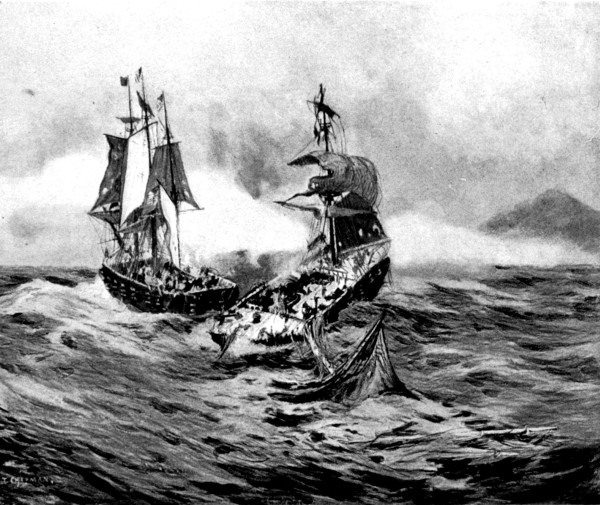
Late in the fall of 1813 a little American brig made her way up the
coast with a cargo that had once been consigned to some British
merchants in the West Indies.
The little brig had also, a few months previously, flown the British
flag, but now she came drifting into the harbor of New York under a
prize-master and his crew, for she had been taken in the Gulf of Mexico
by one of the privateers that had outfitted from New York.
She brought the news that only a short time before her capture three
smart English vessels had stopped at the port in which she had lain at
anchor. Two of these three vessels were sent from England on a special
mission; it was intended that they should round the Horn and cruise in
company in the Pacific Ocean in search of the frigate Essex, that had
spread terror from China to South America, and had chased the British
shipping off the western ocean.
On the 27th of October, 1812, the Essex, under the command of David
Porter, a fearless and persistent fighter, had set sail from the
United States on a cruise to the southward, his orders being to join
Bainbridge, his superior in the Constitution. The coast of Brazil
was then the cruising-ground for a large force of English ships of war.
Porter, hearing that Bainbridge, after his action with the Java, had
been forced to return to the United States, determined to make his way
around the continent into the blue waters of the Pacific. He had made
one important capture a few days before arriving at this last decision,
having taken the Nocton, one of King George’s packets. On board of
her were found eleven thousand pounds in specie.
After suffering severe hardships and meeting with many adverse winds
and tides in rounding the Horn, Porter at last made his way along the
harborless western coast, and arrived at Valparaiso on the 14th of
March, 1813.
The Essex’s crew had been on short allowance of water and small
rations, but not a murmur of dissatisfaction had been raised throughout
the voyage.
Having rested and victualled his ship, in a short time Porter hoisted
his anchors, spread his sails, and sailed out to sea again.
He had been out but a few days when he came across a Peruvian
corsair. Ordering her to heave to, he boarded her, and found, to his
astonishment, that she had on board twenty-four American sailors, the
crews of two whaling ships which she had taken on the coast of Chili.
When asked to explain his conduct, the Peruvian captain answered that,
in view of the fact that his country was an ally of Great Britain, and
that war was soon to be declared between Spain and America, he had
taken matters into his own hand. Porter, much incensed, released the
American sailors, and having thrown all the ammunition and guns of the
rather previous pirate overboard, he was let go, with a letter to the
Viceroy, complaining of his conduct.
Just before the Essex entered the harbor of Lima she overhauled one
of the corsair’s prizes, replaced her crew on board of her, and sent
them on their way to New Bedford rejoicing.
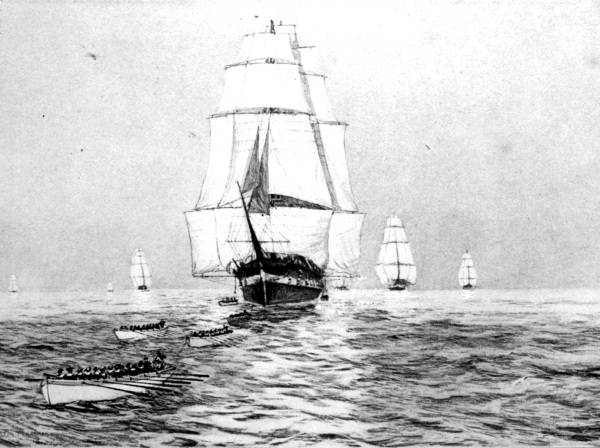
For a year the Essex cruised up and down the coast of South America,
extending her voyages far to the westward, to the various islands,
which were visited then infrequently by traders and whaling vessels.
During this cruise she frightened British commerce entirely from these
waters, and the strange spectacle of seeing one ship in control of a
vast territory was presented to the eyes of the world. The British
Admiralty were vexed and astounded beyond measure. Here one day and
there the next, Porter appeared to be in command of a fleet instead of
a single frigate.
He had fitted one of the captured British whalers as a tender, and
named her the Essex Junior, placing her under the command of
Lieutenant Downes, giving her an armament of ten 18-pound carronades
and ten short sixes, with a complement of sixty men.
At last, tiring of capturing merchantmen and glutted with the spoils
of easy victories, Porter decided to look for larger game; for the
news had been brought to him that the vessels which the little brig had
reported at New York so long before were on their way, sailing under
orders to find him at all hazards.
His ship required repairing, and therefore he sailed, accompanied
by his convoy of prizes, to the island of Nookaheeva, one of the
Washington group, that had been discovered by Captain Ingraham, of
Boston. Porter took possession in the name of the United States,
renaming it “Madison Island.”
Here he cached many of his stores, and anchored three of the prizes
well inshore. Erecting a small battery in a good position to command
the small harbor, Lieutenant Gamble, of the marines, and twenty-one men
were left with orders to proceed to Valparaiso after a certain period.
Two of the captures were given up to the prisoners and sent to England.
Three had been sent to America, and some were already anchored in the
neutral port of Valparaiso. It was December 12th when Porter set sail
from Madison Island for the coast of Chili. The Essex Junior followed
in his wake.
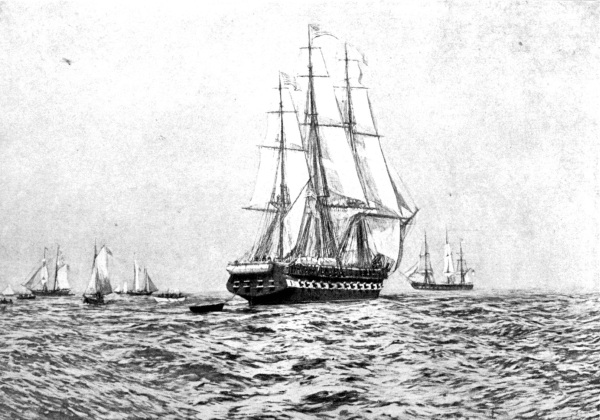
He arrived safely in the harbor, and had been there but a short time,
overhauling his spars and running-gear, when two sail came in from the
westward; they were the Phoebe, under the command of Captain Hillyar,
and the Cherub, sloop of war—both strongly armed and manned with
picked crews—the very ships that had been sent out to look for the
Essex.
No sooner had they come into sight of the long headland than they found
the frigate they were so eager to meet, within a short distance of
them. Then it was plain that they were not going to allow her to escape.
The British vessels, as they came down the harbor upon their first
entrance, sailed quite close to the American—so close, indeed, that,
in endeavoring to come about, the Phoebe missed stays and fell afoul
of the Essex, presenting herself in position to be raked fore and
aft; but Porter respected the neutrality of the port and restrained his
fire.
Had he known what was going to happen within the next few weeks, there
probably would have been a different termination to the Essex’s
glorious cruise.
The divisions were all at quarters, matches burning, and it was with
difficulty that the feverish seamen could be held in check.
So close were the ships that the men standing at the guns on the
British vessels could be easily seen, even taunts were exchanged and
grimaces were made over the bulwarks and through the open ports.
Sailing across to the other side of the harbor, and tacking again, the
British vessels anchored near the entrance.
Now for some time ensued a remarkable condition of affairs. The
commanders met on shore and exchanged gravely the courtesies which
navy men extended to one another in those days, belligerents though
they were. The shore parties of both forces meeting in town, under
strict orders, for a wonder, managed to keep from fighting, but they
were itching to be at it.
Porter had long flown a flag of his own with the motto, “Free Trade and
Sailors’ Rights.”
But, as if not to be outdone, the British commander threw to the air
his strips of bunting with a motto of his own: “God and Country.
British Sailors’ Best Rights. Traitors Offend Both.” (It was a fallacy
of the British that our ships were manned by deserters from the royal
service.)
The sail-maker and his assistant were soon at work on board the
American, and from the mizzen-mast of the Essex appeared the next
morning:
“God, Our Country, and Liberty. Tyrants Offend Them.”
Many times had Porter tried to get a challenge from Captain Hillyar (as
the Essex was the weaker vessel, he was not in a position to offer
the challenge himself), and he let it be well understood that he would
meet the Phoebe, in open combat, and would agree that the Essex
Junior should take no hand, on the condition that the Cherub also
should remain inactive.
The prudence of Captain Hillyar cannot but be commended. He was under
strict orders not to run any risks; he knew his enemy was at his
mercy; but the Essex had been put down, as most of our cruisers were
in those days, as “a dangerous nondescript,” to quote from the British
press of the time. In fact, many British frigates in the Atlantic
waters, where the Constitution had gained her laurels, kept near to
the great towering battle-ships—guard-ships, they were called.
It was all arranged that if the Essex should show a tendency to
make her way to sea, the Phoebe and Cherub would attack her
simultaneously. That was their idea in sailing in each other’s company.
Fearing that Porter might take advantage of a favorable wind to slip
past them if they remained at anchor, Captain Hillyar left the harbor,
and with the Phoebe proceeded to sea, where both ships patrolled up
and down like sentries at a prison gate.
The united force of the English vessels amounted to eighty-one guns and
five hundred men, in addition to which they had taken on board for the
nonce the crew of an English letter-of-marque that was then lying in
port.
The force of the Essex consisted of 46 guns, all of which, except six
long twelves, were 32-pound carronades, and useless except in close
fighting. Her crew, much reduced by the manning of her many prizes,
consisted of but two hundred and fifty men. The armament of the Essex
Junior we have named before.
It was evident that as long as the British vessels remained where they
were, the Essex was as good as captured. Something must be done,
and with such a commander as Porter the boldest plan was the most
attractive.
Many incidents had occurred to break the monotony of the blockade. Many
times had he left his anchorage, spread his sails, and made a feint of
leaving the harbor, and in all these trials he had found that his ship
could give the others points and beat them, so far as sailing went.
On one occasion the British ships stood boldly in before the wind and
bore down upon the Essex, part of whose crew had been given shore
leave; but before the tars had gone far into the town they saw the
approaching sails, and some crowded into the little native boats that
were hauled up along the shore; many even started to swim back to their
vessel.
The drum rolled and flags went up to the Essex’s mast-heads; but
Hillyar at that moment respected the international law, hauled his
wind, and went back to his blockading.
After a consultation with Lieutenant Downs, it was decided by Porter
that the period of inaction must be broken. A rendezvous was appointed,
and it was agreed that the Essex should allow the British ships to
chase her offshore, and give the Essex Junior a chance to make her
escape.
The very next day after arriving at this decision the wind came on to
blow fresh from the southward, and then followed a chapter of accidents
as disastrous as ever happened to any one unlucky vessel.
Even in yacht-racing the best boat does not always win; no allowances
are made for accidents, hard luck is an element that cannot be
forestalled, and thus it will always be in naval warfare. It must be
confessed that the fates were against America on this day, the 28th of
March.
The wind, which had started with a fresh breeze, grew stronger and
stronger, and, the anchorage being hard ground, the Essex began to
drag her anchors seaward. Suddenly her larboard cable parted, and
she went, stern foremost, at a good rate of speed towards the harbor
entrance. The adventure could be put off no longer. Trusting in the
superior sailing of the Essex to be able to work to windward, Porter
hoisted his topgallant-sails, braced around his yards, and came close
upon the wind.
The British vessels, off to leeward, crowded on all sail. In the
white-caps there was very little sea, for the fitful wind was new and
off the land.
It looked as if the Essex were going to escape; but just as she
rounded the point, the muzzles of her guns almost in the water, another
link in the chain of unfortunate circumstances was forged; there was a
crash, and the main-topmast went by the board, broken short above the
top. The men who were then lying out upon the yards went down with the
great spar over the side, and all were drowned. The Essex brought up
as if she had struck a shoal.
The English ships were now coming fast. Porter had no alternative but
to endeavor to get back to the protection of the port; but he could
not reach his former anchorage, hampered as he was by the wreckage at
his side. Therefore he made secure all sail upon his foremast and ran
for shore, anchoring there about a pistol-shot distance from the beach,
and three-quarters of a mile to leeward of the battery on the east side
of the harbor. Here he worked industriously to clear his decks and cut
away the tangled wreckage, but in the midst of this the crew of the
Essex saw that they were not to be unmolested.
Hillyar had determined to take advantage of the moment the Phoebe and
Cherub came down before the breeze, which was now dying away, and,
breaking all precedent of neutrality, they opened up their broadsides
upon their almost helpless antagonist. It was nearly four o’clock when
the first gun was fired.
Porter, seeing that the action was going to begin, endeavored to get a
spring upon his cable, and bring a broadside to bear upon the British
ships. He hoisted every flag he had, at every point where he could
reeve a halyard, awaiting quietly the nearer onslaught, and praying for
close quarters.
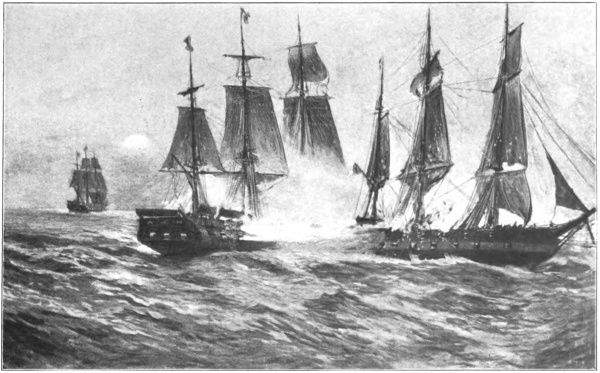
The Phoebe placed herself under the stern, and the Cherub on his
starboard bow; but so hot was the Essex’s answer to the latter
that she bore up and ran under his stern also; and now followed such
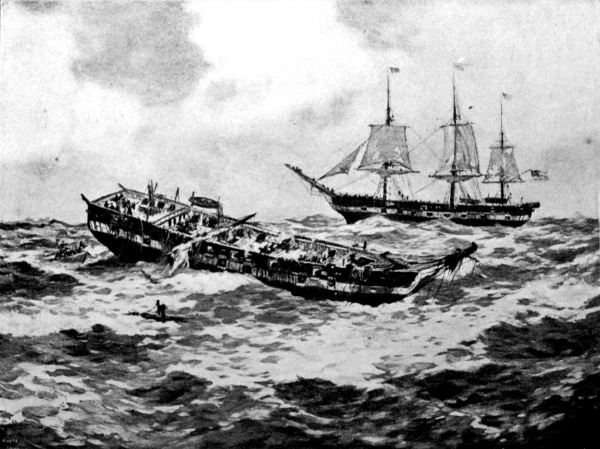
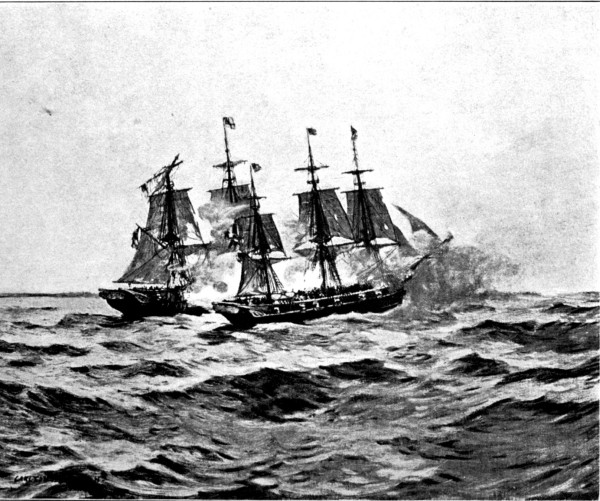
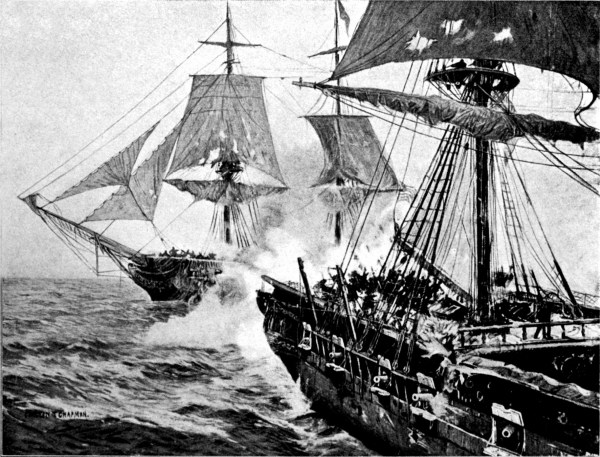
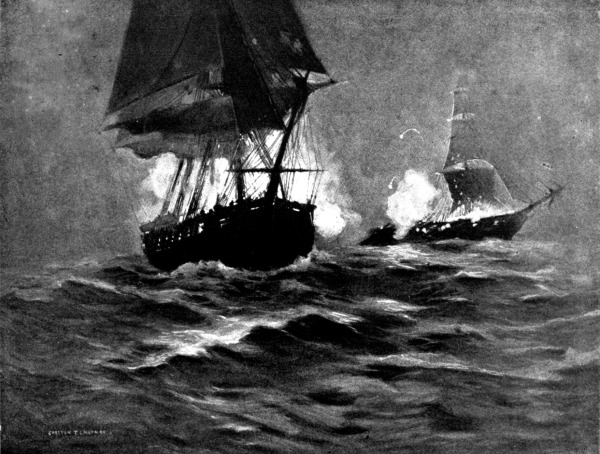
slaughter as has hardly been equalled in naval warfare. From their
positions they raked the hull of the Essex through and through,
cutting long gashes in her sides, and aiming with precision, as
if they were firing for practice at a helpless hull. Against all
this destructive cannonade Porter could only bring to bear three
long 12-pounders, which he had run out of the stern ports and the
cabin-windows, and well were they manned and served.
Two or three times did he manage to get a spring upon his cable, and
had half turned his broadside towards the enemy, but every time was
the hawser shot away, and the poor ship drifted back to her almost
defenceless position. Some of the round shot and whole charges of grape
from the Phoebe’s guns swept the Essex’s decks from stern-post to
the heel of her bowsprit. Whole crews were slaughtered as they worked
the few guns able to be brought to bear; but as fast as the men were
shot or blown away their places were filled by others. At one gun
fifteen men were killed, and as many wounded and carried below.
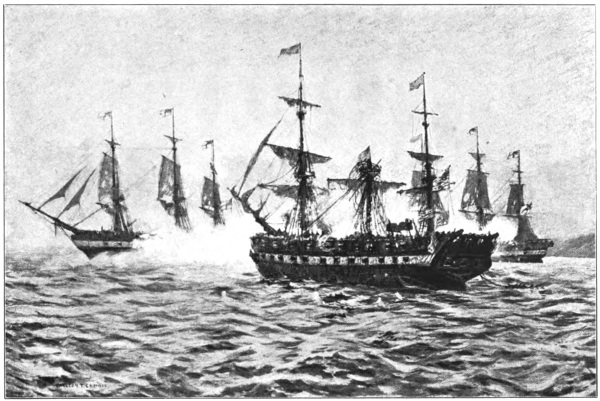
At this point in the combat Hillyar signalled the Cherub, and they
both drew off to repair their damages, that were far from slight.
Again in a few minutes they came down before the wind, and took a new
position athwart the Essex’s bows. To this fire Porter could not
bring a single gun to answer. Again the decks of the Essex were red
with blood; there had been no time to move the wounded, and the dead
lay huddled about in all directions. Now the shots even entered the
cockpit, and the men were killed as they lay on the operating-tables
under the doctor’s knife. To add to the horror, the Essex had caught
on fire forward and aft.
Still undismayed, Porter determined to close with the enemy. The only
sail that could be hoisted, owing to the mangled condition of the
rigging, was the flying-jib. He raised this, cut his cable, and ran
down on both ships, with the intention of boarding the Phoebe if
possible.
At the prospect of being able to fight back, his men revived again, and
a cheer ran along the shattered decks.
As the running-gear of the enemy was still intact, they easily kept
out of the Essex’s way, the Phoebe edged off, and, choosing her
distance, kept up her tremendous firing. Putting his helm hard down,
Captain Porter, finding the wind had shifted slightly, determined to
run his ship on shore, land the crew, and blow her up. He approached
once more within musket-shot of the sandy beach, when, in an instant,
the wind shifted from the land, as if the British had bribed the
elements, and once more the Essex was driving down upon the Phoebe.
But her tiller-ropes were shot away, and the poor hulk was totally
unmanageable.
At this moment one of the strangest incidents of the whole affair
occurred.
Lieutenant Downes of the Essex Junior, which still lay at her old
anchorage under the guns at the battery, loaded one of his boats and
rowed through the fierce fusillade down to his superior officer. He
came on board through a port, but his services could be of no avail.
After a consultation, Porter ordered him to return to his own ship, and
be prepared for defending her or destroying her in case of an attack.
So Downes loaded his boat with wounded, and, leaving some of his crew
on board the Essex to make room for them, he started to make his way
back to his own little vessel. The enemy did not respect his cargo or
his gallant action, but opened a hot fire upon him as he returned.
Luckily, however, the small cutter escaped swamping, and the men at the
long oars jumped her through the water at a rapid rate, despite the
plashing of the bullets all around them.
Horrible now was the position of the American frigate. Her commander,
in his desperation, persisted in the almost hopeless conflict, and
succeeded, by bending a hawser to the sheet-anchor, in bringing his
ship’s head around; the few remaining guns of his broadside opened once
more, and, strange to say, the Phoebe, which received this last and
almost expiring effort, was beaten off; but the hawser parted, and with
it failed the last hope of the Essex.
The flames that had started on her gun-deck and in her hold were
bursting up the hatchways; a bundle of cartridges exploded, killing two
men; and word was given out that the fire was near the magazine! Every
boat was cut to pieces; it was three-quarters of a mile from shore.
Thinking that the ship might blow up at any moment, Porter gave orders
to those who could swim to jump overboard and make for land.
The few remaining on board with the commander extinguished the fire.
Porter immediately summoned a consultation of his officers, and was
surprised to find that only one responded—Acting Lieutenant Stephen
Decatur McKnight; the others were killed, or below, disabled by their
wounds.
The late Admiral Farragut, who was a midshipman on board the Essex,
had displayed wonderful courage throughout the engagement. He was one
of the few midshipmen who were able to keep the deck.
Nothing could be done. The enemy in the smooth water had chosen their
distance, and were firing by divisions in a deliberate, careful way,
with coolness and accuracy. Almost every shot struck, and at twenty
minutes past six Captain Porter, almost weeping from the excess of
his grief, gave orders to strike the colors. It is probable that the
enemy did not perceive his action; for ten minutes longer the terrible
destruction continued; and once more, thinking that Hillyar was going
to show no quarter, the brave American was about to hoist his flag
again and fight until he sank, when the fire of the enemy suddenly
ceased.
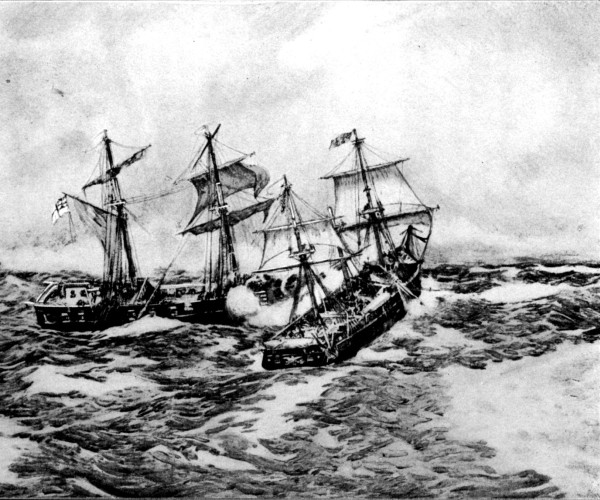
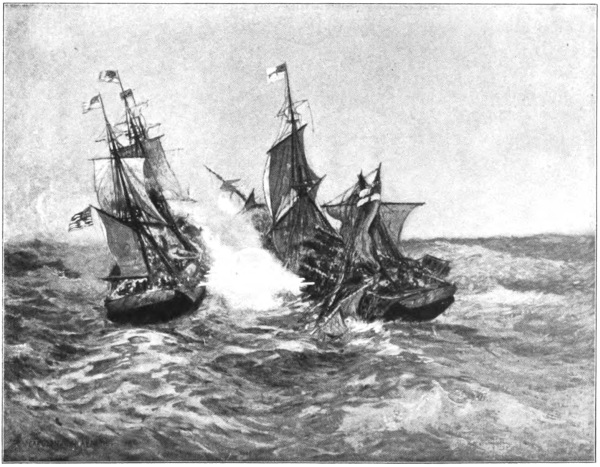
THE “ESSEX” BEING CUT TO PIECES
Thus ended one of the most bloody and obstinately contested actions in
naval record. Out of the 255 men composing her crew, the Essex had
but 151, including some of the wounded, able to stand on her decks; 58
were killed outright, 50 wounded, and 31 had been drowned.
The inhabitants of the city during the action had crowded to the shore.
Their sympathies had been all with the American. When they had seen
the various times when the Essex appeared to gain a slight advantage
their cheers could be heard coming across the water. So close had the
action been fought that many of the round shot from the Phoebe’s guns
had struck the land, and some of the spectators had been wounded.
When the first British officer boarded the captured vessel, so shocking
was the sight that met his eyes that, used to scenes of carnage though
he was, he staggered back and almost fainted, struck with the sickening
horror.
The loss on the Phoebe and Cherub has never been ascertained, but
it must have been severe. The former had received eighteen 12-pound
shot below her water-line; her first lieutenant was killed, and her
spars were badly wounded. It was with some difficulty that she had been
kept afloat, but it was with more difficulty still that the Essex
could be prevented from going to the bottom.
Captain Porter and his crew were paroled, and permitted to return to
the United States in the Essex Junior, her armament having previously been
taken out. When off New York Harbor they were overhauled by
a razee frigate, the Saturn, of His Majesty’s service, and the
authority of the commander of the Phoebe to grant a passport to his
prisoners was questioned.
All night the Saturn held the unarmed Essex Junior under her lee;
but the next morning, taking advantage of a slight gray fog, Porter put
off in his boat and rowed thirty miles to the shore, landing safely on
Long Island.
To quote from the contemporaries again:
“His reception in the United States has been such as great service
and distinguished valor deserve. The various interesting and romantic
rumors that had reached this country concerning him during his cruise
in the Pacific had excited the curiosity of the public to see this
modern Sindbad; and, arriving in New York, his carriage was surrounded
by the populace, who took out the horses and dragged him, with shouts
and acclamations, to his lodgings.”
The American commander’s own account of the affair, which appears in
a little volume entitled Porter’s Narrative, shows well the spirit
of this doughty old seaman, who, to use the expression applied to him,
“had rather have fought than ate.”
So virulent, however, were his tirades against the conduct of Captain
Hillyar that it is only just to take into consideration that the latter
commander, by refusing to take advantage of the many circumstances,
would have missed entirely the object of his sailing from England; and
his conduct has found many defenders among the writers of history on
the other side of the water.
The honor rolls of the United States navy show the records of many
a family history, and the name Porter has been associated with the
service from the Revolution to the present day. The late Admiral David
D. Porter was the younger son of the David Porter of Essex fame, and
he had been named after his father, who was a doughty old sea-captain
of the Revolution.
The second David Porter was born at Boston on the 1st of February,
1780. Thus he was but thirty-two years of age at the outbreak of the
war with Great Britain, and his school of training had been the same as
that of all the younger officers who now found themselves for the first
time in command. He was with Bainbridge in the Philadelphia when
that frigate was captured by the Tripolitans in 1803, and he suffered
imprisonment with the rest of the officers during the time that Preble
was endeavoring to liberate them. He had the honor of making the first
capture of a regular navy vessel of the war, when, in July, the Essex
compelled the Alert, of 20 guns, to lower her flag.