THE HUT, TROPIC AND POLAR.—PILLARS AND FLOORING.—TUNNEL ENTRANCE
OF THE IGLOO.—DOORS AND HINGES.—SELF-CLOSING TRAP-DOORS.
Primitive Architecture evidently borrowed from the Lower
Animals.—Roof Hut of the Nshiego Mbouvé of Western
Africa.—Platform Hut of the Orang-outan of Borneo.—Lake Dwellers
and their Huts.—Tree-huts of Southern Africa, and their
Uses.—Ascendancy of the Wild Beast over Man.—Snow-hut of the Seal
copied by Esquimaux, and its Value shown.—Pillars and
Flooring.—Crypt and Cathedral.—The Cuttle “Bone” and its
many-pillared Structure.—The Wasp-nest, its Pillars and
Floors.—Tunnel Entrances to Igloo.—Sudden Formation of
Snow.—Nest of the Fairy Martin.—The Sand-wasp and its Mode of
Building.—Doors and Hinges.—Eggs of the Gnat and
Rotifer.—Cocoons of Ichneumon-flies.—Habitations of
Microgaster.—Trap-doors in Nature and Art.—Habitation of the
Trap-door Spider.—A Nest upon a Pillar.
THERE can be little doubt that mankind has borrowed from the lower
animals the first idea of a dwelling, and it is equally true, as we
shall presently see, that not only primitive ideas of Architecture are
to be found in Nature, but that many, if not all, modern refinements
have been anticipated.
To begin at the beginning. The first idea of a habitation is evidently a
mere shelter or roof that will keep off rain from the inhabitant. When
Mr. Bowdich was travelling in Western Africa, he was told that the
Njina—another name for the Gorilla—made huts for itself from branches,
the natives also saying that it defended these huts with extemporised
spears. A more truthful account is given of the Mpongwe and Shekiani,
namely, that the animal builds a hut, but lives on the roof, and not
under it.
Although this information has since proved to be false, there was a
foundation of truth in it, for there really is an ape in that part of
Africa which makes huts, or rather roofs, for itself. This animal is the
Nshiego Mbouvé (Troglodytes calvus).
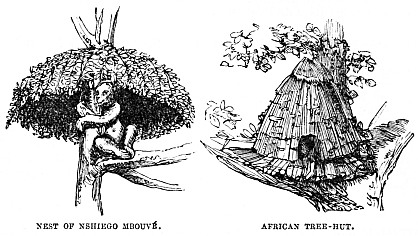
This remarkable ape has a curious way of constructing a habitation.
Choosing a horizontal branch at some distance from the ground for its
resting-place, the animal erects above it a roof composed of fresh
branches, each laid over the other in such a way that rain would shoot
off them as it does from a thatched roof. M. du Chaillu gives the
following account of this habitation:—
 NEST OF NSHIEGO MBOUVÉ.
AFRICAN TREE-HUT.
“As we were not in haste, I bade my men cut down the trees which
contained the nests of these apes. I found them made precisely as I have
before described, and as I have always found them, of long branches and
leaves laid one over the other very carefully and thickly, so as to
render the structure capable of shedding water.
“The branches were fastened to the tree in the middle of the structure
by means of wild vines and creepers, which are so abundant in these
parts. The projecting limb on which the ape perched was about four feet
long.
“There remains no doubt that these nests are made by the animal to
protect it from the nightly rains. When the leaves begin to dry to that
degree that the structure no longer sheds water, the owner builds a new
shelter, and this happens generally once in ten or fifteen days. At this
rate the Nshiego mbouvé is an animal of no little industry.”
The roof which this ape builds is from six to eight feet in diameter,
and is tolerably circular, so that it looks something like a large
umbrella. When the animal is at rest it sits on the branch with one arm
thrown round the stem of the tree, in order to support itself during
sleep. In consequence of this attitude the hair is rubbed away on one
side, thus earning for the ape the specific title of calvus, or bald.
It is rather remarkable that the Orang-outan of Borneo is likewise a
house-builder, though not in the same manner as the African ape which
has just been mentioned. This animal has a way of weaving together the
branches of trees, so as to make a platform on which it can repose, its
enormously powerful arms being of great service in this task. The animal
seems to make its platform in quite a mechanical manner, and it has been
noticed that when an Orang-outan has been mortally wounded, it has
expended its last energies in twisting the branches together so as to
form a couch on which it can lie down and die.
Putting aside those cases where huts have been erected in trees by way
of amusement, we may find instances where human beings have been forced
to make their habitations in trees.
In some places, such as certain parts of South America, the natives are
forced to make their houses in trees, partly on account of the climate,
and partly for the purpose of avoiding the mosquitoes.
The delta of the Orinoco River is nearly half as large as England, and
for a considerable part of the year is deep in water. Yet this tract is
inhabited by the Warau tribe, who find in it their only mode of escape
from the tiny but terrible mosquito. We in England know but little of
the miseries inflicted by these insects, which are so plentiful in some
parts of America that they are gathered in bags, pressed into thick
cakes about as large as ordinary dinner-plates, and an inch in
thickness, and then cooked and eaten.
Now it is found that although the mosquito infests the banks of rivers,
it cannot venture far from land. The Waraus, therefore, make for
themselves habitations which are far enough from land to baffle the
mosquitoes, and near enough to be easily reached in canoes.
Fortunately for them, there is a tree called the Ita Palm, belonging to
the genus Mauritia, which loves moisture, and grows abundantly in this
delta. The Waraus, therefore, make their habitations in these trees,
connecting several of them together with cross-beams, and laying planks
upon them so as to form the flooring of their simple huts. Here they
maintain themselves chiefly by fishing, but are sometimes obliged to
visit the mainland, in spite of the mosquitoes. When, however, they
return, they halt at some distance from the shore, and with green boughs
carefully beat out every mosquito from the canoe before they dare to
approach their dwellings.
The once-celebrated Lake Dwellers of Switzerland evidently lived after a
similar fashion.
In this case insects drive human beings into trees, but there are
instances where nobler animals have produced the same effect.
Some years ago there lived in Southern Africa a powerful chief called
Moselekatze, who spent his whole life in warfare, converting all the
male inhabitants into soldiers, dividing them into regiments, ruling
them with the extreme of discipline, and by their aid devastating the
neighbouring countries. He swept off all the cattle, which constitutes
the wealth of the Kafir tribes, and either killed the male inhabitants
or pressed them into his service.
The land was in consequence deprived of its natural defenders, and the
wild beasts, especially the lions, increased rapidly, so that the
position of the survivors was a really terrible one. They had no cattle
to furnish the milk which is the chief food of the Kafir tribes; their
weapons had been taken by Moselekatze; and they were forced to live
almost entirely on locusts and wild plants. By degrees the lions became
so numerous and daring, that the slight Kafir huts were an insufficient
protection during the night, and the disarmed and half-starved
inhabitants were perforce obliged to make their habitations in trees.
Dr. Moffat, the well-known missionary, saw one tree in which there were
no less than twenty huts. They were conical, and made of sticks and
grass, the base resting upon a platform or scaffold laid upon the fork
of a horizontal branch. The only mode of approach to these huts was by
notches cut in the trunk of the tree.
How needful were these precautions was shown by the fact that the
missionary himself spent a night in one of these aërial huts, and had
the pleasure of hearing a number of lions snarl and growl all night over
a rhinoceros hump which he had placed in an oven made of a deserted
ant-hill. The oven, however, was too hot for the lions, and they had to
retreat at daylight.
Passing from the tropics to the polar regions, we now take an instance
where man has acknowledgedly copied an animal in the construction of his
dwelling.
In Esquimaux-land, where no trees can grow, where for months together
the sun never rises above the horizon, where the temperature is many
degrees below zero, and where the land and ice are alike covered with a
mantle of snow so thick that every landmark is abolished, it would seem
that no human beings could support life for one week. There is neither
timber for house-building nor wood for fuel, so that shelter, warmth,
and cookery seem to be equally impossible, and as these are among the
prime necessities of human life, it is not easy to see how mankind could
exist.
 SNOW-HOUSE OF SEAL IN ESQUIMAUX-LAND.
SNOW-HOUSE OF ESQUIMAUX.
Yet these very regions are inhabited by sundry animals, and it is by
copying them that Man can keep his place. We have already seen how the
Esquimaux hunter copies the Polar Bear, and we have now to see how he
copies the Seal in the material and form of his dwelling-house, and not
only contrives to live, but to enjoy life all the more for the singular
conditions in which he is placed. Captain Hall mentions, in his “Life
with the Esquimaux,” that one of the natives, named Kudlago, who was
returning to his native country after visiting the United States, died
while on board the ship. Towards the end of his life he was yearning for
ice, and his last intelligible words were, “Do you see ice? Do you see
ice?”
On the vast plains of ice that are formed in the winter-time the snow
lies thickly, and yet upon such an inhospitable spot the mother seal has
to make a home for her tender young. This she does in the following
manner:—
She has already preserved a “breathing hole” in the ice, through which
she can inhale air. How she finds so small a hole under the surface of
the ice, where there are no landmarks to guide her, is a marvel to every
swimmer. She has to chase fish and follow them in all their winding
courses, and yet, when she is in want of air, is able to go straight to
her breathing hole, and there take in a fresh supply of oxygen.
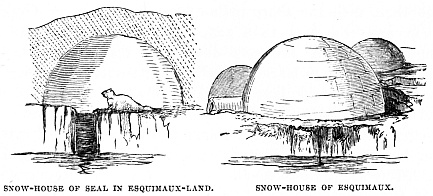
When she is about to become a mother, she enlarges this breathing hole
so as to make it into a perpendicular tunnel. She then, with the sharp
nails of her fore-paws, or flippers, scoops away the snow in a dome-like
form, as shown in the illustration, taking the snow down with her
through the ice, and allowing it to be carried away by the water. By
degrees she makes a tolerably large excavation of a hemispherical shape,
and when her young is born she deposits it on the ice-ledge around the
tunnel. From ordinary foes the young Seal is safe, and nothing can
discover the position of the house unless guided by the sense of smell.
How the Polar Bear and the Esquimaux hunter discover the dwelling and
capture the inmates we have already described in the chapter treating of
War and Hunting. Our present business is with the dwelling itself.
Comparatively few of these snow-houses, or igloos, as they are called,
are discovered, and they remain intact until the summer sun melts the
roof and exposes the habitation. By this time, however, the young Seal
has grown sufficiently to shift for itself, and no longer needs the
shelter of a dwelling.
The winter hut, or igloo, of the Esquimaux is made of exactly the same
shape and of similar materials to the dwelling of the Seal, the chief
difference being that it is built instead of excavated.
In order to save time, the igloo is generally erected by two men, one of
whom supplies the material, and the other acts as bricklayer and
architect in one. Each begins by tracing a suitably sized circle in the
snow, which he clears away to some depth, so as to preserve a firm
surface, either as a floor or as the material for the wall. In this work
both men are equally valuable, for the skill required to cut the slabs
of snow into such a shape that they can be formed into a hemispherical
dome is quite as much as that which is needed for putting them together.
I will call them the cutter and the builder. Sometimes a young hand is
employed by way of labourer, and passes the snow slabs to the builder as
fast as they are cut.
The builder receives the slabs, and arranges them in regular order,
always taking care to “break the joints,” just as do our bricklayers of
the present day. Always remaining within the circle, he gradually builds
himself in, and when he has quite finished the house, he cuts a hole
through the side, emerges, and, by the help of his partner, puts on the
finishing touches. He usually also adds a sort of tunnel to the door,
through which any one must creep on his hands and knees if he wishes to
enter the igloo. This part of Esquimaux architecture will presently be
noticed more in full.
Perhaps the reader may wish to know what provision there is for
ventilation. The answer is simple enough. There is none, the Esquimaux
not requiring ventilation any more than they require washing. The two,
indeed, generally go together; and it may be observed, even in our own
country, that those who object to fresh air, and are always complaining
of draughts, have a very practical aversion to the use of fresh water,
and but little confidence in what Thackeray calls the “flimsy artifices
of the bath.”
The Esquimaux never washes, and knows not the use of linen.
Consequently, it is no matter of surprise that a sailor of Captain
Hall’s crew could not make up his mind to enter an igloo. “Whew!”
exclaimed the man, “by thunder, I’m not going in there! It’s crowded,
and smells horribly. How it looms up!”
Considering that there were inside that igloo a dozen Esquimaux, all
feasting on a raw, newly killed, and yet warm seal, the sailor had
reason enough to decline a visit. Captain Hall, however, determined, in
his character of explorer, to brave the strange odours, and moreover to
join the inmates in their feast, knowing that as he would have to live
among the Esquimaux for some two years, he would be forced to live as
they did, and might as well begin at once. Consequently on this resolve,
he drank the still steaming blood, and quaffed it from a cup which an
Esquimaux woman had just licked clean.
One decided step in Architecture is the invention of the Pillar, and its
capabilities of aiding to sustain another floor above it. We see this
principle carried out in our great cathedrals, where the use of the
Pillar is almost infinite. Take, for example, Canterbury Cathedral. A
heedless visitor might easily pass through the nave, enter the choir,
visit the various side-chapels, and “Becket’s Crown,” without thinking
that under his feet is a vast chamber, and that the floor on which he
stands is, in fact, the roof of a great crypt.
 WASP-COMBS.
SLAVE SHIP.
The weight of the Cathedral, with its lofty towers, is so tremendous,
that the building could not be erected simply upon the ground, but rests
upon a complicated substratum of pillars and arches, whereby the weight
is spread over a large surface. In fact, the Cathedral is really two
buildings, the one erected upon the other.
In Nature there are many instances of pillars supporting different
floors. One of the most beautiful examples is to be seen in the common
Cuttle-bone, as it is called, this being the internal skeleton, if it
may be so termed, of the common Sepia (Sepia officinalis), which is so
often found on our coasts, especially after a gale. This year (1875) I
found eight of these Cuttle-bones on the Margate sands, and all within a
space of some twelve feet square.
This so-called bone is really composed of the purest chalk, for which
reason it is in great request as a dentifrice, being easily scraped to
almost impalpable powder when wanted, and not liable to be spilled, as
is the case with any ordinary tooth-powder.
It is exceedingly light—so light, indeed, that it floats like a cork,
even in fresh water. Now, as chalk is very much heavier than water, we
may naturally ask ourselves how this lightness is obtained. If the upper
surface be examined, it will be seen to be traversed by a vast number of
wavy lines, something like the markings of “watered” silk. These show
the lines of demarcation between the multitudinous rows of pillars of
which the whole structure is formed.
If the “bone” be sharply snapped in the middle, and the particles of
white dust blown away, a wonderful structure presents itself, which can
be partially discerned by the naked eye, though a microscope is required
to bring out its full beauties.
Even with an ordinary pocket lens we can make out some of its wonders.
The object looks like a vast collection of basaltic columns, except that
the pillars are white instead of black, and they are arranged in rows
with the most perfect accuracy, just as if the place of each had been
laid down with rule and compass. They are scarcely thicker than ordinary
hairs, but they are beautifully perfect, and rise in tier after tier as
if they were parts of a many-storied building. As a definite space
exists between the pillars, the reader will understand why the whole
structure should be so much lighter than water. In order, however, to
see these wonderful pillars in perfection, a very thin section should be
taken, and viewed with polarised light.
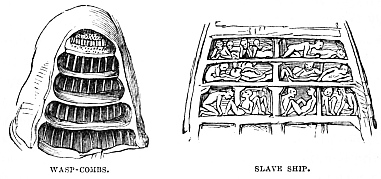
Another excellent example of Pillars and Flooring is to be found in the
nests of various Wasps, including that of the Hornet.
In these nests the combs are arranged horizontally, and not vertically,
like those of the bees, and in consequence they have to be supported in
some way. This object is achieved by means of multitudinous pillars made
of the same papier-mâché of which the combs are formed, and attached to
the successive rows of combs. There is, however, one curious point of
difference between the Wasp-comb and human architecture, namely, that
the pillars do not support floors, or rest upon them, but sustain the
weight of those which hang from them. The mouths of the cells are all
downwards, and the combs are therefore suspended from the pillars,
instead of being supported by them.
We have already found occasion to treat of the snow-house, or igloo, of
the Esquimaux, and have now to speak of a subsidiary, though necessary,
part of Esquimaux architecture.
Perhaps the reader may have been unfortunate enough to travel by rail in
the depth of winter, and to be associated with fellow-passengers who
will insist on closing every window, even though the carriage be
crowded. Suppose that on such a day, the weather being perfectly fine,
the train stops at a station, and the guard outside opens the door to
see if another passenger can be accommodated with a place.
No sooner is the door opened than a shower of snow at once fills the
carriage. This is simply the moisture suspended in the air and generated
by human lungs. The rush of cold air at once freezes this moisture and
converts it into snow, thus showing those who will condescend to learn,
that they have been breathing and re-breathing the air that has passed
through a variety of human lungs, and is charged with their different
moistures. I have seen the same phenomenon at a dinner party, where,
after the withdrawal of the ladies, one of the windows was opened.
Now, in Esquimaux-land, it is absolutely necessary to conserve every
atom of heat, for the cold is so intense that if a cask of water be near
a coal fire, only the part next the fire will be thawed, the rest being
ice. Cold, therefore, is a foe which has to be fought and kept away from
the household. Then there are other foes—such as Polar Bears, for
instance—which would be only too glad to get into an igloo and make a
meal of its inhabitants. The Esquimaux architect, therefore, avails
himself of an ingenious device by which he can set both foes at
defiance.
In summer-time he contents himself with a hut made of skins, and merely
hangs a skin over the entrance by way of a door. But in the winter, when
he is driven to his snow-house for shelter, he acts in a very different
manner. Instead of merely cutting an aperture for a door in the side of
the igloo, he constructs a long, low, arched tunnel, so small that no
one can enter the igloo except by traversing this tunnel on his hands
and knees. Sometimes a number of huts are connected with each other, one
or two tunnels leading into the air, and the rest serving merely as
passages from one hut to the other.
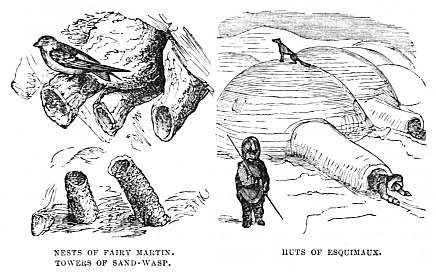 NESTS OF FAIRY MARTIN. TOWERS OF SAND-WASP.
HUTS OF ESQUIMAUX.
In Nature are several examples of tunnels constructed on the same
principle.
There are, for instance, the curious nests of the Fairy Martin of
Southern Australia (Hirundo Ariel), which bear a singular resemblance
to oil-flasks, the body of the nest being rather globular, and the only
entrance being through a tolerably long, tunnel-like neck.
Then there are the various Weaver-birds of Africa, with their
long-necked nests. Some of these strange edifices look almost like
horse-pistols suspended by the butt, so round is the nest, and so long
and narrow is the tunnel-like entrance.
Passing to the insect world, we find the same principle carried out by
the now familiar Mason-wasp (Odynerus murarius), some of whose nests
are represented in the illustration.
This insect makes a burrow, and at the bottom of it deposits an egg,
together with a number of little caterpillars on which the grub, when
hatched, will feed. The mother Wasp is not allowed to pursue this task
without taking precautions against the admission of enemies to her
burrow, especially the ichneumon-flies. As may be inferred from its
popular name, the Sand-wasp always selects a sandy spot for its burrow,
and generally chooses a piece of tolerably hard sandstone, which it is
able to bite into little pellets, aided by a kind of liquid which it
secretes.
The following account of the manner in which the Mason-wasp forms and
defends its home is taken from the invaluable “Insect Architecture,” by
Rennie.
The author begins by describing the form and depth of the burrow, and
the soil in which it is made. He then proceeds to show the wonderful
manner in which the mother Wasp purveys food for the use of her future
young whom she will never see. Guided by instinct, she places in the
burrow exactly the number of caterpillars which the young Mason-wasp
will have to consume before it attains its perfect condition. It is
believed that she partially paralyzes them with her sting before placing
them in the burrow. At all events, when they are once packed away, they
never move, so that the tiny Wasp grub can feed upon them quite at its
leisure.
Here is Rennie’s account of the Sand-wasp and her burrow-making:—
“When this wasp has detached a few grains of the moistened sand, it
kneads them together into a pellet about the size of one of the seeds of
a gooseberry.
“With the first pellet which it detaches, it lays the foundation of a
round tower, as an outwork, immediately over the mouth of its nest.
Every pellet which it afterwards carries off from the interior is added
to the wall of this outer round tower, which advances in height as the
hole in the sand increases in depth. Every two or three minutes,
however, during these operations, it takes a short excursion, for the
purpose probably of replenishing its store of fluid wherewith to moisten
the sand. Yet so little time is lost, that Réaumur has seen a mason-wasp
dig in an hour a hole the length of its body, and at the same time build
as much of its round tower.
“For the greater part of its height this round tower is perpendicular,
but towards the summit it bends into a curve, corresponding to the bend
of the insect’s body, which, in all cases of insect architecture, is the
model followed. The pellets which form the walls of the tower are not
very nicely joined, and numerous vacuities are left between them, giving
it the appearance of filigree-work.
“That it should be thus slightly built is not surprising, for it is
intended as a temporary structure for protecting the insect while it is
excavating its hole, and as a pile of materials, well arranged and ready
at hand, for the completion of the interior building,—in the same way
that workmen make a regular pile of bricks near the spot where they are
going to build. This seems, in fact, to be the main design of the tower,
which is taken down as expeditiously as it has been reared.
“Réaumur thinks, that by piling in the sand which has previously been
dug out, the wasp intends to guard its progeny for a time from being
exposed to the too violent heat of the sun; and he has sometimes even
seen that there were not sufficient materials in the tower, in which
case the wasp had recourse to the rubbish she had thrown out after the
tower was completed. By raising a tower of the materials which she
excavates, the wasp produces the same shelter from external heat as a
human being would who chose to inhabit a deep cellar of a high house.
“She further protects her progeny from the ichneumon-fly, as the
engineer constructs an outwork to render more difficult the approach of
an enemy to the citadel. Réaumur has seen this indefatigable enemy of
the wasp peep into the mouth of the tower, and then retreat, apparently
frightened at the depth of the cell which she was anxious to invade.”
It is no wonder that the Sand-wasp should be so anxious to insure the
safety of her nest, for her foes are multitudinous. Putting aside the
ordinary Ichneumon-flies, we have the predatory Tachinæ, which are
always hovering over such nests, and trying to deposit eggs therein. For
many years I have been in the habit of receiving letters from novices in
entomology, wanting to know whether I am aware that the common Housefly
is in the habit of acting as a parasite. Of course, the writer has
mistaken the Tachina for a house-fly, but I cannot regret the fact that
some one has really begun to observe Nature, and not only to read books.
Having seen that both in Nature and Art the entrances to dwellings are
guarded by tunnel-like approaches, we come naturally to another mode of
guarding the entrance, namely, by a door moving on hinges. As to the
multitudinous examples of doors and hinges in modern civilisation, we
need hardly discuss them, except to show the exact analogies which occur
in Art and Nature.
Doors moving on hinges are very plentiful in Nature, even where we
should least expect them. Take, for example, an egg, especially the egg
of an insect, and we shall see that it is just about the last object in
which we should expect to find a hinged door. Yet, if the reader will
refer to the illustration on page 7, he will see that the tiny eggs of
the common Gnat, numerous as they may be, are each furnished with a door
which opens as soon as the inmate is hatched, and allows the little
larva to escape into the water.
Another still more remarkable instance of a hinged door in an egg is to
be found in one of the Rotifers, or Wheel-Animalcules, so called because
they possess an apparatus of movable cilia, which, when set in motion,
looks exactly like a wheel running round and round. As the full-grown
creature is barely one thirty-sixth of an inch in total length, the
structure of its eggs must be infinitesimally beyond the range of human
vision.
Yet, just as the telescope sets at partial defiance the vast spaces that
intervene between our earth and her sister planets, so the microscope
performs a similar task in the infinitesimally minute. And, under the
all-revealing lens of the microscope, the little egg of the Brachionus,
though absolutely invisible to the unaided eye, yields up its secrets.
Fortunately, the shell is so transparent that the interior of the egg
can be seen through it as if it were a mere film of glass. The
astonishing division and re-division of the yolk take place before our
eyes, being divided first into two, then into four, then into eight,
then into sixteen, then into thirty-two, and so on, until the whole mass
of the yolk is cloven into divisions too numerous to count.
By degrees, the form of the young Brachionus is developed within the
egg, even to the very teeth, which work away as persistently as if large
stores of food were being passed through them.
When the young is ready to take its place in the world, a new
development occurs, which has been well related by Mr. Gosse:—
“All these phenomena have appeared in the egg we are now watching; and
at this moment you see the crystalline little prisoner, writhing and
turning impatiently within its prison, striving to burst forth into
liberty.
“Now, a crack, like a line of light, shoots round one end of the egg,
and in an instant, the anterior third of the egg is forced off, and the
wheels of the infant Brachionus are seen rotating as perfectly as if the
little creature had had a year’s practice.
“Away it glides, the very image of its mother, and swims to some
distance before it casts anchor, beginning an independent life. At the
moment of escape of the young, the pushed-off lid of the egg resumes its
place, and the egg appears nearly whole again, but empty and perfectly
hyaline (i.e. all but transparent), with no evidence of its fracture,
except a slight interruption of its outline, and a very faint line
running across it.”
To pass from the egg to a more advanced stage in life. All practical
entomologists have been greatly annoyed, in their earlier years of
collecting, to lose larva after larva, from the attacks of
Ichneumon-flies. It is certainly rather beyond the limits of ordinary
patience to discover, watch over, and secure successfully a rare
caterpillar, and then to find that it has been “stung” by an
Ichneumon-fly.
The veteran entomologist, however, troubles himself very little about
such minor misfortunes, and, as a rule, more than compensates for them
by preserving the intrusive Ichneumon-fly, and giving in his diary full
details of the insect on which it was parasitic, of the plant on which
the caterpillar lived, the date of its appearance, and its numbers.
Now, there are many of these parasitic insects, notably those belonging
to the genus Microgaster, which invariably make doors in their cocoons.
I have now before me groups of cocoons made of the two commonest British
species, namely, Microgaster glomeratus and Microgaster alvearius,
and in both of them each tiny cocoon is furnished with a hemispherical,
hinged door. I have also some exquisitely beautiful groups of
Microgaster cocoons found in the West Indies. They are the purest white,
shine with a satiny lustre, and are arranged round a hollow centre, much
as if they had been gummed to the outside of a very large thimble. There
are many hundreds of them, and every one has its little door still open
as it was when the fully developed insect first made its escape.
Another curious example of a natural door may be seen by those who will
look for it.
On plants infested with aphides, or “green blight,” as the gardeners
quaintly term them, may often be seen dead aphides much larger than the
rest, globular, brown, and shining. These aphides have been “stung,” as
it is called, by a little Ichneumon-fly belonging to the genus Ophion,
and having, like all its congeners, a flat and sickle-shaped abdomen.
The egg which has been laid in the aphis soon hatches, and the young
Ophion absorbs into itself all the juices of the aphis. It remains
within the body of its involuntary host until it is fully developed,
when it cuts a tiny, but beautifully perfect circular door in the skin,
and emerges, leaving the door open and still attached by its little
hinge.
Considering the small size of the aphis, and that the diameter of the
door is only one-eighth of the length of the insect, the perfection of
its form is really remarkable.
One of the achievements of modern Architecture is the Self-closing Door,
especially where it must of necessity close by its own weight, and when
the fitting is so exact, that even the most experienced eye can
scarcely detect it. Such a door is to be found guarding the nest of the
Trap-door Spiders, several species of which are found scattered over all
the warm parts of the earth. A side view of one of these extraordinary
nests is given in the accompanying illustration, and on the other side
is the common trap-door of our cellars.
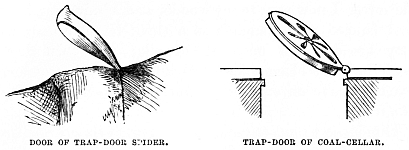 DOOR OF TRAP-DOOR SPIDER.
TRAP-DOOR OF COAL-CELLAR.
The Spiders which make these extraordinary dwellings generally begin by
excavating a nearly perpendicular tunnel in the ground. They line it
with a silken web, and construct a door which exactly fits the orifice,
and which is bevelled so that it shall not sink too far, and thus betray
itself. I have seen and handled one, where the burrow had been sunk
among lichens and mosses, and the trap-door of the nest had been most
ingeniously covered with the same growths. Although the surface of the
slab of earth in which the nest was made is only a few inches square, it
is almost impossible to detect the entrance, so admirably do the mosses
on the door correspond with those outside it.
Almost invariably the nest is sunk in the ground, but I have a specimen
sent to me from India, in which the Spider must absolutely have carried
the clay to a fluted pillar, burrowed in it, and then made its beautiful
habitation. The nest and its inhabitant were sent to me by an officer in
the 108th Regiment, accompanied by the following letter:—
“The packet contains a large Spider and the upper portion of its
peculiar nest, the history of which is as follows.
“On the thirtieth of last month (September, 1870), while searching for
caterpillars on a bush growing close to one of the pillars of my
verandah, which is a very low one, reaching to within a foot of the
ground, I saw in part of the chunam masonry at the foot of the pillar
what I at first sight took to be a couple of seeds sticking to a stone.
On trying to pull one off, I found that it came up with ease, bringing
with it what I thought was the stone.
“But I had scarcely got it up when it was smartly pulled back. This
excited my curiosity, and I raised it again with a little force. I now
saw, to my wonder and admiration, that what I had fancied was a stone
was a small circular door with a pretty broad hinge, made all of silk;
and then distinctly observed a large black spider dart down the hole to
which the above door gave an entrance. But, not knowing the depth, I
broke it.
“This piece I send to you, together with its original owner, who, at the
beginning of my digging operations, ran up suddenly, shut the door in my
face, and hung on to it like grim death when I tried to reopen it. He
soon came away with the upper piece, still keeping the door resolutely
closed.”