Now, my reader, we have come to the last
chapter of this book, which is going to be the
hardest chapter of all, and I think, the most
important. For though it is going to be about
something that nobody quite understands, and
something that the more one thinks about, the more he
doesn’t understand it, nevertheless it is something
that you will have to think about many times in
your lives hereafter, and you might as well make a
beginning. Besides, though you won’t understand
all that I am going to say—largely I am afraid,
because I don’t understand it myself—still I trust
that you will remember some of it; and by and by
when you are sorely puzzled over these matters,
perhaps it will help you out.
If you will think back over what I have already
told you in this book about animals and plants, and
recall also what you have yourselves seen, and
what you have learned about your own bodies and
the way they work, I think you will agree with me,
that of all the strange and wonderful things in this
most strange and wonderful world, a living thing
is the strangest and the most wonderful.
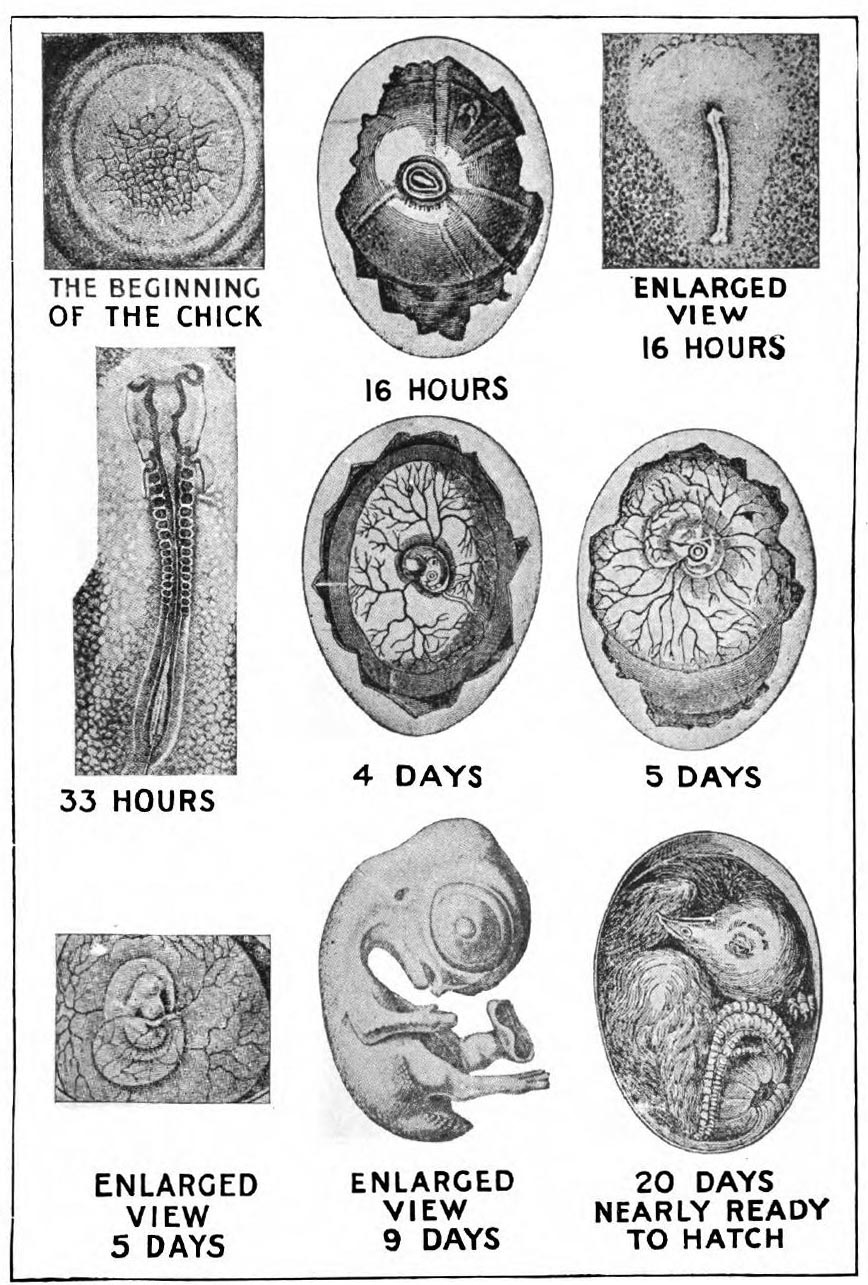
Think, for example, how a little egg, no bigger,
it may be, than the head of a pin, with no help
from outside, except perhaps a little fresh air and
a little warmth, just goes ahead and makes itself
over into a grown animal. Consider, too, how well
it does the job—every scale and feather and tooth
and bone and gland and muscle and claw and nail
and blood vessel and nerve and hair, all just in the
right place, and just of the right size. When one
builds a house, the owner consults the architect,
and the architect advises with the contractor, and
the contractor puts some of the work on the
sub-contractor, and the contractor and the
sub-contractors direct the workmen; and among them,
in a year or so, they manage to get the house
together. But in the world of living things, one
little fleck of living protoplasm goes ahead all by
itself, and builds a whole living animal, sometimes
in a few days. Yet there are more different parts
to be made and fitted together in one of your little
fingers, than in any common dwelling house, even
tho you count the laths behind the plastering and
the shingles on the roof—yes, and the nails that
hold them on. As for your brains, they are, each
one of them, for complexity, like all the parts of
all the houses in a fair-sized city, with all the
furniture, and all the tableware, and all the pots
and pans in all the kitchens thrown in for good
measure. If you think that a watch or a
battleship is a complicated affair, think what goes on in
the brain of a tiny ant.
Think, too, how resourceful an egg is. It tries
its best to grow into a proper animal; but if
somebody interferes, to prevent that, then the egg goes
pluckily ahead and makes the best it can of a bad
matter. If it gets jarred apart so that it cannot
make one animal, why then it makes two, or four,
or eight. When it can make neither one animal
nor two proper and separate twins, it doesn’t give
up, but makes some sort of double monster, that
at least manages to keep alive. For my own part,
I feel a sincere respect for eggs. I wish more of us
had their pertinacity.
After the egg has made itself into a grown
animal, consider how well fitted out that animal
is. It has, usually, eyes, nose, mouth, ears, sense
of touch, of heat and cold, of taste, and the rest.
It has born in it the instincts to find its proper
food, to find or build its shelter, to take care of its
young, to escape its enemies, and in general to like
the things which it is best for it to do. Yet if it
doesn’t happen to have these sense organs and
instincts and the rest, still it always has something
nearly as good, and manages somehow to get its
living in the world.
Yet I sometimes think that the most
extraordinary thing about living things, both animals
and plants, is the enormous number of different
kinds of them. There are some twenty different
sorts of cats, of various sizes from lions down;
and twice as many different sorts of dogs, wolves,
foxes and other dog-like creatures. There are
thirty-two different kinds of willow trees in North
America, thirty-six different kinds of pine trees,
Sixty-three different oaks. As for insects, about
three hundred thousand different sorts have
already been given names; and there are at least
ten times as many more that are still nameless.
Do you know how many different races of men
there are that you can tell apart by their
looks?—Chinamen, Negroes, White men, Tartars, Eskimo,
Indians, Malays, Arabs, and I don’t know how
many more, all alike in being human, and yet all
different.
Why there should be such a lot of different
animals and plants and men is something that
nobody fully understands. We do know, however,
and know very certainly, that there haven’t
always been all these various sorts in the world.
If we could go back a sufficient number of thousand
years, we should come to a time when, instead of
twenty sorts of cat, there were only ten. Back of
that, was a still more ancient time when there were
only five. A long time before even that early day,
there was only Patriofelis, “the father of cats,”
and even he, as you know, was also a good deal like
a seal.
So too there must once have been a “father of
dogs” whose descendants have changed, some into
proper dogs, and some into wolves, and some into
foxes, and some into jackals, coyotes, dingos,
fennecs, and the rest of the forty-odd sorts of
wild dogs—to say nothing of all the various tame
dogs, collies and terriers and mastiffs and bull dogs
and setters, that you can count up for yourselves.
Once too, there was only one kind of man. He
probably lived somewhere in southern Asia, and
spread out from there, till he possessed the whole
earth. Some of him went south-east into the
Pacific Islands, and changed into Malays and
Australians. Some of him went south-west into
Africa and became Negroes. Some became
Persians, Egyptians, Hindus, and Arabs. Those that
kept on further and entered Europe turned various
shades of white and became us. For very few
white men are really white—only certain Swedes
and Norwegians and Danes. The rest of us,
who call ourselves white, are merely not quite
so black as our very-many-times-great-grandfathers
and our somewhat distant cousins, the
Negroes.
Most of these early men, however, started
north-east; and because they couldn’t very well
cross the great mountains and deserts in central
Asia, they ran round the eastern end, and then
came back on the other side. On their way, they
turned to Chinamen and Japanese. Those that
got way up to the north under the Arctic circle
became Eskimos. Some of them crossed over by
way of Siberia and Alaska (for these countries have
not always been as cold as they are now) and
turned into American Indians.
Then, after these people had got north of the
great Asian mountains, others of them turned
west, and came clear across into Europe. In fact,
they came near to overrunning Europe during the
last days of the Roman Empire so that the famous
Charlemagne had to fight them in the eighth
century, as you will learn when you study history
in school, or still better when you read stories of
knights and paladins of the early Middle Ages.
So part of us white men came to Europe, and then
to America, directly from southern Asia. And
part of us came round by way of China and
Tartary and Russia; tho now we are all mixt up
together so that no one can tell which from t’other.
Yet even now, whenever you get up in the gallery
and look down on the people’s heads, you can see
that some white men have long, egg-shaped heads
and narrow faces, and some have round
bullet-shaped heads and broad faces. The long sort of
head came straight up from India, by way of Asia
Minor; and the round sort came round the end of
the mountains and across central Asia. That’s
the reason why, tho we are all white men, we can’t
wear one another’s hats.
That’s about the way it is with all kinds of
animals and plants. Each one starts somewhere,
and spreads out in all directions as far as it can,
gradually changing as it goes, until from being one
sort of pine or oak, there come to be dozens, and
instead of one kind of cat or dog there are a score.
On the whole, too, the latest kinds of animals and
plants are better than the earlier ones and there
are a great many more of them. This is what we
call Evolution—but why it all happens or what it
is all for, Is just precisely “one of those things that
no fellah can find out.”
Still one can’t help thinking that if we men
can make as many things as we do out of iron—knives
and saws and locomotives and bridges
and sky-scrapers and battle-ships and all sorts of
wonderful machinery, and make them better and
better all the while, some wiser being than ourselves
might make other and still more wonderful
machines out of the life-jelly which we call
protoplasm, and keep making them better and better
and more and more kinds of them as the ages
have gone on.
Air, importance of clean, 276.
Ambidexters, 121-122.
Amoeba, 40;
feeding of, 245.
Ants, 194-209.
Anti-toxin, 280.
Bacteria, 31, 38, 71, 141;
and disease, 266 and following, 274 and following.
Bean, 20-23, 146.
Bee, 70, 71.
Birds, instincts of 96-98;
lizard-like, 351.
Blind spot, 186-188.
Blood, 32, 43-44;
growth of, 50-51;
and air, 242 and following;
waste matter in, 253 and following;
poisons in, 263 and following;
living creatures in, 268 and following;
as defence, 279 and following;
messages by way of, 294 and following;
salt in, 329 and following;
sea water as, 330 and following.
Bones, of chick, 5;
of fish, 16;
growth of, 49-50, 300.
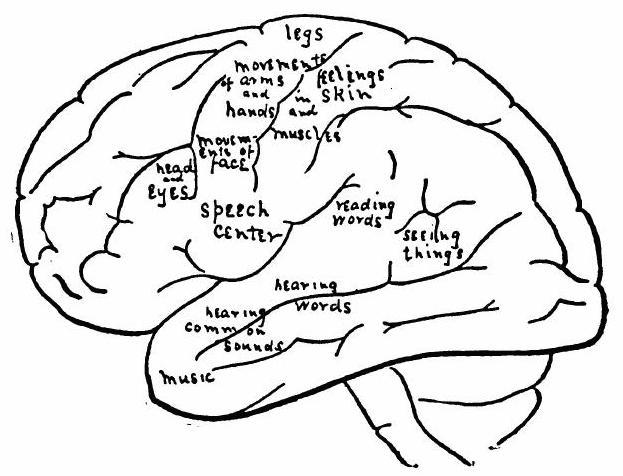
Brain, of chick, 4, 5;
of fish, 16;
and speech, 114-118;
centers in, 123-135;
accidents to, 127-133;
complexity of human, 357.
Breath, why we get out of, 257 and following.
Breakfast table, experiments in recalling, 228-229, 234.
Camel, 106.
Cat, 12;
hunting instinct in, 86-87;
and mouse, 94-95;
and food in bottle, 102;
double paws of, 320;
teeth of, 321;
sharp claws of, 328;
feet of, 341;
ancestors of, 350.
Caterpillars, and moths, how find their way, 158-163;
change to butterflies, 297 and following.
Cells, 31-41, 238;
of eggs, 25-27;
of human beings, 27-29;
of plants, 35-37;
of bone, 45.
Chick, hatching of, 1-2;
growth in eggs, 3-6;
instincts of, 91-93;
gill slits of, 332 and following.
Children, 24;
growth of, 56-58, 61-64;
best plays for, 58-60;
grip of very young, 75-76, 84;
swallowing of, 77;
instincts of, 78-85, 93-94;
compared with animals, 112-114.
Cold, and heat, sense of, 169-170;
experiments with, 191-192;
how we catch, 286.
Colors, how we see, 177, 183-185, 197-198.
Coon, and box, 102-104.
Corn, 66-68.
Cork, 43.
Cow, 12, 113, 246;
and stuffed calf, 105-106, 112;
limbs of, 340, 341.
Crab, breaking joints of, 309 and following;
eye of, 310, 319.
Date palm, 68.
Dog, 12, 61-62, 246;
hunting instincts in, 86-88, 95;
story of, 100,-101;
advantage of speech to, 110,-111;
sight and smell in, 220-222;
teeth of, 321 and following;
claws of, 328;
feet of, 341;
ancestors of, 349 and following.
Dolls, why girls play with, 78-79.
Ears, of chicks, 4;
of fish, 16, 211-212;
of beasts, 28;
sixth sense in, 166-167, 189;
of ants, 200-202;
of other insects, 210;
of jelly-fish, 211;
of various animals, 211-213;
making of, 332;
muscles of, 336.
Ear minds, 234-235.
Egg, of hen, 1-6, 27;
of other birds, 7-11, 22, 27, 31, 72-73;
of reptiles, 7-8, 10, 12;
of fishes, 7, 8, 12, 14-19, 22, 27, 70, 317;
of star-fish and sea-urchins, 8-9, 24-27, 69-70, 72, 315, and following;
of frogs and toads, 9-11, 27;
of beasts, 12-13, 28;
living portion of, 43;
birds idea of, 97;
effect of accidents to, 315 and following, 358 and following.
Elephant, teeth of, 323 and following;
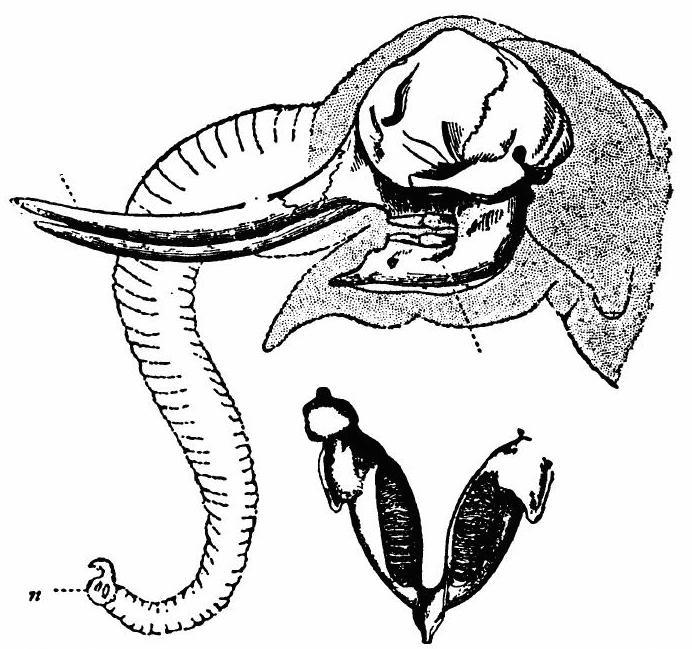
trunk of, 343 and following.
Enzymes, 291 and following.
Evolution, 356.
Eyes, 32;
of chicks, 4, 5;
of fishes, 16;
how formed, 17-18, 28;
images in, 175-176;
as camera, 176;
and color, 177-179, 183-185;
object of two, 185-186;
blind spot of, 186-188;
of ants, 197-200;
of various creatures, 214-215, 219;
of insects, 215-217;
black, 300 and following;
third, 336.
Eye minds, 229-233, 237.
Fatigue, cause of, 255 and following.
Fighting in play, 88-90.
Finger nails, 29, 34, 43, 53.
Fish, growth of, 53-54, 61, 70;
feeding of, 246;
monsters, 317 and following;
gills of, 331.
Flies and disease, 269-273, 274 and following, 284.
Food, as fuel, 244 and following, 252 and following;
importance of clean, 275.
Games, best for children, 58-60;
why children like, 81-85;
of animals, 86-90.
Hair, 80, 43, 58;
whitening of, 301 and following.
Head, of chick, 4;
of fish, 16;
early growth of, 293;
shapes of human, 355.
Horns, 34.
Horse, 12;
finds its way, 222-224;
epidemic among, 284;
teeth of, 321 and following;
limbs of, 338 and following;
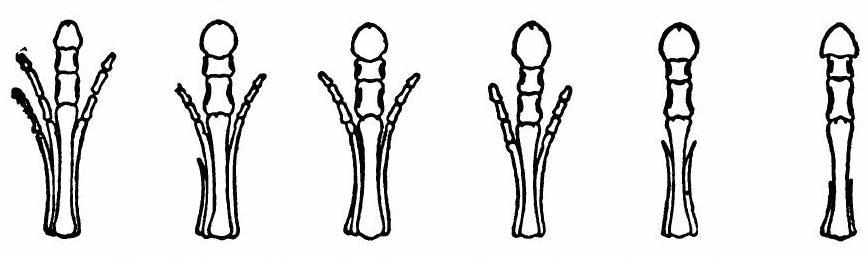
feet of ancient, 348 and following.
Hunger and thirst, sense of, 172.
Hydra, result of injuries to, 307 and following.
Insects, breathing of, 242 and following;
and disease, 269.
Instincts, 74-98, 101, 109.
Jelly-fish, 40, 46.
Leading shoot, 144-146.
Life, length of in various creatures, 61-64;
nature of, 239 and following.
life-jelly, 25, 27, 46, 238, 249, 251, 303, 356.
Light, growth and turning of plants toward, 147-148, 151-152, 156-157;
movement of animals toward, 159-164, 196-197.
Liver, and sugar, 260;
and bile, 278.
Lizard, new legs and tails of, 304 and following;
third eye of, 337.
Lockjaw, 267 and following, 277.
Lungs, of chicks, 5, 6, breathing by, 243 and following.
Lymph cells, as defence, 280 and following;
duties of, 296 and following, 303.
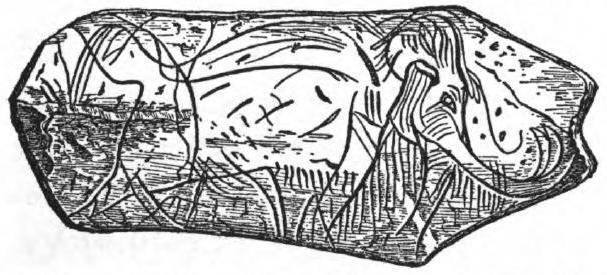
Mammoth, 345.
Man, ancient, 351 and following;
early migrations of, 354 and following.
Milk, importance of clean, 269, 275.
Monkey, 12;
and box, 101-102;
and colds, 285;
feet of, 341.
Mosquitoes and disease, 269.
Mouse, 61-62;
and disease, 269;
teeth of, 325.
Muscles, growth of, 50;
working of, 240.
Muscle minds, 235-237.
Muscular sense, 167-169, 191, 223-225.
Nausea, 173.
Nerves, of chick, 4-5;
growth of, 50.
Nose, and smell, 189-190;
of ants, 203-209;
bacteria in, 277-278.
Pain, sense of, 170-172.
Parents, advantage of two, 65-66;
cases of one, 71-73.
Parrots, 108-109, 113.
Pigs, and rattlesnakes, 264;
teeth of, 325 and following.
Plants, as engines, 240-241;
take food from air, 250, 254;
sickness of, 286 and following.
Rabbit, 12, 113, 341.
Rat, and maze, 104-105;
and disease, 269 and following;
teeth of, 325.
Reptiles, 63.
Roots, growth of, 50, 146-147, 154-155.
Salamander, 333 and following.
Sea-anemone, 69, 136-140, 307.
Second wind, 259.
Seeds, of bean, 20-23;
and pollen, 66-69.
Shark, teeth of, 327.
Sight, illusions of, 177-184.
Skin, 32-34, 43, 53, 75;
as defence, 276 and following.
Snake, poison of, 262 and following;
teeth of, 327;
lung of, 335;
limbs of, 350-351.
Soils, diseases of, 288.
Speech, 108-118;
and brain, 114-118;
and thought, 119-120.
Speech centre, 120-124.
Sponge, 242, 330.
Squirrel, teeth of, 325.
Star-fish, growth of young, 54-55;
food of, 246;
re-growth of, 308 and following;
monsters, 315 and following.
Sugar, as food, 244-245, 251, 253, 291;
as poison, 259 and following.
Tadpole, change of to frog, 296 and following.
Tails, of human beings, 107-108;
of birds, 333.
Taste, 190-191, 218.
Teeth, of children, 29, 325;
growth of, 44-45, 49-50, 299 and following;
importance of clean, 277 and following;
as tools, 321 and following.
Tickling, 89-90.
Touch, errors of, 192.
Trees, living part of, 42-43;
growth of, 48-49, 53-54.
Vaccination, 279 and following.
Vine, climbing of, 153-154.
Worms, feeding of, 245;
repair of injuries to, 305 and following, 311 and following;
monsters, 314.
Yeast, 46, 71, 292.