The first thing that occurs to the investigator on the subject of
stability is that nature offers us a sure means of keeping our
machines upright by adopting the simple method of placing all the
heavier parts at the bottom. In all other constructions we have
adopted this plan with perfect success. In boats, yachts, cars,
balloons, everything man uses in fact, the simplest, best and most
obvious method of keeping a thing upright is to utilize the force of
gravity, place the lighter or supporting parts above and the weight
below, and the thing is done.
This simple method of obtaining stability did not escape the aeroplane
designers, and we have had several machines which embodied this
principle, more or less. Unfortunately, however, they all proved
failures. A machine would be designed, and, with the weight high,
would fly well, though it was unstable. Put the weight low and you got
rid of the instability, and at the same time the machine became
unmanageable. It looked as if flying and instability were
interchangeable terms. So, as it was a machine that would fly the
designers were after, the weight was kept up and the stability was
left to the pilot. The machines were made “sensitive” as it is called,
that is to say, sensitive to a touch of the rudder or the balancers.
They are also, it is true, equally sensitive to a gust of wind or a
slight shifting of weight or pressure, and this has caused the
smashing of a good many machines and some pilots; but after all this
is the fortune of war, and no one is compelled to go up in an
aeroplane.
The curious thing about it is that it does not seem to have occurred
to our designers that if their pet design would not fly with the
weight low, perhaps it might be possible to alter the design instead
of altering the position of the centre of gravity, and so obtain what
we are all looking for, a naturally stable machine that is yet
sensitive to control.
There are two chief difficulties in the way of the low centre of
gravity machine. One is that the heaviest portion of the machine being
some distance below its support, it is apt to give rise to a pendulum
or swaying motion. The other is that of tilting, or banking up, in
turning a corner. These are really two developments of the same
difficulty, i.e. pendulum motion.
If we take a strip of stiff paper to represent a plane and put a small
weight in the centre of the plane, the model on being glided to earth
does not tend to sway (Fig. 1). If we put our weight on a tiny piece
of wire an inch or so below the plane (Fig. 2) and set the model free,
it will probably acquire a swinging motion as it descends. That is
the whole trouble. The trouble is real enough, but the fallacy is in
supposing it to be all the fault of the low centre of gravity. All
ships that were ever designed have a low centre of gravity, yet some
roll dreadfully and others do not, which, in itself, should be proof
sufficient that it is the design of the machine and not the position
of the ballast that is at fault.
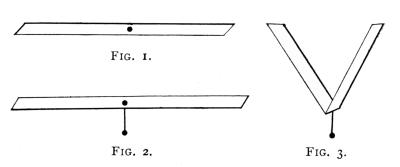
Fig. 1., Fig. 2. and Fig. 3.
Let us now try some experiments. It will be noticed that in the
machines which have employed the low centre of gravity the span of the
wings has usually been 30 feet or more, and the centre of gravity
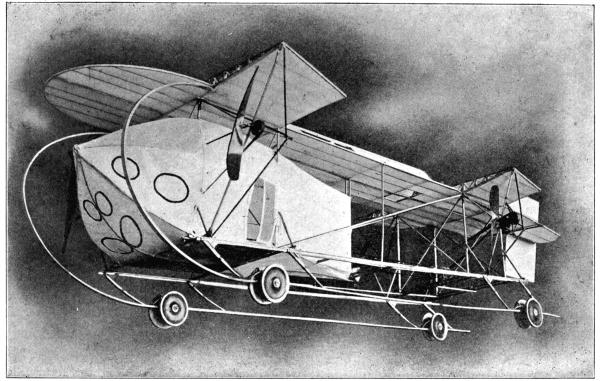
about 6 feet below the centre. Here is a paper model of the present
aeroplane (Fig. 1). Here is the same machine with a low centre of
gravity (Fig. 2). Now bend the paper upwards as in Fig. 3 and you get
rid of the swaying. Also, of course, you get rid of the supporting
surface. But there is probably some point of greatest efficiency where
you may compromise. If you take model 2 and bend it slightly (Fig. 4)
it will sway, but not much, not so much as Fig. 2. Now with a pair of
scissors clip the wings a bit at a time, and you will find that as the
span gets shorter the swaying decreases, and that when you have the
three points formed by the ends of the two wings and the weight
equidistant from the centre where they meet, the plane is stable (Fig.
5). The reason is that it is not the pendulum with the weight at the
bottom that swings so much, but the long wings that see-saw. By
shortening the wings you have reduced the length of the see-saw, which
is the same as reducing the length of the pendulum, and consequently,
by pendulum law, the oscillations must be much quicker and shorter and
will at once damp out. It is curious that this point seems to have
escaped the designers. It is well known that all pendulum motion tends
to damp out, and the shorter the pendulum the quicker it comes to
rest. Hitherto the idea has been to shorten it vertically, but the
same effect exactly is obtained by shortening it horizontally, and the
low centre of gravity remains to give stability. It was stated by some
sapient objector to the low centre of gravity, that the pendulum
motion once set up, increased till it turned the machine over. A
pendulum which increased its swing at every stroke would be something
new in the scientific world.
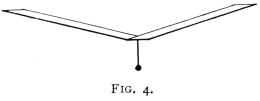
Fig. 4.
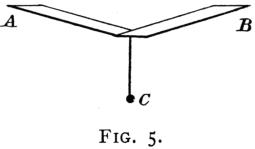
Fig. 5.
Another development of the pendulum difficulty is the probable fore
and aft sway, but this may be overcome by increasing the supporting
surface of the tail. Many machines do not lift with the tail at all,
and those that do employ lifting tails, have them with very small
surface. Consequently, the centre of gravity comes nearly under the
centre of the main plane, and the whole machine, turning on its centre
of gravity in all directions as on a pivot, is liable to swing fore
and aft. If the supporting surface of the tail be increased and the
centre of gravity carried further aft, this pendulum motion is also
rendered impossible, and the machine is stable both ways.
A few illustrations may serve to make the advantages of the low centre
of gravity more clear, and to avoid complications we will suppose the
planes to be still and in still air. Let Fig. 6 represent an ordinary
flat plane having its centre of gravity coincident with its centre of
pressure, the centre of pressure of each half or wing being at A A.
The plane is in equilibrium. Now allow it to tilt (Fig. 7), and it
will be seen that it is still in equilibrium, since the weight is in
the centre and the wing tips equidistant from it. Let it tilt still
more till it is vertical (Fig. 8), and the balance is still the same.
It is evident, therefore, that such a plane would travel equally well
in any of the positions shown, and that it can only be kept in
position (Fig. 6) by the skilful manipulation of the pilot.
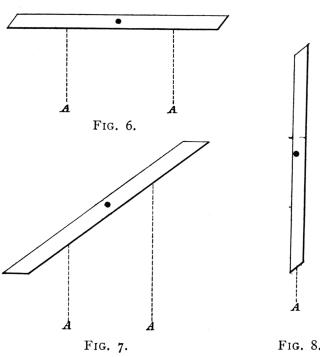
Fig. 6., Fig. 7., and Fig. 8.
In the same way, the machine having no lifting tail is longitudinally
unstable, for, being balanced on its centre of pressure which would be
coincident with its centre of gravity and probably about 2 feet from
the trailing edge of the plane—it may assume any position (Figs. 9,
10, 11 and 12), and still be in equilibrium, when it is evident that
the proper position (Fig. 9) is only maintained by the constant
control of the tail elevator.
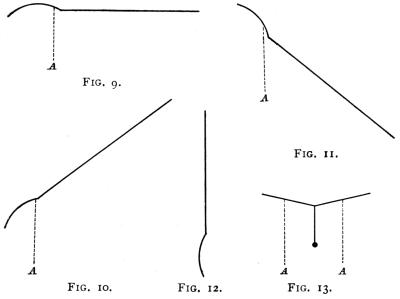
Fig. 9., Fig. 10., Fig. 11., Fig. 12., and Fig. 13.
Now take the case of a machine having a low centre of gravity. Its
natural position is shown at Fig. 13, and it is at once evident that
any other position such as Figs. 14 and 15 could not be maintained for
a moment, since the weight being at an angle, must inevitably drag the
machine back to its natural position (Fig. 13). In the same way with
regard to longitudinal balance, a machine with two lifting surfaces
such as Fig. 13, is in its natural position with the centre of gravity
perpendicularly under the centre of pressure, any other position, such
as Fig. 17, A, is impossible, as the gravity pull must drag the
machine along the dotted line till it resumes its proper and natural
position (B).
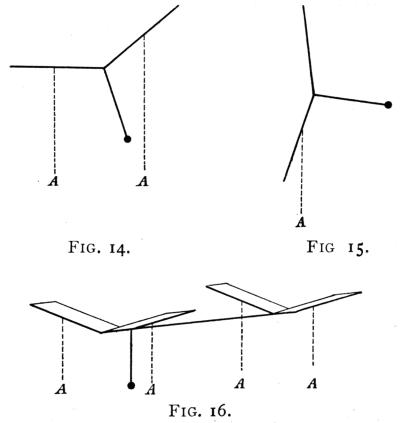
Fig. 14., Fig. 15., and Fig. 16.
The next difficulty is in the banking or tilting caused by the turning
of the machine in going round a curve. In a very interesting
discussion carried on in the “Aero,” it was stated that a low centre
of gravity machine could not bank up, as the pull of gravity acting on
the low weight would prevent it. It was also stated by another writer
that the machine would bank up too much and slide down sideways,
because the greatest weight having the greatest momentum would swing
out too much. There is evidently some confusion here. Let us consider
the question.
In turning there are three forces to take into consideration:
(1) The centrifugal force, which tends to make the machine fly off at
a tangent to the curve at which it is turning.
(2) The action of gravitation.
(3) The extra lift given by the wing on the outside of the curve,
owing to the fact that it travels faster through the air.
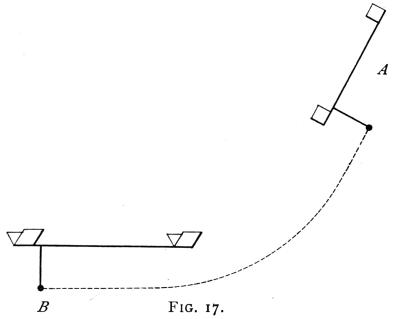
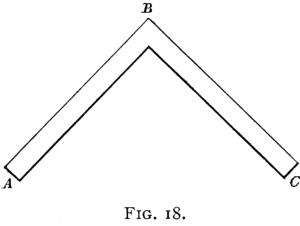
Fig. 17.
The centrifugal force acts strictly in proportion to the mass it acts
on, but, at the same time it must be remembered that the greater force
acting on the greater mass has the greater mass to move. That is to
say, that if the top part of the machine was very light and the
bottom part very heavy, the force acting on the light part would be
sufficient to send that part swinging out when rounding a curve, and
the greater force acting on the greater mass at the bottom would be
sufficient to send that out to exactly the same degree. Consequently,
if only centrifugal force is considered, the whole machine would swing
out without any tilting at all, retaining its upright position. But
here we must take another factor into consideration, the resistance of
the air. This resistance would be greater on the greater surface of
the light top part than on the heavy bottom part, and consequently the
bottom part would, automatically, swing out most, giving the banking
effect. This would be increased by the extra lift given to the outer
wing by reason of its greater speed. If we then take the force of
gravitation into the problem we shall see that we have two
factors—unequal speed and unequal air resistance—tending to bank up
the machine, and one force—gravity—tending to pull it straight
again. At a certain angle due to the amount of force exerted by each
of these, the two opposing factors would balance, and the machine
would be in equilibrium.
It would appear that most of the difficulties connected with the low
centre of gravity machine are the result of hazy thinking and
slip-shod reasoning, and that they do not exist in fact. And let it be
remembered that the low centre of gravity machine with short span has
not yet been tried except by the writer, who has succeeded in making a
paper model on this plan turn in its own length without in any way
losing its stability, swaying, banking too much, turning over, sliding
sideways, or doing any of the frightful things which some people
declare it must do. What it does do is to recover its balance though
started from the most impossible positions and always land on its
feet.