Uncle Philip tells the Boys how Hats are
made; and then talks to them about Animals
that can make Felt like the Hatter.
"Boys, do you remember my telling you of
a remarkable bird, called the tailor-bird, which
sews very neatly?"
"Oh yes, Uncle Philip; it is not easy to
forget such an excellent little workman; but
why do you ask—have you any thing more
to tell us about that bird?"
"No, boys, not any thing of that bird; but
I was thinking last night of the work done
by several other kinds of birds, some of them
quite as good workmen as our little tailor;
and I thought that, perhaps, you might like to
hear of them."
"We would, Uncle Philip, be very happy
to hear of them, if you will have the kindness
to tell us about them. But what kind of work
is it they do?"
"Various kinds, boys. There are some
which make what is called felt, just as the
hat-maker does; and some are weavers, others
basket-makers; some build platforms to live
on; and I assure you some birds' nests are as
curious as any of the things of which I have
yet told you."
"Pray let us hear of them, Uncle Philip."
"Very well, you shall. I will begin with
birds that make felt like the hatter. Do you
know how a hat is made?"
"Not exactly, Uncle Philip; but we know
what it is made of."
"What is it, boys?"
"Of sheep's wool, and the hair of other
animals: is it not?"
"Yes, commonly of these things; and to
understand what I am going to tell you, I
think it will be necessary first to say something
about the hatter's trade. The business
of the man who makes a hat is to mix up wool
or hair in such a way that it will stick together
and make felt; or something like a
piece of thick, strong cloth. To do this, he
does not weave the hairs together, for they are
of different kinds, and of different lengths,
and it would be endless work to weave every
one in; besides the cloth or felt would not be
thick enough when it was done."
"How do they stick together then, Uncle
Philip?"
"Why, boys, their sticking together is
owing to something in the hairs themselves.
I will show you. Pull a hair out of your
head; now hold it just between the ends of
your two fore-fingers, and rub the fingers
gently against each other."
"Why, Uncle Philip! see, the hair is moving
towards my body."
"Very true; and if you will turn it with
the other end towards you, and rub your
fingers as before, you will see it move from
your body."
"This is very strange, Uncle Philip: the
hair is smooth; how can my fingers make it
move so?"
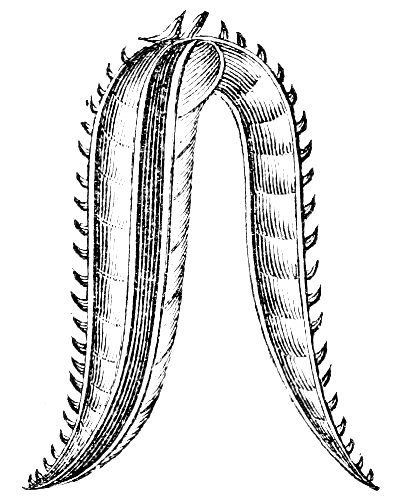
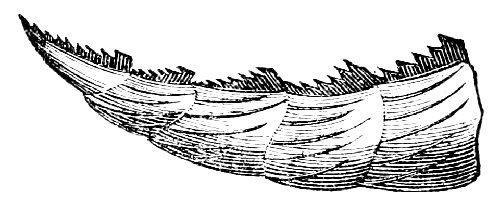
"No, that is a mistake, boys, the hair is
not smooth. If some kinds of coarse hair are
seen through the microscope, each one will
seem to be, not one hair, but ten or twelve
smaller ones, which are joined at the root, and
form a hollow tube, like a straw; and sometimes
it will have joints just like some kinds
of grass or straw. In some sorts of finer hair
you cannot see this even with the microscope;
but you can feel it, as you did just now when
you moved your fingers. These joints overlap
one another, just as if you should take
several pieces of straw and stick them into
each other. I will show you some pictures
of hairs as seen through the microscope, and
then these joints will be plain enough."
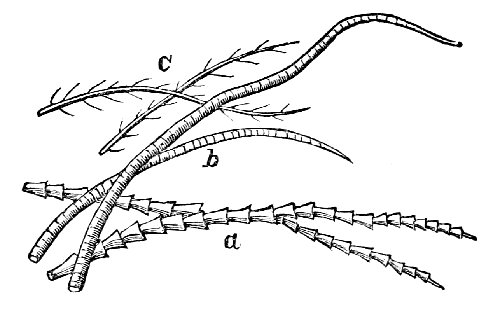
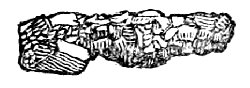
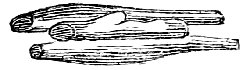
Hairs of (a) the Bat, (b) the Mole,
and (c) the Mouse.
"These are strange-looking hairs, Uncle
Philip."
"Yes, they are curious; but now you may
see why, when hairs are worked together, they
may be made to stick to each other. These
rough parts catch into each other, and hook
themselves; and the more you press them or
move them, the more closely you work them
into one solid mass, which you cannot easily
pull to pieces. Besides, you must remember
that the hairs will work only one way, as you
found out just now when your finger ends
caught upon the little joints and moved them
along. Now, suppose that a very large heap
of hairs, or wool, or fur, after it is made ready,
should be put upon a table, and covered with
a linen cloth, and pressed down in different
directions. Each hair would begin to move
in the direction of its root, just as it did between
your fingers, and so all would be joined
together at last into one solid piece."
"We understand you, Uncle Philip."
"Then you understand, boys, the way in
which a hat is made. These hairs are all
worked together by the hands of the hat-maker,
and to make them work more easily
(for curled hair, such as wool, does not move
easily) the hatter uses hot water, and dips his
hat in it while he is working it. After it is
done, it is died, and then put upon a wooden
block to give it shape, and is ironed smooth."
"And this is the way, then, Uncle Philip,
to make hats: it is curious, is it not?"
"Yes, boys; but plain enough when you
come to examine into it. And the best stuff
for the hatters is such hair as has most joints
ready to catch into each other: the rabbit's
hair is very good, and for that reason."
"And is it possible, Uncle Philip, that any
bird can do such work as this?"
"Not only possible, boys, but true. There
are several birds very expert at making felt,
and their nest appears like a piece of hatter's
felt, or double-milled woollen cloth. I do not
mean to say that it is as close and solid as the
hat or cloth; it would feel in your fingers
looser than either, still it is quite close; and
when you examine it, you will find it put
together in the same way; it is all carded into
one mass, and not woven together thread by
thread, or hair by hair."
"And are there many birds able to do such
work, Uncle Philip?"
"I told you, boys, that there were several.
The chief article which they use is wool, but
with this many other things will be found
mixed—sometimes, upon the outside, fine
moss—sometimes pieces of a spider's web rolled
up into a little bundle—sometimes, when cotton
can be had, they will use small bunches of
cotton-wool; but sheep's wool they must have,
and by means of that, they contrive to make,
with the other things I have mentioned, a felt
wonderfully smooth."
"Is it smooth on the outside, Uncle Philip?"
"Sometimes quite so; but always as smooth
on the inside, when it is first made, as if it had
been felted together by the hat-maker. There
is another thing curious enough in some of
these nests. The hatter, you know, binds the
rim of his hat to make it stronger; and some
of these felt-making birds will make their nests
stronger by a binding all around them of dry
grass stems, and sometimes of slender roots,
and they take care to cover these grass stems,
or roots, with their felt-work of moss and
wool. But there is something else not less
strange, I think, than the binding. It is this:
they will build their nests in the fork of a
shrub or tree; and to keep them from falling,
they will work bands of this felt round all the
branches which touch the nest, both below
and at the sides. And those parts of the nest
which touch the large branches are always
thinner than the other parts, which have no
support; in those parts the nest is nothing
but a thin wall of felt, fixed around to fit the
shape of the branch, and that is enough to
make that part of the nest warm and soft.
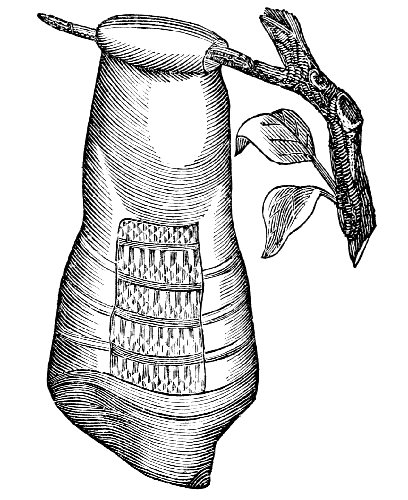
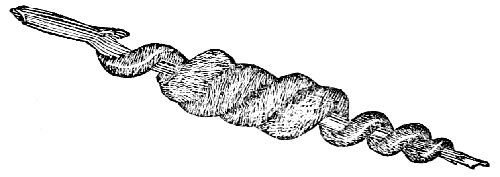
Here is a picture of one of these felt-nests,
fastened in the way of which I have been telling
you."
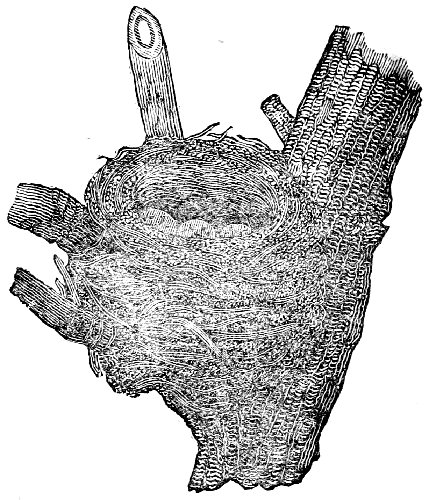
Chaffinch's Nest on an Elder-tree.
"This, boys, is the nest of the chaffinch.
The goldfinch makes a nest of the same kind,
only rather neater and smoother than that of
the chaffinch; for it takes pains to show
nothing but the wool, and covers up all the
other materials which it uses."
"Uncle Philip, do these birds all use the
same things to make their nests?"
"All use wool, boys; but the truth is, that
birds will commonly take for their nests that
article which they can get most easily, if it will
suit. A gentleman, named Bolton, tried this
with some goldfinches. He saw a pair of
these birds beginning to build in his garden;
they had laid the foundation of their nest with
moss, and grass, and such things, as they
commonly use: he scattered some wool about
in different parts of the garden; the birds took
the wool: afterward he scattered cotton;
they took the cotton: on the next day he gave
them some very fine down; they took that,
and finished the nest with it, and a very handsome
nest it was."
"How long were they in making it, Uncle
Philip?"
"Three days. The canary-bird, boys,
which you sometimes see in cages, when free,
builds a nest of the same kind. But the most
curious felt-makers among the birds, are in
Africa. There is the Cape-tit, a bird in the
southern part of Africa, which builds a very
strange nest: it is shaped like a bottle of
India-rubber, as thick as a coarse worsted
stocking, and made of cotton, and down, and
other things felted together. On one side of
the nest there is something like a pocket, and
here is a picture of it."
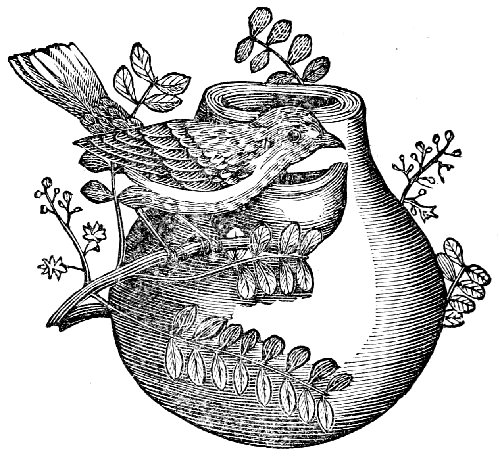
Nest of the Cape-tit, from Sonnerat.
"Uncle Philip, what is that pocket for?"
"Why, boys, some have supposed that it
was for the male bird to sit on and keep watch,
while the female was inside of the nest sitting
on the eggs; but I think this is a mistake.
And some have said, that when the female
leaves the nest, and the male wishes to go too,
he sits in this pocket, and beats against the
side of the nest with his wing until he has
made the edges of the top meet, and thus shuts
up the mouth of the nest, and keeps off insects
and other animals that would eat the young
ones; but I do not believe this story."
"Then what do you think the pocket is for.
Uncle Philip?"
"I think, boys, that it is nothing but a
perch, or place for the bird to sit on before
going into the nest. If the bird had no such
place for stopping, it might be troubled to
get into its nest. The mouth is small, and
the bird could not enter it with its wings
spread; and if it should alight on the edge of
the nest constantly, it would injure it, for it is
but slightly made. And I will tell you another
reason why I think this is the use of the
pocket. There is another bird in South
Africa, called the pinc-pinc, which is the same
species of bird as the Cape-tit; and this bird
we know uses its little nest built upon the side
of the other merely as a resting-place before
going into the nest."
"Uncle Philip, does the pinc-pinc build its
nest like a bottle, as the Cape-tit does?"
"No, boys, not so smooth, but felted in the
same way. The nest is made mostly of the
down of plants, and is either snowy white or
brownish, according to the colour of the down.
On the outside it is a clumsy-looking thing,
but fastened, like the nest of the chaffinch,
very firmly to the branches near it, so that
you cannot take it away without breaking it to
pieces. But rough as the outside is, you would
be astonished, if you were to look at the inside,
and see how a bird, and a small one too, with
nothing but its wings, and tail, and feet, and
bill for tools, could ever have worked the
down of plants together, so as to make of it a
piece of fine cloth. It has a narrow neck, something
like a chimney, at the top of it. This is the
entrance; and at the lower end of it there is
a lump, which appears something like a small
nest stuck on to the larger one; sometimes
there will be three or four of these small-looking
nests, and sometimes when there is a
branch near the mouth of the nest which
makes a good resting-place, there will be
none. Here is a picture, boys, of the outside
of one of these nests.
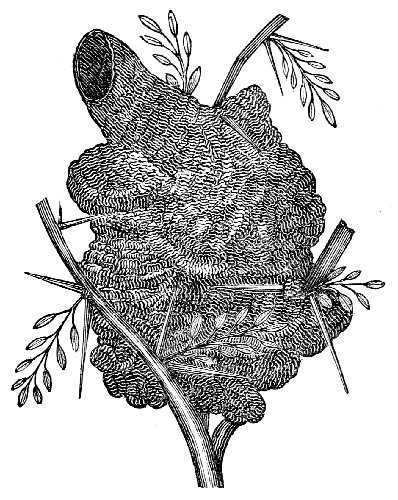
Nest of the Pinc-pinc.
These birds are easily
watched; and a French gentleman, who has
written the best account of the birds of Africa,
[11]
says that he has found at least a hundred of
these nests, and watched the birds for a whole
morning together, and never saw one sitting
on the small nest as a watch-bird; but
has seen both the male and female arrive at
the nest together, perch upon the nearest
branch, hop from this upon the edge of the
little nest, and then putting their heads into the
hole, dart into the large nest. And now, boys,
what do you think about the use of these
little pockets?"
"Oh, Uncle Philip, we think that what you
tell us is always right, because you know a
great deal more than we do."
"But, boys, you do not understand me. I
may be mistaken, though I do know more
than you. I have been telling you my reasons
for thinking these little pockets are nothing
but perches. Do you think the reasons are
good ones?"
"Why, yes, Uncle Philip, we do. The
French gentleman who watched the birds so
much would have seen some of them using
the pockets for a place to keep watch in, if
they were made for that."
"Right, boys. What I wish to teach you
is to think for yourselves. Whenever any
one gives you a reason for a thing, just ask
yourselves, 'Is this a good reason?'"
"But, Uncle Philip, how did it happen that
the other people who saw these birds should
have said that these pockets were for the male
bird to sit in and watch?"
"I suppose, boys, that they really thought
so; but then they had not noticed the birds
enough to find out the truth. It requires a
great deal of time and patience to find out the
truth about animals: and this is the reason
why so many mistakes have been printed
about them. It is a pity that such mistakes
have been made; for really there is enough
that is very curious about them, without
men's making stories to appear strange. But
I think that there will be fewer mistakes
made in future."
"Why so, Uncle Philip?"
"Because, boys, men are taking more pains
to see for themselves. There are more naturalists
now than there were formerly; and I
hope there will be more still, especially in our
own large and beautiful country, where there
have not yet been many. I hope that natural
history will be studied in all our schools before
a great while. But let us go back to our
African birds.
"There is another kind which Mr. Vaillant
speaks of, and I will tell you of that. He calls
it the capocier, and he had a very fine opportunity
to watch two of them. It is a bird
easily made gentle, and he had managed by
feeding two of them to make them so tame
that they would come into his tent and hop
about several times in a day, though he never
had them in a cage. When it became time
for them to build a nest, they staid away for
some time, and would come to the tent once
only in four or five days. At last they began
to come regularly, as before, and Mr. Vaillant
soon found out what they came for. They
had seen upon his table cotton and moss and
flax, which he used to stuff the skins of birds,
and which were always lying there; and the
capociers had come for these things, to build
their nest of them. They would take up
large bunches of them in their bills and fly
away. Mr. Vaillant followed and watched
them to see the nest built, and found them at
work in the corner of a garden, by the side of
a spring, in a large plant which grew under
the shade of a tree. They were building in
the fork of the branches, and had laid the
foundation, which was about four inches high
and six inches across. This part was made
of moss and flax, mixed with grass and tufts
of cotton. The next day this gentleman never
left the side of the nest: the female was at
work building, and the male brought the materials.
In the morning the male bird made
twenty-nine journeys to Mr. Vaillant's table
for flax and cotton and moss; and in the afternoon
he made seventeen. He would help
his mate to trample down and press the cotton
with his body, so as to make it into felt.
Whenever he came with a load, he would put
it either upon the edge of the nest or upon
some branch within reach of the female.
"After he began to help the female at her
work, he would often break off, and begin to
play; and sometimes, as if in mischief, he
would pull down a little of her work. She
would get angry, and peck him with her bill:
but he still continued to vex her, until at
last, to save her work from being pulled down,
she would stop working, and fly off from bush
to bush, to tease him. They would then
make up the quarrel, and she set about her
work, while he would sing most delightfully
for several minutes. After his song was finished,
he would go to work again, until he
got into a new fit of mischief and frolic, and
then he would torment her as before.
"On the third day the birds began to build
the walls, after having repeatedly pressed the
bottom, and turned themselves round upon it
in all directions, to make the nest solid. They
first made a plain border all around; this they
trimmed, and on it they piled up tufts of cotton,
which they felted in by beating and pressing
with their breasts and wings; and if any
part stuck out, they worked it in with their
bills, so as to make all perfectly smooth and
firm. And they worked their nest round the
branches near it, just as the chaffinch does.
"In seven days they finished it. It was as
white as snow, and on the outside it was nine
inches high, and not smooth or regular in its
shape; but in the inside it was shaped exactly
like a hen's egg, with the small end up: the
hollow was five inches high, and between
four and five inches across; and it was so
neatly felted together that it might have been
taken for a piece of fine cloth a little worn;
and so close that you could not take away
any part without tearing the nest in pieces.
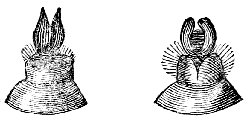
Here is a picture of the nest, boys, and it is
wonderful work for a small bird."
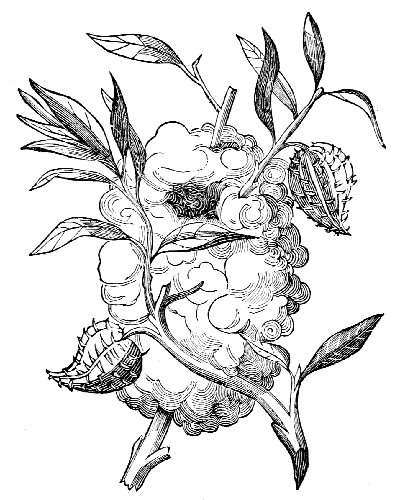
Nest of the Capocier, from Vaillant's figure.
"Oh, Uncle Philip! we like the capociers
very much. When they were tired of working,
they were ready to play; and when they
had played enough, they went back to work.
Do not you think there was good sense in
that?"
"Yes, boys, I do: it will not do, either to
work all the time or to play all the time. All
that we have to do is to take care that we
do not spend more time than we should at
either. But there is a sweet little bird, boys,
quite common in our own country, which
makes felt: would you like to hear of it?"
"Oh yes, Uncle Philip. What bird is it?"
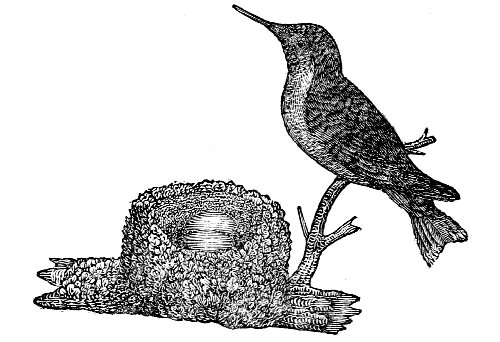
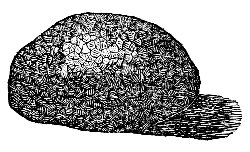
Nest of the Humming-bird.
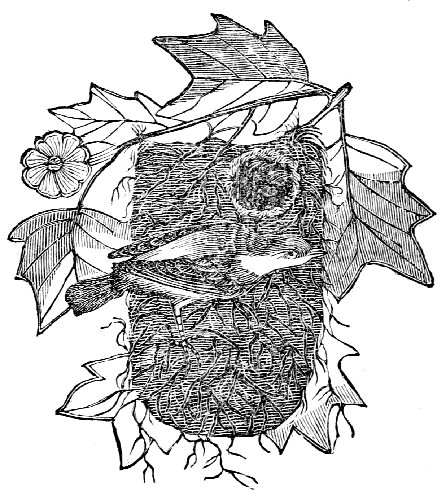
"It is the humming-bird. Here is a drawing
of its nest. It is about an inch deep, and an
inch across; and from a little distance, appears
more like a small knot upon the branch than
like a bird's nest. The outside of the nest
from which this picture is made, was covered
with a kind of bluish-gray lichen, that grows
in scales upon old trees and fences: this
seemed to be glued on by the bird in some
way or other. The inside was the felt, and
was made of the fine down from seeds that
float about in the air, mixed with the down
from mullein-weed and stalks of fine grass.
This, boys, is the smallest nest made by a
bird, I believe; and some insects make larger
houses for themselves than this bird does.
"But I have not time at present to talk
with you any longer, as I have letters to
write; and therefore I must bid you good
morning."
"Farewell, Uncle Philip."