The greater thoroughness and system with which anthropology
and the kindred sciences have been cultivated in Germany
than in this country, has been repeatedly brought home to
us; but in nothing is it more apparent than in the difficulty
of finding equivalents for quite elementary technical terms.
The distinction between ethnology and ethnography, indeed,
is pretty generally recognized, and is explained in works as
popular in scope as Professor Keane’s Ethnology and Man Past
and Present. But Vōlkerkunde, which includes both these
sciences and some others besides, is something which certainly
cannot be translated by its etymological equivalent “folklore;”
and, though the word “prehistoric” is perfectly
familiar, we have no such noun as “prehistory,” far less a
professorship of the same in any university. These remarks
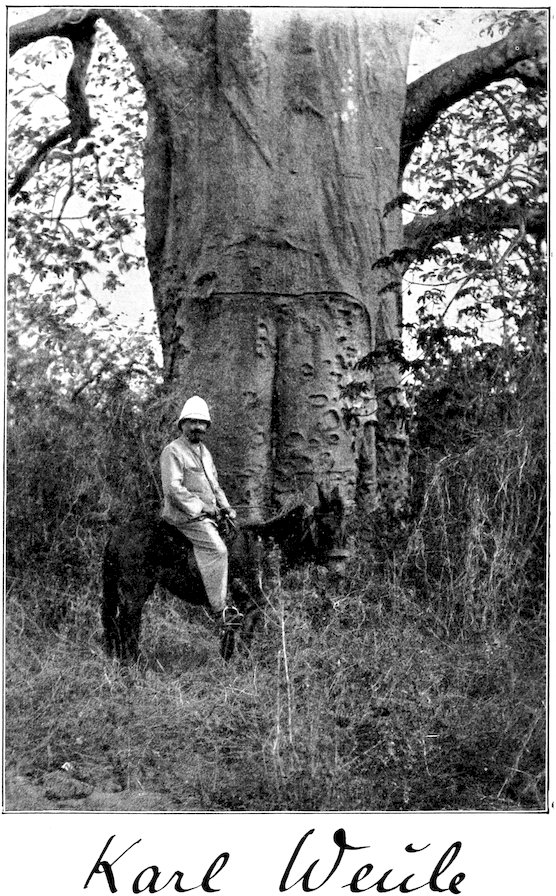
are suggested by the fact that Dr. Weule, whose experiences
in East Africa are here presented to the English reader, is
“Professor of Vōlkerkunde und Urgeschichte” at Leipzig,
besides being Director of the Ethnographical Museum in the
same city.
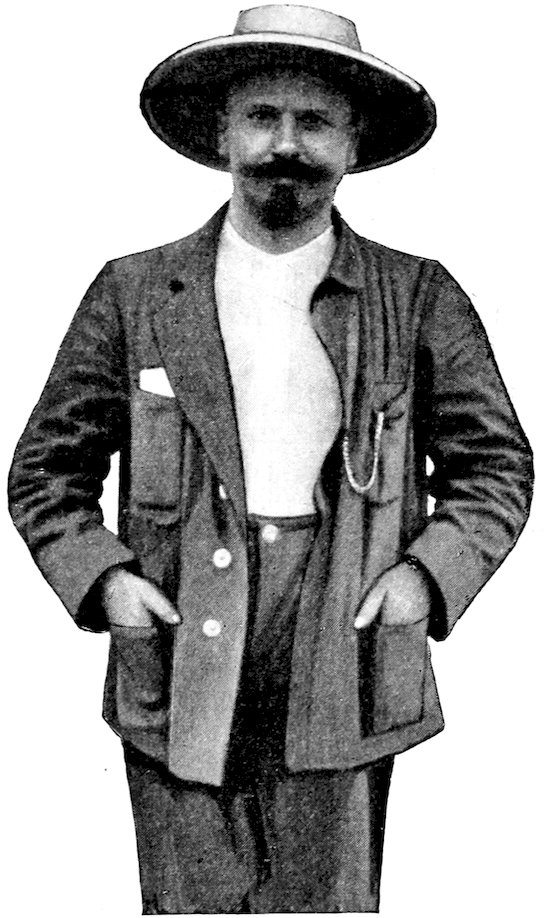
Dr. Karl Weule, whose name is less well known in England
than in his own country, has in the past devoted himself
rather to geography than to ethnography proper. He was a
pupil and friend of the late Friedrich Ratzel, whose History
of Mankind was translated into English some years ago, and
whose Politische Geographie gave a new direction to the study
of that science in its more immediate relation to the historical
development of mankind, or what is now called “anthropogeography.”
It was Ratzel, too, who suggested to Dr.
Helmolt the idea of his Weltgeschichte, a comprehensive history
of the world, built up out of detached monographs, including
three by Dr. Weule, on the historical importance of the three
xiigreat oceans. (Only one of these appears in the English
edition, with introduction by Professor Bryce, published in
1901). Dr. Weule returned to the same subject in his History
of Geography and Exploration (Geschichte der Erdkenntnis und
der geographischen Forschung) and a detached essay, Das Meer
und die Naturvōlker (both published in 1904), with various
other monographs of a similar character.
After completing his university studies at Göttingen and
Leipzig, Dr. Weule resided from 1891 to 1899 at Berlin, first
as a member of the Richthofen Seminary, where his work was
more purely geographical, and afterwards as assistant in the
African and Oceanian section of the Ethnological Museum.
In 1899 he was appointed to the Assistant Directorship of the
Leipzig Museum, and at the same time to the chair which he
still occupies at that University; and, seven years later, he
was entrusted with the research expedition described in the
following pages, where its scope and objects are set forth with
sufficient clearness to render further reference in this place
unnecessary. After his return he was promoted to the
appointment he now holds at the Leipzig Museum.
His residence in Africa lasted a little over six months, and
the record before us shows that he made good use of his time.
Several features in his narrative have the merit of novelty,
at least as far as the general reader is concerned; for though
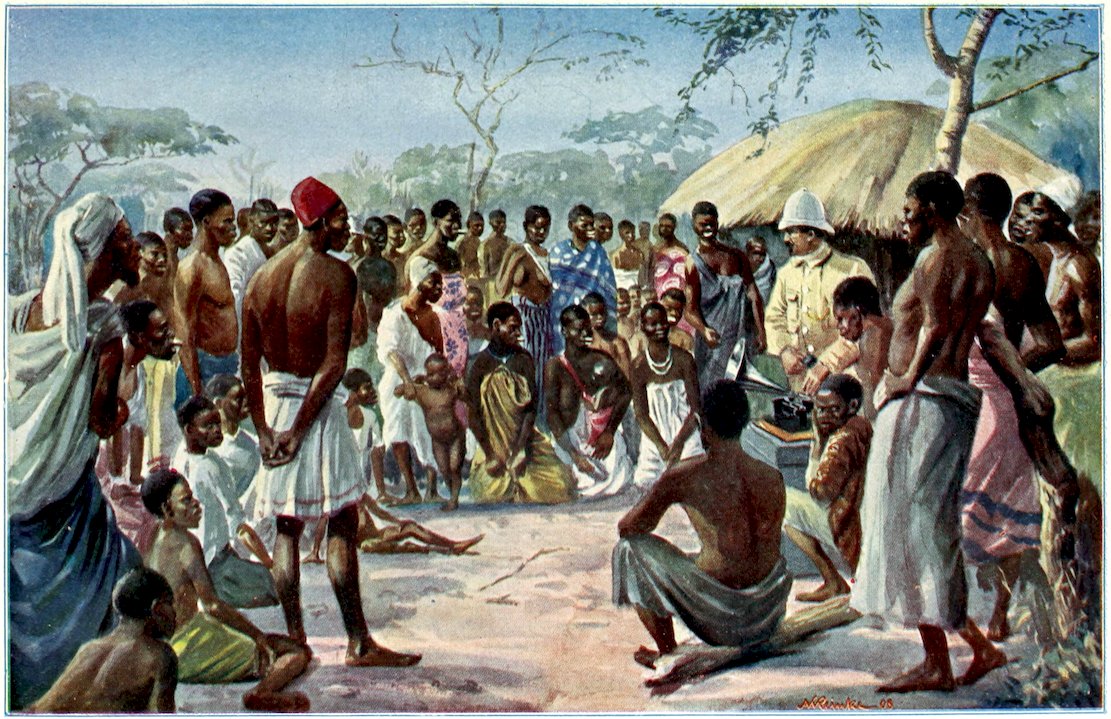
the cinematograph and phonograph have been made use of
for some time past in the service of anthropology, yet we do
not remember to have seen the results of the latter figuring to
any great extent in a work of this sort, though Sir Harry
Johnston has reproduced one phonographic record of a native
air in his Uganda Protectorate. (It is very unfortunate that
so many of Dr. Weule’s cinematograph films proved a
disappointment; this instrument is proving one of the most
valuable adjuncts to exploration, especially in the case of
tribes whose peculiar customs are rapidly passing away before
the advance of civilization). Another point which imparts
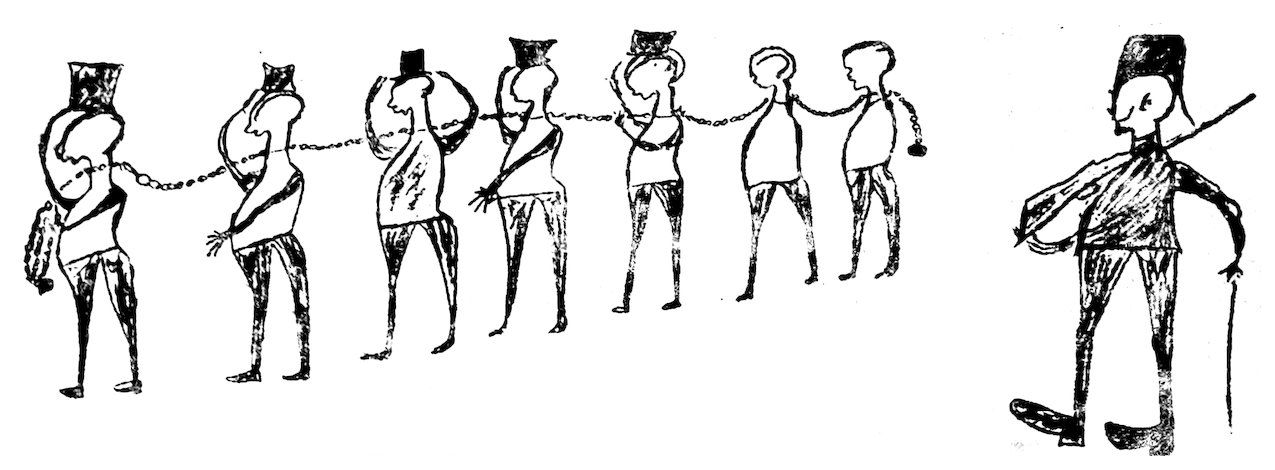
great freshness to Dr. Weule’s work is the happy inspiration
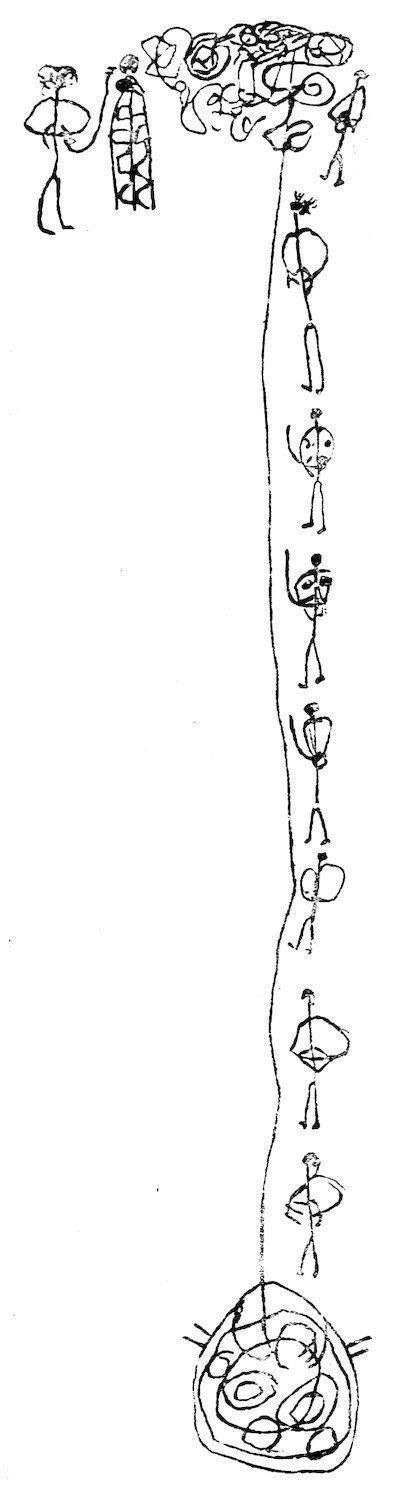
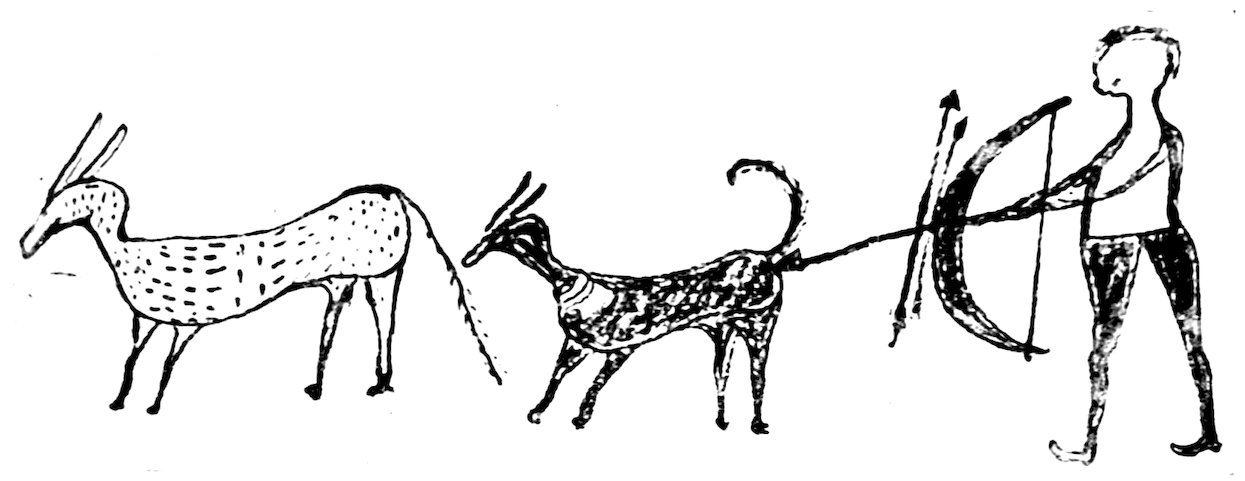
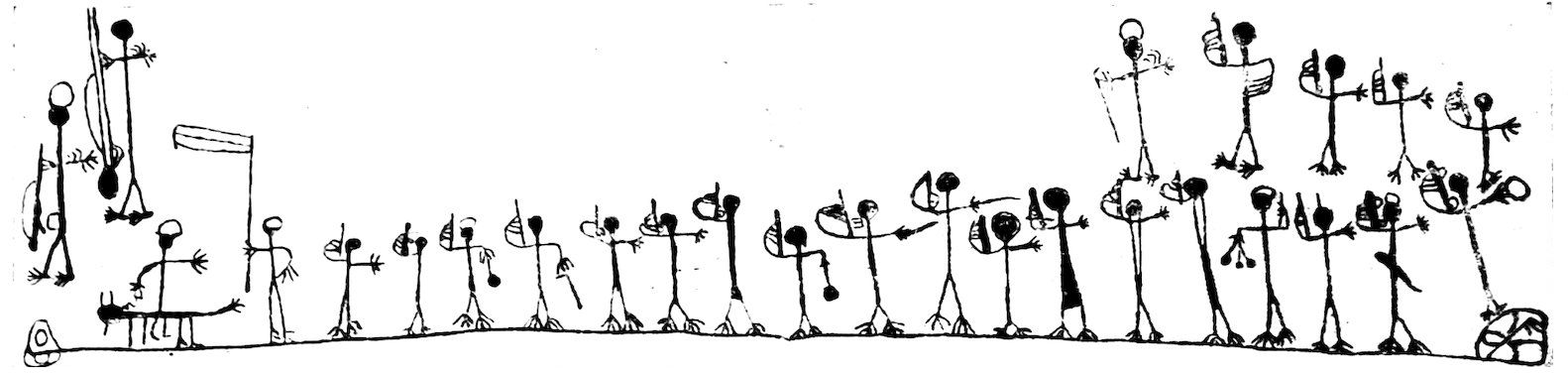
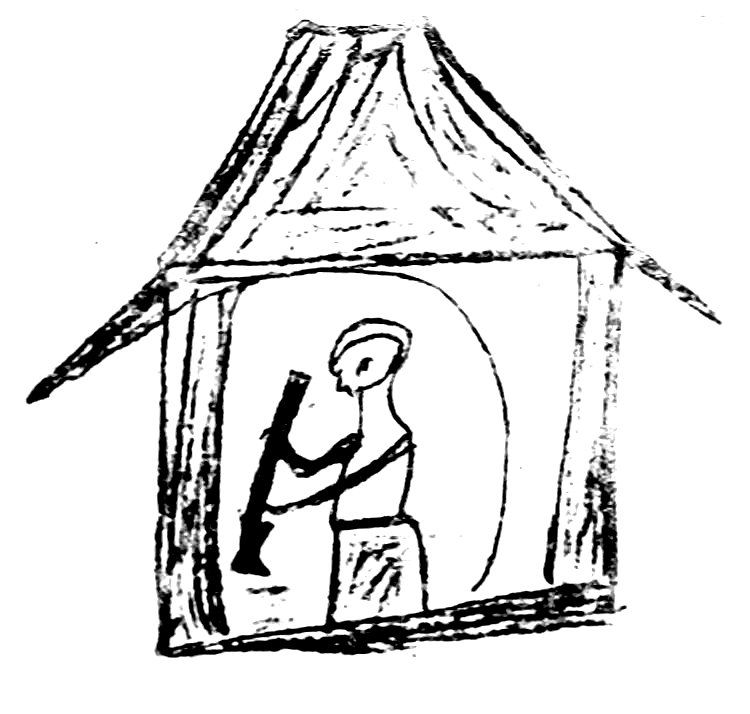
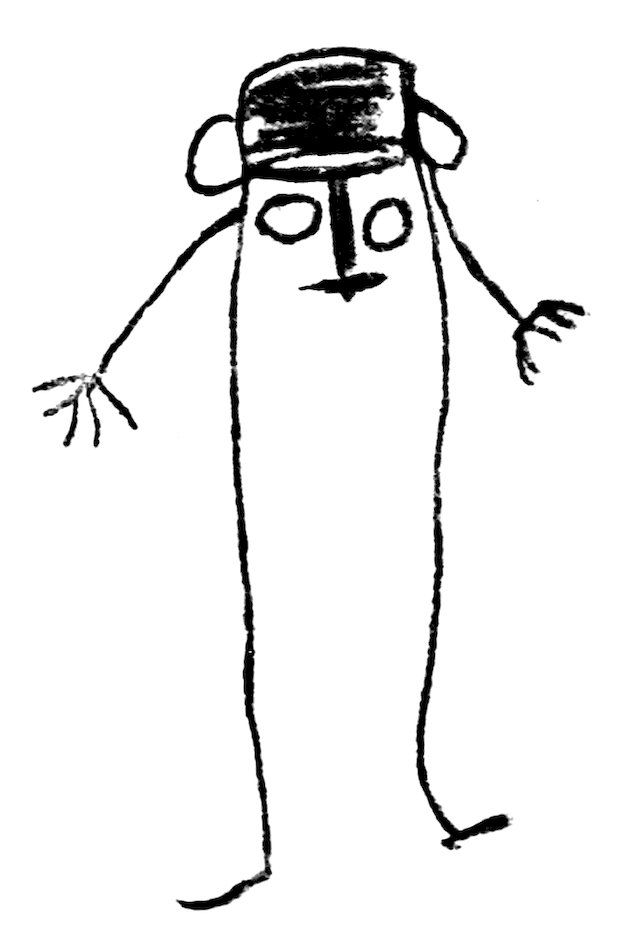
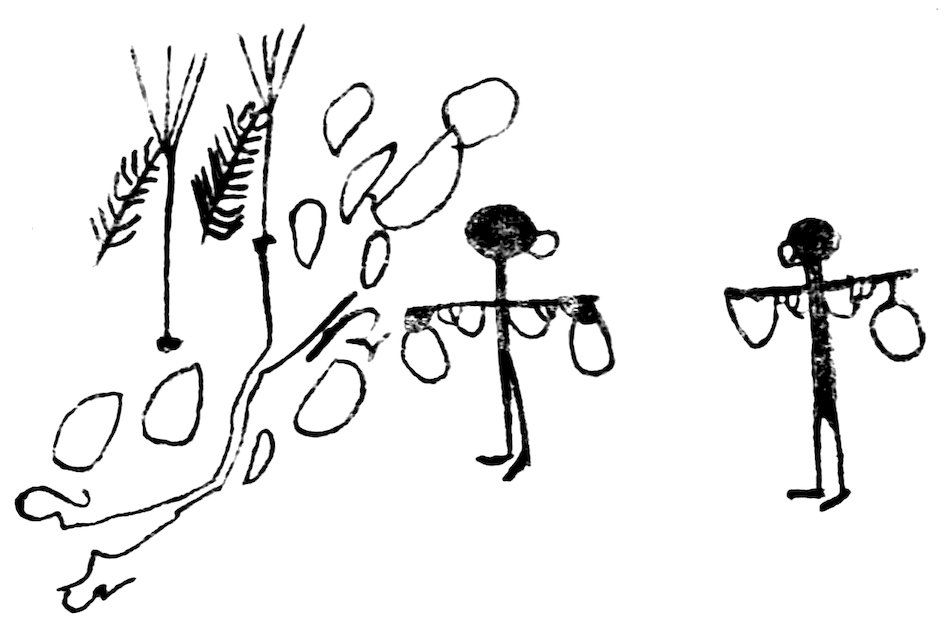
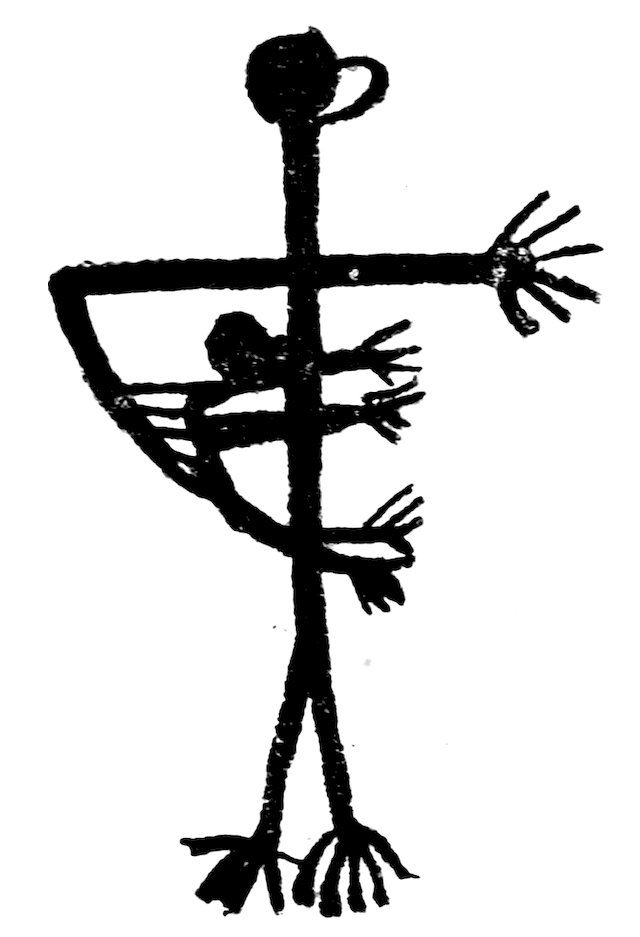
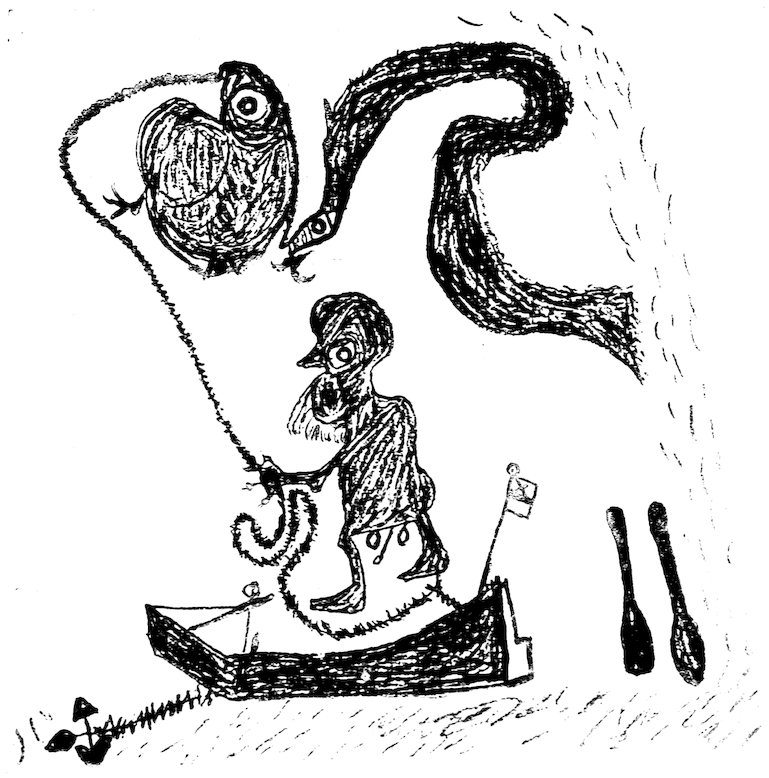
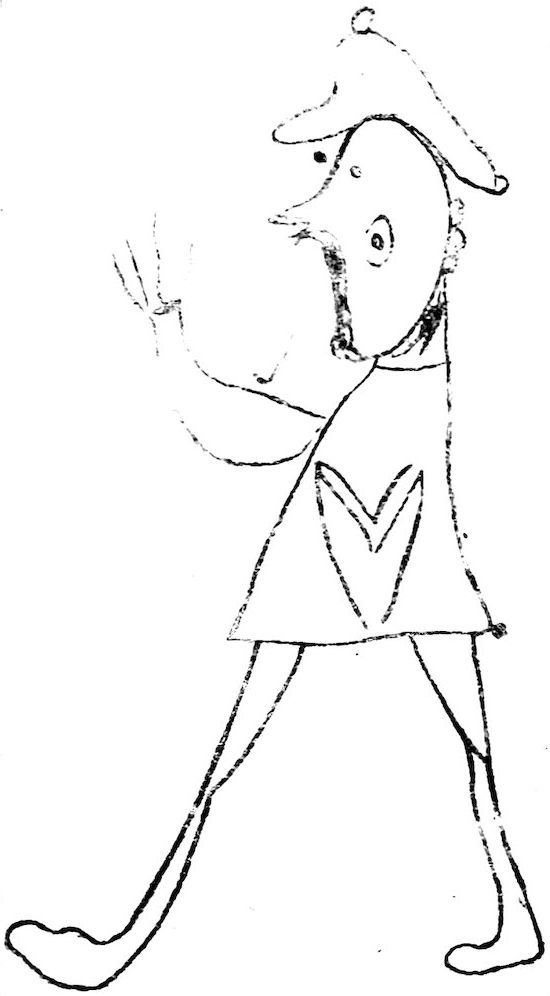
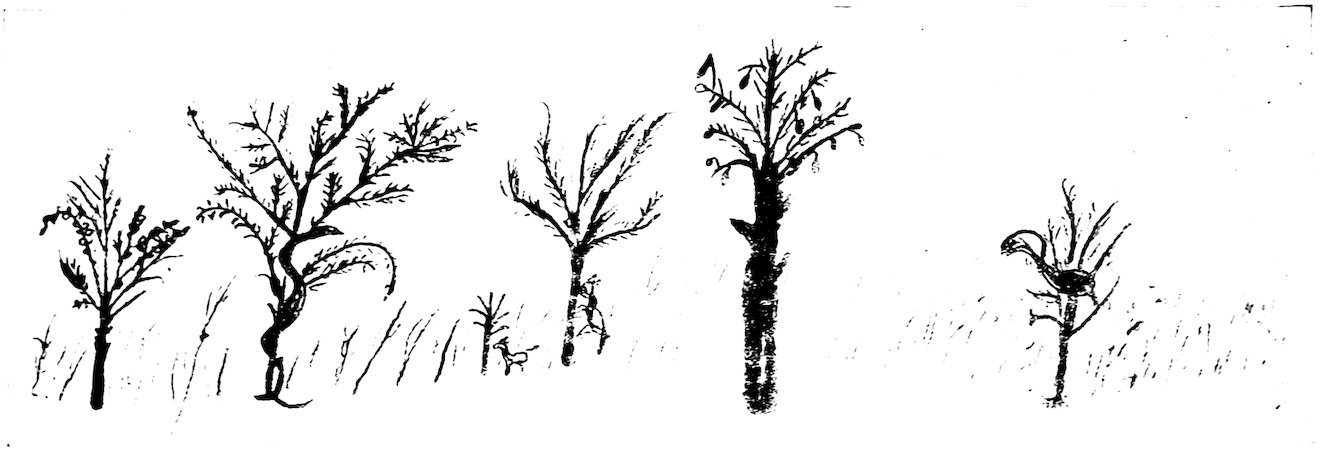
which led him to collect native drawings; the sketches by his
carriers and especially the portrait of the author himself on
p. 368 are decided contributions to the gaiety of nations, and
strike out a line unworked, so far as I am aware, by previous
xiiitravellers. It is a matter of deep and lasting regret to me,
personally, that I ever parted with a similar gem of art, picked
up at Blantyre, and presumably representing a European
engaged in inspecting his coffee plantation.
This whole question of native African art is very interesting.
Properly speaking, nothing in the way of indigenous graphic
art is known to exist in Africa, outside Egypt and Abyssinia,
(if indeed it can be called indigenous in the latter case), except
the rock paintings of the Bushmen, which, as is well known,
have in some cases attained real excellence. (The best published
reproductions up to the present date are contained
in the late G. W. Stow’s Native Races of South Africa.) In
South Africa wherever Bantu natives have executed any
paintings beyond the simplest geometrical patterns, they
are found to have learnt the art from Bushmen. The natives
on Mount Mlanje (Nyasaland) decorate their huts with paintings
of animals, but these have not yet been sufficiently
examined to pronounce on their quality; and, on the other
hand, many things render it probable that there is a strong
Bushman element in the population of Mlanje (at least in
the indigenous Anyanja, who have been only partly displaced
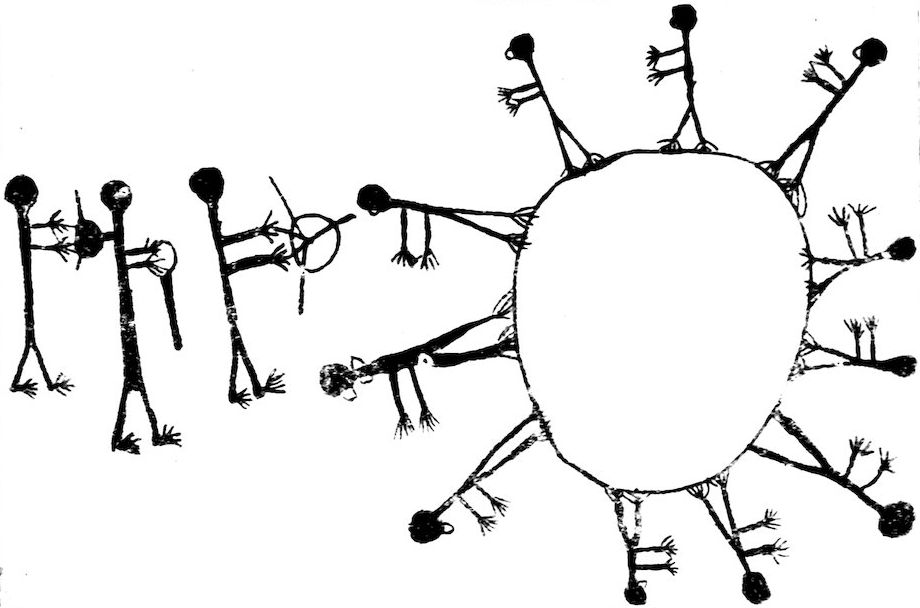
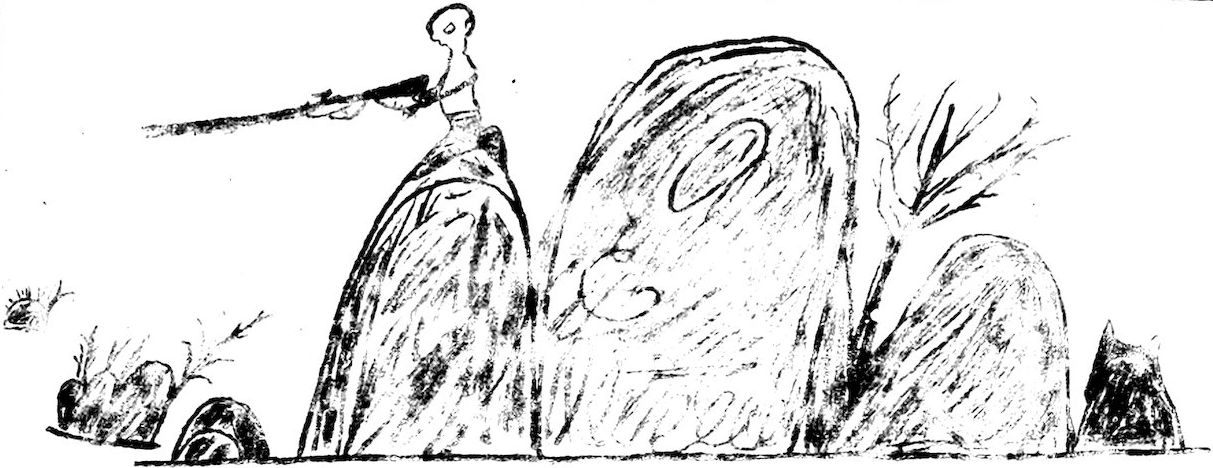
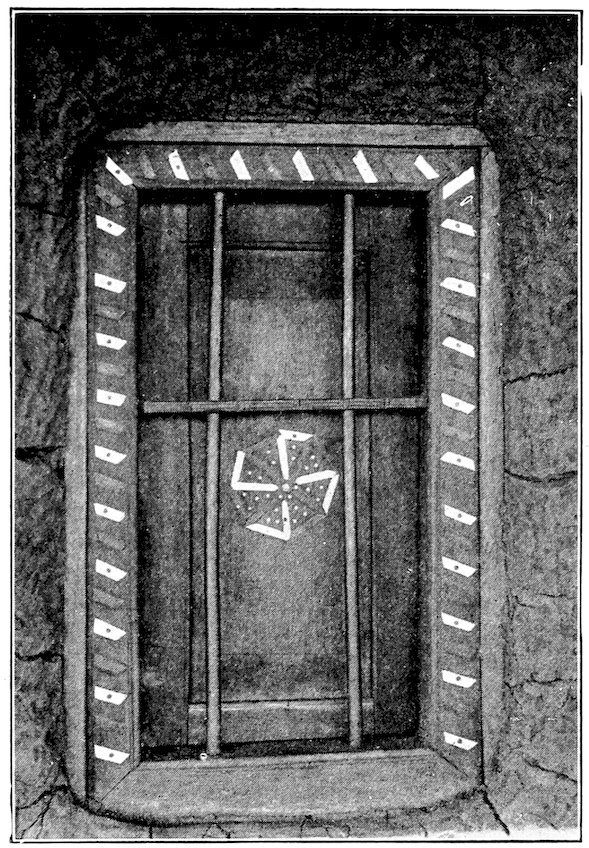
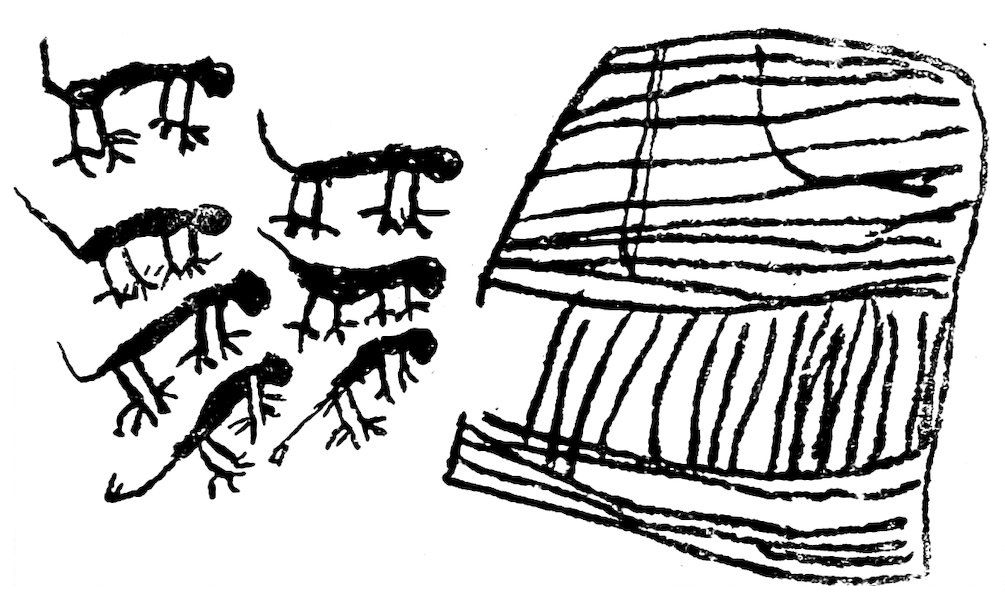
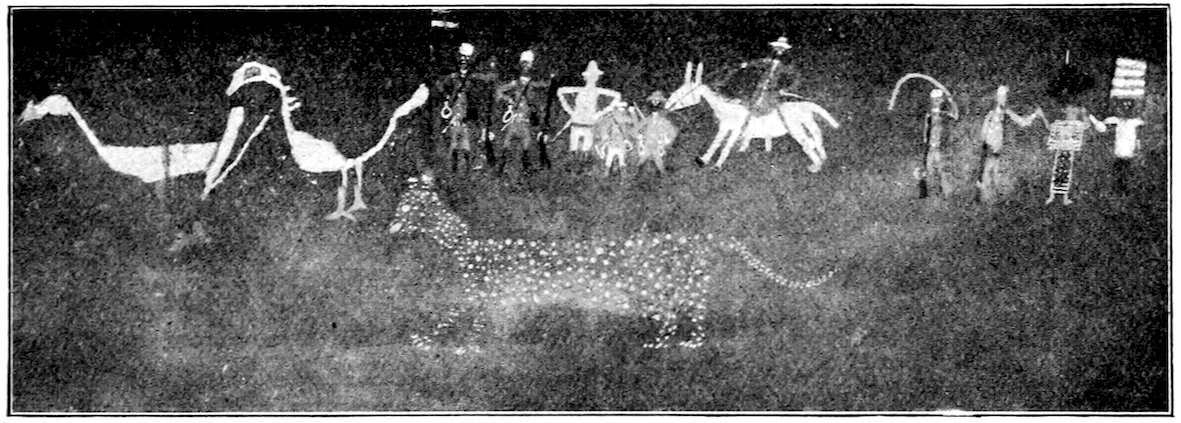
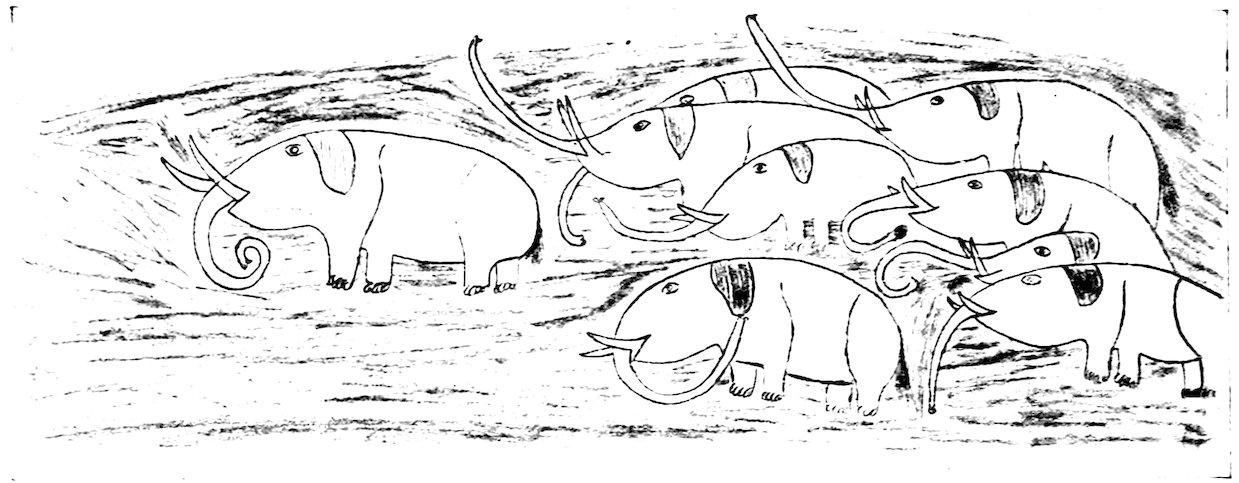
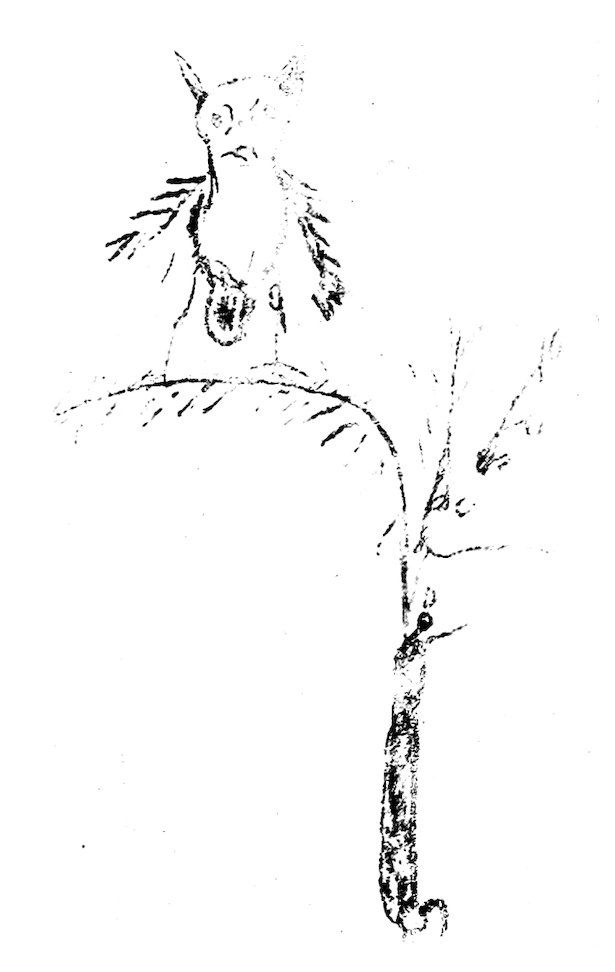
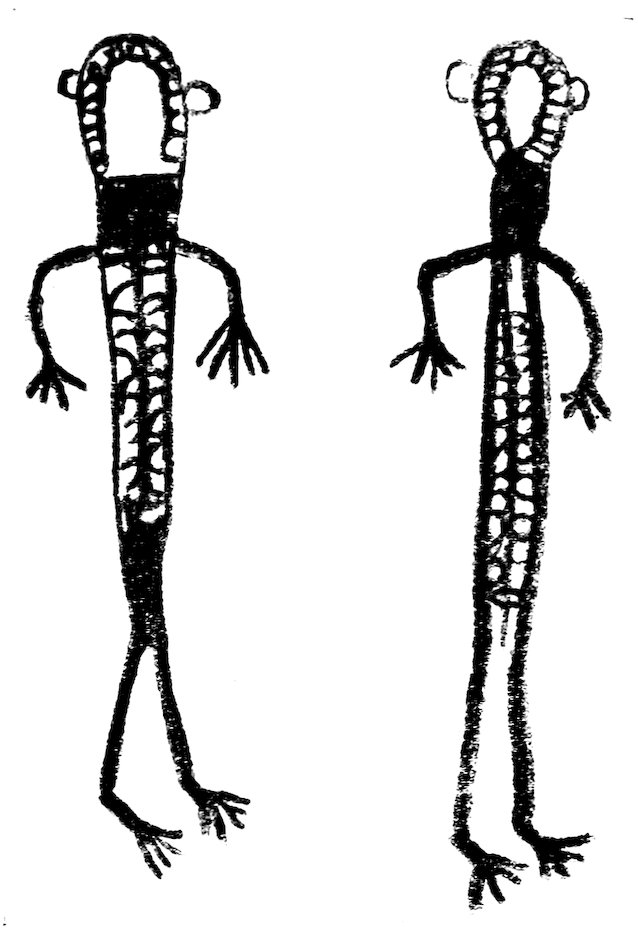
by the Yaos). Dr. Weule states that this kind of “fresco”
decoration is very common on the Makonde Plateau, but
considers that it is entirely on the same level as the drawings
of his carriers—i.e., that it shows no artistic aptitude or tradition,
and merely consists of scrawls such as those with which
innate depravity impels every untaught human being to deface
any convenient blank space. The single specimen reproduced
in his book is not precisely calculated to refute his theory,
yet it is no rougher than some of the cruder Bushmen drawings
(which show every conceivable degree of skill and finish);
and, if the daubs in question are merely the product of the
universal gamin instinct, surely, huts having clay walls would
everywhere be adorned with animal-paintings, which is by no
means the case.
The comparative value of Dr. Weule’s various results must
be left to the judgment of experts; but it seems safe to assume
that he was most successful in what may be called the outside
part of his task: in forming a collection and in describing what
is visible and tangible in the life and customs of the people. That
xivhe should have failed to penetrate their inner life is scarcely
surprising. What does surprise one is that he should have
expected to do so at such exceedingly short notice. His
disappointment in this respect at Masasi, and subsequently
at Chingulungulu, is calculated to provoke a smile, if not
“from the sinful,” at least from the veteran in African experience.
The greater his experience the more is the inquirer
inclined to hesitate before putting direct questions even when
they cannot be described as “leading”; but Dr. Weule
seems to have recognized no other mode of investigation. The
wonder is that the elders, officially convened by tuck of drum
from village after village and set down to be pumped till
both parties were heartily weary of the process, should have
told him anything at all—as they undoubtedly did, and
much of it, to judge from internal evidence, correct enough.
The most sympathetic of travellers does not always find it
easy to satisfy his thirst for knowledge, and Dr. Weule’s
methods, on his own showing, were frequently such that I
prefer to withhold any comment.
Dr. Weule devoted a considerable amount of time to
the study of the languages spoken in the districts he visited,
viz., Makua, Yao, and Makonde; but he does not appear to
have published any linguistic documents beyond the songs,
etc., given in the present volume. It is not clear whether
he was aware of any work previously done in this direction,
but he certainly speaks as though he were the first to reduce
these idioms to writing, though abundant materials exist in
print for the study of Yao, and the late Bishop Maples published
a grammatical sketch of Makua which is excellent as far as
it goes, not to mention the more recent work of Professor
Meinhof. It is also extremely strange that, while insisting
on the close relationship between the different languages
of the Makonde Plateau, he should have overlooked the
curious cleavage between Makua,—which has peculiarities
directly connecting it with the distant Sechuana and Sesuto—and
its neighbours.
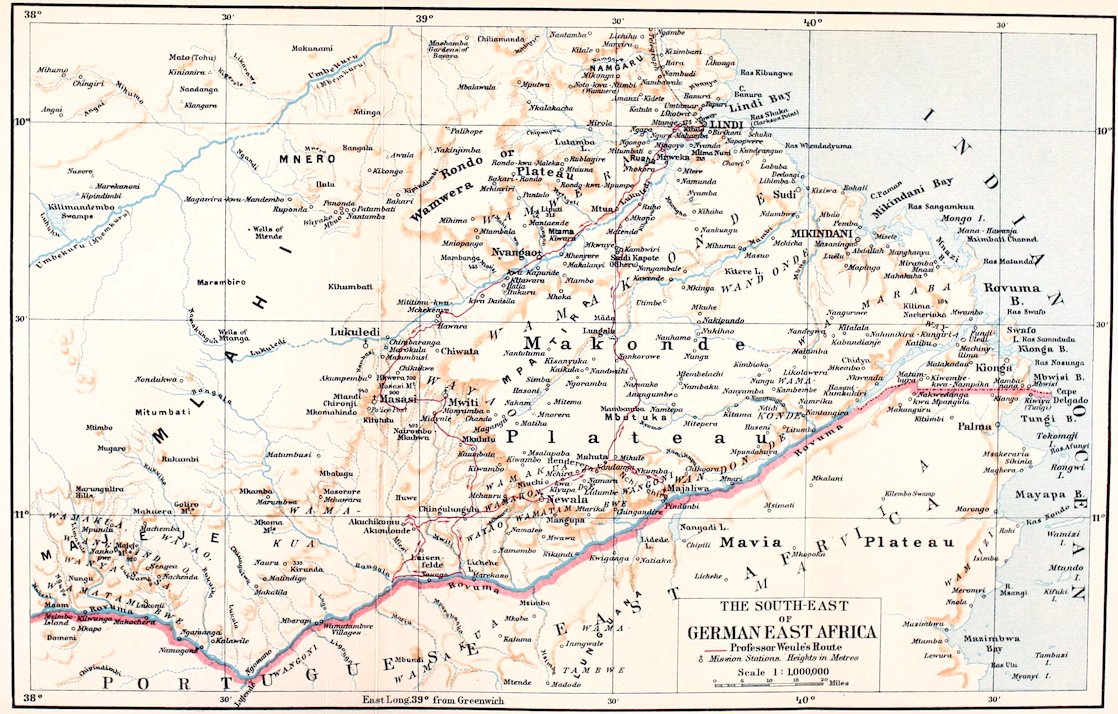
Though the scene of Dr. Weule’s labours was repeatedly
visited by Europeans, even before the German occupation,
not much has been written about it in this country outside
the publications of the Universities’ Mission. Livingstone
xvascended the Rovuma in 1862, to within thirty miles of
Ngomano at the Lujende junction; his farthest point being
apparently a little higher up than the camp occupied by Dr.
Weule in August, 1906. He had hoped to find a navigable
waterway to the immediate vicinity of Lake Nyasa; and, in
fact, some natives told him that the Rovuma came out of the
Lake; but the rapids and rocks made it impossible to take
the boats beyond the island of Nyamatolo, which, though
not marked on Dr. Weule’s map, must be somewhere near the
mouth of the Bangala. Most of the names given by Livingstone
are difficult to identify on recent maps; but this is not
surprising, as native villages are usually known by the name
of the chief or headman for the time being. It is true that
some of these names are more or less permanent, being official
or hereditary designations assumed by every successive functionary;
but the population has shifted so much during the
last forty years that the old names have been forgotten or
transferred to other sites. Thus Mr. H. E. O’Neill, in 1882,
found the Yao chief Chimsaka living in the eastern part of the
Mavia Plateau a little east of 40° E, having been driven from
his former place on the Upper Rovuma, more than two hundred
miles to the west, by a raid of the Mangoni (Angoni or
Maviti).
The country is still inhabited, as it was in Livingstone’s
time, by the Makonde, Makua, and Matambwe tribes, with
the Wamwera to the north in the hinterland of Lindi, and the
Mavia (Mabiha) south of the Rovuma, but they have moved
about a good deal within its limits, while the Yaos have penetrated
it from the west. The raids of the Angoni or Maviti
have also played a great part in these changes. Dr. Weule,
as we shall see, made careful inquiries on the subject of these
tribal migrations, and the information given to him fits in
fairly well with what others have obtained from the Yaos
in the Shire Highlands and the Angoni to the west of Lake
Nyasa.
Livingstone returned to this region on his last journey,
when he landed at Mikindani Bay (March 24, 1866) with those
unfortunate camels and buffaloes whose sufferings on the
jungle-march made his diary such painful reading. The choice
of camels for transport in this country was certainly a mistake;
xvibut a greater mistake—and one which he bitterly regretted—was
made in the choice of the men who drove the camels.
On this occasion, Livingstone followed the Rovuma by land
as far as Mtarika’s (the old village about the Lujende confluence,
near Chimsaka’s former abode, not the Mtarika’s
which will be found marked in Dr. Weule’s map on the Lujende
itself), and struck south-westward in the direction of the Lake,
which he reached, near the mouth of the Mtsinje, on the 8th
of August. The route followed some years previously by
Dr. Roscher, who made his way from Kilwa to Lake Nyasa,
sighting it November 24, 1859, a few weeks after its discovery
by Livingstone, lies somewhat to the north-west of the country
dealt with in this book, and nowhere touches the scene of
Dr. Weule’s travels.
In 1875, the late Bishop Steere followed in Livingstone’s
tracks, starting from Lindi on the first of November, and
reaching Mwembe (Mataka’s village) in a little over five weeks.
This was the first of a series of remarkable journeys accomplished
by members of the Universities’ Mission, of which we
need here only mention, that of the Rev. W. P. (now Archdeacon)
Johnson and the late Rev. C. A. Janson in 1882. The station
of Masasi was founded in 1876, and that of Newala in 1882;
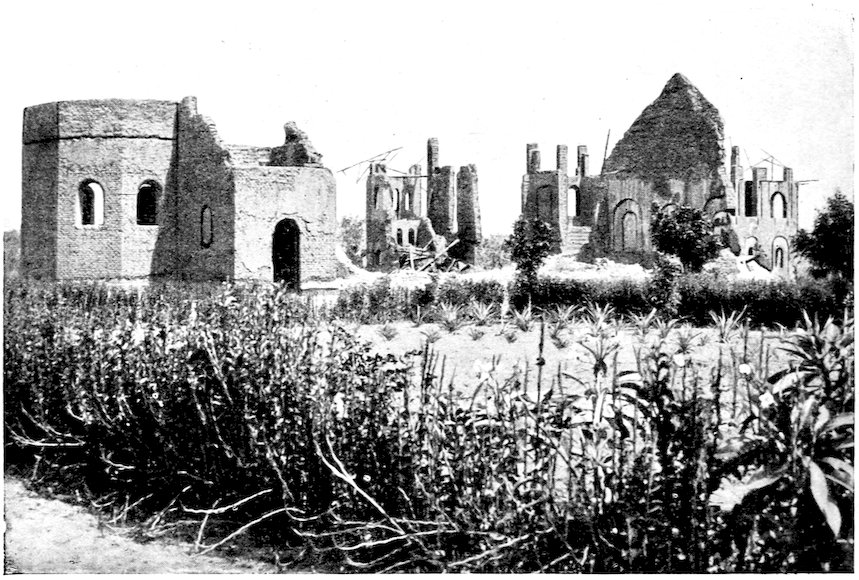
the buildings of the former were nearly all destroyed in the
“Majimaji” rising of 1906, shortly before Dr. Weule’s visit,
and are only now in process of reconstruction.
The Rovuma valley was further explored in 1882, by the
late Joseph Thomson, whom the Sultan of Zanzibar had
commissioned to examine its mineral resources, with a view
to ascertaining if workable coal-seams existed. His report
was, on the whole, unfavourable, though a French engineer,
M. D’Angelvy, subsequently (in 1884) despatched on a similar
errand, came to a different conclusion. The Livingstone
expedition had found coal near Lake Chidia, in 1862; but
up to the present day it has not been utilized.
Mr. H. E. O’Neill, when British Consul at Mozambique,
did a great deal of exploring, in an unobtrusive way, between
the coast and Lake Nyasa, and, in 1882 examined the country
inland from Tungi Bay, and south of the Rovuma, being the
first European to penetrate the Mavia Plateau and come in
contact with that tribe who enjoyed among their neighbours
xviithe reputation of being “so fierce and inhospitable that no
one dares to pass through their country.” This exclusiveness
Mr. O’Neill found to be largely if not entirely the result of
the persecution the Mavia had undergone at the hands of
stronger tribes, particularly the Yaos, incited by coast slavetraders.
They were unwilling to guide him to their villages,
and took him there by night so that he might be the less likely
to find his way there a second time; but, “when once their
natural suspicions were allayed and confidence established,
they were hospitable and generous, and showed neither distrust
nor reserve. Indeed, they seemed to me to be a particularly
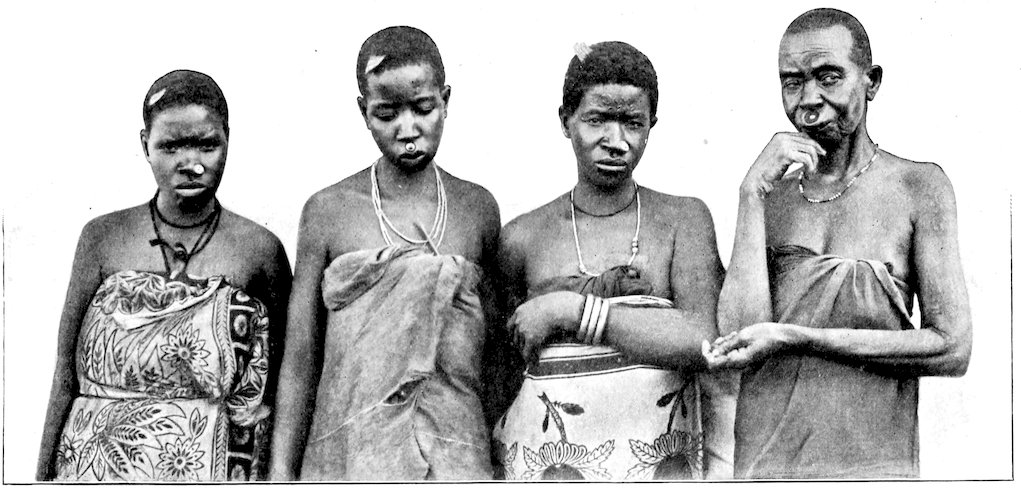
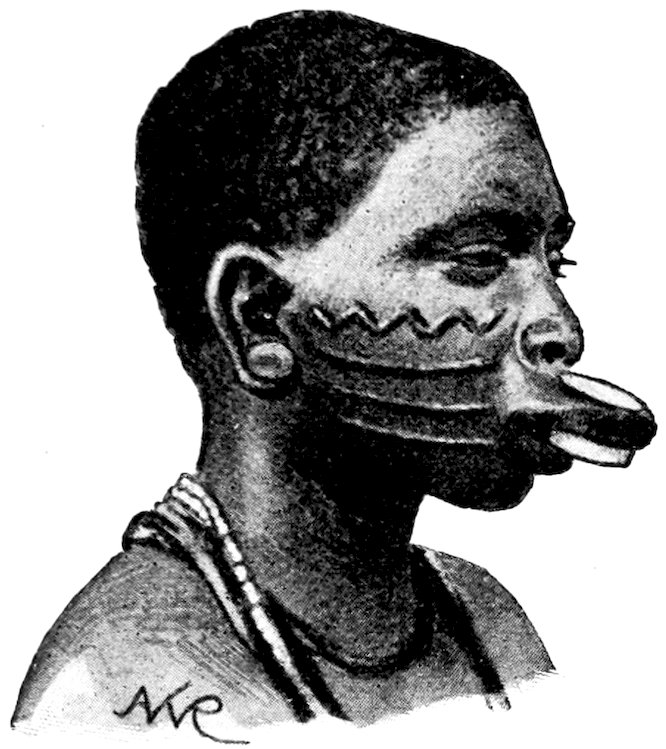
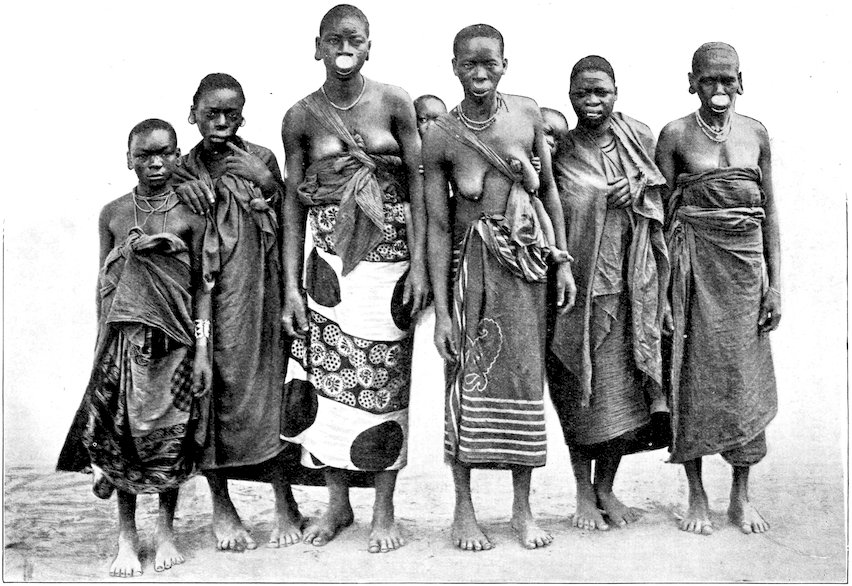
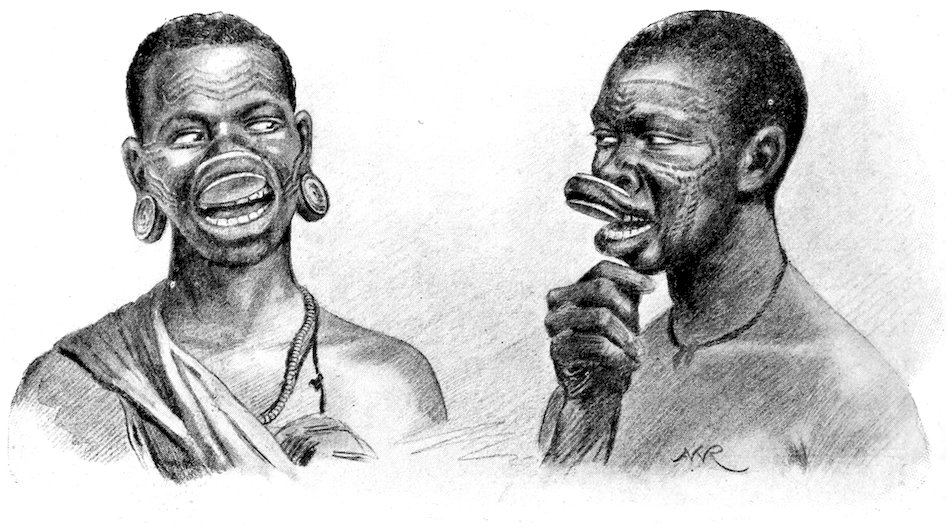
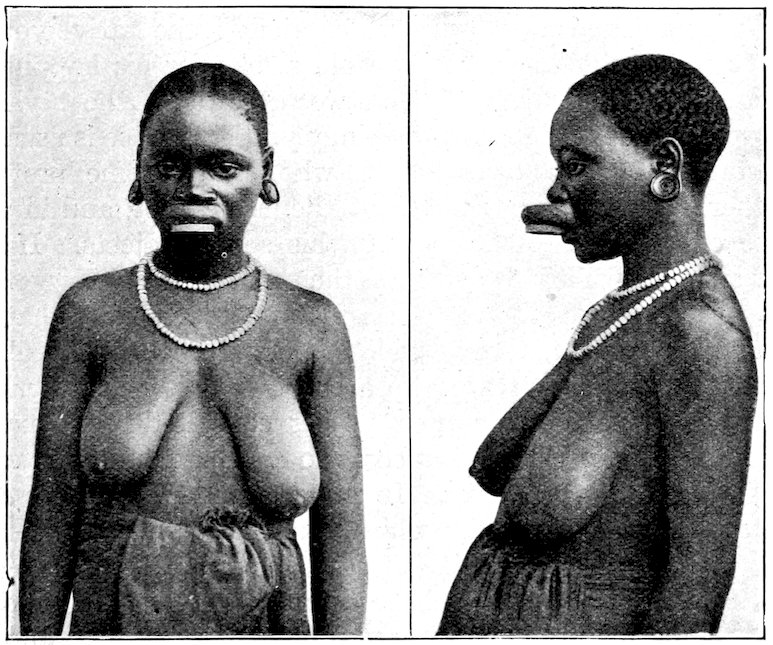
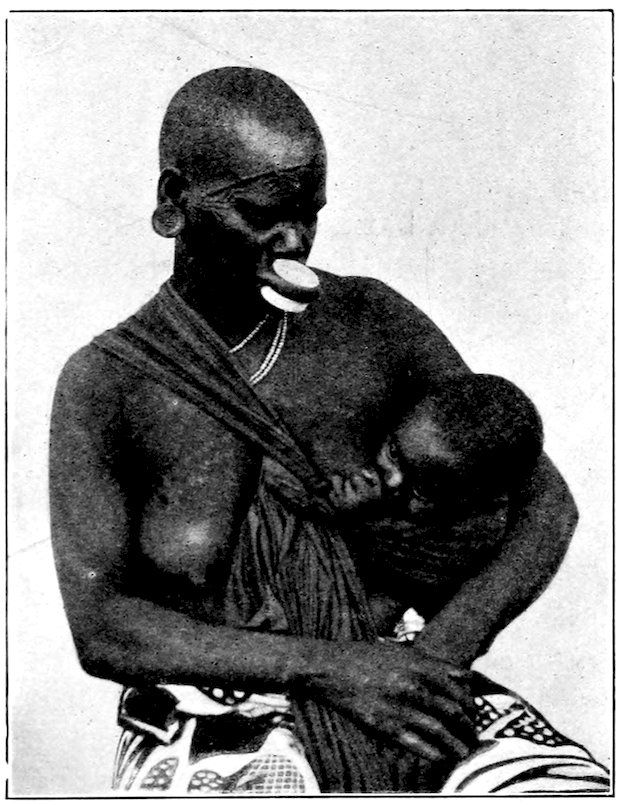
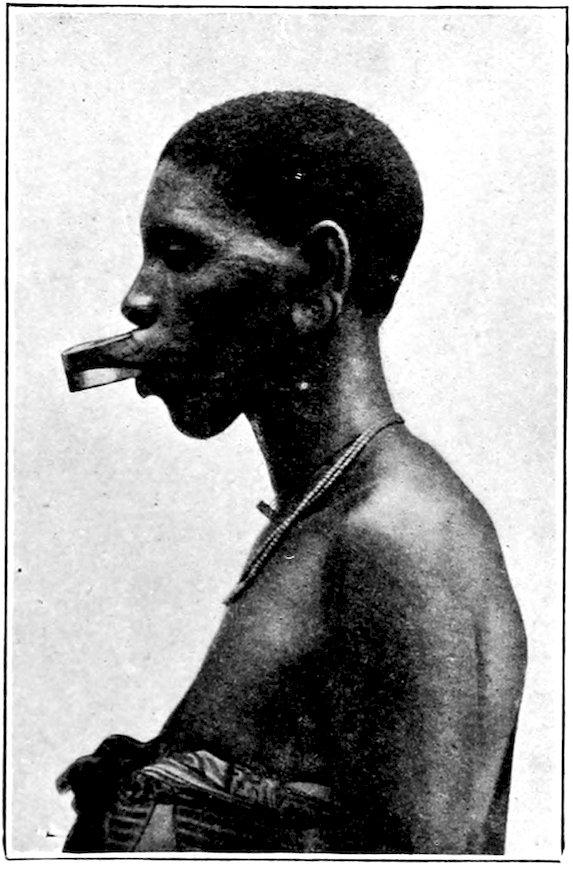
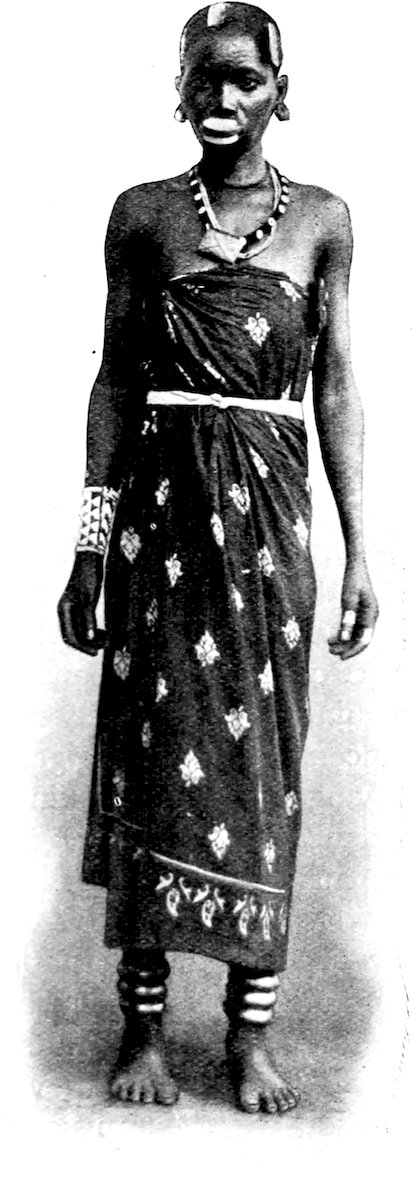
simple-minded, harmless folk.” Men, as well as women, wear
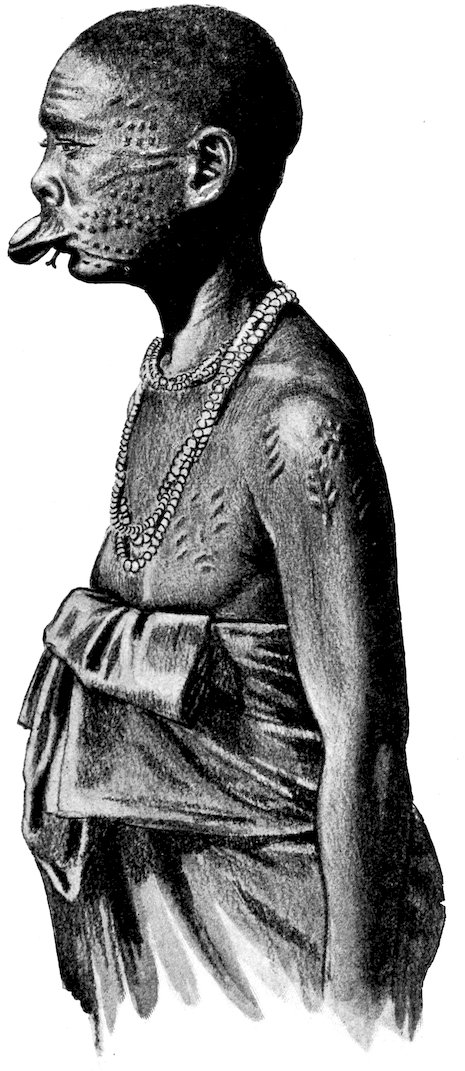
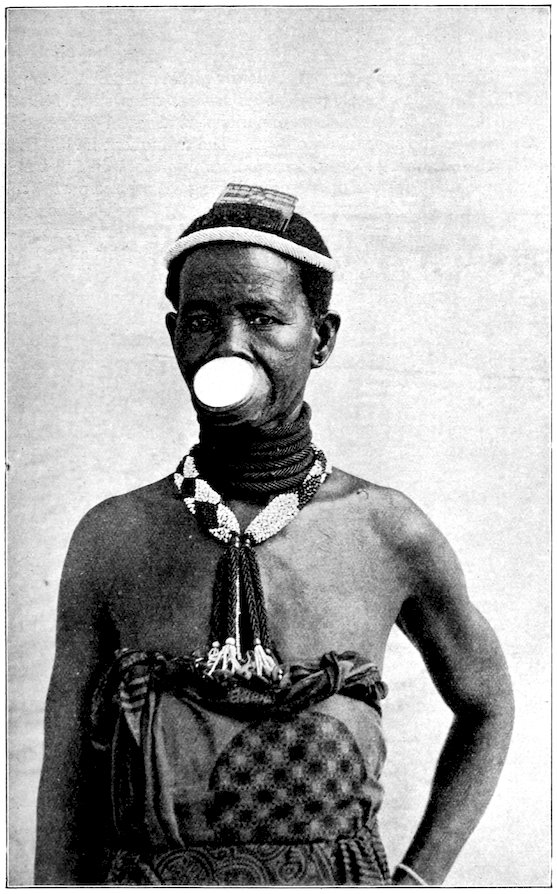
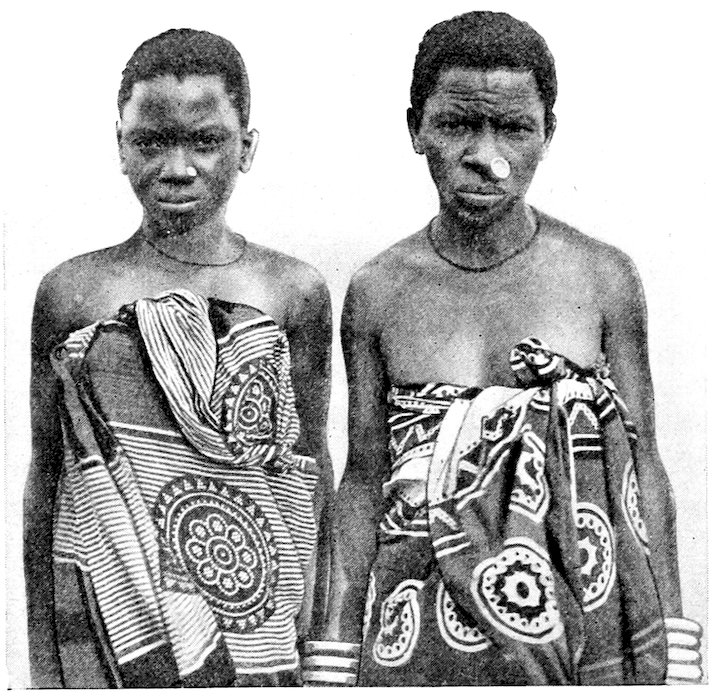
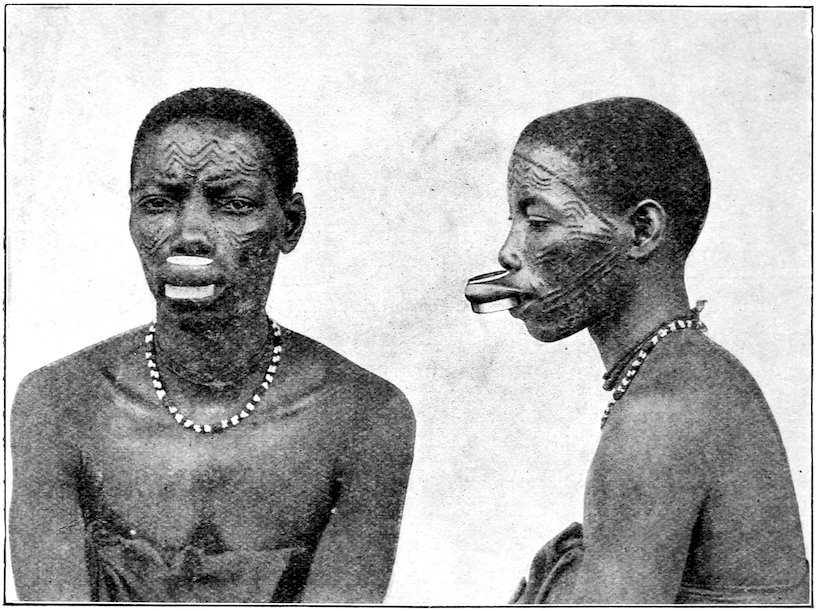
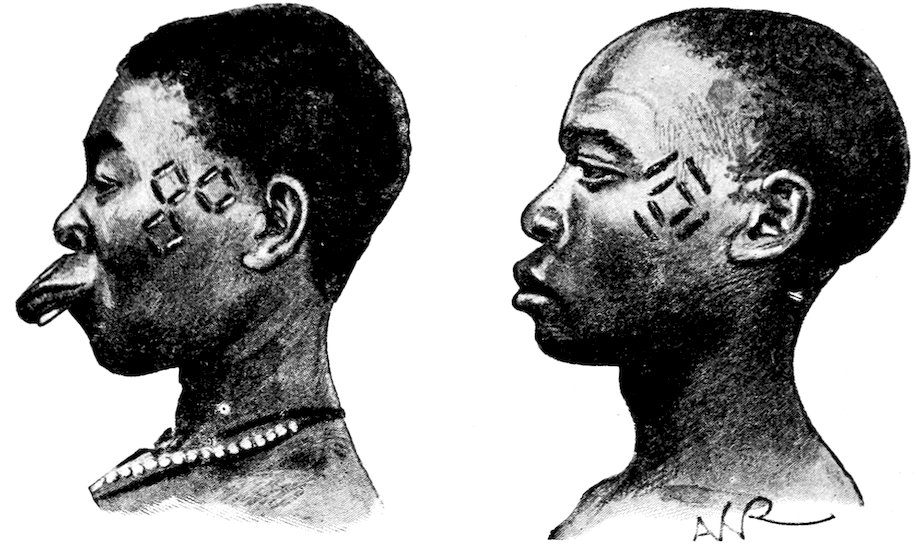
the pelele, or lip ring, as mentioned by Dr. Weule, who never
came across the Mavia for himself. Of their wearing their
hair in pig-tails, Mr. O’Neill says nothing—in fact, beyond the
pelele, there was little to distinguish them from neighbouring
tribes, and he was disposed to consider them a branch of the
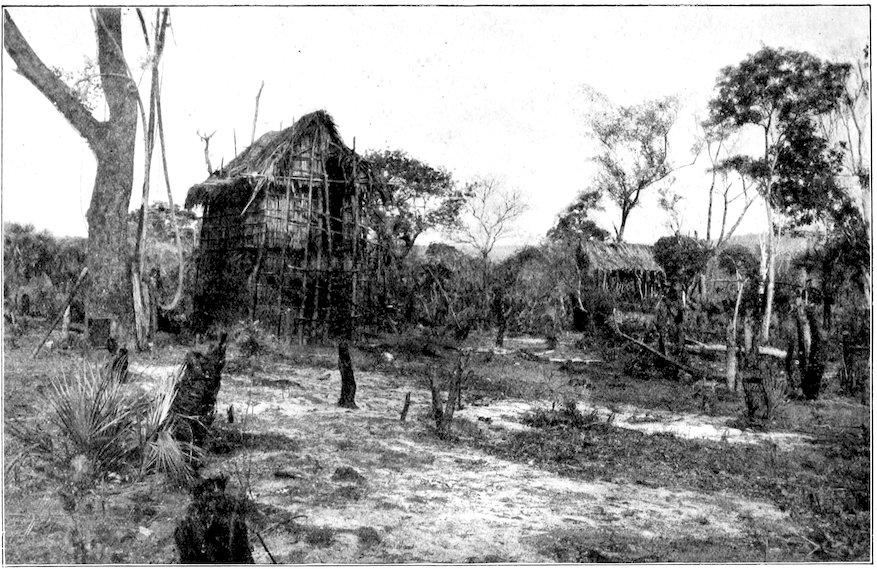
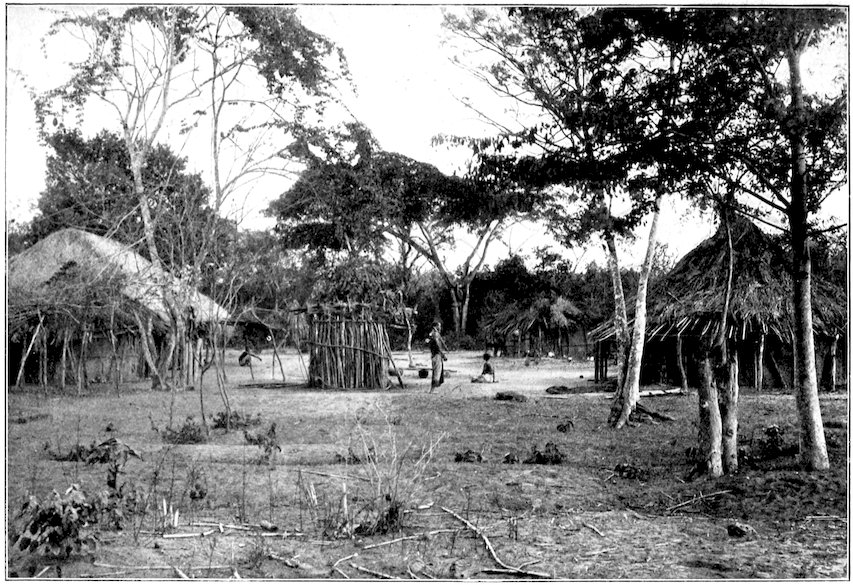
Makonde. His description of their villages hidden away in
the thorny jungle and approached by circuitous paths recalls
what Dr. Weule says as to the difficulty of finding the Makonde
settlements without a guide. In the course of this journey
Mr. O’Neill discovered Lake Lidede, and at one point of his
march he looked down on the Rovuma Valley from the edge
of the Mavia Plateau at almost the same point as that where
Dr. Weule saw it from the opposite escarpment, as described
on pp. 343–4. It is interesting to compare the two accounts:—Mr.
O’Neill’s is to be found in the Proceedings of the R.G.S.
for 1882, p. 30.
Mr. J. T. Last, starting from Lindi on the 28th of October,
1885, made his way overland to Blantyre, via Newala, Ngomano
and the Lujende Valley, in eleven weeks. He remarks on the
“desolation of the country which was formerly well populated,
as the sites of the old villages show; but now there is not a
house to be seen”—through the raids of the Magwangara and
others. Lions were as numerous as they appear to have been
in 1906, and for a similar reason. One of Mr. Last’s carriers
was dragged out of the grass shelter where the men were
sleeping, thus affording an almost exact parallel to the incident
related by Dr. Weule on pp. 394–8.
At this time the country was under the nominal rule of the
xviiiSultan of Zanzibar, who stationed his officials at some of the
places near the coast and exercised a somewhat intermittent
and uncertain authority over the chiefs in the interior. By
the treaty of 1890 the whole of the mainland as far back as
Lakes Victoria and Tanganyika, between the Rovuma on the
south, and the Umba River on the north, was handed over
to Germany, while the protectorate over what remained of
the Sultan’s dominions (viz., the islands of Zanzibar and
Pemba) was taken over by the British Government.
It seems improbable that this immense territory can ever
be colonised by Germans in the same way in which Canada
and Australia have been colonised by ourselves. There are few
if any parts where German peasants and workmen could expect
to live, labour, and bring up families. So far as the country
has been settled at all, it is on the plantation system: European
capitalists cultivating large tracts of land by means of native
labour. Some coffee plantations in Usambara are, we understand,
flourishing fairly well, though not producing wealth
beyond the dreams of avarice; but the system, if it is to be
extended to the whole territory, does not augur well for the
future. It is not a healthy one for employer or employed;
it always tends in the direction of forced labour and more or
less disguised slavery; and, in the end, to the creation of a
miserable and degraded proletariat. Much more satisfactory
is the method to which Dr. Weule extends a somewhat qualified
approval (though there can be no doubt that it has his sympathies)
of securing to the native his own small holding and
buying his produce from him, as has been done, to some
extent, with the best results, in our own Gold Coast Colony.
Dr. Weule remarks, somewhat naively, that a wholesale
immigration from Germany would be interfered with if the
native “claimed the best parts of his own country for himself.”
But surely a ver sacrum of the kind contemplated is unthinkable
in the case of East Africa.
It is possible that the reader may be somewhat perplexed
by Dr. Weule’s estimate—or estimates—of the native character.
The recurring contradictions apparent in various parts of his
book arise from the plan on which it is written. In the original
edition, the traveller’s narrative takes the form of letters
addressed to his wife and friends from the successive stages of
xixhis journey. This form has been dispensed with (beyond the
dates at the head of each chapter) in translation,[1] because the
personal allusions, in a foreign dress, rather detract from than
add to the interest of the narrative, and all the more so, as
they are not, in a sense, genuine, but have been added, après
coup, to impart an air of verisimilitude to the letters. The
latter, in fact, were not written from the places at which they
are dated, but were put into shape after the author’s return
to Europe, from notes made on the spot, together with extracts
from actual letters, not printed as a whole. This material,
in order not to sacrifice the freshness of first impressions, has
been used very much as it stood, and it will be noticed that, in
many cases, the observations made at different places correct
and qualify one another.
I am glad to find that Dr. Weule stands up for the native
in respect of the old accusation of laziness. He shows that
the people of the Makonde Plateau, at any rate, work pretty
hard (in some points, as in their water-carrying, unnecessarily
hard) for a living. He also defends them against the charge
of improvidence, making it quite plain that they take infinite
pains in storing their seed-corn for next season, and that, if
they do not save more of their crops against a year of famine,
instead of making the surplus into beer, it is because they have,
under present circumstances, absolutely no means of keeping
them. It is true that, in one passage, he seems to depreciate
the industry of native women, by comparison with the work
done by German maid-servants and farmers’ wives. But he
forgets to make allowance for the difference of climate—and,
perhaps, one may be permitted to doubt whether any human
being really ought to work as hard as most German women
do in town or country.
On the whole, Dr. Weule is kindly disposed towards the
native. He does not seem entirely to have escaped the danger
deprecated on p. 41—at least it strikes one that some of the
(doubtless not unmerited) castigations bestowed in the course
of his pages might have been dispensed with by the exercise
xxof a little more patience and tact; but he remained throughout
on the best of terms with his carriers, and appears to have
parted from Moritz, Kibwana and Omari, in spite of the trials
to which they had subjected him in the exercise of their several
functions, with no ill-feeling on either side. More than once
he bears testimony to the uniform good manners of the people
whose villages he visited, and to their homely virtues—their
unfailing cheerfulness, their family affection, and their respect
for parents. At the same time, he relates various incidents
calculated to leave a less pleasant impression, though it must
be remembered that the proportion they bear to the whole
of native life is probably less than that borne by the criminal
cases reported in our newspapers to the daily life and conduct
of our population in general. Dr. Weule’s stay in Africa
was surely long enough for him to see that the Bantu native
is not in general bloodthirsty or ferocious; that, on the
contrary, when not maddened by terror or resentment, he is
gentle, reasonable, and even somewhat lacking in vindictiveness
compared with other races. Yet, in the scientific report on
the expedition (a publication several times alluded to in the
course of the work before us) the author is, it seems to me,
guilty of a grave injustice.
The reader will note that, on his return to the coast (see
pp. 27–9), he spent some time in studying the records of the
Criminal Court at Lindi, though he does not here tell us
anything about the results of his examination. Now these
records certainly afford valuable material for the study of social
conditions; but they should be used with discrimination.
Dr. Weule does not give what is of the very first importance,
the number of criminal cases and their proportion to the
population, especially as the serious cases, which are brought
for trial to Lindi, represent the whole of an extensive province.
But he mentions two atrocities as a proof of the ignorance
shown by certain German newspapers, which “during the
last two years have thought it necessary to insist, over and
over again, on the noble traits in the negro character,” and
of the “predominance of low instincts in those sons of untamed
nature” who have “an innate disposition to violence.”
One of the cases in question was that of a woman who killed
her own mother by a blow with the pestle used for pounding
xxicorn. But it is hardly fair to place this murder on the same
footing as a crime committed out of mere brutal passion:
the woman’s children had died, and she believed her mother
to have caused their death by witchcraft. We know what
horrible cruelties this belief has induced people not otherwise
depraved to commit: an instance occurred only twelve
or thirteen years ago, no further off than Clonmel. The other
case, which is certainly revolting enough, was the revenge of
a husband on a guilty wife. But both of them together
prove absolutely nothing without information which would
enable us to see whether they are to be regarded as exceptional,
or as in any sense typical. The other incident given by way
of proving that violence and brutality are “in the blood” of
the native, is that of an unfortunate woman who, unsuspiciously
passing through the bush, fell in with a band of unyago
boys, and was by them seized and put into a slave-stick “out
of mere mischief and enjoyment of violence.” The comment
on this is that, unless the woman had been a stranger from a
distance (who, under ordinary circumstances would not be
very likely to travel alone), she must have known that there
was an unyago in the neighbourhood, that if she traversed
the bush in that direction she would do so at her peril, and
that her trespassing on the forbidden ground was an act of
the grossest impropriety combined with sacrilege. As for
“delight in violence”—surely that, in one form or another,
is an inherent attribute of the “human boy” in every part
of the world, above all when he conceives himself to have a
legitimate excuse?
The mention of the unyago mysteries suggests a subject on
which Dr. Weule has obtained fuller information than any
previous writer—at any rate on this part of Africa. It is
surprising that he should have been able to secure so many
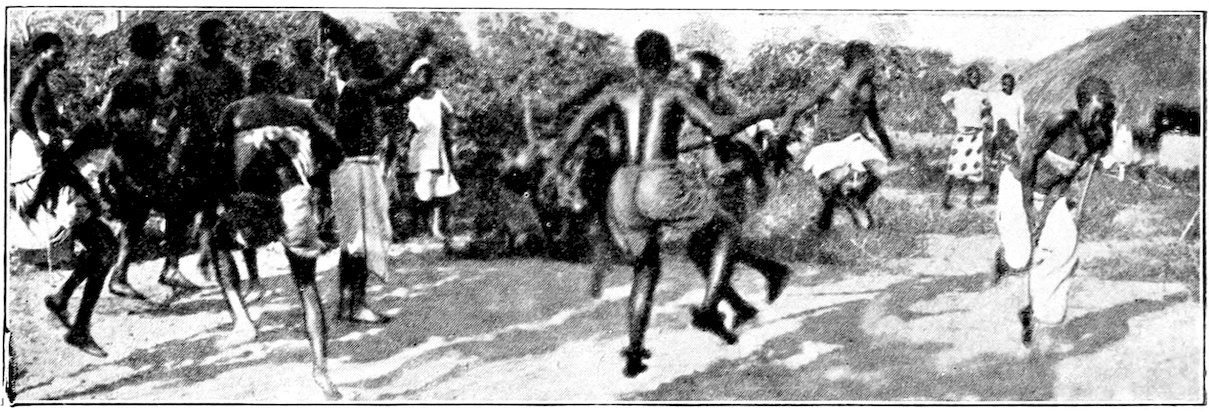
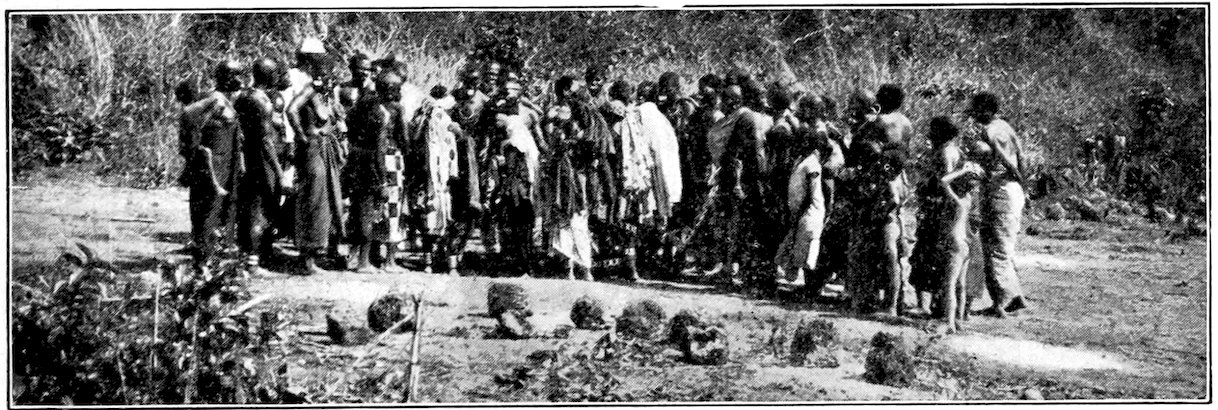
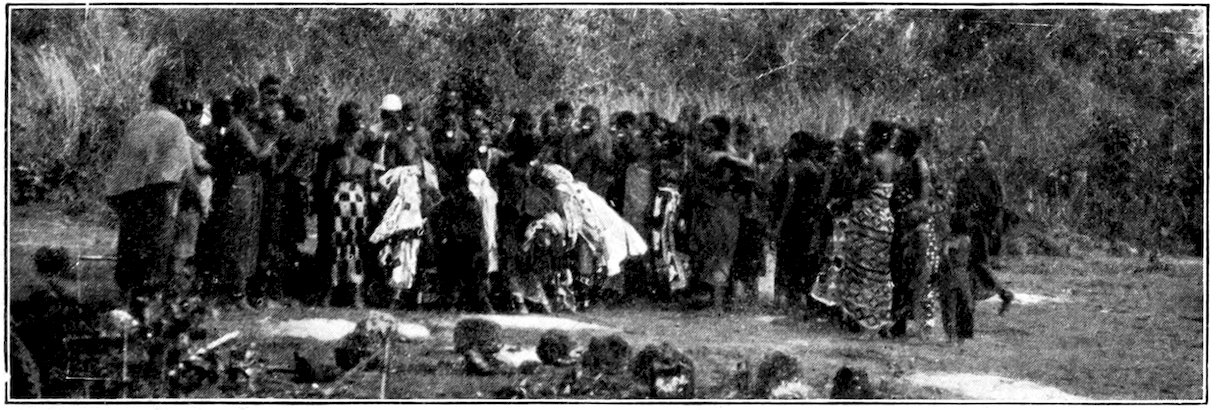
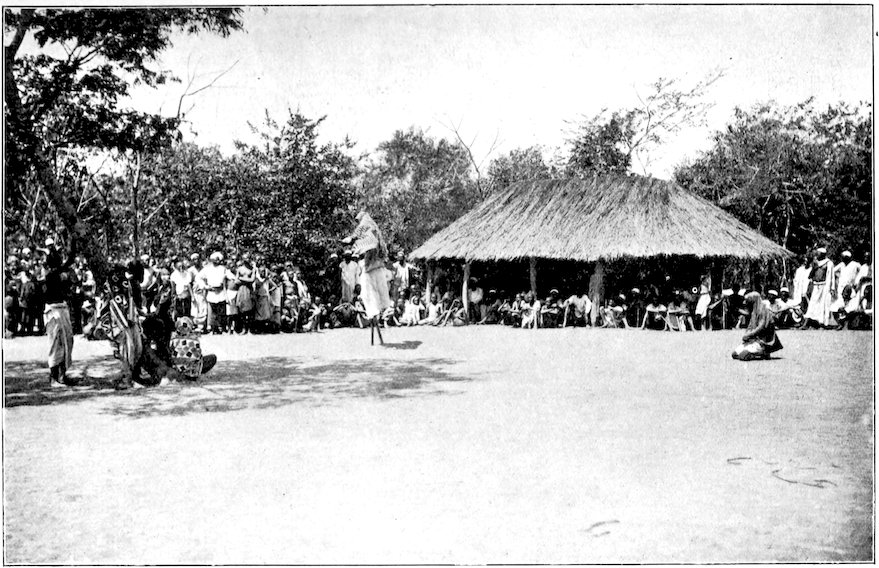
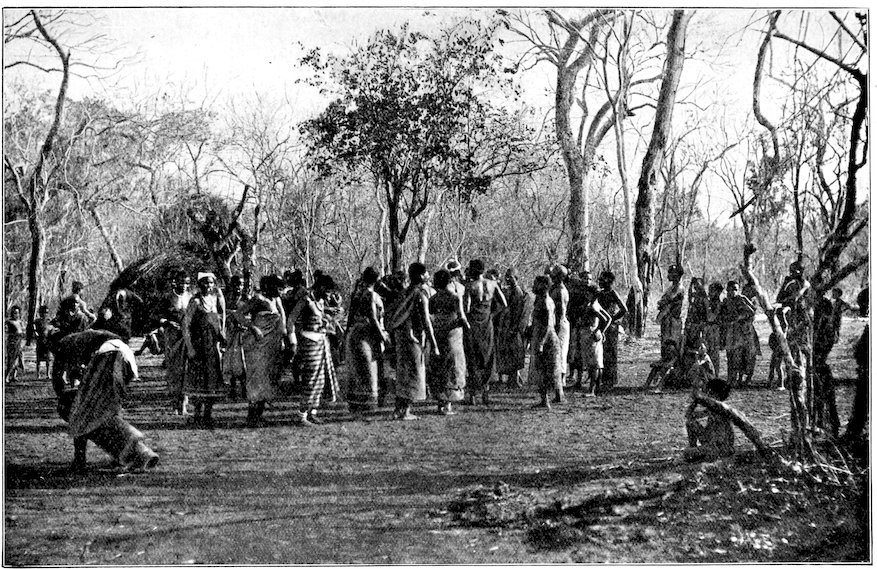
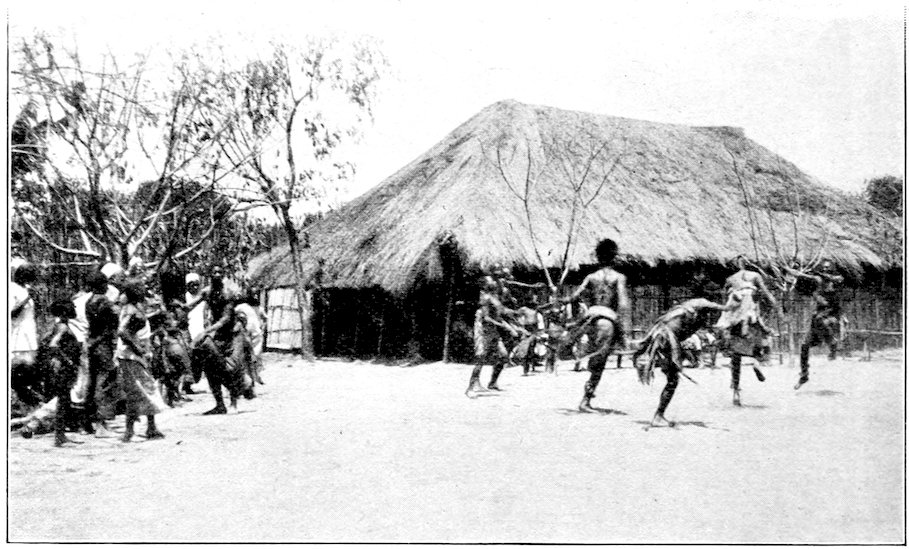
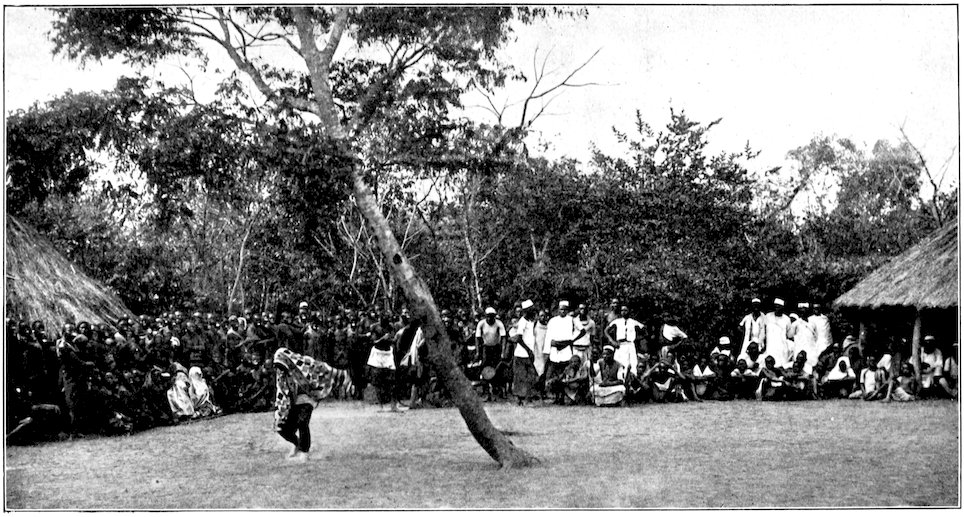
photographs of the dances—especially those of the women—but
these only constitute the more public part of the ceremonial.
As to the instruction given to the younger generation,
he does not seem to have got beyond generalities except in the
case of the two old men who, when very drunk, began to dictate
the actual formula in use, though they did not get to the
end of it. Whether any tribal traditions, any myths, embodying
the religious ideas of a far distant past, are handed
xxiidown along with such practical teaching about life as the
elders are able to give, does not appear—but from what
we know about other tribes it seems highly probable. Among
the Anyanja (Wanyasa) of Lake Nyasa, e.g., a story accounting
for the origin of that lake is told. But perhaps many
of the Makonde and Makua traditions have by this time
been forgotten. It is evident that they have led a very
unsettled life for the past forty or fifty years, besides being
decimated by the slave-trade. (This circumstance, by the by,
should always be remembered in connection with Dr. Weule’s
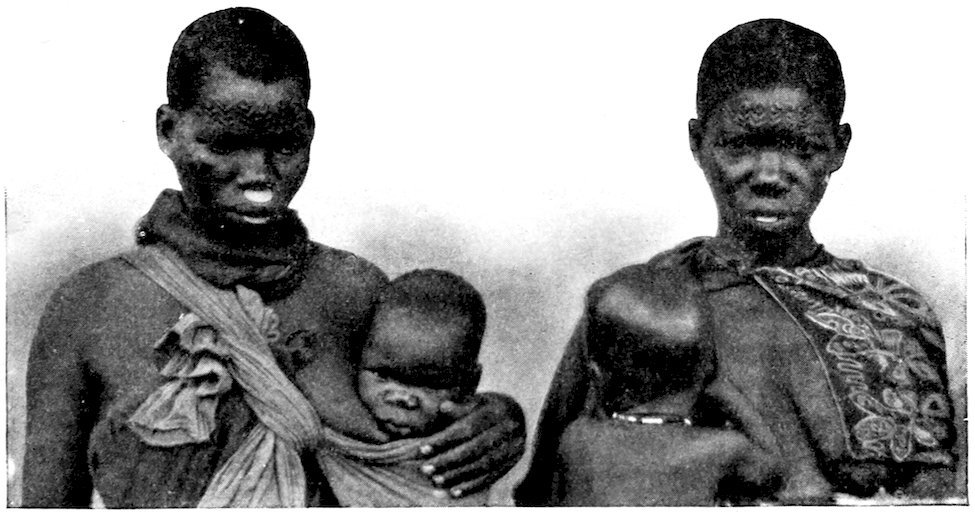
pictures of native life, which leave a painfully squalid impression.
I am far from wishing to idealize the “state of
nature”; but neither the Zulus, nor the Anyanja, nor the
Yaos of the Shire Highlands are so ignorant and careless of
hygiene or so neglectful of their babies as the poor women of
Chingulungulu and Masasi are represented by him to be.)
These “mysteries” are universal—or practically so—among
the Bantu tribes of Africa, and no doubt most others
as well. Usually they are spoken of as an unmixed evil, which
Christian missionaries do all in their power to combat, and
some are not backward in calling out for the civil power (in
countries under British administration) to put them down.
The subject is a difficult and far-reaching one, and cannot
adequately be discussed here. My own conviction, which I
only give for what it is worth, is that it is a great mistake to
interfere with an institution of this sort, unless, perhaps,
when the people themselves are ceasing to believe in it, in
which case there is danger of its becoming a mere excuse for
immorality. Otherwise, even the features which to our
feelings seem most revolting are entwined with beliefs rooted
in a conception of nature, which only the gradual advance of
knowledge can modify or overthrow. And we must remember
that the problem which these poor people have tried to solve
in their own way is one which presses hardly on civilized
nations as well. Parents and teachers have discovered the
evil of keeping the young in ignorance, or leaving them to
discover for themselves the realities of life; but many of them
appear helplessly perplexed as to the best way of imparting
that instruction.
As regards missions, Dr. Weule has not very much to say,
xxiiibut I am sorry to find that he cannot refrain from the cheap
sneer about “Christianity not suiting the native,” which seems
to be fashionable in some quarters. It seems to be a mere
obiter dictum on his part—perhaps unthinkingly adopted
from others—for he brings no arguments in support of his view,
beyond remarking that Islam suits the African much better,
as it does not interfere with his freedom. But some excuse
may be found for those who hold that view in the erroneous
conceptions of Christianity which have prompted various
mistakes on the part of missionaries. It is quite true that
such or such a system of complicated doctrinal belief, the
product of long ages and a special environment, may not suit
the African. It is also true that, if Christianity means Europeanisation—if
it means that the African is to be made over
into a bad imitation of an Englishman or German—it is
impossible that it should gain any real hold on him. But it
is no exaggeration to say that no people on earth are more
capable—many are not so capable—of appreciating and acting
on the spirit of the Gospel, of simple love and trust in the
Eternal Goodness and goodwill towards their fellow-men.
The question is a wide one, which cannot be fully discussed
within these limits. Missionaries have often made mistakes
and acted injudiciously; they have in some cases done serious
harm, not from failure to act up to their principles, but from
error in those very principles and a fatal fidelity to them.
They may have interfered between chiefs and people, and
broken down customs better left alone, or may unwittingly
have encouraged the wrong sort of converts by welcoming all
and sundry, including fugitives from justice or people discontented
with their home surroundings for reasons quite
unconnected with high spiritual aspirations. Or again, they
may incur blame for the deficiencies of alleged converts who,
after honouring the mission with their presence for a time,
depart (usually under a cloud) and victimise the first European
who can be induced to employ them.
But there is another side to the matter. A man—whether
consciously a follower of the Nietzschean doctrine or not—who
thinks that “the lower races” exist to supply him with
labour on his own terms, is naturally impatient of a religion
which upholds the claims of the weak, and recognizes the
xxivstatus of man as man. Hinc illæ lacrymæ, in a good many
cases. Honestly, I do not think this is Dr. Weule’s view. But
I cannot quite get rid of the suspicion that he was repeating
what he had heard from a planter, and that it was, in strict
accuracy, the planter’s convenience, and not the native, that
Christianity failed to “suit.” Anyone who has read a certain
pamphlet by Dr. Oetker, or Herr von St. Paul Illaire’s Caveant
Consules, or Herr Woldemar Schütze’s Schwarz gegen Weiss
will not think this remark too strong.
It would be deplorable, indeed, if those writers had to be
taken as typifying the spirit of German colonial administration
in Africa, or indeed anywhere else. But I do not think
we have any right to suppose that this is so. There has been, I
think, too much militarism—and very brutal militarism, in
some cases—in that administration; but this is an evil which
appears to be diminishing. There is a tendency, perhaps, to
worry the native with over-minute government regulations,
which, no doubt, will as time goes on be corrected by experience.
And there is no lack of humane and able rulers who bring
to their task the same conscientious, patient labour which
their countrymen have bestowed on scientific research; who
are trained for their posts with admirable care and thoroughness,
and grudge no amount of trouble to understand and do justice
to the people under their care. They shall in no wise lose
their reward.
A. WERNER.
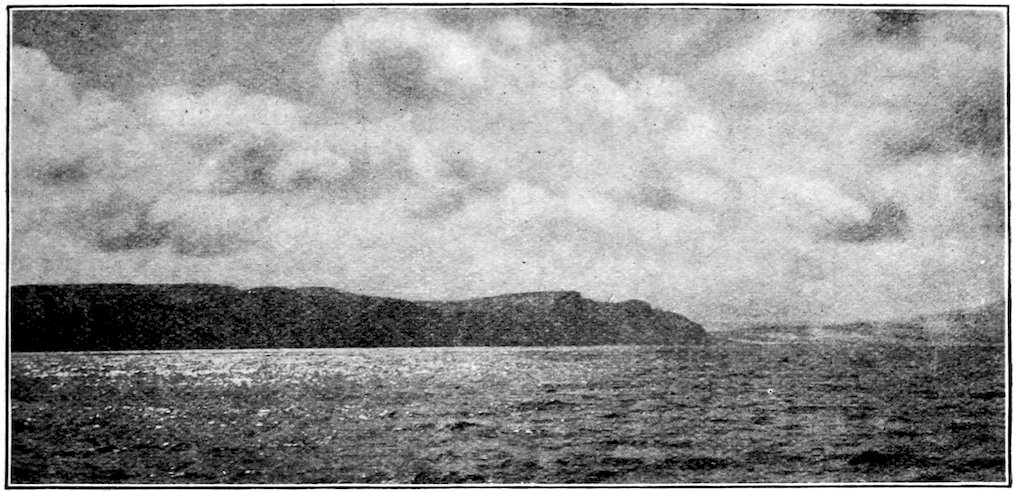
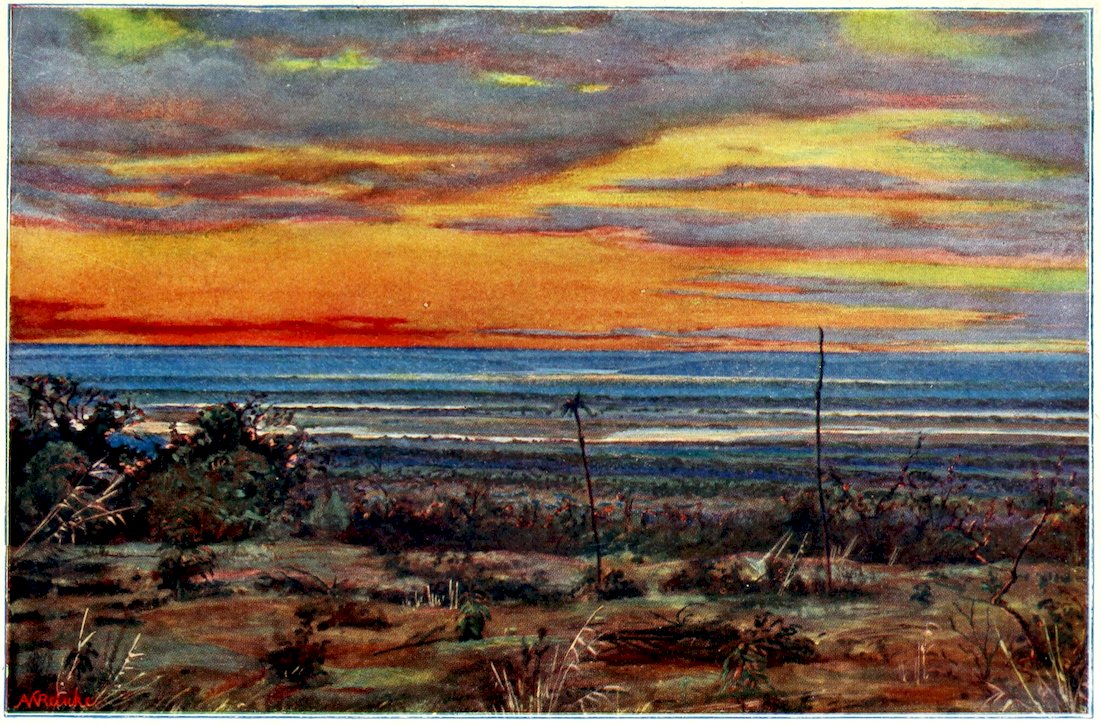
CAPE GUARDAFUI
CHAPTER I OUTWARD BOUND
Native Life in East Africa
1
Dar es Salam, Whit-Sunday, 1906.
Six months ago it would not have entered my head in my
wildest dreams that I should spend my favourite festival,
Whitsuntide, under the shade of African palms. But it is the
fact, nevertheless. I have now been two days in the capital of
German East Africa, a spot which may well fascinate even
older travellers than myself. Not that the scenery is strikingly
grand or majestic—on the contrary, lofty mountain-masses
and mighty rivers are conspicuous by their absence, and the
wide expanse of the open ocean contributes nothing directly
to the picture, for Dar es Salam lies inland and has no seaview
worth mentioning. The charm of the landscape lies rather
in one of the happiest combinations of flashing waters, bright
foliage, and radiant sunshine that can be imagined.
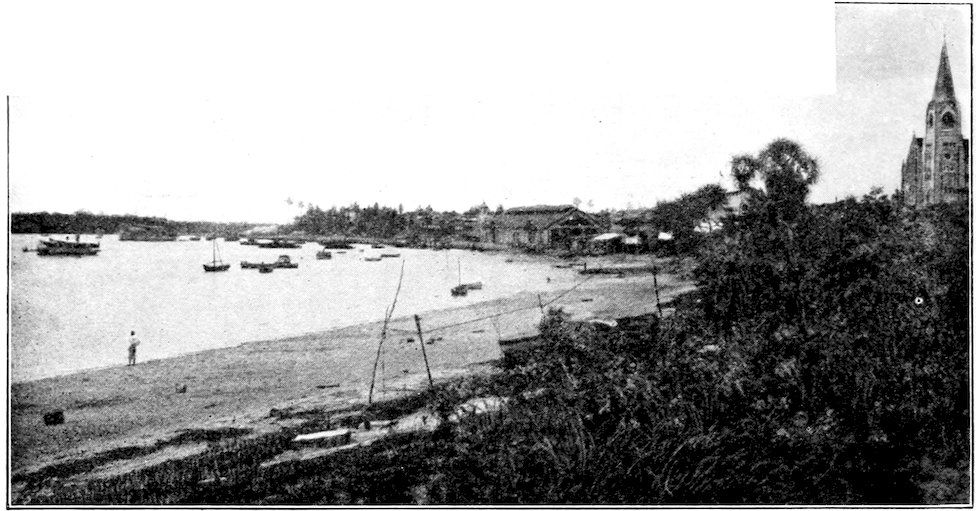
The entrance to the harbour gives to the uninitiated no hint
of the beauty to come. A narrow channel, choked with coral
2reefs, and, by its abrupt turns, making severe demands on the
skill of the pilot, leads to the central point of a shallow bay
which seems to have no outlet. Suddenly, however, the vessel
glides past this central point into an extraordinarily
narrow channel, with steep green banks on either side,
which opens out, before the traveller has had time to recover from
his astonishment, into a wide, glittering expanse, covered with
ships. That is the famous bay of Dar es Salam. In presence
of the obvious advantages of this locality, one need not have
lived for years in the country to understand why the Germans
should have been willing to give up the old caravan emporium
of Bagamoyo with its open roadstead for this splendid harbour,
and thus make the almost unknown native village of Dar es
Salam the principal place in the colony.[2]
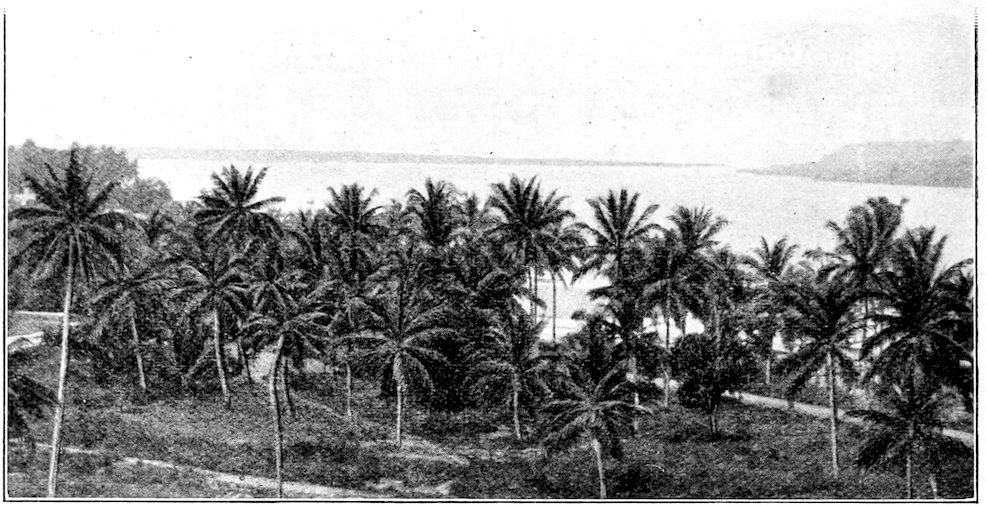
DAR ES SALAM HARBOUR
On the voyage out, I visited with much enjoyment both
Mombasa and Zanzibar, though unfortunately prevented by an
accident (an injury to my foot) from going ashore at the
German port of Tanga. Of these two English centres, Zanzibar
3represents the past, Mombasa the present, and still more the
future. It is true that Zanzibar has the advantage in its situation
on an island at a considerable distance
from the mainland, an
advantage of which the mainland towns, however splendid
their future development, will never be able to deprive it, since
their lines of communication, both economic and intellectual,
will always converge on Zanzibar. But since the completion of
the Uganda Railway, Mombasa forms the real gateway to the
interior, and will do so in an increasing degree, as the economic
development of Central Africa—now only in its infancy—goes
on. Whether our two great German railways—as yet only
projected—can ever recover the immense advantage gained
by Mombasa, the future will show. We must hope for the best.
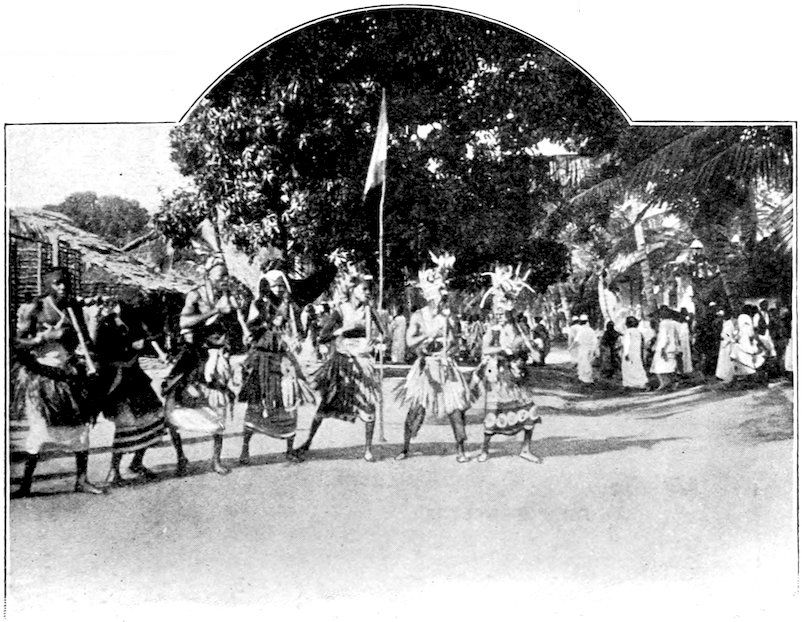
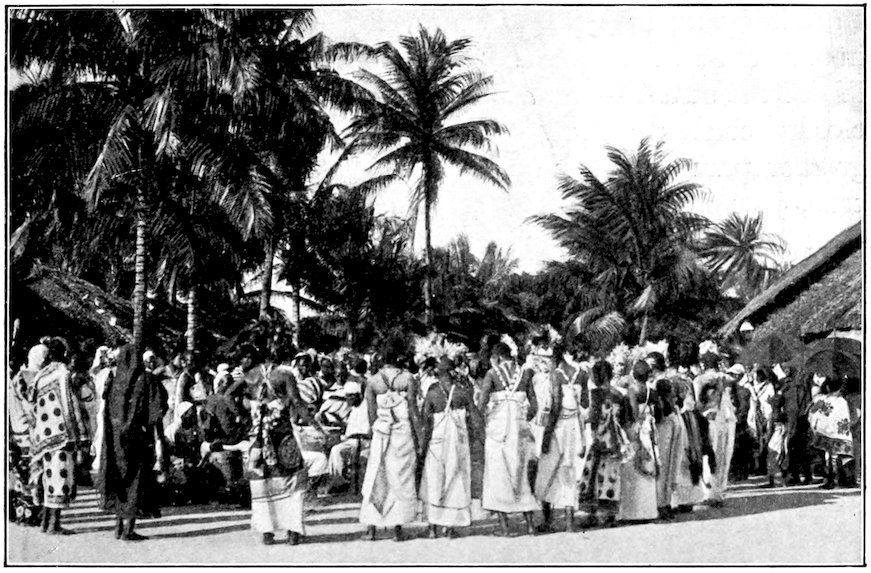
NATIVE DANCE AT DAR ES SALAM
Mombasa and Zanzibar interested me more from a historical
than from a political point of view. How little do our educated
and even learned circles know of the exploration and development,
the varied political fortunes of this corner of the earth
on the western shore of the Indian Ocean! Only specialists,
indeed, can be expected to know that this year is the jubilee
of the French Admiral Guillain’s epoch-making work, Documents
sur l’Histoire, la Géographie, et le Commerce de l’Afrique
4Orientale, but it is extremely distressing to find that our
countryman, Justus Strandes’ Die Portugiesenzeit in Deutsch- und
Englisch-Ostafrika (1899) is not better known. Most of
us think that Eastern Equatorial Africa, considered as a field
for colonization, is as much virgin soil as Togo, Kamerun and
German South-West
Africa, or
the greater part
of our possessions
in the
South Seas.
How few of us
realise that,
before us and
before the
English, the
Arabs had, a
thousand years
ago, shown the most brilliant capacity for gaining and keeping
colonies, and that after them the Portuguese, in connection
with and as a consequence of Vasco da Gama’s voyage to
India round the Cape of Good Hope in 1498, occupied an
extensive strip of the long coast, and maintained their hold
on it for centuries? And yet these events—these struggles for
East Africa form one of the most interesting chapters in the
history of modern colonization. Here for the first time the
young European culture-element meets with an Eastern
opponent worthy of its steel. In fact that struggle for the
north-western shores of the Indian Ocean stands for nothing
less than the beginning of that far more serious struggle which
the white race has waged for the supremacy over the earth in
general, and in which they already seemed to be victorious,
when, a few years ago, the unexpected rise of Japan showed
the fallacious nature of the belief so long entertained, and
perhaps also the opening of a new era.
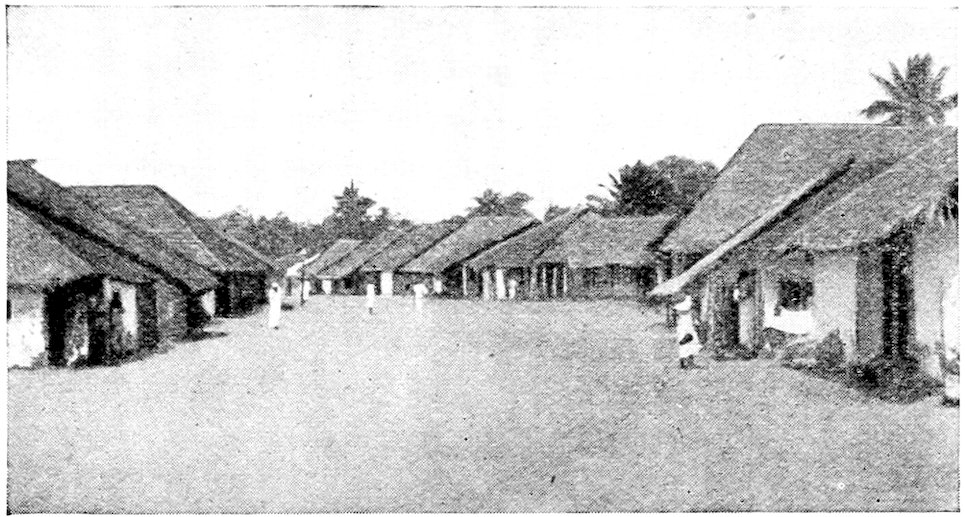
STREET IN THE NATIVE QUARTER, DAR ES SALAM
Anyone who does not travel merely for the sake of present
impressions, but is accustomed to see the past behind the
phenomena of the moment, and, like myself, leaves the area of
European culture with the express object of using his results to
help in solving the great problem of man’s intellectual evolution
5in all its details, will find in the voyage to German East Africa
a better opportunity for survey and retrospect than in many
other great routes of modern travel.
This is the case as soon as one has crossed the Alps. It is
true that even the very moderate speed of the Italian express
gives one no chance for anthropological studies. In order to
observe the unmistakable Teutonic strain in the population
of Northern Italy, it would be necessary to traverse the plain
of Lombardy at one’s leisure. But already in the Adige
Valley, and still more as one advances through Northern and
Central Italy, the stratification of successive races seems to
me to be symbolized by the three strata of culture visible in
the fields: corn below, fruit-trees planted between it, and
vines covering them above. Just so the Lombards, Goths and
other nations, superimposed themselves on the ancient Italian
and Etruscan stocks. On the long journey from Modena to
Naples, it is borne in upon one that the Apennines are really
the determining feature of the whole Italian peninsula, and
that the Romans were originally started on their career of
conquest by want of space in their own country. The only
place which, in May, 1906, produced an impression of spaciousness
was the Bay of Naples, of which we never had a clear view
during our four or five days’ stay. A faint haze, caused by
the volcanic dust remaining in the air from the eruption of the
previous month, veiled all the distances, while the streets and
houses, covered with a layer of ashes, appeared grey on a grey
background—a depressing and incongruous spectacle. The
careless indolence of the Neapolitans, which as a rule strikes
the industrious denizens of Central Europe as rather comical
than offensive, requires the clear sky and bright sunshine,
celebrated by all travellers (but of which we could see little
or nothing), to set it off.
From our school-days we have been familiar with the fact that
the countries bordering the Mediterranean—the seats of ancient
civilisation—are now practically denuded of forests. Yet the
landscape of Southern Italy and Sicily seems to the traveller still
more unfamiliar than that of the northern and central districts;
it is even more treeless, and therefore sharper in contour than
the Etruscan and Roman Apennines and the Abruzzi. But the
most striking feature to us inhabitants of the North-German
6plain are the river-valleys opening into the Strait of Messina,
leading up by steep gradients into the interior of the
country. At this season they seem either to be quite dry or to
contain very little water, so that they are calculated to produce
the impression of broad highways. But how terrible must be
the force with which the mass of water collecting in the torrent-bed
after heavy rains, with no forest-soil to keep it back, rushes
down these channels to the sea! To the right and left of
Reggio, opposite Messina, numbers of sinuous ravines slope
down to the coast, all piled high with débris and crossed by
bridges whose arches have the height and span of the loftiest
railway viaducts.
It is scarcely necessary to say anything about Port Said and
the Suez Canal. Entering the Red Sea, I entered at the same
time a familiar region—I might almost say, one which I have
made peculiarly my own—it having fallen to my share to write
the monographs on the three oceans included in Helmolt’s
Weltgeschichte.[3] Of these monographs, that dealing with the
Atlantic seems, in the opinion of the general reader, to be the
most successful; but that on the Indian Ocean is undoubtedly
more interesting from the point of view of human history. In
the first place, this sea has this advantage over its eastern and
western neighbours, that its action on the races and peoples
adjacent to it was continued through a long period. The
Pacific has historic peoples (historic, that is to say, in the somewhat
restricted and one-sided sense in which we have hitherto
used that term) on its north-western margin, in eastern Asia;
but the rest of its huge circumference has remained dead and
empty, historically speaking, almost up to the present day.
The Atlantic exactly reverses these conditions: its historical
density is limited to the north-eastern region, the west coast
of Africa, and the east coast of the Americas being (with the
exception of the United States) of the utmost insignificance
from a historical point of view.
Now the Indian Ocean formed the connecting link between
these two centres—the Mediterranean culture-circle in the west,
and that of India and Eastern Asia in the east,—at a time when
7both Atlantic and Pacific were still empty and untraversed
wastes of water. This, however, is true, not of the whole
Indian Ocean, but only as regards its northern part, and in
particular the two indentations running far inland in a north-westerly
direction, which we call the Red Sea and the Persian
Gulf. To-day, when we carry our railways across whole
continents, and even mountain ranges present no insuperable
obstacles to our canals, we imagine that masses of land as wide
as the Isthmus of Suez or the much greater extent of the
“Syrian Porte”—the route between the Persian Gulf and the
Eastern Mediterranean—must have been absolute deterrents
to the sea-traffic of the ancients. In a sense, indeed, this was
the case; otherwise so many ancient rulers would not have
attempted to anticipate us in the construction of the Suez
Canal. But where technical skill is insufficient to overcome
such impediments, and where at the same time the demand
for the treasures of the East is so enormous as it was in classical
and mediæval times, people adapt themselves to existing
conditions and make use of navigable water wherever it is to
be found. Only thus can be explained the uninterrupted
navigation of the Red Sea during a period of several thousand
years, in spite of its dangerous reefs and the prevailing winds,
which are anything but favourable to sailing vessels.
Only one period of repose—one might almost say, of enchanted
sleep—has fallen to the lot of the Red Sea. This was
the time when Islam, just awakened to the consciousness of
its power, succeeded in laying its heavy hand on the transition
zone between West and East. With the cutting of the Suez
Canal, the last shadow of this ancient barrier has disappeared,
and the Red Sea and North Indian Ocean have regained at a
stroke, in fullest measure, their old place in the common life
of mankind.
The passengers on board our steamer, the Prinzregent, were
chiefly German and English; and at first a certain constraint
was perceptible between the members of the two nationalities,
the latter of whom seemed to be influenced by the dread and
distrust expressed in numerous publications of the last few
years. Mr. William Le Queux’s Invasion of 1910 was the book
most in demand in the ship’s library.
A more sociable state of things gradually came about during
8the latter part of the voyage; and this largely through the
agency of an unpretending instrument forming part of my
anthropological equipment. One day, when we were nearing
the Straits of Bab el Mandeb, partly in order to relieve the
tedium of the voyage, and partly in order to obtain statistics
of comparative strength, I produced my Collin’s dynamometer.
This is an oval piece of polished steel, small enough to be held
flat in the hand and compressed in a greater or less degree,
according to the amount of force expended, the pressure being
registered by means of cogged wheels acting on an index which
in its turn moves a second index on a dial-plate. On relaxing
the pressure, the first index springs back to its original position,
while the second remains in the position it has taken up and
shows the weight in kilogrammes equivalent to the pressure.
The apparatus, really a medical one, is well adapted for
ascertaining the comparative strength of different races; but
its more immediate usefulness appears to lie in establishing
cordial relations between total strangers in the shortest possible
time. On that particular hot morning, I had scarcely begun
testing my own strength, when all the English male passengers
gathered round me, scenting some form of sport, which never
fails to attract them, young or old. In the subsequent peaceful
rivalry between the two nations, I may remark that our
compatriots by no means came off worst; which may serve to
show that our German system of physical training is not so
much to be despised as has been recently suggested by many
competent to judge, and by still more who are not so competent.
In his general attitude on board ship, the present-day
German does not, so far as my observations go, contrast in the
least unfavourably with the more experienced voyagers of other
nationalities. It is true that almost every Englishman shows
in his behaviour some trace of the national assumption that
the supremacy of the seas belongs to him by right of birth.
Our existence, however, is beginning to be recognized—not
out of any strong affection for “our German cousins,” but as
a simple matter of necessity. If, for comfort in travel, one
must have recourse to German ships; and when, at home and
abroad, there is a German merchant-fleet and a German navy
to be reckoned with, the first of which keeps up an assiduous
competition, while the second is slowly but steadily increasing,
9these things cannot fail to impress even the less cultured
members of the British nation. Only one thing is, and will be
for many years to come, calculated to make us ridiculous
in the eyes of Old England—and that is the Zanzibar Treaty.
Never shall I forget the looks of malicious triumph and the
sarcastic condolences which greeted us—the unfortunate contemporaries
of the late Caprivi—when we came in sight of
Zanzibar. My friend Hiram Rhodes, of Liverpool, the ever-smiling
and universally popular, usually known as “the laughing
philosopher,” from his cheerful view of life, was not as a rule
given to sharp sayings, but with regard to the famous political
transaction, I distinctly remember to have heard him use the
expression, “Children in politics.” Caustic, but not undeserved!
Another remark of his, after viewing Dar es Salam:
“That is the finest colony I have ever seen!” served, it is
true, as a touch of healing balm—but no amount of conciliatory
speeches will give us back Zanzibar!
MAP OF THE MAIN CARAVAN ROAD, WITH ITS PRINCIPAL BRANCHES. DRAWN BY SABATELE, A MMAMBWE
The object of the journey on which I have embarked may
now be briefly stated. Several decades since, and therefore
before the beginning of our colonial era, the Reichstag voted an
annual grant of some 200,000 marks for purposes of scientific
research in Africa—purely in the interests of knowledge and
without any ulterior intentions from a narrowly nationalist
point of view. One might have expected that, after the establishment
of our settlements in Africa and the Pacific, this fund
10would unhesitatingly have been devoted, wholly or in part, to
the systematic exploration and study of these colonies of ours.
But this has not been done, or only in a very uncertain and desultory
manner—to
the great grief
of German
scientific circles,
who, under
these circumstances,
were
forced to content
themselves
with the occasional
reports
of civil and
military officials
supplemented
by sporadic research
expeditions,
official or
private.
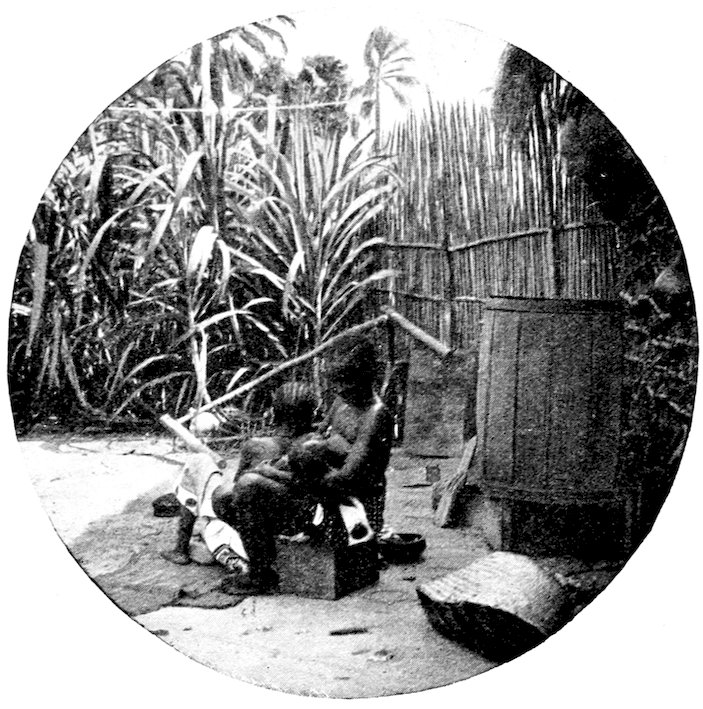
COURTYARD AT DAR ES SALAM—Dolce far niente
It was not till
the first Colonial
Congress in 1902 that a more vigorous agitation took place for
the application of the African Fund on a large scale to the
systematic investigation of our dependencies. From
specialists in all branches of knowledge—geography and
geology, anthropology and ethnography, zoology and
botany, linguistics, comparative law, and the new science
of comparative music—arose the same cry, with the
result that, three years later, at the second Colonial Congress
(October, 1905), we were in a position to state clearly the most
pressing problems and mark out the principal fields of research
in each subject. It might, however, have taken years to
put the work in hand, but for the “Committee for the
Geographical Exploration of the German Colonies,” and
its energetic president, Dr. Hans Meyer, who rescued the
proceedings from their normal condition of endless discussions,
and translated them at one stroke into action. Dr. Jäger,
Herr Eduard Oehler, and myself are the living proofs of this
11(in our country) unwonted rapidity of decision, being selected
to carry out the instructions of the Committee (which is
affiliated to the Colonial Office) and help to realise the
long-cherished dream of German science.
The task of the two gentlemen I have mentioned is purely
geographical, consisting in the examination of the interesting
volcanic area situated between Kilimanjaro and the Victoria
Nyanza, while I am commissioned to bring some order into the
chaos of our knowledge concerning the tribes who occupy
approximately the same region. It must be remembered that
the country surrounding Lakes Manyara and Eyasi, and
extending to a considerable distance south of them, swarms
with tribes and peoples who, in spite of the fact that our
acquaintance with them dates more than twenty years back,
still present a variety of ethnological problems. Among these
tribes are the Wasandawi, whose language is known to contain
clicks like those of the Hottentots and Bushmen, and who are
conjectured to be the forgotten remnant of a primæval race
going back to prehistoric ages. The Wanege and Wakindiga,
nomadic tribes in the vicinity of Lake Eyasi, are said to be
akin to them. In the whole mass of African literature, a
considerable part of which I have examined during my twenty
years’ study of this continent, the most amusing thing I ever
came across is the fact that our whole knowledge up to date of
these Wakindiga actually results from the accident that Captain
Werther had a field-glass in his hand at a given moment. This
brilliant traveller, who traversed the district in question twice
(in 1893 and 1896), heard of the existence of these people, but
all that he saw of them was a distant telescopic view of a few
huts. As yet we know no more of them than their bare name,
conscientiously entered in every colonial or ethnological
publication that makes its appearance.
Another group of as yet insufficiently-defined tribes is
represented by the Wafiomi, Wairaku, Wawasi, Wamburu and
Waburunge. All these are suspected of being Hamites, and
some of them have evolved remarkable culture-conditions
of their own. But, under the onrush of new developments,
they are in danger of losing their distinctive character still
more rapidly than other African peoples, and, if only for this
reason, systematic observations are needed before it is too late.
12The same may be said of the Wataturu or Tatoga, who are
undoubtedly to be looked on as the remnant of a formerly
numerous population. They are said to speak a language
related to Somali, but now live scattered over so wide a territory
that the danger of their being effaced by absorption in
other races is, if possible, still greater than in the case of the
others. The last of the tribes which specially concern me are
the Wanyaturu, Wairangi and Wambugwe. All of these
belong to the great Bantu group, but have, in consequence of
their isolation, preserved certain peculiarities of culture so
faithfully that they too will be well worth a visit.
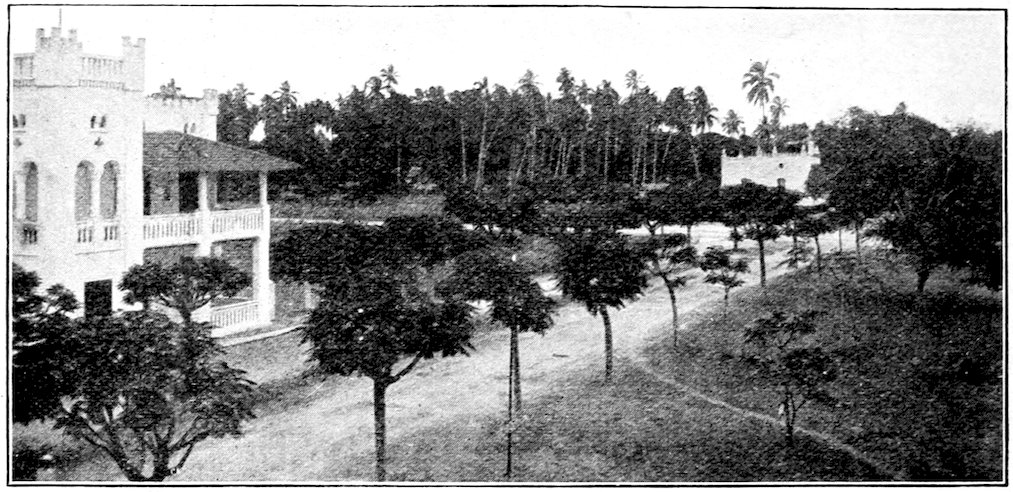
IN THE EUROPEAN QUARTER, DAR ES SALAM
With regard to the original home of the African race, this
is a question to which ethnologists have not hitherto devoted
very much attention. The Hamites, who occupy the north-eastern
corner of the continent, are supposed by all writers
without exception to have come from Asia across the Red Sea.
Most authorities have been content with comparatively short
periods in estimating the date of this migration—indeed, the
most recent work on the subject, Captain Merker’s book on
the Masai (whom, by the bye, he claims as Semites) asserts
that both date and route can be accurately calculated, and
places the former about 5,000 years ago.
Not only for these, moreover, but also for the great mass of
the population of Africa, the Sudanese and Bantu negroes, an
original home outside the continent is very generally assumed;
13and both these groups are supposed to have penetrated to
their present abodes from Asia, either by way of the Isthmus
of Suez, or across the Straits of Bab el Mandeb.
This theory I had the pleasure of combating some years ago.
There is absolutely nothing to show that the ancestors of the
present negro race ever lived elsewhere than in the region
which, in the main, they occupy to-day. No branch of this
large group can be shown to have possessed any nautical
skill worth mentioning; and none has ever ventured far out
to sea.
It may be said that no great knowledge of navigation was
needed for crossing the Strait of Bab el Mandeb, even if the
migration did not take place by way of the Isthmus. The
problem, however, is by no means to be solved in this simple
fashion. Modern anthropology demands for human evolution
periods as long as for that of the higher animals. Diluvial Man
has long since been recognized by our most rigid orthodoxy;
and people would have to get used to Tertiary Man, even if
the necessities of the case did not make him an indispensable
postulate. As the youth of mankind recedes into early geological
periods, the problem of race-development is seen to
require for its solution not merely measurements of skull and
skeleton, but the vigorous cooperation of palæontology and
historical geology. So far as I can judge, the sciences in
question will probably end by agreeing on three primitive races,
the white, black and yellow, each having its centre of development
on one of the old primitive continents. Such a continent
in fact existed through long geological ages in the Southern
Hemisphere. A large fragment of it is represented by modern
Africa, smaller ones by Australia and the archipelagoes of
Indonesia and Papua. The distribution of the black race from
Senegambia in the west to Fiji in the east is thus explained in
a way that seems ridiculously easy.
To account for the great groups of mixed races, too, we must
for the future, in my opinion, have recourse to the geological
changes of the earth’s surface. Whence do we derive the
Hamites? and what, after all, do we understand by this term,
which, curiously enough, denotes a zone of peoples exactly
filling up the geographical gap between the white and black
races? Furthermore, how are we to explain the so-called
14Ural-Altaic race, that mass of peoples so difficult to define,
occupying the space between the primitive Mongol element in
the East and the Caucasian in the West? Does not, here too,
the thought suggest itself that the impulse to the development
of both groups—the North African as well as the North Asiatic—came
from a long-continued contact between the ancient
primitive races which, according to the position of affairs, i.e.,
judging by the geological changes which have taken place,
both in the south-eastern corner of the Mediterranean, and in
the east of Northern Europe—was only rendered possible by the
junction of the old continents formerly separated by seas?
In fact the land connection in both these places is, geologically
speaking, very recent.
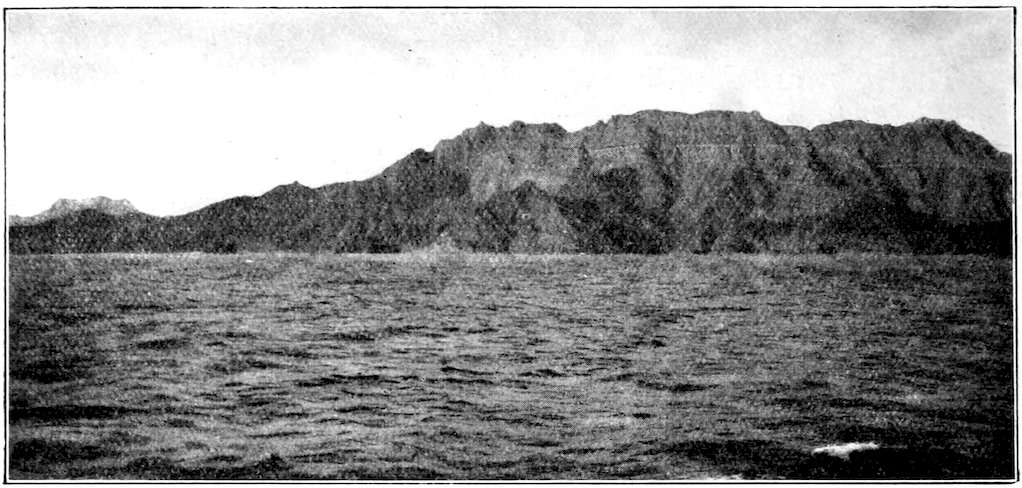
To come back from dreary theory to cheerful reality, I may
mention that I have taken a few successful photographs of
Cape Guardafui. From the north this promontory does not
look very imposing. The coast seems quite near, but in reality
we are five or six miles away from it, and at this distance the
cliffs, though nearly a thousand feet high, are reduced to
insignificance.
The view from the south is more impressive. Here, on our
right, the mountains rise in an almost vertical wall to a height
of some 3,000 feet, and often look still higher, when their
summits are lost in a compact stratum of cloud. Yet the eye
always turns back again and again to the Cape itself. It does
not indeed appear more lofty than it did from the north, but
from this side it presents, even to the least imaginative observer,
the shape known to all travellers as the “Sleeping Lion.” I
am not in general particularly impressed by the fancied
resemblances which as a rule give rise to the bestowal of
similar appellations, but here I was struck by the absolute
verisimilitude of this piece of natural sculpture. The mighty
maned head lies low, seemingly resting on the dark blue line
of the Indian Ocean, the right fore-paw drawn up close to it.
But the royal beast’s eyes are closed, and what a splendid
piece of symbolism is thus lost to us! As it is, the image
presented to-day is a somewhat tame one. In old times, while
the lion was awake, he watched over the busy maritime traffic
which the later period of antiquity and the early Middle Ages
kept up before his eyes, when Phœnicians, Himyarites, Greeks,
15Romans, Arabs, and Persians sailed eastward and southward,
and the mediæval Chinese advanced from the east as far as the
Gulf of Aden, and even into the Red Sea. That was a time
when it was worth while to keep awake. Then came Islam
and the rule of the Turk—and, still later, the circumnavigation
of the Cape rendered the Egyptian and Syrian overland routes
useless. The Red Sea and the Persian Gulf sank into a
stagnation that lasted for centuries—and the Lion grew weary
and fell asleep.
Even the enormous traffic brought by the opening of the
Suez Canal has not been sufficient to wake him; the world is
ruled by vis inertiæ, and a scant forty years is all too short a
time for the sounds of life to have penetrated his slumbers.
For that, other means will be required.
There is an Italian captain on board, a splendid figure of
a man, but suffering sadly from the effects of spear-wounds
received from the Abyssinians at Adowa. I asked him the
other day why his Government had not placed a lighthouse on
Cape Guardafui, which, as rulers of the country they were
surely bound to do. He acknowledged that this was so, but
pointed out that the attempt to carry out any such project
would involve a difficult and expensive campaign against the
Somali, who would by no means tamely submit to lose the
profits of their trade as wreckers.
No doubt the captain was right, but Italy cannot in the
long run refuse to comply with the international obligation of
erecting a lighthouse on this exposed spot, where even now
may be seen the melancholy black hull of a French steamer,
which, coming up the coast on a dark night, took the westerly
turn too soon. But from the moment when this lighthouse throws
its rays for the first time over the waves of the Indian Ocean, the
Lion will awake, and feel that his time has come once more.
The monsoon is a welcome change, after the enervating
atmosphere of the Red Sea and the Gulf of Aden, but for any
length of time its monotony becomes tedious. Hence the loud
rejoicing of passengers on sighting Mombasa and Zanzibar and
the speed with which they rush on shore at those ports. At
Dar es Salam the first freshness has worn off a little, but the
traveller nevertheless sets foot on dry land with an indefinable
feeling of relief.
16
CHAPTER II THE UNEXPECTED
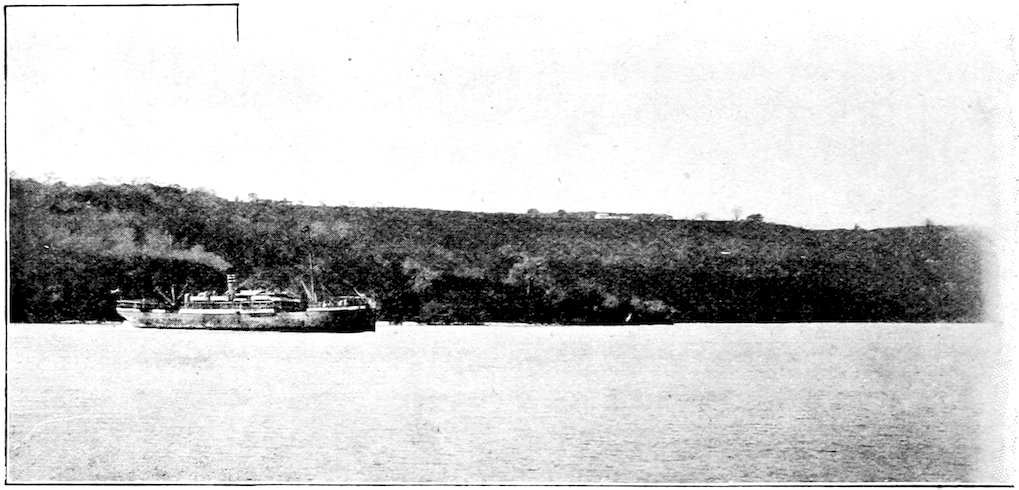
LINDI BAY
Lindi, End of June, 1906.
Africa! Africa! When, in past years, men told me that in
Africa it is no use making plans of any sort beforehand, I
always looked on this opinion as the quintessence of stupidity;
but after my recent experiences I am quite in a position to
appreciate its truth.
I must go back to the 11th of June. The two geographers
and I had fixed our departure northward for the 20th; after
getting together the necessary men and baggage we intended
to take the steamer to Tanga, and the Usambara railway
from Tanga to Mombo, so as to start from the Pangani Valley
on our march across the Masai steppe to Kondoa-Irangi.
Our preparations were going on in the most satisfactory
manner; and I was one morning doing my best to hasten
them in Traun, Stürken and Devers’ stores, by exercising that
persistency in bargaining which can only be acquired by the
director of an ethnographical museum. I had not been listening
to the conversation going on beside me between one of
the salesmen and a European officer of the Field Force; but
suddenly the name Kondoa-Irangi fell on my ear, and I was all
attention on the instant. “I suppose you are going home by
17the——to-morrow?” said one. “No such luck! we are
marching to-morrow afternoon. Didn’t I just say there’s a
rising in Iraku?” returned the other.
Kondoa-Irangi and Iraku concerned me closely enough
to necessitate farther inquiry. Half instinctively, I flung
myself out at the door and into the dazzling sunshine which
flooded the street. At that moment Captain Merker’s mule-waggon
rattled up, and his voice reached me over the woolly
heads of the passers-by. “Stop, Dr. Weule, you can’t go to
Kondoa-Irangi.”
Though not in general endowed with presence of mind in any
extraordinary degree, I must in this instance have thought
with lightning speed, for no sooner had I taken my place
beside Merker, in order to proceed without loss of time to the
Government offices and ask for fuller explanations, than I
had already gone through in my mind the various possible
alternatives, in case it turned out—as seemed probable—that
I had to give up all thought of the Irangi expedition. In those—to
me—critical days at Dar es Salam, there was no one
acquainted with the circumstances but would have said, “Get
out! the Iraku rising is no rising at all—it is a mere trifle, a
quarrel about a couple of oxen, or something of the sort—in
any case an affair that will soon be settled.” None the less I
had to admit that the Acting Governor (Geheimrat Haber, of
whose unfailing kindness I cannot say enough) was right
when he pointed out that, while a geographer could traverse
that district at his ease, regardless of the four columns of the
native Field Force (Schutztruppe) marched into it, along roads
converging from Moshi, Mpapwa, Kilimatinde and Tabora
respectively, the case was totally different for an ethnographic
expedition, which can only do its work in a perfectly undisturbed
country. This condition would not be attainable up North
for some time to come. Would it not be better to turn southward,
to the hinterland of Lindi and Mikindani? True, a
rising had taken place there not long ago, but it was now quite
over, and the Wamwera, more especially, had got a very
effectual thrashing, so that the tribes of that part would be
unlikely to feel disposed for fresh aggression just at present.
At the same time, a comparatively large force had marched
into the South, both Field Force and police, and the most
18important strategic points were strongly garrisoned, so that
I could be certain of getting a sufficient escort; while for the
Manyara country I could only reckon on a couple of recruits
at the outside.
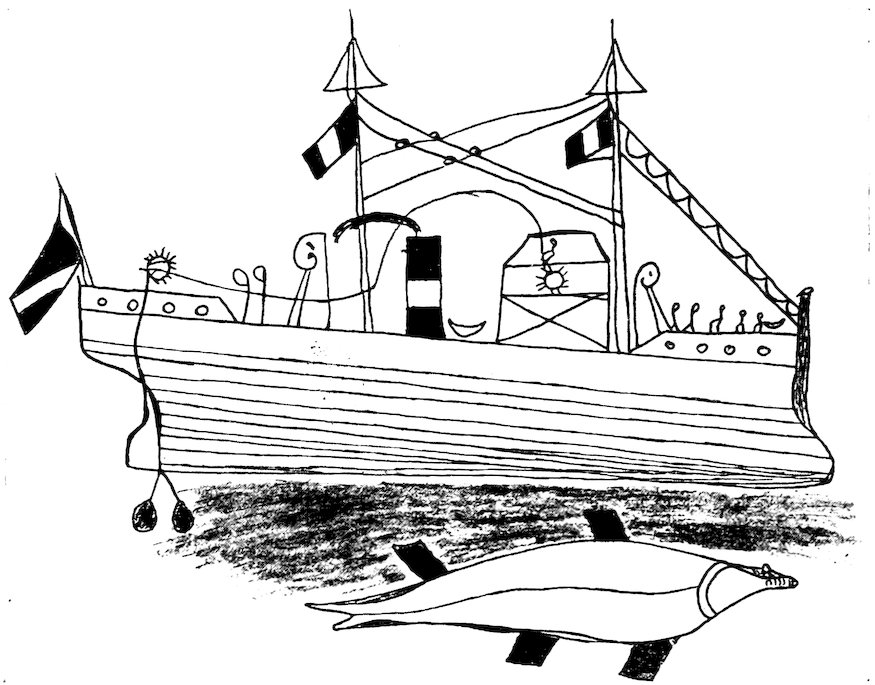
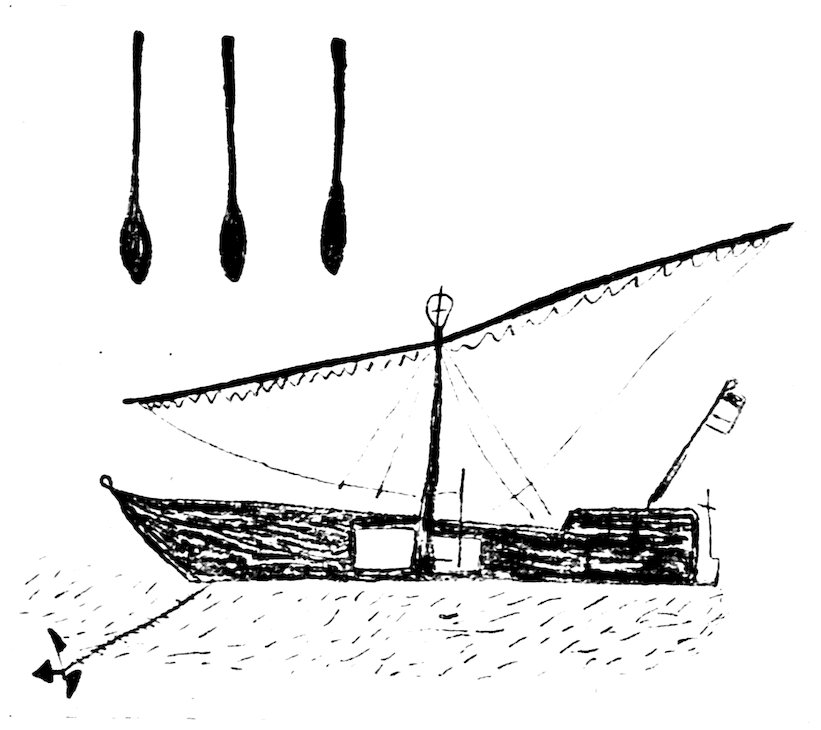
THE SS. RUFIJI, DRAWN BY BAKARI, A MSWAHILI
My long-continued study of African races never rendered
me a better service than now. It can easily be understood
that I knew less about the new field of work suggested than
about that which had been so rudely snatched from me;
but I was aware that it contained a conglomeration of tribes
similar to that found in the North; and I was also able to
form a fairly definite notion of the way in which I should have
to plan and carry out my new expedition, in order to bring it
to a successful issue. I refrained, however, from thinking
out the new plan in detail—indeed, I should have had no time
to do so, for I had to be quick if I did not wish to lose several
weeks. The permission of the Geographical Committee and
of the Colonial Office was soon secured, my loads were packed;
two boys and a cook had been engaged long before. The
little Government steamer Rufiji was to start for the South
on the 19th of June. I induced the Government to supply
me on the spot with the only map of the southern district
at that time procurable, and with equal promptitude the
admirably-managed “Central-Magazin” had found me two
dozen sturdy Wanyamwezi porters. Other absolutely indispensable
arrangements were speedily disposed of, and before
I had time to look round, I found myself on board and steaming
out of Dar es Salam Harbour.
19
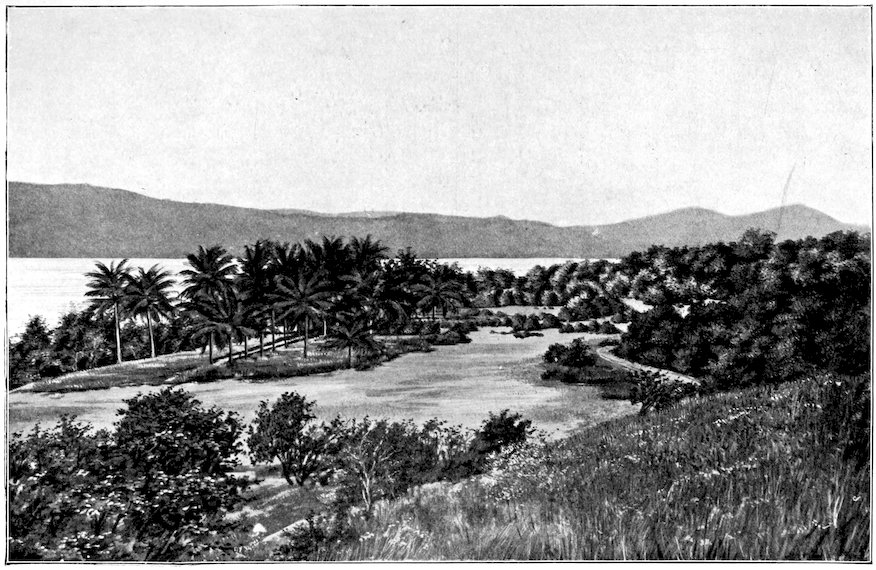
VIEW NEAR THE MOUTH OF THE LUKULEDI ABOVE LINDI
20I had never for one moment cherished the illusion that a
research expedition was a pleasure-trip, but the three days
and a quarter spent on board the Rufiji will remain a vivid
memory, even should my experience of the interior prove
worse than I anticipate. My own want of foresight is partly
to blame for this. Instead of having a good breakfast at the
Dar es Salam Club before starting, I allowed the ship’s cook
to set before me some coffee, which in combination with the
clammy, ill-baked bread and rancid tinned butter would have
proved an effectual emetic even on dry land, and soon brought
about the inevitable catastrophe on board the little vessel
madly rolling and pitching before a stiff south-west monsoon.
The Rufiji and her sister ship the Rovuma are not, properly
speaking, passenger steamers, but serve only to distribute the
mails along the coast and carry small consignments of cargo.
Consequently there is no accommodation for travellers, who
have to climb the bridge when they come on board, and live,
eat, drink, and sleep there till they reach their destination.
This is all very well so long as the numbers are strictly limited:
there is just room at night for two or three camp beds, an item
which has to be brought with you in any case, as without it
no travel is possible in East Africa. But the state of things
when six or eight men, and perhaps even a lady, have to share
this space, which is about equal to that of a moderate-sized
room—the imagination dare not picture.
My own woes scarcely permitted me to think about the
welfare of my men. Moritz and Kibwana, my two boys
and my cook, Omari, are travelled gentlemen who yielded
themselves with stoic calm to the motion of the Rufiji, but my
Wanyamwezi porters very soon lost their usual imperturbable
cheerfulness. They all came on board in the highest spirits,
boasting to the kinsmen they left behind at Dar es Salam
of the way in which they were going to travel and see the
world. How the twenty-four managed to find room in the
incredibly close quarters of the after-deck, which they had,
moreover, to share with two or three horses, is still a puzzle
21to me; they were sitting and lying literally on the top of one
another. As they were sick the whole time, it must, indeed,
have been a delightful passage for all of them.
There is something strangely rigid, immovable and conservative
about this old continent. We were reminded of this by the
Lion of Cape Guardafui, and now we find it confirmed even by
the official regulations of steamer traffic. The ancients, as we
know, only sailed by day, and savages, who are not very well
skilled in navigation, always moor their sea-going craft off shore
in the evening. We Europeans, on the other hand, consider
it one of our longest-standing and highest achievements to be
independent both of weather and daylight in our voyages.
To this rule the Rovuma and Rufiji form one of the rare exceptions;
they always seek some sheltered anchorage shortly
before sunset, and start again at daybreak the next morning.
On the trip from Dar es Salam to Lindi and Mikindani—the
South Tour, as it is officially called—the first harbour for
the night is Simba Uranga, one of the numerous mouths of the
great Rufiji river. The entrance to this channel is not without
charm. At a great distance the eye can perceive a gap in the
green wall of mangroves which characterizes the extensive
delta. Following the buoys which mark the fairway, the little
vessel makes for the gap, not swiftly but steadily. As we
approach it opens out—to right and left stretches the white
line of breakers, foaming over the coral reefs which skirt the
coast of Eastern Equatorial Africa—and, suddenly, one is
conscious of having escaped from the open sea and found
refuge in a quiet harbour. It is certainly spacious enough—the
river flows, calm and majestic, between the green walls
of its banks, with a breadth of 600, or even 800 metres, and
stretches away into the interior farther than the eye can
follow it. The anchorage is about an hour’s steam up river.
On the right bank stands a saw-mill, closed some time ago:
its forsaken buildings and rusting machinery furnishing a
melancholy illustration of the fallacious hopes with which so
many Colonial enterprises were started. Just as the sun sinks
below the horizon, the screw ceases its work, the anchor-chain
rattles through the hawse-holes, and the Rufiji is made
fast for the night. Her furnace, which burns wood, is heated
with mangrove logs, cut in the forests of the Delta and stacked
22at this spot ready for transference on board. This work is
usually done under the superintendence of a forester, whom
I am sorry not to see, he being absent up country. His life
may be leisurely, but scarcely enviable; for we are speedily
surrounded, even out in mid-stream, by dense clouds of mosquitoes,
which, I fancy, will hardly be less abundant on land.
The swabbing of the decks on an ocean steamer, in the early
morning, just at the time when sleep is sweetest, is represented
on the Rufiji by the wooding in the Simba Uranga River,
and the shipping of cargo in the open roadstead of Kilwa.
In the two nights passed on board, I got very little sleep,
between the incessant bumping of loads thrown down on deck,
and the equally incessant yelling of the crew. There was
little compensation for this, either in the magnificent sunset
witnessed on the Simba Uranga, or the wonderfully impressive
spectacle we enjoyed when steaming out in the early morning.
Nothing could have revived us but the fresh breeze of the
monsoon on the open sea. No sooner, however, were we
outside than Neptune once more demanded his tribute. I do
not know whether a healthy nervous system would have been
affected by the Rufiji’s mode of stoking—and if so, how—but
to us three sea-sick passengers, who had to share the
amenities of the bridge as far as Kilwa, it was simply intolerable.
Of the two boats, the Rovuma, at any rate, has a digestion
sufficiently robust to grapple with the thirty-inch lengths
of mangrove-wood, thrown into her furnaces just as they are.
The Rufiji, however, has a more delicate constitution, and can
only assimilate food in small pieces. With the first glimmer
of daybreak, the heavy hammer, wielded by the strong right
arm of a muscular baharia, crashes down on the steel wedge
held in position by another native sailor on the first of the
mangrove logs. Blow after blow shakes the deck; the tough
wood creaks and groans; at last the first morsel has been
chopped up for the ravenous boiler, and the fragments describe
a lofty parabola in their flight into the tiny engine-room.
Then comes another crash which makes the whole boat vibrate,—and
so on, hour after hour, throughout the whole day.
Not till evening do the men’s arms rest, and our sea-sick
brains hail the cessation of work with sincere thankfulness,
for the continuous rhythm of the hammer, which seems quite
23tolerable for the first hour, becomes, in the eleven which follow
it, the most atrocious torture.
My black followers behaved exactly as had been foretold
to me by those best acquainted with the race. At Dar es
Salam each of the twenty-seven had received his posho, i.e.,
the means of buying rations for four days. At Simba Uranga,
the mnyampara (headman) came to me with a request that I
should buy more provisions for himself and his twenty-three
subordinates, as they had already eaten all they had. The
complete lack of purchasable supplies in the forest saved me
the necessity of a refusal,—as it also did in the case of Moritz,
who, with his refined tastes, insisted on having some fish,
and whom, with a calm smile, I projected down the bridge
ladder. That is just like these improvident children of the
Dark Continent; they live in the present and take no thought
for the future—not even for to-morrow morning. Accordingly,
I had to spend a few more rupees at Kilwa, in order to
quiet these fellows, the edge of whose insatiable appetite
had not been blunted by sea-sickness. Kilwa—called Kilwa
Kivinje, to distinguish it from Kilwa Kisiwani, the old Portuguese
settlement further south,—has sad memories for us, connected
with the Arab rising of 1888, when two employees of the
German East African Company met with a tragic death
through the failure of our fleet to interfere. The officers in
command have been severely blamed for this; but to-day,
after examining for myself the topography of the place, I find
that the whole deplorable business becomes perfectly intelligible.
The shallowness of the water off shore is such that
European steamers have to anchor a long way out, and the
signals of distress shown by the two unfortunate men could
not have been seen.
Under normal circumstances three days is a pretty liberal
allowance for the run from Dar es Salam to Lindi by the Rufiji;
but we did not accomplish it in the time. South of Kilwa we
lost the shelter afforded us for the last two days by the island
of Mafia and the countless little coral reefs and islets, and
consequently felt the full force of the south wind. Being now
the only passenger, I had plenty of room, but was if possible
more wretched than before, as the supply of oranges—the only
thing I felt the slightest inclination to eat—was exhausted.
24Soon after midday the captain and mate began to study the
chart with anxious looks.
“When shall we get to Lindi?” I asked wearily, from the
depths of my long chair.
An evasive answer. The afternoon wore on, and the view
to starboard: a white, curling line of breakers, backed by
the wall of mangroves with their peculiar green, still remained
the same. The captain and mate were still bending over their
chart when the sun was nearing the horizon.
LINDI ROADSTEAD
“Is that headland Cape Banura?” I asked, thinking that
we were on the point of entering Lindi Bay, which once seen
can never be mistaken.
Another evasive answer made it quite clear to me that our
two navigators could not be very familiar with this part of the
coast. In fact the captain was quite a new-comer, and the mate
was acting temporarily in the place of a man on leave. As the sun
was now fast setting, we ran into the first convenient inlet, passed
a quiet night there, and did the last three or four hours to Lindi
on the fourth day, without further incident. Our harbour of
refuge was Mchinga Bay, which was unknown to the two seamen
and to me—though not, as afterwards appeared, to the two
engineers. Unluckily it happened—as it always does when our
countrymen are cooped up together in a small space for any
length of time—that there was an implacable feud between the
after-deck and the engine-room, and the latter had not
thought fit to enlighten the former as to the ship’s position.
25There is something solemn and awe-inspiring about the
entrance to Lindi Bay. As the vessel rounds Cape Banura,
a mighty basin, perhaps nine miles by three, spreads itself
out before us. The green hills surrounding it are not high,
but yet by no means insignificant, and they fall away in steep
declivities to the sea, especially on the south side. The
Rufiji looks a black speck on this glittering silvery expanse.
The little town of Lindi lies picturesquely enough among
groves of coco-palms and Casuarina, on a tongue of land
formed by the shore at the back of the rectangular bay and the
left bank of a seemingly vast river, which we can see penetrating
into the country behind Lindi. The geographer knows,
however, that this mighty channel—from 800 to 1,200 yards
broad—represents the estuary of the tiny Lukuledi, which at
the present day could not possibly fill such a bed. What we
look upon as its mouth is really the whole valley of a much
older Lukuledi, now sunk beneath the level of the Indian
Ocean. All our harbours on this coast have originated in the
same way:—Dar es Salam, Kilwa Kisiwani, Lindi and Mikindani
are all flooded river-valleys. Africa with its unwieldy
mass looks dull enough, I admit, on the map; but examined at
close quarters the continent is interesting in all its parts, as we
find even before we have landed on its shores.
ARAB DHOW. DRAWN BY STAMBURI, A SOLDIER BELONGING TO THE AWEMBA TRIBE
26
CHAPTER III APPRENTICESHIP
CHAIN-GANG. DRAWN BY SALIM MATOLA, A MNYASA
Lindi, July 9, 1906.
Africa is the land of patience. All my predecessors had ample
opportunity for acquiring and exercising that virtue, and it
seems that I am not to be spared the necessary trials. After
being nearly three weeks inactive at Dar es Salam, to be
detained for about the same period in another coast town is
rather too much, especially when the time for the whole
journey is so limited, and the best part of the year—the
beginning of the dry season—is passing all too quickly.
At Dar es Salam the paucity of steamer communication
furnished the reason for delay, while here at Lindi it is the
absence of the District Commissioner and the consequent lack
of available police. The authorities will not hear of my starting
without an armed escort, but soldiers are only to be had when
Mr. Ewerbeck returns, so that I am compelled, whether I like
it or not, to await his arrival. Not that I have found the
waiting wearisome, either here or at Dar es Salam. The latter
place, with its varied population and numerous European
residents, would be novel and striking enough to attract the
mere tourist, while, for my own part, I had an additional
interest in the preparation for my future work. This consisted
in seeing as much of the natives as time permitted.
Many a morning and afternoon have I spent in their huts
or yards, and succeeded in securing some good phonographic
records of the songs sung at ngoma dances,
besides numerous solos and melodies played by members of
27various tribes on their national instruments. On one occasion,
indeed, the officials very kindly got up a dance expressly for
my convenience. Unfortunately all the cinematograph negatives
I took on that occasion were either blurred by shaking
or over-exposed, so that we had to be content with some
tolerable photographs of the peculiar dances, and the excellent
phonographic records of the songs. Of the dances and their
accompaniments I shall have more to say later.
WOMEN’S DANCE AT DAR ES SALAM
My stay at Lindi has passed off less peacefully and agreeably
than I had hoped. A day or two after landing here, I had to
witness the execution of a rebel. Such a function can never
be a pleasure to the chief performer, however callous; but if,
after the reading of the long sentence in German and then in
Swahili, the proceedings are lengthened by such bungling in
the arrangements as was here the case, it can be nothing less
than torture even to the most apathetic black. It is true that,
as a precautionary measure, a second rope had been attached
to the strong horizontal branch of the great tree which serves
as a gallows at Lindi; but when the condemned man had
reached the platform it appeared that neither of the two was
long enough to reach his neck. The stoical calm with which the
poor wretch awaited the dragging up of a ladder and the
28lengthening of one of the ropes was extremely significant as
an illustration of native character, and the slight value these
people set on their own lives.
Lindi forms a contrast to many other Coast towns, in that its
interior keeps the promise of the first view from outside. It
is true that the long winding street in which the Indians have
their shops is just as ugly—though not without picturesque
touches here and there—as the corresponding quarters in
Mombasa, Tanga and Dar es Salam; but in the other parts of
the straggling little town, the native huts are all embowered
in the freshest of green. Two elements predominate in the
life of the streets—the askari and the chain-gang—both being
closely connected with the rising which is just over. The
greater part of Company No. 3 of the Field Force is, it is
true, just now stationed at strategic points in the interior—at
Luagala on the Makonde Plateau, and at Ruangwa,
the former seat of Sultan Seliman Mamba, far back in the
Wamwera country. In spite of this, however, there is enough
khaki left to keep up the numbers of the garrison. This colour
is most conspicuous in the streets in connection with the
numerous chain-gangs, each guarded by a soldier in front
and another in the rear, which are to be met with everywhere
in the neighbourhood of the old police Boma and the new
barracks of the Field Force. I realize now what nonsense
has been talked in the Reichstag about the barbarity of this
method of punishment, and how superficial was the knowledge
of the negro’s psychology and his sense of justice shown by the
majority of the speakers. Though competent writers—men
who, through a long residence in the country, have become
thoroughly familiar with the people and their character—have
again and again pointed out that mere imprisonment is no
punishment for the black, but rather a direct recognition of
the importance of his offence, their words have fallen on deaf
ears. We Germans cannot get away from our stereotyped
conceptions, and persist in meting out the same treatment to
races so different in character and habit as black and white.
Of course I do not mean to imply that a man can under any
circumstances be comfortable when chained to a dozen fellow-sufferers
(even though the chain, running through a large ring
on one side of the neck, allows each one a certain freedom of
29movement), if only on account of the difficulties involved in
the satisfaction of natural necessities. But then people are
not sent to the chain-gang in order to be comfortable.
SELIMAN MAMBA
However, men guilty of particularly heinous crimes and
those of prominent social position enjoy the distinction of
solitary confinement. In the conversation of the few Europeans
just now resident at Lindi, the name of Seliman Mamba is of
frequent occurrence. This man was the leader of the rising
in the coast region, but was ultimately captured, and is now
awaiting in the Lindi hospital the
execution of the sentence recently
pronounced on him. As he has a
number of human lives, including
those of several Europeans on his
conscience, he no doubt deserves
his fate. As a historical personage
who will probably long survive in
the annals of our Colony, I considered
Seliman Mamba worthy of
having his features handed down
to posterity, and therefore photographed
him one day in the hospital
compound. The man was obviously
ill, and could only carry his heavy
chain with the greatest difficulty.
His execution, when it takes place,
as it shortly must, will be a release
in every sense of the word.
By far more agreeable than these
“echoes of rebellion” are the results
of my scientific inquiries among
my own men and the Swahilis.
My Wanyamwezi seem quite
unable to endure inaction, and
ever since our second day at
Lindi, they have been besieging
me from early morning till late
at night with mute or even
vocal entreaties to give them
something to do. This request
30I granted with the greatest pleasure,—I made them
draw to their heart’s content, and allowed them to sing
into the phonograph as often as opportunity offered.
I have already discovered one satisfactory result from
our adventurous and—in one sense calamitous—voyage
in the Rufiji. My men have wrought their sufferings, and
their consequent treatment at the hands of the crew into a
song which they now delight in singing with much energy and
a really pleasing delivery. Here it is:—[4]
The general drift of it is something like the following:—“We
were on board day and night, till the day dawned,
and then cast anchor. The Baharia (sailors) on board
said, ‘You Washenzi (pagans, bush people) from the
interior, you will vomit yourselves to death.’ But we
came safe to Lindi after all, and said (to the sailors):
‘You mocked at God (by saying that we should die), but
we came safe to land.’”
This love of singing is characteristic of the Wanyamwezi.
In the course of my enforced detention here, I have taken
many a photographic stroll, in which my men are always eager
to accompany me. On these occasions I have to divide the
small amount of apparatus necessary to be taken with me
among as many of them as possible, so that everyone may
have something to carry. It is never very long before Pesa
mbili the Mnyampara or caravan headman, lifts up his voice—a
very good one too—whereupon the chorus promptly falls in
in excellent time. I may here give a specimen of these little
marching songs:—
31Kabowe kabowe ku meso; Namuki kabowe ku meso. (1)
Wambunga kabowe ku meso; Namuki kabowe ku meso.
Ki! kabowe ku meso; Wamwera kabowe ku meso.
Ki! kabowe ku meso; Wakumbwa kabowe ku meso.
(1) We shoot with our eyes—we shoot the Namuki with our eyes,
The Wambunga, we shoot them with our eyes—the Namuki, we shoot them with our eyes;
Bang! we shoot with our eyes—the Wamwera, we shoot them with our eyes;
Bang! we shoot with our eyes—the Wakumbwa—we shoot them with our eyes.
To judge by the words of this song, the Wanyamwezi must
be exceedingly loyal to the German Government, for they
march against all the rebellious southern tribes in turn and
annihilate them. The Namuki are identical with the Majimaji,
the insurgents of 1905–6. The time is a frantic recitative which
makes a reproduction in our notation impossible. The
exclamation “ki” conveys, according to the unanimous
testimony of Pesa mbili and the most intelligent among his
friends, the expression of the force with which the Rugaruga
(the auxiliaries) smash the skulls of the wounded enemy, even
though it should have to be done with a stamp of the heel.
At every repetition of the ki the singers stamp on the ground
so that it quivers—so completely can these peaceable Northerners
throw themselves into all the horrors of the late rising;
one can almost hear the skulls crash at every ki. This song of
defiance is certainly not an original composition of my people’s,
but has been borrowed by them from some of their tribesmen
who served in the last campaign as Rugaruga and are now
lounging about Lindi out of work. I have been obliged to
engage some of these men as carriers for the march to Masasi;
they are in their whole behaviour much more decided and
defiant than my gentle grown-up children from Dar es Salam,
so that I shall be glad to get rid of them when my destination
is reached. I think the above song must belong to them.
Now that I am on the subject I will reproduce a march of the
Sudanese soldiers which in its meaning closely resembles the
one just given. This was sung into the phonograph for me by
Sol (Sergeant-Major) Achmed Bar Shemba and a couple of
divisions from the third company of the Field Force by order
of that excellent African veteran, Captain Seyfried. The little
non-com. stood like a bronze statue in front of the machine,
32and the gaunt brown warriors from Darfur and Kordofan closed
up behind him, as if they had been on the drill-ground, in two
ranks, each man accurately behind the one in front. We had
no little trouble in making them take up the wedge formation
necessary to produce the desired effect. The song runs
thus:—
34The singers, who are principally Nubians, state that this
song is in their mother tongue, the Darfur dialect. I have
not yet succeeded in obtaining a literal translation. The
general meaning of the words, which are sung with enviable
lung-power and indefatigable energy, is somewhat as follows:
“We are always strong. The Jumbe (headman) has been
hanged by the command of Allah. Hongo (one of the insurgent
leaders) has been hanged by the command of Allah.”
Thus much as to the results of my musical inquiries so far
as they concern the foreign elements (foreign, that is to say,
here at Lindi) of the Wanyamwezi and Nubians. I have
obtained some records of ngoma songs from Yaos and other
members of inland tribes, but I cannot tell for the present
whether they are a success, as I find to my consternation that
my cylinders are softening under the influence of the damp
heat, so that I can take records, but cannot risk reproducing
them for fear of endangering the whole surface. A cheerful
prospect for the future!
Very interesting from a psychological point of view is the
behaviour of the natives in presence of my various apparatus.
The camera is, at any rate on the coast, no longer a novelty,
so that its use presents comparatively few difficulties, and the
natives are not particularly surprised at the results of the
process. The only drawback is that the women—as we found
even at Dar es Salam—usually escape being photographed by
running away as fast as their legs will carry them. The
cinematograph is a thing utterly outside their comprehension.
It is an enchini, a machine, like any other which the mzungu,
the white man, has brought into the country—and when the
said white turns a handle on the little black box, counting at
the same time, in a monotonous rhythm, “Twenty-one,
twenty-two, twenty-one, twenty-two,” the native may be
pleasantly reminded of the droning measures which he is
accustomed to chant at his work; but what is to be the result
of the whole process he neither knows nor cares.
35
GIRLS FROM LINDI
The phonograph, on the contrary, is an enchini after the
very heart, not only of the black man, but even of the black
woman. If I should live to the age of Methuselah the scene
in Mr. Devers’s compound at Dar es Salam will always remain
one of the most delightful recollections connected with my stay
in Africa. After spending some time in the native quarter,
watching the dances of various tribes—here a Manyema ngoma,
there one of the Wazaramo, or yonder again that of some
coast people’s club, and observing the costumes of the performers,
sometimes hideous but always picturesque, I returned
to my own quarters, at the head of a procession numbering
some hundreds of the dancers, male and female, in order
to take down the audible part of the proceedings. Everything
had gone off in the most satisfactory way; but every time I
changed the diaphragms, took out the recorder and put in the
reproducer, when the full-voiced melody poured forth from the
mysterious funnel in exactly the same time and with the precise
timbre which had been sung into it—what measureless and at
the same time joyful astonishment was painted on the brown
faces, all moist and shining with their exertions in singing and
36dancing! Whenever this happened, all the more unsophisticated
souls joined in the chorus, to be speedily enlightened by
the derisive laughter of the more “educated” element.
But the most delightful instance of naiveté came at the close
of the proceedings, after I had used up my small stock of
Swahili idioms in expressing my pleasure at a successful afternoon.
Two women, who had previously attracted my notice
by their tremendous vocal power, as well as by the elegance
of their attire, came forward again; and, as the crowd fell back,
leaving a clear space in front of the phonograph, first one and
then the other approached the apparatus, dropped a curtsy
in the finest Court style, and waving her hand towards the
mouthpiece said, “Kwa heri, sauti yangu!”—“Good-bye, my
voice!” This incident illustrates the way in which the native
mind cannot get away from what is most immediately obvious
to the senses. In the very act of uttering their farewell, these
two women could hear for themselves that they had not lost
their voices in the least, and yet because they had a moment
ago, heard them distinctly coming out of the phonograph, they
regarded themselves as deprived of them from that instant,
and solemnly took leave of them.
As to my inquiries into the artistic aptitudes of the natives,
I prefer to give the results in a connected form later
on, when I shall have brought together a larger amount of
material on which to form a judgment. So much, however,
I can say even now: c’est le premier pas qui coûte is true,
not only for the executant artist but also for the investigator.
At Dar es Salam, the matter was simpler. My “boy”
Kibwana (literally, “the Little Master”), a youth of the
Wazegeju tribe from Pangani, though, like Omari the cook (a
Bondei from the north of the colony), he had never had a
pencil or a piece of paper in his hand before, had been too long
in the service of Europeans to venture any objections when
desired to draw something for me—say the palm in front of
my window, or my piece of India-rubber. He set to work,
and cheerfully drew away, with no anxieties as to the artistic
value to be expected from the result.
In the case of my Wanyamwezi, with whom I have made
a beginning here, in order to give them something to do, a
mere order is of little use. If I put a sketch-book and pencil
37into the hands of one of my followers with the invitation to
draw something, the inevitable answer is a perplexed smile
and an embarrassed “Sijui, bwani”—“I don’t know how, sir.”
Then one has to treat the man according to his individuality—with
an energetic order, or a gentle request; but in every
case I found that the best plan was to approach him on
the side of his ambition. “Why, you’re a clever fellow, you
know—a mwenyi akili—just look at your friend Juma over
there—he is not nearly as clever as you—and yet, see how he
can draw! Just sit down here and begin drawing Juma
himself!” This subtle flattery proved irresistible to all but
a few, who, despite everything I could say by way of encouragement,
stuck to it that they could not do what was wanted.
The rest are like the lion who has once tasted blood: they are
insatiable, and if I had brought two dozen sketch-books with
me, they would all be continuously in use. I found that,
instead of leaving the beginner to choose his own subject, it was
a better plan (as it is also educationally a sounder one) to
suggest in the first instance something quite familiar—a
Nyamwezi hut, a fowl, a snake, or the like. Then one finds
that they set to work with some confidence in themselves, and
that they are inordinately proud of their masterpieces, if their
mzungu gives them the smallest word of praise. It is obvious
that I should never dream of finding fault—my object being,
not criticism with a view to improvement, but merely the study
of the racial aptitudes and the psychological processes involved
in artistic production.
38
RUINED TOWER, LINDI (BUILT BY THE PORTUGUESE)
My way of getting at the latter is to stipulate that each of
my draughtsmen, as soon as he feels that his degree of proficiency
entitles him to a reward, is to show me his work. Then
comes a shauri[5] usually of long duration, but extremely
amusing for both parties. “What is this?” I ask, pointing
with my pencil to what looks a perplexing complication of lines.
“Mamba—a crocodile,” comes the answer, either with a slight
undertone of indignant astonishment at the European who
does not even know a crocodile when he sees it, or somewhat
dejectedly on finding the work to be so unsuccessful that
even the omniscient mzungu cannot tell what it is meant
for. “Oh! a crocodile—very good!” I reply, and write the
word beside the drawing. “Yes,” the artist never fails to
add, “but it is a mamba of Unyamwezi,” or “of Usagara,” or
“in the Ngerengere,” as the case may be. One is brought up
short by this information, and asks, “Why? How so?” and
then comes a long story in explanation. This is a crocodile which
the artist and his friends (here follow their names in full), saw
on the march from Tabora to the coast with such and such a
European, and which came very near being the death of him
at the crossing of such and such a swamp, or of the Ngerengere
river. When writing down the first few of these commentaries,
I did not pay any special attention to the fact of their always
being connected with a particular incident; but now, after
having acquired a large collection of drawings representing either
single objects (animals, plants, implements, etc.), or scenes
from native life, it has become clear to me that the African is
incapable of drawing any object in the abstract, so to speak,
and apart from its natural surroundings—or indeed from some
particular surroundings in which he has met with it on some
particular occasion. If he is told to draw a Mnyamwezi woman
he draws his own wife, or at any rate some relative or personal
acquaintance, and if he is to draw a hut, he proceeds in exactly
the same way, and depicts his own or his neighbour’s. Just
so with the genre pictures, which are not such in our sense
39of the word, but might almost be termed a species of historical
painting. I have already a whole series of sketches representing
a lion springing on a cow, or a hyæna attacking a man, or some
similar scene from the life-struggle of the higher organisms,
and the explanation is always something like this:—“This is
a lion, and this is a cow, but the cow belonged to my uncle and
the lion carried it off about four years ago. And this is a hyæna,
and this man is my friend—say, Kasona—who was taken ill
on the march from Tabora to Mwanza and had to stay behind,
and the hyæna came and was going to bite him, but we drove
it away and saved Kasona.”
These are only one or two specimens of my methods and
results. I am convinced that I am on the right tack, though
no doubt I shall make many mistakes and need much
additional experience.
My dynamometer, which did such excellent service on board
the Red Sea steamer in promoting friendly international
relations, has not lost its virtue here. When I am at the end
of my resources for amusing my men and the friends whom
they have gathered round them since our arrival in Lindi, I put
the steel oval into the hand of honest Pesa mbili, who, of
course, must have the precedence in everything. He presses it,
and then, with the whole troop of his black friends crowding
round, gazes with the greatest excitement at the dial, as if he
could read the mysterious signs engraved on the brass arc.
When I have glanced at the scale and announced the result—of
course the numbers only, as the kilogrammes would merely
serve to perplex them—it is received with a certain quite
comprehensible feeling of doubt; they do not yet know if the
number means much or little, having no standard of comparison.
The second man begins to excite interest; if, instead
of his predecessor’s 35 kilogrammes, he can only reach 30, he
is greeted by mildly derisive laughter, but if he excels his rival,
he is a mwenyi nguvu—a strong man, worthy of the tribute of
admiration which he receives with smiling dignity.
So each man takes his turn, and they will go on for hours
without tiring. One thing only is felt by the more intelligent
to be wanting—it interests them to know which among themselves
is the strongest or weakest, but in order to get a higher
and absolute standard of comparison, they are all eagerness
40to know what their lord and master can do. Of course I am
willing to oblige them, at the close of the meeting, and press
the instrument, first in my right hand and then in my left.
When they hear the result (which, to my great satisfaction,
requires no cooking), a unanimous “A-ah! bwana mkubwa!”
bursts from the admiring circle—literally, “Ah! Great
master!”—but about equivalent to, “What a giant you are
for strength!”
UNDER THE PALMS
In fact we Europeans, as far as the spontaneous putting
forth of strength goes, are as giants compared with the African.
I made fairly careful records of the figures for each man, not
once only, but in several successive trials, so that no allowance
need be made for novelty or want of practice, but how inferior
they are to us! None of them could compass a greater pressure
than 35 kilos with the right hand and 26 with the left, with
the exception of one man who attained to something over 40
kilos; while I, even here in the damp heat of the coast region
can still manage over 60 with the right and over 50 with the
left. And yet nearly all my men are professional carriers,
sturdy fellows with tremendous chest-measurement, broad
shoulders and splendidly developed upper arm muscles. What
they lack, as has so often been pointed out, is the power of
concentrating the strength of the whole body at a given
moment of time. These very Wanyamwezi are famous for
their almost incredible powers of endurance.
41The natives thus, as a whole, indisputably present a picture
not without attractions from a psychological point of view;
but in the six weeks or so which I have by this time spent on the
coast, the Europeans have appeared to me almost more interesting
still. Dar es Salam is so large and contains so many of our
race that the new-comer does not have the contrasts between
black and white forced on his notice, while the contrasts to be
found among the white population are less observable on the
wider field of a large settlement. Lindi, being very much
smaller, leaves no room for either possibility; in the narrowness
of its environment and the monotony of its life, there is nothing
to modify the shock of contrasted and clashing individualities,
and in such a place one sees with startling clearness the enormously
powerful and rapid effect of residence in the tropics
on the mental balance of a foreign race. It does not belong to
my office to point to the—to say the least of it, curious—excrescences
of our German class and caste spirit, which here,
in a circle of Europeans numbering a dozen or less, brings
forth singularly unpleasant fruits. I need not relate how the
military element, recently “dethroned” by the establishment
of a civil administration, looks down with a superior smile
on the officials of that administration, or how the intrusion
of the personal element into affairs cuts off every possibility
of social intercourse, and, what is worse, of cordial cooperation
in common work. To the new-comer, expressing his astonishment
at such a state of things, old residents say (with
a coolness contrasting strangely with their usual state of
chronic irritation): “What do you expect?—this is not the
only place where things are so—you will find it the same
everywhere!” So it seems to be, if I may judge by all I have
heard during these instructive weeks; but one may hope that
this disagreeable phenomenon is only one of the many infantile
diseases incidental to the early stages in the life of every
colony. One thing, however, which I absolutely fail to
understand is the furious fits of rage to which every white man
who has lived long in the country appears to be subject. I am
doing my best in the meantime to go on my way without
calling of names or boxing of ears, but everyone is agreed in
assuring me that I shall learn better in the course of the
next few months. I cannot judge for the present whether
42life is really impossible without thrashing people—but I
hope it is not the case.
In order not to dwell exclusively on the darker traits characteristic
of Europeans in the tropics, I must mention the
admirable gifts of household management possessed by most
of them. Dar es Salam is so far a centre of civilization as to
possess bakers, butchers, and shops of all kinds in plenty, yet
even there I fancy that the office of mess president is by no
means a sinecure. But who shall describe how the unlucky
bachelor in a remote coast town has to rack his brains in order
to set before his messmates—not merely something new, but
anything at all! Only experience can teach how far in advance
one has to provide for all the thousand-and-one trifles which
are inseparable from our housekeeping. The price alone makes
it impossible to depend to any great extent on tinned goods,
and it becomes necessary to have sufficient stores on hand to
last for days—sometimes for weeks and months, and, in addition,
to concoct eatable dishes out of the wild herbs which the cook
and kitchen-boy bring in. On the coast some variety is secured
by the abundance of good fish; in the interior this resource
fails. And when it happens—as it does just now—that even
the standard typical bird of Africa, the domestic fowl, and its
product, the egg, are not to be had, then the case is desperate
indeed, and catering for a large number of people becomes a
serious problem.
It is remarkable, however, how skilled even the most
inveterate bachelors among the German residents are in solving
this problem—not always with elegance, and certainly not
always to the satisfaction of their critical predecessors in office,
but yet so as to fill the novice at any rate with astonished
admiration. Dr. Franz Stuhlmann, who accompanied Emin
Pasha on his last disastrous journey—a thoroughly competent
ethnographer and the guardian and cherisher of the African
plant-world, so far as it can be adapted to the service of man—has
long been a celebrity in the culinary department throughout
the whole Colony. Stuhlmann has the reputation of being
able to prepare a dainty dish from every weed that grows beside
the native path; he is a walking encyclopædia of tropical
cookery. Others are less proficient than this, but I cannot
yet get over my astonishment at the way in which Captain
43Seyfried, for instance, can produce something eatable out of
the most elementary ingredients, at his achievements in
salting and pickling, at the unimpeachable jellies he contrives
to serve up even at the present temperature, and at the variety
which always characterizes his bill of fare.
I must here make an end, once for all, of one fallacy prevalent
at home. “Why, you surely cannot eat anything in that
heat!” is a remark which never fails to occur in any conversation
having the tropics for its subject, but which betrays
a complete misconception of the conditions. In the first
place, the heat is not so unendurable as commonly supposed
by us—at any rate during the dry season, on the coast, where
a fresh sea-breeze always blows by day. But, in addition to
this, the waste of tissue goes on much more rapidly in tropical
than in temperate climates. Not even the new-comer is
surprised to see “old Africans” consuming an extensive
“first breakfast” at a very early hour, in which various
preparations of meat figure, though fruit is also conspicuous.
At midday even a minor official never thinks of less than two
courses and dessert, and in the evening after office hours, all
ranks and professions go in for a repast which at home would
certainly rank as a public banquet. This seemingly luxurious
mode of life, however, by no means deserves the reprehension
one may feel inclined to bestow on it. On the contrary, it is
physiologically both justifiable and necessary, if the body is
to offer permanent resistance to the deleterious influence of
the climate. The new-comer is not surprised by the appetite
of others because, unconsciously, he shares it. Personally,
though I wield quite a creditable knife and fork at home, my
performances out here would make me the terror of most
German housewives.
The only article of diet I do not get on with is alcohol. At
home I can appreciate a glass of beer or wine, and on board the
Prinzregent we passengers levied a pretty heavy toll on the
supplies of “Münchener” and “Pilsener”; but since I landed
in this country I have taken no beer at all and wine only in
very small quantities, while I have been quite unable to acquire
a taste for whisky and soda, the national drink of all Germans
in East Africa. Such abstinence is easily understood at Lindi,
where there is no ice to be had; but even at Dar es Salam,
44where Schultz’s brewery supplies the whole town with ice every
day, I found I had no taste for alcoholic beverages. This is
a great advantage as regards my journey into the interior, as
I am saved the inconvenience of taking loads of bottles with me.
I am glad to say that my enforced detention on the coast
is nearing its end. Commissioner Ewerbeck, who returned
from the interior a few days ago, is most kindly willing to
start again with me to-morrow, so as to escort me with a
detachment of police through the Wamwera country—the
scene of the late rising—as far as Masasi. He has still work
to do in the Central Lukuledi Valley, for, though most of the
insurgent leaders have long ago been captured and adorn the
streets of Lindi in the shape of chain-gangs, the pursuit of
others is still going on and will yet cost many a shauri. From
Masasi, Mr. Ewerbeck will have to return immediately to
Lindi, in time for the formal reception of the delegates from
the Reichstag, who are to visit the south of the Colony next
month, on their much-discussed tour through East Africa.
My first glimpse of the interior, by the bye, has hardly been
a pleasant one. In the course of the riding-lessons which
Captain Seyfried has been giving me, we one evening made
an excursion to the Kitulo. This is a long, fairly precipitous
range of heights, about 570 feet above sea-level, rising
immediately behind Lindi and separating the narrow sandy
plain on which the town stands from the back country. A landmark
of our civilization—a tower built for the sake of the view—was,
some years ago, erected on the top of this Kitulo.
When I ascended it by the help of a somewhat decrepit ladder,
the sun had already set, and the whole western landscape—precisely
the part of the Dark Continent which I wish to
penetrate within the next few days—lay extended before me
as a dark, menacing shadow. For one moment my mind was
clouded by gloomy forebodings, but I speedily recalled my
old luck which has never yet forsaken me. “Never mind—I’ll
get the better of you yet!” I exclaimed, sotto voce, as I lit
a new cigar with the utmost philosophy, and mounted my mule
for the return journey.
45
CHAPTER IV FIRST IMPRESSIONS OF THE INTERIOR
THE LIKWATA DANCE BEING PHOTOGRAPHED BY THE AUTHOR. DRAWN BY PESA MBILI, THE MNYAMWEZI HEADMAN
Masasi, July 20, 1906.
Few people, I fancy, will know where Masasi is, yet those
interested in the Colonies might well be acquainted with its
situation, for in its own small way it is quite a civilizing centre.
The English Mission[6] has been at work here for nearly the third
of a century, and, since the suppression of the rebellion, a native
corporal with a dozen black German soldiers has been gallantly
maintaining his ground, in a boma specially built for the
purpose, in case of any renewed warlike impulses on the part
of the interior tribes.
I preferred to take up my quarters with the soldiers, not
from any hostility to religion, but because the two clergymen
at the mission station, about an hour’s walk from us, are both
advanced in years, and it would be unfair to trouble them
with visitors. Besides their station was burnt down during
the rebellion, so that they are leading for the moment a more
idyllic than agreeable life in their former cattle-shed. In spite
46of this, the two old gentlemen, as I had every opportunity of
convincing myself in the course of two long visits, enjoy
extraordinarily good health. Archdeacon Carnon, the younger
of the two, in particular, took as lively an interest in the German
Emperor and his family as if he lived in a London suburb,
instead of in a negro village at the ends of the earth. Canon
Porter seems to be failing a little, but this is only to be expected
as he is getting on for eighty and has been in the country nearly
thirty years.[7] In former days I understand that he studied
the ethnology of his district (inhabited by Wanyasa, Wayao,
and Wamakonde) very thoroughly, so that up to yesterday
I had great hopes of profitable results from my intercourse
with him and his more active colleague. But in this I was
disappointed. At the ceremonious, and, I must say, sumptuous
breakfast which the two clerical gentlemen set before us
two worldlings, Ewerbeck and me, whenever I began to speak
about the inhabitants of the neighbourhood and their tribal
affinities, the conversation was invariably diverted towards
the Emperor and his family! He must have made a truly
extraordinary impression on other nations.
However, our business is with the native African, not with
the white intruder, even though he should come in the peaceful
guise of the missionary.
My landing at Lindi of itself implied the main course of my
journey. A glance at the map of East Africa shows that the
extreme south-eastern corner of our colony, considered with
regard to population, stands out like an island from the almost
uninhabited country surrounding it. The region north of the
Middle, and partly also of the Upper Rovuma is (as Lieder, the
geologist, whose early death is such a loss to science, described
it) a silent pori for hundreds of miles, extending far beyond
the Umbekuru and into the hinterland of Kilwa—an uninhabited
wilderness, where not a single native village speaks
of the large and peaceable population found here by Roscher,
Livingstone and Von Der Decken nearly half-a-century ago.
Only a narrow strip running parallel to the coast some distance
inland connects this island of population with the north, while
another, much more scantily peopled, runs up the Rovuma to
the Nyasa country.
47
MAKUA WOMEN FROM THE LUKULEDI VALLEY
48
A MAN OF THE MWERA TRIBE AND A YAO
Being thus cut off from surrounding tribes, the south-east—i.e.,
the Makonde Plateau, the Lukuledi Valley north of it,
and the wide plain to the west of these highlands—forms a
compact, well-defined whole, an ideal sphere of work for one
who, like myself, has
only a limited time at
his disposal, but wishes
the work done in this
time to be as far as
possible complete. The
Wamwera, whom I had
in view in the first
instance, have had, to
my great regret, to be
postponed for the
present. I left Lindi
on July 11th, with the
Imperial District Commissioner,
Mr. Ewerbeck.
Ngurumahamba,
the first noticeable place
on the Lukuledi road,
still bears the impress
of the Coast—there is
even a stone house
among the huts of the
Waswahili; but on the
second day we reach the
Yao tribe at Mtua.
Here we first come in
touch with the far interior,
for these are the
advance guard of the
great migration which
brought this vigorous
and energetic race about the middle of the last century
from its old home south-east of Lake Nyasa towards the
shores of the Indian Ocean, and which is still going on. As to
the way in which these migrations are accomplished, we are
apt to be misled by the picture—no doubt a very incorrect
49one—which has remained in our minds from our school-days,
in connection with the migration par excellence—the great
westward movement of our own forefathers. We think of men,
horses, and waggons, a dense, compact wave of people, rolling
on slowly but irresistibly across the countries lying in its track.
Here we find nothing of the sort. It is true that these Mtua
Yaos are not typical of their tribe in this respect, as they were
rescued from the Wangoni, further north, on the eastern shore
of Nyasa, about ten years ago by Captain Engelhardt, and
transferred to this settlement. But otherwise the immigration
of foreign (though still African) elements takes place, here in
the south, quietly and almost imperceptibly—a band, a horde,
a group of families, sometimes, but not always, under the
command of a chief, appears one fine day, hoes a piece of land
at a suitable place in the pori, builds a few airy huts, and the
immigration is complete. Conflicts, more or less sanguinary,
between the aborigines and the intruders may have occurred—may
even have been the rule—in former times; nothing of
the kind seems to happen to-day. Whether the native has
become more tolerant, or the firm hand of the German Government,
to whom every accession of population must be welcome,
has produced a change in his views, I am compelled to leave
undecided.
In outward appearance these Yaos can scarcely be distinguished
from the Swahilis of the coast. The women are dressed
in precisely the same kind of kanga (calico printed in brightly-coloured
patterns, and manufactured in Holland), as the Coast
women, though not so neatly and fashionably as the girls at
Dar es Salam, where the patterns in vogue change faster than
even at Paris. They also wear the same coquettish little pin
in the left nostril as the Coast ladies. Of Indian origin, this
kipini, called chipini in Yao, has conquered the whole east
coast of Africa, and is spreading, as a symbol of higher culture
and refinement, among the more progressive tribes of the
interior. In its simplest form a mere cylinder of pith, the
better specimens are made—according to the means of the
wearer—of ebony, tin, or silver. The ebony pins are almost
always very tastefully inlaid with tin. To our notions, the
chipini hardly beautifies the human countenance; but once
the beholder is accustomed to its effect, it becomes quite
50pretty and attractive, lending a coquettish touch to the brown
face it adorns.
RUINS OF NYANGAO MISSION STATION
The more distant hinterland inhabited by the Wamwera
contrasts very unfavourably with the well-cultivated zone near
the coast. The condition of Nyangao, the Benedictine Mission
station, is a symptom of all the misery which the rebellion so
short-sightedly conjured up by the natives has brought on this
part of Africa. Up to the summer of 1905, the Fathers and
Sisters here were peacefully engaged in their work of evangelizing
and teaching, when the poison of the majimaji (magic
water) idea spread to the Rondo Plateau and the central
Lukuledi Valley. Before the unsuspicious missionaries had even
any thought of coming disaster, it was already upon them.
After fighting desperately for their lives, and losing one of the
Sisters, the whole staff had to fly, and all the extensive buildings
were destroyed by the rebels. The present state of Nyangao
is shown in the accompanying photograph. Three of the
Fathers (whose acquaintance I had the pleasure of making on
board the Prinzregent), have ventured back to their old station,
and, living in the house formerly occupied by the Sisters,
51surrounded by heaps of ruins, have courageously and
indefatigably taken up their work once more.
The Majimaji rebellion still forms the principal topic of
conversation at native camp-fires, though the Lindi District
has long been at peace again. Its origin belongs to the most
interesting phenomena in military history, showing, as it does,
the general and almost instantaneous amalgamation of the
severed fragments of a race under the influence of a superstitious
notion, once it has gained a hold and welded them into a
unit animated by a common and fervid enthusiasm. So far
as one can gather at present, the idea underlying the rising
was that of shaking off the white man’s yoke by means of a
concerted effort on the part of the whole native population.
Without dawa, i.e., charms of some sort, such a rising would
have been difficult, if not impossible to bring about, and thus
the instigators of this disastrous war had recourse to the dawa
of the “magic water.” As to this, several versions are current.
According to one, the real ringleader was a man living near the
Pangani Rapids on the Rufiji, who taught that he was commissioned
by the Almighty, and communicated with Him by
means of a serpent which had its abode in the river. This
serpent had told him to make all the men drink the water of the
hot springs at Kimambare, which would give them strength
and courage to drive the Germans into the sea, and at the same
time render them invulnerable to European bullets.
The other version current in Usagara, in the north of the
Colony, says nothing of the serpent or the hot water, but states
that the sorcerers began by ordering large beer-drinkings in
every village. When the pombe had produced its effect, the
villagers were initiated into the conspiracy, and received their
dawa, of whose composition no details are given, but which,
in this case also, was supposed to possess the power of making
them invulnerable, so that the bullets of the Germans would
simply be changed into water as soon as they left the
rifle-barrel. The Majimaji soon discovered, in the course of
numerous battles that this was not the case, but nevertheless,
the fanaticism of these natives, who, under a murderous fire,
charged up to within a spear’s length of the machine-guns—the
bumbum, as they call them—is truly astonishing.
From the coast to a little beyond Nyangao the character of
52the vegetation is essentially different from that which we find
farther west. The greater part of the road (the barabara, in
the carriers’ jargon, that is to say, the path cut to the regulation
width on which all the long-distance traffic takes place) runs
as far as Nyangao through thick scrub from 10 to 15 feet high,
from which rise here and there single trees of twice or three
times that height. Several times in the course of the day’s
march the traveller comes across large open spaces in the bush
on either side of the path. It is clear from the absence of
underwood and the presence of charred stumps that this
is old cultivated ground—no doubt the sites of former villages.
But where are the huts and where the people who once hoed
their gardens here? Here we find a typical touch of African
history, more especially in recent times, when its primitive
conditions have been modified by the modern plantation system
with its demand for labour and the necessity for a
native military force. Originally and in himself the African
is by no means shy, on the contrary, he is inquisitive and fully
alive to the attractions of town life and social intercourse.
But he cannot stand having his private affairs interfered with.
Every caravan of inland natives on their way to the coast,
whether to sell their supplies of wax, tobacco or what not, or
to engage themselves as labourers to some European, considered
that they had a natural right to expect food and drink
from the villagers along their route. Even the caravan of a
white man is apt to make the same sort of demands on the
villagers. How often have I seen my men scatter at every
halt, to ask for some service or other—perhaps merely the
loan of a gourd dipper—at one or other of the straggling huts,
which may be half-a-mile apart. However good-natured and
obliging the native may be, he cannot put up with an indefinite
continuance of such disturbances to the quiet of his home life,
and therefore prefers to pull down his huts and build new ones
in the bush at a distance from the main road, where they can
only be reached by narrow side paths.
Anthropologically speaking, one might take the Wamwera
for Indians, such is the lustrous copper tone of their skins.
At first I thought that this marked redness of tint was a
peculiarity of the tribe, but have since met with many
individuals of exactly the same shade among the Makua of
53Hatia’s, Nangoo and Chikugwe, and a few among the Yaos at this
place and those at Mtua, and Mtama. In fact, it seems to me
very difficult to do any really satisfactory anthropological
work here—the types are too much mixed, and it is impossible
to tell from any man’s features the tribe to which he belongs.
Probably, indeed, there is no distinction of race at all, for
Wamwera, Wangindo, Wayao, Makonde, Matambwe and
Makua alike belong to the great sub-group of the East African
Bantu. This is one additional reason, when time is so precious,
for giving to anthropology even less attention than I had
originally planned. Let the gentlemen come out here themselves
with their measuring instruments, compasses and poles—we
ethnographers have more urgent work to attend to.
The Wamwera are just now in a deplorable condition. The
whole of this tribe was concerned in the rising, and though
refusing to acknowledge defeat in battle after battle, were
ultimately forced to take refuge in the bush. The mere fact
of living for months without shelter in the rainy season would
of itself cause suffering enough; and when we add that they
have had no harvest, being unable to sow their crops at the
beginning of the rains, it can readily be understood that
numbers must have perished. Now that most of the ringleaders
have been secured and sent down to the coast, the
survivors are gradually coming forth from their hiding-places.
But what a spectacle do the poor creatures present! encrusted
more thickly than usual with dirt, emaciated to skeletons,
suffering from skin-diseases of various kinds, with inflamed
eyes—and exhaling a nauseous effluvium. But at least they
are willing to face the white man—a sign of newly-established
confidence in our rule which must not be undervalued.
Several hours’ hard marching from Nyangao bring us to
the residence of “Sultan” Hatia. He is the fourth of his name
on this tiny throne of the Makua. The grave of his predecessor,
Hatia III, lies in a deep cave on the Unguruwe mountain.
This mountain is really a promontory of the Makonde plateau
projecting far into the Lukuledi plain. It is visible from the
road for several days before we reach it, with its gleaming
red cliff-face, which might fitly be described as the emblem
of the whole Central Lukuledi region. It also plays a great
part in the myths and legends of the local tribes. The
54traditions of the past had already gathered round it before the
burial of Hatia III; but now that the dead chief rests in
a dark ravine forbidden to every profane footstep, from the
toil and turmoil of his life, the Unguruwe has become in popular
belief a sanctuary where, on moonlight nights, Hatia rises from
his grave, and assembles the ghosts of his subjects round him
for the dance.
Hatia IV had returned to his capital just before our arrival,
having had some months’ leisure on the coast, in which to think
over the consequences of the rising. He impressed me as a
broken man, physically in no better case than his subjects;
moreover he was no better lodged, and certainly no better
provided with food than they. On the day of our halt at his
village, he was more than ordinarily depressed. A few hours
previously a lion, whose impudence has made him famous
throughout the country, had in broad daylight dragged a
woman out of a hut, not far from the chief’s dwelling. The
prints of the enormous paws were still quite clear in the sand, so
that we could track the robber right round the hut in which a
man with his wife and child had been sitting at their ease. The
great brute had suddenly sprung on the woman who was sitting
next the door. Her husband tried to hold her, but was weak
from illness, and could offer no effectual resistance. Though
for some time the poor creature’s shrieks, “Nna kufa! Nna
kufa!”—“I die! I die!”—could be heard in the bush, growing
fainter and fainter, no one could come to her help, for the
people have been deprived of their guns since the rising, and
even if they had had them, there was no ammunition, the
importation of this having been stopped some time ago.
The nephew and heir of Hatia IV is to take the part of
avenger. He is a handsome, jet-black youth with a small
frizzled moustache on his upper lip, and an enviably thick
growth of woolly hair on his scalp. Armed with a rifle, of which
he is unconscionably proud, he has come with us from Lindi
in order to deliver his people from the plague of lions. Such
an expression is, in truth, no exaggeration as far as this place
is concerned. It is said that the whole length of the road
from Nyangao to Masasi has been divided between four pairs
of lions, each of which patrols its own section, on the
look-out for human victims. Even the three missionaries at
55Nyangao are not safe; Father Clement, when out for a walk,
not long ago, suddenly found himself face to face with a huge
lion, who, however, seemed quite as much startled by the
incident as the good Father himself.
After examining the architecture of the present Wamwera
huts, I can easily understand how the lion at Hatia’s could
drag the woman out from the interior. Anyone desirous of
studying the evolution of the human dwelling-house could very
well see its beginnings here. Most of these dwellings are nothing
more or less than two walls, consisting of bundles of grass
roughly tied together, and leaning against each other in a
slanting position. The addition of gable-ends marks quite a
superior class of house. Besides this, the Wamwera have been
compelled to build their huts, such as they are, in the untouched
jungle, since they have lost all they had, even the necessary
implements for tillage and for clearing the bush. Their villages,
containing their only possessions of any value, were of course
levelled with the ground by our troops. The lion is shy of open
spaces, but feels at home in the pori, which he looks upon as his
natural hunting-ground, and where he can creep unseen close
up to a hut before making his deadly spring.
One point I must not forget. Even before leaving Lindi,
my mouth had watered at the descriptions I heard of the
extraordinary appearance presented by the Wamwera women.
But I find that these descriptions come far short of the reality.
The famous Botocudos of Brazil with their labrets are nothing
to the southern tribes of German East Africa. I had long
known that the Makonde plateau and the whole surrounding
country belong to the region of the pelele, or lip ring, but I have
never come across a good illustration of earlier date than my
own. The accompanying reproductions of photographs will
show the nature of this extraordinary decoration more clearly
than any description.
The pelele, or, as it is called in Kimwera, itona, is only worn
by the women, but among them it is universal. It is a peg, in
older persons even an actual disc, of ebony, or else of some light-coloured
wood bleached snow-white with argillaceous earth,
inserted in the upper lip, which is perforated and stretched to
receive it. Of course, a disc the size of a two-shilling piece is
not inserted all at once: the operation is very gradual and
56begins by piercing the lip,
between a girl’s seventh and
ninth year, with the end of a
razor which is ground into the
shape of an awl.[8] The hole is
kept open by inserting a foreign
body of small size, such as a thin
stalk of grass, or the like. It is
then enlarged by adding another
stalk at regular intervals; and
after a time, a strip of palm-leaf
rolled up into a spiral is substituted.
This, being elastic,
presses against the sides of the
opening, and so, in due course renders it large enough to receive
the first solid plug. Among the Wamwera the diameter of this
varies from the thickness of a finger to the size of a florin; the
older Makonde women, however, are said to have them twice
as large. Naturally I am all impatience
to see these people, whose country,
moreover, is as yet a complete terra
incognita, as far as science is concerned.
A MWERA WOMAN
YOUNG MAN OF THE MWERA TRIBE
Not content with the itona, the old
women sometimes wear a pin or peg in
the lower lip, called nigulila. It is
long and slender, ending in a round
knob, and is intended to divert the eye
from the withered skin and faded
charms of the wearer.[9] Discs or plugs
inserted in the lobe of the ear are also
very general. Furthermore, the
countenance of these fair ones are
covered with extraordinary scars which,
57at a distance, suggest that they must have passed their youth
at a German university. On a close inspection it will be found
that these are not scars, left by straight cuts, but consist of a
multitude of small keloids
arranged in various patterns.
The patterns are made by
parallel rows of small cuts
(usually vertical), which have
been prevented from healing
by repeatedly opening them
during the process of cicatrization.
Thus in the course of
weeks and months they take
the form of conspicuous swellings
which, in their totality,
give a distinctive character
to the whole physiognomy.
MWERA WOMAN WITH PIN IN LOWER LIP
Even this is not enough to
satisfy the craving of the
Wamwera women for adornment.
If the cloth draping
chest and back slips aside for
a moment, either through an
incautious movement on the
part of the wearer or through
the inseparable baby being
shifted from its usual place
on its mother’s back to her
hip—the astonished eye discovers
that the surfaces thus
revealed are adorned with
markings similar to those on
the face. Even the hips and
upper part of the thighs are
said to be covered with them.
The ethnographer, reflecting
on these and other queer
manifestations of human
vanity, may be tempted,
perhaps, to indulge in a
58comfortable sense of superiority. But, after all, the
fashion of wearing earrings is not quite extinct in Europe;
and the advantages of the corset, considered as an aid
to beauty, might be quite as much open to discussion as the
African ornaments we have just been describing. I am alluding,
of course, to those women who think that tight lacing improves
the figure. Otherwise I am inclined to agree with Max Buchner
of Munich, who thinks that some form of this article would
be of great service to the women of all the less-clothed races
among whom appliances for supporting the bust are unknown.
Up to the present, I have been able to see but little of the
real life of the inland tribes, yet that little has been very interesting.
On the march to Masasi I noticed that wherever the
natives had taken an active part in the rebellion, the roads were
in perfect order, while in the territory of the friendly tribes
they were nearly impassable with high grass, and sometimes
bushes. These allies of ours are now, secure in the consciousness
of their past services, saying to themselves that they may
take things easy for a time, as the “Mdachi” will surely
consider their loyalty and make no very severe demands on
them. Captain Ewerbeck, however, has been laying down the
law with great precision and energy to the Akidas and Jumbes,
the district chiefs and village headmen, who are responsible
for order within their own districts.
One can enjoy magnificent spectacles by night in Africa.
Sitting in front of my tent on the way here, or now, when I
step out in front of the Baraza—the rest-house in which
I have taken up my abode—I see, wherever I turn my eyes,
the red glow of flames on the horizon. This is the burning
of the grass—a custom practised by the Africans for thousands
of years. It may be remembered that when Hanno, on his
voyage from Carthage, sailed down the West coast of
Africa, nothing produced such a deep and lasting impression
of terror on himself and his crew as the streams of fire
seen to flow down from the coast-ranges at night. In
my opinion, which, of course, I do not consider decisive, these
streams of fire were certainly not, as has so often been maintained,
connected with any volcanic phenomena, but resulted
from the processes still put into operation by the inhabitants
of the Dark Continent every night during the dry season.
59
ROAD THROUGH THE BUSH IN THE NEIGHBOURHOOD OF CHINGULUNGULU
60Much has been written in our Colonial publications with
regard to the benefit or injury to be derived from this grass-burning.
Some condemn it as deleterious to the growth of
trees, while others take the part of the natives and say that
only by burning off the high grass and brushwood of the
African forest at regular intervals can they possibly get the
upper hand of the vermin, which would otherwise increase by
myriads. Besides, it is said, the ashes are for the present the
only manure that can be applied on a large scale. I do not
feel justified in attempting a decision, but confine myself to
admiring the magnificent effect of the near and distant fires,
reflected in the most varied gradations of light and colour
in the misty atmosphere. None of these fires, moreover,
is dangerous to the traveller; where the flames seize a patch
of completely dry grass, they rush along, it is true, with
a noise like the crackling of musketry-fire; but otherwise,
and indeed in general, the people have to keep up the conflagration
by systematic kindling of the grass in fresh places.
In any case they have the direction and extent of the fire fully
under control.
This burning is, so far as I am enabled to judge, only possible
where the remarkable form of vegetation prevails which
characterizes the greater part of Africa, and covers the
whole extent of the great plain on the west and north-west of
the Makonde plateau. This is the “open bush and grass
steppe” (lichte Baumgras-steppe) as it has been very appropriately
named by the geologist Bornhardt. In fact, this form
of vegetation is neither exclusively forest nor altogether
steppe; it unites the characters of the two. Imagine a particularly
neglected orchard, in some rural part of Germany
(where I am sorry to say the farmers still pay far too little
attention to this branch of cultivation), and fill up the spaces
between the scattered apple, pear or plum trees, not with our
modest German grass but with the African variety, two or
three yards high and more like canes, mix this with underwood—thorny,
but not very close—and finally bind together the tops
of the trees (which are not very high—certainly none of them
over forty feet—and all varieties having a sort of general
resemblance to our maple) by means of a system of airy lianas.
Having done all this, you have, without any further strain on
61the imagination, a fairly correct picture of what is here generally
called pori, though in the North the name of “myombo
forest” is more usually applied to it. During the rains, and
just after them, this pori must undeniably have its charms,—in
fact, Ewerbeck and his companion Knudsen are indefatigable
in singing its praises as it appears in that season. Now, on
the other hand, in July, it is anything but beautiful: it neither
impresses us by the number and size of its trees, nor refreshes
us with any shade whatever, nor presents the slightest variation
in the eternal monotony which greets the traveller as soon as
he leaves Nyangao and crosses to the right bank of the Lukuledi
and from which he only escapes after a march of several
weeks, high up on the Upper Rovuma. “So this is the
exuberant fertility of the tropics, and this is what an evergreen
primeval forest looks like!” I thought, after enjoying this
spectacle for the space of a whole day. Just as with regard to
the alleged want of appetite experienced by Europeans in the
tropics, we ought to see that the general public is more correctly
informed as to the supposed fertility of Equatorial Africa, and
so saved from forming extravagant notions of the brilliant
future in store for our colonies.
The pori becomes downright unpleasant wherever the owners
of the country have just been burning it. To right and left
of the road extends a thick layer of black or grey ashes, on
which, here and there, lies a dead tree, steadily smouldering
away. Now that there is no grass to obstruct the view,
the eye ranges unhindered through what at other times is
impenetrable bush. For the sportsman this state of things
is a pleasure, as he can now see game at almost any distance;
but for the traveller, especially if encumbered with a large
caravan, it is nothing less than torture. This is not so much
the case in the early morning, when the fine particles of dust
are laid by the heavy dews; but, when the sun rises higher,
marked differences of temperature are produced within a
comparatively small area. Tramping on through the glowing
heat of noon, suspecting no harm and intending none, the
traveller suddenly sees something whirling in front of his feet—a
black snake spinning round in a raging vortex, rises straight
up, dances round him in coquettish curves, and then vanishes
sideways behind the trees, with a low chuckle, as if in derision
62of the stranger and his immaculately clean khaki suit. The
native followers have not suffered, being of the same colour
as the insidious foe. But what is the aspect presented by the
leader of the expedition! Though not guaranteed to wash, he
presents a sufficiently close resemblance to a blackamoor, and
under the circumstances, the faithful Moritz and Kibwana, as
soon as we have reached camp, will have no more pressing
task than to prepare the bath for their master and thoroughly
soap him down from the crown of his head to the sole of his foot.
And all this is the work of the pori whirlwind.
In these small distresses of life on the march, the imperturbable
cheerfulness of the natives is always a comfort.
Among the Wamwera on the scene of the late rising, there was
little inclination for dancing and merriment—the prevailing
misery was too great; but everywhere else, before our camp
was even half arranged, the inhabitants of the place had
assembled in crowds, and the scene which ensued was always
the same in its general features, though varying in detail.
The negro has to dance. As the German, whenever anything
lifts him out of the dead level of the workaday mood,
feels irresistibly impelled to sing, so the African misses no
opportunity of assembling for a ngoma. The word
ngoma, in its original signification means nothing more than a
drum; in an extended sense it denotes all festivities carried
on to the sound of the drum. These festivities have an
indisputable advantage over ours, in that the instrumental
music, dancing, and singing are all simultaneous. The band
drums, but also occasionally improvises songs, the audience
standing round in a circle form the chorus and at the same
time march round the band to the rhythm of the song. This
is the usual picture, with all its strangeness so fascinating that
the oldest residents in the coast towns do not think it beneath
their dignity to honour this expression of aboriginal life by
attending from time to time, if only for a few minutes. Other
and less sophisticated whites are regular habitués at these
festivals, and never let a Saturday evening pass—this being
the day when ngomas are allowed by law—without standing
for hours among the panting and perspiring crowd. One of
these dances, executed by the women of every place I have so
far visited, on every possible occasion, is peculiarly pleasing.
63It is called likwata (“clapping of hands”). A number of
women and girls stand in a circle, facing inwards. Suddenly
arms rise into the air, mouths open, feet twitch in unison,
and all goes on in exact step and time; hand-clapping,
singing and dancing. With the peculiar grace which characterizes
all movements of native women, the whole circle
moves to the right, first one long step, then three much shorter.
The hand-clapping, in time and force, accurately follows the
above rhythm, as does the song, which I shall presently
reproduce. Suddenly, at a certain beat, two figures step out
of the line of dancers—they trip in the centre of the circle,
moving round one another in definite figures, the movements
in which, unfortunately, are too rapid for the eye to follow—and
then return to their fixed places in the circle to make
way for two more solo artists. So the game goes on, without
interruption or diminution of intensity, hour after hour,
regardless of the babies who, tied in the inevitable cloth on
their mothers’ backs, have gone through the whole performance
along with them. In this confined, hot, and often
enough dirty receptacle, they sleep, wake or dream, while
the mother wields the heavy pestle, pounding the maize
in the mortar, or grinds the meal on the stone, while she
breaks the ground for sowing, hoes up the weeds or gathers
in the crops, while she carries the heavy earthen water-jar
on her head from the distant spring, and while, as now,
she sways to and fro in the dance. No wonder if, under
such circumstances, the native baby is thoroughly familiar
with the national step and rhythm even before he has left
the carrying-cloth and the maternal breast. The sight of
tiny shrimps of three and four moving with absolute certainty
through the mazes of the grown people’s dance, would almost
of itself be worth the journey to East Africa.
And now come the very profound words accompanying this
dance which seems so full of meaning and poetry. The
spectator standing by and watching the varied and graceful
movements of the women—perhaps working the cinematograph
at the same time—is apt, in spite of all previous
resolutions, to pay too little heed to the words sung. When,
the dance over, he arranges the performers before the
phonograph, he is tempted to believe that his ears have
64deceived him, so utterly inane are these words. I have
made records of the likwata at a number of different places,
but never succeeded in getting any other result than the
following—
The reader will agree that no undue amount of intellect has
been lavished on this ditty, but this is a trait common to all
native songs here in the South. Even those acknowledged
virtuosi, my Wanyamwezi, cannot do very much better in
this respect. Here we have really every right to say, “We
Wazungu are better singers after all!”
65
CHAPTER V LOOKING ROUND
MOUNTAINS NEAR MASASI. DRAWN BY SALIM MATOLA
Masasi, July 25, 1906.
I have been here at Masasi quite a week. My abode is a
hut in the purest Yao style, built by the natives under the
orders of the Imperial District Commissioner, expressly for
the benefit of passing European travellers. This hut—or,
I suppose I ought to say, this house, for it is a sizeable building
of some forty feet by twenty—lies outside the boma which
shelters the local police force. It is an oval structure whose
roof is exactly like an overturned boat. The material of the
walls is, as everywhere in this country, bamboo, and wood,
plastered inside and out with dark grey clay. My palace is
superior to the abodes of the natives in the matter of windows,
though they are not glazed. At night, before I creep under
my mosquito-net into the camp bed, the openings are closed
with shutters constructed of strong pieces of bamboo. The
floor, as in all native huts, is of beaten earth, which can in
general be kept quite clean, but is not calculated for the sharp
edges of European boot-heels, which soon play havoc with
its surface. The interior forms an undivided whole, only
interrupted by the two posts standing as it were in the
foci of the ellipse, and supporting the heavy thatched roof.
This projects outward and downward far beyond the wall of
the house, its outer edge being carried by a further ellipse of
shorter posts, and so makes a broad shady passage round the
whole house, such as, under the name of baraza is an essential
part of every East African residence.
66The natives give the name of Masasi to a whole district
alike interesting from the point of view of geography, geology,
botany or geography.
Almost immediately after passing Nyangao, as one comes
from the coast, begins the “open bush and grass steppe”
already mentioned, while at the same time the edges of the
Makonde plateau on the south and of the high ground to the
north of the Lukuledi retreat further and further. As one
walks on, day after day, across a perfectly horizontal plain
covered with the same monotonous vegetation, the journey is
by no means exciting. Then, suddenly, at a turn of the path,
we see a huge cliff of glittering grey. We draw a long breath
and forget all our fatigue in presence of this new charm in the
landscape. Even the heavy-laden carriers step more lightly.
Suddenly the bush, which has become fresher and greener
as we approach the rock, ceases, and instead of the one cliff we
now see a whole long range of rocky peaks, which seem to stand
as a barrier right across our path. This, however, is not the
case, for close to the foot of the first mountain the road turns
sharply to S.S.E., running parallel and close to the range.
When the range ends, the road ends too, for there, embosomed
in a circle of “hill-children,”—as the native would say in
his own language, i.e., low hills of a few thousand feet or
under,—lies the military station of Masasi.
The dome-shaped gneiss peaks of Masasi are celebrated in
geological literature: they are, in fact, unique, not in their
petrographic constituents, but in the regularity of their serried
ranks. Orographically this whole region of East Africa which
I am now traversing is characterized by insular mountains
(Inselberge), as they are called by the geologist Bornhardt.
The name is very appropriate, for, if the land were to sink some
three hundred feet, or the Indian Ocean to rise in the same
degree, the valleys of the Lukuledi, Umbekuru and Rovuma, as
well as, in all probability, several rivers in Portuguese East
Africa, and also the whole vast plain west of the Mwera and
Makonde plateaus would form one great lake. Here in the west,
only these lumpy, heavy gneiss peaks would rise as tiny islands
above the waters, while towards the coast the plateaus just
mentioned would so to speak represent the continents of this
piece of the earth’s surface.
67
THE INSULAR MOUNTAIN OF MASASI
In general these peaks are scattered irregularly over the
whole wide area of the country. If I climb one of the smaller
hills immediately behind my house, I can overlook an almost
illimitable number of these remarkable formations to north,
west and south. They are mostly single or in small clusters,
but several days’ journey further west a large number are
gathered into a close cluster in the Majeje country. The
Masasi range in our immediate neighbourhood is the other
exception. Corresponding to their irregular distribution is a
great variety in height. Many are only small hillocks, while
others rise to a sheer height of 1,600 feet and over from the
plain, which here at Masasi is fully 1,300 feet above sea-level.
The highest of these hills thus attain about the middle height
among our German mountains.
As to the origin of these strange mountain shapes, not
being a geologist, I am in no position to form an opinion.
According to Bornhardt, who in his magnificent work on the
earth-sculpture and geology of German East Africa[11] has
68described the geological features of this landscape with
admirable vividness, all these insular peaks testify to
a primeval and never interrupted struggle between the
constructive activity of the sea and the denuding, eroding,
digging and levelling action of flowing water and of atmospheric
influences. He sees this tract in primordial times as
an immense unbroken plain of primitive gneiss. In this, in
course of time, streams and rivers excavated their valleys,
all more or less in the same direction. At the end of this
long-continued process, long hill ridges were left standing
between the different valleys. Then came another epoch,
when stratification took the place of destruction. Whereas
formerly, rain, springs, brooks and rivers carried the comminuted
and disintegrated rock down to the sea, now, the sea
itself overflowed the land, filled the valleys, and probably
covered the whole former scene of action with its sediment.
This sediment, again, in the course of further ages became
hardened into rock. Once more the scene changed; again the
land was left dry; and wind, rain and running water could
once more begin their work of destruction. But this time their
activity took a different direction. They had formerly carried
the detritus north or south, but now they swept it eastward,
at right angles to their former course, and so gradually ground
and filed away the whole of the later deposit, and also eroded
the long ridges which had survived from the first period of
destruction. Finally, when even this primitive rock had been
worn away down to the bottom level of the first valleys, nothing
remained of the old sheet of gneiss except in the angles formed
by the crossing of the two lines of abrasion and erosion. The
superincumbent strata being swept away, the hard gneiss cores
of these angles of ground form the very insular peaks I have
been describing. Bornhardt’s theory is a bold one and assumes
quite immeasurable periods of time, but it has been generally
accepted as the most plausible of all attempts to explain the
facts. In any case it is a brilliant proof of the capacity for
inductive reasoning possessed by German scholars.
These mighty masses of rock, springing with an unusually
steep slope, direct from the plain, dominate their surroundings
wherever one comes across them, but where they appear
in such a wonderfully regular series as they do here—Mkwera,
69Masasi, Mtandi, Chironji, Kitututu, Mkomahindo, and the rest
of the lesser and greater elevations within my horizon,—they
present an incomparable and quite unforgettable spectacle.
When once the projected railway across the Umbekuru basin
is completed, the tourist agencies will have no more popular
excursion than that to the Masasi Range.
From a botanical point of view, also, the visitor finds himself
well repaid for his trouble. Once in the shadow of these hills,
the desolation of the pori is forgotten as if by magic; one
plantation succeeds another, and patches of all the different
varieties of millet bow their heavy cobs and plumes in the
fresh morning breeze, which is a real refreshment after the
stifling heat of the long day’s march through the bush. Beans
of all kinds, gourds and melons, rejoice the eye with their
fresh green, on either side of the path the mhogo (manioc)
spreads its branches with their pale-green leaves and pink
stalks. Wherever there is an interval between these various
crops, the bazi pea rattles in its pod. This fertility (astonishing
for the southern part of German East Africa) is only
rendered possible by the geological constitution of the soil.
Wherever we have set foot on the main road, and north and
south of the same, as far as the eye can reach, the principal
constituents of the upper stratum have been loamy sand and
sandy loam. In places where the action of water has been
more marked, we find an outcrop of bare, smooth gneiss rocks;
or the ground is covered with hard quartzite, crunching under
foot. Only where these mighty gneiss ranges break the
monotony does anyone examining the country with an eye to
its economic value find full satisfaction. Gneiss weathers
easily and forms excellent soil, as the natives have long ago
discovered; and, though they by no means despise the less
fertile tracts, yet the most favoured sites for settlements
have always been those in the immediate vicinity of the
gneiss islands. Masasi, with its enormous extent, taking
many hours to traverse, is the typical example of such
economic insight.
Since this would naturally attract people from all directions,
it is not to be wondered at if a question as to the tribal
affinities of the Masasi people should land one in a very chaos
of tribes. Makua, Wayao, Wangindo, a few Makonde, and,
70in addition a large percentage of Coast men:—such are the
voluntary immigrants to this little centre of social evolution.
To these we must add a miscellaneous collection of people
belonging to various tribes of the far interior, who are here
included under the comprehensive designation of Wanyasa.
These Wanyasa are the living testimony to an experiment
devised in the spirit of the highest philanthropy, which,
unfortunately, has not met with the success hoped for and
expected by its promoters. This very region was some decades
ago the scene of an extremely active slave-traffic; the trade,
kept up by the Zanzibar and Coast Arabs, preferred the route
through this easily-traversed and at that time thickly-populated
country. The situation of Kilwa Kivinje on a bay so shallow
that Arab slave-dhows, but not the patrolling gun-boats of
rigidly moral Powers, can anchor there, is to this day a speaking
testimony to that dark period in the not excessively sunny
history of Africa.
In order to get at the root of the evil, English philanthropists
have for many years been in the habit of causing the unhappy
victims driven down this road in the slave-stick, to be ransomed
by the missionaries and settled on their stations as
free men. The principal settlement of this kind is that among
the gneiss peaks of Masasi. The Christian world cherished the
hope that these liberated slaves might be trained into grateful
fellow-believers and capable men. But when one hears the
opinion of experienced residents in the country, it is not
possible without a strong dose of preconceived opinion to see
in these liberated converts anything better than their compatriots.
The fact remains and cannot by any process of
reasoning be explained away, that Christianity does not suit the
native; far less, in any case than Islam, which unhesitatingly
allows him all his cherished freedom.
Personally, however, I must say I have not so far noticed
any discreditable points in the character of the Masasi people;
all who have come in contact with me have treated me in the
same friendly fashion as the rest of those I have come across
in this country. Such contact has by no means been wanting
in spite of the shortness of my stay here, since I have thrown
myself into my work with all the energy of which I am capable,
and am convinced that I have already seen with my own eyes
71and heard with my own ears a large and important part of the
people’s life.
The very beginning of my studies was remarkably promising.
The Mission station of Masasi lies a short hour’s walk north
north-eastward from us, immediately under the precipitous
side of Mtandi Mountain. This Mtandi is the most imposing
peak of the whole range; it rises in an almost vertical cliff
directly behind the straw huts of the Mission, ending, at a
height of nearly 3,100 feet in a flat dome. District Commissioner
Ewerbeck and I had already, when riding past it on
the day of our arrival, determined to visit this mountain;
and we carried out our project a day or two later. The trip
was not without a certain fascination. At 4.30 a.m. in a pitch-dark
tropical night, we were ready to march, the party consisting
of two Europeans and half-a-dozen carriers and boys,
with Ewerbeck’s Muscat donkey and my old mule. As quickly
as the darkness allowed, the procession passed along the
barabara, turning off to the left as we approached Mtandi.
The animals with their attendants were left behind at the
foot of the mountain, while the rest of us, making a circuit of
the Mission grounds, began our climbing practice.
I had equipped myself for my African expedition with the
laced boots supplied by Tippelskirch expressly for the tropics.
When I showed these to “old Africans” at Lindi, they simply
laughed at me and asked what I expected to do in this country
with one wretched row of nails on the edge of the sole. They
advised me to send the things at once to Brother William at
the Benedictine Mission, who earns the gratitude of all
Europeans by executing repairs on shoes and boots. Brother
William, in fact, very kindly armed my boots with a double
row of heavy Alpine hobnails, and I wore a pair the first day
out from Lindi, but never again on the march. They weighed
down my feet like lead, and it soon appeared that the heavy
nails were absolutely unnecessary on the fine sand of the
barabara. After that first day, I wore my light laced shoes
from Leipzig, which make walking a pleasure. Here, on the
other hand, on the sharp ridges of Mtandi, the despised
mountain boots rendered me excellent service.
I prefer to omit the description of my feelings during this
ascent. It grew lighter, and we went steadily upwards, but
72this climbing, in single file, from rock to rock and from
tree to tree was, at any rate for us
two well-nourished and comfortable
Europeans, by no means a pleasure.
In fact, we relinquished the ambition
of reaching the highest peak and
contented ourselves with a somewhat
lower projection. This was
sensible of us, for there was no question
of the magnificent view we had
expected; the heights and the distant
landscape were alike veiled in thick
mist, so that even the longest exposure
produced no effect to speak
of on my photographic plates.
BUSH-FIRE ON THE MAKONDE PLATEAU
OUR ASCENT OF MTANDI MOUNTAIN. DRAWN BY JUMA
This ascent, though barren of
results in other respects, has produced
one small monument of African
art, a drawing of our climbing
caravan, which is here offered to the
reader’s inspection. The native
artist has quite correctly indicated
the steepness of the mountain by
the vertical line representing the
road. The confusion of circles and
curves at the lower end stands for
the buildings of the Mission station:—the
foundations of a church vast
enough, should it ever be finished, to
hold all the converted heathen of
Africa and the adjacent continents;
the ci devant cowhouse, in which
the two aged clergymen have found
a primitive refuge after the destruction
of their beautiful buildings
by the Majimaji, the boys’ school
and the girls’ school—two large
bamboo huts in the native style;
and the dwellings of the native
teachers and boarders. The curly
73labyrinth at the upper end of the line is the top of the
mountain with its gneiss blocks. The two uppermost
climbers are the kirongozi or guide and one of our men, the
third is Captain Ewerbeck, and the fourth myself. The
District Commissioner is readily recognizable by the epaulettes
with the two stars denoting his military rank, which
belong to the uniform worn on duty by this class of officials.
Of all attributes of the white man this seems to make the
greatest impression on the native mind, since, in every
drawing in my possession where officers are represented, their
rank is invariably (and always correctly) indicated by the
number of stars. In the same way the native draughtsman
never makes a mistake with regard to the stripes on the sleeves
of non-commissioned officers, black or white. The advantages
of a well-developed corporation are here evident! Ewerbeck
and Seyfried are about the same age as myself, and our chest
and other measurements are pretty nearly identical. This I
suppose must be the reason why the inhabitants of Lindi, and
later on those of the interior, have promoted me to the rank
of captain; at Lindi I went by the name of Hoffmani mpya,
“the new captain” (Hauptmann). The drawing here reproduced
is evidence of my promotion, the artist having bestowed
the epaulettes on me as well as on Ewerbeck. The figures
behind us are of no importance, they are only the rest of our
party. Now, however, comes the psychologically noteworthy
point; I figure in the picture twice over, first laboriously
climbing the mountain, and then in majestic pose at the
top, in the act of photographing the African landscape. You
must know that the tripod shown in the drawing is that of my
13 × 18 cm. camera, the zig-zags between its legs are the brass
struts which keep it rigid; the long snake-like line is the rubber
tube for the release of the instantaneous shutter—of which, as a
matter of fact, I could make no use on account of the mist,—and
the photographer is, as above stated, myself. The men
behind me are my personal attendants to whom the more
fragile parts of the apparatus are usually entrusted. The
graphic reproduction of this ascent is no great achievement
on the part of the native intellect, but nevertheless it is a
very important document for the beginnings of art in general
and for the African point of view in particular. To the
74ethnographer, of all men, the most apparently insignificant
matters are not without importance, and this is why the
prospect of working undisturbed for many months in these
surroundings is such a delight to me.
Our ascent of Mtandi was concluded, at any rate for the
present, by a ceremonious breakfast, to which the two missionaries
had kindly invited us. Englishmen, as is well known,
live extremely well in their own country; but abroad, too,
even in the far interior of a continent, they know how to
make the best of things. I was here impressed with the
fact that Masasi must be a “very nourishing district,” as
Wilhelm Raabe would say. We had no champagne, it is
true—Archdeacon Carnon had set it before us on the previous
day, in a huge water-jug, apologizing for the absence of champagne
glasses. We showed him that we were able to appreciate
his hospitality, even in the absence of such refinements.
The merriest part of our whole Mtandi expedition, however,
was the ride home, with the Mission pupils trotting along
beside us. The little fellows looked warlike enough with their
bows and arrows, and seemed desirous of shouting each other
down. I could not at first make out what they wanted, but on
reaching home, that is to say, our police-post, I soon understood
that their object was nothing less than to offer me the whole of
their martial equipment for my ethnographic collection. But
not as a present—giving things away for nothing is not in the
negro’s line, and in this he resembles our German rustics.
On the contrary, these young people demanded fancy prices
for the bows which they had made on purpose to sell them to
the mzungu, that remarkable character who buys all sorts
of native rubbish. I purchased such of their wares as seemed
suitable for my objects, and thought it advisable to prevent
disappointment to those whose offers had been refused by
giving each a copper or two out of the famous jar of which
we shall hear again later on. Before doing so, however, I
instituted a pleasing experiment, instructive for myself and
highly enjoyable for the youth of Masasi, in the shape of an
archery competition.
Comparative ethnography has for a long time past busied
itself with the task of classifying and analyzing all the technical
and mental activities of man. Thus some decades ago,
75the American, Morse,[12] ascertained that all men who shoot,
or ever have shot, with the bow, have certain definite ways
of drawing it. There are about half-a-dozen distinct methods,
which are so distributed over the globe that, in some places
the same release (or “loose” as it is technically called) is
known to be common to the whole of a large area, while elsewhere
the most abrupt contrasts may be observed between
contiguous nations or tribes. It might be supposed that there
could be no possible differences in so simple an action as that
of drawing a bow; but experiment shows otherwise, and this
experiment I have made over and over again in the course of
my lectures.
It is a thousand to one that any German (leaving out of
consideration the English and the Belgians, who still practise
archery according to the rules of the game, and can distinguish
a good “loose” from a bad one), when he has taken the bow in
his left hand and grasped the arrow and the string in his right,
will hold the notch as it rests on the string between his thumb
and forefinger, and thus only indirectly draw the string by
means of the arrow. This, which is the “loose” we used
on the little toy bows of our boyhood, is the very worst conceivable,
as anyone who understands the other methods can
convince himself by every shot he tries. It is obvious that the
arrow must slip from the fingers if a moderately strong pull is
given. The best proof of the inferiority of this particular
“loose” is the fact that it is very seldom found among those
sections of mankind who still use the bow as a serious and
effective weapon, whether in war or hunting. These handle
it after a very different fashion. Only where the bow is a
mere survival, and only used as a toy by children (the most
conservative class in the community), as for instance among
ourselves, this method, quite useless for an effective shot, is
practised simply because no better is known.
If I felt compelled to take the boys at Masasi Mission as a
standard for estimating the culture of the race, I should have
to say that here too the bow is a survival, for nine-tenths of
the whole multitude shot in the same way as our boys at home,
but with one difference; we hold the bow horizontally, the
African boys held it vertically, the arrow lying on the left
76side of the string between the index and middle finger. Only
one-tenth of the whole number used a different “loose,” and
these, significantly enough, were older boys, who therefore
had evidently taken over with them into their Christianity
a considerable dose of old African conservatism.
My competition was arranged with a view, not so much of
registering the number of hits and misses, as of observing
the method of drawing; but, notwithstanding, I must say
that the little archers acquitted themselves by no means
contemptibly. It is true that the distances were short, and
my mark was scarcely a small one, being a copy of the Tägliche
Rundschau; but the greater number sent their arrows inside
the rings I had hastily drawn on this improvised target. They
were proud of their success, too; and when I praised a good
shot it was good to see the triumphant looks that the little black
hero cast round on his admiring companions.
As to the other methods, if I were asked the question in my
Leipzig lecture-room, I should have to answer it at once. As
it is, I am enabled to claim the privilege of the investigator
and excuse myself from giving further information till I have
collected sufficient material by a series of fresh observations.
I hope to gratify my readers’ thirst for knowledge when I have
traversed the whole plain north of the Rovuma, and, encamped
on the cool heights of the Makonde plateau, find leisure to
look back and take stock of my studies. Till then—Au revoir,
Messieurs!
77
CHAPTER VI NATIVE LIFE SEEN FROM THE INSIDE
MNYASA HUNTER WITH DOG. DRAWN BY SALIM MATCLA
Masasi, end of July, 1906.
Every normal human being is a walking demonstration of
the theory of adaptation to environment. I have been in
Africa barely two months, and only as yet a fraction of a
month in the interior, and yet I feel quite at home already.
After all, I could scarcely do otherwise. On the 21st, when
we had only lived together a few days, Mr. Ewerbeck marched
away before daybreak, by the light of a lantern borne before
him through the darkness of the tropic night, to attend to
higher duties at Lindi, viz., the reception of the eight delegates
from the Reichstag, now fairly embarked on that desperate
adventure which for many months past has kept our daily
press busy celebrating their heroism.
Nils Knudsen remains behind as the last relic of civilization.
His name alone is sufficient to indicate his Scandinavian origin,
and he is, in fact, a fair-haired descendant of the Vikings. He
joined the expedition so unobtrusively that at first I scarcely
noticed the presence of a third European. While Ewerbeck
and I marched proudly at the head of our long line of followers,
Knudsen usually brought up the rear, and in camp he remained
modestly in the background. Now that we have fixed our
headquarters at Masasi, he has become prominent by virtue of
his office; he is supposed to keep things straight here and
exercise some supervision over the native local authorities.
Whether this is necessary, I am at present unable to judge,
having as yet no insight into the difficulties of internal
78administration in a large district like Lindi. However, a man
who knows the country as well as Ewerbeck does, would hardly
have taken such a measure without good reason. In the
meantime I have persuaded Knudsen to quit his tent—which,
to judge by its venerable appearance, must have been left
behind as too far gone to take away, by Vasco Da Gama when
he landed in this part of Africa—and come to live with me in
the rest-house. Now he is installed, with his scanty possessions—two
old tin trunks, which do not even appear to be full—on
one side of the spacious apartment, while I with my princely
outfit reside on the other. He is, however, abundantly compensated
for the niggardliness with which fortune has treated him
by goodness of heart and fineness of feeling. Knudsen’s life has
been adventurous enough, and recalls to some extent the fate
of that English sailor who was wrecked among the aborigines
of South-East Australia, and had to live as a savage among
savages. My fair-haired neighbour did not fare quite so badly
as that; but he has had plenty of time to “go Fanti” had he
been so disposed. So far as I have yet ascertained anything
about his personal affairs, he started life as cabin-boy on board
a merchant vessel, from which he ran away about ten years ago,
when it was anchored in a harbour of Madagascar. He
wandered about this island for some years, and at last found
his way across to the mainland and into the hinterland of Lindi.
He says that he never learnt a trade, but professes to know
something of a great many, and can act on occasion as mason,
builder, carpenter, and locksmith. Indeed he erected all the
buildings at the Luisenfelde mines, far south near the Rovuma,
which I may yet be able to visit, and was general factotum
there as long as they continued working. Since then the
municipality of Lindi has appointed him head instructor at
the industrial school, from which post he is at present on leave
of absence.
79
THROUGH THE BUSH ON A COLLECTING EXCURSION
Our manner of life here is, of course, essentially different
from that followed on the march. Life on the march is always
full of charm, more especially in a country quite new to one;
and mine has so far been entirely without drawbacks. In
African travel-books we find that almost every expedition begins
with a thousand difficulties. The start is fixed for a certain hour,
but no carriers appear, and when at last the leader of the
expedition has, with infinite pains, got his men together, they
have still endless affairs to settle, wives and sweethearts to take
leave of, and what not, and have usually vanished from the
traveller’s ken on the very first evening. In my case
everything went like clockwork from the start. I can
blame no one but myself for the quarter of an hour’s delay
in starting from Lindi, which was caused by my being late for
breakfast. On the second morning the askari could not quite
get on with the folding of the tent, and Moritz with the best will
in the world failed to get my travelling-lamp into its case,
which was certainly a very tight fit. But with these exceptions
we have all behaved as if we had been on the road for months.
Anyone who wants a substantial breakfast first thing in the
morning, after the English fashion, should not go travelling in
Africa. I have given directions to wake me at five. Punctually
to the minute, the sentinel calls softly into the tent,
“Amka, bwana” (“Wake up, sir”). I throw both feet over
the high edge of the trough-like camp bed, and jump into my
khaki suit. The water which Kibwana, in the performance
of his duties as housemaid, has thoughtfully placed at the tent
80door overnight, has acquired a refreshing coolness in the low
temperature of a tropic night in the dry season. The shadow
of the European at his toilet is sharply outlined on the canvas
by the burning lamp, which, however, does not confine its
illumination to its owner, but radiates a circle of light on the
shining brown faces of the carriers and the askari. The former
are busy tying up their loads for the march, while the soldiers
are ready to rush on the tent like a tiger on his prey, so soon as
the white man shall have finished dressing and come out. In
the twinkling of an eye the tent is folded, without a word
spoken, or a superfluous movement; it is division of labour in
the best sense of the word, faultlessly carried out. Meanwhile
the traveller goes to his camp-table, takes a hurried sip of tea,
cocoa, or whatever his favourite beverage may be, eating at the
same time a piece of bread baked by himself, and now stands
ready for the march. “Tayari?” (“Ready?”) his voice
rings out over the camp. “Bado” (“Not yet”) is the invariable
answer. It is always the same lazy or awkward
members of the party who utter this word beloved of the
African servant. The beginner lets himself be misled by it
at first, but in a few days he takes no more notice of the
“Bado,” but fires off his “Safari!” (literally “Journey!”)
or (as speedily introduced by me), “Los!”[13] at the band in
general, flourishes his walking-stick boldly in the air, thereby
indicating to the two leading askari the direction of the march,
and the day’s work has begun.
I do not know how other tribes are accustomed to behave
at the moment of starting, but my Wanyamwezi are certainly
neither to hold nor to bind on these occasions. With evident
difficulty each one has got his load lifted to head or shoulder,
and stands in his place bending under the weight. At the
word of command arises an uproar which baffles description.
All the pent-up energy of their throats rings out into the silent
forest; stout sticks rattle in a wild, irregular rhythm on the
wooden cases, and, alas! also on the tin boxes, which furnish
only too good a resonator. The noise is infernal, but it is a
manifestation of joy and pleasure. We are off! and, once
on the march, the Wanyamwezi are in their element. Before
long the chaos of noise is reduced to some order; these
81men have an infinitely delicate sense of rhythm, and so the
din gradually resolves itself into a kind of march sung to a drum
accompaniment, whose charm even the legs of the askari—otherwise
too dignified for such childish goings-on—cannot
resist.
READY FOR MARCHING (MASASI)
Oh! the beauty of these early mornings in the tropics! It
is now getting on for six o’clock; the darkness of night has
quickly yielded to the short twilight of dawn; the first bright
rays gild the light clouds floating in the sky, and suddenly the
disc of the sun rises in its wonderful majesty above the horizon.
With swift, vigorous strides, and still in close order, the procession
hastens through the dew-drenched bush, two soldiers
in the van, as if in a military expedition; then, after an
interval we Europeans, immediately followed by our personal
servants with guns, travelling-flask and camp-stool. Then
comes the main body of the soldiers followed by the long line of
carriers and the soldiers’ boys, and, lastly, to keep the laggards
up to the mark, and also to help any who have to fall out
from exhaustion or illness, two soldiers bringing up the
rear. An admirable figure is the mnyampara or headman.
His position is in a sense purely honorary, for he receives not
a farthing more wages than the lowest of his subordinates.
Perhaps even this expression should not be used; he is rather
primus inter pares. The mnyampara is everywhere. He is
82in front when the master sends for him, and he is back at the
very end of the line (which becomes longer with every hour of
the march) if there is a sick man needing his help. In such
a case he carries the man’s load himself, as a matter of course,
and brings him safely to camp. It seems to me that I have
made an unusually happy choice in Pesa mbili. He is young,
like the great majority of my men, probably between 23 and 25,
of a deep black complexion, with markedly negroid features,
and a kind of feline glitter in his eyes; he is only of medium
height, but uncommonly strong and muscular; he speaks
shocking Swahili—far worse than my own—and withal
he is a treasure. It is not merely that he is an incomparable
singer, whose pleasant baritone voice never rests whether on the
march or in camp, but he thoroughly understands the organization
of camp life, the distribution of tasks and the direction
of his men. The demands made on such a man by the end
of the day’s march are arduous enough.
The delicious coolness of the morning has long since given
place to a perceptibly high temperature; the white man has
exchanged his light felt hat or still lighter travelling-cap for the
heavy tropical helmet, and the naked bodies of the carriers are
coated with a shining polish. These, who have been longing for
the day to get warm ever since they awoke shivering round the
camp fire at four, have now reached the goal of their desires;
they are warm—very warm—and the white man will do well to
march at the head of the caravan, otherwise he will find opportunities
more numerous than agreeable for studying the subject
of “racial odours.” After two hours, or two hours and a half,
comes the first halt. The European shouts for his camp-stool
and sits watching the long string of loads coming up and being
lowered to the ground. A frugal breakfast of a couple of eggs, a
piece of cold meat, or a few bananas, here awaits the traveller,
but the carriers, who started without a meal, steadily fast on. It
seems incomprehensible that these men should be able to march
for many hours with a load of sixty or seventy pounds, while
practising such abstinence, but they are quite content to have
it so. In the later hours of the day, it is true, they begin to
flag, their steps become slower and shorter, and they lag more
and more behind the personal “boys” who have no heavy
loads to carry. Yet when they reach camp at last, they are
83as merry and cheerful as they were in the early morning. The
same noise—though now with quite different words from the
throats of the singers—overwhelms the European, who has long
been seated at the halting-place. My company seem to be
obsessed by the “Central-Magazin” at Dar es Salam, where
they entered my service; they are celebrating this spacious
building in the closing song of their day’s march.
CAMP AT MASASI
The duties of my followers—whether boys, askari, or porters—are
by no means over when they have reached camp. By
the time they come up, the leader of the expedition has looked
round for a place to pitch his tent, a matter which seems to
me to require special gifts. The fundamental principles to bear
in mind are: that it should be within reach of good drinking
water and free from noxious insects, such as ticks, mosquitoes,
and jiggers. The second point, but one by no means to be
overlooked, is the position of the tent-pole with regard to the
course of the sun, and the next the shade of leafy trees, if that
is attainable. I find it simplest to draw the outline of the tent
on the sandy ground, after the spot has been carefully swept,
indicating the place where I want the door to be by a break
in the line. That is quite enough for my corporal in command.
Scarcely have the two unfortunates, whose shoulders are
weighed down by my heavy tent, come up panting and gasping
84for breath, when the loads are unrolled, and in a twinkling every
warrior has taken up his position. “One, two, three!” and
the two poles are in their places, and the next moment I hear
the blows of the mallet on the tent-pegs. While this is going
on, the two boys, Moritz and Kibwana, are amusing themselves
with my bed. This occupation seems to represent for them the
height of enjoyment, for it seems as if they would never be
done. Neither scolding nor threats can avail to hasten their
movements. It seems as if their usually slow brains had
become absolutely torpid. Mechanically they set up the bedstead;
mechanically they spread the cork mattress and the
blankets over it; in the same dull, apathetic way they finally
set up the framework of the mosquito-net. The soldiers have
taken their departure long before my two gentlemen condescend
to carry the bed into the tent.
My carriers meanwhile have found all sorts of work to do.
Water has to be fetched for the whole caravan, and fires to
be made, and the sanitary requirements of the camp provided
for; and noon is long past by the time their turn comes
and they can live their own life for an hour or two. Even now
they cannot be said to revel in luxury. This southern part of
the German territory is very poor in game, and in any case I
have no time for shooting, so that meat is almost an unknown
item in my people’s menu. Ugali, always ugali—stiff porridge
of millet, maize or manioc, boiled till it has almost a vitreous
consistency, and then shaped with the spoon used for stirring
into a kind of pudding—forms the staple of their meals day
after day.
85
INTERIOR OF A NATIVE HUT IN THE ROVUMA VALLEY
86Here at Masasi the tables are turned; my men have a good
time, while I can scarcely get a minute to myself. My escort
are quite magnificently housed, they have moved into the
baraza or council-house to the left of my palatial quarters and
fitted it up in the native way. The negro has no love for a
common apartment; he likes to make a little nest apart for
himself. This is quickly done: two or three horizontal poles
are placed as a scaffolding all round the projected cabin, then
a thick layer of long African grass is tied to them, and a cosy
place, cool by day and warm by night, is ready for each one.
The carriers, on the other hand, have built themselves huts
in the open space facing my abode, quite simple and neat, but,
to my astonishment, quite in the Masai style—neither circular
hut nor tembe. The circular hut I shall discuss in full later
on, but in case anyone should not know what a tembe is like,
I will here say that the best notion of it can be got by placing
three or four railway carriages at right angles to one another,
so that they form a square or parallelogram, with the
doors inward. This tembe is found throughout most of the
northern and central part of German East Africa, from
Unyamwezi in the west to the coast on the east, and from the
Eyasi and Manyara basin in the north to Uhehe in the south.
The Masai hut, finally, can best be compared with a round-topped
trunk. Though the Masai, as everyone knows, usually
stand well over six feet, their huts, which (quite conformably
with the owners’ mode of life as cattle-breeders par excellence)
are neatly and fragrantly plastered with cowdung, are so
low that even a person of normal stature cannot stand upright
in them. My Wanyamwezi, however, never attempt to stand
up in their huts; on the contrary, they lie about lazily all day
long on their heaps of straw.
My activities are all the more strenuous. The tropical day
is short, being only twelve hours from year’s end to year’s
end, so that one has to make the fullest possible use of it. At
sunrise, which of course is at six, everyone is on foot, breakfast
is quickly despatched, and then the day’s work begins. This
beginning is curious enough. Everyone who has commanded
an African expedition must have experienced the persistence
of the natives in crediting him with medical skill and knowledge,
and every morning I find a long row of patients waiting for me.
Some of them are my own men, others inhabitants of Masasi
and its neighbourhood. One of my carriers has had a bad
time. The carrier’s load is, in East Africa, usually packed in
the American petroleum case. This is a light but strong
wooden box measuring about twenty-four inches in length by
twelve in width and sixteen in height, and originally intended to
hold two tins of “kerosene.” The tins have usually been
divorced from the case, in order to continue a useful and
respected existence as utensils of all work in every Swahili
household; while the case without the tins is used as above
stated. One only of my cases remained true to its original
destination, and travelled with its full complement of oil on the
87shoulders of the Mnyamwezi Kazi Ulaya.[14] The honest fellow
strides ahead sturdily. “It is hot,” he thinks. “I am beginning
to perspire. Well, that is no harm; the others are doing the
same.... It is really very hot!” he ejaculates after a while;
“even my mafuta ya Ulaya, my European oil, is beginning
to smell.” The smell becomes stronger and the carrier wetter
as the day draws on, and when, at the end of the march, he
sets down his fragrant load, it is with a double feeling of relief,
for the load itself has become inexplicably lighter during the
last six hours. At last the truth dawns on him and his friends,
and it is a matter for thankfulness that none of them possess any
matches, for had one been struck close to Kazi Ulaya, the whole
man would have burst into a blaze, so soaked was he with
Mr. Rockefeller’s stock-in-trade.
Whether it is to be accounted for by a strong sense of discipline
or by an almost incredible apathy, the fact remains that
this man did not report himself on the first day when he
discovered that the tins were leaking, but calmly took up his
burden next morning and carried it without a murmur to the
next stopping place. Though once more actually swimming in
kerosene, Kazi Ulaya’s peace of mind would not even now
have been disturbed but for the fact that symptoms of eczema
had appeared, which made him somewhat uneasy. He therefore
presented himself with the words a native always uses
when something is wrong with him and he asks the help of
the all-powerful white man—“Dawa, bwana” (“Medicine,
sir”), and pointed significantly, but with no sign of indignation,
to his condition. A thorough treatment with soap and water
seemed indicated in the first instance, to remove the incrustation
of dirt accumulated in seven days’ marching. It must
be said, in justice to the patient, that this state of things was
exceptional and due to scarcity of water, for Kazi Ulaya’s
personal cleanliness was above the average. I then dressed
with lanoline, of which, fortunately, I had brought a large tin
with me. The patient is now gradually getting over his trouble.
Another case gives a slight idea of the havoc wrought by
the jigger. One of the soldiers’ boys, an immensely tall
88Maaraba from the country behind Sudi, comes up every morning
to get dawa for a badly, damaged great toe. Strangely
enough, I have at present neither corrosive sublimate nor
iodoform in my medicine chest, the only substitute being
boric acid tabloids. I have to do the best I can with these,
but my patients have, whether they like it or not, got accustomed
to have my weak disinfectant applied at a somewhat
high temperature. In the case of such careless fellows as this
Maaraba, who has to thank his own lazy apathy for the loss
of his toe-nail (which has quite disappeared and is replaced by
a large ulcerated wound), the hot water is after all a well-deserved
penalty. He yells every time like a stuck pig, and
swears by all his gods that from henceforth he will look out
for the funsa with the most unceasing vigilance—for the
strengthening of which laudable resolutions his lord and
master, thoroughly annoyed by the childish behaviour of this
giant, bestows on him a couple of vigorous but kindly meant
cuffs.
As to the health of the Masasi natives, I prefer to offer no
opinion for the present. The insight so far gained through my
morning consultations into the negligence or helplessness of the
natives as regards hygiene, only makes me more determined
to study other districts before pronouncing a judgment. I
shall content myself with saying here that the negro’s power
of resisting the deleterious influences of his treacherous continent
is by no means as great as we, amid the over-refined
surroundings of our civilized life, usually imagine. Infant mortality,
in particular, seems to reach a height of which we can
form no idea.
Having seen my patients, the real day’s work begins, and I
march through the country in the character of Diogenes. On
the first few days, I crawled into the native huts armed merely
with a box of matches, which was very romantic, but did not
answer my purpose. I had never before been able to picture
to myself what is meant by Egyptian darkness, but now I
know that the epithet is merely used on the principle of pars
pro toto, and that the thing belongs to the whole continent,
and is to be had of the very best quality here in the plain west
of the Makonde plateau. The native huts are entirely devoid
of windows, a feature which may seem to us unprogressive,
89but which is in reality the outcome of long experience. The
native wants to keep his house cool, and can only do so by
excluding the outside temperature. For this reason he dislikes
opening the front and back doors of his home at the same
time, and makes the thatch project outward and downward
far beyond the walls. My stable-lantern, carried about the
country in broad daylight by Moritz, is a great amusement
to the aborigines, and in truth our proceeding might well seem
eccentric to anyone ignorant of our object. In the darkness
of a hut-interior, however, they find their complete justification.
First comes a polite request from me, or from Mr.
Knudsen, to the owner, for permission to inspect his domain,
which is granted with equal politeness. This is followed by
an eager search through the rooms and compartments of which,
to my surprise, the dwellings here are composed. These are
not elegant, such a notion being as yet wholly foreign to the
native consciousness; but they give unimpeachable testimony
to the inmates’ mode of life. In the centre, midway between
the two doors is the kitchen with the hearth and the most
indispensable household implements and stores. The hearth is
simplicity itself: three stones the size of a man’s head, or
perhaps only lumps of earth from an ant-heap, are placed at
an angle of 120° to each other. On these, surrounded by other
pots, the great earthen pot, with the inevitable ugali, rests over
the smouldering fire. Lying about among them are ladles,
or spoons, and “spurtles” for stirring the porridge. Over
the fireplace, and well within reach of the smoke, is a stage
constructed out of five or six forked poles. On the cross-sticks
are laid heads of millet in close, uniform rows, and under
them, like the sausages in the smoke-room of a German farmhouse,
hang a great number of the largest and finest cobs of
maize, by this time covered with a shining layer of soot. If
this does not protect them from insects, nothing else will; for
such is the final end and aim of the whole process. In the
temperate regions of Europe, science may be concerned with
preserving the seed-corn in a state capable of germination till
sowing-time; but here, in tropical Africa, with its all-penetrating
damp, its all-devouring insect and other destroyers, and,
finally, its want of suitable and permanent building material,
this saving of the seed is an art of practical utility. It will be
90one, and not the least welcome, of my tasks, to study this art
thoroughly in all its details.
As to the economy of these natives, their struggle with the
recalcitrant nature of the country, and their care for the
morrow, I am waiting to express an opinion till I shall have
gained fuller experience. In the literature dealing with
ethnology and national economy, we have a long series of
works devoted to the classification of mankind according to the
forms and stages of their economic life. It is a matter of course
that we occupy the highest stage; all authors are agreed on
one point, that we have taken out a lease of civilization in all
its departments. As to the arrangement of the other races
and nations, no two authors are agreed. The text-books
swarm with barbarous and half-barbarous peoples, with settled
and nomadic, hunter, shepherd, and fisher tribes, migratory
and collecting tribes. One group carries on its economic arts
on a basis of tradition, another on that of innate instinct,
finally, we have even an animal stage of economics. If all these
classifications are thrown into a common receptacle, the result
is a dish with many ingredients, but insipid as a whole. Its
main constituent is a profound contempt for those whom we
may call the “nature-peoples.”[15] These books produce the
impression that the negro, for instance, lives direct from hand
to mouth, and in his divine carelessness takes no thought even
for to-day, much less for to-morrow morning.
The reality is quite otherwise, here and elsewhere, but here
in an especial degree. In Northern Germany, the modern
intensive style of farming is characterized by the barns
irregularly distributed over the fields, and in quite recent times
by the corn-stacks, both of which, since the introduction of
the movable threshing-machine, have made the old barn at the
homestead well-nigh useless. Here the farming differs only in
degree, not in principle; here, too, miniature barns are irregularly
scattered over the shambas, or gardens; while other
food-stores which surprise us by their number and size are found
91close to and in the homestead. If we examine the interior of
the house with a light, we find in all its compartments large
earthen jars, hermetically sealed with clay, containing ground-nuts,
peas, beans, and the like, and neatly-made bark cylinders,
about a yard long, also covered with clay and well caulked, for
holding maize, millet and other kinds of grain. All these receptacles,
both outdoor and indoor, are placed to protect them
from insects, rodents and damp, on racks or platforms of wood
and bamboo, from fifteen inches to two feet high, plastered
with clay, and resting on stout, forked poles. The outdoor
food-stores are often of considerable dimensions. They
resemble gigantic mushrooms, with their thatched roofs
projecting far beyond the bamboo or straw structure, which
is always plastered with mud inside and out. Some have a
door in their circumference after the fashion of our cylindrical
iron stoves; others have no opening whatever, and if the
owner wishes to take out the contents, he has to tilt the roof
on one side. For this purpose he has to ascend a ladder of the
most primitive construction—a couple of logs, no matter how
crooked, with slips of bamboo lashed across them a yard apart.
I cannot sketch these appliances without a smile, yet, in spite
of their primitive character, they show a certain gift of technical
invention.
The keeping of pigeons is to us Europeans a very pleasing
feature in the village economy of these parts. Almost every
homestead we visit has one or more dovecotes, very different
from ours, and yet well suited to their purpose. The simplest
form is a single bark cylinder, made by stripping the
bark whole from the section of a moderately thick tree. The
ends are fastened up with sticks or flat stones, a hole is cut
in the middle for letting the birds in and out, and the box is
fastened at a height of some five or six feet above the ground,
or hung up (but this is not so common) like a swinging bar
on a stand made for the purpose. This last arrangement is
particularly safe, as affording no access to vermin. As the
birds multiply, the owner adds cylinder to cylinder till they
form a kind of wall. Towards sunset, he or his wife approaches
the dovecote, greeted by a friendly cooing from inside, picks
up from the ground a piece of wood cut to the right size, and
closes the opening of the first bark box with it, doing the same
92to all the others in turn, and then leaves them for the night,
secure that no wild cat or other marauder can reach them.
DOVECOTE AND GRANARY
I have found out within the last few days why so few men
are to be seen in my rounds. The settlements here scarcely
deserve the name of villages—they are too straggling for that;
it is only now and then that from one hut one can catch a
distant glimpse of another. The view is also obstructed by
the fields of manioc, whose branches, though very spreading,
are not easily seen through on account of the thickly-growing,
succulent green foliage. This and the bazi pea are, now that
the maize and millet have been gathered in, the only crops left
standing in the fields. Thus it may happen that one has to trust
entirely to the trodden paths leading from one hut to another,
to be sure of missing none, or to the guidance of the sounds inseparable
from every human settlement. There is no lack of
such noises at Masasi, and in fact I follow them almost every
day. Walking about the country with Nils Knudsen, I hear
what sounds like a jovial company over their morning drink—voices
becoming louder and louder, and shouting all together
regardless of parliamentary rules. A sudden turn of the path
brings us face to face with a drinking-party, and a very merry
93one, indeed, to judge by the humour of the guests and the
number and dimensions of the pombe pots which have been
wholly or partially emptied. The silence which follows our
appearance is like that produced by a stone thrown into a pool
where frogs are croaking. Only when we ask, “Pombe nzuri?”
(“Is the beer good?”) a chorus of hoarse throats shouts
back the answer—“Nzuri kabisa, bwana!” (“Very good
indeed, sir!”)
As to this pombe—well, we Germans fail to appreciate our
privileges till we have ungratefully turned our backs on our
own country. At Mtua, our second camp out from Lindi, a
huge earthen jar of the East African brew was brought as
a respectful offering to us three Europeans. At that time I
failed to appreciate the dirty-looking drab liquid; not so our
men, who finished up the six gallons or so in a twinkling. In
Masasi, again, the wife of the Nyasa chief Masekera Matola—an
extremely nice, middle-aged woman—insisted on sending
Knudsen and me a similar gigantic jar soon after our arrival.
We felt that it was out of the question to refuse or throw away
the gift, and so prepared for the ordeal with grim determination.
First I dipped one of my two tumblers into the
turbid mass, and brought it up filled with a liquid in colour
not unlike our Lichtenhain beer, but of a very different consistency.
A compact mass of meal filled the glass almost to
the top, leaving about a finger’s breadth of real, clear “Lichtenhainer.”
“This will never do!” I growled, and shouted to
Kibwana for a clean handkerchief. He produced one, after a
seemingly endless search, but my attempts to use it as a filter
were fruitless—not a drop would run through. “No use, the
stuff is too closely woven. Lete sanda, Kibwana” (“Bring
a piece of the shroud!”) This order sounds startling enough,
but does not denote any exceptional callousness on my part.
Sanda is the Swahili name for the cheap, unbleached and
highly-dressed calico (also called bafta) which, as a matter of
fact, is generally used by the natives to wrap a corpse for
burial. The material is consequently much in demand, and
travellers into the interior will do well to carry a bale of it
with them. When the dressing is washed out, it is little better
than a network of threads, and might fairly be expected to
serve the purpose of a filter.
94I found, however, that I could not strain the pombe through
it—a few scanty drops ran down and that was all. After
trying my tea and coffee-strainers, equally in vain, I gave up
in despair, and drank the stuff as it stood. I found that it
had a slight taste of flour, but was otherwise not by any means
bad, and indeed quite reminiscent of my student days at Jena—in
fact, I think I could get used to it in time. The men of
Masasi seem to have got only too well used to it. I am far
from grudging the worthy elders their social glass after the
hard work of the harvest, but it is very hard that my studies
should suffer from this perpetual conviviality. It is impossible
to drum up any considerable number of men to be
cross-examined on their tribal affinities, usages and customs.
Moreover, the few who can reconcile it with their engagements
and inclinations to separate themselves for a time from their
itinerant drinking-bouts are not disposed to be very particular
about the truth. Even when, the other day, I sent for a band
of these jolly topers to show me their methods of basketmaking,
the result was very unsatisfactory—they did some
plaiting in my presence, but they were quite incapable of
giving in detail the native names of their materials and
implements—the morning drink had been too copious.
It is well known that it is the custom of most, if not all, African
tribes to make a part of their supply of cereals into beer
after an abundant harvest, and consume it wholesale in this
form. This, more than anything else, has probably given
rise to the opinion that the native always wastes his substance
in time of plenty, and is nearly starved afterwards
in consequence. It is true that our black friends cannot be
pronounced free from a certain degree of “divine carelessness”—a
touch, to call it no more, of Micawberism—but it would
not be fair to condemn them on the strength of a single indication.
I have already laid stress on the difficulty which the
native cultivator has of storing his seed-corn through the
winter. It would be still more difficult to preserve the much
greater quantities of foodstuffs gathered in at the harvest in
a condition fit for use through some eight or nine months.
That he tries to do so is seen by the numerous granaries surrounding
every homestead of any importance, but that he does
not invariably succeed, and therefore prefers to dispose of that
95part of his crops which would otherwise be wasted in a manner
combining the useful and the agreeable, is proved by the
morning and evening beer-drinks already referred to, which,
with all their loud merriment, are harmless enough. They
differ, by the bye, from the drinking in European public-houses,
in that they are held at each man’s house in turn, so that every
one is host on one occasion and guest on another—a highly
satisfactory arrangement on the whole.
My difficulties are due to other causes besides the chronically
bemused state of the men. In the first place, there are the
troubles connected with photography. In Europe the amateur
is only too thankful for bright sunshine, and even should the
light be a little more powerful than necessary, there is plenty
of shade to be had from trees and houses. In Africa we have
nothing of the sort—the trees are neither high nor shady, the
bushes are not green, and the houses are never more than
twelve feet high at the ridge-pole. To this is added the sun’s
position in the sky at a height which affects one with a sense
of uncanniness, from nine in the morning till after three in the
afternoon, and an intensity of light which is best appreciated
by trying to match the skins of the natives against the colours
in Von Luschan’s scale. No medium between glittering light
and deep black shadow—how is one, under such circumstances,
to produce artistic plates full of atmosphere and feeling?
For a dark-room I have been trying to use the Masasi boma.
This is the only stone building in the whole district and has
been constructed for storing food so as to prevent the recurrence
of famine among the natives, and, still more, to make the
garrison independent of outside supplies in the event of another
rising. It has only one story, but the walls are solidly built,
with mere loopholes for windows; and the flat roof of beaten
clay is very strong. In this marvel of architecture are already
stacked uncounted bags containing millet from the new crop,
and mountains of raw cotton. I have made use of both these
products, stopping all crevices with the cotton, and taking the
bags of grain to sit on, and also as a support for my table,
hitherto the essential part of a cotton-press which stands forsaken
in the compound, mourning over the shipwreck it has
made of its existence. Finally, I have closed the door with a
combination of thick straw mats made by my carriers, and
96some blankets from my bed. In this way, I can develop at a
pinch even in the daytime, but, after working a short time in
this apartment, the atmosphere becomes so stifling that I am
glad to escape from it to another form of activity.
RAT TRAP
On one of my first strolls here, I came upon a neat structure
which was explained
to me as “tego ya
ngunda”—a trap
for pigeons. This
is a system of sticks
and thin strings, one
of which is fastened
to a strong branch
bent over into a
half-circle. I have
been, from my
youth up, interested
in all mechanical
contrivances, and
am still more so in
a case like this,
where we have an
opportunity of gaining
an insight into
the earlier evolutional
stages of the human intellect. I therefore, on my return
to camp, called together all my men and as many local natives
as possible, and addressed the assembly to the effect that
the mzungu was exceedingly anxious to possess all kinds
of traps for all kinds of animals. Then followed the promise
of good prices for good and authentic specimens, and the oration
wound up with “Nendeni na tengenezeni sasa!” (“Now go
away and make up your contraptions!”).
How they hurried off that day, and how eagerly all my
men have been at work ever since! I had hitherto believed
all my carriers to be Wanyamwezi—now I find, through the
commentaries which each of them has to supply with his
work, that my thirty men represent a number of different
tribes. Most of them, to be sure, are Wanyamwezi, but along
with them there are some Wasukuma and Manyema, and even
97a genuine Mngoni from Runsewe, a representative of that gallant
Zulu tribe who, some decades ago, penetrated from distant
South Africa to the present German territory, and pushed
forward one of its groups—these very Runsewe Wangoni—as
far as the south-western corner of the Victoria Nyanza. As for
the askari, though numbering only thirteen, they belong to no
fewer than twelve different tribes, from those of far Darfur in
the Egyptian Sudan to the Yao in Portuguese East Africa.
All these “faithfuls” have been racking their brains to recall
and practise once more in wood and field the arts of their
boyhood, and now they come and set up, in the open, sunny
space beside my palatial abode, the results of their unwonted
intellectual exertions.
The typical cultivator is not credited in literature with much
skill as a hunter and trapper; his modicum of intellect is supposed
to be entirely absorbed by the care of his fields, and none
but tribes of the stamp of the Bushmen, the Pygmies and the
Australian aborigines are assumed by our theoretic wisdom
to be capable of dexterously killing game in forest or steppe,
or taking it by skilful stratagem in a cunningly devised trap.
And yet how wide of the mark is this opinion of the schools!
Among the tribes of the district I am studying, the Makua are
counted as good hunters, while at the same time they are
like the rest, in the main, typical hoe-cultivators—i.e., people
who, year after year, keep on tilling, with the primitive hoe,
the ground painfully brought under cultivation. In spite of
their agricultural habits their traps are constructed with wonderful
ingenuity. The form and action of these traps is sufficiently
evident from the accompanying sketches; but in case
any reader should be entirely without the faculty of “technical
sight,” I may add for his benefit that all these murderous
implements depend on the same principle. Those intended
for quadrupeds are so arranged that the animal in walking or
running forward strikes against a fine net with his muzzle, or
a thin cord with his foot. The net or the string is thereby
pressed forward, the upper edge of the former glides downwards,
but the end of the string moves a little to one side. In
either case this movement sets free the end of a lever—a
small stick which has hitherto, in a way sufficiently clear
from the sketch—kept the trap set. It slips instantaneously
98round its support, and in so doing releases the tension of the
tree or bent stick acting as a spring, which in its upward recoil
draws a skilfully fixed noose tight round the neck of the
animal, which is then strangled to death. Traps of similar
construction, but still more cruel, are set for rats and the
like, and, unfortunately, equal cunning and skill are applied
to the pursuit of birds. Perhaps I shall find another opportunity
of discussing this side of native life; it certainly
deserves attention, for there is scarcely any department where
the faculty of invention to be found in even the primitive
mind is so clearly shown as in this aspect of the struggle for
existence.
TRAP FOR ANTELOPES
Of psychological interest is the behaviour of the natives in
face of my own activity in this part of my task. When, we
two Europeans having finished our frugal dinner, Nils Knudsen
has laid himself down for his well-deserved siesta, and the
snoring of my warriors resounds, more rhythmically than
harmoniously from the neighbouring baraza, I sit in the blazing
sun, like the shadowless Schlemihl, only slightly protected by
the larger of my two helmets, sketching.
99
TRAP FOR GUINEA-FOWL
TRAP FOR LARGE GAME
100The ability to make a rapid and accurate sketch of any object
in a few strokes is one whose value to the scientific explorer
cannot be overrated. Photography is certainly a wonderful
invention, but in the details of research-work carried on day
by day, it is apt to fail one oftener than might be expected,
and that not merely in the darkness of hut-interiors, but over
and over again by daylight in the open air.
I am sitting sketching, then. Not a breath of air is stirring—all
nature seems asleep. My pen, too, is growing tired, when I
hear a noise immediately behind me. A hasty glance shows
me that the momentum of universal human curiosity has overcome
even the primæval force of negroid laziness. It is the
whole band of my carriers, accompanied by a few people
belonging to the place. They must have come up very softly,
as they might easily do with their bare feet on the soft,
sandy soil. Presently the whole crowd is looking over my
shoulder in the greatest excitement. I do not let them disturb
me; stroke follows stroke, the work nears completion,—at
last it is finished. “Sawasawa?” (“Is it like?”) I ask
eagerly, and the answering chorus of “Ndio” (“Yes”) is
shouted into my ears with an enthusiasm which threatens to
burst the tympanum. “Kizuri?” (“Is it fine?”) “Kizuri
sana kabisa” (“Very fine, indeed”), they yell back still more
loudly and enthusiastically; “Wewe fundi” (“You are a
master-craftsman”). These flattering critics are my artists
who, having practised themselves, may be supposed to know
what they are talking about; the few washenzi, unlettered
barbarians, unkissed of the Muse, have only joined in the chorus
from gregarious instinct, mere cattle that they are.
Now comes the attempt at a practical application. I rise
from my camp-stool, take up an oratorical attitude and inform
my disciples in art that, as they have now seen how I, the
fundi, set about drawing a trap, it would be advisable for them
to attempt a more difficult subject, such as this. It is dull
work to keep on drawing their friends, or trees, houses, and
animals; and they are such clever fellows that a bird-trap
must surely be well within their powers. I have already
mentioned the look of embarrassed perplexity which I encountered
when beginning my studies at Lindi. Here it was
even more marked and more general. It produced a definite
impression that the idea of what we call perspective for the
first time became clear to the men’s minds. They were evidently
101trying to express something of the sort by their words and
gestures to each other; they followed with their fingers the
strangely foreshortened curves which in reality stood for circles—in
short, they were in presence of something new—something
unknown and unimagined, which on the one hand made them
conscious of their intellectual and artistic inferiority, and on the
other drew them like a magnet to my sketch-book. None of
them has up to the present attempted to draw one of these traps.
Travellers of former days, or in lands less satisfactorily
explored than German East Africa, found the difficulties of
barter not the least of their troubles. Stanley, not so many
years ago, set out on his explorations with hundreds of bales of
various stuffs and innumerable kinds of beads, and even thus
it was not certain whether the natives of the particular region
traversed would be suited; not to mention the way in which
this primitive currency increased the number of carriers
required by every expedition. In German East Africa, where
the Colonial Administration has so often been unjustly attacked,
the white man can now travel almost as easily as at home. His
letter of credit, indeed, only holds good as far as the coast, but
if his errand is, like mine, of an official character, every station,
and even every smaller post, with any Government funds
at its disposal, has orders to give the traveller credit, on his
complying with certain simple formalities, and to provide him
with cash. The explanation is not difficult: the fact that
our rupees are current on the coast compels all the interior
tribes to adopt them, whether they like it or not. I brought
with me from Lindi a couple of large sacks with rupees, half
and quarter rupees, and for immediate needs a few cases of
heller.[16] This copper coin, long obsolete in Germany, has
been coined for circulation in our colony, but the natives
have not been induced to adopt it, and reckon as before by
pice—an egg costs one pice (pesa) and that is enough—no one
thinks of working out the price in hellers. Neither is the coin
popular with the white residents, who deride its introduction
and make feeble puns on its name—one of the poorest being
based on the name of the present Director of Customs, which
happens to be identical with it.
I find, however, that the natives are by no means averse to
102accepting these despised coins when they get the chance. On
our tramps through the villages, Moritz with the lantern is
followed by Mambo sasa, the Mngoni, carrying on his woolly
head a large jar of bright copper coin newly minted at Berlin.
After a long, but not tedious examination of all the apartments
in the native palaces, I return to the light of day,
dazzled by the tropical sunshine. With sympathetic chuckles,
my bodyguard—those of my men who are always with me and
have quickly grasped, with the sympathetic intuition peculiar
to the native, what it is that I want—follow, dragging with
them a heap of miscellaneous property. Lastly come the
master of the house and his wife, in a state of mingled expectation
and doubt. Now begins the bargaining, in its essentials not
very different from that experienced in the harbours of Naples,
Port Said, Aden and Mombasa. “Kiasi gani?” (“What is the
price?”) one asks with ostentatious nonchalance, including the
whole pile in a compendious wave of the hand. The fortunate
owner of the valuables apparently fails to understand this, so
he opens his mouth wide and says nothing. I must try him on
another tack. I hold up some article before his eyes and ask,
“Nini hii?” (“What is this?”), which proves quite effectual.
My next duty is to imagine myself back again in the lecture-hall
during my first term at college, and to write down with the
utmost diligence the words, not of a learned professor, but of
a raw, unlettered mshenzi. By the time I have learnt everything
I want to know, the name, the purpose, the mode of manufacture
and the way in which the thing is used, the native is
at last able and willing to fix the retail price. Up to the
present, I have met with two extremes: one class of sellers
demand whole rupees, Rupia tatu (three) or Rupia nne (four),
quite regardless of the nature of the article for sale—the other,
with equal consistency, a sumni as uniform price. This is a
quarter-rupee—in the currency of German East Africa an exceedingly
attractive-looking silver coin, a little smaller than our
half-mark piece or an English sixpence. Possibly it is its handiness,
together with the untarnished lustre of my newly-minted
specimens in particular, which accounts for this preference. One
thing must be mentioned which distinguishes these people very
favourably from the bandits of the ports already mentioned.
None of them raises an outcry on being offered the tenth or
103twentieth part of what he asks. With perfect calm he either
gradually abates his demands till a fair agreement is reached, or
else he says, at the first offer, “Lete” (“Hand it over”). At
this moment Moritz and my jar of coppers come to the front of
the stage. The boy has quickly lifted the vessel down from the
head of his friend Mambo sasa. With the eye of a connoisseur
he grasps the state of our finances and then pays with the
dignity, if not the rapidity, of the cashier at a metropolitan bank.
The remaining articles are bargained for in much the same way.
It takes more time than I like; but this is not to be avoided.
When the purchase of the last piece is completed, my
carriers, with the amazing deftness I have so often admired,
have packed up the spoil, in the turn of a hand, in large and
compact bundles. A searching look round for photographic
subjects, another last glance at the house-owner chuckling to
himself over his newly-acquired wealth, and then a vigorous
“Kwa heri” (“Good-bye”), and lantern and jar go their
way. We had only just settled into our house here when we
received a visit from the chief’s son, Salim Matola, a very tall
and excessively slender youth of seventeen or eighteen, magnificently
clad in a European waistcoat, and very friendly.
Since then he has scarcely left my side; he knows everything,
can do everything, finds everything, and, to my delight, brings
me everything. He makes the best traps, shows me with what
diabolical ingenuity his countrymen set limed twigs, plays on
all instruments like a master, and produces fire by drilling so
quickly that one is astonished at the strength in his slight
frame. In a word, he is a treasure to the ethnographer.
One thing only seems to be unknown to my young friend, and
that is work. His father, Masekera Matola, already mentioned,
has a very spacious group of huts and extensive gardens.
Whether the old gentleman ever does any perceptible work on
this property with his own hands, I am not in a position to
judge, as he is for the present most strenuously occupied in
consuming beer; but at every visit, I have noticed the women
of the family working hard to get in the last of the crops.
The young prince alone seems to be above every plebeian
employment. His hands certainly do not look horny, and his
muscles leave much to be desired. He strolls through life in his
leisurely way with glad heart and cheerful spirit.
104
CHAPTER VII MY CARAVAN ON THE SOUTHWARD MARCH
MY CARAVAN ON THE MARCH. DRAWN BY PESA MBILI
Chingulungulu, beginning of August, 1906.
It is not very easy to locate my present abode on the map.
Masasi and its exact latitude and longitude have been known
to me for years, but of this strangely named place,[17] where
I drove in my tent-pegs a few days ago, I never even heard
before I had entered the area of the inland tribes.
One trait is common to all Oriental towns, their beauty at a
distance and the disillusionment in store for those who set
foot within their walls. Knudsen has done nothing but rave
about Chingulungulu ever since we reached Masasi. He
declared that its baraza was the highest achievement of East
African architecture, that it had a plentiful supply of delicious
water, abundance of all kinds of meat, and unequalled fruit
and vegetables. He extolled its population, exclusively
composed, according to him, of high-bred gentlemen and
good-looking women, and its well-built, spacious houses.
Finally, its situation, he said, made it a convenient centre
for excursions in all directions over the plain. I have been
here too short a time to bring all the details of this highly
coloured picture to the test of actual fact, but this much I
have already ascertained, that neither place nor people are
quite so paradisaical as the enthusiastic Nils would have me
believe.
105
YAO HOMESTEAD AT CHINGULUNGULU
106To relate my experiences in their proper order, I must,
however, go back to our departure from Masasi which, owing
to a variety of unfortunate circumstances, took place earlier
than originally planned. To begin with, there was the
changed attitude of the inhabitants, who at first, as already
stated, showed the greatest amiability, and allowed us, in
the most obliging way, to inspect their homes and buy their
household furnishings. In my later sketching and collecting
expeditions, I came everywhere upon closed doors and apparently
deserted compounds. This phenomenon, too, comes
under the heading of racial psychology. However much he
may profit by the foreigner’s visits, the African prefers to have
his own hut to himself.[18]
In the second place, we began, in the course of a prolonged
residence, to discover the drawbacks of our quarters in the
rest-house. Knudsen, who is very sensitive in this respect,
insisted that it was damp, and we soon found that the subsoil
water, which indeed reached the surface as a large spring on the
hillside a little below the house, was unpleasantly close to our
floor. Even on the march up from the coast, Knudsen had
suffered from occasional attacks of fever. These now became
so frequent and severe that he was scarcely fit for work. His
faithful old servant, Ali, nursed him with the most touching
devotion, and never left his bedside night or day.
I had myself on various occasions noticed a curious irritation
of the scalp, for which I could discover no cause, in spite
of repeated examination. One day, while hastening across
from the dark-room to the rest-house, with some wet plates
in my hand, I was conscious of intense discomfort among my
scanty locks, and called out to Moritz to take off my hat and
look if there was anything inside it. He obeyed, inspected
107the hat carefully inside and out, and, on pursuing his researches
under the lining, turned grey in the face, and ejaculated with
evident horror, “Wadudu wabaya!”[19] The case becoming
interesting, I put my plates down and instituted a minute
investigation into Moritz’s find, which proved to consist
of a number of assorted animalcules, with a sprinkling of
larger creatures resembling ticks. This was somewhat
startling. I had come to Africa with a mind entirely at ease
as regards malaria—I swear by Koch and fear nothing. But
remittent fever is another matter. In Dar es Salam I had
heard enough and to spare about this latest discovery of the
great Berlin bacteriologist, and how it is produced by an
inconspicuous tick-like insect which burrows in the soil
of all sites occupied for any length of time by natives. The
mosquito-net, I was told, is a sufficient protection against the
full grown papasi, as they are called, but not against their
hopeful progeny, which can slip unhindered through the
finest mesh. This particular kind of fever, moreover, was
said to be most especially trying—you were never seriously
ill, and yet never really well, or fit for work; and nothing,
not even quinine, would avail to keep the attacks from recurring
every few days. Small wonder if, at the sight of these wadudu
wabaya in the shape of ticks, I too turned pale at the thought
of the ignoble end possibly awaiting my enterprise before it
was well begun.
I had already found out that Masasi was not precisely an
abode of all the virtues, and that an appreciable percentage
of the soldiers forming the garrison at the boma were suffering
from venereal diseases; but the incident which precipitated
our departure was the following. The akida, or local headman
(a former sergeant in the Field Force), was the owner of
a small herd of cattle, and with the good-nature which is one
of the most striking traits in the African character, earned my
warmest gratitude by sending me a small jar of milk every
day. After a time we heard, and the rumour gained in definiteness
with each repetition, that the akida was a leper.
I could not refuse the milk, which continued to arrive
regularly, and came in very handy for fixing my pencil drawings.
108
THE YAO CHIEF MATOLA
In their totality the evils enumerated may not signify more
than a succession of pin-pricks; but even such trifling interferences
with human well-being may in the end appreciably
diminish one’s enjoyment of life. With the attractions of
Chingulungulu as an additional inducement, it was not surprising
that only a day or two intervened between the first
suggestion that we should
migrate southward and
our actual departure.
With their usual monkeylike
agility, my carriers
one evening packed a
large heap of specimens in
convenient loads, and as
quickly the order was given
to Saleh, the corporal in
command of the askari,
and Pesa mbili, the leader
of the porters, “Safari
to-morrow at six!”
Next to Matola, the Yao
chief of Chingulungulu,
no man in the country is
oftener in men’s mouths
than his illustrious colleague
and fellow tribesman,
Nakaam, of Chiwata
in the north-western part
of the Makonde plateau.
The Europeans on the
coast are not agreed as to which of these two chiefs is
the more powerful. In the interior, however, Matola seems
to be far more looked up to by the natives than the chief of
Chiwata. Nevertheless, I thought it absolutely necessary to
visit the latter and his people. My plans are not based on
any fixed line of march, but were expressly arranged so that
I should be able to take whatever route circumstances might
render most convenient.
I must confess that my stay at Masasi has turned out a
disappointment as regards the customs, habits and ideas of the
109natives, though I have gained a very fair insight into the
outward, material details of their life. But here too, Nils
Knudsen is ready with consolation and encouragement.
“What can you expect, Professor? the people here are a terribly
mixed lot, after all, and have lost all their own traditions and
customs. Don’t waste any more time in this wretched hole
of a Masasi, but come to
Chingulungulu; you have no
idea what a fine place that is!”
NAKAAM, A YAO CHIEF
We marched at daybreak on
July 31. The road through
the Masasi district, as already
mentioned, skirts the great
chain of insular mountains on
the east, passing, at a sufficient
height to afford an extensive
view to the east and south,
over an escarpment formed by
the products of aerial denudation
from the gneiss peaks. Did
I say the plain? it is an ocean
that we see spread out before
our eyes, a white, boundless
expanse, studded with islands,
here one, there another, and
yonder, on the misty horizon,
whole archipelagoes. This
wonderful spectacle, passing
away all too quickly as the sun
climbs higher—the peaks rising
like islands from the sea of the
morning mist, while our caravan
trails its length along the shore—pictures for us as in a
mirror the aspect it presented in those distant ages when the
blue waves of the primæval ocean rolled where now the blue
smoke of lowly huts ascends to the heavens.
The goal of our first day’s march was Mwiti, where, to judge
from the importance given to it on the map, I expected a large
native settlement. Not far from the Masasi Mission station,
the road to Mwiti branches off from the Coast road on the right.
110I order a halt; the column opens out; I shout into the
fresh morning air “Wapagazi kwa Lindi!” (“the carriers for
Lindi!”); and the oldest and also the tallest of my porters, a
Mnyamwezi of pronounced Masai type, strides up with a heavy,
swaying motion like a camel.
INTERIOR OF A COMPOUND AT MWITI
His name, Kofia tule, was at first a puzzle to me. I knew
that kofia means a cap, but, curiously enough it never occurred
to me to look up tule (which, moreover, I assumed to be a
Nyamwezi word) in the dictionary.
That it was supposed to involve a
joke of some sort, I gathered
from the general laughter, whenever I asked its meaning.
At last we arrived at the fact that kofia tule means a small, flat
cap—in itself a ridiculous name for a man, but doubly so
applied to this black super-man with the incredibly vacant face.
Kofia tule, then, comes slowly forward, followed by six
more Wanyamwezi, and some local men whom I have engaged
as extra carriers. With him as their mnyampara they are
to take my collections down to the Coast, and get them stored
till my return in the cellars of the District Commissioner’s
office at Lindi. The final instructions are delivered, and
then comes the order, “You here, go to the left,—we are going
to the right. March!” Our company takes some time to
get into proper marching order, but at last everything goes
smoothly. A glance northward over the plain assures us
111that Kofia tule and his followers have got up the correct
safari speed; and we plunge into the uninhabited virgin pori.
There is something very monotonous and fatiguing about
the march through these open woods. It is already getting on
for noon, and I am half-asleep on my mule, when I catch sight
of two black figures, gun in hand, peeping cautiously round a
clump of bushes in front. Can they be Wangoni?
For some days past we have heard flying rumours that
Shabruma, the notorious leader of the Wangoni in the late
rebellion, and the last of our opponents remaining unsubdued,
is planning an attack on Nakaam, and therefore threatening
this very neighbourhood. Just as I look round for my gun-bearer,
a dozen throats raise the joyful shout of “Mail-carrier!”
This is my first experience of the working of the German
Imperial Post in East Africa; I learnt in due course that,
though by no means remunerative to the department, it is
as nearly perfect as any human institution can be. It sounds
like an exaggeration, but it is absolutely true, to say that all
mail matter, even should it be only a single picture post-card,
is delivered to the addressee without delay, wherever he may
be within the postal area. The native runners, of course, have
a very different sort of duty to perform from the few miles
daily required of our home functionaries. With letters and
papers packed in a water-tight envelope of oiled paper and
American cloth, and gun on shoulder, the messenger trots along,
full of the importance of his errand, and covers enormous
distances, sometimes, it is said, double the day’s march of an
ordinary caravan. If the road lies through a district rendered
unsafe by lions, leopards, or human enemies, two men are
always sent together. The black figures rapidly approach us,
ground arms with soldierly precision and report in proper
form:—Letters from Lindi for the Bwana mkubwa and the
Bwana mdogo—the great and the little master. As long as
Mr. Ewerbeck was with us, it was not easy for the natives to
establish the correct precedence between us. Since they
ranked me as the new captain, they could not possibly call me
Bwana mdogo. Now, however, there is not the slightest
difficulty,—there are only two Europeans, and I being, not
only the elder, but also the leader of the expedition, there is
nothing to complicate the usual gradation of ranks.
112
CAMP AT MWITI
By the middle of the afternoon, a broken hilly country
had taken the place of the undulating plain. Every few minutes
our path was crossed by clear streams, running in steep-sided
gullies almost impassable for my mule and the heavily-laden
carriers. The vegetation became greener and more abundant,
but at the same time the heat in these narrow ravines proved
well-nigh suffocating. I rode along, trying to read my home
letters, regardless of the
logs which from time
to time formed barriers across the path, or the thorny
bushes which overhung it. Our guide, no other than
Salim Matola, the lanky jack-of-all-trades, had marched
on far ahead. I had on the previous day, attracted
by his many good qualities, formally engaged him as
my collector-in-chief; whereupon, true to his character,
he inaugurated his new functions by demanding a substantial
sum in advance. Unfortunately for him, I am already too
old in African experience to be caught so easily. “First show
me what you can do,” was my response, “and then in a
few weeks’ time you may ask again. Now be off and be quick
about it!” Salim had declared on oath that he knew the
113road well. The map is not to be relied on for this part of the
country; but according to our calculation we should have
reached Mwiti long before this. With a sudden resolution I
struck my heels into the flanks of my lazily-ambling mule and,
starting him into a gallop, soon overtook the guide striding
along at the head of the column. “Mwiti wapi?” (“Where is
Mwiti?”) I roared at him. “Sijui Bwana” (“I don’t know,
sir,”) was the somewhat plaintive answer. “Simameni!”
(“Stop!”), I shouted at the top of my voice, and then followed
a grand shauri. None of my carriers knew the country, nor did
any of the askari or their boys appear any better informed.
There was nothing for it but to march by the map, that is
to say, in our case, turn to the right about till we struck the
Mwiti stream again, and then follow it up till we reached the
place itself. It was late in the afternoon when the longed-for
goal at last came in sight. Salim Matola now brought back
a half-rupee received from me, protesting that it was “bad,”
by which he meant that the Emperor’s effigy had sustained a
very slight damage. The young man’s exit from my presence
was more speedy than dignified, and illustrated the miraculous
effect of an energetic gesture with the kiboko (hippo-hide whip).
But such are the ways of the native.
114
SHUTTER WITH INLAID SWASTIKA, in NAKAAM’S HOUSE AT MWITI
Africa is the land of contrasts. Masasi, at a height of from
1,300 to 2,000 feet, was on the whole pleasantly cool, while
we had been half-roasted on the march across the plain
between the insular mountains and the Makonde plateau;
and now at Mwiti a heavy fur coat would have been acceptable,
so bitterly cold is the strong wind which, directly the sun has
set, sweeps down from the heights with their maximum
atmospheric pressure to the rarefied air of the plain which
has been baking in the heat all day long. Our camping-place
seemed to have been specially designed to catch all the winds
of heaven. With startling strategic insight, Nakaam has
chosen for his palace a site on a promontory ending a long range
of heights and surrounded on three sides by a loop of the
Mwiti River. On these three sides it falls away in precipitous
cliffs, the only easy access being from the south. If I call
Nakaam’s house a palace, I am not exaggerating. This
chief has not only the reputation of being the shrewdest native
in the southern district, but he must be comparatively wealthy;
otherwise he would scarcely have been able to employ a
competent builder from the Coast to erect for him a really
imposing house with many rooms and a high, steep roof. The
rooms are actually well lighted with real though unglazed
windows, which, in the apartments devoted to the chief’s
harem, can be closed with shutters. The architect has put the
finishing touch to his
work by ornamenting
all the woodwork in
the typical Coast style
with incised arabesques.
From my long chair,
into which I threw myself
quite worn out on
arriving, I gazed in
astonishment at the
wide verandah shading
the front of this, considering
its surroundings,
doubly remarkable
building. Suddenly I
started up and, leaping
over the confusion of
trunks and packing cases
just laid down under
the verandah by the
carriers, hastened to one
of the windows, scarcely
able to believe my eyes.
A swastika, the “fylfot,”
the ancient symbol of good fortune, here in the centre of the Dark
Continent! “May you bring me luck too!” I murmured to
myself, still greatly surprised. In fact, it was the well-known
sign, or something exceedingly like it, neatly inlaid in ivory
in the centre of the shutter. When Nakaam appeared, within
four hours, in response to an urgent summons despatched on
our arrival, one of my first questions, after the customary
ceremonious salutations, related to the name and meaning of
the figure let into this window-shutter. My disappointment
was great when he simply answered “Nyota—a star.” We
115must therefore suppose that the swastika is unknown to the
natives of the interior. In the present case it was probably,
like the rest of the ornamentation, introduced by the builder
from the Coast. At Mwiti we remained a day and a half
and two nights, without much benefit to my ethnographical
collection. Either Nakaam has very little influence over his
subjects, or they must be very few in number. The passing
traveller can scarcely judge of this, for the hilly nature of the
country prevents any comprehensive survey, and the tribes
hereabouts live scattered over so wide an extent of ground
that the small area visible in one view is no criterion for
the whole. All the more varied and interesting are the
psychological observations I have been able to make in this
place. Nakaam himself is a short, stout man of middle
age, dressed quite after the Swahili fashion in a long white
kanzu or shirt-like upper garment. As to his nationality I
had been already informed—the jolly pombe drinkers at
Masasi had told me with malicious grins that Nakaam in his
conceit called himself a Yao, but was in reality “only” a
Makua.
YAO HUT
In the evening, Nakaam, Knudsen and I were sitting under
the verandah, by the light of my lamp, which, however,
maintained a very precarious existence in spite of all the mats
and blankets we had hung up to windward, and was more than
once extinguished by the furious hurricane which roared
down from the crest of the plateau. Nakaam accepted with
116much dignity two bottles of so-called “jumbe’s cognac,”[20]
which I found among my stores, and the conversation began
with a discussion of Chiwata, its situation, the number of its
inhabitants, the tribes they belonged to, and similar matters,
We ascertained that Nakaam’s subjects were chiefly Wayao,
“And you—are you a Yao yourself?” “Ndio” (“Yes”),
he replied with evident conviction. But I could not refrain
from objecting, “All the men in this country say you are not
a Yao but a Makua.”
The negro, unfortunately, cannot blush[21] or it would have
been very interesting to see whether this noble representative
of the race was liable to that reflex action. He wriggled for a
time, and at last, in a quite inimitable accent, came his
answer, “Long ago, it is true, I was a Makua, but now, for
a very long time, I have been a Yao.”
His metamorphosis will appear somewhat strange to those
who have paid no attention to African ethnography. It is
only intelligible in the light of what has taken place among
the population of this region in the course of the last hundred
years. In Livingstone’s time, between forty and fifty years
ago, the whole Rovuma territory was at peace, the people
who had lived there from time immemorial planted their
millet and manioc, and went hunting whenever they pleased.[22]
Then from the far south, hostile elements swept into the country
in successive waves, rolling northward on both shores of Lake
Nyasa. Bands of armed warriors, in sudden onset, without
the slightest warning, throw themselves on the old, defenceless
tribes, and sweep them before their onward rush. Not till
117they reach the north end of Nyasa does the devastating flood
come to a stop, two or three Zulu kingdoms—for the intruders
belong to that brave and warlike race—are founded, and
a new era begins. But what consequences ensue for the whole
of East Africa! In wars and raids repeated again and again
over hundreds of miles, the new rulers of the land have made
a wilderness of the old thickly-populated and well-tilled
land. Under the name of the Mazitu, they were the terror
of the country between Nyasa and Tanganyika by the end of
the sixties. Later on, in the early days of German colonial
rule, they became, under that of Mafiti, a far worse terror to
the whole vast region between Nyasa and the Indian Ocean.
Under the further designations of Wamachonde, Magwangwara
and Wangoni, they still form an unpleasant topic of conversation
at caravan camp-fires. To-day, indeed, there is scant
justification for the dread they inspire, for within the last few
years the supremacy of these Zulus has come to an end—the
effect of the German arms has been too lasting. Only one of
their chiefs, the Shabruma already mentioned, is still, with a
small band of followers, making the country unsafe; all the
others have unconditionally accepted our terms.
This Wangoni invasion—Wangoni is the name which by
tacit agreement is used to include all these immigrant South
African elements—has been the proximate cause of the following
remarkable process.
The old residents of the country, so far as they remained—for
in many cases their men were all killed by the Wangoni, and
the women and children carried off to the cool, damp region
east of the north end of Lake Nyasa, and incorporated with
the Zulu tribe—saw that the Mngoni, with his short spear, his
oval hide shield and his fantastic ornaments of vulture’s
feathers, strips of leopard-skin and so forth, was irresistible.
These people never understood that the formidable appearance
of the enemy was only in a slight degree responsible for this
result, which in truth was mainly achieved by the greater
courage of the Wangoni and their serried charge with the
short stabbing assagai—a terrible weapon, indeed, at close
quarters. They took the appearance for the reality, copied
the Wangoni style of dress, and tried also to imitate the rest
of their martial equipment. This notion is prevalent among
118the same tribes even at the present day.[23] This whole
process may be described, in biological terms, as a kind of
mimicry, still more interesting by reason of the circumstance
that it has found its exact counterpart in the
north of the colony, near Kilimanjaro, and in the districts
west and south-west of it. There the resident Bantu tribes,
having experienced the superiority of the Masai with their
gigantic spears, their huge, strong leather shields, and their
fantastic war ornaments, have immediately drawn their own
conclusions, and to-day one sees all these tribes—Wachaga,
Wapare, Wagweno, Wagogo, and so on, in a get-up which makes
the nickname “apes of the Masai” appear quite justified.
Here in the south, however, the part played by mimicry in
native life is by no means exhausted by this aping of the
Wangoni. The far-reaching confusion which, since the Zulu
king, Tshaka, took the stage in 1818, has never allowed
South Africa to come to rest, has set off other tribes besides
the Zulus on a northward migration. The peoples most
immediately affected by this were the Yaos and the Makua:
the former are penetrating from their original seats between
the Rovuma and the Zambezi, slowly but persistently into
the German territory, while the Yaos are moving forward,
as imperceptibly and perhaps still more persistently, from
their country which lies further west, at the south end of
Nyasa. Thus these two waves of population collide just
here, in the district I am studying, at an acute angle, and
this was one of my principal reasons for proceeding to this
remote corner, when the rebellion prevented my journey to
Iraku.
Now the Makua, or at least some individuals among them,
seem to be like many Germans abroad—they begin to look
on themselves and their nationality as something inferior
and contemptible, and their first preoccupation is to dismiss
from their minds every recollection of their own country
and their native language. In this country, since the terror
of the Wangoni, whose last raids took place about 1880,
has somewhat faded from the memory of the rising generation,
119the Wayao are the aristocrats. No wonder that so vain a man
as Nakaam undoubtedly is, flatly denies his own nationality,
in order to be considered socially up to the mark.
A most comical effect is produced when a native wishes to
emphasize some notion as being quite out of the common—as
for instance when he wishes to say that something is very
high or very distant, very beautiful, or only to be expected
in the far future, or the like. This is expressed by an inimitable
screwing up of the voice on the adjective or adverb in
question to the highest possible falsetto. I shall come back
later to this, which is an unusually interesting point in linguistics;
for the present I can only recall with intense pleasure
my amusement when Nakaam, in saying “Mimi Makua,
lakini wa zamani” (“I am a Makua, but one of long ago”)
so lengthened out the syllables “mani” and elevated the
“ni” so far into the top of his head, that I feared he would
never find his way back to the present.
Having thus convinced Nakaam, though not precisely to
his own satisfaction, of his real origin, we were about to pass
on to a different and, for him, more pleasing topic, when
we suddenly found ourselves in the dark. The roar of the gale
had steadily increased through the evening, the occasional
squalls had become fiercer and more frequent, and now a
real hurricane was raging round the swastika-palace and the
tents; and our mats and blankets were flapping about our ears
like storm-lashed sails. The heavy roof of the house creaked
and groaned in all its joists, and our tents could scarcely
stand against the tremendous force of the wind. Every
attempt to light the lamp once more would have been vain,
and considering the highly inflammable nature of our surroundings,
extremely dangerous. There was nothing for it but
to put an end to the interview, just as it began to grow
interesting, and crawl into one’s tent, to bed.
Sleeping in Africa has its peculiar discomforts. First, the
trough-like camp bed is less conducive to rest than the broad
iron bedsteads of the coast; then, the fall in the temperature
about an hour before sunrise awakens one and forces one
to reach for another blanket; and, finally, the chorus of coughing
always to be heard from a large caravan most effectually
murders sleep! On the march from Lindi to Masasi, the
120whole troop of police had always camped for the night in a
close circle round our tents, heads pointing outward; and in the
bitterly cold nights at Nangoo and Chikugwe, there was such
a coughing and spitting that one did not know which deserved
most compassion, the unhappy wretches shivering outside,
or ourselves. Here at Mwiti, I wanted to quarter both the
escort and the carriers at a distance from my own tent; but
the corporal in command of the dozen men assigned me in the
former capacity by Ewerbeck, explained that it would not do,
as the Wangoni were approaching. So I had once more to let
them lay down their mats, and plant the poles on which to hang
their guns and cartridge-belts, all round my tent, and could
get no sleep for their coughing; but this time pity was stronger
than irritation. There was only too much cause for the former:
the small open space in front of Nakaam’s house, where we
have pitched our tent, is almost treeless and quite unprotected
against the icy wind from the heights. Each man builds a
good fire beside his mat, but this does not avail to keep them
warm in their thin khaki suits.
The native is certainly, an incomprehensible being. Next
morning I called all the men together and told them to build
themselves grass huts, or, if that was too much trouble, at least
screens to protect them against the wind.—“Ndio, Bwana,”
(“Yes, sir,”) answered the whole company; but when the
afternoon came, and I inquired about their shelters, it came out
that there were none. I was going on in a few days, it seemed,
and so there was no object in building shelters. “Very good!”
I replied coldly, “then you may just freeze. But those who
come to me with colds, in the next few days,” I added to
myself, “shall not be treated with anything pleasant, like
aspirine, but with quinine; and they shall not have it in water,
but dry; and I mean to make the rascals chew this beautiful
strong dawa before my eyes.” Thus does Africa spoil the
character and, unfortunately, not that of the natives only.
121
ELDERLY MAKONDE WOMAN IN GALA DRESS
122My second day at Mwiti was fraught with yet other instructive
experiences. The fever, from which I have only just
recovered, must still be hanging about me, for I felt a strange
slackness, and quietly went to sleep during the forenoon in
my long chair under Nakaam’s baraza. I was awakened by
strange sounds, a smack and a howl alternately, and, glancing
to the left, perceived that the fair-haired Nils, in his quality
of interim sub-prefect, was dispensing justice like a second
Solomon. I have been present at several trials since I first
arrived at Lindi, but such an experience is always interesting;
so I was on the spot in a moment. The delinquent had in the
meantime, howling loudly, received his five blows in full tale,
and now stood upright once more, rubbing the injured part with
excusably mixed feelings, though still looking impudent enough.
Being, according to the present custom of the country, somewhat
disguised in drink, he had, in the course of his examination,
gone so far as to address Knudsen by a particular name—apparently
the nickname by which he was known to the
natives behind his back. This could not be passed over:
hence the execution. The native, it may be said, looks
on this as a matter of course, and would be much astonished
if any want of respect failed to meet with condign punishment
on the spot. In fact, he would think us very slack, and quite
unfit to be his masters.
The next case, of which likewise I only witnessed the conclusion,
also had a touch of tragi-comedy. I saw Corporal
Saleh hastening across the square with a piece of stout cocoa-nut
rope, such as is used by carriers to tie up their loads, in his
hand. Before I could look round he had seized a young
man standing before Knudsen and bound his arms tightly
behind his back. The culprit submitted quietly, but a deafening
outburst of talk arose when Saleh, throwing the rope like a
lasso, fastened the other end round the waist of a young woman
standing by, who chiefly attracted my attention by the truly
Hottentot development of her figure about the hips. I ventured
to interrupt this remarkable scene by inquiring what was up.
“Just look at this other man,” said the modern Solomon,
“He is the woman’s husband, and she has been living for months
with the other, while he was away on a journey. And when
he came back and found them together, the scoundrel bit
him in the hand into the bargain.”
“Oh! and to reward this precious couple you are fastening
them together?”
“Not exactly as a reward; but they must be sent down
to Lindi for trial. He is sure to get a month or two on the
chain-gang; and I have no other way of sending them down.”
123I have seldom seen such delighted faces as those of the two
delinquents as they were led away.
All day long I had seen one of my carriers lurking about my
tent. In the afternoon he plucked up courage and approached,
saying that he wanted dawa. “What for?” I asked, somewhat
distantly. “For a wound.” I supposed that he had somehow
hurt himself on the march, and sent for Stamburi, the
soldier who is entrusted with the treatment of all cases I do
not care to undertake myself. Stamburi had some little
difficulty in getting rid of the crust of dirt which encrusted the
wounded leg, but at last succeeded in laying bare an old
ulcer on the shin, which had eaten down to the bone and was
in a horrible condition. Indignantly I turned on Mr. Sigareti,—such
is the dirty fellow’s name—and told him that he had
cheated me; he was no porter, but a sick man who ought to
be in hospital. This wound was not recent, but months
old, and I should send him back to Lindi at the first opportunity.
With quiet insolence he replied, “Lindi hapana,
Bwana;” he had been engaged for six months, and should not
dream of leaving any sooner. It was a very unpleasant predicament
for me, ignorant as I was of the regulations bearing on
the case. If I kept the man it was probable that he might
become incapacitated, or even die on the road; if I sent him off
into the bush, he was sure to be eaten by lions. In any case
it is interesting to note the one-sided development of this
honest fellow’s sense of justice—he insists on the letter of his
bond, but only so far as it is to his own advantage. The
whole black race may best be characterized by two little words,
hapana (literally “there is not” or “it is not there,” but
usually employed in the sense of “no”), and bado, “not yet.”
At least ninety-nine out of every hundred questions are answered
by one or other of these two expressions. “Have you
done so and so?” or, “Where is such a thing?”—asks the
European: the answer will be in the first case, “Bado,” and
in the second, “Hapana.” I have before now suggested that
all the Bantu idioms of East Africa might be comprehended
under the collective designation of Kibado or Kihapana. At
first one finds it rather amusing, especially if one notices the
affected intonation of the “bado” but in the end the incessant
repetition of these two words, never varied by a Ndio (“Yes,”)
124or “Nimekwisha” (“I have finished,”) becomes monotonous,
and drives the long-suffering traveller to his kiboko.
Towards the evening of this same memorable day, about
an hour before sunset, a small boy of eight or nine came up and
offered for sale a number of small ornamental combs. The
things were indeed beautifully made, the comb itself being composed
of thin, rounded slips of wood, and the upper end covered
with different-coloured pieces of straw, arranged in neat geometrical
patterns. “Where are these things made?” I demanded
of the little merchant. “Karibu sana” (“Very near”),
was the prompt answer. “And who makes them?” “A fundi”
(a master-workman), said the boy, evidently surprised at the
ignorance of the white man, who might surely be expected
to know that in this country everything is made by a fundi.
The bargain was quickly concluded, and having as quickly
exchanged my sun-helmet for a light felt hat, and told Kibwana
(who ran up with unusual nimbleness) with some asperity
to leave behind the gun which he had hastily snatched up,
I started on my way through the forest. The little man
hastened forward at a wonderful pace. Five, ten, fifteen minutes
passed, and every time I asked whether we were not nearly
there, came the deprecatory reply, “Karibu sana!” The
fifteen minutes became forty and then sixty, and when the sun
had already sunk behind the hills, we seemed to be no nearer the
goal. All my questions produced evasive answers; sometimes
a distant shamba was pointed out as the fundi’s abode,
sometimes he was affirmed to be just in front of us.
At last, growing tired, I sprang on our fleet-footed little
guide from behind, seizing him, in the absence of any other
suitable point of attack, by the ears. A severe cross-examination,
assisted by gentle reminders applied in the same quarter,
elicited the fact that our destination was high up in the hills,
and quite as far ahead as we had already come. This meant
that I should not get there before seven, or perhaps eight, by
which time it would be quite dark; and I was unarmed and had
no prospect of shelter for the night. My enthusiasm for native
arts and crafts not running to such a length as that, I pulled our
guide’s ears once more, with a short explanation of European
views on the subject of distance, dismissed him with a slight
slap, and returned empty-handed. At that time I was filled
125with irritation at this inscrutable people and their ways;
to-day, when I come to think of it, I am forced to acknowledge
that things are really not so very different at home:
one man thinks twenty miles a mere trifle, another finds half
a mile quite enough for a day’s march. I have already noticed,
however, that the native is accustomed to greater distances
and bases his calculations on greater powers of walking than
we.
Once more the lamp is flickering unsteadily under Nakaam’s
baraza, which is better protected than yesterday, though the
storm is out of all proportion more violent.
“So there are sixty millions of people in Ulaya?” asks
Nakaam in astonishment. “Sixty millions! But what is a
million? Is it elfu elfu elfu—a thousand times a thousand
times a thousand?”
Heavens! think I—the fellow is going it! 1,000 × 1,000 ×
1,000—that is a thousand millions. Sixty thousand millions
of Germans! My poor country! Population statistics for
ever! But shall I undeceive Nakaam? Certainly not—we
have not so much prestige that we can afford to part with
a jot. So I answer “Ndio, elfu elfu elfu” and let it go at that.
“And how many soldiers has the Sultani ya Ulaya, the
German Emperor?”
Here I felt quite justified in sticking to the truth. “When
we are not at war we have 600,000 askari, but in war-time we
have six millions.”
Nakaam is not a man to be easily impressed, but as he silently
made the calculation, “six times elfu elfu elfu” it was plain
that we were rising in his estimation. However, he is not only
of a critical turn of mind, but also knows something of recent
history.
“Is it not true,” he asks, “that in the great war between
the Russians and the Japanese, the Russians were beaten?”
This fact I could not indeed deny, however much I might
wish to do so; but I thought it advisable to add, in the same
breath with my affirmative answer, that this defeat signified
nothing to us, for we, the Wadachi, were much stronger than
the Russians, the Japanese and the English all together.
Nakaam certainly looked convinced, but whether he was
genuinely so or not, who can tell?
126In geography my boy Moritz headed the class till recently.
I heard him giving his friends, and anyone else who cared to
listen, long lectures on Ulaya and America. He spoke of
Berlin, Hamburg and Leipzig and explained to an interested
audience with inexhaustible patience what was the end and
aim of his master’s being in distant Ulaya. I was the Bwana
mkubwa, so he said, of a great—a very great house—in which
were the mats and stools and pots and spoons and cocoa-nut
graters of all the tribes in the world; and I had come into this
country to get more of such things and take them to Ulaya.
It must be acknowledged that Moritz gave a pretty fair interpretation
of the end I had in view; but his fame was soon eclipsed
when, a day or two before we left Masasi, Ali, the far-travelled,
came up from Lindi, to enter Knudsen’s service once more.
Moritz’s squeaky voice was now silenced, for Ali was able to
relate what he had seen with his own eyes at Berlin and Hamburg,
having once visited Germany with a former master.
His only regret was that he did not know Leipzig.
Nakaam’s topographical knowledge was, like Moritz’s, of a
purely theoretic nature, and it only went as far as Berlin.
But what an intense interest this man took in every possible
detail of a European town! He wanted to know the length of
the streets, the height of the houses, and how one could ascend
such towers as they seemed to be, and how many people lived
in one house, where they cooked their food, and a hundred
other things. For me, with my scanty Swahili vocabulary, it
was, of course, quite impossible to satisfy this thirst for information
to its fullest extent, and I was the more grateful
to Knudsen for his help.
Next day we marched to a God-forsaken hole called
Mkululu, not as yet marked on any map. The miserable huts
here were a complete contrast to Nakaam’s house, and the
village square and baraza were dirty and neglected. Both
had to be thoroughly cleaned before we could have our tents
pitched close to the rest-house. Yet we were compelled to
be grateful to the fate which had instinctively as it were
directed our steps to the shelter of its thatched roof. The gale
which had spoilt our evenings at Mwiti arose here likewise,
soon after sunset. It would have been absolutely impossible to
remain out of doors with such a quantity of dust, leaves,
127grass and twigs whirling through the air. Even under the
baraza it was unendurable, so there was nothing for it but
to make for our tents and get into our warm beds. Alas!
this adjective did not apply, and all efforts to get warm, even
with the help of a second camel’s hair blanket, were vain.
I shivered with cold and my teeth chattered so that at intervals
they were audible above the roaring of the gale. This roaring
became louder and more formidable every quarter of an
hour, and, thinking that the chill I felt was merely due to the
usual fall of temperature in the evening, I got up to make the
tent a little more weather-tight. Though I did not even get
outside, I was sincerely thankful to return to its shelter. The
world outside was given up to a veritable witches’ sabbath.
Howling, shrieking and whistling, the storm, carrying with it
dense clouds of dust and rubbish, raged round my tent; and
the moment I attempted to set foot out of doors the whirlwind
seized me in its embrace. At the same time an incessant crashing
of falling trees and breaking branches, some of them, to
judge by the sound, of considerable size, went on all round us.
I never closed an eye during this night: the cold fit soon yielded
to a violent perspiration, and only the inexorable necessity of
marching on got me out of bed in the early morning.
I should prefer to say nothing about the forced march
from Mkululu to Chingulungulu, as I must have played but
a sorry part that day in the eyes of our followers. Knudsen,
too, was suffering from fever. In the early morning, while the
air was still cool and the bush fresh and green, it was not so
bad, though riding was out of the question. Our way now
ran close under the western edge of the Makonde plateau,
through an area of deep sedimentary deposits, and at the same
time of numerous springs. Consequently, every few hundred
yards, the caravan found itself on the edge of a deep ravine
with almost vertical sides, excavated by a stream in the loose
soil. With unsteady feet one stumbles down the steep declivity,
and only succeeds in scrambling up the other side by
straining every muscle and nerve in the fever-weakened
body. After this has happened more than a dozen times,
the guide turns off the path to the right and disappears in the
bush. This now becomes more and more open the farther
we leave the escarpment of the plateau behind us, and at
128last it is the typical “open tree and grass steppe:” every tree
exactly like every other; fresh foliage only at intervals; underwood
also rare, but thorny where it occurs; grass in most
places already burnt off. Where this is the case, an impenetrable
cloud of ashes, stirred up by local whirlwinds, and still
more by the steps of our party, circles round us in the glowing
heat of noon, covering everything with a thick layer of black
dust. I have long ago dropped the reins on the mule’s neck,
and he has twice, in his innate apathy and determination to
keep a straight course, run into a thornbush, so that I had to
let myself fall off him backwards, whether I liked it or not.
At last the Yao chief Zuza’s stately house came into view,
and a few minutes later we and our men lay panting in its
shade.
GROUND PLAN OF HUT
The strength of will of a civilized man is after all something
to be proud of. In spite of our wretched condition, Knudsen
and I could scarcely hold out five minutes on our camp stools,
before we entered Zuza’s house and began to ask questions,
sketch and collect. It proved a very good opportunity, for
Zuza seems not only to be personally quite a unique representative
of his race, but his house is arranged in a
way one would never expect from a native. He himself,
129with his long black beard and intelligent face, is well and
cleanly dressed in white calico, and his house is high, with an
unusually neat and clean plastering of clay, light and airy.
The hearth is really, in its way, a small work of art; the usual
three stones rest on a raised clay platform about a yard wide,
close to the wall and occupying the whole width of the kitchen.
All round the fire itself is a series of very curious clay stands,
by their shape evidently intended for supports to the round-bottomed
pots. In Zuza’s own sleeping apartment we see—not
indeed a European sofa, such as every Kamerun native has
in his hut (I am thankful to see that the East Africans have
not yet advanced so far)—but the prototype of all couches:
a clay platform, about a foot high and something over a yard
wide, with bevelled edges, and an inclined plane at the upper
end, to rest the head and shoulders on, the whole being covered
with beautifully-made clean mats.
ZUZA’S COUCH AND FIREPLACE
Yet even a man like Zuza cannot change his skin. After
inspecting every part of the interior, we walked round the
house; and I noticed an object hanging from a stick fixed
under the eaves, strongly resembling a large sausage. It was
the fruit of the Kigelia, which is called by Europeans the
“German sausage tree,” though its resemblance to a sausage
ends with its appearance. Zuza, after some hesitation, explained
that this fruit was dawa—a medicine or a charm,
or whatever is the proper name for such a preservative. Its
130task was no easy one, and consisted in protecting the house
against the whirlwinds which habitually blow here with such
violence that it is said they frequently carry away the roofs
of huts. What association of ideas led these people to attribute
to this inoffensive fruit the power of vanquishing Nature in
her strongest manifestations, Zuza could not or would not
inform me.
YAO WOMEN WITH NOSE-STUDS
Not only our halt at this place, but the preceding march
through the bush
gave me the opportunity
for one or
two interesting observations.
We had
halted for breakfast
at a comparatively
green spot in the
bush—my caravan
lying on the ground
in picturesque confusion,
Knudsen and
I seated somewhat
apart, as my olfactory
nerves were at
this stage of the
fever more sensitive
than usual. Suddenly
I heard shouts whose import resembled the coarse witticisms
uttered by our soldiers at home when any being of the female sex
passes within earshot of a company. In fact, when I looked, I saw
a young woman trying to avoid the group of strangers by
making a circuit of twenty or thirty yards. This in itself
was nothing particularly exciting, but suddenly my men,
who have long ago discovered what interests me, shouted all
together, “Kipini, bwana!” (“The nose-pin, sir!”) In another
second, some of them had brought the fair one before me.
She had, in fact, an exceptionally fine specimen of an ebony
stud in her left nostril, inlaid with tin if possible still more
prettily and gracefully than usual. At first she flatly refused
all offers to purchase, but in the end the fear of so many strange
men, wild-looking ones, too, seemed to be more effectual than
131even the lustre of a quarter-rupee. Hesitatingly she put her
left hand to her nose, the right following almost instantaneously.
She must have taken out the kipini with a dexterous pressure
of the former, for the next moment she was already handing
over the ornament, while all the time, with an inexplicable
shyness and persistency, she kept her nose covered so that
the process of extraction was quite invisible. Even long after
receiving her piece of silver, she still held her hand to her face,
in spite of a renewed fire of jokes from my men. Undoubtedly
the removal of the kipini is felt to be a breach of modesty,
hence the instinctive concealment of the exposed spot.
Such a displacement, as we may call it, of the sense of
modesty is nothing rare in ethnography. It is a never-failing
delight to me to re-read the passage in what I may call my
Bible, viz., Peschel’s Völkerkunde, where the author describes
the feelings of a pious Muslim from Ferghana if he were to be
present at a European ball. Peschel thinks that the bare
shoulders of our wives and daughters, the quasi-embraces of
our round dances, would fill him with silent wonder at the long-suffering
of Allah, who has not yet rained down fire and
brimstone on this sinful and shameless generation. It is quite
consistent with the same views that the Arab woman should
bare her foot, leg or bosom without embarrassment, while to
let anyone see the back of the head is supposed to be still more
indecent than the exposure of the face, carefully as the latter is
hidden. Still more divergent from our ideas are those of the
Chinese, who would think it the height of immodesty for a
woman to show a man her deformed foot, of which, in fact, it is
improper even to speak. If we were in this way to make a
survey of the whole world, we should encounter an immeasurable
mass of the most various and, according to our ideas, the
strangest notions, as to what is proper and improper. Our
own views on this point are only a single item in a long series,
and they have no better foundation than any of the rest;
for all these opinions have this in common as regards their
origin, that nothing appears reprehensible or objectionable
a priori. Only after a definite view has been formed as to
which parts of the body are to be covered and which left
uncovered, a breach of the rule becomes an act to be
reprobated—not before.
132
INFANT’S GRAVE (MAKUA)
The other observation is of a more serious nature. While
riding through the pori, half dozing in the heat, I suddenly
found myself nearly thrown out of the saddle, and saw, on
recovering my balance, that my mule had shied at a mysterious
object rising obliquely from the ground. This on closer
inspection resolved itself into a bark cylinder half buried in
the earth. The thing is about half-a-yard in length and
closed at the uncovered upper end with two or three slabs of
bark stuck into the ground in front of the opening. None
of our men knew what to make of this, but some local natives
happening to come
along at the time, explained
that it was the
grave of a still-born
child. The Makua, it
appears, always bury
them in this fashion.
After a short rest at
Zuza’s, we started once
more in order to reach
Chingulungulu the same day. On the march, Knudsen
and I were again attacked by fever. I could only
maintain myself in the saddle by convulsively clinging on,
and Knudsen had the greatest difficulty in keeping on his
feet. We could see no end to the deadly monotony of the
open scrub gliding past us, tree after tree. I had lost all feeling
in my legs; the incessant throbbing and hammering in my
skull amounted to torture; and the misery of our progress
lengthened out the hours seemingly to infinity, so that I caught
myself looking at my watch every few minutes.
At length there appears a fixed point in the boundless ocean
of trees; a fallen giant blocks our path. The Norwegian sinks
down on it like a log, and only by long-continued persuasion
can I induce him to make a fresh start. We struggle on once
more, till suddenly a confused murmur of voices breaks on the
ear. As if through a haze I recognize Matola, whom I have
already met at Masasi, surrounded by a number of men dressed
in white; they keep on bowing solemnly, while I smile and
wave my hand. We come to a house with many pillars. I
dismount with infinite trouble, my teeth chattering in spite of
133the almost vertical sun. With a pleasant smile, Matola places
his pillared mansion at my disposal and offers me a jug of
deliciously cool milk. My thoughts are not fixed on material
enjoyments—I want nothing but rest and darkness. My
eye seeks Knudsen and finds him just as he vanishes staggering
into the tent the men have hastily set up. Two minutes later
I, too, am wrapped in a couple of warm camel’s hair blankets,
to my inexpressible comfort! And now here goes for my
first fever.
Note.—It is a little surprising to find Dr. Weule complaining (see
p. 108) that he should have been unable, in a stay of less than a fortnight,
to get at the psychology of the native. His disappointment at Matola’s,
in the next chapter, (p. 139) seems even less reasonable, and it seems
strange that he should have expected to get information on subjects of
which natives are never very eager to talk, by means of direct leading
questions. This, quite apart from the fact that, by his own admission,
his methods were not always conciliatory.—[Tr.]
134
CHAPTER VIII AT MATOLA’S
MATOLA’S COMPOUND
Chingulungulu, middle of August, 1906.
With all its evils, a downright good fever has one advantage,—when
it is over the convalescent has such an appetite that
“eating” is far too mild a term to apply to the process of
gratifying it. In this state of health a whole roast fowl is
just about enough for a breakfast, that is if it has been preceded
by a large plate of tinned soup and is to be followed by
a still larger omelette with bananas. But when this stage is
reached the patient is well on the way to recovery, and soon
begins to enjoy his cigar, which, according to Wilhelm Busch,[24]
is the surest test of fitness. Only a certain feeling as if the
brain did not quite fill its allotted space and therefore broke
in waves at the edges every time you move your head, remains
for some days as an unpleasant reminder of the attack.
“Reality” versus “Dream,” or “Prose” versus “Poetry,”
might be a very good name for the famous Chingulungulu.
One would need to have lived for ten years in the bush, like
Nils Knudsen, to look on this emporium of mud, dirt, and dust
as the paradise which he still honestly believes it to be. Of
course we have taken up our abode in the famous baraza,
which is, in fact, quite a handsome building. True, it is
nothing but a thatched roof supported on posts; but it is no
135less than sixteen yards across, and the ridge of the roof is at
least twenty feet from the floor. It is no contemptible achievement
as regards architecture; the posts are arranged in three
concentric circles round the central pillar, and the floor is of
beaten clay mixed with ashes. To bring it to the proper degree
of firmness and smoothness they use a wooden beater, bent
into an obtuse angle and ending in a broad, flat surface.
A raised ledge, about fifteen inches high, and broken by three
openings at angles of 120°, runs round the building. This
represents the seats of the “thingmen,” for the baraza is in
fact neither more nor less than the parliament-house of the
village elders. The chief sits in the middle of the spacious
building, and round him in a serried throng squat, sit, or stand
his black fellow-citizens. Every native village has such a
baraza, but the Chingulungulu one is the most famous of all.
Matola is naturally not a little proud of being able to lodge his
guests in so distinguished a building.
But even his private residence is a notable feat of architecture.
It is surrounded, like all other houses, by a verandah,
the ground under the wide eaves being raised a few inches out
of the wet. Here Matola holds his court every day and all
day long, which is interesting, but hardly agreeable, as far
as I am concerned, since the auditorium is hardly thirty yards
from my seat, and native voices are little accustomed to
restraint. And when the women take part in the general discussion,
or conduct their own defence in a trial, the noise
becomes appalling.
The interior of Matola’s house is scarcely in keeping with
its spacious dimensions. The whole front is taken up by what
Matola calls his evening baraza, a long narrow apartment,
into which the inmates of the house and their friends withdraw
on wet or stormy evenings. The furniture consists of
a single kitanda, or coast-fashion bedstead. The rest of the
house is occupied by three rooms of about fifteen feet by fifteen
each. The two lateral ones are intended for sleeping-rooms,
as shown by a couple of bedsteads and large heaps of ashes,
the remains of the fire which every native keeps up beside his
couch at night. These rooms are only accessible through
doors leading from the central one, windowless, and therefore
pitch dark. The central room serves as a kitchen, but how
136elementary and primitive is Matola’s hearth compared with
Zuza’s! The latter has a substructure for the system of
cooking-stones, pots and other culinary appurtenances, which
is quite correct in material and workmanship, while at Matola’s
there is nothing but a chaos of ashes, in the midst of which two
or three lumps, as big as a man’s head, of earth from an ant-heap
indicate where the royal meals are prepared. At the
same time this Yao chief has the reputation of being a wealthy
man, as wealth goes in Africa, and of having great hoards of
bright silver rupees hidden somewhere about his huts.
BEER-DRINKING
Matola’s compound, however, is rather more interesting.
On my first visit to him, he was somewhat embarrassed, being
obviously ashamed of the shabbiness of his interior; but he
took me over his back premises with evident pride, for which
indeed he had ample justification. The back verandah is
occupied by an unbroken row of food-stores of the most diverse
sizes and shapes. Here we find beehive-shaped receptacles
about six feet high for millet and maize, and cylindrical ones,
of nearly equal height for ground-nuts, beans and peas; while
in the dark spaces between them the eye after a while makes
out small bark boxes or earthen jars containing less important
vegetable products. All these receptacles are thickly plastered
with clay, to protect them from vermin and weather. If we
turn to the back of the large rectangular compound, where a
high palisade keeps out unauthorised intruders, we again find
proof of a very far-seeing and prudent economy, for here, too,
everything is arranged in order to make the crops of the
137current year last over till the next harvest. Large and small
food-stores are ranged round it, and in the centre is a large
granary, on whose ground floor, so to speak, some women are
busy at a fireplace, while the whole roof-space is filled with
heads of millet and cobs of maize. And if we step outside
Matola’s compound on the eastern side, there is a scaffolding
some seven or eight feet high and about as wide running along
the whole length of the palisade. On this, in spite of the
lateness of the season, large quantities of grain just harvested
are drying in the sun. And, lastly, walking round the estate
to the west side of the house, we come face to face with a
granary of truly gigantic size, and without doubt of very
rational construction, which is shown in the illustration
at the head of this chapter. Like all the other food-stores,
this granary is built on piles; but, while in the usual form
the scaffolding is only about two feet high, and from three
to five feet square, it is in this case between ten and twelve
feet high and at least ten feet across. On this platform
rests the granary itself, which in shape can best be compared
to a brewer’s mash-tub. Just now it is only half full of millet,
and therefore not yet closed, and the whole is covered in with
the usual wide-eaved, heavy, thatched roof. Access to this
marvel of architecture and economic science is gained by the
same kind of antediluvian ladder which excited my risible
faculties at Masasi—two strong gnarled logs, with a couple of
wretched sticks tied across them—not too firmly—a yard apart.
Matola, however, saved up the most striking feature of his
whole farm till the last. Grunts and squeaks expressive of the
utmost well-being were heard proceeding from the shadows
about a gloomy structure which was described to me as a
prison. A prison in Africa? Certainly; the native is not
an angel, and when he is on the chain-gang he must have some
shelter at night. But for the present we were more interested
in the origin of the above sounds, which proved to proceed
from a sow with twelve piglings. This merry company, we
soon found, was all over the place, examining the baggage
of the askari, calling on Nils Knudsen in his tent, but most
persistent of all in visiting our kitchen after dinner and helping
the cook and his boy to clean up our dishes. Every facility
is afforded them for this pursuit, as, in the first place, our
138kitchen is only a sheltered corner under the eaves of the
prison, and in the second, when a native has eaten his fill
and is lying spread-eagled on the ground snoring through
his siesta, you might cut him to pieces at your leisure without
waking him. Thus every afternoon witnesses the remarkable
spectacle of a khaki-clad European, uttering frantic vituperations
of the lazy black villains and their whole continent,
as he rushes across the square of Chingulungulu brandishing
a kiboko, to drive the affectionate mother and her family
away from his cooking-pots. Of course, whenever this takes
place, the careless kitchen-staff comes in for a few blows in
passing, but my beloved Omari cares very little for that.
Knudsen and I have vowed vengeance on the pigs, to
the effect that they shall indeed find their way into our
cooking-pots one day, whether they like it or not.
How Matola obtained these pigs, so rare a sight in a Moslem
country (for as such we must count this district), I have not yet
heard, but I assume that he got them, like his herd of cattle,
from the English Mission. The cattle are sheltered in a kraal
immediately adjoining his dwelling-house—a mere enclosure of
stakes into which the animals are driven soon after sunset, to
leave it the next morning after the dew is off the grass. They
are herded by several boys, and number about twenty head,
all of the humped breed, and most of them evidently suffering
from the tsetse disease. Only one young bull and a couple of
cows look healthy and vigorous, and are playful enough to
put some life into the whole mournful company. I am glad
to see some milch cows among them—in fact it is they who
provide the jar Matola sends me every morning.
This is Matola’s residence in the more immediate sense.
The best way to become acquainted with his whole territory
is to mount and ride over it, for Chingulungulu is a settlement
of extraordinary extent. Broad roads, as straight as a rule
can make them, and planted with rubber-trees, run north, east
and west from the square surrounding the baraza. To right
and left of these roads lies a vast expanse of fields, from which
emerges here and there the greyish-brown roof of a hut,
larger or smaller as the case may be. During the whole of my
stay here at Matola’s, I have been doing my best to get
acquainted with all the details of this negro settlement, and I
139must confess that the charms of this occupation have so far
consoled me for an evil which under other circumstances would
long ago have disgusted me with the place. By this I mean
the difficulty of obtaining information as to the more intimate
customs, habits and opinions of the people, and thus penetrating
as deeply as I certainly wish to do, into their intellectual and
moral life. At Masasi the epidemic conviviality of the whole
male population was a totally unforeseen impediment to this
object, and here at Chingulungulu it seems either that Matola
has not sufficient influence to obtain wise men for me to
question, or that he does not care to reveal the wisdom of his
people to a stranger. It is true that he possesses a good deal
of information himself, and has already on more than one
occasion sat with us and talked about the history of his tribe,
but whenever I particularly want him, he is not to be found,
and we are told that he is hunting on the Rovuma.
From an anthropological point of view the population here,
in the political centre of the great plain between the Masasi
mountains and the Rovuma, is as heterogeneous as at Masasi
itself, only that down here the Wayao are not merely at present
numerically in the majority, but politically supreme over their
neighbours. These are, as in the north, Makua, Wangindo,
Wamatambwe and Makonde, and, here as there, the various
tribes live side by side according to no fixed rule. The
history of the Yaos, up to the time when they settled and
came to rest in this plain, is full enough of change and adventure.
For a long time—from the moment when they first
became known to Europeans, almost to the present day, they
were unhesitatingly reckoned as belonging to the Kafir family.
As, like the Wangoni, and almost simultaneously with them,
they migrated from south to north—that is to say, from the
region east of the Shire and south end of Nyasa to the Rovuma
and Lujende, and as they at the same time showed equal freshness
and physical vigour with those warlike hosts from the far
south-east of the continent, it was natural that they should be
considered as immigrants from sub-tropical South Africa, in
other words, Kafirs. This view is now known to be erroneous;
their language obviously belongs to the group of Eastern Bantu
idioms, and it is quite clear that they have nothing to do with
the southern extremity of Africa.
140If we get the history of this people related to us by men who
are either old enough to remember several of the many decades
over which the tribal wanderings extended, or else, like Zuza,
Matola and Nakaam, hold a position which makes them by
right of birth transmitters of the tribal tradition,—we always
find the region east of the south end of Nyasa mentioned as the
starting point of all these (mostly involuntary) migrations.
A couple of aged Yaos, whom we had summoned, independently
of Matola, through the agency of two or three sturdy
askari, gave me the following report:—“Once, long ago, the
Yaos lived at Kwisale Kuchechepungu. Kuchechepungu is the
name of the chief under whom they lived at peace in the hill country
of Kwisale. Then there befell a war in which the
Yaos were beaten, and they went to the country of the Makua
chief Mtarika. But that is very long ago; I, Akundonde (the
spokesman of this historical commission) only know it from
men older than myself.
“At Mtarika’s also the Yaos fared badly, for this powerful
Makua chief made war on them and drove them out. And
they went to Malambo, which lies behind Mkula. At Malambo
the Yaos remained for a long time, but at last they were driven
thence by the same Mtarika; then they settled near the
Lumesule river in the Donde country, and from thence they
afterwards went on to Masasi.”
This took place when Akundonde was a big lad. As the old
gentleman must be some years over sixty, this march into the
Masasi plain must be dated towards the end of the fifties. At
Masasi the Yaos were attacked by the Wangoni, but defeated
them and drove them back in the direction of Kilwa Kivinja.
In spite of this success, the Yaos retired to the greater security
of the Makonde plateau. Here they were once more attacked
by the Wangoni at Mahuta, but this was in the time of the
elder Matola. After that Bakiri came from Zanzibar, and this
was the beginning of an entirely new epoch.
141
MATAMBWE WOMAN DECORATED WITH NUMEROUS KELOIDS
142This Bakiri of Zanzibar and his appearance on the Rovuma
show unmistakably how little we know, at bottom, of the native
and his history. Herr Ewerbeck has resided in the country
over ten years, and has always taken a keen interest in the
history of his district; but he never heard anything more
than vague rumours of an embassy from the Sultan of Zanzibar.
All the more vivid is the recollection of this event among
those concerned, in the country itself. In the case of Akundonde
and his contemporaries, who must have been grown-up men
at the time, this is not to be wondered at; but even Matola
and his generation, who were then mere children, or perhaps
not even born, at once become excited when the conversation
turns on Bakiri (already somewhat of a legendary character),
and his memorable march.
This expedition, which, according to information elicited by
Ewerbeck’s inquiries, had for its objective the coal measures
of the Lujende, the great southern tributary of the Rovuma,
has in the consciousness of the local tribes entirely lost its
character as a journey, and has assumed that of the shauri
familiar to and characteristic of all these tribes. But this
shauri—this assembly of all the local notables and their tribesmen—has
fixed itself indelibly in the people’s memory. It is
the famous shauri of Nkunya, a place still in existence at the
south-western corner of the Makonde plateau. Matola the
Younger gives the following account of its causes, its course,
and its consequences:—
“The Yaos in old times lived much further away to the
west and south, but they were badly off there. The old Makua
chief Mtarika of Metho made war on them, and when he was
gone the Mazitu came from the other side and also made war
on them. They killed or enslaved the men of the Yaos and
carried off the women and children. This happened when old
Matola was quite a young man. Now he would be very old,
if he were still living; but he died twelve years ago, at a great
age, but still quite strong.[25]
“In the end Matola had to fly; he went first to the Upper
Bangala and then down that river till he was three hours’
march from the Rovuma, where his second brother died. At
this place Matola was only a small chief, for he had in all only
five huts. But he was brave and clever, he raided other tribes
143and was also a great hunter, who killed much game and exchanged
the meat for corn. From the Lower Bangala, Matola
moved to the Newala River and built his huts down in the
valley at the foot of the Makonde plateau. Here he lived a
long time; but the land belonged to Mawa, a Makua. Then
a man came up from Mikindani to Nkunya, by name Bakiri,
to hold a shauri. He called all the tribes together: Wayao,
Wamakua, Wamatambwe and Wangoni. They came, all of
them, in troops, and Bakiri acted as judge. The Wangoni and
Wamatambwe grew frightened and ran away; the Makua also
ran away; there remained only Matola, Mawa, and some of
the Makua. The shauri lasted from morning till evening and
all night long till the next morning, and in the morning Bakiri
said to Matola: ‘I give you the whole country; it is true that
till now I have heard very little about you and your chieftainship,
but all the others have run away and you only remained;
I see, therefore, that you are trustworthy. So you shall rule
over the whole country.’ Mawa, too, agreed to this. He said:
‘I am old, and I shall soon die; do you rule over the whole
country.’ And so it came to pass. Matola I. ruled wisely
and justly, though severely. First he moved to Mikindani
and planted palms there, then he went back inland, halfway
to Newala, and from thence, at last, to Newala itself. There
he lived at first on the plateau, because of the attacks of the
Mazitu; then he came down into the valley, but in the end
he had to go back to the heights again. He died up there at
Newala, and there he lies buried.”
It is in many respects highly interesting to watch these dusky
elders while engaged in recalling their memories of the past.
They usually speak well; it is well known that most African
natives do; they have a natural eloquence which avoids
artificial phraseology but is quick to find the simple, natural
expression and fit it into the structure of the sentence. Only
now and then we find a man whose faculties are blunted with
old age and whose speech flows less smoothly from his toothless
mouth. The teeth of old natives are by no means in the
flourishing condition one might expect from the dazzling white
rows of ivory which characterise the youth of the black race.
The crowns of their teeth are rapidly worn down by the large
amount of grit which enters into their daily food. Millet,
144maize and rice are alike ground on stones; the wear and tear
to which these are subject are shown by the deep hollow in
the lower and the rapid diminution in size of the upper, when they
have been in use for any length of time. The resulting minute particles
of stone do not exactly conduce to the benefit of the teeth,
whose premature decay, moreover, is assisted by the artificial
deformations of which I shall have much to say later on.
The kind of intellectual activity which goes on is also worth
notice. The European investigator has, from the start, to take
up a very critical attitude towards the native and his statements
on any subject whatever, for our black brother’s standard
of truthfulness is notoriously not very exacting. But here,
in the department of history, the narrators check each other,
whether consciously or unconsciously I cannot decide. One
begins—the stream of his eloquence flows on peacefully for a
time, and then another suddenly interrupts him with “A! A!”—an
inimitable, abruptly-uttered sound twice repeated and
accompanied by a still more inimitable gesture of deprecation,
as who should say, “Stop, my friend, you are talking nonsense!”
But the objection has hit its mark, the narrator
breaks off, consults his historical conscience, and then presents
the fact under discussion in a version which, on questioning
the others, is found to have their approval.
It is characteristic of life in these parts that each narrator
can only give the history of his own immediate tribal group.
All these men, whether Yao or Makua by nationality, have
been whirled about the country in numerically small sections,
to which one may give the name of horde, clan, or troop, as
one pleases. In this way a definite, historically-grounded
tribal consciousness could not be formed, and, if it was already
in existence, had every chance of being lost. So, too, they
know nothing except about themselves and their own immediate
neighbourhood. It is the task of ethnology to collect as many
as possible of such individual accounts, in order ultimately
to build them up into the complete structure of a tribal history.
As far as I am concerned, there shall be no want of industry
and perseverance in the collection of such narratives.
Now, however, comes the last and most delightful touch—a
most characteristically African one. In the absence of
writing, the native has no means of arriving at a correct
145estimate of time. His astonishment and perplexity when asked
his own age are fully expressed in the stare which meets the
questioner; and one
never finds people able
to give even the approximate
ages of
their own children and
grandchildren. Life
flows along far too
monotonously and uneventfully,
while at the
same time it is too full
of their small cares and
small pleasures, to
leave them any time for
special exercises of memory, even
if they had the smallest desire for
such unnecessary mental exertion.
Finally—and this is probably the
really decisive cause—there is no
such thing as compulsory, or
other registration; and so the
small black citizen of the world
grows up untroubled by questions
of space and time; he takes
to himself a wife—or wives—and
raises a family, and no one
thinks of inquiring whether
he and his age have been duly
entered on the register.
MANUAL CHRONOLOGY. “THAT HAPPENED WHEN I WAS SO HIGH”
The entire absence of a fixed
chronology makes itself felt
more especially in tribal history.
Considering, on the one
hand, the sublime indifference to space and time already
referred to, and on the other the difficulty of framing intelligible
questions guaranteed not to produce misleading answers, I
was ready to despair of any satisfactory result; but I soon
found that my informants possessed a primitive yet tolerably
trustworthy method of dating occurrences.
146“When was it that you lived on the Lumesule?” I asked
old Akundonde. Without a word, he stretched his right arm
out horizontally, at a height about corresponding to that of
a twelve-year-old boy, and bent his hand gracefully upward,
so that the elbow formed nearly a right angle. I watched this
manœuvre in silent astonishment, but Knudsen immediately
furnished the explanation amid an approving murmur from
all present. It seems that this is the native way of indicating
the height (and consequently the age) of a human being; the
height of an animal is always shown by stretching the arm out
straight without raising the hand. I must confess that, among
all the new and strange impressions which have hitherto
crowded in on my mind here in Africa, this delicate and yet so
significant distinction between man and beast is the most
striking. Nakaam at Mwiti made use of a somewhat different
pantomime when relating to me the history of the Yaos.
Nakaam draws a distinction between pure and mixed Yaos;
reckoning among the former the Chiwaula, the Katuli, and the
Kalanje. This is a point not hitherto recognised in the
ethnological literature dealing with the Yaos; and it must
be reserved for later criticism to test the evidence of my
intelligent but perhaps somewhat slippery Chiwata informant.
According to Nakaam, the home of the true Yaos is Likopolwe,
a hilly district in the Chisi country, in Portuguese territory
between Mataka’s and Unangu Mountain. They were expelled
thence by the chief Mputa, when Nakaam’s mother was still
a little child crawling on all fours. Nakaam is, on his own
testimony, the fourth child of his mother, and may be any
age from forty to forty-five. After Mputa came others of the
Makua, and broke up the Yao tribe still more. Nakaam
undoubtedly ranks as an intellectual giant, comparatively
speaking, but even he could give no exact chronological date.
Some compensation for this was to be found in the comical
sight presented when the portly chief—who was usually dignity
personified—was so carried away by his narrative as to forget
what was due to his exalted position and show us, in most
realistic pantomime, how his mother crawled about the ground
when she was a baby.
Matola is in almost every point a contrast to Nakaam. The
difference is seen even in their costume: Nakaam dresses, like
147a coast man, in the long, snow-white kanzu, while Matola is
a European above and a Yao below, wearing a coloured cotton
waist-cloth, like all his subjects, below a commonplace European
jacket. The indications of cunning, so characteristic of
Nakaam, are here quite absent; Matola impresses one as an
honest man, and such, in fact, he is, if we may judge by the
evidence of all the Europeans at Lindi who have ever come
in contact with him. He is always occupied—either he is
holding a court under his baraza, that is to say talking to the
dozen or two dozen men who drop in and out there in the course
of the day, or he is engaged with us and the satisfaction of our
wants. In manners he differs little from his subjects.
Smoking is all but unknown here, but everyone takes snuff
and chews tobacco. One consequence of this habit is that the
people are always expectorating, and Matola is no exception.
Another objectionable habit, which he shares with his neighbours,
is that of perpetually scratching himself. In fact, when
one is surrounded by a crowd of them, it is difficult, in the midst
of the universal scratching, to refrain from following the agreeable
example. I assume that it is a result of the prevailing
want of cleanliness; the water from the two or three holes in
the nearest stream-bed is only just enough for cooking and
drinking; there is none of the precious fluid left to wash one’s
face, to say nothing of one’s whole body.
Of all my senses the olfactory is the best developed, and
daily causes me acute suffering. When a party of natives
honour me with a visit, their coming is heralded from afar off
by a smell whose ingredients, including racial odour, perspiration,
rancid oil, wood smoke, and a hundred others, our
language is too poor to specify in full. What comes nearest
to it is, perhaps, the exhalation from a large flock of sheep.
And then the flies! Along with the smell, which, so to speak,
marches ahead of the main body, they come rushing in swarms
on the unlucky European. I thought myself a model of prudence
and foresight in bringing with me from Leipzig two pairs
of spectacles with smoked glasses. One of these has long had
its abiding-place on Moritz’s nose. The rascal appeared one
fine day suffering from acute conjunctivitis, which, thanks to
my energetic treatment, is by this time quite cured. But it
has never entered the conceited fellow’s head to restore the
148glasses, which, in an access of exaggerated philanthropy, I
had placed at his disposal. That he no longer really requires
them is sufficiently shown by the fact that he usually takes
them off in the bright sunlight, but wears them instead in the
dusk of the house and of course stumbles over everything that
happens to be standing about. The other pair serve me
excellently well out of doors, but under the dark baraza they
absorb too much light, and thus I am left without protection
from the swarms of flies the natives bring with them. These
African insects and our European house-flies are not to be
mentioned in the same breath. Like a flash of lightning, a
creature the size of a small bee comes rushing at you—not
hitting the eye straight, but describing a tangent, and passing
along inside the whole eyelid, with such incredible swiftness
that defence is absolutely impossible. This is repeated over
and over again, while the victim, in mingled astonishment and
horror, watches the little wretches preparing for the attack
by a short halt on the inflamed eyelids of the natives. Instinctively
one hits out wildly all round to no purpose: the raid
has already been successfully accomplished. Knudsen suffers
less from this plague than I, and apparently also from the one
previously mentioned; for, while I always feel more or less
ill after a shauri lasting several hours, the blonde Norwegian
sits all day long among the people unmoved.
There is not much to be seen of the women here. Matola
has repeatedly issued stringent orders that they are all to come
and be photographed, but so far only four or five have appeared.
They no sooner see me than they make their escape as quickly
as their native dignity and the peculiarities of the feminine
mode of progression will permit.
On the other hand, I am persistently besieged by the male
youth of the place. Our residence is surrounded by a perfect
wall of small boys squatting on the ground, their mouths wide
open, staring stupid and motionless at the white stranger.
This open mouth is universal among the children here—as is
also the well-known pot-belly; hardly a surprising phenomenon,
if one sees the amount of indigestible vegetable food
which one of these boys will stuff into himself in the course
of the day. I am unable to judge how this unintentional
deformation of the body disappears afterwards, but that it
149must do so is certain, the adults being without exception
well-built men.
OUR CAMP AT CHINGULUNGULU
The Dark Continent has no love for me; on the march it
persecuted me daily with its whirlwinds, and here at Chingulungulu
it pursues a systematic plan for expelling me from its
interior. Knudsen and I dine between twelve and one.
Originally the hour had been fixed at twelve precisely. With
measured step Moritz and Knudsen’s Ali approach from the
direction of the kitchen with the inevitable plate of tinned
soup. We are ready to fall to cheerfully, each—as is customary
out here—at his own camp-table, when we hear the sound of
a rushing mighty wind coming nearer and nearer. Dust, grass,
and leaves are whirled into the air; one instinctively holds
one’s hand or one’s cap over the plate, but all in vain—a
gyrating chaos of ashes, dust, tufts of grass, and all the various
kinds of dirt which can only be studied in this country, overwhelms
us from behind; the baraza groans in all its beams;
the boys fly out, unresisting and helpless into the open space
in front; and then all is over. When we can open our eyes
under the crust of foreign matter which covers our faces and
everything else, we are just in time to see the thatch of the
huts waltzing through the air before the whole phenomenon
150vanishes into the pori. On the first day, of course, we were
quite helpless; on the second we were again overwhelmed
while thinking no evil; on the third I suggested that dinner
should be postponed for a quarter of an hour. It was no use,
the whirlwind came just a quarter of an hour later. We have
gone on waging a regular war against this midday whirlwind,
and, so far, we have been beaten all along the line. It always
springs up the moment the soup is brought in. Moritz and
Ali have scarcely time to clap the lids of a couple of tins over
our plates when it is upon us. To protect ourselves against it,
and also, it must be said, against the troublesome curiosity
of the children of the land, small and great, we have built
ourselves in under Matola’s baraza by carrying a screen of millet
stalks right across the hall high enough to reach the roof, and
erecting two other screens at the ends of the first and converging
on each other, so that we are now in a closed room.
But my intimate enemy, the chimbunga, penetrates even into
this carefully protected apartment.
The water-supply of this region forms a subject by itself.
Of all the charms of Chingulungulu this was what Knudsen
had dwelt on most lovingly—one might be ever so ill and
wretched, but a draught from this unrivalled spring would
restore health to the most infirm. One of our first walks after
getting through the fever which marked our arrival at this
place, was to its principal wells. They are close to the road
from Zuza’s, and I should have seen them just before we
arrived had I not been at that time more dead than alive.
With expectations raised to the highest pitch, I walked along
the path leading to the spot in question—two hundred yards
distant at most—followed by a long train of boys and half-grown
lads. “Here we are,” said my companion suddenly,
as we caught sight of a number of women and several young
girls squatting in three roomy pits about six feet deep.
“Well, how about the spring?” I asked, the Norwegian’s
glowing descriptions being still present to my mind’s eye.
“Why, down there—those holes—those are the springs;
don’t you see the women drawing water?” That I certainly
did see, and my illusions vanished in the twinkling of an eye.
But their place was taken with equal rapidity by the scientific
interest attaching to the hydrography of the country in general
151and Chingulungulu in particular; and of this I was enabled
to get a fairly clear notion after walking round the three pits
and scrambling down into each of them.
WATER-HOLES AT CHINGULUNGULU
The rivers and streams here on the inland slope of the
Makonde plateau are of the kind called wadi in North Africa or
Omurambe in the distant German territory of the south-west—that
is to say, they have water all the year round, but only in
the subsoil; on the surface the water does not flow except in
the rainy season, and immediately after it. The rains, which
are extremely abundant, were over months ago, so that it is
no wonder if the people have to dig deeper every day into the
stream-beds to find water. Here they have in places penetrated
right through the superincumbent strata, and Moritz
cannot say enough in praise of this water which comes straight
from the living rock. It may indeed be comparatively poor
in bacteria and innocuous even for Europeans, but what I have
seen of the way in which it is obtained has induced me to keep
up, from the moment of my arrival, and insist on having
152scrupulously carried out, the procedure customary with me
ever since we left Lindi, of having all the drinking-water treated
with alum, filtered, and boiled.
In no department of daily life is the contrast between Europe
and Africa more sharply defined than in this matter of the
water-supply. Instead of the brass tap and clear, cool water
in a clean glass, we find, brooding over a muddy water-hole,
an almost equally muddy woman. Behind her, on the high
bank, stands her portly earthen jar. She sits gazing apathetically
into the narrow opening, the usual ladle (the half-cocoa-nutshell
with a wooden handle stuck through it) in her right hand.
At last enough fluid has accumulated to make it worth while
to plunge the dipper under the turbid surface; not ungracefully,
with the rocking motion peculiar to the negress, she reaches
the top of the bank, and the water pours in a milky jet into the
large jar, the process being repeated as often as necessary till it
is full. Then she walks to the nearest bush and comes back
with a handful of fresh green twigs, which she carefully inserts
into the neck of the jar. This is no manifestation of a decorative
instinct, or of any feeling for the beauties of nature—neither
man nor woman in this country has advanced so far;
in fact, highly as we Europeans think of ourselves, this feeling
for nature is even with us of comparatively recent growth.
The native is, in the first instance, practical—in fact, he is
nothing if not practical. Without this bunch of leaves, the
water-jar, filled to the brim, would slop over at every step,
drenching the bearer’s head and body; but, as it is, not a drop
is spilt, the twigs and leaves hindering all undulatory motion
in the narrow space. Probatum est.
153
MAKONDE WOMEN FROM MAHUTA
154The uses of a coffee machine are various. My cook, Omari,
having from the beginning refused to employ mine for its
legitimate purpose, it came in very handy for the construction
of a filter. Charcoal is always to be had; and it is easy to
pound it into small pieces and put a deep layer into the tin
funnel, which with its two fine strainers thus makes an excellent
filter, simple, portable, and easily repaired. It gives Moritz
and Kibwana far more to do than the lazy rascals like. Having
formerly studied the problem of sedimentary deposit in
different kinds of water, I know that salts hasten the
precipitation of all solid matter. Alum is the clarifier indicated
for this expedition. A moderately large tin is easily procured
from any Indian trader, and the carriers have soon deposited,
in the shade of the baraza, a long row of jars and calabashes
hastily borrowed from the inhabitants. “Dawa ya Ulaya!”
I call out to Kibwana, meaning this time the alum-tin. Dawa
is anything producing an effect which the native fails to
understand, and Ulaya is every country outside his own—usually
Europe, and sometimes Germany in particular; but
even American petroleum, for him, comes from Ulaya. A
pinch of the salt is dropped into every jar, which, when stirred
round, shows an alarming degree of thickness and impurity.
All the same, Moritz considers this broth “maji mazuri”
(“beautiful water”), a designation which only fits it, in my
opinion, after the lapse of several hours. Then, indeed, it is
clear as crystal. After carefully pouring it off, the boys strain
it twice, thrice, or even four times through the charcoal filter.
Omari boils it for ten minutes, under threats of the severest
punishment in case of failure. It is left to cool overnight, and
in the morning it is a drink for the gods—though only rendered
so first by the water-cooler and then by the addition of fruit-syrup
from Lübeck. My Berlin outfit, of course, included the
usual large aluminium flask carried by expeditions, but I never
dream of using it. Instead, we carry an Indian water-cooler
of porous, unglazed earthenware, which I bought at Lindi, by
Captain Seyfried’s advice, for a rupee, and which is closely
netted round with cocoa-nut rope for protection on the journey,
and carried by Kofia tule with more dignity than grace on his
woolly head. It amuses me, by the bye, to find that Knudsen
will not hear of treating his drinking-water with alum. He is
quite of the same mind as his native friends and thinks there is
something uncanny about the dawa ya Ulaya, preferring the
muddy brew as it comes from the well. Well—habeat sibi!
In our enthusiasm for seltzer—prepared on my sparklet
apparatus—with fruit-syrup in it, we are cordially agreed. It
is better than the finest quality of pombe produced at the
celebrated breweries of Chingulungulu.
CHAPTER IX AMONG THE YAOS
155
Chingulungulu, August 20, 1906.
The greatest service Matola has hitherto rendered me is the
arrangement of a few evening meetings with the women of his
village, whom he has at last succeeded in inducing to venture
into the lion’s den. Knudsen and I have just finished our frugal
evening meal, and Knudsen is as usual chatting with his friend
Daudi (David), the native preacher, while I am seated at my
table, working up my notes for the day. Daudi belongs to the
Universities’ Mission, was educated at Zanzibar, and prefers
speaking English to me. There is not much to be got of
him from my point of view, as his ideas have been greatly
modified by Christianity. To-night the east wind, which on
other occasions has threatened, in spite of all precautions, to
put out our lamp, is not blowing, for a wonder; and the “Tippelskirch”
sheds its rays undisturbed on our novel surroundings.
My cigar, also, has an excellent flavour; and everything
breathes comfort and satisfaction, when, approaching almost
inaudibly over the loose sandy soil on which even our thick
European boots make little or no noise, Matola appears and
takes his seat on his accustomed box. He is followed by
some thirty women and girls, most of them with babies on
their backs, the majority of whom are peacefully asleep, though
some keep gasping and groaning, within the supporting cloth.
The whole company squats down on the floor between us, closely
huddled together. I get Knudsen, who speaks Yao fluently
though not grammatically, to explain what I want, viz., songs
and stories—and then wait to see what will happen. For
some time nothing happens—except that a half-grown boy,
who has slipped in with the rest, begins to relate a long fable;
but he speaks so quickly that it is impossible to follow him.
Of course he cannot dictate his story slowly enough for me
to take it down. This is a very common experience—the
people sing and speak into the phonograph with enviable
readiness, but are helplessly perplexed when asked to dictate
156the words slowly. Indeed this could hardly be expected of
them. We decide to reserve the boy for another opportunity
and once more there is silence. Then arises, first very shyly,
but soon gaining confidence and volume, a woman’s clear
voice. Presently the chorus joins in, and alternates with the
solo in regular turns for a considerable time:—
Chakalakāle, mwāna jua Kundúngu, mwắnja kwa tāti, “Anānyile
litála kwa tati Kunampūye.” Nikwā́ola ku litīmbe, kuwalimāgắ
Chenampūye. Newáije ku mūsi kwa atati wao. Nigómbaga uti
nekugawíraga musi. Nekutamăgá.[26]
The meaning of this is:—
“Chakalakale, a child of God, went away to his father.
Show me the way to my father’s—to Kunampuye. He
went to the river-bed where Chenampuye was hoeing. He
came to the village to his father. Then there were guns fired
and a village was assigned him to live in. And he lived at
home.”
So far all has gone smoothly ... the song has come to an
end. Matola, Daudi, Knudsen and I have with no little trouble
established the authentic text, and the translation has been
satisfactorily accomplished; but unfortunately I have to
relinquish the idea of getting a phonographic record of the not
unpleasing air. After my last failures at Lindi, due to the
heat, which softened the recording cylinders, I tried my luck
later on at Masasi, but the results there were with hardly
any exceptions quite unsatisfactory. The softness of the
cylinder is no disadvantage in recording, on the contrary, it
enables the needle to make a deeper impression, but the
impossibility of reproduction makes it difficult to check the
text when afterwards dictated.
There is not much to remark about the foregoing song. I
was at first doubtful of the rendering given of mwana jua kundungu,
but Matola and Daudi both insisted on explaining it as
“a child of God.” What is understood by that expression
here it is impossible to say; perhaps it denotes a rebel, as
further north, in Usagara and Ukami, and on the Rufiji, the
leaders of the Majimaji have in fact assumed a title of somewhat
157the same import. The prefix ku in the name Kunampuye is
the same as che—both are about equivalent to “Mr.” or
“Mrs.”
TWO MAKUA MOTHERS
At last we have finished writing down and translating the
text. The mothers have watched us in complete silence—not
so the babies, who all seem to suffer from colds, and breathe
noisily in consequence. The assertions made in so many works
on Africa, as to the happiness of the native in early childhood,
do not stand the test of reality. As soon as the mother gets
up after her confinement, which she does very soon, the infant
is put into the cloth which she ties on her back. There it stays
all day long, whether the mother is having her short woolly
hair dressed by a friend, enjoying a gossip at the well, hoeing,
weeding, or reaping in the burning sun. When she stands
for hours together, pounding corn in the mortar, the baby
jogs up and down with the rhythmic motion of her arms, and
when she is kneeling before the millstone grinding the meal
into fine white flour, or squatting by the hearth in the evening,
the rosy morsel of humanity never leaves its close and warm,
but not altogether hygienic nest. The rosiness does not last
long. No provision in the way of napkins being made, the
skin soon becomes chapped and deep cracks are formed,
especially at the joints, and the terrible African flies lay their eggs
on the eyelids of the unfortunate little ones, neither father
nor mother ever raising a hand to drive them away—they
158never dream of making this effort for their own benefit! No
wonder that the little eyes, which in the case of our own
children we are accustomed to think of as the most wonderful
and beautiful thing in organic nature, should be bleared and
dim. Fungoid ulcers (the result of “thrush”) are seen
protruding in bluish white masses from nose and mouth. The
universal colds are the consequence of the great difference of
temperature between day and night. The parents can protect
themselves by means of the fire and their mats; the child gets
wet, is left lying untouched and uncared for, becomes chilled
through, and of course catches cold. Hence the general
coughing and sniffing in our baraza.[27]
A FRIENDLY CHAT
159The women having noticed that the first number on the
programme is finished, the same solo voice as before begins
once more, softly and not unmelodiously. “Seletu, seletu,
songo katole, tung’ande songo katole.” This song, too, alternates
between solo and chorus, like the previous one. I
already know enough Yao to translate the two words, songo
katole; their meaning, “Bring the songo” (snake) makes me
curious as to that of the rest. And rightly so, for how anyone
can invite a person to bring up this, the most poisonous
reptile in East Africa, whose bite is instantly fatal, is at present
a mystery. I restrain my curiosity, however, till I have heard
the next song, which might be considered as merely a continuation
of the first, as the air is the same, and the only difference
is the introduction of another animal—the lion. The words
are as follows:—
Solo: Seletu seletu, simba katole.
Chorus: Seletu seletu, simba katole.
Solo: Seletu seletu, simba okoto.
Chorus: Seletu seletu, simba okoto.
I have a good ear, but unfortunately have had no musical
training whatever, and have never regretted this so much as
I do now, here in the interior of Africa, especially now that my
phonograph is hors de combat. This would not have mattered
so much, had I been able to enter the simple melody at once
in my note-book, but, as it is, I shall have to dispense with a
record altogether. In both these songs the line sung by the solo
performer is repeated by the whole chorus, and this alternation
goes on for an indefinite time, till the performers are tired out.
In both cases, the words when translated are simple enough:
(1)
Seletu, seletu, the songo snake, bring it here and let us
play, bring it here, the songo snake.
(2)
Seletu, seletu, the lion, bring him here—seletu,
seletu, the lion is beautiful.
That is all. I think the admiration here expressed for two
creatures very dangerous to the natives is to be explained as
a kind of captatio benevolentiæ rather than as the outcome of
any feeling for nature or of artistic delight in the bright colours
of the serpent or the powerful frame of the lion. Both children
and grown-up people are more concerned about the songo than
about any other creature; it is said to live among the rocks,
to have a comb like a cock and to produce sounds by which it
160entices its prey.[28] It darts down like lightning on its victim
from a tree overhanging the path, strikes him on the neck, and
he falls down dead. The natives have described the whole
scene to me over and over again with the most expressive
pantomime. It is quite comprehensible that this snake should
be feared beyond everything, and, considering similar phenomena
in other parts of the world, it seems quite natural that
they should try to propitiate this terrible enemy by singing
his praises as being eminently fitted to take part in the dance.
Precisely the same may be said of the lion.
Now things become more lively. “Chindawi!” cries one,
to be rendered approximately by “I’ll tell you something!”[29]
and another answers “Ajise!” (“Let it come.”) The first
speaker now says, “Aju, aji,” and passes her right hand in
quick, bold curves through the air. I do not know what to make
of the whole proceeding, nor the meaning of the answer,
“Kyuwilili,” from the other side. The dumb shyness which
at first characterized the women has now yielded to a mild
hilarity not diminished by my perplexed looks. At last comes
the solution, “Aju, aji,” merely means “this and that,”[30] and
161the passes of the hand are supposed to be made under a vertical
sun when the shadow would pass as swiftly and silently over
the ground as the hand itself does through the air. Kyuwilili
(the shadow), then, is the answer to this very primitive African
riddle.
“Chindawi!”—“Ajise!”—the game goes on afresh, and
the question is, this time, “Gojo gojo kakuungwa?” (“What
rattles in its house?”) I find the answer to this far less
recondite than the first one—“Mbelemende” (the bazi pea),
which of course is thought of as still in the pod growing on a
shrub resembling our privet. The ripe seeds, in fact, produce
a rattling noise in the fresh morning breeze.
But for the third time “Chindawi!”—“Ajise!” rings out,
and this time the problem set is “Achiwanangu kulingana.”
I am quite helpless, but Matola with his usual vivacity, springs
into the circle, stoops down and points with outstretched hands
to his knees, while a murmur of applause greets him. “My
children are of equal size” is the enigma; its unexpected
solution is, “Malungo” (the knees). We Europeans, with our
coldly-calculating intellect, have long ago lost the enviable
faculty of early childhood, which enabled us to personify a part
as if it were the whole. A happy fate allows the African to
keep it even in extreme old age.
By this time nothing more surprises me. A fourth woman’s
voice chimes in with “Ambuje ajigele utandi” (“My master
brings meal”). The whole circle of faces is turned as one on
the European, who once more can do nothing but murmur
an embarrassed “Sijui” (“I do not know”). The answer,
triumphantly shouted at me—“Uuli!” (“White hair!”)—is,
in fact, to our way of thinking so far-fetched that I should
never have guessed it. Perhaps this riddle may have been
suggested by the fact that an old white-headed native does in
fact look as if his head had been powdered with flour.[31]
Now comes the last number of a programme quite full
enough even for a blasé inquirer.
“Chindawi!”—“Ajise!” is heard for the last time.
162“Pita kupite akuno tusimane apa!”[32] The excitement in
which everyone gazes at me is if possible greater than before;
they are evidently enjoying the feeling of their superiority
over the white man, who understands nothing of what is
going on. But this time their excess of zeal betrayed them—their
gestures showed me clearly what their language concealed,
for all went through the movement of clasping a girdle with
both hands. “Lupundu” (a girdle) is accordingly the answer
to this riddle, which in its very cadence when translated,—“Goes
round to the left, goes round to the right, and meets
in the middle”—recalls that of similar nursery riddles at home,
e.g., the well-known “Long legs, crooked thighs, little head,
and no eyes.”
Matola himself came forward with an “extra” by way of
winding up the evening. His contribution runs thus:—“Chikalakasa
goje kung’anda, kung’anda yekwete umbo,” which
is, being interpreted, “Skulls do not play” (or “dance”);
“they only play who have hair (on their heads).”
The difficult work of the translator is always in this country
accompanied by that of the commentator, so that it does not
take long to arrive at the fact that this sentence might be
regarded as a free version of “Gather ye roses while ye may,”
or “A living dog is better than a dead lion.” I, too, turning
to Matola and Daudi, say solemnly, “Chikalakasa goje kung’anda,
kung’anda yekwete umbo” and then call out to Moritz,
“Bilauri nne za pombe” (“A glass of beer for each of us”).
The drab liquor is already bubbling in our drinking vessels—two
glasses and two tin mugs. “Skål, Mr. Knudsen”;
“Prosit, Professor”—the two natives silently bow their
heads. With heartfelt delight we let the cool fluid run down
our thirsty throats. “Kung’anda yekwete umbo” (“They
only play who have hair on their heads”).... Silently and
almost imperceptibly the dark figures of the women have
slipped away, with a “Kwa heri, Bwana!” Matola and
Daudi are gone too, and I remain alone with Knudsen.
Our manuals of ethnology give a terrible picture of the lot of
woman among primitive peoples. “Beast of burden” and
163“slave” are the epithets continually applied to her. Happily
the state of things is not so bad as we might suppose from this;
and, if we were to take the tribes of Eastern Equatorial Africa
as a sample of primitive peoples in general, the picture would
not, indeed, be reversed, but very considerably modified.
The fact is that the women are in no danger of killing themselves
with hard work—no one ever saw a native woman
walking quickly, and even the indispensable work of the home
is done in such a leisurely and easy-going way that many a
German housewife might well envy them the time they have
to spare. Among the inland tribes, indeed, the women have
a somewhat harder time: the luxuries of the coast are not to
be had; children are more numerous and give more trouble;
and—greatest difference of all—there are no bazaars or shops
like those of the Indians, where one can buy everything as
easily as in Europe. So there is no help for it; wives and
daughters must get to work by sunrise at the mortar, the
winnowing-basket, or the grinding-stones.
At six in the morning the European was tossing restlessly
in his narrow bed—tossing is perhaps scarcely the right
expression, for in a narrow trough like this such freedom of
movement is only possible when broad awake and to a person
possessing some skill in gymnastics. The night had brought
scant refreshment. In the first place a small conflagration
took place just as I was going to bed. Kibwana, the stupid,
clumsy fellow, has broken off a good half of my last lamp-glass
in cleaning it. It will still burn, thanks to the brass screen
which protects it from the wind, but it gives out a tremendous
heat. It must have been due to this accident that at the
moment when I had just slightly lifted the mosquito-net to
slip under it like lightning and cheat the unceasing vigilance
of the mosquitoes, I suddenly saw a bright light above and
behind me. I turned and succeeded in beating out the flames
in about three seconds, but this was long enough to burn a
hole a foot square in the front of the net. Kibwana will have
to sew it up with a piece of sanda, and in the meantime it
can be closed with a couple of pins.
Tired out at last I sank on my bed, and dropped into an
uneasy slumber. It was perhaps two o’clock when I started
up, confused and dazed with a noise which made me wonder
164if the Indian Ocean had left its bed to flood this plain as of
old. The tent shook and the poles threatened to break; all
nature was in an uproar, and presently new sounds were heard
through the roaring of the storm—a many-voiced bellowing
from the back of the tent—shouts, cries and scolding from the
direction of the prison, where my soldiers were now awake
and stumbling helplessly hither and thither in the pitchy
darkness round the baraza. A terrific roar arose close beside
my tent-wall. Had the plague of lions followed us here from
Masasi? Quick as thought I slipped out from under the
curtain and felt in the accustomed place for my match-box.
It was not there, nor was it to be found elsewhere in the tent.
Giving up the search, I threw myself into my khaki suit,
shouting at the same time for the sentinel and thus adding
to the noise. But no sentinel appeared. I stepped out and,
by the light of the firebrands wielded by the soldiers, saw them
engaged in a struggle with a dense mass of great black beasts.
These, however, proved to be no lions, but Matola’s peaceful
cattle. A calf had been taken away from its mother two days
before; she had kept up a most piteous lowing ever since, and
finally, during the uproar of the storm, broke out of the kraal,
the whole herd following her. The two bulls glared with
wildly-rolling eyes at the torches brandished in their faces,
while the younger animals bellowed in terror. At last we
drove them back, and with infinite trouble shut them once
more into the kraal.
The white man in the tent has fallen asleep once more, and
is dreaming. The nocturnal skirmish with the cattle has
suggested another sort of fight with powder and shot against
Songea’s hostile Wangoni. The shots ring out on both sides
at strangely regular intervals; suddenly they cease. What
does this mean? Is the enemy planning a flanking movement
to circumvent my small force? or is he creeping up noiselessly
through the high grass? I give the word of command, and
spring forward, running my nose against tin box No. 3, which
serves as my war chest and therefore has its abode inside the
tent opposite my bed. My leap has unconsciously delivered
me from all imaginary dangers and brought me back to reality.
The platoon fire begins again—bang! bang! bang!—and in
spite of the confused state in which the events of the night
165have left my head, I am forced to laugh aloud. The regular
rifle-fire is the rhythmic pounding of the pestles wielded by two
Yao women in Matola’s compound, who are preparing the
daily supply of maize and millet meal for the chief’s household.
I have often seen women and girls at this work, but to-day
I feel as if I ought to give special attention to these particular
nymphs, having already established a psychical rapport with
them. It does not take long to dress, nor, when that is
finished, to drink a huge cup of cocoa and eat the usual omelette
with bananas, and then, without loss of time I make for the
group of women, followed by my immediate bodyguard carrying
the camera and the cinematograph.
WOMAN POUNDING AT THE MORTAR. DRAWN BY SALIM MATOLA
I find there are four women—two
of them imperturbably pounding away
with the long, heavy pestle, which,
however, no longer resembles cannon
or rifle fire, but makes more of a
clapping sound. Matola explains that
there is now maize in the mortars,
while in the early morning they had
been pounding mtama and making the
thundering noise which disturbed my
repose. This grain is husked dry,
then winnowed, afterwards washed
and finally placed in a flat basket to dry in the sun
for an hour and a half. Not till this has been done can it be
ground on the stone into flour. Maize, on the other hand, is
first husked by pounding in a wet mortar, and then left to
soak in water for three days. It is then washed and pounded.
The flour will keep if dried.
After a while the pounding ceases, the women draw long
breaths and wipe the perspiration from their faces and chests.
It has been hard work, and, performed as it is day by day,
it brings about the disproportionate development of the upper
arm muscles which is so striking in the otherwise slight figures
of the native women. With a quick turn of the hand, the
third woman has now taken the pounded mass out of the
mortar and put it into a flat basket about two feet across.
Then comes the winnowing; stroke on stroke at intervals of
ten and twenty seconds, the hand with the basket describes a
166semicircle, open below—not with a uniform motion, but in a
series of jerks. Now one sees the husks separating themselves
from the grain, the purpose served by the mortar becomes
manifest, and I find that it has nothing to do with the
production of flour, but serves merely to get off the husk.
The winnowing is quickly done, and with a vigorous jerk the
shining grain flies into another basket. This is now seized by
the fourth woman, a plump young thing who has so far been
squatting idly beside the primitive mill of all mankind, the
flat stone on which the first handful of the grain is now laid.
Now some life comes into her—the upper stone passes crunching
over the grains—the mass becomes whiter and finer with each
push, but the worker becomes visibly warm. After a time the
first instalment is ready, and glides slowly down, pushed in
front of the “runner” into the shallow bowl placed beneath
the edge of the lower stone. The woman draws breath, takes
up a fresh handful and goes to work again.
This preparation of flour is, as it was everywhere in ancient
times, and still is among the maize-eating Indians of America,
the principal occupation of the women. It is, on account of
the primitive character of the implements, certainly no easy
task, but is not nearly so hard on them as the field-work which,
with us, falls to the lot of every day-labourer’s wife, every
country maid-servant, and the wives and daughters of small
farmers. I should like to see the African woman who would
do the work of one German harvest to the end without
protesting and running away.
NATIVE WOMEN PREPARING MEAL. (POUNDING, SIFTING, GRINDING)
The care of the household is not unduly onerous. The poor
man’s wife in our own country cannot indeed command a great
variety of dishes, but her housekeeping is magnificence itself
compared with the eternal monotony of native cooking—millet-porridge
to-day, maize-porridge to-morrow, and manioc-porridge
the day after, and then da capo. It may be admitted
that the preparation of this article of diet is perhaps not so
simple as it seems. I might suggest a comparison with the
Thuringen dumpling, which takes the inspiration of genius to
prepare faultlessly—but surely the most stupid negress must
some time or other arrive at the secret of making ugali properly.
Knudsen, in his enthusiasm for everything genuinely African,
eats the stuff with intense relish—to me it always tastes like
167a piece of linen just out of the suds. The operation is simple
enough in principle—you bring a large pot of water to the boil
and gradually drop in the necessary meal, stirring all the time.
The right consistency is reached when the whole contents of
the pot have thickened to a glassy, translucent mass. If a
European dish is wanted for comparison, we need only recall
the polenta of Northern Italy, which is prepared in a similar
way, and tastes very much the same.
I am glad to say that my own cook’s performances go far
beyond those of the local housewives, though his ability—and
still more, unfortunately, his willingness—leave much to be
desired. Omari’s very appearance is unique—a pair of tiny,
short legs, ending in a kind of ducks’ feet, support a disproportionately
long torso, with a head which seems as if it would
never end at all; the man, if we may speak hyperbolically,
is all occiput. He is a Bondei from the north of the colony,
but of course calls himself a Swahili; all the back-country
Washenzi do, once they have come in contact with the Coast
civilization which is so dazzling in their eyes. Omari is
the only married man among my three servants; he says
that he has four children, and speaks of his wife with evident
awe. She did not, indeed, let him go till he had provided
liberally for her support, i.e., induced me to open an account
of seven rupees a month for her with the firm who do my
business at Dar es Salam.
I have put my three blackamoors into uniform khaki suits,
whereupon all three have appointed themselves corporals of
the Field Force, by persuading the tailor to sew a chevron
in black, white and red on their left sleeve. They are inexpressibly
proud of this distinction, but their virtues, unfortunately,
have not kept pace with their advancement. At
Masasi I had to begin by applying a few tremendous cuffs to
stimulate Omari’s energy. This corrective has proved inefficient
in the case of the other two, as they will move for nothing
short of the kiboko. If each of the three had to be characterised
by a single trait, I should say that Omari is superstition
personified; Moritz, crystallized cunning; and Kibwana, a
prodigy of stupidity; while a mania (which has not yet
entirely disappeared) for coming to me at every spare moment
to demand an advance, is common to all three. All three, of
168course, make their exit in the same hurried manner. If in
forming my ethnographical collections I had to deal entirely
with people like my cook, I should not secure a single specimen.
The fellow displays an amulet on his left arm—a thin cord, with,
apparently, a verse from the Koran sewn into it. I remarked
to him, in an off-hand way, “Just sell me that thing!” He
protested loudly that he could not and would not do so, for
he would infallibly die the moment it left his arm. Since then
I have been in the habit of amusing myself by now and then
making him an offer for his talisman; on each successive
occasion he raises the
same outcry. And as
for his drawing! At
Lindi, he once brought
me the map of his native
country, charted by
himself on a piece of
greasy paper. No one
could make head or tail
of it, except perhaps the
devil whose presentment
he brought me the following day, drawn on the reverse of the
same piece of paper. Omari’s Prince of Darkness has no less
than four heads, but only two arms and one leg—at least such
is the verbal description he gives me; his drawing, like his
map, is an inextricable chaos of crooked lines. My carriers
are artists of quite another stamp. What spirit, for instance,
is shown in a drawing by Juma, usually the most phlegmatic
of mortals, intended to represent a troop of monkeys attacking
a plantation—his own shamba in point of fact. But we shall
have to come back later on to the draughtsmanship of the
natives.
MONKEYS ATTACKING A PLANTATION. DRAWN BY JUMA
One provoking trick played me by my cook was connected
with my supply of coffee. I had brought two large tins with
me from Dar es Salam, each holding from six to eight pounds
of the best Usambara quality, one roasted, the other unroasted.
According to all human calculations, one tin should have
lasted, even allowing the maximum strength to my midday
cup, at least several months, so that I was quite taken aback
when my chef came to me in the middle of the fourth week
169with the laconic announcement, “Kahawa imekwisha” (“The
coffee is finished”). A strict investigation followed. Omari
insisted that he had used two spoonfuls a day for me. I told
Moritz to open the second tin and measure out with the same
spoon the quantity which, on his own showing, he should in
the worst case have consumed. This was done without
appreciably diminishing the quantity in the huge canister.
Upon this I told him to his face that he had used part of the
coffee himself, and sold part of it to his friends the soldiers.
“Hapana” was his only answer. The only way to escape this
systematic robbery is by daily measuring out the necessary
quantity with one’s own hands, but this takes up far too
much of the time so urgently required for work. This necessity
for ceaseless supervision was proved to me, moreover, by
another incident. Kibwana and Moritz usually take it in
turns to be on the sick list, and sometimes, in fact, frequently,
both are incapacitated at the same time, usually by fever.
Moritz, a few days ago, declared himself about to die—but not
here at Chingulungulu: dying is so much easier at Lindi.
Nils Knudsen, with his soft Viking heart, compassionated the
poor boy to such a degree that I was at last morally compelled
to make use, although it was not regulation time, of my clinical
thermometer: my model medicine chest, I may remark, only
contains one of these useful instruments. The patient—at the
point of death—registered normal. Moritz, this time, recovered
with astonishing rapidity.
On another occasion, however, he was really ill, and I
allowed him to make himself a large jug of my cocoa in the
morning. Full of forebodings, I went across to the kitchen,
at his breakfast-time, and not only found him revelling in
comfort, but also the whole of my party being regaled by the
cook in the most generous way with the contents of one out of
my eight tins. Can one be expected to refrain from using the
kiboko?
The local amusements not being carried on at my expense
are decidedly more enjoyable than the above. The beer-drinkings
here take place, not, as at Masasi, in the morning, but in
the afternoon. Moritz must have a flair for festivities of
this sort, since, whenever he acts as guide in my afternoon
strolls in search of knowledge, we are sure to come upon
170a mighty company of tippling men, women, and children.
The love for strong drink seems thus to be pretty strongly
developed, though there is this year no special occasion to
serve as an excuse for drinking at Matola’s. The most
prominent of such occasions here in the south is the unyago,
the ceremony of initiation into manhood and womanhood, of
which I have heard again and again, from men as well as
from youths, though so far I have not set eyes on the least
trace of such an arrangement. At present I do not even see
the possibility of personally witnessing the proceedings, which,
by all one hears, seem to be extremely complicated. I am
determined, however, that it shall somehow come to pass.
The reason why there is no unyago this year at Chingulungulu
lies in the arrangement by which each village keeps the festival
in turn—probably on account of the expense, which is no trifle.
Besides the enormous quantity of pombe drunk at the many
dances, huge supplies of provisions are required for the visitors
who come far and near to attend the celebration; and finally,
calico has to be bought at the Coast, both for the new garments
in which the initiated are to appear after the ceremony,
and for the fees to their instructors, male and female. I have
no greater wish than to get a thorough insight into this custom
of all others, since, so far as I am acquainted with the literature
relating to Africa, this part of the sociological field is still
almost if not entirely untilled.
Meanwhile, the men amuse themselves and me in other ways.
Even before I left Masasi, I saw the people running together
with the cry, “Sulila amekuja!” (“Sulila has come!”), and
a great crowd collected round a man who was evidently a
stranger. This man is, to begin with, remarkable for the fact
that, though stone blind, he wanders all over the southern part
of East Africa in perfect safety. It is true that he had a companion,
but this man, so far from being his guide, walked
behind him, carrying the bard’s professional paraphernalia.
Sulila, who belongs to the Yao tribe, is, in fact, a professional
singer. He offered of his own accord to give a performance
for my benefit and had completed his preparations in a twinkling.
The implements of his craft are simple enough. He has
his band formed afresh on the spot when wanted: six or eight
men come forward, squat down in a square, each lays down
171before him a log stripped of the bark and about as thick as one’s
arm, takes a stick in each hand and awaits the signal to begin.
The master in the meantime has adorned himself with the
utmost splendour, attaching to his knees and ankles sets of
rattles which consist of hard-shelled fruits as large as moderate-sized
apples, strung on leather thongs. Round his waist he
wears a kilt composed of whole skins and strips of skins of
various wild animals—wild cats, monkeys, leopards—and,
finally, his head is decorated and his face shaded by the mane
of a zebra or some large kind of antelope, looking like a barbaric
crown.
THE BLIND BARD SULILA OUTSIDE THE BOMA AT MASASI
Sulila has taken his place in the centre of his band, holding
his stringed instrument in his left hand, and its bow in his right.
This instrument is a monochord with a cylindrical resonator
cut out of a solid block of wood, the string, twisted out of some
hair from the tail of one of the great indigenous mammals, is
fastened to a round piece of wood. Instead of rosin, he
passes his tongue over the string of his bow, which he then lifts
and applies to the string, bringing out a plaintive note, immediately
followed by a terrible bellow from Sulila himself and
an ear-splitting noise from the “xylophones” of the band.
172Strictly speaking, I am inclined to regret having come out on
a scientific mission: there is an inexpressible delight in seeing
this strange artist at work, and every diversion caused by the
working of the apparatus means a loss of enjoyment. Sulila is
really working hard—without intermission he coaxes out of his
primitive instrument the few notes of which it is capable, and
which are low, and quite pleasing. Equally incessant is his
singing, which, however, is less pleasing, at least for Europeans.
His native audience seem to accept it as music par excellence,
for they are simply beside themselves with enthusiasm. Sulila’s
voice is harsh, but powerful; it is possible that its strength
to some extent depends on his blindness, as, like a deaf man, he
is unable to estimate the extent of the sound-waves he produces.
He takes his words at such a frantic pace that, though my ear
is now somewhat accustomed to the Yao language, I can
scarcely distinguish one here and there.
But the most charming of all Sulila’s accomplishments is
the third, for he not only plays and sings, but dances also.
His dance begins with a rhythmic swaying of the knees, keeping
time to the notes of his fiddle, while, with the characteristic
uncertainty of the blind his face turns from side to side. After
a time the swaying becomes deeper and quicker, the dancer
begins to turn, slowly at first, and then more rapidly, at last
he revolves at a tearing speed on his axis. His bow tears
along likewise, his voice sets the neighbouring bush vibrating,
the band hammer away like madmen on their logs—it is a
veritable pandemonium, and the public is in raptures.
As already stated, I could not help secretly regretting the
impossibility of giving myself up unreservedly to the impression
of these performances, but the duty of research must always be
the predominant consideration. The hours spent over the
camera, cinematograph, and phonograph, involve more hard
work than amusement. This cannot be helped, but, if some
of the results turn out satisfactorily, as has fortunately happened
in my case, all difficulties and discomfort are abundantly
compensated.
It is not easy to get phonographic records of the voice, even
from natives who can see. You place the singer in front of the
apparatus, and explain how he has to hold his head, and that
he must sing right into the centre of the funnel. “Do you
173understand?” you ask him on the conclusion of the lecture.
“Ndio” (“Yes”), he answers, as a matter of course. Cautious,
as one has to be, once for all, in Africa, you make a trial by
letting him sing without winding up the apparatus. The man
is still shy and sings too low, and has to be encouraged with a
“Kwimba sana!” (“Sing louder!”). After a second trial—sometimes
a third and fourth—the right pitch is found. I set
the apparatus, give the signal agreed on, and singer and
machine start off together. For a time all goes well—the man
stands like a column. Then something disturbs his balance.
He turns his head uneasily from side to side, and there is just
time to disconnect the apparatus and begin instructions again
from the beginning. This is what usually happens; in many
cases undoubtedly it was vanity which induced the singer
coquettishly to turn his head to right and left, saying as
plainly as words could have done, “See what a fine fellow I am!”
With Sulila the case is much worse. He is so in the habit of
moving his head about that he cannot stop it when standing
before the phonograph, and the first records made of his voice
are terribly metallic. With the swift impulsiveness which
distinguishes me, and which, though I have often found cause
to regret it, has repeatedly done me good service in this country,
I now make a practice of seizing the blind minstrel by the scruff
of the neck the moment he lifts up his leonine voice, and
holding his woolly head fast as in a vice, regardless of all his
struggles; till he has roared out his rhapsody to the end. Most
of the songs I have hitherto heard from Yao performers are of
a martial character. Here is one which Sulila sang into the
phonograph at Masasi on July 24:—
Tulīmbe, achakulungwa! Wausyaga ngondo, nichichi? Watigi:
Kunsulila(1) kanapagwe. Jaiche ja Masito; u ti toakukwimi. Wa gwasite(?)
Nambo Wandachi pajaiche, kogopa kuona: msitu watiniche;
mbamba syatiniche; mbusi syatiniche; nguku syatiniche; kumala
wandu putepute; nokodi papopu; kupeleka mbia syakalume.
Gakuūnda(?) Mtima wasupwiche: Ngawile pesipo Luja. Kunsulila
ngomba sim yaule kwa Bwana mkubwa: Nam(u)no anduwedye
atayeye mapesa gao. Sambano yo nonembesile.[32a]
The meaning of this is:—
“Let us be brave, we elders. They asked: What is a war?
174They say: ‘Mr. Sulila is not yet born.’ Then comes (the war)
of the Mazitu; guns are fired; then they ran away. But the
Germans came; it was dangerous to see; the bush was burnt,
the ants were burnt, the goats were burnt, the fowls were
burnt—the people were finished up altogether; the tax came
up (they had) to bring a hundred jars (of rupees). They were
not satisfied. (Their) heart was frightened. Mr. Sulila telegraphed
to the District Commissioner: ‘He may skin me to
make a bag for his money.’ Now I am tired.”
The tribes in the south-eastern part of our colony are very
backward as regards music; they have nothing that can be
called tune, and their execution never gets beyond a rapid
recitative. In both respects, all of them, Yaos, Makua and
Wanyasa alike, are far behind my Wanyamwezi, who excel in
both. Only in one point the advantage rests with the southern
tribes—the words of their songs have some connected meaning,
and even occasional touches of dramatic force. This is
remarkably illustrated by Sulila’s song.
The Mazitu have made one of their usual raids on the
unsuspecting inhabitants of the Central Rovuma district.
Which of the many sanguinary raids on record is meant
cannot be gathered from the words of the song, it may be one
of those which took place in the eighties and nineties, or the
recent rising—probably the latter, since, so far as I am aware,
there was never any question of taxes in the previous disturbances.
In this case, moreover, it is not so much a war-tax
that is referred to, as the payment of the hut-tax introduced
some years ago, which has during the last few months been
paid in at Lindi with surprising willingness by people who had
been more or less openly disaffected. This may be looked on
as a direct consequence of the prompt and vigorous action
taken by the authorities.
The interference of the Germans marks a turning point
in the fighting of the natives among themselves. The feeling
that more serious evils are coming upon them is expressed
in terms of their thought by speaking of the destruction of
all property. First the bush is burnt, and all the ants in it
destroyed, then comes the turn of the goats, which here in
the south are not very numerous, though the fowls, which
are the next to perish, are. Finally, many people are killed—Sulila
175in his ecstasy says all. Now come the conditions of
peace imposed by the victorious Germans: a heavy tax in
rupees, which must be paid whether they like it or not. In the
eyes of those immediately affected the sum assumes gigantic
proportions, they become uneasy and contemplate the step
which, here in the south may be said to be always in the air—that
of escaping the consequences of the war by an emigration
en masse. Then appears the hero and deliverer—no other than
Sulila himself. In the consciousness of his high calling,
he, the poor blind man, proudly calls himself “Mr. Sulila”[33]
He sees his country already traversed by one of the most
wonderful inventions of the white strangers—the telegraph
wire. He telegraphs at once to the Bwana mkubwa, that
his countrymen are ready to submit unconditionally,—they
have no thought of resistance, but they have no money. And
they are so terrified that the Bwana might if he chose skin
them to make a bag for the rupees—they would not think of
resisting. This is the end of the song proper—the last sentence,
“Now I am tired,” is a personal utterance on the part of the
performer himself, fatigued by the unwonted mental effort of
dictation.
Here at Chingulungulu there are several such minstrels.
The most famous of them is Che Likoswe, “Mr. Rat,” who,
at every appearance is greeted with a universal murmur of
applause. Salanga has a still more powerful voice, but is
so stupid that he has not yet succeeded in dictating the words
of one song. If I could venture to reproduce my records I
could at once obtain an accurate text, with the help of the
more intelligent among the audience; but I dare not attempt
this at the present temperature, usually about 88°. I will,
however, at least, give two songs of Che Likoswe’s. One
of them is short and instructive, and remains well within the
sphere of African thought, that is to say, it only contains
one idea, repeated ad infinitum by solo and chorus alternately.
Solo:—“Ulendo u Che Kandangu imasile. Imanga
kukaranga” (“Mr. Kandangu’s journey is ended. The
maize is roasted”).
176Chorus: “... Ulendo u Che Kandangu....”
Che Likoswe’s “get-up” and delivery are very much
the same as Sulila’s, except that, in conformity with his name,
he sings, fiddles and dances still more vivaciously than his
blind colleague, who is also an older man. He is, moreover,
extremely versatile—it is all one to him whether he mimes
on the ground, or on tall stilts—a sight which struck me
with astonishment the first time I beheld it. The song itself,
of course, refers to a journey in which he himself took part.
The most important incident from the native point of view
is, that all the maize taken with them by the travellers was
roasted—i.e., consumed, before the goal was reached. Mr.
Rat’s other song is much more interesting; it has an unmistakable
affinity with Sulila’s war-song, and gains in actuality
for me personally, because it is concerned with Mr. Linder,
the excellent agricultural inspector of the Lindi municipality,
to whom I owe many valuable suggestions, and who, on
account of his thorough acquaintance with this very district,
had originally been selected as my companion. Linder
rendered splendid service in suppressing the rebellion: while
any action on the part of the Field Force was still entirely
out of the question, he had already, with a small detachment
of police, repulsed numerous attacks of the rebels, and ultimately
sustained a serious wound. But while decorations
have been simply raining down on the Navy and the Schutztruppe,
Bwana Linda still walks among mortals without a single
order. He is, however, a philosopher as well as a hero.
The song runs as follows:—
Ulendo wa Linda (er); pa kwenda ku Masasi na gumiri chikuo:
mkasálile mbwana mkubwa ngondo jaiche nand autwiche lunga
yangadye. Mkasálile akida Matora: ngondo jaiche na gombel(r)e
lilōmbe. Tukujir(l)a Masasi; Mwera kupita mchikasa mpaka pe Lindi.
Ne wapere rukhsa. Yendeye ku mangwenu; mkapānde mapemba.
The translation is as follows:—
“The journey of Linder, when he went to Masasi, and I
shouted with a shouting.—‘Tell the Bwana Mkubwa, war
has come, and I ran away without looking back. Tell the
akida Matora, (that) the war has come, and I have beaten
the great-drum.’ Then we went to Masasi, the Wamwera are
beaten and go as far as Lindi, and they get permission. ‘Go
to your homes, and plant Mapemba (sorghum).’”
177This is delivered in very quick recitative, and relates in a
few words the history of the whole campaign, of course making
the singer the central point. Mr. Linder comes to Masasi in
the course of one of his official tours, his principal duty being
to ascertain whether the local headmen have cultivated the
various crops prescribed by government. There the loyal
Likoswe of course hastens to him and warns him of impending
hostilities on the part of the Wamwera. Linder in his turn
sends word to the District Commissioner at Lindi, and at the
same time despatches Likoswe with an urgent message to
Matola’s. Likoswe, on arriving, beats the war-drum (lilombe),
Matola’s warriors immediately hasten to the spot, six hundred
men with guns and many more with spears, bows and arrows,
and the chief marches on Masasi, to take the Wamwera in
the rear. It is related as a fact that Seliman Mamba and his
subordinates had each, at the beginning of the rising when
their hopes were highest and they already saw the Germans
driven into the sea, fixed on a house at Lindi with all its
contents as his own share of the spoil. Possibly, the line about
the enemy’s going back to Lindi refers to these unrealised plans.
Matola, I believe, lost about forty men in fighting the rebels,
but certainly did not drive them back to Lindi. The last
sentence relates to the conclusion of peace:—the vanquished
are pardoned, and directed to go home quietly and plant their
gardens once more.
178
YAO DANCE AT CHINGULUNGULU
My cinematograph, too, has been several times in requisition
during my stay at Chingulungulu, as I have found opportunity
to take a whole series of dances of the Wayao and Makua.
The latter, it is well known, are the hunting-tribe par excellence
of the east—indeed professional hunters of any tribe are
generally described as Makua. They are, moreover, typical
for all other tribes in their method of hunting, and in all
appliances and customs connected therewith. One day, by
Matola’s orders, a troop appeared at Chingulungulu to perform,
as they said, the makwaru—a dance entirely based on the
details of the hunter’s life. I had quickly got my apparatus
arranged in a suitable place, not an easy matter here in the
loose alluvial soil, as, if one presses too hard on the legs of the
tripod, they are apt to sink into the sand up to their whole
height. Grown wise by experience, I now take the precaution
of driving a wooden wedge obliquely from above under each
leg before beginning operations. It is more difficult to remedy
the results of a mistaken economy. In order to save the
African Fund about twelve shillings and a quarter of a carrier,
I did not bring the heavy stand necessary for the Ernemann
cinematograph, thinking that I could use my ordinary camera-stand.
This, though excellent of its kind, is far too light to
stand the continual jerks of the cinematograph, and I have to
balance matters by hanging a heavy stone or one of my packing-cases
under it. If matters become very serious one of the
carriers has to sacrifice himself and do duty as a tripod-holder.
Everything being now ready for the makwaru, the same band
which figured at Sulila’s and Likoswe’s performances takes
its place. It consists of six or seven men and youths, squatting
before their long white logs with their drumsticks in hand.
Suddenly, a fantastically decorated something flashes into
the circle, moving so rapidly that it is impossible to distinguish
whether it is a man or a woman. Being compelled to pause
for breath it is revealed as a middle-aged man in a kilt of
long green leaves resembling a ballet-dancer’s skirt. The
man scarcely stirs from the spot, but his skirt flies in the
wind, and he works his feet in quick, regular time, while
at the same time his arms move in a manner difficult to
describe, as there is nothing in European dancing which
in the least degree corresponds to it; and both, arms and
legs, keep exact time with the band. Whether the rest
of the body in its incessant motion backwards and forwards
also keeps time it is impossible to decide, as the vibrations
are too rapid to let the eye make out the details. This stage
lasts so long that I am tempted to regret the waste of my
precious film.
179
“BUSH SCHOOL” IN THE PORI, NEAR CHINGULUNGULU
180At last the hunter changes his tactics. The dancer is, in
fact, a hunter, and not only that, but a very successful elephant-hunter;
and having just killed a large elephant, he is celebrating
this deed of prowess before the assembled inhabitants of his
native village, just as he does after his return from the actual
hunt. Here, too, the people have collected from far and near
to see this celebrity, and to admire his skill in the dance. His
performance becomes more and more vivacious—he no longer
remains on one spot but trips forward, first in a straight line,
then in a zig-zag. At last he revolves in a circle, moving round
with short, cautious jumps, and all the time keeping up the
movements of his arms and hips without a moment’s intermission.
After one more rapid trip round the circle and a
frantic vibration of the whole body, the dancer stands still,
breathing deeply.
This kind of dance is too peculiar, too divergent from all
European standards for us to judge of it critically according
to the rules of art. I had expected a pantomimic representation
of an elephant-hunt, or at least of the stalking and killing of
the game, and I must confess that I can find nothing in the
performance which seems to have any such reference, and
must confine myself to admiring the incredible dexterity
shown by this acrobat in setting all his muscles a-quiver. I
have no sooner got a fresh film ready, than a second dancer
has appeared on the scene, whose action is still more curious
and perplexing. At first one sees nothing but a confused mass
of green leaves rolling and writhing on the ground in convulsive
motions. After a while, this resolves itself into a man much
like the previous one, except that his costume is much more
voluminous. He quivers in a masterly manner and shows as
much staying power as his predecessor; but his chief strength
lies in his legs, whose suppleness and power of assuming the
most grotesque attitudes are nothing short of marvellous.
When he has exhausted his repertoire and made way for a
third performer, we at last get the expected pantomime.
181Stooping as if for a spring, the hunter creeps up, noiselessly,
making use of every bit of cover, to
stalk the elephant, whose scent is
exceedingly keen. At last the goal
is reached—swiftly, but as noiselessly
as the hunter, the quarry,
represented by another man, has
slipped into the arena, and squatted
down, and the hunter circles round
him in diminishing spirals. We
expect the deadly shot, but it does
not come off, and the third dancer,
quite regardless of the elephant
he is supposed to represent, begins
to “triumph” in precisely the
same way as the two others,
practising highly artistic short steps,
swaying his hips and flourishing
his arms. “Bassi”—(finished,) I
exclaim, as the last of my three films
whizzes off the reel.
A YAO DRESSED FOR THE MASEWE DANCE
Quite in contrast to these are
the typical unyago dances of the
Wayao. There seems to be a great
variety of these; but so far I have
only seen two at Chingulungulu, a
masewe, so called from the rattles
worn, as already mentioned, on the
legs and feet, and a luwanja. Both
are essentially the same in character.
The primitive xylophone of
the Makua hunting-dance is here
replaced by a complete band of
drums, of the most various shapes
and sizes. A certain musical faculty
inherent in the race is evidenced
by the fact that the musicians
take care to tune up before
the dance begins. Each beats
his own drum, listening carefully to hear whether it is in
182tune with the rest, and if not, hurries away to the nearest
hut and comes back with a brand from the hearth and a
large bundle of dry grass. The grass is heaped on the ground
and set on fire, and then every drum is held with the open end
over it, for a longer or shorter time—some for a few seconds
only, some for half a minute or more—the pitch being tested
by striking from time to time. At last all the skins are
sufficiently tense and the drumming begins.
MASEWE DANCE OF THE YAOS AT MTUA
At the same moment a dense cloud of dust is seen approaching
with lightning speed, and discloses a seemingly
endless procession of men, youths and boys, all decked in
bundles of masewe at the ankle and above the knee, and a
kilt of leaves and strips of skin round the waist. They take
their places in the arena in front of the band, and immediately
fall into position and trot along in Indian file, till the line closes
up into a circle and moves round to the left, then round to
the right, and so on. It is astonishing how uniformly and
accurately the movements are executed by every individual
performer, even the youngest boys. There is nothing very
exciting about this dance; in fact, I find all native dances
monotonous, perhaps owing to the prevailing character
of the continent, which is very uninteresting, except in a
few favoured spots. Perhaps a native critic, however, might
object that there is no great variety in our waltzes or polkas.
Just as these reflections were passing through my mind, the
scene changed, somewhat to its advantage, and the circle
broke up into groups which vied with each other in the most
remarkable leg-movements. These, in fact, seem to be the
strong point of all these dancers. One group floated along
183on tip-toe, another imitated the dignified gait of some kind
of wading-bird, yet another swayed merrily in and out between
the rest, and a fourth stalked along with legs held perfectly
stiff. Long after my last film was finished the company were
still disporting themselves, unable to leave off, but at last this
“turn,” too, came to an end; the band produced only horrible
discords; I was tired out with standing; Knudsen complained
of the first symptoms of fever, and the function was over.
The performance of dances like the one just described, which
is connected with the circumcision rite, have naturally increased
my interest in this tribal festival, and my desire to see and
study it as closely as possible.
My curiosity was increased by the two following incidents.
One afternoon I was strolling through the bush in the neighbourhood
of Chingulungulu; we had already obtained some
interesting photographs of graves, had studied the exterior
and interior of some outlying homesteads, and were about
to take some views of the pori showing the character of the
vegetation. After straggling in Indian file through the high
grass and the underwood, which was here exceptionally
dense, we came to a little circular clearing, perhaps from
fifteen to twenty yards in diameter, and studded with a few
scattered bushes. The unique feature of the place was two
concentric circles of stumps having another stump in the
centre. These stumps were about a foot high, cut off with a
perfectly smooth horizontal surface, and excellently well
adapted for seats. I took a photograph of this remarkable
object without loss of time, and, on my return to camp, made
inquiries of Matola and others as to its meaning. I found
that the stumps were seats for the wari, as the boys under
initiation are called after a certain point in the ceremony,
and the seat in the middle was that reserved for the instructor
who has charge of the boys during the months which they
have to spend in a hut built for the purpose in the bush. My
informants added that the hut had stood close to the circle,
but was no longer in existence, as the unyago for which it
had been built had taken place some years ago.
Some days later, Knudsen and I were sitting under our
baraza in the early part of the afternoon, pressing our hands
to our temples. It was no wonder that every day about this
184time we both suffered from excruciating headaches, for the
temperature had been steadily rising during the last few
weeks, and on this particular afternoon the thermometer
stood at 93·36°F. We had given vent to our disgust at the
Dark Continent in the strongest of language, and I was just
about to soothe our ruffled feelings with a cigar apiece, when
we saw two black figures approaching. These proved to be
Akundonde, the wise old Yao chief, and his councillor, Akumapanje.
We had sent to ask Akundonde to find us some men
capable of giving accurate information, and now he came
himself, though far from well. He was suffering from the
usual neglected ulcer on the leg, and could only limp along
painfully with the help of his staff, so that his taking a four
hours’ walk to oblige us shows a degree of goodwill deserving
the amplest recognition.
Akundonde being established in Knudsen’s long chair, while
his companion took a seat on a packing-case, I made an effort
to divert the conversation from the trifles which at first
threatened to engross it to the subjects which chiefly interest
me, and succeeded, more by luck than good guidance. As
usually happens, we were soon discussing the most recondite
matters, such as the attitude of the natives towards eclipses,
the fall of meteorites, and the moon. Meteorites are considered
by the Yaos as of evil omen. When they are heard
to explode, people say, “Either a great chief will die this year,
or a great multitude of the people will perish.” An eclipse
of the moon is thought, as among all primitive people, to be
a personal encounter between two foes. The enemy of the
moon is, of course, the sun; they seize each other fiercely and
wrestle together. As both are equally matched, the battle remains
undecided, which forces mankind to interfere. The Wayao
run in haste to fetch hoes and axes, and strike them against
each other, looking up at the scene of strife and calling out:—
“Mlekangane, mlekangane, mwesi na lyuwa, mkamulene,
Mlekangane, mlekangane sambano.”
“Go asunder, go asunder, sun and moon, you have seized
one another. Go asunder, go asunder now.”
The same custom is observed in eclipses of the sun, as is
only logical.
The full moon with her pale light exercises the same magical
185influence on the native mind as on the feelings of every other
mortal, except that our black brother is not like us filled with
emotional enthusiasm, but, quite in conformity with his
views on other matters, makes use of this favourable opportunity
for heightening the virtue of his medicines and charms.
When the moon is at the full, the native goes to the nearest
cross-roads, or to a place where two paths meet, carrying
with him a sufficient quantity of a certain gum called ubani.
In perfect silence he then kindles a fire by means of the
primitive appliance of the drill (to be described later on).
The dust produced by boring catches fire, but the glimmer is
at first so faint that it is scarcely perceptible even to the keen
eyesight of the savage. Very carefully he blows on the tiny
spark—it grows, catches the bunch of dry grass and then the
sticks, and when the flame leaps up, he drops his powder
into it. The flame now burns dimly, a thick smoke rises,
and the man takes the amulets he is accustomed to wear round
his neck, arms and waist, and holding them in the smoke, says:
“You moon, a little while ago you were not there, and the
sky was dark. Now you are there and shine down brightly.
All beasts and plants are glad and have new strength, so
let my medicine also have new strength.” Then he prays
thus: “Let the medicine protect my body against lions and
serpents, against witchcraft and everything that may hurt
me, and let my body have new strength.” Once more he
swings his charms through the smoke, as it becomes thinner
and more transparent; the fire dies down, and as noiselessly
as he came the man creeps back to his hut.
FRESCO ON THE WALL OF A HUT AT AKUNDONDE’S, REPRESENTING TWO EUROPEANS WITH THEIR ESCORT: THE WORK OF A YAO BOY
186Being now on the subject of magic, the three ethnographic
specialists, Knudsen, Akundonde and Akumapanje, keep to
it, and speak of the tying of knots. Akundonde relates how
a man in this country, if he has designs on any particular
girl, takes a strip of bark, makes a knot in it, without drawing
it tight, and says to it, “You tree, your name is sangalasa
(joy)—you are to fetch me that girl, and as a sign that it shall
come to pass, I shut my words up in you.” He then holds
the open knot in front of his mouth, puts his tongue through
it and draws it tight. He afterwards wears the knotted piece
of bark-string tied round his wrist. This proceeding, though
simple enough, is connected with a long and important chapter
in racial psychology. The tying of a knot in fact, in many
strata of mankind, has an occult meaning; the binding power
of the knot is supposed to be transferred to certain persons,
and, so long as the knot itself cannot be untied, those persons
are indissolubly attached to him or her who has tied it
according to certain rules and with the proper ceremonies.
Interesting as these matters were, and glad as I should have
been to know more of them, I was just now still more eager
to hear about the much-discussed unyago. I brought up the
subject, but both natives cleverly evaded it. After a while,
I noticed the old chief’s eye roaming wistfully about our study,
saw that he was tired and thirsty, and remembered that
Daudi, the native clergyman, had sent us a large pot of pombe
whose quality precluded our drinking it ourselves. “I suppose
it will be quite good enough for these two old sinners,” I
remarked to Knudsen, who must have been revolving similar
cogitations; for he at once seized the import of my words,
fetched a huge tin mug from his tent, filled it with the yellow,
fermenting liquor, and handed it to Akundonde. The latter
took it, but did not drink, handing it to his companion instead.
“There’s a polite chief for you!” I thought to myself—but,
seeing how very cautiously Akumapanje touched the beer
with his lips, it became clear to me that I was witnessing an
ancient traditional custom, arising from the innate suspiciousness
of the negro, who scents—not indeed poison, but certainly
witchcraft—everywhere, and dreads it accordingly. The
precaution is intended to divert the risk from the superior to
the subordinate.
187Akumapanje, after tasting, handed the cup back to Akundonde,
who thereupon emptied it at a draught. A few
seconds later it was again at the lips of the prime minister,
who faithfully copied his master. Drink and counter-drink
succeeded each other at the same rapid rate, and we Europeans
looked on with mixed feelings of envy and admiration. This
did not prevent me from remembering our ethnographical
purpose, and I found that what had previously seemed impossible
was now child’s play. The two old men, by turns
completing each other’s statements, gave a fluent description
of the general features of the boys’ unyago: the arrangement
for holding the festival at different villages every year (which
was not new to me); the introductory ceremony, held in an
open square surrounded by the huts erected for the candidates;
and the operation itself, which takes place in a special hut in
the depths of the forest. I had heard something of all this
from Knudsen, who, in the course of his many years’ residence
among the Wayao, has acquired a wonderful knowledge of
their life and customs, and whom I have been pumping at
every spare minute with such persistency that the good fellow
has no doubt often wished one of us elsewhere.
At last, however, our two visitors, becoming more loquacious
as the pombe diminished, reached a part of the subject of which
Knudsen knows very little, but which attracts me most of
all. This is the instruction given to the boys during the
months spent in the bush by their teachers (anamungwi).
These instructors, of whom every boy has one from the
time of his initiation into manhood, are indisputably one of
the most sympathetic features in the life of the people.
They watch over their pupils through the painful weeks of
the unyago, teach them what is fitting and unfitting, and remain
responsible for their welfare even after they have left their
boyhood far behind. I was anxious, above all, to ascertain
the gist of the moral teaching given in the bush hut, and,
though I only partly succeeded in doing this, it is a great
satisfaction to have taken down verbatim a fragment of a
speech delivered on such an occasion.
Some extra well-filled cups having removed the last scruples
of our two jovial informants, Akundonde, with a little more
encouragement from Knudsen, began in a didactic tone:—
The translation is as follows:—“You, my pupil, now you
are initiated. Your father and your mother, fear (respect)
them. See that you do not enter the house (unannounced),
lest you should find them embracing. Do not be afraid of
women, but sleep with them, bathe with them, when you have
finished let her rub (knead) you; when you have finished she
should salute you (saying) ‘Masakam,’ and you must answer,
‘Marhaba.’ You must be afraid (= take care) when you
see the (new) moon, you might get hurt. Beware of women
during their courses, this is dangerous, (it causes) many
diseases.”
My notes were scarcely as complete and connected as the
above when first written down. The native is incapable even
when sober of taking his sentences to pieces, as it were, and
dictating them bit by bit; but taking down the words of these
two jovial old sinners was a difficult task, which, however,
we accomplished successfully up to the point when the
inevitable catastrophe set in.
The two had invariably paused for refreshment at the end
of every sentence till they reached the point above indicated,
when they suddenly found the pombe jar empty. They had
drunk at least five gallons at a sitting, but with the strange
logic of the intoxicated, they considered themselves entitled to
a further supply, and, when none proved to be forthcoming,
they indignantly broke off their lecture and left in a huff.
This is the reward of being hospitable overmuch.
The address here reproduced, which I have translated with
the help of Knudsen, Daudi, Matola and some others, is said
to be the same, both as to matter and form, at all unyago
ceremonies. No doubt this is correct, for I know nothing
which could more exactly express the feelings of the native
189than just these precepts. They are a strange mixture of hygienic
rules and moral instruction, and at the same time contain
a good deal of primitive tradition which still forms part of
daily life. I mean by this the fact that the youth, once
recognised as a member of the adult community, is forbidden
to enter his mother’s house unannounced. Here, in East
Africa, we are still in the matriarchal stage, where the husband
is nothing, so to speak, but a connection by marriage. He
is his children’s father, but is not related to them, in fact
he belongs to a different clan. This clan, as so often happens
among primitive peoples, is exogamous—that is to say that
there is no impediment to a young man marrying a girl of any
clan but his own. This prohibition goes so far that the young
Yao has, as far as possible, to avoid his nearest female relations
who, of course, are his mother and sisters, and hence the
injunction at least to give warning of his approach when
entering his mother’s house.
The stress here as elsewhere laid on the reverence to be
shown to father and mother must strike all right-thinking
Europeans as a very pleasing trait. Respect for parents
and for grown-up people in general is, as I have been told
over and over again, the principal and fundamental feature
in native education, and Knudsen testifies that the young
people in general observe it in a marked degree in their intercourse
with their elders. We Europeans might well learn
from the natives in this respect, thinks Nils, who is no doubt,
well qualified to form an opinion.
But, in spite of all pleasant impressions as to native educational
maxims, I have lost the end of the unyago address—a
misfortune for which the good Daudi’s big pombe-jar is to
blame. If the mountain will not come to Muhammad, Muhammad
will have to go to the mountain. In other words, Akundonde
having declared that he must go home to put fresh dawa
on his leg and cannot possibly come again, we shall have to
look up the old gentleman at his own residence.
190
CHAPTER X FURTHER RESULTS
HERD OF ELEPHANTS. FROM A DRAWING BY BARNABAS, AN EDUCATED MWERA AT LINDI
Chingulungulu, August 31, 1906.
I am still at Chingulungulu, cursing the infernal heat, horrible
dust and dirty natives with more fervour than ever, but
unable to get away from them. The reason for this is the fact
that while at first my stay here seemed utterly barren of
scientific results, this state of things gradually reversed itself,
so that the difficulty now lay in dealing with the mass of
new impressions and observations. It is impossible to relate in
full detail the exact way in which I obtained an insight into
native customs and ideas—this would fill several volumes,
and my time is limited. I shall therefore content myself with
a few personal touches and a small selection from the various
departments of the material and mental life of the tribes
inhabiting this vast plain.
The most important incident affecting my expedition was
the engagement of Nils Knudsen as a permanent member
of its staff, subject, of course, to the consent of the Agricultural
Committee. I fancy the arrangement is satisfactory to both
parties. As I have already remarked, Knudsen is in the service
of the Lindi Municipality, as master of the Industrial School.
At the request of the District Commissioner, he had been
granted leave of absence to make a tour through the plain
west of the Makonde Plateau and exercise a sort of supervision
over the village headmen. For reasons of which I am not
191called on to judge, the plan of appointing such European
inspectors has been given up again, and, as the Lindi municipality
naturally saw no occasion to let their industrial teacher
travel about the country for his own amusement, he was
recalled. I must honestly confess that I had long found
Knudsen quite indispensable, and therefore took the opportunity
of applying to the District Commissioner for permission
to engage him, when the latter, a few days ago, visited us on
one of his official tours. He has seemed ever since to enjoy
an increased sense of his own importance and, in fact, the
task of initiating a German scholar into the deepest secrets
of alien life is no doubt a far pleasanter one than that of
teaching lazy native boys to plane, saw, forge and solder.
The second incident is a severe attack of fever, with which
I have been laid up during the last few days. I was just about
to photograph the old Sudanese sergeant who had come up
with Ewerbeck, and who was chiefly remarkable for a cough
which kept everyone awake at night. When I saw him going
to muster his men for roll-call in the middle of the afternoon,
I went to take down my 9 x 12 cm. camera which hung from
a nail on one of the pillars of the baraza; but let it fall in lifting
it down, and found, on picking it up, that the sliding front had
got bent and the instantaneous shutter injured by the fall.
The first accident was remedied by energetic pressure, for the
second nothing could be done. I do not to this day understand
why the loss of this instrument should have thrown me into
such a state of excitement; but there are moments in life
when we do, or omit to do, things for which we afterwards
vainly try to account. I suppose I never even remembered at
the time that I still possessed a 13 × 18 cm. apparatus of
excellent quality. That I did not recall the fact later on, is
easier to understand, as by sunset I found that my temperature
was rapidly rising. I tried a remedy previously found
effectual for bringing on perspiration—huge quantities of tea
with citric acid in it, but in vain. After a terrible night with
an average temperature of over 104°, the fever had so far
abated that I could exert myself to make the working drawings
for additional slides to my 13 × 18 cm. camera, which I wished
to send to the Indian fundi at Lindi. Up to this moment I
had thought my photographic equipment perfect, but the
192possibility of such an accident as befell my smaller camera and
of remedying it by the use of simple wooden frames had not
occurred either to me or the firm who supplied me. By
exerting all my energies, I was just able to finish the drawings
and send them off by a runner to Lindi, when my temperature
again rose above 100° and I was forced to go back to bed.
The attack then ran its course and came to an end, as fever
always does. To-day I should almost feel inclined to smoke,
if we had any tobacco worthy of the name. However, I have
now had quite enough of Chingulungulu, and as the Rovuma
with its green banks and clear, cool water, its sand-banks and
islands is only a day’s march distant, we intend to go thither
shortly for a rest and change after all the discomforts, great
and small, of our stay here.
Before leaving, I feel that I ought to set down at least a
few of the observations made at this place.
Among many other diseases, such as malarial, black-water
and remittent fever, sleeping-sickness, guinea-worm, beriberi,
and whatever other ills, great or small, mankind may suffer
from in these otherwise favoured regions, leprosy is unfortunately
endemic in our colony on the Indian Ocean. On the coast
of the southern district, the Government is trying to prevent
the further spread of this terrible disease, by establishing an
isolation hospital on an island in the Lukuledi Estuary, where
the patients, at present about forty in number, are treated
by the medical staff at Lindi. Here in the interior, lepers are
for the present entirely dependent on the care of their fellow-tribesmen.
Among the Yaos this care is a mixture of human
sympathy and the crudest barbarity. The patient is taken
to a hut built specially for him in a remote part of the bush,
where his friends or relations bring him food, till the end seems
to be approaching. If the wise men of the tribe come to the
conclusion that this diagnosis is correct, a last and very
abundant meal is carried out to the hut, which is then fastened
up from the outside, so strongly that, even had the patient
the power and the will to make an effort, he could not free
himself. He is thus, should he still have any vitality left
by the time the last of the food and drink is consumed,
condemned to perish of starvation.
193
VILLAGE OF THE NGONI CHIEF MAKACHU
194
GRAVE OF THE YAO CHIEF MALUCHIRO, AT MWITI
Another picture connected with death presents itself. We
have already seen the mysterious, legend-haunted site of
Hatia’s grave on Unguruwe mountain; those of other mortals
are unpretending enough and quite prosaic in character.
In the country round Chingulungulu I have found graves, both
old and recent, at various places in the bush, none of them
outwardly distinguishable from graves in our own country,
except that the mounds over those of children are round or
oval, instead of long like those of adults. So far I have seen
nothing of the custom reported to me by several informants,
of building a hut over the grave, and decorating it with calico.
Only one grave at Masasi had such a hut, but I was told
that it was an Arab grave, and there was no cloth.[35] The
grave of Nakaam’s predecessor, Maluchiro, at Meviti, has
unfortunately quite lost the traditional character. Here
the traveller finds a large oval hut, and, stooping under the
wide, overhanging eaves to enter, he sees, in the solemn
twilight within, massive clay pillars at the head and foot of
195the grave, and a somewhat lower wall on either side of it.
Such monuments are shown with pride by the natives to the
passing European, but they are a proof how far Islamitic
culture has penetrated the old African life.
European influence also has a share in the disappearance
of old customs, though, in one point, at least, it is less far-reaching
than I had supposed. I imagined that a box of
matches would be found in every native hut, but I have seen
nothing of the sort, and, moreover, have observed no other
way of procuring fire. Yet no hut is ever without it. Here
we have the startling solution of a question which has long
occupied the attention of ethnographers. Not so many
decades ago, inquirers of the standing of Tylor and Lubbock
seriously believed in the existence of fireless tribes—even our
brown fellow-subjects in the Marianne Islands being classed
with such unfortunates. The contrary of this hypothesis has
now been irrefutably demonstrated, and it is known that there
is no tribe in the world ignorant of the use of fire, or even of
the mode of producing it artificially. The problem has therefore
assumed another aspect. Did men first use fire, and then
learn to produce it? that is to say, did they begin by making
use of its natural sources, such as volcanoes and lava currents,
burning naphtha-beds, trees kindled by lightning, or heaps
of vegetable matter ignited by spontaneous combustion?—or
did they first learn to bring out the divine spark by boring,
friction, or percussion, and then proceed to harness the kindly
element to household tasks? Both sequences of events are
a priori possible, though, of course, the first is much the more
probable of the two. To-day we may say that it is the
only one recognised. This knowledge we owe entirely to
ethnography.
At a time when hundreds of students are continually busy
investigating and describing the remotest and most forlorn
of primitive tribes at present accessible—when the existing
ethnographic museums are filled to overflowing with new
collections, and new museums are opened every year, it is
strange to think of the earlier and less favoured period which
had to be content with mere arm-chair theories. Two branches
of a tree rub together in a storm. As the wind grows stronger,
the friction becomes more rapid, till the surfaces are heated;
196at last a tiny spark appears, it becomes a larger spark, and then
a devouring flame which consumes the whole tree. Primitive
man, standing under
the tree, has
been watching the
process with
amazement.
“Oh!” says he,
“is that how it’s
done?” and thereupon
takes a
couple of sticks
and does likewise.
KINDLING FIRE BY FRICTION
In this description
we have a
typical specimen of
the old-fashioned
theory devoid of
any concrete basis
of fact. It is the
hypothesis propounded
by Kuhn,
the philologist,
who, fifty years
ago, was at least
as famous for his
“Origin of Fire”[36]
as for his work
in comparative linguistics.
We of a
generation which
knows no reverence
have grown
accustomed to
laugh at the venerable scholar; but such is the way of the world.
It is always well to remember, in the case of a widely-distributed
art, like the production of fire, that it may have
originated in more ways than one. When we see to-day that
197by far the greater number of primitive tribes make use of a
boring implement, while a smaller section uses friction, and
a third an instrument like a saw, and the rest have already
advanced to the principles of the flint and steel, the concave
mirror and the pneumatic fire-producer—it follows of itself
that such must be the case. At the same time this variety
of method shows us that the production of fire is everywhere a
secondary matter, an accidental discovery, made while pursuing
some entirely different end. This is even found to be the
case with the Malay fire-pump of South-Eastern Asia. This
is a tube, closed below, into which a tightly-fitting piston, whose
hollow lower end encloses a small piece of tinder, is forcibly
driven, when the compression of the air heats it sufficiently to
ignite the tinder. The blow-pipe, which has the same distribution,
gives us a hint as to the invention of this appliance. In
drilling the hole to make this weapon, it would soon be observed
that the air within the tube readily becomes hot enough to
ignite the dust or shavings; and it would not be difficult
to do the same thing again intentionally. In the very oldest
culture of mankind, we can find indications of how all other
forms of fire-producing implements came to be invented. The
earliest primitive man had to scrape, bore, rub and saw, in order
to shape his elementary weapons and implements in accordance
with the purpose for which they were to be used. All these processes
produced dust, which under favourable circumstances
became ignited through the heat engendered by rapid motion.
This is the view taken by present-day ethnographers of
the way in which the use of fire originated. No doubt the
invention was made independently in many places and at
various times, but only, in all probability, after men were
already familiar with fire as a natural phenomenon. This
necessarily follows from the fact, observed by careful travellers
among all primitive people, that fire is looked after and cherished
as a kind of domestic animal, all possible precautions
being taken to prevent its going out. It is even probable that
the invention of the house was suggested by the necessity of
protecting the fire from rain and snow. In the tribes which
have come under my own observation, nothing is so touching
as their care for the “eternal fire.” If I had not made a point
of getting young and old people to show me, in every place
198visited, the mode of making fire by boring, I might live ten
years in the country without seeing the slightest indication of
their being acquainted with such a thing. They carry the
smouldering brand with them for enormous distances, and only
when, in spite of all care, it has gone out, and no other fire can
be borrowed, the man takes up his two sticks and kindles a new
fire by short but severe exertion. It is not every man who can
do this. I have seen skilled practitioners who had a bright
flame leaping up within half a minute from the first twirl of
the stick, while others toiled away for a long time and effected
nothing. One essential point is the notch at one side of the
bore-hole, so that the first spark can reach the little cone of
dust as quickly as possible. It is also necessary to twirl the
stick quietly and with a uniform, not a hurried motion, and to
blow gently and steadily. In my Leipzig experiments in
fire-boring I tried all possible methods, and my students and
I wearied ourselves out in vain, for want of knowing and
attending to these three points.
I see, somewhat to my surprise, that the distinction between
the skilled and unskilled use of weapons is also fully recognised.
What sort of shooting the men here can do with their muzzle-loaders
I am unable to judge, as the importation of powder
has been prohibited since the rising,[37] and therefore these
weapons are not now in use. This is one reason why the old-fashioned
arms are more in evidence at present; and, besides,
everyone knows that the stranger from Ulaya is interested
in such things. As far as hunting is concerned, however,
(and this is the principal purpose for which weapons are required,)
the use of firearms has occasioned little or no change
in tactics. The difficulty of getting within shot of the game
with these antediluvian flint-lock guns is almost as great as
with bows and arrows, and the innumerable precautions taken
before and during hunting expeditions are intended to overcome
these difficulties. The local hunters, among whom
Nils Knudsen easily takes the first place, have, in the course
of the month spent at Chingulungulu, described to me with
the fullest details, all native methods of hunting, and everything
connected therewith. When everything else failed,
199when I was weary with the continuous work of photographing,
making phonographic and cinematographic records, sketching,
cross-examining and taking notes, and when it became
evident that my unlucky informants were only being kept
awake by consideration for their distinguished visitor, I had
only to touch on the
subject of hunting,
and everyone was quite
fresh again, myself included;
for, as a matter
of fact, no more interesting
ethnographical
picture can be conceived
than that suggested by
these conditions.
MY COMPANION, NILS KNUDSEN
In one of those daily
conferences in which
the men of the village
pass much of their time
during the greater part
of the year, the assembly
has to-day decided
on a great hunt, to be
held shortly. With an
eagerness not usually
seen in these muscular
but fairly plump figures,
everyone immediately
hurried to his hut to
inspect his weapons. It is a well-known fact that the
native always keeps his gun in first-rate condition, but
this is not the point just now. What has to be done is to
cast a spell on the quarry and to secure the assistance of higher
powers for the matter in hand. For this purpose, medicine,
much and strong medicine, is needed. The most powerful
charms are parts of the bodies of still-born children; for,
as they have been unable to do any harm in the world, every
part of them is, in the native view, calculated to have a beneficent
influence. Similar ideas seem to underlie the efforts
made to obtain the human placenta for such purposes. On
200the other hand, bones of men long dead, especially of such as
were famous hunters in their lifetime, are eagerly sought in
the belief that the qualities of the deceased will be transferred
to the user. All these things, together with the roots of certain
plants, are made up into amulets with which the hunter
adorns both himself and his gun. Not until he has assured
himself that he is forearmed against any possible casualty can
he start with an easy mind.
There is, of course, no danger involved in hunting the
numerous antelopes of the country. The hunters assemble early
in the morning at the rendezvous agreed on, but before they
start they are all rubbed down with decoctions of certain
roots. This is necessary to overpower by means of a smell
less alarming to the game, the strong bodily effluvium already
alluded to, together with the peculiar odour of wood smoke,
etc., from the huts, which hangs about them. Even the
ordinary antelopes require great care in this respect, the eland
much more, and the elephant, of course, most of all. Not till
this is done does the hunt begin. Having once found the
track, the men follow it up without stopping, ascending
ant-heaps, climbing trees, and keeping a look-out from hills.
At last, having got within thirty or forty yards of the quarry,
whether a solitary animal or a herd, they fire a volley of shot
and slugs which either brings it down at once, or wounds it so
severely that, on following up the blood-spoor, they find it
dead in the bush. All the party now crowd round to dip their
amulets in its blood, and so make them more effectual for the
future. The successful marksman gets the tip of the tail as a
much coveted ornament. He and his companions now take a
small piece of the animal’s nose as medicine, to strengthen and
sharpen their scent, of the apex of the heart, to give them
endurance and perseverance in stalking, of the eyes, to make
their sight keener, and of the brain to increase their intelligence.
These parts are eaten, and also a small piece of flesh from the
place struck by the bullet—this to ensure a similar result next
time—and a piece of the liver. I have not been able to ascertain
the reason for this last; but this organ being by many
peoples regarded as the seat of life, perhaps this association
of ideas is at the bottom of the practice. All particles of flesh
or hide which adhere to the hands after partaking of this
201remarkable hunting-breakfast must by an invariable rule be
smeared on the stock of the gun. Then they all hasten away.
The animal is dead, it is true, but its spirit has not been killed,
and will want to revenge itself. They return with various
herbs and roots, the juice of which they make haste to rub
over their bodies, and so protect themselves.
But what are the observances connected with a mere antelope
hunt compared with the mass of superstitious practices
which precede, accompany and follow the chase of the elephant?
I cannot here describe in detail the preparation of the medicines
and charms and their more than fantastic ingredients. An
elephant-hunt not only compels the master of the house himself
to adopt a particular regimen both by day and night,
but also exercises a similar constraint on his wife for at least a
week beforehand. As a rule, the native dislikes nothing more
than any interruption of his night’s rest, but at this time man
and wife are often kept on their feet half the night in order
to prepare the necessary charms. Portions of the human
placenta, brain, etc., are again among the principal ingredients,
with the addition of human semen, and in particular, decoctions
of the bark of various trees with which the hunter has to
anoint himself and his gun. I must refer the reader to the
official report of my expedition, where these and many other
details may be found.
We cannot undertake to follow the hunters on their expedition,
and have to be content with pointing out that there is
one infallible means of stopping an elephant when all efforts
to come up with him have failed. It is very simple—you take
some earth from the four footprints of the animal pursued,
mix it with a certain medicine made of roots, and tie the
mixture fast somewhere. After this the elephant will be
unable to move, let him try never so hard.
When at last the hunt has been successful and the elephant
is killed, the first thing done is to cut off the tip of his trunk,
which is immediately buried. It is believed that this is the
most dangerous part of an elephant and lives on long after the
animal has been killed. It is buried so that it may not see
what is done next. The hunters dance round the fallen
colossus, firing off their guns over and over again in token
of rejoicing; then they seek for medicinal roots, with which
202they rub their bodies as a protection against the elephant’s
revengeful spirit. This done, they are at leisure to cut out
the tusks, cut up the carcase, consume enormous quantities
of the fresh meat, and dry the rest for carrying away. This
is done in the same manner in which fish are dried on the
Rovuma, that is, over a fire, on a stage about two feet high.
Others prefer to cut it into strips and let it dry in the sun.
There is probably not much left to be treated in this way;
the native, like a vulture, scents any bit of meat which might
break the monotony of his porridge diet, even though it
should be miles away; and so, in an incredibly short time,
hundreds of guests see that none of the joint is wasted.
FISH-DRYING ON THE ROVUMA
CHAPTER XI TO THE ROVUMA
203
Newala, beginning of September, 1906.
For the last few days I have been living in a different world,
and nearer heaven, for I am here at a height of more than
3,000 feet above the level of the Indian Ocean, and look down
on the vast greyish-green plain in the west from an altitude of
over 1,600 feet. This view over the plain is wonderful, extending,
on the south-west across the broad channel of the Rovuma,
which just now, it is true, holds very little water, and on the
north-west to the distant Masasi range; while it also embraces
the numerous insular peaks appearing at various distances in
the south, west, and north-west. I can only enjoy this view,
however, by walking back westward for about half-a-mile from
my present position, for Newala is not on the precipitous edge
of the plateau, but lies about a thousand yards away from it.
And the climate here! What a contrast to the Inferno of
Chingulungulu and the Purgatory of Akundonde’s! Here it is
cool as on the crest of the Thüringer Wald, and we Europeans
had to get out our warmest clothes immediately on arriving.
Double blankets at night and a thick waistcoat in the morning
and evening are not enough, and we have both had to take to
overcoats.
But again I am anticipating! Between our departure from
Chingulungulu and our arrival at Newala only eleven days
intervened. But how many, or to be more accurate, what varied
experiences were crowded into this interval! Never before
had my carriers been so noisy with sheer high spirits as on the
morning which put an end to their long inactivity at Matola’s.
Wanyamwezi porters cannot endure sitting still, they want
to be always on the move, always seeing something new;
and in the end, if kept too long inactive in one place away from
home, they realise the proverb about the sailor with a wife at
every port. I had the greatest trouble to steer my twenty-four
men (I had already, with no regret whatever, discharged
the Lindi Rugaruga at Masasi), through the dangers of this
204Capua; they became violent, committed assaults on women
and girls, and gave other cause for complaint as well. I did all
I could to keep them out of mischief, as, for instance, employing
them to make long tables for the baraza out of halved bamboos;
but all to no purpose. On the morning of our departure, however,
they skipped along like young calves, in spite of their
loads of sixty or seventy pounds, as we marched along to the
Rovuma. How cheerily we all marched! We had soon left
the shadeless bush of Chingulungulu far behind. A sharp turn
of the road from west to south, and a short steep declivity
brought us to the Nasomba, which had a small thread of water
at the bottom of its deep gorge. On we went, over extensive
stubble-fields of maize and millet, between beds of beans and
splendid plantations of tobacco. High ant-heaps showed the
fertility of the soil; little watch-huts fixed on high poles told
how the crops were endangered by wild pigs, monkeys, and
other foes belonging to the animal world. Knudsen was able
to indulge his love of the chase on this trip, and from time
to time, one of his venerable shooting-irons lifted up its voice
over hill and valley. Meanwhile I had passed the Lichehe
Lake, a sheet of water almost choked with reeds, which according
to the map ought to be close to the Rovuma. The vegetation,
too, indicated a greater abundance of water than hitherto;
we passed enormous baobabs, forced our way through low palm-thickets
and heard the leaves of stately fan-palms rustling
far above our heads. Just as I was about to push through
another clump of bushes, the strong hand of my new corporal,
Hemedi Maranga, dragged me back. “Mto hapa, Bwana”—(“There
is the river, sir”). One step more, and I should
have fallen down the steep bank, some sixteen or eighteen feet
in height, at the foot of which I now see the gleam of those
broad reaches which Nils Knudsen has so often described
to me, and which have not failed to impress men so free
from enthusiasm as Ewerbeck. Having so often heard the
word hapana, which is really beginning to get on my nerves,
the corporal’s hapa was a pleasant surprise, and it is no wonder
that I felt inclined to bless him. What shall I say of the five
or six pleasant days passed on the banks and islands of this
river, consecrated by the memory of Livingstone?[38] The
205ethnographer finds little to do there at the present day. Forty
years ago, when Livingstone ascended it, its banks were covered
with settlements of the Wamatambwe, its current carried a
thousand canoes of that energetic fishing tribe, and a busy,
cheerful life prevailed everywhere. But here, too, the Wangoni
came down, like frost on a spring night, and of the once
numerous and flourishing Matambwe only scanty remnants are
to be found, irregularly scattered along the immense Rovuma
valley, or absorbed into the Makua, Yao and Makonde.
The traveller is lucky—as, by the way, I usually am—if he sees
a few individuals of this lost tribe.
TWO MATAMBWE MOTHERS FROM THE ROVUMA
We made our first camp close to the river. My tent, as
usual, was pitched furthest to windward, and next to the water,
206Knudsen’s being next to it; while the carriers had to seek
shelter more to leeward, under an overhanging bank. Steep
banks like this are very common here. During the rains the
river carries down an immense volume of water to the sea,
and piles up masses of alluvial drift to a greater height every
year, but in the dry season, as now, its bed, nearly a mile
wide, is almost dry, consisting of a vast expanse of sand and
gravel banks. Between these the river takes a somewhat
uncertain course, sometimes in a single channel about as wide
as the Elbe at Dresden, but usually divided into two or three
easily-forded arms. Yet, in spite of its powerlessness, the river
is aggressive, and constantly washes away its banks at the
bends, so that we frequently come upon trees lying in the stream
which have been undermined and fallen. Its bed is, therefore,
continually changing, as is the case with the Zambezi and
Shire, and, in fact, most rivers of tropical Africa.
It is late afternoon: a dozen natives are standing in a circle
on a level spot in mid-channel and looking round them attentively,
almost timidly, staring straight at the water, as though
anxious to penetrate to the bottom. What are they after?
Has the white man lost some valuable property for which
he is setting them to look? The answer is much simpler than
that. Look within the circle, and you will see two hats floating
on the surface of the current. When they raise themselves
a little from the shining level, you will see two white faces—those
of the Wazungu, Knudsen and Weule, who, delighted to
escape for once from the rubber bath with its mere half-bucket
of water, are cooling their limbs in the vivifying current. And
the natives? The Rovuma has the reputation—not altogether
undeserved—of containing more crocodiles than any other
river in East Africa, and therefore it is as well to station a chain
of outposts round us, as a precautionary measure. It is highly
amusing to watch the uneasy countenances of these heroes,
though the water for a long way round does not come up to
their knees.
Evening is coming on; a stiff westerly breeze has sprung up,
sweeping up the broad river-channel with unopposed violence,
so that even the scanty current of the Rovuma makes a poor
attempt at waves. Glad of the unusual sight, the eye ranges
far and wide down the river. Everything is still as death—no
207trace remains of the old joyous Matambwe life as it was
in the sixties. There, far away, on the last visible loop
of the river, appears a black dot, rapidly increasing in size.
Our natives, with their keen sight, have spied it long ago, and
are staring in the same direction as ourselves. “Mtumbwi”—(a
canoe)! they exclaim in chorus, when the dot coming round
a bend becomes a black line. In a quarter of an hour the
canoe has reached us, a dug-out of the simplest form, with a
mournful freight, an old woman crouching in the stern more
dead than alive. I feel sorry for the poor creature, and at a
sign from me an elderly man and a younger one spring lightly
to the bank. A few questions follow. “She is very ill, the
bibi,” is the answer, “we think she will die to-day.” I can
see for myself that no human help will avail. The two men
return at their paddles, and in ten minutes more we see them
landing higher up on the other side, carrying between them a
shapeless bundle across the sand-bank into the bush. A human
destiny has fulfilled itself.
Nils Knudsen had in his usual enthusiastic way been telling
me of the marvels to be found at Naunge camp, higher up the
Rovuma, where he insisted that we must go. This time he
was not so far wrong; in fact, the wild chaos of rocks beside
and in the river, the little cascades between the mossy stones,
and the dark green of the vegetation on the banks, made up
an attractive picture enough. But the state of the ground
itself! The trodden grass and broken bushes, as well as the
unmistakable smell, showed plainly enough that it was a
popular camping-place and had been used not long before.
“No, thank you!” said I. “Safari—forward!” Here, where
we were directly on Livingstone’s track, the open bush begins
a couple of hundred yards away from the bank. With three
askari to cover my left flank, I therefore marched up stream,
through the vegetation lining the bank, at the cost of indescribable
toil, but rejoicing in the view of the river with its
ever-changing scenery. At last I found what I was looking
for. In mid-channel, at a distance from us of perhaps six or
seven hundred yards, rose an island, steep and sharply-cut as
the bow of a man-of-war, its red cliffs shining afar over the
silvery grey of the sand-banks, but covered at the top with a
compact mass of fresh green vegetation. With a shrill whistle
208to call my followers across from the pori, and one leap down
the bank, I waded through the deep sand direct for the island.
The idyllic life which I enjoyed for some days on this island
in the Rovuma has left an indelible impression on my memory.
Nils Knudsen was always hunting, and never failed to return
with a supply of meat for roasting, which kept the men in high
good humour. Our tents were pitched in a narrow sandy
ravine at the foot of the cliff, which may have been twenty-seven
or twenty-eight feet high; the men were encamped at
some distance to leeward, and I myself was alone in a green
bower at the top of the island, where no one was allowed to
approach me without announcing himself in the words prescribed
by Swahili etiquette, “Hodi Bwana!” Only my
personal attendants might bring me, unannounced, the repasts
prepared by Omari, who has now learned to cook some things
so as not to be absolutely uneatable. Altogether it was a
delightful interlude.
TYPICAL HUT IN THE ROVUMA VALLEY
Equally delightful was our last camp on the Rovuma. It
was at the mouth of the Bangala, its largest northern tributary,
so imposing on the map, but just now only a dry channel. The
water was still flowing underground; but we should have had
to dig down several yards to reach it. We did not find it
necessary to do so, having abundance of clear water in the
Rovuma itself, where my men led quite an amphibious life.
How neat and clean they all looked as soon as daily washing
became possible. “Mzuri we!” (“How fine you are!”) I
209remarked appreciatively in passing to Chafu koga, the Dirty
Pig, for that is the approximate rendering of his name. The
self-complacent smile on his bronze-coloured face was by itself
worth the journey to Africa.
There is only one drawback to life on the Rovuma: the
gale which springs up about sunset and, gradually rising till
it becomes a veritable hurricane, sinks again about midnight.
No reed fence is any protection against it, neither is it any use
to seek shelter behind the tent; and no contrivance so far
devised will keep the lamp from being blown out, so that there
is nothing for it but to go to bed at eight.
Our nights, moreover, were disturbed by unwelcome visitors.
Elephants, it is true, which, though abounding in this part of
the country, are very shy, always made a wide circuit round
our camp; but lions seemed to be fond of taking moonlight
walks up and down between the sleeping carriers. At the
Bangala, the sentry, who had stood a little way off with his
gun at the ready, related to me with a malicious grin how he
saw a lion walk all along the row of snoring men, and stop
at Omari, the cook, seemingly considering whether to eat
him or not. After standing like this for some time, he gave
a deep, ill-tempered growl, as if he did not consider Omari
sufficiently appetising, and slowly trotted back into the bush.
Luisenfelde Mine—I do not know what Luise gave it its
name—will long remain in my memory as a greeting from
home, in the heart of the African bush; it sounds so enterprising
and yet so pleasantly familiar. It is true that the
mining operations did not last long, though the former owner,
Herr Vohsen, in the pride of his heart, bestowed on the lustrous
red garnets produced there the name of “Cape rubies.”
Garnets are so cheap and found in so many places that in a
very short time the market was glutted. Herr Marquardt,
the enterprising manager, went home, and Nils Knudsen, his
assistant and factotum, remained behind forgotten in the bush.
Literally in the bush, for the well-built house with its double
roof of corrugated zinc protected by an outer covering of thatch,
was shut up, and the Norwegian had to find shelter as best
he could in one of the two outhouses. We halted here, on
our march northward from the Rovuma, for three or four
hours, so as to eat our Sunday dinner under the verandah of the
210manager’s house. Here we had before us a double reminder
of the past: in the middle of the compound a great heap of the
unsaleable “Cape rubies” which were to have realised such
fortunes, and now lie about as playthings for native children,
and in the foreground the grave of Marquardt’s only child, a
promising little girl of three, who came here with her parents
full of health and life. We prosaic Europeans have no faith in
omens; but it appears that the child’s sudden death was no
surprise to the natives. Knudsen tells me that one day a
native workman from the garnet-pits came to him and said,
“Some one will die here, sir.” “‘Nonsense!’ I said, and
sent him away. Next day he came again and said the same
thing. I sent him about his business, but he kept coming.
Every night we heard an owl crying on the roof of Marquardt’s
house. This went on for a whole fortnight, and then Marquardt’s
little girl was taken ill and died in a few hours. The
bird never came after that. They call it likwikwi.”
DESERTED BUILDINGS, LUISENFELDE MINE
One story suggests another. Matola told us several of the
same sort, as we sat round the lamp of an evening. Here
are one or two samples:—
“Between this (Chingulungulu) and Nyasa,” said Matola,
“is a high mountain, called Mlila; the road passes close to it.
Beside the road are two axes and a shovel,[39] and no one can
carry them away. If anyone picks them up and takes them
on his shoulder, he has not gone far before he feels as if they
were no longer there, and when he turns he sees them going
back to their place. But the owner of those axes and that
shovel is Nakale.”
211
UNYAGO BOYS PLAYING ON FLUTES OUTSIDE THE NDAGALA AT AKUNDONDE’S
212
LIKWIKWI, THE BIRD OF ILL OMEN, AS DRAWN BY A MAKUA. (See p. 372)
The other story is as follows: “At Mtarika’s (the old Yao
chief now dead), people saw a great wonder. The grains of
Usanye (a red kind of millet) cried in the basket. It came to
pass in this way: The people had cut off the heads of usanye
in the garden and put them into a basket. And as they were
pressed together in the basket the
grains began to weep and to scream.
The people did not know where the
crying came from, and turned out the
basket, to look in it and under it, but
they could find nothing, and heard
nothing more. Then they put the
grain back into the basket and the
crying began again, and the people
were frightened and ran away to fetch
others. These searched, too, but
could find nothing, and they all went
away much astonished. But when
they got home, they found the mortar
dancing, and all the large earthen
bowls (mbale) were dancing too, and
Jongololo, the millipede, was building
himself houses. Next day they all
assembled to ask each other what could be the meaning of all
this. And three days after, Mtarika died. That was the
meaning of it.”
213
LISAKASA (RING OF HUTS FOR THE UNYAGO) IN THE FOREST NEAR AKUNDONDE’S
It was only in part for the sake of the past that we visited
Luisenfelde; we should scarcely have done so but for the fact
that the road from the mouth of the Bangala to Akundonde’s
runs directly past it. A march of an hour and a half or two
hours up the deeply-excavated ravine of the Namaputa, and
a short, steep ascent to the crest of the next ridge, brought us to
Akundonde’s. We saw before us the typical native settlement
of these parts, a moderate-sized, carefully-swept open space
with the baraza in the middle—a roof supported on pillars, and
open all round. This is surrounded by some half-dozen huts,
round or square, all with heavy thatched roofs, the eaves
reaching nearly to the ground, other groups of huts being
scattered at long intervals all along the crest of the hill. Akundonde,
though he said he had been expecting our visit, did
not seem very obliging or communicative. We could scarcely
attribute this to the after effects of his recent libations—his
throat must be far too well seasoned for that; but thought it
more probable that his bad leg made him feel indisposed for
society. I had just one bottle of “jumbe cognac” left, that
delectable beverage, which smells like attar of roses, but has
a taste which I cannot attempt to describe, and this I bestowed
on the old chief, but took no further notice of him, which I
could well afford to do without endangering the success of my
enterprise. The junior headman of the village,—a smart Yao,
quite a dandy according to local standards, who even wore
a watch on a very large chain and consequently had to
look at the time every two minutes—proved a much more
214competent guide to the life and customs of this remote district
than morose old Akundonde. The young man showed us
plenty of indigenous works of art—we had only to go from
house to house and look under the eaves to find the walls
covered with frescoes. He also conducted us to a small burying-ground—a
few Yao graves sheltered by low thatched roofs
(now somewhat dilapidated) which, with the cloth fastened
on the top, I now saw for the first time.
YAO GRAVES AT AKUNDONDE’S
Having previously heard that the unyago was taking place
this year at Akundonde’s, we made every effort to see and hear
as much as possible. The promise of a princely remuneration
soon brought about the desired result, but the jumbe told me
that the carriers and soldiers could not be allowed to come with
me, though Moritz and Kibwana would be admitted. My
two boys are by this time heartily sick of campaigning, and
their sense of duty requires stimulating in the usual way; but
this done, they trudge along, though reluctantly, behind us
with the camera.
The headman leads us out of the village through byways,
evidently desiring to escape notice, and then our party of five
215plunges into the silent bush, which here, with its large trees
almost reminds me of our German forests; the foliage, too, is
fresher and more abundant than we ever saw it on the other
side of Chingulungulu. In the natural excitement of the new
discoveries awaiting us, I pay no heed to place or time—I
cannot tell whether we have been walking for half-an-hour or
an hour, when, breaking through a thicket, we see a small hut
before us and find that we have reached our goal.
Our exertions have been amply rewarded. Before I have
yet had time to note the size, construction and workmanship
of the hut, we are surrounded by a troop of half-grown boys.
With loud cries and energetic gestures the jumbe orders them
back, and I now perceive the approach of an elderly man who
must have come out of the hut, for he suddenly appears as if he
had risen out of the ground. This is the wa mijira,[40] the man
who presides over all the ceremonies of the boys’ unyago. He
greets us solemnly and signals with a barely perceptible motion
of his eyelids to the boys. These are already drawn up in a
long row: strange, slight figures in the wide grass kilts which
make them look like ballet-dancers. Each one holds to his
mouth a flute-like instrument from which they proceed to
elicit a musical salute. Once more I have to regret my lack
of musical training, for this performance is unique of its kind.
After hearing the not unpleasing melody to its close, I
approach near enough to make a closer inspection of the band.
The instruments are nothing more than pieces of bamboo,
each differing from the rest in length and diameter, but all
closed-at the lower end by the natural joint of the reed, and cut
off smoothly at the upper. In this way, each of the little
musicians can only play one note, but each produces his
own with perfect correctness and fits it so accurately into
the concerted “song without words” as to form an entirely
harmonious whole. Moritz has meanwhile been attending
to his duties as Minister of Finance, and some of the boys have
even been persuaded to retire behind the hut and show me
the result of the surgical operation which they underwent
216about a month ago, but which in some cases is still causing
suppuration. Now, however, I wish to see the inside of the
hut.
NDAGALA (CIRCUMCISION-LODGE) IN THE FOREST NEAR AKUNDONDE’S
The European in Africa soon grows accustomed to do
without luxuries for his own part, and would never dream of
looking for them in the dwellings of the natives; but the
primitive roughness of this place in which fifteen boys are
expected to live for several months, baffles description. The
ndagala, as the circumcision-lodge is officially called, is a good-sized
building, being about thirty-two feet by thirteen, but
neither the walls, constructed of crooked, knotty logs, with
gaps between them affording free admission to the wind,
nor the very airy and badly-kept thatch of the roof, are
much protection against the cold at night. There is a doorway
in the centre of each longitudinal wall, but no doors.
On entering one sees in the first instance nothing but millet-straw
mixed with heaps of ashes. This straw covers the
floor, lies in heaps against the walls, and is spread out untidily
217over sixteen originally, doubtless, quite decent beds. One of
these couches is appropriated to the master, the others are those
on which his disciples have not only slept, but undergone the
painful operation without anæsthesia or antiseptic treatment
of any kind, but with set teeth and in silence. Every sign of
suffering on such occasions is sternly forbidden by the Yaos,
these East African Spartans. If, in spite of all his resolution,
some poor little fellow, really only a child, is unable to suppress
a cry of pain, he finds himself roared down by the anamungwi,
his master and his companions.
The fifteen beds are already much dilapidated; some are quite
broken, and others show but scant traces of the neat arrangement
of straw which distinguished them at first. The great
heap of ashes beside every bed shows that the little patients
try to protect themselves against the cold at night by keeping
up a good fire. They all look thoroughly neglected, and are
thickly encrusted with dirt, dust and ashes from head to foot,
so that the bath which concludes the ceremonies in the ndagala,
and therefore the novitiate of the candidates, is not only a long
foregone pleasure, but a direct necessity.
In the centre of the hut we see the branch of a tree set up in
the ground. It is painted in various colours and hung with
strips of skin, tails of animals and skins of birds. This is called
the lupanda, and from it the whole ceremony takes its name,
the term unyago being applied to initiation ceremonies in
general, that of lupanda to the boys’ “mysteries” only.
Nothing more is to be got out of the old man, so that I shall
have to find some other informant, especially with regard to the
girls’ unyago, which, by all I hear must be at least as interesting
as the lupanda. Part of my wish was unexpectedly gratified
a day or two later. The jumbe, roused to enthusiasm by the
fee received for his services, came to us in great haste just after
dinner. We have pitched our camp on a spot with a beautiful
view but imperfectly sheltered from the evening gale, at the
edge of the bush on the highest point of the hill. Knudsen at
first pleaded, as on previous occasions, for the occupation of
the baraza; but our old enemy the whirlwind, which of course
surprised us just as the pea-soup was being dished up, soon
brought him to a better mind. As we were dozing under the
banda, a shelter of branches and grass, such as every mnyampara218and his men can set up in a few minutes, pressing our hands
from sheer habit to our aching temples and thinking of nothing—unquestionably
the best occupation in these latitudes—the
jumbe came running up, shouting from afar that a chiputu
was going on at Akuchikomu’s. The bwana mkubwa and the
bwana mdogo might see a great deal if they would go, but the
women were shy and timid, and the carriers and soldiers could
not be allowed to come with us. In a few minutes we were
on the road, Moritz and Kibwana being heavily loaded, as
this time I brought not only my large camera, but the cinematograph,
too long inactive, from which I hoped great things.
The walk was a longer one than on the previous day, the road
at first leading north-eastward along the crest of the ridge,
and then turning to the west and descending into the green
valley of a babbling stream. Before reaching the valley we
found the road barred by a huge circle of huts—structures of
the most primitive kind consisting merely of a few poles driven
into the ground, upright or slanting, and joined at the top by
a horizontal cross-piece, the whole thatched with the long
African grass. But these sheds were arranged with almost
mathematical precision in a continuous circle of over fifty yards
in diameter. This is the real place where the festival—not, however,
the ceremony we have come to see, but the lupanda—is
held. Here the long series of observances begins with dancing,
feasting and singing, and here, when the boys return after their
three or four months’ absence, recovered from the operation and
initiated into the mysteries of sexual life and the moral code of
the tribe, the closing celebration takes place. So out with
tripod, camera, and plates. Though but a beginner in photography
when I started, I have long ago by dint of continual
practice become a fundi who can take his twenty or thirty negatives
in a few minutes. One glance at the two little mounds
of ashes occupying fixed positions in the arena, and then we
were off again.
By two in the afternoon we had reached a miserable little
Makua village; indeed, it scarcely deserves the name of a village,
though the inhabitants of its two or three wretched huts had
taken upon themselves to entertain the whole neighbourhood.
In fact, a large crowd was assembled, consisting chiefly of
women and girls, the men being decidedly in a minority. This
219alone would be sufficient to stamp the festival as one belonging
peculiarly to the women.
The structure where this ceremony was to take place was
typically African, not over large, but quite sufficiently so for
the object in view. The natives thoroughly understand the
art of putting up buildings admirably suited to the purpose
they are to serve, and also quite pleasing in style and shape,
out of the cheapest materials and with the simplest appliances,
in a very short time. This hut was circular, with an encircling
wall of poles and millet-straw, between six and seven feet high.
It was about thirty feet in diameter, with two doorways facing
each other, and a central post supporting the roof. The women
were just entering in solemn procession, while the tuning up
of several drums was heard from the inside. The jumbe’s
hint as to the shyness of the women was abundantly justified;
those who caught sight of us at once ran away. The participants
only grew calm when we had succeeded in getting
up unseen close to the outer wall of the building and there
finding shelter in a group of men disposed to be sensible.
It was, however, even now impossible to sketch any of the
women. I am in the habit, wherever I can, of jotting down
in a few rapid strokes every picturesque “bit” I come across,
and here I found them in unusual number. Since I left the
coast, labrets, nose-pins, and ear-studs have become quite
hackneyed, but hitherto I had come across no specimens of such
size or racial types so markedly savage and intact. When
one of these women laughs, the effect is simply indescribable.
So long as her face keeps its normal serious expression, the
snow-white disc remains in a horizontal position, that is to
say, if the wearer is still young and good-looking. If, however,
she breaks into the short, giggling laugh peculiar to the young
negress, the pelele flies up with an abrupt jerk and stands
straight up over the ivory-white and still perfect teeth, while
the young woman’s pretty brown eyes flash with merriment,
and the weight of the heavy wooden plug sets up a quick
vibration in the upper lip, which is dragged out by almost a
hand-breadth from its normal position. Then the baby on
the woman’s back (nearly all of them are carrying babies),
begins to cry piteously under the searching gaze of the
strange white man; and, in short, the whole spectacle is
220one which must be seen to be appreciated—no pen can
describe it.
Our place was well chosen, and enabled us to survey the
whole interior of the hut without let or hindrance. I noticed
three youths sitting on stools of honour in a reserved part of
the hall, and inquired of the jumbe, who stood beside me,
obligingly ready to be of use, who those three little shrimps
were? It appeared that they were the husbands of the girls
whose chiputu was being celebrated that day.
LAUGHING BEAUTIES
And what is chiputu? It is the celebration of a girl’s
arrival at womanhood; but that is a long story, which we have
no time to investigate just now, for the drums have struck
up, in that peculiar cadence, heard at every ngoma, which no
one who has visited East Africa can ever forget. At the
same moment the closely-packed throng of black bodies has
already arranged itself for a dance. With a step something
like the gait of a water-wagtail, they move, rhythmically
gliding and rocking, round the central posts, at which three
old hags stand grinning.
“Who are those?” I ask.
Those are the anamungwi, the instructresses of the three
girls; they are to receive the reward of their work to-day.
“See now, sir, what is happening.” For the moment nothing
221happens, the dance goes on and on, first in the way already
described, then changing to one which is not so much African
as generally Oriental: it is the so-called danse du ventre. At
last this too comes to an end, the figure breaks up in wild confusion,
one snatching in this direction, another in that, and everyone
gathers once more round the anamungwi.
These are no longer smiling, but comport
themselves with
great dignity as they have
every right to do. One after another, the women come
forward to hand them their gifts, pieces of new cloth,
strings of beads, bead necklaces and armlets, and various items
of a similar character. “That is all very fine,” their looks
seem to say, “but is this an equivalent for the unspeakable
trouble which the training of our amwali, our pupils, has
given us for years past? We expect something more than
that!” However, the festive throng are not in the least
disturbed by this mute criticism; people all chatter at once,
just as they do in other parts of the world, and everyone is
in the highest spirits.
GIRLS’ UNYAGO AT THE MAKONDE HAMLET OF NIUCHI
Now comes a new stage. “Hawara marre” mutters the
jumbe. This even Nils Knudsen cannot translate, for it is
Kimakua, which he does not know, but the jumbe, like all
intelligent men in this country, is a polyglottist. He says
the Yao for it is “Chisuwi mkamule” (“The leopard breaks
222out”). At this moment something unexpected happens. The
three young fellows rise quick as lightning, and, with loud
crashing and rustling, they have burst through the fragile hut-wall
and are seen retiring towards the outskirts of the village.
I have not yet clearly made out whether these youthful
husbands themselves represent the leopard or whether they
are to be thought of as pursued by an imaginary leopard.
In either case, the leisurely pace at which they stroll away
is scarcely convincing and still less imposing; less so, certainly,
than the song of Hawara marre, rendered by the women
with equal spirit and energy, which rings out into the sun-baked
pori long after the three leopards have vanished in the
distance.
Now comes another picture; the hall is empty, but the
open space beside it, which has been carefully swept, swarms
with brightly-coloured fantastic figures. It is only now that
we can see how they have adorned themselves for the occasion.
The massive brass bangles, nearly an inch thick, which they
wear on their wrists and ankles, shine like burnished gold,
and the calico of their skirts and upper garments is of the
brightest colours. These cloths, in fact, have just been
bought from the Indian traders at Lindi or Mrweka, at
great expense, by the gallant husbands, who have recently
made an expedition to the coast for the purpose. The white
pelele seems to shine whiter than usual, and the woolly heads
and brown faces are quite lustrous with freshly-applied castor
oil, the universal cosmetic of these regions. Once more the
anamungwi take up a majestic pose, and once more all the
women crowd round them. This time the presents consist
of cobs of maize, heads of millet, and other useful household
supplies, which are showered wholesale on the recipients.
Once more the scene changes. The drummers have been
tuning up their instruments more carefully than usual, and
at this moment the fire blazes up for the last time and then
expires. The first drum begins—boom, boom, boóm, boom,
boom, boóm, boom, boom, boóm: two short notes followed by a
long one. How the man’s hands fly! There are more ways
of drumming than one, certainly,—but the art as practised
here seems to require a special gift. It is by no means a matter
of indifference whether the drumhead is struck with the whole
223hand, or with the finger-tips only, or whether the sound is
produced by the knuckles or finger-joints of the closed fist.
It is pretty generally assumed that we Europeans have an
entirely different mental organization from that of the black
race, but even we are not unaffected by the rhythm of this
particular kind of drumming. On the contrary, the European
involuntarily begins to move his legs and bend his knees in
time to the music, and would almost feel impelled to join the
ranks of the dancers, were it not for the necessity of maintaining
the decorum of the ruling race, and of keeping eye and ear on
the alert for everything that is going forward.
The dance which the women are now performing is called
ikoma.[41] Our eyes are insufficiently trained to perceive the
slight differences between these various choric dances, and so
we grew tired with mere looking on long before the natives, who
are exerting themselves to the utmost, begin to weary. In
this case the sun contributes to the result, and Moritz is already
feeling ill, as he says, from the smell of the crowd; though he
certainly has no right to look down on his compatriots in this
respect. It is true that he has improved since the day at
Lindi, when I drove him before my kiboko into the Indian
Ocean, because he diffused around him such a frightful effluvium
of “high” shark, that it seemed as if he himself had
been buried for months. I am just about to pack up my
apparatus, when the uniform, somewhat tedious rhythm in
which the crowd of black bodies is moving suddenly changes.
Hitherto, everything has been characterized by the utmost
decency, even according to our standards, but now what do
I see? With swift gesture the bright-coloured draperies
fly up, leaving legs and hips entirely free, the feet move
faster, and with a more vivacious and rapid motion the dancers
now circle round one another in pairs. I am fixed to the spot
by a sight I have often heard of, but which has never come
in my way before:—the large keloids which, in the most
varied patterns cover these parts of the body. The scars
are raised to this size by cutting again and again during the
process of healing. This, too, belongs to the ideal of beauty
in this country.
Unfortunately, I was not able to await the end of the ikoma.
224The performers, in spite of the small silver coin which I had
distributed to each of them, were evidently constrained in
the presence of a European,—a being known to most of them
only by hearsay—and the spontaneous merriment which had
prevailed inside the hut was not to be recovered. Besides,
I was forced, out of consideration for Moritz, who was now
quite grey in the face, to return as quickly as possible.
Akundonde’s junior headman is excellent as a practical
guide, but has little theoretic knowledge,—he is probably
too young to know much of the traditional lore of his own
tribe and the Makua. Old Akundonde himself keeps silence,—perhaps
because he needs a stronger inducement than any
yet received. This, however, I am unable to offer, especially
as we ourselves have to subsist on our tinned goods, the usual
lean fowls and a few old guinea-fowl shot by Knudsen. There
is no trace of the liberal gifts of pombe which had delighted
our thirsty souls at Masasi and Chingulungulu.
It was, therefore, with light hearts that we left Akundonde’s
on the fourth day for Newala. The stages of our three days’
march were Chingulungulu, where we had left a considerable
part of our baggage, and Mchauru, a very scattered village in
a district and on a river of the same name, in the foothills
of the Makonde plateau. Mchauru is interesting enough in
several respects. First, topographically: the river, which has
excavated for itself a channel sixty, in some places even ninety
feet deep, in the loose alluvial soil, runs south-westward towards
the Rovuma. On reaching the bottom of this gorge, after a
difficult climb, we found no running water, but had to dig at
least a fathom into the clean sand before coming on the subterranean
supply. The deep, narrow water-holes, frequently
met with show that the natives are well aware of this circumstance.
The vegetation in this whole district, however, is
very rich, and it is not easy to see at present whence it comes,
since we are on the landward side of the hills whose seaward
slope precipitates the rains. It is possible that the soil here
holds more moisture than in other parts of the plain.
Mchauru has not only charming scenery but abounds in
ethnographic interest. It possesses, in the first place, a fundi
who makes the finest ebony nose-pins in the country, and
inlays them with zinc in the most tasteful manner, and secondly,
225a celebrated magician by the name of Medula. In fact, it
was on account of these two men that I halted here at all.
The nose-pin-maker was not to be found—we were told that
he was away on a journey—but Medula was at home.
From our camp, pitched under a huge tree beside the road,
we—that is Knudsen and I, with my more immediate followers
carrying the apparatus—walked through banana groves
(which I now saw for the first time), and extensive fields of
maize, beans, and peas, ready for gathering, in a south-westerly
direction for nearly an hour. At intervals the path
runs along the bed of a stream, where the deep sand makes
walking difficult. At last, on ascending a small hill, we found
ourselves before an open shed in which an old native was
seated, not squatting in the usual way, but with his legs
stretched out before him, like a European. After salutations,
my errand was explained to him,—I wanted him to tell me all
about his medicines and sell me some of them, also to weave
something for us. According to native report, there are
only two men left in the whole country who still possess this
art, already obsolete through the cheapness of imported calico.
Medula is one of these weavers,—the other, a tottering old
man, I saw, several weeks ago, at Mkululu. I was greatly
disappointed in him; he had not the faintest notion of weaving,
and there was nothing in the shape of a loom to be seen in his
hut; the only thing he could do was to spin a moderately good
cotton thread on the distaff.
226
PARTICIPANTS ASSEMBLING AT THE UNYAGO HUT
PRESENTATION OF CALICO BY THE MOTHERS
DANCE OF THE OLD WOMEN
ARRIVAL OF THE NOVICES
GIRLS’ UNYAGO AT THE MATAMBWE VILLAGE OF MANGUPA. I
227
OLD WOMEN GROUPED ROUND THE GIRLS TO BE INITIATED
DANCE OF THE OLD WOMEN ROUND THE INITIATES
DANCE OF THE INITIATES BEFORE THE OLD WOMEN
DEPARTURE OF THE INITIATES
GIRLS’ UNYAGO AT THE MATAMBWE VILLAGE OF MANGUPA. II
228
OLD MEDULA LIGHTING HIS PIPE
I expected more satisfactory results from Medula; but the
medicines were the first point to be attended to. We haggled
with him like Armenians, but he would concede nothing,
finally showing us one or two of the usual calabashes with their
questionable contents, but demanding so exorbitant a price
that it was my turn to say, as I had great satisfaction in
doing, “Hapana rafiki” (“It won’t do, my friend”). Medula
is a philosopher in his way—“Well, if it won’t, it won’t,”
appeared to be his reflection, as he turned the conversation to
the subject of his name, then tried to pronounce mine, and
gradually passed over to the second part of our programme.
All this time I was on the watch with my camera, like the
reporter of some detestable illustrated weekly. Medula was
seated in an unfavourable position: bright light outside—deep
shadow within his cool hut. I requested him to change
his seat—he declined. My entreaties and flatteries had no
other result than to make him grin, deliberately get out his
pipe, light it with a burning coal, and puff away without
moving. Trusting to my Voigtländer’s lens, I at last let him
alone, as things had come to a standstill, and I wanted to see
the loom and its use. Medula said that he must first make
the thread. I submitted; the old man put a leisurely hand
into a basket, deliberately took out a handful of cotton-seeds,
husked them secundum artem and began beating the flaky white
mass with a little stick. In a surprisingly short time a fairly
large quantity of cotton was reduced to the proper consistency;
Medula seized it in his left hand and began to pull out the
thread with his right. So far the process looked familiar;
the people who came over every winter during my boyhood
from Eichsfeld to our Hanoverian village, to spin the farmers’
wool for them, always began in the same way. The parallel,
however, ceased with the next step, and the procedure became
entirely prehistoric. The new thread was knotted on to
the end of that on the distaff, the latter drawn through a
229cleft which takes the place of the eye on our spinning-wheel,
the spindle whirled in the right hand, the left being extended
as far as possible—and then both arms moved downward; the
spindle was quickly rolled round on the upper part of the thigh,
and the thread was ready for winding. Medula contrived
to weary us out with this performance, but never produced
his loom, in whose existence I have entirely ceased to believe.
He promised at our parting—which was marked by a decided
coolness—to bring the implement with him to Newala; but
not even the most stupid of my men gave any credit to his
assurance.
CHAPTER XII UNYAGO EVERYWHERE
230
Newala, middle of September, 1906.
The charming festival recently witnessed at Achikomu’s
seems to have broken the spell which debarred me, just when
the season was at its height, from gaining an insight into this
most important and interesting subject. In the short period
since my arrival at Newala, I have been present at no less
than two typical celebrations, both of them girls’ unyagos.
This I owe to the kindness of the Akida Sefu.
Sefu bin Mwanyi is an Arab—apparently of unmixed
blood—from Sudi. He is a tall, light-complexioned man,
with finely-cut features. He knows a number of languages,
excelling even Knudsen in this respect, and I cannot say
enough of the obliging way in which he has endeavoured to
further my plans ever since my arrival.
After a fatiguing climb up the edge of the cliff bordering
the plateau, which just at Newala is particularly steep, and
a short rest, we made hasty arrangements for encamping in
the baraza—open as usual to the dreaded evening wind—within
the boma or palisade of stakes. The cold that night
was almost Arctic, and we wrapped ourselves in all the blankets
we could find. In the early dawn, the zealous akida came
in a great hurry, to conduct us to the Makua village of Niuchi,
where the concluding ceremony of the girls’ unyago was fixed
for that day, and where I was sure to see and hear much
that was new. An hour later, our party, this time including
my mule, had already wound its way through a long stretch
of primæval Makonde bush. It proved impossible to ride,
however—the path, bordered by thick, thorny scrub, being
never two feet wide in the most frequented parts. We suddenly
walked out of the thickest bush on to a small open space
surrounded by houses, and perceived with some astonishment
a large crowd of strange-looking female figures, who were
staring at us, struck dumb with terror. I saw at once that,
here, too, it would be well to keep as much as possible in the
231background, and disappeared with my men and all the apparatus
behind the nearest hut. From this coign of vantage, I was
able to watch undisturbed a whole series of performances
which few if any travellers, probably, have seen in exactly
the form they here assumed.
OUR CAMP AT NEWALA
It is eight in the morning; the Makonde bush, which almost
closes over our heads, is clad in the freshest green, one large
tree in the middle of the bwalo[42] and a few others of equal
proportions rise above the general level of the pori, and the
low Makonde huts stand out sharply in the clear morning air.
The few women whom on our arrival we found sweeping the
bwalo with bunches of green twigs, have vanished like lightning
in the crowd surrounding five other figures dressed in gaudy
cloths. These are squatting in the shadow of a hut, covering
their eyes and temples with their hands, and staring fixedly
at the ground through their fingers. Then a shrill sound is
heard, and five or six women are seen hurrying with grotesque
jumps across the open space. As they raise the traditional
232cry of rejoicing,[43] the pelele, here of truly fabulous dimensions,
stands up straight in the air, while the tongue, stretched out under
it, vibrates rapidly to and fro in the manner indispensable to
the correct production
of the sound. The first
six are soon followed by
a dozen other women,
among whom one voice
sings:—“Anamanduta,
anamanduta, mwan-angu
mwanagwe”
(“They go away, they
go away, my dear
child,”)—the rest repeating
the line in
chorus. The song is
accompanied by accurately-rhythmical
hand-clapping, as the
dancers move in short
tripping steps backward
and forward.
“Surely a barbaric
lament over a parting,”
I reflect, on
hearing Sefu’s rapid
translation, but already
a new song is
heard:—
THE AUTHOR IN WINTER COSTUME AT NEWALA
“Namahihio achikuta
kumaweru” (“The owl
cries in the gardens”).
This, too, is repeated for some time, then once more, all
233crowd round the five bundles of cloth. Five elderly women
now step forward out of the throng and decorate the heads
of their pupils—for such are the gaudily-attired beings—with
bunches of millet. The latter now rise, and take up their
position in Indian file, each with her hands on the shoulders
of the one before her. The drums strike up—old and young
together swaying with skilled vibration in the danse du ventre.
“Chihakatu cha Kuliwile nandu kuhuma nchere.” (“The
chihakatu (small flat basket) of Liwile is carried out of the
house early.”) This is the song now chanted as before by
solo and chorus. By the chihakatu is probably meant the
decoration of millet-heads—the natives are fond of symbolical
expressions.
This song in its turn comes to an end; the ranks of the
dancers break up and the women hasten in all directions,
coming back to lay further supplies of millet, manioc, cloth, etc.,
at the feet of the five instructresses. These, meanwhile, have
been preparing for the next step. An egg is broken, a little
of the yolk is rubbed on the forehead of each girl and the
rest mixed with castor oil and used to anoint the girls on
chest and back. This is the sign that they have reached
maturity, and that the unyago is over. The first part of the
festival is concluded by the presentation of more new cloth
to the girls.
Sefu now points out to me a stick planted in the ground,
and tells me that medicines belonging to the unyago have
been buried under it. He also says that some months ago,
a large pot of water was buried at another spot in the bwalo;
this was also “medicine.”
While I am listening to this explanation, the women have
once more taken their places. With a ntungululu which,
even at the distance at which we are standing, is almost
enough to break the drums of our ears, all the arms fly up with
a jerk, then down again, and the performers begin to clap
their hands with a perfection of rhythm and uniformity of
action seemingly peculiar to the dwellers on the shores of the
Indian Ocean, in order to accompany the following song:—
The meaning is something like this: “Just look at that girl;
234she has borrowed a bead girdle, and is now trying to wear it
gracefully and becomingly.”
Women are very much alike all the world over, I mutter
to myself, as Sefu explains this—full, on the one hand, of vanity,
on the other, of spite. The song refers to a poor girl appearing
in borrowed finery, who is satirized by her companions. In
the next song it is my turn to furnish the moral.
“You are here assembled (for the unyago), rejoice and be
merry. We who have come here, we do not want to play
with you, only to look on.”
If Sefu is right, as there is every reason to suppose,
these words are to be understood as spoken by myself, they
are either dictated by my own delicacy of feeling: “I have no
wish to intrude”—or they are intended as a captatio benevolentiæ:
“Please stay at a distance, white man, or we shall
be afraid!”
In spite of my discreet attitude, the performers do not
seem to feel quite easy, for they now sing till they grow tired:—
“Nidoba ho, nidoba ho.” (“It is difficult, it is difficult,
truly.”)
This is followed by a long pause.
The second division of the programme goes on to repeat
part of the first. Still more completely muffled in their
brightly-coloured cloths, so that neither face nor arms are to
be seen, the five girls come forward as before, and march round
to the right, the rest of the company following them in the
same order as previously. Now the drums, which in the meantime
have been tuned afresh over a tremendous fire, strike
up again, and the chorus starts: “Chihakatu cha Kuliwile,”
etc., with dance as before. This lasts fully half-an-hour, and
then the long file breaks up; the oldest of the instructresses
comes forward into the open space in front of the crowd,
puts on a critical expression, and waits for what is about to
happen. This is not long in showing itself. Like a gorgeous
butterfly, one of the coloured calico bundles separates itself
from the mass, and trips gracefully before the old woman,
while the chorus bursts into song:—
“Nande è è, nande è è.”
235The astonished white man, looking on, can only see clearly
the head and feet of the bundle, which are comparatively at
rest—everything between these extremities being an undistinguishable
blur. On boldly approaching, I make out that the
girl is vibrating her waist and hips, throwing herself to and
fro with such velocity that the eye cannot follow the lines of
her figure. The performer retires after a time, and the others
follow, each in her turn, receiving praise or censure from the
high authorities convoked for the occasion. But not even
Sefu can tell me what the words of the song mean.
The third part follows. As full of expectant curiosity as
myself, the five young girls certified as having arrived at
maturity are now gazing at the arena. They have freed themselves
from their wrappings, and seem to feel quite at home,
with their mothers and aunts all standing round them. Then,
with a quick, tripping step, another bundle of cloth comes out
of the bush, followed by a second, and, after a short interval
by a third and fourth. The four masks—for such, when they
turn round, they are seen to be—stand up two and two, each
pair facing the other, and begin the same series of movements
which I had already watched at Chingulungulu, comprising the
most varied manœuvres with arms and legs, contortions of the
body above the waist, quivering vibrations of the region below
the waist. In short, everything is African, quite authentic
and primitive. I had seen all these evolutions before, but
was all the more struck with the whole get-up of these strange
figures. Makonde masks are now to be found in the most
important ethnographic museums, but no one, it appears,
has ever seen them in use—or, if so, they have not been
described. The masks are of wood, two of them representing
men, and two women. This is evident a hundred paces off,
from the prominence given to the pelele, whose white stands
out with great effect from the rigid black surface. The
costume of the male and female figures is in other respects
alike, following the principle of letting no part of the human
form be seen—everything is swathed in cloth, from the closely-wrapped
neck to the tips of the fingers and toes. This excessive
amount of covering indicates the aim of the whole—the masks
are intended to terrify. It is young men who are thus disguised;
they do not wish to be recognized, and are supposed to give
236the girls a good fright before their entrance on adult life. The
masks themselves in the first instance serve this purpose in a
general way, but their effect is still further heightened by making
them represent well-known bugbears: portraits of famous and
much dreaded warriors or robbers, heads of monstrous
beasts, or, lastly, shetani—the devil.[44] This personage
appears with long horns and a large beard, and is really terrible
to behold.
MAKONDE MASKS
While the four masks are still moving about the arena—sometimes
all together facing each other, sometimes separating
and dancing round in a circle with all sorts of gambols—a new
figure appears on the stage. A tapping sound is heard as it
jerks its way forward—uncanny, gigantic; a huge length of
cloth flutters in the morning breeze; long, spectral arms,
draped with cloth so as to look like wings, beat the air like
the sails of a windmill; a rigid face grins at us like a death’s
head; and the whole is supported on poles, a yard or more
in length, like fleshless legs. The little girls are now really
frightened, and even my bodyguard seem to feel somewhat
creepy. The European investigator cannot allow himself to
give way to such sensations: he has to gaze, to observe, and to
snapshot.
The use of stilts is not very common in any part of the
world. Except in Europe they are, so far as I know, only
237used in the culture-area of Eastern Asia, and (curiously enough)
in the Marquesas Islands (Eastern Pacific), and in some parts
of the West Coast of Africa. Under these circumstances,
I cannot at present suggest any explanation of their presence
on the isolated Makonde plateau. Have they been introduced?
and, if so, from whence? Or are they a survival of
very ancient usages once prevalent from Cape Lopez, in the
west to this spot in the east, preserved at the two extremities
of the area, while the intervening tribes advanced beyond the
old dancing-appliances? My mind involuntarily occupies
itself with such questions, though,
properly speaking, this is not the time
for them, as there are still many things
to see.
MAKONDE STILT-DANCER. FROM A DRAWING BY OMARI, A MBONDEI
That the stilt-dancer’s intention is
to terrify, is evident from his movements,
quite apart from his disguise.
In a few gigantic strides he has reached
the other side of the fairly spacious
arena, and drives the natives squatting
there back in headlong flight; for it
looks as if the monster were about to
catch them, or tread them under foot.
But it has already turned away, and
is stalking up to the five novices at
the other end: they, and others near
them, turn away shrieking. Now he comes within range of
my camera—a click of the shutter, and I have him safe. I
could almost have imagined that I saw the man’s face of consternation
behind his mask—he stopped with such a start,
hesitated a moment, and then strode swiftly away.
This dancing on stilts can scarcely be a pleasure. The
man is now leaning, tired out, against the roof of one of the
huts, and looks on while the four masks come forward again
to take part in the dance. But the proceedings seem inclined
to hang fire—the sun has by this time climbed to the zenith,
and the stifling heat weighs us all down. A great many of the
women taking part in the ceremony have already dispersed,
and those still present are visibly longing for the piles of
ugali at home. I take down the apparatus and give the word
238to start, and once more we are forcing our way through the
thorny thickets of the Makonde bush towards Newala.
THE NJOROWE DANCE AT NEWALA
The indefatigable Sefu only allowed me one day in which
to digest the impressions of Niuchi, before announcing another
important expedition. Sefu lives only some thirty or forty
yards away from us, in a house built Coast-fashion. He is
not, like Nakaam and Matola, a native of the country, but
has been transferred here from the coast as an official of
the German Administration, while the other two might be
compared with large landowners placed in a similar position
on account of their local standing and influence among
the people. He has rather more notion of comfort than is
usual among his congeners, for he has had very neat bamboo
seats—some even with backs to them, an unheard of luxury
in this region—put up in his baraza, where he holds shauris
and also receives, with great dignity, the leaders of passing
caravans. Sefu spends all his spare minutes with us; he
arrives first thing in the morning, and shivers through the
evening with us in that temple of the winds which goes by the
name of the rest-house, and which we shall be compelled to
239close in with a wall in order to get some protection against the
evening gales.
Sefu, then, had a grand plan to propose. This time, he
said, he could show us a ceremony of the Wamatambwe at
the village of Mangupa. It was again a girls’ chiputu, that
is, the conclusion of the first course of instruction which these
children of between eight and eleven had been going through
for some months in a special hut. But the Matambwe procedure
is in some points different from that of the Yaos and the
Makua; and, also, it was not far. If we started next morning
at 7.30, we should be in time to see the beginning after a
walk of an hour and a half.
I was able to form a slight idea of the famous Makonde
bush on the expedition to Niuchi—but it was very far from
being an adequate one. Much has been written about this
form of vegetation, but I believe the theme is inexhaustible.
Not that this bush is remarkable for æsthetic charms, for
beautiful scenery, or abundance and variety of vegetation. It
is a perfectly uniform, compact mass of thin stems, branches,
leaves and tendrils. This is the unpleasant part of it; this
indescribably thick tangle lets no one pass unless he has
first cut his painful and toilsome way with axe and bill-hook.
Our native troops have gone through unspeakable sufferings
in this way, in the last ten years alone, especially in the war
against Machemba. Things have been made easier for us—the
victorious struggle against the formerly unreliable and
often rebellious tribes of the south has led to the wise measure
of connecting every place of the slightest importance with
all other settlements by means of roads deserving the name
of barabara, i.e., beaten road, in the most literal sense of the
term. This road is so broad that a column could at need
march along it four abreast; though in some places indeed it is
very much overgrown.
We took the main road leading to Nkunya, but very soon
turned off to the right, getting deeper and deeper into the
bush. Riding soon became impossible; in fact, every member
of the expedition was engaged in a very cautious struggle
with the upupu. Nils Knudsen warned me against this
agreeable plant soon after our arrival at Newala, so I have
escaped an experience which many a new-comer will not
240forget in a hurry. The upupu[45] is a kind of bean bearing dark
green pods, which, if touched, cause an unbearable irritation in
the skin. Rubbing or scratching only brings the victim nearer
to madness. Washing is quite useless—the only effectual
remedy is wood ashes, which, if mixed with water and plastered
on the skin, draw out the minute poison-crystals in a short
time. As in many other cases, the cure is easily applied if
one only knows it.
Punctually at nine, we are standing before a hut similar
to the one already described, only that the likuku, as it is here
called, is double—two low, round structures, standing side
by side. The ceremony is just about to begin, Sefu says.
I am hard-hearted and barbarous enough to send the headman
of the place—who has one foot ulcerated in the most horrible
way and consequently poisons the atmosphere for some distance
around him, but in spite of this feels that he ought to do the
honours of his village—half-a-mile away to windward, before
setting up my camera by the side of a bush, where I await
the progress of events.
For some time we hear nothing but the familiar lu-lu-lu-ing
of the women in all keys, soprano and alto, piano and
fortissimo, as if the company, standing in a dense crowd behind
the double house, wished to practise a little before making
their appearance. Meanwhile, they are growing more and
more shiny—they are anointing themselves with castor oil
till they drip with it. They are also wearing peleles of a size
I have never yet seen. Suddenly, the scene changes—seven
women come forward out of the crowd carrying a long pole,
and walk quickly towards the open space on the left of the
likuku. As they approach we see that the pole is really a
huge flag-staff—a whole length of brand-new coloured cotton
print hangs down it from one end to the other. “Nini hii?”
(“What is this?”) I ask Sefu. It is the fee for the instructresses,
among whom it will soon be divided, but before being
cut up, it is to be shown in all its beauty to the people.
From the moment of their first coming forward, the seven
women have been chanting: “Watata wadihauye akalumbane
kundeka unguwanguwe.” Sefu says that this means:—“My
father has treated me badly—he gave me a bad husband,
241who ran away from me, and now I am left alone.” I cannot
make out what this song has to do with the chiputu, but
have no time for speculation on the subject, for the whole
company is beginning to enact a kind of “Walpurgisnacht!”
At least, should an African Goethe attempt to depict a festival
on the heights of Kilimanjaro analogous to the famous scene
in Faust, he would probably do it on the lines of what we
see before us. Pigs, broomsticks, and other traditional
paraphernalia of the venerable profession are here entirely
wanting, but the illusion is more than sufficiently maintained
by the white disc in the upper lip, the huge stud in the nose;
the combs stuck in the woolly hair, the heavy bangles on arms
and ankles, and, finally, the unhappy baby on the back of
every young witch, and, strangely enough, on those of a good
many elderly ones as well. Clapping their hands, and uttering
their shrill, vibrating cry, the whole troop run, jump, and dance
wildly in and out till the spectator’s senses are completely
bewildered.
Suddenly, the noise ceases, and the figures of the five
novices, closely huddled together, stooping low, swathed in
new, gaudy cloths which cover them all over, appear from
the “wings” in the same way as their predecessors. The
silence lasts till they have taken their places in the arena, but
then a din breaks loose to which what I have described as
the “Walpurgisnacht” was merely a gentle murmur, for in
addition to the voices we have now the roll and thunder of
the half-dozen drums forming the inevitable band. Meanwhile,
the chaos has hastily arranged itself into a large circle, in the
centre of which the five bundles, now quite a familiar sight to
me, stand in the same stooping posture as at Niuchi. The
drums have by this time moderated their pace and volume,
and the women glide and shuffle round the ring to the accustomed
rhythm. Finally, the performers change places as on
the previous occasion, the instructress comes forward, the rest of
the women being now merely accessories, and the novices
proceed to show their proficiency in the dance before alluded
to. This trial being over, it seems as if the girls were receiving
congratulations, and then the whole mass moves towards
the double hut, the five girls walking backwards. All vanish
into the dusk of the interior, but while the grown-up women
242remain there, the girls re-appear after a few minutes’ interval,
and, walking in Indian file, a short distance apart, they cross
the arena,—not backwards this time, but in the ordinary
way—and silently vanish into the thick bush.
The exit of the five girls seems to mark the official close of
the ceremony, as the women do not appear again. The
lords of creation, however, now come into action, and man
after man, as if drawn by a magnet, moves towards one of the
two doors and enters, while no one is seen to come out again.
This interests me, and approaching the entrance of the hut,
to discover the cause of this singular phenomenon, I find that
preparations are being made for a beer-drinking on a large
scale:—the ground inside the hut is occupied by rows on rows
of huge pombe-jars, waiting to fulfil the object of their being.
We have not been invited to the feast—an omission due, we
may be certain, not to any want of hospitality, but probably
to timidity, and a feeling that the admission of a stranger to
a share in their tribal mysteries is something unfitting. We
should have liked to be asked, all the same.
243
CHAPTER XIII THE HARVEST OF KNOWLEDGE
MAKONDE WOMEN GOING TO DRAW WATER. FROM A DRAWING BY PESA MBILI
Newala, towards the end of September, 1906.
Having witnessed—thanks to Sefu, and to a favourable conjuncture
of circumstances—the festive ceremonies of the
unyago, I have been trying to study the theory and the details
of the whole process of initiation for both sexes. I find this
extremely difficult. It is true that I have gradually obtained
a complete view of the boys’ unyago, though it cost me endless
trouble to ascertain all the rules; but the other part of the
problem seems to be absolutely bewitched, so many accumulated
obstacles oppose themselves to its solution. Under
other circumstances, this might drive the most patient inquirer
to despair; but on the Makonde plateau, happily, there is no
time for despair, for with this question are associated a hundred
others, not less interesting and important, and therefore
demanding an answer with equal insistency.
But I see that I must arrange the account of my inquiries
and their principal results in a systematic way in order to
present them in a form which can be satisfactorily grasped
by the reader.
Taken all round, the whole environment of Newala is such as
to offer a sort of resistance to every kind of intense intellectual
work. Not that we suffer from the heat here, at a height of
about 2,460 feet above sea-level, to the same degree as we did
in the plain, which had gradually become something like a
244baker’s oven. It is true that the temperature of about 80° F.
indicated by the maximum thermometer in our baraza during
the early hours of the afternoon, causes the same severe headache
as the 86° F. and over of the plain; but, on the one hand,
one gets used to having one’s work suspended by the heat, and,
on the other, the natives generally sleep through the hottest
part of the day, so that I lose nothing by inactivity at that
time. Much more trying is the loss of time resulting from the
cumulative effect of a series of other circumstances, which
may seem almost comical to those not immediately concerned,
and even occasionally prove amusing to ourselves, but which
are serious hindrances none the less.
In the first place, we have the daily changes of temperature.
In the grey dawn, wrapped up warmly in two blankets, I hear
heavy drops falling on the tent-roof, think half-consciously,
that it is raining, and doze off again, soon to be awakened by
sounds of creaking and groaning which make me sit up with
a start. On opening my eyes I see the ropes so tightly
stretched that the tough ashen poles are bent over almost
into a half-circle. With an imprecation on the careless sentinel,
I jump from beneath my mosquito-net, call him up along with
the two previously on duty, and make them lengthen the ropes
as a punishment. By the time this is accomplished, not
without severe exertion, it is quite light, and I do not find it
worth while to go to sleep again. Now comes the pleasantest
event of the day—the morning bath; at six a.m. the temperature
is between 57° and 58°, perfectly Arctic for Africa. The
long row of gourds treated the day before with alum contain
water which feels ice-cold; and the bath and the rub down
afterwards, are truly delicious. Kibwana, in his capacity of
valet, has long ago become accustomed to my white skin;
but there are plenty of eyes staring through the gaps in the
boma palisade or the headman’s fence, in astonished enjoyment
of this daily spectacle. When I get out, I find there is
not a vestige of rain—it was only the heavy morning dew,
dripping from the thick-foliaged mango-trees under which our
tents are pitched. The sun is as yet invisible; Newala is
shrouded in a thick mist—not even the lofty trees in the
burying-ground outside the gateway being recognizable in this
rolling sea of white. Instinctively, Knudsen and I put on the
245winter clothes already described, and I add a muffler in the
shape of a folded handkerchief, while he buttons his overcoat
up to his chin.
TWO NEWALA SAVANTS
This has brought us to about half-past six; and, quite ready
for work, I leave the tent at the moment when the soldiers
are reporting for the two hours’ daily drill, which I introduced
at Masasi, to keep them from becoming confirmed loafers.
Hemedi Maranga comes up to me to make his report. This
smart fellow has already improved the appearance of the
company; he is a born soldier, while his predecessor, Saleh,
was more of a hunter. Saleh has been sent by the District
Commissioner to the Central Lukuledi Valley to get rid of
the lions which are still decimating the unhappy inhabitants,
numerous lives having been lost even since we passed through
in July. All success to him in his perilous task!
While I am amusing myself with my breakfast—cocoa made
very thick, and the usual large omelette with bananas—the
corporal and his division have marched out into the pori, to
practise bush-fighting or go through their drill. “Legt an!
Feuer! Geladen!” The word of command, strange enough
246in the mouth of a native, rings out from a distance as clearly
and sharply as if spoken by the smartest of German non-commissioned
officers. But I have no time to listen to this
reminder of far-off home scenes, for already my wise elders are
arriving with the slow, dignified pace of the old native. It
was agreed yesterday that they should be here by seven. This
may sound surprising, considering that the natives have neither
clocks nor watches, and would be unable to read them if they
had; but it was arrived at in the following way. When we
stopped work at sunset yesterday, all, white and black alike,
too tired to sit up any longer, I said to the fifteen old men,
getting Sefu to interpret my words into Kimakua and Kima-konde:
“You are to come again to-morrow, saa” (at the
hour of), and completed my sentence by stretching out my
arm to the east at an angle of 15° with the horizon. The men
watched me attentively. In order to make sure, I had them
asked whether they understood, and each forthwith raised
one arm and held it at exactly the same angle. Fifteen degrees
is the height reached by the sun an hour after rising, and
therefore equivalent to seven o’clock; if I want them at a
later hour, I enlarge the angle accordingly. This is no invention
of mine, but the universal custom of the country; and
the people can indicate accurately the relative position of the
sun at periods separated by the smallest intervals of time.
A couple of hours have sped quickly enough, filled up with
questions and answers relating to various points of custom
and tradition, and the old gentlemen are still squatting round
me in a semicircle, on a huge mat. On the first day of our
work in common, one of them was so far from putting any
restraint on himself as to send a jet of tobacco-juice, sailor-fashion,
through his teeth just in front of my feet. “Mshenzi!”
(“You savage!”) I growled, half involuntarily, and since then
I have had no occasion to complain of the smallest breach of
good manners. It is true that they bring with them a strong
effluvium of perspiration and rancid oil, so that I feel worse
and worse as the hours pass; and they are accompanied by a
cloud of flies, which go on doing their level best to transfer to
the white stranger the ophthalmic affections from which the
natives suffer; but otherwise their behaviour is deserving of all
respect. The observation which I have made in all places
247hitherto visited, that these savages have a strong natural sense
of tact, holds good here also. If we compare their behaviour
with that of certain circles and strata of our home population,
we are forced to the conclusion that we Europeans, though
we imagine ourselves to have taken a long lease of all the
culture and tact on earth, are, after all, not very much more
favourable specimens of humanity.
But the shed has all this time been growing hotter, and the
northern style of clothing is no longer called for. Off with the
heavy boots, then, and the thick woollen stockings, as well as
the warm flannel shirt, waistcoat, and neckcloth, to be replaced
by thin tropical garments affording free passage of the air.
At noon the khaki coat is flung into a corner, and a thin silk
jacket assumed instead of it. This completes the negative
process, which has to be reversed again as the sun declines.
The dreaded evening gale of Newala sets in with a sharp, icy
squall, and Knudsen and I, by a simultaneous and violent
sneeze, prove that our chronic catarrh, though latent by day,
is as vigorous as ever. There is no help for it; we must put
on again, piece by piece, our whole winter stock, and, moreover,
by a habit which has now become an instinct, wrap
ourselves up in overcoats when the gale, now arrived at its
height, whirls clouds of dirt and dust through our dwelling.
In the course of the four weeks we have spent here, we have
had to close in this abode more and more. The mats originally
put up to protect the open side have long since been replaced
by a solid wall of thatch, which has swallowed up one panel
after another, so that now by the end of the month only one
large window remains to admit light. In the evening the
carriers tie a large tarpaulin in front of this opening, but even
this complete shutting off of the wind does not make the place
comfortable. When, about ten, I have finished developing
my plates and come, bathed in perspiration, out of the tent
which serves me for a dark-room into the baraza, I find my
Norwegian friend a shapeless bundle, wrapped in all the
available blankets, but his teeth chattering all the same.
Each of us then makes haste to creep into his warm tent.
The tents, by the bye, have only become really warm since
we have had a screen of millet-straw, strengthened by strong
stakes, built in front of them to windward. Before this was
248done, they were in danger of being blown over every night.
These are the daily cares of clothing and lodging: their amount
is not excessive, but in any case they take up a certain fraction
of my precious time, on which still further inroads are made by
the necessary provision for food and health.
Next to the bush, the greatest peculiarity of the Makonde
Plateau is the fact that its surface is quite waterless; the soil,
down to a considerable depth, consisting of a loose stratification
of sandy loam and loamy sand. In the west these strata belong
to the upper chalk formation, and are called Makonde beds, in
the east they are tertiary, and are called Mikindani beds. Both
are extraordinarily pervious to water, so that all atmospheric
moisture, if not evaporated or retained by the abundant
vegetation, rapidly sinks through them till stopped by the
impervious strata—the inclined plane of the Newala sandstone
or the primæval granite core (of the same nature as the insular
mountains yonder in the Masasi plain), which we must suppose
to exist in the depths of the Makonde Plateau. The water,
flowing down along these strata, does not, of course, come to
the surface till it reaches the declivity of the plateau, which, in
contrast with the upper level, is a region abounding even to
excess in springs and brooks.
One might therefore expect to find the plateau itself uninhabited,
and all the people settled at its edges. That is the
course which would have been followed by Europeans like
ourselves skilled in the rationale of colonization. As a matter
of fact, not a human being lives below, but on the heights
there are over 80,000 Makonde, nearly 5,000 Wangoni,
thousands of Wayao and Wamakua, and a—to me—unknown
number of Wamatambwe. In recent times, however, the
tendency to come further and further down into the well-watered
lowlands, has been gaining ground. This has been
caused by the cessation of the Mafiti raids and the firm rule of
the German Administration. This tendency, however, only
affects the more progressive elements, the Yaos and Makuas,
not the Makonde. The latter follow the practice which has been
usual with them from time immemorial. So soon as the most
necessary work has been done in house and garden, father and
son, or mother and daughter take on their shoulders a pole,
some yard and a half or two yards long, to each end of which
is fastened a large gourd, or perhaps two. They hurry along
at a rapid walk to the edge of the plateau, from which their
hamlet is inconveniently distant, scramble down a steep
declivity by a difficult path, remain for a while in the marshy
bottom and return with their load up the almost vertical ascent
of several hundred yards. At last, having accomplished the
toilsome climb, they draw a deep breath, and walk, or rather
trot, back to their village. The Makonde are said to devote
the greater part of their lives to tillage—which I find true
as far as I have gone, though I have not reached their main
centre of distribution—but beyond all doubt the second
largest share of their time is absorbed by these long excursions—so
foolish a waste of time according to our ideas—in search of
water. If half the family has to spend two hours, or even more,
daily in bringing in, at the cost of severe labour, just enough
water to cook their pittance of ugali and allow every one a
muddy draught all round, it is surely an economic absurdity.
249
DANCE ON STILTS AT THE GIRLS’ UNYAGO, NIUCHI
250Newala, too, suffers from the distance of its water-supply—at
least the Newala of to-day does; there was once another
Newala in a lovely valley at the foot of the plateau. I visited
it and found scarcely a trace of houses, only a Christian cemetery,
with the graves of several missionaries and their converts,
remaining as a monument of its former glories. But the surroundings
are wonderfully beautiful. A thick grove of splendid
mango-trees closes in the weather-worn crosses and headstones;
behind them, combining the useful and the agreeable, is a whole
plantation of lemon-trees covered with ripe fruit; not the
small African kind, but a much larger and also juicier imported
variety, which drops into the hands of the passing traveller,
without calling for any exertion on his part. Old Newala is
now under the jurisdiction of the native pastor, Daudi, at
Chingulungulu, who, as I am on very friendly terms with him,
allows me, as a matter of course, the use of this lemon-grove
during my stay at Newala.
251
FEET MUTILATED BY THE RAVAGES OF THE “JIGGER” (Sarcopsylla penetrans)
The water-supply of New Newala is in the bottom of the
valley, some 1,600 feet lower down. The way is not only long
and fatiguing, but the water, when we get it, is thoroughly
bad. We are suffering not only from this, but from the fact
that the arrangements at Newala are nothing short of luxurious.
We have a separate kitchen—a hut built against the boma
palisade on the right of the baraza, the interior of which is not
visible from our usual position. Our two cooks were not long
in finding this out, and they consequently do—or rather neglect
to do—what they please. In any case they do not seem to be
very particular about the boiling of our drinking-water—at least
I can attribute to no other cause certain attacks of a dysenteric
nature, from which both Knudsen and I have suffered for
some time. If a man like Omari has to be left unwatched
for a moment, he is capable of anything. Besides this complaint,
we are inconvenienced by the state of our nails, which
have become as hard as glass, and crack on the slightest
provocation, and I have the additional infliction of pimples all
over me. As if all this were not enough, we have also, for the
last week been waging war against the jigger, who has found
his Eldorado in the hot sand of the Makonde plateau. Our
men are seen all day long—whenever their chronic colds and the
dysentery likewise raging among them permit—occupied in
removing this scourge of Africa from their feet and trying to
prevent the disastrous consequences of its presence. It is
quite common to see natives of this place with one or two toes
missing; many have lost all their toes, or even the whole
front part of the foot, so that a well-formed leg ends in a shapeless
stump. These ravages are caused by the female of Sarcopsylla
penetrans, which bores its way under the skin and there
252develops an egg-sac the size of a pea. In all books on the
subject, it is stated that one’s attention is called to the presence
of this parasite by an intolerable itching. This agrees very
well with my experience, so far as the softer parts of the sole,
the spaces between and under the toes, and the side of the foot
are concerned, but if the creature penetrates through the
harder parts of the heel or ball of the foot, it may escape even
the most careful search till it has reached maturity. Then
there is no time to be lost, if the horrible ulceration, of which
we see cases by the dozen every day, is to be prevented. It is
much easier, by the way, to discover the insect on the white
skin of a European than on that of a native, on which the dark
speck scarcely shows. The four or five jiggers which, in spite
of the fact that I constantly wore high laced boots, chose my
feet to settle in, were taken out for me by the all-accomplished
Knudsen, after which I thought it advisable to wash out the
cavities with corrosive sublimate. The natives have a different
sort of disinfectant—they fill the hole with scraped roots. In
a tiny Makua village on the slope of the plateau south of Newala,
we saw an old woman who had filled all the spaces under her
toe-nails with powdered roots by way of prophylactic treatment.
What will be the result, if any, who can say?
The rest of the many trifling ills which trouble our existence
are really more comic than serious. In the absence of anything
else to smoke, Knudsen and I at last opened a box of cigars
procured from the Indian store-keeper at Lindi, and tried them,
with the most distressing results. Whether they contain opium
or some other narcotic, neither of us can say, but after the
tenth puff we were both “off,” three-quarters stupefied and
unspeakably wretched. Slowly we recovered—and what happened
next? Half-an-hour later we were once more smoking
these poisonous concoctions—so insatiable is the craving for
tobacco in the tropics.
Even my present attacks of fever scarcely deserve to be
taken seriously. I have had no less than three here at Newala,
all of which have run their course in an incredibly short time.
In the early afternoon, I am busy with my old natives, asking
questions and making notes. The strong midday coffee has
stimulated my spirits to an extraordinary degree, the brain is
active and vigorous, and work progresses rapidly, while a
253pleasant warmth pervades the whole body. Suddenly this
gives place to a violent chill, forcing me to put on my overcoat,
though it is only half-past three and the afternoon sun is at
its hottest. Now the brain no longer works with such acuteness
and logical precision; more especially does it fail me in trying
to establish the syntax of the difficult Makua language on
which I have ventured, as if I had not enough to do without
it. Under the circumstances it seems advisable to take my
temperature, and I do so, to save trouble, without leaving my
seat, and while going on with my work. On examination, I
find it to be 101·48°. My tutors are abruptly dismissed and
my bed set up in the baraza; a few minutes later I am
in it and treating myself internally with hot water and
lemon-juice.
Three hours later, the thermometer marks nearly 104°, and
I make them carry me back into the tent, bed and all, as I
am now perspiring heavily, and exposure to the cold wind just
beginning to blow might mean a fatal chill. I lie still for a
little while, and then find, to my great relief, that the temperature
is not rising, but rather falling. This is about 7.30 p.m.
At 8 p.m. I find, to my unbounded astonishment, that it has
fallen below 98·6°, and I feel perfectly well. I read for an
hour or two, and could very well enjoy a smoke, if I had the
wherewithal—Indian cigars being out of the question.
Having no medical training, I am at a loss to account for
this state of things. It is impossible that these transitory
attacks of high fever should be malarial; it seems more
probable that they are due to a kind of sunstroke. On consulting
my note-book, I become more and more inclined to
think this is the case, for these attacks regularly follow extreme
fatigue and long exposure to strong sunshine. They at least
have the advantage of being only short interruptions to my
work, as on the following morning I am always quite fresh
and fit. My treasure of a cook is suffering from an enormous
hydrocele which makes it difficult for him to get up, and
Moritz is obliged to keep in the dark on account of his inflamed
eyes. Knudsen’s cook, a raw boy from somewhere in the
bush, knows still less of cooking than Omari; consequently
Nils Knudsen himself has been promoted to the vacant post.
Finding that we had come to the end of our supplies, he
254began by sending to Chingulungulu for the four sucking-pigs
which we had bought from Matola and temporarily left in
his charge; and when they came up, neatly packed in a large
crate, he callously slaughtered the biggest of them. The
first joint we were thoughtless enough to entrust for roasting to
Knudsen’s mshenzi cook, and it was consequently uneatable;
but we made the rest of the animal into a jelly which we ate
with great relish after weeks of underfeeding, consuming
incredible helpings of it at both midday and evening meals.
The only drawback is a certain want of variety in the tinned
vegetables. Dr. Jäger, to whom the Geographical Commission
entrusted the provisioning of the expeditions—mine as well as
his own—because he had more time on his hands than the
rest of us, seems to have laid in a huge stock of Teltow turnips,[46]
an article of food which is all very well for occasional use,
but which quickly palls when set before one every day; and
we seem to have no other tins left. There is no help for it—we
must put up with the turnips; but I am certain that,
once I am home again, I shall not touch them for ten years
to come.
Amid all these minor evils, which, after all, go to make up
the genuine flavour of Africa, there is at least one cheering
touch: Knudsen has, with the dexterity of a skilled mechanic,
repaired my 9 × 12 cm. camera, at least so far that I can
use it with a little care. How, in the absence of finger-nails,
he was able to accomplish such a ticklish piece of work, having
no tool but a clumsy screw-driver for taking to pieces and
putting together again the complicated mechanism of the
instantaneous shutter, is still a mystery to me; but he did it
successfully. The loss of his finger-nails shows him in a light
contrasting curiously enough with the intelligence evinced by
the above operation; though, after all, it is scarcely surprising
after his ten years’ residence in the bush. One day, at Lindi,
he had occasion to wash a dog, which must have been in
need of very thorough cleansing, for the bottle handed to our
friend for the purpose had an extremely strong smell. Having
performed his task in the most conscientious manner, he
255perceived with some surprise that the dog did not appear
much the better for it, and was further surprised by finding
his own nails ulcerating away in the course of the next few days.
“How was I to know that carbolic acid has to be diluted?”
he mutters indignantly, from time to time, with a troubled
gaze at his mutilated finger-tips.
Since we came to Newala we have been making excursions
in all directions through the surrounding country, in accordance
with old habit, and also because the akida Sefu did not get
together the tribal elders from whom I wanted information so
speedily as he had promised. There is, however, no harm done,
as, even if seen only from the outside, the country and people
are interesting enough.
The Makonde plateau is like a large rectangular table
rounded off at the corners. Measured from the Indian Ocean
to Newala, it is about seventy-five miles long, and between the
Rovuma and the Lukuledi it averages fifty miles in breadth, so
that its superficial area is about two-thirds of that of the
kingdom of Saxony. The surface, however, is not level, but
uniformly inclined from its south-western edge to the ocean.
From the upper edge, on which Newala lies, the eye ranges for
many miles east and north-east, without encountering any
obstacle, over the Makonde bush. It is a green sea, from which
here and there thick clouds of smoke rise, to show that it, too, is
inhabited by men who carry on their tillage like so many other
primitive peoples, by cutting down and burning the bush, and
manuring with the ashes. Even in the radiant light of a
tropical day such a fire is a grand sight.
Much less effective is the impression produced just now by
the great western plain as seen from the edge of the plateau.
As often as time permits, I stroll along this edge, sometimes
in one direction, sometimes in another, in the hope of finding
the air clear enough to let me enjoy the view; but I have
always been disappointed. Wherever one looks, clouds of
smoke rise from the burning bush, and the air is full of smoke
and vapour. It is a pity, for under more favourable circumstances
the panorama of the whole country up to the distant
Majeje hills must be truly magnificent. It is of little use
taking photographs now, and an outline sketch gives a very
poor idea of the scenery. In one of these excursions I went
256out of my way to make a personal attempt on the Makonde
bush. The present edge of the plateau is the result of a
far-reaching process of destruction through erosion and denudation.
The Makonde strata are everywhere cut into by
ravines, which, though short, are hundreds of yards in depth.
In consequence of the loose stratification of these beds, not
only are the walls of these ravines nearly vertical, but their
upper end is closed by an equally steep escarpment, so that
the western edge of the Makonde plateau is hemmed in by a
series of deep, basin-like valleys. In order to get from one
side of such a ravine to the other, I cut my way through the
bush with a dozen of my men. It was a very open part, with
more grass than scrub, but even so the short stretch of less
than two hundred yards was very hard work; at the end of
it the men’s calicoes were in rags and they themselves bleeding
from hundreds of scratches, while even our strong khaki suits
had not escaped scatheless.
NATIVE PATH THROUGH THE MAKONDE BUSH, NEAR MAHUTA
I see increasing reason to believe that the view formed some
time back as to the origin of the Makonde bush is the correct
one. I have no doubt that it is not a natural product, but
257the result of human occupation. Those parts of the high
country where man—as a very slight amount of practice
enables the eye to perceive at once—has not yet penetrated
with axe and hoe, are still occupied by a splendid timber
forest quite able to sustain a comparison with our mixed
forests in Germany. But wherever man has once built his
hut or tilled his field, this horrible bush springs up. Every
phase of this process may be seen in the course of a couple
of hours’ walk along the main road. From the bush to right
or left, one hears the sound of the axe—not from one spot
only, but from several directions at once. A few steps further
on, we can see what is taking place. The brush has been
cut down and piled up in heaps to the height of a yard or
more, between which the trunks of the large trees stand
up like the last pillars of a magnificent ruined building. These,
too, present a melancholy spectacle: the destructive Makonde
have ringed them—cut a broad strip of bark all round to
ensure their dying off—and also piled up pyramids of brush
round them. Father and son, mother and son-in-law, are
chopping away perseveringly in the background—too busy,
almost, to look round at the white stranger, who usually excites
so much interest. If you pass by the same place a week later,
the piles of brushwood have disappeared and a thick layer of
ashes has taken the place of the green forest. The large trees
stretch their smouldering trunks and branches in dumb accusation
to heaven—if they have not already fallen and been more
or less reduced to ashes, perhaps only showing as a white
stripe on the dark ground.
This work of destruction is carried out by the Makonde alike
on the virgin forest and on the bush which has sprung up on
sites already cultivated and deserted. In the second case they
are saved the trouble of burning the large trees, these being
entirely absent in the secondary bush.
After burning this piece of forest ground and loosening it
with the hoe, the native sows his corn and plants his vegetables.
All over the country, he goes in for bed-culture, which requires,
and, in fact, receives, the most careful attention. Weeds are
nowhere tolerated in the south of German East Africa. The
crops may fail on the plains, where droughts are frequent, but
never on the plateau with its abundant rains and heavy dews.
258Its fortunate inhabitants even have the satisfaction of seeing
the proud Wayao and Wamakua working for them as labourers,
driven by hunger to serve where they were accustomed to
rule.
But the light, sandy soil is soon exhausted, and would
yield no harvest the second year if cultivated twice running.
This fact has been familiar to the native for ages; consequently
he provides in time, and, while his crop is growing, prepares
the next plot with axe and firebrand. Next year he plants this
with his various crops and lets the first piece lie fallow. For
a short time it remains waste and desolate; then nature steps
in to repair the destruction wrought by man; a thousand new
growths spring out of the exhausted soil, and even the old
stumps put forth fresh shoots. Next year the new growth
is up to one’s knees, and in a few years more it is that terrible,
impenetrable bush, which maintains its position till the black
occupier of the land has made the round of all the available
sites and come back to his starting point.
The Makonde are, body and soul, so to speak, one with this
bush. According to my Yao informants, indeed, their name
means nothing else but “bush people.” Their own tradition
says that they have been settled up here for a very long time,
but to my surprise they laid great stress on an original immigration.
Their old homes were in the south-east, near Mikindani
and the mouth of the Rovuma, whence their peaceful
forefathers were driven by the continual raids of the Sakalavas
from Madagascar and the warlike Shirazis[47] of the coast, to
take refuge on the almost inaccessible plateau. I have studied
African ethnology for twenty years, but the fact that changes
of population in this apparently quiet and peaceable corner of
the earth could have been occasioned by outside enterprises
taking place on the high seas, was completely new to me. It
is, no doubt, however, correct.
The charming tribal legend of the Makonde—besides
informing us of other interesting matters—explains why
they have to live in the thickest of the bush and a long
way from the edge of the plateau, instead of making
their permanent homes beside the purling brooks and springs
of the low country.
259“The place where the tribe originated is Mahuta, on the
southern side of the plateau towards the Rovuma, where of old
time there was nothing but thick bush. Out of this bush came
a man who never washed himself or shaved his head, and who
ate and drank but little. He went out and made a human
figure from the wood of a tree growing in the open country,
which he took home to his abode in the bush and there set it
upright. In the night this image came to life and was a
woman. The man and woman went down together to the
Rovuma to wash themselves. Here the woman gave birth
to a still-born child. They left that place and passed over the
high land into the valley of the Mbemkuru, where the woman
had another child, which was also born dead. Then they returned
to the high bush country of Mahuta, where the third
child was born, which lived and grew up. In course of time,
the couple had many more children, and called themselves
Wamatanda. These were the ancestral stock of the Makonde,
also called Wamakonde,[48]i.e., aborigines. Their forefather, the
man from the bush, gave his children the command to bury
their dead upright, in memory of the mother of their race who
was cut out of wood and awoke to life when standing upright.
He also warned them against settling in the valleys and near
large streams, for sickness and death dwelt there. They were
to make it a rule to have their huts at least an hour’s walk from
the nearest watering-place; then their children would thrive
and escape illness.”
The explanation of the name Makonde given by my informants
is somewhat different from that contained in the above
legend, which I extract from a little book (small, but packed
with information), by Pater Adams, entitled Lindi und sein
Hinterland. Otherwise, my results agree exactly with the
statements of the legend. Washing? Hapana—there is no
such thing. Why should they do so? As it is, the supply of
water scarcely suffices for cooking and drinking; other people
do not wash, so why should the Makonde distinguish himself
by such needless eccentricity? As for shaving the head, the
260short, woolly crop scarcely needs it,[49] so the second ancestral
precept is likewise easy enough to follow. Beyond this,
however, there is nothing ridiculous in the ancestor’s advice.
I have obtained from various local artists a fairly large number
of figures carved in wood, ranging from fifteen to twenty-three
inches in height, and representing women belonging to the
great group of the Mavia, Makonde, and Matambwe tribes.
The carving is remarkably well done and renders the female
type with great accuracy, especially the keloid ornamentation,
to be described later on. As to the object and meaning of
their works the sculptors either could or (more probably)
would tell me nothing, and I was forced to content myself
with the scanty information vouchsafed by one man, who
said that the figures were merely intended to represent the
nembo—the artificial deformations of pelele, ear-discs, and
keloids. The legend recorded by Pater Adams places these
figures in a new light. They must surely be more than mere
dolls; and we may even venture to assume that they are—though
the majority of present-day Makonde are probably
unaware of the fact—representations of the tribal ancestress.
The references in the legend to the descent from Mahuta
to the Rovuma, and to a journey across the highlands into the
Mbekuru valley, undoubtedly indicate the previous history of
the tribe, the travels of the ancestral pair typifying the migrations
of their descendants. The descent to the neighbouring
Rovuma valley, with its extraordinary fertility and great
abundance of game, is intelligible at a glance—but the crossing
of the Lukuledi depression, the ascent to the Rondo Plateau
and the descent to the Mbemkuru, also lie within the bounds
of probability, for all these districts have exactly the same
character as the extreme south. Now, however, comes
a point of especial interest for our bacteriological age. The
primitive Makonde did not enjoy their lives in the marshy
river-valleys. Disease raged among them, and many died.
261It was only after they had returned to their original home near
Mahuta, that the health conditions of these people improved.
We are very apt to think of the African as a stupid person whose
ignorance of nature is only equalled by his fear of it, and
who looks on all mishaps as caused by evil spirits and malignant
natural powers. It is
much more correct to
assume in this case that
the people very early
learnt to distinguish
districts infested with
malaria from those
where it is absent.
USUAL METHOD OF CLOSING HUT-DOOR
This knowledge is
crystallized in the
ancestral warning
against settling in the
valleys and near the
great waters, the
dwelling-places of disease
and death. At
the same time, for
security against the
hostile Mavia south of
the Rovuma, it was enacted
that every settlement
must be not less than a certain distance from the
southern edge of the plateau. Such in fact is their mode
of life at the present day. It is not such a bad one, and
certainly they are both safer and more comfortable than the
Makua, the recent intruders from the south, who have made
good their footing on the western edge of the plateau, extending
over a fairly wide belt of country. Neither Makua nor
Makonde show in their dwellings anything of the size and
comeliness of the Yao houses in the plain, especially at Masasi,
Chingulungulu and Zuza’s. Jumbe Chauro, a Makonde hamlet
not far from Newala, on the road to Mahuta, is the most important
settlement of the tribe I have yet seen, and has fairly
spacious huts. But how slovenly is their construction compared
with the palatial residences of the elephant-hunters
262living in the plain. The roofs are still more untidy than in
the general run of huts during the dry season, the walls show
here and there the scanty beginnings or the lamentable remains
of the mud plastering, and the interior is a veritable dog-kennel;
dirt, dust and disorder everywhere. A few huts only
show any attempt at division into rooms, and this consists
merely of very roughly-made bamboo partitions. In one
point alone have I noticed any indication of progress—in the
method of fastening the door. Houses all over the south are
secured in a simple but ingenious manner. The door consists
of a set of stout pieces of wood or bamboo, tied with bark-string
to two cross-pieces, and moving in two grooves round
one of the door-posts, so as to open inwards. If the owner
wishes to leave home, he takes two logs as thick as a man’s
upper arm and about a yard long. One of these is placed
obliquely against the middle of the door from the inside, so
as to form an angle of from 60° to 75° with the ground. He
then places the second piece horizontally across the first,
pressing it downward with all his might. It is kept in place
by two strong posts planted in the ground a few inches inside
the door. This fastening is absolutely safe, but of course
cannot be applied to both doors at once, otherwise how could
the owner leave or enter his house? I have not yet succeeded
in finding out how the back door is fastened.
MAKONDE LOCK AND KEY AT JUMBE CHAURO
This is the general way of closing a house. The Makonde
at Jumbe Chauro, however, have a much more complicated,
solid and original one. Here, too, the door is as already
263described, except that there is only one post on the inside,
standing by itself about six inches from one side of the doorway.
Opposite this post is a hole in the wall just large enough to
admit a man’s arm. The door is closed inside by a large
wooden bolt passing through a hole in this post and pressing
with its free end against the door. The other end has three
holes into which fit three pegs running in vertical grooves inside
the post. The door is opened with a wooden key about a foot
long, somewhat curved and sloped off at the butt; the other
end has three pegs corresponding to the holes, in the bolt, so
that, when it is thrust through the hole in the wall and inserted
into the rectangular opening in the post, the pegs can be lifted
and the bolt drawn out.[50]
MODE OF INSERTING THE KEY
264With no small pride first one householder and then a second
showed me on the spot the action of this greatest invention
of the Makonde Highlands. To both with an admiring
exclamation of “Vizuri sana!” (“Very fine!”). I expressed
the wish to take back these marvels with me to Ulaya, to show
the Wazungu what clever fellows the Makonde are. Scarcely
five minutes after my return to camp at Newala, the two men
came up sweating under the weight of two heavy logs which
they laid down at my feet, handing over at the same time the
keys of the fallen fortress. Arguing, logically enough, that if
the key was wanted, the lock would be wanted with it, they
had taken their axes and chopped down the posts—as it never
occurred to them to dig them out of the ground and so bring
them intact. Thus I have two badly damaged specimens, and
the owners, instead of praise, come in for a blowing-up.
The Makua huts in the environs of Newala are especially
miserable; their more than slovenly construction reminds one
of the temporary erections of the Makua at Hatia’s, though the
people here have not been concerned in a war. It must therefore
be due to congenital idleness, or else to the absence of a
powerful chief. Even the baraza at Mlipa’s, a short hour’s
walk south-east of Newala, shares in this general neglect.
While public buildings in this country are usually looked after
more or less carefully, this is in evident danger of being blown
over by the first strong easterly gale. The only attractive
object in this whole district is the grave of the late chief Mlipa.
I visited it in the morning, while the sun was still trying with
partial success to break through the rolling mists, and the
circular grove of tall euphorbias, which, with a broken pot,
is all that marks the old king’s resting-place, impressed one
with a touch of pathos. Even my very materially-minded
carriers seemed to feel something of the sort, for instead of
their usual ribald songs, they chanted solemnly, as we marched
on through the dense green of the Makonde bush:—
“We shall arrive with the great master; we stand in a
row and have no fear about getting our food and our money
from the Serkali (the Government). We are not afraid; we are
going along with the great master, the lion; we are going down
to the coast and back.”
With regard to the characteristic features of the various
tribes here on the western edge of the plateau, I can arrive at
no other conclusion than the one already come to in the
plain, viz., that it is impossible for anyone but a trained
anthropologist to assign any given individual at once to his
proper tribe. In fact, I think that even an anthropological
specialist, after the most careful examination, might find it a
266difficult task to decide. The whole congeries of peoples collected
in the region bounded on the west by the great Central
African rift, Tanganyika and Nyasa, and on the east by the
Indian Ocean, are closely related to each other—some of their
languages are only distinguished from one another as dialects
of the same speech, and no doubt all the
tribes present the same shape of skull
and structure of skeleton. Thus, surely,
there can be no very striking differences in
outward appearance.
THE ANCESTRESS OF THE MAKONDE
Even did such exist, I should have no
time to concern myself with them, for day
after day, I have to see or hear, as the case
may be—in any case to grasp and record—an
extraordinary number of ethnographic
phenomena. I am almost disposed
to think it fortunate that some
departments of inquiry, at least, are barred
by external circumstances. Chief among
these is the subject of iron-working.
We are apt to think of Africa as a country
where iron ore is everywhere, so to speak,
to be picked up by the roadside, and where
it would be quite surprising if the inhabitants
had not learnt to smelt the material
ready to their hand. In fact, the knowledge
of this art ranges all over the continent,
from the Kabyles in the north to
the Kafirs in the south. Here between the Rovuma and the
Lukuledi the conditions are not so favourable. According to
the statements of the Makonde, neither ironstone nor any
other form of iron ore is known to them. They have not therefore
advanced to the art of smelting the metal, but have
hitherto bought all their iron implements from neighbouring
tribes. Even in the plain the inhabitants are not much better
off. Only one man now living is said to understand the art
of smelting iron. This old fundi lives close to Huwe, that
isolated, steep-sided block of granite which rises out of the
green solitude between Masasi and Chingulungulu, and whose
jagged and splintered top meets the traveller’s eye everywhere.
267While still at Masasi I wished to see this man at work, but was
told that, frightened by the rising, he had retired across the
Rovuma, though he would soon return. All subsequent
inquiries as to whether the fundi had come back met with the
genuine African answer, “Bado” (“Not yet”).
BRAZIER
Some consolation was afforded me by a brassfounder, whom
I came across in the bush near Akundonde’s. This man is the
favourite of women, and therefore no doubt of the gods; he
welds the glittering brass rods purchased at the coast into
those massive, heavy rings which, on the wrists and ankles of
the local fair ones, continually give me fresh food for admiration.
Like every decent master-craftsman he had all his tools
with him, consisting of a pair of bellows, three crucibles and a
hammer—nothing more, apparently. He was quite willing to
show his skill, and in a twinkling had fixed his bellows on the
ground. They are simply two goat-skins, taken off whole, the
four legs being closed by knots, while the upper opening,
intended to admit the air, is kept stretched by two pieces of
wood. At the lower end of the skin a smaller opening is left
268into which a wooden tube is stuck. The fundi has quickly
borrowed a heap of wood-embers from the nearest hut; he
then fixes the free ends of the two tubes into an earthen pipe,
and clamps them to the ground by means of a bent piece of
wood. Now he fills one of his small clay crucibles, the dross
on which shows that they have been long in use, with the
yellow material, places it in the midst of the embers, which, at
present are only faintly glimmering, and begins his work.
In quick alternation the smith’s two hands move up and down
with the open ends of the bellows; as he raises his hand he
holds the slit wide open, so as to let the air enter the skin bag
unhindered. In pressing it down he closes the bag, and
the air puffs through the bamboo tube and clay pipe into the
fire, which quickly burns up. The smith, however, does not
keep on with this work, but beckons to another man, who
relieves him at the bellows, while he takes some more tools
out of a large skin pouch carried on his back. I look on in
wonder as, with a smooth round stick about the thickness of
a finger, he bores a few vertical holes into the clean sand of
the soil. This should not be difficult, yet the man seems to
be taking great pains over it. Then he fastens down to the
ground, with a couple of wooden clamps, a neat little trough
made by splitting a joint of bamboo in half, so that the ends
are closed by the two knots. At last the yellow metal has
attained the right consistency, and the fundi lifts the crucible
from the fire by means of two sticks split at the end to serve
as tongs. A short swift turn to the left—a tilting of the
crucible—and the molten brass, hissing and giving forth clouds
of smoke, flows first into the bamboo mould and then into the
holes in the ground.
The technique of this backwoods craftsman may not be very
far advanced, but it cannot be denied that he knows how to
obtain an adequate result by the simplest means. The ladies
of highest rank in this country—that is to say, those who can
afford it, wear two kinds of these massive brass rings, one
cylindrical, the other semicircular in section. The latter are
cast in the most ingenious way in the bamboo mould, the
former in the circular hole in the sand. It is quite a simple
matter for the fundi to fit these bars to the limbs of his
fair customers; with a few light strokes of his hammer he
bends the pliable brass round arm or ankle without further
inconvenience to the wearer.
269
SHAPING THE POT
SMOOTHING WITH MAIZE-COB
CUTTING THE EDGE
FINISHING THE BOTTOM
LAST SMOOTHING BEFORE BURNING
FIRING THE BRUSH-PILE
LIGHTING THE FARTHER SIDE OF THE PILE
TURNING THE RED-HOT VESSEL
NYASA WOMAN MAKING POTS AT MASASI
270
MAKUA WOMAN MAKING A POT. SHOWS THE BEGINNINGS OF THE POTTER’S WHEEL
Pottery is an art which must always and everywhere excite
the interest of the student, just because it is so intimately
connected with the development of human culture, and because
its relics are one of the principal factors in the reconstruction
of our own condition in prehistoric times. I shall always
remember with pleasure the two or three afternoons at Masasi
when Salim Matola’s mother, a slightly-built, graceful, pleasant-looking
woman, explained to me with touching patience, by
means of concrete illustrations,
the ceramic art of her people.
The only implements for this
primitive process were a lump
of clay in her left hand, and in
the right a calabash containing
the following valuables: the
fragment of a maize-cob
stripped of all its grains, a
smooth, oval pebble, about the
size of a pigeon’s egg, a few chips
of gourd-shell, a bamboo splinter
about the length of one’s
hand, a small shell, and a bunch
of some herb resembling
spinach. Nothing more. The
woman scraped with the shell a round, shallow hole in
the soft, fine sand of the soil, and, when an active
young girl had filled the calabash with water for her,
she began to knead the clay. As if by magic it
gradually assumed the shape of a rough but already well-shaped
vessel, which only wanted a little touching up with
the instruments before mentioned. I looked out with the
closest attention for any indication of the use of the potter’s
wheel, in however rudimentary a form, but no—hapana (there
is none). The embryo pot stood firmly in its little depression,
and the woman walked round it in a stooping posture, whether
she was removing small stones or similar foreign bodies with
the maize-cob, smoothing the inner or outer surface with the
splinter of bamboo, or later, after letting it dry for a day,
271pricking in the ornamentation with a pointed bit of gourd-shell,
or working out the bottom, or cutting the edge with a sharp
bamboo knife, or giving the last touches to the finished vessel.
This occupation of the women is infinitely toilsome, but it is
without doubt an accurate reproduction of the process in use
among our ancestors of the Neolithic and Bronze ages.
There is no doubt that the invention of pottery, an item in
human progress whose importance cannot be over-estimated,
is due to women. Rough, coarse and unfeeling, the men
of the horde range over the countryside. When the united
cunning of the hunters has succeeded in killing the game;
not one of them thinks of carrying home the spoil. A bright
fire, kindled by a vigorous wielding of the drill, is crackling
beside them; the animal has been cleaned and cut up secundum
artem, and, after a slight singeing, will soon disappear under
their sharp teeth; no one all this time giving a single thought
to wife or child.
To what shifts, on the other hand, the primitive wife, and
still more the primitive mother, was put! Not even prehistoric
stomachs could endure an unvarying diet of raw food. Something
or other suggested the beneficial effect of hot water
on the majority of approved but indigestible dishes. Perhaps
a neighbour had tried holding the hard roots or tubers over
the fire in a calabash filled with water—or maybe an ostrich-egg-shell,
or a hastily improvised vessel of bark. They
became much softer and more palatable than they had previously
been; but, unfortunately, the vessel could not stand
the fire and got charred on the outside. That can be remedied,
thought our ancestress, and plastered a layer of wet clay round
a similar vessel. This is an improvement; the cooking
utensil remains uninjured, but the heat of the fire has shrunk
it, so that it is loose in its shell. The next step is to detach it,
so, with a firm grip and a jerk, shell and kernel are separated,
and pottery is invented. Perhaps, however, the discovery
which led to an intelligent use of the burnt-clay shell, was made
in a slightly different way. Ostrich-eggs and calabashes are
not to be found in every part of the world, but everywhere
mankind has arrived at the art of making baskets out of pliant
materials, such as bark, bast, strips of palm-leaf, supple twigs,
etc. Our inventor has no water-tight vessel provided by nature.
272“Never mind, let us line the basket with clay.” This answers
the purpose, but alas! the basket gets burnt over the blazing
fire, the woman watches the process of cooking with increasing
uneasiness, fearing a leak, but no leak appears. The food,
done to a turn, is eaten with peculiar relish; and the cooking-vessel
is examined, half in curiosity, half in satisfaction at the
result. The plastic clay is now hard as stone, and at the same
time looks exceedingly well, for the neat plaiting of the
burnt basket is traced all over it in a pretty pattern. Thus,
simultaneously with pottery, its ornamentation was invented.
Primitive woman has another claim to respect. It was the
man, roving abroad, who invented the art of producing fire
at will, but the woman, unable to imitate him in this, has
been a Vestal from the earliest times. Nothing gives so much
trouble as the keeping alight of the smouldering brand, and,
above all, when all the men are absent from the camp. Heavy
rain-clouds gather, already the first large drops are falling,
the first gusts of the storm rage over the plain. The little
flame, a greater anxiety to the woman than her own children,
flickers unsteadily in the blast. What is to be done? A
sudden thought occurs to her, and in an instant she has
constructed a primitive hut out of strips of bark, to protect
the flame against rain and wind.
This, or something very like it, was the way in which the
principle of the house was discovered; and even the most hardened
misogynist cannot fairly refuse a woman the credit of it.
The protection of the hearth-fire from the weather is the germ
from which the human dwelling was evolved. Men had little,
if any share, in this forward step, and that only at a late
stage. Even at the present day, the plastering of the housewall
with clay and the manufacture of pottery are exclusively
the women’s business. These are two very significant
survivals. Our European kitchen-garden, too, is originally a
woman’s invention, and the hoe, the primitive instrument of
agriculture, is, characteristically enough, still used in this
department. But the noblest achievement which we owe to
the other sex is unquestionably the art of cookery. Roasting
alone—the oldest process—is one for which men took the
hint (a very obvious one) from nature. It must have been
suggested by the scorched carcase of some animal overtaken by
273the destructive forest-fires. But boiling—the process of improving
organic substances by the help of water heated to
boiling-point—is a much later discovery. It is so recent that
it has not even yet penetrated to all parts of the world. The
Polynesians understand how to steam food, that is, to cook
it, neatly wrapped in leaves, in a hole in the earth between hot
stones, the air being excluded, and (sometimes) a few drops of
water sprinkled on the stones; but they do not understand
boiling.
To come back from this digression, we find that the slender
Nyasa woman has, after once more carefully examining the
finished pot, put it aside in the shade to dry. On the following
day she sends me word by her son, Salim Matola, who is
always on hand, that she is going to do the burning, and, on
coming out of my house, I find her already hard at work.
She has spread on the ground a layer of very dry sticks, about
as thick as one’s thumb, has laid the pot (now of a yellowish-grey
colour) on them, and is piling brushwood round it. My
faithful Pesa mbili, the mnyampara, who has been standing by,
most obligingly, with a lighted stick, now hands it to her.
Both of them, blowing steadily, light the pile on the lee side,
and, when the flame begins to catch, on the weather side also.
Soon the whole is in a blaze, but the dry fuel is quickly consumed
and the fire dies down, so that we see the red-hot
vessel rising from the ashes. The woman turns it continually
with a long stick, sometimes one way and sometimes another,
so that it may be evenly heated all over. In twenty minutes
she rolls it out of the ash-heap, takes up the bundle of spinach,
which has been lying for two days in a jar of water, and
sprinkles the red-hot clay with it. The places where the drops
fall are marked by black spots on the uniform reddish-brown
surface. With a sigh of relief, and with visible satisfaction,
the woman rises to an erect position; she is standing just in a
line between me and the fire, from which a cloud of smoke is
just rising: I press the ball of my camera, the shutter clicks—the
apotheosis is achieved! Like a priestess, representative of
her inventive sex, the graceful woman stands: at her feet the
hearth-fire she has given us beside her the invention she has
devised for us, in the background the home she has built
for us.
274At Newala, also, I have had the manufacture of pottery
carried on in my presence. Technically the process is better
than that already described, for here we find the beginnings
of the potter’s wheel, which does not seem to exist in the
plains; at least I have seen nothing of the sort. The artist, a
frightfully stupid Makua woman, did not make a depression
in the ground to receive the pot she was about to shape, but
used instead a large potsherd. Otherwise, she went to work
in much the same way as Salim’s mother, except that she saved
herself the trouble of walking round and round her work by
squatting at her ease and letting the pot and potsherd rotate
round her; this is surely the first step towards a machine.
But it does not follow that the pot was improved by the
process. It is true that it was beautifully rounded and
presented a very creditable appearance when finished, but the
numerous large and small vessels which I have seen, and, in
part, collected, in the “less advanced” districts, are no less
so. We moderns imagine that instruments of precision are
necessary to produce excellent results. Go to the prehistoric
collections of our museums and look at the pots, urns and bowls
of our ancestors in the dim ages of the past, and you will at
once perceive your error.
275
MAKING LONGITUDINAL CUT IN BARK
DRAWING THE BARK OFF THE LOG
REMOVING THE OUTER BARK
BEATING THE BARK
WORKING THE BARK-CLOTH AFTER BEATING, TO MAKE IT SOFT
MANUFACTURE OF BARK-CLOTH AT NEWALA
To-day, nearly the whole population of German East Africa
is clothed in imported calico. This was not always the case;
even now in some parts of the north dressed skins are still
the prevailing wear, and in the north-western districts—east
and north of Lake Tanganyika—lies a zone where bark-cloth
has not yet been superseded. Probably not many
generations have passed since such bark fabrics and kilts of
skins were the only clothing even in the south. Even to-day,
large quantities of this bright-red or drab material are still to
be found; but if we wish to see it, we must look in the granaries
and on the drying stages inside the native huts, where it serves
less ambitious uses as wrappings for those seeds and fruits which
require to be packed with special care. The salt produced at
Masasi, too, is packed for transport to a distance in large
sheets of bark-cloth. Wherever I found it in any degree
possible, I studied the process of making this cloth. The
native requisitioned for the purpose arrived, carrying a log
between two and three yards long and as thick as his thigh,
and nothing else except a curiously-shaped mallet and the
usual long, sharp and pointed knife which all men and boys
wear in a belt at their backs without a sheath—horribile dictu![51]
Silently he squats down before me, and with two rapid cuts
276has drawn a couple of circles round the log some two yards
apart, and slits the bark lengthwise between them with the
point of his knife. With evident care, he then scrapes off the
outer rind all round the log, so that in a quarter of an hour the
inner red layer of the bark shows up brightly-coloured between
the two untouched ends. With some trouble and much
caution, he now loosens the bark at one end, and opens the
cylinder. He then stands up, takes hold of the free edge with
both hands, and turning it inside out, slowly but steadily pulls
it off in one piece. Now comes the troublesome work of
scraping all superfluous particles of outer bark from the
outside of the long, narrow piece of material, while the inner
side is carefully scrutinised for defective spots. At last
it is ready for beating. Having signalled to a friend, who
immediately places a bowl of water beside him, the artificer
damps his sheet of bark all over, seizes his mallet, lays one
end of the stuff on the smoothest spot of the log, and hammers
away slowly but continuously. “Very simple!” I think to
myself. “Why, I could do that, too!”—but I am forced to
change my opinions a little later on; for the beating is quite
an art, if the fabric is not to be beaten to pieces. To prevent
the breaking of the fibres, the stuff is several times folded across,
so as to interpose several thicknesses between the mallet and
the block. At last the required state is reached, and the fundi
seizes the sheet, still folded, by both ends, and wrings it out, or
calls an assistant to take one end while he holds the other.
The cloth produced in this way is not nearly so fine and uniform
in texture as the famous Uganda bark-cloth, but it is quite
soft, and, above all, cheap.
Now, too, I examine the mallet. My craftsman has been
using the simpler but better form of this implement, a conical
block of some hard wood, its base—the striking surface—being
scored across and across with more or less deeply-cut
grooves, and the handle stuck into a hole in the middle. The
other and earlier form of mallet is shaped in the same way,
but the head is fastened by an ingenious network of bark strips
into the split bamboo serving as a handle. The observation so
often made, that ancient customs persist longest in connection
with religious ceremonies and in the life of children, here finds
confirmation. As we shall soon see, bark-cloth is still worn
277during the unyago,[52] having been prepared with special solemn
ceremonies; and many a mother, if she has no other garment
handy, will still put her little one into a kilt of bark-cloth,
which, after all, looks better, besides being more in keeping
with its African surroundings, than the ridiculous bit of print
from Ulaya.
278
CHAPTER XIV FURTHER RESEARCHES
MAKUA WOMEN
Last week, we had a few days of such cool, bright, windless
weather, that it seemed as if a St. Luke’s summer had set in.
Now, however, the icy gales from the east are once more blowing
round the boma of Newala, and we had rain on Michaelmas
Day, which was somewhat early. This must have been a
signal universally understood by young and old; for I am no
longer besieged by the hitherto inevitable boys, and my old
men, too, have ceased their visits. Fortunately, I have been
able to pump the old gentlemen so effectually in the course of
the last few weeks that I could leave at once, quite happy in
the possession of an enormous stock of notes, were I not
detained by the linguistic inquiries which I am now set
on making. It is quite impossible to give here even the
merest indication of the knowledge so far gained as to all
these more or less strange customs and usages. The details
279will have a place in official and other documents to the preparation
of which the leisure of many coming terms will have
to be sacrificed; here I can only indicate such prominent
points as are calculated to interest every civilized person.
Personal names among the natives offer an unlimited field
for research. Where Islam has already gained a footing,
Arab names are prevalent. The Makonde askari Saidi bin
Musa keeps step with his comrade Ali bin Pinga from Nyasa,
and Hasani from Mkhutu marches behind the Yao porter
Hamisi. Among the interior tribes the division into clans
predominates as a principle of social classification, and therefore,
even in the case of converts to Christianity, the baptismal
name is followed by the clan name. Daudi (David) Machina
is the name of the native pastor at Chingulungulu, and the
presumptive successor to Matola I and Matola II calls himself
Claudio Matola. We shall have something more to say about
these clan names later on.
The meaning of the names is often equally interesting.
My carriers alone have already provided me with a good deal
of amusement in this respect, the appellations they go by
being in most cases exceedingly absurd. Pesa mbili (“Mr.
Twopence”) is as familiar to us as his friend Kofia tule, the
tall man with the little flat cap, Kazi Ulaya, the man who
works for the European and Mambo sasa—“Affairs of to-day.”
Besides these, the following gentlemen are running about
among the two dozen who compose my faithful retinue:—Mr.
Blanket (Kinyamwezi bulangeti, corrupted from the
English word), Mr. Cigarette (no commentary needed), Kamba
Ulaya (European rope, i.e. hemp rope as distinguished from
native cordage of cocoa-nut fibre or palm-leaf twist), Mr.
Mountain (Kilima) and Messrs. Kompania and Kapella (Company
and Band—from the German Kapelle). The names
Mashua (boat) and Meli (steamer, from the English “mail”)
have a nautical suggestion and Sita (Six) an arithmetical
one—and, to wind up with, we have Mpenda kula—(“He
who loves eating”).
The names used by the interior tribes are free from the
noticeable European touch found in these designations of the
carriers, but here, too, we come across amusing specimens.
I notice at the same time that these names are certainly not
280the first to grace their bearers. As is so often the case with
primitive peoples, and with the Japanese at the present day,
we find that every individual on being formally admitted to
the duties and responsibilities of adult life assumes a new name.
The natives hereabouts do not know or have forgotten the
original significance of this change, but we are not likely to
be wrong in supposing that the new name also means a new
person, who stands in quite a different relation to his kinsmen
and his tribe from his former one. Officially, every adult Yao,
Makua, Makonde or Matambwe has the right to offer himself
as godfather, but I have the impression that the majority
of names one hears are really nicknames, casually given by
acquaintances.[53] It is well known that the native has a very
acute sense of the weak points and absurdities of others.
Che Likoswe (“Mr. Rat”) will be remembered by his war-songs
at Chingulungulu, and with him may be classed Che
Chipembere (“Mr. Rhinoceros”). The latter is liable to fits
of sudden rage, like the pachyderm, hence his name. The
name of the old beer-drinker, Akundonde, is a reminiscence
of his original kinship with the Wandonde tribe. Che
Kamenya is he who is victorious in fight; there was joy at the
birth of Machina; Makwenya gathers everything to himself,
but Che Mduulaga, on the other hand, thinks nothing of
himself,—he is modesty in person. In the same way, Mkotima
is a quiet man, Siliwindi is named after a song-bird so-called;
and, finally, Mkokora is he who carries away dirt in his
hands.
These are some Yao men’s names. I will only mention the
following women’s names for this tribe:—Che Malaga means
“She is left alone”—all her relations have died. Che
Chelayero, “She who has a hard time.” Che Tulaye,
“She who fares poorly,” and Che Waope, “She is yours.”
The personal names of the other tribes have on the whole the
same character—Kunanyupu is an old Makua, who, according
to his own statement, has killed many gnus (nyupu) in his
youth. Nantiaka is the Don Juan who flits from one attraction
281to another. A similar train of thought has suggested the name
of Ntindinganya, the joker, who contrives to saddle others
with the blame of his own tricks. Linyongonyo is the weakling;
Nyopa the ambitious man who strives to make himself feared
by others; Madriga is the sad, melancholy man; Dambwala
the lazy one.
Among the women Alwenenge is “the one who knows her
own worth,”—her lord and master has, it is true, taken another
wife, but he will not remain with her, but return penitently
to Alwenenge, as she very well knows. Much less fortunate
is Nantupuli; she wanders about the world and finds nothing
at all, neither a husband nor anything else. Other unfortunates
are Atupimiri and Achinaga—the former has a husband
who is always on his travels and only comes home from time
to time to “measure” (pima) his wife, i.e., to see how she is
behaving. Achinaga’s husband, on the other hand, is ill and
cannot work, so that she has to do everything by herself.
There is also a Pesa mbili among the Makonde women. The
name implies that she formerly stood high in the estimation
of men, but now she has grown old and is only worth two
pice. Beauty has its market value even with the negro.
A field of inquiry, extremely difficult to work, but which
will everywhere well repay cultivation, is that of the customs
accompanying the life of the individual from his cradle to
his grave.
The native infant—which is not black, but at first as pink
as our own new-born babies—has come into the world in its
mother’s hut. The father is far from the spot, the women
having sent him out of the way in good time. The baby is
carefully washed, and wrapped in a piece of new bark-cloth.
At the same time its ears are anointed with oil, that it may
hear well, and the ligature under the tongue loosened with a
razor, to ensure its learning to speak. Boys are everywhere
welcomed; but with regard to girls, the feeling varies in different
tribes, and, just as is the case among ourselves, in different
families. It is often stated in ethnographical works that
primitive peoples rejoice on purely interested grounds at the
birth of girls, on account of the price they will bring when
married. Up to a certain point such considerations may have
weight here, too, but in general people are glad of daughters
282if only because they can soon begin to help their mother in
her numerous outdoor and indoor tasks. Their marriage,
moreover, brings an additional faithful and unpaid worker
into the household. For this is the land of exogamy, where
the young wife does not go to her husband’s home, or enter
his family, but, on the contrary, the man leaves his father
and mother and either moves directly into the house of his
wife’s parents, or builds his own close beside it. In any case
for some years, until his own family circumstances necessitate
a different arrangement, he devotes all his powers to keeping
up his mother-in-law’s establishment. He sees to the planting
of the crops and their ingathering, he breaks up new ground,
in short he renders every possible service, and anticipates her
every wish. I have often been ashamed when the conversation
turned on this and other features of native life, to remember
the tenor of those venerable jests of which our comic papers
never weary. Of course, a mere passing traveller like myself
is no judge of the more intimate side of family life, but
Knudsen, who has lived in the country long enough to become
thoroughly familiar with the people’s ways of thinking and
acting, confirms the impression I had arrived at, that, not only
is the relation between mother and son-in-law nothing short
of ideal, but that the behaviour of young people to their elders
in general deserves to be called exemplary. We who belong
to the highest stage of culture, or, according to the view
held by most of us, the stage of culture, spend half our lives
in educational establishments of various kinds and grades,
and the final result is shown by statistics in the diminishing
percentage of illiterates in our population. But let all who
have eyes to see and ears to hear observe how little ethical
sense and how much downright brutality make up the daily
life of these very representatives of culture. I am far from
wishing to say anything against our system of education and
our schools—I am a kind of schoolmaster myself—but it gives
food for serious reflection to see how worm-eaten, in spite of all
the care bestowed on it, is much of the fruit they produce, and
how ethically sound is the life we meet with among these
barbarians. And this is the outcome of a training extending
over three or four months and received from teachers who have
passed through no school or college.
283
WOMAN CARRYING A BABY ON HER BACK. FROM A DRAWING BY PESA MBILI
The treatment of twins is different among the various tribes
in this part of the country. The Wayao welcome them with
unmixed joy, while the Makonde look on their birth as a terrible
event, to be averted if possible by all sorts of charms. But
even here the parents are not so cruel as to kill them if
they do come into the world; they are allowed to live and
treated in the same way as by the Wayao, i.e., their clothing
(such as it is) is always alike.
If this were not done, it is believed
that one of them would certainly
die.
For the first year the African
infant remains in close contact
with its mother. When it is only
a few days old, she takes it out
for the first time, to be shown to
the admiring neighbours. Like a
little lump of misery it squats in
the large coloured cloth enfolding
the upper part of its mother’s
person. It usually hangs on the
mother’s back, but she very often
swings it round to one hip. When
the time comes for feeding the baby,
it and the bag containing it are
brought round to the front. Nothing so impresses
me with the idea of poverty and squalor as this treatment
of infants: no change of clothing for mother or
child—for there is no supply of extra garments—no drying,
no powdering, no napkins, no regular bath after the
first few days, no care of the mouth. On the contrary, every
child has sore places where the skin has been chafed, especially
at the joints, and in folds and depressions of the body; half-healed
scabs, where nature is getting the upper hand in spite
of neglect; eyes nearly always bleared and running in consequence
of the perpetual attacks of flies, and, finally, individual
cases, here and there, of thrush-ulcers on such a scale that
fungoid growths actually protrude from mouth and nostrils.
It would be well if the Government and the Missions could
unite to put an end to this frightful state of things, not so
284much by medical work, which is naturally limited to certain
localities, as by training the mothers, as extensively as possible,
in the simplest rules of hygiene and cleanliness.
THREE MAKUA VEGETARIANS
I have been half-an-hour in a native village. The men and
boys were all assembled within two minutes of my arrival;
the women are gathering more slowly; the little girls, curiously
enough, are altogether absent. Just as with us, the women
have at once gathered into a closely-packed group. A shy
silence reigns at first, but no
sooner have they had time to
get used to the sight of the
white man, than there is an
outburst of talk in every key,
in spite of the hugest of
peleles. At least half these
women are carrying babies,
but this term is tolerably
comprehensive. Great boys
and girls of two, or even three
years old, are sprawling on
the slight backs of delicate-looking
mothers, or making
violent attacks on the
maternal fount of nourishment. My camera apparently
affords the pretext for this last manœuvre; for, as if at a
given signal, the whole little black band is propelled forward
into position at the very moment when I press the bulb.
The later stages of childhood among the natives are passed
in a way not materially differing from our own youthful
recollections. The little boys band themselves together in
troops and carry on their games in the village and the bush;
while the little girls begin at an early age to help their mothers
indoors and out. Wherever I have been able to carry on my
activity as a collector, I have been particularly assiduous in
getting together all toys and games in use in the country.
There is one point deserving of special notice in connection
with children’s games, and this is that almost from the first
day of its existence the child is present wherever anything is
going on. When the mother joins in the dance, the baby on
her back goes through every movement with her, and thus
285learns dancing, so to speak, instinctively. By the time
it can stand on its own little feet, it joins in with the same
certainty as that with which the partridge chick just out
of the egg goes to pick up its food. Whether native children
have outside these dances anything that can be called concerted
games, I cannot say, but so far I have seen nothing of the
sort,[54] unless we might count the great skill shown in clapping
the hands in unison, in which, with its pleasing rhythm and
(one might almost say) variety of tune, they are as much at
home as their elders. Otherwise every child seems to be
dependent on itself, at least as far as toys are concerned.
For boys, bow and arrows are the sine qua non in the first
place. If I had been willing to buy all the toy bows offered
me, I should have had enough to load a small ship. Here in
Africa the weapon is as much of a survival as in most other
countries. The fact of its being confined to children shows
that, as in Europe, it is no longer seriously used in war, but
only in play, or at most, in the chase. We find, as might be
expected, that the grown men are no better archers than
the boys, and vice versa. Where firearms have once been
introduced, more primitive weapons are no longer valued.
286
USE OF THE THROWING STICK
It is not easy to form an ethnographical collection in this
country. It is only in consequence of my very resolute
attitude—which is far more effectual than my bags of copper
coin—that the people make up their minds to bring anything
at all, and then it is chiefly rubbish. In order to obtain the
more valuable class of articles, such as the more important
household implements, or the carved masks and other works of
art, I am frequently compelled to resort to a mild display of
force, by making the headman of the village morally responsible
for the production of the specimens. And yet every article
is liberally paid for. How peculiarly difficult it is to obtain
toys, of all things, people at home have no notion. I would
suggest the following explanation for this fact. If a Japanese
ethnographer, for instance, were to visit Germany in the autumn
he would find it easy enough to make a large collection of kites,
but tops—to take one of our most typical children’s toys—he
would only be enabled to see and procure if he definitely
inquired for them. It is just the same here; everything has
its season, and toys above all. Having once grasped this
truth, I always made short work of the business, by delivering
to the assembled villagers a lecture on all the playthings of
mankind, winding up with, “If you have so and so—or so
and so—be quick and bring it here.” In many cases neither
my own linguistic acquirements nor the interpreter are
sufficient, and gestures have to supply the lack of words.
I was quite startled at my success, one day at Chingulungulu,
when, on having gone through the vigorous movement of
slinging a stone, I saw Salim Matola, the all-accomplished,
return in a short time with two remarkable objects, which,
on his demonstration of the way in which they were used,
proved to be a veritable throwing-stick and a sling—an
amentum. I have rarely had such a feeling of complete
success as at this moment. Who would have thought
to find the throwing-stick and the sling in Eastern Africa,
287a region hitherto considered so barren as regards ethnography?
The former is an implement intended to serve no other purpose
than the lengthening of the lower arm in order to throw a
spear or a stone; it represents, therefore, in terms of physics,
the lengthened arm of a lever. Its principal region of
distribution is Australia; it also exists in some parts of
the Western Pacific, among the Hyperboreans,
and in isolated parts of America.
Hitherto it has been assumed that the
African had not arrived at this invention.
The sling in the same way serves to
lengthen a lever, but the spear or stone
is in this case not thrown by means
of a catch on the stick or board, but
by a string fastened to the root of the
forefinger, while the free end is coiled
round the missile. If the warrior
throws his arm forward, the weapon
leaves the hand by centrifugal
force, uncoils itself from the string and flies away with great
initial velocity.
THROWING WITH THE SLING
SPINNING A TOP
Where such antiquities as these occur—I reflected at the
time—surely there are more discoveries to be made. This
expectation was in fact fulfilled, though I had first to fight
my way through a superfluity of another species of toy. One
day, in the course of the lecture already referred to, I happened
to make the gesture of whipping something over the ground,
and it was at once correctly understood, for from that time
forward the young people simply overwhelmed me with tops.
No less than four kinds are in use here. One exactly corresponds
to our European peg-top,[55] and is, like it, driven with
a whip, a second has a round or square piece of gourd fixed
288on a short, stout wooden peg as axis of rotation;[56] a third is
similar to the last, but has a second disc under the first (which
is about the size of a five-shilling piece), in order to place the
centre of gravity higher up. Finally, we have a very complicated
mechanism whose action resembles that of our humming-top.
The second and third require no whip, but are spun with the
thumb and middle
finger. The fourth,
on the other hand,
needs a “frame”
to spin it. This
is represented by a
piece of maize-cob
perforated lengthwise,
through
which the string
wound round the
top is quickly
pulled back. Like
many other things,
the art of spinning
tops is not made
easy for native
boys, the soft,
sandy ground
being ill-suited to
this game; yet the
little fellows show great skill in it.
289
IKOMA DANCE AT THE GIRLS’ UNYAGO, ACHIKOMU
290
XYLOPHONE (MGOROMONDO)
With one exception, children have no musical instruments
peculiar to themselves. Whether they fiddle on the sese, the
one-stringed violin, or maltreat the ulimba, that instrument
on which all Africans strum—the box with wooden or iron keys
fixed to its surface, and struck with the finger-tips—or strike
the mgoromondo, that antediluvian xylophone in which the
keys rest on a layer of straw, or play on the lugombo, the
musical bow with calabash resonator, which is so widely
distributed over East and South Africa—in every case the
instruments are only clumsy imitations of those used by
grown-up people. The only one whose use is confined to the
young is the natura—a friction-drum, made from a bottle-gourd
or the fruit of the baobab, cut across and covered in,
like a drum, with the skin of some small animal. A blade
of grass passes through the middle of the diaphragm, and thence
down through the bottom of the shell. By rubbing a wetted
thumb and forefinger down the stalk, as the little wretches
are perpetually doing, a noise is produced so excruciating
that even my carriers—who are not precisely sufferers from
nerves—take to flight when they hear it. But young people
are not only capable of preserving ancient survivals in culture
through thousands of years, but also have the advantage of
a greater receptivity for novelties. I have in my collection
two charming specimens of an African telephone, consisting
of two miniature drums, beautifully carved and covered with
the delicate skin of some small animal, perforated in the
middle to allow the passage of a thin string, which is kept
from slipping through by a knot on the inside of the skin.
I never thought, at first, of taking this thing seriously, but
one day, having a spare quarter of an hour, I put one of the
drums into Knudsen’s hand, and told him to walk away till
291the string—about a hundred yards in
length—was stretched tight. I held
the membrane to my ear, and heard
quite clearly, “Good-day, Professor.
Can you hear me?” So the thing
really acts, and all that remains for
us to do is to develop it and boldly
link ourselves up with the coast and
that centre of civilization,
Lindi![57] There
can be no question of
independent invention
in this case; the telephone
is undoubtedly
borrowed—but the fact
of the borrowing, and the
way it is applied by children
are not without interest.
PLAYING THE NATURA
NATURA (FRICTION-DRUM)
Such an important epoch
in native life as that represented
by the unyago, with
all its joys and woes, its
games and dances, cannot be
without influence on the
habits of the young people,
even before it arrives. Thus
I have some ipivi flutes obtained from little fellows far
too young to be admitted to the mysteries. Anyone
who wishes to excel in an art must begin his training
early, and the flute players of the ndagala practise their
instrument for years beforehand. Moreover, boys,
who had evidently not yet passed through the unyago,
have more than once brought me specimens of the
kakale, the long sticks, painted black and white in
alternate rings with a little trophy at the top,
consisting of the shell of some fruit with a plume
292of feathers stuck in it. These two insignia of maturity,
therefore, are also found in the capacity of toys. There is
nothing surprising in this so far as the boys are concerned,
for the native has no secrets from them. At the ceremonies
I witnessed at Achikomu, as well as at
Niuchi and Mangupa, there was always
a whole troop of little fellows, covered
with dirt and ashes, running about.
Strangely enough, there were never any
half-grown girls to be seen on these
occasions; everything relating to the
mysteries seems to be carefully kept
secret from them. It was only during
my long residence at Newala, with its
possibilities of free intercourse between
me and the different tribes, as well as
among natives of different ages, that I
could see and photograph any of these
young things. They seem to be brought
up much more within the walls of the
hut and its compound than we are
accustomed to suppose; and even in
the hundreds of visits I have paid
to native homes, I have seldom been
able to see the young daughters of the
house face to face. As a rule, I only
caught sight of a slender little figure
retreating swiftly through the back door of the hut.
UNASIKIA?: “DO YOU HEAR?”
NDIO: “YES”
Under these circumstances, of course, I cannot say how
the little native girl actually grows up, and whether she enjoys
anything even faintly resembling the happy childhood of our
own loved ones—but nothing leads us to suppose that she does;
though there is no question that the native shares in the
universal instinct which inspires all parents with affection for
their offspring; he feeds his children and protects them when
they need protection; he rejoices when they thrive and mourns
over their illness and death. I can still see Matola, as he came
293to me one day—his usual expression of gentle melancholy
heightened to one of deep grief and anxiety—carrying a little
girl of some five or six years. She was not even his own child,
but a relative, for whom he entreated my help. To my
sincere regret, it was impossible for
me to do anything—the poor little
thing was suffering from a malignant
gangrene, which had eaten
away the whole front of one thigh,
so that the tendons were laid bare
and the bones were beginning to
bend. I spoke very seriously to
Matola, asking whether he were
as much of a mshenzi as his people,
who were perishing through their
own stupidity and apathy. He,
the headman, and
a clever man at
that, knew very
well, so I told him,
that there were
German doctors at
Lindi, who could
cure even such cases
as this, if the
patients were
brought to them. He ought therefore, to send
the child down at once, unless he wished her
to die, as all her elder brothers and sisters had
done.
NATIVE TELEPHONE
Matola gazed at me for some time, evidently
wavering between hope and doubt; but in
the end he followed my advice; and I have
since heard that the child is well on the way to
recovery. But it is astonishing and perplexing
that such an enlightened man as the chief of
Chingulungulu should have allowed the disease
294to go on so long before taking any serious steps to obtain
assistance. What then could be expected of a man from
the bush, who consulted me immediately after my arrival,
asking me for medicine for his sick child?
“What is the matter with your child?”
“A wound on her foot.”
“But, my good man,” I said, “I can’t give you medicine
to take home,—you would not know how to put it on. You
must bring your child here. Where do you live?”
“Mbali—a long way off—Bwana,” he answers, lengthening
the vowel to signify inexpressible distance.
“How far?”
“Well—about two hours.”
“Oh! you call that far, do you? you mshenzi! if you
were going to a beer-drink, twenty hours would be karibu
sana. Off with you now, and come back at eight to-morrow
morning.” But neither at eight nor at any later hour was there
any sign of the noble father from the Makonde bush. It
was not till the fifteenth day after the preliminary consultation
that he appeared, bringing with him a little girl of five
or six. I did not at first remember him, but at once recalled his
previous visit when the child, overcoming her natural shyness,
held out her foot. Nothing was to be seen but a horrible
mass of dirt and sand cemented together with blood. I
started at once on the cleansing process, with the help of
Stamburi, my trusty hospital orderly; and when at last the
foot was laid bare, we found that the whole ball was eaten
away to the bone—whether owing to jiggers, or through the
cumulative effect of various other circumstances, my medical
knowledge is insufficient to decide. When at last I glanced at
the father, I saw him staring like one hypnotized at a leg of
antelope intended for the next day’s dinner, which Knudsen
had hung up just over my table. Having recalled him to
reality, I bade Moritz give him the softest part from the skin
of a recently killed wild pig, and told him to make a shoe, or
at least a sandal such as are certainly not unknown in this
country, as he must see for himself that the child could not
walk through the dirty sand with her freshly-bandaged foot.
He had his knife with him—let him get to work without delay!
We two practitioners devoted ourselves once more to the
295treatment of the wound, which was in truth a terrible one;
and in a little while the bandage was put on as correctly as
we knew how. A second look at the father showed that he
was still staring at the raw joint, as intently as if he had really
eaten his way into it. It is a good thing, after all, in such
cases, to have the kiboko within reach. In another quarter
of an hour the well-wrapped foot was protected by a very
serviceable pigskin slipper. But that is the last I ever saw
or heard of the gentleman, and he never so much as thanked
me either for the treatment or for the thrashing.
MAKONDE CHILDREN
Boys and girls, as a rule, reach the age of eight or nine, perhaps
ten, before any event of importance interrupts the even
tenor of their lives. Then the assembly of the men, which
when the harvest is over, meets daily in the baraza, decides
where the unyago is to be celebrated in the current year. Since
all the adjacent districts have now taken their turn in bearing
the expense of the ceremony, it is a point of honour that our
village should invite them this time. The resolution is soon
carried into effect; the moon is already on the wane, and the
celebration must take place before the new moon. The unyago
presents exactly the same features in all the tribes of this region.
The men erect a circle—larger or smaller as circumstances may
296require—of simple grass huts in an open space near the village.
In this space the opening and closing ceremonies are performed;
the huts are intended for the candidates to live and sleep in.
Such an arena, with all its appurtenances in excellent preservation,
was the circle of something over fifty yards’ diameter
which I was enabled to photograph when visiting the echiputu
at Akuchikomu. The charred remains of a similar lisakasa,
as the system of huts is called in Yao, were to be seen near the
road on this side of Akundonde’s—the relics of a former
festival.
MASEWE DANCE OF THE MAKUAS IN THE BOMA AT NEWALA
It is inherent in the nature of the whole institution that
both boys and girls should be passive throughout. They sit
silent, inactive and motionless in their huts while, on the first
night of the festival, the grown-ups feast and drink and enjoy
themselves in the wild masewe dance. Next day the boys,
each one in charge of his instructor, are conducted to the bush
by the chief director. There they sleep one night without
any shelter whatever. For a short time, on the following
day, they may do as they please, but during the remainder
they have to set to work with their anamungwi (teachers)
and build the ndagala. As soon as this airy construction is
finished, one after another of the boys is laid on a very
297primitive couch of millet-straw, and the jua michila performs the
operation. For weeks the little patients lie there in a row,
unable to do anything to accelerate the slow process of healing.
Not till this is complete and the subsequent moral and other
instruction has begun do the wari, as the boys are now called,
acquire the right to take part in public life. In the high
spirits engendered by the pride of their new position, they
indulge in many a mad freak. Woe to the unhappy woman
or girl who, ignorant of the situation of the ndagala, strays
into this region of the bush. Like a troop of mischievous
imps, the boys rush on her, tease her, perhaps even tie her
up and ill-use her. According to tribal custom, they are
quite within their rights in so doing, for their abode in the
bush is supposed to be utterly unknown to women. When
he goes out into the pori the boy is dead to his mother,—when
he returns, he will be a different person with a new
name, and nothing to connect him with his former relationship.
I have already tried to describe the course taken by the
instruction imparted in the ndagala. Old Akundonde and his
councillor, in the candour induced by their libations, were
certainly trustworthy informants in this respect. It is an
irreparable misfortune that the liquor supply coming to an
end when it did (in such a surprisingly short time) deprived
me of the conclusion of the address to the wari, but the fragment
already given is quite sufficient to indicate the character of the
teaching.
The lupanda reaches its culminating point only with the
closing ceremony. The preparations on both sides are extensive:
in the bush the wari are being restored by their mentors
by means of head-shaving, baths, anointing with oil, and a
supply of new cloth, to a condition worthy of human beings.
In the village, meanwhile, the mothers, long before the time
fixed, have been brewing large quantities of beer and preparing
still larger piles of food for the festivity. When the great day
at last arrives, the boys come back in procession, in their
clean new garments, with their faces, necks, and freshly-shorn
scalps all shining with oil, and carrying in their right hands
the kakale, the sticks headed with rattles which have already
been described. Men and women line the road in joyful
expectation. Ever louder and more piercingly, the “lu-lu-lu”
298of the women vibrates across the arena, and yonder the drums
strike up with their inspiriting rhythm, while the hoarse
throats of the men utter the first notes of a ng’oma song. In
short, everything is going on in the most satisfactory and
genuinely African way.
KAKALE PROCESSION ON THE LAST DAY OF THE UNYAGO
The Africans, being human, like ourselves, it is only to be
expected that all their works and ways are subject to as many
changes and inconsistencies as our own. I have devoted a
disproportionate part of the time (over a month) spent at
Newala to the task of fixing the typical course of all these
ceremonies. This has been a most severe labour, for if, in
my wish to obtain unimpeachably accurate results, I arranged
to let my informants of each tribe come separately, I might be
sure that the two or three old men who made their appearance
would say little or nothing. The native intellect seems not to
become active till awakened and stimulated by sharp retort
and rejoinder in a numerous circle of men. I have thus been
compelled to go back again and again to my original method
of assembling the whole senate of “those who know,” some
fifteen aged Yaos, Makua and Makonde in a heterogeneous
crowd round my feet. This was so far successful as to produce
a lively discussion every time, but it becomes very difficult
to distinguish between the elements belonging to different
tribes. Yet I venture to think that, with a great
299deal of luck, and some little skill, I have succeeded so
far as to get a general outline of these matters. I feel
quite easy in my mind at leaving to my successors the task
of filling up the gaps and correcting the inaccuracies which
no doubt exist.
Further, it must be remembered that my notes on the
initiation ceremonies of these three tribes would, if given in
full, take up far too much space to allow of their reproduction
here. Two other points must be borne in mind. What I
saw with my own eyes of the unyago, I have here related in
full, with that local colouring of which actual experience alone
enables a writer to render the effect. But those scenes at
Achikomu, Niuchi and Mangupa are only tiny fractions
of the very extensive fasti represented by the girls’ unyago in
reality; while, as to the remainder, I can only repeat what I
have heard from my informants. Quotations, however, always
produce an impression of dryness and tedium, which is what
I would seek to avoid at any price. I therefore think it better
to refer those interested in the details of such things to the
larger work in which it will be my duty, according to agreement,
to report to the Colonial Office on my doings in Africa and
their scientific results.
The last point belongs to another department. The negro
is not in the least sophisticated as regards the relation between
the sexes. Everything pertaining to it seems to him something
quite natural, about which his people are accustomed to
speak quite freely among themselves,—only in extreme cases
showing a certain reticence before members of the alien white
race. Now the part played by sex in the life of the African
is very great, incomparably greater than with us. It would be
too much to say that all his thoughts and desires revolve
round this point, but a very large proportion thereof is undoubtedly
concerned with it. This is shown in the clearest
way, not only in the unyago itself, but in the representation
which I subsequently witnessed. In the present state of
opinion resulting from the popular system of education, such
delicate matters can only be treated in the most strictly
scientific publications, being debarred from reproduction in
a book of any other character. This is necessary—I must
once more emphasize the fact,—not on account of the subject
300itself, but out of consideration for the misguided feelings of
the public. It may be regrettable, but it is true.
Of all the tribes in the South of German East Africa, the
Yaos seem to be, not only the most progressive, but the most
prosaic and unimaginative, and in fact their initiation ceremonies
are very simple, compared with those of the Makonde
and Makua. Those of the latter have to a certain extent
a dramatic character. The Makua choose a branch of a
particular shape, and forked several times, which they plant
in the midst of the open space where the festival is held. This
is fetched from the bush by the men, who, singing a certain
song, carry it in procession into the arena, where the director of
the mysteries stands, in the attitude of a sacrificing priest.
He now kills a fowl, the blood of which is caught in a bowl,
while some charcoal is pounded to powder in a second vessel,
and some red clay crushed in a third—the branch is then
encircled with a triple band of the three substances—red,
black, and red. Meanwhile some men have been digging a
hole, in which is laid a charm made out of pieces of bark tied
together. The hole is then filled up and the earth heaped over
it in a mound on which the forked branch, called lupanda, is
planted. A second mound is then made, which, as well as
the first, was still clearly recognizable in the ring of huts at
Akundonde’s. This second mound is the seat for the unyago
boy who is considered of highest rank, the others being
grouped around him, on stumps, which, if the director of the
proceedings has the slightest sense of beauty, are arranged in
two regular, concentric circles similar to those which I saw in
the bush near Chingulungulu. “The cromlech of the tropics!”
was the idea which occurred to me at the time, and even now
I cannot resist the impression that this arrangement of tree-stumps
resembles our prehistoric stone circles, not only in
form but perhaps also in the object for which it is designed.
If our Neolithic megaliths were, really used by assemblies for
ritual purposes, there seems no reason why these venerable
stones should not have served as seats for our ancestors. The
negro, too, would no doubt dispense with wooden seats, if
stone ones had been obtainable in his country.
If I were at all given to imaginative speculations, I could
easily prove that the Makonde are fire-worshippers. As
301soon as the men have built the likumbi, i.e., a hut of the kind
we saw at Mangupa, all scatter to look for medicine in the
bush. In the evening of the same day, they give the roots
they have collected to an old woman who pounds them in a
mortar. The resulting paste is dabbed in spots on the arms
of some five or six men by the high priest or doctor. When
this is done all sit inactive till midnight, when the munchira
(doctor) begins to beat his drum. As the deep sound of this
instrument thunders out through the dark tropical night,
all the people, adults and children, stream out of the huts,
and dancing and gun-firing are kept up till the following
afternoon, when they distribute presents to each other and
to the boys’ instructor. Thereupon the munchira delivers
an address. The six men above referred to are, he says,
sacred; if they should take it into their heads to steal, or
commit violent assaults, or interfere with their neighbours’
wives, no one must do anything to them, their persons are
inviolable. The six, for their part, are now informed by him
that it is their duty to beat the drum at midnight for the next
three months.
When the three months are ended, the village is all stir
and bustle. Men go into the bush to collect dead wood, and
in the evening carry it in perfect silence to the open space
near the likumbi hut. The women, meanwhile, have been
preparing enormous quantities of beer, which also finds its
way to the likumbi. In this hut stands a small round covered
basket (chihero), containing medicines, into which (and on the
medicines) every one of the wood-gatherers spits out a little
of the specially prepared beer. Beside the chihero stands
the old woman who pounded the medicines in the mortar,
who then puts the basket on her head, seizes in one hand the
end of a whole piece of calico, specially bought for the ceremony,
and leaves the hut with a slow and solemn step, dragging
the cloth behind her. The first of the wood-gatherers
quickly takes hold of it, so as not to let it touch the ground;
as it unrolls from the bale a second takes it, then a third, and
a fourth, till at last it passes along a little above the ground,
like a train borne by pages. The munchira walks in front
next to the woman, and they circumambulate the likumbi,
after which the munchira takes the end of the calico and wraps
302it round the chihero. This he then holds to his right ear;
after a short pause, he places it on his shoulder, again keeping
it there for a few moments; then it is lowered to the hip, the
knee, and finally to the outside of the ankle. At the close
of the ceremony the venerable man takes both cloth and
chihero as his well-earned fee.
Again it is night—the outline of the great wood-pile is just
recognizable in the faint light. About an hour after midnight,
a tall, gaunt figure rises from the circle of prostrate figures
wrapped in their sleeping-mats. Silently it glides up to the
pile, a little flame flashes up, to disappear again; but soon
there is a fresh crackling; the flame, in the draught produced
by the rhythmic pulsations of a fan, grows and strengthens.
Now we recognize the figure—it is that of the munchira. In
a few minutes the whole large pile is a sheet of flame, its
flickering, quivering lights dancing on the shining faces of the
men standing round in a circle. The fire having now burnt up
brightly, the munchira walks quickly round it, and, his face
turned to the pile, utters the following words:—“Let the
wounds of the boys heal soon and painlessly, and let the chief
who is keeping the likumbi this year find the boys do him
credit in after life.” At the same time he ties a white rag
to a pole, and fans the fire with powerful strokes. The men
remain standing round it, watching it as it dies down, till
broad daylight.
Fire, as the central point in a ceremony which cuts so deeply
into social life as do the celebrations of puberty among these
tribes, is so far as I know quite an isolated phenomenon among
the peoples of Africa. Have we here a case of genuine fire-worship,
or are the walk round the fire and the address to it
only the last unconscious survivals of a cult prevalent in
ancient times? I do not know, and, to speak frankly, cannot
even say where the answer to this question may be looked for.
We must not a priori assume it to be impossible that the
Makonde should once have been fire-worshippers; we know
far too little as yet of their social evolution. The abundant
results of my inquiries up to this point are the best proof that
unexpected discoveries are yet in store for us.
303
MASKED DANCE AT THE GIRLS’ UNYAGO, NIUCHI
304In the male sex the transition from childhood to the status
of fully-qualified maturity is a single, definite process, though
extending over a long period. The memory of rejoicings
and sufferings experienced in common is preserved henceforth
among the men by means of a free, voluntary association
known as the “age-class.” All those who have passed through
the unyago in the same year stand by each other till death
severs the connection. This connection, however, must be
thought of in terms of African conditions; there is no society
or club, or the like, and the sole obligation incurred by
the old friends is that every one of them is bound to offer
hospitality to any of the others who may come to his village.
Secret societies no longer consciously influence the character
of the age-classes here in the East, though the reverse is the
case in West Africa where the two things go hand in hand,
acting and reacting on each other as cause and effect, and
both finding their common outward expression in great
festivals with masked dances and other mysterious accessories
calculated to terrify the women and the uninitiated men.
Here on the Makonde plateau, the three phenomena—the age-classes,
the festivals and the masked dances—are at the present
day not very closely connected together; yet everything leads
to the conclusion that the masked dance now in use among
the Makonde was originally the outcome of a long-forgotten
system of secret societies, similar to the quite analogous
institutions of Kamerun, Upper Guinea, and Loango. There
is many a knotty problem yet to be solved in this department
of African ethnography.
The girls’ unyago is a graduated series of courses of instruction.
I have purposely emphasized the word instruction,
as there is nothing here in the nature of a surgical operation,
with a single exception in the case of the Makua. In all the
tribes each girl is given for the whole period of the unyago into
the charge of a special teacher, who remains her friend through
life. Under the guidance of these older women, the novices
in the first place go through a curriculum very much resembling
that of the boys. The children are unreservedly enlightened
as to all sexual relations, and have to learn everything connected
with married life. They are also taught all the rules which
govern intercourse between members of the same tribe, and
above all of the same family.
There is an opening and a closing ceremony for this first
305course of the girls’ initiation. I was able personally to observe
the revels which take place on such occasions, at all three of
the places where I had the opportunity of making the chiputu
(or echiputu) illustrious by my presence. The phenomenal thirst
shown is quite explained by the amount of dancing gone through.
WOMAN OF THE MAKONDE TRIBE
After the mysteries, both boys and girls in due course
become marriageable, but I have not succeeded in ascertaining,
even approximately, the age at which this is the case. Individuals
are always out of measure astonished when asked
their age, and their relatives are profoundly indifferent on the
subject. In general, marriage takes place very early, as is
proved by the very young mothers who may be seen in any
large assemblage of people, and who are mostly no further
developed than German girls at their confirmation. Matola
tells me that the form of marriage known as masange was
formerly very prevalent, in which young children of from
five to seven were united, huts being built for them to live in.
This custom is said still to be practised occasionally.[58] The
306same informant states that it is very common for one woman,
who has just had a child to say to a neighbour expecting a
like event, “I have a son—if you have a daughter, let him
marry her”; and this, in due course, is done.
The African native is a peasant, not only in his avocation,
but in the way in which he sets about his courting. In no
other department is his mental kinship with our own rustics
so startlingly shown. To express it briefly: the native youth
in love is too shy to venture a bold stroke for his happiness
in person; he requires a go-between quite in the style of
our own rural candidates for matrimony. This office is usually
undertaken by his own father, who, under some pretext
or other, calls on the parents of the bride-elect, and in the
course of conversation touches on his son’s projects. If the
other side are willing to entertain the proposition, the negotiations
are soon brought to a satisfactory conclusion—that is
to say, if the maid, too, is willing. Girls are not in reality
so passive in the matter as we are apt to assume, but most
certainly expect to have their wishes consulted; and many
a carefully-planned match has come to nothing merely because
the girl loved another man. In this respect there is not the
slightest difference between white and black. Of course, not
every native girl is a heroine of constancy and steadfastness;
here and there one lets herself be persuaded to accept, instead
of the young man she loves in secret, an elderly wooer who is
indifferent to her, but in that case she runs the risk of incurring—as
happens elsewhere—the ridicule of her companions. The
old bridegroom, moreover, may be pretty certain that he will
not enjoy a monopoly of his young wife’s society.
Marriage is a matter of business, thinks the African, quite
consistently with his general character, and the contract is only
looked upon as concluded when the two fathers have come
to an agreement as to the amount of the present to be paid
by the bridegroom. The people here in the south are poor—they
have neither large herds of horned cattle, nor abundance
of sheep and goats; the whole purchase—were it correct,
which it is not, to call the transaction by that name—is effected
by handing over a moderate quantity of calico.
Much more interesting from an ethnographic point of view
than the Yao wooing just sketched, are the customs of the
307Makua and Makonde. In their case, too, negotiations are
opened by the fathers; but this is, in reality, only a skirmish
of outposts,—the main action is afterwards fought by the
mothers, each supported by her eldest brother, or perhaps
by all her brothers. The fact that the matriarchate is still
flourishing here explains the part they take in the matter.
Nils Knudsen, by the way, can tell a pretty story—of which
he is himself the hero—illustrating the constancy of native
girls. During the years of his lonely life at Luisenfelde, he
so completely adapted himself to native ways as to take a
wife from among the Wayao. Even now, after the lapse of
years, he never grew tired of praising the virtues of this chipini
wearer;—she was pretty, and domestic, and a first-rate cook—she
could make excellent ugali, and had all the other good
qualities which go to make up a good housewife in the bush.
One day he went off to the Rovuma on a hunting expedition;
he was only absent a few days, but on his return she had
disappeared. On the table lay a knotted piece of bark-string.
He counted the knots and found that there were seventy;
the meaning of the token, according to the explanation given
by the wise men of the tribe being this:—“My kinsfolk have
taken me away; they do not like me to live with the white
man, and want me to marry a black man who lives far away
on the other side of the Rovuma. But even if I should live as
many years as there are knots on this string, I will not take
him, but remain faithful to you, the white man.” This was
Knudsen’s story, and he added, with emotion not untouched by
the pride of a man who feels himself to be greatly sought after,
the further statement that the girl was in fact keeping her vow.
She was living far away, in the heart of the Portuguese territory,
and near the man for whom she was destined, but even the
strongest pressure brought to bear by her family could not
make her give way. After all, there is such a thing as
faithfulness in love.
The native wedding is a very tame affair—one might
almost say that there is no such thing. Betrothal and
marriage, if we may say so, coincide in point of time. When
once the wooer has obtained the approval of the rightful authorities,
there is no further hindrance to the union of the couple
than the delay necessary for erecting a new hut for them. When
308this is done and they have taken up their abode in it, the young
husband begins to work for his mother-in-law, in the manner
aforesaid, which appears so strange to our European ideas,
though we cannot deny that there is room for improvement
in our manners in this respect.
Now, however, we have to consider the question of who
may marry whom, or, in other words, the table of forbidden
degrees. This question has its importance even in Europe—how
much more among people so much nearer the primitive
conditions of society. If it is for the wise men of an Australian
tribe one of the highest problems of social science to determine
with absolute correctness which girl among the surrounding
families the young man A may marry, and who is eligible for
the young man B, so neither are the matrimonially disposed in
the Rovuma valley free to indulge their inclination in any
direction they may choose.
It is late in the afternoon. In the baraza at Newala fifteen
natives of respectable age are squatting, as they have done for
some weeks past, on the big mat. From time to time one of
these seniors rises, and leaves the building to stretch his cramped
legs, but always returns after a short time. The place is hot,
a fetid vapour hangs over the assembly, so that the European
in khaki, writing so assiduously at his folding table, presses
his hands again and again to his aching forehead. The company
are obviously tired, but they have to-day been occupied
with a very exhausting subject. Hour after hour, I—for I
am the man with the headache—have been trying, in the first
place, to make clear to Nils Knudsen the principles of human
marriage customs, of the various tribal divisions, of totemism,
of father-right and mother-right—in short, a whole series of
points in sociology, but with no very satisfactory result, as
is clearly shown by every question I put. Now the task before
me is to elicit from the fifteen wise elders, with his help and
that of the usually acute Sefu, everything they know on these
subjects. All my small failures have made me quite savage,
besides wearying me to the point of exhaustion; and it costs
me an appreciable effort to fling a question into the midst of
the learned assembly.
“Well, old Dambwala, lazy one, you have a son, have you
not?”
309“Yes, sir.”
“And you, Nantiaka, you have a daughter?”
“Yes, sir.”
“Very good. Now, Dambwala, can your son marry
Nantiaka’s daughter?”
“No.”
“And why not?” I must have been very tired, indeed,
for even the surprise audible in this decided negative raised
no particular expectations in my mind. I only began to listen
more attentively when, among the reasons for the negative
then alleged, my ear caught the word litawa. “Nini litawa?
What is a litawa?” I ask, now quite fresh and lively. Well,
it appears, a litawa is a litawa. Then comes a long shauri, in
which the wits of the natives, who, like us have been half asleep,
awaken to full activity, and all three languages—Makonde,
Yao, and Makua—are heard at once with a clatter of tongues
like that conventionally attributed to a woman’s tea-party.
At last the definition is found. Translated into technical
language litawa means the matriarchal exogamic kin, including
all descended from one common ancestress. A man’s inheritance
does not descend to his son, but to the son of his sister,
and a young Makonde takes his wife, not from his own litawa,
but in one of the numerous matawa outside his own. The
Makua have exactly the same arrangement, but the word they
use instead of litawa is nihimu.
The evening of this day—the twenty-first of September—was
cheered by the feeling that it had been among the most
successful of my whole journey. In order to celebrate it in a
worthy fashion, Knudsen and I, instead of the one bottle
of beer which we had been in the habit of sharing between us,
shared two.
The reader, especially after my declaration in Chapter II,
will wonder how we suddenly became possessed of this
beverage. It is true that, in the heat of the plains the mere
thought of it was intolerable, but, up here, close to the clouds,
especially when the east wind blows cold of an evening, a glass
of German beer is very welcome. A few weeks ago I had
occasion to send a dozen cases of specimens down to Lindi.
The twelve carriers left early one morning, and were expected
back in a fortnight. On all previous occasions of this sort, their
310absence had left me cold; this time, to be honest, we two white
men counted the days of that fortnight, and, when, on a Sunday
morning, the unmistakable sound of Wanyamwezi porters
approaching their journey’s end was heard far out in the bush,
we hurried to meet the great case containing many long-forgotten
comforts—not only the heavy German stout from the
Dar es Salam brewery, but above all, the milk we had so greatly
missed, and which in our present state of emaciation was an
absolute necessity.
On that memorable afternoon, however, the close of which
I have thus been anticipating, I had no leisure to think of such
material delights as these.
“So your son, friend Dambwala, cannot marry Nantiaka’s
daughter, because both belong to the same litawa—what is
the name of your litawa?”
“Waniuchi.”
“And where do you live?”
“In and around Niuchi.”
“And you, Kumidachi,” I went on, turning to another
old man, in a new embroidered fez, which marked him as a
headman, “to what litawa do you belong?”
“Nanyanga,” was the prompt reply. Instantly the name
is written down, and my eye rests questioningly on the next
wise man. He, one of the quickest, already knows what is
wanted, and does not wait to be asked, but calls out,
“Wamhwidia.”
But I cannot go on in this way—I must find out, not only
the names but their meanings. I have already discovered,
in my study of personal names, how fond the natives are of
discussing etymologies, and here, too, only a slight hint is
needed to get the meaning of the clan-name as well as the
name itself. I had translated Waniuchi as “the people of
Niuchi;” but this interpretation did not satisfy these black
philologists,—niuchi was “a bee,” they said, and the Waniuchi
were people who sought honey in hollow trees. The Nanyanga
were flute players in time of war, nanyanga being the name of
the Makonde flute. The Wamhidia, they said, had their name
derived from the verb muhidia, “to strike down,” from their
warlike ancestors, who were continually fighting, and had
beaten down everything before them.
311That afternoon, the old men, in spite of their weariness,
had to keep on much longer than usual: I had tasted blood
and pumped them, till, about sunset, their poor brains, unaccustomed
to such continued exertion, could do no more.
They, however, received an extra tip, in return for their self-sacrificing
help in this difficult subject. Even Moritz, the
finance-minister, had to-day quite lost his usual hang-dog
expression, and grinned all over his brown face when he came,
after we had struck work, to hand my assistants their bright
new silver pieces. Since then I have devoted all my efforts
to the study of the clan system, and do not know what most
excites my astonishment, the social differentiation of the
tribes, their subdivision into innumerable matawa and dihimu
(plural of nihimu), or the fact that, as I am forced to assume,
none of my predecessors in this field of study has had his attention
called to this arrangement. However, when I come to
think it over, I have no reason to be surprised, for in the first
place, I had been travelling about the country for months
without suspecting the existence of the clan system, and in the
second, it was a mere accident that, in the discussion just
described, the answer happened to take just the form it did.
Men are to a certain extent at the mercy of the unforeseen—the
scientific traveller most of all.
Needless to say, immediately after this momentous discovery,
I came back to the problem of the Yaos. After my
Makua and Makonde men had for some time been dictating
name after name with the most interesting explanations
into my note-book, Nils Knudsen suddenly said, “The Yaos
have something of that sort, too.” Ten minutes later, swift
messengers were already on the way to fetch up from the plain
any men of that tribe who had the slightest pretensions to
intelligence. They all came up—Zuza, and Daudi, and
Masanyara and the rest. Even now the examination was
no easy task, either for me or for the subjects, but after honestly
doing my best, I got enough out of them to be able to say,
“Nils Knudsen is right, the Yaos, too, have something of the
sort.” Not only so, but in their case I ascertained without
much difficulty that there is a second division into large groups,
quite independent of the system of matriarchal, exogamous clans.
Of the great groups of the Yao tribe, which is now spread
312over an extraordinarily large region of East Africa, since it
extends from Lake Chilwa in the south almost to the gates
of Lindi in the north, the following are known to us,—the
Amakale, near the sources of the Rovuma, the Achinamataka
or Wamwembe at Mataka’s, between the Rovuma and the
Lujende; the Amasaninga, originally at the south end of
Lake Nyasa; the Achinamakanjira, or Amachinga, on the
Upper Lujende; the Mangoche in the neighbourhood of
Blantyre. The indication of the residences of these great
groups, as here given, has now merely a historic value. Through
the gradual migrations already alluded to, the old limits of the
groups are now quite effaced, and can no longer be definitely
laid down on the map. The clans, too (here called ngosyo,
plural of lukosyo), cannot possibly have any definite position
assigned them on the map; and this is also true of the other
tribes. Some clans, indeed, may have a recognizable centre
of distribution, but in general, the same confusion prevails
here as in the case of the larger divisions.
It was not merely curiosity which made me so persistent in
inquiring into the meaning of clan names, but the desire to
ascertain whether they convey any indications of totemism.
It may not be superfluous to say that the word totem comes
from North America, and was originally applied to the drawings
of animals appended by the Iroquois chiefs to their
treaties with the white man by way of signature, the animal
represented being that from which the clan of the signatory
traced its descent. Totemism was first studied among these
North American Indians, but was afterwards discovered to
exist in Australia, apparently, also, in Melanesia, and in a
very marked form among the older populations of India, as
well as in various other parts of the world. In most cases, the
clans trace their descent from some animal, which is reckoned
sacred and invulnerable and must not be hunted or eaten.
In some isolated instances it is even considered the height
of good fortune for a man to be eaten by his totem animal.
Small and harmless creatures, as well as plants, are also
chosen as totems—otherwise it would scarcely be possible
to find enough; as, for example, in Southern India, where the
totems are innumerable. I cannot here give the whole long
series of clan names collected by me for all three tribes, but
must refer the reader for this part of my results to the official
publication. But it was interesting to find that though
totemism no longer consciously exists among the natives, many
a small trait witnesses to its former prevalence. To point out
these traits in detail will be the task of later inquirers, I will
here give only a few specimens of the clan names.
PHONOGRAPHIC RENDERING OF A NATIVE SONG
313Matola and his cousin, our common friend, Daudi, belong
to the lukosyo of the Achemtinga, but at the same time to the
group of the Amachinga.[59] The prefix Che, as already stated,
is an honorific title for both men and women:—Chemtinga,
according to Daudi, was once a great chief in the region of the
upper Lujende. The Masimbo lived in Zuza’s district. These
take their name from the pitfalls (lisimbo, plural masimbo)
in which their forefathers used to catch game. The Amiraji,
who lived near Mwiti, derive their name from the character
of the country where they formerly lived, which abounded
in bamboo (mlasi).[60] Another Yao clan are the Achingala,
who take their name from the ngala, a kind of mussel, found
in the Rovuma and its tributaries, the shells of which are still
used as spoons; the reason for the name is said to be that
their ancestors chiefly lived on this mollusc.
In the same category as these last we may place the Makua
clan of the Wamhole, whose forefathers fed on the wild manioc
(mhole), a root still eaten in time of famine. The Makonde
clan of the Wambunga derive their name from the tradition
that their ancestors ate the nambunga, or fruit of the bamboo.
The Wantanda formerly had the custom of cutting the flesh
of the game they killed into long strips (nantanda). The
Wamunga[61] are rice-planters, the ancestors of the Alamande
lived on a small locust of that name, and the Wutende are people
famous throughout the country on account of a quality for
which we are little disposed to give the natives credit—they
are always working (kutenda).
Even in the cool climate of Europe it is not altogether easy
for the mind to grasp the marriage laws of these clans. Here
in tropical Africa, with its perpetual alternations of heat and
314cold, I find it almost impossible to follow the expositions of
old Mponda, my principal lecturer on Civil Law. Moreover,
it is very much of a shock to our customary ways of thinking,
to hear, for example, the following:—After the Makonde
boy has been circumcised he does not return to his parents’
house, but remains in that of his maternal uncle. There he
has nothing further to do but grow up and wait till his girl
cousins are grown up likewise. If the uncle has no daughters,
the nephew first waits till one is born, and, after this event
has taken place, he has again to wait. It must be understood
that the young man is not supposed to get his board for
nothing all this time; he is expected to work pretty hard, like
Jacob serving seven years for Rachel. When at last the goal
is reached and the cousin is marriageable, the suitor, meanwhile
arrived at years of discretion, goes away somewhere where he
can earn a rupee’s worth of calico, hands this to his uncle,
and takes home his wife. He is not, however, free to live
where he likes, but remains at his uncle’s village, and works
for him like a bondsman, as before. If, in due course, he has
a son, this son, according to Mponda, must again marry a
cousin—the daughter of his father’s sister. In the old man’s
own concise words: “If I have a sister and she has a daughter,
and I have a son, my son can marry that girl. But if I have
a brother and he has a daughter, my son cannot marry his
daughter, because she is numbuwe—his sister.”
We took our leave of the young girl at the moment when,
after passing through the months of the chiputu with their
formalities and festivities, she has taken her place among the
initiated. According to some of my informants the child’s
marriage takes place very soon after this epoch—certainly
before the period which we in Europe consider as the beginning
of maturity, viz., the first menstruation.
I have no means of checking these statements, so cannot
say whether this is so or not; in any case we are just now
more interested in the treatment of girls on the occasion
alluded to—the more so that this treatment is analogous to
that practised in a whole series of other regions. As on the
Lower Guinea coast, (in Loango,[62] on the Gabun, and on the
315Ogowe) and in various parts of Melanesia, the girl is lodged
in a separate hut, where she remains entirely alone; her friends
come and dance, uttering the shrill cry of the ntungululu
outside the hut, but otherwise keep at a distance. Her mother,
her instructress during the unyago, and the other wise women,
however, impart to her the rules of conduct and hygiene:—she
must keep at a distance from every one; she must be
particular as to cleanliness, must wash herself and bathe, but
above all, must have intercourse with no one. This is repeated
over and over again, while at the same time eating, singing and
dancing go on incessantly.
At the first pregnancy of a young wife, also, various ceremonies
take place. At bottom, however, these are only a
pleasant setting for a number of rules and prohibitions inculcated
on this occasion by the older women. In the fifth
month the young woman has her head shaved, and a month
later the women make a feast for themselves, and roast some
maize for her. Some more maize is then soaked in water
and pounded and the resulting paste smeared on her head.
Then the husband goes to the bush, accompanied by a near
relation of his wife’s, the woman wearing nothing but a small
waist-cloth. The man cuts down a suitable tree and prepares
a piece of bark-cloth in the way already described, while the
girl sings in time to the strokes of his mallet “Nalishanira
wozewa neakutende.” The fabric when finished is ornamented
with beads, and the instructress hangs it round her protegée’s
neck as a charm. This is called mare ndembo, and the same
name is henceforth applied to the expectant mother. Next
morning all the people are again assembled for the dance—the
inevitable ntungululu inseparable from all joyful feelings
or festive occasions, mingling, of course, with the singing and
hand-clapping. All, however, do not take part in these
rejoicings; the wise women and the instructress stand apart
from the crowd, in a group round the young wife. “You must
not sit on other people’s mats,” says one toothless old woman,
“it would injure both you and the child—you would be
prematurely confined.”
“You must not talk to your friends, men or women,” says
another woman, whose utterance is impeded by an enormous
pelele, “that, too, would be bad for the child.”
316“You must not go out much after this,” says a third.
“If possible let no one see you but your husband, or the
baby might resemble someone else. But if you do go out,
you must get out of people’s way, for even the smell of them
might hurt the child.”
There is, after all, something in these rules and warnings.
We in Europe are quite familiar with the idea that a pregnant
woman must not see anything unpleasant or terrifying, and
ought not, if she can possibly help it, to let herself be impressed
by any other face than that of her husband. The other prescriptions
belong to the region of sympathetic magic, or action
by analogy—the mere possibility of coming within the atmosphere
of people who have recently had sexual intercourse
with one another may endanger the coming life.
But this is not all,—the most important points are yet to
come.
“You must not eat eggs, or your child will have no hair.”
“You must not eat the flesh of monkeys, or the child will
have no more sense than a monkey.”
“You must not eat what is left over in the cooking-pot
from the day before, or the baby will be ill.”
“If you go to the garden or the well, and anyone salutes
you, you must not thank him or answer him in any way, for
then the birth of the child will be long delayed.”
The conclusion of the whole lecture which, in contrast to the
system pursued in our Universities, is simultaneously delivered
by many teachers to one unhappy student, is the very urgent
and serious warning to have nothing to do with any other
man than her husband, or she will infallibly die. On the other
hand, if her husband were to forget himself and go after
another woman, she would have a miscarriage, resulting in
her death. She must, therefore, be very good to him and cook
his porridge as he likes it.
This is the last word. With the peculiar gait of the native
woman, which has an inimitable twist in it, not to be described
in words, the dispensers of wise counsel hasten, as fast as their
dignity will allow, across the open space and join the rest of
the throng, “Lu-lu-lu-lu-lu-lu,”—the shrill vibrations again
agitate the air, the drums, beaten by the men’s strong hands,
strike up afresh, a mighty cloud of dust rises and veils the
317whole scene, everything is in motion and full of genuine
African mirth, all unconscious of life’s daily miseries. One
alone sits by in silence, the young woman herself who,
according to the instructions just received, is entirely interdicted
from taking any part in the festivity. Her brown eyes—which
would deserve to be called beautiful were their effect not marred
by the white being interspersed with yellowish-brown specks—are
fixed musingly on one point. Is she thinking of the dark
hour she will have to encounter in a few months’ time? The
Scripture, “In sorrow shalt thou bring forth children,” is
true for the black race also. But, personally, I do not think
that the young thing is looking so far ahead; it is not in
any case natural for youth to do so, and African youth, in
particular, sees no occasion to be anxious about the future.
The race is truly happy, in the enviable facility with which
it lives for to-day, leaving to-morrow’s cares entire and
untouched for to-morrow.
Note.—The system of kinship among the Yaos and neighbouring
tribes has not been so entirely overlooked by inquirers as Dr. Weule
supposes. The subject has been investigated by Archdeacon Johnson,
the late Bishop Maples, and the Rev. H. B. Barnes among others,
though, unfortunately, many of their notes are buried in little-known
periodicals. Some valuable information is also to be found in Mr.
R. Sutherland Rattray’s Some Folk-lore, Songs and Stories in Chinyanja.
We think Dr. Weule is mistaken in distinguishing the “larger
groups” of the Yao tribe from the ngosyo: they are probably identical
with the latter in origin: e.g., the Machinga would be the descendants
of a single (female) ancestor, who in the course of generations became
numerous and powerful, and perhaps increased their consequence by
incorporating weaker clans who placed themselves under their protection
and adopted their name. But there is a second system of
descent, which may be what Dr. Weule is referring to. This is called
by the Anyanja chilawa, and descends through the father; marriage
within it is prohibited. “A man may not marry any woman who is
of his kamu (Yao, lukosyo) or of his chilawa. Thus the daughters of
his mother’s sisters are excluded because they are of the same kamu, and
daughters of his father’s brothers are excluded because they are of the
same chilawa; but the daughters of his mother’s brothers or of his
father’s sisters are eligible, because they are neither of the same kamu
nor of the same chilawa” (Rev. H. B. Barnes). This tallies with the
information given to Dr. Weule about the Makonde marriage laws
(p. 314). Mr. Barnes doubts whether the clan names explained to
Dr. Weule are really connected with totems, and thinks the customs
they refer to are “perhaps more likely to be traceable to individual
peculiarities of some ancestor than to any religious totemistic restriction,”
and that the chilawa names, whose significance appears to be
lost, are the real totem names. But the subject is too wide to be
discussed in a note. [Tr.]
CHAPTER XV LAST DAYS AT NEWALA
318
Newala, October 10, 1906.
“Morgen muss ich fort von hier
Und muss Abschied nehmen....”
The words of the German students’ song rise to my lips, now
that I am thinking of bringing our stay here to a close—though,
as a rule, I am anything but musical, and Knudsen, for his
part, can never get beyond the first line of Gamle Norge. The
mention of music suggests my experiences with the phonograph.
When laying in my stock of blank cylinders at Berlin, it was a
happy inspiration of mine to take half-a-dozen records as well,
in the hope that they might serve to charm the savage breast
of the African. I have no sort of responsibility for the choice
of these pieces, as I left it entirely to the girl who served me at
the shop where I bought them. What determined her selection
I cannot tell, but it is a fact that the greater number of the six
records, though not all, are immensely popular. An American
march—quite rightly—produces no impression whatever, and a
selection of songs fails to attract my public: it seems to
suggest nothing at all to them. The next item on the programme,
the arrangement of which I always leave to Knudsen,
so that he may learn to work the instrument,—is “Die beiden
kleinen Finken” (“The Two Little Finches”). Here and
there an eye lights up with intelligence when the twittering
of the birds begins, and many sets of white teeth are seen
flashing behind the parapet which shuts off our baraza from
the outer passage. Then comes the well-known xylophone
solo, “Der Specht” (“The Woodpecker”). As the deep bass
voice announcing the title of the piece issues from the funnel,
the whole audience leans over the wall in feverish excitement,
one might almost say with ears erect. A few of the experienced
elders, who have been on the coast and therefore have the
right to appear blasés, laugh ostentatiously to show that they
understand. But this laughter dies away when the pure
319tones of my instrument, unmixed with any adventitious sound,
begin to reproduce in the most striking way the unmistakable
notes of the xylophone. One can see that these people have
an ear and enjoy the harmony of sounds perhaps as much as
we do. Besides, the sounds are not in this case unfamiliar—for
the mgoromondo, the straw xylophone already described,
has exactly the same timbre. By the time the final tapping
duet begins, everything about them is shining—their eyes,
their teeth, their whole faces—in fact they shine all over, for
they keep crowding together more and more closely, and
it is by no means cool. “Die Schmiede im Walde” (“The
Forge in the Forest”) scarcely heightens their pleasure;
it is true that the enjoyment is great and general, but the
blacksmith is a familiar figure of everyday life, and the rhythm
of his hammer as well known to them as it is to us. Now,
however, comes our aria di bravura. It has been my experience
that when a white man, after long residence among savages,
declines more or less from the level of civilized society, music
is the first thing to stimulate the endeavour towards recovery.
Nils Knudsen can listen to the Fledermaus seventeen times
running without getting enough of it. He winds up the
apparatus over and over again and remarks that this is real
music—the right sort. The natives, too, are delighted with
the merry, audacious tunes, and if the mood of the moment
is such that I feel moved to execute a few waltz or polka
steps and float, like a fairy weighing some thirteen stone,
round the table on which the phonograph is placed, their
delight becomes indescribable rapture. This is the right
moment for turning the tables and calling on the audience
to become performers in their turn. The Newala natives
are very reluctant to oblige in this respect; the men can only
be induced to come up to the phonograph when under the
influence of the ecstasy just alluded to, but the women are
off like the wind whenever I want them.
The men, too, here at Newala, would not come near me for
a time. I had become so absorbed in the linguistic studies
which had been occupying me more and more during the last
few weeks, that my growing isolation did not at first strike
me. Only when Knudsen and I found that we scarcely ever
saw any one besides my three teachers, the akida Sefu, the
320Yao Akuchigombo (which is, being interpreted, Mr. Toothbrush),
and the Makua Namalowe (Mr. Echo), it became clear
to me that some circumstance unknown to me must be the cause
of this boycotting. Neither Sefu nor the other two could or
would explain matters. Mr. Echo had only been resident a
short time at Newala, having recently come to be trained as a
teacher under his older colleague at the Universities’ Mission,
so that his ignorance was not surprising; but it annoyed
me greatly that the other two would give no answer to all my
inquiries beyond “Si jui” (“I don’t know”). However,
I was forced to admit that even these two did not really belong
to the place, Sefu being a coast man, and in his capacity of
akida, probably more feared than loved, while Akuchigombo
was educated at Zanzibar, and through his position as teacher
of the Mission School, separated by a great gulf from the illiterate
mass of the population. This school, with a rusty tube of
an artesian well and a small church-bell, hung according to the
custom of this country in the first convenient tree, are the only
relics of the once flourishing station of New Newala.
Only within the last few days has Knudsen been able to
get out of an old friend from the plains the reason why we have
been left so severely alone. The explanation, strange as it
may seem to a European, is genuinely African: it is nothing
more nor less than the suspicion—indeed the certainty—that
I am a dangerous sorcerer. Somehow the belief had
gained ground that in photographing people I deprived them
of whatever clothes they were wearing. “Have you not seen,”
some individual whose name is as yet unknown to me, is
reported as saying to his countrymen, “how the white man
gets under his great black cloth? It is then that he bewitches
you. You are standing there with all your clothes on, but
he goes and stands for hours in his tent overnight, working
his charms, and next day, when he gets out his glasses, there
you are on them quite naked. And if you are foolish enough
to go and stand in front of the other machine, he will take
away your voices, too. He is a great wizard, and his medicines
are stronger than even our chisango (divination oracle). We
made war against the Wadachi (the Germans), but what fools
we were to do so, for this white man is one of them!”
The comic aspect of the situation struck me far more forcibly
321than the annoying one, and we both laughed heartily. I
had not before realized that the phonograph had all along
seemed to these people more or less uncanny—the apparatus
always stood so that they could only see the mouthpiece
and the smooth front, the rotating cylinder being invisible
to them. They had seen, indeed, that Knudsen or I went
through some manipulation of the instrument, but none of
them had formed any idea as to the nature of the process.
Thus the inexplicable assumed the aspect of the occult, and I
was promoted to the rank of a wizard who robbed people of
their voices. I must in this connection make honourable
mention of the enterprising Zuza. Once, though only after
the spell had been broken in another way, he seized a favourable
opportunity to walk round the apparatus and see the revolving
cylinder. Since that day this intelligent man and the more
enlightened of his followers look on the phonograph as a mere
machine, as innocent as any other brought by the white man
from distant Ulaya.
In regard to my magic for stripping people of their clothes,
I took very energetic steps. We used all our persuasions to
get a few men and women to pose before the camera, took the
photographs, developed them on the spot, printed them and
exhibited the finished picture-postcards. “Well, are you
naked in this picture, or are you clothed? And are these the
very same clothes you are now wearing on your black bodies,
or are they not?” Half-timid, half-startled at the novel
spectacle, both men and women stared at the wonder of the
picture; then they all went off with their portraits and the
parting injunction to tell everyone that the white man was
no sorcerer and did not rob people of their clothes, but that
they were dressed in his pictures exactly as in real life. This
proved quite effectual, and to-day the natives gather round
us as confidingly as they did at first.
On the whole they might now save themselves the trouble,
for I find that I no longer require them. The objects they
bring for sale are the same as I already possess by the hundred,
and my photographs reveal no further novelties—it is always
the same type, the same keloids, the same pelele. I therefore
find it best to devote the greater part of my time to languages,
and the remainder to desultory notes on points which turn up
322of themselves during my excursions in the neighbourhood. A
few days ago, I came across the strangest thing I have yet met
with in this country where strange things are so common.
For some weeks past, Namalowe had spoken of a custom of
the Makua girls, who, he said, carry a collection of pebbles
under their tongues as in a nest. I had laughed at the man—with
a significant gesture towards my forehead—every time
he said this. The day before yesterday, we five were assembled
in the baraza as usual, and worrying ourselves over some
peculiarly difficult forms in Yao. Namalowe, being a Makua,
was not wanted just then, so excused himself and left the
baraza. We were hardly thinking of him when I heard steps
approaching and a slender figure of a girl appeared between
the mat screen and the clay parapet, immediately followed
by that of the native teacher. The next moment the pretty
young creature stood before us, shyly smiling. “Hapa
namangahlu, Bwana” (“Here are the mouth-stones, sir”),
said Namalowe, pointing with a triumphant gesture to the
girl’s mouth which was adorned with a pelele of only moderate
dimensions. We all rose to our feet in the greatest excitement.
Sefu, Namalowe and Akuchigombo all talked to her at once
for some time, and at last reluctantly putting her hand to her
mouth she produced an oval pebble, as large as the kernel of
a hazel-nut, worn quite smooth, and almost transparent, and
held it out to us on her open palm. A second, third and fourth
followed, and I stood dumb with surprise, while Namalowe
could scarcely contain himself for satisfaction. Is it a hallucination?
or has the good schoolmaster been cheating? The
girl takes a fifth pebble out of her mouth—then a sixth; at
last, after the seventh and eighth, the nest appears to be empty.
My three savants informed me that these namangahlu are quartz
pebbles found in the gravel of all the rivers hereabouts, though
the finest and clearest are those from the Rovuma, so that it
is a point of honour for the young men to bring them from
thence as presents to their innamoratas. Pearl necklaces and
settings à jour are as yet beyond the aspirations of fashion on
the Makonde plateau, and pockets are also an unknown
refinement of luxury, so that the mouth is the only place for
storing these jewels. This at least is how I explain the unique
method of carrying about the stones. According to my
323informants, the meaning of the custom is equivalent to a troth-plight,
and therefore the pebbles are the African for an
engagement ring, except that, in contrast to the latter, they are
seen by no one but the lover. My first instinctive suspicion of
a hoax was, I may safely assume, unfounded. I have since
studied the matter on my own account, and found several
young Makua women carrying the stones in the manner
described, so that I have independent evidence for the custom.[63]
It really seems as if there were no degree of lunacy of which
human beings are incapable!
The climate of Newala has been growing worse and worse.
We enjoyed a short interval of lovely weather resembling that
of a fine autumn in Central Germany; but now the mist
shrouds the boma every morning up to about half-past eight,
and in the evening the east wind blows more icily than ever.
We two Europeans are afflicted with chronic colds, and our
men are in a sorry plight. They have not much in the way
of clothes, the carriers being without even a change of calico;
and the commissariat of the poor wretches is not all that could
be desired. When we consider in addition that the water is far
from pure, I am not surprised that the sick list grows from
week to week. On every side I hear indications of severe
bronchial catarrh, and almost fancy myself back again with
Ewerbeck’s company of coughers. Cases of dysentery, too,
are not rare, neither are those of sexual disease. Most of
the patients have sufficient confidence in their mzungu to
come voluntarily and take in the most heroic manner any
kind of dawa that is put into their mouths. I have to treat
my soldiers in military fashion by having them up for medical
inspection from time to time. At the same time, as one
might expect from the native character, they will very often
carry on a concurrent treatment with mshenzi medicines.
Whenever Knudsen and I take a stroll along any of the roads
leading out of Newala, we are pretty sure to come upon curious
objects at places where two paths meet or cross. The ground
has been carefully cleared of leaves, branches, etc., and in the
324middle of the level space thus made, an unknown hand has
traced with snow-white meal, a magic circle about a foot in
diameter and never quite regular. Within the circle little
heaps of flour are arranged according to some recognised
system, with more or less regularity, in rows of three
or four.
AN OFFERING TO THE SPIRITS
It was some time before I could get any explanation of the
object and meaning of these figures, which I had also seen
before coming to Newala. This kind of therapeutics can
only be understood if the native’s views as to a life after
death and the action of supernatural powers are considered
as a whole. In his belief human life by no means ceases with
death. It is true that the body is buried and decomposes,
but the soul lives on, and that in the same locality where it
was active during life. Its favourite abode is a conspicuous
tree. The religion of these southern tribes is thus distinctly
tree-worship, in so far as the natives sacrifice and pray to
their deceased ancestors by laying food and drink at
the foot of such a tree, and addressing their petitions to
its crown.
325
LANDSCAPE ON THE ROVUMA. VIEW FROM MY CAMP UP THE RIVER, IN LONG. 39° 6′ E.
326The msolo tree (in Makonde mholo) is the one here distinguished
as the abode of the gods. To this tree the native goes
when there is sickness in his family, or when he is about to
undertake a long journey, or go on the war-path. He does not
come empty-handed, but decorates the trunk with coloured
stuff, so that, with all the gaudy rags previously fastened there
by other distressed petitioners, the spectacle presented is more
curious than beautiful. He sweeps the ground about the tree
with a bunch of leaves, sprinkles flour on it, and pours strengthening
pombe into the jar placed there for the purpose. These
are the voluntary offerings of the living. But the giver being
only human, and not only human, but African, expects a
quid pro quo on the part of the dead. “I have given you
cloth and brought you meal and beer; you, my ancestor,
know that we are going to war against our enemies the Mavia.
We are to march to-morrow; let no bullet strike me, no arrow,
and no spear.” The tree rustles in the evening breeze, and
the believer departs reassured.
But the souls do not always live in the msolo tree. As a
rule, they are restlessly wandering about the country, and
naturally prefer the main roads, as they did while in the flesh.
There, and above all in places where several roads meet, they
are most commonly to be found, and their protection is most
likely to be successfully invoked. This at least is the best
explanation that occurs to me of the flour offering being made
by preference at the cross-roads. The sick see the possibility
of cure only, or at least principally, in the help of the ancestral
spirits who are presumably endowed with greater powers than
they enjoyed in this life. What, therefore, is more natural
than to sacrifice to these spirits at the spots which they may
be supposed to pass most frequently, at the cross-roads and at
the junction of two paths? This is the view taken by my
informants, in which I am quite disposed to concur; it seems
extremely probable, while at the same time I admit that
there may conceivably be another idea underlying the flour
circles.
The planting of special trees at the graves seems to be
closely connected with tree-worship. In the plains—and
327among the Yaos in particular—I noticed no such trees, but
here on the plateau they are very common. On recent graves
I find young, slender saplings; in other spots, where only the
old men remember that anyone is buried, there are enormous
trees with mighty trunks sixty feet high and more. More
than one place near the boma of Newala is rendered solemnly
impressive by a number of such old sepulchral trees. The
tree is the one called kamuna, and is always planted at
the head of the grave.
TREES IN THE BURYING-GROUND AT NEWALA
Whether the natives believe
that the spirit has its abode
for a time in these trees, I have hitherto been unable to make out.
In fact, it is exceedingly difficult to get any definite statements
at all as to the abiding-place of the soul. The Yaos gave no
information whatever on this point. The Makua said: “The
shadow of the man goes to God, and God lives up there.” But
what the shadow does “up there,” and how it fares in that
mysterious abode, they, too, do not know. The ghost stories
current among the natives of these parts are horrible and awe-inspiring
enough, to judge by the specimens I have heard.
I will give one of them. Both Wayao and Wamakua have a
ghost called itondosha (or in Yao, ndondosha). If a magician
has killed a child—like all peoples in the primitive stage, the
African does not look on death as a natural occurrence, but
328always attributes it to magical practices—he takes it out of
the grave, brings it to life again, and cuts off both legs at the
knee-joint. The sorcerer throws away the severed limbs, and
sets the mutilated body of the child secretly in a certain place.
Then people come from every direction and bring the itondosha
porridge, beer, fruits and cloth. If this is done regularly and in
sufficient quantities, nothing more is heard of the ghost, but if
the people, as time goes on, forget it, it suddenly raises piercing
and uncanny shrieks, which frighten the people and cause them
to renew their offerings to the itondosha.[64]
With the usual good fortune which has attended my inquiries,
I obtained possession, quite accidentally, of a song referring
to this itondosha. This was given me by Anastasio, or as he
called himself, Anestehiu,[65] a pupil of the Universities’ Mission,
who distinguished himself among the inhabitants of Newala
by his willingness to face my phonograph. His zeal, indeed,
was more conspicuous than his musical ability, but his services
to the cause of science deserve recognition all the same.
The words of his song run as follows:—
“I went to Masasi; I went again to Masasi. In the evening
I heard screams; I turned round and saw the itondosha.
‘My cousin Cheluka!’ (I cried), ‘Give me a gun and caps and
a bullet.’ ‘Load it yourself,’ (said my cousin). ‘Come and
let us pursue the itondosha; it went through a hole in the
side wall of the house.’ My brother (cousin) turned round
and said: ‘It has its legs stretched out straight before it,
like a beard on the chin.’ It was seated, and we tried to tame
the itondosha, the girl of Ilulu. Elo (Yes), that is so.”
A less uncanny subject was broached by an old Makonde
by means of a little gift which he brought me. We had been
talking about the method of reckoning time among these
tribes, and had arrived at the fact that they were as backward,
and at the same time as practical, in this respect as in their
way of marking the hours of the day.
The recording of events by means of knots on a string is a
contrivance adopted by mankind at different times and in
different places. The famous quipu of the Peruvians is one
329example. Others have been discovered in the Pacific, and
also in West Africa. Here on the Makonde Plateau it is still
in daily use, for the number of children learning to read and
write in the German Government Schools at Lindi and
Mikindani is as yet but small.
KNOTTED STRING SERVING AS CALENDAR
With a courteous gesture the Makonde handed me a piece
of bark string about a foot long, with eleven knots at regular
intervals, proceeding to explain, with Sefu’s help, that
the string was intended to serve as a kind of calendar.
Supposing he were going on an eleven days’ journey, he would
say to his wife, “This knot” (touching the first) “is to-day,
when I am starting; to-morrow” (touching the second knot)
“I shall be on the road, and I shall be walking the whole of
the second and third day, but here” (seizing the fifth knot)
“I shall reach the end of the journey. I shall stay there the
sixth day, and start for home on the seventh. Do not forget,
wife, to undo a knot every day, and on the tenth you will have
to cook food for me; for, see, this is the eleventh day when I
shall come back.”
Here, again, then, we have a survival, something which
reminds us of a stage of culture passed through long ago by
our ancestors. After all, have we left it so very far behind?
Do we not, to this day, make a knot in our handkerchief, when
we have something we want to remember? Mankind is poor
in ideas, not only in the sense that inventions in all parts of
the world can be reduced to the same simple fundamental
principle, but with all our technical and intellectual progress
the most advanced members of the race are in some points
extremely conservative. So much the knot in the handkerchief
is sufficient to prove.
330The Makonde system of knot-records does not seem to be
always quite so simple as we might think from the above
example. Another Makonde has just brought me a whole
bundle of knotted strings, saying that they belong to
such and such a headman, who cannot remember which
of his villagers have paid their hut-tax and which have
not, but can manage in this way to keep count of them
quite successfully.
In the light of my experiences in this country I am more
and more confirmed in the conviction, formed on the ground
of previous study at home, that our conventional estimate
of the difference between “savage” and “civilized” mankind
is to a great extent misleading. It is true that Amerinds and
Eskimo, Hyperboreans and negroes, Oceanians and Australians
alike, along with many peoples of southern and south-eastern
Asia, live in more intimate connection with surrounding nature
than we, who think that our environment is entirely artificial.
But has not in reality each one of these despised groups of
mankind a culture of its own? Is not—to take those who
most nearly concern us just now—the material and mental
life of these Rovuma Valley natives made up of a thousand
details, not less differentiated from each other than the
activities of our own lives? It is true that the native cannot
attain by means of his hoe-culture and his simple arts and
crafts to that standard of comfort and well-being demanded by
every white man who is even moderately well off. But surely
in many parts of Germany our rural population are no better,
perhaps even worse off, than these barbarians who lie under
the terrible reproach of being unable to write their names.
I am, indeed, very far from seeing these so-called primitive
peoples through rose-coloured spectacles; but when I consider
that, in despite of the high opinion we entertain of ourselves,
the enormous advance consequent upon the invention of
printing, the discovery of the New World and the Reformation
has after all affected in the fullest sense only a very small
fraction of the white race—we might say, only a thin upper
stratum, and that not continuous,—I cannot but come back
again and again to my conviction that culture is not a thing
of which we have the monopoly.
The time, however, has now come to say farewell to Newala,
331with its roaring evening gale, its cool mornings, its jiggers, and
its interesting congeries of tribes.
The weeks of my stay here have been a time of hard work—averaging,
one day with another, about sixteen hours daily,—and
this very circumstance has produced a sort of attachment
to the place, making one loth to part from it. We leave at
daybreak to-morrow.
Note.—The itondosha suggests in some points a comparison with
the Zulu umkovu, or “familiar” of wizards, who “are said to dig up
a corpse and give it certain medicines which restore it to life, when they
run a hot needle up the forehead towards the back part of the head,
then slit the tongue, and it becomes an umkovu, speaking with an
inarticulate confused sound, and is employed by them for wicked
purposes” (Colenso’s Zulu Dictionary). The umkovu, like certain animals
(the baboon, the wild cat), is, however, sent out on errands of
mischief, instead of being set up in the mode indicated by Dr. Weule’s
informant. See also Mr. Dudley Kidd’s Essential Kafir, p. 147, and
Among the Zulus and Amatonga, by the late David Leslie, who calls them
Esemkofu (isikovu?) and says that the witches who bring them to life
clip off the top of the tongue so that the creature can only wail out
“Maieh, maieh,” “which is a sound like the soughing of the wind.”—[Tr.]
CHAPTER XVI THE ROVUMA ONCE MORE
332
On the Rovuma, about 39° 40′ E., October 23, 1906.
From a height of 2,300 feet above sea-level at Newala we
have descended to something under 200 feet, and instead of
the usual noonday temperature of 76° or 77°, we are sweltering
in the jungle at 97° or thereabouts, though in the immediate
neighbourhood of our old friend the Rovuma. But I must
proceed in chronological order, if my narrative is to be
intelligible.
The early morning of October 11th was as misty, raw and
cold as all its predecessors, yet to our perceptions it did not
resemble them in the least. The spectacle of uproarious high
spirits, which my men presented when we left Chingulungulu
was here repeated if possible in an intensified form. Newala
proved, in fact, anything but a Capua for these poor fellows.
Even Pesa mbili II, formerly a fellow of generous proportions,
has become quite slender. When I asked him yesterday,
“Tumbo lako wapi?” (“Where is your stomach?”) he replied
with a mournful glance at the place it had once occupied,
“Tumbo limekwenda, Bwana” (“It has gone away, sir”).
Knudsen and I, by the way, can say much the same, for our
khaki suits hang quite loosely round our wasted limbs.
Mahuta is the only place at which I could think of pursuing
my Makonde studies. It is not only the political centre of the
hill country, and the residence of the highest Government
official, the Wali, but is from a geographical point of view very
favourably situated for my purposes, as roads lead from it
in all directions, by which I can easily reach the various
native tribes, or by which, this being in every way more
convenient, the natives can come to me. But, in the meantime,
another goal was beckoning—the Wangoni enclave on the
southern edge of the plateau.
From the day of my leaving Lindi I have heard all sorts of
statements as to these Wangoni, who of course are supposed
to be akin to the Kafir tribes of that name on the eastern
333shore of Lake Nyasa. On one of the many raids in which
these tribes, whether called Mazitu, Mafiti, Magwangwara,
Wamachonde, or Wangoni, have more or less laid waste, the
whole southern part of German East Africa, this division was
separated from the main body by a gallant counter-attack of
the Yaos under Matola I, and driven into the Nchichira district,
on the southern edge of the Makonde plateau. Nils Knudsen
had more information to give me than this; he described the
Wangoni as splendid figures of warriors, in every respect
immeasurably superior to their present neighbours, and even
to his beloved Wayao. And if I wanted to see regular villages—rows
of houses with fine streets between them,—he said, I
must go to Nchichira. “So I will, but of course you must
come, too,” was my answer. Honest Nils did not wait for a
second invitation: the Rovuma and elephant-hunting are in
his mind inseparably connected, and I think he would walk
straight to the Congo without stopping, if anyone told him
that a decent-sized tusker had been seen there. He is a good
shot, too, in spite of the unwieldy old-fashioned guns—in a
very shaky condition, moreover—which form his armoury.
I therefore determined on an excursion to Nchichira, to
see something of the Wangoni, before going on to Mahuta,
where I mean to spend some weeks in order to finish my
inquiries. I feel already as if I had collected nearly all the
information I am capable of assimilating at present, and that
there is some danger of my receptive faculties failing me one
of these days, amid the abundance of new impressions.
We passed Mahuta on our march from Newala to Nchichira—the
easiest march yet experienced. Had I not bestridden
my well-tried old mule, I could have wished for a bicycle; even
a motor could have been driven quite comfortably along this
road. No steep hills and no deeply eroded gorges, but a plain
with a gentle and almost imperceptible eastward slope, covered
throughout with dense bush, in which the industrious Makonde
have here and there cleared their little patches for cultivation,
and through which run broad, well-kept roads, sometimes
perfectly straight for a kilometer at a time. The Makonde
have certainly not made these roads out of any personal interest
in improving their means of communication. In fact, considerable
pressure from Lindi was needed before they could be
334got to accomplish the task; but, once finished, the roads—everywhere
wide enough for a column, and sometimes for a
section, to march abreast—are equal to every strategic requirement.
The only thing calculated to diminish the pleasures of
travel is the loose, deep sand, which, however, one is thankful
to find does not occur everywhere, but only in the depressions,
where it has been washed down from the higher parts of the
road. In these spots it seems all but bottomless.
MY ESCORT HALTED AT HENDERERA’S VILLAGE IN THE MAKONDE HIGHLANDS
But the men’s delight in change and movement would
conquer greater difficulties than this trifle. The bush is green,
the sun has just dispelled the mists, and now shines down
victoriously on black and white alike with such cheerfulness
that the carriers cannot help singing. So they strike up their
fine old Nyamwezi songs which have so often helped us over
the small unpleasantnesses of the march, and also some newly-composed
ones, which, heard to-day for the first time, are still
more pleasing than the old répertoire.
There is only one settlement of any size on the road between
Newala and Mahuta. This is the village presided over by
Henderera, an old club-footed Makonde headman. His
ugliness seems to have impressed even my carriers; at least
one of them, a few days later, brought me a sketch-book, in
which the old man was most faithfully portrayed. Henderera’s
village is laid out on a surprisingly large scale; the open space
335round which the huts are grouped is large enough for a company
of German soldiers to exercise in, and my scant dozen warriors
make a very poor show in it.
The boma of Mahuta is conspicuous at a great distance by
its palisade and an unusually large drill-ground. In fact, all
trees and bushes have been cleared away to a distance of at least
a couple of hundred yards all round the fort. In front of the
main entrance—a small gateway scarcely wide enough for one
man to pass—I see the Wali’s whole force drawn up; five
baharia, black fellows in khaki sailor-suits, who are making
convulsive efforts to get into tolerable alignment. The Wali is
not visible; he is at the coast, I am told. The commanding
officer is just bellowing “Present arms!” when I am unkind
enough to leave the road to the boma and turn to the right.
A few hundred yards on one side of the boma, and behind it, I
see the house which was long ago named in my honour and in
which it is surely my bounden duty to take up my quarters.
This is a building which Mr. Ewerbeck, in anticipation of our
working together at Mahuta, caused to be erected for our
common use some months ago. The architect was punctually
at hand on the day fixed for the house-warming, but his guest
had been grappled with hooks of steel by the ethnological
interests of Chingulungulu. Half in sadness, half in vexation,
Ewerbeck moved in by himself, bestowed on the house the
sign of “The Professor who Never Came,” and, finally, took
his own departure. Scarcely had the five sailors become aware
of my intention before they were off like lightning. I rode
after them at a round trot, but nevertheless the “Ready!
Present arms! Eyes left!” came quite in time. I must say
they are smart at their drill, these black lads!
The house at the sign of “The Professor who Never Came”
has a magnificent situation. From its verandah, or from
the steps leading to it, we look into a deep ravine yawning
immediately at our feet. On both sides is a splendid forest
of large timber trees—the Makonde avoid steep slopes in their
destructive system of farming—and, in the far distance behind
the spot where the ravine (which must be some twelve miles
long) is closed in by two projecting spurs of the plateau, we
see a pale grey strip with a silver streak in it. That is the
Rovuma. Behind it again is a shining mirror—the Lidede
336Lake,[66] and behind that, in dark, dull-green contours, the level
of the Mavia plateau. After the monotony of the Makonde
Highlands, the scenery of Mahuta is indeed refreshing.
We continued our march on the following day. Hour after
hour, the long-drawn-out line of the caravan wound its way
between the green walls of the bush. The aspect of the latter
had now undergone a change. It was not so high, and the
place of the terrible thorns was taken by a perfect exuberance of
plant-forms reminding me of our box-thorn (Lycium barbarum).
As the sun rose higher, the heat in the narrow pass now forming
the road became more stifling, and the sand of the soil finer
and deeper. At last we reached Nchichira, which, like Masasi,
Newala and Mahuta, possesses a boma—a square enclosure of
about 100 yards to a side, surrounded by a palisade of stout
logs. This contains the dwellings of the Akida and the other
officials of a subordinate German administrative centre. In the
months which have passed since we left Lindi, my men
have become thoroughly proficient in pitching and breaking
camp. One, two, three, and my tent is in place—and in
an equally short time we have installed ourselves under the
low baraza. It is no more comfortable than our previous
abodes, but I prefer a strong thatched roof to the necessity
of living in the hot tent, or to a freshly-built banda with its
abundance of all sorts of vermin. In such structures insects
incessantly rain down from the newly-cut grass on one’s head
and body, and into all the plates and dishes.
The twelve days at Nchichira passed like a dream. Not that
I really did any dreaming: the excessive amount of work
awaiting me there prevented that. Just because I have not
yet attained a clear consciousness of the impressions received—have,
so to speak, not digested the abundant repast set before
me—the whole time of my stay seems, on looking back, like
a confused reverie. I shall not attempt to describe its details
here, but only to note the most striking points.
I can find no trace of the heroic qualities alleged to be
possessed by the Wangoni. These fellows do not seem to
differ much, physically or mentally, from the other tribes in
this region; in fact, to confess the honest truth, their physique
is somewhat inferior. Moreover, many of them are diseased.
337I was confronted with a ghastly sight one day, when following
a strange track in the sand which I took to be that of a python,
I went round to the back of a hut and found seated there a
living skeleton—a man without a vestige of flesh or muscle
on his whole body. He had been dragged along in a sitting
posture by a compassionate small boy, thus producing the track
I had noticed. This disease is called ububa.
NATIVE SUFFERING FROM THE UBUBA DISEASE
The only really tall man is old Makachu, the headman of the
neighbouring village, and at the same time the chief of one of
the two clans into which the Wangoni living here are divided. I
measured Makachu and found his height to be a fraction under
six feet. If this stature makes him look like Saul among his
people, it is obvious how very poorly developed the rest of
them must be. Indeed the old men of the tribe, as they drag
themselves up to the baraza to talk to me, seem quite emaciated
with chronic underfeeding; and the rising generation does not
promise much better. “No—these are no Zulus,” I said to
myself on first seeing them; and I have since found this
conclusion confirmed by all sorts of proofs.
338
MAJALIWA, SAIDI AND MAKACHU
In the first place, there is not a single South African touch
in the arrangement and construction of their huts. The widely-scattered
villages, through which we have marched for the last
few hours of the road from Mahuta, are exactly like the villages
in the plains west of the plateau. The only difference is that
the fields here appear to be better kept, and to have been
better cleared and broken up, to begin with. But then it is
one thing to clear ground in a large timber forest, and another
to burn off the sort of bush that grows up in these parts. The
details of hut-construction, too, are exactly the same, and the
interiors just as wildly untidy, and furnished with the same
sort of grain-stores, pots and bark boxes, the same bedsteads
and the same smouldering log on the hearth as at Mchauru or
Akundonde’s; while the outer walls are daubed over with
339the same sort of childish paintings found elsewhere in the
country.
But let us consider the language and history of this group
of people. Among my carriers we have in the person of
Mambo sasa a genuine Zulu, a Mngoni from Runsewe. These
Wangoni are the descendants of that wave of Zulus which
penetrated furthest north. While the main body of the
warriors who, three quarters of a century ago, crossed the
Zambezi,[67] settled on both shores of Nyasa, and founded kingdoms
there, amid sanguinary struggles, these Wangoni kept on
northward along the eastern shore of Tanganyika, till their
advance, too, was checked in north-western Unyamwezi.
Under the name of Watuta, the descendants of these first
conquerors continued their predatory career for some decades,
till Captain Langheld, in the nineties, settled them in the bush
at Runsewe where they now live. “Now, Mambo sasa, you
can go ahead and interpret!” I remarked to my merry friend,
when the Wangoni made their appearance. I have already
more than once mentioned Mambo; he is jester-in-ordinary
to the whole company; his voice, though not melodious, is
powerful and untiring, and his improvised ditties never cease
during the day, whether on the march or in camp. With the
Wangoni of Nchichira confronting the Mngoni from Runsewe,
I prepared to take notes in my usual way. Mambo, when I
had made sure that he understood my first question, repeated
it in his mother tongue—but there was no answer; the men
simply stared at him in bewilderment. Repeated experiments
led to the same result; it was abundantly clear that the alleged
fellow-tribesmen could not understand one another’s speech.
Subsequently I questioned both parties separately, and noted
down as much of their respective languages as the incredible
and equal stupidity of the good Mambo sasa and the Nchichira
elders would allow. So far as I have been able to get a
connected view of the result, my supposition is confirmed;
the Wangoni of this district have nothing beyond the name
in common with those in the hill country near Songea. They
340are just such a congeries of broken tribes as we find elsewhere
in the south of our colony.
A clear proof that I am right in the above opinion was
afforded me when talking over the history of the tribe. After
the giant Makachu, my principal informant is old Majaliwa,
within the area of whose village the boma is built, and whose
guests, in a manner of speaking, we therefore are. He is also
the chief of the second clan previously mentioned. The
younger and more “educated” element is represented by
Saidi, the teacher at Nkundi, who arrived to act as interpreter
in response to my urgent appeal for his help. The people here
are, after all, too primitive for anything. Half-a-dozen other
men, mostly elderly, who seem more concerned with expectorating
all over my baraza than with adding to my knowledge of
their tribal history, serve to fill up the background behind the
above three worthies.
In the first place Majaliwa and Makachu enlighten me as to
their respective families. The former belongs to the lukohu
(= lukosyo) of the Makale, the latter to that of the Wakwama.
Makachu, the effect of whose fine stature is somewhat spoilt by
very high shoulders, between which his head appears quite
sunk, then, uninvited, begins to relate how he was born near the
Lukimwa River, but his people were driven thence to the
Mluhezi when he was a boy. Quite mechanically, at the word
boy, the old man, as he sits on the ground, raises his arm to a
horizontal position, and as mechanically his hand rises so as
to make a right angle with his arm. It was the Wangoni, he
goes on, who drove them away.
“The Wangoni?” I ask in astonishment, “but you are a
Mngoni yourself!”
“Yes, but it was the Wangoni, all the same.”
I thought it best for the moment not to confuse the old
man, so made no further remark, and he went on: “When
my beard was just beginning to grow”—Makachu’s short
beard is now quite white—“the Wangoni came again, but
that time they were as many as the locusts, and we were driven
away as far as Namagone’s.”
VIEW FROM NCHICHIRA OVER THE ROVUMA, LAKE NANGADI, AND THE MAVIA PLATEAU
341I always, of course, have my only and highly-prized map
handy, and a glance at it shows me that such a chief as Namagone
really exists, and that his village is on the right bank of
the Rovuma, in 38° 26′ E. longitude, so that one troop of these
Wangoni must at some time or other during their retreat
have got as far east as this. This was confirmed by several
other men sitting by. Kambale says that he, too, was at
Namagone’s when a boy, and Liambaku, a younger brother of
Majaliwa’s, states that he was born at the Lukimwa.
Makachu is just about to continue his narrative when
Majaliwa, the senior of those present, opens his withered mouth,
with its worn-down stumps of teeth, to say: “From the
Lukimwa we went to Kandulu’s, the Yao chief; the Wangoni
drove us away from there; first we went to Namagone’s, and
then to Makachu’s, where we remained a year. But the
Wangoni came again and drove us out once more, and we came
to Nchichira. But even here they have attacked us once, and
that was at the time when you Wadachi (Germans) built
your boma at Lindi.”
No one else offers to speak, so that I can put in a word
in my turn.
“You have so much to say of the evil the Wangoni have
done you, but are they not your brothers?”
Lively gesticulation all round the circle. “No,” is the
unanimous answer, “they are our worst enemies.”
“But surely you can understand and speak their language?”
Again a most decided negative. Further cross-questioning
elicited the following explanation:—
“We people of Nchichira call ourselves Wangoni, but we
call the people from Songea Mafiti. They came from a far
country long ago, but we do not know what country they
came from. Our fathers always lived on the Lukimwa, and
if it were not that the evil Mafiti had raided us so often, we
should be living there still. We are no kin to the Wamatambwe,
but we are good friends with the Wayao; our fathers always
took refuge with them in time of war.”
A detailed study of the Wangoni at Nchichira thus shows
that, as already stated, they are a conglomerate of all possible
elements, who during the long Mafiti troubles fled to this
remote corner and became amalgamated into a sort of tribal
unit of their own. How much they resemble—or try to
resemble—the Yaos, nothing shows more clearly than the fact
that almost all the women wear the kipini or nose-stud; the
342pelele is quite a rarity among them. Though disappointed of
the new and strange traits I had hoped to meet with, had the
Wangoni proved to be true Zulus, I cannot help feeling a certain
pride in correcting the old mistaken view of these people which
is even now current on the coast: yet I cannot deny that the
discovery made me less unwilling to leave Nchichira than I
should otherwise have been.
Knudsen has been spending the whole time which I have
devoted to my inquiries among the Wangoni elders, hunting
in the alluvial valley of the Rovuma, with its rich variety
of high, dense forest, tangled scrub, and open, meadow-like
glades. I often thought I could hear his gun, so close under
the boma of Nchichira do these hunting-grounds lie, and,
more than once, standing on the plateau, I have fancied my
eye could follow his stooping figure as he advanced quickly
and yet cautiously along the bottom of the valley.
The one evening walk possible at Nchichira is very short,
but reveals almost an excess of beauty. The sun has just
set behind the distant Nyasa, and, quite exhausted, I lay aside
pencil and note-book, light a fresh cigar (we have had in a
supply by this time, not derived from the Indian’s store at
Lindi, but genuine Leipzig ones), beckon my camera-bearers
to follow, and leave the boma at a good round pace. We walk
along the palisade till it comes to an end, and then we have
reached the goal; the Rovuma Valley in all its glory is lying
immediately at my feet. It is no easy task to depict a sunset
in words, and here, where to the peculiar character of the
country, with its remarkable contrasts between the highest
degree of erosion and the greatest amount of alluvial
accumulation is added an indescribable richness of colour in
the evening sky, the pen fails—if only because in the presence
of such beauty it is impossible for a person of any feeling to put
his impressions on paper. If I could photograph in colours
what a picture I should have! But as I am confined to the
use of common, or at most orthochromatic plates, I shall have
to do the best I can with my note-book, after reaching home,
to give some idea of the glory I have been witnessing.
343
FOREST RUINED BY NATIVES NEAR NCHICHIRA, ROVUMA VALLEY
The plateau, here, at the centre of its southern edge, is much
lower than at Newala; it may be estimated at from 1,300 to
1,500 feet. And yet the valley of the Rovuma, with a breadth
of from six to nine miles and a height above sea-level, at its
lowest point, of barely 200 feet, makes the impression of a vast
eroded ravine. Its two edges are absolutely similar, and it
must be clear to any child that the Mavia plateau on the other
side and the Makonde highlands on this are of the same age
and have the same origin. The Rovuma, working downward
like a saw, has gradually excavated this cañon across the old
tableland. Now at the end of the dry season, the river looks
more poverty-stricken than ever—a scanty thread of water
trickling along a bed over half-a-mile wide, filled with enormous
banks of gravel and sand. The river in flood must be a grand
sight, but to-day the prevailing note of the scenery is gentle
and cheerful. A whole series of terraces marking different
flood-levels are visible to the naked eye below us, while similar
ones can be made out with a field-glass on the Portuguese
side of the river. The grey strip with the shining silver
thread in it looks near enough to be touched by the hand,
yet Knudsen says it is a good two hours’ walk to the river-bank—so
344deceptive is the wonderfully clear air. It is true
that here, too, there are clouds of smoke rising to the sky—they
are at times particularly dense and frequent on the other
side of the valley, between the river and the Nangadi Lake.
I am almost tempted to think that the Mavia want to smoke
out the unlucky Portuguese who is probably meditating in his
boma—easily distinguishable with the glass—on the reason
why he has been condemned to pass his life here: so numerous
are the concentric zones of fire which seem to surround his
lonely abode. To our right the grey bed of the river with its
green margins stretches away westward till it is lost in the
distance. The Lidede Lake is by no means near, yet it, too, by
an effect of perspective, seems to lie at our feet, so far can I look
beyond it into the interior of the continent. And over all this
the western and southern horizon glows in a thousand brilliant
tints. It almost seems as if the sun, for love of so much beauty,
were departing less quickly than he usually does between the
tropics; the sunset hues pale and fade away only very
gradually. It was with difficulty that I could tear myself
away from this picture in order to take one or two photographs
of it with my smallest stop, while my dark friends stood behind
me in silence, evidently as much impressed as their master.
At first the darkness came on by slow degrees, but after a
while the shadows, growing deeper and deeper, descended
more quickly over Lidede and Nangadi; then the first sombre
tones touched the meadows and the green forest, and only the
light grey of the river bed showed up for a while amid the
gathering darkness. I am a very prosaic person, on the whole;
but I am quite willing to admit that a single sunset like this
would have amply repaid me for the march to Nchichira, even
had I found no Wangoni living there.
In this valley, then, Nils Knudsen has been pursuing the
pleasures of the chase. At any time, the first chance native
who comes to him with the remark, “Master, there are elephants
down there,” is enough to send him off in ten minutes
at the best pace of which his rolling seaman’s gait will permit.
He is sensible enough, however, to trust no longer to his
ancient blunderbusses, but has asked me for the loan of one
of my rifles.
One afternoon, I am sitting as usual with my native tutors.
345Our Kingoni studies are not progressing very satisfactorily.
If I direct the intelligent Saidi to translate, “Your father is
dead,” I infallibly get a sentence which, when afterwards
checked, turns out to mean, “My father is dead.” If I want
him to tell me the Kingoni for “My father is dead,” he translates
(quite correctly from his point of view), “Your father,”
etc., etc. I am now so far used to these little jokes that they
no longer excite me, but a worse difficulty lies in ascertaining
the forms of the personal pronouns: “I, thou,” etc. They
caused me no end of trouble even at Newala, where my teachers
were by no means stupid. Here, whatever I do, I cannot
succeed in getting the third person singular and plural. I have
arrived at the first and second, of course, by the rule of
contraries; for, if I say “I,” involuntarily pointing to myself,
I am sure to get the word for “you,” and vice versa. Resigning
myself to disappointment, I am just about to light a cigar to
soothe my nerves, when I become aware of a perceptible
excitement all round me. At a rate compared with which
Pheidippides must have come from Marathon at a snail’s
pace, one of Knudsen’s boys arrives, spluttering out something
which I cannot understand. My men are all assembled in no
time, and from them and the inhabitants of the boma I hear
the news of Knudsen’s success in bringing down a large
elephant. Its tusks are “so big”—the fellows stretch out
their, long, gibbon-like arms to show their girth—and as for
meat...! I could see how their mouths were watering at
the thought.
That day and the next were entirely dominated by the slain
elephant. The men kept bringing in veritable mountains of
meat, and the whole countryside smelt anything but agreeably
of African cooking. Then arrived the four feet, then the
tusks, and last of all the successful hunter himself. His
triumph, however, was somewhat damped by the fact that
the tusks were small in proportion to the size of the animal,
weighing, by our reckoning, certainly not over forty pounds.
To make up for this, he brought me another piece of news,
to my mind much more welcome; the people in the valley
had houses of a style totally different from anything to be
seen up here—in fact, constructions of several stories. Nils
was obliged to asseverate this in the most solemn way before
346I would believe him; but once convinced of his bona fides,
I could not stay another day on the plateau. Early the very
next morning, we were clambering like monkeys down its
bordering cliffs into the river-valley.
For the last few days we have been encamped here close to
the left bank of the main river, in the scanty shade of stunted
trees, surrounded by a tangle of reeds and tall grass, in which
our people with some trouble cleared a place for the tents. At
this spot there is an extensive view both up and down stream,
and, for a wonder, this reach is free from the islands which
elsewhere obstruct the channel, so that the eye can range
unhindered across a sea of sand-banks to the further shore.
The steep, eroded banks whose acquaintance we made on the
central course of the river are here, too, the rule. Sitting at
the top of one of these steep slopes, it requires some skill to
hit the hippos which from time to time unexpectedly rise in
the river; even Nils, usually a dead shot, misses time after
time, to his great disgust. These slopes are the only picturesque
point in the vast desolation of the river-bed where nothing
is to be seen except sand and gravel, gravel and sand.
Between these great masses of drift, the Rovuma is still more
broken up into small streams than is the case higher up at the
mouth of the Bangala, and the wandering Wamatambwe, here
more numerous than on the upper river, have no need to
exercise their famous powers of swimming and diving, but
can wade at their ease across the shallow channels.
This is rather unfortunate for Knudsen, as it deprives him
of an opportunity to prove the truth of a story he is never
tired of telling me about the Wamatambwe. Not content
with saying that they are excellent swimmers, and not afraid
of crocodiles, partly because of their faith in the charms with
which they are always provided and partly because they are
much more agile in the water than the reptiles—he insists that
they cross the river at its highest level, when the current is
too strong to launch their canoes, by simply walking through,
though the water is far above their heads. Though unable, in
face of his superior knowledge, to disprove this assertion, I
find it somewhat difficult to believe.
The state of the river, as I have already remarked, will not
allow them to show off their diving at present, and as regards
347their trust in the dawa for protection against crocodiles, my
own observation does not bear out what he tells me. At least,
I see that the Wamatambwe whom he sends across the channel
at our feet, in order to pick up the numerous ducks shot by
him, always look about them uneasily when they chance upon
a deeper spot and make the best of their way to shore.
MATAMBWE FISHERMAN CATCHING A TURTLE, WHICH A WATER-SNAKE IS TRYING TO SEIZE. FROM A DRAWING BY THE ASKARI STAMBURI
But this is not the purpose for which I came down to the
Rovuma, and I may give myself credit for devoting to the
river only the afternoons of my scanty leisure. Every forenoon
is occupied with the discovery as to which Knudsen
was so enthusiastic. This time, for once, he was right; but,
as the simplest photograph tells more than the fullest
description, I refer the reader to the accompanying illustrations
and only give such additional comments as are absolutely
necessary to make them comprehensible.
348Our departure from Nchichira was slightly delayed by a
warm shower, falling in straight, vertical lines on the dry sand.
Both nature and man drew a long breath at this first symptom
of the approaching rains. But the pitiless sun reasserted his
rights only too quickly, and the procession started on its way,
soon vanishing down the precipitous slope. After descending
a few yards, the steep path ceased to be slippery; hot, dry
stones crunched under our feet—the atmosphere, too, into
which every step plunged us another fraction of a yard deeper,
was likewise hot and dry; it became evident that the rain
must here have evaporated before it reached the ground. At
last we arrived at the bottom and entered a dense forest of
huge trees. But even here we did not find the pleasant
coolness of our German forests; the air we encountered was
hot, moist and mouldy-smelling, and the foot had to feel its
way uncertainly over the quaking soil.
“If the Department of Woods and Forests only knew—there
is plenty of timber to be had here!” I was just saying
to myself, when we suddenly came to the end of it. It looked
as though a hurricane had passed, or an avalanche ploughed
its way down the neighbouring precipice. The mighty boles
lay like broken matches, across one another in all directions;
a lamentable sight indeed to an economical European eye.
With great difficulty we scrambled on; the ground became
drier; here and there we stepped into heaps of ashes, and then
a glance round revealed the true state of the case. Even here,
it is man who will not leave nature in peace. The Makonde
plateau, with its area of 6,000 square miles, might surely be
expected to afford subsistence for a mere trifle of 80,000 or
90,000 natives with their simple wants. As a matter of fact,
however, we see that it is not sufficient for them. In this case
the underwood had been cut down and burnt over a considerable
distance, and the large trees had been attacked, as usual,
with axe and fire. Everywhere fallen logs still smouldered, and
the vanished shapes of splendid trees were traced on the ground
in outlines of white ashes. While I was still gazing in horror
at the work of destruction, my men brought forward one of
the criminals—no other than old Majaliwa himself. He had
his axe still in his hand, and was grinning all over with pride
at his achievements.
349German East Africa has no superfluity of real, commercially
valuable timber; the famous Shume forest in Usambara and
a few others (remarkable on account of their rarity) are but
the exceptions proving the rule. The necessity, therefore, of
protecting the hitherto untouched forest areas on the Rovuma
from the wasteful farming of the natives is all the more urgent.
We have a well-founded right to prohibit the tribes living in
the neighbourhood of this valley from cutting down a single
tree in it, since it is solely in consequence of the security
afforded by the German administration that they are able to
cultivate any new ground at all outside their hereditary seats
on the plateau. If the boma of Nchichira had not been planted
on the top of the escarpment, bidding defiance to the Mavia
across the valley, no Mngoni or Makonde would dream of
sowing a single grain of maize beyond the edge of the tableland.
So to-day, knowing that, under our protection, they are quite
safe from Mavia raids, even in the valley, they go down and
destroy our finest forests.
A little farther on, having reached the top of an undulation
in the soil, we at last came to the wonder we were in search
of—two specimens at once. With astonishment I found
myself before a regular tower, and saw my men staring
uncomprehendingly at a style of architecture quite new to
them. Majaliwa’s new palace—it was here then, that the old
man retired every day after our shauri was over—is not,
indeed, as Nils Knudsen had asserted, a three-storied house,
but, with a little goodwill we can easily make out two stories
and an attic. The ground floor is a square apartment with
grass walls, filled with pots, calabashes, ladles and the rest of
a native woman’s household requisites, and having the usual
fire smouldering between the three lumps of earth in the centre.
The first floor is much more elegantly appointed, only the
access to it is less convenient than might be wished. My early
training in gymnastics enables me to negotiate without
difficulty the primitive ladder, consisting of cross-pieces lashed
to the supporting piles at intervals of about a yard; but they
give Knudsen a good deal of trouble, and how old Majaliwa
and his wife get up it every night, like chickens going to roost,
is beyond my comprehension. Their sleeping apartment is
quite comfortable—a thick layer of straw covers the logs of
350the floor, and the mats which make up the bedding are of a
quality by no means to be despised. As the matriarchate is
not in force among the Wangoni, no rule of propriety is violated
by the fact that Abdallah, the heir to the house, lives in the
attic. This, too, is, for a native dwelling, very neatly arranged,
with its soft bed, mats and baskets of provisions.
PILE-DWELLING ON THE ROVUMA, NEAR NCHICHIRA
Such was my first sight of the pile-dwellings of this region.
It was followed by more extensive studies, but the main
features of these constructions are everywhere the same. My
first notion as to the reason for this mode of building was that
it had been adopted to escape the mosquitoes in the neighbourhood
of the river, and also for safety in time of flood. Some
of these huts, in fact, are within reach of the inundations during
the wet season; but the majority are placed on the top of
ridges well beyond high-water mark. If we ask the natives
why they build their huts in this particular way, the answer
is always the same—“Pembe” (“Elephants”). I was at
first unwilling to believe this, the elephant being an extremely
shy animal, who, under all circumstances, avoids the vicinity
351of man; but I was informed that the local representatives of
the species are of a somewhat different disposition from their
congeners elsewhere. Only a few days before, one of these
monsters had, quite unprovoked, seized a Mngoni going
peaceably about his business, and tossed him into the air. In
the light of these facts, the strong palisade surrounding many
of these high structures cannot be considered an unnecessary
precaution. In any case the discovery of this pile-dwelling
district within easy reach of the coast was almost as pleasant
a surprise as my success in establishing the tribal divisions
at Newala.
The heat here certainly makes us wish ourselves back in
the comparatively low temperature of that place. It is
impossible to remain even a minute in the tent during the
daytime, the thermometer there standing at over 104°, while
even under our banda (a hastily erected grass shelter), we are
sitting perspiring at 98° and 99°. The evening gale which was
the terror of our lives at Newala is here entirely absent, but,
on the other hand, we are tormented by a legion of mosquitoes,
from which we can only escape by retiring under our nettings
soon after sunset.
“Have you anything more on your mind?” I have just
asked the indefatigable Knudsen, who seems quite worn out.
“I mean,” I add, seeing that he does not at once understand,
“have you any more ethnographical curiosities in reserve?”
“Not that I know of,” is his answer.
“Well, then, let us march again to-day, as far as the boma
of Nchichira, and to-morrow morning at 4.45 we will leave
for Mahuta.”
“Let us do so at once, by all means!” replies Knudsen, and
goes into his tent to change his soaking khaki suit.
CHAPTER XVII ACHIEVEMENT
352
Mahuta, November 8, 1906.
Now for the dessert to my feast of research. If all its components
have not been equally appetising, yet several of the
courses have been good—some of them, indeed, very good—and
there have been many dainty tit-bits; while the dessert
is quite in character with the whole:—no further tax on the
digestive powers, but a pleasant, gradual transition to the
after-dinner cigar, the coffee and bitters. Thus has Mahuta,
so far, appeared to me.
How ceremonious, to begin with, was our reception! It
is true that all Africans have the finest manners, whether they
have already assumed the white kanzu of the Coast men, or
walk about in the scanty loincloth of primitive man. It
has always been a matter of course, at every place I have
visited in this country, for the elders of the village to come
out to meet me and pay their respects. But Abdallah bin
Malim, Wali of Mahuta, surpasses them all in the accurate
formality with which he greeted me. It is not for nothing
that he holds the highest position in this district; and we were
disposed to feel ashamed of our stained and shabby khaki suits,
and our generally dusty and dilapidated condition, when the
Wali, dressed in the long, black, embroidered coat of the Coast
Arab, and carrying a silver-mounted sword in his hand, met us
long before we reached Mahuta.
Our quarters, too, looked very promising. Having squeezed
ourselves into the boma through an incredibly narrow gap
in the palisade, we were struck with admiration. The enclosure
is nearly twice the size of all others we have seen; and a wide
avenue of rubber-trees and Mauritius aloes runs across it from
one gate to the other. The dwellings are placed in orderly
arrangement on either side of this avenue. The sight of the
solidly-built rest-house made it easy for me to dispense with
353the Professor’s house out by the ravine. Before long our tents
had been pitched in the open space, while the carriers and
soldiers distributed themselves, according to custom, among
the various huts and rooms of the people inhabiting the boma.
We were scarcely settled when Abdallah thought fit to call on
us. Being still in his festive garments, he seemed to feel
justified in claiming Knudsen’s
long chair for himself. I was
busy bathing my left foot, which
I sprained on board the
Prinzregent, and which has given
me an immense amount of pain
and discomfort throughout the
last few months. Abdallah’s voice
was loud and not melodious; he
talked unceasingly, and expectorated
all over the place with a
freedom and marksmanship which
might have been envied by the
proverbial Yankee. Notwithstanding
my ingrained respect for
government officials, regardless of
colour, I was compelled at last, in
the interests of self-preservation,
to get Knudsen to call the Wali’s
attention to the unseemliness of
his behaviour;—why, not even the
washenzi—the pagans of the bush—would
do thus in the presence of
the Bwana Mkubwa. The hint
took immediate effect.
THE WALI OF MAHUTA
It is now eight a.m., the sun is already tolerably high—at
this season it is quite vertical over Mahuta at noon—and
the two Europeans are enjoying the delicious morning air.
The air of Mahuta would make it an admirable health-resort,
no troublesome heat or uncomfortable cold, no mist and no
gale, but excellent drinking-water hard by at the edge of the
plateau, a clean baraza and plenty of fowls—what can heart
desire more? We are just enjoying our morning cigars, when
we hear a strange noise. Is it distant thunder? or are the
354Makonde making war on us? Nearer and nearer it comes, and
as the rolling, rhythmic sound grows louder, we begin to
perceive that it is approaching from several different directions
at once, from the east, the west, and seemingly from the north
as well. We soon recognise it as the sound of drums mingled
with singing. Coming out from under the roof and between
the tents, we see the people already pouring in through the
narrow gates in an apparently endless procession.
Already the black masses have met in the midst of the
spacious boma, but fresh throngs are streaming in from both
sides; the avenue is full,—the black, surging sea spreads out
beyond it into the lateral enclosures, the drums thunder,
the voices screech, luluta, and sing,—coloured flags, looking
more like flowered handkerchiefs than anything else, float
from long poles above the heads of the crowd, and the whole
is over-arched by the sky with its radiant sunshine and innumerable
flocks of fleecy cloudlets. The picture is certainly
unique of its kind, and well-fitted in its wild beauty to tempt
the brush of a Breughel.
I cannot paint, but what is the good of having some thirty
dark slides, well provided with plates? But, then, which way
is one to turn in this superabundance of subjects? Here is an
enormous circle of men, women, and children; six mighty
drums are thundering away at a frantic pace, and in perfect
time, as if moved by some invisible force; the whole vast
assembly move arms and legs, mouths and hands as one person.
Outside this huge ring is another circle of slender young girls
just budding into womanhood. Their ntungululu vibrates
through the air in shrillest treble, while their palms, raised high
in the air, clap in time with the evolutions of the other performers.
“Oh! I see,—the likwata”—the stock of human
ideas is very limited, after all. Turning away in disappointment,
we see in the background, occupying half of one side of
the boma, two lines of sharpshooters, exercising under fire, in a
truly African way. The native scorns to take cover, he is a
fatalist—if he is hit, well—Inshallah! This is brought out very
strikingly in the majimaji dance, the mimic representation of
the late insurrection. The black attacking line charges at a run,
regardless of even the uncanny “rack-rack” of the “Boom-boom”—those
infernal machines out of which the Wadachi—the
355accursed Germans—can fire a thousand bullets a minute.
In vain—not even the strong dawa of Hongo, the great war-doctor,
can protect them from destruction. The enemy is
already surging up—how can the majimaji stand against him?
Instinctively the whole line falls back before the sharp bayonets
of the askari, as far as the dimensions of the “battle-field”
will permit, and then, howling their war-song, they charge again.
This goes on for hours.
MOTHER AND CHILD
I have done what I can with camera and cinematograph,
and now my stock of
plates is exhausted, and
so am I. Meanwhile
the sun has climbed to
the zenith;—five hundred
natives are standing
and lounging about,
tired, hungry and
thirsty, under the
shadeless rubber-trees,
while we, for our part,
are called by the
cooks to soup, chicken
and omelette with
bananas.
Abdallah meant well
in summoning this
enormous host of
natives, but from the
first I saw that it was
useless to have so many
at once. After a time
the wali, too, understood this, and sent once more
for the village headmen from far and near, addressing them
somewhat as follows:—“To-morrow morning you,
Nyamba”—or as the case might be—“are to come at
eight and bring the people of your village, and they are
to bring midimu and mitete (dancing-masks and snuff-boxes)
as many as they have, and all the other things that you use
in the house and in the shamba and in the bush,—for the white
man likes these things and will pay you for them in pice and
356rupees. And the day after to-morrow,”—he turns to the
next man, “you must come with your people and bring all
the things I have just told you.” The headman, to show that
he has understood, salutes with his hand to his cap, the next
one follows, and so on in order.
The new plan is a complete success. In the morning I
have time to photograph the people individually, to take
cinematograph films of dances and games, make photographic
records, and so on. The middle of the day is spent in studying
the endless variety of keloid patterns in vogue among the
population here, and the afternoon devoted to bargaining
with the men for their household and other implements,
ornaments, weapons, etc.
357
TWO-STORIED HOUSES AT NCHICHIRA ON THE ROVUMA
358
MAKONDE GIRL WITH LIP PIERCED FOR PELELE AND ULCERATED
And the women! Closely huddled together, their heads
all, as if in obedience to one impulse, inclined forward and
downward, a band of thirty or forty Makonde women stand in
a corner of the boma at Mahuta. Up to a moment ago they
were chattering for all they were worth—then the strange
white man in the yellow coat came up, and all were immediately
quiet as mice, only the twenty or thirty babies on their backs
continuing to snore or yell, according to circumstances, as
before. I have long since found the right way to deal with
women—at the first small joke the shyness takes its departure,
heads are raised and the right frame of mind is easily produced.
It is, indeed, highly necessary to produce this result
by some means; there is so much to examine in these heads and
bodies. Only the laughter going on all round them induces
each to let the white man look at her closely, perhaps even touch
her. Soon, however, the rumour spreads, that the stranger is
a man of wealth—of inexhaustible riches—he has whole sacks
and cases full of pice, and his servant has orders to pay over
bright coin to every native woman who does what he asks
her. Friends and acquaintances from other villages have
said so, and surely it must be true. My experience up to this
point had shown me so much in the way of queer manifestations
of human vanity, that I thought there could be no more
surprises in store for me. But I was mistaken—fresh wonders
awaited me in the depths of the Makonde bush. In truth, it
seems to me a miracle that these tender lips can sustain such
huge masses of heavy wood, a hand-breadth in diameter
and three fingers thick. The wood is daily whitened with
carefully-washed kaolin. The process by which the hole in
the lip is gradually brought to this enormous size has already
been described. The initial operation is performed by the
girl’s maternal uncle. Her mother sees that the hole is kept
open and enlarged, and the day when the first solid plug is
inserted is kept as a family festival. The husband cuts a
new pelele for his wife when
required, each a size larger than
the last, and every time he
has occasion to go to the
bush he brings some of the
fine white clay she uses for
bleaching the wood. The
young woman before me has
a good husband, as her name
Ngukimachi implies, signifying
that she has no need to
deceive him as other wives do
theirs. But he knows, too,
how well she looks in her
pelele—it stands straight out,
a pleasure to see, and when
she laughs, her teeth flash
out magnificently behind it.
How ugly compared with her
are those old women yonder!
They have lost their teeth,
and when with one trembling
hand they carry the lump of porridge, taken from the heap before
them, to their mouths, it is dreadful to see the food vanish into a
dark cavern, when the other hand has carefully lifted up the pelele.
The next two women are greatly to be pitied. Both are
young, one a girl, the other a young wife, but they are always
sad, and well they may be, for the adornment of the pelele
is denied them. No matter how much dawa their mothers
and uncles have put on their lips, the wound has only become
worse. In the elder, the front of the lip is quite eaten away
by the ulceration, so that, with her large white teeth showing
through in the middle, her mouth is like that of Sungura, the
359hare. Their looks are not improved, and even the white man,
with his big box of medicines, can do nothing to cure them.
No wonder they are sad.
PSEUDO-SURGERY. MAKONDE WOMAN WITH TORN LIP ARTIFICIALLY JOINED
Alitengiri, too, yonder, looks serious. Death has been a
frequent visitor to her house of late; indeed, she has lost so
many of her relations that her shamba cannot be cultivated.
She used to be very lively, and chattered away so quickly that
the eye could scarcely follow the motion of her pelele, which
was a very fine one, so large
that her lip could scarcely support
it. Now she looks greatly
changed—is she ill? or has the
pelele shrunk? But that is
impossible. Let us ask what is
the matter. She does not answer—not
a word can be got out
of her. But I soon observe
what is wrong; her lip must
have given way and she has
mended it,—I had already noticed
the strip of blue stuff pasted
over it—and now she dare not
speak or laugh, for fear of
opening the wound afresh.
There is no doubt that the
largest peleles to be found in the
whole southern territory are
those worn by the women of
Mahuta and its neighbourhood. Blocks of seven and seven and
a half centimetres in diameter and three to five centimetres
in thickness are not uncommon. With the black or white discs,
the size of half-a-crown, worn in the lobes of the ears which are
stretched in a similar manner to the lip, this gleaming white
ornament makes up a triad of decorations which as a whole
is surely unique. They are not enough, however, for the
Makonde woman,—her face and the greater part of her body
are covered with keloids, which, at first sight, seem to present
an astonishing variety of patterns. On examination, however,
their component elements prove to be surprisingly few. The
present-day native gives to these elements such names as
360thitopole (“a pigeon-trap”), chikorombwe (“a fish-spear”),[68]ceka, etc. The first of these patterns is a curve, which might
stand for the bent twig of a pigeon-trap; the chikorombwe is
more like a fir-tree; the teka is a chitopole with a central axis.
Whether these patterns have any real relation to the bird-trap
or the fish-spear, I cannot say, for the natives do not
know; but one thing is certain, none of them can nowadays
be considered as a genuine tribal mark. The novice is
inclined to look on them as such, till taught better, as I was
in a most compendious way by old Makachu. This venerable
man is covered all over with the same sort of pattern as those
displayed by the women, though some of his are much the
worse for wear. I asked him why he was thus decorated,
expecting to receive a long dissertation on tribal marks and
similar institutions, and was somewhat taken aback when he
merely said “Ninapenda”—(“Because I like it so”).
MAKONDE KELOIDS
This, in fact, seems to be the sole reason for the keloid
decoration being applied at all, as well as for the choice of
pattern in each individual case. At Newala, at Nchichira,
361and now, at Mahuta, I have photographed, or at least inspected
several hundred persons with the result, so far as I can come
to any conclusion at present, that it is impossible to discover
from any of the patterns the nationality of the wearer. Each
of these figures has been chosen on the same principle of
“ninapenda.”
MATAMBWE AND MAKUA WOMAN, WITH KELOIDS
It is not to be denied that there are fashions even in this
form of ornament. A new pattern is introduced from somewhere,—it
finds acceptance, first with one mother, then with
another, and so quickly spreads through a whole generation,
who, of course, have to wear it through life, so that, in fact, it
might be considered a sort of badge. Perhaps in former times
the tribes in this part of the country placed a higher value
on the art; but it is no longer possible to prove that this was
so, and, in fact, the custom seems to be passing away under
modern influences. It is a great amusement, not only to
myself, but to the other parties concerned, when I suddenly
ask a man or youth to take off his shirt and show me his torso.
Elderly men have a perfect menagerie of antelopes, snakes,
frogs, tortoises and other creatures, together with chikorombwe,
chitopole and teka adorning their broad chests, while the rising
generation can show little or nothing. The latter no longer
think the fashion “good form”; they have their eye on the
coast and its civilization, and if they scarify themselves at
all, are content with the two vertical cuts on the temples in
vogue among the Swahili. The Yaos and the Wangoni of
362Nchichira have already pretty generally adopted these cuts,
and other tribes will go on doing so in an increasing degree,
year by year.
MAKUA WOMAN WITH KELOIDS ON BACK
The patterns are cut by a professional—a fundi, who makes
numerous small incisions, rubs in some sort of powder, and
cuts the same place
again and again till
the skin heals in a
raised scar.
It is essential that
the director of an
ethnographical
museum should be a
good man of business,
even in Europe; but
the same man, if he
would collect successfully
in Africa, must
be more acute,
patient, and unscrupulous
in bargaining
than any
Armenian. I have
already had occasion
to mention the unexpected
difficulties
met with in
this direction, and
need not, therefore, express my feelings now, but the
Makonde are certainly not disposed to make my task an
easy one. The black crowd is moving up in close order.
“Well, what have you got?” asks the collector affably
enough. By way of answer a worn-out wooden spoon is put
into his hand, probably fished out of the rubbish-heap, as being
quite good enough for the mzungu.
“Mshenzi!—you heathen! You may just take your
treasure back again. Let me see what else you have. Where
is your mask?”
“I have none, sir?”
“Oh! indeed—then I will give you time to look for it.
363Come back to-morrow, and mind you bring your mdimu,
and don’t forget your snuff-boxes.”
MAKUA WOMEN WITH KELOIDS
This scene would be repeated a dozen times or more in the
course of an afternoon; in some cases the penitential pilgrimage
was efficacious, in others the men never turned up again.
Since noticing this we have adopted a different procedure,
and now simply render the village headman responsible for the
production of the articles. This makes matters quite easy,
and every evening, Knudsen, the boys, and the more intelligent
of the carriers have their hands full making the inventory
and packing the day’s purchases.
This country well repays the collector, though East Africa
is considered a rather dull ethnographical area compared with
the Congo basin, North Kamerun, and some other parts of
West Africa. It is true that one must not be very exacting
as to the artistic quality of weapons and implements produced
by these tribes. I was all the more surprised to find among
the specimens of wood-carving, collected in my district, some
veritable little gems. The dancing-masks are for the most
part mere conventional representations of human faces (those
of women being distinguished by the pelele and ear-ornaments),
or of animal heads. A few specimens in my collection are
supposed to be portraits of celebrities—some heroes of the
late insurrection, a young girl famous for her beauty, and
sundry others, but on the whole, it cannot be denied that they
are very roughly executed. Of a somewhat higher type are
364the statues of the Ancestress alluded to in a previous chapter.
They leave, it is true, a great deal to be desired on the score
of anatomical knowledge and harmony of proportions, but,
on the other hand, some of these figures are, so far as I know,
the only ones from Africa in which the feet have been worked
out in detail.
MAKONDE WOMEN WITH ELABORATE KELOIDS
But it is above all the mitete, the little wooden boxes in which
the people keep their snuff, their medicines, and sometimes
their gunpowder—which show real taste and a style and execution
which can pass muster even from our point of view. The
ornamentation which the elder generation of men carry about
on their skins in the form of keloids is applied to the lids of
these boxes. Some of them take the shape of heads of animals:
various kinds of monkeys, the gnu, the bush-buck, and other
antelopes, but oftenest the litotwe. This is a creature of all
others likely to catch the artist’s eye and tempt him to reproduce
it. It is a large rat, about the size of a rabbit, and with a head
which, by its shape, suggests that of the elephant, or at least
the ant-eater, the snout terminating in a long delicate proboscis.
At Chingulungulu Salim Matola caught one of these creatures
365for me, but it escaped before I had time to sketch more than
its head.
AFRICAN ART. CARVED POWDER, SNUFF AND CHARM-BOXES FROM THE MAKONDE HIGHLANDS
MAKONDE MAN WITH KELOID PATTERNS
Human heads, too, are found among these carvings, and are
executed with the same skill in technique. Most of them have
the hair dressed in a long pig-tail, and the face still more
cicatrized than the Makonde; these, I learn, represent
members of the Mavia tribe. I cannot
discover whether they are the
work of local artists, or of the Mavia
themselves. The vendors either
give no answer at all when asked
or say, as all natives do when
ignorant of the origin of an article,
“mshenzi,” that is to say, “some
unknown person away at the back
of the bush.” However, this does
not affect our critical judgment.
In the practice of one kind of art
the Makonde seem to be deficient.
As has been my custom elsewhere,
I occupy all my spare time in long
walks, in order to observe the natives
in their own homes. This, however,
is not so easy as it was in other
places. I think it would be possible
to walk over the whole Makonde
plateau without finding a single
settlement, so closely are the little
366hamlets hidden away in the bush. But we have here
an ideal guide, Ningachi, the teacher, whose name means,
“What do you think?” Ningachi is a very decent,
honest man, but thinking, in spite of his name, does
not appear to be his strong point. Indeed, he has but little
time for thought, being my courier and interpreter, and in that
capacity kept busy from morning to night. He has even made
himself useful by walking enormous distances to fetch plump
young fowls for our table.
YAO WOMEN WITH KELOIDS
Under Ningachi’s guidance we inspected more than one
Makonde village. They are picturesque—not even envy can
gainsay that; but not one of the wretched, airy, round huts, in
which the generations of these people dream away their dim
lives is comfortable even according to the modest standard of
the native. They are not even plastered with clay, in the usual
fashion, and this of itself makes fresco decoration impossible.
In one sense this fact is a relief to me, when I think of the
miles I have tramped at other times, on hearing of beautifully
painted houses in such or such a village. Painted they were,
but the beauty was a matter of taste. We do not admire the
scrawls of our children, and just such—clumsy, rudimentary,
utterly devoid of perspective—are these beginnings of native
art. In fact, wherever artistically untrained man gives way
to the universal instinct of scribbling over all accessible surfaces,
whether blank walls or smooth rocks, the result is very
much the same, whether produced by the European tramp or
street-boy, or by my Wangoni and Makua.
367The mention of sketch-books suggests what will probably
be my most enduring monument in this country—if, indeed,
the people here in the south, or even my own men, preserve
any recollection whatever of the Bwana picha (the man who
takes photographs), once the expedition is over. If they do
so, I feel it will not be my unpronounceable name (my Wanyamwezi
once, and only once, succeeded in saying “Weure,”
and on that occasion laughed so consumedly, that I gave
up all further attempts to accustom them to this uncouth
word), nor my title (Bwana Pufesa = Herr Professor) nor the
magical character of my machines, which will keep my memory
green, but the many books of thick white paper in which
they were allowed to scribble to their heart’s content.
THE LITOTWE
It was at Lindi that this artistic activity on the part of my
native friends first manifested itself in all its intensity. Barnabas
especially was indefatigable; every day, proud and yet
anxious as to my judgment, he brought me fresh masterpieces,
only one of which is reproduced in these pages, the herd of
elephants on p. 190, but this alone is quite sufficient to characterize
the artist. Can we deny him a certain power of perception?
and is not the technique quite up to date? It is
true that the animals, taken separately, have with their short
legs a somewhat unfortunate likeness to the domestic pig,
while their heads suggest the chameleon; the upper line of the
trunk is seen in three of them behind the left tusk; and the
mtoto, the baby elephant on the right of the picture, has no
body, leaving off just behind its ears. But, nevertheless, the
man not only knows something about perspective, but knows
how to apply it, and that by no means badly.
With all his artistic virtues, Barnabas has one failing.
368He is no mshenzi, no raw unlettered savage of the bush, but an
educated, even a learned man. By birth a Makua, from a
distant part of the interior, he has passed all the examinations
in the Government school at Lindi, and now attends to the
stamping of letters and the weighing of parcels in the little
post-office of that town. In his
spare time he writes for the Swahili
paper Kiongozi, published at Tanga.
Barnabas, therefore, cannot be
considered as a representative of
primitive art. But not one of those
who have produced my other
specimens, whether carriers, soldiers
or savages from the interior, has
ever had pencil and paper in hand
before.
“BWANA PUFESA” (THE PROFESSOR). FROM A DRAWING BY ONE OF MY ESCORT
Marine subjects appear to be
in high favour. My askari
Stamburi (Stambuli, i.e., Constantinople)
is a smart soldier
while on duty, off duty a Don
Juan; and now he shows himself
possessed of an unsuspected gift
for marine and animal painting.
He is a landsman, born far inland
on the Upper Rovuma and has
therefore succeeded better in depicting the adventure of the
Matambwe fisherman (p. 347) than he has with the Arab dau
(p. 25). The latter is, indeed, drawn accurately enough; it
has just anchored; the sail is bent to the yard; both
flag and rudder are shown. We have in addition three
paddles, floating above in the clouds. These are intended,
so the draughtsman tells me, for use if a calm comes on. But
what is that amidships? Has the vessel sprung a leak, or,
indeed, two? No—they are the two hatchways. Stamburi
knows that such openings exist on the ship and therefore it
is his duty as an artist to put them in. Having no knowledge
of perspective, he simply turns them round through an angle
of ninety degrees, so as to bring them into full view from the
side. Genius recognizes no limitations.
369
WANGONI WOMEN AT NCHICHIRA
370
TWO NATIVES. DRAWN BY PESA MBILI
The Matambwe fisherman in the other picture has just
anchored his boat at the bend of the river, and then cast his
line with the uncouth iron hook. A few minutes after, he feels
a jerk,—then, a mighty pull—a broad, round object swings
through the air and lies on the grass. The fisherman is just
letting the line run deliberately through his hand to draw the
booty up to him, when some
monster, probably of unearthly
origin, dashes at his fine, large
turtle. It is only a common
snake, after all, though an unusually
large one, and the old
man is not going to give up his
spoil so tamely, but is holding
on to the line for all he is worth.
Most of these drawings
represent incidents actually
witnessed by the artist, and the
figures, whether of men or
animals, are intended for portraits
of real individuals.
Some, however, are purely
genre pictures, such as the
woman pounding at the mortar
under the eaves of her hut
(p. 165), and the mother
with the baby on her hip (p. 345), which are typical figures
from everyday life, with no attempt at portraiture. So,
too, the two natives drawn by Pesa mbili are not intended for
anyone in particular. The fact is that, on the day when this
was executed, at Mahuta (October 21st), I had been chiefly
occupied with the study of keloids, and a number of men had
been induced to remove their garments and submit to my
inspection. This stimulated the headman, who was more
intelligent than most of his companions, to attempt the
reproduction of two such figures.
The majority of the other drawings, not only represent
actual incidents, but are derived from the artist’s personal
experience. The drawing of the s.s. Rufiji (p. 18), done from
memory, far inland, by the Swahili Bakari, has a huge shark in
371the foreground, because it is a reminiscence of a voyage in that
vessel, when he saw that particular shark at a certain place
which, no doubt, he could point out with unerring accuracy.
When the carrier, Juma, brought me his “Monkeys breaking
into a plantation” (p. 168), he accompanied it with this explanation—“But,
Bwana Mkubwa, that is my shamba, and I threw
stones at the monkeys, and drove them away; there were seven
of them—great big ones.”
Of portraits in the strict sense, “Bana Pufesa” (the
Professor), by one of the soldiers (see p. 368) and the stilt-dancer
on p. 237 by my cook, Omari, both belong to the
early days of the expedition, when I had not yet lost the charm
of novelty, and the Bondei man had only seen one masquerader
on stilts. Poor as Omari’s work is in other respects,
he on this occasion showed considerable courage in attempting
to represent his subject in full face, which a beginner very
seldom ventures to do. That my right eye should be seen
wandering through space like a star, is not surprising; that
eye exists, and therefore it must appear in the drawing.
A number of these drawings depict whole scenes from
native life in the district I have traversed. Here we have
the chain-gang (p. 26), to the number of seven men, marching
slowly through the streets of Lindi, five of the convicts with
large tins on their heads, the last two without loads. They are
going to fill the bath in some European’s house, an unpleasant
task, because of the high ladder which has to be climbed,
in doing which the heavy chain drags uncomfortably at the
back of the man’s neck, but the soldier on guard behind is very
strict, and there is no shirking.
It is true that the large whip is not really part of his
insignia, being due merely to a stretch of the artist’s imagination,
but he always carries a loaded rifle, I am told, since a
recent mutiny, in which the guard was murdered. A likwata
dance (p. 45) appeals to us as a much more cheerful subject,
especially when the Bwana picha is engaged in conjuring the
scene on to one of those remarkable glass plates which are
contained in his three-legged box, and on which all the black
women are white and their white peleles jet black. The white
man’s caravan, too, is a tempting subject. How proudly the
two boys, Moritz and Kibwana, are carrying their master’s
372guns, while he, seated on his nyumbu, the old mule, is just
turning round to survey the procession behind him. The
Imperial flag flutters merrily in the morning breeze at the head
of the long line of carriers laden with the cases and boxes
on which they are beating time to the march with the sticks
in their hands, all of them in the highest spirits, true to the
character of Pesa mbili’s friends from distant Unyamwezi.
(See p. 104.) Another pleasant subject is the hunt commemorated
by Salim Matola (p. 77). In the sportsman
armed with a bow the artist has depicted himself striding
along after his dog, in hot pursuit of a buffalo. Kwakaneyao,
the brown dog, is a keen hunter by nature—his name means
that he will drive away every other dog who may attempt to
dispute the quarry with him. In spite of this, however, Salim
Matola, by way of taking an extra precaution, before starting,
rubbed his companion’s teeth with certain roots, and gave
him a piece of the last-killed bush-buck to eat. Thereupon
Kwakaneyao rushed off into the pori like an arrow, so that
his master could scarcely keep up with him.
THE BUSH COUNTRY AND ITS FAUNA. DRAWN BY SALIM MATOLA
The same Salim Matola shows us this pori with its characteristic
animals in another drawing which, sketchy as it is,
reproduces the character of the country with the utmost
accuracy:—the scattered, straggling trees, and the harsh,
tall African grass between them,—the dark green tree-snake
in the tamarisk on the left, a hornbill on the right,
and in the background a small antelope. In short, this is
in its way a little masterpiece.
The Makua Isaki illustrates the superstitions of his tribe
in the little picture reproduced on p. 212. The comical little
373bird there depicted is the ill-omened owl (likwikwi), which,
crying night after night, brought death to Marquardt’s little
daughter. No native likes to see or hear it.
The little sketch on p. 305 is a scene from Makonde life.
Mtudikaye, “the hospitable,” and her daughter Nantupuli,
who has not yet found a husband, though not for want of seeking,
are taking their turn to fetch water, as all the men are busy
breaking up ground in the bush, and, burdened with the
carrying-poles and the great gourds, have just accomplished
the long, rough walk to the stream at the foot of the plateau.
The two banana-trees with their heavy bunches of fruit,
mark the place for drawing water: from the stepping stones
in their shadow one can get it much clearer than by standing
on the trampled, muddy bank.
Now we come to science. My men must have a marked
topographical instinct—otherwise it is difficult to explain the
large number of maps with which they have overwhelmed me.
I have reproduced only one of these (p. 9) the first, which
quite took me by surprise. The author is Sabatele, an unsophisticated
child of nature from the far south-west of our
colony—the southern end of Lake Tanganyika. He produced
it at Lindi, quite in the early days of our expedition. It
gave rise to a great discussion, carried on with the aid of
Pesa mbili, the headman and other representatives of intelligence.
In a quarter of an hour we succeeded in identifying
all the mysterious signs, and I discovered to my astonishment
that the orientation of this first cartographic attempt was
quite correct, and the topography only wrong as regards some
of the distances. Pointing to the curious object marked in
my reproduction, I received the unhesitating answer “Mawo-panda”—Kinyamwezi
for Dar es Salam. No. 2 is “Lufu”—the
Ruvu of our maps, the large river always crossed by
Wanyamwezi carriers on the main caravan road. No. 3
is explained as “Mulokolo”—that is to say, Morogoro, the
present terminus of the great central railway, which will put
an end once for all to the old caravan traffic of the Wanyamwezi
and Wasukuma. The Wanyamwezi have a difficulty
in pronouncing “r” and usually substitute “l” for it. The
contrast between these sturdy fellows and the softness of
their speech is a curious one.
374No. 4 is “Mgata,” the Makata plain between the Uluguru
and the Rubeho mountains, the whole of which is a swamp in
the rainy season. “Kirosa” is the sound which greets me
when I point with my pencil to No. 5. “Of course, where
there is no ‘r’ they pronounce it,” I grumble to myself,
delighted all the time with the splendid trill produced; “therefore
we must set it down as Kilosa.” No. 6 is the “Balabala”—the
caravan road itself. No. 7 is “Mpapwa,” the old
caravan centre, once the last halt on the inland march before
the dreaded Marenga Mkali, the great alkali desert, and hostile
Ugogo. Conversely, on the march down to the coast, it meant
deliverance from thirst and ill-treatment. Hesitatingly I
place my pencil on No. 8, which according to the drawing, must
mean a stream of some sort, though I know of none in that
neighbourhood. In fact, the name Mutiwe, which Sabatele
now mentions, is quite unknown to me; it is only on consulting
the special map that I discover it, flowing past Kilimatinde—N.B.,
when it contains water, which, needless to remark, is
not always the case. It must have impressed itself on
Sabatele’s memory as a water-course—otherwise, why should
so matter-of-fact a fellow have remembered the spot?
Now, however, we have reached the heart of German East
Africa and find ourselves in regions well known to my followers.
No. 9 is the lofty altitude of Kilimatinde, and No. 10 is called
by Sabatele Kasanga. I take the name for that of Katanga,
the copper district far to the south in the Congo basin, and
shake my head incredulously,—it is impossible that the young
man can have travelled so far. On cross-examination it
comes out that he is from the Mambwe country at the south
end of Tanganyika, and his Kasanga is identical with our
station of Bismarckburg. No. 11 is my original goal Kondoa-Irangi,
and No. 12 is the post of Kalama, in Iramba. At
Tobola, as my map-maker calls Tabora, he even enters into
detail. No. 13a is the present Tabora with the new boma,—No.
13b is “Tobola ya zamani,” Old Tabora, with the former
boma. Nos. 14 and 15 are respectively Ujiji on Lake Tanganyika
and Mwanza, on Lake Victoria; these two trading
centres are Sabatele’s “farthest west” and “farthest north,”
as he explains to me with proud satisfaction.
Even without counting his comrades’ performances in the
375same kind, Sabatele’s route-map is not an isolated phenomenon;
on the contrary, whole volumes have already been
written on the subject of cartography among the primitive
races. Yet this unpretending
little sketch is by no means
without psychological interest.
We are accustomed to look
at every map from the south,
considering the top of it as the
north. All my native maps are
oriented in the opposite direction—they
look at the region
represented as if from the north
and place the south at the top
of the map.
MAKONDE WOMAN IN HOLIDAY ATTIRE
This is likewise the case in
the original of the one here
reproduced, which I have turned
round through 180 degrees,
merely in order to bring it
into agreement with our maps.
The distances between the various
places are wrong, as already
remarked, but otherwise it is
wonderfully correct, considered
as the work of an entirely
untrained man.
The last of the native drawings
reproduced is a combination
of landscape-painting and topographical
diagram—in it Salim
Matola has represented the
mountains of his home at Masasi
(p. 65). None of my attempts
to photograph this range
were successful. When, in my excursions, I reached a spot
far enough off to see it as a whole, it was even betting that the
air would be too hazy; and when near enough to see any of
the hills well, I was too near to get a good view of all.
Salim has therefore supplied this want, and by no means
376unskilfully. It is true that the native hunter on the top of
Chironji, and his gun, are both out of all proportion to the
height of the mountain itself, and the vegetation also errs in
relative size (though not in character), but everything else
is right:—the series of gigantic peaks—Mkwera, Masasi,
Mtandi, Chironji, is given in the proper order, and, on the left,
the smaller outlying knobs of Mkomahindo, Kitututu and
Nambele. The steepness of the individual mountains is well
rendered, as also the rounded dome-shape of their tops;—perhaps
it would not be too much to say that Salim has tried,
by parallel and concentric strokes, to indicate the structure
of the gneiss.
The early rains appear to follow me wherever I go. At
Newala they began at the end of September; at Nchichira,
a few weeks later, and here at Mahuta they set in with considerable
violence at the end of October. Fortunately I was able,
before they began, to enjoy the natives even to excess. The
Makonde have for the last few weeks, been celebrating a
veritable series of popular festivals on a small scale, on the
fine large arena within the boma enclosure. As these festivities
were quite spontaneous, I was able to feel assured of their
genuinely native character. More than once I saw the stilt-dancers,
with their gigantic strides, rigid, masked faces and
waving draperies, stalking through the crowd. One afternoon,
a dancer, cleverly disguised as a monkey, earned universal
applause by his excellent imitation of the animal’s movements
and gestures. The African is fond of laughing—perhaps
because he knows that this reflex movement displays his
magnificent teeth very becomingly, but on this occasion the
gambols and somersaults of the mimic furnished a sufficient
excuse for the echoing volleys of mirth.
377
MAKONDE HAMLET NEAR MAHUTA
378
A DIABOLO PLAYER ON THE MAKONDE PLATEAU
Another man, a muscular fellow of middle height, seemed to
be a popular all-round comedian. He first showed himself
a skilled contortionist—in fact, he might have appeared
without hesitation in any European circus. He next gave an
equally masterly performance on the swinging trapeze, four
strong men holding up a long pole which served as the axis of
his evolutions. Finally, he distinguished himself as a clown.
In accordance with the mental constitution of the race, however,
the comic effect was produced, not so much by facial
expression as by his attitudes and the movements of
his legs, as will be seen by the cinematograph
records I took of his performance. To complete the proof of his
versatility, he appeared in the second part of the programme as
the hero of a pantomime. This was a “problem play” of sorts,—the
husband a blockhead, the wife (played as in the classic
drama of antiquity, by a man) an artful coquette,—the lover,
a Don Juan, approved in all the arts of seduction. The foundation
of the drama, as will be seen, is so far cosmopolitan, but
379the naturalness and simplicity with which all the
incidents of actual life took place on the stage was
genuinely primitive and African, and equally African
was the imperturbable gravity of the public, who
obviously followed the progress of the action with
the deepest interest. There was no silly laughter
at the wrong time; no one made
audible comments.
DIABOLO
If anyone is still inclined to
doubt that the original and
uncontaminated culture of our
primitive peoples is rapidly
perishing, I would request him
to consider the following.
Again it is a lively afternoon:
dancing, singing, and games going
on everywhere. I am fully
occupied, as usual, but all at
once, my attention is directed to a
figure apparently pursuing an individual
activity by itself. The
arms move rhythmically up and
down, holding two sticks about
half-a-yard in length, united by
a string of twisted bark.
Suddenly the arms are abruptly
thrown apart, the right being
stretched upward, the left spread
sideways, and like a bomb a still
unrecognisable object descends
out of the air, is cleverly caught
on the string, and runs like a
frightened weasel backwards and
forwards between the ends of
the sticks. Immediately afterwards
it has again vanished in
the air, but returns repentant to
its owner, and the process continues.
I feel that I have somewhere
seen this before, and rack
380my brain for some time—at last I have it. This is
no other than the game of diabolo, which as we read
in the German papers, is pursued with such enthusiasm
in England and other countries where games are the
rage. When I left home, it was still unknown to my
compatriots, who, in this as in other matters, limp slowly
but steadily after the rest of the world; but I venture to prognosticate
that it will begin to flourish among us when other
nations have dropped it as an obsolete fashion. Now, too,
I can recall a picture of the game seen in a shop-window at
Leipzig, and if I compare my recollection of this with the
action of the man before me, I must confess that this solution
of the technical problem could not be bettered. The narrow
wedge-shaped notch cut all round the convex surface of the
wooden cylinder gives free play to the string without
appreciably diminishing the weight of the whole.[69]
Had I not been aware that the rain is the only cause for the
daily falling off in the number of my visitors, I should here,
too, have reason to consider myself a mighty magician; but, as
it is, the people tell me frankly enough that it is now time to
attend to their fields. To be candid, the leisure thus obtained
is not at all unwelcome. I am, indeed, satisfied, more than
satisfied, and have several times caught myself passing over
with indifference the most interesting phenomena in the life
of the people. There are limits to the receptive power of the
381human mind, and when overtaxed, as mine has recently been,
it altogether refuses to take in further impressions.
Only Ningachi and his school never fail to excite my interest.
Our baraza is the second house on the south side of the
boma, beginning from the east. The first is the alleged abode
of some Baharia; but in reality it seems to be a large harem,
for women’s voices keep up an incessant giggling and chattering
there. In the third house lives His Excellency the
Secretary of State to the Viceroy, in other words the officially
appointed clerk to the Wali. He is a Swahili from Dar es
Salam, and an intimate friend of Moritz’s, but his relations
with the pillar of my migratory household have not prevented
my giving the rascal a good dressing down. For some time
after my arrival, I was unable to get a proper night’s rest,
on account of the perpetual crying of a baby, evidently in pain,
which was audible from somewhere close at hand. Before
long, I had traced it to its source and cited father, mother and
son to appear in my consulting-room. Both parents, on
examination, proved to be thoroughly healthy and as fat as
butter; the child, about a year old, was likewise round as a
ball, but covered from head to foot with sores in consequence
of the most disgraceful neglect. And this man can read and
write, and is, therefore, in the eyes of statisticians a fully
accredited representative of civilization, and looks down with
abysmal contempt on those who do not, like himself, lounge
about in white shirt and embroidered cap.
But now as to the fourth house. On the first morning, I
saw, without understanding the meaning of the sight, some
six or eight half-grown boys assembled in front of it about
half-past six. My first thought was that they were going to
play, and, as I watched them, they arranged themselves in
Indian file in the order of their height. They were then joined
by a man in a white shirt, and, at a sign from him, vanished,
one after another, in the same order, under the overhanging
eaves. A sound reached my ear soon after, which, it is true,
was in itself nothing extraordinary; a deep voice reciting
words immediately taken up by a chorus of high trebles,—but
something in the quality of the utterance induced me
to approach within earshot without knowing what attracted
me. Standing at a distance of a few feet from the house,
382I became aware that I was actually listening to German
words. An elementary lesson in arithmetic was taking place.
“Und das ist eins—and that is one,” began Ningachi, and
the class echoed his words. Then followed, in like manner,
“and that is two,”
“and that is three,”
and so on, up to thirty-one,
which appeared
to be the limit of the
teacher’s arithmetical
knowledge, as far as
numeration is concerned,
for he then
proceeded to exercises
in addition and subtraction.
Having
listened to these lessons
on many successive
mornings, I have reluctantly
been forced
to the conclusion that
they are a mere
mechanical drill. The
pupils are at once
embarrassed if asked to
point out at random
any figure in the series
so neatly written out
on the blackboard by
their teacher, and in
the sums they appear to be hopelessly at sea. “Two
minus eight is six,” is a comparatively venial error. Ningachi
himself does not feel very happy when going through this
routine, but says that he was taught so in the Government
School at Mikindani, and is bound to teach in the same way
himself. It was no great consolation to the honest fellow
to hear that there are cramming establishments elsewhere.
ASKARI IN FATIGUE DRESS
I finished my notes on the Makonde language in an
astonishingly short space of time. Like a god from the
machine, my pearl of assistants, Sefu, suddenly appeared
383from Newala, and in conjunction with him and Ningachi I
have been able to convince myself, in the course of seven
very strenuous days, that Makonde is most closely connected
with the neighbouring idioms, and that it is probably only the
absence of the “s” sound which has led other writers to
describe it as very divergent from Swahili and Yao. The want
of this sound, however, I feel certain, is intimately connected
with the wearing of the pelele in the upper lip. I suppose
all of us have, at one time or another, suffered from a badly
swelled upper lip. Is it possible, under such circumstances, to
articulate any sibilant whatever? This theory, indeed,
supposes that the men originally wore the same lip-ornaments
as the women. But why should this not have been the case?
The Mavia men wear them even now, and the Mavia are said
to be very closely related to the Makonde.
Only with the Wamwera I have had no luck. I have never
lost sight of my intention to return and spend some time in the
country of that tribe; but the Wali, Sefu, and other well-informed
men tell me it is impossible. They say that the
Wamwera, having been in rebellion against the Government,
were unable to plant their fields last season, as they were in
hiding in the bush.
“The Wamwera,” they say, “have been at war with the
Germans, and so they were living in the bush, for the whole
of the planting season, and could not sow their crops. They
have long ago eaten up the little store they had hidden, and
now they have nothing more; they are all suffering from
hunger, and many of them have died.” My next suggestion
was that we should provision ourselves here and make for the
Rondo plateau, but my advisers were very much against this
plan. They said the people in their despair would fall upon
us and fight with us for our supplies of corn. Well, I thought,
if the mountain will not come to Mahomet, Mahomet must
go to the mountain, and a few days later, there appeared,
summoned by special messengers, the two Wamwera alleged
to be the most learned men in the tribe. They were two
elderly men, emaciated to skeletons, without a trace of calves,
or any other muscular development, while their sunken cheeks
and hollow eyes bore eloquent testimony to the terrible sufferings
they had undergone. We waited patiently while they
384were getting fed—they devoured such quantities of porridge
that their stomachs protruded like large skittle-balls from their
bodies. At last they were in a fit condition to be questioned.
In spite of their reputation for wisdom, there was not much
to be got out of Machigo and Machunya; a few dozen clan
names, a longer list of simple words—that was all. Every
attempt to ascertain by their help the forms of verbs or any
of the mysteries of syntax was an utter failure. Probably it
was not intelligence so much as intellectual training that
was wanting; anyone who should attempt to ascertain
the structure of the German language with the assistance
of a bullock-driver, would doubtless fare no better than
I did.
I dismissed the old men after a short time without resentment—in
fact, I loaded them with presents, and, cheered by
the consciousness of their unexpected gains, they stepped out
manfully on their road northward.
With the departure of the two gaunt professors of Kimwera,
I have really got rid of my last scientific care, and that is just
as well, for, as I have already remarked, my appetite is more
than satiated. I have accomplished a respectable amount of
work in the past few months. I have taken more than 1,200
photographs; but the non-photographer, who imagines the
art to be a mere amusement, will scarcely place this to my
credit; and only the expert can appreciate the amount of
exertion and excitement represented by the above number of
negatives in a country like this. I have already alluded to
some difficulties; these have only increased with time, for
the sun is every day higher in the heavens, and the intensity
of the light between eight a.m. and five p.m. is quite incredible.
I have always kept an exact record, in my register of negatives,
of all details of weather and light, but nevertheless I have not
escaped failure—so difficult is it to judge the intensity of light
in the tropics. One night, one may have the satisfaction of
finding, when developing the day’s work, that by good luck
all the exposures have been right. Next day the weather
is precisely the same—you take the same stop, and expose
for the same length of time—and yet, when evening comes,
you find that every plate is over or under exposed. This
is not exhilarating. Then there is the perpetual worry about
385the background. Unfortunately, I have brought no
isochromatic plates; but the want of them is partly supplied by
a huge tarpaulin which I originally took with me to cover
my baggage at night, but which never served this purpose.
Even before leaving Masasi, we fastened it between two
bamboo poles, and covered one side of it with one or two
lengths of sanda. Since then I have always used it in photographing
when the sun is high, to screen off a too-strongly
illuminated background. And if nothing else will serve, the
strongest of my men hold the screen over the object, when I
find myself obliged to take an important photograph with the
sun directly overhead.
Next come the phonograph cylinders. The extremely high
temperature of the lowlands has deprived me of the opportunity
of making some valuable records—a loss which must
be borne with what philosophy I can summon to my aid. It
is the easier to do so, that, in spite of the drawbacks referred
to, I have only five left out of my five-dozen cylinders, and
for these, too, I can find an excellent use; to-morrow they
shall be covered with the finest Nyamwezi melodies. As
to the cinematograph, I must remember that I am a pioneer,
and as such must not only incur all the inconvenience involved
in the imperfections of an industry as yet in its infancy, but
take the risk of all the dangers which threaten gelatine films
in the tropics. It certainly does not dispose one to cheerfulness,
when Ernemann writes from Dresden that my last
consignment of films has again proved a failure; but I have
given over worrying over things of this sort, ever since my
vexation at the fall of my 9 x 12 cm. camera let me in for the
severe fever I went through at Chingulungulu. Besides, I
know, by those I have developed myself, that about two-thirds
of my thirty-eight cinematograph records must be fairly good,
or at least good enough to use, and that is a pretty fair proportion
for a beginner. Over twenty such imperishable documents
of rapidly disappearing tribal life and customs—I am quite
disposed to congratulate myself!
But my chief ground for pride is the quantity, and even
more the quality of my ethnological and sociological notes,
which surely will not be an entirely valueless contribution to
our knowledge of the East African native. As a stranger
386in the country, I could not, of course, in the short time at
my disposal, survey all the departments of native life, but I
have made detailed studies of a great many. I must not
forget my exceptional good fortune with regard to the unyago;
the elucidation of these mysteries would alone have amply
repaid the journey.
To conclude with my ethnographic collection. In the
Congo basin, and in West Africa I should probably, in the same
space of time, have been able, without any difficulty, to get
together a small ship-load of objects, while here in the East
a collection of under two thousand numbers represents the
material culture of tribes covering a whole province. The
number of individual specimens might, indeed, have been
increased, but not that of categories, so thoroughly have I
searched the native villages and rummaged their huts one by
one. After all, the East African native is a poor man.
But what is the use of speculating as to what is attainable
or unattainable? The sun is shining brightly, the woods
are fresh and green after the shower, and some of the askari
are lounging against the palisade in a picturesque if untidy
group. The metamorphosis undergone by our native warrior
in the course of the day is certainly surprising. Smart and
active on the drill-ground—they look on their drill as a kind
of game, and call it playing at soldiers—he is just the reverse,
from our German point of view, in the afternoon and
evening.
It must be acknowledged that he knows how to make
himself comfortable when off duty. He has his boy to wait on
him, even to take his gun from his hand the moment the word
has been given to “dismiss”; and the respect commanded,
in Africa as elsewhere, by anything in the shape of a uniform
secures him the best of everything wherever he goes. He
lounges through the hot hours on his host’s most commodious
bedstead, and, when evening comes on, sallies forth in fatigue dress
to captivate the girls of the place. They are less charming,
it is true, than those of Lindi, but a man has to take what
he can get. The slovenly figures in the photograph are those
of Lumbwula and the Nubian Achmed Mohammed, taking
their ease in this fashion.
My release from work and worry has worked miracles,
387physiologically speaking;—I sleep in my bed like a hibernating
bear, wield a mighty knife and fork at table and increase in
circumference almost perceptibly from day to day. Moreover,
we have been living fairly well for the last few weeks. The
first case of porter was followed by a second, and various
other delights came up at the same time from Lindi—genuine
unadulterated milk from the blessed land of Mecklenburg,
fresh pumpernickel, new potatoes from British East Africa,
tinned meats and fruits in abundance, and so forth. The
lean weeks of Newala are forgotten, and our not much more
luxurious sojourn at Chingulungulu recedes into the misty
past. The evenings, too, are pleasant and leisurely. As
decreed by a kindly destiny, I find that I have still some plates
left, but no chemicals for developing and fixing, so that I can
photograph as much as I like, while compelled to dispense
with the trying work of developing the plates in the close tent.
Omari has provided a spatchcocked fowl for our evening meal,
which smells inviting and tastes delicious. He has here revived
for our benefit the primitive process of roasting already known
to prehistoric man, which consists of simply holding the meat
over the fire till done. Only one innovation has been introduced:
after splitting up the carcase of the fowl, Omari has
rubbed salt and pepper into it. This, though historically
incorrect, improves the flavour so much that it is quite a
pardonable piece of vandalism.
Here come my carriers, issuing with clean clothes and
radiant faces from their temporary lodgings in one of the
thatched huts of the boma. They know that in the next few
days we are going on safari again, the goal in view being this
time the eagerly anticipated paradise of the coast. And
they will be receiving uncounted sums of money at Lindi.
Many a time have they grumbled at the Bwana Mkubwa,
because he refused them an advance, when they wanted so
very much to make a present to some pretty girl in a neighbouring
village. They had even been directly asked for such
presents, but the Bwana Pufesa made a point of saying to any
man who wanted a trifle of a loan, “Nenda zako”—(“Be off
with you”). He was very hard, was the Bwana Pufesa, but it
was best so, after all; for now we shall get all the money paid
down at once—it must be over forty rupees. What times we
388shall have at Lindi—not to mention Dar es Salam! And we
will go to the Indian’s store and buy ourselves visibau
finer even than the ones sported by those apes of
Waswahili.
The crimson glow of the sunset is still lingering on the
western horizon, while the full moon is rising in the east,
behind the great spreading tree, under which my camera
has been planted day after day for the last few weeks; and
I am watching the spectacle, stretched comfortably in my
long chair, and at the same time listening to the chant of the
Wanyamwezi.
With the deep notes characteristic of the Wanyamwezi,
the chant penetrates the ear of the European listener. My
men have often sung it at Newala, at Majaliwa’s, and here at
Mahuta, always accompanying the rhythm of the song with
equally rhythmical movements. It is a hoeing-song. The
Mnyamwezi going out into the fields with his hoe is provided
with a whole repertoire of such songs; the body bends and
rises in regular time as the broad blade crunches its way through
the soil, and the chant of labour sounds softly and harmoniously
over the wide plain. At this moment, when the men are
squatting round me in picturesque groups, they snap their
fingers in time with great spirit and energy, instead of going
through the motions of hoeing.
The air is pleasing enough and insensibly steals into the
consciousness of the listening European, carrying him away
from the harsh, raw nature of Africa to the ancient civilisation
of his native land, which the busy days now left behind have
left him little leisure to recall. As Pesa mbili’s clear baritone
alternates with the deep-toned chorus I recall the blacksmith
at the forge, seeking the rhythm in his strokes which
keeps his arm from tiring so soon in wielding the heavy hammer.
It takes me back, too, to my boyhood, when few if any small
farmers owned a threshing machine, and I used to hear from
our neighbour’s barn the triple and quadruple time of the
flails. The same sort of rhythm, too, is heard in our streets,
above the bustle and noise of traffic, when the paviours are
ramming down the stones,—ping, ping, ping, ping, ping, ping,—each
note louder or softer according to the degree of force
employed, but all in the strictest time. This rhythm is the
outcome of a need inherent in human nature: it precedes,
indeed it is indispensable to, any sustained bodily exertion.
This is felt even by civilized people, as we see when the striking-up
of the band puts new life and vigour into the tired legs of
390a marching regiment, or when a number of men are engaged
in moving a heavy load; and it is true in a much greater
degree of the African. I am convinced that he cannot accomplish
the easiest task unless he accompanies it with a rapidly
improvised chant; even the heavily-ironed convicts in the
chain-gangs, push or pull their barrows to a continuous antiphonal
chant. Thus, too, when a number of people are hoeing
a field together, the work becomes a game in which the body
spontaneously falls into the rhythmic motions of the dance;
but no dance is without its song.
The song comes to an end with a long-drawn kweli (“it is
true”). The Wanyamwezi are famed for their endurance,
both in marching and singing, and the above performance
has lasted for a considerable time. But after a short pause
the indefatigable Pesa mbili begins again,—this time with
my favourite melody, Kulya mapunda.
The singing has exercised its usual fascination on the
European auditor, he is sitting upright and vigorously joining
in, to the delight of the performers. This hasimpo, as it is
usually called for brevity’s sake, is sung to accompany a dance.
In the hoeing-song the tune and the words, so far as I have
been able to translate the latter, show some degree of congruity
with each other, but I cannot as yet make head or tail
of what Pesa mbili has to-day dictated to me as the gist of
this hasimpo song. For the sake of completeness I will first
give my attempt at the translation of the hilala.
“Work, work. The headman will weep for his son. They
love the white ombasha, he is strong. Thanks, the son has
prophesied. Oh! blockhead that I am! my mother is going
away, the children are crying. Do not cry, do not cry, do not
cry.”
As will be seen, it is confused enough, but at least some
parts appear to have a connected sense, and the sililo “do not
weep,” thrice repeated, sounds rather touching. It is less easy
to fit the ombasha—the corporal—into the framework of the
song; but who shall fathom the profundities of the African
mind? especially when it is the mind of a poet.
The dancing song is as follows:—
“The Wairamba are eating vegetables—they are eating
vegetables, I say, at the well. When you get home, salute
my mother, and tell her I am coming. So I said and the police
seized the devil. We set down our loads of cloth and beads
and yet again beads. The sun is going down, the time for
dancing is at an end.”
Here again the reference to the mother is a pathetic touch,
but the police and the nature of their association with the
Prince of Darkness must remain a mystery.
It is the chant of the Long Trail—the glorification of travel
for its own sake,—the element as necessary to the Mnyamwezi
as his ugali:—“O journey! O journey with the great master,
O (delightful) journey! He will give cloth to the young men—O
journey, O beautiful journey!”
The deep bass notes have died away slowly, almost mournfully,
and the men are visibly growing sleepy; in fact, it is
nearly ten, by which hour they are usually rolled up in their
mats and dreaming of home. A questioning glance from Pesa
mbili induces me to give the signal; the whole band vanishes
almost without a sound, and I am left alone. Really alone, for
Knudsen has been away for some days, hunting in the valley.
The people there sent him word that numbers of elephants
had been seen, and after that there was no keeping him back.
He hurried off at such a pace that his cook, Latu, and his boy,
Wanduwandu, a splendid big Yao, could scarcely follow him.
He was to have returned at noon to-day. I wonder what has
detained him.
CHAPTER XVIII MY RETURN TO THE COAST
393
Lindi, towards the end of November, 1906.
With all respect to my camp bed, I find that I can sleep much
more comfortably on the couch provided here by the Imperial
District Commissioner, with its three-foot-six mattress and
spacious mosquito-net: luxuries which I have been enjoying
for the last week, having marched into Lindi with flying colours
on November 17th, after a toilsome and difficult journey.
The outward aspect of the little town is much the same as
when I left it in July, but the European population has changed
to a surprising degree. Hardly any of the old residents are
left, but the number of new arrivals from Germany is so great
that there is some difficulty in getting lodgings. If we were
in an English colony, I should say that there is just now a
boom at Lindi; as it is, we may say that capital has discovered
the southern districts and is setting about their economic
exploitation. It is said that all the good land in the
neighbourhood of Lindi is already taken up, and later comers
will perforce have to put up with more distant estates. While
personally delighted to hear that the southern province,
which has become very dear to me in the course of my stay,
is thus prospering, I am too much occupied with my own
affairs to have any further concern in these transactions.
First came the paying off of the numerous extra carriers
whom I had been obliged to hire for the transport of the
collections made at Mahuta. The amount paid out was not
great, as the recipients had not been called upon to perform
an excessive amount of work. All over the Makonde plateau
I found that the carriers who arrived in time for the start on
any given day, marched with the caravan as far as that night’s
halting-place, but as regularly disappeared before the next
morning, in spite of the sentries posted all round our camp.
This unreliability caused me much vexation and loss of temper,
besides the waste of time in engaging fresh men; but, on the
other hand, I saved, in every such case, the day’s wages, which
394these deserters never gave me the chance of paying them.
After passing the Kiheru valley and getting into the Yao
country we had no more trouble, the men there being quite
willing to go as far as the coast.
My Wanyamwezi carriers have already left for the north.
On the 23rd I saw them on board the steamer, a much larger
and finer boat than the Rufiji in which they suffered such
misery on the down trip. Probably they are indulging in
happy dreams of a speedy return to their far inland homes,
and of the way in which they mean to lay out the capital
knotted into their waistcloths; but in reality they will
probably, on the day after landing, find themselves starting
on a fresh expedition with the “chop-boxes” of some other
white man on their heads. At this time, just before the rains,
carriers are very scarce, and they are sure to be seized on at
once. I am thus dependent for packing my collections—the
cases previously sent down to the coast having been stored
in the cellars of the Government offices, where they have
remained undisturbed except by the innumerable rats—on
myself and my remaining men. Among these, for the time
being, I can still reckon Knudsen, who lends a hand right
willingly, in spite of his melancholy looks. He does not like
the coast; he says the damp climate is too soft for him, and
he cannot get on with the white men. He is better accustomed
to the washenzi in the bush, who neither worry him nor look
down on him. He is only waiting till I have left for the north,
before going west once more after antelope and elephant.
“Why, I thought you had had enough of that sort of thing,”
was my well-meant remark, as I glanced at his right arm, of
which, he says, he has not yet recovered the full use. It is
a terrible story.
I was sitting at dinner one afternoon, trying to eat some
mysterious compound out of a Portuguese tin, which proved
on examination to be bacon and beans (probably a part of
the stores originally laid in for Vasco da Gama’s expedition),
when I heard Moritz’s nasal voice announcing, “Bwana mdogo
anakuja” (“Mr. Knudsen is coming”). I turned round and
saw him dragging himself along with uncertain steps; he was
covered with dust, his clothes were torn, and his right arm
in a sling.
395“Well, old Nimrod, has the elephant tusked you?” I called
out to him, not taking matters very seriously.
“Not that. I only fell and broke my arm—but my poor
Wanduwandu is dead. He died just now;—here they come
with him.”
In fact at this moment I saw a group of men busy over
something at the narrow door of the boma; but the crowd
was too great to see what it was. My first care was to attend
to Knudsen’s arm, which was badly swollen, though I could
discover no indication of a fracture. The only thing to be
done, therefore, was to apply cold water bandages and support
the arm in as easy a position as possible. Knudsen dropped
into his chair like a log and sank into gloomy thought, while I
went to look at the corpse. It was laid out on a kitanda
or native bedstead, under a shady tree at the other end of
the boma, and scantily covered with a cloth; the mouth
was open, the glassy eyes staring vacantly. Hemedi Maranga
came up and closed them, while I examined the injuries. I
could find no serious wound; the tips of the fingers were
crushed and bleeding, and the skin slightly grazed on the
left temple, which also showed a moderate-sized swelling, but
that was all. Notwithstanding this, the Wali and I agreed that
the swelling must indicate the cause of death, and on feeling
the head, we found that the skull was broken. The man must
have received a terrible blow, but a blow with some soft object,
otherwise the outside of the head would have been shattered.
The afternoon brought plenty of work. The dead man was
sewn up in a piece of the sanda I had, in accordance with
custom, brought with me, never dreaming that I should have
to apply it to its traditional use. The grave was dug outside
the boma just beyond the crest of the hill. I had fixed the time
of the funeral at sunset; but about three I found that
Wanduwandu’s friends and relations, thinking this too long
to wait, had carried off the corpse in order to proceed with
the obsequies on their own account; so that I had to send
off my fleetest runner with orders to have it brought back
again. At six my whole troop was drawn up on funeral
parade. Here, too, I noticed the instinctive tact of the native;
every man was in full-dress uniform, though I had given no
orders to that effect, and Hemedi Maranga was wearing his
396medal. Of all the natives with whom I have come in contact,
Wanduwandu attracted me most; he was a splendid figure
of a man, the only one I ever saw who exemplified the “Herculean
build” one so often hears of. At the same time he was
quiet, dignified, and yet fully conscious of his strength. He
had accompanied the expedition for some months, liked by all
and hated by none. I felt it quite a matter of course that I
should put on a clean white suit to convoy him on his last
journey, though he was “only” a native.
I had already seen and photographed a number of Yao
graves, but, apart from human sympathy, I was naturally
interested in witnessing a native funeral, and therefore did not
attempt to interfere in the least with the people’s arrangements.
The grave had been dug of the same shape as in Europe, but
much shallower, being not much over a yard in depth; and
the men had also made it much too short. Two of the
bystanders at once came forward to lengthen it, while the
corpse was waiting to be lowered; but not altogether successfully,
for if in future times any excavations are undertaken
on that spot a skeleton will be found lying on its side, with
the knees drawn up in a squatting position.[70] Mats were spread
over the body to prevent its coming in contact with the
bare earth, which the native likes to avoid, even in death.
Now, however, comes an exotic touch. Daudi, the native
pastor from Chingulungulu, had been with us for some days,
having been sent for by me, that I might talk over some points
in my notes with him. Wanduwandu had remained a heathen;
in fact, when Knudsen and I, as we often did, asked him, teasingly,
whether he would not rather become a Muslim, or even a
Christian, he always shook his head with a calm air of superiority,
and said that what was good enough for his fathers was
good enough for him. Nevertheless, Daudi was in attendance
at the grave, and now spoke a few words in Swahili, in
which I clearly distinguished, “Udongo kwa udongo, majivu kwa
majivu” (“Earth to earth, ashes to ashes”). A few boys—I
had not previously known that there were any Christians at
Mahuta—then sang a short hymn in hushed, grave voices, as
the sun sank glowing in the west; Daudi softly uttered a
397prayer, and the first shovelfuls of yellow sand fell with a dull
sound on the wrappings of the corpse. My soldiers marched
away in precise order, the rest of the crowd followed, laughing
and joking. Death? What more is there to say about it?
It may happen any day; that cannot be helped. Kismet!
To-day, the visitor to Mahuta will find on the spot referred to,
a plain, low, but well-built structure—a thatched roof supported
on posts, and looking accurately east and west, with pieces of
coloured calico fluttering in the breeze from its ridge-pole.
This marks Wanduwandu’s grave.
WANDUWANDU’S GRAVE
But it was only after the funeral was over that Nils Knudsen’s
mourning really began. In his speculative way, he has been
brooding over the cause of death. It was directly caused—there
can be no doubt about that—by the elephant, a huge,
solitary brute—a “rogue,” in fact. Knudsen first fired a
couple of shots at him, and then his followers, people from the
Nkundi plain, poured a whole volley from their muzzle-loaders
on the unlucky beast. The elephant sank on his knees, but
pulled himself up again with his trunk, and charged the hunters.
All at once made for the rendezvous agreed on, but Knudsen
fell while running, spraining his arm and losing his gun, which
was flung into the bushes by the shock of his fall. When,
after some time, they missed Wanduwandu, Knudsen returned
to the scene of the encounter and heard a low groaning. He
398thought at first that it proceeded from the wounded elephant,
but soon found his faithful follower lying senseless under a
heap of branches. Knudsen did not notice whether the
elephant’s tracks passed close to this spot or not, and indeed
even now he does not clearly recollect the details of the
tragedy. It may be assumed with tolerable certainty that
Wanduwandu, who had the reputation of a brave, even a
rash hunter, crossed the track of the infuriated animal and was
struck down. The blood spoor of the elephant was lost in
the bush.
This, then, is the direct cause of death, and for matter-of-fact
Europeans it would be quite enough, but in this country
it is otherwise. “It is that confounded fat woman’s fault;
she deceived him once before, and I expect she has been at
the same games again.” Such is the conclusion arrived at
by Nils, who has quite fallen into native ways of thinking.
My researches at Chingulungulu had revealed to me the
universality of the belief that if a man’s wife is unfaithful to
him while he is hunting elephants in the bush, he will be sure
to meet with a fatal accident. I was told of a number of cases
which had actually happened, and even the names of the
people concerned. Wanduwandu’s wife is a buxom woman
who, according to native ideas, is strikingly handsome—rotundity
and beauty being equivalent terms in this country—and
wears a nose-pin of unusual size and beautifully inlaid.
It is therefore quite natural that she should be much admired,
and, taking this circumstance in connection with her husband’s
violent death, for these African intellects, and for Nils Knudsen
as well, the logical inference is that, because the man has been
killed his wife must have betrayed him.
It will be understood that I was at first very sceptical as to
this interpretation; but I must now confess that there is
really something in it, only that the links in the chain of cause
and effect follow each other in a somewhat different order of
time. The woman is, as a matter of fact, indirectly responsible
for her husband’s death. Knudsen now remembers that
Wanduwandu was strangely excited and reckless throughout
the expedition, and I have heard from other quarters that the
plump wife has always been a great coquette, and that there
was a violent scene between the couple immediately before his
399departure. Here we have the key to the whole enigma; the
elephant did not kill the hunter who in his confusion blundered
into his way, because the man’s wife was at that moment
flirting with another, but because the wife’s behaviour had
already driven the man almost to desperation. In any case
it is instructive to see how occurrences of this sort, several
times repeated, come to be accepted as laws of nature.
Wanduwandu’s death did not change the date of our
departure, which was already fixed; but it was noticeable
that even our men were more eager to get away than before.
After the tragedy Knudsen found himself engaged in an
obstinate contest with the widow, who, taking advantage of
the situation, tried to bind him by contract—on the ground
that he after all was the only one to blame for her husband’s
death—to supply her with six new dresses a year. On the
other side he was attacked by the relatives of the deceased,
who suddenly appeared in swarms, like vultures, and demanded
the arrears of pay due to him. But it was a case of Greek
meeting Greek, and Nils finally decided to pay over the money
to the widow. I thought that, in that case, she would be
murdered before she reached Mchauru, and suggested that he
should send a messenger to deposit the money with Matola,
as the headman of Wanduwandu’s native district. It was
explained to the woman that she could claim her property—it
amounted to the enormous sum of four rupees and three
quarters—whenever she might so desire; but probably she
failed to understand this. At any rate, on her departure, which
took place on the day after Knudsen’s final refusal to contract
for an annual supply of clothing, the cook, Latu, missed a
quantity of ground-nuts and some other eatables from his
master’s stores. “Let her just come again, that’s all!” said
Nils, outwardly indignant, but in reality visibly relieved.
There is no ground for uneasiness; such a beauty is not likely
to remain long unwooed in a country like this, and in all
probability she is married again by this time. Notwithstanding
this, Nils still urges our departure.
Another circumstance has been making my stay at Mahuta
less and less agreeable. Even at Nchichira the daily devotions
of the headman and other Muhammadans had been a trial,
beginning before daybreak and repeated at noon and evening.
400Here the adherents of the Prophet are more numerous, and
their faith more fervid, besides which we are now well into
Ramadan. If my men are amusing me with their songs, or
themselves with new ngoma dances, which they have an
astonishing facility in inventing, their noise drowns the
muttering and whining of the nineteen or twenty devotees
under the Wali’s baraza. But if the latter can be heard alone,
the effect is simply terrible. The Wali leads the exercises;
his voice is not in any case melodious, but when uttering itself
in Arabic gutturals, it fairly gets on one’s nerves, especially
when the noise goes on till after ten at night. Unfortunately
it is quite impossible to interfere, even if my principles as to
religious toleration did not forbid it. However, I made an
energetic and successful protest against the Wali’s habit of
conversing at the top of his voice for a considerable time after
dismissing his congregation, and all the time spitting copiously
into the middle of the boma square. I told him that so long
as I was in the place I was the Bwana mkubwa, and it was my
business to determine what was desturi (custom), and what
was not; and I expressly desired that he should cease to
disturb my night’s rest.
Another inducement for a speedy return to the coast was
the opportunity of securing a free passage north for my carriers
by the Kaiser Wilhelm II, which was to leave Lindi for Dar es
Salam soon after November 20. If I kept them with me till
my own departure on December 2, I should not only have
to pay a good deal in extra wages, but also a large sum in
steamer-fares for them, as the boat by which I have taken my
passage belongs, not to the Government, but to a private
company. Finally, I desired to spend a short time on the
coast in order to study the records of the criminal courts—the
study of criminal psychology being of the highest
importance in ethnography.
The noise on the morning of November 12 was greater than
ever. My men leapt about the boma like sheep in a panic,
and could scarcely await the word to start. The Wali could
not be denied the privilege of escorting us for a short distance
along the road. Not so his son, a lazy, dirty rascal, who has
given us every reason to remember him by a performance
he went through every evening, when the flag was lowered
401for the night, seizing it, if he thought himself unobserved,
as it reached the ground, and sneezing into its folds, or
otherwise employing it as a handkerchief.
There is not much to record about the march to Luagala.
The country is level as a billiard-table, but the vegetation is
far finer than on the southern side of the plateau. For two
days the road passes through a splendid forest of large trees;
human settlements, and the horrible scrubby bush inseparable
from them being entirely absent. Shortly before we reach
Luagala (which has a boma garrisoned by half a company and
commanded by a lieutenant in the Imperial Army), the country
becomes more hilly, and presents a curious aspect. As far as
the eye can see extend groves of mangoes, loaded with fruit;
but not a soul is visible, nothing but charred ruins of huts here
and there. This is the former domain of Machemba, that
remarkable Yao chieftain who, like the famous Mirambo in
Unyanyembe, was able, by the prestige of his name to gather
bands of daring spirits round him, tyrannize over the whole
Makonde plateau, and even offer effective resistance to the
German troops. The battlefields where he encountered them
are still shown to the traveller. About ten years ago, however,
Machemba preferred to leave the German territory, and has
since lived on the other side of the Rovuma, almost in sight
of Nchichira, terrifying the Portuguese for a change. The old
warrior must have been an excellent organizer in more ways
than one; a stupid man would never have thought of
introducing this cultivation on the sandy soil of this particular
part of the plateau. Luagala may be well situated from a
strategic point of view, but as regards its water supply, it is
worse off than any Makonde hamlet. At present all the
drinking water has to be fetched from a place twelve or fifteen
miles away.
After the long and elaborate dinner with which Lieutenant
Spiegel, in the joy of his heart at receiving a European,
welcomed us, it was a pleasure on starting once more, to
walk through the cool shade of the forest. The road sloped
gently downwards for some time—then the incline became
steeper, and at last the caravan had to climb down an almost
vertical declivity to the Kiheru—a little stream of crystal
clearness. Such water is so rare in East Africa that in my
402delight I had already filled my cup and was lifting it to my
lips, when Hemedi Maranga stopped me, saying, “Chungu,
Bwana” (“It is bitter, sir”).
Saidi Kapote is already a typical lowland settlement,
consisting of scattered, rectangular houses of some size, with
saddle-ridged, thatched roofs. It suffers as much from the
evening gale as the other villages at the foot of the hills.
Hitherto the march down to the coast has resembled an
obstacle-race, as, owing to the trouble with the carriers already
mentioned, we have every morning been late in starting.
Here, too, the Makonde engaged yesterday have vanished
without leaving a trace, and though the headman is able to
supply some men for the most important loads, we must leave
behind those less urgently needed, and trust to his promise
to send them on after us.
The last march but one begins. We are steadily advancing
eastward, along the parallel ranges which stretch in endless
monotony between the Kiheru and the Lukuledi. The caravan
is now very numerous, consisting of over a hundred persons,
and in the sandy soil, which here makes very heavy walking,
the line straggles out to such a length that both ends are never
in sight at once. However, we press onward untiringly, hour
after hour. At the Lukuledi we take a short rest; then on
again. At last, about the middle of the afternoon, after
marching more than eight hours, we camp among extensive
palm and mango groves, a short hour’s walk west of Mrweka.
Everyone is quite worn out—too tired to put one foot before
the other; but even the stupidest boy in attendance on the
soldiers tosses uneasily in his dreams—for we shall be at Lindi
to-morrow, and he is looking forward to the splendour and
the enjoyments of this metropolis.
403
GREAT NGOMA DANCE IN THE BOMA AT MAHUTA.
404Under the star-spangled tropic sky my brave fellows fall
in for the last time, and for the last time the noise of the
caravan getting under way disturbs the silence of the bush on
the other side of the deep ravine in which the Lukuledi flows.
In the Indian quarter of Mrweka, sleepy men, women with
nose-rings, and gaudily dressed babies start up in affright, when
the discordant sounds of the horns blown by my expedition
reach their ears. It is quickly growing lighter, when a khaki-clad
figure seizes my mule’s bridle: it is Herr Linder, the
excellent agricultural inspector, who was the last European
to say good-bye to me at Ruaha, and is now the first to welcome
me back. His presence here is a consequence of the boom at
Lindi, as he is engaged in surveying some new plantation or
other. We are off again at a rapid pace, down a slightly
inclined slope to the left; the head of the line stops, those
coming up behind him crowd on each other’s heels; and, on
riding up to see what is the matter, I find that a broad creek
bars the way. Being a stranger to the country, I must in this
case be guided by my men. These, lifting their clothes as
high as their shoulders, have waded slowly into the water.
My mule resists a little out of sheer affectation, but soon jogs
on bravely after the rest. All reach the other side without
mishap, and, after a short pause to get the whole party together
again, we start in double-quick time for Ngurumahamba, which
is flooded by the springtide, the water having almost
penetrated into the houses.
We have done with the wilderness. The road, still unfinished
in July, is now in its complete state a masterpiece
of engineering: it only wants a few motor cars to be a perfect
picture of twentieth-century civilization. The last halt of any
length is at the foot of Kitulo, where Knudsen insists on taking
a photograph of me with a huge baobab as background, on
the ground that I ought to be handed down to posterity in
the garb of an African explorer. My men in the meantime
have been smartening themselves up; and, very picturesquely
grouped among the bales and boxes, they are scrubbing away
at their teeth, which, as it is, could scarcely be whiter, with a
zeal which one would be only too glad to see among some of
our own compatriots. The tooth-brush (mswaki) used by
these natives, is a piece of very fibrous wood, about eight
inches long, and as thick as one’s thumb, which penetrates into
every cranny of the teeth without injuring the enamel, and
looks, when in use, like an enormous cigar. It performs its
work well and is free from objection on the score of hygiene,
especially as, a new one being always easily procurable, it need
never remain in use too long.
I have just reached the top of Kitulo, and am looking back
for the last time on that part of interior Africa in which I, too,
have now by hard work won the right to be called an explorer,
405when Omari, the cook, comes panting and puffing up the hill,
and roars at me as soon as he comes in sight, “Ndege
amekwenda!” (“The bird has got away!”). In fact, the
cage which for some weeks past had contained a brightly-coloured
little bird—a kind of siskin—is now empty; a loose
bar shows how he gained his freedom. How pleasantly, all
these weeks, his song has enlivened the hot, dusty rest-houses
in which we have been living, and made them a little more
home-like; and how grateful he always was for the few heads
of millet which sufficed for his keep. Now, he is off, just at
the moment when I was wondering what to do with my little
friend, knowing that he was not likely to thrive in the cold
northern winter, and doubting whether I could safely entrust
him to the first European I came across. His escape at this
moment has cut the knot.
MY ESCORT CLEANING THEIR TEETH
In close order, the soldiers in section-column, the Imperial
Service flag unfurled to the fresh sea-breeze, we march into
Lindi. My carriers are strangers to the place, and therefore
the cries of the women, which usually greet every caravan
making its entry, are few and far between. Smartly my
soldiers wheel into the boma square, and there, as I am
dismounting, stiff with the long ride, I see the first white man
approach; he greets me pleasantly and seems honestly pleased
406to see me. A second comes up. “Good gracious! how ill
you look! And as for that mule of yours, if it doesn’t croak
before the day is out I’ll be shot, but you’ll have to pay for
it all the same!” My illusions are rudely shattered. I turn
away and beckon to the corporal, who has been standing a
little apart, in correct military attitude, to come nearer.
“You have been good soldiers, and you, Hemedi Maranga, the
best of all. I am going to make a big feast for you. But now
you can go home to your wives.” I shook hands with him,
he gave the word of command, and the next moment the
twelve had disappeared into the barrack-yard, while I went on
to my old quarters. Knudsen is right; after all, it is better
among the Washenzi.
I did not see much of my carriers in their few remaining days
at Lindi, but I heard the more. Now their hour has come:
the Kaiser Wilhelm is swinging at anchor out yonder on the
river, and will start to-morrow at daybreak. My men are
to go on board this evening at sunset. I have ordered them
to be in front of the post-office (where I am living in a modest
room on the upper floor) at half-past five, thinking it best to
see them as far as the harbour myself. The appointed time
has come, but not a carrier is to be seen. I wait till a quarter
to six, and am becoming somewhat uneasy, when I am aware
of the gradual approach of so frightful a din that there cannot
be the slightest doubt as to who is causing it. But have the
twenty-four been suddenly multiplied by three? A closely-packed
crowd roars and surges in the square beneath me;
the bass voices of the men, the shrill, vibrating cries of the
women make up a pandemonium of sound; but no disorderly
actions take place—in fact I had not expected any. The
crowd follows me in a confused mass for the few hundred
paces down to the harbour, where the ferry-boat is waiting.
“Bwana, I would rather stay here,” says Kazi Ulaya, the
handsome, with a tender look at the fair one beside him.
“Do what thy heart prompts, my son,” I reply mildly.
“And this is my boy, sir,” says Pesa mbili II, of Manyema,
who has by this time recovered his plumpness. But he refrains
from introducing to me the bibi, who, in some embarrassment,
is hiding behind his broad back.
“Now sing those fine songs of yours once more.”
407The men are standing round me in a serried circle. “Kuya
mapunda” goes very well; the pleasing melody rises in full
volume of sound above the voice of the rushing Lukuledi. In
“Dasige Murumba” too, the singers acquit themselves fairly
well; but when the standard song, “Yooh nderule” begins,
the circle seems full of gaps, and my eye can distinguish in the
twilight various couples scattered here and there among the
bushes by the bank. “Ah! farewell scenes,” I think to
myself, but soon perceive that I am mistaken; no tender
sentiments are being discussed, but my matter-of-fact fellows
are throwing themselves like wolves on the last repast prepared
for them by loving hands before the voyage. I wish them,
sotto voce, a good appetite, and make a note of the fact that
the heart of the native, like that of the European, can be
reached through his stomach.
The ferryman shouts impatiently to hurry them up, and I
drive the unattached contingent of the singers down into the
shallow water. Splashing and laughing they wade towards
the boat; the darkness has come on rapidly, and I can only
just distinguish the white figures as they clamber on board.
“Yooh nderule, yooh nderule, bwana mkubwa nderule”—the
familiar sounds, long drawn out, ring over the water in Pesa
mbili’s voice—“kuba sumba na wogi nderulewa, yooh
nderule”—the chorus dies away. The boat has disappeared
in the darkness, and I turn my steps towards the mess-room,
and the principal meal of the day, where I am once more
claimed by civilization. The Weule Expedition is at an end.
408
CHAPTER XIX FROM LINDI TO TANGA
ENTERING THE RED SEA
On Board the ss.König, in the Mediterranean, off the Mouths of the Nile, January 20, 1907.
A few hours ago, in losing sight of the palms of Port Said, we
left the last of Africa behind us. The flat, sandy shore of the
Egyptian Delta has now vanished from our view, and a grey
waste of waters lies before the vessel as she fights her way
with increasing difficulty against the rising north-west gale.
The Mediterranean in winter is not inviting. No trace in
reality of the ever-cloudless sky we have been taught to look
for; and Captain Scharf, who certainly ought to know, says
that he has never experienced any other weather here at this
time of year. This season is always cold and stormy, forming
no pleasant transition between the delightful temperature of
the Red Sea in winter and the sub-Arctic climate of the
Atlantic and the North Sea. We shall have to steam along
the coast of Crete and to pass close enough to the southern
extremity of Greece, to catch sight of the snow-covered peaks of
the Spartan mountains; so much does the head-wind retard
the course of our broad-bowed, somewhat old-fashioned boat,
which, for a first-class steamer, makes wonderfully little way.
The traveller has all the more leisure to retire, in the
comfortable smoking-saloon, into the solitude of his own
409thoughts, and take stock of all that he has seen, heard and
learnt in the last nine months.
The evening of the 2nd of December passed very pleasantly
on board the Kanzler in Lindi roadstead. One could scarcely
make out where so many white-clad Europeans came from,
all at once. One of the passengers attributed this influx to
the iced Pilsener which Ewerbeck and I lavished in unlimited
quantities in the high spirits of departure; but this suggestion
is scarcely to be taken seriously. The presence of a German
steamer in the harbour is in these latitudes always a festival,
celebrated by most people whenever it comes round. And
quite rightly so, for nothing is more deadening than the
monotony of workaday life in Africa.
The trip which had taken the Rufiji three days of hard work
was performed by the swift Kanzler in one day. Early on the
morning of the fourth, Ewerbeck and I landed at Dar es
Salam: Ewerbeck, in order to take his final leave of the
Protectorate, and I, to give account to the Government of
the financial and administrative side of my expedition. For
a new-comer like myself a change of place made no difference;
but the Imperial District Commissioner was visibly moved by
sad and serious thoughts. He had spent the best part of his
life, over fifteen years, in the development of this very part
of German East Africa; and, in such a case, a man does not
leave the scene of his labours with a light heart.
Dar es Salam was still more delightful than in June. At
this time of year it abounds in mangoes of every size and every
variety. The mango-tree was long ago imported from India,
and is now found wherever Indians are settled in East Africa,
whether in British, German, or Portuguese territory. It is
certainly a pleasanter immigrant than the low-caste Indian;
it somewhat resembles our linden tree in its mode of growth,
and gives a pleasant look of home to a settlement. The fruit,
sometimes as large as a child’s head, is served on ice at every
meal, and is almost equal in flavour to the pine-apple.
Into this pleasant, easy life the news of the events of
December 13th came like a bolt from the blue. An excellent
hotel, the “Kaiserhof,” had been opened just before my return
to Dar es Salam, and I had the great pleasure of being one
of its first guests. We were almost suffocated with comfort:
410electric light, a broad, shady verandah outside every room, a
comfortable bath-room attached to each apartment, and a
more than luxurious table were, together, almost too much
of a good thing, after our lean months in the bush. Fortunately,
however, man becomes
accustomed to every thing,
even to good living.
THE AUTHOR IN BUSH COSTUME
I have seldom seen so many
long faces as in those days,
when the news of the sudden
dissolution of the Reichstag
burst like a bomb in the comfortable,
well-to-do official
circles of the town. It seemed
as though every single European,
down to the lowest subordinate,
had been personally
affected by the event; all the
mess-rooms were loud with the
dismal prognostications of the
croakers as to the black future—or
rather the want of any
future—before the colony,
whose inglorious end seemed
placed beyond doubt, as each
of us foresaw that the General
Election in January would admit
at least a hundred Socialists to the Reichstag. “And of course
it is all up with the railways,” was the stereotyped refrain of
all these lamentations, which the mourners duly drowned in
a sea of whisky and soda. Personally I am convinced that
things will not be as bad as that, but that the next Reichstag
will show at least as much feeling for the colonies as its
predecessor, or, indeed, it is to be hoped, still more. On
January 25th our steamer is to arrive at Genoa; on that date
the elections will be over, and on the following day we shall be
able to get a general survey of the results, and form some idea
as to the fate of our colonies in the immediate future.
I left Dar es Salam on December 20th by the Admiral, a
splendid boat, almost new, and rolling far less even than the
411Prinzregent. It was also more comfortable than the latter;
it was no wonder, therefore, that all the cabins were full. We
had still more English on board than in the spring; many from
Cape Town, and still more from Johannesburg. Accordingly,
the prevailing style of dress was noticeably luxurious. This
time I was able to go ashore at Tanga, and even see something
of the Usambara railway. Captain Doherr, with his usual
foresight, had (probably remembering the managerial functions
which he had been called upon to perform a few months previously,
in the service of the eight Deputies) arranged for a
special train to be ready for the passengers, or at least for such
as wished to avail themselves of it. With this we made the run
to Muhesa, where the expedition was brought to a halt by means
of enormous dishes of sandwiches and trays of whiskies and
sodas. Something is really being done in the north-east of the
colony, as one can see even from the train; it is true that not
all the land is yet under cultivation, but every bit of it is already
in the hands of a permanent owner, even far beyond the
rail-head.
There were grand doings at Tanga in the evening. This
town enjoys a whole series of advantages. In the first place,
it is the nearest to the mother country of all our East African
ports, and thus constitutes the gateway to the colony. In the
second place, the harbour is tolerably good; the bay, indeed,
is not land-locked to the same extent as that of Dar es Salam,
but, like the latter, it has sufficient anchorage within a short
distance of the shore. The most important point, however, is
its nearness to Usambara, the choicest part of our territory
as regards climate and soil. Usambara has but one fault: it
is not large enough to accommodate all would-be settlers.
It is said that even now the available land has been allotted,
and there is no chance for later applicants. Many of these
are now staying at Tanga, or on their way south to seek new
fields for their energies: in fact, the boom at Lindi was in
great part caused by the congestion in the north. The
economic centre of gravity, therefore, for our whole colonial
activity lies at present in this north-eastern district. This,
by the bye, is evident from the whole aspect of European
life at Tanga. After passing many months on end in the
Usambara mountains, with no opportunities for social
412intercourse, the planter suddenly feels the need of society, and
in a few hours’ time we may behold him seated in the club at
Tanga.
Where there are Germans, there is also music. Dar es Salam
enjoys the advantage of two bands—that of the sailors from
the two cruisers, and that of the askari. Both are under
official patronage, but I cannot say much for the proficiency
of the native performers: in any case, their music was accompanied
by a great deal of noise. At Tanga it is not in economic
matters only that the residents assert their independence—even
the Boys’ Band of that town is a purely private
enterprise. Tanga is a scholastic centre par excellence,
hundreds of native children being instructed in the elements
of European knowledge and initiated into the mysteries of the
German tongue, which, indeed, one finds that all the little
black imps can speak after a fashion. The more intelligent,
in whom their teachers discover, or think they discover, any
musical gift, are admitted to the famous Boys’ Band. This is
just now in excellent training. When the passengers from the
Admiral presented themselves in the evening on the square in
front of the Club, the band turned out to welcome them, and
the playing was really remarkably good.
CHAPTER XX RETROSPECT
413
At the Entrance to the Red Sea.
Christmas and New Year’s Eve were passed at sea, with
the usual festivities; the latter, on which the dancing was
kept up with equal enthusiasm and energy by German and
English passengers, was also the eve of our arrival at Suez.
About noon on the first day of January, 1907, I set foot on
the soil of Egypt, which I have only just left, after a stay of
nearly three weeks. I had a great desire to study the relics
of ancient Egyptian culture on the spot, and therefore left
Cairo and its neighbourhood as speedily as possible for Upper
Egypt—Luxor, Karnak and Deir el Bahri. From a climatic
point of view, also, Cairo was not well adapted for an
intermediate station between the tropics and the winter of
Northern Europe. One after another of our passengers
remaining behind for a tour in Egypt became indisposed.
Some, therefore, took the next boat for Germany, arguing that
their colds “would cost less at home,” while others made off
up the Nile by train de luxe, in order to accustom themselves
slowly and carefully in the glorious desert air of Assuan to the
sub-arctic climate of Ulaya.
The Assuan dam is historically a piece of Vandalism,
technically a meritorious piece of engineering, economically a
truly great achievement. The narrow-gauge railway winds
up the Nile in sharp curves between Luxor and Assuan.
Sometimes the Nile flows in immediate proximity to the
track—sometimes there is a narrow strip of alluvial level
between the sacred stream and the new unholy iron road. All
this time one is oppressed by the narrowness of the country;
it seems as if the first high wind must blow the sand right across
it and bury it altogether. Suddenly the bare hills on the left
retreat: a wide plain opens out before us, only bounded in the
far distance by the sharp contours of the hills in the Arabian
Desert. The plain itself, too, is a desert—but how long will
it remain so? Turn to the right and consider the great block
of buildings which meets your eye. It is neither Egyptian nor
414Arabian, there is none of the dirt of Fellah barbarism about it;
on the contrary, it represents the purest Anglo-American
factory style. The tall chimney crowning the whole, and
emitting a dense cloud of smoke, forms an incongruous contrast
with its surroundings—the silver Nile with its border of green
fields, running like a ribbon across the boundless sands of the
desert to east and west. Look before you at the straight canal
crossing the plain and lost to sight in the distance and the
ditches and channels by which it distributes the Nile water
in all directions, with perfect regularity. The building is a
pumping-station, established to restore the desert plain by
irrigation to its former fertility. Now it is still perfectly bare:
in a few months’ time, it will be a sea of waving corn with
stalks bearing fruit a hundredfold.
The economic exploitation of the Upper Nile Valley is an
example which ought to be followed by our own colonial
administration. Without a resolute purpose, without capital,
and without accurate knowledge of the country and its
resources, even that English or American company could do
nothing. We need all three factors, if we want to make any
progress, whether in Eastern or in South-Western Africa, in
Kamerun or in Togo. There is only one small point of
difference—the alluvial soil of the Nile Valley, accumulated
through many myriads of years needs nothing but irrigation to
once more make it into arable soil of the first quality. The Nile,
wisely regulated, is the magic wand which will, almost instantaneously,
change the desert into a fruitful field. This transforming
agency is absent in the bush and steppes of German
East Africa. It is true that that country possesses numerous
streams, but at present their volume of water is subject to no
regulation, and none of them is navigable on the same imposing
scale as the Nile. In the course of years, no doubt, the Pangani
will become an artery of traffic, as also the Rufiji, and perhaps
our frontier stream, the Rovuma; but it will not be within the
lifetime of the present generation.
The soil of German East Africa, too, cannot be compared
with that of Egypt; it is no alluvial deposit, rich in humus,
but in general a tolerably poor one, produced by the weathering
of the outcropping rocks and not to be rendered fertile by
moisture alone. Nevertheless, so far as I am able to judge,
415the water question remains the cardinal one in our colonial
agriculture. At Saadani they have begun at once to do things
on the grand scale, breaking up large areas with steam-ploughs,
in the hope that wholesale cotton cultivation may put an end
to the American monopoly. So far this is very good; the
temperature is favourable, and the soil quite suitable for such
a crop. One factor only is uncertain: German East Africa,
like India, is never able to reckon on a normal amount of
atmospheric moisture—and, if the rains fail, what then?
The Dark Continent has often been compared to an inverted
plate. The land slopes gently upwards from the sea-shore,
the angle of inclination gradually becoming greater, till we
have a bordering range of mountains of considerable height.
But it is only as seen from the coast that this range can be
said to have a mountainous character; once he has crossed it,
the traveller finds that, as on the heights of the Harz or the
Rhenish slate mountains, he is on a plain almost level with
its summit. To carry out the comparison with the plate, we
may say that he has now crossed the narrow ledge at the
bottom, and is now walking over the horizontal surface within
that ledge.
This peculiar conformation has to be taken into account by
those engaged in developing our colonies, i.e., in the first place,
it is responsible for the fact that the rivers are navigable only
to a very slight degree, if at all. In the second place, the
greater part of the rainfall is precipitated on the seaward
slope of the range, while its other side is almost rainless, which
accounts for the arid character of Ugogo and the neighbouring
districts. Yet the greater part even of this interior has a soil
on which any crops which can be cultivated at all in Equatorial
Africa are well able to thrive. The planter there is fortunate
in being able to count on the vivifying influence of the tropical
sun, which, throughout the year, conjures flourishing fields out
of the merest sand. In the south I was able, day after day,
to convince myself of the truth of this assertion.
The South has hitherto been the Cinderella of our colonial
districts, and I fear it is likely to remain so. The prejudice as
to its barrenness has deterred both official and private
enterprise. It is true that neither the Mwera Plateau nor the
Makonde highlands, nor the wide plains extending behind
416these two upland areas, between the Rovuma in the south
and the Mbemkuru or the Rufiji in the north, can be called
fertile. Sand and loam, loam and sand, in the one case, and
quartz detritus in the other, are the dominant note of the
whole. Yet we have absolutely no reason to despair of this
country, for if the native can make a living out of the soil,
without manuring and with none of the appliances of our
highly-developed intensive farming—if this same native is in a
position to export an appreciable fraction of his produce in
the shape of sesamum, ground-nuts, rubber, wax, cereals and
pulse—it would surely be strange if the white man could not
make much more out of the same ground.
One thing, indeed, must never be forgotten: neither this
district nor Africa in general is a pays de Cocagne where roast
pigeons will fly of their own accord into people’s mouths;
work, unceasing, strenuous work, is just as much an
indispensable condition of progress as in less happy climates.
We have had sufficient opportunity to observe and appreciate
this persevering industry in the case of the Makonde, the Yaos,
and the Makua. And we may be sure of one thing, that the
European planter, whether in the north or the south, on the
coast or in the interior, will not have a much easier time than
these people. That, however, will do him no harm; on the
contrary, the harder the struggle for existence, the more
vigorous has been the development of a colony throughout the
whole course of human history. The United States of to-day
are the standing proof of this assertion; the South African
colonies, now developing in a most satisfactory manner, speak
no less clearly, and other cases in point might easily be adduced.
The waves are running higher, the König having more
breadth of beam than depth, does not roll, but cannot help
shipping more seas than she would like. Ought I, in face of
this grand spectacle, to let myself be absorbed in useless
forecasts of the future? My friend Hiram Rhodes’s taunt
about “political childhood” was cruel—yet there was some
truth in it, and not as regards the Zanzibar treaty only. We
Germans have begun colonizing three hundred years later
than other nations, and yet Dick, Tom and Harry are raising
an outcry because our colonies, acquired fully twenty years
ago, do not yet produce a surplus. The honest fellows think
417that “South-West” alone ought to be in a position to relieve
them from the necessity of paying any taxes whatever. One
could tear one’s hair at such folly and such utter lack of the
historic sense. Most books are printed in Germany—none are
bought, and but few read there. Among these few we can
scarcely include any works on colonial history, otherwise it
would be impossible that even colonial experts should know
so little of those thousand conflicts, difficulties and reverses
experienced to their cost by the English in India, in the South
Seas, in Africa, and in America, and which over and over again
might well have disgusted the Dutch, the Spaniards, and
the Portuguese with their extensive colonial possessions.
Unconsciously influenced by the wealth of England and the
affluence of Holland, both in great part arising from their
foreign possessions, we are apt to forget that three centuries
are a period fifteen times as long as our own colonial era, and
that at least ten generations of English and Dutch have won
by hard, unceasing work what we expect to receive without
effort on our part. I am firmly convinced that we shall never
learn to appreciate our really splendid possessions till a more
thorough system of instruction has supplied the want above
referred to—doubly inexcusable in a nation whose intellectual
pre-eminence is everywhere acknowledged.
Such historic sense is to be gained by putting two kinds of
capital into the colonies—the blood shed for their preservation
and development, and the hard cash spent on the utilization
of their resources.
To illustrate the extent of the British Colonial Empire and
its distribution throughout the world, it is often pointed out
that the mother country is seldom without a colonial war of
some kind. This is true in the present, and it has also been
true in the past: England has in fact always had to fight for
her dominions beyond sea. Undoubtedly, this three hundred
years’ struggle for possession, which, under her special
circumstances has often been for England a struggle for
existence, is the principal ground for the peculiarly close and
intimate relation between the mother country and the daughter
states. Hardly a family but has dear ones buried in Indian
or African soil. This fact at first attaches to the country a
painful interest, which very soon gives rise to an interest of
418another sort. The truth of this doctrine has been illustrated
in the saddest way for us by the sanguinary war in South
Western Africa.
The other kind of capital—the monetary—cannot be
discussed in the case of our colonies without touching on the
railway question. What complaints have been made of the
invincible reluctance of German capitalists to engage in
colonial undertakings! I am not myself a wealthy man, but,
if I had a million to lose, I should nevertheless hesitate before
investing it in a country without means of communication,
being entirely devoid of natural ones, while artificial ones are
as yet only in the elementary stage. At home, every one is
now expecting great things from the new driver of our colonial
chariot. Herr Dernburg is a trained financier, and he, perhaps,
can succeed where others have failed—in the completion of
the great railway system projected long ago, and in procuring
the no less necessary financial resources.
Lastly, the native is not without an important bearing on
the future of our East African colony. As an ethnographer, I
am in a better position to form an opinion about him than with
respect to other questions, in which the outsider like myself
has only common sense to guide him. The black man is
pronounced by some, “an untrained child;” by others,
“utterly depraved and incurably lazy.” There is yet a third
party who are inclined to leave him at least one or two small
virtues, but these are steadily shouted down. It is true that
the native population of the Coast towns have a horror of any
serious work, and look down on it as a lowering of themselves;
but I think we may be permitted to entertain a better opinion
as to the great mass of the people in German East Africa. The
most numerous tribe in the whole colony are the Wanyamwezi,
who are estimated at about four million souls, and occupy the
whole central area east of the Great Rift Valley. No one has
yet ventured to doubt their industry or their capacity for
progress; they are excellent agriculturists, and at the same
time they were, for a whole century, the mainstay of the
caravan trade between the coast and the heart of the continent.
Before long this traffic must in the nature of things cease, but
we have no right to suppose that the Wanyamwezi will therefore
become superfluous. A glance over the reports of the
419Uganda Railway will show us how fortunate we are in
possessing such an element in the social structure as this
vigorous tribe. Let us then be wise enough to encourage and
develop this economic force for the native’s own benefit, and
above all to get the full advantage of it ourselves. What is
true of the Wanyamwezi is also true of many other tribes.
Even now, I cannot forget the impression made on me by
the high average of the farming which I saw among my friends
in the Rovuma Valley. People who, however often they have
been displaced, still cling so firmly to the soil, must certainly
have great potentialities for good, or all the teachings of racial
psychology and history are falsified. This unexpectedly high
stage of culture can only be explained by an evolution extending
over a period of incalculable length. There is nothing to
disprove the great antiquity of agriculture among the Bantu;
they are conservative, as their continent is conservative; the
few alien elements still in the economic stage of the collector
and hunter—the Bushmen in the most arid parts of the south,
and the Pygmies in the most inaccessible forests of Central and
West Africa—must have been crowded out by them many
centuries ago.
The farming of our natives is done entirely with the hoe—that
implement-of-all-work, with the heavy transverse blade
which serves alike for breaking up and cleaning the ground,
for sowing the crops, and, to a certain extent, for reaping
them. We are too much inclined to think of this mode of
cultivation as something primitive and inferior, and, in fact,
in so far as it dispenses with domestic animals, whether for
work or for the supply of manure, it is really very far behindhand.
But we must also take into account that some parts
of our colonies are infested with the tsetse-fly, and that the
system of cultivating narrow strips of ground entirely with
the hoe really marks a very high stage of farming. The best
proof of this is the retention of the narrow bed in our gardens,
where the cultivation can scarcely be said to be of a more
elementary description than that of our fields. It is significant,
too, that for the more intensive forms of culture when carried
on in the open fields, e.g., flower-growing, as near Erfurt,
Quedlinburg, Haarlem, etc., and market-gardening as in the
neighbourhood of Brunswick, Hanover, Mainz, and other large
420towns, the long, narrow bed is most in favour. Moreover, it is
difficult to see how the native could cope with the weeds—the
principal danger to his crops—were it not that his narrow
beds are easily reached from all sides.
The native mode of agriculture, therefore, need not be
interfered with: it has been tested and found excellent.
Another question is, how shall we, on this basis, make our
black fellow-subjects useful to ourselves? In my opinion,
there are two ways, as to both of which the pros and cons are
about equal. Both have been in operation for some time, so
that we have a standard to guide us in forecasting the ultimate
development of the whole colony. In the one, the native is
not encouraged to advance in his own home and on his own
holding, but is trained as a labourer on the plantation of a
European master—plantations being laid out wherever suitable
soil and tolerable climate promise a good return for outlay.
The other method has the progress of the native himself in
view, and aims at increasing his economic productivity by
multiplying and improving the crops grown by him on his own
account, teaching him new wants and at the same time
increasing his purchasing power. In this way it is hoped that
he will exchange his exports for ours.
The future must show whether the German people will
decide for one of these ways to the exclusion of the other, or
whether, as heretofore, both will be retained. For the mother
country their value is about equal and depends on the degree
of activity shown in colonial affairs as a whole. But the
second is decidedly to the advantage of the native himself.
As a plantation labourer he is and remains a mshenzi; as a
peasant proprietor he is able to advance. At the same time
we must not forget that our colonies were founded in the
expectation of providing homes for our surplus population, and
that if the native is to claim the most fertile parts of his own
country for himself, nothing can come of that ver sacrum. It
also depends on the general direction of our policy whether the
numerical increase and physical improvement of the native
are to our interest or not. Some primitive peoples have almost
or entirely disappeared under the influence of civilization;
the Tasmanians belong to history; the Maoris of New Zealand
and the Kanakas of Hawaii are rapidly diminishing, and we
421have lately heard of the last Vedda in Ceylon. The negro race
does not belong to these candidates for extinction; on the
contrary, wherever it has come in contact with the white, it has
grown stronger in every respect; there is therefore no fear of
its dying out. But shall we go further and, by artificial
selection, deliberately raise their coefficient of multiplication?
Certainly we ought to do so, for a numerous resident population
is under all circumstances a benefit to us. It solves the labour
problem for the planter, and, on the other hand, the European
manufacturer and merchant will, of course, prefer a large
number of customers to a small one. How is this improvement
to be initiated? I have nothing further to add to the remarks
which, à propos of the various diseases and other scourges of
this continent, occur in the preceding pages.
In Europe some people are stupid, others of moderate
capacity, and yet others decidedly clever. The huge lip-ornaments
of the Makonde and Makua women sometimes
produce the impression of a simian type of face, and small boys
occasionally suggest by their features a not remote kinship with
the missing link, but this exhausts the list of excuses I could have
alleged for looking down from a superior height on the people
in question. In all the months spent among the natives of
the Rovuma Valley, I never discovered any reason why we
should, as we are so fond of doing, associate the idea of absurdity
with the African. On the contrary, the behaviour, not only
of the elders, but of the liveliest of the young people in their
intercourse with Knudsen and myself, was characterized by
a quiet dignity which might well have served as an example
to many a European of similar social position. My personal
experiences will not allow me to believe in the dogma of the
negro’s incapacity for development. It cannot be denied that
he has achieved a certain intellectual progress, even in North
America, though the obstacles there are greater than the
facilities. Why, therefore, should he not rise, as soon as the
opportunity is offered to him in such a way that he can take
advantage of it? Only we must not expect this advance to
take place overnight, any more than we can expect a rapidity
of economic progress at variance with every law of historical
probability.
It is now quite dark; the boat must have changed her
422course, for the gale no longer meets us in front, but comes
from the port side, so that no doubt we are approaching Crete.
To-morrow, or the day after, we shall pass the coast of Greece.
I must confess that I am looking forward to a sight of this
country, though I do not regard its classic age with the same
unbounded and uncritical enthusiasm as many of our
countrymen, to whom the ancient Greek is the embodiment
of all historical and cultural virtues. One thing only even
the blackest envy cannot deny to the Hellenes of old—a
courage in colonial enterprise which we should do well to
imitate both now and in the future.
This future is still shrouded in mystery. Will our East
African colony become a second India? I do not doubt for
a moment that it will, and my mind’s eye sees the whole
country traversed by railway lines. One of these follows the
old caravan road from the coast to Tanganyika. The iron horse
has superseded the old carrier-transport, and the clattering
train now bears the carriers themselves, as well as bulky goods
which could never have been put on the market under the old
system. One line runs to the Victoria Nyanza and another
to distant Nyasa; we are able to link up with the British
network of railways in South Africa, with the communications
of the Congo State, with the Nile Valley. Thirty years ago
Stanley’s march to the Lake Region and his boat-voyage
down the Congo were epoch-making achievements. We of
to-day may perhaps live to make the trip by train de luxe from
the Cape to Cairo, and from Dar es Salam to Kamerun.
1. It must also be added that the text has been handled somewhat
freely, and many passages eliminated, not because they were in themselves
objectionable, but because they added nothing important to the
narrative, and fell intolerably flat in translation.
2. The first to recognise the importance of Dar es Salam harbour was
Sayyid Majid, Sultan of Zanzibar, who determined to erect a residence
there and divert the trade of the interior to it. The town was laid out
on a large scale, and buildings begun, when the Sultan’s death in 1870
put an end to the operations. His successor, Sayyid Barghash, disliked
the place, and the unfinished town was allowed to fall into ruins.—See
the description in Thomson, To the Central African Lakes and Back,
vol. i, pp. 71–75.—[Tr.]
3. Published in English as The World’s History (4 vols., London, 1901)
with introduction by Professor Bryce.
4. This song is a mixture of Nyamwezi, Swahili and corrupt Arabic;
the last three words being intended for Bismillahi yu (= he is) akbar.
5. “Discussion”—but it is an elastic term, corresponding in most
if not all, of its many meanings to the Chinyanja mlandu, the Zulu
indaba and the “palaver” of the West Coast.—[Tr.]
6. The U.M.C.A. (Universities’ Mission to Central Africa). Masasi
Station was founded in 1876 by Bishop Steere and the Rev. W. P.
Johnson (now Archdeacon of Nyasa).—[Tr.]
8. This is more intelligible if we remember the shape of the native
razor, which is usually about five or six inches long, with the cutting
end like a spatula and tapering back into a stalk-like handle, the end
of which could easily be sharpened as an awl.
9. Mr. J. T. Last says that some of the Makua women, “in addition to
the pelele, wear a brass or iron nail from four to seven inches in length ... passed through a hole in the lower lip and left hanging in front of
the chin. When a lady cannot afford a metal ornament of the sort,
she utilizes a piece of stick which she covers with beads.”
10. This is not pure D natural, but a sound between D sharp and
D natural, though nearer the latter.
11. Zur Oberflächengestaltung und Geologie Deutsch-Ostafrikas, Berlin,
1900.
14. Dr. Weule translates this as “He works for the European,” but it
is more accurately rendered “Foreign work,” or “work in” (or “of”)
“Europe”—or foreign countries generally.
15. This expression (Naturvölker) was adopted by F. Ratzel in preference
to the vague and misleading term “savages.” It rests on the
definition of civilization as a process whereby man renders himself,
in an ever-increasing degree, independent of nature. The usual
English equivalent, “primitive peoples,” is somewhat lacking in
precision.—[Tr.]
17. Chingulungulu is a Yao word, meaning the turquoise blue beads
which have always been a staple article of trade since the days of the
ancient Egyptians.
18. The “phenomenon” can scarcely be considered surprising, in view
of Dr. Weule’s previous remarks (see p. 52), and his subsequent
confession of the difficulty he experienced in keeping his carriers out
of mischief at Chingulungulu. It is not apparent from the narrative
whether it occurred to him to inquire into their behaviour at Masasi.
They need not be set down as reprobates beyond all other wapagazi.
The carrier expects to work hard on the march, and to rest and enjoy
himself with his family about him in his own village, also to have some
sort of a spree, in reason, when paid off on the Coast, in the interval
between two journeys. But a lengthened period of inaction, in the
middle of a safari, and in a strange country, is something quite outside
his scheme of life, and it is no wonder if he gets demoralized.
20. A species of alcohol expressly designed for native consumption,
and more especially as a present to chiefs and headmen. Dr. Weule
refers to it again later on, but gives no particulars as to its chemical
constitution.—[Tr.]
21. This is surely a mistake, unless the word “blush” is only to be
used of turning red. Natives certainly change colour under stress of
emotion.—[Tr.]
22. This must be taken with some reservations. Even in 1862, when
Livingstone ascended the Rovuma for the first time, he repeatedly
found villages deserted for fear of the slavers, whose main route from
Kilwa to Nyasa crossed the Rovuma above Kichokomane. Matters
seem to have become worse in this respect by 1866. See Livingstone’s
Last Journals, Vol. I, pp. 24, 37, 39, 41 and elsewhere. The Mazitu
(Wangoni) had already become a terror by the latter date. Ib., p. 43, etc.—[Tr.]
23. Joseph Thomson made the same remark with regard to the Mahenge
somewhat further north.—See To the Central African Lakes and Back,
Vol. I, p. 188.—[Tr.]
24. A well-known German humorist, one of the principal contributors
to Fliegende Blätter.
25. This is the Matola who welcomed the U.M.C.A. missionaries to
Newala, in 1877, and of whom the late Bishop Maples said: “He is
without exception the most intelligent and the most pleasing African
I know. He has many excellent qualities, and withal an amount of
energy that is rare in that part of the world. He has a fund of information
about the people, the country, and the languages, of which he
can speak six.” Matola died at Newala in October, 1895.—[Tr.]
26. The accents are reproduced from Dr. Weule’s transcript. The
accent never in Yao falls on the last syllable but sometimes, in singing,
the accent appears to be displaced, or possibly the rising intonation
has been confused with the accent.—[Tr.]
27. A subsequent passage in which almost the same description is
given must be taken with the above as somewhat qualifying it. It
must be admitted that Dr. Weule’s statements, as they stand here,
are certainly misleading, and convey an exaggerated impression of
universal neglect and misery among African babies. It is true that
there is much to be done, by women missionaries and others, in the
way of inculcating sound hygienic principles (though not more, perhaps,
than in London!)—but the appalling state of things described is by
no means universal, and it must be remembered that the tribes of the
Makonde plateau had been harassed by slavers and hunted from place
to place even beyond the wont of Africans in general.—[Tr.]
28. This crowing serpent is well known by hearsay throughout Nyasaland.
It is said to have a red crest and to have “killed very many
people in the Angoni country” (Scott’s Dictionary, s.v., Kasongo).
The natives who told me about it had never seen it themselves, but
had heard about it from hunters; they described its habit of darting
down from trees, and added that the said hunters circumvented it by
making the foremost man of the party carry a pot full of fire (others
say very hot gruel or scalding bran-mash) on his head, into which the
snake descends and perishes. The Anyanja say ingolira koh—“It
cries koh!” (they render the sound of a cock’s crow as kokololiko).
Mr. Richard Crawshay assured me that the songo was a real and not
a mythical snake; he had killed one—but it had no red crest, and
he had not heard its voice. The late Bishop Maples, however, did,
on one occasion, hear a “large snake with a serrated comb” crow like
a cock while travelling between Masasi and the Rovuma in 1877.—[Tr.]
29. Apparently the same word as the Chinyanja chindapi, meaning
either a proverb, a short story, or a riddle. The Rev. H. B. Barnes
says that in a “riddle contest” the propounder of the enigma says
“Chindapi!” and the rest of the company “Chijija” (let it come!)
Similar formulas appear to be in use throughout Bantu Africa.—[Tr.]
30. Both words mean “this,” but are of different classes. “Ichi,
ichi” (this, this), is a similar riddle recorded at Blantyre, to which
the answer is “a shadow.” In fact, I am indebted to Dr. Weule
for the explanation, having (no doubt through failing to notice the
accompanying gestures) abandoned it as a hopeless puzzle.—[Tr.]
31. This riddle also I obtained at Blantyre, in the Chinyanja language,
but from a Yao girl, thus: “Ambuye naona alikwenda m’njira natenga
ufa” (“I saw my master walking on the road and he was carrying
flour”).—[Tr.]
32. This is given, in a slightly different form, in Bishop Steere’s
Collections for a Handbook of the Yao language (p. 105): “Apitako
tusimanako” (“Where they pass, where we meet”).—[Tr.]
32a. This form shows that the name is really Nsulila, though the n is
often not heard, and may be really dropped, in speaking.—[Tr.]
33. This is not necessarily implied by the use of Che or Ku. Every
Yao uses these prefixes of himself and his neighbours; even small
children are Kuluponje or Chendilijika, etc.—[Tr.]
34. One would expect chilwele chachijinji, but possibly there is some
mistake in transcription.—[Tr.]
35. The old custom of the Yaos (at any rate in the case of a chief) is
to bury the dead man inside his hut (or where he has several, in that of
his principal wife), which is then closed, and allowed to decay. Lengths
of calico (the quantity being proportioned to the wealth of the deceased)
are draped over the roof and left there. Perhaps the building of a
house over the grave, which appears to be done sometimes near Lake
Nyasa, is a later modification of this custom.—[Tr.]
36. Die Herabkunft des Feuers und des Göttertrankes. Ein Beitrag zur
vergleichenden Mythologie der Indo-Germanen. Berlin, 1859.
37. To prevent complications, this prohibition applies to friendly
tribes as well as to the late rebels.
38. See Last Journals, vol. i, chapters i-iii.—[Tr.]
39. Query “a hoe”? The shovel is not a native implement.—[Tr.]
40. More correctly in Yao, Jua Michila = “(he) of the tails.” The
Rev. Duff Macdonald says that he is called “the rattler of the tails,”
juakuchimula michila. Tails of animals are supposed to have great
efficacy in magic, and usually belong to a witch-doctor’s outfit, either
forming part of his costume or carried in his hand.—[Tr.]
42. This Nyanja word, here used for convenience sake, means the
“village green,” or “forum,” where the affairs of the community are
discussed, and all public transactions take place.—[Tr.]
43. This action is called ku luluta both in Yao and in Nyanja. The
Rev. H. B. Barnes explains the word, in the latter language, as “to say
lu-lu-lu-lu indefinitely. The women do this as a sign of rejoicing; the
sound is produced by moving the tongue quickly from side to side with
the mouth a little open, and very often the hand is alternately clapped
to the lips and taken away rapidly.” The cry itself is called in Nyanja
ntungululu. It seems to be universal (under various names) among
African women.—[Tr.]
44. Surely this name, if not the figure itself, must be of Muslim
origin?—[Tr.]
45. Called in Chinganja chitedzi; it is the plant known as “cowage.”—[Tr.]
46. These are a small kind of turnip, the size of a large radish, grown
at and near Teltow, a Prussian town on the line between Berlin and
Potsdam.—[Tr.]
47. The Persians who had settled at Lamu in the tenth century.—[Tr.]
48. It has sometimes been thought that the Ma in “Makua” and
“Makonde” is a prefix, as in “Matabele,” “Mashona,” etc. It
appears, however, to be an integral part of the word, and the correct
plural is therefore Wamakua, Wamakonde.—[Tr.]
49. The author seems to have overlooked the fact that the “short,
woolly crop” is the result of regular shaving. The shock heads of, e.g.,
the Alolo (Alomwe) or other “bush people” strike the eye at once
among the Yaos or Anyanja, and these people (who are a branch of
the Makua) frequently wear the hair twisted into long strings. The
sentence about washing, as it stands, is somewhat too sweeping. It
only applies to districts where water is scarce—as, indeed, appears from
other passages in the book.—[Tr.]
50. “This kind of lock and key,” says the late Rev. D. C. Scott (Cyclopædic
Dictionary of the Mang’anja Language, s.v., mfungulo), “is
common among the Ambo branch of the Mang’anja” (living between
the Ruo junction and the sea), “and is a wooden key about a foot long,
with three teeth; it is passed in between the wall-post and upright
door-stick (kapambi) inside, and the teeth fit into notches and lift the
bolts; only the Ambo can make them and they lock their door thus
behind them, carrying the key with them when they go to any short
distance from their house.” (See also svv. Funga and Mtengo:
“mitengo ya Ambo, the Ambos’ stick keys.”) The ordinary method
of fastening the door (chitseko) is by cross-bars, slipped in between the
door and the side posts. The following passage from Mr. Charles
Doughty’s Travels in Arabia Deserta seems to show that this Ambo
form of lock and key must have been borrowed, directly or indirectly,
from the Arab settlers on the coast—doubtless at a remote period, as
it seems to be no longer in use among the latter. “The fastening, as
in all Arabic places, is a wooden lock; the bolt is detained by little
pegs falling from above into apposite holes, the key is a wooden stele,
some have them of metal, with teeth to match the holes of the lock,
the key put in under, you strike up the pegs and the slot may be
withdrawn” (Vol. I, p. 143).—[Tr.]
51. Both Yaos and Anyanja carry sheath-knives, either stuck in the
waist-cloth or hung to a cross-belt passing over the right shoulder, or
(if of small size) on a string round the neck or left arm.—[Tr.]
52. The reference is to p. 315 where the chimbandi ceremony (observed
when a young wife is expecting her first child) is described. Dr. Weule
does not mention the fact of bark-cloth being worn by the girls at the
unyago mysteries he has previously described—indeed, he says
expressly that, at Nuchi (p. 231, and apparently also at Akuchikomu’s,
p. 222) they were dressed in new, bright-coloured calicoes. But he
appears to have witnessed only the closing ceremony. Usually, if not
always, bark-cloth is worn during the weeks spent in the bush. This
was certainly the case among the Yaos of the Shire Highlands, fourteen
or fifteen years ago, and probably is so still. “The unyago [at one of
the Ndirande villages near Blantyre] was just over, and [two of the
missionaries] met the girls coming away from it all freshly anointed and
dripping with oil. They found the masasa (booths or huts) built round
three sides of a square, divided into little compartments, where the
girls sleep. They are not allowed outside the place till the thing is
over, and they wear bark-cloth. In the middle of the square were
traces of pots having been made, and ufa (flour) pounded.... The
girls go through symbolic performances of all their married duties,—pretend
to sow maize, hoe it, gather it, bring it home, etc.—pounding,
sweeping, fetching water, cooking, making pots, etc., are all gone
through.”—(MS. note, September 26th and 27th, 1894.)—[Tr.]
53. A native is not likely to tell a stranger, above all a European, the
names by which he is known at home. The name by which he is known
to his employer is therefore most probably a nickname, or one assumed
by himself for the occasion.—[Tr.]
54. It is not always easy to draw the line between games and dances;
but there is certainly no lack of the former. Particulars of games
played by a number of children are given in Scott, Cyclopædic Dictionary
of the Mang’anja Language, s.vv. Masewero and Sewera.—[Tr.]
56. This is evidently the one called Nsikwa in Chinyanja. See Scott,
Cyclopædic Dictionary of the Mang’anja Language, p. 465: “A small
top made of a round piece of gourd-shell with a spindle of cane through
the middle.” A game is played with the Nsikwa in which the players
take sides, and spin their tops so as to knock down bits of maize-cob
set up by their adversaries.—[Tr.]
57. The articles figured look like bull-roarers, which no
doubt might be put to the use indicated, by a native who had
seen the telephone at Lindi. But we take leave to doubt
their being originally made for such a purpose.—Tr.
58. The Rev. Dr. Hetherwick says that masange is “a game played by children
in which they build mimic houses and act as grown-up people.” [Tr.]
59. The author seems to be mistaken in the distinction drawn between
the ngosyo and the “groups.” See note at end of chapter. [Tr.]
60. Miraji, plural of mlaji, a form interchangeable with mlasi. [Tr.]
61. Rice in Makua is mvuka or moka; the word in the text may be
a corrupt form intermediate between this and the Yao mpunga.
62. See, inter alia, Mr. R. T. Dennett’s At the Back of the Black Man’s
Mind, pp. 38, 68–70. [Tr.]
63. The same thing is done by Mang’anja girls on the Shire, in order to
make them articulate clearly. The pebbles used for the purpose are
taken from the stomachs of crocodiles, which sometimes contain enough
to fill a bucket. (MS. note made at Blantyre, August 30th, 1894.)—[Tr.]
67. The late Dr. Elmslie computed that this crossing must have taken
place in 1825, as Ngoni tradition states that an eclipse (during which
the chief Mombera, who died in 1892, was prematurely born) occurred
at the time.—[Tr.]
68. This may be a mistake for chikolongwe, which is the correct form
of the word in Yao—or it may be a Makonde word. Chitopole, in Yao
(see Dr. Hetherwick’s Handbook) means “the crescent-shaped tribal
mark of the Walomwe” (a division of the Makua). This is quite
sufficiently like the curved spring of the trap in the illustration on
p. 98, if the latter were turned round with the opening downwards.
Probably the Yaos only know the word as applied to the keloid pattern,
having learned it from the Makua, in whose language no doubt it
originally had the sense attributed to it by Dr. Weule.—[Tr.]
69. We cannot help thinking that Dr. Weule must be mistaken in
supposing this game to be borrowed from a European source. The
late Commander Cameron, at Kasongo in 1874, saw a slave of the Arab,
Juma Merikani, “exhibiting tricks ... with a piece of heavy, hard
wood shaped like an hour-glass, and two sticks each a foot in length.
Taking a stick in each hand, he could make the wood rotate rapidly
and run backwards and forwards ... between the sticks, on a piece
of string attached to their ends; then, by a peculiar jerk, he would send
the wood flying up into the air, higher than a cricket-ball could be
thrown, and catching it on the string, would again set it rolling”
(Across Africa, II, 91). At this time, diabolo, of course, was quite
unknown in Europe, though it had been a fashionable game in the
early part of last century. A writer in the Bulletin de la Société Belge des
Etudes Coloniales (December, 1908), in a notice of Dr. Weule’s book,
after quoting the above passage from Cameron, refers to a description
of the game (under the name of Le Diable), from a work entitled Les
Amusements de la Campagne (Paris, 1826). It was believed to have
originated in China.—[Tr.]
70. This was probably not accidental, as the Wayao always bury their
dead with the knees drawn up. See Macdonald, Africana, i, 103.—[Tr.]
TRANSCRIBER’S NOTES
Silently corrected obvious typographical errors and variations in spelling.
Retained archaic, non-standard, and uncertain spellings as printed.
Re-indexed footnotes using numbers and collected together at the end of the last
chapter.