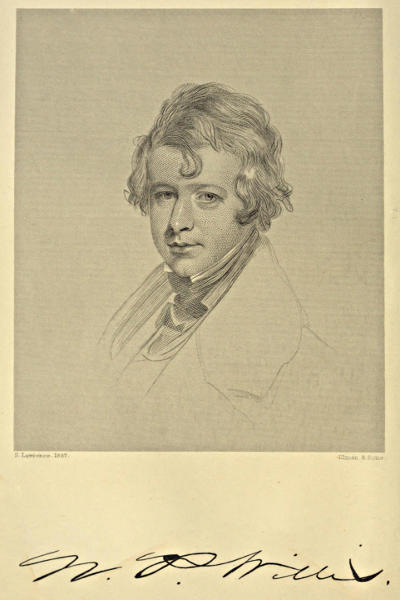
Willis took lodgings at No. 2 Vigo Street.
During the next ten months, which he spent in
London and its vicinity, he found himself something
of a lion. His articles in the English
magazines had begun to be talked about in the
clubs, and society people who had known him
abroad or in London only as a dandy attaché
were surprised to learn that “that nice, agreeable
Mr. Willis” was identical with “Slingsby,”
the brilliant American raconteur of the “New
Monthly.” He had contributed in the summer
and autumn of 1834 a number of sketches—“By
a Here and Thereian”—to the “Court
Magazine:” “Love and Diplomacy,” “Niagara
and So On;” to Captain Marryat’s “Metropolitan:”
an episode of Italian travel, “The Madhouse
of Palermo;” and to Colburn’s “New
Monthly:” “Incidents on the Hudson,” “Tom
Fane and I,” “Pedlar Karl,” “The Lunatic,”
and “My Hobby—Rather” (the same as “The
Mad Senior” in “Scenes of Fear”). The nom
de plume of Philip Slingsby he borrowed from
the luckless wanderer in Irving’s “Sketch-Book.”
He followed these up during 1835-36
with “F. Smith,” “Love in the Library”
(“Edith Linsey”), “The Gypsy of Sardis,”
“The Cherokee’s Threat,” “The Revenge of the
Signor Basil,” and “Larks in Vacation.” For
his “Slingsby” papers Willis got double pay:
Colburn gave him a guinea a page, and Morris,
in his contract with whom he had reserved the
right to print twelve sketches a year in the English
magazines, published them simultaneously
in the “Mirror,” and paid for them at the same
rate as for original articles. They were forwarded
to him in proof-sheets or in duplicate
MSS., so as to arrive in advance of the English
periodicals, which sometimes, however, reached
America first, because of the uncertainties of the
mail-carriage by sailing packet. To the “New
Monthly” Willis also contributed a number of
short poems, “Thoughts in a Balcony at Daybreak,”
“The Absent,” “Chamber Scene,” and
“To ——” (“Were I a star,” etc.). He wrote
for it after his return to America and after it
was united with “The Humorist” in 1837, under
the editorship of Theodore Hook. His last
contribution to it was “The Picker and Piler,”
in the April number for 1839.
Lady Blessington’s kindness continued after
his return to London, and he was taken up
by other fashionable bluestockings, dined and
wined, fêted and caressed to a degree that may
well have made him giddy. The two rival salons
to Lady Blessington’s were Holland House and
the residence of the Dowager Lady Charleville
in Cavendish Square. It does not appear that
Willis was invited to the former, but he went to
the reunions at Charleville House, though not
so constantly as to Seamore Place. Through
Lady Blessington’s influence he was admitted to
the Travellers’ Club, which was the resort of
the ultra fashionable; and, on Sir George Staunton’s
nomination, to the Athenæum, which had
more of a literary tinge than the Alfred or the
Travellers’. Sir George Staunton also presented
him at court, a favor which Mr. Vail, the American
minister, who disliked Willis for some reason,
had declined to render. Another friend gave
him a perpetual ticket to the opera. Among his
patronesses were the Countess of Arundel and
Lady Stepney, who wrote bad novels but gave
good dinners. Lady Blessington’s biographer,
Madden, who saw a great deal of him in those
days, has recorded his recollections of him as
follows:—
“I had the pleasure of meeting Mr. Willis on many
occasions at Gore House, to which reference is made
in the rather too celebrated ‘Pencillings by the Way,’
and also at the soirées of the late Lady Charleville
in Cavendish Square. Mr. Willis was an extremely
agreeable young man in society, somewhat overdressed
and a little too demonstratif, but abounding
in good spirits, pleasing reminiscences of Eastern and
Continental travel and of his residence there for
some time as attaché to a foreign legation. He was
observant and communicative, lively and clever in
conversation, having the peculiar art of making himself
agreeable to ladies, old as well as young, dégagé
in his manner, and on exceedingly good terms with
himself and with the élite of the best society, wherever
he went.”
The secret of Willis’s agreeableness to ladies
lay in his unfailing deference. It is extraordinary
how many women much older than himself
cherished a warm affection for him. He had
considered the meaning of Bacon’s saying, “No
Youth can be comely, but by Pardon,” and several
of his stories are studies on the thesis that
there is a beauty in age which may inspire passion.
One in particular, not found among his
collected writings, deals with this speculation:
“Poyntz’s Aunt,” published in “The Ladies’
Companion” of December, 1842, where the hero
falls violently in love with a woman of sixty, to
whose niece the family expected him to pay his
court.
Willis saw more “life” in London than was
quite good for him, and went into companies
which were less select than the Gore House coterie,
although, to say truth, Lady Blessington
herself was looked upon by “the best people” as
a trifle off color. Her house was frequented by
men who were entirely irreproachable, but the
English ladies were shy of visiting there. This
was due mainly to her rather unusual relations
with the Count d’Orsay. In obedience to the
wishes of the Earl of Blessington, his daughter
by a former marriage had been compelled to
wed the count under penalty of forfeiting her inheritance.
The poor girl reluctantly espoused
the brilliant stranger provided for her by her
father’s eccentric caprice; but the match was
unhappy, and was almost immediately followed
by a separation; notwithstanding which, D’Orsay
continued to live in the closest intimacy with
his wife’s stepmother after the earl’s death, and in
time under the same roof with her. This last arrangement,
which was, to say the least, odd, and
caused much scandal in British society, had not,
however, gone into effect when Willis first came
to London. Lady Blessington had not as yet
moved to Gore House, but was living in Seamore
Place, while D’Orsay had lodgings in Curzon
Street. Nor did the latter’s formal separation
from his wife take place till 1838. Another
intimate friend of Willis in London was that
very unconventional, not to say rapid, woman,
Lady Dudley Stuart, the daughter of Lucien
Bonaparte, “a lady of remarkably small person,
with the fairest foot ever seen,” under whose
bonnet “burn the most lambent and spiritual
eyes that night and sleep ever hid from the
world.” She had about her a semi-foreign society,
not without its fascinations, of artists, actors,
opera-singers, refugee nobles, and adventurers
of more or less shady antecedents. In his
“Sketches of Travel” Willis described a very
free and easy supper party, following a private
concert given by Lady Antrobus, at which he
and Lady Dudley Stuart assisted, together with
Grisi, Lablache, Rubini, and other members of
the Italian opera troupe then in London. Of
course neither Lady Antrobus nor Lady Stuart
was mentioned by name in this account.
But Willis’s acquaintance was by no means
confined to the Blessington set, or to the Bohemian
circle that surrounded Lady Dudley Stuart,
but included many families of unquestioned position.
The Ramsays, for instance, were solid
people, above any suspicion of queerness, and the
earl’s niece, Lady Moncrieff, whom Willis visited
in London, was decidedly “evangelical.”
There were two households in particular which
were like homes to him during the last year and
more of his stay in England. These were Shirley
Park, near Croydon in Surrey, the residence
of the Skinner family, and the Manor House of
the Shaws at Lee, in Kent, only a ten miles’
drive across country from Shirley Park. The
Hon. Mrs. Fanny Shaw was a daughter to Lord
Erskine and a sworn friend of Willis. Mrs.
Mary Skinner was wife to an Indian nabob, a
leader of fashion, and a woman of intellectual
tastes, who patronized letters and entertained
literary people, a kind of Mrs. Leo Hunter, in
short. Willis was introduced to her at Lady
Simpkins’s by Sir John Franklin, in February,
1835, and met her again at a dinner given by
Longman, the publisher, at Hampstead, where
were present, among others, Moore, Joanna Baillie,
Jane Porter, and Miss Pardoe. The last
was a very pretty woman, author of “Beauties of
the Bosphorus,” and other books more remarkable
for their sumptuous illustrations than for
their literary quality. She was a poetess, too,
after her fashion, and once addressed a tribute
in verse “To the Author of Melanie,” which was
printed in the “Mirror” of October 17, 1835.
Both Mrs. Shaw and Mrs. Skinner treated their
young guest with the most delicate and considerate
kindness. They made him offers of pecuniary
help, of which, fortunately, he had no
need to avail himself, as his letters to the “Mirror”
and his “New Monthly” stories (which
added fifteen or twenty guineas a month to his
“poor two hundred a year”) brought him in returns
which were ample for his occasions. The
Skinners had a town house in Portland Place,
and their carriage in London was always at
Willis’s service. Both of these ladies regarded
him as a son or a younger brother. Bruce Skinner,
a son of Willis’s hostess, named one of his
children after him. At Shirley Park and at the
Shaws’ he met a number of very charming people,
and his time there was spent in drives, lawn-parties,
etc. In the library at Shirley Park two
nieces of Walter Scott, the Misses Swinton,
copied for him “Melanie” and “Love in the Library,”
which he was preparing for the press.
An extract from a very confidential letter from
Willis to Mrs. Skinner may be worth transcribing,
to show the terms of frank and cordial familiarity
on which he lived with these excellent
people. After a brief history of his life and a
statement of his financial situation, the letter
concludes as follows:—
“There is a passage in your note which pleased
me. You say if you had a daughter you would give
her to me. If you had one I certainly would take
you at your word, provided this exposé of my poverty
did not change your fancy. I should like to
marry in England, and I feel every day (more and
more) that my best years and best affections are running
to waste. I am proud to be an American, but
as a literary man, I would rather live in England.
So if you know any affectionate and good girl who
would be content to live rather a quiet life, and could
love your humble servant, you have full power of attorney
to dispose of me, provided she has five hundred
a year, or as much more as she likes. I know enough
of the world to cut my throat sooner than bring a
delicate woman down to a dependence on my brains
for support, though in a case of exigency I could always
retreat to America, and live comfortably by my
labors. Meantime I am the only sufferer by my
poverty, and am not poor, for no man is so who lives
upon his income. Comprends-tu? My dear friend,
I have told you what I have told no other person in
the world. Most men and women would think it incredible
that an attaché to a legation could keep up
appearances on two hundred a year, or pity him if he
could; and I never thought anybody worth the confidence—save
only yourself. I would tell Miss Porter
just the same, or Mr. Swinton, but who else?
No one! so gardez cela!
“I enjoyed the ball at the Ravenshaws’ exceedingly,
and am so much obliged to you for introducing me to
Praed, whom I like.”
“I have one or two homes in England,” wrote Willis
to his mother, July 22, 1835, “where I am loved
like a child. I had a letter the other day from Honorable
Mrs. Shaw, who fancied I looked low-spirited
at the opera. ‘Young men have but two causes of
unhappiness,’ she says, ‘love and money. If it is
money, Mr. Shaw wishes me to say, you shall have as
much as you want; if it is love, tell us the lady, and
perhaps we can help you.’ Where could be kinder
friends? I spend my Sundays alternately at their
splendid country house and Mrs. Skinner’s, and they
never can get enough of me. I have a room always
kept for me at both places, and there is universal rejoicing
when I come and mourning when I go. I am
often asked whether I carry a love philter with me;
yet with all the uncommon honors and favors shown
me in England, I assure you I never asked or made
interest directly or indirectly for any acquaintance or
any favor since I landed at Dover. What has come
has come of its own accord.”
Miss Porter and Miss Pardoe were both domesticated
at Shirley Park, and he met there at
different times, as fellow guests, Lady Franklin,
Lady Sidney Morgan, author of once popular
French and Italian travels, and the brilliant
young orator, poet, and wit, Winthrop Mackworth
Praed. Of the latter Willis wrote in the
“Home Journal” many years later: “We were
followers together in the train of the admired
belle (a visitor under the same hospitable roof)
whom I afterward brought home with me to
Glenmary.” Willis attributed to his religious
poetry the honor of his first acquaintance with
Joanna Baillie, Jane Porter, and the Byrons.
For the authoress of “The Scottish Chiefs,” especially,
he formed an enduring attachment, and
she regarded him with an almost motherly affection.
A lifelong correspondence was kept up between
them, and at the death of Admiral Robert
Ker Porter at St. Petersburg in 1842, among the
MSS. found in his sea-chests were ninety letters
from Willis to his sister. The letters from Miss
Porter, among Willis’s private papers, show that
she was an equally indefatigable, through a not
very legible correspondent. Willis encountered
Ada Byron at an evening party in London, and
thought her “earnest and sweet.” Lady Byron,
who was a Unitarian, was much interested by
the spirited sketch of Dr. Channing in a series
of papers on American literature which Willis
had contributed to the “Athenæum,” and she expressed
her favorable opinion of them in a letter
to Miss Baillie, as also her pleasure that her
daughter had made the author’s acquaintance.
Miss Baillie gave this note to Willis for his autograph
book. Byron’s sister, Augusta Leigh,
he also met in London society. She gave him
an autograph letter of Byron, and on the appearance
of “Melanie and Other Poems,” in March
1835, he sent her a copy, and received an acknowledgment
in which she said that the book
contained “some of the most touching and exquisite
lines I ever read.” The venerable Joanna
Baillie wrote him, on the same occasion, a letter
filled with the most graceful compliments.
Among other London acquaintances of Willis’s
at this time were John Leech, the artist, and
Martin Farquhar Tupper, the proverbial philosopher,
who afterwards visited him in America.
A few extracts from a manuscript diary irregularly
kept by Willis from June, 1835, to March,
1836, will serve to show the nature of his daily
engagements and occupations:—
“June 30. Breakfasted with Samuel Rogers. Met
Dr. Delancey, of Philadelphia, and Corbin, ditto.
Talked of Mrs. Butler’s book, and Rogers gave us suppressed
passages. Talked of critics, and said that ‘as
long as you cast a shadow, you were sure you possessed
substance.’ Coleridge said of Southey: ‘I
never think of him but as mending a pen.’ Southey
said of Coleridge: ‘Whenever anything presents itself
to him in the shape of a duty, that moment he
finds himself incapable of looking at it.’
“Went to the opera with Hon. Mrs. Shaw and
heard Grisi in ‘I Puritani,’ and saw Taglioni: both
divine. Visited Lady Blessington’s box and Lady
Vincent.
“After to a party at Mrs. Leicester Stanhope’s.
Saw Guiccioli, and was stuffed to the eyelids by
Lady Mary Shepard about my shorter and scriptural
poems.
“July 1. Mrs. Skinner drove Jane Porter and
myself to Harrow to hear the speeches.…
“In the evening to a party at Lady Cork’s, and
after to Lady Vincent’s soirée.”
Lady Cork was the aged but still beautiful
Dowager Countess of Cork and Derry; who in
her youth, as Miss Moncton, had been a favorite
of Dr. Johnson, and whose soirées in New Burlington
Street, between 1820 and 1840, were
crowded with talent and fashion.
“2. Sat to Rand for my picture. Went to Lady
Dundonald’s fête champêtre at her beautiful villa in
Regent’s Park. D’Orsay and all the world there.
“3. Dined with Tyndale and Greenfield at the
Wyndham Club. Took tea with Jane Porter and
went to a ball at the Longmans’, Hampstead.
“4. Went to Lee on a visit to Hon. Mrs. Shaw.
“5. Drove to Lady Hislop’s to tea.
“6. Duke de Regina, Vail, Gen. and Mrs. Talmadge
dined with the Shaws.
“7. Returned to town. Dined with Mrs. Channon.
Lady D. Stuart, Counts Battaglia, Vodiski, De
Grognon, and Miss Cockaine present. Came home ill.
“8. Dined with Mrs. S., and went to Lady Dudley
Stuart’s soirée.
“9. Dined with Dr. Beattie and met Thomas
Campbell. Praised my poetry to the skies and quoted
from ‘Melanie,’—
‘She died
With her last sunshine in her eyes.’
Spoke of Scott’s slavishness to men of rank, and after
said it did not interfere with his genius. Said it sank
a man’s heart to think he and Byron were dead and
there was nobody left to praise or approve. Why
should he write now? Told story of the man at
the deaf and dumb who did not know him as a
poet. Abused the nobility bitterly. Said they were
ungrateful, and thought they honored you by receiving
a favor from you. Said he was sorry for his vindication
of Lady Byron. Story of dining with Burns
and a Bozzy friend who, when C. proposed the health
of Mr. Burns, said, ‘Sir, you will always be known
as Mr. Campbell, but posterity will talk of Burns.’
He was playful and amusing, and drank gin and
water. Went after in uniform to the grand Coliseum
ball. Seven thousand people present.
“10. Grand review in Hyde Park. Went to a
déjeuner at Mrs. Wyndham Lewis’s on the Park.
Talked to Miss Caton and the Duchess of St. Albans.
Music after the review. Malibran sang.
“Received a congratulatory letter from Edward
Everett.
“Party at Mrs. F.’s, Lady Franklin’s sister. Stupid.
“11. Went to the Duchess St. Albans’s fête at
Holly Lodge. The duke flew a falcon and killed a
pigeon. Fireworks, dinner in a tent, dancing, singing,
etc., etc., there. Mrs. Marjoribanks brought me
home.”
This fête furnished some items for Willis’s
story of “Lady Ravelgold.”
“12. Dined with Mrs. Joanna Baillie at Hampstead.
She gave me some of the wedding cake of
Ada Byron. Said that her husband, Lord King, was
hated by his own father and mother and often in
want of money, but an excellent person and beloved
by his own second brother, who had received from
the father all that was not entailed. On the death
of the father, Lord K. had nine thousand a year. Mrs.
Baillie said that Lady Byron had given to the present
Lord B. her whole jointure when he came to the
title.
“Went to Lady Blessington at ten, and had a long
talk with Countess Guiccioli, who said she wished
nevermore to be spoken of in good or ill. The evil
was remembered and the good forgotten. She made
a point of never reading the papers.
“Thence to Charles Kemble’s soirée. Countess
d’Orsay there.”
And thus the journal proceeds with its daily
count of dinners, balls, soirées, garden parties,
and opera-going, the diarist finally recording
himself as “fatigued to death with dinners and
dissipations.” In fact the pace began to tell
upon him. Following the last entry that I have
copied here, for July 12th, comes the first draft
of a poem, “Thoughts on the Balcony of Devonshire
House at Sunrise after a Splendid Ball:”
“Morn in the East! How coldly fair
It breaks upon my fevered eye!
How chides the calm and dewy air;
How chides the pure and pearly sky!
The stars melt in a brighter fire,—
The dew in sunshine leaves the flowers,—
They from their watch in light retire,
While we in sadness pass from ours.”
This is one of Willis’s most genuine utterances.
The same revulsion of feeling is expressed in
“Better Moments” and “She was not There.”
There were two men in him, the worldling and
the poet; and when worn with fashionable dissipation
he was sensitive to the rebuke of the
midnight heaven or of that “awful rose of
dawn” which God makes for himself in the
“Vision of Sin.” But the mood, though sincere,
was not lasting. “Recovered my spirits,”
runs the entry for July 15th, “after a causeless
depression for a week.”
Toward the end of July he escaped to the
country and “passed a month at Shirley Park
and the Manor, Lee, alternately reading and lying
on the grass in delightful idleness, with the
kindest friends and the greatest contentment.”
At Shirley Park there were archery fêtes, the
Archbishopess of Canterbury, “lords and ladies
in abundance, and poets and travelers ad libitum.
It is midsummer,” continues the letter
from which I quote (August 5th), “in cool and
breezy England, five o’clock in the afternoon,
and a beautiful day. The house is in the middle
of a park (nothing but grass and trees) as
large as the Common in Boston, the soft velvet
greensward closely shaven all around the house,
and a lovely archery ground on the edge of the
lake just beneath my window, with red and gold
targets, and a dozen young girls and beaux with
beautiful bows and quivers shooting with all the
merriment conceivable. There is a beautiful
daughter of Sir Henry Brydges beating everybody,
and my friend Mrs. Shaw, and Lady Encombe,
and quantities of nice people.”
At Shirley Park he had a letter from Jane
Porter, inclosing an invitation to him from Sir
Charles Throckmorton, a Catholic gentleman in
Warwickshire, at whose country seat she was
staying. Willis joined her there on September
10th, but meanwhile something else of great
importance to him had happened. While visiting
at the Skinners’ he had met his fate in
the person of Miss Mary Stace, a daughter of
General William Stace of Woolwich. He saw
her first at a picnic on the grounds of Lord Londonderry,
at North Cray, and “thought her the
loveliest girl he had ever seen.” At Shirley
Park—whither she came as a guest—he was
thrown much in her company, and after a week’s
acquaintance made her a proposal of marriage,
and was accepted. On the 1st of September
he went to Woolwich on a visit to the Staces,
and in the course of a day or two asked the
general for his daughter’s hand. It was agreed
that the engagement should be short, like the
courtship, and that the wedding should come
off on the 1st of October. Mary Stace, who
became Mrs. Willis on the day fixed, was a girl
of uncommon beauty and sweetness. In appearance
she was of the purest Saxon type, a blonde,
with bright color, blue eyes, light brown hair,
and delicate, regular features. She had a gentle,
clinging, affectionate disposition, adored her
husband, had been religiously and carefully educated,
and possessed the true Englishwoman’s
sense of the importance of the male sex and the
due subordination of woman. Her family were
most worthy and substantial people, and strictly
evangelical. General Stace was the Royal Ordnance
Storekeeper at Woolwich Arsenal. He
had been commissary to the British navy in
Egypt, and commissary of ordnance at the battle
of Waterloo, and had been rewarded for gallant
service in that famous action. He gave
Willis, as a souvenir, a military cloak and an
eagle clasp taken from the body of a French
officer after the battle, which are still preserved
in the family. His son-in-law described him as
honest, hearty, and plain-spoken, with the common
soldierly weakness for telling post-prandial
stories of his campaigns. Mrs. Stace was Irish,
a great singer, and a friend of Tom Moore, who
used to listen to her songs by the hour. There
were five other children besides Mary. Two of
the sons were in the army, and afterwards there
were three Colonels Stace. The general agreed
to give his daughter £300 a year, which, with
the £300 or £400 which Willis counted upon
making by literary work, would do, wrote the
latter to Mrs. Skinner, for a poet. Having completed
the arrangements for his marriage, he set
out from London, September 10th, by the Tantivy
coach for Sir Charles Throckmorton’s seat
of Coughton Court. This was a fine old Elizabethan
mansion near Alcester, and Willis spent
ten days there very agreeably, visiting, in company
with Miss Porter and his host, Warwick
Castle, Kenilworth, Stratford, and other points
of interest in the neighborhood. Of these jaunts
an ample narrative is given in “Sketches of
Travel,” originally communicated to the “Mirror.”
Thence he returned to Woolwich, receiving
on his departure an invitation from the hospitable
baronet to bring his wife and stay a
fortnight with him. At Woolwich he was again
joined by Miss Porter, on the 25th, who came for
a week’s visit to the Staces and to be present at
the wedding. From Coughton Court the expectant
groom had written to his friends announcing
his engagement, and received in reply many
expressions of good wishes. Among others, Lady
Blessington wrote as follows:—
Anglesey-near-Gosport, September 19, 1835.
My dear Mr. Willis,—Yours of the 16th has
been forwarded to me here, and I lose not an hour
in replying to it. I congratulate you with my whole
heart on your approaching marriage, and wish you
all the happiness you so well deserve, and which a
marriage well assorted will alone bestow. I predict
the happiness I wish you, for you would not, I am
sure, make an unworthy choice, and the distaste which
the scenes you have gone through during the last
year must have engendered in your mind will have
taught you still more highly to appreciate the society
and affection of a pure-minded and amiable woman,
on whom your future happiness will depend. I think
you have acted most wisely, and am sure that the
rational plans you have laid down will insure your
felicity. A residence near London, which gives you
the opportunity of enjoying its numerous advantages,
without weakening your mind by a too frequent contact
with its dissipations, is, of all others, the one I
would select for a literary man, and I shall look forward
with pleasure to seeing you at Seamore Place
in your new and more respectable character of a
Domestic Man, which, be assured, will bestow more
happiness on you than all the futile successes ever
acquired in the heartless maze of fashion and folly,
in whose vortex you have been whirled during so
many months. A Man of Genius is out of his natural
sphere in such a circle; he loses his identity and
blunts the fine edge of his sensibility. You have retired
in time, and will, I am persuaded, have reason
to bless the gentle and benign influence that has attracted
you from it to the pure and healthy atmosphere
of domestic life. Be assured, my dear Mr.
Willis, that out of the circle of your immediate family
you have no friend more truly interested in your
welfare or more anxious to promote it than I am, of
which no proof in my power shall ever be wanting.
I shall be in London on the 22d, and shall have
great pleasure in seeing you. Your secret shall be
safe with me, you may be sure. I hope the little tale
will be sent for your correction in a day or two.
Pray have “Ion” left at my house. Mr. Talfourd
requested that it might not leave my possession, so
that in lending it to you I disobeyed his request.
The old Earl of Dalhousie wrote a letter of
hearty congratulation.
“Wherever you go or sit down at last,” it said,
“think of us as being with you in our minds’ eye at
least, and if it shall please God that, in the course of
time, we ever meet again, it will be truly a day of
joy here, for from hence I move no more.”
His son, the young Lord Ramsay, had jestingly
promised to be Willis’s groomsman some
day at Niagara, and the former now reminded
him of it, and asked him to stand up with him,
and Ramsay sent the following excuses some
three weeks after the wedding:—
Yester, October 23, 1835.
I promised to play my part as best man, my dear
Willis, at Niagara, and to have descended from that
to Woolwich would have been a sad bathos, so that it
was perhaps as well that your notice was too short to
allow of the possibility of my being with you before
the 1st of October. Still I can congratulate you as
well at a distance as with my own lips, and though
the romance which we proposed for ourselves is gone,
I am very happy to congratulate you on the prose
reality.
I had written all this to you three weeks ago,
and directed my frank to the Athenæum Club, a place
which I took it into my head you frequented, when,
this morning, the letter was returned by the porter
with a “non est inventus” written on it. This to save
my character.
Furthermore, your example was so good an one,
and, fortunately, so contagious, that I have fallen a
victim, and am going to be married, and as this is
not a lady’s letter, it will be as well not to keep the
most important part of the intelligence for the postscript,
but to tell you at once that it is to Lady Susan
Hay. If I were to dash out into a rhapsody you,
whose experience of such a situation is of so recent a
date, might easily forgive me, but I will take mercy
even on you. I am happy,—happy now, and if I
am not happy always in time to come, Heaven knows
how utterly it will be my own fault.
When next summer brings visiting time we shall
meet, I trust, in Scotland, and exchange at once
news, visits, and congratulations.
May I beg, even though a stranger, my compliments
to Mrs. Willis, and believe me
Ever yours sincerely,
Ramsay.
Mrs. Skinner wrote, in a letter to Jane Porter:—
“Mary Stace is a sweet, gentle, affectionate, lively
girl,—natural, so that you may see at once there is
no deceit in her and no guile. She is religious, accomplished,
sings sweetly, is pretty, and will make
Willis more happy than any other woman I know.
He will have no heart-burnings, no misgivings with
her, for she is true and sincere. You will love her.
She was so religious, good, and depend-on-able that I
told her she should be my daughter-in-law.”
In his letters to his folks at home announcing
his betrothal, Willis insisted a good deal on this
point of his fiancée’s religiousness, and he evidently
shared the belief commonly held and
proclaimed among men of the world, that religion,
like a low voice, is an excellent thing—in
woman; a theory which some women resent as a
covert insult to their understandings, and some
men as an open insult to their religion, and
which may be described as the converse of the
proposition that a reformed rake makes the best
husband.
“I should never have wished to marry you,” he
wrote to his betrothed, about a fortnight before the
wedding, “if you had not been religious, for I have
confidence in no woman who is not so. I only think
there is sometimes an excess in the ostentation of
religious sanctity, and of that I have a dread, as you
have yourself, no doubt. Miss Porter,” he adds, “is
sincere and refined as few professedly religious people
are.”
In another letter he says:—
“Mine is not a love such as I have fancied and
written about. It is more sober, more mingled with
esteem and respect, and more fitted for every-day
life. It had well need be, indeed, for I have taken
it in lieu of what has hitherto been the principal
occupation of my life. I am to live for you, dear
Mary, and you for me,—if you like! That is to
say, henceforth dissipation (if we indulge in it) will
be your pleasure, not mine. I have lived the last ten
years in gay society, and I am sick at heart of it. I
want an apology to try something else. I am made
for something better, and I feel sincerely that this is
the turning-point of both mind and heart, both of
which are injured in their best qualities with the kind
of life I have been leading. Do not understand me
that I am to make a hermit of myself, however, or
a prisoner of you. You will have always friends
enough, and society enough, and change of place and
scene enough. In short, I shall exact but one thing,—four
or five hours in my study in the morning, and
you may do what you like with the rest.”
They were married in Plumstead Church, by
the Rev. Mr. Shackleton, on the 1st of October.
“It was a kind of April day,” writes Willis,
“half sunshine, half rain,”—recalling, somehow,
the coincidence in Julia Mills’s diary between
the checker-board tavern-sign and checkered human
existence on a similar occasion in David
Copperfield’s life,—“but everybody was kind,
the villagers strewed flowers in the way, the
church was half full of people, and my heart
and eyes were more than full of tears.” The
bridal pair were driven in Mr. Stace’s carriage
to Rochester, posted next day to Dover, and
crossed the Channel on the 3d. They passed a
fortnight at the Hôtel Castiglione in Paris, and
then returned to England, where they spent the
winter, partly in London and partly at Woolwich,
and in visits to the Shaws, Skinners, and
other friends. Willis was busy in getting out
the first and second English editions of “Pencillings”
and the “Inklings of Adventure.” He
presented his bride to his “swell” acquaintances
in London, and was himself introduced by his
brothers-in-law to numbers of military people,
dined at the Artillery Mess, and was given the
freedom of the Army and Navy Club. He set
up an “establishment,” a cabriolet and a gray
cab-horse, “tall, showy, and magnificent.” He
had taken into service a young fellow named
William Michell, the son of his landlady, a
bright and handsome lad, who now made a very
presentable tiger. William went to America
with his master in the spring, remained in his
service during his residence at Glenmary, and
came back with him, in 1839, to England, where
he ultimately got employment as a machinist,
having a good education and a knack at mechanics.
In May, 1836, after many leave-takings, Willis
sailed with his wife for America. His “Lines
on Leaving Europe,”—
“Bright flag at yonder tapering mast,”—
dated in the English Channel, express the feelings
at once of regret and of hope with which
he set his face homeward after an absence of
four years and a half. These spirited lines are
among the very few poems of Willis which
seem destined to last. They have the real lyrical
impulse, and it is not easy to read them
without emotion. Emerson, who gives part of
the poem in “Parnassus,” omits the closing
stanza, in which the poet touchingly bespeaks a
welcome for his English bride.
“Room in thy heart! The hearth she left
Is darkened to lend light to ours.
There are bright flowers of care bereft,
And hearts—that languish more than flowers.
She was their light—their very air;
Room, mother, in thy heart! place for her in thy prayer!”
Willis published three books while in England.
“Melanie and Other Poems” appeared
March 31, 1835. It was divided into three
parts and included a selection from the three
volumes of verse published in America, but unfamiliar
to the British public, besides some half
dozen new poems, dated, said the author, in his
prefatory note, from “the corner of a club [the
Travellers’] in the ungenial month of January.”
It was introduced by Barry Cornwall, who
speaks of the poet as “a man of high talent and
sensibility,” and then goes on with some reflections
of a friendly nature on American literature
and the desirableness of cultivating kinder
feelings between England and America. Wilson,
who reviewed “Melanie” very favorably in
“Blackwood’s,” made Procter’s introduction to
it the theme of much elaborate ridicule, in the
well-known style of “Maga,” when rending a
cockney author. He affected to have gathered
an impression from the title-page,—which described
the poems as “edited” by Barry Cornwall,—that
Willis was dead, and that Procter
was performing the office of literary undertaker
for “poor Willis’s remains.” “Alas! thought
we, on reading this title-page; is Willis dead?
Then America has lost one of the most promising
of her young poets. We had seen him not
many months before in high health and spirits
and had much enjoyed his various and vivacious
conversation.… But why weep for him, the
accomplished acquaintance of an hour?” He
goes out on the street and tells the first friend
he meets that Willis is dead. “Impossible,”
answers the friend; “day before yesterday he
was sitting very much alive in the Athenæum
Club: here is a letter from him franked Mahon,”
etc. Another Scotch professor—Aytoun—who
belonged, like Wilson, to the Tory light
artillery, was moved to write a parody of “Melanie.”
The same humorist also paid his respects
to Willis in one of his “Ballads of Bon
Gaultier,”—a strenuous piece of North British
playfulness, in which Willis and Bryant are
represented as sallying forth like knights errant
on the Quest of the Snapping Turtle:—
“Have you heard of Philip Slingsby—
Slingsby of the manly chest?
How he slew the snapping turtle
In the regions of the west?”
The two longest and most ambitious poems in
this volume were “Melanie” and “Lord Ivon
and his Daughter.” The first is the story “told
during a walk around the cascatelles of Tivoli,”
of an English girl, “the last of the De Brevern
race,” who betroths herself in Italy to a young
painter of unknown parentage; but at their
bridal at St. Mona’s altar a nun shrieks through
the lattice of the chapel:—
“The bridegroom is thy blood—thy brother!
Rudolph de Brevern wronged his mother,”
and the bride thereupon “sunk and died, without
a sign or word.” The stanza and style are
taken from Byron’s and Scott’s metrical romances.
The very first line—
“I stood on yonder rocky brow”—
is a reminiscence of “The Isles of Greece.”
The second poem, which is equally melodramatic
in its catastrophe, is in blank verse and
in the form of a dialogue between the Lady Isidore
and her father, Lord Ivon. He tells his
daughter (with a few interruptions from her,
such as “Impossible!” and “Nay, dear father!
Was’t so indeed?”) how he had in vain wooed
her grandmother with minstrelsy and feats of
arms, and then her mother more successfully
with gold: marrying whom, he had begotten Isidore,
and afterwards, in remorse for having
dragged his young bride to the altar, had been
on the point of draining a poisoned chalice,
when she had anticipated him by running away
with a younger lover, leaving to his care the
babe, now grown to a woman, who dutifully concludes
the dialogue with, “Thank God! Thank
God!” Both of these poems were imitative and
artificial, and the last not a little absurd. Willis
had no genius for narrative or dramatic poetry,
and when he tried to be impersonal and
“objective,” he wrought against the grain. The
lyrical pieces in the book were almost all of
them graceful and sweet. He himself thought
that the best thing in the volume was “Birth-Day
Verses,” addressed to his mother on January
20, 1835. Similar in theme were the lines,
“To my Mother, from the Apennines,” written
at an auberge on the mountains, August 3,
1832. The verses to Mary Benjamin, written
in Scotland in September, 1834, have been already
mentioned. They stand in his collected
poems as “To M——, from Abroad,” and were
also incorporated in “Edith Linsey,” under the
title “To Edith, from the North.” “The Confessional,”
dated Hellespont, October 1, 1833,
was also meant for Mary Benjamin. This and
“Florence Gray” had the note of travel. But
a Boston poem, “The Belfry Pigeon,” was the
most popular of anything in the book and has
retained a place in readers and collections to
the present day. These shorter pieces, like all
of Willis’s truest poetry, were purely poems of
sentiment. His description, in “Edith Linsey,”
of Job Smith’s verses as “the mixed product of
feeling and courtesy” applies consciously to his
own. They were “the delicate offspring of tenderness
and chivalry,” airy, facile, smooth, but
thin in content: not rich, full, concrete, but
buoyed up by light currents of emotion in a region,
to quote his own words again, of “floating
and colorless sentiments.” This disembodied
character is a mark of almost all the American
poetry of the Annual or Gemmiferous period,
and is seen at its extreme in the unsubstantial
prolixity of Percival and the drab diffuseness of
Mrs. Sigourney. It was the reflection on this
side the water from Shelley, from Byron’s earlier
manner, from Wordsworth’s most didactic
passages, and from the imitations of all these
by secondary poets, like Mrs. Norton and L. E.
L. Willis’s verses were much better than Percival’s
or Mrs. Sigourney’s—defter, briefer, more
pointed. But they had a certain poverty of imagery
and allusion which belonged to the school,
a recurrence of stock properties, such as roses,
stars, and bells. He was ridiculed by the critics,
in particular, for his constancy to the Pleiades,
which would almost seem to have been the only
constellation in his horizon.
Toward the last of November, 1835, the first
edition of “Pencillings by the Way” was published.
It was an imperfect one, made up hastily
for the London market from a broken set of
the “Mirror,” and gave only seventy-nine out of
the one hundred and thirty-nine letters since
printed in the complete editions. From this
imperfect copy the first American impression
(1836) was taken, and all in fact down to 1844.
The book reached a second English edition in
March, 1836, and a seventh in 1863. For this
first edition Willis received £250. He afterwards
testified, that from the republication of
the original “Pencillings,” for which Morris had
paid him $500 a year, he had made, all told,
about $5,000. Their appearance in book form
had been anticipated by a severe criticism of the
original “Mirror” letters, written by Lockhart
for the “London Quarterly” of September, 1835.
This was echoed by the Tory press generally, and
it was their attacks which led to the issue of the
London edition and greatly stimulated its sale.
There were several reasons why the Tory papers
were “down on” Willis. In the first place he
was an American. In the next place he had been
admitted and made much of in English social
circles, where English men of letters, who were
merely men of letters, did not often go. And,
finally, he had spoken disrespectfully in these
letters of the editor of the “Quarterly” himself.
“Do you know Lockhart?” Wilson is made to
ask in Willis’s report of their conversation at
Edinburgh. “No, I do not,” replies his interlocutor.
“He is almost the only literary man in
London I have not met; and I must say, as the
editor of the ‘Quarterly,’ and the most unfair
and unprincipled critic of the day, I have no
wish to know him. I never heard him well
spoken of. I probably have met a hundred of
his acquaintances, but I have not yet seen one
who pretended to be his friend.”
This paragraph was enough to account for the
“Quarterly” article; but the personal grievance
was kept well out of sight, and Willis was taken
to task for his alleged abuse of the rights of
hospitality in reporting for a public journal private
conversations at gentlemen’s tables. The
article was a very offensive one, written with
ability and with that air of cold contempt of
which Lockhart was master. It sneered at Willis
as a “Yankee poetaster,” and a “sonneteer
of the most ultra-sentimental delicacy;” intimated
that his surprise and delight at the
manners of the English aristocracy came from
his not having been familiar with the usages of
the best society at home, and accused him of
“conceited vulgarity” and “cockneyism” (an
awful word, under which the Scotch Tories connoted
all possible offenses against sound politics
and good literature). The passages that seem
to have given most offense to the critic were the
report of the conversation with Lord Aberdeen
at Gordon Castle and the remarks of Moore
about O’Connell at Lady Blessington’s. “It is
fortunate in this particular case,” wrote Lockhart,
“that what Lord Aberdeen said to Mr.
Willis might be repeated in print without paining
any of the persons his lordship talked of;
but what he did say, he said under the impression
that the guest of the Duke of Gordon was a gentleman,
and there are abundance of passages in
Mr. Willis’s book which can leave no doubt that,
had the noble earl spoken in a different sense, it
would not, at all events, have been from any
feeling of what was due to his lordship, or to
himself, that Mr. Willis would have hesitated to
report the conversation with equal freedom.”
The article concludes as follows: “This is the
first example of a man creeping into your home
and forthwith printing,—accurately or inaccurately,
no matter which,—before your claret is
dry on his lips,—unrestrained table-talk on delicate
subjects, and capable of compromising individuals.”
Lockhart, as usual, contrived to
insult Willis’s country, through her representative.
“We can well believe,” he said, “that
Mr. Willis has been depicting the sort of society
that most interests his countrymen.
‘Born to be slaves and struggling to be lords,’
their servile adulation of rank and title, their
stupid admiration of processions and levées, and
so forth, are leading features in almost all the
American books of travels that we have met
with.”
To this censure Willis replied, in substance,
in the preface to the first London edition of
“Pencillings,” first, that from “the distance of
America, and the ephemeral nature and usual
obscurity of periodical correspondence,” he had
never expected that the “Mirror” letters would
reach England; nor would they have done so,
had not the “Quarterly” “made a long arm over
the water,” and reprinted all the offending portions;
thereby forcing the author’s hand and
compelling him to publish the entire collection
in justification of himself. Secondly, that his
sketches of distinguished people were neither
ill-natured nor untrue; that he had said nothing
in them which could injure the feelings of those
who had admitted him to their confidence or
hospitality. “There are passages,” he allows,
“I would not rewrite, and some remarks on individuals
which I would recall at some cost,”
but “I may state as a fact that the only instance
in which a quotation by me from the conversation
of distinguished men gave the least offense
in England was the one remark made by
Moore, the poet, at a dinner party, on the subject
of O’Connell. It would have been harmless,
as it was designed to be, but for the unexpected
celebrity of my ‘Pencillings;’ yet with all my
heart I wish it unwritten.” And finally, that
whatever violations of delicacy and good taste
might have been committed in the “Pencillings,”
the author of “Peter’s Letters to his Kinsfolk”
was not the one to throw a stone at them. The
first plea in this defense was sincerely made, as
might be easily proved from Willis’s private
letters. It was a disagreeable surprise to him
when the “Quarterly” reprinted passages from
the “Mirror” letters. And it is true that America
was much farther away from England than
England was from America. Still, if Willis had
published anything that he should not have published,
it was not a perfect excuse to say that he
had done it in a corner. As the event showed,
foreign correspondence in an American newspaper
might reach England. But this apology
was not needed, for his second plea covered the
ground. There was, in truth, nothing malicious
or slanderous in “Pencillings;” almost nothing
that could give pain even to the most sensitive.
The people described were, nearly all of them,
in a sense, public characters, accustomed to seeing
themselves gossiped about in print. In one
or two instances Willis had been indiscreet, as
he freely admitted. But it is hard for one living
in these times of society journals and “interviewers”
to understand why the papers should
have made such a pother over a comparatively
trifling trespass upon the reserves of private life.
The best proof of Willis’s innocence in the matter
is that the people whose hospitality and confidence
he was charged with abusing took no
kind of umbrage at the liberty. On the contrary,
Lord Aberdeen, Wilson, Dalhousie, and
others wrote to him in warm approval of his
book. “With what feelings,” said the “Quarterly”
article, apropos of the description of
Gordon Castle, “the whole may have been perused
by the generous lord and lady of the castle
themselves, it is no business of ours to conjecture.”
This point, however, need not be left
to conjecture, as it is amply answered in the following
letter to Willis from the Earl of Dalhousie,
dated February 25, 1836:—
… In the long evenings of winter we have beguiled
the time with “Pencillings by the Way,” and whatever
critics and reviewers may say, I take pleasure in
assuring you that we all agree in one sentiment, that
a more amusing or more delightful production was
never issued by the press. In what we know of it, it
is true and graphic, and therefore in what is foreign
to us, we think, must be so also. The Duke and
Duchess of Gordon were here lately and expressed
themselves in similar terms.
Lady D—— desires me to say that the reviews
could not have done more for its success by their amplest
praises, for it is now in every hand.
Our family has been much occupied by Ramsay’s
marriage this winter, he following your steps so
closely. He has added greatly to his parents’ happiness,
and, I hope, to his own in life. Lady Susan
Hay is a handsome woman, and an amiable, pretty
creature. They have settled themselves at Coalstown,
until called into a more active life, which I
hope he looks forward to, and you have thought him
fitted for. It is not unlikely that he will be chosen
member for the East Lothian, in which he has made
his residence, triangular between me and his father-in-law,
Lord Tweeddale, about sixteen miles from me.
Pray let me hear from you, as your sincere attached
friend,
Dalhousie.
Lady Dalhousie had written some two mouths
before:—
I feel that it is positive ingratitude not to offer our
united thanks for your book, which we received in
safety, and Miss Hathorne and I are now reading it
aloud to Lord Dalhousie in the evening, with very
great pleasure and amusement. Your descriptions
recall to my mind admirably what I have seen, and
paint to my mind’s eye what I wish to see, and the
happy sunshine which your own mind has shed over
every person and thing you have met is refreshing
and enlivening to us, living now much alone in this
dark and gloomy December. The “Quarterly” we
read with extreme wrath and indignation, and, believe
me, it will afford us the most sincere pleasure
if you will take, if you find them worthy of it, a few
more of your spirited pencillings from D. Castle.…
Believe me always very sincerely yours.
C. B. Dalhousie.
It has been said above that there was almost
nothing in “Pencillings” that could give pain
to any one; but to this statement there are one
or two exceptions. The first was the instance of
Moore and O’Connell, in which Willis acknowledged
and regretted his imprudence. “This
publication, to my knowledge,” says Madden in
his “Life of the Countess of Blessington,” “was
attended with results which I cannot think Mr.
Willis contemplated when he transmitted his
hasty notes to America,—to estrangements of
persons who, previously to the printed reports of
their private conversations, had been on terms
of intimate acquaintance. This was the case
with respect to O’Connell and Moore. Moore’s
reported remarks on O’Connell gave offense to
the latter, and aroused bad feelings between
them which had never previously existed, and
which, I believe, never ceased to exist.”
It also appears from a letter from Willis to
Lady Blessington, and an unsigned note from
a friend of hers to Willis, both of which are
printed in Madden’s “Life,” that Fonblanque
resented the description of himself in “Pencillings,”
and had written the author a note in
terms which the latter thought “very unjustifiable.”
Fonblanque was an able and estimable
man, and Willis’s portrait, or caricature, of him,
though not unkindly meant and applying merely
to his personal appearance, was certainly not
pleasant for the subject of it to see in print.
“I never saw,” it runs, “a much worse face; sallow,
seamed, and hollow, his teeth irregular, his skin livid,
his straight black hair uncombed and straggling over
his forehead; he looked as if he might be the gentleman
‘whose coat was red and whose breeches were
blue.’ A hollow, croaking voice, and a small, fiery
black eye, with a smile like a skeleton’s, certainly did
not improve his physiognomy. He sat upon his chair
very awkwardly, and was very ill dressed, but every
word he uttered showed him to be a man of claims
very superior to exterior attraction.”
With the exception of Lockhart, Moore, Fonblanque,
and Captain Marryat, whose case will
be mentioned presently, it does not appear that
anyone took offense at anything in “Pencillings.”
As to Lady Blessington, Lockhart’s misgiving
as to whether she would ever “again admit to
her table the animal who has printed what ensues”
was needless. It was she who saw the
book through the press while Willis was in
France on his wedding journey. He went to
see her frequently during the remainder of his
stay in London, and called upon her on his two
subsequent visits to England; and their friendship
and correspondence continued unbroken till
her death in 1849. His poem, “To a Face Beloved,”
originally printed in the “Mirror” of
November 14, 1835, was addressed to her. It
may well have been, however, that the noise made
about the book, and the cause for complaint given
to a few of the habitués of Gore House, put a
certain constraint upon his visits there, and he
probably absented himself from the dinners and
receptions given by the mistress of the mansion,
and which it had formerly been his chief pleasure
to attend. In a letter to her from Dublin,
January 25, 1840, he says: “I have, I assure
you, no deeper regret than that my indiscretion
(in ‘Pencillings’) should have checked the freedom
of my approach to you. Still my attachment
and admiration (so unhappily recorded)
are always on the alert for some trace that I am
still remembered by you.… My first pleasure
when I return to town will be to avail myself of
your kind invitation, and call at Gore House.”
In spite of the “Quarterly’s” attack—partly
no doubt in consequence of it—“Pencillings by
the Way” met, on the whole, with a generous
reception from the English public, and even
from the English press. Literary criticism in
those days was largely influenced by political
prejudice. It was useless for a Whig, a “Cockney,”
or an American, to hope for justice from
the Tory reviews. The “Westminster” (Radical)
was edited by Willis’s friend, Dr. Bowring;
the “Edinburgh” (Whig), by his acquaintance,
Lord Jeffrey. The former accordingly greeted
his book with warm approval, and the latter
praised it with faint damns. On the other hand,
“Fraser’s,” the lightest and brightest of the
Tory organs, received it with uproarious contempt.
The notice of “Pencillings” in the February
number of the magazine for 1836 was by
Maginn,—the “Odoherty” of the “Noctes,”—a
witty Irish blackguard, the hired bravo of
the Tory press, who spent his time, except when
drunk or in jail for debt, in writing lampoons
and rollicking songs for “Blackwood” and “Fraser,”
expressive chiefly of convivial joys and of
boisterous scorn of the Whigs. There was a flavor
of whiskey and Donnybrook about whatever
Maginn wrote, and he wielded his blackthorn
with such droll abandon that his victims could
hardly help laughing, while rubbing their heads.
His onslaught on “Pencillings” began, “This
is really a goose of a book, or if anybody wishes
the idiom to be changed, a book of a goose.
There is not a single idea in it, from the first
page to the last, beyond what might germinate
in the brain of a washerwoman.” He then goes
on to call the author a lickspittle, a “beggarly
skittler,” a jackass, a ninny, a haberdasher, a
“namby-pamby writer in twaddling albums, kept
by the moustachioed and strong-smelling widows
or bony matrons of Portland Place;” a “fifty-fifth
rate scribbler of gripe-visited sonnets,” a
“windy-gutted visitor,” and a “sumph,” whatever
that mystic monosyllable may import.[3] His
writing is characterized as “chamber-maid gabble,”
“small beer,” “penny-trumpet eloquence,”
“Willis’s bray,” and “Niagara in a jordan.”
President Jackson, whom Maginn supposes to
have appointed Willis attaché to the French embassy,
is “that most open-throated of flummery-gulpers,
Old Hickory.” Alluding to a passage
in Willis’s “slimy preface,” the reviewer says,
“that Willis should literally set his foot on
Lockhart’s head is what we think no one imagines
the silly man to have meant. The probabilities
are that if the imposition of feet should
take place between them, the toe of Lockhart
would find itself in disgusting contact with a
part of Willis which is considerably removed
from his head, and deemed to be the quarter
in which the honor of such persons is most peculiarly
called into action.” Such were the
amenities of criticism half a century ago. Of
course this animated billingsgate could not hurt
Willis in anybody’s esteem, and called for no
reply. Maginn was a wretched creature and no
one minded what he said; though, to be sure,
the Hon. Grantley Berkeley thought it necessary,
in this same year, 1836, to call him out
for a scurrilous attack upon himself and his
cousin, Lady Euston, in a notice of Berkeley’s
novel, “Castle Berkeley.” The latter, in his
very diverting “Life and Recollections,” gives
a circumstantial history of this duel and of the
flogging which he administered to Fraser for
publishing the article, and of Maginn’s shameful
treatment of poor Miss Landon.
But one of the notices provoked by “Pencillings”
came near having serious consequences
for Willis. In a letter in the “Mirror” of
April 18, 1835, he had inserted a postscript,
after his signature, as he claimed, and meant
only for Morris’s private eye, giving some information
about the sales of books in London.
In this occurred, among other things, the sentence
following: “Captain Marryat’s gross trash
sells immensely about Wapping and Portsmouth,
and brings him five or six hundred the book,
but that can scarce be called literature.”
Morris printed it with the rest of the letter, and
when it reached England the gallant captain
was naturally displeased by it. His revenge was
to publish in his magazine, the “Metropolitan”
for January, 1836, a review of “Pencillings,”
or rather a grossly personal review of the author
of “Pencillings.” The article was less telling
than the “Quarterly’s,” simply because Marryat
did not drive so sharp a quill as the editor of the
“Quarterly.” But the latter knew his business
as a reviewer and confined himself to the book
in hand. Marryat, on the contrary, traveled
outside the record and helplessly allowed his
private grievance to appear. He declared that
Willis was a “spurious attaché,” who had made
his way into English society under false colors.
“He makes invidious, uncharitable, and ill-natured
remarks upon authors and their works; all of which
he dispatches for the benefit of the reading public
of America, and, at the same time that he has thus
stabbed them behind their backs, he is requesting to
be introduced to them—bowing, smiling, and simpering.”
“Although we are well acquainted with the
birth, parentage, and history of Mr. Willis, previous
to his making his continental tour, we will pass them
over in silence; and we think that Mr. Willis will
acknowledge that we are generous in so doing.”
“It is evident that Mr. Willis has never, till lately,
been in good society, either in England or America.”
Finally he exhumed from some quarter the pasquinade
of poor Joe Snelling, referred to in our
third chapter, from which he printed the following
lines by way of showing Willis’s standing at
home:—
“Then Natty filled the ‘Statesman’s’ ribald page
With the rank breathings of his prurient age,
And told the world how many a half-bred Miss,
Like Shakspere’s fairy, gave an ass a kiss;
Long did he try the art of sinking on
The muddy pool he took for Helicon;
Long did he delve and grub with fins of lead
At its foul bottom for precarious bread.…
Dishonest critic and ungrateful friend,
Still on a woman
[4] thy stale jokes expend.
Live—at thy meagre table still preside,
While foes commiserate and friends deride;
Yet live—thy wonted follies to repeat,
Live—till thy printer’s ruin is complete;
Strut out thy fleeting hour upon the stage,
Amidst the hisses of the passing age.”
Marryat’s article was a stupid one, ungrammatical
and coarsely written. But its clumsy malice
made it all the more exasperating. Lockhart
was a gentleman and Maginn was an Irishman.
The former took care not to say too much, and
what the latter said was of no consequence.
Both of them, besides, were clever writers, and
a man of wit and spirit had rather be pricked
by a rapier in the hand of a dexterous adversary
than pounded on the head by an awkward bully
with a bludgeon. Willis made a mistake in noticing
Marryat’s article at all, but he was stung
by the implied insult to his parents, and his military
friends persuaded him that his honor was
touched. Accordingly he prepared an elaborate
reply in the shape of a letter, dated January
10th, and sent it to Marryat at Brussels, whither
the latter had gone about the middle of December,
while his article was still in proof.
“Of that part of the paper which refers to the
merits of my book,” Willis wrote, “I have nothing
to say. You were at liberty, as a critic, to
deal with it as you pleased. You have transcended
the limits of criticism, however, to make
an attack on my character, and your absence
compels me to represent, by my own letter, those
claims for reparation which I should have intrusted
to a friend, had you been in England.”
The letter then proceeds to answer, in detail, the
charges and innuendoes of the “Metropolitan.”
As to his seeking introductions, Willis declares,
“I have never, since my arrival in England,
requested an introduction to any man.… In
the single interview which I had with yourself,
I was informed by the lady who was the medium
of the introduction, that you wished to know
me.” The letter concludes, apropos of Marryat’s
slur on Willis’s birth and parentage,
“You will readily admit that this dark insinuation
must be completely withdrawn. My literary
reputation and my position in society are
things I could outlive. My honesty as a critic
is a point on which the world may decide. But
my own honor and that of my family are sacred,
and while I live, no breath of calumny shall
rest on either. I trust to receive, at your earliest
convenience, that explanation which you cannot
but acknowledge is due to me on this point,
and which is most imperatively required by my
own character and the feelings of my friends.”
As to the remark which had drawn the “Metropolitan”
article upon him, Willis confesses that
it was an unjust one, but says that “it occurred
in a private communication to the editor of the
‘Mirror’ and was never intended for publication.”
Willis had this letter lithographed and sent
copies to seven of his particular friends, to clear
his character, as he said, in his own immediate
circle, of the aspersions in Marryat’s article.
The reply to this demand was a long letter, under
date of January 21st, declining to make any apology
until Willis had publicly withdrawn his remark
in the “Mirror” about Marryat’s gross
trash selling about Wapping, etc., which, said the
latter, amounted by implication to an attack on
his private character; denying, furthermore,
that he had attacked Willis’s private character.
“The observations made by you upon my writings
must be considered as more or less injurious
in proportion to the rank in society and estimation
of the person who made them.… It was
therefore necessary, in this instance, to point out
that the critic had not been accustomed to good
society.… Now this, if true, is no crime, and
therefore the remark can be no attack upon private
character.” Willis accepted this explanation,
in a second letter to Marryat, and then
sent the entire correspondence to the “Times”
for publication. Marryat was furious at this,
and wrote at once to Willis, “I refuse all explanation—insist
upon immediate satisfaction—and
that you forthwith repair to Ostend to meet
me.” If the captain thought that his opponent
was a dandy poet, who would be afraid to face
his pistol, he mistook his man. “The puppies
will fight,” said the Duke. Willis was no shot,
and the only weapon that he knew how to handle
was his pen, but he never showed any want of
personal courage. The correspondence that followed
this challenge was long and tedious. The
documents in the case are a score in number and
need not be reproduced here. The substance of
these various protocols and formalities was as
follows. Willis answered Marryat’s letter, explaining
why he had thought right to publish
the first three letters that had passed between
them, accepting his challenge, in case he found
this explanation insufficient, but claiming his
privilege, as the challenged party, to name some
place in England for the meeting. Meanwhile
a duplicate of Marryat’s challenge had been
handed to Willis by the former’s “friend,” a
Mr. F. Mills, and Willis had referred him to
his friend, Captain Walker, and had agreed to
waive his right to name a place, and to meet
Marryat at Ostend. Mr. Mills and Captain
Walker finally adjusted the matter and arranged
a basis for an amicable settlement. But while
these negotiations were pending, Marryat, on
the receipt of Willis’s letter of explanation,
withdrew his challenge in a letter dated February
9th, which he sent to the “Times,” along
with his challenge and Willis’s reply to it. The
terms of this withdrawal Willis considered insulting,
and the publication of the challenge
after it had been agreed upon between the
friends of the parties that Marryat “should entirely
withdraw the offensive letter containing
his challenge,” he regarded as a further insult.
He therefore wrote to the “Times,” on the day
following the appearance of these letters, that
the differences between himself and Captain
Marryat were not at an end; and on February
17th he wrote to Marryat that his challenge
still stood accepted, insisting on his right to
name England as the place of meeting, but offering
in case of interruption there to give him
a meeting on the other side of the Channel.
Marryat accordingly came to England and—Mr.
Mills having withdrawn from the affair—named
as his second Captain Edward Belcher of
the Royal Navy. Captain Belcher’s ship was at
Chatham and thither all parties repaired on the
27th of February. Willis’s second declared to
Captain Belcher that his principal “had come
to fight, not to negotiate,” but on a little discussion
Captain Belcher found his principal in the
wrong, and made him concede what was necessary,
the following pronunciamento being signed
by both seconds:—
Chatham.
Captain Marryat and Mr. Willis having placed the
arrangement of the dispute between them in our
hands, and both parties having repaired hither with
the intent of a hostile meeting; we have, previously
to permitting such to take place, carefully gone
through the original grounds of quarrel, which do not
appear to us of sufficient importance to call for a
meeting of such a nature.
We are perfectly borne out in this opinion by the
arrangement of the 8th of February entered into by
the mutual friends of the parties, and on which we
think Captain Marryat ought to have withdrawn his
challenge of the 4th inst.
That the new quarrel arises from the publication of
the challenge and subsequent letters, in which, in our
opinion, Captain Marryat was not justified. We are
further of opinion that both parties should mutually
withdraw the offensive correspondence, the terms on
either side being unjustifiable, and we conceive that
they more honorably act in so doing than in meeting
in the field.
Edward Belcher.
F. G. Walker.
Thus peacefully ended this tempest in a teapot.
Willis had carried his point and had acted
throughout in a high-spirited and creditable
manner—barring the folly of entering into
“an affair of honor,” in the first place. His
letters to Marryat are those of a gentleman,
while his adversary’s language is invariably
hectoring and coarse. The quarrel, of course,
made a great deal of noise at the time in London
literary and social circles. “The United
Service Gazette,” the organ of the British
Army and Navy, took Willis’s side in a long editorial
in which much of the correspondence was
reprinted from the “Times.” The latter journal,
however, probably voiced the true sentiment
of the community when it said: “We
confess that we have a great distaste for this
sort of squabbling, which exhibits, to say the
least, an extraordinary want of judgment in the
disputing parties.”
From Chatham Willis posted at once to
Woolwich, thirty miles away, where he found his
wife in convulsions. He had left a farewell
letter for her, fully expecting to be killed in a
duel with Marryat, who was reputed a crack
shot. Two days later Willis went to London
and called out Mr. F. Mills, who had acted as
Marryat’s “mediator,” for an offensive letter in
the “Times.” Mr. Mills named W. F. Campbell
of Islay and Willis named John Tyndale,
between whom this subsidiary quarrel was soon
patched up, in a manner honorable to both. The
assaults in the English magazines and the rumors
of the Marryat affair of course found their
way speedily to America, and were circulated
and commented upon in the American periodicals
according to their various prepossessions.
“The cultivated old clergymen of the ‘North
American Review,’” as Poe used to call them,
lent the support of that influential quarterly to
Willis in an article by C. C. Felton, a very
friendly review of the “Pencillings,” and a defense
of their author—a favor which Willis
gratefully appreciated.
In March, 1836, he published in London
“Inklings of Adventure,” consisting of thirteen
stories and sketches of American and European
life, reprinted from the “New Monthly,” “The
Metropolitan,” and the “Court Magazine,” together
with “Minute Philosophies” (from the
“American Monthly”) and “A Log in the Archipelago,”
from the “Mirror.” The book was
handsomely published in three volumes, and
dedicated to Edward Everett. For an edition
of 1,200 copies Willis was paid £300, reserving
to himself the copyright; and as he had received
a guinea a page for the original articles, besides
what Morris gave him for their republication in
the “Mirror,” they may be said to have been
fairly profitable.
These “Slingsby” papers are exceedingly
clever. With the possible exception of “Letters
from under a Bridge” and portions of
“Pencillings by the Way,” they are the best
work that Willis ever did; and they compare
well with such lighter fiction, in the way of
short tales or sketches of travel and adventure,
as has been produced in America since Willis’s
day. Whatever else they are, they are never
dull and always readable. They are not read
now only because the readers of light fiction
habitually follow the market and inquire merely
for the last thing out. Many of them were
worked over from his “American Monthly”
juvenilia, but his touch had grown firmer and
he had purchased experience, as his motto declared,
by his “penny of observation.” These
“Inklings” do not penetrate to the stratum of
real character, of strong passion, and of the
interplay of motives and moral relations in
which all vital fiction has its roots. Their plots
are commonly slight, their persons sketchy, their
incidents not seldom improbable, their coloring
sometimes too high. As transcripts of actual
life such stories as “Pedlar Karl,” “The Cherokee’s
Threat,” and “Tom Fane and I,” with
the easy optimism of their conclusions and their
cheerful avoidance of all the responsibilities imposed
upon the dwellers in this workaday world,
are of course misleading and false. Their air
is the air of every day, but their happenings are
those of the wildest romance. Their charm—and
they have for many old-fashioned readers a
quite decided charm—does not lie in truth to
life, but in the vivacious movement of the narrative,
the glimpses of scenery by the way, the
alternations of sentiment and gayety, neither
very profound, but each for the time sincere
and passing quickly into one another; and
finally in the style, always graceful, and in passages
really exquisite. It has recently been
announced that style is “increasingly unimportant,”
but can this be true? Not surely,
unless fiction is to become hereafter a branch
of social science and valuable only for its accurate
report of life. It will then be the novelist’s
duty to obliterate himself in his message,
and any intrusion of his personality between
the reader and the subject will be an impertinence.
But it is hard to believe that the personal
element is to lose its place in fiction and
be banished to the realm of autobiography and
lyric poetry. Style may be a purely external
part of an artist’s equipment, but it is a necessary
part all the same. A bad man or a weak
man may have it, but that does not make it
any the less indispensable for the good man
intending literature. Willis was born with it;
it showed in his manners, in his dress, in his
writing. Whatever he did was done with an
air.
The American parts of “Inklings,” written
for the English reader, are the best. They
reproduce for us the life of gay society, when
society was, or seemed, gayer, or at least fresher
than at present. It was the era of expansion and
hope before the financial panic of 1837. The
great waterway lately opened through the state
of New York had set people traveling. The
beauties of American lakes, forests, and rivers
were being discovered, but were as yet unhackneyed.
Lake George, The Thousand Isles, and
the St. Lawrence, did not swarm with tourists.
Nahant was still a fashionable seaside resort
and Niagara a watering-place, where people
actually went to spend months, and not a fleeting
show for bridal couples and a mill-race for
manufacturers. Saratoga, and Ballston, and
Lebanon were rival spas, the first a “mushroom
village” merely,—“the work of a lath
and plaster Aladdin,”—when Congress Hall,
with its big wooden colonnades, was in its glory.
“A relic or two of the still astonished forest
towers above the chimneys, in the shape of a
melancholy grove of firs, and five minutes’ walk
from the door, the dim old wilderness stands
looking down on the village.” In which wilderness
was embosomed Barhydt’s once famous
hermitage, with its ear-shaped tarn and columnar
pine shafts, whither one resorted for trout dinners,
and where “the long, soft mornings, quiet
as a shadowy elysium, on the rim of that ebon
lake were as solitary as a melancholy man could
desire.”
This newness in life at the Springs, this background
of primitive wilderness against which
the drives and dances and piazza promenades
of the fashionable frequenters were projected,
has long since disappeared, and with it has gone
a certain old school exclusiveness which once
marked the society at American baths. That
society, if not more aristocratic than at present,
was at all events more select, simply by
virtue of being smaller. Fewer people were in
the habit of going into the country in summer,
and fashionable circles in the cities were not so
large but that “the best people” from all over
the States might know each other at least by
name. A reigning belle or a distinguished beau
had a national reputation. Southern planters
brought their families to Northern resorts and
supplied an element which has been missed
since the war.
“In the fourteen millions of inhabitants in the
United States,” Willis explains, “there are precisely
four authenticated and undisputed aristocratic families.
There is one in Boston, one in New York,
one in Philadelphia, and one in Baltimore. With
two hundred miles’ interval between them, they agree
passably, and generally meet at one or another of
the three watering-places of Saratoga, Ballston, or
Lebanon. Their meeting is as mysterious as the
process of crystallization, for it is not by agreement.
As it is not known till the moment they arrive, there
is, of course, great excitement among the hotel-keepers
in these different parts of the country, and a village
that has ten thousand transient inhabitants one
summer, has, for the next, scarcely as many score.
The vast and solitary temples of Pæstum are gay in
comparison with these halls of disappointment.”
It is, for the most part, the life of this society
which Willis so engagingly portrays in the
“Slingsby” sketches. His heroes are devil-may-care
young fellows, who wander about from one
fashionable resort to another, composing love
verses, flirting, dancing, eloping, or assisting at
elopements. It was the era of the buck or
beau, a joyous, flamboyant creature who wore
figured waistcoats, was a knowing whip, danced
with vigor, loved pink champagne, serenaded
the ladies, was gallant in speech, dashing and
confident in bearing, and never in the least
blasé.
This freshness and youthfulness, this air of
stir, adventure, excitement, hope, which was impressed
upon American life, books, and society
of that date are reflected from Willis’s sparkling
pages and give them even a sort of historical
interest, apart from their claims as literature.
There is a breath of morning wind in
them. With the homelier side of life he had
little concern, and his writing lacks gravity and
simplicity. Whenever he grows serious, it is to
grow sentimental. “F. Smith” is perhaps the
most artistic of these sketches, and the most
representative of its author’s talent, in its quick
interchange of poetic description, bright dialogue,
light, malicious humor, and natural sentiment;
neither mood in excess, nor dwelt on long
enough to fatigue. It is a trifling episode—the
caprice of a summer belle at Nahant. Its
hero is the same “gentle monster” who reappears
in many of the “Inklings”—in “Edith
Linsey,” “The Gypsy of Sardis,” and “Niagara,”
a Green Mountain Frankenstein and Quixote
in one, absent-minded and uncouth of
aspect, but with a soul filled with enthusiasm
for beauty and a delicate, chivalrous devotion to
women. He is half hero and half butt, and
introduced as a constant foil to Slingsby, the
dandy exquisite and man of the world.
“Edith Linsey” was the most ambitious of
the American sketches. It was a novel in outline,
and had an original plot, the intellectual
passion of a young student for a girl who is
thought to be dying of consumption, and whose
disease has imparted an exaltation to her feelings,
and a nervous, spiritual intensity to her
thoughts. The anti-climax comes when she unexpectedly
recovers her health, and with it her
worldly ambitions, and coolly jilts her quondam
lover. There are passages in “Edith Linsey”—particularly
in the scenes between the lovers
in the library—of unusual thoughtfulness, eloquence,
and emotional depth, but the story is
loosely put together, and interrupted by digressions,
and in the latter part of it the author
seemed more concerned to deliver himself of
college reminiscences and descriptions of scenery
than to carry on his narrative with a firm hand.
“The Gypsy of Sardis” was the best of the
European sketches, and had a very moving,
though slightly melodramatic, conclusion. It
was a more highly finished study of Eastern
scenery and life than Willis had had leisure to
give in his “Pencillings.” A comparison of the
two shows from what slight hints he worked up
the romance,—a momentary glimpse of a gypsy
girl at a tent door, and of an Arab in the slave
market at Stamboul, a ride up the Valley of
Sweet Waters, and a morning in the shop of
old Mustapha, the perfumer. “Love and Diplomacy”
and “The Revenge of the Signor Basil”
were less successful, because more remote from
their author’s experience. He had not the kind
of imagination necessary to transport him into
alien characters and situations. His fancy required
some contact with its object before it
would take off the electric spark.
Willis’s English had many excellent qualities.
It was crisp, clean cut, pointed, nimble on the
turn. He was good at a quotation, deftly
brought in, unhackneyed, and never too much
of it, a single phrase or sentence or half a line
of verse maybe. There is a perpetual twinkle
or ripple over his style, like a quaver in music,
which sometimes fatigues. Is the man never
going to forget himself and say a thing plainly?
the reader asks. But the verbal prettinesses and
affectations which disfigured his later prose do
not abound in his earlier and better work. He
had at all times, however, a feminine fondness
for italics and exclamations, and his figures had
a daintiness which displeased severe critics.
Thus: “The gold of the sunset had glided up
the dark pine-tops and disappeared, like a ring
taken slowly from an Ethiop’s finger.” “As
much salt as could be tied up in the cup of a
large water-lily” is an instance of his superfine
way of putting things. He likened Daniel Webster’s
forehead, among the heads at a Jenny
Lind concert, to “a massive magnolia blossom, too
heavy for the breeze to stir, splendid and silent
amid fluttering poplar leaves.” The “crushed
orange blossom, clinging to one of the heels” of
Ernest Clay’s boots, was a touch which greatly
amused Thackeray. And others have been
amused by the fantastic headings which he invented
for certain columns in the “Home Journal”:
“Sparklings of Tenth Waves: or Bits
Relished in Recent Readings,” “Breezes from
Spice Islands, passed in the Voyage of Life,”
and the like, which read like the title of a sixteenth
century pamphlet. An old lady in Hartford
used to say that “Nat Willis ought to go
about in spring, in sky-blue breeches, with a
rose-colored bellows to blow the buds open.”
It is remarkable with what consent all who have
had occasion to characterize Willis’s diction hit
upon the metaphor of champagne. “The wine
of Bacon’s writings,” said Dr. Johnson, “is a
dry wine.” The wine of Willis’s writings was
certainly a Schaumwein. It had not the rich,
still glow of burgundy, but a fizz and an up-streaming
of golden bubbles, and when the spirit
had effervesced the residue, as in his later writings,
was rather flat.
During his stay abroad he made a few other
contributions to literature which have not yet
been mentioned. Among these were some miscellaneous
papers in the “Mirror”: “Notes
from a Scrap Book” and “Fragments of Rambling
Impressions,” portions of which he afterwards
republished in “Ephemera.” Also a short
tale of no value, “The Dilemma,” from which
he rescued the verses “To Ermengarde” for
his collected poems. He contributed to the
London “Athenæum” for January and February,
1835, a series of four articles on American
literature, which do not appear in his “Complete
Works.” That pioneer of literature in the West,
the Rev. Timothy Flint, some time editor of the
“Cincinnati Monthly Review,” author of a novel
called “Francis Berrian,” and of a work on the
Mississippi Valley, had agreed to supply the
required papers, but he having left New York
for Louisiana Territory, and failed to come to
time, Willis was invited to take his place. He
wrote the articles hastily, though he asserted
that he had “read the productions of two hundred
poets and seventy-two prose writers whose
works have been printed in America since the
settlement of New England.” He made no approach
to an exhaustive treatment of the subject,
but gave a number of graphic personal sketches
of American authors, one in particular, of Channing
as a pulpit orator, which excited Lady
Byron’s interest, as has been mentioned, and
another of Cooper, whom he indignantly defended
against the slanders of a portion of the
American press. The literary judgments are
not always sound (Poe said that Willis had
good taste, but was not a good critic), but they
were the current opinions of the day rather than
of Willis individually. They were in the air.
Thus he pronounces Bryant’s “Evening Wind”
the best thing he had written, and prefers Percival
to Bryant, saying that he is “the most
interesting man in America. He has not written
anything equal to the ‘Evening Wind’ of
Bryant, but his birthright lies a thousand leagues
higher up Parnassus.” Timothy Flint afterwards
supplemented these papers by a dozen of
his own, which amply made up in heaviness for
any want of ballast in Willis’s, and were full
of “general views,” which, if not correct, were
harmless because unreadable. Willis’s “Athenæum”
articles first introduced the English public
to “The Culprit Fay,” long passages of which
he gave from a manuscript in his possession, the
poem having not as yet appeared in print. Miss
Mitford, who took a warm interest in American
literature, wrote him a note of thanks on the
publication of this series, praising it in the highest
terms.
It appears by a letter to Willis from Carl
August, Freiherr von Killinger, dated Carlsruhe,
April 13, 1836, that some of the “Inklings”
had already attained to the honors of translation.
The Freiherr, it seems, was engaged in translating
“Pencillings” also, and wanted material for
a biographical notice.
“To the author of the ‘Slingsby Papers,’” he wrote,
“It is, perhaps, flattering to hear that his ‘Lunatic,’
his ‘Incidents on the Hudson,’ ‘Adventures on the
Green Mountains,’[5] his ‘Niagara and So Forth,’ etc.,
etc., which I had translated into a little periodical of
mine, or, rather, a choice collection of interesting articles
from English periodicals and annuals, have been
read with much interest, and repeatedly been reprinted
in Germany.… I could wish to be favored
by you with some biographical notices of your own
in token, as it were, of your consentment to my translatory
attempt.”