Entered, according to Act of Congress, in the year 1869, by
LEE AND SHEPARD,
In the Clerk’s Office of the District Court of the District of Massachusetts.
ELECTROTYPED AT THE
BOSTON STEREOTYPE FOUNDRY,
No. 19 Spring Lane.
Boston, December, 1869.
Moved by feelings I could scarcely comprehend, while, at
the same time, they were most sweet to me, I was led to talk
with the pupils of the Warren Street Chapel on the Sunday
afternoon after my father died. The subjects were his active
and good life and happy death. I am aware that some of
my nearest friends thought it strange that my heart, on the
occasion of his death, was filled with a kind of joy rather
than with sadness. To them I could merely say, that an
event so calm, and under such circumstances of suffering
as he then was, suggested to me nothing like real sorrow.
I wished my young companions to feel as I did, and that, in
their minds, a quiet death following a good life should be
clothed with beauty, and that they might thus be led to believe
that, in accordance with the Scotch proverb, “A gude
life makes a gude end. At least it helps weel.” Horace Mann
was present during the address. Being deeply interested
in the education of the young, he requested me to prepare
for his Common School Journal a sketch similar to that I
had spoken. In accordance with that desire, a memoir was
prepared, and after its publication the Warren Street Chapel
Association requested that it should be put, with some
revision, into this form. And as it was originally prepared
for, and dedicated to, the pupils of that institution,
SO I NOW DEDICATE IT
ANEW TO THE
GIRLS AND BOYS OF WARREN STREET CHAPEL.
PAGE
CHAPTER I. From 1773 to 1784—under 10 years of age.
CHAPTER II. From 1784 to 1795—between the ages of 10 and 21.
His apprenticeship, his habits.—Studies Chambers’s
Cyclopædia.—Results of his studies; gains the
respect of all.—Dr. Bentley, Dr. Prince, and Mr.
Reed, do him kindness; by their means allowed
access to “The Philosophical Library.”—He
makes philosophical instruments.—Calculates an
Almanac at the age of fourteen.—Studies algebra:
delight he experienced from this new pursuit.—Learns
Latin.—Reads works by Sir Isaac Newton.—Studies
French
Apprenticeship continued.—Favorite of his companions.—Learns
music; neglects his studies for a
time.—Gets into bad society; his decision in freeing
himself from it.—Engages in a survey of the
town of Salem.—Sails on his first voyage to the
East Indies; extracts from his Journal during this
voyage; arrival at the Isle of Bourbon; return
home
Second voyage.—Visits Lisbon.—Island of Madeira;
festival and games there.—Anecdotes of
his skill as an accountant.—Doubles Cape of Good
Hope.—Albatrosses.—Arrival at Manilla.—Extracts
from Journal.—Curious boat.—Earthquake.—Voyage
home
Marriage.—Third voyage; visits Spain.—Dangers.—Earl
St. Vincent’s fleet.—Arrival at Cadiz.—Observatory
at Cadiz.—Sails for Alicant.—Passage
through the Straits of Gibraltar.—Privateers;
chased by one; anecdotes of Mr. B.’s love of
study shown then.—Hears news of the death of
his wife; consoles himself with mathematical
studies.—More troubles with privateers.—Leaves
Alicant.—Advantages derived from his visit to
Spain.—Fourth voyage; to India.—Extracts from
Journal on viewing a ship that was engaged in the
slave trade.—Arrival at Java; introduction to the
governor; respect formerly paid to him.—Anecdote
of English navy officers.—Goes to Batavia
and Manilla.—Observations of Jupiter while becalmed
near the Celebean Islands.—Voyage home
Second marriage; character of his wife.—Mr. Bowditch
engages in commerce for two years.—School
committee.—East India Marine Society; a description
of the annual meeting of this society.—Mr.
Bowditch becomes part owner of ship Putnam,
and sails for India.—Anecdote, occurrence a few
days after leaving Salem.—Studies during the
long voyage.—Begins to study and make notes
upon La Place’s “Mécanique Céleste.”—Arrival
off Sumatra; difficulties there.—Boarded by English
man-of-war.—Revisits Isle of France.—Journal
extracts about modes of procuring pepper;
seasons for it, &c.—Incident on approaching Salem
harbor.—Decision of Mr. Bowditch
Review of the labors, &c., performed by Mr. Bowditch,
during these voyages.—Habits while at sea;
studies; desire to teach others; kindness to sailors
and to the sick.—Discovers errors in a book on
navigation.—Origin of “American Practical Navigator;”
success of it; industry of Mr. Bowditch
upon it.—Investigates higher branches of science.—“Mécanique
Céleste.”—Mr. Bowditch reads history.—Learns
Spanish, French, and Portuguese
languages.—Anecdotes.—Chosen member of American
Academy.—Receives honors from Harvard
College
Mr. Bowditch translates a Spanish paper; is chosen
President of a Fire and Marine Insurance Office.—Habits
of life.—Becomes interested in politics.—Federalists
and Democrats.—Great excitement.—Division
between him and old friends in consequence
of his zeal.—Feelings of Mr. Bowditch
when war was declared.—Decision of character.—His
charity.—Earnestness in aiding others; ludicrous
instance of the effects of this.—Boldness towards
a truckman.—Zeal for improving the libraries;
unites the two.—Dr. Prince’s church.—Performance
of duties of President of Insurance
Office.—Answer to an overbearing rich man.—Appointed
Professor of Mathematics at Harvard
College; same at West Point.—His modesty.—Hints
about leaving Salem
Papers published by Mr. Bowditch in the Memoirs of
the Academy; account of some of them.—Total
eclipse of the sun in 1806; effect of it.—Anecdote
of Chief Justice Parsons.—Meteor that fell over
Weston, Ct.; account of its curious appearance;
effect of these papers upon his fame in Europe.—Chosen
member of most of the learned societies of
the Old World.—Quits Salem to become connected
with larger institutions in Boston
Sketch of the life of La Place, author of the “Mécanique
Céleste.”—Newton’s labors.—Halley’s
comet.—The importance of astronomy to navigation.—Comets;
Dr. Bowditch translates the Mécanique
Céleste; difficulties attending the undertaking;
objects he had in view; first volume analyzed;
Newton’s error pointed out
Commentary continued; second volume.—Discussion
between the English and French mathematicians;
Dr. Bowditch’s criticisms.—Errors in La Place in
regard to the earth, &c.—Third volume; motions
of the moon.—Fourth volume; many errors discovered
in it.—Halley’s comet.—Curious phenomena
of capillary attraction
Sketch of the life of La Grange, the equal of La
Place; love Dr. Bowditch had for La Grange’s character;
comparison between him and La Place; also
between him and Dr. Bowditch.—Conclusion of the
Memoir
Nathaniel Bowditch, whose history I
shall relate to you, was one whose character
and actions presented many circumstances
which cannot fail of being interesting to you.
He died more than thirty years ago, in Boston;
and, from having been a poor and ignorant
boy, he became a man known all over
the world for his great learning, while at the
same time he was beloved for the goodness
of his heart and the integrity of his character.
May the perusal of his history excite
some of you to imitate his virtues and his
energy.
BIRTHPLACE.
EARLY SCHOOL DAYS.
He was born in Salem, a town about fourteen
miles from Boston, the capital city of
our State of Massachusetts. His birthday
was March 26, 1773. His father was at
first a cooper, and afterwards a shipmaster.
He and his wife were exceedingly poor, and
they had many children. Nat was the fourth
child. He had two sisters and three brothers.
When he was about two and a half years old,
his parents removed to a very small wooden
house in Danvers, about three miles from
Salem; and here the boy attended school for
the first time, and began to show those generous
feelings, and that love of learning,
which he displayed so much in after-life. A
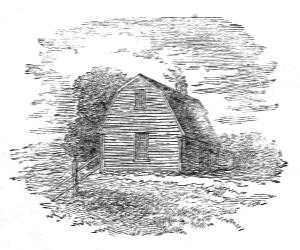
few years ago the old school-house in which he
learned to spell and read remained entire. It
was an old-fashioned building, with a long,
slanting roof, which, at the back of the
house, nearly reached the ground. Its single
chimney, with many curious and pretty corners,
then rose in the middle of the roof, as
it had for ninety years. Around the dwelling
is a grass plat, upon which he used, when a
child like yourselves, to play with his schoolmates.
It was planted with shrubs, such as
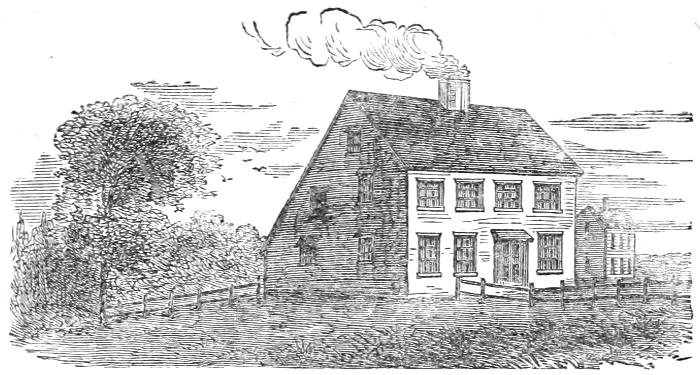
the farmers most need. The house in which
he lived still stands nearly opposite that in
which the school was kept. This house formerly
had but two rooms in it, and all its
furniture was of the simplest kind.
HIS FIRST SCHOOL-HOUSE.
BROTHERS AND SISTERS.
I visited the relations of the schoolmistress.
She died many, many years ago; but her
niece, when I asked about Nat Bowditch, told
me how her aunt used to love him for his
earnestness in pursuing his studies, and for
his gentleness, while under her care. He was
“a nice boy,” she used to say. While in
Danvers, his father was most of the time at
sea, he having been obliged to give up his
trade and become a sailor when the Revolutionary
War broke out.[1] Nat lived, during
his father’s absence, very happily with his
mother and his brothers and sisters. During
the whole of his after-life, he used to delight to
go near the small house in which he had dwelt
so pleasantly. The family was “a family of
love.” He had a brother William, to whom
he was very much attached. He was more
grave and sober than Nat; for the latter, with
all his devotion to study, was full of fun,
frolic, and good nature. But William was
equally, and perhaps more, gentle. The
brothers frequently studied together from an
old family Bible, and on Sundays, when they
were quite small, their grandmother, who was
a very excellent woman, used to place this
large book, with its wooden covers and bright
brazen clasps, upon the foot of her bed; and
hour after hour did those two boys trace, with
their fingers upon the map, the forty years’
wanderings of the Israelites, before they came
into the long-looked-for land of Canaan.
GRANDMOTHER’S BIBLE.
HIS MOTHER.
I have said that Nat frequently went to look
upon the house in which he had lived; and so
he often called upon the family in which this
old Bible was kept, in order that he might see
the volume which he had so loved when a
boy. It reminded him of the delightful home
of his childhood, where his dear and worthy
mother tried to make him good, in order that
he might become an honor to her and to the
people. His mother was one who was extremely
kind; yet she was by no means afraid
to correct her children, if she found them doing
wrong. Nat sometimes suffered, because,
like every boy, he sometimes did wrong; but
generally the mother found that he could be
easily guided by her love. I seem to see her
now, taking her little son, and leading him to
the window of the cottage in Danvers, to see
the beautiful new moon just setting in the
west, while, at the same time, she kisses and
blesses him, and talks to him of his absent
father, and they both send up earnest wishes
for his safe and speedy return. She was very
careful to instil into all her children the importance
of truth. “Speak the truth always,
my boy,” said she. She likewise loved religion,
and she was very liberal in her feelings
towards those who differed from her upon this
subject. Nevertheless, believing that the
Episcopal kind of worship was the most correct,
she educated all her children in that
form. An anecdote which Nat, when he became
a man, often related, will show you how
much influence her instructions in this particular
had upon him. Among the Episcopalians
the prayers are read, and the people repeat,
aloud, some answer. One day Nat called his
brothers and sisters around him, and, taking
his mother’s Book of Prayer, with a sober face
began to read aloud from it, while his brothers
made the answers. They had continued
some minutes amusing themselves in this way,
when their mother entered the room. She
was very much troubled at first, as she supposed
they were ridiculing the services she
held as sacred. “My sons,” said she, “I am
pleased to see you read that book; but you
should never do so in a careless manner.”
They told her that, though playing, they did
not think to do any harm, or to show any disrespect.
EARLY POVERTY.
CHEERFULNESS UNDER IT.
The family was very poor; so poor, indeed,
that sometimes they had nothing to eat, for
several successive days, but common coarse
bread, with perhaps a little pork. Wheat
bread was almost never allowed to any one
of them. Their clothing, too, was at times
very thin. Frequently, during the whole winter,
the boys wore their summer jackets and
trousers. At times, Nat’s schoolmates used to
laugh at him because he wore such a thin dress,
when they were wearing their thickest winter
clothing. But he was not afraid of their merriment,
nor made angry by it; on the contrary,
he laughed heartily at them for supposing
him unable to bear the cold. He knew
that no good would be gained by complaints,
and that he would distress his mother if he
made any; he therefore bore contentedly his
want of clothing, and tried even to make himself
merry with those who ridiculed him.
LOVE OF ARITHMETIC.
DIFFICULTIES.
At the age of seven years, and after returning
to Salem, he went to a school kept by a
man named Watson. Master Watson was one
who had sufficient learning for those times;
though the boys who now go to school in Boston
would think it very strange if a master
did not attempt to teach more than he did.
None of the scholars had a dictionary. Master
Watson was a good man, but he suffered
much from headache, and therefore he was
liable to violent fits of anger; and when thus
excited, as it generally happens in such cases,
he was guilty of injustice. An instance of
this, young Bowditch met with, not long after
he entered the school. From early life, Nat
had liked ciphering, or arithmetic; and thinking
that at school he would be able to learn
something more about this than he had previously
gained from his brothers, while at
home, during the long winter evenings, he requested
the master to allow him to study it.
As he seemed too young, this request was
not granted. But, being determined to study
what pleased him so much, he obtained a letter
from his father, in which Mr. Bowditch
requested Master Watson to allow his son to
pursue his favorite study. The schoolmaster,
on receiving the message, was very angry, and
said to his pupil, “Very well. I’ll give you
a sum that will satisfy you;” and immediately
prepared a question that he thought Nat would
be unable to answer, and which he could not
have answered had he not studied at home.
But the boy had learned before sufficiently to
enable him to perform the task; and, having
done so, he ran gayly to the desk, expecting
to be praised for his exact performance of
duty. You may imagine his surprise at being
saluted with these words: “You little rascal,
who showed you how to do this sum? I shall
punish you for attempting to deceive me.”
The poor lad’s heart swelled and beat violently.
He blushed and trembled from fear
of punishment, but still more at the suspicion
which his instructor had expressed, that he
had been guilty of telling a lie. Filled with
anger and alarm, he stammered out, “I did it,
sir.” But his master would not believe him,
and was about to strike him, when an elder
brother interfered, and stated that Nat knew
very well how to perform the task, for he himself
had previously taught him enough to enable
him to do it. Our young arithmetician
thus escaped the punishment; but he never
could forget that he had been accused of falsehood.
His pious and truth-loving mother had
so firmly fastened in his mind the holiness of
truth, that he rarely, if ever, thought of deviating
from it; and during his life he considered
that any one who even suspected him of
falsehood had done him the greatest injury.
How well it would be if all of our boys loved
truth as he did!
APPRENTICED TO SHIP-CHANDLER.
This was the only serious difficulty he met
with while at this school. He was the same
lively lad at everything he undertook as he
had been previously. He was beloved by his
comrades for his good nature, and was always
engaged in useful employment or innocent
amusements. When he was about ten years
of age, his father became poorer than ever;
and moreover, in consequence of loss of regular
employment and of the little property
which he possessed, he gave himself up to
habits of intoxication. From having been a
brave man, he became a coward, and, unable
to look at the distress of his family, made
their poverty many times more burdensome
by habits which wholly unfitted him for active
duties. Under these circumstances, his son,
at the age of ten years and three months, left
school, and soon afterwards was bound an
apprentice to Messrs. Ropes and Hodges, who
kept a ship-chandler’s shop in Salem.
EARLY CHARACTER.
As this was one of the important times in
his life, I think I will finish this chapter with
only two remarks, for the boys and girls who
may be reading this. You see a lively and
good-natured boy, who, before he was ten
years old, showed great love of truth, much
perseverance, a warm desire for study, particularly
of arithmetic; and lastly, you perceive
him under the influence of a good mother,
who tries to excite in him all just and holy
sentiments. Particularly does she point out
to him truth as one grand aim of his existence.
Now, I wish you to remember these facts, and
see where they eventually led him; and if you
remember, you may be induced to imitate
him, at least in some respects.
From 1784 to 1795—between the ages of 10 and 21.
CHAPTER III.
His apprenticeship, his habits.—Studies Chambers’s Cyclopædia.—Results
of his studies; gains the respect
of all.—Dr. Bentley, Dr. Prince, and Mr. Reed, do
him kindness; by their means allowed access to “The
Philosophical Library.”—He makes philosophical instruments.—Calculates
an Almanac at the age of
fourteen.—Studies algebra: delight he experienced
from this new pursuit.—Learns Latin.—Reads works
by Sir Isaac Newton.—Studies French.
CHANGE OF ABODE.
WORK AT THE SHOP.
THOUGHTFULNESS FOR OTHERS.
Doubtless it was with a sorrowing heart
that Nat left his own dear home and his kind
mother to take up his abode among strangers;
for he was to live at the house of his employer,
Mr. Hodges. But if he did feel sad,
he was not one to neglect a duty in consequence
of sorrow. The shop in which he was
employed was situated very near the wharves,
in the lower part of the town of Salem. We
do not see many such stores now in Boston;
though something similar is sometimes found
in small country towns. In it a great variety
of goods was sold, especially everything
which would be useful to a sailor. Pork and
nails, hammers and butter, were kept in adjacent
barrels. The walls were hung with all the
tools needed in the seafaring life. There was
a long counter in it, at one end of which Nat
had his little desk. When not engaged with
customers, he used to read and write there.
He always kept a slate by his side, and, when
not occupied by the duties of the shop, he
was usually busied with his favorite pursuit
of arithmetic. In the warm weather of summer,
when there was little business, and the
heat was uncomfortable, he was often seen, by
the neighbors, engaged in ciphering, while
resting his slate upon the half door of the
shop; for in those days the shop doors were
made in two parts, so that frequently the lower
half was shut, while the upper was open.
Thus he was always actively employed, instead
of being idle, as is too frequently the
case with boys in similar circumstances. Even
on the great holidays of Fourth of July and
“General Training,” he did not leave his studies
for the purpose of going to see the parade,
but remained at the shop, laboring to improve
himself; or, if the shop was closed, he was in
his little garret-room at his employer’s house.
Study and reading were beginning to be his
only recreation. Frequently, after the store
was closed at night, he remained until nine or
ten o’clock. Many long winter nights he
passed in a similar manner, at his master’s
house by the kitchen fire. While here, he did
not become morose or ill-natured; but frequently,
when the servant girl wished to go to
see her parents, who lived one or two miles
off, he took her place by the side of the cradle
of his master’s child, and rocked it gently
with his foot, while busily occupied at his
books. I think this was one of the sweetest
incidents in his early days. It was the germ
of his benevolence in after-life. A truly great
man is kind-hearted as well as wise. Nat began
thus early his course of genuine humanity
and science. So must you do if you would
imitate him.
HIGHER STUDIES.
As he became older, he became interested
in larger and more important works; and of
these, fortunately, he found an abundant supply.
His employer lived in the house of
Judge Ropes, and Nat had permission to use
the library of this gentleman as much as he
wished. In this collection he found one set
of books which he afterwards valued very
much. He tried to buy a copy of it when he
was old, having a similar feeling towards it
that he bore towards his grandmother’s Bible.
It was Chambers’s Cyclopædia. As you may
judge from the name Cyclopædia, these books,
consisting of four very large volumes, contained
much upon a great many subjects. It
is like a dictionary. He read every piece in
it, and copied into blank books, which he
obtained for the purpose, everything he
thought particularly interesting, especially all
about arithmetic. Previously, he had studied
navigation, or the methods whereby the sailors
are enabled to guide their ships across the
ocean. In this Cyclopædia he found much
upon this subject; also upon astronomy, or
the knowledge of the stars and other heavenly
bodies; and upon mensuration, or the
art with which we are enabled to measure
large quantities of land or water.
ALMANAC FOR 1790.
But he was not satisfied with merely studying
what others did. He made several dials and
curious instruments for measuring the weather,
&c. He likewise, at the age of fourteen
years, made an Almanac for 1790, so accurately
and minutely finished, that it might have been
published. Whilst engaged upon this last,
he was more than usually laborious. The first
rays of the morning saw him at labor, and he
sat up, with his rushlight, until late at night.
If any asked where Nat was, the reply was,
“He is engaged in making his Almanac.” He
was just fourteen years of age when he finished
it.[2]
BEGINS ALGEBRA.
HIS DELIGHT IN IT.
August 1, 1787,—that is, at the age of fourteen,—he
was introduced to a mode of calculating
which was wholly new to him. His
brother came home from his school, where he
had been learning navigation, and told him
that his master had a mode of ciphering by
means of letters. Nat puzzled himself very
much about the matter, and imagined a variety
of methods of “ciphering with letters.”
He thought that perhaps A added to B made
C, and B added to C made D, and so on;
but there seemed to him no use in all this.
At length he begged his brother to obtain for
him the book. The schoolmaster readily lent
it; and it is said that the boy did not sleep
that night. He was so delighted with reading
about this method, or algebra, as it is called,
that he found it impossible to sleep. He afterwards
talked with an old English sailor,
who happened to know something about the
subject, and received some little instruction
from him. This person afterwards went to his
own country; but just before he left Salem,
he patted Nat upon the head, and said, “Nat,
my boy, go on studying as you do now, and
you will be a great man one of these days.”
You will see, before finishing this story, that
the prophecy of the old sailor was amply fulfilled.
DRS. PRINCE AND BENTLEY AID HIM.
DR. KIRWAN’S LIBRARY.
COPIES BOOKS.
But all this labor, this constant exertion,
combined with his kind and cheerful disposition,
must, you will readily believe, have given
him friends. He became known as a young
man of great promise; as one more capable
than his elders of deciding many questions,
particularly all those in which any calculations
were to be made. Consequently, when about
seventeen or eighteen years old, he was often
called upon, by men much older than himself,
to act as umpire in important matters. All
these he attended to so willingly and skilfully,
that those whom he assisted became very
much attached to him. He thus gained the
respect not merely of common persons, less
learned than himself, but his industry, his
fidelity to his employers, his talents, attracted
the notice of men well known in the community.
Among these were two clergymen of
Salem. At the church of Rev. Dr. Prince he
attended for divine worship; and Dr. Bentley
rarely passed the store without stepping in
to talk with his young friend. Nat availed
himself of the learning of Dr. Bentley, and
often visited his room in order to converse
with him. Dr. Prince, the other clergyman
above alluded to, had studied much the subjects
that the apprentice was pursuing, and
he was very glad to see a young man zealous in
the same pursuits. There was another individual
who kept an apothecary’s shop; and it
was he, who, with the aid of the two clergymen,
opened to our young student the means of continuing
his favorite studies with more success
than he had ever anticipated. Mr. Reed—for
that was his name—likewise gave him permission
to use all his books, of which he had a
great many. But the chief means of study,
to which I allude, was the permission to take
books from a library which had been formed
by a number of gentlemen of the town. The
kindness of the proprietors of this library was
never forgotten by the young apprentice; and
in his will, made fifty years afterwards, he left
a thousand dollars to the Salem Athenæum, in
order to repay the debt of gratitude which he
felt he had incurred. But you may want to
know something about the formation of this
library, and the books of which it was composed.
Some time during the Revolutionary
War, alluded to in Chapter I., Dr. Kirwan, an
Irishman and a learned man, put the greater
part of his library on board a ship, in order
to have it carried across the Irish Channel.
While on the voyage, the vessel was taken by
an American ship of war, and the books were
carried into Beverly, and were afterwards sold
at auction in Salem. Of all in the world,
these books were perhaps those most needed by
the apprentice. He had been studying those
sciences chiefly, concerning which there were
very few works printed in America; and suddenly
he found himself allowed free access to
all the important books which had been printed
in Europe upon these same subjects. You
may readily imagine how eagerly he availed
himself of the opportunity thus afforded him.
Every two or three days he was seen with a
number of volumes under his arm, going
homeward; and on his arrival there, he read
and copied all he wanted to study at that time,
or refer to afterwards. He made, in this way,
a very large collection of manuscripts, which
formed a part of his library. Thus, by his
own exertions, he, at the early age of eighteen,
became acquainted with the writings of most
of the learned men of Europe; and he did
this at the time when he was engaged almost
constantly in his store, for he made it a strict
rule never to allow any study or reading,
however interesting, to interfere with his duties
to his employers. He rarely forgot this.
The following incident impressed it so strongly
upon his memory, that it influenced all his
subsequent life.
ATTENTION TO BUSINESS.
One day a customer called and purchased a
pair of hinges at a time when the young clerk
was deeply engaged in solving a problem in
mathematics. He thought he would finish
before charging the delivery of them upon the
books; but when the problem was solved, he
forgot the matter altogether. In a few days
the customer called again to pay for them,
when Mr. Hodges himself was in the shop.
The books were examined, and gave no account
of this purchase. The clerk, upon being applied
to, at once recollected the circumstance,
and the reason of his own forgetfulness.
From that day he made it an invariable rule to
finish every matter of business that he began,
before undertaking anything else. Perhaps
some of you may remember the story; and
when you think of leaving anything half finished,
you may repeat to yourselves, “Charge
your hinges, and finish what you begin.”
STUDIES LATIN.
Having been instructed in the elements of
algebra, Nat soon found that there were books
written upon it in other languages, which he
knew he ought to read, if he intended to learn
as much as he could about algebra. One of
these books was written in a tongue which is
called a dead language, in consequence of its
having ceased to be spoken by the people of
the country in which it was originally used.
It was in Latin. This language usually requires
many years of study, if one wishes to
read it well, even when he has good instructors.
Our hero, however, never thought of
the difficulties he had to surmount, but commenced,
alone, the study of it, June, 1790,
that is, when seventeen years old. He
was soon in trouble. He could not understand
his Latin book on mathematics. He
asked many who had been at college, but they
were puzzled by the peculiar expressions as
much as he was. At length, however, by the
aid of his friend Dr. Bentley, and afterwards
of a German who gave him lessons, he succeeded
in mastering the greatest work in modern
times, written by Sir Isaac Newton, who,
you know, was one of the most famous philosophers
who have ever lived in this world. Nat
discovered in one part of it a mistake, which,
several years afterwards, he published; but
he was deterred from doing so at first, because
a very much older person than he, a professor
in Harvard College, said that the apprentice
was mistaken.
STUDY OF FRENCH.
GOOD RESULTS.
But Latin was not the only language that he
learned. Finding in the Kirwan library
many books upon mathematics written in
French, he determined to learn that tongue
likewise. Accordingly, at the age of nineteen
(May 15, 1792), he began to study it.
Fortunately, he was able to make an arrangement
with a Frenchman living in Salem, who
wished to learn English. Mr. Jordy agreed
to teach the apprentice French, on condition
that Nat would teach him English. For sixteen
months they met regularly, a certain
number of times a week; and the consequences
were very important to the youth’s
future success in life. One circumstance took
place, during this study of French, which I
think it important to mention. Nat, desiring
only to learn to read a French book, supposed
that it would be unnecessary to spend time in
learning accurately to pronounce the words.
These, as is the case in the English tongue,
are often pronounced very differently from the
manner in which we should be led to speak
them, if we judged from their mode of spelling.
His master protested against teaching
without reference to the pronunciation; and,
after much arguing, Nat yielded to the wishes
of his instructor, and he studied the language
in such a way that he could converse with a
Frenchman, as well as read a French book.
You will soon see the good that resulted.
From 1784 to 1796—age, 10-22.
CHAPTER IV.
Apprenticeship continued.—Favorite of his companions.—Learns
music; neglects his studies for a time.—Gets
into bad society; his decision in freeing himself
from it.—Engages in a survey of the town of Salem.—Sails
on his first voyage to the East Indies; extracts
from his Journal during this voyage; arrival at the
Isle of Bourbon; return home.
STUDY AND BUSINESS.
A GOOD COMPANION.
Though so interested in his studies, Nat
tried, as we have seen, never to neglect a
known duty. Whenever any one came to the
store, he was ready to leave study in order to
attend to him. And he did this cheerfully,
and with so bright a smile that all were
pleased to meet him. His young companions
loved him, for he was not one of those vain
persons who think themselves more important
than others because they are more learned.
On the contrary, what he knew himself he liked
to impart to others. He was a member of a
juvenile club for the discussion of different
subjects. In this association his opinion had
much weight, because he rarely spoke, and
never unless he had something of importance
to say.
LOVE OF MUSIC.
Some of his comrades were very fond of
music. He had originally a great taste for it.
Music, at that time, was less cultivated than
it is now; and generally, those who practised
it were fond of drinking liquor, and often became
drunkards. Nat’s love of the flute led
him, at times, to meet with several young men
of this class. In fact, he was so much delighted
with their company, that he began to
forget his studies. Day after day he spent
his leisure hours in their society; and, for a
time, all else was neglected. At length he
began to think somewhat in this way: “What
am I doing? forgetting my studies in order
to be with those whose only recommendation
is, that they love music? I shall be very
likely to fall into their habits if I continue
longer with them. I will not do so.” He
soon afterwards left their society.
The simple, old-fashioned flute on which he
played at these meetings is still preserved.
It is a silent monitor to his descendants, urging
them to performance of duty, in spite of
the allurements of pleasure.
May every boy who reads this remember it,
and try, if ever led into temptation as the
apprentice was, to say, “I will not,” with the
same determined spirit that he did.
The time was fast approaching when he
was about to leave the business of shopkeeping,
and enter upon the more active duties of
life. It is true that, to a certain extent, he
had been engaged in active life ever since entering
his apprenticeship. At the age of ten
he had left the home of his mother, and had
been obliged to depend much upon himself.
His father’s habits had finally prevented him
from being of service to the family. The
mother had died; the family had been broken
up; and Nat had thus, at an early age, been
thrown upon the world. After having remained
with Ropes & Hodges until they
gave up business, he entered the shop of
Samuel C. Ward, which was a similar establishment;
and there he remained until he
was twenty-one years old. He then quitted,
forever, this employment.
SURVEY OF SALEM.
In 1794, by a law of the state, every town
was obliged to have an accurate survey and
measurement made of its limits. Captain
Gibaut and Dr. Bentley were appointed by the
Selectmen in Salem to superintend this business.
Believing that the calculating powers
of the apprentice would be useful to them,
he was made assistant; and during the
summer of 1794 he was occupied with this
business. Thus we see how his studies
already began to be useful to him. For his
pay, he received one hundred and thirty-five
dollars. Towards the end of the summer, Mr.
Derby, a rich ship-owner in Salem, wished
Captain Gibaut to take command of a vessel
to Cadiz, and thence round the Cape of Good
Hope to the East Indies. Captain Gibaut
consented, and he asked Nat to go with him as
clerk. Nat agreed to the terms; but, owing to
some difficulty with Mr. Derby, Captain Gibaut
resigned to Captain H. Prince. Young
Bowditch was unknown to the latter; but at the
suggestion of Mr. Derby, who had heard of the
talents and industry of the clerk, the same arrangements
were continued by Captain Prince.
A new era in his life was now beginning;
and let us look a moment at him. He is now
twenty-one years of age. He is already more
learned than many much older than himself,
in consequence of his untiring industry and
his devotion to study and to duty. Yet he is
modest and retiring. He is still full of fun
and frolic at times, and always ready for acts
of kindness. Above all, he is a good youth;
no immorality has stained him. His love
of truth had been given him by his mother;
and since her death he has loved it still more.
It is to him a bright light, as it were, to guide
him. Cannot we foresee his career?
FIRST VOYAGE TO INDIA.
On January 11, 1795,—that is, when he
was a few months more than twenty-one years
of age,—he sailed from Salem in the ship
Henry. Though he went as clerk, he was
prepared to undertake the more active duties
of sailor and mate of the vessel. Thinking
that he should be too much occupied to be
able to read, he took very few books; and
therefore he devoted much more time to observations
of the heavenly bodies, the state of
the weather, &c., while at sea, and upon the
manners and habits of the nations he visited.
Though he had not been educated as a sailor-boy,
his studies had led him to understand the
most important part of a seaman’s life, the art
of guiding the vessel from one shore to another,
across the ocean. In other words, he had
studied much on navigation, and copied books
upon that subject.
JOURNAL—MOTTO.
The Journal which he kept during the voyage
is quite long. One of the first lines you
meet, on opening the book, is the motto which
he chose for himself. It is in Latin, and
means, that he would do what he thought to be
right, and not obey the dictates of any man.
He notes the events of every day, most of
which are similar; but occasionally something
unusual occurs.
SLAVERY.
February 7, 1795, he writes thus: “At ten
A. M., spoke a ship, twenty-five days out,
from Liverpool, bound to Africa. We discovered
her this morning, just before sunrise, and
supposed her to be a frigate.” They discovered
soon that it was a negro slave-ship, and
he exclaims thus: “God grant that the detestable
traffic which she pursues may soon
cease, and that the tawny sons of Africa may
be permitted quietly to enjoy the blessings of
liberty in their native land.”
“February 22. We remember with gratitude
that this is the anniversary of the birth
of our beloved Washington—the man who
unites all hearts. May he long continue a
blessing to his country and to mankind at
large!”
During the passage to the Isle of Bourbon,
situated, as you know, east of the southern
extremity of Africa, he frequently alludes to
his native land in terms of respect and love.
On May 8, the ship arrived in the harbor of
Bourbon. Perhaps you may like to see his
description of the town.
BOURBON.
“May 9. After dinner, Captain P., Mr.
B., and I, went to see the town. It is a fine
place. All the streets run in straight lines
from the shore, and cross one another at right
angles. There is a church here, with a priest
to officiate. I went into it. We afterwards
went into the republican garden. It is a beautiful
place, though at present much neglected.
The different walks are made to meet in the
centre, and form the figure of a star, each one
of the rays of which is formed by thirty-four
mango trees, placed from twelve to fourteen
feet apart. All the houses of the island are
built very low; they have no chimneys. They
are two stories high (about ten feet), have
lattice windows, outside of which are wooden
ones to keep off the sun and rain. The floors
are made of the wood of the country, on
which they rub wax, as the women of America
do on their furniture. It makes them very
slippery.” There are other places of which
he speaks, and in them he finds flower-gardens
in abundance, intermixed with groves of coffee
and orange trees, &c.
He afterwards alludes to the poor slaves,
who, it appeared, suffered as much there as
they do in some other places at the present
day.
HABITS THERE.
He visits the people of the place, and finds
them superstitious and vicious. Alluding to
the vice he found there, he writes, “I was
reminded of the beautiful words of Solomon,
in the Proverbs.” This was not the only occasion
on which he remembered his Bible;
and it seemed always to have a kindly influence
over him. On one occasion, several
young men argued with him about its truth;
and, having heard them patiently, he put his
hand over his heart: “Talk no more about it.
I know that the Bible is true; that it is capable
of doing to me the greatest good. I know
so by the feelings I have here.”
After remaining in this place until July 25,
he set sail for home, and arrived in Salem
January 11, 1796, having been absent exactly
twelve months.
From 1796 to 1797—age, 23-4.
CHAPTER V.
Second voyage.—Visits Lisbon.—Island of Madeira;
festival and games there.—Anecdotes of his skill as
an accountant.—Doubles Cape of Good Hope.—Albatrosses.—Arrival
at Manilla.—Extracts from Journal.—Curious
boat.—Earthquake.—Voyage home.
AT SEA AGAIN.
SECOND VOYAGE.
After remaining at home about two
months, he again sailed in the same ship,
and with Captain Prince. On the 26th of
the following March, they prepared to sail
from Salem harbor; but, being prevented by
contrary winds from getting out of the bay,
the anchor was dropped during the night, and
on the following morning, under fair but
strong breezes, Mr. Bowditch was again on
his way across the wide Atlantic. His course
was towards Lisbon, situated at the mouth of
the River Tagus, in Portugal. The first part
of the voyage was unpleasant, because cloudy
and stormy weather prevailed most of the
time; but during the latter part, under pleasant
and mild breezes from the south, the ship
rode gayly onwards, and, on the morning of
April 24, the vessel was within sight of
Lisbon, with its beautiful and romantic country
behind it. Lisbon is the chief city of
Portugal, and presents a very superb appearance
when viewed from a vessel which is entering
the harbor. It is the principal commercial
place in the kingdom. Its inhabitants
are among the richest. In consequence of its
being the place of residence of the kings of
Portugal, many magnificent country-seats, or
villas, are seen on all the vine-covered hills of
the adjacent country.
The stay at this city was short, and the opportunities
for visiting the interesting places
in it very limited. Mr. Bowditch seems not
to have been particularly pleased with its appearance.
At the time he was there, probably,
much less attention was paid to the cleanliness
of the streets than there is now. But
he spent the 28th and 29th of April in walking
about the city, and says in his Journal,
that he “found nothing remarkable.”
LISBON, INCIDENT.
It was at Lisbon that Mr. Bowditch discovered
the advantage of having learned to speak
French, to which I alluded at the close of the
second chapter. Though a Portuguese port,
the custom-house officers understood French;
and no one on board but he could speak any
other language than the English. The consequence
was, that he acted as interpreter, which
was, of course, a great help to the captain.
This incident made a deep impression upon
his mind; and in after-life, when a person in
conversation expressed a doubt about the importance
of any kind of knowledge, because
for the time it seemed useless, he would reply,
“O, study everything, and your learning
will, some time or other, be of service. I
once said that I would not learn to speak
French, because I thought that I should never
leave my native town; yet, within a few years
afterwards, I was in a foreign port, and I became
sole interpreter of the ship’s crew, in
consequence of my power to speak this language.”
MADEIRA.
GAMES.
On the 30th, having taken on board a quantity
of wine, they again were ready for sea;
but, owing to bad weather, they did not sail
until the 6th of May, when the ship dropped
down the river. On the 6th it was on its
way to the Island of Madeira, which is a small
island, situated about three hundred and sixty
miles from the northern part of Africa. At
eleven o’clock, May 15, the island was discovered;
and, under full sail, the ship swept
along the shore until nine in the evening,
when they hailed a pilot, who came on board,
from the town of Funchal. Mr. Pintard, the
American consul of the place, greeted them
very cordially. The ship spent six days
there, taking in more wine,—for which the
country is famous,—and sailed from it on
Thursday morning, May 26, 1796. During
this residence at Mr. Pintard’s, Mr. Bowditch
saw some feats of horsemanship, about which
you may like to hear. They are thus described
in his Journal: “A ring being suspended
by a small wire, about ten feet from
the ground, at the entrance of the gate of the
public garden, a horseman attempted to strike
it, and carry it off, while upon full gallop.
If he gained the prize, he was attended by the
master of ceremonies, mounted on a small
colt fantastically adorned with ribbons, &c.,
with a most deformed mask, who generally
gave him a reward fully proportioned to the
merit of the action; perhaps a whistle, a small
flower, or some little image. During the
next day, no business was done by the inhabitants;
but the whole of it was devoted to
amusements similar to those of the preceding.
Again there were masquerades, and some
of the richest men in the place joined with
the crowd, masked like the people. Others
were very richly dressed, like Turks, East Indians,
&c. One of them wore a head-dress
worth, it was said, forty or fifty thousand dollars.”
From this description, slight as it is,
we may see the difference in the customs between
these inhabitants of Madeira and the
Americans.
ANECDOTE.
Captain Prince relates the following anecdotes,
which occurred during their residence
at Madeira. I shall use Captain Prince’s
words.
“I was one day walking with an American
shipmaster at Madeira, who, in the course of
conversation, asked me who that young man
(alluding to Mr. Bowditch) was. I replied,
that he was clerk of the ship under my command,
and remarked that he was a great calculator.
‘Well,’ said the gentleman, ‘I can
set him a sum that he can’t do.’ I answered
that I did not believe it. The gentleman then
proposed a wager of a dinner to all the American
masters in port, that he could set him
such a sum. The wager was accepted by me,
and we repaired to the hotel, where we found
Mr. B. alone. The gentleman was introduced,
and the question stated to Mr. Bowditch,
with the interrogatory, Can you do it?
The reply was, Yes. The great sum which
had puzzled the brains of the gentleman and
all his friends at home, for a whole winter, was
done in a few minutes. I remember the question.
It was this: To dig a ditch around an
acre of land, how deep and how wide must
that ditch be, to raise the acre of land one
foot?
KNOWLEDGE OF NAVIGATION.
“One day, Mr. Bowditch and myself received
a visit from a Mr. Murray, a Scotchman,
who was at that port, having under his charge
a valuable cargo of English goods, and who
made many inquiries concerning the Americans.
He asked particularly what passage we
had made against the north-east monsoon, and
remarked that it was very surprising that the
Americans should come so far, and undertake
such difficult voyages, with so little knowledge
as they possessed of the science of navigation.
In reply to his remark, I told him that I had
on board twelve men, all of whom were as
well acquainted with working lunar observations
for all the practical purposes of navigation,
as Sir Isaac Newton would be, should he
come on earth. Mr. M. asked how my crew
came by that knowledge. I told him, in the
same manner that other men came by theirs.
He thought it so wonderful, that (as he afterwards
told me) he went down to the landing-place,
on Sunday, to see my knowing crew
come on shore. During all this conversation,
Mr. Bowditch remained silent, sitting with his
slate pencil in his mouth, and as modest as a
maid. Mr. Kean, a broker, who was also
present, observed to Murray, ‘Sir, if you
knew what I know concerning that ship, you
would not talk quite so fast.’ ‘And what do
you know?’ asked Murray. ‘I know,’ replied
Kean, ‘that there is more knowledge of navigation
on board that American ship (the Astræa)
than there has been in all the ships that
ever came into Manilla Bay.’”
TEACHES THE SAILORS.
Mr. Bowditch, during this and the previous
voyage, had been in the habit of teaching
navigation to the sailors; so that it is probable
that, considering the number of persons then
on board who really understood practical
navigation, Mr. Kean was not so extravagant
in his remark as at first sight he seems to be.
LUNAR RAINBOW.
May 26, as we have already said, he sailed
for India. On July 1, the Island of Trinidad
was within sight. They did not stop there,
but keeping on their course steadily, two days
afterwards crossed the Tropic of Capricorn, in
the Southern Hemisphere. On the 17th, during
the night, it having rained during the day,
the young sailor observed, what we rarely see
in this part of the world and on land, but
which is not uncommon at sea, a beautiful
lunar rainbow. It is caused in the same
manner as those rainbows which are seen after
a summer shower in the daytime, when the
sun is just coming out brightly, and the
clouds, which cause the bow to be formed, are
passing away afar off in the opposite part of
the heavens. But the difference between the
solar and lunar rainbows is very great. The
solar is grander and has more brilliant coloring,
while the lunar bow has a more delicate
outline and lighter tints.
August 1, the Journal says, “All the latter
part of these twenty-four hours, fine
breezes and pleasant, smooth sea. Ever since
crossing the Cape [of Good Hope], we have
seen a great number of albatrosses, but no
fish.” These birds are the largest of marine
birds. They at times fly and swim (for they
are web-footed) to a great distance from land,
living upon the fish and other things which
may fall in their way. It is said that, as they
come gently rising over the waves of the sea,
they present a very pleasing sight to the sailor
who has been for many months upon the ocean,
separated from living things.
PHOSPHORESCENT LIGHT.
For some weeks afterwards, the ship met
with severe weather, until September 7, when,
according to previous expectation, they saw
the land of the Island of Java. The day before
their arrival at that place, a curious phenomenon
was observed, the account of which I
will copy from the Journal. “At seven P. M.,
the water, as for the two nights past, became
of a perfect milk color, through the whole extent
of the horizon. We drew a bucket of it
in order to determine whether there was anything
in it to account for the curious phenomenon.
When seen by candlelight, nothing
could be observed; but, when carried into a
dark place, it appeared full of small, bright,
cylindric substances, of the nature of a jelly,
about the size of a small wire, and a quarter
of an inch long. Some large jellies floated on
the water at the same time, and looked like
long pieces of wood. The sky all this time
was perfectly clear; not a cloud to be seen.
About three A. M. the water began to take its
usual color. Next morning we examined the
water which had appeared so shining in the
night; but nothing could be discovered in it,
although it was viewed in a very dark place.
In the forenoon the sea appeared somewhat
colored, of a greenish hue; but some of it, being
taken up and carried from the light, appeared
colorless.”
ISLAND OF JAVA.
ARRIVAL AT MANILLA.
The next morning the high lands of the
Island of Java came in sight on the horizon,
at the distance of about twenty miles towards
the east. The Journal kept during his passage
through the Straits of Sunda is interesting, because
the greatest care was necessary to keep
the ship off from the shoals which abound there.
The current runs at times very swiftly, the
strait being between the large islands of Sumatra
and Java, and on the 9th, the force of this
current, and strong headwinds, compelled the
captain to cast anchor two or three times.
Finally, on the 17th, the ship was fairly out
of the Straits of Sunda and Straits of Banca,
having been ten days, during sultry weather,
toiling, with much danger, amid coral reefs
and shoals. The remainder of the voyage
along by the coast of Borneo to the city of
Manilla, the capital of the chief of the Philippine
Islands, was more speedy. At six in the
morning of Sunday, October 2, 1796, the
Island of Luzon was in sight towards the east,
about eighteen miles off. That same evening
they cast anchor in Manilla Bay, it being a
little more than six months since the sailor
had left his home in Salem.
COSTUMES OF THE PEOPLE.
The following are some extracts from his
Journal while in the city. Under date of
October 4, he says, “No coffee can be procured
here; the Spaniards, not being very
fond of it, cultivate the cocoa instead. The
common drink of the natives is sweetmeats
and water, which beverage, they say, is wholesome
and agreeable. Large quantities of wax
are produced here; but it is very dear, owing
to the great consumption of it in the churches,
of which there are a great number in Manilla
and its environs. There are a few bishops in
the island, and one archbishop, whose power
is very great. The priests are very powerful,
every native wearing the image of the Virgin
Mary, a cross, or some such thing. No books
are allowed to be imported contrary to their
religion. The commandant who makes the
visit examines every vessel.... The inhabitants
of the city and suburbs are very
numerous, amounting to nearly three hundred
thousand. In the Philippines there are about
two or three millions. A great number are
Chinese; and in general they are a well-made
people. Their common dress is a shirt, and
trousers, or jackets and trousers. The women
have great numbers of handkerchiefs
about them, so as to be entirely covered.
The natives are well used by the Spaniards,
the King of Spain, in all his public papers,
calling them his children.” From these extracts
you may judge of Mr. Bowditch’s mode
of studying a people when residing with
strangers. He afterwards speaks of their
games, &c.
SINGULAR BOAT.
The following description of a boat appears
on record of October 5: “At twelve, set sail
for Cavite in one of the passage-boats, which
is very inconvenient for passengers; being
nearly three hours before arriving at Cavite,
during which time I was basking in the sun.
Their boats and manner of sailing are very
curious. Having generally light winds, they
make their mat sails very large, and the boats,
made of the bodies of trees, are very long and
narrow; so that there would be great danger
of upsetting, if it were not for “out-riggers,”
which they have on each side, consisting of
two bamboos about eight or ten feet long,
whose ends are joined to another long bamboo,
running lengthwise of the boat. The lee one,
on a flaw of wind, sinks a little in the water,
and, being buoyant, keeps the boats from upsetting;
and on the weather [that is, towards
the wind] ones the persons in the boat are
continually going out and in, according to the
force of the breeze. In a fresh breeze there
will be six or eight men at the end of the
bamboo, there being ropes leading from the
top of the mast to different parts of the bamboo,
to support them as they go. By this
means they keep the boat always upright, and
make it sail very fast, in a good breeze going
five or six knots.” After this, a good account
is given of the mode of counting used by the
Malays.
EARTHQUAKE.
“November 5. About two P. M. there
came on, without any preceding noise, a very
violent shock of an earthquake. It commenced
towards the north, and ran very nearly
in a southerly direction. It continued nearly
two minutes; everything appeared in motion.
When it happened, the captain and myself
were sitting reading, and we immediately ran
out of the house. All the natives were down
on their knees, in the middle of the streets,
praying and crossing themselves. It was the
most violent earthquake known for a number
of years. It threw down a large house about
half a league from the city, untiled one of
their churches, and did considerable damage
to the houses about the city and its suburbs.
Nothing of it was felt on board the shipping.”
HOME AGAIN.
On Monday, December 12, having sold their
wines and laden their vessel with sugar, indigo,
pepper, and hides, the party set sail
from Manilla, heartily tired with the vices and
superstitions of the place. Retracing their
course through the Straits of Sunda, with
much difficulty they regained the Indian Ocean,
and then, setting full sail, they once more
looked towards home.
In coming round the Cape of Good Hope,
the wind was very favorable. During their
passage, several ships were met with, all of
whom told them of home, and of the beginning
of troubles between America and France,
and England. Finally, at six A. M., they saw
Cape Ann towards the north-west, and at two
P. M., May 22, 1797, the vessel was riding at
anchor in Salem harbor, having been about
half round the world, and nearly fourteen
months from Salem.
From 1797 to 1800—age, 24-7.
CHAPTER VI.
Marriage.—Third voyage; visits Spain.—Dangers.—Earl
St. Vincent’s fleet.—Arrival at Cadiz.—Observatory
at Cadiz.—Sails for Alicant.—Passage through
the Straits of Gibraltar.—Privateers; chased by one;
anecdotes of Mr. B.’s love of study shown then.—Hears
news of the death of his wife; consoles himself
with mathematical studies.—More troubles with privateers.—Leaves
Alicant.—Advantages derived from his
visit to Spain.—Fourth voyage; to India.—Extracts
from Journal on viewing a ship that was engaged in the
slave trade.—Arrival at Java; introduction to the governor;
respect formerly paid to him.—Anecdote of
English navy officers.—Goes to Batavia and Manilla.—Observations
of Jupiter while becalmed near the
Celebean Islands.—Voyage home.
TRADES FOR HIMSELF.
FIRST MARRIAGE.
During these two voyages, Mr. Bowditch
had been engaged in trade for himself; and
having thereby gained a little property, he
wished to remain at home and enjoy the blessings
of domestic life, from which he had been
separated at the age of ten years, when he left
the abode of his parents. In accordance with
this wish, on the 25th day of March, 1798,
he married an excellent and intelligent woman,
named Elizabeth Boardman. But in
a few months he was again called to a seafaring
life. His young and beautiful wife was
already beginning to show symptoms of that
disease which eventually removed her from her
husband and friends. It was a hard struggle
for the tenderly attached couple to separate;
but duty called the husband, and obedience to
duty was always his watchword. Accordingly,
by August 15, 1798, he was prepared for sea,
in the same ship, with the same owner, Captain
Derby, and his friend Captain Prince.
On this occasion he went as joint supercargo.
It was on the 21st of August—nearly five
months from the date of his marriage—that
he bade adieu to his wife. He never saw her
again. Full of devotedness to him, she, however,
urged him to do what he thought right,
unconscious that she should never more embrace
him. During his absence she died at
the age of eighteen years.
VOYAGE TO SPAIN.
One of the objects of the present voyage
was to go to Cadiz, the chief southern port in
Spain. It was rather dangerous at this time
for any vessel to sail towards Europe, as the
revolution in France had taken place only a
short time before, and most of the nations of
Europe were beginning to rise against that
country; but as Spain was united with
France, an English fleet was hovering about
the Straits of Gibraltar. The consequence
was, that it was of great importance to avoid
all vessels, for fear of meeting a privateer.
On the 19th of September, after nearly a
month’s voyage, they came within sight of the
shores of Spain; and at seven A. M. the next
day, they discovered the English fleet, under
command of Earl St. Vincent, several leagues
to the eastward of them. On this same
day they were boarded by the captain of
an American vessel, who informed them that
the privateers were very numerous in the
straits.
CADIZ.
By Mr. Bowditch’s Journal we learn the
following:—
“On Thursday afternoon, 20th of September,
the winds continued light and variable to
the westward. Captain Prince steered directly
for Earl St. Vincent’s fleet, and at two P. M.
the Hector, of seventy-four guns, Captain
Camel, sent his lieutenant on board, ordering
us to bear down to him. Captain Prince
went aboard, was treated politely, and received
a passport to enter Cadiz.” On the
21st, at four P. M., anchor was cast in that
harbor.
The state in which poor Spain was at this
time was miserable enough. There was but
one newspaper in the whole kingdom, and that
was printed at Madrid. Everything was degraded
about that once noble and brave-hearted
people. Upon the appearance of Cadiz the
Journal says thus: “The streets of the city,
although narrow, are very neatly paved, and
swept every day, so that they are very clean.
They have broad, flat stones at the sides. All
the houses are of stone, with roofs but little
sloping. There are fortifications all around
the city.”
BATTLE OF THE NILE.
“September 29, 1798. This day news
came of the destruction of the French fleet in
the Mediterranean Sea, by Lord Nelson.”[3]
Of this event you will read in history at some
future time; but it was deemed very important
at that time by the whole world. It was
one of the most formidable checks received
by the French after they had begun to overrun
Europe.
This news, of course, was very interesting
to our voyager; but, although excited by the
political and military contests of the day, he
did not forget the subject to which, from earliest
years, he had devoted himself. You will
perceive from the following extracts from his
Journal, that he now was studying astronomy.
In fact, he had been reading, during his previous
voyages, many of the greatest works on
mathematics and astronomy.
OBSERVATORY AT CADIZ.
“November 12. During our residence in
Cadiz we formed an acquaintance with Count
Mallevante, who, before the revolution, commanded
a French frigate at Martinico, and at
present is a post-captain in the Spanish navy.
He carried us to the New Observatory, built
on the Island of Cadiz, where we were shown
all the instruments they had mounted. There
were not any of them very new. The person
who went with us was named Cosmo de Churruca.
I promised to send him, on my arrival
in America, the works of Dr. Holyoke on
Meteorology. I gave him my method of
working a lunar observation, which he was to
print at the end of the Nautical Almanac.”
FRENCH PRIVATEERS.
“At half past four P. M., got under way,
and beat out of the harbor of Cadiz, in company
with three other American vessels, which
sailed under the protection of the Astræa.”
They were destined for Alicante, and consequently
their course lay through the Straits of
Gibraltar, up along the south-eastern coast of
Spain. On the afternoon of the 14th, they
fell in again with the English fleet, which,
with those under their convoy, consisted of
forty-five vessels. As the fleet was steering
in the same direction, they kept company with
it, being all bound for the Straits of Gibraltar.
Next day they saw another convoy of twenty
vessels, and two of those accompanying the
Astræa joined it. The Astræa was obliged to
fall behind, because the remaining vessel
under its protection sailed too slowly. On
the 18th the whole convoy entered the Straits,
except one, which was chased by French privateers,
ten of which could be counted in full
view; but, on the approach of the Astræa, the
enemy retreated.
FEARLESSNESS.
DANGERS FROM PIRATES.
The moon was shining brightly on the night
of the 19th of November, 1799. Many times
had the bell broken over the silent sea from
the ship’s deck, telling of the passing hours,
when suddenly the crew of the Astræa was
called to quarters, for a suspicious sail was
seen bearing down towards them. The cannon,
of which nineteen were on board, were
all cleared for action, and every sailor, placed
at his post, watched anxiously as the privateer
came rapidly towards them. Captain Prince
assigned to Mr. Bowditch a station in the
cabin, through which the powder was to be
passed to the deck. When all on deck was
ready, and that deep and solemn silence which
always comes over every part of a ship that is
just approaching the enemy, was beginning to
creep over those on board the Astræa, the
captain stepped for a moment into the cabin
to see if everything was in order; and “there
sat Mr. Bowditch at the cabin table, with his
slate and pencil in hand, and with the cartridges
lying by his side.” Entirely absorbed
with his problem, he forgot all danger, thus
showing that his love of science, even when in
imminent peril, was superior to all feelings of
fear. This anecdote, doubtless, will amuse
you. It reminds me of the geometrician
Archimedes, who lived two hundred years
before Christ, who, as some of you may know,
was slain by the soldiers of the Roman General
Marcellus, when they sacked the city of
Syracuse. Archimedes had labored much for
his countrymen during the siege, but finally,
it is said, became so engaged in his studies
that he did not know that the soldiers had
taken possession of the town until they attacked
and killed him. Fortunately, in the
case of Mr. Bowditch, no evil ensued. Captain
Prince could not restrain himself, but
burst into a loud laugh, and asked Mr. Bowditch
whether he could make his will at that
moment; to which question Mr. Bowditch
answered, with a smile, in the affirmative.
Captain Prince adds, “But on all occasions
of danger he manifested great firmness, and,
after the affair of the privateer (which, by the
by, did not molest us), he requested to be stationed
at one of the guns, which request was
granted him.”
SORROW RELIEVED BY STUDY.
In this way they continued cruising along
the beautiful Mediterranean, but perpetually
exposed to danger. Now they come within
sight of the high lands of Malaga, and shortly
they fly away from some pirate on the broad
sea. Now they are quietly sailing along
under the warm and sunny skies of an Andalusian
climate, and again, in the course of a
few hours, are driven by the current and tempest
far away to the south-west. Finally, after
a tedious passage, the ship was moored, on
Friday evening, November 23, in the harbor
of Alicante. After considerable difficulty and
delay because the city authorities were afraid
of disease being brought into the place by
the crews of the ships, they were at length
allowed to go on shore. Here melancholy
tidings awaited our voyager. By a Salem
vessel that had arrived at Cadiz, news came
of the death of his wife some time in the preceding
October. He made no complaints,
however, but quietly sought to interest his
mind in his favorite pursuit of astronomy.
He always did so whenever any trouble came
upon him. In this way he consoled himself,
and was not a burden to others by allowing
his sorrows to disturb them.
INSOLENCE OF PRIVATEERS.
January 24, 1799, having finished loading
the ship with brandy, they would have sailed,
had not the wind prevented. On February
11th they were still detained by head winds;
but now, to their discomfort, they saw a
French privateer cruising off in the bay at the
mouth of the harbor. It was evidently waiting
to intrap some one of the American
vessels. On the next day the daring of the
privateer commander arose to such a height,
that he rowed in his barge all around the
American fleet, and insulted some of the
seamen. Towards evening of February 13,
Mr. Bowditch narrowly escaped serious difficulty
with them, as the privateer barge and
the American boat coming from shore came
in contact; but the former received the most
damage, and Mr. Bowditch got safely on board
the Astræa. On the 14th, the brigand of the
sea departed, and his ship was soon seen gradually
losing itself in the distance over the blue
Mediterranean.
TO INDIA.
On the next day the convoy sailed. It consisted
of five vessels, and by twenty-four
hours of favorable breezes they were brought
within thirty miles of the coast of Barbary;
and, after some trouble in consequence of
being obliged to take in tow those of the convoy
which sailed more slowly, the Astræa was
fairly out from the Straits of Gibraltar by
February 24, that is, three days from the time
of leaving Alicante.
During half the passage home, some of the
convoy were in company with them. They
had rough seas; but on the 6th of April, at
ten o’clock at night, Mr. Bowditch arrived in
Salem harbor, having been absent nearly nine
months.
This visit to Spain was of service to him
in many respects. He there obtained many
books on astronomy and navigation, and some
celebrated works on history, all of which he
studied with care on his voyage home. He,
moreover, had gained some knowledge by his
visit to the Observatory.
STUDIES DURING THE VOYAGE.
He was not destined to remain at home a
long while; but the Astræa having been sold
to a merchant in Boston, Mr. Bowditch sailed
with Captain Prince from that city on the
23d of the following July, bound for India.
It was a long, and to most persons a tedious
voyage that he was about to undertake; but
to Mr. Bowditch it was the means of improvement.
While the ship was sailing quietly
along, or sinking lazily from one swell of the
sea to another, or being tossed about by the
most violent gale, Mr. Bowditch was still
laboring at his books. During this voyage,
as during the preceding, he did not perform
much duty, except when in port, and, consequently,
on board ship he had a great deal of
time to be devoted to study. And he worthily
filled every moment with reading and
study to improve himself or others. During
this voyage, as in previous ones, he taught
the sailors practical navigation. Very few
incidents worth mentioning occurred during
the voyage; but on the 15th of September,
1799, we find the following in his Journal:
“The ship in sight yesterday soon proved to be
an English Guineaman. As we came up with
him he fired a gun to leeward, which we returned.
As we came nearer, he fired one to
windward. We returned the compliment and
nearly hulled him. When within hail, he
ordered our boat out, which Captain Prince
refused, telling him to come on board if he
wanted anything. Finally, he requested Captain
Prince to haul out our boat, as his was
calking, which we could plainly see. Mr.
Carlton went on board with the clearance,
and the surgeon came aboard of us, and, after
examining our papers and acting in a manner
becoming a Guineaman, they made sail.”
SLAVE SHIP FROM GUINEA.
ABOLITION OF SLAVERY.
In order to understand this allusion to the
Guineaman, you should know that, at the time
we are reading of, the greater part of English
merchants, especially those of Liverpool,
were engaged in the horrid traffic called the
Slave Trade. Immense numbers of vessels
were annually sent from Liverpool and other
places in England for the sole purpose of
sailing to the coast of Africa, there to get a
cargo of the poor natives, whom they carried to
the West Indian Islands and America, in order
that they might be sold, as slaves, into perpetual
bondage. Men, women, and children,
were taken indiscriminately, and crammed
together, like bales of cotton or any other
goods, between the decks of the vessels. You
may imagine that those who could engage in
such abominable proceedings must have lost all
the feelings of humanity. They were used to
blood and rapine; hence you can understand
the reason why Mr. Bowditch uses the term
of reproach that he does. I thank Heaven—and
I feel sure you will agree with me—that,
by the efforts of devoted men and women in
England and elsewhere, that trade has been
formally abolished by Great Britain, and that
every man who now sets his foot on British soil
becomes free. Thank God, also, that our late
civil war has destroyed every vestige of
American slavery, and that we can claim, that
no slave can now breathe on the soil of England
or America. But to return to the Astræa.
BATAVIA.
On December 17 they arrived at Batavia,
the chief city of the Island of Java. The
following will give you some idea of the place
and persons in it:—
“Upon our arrival, after making our report
to the custom-house, we proceeded to the
Saabandar, who introduced us to the governor
and the governor-general, who is commander-in-chief,
and formerly lived in all the
splendor of an Asiatic monarch. At present
the outward marks of respect are far less than
they were twenty or thirty years ago. In
former times he was attended by his guards,
preceded by two trumpeters. Every carriage
was forced to stop, and the persons within
obliged to dismount, under the penalty of one
hundred ducatoons (about one hundred and
sixty-seven dollars). Captain —— refused
even to stop his carriage, and forced his
coachman to drive on. The officers of an
English squadron lying at Batavia, in order to
show their contempt of the procession, formed
a party similar to that attending the governor,
only, instead of the aids with their staves, one
of the officers bore a staff with a cow’s horn
tipped with gold, and another an empty
bottle. The rest of the officers of the fleet
met this procession, and made their respects
to it, as the natives did to the governor. At
present, all these practices are brought into
contempt, so that none now stop for any officers
of government.”
THE PLANET JUPITER.
The Astræa remained but four days at Batavia,
the captain finding that he could not fill
his vessel with coffee, as he intended. Consequently,
after taking a fresh supply of provisions
and of water, they weighed anchor, and
bore towards the north, with the intention of
visiting Manilla, as on his second voyage.
Traversing the Straits of Macassar, they
passed slowly up through the China Sea, and
anchored in Manilla Bay on the 14th of February,
1800. During this passage we find
Mr. Bowditch still occupied in the study of
science. When floating, becalmed, among
the islands, during the quiet night, he is
observing the appearance of the planet Jupiter,
and studying the motions of its beautiful
satellites. As he was thus occupied, he
thought of the immense power of that Being
who first put the bright planet in its appropriate
place, and caused it to revolve around our
sun, while its own little satellites, like four
moons, were to keep it company, silently and
grandly, in its mysterious course.
DEATH OF WASHINGTON.
After remaining at Manilla long enough to
get a cargo, the ship was prepared for home.
On the 23d of March it sailed, and during a
passage of six months very little occurred to
interrupt Mr. Bowditch’s daily labors. It
arrived on the 16th of September, 1800.
About a fortnight before this,—September 2,
a ship was observed to windward, which
bore down upon them. By the captain they
were informed of the melancholy news (as
Mr. Bowditch says in his Journal) “of the
death of our beloved Washington. Thus,”
continues he, “has finished the career of that
illustrious man, that great general, that consummate
statesman, that elegant writer, that
real patriot, that friend to his country and to
all mankind!”
During these different voyages Mr. Bowditch
gained more property. Having obtained, likewise,
what was much better, a reputation,
among his fellow-citizens, as a man of great
learning, perseverance, extraordinary skill in
the transaction of business, and unyielding
uprightness, he determined to remain at home.
He therefore bade farewell to the sailor’s life,
as he supposed, forever.
From 1800 to 1803—age, 27-30.
CHAPTER VII.
Second marriage; character of his wife.—Mr. Bowditch
engages in commerce for two years.—School committee.—East
India Marine Society; a description of the annual
meeting of this society.—Mr. Bowditch becomes
part owner of ship Putnam, and sails for India.—Anecdote,
occurrence a few days after leaving Salem.—Studies
during the long voyage.—Begins to study and
make notes upon La Place’s “Mécanique Céleste.”—Arrival
off Sumatra; difficulties there.—Boarded by
English man-of-war.—Revisits Isle of France.—Journal
extracts about modes of procuring pepper; seasons
for it, &c.—Incident on approaching Salem harbor.—Decision
of Mr. Bowditch.
SECOND MARRIAGE.
CHARACTER OF HIS WIFE.
On the 28th of October, 1800, Mr. Bowditch
married his cousin, Mary Ingersoll. She
was destined to live with him thirty-four
years, and was the source of much of his
happiness in life. She was a person in some
respects as remarkable as her husband. She
was possessed of excellent judgment, unwearying
kindness and love. She had also an elastic
cheerfulness which scarcely anything could
subdue, and very strong religious feelings.
She was constantly trying to aid him. Instead
of seeking for enjoyment in display, she
preferred economical retirement, and great
but respectable frugality, in order that her husband
might pursue more thoroughly and easily
his favorite studies, and might purchase books
of science. Instead of collecting beautiful
furniture, she called her visitors to see the
new works of learning that her husband had
imported from foreign lands. Yet, with all
this devoted love, with all this reverence for
his talents and virtues, she remained his true
friend, and never shrunk from fully expressing
her own opinion upon every matter of
duty; and if, perchance, she differed from
him, she maintained her side of the question
with the zeal of a saint. It has been often
said, that, had Mr. Bowditch been united with
a woman of a different temperament, he would
have been an entirely different person. He
loved study, it was true; but none enjoyed
more than he the delights of a family circle.
None needed more than he did the kindness of
a wife and children. She lived with him
thirty-four years, and on the 17th of April,
1834, she died of consumption, after long and
severe suffering.
REPUTATION AT HOME.
EAST INDIA MARINE SOCIETY.
But I am anticipating my story. For two
years after his arrival from his last voyage,
Mr. Bowditch remained at home, and engaged
as a merchant in commerce. We find him
generally, in connection with his old friend
Captain Prince, trying his fortunes by adventures
of money sent to different parts of the
world. In 1802 he owned one sixth of a
small schooner and its cargo, valued at nine
hundred and eleven dollars. During this long
residence in town, his fame had increased.
He had become known among his fellow-citizens
as an “able mathematician.”[4] He
was therefore appointed to offices of honor
and trust. He was a member of the school
committee of the town. This boy, who had
been obliged to leave school at the age of ten
years and three months, was now, at the age
of twenty-five years, appointed to superintend
the instruction of others. He was secretary
of the East India Marine Society of Salem.
This society had one of the most interesting
collections of East Indian curiosities that can
be found in America. It is now in the possession
of the Essex Institute. The East
India Marine Society was composed of the
most influential men in Salem. No one could
be enrolled among their number unless he had
sailed, as captain or supercargo of a vessel,
around either Cape Horn or the Cape of Good
Hope. It was intended as a benevolent society,
for the relief of the families of deceased
members, and also for the promotion of the
art of navigation. Mr. Bowditch was one of
its most active members. In the early part
of this century, the society was accustomed,
on the days of its annual meeting, to have a
public procession. A description of one of
these processions may not be uninteresting to
you. I quote the words of an eye-witness[5]
of a celebration that occurred two years later
than the period of which I am speaking; but
the date is unimportant, as the ceremony was
the same. “January 4, 1804. This day was
the annual meeting of the East India Marine
Society. As the clergy attend in turn, this
occasion afforded me an opportunity to enjoy
the day with them. After business, but before
dinner, they moved in procession, but
the ice limited the distance. Each of the
brethren bore some Indian curiosity, and the
palanquin was borne by negroes dressed nearly
in the Indian manner. A person dressed in
Chinese habits, and masked, passed in front.
The crowd of spectators was great. Several
gentlemen were invited to dine. Instrumental
music was provided in the town, for
the first time, and consisted of a bass drum,
bassoon, clarinet, and flute (!), and was
very acceptable. There was no singing.” ...
“It is a most happy arrangement,”
continues this writer, “to deliver all the
papers of this company into the hands of Mr.
Nathaniel Bowditch, lately returned from his
voyage to India, that they may be prepared for
public inspection.”
In July, 1802, Mr. Bowditch bought a part
of a small vessel engaged in a sealing voyage;
but he lost, by this adventure, half of his investment.
In September of the same year,
he, with three others, bought the new ship
Putnam, built a short time previously, at
Danvers. This purchase probably caused a
change in his determination of never going to
sea again.
SAILS HIS LAST VOYAGE.
ANECDOTE.
STUDIES MÉCANIQUE CÉLESTE.
On the 21st of November he sailed as master,
and owner of one small part of the whole
ship and cargo, valued at fifty-six thousand
dollars. Though he went in the capacity of
captain, he was determined to do nothing more
than direct the course of the ship. He meant
to leave to the officers under him all the labor
usually expected of commanders. He made
an agreement with two skilful persons to take
upon themselves these duties. He did so in
order that he might be able to pursue his
studies more uninterruptedly than would have
been possible, had he been obliged to watch
every favorable breeze, or the first appearance
of a gathering storm. But, as we shall see,
whenever real danger called him to duty, he
then stood firm, and gave his commands like
one who was satisfied that the time had come
for him to do so. A few days after leaving
the port of Beverly, he was seen walking
“fore and aft” the vessel, with rapid steps,
and deeply absorbed, apparently, in the solution
of a problem. The wind had been
blowing freshly for some time; and, while he
was meditating, and forgetful of everything
else, the mate of the vessel had been hoping
that he would see the severe squall which was
threatening, and was, even then, skimming
fiercely over the troubled water. He feared
to suggest to Mr. Bowditch the importance of
taking in sail, because the discipline on board
ship prevents an inferior officer from interfering
with the superior, when the latter is on
deck. At length, aroused by the danger of
the vessel, he ventured the remark, “Captain,
would it not be better to take in the topgallant
sails?” These words aroused Mr. Bowditch
from his reverie, and he instantly ordered all
hands to duty, and fortunately, by his activity
and energy, was enabled to furl the extra sail
before the gust struck the vessel. But this
event taught Mr. Bowditch a lesson; and he
gave strict orders to the two officers mentioned
above to waive all ceremony with him, and to
take the command of the ship whether he was
on deck or not. This rule was afterwards
always observed, except on difficult occasions;
and then Mr. Bowditch assumed the authority
of commanding officer. On these occasions,
by his calmness and sagacity he gained the
respect and confidence of those in employment
under him. Before the termination of
this voyage, we shall see a striking example
of this. But now let us proceed on our expedition
with him, and again cross the Atlantic,
pass around the Cape of Good Hope to
the islands of the Indian Ocean. But I should
premise, that, as he had become more acquainted
with mathematics and philosophy, he
had imported from Europe most of the great
works on these subjects; and he now was
prepared to devote himself more closely than
ever to the darling object of his life—the
attainment of a knowledge of the truths of
science. He was determined, on this voyage,
to undertake the thorough study of one work
on the heavens—a book which he had understood
was above anything ever before written
by man on that subject. Imagine, if you
can, the zeal and delight with which he must
have approached this book upon a subject that
had interested him from earliest years. Doubtless
he thought not, then, of the fame he was
to gain from it. The name of it you will like
to know. I shall speak of it again; but,
meanwhile, I will merely mention that it was
called “A Treatise on the Mechanism of the
Heavens,”—Mécanique Céleste,—and was
written, in French, by a mathematician named
La Place, the greatest scientific man, after
Newton, of modern times. But this was not
the only work Mr. Bowditch took with him.
He had many of the most important works
which had been published on the same subject,
they having been imported for him by a
bookseller named Blunt, in payment of services
rendered.
STUDIES AT SEA.
These various studies of course influenced
his Journal. He was an observer of passing
events; but he recorded less of them than on
the preceding voyages.
By the first record, it appears that on
“Sunday, November 21, 1802, at one o’clock
P. M., sailed from Captain Hill’s wharf, in
Beverly. At two, passed Baker’s Island
lights, with fine and pleasant breeze.” This
fair weather lasted but a few days, and by far
the greater part of the voyage was uncomfortable,
in consequence of the prevalence of rain
and wind. On January 25, 1803, he saw the
islands of Tristan d’Acunha, and, whilst
coursing along under easy sail, took several
observations of them, and made a chart of
their various positions.
ARRIVAL AT SUMATRA.
VISIT TO ISLE OF FRANCE.
PEPPER ISLANDS.
On the 2d of May he arrived among the
Pepper Islands, near the coast of Sumatra.
He found several American captains there, all
actively engaged in loading their vessels with
pepper. He had considerable difficulty in
making any arrangement with the Rajahs of
different places; but at length, having touched,
without success, at several ports, he began to
load at Tally-Poo, on the 9th of May. There
he continued until the 18th of July, when, by
his Journal, it appears that, having wasted a
number of days, expecting that more pepper
would be brought to the shore, he at last was
informed by the Rajah he would not be allowed
any more. Knowing that he should meet
with equal trouble at every place on the coast,
he concluded to quit it, and call at the Isle of
France on his homeward passage. During
their voyage, amid the various shoals and
islands which abound here, they met with no
inconvenience and no interruption, save that
they anchored once or twice, towards night,
and on the 25th of July were obliged to
heave to, under the fire of two English ships
of war, one named the Royal George, the
commander of which took the liberty of searching,
for the purpose of seeing whether there
were any Englishmen on board.[6] The officer
on this occasion was very polite, and the Putnam
soon resumed its course, and in seventy-two
hours more was on the open sea, under
full sail, with the aid of the steady trade-winds
of that place and season. On the 24th
of August the vessel was in sight of the Isle
of France. He there met his old friend Bonnefoy,
whom he had left there on his first
voyage, in 1795, and likewise many American
friends. After purchasing some bags of pepper,
and taking on board some provisions,
which employed his time for four days, he
sailed, for the last time from any foreign port,
on Wednesday, August 31, 1803. The voyage
homeward was very disagreeable, in consequence
of much severe weather. Nothing
remarkable happened to enliven the scene;
but Mr. Bowditch disregarded the storms and
waves. His mind was calm and tranquil, for
he was daily occupied with his “peaceful
mathematics.” He wrote in his Journal but
seldom. There is, however, the following
account of the Pepper Islands. “There are
several native ports on the north-western coast
of Sumatra, where the Americans trade for
pepper—Analaboo-Sooso, Tangar, Tally-Poo,
Muckie, &c., and several smaller ports, including
about fifty miles of the coast. On
your arrival at any of these ports, you contract
with the Datoo for the pepper, and fix
the price. If more than one vessel is at the
port, the pepper which daily comes to the
scales is shared between them, as they can
agree, or they take it day by day, alternately.
Sometimes the Datoo contracts to load one
vessel before any other one takes any, and he
holds to his agreement as long as he finds it
for his interest, and no longer; for a handsome
present, or an increase in the price,
will prevent any more pepper from being
brought in for several days; and the person
who has made the agreement must either quit
the port or offer an additional price.
PEPPER TRADE.
“The pepper season commences in January,
when they begin to take from the vines the
small kernels at the bottom. In March,
April, and May is the height of the crop, at
which time the pepper taken from the top of
the vines is larger and more solid than that
gathered at an earlier period. Many suppose
that the pepper is all gathered in May; but I
was in some of the gardens in July, and found
at the top of the vines large quantities which
would be ripe in a few days. The young crop
was in considerable forwardness at the bottom
of the vines. Some calculate on two crops,
but from the best information I could procure
there is only one.
“The pepper is generally weighed with
American scales and weights, one hundred and
thirty-three and a third pounds to a peccul.
What is weighed each day is paid for in the
evening, the natives not being willing to trust
their property in the hands of those they
deal with. And they ought to be dealt with
in the same manner, it not being prudent
to pay in advance to the Datoo, as it would be
often difficult to get either the pepper or the
money again from him. Spanish dollars are
the current coin, but they do not take halves
or quarters. They have a pang or piece, of
which we could get but eighty for a dollar at
Tally-Poo, though at other places they give
one hundred or one hundred and twenty for
the same.”
NEARING THE COAST.
DANGERS OF THE COAST.
SKILL IN NAVIGATION.
ENTHUSIASM OF THE SAILORS.
HOME.
During the whole voyage, as I have already
stated, the weather had been very uncomfortable.
The approach to the American coast
is at all times hazardous during the winter.
The bold and rocky shore, the intense cold
and severe snow-storms, which make the day
shorter even than common, are so many terrors
for the sailor. You may judge of the anxiety
of the crew of the Putnam, when, after a
tedious absence of more than a year, they at
length, towards the middle of December,
1803, after a long period of stormy weather,
came upon the shoal grounds off Massachusetts
near Nantucket. The sleet and rain
had been driving over the ocean for many
days. No sun appeared to guide them by
day; no star lighted up the night. Groping,
as it were, in darkness, they coasted along up
the shore, yet not within sight of it, now
throwing their sounding-line upon Nantucket,
and soon afterwards upon George’s Shoal.
There seemed no end to the storm. At length,
on the 25th of December, they had approached,
according to Mr. Bowditch’s reckoning,
from observation made two days before,
near to the outer part of Salem harbor. The
night was fast closing in. Mr. Bowditch was
observed to be on deck, anxiously looking
towards the bow of the vessel, as if trying to
see something that would enable him to know
more exactly the position of the vessel and
the precise course it was running. With
clear and decided tones, he gave his orders.
The seamen heard him, and obeyed promptly.
“There is something in the wind,” whispered
one; “the old man[7] is above.” “Stand every
man at his post,” is the command; “and look
out for land ahead.” Fierce gusts of wind swept
over Massachusetts Bay, bearing the vessel irresistibly
onwards. The snow-storm beat heavily,
and at every moment the darkness increased.
At length, for a moment, the clouds of
drifting snow-flakes parted, and Mr. Bowditch
and his mate, who were watching, saw distinctly
the light of Baker’s Island. “Light,
ho! on the larboard bow,” was passed from
one to the other on board that ship, in which
were many almost breathless with suspense.
It was but for a moment, and again all was
obscured. “I am right,” said Mr. Bowditch;
“the direction in which we are now steering
will carry us soon into Salem harbor.” His prediction
was fulfilled, and it was an extraordinary
proof of his skill in navigation. He had
had no opportunity for observing the sun or
moon for two or three days; yet, so accurately
had he marked his position in the ocean at the
last time of observing, that, by steering in the
direction pointed out by the chart, and observing
the rate at which the vessel moved, he had
been able to calculate so exactly, that, after
seventy-two hours of darkness, as it were, he
came up within sight of the light-house almost
as easily as if he had been steering in
open day, with the object distinctly in view.
The old tars could not restrain their expressions
of admiration; and as, at nine o’clock in
the evening, they dropped anchor in safety
from the gale that was now beating with tenfold
violence outside of the island, they whispered
with one another, so that he overheard
them, “The old man has done well to-night.”
It was the 25th of December, and throughout
Christendom the Christmas festival in commemoration
of the birth of the Saviour had
been celebrated, and friends had all been gathered.
Sadness marked their countenances at
one home, from which the husband and friend
was absent, though long expected. As the
blasts beat through the streets, and as the
family clustered around the bright, shining
fire upon the hearth-stone, as the wind whistled
through the casement, the thoughts of
the wife were turned from the fireside to the
rough ocean on which her husband was tempest-tossed.
Many weary weeks had she
watched; but day after day had the sun gone
down, and, like Rachel, she could not be comforted.
She feared that he was lost. One
after another of her friends had left her late
at night, and finally she was alone. Suddenly
she springs up from her seat, aroused by the
sound of quick knocking at the street door.
She recognizes the tap, and in a few moments
she is hanging on his neck from whom she
was destined never to be long separated, until
death removed her from him for four years,
at the end of which time he was placed by
death in quietness at her side.
CHAPTER VIII.
Review of the labors, &c., performed by Mr. Bowditch,
during these voyages.—Habits while at sea; studies;
desire to teach others; kindness to sailors and to the
sick.—Discovers errors in a book on navigation.—Origin
of “American Practical Navigator;” success of
it; industry of Mr. Bowditch upon it.—Investigates
higher branches of science.—“Mécanique Céleste.”—Mr.
Bowditch reads history.—Learns Spanish, French,
and Portuguese languages.—Anecdotes.—Chosen member
of American Academy.—Receives honors from
Harvard College.
A REVIEW.
HABITS AT SEA.
TEACHES THE SAILORS.
CARES FOR THEM WHEN ILL.
Thus finished Mr. Bowditch’s career as a
sailor, after he had been about eight years
engaged in this pursuit. Let us now review
a little, and see what he was doing during
these voyages, and how he occupied his time.
He was very regular in his habits. During
the first two voyages he attended to the duties
of mate of the vessel. This, of course, prevented
him from studying as much as he otherwise
would have done. He, moreover, as
we have seen, took fewer books with him.
But during the next two voyages, the captain
excused him from the watches, and he was
able to read with less interruption. After
the deck had been washed in the morning, he
walked for half an hour. He then went into
the cabin to study, until the time arrived at
which he was to observe the sun. This was
done every day at noon, in order to tell
whereabouts in the ocean a vessel is at the
moment of the observation. Having finished
this, he usually dined. After this he slept a
few moments, or took a walk, and then
studied again until tea time. After supper he
was again at work until nine, when he used to
walk for some time, cheerfully talking with
his comrades. Afterwards he usually studied
until late at night; and in order not to disturb
his fellow-passengers, he did not keep a light
in the cabin, but frequently stood upon the
cabin stairway, reading by the light of the
binnacle lamp, where the compass was kept.
Whenever the vessel arrived at a port, he was
still engaged, but in a different way, perhaps.
The instant he was freed from the duties of
weighing pepper on the coast of Sumatra, he
went to his books. No time was wasted,
either in foul or fair weather. It made no
difference to him whether the ship was resting
motionless upon the water, or tossing upon
the heaviest swell, he was always a worker.
But there was yet another and still more
pleasant trait in his character. He not only
loved study himself, but he was determined to
persuade all others to love it also. During
his first voyage, he used to go to the forecastle,
or sailor’s cabin, and carry his books of navigation,
and teach the seamen how to guide a
ship by the rules found in these books. He
then went on deck, and explained to each one
the method of using the quadrant and sextant,
two instruments used by a sea captain. There
was an old man formerly living in Salem, who,
when speaking of this disposition of Mr. Bowditch,
said, “I was the steward onboard the
vessel, and Mr. Bowditch frequently scolded me
because I did not come to study with him more
steadily.” It is a fact that every sailor on
board the ship during that voyage became
afterwards captain, and probably some of
them would never have risen so high, had it
not been for the kindness of their friend. I
like to think of this trait in his character.
He delighted in learning for its own sake, and
he was always pleased when he could find
some one upon whom he could bestow all his
acquirements. He had no mean standard of
comparison between himself and his fellows,
but desired to give and receive as much
good as it was possible for him to bestow or
accept.
He was beloved for this by all: but his
kindness of heart led him not merely to teach
those who knew less than he, but he did all he
could to relieve them when ill. One of them
wrote in a letter answering my inquiries, after
alluding to Mr. Bowditch’s willingness to teach
others, “But kindness and attention to the
poor seasick cabin-boy are to this day [April,
1838] uppermost in my memory, and will last
when his learning is remembered no more.”
He might have been as learned, without displaying
this regard for others. But he would
not then have had such tributes of love as
was displayed by this old sailor, who remembered
his kindness rather than his instruction.
STUDY OF MATHEMATICS.
BOWDITCH’S NAVIGATOR.
ORIGIN OF IT.
SUCCESS.
FAVORABLE NOTICE.
But let us examine his particular studies
pursued while at sea. We have already seen
that from a boy he had liked simple arithmetic,
and on becoming older had studied deeply
into mathematics—a kind of learning similar
in character to arithmetic, only much more
difficult and important. During the long voyages
to India, he had ample opportunity for
following this branch of science; consequently
we find that he was chiefly occupied with that
subject. On the first voyage he discovered
many errors in a book on navigation, some of
which were so important, that in consequence of
them, not a few vessels had been shipwrecked.
This erroneous work was originally published
in London, by a man named Hamilton Moore,
and it was almost the only one in use among
seamen. It had been reprinted in America,
in 1798, by Mr. Blunt, then living in Newburyport.
One edition had been published,
and a second was about to be issued, in 1799,
when Mr. Blunt learned, by means of a mutual
friend, that Mr. Bowditch, during his two
first voyages, had detected many of these
errors, and was willing to inform him of them.
Mr. Blunt immediately made application to
the young navigator, and received the assistance
he wanted. Finding that Mr. Bowditch
had within him the means of rendering essential
service, Mr. Blunt proposed to him, when
starting on his fourth voyage,—that is, to India,—to
examine all the tables, and see what
number of errors he could find. Mr. Bowditch
agreed to the proposal, and during this
voyage his time was much occupied with this
task—a very wearisome, but, as it proved
eventually, a profitable one, as it regards reputation
and pecuniary success. The mistakes
were so numerous that he found it much
easier to make a new work, and introduce
therein his own improvements: so that Mr.
Bowditch, before the termination of the voyage,
decided to make some arrangement for
this purpose. The consequence was, that, instead
of publishing a third edition of Moore’s
Navigator, in 1802, the first edition of the
“American Practical Navigator” was published
by Mr. Bowditch, under his own name,
Mr. Blunt being proprietor. Thus was laid,
at the age of twenty-nine, the foundation of a
work on navigation that has kept constantly before
the public, as one of the best of the kind,
either in America or England. It passed
through its tenth edition a short time before
Mr. Bowditch’s death.[8] It soon superseded entirely
Mr. Moore’s, and was early republished
in London. And it was not only obtained by
every American seaman, but even English ships
sought for Bowditch’s Navigator as their safety
during their long voyages. Many amusing
anecdotes are related in reference to this book.
An American captain once took passage in an
English ship from the Isle of France for St.
Helena. After, being a few days out, the
passenger, about noon, brought on deck his
“Navigator” (one of Bowditch’s editions) for
the purpose of using it. While thus engaged,
the English captain of the vessel walked up
and looked at the work. “Why,” says he,
“you use the same work that we do. Pray,
where did you get that?” And great was the
surprise of the Englishman, when he learned
that the author of the book he was using
every day of his life was the near neighbor
and friend of the person he was talking with.
Little did he imagine that he was dependent
upon the efforts of a son of an American
cooper for the information by which he was
enabled to go from sea to sea in comparative
safety. But how is it that this work has been
able to remain so long one of the best works
of the kind? Because Mr. Bowditch bestowed
very great pains upon it, and with every
new edition made all the improvements possible.
He moreover brought all his learning to
bear upon it. To use a common phrase, he
put, for the time being, his “whole heart
into” making it as perfect as possible. In
the explanations of the rules he was simple, so
that the most ignorant could understand them.
But, in addition to all this, as we have already
stated, he introduced all the new methods
which he himself had discovered. One of
these was favorably noticed by a celebrated
French astronomer, in a Journal published in
1808.
PEACEFUL MATHEMATICS.
But, although his attention was much devoted
to this book on navigation, he evidently
considered it as of little moment, compared
with more important objects. During the
long voyages he had been studying the higher
branches of the mathematics and their applications
to the calculation of the motions of the
heavenly bodies. The interest he felt in these
pursuits had a most pleasing effect upon him.
If he were sad or disturbed, he found quiet
and cheerfulness in “his peaceful mathematics.”
As arithmetic had been the darling
pursuit of his boyhood, so now the curious
and intricate problems of mathematics, and the
sublime theories of the planets, occupied his
best leisure hours. We have seen that, long
before going to sea, he studied French for the
purpose of reading a work on mathematics.
He continued to read with much interest the
works of that country. Some of you may
know that about the close of the last century,
at the revolution in France, all the nation was
aroused; every branch of learning and of art
received new life. The consequence was, that
many men of the highest genius arose, and,
being patronized by government, they put
forth to the world extraordinary works of
learning. Most of these, when upon astronomy,
Mr. Bowditch procured for himself, by
means of the publisher of the “Navigator.”
He was still engaged in extracting from various
works, or, in other words, in filling up
his volumes of manuscripts, though now, from
the increase of his property, he was enabled
to buy the originals; and of course his manuscripts
were chiefly his sea journals, and the
notes made by himself upon the various authors
he read. But he did not confine himself
entirely to science. He read history, and
some works of a literary character, but he
never spent much time upon inferior books.
“Why read anything you cannot speak of?”
he used frequently to say. He likewise
studied the Spanish, Italian, and Portuguese
languages.
METHOD OF STUDYING LANGUAGES.
GERMAN VOCABULARY.
His mode of learning languages is instructive.
As soon as he determined to study one,
he bought a Bible, Grammar, and Dictionary
in that tongue. After learning a few of the
pronouns and auxiliary verbs, he began to
translate, and usually commenced with the
first chapter of the Gospel of St. John, because
in the few first verses there are many
repetitions. Having studied them thoroughly,
he proceeded to other portions of the Bible,
with which he was most acquainted. He always
carried to church a Bible in the language
he was studying, and used it, instead of
an English one, during the services. But
he had another plan, which is very useful
to one who has a bad memory. I will
now explain to you one of his vocabularies,
or collections of words, with their meanings
attached thereto, so arranged that he could
refer much more easily to them than to a common
dictionary. He did not learn German
until a long time after the period of his life
of which we are now speaking; but as the
German vocabulary is the most perfect, I will
describe it. It is made upon two large sheets,
one foot broad, and more than a foot and a
half high, which, with the inside of the covers,
make six pages. The pages are divided into
columns about one and a half inches wide,
that is, large enough to admit, in very small
writing, a word with its signification by its
side. Of course the columns are divided for
the letters of the alphabet, in a manner proportioned
to the number of pages of each
letter in the dictionary. Having thus prepared
his book, whenever he found that he was
obliged, for want of memory, to look at the
dictionary more than once for the meaning of
a word, he wrote it in his vocabulary, and, by
the act of writing, strengthened in some
measure his memory of that word; and, moreover,
he could find it immediately, and not
lose time as in turning over the leaves of a
larger book. The number of words thus seen
at a glance, as it were, is remarkable. In the
above-described six pages, there are eleven
thousand German words, all written distinctly,
but in small letters, and without any repetitions,
and with as many abbreviations as he
himself chose. I have been thus minute upon
this subject, not because I think that all ought
to make vocabularies, but because some may
be benefited by so doing. Moreover, I wished
to speak to you of them as proofs of his perseverance.
ACADEMY OF ARTS.
HARVARD COLLEGE HONORS.
Two important events took place during this
period of Mr. Bowditch’s life, which it becomes
our duty to record. On the 28th day
of May, 1799, he was chosen a member of
the American Academy of Arts and Sciences.
This society was the first which bestowed
upon him the honor of membership of its
body. It is composed of men of science,
combined for the purpose of improving themselves
and the community in knowledge.
He continued a member of this body during
his life; and in May, 1829, just thirty years
after becoming a member, he was chosen its
president, in which office he was continued
until the day of his death.
RESULTS OF GOOD USE OF TIME.
Another honor, and one which was more
pleasant to him than any received at any time
afterwards, was bestowed during this period.
In 1802 his ship was wind-bound in Boston,
and he left it for the purpose of attending
the annual commencement at Cambridge
College. He knew but few individuals there,
though he had corresponded with some of the
professors; and one of the corporation of
the college, Chief Justice Parsons, was one
of his kindest friends. He went alone, and,
while listening in the crowd to the names of
those upon whom the honors were conferred,
he thought he heard his own pronounced; but
he supposed that he might have been mistaken,
inasmuch as the notice was given in Latin.
But how great was his emotion, when he
heard from a friend that his suspicions were
well founded! It was to him the proudest
day of his life. And we, who know his humble
origin, his simplicity and modesty, can
in some measure understand the thrill of
pleasure that ran through him, when he found
himself thus noticed by the first and oldest
university in the land. And why was he
thus noticed? Because he had well improved
the hours of his life; because his days and
nights had been spent in activity and earnest
study. In after-life, when his fame was established,
and the great societies of Europe
bestowed upon him their diplomas, he always
looked upon them as of small moment, compared
with this his first, earliest proof of
esteem from his fellow-men. I will take this
opportunity to state that very many years
afterwards he was elected one of the corporation
of the college. This he deemed his
highest honor, and his estimate was a just one,
for it placed him among the select few who
manage the whole affairs of the university—a
place doubtless coveted by many, but to
which few are called.
NEW SCENES.
Having now completed his sea life, let us
enter upon his new scene of energy and
benevolence as a citizen and father; and our
next chapter will include several years of his
residence at Salem.
From 1803 to 1817—age, 30-44.
CHAPTER IX.
Mr. Bowditch translates a Spanish paper; is chosen president
of a Fire and Marine Insurance office.—Habits of
life.—Becomes interested in politics.—Federalists and
Democrats.—Great excitement.—Division between him
and old friends in consequence of his zeal.—Feelings
of Mr. Bowditch when war was declared.—Decision of
character.—His charity.—Earnestness in aiding others;
ludicrous instance of the effects of this.—Boldness towards
a truckman.—Zeal for improving the libraries;
unites the two.—Dr. Prince’s church.—Performance
of duties of president of Insurance Office.—Answer to
an overbearing rich man.—Appointed professor of
mathematics at Harvard College; same at West Point.—His
modesty.—Hints about leaving Salem.
KNOWLEDGE OF SPANISH.
ADVANTAGE OF STUDY.
PRESIDENT OF INSURANCE COMPANY.
REGULAR HABITS.
Mr. Bowditch, on his arrival from sea, met
with one of those events to which he always
referred when any one doubted the expediency
of any kind of knowledge. In his voyages
to Portugal and Spain, he had become
acquainted with the Spanish language. It so
happened that no one else in Salem was acquainted
with it, and an important paper came
to the care of a sturdy and sensible old sea
captain; but it was unfortunately unintelligible
to him, for it was written in this same
unknown tongue. A friend suggested to him
that probably Mr. Bowditch would decipher it
for him. The document was handed to Mr.
Bowditch, who in a few days returned it with
a free English translation accompanying it.
The old sailor was delighted, and immediately
supposed that any one who knew so much
about a foreign language must be a very superior
person, and capable of performing any
duties. Moreover, he was delighted with
the apparent generosity of Mr. Bowditch, in
making the translation without charge to
his employer. It happened at this time that
an insurance office in Salem was in need of
a president. The captain was one of the
directors of this institution, and used all
his influence in promoting the election of
his young friend. This influence succeeded,
and in 1804, when he was thirty-one years
old, we find Mr. Bowditch installed as president
of the Essex Fire and Marine Insurance
Company. In this office he continued, with
entire success, until 1823, when he removed
to Boston, and took charge of other similar
but much larger institutions. The relief was
great which he experienced from not being
obliged to seek subsistence for his family by
continuing in the sailor’s life. The duties of
the office in which he now engaged seemed to
occupy all his time; yet he did not neglect
science. He arose at six in the morning during
the year, and took a walk, either before
or after breakfast, of at least two miles. Afterwards
he studied mathematics until nine,
and he then went to the office, where he continued
until one. After another walk he
dined, and after a short sleep he again visited
his office until tea time. From tea time
until nine in the evening he was at the same
place occupied with business. He was not,
however, all the time, during office hours,
actually engaged in the necessary work incident
to his position as president; but he was
constantly liable to interruption, as much as he
had been when an apprentice. Yet he found
leisure enough for study by early rising and
by regular habits. He used to say, “Before
nine o’clock in the morning I learned all my
mathematics.” He kept some of his books on
science at his office, and whenever a moment
of leisure occurred, spent the time in reading
them. At home he had no private room
for many years; and, as his family of young
children grew up around him, he studied
at his simple pine desk, in the midst of
their noise and play. He was never disturbed,
except when they failed in kindness to
one another, and then he could never work
until quiet was restored. In truth, the influence
of his studies was felt by his children,
whose greatest reward was to receive from
him, in token of his approbation, the drawings
of various constellations upon their arms or
forehead. It was a sad day for them when
they did not receive from his pen the representation
of the Belt of Orion, the Great Bear,
or of some other beautiful constellation in the
heavens.
POLITICAL EXCITEMENT.
PARTY POLITICS.
But, in addition to the duties of his office,
he became interested in the political affairs of
the day. After the revolution, and the new
government of the country went into operation
under the presidency of General Washington,
there had been but little political excitement
in Essex County. There were no
great parties, which were destined soon afterwards
to spring up and excite the bitterest
animosity between individuals who had been
from birth the warmest friends. It would be
impossible, were it useful, to tell all the causes
that led to the formation of the two great
sects in politics, called the Federalists and
Republicans. Suffice it to say, that even during
Washington’s connection with the government,
the seeds of this division were beginning
to spring up, and, upon the accession of
John Adams, as his successor, the political
rancor between these two parties increased
with tenfold energy, until at length the
republican party triumphed in the election
of Thomas Jefferson to the office of President
of the United States. In Salem the violence
of party spirit rose as high as in any city of
the Union. It would have been surprising,
with his desire for aiding any public cause, if
Mr. Bowditch had not been influenced by the
excitements of the day. We frequently find
at the bottom of a page, or at the end of some
theorem, brief memoranda of the results of an
election. He was, moreover, for two years a
member of the State Council. He was likewise
proposed by the Federalists as a representative
to the General Court, but at that
election they were defeated.
PEACEFUL MATHEMATICS.
We have scarcely any idea of the violence
with which the two parties contended. Persons
who had been, during life, sincere and
devoted friends, were separated by this virulence.
Mr. Bowditch suffered as much as
others on this account, and two of his longest
and best-tried friends he did not have any
intercourse with for many years. Dr. Bentley
and Captain Prince were these persons,
and with both of them you are already acquainted.
It was not until 1817, when President
Monroe visited these Northern States,
that harmony was restored between the two
great divisions, and friends once more embraced
each other. But, in the midst of all
this excitement with politics, Mr. Bowditch
never neglected the duties of his office, or his
studies. In fact, the pursuit of learning had,
as before, a sweet influence over his character.
It still gave calmness when circumstances
around him tended to disturb him. An illustration
of this you may find in what follows.
In 1812, after a long series of supposed insults
and wrongs from Great Britain, the American
government declared war against that power.
Mr. Bowditch was much distressed by the
news, and for two days was so much overcome
that he was unable to study. Friends
who knew him had never seen him look so
sad before on any public emergency. He
could speak of nothing but the disasters that
he foresaw war would entail upon his country.
On the morning of the third day he got up, and,
going down into the parlor, said to his wife,
“It won’t do for me to continue in this way.
I will not think any more about it.” Saying
this, he retired again to his books. The difference
in his whole manner was very perceptible.
He rarely afterwards allowed himself
to be disturbed by the unfortunate state of
affairs. Such should always be the benign
influences of the study of science and of Nature’s
laws.
CHARITY.
ANECDOTE.
A RIDICULOUS JUDGE.
KINDNESS TO ANIMALS.
Amid all these various engagements, he was
full of sympathy for others. Wherever he
saw he could aid with his counsel, he did so;
and many widows and orphans have felt the
influence of his charity. This charity showed
itself chiefly in a desire to improve others.
There was scarcely one of those connected
with him in friendship upon whom he did not
devote some time for their instruction. To
one young lady he taught French, and another
studied Italian with him. If a young man
needed funds, he knew upon whom he could
call with a certainty of substantial aid, even
if he had no money of his own to give
away, for throughout life it was one of the
remarkable attributes of Mr. Bowditch’s character,
that he could persuade many to open
their hearts to the poor, who, upon other
occasions, were deaf to the common feelings
of humanity. For one young person of this
kind Mr. Bowditch obtained a subscription
sufficient to enable him to continue at the university,
whereas his young friend would have
been unable to do so without assistance. He
was always so zealous in these undertakings,
that one scarcely felt under any obligations to
him. It was his delight to help, and every
one saw that his heart was engaged in the
cause. His zeal for humanity was at times
immoderate, and the following laughable law
case occurred in consequence of it. One day
he was informed that a little girl, who lived
with him, had been run over by some careless
driver; and a crowd, which he could perceive
at a little distance from him, was a collection
of individuals drawn together on her account.
He immediately ran forward, and getting to
the outside of the circle, began very energetically
to make his way into it. In doing so, he
pulled one of the bystanders so forcibly, that
the individual, as it will appear in the sequel,
was offended. Arriving, however, by dint of
hard pushing, at the object of his search, he
took his little domestic with him, and led her
safely home. On the next day he was much
surprised at receiving a summons from a justice
of the peace, to appear before him, to
answer to the charge of assault and battery
upon the individual above mentioned. He
answered the call and paid his fine of a few
dollars; but the judge, who had been notorious
for always making both parties suffer, when it
was possible for himself to gain thereby, said,
on receiving the fine, “But you say that Mr.
—— pushed you, after you had pulled him.”
“I did, sir.” “Very well; then, if you wish
to complain of him, I will fine him likewise.”
The ludicrous nature of the whole action
struck Mr. Bowditch so forcibly that he was
not unwilling to increase the folly of it. The
plaintiff was then fined, and the affair was
ended. It is but right to say, that the judge
was considered, previously to this, one entirely
unfit for the office. Probably no other
would have issued a summons on such an
occasion, and the plaintiff was not unjustly
punished for having called upon such a person
to aid him in prosecuting an individual
who, in exerting himself to help another,
had slightly disarranged the dress of a bystander.
Mr. Bowditch’s desire to aid the unfortunate
was exhibited on another occasion, when
a poor, overladen horse was the object of his
commiseration. A truckman had been violently
beating the animal, in order to induce
him to pull along a very heavy load, which
was too large for his strength. Mr. Bowditch
had watched the driver for some time, and at
length he stepped earnestly forward, and in
abrupt and decided tones ordered him to desist.
The truckman was much superior to
Mr. Bowditch in personal strength, and was,
at first, disposed to ridicule the attempt of
his inferior to restrain him. Full of indignation,
Mr. Bowditch cried out, “If you dare
touch that horse again, and if you do not
immediately go and get another to assist him,
I will appeal to the law, and you will see
which of us two will conquer.” The man
yielded, and Mr. Bowditch went home.
MARINE SOCIETY.
The public institutions of the town felt
his influence. The East India Marine Society,
of which I have already spoken, improved
very much under his auspices as president.
It had fallen considerably during high political
times, and, when he was chosen chief
officer, he instilled such zeal among the
younger members of it, and obtained so many
new members, that it revived; and soon after
his removal to Boston, the splendid hall was
erected, containing the most remarkable collection
of East India curiosities, of which I
spoke in Chapter VI.
SALEM LIBRARIES.
In the libraries he had always felt very
much interest. You already know what reason
he had for being devoted to the Philosophical
Library, for from it he drew most of
his knowledge of science. But there was
another, which had been in existence much
longer than this, called the Social Library.
The books contained in these two collections
were almost wholly distinct in their characters.
In one only works of science were to
be found, while the other was chiefly devoted
to literature. Mr. Bowditch saw that both of
them united would be of great service to the
community, for it would not merely combine
the books, but the energies of the proprietors.
Consequently it appears that he, with another
of the Philosophical Library proprietors, was
chosen a committee for the purpose of providing
for a union. This was happily effected
(1810), and the Salem Athenæum arose from
the combination. The rooms over his office
were chosen as the place for their deposit, and
for many years he was one of the most active
of the trustees.
There was another institution with which he
was intimately connected during the whole of
the time he lived in Salem. I allude to the
church in which his early friend, Rev. Dr.
Prince, officiated. He was one of the committee
of the parish, and, though never a
member of the church strictly so called, he
was a constant attendant upon the services,
and had great influence in keeping up the harmony
and supporting the true interests of the
congregation.
Dr. Bowditch’s Residence at the Time of his Death.
DEFENDS THE WEAK.
In the performance of his duties as president
of the insurance company, he was faithful
and prompt in action. He was frequently
placed in circumstances which required
great decision of character. At times a
disposition was shown to deceive him; at
others, a richer stockholder would attempt to
gain advantages over a poorer one. I well remember
an anecdote in which it is said a purse-proud
rich man tried to browbeat Mr. Bowditch
into doing an act which Mr. Bowditch
thought would be unjust to another poorer
one. The nabob pleaded his riches, and
amount of his stock in the office, and intimated
that he would have his way. “No, sir,
you won’t. I stand here in this place to see
justice done, and, as long as I am here, I will
defend the weak.” He seldom met with difficulties
of this kind, for few dared approach
him with the intention to be unjust or untrue.
Nothing aroused him so much to an almost
lion-like fierceness as any appearance of wickedness
in the transaction of public business.
He had much wisdom, likewise, in the selection
of risks, so that the office, while under
his control, succeeded admirably and he left it
prosperous.
PROFESSORSHIP OF MATHEMATICS.
EXTREME MODESTY.
During his residence in Salem he was often
invited to seats of honor and trust. We have
already mentioned his political course. In
1806, by the agency of Chief Justice Parsons,
then in the corporation of Harvard College,
he was appointed professor of mathematics in
that university. In 1818 he was requested
by President Jefferson, in very flattering
terms, to accept of a similar office in the University
of Virginia. In 1820, he was called
upon by the secretary of war of the United
States, to consent to an appointment at the
Public Military School at West Point. All
of these he refused, as not congenial to his
mind. He always declined talking in public.
He would teach all who came to him, but he
could not deliver a public course of lectures.
His extreme modesty prevented. For it will
be remembered that he was as remarkable,
from his youth, for his modesty, amounting,
in early life, to diffidence, as he was for his
other qualities. Moreover, it should be stated
that, at times, he had a certain hesitation in
his mode of speaking, which probably would
have prevented him from addressing easily a
public audience.
In 1818, he was urged to take charge of an
insurance office in Boston, but he preferred
living in his native place.
From 1803 to 1823—age, 30-50.
CHAPTER X.
Papers published by Mr. Bowditch in the Memoirs of the
Academy; account of some of them.—Total eclipse of
the sun in 1806; effect of it.—Anecdote of Chief Justice
Parsons.—Meteor that fell over Weston, Ct.; account
of its curious appearance; effect of these papers
upon his fame in Europe.—Chosen member of most of
the learned societies of the Old World.—Quits Salem to
become connected with larger institutions in Boston.
EMPLOYMENT IN POLITICAL TIMES.
TOTAL ECLIPSE OF THE SUN.
MR. BOWDITCH OBSERVES IT.
EFFECTS OF THE ECLIPSE.
It should be remembered, that, during these
stormy political times, Mr. Bowditch was
chiefly engaged in making his notes on the
great work to which we have already alluded,
La Place’s “Mécanique Céleste,” and that it
was between the years 1800 and 1820, that is,
during this same time, that he wrote twenty-three
papers, which were published in the
Memoirs of the American Academy of Arts
and Sciences. Of some of these last I will
give you an account. Of the others, were I
to mention them, you could understand but
little. They relate chiefly to observations
made upon the moon; the comets of 1807 and
1811; the eclipses of the sun which took
place in 1806 and 1811; measurements of the
height of the White Mountains, in New
Hampshire; observations on the compass; on
a pendulum supported by two points; and
the correction of some mistakes in one of the
books studied first by him in early life, called
Newton’s “Principia.” A few of these papers
I will try to explain to you, at least in part.
I commence with his observation upon a total
eclipse of the sun, which occurred June 16,
1806. I shall quote nearly the words of the
observer. “On the day of the eclipse the
weather was remarkably fine, scarcely a cloud
being visible in any part of the heavens. I
made preparations for the observations in the
garden adjoining the house in which I reside,
near the northern part of Summer Street, in
Salem. Having been disappointed in procuring
a telescope of a large magnifying power,
I was obliged to make use of that attached to
my theodolite, which gave very distinct vision,
though its magnifying power was small. An
assistant was seated near me, who counted the
seconds from a chronometer, and thus enabled
me to mark down with a pencil, the time when
the first impression was made on the sun,
without taking my eye from the telescope till
four or five seconds had elapsed, and the
eclipse had sensibly increased, after which I
examined the second and minute hands of the
chronometer, and took every precaution to
prevent mistakes. Four or five minutes
before the commencement of the eclipse, I
began to observe that part of the sun where
the first contact [of the moon’s shadow] was
expected to take place; and eight minutes
twenty-eight seconds after ten o’clock, I observed
the first impression. As the eclipse
advanced, there did not appear to be so great a
diminution of the light as was generally expected;
and it was not till the sun was nearly
covered that the darkness was very sensible.
The last ray of light disappeared instantaneously.
The moon was then seen surrounded by
a luminous appearance of considerable extent,
such as has been generally taken notice of in
total eclipses of the sun.” A number of stars
became visible. The observer mentions that
the light in the garden was not entirely gone;
but in the house candles were needed, as if it
were evening. At thirty-two minutes eighteen
seconds after eleven o’clock,—that is, at a
little more than an hour from the beginning of
the eclipse,—the first returning ray of light
burst forth with great splendor. I have heard
that the effect upon those who saw it was surpassingly
grand. Suddenly the light of midday
seemed to break in upon the quiet of
evening. So completely were all the animal
creation deceived, that the cows returned lowing
homeward, and the fowls sought their
roosts, and quietly placed their heads under
their wings. All human beings were looking
in mute amazement, and deep silence prevailed,
as the dark shadow of the moon came
stealing over the surface of the sun at noon.
There was something fearful when the sun was
wholly covered. Suddenly a bright ray shot
forth mid heaven, and fell upon the earth,
and with it arose a loud shout from the assembled
crowd. Aged men[9] and women
joined in the chorus, and saluted again the
beautiful sunlight.
This paper, though short, is one of the most
important he ever wrote. In a note to it he
first mentions publicly a mistake he had discovered
in the “Mécanique Céleste.”
METEORS.
OBSERVATIONS OF ONE OF THEM.
In 1815, Mr. Bowditch published another
paper, which I may be able to explain to you
in some degree. You have all heard of falling
stars, or meteors, and probably most of
you have seen them frequently, when walking
at night, when the sky is clear. Some of
these are very small; they seem at a great
distance. They suddenly appear in our heavens,
and as suddenly disappear, and perhaps
nothing more is heard or seen of them.
Others, on the contrary, appear larger, and
fall to the earth after having traversed a great
portion of the heavens. On the 14th of
December, 1807, one of the most curious
exploded, and fell over Weston, in Connecticut.
Mr. Bowditch, in his Memoir, writes
thus:—
“The extraordinary meteor which appeared
at Weston, in Connecticut, on the 14th of
December, 1807, and exploded with several
discharges of stones, having excited great
attention throughout the United States, and
being one of those phenomena of which few
exact observations are to be found in the history
of physical science, I have thought that a
collection of the best observations of its appearance
at different places, with the necessary
deductions for determining, as accurately as
possible, the height, direction, velocity, and
magnitude of the body, would not be unacceptable
to the Academy, since facts of this
kind, besides being objects of great curiosity,
may be useful in the investigation of the origin
and nature of these meteors; and as the
methods of making these calculations are not
fully explained in any treatise of trigonometry
common in this country, I have given the solutions
of two of the most necessary problems,
with examples calculated at full length. The
second problem is not, to my knowledge,
given in any treatise of spherics. The observations
of the meteor, which, after many
inquiries, were found to have been made with
sufficient accuracy to be introduced in the
present investigation, were those made at
Wenham, about seven miles north-easterly of
Salem, by Mrs. Gardner, a very intelligent
lady, who had an opportunity of observing it
with great attention; those at Weston, by
Judge Wheeler and Mr. Staples; and those at
Rutland, in Vermont, by William Page, Esq.”
After giving the requisite solutions, he proceeds:
“Some time after the appearance of
the meteor, I went with Mr. Pickering to Mrs.
Gardner’s house, at Wenham, where she had
observed the phenomenon. She informed us
that on the morning of the 14th of December,
1807, when she arose, she went towards the
window of her chamber, which looks to the
westward, for the purpose of observing the
weather, according to her invariable practice
for many years past. The sky was clear, except
a few thin clouds in the west. It was
past daybreak, and, by estimation, about half
an hour before sunrise, or seven o’clock. The
meteor was immediately observed just over
the southern part of the barn in her farm-yard,
nearly in front of the window; its disk was
well defined, and it resembled the moon so
much, that, unprepared as Mrs. G.’s mind was
for a phenomenon of that nature, she was not
at first aware that it was not the moon, till she
perceived it in motion, when her first thought
(to use her own words) was, ‘Where is the
moon going to?’ The reflection, however,
was hardly made, when she corrected herself,
and with her eye followed the body with the
closest attention throughout its whole course.
It moved in a direction nearly parallel to the
horizon, and disappeared behind a cloud
northward of the house of Samuel Blanchard,
Esq. She supposed the meteor to have been
visible about half a minute.
“The attention of Judge Wheeler was first
drawn by a sudden flash of light, which illuminated
every object. Looking up, he discovered,
in the north, a globe of fire just then
passing behind the cloud which obscured,
though it did not entirely hide, the meteor.
In this situation its appearance was distinct
and well defined, like that of the sun seen
through a mist. It rose from the north, and
proceeded in a direction nearly perpendicular
to the horizon, but inclining by a very small
angle to the west, and deviating a little from
the plane of a great circle, but in pretty large
curves, sometimes on one side of the plane
and sometimes on the other, but never making
an angle with it of more than four or five degrees.
Its apparent diameter was about one
half or two thirds the apparent diameter of
the full moon. Its progress was not so rapid
as that of common meteors and shooting stars.
When it passed behind the thinner clouds, it
appeared brighter than before; and when it
passed the spots of clear sky, it flashed with
a vivid light, yet not so intense as the lightning
of a thunder-storm. Where it was not
too much obscured by thick clouds, a waving,
conical train of paler light was seen to attend
it, in length about ten or twelve diameters of
the body. In the clear sky a brisk scintillation
was observed about the body of the
meteor, like that of a burning firebrand carried
against the wind. It disappeared about
fifteen degrees short of the zenith, and about
the same number of degrees west of the meridian.
It did not vanish instantaneously,
but grew, pretty rapidly, fainter and fainter,
as a red-hot cannon-ball would do if cooling
in the dark, only with much more rapidity.
The whole period between its first appearance
and total extinction was estimated at about
thirty seconds. About thirty or forty seconds
after this, three loud and distinct reports, like
those of a four-pounder near at hand, were
heard. Then followed a rapid succession of
reports less loud, so as to produce a continued
rumbling. This noise continued about as long
as the body was in rising, and died away, apparently,
in the direction from which the
meteor came. Mr. Staples observed that
when the meteor disappeared, there were apparently
three successive efforts or leaps of
the fire-ball, which grew more dim at every
throe, and disappeared with the last. From
the various accounts which we have received
of the appearance of the body, at different
places, we are inclined to believe that the
time between the disappearance and report,
as estimated by Judge Wheeler, is too little,
and that a minute is the least time that could
have intervened.
OBSERVATION OF THEM.
THEIR NATURE.
“The observations made at Rutland were
procured by the kind offices of Professor
Hall, of Middlebury College, Vermont, to
whom Mr. Page communicated his valuable
observations, in a paper expressed in the following
terms: ‘I was at the west door of my
house, on Monday morning, the 14th of December,
1807, about daylight; and perceiving
the sky suddenly illuminated, I raised my
eyes and beheld a meteor of a circular form,
in the south-westerly part of the heavens,
rapidly descending to the south, leaving behind
it a vivid, sparkling train of light. The
atmosphere near the south part of the horizon
was very hazy; but the passage of the meteor
behind the clouds was visible until it descended
below the mountains, about twenty miles
south of this place. There were white, fleecy
clouds scattered about the sky, but none so
dense as to obscure the track of the meteor.
I now lament that I did not make more particular
observations at the time; and I should
probably, until this day, have considered it to
be what is commonly called a “falling star,”
had I not read in the New York papers an account
of the explosion of a meteor, and the
falling of some meteoric stones near New Haven,
Connecticut, which, by recurring to circumstances
then fresh in my recollection, I
found to be on the same morning that I observed
the meteor at Rutland. I am indebted
to my learned friend Dr. Samuel Williams
for his aid and directions in ascertaining the
situation of the meteor when I first observed
it, and its course, and also for the order of
my observations: Form, circular; magnitude,
less than a quarter of the diameter of
the moon; color, red, vivid light; tail, or
train of light, about eight times the length of
its diameter, at the least, projected opposite
to its course.’”
I quote these to give you some idea of the
appearance of this meteor, and likewise of
Mr. Bowditch’s diligence. From the examination
of all the accounts given him, he came
to the conclusion that the body moved at the
rate of more than three miles per second, and
at the height of eighteen miles above the
surface of the earth. With regard to the
magnitude of the body, the results were less
accurate; and the probability is, that all the
body did not fall, but merely passed through
the air, and continued on its course into unknown
regions of space.[10]
EUROPEAN FAME.
ACADEMIC HONORS.
The other papers I shall not mention, because
they are upon subjects difficult to be
comprehended. The last appeared in the
volumes of the Memoirs of the Academy published
in 1820. All these papers were read by
the astronomers and mathematicians of Europe,
and the consequence was, that Mr. Bowditch
was chosen a member of many of the learned
societies instituted there for the promotion of
science. In 1818 he was chosen into the
Royal Societies of London and Edinburgh,
and in the year following was enrolled on
the list of the Royal Irish Academy. While
I am upon this subject, I would state that he
afterwards was elected associate of the Astronomical
Society of London, of the Academies
of Berlin and Palermo, and had a correspondence
with most of the astronomers of Europe.
The National Institute of France was
about choosing him one of its candidates for
the position of foreign member, only eight of
which are chosen from the whole world. He
died before any election was held.
LITERARY LABORS.
In addition to the papers to the Academy,
Mr. Bowditch published several articles in
reviews, &c. One of them is an interesting
history of modern astronomy, which is
intended to give us an account of the lives
and doings of the most celebrated astronomers
of modern times. Such were his principal
literary labors, and the greater part of
them were performed during his residence in
Salem.
The article on modern astronomy was prepared
a few years after his removal to Boston.
To that removal let us now turn. In 1823
overtures were made to him to control two
institutions in Boston, one for life insurance,
the other for marine risks. The offers were
too liberal for him to refuse. His duties to
his family compelled him to accept them. On
his determination being known, his fellow-citizens
paid him a pleasant tribute of respect
and love by inviting him to a public and
farewell dinner.
REMOVAL TO BOSTON.
As the family left Salem, Mr. Bowditch and
his wife often thought that, after remaining
eight or ten years at Boston, they would return,
in order that their bodies might be laid
by the side of those of their ancestors. But
new friends awaited them in Boston; new ties
were formed there; and although they always
looked to their native place as the seat of
many of their most beloved associations, they
both lived in Boston until their deaths.
His engagements of a public nature, during
his residence in Boston, were similar to those
he had whilst at Salem. For many years he
managed both of the institutions to which he
had been called. But the directors, finding
that the duties of one were sufficient to occupy
all his attention, broke up the Marine Insurance
Company, and Mr. Bowditch (or Dr.
Bowditch, as he was now generally called,
having received the degree of Doctor of Laws
from Harvard University in 1816) devoted
himself to the life insurance office. This he
raised to be one of the greatest institutions in
New England. By an alteration in the charter,
proposed by Dr. Bowditch, this became,
in fact, a great savings bank, where immense
sums are now yearly put in trust for widows
and orphans. The only difference in his habits,
caused by his removal to Boston, was an
enlargement of his sphere of labor. All objects
of public utility still engaged his attention.
The system of popular lectures, of which
we have now so many, commenced with the
Mechanic Institution of which he was the
first president. He was zealous for the improvement
of the Boston Athenæum, and was
very influential towards getting for it large
sums of money, and in making it more liberal
in its rules.
SERVICES TO HARVARD COLLEGE.
An honor was conferred upon him, after
his arrival in Boston, which he thought as
high as any ever received. Having had two
honorary degrees from Harvard University,
and having been one of the board of overseers
of that institution for many years, he
was finally chosen a member of the corporation,
or council of seven men, who guide the
whole of the concerns of that important institution.
How different the commencement
and termination of the career of the poor son
of a cooper, who at ten years of age left
school, and yet at the end of life was one of
the chief directors in the first literary institution
in America!
CHAPTER XI.
Sketch of the life of La Place, author of the “Mécanique
Céleste.”—Newton’s labors.—Halley’s comet.—The
importance of astronomy to navigation.—Comets; Dr.
Bowditch translates the Mécanique Céleste; difficulties attending
the undertaking; objects he had in view; first
volume analyzed; Newton’s error pointed out.
MÉCANIQUE CÉLESTE.
In a former part of this story of Dr. Bowditch’s
life, you will remember that I stated
that on his last voyage he commenced his
notes upon the “Mécanique Céleste” of La
Place. It was on the first day of November,
during his disagreeable voyage homewards, in
1803, that he wrote his first note to the work
which was destined to occupy much of his
time from that moment until his death, thirty-five
years afterwards, in Boston. This work
certainly deserves some of our attention, if
he thought it worthy of receiving the attention
of so many years of his life. A brief
account of the life of the author of the original
work may interest you, and will serve as
an introduction to the book itself.
LA PLACE.
SKETCH OF HIS LIFE.
Pierre Simon La Place was born on the
23d of March, in the year 1749, at Beaumont,
on the borders of the beautiful and fertile
country of ancient Normandy, situated in the
north-western part of France. He was the son
of simple peasants in that country, and from
his earliest years was remarkable for the extraordinary
powers of memory, and intense
love of study, with which he was endowed. In
early life every branch of learning was delightful
to him. He seemed eager to gain
knowledge merely, without regard to the
object of his study. But he soon began to
distinguish himself upon the subject of theology.
This pursuit, however, was soon ended,
and by some means, of which no details
now remain, his mind was led to mathematics,
and from that moment he was devoted
to them. After spending his youth at his
native place, and having taught mathematics
there, he, at the age of eighteen years, went
to Paris, to seek a wider sphere in his pursuit
of knowledge. Bearing several letters
of recommendation as a youth of great promise,
he presented himself at the abode of
D’Alembert, who at that time was the first
mathematician of France, and contended with
Euler, at Berlin, for the honor of being the
first in the world. But the letters upon which
the youth depended so much proved of no
use. D’Alembert passed them by in silent
neglect, without even deigning to receive at
his own house the bearer of them. But La
Place was fully bent upon success, and relying
upon the force of his own genius as a more powerful
recommendation than any letters, he sent
to D’Alembert an essay, written by himself,
upon a very abstruse subject relating to mechanics.
The professor, struck with its elegance
and the great learning displayed by it, soon afterwards
called upon the writer, and addressed
him in these words: “You see, sir, that I think
recommendations are worth but very little;
and for yourself they are wholly unnecessary.
By your own writings you can make yourself
better known than by any other means. They
are sufficient. I will do all I can for you.”
In a few days after this conversation, the
young man was appointed professor of mathematics
in the public military school at Paris.
From this period until the end of his life he
was occupied upon the science which he was
thus called, at this early age, to teach publicly
at the capital of France. He became daily
more acquainted with the great men of the
nation, and was himself making additions to
the scientific acquirements of the age, thus
giving eminent proofs of his genius. He was
chosen member of the French Academy, a
society of learned men united for the purpose
of advancing the cause of learning, and
he stood soon very high amongst them.
MÉCANIQUE CÉLESTE.
GENIUS OF LA PLACE.
His chief work, the “Celestial Mechanics,”—“Mécanique
Céleste,”—he began to publish
in 1799, and finished the fourth volume in
1805.[11] This placed him much above all his
contemporaries. In it he had not only combined
many things which he himself had discovered,
but likewise gave a history, as it
were, of all that had been done by geometricians
from the time of Sir Isaac Newton until
his own day. La Place found many things
detached, but his genius proved that many
apparently discordant facts could be explained
by Newton’s theory of universal gravitation.
His labor must have been immense. All Europe
rang with the fame of this production,
which was said to be beyond anything ever
performed before by man. The echo of its
fame reached America, and Dr. Bowditch obtained
the volumes, as they were successively
published. The first two he received in part
payment for his labors on the “Navigator.”
Soon after his arrival home from his fourth
voyage, Dr. Bowditch was taking his accustomed
walk towards the lower part of the town
of Salem, and met his old friend, Captain
Prince. They entered into conversation, and
Dr. Bowditch remarked that he had, a short
time before, received a book from France,
which he had long wished for, having heard
that it was superior to anything ever before
written by man, and which very few were
able to comprehend. This work was that to
which I have been alluding, and it now renders
Dr. Bowditch’s own name familiarly known
among mathematicians.
SYSTEM OF THE WORLD.
Later in life, La Place published a work
called the “System of the World.” In this,
which, comparatively speaking, is not difficult
to be read by almost any one, he attempts to
give a plain and simple statement of all that
is known in regard to those wise and magnificent
laws, whereby this solar system is kept
together in perfect harmony, while at the
same time it is sailing onward through fields
of space.
LA PLACE A SENATOR.
DR. BOWDITCH’S LABORS.
La Place, however, was not a truly noble
man, because he was not strictly just. It is
said that he was willing to attribute to himself
the discoveries of others. On Napoleon Bonaparte’s
becoming first consul in France, La
Place was made one of the ministers of the
state; but he was soon found to be better fitted
for study than for the practical duties of
a public office. Accordingly he retired after a
few weeks’ service, but was made a member
of the Senate, of which he became president.
After finishing his political career, he published
other works of great moment; but of
those I shall not speak. About the year 1827
he was seized with an acute disorder, which
soon terminated his life. His last words are
remarkable, as conveying the same truth that
every wise man has upon his lips at the hour
of death. As he reviewed the amount of his
learning, which was in one respect greater
than that of any man living, he exclaimed,
“What we know here is very little, but what
we are ignorant of is immense.” Every man
is compelled to become silent and modest as
he sees death approach. La Place was like
other common men. He died as a man, and
was buried, and the men of science felt sad
that one so learned and of so strong an intellect
should have departed. Endowed by the
Almighty with the loftiest powers of intellect,
he stood alone, and commanded the respect, if
he did not always gain the love, of his associates.
Dr. Bowditch, though he regarded La
Place as the greatest mathematician that had
ever lived, had little real sympathy with his
character.
LAWS OF GRAVITY.
HALLEY’S COMET.
GRANDEUR OF MAN.
MOON’S MOTIONS.
We must now try to give you a short account
of the “Mécanique Céleste,” and of Dr.
Bowditch’s labors upon it. The original work
consists of five volumes, but Dr. Bowditch
lived to finish the translation of and commentary
upon only the first four. There are
about fifteen hundred pages in the original,
while there are three thousand eight hundred
and eighteen in the American translation.
The object of the original work may be known
from the following introductory remarks by
La Place, on the occasion of printing the first
volume, in 1798: “Newton, towards the end
of the last century, published his discovery
of the laws of gravity, or of the power by
which the solar system is held together.
Since that period, geometricians have succeeded
in bringing under this law all the known
phenomena of the system of the universe. I
mean to bring together those scattered themes
and facts upon this subject, so as to form one
whole, which shall embrace all the known results
of gravity upon the motions, forms, &c.,
of the fluid and solid bodies that compose our
solar system, as well as of those other similar
systems that are spread around in the immensity
of space.” You probably all understand
from this quotation the general object of the
“Mécanique Céleste.” La Place likewise informs
us that the work is divided into two
parts. In the first he proposes to give the
methods for determining the motions of the
heavenly bodies, their forms, the motions of
the oceans and seas upon their surfaces, and
finally the movements of rotation of these
spheres about their own axes. In the second
part, he promises to apply the rules which he
has given in the first to the planets and the
satellites which move around them, and
likewise to the comets. The first part is
found in the first two volumes, the second
part occupies the last two. From these few
remarks you will perceive the immense task
imposed upon himself by La Place, and at
the same time the grandeur of it. How wonderful,
that a simple man can attempt to mark
out the course of the heavenly bodies, which
we see clustering around us at night! But
how much more wonderful does man become,
when we find he has the power to foretell to
us the return of comets that have never been
seen by any one living now—comets that
have been, during our lives, travelling into
the far-off fields of space! Strange that a
simple man can prophesy, to a day, their return!
Many of us now living remember a
beautifully bright and clear comet, which
in 1835 appeared, as had been predicted,
after an absence of seventy-six years. It was
called Halley’s comet, after its first discoverer.
At first it seemed like a bright speck in the
heavens towards the north; but the next night
it was larger. It seemed to approach, with
fearful rapidity, from evening to evening,
and, sweeping in majesty across our western
sky, disappeared gradually in its progress
towards the sun, around which it whirled,
and again appeared, more faintly visible than
before, just over our eastern horizon, as if to
give us one more glimpse of itself, a strange
messenger of the Almighty, before it passed
off on its far-distant journey, not to return
until those who were then young and free as air,
are all laid quietly in the grave, or have become
enfeebled and decrepit by the approach
of age. Truly, great is God, who made the
comet; but to me man also seems full of
grandeur, when I find him capable of even
foretelling the exact passage of such a body.
Yet La Place enables any man to prophesy
this; and in his “Mécanique Céleste” we
may find all the methods of investigation necessary
for this object. But he likewise tells
us the forms of the planets; he enables us to
measure the ring which surrounds the planet
Saturn, and enables us to decide, at least in
some degree the form and mass of the sun. In
this same work he treats of those curious phenomena,
which, as we see them daily, we think
of little moment—the flow and ebb of the sea,
or, in other words, high and low tides,—and
the causes of them. He treats of the motion of
the earth about its centre, and of the same motions
in the moon and planets. These are the
chief objects of the first and second volumes.
The third volume, as we have already hinted,
contains questions of great intricacy, and of immense
importance; namely, the exact motions
of the planets around the sun, as affected by all
the attractions exerted upon them by the various
bodies of the universe; and the still more important
motions of our moon around the earth.
I say important, because the exact knowledge
of the course of this body is of the greatest moment
to every sailor who attempts to go from
one country to another over the trackless ocean.
By means of observations upon this planet,
the seaman can sail over distant waters for
many months, and be able to return, when he
may wish, to his own home in safety. Hence
the importance of the astronomer to the simple
navigator of our planet. The history of
Dr. Bowditch is another proof of the truth of
this statement. By his accurate knowledge
of astronomy, by his ability to follow La
Place in his investigations of all the motions
of the solar system, he was enabled to produce
a work on navigation which is sought for
wherever the English language is spoken, as
it combines the best methods of using the results
of pure astronomy in the art of navigation.
The “Practical Navigator” would never
have maintained its hold upon the community
as it has done, if Dr. Bowditch had not been
as skilful in mathematics and astronomy as in
the details of navigation.
JUPITER’S SATELLITES.
PLANET NEPTUNE.
But to return to the “Mécanique Céleste.”
The fourth volume contains similar investigations,
namely, the motions of the satellites, or
moons, about the other planets. Our moon’s
motions about the earth, and the revolutions of
Jupiter’s satellites are the most important. Jupiter
has four satellites. These were the first
that the invention of the telescope by Galileo
revealed to man; and by their frequent revolutions
around the planet, they have in their turn
shown to us many of the laws which govern the
whole planetary system, besides many curious
and interesting facts in regard to their own
forms and masses. From the eclipses or disappearances
of the first satellite, when it passes
on the side of the planet opposite to that at
which the observer from the earth is looking,
it has demonstrated the velocity of light. Finally,
the author treats of the seven moons,
or satellites, of Saturn, and likewise of those
of the planet Herschel, about which much
less is known.[12]
POWERS ACTING UPON COMETS.
After attending to these subjects, La Place
investigates the powers which act upon comets,
which tend to turn from their courses
those bodies, which, as I have before said, are
flying in very many directions throughout the
universe, and which are liable to be moved
out of their direction by the actions of some
planets near which they may come. This was
the case with a comet in 1770, whose course
was wholly changed by the planet Jupiter
drawing it towards its own body. To investigate
the various laws of these disturbing
forces is one subject of this volume. Some
other subjects are treated of, but of these I
shall now not speak.
NOTES ON MÉCANIQUE CÉLESTE.
From this brief account of the “Mécanique
Céleste” you may judge of the difficulties
which the original writer had to overcome in
making it, and of the immense labor requisite.
But La Place frequently supposes that a proposition
is perfectly intelligible to his reader
because it is so to him. Having such a powerful
mind, he is able to see at a glance that
for which any one else would require a long
demonstration, before he could become thoroughly
master of the subject. The consequence
of this is, an obscurity in the work,
which has made it doubly difficult of comprehension.
Several years ago, but a long time
after Dr. Bowditch had read and made notes
upon the whole work, an English writer said
that there were scarcely twelve men in Europe
capable of comprehending it. Dr. Bowditch,
feeling that it was the most valuable work
upon astronomy published in modern times,
had undertaken the translation of it, and had
made notes thereupon, for the purpose of
“amusing his leisure hours.” Upon its being
known that he had finished the task, the
American Academy offered to publish it. Dr.
Bowditch would not allow this, and reserved
the publication until he was able to do so at
his own expense. Let us see, now, what service
Dr. Bowditch intended to perform by his
translation and commentary. His first object
was to lay before America the greatest work
on the science of astronomy ever published.
Secondly, his aim was to bring that work
down to the comprehension of young men, and
students of mathematics, by filling up the
places left by La Place without demonstration.
Thirdly, he meant to give the history of the
science of astronomy for the interval between
the publication of the original work and that
at which the translation appeared. Fourthly,
he wished to collect together all the discoveries
which he had made during the forty
years of his life that he had devoted to science.
His first aim was gained by the translation.
His second was completely successful, for he
was assured by correspondents, both in America
and Europe, that he had enabled several
to read the immortal work of La Place, who
never would have done so had not Dr. Bowditch
published his Commentary. The royal
astronomer at Palermo says, in a printed work
published after the first two volumes of the
translation had reached him, “Bowditch’s
Commentary should be translated into Italian;”
and Lacroix, a celebrated French mathematician,
advised a young Swiss to read La
Place in the American edition rather than in
the original. But what pleased the commentator
more than anything else, were the frequent
letters from young men residing in various
parts of America, expressing gratitude
for the benefits they had received from his
work. When I think of these, I am reminded
of the epithet bestowed upon Dr. Bowditch
since his death, and by one well capable of
judging, namely, “Father of American Mathematics.”
He has given a tone to the study
of science which will be long felt.
In regard to the third object, all critics
allow that he was eminently successful in giving
the history of science up to the time proposed.
Upon the fourth point, we might refer, first,
to the immense increase of bulk of the work,
as a proof, but I prefer to mention a few details;
and in order to this, let us examine the
Commentary, and let it speak for itself. But
it must be remembered, that, in making this
examination, I must omit many circumstances,
because you would not understand or feel interested
in any greater detail.
ERRORS IN IT.
PERMANENCE OF THE SOLAR SYSTEM.
ERROR IN PRINCIPIA.
In the first volume he points out two errors
of La Place, one of which relates to the motion
of the earth; and the other is of much
importance. It relates to the permanency of
our solar system, as it is commonly called.
You all doubtless know that the sun is situated
in the centre, and the planets, with our
earth, revolve around this luminary, which
gives light and heat to all. Now, these bodies
revolve in certain fixed “nearly circular” directions,
and La Place thought that they
would always continue to do so, and that
Mercury, Venus, the Earth, Mars, Jupiter,
Saturn, and Herschel would forever continue
to wheel around in their accustomed orbits.
Dr. Bowditch proves, however, that though
this may be true of the three larger planets,—Jupiter,
Saturn, and Herschel,—it is not
equally certain, from the proofs given by La
Place, that our earth, or any of the other smaller
planets, may not fly off into regions far
remote from those in which they have been
revolving for ages. This error had been made
the subject of a paper to the American Academy
at an earlier period of his life. But it
must not be supposed that there is any proof
that the solar system will not continue to
exist for many long ages. On the contrary,
there is no doubt that it will last millions of
years. Dr. Bowditch merely wished to assert
that La Place’s argument and calculation did
not prove as much as the French mathematician
thought they did. In this volume Dr.
Bowditch likewise alludes to a topic which
he had made the subject of a communication,
a long time previously, to the American Academy;
I refer to a mistake in Newton’s “Principia,”
which he discovered when quite young,
and had sent an account of to the president
of Harvard College. This gentleman referred
the question to the professor of mathematics,
who believed the youth was mistaken. Doubtless
he thought it very strange that a simple
youth should presume to correct anything
published by so eminent a man as Newton.
The error of the professor will become less
singular when you learn that the same mistake
escaped the notice of all the commentators
on the “Principia,”—that is, for more than
a century,—and that the cause of the original
communication being made to the Academy
was the attempt of Mr. Emerson, an Englishman,
to prove the correctness of the English
philosopher. Every one, I believe, now allows
that Dr. Bowditch was correct, and that
a considerable error would result, in calculating
the orbit of a comet, from using Newton’s
calculations.
CHAPTER XII.
Commentary continued; second volume.—Discussion between
the English and French mathematicians; Dr.
Bowditch’s criticisms.—Errors in La Place in regard to
the earth, &c.—Third volume; motions of the moon.—Fourth
volume; many errors discovered in it.—Halley’s
Comet.—Curious phenomena of capillary attraction.
CRITIC OF IVORY AND POISSON.
“I HAVE GOT IT!”
In the second volume of the Commentary,
Dr. Bowditch makes very copious notes, in
which he shows a perfect knowledge of the
works of the chief mathematicians of Europe.
He stands as critic between two of the eminent
men of science of that day—Messrs.
Ivory and Poisson, the former an Englishman,
the latter a Frenchman; and in reference,
likewise, to a difficult subject, namely, the
revolution or the turning of a fluid mass upon
its own axis, as our earth does. He not
merely agrees with Mr. Poisson, but, by a
very simple illustration, proves the total inaccuracy
of Mr. Ivory’s views. I well remember
the earnestness with which he studied this
subject. Day after day, he returned to the
task of finding out some “simple case,” with
which to prove to the satisfaction of others
the truth of his own view. At length, when
he did discover it, he jumped up in ecstasy,
and, rubbing his hands and forehead with delight,
walked about the library-room, crying
out, “I have got it!”
Dr. Bowditch in this volume points out five
errors or omissions made by La Place, some
of which are very important. One refers to
the form of our earth, and had been previously
communicated to the Academy. There
is another of some moment, relative to the
time occupied in the revolution of one of
Saturn’s rings, La Place having made it longer
than was true.
Finally, on the subject of the motion of the
earth about its centre of gravity, he points
out an error, in which La Place gives to two
numbers only one third of their true value.
OLBERS AND GAUSS.
In the third volume, occupied as it is with
the motions of the planets and of the moon,
and with all the phenomena accompanying
these, Dr. Bowditch shows much learning,
and his power of bringing modern science to
the thorough study of any topic. As in the
previous volume, he labors without fear upon
subjects treated of with much earnestness by
La Place, Poisson, and Pontecoulant, in
France, and Plana in Italy.
On the theory of the motions of the moon,—a
very difficult and interesting subject,—Dr.
Bowditch makes very copious notes; and the
volume terminates with an appendix of more
than two hundred and fifty pages, in which he
gives the history of modern astronomy, in
reference to the calculations of the movements
of planets and comets. In this he speaks
of Olbers and Gauss. The former, from
having discovered three planets since the
beginning of this century, was called “The
fortunate Columbus of the Heavens.” The
latter was one of the most remarkable men in
the world for the rapidity with which he was
able to perform the most tedious and troublesome
calculations.[13]
ERRORS IN LA PLACE.
We come now to the last volume, in printing
the thousandth page of which he died.
It was the most difficult to him of the whole,
and probably will raise him higher, in the estimation
of the scientific world, than either of
the others. In the first place, I would remark,
that either from the difficulty of the
subject, or from the inattention of La Place,
an unusual number of errors was discovered.
No less than twenty-four errors or omissions
are pointed out. Many of these seem insignificant,
but often, as may be supposed, they
materially affect the calculation. Most of
them refer to the derangements and the motions
of Jupiter’s satellites—a subject which
occupies three hundred and fourteen pages of
the volume. The keenness of Dr. Bowditch’s
criticism is again perceived while treating
upon a subject in dispute between Plana and
La Place. Dr. Bowditch points out one mistake,
and Poisson another, whereby Plana’s
views are proved to coincide entirely with La
Place’s, instead of being opposed to them.
NOTE ON HALLEY’S COMET.
I find a note upon Halley’s comet, to which
I alluded as presenting a grand spectacle in
our western sky a few years since, and I cannot
forbear mentioning the coincidence. Dr.
Bowditch, when making his notes upon the
subject of the motions and revolutions of
comets, speaks of Halley’s comet, and mentions
all that is known about it, and its probable
appearance. This note was prepared
some time before it was printed. It terminates
thus: “Since writing the preceding part
of this note the comet has again appeared,
and, at the time of printing this page, is visible
in the heavens, not far distant from the
place corresponding to the elements of Mr.
Pontecoulant.”
CAPILLARY ATTRACTION.
LA PLACE AND POISSON.
The work, so far as Dr. Bowditch is concerned,
finishes with the most curious and
difficult subject of capillary attraction, or that
power whereby a liquid rises in narrow tubes
beyond the level of the fluid outside, as we
see familiarly in sponges, and cloths, and in
very minute glass tubes. You may think this
subject of little moment; yet La Place
thought it more curious than almost any other,
and he earnestly calls the attention of
mathematicians to it. It is a subject so difficult
of investigation, that it requires the
keenest efforts of the best intellects to rightly
understand it. After La Place’s investigations
were published, Gauss considered the subject,
and arrived at results similar to those presented
by La Place. But in 1831, Poisson,
the first mathematician then living, of whom
we have already spoken, put forth a work in
which he announced many new views. This
he thought himself justified in doing, after taking
into consideration certain particulars which
La Place had neglected. Dr. Bowditch received
the work while engaged in printing this
volume. He ceased printing, and devoted six
months or more to a thorough perusal of the
new French work. The result was, that he
proved that without an exception, unless where
an evident error was made by La Place, the
principles of this mathematician, when fairly
carried out, would produce all the results
which Poisson had given as new in his
work. By this labor Dr. Bowditch proved
that Poisson’s so-called new theory of capillary
attraction was founded in error. This is
decidedly the most important work of the
translator. It places him much higher than
before in the scale of mathematical rank.
I would willingly give a further analysis,
but I forbear, because it would not be interesting
to you. It was in correcting this, his
noblest task, in the full strength of his intellect,
that he was destined to die.
FOOTNOTES
Sketch of the life of La Grange, the equal of La Place;
love Dr. Bowditch had for this person’s character; comparison
between him and La Place; also between him
and Dr. Bowditch.—Conclusion of the Memoir
BOWDITCH AND LA GRANGE.
During this history I frequently have
spoken of different individuals; but there is
one about whom little mention has been made,
but of whose life I wish to give you a short
account, as his character resembles very much
that of Dr. Bowditch. His mind and heart
were always regarded by the American mathematician
with feelings of respect and love,
such as he felt towards no other mathematician
whose works he had studied. An equal of
La Place, it seems not improper to mention
him; and I know you will excuse the slight
interruption in my story when you perceive
how the noble nature of La Grange seems to
harmonize with, and to illustrate, as it were,
the life of Dr. Bowditch.
LIFE OF LA GRANGE.
HIS INTELLECT AND MODESTY.
LA GRANGE AND LA PLACE.
LA GRANGE AND BOWDITCH.
DEATH OF LA GRANGE.
Joseph Louis La Grange, one of the most
famous geometricians of modern times, was
born at Turin, January 25, 1736. He was
one of eleven children of parents who became
very poor, so that Joseph had in early life to
gain his own subsistence. When young, he
devoted himself to the classics, and read Latin
constantly. At seventeen his taste for abstruse
mathematics and geometry first showed
itself; and from this period he continued
studying by himself, without aid. In two
years he had acquired a knowledge of all that
was known upon the science, and began to
correspond with the scientific men of other
lands. In 1755 he sent to Euler, then the
greatest mathematician in the world, and residing
in Berlin, an answer to a problem proposed
by Euler, ten years before, to the learned
men of Europe, and which they had been
unable to solve. He was appointed professor
of mathematics at Turin, at the age of
nineteen years, and soon afterwards originated
the Academy of Sciences at that place. In
their Memoirs he published papers in which he
not merely criticised Euler and D’Alembert
and others, but brought forward some very
curious new views of science, discovered by
himself. Europe soon resounded with his
praises, and he was chosen member of all the
learned societies. In 1766, he was called to
the court of Frederick the Great, King of
Prussia, to take the place of Euler, who was
summoned by the Emperor of Russia to St.
Petersburg. Frederick wrote to him thus:
“Come to my court, for it is right that the
greatest mathematician in Europe should be
near the greatest king.” He accepted the situation
thus offered, and remained there until
Frederick died; and soon afterwards he was
invited by the French government to go to
Paris. From this time, with slight interruptions,
his fame continued to increase, and
every one delighted to honor him; for his labors
did honor to his adopted country. One
of the most beautiful compliments, perhaps,
ever paid to man, was the message sent by the
French government to the old father of La
Grange at Piedmont, when that country fell, by
a revolution, under French influence. “Go,”
said the Minister of Foreign Affairs to his ambassador,
“go to the venerable father of the illustrious
La Grange, and say to him, that,
after the events that have just taken place, the
French government look to him as the first object
of their interest.” The answer of the old
man was touching: “This day is the happiest
of my life, and my son is the cause of it!” And
thrice blessed must be such a son, for he fills
the last hours of his father’s life with peace.
When Bonaparte came into power, new honors
were showered upon him. But what was it
that charmed Dr. Bowditch in the character
of La Grange? It was the combination of a
giant intellect with extreme modesty and simplicity,
a sincere love of truth, and almost
feminine affections. He was a pure being,
whose intellect equalled La Place’s, but who
at the same time was full of the utmost gentleness
and strict justice. He was at Berlin
during the earlier part of La Place’s career in
Paris. In after-life, the two were friends.
Both were great geniuses; both were capable
of the highest flights of thought, and of bringing
down to the comprehension of mankind the
vast and wise laws impressed by God on the
system of the universe. La Place became interested
in political life. La Grange stood aside,
quiet and pleased with his own high thoughts.
If his fellows wished him to take upon himself
any public duties, he took them cheerfully,
and as cheerfully resigned them. La
Place courted honors; La Grange meekly received
them. La Place sometimes assumed
the fruits of other men’s labors to cover
himself with their glory. In the heart of La
Grange sat humility, justice, and philanthropic
love. In fact, La Grange was full of the
loftiest qualities and genius combined. La
Place had the latter. His genius alone recommended
him to the scientific men around
him. Such were two men whose works Dr.
Bowditch read with the greatest pleasure.
He often spoke with great feeling of the noble
traits in the character of La Grange. The
features and form of the head of Dr. Bowditch
resembled those of the great Italian. I
have often thought that, as they were like
each other in countenance, so their dispositions
and fortunes in life were more nearly
similar than is usual in this world. Both were
born poor, and early had to seek subsistence
for themselves. Each devoted himself early
to the science of mathematics, and both became
eminent in it. Love of truth and a
longing for it were strong traits in both; order
and regularity of life, and simplicity of
food and regimen, belonged to them equally.
Above all, a sincere reverence for goodness,
for true modesty and delicate refinement, and
a fine respect for the female sex, were strikingly
manifest in both. Both were moderate
in their desires, and both had the highest good
of humanity at heart. Each sought for quiet
and retirement from the turmoil of life in his
“peaceful mathematics.” As the lives of both
were beautiful, so was the serenity of their
death scenes. La Grange was attacked near
the end of March, 1813, by a severe fever,
and the symptoms soon became alarming. He
saw the danger he was in, but still preserved
his serenity. “I am studying,” says he,
“what is passing within me, as if I were now
engaged in some great and rare experiment.”
On the 8th of April, his friends Messrs.
Lacépède, Monge, and Chaptal visited him,
and in a long conversation which he entered
into with them, he showed that his memory
was still unclouded, and his intellect as bright
as ever. He spoke to them of his actual condition,
of his labors, of his success, of the
tenor of his life, and expressed no regret at
dying, except at the idea of being separated
from his wife, whose kind attentions had been
unremittingly bestowed upon him. He soon
sank and died. Three days afterwards his
body was deposited in the Pantheon, as it is
called, the burial-place for the great men
of France; and La Place and his friend Lacépède
delivered their tributes of praise and
admiration over his grave. So peaceful and
calm was the death of Dr. Bowditch, whose
life I have been trying to place before you.
MRS. BOWDITCH.
Dr. Bowditch’s health had been generally
good, though he never was robust. In 1808
he was dangerously ill with a cough, and by
the advice of a physician, he took a journey in
an open chaise. He was driven towards Pawtucket
and Providence, thence in a westerly
direction through Hartford and New Haven to
Albany, and back again across the interior of
Massachusetts, as far as the fertile valley of
the Connecticut River. Thence passing upwards,
he crossed on the southern borders of
Vermont and New Hampshire to Newburyport,
and back to Salem. This journey restored
him, and he never afterwards suffered
much from cough, and generally enjoyed good
health until his last illness.
In 1834 his wife died. His heart was borne
down by the loss. She had been to him always
a loving and a tender companion, faithful and
true even to the minutest points. She had
watched all his labors. She had urged him
onward in the pursuit of science, by telling
him that she would find the means of meeting
any expense by her own economy in her care of
the family. She had watched the progress of
his greatest work, which, with his dying hands,
he afterwards dedicated to her memory. She
had listened with delight to all the praises
that had come to him from his own countrymen
and from foreign lands; and now, when
he was full of honor and yet active in business,
she was called to leave him. With her
the real charm of life departed, and many sad
hours would have been the consequence, if his
sense of duty and devotion to science had not
prevented them. He attended now more closely
to active engagements. He always spoke of
his wife with extreme fondness, and sometimes
his tears would flow in spite, apparently, of his
efforts to restrain them. There was a degree
of sadness, however, which was perceptible
only to his family, that settled upon Dr. Bowditch
during the last four years of life, in
consequence of this deprivation.
LAST ILLNESS.
FAREWELL TO FRIENDS.
LOVE FOR HIS CHILDREN.
In the latter part of the summer and early
days of autumn of 1837, he began to feel that
he was losing strength, and had occasionally
pains of great severity. He continued to
attend to the duties of his office, however,
without yielding to his suffering. In January,
1838, he submitted to medical advice; but it
was of no avail. He sank rapidly under a
severe and torturing disease, which, for the
last fortnight of life, deprived him of the
power of eating or even of drinking anything,
except a small quantity of wine and water.
Until the last moment of his life, he was engaged
in attending to the duties of the Life
Office, and to the publication of his Commentary
on the “Mécanique Céleste.” During
this time, after he lost the power of visiting
State Street, he used to walk into his library,
and there sit down among his beloved books,
and pass the hours in gentle conversation with
his friends, of each one of whom he seemed
anxious to take a last farewell. He received
them daily, in succession, during the forenoon;
and towards those whom he loved particularly
he showed his tenderness by kissing them when
they met and when they parted. His conversation
with them was of the most pleasant
kind. He told them of his prospects of
death, of his past life, and of his perfect
calmness and reliance on God. He spoke to
them of his love of moral worth. “Talents
without goodness I care little for,” said he to
one of them. With his children he was always
inexpressibly affectionate. “Come, my
dears,” said he, “I fear you will think me very
foolish, but I cannot help telling you all how
much I love you; for whenever any of you approach
me, I feel as if I had a fountain of love,
which gushes out upon you.” He spoke to
them at the dead of the night, when he awoke,
pleasant as a little child, yet with the bright,
clear mind of a philosopher. He told them
of his life, of his desire always to be innocent,
to be active in every duty, and in the
acquirement of knowledge, and then alluded
to a motto that he had impressed upon his
mind in early life, that a good man must have
a happy death. On one of these occasions he
said, “I feel now quiet and happy, and I think
my life has been somewhat blameless.”
WORDS OF COMFORT.
It was noon, and all was quiet in his library.
A bright ray of light streamed through the
half-closed shutter. He was calm and free
from pain. One of his children bade him
good by for a time. Stretching out his hand
and pointing to the sunlight, he said, “Good
by, my son; the work is done; and if I knew
I were to be gone when the sun sets in the
west, I would say, ‘Thy will, O God, be
done.’” Observing some around him weeping,
while he was quiet, he quoted his favorite
passage from Hafiz, one of the sweetest of the
poets of Persia:—
“So live, that, sinking in thy last long sleep,
Calm thou mayst smile while all around thee weep.”
On another occasion, when one who was
near him had a sad countenance, he told her to
be cheerful; and then, taking Bryant’s Poems
he read the four last verses of that exquisite
little poem called “The Old Man’s Funeral.”
It is so beautiful in itself, that I want you to
read it; and perhaps you may like to see how
he thought it applied to his own condition. I
have placed in parentheses his remarks.
THE OLD MAN’S FUNERAL.
THE OLD MAN’S FUNERAL.
I saw an aged man upon his bier;
His hair was thin and white, and on his brow
A record of the cares of many a year—
Cares that were ended and forgotten now.
And there was sadness round, and faces bowed,
And women’s tears fell fast, and children wailed aloud.
Then rose another hoary man, and said,
In faltering accents, to that weeping train,
“Why mourn ye that our aged friend is dead?
Ye are not sad to see the gathered grain,
Nor when their mellow fruit the orchards cast,
Nor when the yellow woods shake down the ripened mast.
“Ye sigh not when the sun, his course fulfilled,
His glorious course, rejoicing earth and sky,
In the soft evening, when the winds are stilled,
Sinks where his islands of refreshment lie,
And leaves the smile of his departure spread
O’er the warm-colored heaven and ruddy mountain head.
“Why weep ye then for him, who, having won
The bound of man’s appointed years, at last,
Life’s blessings all enjoyed, life’s labors done,
Serenely to his final rest has passed? [I cannot agree to the next two lines.]
While the soft memory of his virtues yet
Lingers like twilight hues when the bright sun is set.
“His youth was innocent, [yes, I believe mine was innocent; not guilty, certainly,] his riper age
Marked with some act of goodness every day, [no, not every day—sometimes,]
And watched by eyes that loved him, calm and sage, [O, yes, watched by eyes that loved him; and O, how calm, but I cannot add sage,]
Faded his late declining years away.
Cheerful he gave his being up, and went
To share [he hopes] the holy rest that waits a life [he hopes] well spent.
“That life was happy; every day he gave
Thanks for the fair existence that was his; [yes, every morning, when I awoke and saw the beautiful sun rise, I thanked God that he had placed me in this beautiful world,]
For a sick fancy made him not her slave,
To mock him with her phantom miseries.
No chronic tortures racked his aged limb,
For luxury and sloth had nourished none for him. [Yes, that is all true.]
“And I am glad that he has lived thus long,
And glad that he has gone to his reward;
Nor deem that kindly nature did him wrong,
Softly to disengage the vital cord, [O, how softly, how sweetly, is the cord disengaging!]
When his weak hand grew palsied, and his eye
Dark with the mists of age, it was his time to die.” [Yes, it was his time to die; remember this; do not look sad or mournful; it is his time to die.]
LOVE OF FLOWERS AND MUSIC.
One of the pleasant effects of his illness
was his new love for flowers. He had never
shown any great pleasure in them during life,
although a rose, or lily of the valley, was
frequently in his vest during the summer.
One day during his illness, Miss —— sent him
a nosegay, in the centre of which was a white
camellia japonica. “Ah! how beautiful!” he
exclaimed; “tell her how much I am pleased;
place them where I can see them. Tell her
that the japonica is to me the emblem of her
spotless heart.” Music, too, as it had been
his delight in early life, now served to soothe
his last hours. One evening, when surrounded
by his family, and he was free from all
pain, the door of the library was suddenly
opened, and his favorite tune of Robin Adair
was heard coming from some musical glasses
in the entry. Its plaintiveness was always
delightful to him: and after listening to it till
it died away, he exclaimed, “O, how beautiful!
I feel as if I should like to have the
tune that I have loved in life prove my funeral
dirge.”
HIS DEATH.
It was on the 15th of March, 1838, that,
being too feeble to walk, he was drawn for
the last time into the library. On the next
day he was confined to the bed. On that day
an incident took place which I cannot forbear
to mention. He had called his daughter his
Jessamine, and about twenty-four hours before
his death she obtained for him that delicate
white flower. He took it and kissed it many
times. He then returned it with these words:
“Take it, my love; it is beautiful; it is the
queen of flowers. Let it be for you, forever,
the emblem of truth and of purity. Let it be
the Bowditch arms. Place it in your mother’s
Bible, and by the side of La Place’s bust, and
to-morrow, if I am alive, I will see it.”
In the evening he drew a little water into
his parched mouth. “How delicious!” he
murmured. “I have swallowed a drop from
‘Siloa’s brook, that flowed
Fast by the oracle of God.’”
On the morrow, 17th of March, 1838, he
died. Had he lived nine days more, he would
have exactly completed his sixty-fifth year.
On the next Sabbath he was laid quietly by
the side of his wife Mary. Snow-flakes fell
gently upon the coffin as it was carried into
Trinity Church vaults.
There both the bodies remained until a few
years since, when they were removed to
Mount Auburn.
[1] You will know better, by and by, about the Revolutionary
War. I will merely state now, that this war was
between America and Great Britain, in order to free ourselves
from the power of England. The reason why the
British King had anything to do with America was this:
Many years ago, a number of people came over from England,
and settled in this country; and of course the small
colony needed the aid of the government from which it
originated. After a time the people here wanted to govern
themselves, and they therefore went to battle about it, because
England would not grant them all their wishes.
This contest, which lasted for several years, was terminated
by the United States becoming free from the power of
Great Britain.
[2] It is now in existence, and was kept in his library
during his lifetime, and for many years afterwards. His
library, at the time of his death, consisted of several thousand
books, which, during his long life, he had collected.
Yet, to my mind, the little Almanac is the most valuable
book of the whole, because it was the first evidence he gave
of his perseverance, and of the tendencies of his mind. It
is now, with his other manuscripts, preserved in the Public
Library of the City of Boston.
The manuscripts and his whole library were given to the
city when the opening of Devonshire Street, in continuation
of Winthrop and Otis Place, required the removal of
the house where they had been preserved from the time of
Mr. Bowditch’s death.
[3] This was the famous battle of the Nile. It won for
Nelson the title of “Baron of the Nile.”
[6] This and similar acts committed by Great Britain were
the prominent causes of the war between the United States
and England in 1812.
[7] An expression of which sailors make use when speaking
of the captain of the vessel, and on this occasion overheard
by Mr. Bowditch, as two sailors whispered one to
another, as they passed him on the deck.
[8] It is still (1869) used in the American, and often in the
English marine service. The twenty-eighth edition was only
recently published; about seventy-five thousand copies have
been issued since the first edition was printed under the
special direction of Mr. Bowditch.
[9] Chief Justice Parsons, it is said, used to say that moment
was one of the most exciting of his life; and he could
not forbear throwing up his hat and joining in the shout
with which the boys saluted the first returning light of the
sun.
[10] Since the first edition of this memoir, the whole
subject of meteoric stones has been more thoroughly investigated
by astronomers. Professor Loomis, of New Haven,
says (Elements of Astronomy, 1869, page 209), “In the
year 1833, shooting stars appeared in extraordinary numbers,
on the morning of November 14. It was estimated
that they fell at the rate of five hundred and seventy-five
per minute. Most of these meteors moved in paths, which,
if traced backward, would meet in a point near Gamma, in
the constellation Leo. A similar exhibition took place on
the 12th of November, 1799, and there are recorded ten
other similar appearances at about the same period of the
year.
“There was a repetition of this remarkable display of
meteors on the morning of November 14, 1866, when the
number amounted to one hundred and twenty-six per minute;
also November 14, 1867, when the number of meteors
for a short time amounted to two hundred and twenty per
minute; and November 14, 1868, the display was about
equally remarkable.”
Professor Loomis concludes that “these meteors belong
to a system of bodies describing an elliptic orbit about the
sun, and making a revolution in thirty-three years.”
The Weston meteor, or aerolite, observed by Dr. Bowditch,
is mentioned by Professor Loomis, as one of “great
brilliancy.” “The entire weight of the fragments discovered
was at least three hundred pounds.... The
length of the visible path of this meteor exceeded one hundred
miles. It moved about fifteen miles per second.”
[11] A fifth was printed several years afterwards, on which
Mr. Bowditch made some notes, and which he meant to
have published, but death prevented him from so doing.
[12] Since the first edition of this memoir, one of the most
extraordinary results ever obtained in astronomy by the use
of these same methods of investigation has been made
known. Messrs. Leverrier, a French astronomer, and Adams
of England, calculated very exactly the general characteristics
and course of a planet, which, from the disturbances
of the courses of other well-known planets, was supposed
to exist. In 1846, Leverrier requested a German
astronomer to point his telescope, at a certain time, towards
a certain part of the heavens, and there was the long-suspected
planet, previously never seen! It was named Neptune.
It is sixty times larger than our earth, and its orbit is nearly
thirty times farther distant from the sun.
[13] Within the last few years numerous other smaller
bodies (asteroids) have been discovered—not less than
eighty being now known.