THE largest city of the world! The most monstrous aggregation of men,
women, children; the center of financial, military, mental, and moral
power! The controlling city of the world! This is London!
There may be in the effete East larger aggregations of what, by
courtesy, may be called humanity, for in those countries the limits of
cities are not properly defined, nor is the census taken with any
accuracy. But these cities exercise no especial influence upon the
world; they control nothing outside of their own countries; they reach
out to nothing; they are simply hives.
THE ENGLISHMAN.
Even an American, with all his pride in his country and her magnificent
cities, feels somewhat dwarfed to find himself in a city eight times as
large as Chicago, four times as large as New York, and his pride in
wealth and power, and all that sort of thing, collapses when he realizes
the fact that he is where the finances of the world are absolutely
controlled; that he is at the very center of the vastest money and
military power in the world!
There is nothing greater as yet than London, and whether there ever will
be is a question. I hope not. Men, women and children are all very well,
but they thrive best where they have room to develop. Four millions of
them together on so small a piece of ground dwarfs them. They do better
on the prairies.
England is an enormous octopus, whose feelers, armed with very strong
and sharp claws, embrace the world, and London, the mouth and stomach of
the monster, is sucking its prey steadily and mercilessly. The animal
lost one feeler which America cut off in 1776, and her grasp is
weakening elsewhere, but she has enough. India contributes its life
blood, China contributes, the islands of the sea contribute, and pretty
much the whole world gives more or less.
England comes by her characteristics honestly. The human being we call
an Englishman, half merchant and half soldier, the soldier element being
purely piratical, never could have been developed out of one race. Each
race has some peculiar quality which distinguishes it and marks it
everywhere. The Scotchman is noted for his hardiness, thrift, and
stubbornness; the Dutchman for his steadiness, boldness, and quiet
daring; the Irishman for emigrating to New York and getting on the
police force in a month, and so on. But the man we call an Englishman is
a composite institution.
The old Saxon was a stolid fellow, with flashes of temper. He never
could control things, for he was too lazy and sensual; but he had
qualities that mixed well with others. You have to have hair in plaster.
But when the Dane, who was a born sea pirate, swooped down upon Britain,
and the Norman, who was a born land pirate, came also, and mixed with
the Saxon, there was a new creation, and that is the Englishman of
to-day. He is a born trader and a born soldier, with a wisdom that the
rest of the world has not. His fighting power is made subject and
subordinate to his trading power.
When England wants anything she does not stop to ask any questions as
to the right or wrong of the thing—she quietly goes and takes it, that
is, if she is stronger than the party she desires to capture. If the
other party objects, a few armies are sent out and the country is
brought to reason immediately. Your bayonet is a rare persuader.
Can a country afford to fit out costly armaments and maintain vast
armies for such purposes? Certainly, if it is done on England’s plan.
England, after spending some millions in subjugating a country, simply
assesses the cost of the operation with as many millions for interest as
she thinks the subjugated party can bear without destroying it, and
makes it pay. She never destroys a country entirely, for she has further
use for it. She wants the inhabitants, once subjugated, to go on and
labor and toil and sweat, for all time to come, to furnish her with raw
material, and then to buy it back again in the shape of manufactured
goods, which, as she buys cheap and sells dear, makes a very handsome
profit, besides furnishing employment to her vast merchant marine in the
carrying trade.
And then her merchants manage to interest a certain portion of the
natives with her in plundering their neighbors, and so her rule is made
tolerably safe and inexpensive. This is about the size of it. She
conquers a country, and after reimbursing herself, calls a convention of
native Princes and says: “Here, now, we are going to hold this country,
anyhow. We are going to have the trade and the revenues, and you see we
can do it. You fellows may as well have your whack in it.” (These, of
course, are not the exact words used, but I am writing what a New York
politician would say. A ring man’s words mean exactly what diplomatic
language does, and they are always more to the point.) “Now you help us
keep the others down, and you shall keep your own places and shall have
yourselves fifty per cent. of what you can grind out of your people, and
as we shall stand behind you with our power, that fifty per cent. will
be more than you could possibly screw out of them alone and unaided.”
TWO POLICIES.
The native Prince sees the point, for he is as merciless and cruel as an
Englishman, and I cannot say more than that, and he assents. Immediately
there is a rush of native Princes, all anxious to join in for their
plunder, and England apportions to each his share, according to his
importance, and in less than no time she has a native army, officered by
English, to keep the people down to the proper level, and to collect
taxes and protect traders, and all that sort of thing, and London draws
in the money and lives royally.
And, then, if any Prince, or people, or soldiery, or anybody else, fancy
they have rights of their own, and question the right of the foreigner
to tax them and grind them, they blow a few thousands of them from the
mouths of cannon, to teach them the beauty of obedience.
It would take a wiser man than I am to determine by what right, earthly
or unearthly, England holds India, but she does all the same, without a
blush.
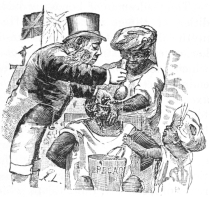
Perhaps it is as well for the Indians. The native Princes were just as
rapacious and more senseless than the English. If a native Indian should
swallow a diamond, his Prince would rip him open to get it, which made
him useless ever after. Johnny Bull, more politic and far seeing, would
force an emetic down his throat, so that he might go on and find more
diamonds to swallow. He gets the diamond all the same, and saves the
subject for future profit.

The strength of England is its fighting capacity, its mercantile
capacity, and its wonderful rapacity. As was said of a noted criminal
in the States, “he wouldn’t steal anything he couldn’t lift, though he
did tackle a red-hot cook-stove,” so with England. The eyes of her
moneyed power, and it is more than Argus-eyed, are being strained every
day for new worlds to sell goods to, knowing perfectly well that when
they find a field the Government will furnish muskets to occupy that
field. And let no mistake be made. If the field is worth occupying it
will be occupied beyond a doubt.
Ireland is an example, Scotland would be, only the Scotch, having a
habit of standing together, are ugly customers to deal with, and as they
and the English get along tolerably well together, there is no especial
trouble between them.
Hence it is that London is so great. London is the center of this vast
system of plunder and rapine, and the result of it all comes here. Here
is the Court, here is the seat of Government, here is where the great
nobles, no matter where their seats may be, are compelled to spend a
portion of their time; they are all obliged to have town residences;
here they bring their flunkies and retinues of servants, and they make
the great city.
It is not a commercial point, as is Liverpool or New York, nor a
manufacturing point, as is Manchester or Philadelphia. It is where the
spoils of the present organized legal brigandage are divided, and where
the surplus of the organized brigandage of past centuries is expended.
The tradesman of London would not alter the existing condition of things
if he could. He believes in that shadowy myth called the Queen, not
because he knows anything about her, or cares a straw for her, but
simply because when she, which means the Court, is in London, trade is
good. That eminent descendant of an eminent robber, Sir Giles Fitz
Battleaxe, is here during the season, with all his flunkies and
servitors, and the tradesmen have to supply them. As Sir Giles has vast
estates in Ireland and Scotland, and the Lord knows where else, which
yield him an immense revenue, Sir Giles’s steward can pool his issues
with his tradesman and both get rich. Sir Giles doesn’t care, for he is
paying all this out of rents of property, the title to which came from a
King who stole the ground, and he has enough anyhow.
A FEW STATISTICS.
And then comes the foreign robberies, which he has an interest in, and
those make up any waste that may happen at home. Even the cabman, who
haggles with you over a shilling, is loyal to the Crown and the Church,
for the Crown and the Church bring to London the people who make him his
fares.
Rampant republican as I am, opposed to monarchy as I am, I am
contributing several pounds per diem to the maintenance of the British
throne. I am here to see royalty, and everybody that I come in contact
with, from the boy who cleans my boots to the lady who rents me my
rooms, sing hosannas to the system that brings me here to be plundered.
When I give a shilling to a servant she doesn’t thank me for it, but she
goes to her garret and sings, “God Save the Queen.” That amiable shadow
gets all the credit for my money.
They shall give thanks to Victoria for me but very little. I will be a
republican to the extent of leaving as small an amount of money in
England as possible. Could there be a league of Americans formed who
would refuse to pay anything, I am not sure but that royalty might be
overthrown, and a republic established on its ruins.
And yet I am not certain that that would answer any good purpose. But
for these advantages I don’t think anybody would live in London. It was
said that if the Pilgrims had landed in the Mississippi Valley, New
England would never have been settled, and, therefore, it was
providential that the Pilgrims were so directed. But for royalty and the
profit that pertains to a Court, I doubt if London could hold
population. For if there is a disagreeable—but I reserve this for a
special occasion, when, less amiable than I am now, I can do the subject
justice.
London has a population, in round numbers, of four millions. Without
including outlying suburbs, it covers seventy-eight thousand and eighty
acres, or one hundred and twenty-two square miles. The length of the
streets and roads is about fifteen hundred miles, and their area nearly
twelve square miles. The area of London being one hundred and twenty-two
square miles, is equal to a square of about eleven miles to the side.
Assuming that it is crossed by straight roads at equal intervals, there
would be one hundred and thirty-six such roads, each eleven miles long
and one hundred and forty-two yards apart. The sewers have a length of
about two thousand miles, and are equal to one hundred and eighty-two
sewers eleven miles in length, on an average of one hundred and six
yards apart. At the census in 1871 there were within this area four
hundred and seventeen thousand seven hundred and sixty-seven inhabited
houses, containing an average of seven and eight-tenths persons to a
house, exactly corresponding with the proportion in 1861. The density of
population was forty-two persons to an acre, twenty-six thousand six
hundred and seventy-four to a square mile. The population, estimated to
the middle of the year, amounted to three million six hundred and
sixty-four thousand one hundred and forty-nine.
These statistics I know to be correct, for I got them from a newspaper.
I copy it entire, for the readers of this book do not take the London
Chronicle, as a rule, and it would be too expensive to send each one a
copy of it. If any false statements are made it is the Chronicle’s
fault and not mine.
The climate is, to put it mildly, fiendish. I have been in every
possible section of the United States that could be reached by rail,
water, or stage, and I was never in a location, excepting California, in
which the citizens whereof would not remark: “Oh, yes; this would be a
good country to live in if it was not for the changeable climate. The
changes are too sudden and severe.” One blessed result of my coming to
London is to make me entirely content with the worst climate America
has. Tennessee is a paradise to it, so far as climate goes, and when you
have said that the subject is closed.
THE CLIMATE.
It rains in London with greater ease than it does in any place in the
world. The sun will be shining brightly in the heavens; you look out of
your window and say: “I will take a walk this morning without that
accursed umbrella,” and you brush your silk hat—everybody who is
anybody must wear a silk hat—and you sally forth with your cane. You
turn into the Strand, feeling especially cheerful in the sun, when all
of a sudden the sky is overcast and you hat is ruined. You call a hansom
and go back to your lodgings for your umbrella, and when you have
encumbered yourself with the clumsy nuisance the sun comes out smiling,
and the rain is over, only to resume operations again without the
slightest possible reason.
Everybody in London carries an umbrella habitually and all the time. No
man ventures out of doors without one, no matter how the sky appears. In
America a fair day may be counted upon, but here there is no dependence
to be placed upon anything in the form of weather. Last week (June 1) it
was as hot as it ought to be the same day in Charleston, South Carolina;
to-day (June 7) I came in, went out, and came in wearing an overcoat,
and a tolerably heavy one at that. What the weather will be to-morrow,
heaven only knows. I have experienced so many and so violent changes
that I should not be surprised if it should snow. I may go skating next
week upon the Serpentine.
But the Londoners don’t mind it. They are used to it. From the ease with
which they carry umbrellas, I am convinced that they are born with them,
as George Washington was with the hatchet. A Londoner never lends his
umbrella, for everybody has his own, and he never loses it. It is a part
of him, as much as is his nose. The umbrella should be in the coat of
arms of the royal family, and I do not know but it is.
It is a dull and heavy climate. How it affects a native I cannot tell,
but an American has a disposition to sleep perpetually and forever.
In the house I am in is an American, who insisted one morning on going
across the square without his umbrella. I mildly remonstrated. “It is
safe,” he said, “it isn’t raining now, for it was a minute ago.” He was
right, but he came to grief for all that. It rained again in another
minute.
London is a miracle of twistedness. If there is a straight street in
it—that is, one that runs parallel with any other—I have not found it.
The streets of Boston, it is said, were originally cow-paths. If those
of London were located on the paths of cows, the cows must have been
intoxicated, for there is no system nor any approach to one. They begin
without cause and end without reason. There are angles, curves and
stoppages, and that is all there is about it. Where a street, to answer
the ends of convenience and economy, should go on, you come squarely
against a dead wall, and where a street should naturally end, there has
been constructed, at vast expense, a continuance, and for no apparent
reason. Doubtless there is a reason, but I would give a handsome premium
to have it made manifest to me.
Like all old cities, there never was a plan. This ground was never taken
up at a dollar and a quarter an acre, as in America, by a set of
speculators, and laid out in regular squares, and sold at so much a lot.
London never was made—it grew. The original city is a little spot,
occupied mostly by banks, but other cities grew around it, and they were
joined by all sorts of lanes and roads, which in time became occupied,
and so the inextricable jumble occurred.
The city is built entirely of brick and stone, and in the style and
convenience of its buildings, is not to be compared to American cities.
There is a terrible monotony in its architecture, and a most depressing
sameness in color. All London is dingy. Occasionally an enterprising
citizen paints his house to distinguish it from his neighbor’s, but he
never does it but once. The coal consumed is bituminous, and the smoke
it produces is the thickest smoke in the world, and it hangs very close
to the earth. The paint becomes discolored in a few months, and the
aspiring citizen finds in the smoke a protest against his vanity. His
house soon drops into line with his neighbor’s, and is as dingy as
before.
VEHICULAR.
The streets of London are crowded to a degree that an American can
hardly conceive. Isaiah Rynders said once that it required more
intellect to cross Broadway than it did to be a country justice. Had
Isaiah stayed a week in London he would have had the conceit taken out
of him. The streets of London, all of them, are boiling, seething masses
of moving men and animals. Omnibusses, vast cumbrous machines, loaded
full inside, and with twenty people on the top, hansoms, cabs, trucks,
drays, donkey carts, pony carts, carriages, form a never-beginning and
never-ending procession, making a roar like the waters of Niagara. He
who attempts to cross a street has to make it a regular business. It
cannot be done leisurely or in a dignified way. You narrowly escape
being run down by a hansom, only to find yourself in danger of being
impaled by the pole of an omnibus, and escaping that, a donkey cart is
charging full at you, and if you escape a carriage, and a dozen dog
carts, you finally find yourself on the sidewalk plump in the stomach of
somebody, who accepts your apology with a growl.
I shall never get over my admiration for the London driver. How he can
guide one horse, or still more wonderful, two, through this vehicular
labyrinth, is a mystery that I cannot comprehend. I would as soon think
of taking command of the British army, and a great deal sooner, for if I
didn’t stomach fighting, I could run. But they do it, and they seldom
have accidents.
And while I am on the subject of driving, I may as well get through with
it. The horses used in London embrace a vast variety. The draught horses
are all of the Norman variety, about as large as small elephants, and
magnificent in their strength. They are massive, and the loads they draw
are wonderful. The trucks are enormous in size and strength, with great,
broad wheels, and merchandise is piled upon them mountain high. Two of
these horses, nineteen hands high, and built proportionately, with
great, clumsy legs, will take an enormous load along the streets, making
no fuss, and seemingly without worry.
But when one notices the condition of the streets the wonder at the
loads that are drawn ceases. They are as smooth as glass. The stone
pavements are evenly laid and absolutely without ruts. The wooden
pavement, answering to the Nicholson, which has invariably been a
failure in America, is a success here, and for a very simple reason. The
contractors are compelled to do their work honestly. There is no shoddy
in the pavements of London. They are all as sound as the Bank of
England. They don’t lay down some pine boards in the mud, and then stand
rotten blocks on end upon them, as we do in America, but there is a
solid foundation of broken stone and such matter laid down first, and
this is filled with sand, and then the blocks, all good timber, are
placed upon that in a proper way, the whole resulting in a road-bed as
solid as stone itself, and smooth and noiseless, making a roadway over
which any load can be drawn without injury to either beast or vehicle,
and one which will be good long after the makers are dust. The vehicles
are made so strong as they are, not for fear of the roads, but to hold
the enormous weights that the roads make possible.
THE VICIOUS HORSE.
Sometime we of America will get to doing things in a permanent way. It
will be, however, after all the present race of contractors are worth
several millions each. I presume in the ancient days there were rings in
London. If so I can understand the uses for the beheading blocks
exhibited at the Tower.
All the vehicles used in the city are massive and solid. You see none of
the flimsy spider-web wheels and light airy bodies in carriages that we
affect in America. The wheels of a cab to carry four people are quite
three inches thick, and the bodies are correspondingly clumsy. Like
their owners, they are very solid.
But the hansom is the peculiar vehicle. The four-wheeler is a sort of a
sober-going cab, the one you would expect the mother of a family or a
respectable widow lady to use. The driver sits in front, as a driver
should, and the entire concern is closed except as you may desire to
have air by letting down eminently respectable windows in the side. But
the hansom is quite another thing. The occupant is in a low seat, while
his driver sits above him on a perch and the reins go over the
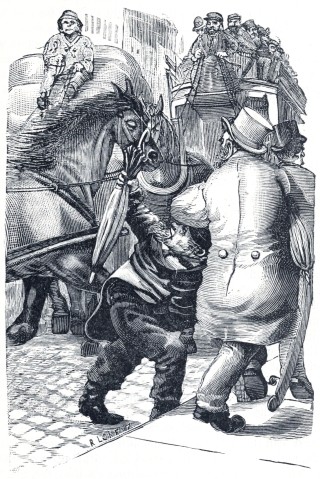
occupant’s head. Next to swindling his customer out of a sixpence on his
fare, the chief ambition of the driver of a hansom is to run down a foot
passenger, and in this ambition his horse shares fully, if he does not
exceed him. The horses used in these piratical vehicles are generally
broken-down hunters, who, too slow to longer hunt the wily fox, and
harnessed in the ignoble hansom, have transferred their hunting
instincts to men. When the “jarvey,” as he is called here, fixes his
eagle eye upon a citizen whom he proposes to run down, the horse knows
it as if by instinct, and they come charging down upon him at a pace
something as did the French cuirassiers at Waterloo. And if the intended
victim escapes, the driver gnashes his teeth in rage, and the
sympathizing horse drops his head and moves on a walk till the sight of
another countryman or stranger rouses his ambition. It is said that when
a driver succeeds in running down a foot passenger the injured man is
the one who is arrested.
The shops of London are of two kinds—the gorgeous modern and the
respectable ancient. The modern are of the most gorgeous kind. They are
not as in New York, immense show windows with a door between; but there
is an immense show window in the middle, with a small passage on the
side. When a London tradesman wants a show window he wants it all show.
It is very like the piety of some men I know. He doesn’t care how small
the opening is to get into the place, for he knows if he attracts a
customer by the display of his goods in the window, he, the said
customer, will manage somehow to get inside. The point is to corral the
customer. Once in, his bones can be picked at leisure.
The modern shops are as gorgeously fitted up inside as out. They have
silver plated rails, magnificently decorated counters and show-cases,
even more than the New York stores have.
Then there are the eminently respectable shops which despise these
gorgeous ones about the same as an old noble, descended from one of the
first robbers, looks down upon a Knight of day before yesterday. These
are the shops that have over their doors “Established in 1692.” They
would no more put in a plate glass window than they would forge a note.
They revel in their dustiness, and are proud of their darkness and
inconvenience. They wouldn’t sweep out the premises if they could help
it, and the very cob-webs are sacred as being so many silent witnesses
to the antiquity of the house.
“The house, sir, of Smithers & Co., was established by Samuel Smithers
on this very spot in 1692, and business has been done under that name,
and by his successors, ever since, except an interval of two months,
which was occasioned by a fire—from the outside. The house of Samuel
Smithers & Co. could never have originated a fire upon their own
premises. The business is conducted with more system. We have never had
a protested paper and never asked an accommodation.”
This is what the present head of the house will say to you. He has as
much pride in the house as the Queen has in her Queenship, and with
infinitely more reason. He would not allow a new pane of glass to be put
in, and he wouldn’t change a thing about the premises for the world. He
prides himself on the inconveniences of a hundred years ago, and would
die sooner than to use a modern notion in the business.
AN OLD HOUSE.
But the Smitherses are good people with whom to do business. Among the
other old-fashioned customs they preserve is that of honesty. They keep
good goods, no shoddy; they have a fair price, and you might as well
undertake to tear down Westminster Abbey with a hair-pin as to induce
any variation therefrom. They want your trade—every Englishman wants
trade—but they prefer their system to trade. You buy, if you buy of
them, on their terms. But you know what you get, and that is worth
something.
This affection for the old is general. It is a fact that one eating
house, noted for its chops and steaks, and ales and wines, which had
been in existence no one knows how many years, and had its regular
succession of patrons, who came in at regular hours, and ate and drank
the same things, and read the same newspapers till death claimed them,
fell, by reason of death, into the hands of young men. These young
fellows were somewhat progressive, and they determined to bring the old
place abreast with modern ideas. And so they swept out the cob-webs,
painted the interior, decorated it in bright colors, put in new tables,
swept and cleaned things, and replaced the old floor with modern tiles,
and made it one of the most handsome places in London.
The effect was fatal. The old habitues of the place came, looked
inside, ran out to see if they had not made a mistake as to the number,
and finding they were right as to locality, sighed and turned sadly
away. They could not eat in any such place, and they went and found some
other antiquated den, whose proprietor was sensible enough not to tear
down sacred cob-webs, and put in fresh floors.
The old patronage was lost forever, and the proprietors were compelled
to build up an entirely new business, the cost of which nearly put them
into bankruptcy.
All travelers lie. I am going to try to be an exception to this rule,
and shall, to the best of my ability, cling to the truth as a
shipwrecked mariner does to a spar. I shall try to conquer the tendency
to lie that overcome every man who gets a hundred miles away from home.
But I presume I shall fail; and so when I get home and say that living
is cheaper and better in London than it is anywhere in America, please
say to me, “You are lying!” You will do the correct thing.
No doubt when there I shall say to Smith or Thompson, “My boy, what you
want to do is to go abroad. You want to see London. And as for the
expense, what is it? Your passage across is only one hundred
dollars—ten days—and that is but ten dollars a day. And then you can
live so much cheaper in London than you can in New York that it is
really cheaper to go abroad than it is to stay at home.”
I presume I shall say this when I get home, for I know the tendency of
the traveler to lie. I have traveled all over North America, and I
confess, with shame mantling my cheek, that I have at times added some
feet to the height of mountains and to the width of rivers, and to the
number of Indians, and once I did invent an exploit which never
happened, and I have narrated incidents which never occurred. It is such
a temptation to be a hero when you know you can never be successfully
disputed.
While I am yet young in foreign travel, and capable of an approximation
to truth, I wish to say that London is not only not a cheap place to
live, but an exceedingly dear one.
THE MATTER OF COST.
“Just think of it,” said a travel-wise New Yorker, in New York, to me,
“just think of a steak for a shilling! Here you pay twice that!”
So we do, but when you pay fifty cents for a steak in New York, you get
a steak, and you get with it bread and butter ad libitum—you get
pickles, and sauces, and potatoes, and all that sort of thing. Your
fifty cent steak, with the accompaniments it carries, makes you a meal,
and a good one.
In London your steak is twenty-five cents, but it is only a sample.
After eating it you want some steak. Then you pay six cents for
potatoes, two cents for what they call a bread—you always have more and
there is a charge for each individual slice—you pay two cents for each
tiny pat of butter, you are compelled to struggle for a napkin, and if
you ask for ice to cool the infernal insipid water, you pay two cents
for that, and you get just enough to aggravate you. And, then, when you
are through, the smirking mass of stupidity and inefficiency they call a
waiter wants and expects a sixpence, which is twelve and one-half cents
more.
Where is your cheapness now? If you have a square, appetite-satisfying,
strength-giving meal, it has cost you twice as much as it would in New
York, with the difference that in New York it would be decently cooked,
decently served, and done with a sort of breadth that makes it a luxury
to eat, while here it is so hampered about with extras and charges for
minute things—things which in America are free to everybody—that
eating is reduced to a mere commercial basis and has no comfort in it.
The hotels are simply infamous in their charges. You agree to pay so
much per day for your rooms, and it looks tolerably cheap, but you
discover your mistake at the close of the first week, when you come to
settle your bill. Though you have never touched your bell and have never
seen the face of a servant, you are charged so much a day for
“attendance,” you are charged for light, for fires. If you have ordered
a bit of anything, no matter how infinitesimal, it is there, and these
charges make up a bill larger than your room rent.
There is no use in remonstrating, nor in threatening to leave. You know,
and the landlord knows a great deal better, that no matter where you go
it will be the same, and so submitting to the inevitable, you draw a
draft for more money, and settle down to be cheated in peace.
The lodging houses are quite as bad, only of course in a smaller way.
Your accommodations are less, and the swindle less, but the proportion
is very carefully observed.
Clothing is somewhat cheaper than in America, but nevertheless let me
warn the intending comer against buying it here. You may buy cloths, if
you choose, and pay duty on them and take them home, but never let a
London tailor or dressmaker profane your person, be you man or woman.
The Creator never made either for a London tailor to mar. He has too
much respect for His handiwork. I have been here now two weeks, and have
yet to see a native Englishman or a tailor-spoiled American who was
well-dressed. The English tailor has no more idea of style than a pig
has of the revised Testament. You can tell an American a square off by
the cut of his coat, and an American woman by the very hang of her
dress. The English tailor looks at you wisely, and takes a measurement
or two, and puts his shears into the cloth. The result is a sort of a
square abortion, loose where it should be close, close where it should
be wide, long where it should be short and short where it should be
long, and the poor victim takes it and is miserable till time releases
him from it.
The majority of English women are dowdies, and by the way they have
immense feet and hands. They are excellent wives, mothers and sisters,
but their extremities are something frightful. They do have delightful
complexions though, and are as bright and good as they can be.
A PITTSBURGH REMINISCENCE.
Speaking of the feet of English women reminds me of Captain McFadden, of
Pittsburgh. The dear old Captain—he is dead and gone now these many a
year—in addition to being one of the best river men that Pittsburgh
could boast of, was also,—think of it,—a poultry fancier. When the
fancy for Shanghais broke out the Captain joined in it, as he did in
everything in the fowl way, and he paid cheerfully twenty-five dollars
for a half-dozen eggs of the famous breed, which he immediately put
under a hen that was in a setting mood. But Captain McFadden had a son
who was without reverence either for his father or poultry. Young Jim
McFadden went and bought a half-dozen duck’s eggs and removed the
Shanghais and put the duck’s eggs under the hen, the said hen not
knowing or caring whether she was hatching the common duck or the royal
Shanghai. In time its labors were accomplished and Captain McFadden was
viewing the resultant ducklings, with Jim laughing in his sleeve as he
looked on.
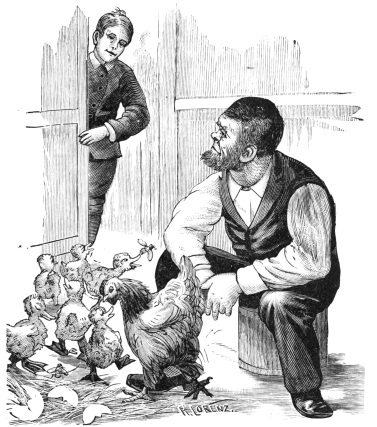
“JIM, MY BOY, AND IS THEM THE SHANGHAIS? LUK AT THEIR
FUTS! HEVENS, JIM.”
“Jim, me boy, and is them the Shanghais? Luk at their futs! Hevens, Jim,
luk at their futs. All h—l wouldn’t up-trup em.”
I can’t imagine anything that would “up-trup” an English woman. But as
small feet and hands are not essential to salvation I forgive them this.
They can’t help it. I presume they would if they could, but they are so
kindly, so hospitable, so bright and pleasing generally, that I shut my
eyes gladly to their feet, and their bad taste in dress, and accept it
all without a word.
Still I wish they could pare down their feet. Then an English woman
would be the simple perfection of nature’s most perfect work. I can’t
help thinking, however, that when your hostess’s shoe is—but never
mind. Their kindliness and their cheery laughs and their never failing
good humor are admirable substitutes for small feet. Feet are not the
whole of life.
You see soldiers about London. They are as common as mosquitos in New
Jersey, and to me just about as offensive. They are everywhere. Go where
you will, you see a tall fellow in a blue or scarlet, or some other
colored uniform, with an absurd little cap on his head, to which is
attached a leather strap which comes down to his lower lip, to keep the
absurd little cap in place. He has sometimes a sword hanging to him, and
sometimes not, but he is a soldier all the same. England has need of a
great many soldiers. In London they are used as a sort of show, as
walking advertisements of the power and strength of the Government, and
to make the picture of royalty complete.
As soldiers don’t cost much here, it is a luxury royalty can afford a
great deal of. The ordinary soldier gets twenty-five cents a day, and
his rations, and after twenty-one years service, if rum and beer and
bullets—the two first are the most dangerous—have not finished him, he
becomes a pensioner, which means he puts on a red coat and eats three
times a day in a sort of hospital, all the rest of his life.
A RED-COATED ROMANCE.
The army is recruited largely from Ireland and the poorer districts of
England and Scotland. It is about the last thing an Englishman or
Irishman does, but various causes keep the ranks full without
conscription. Women are the best recruiting officers the Queen has. It
is the regular thing for a young fellow who has been jilted to go and
enlist. He thinks he will make the girl feel badly. But it doesn’t. She
rather prides herself upon the number of young fellows she has given the
army, and when the time comes to marry and settle down, she goes and
marries, and laughs at them all.
Poverty is another very active and efficient recruiting sergeant. A
young fellow comes down to “Lunnon” to seek his fortune, equipped with a
few pounds and his mother’s blessing. He finds London quite different
from what he expected. He discovers it to be a very hard and cruel
place, with more mouths than bread, and more hands than work. He lives
as closely as he can, but, as meagerly as he lives, his pounds melt into
shillings and his shillings into pence. And finally, when his last penny
is gone, and hunger is upon him, he takes the Queen’s shilling, and the
next thing his mother hears of him, he is fighting the Boers in South
Africa. And once a soldier, always a soldier. The life unfits a man for
any other, and when he has once worn a uniform, he never wears anything
else.
As I said, women are the best recruiting sergeants. I got into a
conversation with one very handsome young fellow who had been in the
service only a year, who told me his little story. He is the son of a
small farmer in Scotland somewhere, with an unpronounceable name, where
it doesn’t matter. He had been in love with a pretty daughter of a widow
near by from the time he was a boy, and the girl professed to be, and
doubtless was, in love with him, but as she grew up she made the
discovery that she was very handsome (what woman does not?), and she
found that that beauty attracted others beside poor Jamie. Other swains
in the neighborhood laid siege to her, and she, exulting in her power
over the young fellows, and being unquestionably the belle of the
neighborhood, made it very uncomfortable for her real lover, to whom she
was betrothed.
Sore were the conflicts between them. The girl delighted in annoying
him, for she was as wilful and cruel as she was beautiful. She would
dance with the others, and she would flirt with them to the point of
driving the poor man mad, and then, just at the nick of time, she had a
trick of coming back to him, and for a time being as sweet as possible,
and so for several years she kept him alternating between the seventh
heaven of happiness, and the lowest depths of a hell upon earth.
There was one fellow in the neighborhood as much smitten with her as
Jamie, who was determined to marry her, whether or no. He was a
well-to-do young man, who had a farm of his own, and being quite as
good-looking and more enterprising than Jamie, was a most dangerous
rival to the hapless youth. Jennie had dismissed all the others, but
with the perversity that seems to be an infallible accompaniment to
beauty, she persisted in receiving the attention of this man.
Finally it came to a head. Jamie insisted that she should not see him
any more, and he insisted upon it with an earnestness that affected the
girl, and she made a solemn promise that she never would see him again.
It so happened that the very next day after this promise was asked and
given, Jamie was to leave for Glasgow on business, and he started early
the next morning. He hadn’t got to the railroad station before his mind
misgave him. Something worried him. He had slept all the night
comfortably on her promise, but something told him that she did not
intend to keep it, and that something preyed upon him to the degree that
instead of proceeding on his journey he turned about and walked back.
She knew that he was going to be gone a week, and the other man knew it
also. If she intended to play him false, this was her opportunity, and
he would know for certain, and set his mind at ease.
Poor devil! It would have been better had he proceeded on his journey.
For if he had known anything he would have known that if a woman wanted
to deceive him, watching her would amount to nothing. The devil is very
lavish of opportunities, that being all that he has to do, and simple
human nature is certain to avail itself of them; but Jamie was not a
philosopher, or a very bright man. He was a simple Scotch lad,
frightfully in love with a wilful and perverse beauty.
HOW IT ENDED.
But he did go back, and he concealed himself near her cottage, where he
could watch unobserved, hoping, in a desperate sort of way, that he had
made a fool of himself, but rather certain that he had not.
And sure enough, along toward evening his rival made his appearance
sauntering down the road, and sure enough he had no sooner appeared in
the road than Jennie, as if by accident, appeared, and the two talked
across the little gate in front, very earnestly, she in a mixed sort of
way.
And Jamie, full of rage at what he believed to be a betrayal, and
desperate on general principles, sallied out and attacked his man, and
after a fearful struggle left him almost dead on the ground, and despite
Jennie’s tearful assertions that she had seen him only to tell him that
he must not follow her any more, as she would henceforth and forever
have nothing whatever to do with him, Jamie, who didn’t believe a word
of it, announced his intention of enlisting, and started off toward the
station again.
Jennie followed him, for it appears the girl’s story was true, and she,
coquette as she was, did love him, but she arrived too late. He had
taken the fatal plunge, and was in the Queen’s uniform.
“And Jennie?” I asked.
Jennie was in London in service. She would not stay at home after he
left, and she came to town where she could see him at times, and things
were so arranged between them that when his term should expire they were
to marry and go back and settle down upon the old place and be happy for
evermore.
If his regiment should be ordered upon foreign duty, she would manage
somehow to accompany him. Anyhow, she was entirely cured of flirting,
rightly concluding that one true man is enough for one woman, and he was
equally soundly cured of jealousy, though it must be admitted that he
had sufficient cause therefor.
And so ends a red-coated romance.


