Temple—Cages—Women—Dinner—Hot water—Taken down a
river—City—Guns—Hall of Ancestors—Twizell and the missing
party—English prisoner—Corporal of marines—Jail—Other
Lascars—Watch.
In the morning, when I awoke, I found I was in a temple; outside the
railing was a large hall; on each side, rows of seats were ranged,
with a broad space in the centre; the sides of the building were
quite plain, and so also was the roof. Inside the railing was a green
silk canopy, under which were several images, handsomely dressed in
different coloured silks. Standing against the walls were four more
figures the size of life, one painted entirely black, another red,
and the other two variegated; and all armed with some extraordinary
instruments of warfare. These I suppose represented their gods, and
were tolerably well done, but not to be compared to others I afterwards
saw. The whole building was so destitute of any ornaments, that, had
it not been for the images, the idea of it being a jos-house would not
have struck me.
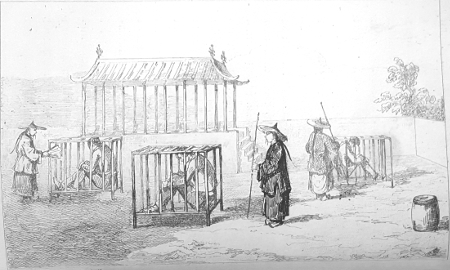
Breakfast was brought in early, consisting of sweet cakes and tea. When
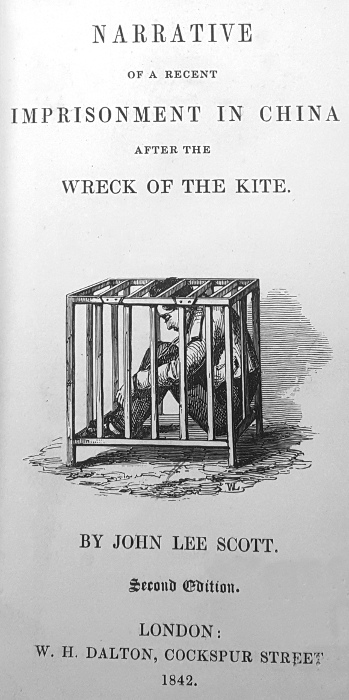
we had finished, two wooden cages were brought; the Chinese lifted one
of our men into each, and carried them outside the gate, to be looked
at by the common people; whilst the gentlemen, and better class, with
their families, were admitted about two dozen at a time, to look at us
who remained inside: sometimes we were visited by a party consisting
entirely of women; they were a remarkably plain set, their pretensions
to beauty, in their own eyes, appearing to lie in having the face
painted red and white, and the feet distorted into a hoof-like shape.
After keeping those in the cages, outside for about two hours, they
were brought in, and two fresh ones were taken out. Those who came in,
told us that the bodies of our two poor fellows, who had been killed
the day before, were lying outside on the grass, with the fetters still
on. Fortunately it soon began to rain heavily, when the other two were
brought in, and the crowd gradually dispersed.
About noon we had our dinner; one basin full of rice and vegetables,
and cakes and tea, as before; our jailers would never give us plain
water, but whenever we asked for anything to drink, brought us weak
tea. For supper we had cakes and tea again, and, after this last meal,
lay down on our straw for the night.
The next day was passed in a similar manner; towards evening there
was a great mustering of cages in the hall; little did I think for
what purpose they were intended. After the Chinese had ranged these
horrible things in the open space in the centre, they made us all get
into them, one into each. I forgot to say that before we were put
into our cages, our jailers gave us each a loose jacket and a pair
of trousers, besides as many cakes as we could carry. In these wooden
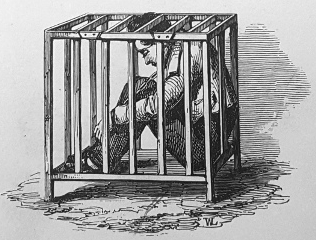
contrivances—which were not much unlike what I imagine Cardinal
Balue's machines to have been, only ours were wooden and portable—we
had neither room to stand, sit, nor lie, so that we were obliged to
place ourselves in a dreadfully cramped position. Some few of the cages
had a hole cut in the lid, large enough to allow the top of the head to
pass out: into one of these I was fortunate enough to get; but those
who were not so lucky, had the misery of sitting with their heads on
one side, to add to their other discomforts. Afterwards I was put into
one without a hole, and miserable was my position.
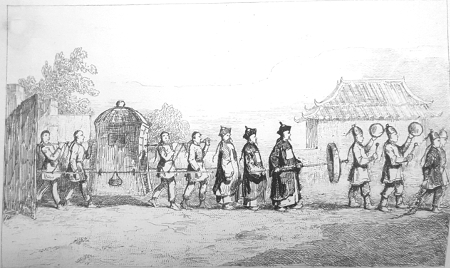
When we were all stowed in our separate cages, we were carried down to
the side of the canal, and placed in boats, two cages in each boat,
attended by a mandarin officer and several soldiers. My companion was
a marine, one who had come ashore in the junk with Webb and Wombwell,
and was still suffering from the effects of his beating, besides being
almost dead with dysentery. We lay alongside the quay till nearly
midnight, the soldiers and other people constantly running backwards
and forwards on shore, with torches and gongs, shouting and making a
great noise. About midnight we shoved off, and started down the canal;
but as the junk was covered over, and it was very dark, I could see
nothing of the country.
We soon appeared to be in a wider stream, as they made sail on the
boat, and we went along at a rapid rate. In the morning I found that we
had got out of the canal, and were in a river, going down with wind and
tide. At any other time I should have enjoyed myself very much, but at
present my future prospects were too far from agreeable, to allow of
anything approaching to enjoyment.
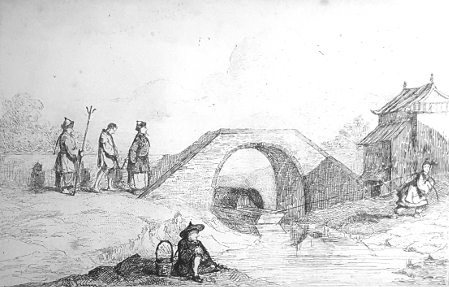
The banks of the river appeared to be well cultivated; here and there
some military stations might be seen, distinguished from the other
houses by their flag-staffs. Many junks were moored alongside the
bank, some very large, one in particular, whose long streamers flew
gaily out in the breeze.
We stopped at a town on the left bank, where the soldiers got some
firewood, and immediately set to work to prepare breakfast; rice,
and some compounds of I know not what, for themselves, and sweet
cakes and tea for me and my companion; but he was too ill to eat,
and was constantly craving for water, which was never denied him. On
our arrival at this town, the people crowded into our boat, nearly
capsizing her; and to my surprise our guards made no attempt to keep
them out, but on the contrary rather encouraged them. They had not long
to satisfy their curiosity, for as soon as the soldiers had procured
all they wanted, the boat was shoved off, and they hoisted the sail
again. We continued our way down the stream till we arrived at another
large town on the left bank. Here we stopped again, and I could soon
see we were to be disembarked. The people crowded to see us as usual,
but one of the soldiers, throwing part of the sail over the tops of our
cages, kept watch over us, and would allow no one to molest us.
On the sail being removed, that we might be taken out of the boat, the
first thing that met my eye was one of our guns, with the carriage
belonging to it; soon after I saw another gun and its carriage. To
enable the Chinese to get these guns, the tide must have fallen
considerably after we left the wreck. The sight of these guns, as may
be imagined, caused me anything but pleasurable sensations, as they
proved beyond a doubt to our captors, that we had come to their coast
with warlike intentions; and though they would perhaps be ashamed to
kill a few shipwrecked merchant sailors, they might not hesitate to do
so, if they could be certain that we had been concerned in the recent
warfare, and these guns were strong evidence against us.
On being taken out of the boat, a long bamboo was passed between the
bars of my cage, and two men, placing the ends on their shoulders,
lifted it off the ground; and in this manner I was carried through an
immense crowd, the bearers sometimes stopping to rest, and placing my
cage on the ground, upon which the people gathered round and began to
torment me, as they had done in former cases. At length, after passing
through a great many streets, some of them very gay, we arrived at an
open space, at the end of which were large folding gates; through these
I passed, and after going up one or two passages, I found myself in a
large hall. It was a large plain room, with a balustrade running down
each side, behind which were several rough horses, saddled and bridled.
At the end opposite the door was a large red silk canopy, under which
was a small table, covered with a green cloth, and on it several metal
plates and vases, dedicated to the manes of the ancestors of the
person to whom the house belonged.[5] Many of the prisoners in their
cages had arrived before me, and the rest followed in due time. The
Chinese ranged us in our cages in two lines, one on each side of the
hall; and at the end of each line they placed one of the guns, with its
muzzle towards us. When we were thus arranged, like beasts in a show,
many well and richly-dressed people came to look at us; and none but
the better sort seemed to be admitted, for, with the exception of the
soldiers, there were no ragged people in the place. Our visitors were
mostly dressed in fine light silks, beautifully worked with flowers and
figures of different descriptions. All of them had fans, some of them
prettily painted, and others plain. One or two of the men had enamelled
watches, which they wore hanging to their girdles by a gold chain. We
were treated pretty well by them, as they gave us fruit and cakes, and
sent water to those who asked for it.
We did not remain long in this hall, for our bearers again made their
appearance, and mine, shouldering the cage, marched off, and I was
once more exposed to the mercies of the mob; the soldiers, our guard,
never making the slightest attempt to keep the people off. Fortunately
for me I had had my hair cut close only a few days before we were
wrecked, so that there was little or nothing to lay hold of; for the
people on one side would pull my hair to make me look their way, and
those on the other side would instantly pull again, to make me look
round at them; and I, being ironed, hands, feet, and neck, could not
offer the least resistance, but was obliged to sit very patiently, or,
in other words, to grin and bear it.
Heartily glad was I, when again taken up and walked off with. After
passing through many streets, I arrived at a mandarin's house, and was
placed with the other prisoners in a small court. Some empty cages were
standing about, larger than the one I was in, and with small yellow
flags flying on their tops.
In a short time some officers came in, and opening the lid of my cage,
lifted me out, and led me out of this court into a larger one. To my
great delight I here saw Twizell, and the three of the crew that had
been missing, sitting in one corner, under a tree. I could not stop and
speak to them, my guides hurrying me on. We scarcely recognized one
another, so much were we altered.
I walked on for a short time, meditating on the past events, and
wondering what my fate would be, when, raising my eyes from the ground,
to my astonishment I perceived a man walking before me, heavily ironed,
and whom I had never seen before. He was evidently an Englishman,
and seemed almost in a worse condition than myself. When he heard me
clanking after him, he turned round and spoke a few words, expressing
his sorrow at seeing any one else in such a situation. I asked him who
he was, and how he came there; but before he had time to answer, he was
led down one passage, and I along another; so I could neither learn who
he was, nor where or how he had been taken.
On emerging from the passage, I found myself in a small paved court,
and in the presence of several mandarins. In the centre of this court
an old Chinaman was kneeling, fettered as I was; there was no guard
over him, and nobody seemed to take the least notice of him, at least
not whilst I was there.
To my surprise, one of the mandarins addressed me in English; there was
also an interpreter present, a native of Macao, and a prisoner like
myself, having his legs in irons.[6] After they had asked me several
questions concerning the Kite, where we had been, whither we were
going, and how we were lost, I was sent away, and the other prisoners
were brought up and interrogated in the same manner. They asked all of
us our names and ages, wrote our names on a strip of cotton, and sewed
it to the backs of our jackets. We were then all sent away: the Chinese
had brought all the cages from the outer to the inner yard, round which
they had ranged them.
I now had an opportunity of speaking to Twizell and the others who had
run away, and was sorry to hear that two of them (marines) had received
several spear wounds, and that all four had been severely bambooed when
taken. They had travelled by land all the way from the coast, in the
cages, having been put into them the day after we were all captured,
and had been two days sooner in their cages than our party.
The corporal of marines, who was seriously ill of the dysentery, was
lying on his back in the bottom of his cage, whilst his legs were
raised up in the air, and his heels resting on the upper ledge, the lid
being thrown back. He had entirely lost his senses, and was evidently
dying fast; the maggots were crawling about him, and the smell that
came from him was dreadful. Fettered as we were, we could afford him no
assistance, and the Chinese merely looked at him, and then walked off,
holding their noses.
The strange Englishman at this moment came by, and seeing his horrible
situation, spoke to the interpreter who was with him, and he to the
Chinese; upon which two of them, though with great reluctance, lifted
the marine into a clean cage, and placed him in an easier posture. The
stranger now told us that he was an artillery officer, and had been
taken some days before at Chusan; but he was hurried away before we
could learn his name, or anything more from him.
It was now late in the afternoon, and dusk coming on, we were again put
into our cages, and carried through the town, till we arrived at the
jail. We were taken across a yard into a long room, which was divided
into four parts, by gratings run across. In this miserable place we
found eight more prisoners, (Lascars,) some of whom had been for two
months in the same sort of cages that we were in.[7] We were placed in
the small divisions, the coops being ranged round three sides of each
compartment, the fourth side being the entrance. A chain was passed
through each cage, and between our legs, over the chain of our irons;
the two ends being padlocked together, we were thus all fastened one to
another, and also to our cages. In this most uncomfortable manner we
passed the night.
During the night the corporal I have mentioned died. He never recovered
the use of his senses.
In the morning the jailer came in, an old man, with a loud voice, cross
look, and a piece of thyme, or some other herb, always stuck on his
upper lip. He opened the lids of the cages of the eight Lascars, and
took the irons off their wrists, thus enabling them to stand upright,
and shake themselves; we had no such indulgence, but were kept fast.
At eight o'clock our breakfast was brought in; it was jail allowance,
two small basins full of rice, and one of vegetables: the cages were
opened, and the irons taken off our hands, whilst we ate our scanty
meal, which we had no sooner finished than we were fastened down again.
We remained in this state all day, and after our evening allowance,
were again secured for the night.
A little before dark, the watch was set, and a large gong, at a short
distance, was struck once; upon which a number of smaller gongs struck
up, and when they had finished, a boy outside the room began to strike
a piece of bamboo with a stick, which noise was continued without
intermission the whole night. This horrid noise most effectually
prevented my sleeping. The large gong was only struck when the time
changed, striking first one, then two, and so on, till it struck five;
thus regulating the watches of the night, which, in China, I imagine,
is divided into five; at any rate I always found it so.
The following morning the jailer unlocked the lids of our cages, and
took the irons off our hands; so that we were at liberty to stand
upright, and stretch our limbs; which, from our cramped position, much
needed this relaxation. The large place we were in, was, as I have
said before, divided into four smaller apartments, three of which were
occupied by us in our cages; whilst in the fourth were some Chinese
prisoners, who lived in it by day, but slept in another part of the
jail. Outside was a covered passage, in which were several stoves; and
here the greater part of the Chinese prisoners cooked their rice and
other victuals. They had all chains on their legs, but were otherwise
free; and they gave us to understand that they were imprisoned for
smuggling opium, or for using it. Some were of the better class, being
well dressed, and eating their meals with the mandarin of the place.
Two of the commoner sort had lost their tails,[8] and one was minus
his nose, which gave anything but a prepossessing appearance to his
countenance.