In giving a history of my own sufferings in slavery, as well as the
sufferings of others with which I was acquainted, or which came under
my immediate observation, I have spoken harshly of slaveholders, in
church and state.
Nor am I inclined to apologize for anything which I have said. There
are exceptions among slaveholders, as well as among other sinners;
and the fact that a slaveholder feeds his slaves better, clothes them
better, than another, does not alter the case; he is a slaveholder.
I do not ask the slaveholder to feed, clothe, or to treat his victim
better as a slave. I am not waging a warfare against the collateral
evils, or what are sometimes called the abuses, of slavery. I wage a
war against slavery itself, because it takes man down from the lofty
position which God intended he should occupy, and places him upon a
level with the beasts of the field. It decrees that the slave shall
not worship God according to the dictates of his own conscience; it
denies him the word of God; it makes him a chattel, and sells him in
the market to the highest bidder; it decrees that he shall not protect
the wife of his bosom; it takes from him every right which God gave
him. Clothing and food are as nothing compared with liberty. What
care I for clothing or food, while I am the slave of another? You may
take me and put cloth upon my back, boots upon my feet, a hat upon my
head, and cram a beef-steak down my throat, and all of this will not
satisfy me as long as I know that you have the power to tear me from
my dearest relatives. All I ask of the slaveholder is to give the
slave his liberty. It is freedom I ask for the slave. And that the
American slave will eventually get his freedom, no one can doubt. You
cannot keep the human mind forever locked up in darkness. A ray of
light, a spark from freedom's altar, the idea of inherent right, each,
all, will become fixed in the soul; and that moment his "limbs swell
beyond the measure of his chains," that moment he is free; then it is
that the slave dies to become a freeman; then it is felt that one hour
of virtuous liberty is worth an eternity of bondage; then it is, in the
madness and fury of his blood, that the excited soul exclaims,
"From life without freedom, oh! who would not fly;
For one day of freedom, oh! who would not die?"
The rising of the slaves in Southampton, Virginia, in 1831, has not
been forgotten by the American people. Nat Turner, a slave for life,—a
Baptist minister,—entertained the idea that he was another Moses,
whose duty it was to lead his people out of bondage. His soul was fired
with the love of liberty, and he declared to his fellow-slaves that the
time had arrived, and that "They who would be free, themselves must
strike the blow." He knew that it would be "liberty or death" with
his little band of patriots, numbering less than three hundred. He
commenced the struggle for liberty; he knew his cause was just, and he
loved liberty more than he feared death. He did not wish to take the
lives of the whites; he only demanded that himself and brethren might
be free. The slaveholders found that men whose souls were burning for
liberty, however small their numbers, could not be put down at their
pleasure; that something more than water was wanted to extinguish the
flame. They trembled at the idea of meeting men in open combat, whose
backs they had lacerated, whose wives and daughters they had torn from
their bosoms, whose hearts were bleeding from the wounds inflicted by
them. They appealed to the United States government for assistance. A
company of United States troops was sent into Virginia to put down men
whose only offence was, that they wanted to be free. Yes! northern men,
men born and brought up in the free states, at the demand of slavery,
marched to its rescue. They succeeded in reducing the poor slave again
to his chains; but they did not succeed in crushing his spirit.
Not the combined powers of the American Union, not the slaveholders,
with all their northern allies, can extinguish that burning desire
of freedom in the slave's soul! Northern men may stand by as the
body-guard of slaveholders. They may succeed for the time being in
keeping the slave in his chains; but unless the slaveholders liberate
their victims, and that, too, speedily, some modern Hannibal will
make his appearance in the southern states, who will trouble the
slaveholders as the noble Carthaginian did the Romans. Abolitionists
deprecate the shedding of blood; they have warned the slaveholders
again and again. Yet they will not give heed, but still persist in
robbing the slave of liberty.
"But for the fear of northern bayonets, pledged for the master's
protection, the slaves would long since have wrung a peaceful
emancipation from the fears of their oppressors, or sealed their
own redemption in blood." To the shame of the northern people, the
slaveholders confess that to them they are "indebted for a permanent
safe-guard against insurrection;" that "a million of their slaves stand
ready to strike for liberty at the first tap of the drum;" and but
for the aid of the north they would be too weak to keep them in their
chains. I ask in the language of the slave's poet,
"What! shall ye guard your neighbor still,
While woman shrieks beneath his rod,
And while he tramples down at will
The image of a common God?
Shall watch and ward be 'round him set,
Of northern nerve and bayonet?"
The countenance of the people at the north has quieted the fears of
the slaveholders, especially the countenance which they receive from
northern churches. "But for the countenance of the northern church, the
southern conscience would have long since awakened to its guilt: and
the impious sight of a church made up of slaveholders, and called the
church of Christ, been scouted from the world." So says a distinguished writer.
Slaveholders hide themselves behind the church. A more praying,
preaching, psalm-singing people cannot be found than the slaveholders
at the south. The religion of the south is referred to every day,
to prove that slaveholders are good, pious men. But with all their
pretensions, and all the aid which they get from the northern church,
they cannot succeed in deceiving the Christian portion of the world.
Their child-robbing, man-stealing, woman-whipping, chain-forging,
marriage-destroying, slave-manufacturing, man-slaying religion,
will not be received as genuine; and the people of the free states
cannot expect to live in union with slaveholders, without becoming
contaminated with slavery. They are looked upon as one people; they
are one people; the people in the free and slave states form the
"American Union." Slavery is a national institution. The nation
licenses men to traffic in the bodies and souls of men; it supplies
them with public buildings at the capital of the country to keep their
victims in. For a paltry sum it gives the auctioneer a license to sell
American men, women, and children, upon the auction-stand. The American
slave-trader, with the constitution in his hat and his license in
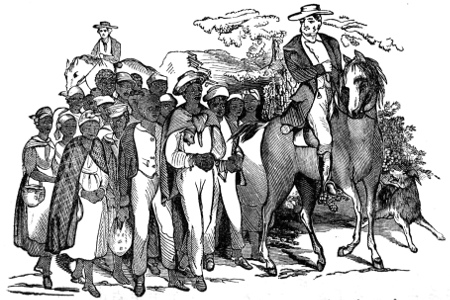
his pocket, marches his gang of chained men and women under the very
eaves of the nation's capitol. And this, too, in a country professing
to be the freest nation in the world. They profess to be democrats,
republicans, and to believe in the natural equality of men; that they
are "all created with certain inalienable rights, among which are
life, liberty, and the pursuit of happiness." They call themselves a
Christian nation; they rob three millions of their countrymen of their
liberties, and then talk of their piety, their democracy, and their
love of liberty; and, in the language of Shakspeare, say,
"And thus I clothe my naked villany,
And seem a saint when most I play the devil."
The people of the United States, with all their high professions, are
forging chains for unborn millions, in their wars for slavery. With
all their democracy, there is not a foot of land over which the "stars
and stripes" fly, upon which the American slave can stand and claim
protection. Wherever the United States constitution has jurisdiction,
and the American flag is seen flying, they point out the slave as a
chattel, a thing, a piece of property. But I thank God there is one
spot in America upon which the slave can stand and be a man. No matter
whether the claimant be a United States president, or a doctor of
divinity; no matter with what solemnities some American court may have
pronounced him a slave; the moment he makes his escape from under the
"stars and stripes," and sets foot upon the soil of Canada,
"the altar and the god sink together in the dust; his soul walks abroad
in her own majesty; his body swells beyond the measure of his chains,
that burst from around him; and he stands redeemed, regenerated, and
disenthralled, by the irresistible genius of universal emancipation."
But slavery must and will be banished from the United States soil:
"Let tyrants scorn, while tyrants dare,
The shrieks and writhings of despair;
The end will come, it will not wait,
Bonds, yokes, and scourges have their date;
Slavery itself must pass away,
And be a tale of yesterday."
But I will now stop, and let the slaveholders speak for themselves. I
shall here present some evidences of the treatment which slaves receive
from their masters; after which I will present a few of the slave-laws.
And it has been said, and I believe truly, that no people were ever
found to be better than their laws. And, as an American slave,—as one
who is identified with the slaves of the south by the scars which I
carry on my back,—as one identified with them by the tenderest ties
of nature,—as one whose highest aspirations are to serve the cause
of truth and freedom,—I beg of the reader not to lay this book down
until he or she has read every page it contains. I ask it not for my
own sake, but for the sake of three millions who cannot speak for themselves.
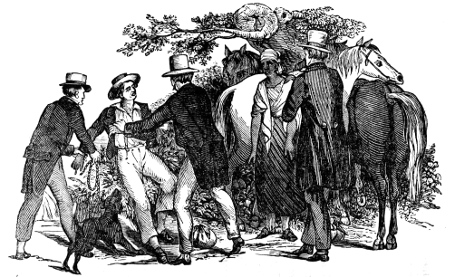
From the Livingston County (Alabama) Whig of Nov. 16, 1845.
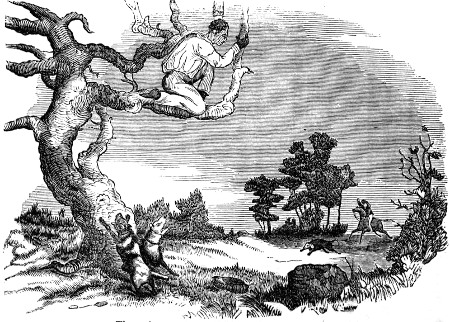
"Negro Dogs.—The undersigned having bought the entire
pack of Negro Dogs, (of the Hays & Allen stock,) he now proposes
to catch runaway Negroes. His charge will be three dollars per
day for hunting, and fifteen dollars for catching a runaway. He
resides three and a half miles north of Livingston, near the lower
Jones' Bluff road.
"William Gambrel.
"Nov. 6, 1845."
The Wilmington [North Carolina] Advertiser of July 13, 1838, contains
the following advertisement:
"Ranaway, my Negro man Richard. A reward of $25 will be paid for
his apprehension, DEAD or ALIVE. Satisfactory proof will only be
required of his being killed. He has with him, in all probability,
his wife Eliza, who ran away from Col. Thompson, now a resident of
Alabama, about the time he commenced his journey to that state.
"D. H. Rhodes.
The St. Louis Gazette says—
"A wealthy man here had a boy named Reuben, almost white, whom he
caused to be branded in the face with the words 'A slave for life.'"
From the N. C. Standard, July 28, 1838.
"Twenty Dollars Reward.—Ranaway from the subscriber, a
negro woman and two children; the woman is tall and black, and a
few days before she went off I burnt her on the left side of
her face: I tried to make the letter M, and she kept a cloth
over her head and face, and a fly bonnet over her head, so as to
cover the burn; her children are both boys, the oldest is in his
seventh year; he is a mulatto and has blue eyes; the youngest is
a black, and is in his fifth year.
"Micajah Ricks, Nash County."
"One of my neighbors sold to a speculator a negro boy, about 14
years old. It was more than his poor mother could bear. Her reason
fled, and she became a perfect maniac, and had to be kept in
close confinement. She would occasionally get out and run off to
the neighbors. On one of these occasions she came to my house.
With tears rolling down her cheeks, and her frame shaking with
agony, she would cry out, 'Don't you hear him—they are whipping
him now, and he is calling for me!' This neighbor of mine, who
tore the boy away from his poor mother, and thus broke her heart,
was a member of the Presbyterian church."—Rev. Francis Hawley,
Baptist minister, Colebrook, Ct.
A colored man in the city of St. Louis was taken by a mob, and burnt
alive at the stake. A bystander gives the following account of the
scene:—
"After the flames had surrounded their prey, and when his clothes
were in a blaze all over him, his eyes burnt out of his head, and
his mouth seemingly parched to a cinder, some one in the crowd,
more compassionate than the rest, proposed to put an end to his
misery by shooting him, when it was replied, that it would be
of no use, since he was already out of his pain. 'No,' said the
wretch, 'I am not, I am suffering as much as ever,—shoot me,
shoot me.' 'No, no,' said one of the fiends, who was standing
about the sacrifice they were roasting, 'he shall not be shot; I
would sooner slacken the fire, if that would increase his misery;'
and the man who said this was, we understand, an officer of
justice."—Alton Telegraph.
"We have been informed that the slave William, who murdered his
master (Huskey) some weeks since, was taken by a party a few days
since from the sheriff of Hot Spring, and burned alive! yes,
tied up to the limb of a tree and a fire built under him, and
consumed in a slow lingering torture."—Arkansas Gazette, Oct.
29, 1836.
The Natchez Free Trader, 16th June, 1842, gives a horrible account of
the execution of the negro Joseph on the 5th of that month for murder.
"The body," says that paper, "was taken and chained to a tree
immediately on the bank of the Mississippi, on what is called
Union Point. The torches were lighted and placed in the pile.
He watched unmoved the curling flame as it grew, until it began
to entwine itself around and feed upon his body; then he sent
forth cries of agony painful to the ear, begging some one to blow
his brains out; at the same time surging with almost superhuman
strength, until the staple with which the chain was fastened to
the tree, not being well secured, drew out, and he leaped from the
burning pile. At that moment the sharp ring of several rifles was
heard, and the body of the negro fell a corpse to the ground. He
was picked up by two or three, and again thrown into the fire and
consumed."
"Another Negro Burned.—We learn from the clerk of the
Highlander, that, while wooding a short distance below the mouth
of Red river, they were invited to stop a short time and see
another negro burned."—New Orleans Bulletin.
"We can assure the Bostonians, one and all, who have embarked in
the nefarious scheme of abolishing slavery at the south, that
lashes will hereafter be spared the backs of their emissaries.
Let them send out their men to Louisiana; they will never return
to tell their sufferings, but they shall expiate the crime of
interfering in our domestic institutions by being BURNED AT
THE STAKE."—New Orleans True American.
"The cry of the whole south should be death, instant death, to the
abolitionist, wherever he is caught."—Augusta (Geo.) Chronicle.
"Let us declare through the public journals of our country,
that the question of slavery is not and shall not be open for
discussion: that the system is too deep-rooted among us, and
must remain forever; that the very moment any private individual
attempts to lecture us upon its evils and immorality, and the
necessity of putting means in operation to secure us from them,
in the same moment his tongue shall be cut out and cast upon the
dunghill."—Columbia (S. C.) Telescope.
From the St. Louis Republican.
"On Friday last the coroner held an inquest at the house of Judge
Dunica, a few miles south of the city, over the body of a negro
girl, about 8 years of age, belonging to Mr. Cordell. The body
exhibited evidence of the most cruel whipping and beating we have
ever heard of. The flesh on the back and limbs was beaten to a
jelly—one shoulder-bone was laid bare—there were several cuts,
apparently from a club, on the head—and around the neck was
the indentation of a cord, by which it is supposed she had been
confined to a tree. She had been hired by a man by the name of
Tanner, residing in the neighborhood, and was sent home in this
condition. After coming home, her constant request, until her
death, was for bread, by which it would seem that she had been
starved as well as unmercifully whipped. The jury returned a
verdict that she came to her death by the blows inflicted by some
persons unknown whilst she was in the employ of Mr. Tanner. Mrs.
Tanner has been tried and acquitted."
A correspondent of the N. Y. Herald writes from St. Louis, Oct. 19:
"I yesterday visited the cell of Cornelia, the slave charged with
being the accomplice of Mrs. Ann Tanner (recently acquitted) in
the murder of a little negro girl, by whipping and starvation. She
admits her participancy, but says she was compelled to take the
part she did in the affair. On one occasion she says the child was
tied to a tree from Monday morning till Friday night, exposed by
day to the scorching rays of the sun, and by night to the stinging
of myriads of musquitoes; and that during all this time the child
had nothing to eat, but was whipped daily. The child told the same
story to Dr. McDowell."
From the Carroll County Mississippian, May 4th, 1844.
"Committed to jail in this place, on the 29th of April last,
a runaway slave named Creesy, and says she belongs to William
Barrow, of Carroll county, Mississippi. Said woman is stout built,
five feet four inches high, and appears to be about twenty years
of age; she has a band of iron on each ankle, and a trace chain
around her neck, fastened with a common padlock.
"J. N. Spencer, Jailer.
"May 15, 1844."
The Savannah, Ga., Republican of the 13th of March, 1845, contains an
advertisement, one item of which is as follows:—
"Also, at the same time and place, the following negro slaves, to
wit: Charles, Peggy, Antonnett, Davy, September, Maria, Jenny,
and Isaac—levied on as the property of Henry T. Hall, to satisfy
a mortgage fi. fia. issued out of McIntosh Superior Court, in
favor of the board of directors of the Theological Seminary of
the Synod of South Carolina and Georgia, vs. said Henry T. Hall.
Conditions, cash.
"C. O'Neal, Deputy Sheriff, M. C."
In the "Macon (Georgia) Telegraph," May 28, is the following:
"About the first of March last, the negro man Ransom
left me, without the least provocation whatever. I will give a
reward of $20 dollars for said negro, if taken DEAD or
ALIVE,—and if killed in any attempt an advance of $5
will be paid.
"Bryant Johnson.
"Crawford Co., Ga."
From the Apalachicola Gazette, May 9.
"One Hundred and Fifty Dollars Reward.—Ranaway from
my plantation on the 6th inst., three negro men, all of dark
complexion.
"Bill is about five feet four inches high, aged about
twenty-six, a scar on his upper lip, also one on his shoulder,
and has been badly cut on his arm; speaks quick and broken, and
a venomous look.
"Daniel is about the same height, chunky and well set,
broad, flat mouth, with a pleasing countenance, rather inclined to
show his teeth when talking, no particular marks recollected, aged
about twenty-three.
"Noah is about six feet three or four inches high,
twenty-eight years old, with rather a down, impudent look,
insolent in his discourse, with a large mark on his breast, a
good many large scars, caused by the whip, on his back—has
been shot in the back of his arm with small shot. The above
reward will be paid to any one who will KILL the three,
or fifty for either one, or twenty dollars apiece for them
delivered to me at my plantation alive, on Chattahoochie, Early county.
"J. McDonald."
From the Alabama Beacon, June 11, 1845.
"Ranaway, on the 15th of May, from me, a negro woman named Fanny.
Said woman is twenty years old; is rather tall, can read and
write, and so forge passes for herself. Carried away with her a
pair of ear-rings, a Bible with a red cover, is very pious. She
prays a great deal, and was, as supposed, contented and happy. She
is as white as most white women, with straight light hair, and
blue eyes, and can pass herself for a white woman. I will give
five hundred dollars for her apprehension and delivery to me. She
is very intelligent.
"John Balch.
"Tuscaloosa, May, 29, 1845."
From the N. O. Commercial Bulletin, Sept. 30.
"Ten Dollars Reward.—Ranaway from the subscribers, on
the 15th of last month, the negro man Charles, about 45 years of
age, 5 feet 6 inches high; red complexion, has had the upper
lid of his right eye torn, and a scar on his forehead; speaks
English only, and stutters when spoken to; he had on when he
left, an iron collar, the prongs of which he broke off before
absconding. The above reward will be paid for the arrest of said slave.
W. E. & R. Murphy,
"132 Old Raisin."
From the N. O. Bee, Oct. 5.
"Ranaway from the residence of Messrs. F. Duncom & Co., the negro
Francois, aged from 25 to 30 years, about 5 feet 1 inch in height;
the upper front teeth are missing; he had chains on both of
his legs, dressed with a kind of blouse made of sackcloth. A
proportionate reward will be given to whoever will bring him back
to the bakery, No. 74, Bourbon street."
From the N. O. Picayune of Sunday, Dec. 17.
"Cock-pit.—Benefit of Fire Company No. 1,
Lafayette.—A cock-fight will take place on Sunday, the 17th
inst., at the well-known house of the subscriber. As the entire
proceeds are for the benefit of the fire company, a full
attendance is respectfully solicited.
Adam Israng.
"Corner of Josephine and Tchoupitolas streets, Lafayette."
From the N. O. Picayune.
"Turkey Shooting.—This day, Dec. 17, from 10 o'clock,
A. M., until 6 o'clock, P. M., and the following
Sundays, at M'Donoughville, opposite the Second Municipality Ferry."
The next is an advertisement from the New Orleans Bee, an equally
popular paper.
"A Bull Fight, between a ferocious bull and a number of
dogs, will take place on Sunday next, at 4¼ o'clock, P.
M., on the other side of the river, at Algiers, opposite
Canal street. After the bull fight, a fight will take place
between a bear and some dogs. The whole to conclude by a combat
between an ass and several dogs.
"Amateurs bringing dogs to participate in the fight will be
admitted gratis. Admittance—Boxes, 50 cts.; Pit, 30 cts. The
spectacle will be repeated every Sunday, weather permitting.
"Pepe Llulla."
EXTRACTS FROM THE AMERICAN SLAVE CODE.
The following are mostly abridged selections from the statutes of the
slave status and of the United States. They give but a faint view of
the cruel oppression to which the slaves are subject, but a strong
one enough, it is thought, to fill every honest heart with a deep
abhorrence of the atrocious system. Most of the important provisions
here cited, though placed under the name of only one state, prevail
in nearly all the states, with slight variations in language, and
some diversity in the penalties. The extracts have been made in part
from Stroud's Sketch of the Slave Laws, but chiefly from authorized
editions of the statute books referred to, found in the Philadelphia
Law Library. As the compiler has not had access to many of the later
enactments of the several states, nearly all he has cited are acts of
an earlier date than that of the present anti-slavery movement, so that
their severity cannot be ascribed to its influence.
The cardinal principle of slavery, that the slave is not to be
ranked among sentient beings, but among things—is an article of
property, a chattel personal—obtains as undoubted law in all the slave
states.[1]—Stroud's Sketch, p. 22.
The dominion of the master is as unlimited as is that which is
tolerated by the laws of any civilized country in relation to brute
animals—to quadrupeds; to use the words of the civil law.—Ib. 24.
Slaves cannot even contract matrimony.[2]—Ib. 61.
LOUISIANA.—A slave is one who is in the power of his master, to
whom he belongs. The master may sell him, dispose of his person, his
industry and his labor; he can do nothing, possess nothing, nor acquire
anything, but what must belong to his master.—Civil Code, Art. 35.
Slaves are incapable of inheriting or transmitting property.—Civil
Code, Art. 945; also Art. 175, and Code of Practice, Art. 103.
Martin's Digest, Act of June 7, 1806.—Slaves shall always be reputed
and considered real estate; shall be as such subject to be mortgaged,
according to the rules prescribed by law, and they shall be seized and
sold as real estate.—Vol. I., p. 612.
Dig. Stat. Sec 13.—No owner of slaves shall hire his slaves
to themselves, under a penalty of twenty-five dollars for each
offence.—Vol. I., p. 102.
Sec. 15.—No slave can possess anything in his own right, or dispose of
the produce of his own industry, without the consent of his master.—p.
103.
Sec. 16.—No slave can be party in a civil suit, or witness in a civil
or criminal matter, against any white person.—p. 103. See also Civil
Code, Art. 117, p. 28.
Sec. 18.—A slave's subordination to his master is susceptible of no
restriction, (except in what incites to crime,) and he owes to him and
all his family, respect without bounds, and absolute obedience.—p. 103.
Sec. 25.—Every slave found on horseback, without a written permission
from his master, shall receive twenty-five lashes.—p. 105.
Sec. 32.—Any freeholder may seize and correct any slave found absent
from his usual place of work or residence, without some white person,
and if the slave resist or try to escape, he may use arms, and if the
slave assault[3] and strike him, he may kill the slave.—p. 109.
Sec. 35.—It is lawful to fire upon runaway negroes who are armed, and
upon those who, when pursued, refuse to surrender.—p. 109.
Sec. 38.—No slave may buy, sell, or exchange any kind of goods, or
hold any boat, or bring up for his own use any horses or cattle, under
a penalty of forfeiting the whole.—p. 110.
Sec. 7.—Slaves or free colored persons are punished with death,
for wilfully burning or destroying any stack of produce or any
building.—p. 115.
Sec. 15.—The punishment of a slave for striking a white person, shall
be for the first and second offences at the discretion of the court,[4]
but not extending to life or limb, and for the third offence death;
but for grievously wounding or mutilating a white person, death for
the first offence; provided, if the blow or wound is given in defence
of the person or property of his master, or the person having charge
of him, he is entirely justified.
Act of Feb. 22, 1824, Sec. 2.—A slave for wilfully striking his
master or mistress, or the child of either, or his white overseer, so
as to cause a bruise or shedding of blood, shall be punished with
death.—p. 125.
Act of March 6, 1819.—Any person cutting or breaking any iron chain
or collar used to prevent the escape of slaves, shall be fined not less
than two hundred dollars, nor more than one thousand dollars, and be
imprisoned not more than two years nor less than six months.—p. 64 of
the session.
Law of January 8, 1813, Sec. 71.—All slaves sentenced to death or
perpetual imprisonment, in virtue of existing laws, shall be paid for
out of the public treasury, provided the sum paid shall not exceed $300
for each slave.
Law of March 16, 1830, Sec. 93.—The state treasurer shall pay the
owners the value of all slaves whose punishment has been commuted from
that of death to that of imprisonment for life, &c.
If any slave shall happen to be slain for refusing to surrender him
or herself, contrary to law, or in unlawfully resisting any officer or
other person, who shall apprehend, or endeavor to apprehend, such
slave or slaves, &c., such officer or other person so killing such
slave as aforesaid, making resistance, shall be, and he is by this
act, indemnified, from any prosecution for such killing aforesaid,
&c.—Maryland Laws, act of 1751, chap xiv., § 9.
And by the negro act of 1740, of South Carolina, it is declared:
If any slave, who shall be out of the house or plantation where such
slave shall live, or shall be usually employed, or without some white
person in company with such slave, shall refuse to submit to undergo
the examination of any white person, it shall be lawful for such
white person to pursue, apprehend, and moderately correct such slave
and if such slave shall assault and strike such white person, such
slave may be lawfully killed!!—2 Brevard's Digest, 231.
MISSISSIPPI. Chapt. 92, Sec. 110.—Penalty for any slave or free
colored person exercising the functions of a minister of the gospel,
thirty-nine lashes; but any master may permit his slave to preach
on his own premises, no slaves but his own being permitted to
assemble.—Digest of Stat., p. 770.
Act of June 18, 1822, Sec. 21.—No negro or mulatto can be a witness
in any case, except against negroes or mulattoes.—p. 749. New Code,
372.
Sec. 25.—Any master licensing his slave to go at large and trade as a
freeman, shall forfeit fifty dollars to the state for the literary fund.
Penalty for teaching a slave to read, imprisonment one year. For using
language having a tendency to promote discontent among free colored
people, or insubordination among slaves, imprisonment at hard labor,
not less than three, nor more than twenty-one years, or DEATH,
at the discretion of the court.—L. M. Child's Appeal, p. 70.
Sec. 26.—It is lawful for any person, and the duty of every
sheriff, deputy-sheriff, coroner and constable to apprehend any slave
going at large, or hired out by him, or herself, and take him or her
before a justice of the peace, who shall impose a penalty of not less
than twenty dollars, nor more than fifty dollars, on the owner, who has
permitted such slave to do so.
Sec. 32.—Any negro or mulatto, for using abusive language, or lifting
his hand in opposition to any white person, (except in self-defence
against a wanton assault,) shall, on proof of the offence by oath of
such person, receive such punishment as a justice of the peace may
order, not exceeding thirty-nine lashes.
Sec. 41—Forbids the holding of cattle, sheep or hogs by slaves, even
with consent of the master, under penalty of forfeiture, half to the
county, and half to the informer.
Sec. 42—Forbids a slave keeping a dog, under a penalty of twenty-five
stripes; and requires any master who permits it to pay a fine of five
dollars, and make good all damages done by such dog.
Sec. 43—Forbids slaves cultivating cotton for their own use, and
imposes a fine of fifty dollars on the master or overseer who permits
it.
Revised Code.—Every negro or mulatto found in the state, not able to
show himself entitled to freedom, may be sold as a slave.—p. 389. The
owner of any plantation, on which a slave comes without written leave
from his master, and not on lawful business, may inflict ten lashes for
every such offence.—p. 371.
ALABAMA.—Aiken's Digest. Tit. Slaves, &c., Sec. 31.—For
attempting to teach any free colored person, or slave, to spell,
read or write, a fine of not less than two hundred and fifty dollars,
nor more than five hundred dollars!—p. 397.
Sec. 35 and 36.—Any free colored person found with slaves in a
kitchen, outhouse or negro quarter, without a written permission from
the master or overseer of said slaves, and any slave found without such
permission with a free negro on his premises, shall receive fifteen
lashes for the first offence, and thirty-nine for each subsequent
offence; to be inflicted by master, overseer, or member of any patrol
company.—p. 397.
Toulmin's Digest.—No slave can be emancipated but by a special act
of the Legislature.—p. 623.
Act Jan. 1st, 1823—Authorizes an agent to be appointed by the governor
of the state, to sell for the benefit of the state all persons of
color brought into the United States and within the jurisdiction of
Alabama, contrary to the laws of congress prohibiting the slave
trade.—p. 643.
GEORGIA.—Prince's Digest. Act Dec. 19, 1818.—Penalty for any free
person of color (except regularly articled seamen) coming into the
state, a fine of one hundred dollars, and on failure of payment to be
sold as a slave.—p. 465.
Penalty for permitting a slave to labor or do business for himself,
except on his master's premises, thirty dollars per week.—p. 457.
No slave can be a party to any suit against a white man, except on
claim of his freedom, and every colored person is presumed to be a
slave, unless he can prove himself free.—p. 446.
Act Dec. 13, 1792—Forbids the assembling of negroes under pretence of
divine worship, contrary to the act regulating patrols, p. 342. This
act provides that any justice of the peace may disperse any assembly of
slaves which may endanger the peace; and every slave found at such
meeting shall receive, without trial, twenty-five stripes!—p. 447.
Any person who sees more than seven men slaves without any white
person, in a high road, may whip each slave twenty lashes.—p. 454.
Any slave who harbors a runaway, may suffer punishment to any extent,
not affecting life or limb.—p. 452.
SOUTH CAROLINA.—Brevard's Digest.—Slaves shall be deemed sold,
taken, reputed, and adjudged in law to be chattels personal in
the hands of their owners and possessors, and their executors,
administrators, and assigns, to all intents, constructions and
purposes whatever.—Vol. ii., p. 229.
Act of 1740, in the preamble, states that "many owners of slaves and
others that have the management of them do confine them so closely
to hard labor, that they have not sufficient time for natural
rest," and enacts that no slave shall be compelled to labor more than
fifteen hours in the twenty-four, from March 25th to Sept. 25th, or
fourteen in the twenty-four for the rest of the year. Penalty from £5
to £20.—Vol. ii., p. 243.
[Yet, in several of the slave states, the time of work for criminals
whose punishment is hard labor, is eight hours a day for three
months, nine hours for two months, and ten for the rest of the year.]
A slave endeavoring to entice another slave to run away, if provision
be prepared for the purpose of aiding or abetting such endeavor, shall
suffer death.—pp. 233 and 244.
Penalty for cruelly scalding or burning a slave, cutting out his
tongue, putting out his eye, or depriving him of any limb, a fine
of £100. For beating with a horse-whip, cow-skin, switch or small
stick, or putting irons on, or imprisoning a slave, no penalty or
prohibition.—p. 241.
Any person who, not having lawful authority to do so, shall beat a
slave, so as to disable him from working, shall pay fifteen shillings
a day to the owner, for the slave's lost time, and the charge of his
cure.—pp. 231 and 232.
A slave claiming his freedom may sue for it by some friend who will act
as guardian, but if the action be judged groundless, said guardian
shall pay double costs of suit, and such damages to the owner as the
court may decide.—p. 260.
Any assembly of slaves or free colored persons, in a secret or confined
place, for mental instruction, (even if white persons are present,)
is an unlawful meeting, and magistrates must disperse it, breaking
doors if necessary, and may inflict twenty lashes upon each slave or
colored person present.—pp. 254 and 255.
Meetings for religious worship, before sunrise, or after 9 o'clock,
P. M., unless a majority are white persons, are forbidden; and
magistrates are required to disperse them.—p. 261.
A slave who lets loose any boat from the place where the owner has
fastened it, for the first offence shall receive thirty-nine lashes,
and for the second shall have one ear cut off.—p. 228.
James' Digest.—Penalty for killing a slave, on sudden heat of
passion, or by undue correction, a fine of $500 and imprisonment not
over six months.—p. 392.
NORTH CAROLINA.—Haywood's Manual.—Act of 1798, Sec. 3, enacts,
that the killing of a slave shall be punished like that of a free man;
except in the case of a slave out-lawed,[5] or a slave offering to
resist his master, or a slave dying under moderate correction.—p.
530.
Act of 1799.—Any slave set free, except for meritorious services, to
be adjudged of by the county court, may be seized by any freeholder,
committed to jail, and sold to the highest bidder.[6]—p. 525.
Patrols are not liable to the master for punishing his slave, unless
their conduct clearly shows malice against the master.—Hawk's
Reps., vol. i., p. 418.
TENNESSEE.—Stat. Law, Chap. 57, Sec. 1.—Penalty on master for
hiring to any slave his own time, a fine of not less than one dollar
nor more than two dollars a day, half to the informer.—p. 679.
Chap. 2, Sec. 102.—No slave can be emancipated but on condition of
immediately removing from the state, and the person emancipating
shall give bond, in a sum equal to the slave's value, to have him
removed.—p. 279.
Laws of 1813. Chap. 35.—In the trial of slaves, the sheriff
chooses the court, which must consist of three justices and twelve
slaveholders to serve as jurors.
ARKANSAS.—Rev. Stat., Sec. 4, requires the patrol to visit all
places suspected of unlawful assemblages of slaves; and sec. 5 provides
that any slave found at such assembly, or strolling about without a
pass, shall receive any number of lashes, at the discretion of the
patrol, not exceeding twenty.—p. 604.
MISSOURI.—Laws, I.—Any master may commit to jail, there to
remain, at his pleasure, any slave who refuses to obey him or his
overseer.—p. 309.
Whether a slave claiming freedom may even commence a suit for it, may
depend on the decision of a single judge.—Stroud's Sketch, p. 78,
note which refers to Missouri laws, I., 404.
KENTUCKY.—Dig. of Stat., Act Feb. 8, 1798, Sec. 5.—No colored
person may keep or carry gun, powder, shot, club or other
weapon, on penalty of thirty-nine lashes, and forfeiting the weapon,
which any person is authorized to take.
VIRGINIA.—Rev. Code.—Any emancipated slave remaining in the state
more than a year, may be sold by the overseers of the poor, for the
benefit of the literary fund!—Vol. i., p. 436.
Any slave or free colored person found at any school for teaching
reading or writing, by day or night, may be whipped, at the discretion
of a justice, not exceeding twenty lashes.—p. 424.
Suppl. Rev. Code.—Any white person assembling with slaves, for
the purpose of teaching them to read or write, shall be fined, not
less than 10 dollars, nor more than 100 dollars; or with free colored
persons, shall be fined not more than fifty dollars, and imprisoned not
more than two months.—p. 245.
By the revised code, seventy-one offences are punished with death
when committed by slaves, and by nothing more than imprisonment when by
the whites.—Stroud's Sketch, p. 107.
Rev. Code.—In the trial of slaves, the court consists of five
justices without juries, even in capital cases.—I., p. 420.
MARYLAND.—Stat. Law, Sec. 8.—Any slave, for rambling in the night,
or riding horses by day without leave, or running away, may be punished
by whipping, cropping, or branding in the cheek, or otherwise, not
rendering him unfit for labor.—p. 237.
Any slave convicted of petty treason, murder, or wilful burning of
dwelling houses, may be sentenced to have the right hand cut off, to
be hanged in the usual manner, the head severed from the body, the body
divided into four quarters, and the head and quarters set up in the
most public place in the country where such fact was committed!!—p.
190.
Act 1717, Chap. 13, Sec. 5—Provides that any free colored person
marrying a slave, becomes a slave for life, except mulattoes born of
white women.
DELAWARE.—Laws.—More than six men slaves, meeting together, not
belonging to one master, unless on lawful business of their owners, may
be whipped to the extent of twenty-one lashes each.—p. 104.
UNITED STATES.—Constitution.—The chief pro-slavery provisions of
the constitution, as is generally known, are, 1st, that by virtue of
which the slave states are represented in congress for three-fifths
of their slaves;[7] 2nd, that requiring the giving up of any runaway
slaves to their masters; 3rd, that pledging the physical force of
the whole country to suppress insurrections, i. e., attempts to gain
freedom by such means as the framers of the instrument themselves used.
Act of Feb. 12, 1793—Provides that any master or his agent may seize
any person whom he claims as a "fugitive from service," and take
him before a judge of the U. S. court, or magistrate of the city or
county where he is taken, and the magistrate, on proof, in support of
the claim, to his satisfaction, must give the claimant a certificate
authorizing the removal of such fugitive to the state he fled from.[8]
DISTRICT OF COLUMBIA.—The act of congress incorporating Washington
city, gives the corporation power to prescribe the terms and conditions
on which free negroes and mulattoes may reside in the city. City
Laws, 6 and 11. By this authority, the city in 1827 enacted that any
free colored person coming there to reside, should give the mayor
satisfactory evidence of his freedom, and enter into bond with two
freehold sureties, in the sum of five hundred dollars, for his good
conduct, to be renewed each year for three years; or failing to do so,
must leave the city, or be committed to the workhouse, for not more
than one year, and if he still refuse to go, may be again committed for
the same period, and so on.—Ib. 198.
Colored persons residing in the city, who cannot prove their title to
freedom, shall be imprisoned as absconding slaves.—Ib. 198.
Colored persons found without free papers may be arrested as runaway
slaves, and after two months' notice, if no claimant appears, must be
advertised ten days, and sold to pay their jail fees.[9]—Stroud, 85,
note.
The city of Washington grants a license to trade in slaves, for
profit, as agent, or otherwise, for four hundred dollars.—City Laws,
p. 249.
Reader, you uphold these laws while you do nothing for their repeal.
You can do much. You can take and read the anti-slavery journals.
They will give you an impartial history of the cause, and arguments
with which to convert its enemies. You can countenance and aid
those who are laboring for its promotion. You can petition against
slavery; you can refuse to vote for slaveholders or pro-slavery men,
constitutions and compacts; can abstain from products of slave labor;
and can use your social influence to spread right principles and awaken
a right feeling. Be as earnest for freedom as its foes are for slavery,
and you can diffuse an anti-slavery sentiment through your whole
neighborhood, and merit "the blessing of them that are ready to perish."
The following is from the old colonial law of North Carolina:
Notice of the commitment of runaways—viz., 1741, c. 24, § 29. "An act
concerning servants and slaves."
Copy of notice containing a full description of such runaway and his
clothing.—The sheriff is to "cause a copy of such notice to be sent
to the clerk or reader of each church or chapel within his county, who
are hereby required to make publication thereof by setting up the same
in some open and convenient place, near the said church or chapel, on
every Lord's day, during the space of two months from the date thereof."
1741, c. 24, § 45.—"Which proclamation shall be published on a Sabbath
day at the door of every church or chapel, or, for want of such, at the
place where divine service shall be performed in the said county, by
the parish clerk or reader, immediately after divine service; and if
any slave or slaves, against whom proclamation hath been thus issued,
stay out and do not immediately return home, it shall be lawful for any
person or persons whatsoever to kill and destroy such slave or slaves
by such way or means as he or she shall think fit, without accusation
or impeachment of any crime for the same."
It is well known that slavery makes labor disreputable in the slave
states. Laboring men of the north, hear how contemptibly slaveholders
speak of you.
Mr. Robert Wickliffe of Kentucky, in a speech published in the
Louisville Advertiser, in opposition to those who were averse to the
importation of slaves from the states, thus discourseth:
"Gentlemen wanted to drive out the black population that they may
obtain WHITE NEGROES in their place. White negroes
have this advantage over black negroes, they can be converted into
voters; and the men who live upon the sweat of their brow, and pay
them but a dependent and scanty subsistence, can, if able to keep ten
thousand of them in employment, come up to the polls and change the
destiny of the country.
"How improved will be our condition when we have such white negroes as
perform the servile labors of Europe, of old England, and he would add
now of New England, when our body servants and our cart drivers, and
our street sweepers, are white negroes instead of black. Where will
be the independence, the proud spirit, and chivalry of the Kentuckians
then?"
"We believe the servitude which prevails in the south far preferable
to that of the north, or in Europe. Slavery will exist in all
communities. There is a class which may be nominally free, but they
will be virtually slaves."—Mississippian, July 6th, 1838.
"Those who depend on their daily labor for their daily subsistence can
never enter into political affairs, they never do, never will, never
can."—B. W. Leigh in Virginia Convention, 1829.
"All society settles down into a classification of capitalists and
laborers. The former will own the latter, either collectively through
the government, or individually in a state of domestic servitude as
exists in the southern states of this confederacy. If LABORERS
ever obtain the political power of a country, it is in fact in a state
of REVOLUTION. The capitalists north of Mason and Dixon's
line have precisely the same interest in the labor of the country
that the capitalists of England have in their labor. Hence it is,
that they must have a strong federal government (!) to control the
labor of the nation. But it is precisely the reverse with us. We
have already not only a right to the proceeds of our laborers, but
we OWN a class of laborers themselves. But let me say to
gentlemen who represent the great class of capitalists in the north,
beware that you do not drive us into a separate system, for if you do,
as certain as the decrees of heaven, you will be compelled to appeal
to the sword to maintain yourselves at home. It may not come in your
day; but your children's children will be covered with the blood of
domestic factions, and a plundering mob contending for power and
conquest."—Mr. Pickens, of South Carolina, in Congress, 21st Jan.,
1836.
"In the very nature of things there must be classes of persons to
discharge all the different offices of society from the highest to the
lowest. Some of these offices are regarded as degraded, although
they must and will be performed. Hence those manifest forms of
dependent servitude which produce a sense of superiority in the masters
or employers, and of inferiority on the part of the servants. Where
these offices are performed by members of the political community,
a DANGEROUS ELEMENT is obviously introduced into the body
politic. Hence the alarming tendency to violate the rights of property
by agrarian legislation which is beginning to be manifest in the
older states where UNIVERSAL SUFFRAGE prevails without
DOMESTIC SLAVERY.
"In a word, the institution of domestic slavery supersedes the
necessity of AN ORDER OF NOBILITY AND ALL THE OTHER APPENDAGES OF
A HEREDITARY SYSTEM OF GOVERNMENT."—Gov. M'Duffie's Message to
the South Carolina Legislature, 1836.
"We of the south have cause now, and shall soon have greater, to
congratulate ourselves on the existence of a population among us which
excludes the POPULACE which in effect rules some of our
northern neighbors, and is rapidly gaining strength wherever slavery
does not exist—a populace made up of the dregs of Europe, and the most
worthless portion of the native population."—Richmond Whig, 1837.
"Would you do a benefit to the horse or the ox by giving him a
cultivated understanding, a fine feeling! So far as the MERE
LABORER has the pride, the knowledge or the aspiration of a
freeman, he is unfitted for his situation. If there are sordid,
servile, laborious offices to be performed, is it not better that
there should be sordid, servile, laborious beings to perform them?
"Odium has been cast upon our legislation on account of its forbidding
the elements of education being communicated to slaves. But in truth
what injury is done them by this? He who works during the day with his
hands, does not read in the intervals of leisure for his amusement
or the improvement of his mind, or the exception is so very rare as
scarcely to need the being provided for."—Chancellor Harper, of
South Carolina.—Southern Lit. Messenger.
"Our slave population is decidedly preferable, as an orderly and
laboring class, to a northern laboring class, that have just learning
enough to make them wondrous wise, and make them the most dangerous
class to well regulated liberty under the sun."—Richmond (Virginia)
Enquirer.