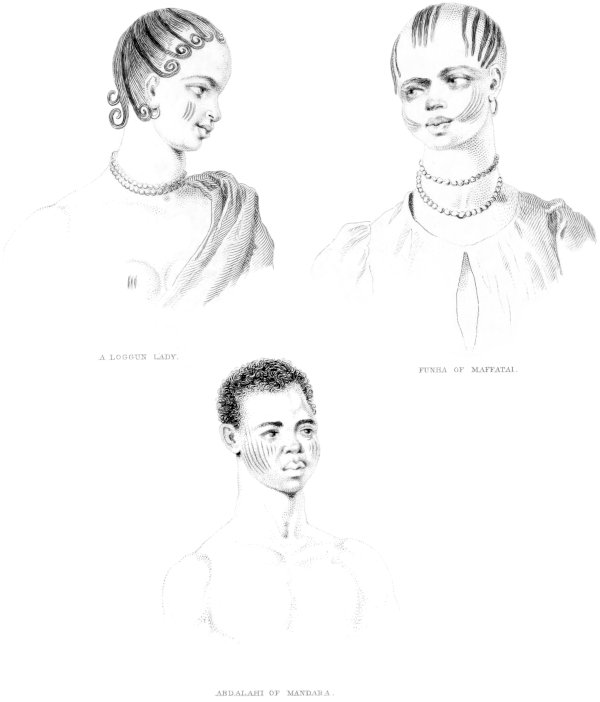
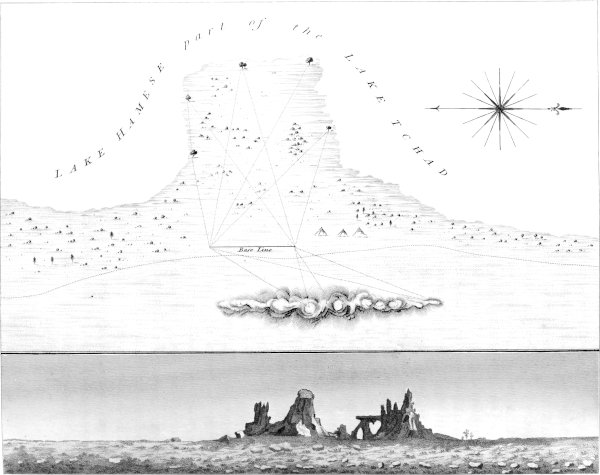
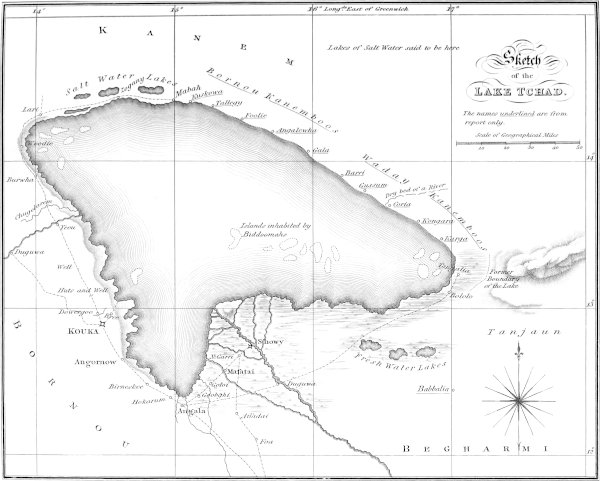
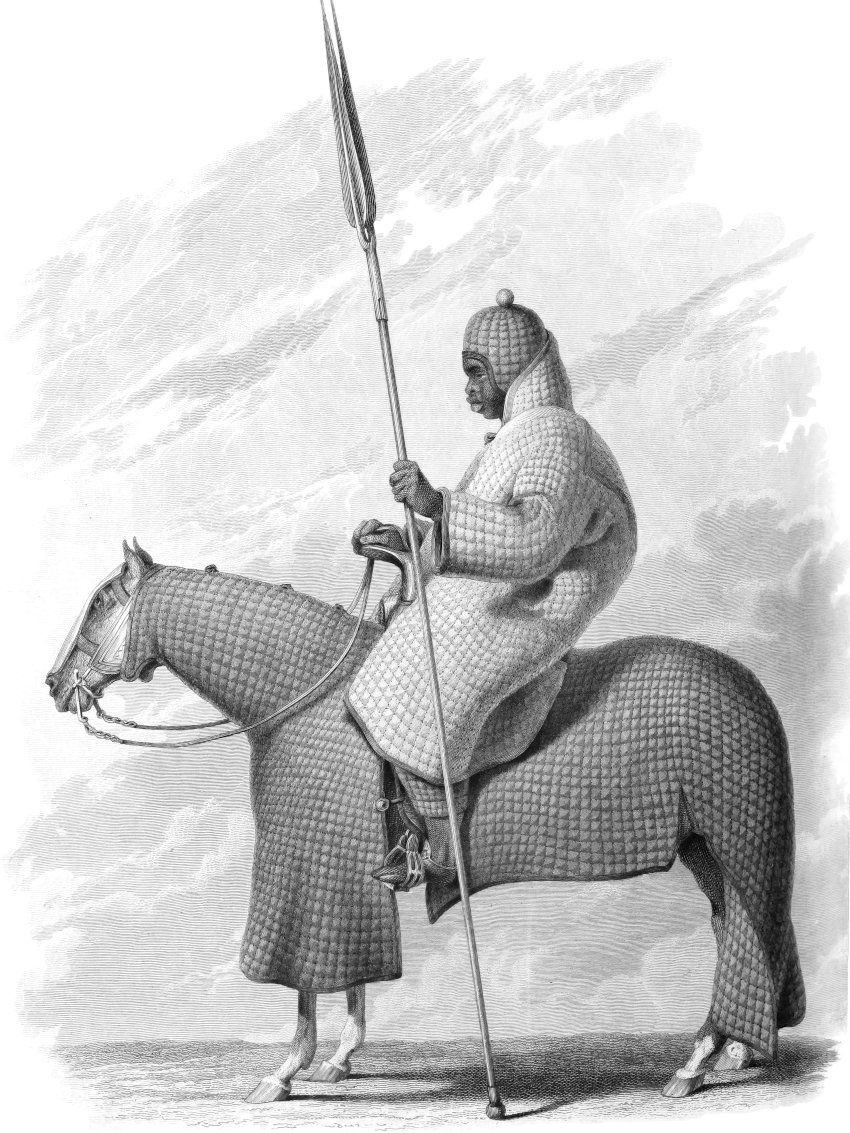
Narrative of travels and discoveries in Northern and Central Africa in the years 1822, 1823, and 1824
Whole book · 43 sections
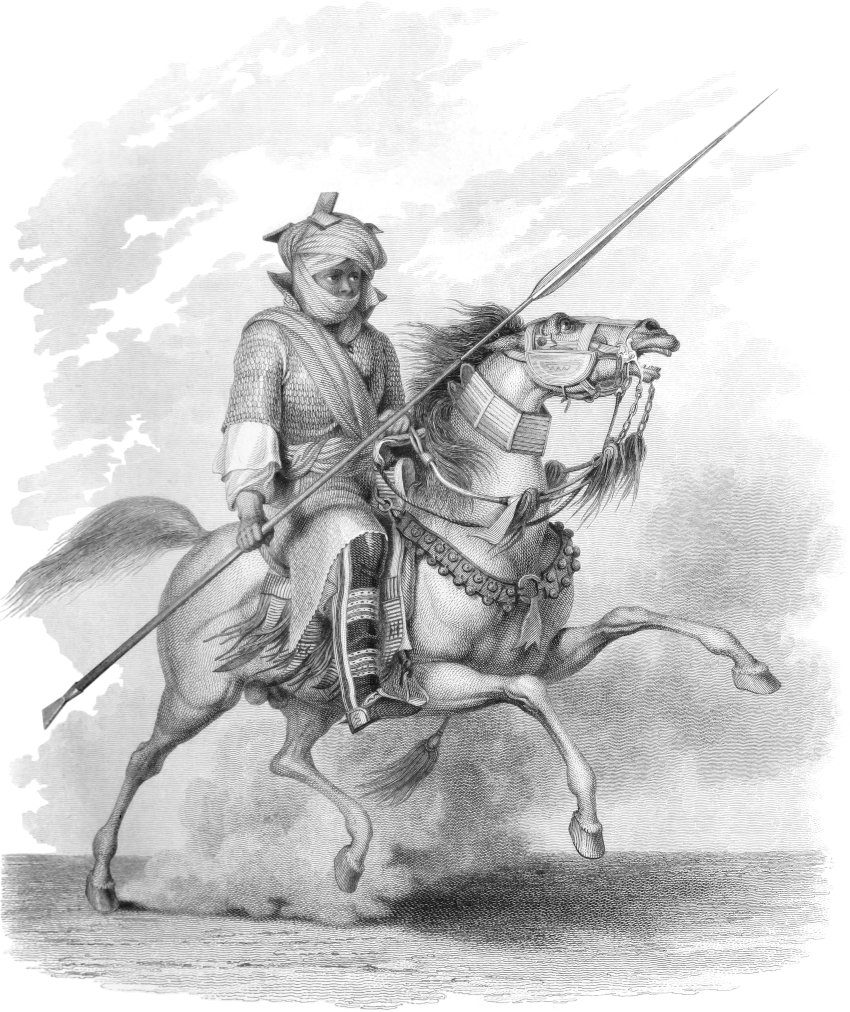
NARRATIVE OF TRAVELS AND DISCOVERIES IN NORTHERN AND CENTRAL AFRICA, IN THE YEARS 1822, 1823, AND 1824,
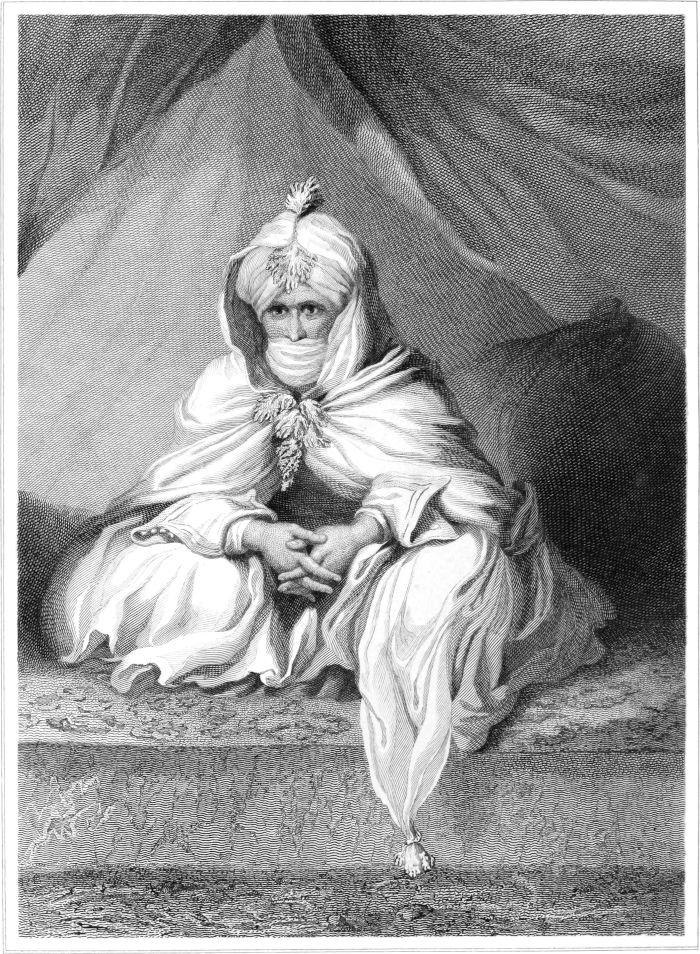
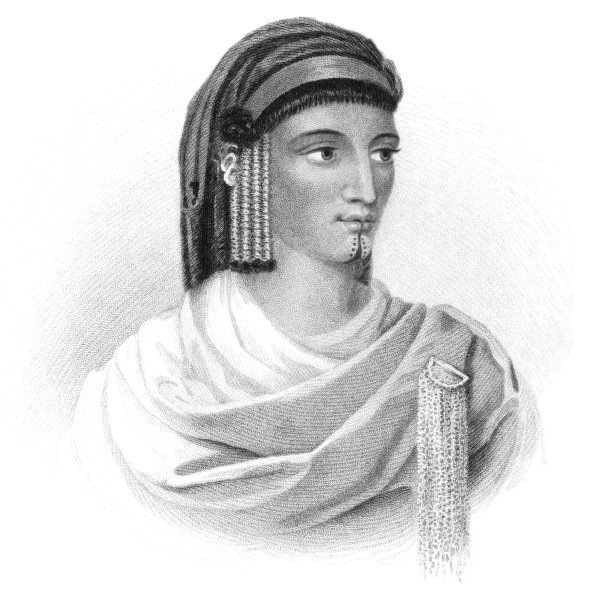
Drawn by Major Denham.
Engraved by E. Finden.
ALAMEEN-BEN MOHAMMED EL KANEMY.
SHEIKH OF BORNOU.
Published by John Murray, London. Feb.
1826.
BY MAJOR DENHAM,
CAPTAIN CLAPPERTON, AND THE
LATE DOCTOR OUDNEY,
EXTENDING ACROSS THE
GREAT DESERT TO THE TENTH DEGREE OF
NORTHERN LATITUDE, AND FROM
KOUKA IN BORNOU, TO SACKATOO, THE CAPITAL OF THE FELLATAH
EMPIRE.
WITH
AN
APPENDIX,
PUBLISHED BY AUTHORITY OF THE RIGHT
HONOURABLE EARL BATHURST, ONE OF HIS
MAJESTY’S PRINCIPAL SECRETARIES OF STATE, AND DEDICATED BY
PERMISSION TO HIS LORDSHIP,
BY MAJOR DIXON
DENHAM, OF HIS MAJESTY’S 17TH REGIMENT OF
FOOT, AND CAPTAIN HUGH CLAPPERTON, OF THE ROYAL NAVY, THE SURVIVORS OF THE EXPEDITION.
LONDON:
JOHN MURRAY, ALBEMARLE-STREET.
MDCCCXXVI.
LONDON: PRINTED BY THOMAS DAVISON, WHITEFRIARS.
TO THE RIGHT HONOURABLE THE EARL BATHURST,
K.G. HIS MAJESTY’S PRINCIPAL SECRETARY
OF STATE FOR THE COLONIES, THIS VOLUME, CONTAINING AN ACCOUNT OF THEIR
DISCOVERIES MADE UNDER THE AUSPICES OF HIS
LORDSHIP, IS INSCRIBED, WITH THE GREATEST RESPECT AND
GRATITUDE, BY HIS OBLIGED AND FAITHFUL
SERVANTS,
THE AUTHORS.
PREFACE.
By the death of Dr. Oudney, it has
fallen to the lot of Captain Clapperton and myself to render an
account to the public of our expedition into the interior and
central parts of Northern Africa. The sudden departure of my
surviving companion, on a second mission, has necessarily thrown
the greater part of the burden on myself. I believe, however—for I
have not seen any of his papers—that Captain Clapperton, during the
lifetime of Dr. Oudney, made but few remarks himself beyond the
construction of the chart of our route, from daily observations of
the latitude, and of lunars for the longitude, whenever favourable
opportunities occurred; but, subsequently to the death of his
travelling companion, which happened at an early stage of their
journey into Soudan, a journal of his proceedings and remarks
appears to have been regularly kept; and this, together with other
documents connected with that journey, were left at his departure
in the hands of Mr. Barrow, with a request that he would see them
through the press.
It may naturally
enough be asked, Why something more than a short excursion to the
westward of Mourzuk, and a few notes, do not appear from the pen of
Dr. Oudney in the present volume? I can only answer the question by
the fact, that the only papers placed in my hands consist of “An
Itinerary from Mourzuk to Bornou;” and “An Excursion to the
Westward of Mourzuk;” neither of which have been deemed fit for
publication in extenso, from their imperfect state, and
containing very little beyond what will be found in my own
journals. I have, however, printed in foot notes such parts of them
as have been pointed out to me. Not a paper of his, to my
knowledge, has been lost or destroyed; and I can only account for
the unsatisfactory state in which they have been found, from the
circumstance of his ill health, which became extremely precarious
from the moment of our departure from Mourzuk, where he had caught
a cold, which settled on his lungs, and never left him. On our
arrival at Kouka, and frequently afterwards, he experienced so many
attacks of fever, that there appeared little hope of his surviving
to return to England, which was indeed his own opinion; and when he
set out on his last journey towards Soudan, he was so exhausted,
and in a state so unfit for such an undertaking, that he fell a
martyr to his zeal very soon after his departure, though, had he
remained at Kouka, the melancholy event would not, in all
probability, have been prolonged many days.
My own expeditions in various parts of Bornou, in Mandara, and
Loggun, and the two fruitless attempts I made to complete the tour
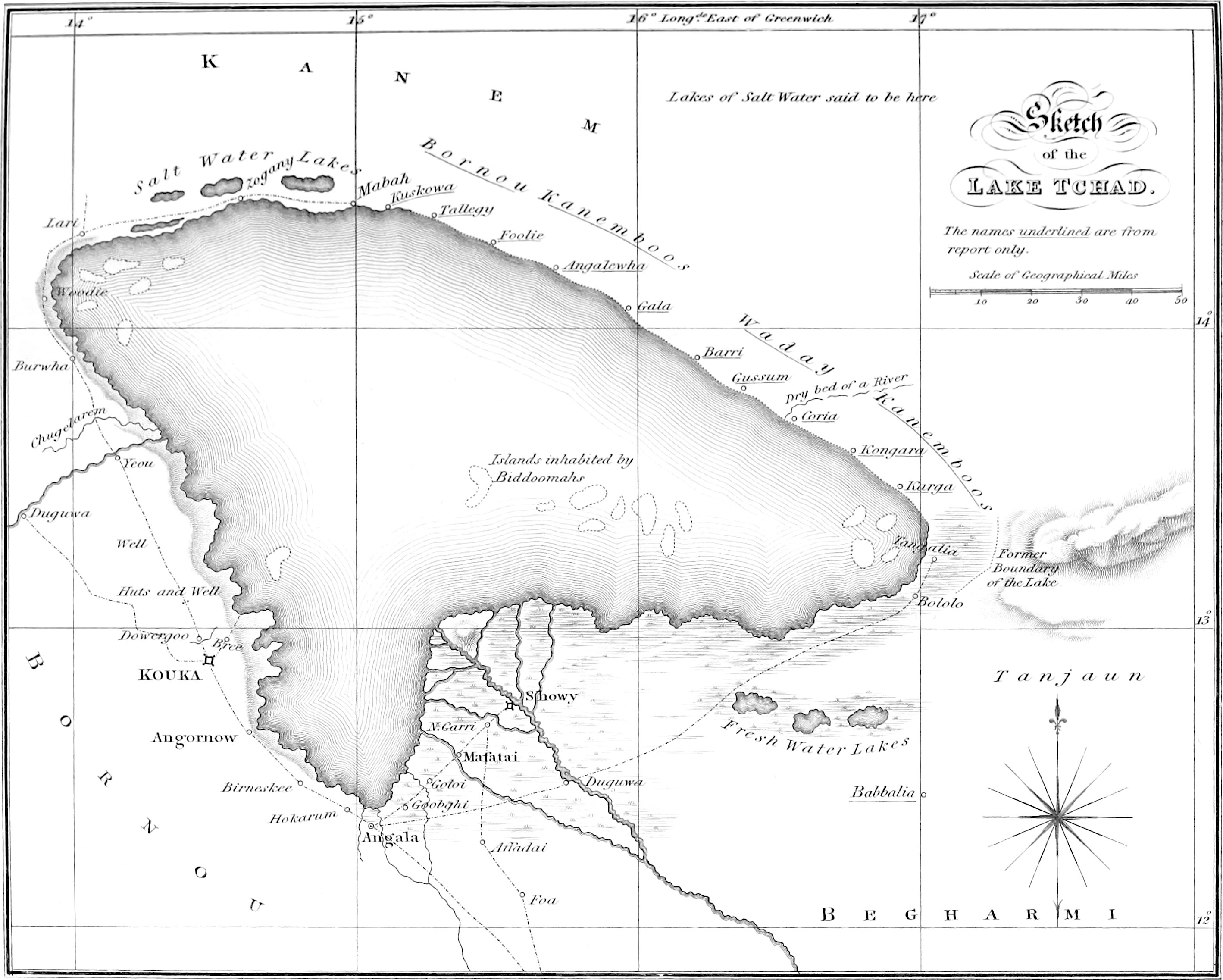
of the great lake Tchad, will be found to occupy a
considerable
portion of the volume; and being made in countries, and among a
people unknown to Europeans,—many of them even by name or
report,—it is hoped that observations, faithfully and
circumstantially minuted down at the time and spot, will not be
found tedious or uninteresting to the reader.
It will, perhaps, be thought by some, that I have been more
minute than necessary in the account of our journey across that
tremendous desert which lies between Mourzuk and Bornou, and which,
generally speaking, is made up of dark frowning hills of naked
rock, or interminable plains, strewed in some places with fragments
of stone and pebbles, in others of one vast level surface of sand,
and, in others again, the same material rising into immense mounds,
altering their form and position according to the strength and
direction of the winds. But, even in the midst of this dreary
waste, towns, villages, wandering tribes, and kafilas, or caravans,
sometimes occur to break the solitude of this dismal belt, which
seems to stretch across Northern Africa, and, on many parts of
which, not a living creature, even an insect, enlivens the scene.
Still, however, the halting places at the wells, and the wadeys or
valleys, afford an endless source of amusement to the traveller, in
witnessing the manners, and listening to the conversation, of the
various tribes of natives, who, by their singing and dancing, their
story telling, their quarrelling and fighting, make him forget, for
a time, the ennui and fatigue of the day’s journey.
As for the rest, I have to trust to its novelty, for its
recommendation to
the public, rather than to any powers of writing, which I pretend
not to possess; and it is now a source of great satisfaction to me
that, under all my difficulties, and they were not few, I was able
to adhere to the resolution I set out with, of recording, at the
end of each day, the occurrences, however trifling, that had taken
place.
To Sir Robert Ker Porter, my friend since the days of boyhood, I
am indebted for having perfected several drawings, with his
experienced pencil, from my hasty, but yet faithful sketches, of
the people and scenery of Central Africa. His eye was nearly as
familiar as my own with the picturesque objects they display; and,
indeed, all who are acquainted with the published narrative of his
Researches amongst the Remains of Ancient Persia and Babylonia,
might readily recognise the same hand, in these his spirited
delineations of African costume and character.
DIXON DENHAM.
Albany, London,
Jan. 1st. 1826.
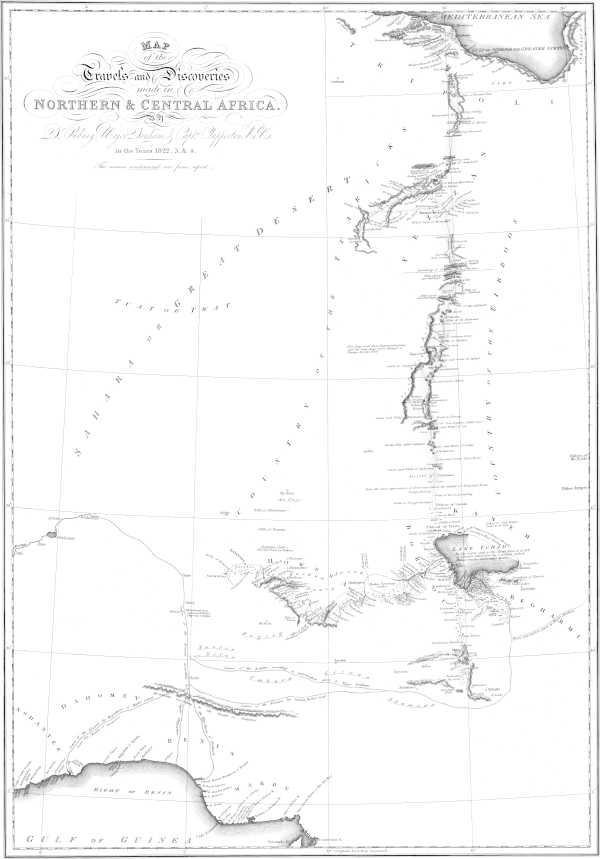
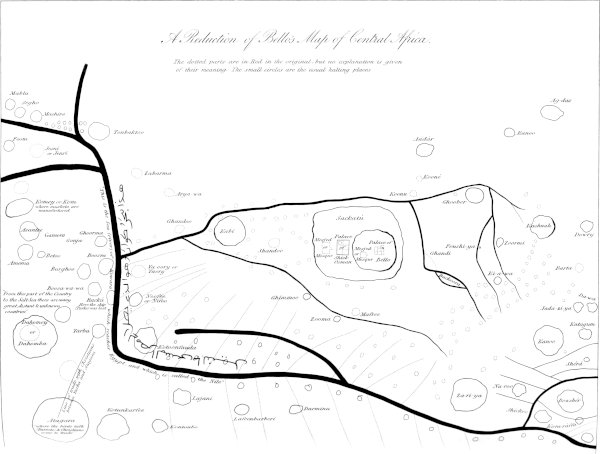
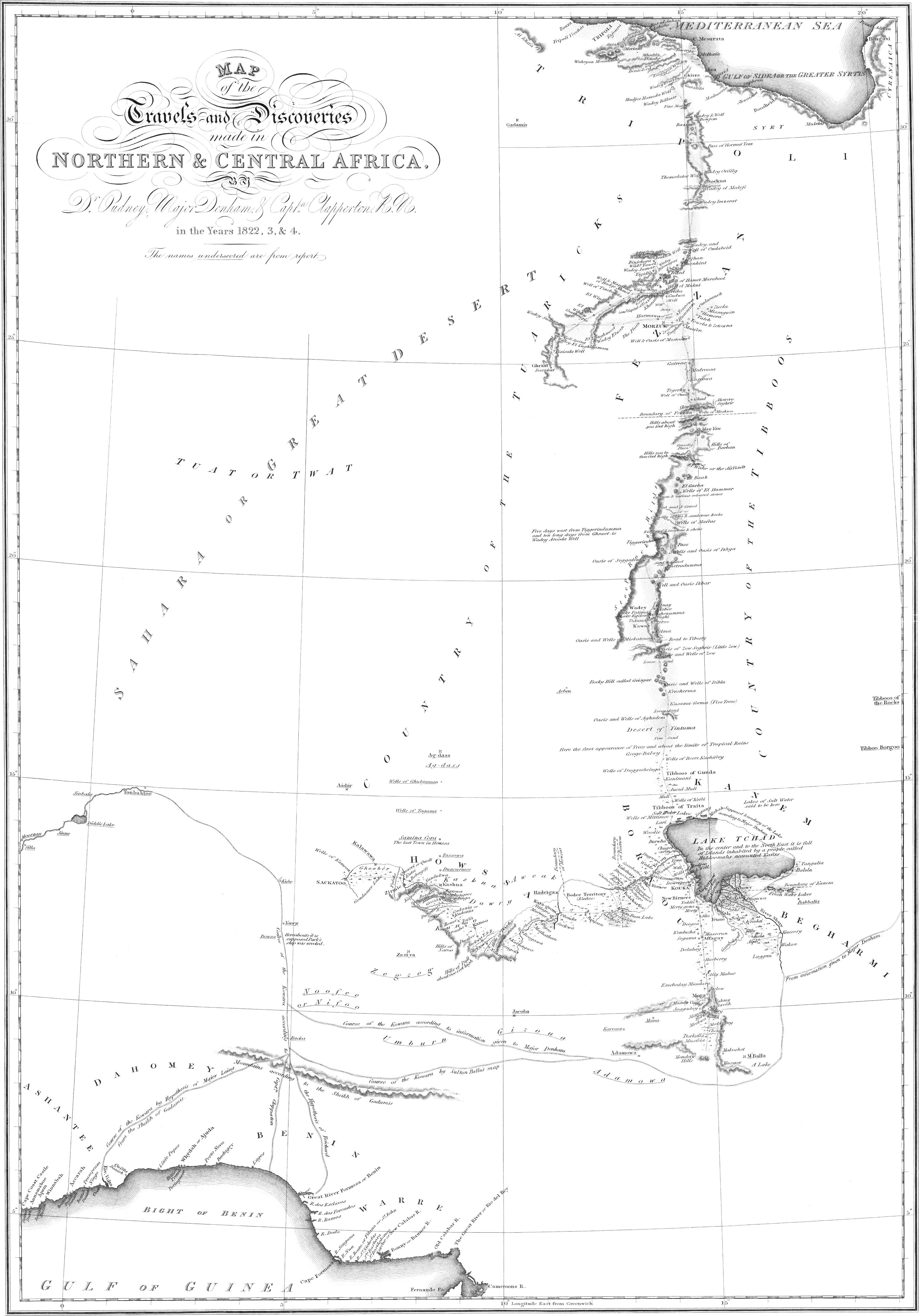
Map of the
Travels and Discoveries made in Northern & Central Africa,
by Dr. Oudney, Major Denham, & Captn.
Clapperton, R.N.
in the Years 1822, 3, & 4.
Previous to any knowledge I had received
of the intentions of His Majesty’s government to follow up the
mission of Mr. Ritchie and Captain Lyon, I had volunteered my
services to Lord Bathurst to proceed to Timbuctoo, by nearly the
same route which Major Laing is now pursuing. I learnt, in reply,
that an expedition had been planned, and that Doctor Oudney and
Lieutenant Clapperton, both of the navy, were appointed; and with
these gentlemen, by the kindness of Lord Bathurst, I was, at my
request, associated. My companions left London before me; but, as
soon as ready, I lost no time in proceeding in the packet to Malta,
where I found that they had left the island for Tripoli nearly a
month before. By the kindness of Admiral Sir Graham Moore, Sir
Manley Power, Sir Richard Plasket, and Captain Woolley,
commissioner of the dock-yard, all my wants were amply supplied;
and judging that the assistance of a shipwright or carpenter might
prove of essential use, and being allowed by my instructions to
engage any one, at a reasonable salary, who might choose to
volunteer to accompany the mission, William Hillman, shipwright, a
man of excellent character, immediately offered his services, on an
agreement that he should receive 120l. a year so long as
he should continue to be employed.
I embarked in the Express schooner, which the admiral lent me
for the purpose, and, on the 18th November, after three days’ sail,
arrived at Tripoli, and found my two companions at the house of Mr.
Consul Warrington, anxiously expecting my arrival. Of this
gentleman it is not too much to say, that by his cheerful and good
humoured disposition, his zeal, perseverance, and extraordinary
good management, we owe, in a great degree, that
influence which
England possesses with this government far beyond that of any other
of the Barbary powers. The English name, in fact, is of such
importance in Tripoli, that there is scarcely a point to carry, or
a dispute to settle, in which the bashaw does not request the
interference of the British consul: and to him, indeed, is, in a
great degree, owing the origin and success of the late mission. He
stated broadly to the government at home, that the road from
Tripoli to Bornou was as open as that from London to Edinburgh;
which, with a small allowance for Oriental hyperbole, was found to
be true—witness the journey of my lamented friend Lieutenant Toole,
and also of Mr. Tyrwhitt, the latter laden with valuable
presents.
But this is not all: the British flag has a peculiar power of
protection, and the roof of the English consul always affords a
sanctuary to the perpetrator of any crime, not even excepting
murder; and scarcely a day passes that some persecuted Jew or
unhappy slave, to escape the bastinado, does not rush into the
court-yard of the British consulate for protection. A circumstance
occurred in returning from one of our excursions, which shows in
what high estimation the English character is held in Tripoli. A
poor wretch, who, for some trifling offence, was sentenced to five
hundred bastinadoes, having, while on his way to receive the
sentence of the law, contrived to slip from the custody of his
guards, fortunately met with the child and servant of Doctor
Dickson, a most respectable and intelligent English physician
practising in Tripoli: the condemned wretch, with wonderful
presence of mind, snatched up the child in his arms, and halted
boldly before his pursuers. The talisman was sufficiently powerful:
the emblem of innocence befriended the guilty, and the culprit
walked on uninterrupted, triumphantly claiming the protection of
the British flag.
But the following proves still more strongly to what extent the
influence of the British flag might be carried.—Since the reduction
of the refractory Arabs to submission, no chief had received such
repeated marks of kindness and attention from the bashaw, as sheikh
Belgassam ben Khalifa, head of the powerful tribe of El Gibel. At
the particular request of the former, sheikh Khalifa had quitted
his tents and flocks, resided in the city, and was high in his
prince’s confidence—fatal pre-eminence in Barbary states!—and had
been presented, but a few months before, with one of the most
beautiful gardens in the Minshea. Returning from the castle after
an evening of music and dancing in the bashaw’s private apartments,
Belgassam kissed the hand that had signed his death-warrant, and took his leave. At
his own door a pistol-shot wounded him in the arm, and on entering
the skiffa, or passage, a second entered his body. The old sheikh,
after his slave had fastened the door, staggered to his carpet, and
then, in the arms of his wife, proclaimed his assassin to be his
own nephew, sheikh Mahmoud Belgassam Wildé Sowdoweah. The work
being, however, but half done, others rushed in, and seven stabs
put an end to his sufferings, notwithstanding the screams of his
wife, who received two wounds herself, in endeavouring to save her
husband. The poor old man was almost instantly buried, and the
three persons who had undertaken the murder fled to the British
consulate for protection. Early the next morning, however, the
consul despatched his dragoman to give the bashaw notice, “that the
murderers of Khalifa would find no protection under the flag of
England.” The bashaw said, “he was shocked at the murder, and
regretted the assassins having taken refuge in the consulate, as it
was a sanctuary he could not violate, particularly as he understood
they meant to resist, and were well armed.” Our consul replied,
“that the bashaw was at liberty to send any force he pleased, and
use any means he thought best, to drag them from beneath a banner
that never was disgraced by giving protection to assassins.” The
minister also came and expressed the bashaw’s delicacy; and it was
evident he did not expect such would be the conduct of the consul:
he was, however, peremptory, and the bashaw dared not seem to
favour such an act of villany. It was sunset before he decided on
taking them away, when about sixteen of the chosen people of the
castle entered the consulate, and the wretches, although provided
with arms, which they had loaded, tremblingly resigned themselves,
and were, in less than an hour, hanging over the walls of the
castle.
On a day appointed we waited on the bashaw. After passing the
court-yard, crowded with guards, and several groups of Arabs in the
passages and ante-rooms playing at cards or dice, we were
introduced to the audience chamber, where the bashaw, sitting
cross-legged on a carpet, supported by his two sons, and attended
by armed negroes, received us kindly, ordered us to be served with
sherbet and coffee, and expressed himself in the most favourable
manner on the subject of our mission, which he promised to forward
in safety into the interior of Africa. He invited us to join him in
a hawking party. The cavalcade, consisting of about three hundred,
altogether presented so novel an appearance, that I shall
endeavour to give
some description of our morning’s amusement. The bashaw was mounted
on a milk-white Arabian, superbly caparisoned, with saddle of
crimson velvet richly studded with gold nails, heavy stirrups of
the same, and trappings of embroidered cloth hanging down on each
side nearly to the horse’s fetlock joint; he was preceded by six
chaoushes, or officers, also mounted and richly
caparisoned, armed with long guns, swords, and pistols, and a white
silk barracan thrown loosely and gracefully round their bodies. His
highness was supported on each side by a favourite black slave,
whose glittering vest, light bornouse, and white turban, formed a
pleasing contrast to the costume of the Arabs. We proceeded in a
westerly direction; and on arriving at the desert, parties of six
and eight dashed forward, with the rapidity of lightning, several
hundred paces, fired, immediately halted in a most surprising
manner, and with loud cries rushed back again to the main body,
when instantly the same ceremony was repeated by another party.
Their superior skill in the management of their horses is really
beautiful; and the way they manœuvre their long musket, by
repeatedly spinning it over their heads at full speed, has a most
picturesque effect. Near the bashaw’s person rode Sidy Ali, his
third son, although second in succession, in consequence of the
banishment of the eldest; he also was attended by his particular
guard of Arabs, distinguished not only by their superior and
determined appearance, but by their figured muslin bornouses. Sidy
Ali is the bashaw’s favourite son, and is particularly handsome,
although what we should call too fat, and is said to resemble very
much what the bashaw was at his age: he is allowed great privilege
and liberty, which is indeed proved by his saying, the other day,
to his father, “I shall succeed you as bashaw.” “How do you mean?”
“How? why, by taking the same steps you did yourself,” said the
youth.
I was invited, with my colleagues, to pass a day about five
miles from Tripoli, at the garden of Mahomed D’Ghies, to whom I
brought letters from his son, who was residing in London, much
noticed and respected. This old gentleman had been minister for
foreign affairs to the bashaw, but had retired from office some
time, on account of a complaint in his eyes. He is a most
respectable man, and particularly kind to all European travellers
who visit Tripoli; and so well known throughout Northern Africa,
that letters of credit from him are sure to be duly honoured.
Nothing could exceed the hospitality and attention with which we were received:
having regaled ourselves with sherbet, coffee, and tobacco, several
times in the course of the day, and partaken of an excellent
dinner, à la Turque, in a grove of lemon and orange trees,
we returned in the evening to Tripoli, well pleased with our day’s
excursion.
Tripoli has been so often described, that I shall pass it over
in silence. Its Jews, its Arabs, its Moors, and Maraboots; the
slave population, and the bashaw’s family; are all so well painted
to the life in “Tully’s Letters,” as to require no further notice
from me as a casual visitor. Neither is it my intention to enter
into a minute description of the country between Tripoli and
Mourzuk; the surface of which is not essentially different from
that between Mourzuk and Bornou, and has already been noticed by
Captain Lyon, and in the communications to the African
Association.
On the 5th March, 1822, I left Tripoli for Benioleed[1], to
join my two
companions, who had proceeded thither with our servants, horses,
camels, and baggage. They had gone on to Memoom, a very pretty
valley, which, at this season of the year, was green with herbage,
and adorned by flowers of various hues and colours, richly
scattered in beautiful disorder;—but it was the last of the kind we
were fortunate enough to meet with between this place and Bornou;
and here the consul and his son, who had accompanied us from
Tripoli, took their leave, with many hearty good wishes for our
success and prosperity.
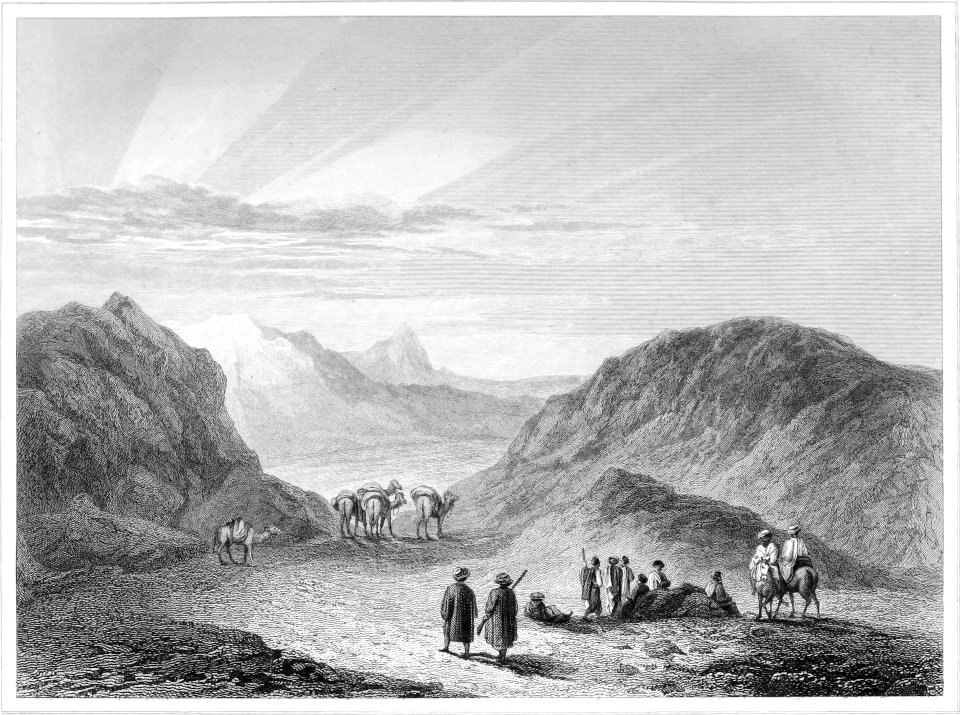
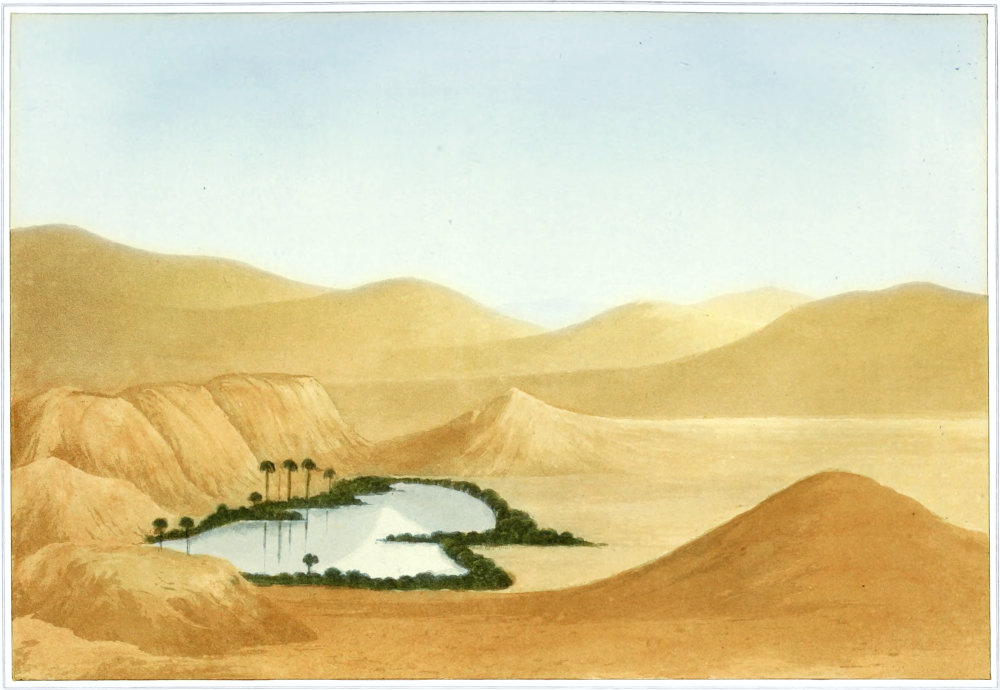
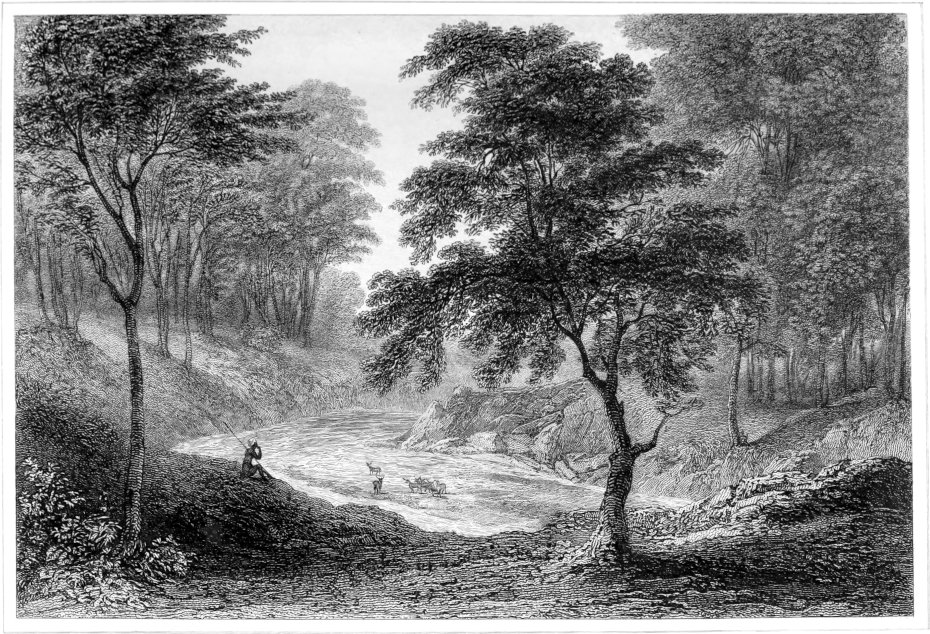
Drawn by Major Denham.
Engraved by E. Finden.
PART OF THE STONY DESERT.
NEAR SOCKNA.
Published Feb. 1826, by John Murray,
London.
On the day
previous to our approach to Sockna, a town about half way between
Tripoli and Mourzuk, which we reached in fourteen days, the
uniformity of the journey was somewhat enlivened, by meeting with a
kafila of slaves, from Fezzan, in which were about seventy
negresses, much better looking, and more healthy, than any we had
seen near the sea-coast. They were marching in parties of fifteen
or twenty; and on our inquiring of one of those parties from whence
they came, the poor things divided themselves with the greatest
simplicity, and answered, “Soudan, Begharmi, and Kanem,” pointing
out the different parcels, from each country, as they spoke: those
from Soudan had the most regular features, and an expression of
countenance particularly pleasing.
Passing a small wadey and plantation of date trees, we had soon
a view of Sockna, and were met on the plain, on which it stands, by
the governor and principal inhabitants, accompanied by some
hundreds of the country people, who all crowded round our horses,
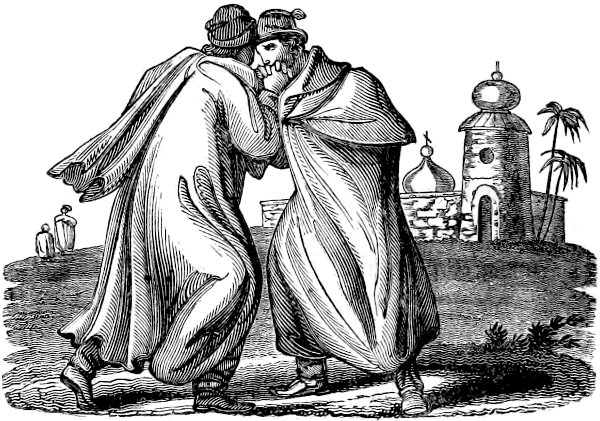
kissing our hands, and welcoming us with every appearance of
sincerity and satisfaction; and in this way we entered the town: the words
“Inglesi! Inglesi!” were repeated by a hundred voices from the
crowd. This, to us, was highly satisfactory, as we were the first
English travellers in Africa who had resisted the persuasion that a
disguise was necessary, and who had determined to travel in our
real character as Britons and Christians, and to wear, on all
occasions, our English dresses; nor had we, at any future period,
occasion to regret that we had done so. There was here no jealousy,
nor distrust of us as Christians; on the contrary, I am perfectly
satisfied that our reception would have been less friendly had we
assumed a character that could have been at best but ill supported.
In trying to make ourselves appear as Mussulmans, we should have
been set down as real impostors.
The dates of Sockna are excellent, and in abundance: our animals
were liberally supplied with this fruit of fruits; and after the
first two days appeared to eat them nearly as well as corn. The
population of Sockna must be considerably more than three thousand.
The town is walled, and about a mile in circumference: has eight
gates; and wears altogether a clean and neat appearance that
surprised us. The women are certainly very pretty, and are said to
be remarkable for their love of intrigue. This may be true, or not;
but we had no opportunity of ascertaining it from our own
knowledge. Of their affability and good humour, however, we had
many proofs; and while only two of us were walking through the town
one morning, with a little army of ragged boys following us, two,
of rather the better order, quickly dispersed them; and invited us
to enter a house, saying that a mara zene (a beautiful
woman) wished to see us. We put ourselves under their guidance, and
entering a better sort of dwelling-house, were quickly surrounded
by at least half-a-dozen ladies, most of them aged; but who asked
us a thousand questions, and, when satisfied we were not dangerous,
called several younger ones, who appeared to be but waiting for
permission to appear. Our dresses and ourselves were then minutely
examined. The yellow buttons on our waistcoats, and our watches,
created the greatest astonishment; and a pair of loose white
trowsers that I wore, into the pockets of which I accidentally put
my hands, raised their curiosity to a wonderful degree: my hands
were pulled out, and those of three or four of the ladies thrust
in, in their stead: these were replaced by others, all demanding
their use so loudly and violently, that I had considerable
difficulty in extricating myself, and was glad to make my escape.
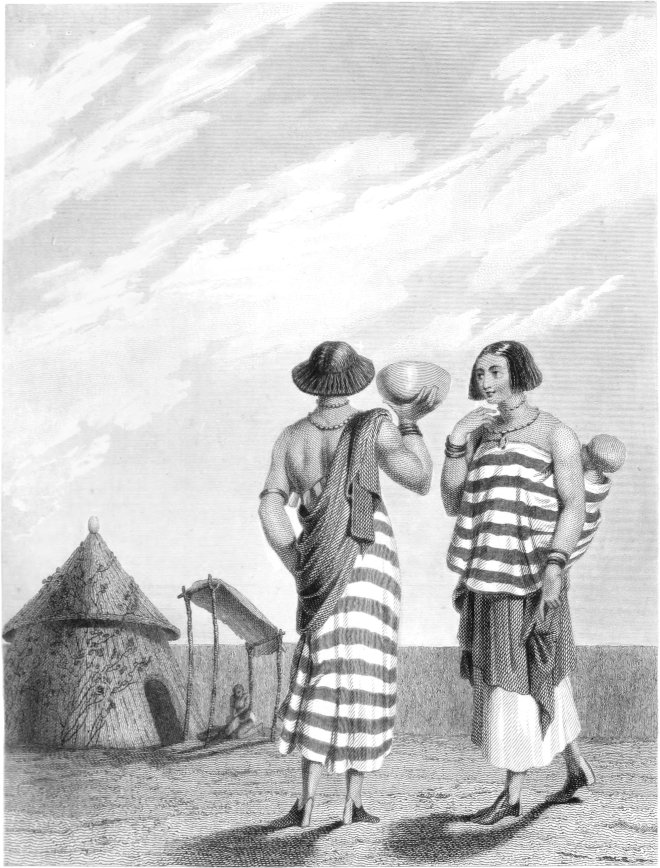
The dress of the Sockna women is nearly that of the Tripoline: they
wear striped shirts, of silk or linen, large silver ear-rings, with
leg-lets and arm-lets of the same: the lower classes wear those of
glass or horn.
The remaining half of our journey to Mourzuk was over pretty
nearly the same kind of surface as that we had passed before; in
some places worse. Sometimes two, and once three days, we were
without finding a supply of water; which was generally muddy,
bitter, or brackish: nor is this the worst that sometimes befalls
the traveller. The overpowering effects of a sudden sand-wind, when
nearly at the close of the desert, often destroys a whole kafila,
already weakened by fatigue; and the spot was pointed out to us,
strewed with bones and dried carcasses, where the year before fifty
sheep, two camels, and two men, perished from thirst and fatigue,
when within eight hours’ march of the well which we were anxiously
looking out for.
Indeed the sand-storm we had the misfortune to encounter in
crossing the desert gave us a pretty correct idea of the dreaded
effects of these hurricanes. The wind raised the fine sand with
which the extensive desert was covered, so as to fill the
atmosphere, and render the immense space before us impenetrable to
the eye beyond a few yards. The sun and clouds were entirely
obscured, and a suffocating and oppressive weight accompanied the
flakes and masses of sand, which, I had almost said, we had to
penetrate at every step. At times we completely lost sight of the
camels, though only a few yards before us. The horses hung their
tongues out of their mouths, and refused to face the torrents of
sand. A sheep, that accompanied the kafila, the last of our stock,
lay down on the road, and we were obliged to kill him, and throw
the carcass on a camel. A parching thirst oppressed us, which
nothing alleviated. We had made but little way by three o’clock in
the afternoon, when the wind got round to the eastward, and
refreshed us something: with this change we moved on until about
five, when we halted, protected a little by three several ranges of
irregular hills, some conical, and some table-topped. As we had but
little wood, our fare was confined to tea; and we hoped to find
relief from our fatigues by a sound sleep. That was, however,
denied us; the tent had been imprudently pitched, and was exposed
to the east wind, which blew a hurricane during the night: the tent
was blown down, and the whole detachment were employed a full hour
in getting it up again; and our bedding and every thing that was
within it was, during that time, completely buried by the
constant driving of
the sand. I was obliged, three times during the night, to get up
for the purpose of strengthening the pegs; and when, in the
morning, I awoke, two hillocks of sand were formed on each side of
my head, some inches high.
On the 7th April we arrived at a village in the midst of a vast
multitude of palm trees, just one day’s journey short of Mourzuk.
As it was to be the last day’s march, we were all in good spirits
at the prospect of rest; and had we made our arrangements with
judgment, every thing would have gone on well. We had, however,
neglected sending on to advise the sultan of our arrival—a constant
practice, and consequently our reception was not what it ought to
have been. We arrived at D’leem, a small plantation of date trees,
at noon, and finding no water in the well, were obliged to proceed;
and it was three in the afternoon before we arrived at the wells
near Mourzuk. Here we were obliged to wait until the camels came
up, in order that we might advance in form. We might, however, have
saved ourselves the trouble:—no one came out to meet us, except
some naked boys, and a mixture of Tibboos, Tuaricks, and Fezzanese,
who gazed at us with astonishment, and no very pleasant aspect.
We determined on not entering the town in a manner so little
flattering to those whom we represented: and retiring to a rising
ground, a little distance from the gates of the town, waited the
return of a chaoush, who had been despatched to announce our
arrival. After half an hour’s delay, the sheikh El Blad (the
governor of the town) came out, and, in the sultan’s name,
requested we would accompany him to the house which had been
prepared for us; and he added, to our great surprise, the English
consul is there already. The fact was, a very ill-looking Jew
servant of mine, mounted on a white mule, with a pair of small
canteens under him, had preceded the camels, and entered the town
by himself: he was received with great respect by all the
inhabitants—conducted through the streets to the house which was
destined to receive us; and from the circumstance of the canteens
being all covered with small brass shining nails, a very high idea
of his consequence was formed. He very sensibly received all their
attentions in silence, and drank the cool water and milk which was
handed to him: and we always had the laugh against them afterwards,
for having shown so much civility to an Israelite—a race they
heartily despise. “We thought the English,” said they, “were better
looking than Jews—Death to their race! but then God made us all,
though not all handsome like Mussulmans, so who could tell?” As we
were all this time exposed to a burning sun, we were well inclined
to compromise a little of our dignity, and determined on entering
the town, which we did by the principal gate. The walls are well
built, at least twenty feet high; and the gate sufficiently wide to
admit, with care, a loaded camel. You pass through the fsug,
slave-market, a wide street, with houses on each side, three
hundred yards in length. It leads into an open space, in the centre
of which the castle stands, surrounded by a second wall. In the
inside of this inner wall, in the castle yard, are a few houses,
originally built for the Mamelukes, and particular followers of the
late sultan, when they were subject to the occasional attacks of
the Arabs. In one of these, the house occupied by the late Mr.
Ritchie and Captain Lyon, arrangements were made for our reception.
Almost as soon as the camels were unloaded, we paid our respects to
the sultan: he received us with a great deal of affability and good
nature, and made an impression in his favour, which, however, his
subsequent conduct tended but little to strengthen.
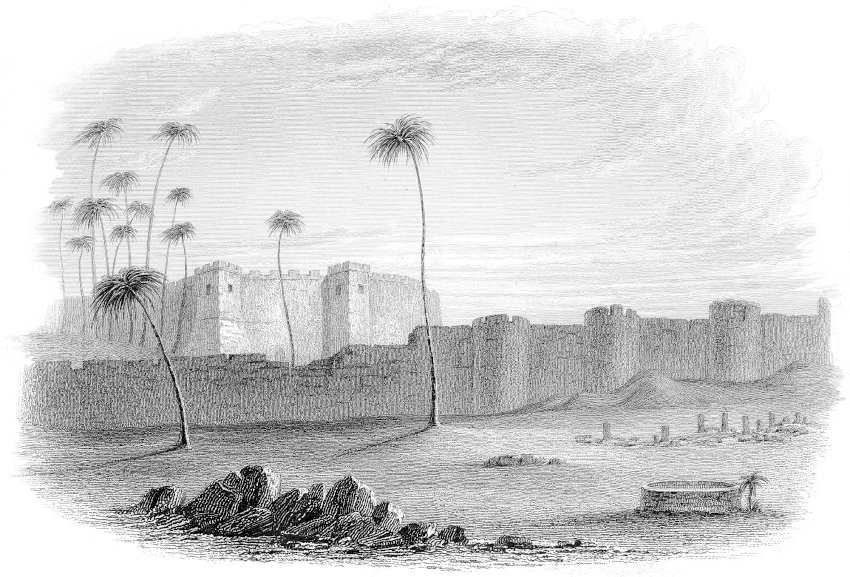
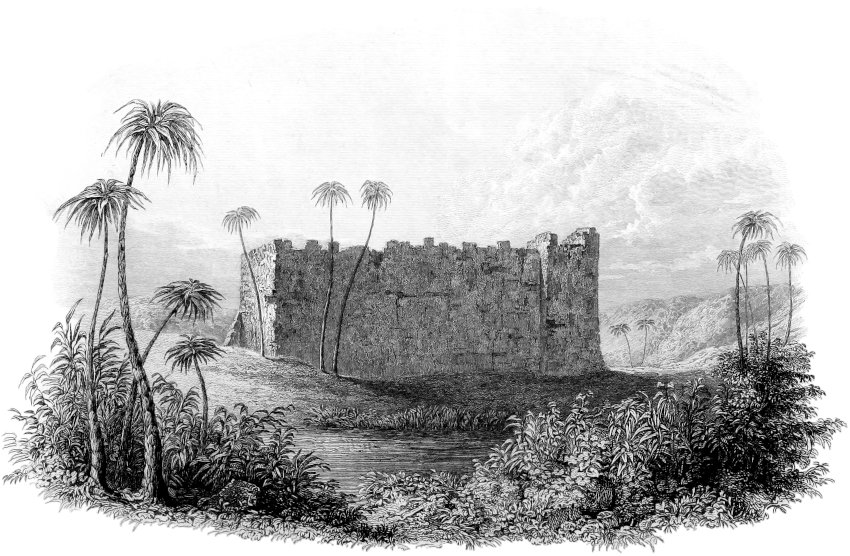
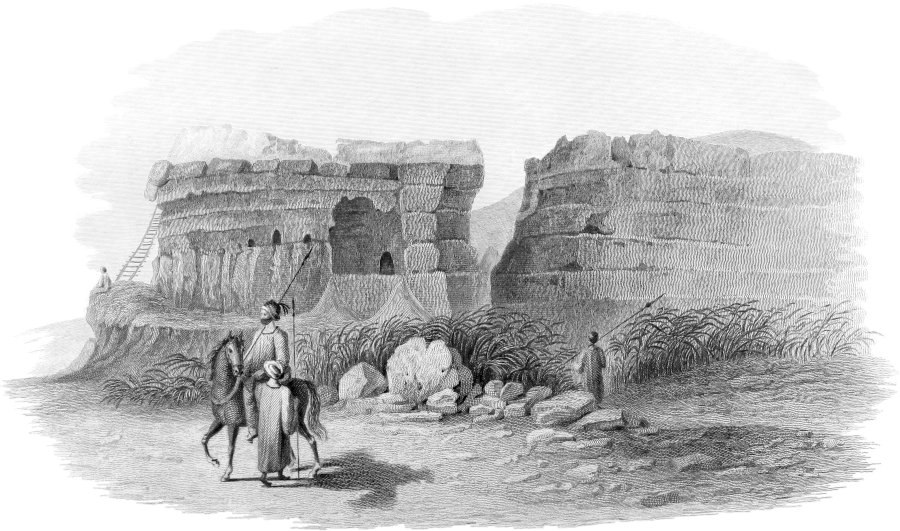
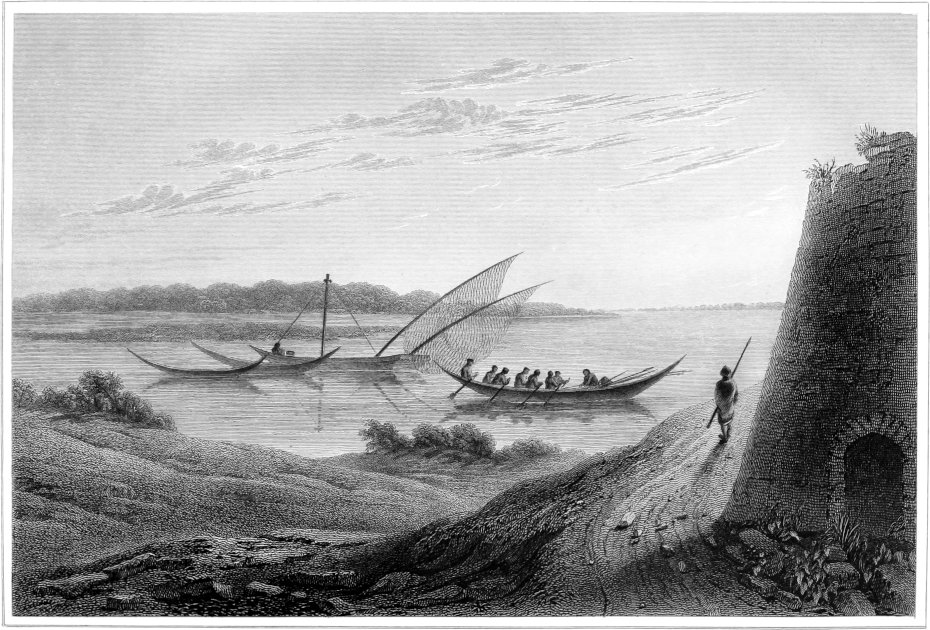
Drawn by Major Denham.
Engraved by E. Finden.
CASTLE AT MOURZUK.
FROM MR. RITCHIE’S GRAVE.
Published Feb. 1826, by John Murray,
London.
Our interview with the sultan of Mourzuk was any thing but
encouraging: he told us that there was no intention, as we had been
led to expect, of any expedition to proceed to the southward for
some time to come; that an army could only move in the spring of
the year; that the arrangements for moving a body of men through a
country where every necessary must be carried on camels, both for
men and horses, were so numerous, that before the following spring
it was scarcely possible to complete them: that two camels were
required for every man and horse, and one for every two men on
foot. And as to our proceeding to Bornou, it would be necessary,
had the bashaw instructed him to forward us, that we should be
accompanied by an escort of two hundred men. He said he would read
to us the bashaw’s letter, and we should see the extent to which he
could forward our wishes. The letter was then handed to his fighi,
or secretary; and we found that to the protection of the sultan of
Fezzan were we intrusted, who was to charge himself with our
safety, and so insure our being treated with respect and attention
by all his subjects; that we were to reside at Sebha, or Mourzuk,
or where we chose in the kingdom of Fezzan, and to await his return
from Tripoli. With this our audience ended, and we returned to our
habitation.
It is quite impossible to express the disheartening feelings
with which we left the castle. The heat was intense; the
thermometer at 97° in the coolest spot in the house, during the
middle of the day; and the nights were scarcely less oppressive: the flies
were in such myriads, that darkness was the only refuge from their
annoyance. All poor Mr. Ritchie’s sufferings and disappointments
were brought to our recollections; and although, from the
arrangements which we had been able to make, we were better
provided with necessaries than those who had gone before us,—yet
did we consider our stock as a very sacred charge, applicable only
to the grand objects of our expedition.
We received visits from all the principal people of Mourzuk the
day after our arrival; and remarking a very tall Tuarick, with a
pair of expressive, large, benevolent-looking eyes, above the black
mask with which they always cover the lower part of their face,
hovering about the door, I made signs to him to come near, and
inquired after Hateeta, the chief Captain Lyon had spoken so highly
of, and for whom, at his request, I was the bearer of a sword. To
my great surprise, striking his breast, he exclaimed, “I am
Hateeta! are you a countryman of Said[2]?—how is he? I have often longed to hear of him.”
I found Hateeta had been but once in Mourzuk since Captain Lyon’s
departure, and was now only to remain a few days. On the following
morning he came to the house, and the sword was presented to him.
It would be difficult to describe his delight; he drew the sword
and returned it, repeatedly; pressed it to his breast, exclaimed
“Allah, Allah!” took my hand, and pressing it, said “Katar
heyrick yassur yassur” (thank you very very much); nearly all
the Arabic he could speak. It was shortly reported all over the
whole town, that Hateeta had received a present from Said, worth
one hundred dollars.
12th.—We had been several times visited, and our hopes and
spirits raised, by a person called Boo-Bucker Boo-Khaloom. He said
that it was in the sultan’s power to send us on to Bornou if he
pleased: he even hinted that a bribe for himself might induce him
to do so—this, however, we found was not the case. Boo-Khaloom was
represented to us, and truly, as a merchant of very considerable
riches and influence in the interior. He was on the eve of starting
for Tripoli, with really superb presents for the bashaw. He had
five hundred slaves, the handsomest that could be procured, besides
other things. He stated to us, secretly, that his principal object
in going to Tripoli was to obtain the removal of the present sultan
of Fezzan; and wished that we should make application to the bashaw
for him to accompany us farther into the interior: we were not, however, to
hint that the proposition had come from him. Boo-Khaloom said that
he should be instantly joined by upwards of one hundred merchants
who waited but for his going, and no further escort would be
necessary; that he should merely remain a few weeks in Tripoli,
and, on his return, we could instantly move on. The substance of
all these conversations was transmitted to Colonel Warrington.
Boo-Khaloom left Mourzuk for Tripoli, with his slaves and
presents; loading upwards of thirty camels, apparently reconciled
to, and upon good terms with, the sultan. It was, however, very
well known that Sultan Mustapha had set every engine at work to
have Boo-Khaloom’s head taken off on his arrival in Tripoli; and
that the other was willing to sacrifice all he was worth to
displace and ruin Mustapha in the bashaw’s favour.
It was not till the 18th, that the sultan, after attending the
mosque, started for Tripoli; all his camels and suite had marched
in divisions, for three days previous,—in slaves he had alone more
than one thousand five hundred. He was attended by about ten
horsemen, his particular favourites, and four flags were carried
before him through the town. The inhabitants complained dreadfully
of his avarice, and declared that he had not left a dollar, or an
animal worth one, in all Fezzan.
Nothing was now to be done but to make our arrangements for a
favourable start the following spring. By the sultan’s departure,
every necessary for our proceeding was withdrawn from the spot
where we were. Not a camel was to be procured, and every dollar,
that he could by any means force from his subjects, was forwarded
to Tripoli. To Tripoli, therefore, were we to look for supplies of
every kind; and it was decided by us all, that my departure had
better follow his as soon as possible.
In pursuance of our determination to represent to the bashaw of
Tripoli how necessary it was that something more than promises
should be given us for our sterling money, on Monday, the 20th May,
I left Mourzuk, with only my own negro servant Barca, three camels,
and two Arabs; and, after a most dreary journey of twenty days,
over the same uninteresting country I had already traversed,—the
more dreary for want of my former companions,—I arrived at Tripoli
on the 12th June, where I was received by the consul with his usual
hospitality and kindness, and he assigned me apartments in the
consulate.
12th.—I
requested an immediate audience of the bashaw, which in consequence
of the Rhamadan was not granted me until the following evening. The
consul, Captain Smyth of the navy, and myself, attended: I
represented, in the strongest terms, how greatly we were
disappointed at the unexpected and ruinous delay we had experienced
in Mourzuk, and requested a specific time being fixed for our
proceeding to Bornou; stating, also, that were the answer not
satisfactory, I should proceed forthwith to England, and represent
to the government how grievously we had been deceived. The bashaw
denied having intentionally broken his word, and solemnly declared
that the will of God, in visiting the sultan of Fezzan with
sickness, had alone prevented our being now on the road to
Bornou.
A voyage to Marseilles, on my way to England, was the
consequence of our altercation with the bashaw; and the promptitude
with which it was decided upon, and carried into effect, by means
of a small French vessel which, at the time, most fortunately lay
in the harbour, was not without its good effects. The bashaw sent
three despatches after me, by three different vessels, to Leghorn,
Malta, and the port I had sailed to, which I received in
quarantine, informing me, that Boo-Khaloom was appointed with an
escort to convey us forthwith to Bornou. This was every thing I
wished for; and immediately re-embarking, a seven days’ passage
brought me once more to the shores of Barbary. Boo-Khaloom and part
of the escort were already at the entrance to the desert; and on
the 17th of September we re-entered the pass of Melghra in the
Tarhona mountains. Hope and confidence had taken possession of my
mind, in the place of anxiety and disappointment; there was now an
air of assurance and success in all our arrangements; and I felt my
health and spirits increase with this conviction. But little beyond
the casualties attendant on desert travelling occurred, previous to
our arriving again at Sockna, which we did on the 2d of
October.
I found the great failing of my friend, Boo-Khaloom, was pomp
and show; and feeling that he was, on this occasion, the bashaw’s
representative, he was evidently unwilling that any sultan of
Fezzan should exceed him in magnificence. On entering Sockna, his
six principal followers, handsomely attired in turbans and fine
barracans, and mounted on his best horses, kept near his person,
whilst the others, at a little distance, formed the flanks. I rode
on his right hand, dressed in my British uniform, with loose
Turkish trowsers, a
red turban, red boots, with a white bornouse over all, as a shade
from the sun; and this, though not strictly according to order, was
by no means an unbecoming dress. Boo-Khaloom was mounted on a
beautiful white Tunisian horse, a present from the bashaw, the peak
and rear of the saddle covered with gold, and his housings were of
scarlet cloth, with a border of gold six inches broad. His dress
consisted of red boots, richly embroidered with gold, yellow silk
trowsers, a crimson velvet caftan with gold buttons, a silk benise
of sky blue, and a silk sidria underneath: a transparent white silk
barracan was thrown lightly over this, and on his shoulders hung a
scarlet bornouse with wide gold lace, a present also from the
bashaw, which had cost, at least, four hundred dollars; a cashmere
shawl turban crowned the whole. In this splendid array, we moved on
until, as we approached the gates of the town, the dancing and
singing men and women met us; and, amidst these, the shouts and
firing of the men, who skirmished before us, and the “loo! loo!” of
the women, we entered Sockna.
We found that houses were provided for us in the town; but the
kafila bivouacked outside the gates. It had always been our
intention to halt at Sockna, for three or four days; and here we
expected to be joined by a party of the Megarha Arabs, whom their
sheikh, Abdi Smud ben Erhoma, had left us, for the purpose of
collecting together. Hoon and Wadan were also to furnish us with
another quota. My house consisted of a court-yard eighteen feet
square, and a small dark room, leading out of it by two steps: the
court, however, was the greater part of the day shaded; and here,
on a carpet, I received my visitors. The Arabs, as they arrived,
were all sent to me by Boo-Khaloom; and their presentation has a
form in it, not much in character with their accustomed rudeness:
they all came armed with their long guns; and the same girdle which
confines their barracan contains also two long pistols. The chief
enters, and salutes, dropping on one knee, and touching the
stranger’s right hand with his, which he carries afterwards to his
lips; he then says, “Here are my men, who are come to say health to
you.” On receiving permission, they approached me, one by one,
saluting in the same manner as their chief, who continued to remain
at my side: they then sat down, forming a sort of semicircle round
me, with their guns upright between their knees; and, after a
little time, on the sheikh making a signal, they all quitted the
presence.
Boo-Khaloom,
who had suffered very considerably from fever, cold, and ague, now
became so seriously ill, that our departure was of necessity
postponed, and he insisted upon my prescribing for him, saying, “he
was quite sure that I could cure him, if it was the will of God
that he should live: if not, that nobody could.” His confidence in
me gave me some confidence in myself: but alone, with very few
medicines, and less skill, my situation was really one of great
anxiety; for no one could foresee what might have been the
consequence, had any thing serious happened to him while under my
hands. He became alarmingly ill, and for two days and nights I had
great doubts of his recovery; to my great satisfaction, however, on
the third morning, after a night of pain and delirium (and which I
had passed in watching by his side), a violent eruption appeared on
his skin, with some little moisture, produced by covering him up
the whole day with blankets, and suffering no one to come into the
room but his favourite female slave. By the evening, he became much
better.—Hajamad, or charms, are what the Arabs have most faith in,
when they are ill. All the fighis (writers) and maraboots in Sockna
were employed on this occasion by my friend’s friends, and one
night the tassels of his cap were literally loaded with them. He
assured me, when alone, that he had no faith in such things, and
smiled when he said his friends would think ill of him, were he to
refuse; his faith, however, was stronger than he chose to
acknowledge, and entering, unexpectedly, one morning, I found him
with a dove that had been just killed and cut open lying on his
head, which, as he assured me, was because a very great maraboot
had come from Wadan on purpose to perform the operation.
During our stay at Sockna, the marriage of the son of one of the
richest inhabitants, Hadgi Mohammed-el-Hair-Trigge, was celebrated
in the true Arab style. There is something so rudely chivalric in
their ceremonies (so very superior to the dull monotony of a
Tripolitan wedding), where from one to five hundred guests, all
males, assemble, covered with gold lace, and look at one another,
from the evening of one day until daylight the next, that I cannot
help describing them.
The morning of the marriage-day (for the ceremony is always
performed in the evening, that is, the final ceremony; for they are
generally betrothed, and the fatah read, a year before) is ushered
in by the music of the town or tribe, consisting of a bagpipe and
two small drums, serenading the bride first, and then the bridegroom, who
generally walks through the streets very finely dressed, with all
the town at his heels; during which time, the women all assemble at
the bride’s house, dressed in their finest clothes, and place
themselves at the different holes in the wall which serve as
windows, and look into the court-yard. When they are so placed, and
the bride is in front of one of the windows with her face entirely
covered with her barracan, the bridal clothes, consisting of silk
shifts, shawls, silk trowsers, and fine barracans, to show her
riches, are hung from the top of the house, quite reaching to the
ground: the young Arab chiefs are permitted to pay their respects;
they are preceded from the skiffa, or entrance, by their music, and
a dancing woman or two advances with great form, and with slow
steps, to the centre of the court, under the bride’s window: here
the ladies salute their visitors, with “loo! loo! loo!” which they
return by laying their right hand on their breasts, as they are
conducted quite round the circle. Ample time is afforded them to
survey the surrounding beauties; and there are but few, who, on
these occasions, are so cruel as to keep the veil quite closed.
Such an assemblage of bright black eyes, large ear-rings, and white
teeth, are but rarely seen in any country, I should suppose. After
having made the circuit, the largess is given, and exposed to view
by the chief danseuse, and, according to its amount, is
the donor hailed and greeted by the spectators. Previous to their
departure, all visitors discharge their pistols, and then again the
ladies salute with the “loo! loo!” So far from being displeased at
my asking permission to pay my respects, they considered it as a
favour conferred; and the bridegroom, although he could not himself
be admitted, attended me to and from the house of his mistress.
This ceremony being ended, a little before sunset, the bride
prepares to leave her father’s house: a camel is sent for her with
a jaafa[3], or sedan chair of basket-work, on its back,
covered with skins of animals, shawls from Soudan, Cairo, and
Timbuctoo: she steps into this, and so places herself as to see
what is going forward, and yet to be entirely hid from the view of
others. She is now conducted outside the town, where all the
horsemen and footmen who have arms are assembled. Our escort on
this occasion added greatly to the effect, as they were all, by
Boo-Khaloom’s order, in the field, consisting of sixty mounted
Arabs; and when they all charged and fired at the foot of the
bride’s camel, I really felt for the virgin’s situation; but
it was thought a great honour, and that, I suppose, consoled her
for the fright. They commenced by skirmishing by twos and fours,
and charging in sections at full speed, always firing close under
the bride’s jaafa: in this manner they proceeded three times round
the town, the scene occasionally relieved by a little interlude of
the bridegroom’s approaching the camel, which was surrounded by the
negresses, who instantly commenced a cry, and drove him away, to
the great amusement of the bystanders, exclaiming, “Burra!
Burra! be off! be off! mazal shouia! a little yet!”
With discharges of musketry, and the train of horsemen, &c. she
is then conveyed to the bridegroom’s house; upon which it is
necessary for her to appear greatly surprised, and refuse to
dismount: the women scream, and the men shout, and she is at length
persuaded to enter; when, after receiving a bit of sugar in her
mouth from the bridegroom’s hand, and placing another bit in his,
with her own fair fingers, the ceremony is finished, and they are
declared man and wife.
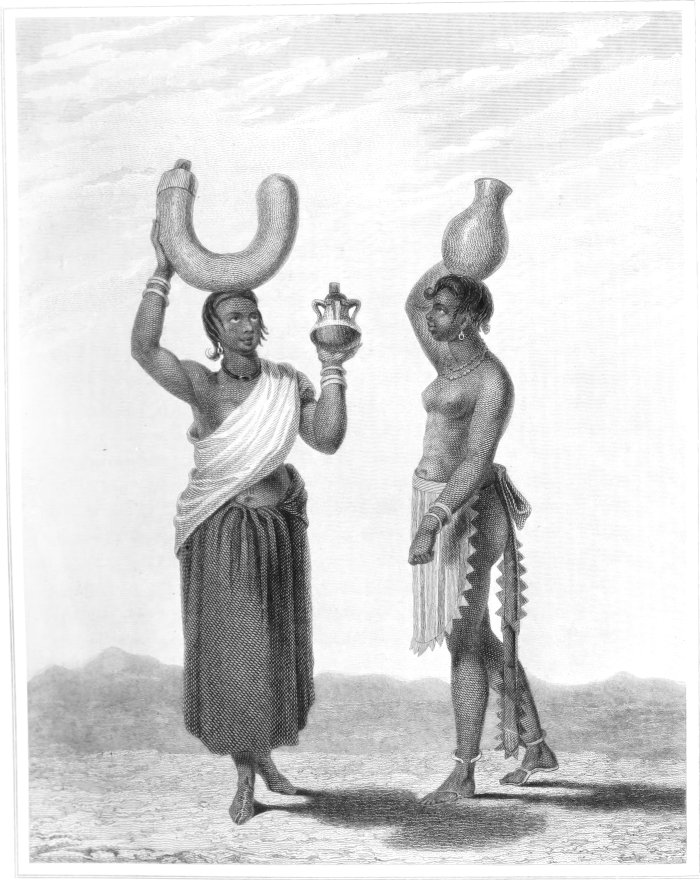
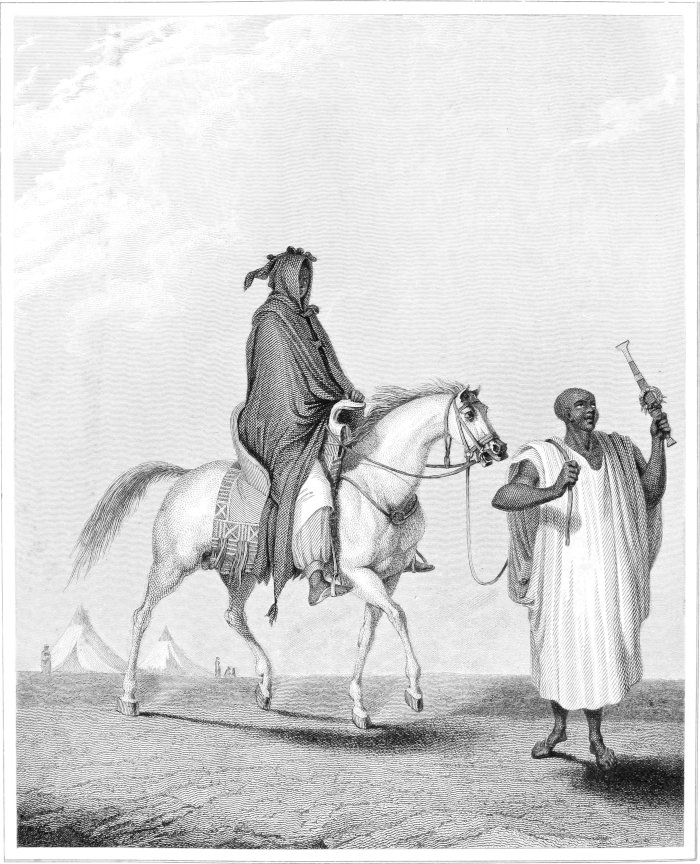
A WOMAN OF SOCKNA.
Drawn by Captn. Clapperton.
R.N.
Engraved by E. Finden.
Published by John Murray, London. Feb.
1826.
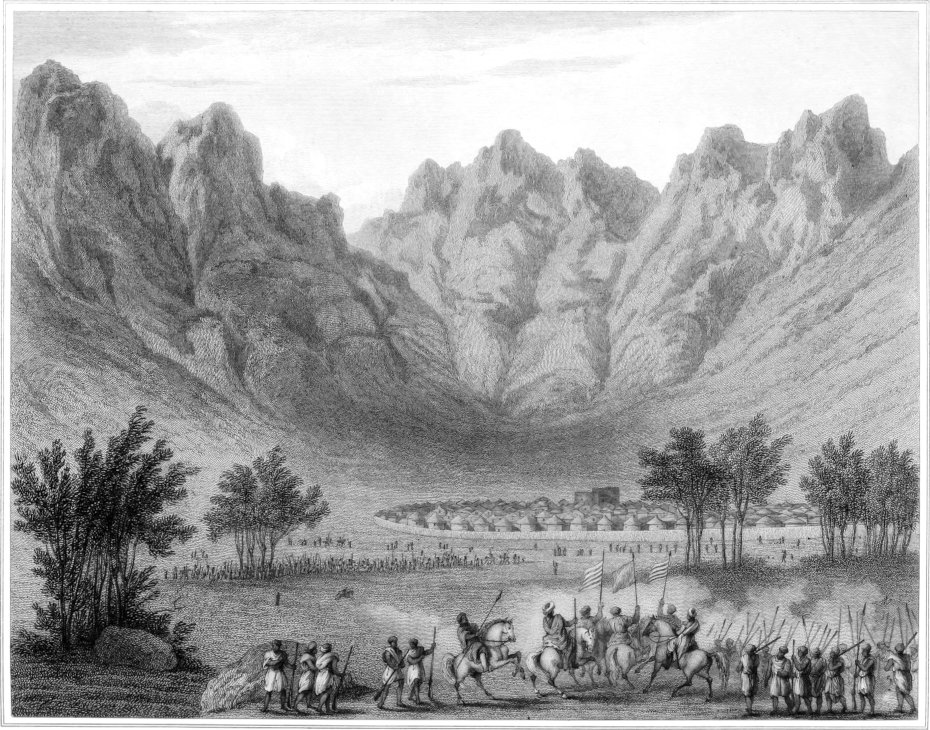
We had now to pass the Gibel Assoud, or Black Mountains: the
northernmost part of this basaltic chain commences on leaving
Sockna. We halted at Melaghi, or the place of meeting immediately
at the foot of the mountain, the well of Agutifa; and from hence
probably the most imposing view of these heights will be seen. To
the south, the mountain-path of Niffdah presents its black
overhanging peaks, and the deep chasm, round which the path winds,
bearing a most cavern-like appearance: a little to the west, the
camel path, called El Nishka, appears scarcely less difficult and
precipitous; the more southern crags close in the landscape, while
the foreground is occupied by the dingy and barren wadey of
Agutifa, with the well immediately overhung by red ridges of
limestone and clay: the whole presenting a picture of barrenness,
not to be perfectly described, either by poet or painter.
Large masses of tabular basalt, and irregular precipices, common
to this formation, are scattered over this range of hills, and
extend over all the plains which environ them. The most lofty hills
are those which present the most massive façades of tabular basalt;
the sides sometimes exhibit a step-like appearance, and in many
instances are overhung by pillars, curved, inclined, and
perpendicular: these produce a singular effect, not devoid of
grandeur. The lower stratum of all these hills is invariably
limestone, mixed with a reddish clay. Hills of the same are found
bordering upon, and in some cases joining, the basaltic ones; some of these
are strewed over with a covering of basalt stones of various sizes
and forms, none of them large, from three to eighteen inches in
circumference, but still showing the colour and structure of the
soil on which they are spread. Other hills of limestone are also
indiscriminately found without the slightest particle of basalt on
them, although in the immediate vicinity of what could easily be
imagined the ancient crater of a volcano, which had showered a
sombre covering heaved from the very bowels of the earth, on all
the then existing hills and plains which surrounded it. Some of
these limestone hills have been cut through, either by the falling
of masses of rock from the higher hills, or by violent
watercourses; and a section of them reveals nothing but pure
limestone mixed with clay.
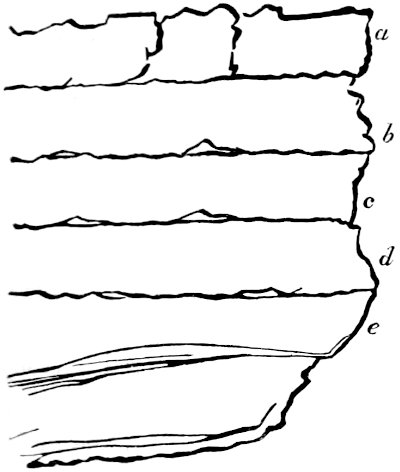
The Souda, or Gibel Assoud[4], extend from north to south,
three days’ journey, but in so winding a direction, as not to
exceed thirty-five miles at the utmost in a straight line: to the
west, as far as the well called Assela, on the road to the Shiati,
where the red clay hills continue alone, and join the hills at
Benioleed: to the east, they extend three days on the road to
Zella, or Bengagi, to a wadey called Temelleen.
The first four days of our journey, after leaving Agutifa, were
all dreariness and misery. This was the third time that I passed
these deserts: but no familiarity with the scenery at all relieves
the sense of wretchedness which the dread barrenness of the place
inspires. We marched from dawn until dark, for the sake of getting over them as
quickly as possible; and as scarcely sufficient fuel was to be
found to boil a little water, a mess of cold tumuta was usually our
supper. On leaving Tingazeer, we had the blessing of a rainy day;
for such it was to all, but particularly to the poor negroes who
accompanied the kafila, although Boo-Khaloom always gave them to
drink from his skins once in the day (an unusual kindness), yet
marching as they were for twelve and fourteen hours, once scarcely
satisfied nature. In consequence of the rain, we found water fresh
and pure during almost every day’s march, and arrived at
Zeghren[5] with the loss of only one camel. On the last
day, previous to arriving at the well, Omhul Abeed, a skeleton of a
man, with some flesh still hanging about him, lay close to the
road; but it was passed by the whole kafila, with scarcely a
remark.
After these dreary wastes, it was no small pleasure to rest a
day at Zeghren, the native town of a considerable merchant who
accompanied our kafila. When we first left Sockna for Mourzuk, Abdi
Zeleel had before taken me to his house, and presented me to his
mother and sister; and he now insisted on my taking up my quarters
there altogether. Almost the first person that presented herself
was my friend the merchant’s sister, I had almost said the fair,
Omhal Henna[6]. She had a wooden bowl of haleeb (fresh milk) in
her hand, the greatest rarity she could offer, and holding out the
milk with some confusion towards me with both her hands, the hood
which should have concealed her beautiful features had fallen back;
as my taking the milk from her would have prevented the amicable
salutation we both seemed prepared for, and which consisted of four
or five gentle pressures of the hand, with as many aish
harlecks, and tiebs, and ham-dulillahs, she
placed the bowl upon the ground, while the ceremonies of greeting,
which take a much longer time in an African village than in an
English drawing-room, were, by mutual consent, most cordially
performed. I really could not help looking at her with
astonishment, and
I heartily wish that I had the power of conveying an idea of her
portrait. It was the Jemma (Friday), the Sabbath, and she
was covered, for I cannot call it dressed, with only a blue linen
barracan, which passed under one arm, and was fastened on the top
of the opposite shoulder with a silver pin, the remaining part
thrown round the body behind, and brought over her head as a sort
of hood, which, as I remarked, had fallen off, and my having taken
her hand when she set down the milk had prevented its being
replaced. This accident displayed her jet black hair in numberless
plaits all round her expressive face and neck, and her large
sparkling eyes and little mouth, filled with the whitest teeth
imaginable. She had various figures burnt on her chin with
gunpowder: her complexion was a deep brown; and round her neck were
eight or ten necklaces of coral and different coloured beads. So
interesting a person I had not seen in the country; and on my
remaining some moments with my eyes fixed on her, she recommenced
the salutation, “How is your health,” &c. and smiling, asked,
with great naiveté, “whether I had not learnt, during the last two
months, a little more Arabic.” I assured her I had. Looking round
to see if any body heard her—and having brought the hood over her
face—she said, “I first heard of your coming last night, and
desired the slave to mention it to my brother. I have always looked
for your coming, and at night, because at night I have sometimes
seen you: you were the first man whose hand I ever touched—but they
all said it did not signify with you, an Insara (a
Christian). God turn your heart!—but my brother says you will never
become Moslem—won’t you, to please Abdi Zeleel’s sister? My mother
says God would have never allowed you to come, but for your
conversion.” By this time, again the hood had fallen back, and I
again had taken her hand, when the unexpected appearance of Abdi
Zeleel, accompanied by the governor of the town, who came to visit
me, was a most unwelcome interruption. Omhal-henna quickly escaped;
she had, however, overstepped the line, and I saw her no more.
Besides our own people, and the followers of Boo-Khaloom, we had
a number of liberated slaves who were returning to their homes. The
bashaw had given freedom to twenty-four from the castle, sixteen of
whom were females. Our friend, Mohammed D’Ghies, had also liberated
three young women, all under twenty, natives of Begharmi, the
evening previous to our leaving Tripoli, telling them, in my
presence, that his friends the English wishing to visit
their country,
was the cause of their being set at liberty. There are
circumstances attached to this act of D’Ghies beyond the mere
liberation of three healthy negresses, so creditable to the
feelings of this excellent old man, that they must not be omitted.
Two of these girls only had fallen into his hands, and on his
intimating to them his intention of giving them their liberty, they
told him that another sister had been brought to Tripoli with them,
and sold, like themselves, to slavery; but they knew not what was
become of her. Mohammed D’Ghies, after much inquiry, succeeded in
finding out who had been the purchaser, paid the price demanded for
her liberation, and provided the means for enabling all the sisters
to return together to their own country with Boo-Khaloom.
On the 20th October, in a date grove a short distance from the
town of Temenhint, we found a kafila from Mourzuk, and some of the
Mamelukes who had come from Darfoor and Waday. I visited them with
Boo-Khaloom: their tents scarcely held together, and they gave a
deplorable account of their sufferings: two of them had been beys,
and one, Mohammed Bey, was still in the prime of life, and
conversed with spirit; the other, Ali Bey, appeared weighed down by
his misfortunes, and was between fifty and sixty years of age: they
had left Cairo fifteen years, and had passed the greater part of
their exile in and near Dongala. On the approach of the army of
Mohammed Ali, three hundred and fifty of them mustered at Dongala,
and determined on passing to Kordofan, and from thence to Darfoor.
At Darfoor they refused to receive them, and they then moved on to
Wara, the capital of Waday, where also they were refused permission
to remain. For four months they had been in great distress, the
Waday people refusing to sell them any thing for themselves, or
forage for their horses, all of which they were consequently
obliged to part with: taking slaves for them, which they again
exchanged for ostrich feathers, and any thing they could get. At
Waday, all but twenty-six determined on proceeding to the south;
they, however, afterwards altered their minds, and took the
direction of the army of Mohammed Ali, meaning to claim protection
there. The twenty-six left Waday just before the Rhamadan
(May), and followed the tracks of camels until they came to a
kafila of Fezzaneers proceeding to Mourzuk: this kafila they
joined; but in passing through the Tibboo Borgoo country, one of
their camels strayed and tore a branch from a date tree, for which
the Borgoo people beat and wounded one of the Mameluke slaves: this was
resented by the Mamelukes, and a quarrel ensued, which the
Fezzaneers in vain attempted to arrange. They also became
sufferers: the Borgoo people attacked and followed the kafila for
five days, during which time twenty of the Mamelukes were killed,
and thirteen of the Fezzaneers; the six remaining Mamelukes were
now on their way to Tripoli, in the hope of obtaining from the
bashaw permission to pass the remainder of their lives in his
regency: they had lost forty thousand dollars since leaving
Egypt.
Mohammed Bey describes the people of Borgoo and Waday as savages
of the worst description, abhorring even the sight of a white man.
I told him it was my intention to proceed in the direction of
Darfoor, if possible: he replied, placing my hand in Boo-Khaloom’s,
“Do not leave this good man, Sidi-Rais, if you hope to return.”—But
rarely a kafila passes from Dongala to Darfoor; to Bornou, never.
The army of Egypt had been repulsed with considerable loss at
Darfoor; the people of which country, Mohammed Bey said, could
muster one hundred thousand men, armed, in the field, equipped with
artillery and mortars. The beys of Egypt had sent the King of
Darfoor, many years ago, eight pieces of ordnance; they had made
others, and worked them, as well as the people of Egypt themselves.
The army had gone south, and meant to over-run all the Kordofan,
when it was thought, if they had no reinforcement, that they would
return to Egypt: with their present strength, they could do nothing
with Darfoor, but the people of Darfoor wished for peace with
Mohammed Ali, and feared him; on this account it was that they
would not receive the Mamelukes. Affecting my own plans so
materially as this information appeared to do, it was listened to
by me with the deepest interest.
On Thursday, the 24th of October, we halted at Sebha, and
remained there until Saturday the 26th, gathering our escort and
collecting our supplies.
On Wednesday, the 30th October, we made our entrée into Mourzuk
with all the parade and show that we could muster. By Boo-Khaloom’s
presents to the bashaw, but chiefly on account of his having
undertaken to conduct us to Bornou, he had not only gained the
bashaw’s favour, but had left Tripoli with strong proofs of his
master’s consideration. Boo-Khaloom, naturally liberal, had, by
successful trade, been enabled early in life to gratify his
charitable and benevolent inclinations. This made him so popular in
Mourzuk, that nearly half the inhabitants came out to meet him, at
a short distance from the town, although not any of the authorities,
and we entered the gates amidst the shouts of the people, preceded
by singing and dancing women; and the Arabs who formed our escort
made such repeated charges upon their jaded and tired animals, that
I really expected some of them would “fall to rise no more.” No
living creatures can be treated worse than an Arab’s wife and his
horse, and if plurality could be transferred from the marriage bed
to the stable, both wives and horses would be much benefited by the
change.
I could not quite resist a sensation of disappointment that no
friends came out to meet me: but as the sun was insufferably
powerful, and as I had received a message by Boo-Khaloom’s brother,
from Doctor Oudney, that he was unwell, and that Clapperton had the
ague, I did not much expect it; I was, however, by no means
prepared to see either of them so much reduced as they were. Both
my companions and Hillman I found had been confined to their beds
with hemma (fever and ague), had been delirious, and the
Doctor and Hillman only a little recovered. Clapperton was still on
his bed, which for fifteen days he had not quitted. Doctor Oudney
was suffering also from a severe complaint in his chest, arising
from a cold caught during his excursion to Ghraat, and nothing
could be more disheartening than their appearance. The opinion of
every body, Arabs, Tripolines, and our predecessors, were unanimous
as to the insalubrity of its air. To account physically for the
sickliness of the place, was beyond the powers of wiser medical
heads than mine, but facts are stubborn things. Mr. Ritchie had
fatally felt the baneful influence of the climate of Mourzuk, and
Captain Lyon had suffered extremely during his stay there: every
one of us, some in a greater or less degree, had been seriously
disordered; and amongst the inhabitants themselves, any thing like
a healthy looking person was a rarity.
Notwithstanding Boo-Khaloom made every exertion in his power to
get away from Mourzuk as early as possible, yet, from the numerous
arrangements which it was necessary for him to make, for the
provisioning so many persons during a journey through a country
possessing no resources, it was the 29th November before those
arrangements were complete. Doctor Oudney and Mr. Clapperton, from
a most praiseworthy impatience to proceed on their journey, and at
the same time, thinking their health might be benefited by the
change of air, preceded him to Gatrone by ten days. I had remained
behind to urge Boo-Khaloom and expedite his departure, and we
thought by these
means to obviate any wish which he might have to delay on account
of his private affairs, even for a day. Our caution was, however,
needless; no man could be more anxious to obey the orders he had
received, and forward our views, than himself: indeed so peremptory
had been the commands of the bashaw, in consequence of the
representations of our consul general, when complaining of former
procrastination, that Boo-Khaloom’s personal safety depended on his
expedition, and of this he was well aware.
It may not be unacceptable to the reader, if I here give some
account of the strength of our party.
I had succeeded in engaging, on my return to Tripoli, as an
attendant to accompany me to Bornou, a native of the island of St.
Vincent, whose real name was Adolphus Sympkins; but who, in
consequence of his having run away from home, and in a merchant
vessel traversed half the world over, had acquired the name of
Columbus; he had been several years in the service of the bashaw,
spoke three European languages, and perfect Arabic. This person was
of the greatest service to the mission, and so faithful an
attendant, that His Majesty’s government have since employed him to
accompany my former companion and colleague, Captain Clapperton, on
the arduous service he is now engaged in: we had besides three free
negroes, whom we had hired in Tripoli as our private servants;
Jacob, a Gibraltar Jew, who was a sort of store-keeper; four men to
look after our camels; and these, with Mr. Hillman and ourselves,
made up the number of our household to thirteen persons. We were
also accompanied by several merchants from Mesurata, Tripoli,
Sockna, and Mourzuk, who gladly embraced the protection of our
escort to proceed to the interior with their merchandize.
The Arabs in the service of the bashaw of Tripoli, by whom we
were to be escorted to Bornou, and on whose good conduct our
success almost wholly depended, were now nearly all assembled, and
had been chosen from the most obedient tribes; they gained
considerably in our good opinion, each day we became better
acquainted with them: they were not only a great and most necessary
protection to us, breaking the ground as we were for any Europeans
who might follow our steps, but enlivened us greatly on our dreary
desert way by their infinite wit and sagacity, as well as by their
poetry, extempore and traditional. We had several amongst our party
who shone as orators in verse, to use the idiom of their own
expressive language, particularly one of the tribe of Boo Saiff Marabooteens,
or gifted persons, who would sing for an hour together, faithfully
describing the whole of our journey for the preceding fortnight,
relating the most trifling occurrence that had happened, even to
the name of the well, and the colour and taste of the water, with
astonishing rapidity and humour, and in very tolerable poetry;
while some of his traditionary ballads were beautiful. The names of
the chiefs who were to accompany us were as follows:—
Of the tribe of M’Garha, Sheikh Abdi Smud ben Erhoma, from the
Syrtis, with seventy men. He often said that his father’s name was
renowned in song, for having killed one hundred men with his own
hand in battle, and please God! he should exceed him, for he was
but thirty-five, and had brought forty to the ground already.
The M’Garhas are at this time in great favour with the bashaw,
and entirely exempt from tribute of any sort, from having assisted
him very materially in annihilating the Waled Suleyman: I must,
therefore, give some account of them.
They principally inhabit the Syrtis, where a considerable body
always remain; tribes of them, with their flocks, pitch their tents
for the months of pasture wherever they can find forage, and in
times of peace even to within a few leagues of Tripoli. When the
present bashaw determined on putting a finishing stroke to the
Waled Suleyman, by the extermination of the tribe, he, like a wily
politician, sent offers of peace and protection to the M’Garha, the
ancient and inveterate enemies of the Seffenusser[7]. In
their occasional skirmishes, no quarter was given; and a Waled
Suleyman literally sucked the blood of a M’Garha, after giving him
the finishing blow: children were even called upon to follow the
parent’s example, so that they might imbibe all the hatred felt by
their ancestors, and vice versa. The tribe of M’Garha readily
accepted the bashaw’s offers; and with their assistance, about six
years back, the Waled Suleyman struggled with the power of the
bashaw for the last time. It was near the borders of Fezzan, in one
of those extensive upland plains called Hormut Mahulla, that the
grandsons of Seffenusser, the last of the house, returned from
Egypt, and headed the remaining followers of their ancestors. The
Orfilly, and several other tribes, flocked to the standard: the
M’Garha
marched from the eastward to assist the bashaw, who came from the
side of Tripoli; the rebels were surrounded, and the Orfilly
capitulated, promising an enormous tribute. No terms were, however,
granted to the Waled Suleyman; they were followed with fire and
sword to their very huts—Seffenusser’s children fell into the hands
of their enemies; they were, however, spared, and two of them sent
to Mourzuk. Since that time, the name of Waled Suleyman is scarcely
breathed; indeed the tribe has ceased to exist, with the exception
of some few who escaped to Egypt. A solitary being, who thinks
himself unobserved, is sometimes pointed out to you as having been
one; but his misery protects him. So complete an overthrow of the
most numerous tribe that inhabited the regency of Tripoli, and one
whose riches and influence were so well known, has had the effect
of humbling the turbulent spirit of the Arabs to a wonderful
degree: the bashaw rules them literally with a rod of iron, and for
the slightest cause he has the heads of their sheikhs over the
gates of his palace in a few hours. He makes it his policy to keep
up their feuds and ancient enmities, by which means he prevents
that unanimity which might make them dangerous. The name of
Seffenusser is, however, still the tocsin of revolt; it is in
itself a thousand strong; and the bravery displayed by Abdi Zeleel,
the eldest survivor of the name, during the late campaign in the
negro country, has not a little contributed to strengthen the
feeling.
Abdallah Bougeel, a chief and a warrior, from the Shiati, whose
father and grandfather died because they would not fly; who never
attended to flocks, but were chief in fight—twenty men.
Sheikh Sultan ben Kaid, from the Shiati, a great warrior, who
had a terrible wound in his face, which had nearly demolished his
nose, from the sword of a Tuarick—ten men.
Hamed el Geide, Shiati—ten men.
Hamed Bendou el Hothmani, Shiati—ten men.
Sheikh Boo Bucker Saakhi, Shiati—ten men.
Salem Asheneen Hashnuowy, Shiati—thirty men.
The Maraboot Sid Hassan ben Eran—ten men.
Il R’baiah—ten men.
Boo Ahgoom, Osfilly—twenty men.
Futhaem—ten men.
Arabs
are generally thin meagre figures, though possessing expressive and
sometimes handsome features, great violence of gesture and muscular
action. Irritable and fiery, they are unlike the dwellers in towns
and cities: noisy and loud, their common conversational intercourse
appears to be a continual strife and quarrel; they are, however,
brave, eloquent, and deeply sensible of shame. I have known an Arab
of the lower class refuse his food for days together, because in a
skirmish his gun had missed fire: to use his own words, “Gulbi
wahr,” “My heart aches;” “Bindikti kedip hashimtni gedam el naz;”
“My gun lied, and shamed me before the people.” Much has been said
of their want of cleanliness; I should, however, without
hesitation, pronounce them to be much more cleanly than the lower
order of people in any European country. Circumcision, and the
shaving the hair from the head, and every other part of the body;
the frequent ablutions which their religion compels them to
perform; all tend to enforce practices of cleanliness. Vermin, from
the climate of their country, they, as well as every other person,
must be annoyed with; and although the lower ranks have not the
means of frequently changing their covering (for it scarcely can be
called apparel), yet they endeavour to free themselves as much as
possible from the persecuting vermin. Their mode of dress has
undergone no change for centuries back; and the words of Fenelon
will at this day apply with equal truth to their present
appearance[8].
The fondness of an Arab for traditional history of the most
distinguished actions of their remote ancestors is proverbial:
professed story-tellers are ever the appendages to a man of rank:
his friends will assemble before his tent, or on the platforms with
which the houses of the Moorish Arabs are roofed, and there listen,
night after night, to a continued history for sixty, or sometimes
one hundred nights together. It is a great exercise of genius, and
a peculiar gift, held in high estimation amongst them. They have a
quickness and clearness of delivery, with a perfect command of
words, surprising to a European ear: they never hesitate, are never
at a loss; their descriptions are highly poetical, and their
relations exemplified by figure and metaphor, the most striking and
appropriate: their extempore songs are also full of fire, and
possess many beautiful and happy similes. Certain tribes are
celebrated for this gift of extempore speaking and singing; the
chiefs cultivate the propensity in their children; and it is often
possessed, to an astonishing degree, by men who are unable either
to read or write.
Arabic songs go to the heart, and excite greatly the passions: I
have seen a circle of Arabs straining their eyes with a fixed
attention at one moment, and bursting with loud laughter; at the
next, melting into tears, and clasping their hands in all the
ecstacy of grief and sympathy.
Their attachment to pastoral life is ever favourable to love.
Many of these children of the desert possess intelligence and
feeling, which belong not to the savage; accompanied by an heroic
courage, and a thorough contempt of every mode of gaining their
livelihood, except by the sword and gun. An Arab values himself
chiefly on his expertness in arms and horsemanship, and on
hospitality.
Hospitality was ever habitual to them. At this day, the greatest
reproach to an Arab tribe is, “that none of their men have the
heart to give, nor their women to deny.” Nor does this feeling of
liberality alone extend to the chiefs, or Arabs of high birth: I
have known the poor and wandering Bedouin to practise a degree of
charity and hospitality far beyond his means, from a sense of duty
alone.
Notwithstanding all the savageness of an Arab, there are
sometimes noble thoughts which seem to cross over his powerful
mind; and then again to leave him choked up with weeds of too
strong a growth to be rooted out.
The M’Garha sheikhs were, after the defeat of Waled Suleyman,
all taken into the bashaw’s service; and are now amongst his most
faithful and favoured followers. Abdi Zeleel ben Seffenusser, upon
his submission, had been assigned some portion of his grandsire’s
extensive lands at Sebha in Fezzan; and on his being ordered to
repair with a certain number of camels to Mourzuk, and to accompany
the Sultan of Fezzan into the negro country, he was reported to
have delayed obeying the order: his enemies attributed his
reluctance to disaffection and want of courage. The bashaw’s
judgment was summary; and Hamet Ghreneim, the brother of my
chaoush, was despatched with a letter to Abdi Zeleel, and orders to
stab him while he read it, and return with his head.
The M’Garha had five
hundred miles to ride, previous to executing his bloody commission;
and, by his account to me, it was the sixteenth of the same kind
that he had been intrusted with: he seldom failed either in the
execution or in receiving the reward, which always follows: “they
were his master’s orders—with Bis milla! (in God’s name) he struck,
and struck home!” His victim, in this case, was of more consequence
than any of his former ones, and his reward would have been greater
in proportion: Hamet was withal the descendant of the old enemy of
his clan; but there was still some magic in the name of the
Seffenusser. They were a race of heroes—cowardice could not be a
crime for any of the blood to be guilty of; and the chance of being
strangled on his return appeared to him preferable to assassinating
Abdi Zeleel, and he determined on hesitating before he executed the
bashaw’s orders. On arriving at the hut of the Arab chief,
notwithstanding his fallen state, friends enough remained to warn
him of his approaching fate: he met Hamet at the door, kissed the
signet of the bashaw, and desired him to perform his office;
adding, “You are a M’Garha, and an enemy to our house.” “I am,”
replied the other, “and therefore not capable of assassinating a
Seffenusser: if you are guilty, fly—mine be the risk.”
Cowardice is ever visited in an Arab by the most disgraceful
punishments; he is often bound, and led through the huts of the
whole tribe, with the bowels and offal of a bullock, or some other
animal, tied round his head; and amongst a people who only desire
to be rich in order to increase the number of their wives, probably
the greatest punishment of all is, that could even any woman be
found who would receive him as a husband, which would be an
extraordinary circumstance, no Arab would allow him to enter into
his family with such a stain on his character as cowardice.
The amor patriæ discoverable in even the wildest
inhabitant of the most barren rock is not felt by the wandering
Arab, or the Moor. He wanders from pasture to pasture, from
district to district, without any local attachment; and his sole
delight is a roving, irregular, but martial life. I have met with
several, mostly Moors of Mesurata and Sockna, who have made three
times the pilgrimage to Mecca; visited severally all the ports in
the Red Sea; had been in Syria, from St. Jean d’Acre to Antioch;
had traded to Smyrna and Constantinople, visiting Cyprus, Rhodes,
and most of the islands in the Archipelago; had penetrated to the west of Nyffe, in
Soudan, and every other part of the black country; had been two or
three times stripped and robbed of every thing in the Negro
country, escaping only with life, after receiving several wounds.
Some of them had not seen their families for fifteen or twenty
years, yet were still planning new expeditions, with as much glee
as if they were just beginning life, instead of tottering on the
brink of death.
Arabs have always been commended by the ancients for the
fidelity of their attachments, and they are still scrupulously
exact to their words, and respectful to their kindred; they have
been universally celebrated for their quickness of apprehension and
penetration, and the vivacity of their wit. Their language is
certainly one of the most ancient in the world; but it has many
dialects. The Arabs, however, have their vices and their defects;
they are naturally addicted to war, bloodshed, and cruelty; and so
malicious as scarcely ever to forget an injury.
Their frequent robberies committed on traders and travellers,
have rendered the name of an Arab almost infamous in Europe.
Amongst themselves, however, they are most honest, and true to the
rites of hospitality; and towards those whom they receive as
friends into their camp, every thing is open, and nothing ever
known to be stolen: enter but once into the tent of an Arab, and by
the pressure of his hand he ensures you protection, at the hazard
of his life. An Arab is ever true to his bread and salt; once eat
with him, and a knot of friendship is tied which cannot easily be
loosened.
Arabs have been truly described as a distinct class of mankind.
In the bashaw’s dominions, they have never been entirely subdued:
violent attempts at subjugation have often deprived them of tracts
of their vast territories; whole tribes have been annihilated; but,
as a people, they have ever remained independent and free.
The few fertile spots of scanty verdure, called “oases,” which
now and then refresh the languid senses of the weary traveller, and
which are desolate, beyond the wildest wastes of European land, are
the tracts inhabited by the eastern Arabs. Masses of conglomerated
sand obstruct the path which leads to these oases or wadeys;
nothing relieves the eye, as it stretches over the wide expanse,
except where the desert scene is broken by a chain of bleak and
barren mountains: no cooling breezes freshen the air: the sun
descends in overpowering force: the winds scorch as they pass; and
bring with them billows of sand, rolling along in masses
frightfully suffocating, which sometimes swallow up whole caravans
and armies, burying them in their pathless depths!
“Their hapless fate unknown!”
FOOTNOTES:
[1]Benioleed, a rich valley, bounded on all
sides by whitish brown hills, capped in many places with green
stone and amygdaloid, or vesicular lava, rugged villages, and
ruinous castles, on every point, some overtopping the columnar
green stone, and scarcely distinguishable from it.
The hills possess a very interesting structure. The height does
not exceed 400 feet, and limestone is the prevailing rock. On the
north side the whole of the range, till within a mile of the
western extremity, is limestone: at that point above the limestone
is a thick bed of columnar greenstone, with thick layers of
vesicular lava.
On the southern side, most of the hills have their tops covered
with lava and columnar green stone, and have a structure similar to
that of the one I have delineated. A little difference is here and
there observable, but not so much as to be worthy of notice. The
tops of the hills on this side form an extensive, black,
dreary-looking plain, strewed over with loose stones, extending
eastwardly as far as the eye can discern. The upper, or, as I would
call it, the lavaceous crust, appears as if a layer left by a
flowing fluid, and therefore of more recent formation than the rock
on which it rests. This is seldom more than a few feet in
thickness, and spread over the subjacent rock.
The rocks dip in various directions, but generally at an angle
of 18°.
The Jibel Gulat is one of the highest hills we have yet come to.
It is about six hundred feet high: its top is tabular, and its
sides exceedingly rugged, from an amazing number of detached
pieces. The lowest exposed stratum is a calcareous tufa,
containing, or indeed almost formed of sea-shells; the most
abundant are a species of oyster and limpet, in a very entire
state. Above, beds of soft carbonate of lime, like whiting, and
falling into dust on the slightest touch, and in which is imbedded
a large quantity of lamellar calcareous spar. Above, and apparently
extending to the summit, tolerably fine marble. The quantity of
debris, and the size and appearance of the masses, might make one
believe that an earthquake had been the cause of that rent state;
but it appears to me more probable that the undermining, by the
mouldering of the soft stratum underneath, accounts well for the
state and appearance of the side of the hill. The hill is about
three miles long, and runs from east to west. It is inhabited by a
solitary family; a man, his wife, and several children. We were
told that he had resided in this dreary and barren place for eleven
years, and it is said lives chiefly by plunder.
Near Niffud, the hills are of lime, and in structure and form
not unlike those of the Tarhona range.
In the vicinity of the long range there are a number of small
conical hills, of a soft whiting-like substance, appearing as if
recently thrown up, although, from every thing around, that is not
at all probable. The range runs parallel to that near the coast;
but we had no opportunity of determining how far it extends to the
eastward and westward. There are several passes, into one of which
we entered. It is rugged, from the number of masses that have
fallen from the sides of the hills. Several tumuli of stones are
observable, marking the burial-places of unfortunate travellers,
who have been murdered here, it was said, by large rocks rolled
from the overhanging heights. When I was examining the rocks, in
the dry bed of a river, these monuments were pointed out, to make
me aware my presence there was not free from danger. This led to a
valley, with some thick groves of acacias, and a plant like a
mespilus, with pleasant small astringent berries: it is called by
the natives butomo. From this we passed over a low hill, into the
valley Niffud. This valley has been the seat of much fighting, as
our conductors informed us, among the Arabs of different
tribes.
We left the valley, by a pass to the southward, and entered an
extensive plain, named Ambulum: in this we travelled the whole day.
The surface, in some places, a firm sand, with here and there rocky
eminences, and patches of gravel: the latter was fine, and mixed
with fragments of shells. Often, for a considerable extent, not the
least vestige of vegetation; and in no place was the ground
completely covered, except in a few small oases, where there was a
species of grass, of the genus festuca. The feniculum duter, and a
beautiful genista, which extends all the way from the coast, were
common. The butum occurred in abundance, and its shade was a
defence to us at times. We found some beautiful fragments of
striped jasper, and some small pieces of cornelian.
Bonjem.—We had no opportunity of examining any of these; but
from the strewed masses they appear to be limestone. The wadey of
Bonjem has characters different from any of the other valleys we
have passed through. This valley is strewed over with gypsum in
different states, with numerous shells, of the genus pecten, and
several terebrellæ. There are here and there sand, and many
incrustations of the carbonate, mixed with crystals of the
sulphate, of lime, that gives to the surface a shining white
appearance, which, in place of being pleasing, is disagreeable, by
the power of the reflected light. There are small ranges of low
hills, composed of soft white chalk (whiting), covered with a crust
of gypsum. In this structure we found one large pit, about forty
feet deep, and nearly as much in diameter. These low hills are
bounded by much higher, and of a dark brown colour: the low hills
are numerous, some are separate, but in general they are in short
ridges, and have, at a distance, very much the appearance of
fortifications. A small senecio, a geranium, and a statice, were
the principal beings of the vegetable creation. Barometer 30.020.
temperature 72.
Near the wells, the arundo phragmites grows in abundance;
it has long creeping roots, the first true roots of that kind I
have seen in North Africa. Plants of this kind would soon make
considerable encroachments on the desert, and render habitable
where it is difficult even to travel over. This quarter is poor in
the grasses, for I think I have not seen above eight different
kinds. Our course was among sand-hills, and over a gravelly road,
strewed with masses of common opal, with small portions of
botroidal iron ore, and thick layers of gypsum, with their edges
appearing above ground. The low hills presented the same features
as those near which we remained in the wadey: one, detached on the
road, had a curious appearance, and was called, by the natives,
“The Bowl of Bazeen.” It is about forty feet high, and formed above
of a calcareous crust, with sulphate of lime, and below of soft
chalk.
The higher ridge was observable on each side of us, running
south-south-east on the east side, and south-south-west on the
west: some of those to the westward have detached hills, and one
has the name of the “Salt Hill.” W. O.
[3]This is only called jaafa when a bride is
conveyed in it—at other times a caramood.
[4]Gibel Assoud and the hills on this side have
the same name. The valley is bounded on both sides by hills, from
400 to 600 feet high—tops in general tabular; but a few are
irregular, and two or three end in conical peaks; the sides of all
are covered with much debris. The colour of the hills gives a very
peculiar character to the valley; the tops of a shining black, as
if covered over with black lead, that often extends some way down
the sides, which are of a light brown, mixed with a dirty yellow:
this is often observable in patches in the black, which gives to
the whole a very striking appearance. The lower strata are
limestone, of a yellowish colour, almost entirely formed of marine
remains: this, although hard, is easily acted on by the air, and
the exposed surface mouldering away leaves cavities in the rock,
which, undermining the superincumbent ones, gives rise to the
quantity of detached fragments. There are several thin strata of
earthy gypsum: above that, limestone, with a fine fibrous-looking
external surface, something like wood: this has the jingling sound
of burnt lime; above is the shining basalt, of a fine texture,
mixed with amygdaloid.
About six miles from where we halted, are a range of low white
hills, running about west by north, of the same name as the plains.
The top is a fine shining white, from thick beds of a milk-white
marble, the base of porphyritic limestone. W. O.
[5]The hills of Zeghren opened: a low range,
running nearly east and west; their appearance different from any
we had yet seen, long, oval, and truncated at the top—colour black,
with white streaks.
About the same time a detached rock came in view: it was about a
hundred feet high, and 200 from the land from which we
descended.
This is the geological structure of the neighbouring land, which
has at no very distant period been joined to this. W. O.
[7]The name of their sheikh or chief; also often
used when speaking of the tribe.
[8]Leurs habits sont aisés à faire, car en ce
doux climat on ne porte qu’une piece d’étoffe fine et lègère, qui
n’est point taillée et que chacun met à longs plis autour de son
corps pour la modestie; lui donnant la forme qu’il veut.
EXCURSION TO WESTWARD OF MOURZUK, IN JUNE, JULY, AND AUGUST, 1822,
BY WALTER OUDNEY, M.D.
Saturday, June 8,
1822.—At a little after sunrise departed from Mourzuk. Lieutenant
Clapperton, Mr. William Hillman and I were accompanied by Hadje
Ali, brother of Ben Bucher, Ben Khullum, Mahommed Neapolitan
Mamelouk, and Mahomet, son of our neighbour Hadje Mahmud. It was
our intention to have proceeded direct to Ghraat, and laboured hard
to accomplish our object. Obstacle after obstacle was thrown in our
way, by some individuals in Mourzuk. Several came begging us not to
go, as the road was dangerous, and the people not at all under the
bashaw’s control. We at length hired camels from a Targee, Hadje
Said; but only to accompany us as far as the Wadey Ghrurby.
Our course was over sands skirted with date trees; ground
strewed with fragments of calcareous crust, with a vitreous
surface, from exposure to the weather. About mid-day, after an
exhausting journey from oppressive heat, we arrived at El Hummum, a
straggling village, the houses of which are mostly constructed of
palm leaves. We remained till the sun was well down, and then
proceeded on our course. The country had the same character. At
eight we arrived at Tessouwa.
The greater number of inhabitants are Tuaricks. They have a
warlike
appearance, a physiognomy and costume different from the
Fezzaneers. More than a dozen muzzled up faces were seated near our
tent, with every one’s spear stuck in the ground before him. This
struck us forcibly, from being very different from what we had been
accustomed to see. The Arab is always armed, in his journey, with
his long gun and pistols; but there is something more imposing in
the spear, dagger, and broad straight sword.
About eight, we departed: several wadeys in our course, with
numerous small acacias, a few gravelly and sandy plains, and two or
three low white alluvial hills. About three, halted at a well of
good water.
Our course lay over an extensive high plain, with a long range
of hills, running nearly east and west. Distance, about fourteen
miles. We entered them by a pass which runs north and south, in
which are numerous recesses, evidently leading to more extensive
wadeys. Before reaching the hills, we found some people digging a
well. It was about a hundred feet deep.
The hills are at about a hundred yards’ distance. Their form is
that of a table top, with a peak here and there. The structure
sandstone, finely stratified with beds of blue and white pipeclay,
and alum slate.
The pass led to another, the finest we have seen, and the only
part approaching to the sublime we have beheld in Fezzan. It is
rugged and narrow; its sides high, and overhanging in some places.
The whole exposed rock is a slaty sandstone, with thin strata of
alum slate. The path has several trunks of petrified trees, with
branches going out from them; the stem very similar to the acacia.
They appear as if precipitated from the top. Near the end of the
pass, the Wadey Ghrurby opens, with groves of date palms, and high
sand hills. The change is sudden and striking; and instead of
taking away, added to the effect of the pass we were descending.
The hills from the wadey have rugged, irregular, peaked tops, as if
produced by some powerful cause; although it appeared, on
examination, that all was produced by the mouldering away of the
lower strata.
The hills are composed of thick beds of blue clay, alternating
with sandstone, beds of alum slate, and thick strata of porphyritic
clay stone, and all the tops of finely stratified sandstone.
Wednesday, June 12. Moved up the valley for about four miles,
and halted at a small town, Kharaik, having passed two in our
course. Valley, fine groves of palm trees, with cultivated
patches; water good, depth of the wells as about Mourzuk; hills
bound the valley on the south side, and sand hills on the north.
The number of date trees in the eastern and western division of the
valley is said to be 340,000. The first division, or Wadey Shirgi,
extends from near Seba to within a few miles of Thirtiba; the
other, from the termination of Shirgi to Aubari.
In the evening saw some of the preparatory steps for a marriage.
The woman belonged to this, and the man to the next town. A band of
musicians, accompanied by all the women of the village, dancing and
singing, with every now and then a volley of musketry. One woman
carried a basket on her head, for the purpose of collecting gomah,
to form a feast and pay the musicians. They came from the village
of the bridegroom, which was about a mile distant. The marriage was
not to take place till the feast after Rhamadan.
There are very few plants here. A species of asclepias, with
milky juice; the agoul, apparently a species of ulex, has a fine
red papilionaceous flower; species, with small obovate leaves, pod
small and obtuse at the apex. A species of sweet-smelling rue, and
two other plants in fruit, one like a veronica, and the other I
have not seen a similar one before.
Friday, June 14. Rain sometimes falls in the valley, sufficient
to overflow the surface, and form mountain torrents. But it has no
regular periods; five, eight, and nine years frequently intervening
between each time. Thus no trust can be placed in the occurrence of
rain, and no application made in agricultural concerns. The sheikh
of this town is Ali, a good natured Tiboo, exceedingly poor, but
very attentive, and always in good humour. The place is so poor,
that we had sometimes to wait half a day before we could get a
couple of fowls, or a feed of dates or barley for our horses. We
are in hourly expectation of camels from friends of Hateeta, for
the purpose of conveying us to Ghraat.
There are a number of ants, of a species different from any I
have seen in North Africa. Colour, a light shining brown, speckled
with a silvery white, a strong pair of nippers, like the large
claws of a crab. They run with great swiftness.
Saturday, June 15. No camels have arrived, and we are obliged to
remain; much against our inclination. Hateeta was conversing
yesterday on the difficulty we experienced in getting away from
Mourzuk, from obstacles thrown in our way by the people. He said
that the dread they had of the Tuaricks was unfounded, and we would
soon be convinced of it. He further added, that he could, by his
influence alone, conduct us in perfect safety to Timbuctoo, and
would answer with his head. He was indignant at the feelings the
people of Mourzuk had against the Tuaricks, who, he said, pride
themselves in having but one word, and performing what they
promise.
Sunday, June 16. Our camels have not yet arrived; but we were
able to hire two from one Mahomet El Buin, and with these we
proceeded on to Germa. Our course lay along the wadey, which grew
finer and finer as we advanced, the number of gummah and gussub
fields and date groves increasing. The hills formed some small
recesses; the tops of most were level, and all of the same height.
Passed several villages built all in the same manner.
Notwithstanding the nearness and fitness of the stone, the salt
mould is preferred; perhaps from the want of lime, and the ease
with which the house is erected. Another thing: so very little rain
falls, that there is no danger of the fabric falling. Near Break
passed some imperfect inscriptions, apparently Arabic.
About eleven arrived at Germa, a larger town than any in the
wadey, but both walls and houses have the marks of time. We waited
in the house of the kaid till our camels came up. The sheikh,
Mustapha ben Ussuf, soon visited us. He is an old man, a Fezzaneer,
dark complexion, arch of nose small, tip depressed, and alæ
expanded, lips a little thick, but mouth not large, hair black, and
from the appearance of the beard, woolly. His ancestors are natives
of this place; and his features may be considered as characteristic
of the natives of Fezzan.
Monday, June 17. We had many accounts of inscriptions being
here, which the people could not read. We were conducted to-day by
Sheikh Mustapha to examine a building, different, as he stated,
from any in the country. When we arrived, we found, to our
satisfaction, it was a structure which had been erected by the
Romans.
There were no inscriptions to be found, although we carefully
turned up a number of the stones strewed about, but a few figures
and letters rudely hewn out, and evidently of recent date. We
imagined we could trace some resemblance to the letters of Europe, and
conjectured that they had been hewn out by some European traveller
at no very distant period. Our thoughts naturally went back to
Hornemann; but again we had no intelligence of his having been
here. In short, to confess the truth, we did not know what to make
of them, till we afterwards made the discovery of the Targee
writing. This building is about twelve feet high, and eight broad.
It is built of sandstone, well finished, and dug from the
neighbouring hills. Its interior is solid, and of small stones,
cemented by mortar. It stands about three miles from Germa, and a
quarter of a mile from the foot of the mountain. It is either a
tomb or an altar: those well acquainted with Roman architecture,
will easily determine which. The finding a structure of these
people proves, without doubt, their intercourse here. It is
probable they had no extensive establishment; otherwise we should
see more remains. As we went along we passed by, and saw to the
westward, the remains of ancient Germa. It appeared to occupy a
space more extensive than the present town. We were not able to
learn from the old sheikh whether any old coins were ever found, or
any building similar to this, in the vicinity. Was this the track
merely of the Romans into the interior, or did they come to the
valley for dates?
Tuesday, June 18. Hateeta arrived during the night; but our
departure was delayed on account of his being sick. He has a severe
fever, and it is likely it may be of some continuance. The ague is
very prevalent in the wadey; and, if we can believe the natives,
the water is a very powerful agent in inducing bilious affection.
The town is surrounded by a ditch, now nearly dry, and its site
covered with a thick crust of the muriate of soda, evidently
containing a large quantity of the muriate and sulphate of
magnesia. This crust extends to a considerable distance from the
town, and is five or six inches thick in several places. There are
several wells, not two feet deep, containing excellent water. The
date trees are close to the vicinity of the town, and most are
heavily loaded with fruit. It is lamentable to see the number of
houses in ruin, and the marks of poverty in the dress of the
inhabitants. We could scarcely get a fowl to buy; and a sheep was
out of the question.
Wednesday, June 19. Struck our tents at daylight, and commenced
our journey about seven. We now sent our horses home, under charge
of my servant Adam, and set out on foot. We intended mounting the
camels; but
the loads were so ill arranged, that we could not venture as yet.
Our course lay through groves of date trees growing on the salt
plain. These extended for about four miles; and two miles farther
west was a small Arab town. We saw several of the Arabs as we
passed along; but merely gave the usual compliments. The country
for several miles was a loose sand, and heavy travelling for those
on foot. The hills of the same shape, forming several large bays,
with projecting headlands; the sides, to within fifty or sixty feet
of the top, having gentle but rugged ascents; but above almost
perpendicular. We passed three wells, one about fifty feet deep,
temp. 22. 6. at which two women were watering goats belonging to
Tuaricks. The other two were holes in the ground; the water of all
good. We halted about an hour under the shades of date trees,
waiting for the camels. I then mounted, and about three, entered
the date groves of Oubari, where we halted. Hateeta joined us in
the evening, with considerable fever. We had numerous Tuarick
visitors, some residents of the town, and others belonging to a
kafila about to depart for the Tuarick country. They are an
independent-looking race. They examine with care every thing they
see, and are not scrupulous in asking for different articles, such
as tobacco, powder, and flints. The sheikh, and a number of the
other inhabitants of the town, soon came out; and he procured what
we wished.
Thursday, June 20.—Intended starting this morning; but the
camel-men did not come forward with their camels. Hateeta still
very ill. Took advantage of our detention to visit the neighbouring
hills. One part appeared at a distance as an artificial excavation,
which disappeared as we approached; and we found it to be a smooth
surface, with a portion so removed, as to give rise to the
delusion.
In ascending this by the tract of a mountain torrent, we fell in
with numerous inscriptions, in characters similar to those on the
Roman building. Some were evidently done centuries ago, others very
recently.
The hill is of fine sandstone, which has not been used for
building. There are also several thick strata of a fine blue clay,
containing embedded masses of iron ore. The summit is formed of a
dark bluish red clay stone, which gives a dreary cast to the hills.
We ascended with difficulty, as it is one of the highest and
steepest hills of the range. It commands an extensive view of
the whole
neighbouring wadey. The sand hills are much lower than to the
eastward; and, from this position, all to the northward appears an
extensive sandy plain.
The palms of Oubari are like paltry shrubs; and from viewing
them here, one would not believe them to be half 7000, the
estimated number. To the southward, another portion of the same
range. When we got to the top, we were perspiring copiously, and
had to take care that the perspiration was not checked too
suddenly, as a strong cool breeze was blowing on the top. Many
spaces were cleared away for prayer, in the same manner as we have
observed in places on all the roads we have travelled along. The
form in general is an oblong square, with a small recess in one of
the longer sides looking to the rising sun, or it is semicircular,
with a similar recess. On the top of a steep precipice, the King’s
Anthem was sung with great energy and taste by Hillman.
The new moon was seen this evening, to the great joy of all the
followers of Mahomet. Muskets and pistols were discharged, and all
the musicians began their labours. This sport was continued all
night. A party of musicians came out to visit us; but several were
so drunk that they could scarcely walk. The fast is kept by all
with a bad grace; and scarcely one is to be seen who has not a long
visage. It is even laughable to see some young men going about the
streets with long walking sticks, leaning forward like a man bent
with age. As soon as the maraboot calls, not a person is to be seen
in the streets; all commence, as soon as he pronounces “Allah
Akbar;” all pretend to keep it; and if they do not, they take care
no one shall know: but from the wry faces and great pharasaical
shows, the rigidity may be called in question. None of our party
kept it, except for a day now and then; for all travellers after
the first day are allowed exemption; but they have to make up at
some other time.
For the first time, we found out the writings on the rocks were
Tuarick; and we met one man that knew a few of the letters; but
could not find one that knew all. The information was satisfactory
to us, and put our minds to rest on the subject of the writing.
We were amused with stories of the great powers of eating of the
Tuaricks. We were told that two men have consumed three sheep at
one meal; another
eating a kail of bruised dates, with a corresponding quantity of
milk, and another eating about a hundred loaves, of about the size
of our penny loaves. We had many inquiries respecting our females.
A notion prevailed, that they always bore more than one child at a
time, and that they went longer than nine calendar months. On being
told that they were the same in that respect as other women, they
appeared pleased. We were also asked how they were kept; if locked
up as the Moorish woman, or allowed to go freely abroad. The
Tuarick women are allowed great liberties that way, and are not a
little pleased at having such an advantage.
The greater number of Tuaricks follow the nomade life, moving
from place to place as they find pasturage. They appear to delight
in solitary abodes; and the different mountain recesses in the
vicinity appear to have been often the residences of these people.
The houses are of the skin of the camel, and have something of the
form of the Arab.
I had a great many female Tuarick patients to-day. They are free
and lively; and there is no more restraint before men than in the
females of our own country; and they are greatly noticed by the
men. They have a copper complexion; eyes large, black, and rolling;
nose plain; but two or three had fine ancient Egyptian shaped
noses; hair long and shedded, not plaited like the Arab women;
neither did there appear to be any oil.
Tuesday, June 25.—There are several roads to Ghraat; and the
upper one, where we had to enter the hills, was last night fixed on
for us. There is plenty of water, but more rough than the lower,
which is said to be a sandy plain, as level as the hand, but no
water for five days.
It is not necessary among the Tuaricks that the woman should
bring a portion to the husband, although she generally brings
something: but it is almost always requisite that the man pay so
much to the father for permission to marry his daughter. The price,
when the parties are rich, is generally six camels.
The customs and manners of our country, which we related to our
friends, were so similar to some of theirs, that an old Targee
exclaimed in a forcible manner, “That he was sure they had the same
origin as us.” We are getting on amazingly well with them, and
would, no doubt, soon be great friends. The women here have full
round faces, black curling hair, and, from a Negro mixture, inclined to be crispy;
eyebrows a little arched, eyes black and large, nose plain and
well-formed. The dress, a barracan neatly wrapped round, with a
cover of dark blue cloth for the head; sometimes that comes over
the lower part of the face as in the men. They are not very fond of
beads, but often have shells suspended to the ears as
ear-drops.
Thursday, June 27. Hateeta is really so unwell, that he is not
able to go; we in consequence have put off our departure for ten
days, and have determined during that time to visit wadey Shiati,
&c.; and Mr. Hillman goes up to Mourzuk to send down supplies
and take charge of our property. It would have been unkind to
Hateeta to have proceeded on; for he is so anxious, that, rather
than be left behind, he would have ordered himself to have been
bound to a camel. We arranged about the fare for our camels, and
prepared ourselves to depart to-morrow morning. We left our spare
baggage, which our Tuaricks deposited in one of their mountain
recesses.
Friday, June 28.—Before we could set out, a guide for the sands
was necessary. For that purpose we engaged an old Targee, who
professed to know every part of our tract. When all things were
ready, it was near eight in the evening; but we were determined to
start. Now Mr. Hillman left us for Mourzuk, I felt glad and
satisfied, as I had always since our departure been uneasy
respecting our property; but with Hillman every thing would be
taken care of, and as safe as if we were all present. The interest
he took in the mission, and the important duty in taking care of
all our concerns, deserve the highest praise from every one.
We travelled by moonlight over a sandy soil, with numerous tufts
of grass and mound hillocks, covered with shrubs, the surface in
many places hard and crusty, from saline incrustation. The old man
told us that the mounds of earth were formed by water, as the
wadey, at the times of great rain, was covered with water. He
further added, that in former times a large quantity of rain used
to fall, information agreeing with what we had before received.
Saturday, June 29.—At daylight resumed our journey; and a little
after sunrise entered among the sand hills, which are here two or
three hundred feet high. The ascending and descending of these
proved very fatiguing to both our camels and ourselves. The
precipitous sides obliged us often to make a circuitous course, and
rendered it necessary to form with the hands a tract by which the
camels might ascend. Beyond this boundary of the sand hills of the wadey Ghrurbi,
there is an extensive sandy plain, with here and there tufts of
grass. We observed, for the first time, a plant with leaves like
those of an equisetum, and a triginious grass.
In the afternoon our tract was on the same plain. There were
observable several furrows with strips of grass in tufts. Near
sunset began ascending high sand hills; they were as if one heaped
upon another. Our guide ran before to endeavour to find out the
easiest tract with all the agility of a boy. The presence of
nothing but deep sandy valleys and high sand hills strikes the mind
forcibly. There is something of the sublime mixed with the
melancholy. Who can contemplate without admiration masses of loose
sand, fully four hundred feet high, ready to be tossed about by
every breeze, and not shudder with horror at the idea of the
unfortunate traveller being entombed in a moment by one of those
fatal blasts, which sometimes occur. On the top of one of these
hills we halted for the night. It was near full moon. Her silvery
rays, contrasted with the golden hue of the sand, and the general
stillness, gave rise to a diversity of reflections.
Sunday, June 30.—At sunrise began our journey through valleys of
sand, bounded on each side, and every where intersected by high
sand hills. We had to pass over several of these, to our great
annoyance. Our water was low, half a gerba only was left, and we
began to be a little uneasy at the chance of losing our way, or the
well being filled up. Our fears were soon removed. We saw the well
at a distance, and found it full of good water on our arrival. The
name of the valley is Tigidafa. Much of the equisetum-leaved plant
grows here, and four or five date trees overshadow the well.
We halted during the heat of the day. The Mamelouk very unwell
with ague and affection of the liver, probably arising from the
want of his usual quantity of sour lackbi. In Mourzuk we were told
he used to drink all he could procure.
About four we moved along the summits of several of the highest
ridges, and descended some of the most difficult passes. About
sunset arrived at a large plain, with a little feeding for the
camels. Here we halted. The grasses have long tapering roots, but
not finely divided into fibres; each fibre descends
perpendicularly, and does not creep along the surface. It is
covered with a fine velvety epidermis, and that again with fine
particles of sand, so as to give it the appearance and elasticity
of twine finely coiled up. None of the plants I saw had creeping roots, but all
long and tapering; thus forming but a weak barrier to the fixing of
the sand.
Tuesday, July 2.—Our course over and among the sand hills, and
sandy walls, or barriers, like falls in a river, every here and
there running across the valleys. Our guide, whom we now styled
Mahomet ben Raml, or son of the sand, was almost always on before,
endeavouring to find out the best way. We could detect in the sand
numerous foot-marks of the jackal and fox, and here and there a
solitary antelope. In some of the wadeys there were a great many
fragments of the ostrich egg. Clapperton and Mahomet ben Hadje went
a long way out of the tract. They followed the footsteps of some
camels, and went on ahead of us. Our road lay in a different
direction from theirs: we were therefore separated a considerable
distance from each other. When we saw no appearance of them we
halted, and sent the servants in search. The moment was trying:
they were in the midst of sand hills, without provisions or water;
but, luckily, it was not long; our searchers soon detected them
from the heights. About mid-day halted in a valley, and remained
under the shade of some date trees for a few hours. Set out again
in the afternoon. The heat was oppressive, and our travelling was
difficult. We next came to an extensive level plain, which was some
refreshment; for we were completely tired of ascending and
descending sand hills. Our servants strayed; they went on a tract
which was pointed out to them as the right one, and, before we were
aware of the error, they went so far that we were not able to send
after them. They, as well as ourselves, thought the town was near,
and they went with the intention of getting in before us. We felt
exceedingly uneasy respecting them, as they might so easily lose
themselves in such intricate travelling. We halted in low spirits,
and, after a little refreshment, went to sleep with heavy
hearts.
Wednesday, July 3.—Strong breeze in the night. Our trunks and
bedclothes were all covered with sand in the morning. We heard
nothing of our servants, and consoled ourselves that they had found
some place before now. We commenced our journey early. The hills of
wadey Shiati were seen stretching east and west, and the date palms
in several groves; but between us and them some high sand hills
were seen. We wished our old guide to take us a more direct course,
as we conceived; but, notwithstanding our desire and even threats,
he persevered in having his way; and, to do the old man justice, we afterwards found
it would have been almost impossible for the camels to have gone
the way we wished. After passing the base of some high sand hills,
we came to a stony pass, of gentle descent, covered with loose
fragments of quartz rock, a yellowish feltspar, and iron ore, very
similar to the rocks in the Sebah district. From this place the
town opened to our view. It is erected on a hill about three
hundred feet high. This stands in the middle of the valley nearly,
and has the appearance, at a distance, of a hill studded over with
basaltic columns. I had no idea the town was built on the hill,
and, consequently, that the deception was produced by it. The
approach from this side is over large plains of salt, and through
fields of gomah and date groves. The different divisions of the
fields did not appear to us so neat as near other towns; but that
may be owing to the grain having mostly been cut and all in. There
is no necessity here for wells, as there are a number of springs
near the surface that open into large basins, from which channels
are cut to the different fields. Temperature of the water 30 cent.;
but the basins are so exposed, and so large, that the temperature
of the water is influenced by the soil and sun’s rays.
The soil is dark, and mixed with a large quantity of salt. In
the salt plain here there are a number of small conical hills, the
base composed of pipeclay, above that of a fine grained yellow
sandstone, and the top a conglomerate, the principal ingredient of
which is ironstone.
The most of the inhabitants soon visited us, and all appeared
pleased at our arrival. The kadi of the two neighbouring towns paid
us many compliments, and pressed us hard to spend a few days in his
towns. We could not take advantage of his offer, which was no doubt
of a selfish nature; for I had not conversed long with him before
he began to beg a shirt. I told him mine could be of no use to him,
as it was very different from those of the country. On that he
asked for a dollar to buy one, which I took care to refuse; and
said to him, that I only gave presents of money to the poor. The
people made numerous urgent demands for medicines; and, in a very
short time, our large tent was surrounded with sick: the female
part formed the majority. Some beautiful faces and forms were
clothed in rags: the plaited hair and necks of these even were
loaded with ornaments. The physiognomy of the women, as well as of
the men, is of two kinds,—that of the Bedouin Arab and Fezzaneer,
with mixtures also which it would puzzle a physiognomist to discover and describe. The
females are rather under the middle stature, stoutly built, and
possess considerable vivacity and liveliness: complexion of those
not much exposed to the sun of a dirty white.
Thursday, July 4.—Numbers of patients greatly augmented, and
several of the applicants brought small presents for medicines,
such as a bowl of liban. I was also applied to in a new
capacity—that of a charm writer. A man came and offered me two
fowls if I would give him a charm for a disease of the belly; but I
was obliged to decline the office of charm writer, and confine
myself to cure diseases by medicine. A buxom widow applied for
medicine to get her a husband. It is not good to pretend ignorance:
I therefore told her I had no such medicine along with me. The same
worthy personage took my friend Clapperton for an old man—from his
light coloured beard and mustachios—to my great amusement, and his
chagrin. He had prided himself on the strength and bushiness of his
beard, and was not a little hurt that light colour should be taken
as a mark of old age. None of them had ever seen a light coloured
beard before, and all the old men dye their grey beards with henna,
which gives them a colour approaching that of my friend.
We went a little before sunset to visit the town. The houses are
of mud, and built on the sides of the hill. They appear as if one
was pulled on another. The passages or streets between them are
narrow, and, in two or three instances, excavations through the
rock. The exposed rocks denote the same composition as the
insulated hills on the salt plain. The ascent was steep in some
places, and we had to pass through the mosque before we arrived at
the highest portion. From this we had a fine view of wadey Shiati
in every direction. The wadey runs nearly east and west: in the
former direction it is well inhabited as far as Oml’abeed: this is
the westernmost town; and although, from this position, the soil
appears favourable, there are no inhabitants between this and
Ghadamis. A range of hills forms the northern boundary: these run
as far as Ghadamis, and end easterly, in the hills about Oml’abeed.
A low range forms the southern boundary; and between them and the
wadey Ghrurbi all is sand. Many houses are in ruins, and many more
are approaching to that state. Still it is called the new town,
although its appearance little entitles it to that appellation; but
the ancient inhabitants lived in excavations in the rocks, the
remains of which are very distinct. We saw numerous recesses, but
thought they were produced by the present race digging for
pipe-clay, and the natural mouldering away of the soft rock. When we
had finished our visit, we were told the former people lived in
these holes. At the bottom of the hill we entered several, not much
decayed by time. Most of them are oblong spaces, about ten or
twelve feet long, and seven feet high. The entrances of all these
had mouldered away very much. At a hundred yards, however, from the
base of the hill, and now used as burying ground, there is a
subterranean house of large dimensions, and probably the residence
of the great personage. The entrance was more than half filled up
with sand and small stones that had been thrown in. Clapperton and
I entered, and found three extensive galleries, which communicated
only by small openings, in passing through which we had to stoop
considerably. But the galleries were high (nearly seven feet), and
of considerable length (about 150 feet), and each had several small
recesses, like sleeping rooms. The whole had neatness about it, and
showed a taste in the excavators. There are no traces of similar
abodes in Fezzan. The present race are entirely ignorant of the
ancient occupiers. The people are so afraid, and so superstitious,
that scarcely one of the town had ever entered it. They were
astonished when we entered without ceremony; and two, encouraged by
our example, brought us a light, by which we were enabled to look
into the different recesses.
Saturday, July 6.—At 2. 40. started with a beautiful moonlight,
over a sandy plain, with a great many small hillocks. We stopped at
Dalhoon, a well nearly filled up with sand, and containing water so
brackish that we were unable to drink it. We started again, and got
in among the sand hills. Our new guide proved neither such an
active man nor experienced pilot as our old Tuarick, as we had
several times to retrace our steps.
Monday, July 8.—We entered the wadey Trona early this morning,
on the north-east side. Near where we entered there are a cluster
of date palms, and a small lake, from which impure trona is
obtained. On the western side the trona lake is surrounded with
date trees, and its marshy borders are covered on almost all sides
by grass, and a tall juncus. It is about half a mile long, and
nearly two hundred yards wide. At present it is of inconsiderable
depth, from the evaporation of the water; for many places are dry
now, which are covered in the winter and spring. The trona
crystallizes at the bottom of the lake, when the water is
sufficiently saturated; for when the water is in large quantities
it eats the trona, as the people say. The cakes vary in
thickness, from a
fine film to several inches (two or three). The thickest at present
is not more than three-fourths of an inch; but in the winter, when
the water begins to increase, it is of the thickness I have
mentioned. The surface next the ground is not unequal from
crystallization, but rough to the feel, from numerous small rounded
asperities. That next the water is generally found studded with
numerous small, beautiful vertical crystals of muriate of soda; the
line of junction is always distinct, and the one is easily removed
from the other. When not covered with muriate of soda, the upper
surface shows a congeries of small tabular pieces joined in every
position. When the mass is broken there is a fine display of
reticular crystals, often finely radiated. The surface of the water
is covered in many places with large thin sheets of salt, giving
the whole the appearance of a lake partially frozen over: film
after film forms, till the whole becomes of great thickness. Thus
may be observed, on the same space, trona and cubical crystals of
muriate of soda, and, on the surface of the water, films
accumulating, till the whole amounts to a considerable thickness.
The soil of the lake is a dark brown sand, approaching to black, of
a viscid consistence, and slimy feel; and, on the lately uncovered
surface of the banks, a black substance, something like mineral
tar, is seen oozing out. The water begins to increase in the
winter, and is at its height in the spring. In the beginning of the
winter the trona is thickest and best, but in the spring it
disappears entirely. The size of the lake has diminished
considerably within the last nine years; and, if care be not taken,
the diminution will soon be much more considerable; for plants are
making rapid encroachments, and very shallow banks are observable
in many places. On making inquiry, I found the quantity of trona
has not sensibly diminished for the last ten years. Perhaps it may
appear so from there always being sufficient to answer every
demand. The quantity annually carried away amounts to between 400
and 500 camel loads, each amounting to about 4 cwt.,—a large
quantity, when the size of the lake is taken into account. It is
only removed from the lake when a demand comes. A man goes in,
breaks it off in large pieces, and those on the banks remove the
extraneous matter, and pack it in large square bundles, and bind it
up with the retecious substance observable on the roots of the
leaves of the date tree, and, bound up in that way, it is taken to
the different places,—the greatest to Tripoli, but a considerable
quantity is consumed in Fezzan. The price of each load here is two
dollars. The water in the valley is good, and very free from saline impregnation.
The whole is taken care of by an old black Fezzaneer, Hadje Ali, an
unassuming but sensible man. He treated us with every kindness, and
showed the greatest readiness to give us every information. He
resides here the whole year, and only comes up to Mourzuk
occasionally to settle money affairs. When we asked him if he felt
his residence solitary, he answered, he was now an old man, and he
gained a comfortable livelihood by it, which he could not
elsewhere. He possesses great energy; and in his younger years few
could cope with him. Since his charge of this place, which is about
nine years, it happened Mukni wished more money. He told him
decidedly he would give him no more, on which Mukni began to
bluster in his usual manner. The old man quietly took up his staff
and walked off. The matter was soon settled in the Hadje’s favour;
for he is, as our relators informed us, of only one speech; and
Mukni, although he speaks harshly, has a good heart. The worms, so
much used in Fezzan, are found in this lake in the spring. About
twenty camels of the Waled Busafe were waiting for their loads.
Clapperton was sitting on the top of a high sand hill, and so
pleased with the view, that he called out several times for me to
dismount from my camel to enjoy the treat. The appearance was
beautiful. A deep sandy valley, without vegetation, and containing
only two large groves of date trees; within each a fine lake was
enclosed. The contrast between the bare lofty sand hills, and the
two insulated spots, was the great cause of the sensation of
beauty. There is something pretty in a lake surrounded with date
palms; but when every other object within the sphere of vision is
dreary, the scene becomes doubly so.
The worms so celebrated in this kingdom are found in these
lakes. They are small animals, almost invisible to the naked eye,
and surrounded with a large quantity of gelatinous matter. They are
of a reddish-brown colour, and have a strong slimy smell. When seen
through a microscope, the head appears small and depressed, the
eyes two large black spots, supported on two long peduncles; the
body a row of rays on each side, like the fins of fishes, but
probably perform the action of legs; they have a continual motion
like the tail of fish.
These animalculæ abound in the spring; they are to be found at
all times, but in particularly large quantities in high winds. They
are caught in a long hand net, by a man going some way into the
lake, and after allowing the net to remain some time at the bottom,
it is taken up, or drawn a little along the ground; and in this
manner several pints are sometimes caught at one time. It is found
to be almost impossible to preserve them alive for a few hours
after they are taken from the lake. An animal that evidently preys
on them is found in considerable numbers. It is about an inch long,
annulose, has six feet on each side, and two small corniform
processes at the tail. It was past sunset before we saw any of the
people of the town; but by the promise of a dollar, a small basin
full of the insects was procured for us before daylight in the
morning.
Drawn by Captn.
Clapperton.
Engraved by E. Finden.
VIEW OF THE BAHIR MANDIA.
FROM THE NORTH.
Published by John Murray, London. Feb.
1826.
The other lakes of these worms are at two days’ journey from
this, situated in valleys almost inaccessible from the highness of
the sand hills, and frequented only by the Dowedee, or men that
fish for the insects only, at the riper season. They are placed in
the sun’s rays for a few hours to dry, and in that state sell at a
high rate in the different towns in Fezzan.
Wednesday, July 10. We departed at sunrise, and had a much more
pleasant journey. The tract was much more free from sand hills,
although some of a great height were observable on each side.
The sheikh was very civil, and all our wants were speedily
supplied.
We had two marriages to-night. The brides were brought out on a
camel, decorated with gaudy dresses, and concealed from public view
by awnings. Both brides were on one camel, for the purpose, we were
told, of saving expense. Another camel went behind, for receiving
the presents of the people, as wheat or barley, by which a feast is
made. They went a considerable distance from the town, surrounded
by almost all the inhabitants, both male and female. The men,
dressed in their best, amused themselves firing muskets and
pistols, while the women were singing. The musicians preceded the
procession, and exhibited signs of having paid their devotions to
Bacchus. They were nearly two hours amusing themselves, before the
brides were carried home to their husbands’ houses. The ceremony
was announced by the yelling of the women, and the discharge of
musketry.
Friday, July 12. We departed early in the morning, and arrived
about mid-day at Oubari, where we were obliged to remain a day, for
the camel men to arrange their affairs, and rest their camels.
Tuesday, July 16.
We had directed the camels to be brought before daylight; but it
was after sunrise when they made their appearance. After six we
departed. Our course was over a level gravelly valley, with the
mountains to the south, and sand hills to the north. The tulloh
trees in abundance; some large patches of calcareous crust. We were
accompanied by Mahomet, a black Tuarick, that resides in the
vicinity of Biar Hadje Ahmut. Halted at Biar.
Wednesday, July 17. Early in the forenoon, a kafila of Tuaricks,
most of them Hadjes, arrived from Ghraat. Hateeta rose to salute
them, and paid them great respect. One was a maraboot, much
respected by the Tuaricks. He is an oldish man, of pleasing
countenance and free manner. They were muffled up to near the eyes;
but they talked freely with us, and appeared a little prepossessed
in our favour; no doubt from the account Hateeta had given them.
One was able to give some account of the Targee letters; but no
information on the ancient history of his nation. They were anxious
we should profess Islamism; but it was only the lips, not the heart
they wished to make any impression on. It is sufficient if a man
says, “There is no God but one, and Mahomet is his prophet,” and
goes through a few forms of prayers. There is some pleasure in
beholding a number at one and the same time at their devotions; but
when reason is called into action, when the whole is considered as
outward show, the beauty and the loveliness lose themselves.
Thursday, July 18. Started, an hour before sunrise. Our course
the same as yesterday, over a wide level valley, bounded by the
same mountain range, which all along forms shallow bays with bluff
extremities. Tops of the hills level. Almost the whole range, from
Biar Hadje Ahmut, as free from inequality as the valley. Scattered
acacias mostly in flower, and large drops of fine gum arabic
hanging from the branches. Notwithstanding the strong prickles, the
camels browse on this tree with great avidity and rapidity, and
apparently little inconvenience.
Friday, July 19. Form of hills becoming a little different; in
place of the regular table tops, peaks and rugged inequalities are
making their appearance. At an hour after sunset halted in Wadey
Elfoo, or Valley of Cool Breezes. This was a long and fatiguing day
for us. We travelled from sunrise till near eight o’clock, and
advanced twenty-nine miles without halting. The mid-day
heat was
oppressive; but would have been doubly so, had it not been for fine
cool breezes. The heat, since we left Mourzuk, has generally been
moderated by a fine breeze springing up about eight or nine in the
morning, and following the sun’s course. It came at times in strong
puffs; and according to the state of the skin, appeared cold or
hot. When perspiring, cold; when dry, hot. The idea of the want of
water made us perhaps more desirous of it. The distance from the
one well to the other is four days, which at this season is not
small.
Saturday, July 20. Tract, almost entirely destitute of
vegetation, till mid-day. Our course among low hills of sandstone
and claystone. Here we arrived at a beautiful small wadey, winding
among the hills; the last, we are told, we come to, till we arrive
at Ludinat. The hills are taking a more southerly direction. We
were told they run a considerable distance in the Soudan road, take
a bend to the eastward, and pass into the Tibboo country, and down
to near Bornou. It is along these hills the Tuaricks make their
ghrassies into the Tibboo country. These two nations are almost
always at war, and reciprocally annoy each other by a predatory
warfare, stealing camels, slaves, &c. killing only when
resistance is made, and never making prisoners.
Monday, July 21. About half an hour before sunrise, resumed our
journey. We came to alum slate hills, and early in the morning
passed a small conical hill called Boukra, or Father of the Foot,
where the people of kafilas passing amuse themselves by hopping
over it; and he who does that best, is considered least exhausted
by the journey. Near this there are a few hills, among which a
serpent as large as a camel is said to reside. The Targee is
superstitious and credulous in the extreme; every hill and cave has
something fabulous connected with it. About mid-day entered the
boundaries of the Tuarick country. It is by a small narrow pass
over alum slate hills into a sterile sandy valley. At a distance
the Tuarick hills, running north and south, not table-topped like
those we have left, but rising in numerous peaks and cones. There
are here in the vicinity a number of sand hills; and all the
valleys are bounded by low alum slate hills, and recently formed
fixed sand hills. Sulphate of barytes in several places. About
eight, arrived at Ludinat.
The name of the wadey is Sardalis. On a small eminence near us
is an old ruinous building, foolishly thought by the people here to
be of Jewish origin; although from its structure, it is evidently
Arabian. A large spring issues from the middle, and pours out water
sufficient to irrigate a large space of ground. It opens into a large basin;
the temperature of the water is consequently influenced by the soil
and the sun’s rays. Abundant crops of grain might be reared by an
industrious people; but the Tuaricks are no agriculturists, and the
small cultivated spots are wrought by Fezzaneers. The Tuaricks of
the country have a sovereign contempt for inhabitants of cities and
cultivators of ground. They look upon them all as degenerated
beings. A wide-spreading tree grows near this castle, under which
gold is said to be deposited. The accounts are, that the father of
the present maraboot, a man renowned for his sanctity, destroyed
the writings that pointed out the place. The grave of this
Mahometan saint is near, and so revered, that people passing
deposit what they consider superfluous; and always find it safe on
their return. Thus there is not to be found a Tuarick or Arab so
courageous as to violate this sanctuary. The inhabitants are thinly
scattered; and we could only observe here and there a few grass
houses. The water of the spring is excellent. A few sheep are in
the valley, and we were able to buy a tolerably good one from the
maraboot.
Thursday, July 24. Camel men long in starting; it was near seven
before we were on our journey. Passed near several springs, and on
the bank of one found some beautiful bog iron ore. The west side of
the wadey had the appearance of a rugged sea coast, and the exposed
ledges of rock, that of the beach washed by the waves. The rock is
a fine grained sandstone, lying on aluminous slate, which
mouldering into dust by exposure to the weather, undermines the
sandstone, and gives rise to the rugged appearance. It is rendered
more dreary and awful by the black colour of the external surface.
At a distance we took the whole to be a basaltic formation, and
were not a little deceived on our examination. We entered a narrow
pass with lofty rugged hills on each side; some were peaked. The
black colour of almost all with white streaks, gave them a sombre
appearance. The external surface of this sandstone soon acquires a
shining black like basalt: so much so, that I have several times
been deceived, till I took up the specimen. The white part is from
a shining white aluminous schistus, that separates into minute
flakes like snow. The ground had in many places the appearance of
being covered with snow. It blew a strong gale as we passed through
the different windings; sand was tossed in every direction; the sky
was sometimes obscured for several minutes. These, conjoined with
the white of the ground and hills, brought forcibly to our minds a snow storm;
but the hot wind as speedily convinced us of our error. The pass
led to a valley, with a few tulloh trees; this we traversed, and
soon entered on a large sandy plain, with the hills of Tadrart on
the east, and the high sand hills on the west. This range has a
most singular appearance; there is more of the picturesque in this,
than in any hills we have ever seen. Let any one imagine ruinous
cathedrals and castles; these we had in every position and of every
form. It will not be astonishing, that an ignorant and
superstitious people should associate these with something
supernatural. That is the fact; some particular demon inhabits
each. The cause of the appearance is the geological structure. In
the distance, there is a hill more picturesque and higher than the
others, called Gassur Janoun, or Devil’s Castle. Between it and the
range, there is a pass through which our course lies. Hateeta
dreads this hill, and has told us many strange stories of wonderful
sights having been seen: these he firmly believes; and is struck
with horror, when we tell him we will visit it.
Friday, July 25. Kept the range of hills in the same direction.
We were much amused by the great diversity of forms. One is called
the Devil’s House; and when Clapperton thought he perceived the
smell of smoke last night, Hateeta immediately said that it was
from the Devil’s House. Another is called the Chest, and under it a
large sum of money is supposed to have been deposited by the
ancient people, who are said to have been giants of extraordinary
stature. At a considerable distance to the southward, a part of the
same range is seen taking to the westward, and is continued, we are
told, as far as Tuat. Another branch is said to take a bend to the
southward and eastward, and join the mountain range of Fezzan.
About mid-day halted in the pass between the range and Devil’s
Castle.
Made an excursion to Janoun. Our servant Abdullah accompanied
me. He kept at a respectable distance behind. When near the hill,
he said in a pitiful tone, there is no road up. I told him we would
endeavour to find one. The ascent was exceedingly difficult, and so
strewed with stones, that we were only able to ascend one of the
eminences: there we halted, and found it would be impossible to go
higher, as beyond where we were was precipice. Abdullah got more
bold, when he found there was nothing more than what is to be seen
in any other mountain. The geological structure the same as the
range that is near. When Hateeta found I was gone, he got amazingly
alarmed; and
Clapperton was not able to allay his fears: he was only soothed,
when I returned. He was quite astonished I had seen nothing, and
began relating what had happened to others.
On the 26th, about half an hour after sunset, arrived at Ghraat;
and were soon visited by a number of Hateeta’s relations, one of
whom was his sister. Some were much affected, and wept at the
sufferings that had detained him so long from them. A number of his
male relations soon came, and many of the inhabitants of the town.
The ladies were a free and lively set. They were not a little
pleased with the grave manner we uttered the various complimentary
expressions. Hateeta was not well pleased with something that he
had heard. He told us not to be afraid; for he had numerous
relations. We said that fear never entered our breasts, and begged
him not to be uneasy on our account.
Saturday, July 27. Early in the morning numerous visitors paid
their respects to Hateeta, and were introduced in due form to us.
We felt the length of time spent in salutations quite fatiguing,
and so absurd in our eyes, that we could scarcely at times retain
our gravity. Our visitors were mostly residents of the city, and
all were decorated in their best. There was a sedateness and
gravity in the appearance of all, which the dress tended greatly to
augment. There were three natives of Gadames, one of whom knew us
through our worthy friend Mahomet D’Ghies; another we had seen in
the house of Dr. Dickson; and the third was well acquainted with
European manners, having been over at Leghorn.
In the afternoon we visited the sultan. Mats had been spread in
the castle, in a small ante-chamber. The old man was seated, but
rose up to receive us and welcome us to his city. He apologized for
not waiting on us; but said he was sick, and had been very little
out for some time. He had guinea-worm, and a cataract was forming
in his eyes. He was dressed in a nearly worn out tobe, and trowsers
of the same colour; and round his head was wrapped an old piece of
yellow coarse cloth for a turban. Notwithstanding the meanness of
the dress, there was something pleasing and prepossessing in his
countenance, and such a freeness as made us soon quite as much at
home as if in our tents. We presented him with a sword, with which
he was highly pleased. Hateeta wished it had been a bornouse; but
we had none with us we considered sufficiently good. We were led
away by the title, sultan. We had no idea the Tuaricks were so
vain; for they used
to be filling us with high notions of the wealth and greatness of
the people here.
Our interview was highly interesting; and every one seemed much
pleased with us. The old sultan showed us every kindness; and we
had every reason to believe him sincere in his good wishes. After
our visit we called at the house of Lameens, son of the kadi. He is
a young man of excellent character, and universally respected. His
father is now in Ghadames, arranging with some of the other
principal inhabitants the affairs of the community. He had left
directions with his son to show us every attention. His house was
neatly fitted up, and carpets spread on a high bed, on which we
seated ourselves. Several of the people who were in the castle came
along with us, and by the assistance of those that could speak
Arabic, we were able to keep up a tolerably good conversation. On
inquiring about the Tuarick letters, we found the same sounds given
them as we had before heard from others. We were here at the
fountain head, but were disappointed in not being able to find a
book in the Tuarick language; they told us there was not one. Some
only of the Tuaricks speak the Arabic. We were the more astonished
to find this, when we considered the great intercourse between them
and nations that speak Arabic only.
It was near sunset before we returned to our tents, which were
now tolerably clear of visitors. All had retired to pray and eat.
Stewed meat, bread, and soup, were again sent us by the sultan.
In the evening Hateeta’s kinswomen returned. They were greatly
amused, and laughed heartily at our blundering out a few Tuarick
words. It may be well supposed we were very unfit companions for
the ladies, as they could speak no other language than their own,
and we knew very little of it. Still, however, we got on well, and
were mutually pleased. I could scarcely refrain laughing several
times at the grave manner Clapperton assumed. He had been tutored
by Hateeta, and fully acted up to his instructions; no Tuarick
could have done better. Our friend Hateeta was anxious we should
shine, and read a number of lectures to Clapperton. He is naturally
lively, and full of humour. He was directed not to laugh or sing,
but look as grave as possible, which Hateeta said would be sure to
please the grave Tuaricks. As for myself, I had a natural
sedateness, which Hateeta thought would do. The liveliness of the
women, their freeness with the men, and the marked
attention the
latter paid them, formed a striking contrast with other Mahommedan
states. Thus the day passed over well, and we had every reason to
be pleased with the demeanour of the people, and the attention they
paid us.
Violent gale from the northward, which almost smothered us with
sand.
About four we went to visit the spring we had heard so much
about, and to make a circuit round the town. The water is contained
in a large reservoir, surrounded with palm trees; and the banks are
covered with rushes, except when the people go to draw water. There
is not that bubbling up we saw in the spring of Shiati and Ludinat,
but apparently an oozing from a large surface, as in those of
Traghan. The water is clear, well tasted, and in abundance: a large
extent of soil is supplied by it, through channels cut in the
ground; and all the town is supplied from this place. Good water
and plenty of it is a great blessing in every quarter of the globe,
but much more in a hot climate. The people are sensible of it; for
you hear this place and that praised for the abundance of this
water, and the healthiness of its quality; and you often hear them
say that it does not engender bile, as the waters of such a place.
Some small spots here are really beautiful, from the diversity of
scenery in a small compass. Here and there patches of grass and
beds of water melons, in the edge of the water channels, fine palms
loaded with ripe fruit, small squares of gufolly and cassoub, and
beautiful vines clinging to the trees; in the brakes, the town and
black tinted low hills. We observed platforms, of palm leaves,
raised about five feet from the ground, for the purpose of
sleeping, and defending the person from scorpions, which are very
common.
We now came in sight of the town, and were well pleased with the
appearance. The houses neat and clean; and the mosque, finer than
any thing of the kind in Fezzan. All was neat and simple. It is
built at the foot of a low hill, on the summit of which the former
town stood; but it, as we were told, was destroyed, and the greater
part of the inhabitants, by the giving way of the portion of hill
on which it was erected. The hills, composed as those about here,
are very apt to fall down in large masses. Indeed, none of the
hills appear of their original height. It was not long since a
large portion of a neighbouring mountain gave way, and the noise of
its fall was heard at a great distance. When the melancholy event
of the destruction of the town took place, we could not learn.
The town is surrounded with walls, in good repair, formed of
sand and
whitish clay, that gives a clean and lively appearance to the
whole. There is only one gate opening to the east; formerly there
were more, that are now blocked up. The houses are built of the
same substance as the walls, and the external form and internal
arrangement the same as those of Mourzuk and other Mahommedan
towns. The town appears to be about the size of Oubari, and perhaps
contains about 1000 inhabitants. The burying-ground is outside the
town; it is divided into two departments, one for those arrived at
maturity, the other for children,—a distinction not observable in
Fezzan.
In our walk we fell in with a number of females, who had come
out to see us. All were free and lively, and not at all deterred by
the presence of the men. Several had fine features; but only one or
two could be called beautiful. Many of the natives came out of
their houses as we passed along, and cordially welcomed us to their
town. It was done in such a manner, that we could not but feel
pleased and highly flattered.
In the evening we heard a numerous band of females singing at a
distance, which was continued till near midnight. The women were
principally those of the country. This custom is very common among
the people, and is one of the principal amusements in the mountain
recesses. Hateeta said they go out when their work is finished in
the evening, and remain till near midnight in singing and telling
stories, return home, take supper, and go to bed.
The language of the Tuaricks is harsh and guttural; but it has
great strength, and is evidently expressive. That at least is the
opinion we were led to form, with our imperfect knowledge. The want
of books, and the little attention paid to cultivating a language,
must tend to keep it in a very imperfect state. The sedate
character of the Tuarick seems to be a firm barrier against the
muses. The males seldom sing; it is considered an amusement fit
only for females. Their songs were described to us as sweet. We
never heard one repeating any poetical lines. The people have good
sound sense, and give more distinct accounts of what they have seen
than I have received from the Moorish merchants. They would be a
shining people, were they placed in more favourable situations. On
almost every stone in places they frequent, the Tuarick characters
are hewn out. It matters nothing whether the letters are written
from the right to the left, or vice versa, or written
horizontally.
LETTERS.
Yet.
Yuz.
Yuk.
Iz.
Yugh.
Yow
Yew.
A.
Yid.
Yib.
Yir.
Yes.
Yei.
Yim.
Yigh.
Yish.
Yin.
Yill.
These characters will be sufficient to enable the learned to
trace the connexion of the language with others that are now
extinct. Here we have no opportunity of making inquiries into this
important subject.
Note. The rest of the Journal,
describing their return to Mourzuk, is wholly uninteresting, and is
therefore omitted.
RECENT
DISCOVERIES IN AFRICA.
CHAPTER I. FROM MOURZUK TO KOUKA IN BORNOU.
On the evening of the 29th of November
we left Mourzuk, accompanied by nearly all those of the town, who
could muster a horse: the camels had moved early in the day, and at
Zezow we found the tents pitched—there are here merely a few huts.
From Zezow to Traghan there is a good high road, with frequent
incrustations of salt, and we arrived there before noon. It is a
clean walled town, one of the best of one hundred and nine, of
which Fezzan is said to boast. Traghan was formerly as rich as
Mourzuk, and was the capital and residence of a sultan, who
governed the eastern part of Fezzan, whose castle, in ruins, may
still be seen.
A maraboot, of great sanctity, is the principal person in
Traghan, as his father was before him. During the reign of the
present bashaw’s father, when the Arab troops appeared before the
town, the then maraboot and chief went out to meet them; and, from
his own stores, paid sixty thousand dollars to prevent the property
of his townspeople from being plundered. They make carpets
here equal to those of
Constantinople. There are some springs of good water in the gardens
near the town, the only ones in Fezzan, it is said, except the
tepid one at Hammam, near Sockna.
After being crammed, as it were, by the hospitality of the
maraboot, we left Traghan for Maefen, an assemblage of date huts,
with but one house. The road to this place lies over a mixture of
sand and salt, having a curious and uncommon appearance: the
surface is full of cracks, and in many places it has the effect of
a new ploughed field: the clods are so hard, that it is with great
difficulty they can be broken. The path by which all the animals
move for some miles is a narrow space, or stripe, worn smooth,
bearing a resemblance, both in hardness and appearance, to ice:
near Maefen, it assumes a new and more beautiful shape, the cracks
are larger, and from the sides of cavities several feet deep hang
beautiful crystals, from beds of frost of the purest white[9]. I
broke off a large mass, but the interior was as brittle as the
exterior was difficult to break; the frost work was fine salt, and
fell away in flakes on being lightly shaken. It extends more than
twenty miles, east and west. The water of Maefen, though strongly
tinctured with soda, is not disagreeable to the taste, or
unwholesome.
Quitting Maefen, we quickly entered on a desert plain; and,
after a dreary fourteen hours march for camels, we arrived at
Mestoola, a maten, or
resting place, where the camels find some little grazing from a
plant called Ahgul. Starting at sun-rise, we had another fatiguing
day over the same kind of desert, without, I think, seeing one
living thing that did not belong to our kafila—not a bird, or even
an insect: the sand is beautifully fine, round, and red. We now
arrived at Gatrone. The Arabs watch for a sight of the high date
trees, which surround this town, as sailors look for land; and
after discovering these landmarks, they shape their course
accordingly.
I here joined my companions, whom I found in a state of health
but ill calculated for undertaking a long and tedious journey.
During my stay at Mourzuk, I had suffered from a severe attack of
fever, which had kept me for ten days in my bed; and although
considerably debilitated, yet was I strong in comparison with my
associates. Doctor Oudney was suffering much from his cough, and
still complaining of his chest. Mr. Clapperton’s ague had not left
him, and Hillman had been twice attacked so violently as to be
given over by the doctor. We all, however, looked forward anxiously
to proceeding, and fancied that change of scene and warmer weather
would bring us all round. Gatrone is not unpleasingly situated: it
is surrounded by sandhills, and mounds of earth covered with a
small tree, called athali. Huts are built all round the town for
the Tibboos.
Though encamped on the south side of the town, we had cold north
and north-east winds, and the thermometer in the tent was from 43
to 45 in the mornings. The person of the greatest importance at
Gatrone is one Hagi-el-Raschid, a large proprietor and a maraboot.
He is a man of very clear understanding and amiable manners, and as
he uses the superstition of the people as the means of making them
happy and turning them from vicious pursuits, one becomes almost
reconciled to an impostor.
Much necessary arrangement had been made here by laying
in a stock of dates,
&c. for our long journey: and at eleven A.M. we left Gatrone. The maraboot accompanied
Boo-Khaloom outside the town, and having drawn, not a magic circle,
but a parallelogram, on the sand, with his wand he wrote in it
certain words of great import from the Koran; the crowd looking on
in silent astonishment, while he assumed a manner both graceful and
imposing, so as to make it impossible for any one to feel at all
inclined to ridicule his motions. When he had finished repeating
the fatah aloud, he invited us singly to ride through the spot he
had consecrated, and, having obeyed him, we silently proceeded on
our journey, without even repeating an adieu.
We passed a small nest of huts on the road, prettily situated,
called El-Bahhi, from whence the women of the place followed us
with songs for several miles. Having halted at Medroosa, we moved
on the next morning, and leaving an Arab castle to the south-east,
and some table-top hills, bearing south and by east, we arrived at
Kasrowa by three in the afternoon.
Kasrowa has tumuli of some height all round the town, covered
with the plant athali, and there is a well of good water: a road
from hence branches off to the south-east, which goes to Kanem and
Waday. It is also said to be the shortest road to Bornou, but there
is a great scarcity of water.
On the 9th, we were to arrive at Tegerhy; and the Arabs
commenced skirmishing as soon as we came within sight of it, and
kept it up in front of the town for half an hour after our
arrival.
We were here to halt for a day or two, for the purpose of taking
in the remainder of our dates and provisions, and never was halt
more acceptable. Hillman, our carpenter, and two of our servants,
were really too ill to be moved; two of them had fevers, and one
the ague. Hillman had been so weakened by previous attacks, as to
be lifted on and off his mule: indeed we were all sickly. Doctor
Oudney’s complaint in his chest, and his cough, had gradually
become worse; and going
only a few hundred yards to see a dome date tree so
fatigued him that, after lying down, he was obliged to return,
supported by Mr. Clapperton. As our servants were all ill, one of
the negro women made us a mess of kouscasou, with some preserved
fat, which had been prepared in Mourzuk: it was a sorry meal, for
the fat was rancid; and although tired, and not very strong, I
could not refuse an invitation, about nine at night, after I had
lain down to sleep, to eat camel’s heart with Boo-Khaloom: it was
wofully hard and tough, and I suffered the next morning from
indulging too much at the feast.
Drawn by Major Denham.
Engraved by E. Finden.
CASTLE AND SALT LAKE
AT TEGERHY.
Published by John Murray, London. Feb.
1826.
The Tibboos and Arabs kept us awake half the night with their
singing and dancing, in consequence of the bousafer, or feast, on
entering the Tibboo country. Boo-Khaloom gave two camels, and we
gave one. Our sick seemed to gain a little strength; and as we had
succeeded in purchasing a sheep, a little soup seemed to revive
them much; but we feared that Hillman and one of the servants must
be left behind. However distressing would such an event have been,
it was impossible for men who could not sit upright on a mule to
commence a journey of fifteen days over a desert, during which
travellers are obliged to march from sunrise until dark.
The 12th December was a beautifully mild morning, the
thermometer at eight being at 56. After breakfast, all seemed
revived; but it was with pain I observed the exceeding weakness of
Doctor Oudney and Hillman. I managed to get a sketch of the castle
of Tegerhy from the south side of a salt pool close to the town;
the entrance to which is small, low, and arched, something
resembling a sally-port: within a second wall and gateway, there
are loop-holes which would render the entrance by the narrow
passage before mentioned extremely difficult: above the second
gateway, there is also an opening from whence missiles and
firebrands, of which the Arabs formerly made great use, might be
poured on the assailants. Wells of water are within the walls, and
tolerably good; and with supplies, when in a state of repair, I have no doubt
Tegerhy might make a very good defence.
The sultans of Fezzan probably think that the only means of
keeping these people in order is by keeping them poor. Their only
produce is dates, but those are of excellent quality. No vegetables
are raised here, and we could not even procure an onion. Almost
every town in Africa has its charm or wonder, and Tegerhy is not
without one. There is a well just outside the castle gates, the
water of which, we were told most gravely, “always rose when a
kafila was coming near the town! that the inhabitants always
prepared what they had to sell on seeing this water increase in
bulk, for it never deceived them!”—In proof of this assertion, they
pointed out to me how much higher the water had been previous to
our arrival than it was at the moment we were standing on the
brink. This I could have explained by the number of camels that had
drank at it, but I saw it was better policy to believe what every
body allowed to be true: even Boo-Khaloom exclaimed, “Allah! God is
great, powerful, and wise! How wonderful! Oh!” Over the inner gate
of the castle there is a large hole through to the gateway
underneath, and they tell a story of a woman dropping from thence a
stone on the head of some leader who had gained the outer wall,
giving him, by that means, the death of Abimelech in sacred
history.
The situation of Tegerhy is rather pleasing than otherwise: it
is surrounded by date trees, and the water is excellent; a range of
low hills extends to the eastward; and snipes, wild-ducks, and
geese, frequent the salt-pools, which are near the town. The
natives are quite black, but have not the negro face: the men are
slim, very plain, with high cheek bones, the negro nose, large
mouth, teeth much stained by the quantity of tobacco and
trona (or muriate of soda) which they eat; and even snuff,
when given to them, goes directly into their mouths.
The young girls are most of them pretty, but less so than
those of Gatrone. The
men always carry two daggers, one about eighteen inches, and the
other six inches, the latter of which is attached to a ring and
worn on the arm or wrist. A Tibboo once told me, pointing to the
long one, “this is my gun; and this,” showing the smaller of the
two, “is my pistol.” The women make baskets and drinking-bowls of
palm leaves with great neatness.
On the 13th, we left Tegerhy, and proceeded on the desert: it
was scattered with mounds of earth and sand, covered with athila (a
plant the camels eat with avidity), and other shrubs. After
travelling six miles we arrived at a well called Omah, where our
tents were pitched, and here we halted three days. On the 16th,
after clearing the palm trees, by which Omah is surrounded, we
proceeded on the desert. About nine we had a slight shower of rain.
At three in the afternoon, we came to a halt at Ghad, after
travelling ten miles. Near the wells of Omah, numbers of human
skeletons, or parts of skeletons, lay scattered on the sands.
Hillman, who had suffered dreadfully since leaving Tegerhy, was
greatly shocked at these whitened skulls, and unhallowed remains;
so much so, as to want all the encouragement I could administer to
him.
Dec. 17.—We continued our course over a stony plain, without the
least appearance of vegetation. Coarse opal and sand-stone[10]
strewed the path. We saw Alowere-Seghrir, a ridge of hills, bearing
east by south; Alowere-El-Kebir, a still higher ridge, lies
more to the east, but
was not visible. These, by the accounts of the natives, are the
highest mountains in the Tibboo country, with the exception of Ercherdat Erner. More
to the south, the inhabitants are called Tibboo-Irchad
(the Tibboos of the rocks). Through passes in both these mountains,
the road lies to Kanem. About sunset, we halted near a well, within
a half mile of Meshroo. Round this spot were lying more than one
hundred skeletons, some of them with the skin still remaining
attached to the bones—not even a little sand thrown over them. The
Arabs laughed heartily at my expression of horror, and said, “they
were only blacks, nam boo!” (damn their fathers!) and
began knocking about the limbs with the butt end of their
firelocks, saying, “This was a woman! This was a youngster!” and such like
unfeeling expressions. The greater part of the unhappy people, of
whom these were the remains, had formed the spoils of the sultan of
Fezzan the year before. I was assured that they had left Bornou
with not above a quarter’s allowance for each; and that more died
from want than fatigue: they were marched off with chains round
their necks and legs: the most robust only arrived in Fezzan in a
very debilitated state, and were there fattened for the Tripoli
slave market.
Our camels did not come up until it was quite dark, and we
bivouacked in the midst of these unearthed remains of the victims
of persecution and avarice, after a long day’s journey of
twenty-six miles, in the course of which, one of our party counted
107 of these skeletons.
Dec. 19[11].—Moved round a winding pass to the west, and
after an ascent of three hundred feet descended a sandy steep to
the east. This was rather a picturesque spot, looking back upon
Thenea. Our road lay over a long plain with a slight ridge. A fine
naga (she-camel) lay down on the road this day, as I thought from
fatigue. The Arabs crowded round, and commenced unloading her,
when, upon inquiry, I found that she was suddenly taken in labour:
about five minutes completed the operation,—a very fine little
animal was literally dragged into light. It was then thrown across
another camel; and the mother, after being reloaded, followed
quietly after her
offspring. One of the skeletons we passed to-day had a very fresh
appearance; the beard was still hanging to the skin of the face,
and the features were still discernible. A merchant, travelling
with the kafila, suddenly exclaimed, “That was my slave! I left him
behind four months ago, near this spot.”—“Make haste! take him to
the fsug” (market), said an Arab wag, “for fear any body else
should claim him.” We had no water, and a most fatiguing day.
Dec. 20 was also a dreary day of most uninteresting country; and
it was 5. 30. when we arrived at the Hormut-el-Wahr. These were the
highest hills we had seen since leaving Fezzan: the highest peak
might be five or six hundred feet. They had a bold black
appearance, and were a relief to the eye, after the long level we
had quitted. We entered the pass, which is nearly two miles in
width, and wound round some high hills to the south: the path was
rugged and irregular in the extreme, and bordered by bold conical
and table-topped detached hills. We blundered and stumbled on until
ten at night, when we found the resting-place, after a toilsome and
most distressing day. We were several times foiled in our attempt
to find a path into the wadey, under these hills, by which the
camels might move, and where the water was. Hillman was exceedingly
ill this night, and Dr. Oudney too fatigued to render him any
assistance. El-Wahr is a wadey of loose gravel, and has a well of
good water. This was the eighth day since our camels had tasted
water: they were weak and sore-footed, from the stony nature of the
passes in these hills of El-Wahr. At night it blew a hurricane.
It is three miles from where we halted to the end of the wadey;
where, to the west, there is a high hill called El-Baab. These
hills extend away to the east, and form part of the range which are
found near Tibesty, where they become higher and bolder. We had now
a stony plain, with low hills of sand and gravel, till
we reached El-Garha,
which is a detached conical hill to the west, close to our road;
and here we halted for the night[12].
Dec. 22.—We moved before daylight, passing some rough sand
hills, mixed with red stone, to the west, over a plain of fine
gravel, and halted at the maten, called El-Hammar, close under a
bluff head, which had been in view since quitting our encampment in
the morning. Strict orders had been given this day for the camels
to keep close up, and for the Arabs not to straggle—the Tibboo
Arabs having been seen on the look out. During the last two days,
we had passed on an average from sixty to eighty or ninety
skeletons each day; but the numbers that lay about the wells at
El-Hammar were countless: those of two women, whose perfect and
regular teeth bespoke them young, were particularly shocking; their
arms still remained clasped round each other as they had expired;
although the flesh had long since perished by being exposed to the
burning rays of the sun, and the blackened bones only left: the
nails of the fingers, and some of the sinews of the hand, also
remained; and part of the tongue of one of them still appeared
through the teeth. We had now passed six days of desert without the
slightest appearance of vegetation, and a little branch of the
souak was brought me here as a comfort and curiosity. On the
following day we had alternately plains of sand and loose gravel,
and had a distant view of some hills to the west. While I was
dozing on my horse about noon, overcome by the heat of the sun,
which at that time of the day always shone with great power, I was
suddenly awakened by a crashing under his feet, which startled me
excessively. I found that my steed had, without any sensation of
shame or alarm, stepped upon the perfect skeletons of two human beings,
cracking their brittle bones under his feet, and, by one trip of
his foot, separating a skull from the trunk, which rolled on like a
ball before him. This event gave me a sensation which it took some
time to remove. My horse was for many days not looked upon with the
same regard as formerly.
Dec. 24.—When the rains fall, which they do here in torrents in
the season, a sort of grass quickly springs up many feet high. In
passing the desert, a few remaining roots of this dried grass,
which had been blown by the winds from Bodemam, were eagerly seized
on by the Arabs, with cries of joy, for their hungry camels. The
plain was this day covered with slight irregularities, and strewed
with various coloured stones—thick beds of gypsum, stones
resembling topazes, and pieces of calcareous spar, which,
reflecting the rays of the setting-sun, displayed a most beautiful
variety of tints. An incrustation of fine whiting lay in patches,
at no great distance from the well: and soon after the sun had
retired behind the hills to the west, we descended into a wadey,
where about a dozen stunted bushes (not trees) of palm marked the
spot where the water was to be found. Even these miserable bushes
were a great relief to the eye, after the dreary sameness of the
preceding days; and at day-break in the morning, I could not help
smiling at seeing Hillman gazing at them with pleasure in his look,
while he declared they reminded him of a valley near his own home
in the West of England. The wells are situated under a ridge of low
white hills of sandstone, called Mafrasben-Kasarettsa, where there
are also beds and hills of limestone. The wells were so choked up
with sand, that several cart-loads of it were removed previous to
finding sufficient water; and even then the animals could not drink
until near ten at night.
One of our nagas had this day her accouchement on the road; and
we all looked forward to the milk which the Arabs assured
us she had in
abundance, and envied us not a little our morning draughts, which
we were already quaffing in imagination. However, one of the “many
slips between the cup and the lip” was to befall us. The poor thing
suddenly fell, and as suddenly died: the exclamations of the Arabs
were dreadful.—“The evil eye! the evil eye!” they all
exclaimed—“She was sure to die, I knew it.”—“Well! if she had been
mine, I would rather have lost a child, or three slaves!”—“God be
praised! God is great, powerful, and wise! those looks of the
people are always fatal.”
Dec. 25.—This was a beautiful mild morning: the thermometer 54.
at 6. 30. Our skins were here filled with water which was not
disagreeable, although strongly impregnated with sulphur. The
camels moved at eight. The head of a range of high hills bore
west-south-west, called Tiggerindumma: they resemble in shape and
structure those we had passed nearer: they extend to the west, as
far as the Arooda, five days hence, where there is a well;
and ten days beyond which is Ghraat. At the distance of four miles
from Mafras, we came to a small wadey, where we saw the first dome
date trees: they were full of fruit, though green. We continued
winding amongst a nest of hills,—crossed two water-courses, in
which were tulloh and dry grass (ashub), until seven.
These hills are bold and picturesque, composed of black and
coloured sandstone. No water.
Dec. 26[13].—We emerged from the hills, and broke into a
plain, extending to the east as far as the eye could reach; to the
west, Tiggerindumma sweeps off, and forming nearly a semi-circle,
appears again to the south, a very handsome range, though not
exceeding six hundred
feet at any part in height. After passing between two low ridges of
dark hills, we opened on a plain bounded with flat-topped and
conical hills, called La Gaba. We found pieces of iron ore this
day, kidney-shaped, and of various other forms. We travelled till
nine at night, when some of us were nearly falling from our horses
with fatigue. After a narrow stony pass, we came to a halt in a
wadey called Izhya.
Here we had a gale of wind from the north-east for three days.
Our tents were nearly buried in sand, and we were obliged to roll
ourselves up in blankets nearly the whole time.
Dec. 30.—Izhya is called by the Tibboos Yaat. There are here
four wells, which resemble troughs cut in the sand, two or three
feet deep; and it is said, that by thus digging, water may be found
in any part of the wadey. We were encamped nearly west of the
wells, about one hundred yards between them and a raas, or head,
which had been in sight for some time. This head is a land-mark to
kafilas, coming in all directions, who wish to make the wadey. We
passed Ametradumma about four hours; from which, to the north-west,
is a wadey of palms, called Seggedem, with sweet water: here is
generally a tribe of plundering Tibboos, who are always on the look
out for small kafilas. No water.
Dec. 31.—A cold shivering morning. At 7. 30. thermometer 49.,
and we had a long day’s march over a plain, varying but little from
Izhya. The Arabs had no knowledge of the road; and the Tibboo guide
was all we had to rely on. We kept on until late, when the Tibboo
acknowledged he had lost the road, that the well was not far off,
but where he knew not; we therefore halted under some low brown
sandstone hills, and determined on waiting for the daylight. We
lost a camel this day from fatigue.
1823.
On the 1st January, after six miles’ travelling, we came to the
wadey Ikbar, and rested on the 2d. The Arabs here caught an hyæna
(dhubba), and brought it to us: we, however, had no wish beyond
looking at it. They then tied it to a tree, and shot at it until
the poor animal was literally knocked to pieces. This was the most
refreshing spot we had seen for many days; there were dome trees
loaded with fruit, though not ripe, which lay in clusters, and
grass in abundance; and I could have stayed here a week with
pleasure, so reviving is the least appearance of cultivation, or
rather a sprinkling of Nature’s beauty, after the parching wilds of
the long dreary desert we had passed.
Jan. 3.—Looking back with regret at leaving the few green
branches in Ikbar, with nothing before us but the dark hills and
sandy desert, we ascended slightly from the wadey, and leaving the
hills of Ikbar, proceeded towards a prominent head in a low range
to the east of our course, called Tummeraskumma, meaning “you’ll
soon drink water;” and about two miles in advance, we halted just
under a ridge of the same hills, after making twenty-four miles.
Four camels knocked up during this day’s march: on such occasions
the Arabs wait, in savage impatience, in the rear, with their
knives in their hands, ready, on the signal of the owner, to plunge
them into the poor animal, and tear off a portion of the flesh for
their evening meal. We were obliged to kill two of them on the
spot; the other two, it was hoped, would come up in the night. I
attended the slaughter of one; and despatch being the order of the
day, a knife is struck in the camel’s heart while his head is
turned to the east, and he dies almost in an instant; but before
that instant expires, a dozen knives are thrust into different
parts of the carcass, in order to carry off the choicest part of
the flesh. The heart, considered as the greatest delicacy, is torn
out, the skin stripped from the breast and haunches, part of the meat cut, or rather
torn, from the bones, and thrust into bags, which they carry for
the purpose; and the remainder of the carcass is left for the
crows, vultures, and hyænas, while the Arabs quickly follow the
kafila.
Drawn by Captn.
Clapperton.
Engraved by E. Finden.
ANAY.
TIBBOO COUNTRY.
Published Feb. 1826, by John Murray,
London.
Jan. 4.—We crossed the ridge before us by eight this morning,
and proceeded between a conical hill to the east and one to the
west, called Gummaganumma. We had a fine open space of a mile in
width between these hills, and about noon we came to a large mass
of dark, soft sandstone, one hundred feet in height; about twenty
yards from this stone is a rising well of water, only a few inches
deep, and a sprinkling of coarse grass. Arabs call the spot
“Irchat,” Tibboos, “Anay.” The sultan’s army halted here two days,
on its return from Begharmi.
The town of Anay consists of a few huts built on the top of a
similar mass of stone to the one we had just left; round the base
of the rock are also habitations, but their riches are always kept
aloft. The Tuaricks annually, and sometimes oftener, pay them a
most destructive visit, carrying off cattle and every thing they
can lay their hands on. The people on these occasions take refuge
at the top of the rock; they ascend by a rude ladder, which is
drawn up after them; and as the sides of their citadel are always
precipitous, they defend themselves with their missiles, and by
rolling down stones on the assailants. The people who came out to
meet us had each four short spears and one long one.
Jan. 5.—The Sultan Tibboo, whose territory extends from this
place to Bilma, was visiting a town to the south-west of Anay,
called Kisbee, and he requested Boo-Khaloom to halt there one day,
promising to proceed with him to Bilma; we accordingly made Kisbee
this day, distant five miles. Our animals got some pickings of dry
grass.
Kisbee is a great place of rendezvous for all kafilas and
merchants; and it is here that the sultan always takes his tribute
for permission to
pass through his country. It is eight days distant from Aghadis,
twenty-four from Kashna, and, by good travelling by the nearest
road, twenty-seven from Bornou[14]. The sultan had neither
much majesty nor cleanliness of appearance: he came to
Boo-Khaloom’s tent accompanied by six or seven Tibboos, some of
them really hideous. They take a quantity of snuff both in their
mouths and noses; their teeth were of a deep yellow; the nose
resembles nothing so much as a round lump of flesh stuck on the
face; and the nostrils are so large, that their fingers go up as
far as they will reach, in order to ensure the snuff an admission
into the head. My watch, compass, and musical snuff-box, created
but little astonishment; they looked at their own faces in the
bright covers, and were most stupidly inattentive to what would
have excited the wonder of almost any imagination, however savage:
here was the “os sublime,” but the “spiritus intus,” the “mens
divinior,” was scarcely discoverable. Boo-Khaloom gave the sultan a
fine scarlet bornouse, which seemed a little to animate his stupid
features. We had a dance by Tibboo-men performed in front of our
tents, in the evening: it is graceful and slow, but not so well
adapted to the male as the female; it was succeeded by one
performed by some free slaves from Soudan, who were living with the
Tibboos, enjoying their liberty, as they said. It appears most
violent exertion: one man is placed in the middle of a circle,
which he endeavours to break, and each one whom he approaches
throws him off, while he adds to the impetus by a leap, and ascends
several feet from the ground:—when one has completed the round,
another takes his place.
An Arab returned this evening, whom I had sent the night before
for the purpose of finding a poodle dog which had accompanied me
from Malta, and had remained behind from fatigue, the day
we left Ikbar: he was
unsuccessful, and said that some of the wandering Tibboos must have
eaten him; he had found marks in the sand of the footsteps of these
people, and the remains of the two camels we had left on the road
were carried off: he traced their steps to the east, but was afraid
to follow them. It is from these wanderers that small kafilas, or
single merchants, have to dread attack. Generally speaking, the
regular sheikhs are satisfied by levying a tax, while these are
contented with nothing short of the whole.
Jan. 6.—At seven the thermometer was 42° in the tent.—About five
miles from Kisbee we left a wadey called Kilboo, by the Tibboos
Trona to our left, and coming close under the ridge of hills at a
point called Ametrigamma, we proceeded to Ashenumma, which is about
four miles beyond, with the high hills to the east, and a very
pleasing wadey to the west, producing palm and other trees. A
violent disturbance arose this morning on the road among our Arabs;
one of them having shot a ball through the shirt of another of the
Magarha tribe: the sheikh of the Magarha took up the quarrel, and
the man saved himself from being punished, by hanging to the
stirrup leather of my saddle. The Arab sheikh made use of some
expressions in defending his man, which displeased Boo-Khaloom, who
instantly knocked him off his horse, and his slaves soundly
bastinadoed him.
Tiggema, near which we halted, is one of the highest points in
the range, and hangs over the mud houses of the town: this point
stands at the south extremity of the recess, which the hills here
form, and is about four hundred feet high; the sides are nearly
perpendicular, and it is detached from the other hills by a chasm.
On the approach of the Tuaricks the whole population flock to the
top of these heights, with all their property, and make the best
defence they can. The insides of some of the houses are neat and
tidy; the men are generally travelling merchants, or rather
pedlers, and probably do not pass more than four months in the year
with their families,
for the Tibboos rarely go beyond Bornou to the south, or Mourzuk to
the north; they appeared light-hearted, and happy as people
constantly in dread of such visitors as the Tuaricks can be, who
spare neither age nor sex. A wadey, comparatively fertile, extends
several miles parallel to the heights under which the village
stands, producing dates and grass in abundance, and a salt water or
trona lake is within two miles of them, in which are wild fowl. Mr.
Clapperton shot two of the plover species, with spurs on their
wings. A general caution was given for no person to go out of the
circle after sunset.
Jan. 8[15].—Our course was still under the range of hills,
and at five miles distance we came to another town called Alighi,
and two miles beyond that another called Tukumani: these towns were
built to the south of, and sheltered by slight projections from,
the hills under which they were placed. The people always came out
to meet us, and when within about fifty paces of the horses, fell
on their knees singing and beating a sort of drum, which always
accompanies their rejoicing. To the west of both these towns is a
salt lake resembling the one near Ashenumma, but rather smaller. We
proceeded from hence nearly south-west, leaving the hills, and
while resting under the shade of some gourd trees, which are here
abundant, we had the agreeable, and to us very novel, sight of a
drove of oxen: the bare idea of once more being in a country that
afforded beef and pasture was consoling in the extreme, and the
luxurious thought of fresh milk, wholesome food, and plenty, was
most exhilarating to us all. At two we came to a halt at Dirkee. A
good deal of powder was here expended in honour of the sultan, who
again met us on our approach: his new scarlet bornouse was thrown
over a filthy checked shirt, and his turban and cap, though once
white, were rapidly approaching to the colour of the head they
covered; when, however, the next morning his majesty condescended
to ask me for a small piece of soap, these little negligences in
his outward appearance were more easily accounted for.
We had rather a numerous assembly of females, who danced for
some hours before the tents: some of their movements were not
inelegant, and not unlike the Greek dances as they are represented.
The sultan regaled us with cheese, and ground nuts from Soudan, the
former of a pleasant flavour, but so hard that we were obliged to
moisten it with water previous to eating. Dirkee is of a different
description from the Tibboo towns we had seen: it stands in a
wadey, is a mile in circumference, and it has two trona lakes, one
to the east, and the other to the west. Of this saline substance an
account will be found in the Appendix.—It is generally supposed
that these lakes were originally caused by taking from the spot
they now occupy the earth which was required for building the town,
and its surrounding walls. Water, as we have before observed, is
found in many parts of this country, at the depth of from six
inches to six feet, and the soil near the surface, particularly in
the neighbourhood of these Tibboo towns, is very powerfully
impregnated by saline substances; so much so, that incrustations of
pure, or nearly pure, trona are found sometimes extending several
miles. The borders of these lakes have the same appearance: they
are composed of a black mud, which almost as soon as exposed to the
sun and air becomes crisp like fresh dug earth in a frosty morning.
In the centre of each of these lakes is a solid body or island of
trona, which the inhabitants say increases in size annually: the
one in the lake to the east is probably fourteen or fifteen feet in
height, and one hundred in circumference: the edges quite close to
the water are solid,
nor is there any appearance of mud or slime; it breaks off in firm
pieces, but is easily reduced to powder[16].
There are several wells in the town of tolerably good water very
slightly impregnated with the trona taste.
Dirkee, from its situation in the wadey, is more exposed to the
attacks of the Tuaricks than the towns nearer the hills, and on
this account, they say, it is so thinly peopled. The houses have
literally nothing within them, not even a mat; and a few women and
old men are the only inhabitants: the men, they said, were all on
journeys, or at Kisbee, Ashenumma, or Bilma, where they go
themselves after the date season. During the time we halted here,
the women brought us dates fancifully strung on rushes in the shape
of hearts with much ingenuity, and a few pots of honey and fat.
We halted two days. So many of Boo-Khaloom’s camels had fallen
on the road, that notwithstanding all their peaceable professions,
a marauding party was sent out to plunder some maherhies, and bring
them in; an excursion that was sanctioned by the sultan, who gave
them instructions as to the route they were to take. The former
deeds of the Arabs are, however, still in the memory of the
Tibboos, and they had increased the distance between their huts and
the high road by a timely striking of their tents. But nine camels
of the maherhy species were brought in, yet not without a skirmish:
a fresh party was despatched, and did not return at night. We were
all ordered to remain loaded, and no one was allowed to quit the
circle in which the tents were pitched.
On the 11th we proceeded along the wadey. The thickly scattered
mimosa trees afforded some very delightful varieties of shade.
Our course was nearly
two miles distant from the hills[17], which are all here called
Tiggema. After our march, while waiting for the coming up of the
camels, the Tibboos tried their skill with the spear, and were far
more expert than I expected to see them; the arm is bent, and the
hand not higher than the right shoulder, when they discharge the
spear: as it leaves the hand, they give it a strong twist with the
fingers, and as it flies it spins in the air. An old man of sixty
struck a tree twice at twenty yards; and another, a powerful young
man, threw the spear full eighty yards: when it strikes the ground,
it sometimes bends nearly double: all who travel on foot carry two.
Another weapon, which a Tibboo carries, is a sword of a very
peculiar form, called hungamunga; of these they sometimes carry
three or four. The Arabs, who had been out foraging, returned with
thirteen camels, which they had much difficulty in bringing: the
Tibboos had followed them several miles. We had patroles the whole
night, who, to awaken us for the purpose of assuring us they were
awake themselves, were constantly exclaiming Balek-ho, the
watchword of the Arabs. We had near us a well of very good water
amidst high grass and agoul. On the surface was a saline
incrustation of several inches in thickness; below, a sandstone
rock, and at a depth of two feet, water clear and good. We had also
this day a dish of venison, one of the Arabs having succeeded in
shooting two gazelles; many of which had crossed our path for the
last three days. On finding a young one, only a few days old, the
tawny, wily rogue instantly lay down in the grass, imitated the cry
of the young one, and as the mother came bounding towards the spot, he
shot her in the throat.
On the 12th we reached Bilma[18], the capital of the
Tibboos, and the residence of their sultan, who, having always
managed to get before and receive us, advanced a mile from the town
attended by some fifty of his men at arms, and double the number of
the sex we call fair. The men had most of them bows and arrows, and
all carried spears:
they approached Boo Khaloom, shaking them in the air over their
heads; and after this salutation we all moved on towards the town,
the females dancing, and throwing themselves about with screams and
songs in a manner to us quite original. They were of a superior
class to those of the minor towns; some having extremely pleasing
features, while the pearly white of their regular teeth was
beautifully contrasted with the glossy black of their skin, and the
triangular flaps of plaited hair, which hung down on each side of
their faces, streaming with oil, with the addition of the coral in
the nose, and large amber necklaces, gave them a very seducing
appearance. Some of them carried a sheish, a fan made of soft
grass, or hair, for the purpose of keeping off the flies; others a
branch of a tree, and some fans of ostrich feathers, or a bunch of
keys: all had something in their hands, which they wave over their
heads as they advance. One wrapper of Soudan tied on the top of the
left shoulder, leaving the right breast bare, formed their
covering, while a smaller one was thrown over the head, which hung
down to their shoulders, or was thrown back at pleasure:
notwithstanding the apparent scantiness of their habiliments,
nothing could be farther from indelicate than was their appearance
or deportment.
On arriving at Bilma, we halted under the shade of a large
tulloh tree while the tents were pitching; and the women danced
with great taste, and, as I was assured by the sultan’s nephew,
with skill also. As they approach each other, accompanied by the
slow beat of an instrument formed out of a gourd, covered with
goat’s skin, for a long time their movements are confined to the
head, hands, and body, which they throw from one side to the other,
flourish in the air, and bend without moving the feet; suddenly,
however, the music becomes quicker and louder, when they start into
the most violent gestures, rolling their heads round, gnashing
their teeth, and shaking their hands at each other, leaping up,
and on each side,
until one or both are so exhausted that they fall to the ground:
another pair then take their place.
I now, for the first time, produced Captain Lyon’s book in Boo
Khaloom’s tent, and on turning over the prints of the natives he
swore, and exclaimed, and insisted upon it, that he knew every
face:—“This was such a one’s slave—that was his own—he was right—he
knew it. Praised be God for the talents he gave the English! they
were shater, clever; wolla shater, very clever!” Of a landscape,
however, I found that he had not the least idea; nor could I make
him at all understand the intention of the print of the sand-wind
in the desert, which is really so well described by Captain Lyon’s
drawing; he would look at it upside down; and when I twice reversed
it for him, he exclaimed, “Why! why! it is all the same.” A camel
or a human figure was all I could make him understand, and at these
he was all agitation and delight—“Gieb! gieb! Wonderful!
wonderful!” The eyes first took his attention, then the other
features: at the sight of the sword, he exclaimed, “Allah! Allah!”
and on discovering the guns instantly exclaimed, “Where is the
powder?” This want of perception, as I imagined, in so intelligent
a man, excited at first my surprise; but perhaps just the same
would an European have felt under similar circumstances. Were an
European to attain manhood without ever casting his eye upon the
representation of a landscape on paper, would he immediately feel
the particular beauties of the picture, the perspective and the
distant objects? Certainly not: it is from our opportunities of
contemplating works of art, even in the common walks of life, as
well as to cultivation of mind, and associations of the finer
feelings by an intercourse with the enlightened and accomplished,
that we owe our quick perception in matters of this kind, rather
than from nature.
To the south of Bilma are marshes with pools of stagnant water,
which our horses could scarcely drink. The town stands in a
hollow, and is
surrounded by low mud walls, which, with the houses within, are
mean and miserable. About two miles north of the town are a few
huts, and near them several lakes, in which are great quantities of
very pure crystallized salt: some was brought to us for sale in
baskets, beautifully white, and of an excellent flavour. On
visiting the two most productive lakes, which lay between low sand
hills, I expressed my surprise at the difference between that which
the Tibboos were carrying away from the heaps by the side of the
water, and that which I had seen the day before: I however found
that their time for gathering the salt was at the end of the dry
season, when it was taken, in large masses, from the borders of the
lake. This transparent kind they put into bags, and send to Bornou
and Soudan; a coarser sort is also formed into hard pillars, and
for which a ready market is found. In Soudan, a single pillar
weighing eleven pounds brings four or five dollars. The Tuaricks
supply themselves with salt entirely from the wadeys of the
Tibboos. Twenty thousand bags of salt were said to have been
carried off during the last year by the Tuaricks alone. The Tibboos
say, “It is hard to rob us, not only for their own consumption, but
for the purposes of commerce too; and in consequence of paying
nothing for the commodity, undersell us likewise in the Soudan
market.” But the Tibboos must be another people before they can
keep the Tuaricks from plundering their country: a people who
neither plant nor sow; whose education consists in managing a
maherhy, and the use of the spear; and who live by plundering those
around them, as well as those whom necessity or chance may lead to
pass through their own country.
About a mile from Bilma is a spring of beautiful clear water,
which rises to the surface of the earth, and waters a space of two
or three hundred yards in circumference, which is covered with
fresh grass: but passing this, the traveller must bid adieu to
every appearance of vegetable production, and enter on a desert
which requires
thirteen days to cross. Near the first hill of sand I succeeded,
with the assistance of two Arabs, in catching a small beautiful
animal, nearly white, much resembling a fox in make and shape,
although not larger than a moderate-sized cat. It was of the
species called fitchet: the belly was white, and the back and rest
of the body of a light brown colour; the tail was bushy like that
of the fox, nearly white, and the end of the hair tipped with
black.
Jan. 16.—Our road lay over loose hills of fine sand, in which
the camels sank nearly knee-deep. In passing these desert wilds,
where hills disappear in a single night by the drifting of the
sand, and where all traces of the passage, even of a large kafila,
sometimes vanish in a few hours, the Tibboos have certain points in
the dark sandstone ridges, which from time to time raise their
heads in the midst of this dry ocean of sand, and form the only
variety, and by them they steer their course. From one of these
landmarks we waded through sand formed into hills from twenty to
sixty feet in height, with nearly perpendicular sides, the camels
blundering and falling with their heavy loads. The greatest care is
taken by the drivers in descending these banks: the Arabs hang with
all their weight on the animal’s tail, by which means they steady
him in his descent. Without this precaution the camel generally
falls forward, and, of course, all he carries goes over his head.
We halted at Kaflorum (where the kafila stops), which is a nest of
hills of coarse, dark sandstone: an irregular peak to the east is
called Gusser, or the castle. At the end of these hills, about two
miles from the road, lies a wadey called Zow Seghrir, in which
grows the suag tree, and also grass. Our course was south; but we
were obliged to wind round the different sand hills in order to
avoid the rapid descents, which were so distressing to the camels.
We bivouacked under a head called Zow (the Difficult), to the east,
where we found several wells.
Jan. 18.—The sand hills were less high to-day, but
the animals sank so
deep, that it was a tedious day for all. Four camels of Boo
Khaloom’s gave in; two were killed by the Arabs, and two were left
to the chance of coming up before morning. Tremendously dreary are
these marches: as far as the eye can reach, billows of sand bound
the prospect. On seeing the solitary foot passenger of the kafila,
with his water-flask in his hand, and bag of zumeeta on his head,
sink at a distance beneath the slope of one of these, as he plods
his way alone, hoping to gain a few paces in his long day’s work,
by not following the track of the camels, one trembles for his
safety:—the obstacle passed which concealed him from the view, the
eye is strained towards the spot in order to be assured that he has
not been buried quick in the treacherous overwhelming sand.
An unfortunate merchant of Tripoli, Mohamed N’diff, who had
suffered much on the road from an enlarged spleen, was here advised
to undergo the operation of burning with a red-hot iron, the
sovereign Arab remedy for almost every disorder: he consented; and,
previous to our move this morning, he was laid down on his back,
and, while five or six Arabs held him on the sand, the rude
operators burnt him on the left side, under the ribs, in three
places, nearly the size of a sixpence each. The iron was again
placed in the fire, and while heating, the thumbs of about a dozen
Arabs were thrust in different parts of the poor man’s side, to
know if the pressure pained him, until his flesh was so bruised,
that he declared all gave him pain: four more marks with the iron
were now made near the former ones, upon which he was turned on his
face, and three larger made within two inches of the back bone. One
would have thought the operation was now at an end; but an old
Arab, who had been feeling his throat for some time, declared a hot
iron, and a large burn, absolutely necessary just above the
collarbone, on the same side. The poor man submitted with wonderful
patience to all this mangling, and after drinking a draught of
water, moved on with
the camels. We made this day twenty-one miles, and halted at
Chukœma, which means half way. We lost more than twenty of our
camels this day, by their straying out of the path.
Jan. 20.—We were promised to find water early; and as the
animals had not drank the night before, we pushed on with our
horses: we were told the wells were near; but it was a long twenty
miles, over loose rolling sand hills. At less than half way, we
passed two hills of dark sandstone, called Geisgae
(Dhubba—the hyena), which had been in sight great part of
yesterday; and at 1. 30. arrived at a wadey called Dibla
(Inchat tegeel—heavy stone). In the wadey near is a little
sprinkling of rusty grass, which the animals devoured with an
avidity that would have done credit to better fare. The water was
extremely brackish, and strongly impregnated with trona; but it was
fresh and cool, and therefore a delightful beverage to us.
In the wadey Dibla stands a detached conical table-topped hill:
the summit had a black rugged appearance from below, and was formed
of a sort of bituminous earth, dry and crumbling to the touch.
Under this were layers or strata of thin plates, almost resembling
foil, of brittle schistose clay, of black, yellow, and green: these
also crumbled on receiving the pressure of the hand[19].
About ten miles from
Dibla we came to Chegarub, and four miles further to Kersherma,
where we rested for the night. No wood or water.
Jan. 22.—A tedious day over sandy deserts, without even the
relief of a dark hill to look forward to. About sun-set we came to
a spot with some little sprinkling of a grass called
sbeet, and some fine grass, with a flower called
nisse. Made twenty-four miles, and halted at
Kasama-foma-hamse, or the five trees. No wood nor water. Alarm of
Tibboos,—all mounted and turned out.
Jan. 23.—Desert as yesterday. High sand hills[20].
Burmenmadua (all sand). At three in the afternoon, we arrived at an
extensive wadey, called Aghadem. Here are several wells of
excellent water, forage, and numbers of the tree called suag, the
red berries of which are nearly as good as cranberries. We broke in
on the retreats of about a hundred gazelles, who were enjoying the
fertility of the valley. It was, however, with great difficulty,
from their extreme shyness, that we shot one, which afforded us an
ample meal. A road
here branched off to the westward, leading to the Tuarick country,
and Soudan, but not frequented by kafilas. Aghadem is a great
rendezvous, and the dread of all small kafilas and travellers. It
is frequented by freebooters of all descriptions.
Jan. 24, we halted. The thermometer, in the shade of my tent,
was 101°. at half-past two. The animals were all enjoying the
blessings of plenty in the ravines, which ran through the range of
low black hills, extending nearly north and south, quite across the
valley. The camels, in particular, feasted on the small branches of
the suag, of which they are fond to excess. The tracks of the hyæna
had been numerous for the last three days; and last night they
approached in droves quite close to our encampment.
My telescope this evening afforded great delight to Boo-Khaloom,
the brother of the kadi at Mourzuk, Mohamed Abeedeen, and several
others, for more than an hour. I usually passed some time every
evening in Boo-Khaloom’s tent, and had promised them a sight of the
moon grib (near), for some time. One old hadje, who
obtained a sight by my assistance, for he could not fix the glass
on the object, after an exclamation of wonder, looked me fully in
the face, spoke not a word, but walked off as fast as he could,
repeating words from the Koran. This conduct, I was pleased to see,
brought down the ridicule of the others, who were gratified beyond
measure, and asked a hundred questions. The night was beautifully
serene and clear, and the three splendid constellations of Orion,
Canis Major, and Taurus, presented a coup d’œil truly impressive
and sublime.
Jan. 25.—The camels moved off soon after eight; and we took
shelter from the sun under the shade of some clumps, covered with
high grass, near the wells, in order that the horses might drink at
the moment of our departure. We had three or four long days to the
next water; and the camels were too fatigued to carry more than one
day’s food for the horses. While we were in this situation,
two Arabs, who had
gone on with the camels, came galloping back, to say that they had
encountered two Tibboo couriers, on their way from Bornou to
Mourzuk. They soon made their appearance, mounted on maherhies,
only nine days from Kouka. They brought news that the Sheikh Kanemy
had just returned from a successful expedition against the sultan
of Begharmi; that he had attacked and routed a powerful tribe of
Arabs, called la Sala; and that the sultan, on hearing this, had
fled as before to the south side of the Great River, amongst the
Kirdies.
We proceeded on our route, which was along a continued desert;
and at sun-set halted on the sand, without either wood or water,
after twenty-four miles. The courier from Bornou to Mourzuk assured
us, that he should not be more than thirty days on the road from
where we left him. Since Sheikh Kanemy’s residence at Kouka,
couriers have occasionally passed between Bornou and Mourzuk,—a
circumstance before that event unknown. One of Kanemy’s wives and
three children were in Mourzuk; and the Bashaw, in order to secure
his perfect submission, refused to allow them to leave that place.
The Tibboos are the only people who will undertake this most
arduous service; and the chances are so much against both returning
in safety, that one is never sent alone. The two men we had
encountered were mounted on two superb maherhies, and proceeding at
the rate of about six miles an hour. A bag of zumeeta (some parched
corn), and one or two skins for water, with a small brass basin,
with a wooden bowl, out of which they ate and drank, were all their
comforts. A little meat, cut in strips and dried in the sun, called
gedeed, is sometimes added to the store, which they eat
raw; for they rarely light a fire for the purpose of cooking,
although the want of this comfort during the nights, on approaching
Fezzan, where the cold winds are sometimes biting after the day’s
heat, is often fatal to such travellers. A bag is suspended under
the tail of the maherhy, by which means the dung is preserved, and serves as fuel on
halting in the night. Without a kafila, and a sufficient number of
camels to carry such indispensables as wood and water, it is indeed
a perilous journey.
On the 27th we appeared gradually approaching something
resembling vegetation: we had rising sands and clumps of fine grass
the whole way; and the country was not unlike some of our heaths in
England. Towards evening the trees increased greatly in number; and
where we halted, the animals found abundance of food. The tulloh
trees, the kossom (a very beautiful parasitical plant), and the
herbage, were most refreshing to our parched feelings, although in
reality they were of the most dingy green and stunted appearance. A
herd of more than a hundred gazelles crossed us towards the
evening; and the foot-marks of the ostrich, and some of its
feathers, were discovered by the Arabs. The spot where we halted is
called Geogo Balwy.
Jan. 28.—We met two Tibboos this day, who informed us that the
Tuaricks had been to Kanem, eight hundred strong, and had carried
off every thing from two towns. The Arabs were all anxiety to fall
in with them, and rob the true rogues. The route resembled that of
yesterday. Early in the day we made Beere-Kashifery. The well here
was of great depth; Arabs were obliged to descend into it, and
throw out several loads of sand, before any water could be drawn,
and which occupied them the greater part of the night. By daylight
the next morning, Mina Tahr, or the black bird, the sheikh of the
Gunda Tibboos, attended by three of his followers, approached the
camp. Beere-Kashifery lay within his territories, and no kafilas
pass without paying tribute, which, as he is absolute, sometimes
amounts to half what they possess. In our case, his was a visit of
respect: Boo-Khaloom received him in his tent, and clothed him in a
scarlet bornouse of coarse cloth, and a tawdry silk caftan, which
was considered as a superb present. The Tibboos are smart active
fellows, mounted on small horses, of great swiftness: their saddles are of wood, small
and light, open along the bone of the back; the pieces of wood of
which it is composed are lashed together with thongs of hide; the
stuffing is camel’s hair, wound and plaited, so as to be a perfect
guard; the girth and stirrup leathers are also of plaited thongs,
and the stirrups themselves of iron, very small and light; into
these four toes only are thrust, the great toe being left to take
its chance. They mount quickly, in half the time an Arab does, by
the assistance of a spear, which they place in the ground, at the
same time the left foot is planted in the stirrup; and thus they
spring into their saddle. The bridle is light, but severe; the
reins and head-stall of strips of hide, fancifully twisted and
plaited.
Our camels had not finished drinking until the sun was full six
fathom high, as the Arabs say; and as we were in want of fresh
meat, and, indeed, every thing, Mina Tahr proposed that we should
go to a well nearer his people—a well, he assured us, which was
never yet shown to an Arab. At eleven, therefore, on the 29th of
January, we moved on, accompanied by the Tibboos, nine miles nearly
south; where, about half a mile west of the road, we came to the
well Duggesheinga: here were the marks of immense herds, which had
been drinking in the morning. This was a retired spot,
undiscoverable from the ordinary route of travellers, from which it
was completely hid by rising sand hills. Here the Tibboos left us,
promising to return early the day after with sheep, an ox, honey,
and fat. This was joyful news to persons who had not tasted fresh
animal food for fourteen or fifteen days, with the exception of a
little camel’s flesh. We were terribly annoyed the whole of the day
by a strong easterly wind, and such volumes of sand, as quite
obscured the face of nature.
Jan. 30.—The wind and drifting sand were so violent, that we
were obliged to keep our tents the whole day; besides this, I was
more disordered than I had been since leaving Mourzuk. I
found a loose shirt
only the most convenient covering, as the sand could be shaken off
as soon as it made a lodgment, which, with other articles of dress,
could not be done, and the irritation it caused produced a soreness
almost intolerable: a little oil or fat from the hand of a negress
(all of whom are early taught the art of shampooing to perfection),
rubbed well round the neck, loins, and back, is the best cure, and
the greatest comfort, in cases of this kind; and although, from my
Christian belief, I was deprived of the luxury of possessing half a
dozen of these shampooing beauties, yet, by marrying my negro Barca
to one of the bashaw’s freed women slaves, as I had done at Sockna,
I became, to a certain degree, also the master of Zerega, whose
education in the castle had been of a superior kind; and she was of
the greatest use to me on these occasions of fatigue or sickness.
It is an undoubted fact, and in no case probably better exemplified
than in my own, that man naturally longs for attentions and support
from female hands, of whatever colour or country, so soon as
debility or sickness comes upon him.
Towards the evening, when the wind became hushed and the sky
re-assumed its bright and truly celestial blue, the Tibboo Sheikh,
and about thirty of his people, male and female, returned, but
their supplies were scanty for a kafila of three hundred persons.
The sweet milk turned out nothing but sour camel’s milk, full of
dirt and sand, and the fat was in small quantities and very rancid.
We, however, purchased a lean sheep for two dollars, which was
indeed a treat. Great precaution must always be taken on procuring
meat, after long abstaining from animal food: eating more than a
very moderate quantity ever disorders the stomach, which is often
succeeded by fever, ague, and all its attendant evils: although not
gormandizers, some of us suffered from too great an indulgence in
the luxuries of boiled mutton. Illness here should be the more
avoided, from its being altogether of a nature different from
illness elsewhere: the attacks are sudden, and render a person
incapable of any
exertion, leaving him in a state of weakness and debility scarcely
credible to those who have not been eye-witnesses of the fact.
Some of the girls who brought the milk, &c. were really
pretty as contrasted with the extreme ugliness of the men: they
were different from those of Bilma; were more of a copper colour,
with high foreheads and a sinking between the eyes: they have fine
teeth, and are smaller and more delicately formed than the Tibboos
who inhabit the towns. The men brought, as a present to
Boo-Khaloom, two beautiful maherhies; one of them was a most superb
animal, and measured nine feet and a half from the ground to the
middle of the back: they also brought a horse or two for sale.
Their animals are their only riches; and Mina Tahr told me, that
their tribe had more than five thousand camels: on the milk of
these animals they entirely live for six months in the year, and
for the remaining half year they manage to raise from their barren
soil sufficient gussub (a species of millet) to satisfy
their wants. Formerly, when they had little or no communication
with Fezzan and Bornou, they were nearly naked, as their crops of
cotton were scarcely sufficient, from the dryness and poverty of
the soil, to afford them covering. Now the Kafilas bring them
indigo, cotton, and ready-spun linen in strips, with which they
make tobes and wrappers: for these, when they are not given as
tribute, the Tibboos exchange the skins and feathers of the
ostrich, with dried meat of gazelles and bullocks.
Two of the horses were very handsome, though small; and on
remarking their extreme fatness, I was not a little surprised at
learning that they were fed entirely on camels’ milk, corn being
too scarce and valuable an article for the Tibboos to spare them:
they drink it both sweet and sour; and animals in higher health and
condition I scarcely ever saw. It is quite surprising with what
terror these children of the desert view the Arabs, and the
idea they have of
their invincibility; while they are smart active fellows
themselves, and both ride and move better and quicker: but the
guns! the guns! are their dread; and five or six of them will go
round and round a tree, where an Arab has laid down his gun for a
minute, stepping on tiptoe, as if afraid of disturbing it, talking
to each other in a whisper, as if the gun could understand their
exclamations; and I dare say, praying to it not to do them an
injury, as fervently as ever man Friday did to Robinson Crusoe’s
musket.
None of the Gunda Tibboos were above the middle size, slim, well
made, with sharp, intelligent, copper-coloured faces, large
prominent eyes, flat noses, large mouth and teeth, regular, but
stained a deep red, from the immoderate use of tobacco; the
forehead is high; and the turban, which is a deep indigo colour, is
worn high on the head, and brought under the chin and across the
face, so as to cover all the lower part from the nose downwards:
they have sometimes fifteen or twenty charms, in red, green, and
black leather cases, attached to the folds of their turbans.
Most of them have scars on different parts of their faces: these
generally denote their rank, and are considered as an ornament. Our
sheikh had one under each eye, with one more on each side of his
forehead, in shape resembling a half moon. Like the Arabs of the
north, their chieftainships are hereditary, provided the heir is
worthy; any act of cowardice disqualifies, and the command devolves
upon the next in succession. Our Gunda sheikh, Mina
Tahr-ben-Soogo-Lammo, was the seventh in regular succession. This
tribe is called Nafra Gunda, and are always near
Beere-Kashifery.
My watch pleased him wonderfully at first; but after a little
time, I found that looking at himself in the bright part of the
inside of the case gave him the greatest satisfaction: they are
vainer than the vainest. Mina Tahr had the finest clothes on that
had ever been brought to Beere-Kashifery; and what to him could be
so agreeable as
contemplating the reflection of his own person so decked out? I
could not help giving him a small looking-glass; and he took his
station in one corner of my tent for hours, surveying himself with
a satisfaction that burst from his lips in frequent exclamations of
joy, and which he also occasionally testified by sundry high jumps
and springs into the air.
Jan. 31.—After regaining the road, we moved until noon, when our
horses were watered at a well called Kanimani (or the sheep’s
well), where some really sweet milk was brought us in immensely
large basket bottles, some holding two gallons and more. We had
drank, and acknowledged its goodness, and how grateful it was to
our weak stomachs, before finding out that it was camels’ milk.
No traveller in Africa should imagine that this he
could not bear, or that could not be endured. It is
wonderful how a man’s taste conforms itself to his necessities. Six
months ago, camels’ milk would have acted upon us as an emetic; now
we thought it a most refreshing and grateful cordial. The face of
the country improved in appearance every mile. We passed along
to-day what seemed to us a most joyous valley, smiling in flowery
grasses, tulloh trees, and kossom. About mid-day, we halted in a
luxurious shade, the ground covered with creeping vines of the
colycinth in full blossom, which, with the red flower of the kossom
which drooped over our heads, made our resting-place a little
Arcadia. Towards the evening, we saw two very large black vultures
(aglou, in Bornou), but were not near enough to shoot
them; and at sun-set we pitched the tents, surrounded by forage for
our horses, while the half-famished camels fed on the young
branches of the tulloh. The place was called Auoul Mull (before
Mull).
Feb. 1.—By three in the morning our people commenced packing,
and by daylight we moved off. The herbage, almost resembling wild
corn, was often up to our horses’ knees. We killed to-day
one of the largest
serpents we had seen: it is called liffa by the Arabs, and
its bite is said to be mortal, unless the part is instantly cut
out. It is a mistaken idea, that all the serpent tribe are called
liffa; this species alone bears the name: it has two horns, and is
of a light brown colour. My old Choush Ghreneim had a distorted
foot, which was of but little use to him except on horseback, from
the bite of one of these poisonous reptiles, notwithstanding the
part infected was cut out: he was for thirteen months confined to
his hut, and never expected to recover.
Arabs are always on the look out for plunder: “’Tis my vocation,
Hal!”—none are ashamed to acknowledge it; but they were on this
occasion to act as an escort to oppose banditti, not play the part
of one. Nevertheless, greatly dissatisfied were they, at having
come so far, and done so little: they formed small parties for
reconnoitring on each side of the road, and were open-mouthed for
any thing that would offer. One fellow on foot had traced the marks
of a flock of sheep to a small village of tents to the east of our
course, and now gave notice of the discovery he had made, but that
they had seen him, and he believed struck their tents. I felt that
I should be a check upon them in the plunderings. Boo-Khaloom,
myself, and about a dozen horsemen (who had each a footman behind
him), instantly started for their retreat, which lay over the hills
to the east. On arriving at the spot, in a valley of considerable
beauty, where these flocks and tents had been observed, we found
the place quite deserted. The poor frighted shepherds had moved off
with their all, knowing too well what would be their treatment from
the Naz Abiad (white people), as they call the Arabs. Their
caution, however, was made the excuse for plundering them, and a
pursuit was instantly determined on. “What! not stay to sell their
sheep, the rogues! We’ll take them now without payment.” We scoured
two valleys without discovering the fugitives, and I began to hope
that the Tibboos had eluded their pursuers, when, after crossing
a deep ravine, and
ascending the succeeding ridge, we came directly on about two
hundred head of cattle, and about twenty persons, men, women, and
children, with ten camels laden with their tents and other
necessaries, all moving off. The extra Arabs instantly slipped from
behind their leaders, and with a shout rushed down the hill; part
headed the cattle to prevent their escape, and the most rapid
plunder I could have conceived quickly commenced. The camels were
instantly brought to the ground, and every part of their load
rifled: the poor women and girls lifted up their hands to me,
stripped as they were to the skin, but I could do nothing for them
beyond saving their lives. A sheikh and a maraboot assured me it
was quite lawful (hallal) to plunder those who left their
tents instead of supplying travellers. Boo-Khaloom now came up, and
was petitioned. I saw he was ashamed of the paltry booty his
followers had obtained, as well as moved by the tears of the
sufferers. I seized the favourable moment, and advised that the
Arabs should give every thing back, and have a few sheep and an ox
for a bousafer (feast): he gave the order, and the Arabs from under
their barracans threw down the wrappers they had torn off the
bodies of the Tibboo women; and I was glad in my heart, when,
taking ten sheep and a fat bullock, we left these poor creatures to
their fate, as, had more Arabs arrived, they would most certainly
have stripped them of every thing. We halted, after dark, at a
place called Mull.
Feb. 2.—Our road, as yesterday, was an extensive valley, bounded
to the right and left by low hills; about noon we descended
slightly, and found ourselves in a productive plain of great
extent, thickly planted with trees and underwood, not unlike a
preserve in England. About an hour before sun-set, we came to what
had the appearance of the bed of a lake, and here was the
wished-for well of water. The horses had not drank since noon on
the 31st, and although ready to drop on the road from faintness, were, on
reaching the well, quite unmanageable. The name of the well was
Kofei.
On the 31st, Boo-Khaloom had thought it right to send on a
Tibboo with the news of our approach to the sheikh El-Kanemy, who,
we understood, resided at Kouka, and one was despatched with a
camel and a man of Mina Tahr: the Gundowy accompanied him on the
arrival at Kofei of the Arabs, who preceded us for the purpose of
clearing the well. The Tibboo who had been despatched was found
alone and naked; some Tibboo Arabs, of a tribe called Wandela, had
met them near the well on the preceding evening and robbing him
even to his cap, and taking from him the letters, saying, they
cared not for the sheikh or Boo-Khaloom, tied him to a tree, and
then left him. In this state was he found by our people; and Mr.
Clapperton coming up soon after, gave him, from his biscuit-bag,
wherewithal to break his fast, after being twenty-four hours
without eating. Eighteen men had stripped him, he said, and taken
off the camel and Mina Tahr’s man, who, they also said, should be
ransomed, or have his throat cut. Mina Tahr represented these
people as the worst on the road in every sense of the word: “They
have no flocks,” said he, “and have not more than three hundred
camels, although their numbers are one thousand or more; they live
by plunder, and have no connexion with any other people. No
considerable body of men can follow them; their tents are in the
heart of the desert, and there are no wells for four days in the
line of their retreat. Giddy-ben-Agah is their chief, and I alone
would give fifty camels for his head: these are the people who
often attack and murder travellers, and small kafilas, and the
Gundowy, who respect strangers, have the credit of it.”
The men of Traita, with their chief, Eskou-ben-Coglu, came in
the evening to welcome us: the well Kofei belongs to them; and
greatly enraged they appeared to be at the conduct of the
Wandelas. This chief
returned to Boo-Khaloom his letters, which, he said, “the chief of
the Wandelas had sent him that morning, begging that he would meet
the kafila at the well, and deliver them to Boo-Khaloom: had he
known then what had taken place, the slave,” he said, “should have
been stabbed at his father’s grave before he would have delivered
them.” Boo-Khaloom was greatly enraged; and I was almost
apprehensive that he would have revenged himself on the Traita
chiefs. However, the Tibboo courier was again clothed and mounted,
and once more started for Bornou. The Traita Tibboos are more
important-looking fellows than the Gunda, but they want their
quickness and activity: they are said not to be more than eight
hundred strong in males.
Feb. 3.—Our course, during the early part of the day, was due
south, and through a country more thickly planted by the
all-tasteful hand of bounteous Nature. We disturbed a flock of what
we at first thought were deer, but they were only a large species
of antelope; they are of a deeper fawn colour, and have black and
white stripes under the belly. The Guinea fowl were in great
numbers, but extremely shy. The whole day our route lay through
most pleasing forest scenery. It was near sunset when we arrived at
Mittimee, which, in the Bornou language, means warm, tepid: the
wells exceed fifty in number, and lie in a woody hollow, where
there are clumps of the tulloh and other species of the mimosa
tribe, encircled by kossom and various parasitical and twining
shrubs, which, embracing their stems, wind to the extremities of
their branches, and climb to the very tops, when, falling over,
they form weeping bowers of a most beautiful kind: it was indeed a
lovely and a fair retreat.
Boo-Khaloom, myself, and about six Arabs, had ridden on in
front: it was said we had lost the track, and should miss the well:
the day had been oppressively hot, my companions were sick and
fatigued, and we dreaded the want of water. A fine dust,
arising from a light
clayey and sandy soil, had also increased our sufferings: the
exclamations of the Arab who first discovered the wells were indeed
music to our ears; and after satisfying my own thirst, with that of
my weary animals, I laid me down by one of the distant wells, far
from my companions; and these moments of tranquillity, the
freshness of the air, with the melody of the hundred songsters that
were perched amongst the creeping plants, whose flowers threw an
aromatic odour all around, were a relief scarcely to be described.
Ere long, however, the noisy kafila, and the clouds of dust which
accompanied it, disturbed me from the delightful reverie into which
I had fallen.
Feb. 4.—Previously to arriving at Lari, we came upon two
encampments of the Traita Tibboos, calling themselves the sheikh’s
people: their huts were not numerous, but very regularly built in a
square, with a space left in the north and south faces of the
quadrangle, for the use of the cattle. The huts were entirely of
mats, which, excluding the sun, yet admitted both the light and the
air: these habitations, for fine weather, are preferable to the
bete shars, or tents, of the Arabs of the north. The interior was
singularly neat: clean wooden bowls, with each a cover of
basket-work, for holding their milk, were hung against the wall. In
the centre of the inclosure were about one hundred and fifty head
of cattle feeding from cradles: these were chiefly milch cows, with
calves and sheep. The Tibboos received us kindly at first, but
presumed rather too much on sheikh Kanemy’s protection, which they
claim or throw off, it is said, as it suits their purpose. The
modest request of a man, with two hundred armed Arabs, for a little
milk, was refused; and ready as the Arabs are to throw down the
gauntlet, a slight expression of displeasure from their leader was
followed by such a rapid attack on the Tibboos, that before I could
mount, half the stock was driven off, and the sheikh well
bastinadoed. Boo-Khaloom was, however, too kind to injure them; and
after driving their cattle for about a mile, he allowed them to return,
with a caution to be more accommodating for the future. Accustomed
as these people are to plunder one another, they expect no better
usage from any one who visits them, provided they are strong
enough, and vice versa; they are perfect Spartans in the art
of thieving, both male and female.
An old woman, who was sitting at the door of one of the huts,
sent a very pretty girl to me, as I was standing by my horse, whose
massy amber necklace, greased head, and coral nose studs and
ear-rings, announced a person of no common order, to see what she
could pick up; and after gaining possession of my handkerchief and
some needles, while I turned my head, in an instant thrust her hand
into the pocket of my saddle-cloth, as she said, “to find some
beads, for she knew I had plenty.”
Another and much larger nest of the Traitas lay to the east of
our route, a little further on, with numerous flocks and herds.
About two in the afternoon we arrived at Lari, ten miles distant
from Mittimee. On ascending the rising ground on which the town
stands, the distressing sight presented itself of all the female,
and most of the male inhabitants, with their families, flying
across the plain in all directions, alarmed at the strength of our
kafila. Beyond, however, was an object full of interest to us, and
the sight of which conveyed to my mind a sensation so gratifying
and inspiring, that it would be difficult in language to convey an
idea of its force or pleasure. The great lake Tchad, glowing with
the golden rays of the sun in its strength, appeared to be within a
mile of the spot on which we stood. My heart bounded within me at
this prospect, for I believed this lake to be the key to the great
object of our search, and I could not refrain from silently
imploring Heaven’s continued protection, which had enabled us to
proceed so far in health and strength, even to the accomplishment
of our task.
It was long before Boo-Khaloom’s best endeavours could
restore confidence:
the inhabitants had been plundered by the Tuaricks only the year
before, and four hundred of their people butchered; and but a few
days before, a party of the same nation had again pillaged them,
though partially. When, at length, these people were satisfied that
no harm was intended them, the women came in numbers with baskets
of gussub, gafooly, fowls, and honey, which were purchased by small
pieces of coral and amber of the coarsest kind, and coloured beads.
One merchant bought a fine lamb for two bits of amber, worth, I
should think, about twopence each in Europe; two needles purchased
a fowl; and a handful of salt four or five good sized fish from the
lake.
Lari is inhabited by the people of Kanem, who are known by the
name of Kanemboo: the women are good-looking, laughing negresses,
and all but naked; but this we were now used to, and it excited no
emotions of surprise. Most of them had a square or triangular piece
of silver or tin hanging at the back of the head, suspended from
the hair, which was brought down, in narrow plaits, quite round the
neck.
Feb. 5.—By sun-rise I was on the borders of the lake, armed for
the destruction of the multitude of birds, who, all unconscious of
my purpose, seemed as it were to welcome our arrival. Flocks of
geese and wild ducks, of a most beautiful plumage, were quietly
feeding at within half pistol shot of where I stood; and not being
a very keen or inhuman sportsman, for the terms appear to me to be
synonymous, my purpose of deadly warfare was almost shaken. As I
moved towards them they only changed their places a little to the
right or left, and appeared to have no idea of the hostility of my
intentions. All this was really so new, that I hesitated to abuse
the confidence with which they regarded me, and very quietly sat
down to contemplate the scene before me. Pelicans, cranes, four and
five feet in height, grey, variegated, and white, were scarcely so
many yards from my side, and a bird, between a snipe and a
woodcock, resembling
both, and larger than either; immense spoonbills of a snowy
whiteness, widgeon, teal, yellow-legged plover, and a hundred
species of (to me at least) unknown water fowl, were sporting
before me; and it was long before I could disturb the tranquillity
of the dwellers on these waters by firing a gun.
From a Sketch by Major Denham’s.
Engraved by E. Finden.
KANEMBOO MARKET WOMAN.
UNMARRIED WOMAN OF SOUDAN.
Published Feb. 1826, by John Murray,
London.
The soil near the edges of the lake was a firm dark mud; and, in
proof of the great overflowings and recedings of the waters, even
in this advanced dry season, the stalks of the gussub, of the
preceding year, were standing in the lake, more than forty yards
from the shore. The water is sweet and pleasant, and abounds with
fish; which the natives have a curious way of catching. Some thirty
or forty women go into the lake, with their wrappers brought up
between their legs, and tied round their middles, as I should say,
by single files, and forming a line at some distance in the water,
fronting the land, for it is very shallow near the edges, and
absolutely charge the fish before them so close, that they are
caught by the hand, or leap upon the shore. We purchased some, and
the best flavoured was a sort of bream.
A circumstance happened whilst I was on the margin of the lake,
which was a further proof that the little kindnesses I had shown
the Arabs were not lost upon them; and which supported my favourite
position, that no people on earth are so savage, but that gentle
kind treatment, with a frank and liberal manner, will gain their
confidence and regard. A lamb, the most harmless thing that
breathes, alarms a child who for the first time sees such an
animal. I had suffered my horse to go loose, in order to approach
close to the flights of birds around me, and he probably thinking
the tents might afford him better fare than where I left him, first
rubbed off his bridle, and then quietly returned to the encampment.
About the same time one of the freed women found my bornouse, which
had fallen from the saddle, and brought it to Boo Khaloom. All this
created an alarm, and it was then found out, that two boats or
canoes had been seen
coming from the south-east, in which direction are islands
inhabited by the Biddoomah, a people who live by plundering on the
main land, and carry off any thing they can pick up. This was quite
enough to make Boo Khaloom think I was already gone, or in great
danger; and not only several Arab chiefs armed themselves, and
mounted, to seek me, but some of the merchants also. They found me,
after a long search, on the lake among the gussub stalks, loaded
with more birds than I could carry, and would scarcely believe that
I had seen neither enemies nor boats. The dread which the natives
appear to have of these koorie, or islanders, is almost equal to
their fear of the Tuaricks; but the former are less rapacious and
bloody in their visits. Their habitations are three or four days
distant to the southward of east, towards the centre of the
lake.
In the evening I visited the town of Lari: it stands on an
eminence, and may probably contain two thousand inhabitants. The
huts are built of the rush which grows by the sides of the lake,
have conical tops, and look very like well thatched stacks of corn
in England. They have neat inclosures round them, made with fences
of the same reed, and passages leading to them like labyrinths. In
the inclosure is a goat or two, poultry, and sometimes a cow. The
women were almost all spinning cotton, which grows well, though not
abundantly, near the town and lake. The interior of the huts is
neat: they are completely circular, with no admission for air or
light, except at the door, which has a mat, by way of safeguard. I
entered one of the best appearance, although the owner gave me no
smiles of encouragement, and followed close at my heels, with his
spear and dagger in his hand. In one corner stood the bed, a sofa
of rushes lashed together, and supported by six poles, fixed
strongly in the ground. This was covered by the skins of the
tiger-cat and wild bull; round the sides were hung the wooden
bowls, used for water and milk: his tall shield rested against the
wall. The hut had a division of mat-work, one half being allotted
to the female part of
the family. My host, however, continued to look at me with so much
suspicion, and seemed so little pleased with my visit,
notwithstanding all my endeavours to assure him I was a friend,
that I hurried from the inhospitable door, and resumed my walk
through the town.
Feb. 6.—A gratifying scene took place this morning, in the
departure of nearly thirty freed slaves, natives of Kanem, who here
left us for their homes, three days’ journey to the eastward. I had
been applied to, the night before, to intercede with Boo Khaloom
for this indulgence; for as he had heard that the sheikh was at war
with some of the chiefs of Kanem, he had determined on first taking
them to Bornou, for fear of their being plundered on the road of
the little they had saved in slavery. These poor creatures had,
however, found one or two of their countrymen at the market of
Lari, who assured them of their safety on the road between that
place and their homes. The good man complied with evident
reluctance on their own account, and they took leave, kissing his
hand, with tears and blessings. They had most of them been in the
service of the bashaw, some for a term of years, and were returning
to die at home at last. One poor deaf and dumb woman, whom the
rapacity of Mukni, the former sultan of Fezzan, who spared neither
age, sex, nor infirmity, had induced him to march to Tripoli, had
shed torrents of tears ever since she had been made acquainted, by
signs, that she was to go to Bornou. She had left two children
behind her; and the third, which was in her arms when she was taken
by the Arabs, had been torn from her breast after the first ten
days of her journey across the desert, in order that she might keep
up with the camels. Her expressive motions in describing the manner
in which the child was forced from her, and thrown on the sand,
where it was left to perish, while whips were applied to her, lame
and worn out as she was, to quicken her tottering steps, were
highly eloquent and interesting. They had all been my friends for
more than five
months, and to some I had rendered little services by carrying
their bag of zumeeta, or salt. They were not ungrateful, and our
parting had something in it affecting, which, considering negroes
in the degraded light they do, seemed greatly to astonish the
Arabs.
On quitting Lari, we immediately plunged into a thickly-planted
forest of acacias, with high underwood; and at the distance of only
a few hundred yards from the town, we came upon large heaps of the
elephants’ dung, forming hillocks three and four feet in height,
and marks of their footsteps: the tracks of these animals increased
as we proceeded. Part of the day our road lay along the banks of
the Tchad, and the elephants’ footmarks, of an immense size, and
only a few hours old, were in abundance. Whole trees were broken
down, where they had fed: and where they had reposed their
ponderous bodies, young trees, shrubs, and underwood, had been
crushed beneath their weight. We also killed this day an enormous
snake, a species of coluber; it was a most disgusting, horrible
animal, but not however venomous. It measured eighteen feet from
the mouth to the tail; it was shot by five balls, and was still
moving off, when two Arabs, with each a sword, nearly severed the
head from the body. On opening the belly, several pounds of fat
were found, and carefully taken off by the two native guides who
accompanied us. This they pronounced a sovereign remedy for sick
and diseased cattle, and much prized amongst them. Scarcely a mile
further, a drove of wild red cattle, which I at first took for
deer, were seen bounding to the west. I had no gun, but got
extremely close to them, and found they were what the Arabs call
“bugra-hammar-wahash” (red cow wild). They appeared to partake of
the bullock and buffalo, with a tuft or lump on the shoulder.
We bivouacked near a small parcel of huts, called Nyagami, in a
beautiful spot, so thick of wood, that we could scarcely find a
clear place for our encampment. While the tents were fixing, an
alarm was given of wild boars: one of our party followed the scent,
and, on his return,
said he had seen a lion, and near him seven gazelles. I could not,
however, find from the natives, that lions were ever seen here:
numerous other animals appeared to abound, and that confirmed the
opinion.
Feb. 7.—We moved for Woodie about eight, accompanied by two
Arabs of Boo-Saif. I left the kafila, and proceeded a little to the
westward, making a parallel movement with the camels. Birds of the
most beautiful plumage were perched on every tree. Guinea fowls
were in flocks of eighty or one hundred; and several monkeys
chattered at us so impudently, that, separating one from the rest,
we chased him for nearly half an hour: he did not run very fast, or
straight forward, but was constantly doubling and turning, with his
head over his shoulder, to see who was close to him. He was a
handsome fellow, of a light brown colour, and black about the
muzzle. About noon we came on a village of huts, called Barrah; and
although only three in number, the natives flew in all directions.
On our approaching the town, we beckoned to them, and got off our
horses, for the purpose of giving them confidence, and sat down
under the shade of a large tamarind tree. An old negro, who spoke a
little Arabic, was the first who ventured to approach: seeing that
he was not ill-treated, the others soon followed his example. I
begged a little leban (sour milk), a most refreshing beverage after
a hot ride, but none was to be found, until they were assured that
I should pay for it; and at the sight of the dollar they all jumped
and skipped like so many monkeys. Some biscuit, which I carried in
my saddle-cloth pocket, and now began to eat, created much
astonishment, and the first to whom I gave some, refused to eat it.
One, rather bolder than the rest, put a small piece into his mouth,
and pronounced it good, with such extravagant gestures, that my
visitors all became so clamorous, that my stock was speedily
demolished. I refused for a long time the man who had been
suspicious at first,
to the great amusement of the rest, who seemed to like the joke
amazingly.
I had promised the Arabs to share with them a sheep, provided
they did not help themselves, and now made signs of my wish to
purchase one. Two men went off to bring, as they said, a fat one.
After a short time had elapsed, during which they had been
delighted with the opening and shutting of my pocket-knife, a very
miserable sheep was brought to me, which they seriously endeavoured
to make me understand was a very fine one. The Arabs declared it to
be good for nothing; and, therefore, though unwilling to be
displeased, I quickly returned my dollar to my pocket, and made a
motion towards my horse. The whole tribe, to my great astonishment,
shouted out, and began to push about the vender of the sheep, and
dance round me. Another very fine fat sheep was now brought forward
from behind the crowd: offering the other first seemed a trick, in
order to try whether I should find out the lean from the fat one;
and although much sagacity was not required for this, it appeared
to have raised me very much in their estimation.
The little nest of thatched huts in which they lived was most
beautifully situated on a rising spot, in the midst of a rich and
luxuriant, though not thick forest, about three miles to the
north-east of Woodie; and the wells, which stand in a dell, thickly
planted with palms (the first we had seen on this side of the
desert), had troughs for more than a hundred and fifty cattle to
drink at. One of the old men accompanied us, while his son carried
the carcass of the sheep to Woodie, for which service he was
rewarded by two coral beads, and a little snuff.
Close to the town we found the tents. Our party had made about
fourteen miles, without leaving the banks of the lake at any great
distance. Two elephants were seen swimming in the lake this day;
and one, belonging to a drove at a distance, absolutely remained
just before the
kafila. Hillman had gone on in front on his mule, suffering sadly
from weakness and fatigue, and had laid himself down in what
appeared a delightful shade, to await the arrival of the camels,
not expecting to see an elephant. He was absolutely reposing within
a dozen yards of a very large one, without being aware of it; and
on an Arab’s striking the animal with a spear, he roared out and
moved off. Poor Hillman’s alarm was extreme.
Feb. 8.—On walking to the shores of the lake this morning, soon
after sunrise, I was surprised to see how the water had encroached
since the day before. More than two miles of the wood was entirely
overflowed—the cotton plantations were covered with water. Were the
lands cleared of wood, which would not be a laborious task, as the
trees are mostly tulloh, and not large, almost any thing might be
produced.
Feb. 9.—The courier had been sent off a second time, after being
re-clothed and re-mounted, to receive the sheikh’s orders, and we
were not to proceed beyond Woodie until his pleasure was known. So
jealous and so suspicious are these negro princes of the
encroachment of the Arabs, that divers were the speculations as to
whether the sheikh would, or would not, allow them to proceed with
us nearer his capital.
A weekly fsug, or market, was held about a mile from the town;
and the women flocking from the neighbouring negro villages,
mounted on bullocks, who have a thong of hide passed through the
cartilage of the nose when young, and are managed with great ease,
had a curious appearance: a skin is spread on the animal’s back,
upon which, after hanging the different articles they take for
sale, they mount themselves; milk, sour and sweet, a little honey,
fowls, gussub, gafooly, are amongst their wares, fat and
meloheea (ochra), a green herb, which, with bazeen, all
negroes eat voraciously, and indeed Christians too, as I afterwards
found out. The men brought oxen, sheep, goats, and slaves: the latter
were few in number, and in miserable condition.
Woodie is a capital, or as they say, Blad Kebir, and is governed
by a sheikh, who is a eunuch, and a man of considerable importance:
they appear to have all the necessaries of life in abundance, and
are the most indolent people I ever met with. The women spin a
little cotton, and weave it into a coarse cloth of about six
inches’ width; the men either lie idling in their huts all day, or
in the shade of a building, formed by four supporters and a
thatched roof, which stands in an open space amongst the huts: this
is also the court of justice and place of prayers. The men are
considerably above the common stature, and of an athletic make; but
have an expression of features particularly dull and heavy. The
town stands about one mile west of the Tchad, four short days’
march from Bornou. Game of all descriptions comes to within a
stone’s-throw of their doors, and the lake abounds with fish and
water-fowl; yet have they so little exertion, that a few fish was
almost the only produce of their labour which was offered for
sale.
The women, like the Tibboo, have a square piece of blue or white
cloth, tied over one shoulder, which forms their whole covering:
their hair is however curiously and laboriously trained, and I
observed that no one of tender years had any thing like a perfect
head of hair. From childhood the head is shaved, leaving only the
top covered; the hair from hence falls down quite round from the
forehead to the pole of the neck, and is then formed into one solid
plait, which in front lying quite flat just over the eyes, and
behind being turned up with a little curl, has just the appearance
of an old-fashioned coachman’s wig in England: some of them are,
however, very pretty.
Feb. 10.—I this morning went to the eastward, in order to see
the extent of the forest, and also, if possible, to get a
sight of the herd, of
upwards of one hundred and fifty elephants, which some of the Arabs
had seen the day before while their camels were feeding. I was not
disappointed. I found them about six miles from the town, in the
grounds annually overflowed by the waters of the lake, where the
coarse grass is twice the height of a man: they seemed to cover the
face of the country, and, I should think, exceeded the number I had
expected to see. When the waters flow over these their pasturages,
they are forced by hunger to approach the towns, and spread
devastation throughout their march; whole plantations, the hopes of
the inhabitants for the next year, are sometimes destroyed in a
single night. Nothing, however, more ferocious than large
antelopes, with a fox and wild hog or two, was to be seen, besides
elephants, although I beat every thicket. We had followed about
half a dozen of these antelopes for more than three hours, who
merely changed their place without ever getting out of sight, but
never allowed us to get near enough to hazard a shot. When quite
fatigued, I determined on making for some distant huts, and begging
a little milk, sweet or sour. No knowing landlady of a country inn
ever scanned the character of her customer more than did this
untaught, though cunning negro, whom we found there. He first
denied that he had any, notwithstanding the bowls were full
scarcely ten paces behind him; and then asked, what I had got to
pay for it? I had really nothing; and after offering my
pocket-handkerchief, which was returned to me as not worth any
thing, I was about to depart, though ten long miles from the tents,
thirsty as I was, when the Arab pointed to a needle, which was
sticking in my jacket: for this and a white bead which the Arab
produced, we had a bowl of fine milk and a basket of nuts, which
refreshed us much; and we returned home by the lake, where I shot
two birds—one a very fine crane, and the other of the woodpecker
species, and saw a flock of at least five hundred pelicans, but
could not get near enough to fire at them.
The whole surface
of the country for the last eighteen days had been covered with a
grass which produced a calyx so full of prickles as to annoy us
almost to misery: these prickles were of the finest and most
penetrating sharpness that can be imagined; they attached to every
part of our dress; and so small were the points, that it was
impossible to extract them without their breaking and leaving a
part behind: if we walked, at every step we were obliged to clear
them from our feet—mats, blankets, trowsers, were filled with these
irritating annoyances, so that there was no getting rid of them, by
day or night; in short, no part of the body was free from them. The
seed from this grass is called kashcia, and is eaten[21].
Feb. 11.—Two of the sheikh’s officers arrived last night, with
letters, and a present of goroo nuts of Soudan: they have a
pleasant bitter taste, and are much esteemed by all the Tripoli
people. After eating these nuts, water has a grateful flavour, be
it ever so bad: the Arabs call them the coffee of the black
country. These letters pressed Boo Khaloom to continue his march
towards Kouka, with all his people—a very great proof of his
confidence in the peaceable disposition of our chief. The men were
clothed with a bornouse each, a turban, and a red cap; and after
giving us fifteen bullocks, six sheep, and seventeen kail of
gussub, returned home, promising that fresh supplies should be
prepared for his people at Yeou, two days’ march nearer Bornou. It
was nearly dark when we reached a town called Burwha. We had
travelled at a considerable distance from the lake after the first
four miles of our journey, which here sweeps off greatly to the
east.
Burwha is a walled
town, and the first negro one we had seen: it may be called in this
country a place of some strength; in proof of which the inhabitants
have always defied the Tuarick marauders, who never entered the
town: the walls may be about thirteen or fourteen feet high, and
have a dry ditch, which runs quite round them. The town probably
covers an extent equal to three square miles, and contains five or
six thousand inhabitants. There is a covered-way, from which the
defenders lance their spears at the besiegers, and instantly
conceal themselves: there are but two gates, which are nearly east
and west; and these being the most vulnerable parts for an enemy to
attack, are defended by mounds of earth thrown up on each side, and
carried out at least twenty yards in front of the gate, and have
nearly perpendicular faces. These advanced posts are always thickly
manned, and they conceive them to be a great defence to their
walls: they cannot, however, calculate upon their being abandoned,
as an enemy once in possession of them would so completely command
the town, that from thence every part of it may be seen.
Nevertheless, Burwha is a strong place, considering the means of
attack which the Arabs have; and we were much struck with its
appearance.
Feb. 12.—I rode through the town early this morning, previous to
our move. All the principal huts had their little inclosure, with a
cow or two, some goats and fowls; and I saw a very fine fish,
apparently roasted, or broiled, carried into one of them, on which
I could have breakfasted with great pleasure. Gussub, in large
baskets, and in the straw, was every where to be seen, and the
women were spinning at the doors of most of the huts.
I rode nearly the whole of this day with Min Ali Tahar, the
Gundowy Tibboo sheikh, who was accompanying us to Bornou: he had
some little difference with the sheikh, of whom he was perfectly
independent, and Boo Khaloom, ever politic, undertook to make up
the misunderstanding; thereby not only showing his influence,
but securing, in a
manner, the future friendship of Tahar, whose district was always
considered as the most dangerous part of the Tibboo country on the
road to Mourzuk. Tahar was a sharp, intelligent fellow, spoke a
little Arabic, and had often asked me many questions about my
country, and my sultan; but to-day he was more inquisitive than
usual.—“Rais Khaleel,” said he, “what would your sultan do to Min
Ali, if he was to go to England? Would he kill me, or keep me there
a prisoner? I should like to be there for about a month.” I
answered, “Certainly neither one nor the other: he would be much
more inclined to make you a handsome present, and send you back
again.” Min Ali. “Oh! I should take him something; but what could I
give him? nothing but the skins of a dozen ostriches, some
elephants’ teeth, and a lion’s skin.” Ans. “The value of the
present could be of no importance to my sultan; he would look at
the intention: befriend his people—remember the Inglezi that you
have seen; and should any more ever find their way to your tents,
give them milk and sheep, and put them in the road they are going:
promise me to do this, and I can almost promise you, that my sultan
shall send you a sword, such a one as Hateeta had on my return,
without your going to England, or giving him any thing.” Min Ali.
“Is he such a man? Barak Allah! What’s his name?” “George.”
“George! Health to George; much of it! Salam Ali: George
Yassur. Tell him, Min Ali Tahar wishes him all health and
happiness; that he is a Tibboo who can command a thousand spears,
and fears no man. Is he liberal? Is his heart large? Gulba
Kebir. Does he give presents to his people?” “Very much so,
indeed; some of his people think him too generous.” Min Ali. “By
the head of my father! Raas el Booe! they are wrong; the
sultan of a great people should have a large heart, or he is
unworthy of them. Who will succeed him when he dies?” “His
brother.” “What is his name?” “Frederick.” “Barak Allah! I
hope he will be like George, matlook, liberal. Salem
Ali! Frederick.
Health to Frederick! How many wives have they?” “No Englishman has
more than one,” said I. “A gieb! a gieb! Wonderful!
wonderful! why they should have a hundred.” “No! no! we think that
a sin,” replied I. “Wallah! really (literally, by G—!) why I have
four now; and I have had more than sixty. Her I like best, however,
always says, one would be more lawful: she may be right. You say
she is. You are a great people. I see you are a great people, and
know every thing. I, a Tibboo, am little better than a
gazelle.”
The road to-day was thickly scattered with trees—saw flocks of
red cattle, and killed a wild hog. The hyænas came so close to the
tents last night, that a camel, which lay about a hundred yards
from the enclosure, was found nearly half-eaten. A lion first made
a meal on the poor animal; when the hyænas came down upon what he
had left. We had fires the whole night; and notwithstanding the
continued howlings which these animals kept up until daylight, our
rest was but little disturbed.—Halted near a water, called
Chugelarem. We had now about eleven miles to make, previous to
arriving at Yeou.
13th.—Chugelarem, though said to be a branch of the Tchad, was
merely a still water, increased considerably by the overflowings of
that lake in the wet season: the bottom was muddy, and nowhere
deeper than two feet. The camels, horses, and followers of the
kafila, waded through it without being much above their knees: it
takes a zigzag direction, going first to the east, then to the
north, and then to the east again.
We proceeded south, passing several very neat negro villages;
and after about eleven miles, came to a very considerable stream,
called the Yeou, in some parts more than fifty yards wide, with a
fine hard sandy bottom, and banks nearly perpendicular, and with a
strong current running three miles and a half in an hour to the
eastward. As I expected, every one of the Arabs said this was
the Nile, and that it
ran into the great water the Tchad. A town of the same name stands
on the south side of the river, which the inhabitants were
unanimous in saying came from Soudan. It is at times double the
width, and considerably deeper, and two canoes now lay upon the
sand, in which the goods and passengers of kafilas passing in the
wet season are conveyed across. The camels and horses swim with
their heads made fast to the canoes. These canoes were of the
rudest manufacture, and were formed of planks, rudely shaped by a
small hatchet, and strongly fastened together by cords passed
through holes bored in them, and a wisp of straw between, which
they say effectually keeps out the water: they have high poops like
the Grecian boats, and would hold twenty or thirty persons. The air
from a running stream of clear water, and the freshness it imparted
to all around, was such a relief after a march through sandy
deserts, that both man and beast were in a manner renovated by its
effects. The men, and even the women, bathed and washed, and the
negroes swam all the horses. We here received ten bullocks by the
sheikh’s order, to make up the fifteen which he had directed to be
given to Boo Khaloom, and the remainder of the seventeen kail
(loads) of gussub which was to accompany them.
Feb. 14.—Visited Yeou, which is a neat town of huts, walled, but
not above half the size of Burwha, and proceeded fourteen miles,
when we came to a well. Here we should have remained with our tired
camels and horses; but the numerous negro parties, with from two to
twelve laden oxen, all said another well was grieb (near).
Boo Khaloom, therefore, determined on proceeding to the next
maten, or halting-place: some of the group were
picturesque in the extreme; the women all laden with some purchase
at the market, and the naked black children mounted on the tops of
the loaded bullocks; and after twelve additional miles, an hour and
a half after sunset, we came to a halt, but without arriving at the
well. The branches of the trees hung so much over the road,
and impeded the
movements of the camels so greatly, that it was past ten o’clock at
night before some of them came up.
Feb. 15.—We found the well, kalielwa, just off the
road, nearly four miles nearer Bornou, and we were to push the
camels on as far as possible, in order that the day after we might
enter Kouka, the residence of the sheikh, in Arab form, and at an
early hour. The road branched off in two directions: the one to the
west led towards Kouka. Soon after this we came to a well and small
town, and after sunset another; near the latter of which a
Fezzaneer in the service of the sheikh met us, with a request that
we would pitch our tents near a dead water called Dowergoo, a few
miles further on, and remain the next day, as the huts that had
been preparing were not ready. About eight we came to this piece of
still water, abounding with wild fowl, having a village near it,
called Gurdawa.
Feb. 16.—Halted. Our visitors here were not very numerous,
although we were not above one hour’s journey from the sheikh’s
residence, Kouka. Various were the reports as to the opinion the
sheikh formed of the force which accompanied Boo-Khaloom: all
agreed, however, that we were to be received at some distance from
the town, by a considerable body of troops; both as a compliment to
the bashaw, and to show his representative how well prepared he was
against any attempt of those who chose to be his enemies.
One of the Arabs brought to me this day a Balearic crane; it
measured thirteen feet from wing to wing.
Feb. 17.—This was to us a momentous day, and it seemed to be
equally so to our conductors. Notwithstanding all the difficulties
that had presented themselves at the various stages of our journey,
we were at last within a few short miles of our destination; were
about to become acquainted with a people who had never seen, or
scarcely heard of, a European; and to tread on ground, the
knowledge and true situation of which had hitherto been wholly
unknown. These ideas
of course excited no common sensations; and could scarcely be
unaccompanied by strong hopes of our labours being beneficial to
the race amongst whom we were shortly to mix; of our laying the
first stone of a work which might lead to their civilization, if
not their emancipation from all their prejudices and ignorance, and
probably, at the same time, open a field of commerce to our own
country, which might increase its wealth and prosperity. Our
accounts had been so contradictory of the state of this country,
that no opinion could be formed as to the real condition or the
numbers of its inhabitants. We had been told that the sheikh’s
soldiers were a few ragged negroes armed with spears, who lived
upon the plunder of the Black Kaffir countries, by which he was
surrounded, and which he was enabled to subdue by the assistance of
a few Arabs who were in his service; and, again, we had been
assured that his forces were not only numerous, but to a certain
degree well trained. The degree of credit which might be attached
to these reports was nearly balanced in the scales of probability;
and we advanced towards the town of Kouka in a most interesting
state of uncertainty, whether we should find its chief at the head
of thousands, or be received by him under a tree, surrounded by a
few naked slaves.
These doubts, however, were quickly removed. I had ridden on a
short distance in front of Boo-Khaloom, with his train of Arabs,
all mounted, and dressed out in their best apparel; and, from the
thickness of the trees, soon lost sight of them, fancying that the
road could not be mistaken. I rode still onwards, and on
approaching a spot less thickly planted, was not a little surprised
to see in front of me a body of several thousand cavalry drawn up
in line, and extending right and left quite as far as I could see;
and, checking my horse, I awaited the arrival of my party, under
the shade of a wide-spreading acacia. The Bornou troops remained
quite steady, without
noise or confusion; and a few horsemen, who were moving about in
front giving directions, were the only persons out of the ranks. On
the Arabs appearing in sight, a shout, or yell, was given by the
sheikh’s people, which rent the air: a blast was blown from their
rude instruments of music equally loud, and they moved on to meet
Boo-Khaloom and his Arabs. There was an appearance of tact and
management in their movements which astonished me: three separate
small bodies, from the centre and each flank, kept charging rapidly
towards us, to within a few feet of our horses’ heads, without
checking the speed of their own until the moment of their halt,
while the whole body moved onwards. These parties were mounted on
small but very perfect horses, who stopped, and wheeled from their
utmost speed with great precision and expertness, shaking their
spears over their heads, exclaiming, “Barca! barca! Alla
hiakkum cha, alla cheraga!—Blessing! blessing! Sons of your
country! Sons of your country!” and returning quickly to the front
of the body, in order to repeat the charge. While all this was
going on, they closed in their right and left flanks, and
surrounded the little body of Arab warriors so completely, as to
give the compliment of welcoming them very much the appearance of a
declaration of their contempt for their weakness. I am quite sure
this was premeditated; we were all so closely pressed as to be
nearly smothered, and in some danger from the crowding of the
horses and clashing of the spears. Moving on was impossible; and we
therefore came to a full stop: our chief was much enraged, but it
was all to no purpose, he was only answered by shrieks of
“Welcome!” and spears most unpleasantly rattled over our heads
expressive of the same feeling. This annoyance was not however of
long duration; Barca Gana, the sheikh’s first general, a negro of a
noble aspect, clothed in a figured silk tobe, and mounted on a
beautiful Mandara horse, made his appearance; and, after a little
delay, the rear was
cleared of those who had pressed in upon us, and we moved on,
although but very slowly, from the frequent impediment thrown in
our way by these wild equestrians.
The sheikh’s negroes, as they were called, meaning the black
chiefs and favourites, all raised to that rank by some deed of
bravery, were habited in coats of mail composed of iron chain,
which covered them from the throat to the knees, dividing behind,
and coming on each side of the horse: some of them had helmets, or
rather skullcaps, of the same metal, with chin-pieces, all
sufficiently strong to ward off the shock of a spear. Their horses’
heads were also defended by plates of iron, brass, and silver, just
leaving sufficient room for the eyes of the animal.
At length, on arriving at the gate of the town, ourselves,
Boo-Khaloom, and about a dozen of his followers, were alone allowed
to enter the gates; and we proceeded along a wide street completely
lined with spearmen on foot, with cavalry in front of them, to the
door of the sheikh’s residence. Here the horsemen were formed up
three deep, and we came to a stand: some of the chief attendants
came out, and after a great many “Barca’s! Barca’s!” retired, when
others performed the same ceremony. We were now again left sitting
on our horses in the sun: Boo-Khaloom began to lose all patience,
and swore by the bashaw’s head, that he would return to the tents
if he was not immediately admitted: he got, however, no
satisfaction but a motion of the hand from one of the chiefs,
meaning “wait patiently;” and I whispered to him the necessity of
obeying as we were hemmed in on all sides, and to retire without
permission would have been as difficult as to advance. Barca Gana
now appeared, and made a sign that Boo-Khaloom should dismount: we
were about to follow his example, when an intimation that
Boo-Khaloom was alone to be admitted again fixed us to our saddles.
Another half hour at least passed without any news from the
interior of the
building; when the gates opened, and the four Englishmen only were
called for, and we advanced to the skiffa (entrance). Here we were
stopped most unceremoniously by the black guards in waiting, and
were allowed, one by one only, to ascend a staircase; at the top of
which we were again brought to a stand by crossed spears, and the
open flat hand of a negro laid upon our breast. Boo-Khaloom came
from the inner chamber, and asked “If we were prepared to salute
the sheikh as we did the bashaw?” We replied “Certainly:” which was
merely an inclination of the head, and laying the right hand on the
heart. He advised our laying our hands also on our heads, but we
replied, “the thing was impossible! we had but one manner of
salutation for any body, except our own sovereign.”
From a Sketch by Major Denham.
Engraved by E. Finden.
BODY GUARD
OF THE SHEIKH OF BORNOU.
Published Feb. 1826, by John Murray,
London.
Another parley now took place, but in a minute or two he
returned, and we were ushered into the presence of this Sheikh of
Spears. We found him in a small dark room, sitting on a carpet,
plainly dressed in a blue tobe of Soudan and a shawl turban. Two
negroes were on each side of him, armed with pistols, and on his
carpet lay a brace of these instruments. Fire-arms were hanging in
different parts of the room, presents from the bashaw and Mustapha
L’Achmar, the sultan of Fezzan, which are here considered as
invaluable. His personal appearance was prepossessing, apparently
not more than forty-five or forty-six, with an expressive
countenance, and a benevolent smile. We delivered our letter from
the bashaw; and after he had read it, he inquired “what was our
object in coming?” We answered, “to see the country merely, and to
give an account of its inhabitants, produce, and appearance; as our
sultan was desirous of knowing every part of the globe.” His reply
was, “that we were welcome! and whatever he could show us would
give him pleasure: that he had ordered huts to be built for us in
the town; and that we might then go, accompanied by one of his
people, to see them; and that when we were recovered from the
fatigue of our long
journey, he would be happy to see us.” With this we took our
leave.
Our huts were little round mud buildings, placed within a wall,
at no great distance from the residence of the sheikh: the
inclosure was quadrangular, and had several divisions formed by
partitions of straw mats, where nests of huts were built, and
occupied by the stranger merchants who accompanied the kafila: one
of these divisions was assigned to us, and we crept into the shade
of our earthy dwellings, not a little fatigued with our entré and
presentation.
FOOTNOTES:
[9]The surface is of a dark colour, with here
and there patches and streaks of a snowy white. It is uneven from
the heaping, as it were, of large flat clods on each other: these
are all hollow underneath, and have a very uneven surface, from the
number of projections. What I have remarked was observed in all the
salt fields we have seen. The heaping of the salty clods, and the
circulation of air underneath, are phenonema attending this
formation which it is difficult to explain—Are they the production
of art, or of nature alone? In the numerous gardens at Traghan, and
other places left fallow, we observe, on the small scale, an
appearance like this, and the earthy clods soon became strongly
impregnated with salt: the degree is not comparable to what is seen
in the large salt plain. The salt is of two kinds; one a white
snowy-looking efflorescence, that is often several inches thick,
the other with an earthy-coloured shining surface.—W. O.
[10]The sand of a fine cream colour: yesterday
it had many particles of a black substance mixed with it.
Exposed rocks, sandstone of different kinds, mostly red, and a
black kind like basalt from iron; fine specimens of petrified wood;
the centre, sap, vessels and knots filled with a calcareous matter,
the woody fibre changed into a siliceous substance; beautiful
conical layers, and lines running like rays, from the centre to the
circumference. Many columnar mounds of clay in the first basin,
about ten feet high—the clay as if semi-baked: many are round, and
the one we went to about thirty feet in circumference; these were
probably the original height of the surface: the present form
arises from the other part being washed away.
The depth of the well at Meshroo is from sixteen to twenty feet:
the water good, and free from saline impregnations: the ground
around is strewed with human skeletons, the slaves who have arrived
exhausted with thirst and fatigue. The horrid consequences of the
slave trade were strongly brought to our mind; and, although its
horrors are not equal to those of the European trade, still they
are sufficient to call up every sympathy, and rouse up every spark
of humanity. They are dragged over deserts, water often fails, and
provisions scarcely provided for the long and dreary journey. The
Moors ascribe the numbers to the cruelty of the Tibboo traders:
there is, perhaps, too much truth in the accusation. Every few
miles a skeleton was seen through the whole day; some were
partially covered with sand, others with only a small mound, formed
by the wind: one hand often lay under the head, and frequently
both, as if in the act of compressing the head. The skin and
membranous substance all shrivel up, and dry from the state of the
air: the thick muscular and internal parts only decay.
Course through basins, having low, rugged, conical hills to the
eastward. The hills have a great similarity of geological structure
to those of western Fezzan and Ghraat.
ab
Sandstone of fine texture, of a black colour, giving it the
appearance of basalt.
c
Aluminous shistus.
d
Clay iron stone, with here and there strata of bluish
clay.
e
Fine white sandstone, mixed with a large quantity of lime.
There is a fine blue, very hard stone,
with slender white lime streaks, forming the surface of many of the
lower grounds, evidently of recent formation. A similar formation
is seen in the large sterile plain between the hills of Fezzan to
the westward, and the Tuarick range: the fine white sandstone is
found deep in the same hills; the aluminous slate in abundance. The
kind of sandstone, the other rocks and similarity of appearance,
show a sameness of geological structure as far as we have gone.
From a fine pass between two of the hills, the view from above
had something of the grand. A rocky and sandy space, about two
hundred yards broad, bounded on each side by a high rugged black
hill, below a fine level plain, with low hills in the distance. The
descent of the camels fine, and accomplished without an
accident.
a
sandstone.
b
red and yellow iron ore, in very thick
beds.
c
sandstone.
d
white shistus.
e
white sandstone.
The surface of the plain has strata of a
slatiform blue stone; frequently, however, massive, and so hard as
not to be scratched by iron; imbedded in it is a large quantity of
periform iron ore. After traversing this plain, we ascended a low
hilly range, and passed across its stony surface. From here we saw
El-Wahr, or Difficult: it is between two high hills. We passed many
skeletons, both of human beings and camels, which always kept us in
mind of the dangers we were exposed to.—W. O.
[11]El-Wahr. The surface sandy till we
approached the hills, then it changed to stony. The black hills
with cones, peaks, and a columnar-looking cap, reminded us of what
we had seen before. The gloom of these places in the dusk has
something grand and awful. We winded up, with the light of a moon
not a quarter old, and that lessened by a cloudy sky. Some sandy
and pebbly beds, as of a stream, and in one place high clayey
banks, with iron ore underneath. Skeletons lay about, mangled in a
shocking manner; here a leg, there an arm, fixed with their
ligaments, at considerable distances from the trunk. What could
have done this? Man forced by hunger, or the camels? The latter are
very fond of chewing dried bones, but whether they ever do so to
those with dried flesh on them, I cannot say.—W. O.
[12]Several of our camels are drunk to-day:
their eyes are heavy, and want animation; gait staggering, and
every now and then, falling as a man in a state of intoxication. It
arose from eating dates after drinking water; these probably pass
into the spirituous fermentation in the stomach.—W. O.
[13]Our road by the side of detached hills, and
several small chains, having rocky and sandy windings among them.
The detached hills were mostly conical, with fine columnar tops, as
if capped with basalt,—all, however, was of sandstone. The sombre
appearance and solitariness of the situations, the form of the
hills, and the dreariness of nature around, gave a gloomy cast to
every object, which the beauty and life of a large kafila could not
eradicate.—W. O.
[14]The Tibboos were positive as to this
distance, which we could scarcely credit; they must mean, however,
Tuarick days, or a maherhy, equal to forty miles at
least.
[15]We passed two salt water lakes at a short
distance on the west, which add much to the beauty of the scenery.
There is something to-day quite cheering: large groves of palm
trees, many beautiful acacias both in flower and fruit, and two
fine, small salt lakes. The lakes are about two miles in
circumference, have salt islands, and marshy borders: no salt, I
believe, is taken from them. They are the abodes of a beautiful
bird of the plover species.—W. O.
[16]The lakes have marshy borders, and high salt
islands, as if formed by man, which however are natural, and, the
people say, have existed since their remembrance. The saline
materials are a carbonate and muriate of soda: we saw no
incrustations on the bottom or surface: at this season, the same is
the case in the Bahr-Trona, in Fezzan. Each lake is not more than
half or three-fourths of a mile in circumference.—W. O.
[17]The hills run nearly north and south, edging
a little to the westward; they have numerous small bays or
recesses, which produce a fine echo; many places with saline
incrustations, and some of the large black patches like the frozen
surface of a recently ploughed field. Almost all the salt
formations are in low, protected situations; the water is near;
and, often in the very centre, you have fine fresh springs.—From
whence is this salt derived? I have already suggested that the air
has a powerful effect, and is a principal agent. There is no reason
to believe there are large subterranean salt beds; if these existed
to any great extent, we should not have the fresh springs so
prevalent.—W. O.
[18]We had a fine wadey the greater part of the
way, and many patches of saline incrustations; some exposed beds of
red sandstone, containing numerous nodules of iron ore. Hills of
much blacker colour; and a few have the appearance as of ruins of
towns and castles, on their summits. Passed three springs, like the
oozings at Traghen. A large tract of black surface, as if the
situation of an extensive salt bed, from which the salt had only
been removed a few years; it extends more than four or five miles
to the eastward, and was more than a mile across, on our road. It
is black and crispy, but has none of the irregular heapings taken
notice of in other salt plains.
There is another small town about two miles to the westward, of
the same name. Round it are a number of mud elevations, which
appear as if produced by mud volcanoes; but these are artificial,
and made for the preparation of salt. I had long wished to see the
extensive salt plain that afforded such copious supplies:
originally, no doubt, the large spaces I have several times noticed
afforded abundance, but the re-production could not keep up with
the quantity taken away. Art was employed to obtain
Nature; shallow pits were dug, which soon filled with water, and
its evaporation left thick layers of salt: high embankments were
raised round these, evidently to prevent currents of air. These
places have much the look of our tanyards, with small pits
partitioned from each other. The water is now strongly impregnated;
in summer a thick crust is formed, which is the salt in use. One of
these works apparently yields a large quantity of salt every year.
When removed, the sordes are heaped up on the embankments. In the
recesses there are many stalactites, of a beautiful white colour,
which consist of muriate and carbonate of soda.
The great mystery is, the origin of the salt in all situations
in which the water is near the surface, and the inclemency of the
water prevented by shelter. It is highly probable all this
vast country was once a salt ocean; its height is nothing,
considering its distance inland. What effect has the want, or
almost want of rain,—for, as far as I can learn, no salt formations
exist within the boundaries of the rains? There are many fine fresh
springs issuing from the soil, and none of the wells are brackish;
when the water, however, remains some time stagnant, it gets
impregnated with saline matter.—W. O.
[19]Some curious tubular, hollow, coralliform
productions were picked up in the sand: they appear of very recent
formation, and evidently produced by rain and wind acting on the
sand. The particles are most minute; when broken, the substance has
a shining glassy appearance: some lie horizontally, but the general
position is perpendicular. The external surface is rough: the size
varies, both in length and circumference, from a few lines to an
inch and a half in the latter, and from an inch to a foot in the
former direction.
The wells are holes, about eighteen inches deep: the water has a
slight taste of carbonate of soda, that was strong at first, but
diminished greatly after some water had been drawn. The holes fill
very fast. The saline impregnation arises, very probably, from the
earth around falling, and being blown into the holes. Dibla is
bounded on the north by black sandstone and quartz hills, which
extend some way to the eastward; on the south by sand hills, and by
a winding wadey on the east. In the middle there are several small
conical hillocks with table-tops: the lower part is formed of a
fine schistus, of different colours, that next the base light and
white; over that, green, exactly resembling large well-dried leaves
of plants, which separate into the finest layers; the top is a
black bituminous matter, which crumbles into small pieces by the
slightest touch: these hillocks are from thirty to forty feet high,
the probable height of the valley in former days; and it is not
unlikely that the bituminous matter is a vegetable deposit. There
are a few acacias, but so few, that we could procure no firewood,
and the camels very little food.
A number of round semi-vitrified small stones were found on the
sands, which the people collected to use as bullets. The mode of
formation appears the same as the coralliform substances I have
mentioned. These substances, in great quantities, are said to be
formed after the rains that every now and then occur in this
quarter.
[20]There is grass in abundance, and small
mounds covered with a tetrandrous plant, called suag: its fruit a
small drupa, which is in great request in Bornou and
Soudan, for removing sterility in females. Boo Khaloom related one
instance of a female, who had been in that state eighteen years,
but was cured by the fruit. It is sweetish and hot to the taste,
approaching to the Sisymbrium nasturtium. In passing the plant, a
heavy narcotic smell is always perceived.—W. O.
[21]There is a very common grass which is
grievously annoying from the prickles on its husk: it adheres to
the dress and penetrates the skin. There is not one prickle, but
the calyx is studded round, and they fasten themselves like
grappling irons. These prickles may be considered one of the pests
of the country: there is scarcely a place free from them. Our dog
Niger is unable to walk, for they have got between his toes, and
are adhering to every part of his long silken hair.
CHAPTER II. KOUKA.
Our huts were immediately so crowded
with visitors, that we had not a moment’s peace, and the heat was
insufferable. Boo-Khaloom had delivered his presents from the
bashaw, and brought us a message of compliment, together with an
intimation that our own would be received on the following day.
About noon we received a summons to attend the sheikh; and we
proceeded to the palace, preceded by our negroes, bearing the
articles destined for the sheikh by our government; consisting of a
double-barrelled gun, by Wilkinson, with a box, and all the
apparatus complete, a pair of excellent pistols in a case, two
pieces of superfine broad cloth, red and blue, to which we added a
set of china, and two bundles of spices.
The ceremony of getting into the presence was ridiculous enough,
although nothing could be more plain and devoid of pretension than
the appearance of the sheikh himself. We passed through passages
lined with attendants, the front men sitting on their hams; and
when we advanced too quickly, we were suddenly arrested by these
fellows, who caught forcibly hold of us by the legs, and had not
the crowd prevented our falling, we should most infallibly have
become prostrate before arriving in the presence. Previous to
entering into the open court, in which we were received, our
papouches, or slippers, were whipped off by these active though
sedentary gentlemen of the chamber; and we were seated on some
clean sand on each side of a raised bench of earth, covered with a
carpet, on which the
sheikh was reclining. We laid the gun and the pistols together
before him, and explained to him the locks, turnscrews, and steel
shot-cases holding two charges each, with all of which he seemed
exceedingly well pleased: the powder-flask, and the manner in which
the charge is divided from the body of powder, did not escape his
observation; the other articles were taken off by the slaves,
almost as soon as they were laid before him. Again we were
questioned as to the object of our visit. The sheikh, however,
showed evident satisfaction at our assurance that the king of
England had heard of Bornou and himself; and, immediately turning
to his kaganawha (counsellor), said, “This is in consequence of our
defeating the Begharmis.” Upon which, the chief who had most
distinguished himself in these memorable battles, Bagah Furby (the
gatherer of horses) seating himself in front of us, demanded, “Did
he ever hear of me?” The immediate reply of “Certainly”
did wonders for our cause. Exclamations were general; and, “Ah!
then, your king must be a great man!” was re-echoed from every
side. We had nothing offered us by way of refreshment, and took our
leave.
I may here observe, that besides occasional presents of
bullocks, camel-loads of wheat and rice, leathern skins of butter,
jars of honey, and honey in the comb, five or six wooden bowls were
sent us, morning and evening, containing rice, with meat, paste
made of barley flour, savoury but very greasy; and on our first
arrival, as many had been sent of sweets, mostly composed of curd
and honey.
In England a brace of trout might be considered as a handsome
present to a traveller sojourning in the neighbourhood of a stream,
but at Bornou things are done differently. A camel-load of bream,
and a sort of mullet, was thrown before our huts on the second
morning after our arrival; and for fear that should not be
sufficient, in the evening another was sent.
We had a fsug, or market, in front of one of the principal gates
of the town. Slaves, sheep, and bullocks, the latter in great
numbers, were the
principal live stock for sale. There were at least fifteen thousand
persons gathered together, some of them coming from places two and
three days distant. Wheat, rice, and gussub, were abundant:
tamarinds in the pod, ground nuts, ban beans, ochroes, and indigo;
the latter is very good, and in great use amongst the natives, to
dye their tobes (shirts) and linen, stripes of deep indigo colour,
or stripes of it alternately with white, being highly esteemed by
most of the Bornou women: the leaves are moistened, and pounded up
altogether when they are formed into lumps, and so brought to
market. Of vegetables there was a great scarcity—onions, bastard
tomatoes, alone were offered for sale; and of fruits not any: a few
limes, which the sheikh had sent us from his garden, being the only
fruit we had seen in Bornou. Leather was in great quantities; and
the skins of the large snake, and pieces of the skin of the
crocodile, used as an ornament for the scabbards of their daggers,
were also brought to me for sale; and butter, leban (sour milk),
honey, and wooden bowls, from Soudan. The costumes of the women,
who for the most part were the vendors, were various: those of
Kanem and Bornou were most numerous, and the former was as becoming
as the latter had a contrary appearance. The variety in costume
amongst the ladies consists entirely in the head ornaments; the
only difference, in the scanty covering which is bestowed on the
other parts of the person, lies in the choice of the wearer, who
either ties the piece of linen, blue or white, under the arms, and
across the breasts, or fastens it rather fantastically on one
shoulder, leaving one breast naked. The Kanemboo women have small
plaits of hair hanging down all around the head, quite to the poll
of the neck, with a roll of leather or string of little brass beads
in front, hanging down from the centre on each side of the face,
which has by no means an unbecoming appearance: they have sometimes
strings of silver rings instead of the brass, and a large round
silver ornament in front of their foreheads. The female slaves
from Musgow, a large
kingdom to the south-east of Mandara, are particularly disagreeable
in their appearance, although considered as very trustworthy, and
capable of great labour: their hair is rolled up in three large
plaits, which extend from the forehead to the back of the neck,
like the Bornowy; one larger in the centre, and two smaller on each
side: they have silver studs in their nose, and one large one just
under the lower lip of the size of a shilling, which goes quite
through into the mouth; to make room for this ornament, a tooth or
two is sometimes displaced.
The principal slaves are generally intrusted with the sale of
such produce as the owner of them may have to dispose of; and if
they come from any distance, the whole is brought on bullocks,
which are harnessed after the fashion of the country, by a string
or iron run through the cartilage of the nose, and a saddle of mat.
The masters not unfrequently attend the fsug with their spears, and
loiter about without interfering; purchases are mostly made by
exchange of one commodity for another, or paid for by small beads,
pieces of coral and amber, or the coarse linen manufactured by all
the people, and sold at forty gubka[22] for a dollar. Amongst
other articles offered to me for sale by the people (who, if I
stood still for an instant, crowded round me) was a young lion and
a monkey; the latter appeared really the more dangerous of the two,
and from being a degree or two lighter in complexion than his
master, he seemed to have taken a decided aversion to me.
The lion walked about with great unconcern, confined merely by a
small rope round his neck held by the negro, who had caught him
when he was not two months old, and having had him for a period of
three months, now wished to part with him: he was about the size of
a donkey colt, with very large limbs, and the people seemed to go
very close to him without much alarm, notwithstanding he struck with his foot the leg
of one man who stood in his way, and made the blood flow copiously:
they opened the ring which was formed round this noble animal as I
approached; and, coming within two or three yards of him, he fixed
his eye upon me in a way that excited sensations I cannot describe,
from which I was awakened by the fellow calling to me to come
nearer, at the same time laying his hand on the animal’s back; a
moment’s recollection convinced me that there could be no more
danger nearer than where I was, and I stepped boldly up beside the
negro, and I believe should have laid my hand on the lion the next
moment; but after looking carelessly at me, he brushed past my
legs, broke the ring, and pulled his conductor away with him,
overturning several who stood before him, and bounded off to
another part where there were fewer people.
Feb. 22.—Boo-Khaloom came to us this morning, after seeing the
sheikh, and said, “that he had explained to him our anxiety to see
every thing, and take home the skins of birds, and gather the
plants that appeared most interesting to us, and to take notes of
what we saw.” The sheikh’s reply was, that “we, or any of our
countrymen, whom the bashaw thought proper to send, should be
welcome to see any part of his dominions, but that out of them he
could not suffer us at present to go.” Boo-Khaloom, who was fully
aware of the ulterior objects we had in view, and whose advice I
always found dictated by an anxious desire to serve us, was of the
greatest use, from his intimate acquaintance with the dispositions
of the people; and he was of opinion that we should, in the first
instance, be satisfied with this offer of the sheikh, and not alarm
him, by declaring too abruptly all our intentions. Accustomed as
they are to plunder, and to be plundered, at the sight of
strangers, apparently possessing superior powers, and superior
weapons to themselves, their alarm is not to be wondered at; and
when these strangers were represented to them as having come from a
distance almost
beyond their belief, for purposes they could not in the least
comprehend the importance of, it required extreme delicacy and
great management to tranquillize their minds, and obtain their
confidence.
A report had gone abroad, that one of our purposes was to build
ships, in which we should embark on the lake, return to our own
country, and then that the white people would come and destroy them
all. For these reports we had, I have no doubt, to thank some of
the Mourzuk merchants who had preceded us; and whose frequent
visits were as injurious to our stores as their advice would have
been to our interests, had not circumstances prevented the latter
from being acted upon.
Boo-Khaloom assured us “these reports had gained considerable
ground, but that he had explained to the sheikh how unfounded they
were; and what we proposed doing here was what had been done during
the last year by the bashaw’s permission, in many parts of the
regency of Tripoli.”
All the Arabs, who had formed our escort, were in great glee by
the report of the approach of the sultan of Begharmi, with a large
force, to within four short days of Kouka. The sheikh-el-Kanemy
had, in former expeditions, laid waste his whole country, each time
driving the sultan from Kermuk, or the capital. On the last
occasion he had destroyed, by fire, the towns which the natives had
deserted, and had remained nearly three months in the country. The
sultan, with all his family and slaves, had, as before, retired to
the other side of a large river, to the south of his dominions,
inhabited by Kaffirs or savages; but who, nevertheless, always
afforded him shelter and protection. This people were described as
resembling the sands of the desert in number; and they had now
accompanied him to revenge himself on the sheikh of Bornou. The
prospect of plunder, and making slaves, which these reports held
out to the Arabs, raised their spirits to such a degree, that they
passed half the night
in debating how their booty was to be conveyed across the desert:
without remembering that their enemies were first to be conquered.
A gun being merely presented, they all declared sufficient to drive
away a thousand negroes. Could these poor creatures but once be
made to understand the real state of an Arab’s pouch, with seldom
more than one or two loads of bad powder, and the little dependence
to be placed in his firelock, a miserable French piece, of the
original value of about twelve shillings, that misses fire at least
every other time, how much more justly would they estimate the
Arabs’ strength!
Feb. 24.—We heard this day that the Begharmis had halted at a
place called Gulphi, on hearing that Boo-Khaloom was here with a
party of Arab warriors; but it was strongly reported that the
sheikh would immediately send a force into their country, in order
to punish the sultan for even thinking of revenge.
Feb. 26.—Boo-Khaloom was to have seen the sheikh, in order to
convince him that all, and more than the presents destined for him
by our government, had been delivered to him; and we were
afterwards to see him ourselves, and request permission to visit
some of the neighbouring towns. After this interview, Boo-Khaloom
came to our huts, and explained to us that the sheikh had mentioned
merely to his chief attendant, that he had heard of a watch being
intended for him as well as the powder, and that as he had not seen
it, he was disappointed—he, however, desired us to visit him the
next day. The sheikh had given all Boo-Khaloom’s people a blue
tobe, and himself two very handsome female slaves from Soudan, of a
deep copper colour, under twenty years of age, with two others,
negresses, to attend on them. We had news this day that the people
of Begharmi had left Gulphi on their return home, and were about to
rebuild their capital.
Feb. 27.—We attended the sheikh, about three hours before noon.
He received us with considerable affability, and
appeared satisfied
that his presents were all delivered to him: when the explanation
was given, he said nothing was necessary to secure his good will;
but they told him the articles he mentioned were brought, and
therefore he asked for them. Indeed, if the things had been
properly delivered at first, no question, I am sure, would have
arisen on the subject. He again inquired what were our wishes; no
mention was however made of the orders of our government, that any
one should remain for any time near him. He made numberless
inquiries, wished that the nature of a map should be described to
him, and begged that Ali (as Hillman the carpenter was called)
should make some boxes for him.
We asked to see the Tchad and the Shary, both of which waters,
with the old town of Bornou, he promised us we should visit in a
few days. He asked many questions about our manner of attacking a
walled town; and on our explaining to him that we had guns which
carried ball of twenty-four and thirty-two pounds weight, with
which we breached the wall, and then carried the place by assault,
his large dark eyes sparkled again, as he exclaimed, “Wonderful!
wonderful!” He inquired if we had any thing with us like wild-fire,
which could be thrown into a place and burn it; and was greatly
disappointed on our answering in the negative. I could not help
however consoling him by an assurance that what we had brought him
was that which we considered as likely to be most acceptable; that
before our coming he was a stranger; that now we should see what he
was most in need of; and that two camel-loads of gunpowder were
easier for us to send him than the like quantity of dates from
Fezzan. We promised at night to show him two rockets; and we had
scarcely eaten our dinner when Karawash, one of his chiefs, came to
say the sheikh was impatient, and very fortunately there were in
the town several of the hostile Shouaas—a dangerous race of Arab
origin, who occupy the frontier of his kingdom, and he was anxious
they should see the effect of these terrible
fire-engines. Mr.
Clapperton fixed them on a rest of three spears in front of the
sheikh’s residence, before a crowd of persons; and the shrieks of
the people, both there assembled and in their huts, were heard for
some seconds after the rockets had ascended.
Feb. 28.—There was a disturbance in the camp this morning that
nearly approached to direct mutiny, amongst Boo-Khaloom’s Arabs. He
had brought with him a very large assortment of valuable
merchandize, for which there was but little sale at either Kouka or
Angornou, and he was anxious to proceed to Soudan. The tghrees, or
infantry, refused to accompany him: they said the bashaw had
ordered them to come thus far with the English, and that Soudan was
bhaid (distant), and go they would not. Some one had hinted to them
that the sheikh wished to send a ghrazzie (marauding expedition) to
Begharmi, and that Boo-Khaloom opposed such wish, as not consistent
with his orders; and their profit being greater by an expedition of
plunder and cruelty, than by one of peace and commerce, they
preferred the east to the west. Boo-Khaloom certainly had refused
to proceed on one of these marauding expeditions, much to the
credit of his humanity, and highly complimentary to the English
nation; whose servant, he often assured me, he felt himself to be
on this mission. The Arabs, however, knew the sheikh’s wishes, and
things remained in a very unsettled state.
I paid a visit this evening to Sooloo, one of the sheikh’s
principal Shouaas, to whom I had given a silk handkerchief in the
morning: his habitation consisted of two inclosures, besides one
for his two horses, cow, and goats, and may be taken as a sample of
the best residences in Kouka. In the first of these divisions was a
circular hut, with a cupola top, well thatched with gussub straw,
something resembling that of the Indian corn: the walls were of the
same materials; a mud wall, of about two feet high, separated one
part from the rest, and here his corn was kept; and a bench of like
simple composition, at the opposite side, was his resting-place:
this was covered with
mats; and his spears, and wooden bowls for water and milk, hung on
pegs, completed the furniture: here was his own apartment. In the
second division there were two huts, rather smaller, about ten
paces from each other, in which dwelt his two wives: they were
called to the door, and desired to salute me; but on looking up,
uttered a scream, and hiding their faces with their hands, crept
back again so quickly, as to make me almost ashamed of my
complexion.
March 1.—A few yams were sent us by the sheikh, the only ones we
had seen, and a great treat they proved to us, for it was the only
vegetable we had tasted for many months. A meeting took place this
morning at day-break, under a large tree in front of the sheikh’s
residence, and in his presence, between the Arab sheikhs and
Boo-Khaloom. The Arabs had appealed to him as their umpire; and
although he appeared not to take any part in their disputes, yet I
thought a disposition was very apparent in him to increase the
feud: he offered to mount one hundred of the Arabs, and send one of
his chiefs, under Boo-Khaloom’s orders, to Begharmi, with fifteen
hundred or two thousand horsemen; and great part of the produce of
this expedition was to be sent as a present to the bashaw. Nothing
could be more distressing than Boo-Khaloom’s situation; he knew the
disposition of his master too well not to feel what his fate would
be, if he refused such an opportunity of taking him at least two
thousand slaves,—his own inclinations led him to proceed to Soudan;
but he was still anxious to avoid becoming the scourge of one
people, to gratify the revenge of another. The Arabs were also
divided. The people of Begharmi had, on the last expedition, nearly
foiled their invaders by abandoning their towns, driving off their
flocks and cattle, and obliging the sheikh’s people to subsist
entirely, for twenty-five days, on a little prepared paste made of
flour and curd, which they always take with them to the field. This
the mounted Arabs dreaded a repetition of, while the more
adventurous infantry,
who had nothing to trade with but their gun, and consequently
nothing to lose but their lives, exclaimed loudly for the
ghrazzie.
March 2.—Boo-Khaloom went this day to Birnie, for the purpose of
paying his respects to the sultan, who resides there, and we
accompanied him. Angornou, a very large and populous town, where
the sheikh resided previous to his building Kouka, is about sixteen
miles from that place, and two miles from Birnie. Boo-Khaloom took
with him presents to the amount of about one hundred and twenty
dollars, but by some strange mistake we went empty-handed.
On our arrival at Birnie, which is a walled town, with huts of
the same description as those in Kouka, and probably contains ten
thousand inhabitants, we were first conducted to the gate of the
sultan’s mud edifice, where a few of the court were assembled to
receive us; and one, a sort of chamberlain, habited in eight or ten
tobes, or shirts, of different colours, the outside one of fine
white tufted silk of the manufacture of Soudan. In his hand he
carried an immense staff, like a drum-major’s baton, and on his
head he bore a turban exceeding in size any thing of the kind we
had before seen; this was however but a trifling one to those we
were destined to behold at the audience on the following morning.
After salutations, Barca l’affia el hamdalilla!
(Blessing!—Are you well? Thank God!) which lasted for some minutes,
we were conducted to some huts destined for our resting-place for
the night: they were not, however, of a tempting description; and
Boo-Khaloom proposed that a large tent should be pitched any where,
which would be preferable. These wishes were quickly complied with;
a large marquee was in a very short time ready for our reception,
with a screen of linen running all round it, which, although it
kept out the crowds of people who were assembled round the place,
admitted the air, and formed a most inviting retreat from the
burning sun that shone above us. The sultan shortly after sent
word, that by sunrise the next morning he would receive us. In the
evening a most plentiful, if not delicate, repast was brought to
us, consisting of seventy dishes, each of which would have dined
half-a-dozen persons with moderate appetites. The sultan himself
sent ten, his wives thirty, and his mother thirty; and for fear the
English should not eat like the Bornowy, a slave or two was loaded
with live fowls for our dinner. The meats consisted of mutton and
poultry, and were baked, boiled, and stewed.
March 3.—Soon after daylight we were summoned to attend the
Sultan of Bornou. He received us in an open space in front of the
royal residence: we were kept at a considerable distance while his
people approached to within about 100 yards, passing first on
horseback; and after dismounting and prostrating themselves before
him, they took their places on the ground in front, but with their
backs to the royal person, which is the custom of the country. He
was seated in a sort of cage of cane or wood, near the door of his
garden, on a seat which at the distance appeared to be covered with
silk or satin, and through the railing looked upon the assembly
before him, who formed a sort of semicircle extending from his seat
to nearly where we were waiting. Nothing could be more absurd and
grotesque than some, nay all, of the figures who formed this court.
Here was all the outward show of pomp and grandeur, without one
particle of the staple commodity, power, to plead its excuse; he
reigns and governs by the sufferance of the sheikh: and the better
to answer his views, by making him more popular with all parties,
the sultan is amused by indulging in all the folly and bigotry of
the ancient negro sovereigns. Large bellies and large heads are
indispensable for those who serve the court of Bornou; and those
who unfortunately possess not the former by nature, or on whom
lustiness will not be forced by cramming, make up the deficiency of
protuberance by a wadding, which, as they sit on the horse, gives
the belly the curious appearance of hanging over the pummel of
the saddle. The
eight, ten, and twelve shirts, of different colours, that they wear
one over the other, help a little to increase this greatness of
person: the head is enveloped in folds of muslin or linen of
various colours, though mostly white, so as to deform it as much as
possible; and those whose turban seemed to be the most studied had
the effect of making the head appear completely on one side.
Besides this they are hung all over with charms, inclosed in little
red leather parcels, strung together; the horse, also, has them
round his neck, in front of his head, and about the saddle.
From a Sketch by Major Denham.
Engraved by E. Finden.
RECEPTION OF THE MISSION.
BY THE SULTAN OF BORNOU.
Published Feb. 1826, by John Murray,
London.
When these courtiers, to the number of about two hundred and
sixty or three hundred, had taken their seats in front of the
sultan, we were allowed to approach to within about pistol-shot of
the spot where he was sitting, and desired to sit down ourselves,
when the ugliest black that can be imagined, his chief eunuch, the
only person who approached the sultan’s seat, asked for the
presents. Boo-Khaloom’s were produced, inclosed in a large shawl,
and were carried unopened to the presence. Our glimpse was but a
faint one of the sultan, through the lattice-work of his pavilion,
sufficient however to see that his turban was larger than any of
his subjects’, and that his face, from the nose downwards, was
completely covered. A little to our left, and nearly in front of
the sultan, was an extempore declaimer shouting forth praises of
his master, with his pedigree; and near him one who bore the long
wooden frumfrum, on which he ever and anon blew a blast, loud and
unmusical. Nothing could be more ridiculous than the appearance of
these people squatting down in their places, tottering under the
weight and magnitude of their turbans and their bellies, while the
thin legs that appeared underneath but ill accorded with the bulk
of the other parts.
Immediately after this ceremony we took our departure for
Angornou. Angornou is the largest and most populous town of Bornou,
and is situated a few miles from the Tchad. This town contains at
least thirty thousand inhabitants: it is large and
straggling, but not
walled. The huts are also larger and more commodious than those of
Kouka; some of them having four mud walls, and two chambers. All
our friends the merchants, who had accompanied the kafila from
Tripoli and Mourzuk, had removed here, after paying their respects
to the sheikh at Kouka, this being the fsug, or market town: they
visited us immediately on our arrival. The only traders to Soudan
are Moors. I found here a native of Loggun, who had just returned
from Sennaar; he had been, however, two years on the journey. This
man I was extremely anxious to see, but he was purposely moved
away; and when, on the following day, I followed him to Kouka, he
sent me word, that until he had seen the sheikh he dared not come
to the hut.
The public market day is on a Wednesday, and attended sometimes
by eighty or a hundred thousand persons, as the natives say, in
peaceable times; but there was a very good market this day in an
open space in the centre of the town, which is held every evening.
Fish, flesh, and fowls, were in abundance, dressed and undressed,
and tomatas, and onions, but no other vegetables.—Again my
excessive whiteness became a cause of both pity and astonishment,
if not disgust: a crowd followed me through the market, others fled
at my approach; some of the women oversetting their merchandize, by
their over anxiety to get out of my way; and although two of them
were so struck with astonishment as to remain fixed to the spot,
unconscious of the escape of their companions, they no sooner
perceived me quite close to them, than they too ran off
irresistibly affrighted. The day had been insufferably hot, and the
night was little less so: indeed I think Kouka the better air of
the two. I preferred this night sleeping in the open air.
March 4.—Linen is so cheap that most of the males in Angornow
indulge in the luxury of a shirt and a pair of trowsers: several
beggars stood near the fsug, and holding the remains of an old pair
of the latter in their hand, while they held up their shirt, in
proof of their
assertion, kept exclaiming, “But breeches, there are none! But
breeches, there are none!” This novel mode of drawing the attention
of the passers-by so amused me, that I could not help laughing
outright.
The principal demand at Angornou was for amber and coral; a
large round piece of the former brought four dollars in money, and
a string, eighty or one hundred. Pieces of brass and copper were
also much sought after: all other kinds of merchandize were paid
for in slaves or tobes; but these brought money, and were readily
sold. The inhabitants are mostly Bornowy. The strangers, however,
are numerous; and many Tibboos and Kanemboos reside here for
certain months in the year. The men are well grown, but not so
well-looking as the people of Kanem: the large mouth, and thick
lips, are strikingly ugly features; the men’s heads are, in
general, closely shaved, and those of the lower orders uncovered.
The only persons armed near the sultan’s person were some hundreds
of negroes, in blue tobes, who were outside the court circle. These
bore immense clubs, with a large round head: bows and arrows were
slung at their backs, and a short dagger placed along the inside of
the right arm. A footman, in attendance on a chief mounted, ran
behind him, carrying four spears.
March 5.—I had proposed making an excursion, for a few days, to
a large river to the southward of Kouka, called the Shary, as the
only way to gain authentic information about it; and Dr. Oudney
wished to accompany me. We were, however, obliged to put off our
journey, first, in consequence of his illness, and, secondly, from
the unsettled state of Boo-Khaloom’s affairs with the Arabs.
Boo-Khaloom paid us a visit after seeing the sheikh; and from what
I could gather, although nothing was freely communicated, the
probability of the ghrazzie’s going was increased. Hillman had made
two wooden boxes for the sheikh, the workmanship of which surprised
him exceedingly, and, during our absence, he had sent for him,
and requested he
would commence making a sort of litter, to go between two camels,
or mules, such as he had heard were used by the sultans of Fezzan:
our carpenter very frankly said, that any thing he could do should
be done with pleasure, but he could not work in the sun, and that a
shed must be built for him, and wood must be found for him, as he
had seen none in the country that would make the keel of a
jolly-boat. As much as was necessary of this reply was interpreted
to the sheikh, who promised him that negroes should make mats
directly for his shed, and that others should go into the wood and
bring the largest trees they could find; and in the evening a
present came for the carpenter of wheat, rice, honey, and
butter.
March 6.—The sheikh sent this morning to say, that he wished for
some of our rockets, in order that the Shouaas, his enemies, might
see what the English had brought him. On Monday, the day of the
fsug or market, when they would be in the town, we promised him
six; but reminded him, at the same time, that we had but few, and
that here we could make no more. He also sent a very fine young
lion, about three months old, not above half the size of that I had
seen before: this was a very tame good-natured fellow, and I could
not help regretting the necessity we were under of refusing him a
corner of our huts, as he was ordered to be immediately killed in
consequence of our declining to accept him.
March 7.—Doctor Oudney’s illness increased, and he had daily
fits of the ague, which, in his weak state, became alarming. I had
made it my business, as I thought it my duty, to cultivate the
friendship and good-will of Boo-Khaloom, and by his means I hoped
to be made acquainted with the sheikh’s real intentions towards us.
The man of Loggun, who had returned from Senaar, I used every means
to get a sight of, but I found it impossible, and he sent me word
privately that he dared not come.
March 8 and 9.—Both these days the numbers of persons who
crowded my hut, from morning to night, were greater, and
consequently their
visits more pestering than common. Every little thing, from the
compass to the pen and ink, from the watch to the tin cup out of
which I drank, excited their curiosity; and as they now became
bolder, they seized hold of every thing which they formerly only
eyed at a distance. It was not, however, their curiosity alone that
was excited—the possession was coveted, either for themselves or
the sheikh, of every article: a looking-glass, and a small lantern,
I rescued out of the hands of at least a dozen, a dozen times. A
copy of Captain Lyon’s book, the fame of which had preceded us, in
consequence of Doctor Oudney’s having shown it to some merchants at
Mourzuk, was demanded twenty times a day, and it required all my
patience to go over and explain the pictures as often as they
required. It produced very different effects, but in all
astonishment and in most suspicion. The sheikh had heard of it, and
one of his slaves borrowed it for him of my servant, by stealth, as
he did not wish it to be known that he had a desire to see it. For
three days after this I was again and again applied to by all his
chief people to see what I had drawn, or written, as they express
it, of Bornou. I repeatedly assured them, that those in the book
were not mine, that the person who wrote them was far away. It
would not do; they shook their heads, and said I was cunning, and
would not show them. They then changed their tone, and very
seriously begged that I would not write them, that is,
draw their portraits; that they did not like it, that the
sheikh did not like it, that it was a sin; and I am quite sure,
from the impression, that we had much better never have produced
the book at all.
The sheikh expressed a wish that two rockets might be started,
on a signal being made from the top of his house. I gave Karowash a
blue light, with instructions how to make the signal: his heart,
however, failed him when he got to the spot, and the signal was
made by a wisp of straw. The first rocket went off
nearly perpendicular,
and with beautiful effect. I lessened very much the elevation of
the second, and it flew over the town not more than a hundred yards
higher than the tops of the huts; and bursting in its course,
occasioned a universal scream, that lasted for some seconds. Its
consequences I believe were not so serious as the first display of
fire-works was at Mourzuk: there several ladies lost all present
hopes of blessing their husbands with little pledges of love; and
in one house the favourite slave of a particular friend of ours was
put instantly to bed of a seven months’ child.
March 10.—We had now been in Kouka nearly a month—had seen the
sheikh but three times; and we discovered, that people coming from
the east and from the south, of which there were but few, were
carefully prohibited from visiting us. I found out also that a
conversation had taken place between Boo-Khaloom and the sheikh, in
which the latter had mentioned, that he had heard the Doctor
wished, or rather intended, to proceed to Soudan, but that he could
not allow of such a proceeding, for that the bashaw’s despatch had
not mentioned such being the wish of the English king.
This day I had a little respite, my visiting list being much
reduced in consequence of its being market-day; there was, as
usual, an abundance of all necessaries, though but few luxuries;
and as the people got more accustomed to my appearance, they became
more familiar: and one young lady, whose numerous bracelets of
elephants’ teeth, heavy silver rings on each side of her face,
coral in her nose, and amber necklace, proclaimed her a person of
wealth, nimbly jumped off her bullock, and tore the corner from my
pocket-handkerchief, as she said, for a souvenir. I could do no
less than request her to accept the remainder of so useful an
appendage, and I was happy to see that this piece of gallantry was
not lost even upon savages. They all clapped their hands, and
cried, “Barca! barca!” and the lady herself, whose hands and face
were really running down with grease, so regardless was she of
expense, generously poured into the sleeve of my shirt nearly a
quart of ground nuts.
March 11.—Doctor Oudney was still confined to his bed, and I
received a summons from the sheikh, to whom a report had been made
of a musical box of mine, which played or stopped merely by my
holding up my finger. The messenger declared he was dying to see
it, and I must make haste. The wild exclamations of wonder and
screams of pleasure that this piece of mechanism drew from the
generality of my visitors were curiously contrasted in the person
of the intelligent sheikh: he at first was greatly astonished, and
asked several questions, exclaiming “A gieb! gieb!”
“Wonderful! wonderful!” but the sweetness of the Swiss
Ranz-des-Vaches which it played, at last overcame every other
feeling: he covered his face with his hand and listened in silence;
and on one man near him breaking the charm by a loud exclamation,
he struck him a blow which made all his followers tremble. He
instantly asked, “if one twice as large would not be better?” I
said “Yes; but it would be twice as dear.” “By G—!” said he, “if
one thousand dollars would purchase it, it would be cheap.” Who
will deny that nature has given us all a taste for luxuries?
During this short conversation we became better friends than we
had ever been before, during our three former visits. To his
surprise, he now found that I spoke intelligible Arabic, and he
begged to see me whenever I chose: these were just the terms upon
which I wished to be with him; and thinking this a favourable
moment for adding strength to his present impressions, I could not
help begging he would keep the box. He was the more delighted as I
had refused it before to Karouash, when he had requested it in the
sheikh’s name.
March 12.—I had another interview this day with the sheikh, in
his garden, about four in the afternoon: we were only three
persons, Barca Gana,
his first general, Karouash, and myself. We had the musical box
playing until he understood its stops as well as myself; and after
really a pleasant interview of an hour’s duration, we separated,
improved considerably in each other’s good opinion. I asked to
visit the Tchad next day, and he gave immediate orders to Barca
Gana, that some one should attend me who knew the roads, and that a
hut and food might be in readiness for me at night. I lost no time
in availing myself of this permission; and soon after daylight on
the next day my guides were at the door,—Fajah, a Kanemboo, high in
the sheikh’s favour, and Maramy, a sort of half-cast Felatah, who
was sent merely because he could speak a little Arabic. We
proceeded about ten miles, to a town called Bree; where the
kaid (governor), after hearing the orders, came to my
horse’s side, and said he should be ready in an instant to
accompany me: he also proposed that we should return that night to
the town, where a supper and hut, with dancing-girls, should be
ready for me. I, however, refused this, and said I was prepared
with my blanket, and that we would sleep near the lake. We now went
eastward for about five miles, when we came to the banks of the
Tchad. I had seen no part of the lake so unencumbered by trees as
this, and there were evident proofs of its overflowings and
recedings near the shores; but beyond was an uninterrupted expanse
of waters, as far as the eye could reach east and south-east. A
fine grass grew abundantly along the marshy shores, and thousands
of cattle belonging to the sheikh, the produce of his last
expedition to Begharmi, were grazing, and in beautiful condition.
The sun was now at its greatest power, and, spreading my mat under
the shade of a clump of tulloh trees, I was just preparing a repast
of some bread and honey, when two or three black boys who had
accompanied us from Bree, and whom I had seen rushing about in the
water, brought me five or six fine fish resembling a mullet, and
which they had driven into the shallow water almost in as many
minutes: a fire was
quickly made, and they roasted them so well and expeditiously, that
their manner of cooking deserves to be noticed:—A stick is run
through the mouth of the fish, and quite along the belly to the
tail; this stick is then stuck in the ground, with the head of the
fish downwards, and inclined towards the fire: our negroes had
quickly a circle of these fish round a clear flame, and by turning
them constantly by the tail, they were most excellently dressed.
These fish are called by the Kanemboo, kerwha; in Arabic,
turfaw;—the name of fish in general in the Bornou language is
boonie.
I told my satellites that here would be my quarters for the
night: they assured me that the musquitoes were both so numerous
and so large, that I should find it impossible to remain, and that
the horses would be miserable. They advised our retiring with the
cattle to a short distance from the water, and sleeping near them;
by which means the attention of these insects would be taken off by
the quadrupeds. Englishman-like, I was obstinate; and very soon
falling asleep, although daylight, I was so bitten by musquitoes,
in size equalling a large fly, that I was glad, on awaking, to take
the advice of my more experienced guides. Towards the evening we
mounted our horses and chased some very beautiful antelopes, and
saw a herd of elephants at a distance, exceeding forty in number;
two buffaloes also stood boldly grazing, nearly up to their bodies
in water; on our approaching them they quickly took to the lake:
one of them was a monstrous animal, at least fourteen feet in
length from the tail to the head. The antelopes are particularly
beautiful, of a light brown colour, with some stripes of black and
white about their bellies; they are not very swift, and are only to
be found in the neighbourhood of the Tchad, and other large
waters.
The tamarind and locust-trees were here abundant, and loaded
with fruit; the former of a rich and fine flavour. The horses now
became so irritated by the shoals of insects that attacked them,
the white one of
Fajah being literally covered with blood, that we determined on
seeking the cattle herd, and taking up our quarters for the night
with them. A vacant square was left in the centre, and ourselves
and horses were admitted: mats were spread, and about thirty basket
jars of sweet milk were set before me, with another of honey; this,
in addition to some rice which I had brought with me, made a
sumptuous repast; and although, previous to leaving the lake, my
face, hands, and back of the neck, resembled those of a child with
the small-pox, from the insects, yet here I slept most comfortably,
without being annoyed by a single musquito.
March 14.—A very heavy dew had fallen this night, a thing we had
not felt since leaving Gatrone, and then but very slightly: in the
morning my bornouse, which lay over me, was completely wet through;
and on the mat, after daylight, crystalline drops were lying like
icicles. On arriving at the lake, Maramy left us, as he said, to
look for the elephants, as the sheikh had desired him to take me
close to them; and I commenced shooting and examining the beautiful
variety of waterfowl that were in thousands sporting on the water,
and on its shores. I succeeded in shooting a most beautiful white
bird of the crane kind, with black neck and long black bill; and
some snipes, which were as numerous as swarms of bees: and in three
shots killed four couple of ducks, and one couple of wild
geese—these were very handsomely marked, and fine specimens. While
I was thus employed, Maramy came galloping up, saying that he had
found three very large elephants grazing, to the south-east, close
to the water: when we came within a few hundred yards of them, all
the persons on foot, and my servant on a mule, were ordered to
halt, while four of us, who were mounted, rode up to these
stupendous animals.
The sheikh’s people began screeching violently: and although at
first they appeared to treat our approach with great
contempt, yet after a
little they moved off, erecting their ears, which had until then
hung flat on their shoulders, and giving a roar that shook the
ground under us. One was an immense fellow, I should suppose
sixteen feet high; the other two were females, and moved away
rather quickly, while the male kept in the rear, as if to guard
their retreat. We wheeled swiftly round him; and Maramy casting a
spear at him, which struck him just under the tail, and seemed to
give him about as much pain as when we prick our finger with a pin,
the huge beast threw up his proboscis in the air with a loud roar,
and from it cast such a volume of sand, that, unprepared as I was
for such an event, nearly blinded me. The elephant rarely, if ever,
attacks; and it is only when irritated that he is dangerous: but he
will sometimes rush upon a man and horse, after choking them with
dust, and destroy them in an instant.
As we had cut him off from following his companions, he took the
direction leading to where we had left the mule and the footmen:
they quickly fled in all directions; and my man Columbus (the mule
not being inclined to increase its pace) was so alarmed, that he
did not get the better of it for the whole day. We pressed the
elephant now very close, riding before, behind, and on each side of
him; and his look sometimes, as he turned his head, had the effect
of checking instantly the speed of my horse—his pace never exceeded
a clumsy rolling walk, but was sufficient to keep our horses at a
short gallop. I gave him a ball from each barrel of my gun, at
about fifty yards’ distance; and the second, which struck his ear,
seemed to give him a moment’s uneasiness only; but the first, which
struck him on the body, failed in making the least impression.
After giving him another spear, which flew off his tough hide
without exciting the least sensation, we left him to his fate.
News was soon brought us that eight elephants were at no great
distance, and coming towards us: it was thought prudent to chase
them away, and we all mounted for that purpose. They
appeared unwilling to
go, and did not even turn their backs until we were quite close,
and had thrown several spears at them; the flashes from the pan of
the gun, however, appeared to alarm them more than any thing: they
retreated very majestically, first throwing out, as before, a
quantity of sand. A number of the birds here called tuda were
perched on the backs of the elephants; these resemble a thrush in
shape and note, and were represented to me as being extremely
useful to the elephant, in picking off the vermin from those parts
which it is not in his power to reach.
When the heat of the sun was a little diminished, we followed
the course of the water; and had it not been for the torment which
the mosquitoes and flies occasioned, there were spots in which I
could have pitched my tent for a week. I saw several Balearic
cranes, but I was too far off to get a shot at them. Having
proceeded nearly eight miles along the shores of the Tchad, in
which there is no sort of variety either in appearance or vegetable
production, a coarse grass, and a small bell-flower, being the only
plants that I could discover, about an hour before sunset we left
these banks, and arrived at Koua, a small village to the north;
where, the kaid of the town being absent, we were glad to take up
our quarters within the fence of rushes that went round his hut,
and after making some coffee, I laid myself down for the night:
about midnight he returned, and we then got corn for our horses,
and fowls and milk for ourselves. Both this town and Bree were
quite new, and peopled by the Kanemboos, who had emigrated with the
sheikh from their own country; and I never saw handsomer or better
formed people.
When I appeared in the town, the curiosity and alarm which my
hands and face excited almost inclined me to doubt whether they had
not been changed in the night. One little girl was in such agonies
of tears and fright at the sight of me, that nothing could console
her, not even a string of beads which I offered her—nor would she put out her hand to
take them. I must, however, do the sex the justice to say, that
those more advanced in years were not afflicted with such exceeding
diffidence—at the sight of the beads they quickly made up to me;
and seeing me take from the pocket of a very loose pair of Turkish
trowsers a few strings, which were soon distributed, some one
exclaimed, “Oh! those trowsers are full of beads, only he won’t
give them to us.” This piece of news was followed by a shout, and
they all approached, so fully determined to ascertain the fact,
that although I did not until afterwards understand what had been
said, Fajah, my guide, thought it right to keep the ladies at a
distance, by what I thought rather ungentle means. Had I been aware
of all the circumstances, I do not think that I should have
consented to their being so harshly treated, as I have no doubt
they would, like their sisterhood, those beautiful specimens of red
and white womankind in our own country, have been reasoned into
conviction, without absolutely demanding ocular demonstration.
March 15.—A little after noon, we arrived again at Kouka.
Although much fatigued by the excessive heats, yet I was greatly
gratified by the excursion: no information was, however, on this
occasion to be obtained, as to the inhabitants of those islands
which are said to be far away to the eastward, up the lake. These
Kerdies, as they are called, come, at certain times, to the spot
where I had been, and even close to Angornou; plunder sometimes a
village, and carry off the cattle in their canoes. These plunderers
continue their depredations, without any means being taken to
oppose them.
I was not at all prepared for the news which was to reach me on
returning to our inclosure. The horse that had carried me from
Tripoli to Mourzuk and back again, and on which I had ridden the
whole journey from Tripoli to Bornou, had died, a very few hours
after my departure for the lake. There are situations in a man’s
life in which losses of this nature are felt most keenly; and this
was one of them. It was not grief, but it was something very
nearly approaching to
it; and though I felt ashamed of the degree of derangement which I
suffered from it, yet it was several days before I could get over
the loss. Let it be however remembered, that the poor animal had
been my support and comfort—may I not say companion?—through many a
dreary day and night; had endured both hunger and thirst in my
service with the utmost patience; was so docile, though an Arab,
that he would stand still for hours in the desert, while I slept
between his legs, his body affording me the only shelter that could
be obtained from the powerful influence of a noon-day sun: he was
yet the fleetest of the fleet, and ever foremost in the race. My
negro lad opened his head, and found a considerable quantity of
matter formed on the brain. Three horses at the Arab tents had died
with similar appearances; and there can be little doubt but that it
was the effect of climate, the scarcity and badness of the water,
and the severe exposure to the sun which we had all undergone. The
thermometer was this day in the hut 103°; the hottest day we had
yet felt in Bornou.
I made it a rule to show myself among the people and merchants
at some part of each market-day, in order to make myself familiar
to the strangers who attended from the neighbouring towns, and
to-day I was eminently successful—the young and the old came near
me without much apparent alarm; but stretching out my hand, a
smile, or any accidental turn of the head, always started them from
my side: there seemed to be, however, a reciprocal feeling of
better acquaintance between us, and I was rather surprised at the
complacency, nay, even satisfaction, with which I began to survey
the negro beauties—frequently exclaiming to Boo-Khaloom’s brother,
who was with me, “What a very fine girl! what pretty features!”
without even remarking that “toujours noir” which had previously
accompanied any contemplation of what might otherwise have struck
me as a pleasing countenance.
March 18.—Doctor Oudney thinking himself a little
improved in health,
he determined on seeing the sheikh the next day, on the subject of
his departure for Soudan; for myself, I was but too happy for the
present in having received no refusal from the sheikh to my
proposition of accompanying the ghrazzie. I had previously
determined, whether I should succeed in this object or not, that I
would as yet ask no other favour; as I felt assured that only by
slow degrees and a patient cultivation of the friendship of El
Kanemy, our ultimate objects could be accomplished. I was not,
therefore, greatly surprised to find that the sheikh gave this
morning a decided refusal to Doctor Oudney’s request of
accompanying the kafila to Soudan.
A Shouaa chief, Dreess-aboo Raas-ben-aboo-Deleel, whose people
had their tents close to the Shary, visited me to-day. I found him
a very intelligent cunning fellow: he put a hundred questions, and,
strange to say, asked for nothing as a gift. I, however, gave him a
looking-glass, with which he was much pleased. He and his people
had passed over from the service of the sultan of Waday to that of
our sheikh, three years ago: he told me that the Sultan of Begharmi
was preparing to rebuild his capital, Kernuck; and from this man I
obtained a route and plan of the branches of the Shary, close to
Begharmi.
March 26.—I had another visit from my new ally this morning, who
came alone, and assured me the sheikh was not willing that we
should see any of the country to the south of the Shary; that my
liberality to him yesterday had made him take an oath to be my
friend; and that if I would lay my hand on that book, pointing to
my own journal, that holy book, he said he would tell me what order
the sheikh had given him with respect to his conduct on our
arriving in his district,—which was, that we were not to cross the
river. He, however, added, that if I chose to pass the Shary and
come to his tents, which were at a place called Kerga, he would
find means of sending me still farther south. “If you leave the
Shary,” said he,
“when the sun is three fathoms high, you will be with me by
sunset.” I questioned him as to the danger of incurring the
sheikh’s displeasure; but he did not prevaricate, and his reply was
“there were three brothers of them, and the sheikh wanted to bring
them all over to his service, and that it was not his interest to
quarrel with them.”
March 28.—Doctor Oudney was getting worse and worse: he had
applied a blister to his chest in consequence of the violence of
his cough; but he was so weak as not to be able to move from one
hut to another. His principal food was a little flour and water
paste, and sometimes a little soup at night. Boo-Khaloom saw us
after prayers; he said that he had determined on dismissing about
thirty of the most rebellious Arabs, and they were about to return
to Mourzuk.
March 29 to April 8.—Tuesday. Drees paid me a third visit
previous to his leaving Kouka, and pressed me to come over the
Shary, and at least stay some time at his tents. It was night when
he came; and he either affected, or really had great fear, of any
one’s noticing him. “Do not mention my coming to you,” said he;
“every body who visits your hut is a spy on your actions. Every
thing you say is repeated to the sheikh.” “—And yourself,” said I.
“Very good,” said he; “you have no reason to trust me. Say nothing;
I have made you the offer. Come, if you think proper; but do not
commit yourself. I have spoken to you as I would to my own
bowels.”
The Shouaas Arabs are a very extraordinary race, and have
scarcely any resemblance to the Arabs of the north: they have fine
open countenances, with aquiline noses and large eyes; their
complexion is a light copper colour: they possess great cunning
with their courage, and resemble in appearance some of our best
favoured gypsies in England, particularly the women, and their
Arabic is nearly pure Egyptian.
From a Sketch by Major Denham.
Engraved by E. Finden.
SHOUAA WOMEN.
KINGDOM OF BORNOU.
Published Feb. 1826, by John Murray,
London.
The disputes
between the Arabs had arrived at such a height, that all idea of an
amicable arrangement between them seemed at an end. Abdallah
Bougiel had obtained the support of most of the sheikh’s people,
and was therefore favoured by the sheikh himself: he succeeded in
getting away nearly half of the Arabs from Boo-Khaloom; and they
pitched their tents at a few miles’ distance from the town. The
chiefs, however, were in Kouka every day, always with loaded
pistols under their barracans, fearing assassination from the
intrigues of each other. Abdallah Bougiel charged Boo-Khaloom with
wasting his time in Kouka, for the purpose of disposing of his
merchandize; while the Arabs were starving, and might have been
employed in a marauding expedition for the benefit of the bashaw.
Boo-Khaloom very boldly, and with great truth, accused Abdallah of
mutinous and disorderly conduct, in opposing him on all
occasions,—taking the part of those refractory Arabs whom he had
thought it right to punish on the road for robbery, and seducing
them from under his command, where the bashaw had placed both them
and himself: he most properly declared, that they came as an escort
to the English, and he as a merchant—that if a ghrazzie was
advisable, he was to judge when the proper time would be for
undertaking it.
The sheikh, however, without lessening his attentions to
Boo-Khaloom, whom he now promised to send with his own people to
the country beyond Mandara, encouraged Abdallah to pursue his plan
of quitting Boo-Khaloom. The occupation of making up our
despatches, as well as the continued weakness of Doctor Oudney, had
prevented our attempting any movement during the last ten days: I
say attempting, for we were upon such ticklish ground, that success
seemed more than doubtful. Doctor Oudney was, however, a little
better, though not fit to accompany an expedition of this nature;
and I declared my intention of proceeding with Boo-Khaloom, begging
him to make known my wish to the sheikh.
Thus were we situated on the 8th of April, after ten days
of repeated
disappointment, great anxiety, and excessive heat, the thermometer
being some days at 106°. Mr. Clapperton’s horse had died on the
5th, of the same complaint as my own. Both the Arab expeditions
were on the eve of departing, but without our having any knowledge
of their destination. Bougiel had been repeatedly to my hut, and
endeavoured to convince me of the uprightness of his conduct, and
his great love for the English: “Only say, sidi reis, (my
lord captain) where you will go, and I will bring you a hundred
men, who will accompany you, and die by your side.” I told him, “I
had no occasion for such an escort, and no money to reward them;
that he had better return to the tents, be reconciled to
Boo-Khaloom, and, as he had left Tripoli with him, return with him,
and then make his complaint to the bashaw.” He said, “No:
Boo-Khaloom had once d——d his father and his faith! that it was
deep in his heart; Ikmish fi gulbi, and he could never
forgive him. But would I write to the bashaw, and the consul at
Tripoli, and say that he had always been my friend?” I replied,
“Certainly not! That, if I wrote at all, it would be to say that he
was decidedly wrong in every thing that he had done.”
Boo-Khaloom left Kouka this afternoon on an expedition, without
coming to take leave of us: this was a sufficient proof to me that
our application to accompany the ghrazzie had been met by a denial
on the part of the sheikh. The disappointment this occasioned me
was very great indeed, for I had always reckoned on being at least
left to my own arrangements for this expedition; and I felt
confident that by such means only could we get to the
southward—which conclusion subsequent events proved to be a just
one.
April 10.—Soon after daylight we were summoned to appear before
the sheikh, and our request of visiting the Shary complied
with.
The sheikh produced some uncouth ornaments for the front
of the head and
breast, of gold and silver, with a number of paste and glass
imitations of ruby and other precious stones. He thought these
real, and asked their value; and, showing him the little bit of
yellow metal which gave the glass bead the colour of the topaz,
amazed him greatly: the person who gave him these as real will meet
with but a sorry reception on his next visit, as what he had
thought worth one hundred dollars were probably dear at as many
pence.
April 11 and 12.—The ghrazzie, under Boo-Khaloom, remained these
two days at Angornou with Barca Gana, the sheikh’s kashella (or
general), to collect people for the expedition. Abdallah Bougiel
had left Kouka the day before, in the direction of Kanem. This day
five of his horsemen, and twenty of his men on foot, redeserted,
and passed through Kouka in their way to rejoin Boo-Khaloom. One of
the sheikh’s eunuchs, of whom he had six, the only males who were
allowed to enter that division of his house where the women
resided, came to me on the part of his favourite wife begging for a
bead, as she called it, similar to the one she sent for me to look
at, adding, that his mistress would give any price for it, for the
like was never seen in Bornou. On this curiosity being taken out of
a beautiful silk handkerchief, to my surprise I saw one of the
glass drops of a chandelier, diamond-shaped, which I suppose had
been brought by some of the freed female slaves from Tripoli. “He
was not at all astonished,” he said, “at my not having any thing
like it: Ah! he was afraid not; it was wonderfully beautiful! His
mistress would be very unhappy at the news he would take back.” No
glass beads, or such as are brittle, and likely to break, can be
sold for any thing: strength in these articles is looked for even
more than beauty, and the sterling weight of this crystal drop,
added to its clearness, made it invaluable in the eyes of the
sultana.
April 13.—I had thought it prudent to send as a present to the
sheikh my remaining horse. I had mounted him but once for
two months; a sore on
his back, from a small size became inflamed, with a deep hole in
the middle, surrounded with proud flesh: his blood was in a sad
state, and he got thinner and thinner. I hinted, at the same time,
that a horse of the country would be very acceptable to me in
exchange. The sheikh very handsomely sent me word that I should
have as good a one as the country afforded—and a very active
powerful little iron-grey was sent me.
Boo-Khaloom, we heard, was to quit Angornou on his expedition on
the 14th: the losing this opportunity of both seeing the country
and in what manner these people could lead 3000 men into action,
for his ghrazzie was to consist of that number, vexed me more than
I can express. It was an opportunity, I felt, that was not to be
lost: the sheikh’s promised expedition might never take place; it
would certainly be in a different direction; and at any rate I knew
that with Boo-Khaloom I could follow my own plans, which most
likely with the sheikh I could not. In this state of dilemma I
determined on applying to the sheikh’s chief karouash, who
professed himself greatly my friend, and to offer him fifty dollars
if he could obtain the sheikh’s permission. The request instantly
opened my eyes as to which quarter the wind of the court blew from.
“Could not you make the sheikh,” said he “some pretty present? At
the same time he is only afraid of your getting into danger:
egal rais khaleel rajal meliah yassur (he says the rais is
an excellent person).” I replied, “that was impossible; that we had
already given many handsome presents, and had written to England
for others; for himself he should have fifty dollars if he
succeeded.”—Karouash left me with, I am sure, every wish to succeed
in my behalf.
It was late in the evening of the 15th
April before my mind was made up as to the practicability of
accompanying the ghrazzie. I had an interview with the sheikh, when
he said, “I must refuse, because I know not how to ensure your
safety: still I wish that I could comply with your request. The
application by Boo-Khaloom for all your party to go was out of the
question; your king could not wish that a mission sent out so far
should run such risks—it was an imprudent request, and the bashaw
would never have forgiven me if I had complied with it. You are
differently situated; your sultan expressly orders you to accompany
any military expeditions: but although you are a soldier, you will
scarcely know how to take care of yourself, in an expedition of
this nature, should Boo-Khaloom meet with a repulse; and on this
account alone I cannot sanction your departure.” I replied, “that I
could not be otherwise than sensible of the anxiety he evinced for
our safety, but that the orders of my sultan must be obeyed if
possible: that although he refused his approbation, I trusted he
would not prevent my accompanying Boo-Khaloom. Indeed,” added I,
smiling, “if that is your intention, I give you notice that the
silsel[23] had better be put on—I shall certainly
go, for I dare not lose such an opportunity of seeing the
country.”
Here ended our conference; and some time after midnight,
the negro who was
to accompany me to Angornou, where I had previously intended
awaiting the arrival of Doctor Oudney, roused me to commence my
journey, adding, “We shall scarcely reach Angornou before
daylight.” My baggage and necessaries were easily carried by one
camel. My sole companion was my own negro Barca, whom I mounted on
a mule, with my small canteens under him, containing a scanty
supply of coffee: this, and a bag of rice, were all my
provisions—and I trusted to Providence for the rest. To join the
ghrazzie I was determined; but in what way it was to be
accomplished, I was not yet decided. Boo-Khaloom had left Angornou
the day before; and it was reported that he would halt one day
about thirty-five miles south of that place: the destination of the
expedition still remained a secret. Maraymy ben Soudanee, the negro
whom the sheikh had appointed to accompany me, was the same that
had attended me before in my excursion to the Tchad: he was born a
slave in Mohamed el Soudanee’s family, the sheikh’s first cousin,
who was now on his way to Mecca. As he took with him but a small
retinue, Maraymy and many others were left behind, and served as an
askar, or soldier, to the sheikh. His character amongst the
sheikh’s people was one of great bravery; his daring manner of
approaching the elephants, in our former trip, had not been
unobserved by me; and during our present excursion he gave such
proofs of gallantry and goodness of heart, at the same time laying
me under obligations to him of the most serious kind,—no less,
eventually, than the preservation of my life—that he merits every
praise that it is in my power to bestow. Maraymy spoke broken
Arabic, of which he was not a little proud: I had discovered that
taciturnity was not among the number of his failings, and we had
not proceeded many miles before he began to gratify his natural
propensity with great volubility. For myself I was unusually
disinclined to conversation; many circumstances combined to render
me dissatisfied with the situation of our affairs. I felt, at the
moment, more than
ever the want of a companion and friend, in whose head and heart I
could place some confidence; and Maraymy’s account of his battles,
and hair-breadth escapes from the Kerdies, was almost unnoticed by
me.
I was at length, however, roused by his question of “Does the
rais go with the ghrazzie?” “How can I,” said I, “when the sheikh
objects to it?” “But will you go, or not?” said he. “Whether I do
or do not accompany it, at present is uncertain,” replied I: “you
will proceed with me as far as Angornou, and leave me at Abde
Nibbee’s hut. I should have thought much better of the sheikh’s
conduct if he had desired you to be my companion, and sent me on to
join Boo-Khaloom.” “If the rais will tell me whether he is
determined, at all events, to proceed with the ghrazzie or not, I
will then tell him what the sheikh’s orders are to me,” added
Maraymy. “No, no!” rejoined I, “you know me well enough to be
satisfied that no service done, or information given, ever goes
unrewarded.—Tell me, if you choose, your directions; I cannot make
you acquainted with my determination.”
Maraymy held out no longer; and it was to me most gratifying to
learn, that the sheikh desired him not on any account to leave me;
that if he found I was obstinate in persisting to join the
expedition, he was to conduct me to their camp as quick as
possible, and give me in charge to Barca Gana, the sheikh’s black
Mameluke, who commanded the whole, with every possible charge to
take care of me. I was not long now in making Maraymy acquainted
with my intentions. I was lavish in my praises of the sheikh, whom
my companion thought nearer a god than any other mortal; and we
entered Angornou while twilight still spread its grey tint around,
planning our departure from thence, as soon as daylight should
return.
April 16.—The whole of this day Angornou was filling fast with
strangers, in consequence of the great fsug the day following—and
it had the appearance of a bustling town of business. Abde
Nibbe, at whose hut
I passed the day, was a merchant we had known at Mourzuk, and here
made good his professions of service, which had never before been
put to the test. On a clean mat, placed in a shady corner of his
hut, I slept away the heat of the day; and besides a supper of
giddeed (meat dried in the sun) and rice, he regaled me
with a very pleasant drink, composed of milk, red pepper, and
honey. The evening was so sultry, that I determined on waiting
until after midnight; and about an hour before sunrise we mounted
our horses.
April 17.—Our course was south, near a number of gardens; but
the only vegetable produced in them appeared to be onions. For many
miles our road was over one continued plain, covered with wheat and
gussub stubble; and a little before noon we arrived at Yeddie,
twenty-one miles from Angornou, a considerable town, walled, and
governed by a kaid. A hut was pointed out to us, after some
altercation, where we were to pass the heat of the day. I, however,
took my place in the skiffa or entrance, the coolest place I could
find.
The kaid soon after paid me a visit, who it seemed was asleep
when I arrived. He was extremely desirous that I should come to his
habitation, and was greatly distressed at not having better
provided for my convenience; moving was, however, quite out of the
question. The heat was excessive; and I merely begged a little
sweet milk, and that the crowd round the door, which I was obliged
to keep open, might, if practicable, be in part dispersed; and I
added, “They are all men—pray are there no women in your town?” The
kaid, who evidently wished to make up for his former inattention,
immediately answered, “Yes, yes! plenty; and they also would like
to come and look at you, if you will give them leave.” This I was
not disposed to refuse; and the kaid, sitting by me, and Maraymy
keeping the door, so that not more than three or four came in at a
time, I received upwards of one hundred of the softer
sex. Some of them
were beautiful unaffected children of nature. I had nothing to show
them but a looking-glass, and probably nothing could have pleased
them more. One insisted upon bringing her mother, another her
sister, in order to see the face she loved best reflected by the
side of her own, which appeared to give them exquisite pleasure; as
on seeing the reflection they repeatedly kissed the object of their
affection. One very young and intelligent girl asked if she might
bring her child, and on gaining permission quickly returned with an
infant in her arms: she absolutely screamed with joy; and the tears
ran down her cheeks when she saw the child’s face in the glass, who
shook its hand in token of pleasure on perceiving its own reflected
image.
By four in the afternoon we were again on the road, and Maraymy
had raised my spirits by saying, “that if they had not moved on, we
should reach the camp of the Arabs, and the sheikh’s troops, soon
after sunset.” Fortunately they had not moved; and after fourteen
miles we made Merty, and to the west of the town we saw the tents
of the Arabs. Maraymy now told me, “that the sheikh wished I should
put myself under the protection of Barca Gana; that Boo-Khaloom’s
responsibility ceased on arriving at Bornou; that he was
now bound to provide for my safety, and that with his people he
wished me to remain.” I should have been better pleased to have
pitched my tent close to that of my tried friend, and amongst my
old companions the Arabs; but as Maraymy assured me the sheikh
would be highly displeased, I instantly gave up the idea.
Barca Gana received me with a great deal of civility in his
tent, although he kept me several minutes waiting outside, until he
had summoned his fighi, or charm-writer—an indispensable person—and
one or two of his chiefs, to attend him. “If it was the will of
God,” he said, “I should come to no harm, and that he would do all
in his power for my convenience.” A spot was appointed for my tent
near his own; and I took my leave in order to visit the Arabs.
The cheers they all
gave me, and the hearty shake of the hand of Boo-Khaloom, made me
regret that I was not to be amongst them, in spite of all their bad
qualities. Boo-Khaloom repeatedly exclaimed, “I knew you would
come; I said you would by some means or other join us.” One of
Barca Gana’s people now brought word that we should move on by
daybreak. I retired to my tent after making Boo-Khaloom acquainted
with the sheikh’s arrangements, first to write to Doctor Oudney of
my proceedings, and then to sleep off my fatigue. Sleep, however,
was my only refreshment: I was as it were between two stools; one
of my friends did not think it necessary, and the other never
intended, to send me any supper.
April 18.—Before sunrise the tents were struck, and we were all
in motion. Barca Gana, who commanded the sheikh’s people, about two
thousand strong, was a native of a town called Sankara, in Soudan,
and had fallen into the sheikh’s hands about seventeen years
before, when only nine years of age. The sheikh had always been
extremely attached to him, and had raised him with his fortunes, to
the rank he now held, as kaid, or governor, of Angala, part of
Loggun, and all the towns on the Shary, besides making him
kashella, or commander-in-chief of his troops: he was a powerful
negro, of uncommon bravery, possessing a charm which he
imagined rendered him invulnerable to either balls or arrows. He
was keen, possessed great quickness of observation, and from being
so long in the sheikh’s confidence, had acquired his manner, which
was gentle, and particularly pleasing: added to this, he was a
bigoted Musselman.
As I have before said, the morning of the 18th saw me riding by
the side of Barca Gana, in full march for Mandara. Two hours before
noon we made Alla, a town fourteen miles from Merty: here our tents
were pitched until the afternoon, when we again moved, and after
five hours’ march arrived at Deegoa, twenty miles from Alla. Deegoa
is a large walled town, governed by a sultan subject to the sheikh,
and may boast a population of thirty thousand. With the exception of the immediate
neighbourhood of the town, the country has been less cleared of
wood than the neighbourhood of Angornou, and consequently is less
productive. There is a very large wadey, or water-course, full a
quarter of a mile in breadth: to the south of Deegoa we found it
perfectly dry; but a large canoe, which was laid up by the side, to
be used by travellers proceeding to Mandara in the wet season.
We had here a violent thunder-storm, accompanied by heavy rain
during the night, which made its way plentifully into my Egyptian
tent. Before daylight on the 19th, we broke up our encampment, and
passing the wadey, continued our course through a very close
country; the road consisted of several narrow paths, passable only
for one horse at a time, and these greatly obstructed by the
branches of tulloh, and other prickly trees, which hang over them.
We made Affagay, another very large and populous town, early in the
day: this is also subject to the sheikh, and governed by a kaid.
Affagay, with the towns around it, Sogama, Kindacha, Masseram, and
Kingoa, may be said to possess upwards of twenty thousand
inhabitants. To the westward of Kingoa are the ruins of a very
large town called Dagwamba: the country for many miles round
formerly bore that name, and was governed by a sultan. The people
were then all Kerdies, and, being conquered by the former sultans
of Bornou, became Musselmans. Previous to arriving at Deegoa, we
came upon a nest of Shouaas of the tribe of Waled Salamat: this
race extends to the east quite as far as the Tchad.
Chiefs in this part of Africa are accompanied by as many
personal followers as they think proper to maintain, both as horse
and footmen: some of them form the band, if I may so call it. Barca
Gana had five mounted, who kept close behind him, three of whom
carried a sort of drum, which hung round their necks, and beat time
while they sang extempore songs; one carried a small pipe made of a
reed, and the other
blew, on a buffalo’s horn, loud and deep-toned blasts, as we moved
through the wood: but by far the most entertaining and useful were
the running footmen, who preceded the kashella, and acted as
pioneers; they were twelve in number, and carried long forked
poles, with which they, with great dexterity, kept back the
branches, as they moved on at a quick pace, constantly keeping open
a path, which would without them really have been scarcely
passable; they, besides this, were constantly crying aloud
something about the road, or the expedition, as they went on. For
example: “Take care of the holes!—avoid the branches!—Here is the
road!—take care of the tulloh!—its branches are like spears—worse
than spears! Keep off the branches!” “For whom?” “Barca Gana.”—“Who
in battle is like rolling of thunder?” “Barca Gana!”—“Now for
Mandara!—now for the Kerdies!—now for the battle of spears!—Who is
our leader?” “Barca Gana.”—“Here is the wadey, but no water.”—“God
be praised!”—“In battle, who spreads terror around him like a
buffalo in his rage?” “Barca Gana[24]”.
This sort of
question and answer, at once useful and exhilarating, is constantly
kept up until the time of halting. We did not move from Affagay
until the next morning, when the whole army were supplied with
bullocks and sheep. This was the first meal I had made since
leaving Angornou, and the following is their method of roasting the
meat: the sheep were killed, cut in half, and laid upon a
frame-work of wood made of strong stakes, and having four
supporters; under it was a strong fire, and by this means the meat
was roasted better than I ever saw it done in any part of Europe
except my own country. Towards the evening I received a summons
from Barca Gana, and in his tent found five or six of the chiefs
assembled: half of a roasted sheep was laid on green boughs placed
on the sand before us; the black chiefs then stripped off the dark
blue shirt, their only covering; the sharpest dagger in the party
was searched for, and being given to one who acted as carver, large
slices of the flesh were cut, distributed about, and quickly
devoured without either bread or salt: when we arrived at the
bones, another side shared the same fate, and our repast closed by
huge draughts from a large wooden bowl of rice water, honey,
tamarinds, and red pepper, which nobody was allowed to drink of but
myself and the kashella.—I expressed my satisfaction at this
plentiful feast. Barca Gana said, “What the country afforded he
always lived on; that he never carried any thing with him in these
expeditions but a kind of paste, made of rice, flour, and honey,
which, mixed with water, he took, morning and evening, when no
better fare was to be had.”
On the 20th at noon we reached Delahay, our road lying through a
thick wood. Delahay is a spot surrounded by large wide-spreading
acacias, affording a delightful shade; and here there are between
thirty and forty wells of very sweet water: the huts of a numerous
tribe of Shouaas, called Hajainy, are near this place. It was a
cloudy day, sultry and oppressive; the thermometer in my tent, in
the afternoon, was at 109°. In the evening we made another
halting-place,
called Hasbery, where we found no water; having come a distance of
thirty-four miles.
The whole of this country is covered with alluvial soil; has a
dark clayey appearance. Cracks, several inches in width, make the
roads difficult, and, in the wet season, the water which falls
remains on the ground for several months after. This evening,
Boo-Khaloom’s camels, unable to keep pace with the light-footed
maherhies of the Bornou people, were so long in coming up, that he
came to Barca Gana’s tent, and a few unfortunate questions put to
him, on the subject of my religion, sank me wofully in the opinion
of my Bornou friends. Boo-Khaloom had been a great traveller, and
was extremely liberal in his religious opinions for a Musselman;
more so than he dared to acknowledge to these bigoted followers of
the Prophet. The kashella’s fighi, Malem Chadily, had always eyed
me with a look of suspicion, and had once said, when the whole army
halted, at dawn, “Do you wash and pray?” “Yes,” said I. “Where?”
rejoined the fighi. “In my tent,” I replied. This fighi, who
continued throughout my mortal enemy and annoyance, now asked
Boo-Khaloom “what these English were? were they Hanafy or Maleki?”
still believing, that as we appeared a little better than the
Kerdies, or savages, that we must be Moslem in some way or other.
Boo-Khaloom answered, with some hesitation, “No: that we were
mesquine (unfortunate); that we believed not in ‘the
book,’ the title always given to the Koran; that we did
not sully, or pray, as they did, five times a day; that we
were not circumcised; that we had a book of our own, which did not
mention Saidna Mohamed, and that, blind as we were, we believed in
it: but In sh’ allah,” added he, “they will see their
error, and die Musselmans, for they are naz zein zein
Yassur (good people, very good).” This account was followed by
a general groan; and the fighi clasped his hands, looked
thoughtful, and then said, “Why does not the great bashaw of
Tripoli make them all Musselmans?” This question made Boo-Khaloom
smile: “Why!” replied Boo-Khaloom, “that he could not very well do, great as
he is; these people are powerful, very powerful, and an affront to
even one of these might cost the bashaw his kingdom:—they are also
rich, very rich.” “May it please the Lord quickly to send all their
riches into the hands of true Musselmans,” said the fighi; to which
the whole assembly echoed “Amen.” “However,” continued Boo-Khaloom,
“there are insara Yassur fi denier (a great many
Christians in the world), but the English are the best of any; they
worship no images; they believe in one God, and are almost Moslem.”
This was as much as he could say, although it raised me but little
in the fighi’s estimation; and as he decided, so every body was
obliged to think.
Our rice water, and honey, was always brought in a brass basin
tinned on the inside, such as are only used by sultans and people
of the highest rank, wooden bowls being always drunk out of by the
people; and out of this basin Barca Gana and myself only were
allowed to drink. To-night, while I was drinking, the fighi made
some remark; what I left in the bowl was instantly thrown away, and
soon after a separate vessel was assigned me.
We continued our course to Ally Mabur, where there is a large
lake of still water. The horses, who had not drunk the night
before, rushed into the lake by hundreds, and, in consequence, the
water we got to drink was nearly as thick as pease-soup. The day
was dreadfully sultry. My camel not coming up, I could not pitch my
tent, and I became nearly exhausted by the intolerable heat. The
thermometer was at 113° in the best shade I could find, and covered
completely with a cloth, besides a thick woollen bornouse, I kept
up some little moisture by excluding entirely all external air;
still it was almost insupportable.
Ally Mabur, in the afternoon, and at night, halted at an open
spot in the wood called Emcheday. The trees we had seen within the
last two days were of a much larger kind, and the
underwood less. We
had no water but the muddy beverage we had brought with us. Through
an open space, or break in the wood, I had this day seen part of
the Mandara hills, and had passed an extensive line of huts
belonging to the Beni-hassan Shouaas. We were now but a few miles
from the capital of Mandara, and several persons had arrived from
the sultan, within the last two days, to welcome Barca Gana; but
this evening one of his chiefs came, attended by about twenty
horsemen, saying, “that the sultan would himself meet us the next
day, on the road to Mora, his residence.” Our force had been
increased, during the march, by several Shouaa sheikhs joining us,
with their followers, both from the banks of the Tchad and from the
west. We always found them drawn up on a certain spot on the road;
and their salutation was by charging rapidly up, and shaking the
spear at the kashella, wishing he might “crush his enemies as an
elephant tramples on his victim,” and such like expressions.
By these accessions we were now upwards of three thousand
strong, all cavalry, with the exception of about eighty Arabs on
foot. We continued to approach a noble chain of hills, which were
now full in our view, of considerable height and extent, with
numerous trees growing on their steep and rugged sides. Delow, the
first town we arrived at in Mandara, formerly the residence of the
sultan, containing at least 10,000 inhabitants, has springs of
beautiful fresh water; and in the valleys fig-trees; and trees,
which bore a white flower resembling the zeringa, possessing a
grateful odour, were plentiful.
At about a mile from this town, we saw before us the sultan of
Mandara, surrounded by about five hundred horsemen, posted on a
rising ground ready to receive us, when Barca Gana instantly
commanded a halt. Different parties now charged up to the front of
our line, and wheeling suddenly round, charged back again to the
sultan. These people were finely dressed in Soudan tobes of
different colours;
dark blue, and striped with yellow and red; bornouses of coarse
scarlet cloth; with large turbans of white or dark coloured cotton.
Their horses were really beautiful, larger and more powerful than
any thing found in Bornou, and they managed them with great skill.
The sultan’s guard was composed of thirty of his sons, all mounted
on very superior horses, clothed in striped silk tobes; and the
skin of the tiger-cat and leopard forming their shabracks, which
hung fully over their horses’ haunches. After these had returned to
their station in front of the sultan, we approached at full speed
in our turn, halting with the guard between us and the royal
presence. The parley then commenced, and the object of
Boo-Khaloom’s visit having been explained, we retired again to the
place we had left; while the sultan returned to the town, preceded
by several men blowing long pipes, not unlike clarionets,
ornamented with shells, and two immense trumpets from twelve to
fourteen feet long, borne by men on horseback, made of pieces of
hollow wood, with a brass mouth-piece, the sounds of which were not
unpleasing.
Drawn by Major Denham.
Engraved by E. Finden.
ARRIVAL AT MORA.
THE CAPITAL OF MANDARA.
Published Feb. 1826, by John Murray,
London.
The parley was carried on in the Mandara language, by means of
an interpreter; and I understood that we were to visit the sultan
in the course of the day, and hear his determination.
Boo-Khaloom was, as usual, very sanguine: he said “he should
make the sultan handsome presents, and that he was quite sure a
Kirdy[25] town full of people would be given him to
plunder.” The Arabs were all eagerness; they eyed the Kirdy huts,
which were now visible on the sides of mountains before us, with
longing eyes; and contrasting their own ragged and almost naked
state with the appearance of the sultan of Mandara’s people in
their silk tobes, not only thought, but said, “if Boo-Khaloom
pleased, they would go no further; this would do.” Boo-Khaloom and
the Arab sheikhs had repeatedly exclaimed, when urging El Kanemy
to send them to some country for slaves, “Never mind their numbers!
arrows are nothing! and ten thousand spears are of no importance.
We have guns! guns!” exclaiming, with their favourite imprecations,
“Nakalou-e-kelab fesaa,” (We’ll eat them, the dogs,
quickly)—“eich nu, abeed occul,” (what! why, they are
negroes all!) I fancied I could see the keen features of El Kanemy
curl at these contemptuous expressions, which equally applied to
his own people; and certainly nothing could be more galling than
for him to hear them from such a handful of Arabs: his own people
were abeed occul, and their only arms spears and arrows,
and this he could not but feel and remember.
Towards the evening Barca Gana sent to desire me to mount, for
the purpose of visiting the sultan. We entered the town,
Boo-Khaloom and myself riding on his right and left; and at the
farther end of a large square was the sultan’s palace. As is usual
on approaching or visiting a great man, we galloped up to the
skiffa at full speed, almost entering the gates. This is a perilous
sort of salutation, but nothing must stop you; and it is seldom
made except at the expense of one or more lives. On this occasion,
a man and horse, which stood in our way, were ridden over in an
instant, the horse’s leg broke, and the man killed on the spot. The
trumpets sounded as we dismounted at the palace gate; our
papouches, or outward slippers, were quickly pulled off; and we
proceeded through a wide skiffa, or entrance, into a large court,
where, under a dark blue tent of Soudan, sat the sultan, on a mud
bench, covered however with a handsome carpet and silk pillows: he
was surrounded by about two hundred persons, all handsomely dressed
in tobes of silk and coloured cotton, with his five eunuchs; the
principal men of the country sitting in front, but all with their
backs turned towards him. The manner of saluting is curious: Barca
Gana, as the sheikh’s representative, approached to a space in
front of the eunuchs, his eyes fixed on the ground; he then sat
down, with his eyes
still fixed on the earth, with his back to the sultan, and,
clapping his hands together, exclaimed, “Engouborou dagah!
(May you live for ever!)—Allah kiaro! (God send you a
happy old age!)—La, lai, barca, barca. (How is it with
you? blessing! blessing!)” These words were repeated nearly by the
sultan, and then sung out by all the court. The fatah was then
said, and they proceeded to business. Boo-Khaloom produced some
presents, which were carried off by the eunuchs unopened; the
sultan then expressed his wish to serve him; said he would consider
his request, and in a day or two give him his decision.
The sultan, whose name was Mohamed Bucker, was an intelligent
little man of about fifty, with a beard dyed of a most beautiful
sky-blue; he had been eyeing me for some time, as I sat between
Boo-Khaloom and Barca Gana, and first asking Boo-Khaloom his name,
inquired who I was? The answer that I was a native of a very
distant and powerful nation, friends of the bashaw of Tripoli and
the sheikh, who came to see the country, did not appear much to
surprise him; and he looked gracious as he said, “But what does he
want to see?” A fatal question however followed, and the answer
appeared to petrify the whole assembly:—“Are they Moslem?” “La!
la! (No! no!)” Every eye, which had before been turned towards
me, was now hastily withdrawn, and, looking round, I really felt
myself in a critical situation. “Has the great bashaw Kaffir
friends?” said the sultan. The explanation which followed was of
little use: they knew no distinctions; Christians they had merely
heard of as the worst people in the world, and, probably, until
they saw us, scarcely believed them to be human. We shortly after
returned to our camp, and I never afterwards was invited to enter
the sultan of Mandara’s presence.
Our tents had been pitched but a short distance from the town of
Mora, and on our return upwards of forty slaves, preceded by one of
the sultan’s eunuchs, came to the camp, bearing wooden
bowls filled with
paste of the gussub flour, with hot fat and pepper poured over it,
mixed with a proportionate seasoning of onions. This was considered
as the very acmè of Mandara cooking; it was savoury, and not very
unpleasant; but a few sides of mutton roasted, which came for the
chiefs, was the better part of our fare. Malem Chadily betook
himself to another bowl, because on Barca Gana’s putting the mess
towards me, I had, as usual, plunged my right hand in without any
ceremony. Barca Gana saw that I observed it, and his dread of the
sheikh’s displeasure induced him to make some observation in
Bornouese, which drove the fighi out of the tent: this distressed
me, and I determined on adopting some measures for preventing the
repetition of these disagreeables.
On the 23d we halted; but I was so dreadfully bitten by the ants
and other insects, which beset us in myriads, that my hands and
eyes were so swelled that I could scarcely hold a pen, or see to
use one: added to this, the heat was again insufferable; for
several hours in the middle of the day, the thermometer was as high
as 113°. Covering myself up with all the blankets I could find
afforded me the greatest relief—these defending me as well from the
flies as the power of the sun: occasionally making my negro pour
cold water on my head was another undescribable comfort. I passed
the greater part of the evening with Boo-Khaloom, who had seen the
sultan of Mandara in the day. He complained of being delayed; but
was, nevertheless, still sanguine, and believed the sultan was
endeavouring to find him a Kerdy country, which he was to attack;
it, however, never was the intention of the sultan of Mandara to
take any such steps, or the sheikh’s wish that he should. It was
against people who would create in the Arabs a little more respect
for spears and arrows, that the sheikh wished them to be sent; and
this he thought could not better be accomplished than by consigning
them to the sultan of Mandara, whose natural enemies, as well as
his own, were the Felatahs, the most warlike people in the whole
country.
Mandara had been
several times conquered by these Felatah tribes, which extend over
an immense space of country: they are found through the whole of
Soudan, quite to Timbuctoo, and at D’jennie on the Quolla they form
the greatest part of the population. A very populous town, Conally,
to the west of D’jennie, is inhabited wholly by Felatahs[26].
They are a very handsome race of people, of a deep copper colour,
who seldom mix their blood with that of the negroes, have a
peculiar language of their own, and are Moslem. They bear some
resemblance to the Shouaas, although they are quite a distinct
race. South-west of Mandara is a country called Karowa; and these
two countries were formerly governed by one sultan (Kerdy), until
Mandara was wrested from them by the Felatahs of Musfeia and Kora.
The son of the sultan of Karowa, the present sultan, succeeded in
recovering Mandara out of their hands, and has since been able to
keep possession, as they aver, from his having become Moslem—be
that as it may, he is now a Musselman, and an intelligent one for
his situation: his resources are great, and his country by nature
easy to defend. About ten years ago, he found so little defence
from the walls of his then residence Delow, against the attacks of
the Felatahs, that he built the new town Mora, nearly facing the
north, and situated under a semicircular ridge of very picturesque
mountains. These natural barriers form a strong rampart on every
side but one, and he has hitherto withstood the attempts of his
enemies. It is rather a curious circumstance that no Shouaas are to
be found in the Mandara dominions, nor any where to the south of
them.
The Sheikh El Kanemy, very shortly after his successes and
elevation, saw the
advantage of a powerful ally, such as the sultan of Mandara,
against the Felatahs, who were equally the dread of both these
potentates; the vicinity of Mandara to the Kerdy nations, as well
as the ease with which slaves are obtained from thence, was also
another consideration. The tribes of Shouaas, bordering on the
Mandara frontier to the north and north-east, had always been in
the habit of sending marauding parties into that part of the
country nearest to them, which the sultan had never been able to
prevent; and the sheikh no sooner saw the necessity of bringing
these dwellers in tents into subjection to the sultan of Bornou
than he determined also on making a stipulation for the
discontinuance of their inroads into the Mandara country, the peace
of which they had so long disturbed. This treaty of alliance was
confirmed by the sheikh’s receiving in marriage the daughter of the
sultan of Mandara, and the marriage portion was to be the produce
of an immediate expedition into the Kerdy country, called Musgow,
to the south-east of Mandara, by the united forces of the sheikh
and the sultan. The results were as favourable as the most savage
confederacy could have anticipated—three thousand unfortunate
wretches were dragged from their native wilds and sold to perpetual
slavery; while, probably, double that number were sacrificed to
obtain them. These nuptials are said to have been celebrated with
great rejoicing, and much barbarian splendour: the blood, however,
which had been shed in the path to the altar, one would almost
think, was sufficient to have extinguished the hymeneal torch, and
annihilated the bearers.
This treaty of alliance left the sultan of Mandara no other
enemies than the Felatahs to contend with; and his power had
increased too much for him to fear any offensive measures on their
part: on the contrary, he had been at the time of our expedition
for some months seeking for an opportunity to commence
hostilities
himself[27]. The Mandara force consists principally of
cavalry, which, as their horses are of a superior breed, have a
very imposing appearance. Some of the Kerdy towns occasionally
furnish a few bowmen; but as their only object is plunder in the
event of a victory, on the least appearance of a contrary result
they quickly betake themselves to their mountain habitations. The
principal Mandara towns are eight in number, and all stand in the
valley: these, and the smaller ones by which they are surrounded,
all profess Islamism. The Kerdies are far more numerous; and their
dwellings are seen every where in clusters on the sides, and even
at the top, of the very hills which immediately overlook the
Mandara capital. The fires which were visible in the different
nests of these unfortunates threw a glare upon the bold peaks and
bluff promontories of granite rock by which they were surrounded,
and produced a picturesque and somewhat awful appearance. The dread
in which they hold the sultan has been considerably increased by
his close alliance with the sheikh; and the appearance of such a
force as that which accompanied Barca Gana, bivouacked in the
valley, was a most appalling sight to those who occupied the
overhanging heights: they were fully aware, that for one purpose
alone would such a force visit their country; and which of them
were to be the victims, must have been the cause of most anxious
inquietude and alarm to the whole. By the assistance of a good
telescope, I could discover those who, from the terms on which they
were with Mandara, had the greatest dread stealing off into the
very heart of the mountains; while others came towards Mora,
bearing leopard skins, honey, and slaves, plundered from a
neighbouring town, as peace-offerings; also asses and goats, with which their
mountains abound: these were not, however, on this occasion
destined to suffer. The people of Musgow, whose country it was at
first reported (although without foundation) that the Arabs were to
plunder, sent two hundred head of their fellow-creatures, besides
other presents, to the sultan, with more than fifty horses. Between
twenty and thirty horsemen, mounted on small, fiery, and very well
formed steeds of about fourteen hands high, with a numerous train,
were the bearers of these gifts—and a most extraordinary appearance
they made. I saw them on their leaving the sultan’s palace; and
both then, and on their entrance, they threw themselves on the
ground, pouring sand on their heads, and uttering the most piteous
cries. The horsemen, who were chiefs, were covered only by the skin
of a goat or leopard, so contrived as to hang over the left
shoulder, with the head of the animal on the breast; and being
confined round the middle, was made to reach nearly half way down
the thigh, the skin of the tail and legs being also preserved. On
their heads, which were covered with long woolly, or rather
bristly, hair, coming quite over their eyes, they wore a cap of the
skin of the goat, or some fox-like animal; round their arms, and in
their ears, were rings of what to me appeared to be bone; and round
the necks of each were from one to six strings of what I was
assured were the teeth of the enemies they had slain in battle:
teeth and pieces of bone were also pendant from the clotted locks
of their hair, and with the red patches with which their body was
marked in different places, and of which colour also their own
teeth were stained, they really had a most strikingly wild, and
truly savage, appearance. What very much increased the interest I
felt in gazing upon these beings, who, to appearance, were the most
savage of their race, was the positive assertion of Boo-Khaloom
that they were Christians. I had certainly no other argument at the
moment to use, in refutation of his position, but their most
unchristian-like appearance and deportment; in this he agreed, but added,
“Wolla Insara, they are Christians!” Some of them, however, begging
permission to regale themselves on the remains of a horse, which
had died during the night in our camp, gave me, as I thought, an
unanswerable argument against him. I can scarcely, however, at this
moment forget how disconcerted I felt when he replied, “That is
nothing: I certainly never heard of Christians eating dead
horse-flesh, but I know they eat the flesh of swine, and God knows
that is worse!” “Grant me patience!” exclaimed I to myself; “this
is almost too much to bear, and to be silent.”
I endeavoured, by means of one of the Mandara people, to ask
some questions of some of these reputed Christians, but my attempts
were fruitless; they would hold no intercourse with any one; and,
on gaining permission, carried off the carcass of the horse to the
mountains, where, by the fires which blazed during the night, and
the yells that reached our ears, they no doubt held their savage
and brutal feast.
April 24.—The sultan of Mandara had given no intimation whatever
of his intentions with regard to Boo-Khaloom’s destination, and in
consequence the impatience and discontent of the latter were
extreme. Offerings poured in, from all the Kerdy nations; and the
sultan excused himself to Boo-Khaloom for the delay, on account of
the extreme tractability of the people around him, who, he said,
were becoming Musselmans without force. Again Musgow was mentioned;
adding, that the warlike arm of the Arabs, bearing the sword of the
Prophet, might turn their hearts. This hypocrisy, however,
Boo-Khaloom inveighed against most loudly to me, declaring that the
conversion of the Kerdy people would lose him (the sultan)
thousands of slaves, as their constant wars with each other afford
them the means of supplying him abundantly.
My own patience, also, this morning underwent a severe trial. I
applied to Barca Gana, by dawn of day, for one of his men to
accompany me to the
mountains; and after some conversation a chief was sent with me to
the house of the suggamah (chief of the town), who sent me to
another, and he begged I might be taken to a third. They all asked
me a hundred questions, which was natural enough; begged
powder—looked at my gun—snapped the lock so often, that I feared
they would break it, exclaiming, “Y-e-o-o-o! wonderful! wonderful!”
when the fire came. At last, however, when I once got it in my
hand, I loaded both the barrels, and after that I could not induce
one of them to put their hands within five yards of it. The last
great man whose house I was taken to cunningly begged me to fire,
calling his slaves to stand round him while I complied with his
request: immediately after he asked for the gun, and carried it
into an inner court. I was kept full half an hour waiting; when
about ten slaves rushed out, gave me the gun, and told the guide to
carry me to the palace. I complained that they had stolen both my
flints. Every body came to look—crowded round me, exclaiming,
“Y-e-o-o-o!” and this was all the redress I could obtain. I soon
after found out that the flints were not my only loss; my pocket
handkerchief also, which several had petitioned for without
success, had been stolen.
Arrived at the palace, I was desired to wait in the skiffa. I
began to walk about, but was told that was not allowed, that I must
sit down on the ground: after waiting nearly an hour, during which
time I was desirous more than once to return, but was told by my
guide that it was impossible until the sultan gave orders, I was
conducted into the presence of the chief eunuch; he desired me to
stop within about twelve yards of him, and then said, “The sultan
could not imagine what I wanted at the hills? Did I wish to catch
the Kerdies alone?—that I had better buy them,—he would sell me as
many as I pleased.” He then made some remark, which was not
interpreted, and which created a loud laugh in all the bystanders:
the joke was evidently at my expense, although I was not aware
of its point. I
assured him, “that I did not wish to go at all to the hills if the
sultan had the slightest objection, that it was purely curiosity,
and that as to catching Kerdies, I would not take them if given to
me.” This put us all to rights; I gave him some powder, and he was
as civil as he could be to such a kafir as myself.
Six men, armed with large clubs and short daggers, were now
desired to go with me. The sultan’s anxiety for my safety, the
eunuch assured me, was the only reason I had found any difficulty.
What directions these, my satellites, had received, I know not, but
they watched me so closely, appeared so jealous of every stone I
picked up, that I did not venture to sketch the shape of a single
hill. It was now nearly mid-day, and we proceeded about three
quarters of a mile along the valley, which is on the south-west
side of the town, and advanced a little into two of the chasms,
which appear in the southernmost ridge of the chain. In one of
these we found a beautiful stream of water, bubbling from a bed of
glittering sand, under two immense blocks of granite, which seemed
to form a rude arch over the spot. Several naked people, chiefly
women and girls, ran from the place as we approached, and scrambled
up the side of the mountain with the most monkey-like agility. I
was abundantly assured that this chain of mountains, the highest
parts of which, in the neighbourhood of Mandara, do not exceed two
thousand five hundred feet, extends nearly south for more than two
months’ journey—how much beyond that they know not. The only
communication, in this direction, is by means of a few venturesome
freed slaves, who penetrate into these countries with beads and
tobes, which are eagerly bought up, as well as turkadies from
Soudan, and slaves and skins are given in exchange. The nations are
very numerous; generally paint, and stain their bodies of different
colours, and live in common, without any regard to relationship.
Large lakes are frequently met with, plentifully supplied with
fish. Mangoes, wild
figs, and ground nuts, are found in the valleys. It does not appear
that any other metal besides iron, which is abundant, has been
discovered in these hills: near Karowa, to the south-west of
Mandara, it is most plentiful.
The sound of the sultan’s trumpets, now heard at a distance,
created a strong sensation amongst my attendants; they all declared
we must return instantly; and when I very gently attempted to
remonstrate a little, one of them took hold of the reins of my
horse without any ceremony, turned him round, and led him on, while
all the rest followed towards the town; of course I very quietly
submitted, wondering what was the cause of alarm: it was, however,
nothing but that the Sultan was giving audience, and these
gentlemen of the chamber did not choose to be absent. They left me
as soon as we approached the houses, and I was then instantly
surrounded by at least a hundred others, who were so anxious to put
their hands into, and examine, every thing about me, that I put
spurs to my horse, and made the best of my way to the camp. I was
exceedingly fatigued with my morning’s work, and crept into my
tent, where I endured three hours of misery from a degree of
excessive heat, surpassing all I could have supposed mankind were
born to suffer here below.
Barca Gana sent to me soon after, and I found him preparing to
receive one of the chief eunuchs of the sultan in his outward tent;
his people all sitting round him on the sand, with their backs
towards their chief, and eyes inclined downwards. Nothing can be
more solemn than these interviews; not an eye is raised, or a smile
seen, or a word spoken, beyond “Long life to you! A happy old age!
Blessing! Blessing! May you trample on your enemies! Please God!
Please God!” then the fatah, which is seldom or never omitted. The
great man first inquired, “why I went to the hills; and what I
wanted with the stones I had picked up, and put in a bag which I
carried near my
saddle?” Barca Gana applied to me for information, and the bag was
sent for. My specimens were not more than fifteen in number, and
the eunuch, laying his hand on two pieces of fine grained granite,
and some quartz, asked, “how many dollars they would bring in my
country?” I smiled, and told him, “Not one: that I had no object in
taking them beyond curiosity—that we had as much in England as
would cover his whole country, and that I was pleased to find
similar natural productions here. Assure the sultan,” added I, to
Barca Gana, “that to take any thing from any of the inhabitants of
these countries is not the wish of the English king: the sheikh
knows our intentions, which are rather to make them acquainted with
European produce; and if useful to them, send more into their
country.” “True, true!” said Barca Gana: “what have you brought for
the sultan?”—and here I was again in a dilemma. I had only one
small looking-glass of my own; neither knives, scissors, nor beads,
although we had cases of them at Bornou. Something, however, was
necessary to be given; I therefore sent for my trunk, and gave the
sultan two French red imitation shawls, which I had bought for my
own use, my own razor, and a pair of scissors; while for himself
the eunuch took my two remaining pocket-handkerchiefs, and a
coloured muslin one, with which he appeared to be highly
delighted.
From a Sketch by Major Denham.
Engraved by E. Finden.
MANDARA MUSICIANS.
Published Feb. 1826, by John Murray,
London.
April 25.—The news of the presents I had produced brought early
this morning fifteen of the sultan’s sons, with double the number
of followers, to my tent: they all wanted gunpowder, knives, and
scissors; I had however neither one nor the other to give them. Two
or three of the oldest of the princes got a French silk
handkerchief each, and one a pair of cotton socks, and, of course,
the others went away sadly discontented. I this morning ventured to
make two attempts at sketching, but my apparatus and myself were
carried off without ceremony to the sultan. My pencils
marking without
ink, created great astonishment, and the facility with which its
traces were effaced by India rubber seemed still more astonishing.
My old antagonist, Malem Chadily, was there, and affected to treat
me with great complaisance: he talked a great deal about me and my
country, which made his hearers repeatedly cry out, “Y-e-o-o-o!”
but what the purport of his observations were I could not make out.
I endeavoured, however, to forget all his former rudeness, took
every thing in good part, and appeared quite upon as good terms
with him as he evidently wished to appear to be with me. Several
words were written both by him and the others, which the rubber
left no remains of; at length the fighi wrote Bismillah
arachmani aracheme (in the name of the great and most merciful
God), in large Koran characters; he made so deep an impression on
the paper, that, after using the Indian rubber, the words still
appeared legible: “This will not quite disappear,” said I. “No,
no!” exclaimed the fighi, exulting; “they are the words of God,
delivered to our Prophet! I defy you to erase them!” “Probably so,”
said I; “then it will be in vain to try.” He showed the paper to
the sultan, and then around him, with great satisfaction; they all
exclaimed, “Y-e-o-o-o! La illah el Allah! Mohammed rassoul
Allah!”—cast looks at me expressive of mingled pity and
contempt, and I was well pleased when allowed to take my
departure.
The whole of this scene was repeated to Barca Gana in his tent
in the evening, and they all exclaimed “Wonderful! Wonderful!” and
as I did not contradict any part of his account, the fighi thus
addressed me: “Rais, you have seen a miracle! I will show you
hundreds, performed alone by the words of the wonderful book! You
have a book also, you say, but it must be false.—Why? Because it
says nothing of Saidna Mohammed, that is enough.—Shed!
Shed! turn! turn! say ‘God is God, and Mohammed is his
prophet.’ Sully (wash), and become clean, and paradise is open to
you: without this,
what can save you from eternal fire? Nothing!—Oh! I shall see you
while sitting in the third heaven, in the midst of the flames,
crying out to your friend Barca Gana and myself, ‘Malem,
saherbi! (friend), give me a drink or a drop of water!’ but
the gulf will be between us, and then it will be too late.” The
Malem’s tears flowed in abundance during this harangue, and every
body appeared affected by his eloquence.
I felt myself, at this period, extremely uncomfortable; and
Barca Gana, who saw my distress, called me into the inner tent,
where nobody accompanied him, except by invitation. “The fighi,”
said he, “is a rajal alem (clever man).” “Very likely,”
said I; “but he surely might leave me to my own belief, as I leave
him to his.” “Staffer Allah!” (God forbid!) said he. “Do
not compare them.” “I do not,” said I, “God knows; but you,
Kashella, should protect me from such repeated annoyances.” “No,”
replied Barca, “in this I cannot interfere. Malem is a holy man.
Please God! you will be enlightened, and I know the sheikh wishes
it; he likes you, and would you stay amongst us, he would give you
fifty slaves of great beauty, build you a house like his son’s, and
give you wives from the families of any of his subjects you
choose!” “Were you to return to England with me, Kashella, as you
sometimes talk about, with the sheikh’s permission, would it not be
disgraceful for you to turn Christian, and remain? Were I to do as
you would have me, how should I answer to my sultan who sent me?”
“God forbid!” said he; “you are comparing our faiths again. I
propose to you eternal paradise, while you would bring me to ——.”
“Not a word more,” said I.—“Good night!” “Peace be with you! I hope
we shall always be friends,” said he. “Please God!” returned I.
“Amen!” said the kashella.
This night we had a more dreadful storm than I ever remember
being out in. The top of my Egyptian tent, which I had preferred
bringing on account of its portability, was carried completely off,
and the pole
broken. The brightness of the lightning rendered it more like noon
than midnight: a tamarind-tree was torn up by its roots in the
valley near us; huge masses of stone rolled down the sides of the
mountain; and I crept into a corner of Barca Gana’s outer tent,
where slept his guard; and, although every rag about me was
drenched with water, I was in a short time insensible to the storm
which raged around me.
In the morning, however, I suffered considerably from pains in
all my limbs and head. The Arabs, also, were full of complaints,
and extremely dissatisfied with their situation; they loudly
exclaimed against their delay. They had, for days, eaten nothing
but a little flour and water, without fat: the sultan of Mandara
would grant them no supply, and they demanded of Boo-Khaloom to go
on, or turn back. The rain again fell in torrents, which is an
Arab’s greatest dread, and they assembled round Boo-Khaloom’s tent,
almost in a state of mutiny. Boo-Khaloom himself was excessively
ill, more, I believe, from vexation than sickness. He had a long
interview with the sultan, and returned very much irritated: he
merely told me, as he passed, “that we should move in the evening;”
and when I asked, “if every thing went well?” he merely answered,
“In shallah!” (please God). The Arabs, from whom he kept
his destination a secret, received him with cheers. Whom they were
going against they cared but little, so long as there was a
prospect of plunder, and the whole camp became a busy scene of
preparation.
Two hours after noon we commenced our march through a beautiful
valley to the east of Mora, winding round the hills which overhang
the town, and penetrating into the heart of the mass of mountains
nearly to the south of it. About sunset we halted in a very
picturesque spot, called Hairey, surrounded by a superb
amphitheatre of hills. Barca Gana’s tent was pitched under the
shade of one side of an immense tree, called gubberah, much
resembling a fig-tree, although wanting its delicious fruit; and
the remnants of my
tent, which had been mended by his people, and now stood about
three feet from the ground, were placed on the opposite side. The
trunks of these trees commonly measure ten and twelve yards in
circumference near the root, and I have seen them covering more
than half an acre of ground with their wide-spreading branches.
Published as the Act directs Feby.
1826, by John Murray Albemarle St. London.
Soon after our arrival, the sultan’s trumpets announced his
approach, and he took up his station, at no great distance, under a
tree of the same kind: he never used a tent, but slept in an open
space, surrounded by his eunuchs. At Hairey are the remains of a
Mandara town, long since destroyed by the Felatahs; parts of the
mud walls were still standing, and under shelter of these the
troops bivouacked. The scorpions, however, made their appearance in
the course of the night in great numbers, and several men were
stung by them: on hearing the disturbance, and learning the cause,
I called my negro, and, striking a light, we killed three in my
tent; one of them was full six inches in length, of the black kind,
exactly resembling those I had seen in Tripoli.
In consequence of Boo-Khaloom’s illness, it was after daylight
when we broke up from our encampment, and probably the mountain
scenery, by which we were surrounded, could scarcely be exceeded in
beauty and richness. On all sides the apparently interminable chain
of hills closed upon our view: in rugged magnificence, and gigantic
grandeur, though not to be compared with the Higher Alps, the
Apennines, the Jura, or even the Sierra Morena, in magnitude, yet
by none of these were they surpassed in picturesque interest. The
lofty peaks of Vahmy, Savah, Joggiday, Munday, Vayah, Moyung, and
Memay, with clustering villages on their stony sides, appeared to
the east and west of us; while Horza, exceeding any of her sister
hills in height, as well as in beauty, appeared before us to the
south, with its chasm or break through which we were to pass; and
the winding rugged
path we were about to tread was discernible in the distance. The
valley in which I stood had an elevation superior to that of any
part of the kingdom of Bornou, for we had gradually ascended ever
since quitting Kouka; it was in shape resembling a large pentagon,
and conveyed strongly the idea of its having been the bed or basin
of some ancient lake, for the disappearance of which all hypothesis
would be vain and useless. There were the marks of many outlets,
some long and narrow fissures, through which the waters might have
broken; the channel by which we had entered appearing most likely
to have carried off its contents.
On proceeding through the pass of Horza, where the ascent
continued, its perpendicular sides exceeding two thousand five
hundred feet in height, hung over our heads with a projection
almost frightful; the width of the valley did not exceed five
hundred yards, and the salient and re-entering angles so perfectly
corresponded, that one could almost imagine, if a similar
convulsion of nature to that which separated were to bring its
sides again together, they would unite, and leave no traces of
their ever having been disjoined.
It was long after mid-day when we came to the mountain stream
called Mikwa, and it afforded an indescribable relief to our almost
famished horses and ourselves: the road, after quitting the Horza
pass, had been through an extensive and thickly-planted valley,
where the tree gubberah, the tamarind, a gigantic wild fig, and the
mangoe (called by the Mandaras ungerengera, and
comonah by the Bornouese), flourished in great numbers and
beauty. This was the first spot I had seen in Africa where Nature
seemed at all to have revelled in giving life to the vegetable
kingdom; the leaves presented a bright luxuriant verdure, and
flowers, from a profusion of climbing parasitical plants, winding
round the trunks of the trees, left the imagination in doubt as to
which of them the fair aromatic blossoms that perfumed the air were
indebted for their nourishment. The ground had frequent irregularities; and
broken masses of granite, ten and twelve feet in height, were lying
in several places, but nearly obscured by the thick underwood
growing round them, and by the trees, which had sprung up out of
their crevices. The nearest part of the hills, to which these
blocks could have originally belonged, was distant nearly two
miles.
When the animals had drunk we again moved on, and after eighteen
miles of equally verdant country, more thickly wooded, we came,
after sunset, to another stream, near some low hills, called
Makkeray, where we were to halt for a few hours to refresh, and
then move again, so as to commence an attack on the Felatahs, who
were said to be only about sixteen miles distant, with the morning
sun.
Our supper, this night, which indeed was also our breakfast,
consisted of a little parched corn pounded and mixed with water,
the only food we had seen since leaving Mora. Nothing could look
more like fighting than the preparations of these Bornou warriors,
although nothing could well be more unlike it than the proof they
gave on the morrow. The closely-linked iron jackets of the chiefs
were all put on, and the sound of their clumsy and ill-shapen
hammers, heard at intervals during the night, told the employment
of the greater part of their followers.
About midnight the signal was given to advance. The moon, which
was in her third quarter, afforded us a clear and beautiful light,
while we moved on silently, and in good order, the sultan of
Mandara’s force marching in parallel columns to our own, and on our
right. At dawn, the whole army halted to sully: my own faith also
taught me a morning prayer, as well as that of a Musselman, though
but too often neglected.
As the day broke on the morning of the 28th of April, a most
interesting scene presented itself. The sultan of Mandara was
close on our flank,
mounted on a very beautiful cream-coloured horse, with several
large red marks about him, and followed by his six favourite
eunuchs, and thirty of his sons, all being finely dressed, and
mounted on really superb horses; besides which, they had each from
five to six others, led by as many negroes: the sultan had at least
twelve. Barca Gana’s people all wore their red scarfs, or
bornouses, over their steel jackets, and the whole had a very fine
effect. I took my position at his right hand, and at a spot called
Duggur we entered a very thick wood, in two columns, at the end of
which it was said we were to find the enemy.
During the latter part of the night, while riding on in front
with Maramy, the sheikh’s negro, who had accompanied me from Kouka,
and who appeared to attach himself more closely to me as we
approached danger, we had started several animals of the leopard
species, who ran from us so swiftly, twisting their long tails in
the air, as to prevent our getting near them. We, however, now
started one of a larger kind, which Maramy assured me was so
satiated with the blood of a negro, whose carcass we found lying in
the wood, that he would be easily killed. I rode up to the spot
just as a Shouaa had planted the first spear in him, which passed
through the neck, a little above the shoulder, and came down
between the animal’s legs; he rolled over, broke the spear, and
bounded off with the lower half in his body. Another Shouaa
galloped up within two arms’ length, and thrust a second through
his loins; and the savage animal, with a woful howl, was in the act
of springing on his pursuer, when an Arab shot him through the head
with a ball, which killed him on the spot. It was a male panther
(zazerma) of a very large size, and measured, from the point of the
tail to the nose, eight feet two inches; the skin was yellow, and
beautifully marked with orbicular spots on the upper part of the
body, while underneath, and at the throat, the spots were oblong
and irregular, intermixed with white. These animals are found in great numbers in
the woods bordering on Mandara: there are also leopards, the skins
of which I saw, but not in great numbers. The panthers are as
insidious as they are cruel; they will not attack any thing that is
likely to make resistance, but have been known to watch a child for
hours, while near the protection of huts or people. It will often
spring on a grown person, male or female, while carrying a burthen,
but always from behind: the flesh of a child or of a young kid it
will sometimes devour, but when any full-grown animal falls a prey
to its ferocity, it sucks the blood alone.
A range of minor hills, of more recent formation than the
granite chain from which they emanate (which I cannot but suppose
to form a part of El Gibel Gumhr, or Mountains of the Moon),
approaches quite to the skirts of the extensive wood through which
we were passing; and numerous deep ravines, and dry water-courses,
rendered the passage tedious and difficult. On emerging from the
wood, the large Felatah town of Dirkulla was perceivable, and the
Arabs were formed in front, headed by Boo-Khaloom: they were
flanked on each side by a large body of cavalry; and, as they moved
on, shouting the Arab war-cry, which is very inspiring, I thought I
could perceive a smile pass between Barca Gana and his chiefs, at
Boo-Khaloom’s expense. Dirkulla was quickly burnt, and another
smaller town near it; and the few inhabitants that were found in
them, who were chiefly infants, and aged persons unable to escape,
were put to death without mercy, or thrown into the flames.
We now came to a third town, in a situation capable of being
defended against assailants ten times as numerous as the besieged:
this town was called Musfeia. It was built on a rising ground
between two low hills at the base of others, forming part of the
mass of the Mandara mountains: a dry wadey extended along the
front; beyond the wadey a swamp; between this and the wood the road
was crossed by a deep ravine, which was not passable for more than
two or three horses at a time. The Felatahs had carried a
very strong fence
of palisades, well pointed, and fastened together with thongs of
raw hide, six feet in height, from one hill to the other, and had
placed their bowmen behind the palisades, and on the rising ground,
with the wadey before them; their horse were all under cover of the
hills and the town:—this was a strong position. The Arabs, however,
moved on with great gallantry, without any support or co-operation
from the Bornou or Mandara troops, and notwithstanding the showers
of arrows, some poisoned, which were poured on them from behind the
palisades, Boo-Khaloom, with his handful of Arabs, carried them in
about half an hour, and dashed on, driving the Felatahs up the
sides of the hills. The women were every where seen supplying their
protectors with fresh arrows during this struggle; and when they
retreated to the hills, still shooting on their pursuers, the women
assisted by rolling down huge masses of the rock, previously
undermined for the purpose, which killed several of the Arabs, and
wounded others. Barca Gana, and about one hundred of the Bornou
spearmen, now supported Boo-Khaloom, and pierced through and
through some fifty unfortunates who were left wounded near the
stakes. I rode by his side as he pushed on quite into the town, and
a very desperate skirmish took place between Barca Gana’s people
and a small body of the Felatahs. These warriors throw the spear
with great dexterity; and three times I saw the man transfixed to
the earth who was dismounted for the purpose of firing the town,
and as often were those who rushed forward for that purpose
sacrificed for their temerity, by the Felatahs. Barca Gana, whose
muscular arm was almost gigantic, threw eight spears, which all
told, some of them at a distance of thirty or thirty-five yards,
and one particularly on a Felatah chief, who with his own hand had
brought four to the ground.
Had either the Mandara or the sheikh’s troops now
moved up boldly, notwithstanding the defence these people made, and
the reinforcements which showed themselves to the south-west, they
must have carried the town with the heights overlooking it, along
which the Arabs were driving the Felatahs by the terror their
miserable guns excited; but, instead of this, they still kept on
the other side of the wadey, out of reach of the arrows.
From a Sketch by Major Denham.
Engraved by E. Finden.
ATTACK ON MUSFEIA.
Published Feb. 1826, by John Murray,
London.
The Felatahs seeing their backwardness, now made an attack in
their turn: the arrows fell so thick that there was no standing
against them, and the Arabs gave way. The Felatah horse now came
on; and had not the little band round Barca Gana, and Boo-Khaloom,
with a few of his mounted Arabs, given them a very spirited check,
not one of us would probably have lived to see the following day:
as it was, Barca Gana had three horses hit under him, two of which
died almost immediately, the arrows being poisoned, and poor
Boo-Khaloom’s horse and himself received their death-wounds by
arrows of the same description. My horse was badly wounded in the
neck, just above the shoulder, and in the near hind leg: an arrow
had struck me in the face as it passed, merely drawing the blood,
and I had two sticking in my bornouse. The Arabs had suffered
terribly; most of them had two or three wounds, and one dropped
near me with five sticking in his head alone: two of Boo-Khaloom’s
slaves were killed also, near his person.
No sooner did the Mandara and Bornou troops see the defeat of
the Arabs, than they, one and all, took to flight in the most
dastardly manner, without having once been exposed to the arrows of
the enemy, and in the utmost confusion. The sultan of Mandara led
the way, who was prepared to take advantage of whatever plunder the
success of the Arabs might throw in his way, but no less determined
to leave the field the moment the fortune of the day appeared to be
against them.
I now for the
first time, as I saw Barca Gana on a fresh horse, lamented my own
folly in so exposing myself, badly prepared as I was for accidents.
If either of my horse’s wounds were from poisoned arrows, I felt
that nothing could save me: however there was not much time for
reflection; we instantly became a flying mass, and plunged, in the
greatest disorder, into that wood we had but a few hours before
moved through with order, and very different feelings. I had got a
little to the westward of Barca Gana, in the confusion which took
place on our passing the ravine which had been left just in our
rear, and where upwards of one hundred of the Bornowy were speared
by the Felatahs, and was following at a round gallop the steps of
one of the Mandara eunuchs, who, I observed, kept a good look out,
his head being constantly turned over his left shoulder, with a
face expressive of the greatest dismay—when the cries behind, of
the Felatah horse pursuing, made us both quicken our paces. The
spur, however, had the effect of incapacitating my beast
altogether, as the arrow, I found afterwards, had reached the
shoulder-bone, and in passing over some rough ground, he stumbled
and fell. Almost before I was on my legs, the Felatahs were upon
me; I had, however, kept hold of the bridle, and seizing a pistol
from the holsters, I presented it at two of these ferocious
savages, who were pressing me with their spears: they instantly
went off; but another who came on me more boldly, just as I was
endeavouring to mount, received the contents somewhere in his left
shoulder, and again I was enabled to place my foot in the stirrup.
Remounted, I again pushed my retreat; I had not, however, proceeded
many hundred yards, when my horse again came down, with such
violence as to throw me against a tree at a considerable distance;
and alarmed at the horses behind him, he quickly got up and
escaped, leaving me on foot and unarmed.
The eunuch and his four followers were here butchered, after a
very slight resistance, and stripped within a few yards of me:
their cries were
dreadful; and even now the feelings of that moment are fresh in my
memory: my hopes of life were too faint to deserve the name. I was
almost instantly surrounded, and incapable of making the least
resistance, as I was unarmed—was as speedily stripped, and whilst
attempting first to save my shirt and then my trowsers, I was
thrown on the ground. My pursuers made several thrusts at me with
their spears, that badly wounded my hands in two places, and
slightly my body, just under my ribs on the right side: indeed, I
saw nothing before me but the same cruel death I had seen
unmercifully inflicted on the few who had fallen into the power of
those who now had possession of me; and they were alone prevented
from murdering me, in the first instance, I am persuaded, by the
fear of injuring the value of my clothes, which appeared to them a
rich booty—but it was otherwise ordained.
My shirt was now absolutely torn off my back, and I was left
perfectly naked. When my plunderers began to quarrel for the spoil,
the idea of escape came like lightning across my mind, and without
a moment’s hesitation or reflection I crept under the belly of the
horse nearest me, and started as fast as my legs could carry me for
the thickest part of the wood: two of the Felatahs followed, and I
ran on to the eastward, knowing that our stragglers would be in
that direction, but still almost as much afraid of friends as foes.
My pursuers gained on me, for the prickly underwood not only
obstructed my passage, but tore my flesh miserably; and the delight
with which I saw a mountain-stream gliding along at the bottom of a
deep ravine cannot be imagined. My strength had almost left me, and
I seized the young branches issuing from the stump of a large tree
which overhung the ravine, for the purpose of letting myself down
into the water, as the sides were precipitous, when, under my hand,
as the branch yielded to the weight of my body, a large liffa, the worst kind of
serpent this country produces, rose from its coil, as if in the
very act of striking. I was horror-struck, and deprived for a
moment of all recollection—the branch slipped from my hand, and I
tumbled headlong into the water beneath; this shock, however,
revived me, and with three strokes of my arms I reached the
opposite bank, which, with difficulty, I crawled up; and then, for
the first time, felt myself safe from my pursuers.
Scarcely had I audibly congratulated myself on my escape, when
the forlorn and wretched situation in which I was, without even a
rag to cover me, flashed with all its force upon my imagination. I
was perfectly collected, though fully alive to all the danger to
which my state exposed me, and had already begun to plan my night’s
rest, in the top of one of the tamarind-trees, in order to escape
the panthers which, as I had seen, abounded in these woods, when
the idea of the liffas, almost as numerous, and equally to be
dreaded, excited a shudder of despair.
I now saw horsemen through the trees, still farther to the east,
and determined on reaching them, if possible, whether friends or
enemies; and the feelings of gratitude and joy with which I
recognised Barca Gana and Boo-Khaloom, with about six Arabs,
although they also were pressed closely by a party of the Felatahs,
was beyond description. The guns and pistols of the Arab sheikhs
kept the Felatahs in check, and assisted in some measure the
retreat of the footmen. I hailed them with all my might; but the
noise and confusion which prevailed, from the cries of those who
were falling under the Felatah spears, the cheers of the Arabs
rallying and their enemies pursuing, would have drowned all
attempts to make myself heard, had not Maramy, the sheikh’s negro,
seen and known me at a distance. To this man I was indebted for my
second escape; riding up to me, he assisted me to mount behind him,
while the arrows whistled over our heads, and we then galloped off
to the rear as fast
as his wounded horse could carry us: after we had gone a mile or
two, and the pursuit had something cooled, in consequence of all
the baggage having been abandoned to the enemy, Boo-Khaloom rode up
to me, and desired one of the Arabs to cover me with a bornouse.
This was a most welcome relief, for the burning sun had already
begun to blister my neck and back, and gave me the greatest pain.
Shortly after, the effects of the poisoned wound in his foot caused
our excellent friend to breathe his last: Maramy exclaimed, “Look,
look! Boo-Khaloom is dead!” I turned my head, almost as great an
exertion as I was capable of, and saw him drop from the horse into
the arms of his favourite Arab—he never spoke after. They said he
had only swooned; there was no water, however, to revive him; and
about an hour after, when we came to Makkeray, he was past the
reach of restoratives.
About the time Boo-Khaloom dropped, Barca Gana ordered a slave
to bring me a horse, from which he had just dismounted, being the
third that had been wounded under him in the course of the day; his
wound was in the chest. Maramy cried, “Sidi rais! do not
mount him; he will die!” In a moment, for only a moment was given
me, I decided on remaining with Maramy. Two Arabs, panting with
fatigue, then seized the bridle, mounted, and pressed their
retreat: in less than half an hour he fell to rise no more, and
both the Arabs were butchered before they could recover themselves.
Had we not now arrived at the water as we did, I do not think it
possible that I could have supported the thirst by which I was
consuming. I tried several times to speak in reply to Maramy’s
directions to hold tight, when we came to breaks or inequalities in
the ground; but it was impossible; and a painful straining at the
stomach and throat was the only effect produced by the effort.
On coming to the stream, the horses, with blood gushing from
their nostrils, rushed into the shallow water, and, letting myself
down from behind Maramy, I knelt down amongst them, and
seemed to imbibe
new life by the copious draughts of the muddy beverage which I
swallowed. Of what followed I have no recollection: Maramy told me
afterwards that I staggered across the stream, which was not above
my hips, and fell down at the foot of a tree on the other side.
About a quarter of an hour’s halt took place here for the benefit
of stragglers, and to tie poor Boo-Khaloom’s body on a horse’s
back, at the end of which Maramy awoke me from a deep sleep, and I
found my strength wonderfully increased: not so, however, our
horse, for he had become stiff, and could scarcely move. As I
learnt afterwards, a conversation had taken place about me, while I
slept, which rendered my obligations to Maramy still greater: he
had reported to Barca Gana the state of his horse, and the
impossibility of carrying me on, when the chief, irritated by his
losses and defeat, as well as at my having refused his horse, by
which means, he said, it had come by its death, replied, “Then
leave him behind. By the head of the Prophet! believers enough have
breathed their last to-day. What is there extraordinary in a
Christian’s death?” “Raas il Nibbe-Salaam Yassarat il le mated
el Yeom ash min gieb l’can e mut Nesserani Wahad.” My old
antagonist Malem Chadily replied, “No, God has preserved him; let
us not forsake him!” Maramy returned to the tree, and said “his
heart told him what to do.” He awoke me, assisted me to mount, and
we moved on as before, but with tottering steps and less speed. The
effect produced on the horses that were wounded by poisoned arrows
was extraordinary: immediately after drinking they dropped, and
instantly died, the blood gushing from their nose, mouth, and ears.
More than thirty horses were lost at this spot from the effects of
the poison.
In this way we continued our retreat, and it was after midnight
when we halted in the sultan of Mandara’s territory. Riding more
than forty-five miles, in such an unprovided state, on the bare
back of a lean horse, the powerful consequences may be imagined. I
was in a deplorable
state the whole night; and notwithstanding the irritation of the
flesh wounds was augmented by the woollen covering the Arab had
thrown over me, teeming as it was with vermin, it was evening the
next day before I could get a shirt, when one man who had two, both
of which he had worn eight or ten days at least, gave me one, on a
promise of getting a new one at Kouka. Barca Gana, who had no tent
but the one he had left behind him with his women at Mora, on our
advance, could offer me no shelter; and he was besides so ill, or
chagrined, as to remain invisible the whole day. I could scarcely
turn from one side to the other, but still, except at intervals
when my friend Maramy supplied me with a drink made from parched
corn, bruised, and steeped in water, a grateful beverage, I slept
under a tree nearly the whole night and day, of the 29th. Towards
the evening I was exceedingly disordered and ill, and had a
pleasing proof of the kind-heartedness of a Bornouese.
Mai Meegamy, the dethroned sultan of a country to the south-west
of Angornou, and now subject to the sheikh, took me by the hand as
I had crawled out of my nest for a few minutes, and with many
exclamations of sorrow, and a countenance full of commiseration,
led me to his leather tent, and, sitting down quickly, disrobed
himself of his trowsers, insisting I should put them on. Really, no
act of charity could exceed this! I was exceedingly affected at so
unexpected a friend, for I had scarcely seen, or spoken three words
to him; but not so much so as himself, when I refused to accept of
them:—he shed tears in abundance; and thinking, which was the fact,
that I conceived he had offered the only ones he had, immediately
called a slave, whom he stripped of those necessary appendages to a
man’s dress, according to our ideas, and putting them on himself,
insisted again on my taking those he had first offered me. I
accepted this offer, and thanked him with a full heart; and Meegamy
was my great friend from that moment until I quitted the sheikh’s
dominions.
We found that
forty-five of the Arabs were killed, and nearly all wounded; their
camels, and every thing they possessed, lost. Some of them had been
unable to keep up on the retreat, but had huddled together in
threes and fours during the night, and by showing resistance, and
pointing their guns, had driven the Felatahs off. Their wounds were
some of them exceedingly severe, and several died during the day
and night of the 29th; their bodies, as well as poor Boo-Khaloom’s,
becoming instantly swollen and black; and sometimes, immediately
after death, blood issuing from the nose and mouth, which the
Bornou people declared to be in consequence of the arrows having
been poisoned. The surviving Arabs, who had now lost all their
former arrogance and boasting, humbly entreated Barca Gana to
supply them with a little corn to save them from starving. The
sultan of Mandara behaved to them unkindly, though not worse than
they deserved, refused all manner of supplies, and kept
Boo-Khaloom’s saddle, horse-trappings, and the clothes in which he
died. He also began making preparations for defending himself
against the Felatahs, who, he feared, might pay him a visit; and on
the morning of the 30th April we left Mora, heartily wishing them
success, should they make the attempt.
Boo-Khaloom’s imprudence in having suffered himself to be
persuaded to attack the Felatahs became now apparent, as although,
in case of his overcoming them, he might have appropriated to
himself all the slaves, both male and female, that he found amongst
them; yet the Felatahs themselves were Moslem, and he could not
have made them slaves. He was, however, most likely deceived by
promises of a Kerdy country to plunder, in the event of his success
against these powerful people, alike the dreaded enemies of the
sheikh and the sultan of Mandara.
My wounded horse, which had been caught towards the evening of
the fight by the Shouaas, and brought to me, was in too bad a state
for me to mount, and Barca Gana procured me another. My pistols had been stolen from
the holsters; but, fortunately, my saddle and bridle, though
broken, remained. Thus ended our most unsuccessful expedition; it
had, however, injustice and oppression for its basis, and who can
regret its failure?
We returned with great expedition, considering the wretched
state we were in. On the sixth day after our departure from Mora,
we arrived in Kouka, a distance of one hundred and eighty miles:
the wounded Arabs remained behind, being unable to keep up with the
chief, and did not arrive until four days after us. I suffered
much, both in mind and body, but complained not; indeed all
complaint would have been ill-timed, where few were enduring less
than myself. My black servant had lost mule, canteens, and every
thing, principally from keeping too near me in the action; and, by
his obeying implicitly the strict orders I had given him not to
fire on the Felatahs, he had narrowly escaped with his life.
Bruised and lame, he could render me no assistance, and usually
came in some hours after we had halted on our resting-ground. In
the mid-day halts I usually crept under Mai Meegamy’s tent; but at
night I laid me down on the ground, close to that of Barca Gana, in
order that my horse might get a feed of corn. I always fell into a
sound sleep at night, as soon as I lay down, after drinking
Maramy’s beverage, who had supplied me with a little bag of parched
corn, which he had procured at Mora; and about midnight a slave of
the chief, whose name was, most singularly like my own, Denhamah,
always awoke me, to eat some gussub, paste, and fat, mixed with a
green herb called meloheia in Arabic. This was thrust out
from under Barca Gana’s tent, and consisted generally of his
leavings: pride was sometimes nearly choking me, but hunger was the
paramount feeling: I smothered the former, ate, and was thankful.
It was in reality a great kindness; for besides myself and the
chief, not one, I believe, in the remnant of our army, tasted any
thing but engagy, parched corn and cold water, during the whole six
days of our march. On the night of the 4th of May we arrived at
Angornou.
The extreme kindness of the sheikh, however, was some
consolation to me, after all my sufferings. He said, in a letter to
Barca Gana, “that he should have grieved had any thing serious
happened to me; that my escape was providential, and a proof of
God’s protection; and that my head was saved for good purposes.” He
also sent me some linen he had procured from our huts at Kouka, and
a dress of the country; and the interest taken by their governor in
the fate of such a kaffir, as they thought me, increased
exceedingly the respect of his servants towards me. The next
morning we arrived at the capital.
I presented Barca Gana with a brace of French ornamented
pistols, and with pink taffeta sufficient for a tobe, which he
received with great delight. The sheikh sent me a horse in lieu of
the wounded one which I had left at Merty, with but small hopes of
his recovery; and my bruises and wounds, which were at first but
trifling, got well so surprisingly quick, from the extreme low diet
I had from necessity been kept to, that I was not in so bad a
condition as might have been expected. My losses, however, were
severe; my trunk with nearly all my linen, my canteens, a mule, my
azimuth compass, my drawing-case, with a sketch of the hills, were
also lost, although I obtained another sketch the morning of our
quitting Mora. Such events, however, must sometimes be the
consequence of exploring countries like these. The places I had
visited were full of interest, and could never have been seen,
except by means of a military expedition, without still greater
risk. The dominions of the sheikh, in consequence of his being so
extraordinarily enlightened for an inhabitant of central Africa,
appear to be open to us; but on looking around, when one sees
dethroned sultans nearly as common as bankrupts in England; where
the strong arm for the time being has hitherto changed the destiny
of kings and kingdoms; no discoveries can be accomplished beyond
this, without the greatest hazard both of life and property.
The sheikh laid all the blame of the defeat upon the Mandara
troops, and assured me that I should see how his people fought when
he was with them, in an expedition which he contemplated against
Munga, a country to the west. I told him that I was quite ready to
accompany him; and this assurance seemed to give him particular
satisfaction.
Of the Mandara chain, and its surrounding and incumbent hills,
though full of interest, I regret my inability to give a more
perfect account. Such few observations, however, as struck me on my
visiting them, I shall lay before the reader. It is on occasions
like this, that a traveller laments the want of extensive
scientific knowledge. I must therefore request those under whose
eye these remarks may come to regard them in the light they are
offered, not as pretensions to knowledge, but merely very humble
endeavours at communicating information to the best of my
ability.
The elevation gradually increases in advancing towards the
equator; and the soil, on approaching Delow, where the northernmost
point of the Mandara chain commences, is covered with a glittering
micaceous sand, principally decomposed granite, which forms a
productive earth. The hills extend in apparently interminable
ridges east-south-east, south-west, and west; while to the south
several masses or systems of hills, if I may so express myself,
spread themselves out in almost every picturesque form and
direction that can be imagined. Those nearest the eye apparently do
not exceed 2500 feet in height; but the towering peaks which appear
in the distance are several thousand feet higher. They are composed
of enormous blocks of granite, both detached and reclining on each
other, presenting the most rugged faces and sides. The interstices
and fissures appeared to be filled with a yellow quartzose earth,
in which were
growing mosses and lichens: trees of considerable size also grow
from between them. On almost all the hills that I approached,
clusters of huts were seen in several places towards the centre,
and sometimes quite at the summit; generally on the flats of the
ridges. At the base of these mountains, and also at a considerable
elevation on their sides, are incumbent masses of what appeared to
be the decomposed fragments of primitive rocks recompounded, and
united anew by a species of natural cement. At some distance from
the base of those which I ascended from the valley of Mora, were
collections of quartzose rocks, of great variety and colour;
fragments of hornblende, and several large abutments of
porphyroidal rocks. About one hundred yards above the spring which
I have before mentioned, in a space between two projecting masses
of rock, were numerous shells, some petrified and finely preserved,
while others were perforated by insects, worm-eaten, and destroyed:
they were confusedly mixed with fragments of granite, quartz, sand
and clay; and in some cases adhered to pieces of the composition
rocks: the greater part were of the oyster kind. Various specimens
of these, with pieces of every variety of the structure of the
hills, I had collected, but they were all lost in the general
confusion of the battle; and on the return of the army I was unable
to do more than procure a few specimens of the northernmost part of
the mountains; and the half of these were lost by my negro.
Of the extent of this chain, or rather these groups of
mountains, I can form no idea, except from the information of the
Mandara people. I have met with a man who (by the way) wanted to
persuade me that he was a son of Hornemann by his slave, although,
from his appearance, he must have been born ten years before that
unfortunate traveller entered this country. He said he had been
twenty days south of Mandara, to a country called Adamowa, which he
described as being situated in the centre of a plain
surrounded by
mountains ten times higher than any we could see; that he went
first to Mona or Monana, which was five days, and then to Bogo,
which was seven more; and here, for one Soudan tobe, the sultan
gave him four slaves. After eight days’ travelling from this latter
country, he arrived at Adamowa. These people, he says (that is, the
Kerdies on the hills; for Adamowa itself is occupied by Felatahs),
eat the flesh of horses, mules, and asses, or of any wild animal
that they kill: nobody but the sultans and their children are
clothed; all the rest of the nation go naked; the men sometimes
wear a skin round the loins, but the women nothing. This man, who
was called Kaid-Moussa-ben-Yusuf (Hornemann’s name), spoke to me of
several extensive lakes which he had seen in this journey, and also
described with great clearness a river running between two very
high ridges of the mountains, which he crossed previous to arriving
at Adamowa. This river he declared to run from the west, and to be
the same as the Quolla or Quana at Nyffe, Kora, and at Raka, but
not the same as the river at Kano, which had nothing to do with the
Shary, and which ran into the Tchad; but the main body of the water
ran on to the south of Begharmi, was then called the D’Ago, and
went eastward to the Nile. Kaid-Moussa was a very intelligent
fellow, had visited Nyffe, Raka, Waday, and Darfur; by which latter
place also, he said this river passed. He was most particularly
clear in all his accounts, and his statement agreed in some points
with the information a Shouaa named Dreess-boo-Raas-ben-aboo-Deleel
had given me; therefore I was the more inclined to pay attention to
it. To the south of this river, the population is entirely Kerdy,
until the Great Desert. This desert is passed several times in the
year by kafilas with white people, not Christians, who bring goods
from the great sea: some of these reach Adamowa. He himself saw
white loaf sugar, such as the merchants brought here from Tripoli
to the sheikh, and a gun or two, with metal pots and pans, and
arrack (rum). The inhabitants were unanimous in declaring these mountains
to extend southward for two months’ journey; and in describing
them, Yusuf called them “kou kora, kora, kantaga,”—mountains large,
large, moon mountains. And from the increased love of enterprise
apparent in our rising generation, we may one day hope to be as
well acquainted with the true character of these stupendous
mountains as with the lofty peaks of the Andes.
The extreme southern peak which I could discern was that called
Mendify, which rose into the air with singular boldness. It was
said to be a distance from Musfeia of two long days’ journey,—say
thirty-five miles. At that distance, it had all the character of an
alpine peak, of a most patriarchal height. I could perceive with a
glass other mountains extending from its sides, the forms of which
bore a tranquil character, compared with the arid and steep peaks
which overlooked them. It resembled very much in appearance “Les
Arguilles,” as they appear looking at them from the Mer-de-Glace.
The following outline may serve to show their shape and
character.
Iron is found in abundance in all the Mandara hills; but no
other metal, that I was informed of. All the houses or huts at
Mandara have outer doors to the court, which are made of pieces of
wood, hasped together with iron. They make hinges, small bars, and
a sort of hoe used to weed the corn, and send them for sale to the
Bornou towns. The iron they use is mostly brought from the west
near Karowa. I went to the house of a blacksmith, for
the purpose of
seeing some of the metal in its natural state, and found four men
with a very rude forge, formed by a hole in the sand: the bellows
were two kid skins, with an iron tube fixed in each, which tubes
were conveyed underneath the fire. The wind was produced by a man
blowing these skins, which were open at the top to let in the air.
Their hammers were two pieces of iron, weighing about two pounds
each, and a coarse piece of the same metal for an anvil; and
considering their implements, they worked with some tact. I
regretted much that I had not an English hammer to give them. Large
masses of the iron, as nature produces it, were lying about; and
they appeared to me as so many rusty earthy masses.
In appearance, the people of Mandara differ from the Bornouese,
or Kanoury (as they call themselves); and the difference is all in
favour of the former. The men are intelligent and lively, with high
though flat foreheads, large sparkling eyes, wiry curled hair,
noses inclining to the aquiline, and features altogether less
flattened than the Bornouese. The women are proverbial for their
good looks,—I cannot say beauty. I must allow them, however, all
their acknowledged celebrity of form: they are certainly singularly
gifted with the Hottentot protuberance; their hands and feet are
delightfully small; and as these are all esteemed qualifications in
the eye of a Turk, Mandara slaves will always obtain an advanced
price. Certainly I never saw so much of them as when sporting in
their native wilds, with not so much covering on as one of Eve’s
fig-leaves. A man who took me to be a Moorish merchant led me to
his house, in order to show me the best looking slaves in Mandara.
He had three, all under sixteen, yet quite women; for these are
precocious climes; and certainly, for negresses, they were the most
pleasing and perfectly formed I had ever seen. They had simply a
piece of blue striped linen round their loins, yet they knew not
their nakedness. Many of these beauties are to be seen at Kouka and
Angornou: they are never, however, exposed in the fsug, but sold in
the houses of the
merchants. So much depends on the magnitude of those attractions
for which their southern sisters are so celebrated, that I have
known a man about to make a purchase of one out of three,
regardless of the charms of feature, turn their faces from him, and
looking at them behind, just above the hips, as we dress a line of
soldiers, make choice of her whose person most projected beyond
that of her companions.
The day before the Rhamadan, which commenced on the 13th instant
(May), I had an interview with the sheikh, who mentioned his
intended departure for Munga; and after some conversation, it was
agreed that I should proceed to Old Bornou or Birnie; and after
seeing that part of the country, the ruins of the town of Gambarou,
and the river of that name, which is said to come from Soudan; that
I should follow its course, and join him at a place called Kabshary
on the same river, to which he was about to proceed by a different
route. The whole population was in confusion at the departure of
this ghrazzie, and nearly all the people of Kouka, with the
exception of the kadi, were to accompany the sheikh. Previously,
however, to his departure, he had determined on sending off a
courier to Tripoli, with an account of Boo Khaloom’s death, and we
availed ourselves of the opportunity by writing to England. On the
17th of May the courier departed; and on the 18th the sheikh began
his march, and bivouacked at Dowergoo.
FOOTNOTES:
[23]Silsel: irons placed round the
necks of refractory slaves.
[24]The band also sang some extempore verses on
my joining them, of which the following is nearly a literal
translation, and delighted their chief excessively.
[26]Abdul Kassum-ben-Maliki came from this town,
and speaks of his people as having great influence with the sultan
of Timbuctoo: their language is alike; and he conversed as freely
with a Felatah slave from Musfeia, as if she had been his
countrywoman, although they were born probably fifteen hundred
miles distant from each other.
[27]A deputation of twenty-seven from Musfeia
and Zouay had but a short time before arrived at Mora, for the
purpose of arranging some detention of property belonging to them,
which had been seized by the Mandara people. They were admitted to
a parley; but had no sooner quitted the presence of the sultan,
than the throats of all of them were instantly cut by the eunuchs
and their slaves.
CHAPTER IV. EXCURSION TO MUNGA AND THE GAMBAROU.
May 21.—Ever since my return from
Mandara, an expedition, to be commanded by the sheikh in person,
had been in agitation against a numerous people to the west called
Munga. These people had never thoroughly acknowledged the sheikh’s
supremacy, and the collecting of their tribute had always been
attended with difficulty and bloodshed. They had, however, now
thrown off all restraint, and put to death about one hundred and
twenty of the sheikh’s Shouaas, and declared they would be no
longer under his control, as the sultan of Bornou was their king;
and headed by a fighi of great power, had begun to plunder and burn
all the sheikh’s towns near them. It was reported, and with some
truth, that they could bring 12,000 bowmen into the field; by far
the most efficient force to be found in the black country. To
oppose these, the sheikh assembled his Kanemboo spearmen (who had
accompanied him from their own country, and assisted him in
wresting Bornou from the hands of the Felatahs), to the amount of
between eight and nine thousand. These, with about five thousand
Shouaas and Bornou men, composed the force with which he meant to
subdue these rebels. Another complaint against the Mungowy was,
“That they were kaffering[28], and not saying their
prayers! the dogs.” This is, however, a fault which is generally
laid to the charge of any nation against whom a true Musselman
wages war, as it gives him the power of making them slaves. By the
laws of Mohammed, one believer must not bind another.
Rhamadan, the period generally chosen for these
expeditions, had
commenced, since the 13th May; and on the 8th, meaning to take the
town of Yeou, with the many others on the banks of the river of
that name in his way, both for the purpose of collecting forces and
tribute[29], the sheikh left Kouka for Dowergoo, a lake
about six miles distant, his women, tents, &c. having preceded
him in the morning.
Dr. Oudney and myself accompanied him outside the gates; and at
our request, he left Omar Gana, one of his chief slaves, to be our
guide to the old city of Bornou, which we were anxious to see; and
from whence we were to proceed to Kabshary, still farther to the
west, on the Gambarou, or Yeou, and there await his arrival.
May 22.—We left Kouka with five camels and four servants for
Birnie, halting in the middle of the day, and making two marches,
of from ten to fourteen miles, morning and evening. The country all
round Kouka is uninteresting and flat, the soil alluvial, and not a
stone of any kind to be seen, but thickly scattered with trees,
mostly acacias. We sometimes came to a few huts, and a well or two
of indifferent water; and a mess of rice from our stores was our
usual supper.
On the 24th, about noon, we arrived at the river Yeou, and
halted at a rather large nest of huts called Lada. We were now
seventy miles from Kouka. The river here makes a bend resembling
the letter S, the water extremely shallow, and a dry path over the
bed of the river appeared close to our halting-place, although the
banks were high, and capable of containing a very large stream. I
walked out, following the easterly course of the stream in search
of game; but within four hundred yards of the banks, the ground was
so choked with high grass and prickly underwood, that I was obliged
to take a path more inland, where a partial clearance had been made for the
sake of some scanty cotton plantations. Pursuing some Guinea fowl
across one of these, I was assailed by the cries of several women
and children, who having thrown down their water-jugs, were flying
from me in the greatest alarm. I however went on, but had not
proceeded above a quarter of a mile, when my negro pointed out
several men peeping from behind some thick bushes, and evidently
watching our motions. I desired him to be on his guard, as he
carried a carbine loaded with slugs; and we called repeatedly to
them without any effect. They had been alarmed by the women, who
had represented us to be Tuaricks, of whom they are constantly in
dread, as their country is not more than seven days distant from
where these marauders are often seen; and the extreme points of the
Bornou dominions they visit without fear. The inhabitants of these
wilds cannot be induced to quit their present homes; and they
patiently submit to have their flocks and children taken from them,
and their huts burnt, rather than seek a more secure residence in
the larger towns. They have, however, a manner of defending
themselves against these cruel invaders, which often enables them
to gratify their revenge: the ground is covered by the high grass
and jungle close to the banks of the rivers, and they dig very deep
circular holes, at the bottom of which are placed six or eight
sharp stakes, hardened by the fire, over the top of which they most
artfully lay the grass, so as to render it impossible to discover
the deception. An animal with its rider stepping on one of these
traps is quickly precipitated to the bottom, and not unfrequently
both are killed on the spot.
In returning to the tents with the people whom I had alarmed,
and who cautioned me not to proceed farther in that direction, I
quite trembled at the recollection of the various escapes I had
had, as some of these blaqua, as they are called, were not a yard
distant from the marks of my former footsteps.
The country near the banks of the river to the west is
ornamented by many
very large tamarind and other trees, bearing a fruit resembling a
medlar, green and pleasant to the taste, and many of the Mimosa
tribe flourished in uncontrolled luxuriance. The Googooroo, or
Jujube, abounded; and these varieties of green gave a life to the
landscape that was quite new to us. The wild fruits even were
palatable; and selecting those on which the monkeys were feeding,
we devoured them fearlessly and eagerly,—their freshness supplying
the want of either flavour or sweetness. The monkeys, or as the
Arabs say, “men enchanted,”—“Ben Adam meshood,” were so numerous,
that I saw upwards of one hundred and fifty assembled in one place
in the evening. They did not at all appear inclined to give up
their ground, but, perched on the top of the bank some twenty feet
high, made a terrible noise; and rather gently than otherwise,
pelted us when we approached to within a certain distance. My negro
was extremely anxious to fire at them; but they were not, I
thought, considering their numbers, sufficiently presuming to
deserve such a punishment.
May 25.—About two miles from Lada, we left the river, and halted
at noon near a small still water. Here were several flocks of
geese, and some of the species of bird called adjutant. These
mid-day halts, with only partial shade, were dreadfully sultry and
oppressive. We moved on in the afternoon, and passing another lake
of the same description, by nine in the evening came to one much
larger, called Engataranaram. Nothing could be more wild than the
country we had passed through this day; and compared with the
sterile plains I had lately been accustomed to, seemed rich and
picturesque: it was one continued wood, with narrow winding paths,
to avoid the overhanging branches of the prickly tulloh. The
frequent foot-marks of lions, the jackal, and hyena, gave us a
pretty good idea of the nature of the inhabitants; and their
roarings at night convinced us that they were at no great
distance.
We had this morning met a kafila from Soudan, consisting
of about twenty
persons, and bringing one hundred and twenty slaves; and some hours
after we saw the place where they had passed the preceding night.
They had lit their fires in the very centre of the path, and made a
good fence all round them of large branches of trees and dry wood.
This fence is sometimes set fire to, when their four-footed
visitors are numerous, and approach too near. Camels and animals of
every description are placed in the centre, and should one stray in
the night, he is seldom again recovered. Kafilas never travel after
dusk, particularly those on foot; and our negroes had such a fright
during the latter part of this day’s march, that they declared on
coming up with the camels, that their lives were in danger from
such late marches, an immense lion having crossed the road before
them only a few miles from where we halted. There can be little
doubt, that by their singing and number they had disturbed the lion
from his lair, as we must have passed within ten paces of the foot
of the tree from which he broke forth on their approach: they said
that he had stopped, and looked back at them, and if they had not
had presence of mind sufficient to pass on without at all noticing
him, or appearing alarmed, some one of the party would have
suffered.
Drawn by Major Denham.
Engraved by E. Finden.
THE RIVER GAMBAROU OF YEOU.
NEAR LADA.
Published Feb. 1826, by John Murray,
London.
Previous to pitching our tents at night, the sheikh’s negro
examined the ground, and, after dismounting and listening
attentively for an instant, he declared some people to be near. We
fired a gun, which, after a little time, was answered by a shout,
and at no great distance we found about half a dozen Kabsharians,
who said they were on their way to Kouka, and near them we fixed
ourselves for the night. In these woods kafilas from Soudan are
often robbed, and the runaway negroes, who are good bowmen, pick
off the leaders from behind the trees, and then plunder the
baggage: ten men from one kafila had, we were informed, been so
murdered during the last year.
May 26.—We
pursued a westerly course for eight miles to a lake called
Gumzaigee, about a mile in length, between which and another called
Gumzaigee-gana, the road lies; seven miles beyond which is still
another lake of considerable extent, called Muggaby, or the lake of
the sultan of Bornou: this is nearly three miles long, and full
half a mile broad; its banks are beautifully green, and its depth
is very great; it contains hippopotami in great numbers, and every
now and then their black heads appeared above the surface of the
water.
A few straggling parties of Kanemboo infantry had occasionally
crossed our path, for several days, on their way to join the
sheikh, but here we found about a hundred and fifty Shouaas, or
Arabs of Beni Wah’l. After our tents were pitched, and we had
refreshed ourselves by a mess of ducks and rice, we determined on
riding to visit the remains of Old Birnie[30],
which extended nearly to this lake. We proceeded by the high road
to Soudan, and after about two miles came to the spot on which once
stood the capital of Bornou, and the ruins of the city certainly
tended more strongly to convince us of the power of its former
sultans than any of the tales we had heard of their magnificence:
we had seen upwards of thirty large towns which the Felatahs had
completely razed to the ground at the time they destroyed the
capital, and we were now arrived at the ruins of that capital
itself[31]. Old Birnie covered a space of five or six
square miles, and is said to have had a population of two hundred
thousand souls: the remains of the walls were in many places still
standing, in large masses of hard red brick-work, and were from
three to four feet in thickness, and sixteen to
eighteen feet in
height. From the top of one of these we obtained a sight of the
river Gambarou, running nearly east, notwithstanding its windings,
and only a few miles distant. At sunset we returned to our
huts.
Crossing the head of the lake Muggaby, we took a north-westerly
direction, for the purpose of seeing the remaining ruins of this
once populous district, and particularly those of a favourite
residence of the former sultan, called Gambarou, situated on the
banks of the river, four miles distant, which comes from Soudan:
this district gave its name to the waters during their passage
through it. After wading through low grounds, occasionally
overflowed, where the wild grass was above our horses’ heads, and
disturbing a herd of fourteen elephants, whose retired haunts were
seldom so broken in upon, we came to the river, which is here a
very noble stream, nearly a quarter of a mile in breadth, and
situated between two high banks thickly overgrown with jungle,
bushes, and bamboo[32]: we endeavoured to ascertain if there was
any current, but the water appeared perfectly stationary. Omar
Gana, however, and the Shouaas who had accompanied us, were
unanimous in declaring that after the rains a very strong current
from west to east constantly flowed.
We determined on remaining here the next day, and ordered the
tents to be pitched under the shade of an immense tamarind tree,
about two hundred and fifty yards from the bank of the river. The
water was sweet and palatable, and very gratifying to us after the
lake water we had been drinking for the last few days, though that
was nectar in comparison with the well-water near Kouka. The shoals
of fish that rushed quite close to, and sometimes on, the shore,
exceeded any thing I ever could have supposed, both as to size and
numbers: we waded, nearly up to our knees, to a little island or sand-bank about ten
yards from the land, and found the marks of two good-sized
crocodiles quite fresh.
Close to the bank, and just at the hollow of a slight curve in
the river’s course, fourteen years ago stood the town of Gambarou,
the chosen place of residence of the late and former sultans of
Bornou; and the ruins now standing give a proof of the buildings
having been, for this country, of a princely kind: the walls of a
mosque, which were more than twenty yards square, are still
visible, and those of the sultan’s house, with gates opening to the
river, still remain; a private mosque appears also to have been
attached to the sultan’s residence: the buildings were all of
brick, and must have had a superior appearance to any town we had
seen in Africa: the situation was beautiful, and although
labyrinths of thickets and brambles now overspread the banks of the
river, while wild plants and useless grass were in the meadows, yet
I was assured that the whole neighbourhood of Gambarou was once in
a superior state of cultivation; and that in the old sultan’s time,
boats were constantly moving to and from Kabshary and other towns
to the west. Kouka was at that time not in being, and Angornou but
a small parcel of huts.
May 28.—Dr. Oudney and myself mounted our horses this morning,
and followed the course of the river to the eastward, nearly three
miles: there being no pathway, we were obliged to break through the
high grass, trees, and thickly scattered bamboo, which made it a
fatiguing excursion, and after all, we could only now and then get
a sight of the water by following the track of the elephants and
other animals, whose ponderous bodies beat down every thing before
them. Our negro, Omar Gana, was alarmed, and would willingly have
turned back more than once; we, however, urged him on, and at
length came to an open, dry shoal of sand, the bed of the river
extending more than two hundred yards; here was the fresh
impression of the
foot of a very large lion, and we found that the stream was here
again called the Yeou. To Omar Gana’s great satisfaction, we now
returned by a more direct path through the wood to our tents: these
wilds, from their not leading to any high road or inhabited spot,
are perhaps never visited, the whole country having been abandoned
ever since the Felatahs commenced their inroads. Wild animals of
all descriptions here abound therefore in greater numbers than in
any other part of the kingdom of Bornou: several parcels of wood
tied up with oziers, and large trees stripped of their bark and
afterwards deserted, showed how the wood-cutter had been disturbed
at his work by the ferocious inhabitants; and some whitened bones,
and the remains of a hatchet in one place, made us shudder and
conclude, that some one still less fortunate had here met a
miserable death. Straggling bands of Tuaricks also sometimes scour
the country about the banks of the river, and carry off whatever
suits their purpose.
On our return to the tents, we found that our situation was by
no means so comfortable as we could have wished. Kabshary, to which
place we intended proceeding, and there awaiting the arrival of the
sheikh, had been attacked and partly burnt by the Munga people
since our leaving Kouka, and deserted by the inhabitants; and while
we were debating on what steps we should take in consequence of
this intelligence, two Kanemboo spearmen came to us in great
consternation, with news that the Munga horse had been
reconnoitring all around us, had even visited the part of the river
we had been exploring in the morning, and after murdering several
Kanemboos, who were proceeding to join the sheikh, had carried off
the bullocks and whatever they had with them. The sheikh’s delay in
coming up had made them bold, and their approach had caused all the
Shouaas we had left at Muggaby to beat a retreat; we were therefore
left quite alone, and, as it seemed, might expect every minute to
be surrounded, taken prisoners, and with an iron round our
necks, with which
slaves are coupled like greyhounds in slips, marched off to Munga.
Omar Gana was greatly alarmed, and dressing himself in his steel
jacket, with red giboon (waistcoat) over it, and black
turban, calmed our fears but little, by leaving us for a full hour
to see if the Shouaas had really left Muggaby; notwithstanding he
at the same time assured us, that the sight of his red jacket would
frighten a hundred Mungowy. On his return, which we looked for with
much anxiety, we found the alarming reports in part confirmed; no
Shouaas were near the lake, and he was quite sure the enemy had
been there. He proposed going to Kabshary, along the banks of the
river to the west; but acknowledged that the sheikh was not there,
and that the people had moved off towards Angornou: we considered
this bad advice, and determined on returning at least to the Kouka
road; that was, however, no easy task; and after some consideration
it was determined that we were to keep close to the bank of the
river, and creep through the woods as well as we could, avoiding
all beaten paths. We moved at three in the afternoon, and crossed
about two miles distant to the north bank of the river, our road
being extremely intricate, and overgrown with trees and
underwood.
Just before sunset we came upon a herd of elephants, fourteen or
fifteen in number; these the negroes made to dance and frisk like
so many goats, by beating violently a brass basin with a stick; and
as night now began to cast over us its gloomy veil, we determined
on fixing ourselves until morning in a small open space, where a
large tree, destroyed by the attacks of the white ant, had fallen,
and afforded us fire-wood to prepare our supper: to seek it at any
distance would have been dangerous at that time in the evening, on
account of the lions, and the little grass which was gathered for
our horses was furnished by the space within sight of our tents.
Our animals were brought as close to us as possible, and we kept
up fires the
greater part of the night; a few roaring salutations, and those
principally from the elephant and jackal, were the only disturbance
that we met with.
We proceeded on our course on the following day, winding with
the river; in several places we had the bank clear of trees and
covered with verdure for some hundreds of yards, and the stream
nearly as broad as the Thames at Richmond. Towards noon the wood
became much thicker, no pathway was to be discovered, and our guide
declared, that where we were he had not the least idea. A little
further on, we came to a complete stoppage; brambles were wound
round the before thickly-clustered branches of tulloh and prickly
acacias; and on removing, with great difficulty, some of those, we
found the treacherous grass underneath merely covering blaquas,
large, deep, and well staked, capable of receiving and destroying a
Tuarick with his maherhy. In endeavouring to find a passage at a
short distance, Dr. Oudney was very nearly precipitated, horse and
all, into one of these graves for the quick. We were absolutely
afraid to move; and Omar Gana, who declared these fortifications
indicated our being near to some town, which was thus prepared
against the Mungowy, desired me to fire a gun, in order to bring
some of the inhabitants to serve as our guide: accordingly two
sturdy negroes came to our assistance, who, after eying us through
the trees and ascertaining who we were, conducted us to the
village, which, although at no great distance, would have foiled
all our efforts to discover: the avenues were completely
barricadoed on every side, the paths cut up, and these blaquas so
scattered in all directions, that even with a guide, and going one
by one, it was with the greatest difficulty we avoided them.
Arrived at the village, which was called Wallad, of so miserable
a description that it could not even furnish a jar of milk,
notwithstanding we produced both needles and beads,—a new
difficulty arose;
for although the camels were sought after and brought in safe by
the people, yet my servant Columbus, who was behind on a mule, did
not make his appearance: we were in considerable anxiety, both on
account of the wild beasts and these pits, which were almost
equally frightful. Our alarm was a good deal increased when, after
having sent people in every direction, giving them pistols, and
desiring them to fire signals, and not return without him, the
people of the village came running to the jujube tree under which
we were resting, to tell us that Columbus and the mule had fallen
into one of these blaquas, and that they believed the mule was
dead. We hastened to the spot, and found the poor mule indeed very
near it: she was sticking on four stakes, one in her flank, and two
in her hind quarter, with her knees dreadfully torn by struggling.
Had she been a larger and heavier animal, nothing could have saved
her: the man had, by a violent exertion, thrown himself out, how he
knew not, almost as soon as he fell in, and had escaped with his
leg only bruised. He said he had lost his way hours before, and had
climbed to the top of several tamarind-trees, in order to discover
traces of our route, without success: once he thought he heard a
gun, but having only two charges of powder with him, he kept them
as a defence against the wild animals at night, and was afraid to
answer the signal.
After all our difficulties, it was some comfort at length to
find that the sheikh was within only a few hours’ march of us, on
the south side of the river; and in the evening we determined on
joining him. Again, therefore, crossing the Yeou at a dry spot, we
came to the outskirts of the Bornou camp, on the banks of a large
water called Dummasak, about five miles distant from the ford: at
the river we again saw the footmarks of a very large lion, and also
those of a hippopotamus. It was after sunset when we arrived, and
passing through numerous groups of the Kanemboo spearmen, who were
lying about without any tents or covering, we came to the
open space where
the sheikh’s tent and the huts of his principal people were fixed.
On learning that we had arrived, he desired our tents might be
placed near Mady Gana, the manager of his household, who brought us
his congratulations, and at the same time a very good supper of
Guinea fowl, and a kind of paste, made of wheat flour, called
ftat, which is considered a great delicacy. Our joy can
with difficulty be imagined at learning here the arrival of a
package from England, by a kafila of merchants from Fezzan. The
pleasure of hearing of our country and friends, the greatest
enjoyment our situation allowed us, we had been for a length of
time deprived of; and this, added to our being entirely destitute
of provisions of every kind, determined us to return to Kouka on
the following morning. This our decision we desired might be made
known to the sheikh, but, from some cause or other, the information
was not communicated to him; and, to our great surprise, by
daylight he moved off, and we found ourselves again alone without a
guide, and without even knowing what the sheikh’s wishes were with
respect to our proceedings. This was a fresh dilemma; and upon the
whole we were worse off than the day before, for the sheikh’s negro
was always a protection, and we were now at the tail of an
undisciplined army, at least demi-savage, without any knowledge of
the road. After three hours’ deliberation, and no intelligence
arriving from the sheikh, we decided on making our way to Kouka
alone; and having picked up a straggler, who assured us he knew the
country, and left our wounded mule in the care of some people in
the neighbouring village of huts, we loaded our fire-arms afresh,
and commenced our route. We had proceeded, however, but a few
hundred yards on our road, when Omar Gana, mounted on a miserable
horse and in great distress, came up to us, entreating that we
would follow the sheikh as quickly as possible; that on inquiring
of him where we were, and finding that he had quitted us, he,
the sheikh, had
been in a violent passion; had struck him from his horse, which he
desired might be taken from him; had directed him to return and
bring us up to the army without delay.
We had now nothing to do but to obey; and, therefore, turning
round our camels, after a four hours’ march in the heat of the day,
we arrived a second time at the lake Muggaby, which we had left
only three days before. Some spots on the road were extremely
picturesque, by nature; and this beauty of the scene was increased
by the groups of naked warriors, with their shields, resting in
different places on the borders of the lake; while hundreds of
others were in the water, spearing the fish, which they struck, and
brought to shore with very surprising dexterity: some of the fish
were as large as good-sized salmon, but shaped like a bream. Fires
were lighted by their companions on the shore, and rows of from
fifty to one hundred were staked, or strung on a line made of
grass, extended from two sticks, and most excellently and
expeditiously roasted.
Muggaby, with its still dark-blue surface, had, at the time we
came on it, an appearance highly interesting: the margin, and the
shallow waters, were crowded with horses feeding, and men bathing.
In the centre, the hippopotami were constantly throwing up their
black muzzles, spouting with water; and the wood, which at the
south-west end had caught fire, and blazed to the very clouds, gave
a glare to all around which made the scene almost terrific.
We now commenced our march with the Bornou army, in which but
little order is preserved previous to coming near the enemy: every
one appears to know, that at a certain point the assembly is to
take place; and the general instructions seem to be to every one to
make the best of his own way. The sheikh takes the lead, and close
after him comes the sultan of Bornou, who always attends him on
these occasions, although he never fights. The former is preceded
by five flags, two green, two striped, and one red, with extracts
from the Koran
written on them in letters of gold, and attended by about a hundred
of his chiefs and favourite slaves. A negro, high in confidence,
rides close behind him, bearing his shield jacket of mail, and
wearing his skull-cap of steel; he also bears his arms. Another,
mounted on a swift maherhy, and fantastically dressed with a straw
hat and ostrich feathers, carries his timbrel or drum, which it is
the greatest misfortune and disgrace to lose in action. On the
expedition which cost the sultan Denhamah, the late sultan of
Bornou, his life, the timbrel and the sheikh were supposed to have
fallen in a sudden rush of Begharmis; almost every one near him
suffered. The people, however, firmly believe that he was saved by
a miracle; they say, “he became invisible; that the Begharmi chiefs
scoured the field, calling out for the sheikh; that his drum
sounded at intervals, but could not be seen, any more than their
leader.” Close in the rear of the maherhies follow the eunuchs and
the harem; the sheikh takes but three wives, who are mounted,
astride, on small trained horses, each led by a boy-slave, or
eunuch,—their heads and figures completely enveloped in brown silk
bornouses, and a eunuch riding by the side of each.
From a Sketch by Major Denham.
Engraved by E. Finden.
A FAVORITE OF THE SERAGLIO
ACCOMPANYING A MILITARY EXPEDITION.
Published Feb. 1826, by John Murray,
London.
The sultan of Bornou has five times as many attendants, and his
harem is three times as numerous: he is attended, also, by men
bearing trumpets (frumfrum), of hollow wood, ten and twelve feet
long; with these a kind of music is constantly kept up. As this
instrument is considered an appendage of royalty alone, the sheikh
has no frumfrums; the keigomha, or standard-bearer, rides in front
of him, carrying a very long pole, hung round, at the top, with
strips of leather and silk of various colours, in imitation,
probably, of the bashaw’s tigue, or tails; and two ride on each
side of him called Meestrumha Dundelmah, carrying immense spears,
with which they are supposed to defend their sultan in action,
whose dignity would be infringed upon by defending himself; but the
spears are so hung round with charms, and the bearers so
abominably
unwieldy, that the idea of such weapons being of any use in the
hands of such warriors is absurd. Indeed the grotesque appearance
of the whole of this prince’s train, with heads hung round with
charms, and resembling the size and shape of a hogshead; their
protruding stomachs, and wadded doublets, are ridiculous in the
extreme.
The town of Kabshary, where we halted, had been nearly destroyed
by the Mungowy. On attacking a place, it is the custom of the
country instantly to fire it; and as they are all composed of straw
huts only, the whole is shortly devoured by the flames. The
unfortunate inhabitants fly quickly from the destructive element,
and fall immediately into the hands of their no less merciless
enemies, who surround the place: the men are quickly massacred, and
the women and children lashed together, and made slaves. Rhamadan,
one of the sheikh’s chiefs, a slave from Soudan, had been stationed
here for the last fifteen days, and under his protection the
survivors of the attack had returned, and were already rebuilding
their dwellings. The huts are convenient, and, from the abundance
of long straw which the overflowed grounds near the river furnished
them, are better built, and withstand the rain better, than those
of Kouka: they are divided on the inside by mats, which the women
make with great neatness; they have all of them a door of plaited
straw in a frame of wood; and some of the habitations of the
principals have a wall of mats round them, leaving an inclosure, in
which is sometimes a second hut for the female slaves, and the cow
or goats which supply them with milk. These unfortunate people
seldom think of defending their habitations, but rather give them
up, and by that means gain time to escape themselves, should the
attack not be made in the night, and the whole set fire to, before
they have time to fly. The Kabsharians had long been in dread of a
visit from the people of Munga, and, on their approach, the greater
part of them had retreated to the banks of the river, to the north-west of the town,
which are there extremely high; and they had made a strong post, by
digging blaquas, and placing pointed crossed stakes in trenches,
which rendered their retreat nearly inaccessible.
June 1.—The sun had scarcely risen this morning, when the sheikh
was on horseback inspecting his favourite troops, the Kanemboo
infantry: a hollow space under some sandhills, called Cornamaree,
was chosen, about a quarter of a mile from the camp, and the whole
was conducted with a good deal of order and system. He was attended
to the ground by the four sultans who accompanied the expedition
under his orders, and a circle was formed by the Arabs and the
Bornou horse. The sheikh’s principal slaves and commanders were
dispersed in different parts, habited in their scarlet bornouses
with gold lace, and surrounded also by their followers. His own
dress was, as usual, neat and simple: two white figured muslin
tobes, very large, with a bornouse of the same colour, and a
Cashemere shawl for a turban, composed his dress; over the whole,
across his shoulders, hung the sword which, as he repeatedly said,
“the sultan Inglese had sent him.” He was mounted on a very
beautiful bright bay horse from Mandara, and took his station on
the north side of the circle; while the Kanemboos were drawn up on
the opposite extremity in close column, to the number of nine
thousand. On the signal being made for them to advance, they
uttered a yell, or shriek, exceeding any thing in shrillness I ever
heard; then advanced, by tribes of from eight hundred to one
thousand each. They were perfectly naked, with the exception of a
rather fantastical belt of the goat or sheep’s skin, with the hair
outwards, round their middles, and a few gubkas (narrow strips of
cloth, the money of the country), round their heads, and brought
under the nose; their arms are a spear and shield, with a dagger on
the left arm reversed, secured by a ring which goes on the wrist,
the point running up the arm, and the handle downwards. The
shields are made of
the wood of the fogo, a tree which grows in the shallow waters of
the great lake, and are so extremely light, as to weigh only a few
pounds; the pieces of wood of which it is formed are bound together
by thongs of the hide of bullocks with the hair on, which is also
carried along the edge of the outside of the shield in vandykes and
forms an ornament; they are something the shape of a gothic window,
and most of them slightly convex. Under cover of these, the
Kanemboo attack the bowmen with great order, and at a slow pace.
Their leaders are mounted, and are distinguished merely by a tobe
of dark blue, and a turban of the same colour.
On nearing the spot where the sheikh had placed himself they
quickened their pace, and, after striking their spears against
their shields for some seconds, which had an extremely grand and
stunning effect, they filed off to the outside of the circle, where
they again formed, and awaited their companions, who succeeded them
in the same order. There appeared to be a great deal of affection
between these troops and the sheikh; he spurred his horse onwards
into the midst of some of the tribes as they came up, and spoke to
them, while the men crowded round him, kissing his feet, and the
stirrups of his saddle. It was a most pleasing sight; he seemed to
feel how much his present elevation was owing to their exertions,
while they displayed a devotion and attachment deserving and
denoting the greatest confidence. I confess I was considerably
disappointed at not seeing these troops engage, although more than
compensated by the reflection of the slaughter that had been
prevented by that disappointment.
On seeing the sheikh after this inspection, he asked me what I
thought of his Kanemboos: I could not help expressing my pleasure
at their orderly and regular appearance, and he smiled when I
assured him that I thought with such troops as these he need fear
but little the attempts of the Arabs and Fezzaneers. Rhamadan, who
had been stationed at Kabshary since the burning of the town, gave me an
account of a second attack made by the Mungowy since his arrival.
He had about two hundred and fifty people with him, amongst whom
were about a dozen Arabs in the sheikh’s service, who had guns.
Eight or nine hundred of Munga people made their appearance by
daylight one morning, principally to try the strength of their
enemies, which it was, of course, Rhamadan’s business to prevent
their ascertaining. He succeeded in driving them back, although not
without some loss, quite to the inclosed country, where they had
greatly the advantage of him, and killed nearly thirty of his men
with their arrows. Rhamadan now practised a ruse de
guerre, by which means he destroyed nearly half the force of
his enemies:—He appeared to give up the chase, and retired with his
party; towards evening, however, he moved round by the river to a
watering-place, where he expected the Mungowy would go to drink and
refresh themselves, and rushing upon them unperceived, slaughtered
upwards of four hundred.
From a Sketch by Major Denham’s.
Engraved by E. Finden.
KANEMBOO SPEARMAN.
MUNGA BOWMAN.
IN THE SERVICE OF THE SHEIKH OF BORNOU.
Published Feb. 1826, by John Murray,
London.
June 3.—A reconnoitring party of cavalry went out soon after
daylight with Rhamadan and Dauood (David) at their head. About
three in the afternoon they began to return, bringing with them
women and children of both sexes, to the amount of eight hundred:
one Shouaa, a friend of mine, brought a poor woman with four
children, two in her arms, and two on the father’s horse, who had
been stabbed for defending those he held most dear upon earth. They
also brought a number of very fine horses, and several hundred
bullocks and sheep. The poor wretches, on being brought to the
sheikh’s tents, uttered the most piteous cries, and, after looking
at them, he desired that they might all be released: saying,—“God
forbid that I should make slaves of the wives and children of any
Musselman! Go back; tell the wicked and powerful chiefs, who urge
your husbands to rebel and to kafir, that I shall quickly be with
them; and it is them I will punish, not the innocent and the
helpless.”
June 4.—We found
to the south a very pretty lake, embosomed in a thick wood, and the
town Bassecour, with from fifteen hundred to two thousand
inhabitants; and, on crossing it, saw two other populous towns,
called Caroom and Batily; and again, nearer the river, which was
about four miles from Bassecour, several others. I did not return
until after sunset, when the positions of the Kanemboo, who always
are on duty on the side nearest the enemy, afforded some very
picturesque groups. They have a regular chain of posts, or pickets,
consisting of five or six men each, extending from the main body to
some one of the tribes, who always act as an advance, about two
miles in front, and cover the whole front of the army. They lie
very snugly under the shelter of their shields, which protect them
both from wind and rain, as well as the arrows of their foes. One
or two of each party are always on the look out, and their peculiar
watch-cry is passed from one sentry to the other, at every half
hour or oftener, the whole night through. On the least disturbance
taking place in the camp, or horses breaking loose, after a sudden
storm, the whole body strike their shields, and set up a yell, to
show that they are awake to the circumstance: this also is their
tattoo, may be heard for miles, and answers the blowing of the
sheikh’s horn for the last prayers at Ashèa.
June 5.—Many hundreds of the Munga people now came in, bowing to
the ground, and throwing sand upon their heads, in token of
submission. At night every thing was prepared for our marching to
the capital, leaving the women, camels, and baggage, at this place;
but the people sent word, that if the sheikh remained where he was,
they would come to him, and surrender themselves.
June 6.—Several towns sent their chiefs, and submitted in this
manner,—bringing peace-offerings, on the sheikh’s swearing solemnly
not to molest them farther; but Malem Fanaamy, a fighi of great
talent, the cause of the rebellion of these people, refused to
come, because he feared to lose his head, and offering, at the same
time, two thousand
slaves, one thousand bullocks, and three hundred horses, to the
sheikh, as the price for peace[33]. The offer was refused:
the sheikh’s object being the subjection of this rebellious chief,
and not his death or plunder.
We had, the night before, attempted to send off two rockets, but
which, to my great disappointment, as well as the sheikh’s, had
failed: they had been carelessly carried, and the composition had
fallen out of them. This evening he sent “to beg that I would try
two more, and, please God, make them go better.” I replied, “that I
would do my best;” and, most fortunately, they succeeded to my
wish. They were, indeed, a beautiful sight, as the night was
extremely dark, and created exceeding wonder. Some of the
messengers, who had come from the towns to the west, fell on their
faces, and began to pray most fearfully when the rockets burst in
their descent. This evening, also, Malem Fanaamy had sent his son,
a man of about thirty, handsomely attended, who also witnessed this
wonderful exhibition.
The following day, Malem Fanaamy himself made his appearance.
His people had become clamorous, and, having no alternative, he
came superbly mounted on a white horse, with full one thousand
followers, and, dismounting at the door of the sheikh’s tent,
humbled himself to the dust, and would have poured sand on his
head, but this was by the sheikh’s order prevented, and the fighi
brought into his presence. As is the custom on these occasions, he
came in poor habiliments, and with an uncovered head. The sheikh
received his
submission, and, when he really expected to hear the order for his
throat to be cut, he was clothed with eight handsome tobes, and his
head made as big as six with turbans from Egypt.
June 11.—The feast of the Aide having arrived, and the Rhamadan
finished, the new moon was ushered in by loud shouts, and by the
firing of guns, and our last rocket was sent up in honour of the
feast. It was preceded by a volley fired by my negroes with two
carabines, and two brace of pistols, with my own gun, which gave
great pleasure; for certainly never were people so enamoured of
gunpowder and smoke. By sunrise all the troops were under arms, and
the sheikh and all the chiefs mounted, and dressed in their finest
bornouses, rode round the camp, and prayed at a short distance. The
chiefs of two Munga towns came in to-day, but brought no tribute.
We visited the sheikh in the evening, to congratulate him on the
Rhamadan being over. He asked a great many questions, particularly
about printing; and, addressing me, said:—“Why did you not bring
plenty of rockets? They are the most wonderful things I ever saw.”
At night we had a dreadful storm, and we were witnesses of a
curious custom which the natives have, of digging an immense hole
immediately after rain, and, when they come to the dry sand,
getting into the hole, and lying down to avoid the damp earth.
June 15.—To avoid the excessive heat of the tents, as we were
still to be stationary, we rode to the town Gomsee, before the sun
had gained sufficient power to be oppressive, and passed nearly the
whole of the forenoon in the corner of the hut of a woman, who had
come to the tents the day before for medicine. She had been
troubled with ringworms for ten years: she recognised me on my
entering the town, which I merely intended passing through, in
order to gain the shade of some large tamarind-trees and mangoes
that grow close to the lake; but she was so anxious that I should
come to her house, that I could not refuse. Her husband was
one of the
principal persons, and their huts rather superior to the rest. In
an inclosure of mats were three huts, one for the man, and the two
others for his wife and slaves. I took possession of the former;
when, after a repast of milk, and a kind of thick drink, made of a
paste from the gussub flour, with honey and pepper, I had visits
from at least one hundred of the inhabitants, male and female. This
is nearly the last of the Bornou towns westwards. Although the men
of Bornou are not warriors, nor the women favoured by nature, they
are certainly a kind, inoffensive race; and in one hour were as
intimate with me, as if I had been amongst them for years. It was
decreed, however, that we were not to part quite such good friends.
At noon my host brought in a very beautiful wild bull-skin, with
water, on which he begged I would “sully” (pray), and, on my
refusal, the usual investigation took place, which ended in my
attendant explaining to them, “that I did not sully;” that is,
“that I was not Mislem:” upon which, “Kerdie, Kerdie,” was
whispered about. The women held up their hands, and the men retired
to a distance, and I found my popularity rapidly decrease.
No kafila is permitted to enter Kouka during the sheikh’s
absence, nor dare the merchants offer any goods for sale till they
have his permission. On this account, one consisting of ten
merchants from Soudan was ordered to encamp at a short distance
from us, and await the movements of the army. They had nearly a
hundred slaves, the greater part female, and girls of from twelve
to eighteen years of age, some of them from Nyffee, and still
further to the west, of a deep copper colour, and beautifully
formed; but few of these were ironed. The males, who were mostly
young, were linked together in couples, by iron rings round their
legs; yet they laughed, and seemed in good condition.
It is a common practice with the merchants to induce one slave
to persuade his companions, that on arriving at Tripoli they will
be free, and clothed in red, a colour all negroes are passionately
fond of; by which
promises they are induced to submit quietly, until they are too far
from their homes to render escape possible but at the risk of
starvation. If the hundreds, nay thousands, of skeletons that
whiten in the blast between this place and Mourzuk, did not, of
themselves, tell a tale replete with woe, the difference of
appearance in all slaves here (where they are fed tolerably), and
the state in which they usually arrive in Fezzan, would but too
clearly prove the acuteness of the sufferings which commence on
their leaving the negro country.
A circumstance happened during the last two days, which created
a great sensation amongst the chiefs; and while it proved that
absolute power in the person of the sheikh was not unaccompanied by
a heart overflowing with feelings of mercy and moderation, it also
displayed many amiable qualities in his untutored and unenlightened
subjects. Barca Gana, his general, and his favourite, a governor of
six large districts, the man whom he delighted to honour, who had
more than fifty female slaves, and twice the number of male, was
taught a lesson of humility that made me feel exceedingly for him.
In giving presents to the chiefs, the sheikh had inadvertently sent
him a horse which he had previously promised to some one else, and
on Barca Gana being requested to give it up, he took such great
offence, that he sent back all the horses which the sheikh had
previously given him, saying that he would in future walk or ride
his own. On this the sheikh immediately sent for him, had him
stripped in his presence, and the leather girdle put round his
loins; and, after reproaching him with his ingratitude, ordered
that he should be forthwith sold to the Tibboo merchants, for he
was still a slave. The favourite, thus humbled and disgraced, fell
on his knees, and acknowledged the justness of his punishment. He
begged for no forgiveness for himself, but entreated that his wives
and children might be provided for, out of the riches of his
master’s bounty. But on the following day, when preparations were
made for carrying
this sentence into effect, the Kaganawha (black Mamelukes), and
Shouaa chiefs about the sheikh’s person, fell at his feet, and
notwithstanding the haughtiness of Barca Gana’s carriage to them
since his advancement, entreated to a man pardon for his offences,
and that he might be restored to favour. The culprit appearing at
this moment to take leave, the sheikh threw himself back on his
carpet, wept like a child, and suffered Barca Gana, who had crept
close to him, to embrace his knees, and calling them all his sons,
pardoned his repentant slave. No prince of the most civilized
nation can be better loved by his subjects than this chief; and he
is a most extraordinary instance, in the eastern world, of fearless
bravery, virtue, and simplicity. In the evening, there was great
and general rejoicing. The timbrels beat; the Kanemboos yelled, and
struck their shields; every thing bespoke joy: and Barca Gana, in
new tobes and a rich bornouse, rode round the camp, followed by all
the chiefs of the army.
June 18.—We commenced our return to Kouka, after an expedition
to me very interesting, and one in which the sheikh had displayed a
vast deal of tact and good management; for although he threatened
the extermination of the Munga people, yet nothing could have been
more injurious to his interests than carrying such threats into
execution, had he, indeed, been sufficiently strong to have done
so. They are a powerful people, and can bring twelve thousand
bowmen into the field; their arrows are much longer than those of
the Felatahs, and they have a way of poisoning them more fatally
than those people. A nation possessing such a force as this amongst
his own people,—who, from their situation on the frontier, were
constantly exposed to the attacks both of the Felatahs and the
Tuaricks, and by being more accustomed to warfare, were
consequently better troops than any in the kingdom of Bornou,—it
became a matter of great importance to the sheikh to conciliate by
fair means, if it were practicable, and he was perfectly alive to
the policy of such
a proceeding. The Mungowy nearly all fight on foot, while Bornou
may not improperly be called an equestrian nation. The infantry
here, however, as in our own quarter of the globe, most commonly
decide the fortune of war; and the sheikh’s former successes may be
greatly, if not entirely, attributed to the courageous efforts of
the Kanem spearmen, in leading the Bornou horse into the battle,
who, without such a covering attack, would never be brought to face
the arrows of their enemies. No use had ever yet been made of the
accession of strength to Bornou by its junction with the Munga
people, and the sheikh had this in view when he planned the present
expedition. All these considerations had their weight with him, as
well as the numerical force with which he had to contend, and he
availed himself of the superstition of the people, and his own fame
as a Malem (writer), to do that which, probably, by the effect of
his arms alone, it might have been difficult to accomplish. He is
reported to have spent three successive nights in writing charms:
the effects of which were, that the spears of some of the enemies’
chiefs were found in the morning blunted and hacked, whole quivers
of arrows were found broken also, and their arms changed from one
hut to another; other chiefs were seized with sickness, and all
with fear. My rockets are also said to have struck terror
indescribable into the hearts of the Mungowy. Their chief, Malem
Fanaamy, declared, “that to withstand a sheikh of the Koran who
performed such miracles was useless, and, at the same time,
haram (sin).” This confession of his inability to contend
with El Kanemy determined the people to submit.
Some of the Munga people were brought to me; they were
completely Bornou, and had all the simplicity, good nature, and
ugliness, which are the particular characteristics of that people.
Malem Fanaamy himself was a sort of lusus naturæ; Nature had set a
peculiar mark upon him, by covering one side of his face with a
thick beard, while on the other not a hair was to be seen. This
of itself, amongst
a people so utterly ignorant, was sufficient to gain him disciples,
who were ready to believe him gifted with superior powers. In these
untraversed climes, a very little learning indeed is sufficient to
raise a man’s fame and fortune to the highest pitch. Persons who
have been to Mecca, of the meanest capacities, who amuse them with
tales of the countries and people they have seen on the road, are
treated with the greatest respect, and always provided for; indeed
every house is open to them: and any European travelling in these
countries might acquire an influence by these means, which would
enable him to carry all his objects into effect with great
facility.
On the 19th of June we returned to Kabshary, and found that
great progress had been made in rebuilding the town. The sheikh
gave a sum of money towards completing the work, and exempted the
inhabitants from tribute for a season; and all, therefore, was
rejoicing. The Alowany Shouaas are here in very great force. We had
some visits from the women in the evening, who were really
beautiful; and although of a sort of dingy copper colour, are here
called white, and consequently held in but little estimation by the
natives—black, and black only, being considered by them as
desirable. I bathed this morning in the Gambarou, while poor Dr.
Oudney rested on the banks: live muscles are in plenty, and we
found some very pearly oyster-shells at the bottom of the
river.
While we remained at Kabshary, we encountered another violent
storm, and were much amused at the economy of the Shouaas when the
storm approached. I saw all were extremely busy digging holes in
the sand with their spears, evidently too small for them to get
into themselves, and we were not a little surprised at seeing them
presently bury their shirts and trowsers two or three feet deep in
the sand, which, on the rain subsiding, they dug up, and put on,
quite dry, with an air of great comfort and satisfaction. They
never are affected by thus exposing their naked bodies to the fury
of the tempest,
while we, who were always covered, had colds, agues, and pains,
that they were entirely free from.
We had news to-day that the people of Waday had, with a large
army, visited Begharmi, that persecuted country, and again pillaged
all the towns; and also that our huts had been broken into at
Kouka, and some, if not all, of our property stolen. The first
report turned out a false one, but the second, to our sorrow, was
too true. Hillman had been confined fifteen days to his bed with
ague, and during this time, in the night, the robbery was
effected.
June 23.—We proceeded on our return, and again pitched our tents
on the banks of the Muggaby. In all the woods are flocks of wild
animals, called by the Bornouese korookoo, and by the Arabs el
buger-achmer, the red bullock: some of these were
disturbed to-day, and one got into the midst of our horsemen; it
has immense horns, and is something between the ox and the
antelope. Spears were struck at him without number, but he effected
his escape, carrying off several sticking in his flesh. The horses
were exceedingly alarmed, and many of their riders measured their
lengths on the sand. The two kafilas from Soudan passed us to-day,
on their way to Kouka; they consisted of one hundred and fifty
slaves, with about twenty merchants and their servants, and thirty
camels. Most of the people ran to the outskirts of the camp to see
them pass, it being the custom, on these occasions, to dress out
these poor victims of the most cruel avarice that certainly ever
entered into the breast of man, in rags of different colours, only
to be taken from them again on the procession being over. The
merchants, who gratify their vanity the most in this way, lose, it
is said, fewer slaves; but I observed several of these before me,
whose unbidden tears flowed down their cheeks as they drew their
mantle close round them, seeming to wish by that means to stifle
their misery with the appearance of it.
It was intended this evening to have killed an hippopotamus, an
animal which exists in great numbers in the lake on the borders
of which we were
encamped, but a violent thunder-storm, to our great disappointment,
prevented our witnessing so novel a species of sport. The flesh is
considered a great delicacy. On the morrow we had a full
opportunity of convincing ourselves that these uncouth and
stupendous animals are very sensibly attracted by musical sounds,
even though they should not be of the softest kind: as we passed
along the borders of the lake Muggaby at sunrise, they followed the
drums of the different chiefs the whole length of the water,
sometimes approaching so close to the shore, that the water they
spouted from their mouths reached the persons who were passing
along the banks. I counted fifteen at one time sporting on the
surface; and my servant Columbus shot one of them in the head, when
he gave so loud a roar, as he buried himself in the lake, that all
the others disappeared in an instant.
From a Sketch by Major Denham.
Engraved by E. Finden.
ABDEL GASSAM.
A BORNOUESE.
A FELLATAH FROM TIMBOCTOO.
ON A JOURNEY.
Published Feb. 1826, by John Murray,
London.
We made a long march to Dummasak, when we halted until the
afternoon of the next day. The army here dispersed, and the Shouaas
and Kanemboo went off to their respective homes.
By daylight we began to move. The sheikh sent for us to ride
near him, and, accompanied by nearly all the people who had
remained behind, and who came out thus far to welcome the
successful return of their prince, we arrived once more at the
capital, amidst the shouts of the men, and the shrieks of the
women, to take possession of our old habitations.
The kafila which came from Soudan during this expedition brought
a young fighi from Timboctoo, the son of a Felatah chief of
D’jennie, named Abdel Gassam ben Maleky. He was on his way to Hage,
and had left Timboctoo, as is the custom, without any thing beyond
the shirt on his back, the rags of which he exchanged on the road
for a sheep’s skin, subsisting entirely on charity. He was a very
fine and intelligent lad, of about sixteen, of a deep copper
colour, but with features extremely handsome and expressive. He was
five months from D’jennie, and greatly exhausted by
fatigue and the
want of nourishing food: his whole wardrobe was his sheep’s skin;
and although the sheikh gave him a tobe, he said he almost thought
it a sin to indulge in the luxury of putting it on. We were on the
expedition to Munga when he arrived, and about the time of our
evening meal, Abdel Gassam generally made his appearance at our
tents: bad as the fare was, he found it preferable to the cold mess
of flour and water he got elsewhere. He knew little or nothing of
the road by which he had come to Kano, not even the names of the
places he had halted at. Abdel Gassam said he could scarcely
believe such good people as we were could be any thing but Moslem:
but he had heard of Christians before; and when I asked how, and
where, he gave the following account:—
“Many years ago, before I was born, white men, Christians, came
from Sego to D’jennie, in a large boat, as big as two of our boats.
The natives went out to them in their canoes; they would not have
done them any harm, but the Christians were afraid, and fired at
them with guns, and killed several in the canoes that went near
their boat: they proceeded to Timboctoo, and there the sultan sent
to them one of his chiefs, and they held a parley. The Christians
complained that the people wanted to rob them. The sultan was kind
to them, and gave them supplies. Notwithstanding this, they went
off suddenly in the night, which vexed the sultan, as he would have
sent people with them, if they had not been afraid of them a
little: and he now sent boats after them, to warn them of their
danger, as there were many rocks in the belly of the river, all
pointed. However the Christians went on, and would not suffer the
sultan’s people to come near them, and they all perished.” My
informant never heard that any thing belonging to them was saved,
but remembers himself seeing a man often with his father, who was
in one of the canoes that followed them, and who had seen them
strike against the rocks—indeed he brought the news to Timboctoo.
Their appearance excited a great sensation amongst the
people;—had
frequently heard people talk about the Christians, and the large
boat, for a whole day, at his father’s;—to this day they talk about
them. They had guns fixed to the sides of the boat, a thing never
seen before at Timboctoo, and they alarmed the people greatly.
Abdel Gassam was a sort of prodigy, and could repeat the Koran
from the beginning to the end. I repeatedly asked him what they
would do to us, if we were to go to Timboctoo? “Why,” answered he,
“do by you as you now do by me, feed you. The sultan is a great
man, with a large heart, and is kind to strangers. Many whites, but
not like those in the great boat, come to D’jennie, and also the
servants of these people, who he thinks were Christians, but they
do not go to Timboctoo: they come from the great water; and the
Felatahs at D’jennie, by their means, supply Timboctoo with cloth
and silk, yellow and red, and guns, which are much sought after.
Does not know what these white people take back, but always heard,
slaves and gold dust. The sultan of Timboctoo is a very great man,
never goes out to ghrazzie; but his slaves go, and bring back many
slaves, mostly females, from the Kerdy countries, by which he is
surrounded. At D’jennie and Melli, which are both subject to
Timboctoo, the population is mostly Felatah. The whole road to
Timboctoo is inhabited by Moslems; but to the north and south of
the route are Kerdies, who sometimes attack kafilas; but they are
very much afraid of Bello, who protects merchants. Kashna, Kano,
Houssa,—one language; Timboctoo, D’jennie,—one language; but they
also speak Felatah. At Sego the population is Negro, Kerdy, Kaffir.
All communication between Sego, D’jennie, and Timboctoo, is by
water: the river is very large, and called Qualla; and Kabra is the
place where every thing going from, or coming to, Timboctoo, is
embarked or disembarked. Kabra is five hours distant only from
Timboctoo: always understood that this great river, which has many
names and branches, went from Nyffé south, between high mountains. The river at Kano
is not the same; indeed, believes it is only a lake, and no
river.”
This information, as far as it goes, may, I conceive, be relied
on. Unlike nearly all the Moorish traders, who are often tutored by
others, who have been rewarded for describing probably what even
they never saw, and come prepared to say any thing that will best
please you, this lad undoubtedly had never been questioned by any
one previous to his answering my inquiries: he knew but little
Arabic, and had scarcely been noticed in his long journeys, during
which he had been handed over from one kafila to another.
He left Kouka in the month of August, in company with an old
fighi, for Waday, with a small leather bag of parched corn, and a
bottle for his water. I gave him a dollar to pay for his passage
across the Red Sea, which he sewed up in his sheep’s skin: I
however heard afterwards, that he had been drowned in crossing one
of the branches of the Tchad. My informant was a Waday Shouaa: but
if they found out that he had the dollar, he was most likely
murdered for the sake of such a booty.
[29]The feudal law exists here in full force;
and a man unwilling to serve, provides one or more substitutes
according to his means.
[30]Birnie means Medina, the capital, in the
Bornou language.
[31]From these ruins the sheikh procures the
greater part of the nitre used in preparing his gunpowder.
[32]There are two species of the bamboo, one
called Kayay, and the other Gummary.
[33]This fighi was a most extraordinary person,
and his fame for knowledge and charm-writing was by some thought to
exceed that of the sheikh himself, of whom he was jealous to a
degree. He had passed years amongst the Kerdies to the south, and
knew
“· · · · · ·
· · · · · · ·The dreadful art
To taint with deadly drugs the barbed
dart.”
He was now, however, about to be humbled.
CHAPTER V. RAINY SEASON AT KOUKA.
The sheikh gave us an interview in his
garden this afternoon: the lemon and fig trees exhibited some
fruit, the appearance of which was gratifying. Knowing we had news
from England, he asked several questions about the Morea, where the
Greeks and Turks had been fighting. He had read some account of the
former splendour of that country, and he was pleased with some of
the corroborations we gave him of their truth. He again started the
subject of the shape of the globe, and wished to be acquainted with
the method in which its shape had been ascertained: some of his
books, he said, made it square. A phosphorus box, which had been
brought him from Tripoli, and of which he knew not the use, was now
produced, and on the match coming out lighted, himself and all the
spectators were delighted beyond measure. I was this morning going
on a hunting excursion to the Tchad with some Shouaas of Beni
Hassan, but as it was Sunday I postponed my sport: they however
went, and brought back a very young elephant, not more than two
feet and a half high, and yet so powerful, that three men were
obliged to hold him for the purpose of pouring a little milk down
his throat. Achmet-ben-Sheneen, an Arab of Augela, a wretched
sufferer, came constantly to the Doctor for medicine; and on seeing
him we could not refrain from blessing God’s providence in our
misery, for sparing us from such afflictions as had fallen upon
him. Nearly two years before, in an action with La Sala Shouaas,
whom the sheikh conquered, this poor fellow had received three
dreadful wounds; one in the head, which had left a deep scar; another in the arm,
which, as the spear was poisoned, had never healed, but was still
an open wound, extending several inches from the elbow downwards;
and in the third, the spear had gone in at his mouth as he lay on
the ground, and carrying away part of the jaw and teeth, had
penetrated quite through his cheek. A short time after his return
from the expedition, he was seized with what the Doctor called the
Greek leprosy, covering great part of his body with a foul black
eruption, and from which he was now suffering, accompanied by an
irritation almost insupportable.
Doctor Oudney and Hillman were now both too ill to join us at
meal times; the heat of the day, and dampness of the evenings,
affected us all greatly. I used, notwithstanding, to go out in the
morning and shoot a couple of ducks or a goose, which helped us out
at dinner, although they were dreadfully tough and fishy. The
country was now assuming a more interesting appearance from the
crops of gussub that had sprung up all round Kouka, on which the
slaves of all the inhabitants had been busily employed during the
last month, as they sow at the commencement of the rainy
season.
In a country where so little is cultivated, there is always an
abundant choice of land; and a planter takes possession of any spot
that has not been occupied the preceding year, and it then becomes
exclusively his property. In two months from the time of sowing
they gather the harvest, and this is the only labour of the
year.
We had a curious trial this morning before the sheikh, the
result of which furnishes a singular proof of his simplicity and
submission to the word of the Prophet. The circumstances were
these: a Shouaa had stabbed a man the night before, upon some
disagreement, and death was the consequence. The brother of the
defunct demanded blood, and on application to the kadi, it came out
in evidence that the Shouaa had desired the deceased to quit his
door, three several times, if he had any faith in the Prophet; but
he still continued to resist, and aggravate him, till at last he
stabbed him in six
places. The kadi’s decision was, that upon so solemn a caution, the
unfortunate man should have retired;—that his not doing so was a
proof he had no faith in the Prophet; was a Kafir, and was the
cause of his own death, and therefore that the murderer should not
suffer punishment. The accuser, however, appealed to the sheikh,
who told him, that, certainly, by God’s law, communicated to the
Prophet, and written in the g’tab (the book), an eye for
an eye, a tooth for a tooth, and life for life, should be given—but
recommended his taking a fine instead of blood. The sturdy Arab,
however, was unmoved, and called loudly for justice; and the sheikh
then said, he had the law in his own hands, and he might do as he
pleased. The prisoner was then taken outside of the walls, and the
brother of the deceased beat his brains out with an iron-headed
club, which the Shouaas sometimes carry. This was considered a very
extraordinary occurrence in Bornou.
I continued to work at the Arabic and Bornou languages; and,
besides this, I usually visited Barca Gana two or three times a
week, and sometimes he came to me, so that my time rarely hung
heavy on my hands; but he always came mounted, and with so many
attendants, that my little hut was put in disorder for the whole
day after. I believe he entered no person’s habitation in the town
but my own, except the sheikh’s. No great man here ever visits his
inferior, or moves from his own house to the sheikh’s, without a
retinue agreeable to his rank; and the kashella, on remonstrating
with me for coming through the streets alone, was surprised when I
told him that even our king did the same; and, often habited like
his subjects, rode attended only by a single servant. Convinced as
he was before of his importance, this astonished him greatly.
“Why,” said he, “were the sheikh to do so, nobody would respect
him:”—and replied I, “in England the oftener the king does this the
more he is both loved and respected.”
Two decisions of the sheikh lately had created a
considerable
emotion amongst the people. The slave of one man had been caught
with the wife of another, a free man, and the injured husband
demanded justice. The sheikh condemned both the man and the woman
to be hanged side by side: the owner of the slave, however,
remonstrated, and said that the decision, as far as respected the
woman, was just; for she was always endeavouring to seduce his
slave from his work, and that if he (the sheikh) condemned his
slave to death, the man, whose wife was the cause of it, ought to
give him the value of his slave, as he was poor: this the husband
objected to. “Ah!” exclaimed the sheikh, “how often is a man driven
to his destruction by woman; yet of all his happiness, she is the
root, or the branch.” He himself paid the value of the slave to the
owner, and the next morning the guilty pair were suspended outside
the walls.
August 8.—Last night a man brought a large bird, called oubara,
a smaller species of which the bashaw’s sons hunt daily, in the
neighbourhood of Tripoli, with their hawks: this was exceedingly
large, weighing as much as twelve pounds; and we gave him about two
shillings for his present, in coarse cloth (gubbuk); and before
breakfast this morning, he brought another still larger; but
finding we had spoiled the market, for this I only gave him half as
much. These birds are peculiar for the brilliancy of their large
eyes, which exceeds that of the gazelle[34],
and the flesh very much resembles our pheasants in flavour.
In these southern climes, all matters of business, as well as
pleasure, are transacted before the generality of people in England
have well finished their night’s rest, and this morning I rode out
by daylight to see the ceremony of a Bornou wedding. The lady was
from Angornou; and the bridegroom’s friends, to the number of
twenty or thirty,
all mounted and in their best clothes, went to give her welcome:
she was mounted on a bullock, whose back was covered with blue and
white turkadees, and followed by four female slaves, laden with
straw baskets, wooden bowls, and earthen pots; while two other
bullocks carried the rest of the dowry, which consisted of a
certain number of turkadees and tobes. She was attended by her
mother, and five or six young ladies, who acted as bride’s maids.
We galloped up to them repeatedly, which is the mode of salutation.
The women cover their faces, and scream their thanks; the men,
however, wheel their horses quickly, and return with their eyes
cast to the ground, it being considered as extremely indelicate for
them to look upon the bride. The lady, after this, proceeds to the
bridegroom’s house with her mother, and there remains shut up until
the evening, when she is handed over to her justly impatient lord:
for the whole day he is obliged to parade the streets with a crowd
after him, or sit on a raised seat, à la sultan, in his
house, dressed in all the finery he can either borrow or buy; while
the people crowd in upon him, blowing horns, beating drums, and
crying “Engouboron degah! Alla Kabunsho! Alla Kiara!” “May
you live for ever! God prosper you! Grey hairs to you!” to all
which he makes no answer; but looks more foolish than one could
suppose it possible for any man in so enviable a situation as that
of a bridegroom to do.
August 11.—The sheikh sent this morning to say, that, as we
mentioned yesterday the state of our funds, any money that we stood
in need of he would immediately furnish us with—that while we were
under his protection, we should want for nothing: we, however, said
with every feeling of gratitude, that, as we were not quite
pennyless, we would wait a few days, until all the people arrived
from Soudan.
It is quite impossible to describe the value of his kindness to
us on all occasions; and this last proof of his liberality to poor
wanderers, whose
country he scarcely knew the name of before our arrival, surpassed
all we could have expected. Knowing us through the medium of the
bashaw of Tripoli only, his disinterested conduct could have been
alone the dictation of a generous confidence; and his own
penetration and sagacity had long since convinced him of the
perfect innocence of our intentions in visiting his country,
notwithstanding the injurious reports to the contrary, which had
been communicated to his subjects, through the ill will or
ignorance of some of the Fezzan merchants: he had sent me apparel
from his own house on hearing the news of my forlorn state, after
escaping out of the hands of the Felatahs, and had astonished the
people about him by his exclamations of sorrow on the first report
reaching him of my death. Kaffir as they thought me, he mentioned
my escape in his letter to Barca Gana—which met us on our return—as
a proof of the protection of God’s providence, in a manner which
made a visible alteration in the conduct, not only of the chief,
but of the whole army, towards me; and every part of his conduct
tended to convince us, that his protection and confidence proceeded
more from the opinions he had formed of the grandeur and generosity
of the English nation (and, we were willing to flatter ourselves,
from his approbation of our conduct), than from any hope of
repayment or remuneration from his ally the bashaw.
The constant sickness of Doctor Oudney, who, nearly ever since
our return from Munga, had been confined to his hut;—Hillman’s
frequent attacks of ague and delirium, and the uncertainty as to
the manner in which any supplies were to be obtained, to enable us
either to proceed or return, tended but little to keep up our
spirits;—my eyes had for some months been too weak to allow of my
reading in the evening, or, indeed, of bearing the light in the hut
for any length of time together; and we separated, from a mutual
repugnance to conversation, from the dreariness of our prospects,
almost immediately after our evening meal.
We had frequent
and violent showers of rain, with thunder, and most vivid
lightning; the waters covered the face of the country in extensive
lakes, and our excursions in search of game were now confined to
the immediate neighbourhood of our residence. The gussub had
increased in height greatly; and, at this season of the year, there
are other reasons besides the falls of rain which induce people to
remain in their habitations—when the great lake overflows the
immense district which, in the dry season, affords cover and food
by its coarse grass and jungle to the numerous savage animals with
which Bornou abounds, they are driven from these wilds, and take
refuge in the standing corn, and sometimes in the immediate
neighbourhood of the towns. Elephants had already been seen at
Dowergoo, scarcely six miles from Kouka; and a female slave, while
she was returning home from weeding the corn to Kowa, not more than
ten miles distant, had been carried off by a lioness: the hyænas,
which are every where in legions, grew now so extremely ravenous,
that a good large village, where I sometimes procured a draught of
sour milk on my duck-shooting excursions, had been attacked the
night before my last visit, the town absolutely carried by storm,
notwithstanding defences nearly six feet high of branches of the
prickly tulloh, and two donkies, whose flesh these animals are
particularly fond of, carried off in spite of the efforts of the
people. We constantly heard them close to the walls of our own town
at nights, and on a gate being left partly open, they would enter,
and carry off any unfortunate animal that they could find in the
streets.
There are a particular class of female slaves here, to whom the
duty of watching and labouring in the fields of grain is always
allotted. I have before said, that all laborious work is performed
by that sex we consider as the weakest, and whom we employ in the
more domestic duties only—and it is to them this perilous work is
assigned. The female slaves from Musgow, a description of whom I
have somewhere else given, are never bought by the Tripoli
or Fezzan traders:
their features, naturally large and ugly, are so much disfigured by
the silver stud which they wear in the under lip, that no purchaser
would be found for them; besides the loss of the two front teeth,
which are punched out to make way for the silver which goes quite
through into their mouths, the weight of the metal, after a year or
two, drags the lip down so as to make it quite lie on the chin, and
gives a really frightful appearance to the face: these poor
creatures, therefore, who are generally of a strong make, and
patient under their sufferings, guard the crops, and collect the
harvest, and a year seldom passes without several of them being
snatched away by the lions, who, crouching under cover of the
ripening corn, spring on their prey and bear it off.
August 18.—The twelfth day of the new moon, which was the 17th
of the month, was a day of general feasting and rejoicing.
Garments, according to the estimation in which the giver holds the
receiver, are distributed by all great people to their followers:
the sheikh gave away upwards of a thousand tobes, and as many
bullocks and sheep. It is the custom, on the morning of the
Aid-Kebir[35], for the sovereign with his suite to mount,
and, after praying at a certain distance from the town, to return
to it with all his people skirmishing before him. The sheikh had
been suffering from an attack of the ague, and, therefore, this
ceremony did not take place; the people, however, drew bad omens
from the circumstance, and said, that the sheikh not having mounted
and prayed with his people was not right.
On the day after, the sheikh sent us word that Hadgi Ali
Boo-Khaloom was on his way from Kano, and within two or three days
of Kouka: this was the most gratifying intelligence that could have
reached us, as our funds were all but exhausted, and we lived
entirely on the
provisions furnished us by the sheikh, with the exception of a
little milk and a few fowls, which we purchased. On the 21st he
arrived, and very much altered in appearance for the worse, as well
as most of the people who had accompanied him; the Fezzaneers had
all suffered exceedingly from the ague and fever, which disorders
had carried off a greater number of the Fezzan and Tripoli
merchants than any preceding year. The sheikh appeared pleased at
Hadgi Ali’s return, said he hoped all would be now soon arranged,
and that the courier from Tripoli would not long delay making his
appearance; he had calculated upon his returning by the Aid-Kebir,
and his non-arrival gave him uneasiness on many accounts. Private
information, it was said, had by several channels reached the
sheikh, that the bashaw had it in contemplation to send an
expedition for the purpose of taking possession of Bornou, under
the joint command of Mukni the late, and Mustapha the present,
sultan of Fezzan: this intelligence was also accompanied by an
assurance, that while the English remained he was safe. Scarcely
any line of policy could be more injurious to the interests of the
bashaw of Tripoli, or his subjects, than a measure of this nature.
He obtained slaves almost exclusively through the medium of the
sheikh’s territory, which, since he had held the reins of
government, was sufficiently safe for travellers, to induce
merchants with large capitals for this country to proceed by way of
Bornou to Soudan. The numbers of kafilas between that country and
Fezzan had, within the last five years, greatly exceeded any former
period; and in an equal proportion did the respectability of those
traders who now accompanied them exceed that of the merchants
previously in the habit of passing through Bornou. By an
intercourse with these travellers, a great variety of merchandise
was brought into the interior—the ideas of the natives became
enlarged, and, consequently, their desires increased. Trade was, in
fact, but just beginning to be prosecuted with vigour by the
inhabitants of eastern Soudan. European goods of all descriptions, used by the
Soudanees, were becoming every day in greater request, and the
whole of their country might, by the bashaw’s constantly keeping up
an amicable understanding with the sheikh, have been supplied
exclusively by the Tripoli merchants.
With a knowledge of these facts, it was almost impossible to
believe that the reports of the bashaw of Tripoli’s intended
expedition could have any real foundation; yet the report, credited
as it was by the majority of the Bornou people, was of itself
sufficient to excite in us excessive alarm, both for our own
safety, as well as for the success of our mission. The sheikh
caused it to be understood, both here and at Angornou, that the
kafila, about to leave Kouka for Fezzan, would be the last in the
present state of affairs; at the same time, he relaxed nothing of
his personal kindness and attention to us.
The violent rains and stormy nights continued, as did our
sickness and loss of appetite. Hillman and myself were suffering
constantly from a prickly heat upon the skin, which was almost
insufferable during the day, and prevented our sleeping at night.
All the quadrupeds, as well as bipeds, transplanted from the
countries bordering upon the great ocean, appeared to suffer alike.
Within the last ten days, three of our camels, Doctor Oudney’s mule
and his horse, the last of our Tripoli animals but one, had died,
and the remaining three camels, out of the nineteen we brought
here, were turned into the inclosure to take their chance, while
the man was discharged who had hitherto been paid for taking care
of them.
August 27.—These things were cheerless and discouraging indeed.
We had still excessive rains; and notwithstanding the great power
of the sun for some hours in the middle of the day, so damp was the
air, that for several days together my blankets were never dry, the
rain always coming through the roof of the cousie (hut) at
night.
I had been for
some time waiting for a favourable day to accompany two or three
Shouaas of Tirab to the Tchad, in search of buffalos: they went
several times, and usually killed one, although I never could
persuade them to bring me the head: some of the meat, and a piece
of the skin, was all they would load their horses with for so many
miles. Their manner of killing these animals is curious, and rather
perilous—they chase them in the swamps, where they now feed, in
preference to nearer the lake, and as their horses are trained so
as to go quite close to them as they run, the rider is enabled to
get his foot well fixed on the buffalo’s back: with singular skill,
he then strikes, just behind the animal’s shoulder, one or two
spears, if he can place them; pierced with these, the animal is
able to run but a short distance, then, with the assistance of his
companion, but frequently alone, he dismounts and despatches his
prey: it sometimes happens, that the buffalo, by quickly turning
his head before they strike, oversets both horse and rider. A
Shouaa friend of mine had his horse completely ripped open, and
killed on the spot, only a few days since, by the sudden twist
which the animal gave his head, catching the horse with his pointed
horn. Yesterday I was again disappointed, from the badness of the
weather: three Shouaas went, and narrowly escaped being caught by
the Biddomahs—as two hundred boats made their appearance at
different places on the banks of the Tchad, carrying from ten to
fifteen men each, and the sportsmen were very nearly caught by the
crews of two that came near the town of Koua. News came in this
morning that they had carried off upwards of thirty persons from
the neighbourhood of Woodie, and amongst them the nephew of the
sheikh-el-Blad (governor of the town). On these occasions,
when any person of rank gets into their hands, they demand a ransom
of from two to three thousand bullocks, or a proportionate number
of slaves. No sultan has any power over these islanders; they will
pay no tribute to any one, nor submit to any prescribed government:
some of them lately
paid a visit to the sheikh, and although they brought him only a
few slaves, that they had stolen from the Begharmi side of the
water, yet he received them kindly, and gave them fine tobes and
red caps. Their visit was principally to see if the reports of the
sheikh’s power were true; but notwithstanding their kind reception,
on returning they carried off three girls from within ten miles of
Kouka. These islands lie on the eastern side of the Tchad, and on
embarking from the west, they described the voyage as five days of
open sea previous to arriving at the islands, which are numerous;
the two largest are named Koorie and Sayah. They have a language of
their own, although resembling that of Kanem. Their arms are spears
and shields, and they fight with every body around them, Waday,
Begharmi, and Bornou. They believe in a divine power, which rules
every thing, but are not Musselmans. They have a strong arm, they
say, and a cunning head, instead of a large country, and much
cattle; therefore they must take from those who are richer than
themselves. The Bornou people say, “the waters are theirs; what can
we do?” It is said they have nearly one thousand large canoes. They
are not a sanguinary or cruel people; and when prisoners are taken
in battle and wounded, they do not kill, but cure them; and if no
ransom is offered, they give them wives, and they remain as free as
themselves.
Aug. 30.—Hadgi Ali Boo-Khaloom had been now returned more than a
week, and nothing satisfactory had ever been extracted from him as
to the money left in his brother’s hands. I had great fears of his
honesty from the first, and urged the necessity of our taking some
decided measures with him. We accordingly summoned him to appear
before the sheikh; the result of which was, our failure for want of
sufficient documents, and the tergiversation of the Arabs. The
official document of this trial, translated from the Arabic, will
be found in the Appendix.
We received visits of condolence from several of our
Bornou friends, who
were all extravagant in their abuse of Hadgi Ali. “Are these your
Mourzuk friends,” said they, “who were to assist you with every
thing? Why, this is robbing you. However, they called God to
witness to a lie, and they will die soon: only wait a day or
two.”
Sept. 1.—Dr. Oudney now cupped himself on the chest for the
second time, and found some little relief. Feeling that our
situation required an appearance of spirit and determination, I
sent for Abdal Wahad, an Arab of Zehren, distantly related to
Boo-Khaloom, and to whom, on two occasions of distress, I had been
kind, and upbraided him with his falsehood and ingratitude; nor was
my remonstrance altogether without effect. He acknowledged that
“his heart had been too big for his stomach ever since he left the
palace: that his eyes had been dim, and he had enjoyed no rest;
for,” said he, “I swore to myself to be as faithful to you as to a
brother!” “All this is very fine,” said I; “but what proof will you
give of this remorse?” “Every proof,” he replied; “Hadgi Ali will
come this very day and acknowledge the debt—that must be the
consequence. I have been to the sheikh, and said how you had
assisted me; and that I had sworn, and could not see you wronged.”
Even as Abdal Wahad predicted, so it happened. Karouash came in the
course of the day to say that Abdal Wahad had been at his house,
and told him the debt was just, and that he had reported the
conversation to the sheikh. The sheikh’s answer was, “He is quite
right; after what the rais Khaleel said, every one would have known
where the justice lay; for the English have not many words, but
they are true; and the Arabs, you know, will lie a little
(kidip shouie shouie).”
In the evening Hadgi Ali came himself; he made, however, but a
blundering excuse, saying he had never inquired into it—did not
even know whether we gave any money or not to Boo-Khaloom; but that
now he knew, and God forbid he should ever be otherwise than
friendly with the English, and that not only two, but five
thousand dollars
were at our service. All this, however, ended in his begging us to
wait until he had sent off his kafila to Mourzuk, and that then he
would try to give us eight hundred or one thousand dollars in
tobes, or gubbuk[36], for not ten dollars in money had he; and
the rest he hoped we would wait for, until he sent to Soudan.
Unsatisfactory as this was, we thought it better not to make
objections, merely saying that we were without money, and begging
that he would settle it as soon as he possibly could.
Mr. Clapperton was again seized with fever, so violent as to
give us all great uneasiness, and render him delirious for
twenty-four hours; and from an idea that the disorder was
infectious, the Bornou people could scarcely be persuaded to come
near our huts. Doctor Oudney each day became weaker and weaker;
Hillman was gaining a little strength: while I might be considered
as the best of the party, although often suffering from headaches,
and pains in the chest, with what gave me more uneasiness than all,
increasing dimness of sight. I, however, kept up my spirits,
visited Barca Gana and Mai Meigamy, nearly every day; and found
amusement in entering into all their troubles and fears lest the
bashaw should send a ghrazzie into the country.
Since the feast day of the Aid Kebir there had been on an
evening an assembly of persons before the sheikh’s gate; when the
most athletic and active of the slaves came out and wrestled in the
presence of their masters, and the sheikh himself, who usually took
his post at a little window over the principal gate of the palace.
Barca Gana, Ali Gana, Wormah, Tirab, and all the chiefs, were
usually seated on mats in the inner ring, and I generally took my
place beside them. Quickness and main strength were the
qualifications which ensured victory: they struggled with a
bitterness which could scarcely have been exceeded in the armed
contests of the
Roman gladiators, and which was greatly augmented by the voices of
their masters, urging them to the most strenuous exertion of their
powers. A rude trumpet, of the buffalo’s horn, sounded to the
attack; and the combatants entered the arena naked, with the
exception of a leathern girdle about the loins; and those who had
been victorious on former occasions were received with loud
acclamations by the spectators. Slaves of all nations were first
matched against each other; of these the natives of Soudan were the
least powerful, and seldom victors. The most arduous struggles were
between the Musgowy and the Begharmi negroes: some of these slaves,
and particularly the latter, were beautifully formed, and of
gigantic stature; but the feats of the day always closed by the
matching of two Begharmis against each other—and dislocated limbs,
or death, were often the consequence of these kindred encounters.
They commence by placing their hands on each other’s shoulders; of
their feet they make no use, but frequently stoop down, and
practise a hundred deceptions to throw the adversary off his guard;
when the other will seize his antagonist by the hips, and after
holding him in the air, dash him against the ground with stunning
violence, where he lies covered with blood, and unable to pursue
the contest. A conqueror of this kind is greeted by loud shouts,
and several vests will be thrown to him by the spectators; and, on
kneeling at his master’s feet, which always concludes the triumph,
he is often habited by the slaves near his lord in a tobe of the
value of thirty or forty dollars; or, what is esteemed as a still
higher mark of favour, one of the tobes worn by his chief is taken
off, and thrown on the back of the conqueror. I have seen them foam
and bleed at the mouth and nose from pure rage and exertion, their
owners all the time vying with each other in using expressions most
likely to excite their fury: one chief will draw a pistol, and
swear by the Koran that his slave shall not survive an instant his
defeat, and, with the same breath, offer him great rewards if
he conquers. Both
of these promises are sometimes too faithfully kept; and one poor
wretch, who had withstood the attacks of a ponderous negro, much
more than his match, from some country to the south of Mandara, for
more than fifty minutes, turned his eye reproachfully on his
threatening master, only for an instant; when his antagonist
slipped his hands down from the shoulders to the loins, and by a
sudden twist raised his knee to his chest, and fell with his whole
weight on the poor slave (who was from Soudan), snapping his spine
in the fall. Former feats are considered as nothing after one
failure; and a slave, that a hundred dollars would not purchase
to-day, is, after a defeat, sold at the fsug, maimed as he is, for
a few dollars, to any one who will purchase him.
The skin of a noble lion was sent me by the sheikh, which had
been taken near Kabshary, measuring from the tail to the nose
fourteen feet two inches. He had devoured four slaves, and was at
last taken by the following stratagem: the inhabitants assembled
together, and with loud cries and noises drove him from the place
where he had last feasted; they then dug a very deep blaqua, or
circular hole, armed with sharp pointed stakes; this they most
cunningly covered over with stalks of the gussub; a bundle of
straw, enveloped in a tobe, was laid over the spot, to which a
gentle motion, like that of a man turning in sleep, was
occasionally given by means of a line carried to some distance. On
their quitting the spot, and the noise ceasing, the lion returned
to his haunt, and was observed watching his trap for seven or eight
hours—by degrees approaching closer and closer,—and at length he
made a dreadful spring on his supposed prey, and was precipitated
to the bottom of the pit. The Kabsharians now rushed to the spot,
and before he could recover himself, despatched him with their
spears.
Mr. Clapperton’s illness had increased to an alarming height: he
had upwards of twenty-four hours’ fever, and delirium without
cessation. These attacks, just about the time the rainy season is
at an end, are very
prevalent, and often fatal to the white people from the sea, as the
Arabs are called. How much more violently must they effect the
natives of more temperate lands?
Mr. Hillman was again assailed by ague, and disordered
intellect, which threw him back into his former state of weakness.
For two days out of the last three, I had alone appeared at our
mess bench for the evening meal. Two of my companions were quite
delirious in bed; and Dr. Oudney, who had for a month taken nothing
but a little sour milk, three times a day, never left his hut
except from necessity. These were very trying moments, and
sufficient to destroy the appetite of a more healthy person than
myself: still I had much to be thankful for, and I endeavoured to
bless God, and ate with cheerfulness.
We had now been five days without rain; the thermometer was as
high as 89° in the middle of the day in the shade, and we began to
think summer was again coming. It may appear incredible, that with
such a temperature we should wish for an increase of heat; but the
dampness of the atmosphere, and the millions of flies and
musquitoes, beyond all conception, that accompanied it, rendered it
almost impossible to enjoy any thing like repose, either by day or
night. The annoyance of these insects I had experienced at Lisbon,
Naples, and in the other parts of Italy and Sicily, but neither in
numbers, nor in peace-disturbing powers, were they to be compared
with these. Towards the evening, a fire in the hut, made of damp
straw and weeds, was sometimes the means of procuring a few hours’
tranquillity; but the remedy was in itself so disagreeable, that it
was only resorted to in despair: a fire of this kind, however,
seldom fails to expel the intruders, from the thick and suffocating
vapours which arise from it.
The horses also suffered dreadfully from the same annoyance; and
to keep them from injuring themselves, wherever they
can reach with
their teeth, the negroes are obliged to keep a fire the greater
part of the day, particularly at the hours of feeding, close to
their heads; and notwithstanding the natural dislike those animals
have to flames and smoke, they will hang their heads over the fire,
so as to suffer themselves to be all but scorched, in order to
obtain a little rest from their persecutors. Of scorpions we had
seen but few, but the white and black ants were like the sands in
number: the white ones made their way into every trunk, of whatever
sort of wood they were made, as if it had been paper. And on the
late expedition, during a halt of three days, in a spot where they
were more than usually numerous, a mat and a carpet on which I
slept were completely destroyed by them. They tell a story of an
Arab having lain down to sleep near old Birnie, just over a nest of
these destructive insects, covered up in a barracan, and that in
the morning he found himself quite naked, his covering having been
eaten to the last thread. The wooden supports of a sort of shade
which I had erected in the front of my hut, in a little more than
three months these destructive insects had perforated with so many
millions of holes, as to reduce it to a powder, and a new one was
obliged to be placed in its room. The black ant was no less
persevering in attacks upon our persons; her bite was nearly as bad
as a scorpion, and so sharp as to excite an involuntary exclamation
from the sufferer; indeed, for weeks together, my skin had, from
these insects alone, more resembled that of a person afflicted with
the measle than any thing else that I can compare it to. Oil,
unfortunately, we had none, which is both a preventive and a cure;
the only substitute I could obtain was a little fat rubbed over the
body, and this seldom failed of giving me relief.
The kafila for Mourzuk left Kouka on the 13th: several Arabs,
who had determined on remaining here some time, took their
departure in consequence of their fears of the bashaw’s visit.
Nothing had
arrived, and, in the absence of authentic intelligence, all was
alarm and confusion, and reports of every kind arose: they said the
kafila, which had been expected more than two months, could not be
delayed from any other cause than the hostile intentions of the
sultan: trusty persons were accordingly stationed at the
commencement of the desert to give the earliest information of any
thing approaching, and no assurances of ours had the least effect
in calming the fears of the natives.
Mr. Clapperton’s illness increased; and one night, while all
were asleep, he made his way to the hut where the only servant
slept who was not sick, begging for water; his inside, he said, was
burning; the delirium had just then left him; he was too weak to
return to his hut without the assistance of Columbus, who supported
him in his arms; he was still dangerously ill; and four persons of
our establishment, besides Doctor Oudney, were confined to their
beds at this time with this same disorder: the symptoms of all were
similar.
Sep. 25.—After a most restless night, I rose by daylight, and
taking my old negro, Barca, rode in the direction of Dowergoo. The
harvest was abundant, and they had already begun to lop off the
heads of the long gussub: the tamarind trees, which lose all their
leaves at the commencement of the rains, were budding with great
beauty, and had a bright carnation colour; the waters had already
decreased very considerably; and the season appeared highly
favourable for an expedition in some previously untrodden path:
every thing else was, however, against the attempt; for, added to
our poverty, I was the only one of our party capable of mounting a
horse. On my return I visited my patients, for Doctor Oudney could
not move from his hut; and the small-pox raged amongst the slaves
of two of our friends, added to the fever of the season. Out of
twelve slaves who were seized, two had died; and the only child of
Mohamed-el-Wordy had now taken it from his slave. They are not
ignorant of inoculation, and it is performed nearly in the
same manner as
amongst ourselves, by inserting the sharp point of the dagger,
charged with the disease; they never give any medicine, but merely
roll the invalid in a barracan, and lay him in a corner of the hut
until the disorder takes a turn.
The castor tree is found in this neighbourhood, and is commonly
used as a medicine. There is also another tree, of which they
either chew the blossom or steep it in water, which has the effect
of an emetic.
The weather continued to improve upon us, though the heat
increased; and some days the thermometer was at 97° and 98°, but we
had fewer mosquitoes, and a clearer atmosphere. Doctor Oudney had
been violently attacked, first in his right, and then in his left
eye, with an inflammation, which left him no rest by day or night;
he, however, within the last two days, got out for an hour in the
evening. Mr. Clapperton also, who had been in a state of extreme
danger for many days, appeared to have passed the crisis of his
attack—cool blood flowed once more in his veins, and consciousness
was restored to his mind: he was however emaciated, and in a
dreadful state of weakness, and his eyes could scarcely be said to
have life or expression in them; he had been supported outside his
hut for the last two days, and we began to hope he would
recover.
Sep. 28.—During the confinement of Doctor Oudney, I had
occasionally seen the sheikh about every seven days; he was always
anxious in his inquiries after him, and seemed much surprised that,
having such excellent medicines for other people, he should not be
able to cure himself: and as this day the doctor seemed to think
himself a little better, we went together to the sheikh. Dr. Oudney
at once told him that he wished to go to Soudan; and as he had not
given me the slightest intimation of this being his intention, I
was really as much surprised as the sheikh himself. “What is your
object?” said he: “why, the courier has not yet brought the
bashaw’s
directions.” Doctor Oudney replied, “My wish is to see the
country—I cannot live here—I shall die. While travelling, I am
always better.”
From a Sketch by Major Denham.
Engraved by E. Finden.
HUT AND CARPENTER WORK SHOP.
Published Feb. 1826, by John Murray,
London.
Hillman had been for a long time employed in making a
gun-carriage for a four-pounder, which the sultan of Fezzan had
formerly brought as a present to the sheikh: the scarcity of iron,
the awkwardness of the negro blacksmiths, and clumsiness of their
work when finished, were so distressing to the correct eye of an
English shipwright, that even after the carriage was completed—and
considering the means he had, it was very well done—Hillman was far
from being satisfied with his work: not so, however, the sheikh. We
took it to him this afternoon, and he was greatly pleased and
surprised at the facility with which its elevation could be
increased or decreased: both this and the wheels were subjects of
great wonder. During the work, on several occasions, the sheikh had
sent Hillman presents of honey, milk, rice, wheat, and sweet cakes,
all of which he had shared with his companions. On one occasion,
after he had finished a large chair, which pleased the sheikh
excessively, he sent him a bag of gubbuk (money of the country):
this, after inquiring what it was, he returned, with the true and
honest pride of an English seaman, saying, “No! the king of England
pays me—I don’t want that; but I am much obliged to the sheikh,
nevertheless.”
The season seemed now to prove very unhealthy both to the
natives and ourselves, and from six to ten bodies were seen carried
out daily from the city gates. My poor friend Mai Meegamy was
attacked, among the rest, by this dreadfully prevalent complaint,
and he sent for me by daylight. I found him in an alarming state of
fever, with a fit of the ague on him at the time: after consulting
with Doctor Oudney, who was unable to visit him, I gave him a
strong dose of emetic tartar, and in two days had the pleasure of
seeing him quite recovered. The effect of the emetic tartar was to
him a matter of the greatest astonishment: at the first sight of
the dose he was
unwilling to take it, and asked what a little white powder like
that could do for him: he was very shortly, however, convinced,
that the quantity I had prescribed was quite sufficient. “What
wonderful medicine!” said he: “why, if I had swallowed so much,”
taking up a little sand in his hand, “what would have become of me!
Wonderful! wonderful! the English know every thing: why are they
not Musselmen?”
This day, a large guana and a young crocodile were brought to me
by one of the Shouaas: they had been killed on the banks of the
Shary, five days distant, and were in pretty good preservation. I
proceeded to dry them in the way mentioned by Mr. Burchell; and
although this was a matter I had never before had the least
experience in, or taste for, yet I became every day more and more
interested in the collections and preservations of our specimens of
birds and other animals.
The sheikh sent us three birds[37], which had been taken in
their nests at Loggun: they are very scarce, and much esteemed,
their flesh being used as a medicine for many disorders, placed hot
to the part affected, particularly for an enlargement of the
spleen. They feed on insects, fish, snakes, and serpents, the
latter of which they have a particular instinct of discovering.
This bird discovers their vicinity while yet many feet under
ground, digs on the spot, destroys the nest, and feeds on the
venomous inhabitant and its eggs: although larger than a
turkey-cock, they were so young as to be unable to walk; indeed,
the feathers were not all perfect, and I determined on endeavouring
to rear one of them to more mature age and beauty. I had, indeed,
already a little menagerie, which, if I would have allowed it, the
sheikh would have added to daily, and I found in them great
amusement—I might almost say much comfort. My collection consisted,
besides my Loggun bird, of two monkeys, five parrots, a civet cat, a young
ichneumon, and a still younger hyæna: they had all become sociable
with each other, and with me, and had their separate corners
allotted them in the inclosure that surrounded my hut, except the
parrots and the monkeys, who were at liberty; and while sitting in
the midst of them of a morning, with my mess of rice and milk, I
have often cast my thoughts to England, and reflected with deep
interest on the singular chances of life by which I was placed in a
situation so nearly resembling the adventurous hero of my youthful
sympathies, Robinson Crusoe.
Our whole household now began to revive, and on Sunday we all
met in the evening about sun-set, before the doors of our huts, and
enjoyed the cool breeze for more than half an hour; even Doctor
Oudney, whose eyes had ceased to be so painful, joined us—we had
not enjoyed such a coterie for many months. A very hale strong
negro woman, the mother of Mr. Clapperton’s servant, had taken the
fever from her son, who had been more than a month laid on his
back, and reduced her almost to death’s door. She was a Koorie from
one of the islands to the east of the Tchad, and had sent for
several fighis, who, after writing mysterious words, decided on her
case as hopeless. At last an old Hadgi, more than seventy years of
age, was requested to come to her:—he was a miserable old wretch,
carrying nothing but an ink-bottle, made of a small gourd, and a
few reed pens; but he set about his business with great form, and
with the air of a master; and, in the evening, Zerega, my negro’s
wife, came to me, quite in raptures at the following wonderful
story: he said the woman was certainly enchanted, probably by the
kaffirs, meaning the English, but, “By the head of the
prophet,” he should drive the devil out of her, and which he called
shetan (the devil). He wrote a new gidder (wooden
bowl) all over sentences from the Koran; he washed it, and she
drank the water; he said “Bismullah” forty times, and some other
words, when she screamed out, and he directly produced two little red and white
birds, which he said had come from her. “What did you do in that
poor woman? she is not young,” said the fighi; “why perplex her?
why did not you come out of her before?” “We did not wish to hurt
her much,” said the birds; “but she has been kaffiring, old as she
is, and must be punished: there are others in her yet who will not
come out so easily; but now, since you are come, she will not die,
but she had better take care for the future: we jumped into her
when she went to the market; and she knows what she did there.” The
poor woman shed an abundance of tears, and acknowledged that she
had been a little thoughtless on the preceding market-day. The
fighi was rewarded with her best Soudan shift, and they were all
made happy at the news of her recovery.
October 7.—About three thousand of the sheikh’s spaheia
(horsemen) had lately come in from the Tchad, Shary, and the
different towns south and west of Angornou, in order that they
might undergo a general inspection: their horses were in good
condition. An extremely careful inspection took place by the sheikh
himself, and punishment was instantly inflicted on any one who had
a young horse, if it appeared to have been neglected: but those
whose horses were old were excused, and the animal changed.
October 8.—A circumstance happened yesterday, which I
acknowledge a good deal irritated my feelings. A Tripoli merchant
had intrusted to one of the Mesurata a parcel of coral, to take for
him to Angornou: it was, however, never forthcoming, and he
declared that he had lost it on the road. The Koran law would not,
in that case, oblige the loser to make good the loss—a thing lost
is God’s will, and nobody’s fault. A servant of the owner, however,
unluckily saw the coral afterwards in the Mesurata’s house; the
merchant, therefore, appealed to the kadi, as, if he succeeded in
proving this, the value would be recoverable. This servant had been
for some time out of employ, and had assisted at our huts
during the time
that we had so many of our party sick. The kadi took this man’s
oath, and was about to decide, when some one said, “Why, he eats
bread and salt with the Christians.” “How!” said the kadi; “is that
true?” “Yes,” replied he, “I have eaten their bread, but it was
because no one else would feed me; but I don’t hate them the less
for that.” “Turn him out,” said the kadi: “Staffur allah!
God forbid that any one who has eaten with Christians should give
justice by the laws of Mahommed!” His evidence was accordingly
refused, and the merchant lost his cause. A Bornouese, a friend of
mine, who was present, asked the kadi, with much simplicity,
whether really these Christians were such bad people: “they seem
kind,” said he; “and if they are so very bad, why does God suffer
them to be so rich, and to know things so much better than we do?”
“Don’t talk about them,” said the kadi, “don’t talk about
them—please God, those who are here will die Mislem: as to their
riches, let them enjoy them. God allows them the good things of
this world, but to Mislem he has given paradise and eternity.”
“Geree! geree!” (true! true!) was re-echoed from each; and
the fatah was immediately recited aloud.
We had now received intelligence that the kafila which had left
this place from Mourzuk, nearly a month since, was detained at
Woodie, in consequence of the Tibboos having filled the wells
between that place and Billma. Such of the Arabs as remained of our
escort, after their return from Munga, left Kouka with the first
kafila for Tripoli: they were all my professed friends; but,
notwithstanding the miserable state in which they were, I had not
the means of assisting them; the few dollars each man had received
from the bashaw on quitting Tripoli, and all they possessed
besides, being lost at Mandara, and they knew I was precisely in
the same situation. One man in three or four sold his gun, an
Arab’s greatest treasure, to provide them with water, skins, and
corn, for their journey. Added to this, they were all weakened by
sickness and wounds: the fancied riches they were to be masters
of, by Boo-Khaloom’s victories over the Kerdies, had vanished into
air, and they were about to return to their families after a year’s
absence, even poorer than they left them.
That the desperation natural to an Arab should be excited by
such circumstances was not to me a matter of surprise. I cautioned
them, however, against returning to Tripoli with unclean hands:
they promised fair enough, and even shuddered when I reminded them
of the bashaw’s summary mode of punishing; all was, however,
without effect; for, on arriving at the Tibboo country, they
proceeded to the well Daggesheinga, a retreat which had been shown
to Boo-Khaloom in confidence, on his last journey, by Mina Tahr,
the road to which they too well remembered, and surprising the
flocks of the Tibboos, and killing three of their people, marched
off four hundred and upwards of their best maherhies: this had
exasperated the Tibboos almost to madness; and they filled up all
the wells, swearing they would be repaid, or that no kafilas should
pass through their country. This news made us tremble for our
supplies; but evils seemed to be crowding thick upon us, from all
quarters. We discovered too, or thought we discovered, that the
people now treated us with less respect, and were more lavish of
the contemptuous appellations of kaffir, kelb, insara, unbeliever,
dog, Christian, both to me and to our servants than formerly; and
as the opinion of the oi polloi in all these countries is
usually governed by authority, I concluded we had also lost ground
in the estimation of the chief. A Bornou boy whom I had taken some
notice of, and who used to come to me almost every day to talk
Bornouese, was hooted in the streets, and called insara; and when
we turned him from the huts for stealing nearly two dollars in
strips of cloth, the money of the country, the people all exclaimed
against such an act, as, by kaffiring with Christians, they said
that the misfortune of being supposed a thief had come upon
him.
October 10.—We
had to-day a fresh breeze from the north-west, which was
delightfully invigorating, and the natives promised us some few
days of cold dry weather, which was to carry off all the fever and
agues. This strongly reminded me of the Spanish villagers in Old
Castile, who, during the sickly months of July and August, were,
upon an average, three out of four confined to their beds with a
very similar complaint: like these people, they took no medicines,
but always said, “When the cold winds come we shall be better.” The
winds in Bornou are regular and periodical: previous to our going
to Munga, east and south-east winds were nearly constant; when the
rainy season commenced, we had them from the south-west, with a
thick atmosphere, a sultry, damp, and oppressive air. Previous to a
storm, gusts of wind would accompany the black clouds which
encompassed us, and blow with great force from the north-east;
these winds, however, were not accompanied by such violent or
lasting rains; but when the clouds formed themselves to the
south-east, they were tremendous, accumulating, as it were, all
their force, and gradually darkening into a deeper and more
terrific black, with frequent and vivid forked lightning,
accompanied by such deafening and repeated claps of thunder, as
shook the ground beneath our feet like an earthquake. The rain
always at these times burst upon us in torrents, continuing
sometimes for several hours; while blasts of wind, from the same
quarter, drove with a violence against our unsheltered huts, that
made us expect, every instant, low as they were, to see the roofs
fly from over our heads, and deprive us of the trifling protection
they afforded. After these storms, the inclosures round our huts
were often knee deep in water, and channels were formed, with all
possible speed, in order to prevent the huts themselves from being
inundated. At the full and change of the moon these storms were
always most violent.
Oct. 16.—“How use doth breed a habit in a man.” Miserably
solitary as were all my pursuits, disheartening as were my
prospects, and
demi-savage as was my life altogether, I was incapable of
accounting, even to myself, for the tranquillity in which my days
glided away. The appetite with which I generally devoured the rice
or paste, which formed my lone repasts, for no one could endure the
smell of food but myself, so heavy was sickness upon them; the
satisfaction felt in my morning and evening visits to Barca Gana,
and the plans, full of hope of further progress, which floated in
my imagination, when at night I laid my head upon my pillow,
frequently excited in my mind the most proud and grateful
sensations.
I had been fully employed (convinced that I was best consulting
the interests of the mission, the primary object of all my
thoughts, by cultivating the favour and good will of the sheikh),
during the two last days in superintending the manufacture of
cartridges, for the two field-pieces, which were now both mounted,
as we had plenty of very good paper for the purpose with us. In
this I succeeded to my wishes; but the providing of balls was a
great difficulty; and after trying a number of musket-balls in a
small linen bag, which would not answer, I succeeded in getting
from the negro blacksmith, by means of a paper model, a small tin
canister, the size of the mouth of the piece, and holding sixteen
musket balls. The sheikh’s delight was extreme at this acquisition
to his own implements of war, and he became impatient to see the
guns exercised. I offered, if he would appoint six of his best
slaves, three to each gun, that I would instruct them as well as I
was able—as firing them quick was a very material augmentation of
their utility; and I at the same time strongly recommended his
holding forth to his people the promise of reward, in the event of
their being brought safe out of battle; and that the punishment
would be most severe in case they were deserted, and fell into the
hands of an enemy. The sheikh’s preparation for war had been
carried on for the last two months with great vigour; his whole
armoury had been renovated; and he told me, exultingly, that he had two
hundred guns, pistols, and carbines—although from the locks of full
fifty it would have been in vain to attempt producing fire.
The sheikh had, in the beginning of his conquests, seen the
advantage of encouraging the discontented of other countries to
settle in his new towns; and, besides the Kanemboo who accompanied
him, he had Tuaricks, Tibboos, Arabs, and Begharmis,—and on those
he appeared to rest his chief reliance. To check this warlike
spirit was far from his wish or interest; for by indulging it, he
not only enriched himself, and his people, and strengthened his
power, but might also hope to render it eventually a source of
strength, prosperity, and permanency to his kingdom.
Notwithstanding the business of war appeared so fully to occupy
the sheikh’s thoughts, yet his anxiety for a reformation, as
despotic as it was impracticable, amongst the frail of his
woman-kind, was still uppermost in his mind; an instance of which
occurred when two of these unfortunates fell into his hands, whose
sinnings were placed beyond all doubt by the activity of the spies
he employed to watch over this department; and although his
decisions on ordinary occasions were ever on the side of mercy,
these poor girls were sentenced to be hanged by the neck until they
were dead[38]. The agitation and sorrow which the threatened
execution of these two girls, who were both of them under
seventeen, excited in the minds of all the people, were most
creditable to their feelings; and although on other occasions their
submission to the decrees of their chief was abject in the extreme,
yet on this (to say the least of it) rigorous sentence being made
public, loud murmurs were uttered by the men, and railings by the
women. The lover of one of the girls swore that he would stab any
man who attempted to place the rope. He had offered to read the fatah with
her[39], which offer had been refused. The general
feeling was pity, and the severity of the punishment caused the sin
to be almost forgotten, which would not have been the case had the
penalty been of a more lenient nature: indeed, it was natural that
pity should be felt—notwithstanding all one’s morality, it was
impossible to feel otherwise. The day after (for punishments are
summary in eastern countries) was fixed for the expiation of their
crime, but a fighi, nearly equal to the sheikh in skill, took upon
himself to remonstrate, and declared such punishments were
themselves haram (sins), for in no part of the Koran could
an authority be found for such a sentence. To disgrace or set a
mark on such culprits was the law of the Prophet, not death;—and
that should these poor offenders suffer, God would avenge their
death on the country, and sickness, with bad crops, would come upon
them. The sheikh for a long time continued inexorable, and observed
that riches, plenty, and prosperity, without virtue, were not worth
possessing—the punishment of the two girls, however, was eventually
commuted to that of head-shaving, a heavy disgrace, and which was
performed in the public street.
The ceremony of the trial of the brass guns, for which, after
consulting Mr. Clapperton, who was too ill to undertake it himself,
I had succeeded in making charge and wadding, took place this
afternoon, before the sheikh and a thousand spectators. The
distance to which they threw the balls, and the loudness of the
report, created the greatest astonishment: but I could not persuade
the sheikh to suffer a second canister to be shot: “No, no!” said
he, “they are too valuable; they must not be thrown away: curses on
their race! how these will make the Begharmis jump!” I had cut them
out a harness in paper as a pattern, which had been tolerably made
in leather: this was attached to each gun, with a man mounted on
the mule that drew
it; and altogether the guns had a far better appearance and effect
than I expected. The carriages answered extremely well—were very
steady; and I much regretted that poor Hillman, to whom all the
credit of mounting them belonged, was confined to his mattress, and
unable to see how well they answered: but the sheikh’s anxiety
would not brook delay.
Nov. 9.—The cool winds which had prevailed for the last fifteen
days had so purified the air, that disease appeared to be taking
its departure, and a season of health about to succeed in its turn.
These long-wished-for breezes generally came on about ten in the
forenoon, and continued until two hours after mid-day. They had a
great effect on the natives, and appeared considerably to
invigorate ourselves. Both Mr. Clapperton and Hillman were now able
to walk about with the assistance of a stick: they were both,
however, sadly pulled down, and enfeebled.
The two expeditions, one for Kanem and the other to Begharmi,
were now said to be in readiness for departing after the feast, or
Aid-of-Milaud, which was to be kept on the 16th and two following
days. I had determined on accompanying one of them, whether a
supply of money arrived or not, as the season of the year was too
valuable to be wasted. This was the first opportunity that had
offered of a movement to the eastward in any direction, and it was
not to be lost. I had one camel and one horse, and, as before, I
was determined on taking my chance with the ghrazzie, and faring as
well as circumstances would allow me. The feast was ushered in with
all the customary rejoicings, and gifts were distributed by all the
great people; nor were we forgotten by the sheikh, who sent us two
bullocks[40] and three sheep, and two jars of honey, which
in our situation was no mean present; for as sickness began to
subside amongst us, our appetite increased.
Nov. 21.—The
feast, Aid-of-Milaud (the birth-day of Mohammed) is attended with
nearly similar rejoicings to the other feast days; but instead of
wrestlings amongst the men, the ladies, on this occasion, dance
according to the fashion of their country. The motions of the Kouka
women, though the least graceful, are certainly the most
entertaining; all, however, form a striking contrast to the
lascivious movements of the Arab and Barbary dancers—every thing
here is modest, and free from any indelicacy. To commence with
those of the capital, who also first appear in the circle, the
Koukowy advance by twos and threes, and after advancing, retiring,
and throwing themselves into various attitudes, accompanied by the
music from several drums, they suddenly turn their backs to each
other, and suffer those parts which are doomed to endure the
punishment for all the offences of our youth to come together with
all the force they can muster, and she who keeps her equilibrium
and destroys that of her opponent, is greeted by cheers and shouts,
and is led out of the ring by two matrons, covering her face with
her hands. They sometimes come together with such violence as to
burst the belt of beads which all the women of rank wear round
their bodies just above the hips, and showers of beads would fly in
every direction: some of these belts are twelve or sixteen inches
wide, and cost fifteen or twenty dollars. Address is, however,
often attended, in these contests, with better success than
strength; and a well managed feint exercised at the moment of the
expected concussion, even when the weight of metal would be very
unequal, oftentimes brings the more weighty tumbling to the ground,
while the other is seen quietly seated on the spot where she had
with great art and agility dropt herself. The Shouaas were
particularly happy in these feints, which were practised in
different ways, either by suddenly slipping on one side, sitting or
lying down. I had not seen so many pretty women together since
leaving England, for, as compared with the negresses, the Shouaas
are almost white, and their features particularly handsome; such an assembly was
to us novel and gratifying. I was, however, sometimes surprised to
find how much I became accustomed to the sight of these swarthy
beauties, even so as to be able to look at them with pleasure. The
women of Bornou and Begharmi danced with a much slower motion, and
accompanied themselves by singing: the former wear simply a blue
wrapper or scarf over the shoulders, and holding each end of the
wrapper with the arms extended, frequently threw themselves into
very pleasing and graceful, if not elegant, attitudes; while the
latter, with their hands before them, sometimes clasped together,
sometimes crossed on the breast, and sometimes with only just the
tips of the fingers meeting à la Madonna, appeared to sing a tale
of extreme interest to the bystanders; this was accompanied by
sinkings of the body, and bendings of the head, from side to
side—all finished by sitting down and covering their faces, when
they were led out of the circle by the elder women.
The Arabs and chiefs from Angornou and the neighbouring towns
came into Kouka in the evening, and the sheikh, accompanied by full
one thousand horsemen, rode round the walls, preceded by seven
flags, and after praying at some distance, returned to the palace:
his new-trained footmen with guns were present, who skirmished with
the horse: and on asking me how they fired, he said, “I have full
two hundred guns—where are the Begharmis now?—the dogs!” This was
repeated the two following days: blessings were asked on the
expedition about to depart, and the disposition made. Two days out
of three I accompanied them, and rode for a short time by his side,
and very much pleased he appeared to be by the attention. We had no
news, however, of the courier, and our spirits were greatly
depressed by the report of his being lost on the road.
Nov. 25.—The season of the year had arrived when the sovereigns
of these countries go out to battle, and the dread of
the bashaw’s
expedition had prevented the sheikh from making an inroad into the
Begharmi country; they, in consequence, took the opportunity of
attacking him, notwithstanding their discomfiture in five different
former expeditions, when at least twenty thousand poor creatures
were slaughtered, and three-fourths of that number at least driven
into slavery. The Begharmis had once more come down to the south
side of the Shary, and induced the people of Loggun to declare for
them. The boats of Loggun were to bring the Begharmis over the
river, and then all were to pour into the sheikh’s dominions. We
were in sad confusion at Kouka on hearing the news, and the sheikh
prepared to muster his forces with all despatch.
Nov. 29.—At our audience this morning we were detained for some
time, while a case was decided in which several Kanemboo chiefs
were charged with not having, on some former occasions, treated the
sheikh’s people with kindness. The disaffected sheikhs were
buffeted even in the presence, by the Bornouese, taken out, and
three of the worst of them strangled in the court-yard[41].
Dec. 3.—Although, by the arrival of a messenger from Munga, the
immediate alarm of the Felatah attack from the south-west was
considerably abated, yet they continued increasing in force, and at
not more than five days distance. The Begharmis were also still on
the south bank of the Shary, close to the river, and unless alarmed
by the sheikh’s preparations, were confidently reported to have the
intention of attacking him when the waters had sufficiently
subsided to render it practicable, which was expected in less than
a month. The expedition for Kanem accordingly left this day, under
the charge of Ali Gana, the sheikh’s kaganawha[42],
and next in command after Barca Gana, and another was said to be
intended to the south-west.
The news of the last month, both from the Begharmi side
and the Kanem, from
the south-east and the east, had been of the worst description: a
direful war of extermination had been for years carried on between
Bornou and Begharmi, the fury of which had not in the least abated.
No males were spared on either side, except on terms worse perhaps
than death. The sultan of Bornou had more than two hundred youths
under twenty, from Begharmi, in his harem, as eunuchs; while the
sultan of Begharmi (who was said to have nearly one thousand wives)
had treble that number of unfortunate Bornouese and Kanemboo
eunuchs, chosen out of the most healthy young men who had fallen
into his hands as prisoners, and spared from the general massacre
for the purpose of serving him in that capacity. Even the moral,
and in many respects the amiable, sheikh had more than thirty
Begharmi lads thus qualified to enter the apartments of his wives
and princesses.
As I was one day taking shelter, in the portico of the sheikh’s
garden, from the violence of a sudden storm of rain, the chief of
those privileged persons brought me to see about a dozen of this
corps, who were just recovering from the ordeal of initiation,
which they had gone through: thin and emaciated, though fed and
taken the greatest care of (for they become extremely valuable, and
will sell to any Turkish merchant for two hundred and fifty or
three hundred dollars), these poor remnants of promising healthy
young men passed before me. I could not contain my emotion, or
disguise the distress which was apparent in my countenance, so that
the old hardened chief of the seraglio, who seemed happy that so
many of his fellow-creatures were reduced to the same standard as
himself, exclaimed, “Why, Christian, what signifies all this? they
are only Begharmis! dogs! kaffirs! enemies!—they ought to have been
cut in four quarters alive, and now they will drink coffee, eat
sugar, and live in a palace all their lives.”
The late intelligence from Waday side, by which route I
had always indulged
hopes of advancing, some distance at least, very much tended to
weaken those hopes. The contention between Waday and the sheikh,
for the possession and government of Kanem, had, for the last year
or two, been violent; and now open hostilities had commenced
between him and the sultan. It was true, that no kafila had passed
between Bornou and Waday for five years, and the only person that
had left the former place, since our arrival, for Waday, had been
the young Fighi from Timbuctoo, on his way to Musser
(Cairo), who had accompanied a Fakeer[43]
on his return to Waday. A party of Shouaas had once, indeed, since
our residence at Kouka, come from the borders of the Waday country,
beyond Kanem, to sell a few camels; but it was generally supposed
here, they came merely as spies: they were the most lawless set
themselves; and the account they gave of the road was merely to
induce some of the Arab merchants to take their advice, when they
would have been the first to plunder them[44].
Since the death of the good sultan Sabon, as he was called, no
intercourse had been attempted either from hence, or even from
Fezzan. The only man who escaped from the last kafila, five years
ago, was now here, and gave the following account of the treatment
he received: he was named Abde Nibbe, the confidential servant of
the kaghia[45] of the bashaw; and had gone from Tripoli
to Waday, by the way of Mourzuk, having been intrusted with a very
considerable sum of the kaghia’s, with which he was to trade: they
arrived at Waday in safety, and at Wara the capital; and after
residing there more than twenty days, during which time he had
purchased
thirty-seven slaves, and was apparently upon friendly terms with
the natives, one morning they entered his hut, seized all his
property, stripped and bound him, and, when naked, he was carried
before the chief who acted as regent, Sabon’s son the sultan being
but an infant. Abde Nibbe there found forty persons, consisting of
his fellow-travellers and their followers, bound in the same manner
as himself: after being insulted in every possible way, they were
taken outside the town, in order to have their throats cut. Abde
Nibbe, who was a powerful fellow from Towergha[46],
after seeing many of his companions suffer themselves patiently to
be massacred, feeling the cord with which his hands were tied but
loosely fastened, determined on making an attempt, at least, to
save his life: he burst the cord asunder, and ran towards the
hills; twice they caught him, and twice he escaped from their
keeping, carrying with him three wounds from spears, and one from a
knife, which very nearly severed his right hand from his body:
night, however, came on, and creeping into a hole, which had been,
and still might be, the habitation of a brood of hyænas; there he
remained three nights and three days, until raging hunger forced
him to quit his retreat—where, however, to go was the question—who
could he trust amongst so barbarous a people? One person alone came
to his mind as likely to assist him in this extremity—in whose
hands alone he conceived his life would be safe. Was it his
brother, or his sworn bosom friend? No: it was man’s never failing,
last, and best consolation, woman: one to whom he had been kind in
his prosperity, whom he had been intimate with; and he felt assured
that she would not be ungrateful, and never betray his confidence.
Was he mistaken? No: she received him, fed him, washed his wounds,
and for seven days concealed him; when, at last, he was discovered,
and carried again before the chief. After asking how he escaped,
the governor said, “I will keep you in my service, give you a horse, and see whether
you will fight as well for me as you did for yourself.” Abde Nibbe
remained more than two months in this situation, drawing water,
carrying wood, &c. when he heard that a kafila was about to
leave Waday, consisting of a few merchants only, the remains of his
own, and former ones, who had bought their lives at a very high
price: taking advantage, therefore, of a dark night, he once more
escaped and joined them. They lent him a gun and some ammunition to
protect him from the wild beasts, which were very numerous, and
advised his quitting the kafila before day for the woods: he moved
nearly parallel with the kafila, and at night again joined them. In
this way he moved for five days, when the Waday horsemen gave up
the pursuit, and returned without him.
December 14.—Doctor Oudney and Mr. Clapperton left Kouka this
day, for Kano, with a kafila of nearly twenty merchants, beside
servants: this was the eighth kafila that had gone to Soudan, since
our arrival here; and as no other was expected to go for many
months in consequence of the non-arrivals from Mourzuk, and the
other parts of Fezzan, Doctor Oudney, notwithstanding the extremely
debilitated state to which he was reduced, determined on
accompanying this, if the sheikh would allow him. El Kanemy not
only gave his instant permission, but did his utmost to forward his
views, and to secure his safety: he charged Mohammed-el-Wordee, the
principal person of the kafila, to assist them in every way, and
gave them letters to the sultan of Kattagum, to the sultan of Kano,
and also to a Moor, residing at Kano, named Hat-Salah, with whom he
had great influence, and to whose care he confided them as friends
of his own, and the best of Christians.
December 16.—Yesterday Barca Gana, with an expedition nearly
twelve hundred strong, marched to the south-west, to a place called
Kaka; from whence he was to proceed against a Felatah town, called
Monana, which was said to be the rendezvous for the
sheikh’s enemies:
his orders, however, were more to ascertain in what strength the
Felatah really were, and what were their intentions, than to attack
them.
December 21.—To my inexpressible delight, Karouash came with
intelligence that a small kafila had arrived at Woodie from
Mourzuk, that an Englishman accompanied them, and that this was
followed by another, a more numerous one, which they had quitted at
Zow.
The following was a day of great anxiety; and on the 23d
instant, very soon after daylight, I was overjoyed at seeing,
instead of Mr. Tyrwhit, whose bodily infirmities made me always
consider his joining me doubtful, a robust, healthy-looking young
man, with a double-barrelled gun slung at his back. When he
presented himself at the door of my hut, his very countenance was
an irresistible letter of introduction, and I opened the packages
which were to account for his appearance with considerable
eagerness. Mr. Tyrwhit, I found, had been prevented by sickness
from profiting by the consul’s recommendation; and that on
application being made to the governor of Malta for a substitute,
Mr. Toole, an ensign in the 80th regiment, had volunteered to join
me, and left Malta at twenty hours’ notice. He had made the long,
dangerous, and difficult journey from Tripoli to Bornou, in the
short space of three months and fourteen days, having left that
place on the 6th of September; and overcoming all obstacles by
perseverance and resolution, both at Mourzuk and in the Tibboo
country, had arrived here with only the loss of five camels.
The arrival of this kafila with Mr. Toole, and the supplies
which he brought, gave a most favourable turn to my situation at
Kouka. I had now money, health, and a desirable companion: even an
attack might lead to our pursuing an enemy, and by that means
getting out of the sheikh’s dominions; and “God send the fair
goddess, deep in love with us,” was our constant prayer, as, on the
least favourable
opportunity offering, I had determined to make a start in one
direction or another. At one time, indeed, Pandora’s sealed casket
seemed literally to have burst over our heads,—strife, war, famine,
falsehood, and a thousand other evils, surrounded us. Still,
however, hope remained in the box; so did we attach ourselves to
this never-failing sheet-anchor, and despondency took wing as we
abandoned ourselves without reserve to the sympathies she
inspired.
Jan. 3, 1824.—My friend Tirab, the Shouaa generalissimo, had
long promised to kill me an elephant, as he expressed himself; and
this day, about noon, a messenger came to our huts, saying, that,
after hunting an enormous male elephant for five hours, they had at
length brought him to a stand, near Bree, about ten miles
north-east of Kouka. Mr. Toole and myself instantly mounted our
horses, and, accompanied by a Shouaa guide, we arrived at the spot
where he had fallen, just as he breathed his last.
Although not more than twenty-five years old, his tusk measuring
barely four feet six inches, he was an immense fellow. His
dimensions were as under:
ft.
in.
Length from the proboscis to the tail
25
6
Proboscis
7
6
Small teeth
2
10
Foot longitudinally
1
7
Eye
2
by 1½
From the foot to the hip-bone
9
6
From the hip-bone to the back
3
0
Ear
2 by 2
6
I had seen much larger elephants than this alive, when on my
last expedition to the Tchad; some I should have guessed sixteen
feet in height, and with a tusk probably exceeding six feet in
length. The one before me, which was the first I had seen dead,
was, however, considered as of more than common bulk and
stature; and it was
not until the Kanemboo of the town of Bree came out, and by
attracting his attention with their yells, and teasing him by
hurling spears at his more tender parts, that the Shouaas dared to
dismount; when, by ham-stringing the poor animal, they brought him
to the ground, and eventually despatched him by repeated wounds in
the abdomen and proboscis: five leaden balls had struck him about
the haunches, in the course of the chase, but they had merely
penetrated a few inches into his flesh, and appeared to give him
but little uneasiness. The whole of the next day the road, leading
to the spot where he lay, was like a fair, from the numbers who
repaired thither for the sake of bringing off a part of the flesh,
which is esteemed by all, and even eaten in secret by the first
people about the sheikh: it looks coarse, but is better flavoured
than any beef I found in the country. Whole families put themselves
in motion, with their daughters mounted on bullocks, on this
occasion, who, at least, hoped as much would fall to their share as
would anoint their heads and persons plentifully with grease at the
approaching fsug. The eyes of this noble animal were, though so
extremely small in proportion to his body, languid and expressive
even in death. His head, which was brought to the town, I had an
opportunity of seeing the next day, when I had it opened; and the
smallness of the brain is a direct contradiction to the hypothesis,
that the size of this organ is in proportion to the sagaciousness
of the animal. His skin was a full inch and a half in thickness,
and dark gray, or nearly black, hard, and wrinkled: his ears, large
and hanging, appeared to me the most extraordinary part about him,
particularly from the facility with which he moved them backwards
and forwards: his feet are round, undivided, and have four nails,
or hoofs, for they cannot be called toes, two in the front of the
foot, about an inch in depth, and two inches in length, which join
each other, with two smaller ones on each side of the foot. In
Africa they are scarcely ever taken alive, but hunted as a sport,
for the sake of
their flesh; and also in order to obtain their teeth, which,
however, as they are generally small, are sold to the merchants for
a very trifling profit. The manner of hunting the elephant is
simply this: from ten to twenty horsemen single out one of these
ponderous animals, and, separating him from the flock by screaming
and hallooing, force him to fly with all his speed; after wounding
him under the tail, if they can there place a spear, the animal
becomes enraged. One horseman then rides in front, whom he pursues
with earnestness and fury, regardless of those who press on his
rear, notwithstanding the wounds they inflict on him. He is seldom
drawn from this first object of his pursuit; and, at last, wearied
and transfixed with spears, his blood deluging the ground, he
breathes his last under the knife of some more venturesome hunter
than the rest, who buries his dagger in the vulnerable part near
the abdomen: for this purpose he will creep between the animal’s
hinder legs, and apparently expose himself to the greatest danger:
when this cannot be accomplished, one or two will ham-string him,
while he is baited in the front; and this giant of quadrupeds then
becomes comparatively an easy prey to his persecutors.
Jan. 12.—Karouash came to us this evening, with his dark Arab
eyes, sparkling with somewhat more than vivacity; and it was not
long before we found out the cause. The people of Gulphi, who
inhabited a town close to the banks of the Shary, had no other
means of raising their grain (the land surrounding their walls
being all tributary to the sheikh) than by planting it on the south
bank of that river; reaping in the season, and carrying the produce
to their city by means of their flat-bottomed boats. They had, of
late, been so little interrupted in their agricultural pursuits, by
the boats of the neighbouring towns, that a village of huts had
sprung up on this portion of land; and labourers, to the number of
three or four hundred, resided there constantly. The hostile
movements of the Begharmis had, however, made the sheikh’s people
more on the alert
than formerly; and passing over the river in their own boats,
accompanied by several deserters from Gulphi, who, traitor-like,
consented to bear arms against the land that gave them birth, and
lead its enemies to the pillage of their brethren, the people of
Maffatai and Kussery had, a few nights before, made an attack on
this village, putting to death all the males, even while they
slept; and, as usual, dragging the women and children to their
boats, returned to their homes without the loss of a man, after
setting fire to all the huts, and more than four hundred stacks of
wheat and gussub. The effects produced by this midnight expedition,
and which was celebrated by singings and rejoicings throughout
Kouka, were indeed of a nature favourable to my prospects,
notwithstanding the shock humanity received from the cause. The
Begharmis, who had occupied the southern banks of the Shary for
months, obliging even the Loggun people to supply them with
provisions, took such alarm at this attack of the sheikh’s people,
that they struck their camp, and retired immediately on the news
reaching them; and the Loggun nation as quickly sent off to the
sheikh a deputation, with sixty slaves, and three hundred bullocks,
congratulating him on the event.
I determined on making immediate application for permission to
visit this country; so full of interest, both from its situation,
and the waters by which it was reported to be bounded. No time was
to be lost, for the return of the enemy might be as sudden as his
flight; and again I might have my intentions frustrated. I had been
eleven months endeavouring to visit this country—but to climb steep
hills requires a slow pace at first.
Jan. 18.—The sheikh, who had never, on any one occasion,
neglected making every possible arrangement for carrying my wishes
into execution, had not only instantly complied with my request to
seize this opportunity of visiting Loggun, but sent this morning
Karouash to advise with me as to my proceedings, and to recommend my going without
loss of time. “Bellal shall go with you,” said he; “who has been in
my confidence for seventeen years, and to whom I could trust my own
life, or that of my children, who are even dearer to me than life
itself.”
But in the morning we found a brown horse, which had carried Mr.
Toole from Tripoli, dead within our inclosure: both this and a
black one, which his Arab had been mounted on by the bashaw, had
scarcely eaten any thing since their arrival here. Our departure
was therefore put off for this day. Troubles, however, never come
alone. In the evening the camels I intended to take with me were
missing; and although the people were out looking for them until
midnight, we had no tidings. In the night I was called up, as Mr.
Toole’s other horse was dying: no blood could be got from him; and
after staggering about, in a way resembling intoxication, he died
before daylight.
Jan. 22.—Karouash, Ben Taleb, and even the sheikh, now
exclaiming against our going out, “Wonderful! Wonderful!” said
they, “it is written you are not to go.” The delay perplexed me,
although to go, and quickly, I was determined; the time was
precious, for I did not wish the news of my intentions to precede
me. Towards night my camels were found; and the sheikh, hearing
that we had been inquiring for a horse to purchase, sent a very
smart black galloway to Mr. Toole as a present. We had now seen die
on our hands, in the space of nine months, thirty-three camels, six
horses, and one mule.
On the 23d I intended being off by daylight; but it was the
afternoon before I could accomplish my wish. The sheikh had given
me Bellal: “He will obey your orders in every thing,” said he; “but
you are going amongst people with whom I have but little
influence.” Bellal, who was one of the handsomest negroes I almost
ever saw, and a superior person, was attended by six of his slaves,
two of whom were mounted; these, with ourselves and two camels,
formed our party.
While I was waiting to take leave of the sheikh, a note was brought
me from Dr. Oudney, by a Bornouese from Katagum: it had no date,
and was indeed his last effort. The acknowledgment of being weak
and helpless assured me that he was really so; for during the whole
of his long sufferings a complaint had scarcely ever escaped his
lips. On the sheikh’s saying to him, when he first expressed his
wish to accompany the kafila, “Surely your health is not such as to
risk such a journey?” he merely replied, “Why, if I stay here, I
shall die, and probably sooner, as travelling always improves my
health.”
His letter, though short, expresses great satisfaction at the
treatment he had met with on his journey, and also from the
inhabitants of the country.
FOOTNOTES:
[34]The most beautiful Jewess in Tripoli is
called Mesrouda-eyum el Oubara (Mesrouda, with the eye of the
Oubara).
[35]The anniversary of Abraham’s offering up
Isaac, or the meeting of Pilgrims at Mecca.
[36]Strips of cotton, so many fathoms of which
go to a dollar.
[38]In Tripoli, the father or mother is
generally the executioner, to avenge the sin, and at the same time
wipe the stain from the family, and prevent public execution.
[43]A religious mendicant: the name is nearly
the Arabic for poverty.
[44]Soon after this, I made an offer to two
Arabs, both of whom had formerly been at Waday, that I would give
them each two hundred dollars, if they would accompany me: this is
a sum for which an Arab will almost do any thing; but they refused,
saying “No! no! what is money without life? the Waday people will
kill us all.”
CHAPTER VI. EXCURSION TO LOGGUN, AND DEATH OF MR. TOOLE.
Jan. 1824.—We passed the night of the
24th at Angornou, and proceeded, without leaving the lake at any
great distance, for two days, when we arrived at Angala, one of the
ancient governments subject to Bornou. The present sultan was the
first friend and supporter of El Kanemy; and, twenty-five years
ago, when he was only a merchant, betrothed to him his daughter
Miram in marriage, with a large dower in slaves and cattle. The
sultan, a most benevolent-looking old black, received us with great
kindness and hospitality; and as soon as we were lodged in the
house of the delatoo (prime minister), bowls of milk, rice, flour,
and honey, were brought to us; an abundance of eatables were also
sent in the evening, and the next morning a very fine live
sheep.
Miram (princess in the Bornou language), now the divorced wife
of the sheikh El Kanemy, was residing at Angala, and I requested
permission to visit her. Her father had built for her a very fine
house, in which she constantly resided: her establishment exceeded
sixty persons. She was a very handsome, beautifully formed negress,
of about thirty-five, and had imbibed much of that softness of
manner which is so extremely prepossessing in the sheikh. Seated on
an earthen throne, covered with a turkey carpet, and surrounded by
twenty of her favourite slaves, all dressed alike, in fine white
shirts, which reached to their feet, their necks, ears, and noses
thickly ornamented with coral; she held her audience with very
considerable grace,
while four eunuchs guarded the entrance; and a negro dwarf, who
measured three feet all but an inch, the keeper of her keys, sat
before her with the insignia of office on his shoulder, and richly
dressed in Soudan tobes. This little person afforded us a subject
of conversation, and much laughter. Miram inquired whether we had
such little fellows in my country, and when I answered in the
affirmative, she said, “Ah gieb! what are they good for?
do they ever have children?” I answered “Yes; that we had instances
of their being fathers to tall and proper men.” “Oh, wonderful!”
she replied: “I thought so; they must be better then than this dog
of mine; for I have given him eight of my handsomest and youngest
slaves, but it is all to no purpose. I would give a hundred
bullocks, and twenty slaves, to the woman who would bear this
wretch a child.” The wretch, and an ugly wretch he was, shook his
large head, grinned, and slobbered copiously from his extensive
mouth, at this flattering proof of his mistress’s partiality.
We left Angala the following day, to the great distress of our
host, the delatoo, who would have feasted us for a week. A child
had been borne by one of his wives, just about the time Dr. Oudney
had passed through on his visit to Showy; which, in return for his
prescriptions, the delatoo had named Tibeeb, the Doctor’s
travelling name. Indeed, there was a liberality of feeling and
toleration about our host deserving most honourable mention; and
when, on my return from Loggun, worn out by fatigue and anxiety, I
really required nursing, he introduced his sister, a female of most
matronly deportment, who superintended the process of shampooing,
which was performed by one of her best looking and most
accomplished handmaids. On my expressing my thanks to the delatoo
for these unlooked-for attentions, he replied, “It grieved us all
to see so great a man as yourself, so far from home, a stranger and
without women; when in your own country, ‘gray hairs to you!’ you
have, at least, a hundred, I dare say!”
On the 23d we
reached Showy, on the banks of the river Shary: the magnitude of
the stream drew from us both an involuntary exclamation of
surprise; it appeared to be full half a mile in width, running at
the rate of two to three[47] miles an hour, in the
direction nearly of north. In the centre of the river is a
beautiful island, nearly a mile in length, in front of the town.
Showy forms part of the district of Maffatai, and is governed by a
kaid: and this person, who treated us with great attention,
proposed that we should proceed down the stream to the Tchad,
according to the sheikh’s directions.
On the 2d of February we embarked, accompanied by the kaid and
eight canoes, carrying ten and eleven men each: ploughing the
stream with their paddles, for nearly eight hours, they brought us,
by sunset, to a spot called Joggabah (or island, in the Mekkari
language), about thirty-five miles from Showy. The river, full as
it is of water at this season, had a highly interesting appearance:
one noble reach succeeded another, alternately varying their
courses by handsome sweeps, some of them three and four miles in
length; the banks were thickly scattered with trees rich in
foliage, and all hung over with creeping plants, bearing various
coloured and aromatic blossoms, amongst which the purple
convolvolus flourished in great beauty: several crocodiles, from
eight to fifteen feet in length, were slumbering on the banks,
which, on our near approach, rolled into the stream, and
disappeared in an instant. The natives appeared to fear them but
little in shallow water, but dived in with great boldness after the
ducks we shot, and a large iguana that we struck while sleeping on
a tamarind tree, and which fell headlong into the river. Joggabah
is a beautiful feature in the scenery, as well as a
prominent one; and
is seen for nearly six miles in proceeding down a very wide,
handsome reach, which we called Belle-vue Reach. The river is here
quite as wide as at Showy, which, with this exception, I take to be
the widest part.
Drawn by Captn.
Clapperton.
Engraved by E. Finden.
FISHING BOATS ON THE SHARY.
Published Feb. 1826, by John Murray,
London.
This island is high ground, with steep and nearly perpendicular
banks, and a depth of ten feet water close to the edge: the canoes
moor up to the shore; the stream runs strong and clear; and the
landing is on a fine dry sandy beach: it extends to the Tchad
north, a distance of twelve or fifteen miles, and has two handsome
streams bounding it, which run north-east and north-west, and by
which the Shary takes its way into that immense lake. It abounds
with game: and we had fish in abundance, venison, the flesh of a
buffalo, and wild ducks, for supper, all roasted on wooden
spits.
We pitched our tent on the jutting head, where, a few years ago,
stood a negro town: the inhabitants, however, were refractory,
committed piracies on the Showy people, and in consequence the
sheikh determined on exterminating them. They were in league with
the Biddoomah, who were now kept to their own islands. Joggabah we
found uninhabited, and covered with jungle and prickly underwood,
in that part where we passed the night: we saw thirty porcupines,
and killed a centipede and two scorpions under our mats. We had two
canoes rowing guard the whole night on account of the Biddoomah. By
daylight we re-embarked, and proceeded by the north-west branch for
more than two hours, keeping nearly the same direction: we passed
several marshy floating islands, covered with rushes, high grass,
and papyrus, apparently dividing the water into different streams,
when we found ourselves in that sea of fresh water, the Tchad,
which we named Lake Waterloo, and into which the Shary empties
itself. It was my intention to have proceeded quite round the
island to the east, and to have returned by the other branch; but
after making about two miles in the open lake, a heavy swell from the north-east
caused so much water to come into the canoes, and so much labour to
the men, that we gave up that idea. After our return to the south
side of the island we followed the north-east branch, and found it
vary but little in appearance. During our passage, by keeping the
deepest water, and avoiding the convexities of the stream, we, at
this season, met with no impediments; and had nowhere less than
three feet water. We passed many small islands, all of which, near
the mouth, were destitute of trees, but covered with reeds (among
which was the papyrus), bamboos, and very tall grasses: the
quantity of water-fowl was immense, of great variety, and beautiful
plumage. The nearest Biddoomah island is said to be three days
voyage on the open lake, from the mouth of the river, in a
north-east direction, say ninety miles, during two of which these
canoes lose sight of land: with an excellent telescope I could
discern nothing but the waste of waters to the north or east. The
Biddoomah are a wild and independent people, who carry on a
piratical war with all their neighbours: they send out fleets of
sixty or one hundred canoes; and they are reported as terrible
kaffirs.
We now commenced our return, and a laborious business it was,
rowing or paddling against the stream: the paddles were only
resorted to when, now and then, a headland sheltered them from the
wind and current; and so cautious were the men of Showy, that it
was near midnight before we landed on a spot named Buffalo Bank. We
had endured two days of burning heat and exposure to the sun, and a
night of watchfulness and torture from the insects; added to this,
we had lived entirely on Indian corn, boiled in the canoes during
the day: we were also constantly ankle deep in water, from the
leaking of the canoes. The banks were here, for some miles inland,
thickly clothed with handsome trees encompassed by creeping shrubs
in full blossom, while large antelopes and buffaloes were starting
from the thickets
where they had fixed their lairs. We disturbed a flock of several
buffaloes on our making the shore; and hippopotami came so close to
us as to be struck by the paddles: here, and at the confluence of
the two branches, we found the greatest depth of water. The most
desirable route for us now to have pursued would have been to have
gone from hence to Loggun by water, but Gulphi lay in our way, and
it was impossible. To follow the direction of the river, therefore,
as nearly as we could, by moving in a line parallel to its banks,
became our next anxiety.
Previously, however, we again embarked, and visited a spot
called Dugheia, within a day’s journey of Gulphi, higher up the
stream. Dugheia is a ford and a ferry, where the sheikh, with all
his people, pass the stream on their expeditions against the
Begharmis: the ford is in a slanting direction, and between two
sinuosities. When the river is at its greatest height, the water
reaches up to the neck; it was now not above the arm-pits of a good
sized man. The infantry, placing their spears and bags of corn on
their heads, in their shields, cross with ease: the cavalry are
moved over in canoes, and the horses swam at the sterns. The
appearance of the river is similar both above and below Showy:
excepting that above there are more picturesque islands; on one of
which we passed the night, and named it Red Heron Isle, as my poor
friend shot there a bird of that species.
On the 8th of February we returned to Showy, and the day
following pursued our route by Willighi and Affadai. Willighi is a
walled town of considerable strength; indeed the Begharmis always
pass it by on their predatory excursions. The walls are nearly
fifty feet high, with watch-towers erected on the salient angles,
where there are constant sentinels. The sultan also lives in a sort
of citadel with double walls, and three heavy gates in each wall,
strongly bound with iron. Borgomanda, the reigning sultan
of Begharmi, and
Cheromah (which means heir-apparent), send annual presents to Mai
Dundelmah, the sultan of Willighi; but he is a hadgi, and holds the
sheikh of Bornou in too high estimation to forsake his fortunes.
Before arriving at Willighi, which is only a day’s journey from
Gulphi, we recrossed the Gurdya, a considerable stream running from
the Shary into the great lake.
Feb. 10.—We left Willighi, after presenting the sultan with two
knives, two pairs of scissors, a turban, and a red cap, and in
about two hours arrived at another ford of the water Maffatai.
These fords are known by the natives of the neighbouring towns
only, who are always hired as guides. The water was up to the body
of the horse; and a weak camel, by encountering the load of
another, was thrown off the causeway into twelve or fourteen feet
of water. We crossed, this day, three deep marshes, besides the
river, which, the Willighi guide informed us, extended to the
river, at one of which we were detained nearly an hour before we
could venture a passage: the water reached to our saddles. After
the rainy season, canoes come from Showy to the neighbourhood of
Willighi, for a wood which is here abundant, called by the natives
kagam, and another called korna, with which they build their
canoes, and make their paddles. The fruit, also, of a species of
locust tree, which the natives call kadellaboo, is here gathered.
We rested under the shade of a beautiful large tree of this
description, bearing a flower of a deep crimson colour; a yellow
jessamine, with a delicious odour, was creeping around it, while
other delicate aromatic plants grew in wild profusion.
Nevertheless, the paths through these woods, though literally
strewed with flowers, were nearly impassable from the overhanging
branches of thorny shrubs, which not only tore our shirts and
cloaks, but were sufficiently strong to drag the loads from the
backs of the camels: we were nearly twelve hours in making
twenty-two miles. When we arrived at the town of Affadai,
our people were too
tired to cook the rice we had with us, and the kadi merely sent us
flour and water paste, and leban (sour milk): at the same
time promising to kill a sheep the next day, if we would stay. We,
however, departed early on the following morning, and came, towards
evening, to a place called Kala, a wretched nest of huts, although
surrounded by a wall, and having strong gates.
On the 12th we moved on, and, after crossing a long and deep
marsh, we halted, about noon, for an hour or two, at a town called
Alph, which stood on a foundation of earth artificially raised in
the midst of a swamp extending for miles in every direction. We
shot several cranes; one of a beautiful white, with a yellow beak,
and dark hazel eyes, with a yellow rim. We now began to approach
Kussery, and again came to the banks of the river Shary, leaving
Gulphi to the eastward. This route is but seldom traversed: it is a
continued succession of marshes, swamps, and stagnant waters,
abounding with useless and rank vegetation: flies, bees, and
mosquitos, with immense black toads, vie with each other in a
display of their peace-destroying powers.
I had, with grief, for several days, observed in my companion
symptoms which gave me great uneasiness: his stomach constantly
refused our coarse food of fish and paste; but as he complained but
little, I hoped a day or two at Kussery would restore his wonted
good health and spirits. Kussery, however, unfortunately, was the
last place one should have chosen for rest and tranquillity: during
several hours in the day, the inhabitants themselves dare not move
out, on account of the flies and bees. The formation of the houses,
which are literally one cell within another, five or six in number,
excited my surprise; which was not a little increased when I found
that they were built expressly as a retreat from the attacks of
these insects. Still I was incredulous, until one of our people,
who had carelessly gone out, returned with his eyes and head in
such a state, that he was extremely ill for three days. Kussery is
a strong walled
town, governed by an independent sultan, named Zarmawha, who has
twice been in rebellion against the sheikh. Bellal was obliged to
take off his red cap and turban, and enter the presence with his
head and feet bare—a ceremony which had previously been dispensed
with on our journey. The sultan merely peeped at us through a
lattice-work of bamboo, but inquired particularly, why I turned my
face towards him as I sat. I, of course, replied, that turning my
back would be, in my country, a gross affront; at which he laughed
heartily. We had a separate letter to this prince from the sheikh:
he seemed, however, to pay but little respect to it, or the bearer,
Bellal, while to me he was most attentive. We had ten dishes of
fish and paste, which regaled our attendants sumptuously; and one
of his own household took up his residence at our huts. The fish
was stale, and offensive to more senses than one, which the natives
rather prefer, as we do game that has hung some time. The sultan’s
officer, however, seeing that I could not touch these Kussery
delicacies, quickly brought me a mess made of fresh fish, which,
though a little oily, was not unpalatable, with a large bowl of
leban. Salt is here scarcely known, and therefore not eaten with
any of their meals: out of the small stock I had brought, the
townspeople were always begging little lumps, which they put into
their mouths, and sucked with as much satisfaction as if it had
been barley sugar.
I gave the sultan, in the morning, a parcel of beads, two pairs
of scissors, a knife, two turkadees, and a turban; on which he said
“we were a great people, a race of sultans, and would bring good
fortune to his dominions!” I must not omit to mention a visit which
I received from the sultan’s sister. She had been some time
divorced from her husband, who had gone over to the Begharmis. The
officer in attendance on us announced her with great secrecy, about
ten o’clock at night. For the only light in our hut we were
indebted to the pale moonbeams which shone through the door-way, as
we had neither
candles nor lamp; and I had been some time fast asleep when she
arrived. Her attendants, three in number, waited for her at the
entrance, while she advanced and sat herself down beside my mat:
she talked away at a great rate, in a sort of whisper, often
pointing to my sick friend, who was at the further end of the hut;
and did not appear at all to wish for any reply. After remaining
nearly half an hour, and feeling and rubbing repeatedly my hands,
face, and head, which she uncovered by taking off my cap and
turban, she took her leave, apparently much gratified by her
visit.
Drawn by Major Denham.
Engraved by E. Finden.
THE RIVER SHARY, FROM THE WALLS OF KUSSERY.
Published by John Murray, London. Feb.
1826.
The river here is a wide, handsome stream, and the walls extend
quite to the banks, and have two water-gates; the character is the
same as nearer its embouchure. I passed one of these water-gates at
sunset, and was much struck by the beauty of the landscape, with
the fishing canoes just returning towards Loggun: the stream sweeps
off to the south-south-west, and then to the south. Loggun was said
to be thirty miles distant by the river. Here my poor friend
declared it impossible to remain, and we moved on towards Loggun
the next morning. We could advance, however, but a few miles. Mr.
Toole’s sufferings were most acute; he twice fainted, and we lifted
him on and off his horse like an infant, so helpless had he become.
What added also to our distress was, that from this time until the
evening of the 16th, the Shouaa Arabs, who occupy the frontier of
the Loggun country, refused to allow us to pass until the sultan
had been consulted, and a number of his questions answered as to
the purpose of our visit. We were now close to the river, and
notwithstanding the heat, the only means we had of defending either
ourselves or our animals from the torture of the millions of
insects that beset us, was by lighting fires at the entrance of our
tent, and constantly supplying them with weeds and wet straw: the
thick suffocating smoke arising from this description of fire
afforded us temporary relief. I rode down to the river, which here
flows with great beauty and majesty past the high walls of
this capital of
Loggun; it comes direct from the south-west, with a rapid current.
We entered the town by the western gate, which leads to the
principal street: it is as wide as Pall Mall, and has large
dwellings on each side, built with great uniformity, each having a
court-yard in front, surrounded by walls, and a handsome entrance,
with a strong door hasped with iron: a number of the inhabitants
were seated at their doors for the purpose of seeing us enter, with
their slaves ranged behind them. At first they took but little
notice of us: indeed, our appearance could not have been very
imposing: one of our party was laid on a camel, and another
supported on his horse by two persons, who walked on each side of
him, while he raved most incoherently from the violence of the
fever by which he was consuming. At length, however, a person of
apparent consequence advanced towards my horse, bending nearly
double, and joining his hands (the first salutation of the kind
that I had seen), followed by his slaves stooping still lower than
himself. After explaining that he was deputed by the sultan to
welcome kab n’jaffy (the white man), and repeating
frequently that he was kaffama (my friend), he preceded
our party; and, as we moved on, each assembly that we passed rose
from the ground, advanced towards us, and saluted us in the same
manner as I have already described. We were at length conducted to
our habitation, which consisted of four separate huts, well built,
within an outer wall, with a large entrance hall for our servants:
in the most retired and quiet spot I spread the mat and pillow of
my patient, who was in a sad state of exhaustion and
irritation.
The next morning I was sent for to appear before the sultan: ten
immense negroes, of high birth, most of them gray-bearded,
bare-headed, and carrying large clubs, preceded me through the
streets, and I was received with considerable ceremony. After
passing through several dark rooms, I was conducted to a large
square court, where some hundred persons were assembled, and
all seated on the
ground: in the middle was a vacant space, to which they led me, and
I was desired to sit down also. Two slaves, in striped cotton
tobes, who were fanning the air through a lattice-work of cane,
pointed out the retirement of the sultan. On a signal, this shade
was removed, and something alive was discovered on a carpet,
wrapped up in silk tobes, with the head enveloped in shawls, and
nothing but the eyes visible: the whole court prostrated
themselves, and poured sand on their heads, while eight frumfrums
and as many horns blew a loud and very harsh-sounding salute.
My present, a red bornouse, a striped cotton caftan, a turban,
two knives, two pairs of scissors, and a pair of red trowsers, was
laid before him: he again whispered a welcome, for it is considered
so extremely ill-bred in a Loggun gentleman to speak out, that it
is with difficulty you can catch the sound of their voices.
He examined me very minutely, when the shade was again drawn. I
begged for permission to embark on the Shary, and was told he would
consider of it. He particularly inquired if I wished to purchase
b’lowy, or handsome female slaves, which I assured him I
did not; “because,” said he, “if you do, go no farther: I have some
hundreds, and will sell them to you as cheap as any one.”
Loggun, the capital of which country (Kernuk) is on the banks of
the Shary, and in 11° 7′ north latitude, is a very populous
country. Kernuk has fifteen thousand inhabitants at least. They
speak a language nearly Begharmi. The Shouaas are all round them,
and to them they are indebted for the plentiful supply of bullocks,
milk, and fat, with which the market abounds: these necessaries are
paid for by tobes, and blue cotton in stripes, which the Loggun
people make and dye of a very beautiful colour. They have, also, a
metal currency in Loggun, the first I had seen in Negroland: it
consists of thin plates of iron, something in the shape of the tip
with which they shoe race-horses: these are made into parcels of
ten and twelve,
according to the weight, and thirty of these parcels are equal in
value to ten rottola, or a dollar.
The money market, however, of Loggun, has its fluctuations: the
value of this “circulating medium” is settled by proclamation, at
the commencement of the weekly market, every Wednesday; and
speculations are made, by the bulls and bears, according to their
belief of its rise or fall. Previous to the sultan’s receiving
tribute or duty on bullocks or indigo, the delatoo generally
proclaims the currency to be below par; while, on the contrary,
when he has purchases to make for his household, preparatory to one
of their feasts, the value of the metal is invariably increased.
The proclamation of the value of the metal always excites an
amazing disturbance, as if some were losers and some gainers by the
variation.
They are a much handsomer race than the Bornouese, and
far more
intelligent—the women particularly so; and they possess a superior
carriage and manner to any negro nation I had seen. The ladies of
the principal persons of the country visited me, accompanied by one
or more female slaves. They examined every thing, even to the
pockets of my trowsers; and more inquisitive ladies I never saw in
any country: they begged for every thing, and nearly all attempted
to steal something; when found out, they only laughed heartily,
clapped their hands together, and exclaimed, “Why, how sharp he is!
Only think! Why he caught us!” If they may be said to excel my
Bornou friends in accomplishments, they fall far behind them in
modesty. They are passionately fond of cloves, which, when pounded
and mixed with fat, they rub over their hair and skin. To give them
their due, they are the cleverest and the most immoral race I had
met with in the Black country.
I was not a little surprised the next day at hearing that there
were two sultans, father and son, both at the head of strong
parties, and both equally fearing and hating each other: that I had
seen the son, but that it was absolutely necessary to give the
elder at least as much as I had given the younger one. I
remonstrated; but Bellal assured me that his slaves were the most
expert thieves in the kingdom—that no walls could stop them if the
sultan once gave the word “Forage.” There was no alternative; so
putting ten dollars in a stocking, and tying up in a French silk
handkerchief two strings of coral, and a few cloves, with six gilt
basket-buttons, I presented him with them, and had the pleasure of
hearing that his majesty was highly gratified by the present. Of
the bad terms on which these rival sultans were, notwithstanding
their consanguinity, I had pretty good proofs, by their both
sending to me for poison in secret; “that would not lie,” to use
their own expression. The mai n’bussa, the young sultan,
as the son was called, sent me three female slaves, under fifteen
years of age, as an inducement; whom I returned, explaining, in
pretty strong terms, our abhorrence of such proceedings; for which I
had the satisfaction of hearing myself, and all my countrymen,
pronounced fools a hundred times over.
On the 19th, my poor colleague seemed a little better: he had
slept, and was more calm and easier. I left him in the morning for
the purpose of proceeding up the river, and returning the next day,
or the day after that. The Shary, after leaving Kussery, makes a
sweep nearly due south, when it winds to the south-west; and nearly
on the apex of the sinuosity, if I may so express myself, stands
the capital of Loggun. The river is here not more that 400 yards in
breadth. The canoes are different from those of Showy, measuring
nearly fifty feet in length, and capable of carrying twenty or
twenty-five persons: they are built of two fine-grained woods,
called kagam and birgam, which grow in abundance along the banks
from Williky to Loggun: the planks are often from two to three feet
wide.
It was near noon, when we had ascended but a few miles, that a
canoe was seen following our track, with a speed denoting some
extraordinary occurrence; and on their reaching us, and reporting
the cause of this haste, such confusion took place amongst my
party, that out of seven canoes which accompanied me, not one
remained; all made for the shore; and it was with some difficulty
that we could persuade our own to return with us to Loggun. We now
found that the Begharmis were again on the Medba, and coming
towards Loggun. The sultan, on our return, sent for us, and desired
the sheikh’s people to quit his dominions instanter. I
told him that I came expressly to remain some time; that Bellal
might return; but that for myself, I was his subject, and must
remain under his protection; added to which I had a sick friend,
and a sick servant, and that I could not move. This, however, he
would not hear of. Bellal was desired to quit Loggun, and to take
all of us with him. “More than half my people are Begharmi,” said
the sultan; “I have no protection to give—go, go! while you can.”
Obliged to obey, I
raised my suffering friend, who was unable to assist himself in any
way: we set him on a horse, and with no provisions but a sack of
parched corn, which the sultan gave us, at four o’clock the same
day we quitted the walls, when the three gates were shut upon us,
one after the other, with great satisfaction, by an immense crowd
of people.
It was late at night when we halted near some deserted cattle
sheds, of the Shouaa Arabs, who had fled; and in one of which we
laid my exhausted companion, while I kept watch on the outside.
From this time, until the night of the 21st, when we came to a
small village called Tilley, on the banks of Gambalarum, we had
scarcely any rest, and but little food. Bellal and his slaves
becoming impatient, I had ridden on with him in front, for the
purpose of keeping him always in sight, while I left Mr. Toole in
charge of Columbus, who was sufficiently recovered to attend to all
his wants; occasionally, however, going back myself, and urging
them to keep up as much as possible. It had now been dark for four
hours, and the road was winding, thickly wooded, and intricate.
Bellal proceeded to search for the ford, preparatory to crossing
the stream: to this I decidedly objected, until our companions and
baggage came up; knowing that our doing so must depend on the state
of my patient. He made various objections, but as I dismounted, and
began gathering wood for a signal-fire, he gave up the point: they
answered immediately the glare of the flame, and curling smoke, by
a shot; and Bellal and I proceeded in the direction of the sound,
for the purpose of conducting them to the spot we had rested on: a
second and a third shot, however, were necessary before we could
meet, so intricate were the paths. I found Mr. Toole perfectly
senseless, and we laid him on a bed of unripe indigo, near our
fire, wrapped up in his blanket, while a little warm tea was
prepared for him, and he soon after fell into a sound sleep. Bellal
now recommenced searching for the ford, which I allowed him to do;
fully determined, however, not to disturb my companion until
morning, unless the danger of our situation should increase: he returned
soon after midnight, and pronounced the river not fordable, either
above or below the town. We were obliged, therefore, to load
instantly, and proceed by a more northerly route, where our danger
was greater. My companion allowed himself to be moved, with great
patience; and Bellal, of whose bravery and kind-heartedness I had
seen many proofs, shed tears on observing the sad change, which
disease had effected in my once lively and active comrade. He
declared that his anxiety was more on our account than on his own,
as he never would see the sheikh’s face, or Kouka, if any thing
happened to us. We passed the walls of Affadai soon after daylight,
from whence the people were flying in all directions, and rested
for the night at Yrun, after fording the river at Solon: here the
natives had determined on making a stand; and three of the four
gates were built up, while the fourth had only space sufficient
left for a man to force himself through. The kaid sent to invite us
to remain; and furnished us with milk, and fresh fish, as well as
with corn for our half-famished animals. We raised a tent over Mr.
Toole, where he lay on the ground, and twice, during the night,
gave him rice and tea; after which, to my inexpressible delight, he
slept. On the following day we reached Angala, a place of
comparative safety, and where we were sure of protection. On
passing over the plain which leads to this city, I shot a very
large korrigum, a species of antelope, with long annulated horns,
nearly as large as a red deer. At Angala we took up our old
quarters, at the house of the delatoo; and Mr. Toole, on being told
where he was, exclaimed “Thank God! then I shall not die!” And so
much better was he for the two following days, that I had great
hopes of his recovery: about four o’clock, however, on the morning
of the 26th of February, those hopes were at an end. A cold
shivering had seized him, and his extremities were like ice. I gave
him both tea and rice-water; and there was but little alteration in
him, until just before noon, when, without a struggle or a groan,
he expired, completely worn out and exhausted.
The same
afternoon, just as the sun was sinking below the horizon, I
followed his remains to their last resting-place, a deep grave,
which six of the sultan of Angala’s slaves had prepared, under my
direction, to the north-west of the town, overhung by a clump of
mimosas in full blossom. The delatoo, or prime minister, attended
the procession with his staff of office, and a silent prayer
breathed over all that remained of my departed friend, was the best
funeral service circumstances allowed me to perform. After raising
over the grave a pile of thorns and branches of the prickly tulloh,
several feet high, as a protection against the flocks of hyænas,
who nightly infest the burying-places in this country, I returned
to the town. In the course of my life, I had seen many of my less
fortunate companions pay the great debt of nature—their deaths
generally caused by severe and painful battle wounds; but the
recollections left on my mind by the calm departure of my amiable
and suffering companion exceeded all former ones in
acuteness—proving, that in grief, as in pleasure, sensations of the
more quiet and gentle kind often make a deeper impression on the
heart than those of a fiercer or more violent nature. Not by me
alone, however, was he lamented even here; so pleasing were his
manners, and so various his acquirements, that his friends and
relations have much to regret in his loss; but they may also be
proud of having had him for a connexion.
Mr. Toole possessed qualifications which rendered him
particularly useful on a service of this nature. He was persevering
and intrepid, and of a most obliging, cheerful, and kind
disposition: only once did he declare his incapability to proceed,
and refused to be lashed on the camel; but when I sat down on the
ground beside him, and Bellal and the sheikh’s people prepared to
leave us, he cried out, “No! no! heed me not: tie me on once more;
but, pray, gently: you will not leave me alone! and I shall be the
cause of others falling into unnecessary peril.”
If the readiness with which he volunteered his services to the
government of Malta, to join me at Bornou, entitles him
to praise, his
manner of performing the journey from Tripoli gives him a claim to
still greater. Including his delays, which were several and
vexatious, he arrived in one hundred and eight days at Kouka,
which, considering the people he had to deal with, required very
extraordinary efforts, great temper, and good management.
Notwithstanding the expedition he used, but five camels died on
this long journey, which, for a commencement, was a very severe
campaign; and his constitution, though strong, was not sufficiently
seasoned to support the fatigues and privations to which he was
from necessity exposed.
Mr. Toole had scarcely completed his twenty-second year, and was
in every sense a most amiable and promising young officer. To his
fate he was perfectly resigned; and on the day previous to that of
his death, when I mentioned to him his return to Kouka, he smiled,
shook his head, and said, “No! no! it is all over.” Nearly his last
words were expressive of hopes that, through Earl Bathurst’s
recommendation, his next brother might succeed to the ensigncy in
the 80th regiment, which would become vacant in the event of his
death; and this request was no sooner made known to his lordship
than it was immediately complied with.
An immediate return to Kouka became, on the death of my
companion, the most desirable step to be taken; and, during the
evening of the next day, accompanied by Bellal, I left Angala. The
Begharmis were now scouring the country in every direction;
notwithstanding, we arrived at Angornou on the 1st of March, with
only the loss of two camels. Here I met the sheikh with a large
force, which he had hastily collected for the purpose of attacking
these invaders. He was, as usual, full of kindness, and sent word
to the person whom he had left in charge at Kouka, to do every
thing for me that I requested. All his people were in alarm, and
seemed to doubt greatly what would be the issue of the approaching
contest. On the 2d of March I returned to Kouka; and, on the
following day, had an attack of fever myself, which, though a
slight one,
confined me for ten days to my mat: my illness, however, I do not
consider at all attributable to climate—deprivation of rest,
fatigue, heat, and anxiety of mind, brought on the attack, from
which I speedily recovered. My greatest suffering had ever been in
my eyes; and a violent discharge from them greatly relieved me.
Although success had certainly not attended my endeavours in
this instance, yet the excursion had not been without its
advantages. Our knowledge of the country, and the people by whom it
was inhabited, was considerably increased: the district we had
penetrated was one where kafilas do not go, or where straggling
Moorish merchants ever venture to present themselves; and
treacherous indeed must the character of that people be, where the
love of gain will not induce the avaricious and persevering Moor to
carry on his traffic. The being foiled in my attempt to get up the
stream from Loggun, was a circumstance I much regretted; but from
the confirmation received there of the report I had previously
heard, of a more southerly branch of the Shary, running through a
mountainous country to the eastward, I have no doubt of that being
the fact; and had not events beyond the power of human control
prevented my residence for a short time at Loggun, this stream
would, I am inclined to think, have been found to extend to
Adamowa, and from thence to the lake Fittre. Loggun itself is more
healthy and abundant than any other part of the banks of the Shary.
Gussub, gafooly, ground nuts, mangoes, and onions, are in great
plenty, as well as honey, butter, milk, and beef. There is a market
every evening, where fish and flesh may be purchased in any
quantities. Salt is extremely scarce, and apparently but little
esteemed, or the want of it regretted: they sometimes use, as a
substitute, fine trona, which is, however, dreadfully bitter and
nauseous. The trees are numerous, and much larger than those of
Bornou, although most of them are acacias: the locust, with its
blood-red blossom, is the most striking, with the exception of the
kuka, or kukawha, and this I never saw in flower.
The inhabitants of Loggun, of both sexes, are industrious,
and labour at the
loom more regularly than in any part of the sheikh’s dominions;
almost every house has its rude machinery for weaving, and the
finer and closer linen is here produced; the width, however, is
invariably the same as the Bornou gubka, not exceeding six or seven
inches. In one house I saw five looms at work: the free people
usually perform this labour, while the female slaves prepare the
cotton, and give it the deep blue dye so esteemed amongst them, by
their incomparable indigo: the glazing is also another and very
important part of their manufacture: the linen, which, previous to
its being dyed, is generally either made up into tobes, or large
shirts, or into lengths of fifteen or sixteen yards, which is equal
to the size of a turkadee, is, after three steepings, and as many
exposures to the sun, laid in a damp state on the trunks of large
trees, cut to a flat surface for the purpose, and are then beaten
with a wooden mallet, being at the same time occasionally sprinkled
with cold water and powdered antimony, kohol; by this
means, the most glossy appearance is produced: the constant
hammering attending this process during the whole day, really
sounds like the busy hum of industry and occupation.
Neutrality has been the policy of Loggun during the whole of the
wars that have laid waste Bornou: she has, at times, made great
sacrifices to preserve it, but peace has been her reward; and
should confidence and tranquillity be established by El Kanemy’s
exertions in those provinces bordering on the great track of
kafilas, Loggun will be a profitable resort for merchants: they are
any one’s people who can gain an influence over them, and appeared
to care as little about the Mohammedan forms of religion as we did
ourselves. The surrounding country abounds with cattle, and wild
animals of every description found in Africa. They are a remarkably
handsome, healthy, and good-looking race. In the immediate
neighbourhood of the great river, some of the towns are extremely
healthy; Showy in particular; and from thence to its embouchure,
the banks are high and seldom overflowed: the current runs with
great strength
along the perpendicular sides of what I have called Buffalo bank,
where there is great depth of water, and a firm sandy bottom.
Towards Kussery, again, they are said to be sickly; but this is
accounted for by the marshy nature of the country round about them;
and the windings of the river, which here, by causing a convexity,
gives shallow water, a languid current, and low marshy ground. The
overflowings, also, of the smaller streams, leave here stagnant
lakes, of several miles in extent, which are filled with unsightly
useless shrubs: the woods are not cleared; and the wind has
therefore but little power to disperse the foul exhalations, which
arise from these unwholesome fens. The innumerable hosts of flies
and insects appear to cause the inhabitants of the banks of this
river to complain more than either the heat or the climate.
Chickens are frequently destroyed by them, soon after they are out
of the shell: a chief told me, near Kussery, that, during the last
two years, he had lost two children, who were literally stung to
death; and from our own observation and sufferings, this does not
appear to be an exaggeration.
FOOTNOTES:
[47]In a subsequent visit I had an opportunity
of measuring the river just below Shary, and found it 650
yards.
CHAPTER VII. JOURNEY TO THE EASTERN SHORES OF THE LAKE TCHAD.
March 7, 1824.—The courier which I had
sent to Kano, with a supply of necessaries for my countrymen, on
Mr. Toole’s arrival, returned to Kouka, bringing a confirmation of
the report which had before reached me, of the death of Dr. Oudney,
at a place called Murmur, near Katagum, on the 12th of January.
I had left the sheikh in full march to drive back the Begharmis,
and he now took up a position near Angala, within five miles of the
enemy, who had commenced plundering in their rear, and were moving
off all they could gather to the south side of the river: their
force, also, it was said, increased daily, and the alarm of the
people, both here and at Angornou, lest the enemy should be
victorious, was excessive. We were able to muster about seven guns,
and three pair of pistols—had plenty of powder and ball; and as our
huts were inclosed within a wall, we had determined on defending
ourselves to the last. Our determination was no sooner known than I
had messages from the wives of all the sheikh’s chiefs who were my
friends, saying that they should come to me, if the Begharmis came,
as I had guns and plenty of powder; so that I might have had as
numerous, and almost as formidable, an army as the sheikh himself,
for, from what I had seen of both sexes in Bornou, I believe, in my
heart, the women would have fought better than their husbands. The
enemy came on several times, and offered battle; but as the sheikh
could not get them in the situation he wished for, he refused the
combat.
On the 28th,
however, the struggle commenced. The Begharmis became bold in
consequence of the sheikh’s apparent unwillingness to fight, and
they at length ventured to attack him in the plain to the
south-east of Angala, on the edge of which he had halted. The
kafila, which had departed for Soudan, had deprived him of at least
thirty of his Arabs; and the few that remained, with some forty
Musgow slaves, who had been trained to the firelock, being his
great dependence, he placed them on his flanks. No sooner had the
Begharmis cleared the wood, than the sheikh, hoisting his green
flag in the centre, and surrounded by his Kanemboo spearmen, moved
rapidly on: the two guns in front, which Hillman had mounted, with
the Arabs and musketeers, right and left of them. The Begharmis,
also, came on with great coolness in a solid mass, five thousand
strong, with two hundred chiefs at their head: they made directly
for the centre, where the sheikh had raised the standard of the
Prophet, but were repulsed by a discharge from his artillery: they
now fell upon Barca Gana’s flank, which was attacked with such
determined bravery, that all, except himself and a chosen band,
gave way: and here fell my friend and preserver Maramy, who, while
in the act of drawing his spear from the body of one of their
chiefs, received a thrust in his own, which went quite through him.
The Bornouese horse, who, on occasions of this kind, when the road
is opened for them, are most active, now took up the pursuit of the
routed Begharmis: the Arabs, also, mounted and joined them; and of
the two hundred chiefs of Begharmi one only is said to have escaped
alive. Seven sons of the sultan were amongst the killed, and
seventeen hundred of less note; whilst great numbers were put to
death by the people of the towns to which they fled, who now, as if
by magic, all became the stanch friends of the sheikh. The water of
the little stream, Gambalarum, near which the battle was fought,
also lent its aid in destroying these invaders; and many were
drowned in attempting its passage: but above all, “The guns! the guns! the guns!
Oh, wonderful! how they made the dogs skip!—Oh, the guns!” were
words in every body’s mouth. My friend, the sheikh, however,
thought there was a little too much of this, for on the second day,
he said, “True, the guns are wonderful, ’tis true!—but I lifted my
hands, and said, Sidi absolam, sidi abdel garda! and from
that moment the victory was yours.” It is said that, on the morning
of the battle, the sheikh appeared at the door of his tent, with
the English double-barrelled gun in his hand, and his English sword
slung over his shoulders, clothed in the dress of a simple trooper,
saying it was his intention to fight on foot, at the head of his
Kanemboos;—that he expected all the Arabs to follow his example,
and encourage the slaves, who were but young in the use of the
firelock: that if it pleased God to grant their enemies the
victory, flight was out of the question; they had nothing left but
to die before their wives and children were torn from them, and
escape so appalling a sight.
April 4.—Nothing could exceed the joy of the people at having
obtained the victory: the men walked about all day in their new
tobes, and the women danced, sang, and beat the drum, all night. My
hut was thronged with visitors, all recounting their own feats, and
bewailing their friends—sending the Begharmis to the devil, and
asking for presents on their return, all in the same breath. I had
a private interview with the sheikh, and offered him my hearty
congratulations: he was as kind and friendly as ever, talked a good
deal about the signal manner in which the Kaffirs had been
delivered into his hands, and mentioned most feelingly the death of
my poor companion Mr. Toole, whom he was very partial to—asked if
his mother and father were living, and turning to Tirab, who was
near him, said, “How could they send him so far off?”
The plunder was said to have amounted to four hundred and eighty
horses, and nearly two hundred women, with two eunuchs, and the
baggage of the princes, which was carried on bullocks
and asses. Fifty of
their women were sirias[48] of great beauty, belonging
to the sultan’s sons, and these were all given up to the sheikh.
But while all these rejoicings were going on without, the climate
was at work within. Omar, an Arab who had lived several years in
the service of the consul at Tripoli, and had accompanied Mr.
Toole, at his recommendation, a hearty lively fellow, was so
severely attacked by the fever, that in seven days we laid him in
the earth. Columbus, who had been ill ever since he caught the
fever from Mr. Toole, again took to his bed, and seemed to be more
debilitated than ever.
April 15.—Although my funds did not exceed eight hundred
dollars, yet I determined to see and talk to the sheikh on the
subject of an eastern journey[49]. “It is not in my power to
send you to the eastward,” said he, “or you should not want my
assistance. You have seen enough yourself of the dispositions of
the inhabitants of the countries towards me, and their power, to
know that this is true. It has pleased God to grant me a victory
now, which may lead to quieter times; even the pilgrims have not
for years gone by the Lake Fittre to Hadge. I am as anxious as you
are, and with more reason, to open a road with Egypt from hence: I
cannot, nor can my people, now go to Mecca, without passing through
the bashaw of Tripoli’s territories, and there are reasons which
make that disagreeable. Why not try it from Egypt, where you have
many friends, and return from this way by Fezzan?—that would be
easier.” The sheikh has a most singular manner of delivery, and I
scarcely ever met
with any person who expressed himself so clearly, and with so few
words. I replied, “that if I could not proceed in the way I wished,
I should return, and either take his advice about Egypt, or wait
till better times: that the King of England, upon hearing from me
of his kindness, his willingness to assist us, and his friendship,
would send some other Englishmen, with proofs of his good will, who
would claim his assistance in getting to Sennaar.” “God keep you
from evil!” said he; “but tell your great king to send you again:
here you are known, and loved by the people; and know them, and
their language: we all will wish to see you again—what shall we do
with a stranger?”
The sheikh sent this day for Columbus: “You have lived greatly,”
said he, “amongst Mussulmans; why do not you say, La il la
ilallah: shed, shed, and paradise is open to you?” Columbus,
who knew Turks perfectly, replied, “If it is written, so it will
be:” “True,” said the sheikh, “but death is near. I, however, still
think you love Mussulmans, and are a believer in your heart: true,
the time may not be yet come;—pray God it may come, and quickly,
both for you and Sahaby Khaleel (meaning me). I have sent to speak
to you, and I think you will tell me the truth:—what is this wish
of Khaleel’s to go to Egypt? I think he is my friend, and I think
the English are my friends; but a man’s head is always his best
friend. I fear they wish to overthrow the Mussulman power
altogether.” The reply of Columbus was, “As far as I know they want
to do no such thing: they wish to see, and to describe the country,
with its inhabitants; and if the English are the first to do so,
they will pride themselves greatly in consequence.” “And is that
all?” replied the sheikh; “Oh! wonderful: no one would believe
it,—no one does here but myself, but I do, because they say so, and
they are not liars.”
April 30.—Every thing had been in preparation for a ghrazzie,
upon an extensive scale: its destination was a secret; but I
inquired of the
sheikh, and added, that I hoped he would allow me to accompany him.
To this he consented; and, in the evening, sent me word that they
should pass the river at Showy, and proceed north-east towards
Fittre, for the purpose of annihilating, if possible, the Shouaas
La Sala of Amanook, who were in that direction, and allies of the
sultan of Begharmi. Amanook was a determined warrior, as well as a
terrible fighi. In his escape, after the late fight, his horse had
fallen with him, and some followers of Maffatai came upon him; they
were about to finish him, when he discovered himself, and by a
promise of one thousand bullocks was allowed to escape, one of the
men giving him a horse: this horse also knocked up previous to
reaching the river, and Amanook saved himself by creeping into the
warren of some wild hogs (foul disgrace to a believer!) when after
remaining a night and a day, he ventured out, and escaped by
swimming across.
The story got to the sheikh’s ears, and the Maffatai Sultan was
sent for. These worthies having quarrelled in the division of the
spoil, one of them betrayed the rest: and all of them were hanged
accordingly, even he who informed; and the sultan, having been kept
in a state of great alarm for several days, was at length released,
on the payment to the sheikh of twenty bullock loads of tobes,
nearly one thousand dollars, for having such people in his
kingdom.
On the 4th of May we left Kouka for Angornou, for the purpose of
proceeding on the ghrazzie. Rhamadan had now begun two days, and
strong objections were made by the Kanemboos and Shouaas to
proceeding: they had been nearly two months in the field already,
and they were most anxious to prepare for the sowing season, which
was now approaching; the difficulty, however, of fasting from
sunrise to sunset, while on a campaign at this hot season, for the
thermometer was 102° and 104° each day, and the sin of breaking the
Rhamadan, by doing otherwise, were made the grounds of objection,
and could not fail of having their weight with the sheikh.
On the 8th,
therefore, we all returned, and the expedition was put off for a
month.
From this time, until the 19th instant, we were in a state of
great tranquillity: every body was suffering from the severity of
the Rhamadan, which was unusually oppressive this year—the days
were thirteen hours long, and the heat excessive.
On the 19th instant I had news of Mr. Tyrwhit’s arrival at the
river Yeou, and on the 20th I went out to meet him at the resting
place, called Dowergoo. This gentleman His Majesty’s Government had
kindly sent out to strengthen our party, without knowing how
fatally the climate had weakened us: he was the bearer of presents
to the sheikh, in acknowledgment of the kind reception we had
experienced, and was also accompanied by the sheikh’s children, so
long detained at Mourzuk by the intrigues and contrivances of the
late bey, Mustapha, the sultan of Fezzan.
On the 22d instant we delivered the presents from his Majesty in
full form, consisting of two swords, of very beautiful workmanship,
two pair of pistols, a dagger, and two gold watches: the delight,
nay ecstasy, with which these well-selected specimens of our
manufactories were received by El Kanemy, was apparent in every
feature of his intelligent countenance, and in the quick glances of
his sparkling and penetrating eye. The dagger, and the watch with
the seconds movement, were the articles which struck him most
forcibly; and when I mentioned, that, agreeably to his request, a
parcel of rockets had also been forwarded, he exclaimed, “What,
besides all these riches! there are no friends like these! they are
all truth; and I see, by the Book, that if the Prophet had lived
only a short time longer, they would have been all Moslem!”
June 1.—The Rhamadan was now over, and we had, in the place of
fasting and complainings, feastings and rejoicings: the oftener in
the twenty-four hours a man could afford to eat meat, the greater
person he was considered. The heat had been very oppressive,
and the people
complained dreadfully, as the sheikh admitted of no excuse for
breaking the Rhamadan: any man who was caught suffering his thirst
to get the better of him, or visiting his wives between sunrise and
sunset, was sentenced to four hundred stripes with a whip made of
the skin of the hippopotamus—a dreadful punishment. An hour or two
before the sun went down, sometimes more than a dozen of the class
to whom labour rendered the deprivation of liquid for so many hours
far more insufferable, would lay themselves near the well, and have
buckets of water thrown over them, the only relief that could be
allowed, and which appeared greatly to revive them, even when
almost fainting with thirst. With the feast of the Aid, however,
finished all their sufferings, and also the recollection of them;
for the wrestlings now took place in front of the sheikh’s house,
as before, and the evening dances at the gates of the town were
crowded with many picturesque groups. I had, several times during
the fast, paid the sheikh a visit by his desire, soon after
sunrise, the only time in the day, at this season, that he is
visible: our meeting was always in his garden, which a few
pomegranate and lime trees made really here a refreshing spot,
which was not a little increased by the troughs of water which
reached from the well all round this miserable, though royal,
nursery-ground, and refreshed the roots of the languid and drooping
trees. Our conversation chiefly related to the war with Tunis,
which he seemed to think of great importance, and added, that,
friends as we were with all Mussulmans, our taking up the cause of
their enemies seemed very unaccountable. I endeavoured to explain
it to him, that we were enemies to cruelty and blood-shedding, let
who would be the perpetrators; that we as often prevented Greeks
from massacring Turks, and always released prisoners of either
faith, whenever our cruisers found them confined in the ships of
their enemies. I do not know that I should have succeeded in
satisfying him entirely of our disinterested conduct, had it not
been for Shrief Hashashy, a very respectable Moor, who, having been
robbed of every thing on the road from Soudan, was now recovering
himself a little by the sheikh’s liberality to the distressed: he
was present, and certainly helped me out greatly. “Will my lord
listen to me?” said he: “what the rais has just told my lord, I can
vouch for the truth of. My lord knows, that the brother of my
heart, my youngest brother, Ab’deen, trades to Smyrna and Suez: he
fell into the hands of these worst of kaffirs, and with twenty
others, Moslem, was taken out of a Greek vessel, with their hands
bound ready for execution, by an English captain, who fed and
clothed them, and landed them at Smyrna. In short, the English, as
I have heard, and believe, made war for twenty years, for no other
purpose but to obtain peace.” “Wonderful!” said the sheikh; “but
where is the profit of all this?” “That, my lord must inquire of
themselves: their wars cannot bring them profit, but, on the
contrary, must cost them great sums.” “But what will they do with
Tunis?” said the sheikh, turning to me; “they have many
large-mouthed guns, and plenty of gunpowder:—can three or four
ships force them to do as you wish?—No charms will have any effect,
believe me, for they have a fighi of great power and knowledge.”
“Probably so,” returned I; “we seldom fight with such
weapons—indeed it is probable there will be no fighting at all. If
these four ships prevent all intercourse between them and the other
nations with whom they trade, will they not be glad to listen to
reason for the sake of obtaining peace, and a renewal of their
trade and free intercourse?” “True, true,” said the sheikh, “most
true; you are a thinking people.”
June 4.—This afternoon, I was sent for to the palace in a most
violent hurry, as one of the young princes had swallowed a
fish-bone, or a piece of wood, and was choking. I hurried on my
bornouse, and made the best haste I could; and although the
distance was not above five hundred yards, the sand, which is
always nearly up to the ancles in the streets, prevented the
possibility of moving very quick; and the Aga Gana, and Mady Sala, two
of the sheikh’s negro chamberlains, who had been sent for me, soon
got some way in advance: they made signs, and called out to me, in
great distress, to come on; which I answered with, the perspiration
flowing down my cheeks, “Softly! softly!” This answer, it seems,
did not accord with their impatience, which was in proportion to
that their master had displayed in despatching them for me; without
a word, therefore, they both came running back to me, seized me in
their arms, and in about three minutes placed me on the steps
leading to the sheikh’s terrace. Had they desired any of the four
slaves by whom they were each of them followed to have done this, I
certainly should have been inclined to rebel; but when these lords
of the bedchamber themselves condescended to bear me in their arms,
which they did with great gentleness, I took it, as I have no doubt
it was meant, in good part.
I found the young prince with something or other in his throat,
which would neither come up nor go down. I at first thought of
covering a pistol ramrod with rag, and introducing that, but I
afterwards determined to try some large pills of wax candle, of
which I was first obliged to swallow three myself, to show the
little fellow how; and at last, by dipping them in honey, I did get
him to gulp a couple, when, to my great joy, the obstruction was
removed, and the sheikh highly delighted. I had already acquired
the name of tibeeb (doctor), but this operation raised my
fame exceedingly.
While I was waiting in the palace, in consequence of this
accident, a punishment took place, probably only equalled in
severity by that of the knout in Russia, and which, as is often the
case in that country, caused the death of the culprit before the
morning. In this instance the unfortunate man had been found, by
the spies of the kadi (who are always on the alert), slumbering in
his amours, and was now to pay the penalty of his carelessness. In
the middle of the day, during the Rhamadan, he had been seen asleep
in his hut, and the
wife of another man (a merchant), who had been some time absent in
Soudan, stretched by his side; they were therefore, without any
hesitation, presumed guilty of having broken the Rhamadan. He was
sentenced to receive four hundred stripes, and his partner half
that number. Her head was first shaved, her dress and ear-rings,
arm-lets, leg-lets, &c. were given to the informer; she was
taken up by four men, with only a cloth round her middle, by means
of which she was suspended, in a manner not to be described, while
a powerful negro inflicted the full number of lashes she was
condemned to receive. This took place inside the court-yard of the
palace: she was afterwards carried home senseless. The man received
his punishment in the dender, or square, suspended in the same
manner, but with eight men, instead of four, to support him: an
immense whip, of one thick thong cut off from the skin of the
hippopotamus, was first shown to him, which he was obliged to kiss,
and acknowledge the justness of his sentence. The fatah was then
said aloud, and two powerful slaves of the sheikh inflicted the
stripes, relieving each other every thirty or forty strokes: they
strike on the back, while the end of the whip, which has a knob or
head, winds round, and falls on the breast or upper stomach: this
it is that renders these punishments fatal. After the first two
hundred, blood flowed from him upwards and downwards, and in a few
hours after he had taken the whole four hundred, he was a corpse.
The agas, kashellas, and the kadis, attend on these occasions. I
was assured the man did not breathe even a sigh audibly. Another
punishment succeeded this, which, as it was for a minor offence,
namely, stealing ten camels and selling them, was trifling, as they
only gave him one hundred stripes, and with a far less terrific
weapon.
June 16.—Every thing was now prepared for the expedition to the
eastern side of the Tchad, and Mr. Tyrwhitt determined on
accompanying me.
On the 17th of June we reached Angornou, and from thence
the sheikh
despatched the ghrazzie, with Barca Gana, the chief, Ali Gana, the
second, and Tirab, the third in command. At an interview which I
had this morning, he called them all towards him, and said, “This
is the duty of you all, take care of these strangers: they wish to
go round by Kanem, which must be done, if possible: let them have
twenty horsemen, or more, if necessary.”
A LOGGUN LADY.
FUNHA OF MAFFATAI.
ABDALLAH OF MANDARA.
From Drawings by Major Denham.
Engraved by E. Finden.
Published Feb. 1826, by John Murray,
London.
On entering the town of Angala, on the 19th, Bellal, who had
accompanied Mr. Toole and myself on the excursion to Loggun, again
pointed out the place where we had deposited my unfortunate friend.
I went to the spot to see that it was not disturbed; and a peaceful
depository it had proved for his remains: every thing remained just
as I had left it, even to the branches which covered his grave, and
I was fearful, by exciting observations, to risk their
disturbance.
On the 20th we reached Maffatai, and took possession once more
of my old quarters in Birmah’s house. The host, however, was from
home, getting his gussub into the ground; his eldest wife did the
honours: she also gave me a little more of her company than before,
and told me, very good-naturedly, that she could do many things
now, that she could not when the lord was at home. Nothing, indeed,
could exceed the kindness with which my hostess, who was called
Ittha, did all she could to show how welcome a visitor I was.
“Birmah,” she said, “must stay and get in the corn, but she hoped I
should not miss him.” During the first day she came repeatedly with
her sister Funha, a negress with an expression of countenance more
pleasing than I had ever before seen, of about eighteen, who, Ittha
said, was most anxious to see me, from what she had told her
formerly. Luckily, she added, Funha had divorced her husband only
two days before, or she could not have had that pleasure. Ittha,
with all the familiarity of an old acquaintance, uncovered my
hands, arms, and breast, to show to her sister my extraordinary
whiteness. It seemed to surprise her greatly; but nevertheless
I was pleased to
observe that it did not appear to excite either much alarm or
disgust: but what certainly seemed to both the greatest wonder, was
the sight and touch of my head, which had just been shaved; it was
literally passed from the hands of one to the other, with so many
remarks, that some minutes elapsed ere I could be allowed to
replace my turban. When, at length, they left me, Ittha exclaimed,
pressing my hand with both hers, that I was fit to be a sultan,
mai, mai, wolla! and that Funha should shampoo me, and try
to bring on sleep, as I must be tired and fatigued by the heat of
the sun. This, however, was not all: towards evening, more than a
dozen of Ittha’s friends, the principal ladies of the town, came,
in consequence of the liberty she enjoyed while the goodman was
away, to have a look at the bulfulk (white man), each
bringing me something—a few onions, a little rice, or a bowl of
milk, as a present. Funha performed all the duties imposed on her
to perfection. I had a supper of pounded rice, milk, and honey,
with something like bread made into cakes: and verily I began to
think, like Ittha herself, that I not only deserved to be a sultan,
but that I had really commenced my reign.
We moved to Showy, and crossing the Gurdya by a slanting ford,
came more to the eastward than before, and by a nearer route. I was
here greatly amused with seeing a party of girls skipping in a long
rope, just as we do in England, and the fear of losing my dignity
alone prevented my speedily joining them. They performed well; but
then it must be recollected that they were totally unincumbered
with drapery or any covering whatever, although good-sized young
ladies of twelve or thirteen years old. The inhabitants of Showy
are a most indolent happy people: half the night is passed in
fishing, which is their sole support; and towards evening, each
day, the sound of the drum calls them to the open space in the
centre of their huts, when the men form themselves into circles,
and dance in a most
uncouth though joyous manner. The women all assemble at a certain
part of the circle, sitting on the ground with their faces covered,
and salute the most active with loud screams of approbation.
D. Denham.
J. & C. Walker Sculp.
Hager Teous called by the Natives the
Foot Stool of Noah.
Published by J. Murray, Albemarle Street
London. March 1826.
June 24.—We crossed the Shary with but little less water than we
had found six months before, and passing the day on the east bank,
we moved again in the evening: we saw twelve crocodiles basking on
the banks. A large party of Shouaas were passing on rafts, swimming
their sheep and bullocks, which they drive over in flocks, one
being first forced into the river, and dragged over by a line run
through the cartilage of the nose. Women often perform this duty,
showing great strength and agility in swimming and curbing these
powerful animals. We made nine miles, passed quantities of
ghrwka (castor-nut tree), and at noon arrived at lake
Hamese, which is part of the Tchad, and halted at some Shouaa huts
of the Beni Hassan tribe, at a place called Zeabra. In continuation
of our course, we halted, in the afternoon, at Berbeeta, where we
encountered a terrible storm, and were sadly bitten by
mosquitoes.
A little to the northward of the road, and at the head of the
lake Hamese, are some very curious rocks of red granite standing in
an immense plain, at a great distance from any mountains of a
corresponding structure: one is of a conical form, and distant
about three hundred yards from the others, which are connected. The
space between Kou Abdallah, the name of the first, and the other
three is covered with loose fragments of rock of different sizes,
and it is natural to suppose they were all formerly united: the
three are called Hager Teous by the Bornouese, and by the Shouaa
Bete Nibbe Mohammed. I had dismounted for the purpose of
approaching nearer to the base of the single rock, over the broken
fragments by which it was surrounded, principally for the purpose
of procuring some specimens, when those who were waiting in the
plain exclaimed, “A lion! a lion! a lion!” I began to look around
me with great anxiety, and quickly perceived a large female
panther, big with
young, bursting from the shade of the loose fragments just before
me, and, frightened at the cries of the negroes, was running up the
rock. These are the most dangerous animals that are here met with,
although they never attack when several persons are together; my
being in advance was what alarmed the rest. The animal, however,
passed quietly away.
June 26.—We still kept near the swamps which surround the Tchad,
and halting as usual for two hours in the heat of the day, by
sunset we had made nineteen miles, winding, and arrived at the huts
of the Biddomassy Shouaa, where Barca Gana was encamped.
June 27.—Proceeded fifteen miles, and found the Dugganah Shouaa
were about three miles before us, with Malem Chadely, and a small
body of the sheikh’s people who had preceded us. We forded to-day
eight waters, branches of the lake, some up to the body of the
horse; while the camels took a more circuitous route, and passed
beyond the waters on perfectly dry ground. Amanook’s people, we
found, had fled.
June 28.—Although on our arriving at the camp of the Dugganah a
long parley was held, and a number of questions asked of sheikh
Hamed, as to Amanook’s numbers, and his hiding-place, yet the first
object of the expedition did not appear until just before daylight
this morning, when the whole body mounted, and in fifteen minutes
were moving towards Kanem Mendoo, one day from Maou, the capital;
from whence the Waday’s had driven the sheikh’s friends. Mendoo had
thrown off the sheikh’s government, and Edershi Gebere, nephew of
the Fugboo, that had been put to death by the order of Mustapha
L’Achmar the sultan of Fezzan, now ruled as khalifa. The sheikh’s
object had been to catch him by surprise; and for this reason
Amanook and La Sala were always held out as the sole destination of
the army. Mendoo was nearly in my road, and it was therefore
necessary that it should be cleared first of these rebels. Barca
Gana sent in the night for Bellal, and desired him to acquaint me with his
intention, and that as he should merely halt to sully (pray) and
water the horses, from his starting until the sun should be three
fathoms high on the following day, when he should surround Mendoo;
that the sheikh wished me to remain where I then was until his
return, which would be in four days, when he trusted I should be
able to proceed in safety. I should have preferred going on, and
leaving Mendoo to him, have passed on round the Tchad; but he would
not hear of such an arrangement, and as I was kept in ignorance of
this plan until the whole army was actually in motion, I had no
alternative. Not a camel went with them, and all the baggage and
siriahs were left in the camp. Bellal now became the chief, and
with the assistance of the Shouaas and Arabs, the camp was
intrenched, trees were cut down, and a sort of abbattis quickly
formed for our protection. Our situation was, however, one of
jeopardy and inconvenience, as nothing but their ignorance of our
movements could save us from an attack from Amanook’s people, to
whom we should have been a fine booty and an easy prey. From our
vicinity to the Tchad, the swarms of flies in the day, and
mosquitoes at night, were so great, that we were obliged to resort
to our old remedy of lighting fires, and living in the smoke, in
order to obtain a little peace.
June 29.—The Dugganah chief, Tahr, came to my tent to-day,
attended by about twenty people, who all sat down behind him
bareheaded, while he had on a dark blue cotton cap. He had a fine,
serious, expressive countenance, large features, and a long bushy
beard: these are the particular characteristics of these
Shouaas—they differ from the Shouaas to the west, who have mixed
more with the natives. Tahr might have sat for the picture of one
of the patriarchs; and an able artist would have produced a
beautiful head from such a study. Their mode of salutation is by
closing their hands gently several times—as we applaud—and
then extending the
palms of both flat towards you, exclaiming, “L’affia?—Are
you well and happy?”
Tahr, with his followers, after looking at me with an
earnestness that was distressing to me for a considerable time, at
last gained confidence enough to ask some questions, commencing, as
usual, with “What brought you here? they say your country is a moon
from Tripoli.” I replied, “to see by whom the country was
inhabited; and whether it had lakes, and rivers, and mountains like
our own.” “And have you been three years from your home? Are not
your eyes dimmed with straining to the north, where all your
thoughts must ever be? Oh! you are men, men, indeed! Why, if my
eyes do not see the wife and children of my heart for ten days,
when they should be closed in sleep they are flowing with
tears.”
I had bought a sheep for a dollar, a coin with which he was not
conversant; and he asked if it was true that they came out of the
earth? The explanation pleased him. “You are not Jews?” said he.
“No,” said I. “Christians, then?” “Even so,” replied I. “I have
read of you: you are better than Jews,” said he. “Are Jews white,
like you?” “No,” replied I; “rather more like yourself, very dark.”
“Really;” said the sheikh: “Why, are they not quite white? They are
a bad people.” After staying a full hour, he took my hand, and
said, “I see you are a sultan: I never saw any body like you. The
sight of you is as pleasing to my eyes, as your words are to my
ear. My heart says you are my friend. May you die at your own
tents, and in the arms of your wives and family.” “Amen,” said I;
and they all took their leave.
June 30.—Tahr paid me another visit to-day. The Dugganahs were
formerly Waday, and were strong enough to have great influence with
the sultan; but by quarrelling among themselves, they lost their
influence, and became subject to the Waday sultans. They generally
passed one part of the year in the Bahr-al-Ghazal, and the other part by lake
Fittre: in these two spots had been the regular frigues, or camps,
for several generations. Sheikh Hamed his father, the present
chief, who had more than one hundred children, found that another
tribe of Dugganah had been intriguing with the sultan of Waday
against him, and that he was to be plundered, and his brethren to
share in the spoil. On learning this, he fled with his flocks and
his wives, offered himself to the sheikh, El Kanemy, and had since
lived in his dominions. The account he gave of the Tchad was
this—it formerly emptied itself into the Bahr-el-Ghazal by a
stream, the dry bed of which still remained, now filled with large
trees and full of pasture: it was situated between the N’Gussum and
Kangarah, inhabited by Waday Kanemboos. “I could take you there,”
said he, “in a day; but not now—spears are now shining in the hands
of the sons of Adam, and every man fears his neighbour.” He had
heard his grandfather, when he was a boy, say, “that it there
gradually wasted itself in an immense swamp, or, indeed, lake[50]:
the whole of that was now dried up. They all thought,” he said,
“the overflowings of the Tchad were decreasing, though almost
imperceptibly. From hence to Fittre was four days: there was no
water, and but two wells on the road. Fittre,” he said, “was large;
but not like the Tchad. His infancy had been passed on its borders.
He had often heard Fittre called the Darfoor water and Shilluk.
Fittre had a stream running out of it—was not like the Tchad, which
every body knew was now a still water; a river also came from the
south-west, which formed lake Fittre; and this and the Nile were
one: he believed this was also the Shary; but he knew nothing to the
westward: it, however, came from the Kerdy country, called Bosso,
and slaves had been brought to Fittre by it, who had their teeth
all pointed and their ears cut quite close to their heads.” Tahr
wished to purchase our water skins, “for,” said he, “we can get
none like them; and either to Fittre, or Waday, we pass a high
country, and find but few wells.” The Biddoomah sometimes pay them
a visit; and although generally professing friendship, always steal
something. The last time, they sold them a woman and a boy; which
by Barca Gana’s people were recognized as the same they, the
Biddomahs, had stolen from the neighbourhood of Angornou six months
before: they were of course restored without payment. The hyænas
were here so numerous, and so bold, as to break over the fence of
bushes in the middle of a thunder-storm, and carry off a sheep from
within five yards of my tent. We had news that Barca Gana had found
Mendoo deserted, and was disappointed in catching the khalifa.
The Shouaas live entirely in tents of leather, or rather of
rudely dressed hides, and huts of rushes, changing but from
necessity, on the approach of an enemy, or want of pasturage for
their numerous flocks: they seldom fight except in their own
defence. The chiefs never leave their homes, but send bullocks to
the markets at Maffatai and Mekhari, and bring gussub in return:
their principal food, however, is the milk of camels, in which they
are rich, and also that of cows and sheep; this they will drink and
take no other nourishment for months together. Their camps are
circular, and are called dowera[51], or frigue, with two
entrances for the cattle to enter at and be driven out. They have
the greatest contempt for, and hatred of, the negro nations, and
yet are always tributary to either one black sultan or another:
there is no example of their ever having peopled a town, or
established themselves in a permanent home.
Published as the Act directs Feby.
1826, by John Murray Albemarle Street London.
For several days
we were kept in the greatest suspense. No news arrived from the
army. Reports varied: it was said Barca Gana had pushed on to Maou
and Waday; again, that he was gone to the islands. We had thunder
and rain, with distressing heat, and flies, and mosquitoes to
torture. Bellal would not go on, and I would not go back: we were
consuming daily our store of rice, with eight days before us to
Woodie, through a country without supplies.
July 6.—On the evening of yesterday, Barca Gana, with the
chiefs, and about half their force, returned; the remainder had
been obliged to halt on the road, to refresh their horses. He had
pushed on to Maou after Edirshe Gebere, a Shouaa chief of Korata
Mendooby. Fugboo Kochamy, as he was called, was the fourth khalifa
whom the sheikh had placed at Maou (his three predecessors having
been strangled by the Waday people); he was first cousin to
Edirshe, who, affecting friendship for him, lulled his suspicions,
and one night attacked him in his capital. Kochamy made a gallant
defence; he killed nine of them with his spear, but was at length
overcome, and died, with eleven others of the sheikh’s allies.
Fugboo Jemamy, his brother, alone escaped: to assist Jemamy was the
object of Barca Gana. Edirshe had news of their movements,
notwithstanding they went nearly fifty miles in a day and night,
and appeared first at Mendoo, and then at Maou, on the day after
they left us. Edirshe had fled with all his cattle and women: they
found them about ten miles from Maou, entrenched within a circular
camp, with all their cattle, women, and children, strongly defended
with stakes; their bowmen were all distributed between the stakes,
and in front of the entrenchment: they saluted their enemies with
shrill cries on their approach, and the sheikh’s people, after
looking at them for a day and a night, without any provisions for
either men or horses, dared not attack them. Disappointed,
therefore, in their hopes of plunder and revenge, the whole returned here, their
horses and men nearly in a state of starvation.
July 10.—We were all anxiety this day. Barca Gana was nearly one
thousand strong, and about four hundred Dugganahs joined him,
besides furnishing him with nearly one hundred horses. Amanook was
one of the sheikh’s most troublesome remaining enemies; the sheikh
had, on various occasions, and lastly, when he joined the Begharmis
in their attack on Bornou, very severely crippled him, and
destroyed more than half his force: the design now was to
annihilate the remainder, and secure, if possible, the person of
this inveterate foe, who kept alive the hostile feeling both on the
Begharmi and Waday side. Amanook, however, was not to be taken by
surprise, and he gave the sheikh’s troops such a proof of what
might be done by a handful of men, bold of soul, and determined to
defend an advantageous situation, that they will not easily forget.
Just before sunset a Fezzanneer, who had lately entered into the
sheikh’s service, returned to the camp, giving an account of Barca
Gana’s complete discomfiture, and Bellal and myself immediately
mounted our horses in order to learn the particulars. The
Tchad[52], which in this part forms itself into
innumerable still waters, or lakes of various extents, and
consequently leaves many detached spaces of land or islands, always
afforded the La Sala Shouaas, and the Biddomah, natural defences,
which their enemies had ever found it extremely difficult to
conquer. In one of these situations, these very La Salas, with
Amanook at their head, kept the sultan of Fezzan, with
two thousand Arabs,
and all the sheikh’s army, several days in check, and killed
between thirty and forty of the Arabs before they surrendered. On
this occasion Amanook had taken possession of one of these islands,
which, to attack with horsemen alone, in front of an opposing
enemy, was the height of imprudence. A narrow pass led between two
lakes to a third, behind which Amanook had posted himself with all
his cattle, and his people, male and female: the lake, in front of
him, was neither deep nor wide, but full of holes, and had a muddy
deceitful bottom on the side from whence the attack was made.
The sight of the bleating flocks, and lowing herds, was too much
for the ravenous troops of the sheikh, irritated by their recent
disappointment; and notwithstanding the declaration of Barca Gana,
that he wished to halt on the opposite side of the water, and send
for spearmen on foot, with shields, who would lead the attack, the
junior chiefs all exclaimed, “What! be so near them as this, and
not eat them? No, no! let us on! This night these flocks and women
will be ours.” This cry the sheikh’s Shouaas also joined in, ever
loud in talk, but rearmost in the fight, as the sequel proved. The
attack commenced: the Arabs, of whom there were about eighty, led
the way with the Dugganah. On arriving in the middle of the lake
the horses sank up to their saddle-bows, most of them were out of
their depth, and others floundered in the mud: the ammunition of
the riders became wet, their guns useless, many even missed the
first fire, and they were unhorsed in this situation. As they
approached the shore, the La Sala hurled at them, with unerring
aim, a volley of their light spears, a very formidable missile,
which they followed up by a charge of their strongest and best
horse, trained and accustomed to the water; while, at the same
time, another body, having crossed the lake higher up, came by the
narrow pass, and cut off the retreat of all those who had advanced
into the lake. The Shouaas, on the first appearance of resistance,
had, as usual, gone
to the right about, and left those, under whose cover they meant to
plunder, to fight it out by themselves: the slaughter now became
very desperate amongst the sheikh’s people. Barca Gana, although
attacking against his own judgment, was of the foremost, and
received a severe spear wound in his back, which pierced through
four tobes, and an iron chain armour, while attacked by five
chiefs, who seemed determined on finishing him; one of whom he
thrust completely through with his long spear. By crowding around
him, and by helping him quickly to a fresh horse, his own people
and chiefs saved him, and thirty of them remained either killed or
in the hands of the La Sala: but few of those who were wounded in
the water, or whose horses failed them there, escaped. We found
Barca Gana, with the other chiefs, seated near the second water; he
was in great pain from his wound, and the whole army dreadfully
disheartened: they had not more than forty followers in all. We
vainly waited until sunset, in the hopes of the missing making
their appearance, but we were disappointed, and returned to the
camp. By this desertion of the sheikh’s Shouaas, the Dugganahs
suffered severely: anxious to show their sincerity to the sheikh,
they had gone on boldly, and their loss exceeded one hundred;
eighteen of the Arabs were also missing. The night was passed in a
state of great anxiety, from the fear of an attack on our camp; and
the sense of our unjoyous situation was constantly awakened by the
melancholy dirges which the Dugganah women were singing over their
dead husbands, really so musically piteous, that it was almost
impossible not to sympathize in their affliction.
The Dugganah, from being the humblest of allies, now became
rather dictatorial, and told the general very plainly that they
could fight better without him than with him: they refused him both
bullocks and sheep, and said they must keep them to pay the ransom
of their people.
Amanook, who it seems had no idea of following up his
victory by an
attack on our camp, which he might have done successfully, and
carried off all the chiefs, siriahs, and camels, sent word this
evening that he would now treat with nobody but the sheikh himself;
that he had declared to the general, before he attacked him, that
he feared no one but God, the Prophet, and the sheikh, and wished
for peace: “They would not listen to me,” said he, “but attempted
to take by force what was their master’s before; for all we had was
the sheikh’s, and is still. By God’s help my people overcame them,
but that is nothing; I am to the sheikh, in point of strength, as
an egg is to a stone: if he wishes peace, and will no more molest
me in my wilds, peace be with us—I will give up his people, his
horses, and his arms, that have fallen into my hands; if not, I
will keep them all, and may be add to their number. We are not
easily beaten: by the head of the Prophet, I can and will, if I am
forced, turn fish, and fly to the centre of the water; and if the
sheikh comes himself against me, I will bring Waday against
him.”
July 8.—The chiefs all refused to withdraw their forces on this
offer of Amanook: they sent word that he was not to be depended on,
so often had he deceived them. Nothing but an unconditional return
of all the spoil would satisfy them. In a long conversation which I
had with Barca Gana, whose wound was now fast healing from the
dressing of burnt fat and sulphur, which I had applied, he assured
me that they should not make another attempt on this bold
chieftain: he, however, advised my returning to Kouka. “The
excursion,” said he, “you wish to make was always dangerous, it is
now impracticable; we must wait for the sheikh’s appearance before
we can do any thing, and I think, from the advanced state of the
season, as the rains have now begun to fall, you will find that the
sheikh will not come, and that we shall all return.”
By being ten days encamped[53] close to the frigue of the
Dugganah Shouaas,
we had a better opportunity of observing these curious people: they
were a superior class to any I had met with; they were rich in
cattle, and in camels, and seemed to live in plenty, and
patriarchal simplicity. The sheikh had greatly encouraged their
taking refuge with him on their disagreement with Waday, and had
promised them protection, tribute free, provided they were
faithful. Both the men and women were comely, particularly the
latter, who, when they found that we paid for what we wanted in
little bits of coarse karem (amber), with which I had
provided myself, brought us, night and morning, frothy bowls of
milk, which formed by far the best part of our repasts. There is
something so curious and singularly interesting and expressive in
the Shouaa manners and language, that I am at a loss how to
describe it. A girl sits down by your tent with a bowl of milk, a
dark blue cotton wrapper tied round her waist, and a mantila of the
same thrown over her head, with which she hides her face, yet
leaves all her bust naked; she says, “A happy day to you! Your
friend has brought you milk: you gave her something so handsome
yesterday, she has not forgotten it. Oh! how her eyes ache to see
all you have got in that wooden house,” pointing to a trunk. “We
have no fears now; we know you are good; and our eyes, which before
could not look at you, now search after you always: they bid us
beware of you, at first, for you were bad, very bad; but we know
better now. How it pains us that you are so white!”
As we had not more than four days’ provision, I determined on
returning after another interview with Barca Gana: we left
Tangalia, and returned to the spot where we had left the
Biddomassy, and had scarcely pitched our tents when a storm came
on, which lasted till midnight: but bad as it was, it was
preferable to the stings of the musquitoes and flies which
succeeded it. Notwithstanding we had fires inside the tent, which
nearly stifled us, no sleep was to be obtained.
On the 11th we arrived at Showy, after a very tedious
march, and losing
our way for three hours: the woods are, indeed, most intricate and
difficult; and as all the Shouaas had moved up towards Barca Gana,
we could get no guides. We saw five giraffees
(cameleopards) to-day, to my great delight; they were the first I
had seen alive, and notwithstanding my fatigue and the heat, Bellal
and myself chased them for half an hour: we kept within about
twenty yards of them. They have a very extraordinary appearance
from their being so low behind, and move awkwardly, dragging, as it
were, their hinder legs after them: they are not swift, and unlike
any figure of them I ever met with. Passing the Shary was attended
with very great difficulty; the stream was extremely rapid, and our
horses and camels were carried away from the sides of the canoe, to
which they were lashed: we lost a camel by this passage; these
animals have a great dislike to water, and after swimming a stream
are often seized with illness, and are carried off in a few
hours.
July 12.—Left Showy, and once more found ourselves at Maffatai.
The rest, and fish bazeen, with which we were here regaled, with
the deep shade of Burmah’s spacious mansion, greatly recovered us.
The skin of my face all came off, and I slept nearly the whole day
after our arrival: the sun, rain, flies, and musquitoes, altogether
had fatigued me more than any former journey.
On the 15th we pursued our route homeward by a new course, and
halted close to the Gambalarum, on the ground the Begharmis had
escaped over, after their rencontre with the sheikh: the ground was
strewed with skeletons.
July 16.—After a long and fatiguing march we reached some
Felatah huts, about sunset. The water, after crossing Maffatai, is
all sad muddy stuff; and the nearer you approach Angornou, the
blacker the soil is, and the worse it becomes. We to-day crossed
the Molee, a small stream which runs to the Tchad. The whole of
this road, indeed the whole country from Angala, is an
inclined plane
towards the Great Lake, and during the rains it is impassable: they
were now every where sowing their grain, and in many places they
were reaping the Indian corn. Since leaving Maffatai, we had
nothing besides a little rice, to which I added a duck or two,
which I made it part of my business to search after, and shoot.
July 17.—We this day reached Angornou, very much fatigued with
our journey; we had a drenching night of it, and crept into our
friend Abdi Nibbe’s hut, with great joy: the worst of these storms
were that they spoiled the only meal we could get time to cook in
the twenty-four hours; and our tents, which rarely withstood the
blasts, on falling, exposed all our stores as well as ourselves to
the pelting of the storm.
On my arrival again at Kouka I found that Captain Clapperton,
with a small kafila, had returned from Soudan: it was nearly eight
months since we had separated, and although it was midday I went
immediately to the hut where he was lodged; but so satisfied was I
that the sun-burnt sickly person that lay extended on the floor,
rolled in a dark blue shirt, was not my companion, that I was about
to leave the place, when he convinced me of my error, by calling me
by my name: the alteration in him was certainly most striking. Our
meeting was a melancholy one: he had buried his companion, and I
had also closed the eyes of my younger and more robust colleague,
Mr. Toole. Notwithstanding the state of weakness in which I found
Captain Clapperton, he yet spoke of returning to Soudan after the
rains.
July 28.—I had now determined on proceeding by Woodie to Kanem,
and approaching as near as possible to Tangalia, the spot where I
had left Barca Gana, when I had passed by the southern extremity of
the lake; and if I succeeded, and returned before the departure of
the kafila after the Aid Kebir, I fostered a hope of retracing my
steps across the desert, with all the satisfaction of a
man who had
accomplished to the full the duties that had been assigned him.
Yagah Menamah, the chief eunuch of the sheikh’s favourite wife,
came to me soon after daylight, and presented me with two
kansara, or fly-flappers, made of the tail of the
camelopard; and in her name said that she had burnt salt for my
departure, praying that neither the devil nor any of his imps might
be able to play me any malicious tricks on my journey. The sheikh
had consented to Mr. Tyrwhitt’s remaining as consul: and on my
inquiring whether he would protect one or two English merchants, if
they came to his country—“Certainly: why not?” said he, “and assist
them to the extent of my power; but they must be small traders, or
the journey will never pay them.” He expressed his wish to write to
the king, and added, “whatever I can do in Soudan, remember I am
ready. I have influence there certainly, which may increase, and
probably shortly extend to Nyffé. As to yourself, I shall write to
beg the king will send you here, with any English whom he may wish
to visit Bornou. You are known, and might now go any where in
Bornou without fear. Even the Shouaas on the frontiers, and the
Duggenah, all know Rais Khaleel: but this has not been done
hastily; you have been nearly eighteen months amongst us, and you
remember when you could not go to Angornou without inconvenience. I
then thought you would never be as much at liberty here as you are.
Time and yourself may be thanked for this, not me; for I could not,
by any orders I might have given, have done for you what your
mixing freely with the people, and gaining their good will, has
brought about—and yet you are a Christian!”
July 30.—This morning the sheikh sent to Mr. Clapperton, Mr.
Hillman, and myself, as a present, a very fine camel, a horse, and
two water-skins, two leopard skins, and two dressed-leather sacks.
In the course of the morning another cargo was brought to me,
consisting of eight elephants’ tusks, with the horns of three
other animals. The
horns were, first, the maremah, a long horn similar to one I had
seen at Kabshary—the animal has two, bending backwards at the
point; kirkadan, a two-horned animal; another animal, with one long
horn and a second shorter just above it, nearly between the eyes of
the animal, was described to me as having, on the sheikh’s late
expedition to Gulphi, carried a man and horse, spiked on his horn,
more than one hundred yards, when, frightened by the cries of the
people, he dropped them, and made his escape: the man was unhurt,
but the horse died.
Aug. 6.—This was the Aide Kebir, the principal feast of the
Mussulmans during the year, in commemoration of God’s staying the
hand of Abraham in the place Jehovah-jireh, when about to sacrifice
his son Isaac: all who can muster a sheep or a goat kill it on this
day, after prayers. The sheikh sent the day before, to know if we
kept the feast; and when we met, repeated his question. I replied,
that we believed the interposition of the Divine Power in saving
Isaac to be a signal proof of God’s mercy and love to all his
creatures; “for remember,” said I, “he is the God of many, not of
Mussulmans alone; and that our father Abraham’s great and implicit
faith in the existence of that mercy, was what obtained for him all
the blessings God promised him.”
He sent us two very fine sheep, and we killed and feasted with
the rest. Early in the morning, the sheikh, with his sons and all
his court, mounted, according to custom, to welcome the Aid, by
praying outside the town, and firing and skirmishing on their
return: the assembly was not so large as on former occasions, in
consequence of the absence of the chiefs in Kanem; indeed every
thing went off extremely flat, owing to the defeat of the sheikh’s
people. Contrary to custom, no presents were made by him, and no
dresses were distributed to the slaves: instead of the glossy new
tobes which on former occasions shone on the persons of the footmen
who ran by the side
of his horse, they were now clothed with torn, discoloured ones,
and every thing wore the appearance of gloom and disgrace. On these
days, the custom is also for the women to assemble, dressed in all
their finery, in the street, before the doors of their huts, and
scream a salutation to the passing chiefs: it was one of the best
parts of the ceremony, but this year it was omitted. The sheikh,
whose unamiable trait was, as I have before observed, visiting the
weaknesses of the female part of his subjects with too great
severity, had, during my absence, given an order which would have
disgraced the most absolute despot that ever sat on a throne: the
gates of his town were kept shut at daylight one morning, and his
emissaries despatched, who bound and brought before him sixty women
who had a bad reputation; five were sentenced to be hanged in the
public market, and four to be flogged; which latter punishment was
inflicted with such severity, that two expired under the lash.
Those who were doomed to death, after being dragged, with their
heads shaved, round the market on a public day, with a rope round
their necks, were then strangled, and thrown, by twos, into a hole
previously prepared, in the most barbarous manner. This diabolical
act, for it deserves no better name, armed all tongues against him.
The Bornouese, who are a humane and forgiving people, shuddered at
so much cruelty: and so much influence had the ladies in general
with their husbands, that more than a hundred families quitted
Kouka, (to which place they were before daily flocking), to take up
their abodes in other towns where this rigour did not exist. In
Kouka, they declared there was no living, where only to be
suspected was sufficient to be doomed to a cruel and ignominious
death; and where malicious spies converted “trifles light as air,
into confirmation strong.” Those who remained, though the women of
his particular attendants, refused flatly to scream him a welcome,
and the procession passed through the streets in silence.
Aug. 7.—I was
now on the eve of departing for Kanem, to proceed by Woodie to the
north-east of the lake. Mr. Clapperton had been ill with sore legs
and an attack of dysentery, but was better. Mohammed Bousgayey, an
Arab, who left this place with Doctor Oudney and Mr. Clapperton,
came to my hut: he had gone on from Kano, with four or five Arabs,
to Yeouri and to Nyffé, and had stayed some time at a place called
Gusgey on the Quolla, two days west-south-west nearly, from Yeouri.
The Quolla he described to be here as wide as to the market outside
the walls and back, which must have been nearly two miles: they
were all kaffirs, he said, but not bad people. The sultan Mahmoud
had several hundred guns, and powder, which were brought from the
bahr kebir (great water), and arrack (rum), in
plenty; which was brought in large glass bottles. At eight days
distance only from Yeouri, large boats came to a place called
Yearban, but it is not on the bahr kebir. Katungah is the
great port, which is at some distance: to both of these places
people he called Americans came; they were white, and Christians:
they always demand gum arabic and male slaves, for which they will
pay as high as sixty and seventy dollars each. Sultan Mahmoud
produced to him two books, which he said were like mine; and told
him, that a man, whose beard was white, had lived nearly three
years with no money; that he wished to go, but had no means, and
that he died. Bousgayey said the sultan had offered him the book;
which he refused, as he did not know what he could do with it; but
that now he was going back, and should bring it.
In the afternoon we went to pay our respects to the sheikh, in
honour of the feast. He received us but coolly: and I was scarcely
seated on the sand, when I saw near me a little shrief from
Marocco, named Hassein, who, though once or twice our friend, I was
always in fear of, being aware both of his cunning and his
influence. Almost the first question of the sheikh’s was, as to the
distance of our
country from India: and when told it was four months by sea, he
said, “What could induce you to go so far from home—to find it out,
and fight with the people?” We replied, “that we had plenty of
ships, and were great lovers of discovery; that the French and the
Dutch had been there before us; and we were always jealous of our
neighbours doing more than ourselves.” “And now it is all yours,”
said he, “and governed by your laws!” Our reply was, “that we only
kept possession of the part near the sea—that their own laws were
in full force—but that even Mussulmans often preferred the English
laws to their own.” “Wonderful!” said he, “and you went at first
with only a few ships, as friends?” “We are friends now,” said I,
“and by trade have not only made ourselves rich, but the natives
also.” “By God!” said the Marroquin, “they eat the whole
country—they are no friends: these are the words of truth.” We had
then a few remarks (not good-natured ones) as to the right of
dictating to Algiers and the other Barbary powers. Algiers we
described as unfaithful to their word, and little better than
pirates.
Sketch by Major Denham.
Engraved by E. Finden.
LANCERS OF THE SULTAN OF BEGHARMI.
Published Feb. 1826, by John Murray,
London.
Aug. 11.—Soon after daylight, Karouash, with Hadgi Mustapha, the
chief of the Shouaas, and the sheikh’s two nephews, Hassein and
Kanemy, came to our huts. Hadgi Mustapha had been one of the
original four hundred who commenced the liberation of Bornou from
the Felatahs. They were attended by more than a dozen slaves,
bearing presents for us, for King George, and the consul at
Tripoli. I had applied for a lebida[54],
after seeing those taken from the Begharmis: the sheikh now sent a
man, clothed in a yellow wadded jacket, with a scarlet cap, and
mounted on the horse taken from the Begharmis, on which the
sultan’s eldest son rode. He was one of the finest horses I had
seen; and covered with a scarlet cloth, also wadded. “Every thing,” Hadgi
Mustapha said, “except the man, is to be taken to your great king.”
He also brought me twelve very beautiful tobes, of every
manufacture, from Nyffé to Loggun and Waday, four parrots, and a
box of zibet. For the consul he also sent six tobes, and a small
box of zibet, worth thirty or forty dollars, with two parrots.
August 13.—The long expected kafila arrived from Soudan, which
was a signal for our departure: they had been fifty days on the
road from Kano, in consequence of the waters; and had they been
delayed much longer, the season would have been so far advanced as
to have prevented the departure of all those merchants that had
many slaves: going, as they do, poor creatures, nearly naked, the
cold of Fezzan, in the winter season, kills them by hundreds. With
the Soudan kafila came Khalifa, a Moor and a fighi; he had been at
Saralo, as he called Sierra Leone, and desired to be brought to me,
as he knew English. He certainly knew enough to convince me of his
truth, when he asserted that he had met my countrymen. “Gun, cap,
and water!” he kept continually saying: and my Bornou friends were
not a little surprised when I told them it was the language of my
country. He spoke greatly of some person he called the Doctor[55],
whom he had seen at Bammakoo and Bunjalow, a good looking man, with
a red beard, and long projecting nose, with bad front teeth. He
gave away many things, wrote a great deal, and was much liked by
all the people. Two persons were with the Doctor, whom he believed
were French, and had come from Ender; one was called Gentleman, and
the other Fausta, or Forster; “but they held their heads down, and
did not talk to the people like the Doctor,” said Khalifa. “The
Doctor,” he said, “wanted to go to Sego, but the sultan would not
allow him to come to his country, and would not even look at the presents he
sent him, as he feared they had charms which would kill him, either
by the sight or smell. He, however, sent him slaves, and horses,
which he, the Doctor, also returned, saying that he wanted nothing
but to see the country and the rivers. The sultan of Sego replied,
he had heard that his (the doctor’s) king had water all round his
country, and he might go and look at that. Khalifa said the Sego
people were Kaffirs, and knew not God, therefore were afraid of
Christians; but the Moors knew them, and liked them. When the
present king of Sego’s father was alive, he, Khalifa, then a boy,
remembered Christians going to D’Jennie and Timboctoo, and hearing
that the Tuaricks killed them in their boat near Nyffé[56].”
On Monday, the 20th of the Mohamedan month del Khadi,
and the 16th of August, we took our final leave of Kouka, and not
without many feelings of regret, so accustomed had we become,
particularly myself, to the people. In the morning I had taken
leave of the sheikh in his garden, when he had given me a letter to
the king, and a list of requests: he was all kindness, and said he
had only one wish, which was that I might find all my friends well,
and once more return to them. He gave me his hand at parting, which
excited an involuntary exclamation of astonishment from the six
eunuchs and Karouash, who were the only persons present.
I preceded the
kafila for the following reason: I had, ever since my return from
Tangalia, determined to attempt the east side of the Tchad, by
Lari, previous to returning home. Many had been the objections,
many the reports of danger from the Waday people and Amanook, who
had now boldly forsaken the lake, and was encamped at no great
distance from Barca Gana, to whom he twice paid a night visit, and
had been beaten back. I, however, told the sheikh I could take no
present, or promise to the execution of any commission, unless this
duty was accomplished, or at least until I had done my utmost, and
that I would take care not to go into danger. Bellal, my old
companion, was once more appointed to attend me, and we moved with
two camels, lightly laden; for the more train, always the more
trouble and the more expense. All my friends then in Kouka mounted
to escort me from the town: the women assembled outside the gate,
and screamed an adieu; and I am persuaded our regrets were
mutual.
About midnight, while we were all asleep at Dowergoo, a despatch
came to say, that the skin of a camelopard had been brought to
Kouka, which the sheikh had procured for me. Columbus, therefore,
returned to prepare it for preservation, while we moved on to
N’Gortooah: he came up again in the evening, and reported, that
though small, it was a fine specimen. On Wednesday we slept at
Kaleeluwha, and on the 23d came once more on the Yeou, now a
considerable stream, full of water, and running towards the Tchad,
at the rate of three miles an hour[57]. My feelings on seeing
this river for a second time were very different to what they had
been when I first
looked on its waters. We then had an escort of two hundred men, and
yet could not feel ourselves in perfect safety one hundred yards
from our tents. Now I had only one attendant—the people about me
were all natives, and I wandered about the banks of the river with
perfect freedom, and slept with my tent door open, in as great
security as I could have done in any part of England, had I been
obliged so to travel. Other feelings also obtruded themselves; I
was about to return home, to see once more dear friends, and a dear
country, after an absence of nearly three years, on a duty full of
perils and difficulties: two out of four of my companions had
fallen victims to climate and disease, while those who remained
were suffering, in no small degree, sickness and debility from the
same causes: I was in health, and notwithstanding the many very
trying situations, in which we had all been placed, some of them of
great vexation and distress, yet had we been eminently
successful.
In the afternoon Bellal accompanied me down the river, about
nine miles, where, increasing in width to about one hundred yards,
it flows into the Tchad, with a strong and deep current of water.
On its banks are five considerable villages of Kanemboos, called
Ittaquoi, Belagana, Afaden, Yeougana, and Boso. At Belagana, the
sheikh has a large inclosure of huts, within a wall, where he
generally has from five hundred to eight hundred slaves of both
sexes, under the charge of four eunuchs, who are employed in
preparing cotton, and spinning the linen (gubbok), of
which the tobes are made.
The manner of fishing in the Yeou, a very considerable source of
commerce to the inhabitants of its banks, must not be omitted:
dried fish from the Yeou is carried to all the towns to the
south-west, quite as far as the hills; and at this season they are
usually taken in great numbers. The Bornouese make very good nets
of a twine spun from a perennial plant called kalimboa:
the implements for fishing are ingenious, though simple: two large
gourds are nicely
balanced, and then fixed on a large stem of bamboo, at the extreme
ends; the fisherman launches this on the river, and places himself
astride between the gourds, and thus he floats with the stream, and
throws his net. He has also floats of cane, and weights, of small
leathern bags of sand: he beats up against the stream, paddling
with his hands and feet, previous to drawing the net, which, as it
rises from the water, he lays before him as he sits; and with a
sort of mace, which he carries for the purpose, the fish are
stunned by a single blow. His drag finished, the fish are taken
out, and thrown into the gourds, which are open at the top, to
receive the produce of his labour. These wells being filled, he
steers for the shore, unloads, and again returns to the sport.
25th.—At Woodie I met Barca Gana, Ali Gana, and Tirab, with
their forces, on their return from Kanem: they had been out, some
of them five months, had made the complete tour of the lake, and
were in a sad plight, with scarcely thirty horses left, having
literally fought their way: Amanook had twice attacked them, and
had sent off all his flocks and women to Begharmi, but had not gone
himself, and they were so reduced as not to be able to do any thing
to prevent him. They were so badly off for every thing, that they
were obliged to come down on Kanem for supplies: the people refused
them any assistance, and after being half starved, they were
obliged to make a running fight of it, and get home as well as they
could. The Kanem people were all in a state of mutiny, and the
Dugganah had gone off towards Waday. This was sorry news; Bellal
wanted to turn back. I saw Barca Gana, who said, “It is dangerous,
but I think you may go on if you wish it. I would give you eighteen
men, but you are better without them: they expect the sheikh, and
going with Bellal, wanting but little, and paying for that, for the
crops have failed them, you will have little to fear; but you
cannot go beyond the Bornou Kanemboos with less than one hundred
men.”
From a Sketch by Major Denham.
Engraved by E. Finden.
MANNER OF FISHING IN THE RIVER YEOU.
Published June 1826, by John Murray,
London.
With this advice
I determined on going on, and after halting the whole of Sunday, on
the 27th I proceeded. Barca Gana had, on his return, bivouacked in
the wadey where once the Bahr-al-Ghazal ran from the Tchad; the
valley is now filled with trees and grass. This was the fourth time
Barca Gana had raised his tents in the same place[58],
as the sheikh had before informed me. This valley runs between
Kangara and N’Gussum, less than twenty miles from Tangalia. We were
overtaken by so dreadful a storm, that we halted, and pitched the
tent on a high sand-hill within five miles of N’Gygami. Near this
hill we had a beautiful view of the open lake, with several
floating islands, when the storm cleared away. The Biddomahs are
constantly landing hereabouts; and we met some poor people who had
been robbed of their whole flock of goats, with their daughter,
only the day before—indeed no single travellers can pass this road.
Towards evening, we saw their canoes in the offing; and below us,
in the low grounds, three Biddomahs making for the lake:—they saw
us, and quickened their pace. For safety we all slept outside the
huts of N’Gygami: this ground is the highest part of the borders of
the lake, and here deep water commences immediately off the shore,
while, in some parts, miles of marsh are to be waded through
previous to arriving at the lake. Tuesday, we made Lari, where we
were to find a Malem fighi, whom the sheikh had ordered to proceed
with us.
Aug. 29.—Moved from Lari. Here we found four men, with a chief
whom Barca Gana had left at Kuskoua, returning, as the people would
give them no provisions. It was near sunset when we reached Zogany,
thirty miles; the country was quite a flat, covered with a plant
resembling a heath which I had seen nowhere else; and in many parts I observed
incrustations of trona. This heath is called kanuskin: the camels
eat it; and in the neighbourhood of trona it is generally
found.
Aug. 30.—After a night of intolerable misery to us all, from
flies and mosquitoes, so bad as to knock up two of our blacks, we
mounted and advanced; and leaving our tents, for Bellal would not
carry them on, we proceeded to Garouah and Mabah;—which are full of
people, and though annually pillaged by Tuaricks and Tibboo Arabs,
yet still they will not quit their native soil. The character of
the country here, which is different to the south or west sides of
the lake, extends to Gala, where the land is again varied, and a
little higher: for many miles on this side we had one continued
marsh and swamp. I was at the northernmost part of the lake, and
pursuing a course first to the west, and then to the eastward of
south, for five or six miles, nearly up to the body of the horse in
water, and with reeds and high grass overtopping our heads, I at
last got a sight of the open lake. We disturbed hippopotami,
buffaloes, enormous fish, and innumerable hosts of insects. At the
commencement of the water it had a taste of trona, which, as we
advanced, became gradually sweeter: indeed, all the people say,
when you ask if this water you drink so strong of trona is the
lake? La! la! inki kora kora kitchi engobboo tilboo baco.
(No! no! the water of the great lake is very sweet, no trona).
Completely fatigued, we returned to the village of Chirgoa, near
which our tents were pitched: this was a most distressing day, and
we had been on our horses nearly thirteen hours. Garouah is twelve
miles from Zogany, and Mabah twenty. We were some way in advance of
the latter, but to Kuskoua I could not induce my guide to venture;
and so many proofs had I seen, not only of his bravery, but his
desire to satisfy my curiosity, that I could not doubt his fears
were just. Notwithstanding our fatigue, no rest could we obtain,
and another night was passed in a state of suffering
and distress that
defies description: the buzz from the insects was like the singing
of birds; the men and horses groaned with anguish; we absolutely
could not eat our paste and fat, from the agony we experienced in
uncovering our heads. We at last hit upon an expedient that gave us
a little relief: as they came at intervals, in swarms, we thought
they might also be driven off in the same quantities; and we found,
by occasionally lighting a line of fires with wet grass, to
windward of our tents, that the smoke carried off millions, and
left us a little at ease. I do not think our animals could have
borne such another night; their legs and necks were covered with
blood, and they could scarcely stand, from the state of irritation
in which they had been kept for so many hours.
On Friday we returned to Lari by the lower road, where there are
frequent large detached pieces of water, strongly impregnated with
trona. On the road, to-day, we fell in with a tribe of the
Biddomah, who had, during the last three months, taken up their
abode on the sheikh’s land, and asked for what was instantly
granted them, permission to remain. Internal wars cause these
fallings off of one tribe from another, which the sheikh
encourages: only one of their chiefs could ever be induced to
proceed so far as Kouka. The sheikh takes no notice, and suffers
them to do as they please: he sent them tobes, and a fighi, and
desired they would learn to pray: and they are now beginning, as my
guide said, to have the fear of God. They were the most savage
beings I had seen in the shape of men, except the Musgowy; and we
had sat some time under a tree before they would come near us. The
men, until they are married, wear their hair, and collect as many
beads and ornaments as they can, which they wear round their necks;
their hair is long and plaited, or twisted in knots; they have
ear-rings also: and this collection of beads and metal is always
given to the wife on their marriage. The upper part of the face is
very flat, and the eye sunk; they have large mouths, and long
necks; a sulky, reserved look about them, any thing but agreeable: they
have no style of salutation like other negroes, who greet strangers
over and over again, sitting down by them:—these stand up, leaning
on a spear, and look steadfastly at you without speaking. I gave a
little boy some white beads, which were directly tied round his
neck, I suppose as the commencement of his marriage portion. They,
however, at length, produced some sour milk; and some of them came
round my horse when I mounted, and nodded their heads at me when I
rode off, which I returned, much to their amusement.
When we arrived at Lari, which was comparatively free from
flies, the horses lay down, and, stretching themselves out, fell
asleep in a way, and with an expression of enjoyment, I never saw
animals do before, and did not look for their nose-bags until after
midnight. We here found that one of Barca Gana’s people had the
night before lost his horse, which had been stolen by the Biddomahs
we saw on the look out.
Kanem, the most persecuted and unfortunate of negro countries,
was daily becoming more miserable; they were pillaged alternately
by the Fezzaneers, the Tuaricks, and the Waday people. Between the
latter and the sheikh they hung for protection, and from neither
could they obtain what they sought: the country was becoming
abandoned, and the villages deserted, part taking refuge in Waday,
and part in the sheikh’s dominions: the land communication between
Bornou and Kanem was too difficult and distant, either by the south
or north, for the sheikh to render them any effectual support. An
army almost every year went to Kanem for this purpose, but they
usually returned with the loss of horses, camels, and men, and were
seldom able much to annoy their enemies, the Wadays. This year his
expedition had been upon a larger scale, and his losses were
greater than on any former occasion.
In consequence of the waters, which fill the rivers at this
season, the ford across the Shary had become impassable, and they
were therefore
obliged to return home through Kanem. Not the least assistance
would any of the towns give them, except Gala, and a more wretched
state I never saw men in: some of the chiefs on foot, without
horses; and those who were mounted, bestriding sorry animals, with
torn appointments: they all said, fighting without the sheikh was
useless, as he alone could lead them to victory.
Drawn by Major Denham.
Engraved by E. Finden.
ENCAMPMENT NEAR WOODIE.
AND PART OF THE LAKE TCHAD.
Published Feb. 1826, by John Murray,
London.
Sept. 3.—I had now been six days at Woodie, waiting the arrival
of my companions with our camels, and the kafila of merchants whom
we were to accompany to Fezzan. Woodie is no very pleasant place of
sojourn, as the Biddomah have a sort of agreement with the kaid to
be allowed to plunder all strangers and travellers, provided the
property of the inhabitants is respected. We were, however, told to
be on our guard, and not without reason. Our tents were pitched
near each other, and a look-out kept up the whole night,
notwithstanding which they paid us a visit, during a storm of
thunder and rain, and from the entrance of Bellal’s tent, only
eight paces from my own, stole both his horses. Although six or
seven negroes were sleeping quite close to them, they got
completely off, and had an hour’s start before even the loss was
discovered. Bellal pursued them, with about a dozen people, quite
to the lake, tracing their footsteps in the sand, which was not
difficult after the rain; but finding here that they had embarked,
the pursuit was given up.
At length, however, on Tuesday the 14th, we had assembled our
kafila, and we moved on towards the desert: on the 22d of
September, in the afternoon, we halted half way to the well of
Beere Kashifery.
Sept. 23.—We made the well soon after mid-day; and fortunately
for us we brought some water with us, for the power of our friend
Mina Tahr here began to appear. This well was guarded, and we were
told, that until the sheikh Mina appeared, not a drop was to be
drawn. It required some exertion of patience and
forbearance, in a
sultry oppressive day, with the thermometer at 110° in the tent, to
be obliged to drink muddy water from goat skins, when a well of the
best water between Kouka and Bilma was under our feet: but we were
inured to hardships and contradictions, and submitted, I hope, like
good Christians. Towards evening the Tahr appeared on the hills to
the north-west, attended by his troop: he seemed vastly glad to see
us; said “the well was ours—that our water-skins should be filled,
and camels watered, before any body, and for nothing; and then,”
said he, “sultan George the Great must be obliged to Mina Tahr, the
wandering chief of Gunda, and that will give more pleasure to
Tahr’s heart than payment: and who knows,” said he, “but when
sultan George hears this, he may send me a sword?”
Sept. 24.—In consequence of the number of camels to be watered,
and the large flocks of the Tibboo, it was not until the evening
that our animals could drink; and even then we were almost obliged
to take possession of the well by force. Our old Maraboot was
struck by a spear, as well as our servants; and it was not until
after I had mounted a horse and repaired to the well myself,
accompanied by the Tahr, that we could complete this most important
business of the day.
In the evening Tahr came for his present. I gave him a tobe from
Soudan, a red cap, and a turkodie: the tobes and cap he looked at,
and said, “Ah! this is very well for me; I am one, but my wives are
three:—what shall I do with one turkodie?” Tahr now began a speech:
he was greatly distressed that he had nothing to send sultan
George. “By the head of Mustapha!” said he, “I consider him as much
my master as the bashaw;—ay and more—for you say he sent you to see
me, which is more than the bashaw ever did. I can send him a
tiger-skin, and I will write him a letter—for Tahr’s enemies are
never quiet, and he has no time to kill ostriches now. The well
Beere Kashifery, whose waters are here like gold, and better than gold, and all that
Kashella Tahr and the Gunda Tibboos have to give, shall always be,
as long as he or his children govern, at the service of sultan
George Inglesi.” He now asked for water, and began washing the ink
from a paper which had previously been ornamented with a charm,
drinking the dirty water, and rubbing it over his head and neck:
when this was finished, he laid the paper in the sun; and I was a
little amused when I found, that it was on this dirty scrap that he
intended writing to king George.
Sept. 25.—In the afternoon of this day we left Beere Kashifery,
taking a very hearty leave of Tahr. In order to save my camels, who
had seventeen skins of water to carry in addition to their loads,
as we were to be four days on our road to Aghadem, I hired a
maherhy to carry two heavy boxes to Bilma, for seven dollars. The
moon, which was in its first quarter, assisted us after sunset, but
we were obliged to move on for at least two hours after she had
sunk quietly to rest. We halted for a few hours, at a spot called
Geogo Balwy (honey spot), and a little after midnight proceeded on
our dreary way. There was great difference of opinion as to our
route, which, probably, by following our own back bearings, we
might have found better ourselves: but we were not yet quite so
bold in the desert as on the main; and I insisted on the Mina
Hamedee, the guide whom the sheikh had given us, being allowed his
own way, and my confidence was not misplaced. By daylight on Sunday
we discovered the foot-marks of the camels and slaves of
Hadge-Boo-Said, a Fezzan merchant, who had absolutely been in the
right track, but had turned back, and gone southerly. Numbers now
exclaimed that we were wrong: there appeared, however, no sort of
timidity about our guide; he looked confident, and bore the abuse
that was levelled at him on all sides, with great coolness: and
there was a sort of conscious ability about him that determined me
to rely completely on his judgment alone. No man is ever
afraid of doing what he knows he can do well; and in most cases a
sense of power
gives confidence: so it proved with my Tibboo. We continued
travelling another night and day in these most dreary wastes, with
nothing but the wide expanse of sand and sky to gaze upon.
On Monday the 27th of September, a little before noon, we
observed something in the distance, which had the appearance of a
body of men moving towards us; but from the effect of the mirage
assuming different shapes, and sometimes appearing twelve or
fifteen feet above the surface of the desert, the Arabs declared it
to be a Tuarick party on the forage, and all our followers loaded
and prepared for action. On their approach, however, we found to
our great joy that it was a kafila from Fezzan: they had been as
much alarmed at us as we at them, and were all formed, in front of
their camels several hundred yards, in extended order, as the Arabs
always fight: they gave us some Fezzan dates, which were a great
luxury; and some of the traders who were short of water exchanged a
jar of butter, worth at least two dollars, for every full skin they
could so purchase. They told us the road was perfectly safe,
although their fears of falling in with the Tuaricks had detained
them seventy-two days on the journey from Mourzuk.
It is scarcely possible to convey an idea of the sensations of
all parties on a meeting of this nature on the desert. The Arabs
were equally alive to these feelings as ourselves; and, in their
usual wild expressive manner, sang, for days after such a
rencontre, ballads descriptive of the event[59].
We halted at
noon, at a place called Gassooma-foma. In the afternoon we moved
again; and the guides told me that the road was so difficult that,
until the moon fell, we should make the best of our way, and then rest. On these
occasions we pitched no tents, but laid the boxes together; and,
either with a little boiled kouskosou, or still oftener without,
soon forgot our fatigues in sleep. When we saw the black ridge that
extends along the wadey of Aghadem, the negroes, female slaves, and
followers, set up screams of joy, and began dancing and singing
with all their might. It was almost noon when we got to the well,
and several slaves, belonging to an old Shouaa who was going to
Hage, were speechless from want of water; yet they ran several
miles to reach the well, like things distracted, with their mouths
open, and eyes starting from their heads.
On the 2d of October we left Aghadem, and by the help of a
blessed moon we were enabled to travel until near midnight, without
losing our way. A very sharp storm of wind from the east obliged us
to halt; and we had scarcely time to shelter ourselves with the
skins and boxes, before it came on with most disagreeable force:
this detained us until daylight, when we rose from between the
hillocks of sand that had formed on each side of us in the
night.
We had the satisfaction throughout our journey to find, that,
young as we were at desert travelling, yet we got on as well, if
not better, than our companions; and though children of the soil,
they always looked to us, instead of us to them, both for safety
and protection, as well as for the direction of the route. It was
noon on Thursday the 7th, when we made Zow, an oasis situated under
some high black sandstone hills, where there is good water and
ahgul in abundance for the camels, who had scarcely broken
their fast since leaving Dibla. Zow is most appropriately named
“difficult,” from the road which leads to it—a frightful sandy
waste of moveable sand hills, exceeding fifty miles. Some little
girls, and children of the kafila, panting with thirst, augmented
by fever and illness, were scarcely able to creep along the deep
sand: the whip shaken over the head urged them on—for in justice it
must be said, the Arabs use it but rarely in any other way—and not
to urge them on would be still more cruel, for the resolution and courage
of these poor things would never carry them through; they would lie
down, and if sleep once overcame them, so as to be left behind,
death would be inevitable.
Oct. 11.—We arrived at Bilma. Without the supply of dates, which
are procured here, kafilas would often suffer extreme hunger, so
scarce are provisions, and so difficult is the transport: all
followers from hence agree to have one meal per day of dates, and
one of flour and fat; while, previous to arriving at Bilma, they
are obliged to have two of flour and fat. Slaves of poor merchants
will for twenty days together be fed by a handful of dates, night
and morning, and they generally thrive well on this nourishing
food.
Oct. 15.—We laid in a stock of dates for the next fourteen days,
and man and beast were nearly subsisted upon them: a camel-load is
worth from four to five dollars; they will, however, take camels’
flesh eagerly instead of money, or Soudan goods at one hundred per
cent. profit. Our tents were surrounded by daylight with women and
men; the former to sell us their commodities, and the latter to
look on.
Oct. 17.—We had another day of rest, and were pretty tranquil.
The women came in throngs to our tents, and were willing to sell us
corn and dates, for either dollars or Soudan tobes, at one hundred
and fifty per cent. profit: two lean goats they asked me four
dollars for; and for a sheep, six. A great deal of bustle was made
about the settlement of the dispute with the Mesurata Arabs, and
the Tibboo: “The Book” was to be referred to, but Hadge Mohammed
Abedeen, the brother of the kadi at Mourzuk, would not open the
leaves until the relations of the deceased swore to rest satisfied
with his decision. This preliminary being arranged on Monday
morning, the parties all assembled: the kadi, Hadge Ben Hamet, and
Ben Taleb, the chief merchants of our kafila, were present: they
found, by the Koran, that if any man lifts his hand higher than his
shoulder, in a
menacing attitude, though he should not be armed, the adversary is
not to wait the falling of the blow, but may strike even to death.
The law was, of course, in favour of the Arab, as he proved the
Tibboo’s having his hand, armed with a spear, raised above his
head, when he shot him dead. On this being declared, the Arabs ran
about, throwing their guns over their heads, shouting and, what we
should call crowing, to such a degree, that I fully expected the
Tibboos would be aggravated to renew hostilities.
Oct. 25.—From hence we were to proceed by a different route to
that by which we went to Bornou: crossing, therefore, another part
of the range, we moved until night, and halted in what appeared to
us a beautiful oasis, under a ridge of dark sand hills. This spot
of dingy fertility extended several miles to the west, and afforded
us water, grass, and wood, for that and the two following days,
which were to be passed in deserts. A few miserable inhabitants had
fixed themselves here, for the sake of a small crop of dates,
yielded by a few palms: they were all anxious to exchange the
produce of their valley for a blue or a white shirt of the coarsest
kind,—a luxury they were the more in want of from possessing no
other clothing. This is by far the best road; soft sand gravel,
instead of rough broken stones; and the kafilas prefer it on
account of the wells. The oasis is called Seggedem. From hence,
eight days’ distance, is a Tibboo town, and by this road kafilas
sometimes pass to Ghraat.
Oct. 26.—We left Seggedem after a blowing night, which either
overset the tents, or buried them several feet in the sand. Towards
evening we rested, and starting again at daylight, made the wells
of Izhya by noon next day.
From El Wahr to Meshroo are three very fatiguing days without
water, or a single vestige of verdure. We were not able to reach
the well, and halted short of the Beeban el Meshroo, the pass
leading to the well, nearly four miles. On Sunday, the 8th
of November, we
arrived at the well,—watered our weary camels, and our more weary
men, and again pursued our route until night, when we pitched
westward of the well of Omhah; and after one more dreary day, at
night (Nov. 9th) we slept under the palm trees which surround
Tegerhy, the most miserable inhabited spot in Fezzan, nay, in the
world, I might almost say, and yet we hailed it with inexpressible
joy, after the pitiless deserts we had passed.
The fatigue and difficulty of a journey to Bornou is not to be
compared with a return to Fezzan: the nine days from Izhya to
Tegerhy, without either forage or wood, is distressing beyond
description, to both camels and men, at the end of such a journey
as this. The camels, already worn out by the heavy sand-hills, have
the stony desert to pass; the sharp points bruise their feet, and
they totter, and fall under their heavy loads: the people, too,
suffer severely from the scanty portion of provisions, mostly
dates, that can be brought on by these tired animals,—and
altogether it is nine days of great distress and difficulty. There
is something about El Wahr surpassing dreariness itself: the rocks
are dark sandstone, of the most gloomy and barren appearance; the
wind whistles through the narrow fissures, which disdain to afford
nourishment even to a single blade of wild grass; and as the
traveller creeps under the lowering crags, to take shelter for the
night, stumbling at each step over the skeleton of some starved
human being, and searching for level spots on the hard rock, on
which to lay his wearied body, he may fancy himself wandering in
the wilds of desolation and despair.
On the day of our making El Wahr, and the two following days,
camels in numbers dropped and died, or were quickly killed, and the
meat brought on by the hungry slaves. Kafilas are obliged to rely
on the chance of Tibboos and Arabs from Mourzuk hearing of their
having passed the desert, and bringing them supplies; should these
fail, many poor creatures must fall a sacrifice for the salvation
of the rest. These bringers of supplies usually sell their dates
and corn to eager
buyers, at about four times the price they could obtain for them in
Fezzan; besides which, the merchants gladly hire their unburthened
camels to quicken their passage to a better country.
A Tibboo trader, who was returning to his own country from
Fezzan, gave me a gratifying proof of the confidence he was willing
to place in the word of an Englishman. It was nearly night, and I
was in front of the camels: he had dates to sell, and mine were
expended, but I told him that my money was in my trunk, and that my
camels were too tired for me to unload them: “God bless you!” said
he, “why, I wish you would buy all I have, camels and all: I know
who the English are! Are they not almost Mislem, and people of one
word? Measure the dates, and go on:—pay the kaid at Mourzuk.”
We here voraciously bought up a few bad onions, to give a little
flavour to our insipid meal of flour and water; and soon after, the
kaid brought me a sheep, the only one in the town, which we cut up
and divided, so that we had a sumptuous meal about nine o’clock in
the evening.
On Sunday the 14th of November, by easy journeys we reached
Gatrone, which, before so miserable in our eyes, now really seemed
a little Paradise; and the food which the old hadge who governs
there sent us, of the same kind we before thought so unpalatable on
our outward voyage, now seemed delicious. I literally got up at
daylight to feast on a mess of hot broth and fresh bread, most
highly peppered, and made as good a meal as ever I did in my
life.
At Gatrone, as well as at Tegerhy, our tents were pitched in a
palm grove, the trees shading us during the day from the sun-beams,
and at night from the easterly winds: the gentle moaning of the
breeze through its slowly-waving branches was to us a most pleasing
novelty; and the noble, nutritious, and productive palm, seemed in
our eyes fully to merit the beautiful lines of Abulfeda:
“The stately date, whose pliant head, crowned with
pendent clusters,
languidly reclines like that of a beautiful woman overcome with
sleep.”—Abulfeda Descr. Egypt, a Michaelis, p. 6.
To do them justice, the Fezzan people seemed as glad we were
come back, as we were ourselves. “To go and come back from the
black country! Oh, wonderful!—you English have large hearts!—God
bless you!—the poor doctor to die too, so far from home!—Health to
your head! it was written he was to die, and you to come back.—God
is great!—and the young Rais Ali too! (Mr. Toole)—Ah! that was
written also:—but he was a nice man—so sweet spoken. Now you are
going home: well, good fortune attend you! How all your friends
will come out to meet you with fine clothes—and how much gunpowder
they will fire away!”
At the mosque of Sidi Bouchier the usual prayer was offered for
our safe arrival in our own country; and on the 21st of November,
Sunday, we made our entry into Mourzuk, and took possession of our
old habitation.
Nov. 21.—All welcomed our return: we had bowls of
bazeen and kouskosou night and morning, and
visitors from daylight until long after sunset, notwithstanding we
had no tea, coffee, or sugar, to regale them with, as on our former
residence amongst them. The new sultan, Sidi Hassein, who succeeded
Mustapha, had only arrived the day before us; and as he had entered
in mourning on account of the death of the bashaw’s wife, the Lilla
Gibellia[60], no rejoicings were allowed on the occasion: he
however sent us two fat sheep, a large pot of olives, and two sacks
of wheat; we had therefore a little rejoicing of our own. The two
Lizaris, Mohammed and Yusuf, Captain Lyon’s friends, were amongst the
foremost to pay us attention, as well as old Hadge Mahmoud, who
exclaimed continually, “Thank God, you are come back!—who would
have thought it!—how great and good God is, to protect such kaffirs
as you are! Well! well! notwithstanding all this, I love you all,
though I believe it is haram (sin).”
Though many degrees nearer our own fair and blue-eyed beauties
in complexion, when moderately cleansed and washed, yet no people
ever lost more by comparison than did the white ladies of Mourzuk,
with the black ones of Bornou and Soudan. That the latter were
“black, devilish black,” there is no denying; but their beautiful
forms, expressive eyes, pearly teeth, and excessive cleanliness,
rendered them far more pleasing than the dirty half-casts we were
now amongst. A single blue wrapper (though scarcely covering) gave
full liberty to their straight and well-grown limbs, not a little
strengthened, perhaps, by four or five daily immersions in cold
water; while the ladies of Mourzuk, wrapped in a woollen blanket,
with an under one of the same texture, seldom changed night or day,
until it drops off, or that they may be washed for their wedding;
hair clotted, and besmeared with sand, brown powder of cloves, and
other drugs, in order to give them the popular smell; their silver
ear-rings, and coral ornaments, all blackened by the perspiration
flowing from their anointed locks, are really such a bundle of
filth, that it is not without alarm that you see them approach
towards you, or disturb their garments in your apartments.
The bashaw was said to have had an engagement with the Arabs,
who were in rebellion against him, and to have defeated them; after
which they had fled all to the Gibel, which had been long the
rendezvous of the disaffected; we therefore determined on our
immediate departure, after having sold the six remaining camels,
out of twenty-four, which I had brought with me from Kouka, for
twenty-one dollars—sore backed miserables that they were!
The Maherhies,
though handsomer and more fleet, do not bear fatigue like the
Salamy or Tripoli camels.
On the 12th of December we were ready for our departure, and on
the 13th we took our leave, the sultan having given us an order, or
teskera, on all the towns of Fezzan, for every thing we might stand
in need of. The cold of Mourzuk had pinched us all terribly; and
notwithstanding we used an additional blanket, both day and night,
one of us had colds, and swelled necks, another ague, and a third,
pains in the limbs—all, I believe, principally from the chillness
of the air; yet the thermometer, at sunrise, was not lower than 42°
and 43°.
On the 18th we reached Sebha, and found our old friend, sheikh
Abdallah-ben-Shibel, whose hospitality we had before experienced;
with abundance of kouskousou and meat, with highly peppered broth,
prepared for us. The daughter of my friend Abdallah, who was now
married, and a mother, and to whom I had two years before given a
very simple medicine but once, which she was convinced had cured
her of the jaundice, sent me two very pretty straw fans for the
flies; they were made of the date leaf, in diamonds, coloured red,
black, and yellow; the red is produced by foor, or madder
root; the yellow with dried onion leaves, steeped in water; and the
black by nil, or indigo.
At Sebha, Timinhint, and Zeghren, we were fed with the best
produce of their cuisine. Omul Hena, by whom I was so much
smitten on my first visit to this place, was now, after a
disappointment by the death of her betrothed, with whom she had
read the fatah just before my last visit, only a wife of three days
old. The best dish, however, out of twenty which the town
furnished, came from her; it was brought separately, inclosed in a
new basket of date leaves, which I was desired to keep; and her old
slave who brought it inquired, “Whether I did not mean to go to her
father’s house, and salaam, salute, her mother?” I
replied, “Certainly;” and just after dark the same slave came to
accompany me. We found the old lady sitting over a handful of fire,
with eyes still more sore, and person still more neglected, than
when I last saw her. She however hugged me most cordially, for
there was nobody present but ourselves: the fire was blown up, and
a bright flame produced, over which we sat down, while she kept
saying, or rather singing, “Ash harlek? Ash ya barick-che
fennick?”—“How are you? How do you find yourself? How is it
with you?” in the patois of the country, first saying something in
Ertana, which I did not understand, to the old slave; and
I was just regretting that I should go away without seeing
Omul-hena, while a sort of smile rested on the pallid features of
my hostess, when in rushed the subject of our conversation. I
scarcely knew her at first, by the dim light of the palm wood fire;
she however threw off her mantle, and, kissing my shoulder (an Arab
mode of salutation), shook my hand, while large tears rolled down
her fine features. She said “she was determined to see me, although
her father had refused.” The mother, it seems, had determined on
gratifying her.
Omul-hena was now seventeen: she was handsomer than any thing I
had seen in Fezzan, and had on all her wedding ornaments: indeed, I
should have been a good deal agitated at her apparent great regard,
had she not almost instantly exclaimed, “Well! you must make haste;
give me what you have brought me! You know I am a woman now, and
you must give me something a great deal richer than you did before:
besides, I am Sidi Gunana’s son’s wife, who is a great man; and
when he asks me what the Christian gave me, let me be able to show
him something very handsome.” “What!” said I, “does Sidi Gunana
know then of your coming?” “To be sure,” said Omul-hena, “and sent
me: his father is a Maraboot, and told him you English were people
with great hearts and plenty of money, so I might come.” “Well,
then,” said I, “if that is the case, you can be in no hurry.” She
did not think so; and my little present was no sooner given, than she hurried away,
saying she would return directly, but not keeping her
word. Well done, simplicity! thought I: well done unsophisticated
nature! no town-bred coquette could have played her part
better.
After a day’s halt, on the 22d we moved to Omhul Abeed, distant
only a few miles, where water and wood are collected for the desert
between that place and Sockna, which usually, at this season, when
the days are short and nights cold, occupies five or six days.
Dec. 25.—On our fourth Christmas day in Africa, we came in the
evening to Temesheen, where, after the rains, a slight sprinkling
of wormwood, and a few other wild plants were to be seen, known
only to the Arabs, and which is all the produce that the most
refreshing showers can draw from this unproductive soil. We had
here determined on having our Christmas dinner, and we slaughtered
a sheep we had brought with us, for the purpose; but night came on,
before we could get up the tents, with a bleak north-wester; and as
the day had been a long and fatiguing one, our people were too
tired to kill and prepare the feast. My companions, however, were
both something better: Hillman had had no ague for two days; and we
assembled in my tent, shut up the door, and with, I trust, grateful
and hopeful hearts, toasted in brandy punch our dear friends at
home, who we consoled ourselves with the idea, were, comparatively,
almost within hail.
The next day, before we had loaded our camels, a pelting rain
came on, with a beating cold wind from the north-west, which
pinched us severely; however, we started; but scarcely had we
entered the wadey, at the approach to which we had passed the
night, than the slaves kindled fires under the trees, round which,
indeed, we all took shelter: they, however, poor creatures,
complained bitterly; and as the camels had not eaten any thing for
three days previous, we determined on suffering them to enjoy
such pasturage as
the wadey afforded, while we slaughtered our sheep, and kept the
feast.
Every thing was so cold and damp, that the poor slaves, who
accompanied our kafila, half-clothed as they were, crowded round
the fires in preference to sleeping: they were, however, always gay
and lively on the march, when the warm sun and exercise had given a
little circulation to their blood; the Arabs, to do them justice,
fed them to their hearts’ content, and, even to this, we usually
added something.
Arrived at Sockna, I was lodged in the house of Hadge Mohammed
Boofarce, a place with four whitewashed walls and date beams; but
by the help of a brass pan, and a hole in the ground, I managed to
keep a pretty good fire, without much smoke. I had neither host nor
hostess. The house was in the charge of one Begharmi slave, who had
been twenty-four years in bondage: he was pleased greatly when he
found that I had been near his home, and the names of some of the
towns made him clap his hands with pleasure; but when I asked him
whether he should like to return, he had sense enough to answer,
“No! no! I am better where I am. I have no home now but this; and
what will my master’s children do without me? He is dead; and his
son is dead: and who will take care of the garden for his wives and
daughters, if Moussa goes?—No! he is a slave still, and so much the
better for him; his country is far off, and full of enemies. Here
he has a house, and plenty to eat, thank God! and two months ago
they gave him a wife, and kept his wedding for eight days.” The
siriah of a Sockna merchant, who had gone to Soudan, leaving her
pregnant, had, by becoming a mother, gained her freedom, and taking
Moussa for a husband, they were put in charge of his mistress’s
unoccupied house for a residence.
Jan. 5.—We left Sockna, passed El Hammam on the 6th, slept in
Wadey Orfilly, and on the morning after, Mr. Clapperton and
myself separated,
as I wished to return by Ghirza, while he was rather desirous of
keeping the old road by Bonjem. A continuation of wadeys furnished
us at this time of the year with food for camels and horses; and,
close under low hills of magnesian limestone, at Jernaam, we filled
our water-skins for five days’ march.
From a Sketch by Major Denham.
Engraved by E. Finden.
GHIRZA.
SOUTH FACE OF BUILDING. No. 1.
Published Feb. 1826, by John Murray,
London.
From a Sketch by Major Denham.
Etched by E. Finden.
GHIRZA.
FRIEZE ON THE WEST, EAST, & SOUTH FACES OF THE
BUILDING. No. 1.
Jan. 11.—A cold morning, with the thermometer at 42°, delayed us
till nine o’clock before we could make a start. We passed two
wadeys before coming to that where we were to halt: near one of
these, called Gidud, were heaps of stones, denoting the
resting-place of two Arabs, who had died in a skirmish, about two
months before, and some characters, which to me were hieroglyphics,
were marked out distinctly in the gravel near their graves; and
upon inquiry, I found they told the tale of death, and the tribes
to which they belonged. At sunset we halted at Bidud.
Nothing particular, till our arrival at Ghirza on the 13th. We
found here the remains of some buildings, said to be Roman,
situated about three miles west-south-west of the well, and which
appeared to me extremely interesting: there must have been several
towns, or probably one large city, which extended over some miles
of country, and the remains of four large buildings, which appear
to have been monuments or mausoleums, though two of them are nearly
razed to the earth. Those which I thought interesting and capable
of representation, I sketched: the architecture was rude, though
various: capitals, shafts, cornices, and entablatures, lay
scattered about; some of curious, if not admirable,
workmanship.
No. 1.
No. 2.
No. 3.
No. 4.
The inscription[61], No. 1, was on a tablet fixed on the east
face of the building, of which the elevation gives the south side.
The entrance to all the buildings was from the east, and by
fourteen steps to
the base of the upper range of pillars, now totally destroyed. The
other inscriptions were found on the loose fragments which lay
scattered around.
Jan. 17.—Moved along Shidaf, a beautiful wadey, extending ten
miles between limestone rocky hills, through which we passed. After
this we came to Hanafs, and halted fifteen miles to the east, where we found
some other ruins, of a character similar to those of Ghirza: two
inscriptions were perceivable, but perfectly unintelligible, and
obscured by time.
On the 20th we once more saw Benioleed, and on the 24th, passed
Melghra, and the plain of Tinsowa. Melghra was the place where we
had taken leave of Mr. Carstensen, the late Danish consul-general
at Tripoli, and many of our friends, who accompanied us thus far on
our departure for the interior; and our return to the same spot was
attended by the most pleasing recollections. Our friend, the
English consul, we also expected would have given us the meeting,
as he had despatched an Arab, who had encountered us the night
before, with the information that he was about to leave Tripoli a
second time to welcome our arrival.
On the day after, we reached a well, within ten miles of
Tripoli; and previous to arriving there, were met by two chaoushes
of the bashaw, with one of the consul’s servants: we found the
consul’s tents, but he had been obliged to return on business to
the city; and the satisfaction with which we devoured some anchovy
toasts, and washed them down with huge draughts of Marsala wine, in
glass tumblers—luxuries we had so long indeed been strangers to—was
quite indescribable. We slept soundly after our feast, and on the
26th of January, a few miles from our resting-place, were met by
the consul and his eldest son, whose satisfaction at our safe
return seemed equal to our own. We entered Tripoli the same day,
where a house had been provided for us. The consul sent out sheep,
bread, and fruit, to treat all our fellow-travellers; and cooking,
and eating, and singing, and feasting, were kept up by both slaves
and Arabs, until morning revealed to their happy eyes, and well
filled bellies, the “roseate east,” as a poet would say.
We had now no other duties to perform, except the providing for
our embarkation, with all our live animals, birds, and other
specimens of natural history, and settling with our faithful native
attendants, some of
whom had left Tripoli with us, and returned in our service: they
had strong claims on our liberality, and had served us with
astonishing fidelity in many situations of great peril; and if
either here or in any foregoing part of this journal it may be
thought that I have spoken too favourably of the natives we were
thrown amongst, I can only answer, that I have described them as I
found them, hospitable, kind-hearted, honest, and liberal: to the
latest hour of my life I shall remember them with affectionate
regard; and many are the untutored children of nature in central
Africa, who possess feelings and principles that would do honour to
the most civilized Christian. A determination to be pleased, if
possible, is the wisest preparatory resolution that a traveller can
make on quitting his native shores, and the closer he adheres to it
the better: few are the situations from which some consolation
cannot be derived with this determination; and savage, indeed, must
be that race of human beings from whom amusement, if not
interesting information, cannot be collected.
Our long absence from civilized society appeared to have an
effect on our manner of speaking, of which, though we were
unconscious ourselves, occasioned the remarks of our friends: even
in common conversation, our tone was so loud as almost to alarm
those we addressed; and it was some weeks before we could moderate
our voices so as to bring them in harmony with the confined space
in which we were now exercising them.
Having made arrangements with the Captain of an Imperial brig,
which we found in the harbour of Tripoli, to convey us to Leghorn,
I applied, through the consul-general, to the bashaw for his seal
to the freedom of a Mandara boy, whose liberation from slavery I
had paid for some months before: the only legal way in which a
Christian can give freedom to a slave in a Mohammedan country. The
bashaw immediately complied with my request[62];
and, on Colonel
Warrington’s suggesting that the boy was anxious to accompany me to
England, he replied, with great good humour, “Let him go, then; the
English can do no wrong.” Indeed, on every occasion, this prince
endeavoured to convince us how rejoiced he was at our success and
safe return. He desired Colonel Warrington to give him a fête,
which request our hospitable and liberal consul complied with, to
the great satisfaction of the bashaw. The streets, leading from the
castle to the consulate, were illuminated, and arched over with the
branches of orange and lemon trees, thick with fruit. The bashaw
arrived at nine in the evening, accompanied by the whole of his
court in their splendid full dresses, and, seated on a sort of
throne, erected for him, under a canopy, gazed on the quadrilles
and waltzes, danced by the families of the European consuls, who
were invited to meet him, with the greatest pleasure. He took the
English and the Spanish consul-generals’ wives into the
supper-room, with great affability: and calling Captain Clapperton
and myself towards him, assured us he welcomed our return as
heartily as our own king and master in England could do. No act of
the bashaw’s could show greater confidence in the English, or more
publicly demonstrate his regard and friendship, than a visit of
this nature.
Very shortly after this fête we embarked for Leghorn, and after
experiencing heavy and successive gales, from the north-west, which
obliged us to put into Elba, we arrived in twenty-eight days. Our
quarantine, though twenty-five days, quickly passed over. The
miseries of the Lazaretto were sadly complained of by
our imprisoned
brethren; but the luxury of a house over our heads, refreshing
Tuscan breezes, and what appeared to us the perfect cookery of the
little taverna, attached to the Lazaretto, not to mention
the bed, out of which for two days we could scarcely persuade
ourselves to stir, made the time pass quickly and happily. On the
1st of May we arrived at Florence, where we received the kindest
attention and assistance from Lord Burghersh. Our animals and
baggage we had sent home by sea, from Leghorn, in charge of William
Hillman, our only surviving companion. Captain Clapperton and
myself crossed the Alps, and on the 1st of June following, we
reported our arrival in England to Earl Bathurst, under whose
auspices the mission had been sent out.
FOOTNOTES:
[48]Slaves worthy of being admitted into the
seraglio.
[49]The best information I had ever procured of
the road eastward was from an old hadgi, named El Raschid, a native
of the city of Medina: he had been at Waday and at Sennaar, at
different periods of his life; and, amongst other things, described
to me a people east of Waday, whose greatest luxury was feeding on
raw meat, cut from the animal while warm, and full of blood: he had
twice made the attempt at getting home, but was each time robbed of
every thing; yet, strange to say, he was the only person I could
find who was willing to attempt it again.
[50]Sidi Barca, a holy man, was killed by the
Biddomahs at the mouth of this river; and from that moment the
Bahr-el-Ghazal began to dry, and the water ceased to flow. A Borgoo
Tibboo told us at Mourzuk, that the Bahr-el-Ghazal came originally
from the south, and received the waters of the Tchad; but that now
it was completely dried up, and bones of immense fish were
constantly found in the dry bed of the lake. His grandfather told
him that the Bahr-el-Ghazal was once a day’s journey broad.
[52]There is a prevailing report amongst the
Shouaas that from a mountain, south-east of Waday, called Tama,
issues a stream, which flows near Darfoor, and forms the Bahr el
Abiad; and that this water is the lake Tchad, which is driven by
the eddies and whirlpools of the centre of the lake into
subterranean passages; and after a course of many miles under
ground, its progress being arrested by rocks of granite, it rises
between two hills, and pursues its way eastward.
[53]During the whole of this time both ourselves
and our animals drank the lake water, which is sweet, and extremely
palatable.
[55]This was, no doubt, Doctor Docherd, sent by
Major Gray.
[56]This man informed me that Timboctoo was now
governed by a woman, a princess, named Nanapery: this account was
confirmed by Mohammed D’Ghies, after my return to Tripoli, who
showed me two letters from Timboctoo. He also gave me some
interesting information about Wangara, a name I was surprised to
find but few Moors at all acquainted with. I met with two only,
besides Khalifa, who were able to explain the meaning of the word:
they all agreed that there was no such place; and I am inclined to
believe the following account will be found to be the truth. All
gold countries, as well as any people coming from the gold country,
or bringing Goroo nuts, are called Wangara. Bambara is
called Wangara. All merchants from Gonga, Gona-Beeron, Ashantee,
Fullano, Mungagana, Summatigilia, Kom, Terry, and Ganadogo, are
called Wangara in Houssa; and all these are gold countries.
[57]An intelligent Moor of Mesurata again told
me, this water was the same as the Nile; and when I asked him how
that could be, when he knew that we had traced it into the Tchad,
which was allowed to have no outlet, he replied, “Yes, but it is
nevertheless Nile water-sweet.” I had before been asked if
the Nile was not in England; and subsequently, when my knowledge of
Arabic was somewhat improved, I became satisfied that these
questions had no reference whatever to the Nile of Egypt, but
merely meant running water, sweet water, from its rarity highly
esteemed by all desert travellers.
[58]Each time Barca Gana had encompassed the
lake, he had with him a force of from four hundred to eight hundred
cavalry; the passage of a river, therefore, or running stream,
could never have escaped his observation.
[59]The following lines may be taken as a
sample, at least, if not a literal translation, of their poetical
sketches on these ocean meetings.
The Arab rests
upon his gun,
His month of labour scarce begun
Of passing deserts drear:
Straining his eyes along the sand,
He fancies in the mist, a band
Of plunderers appear.
Again he thinks of home and tribe,
Of parents, and his Arab bride
Betrothed from earliest years:
Then high above his shaven head,
The gun that fifty had left dead
Rallies his comrade’s fears.
“Yeolad boo! yeolad boo!
“Sons of your fathers! which of you
“Will shun the fight and fly?”
They rush towards him, bright in
arms,
Thus calming all his false alarms
By promising to die.
The sounds of men, as objects near,
Strike on the listening Arab’s ear
Laid close upon the sand:
He hears his native desert song,
And plunges forth his friends among
To seize the proffered hand.
Asalam? Asalam? from every mouth;
What cheer? what cheer? from north and
south,
Each earnestly demands:
And dates and water, desert fare,
While all their news of home
declare,
Are spread upon the sands.
But, soon! too soon! the kaf’las
move;
They separate again, to prove
How desolate the land!
Yet, parting slow, each seeks
delay,
And dreading still the close of
day,
They press each other’s hand.
[60]She was taken prisoner in an expedition
against the people of Khalifa Belgassum, in the Gibel, by Bey
Mohamed, who, though in love with her himself, was obliged to give
her up to his father, who was struck with her eyun kebir
(large eyes). She also loved the bey, but was obliged to give
herself to the bashaw. This is said to have been the cause of the
first disagreement with his father. She, by her influence, made
Belgassum, her old master, kaid over eight provinces.
[61]Dr. Young has been so good as to examine
these inscriptions, but has not succeeded in ascertaining their
probable date. He observes, that the two principal inscriptions,
Nos. 1 and 2, are clearly tributes of children to the memory of
their parents. They seem, from the legal expression “discussi
ratiocinio,” to be of the times of the lower empire, these words
being applied in the pandect to the settlement of accounts: they
each allude to the expenses of some public entertainment. The
termination is remarkable for the prayer, that their parents might
revisit their descendants on earth, and make them like
themselves. The names seem to be altogether barbarous: the
second character, like a heart, is not uncommonly found in
inscriptions standing for a point.
No 1.
M. CHULLAM
et * VARNYCHsan
PATER ET
Mater MARCHI
NIMMIRE Et
C. CURASAN
QUI EIS HAEC
MEMORIAM
FECERUNT .
DISCUSSIMUS
RATIOCINIO;
AD
EA EROGATUM EST
SUMI
praetER C .
. . . . S IN
NUMMO *
AEDILIS familIARES
NUMERO OVA
lactiCINIA
OVINa . . .
. . deCEM
ROSTRATAE .
. . . . OPE
nAVIBUS E .
. . . .
VISITENT Et
taLES faciaNt.
No. 2 must be read nearly
thus:—
M. FUDEI ET P.
PHESULCUM
PATER ET MATER M.
METUSANIS
QUI EIS HAEC
MEMORIAM FECIT.
DISCUSSI
RATIOCINIO; AD EA ERO-
GATUM EST
SUMI . . . .
IN NUMMO * AEDILIS
A FAMILIA
PRAETER CIBARIAS
OMniBUS
FELICITER
LEGAtas . VISITENT
FILIOS ET NEPOTES
MEOS
ET TALES
FACIANT.
No. 3.
MUNAS II ET
MUMAI
filii MATRIS
MNIMIRA
HAEDILEHS.
No. 4.
NHIABH
JUre
JURANDO
tene-
AMUR
QUIriTUUM.
[62]The following is a loose translation of the
document:—“Praise be to the only God, and peace to our Prophet
Mohamed, and his followers!—Made free by Rais Khaleel-ben-Inglise,
a young black, called Abdelahy, of Mandara, from the hands of Abdi
Nibbe-ben-Attaia Towerga, for the sum of thirty-six Spanish
dollars, which the said Abdi Nibbe has received—Rais Khaleel giving
freedom to the said slave, over whom he has no power, nor any other
person whatever; and the said Abdelahy is in full enjoyment of all
the privileges of Musselmans. In the presence of us, the parties
being in possession of their senses and faculties. Given this 16
Rabbia-attani, 1240, di
Hegira—Mohamed-ben-Zein-Abeedeen-ben-Hamet-Ben-Mohamed-Ben-Omeran,
Mahmoud-ben-Hagi, Solyman.”
SUPPLEMENTAL CHAPTER ON BORNOU.
Bornou, a kingdom of Central Africa, is
comprehended, in its present state, between the 15th and 10th
parallel northern latitude, and the 12th and 18th of east
longitude. It is bounded on the north by part of Kanem and the
desert; on the east, by the Lake Tchad, which covers several
thousand miles of country, and contains many inhabited islands; on
the south-east by the kingdom of Loggun and the river Shary, which
divides Bornou from the kingdom of Begharmi, and loses itself in
the waters of the Tchad; on the south by Mandara, an independent
kingdom, situated at the foot of an extensive range of primitive
mountains; and on the west by Soudan. The heat is excessive, but
not uniform; from March to the end of June being the period when
the sun has most power. At this season, about two hours after noon,
the thermometer will rise sometimes to 105 and 107; and suffocating
and scorching winds from the south and south-east prevail. The
nights are dreadfully oppressive; the thermometer not falling much
below 100°, until a few hours before day-light; when 86 or 88
denote comparative freshness. Towards the middle of May, Bornou is
visited by violent tempests of thunder, lightning, and rain. Yet in
such a dry state is the earth at this time, and so quickly is the
water absorbed, that the inhabitants scarcely feel the
inconvenience of the season. Considerable damage is done to the cattle
and the people by the lightning. They now prepare the ground for
their corn; and it is all in the earth before the end of June, when
the lakes and rivers begin to overflow; and from the extreme
flatness of the country, tracks of many miles are quickly converted
into large lakes of water. Nearly constant rains now deluge the
land with cloudy, damp, sultry weather. The winds are hot and
violent, and generally from the east and south.
In October the winter season commences; the rains are less
frequent, and the harvest near the towns is got in; the air is
milder and more fresh, the weather serene: breezes blow from the
north-west, and with a clearer atmosphere. Towards December, and in
the beginning of January, Bornou is colder than from its situation
might be expected. The thermometer will, at no part of the day,
mount higher than 74 or 75; and in the morning descends to 58 and
60.
It is these cold fresh winds from the north and north-west that
restore health and strength to the inhabitants, who suffer during
the damp weather from dreadful attacks of fever and ague, which
carry off great numbers every year. The inhabitants are numerous;
the principal towns or cities are thirteen. Ten different
languages, or dialects of the same language, are spoken in the
empire. The Shouaas have brought with them the Arabic, which they
speak nearly pure. They are divided into tribes, and bear still the
names of some of the most formidable of the Bedouin hordes of
Egypt. They are a deceitful, arrogant, and cunning race; great
charm writers; and by pretending to a natural gift of prophecy,
they find an easy entrance into the houses of the black inhabitants
of the towns, where their pilfering propensities often show
themselves. The strong resemblance they bear, both in features and
habits, to some of our gipsy tribes, is particularly striking. It
is said that Bornou can muster 15,000 Shouaas in the field mounted.
They are the
greatest breeders of cattle in the country, and annually supply
Soudan with from two to three thousand horses. The Bornou people,
or Kanowry, as they are called, have large unmeaning faces, with
fat Negro noses, and mouths of great dimensions, with good teeth,
and high foreheads. They are peaceable, quiet, and civil: they
salute each other with courteousness and warmth; and there is a
remarkable good-natured heaviness about them which is interesting.
They are no warriors, but revengeful; and the best of them given to
commit petty larcenies, on every opportunity that offers. They are
extremely timid; so much so, that on an Arab once speaking harshly
to one of them, he came the next day to ask if he wished to kill
him.
As their country produces little beside grain, mostly from a
want of industry in the people, so are they nearly without foreign
trade.
In their manner of living, they are simple in the extreme. Flour
made into a paste, sweetened with honey, and fat poured over it, is
a dish for a sultan. The use of bread is not known; therefore but
little wheat is grown. Indeed it is found only in the houses of the
great. Barley is also scarce; a little is sown between the wheat,
and is used, when bruised, to take off the brackish taste of the
water.
The grain most in use amongst the people of all classes, and
upon which also animals are fed, is a species of millet called
gussub. This grain is produced in great quantities, and
with scarcely any trouble. The poorer people will eat it raw or
parched in the sun, and be satisfied without any other nourishment
for several days together. Bruised and steeped in water, it forms
the travelling stock of all pilgrims and soldiers. When cleared of
the husk, pounded, and made into a light paste, in which a little
meloheia (the eboo ochra of Guinea) and melted
fat is mixed, it forms a favourite dish, and is called kaddell.
Kasheia is the seed of a grass, which grows wild and in
abundance near the water. It is parched in the sun, broken, and
cleared of the husk. When boiled, it is eaten as rice, or made into
flour; but this is a luxury.
Four kinds of beans are raised in great quantities, called
mussaqua, marya, kleemy, and
kimmay, all known by the name of gafooly, and are
eaten by the slaves, and poorer people. A paste made from these and
fish was the only eatable we could find in the towns near the
river. Salt they scarcely knew the use of. Rice might have been
cultivated in Bornou, before it became the scene of such constant
warfare as has for the last fifteen years defaced the country. It
is now brought from Soudan, in the neighbourhood of Maffatai: in
Bornou, it is scarce, and of an inferior quality. Indian corn,
cotton, and indigo, are the most valuable productions of the soil.
The two latter grow wild, close to the Tchad and overflowed
grounds. The senna plant is also found wild, and in abundance. The
indigo is of a superior quality, and forms a dye which is used in
colouring the tobe (the only dress the people wear) dark blue,
which probably is not excelled in quality in any part of the world.
The only implement of husbandry they possess is an ill-shaped hoe,
made from the iron found in the Mandara mountains; and the labours
of their wretched agriculture devolve, almost entirely, on women.
Most of their grain is reaped within two or three months of its
being scattered on the earth (for it can scarcely be called
sowing); and probably there is no spot of land between the tropics,
not absolutely desert, so destitute of either fruit or vegetable as
the kingdom of Bornou. Mangoes are only found growing in the
neighbourhood of Mandara and to the west; and with the exception of
two or three lemon, or rather lime trees, and as many fig trees, in
the garden of the sheikh at Kouka, raised on a spot of ground
watched by himself, the care and culture of which give employment
to about fifty negroes, not a fruit of any description can be found in
the whole kingdom. Date trees there are none south of Woodie, four
days north of Kouka, where they are sickly, and produce but an
indifferent fruit. Onions are to be procured near the great towns
only, but no other vegetable. The people indeed have nothing beyond
the bare necessaries of life; and are rich only in slaves,
bullocks, and horses. Their dress consists of one, two, or three
tobes, or large shirts, according to the means of the wearer: a cap
of dark blue is worn on the head by persons of rank. Others, indeed
generally all, go bare-headed; the head being kept constantly free
from hair, as well as every other part of the body. They carry an
immense club, three or four feet in length, with a round head to
it, which they put to the ground at every step, and walk with great
solemnity, followed by two or three slaves: they have what we
should call a rolling gait. Red caps are brought by the Tripoli and
Mesurata merchants; but are only purchased by sultans and their
immediate attendants. They are Musselmans, and very particular in
performing their prayers and ablutions five times a day. They are
less tolerant than the Arabs; and I have known a Bornouese refuse
to eat with an Arab, because he had not sully’d (washed
and prayed) at the preceding appointed hour.
They seldom take more than from two to three wives at a time,
even the rich, and divorce them as often as they please, by paying
their dower. The poorer class are contented with one. The women are
particularly cleanly, but not good-looking: they have large mouths,
very thick lips, and high foreheads. Their manner of dressing the
hair is also less becoming than that of any other Negro nation I
have seen: it is brought over the top of the head in three thick
rolls; one large, one in the centre, and two smaller on each side,
just over the ears, joining in front on the forehead in a point,
and plastered thickly with indigo and bees’ wax. Behind the point
it is wiry, very finely plaited, and turned up like a drake’s tail.
The
Scarin, or tattoos, which are common to all Negro nations
in these latitudes, and by which their country is instantly known,
are here particularly unbecoming. The Bornouese have twenty cuts or
lines on each side of the face, which are drawn from the corners of
the mouth, towards the angles of the lower jaw and the cheek-bone;
and it is quite distressing to witness the torture the poor little
children undergo who are thus marked, enduring, not only the heat,
but the attacks of millions of flies. They have also one cut on the
forehead in the centre, six on each arm, six on each leg and thigh,
four on each breast, and nine on each side, just above the hips.
They are, however, the most humble of females, never approaching
their husbands except on their knees, or speaking to any of the
male sex, otherwise than with the head and face covered, and
kneeling. Previous to marriage, there appears to be more jealousy
than after.
Adultery is not common: the punishment is very severe, if caught
in the fact, and secured on the spot; and this is the only evidence
on which conviction is granted. The guilty couple are bound hand
and foot, cast on the ground, and their brains dashed out by the
club of the injured husband and his male relations.
Girls rarely marry until they are fourteen or fifteen; often not
so young. The age of puberty does not arrive here at so early a
period as in Barbary; females there not unfrequently becoming
mothers at the age of twelve, and even eleven. In Bornou, such a
circumstance is unknown: for a woman to have twins is extremely
rare; and to make them believe that more were ever brought into the
world at one time, in any country, would be difficult.
The domestic animals are dogs, sheep, goats, cows, and herds of
oxen, beyond all calculation. The Shouaas on the banks of the Tchad
have probably 20,000, near their different villages; while the
shores of the great river Shary could furnish double that number.
They also breed multitudes of horses, with which they furnish the
Soudan market, where this animal is very inferior.
The domestic
fowl is common, and is the cheapest animal food that can be
purchased: a dollar will purchase forty. They are small, but well
flavoured.
The bees are so numerous, as in some places to obstruct the
passage of travellers. The honey is but partially collected. That
buzzing noisy insect, the locust, is also a frequent visitor.
Clouds of them appear in the air; and the natives, by screams and
various noises, endeavour to prevent their descending to the earth.
In the district where they pitch, every particle of vegetation is
quickly devoured. The natives eat them with avidity, both roasted
and boiled, and formed into balls as a paste.
The game is abundant, and consists of antelopes, gazelles,
hares, an animal about the size of a red deer, with annulated
horns, called koorigum, partridges very large, small
grouse, wild ducks, geese, snipes, and the ostrich, the flesh of
which is much esteemed. Pelicans, spoonbills, the Balearic crane,
in great numbers, with a variety of other large birds of the crane
species, are also found in the marshes. The woods abound with the
Guinea fowl.
The wild animals are, the lion, which in the wet season
approaches to the walls of the towns, panthers, and a species of
tiger-cat, are in great numbers in the neighbourhood of Mandara,
the leopard, the hyena, the jackal, the civet cat, the fox, hosts
of monkeys, black, grey, and brown, and the elephant, the latter so
numerous as to be seen near the Tchad in herds of from fifty to
four hundred. This noble animal they hunt, and kill for the sake of
his flesh, as well as the ivory of his tusk. The buffalo, the flesh
of which is a delicacy, has a high game flavour. The crocodile and
the hippopotamus are also numerous; and the flesh of both is eaten.
That of the crocodile is extremely fine: it has a green firm fat,
resembling the turtle, and the callipee has the colour, firmness,
and flavour of the finest veal. The giraffe is seen and killed by
the buffalo hunters in the woods and marshy grounds near the Tchad.
Reptiles are numerous; they consist of scorpions, centipedes, and
disgusting large toads, serpents of several kinds, and a snake said
to be harmless, of the congo kind, sometimes measuring fourteen and
sixteen feet in length.
The beasts of burden used by the inhabitants are the bullock and
the ass. A very fine breed of the latter is found in the Mandara
valleys. Strangers and chiefs, in the service of the sheikh or
sultan, alone possess camels. The bullock is the bearer of all the
grain and other articles to and from the markets. A small saddle of
plaited rushes is laid on him, when sacks made of goats-skins, and
filled with corn, are lashed on his broad and able back. A leather
thong is passed through the cartilage of his nose, and serves as a
bridle, while on the top of the load is mounted the owner, his
wife, or his slave. Sometimes the daughter or the wife of a rich
Shouaa will be mounted on her particular bullock, and precede the
loaded animals; extravagantly adorned with amber, silver rings,
coral, and all sorts of finery, her hair streaming with fat, a
black rim of kohol, at least an inch wide, round each of
her eyes, and I may say, arrayed for conquest at the crowded
market. Carpets or tobes are then spread on her clumsy palfrey: she
sits jambe deçà jambe delà, and with considerable grace
guides her animal by his nose. Notwithstanding the peaceableness of
his nature, her vanity still enables her to torture him into
something like caperings and curvetings.
The price of a good bullock is from three dollars to three
dollars and a half.
The Bornou laws are arbitrary, and the punishment summary.
Murder is punished by death: the culprit, on conviction, is handed
over to the relations of the deceased, who revenge his death with
their clubs. Repeated thefts by the loss of a hand, or by burying
the young Spartan, if he be a beginner, with only his head above
ground, well buttered or honeyed, and so exposing him for twelve or
eighteen hours, to
the torture of a burning sun, and innumerable flies and mosquitoes,
who all feast on him undisturbed. These punishments are, however,
often commuted for others of a more lenient kind. Even the judge
himself has a strong fellow-feeling for a culprit of this
description. When a man refuses to pay his debts, and has the
means, on a creditor pushing his claims, the cadi takes possession
of the debtor’s property, pays the demand, and takes a handsome per
centage for his trouble. It is necessary, however, that the debtor
should give his consent; but this is not long withheld, as he is
pinioned and laid on his back until it is given; for all which
trouble and restiveness, he pays handsomely to the cadi; and they
seldom find that a man gets into a scrape of this kind twice. On
the other hand, should a man be in debt, and unable to pay, on
clearly proving his poverty, he is at liberty. The judge then says,
“God send you the means;”—the bystanders say, “Amen:” and the
insolvent has full liberty to trade where he pleases. But if, at
any future time, his creditors catch him with even two tobes on, or
a red cap, on taking him before the cadi, all superfluous
habiliments are stripped off, and given towards payment of his
debts.
The towns generally are large, and well built; they have walls,
thirty-five and forty feet in height, and nearly twenty feet in
thickness. They have four entrances, with three gates to each, made
of solid planks eight or ten inches thick, and fastened together
with heavy clamps of iron. The houses consist of several
court-yards, between four walls, with apartments leading out of
them for slaves; then a passage, and an inner court, leading to the
habitations of the different wives, who have each a square space to
themselves, enclosed by walls, and a handsome thatched hut. From
thence also you ascend a wide stair-case of five or six steps,
leading to the apartments of the owner, which consist of two
buildings like towers or turrets, with a terrace of
communication
between them, looking into the street, with a castellated window.
The walls are made of reddish clay, as smooth as stucco, and the
roofs most tastefully arched on the inside with branches, and
thatched on the out with a grass known in Barbary by the name of
lidthur. The horns of the gazelle and the antelope serve
as a substitute for nails or pegs. These are fixed in different
parts of the walls, and on them hang the quivers, bows, spears, and
shields of the chief. A man of consequence will sometimes have four
of these terraces and eight turrets, forming the faces of his
mansion or domain, with all the apartments of his women, within the
space below. Not only those en activité (as the French
would say), but those on the superannuated list, are allowed
habitations. Horses and other animals are usually allowed an
enclosure near one of the court-yards forming the entrance.
Dwellings, however, of this description are not common. Those
generally used by the inhabitants are of four kinds:—
Coosie, which is a hut built entirely of straw.
Bongo, a hut with circular mud walls, thatched with
straw.
N’Geim kolunby, and fatto-sugdeeby,—huts of
coarse mats, made from the grass which grows near the lake. Our
dwellings were called bongos, and were about eight feet in
diameter inside, about the shape of a hay-stack, and with a hole at
the bottom, about two feet and a half high, which we used to creep
in and out at. Air, or light holes, we were obliged to dispense
with, as they admitted both flies and mosquitoes, which were worse
than darkness.
Their utensils are few, and consist of earthen pots, which they
make beautifully for cooking, and wooden bowls for dishes. Water,
which is their only beverage, is drunk from a large calabash, which
grows wild near the rivers, after being cooled in earthen jars.
They sleep on mats covered with the skins of animals. Married women
are extremely superstitious, in having their beds
covered with the
skins of particular animals when their husbands visit them; and
never fail to predict the fate and fortune of a child, in
consequence of these arrangements. A panther or a leopard’s skin is
sure to produce a boy, or nothing. Should the father be a soldier,
and a chief, the boy will be a warrior, bold, but bloody. A lion’s
skin is said to prevent child-bearing altogether; yet exceptions to
this rule sometimes occur. It is then always a boy, and a wonderful
one. He puts his foot on the necks of all the world, and is alike
brave, generous, and fortunate. Leather cushions of various
colours, and fancifully ornamented, are brought from Soudan, and
are used as pillows by persons of superior rank; who also have a
small Turkey carpet, on which they sit or sleep, and the price of
which is a young female slave.
The amusements of the people consist in meeting together in the
evening, either in the court-yard of one of the houses of the
great, or under the shades formed with mats, which are in the open
places of the town, where prayers are said at the different
appointed hours by the Iman or priest. Here they talk, and
sometimes play a game resembling chess, with beans, and twelve
holes made in the sand. The Arabs have a game similar to this,
which they play with camels’ dung in the desert; but the Bornouese
are far more skilful.
Like the birds, their day finishes when the sun goes down; but
very few, even of the great people, indulge in the luxury of a
lamp, which is made of iron, and filled with bullocks’ fat. They
have no oil. A few jars are brought by the Tripoli merchants from
the valleys of the Gharian, as presents only. Soap is also an
article they are greatly in want of. An oily juice, which exudes
from the stem of a thorny tree, called Kadahnia, or
mika dahniah, resembling a gum, enables the people of
Soudan to make a coarse soap, by mixing it with bullocks’ fat and
trona. It is something like soft soap, and has a pleasant smell.
This is brought in small wooden boxes, holding less than half a
pound, which sell for seven rottala each, two-thirds of
a dollar. From this
tree is also procured a nut, from which a purer oil is extracted,
which they burn in Soudan, and is also used by the women, to anoint
their heads and bodies. This tree is not found in Bornou.
The skin of their sheep is covered with a long hair; wool
therefore they have none. Brass and copper are brought in small
quantities from Barbary. A large copper kettle will sell for a
slave. The brass is worked into leglets, and worn by the women.
A small brass basin tinned is a present for a sultan, and is
used to drink out of. Four or five dollars, or a Soudan tobe, will
scarcely purchase one. Gold is neither found in the country, nor is
it brought into it. The Tuaricks are almost the only merchants
visiting Soudan who trade in that metal, which they carry to
Barbary and Egypt. It is said the sheikh has a store, which is
brought him directly from Soudan.
Iron is procured in the Mandara mountains, but is not brought in
large quantities, and it is coarse. The best iron comes from
Soudan, worked up in that country into good pots and kettles. The
money of Bornou is the manufacture of the country. Strips of
cotton, about three inches wide, and a yard in length, are called
gubbuk; and three, four, and five of these, according to their
texture, go to a rottala. Ten rottala are now equal to a
dollar.
The government of Bornou has ever been, until during the last
fifteen years, an elective absolute monarchy, the brother sometimes
succeeding, to the exclusion of the son. Achmet Ali, who, descended
from a royal line of ancestors, was sultan in 1808, contended for
several years with a powerful people from the westward, called the
Felatah. These people had gradually been increasing in power for
more than half a century, had established themselves firmly in
Soudan; where Bello their chief, assuming the government, dictated
laws to a numerous and powerful black population.
Soon after the conquest of Bornou by the Felatahs, El
Kanemy formed a
plan for delivering that country from the bondage into which it had
fallen; and, stirring up the Kanemboo to assist him by a well
planned tale of having been called by a vision to this undertaking,
he made his first campaign with scarcely 400 followers, and
defeated an army of the Felatahs nearly 8,000 strong. He followed
up this victory with great promptitude and resolution, and in less
than ten months had been the conqueror in forty different
battles.
He refused the offer of being made sultan; and placing Mohammed,
the brother of sultan Achmet, on the throne, he, first doing homage
himself, insisted on the whole army following his example. The
sheikh built for Sultan Mohammed his present residence, New Birnie,
establishing himself at Angornou, three miles distant, and
retaining the dictatorship of the kingdom, pro tempore.
Such a commencement was extremely politic, on the part of the
sheikh; but his aspiring mind was not calculated to rest satisfied
with such an arrangement.
The whole population now flocked to his standard, and appeared
willing to invest him with superior power, and a force to support
it. One of the first offers they made was to furnish him with
twenty horses per day, until a more regular force was organized,
which continued for four years[63]. He now raised the green
flag, the standard of the Prophet, refused all titles but that of
the “servant of God!” and after clearing the country of the
Felatahs, he proceeded to punish all those nations who had given
them assistance, and with the slaves, the produce of these wars,
rewarded his faithful Kanemboo and other followers for their
fidelity and attachment.
Even in the
breasts of some of the Bornouese, successful war had raised a
passion for conquest: their victories, no less a matter of surprise
than delight, crest-fallen and dispirited as they were, gave a
stimulus to their exertions, and they became accustomed to warfare
and regardless of danger.
For the last eight years the sheikh has carried on a very
desperate and bloody war with the sultan of Begharmi, who governs a
powerful and warlike people, inhabiting a very large tract of
country south of Bornou, and on the eastern bank of the Shary.
Although meeting with some reverses, and on one occasion losing his
eldest son in these wars, who was greatly beloved by the people, he
has, upon the whole, been successful; and is said to have, from
first to last, destroyed and led into slavery more than thirty
thousand of the sultan of Begharmi’s subjects, besides burning his
towns and driving off his flocks.
The late sultan of Bornou, who always accompanied the sheikh to
the field, also lost his life in these wars: his death was
attributable to his immense size and weight; the horse he rode
refused to move on with him from fatigue, although at the time not
more than 500 yards from the gates of Angala, and he fell into the
hands of the enemy. He died, however, with great dignity, and six
of his eunuchs and as many of his slaves, who would not quit him,
shared his fate. A sultan of Bornou carries no arms, and it is
beneath his dignity to defend himself: sitting down, therefore,
under a tree, with his people around him, he received his enemies,
and hiding his face in the shawl which covered his head, was
pierced with a hundred spears.
Ibrahim, his brother, succeeded him, who is now not more than
twenty-two years old. The sultanship of Bornou is but a name: the
court still keeps up considerable state, and adheres strictly to
its ancient customs, and this is the only privilege left them. When
the sultan gives audience to strangers, he sits in a kind of cage,
made of the bamboo,
through the bars of which he looks on his visitors, who are not
allowed to approach within seventy or eighty yards of his
person.
Their dresses are extremely rich, and consist of striped silks
and linens of various colours, from Cairo and Soudan. When they
take the field, their appearance is truly grotesque: the sultan is
preceded by six men, bearing frum-frums (trumpets) of cane, ten
feet long: an instrument peculiar to royalty, but which produces a
music neither agreeable nor inspiring. Their own heads, and those
of their horses, are hung round with charms, sewed up in leather
cases, red, green, and white; and altogether, with their wadded
doublets and large heads, they would be more apropos in a pantomime
than in a field of battle.
At the present moment there is but one power in central Africa
to be at all compared to the sheikh of Bornou in importance,—that
of Bello, the Felatah chieftain; and from the sensation created
throughout the neighbourhood of Kano and Kashna, on his late defeat
of the Begharmi force, I imagine he would find but little
difficulty in extending his empire in that direction: he has turned
all his victories to the advantage of those for whom he conquered,
by attending to their improvement in moral and religious duties.
His subjects are the most strict Mussulmans in all the black
country, and their respect for us gradually increased on
ascertaining that we really had a religion of our own, and obeyed
its ordinances by praying, if not by fasting,—which they at first
doubted. Our determination to travel fearlessly and boldly in our
own characters, as Englishmen and Christians, mistrusting no one,
so far from proving an impediment to our progress, as we were
assured from all quarters it would do, excited a degree of
confidence to which we may, in a great measure, attribute the
success which has attended our steps.
Wherever El Kanemy has power, Europeans, and particularly
Englishmen, will be hospitably and kindly received.
Bornou was
always infested by robbers, who way-laid and plundered travellers
within sight of the walls of the capital: such an event now never
occurs, and the roads through the sheikh’s government are probably
as safe as any even in happy England itself.
Although harassed by the constant wars in which he has been
engaged, yet has not the sheikh been unmindful of the benefits
which an extended commerce would confer upon his people, nor of the
importance of improving their moral condition, by exciting a desire
to acquire, by industry and trade, more permanent and certain
advantages than are to be obtained by a system of plunder and
destructive warfare. Arab or Moorish merchants, the only ones who
have hitherto ventured amongst them, are encouraged and treated
with great liberality. Several of them are known to have returned,
after a residence of less than nine years, with fortunes of fifteen
and twenty thousand dollars; and which might, perhaps, by a more
intelligent trader, have been doubled, as the commodities with
which they barter are mostly European produce, purchased at
Tripoli, at prices full two hundred and fifty per cent. above their
prime cost.
The usual calculation of a Moorish merchant is, that a camel
load of merchandize, bought at Mourzuk for 150 dollars, will make a
return, in trading with Bornou, of 500 dollars, after paying all
expenses. Persons in Fezzan will send three camel loads in charge
of one man, and, after paying all the expenses out of the profits,
give him a third of the remainder for his labour.
From the circumstance, however, of there being no direct trade
from this country with Tripoli, or, I believe, with any of the
ports of Barbary, English goods (the demand for which is daily
increasing amongst a population of not less than five millions),
within six hundred miles of the coast, are sold at enormous prices,
although frequently of the very worst description[64].
The principal
return which Moorish merchants obtain for their goods consists in
slaves; but Bornou is scarcely any thing more than a mart or
rendezvous of kafilas from Soudan. These unhappy victims are handed
over to the Tripoli and Fezzan traders, who are waiting with their northern
produce to tempt the cupidity of the slave merchants of Soudan. I
think I may say, that neither the sheikh himself, nor the Bornou
people, carry on this traffic without feelings of disgust, which
even habit cannot conquer. Of the existence of a foreign slave
trade, or one which consigns these unfortunates to Christian
masters, they are not generally aware at Bornou; and so contrary to
the tenets of his religion—of which he is a strict observer—would
be such a system of barter, that one may easily conclude, the
sheikh of Bornou would be willing to assist, with all the power he
possesses, in any plan which might have for its object the putting
a final stop to a commerce of this nature.
Already the desire of exchanging whatever their country
produces, for the manufactures of the more enlightened nations of
the North, exists in no small degree amongst them: a taste for
luxury, and a desire of imitating such strangers as visit them, are
very observable; and the man of rank is ever distinguished by some
part of his dress being of foreign materials, though sometimes of
the most trifling kind. It is true that these propensities are not
yet fully developed; but they exist, and give unequivocal proof of
a tendency to civilization, and the desire of cultivating an
intercourse with foreigners.
Every approach which the African has made towards civilization,
even to the knowledge of, and the belief in, the existence of a
Supreme Being, is attributable to the intrepid Arab spirit, which,
despising the dread of the apparently interminable deserts
that separate the
Black from the White population, has alone penetrated to any extent
into the country of these before unenlightened savages,—carrying
with him his religion and his manners, and converting thousands to
the Mohammedan faith.
The eagerness with which all classes of people listened to our
proposals for establishing a frequent communication by means of
European merchants, and the protection promised by the sheikh to
such as should arrive within the sphere of his influence,
particularly if they were English, excites an anxious hope that
some measures will be adopted for directing the labours of a
population of millions to something more congenial to the humanity
and the philanthropy of the age we live in, than the practice of a
system of predatory warfare, which has chiefly for its object the
procuring of slaves, as the readiest and most valuable property to
trade with, on every appearance of the merchants from the north at
their markets.
Every probability is against such a barter being preferred by
the African black. Let the words of the sheikh himself, addressed
to us in the hearing of his people, speak the sentiments that have
already found a place in his bosom:—“You say true, we are all sons
of one father! You say, also, that the sons of Adam should not sell
one another, and you know every thing! God has given you all great
talents, but what are we to do? The Arabs who come here will have
nothing else but slaves: why don’t you send us your merchants? You
know us now; and let them bring their women with them, and live
amongst us, and teach us what you talk to me about so often, to
build houses and boats, and make rockets.” The reader will conceive
with what exulting hearts we heard these words from the lips of a
ruler in the centre of Africa.
The return which European traders might, in the first instance,
obtain, would not, probably, be sufficient to employ large
capitals, but that would annually improve; and the great profits
would, in some measure, compensate for the deficiency. The
propensity in the
natives to war upon and plunder their neighbours, from the profit
arising from such a system, would gradually subside, when other
more profitable occupations were encouraged amongst them. The
Kanemboos who inhabit the northern and eastern borders of the lake
Tchad are a bold and hardy people, extremely expert with the spear,
swift of foot, and practised hunters.
The tusk of the elephant, the horns of the buffalo, both which
may be obtained at a very low price, and in exchange for English
goods, are eagerly bought even at Tripoli, and at all the European
ports in the Mediterranean, at high prices: the cultivation of
indigo, also, of a very superior kind, might be carried to any
extent, as it now grows wild, as well as senna, in many parts of
the country. The zibet, or musk from the civet cat, is also to be
procured, about two hundred per cent. lower than it will sell for
in Tripoli.
The following are the prices in Bornou, of some of those
articles which would be most esteemed in Europe, viz.—
Ostrich skins, from three to six dollars each.
Elephants’ teeth, two dollars the 100 lbs.
Raw hides may also be purchased, at about two dollars for 100
skins.
Probably the strong desire of the sheikh to improve the state of
his country, and the habits of his people, cannot be better
exemplified than in his having given me the designs for three
coins, which he entreated might be laid before the king of England,
with his request to have the stamp and apparatus for striking
money, so that he might introduce a more convenient medium of
exchange than the one at present in use amongst them; one of these
pieces of money he intended should be of gold, a second of silver,
and the third of iron. This chief, also, as well as all the
principal people, entreated that some one of our party should
remain in their country, “to receive,” as they said, “the English
merchants that were coming.” And it was under the idea of securing
to ourselves the great advantages we had gained, by so firm a footing in the
very centre of Africa, as the sheikh’s friendship enabled us to
boast of, that I recommended Mr. Tyrwhitt’s remaining at Kouka,
with all the privileges granted to Barbary consuls, until the
pleasure of His Majesty’s Government should be known.
I consider the establishment of a friendly intercourse with this
potentate beyond the Great Desert, by whose means the unknown parts
of Africa may at no distant period be visited, of the greatest
importance, in every point of view. By encouraging a commercial
intercourse, all the objects of African discovery must be advanced:
not alone will the cause of science and research be benefited, but
the real philanthropist must see, that an opening is now made, by
means of which, with judicious arrangements, thousands of his
fellow beings may be saved from slavery.
Until introduced by the Moors, the trading in slaves was little
known amongst them; the prisoners taken in battle served them, and
were given as portions to their children, on their marriage, for
the same duties; but they were seldom sold. Even now the greater
part of the household of a man of rank are free, with the exception
of the women, who often die in the service of the master of their
youth. They are treated always like the children of the house, and
corporal punishment is a rare occurrence amongst them. I have more
than once known a Bornouese, on his morning visit to my hut, say,
with tears, that he had sent a slave to be sold, who had been three
years a part of his family: then he would add, “but the devil has
got into her, and how could I keep her after that?”
In short, it is to the pernicious principles of the Moorish
traders, whose avaricious brutality is beyond all belief, that the
traffic for slaves in the interior of Africa not only owes its
origin, but its continuance. They refuse all other modes of payment
for the articles which they bring with them; they well know the
eagerness with which these articles are sought after; and by
offering what appears to the natives an amazing price, tempt them
to sell their brethren, to the most inhuman of all human beings,
while they gain in Fezzan, Bengazi, and Egypt, sometimes a profit
of 500 per cent. I am not, however, without hopes, that a more
extended intercourse with Barbary might detach even the
proverbially unfeeling Moor from dealing in human flesh; and it was
with feelings of the highest satisfaction that I listened to some
of the most respectable of the merchants, when they declared, that
were any other system of trading adopted, they would gladly embrace
it, in preference to dealing in slaves: knowing, too, how often we
interfered to ameliorate the situation of any of these
unfortunates, when they were oppressed or ill-treated, they would
continually point out to us, as if to excite our approbation, how
well dressed, and well fed, their own slaves were, in comparison
with those of others, as we traversed the Desert, on our return to
Tripoli.
D. D.
FOOTNOTES:
[63]Tirab, his favourite Shouaa chief, was
intrusted with this duty, and acquired the name of Bagah-furby,
Gatherer of horses.
A horse of the best breed in this country, which was sent by the
Sheikh of Bornou as a present to His Majesty, is described by Mr.
Sewell as possessing great strength, to be supple, and extremely
active. He also adds, “His movements remind me strongly of the
brown Dongala horse, whose picture I have.”
[64]The articles most in request amongst the
Negro nations are:—
Writing paper, on which the profit is
enormous.
Coral barrelled, and imitation
coral.
Printed cottons of all kinds, with a
great deal of red and yellow in the pattern.
Coloured silks, in pieces for large
shirts and shifts, of the most gaudy patterns.
Imitations of damask, worked with gold
thread, and flowers.
Common red cloth.
Greendo.
White barracans, purchased in
Tripoli.
Small looking-glasses.
White bornouses, purchased in
Tripoli.
Small carpets, five or six feet long,
purchased in Tripoli.
English carpets of the same size would
sell better, and might be bought at one-third of the price of
Turkish ones.
Ornamented cheap pistols, with long
barrels.
Common razors.
Red caps, purchased in Tripoli.
Turbans of all descriptions, large amber,
for the Kanemboo women, and the Shouaas.
Common China basins, much esteemed.
Coffee cups.
Brass basins, tinned in the inside.
Red breeches, made up.
Cotton caftans, striped, made up.
Pieces of striped cotton.
Handkerchiefs, and coarse white
muslin.
Large shirts or tobes, ready made, of
striped cottons, and white calico.
Coarse white calico.
⎱
⎰
much esteemed.
Fine do.
do.
Frankincense,
⎫
⎬
⎭
purchased of the Jews
in Tripoli, or Leghorn.
Ottaria,
Spices,
The beads most in demand, indeed the only
ones that they will purchase, are:—
H’raz-el mekka, white glass beads,
with a flower.
Merjan tiddoo, mock coral.
Quamur, white sand beads.
Quamar m’zein, small black beads,
with yellow stripes.
H’raz-el pimmel, ant’s head bead,
with black stripes.
Contembali, red and white.
Hazam el bashaw, the bashaw’s
sash.
Sbgha m’kerbub, red pebble, from
Trieste.
Sbgha toweel, long bead.
H’shem battura, Arab’s nose, a large
red bead.
Arms of all descriptions, of an inferior
quality, will always meet with a ready sale, as well as balls of
lead, and what we call swan-shot.
JOURNAL OF AN EXCURSION, ETC. ETC.
PREFATORY NOTICE TO THE Narrative of Captain Clapperton’s Journey from Kouka to Sackatoo.
The Manuscript of the following Journal
was placed in my hands by Captain Clapperton, on his departure from
England, with a request that I would see it through the press,
whenever the account of the recent mission to Central Africa should
be published. In complying with this request, I have carefully
abstained from altering a sentiment, or even an expression, and
rarely had occasion to add, omit, or change, a single word; so that
my easy task has been confined to the mere ordinary correction of
the press.
Captain Clapperton, like Major Denham, as will appear from his
Journal, makes no pretensions to the systematic knowledge of
natural history. They were both excellent pioneers of discovery,
and capable of ascertaining the latitude by observations of the
heavenly bodies; and also to compute, to a certain degree of
accuracy, the longitudes of the various places which they visited:
and even this is no trifling advantage to geography, though it has
but too commonly been neglected by travellers. By a strict
attention to these points, by comparing them with the courses and
distances travelled, and by Captain Clapperton’s frequent
endeavours to verify the estimated results by lunar observations
(though not much to be depended on by one observer, on
shore), we may now be pretty well assured of the actual and
relative positions of many places, which have hitherto been wholly
dislocated and scattered at random on our best maps of Africa,—all
of them bad enough,—and the situation of cities and towns have also
been ascertained, whose names even had never before reached us.
The only traveller of the party, who was supposed to possess a
competent knowledge of natural history, was Doctor Oudney; and he
was unfortunately disabled from the pursuit of it by a protracted
illness, which terminated in death. As so little appears in the
present volume from the pen of Doctor Oudney, and as Captain
Clapperton has stated (page 5) a wish expressed by that gentleman,
a short time previous to his death, that “his papers should be put
into the hands of Mr. Barrow, or Professor Jameson, provided the
request meets with Earl Bathurst’s approbation,” I feel it
necessary to say a few words on this subject. Nothing could have
been more gratifying to me than to have undertaken and executed, to
the best of my power, such a task: it is quite natural that I
should have willingly done so, were it for no other reason than my
having been instrumental in his appointment, from the strongest
testimonials in his favour which I had received from Professor
Jameson, whose acquirements in natural history stand so deservedly
high in public estimation, as to entitle any recommendation from
him to immediate attention. Unfortunately, however, for this branch
of science, Doctor Oudney, at a very early stage of their journey,
caught a severe cold, which fell on his lungs, and which rendered
him, on their arrival in Bornou, nearly incapable of any exertion.
It will be seen from Major Denham’s Narrative, how frequently and
how seriously, not to say alarmingly, ill, he became from the first
moment of their arrival in Bornou. In a letter addressed to Mr.
Wilmot Horton, of the date of the 12th September, 1823, Doctor
Oudney says, “I send you a simple itinerary from Fezzan here; that
to the river Shary, and the borders of Soudan, and my remarks on
Bornou, I must leave till another time. I cannot write long; one
day’s labour in that way makes me ill for a week.”
No account of these journeys to the river Shary, and the borders
of Soudan, appear among his papers; nor any materials respecting
them, beyond what are contained in a very general account of the
proceedings of the Mission, in an official letter addressed to the
Secretary of State. The papers, delivered to me by Captain
Clapperton, consisted of an account of an excursion, jointly
performed by these gentlemen, from Mourzuk to Ghraat, the first
town in the Tuarick country:—some remarks on the journey across the
Great Desert, which appear not to have been written out fair:—and
the rest, of mere scraps of vocabularies, rude sketches of the
human face, detached and incomplete registers of the state of the
temperature, and a number of letters to and from the Consul at
Tripoli, respecting the pecuniary and other affairs of the mission,
wholly uninteresting, and of which no use whatever could be
made.
The Journey to Ghraat above mentioned, I have caused to be
printed at the end of the Introductory Chapter, with which it
appears to be partly connected, omitting some trifling details, of
no interest whatever; and I requested Major Denham to add a few
foot-notes, chiefly geological, to his own Journal across the Great
Desert. It seems to have been well known to the party that Doctor
Oudney could not possibly survive the journey into Soudan; and,
indeed, he was well aware of it himself; but his zeal to accomplish
all that could be done, would not suffer him to remain behind. It
was that zeal which led him to undertake the journey to Ghraat,
which not a little increased his disorder; for, to say the truth,
he evidently was labouring, while in England, under a pectoral
complaint; but when I told him so, and strongly advised him not to
think of proceeding (as I had before done to his unfortunate
predecessor Ritchie), he, like the latter, persisted that, being a
medical man, he best knew his own constitution, and that a warm
climate would best agree with it. Neither of them, however, seem to
have calculated on the degree of fatigue, and the sudden changes of
temperature, to which they were necessarily to be exposed.
With every disadvantage of collecting, preserving, and bringing
home from so great a distance, and over so dreary a desert of
twelve hundred miles, specimens of natural history, it will be
seen, by reference to the Appendix, that this department of science
has not been neglected.
JOHN BARROW.
JOURNAL OF AN EXCURSION, ETC. ETC.
SECTION I. FROM KOUKA TO MURMUR, WHERE DR. OUDNEY DIED.
From our first arrival in Bornou, we
intended to avail ourselves of the earliest opportunity of
exploring Soudan. Our preparations being at length completed, and
the sheikh having consented to our departure, although with some
degree of reluctance, Dr. Oudney, notwithstanding the infirm state
of his health, and myself, were ready to set out on the 14th
December, 1823. Accordingly we sent off our camels and servants in
the morning, and went in person to take leave of the sheikh. On
this occasion we found him in an inner apartment, attended by two
or three servants only. He asked us, as he had often done before,
if, in the course of our travels, we proposed going to Nyffee. We
answered, yes, if the road was open. He replied, it was a great
distance; and he feared we were not likely to return to Kouka. We told him we hoped to
return, if possible, before the rains set in; but however that
might be, we assured him we should ever retain a grateful sense of
his exceeding great kindness towards us. He bade us farewell in the
most affectionate manner. About noon we left the town, accompanied
by our comrade, Major Denham, and most of the principal
inhabitants. Even Hadje Ali Boo Khaloom, with whom we had frequent
occasion to be dissatisfied, joined the train: they attended us to
the distance of four or five miles, and then took leave; our
friend, the cadi Hadje Mohamed Zy Abedeen, having first repeated
the Fatha, or first chapter of the Koran. We halted at the village
of Fuguboo Thorio, where our servants had pitched our tents, being
distant from Kouka about ten miles.
Our party consisted of Dr. Oudney and myself, two servants,
Jacob the Jew, a sort of major domo, and three men of Fezzan. We
had three saddle horses, and four sumpter camels; the servants,
except Jacob, were on foot. There were also in the kafila (commonly
pronounced goffle) twenty-seven Arab merchants, two of
whom were shreefs, or descendants of the Prophet, one from Tunis,
the other from Houn, near Sockna, and about fifty natives of
Bornou. The Arabs were mostly mounted on horses, which they
intended for sale; some having besides a led horse. The Bornouese
were on foot; one of them, a hadje or Mahometan pilgrim, who had
visited Mecca, would on no account stay behind at Kouka, but
persisted in accompanying us, for the express purpose of having his
hand regularly dressed by Dr. Oudney: he had been wounded by the
accidental bursting of a gun; he invariably pitched his tent close
to that of the Doctor, whom he always regarded with the utmost
respect.
Dec. 15.—We started at seven o’clock. The road was the same we
had travelled on a former visit to Old Birnee. We were no longer
annoyed with the noise and confusion in pitching the tents, or with
the clamours of obstreperous camel drivers; which we had formerly
experienced when under the guidance of Boo Khaloom. The weather too was clear, cool,
and pleasant. A little after mid-day we halted at the wells of
Budjoo; distance, north-west by north, seventeen miles.
Dec. 16.—We met several kafilas from Gubsharee and the
surrounding country, going to Kouka. Their heavy goods were carried
on bullocks; the smaller packages, weighing from twenty to thirty
pounds, were borne on men’s heads. The bearers poise their burdens
with much dexterity and ease to themselves, by cords hanging from
the sides of the packages, which are carried lengthwise on the
head; by this simple contrivance they avoid the fatiguing posture
of keeping the arm raised. We halted about three o’clock in the
afternoon.
We still pursued the Old Birnee road: we saw several of the
large red and white antelopes, called by the Arabs mohur. We
encamped on the margin of one of the lakes, formed by the
overflowing of the Yow; the river was only about a quarter of a
mile distant from us, to the north. It had now fallen fully six
feet, and its current might be about three miles an hour.
Dec. 18.—We travelled along the banks of a chain of small lakes
formed by the Yow, once, perhaps, its original channel. I observed,
by the roadside, the tracks of various wild animals,—among others
of the hippopotamus and lion. We passed one of the country fairs,
held on a small hill, near the ruins of a large town which had been
destroyed by the Felatahs. We halted at Damasak, near an encampment
of the sheikh’s cowherds; who, on hearing that we were in the
kafila, brought us an abundant supply of milk.
Dec. 19.—As the low grounds from Damasak to Mugabee, about ten
miles distant, were inundated, we were obliged to make a long
circuit by an upper road, frequently wading across hollows filled
with water. At noon we had to halt on the banks of one of those
temporary rivers which are formed during the wet season: it still
contained a considerable body of water, which was running at the
rate of about two miles an hour. We met here several kafilas of
loaded bullocks, on
their way from Gubsharee and Soudan. The people were busily
floating their goods over the river on rafts, made of bundles of
reeds; but there being too few in number to transport our baggage,
it was necessary to make new rafts for ourselves. We therefore
pitched our tents; and one man was sent by each of the Arab
merchants to cut long reeds, which are readily made into rafts, by
lashing bundles of them across two long poles.
I proceeded two or three miles up the banks of the river, which
last summer did not contain a drop of water. The lower road
certainly exhibited the appearance of being overflowed during the
rains; but nobody, from merely seeing it in that state, could
suppose that for nearly one half of the year it is a broad sheet of
water, or that the upper road itself is traversed, for the same
period, by several large streams falling into the Yow. The
ferry-dues, paid to the people who swim over with the rafts, are a
rotal for every camel load of goods: the rotal is now merely
nominal, and represents a pound of copper, eight or ten of which
are equivalent to a Spanish dollar. The bullocks, horses, and
camels, are made to swim over, together with the negro slaves.
Dec. 20.—Hitherto the atmosphere had been clear and serene, but
to-day it became hazy, and was particularly cold about day-break.
Hadje Ali, the invalid alluded to, having a very large raft, we
ferried over our baggage upon it without the smallest accident, by
means of a rope fastened to each end. It was far otherwise with the
Arabs a little lower down the river; there was nothing but hubbub
and bustle among them: many, through ignorance or obstinacy, had
their goods much damaged. The greatest difficulty was with the
camels and female slaves; the women screamed and squalled with
great vehemence; several of the men seemed almost in as great a
panic as the ladies, especially those of Fezzan, none of whom could
swim; and some of them jumped off the raft into the water three or
four times, before they could muster courage to cross. The
camels occasioned a
great deal of trouble, one man having to swim before with the
halter in his teeth, while another kept beating the animal behind
with a stick, which every now and then attempted to turn back, or
bobbed its head under water. Before all had crossed, it was too
late to continue our journey that day; we therefore encamped on the
west bank for the night.
Dec. 21.—We still travelled along the upper grounds, on account
of the extent of the inundation. Yet the earth itself was so dry,
that we were put in some slight danger by a kafila, near Old
Birnee, carelessly setting the grass on fire in the course of the
night: the fire advanced rapidly, like a sea of flame, and must
have put us all to flight had we not had the good fortune to obtain
shelter within the ruined walls of the city, which checked a little
the progress of the conflagration. We did not halt, however, but
continued our route to a town called Bera, on the banks of a
beautiful lake, likewise formed by the overflowing of the Yow.
Immediately there was quite a fair in our camp, the townswomen
coming with gussule or Guinea corn, bean straw, cashew nuts, and
milk; which they offered in exchange for glass beads and gubga, or
native cloth. The beads in greatest request are pretty large, of a
chocolate colour, with a small spiral white ring round the middle,
and are called by the natives conteembalee, or Muckni; the latter
appellation is derived from a sultan of Fezzan of that name, who
was originally a merchant, and first brought these beads into
fashion. A single bead exchanged for a quart of Guinea corn. The
gubga is narrow cotton cloth, of native manufacture, about a palm
in width; forty fathoms of which are usually valued at a dollar.
The value of commodities in barter seems to be maintained with a
certain stability, somewhat like the money rate of exchange in
Europe, by fixing a local standard price for those articles in
greatest demand, in lieu of the fictitious par of exchange, which,
with us, powerfully influences and indirectly regulates all money
transactions.
Dec. 22.—We crossed over a neck of land formed by a bend
of the river to a town
called Dugamoo, where we halted. The banks of the river are every
where studded with towns and villages.
Dec. 23.—The morning was cold. Dr. Oudney had been very unwell
during the night, and felt himself extremely weak. At eight o’clock
we left Dugamoo, and, following a winding path, nearly due west, we
reached Deltago, having passed a number of towns and villages, one
of which, called Kukabonee, was of considerable size, and contained
perhaps 5000 or 6000 inhabitants. The country to the west of Old
Birnee rises in gentle undulations of hill and dale. There are very
few trees, except on the banks of the Yow. The soil is chiefly a
red clay. The inhabitants raise great quantities of Guinea corn,
and beans something like calavances. We had a very plentiful
market. The people here preferred coral, and the beads called
conteembalee, in exchange for grain, &c. to native cloth.
Gunpowder was much sought after as a medicine. To-day we gave a
sheep as a boozafer or gift, by way of footing, which all pay who
travel this way for the first time; a practice akin to our usage on
doubling capes, or crossing the tropics and line. Cotton seed
bruised is very much used for feeding sheep, bullocks, asses, and
camels. These animals soon become extremely fond of it: it is an
excellent food for fattening them. In the evening gussule was sent
for our horses and camels, as had been done in the other towns: we
passed as soon as the people learned we were the friends of the
sheikh.
Dec. 24.—Dr. Oudney felt himself much better. We halted to-day,
on account of one of the merchants’ camels falling lame; the owner
was obliged to send to Dugamor to buy another. The kafila kept a
grand boozafer day, and all merchant new-comers paid a dollar
apiece, or gave its value in goods.—Time is to these people of no
importance: whatever accidental occurrence takes place to detain
them, they bear the delay with perfect indifference.
Dec. 25.—The weather clear and cool. We left Deltago, and,
winding along the banks of the river, or occasionally cutting off
a bend by a cross
path, we reached Bedeekarfee. There is more wood here than we had
yet seen, and the soil is still a strong red clay. Villages and
towns are numerous; the inhabitants principally belong to the
Alluanee tribe of Shouah Arabs. The town of Bedeekarfee is large
and populous. The governor, commonly called in this and other
African towns Sultan, although holding a subordinate command, had
seen us when we were on the expedition to Munga with the sheikh of
Bornou. On our arrival he came out to meet us, and gave us a very
cordial reception. He was an elderly man, much afflicted with a
urinary disorder, for which he consulted Dr. Oudney. His dwelling,
large, extremely clean, and constructed after the manner of the
country, consisted of a spacious quadrangular enclosure, surrounded
with mats fixed to high poles, within which were several small
round huts, also of matting, with thatched conical roofs, each
surmounted by an ostrich egg. In outward appearance, these huts
somewhat resemble our bee-hives. Their walls are frequently made of
clay. The ostrich egg is a distinctive mark of the occupant being a
man of rank. The floor inside is covered with sand; and the only
furniture is a bench to supply the place of a bedstead, and a few
mats for squatting upon, besides some carved or coloured gourds and
wide-mouthed earthen jars, piled above one another, and intended to
combine ornament with utility. There is but one opening or
door-way, which is round at the top, and closed by a wicket. The
door always faces to the west, on account of the prevailing rains
coming from the opposite quarter. The grand entrance of the
enclosure is often a hut erected at the western side of the square,
with an open thoroughfare, where a black slave officiates as
porter. Each separate hut is called a coozee.
The Arab women of this place are really beautiful; they wear
their hair differently from their countrywomen elsewhere: the
fashion of it is such, that at a distance it might be mistaken for
a helmet,—a large braid on the crown having some semblance to a
crest, and the side
tresses being neatly plaited and frizzled out at the ends. There
are also many women of Bornou among them, who imitate the same
style.
Guinea fowls abound in this part of the country: I went out
after we halted, and shot five of them, besides a wild duck and a
quail. Mohamoud El Wordee, one of two Fezzanee merchants, to whom
we were particularly recommended by the sheikh of Bornou, and who
had always appeared to me to be a man of strong natural sense, was
thrown into a sad fright by losing a charm or amulet off his
horse’s neck, with a number of which almost all are equipped. This
charm is nothing more than a short sentence from the Koran. Had he
lost an only child he could scarcely have been more afflicted. I
gave him a scrap of paper to make another, which Hadje promised to
write out for him.
Dec. 26.—This morning after sunrise, Fahrenheit’s thermometer
stood at 49°. The merchants were busily employed firing off their
guns and putting them in order for the Bedites, an ancient race of
native Bornouese, who have not embraced Islamism, and who occupy an
adjoining territory, chiefly protected by its natural fastnesses.
They are held both in dread and abhorrence by all the faithful.
Every thing being ready at eleven o’clock, we broke up our
encampment. Our kafila was now of an immense size. We had been
joined at Bedeekarfee by 500 people at least, who were waiting
there for an Arab kafila to pass through the Bedee country; for all
Arabs are esteemed by the natives here extremely formidable, as
well from the possession of fire arms, as from their national
intrepidity. Their muskets, however, in comparison of those of
Europe, are of the meanest quality; and so uncertain in their fire,
that they are hardly worth more than their weight as old iron. The
courage, too, of most of these Arabs is very questionable. When
successful they are overbearing and cruel in the extreme, and in
bad fortune are in like degree servile and abject.
The natives of
Haussa carry their merchandise on the head, and go armed with bows
and arrows. Those of Bornou convey their goods chiefly on asses and
bullocks, and are armed with spears. The Haussa merchants deal in
tobacco, Goora nuts, Koghelor or crude antimony, cotton cloth in
the web, or made into dresses called tobes and turkadees, and
tanned goat skins. Goora nuts are the produce of Ashantee and other
parts near the west, and are chewed by all people of consequence,
on account of their agreeable bitter taste, not unlike that of
strong coffee, and the supposed virtue of curing impotency. They
are even in great esteem as far as Fezzan and Tripoli, where they
bring the exorbitant price of two dollars a score. Crude antimony
in powder is applied by both sexes to the eye-lashes, to render
them dark and glossy. Native cloth, or gubga, as before mentioned,
is extremely narrow, seldom more than four inches in width. The
tobe is a large shirt with loose hanging sleeves like a waggoner’s
frock, generally of a dark blue colour, and is an indispensable
part of male attire throughout central Africa. The turkadees are
articles of female dress, commonly of blue cotton cloth, about
three yards and a half long and one broad. Sometimes they are made
of alternate stripes of blue and white (of the breadth of African
cloth), or are all white, according to fancy. Women of better
circumstances commonly wear two turkadees, one round the waist, and
another thrown over the shoulders. These articles are bartered in
Bornou for trona or natron, common salt and beads; which, together
with coarse tobes, are also carried by Bornouese adventurers to
Haussa. Our road lay over an elevated clayey plain, with low trees,
most of them mimosas. We passed the ruins of several towns, and
such of our travelling companions as were best acquainted with the
country informed us it was well peopled before the Felatah
invasion. At sunset we halted, being already in the Bedee
country.
Dec. 27.—The temperature this morning was remarkably low, and
the water in our shallow vessels was crusted with thin flakes
of ice. The water
skins themselves were frozen as hard as a board[65].
These water skins, by the way, are goat skins, well tanned and
seasoned, stripped from the carcass over the animal’s head. They
are extremely convenient on a tedious journey over arid wastes and
deserts. The horses and camels stood shivering with cold, and
appeared to suffer much more than ourselves. The wind during the
night was, as usual, from the north, and north-north-west. Dr.
Oudney was extremely ill, having become much worse from catching a
severe cold. We now travelled south-south-west, over a country of
much the same kind of soil as that above described. As we
approached the low grounds it was better wooded, and the trees were
of greater size and variety. Of these, the most remarkable were the
kuka and the goorjee.
The kuka is of immense size, erect and majestic; sometimes
measuring from twenty to twenty-five feet in circumference. The
trunk and branches taper off to a point, and are incrusted with a
soft, glossy, copper-coloured rind, not unlike a gummy exudation.
The porous spongy trunk is straight, but the branches are twisted
and tortuous. The leaves are small, somewhat like the young ash,
but more pulpy, and growing in clusters from the extremities of the
lesser twigs. The tree is in full leaf and blossom during the rainy
months of June, July, and August. The flowers are white, large, and
pendulous, somewhat resembling the white garden lily. The fruit
hangs by a long stalk, and is of an oval shape, generally larger
than a cocoa nut, with a hard shell full of a powdery matter,
intermixed with reddish strings and tamarind-like seeds. In its
unripe state it is of a beautiful velvety dark green colour, and
becomes brown as it approaches maturity. The tree, whether bare of
its leaves, in flower, or in full bearing, has a singularly
grotesque naked
appearance; and, with its fruit dangling from the boughs like
silken purses, might, in the imagination of some Eastern
story-teller, well embellish an enchanted garden of the Genius of
the Lamp. The leaves are carefully gathered by the natives, dried
in the sun, and used for many culinary purposes. Boiled in water
they form a kind of clammy jelly, giving a gelatinous consistence
to the sauces and gravies in most common use. I have also eaten
them boiled with dried meat, according to the custom of the
country, but did not much relish such fare. Both leaves and fruit
are considered, to a certain degree, medicinal. The leaves, mixed
with trona and gussub, are given to horses and camels, both for the
purpose of fattening these animals, and as a cooling aperient: they
are administered to the former in balls, and to the latter as a
drench. The white mealy part of the fruit is very pleasant to the
taste, and forms, with water, an agreeable acidulous beverage;
which the natives, whose libidinous propensities incline them to
such remarks, allege to possess the virtue of relieving
impotency.
The goorjee tree much resembles a stunted oak, with a beautiful
dark red flower, when in full blow rather like a tulip. The natives
make use of the flower to assist in giving a red tinge to the mouth
and teeth, as well as in seasoning their food. These two trees are
generally found on a strong clayey soil, and are peculiar to Haussa
and the western parts of Bornou.
At noon, we came in sight of a lake called Tumbum, apparently
formed by some river in the rainy season. All the country to the
southward and westward, as far as the eye could reach, was a dismal
swamp. Just as we arrived within a short distance of the lake,—at
the very spot in which of all others the Arabs said we were most
likely to encounter the Bedites,—two men made their appearance.
They were dressed in the Bornouese costume; a loose tobe and
drawers, with a tight cap, all of blue cotton cloth. Each carried
on his shoulder a bundle of light spears, headed with iron. I was
a little way in
front of our party, and first met them; they saluted me very
civilly, and I passed on without further notice, when the other
horsemen meeting them, and putting some questions, which the
strangers did not answer to their satisfaction, immediately seized,
stripped, and bound them. Considering it a matter in which I had no
authority to interfere, I merely requested that their drawers might
be returned to them, remarking, it was better not to treat them
ill, as they might prove to be honest men. “Oh! d——n their
fathers,” (the strongest imprecation in Africa), replied the
captors, “they are thieves; what would they be doing here if they
were honest men?” I still urged the propriety of taking them to
Bedeguna, at least, to afford them a chance of being recognised by
the townspeople, before treating them as robbers. I now rode off to
water my horse; when I returned, I found the magnanimous El Wordee
guarding the two unfortunate wretches, one of whom was a Shouah
Arab, and the other a Negro. The latter, while I was absent, had
received a dreadful cut under the left ear from a Bornouese, who
pretended that the Negro had attempted to escape; an attempt little
likely in his desperate situation. Notwithstanding the wound, they
were leading the poor fellow by a rope fastened round his neck. He
was covered with blood, and Dr. Oudney assured me, if the wound had
been a little lower down it must have caused instant death. I could
not refrain from beating the merciless Bornouese; and I obliged him
to use his own tobe in binding up the wound, at the same time
threatening to lodge the contents of my gun in his head, if he
repeated his cruelty. The occasion prompted me to impress on the
minds of the Arabs generally how unworthy it was of brave men to
behave with cruelty to their prisoners, and to suggest, that it
would be far better to sell them, or even to put them to death,
than wantonly to inflict such barbarities. The Arabs threw the
blame on the Bornouese, and although evidently exulting in secret
over their captives, they were fairly shamed into good behaviour, and promised to
liberate the men if innocent, or, if guilty, to surrender them to
justice at Bedeguna.
Our road skirted the border of the great swamp, and we arrived
at Bedeguna at sunset. The galadema, literally “gate-keeper,” or
governor, was a Felatah, and a particular friend of Mohamoud El
Wordee, by whom we were introduced to him. He was tall and slender,
with a high arched nose, broad forehead, and large eyes; and,
indeed, altogether as fine a looking black man as I had ever seen.
His behaviour, too, was at once kind and dignified. Besides his
native language, he spoke with fluency Arabic, and the tongues of
Bornou and Haussa. He asked us a great many questions about
England, of which he had heard; and said his master, the Sultan of
the Felatahs, would be glad to see us. He applied to Dr. Oudney for
medicines, on account of a urinary obstruction, a disease very
prevalent in this country. We made him a present of a small paper
snuff-box full of cloves; he sent us, in return, a plentiful supply
of milk.
The territory of Bedeguna, or little Bede, formerly belonged to
Bornou. The inhabitants are Bornouese, and speak their native
language. The territory includes many towns and villages, and
produces much gussub, Indian corn, wheat, and cotton. Herds of
cattle are also numerous. The principal implement of agriculture is
a hoe made of native iron, of their own manufacture. They reap with
a crooked knife, and merely cut off the ears of corn, which they
store in round thatched huts of clay, or matting, raised on wooden
blocks from the ground. The grain is cleaned from the husk by hand
rubbing, and ground into flour between two stones. We saw no plough
to the southward of Sockna, a town between Tripoli and Fezzan. I
inquired of the governor about the source of the swollen river we
crossed on a raft between Gateramaran and old Birnee, which again
presented itself close to our present encampment. He told me it
rose in the country of Yacoba, among rocky hills, and, running to the eastward of
old Birnee, soon afterwards entered the Yow. On questioning him
further about Yacoba, the name of the country, he said it was the
sultan’s name; for the people were infidels, and had no name for
their own country. The river, he added, was distinguished by the
appellation of the Little River, and in these parts did not dry up
throughout the whole year.
The country to the south-east and south-west appears to be an
entire swamp, overflowed of course in the rainy season. Felatahs
are in features, and in the manner of wearing the turban, very like
the inhabitants of Tetuan in Morocco. They are here much esteemed
by the people whom they rule for the impartial administration of
justice, and were uniformly kind and civil to us. Our two prisoners
happened to be well known, having only left the town that morning.
They were accordingly liberated, but their clothes were not
restored.
We were not a little indebted to the Arab merchants for the good
name they gave us. They almost looked upon us as of their own
nation; and although Kafirs, we, as Englishmen, were allowed to
rank at least next to themselves. I really believe they would have
risked their lives in our defence. Travelling in a kafila was much
more pleasant than any mode we had hitherto tried; all being ready
to oblige one another, and all vying in attention to us. The lake
Zumbrum is about twelve miles south-south-west from Bedeguna.
Dec. 28.—At sunrise to-day the thermometer was at 45°. Our new
friend, the governor, accompanied us two or three miles out of
town. At parting he prayed God to bless us; and, laying his hand on
his forehead, said he hoped we should ever continue friends. The
road at first followed the borders of the marsh, by the side of the
Little River, which suddenly breaks off to the southward, at a town
called Goobeer. There we filled our goat skins with water. We
continued our course, and shortly came to a strong red clay soil,
densely covered with grass so long that it actually overtopped
our heads, although
on horseback. At sunset we halted in the woods for the night. The
horses and beasts of burden were last watered, when we filled our
water skins. Dr. Oudney was attacked with ague, but luckily the
evening proved very mild. For two or three nights past he has had a
fire in his tent, which seemed to abate the violence of his cough.
This evening, addressing me with resigned composure, he said, “I
feel it is all over with me. I once hoped to conduct the mission to
a successful termination, but that hope has vanished. Whenever my
death takes place, I wish my papers to be put into the hands of Mr.
Barrow, or Professor Jameson, provided the request meets with Earl
Bathurst’s approbation.” As this was a painful subject, I did not
encourage its renewal, and, according to this solemn injunction of
my lamented friend, I have delivered all his papers to Mr.
Barrow.
Dec. 29.—After toiling two hours through a thickly wooded
country, we came in view of a large plain, with numerous towns and
villages. We found the towns by no means so neat as in Bornou, the
coozees, or huts, being much smaller, and often in bad repair. The
people raise great quantities of grain, principally gussub. We saw
five ostriches, which made off from us with great speed. Dr. Oudney
was a great deal better. In the afternoon we arrived at Sansan. Our
horsemen skirmished a little in front of the caravan before
entering the town, and then galloped up in pairs to the governor’s
door, firing off their muskets. This is the common compliment paid
by kafilas in such cases. The governor was absent on an expedition,
headed by the governor of Katagum, against the Bedites, who are in
the immediate neighbourhood. As before observed, the Bedites have
never received the doctrines of Mahomet; and, although speaking the
language of Bornou, and acknowledging a kind of nominal sovereignty
of the Bornouese sultan, they are every where regarded as a race of
outlaws, whom it is incumbent on every good Mussulman, Bornouese,
or Felatah, to enslave or murder. This race is said to have no religion; but their
common practice of first holding up to heaven the carcass of any
animal, killed for food, belies their being atheists—a reproach
attributed to them solely by their enemies. On the contrary, it
harmonizes with those universal feelings of reverence and awe for a
Supreme Being, which have ever existed among all nations, and in
all ages. The favourite food of this persecuted tribe is said to be
dogs, which they fatten for the purpose. Their country is of small
extent, defended by impenetrable morasses and forests, by which
alone they preserve a precarious and dangerous independence.
At Sansan we were waited upon by the principal native
inhabitants, and the resident Arabs. Among the Arabs there was a
cousin of the sheikh of Bornou, Hadje El Min El Hanem. The reports
of our travelling companions, the merchants, contributed very much
to exalt our character wherever we went.
Dec. 30.—At noon I found the latitude of our encampment to be
12° 20′ 48″ north by meridian alt. of lower limb of sun. Sansan in
Arabic signifies “the gathering,” where the scattered parties of an
army assemble previous to an expedition. The town had its name from
a late sultan of Bornou, making it the rendezvous of his army when
he went to conquer Haussa. The place where he pitched his tent is
still held in great veneration, and the buildings around it were
first erected by his army. The neighbouring district also abounds
in towns and villages, which, together with Bedeguna and Sansan,
are under the governor of Katagum, who is himself subordinate to
the governor of Kano. Sansan is formed of three distinct towns,
called Sansan Birnee, Sidi Boori, and Sansan Bana. The principal
one, in which the governor resides, is Sansan Birnee, or Sansan
Gora, signifying “the walled,” from a low clay wall in ruins,
surrounded by a dry ditch almost filled up. The mosque is without a
roof, and the huts and houses of the inhabitants are old and
dilapidated. Sidi Boori, another of the three towns, having a
signification so
indecent that I must forbear to translate it, is about half a mile
west of Sansan Birnee, and inhabited by Shauah Arabs. The third
town, called Sansan Bana, or, “of the banners,” where the sultan’s
tent stood, is about a mile distant from Sansan Birnee, and is
inhabited by Bornouese, who are here in great numbers, and were
first brought by force from Old Birnee, and other towns of Bornou.
At present they are quite reconciled to the change, and now remain
from choice.
The sister of the sultan of Bornou, having been made captive by
the Felatahs, was living here with her husband in great obscurity,
although her brother, the sultan, is surrounded by all the barbaric
magnificence of central Africa. She came out to meet the kafila,
along with several of her countrywomen, from whom she was nowise
distinguished in attire. The dress of Bornouese women consists of
one or two turkadees, blue, white, or striped, as before described.
The turkadee is wrapped rather tightly round the body, and hangs
down from the bosom, below the knees. If a second is worn, as by
women of some consideration, it is commonly flung over the head and
shoulders. Their sandals are the same as those of men, of tanned
leather, or of the undressed hide, according to their
circumstances. The hair is plaited in five close tresses,—one like
a crest along the crown, and two at each side, and thickly bedaubed
with indigo. They dye their eyebrows, hands, arms, feet, and legs
of the same colour, except the nails of the fingers and toes and
the palms of the hands, which are stained red with henna. They
blacken the eyelashes with crude antimony in powder. The ornaments
for the ear are not pendent like ours, but little green studs, or
buttons, fixed in the lobe. The very poorest wear strings of glass
beads round the neck, and the wealthy are adorned with armlets and
anklets of horn or brass. Ornaments of silver are very rare, and of
gold hardly ever seen.
Dec. 31.—At sunrise the thermometer was 42°. Being
market day, I took a
stroll to see what was going on. The market-place was on a rising
ground, a little to the south of Sansan Birnee. The place of itself
is a little village. The goods were exposed for sale in booths, or
houses, open at the side next the street. The different wares were
arranged each in its particular quarter,—knives, scissors, needles,
and beads; silken cords and pieces of silk; sword slings and koghel
cases; gubga tobes and turkadoes; beef, mutton, and fowls; gussub,
beans, Indian corn, &c. They have four different kinds of
Indian corn,—the yellow, the red, the white, and the Egyptian. The
last is reckoned the best. There were stalls, besides, for making
and mending every thing in common use. Bands of music, composed of
drums, flutes, and a kind of guitar, with strings of horsehair,
called the Erbale, each after its own rude fashion, were parading
from booth to booth, to attract the attention of customers.
Jan. 1, 1824.—Dr. Oudney was now very unwell. This morning we
had a visit from an ex-governor, of the name of Jesus, who had left
the army last night. He told us the commanders would to-day
commence their return to their different governments, as they were
unable to penetrate into the Bede territory. This person gave us
several broad hints to make him a present; but we found ourselves
too poor to understand him. At eight o’clock in the morning we
resumed our journey, over a level country. The winding road was
little broader than a footpath. We passed numerous small towns and
villages, with plantations of cotton, gussub, and Indian corn.
There was more wood as we re-approached the Yow, and the villages
and cotton plantations were also more numerous. We halted at a
village called Obenda, not above a quarter of a mile distant from
the Yow. We could procure no milk for Dr. Oudney, and his appetite
was much worse. We had nothing but kouskasoo and dweeda. The former
is a well known preparation of wheaten flour steamed over meat, and
in very general use among the Moors and Arabs. The dweeda is also
of wheaten flour, and a kind of coarse macaroni.
Jan. 2.—Dr.
Oudney was this morning in a very weak state. I bought a pound of
coffee for three dollars from one of the merchants of our kafila,
as a cup of coffee was all that he could take. To-day we followed a
very troublesome zigzag track, for regular road there was none. We
passed many villages, adjoining to which were long double rows of
granaries. At first we were much puzzled with the novelty of their
appearance; but on a closer examination we found they were
constructed of matting in the usual way, and raised on poles to
prevent white ants and grubs from getting at the grain. Near the
Yow there were large fields of wheat, and plantations of cotton.
The people were then raising the second crop of wheat, by means of
irrigation.
A little before mid-day we crossed the Yow. Its channel is here
about 150 yards in breadth; but the stream of water was almost dry.
In order to take fish, the river was barricadoed by a row of
fish-pots, made of split bamboos. They are of a conical shape,
about five feet in diameter at the mouth, and secured by poles and
spars at the distance of three feet from one another, the interval
being filled up with reeds to prevent the escape of fish. At this
period not more than a third of the aperture was covered with
water. The city of Katagum stands about half a mile from the river,
which we had no sooner crossed than we were met by a servant of the
governor on horseback. He presented us with a small basket of Goora
nuts, called, by the Arabs, the coffee of Soudan. After delivering
the present, the servant returned at full speed to a party of
horsemen at a little distance, who appeared to be the attendants of
some great personage. The party then came to us at a gallop,
brandishing their spears. Their leader remained behind, as well as
their band of music. The horsemen, after saluting us, wheeled
round, and rode on before us, the drummers beating their drums, and
two bards singing the praises of their master in the following
ditty, which I took down in writing; one responding in a clear
shrill voice the
words of the chorus, while the other sang, or rather bawled
aloud:—
Bi, kora, nama, da birkin safay:
Ah! mi tuga yumma.
Bokri mi tugiamasso:
Ah! mi tuga yumma.
Manoganinka wykigani:
Ah! mi tuga yumma.
My daikee ya fruss undunga:
Ah! mi tuga yumma.
Fuda da goma baka soranko.
Ah! mi tuga yumma.
Kazibda goma bindiga da bia:
Ah! mi tuga yumma.
Gewa nagege avana do dona:
Ah! mi tuga yumma.
Camaraka hamen sirkino:
Ah! mi tuga yumma.
Girtho magaje wali:
Ah! mi tuga yumma.
Allahu Akber you do dona:
Ah! mi tuga yumma.
Allahu Akber you Zaramina:
Ah! mi tuga yumma.
Which may be thus translated:—
Give flesh to the hyenas at
day-break:
Oh! the broad spears.
The spear of the sultan is the
broadest:
Oh! the broad spears.
I behold thee now—I desire to see none
other.
Oh! the broad spears.
My horse is as tall as a high wall:
Oh! the broad spears.
He will fight against ten, he fears
nothing:
Oh! the broad spears.
He has slain ten—the guns are yet
behind:
Oh! the broad spears.
The elephant of the forest brings me what
I want:
Oh! the broad spears.
Like unto thee—so is the sultan:
Oh! the broad spears.
Be brave! be brave! my friends and
kinsmen:
Oh! the broad spears.
God is great!—I wax fierce as a beast of
prey:
Oh! the broad spears.
God is great!—To-day those I wished for
are come:
Oh! the broad spears.
Meanwhile, the leader with his horsemen proceeded before us to
the city. We halted at a place allotted to us and the Arabs, the
Bornouese having left us to pursue their journey, as the dangers of
the road were past. About three in the afternoon, we saw the
governor, with all his attendants, coming to visit us. Mohamoud El
Wordee had mats spread under a tree for his reception, and
requested us to remain a few minutes in our tents. When sent for,
we found the governor sitting on the mats, surrounded by the Arab
merchants and his armed attendants. He received us in the kindest
manner, and said it was quite an ayd, or feast, for him to see us,
and would also prove highly gratifying to his master, the Sultan of
the Felatahs, who had never seen an Englishman before. He assured
us, we should find every thing here the same as at Kouka, with the
sheikh of Bornou. Dr. Oudney now presented the sheikh’s letter,
which he handed to one of his attendants. The Arab merchants were
loud in our praises, and particularly expatiated on the
circumstance of our nation being ever in strict alliance with the
Sublime Porte, and of having frequently assisted the Grand Signor.
The governor, who was named Duncowa, was a stout, tall fellow,
blunt and good natured, and lavish in his promises. We shook hands
at parting, which is the custom of the Felatahs, or
Felanees, as they
call themselves. On his return home he sent us some wheat, of which
we were in great want, with honey, and Goora nuts. By the advice of
Mohamoud El Wordee, we sent a present of a few cloves, and a little
cinnamon, in return; which, however small, is every where the
proper acknowledgment on such occasions. On account of the
scantiness of our own stock of every thing, we now heartily wished
for no more presents.
After the governor left us, we were waited upon by a Tripoline
merchant, of the name of Hameda, a good-looking, civil sort of man,
and extremely rich. He possessed no less than five hundred slaves,
and had a great number of horses. He was second only to the
governor in all Katagum, and had served with the Felatahs in most
of their wars. Referring to the result of the recent expedition, I
remarked it would have been better if the Felatahs had not gone at
all against the Bedites, who would now be emboldened in their
depredations. He replied, the Felatahs had become rich, and were
now afraid of blows: it was otherwise with them when poor; their
head men then led them to battle, dauntlessly braving danger and
death, whereas now-a-days their chiefs lagged behind, and sent
their people forward to the combat, who, in turn, dreaded a broken
head as much as their superiors, and would no longer fight, if it
might anywise be avoided.—Hameda had occasion to consult Dr.
Oudney, who strongly recommended his immediate return to Tripoli,
to undergo a surgical operation. He seemed very grateful, and
offered us his house, and whatever the country afforded. He sent
milk for Dr. Oudney, and bazeen, or flour-pudding, for me. Bazeen
is made of wheat, barley, or Guinea corn, and eaten with butter or
sauce.
Dr. Oudney underwent here, as usual, much fatigue,—more, indeed,
than his strength was equal to; for the news of our arrival spread
before us, and at the different towns and villages through which we
passed, they brought to us all the sick to be cured. Nor was it the
sick alone who sought advice, but men and women, of all descriptions; the former for
some remedy against impotency, and the latter to remove sterility.
Many came for preventives against apprehended or barely possible
calamities; and, in anticipation of all the imaginable ills of
life, resorted to us in full hope and confidence of our being able
to ward them off. The women were particularly fanciful in these
matters, and were frequently importunate to receive medicines that
would preserve the affections of their gallants, ensure them
husbands, or, what was highly criminal, effect the death of some
favoured rival. The governor made us a present of three sheep, and
sent the Arab merchants eight bullocks.
Jan. 3.—Dr. Oudney was a little better, but still very weak.
Having early prepared our presents, which consisted of one of our
tea-trays, ten yards of red silk, an Indian palempore, or bed
coverlet, a piece of white linen cloth, with gold stripes, of
Egyptian manufacture, a pound of cinnamon, and a pound of cloves,
we waited on the governor at eight o’clock in the morning,
accompanied by Mohamoud El Wordee. We stopped about a quarter of an
hour in the house of Hameda, till the governor was ready to receive
us. When introduced, we found no parade of armed men, as at Kouka,
and the other towns in Bornou. Duncowa was sitting under a rude
canopy, on a low bank of earth about six feet square. There were
only three old men with him. We shook hands, and sat down on the
floor before him. He importunately laid hold of me, and wished me
to sit by his side. I, however, declined so high an honour. We were
presented with Goora nuts, and he repeated the promises he had made
yesterday. When we displayed our presents, and explained the use of
the tray, and what it was made of, he was highly delighted; and
asked us if we wanted slaves, or what else, for every thing he had
or could procure was at our disposal. With regard to slaves, we
told him a slave was unknown in England, and the moment one set
foot on our shores, he was instantly free. We also explained our
great endeavours to put a stop to the slave trade on the seacoast,
and that our king and master (to use the African idiom) had given
immense sums to have it abolished; besides sending, every year,
several large ships to capture vessels engaged in that traffic, and
to set the slaves at liberty. “What, then, do you want?” he asked,
with some surprise. We answered, we only desired his friendship,
and condescending permission to collect the flowers and plants of
the country, and to visit its rivers. “Wonderful!” he exclaimed,
“you do not want slaves, you do not want horses, you do not want
money, but wish only to see the world? You must go to the sultan
Bello, who is a learned and pious man, and will be glad to see men
who have seen so much. You shall have all, and see all, that is in
my province; and I am sure my master will grant every thing you
wish.” He then descended from the seat of honour, sat down on the
floor by our side, and shook hands with us. This is the greatest
compliment one man of rank can pay to another in this country.
One of their lucky omens took place at the moment. My servant,
who had assisted in bringing the presents, got up to receive the
Goora nuts presented to me by the governor’s orders, and in rising
he overturned a pot of honey which had also been given to us, but
without breaking it, the honey running out on the floor. Had the
pot been broken, the omen would have been unfortunate. As it was,
the governor was highly elated, and graciously ordered the poor to
be called in to lick up the honey. They immediately made their
appearance, equally rejoiced at the lucky omen, and upon their
knees quickly despatched the honey, not without much strife and
squabbling. One man came off with a double allowance, happening to
have a long beard, which he carefully cleaned into his hand for a
bonne bouche, after the repast on the ground was
finished.
We took leave of the governor and returned to our tents, where a
great concourse of men and women flocked to Dr. Oudney for
medicines. In the evening we had boiled dried meat, with
bazeen, and
excellent bread, sent us by our friend Hameda; also milk from the
governor, and a live sheep from a black shreef, who had applied to
Dr. Oudney for advice. To-day the Doctor felt himself very weak, in
consequence of a diarrhœa, and the want of proper comforts in his
infirm condition. At noon I took an observation of the sun. At
first the natives eagerly crowded round me, but sat down very
quietly at a little distance, on telling them they were in my way.
I was asked the old question every where repeatedly, if I was
looking at my country. I explained to them, as well as I was able,
that I merely ascertained in this manner how far south I had come
from home.
Jan. 4th.—The weather cold and hazy,—thermometer 48°. Mohamoud
El Wordee having gone to a city called Hadeeja, one day’s journey
to the northward, where he was to remain a day or two, it was
agreed beforehand we should go into the town and live in Hameda’s
house until El Wordee’s return, as the kafila was to proceed to
Kano the following day. At sunrise the governor sent to us to come
into town, but on account of Dr. Oudney’s illness, we waited till
the heat of the day. About noon we had the camels loaded, and Dr.
Oudney and I rode forward, accompanied by the governor’s people and
Hadje ben Hamed, the sheikh of the kafila, or chief who regulates
its march, stage, and route. On entering the town, we were
conducted to a house that adjoined Hameda’s, which we supposed to
be his. The people around us, after consulting together, told us we
had better go and see the governor. Dr. Oudney assented, but wished
first to wait for our baggage. The people, however, urged us to go
without further delay; and we complied with their entreaties. The
governor met us at the gate of his residence, took us by the hand,
and led us first to one coozee, then to another, saying, “This is
for you,—that is for the Doctor,—there is a place for your horses.”
Seating himself on a mat, he bade us sit down. Our baggage was
brought to us in a few minutes. “Abdullah,” said he, addressing me by my travelling
name, “show me the glass with which you look at the sun.” It seemed
the people had told him what they saw me doing yesterday. I had now
to explain to him the use of my compass, sextant, spy-glass, and
other instruments. He begged of me a little of the quicksilver used
for an artificial horizon in taking observations. This was like
asking me to part with my heart’s blood; but as he was a governor,
and evidently a man of considerable influence, I could not refuse
him. I took much pains to make him understand the use of the watch
and sextant. I easily made him comprehend the latter, by telling
him it was to enable me to find out the distance north or south,
from any other place: illustrating the matter, by telling him the
north star was higher in the heavens at Mourzuk than here, and
still higher at Tripoli; a circumstance the natives of these
countries all confirmed, to whom I shifted the trouble of making
further explanations. The telescope next was an object of surprise.
He said all the places he saw were brought near to him, and
ascended the walls and house tops to have a better view. Each of
his attendants also had a peep; but an old shreef would on no
account look through it, but ran away as if from a serpent ready to
sting him. As to these shreefs, or alleged descendants of the
Prophet, some of whom are as black as jet, I wonder what Mahomet,
were he to rise from the dead, would say to his sable progeny, not
merely black in colour, but with the true Negro features! The
phenomenon, however, is less wonderful, when we consider how soon
an intermixture, whether black or white, is lost in the course of a
few generations, although the lineal descent continue
uninterrupted.
We received a plentiful supply of provisions from Hameda. The
governor also sent us fish and ficcory. The latter consists of
pounded Guinea corn dried in the sun, mixed with water or milk, and
seasoned with pepper, but has a sour, disagreeable taste.
Katagum, the capital of a province of the same name, is
in lat. 12° 17′ 11″
north, and in long. about 11° east. This province formed the
frontier of Bornou before the Felatah conquest. At present it
includes the subject provinces of Sansan and Bedeguna. It extends
nearly one day’s journey to the northward, and five days’ journey
to the southward, where it is bounded by an independent territory,
called after the inhabitants Kurry-kurry. On the east it is bounded
by the kingdom of Bornou, and on the west by the neighbouring
province of Kano. From the best information I could obtain, the
whole province can send into the field about 4,000 horse and 20,000
foot, armed with bows, swords, and spears. The principal
productions are grain and bullocks, which, with slaves brought from
the adjoining territories of the Kafirs, are the staple articles of
trade. Here we found, for the first time, kowrie shells in
circulation as money; for hitherto native cloth, or some other
commodity of standard price, had been the common medium of
exchange. This city was the strongest we had seen since we left
Tripoli. It is in the form of a square, the sides facing the
cardinal points of the compass, with four corresponding gates,
which are regularly opened and shut at sunrise and sunset. It is
defended by two parallel walls of red clay, and three dry ditches,
one without, one within, and the third between the two walls, which
are about twenty feet high and ten feet broad at the base,
gradually decreasing upwards to a breadth just sufficient for a
narrow footpath. This is protected by a low parapet, and is
ascended by flights of steps at convenient distances. Both walls
are of the same height, without loopholes or towers, and, instead
of being crenelated, terminate in a waving line. The gates are
defended by a platform inside over the entrance, where a body of
townsmen take their station to repel assailants. The three ditches
are of equal dimensions, each about fifteen feet deep and twenty
feet wide. There is only one mosque, and this almost in ruins. The
governor’s residence is in the centre of the city, and occupies a
space of about 500 yards square. The governor and
principal
inhabitants have houses made entirely of clay, besides the coozees
already described. They are flat-roofed, in the Turkish style, and
sometimes of two stories, with square or semicircular openings for
windows. The city may contain from 7,000 to 8,000 inhabitants;
including all merchants and tradesmen, together with the servants
or slaves of the governor.
Not far to the southward of Katagum is the country of Yacoba, of
which I shall mention a few particulars, collected from natives who
were here in slavery, as well as from Hameda. It is called by the
Mahometan nations Boushy, or country of infidels. It is extremely
hilly: the hills, consisting of limestone, are said to yield
antimony and silver. The inhabitants have received the name of
Yemyems, or cannibals; but with what justice I know not. Most
probably the imputation is an idle Arab tale, and undoubtedly the
more suspicious, from the well known Moslem abhorrence of Kafirs.
On interrogating the Arabs more strictly, they allowed they had
never witnessed the fact; but affirmed they had seen human heads
and limbs hung up in the dwellings of the inhabitants. At Mourzuk,
when we first arrived, a similar report was circulated to our
defamation; whether in jest or earnest, I could not ascertain; but
the prejudice soon wore off when we were better known.
The river Yow, which is within a quarter of a mile of Katagum,
is said to take its rise to the southward among the hills of
Boushy, between Adamowa and Jacoba, and after passing Katagum, to
turn abruptly to the eastward; it finally empties itself into the
Tshad. Its waters were dull and sluggish, as far as we observed;
and during the middle of the dry season the naked channel and a few
pools of water, sometimes far apart, are all that remain of the
river. The breadth of the channel, at the place where we last
crossed, was, as above mentioned, about 150 yards; and this may be
taken as a fair average breadth from that spot downwards as far as
the lake, where,
however, the depth seemed considerably increased. There is a
prevalent opinion among the inhabitants and Arab merchants that,
during the rainy season, the waters of this river rise and fall
alternately every seven days; which notion, perhaps, originates in
a kind of vicissitude in the fall of rain that I have remarked
myself during my residence in Bornou.
Jan. 5.—Dr. Oudney thought himself a little better, but the
diarrhœa still continued. The kafila left us this morning for Kano.
We had a visit from the governor; I happened to be from home, and
was sent for. On my return the governor was gone, and had left a
message for me to follow him with the compass, spy-glass, &c.
as he wished me to show them to some men of rank: I followed, and
found him seated in the company of two or three Felatahs, to whom I
had to explain the use of the instruments over again; but a good
deal of trouble was taken off my hands by the governor himself, and
his Fezzanee servants. I was then taken to visit his favourite
wife, who pretended, of course, to be much frightened at the sight
of a Christian; she was a jolly, good looking, black wench. The
governor had a great number of other women besides, whose dwellings
were all very clean and neat. I was next conducted through other
quarters of the residence; and, on reaching the stables, we all sat
down in an open court, where the cadi and another learned Felatah
joined us. The same explanations had again to be repeated. The
cadi, who had made the pilgrimage of Mecca, and was acquainted with
Arabic learning, appeared to be a man of sense and discernment, and
explained the use of the watch to his countrymen with much
perspicuity; he was a Felatah, about fifty years of age,—his
complexion coal black,—with a hook nose, large eyes, and a full
bushy beard. The office of cadi or judge, I may remark, is
frequently hereditary, and there is one in every town to administer
justice: his sole qualification is a competent knowledge of the
Koran, although his
decisions can be reversed only by the governor of the province, or
the sultan of the country.
The governor resides in a large square, surrounded by a wall of
red clay, at least thirty feet high, and divided by lower walls
into four principal quarters: besides several flat-roofed houses of
clay, it contained a number of coozees, for the most part ranged in
a single row, just within the great walls. These are principally
for the slaves and guards attached to the governor’s establishment;
it was here we were lodged, the entrance being guarded night and
day. Near the eastern gate there was a sort of council or audience
hall, from which a passage led to the women’s apartments, on the
north side of the square. The stables occupied one quarter, each
horse having a hut to itself. The pillars that supported a room
over the western gate were superior to any I had seen in central
Africa; they were formed of the trunks of the palm tree, fashioned
into columns, with rude pedestals and capitals of no inelegant
appearance, all incrusted with clay.
Jan. 6.—Dr. Oudney was much better to-day. In the afternoon we
had a visit from the governor: I had again to show him the sextant
and other instruments. He was particularly inquisitive about the
rockets we had given to the sheikh of Bornou; he persisted we had
still some of them remaining, and when convinced of the contrary,
seemed exceedingly desirous I should make him a few. I assured him,
with regret, of my inability; while I professed it to be an express
duty imposed on me by the king my master, to instruct him and his
countrymen in every thing useful and curious. Among many other
questions, he asked me if I ever prayed; I said, I should not be a
good man if I did not pray, but that we usually prayed alone: at
which answer he was highly amused.
Hadje Ali Boo Khaloom (the brother of the late commander of our
escort from Mourzuk) arrived here to-day, with a kafila
from Kouka: they
left that place seven days after us. I heartily wished never to see
the face of this arrant rogue.
Jan. 7.—The governor paid us an early visit this morning; he
came at once into my tent, while I was writing, and I was again
obliged to show him my instruments. On opening my chest, there was
a small box of powder I had brought from England, still untouched;
I was very loth to tell him what it was, but it attracted his
attention, and I was compelled to yield to his solicitations for a
small supply. To humour him further, I attended him to fire at a
mark; I fired twice with my rifle, and happened to hit the mark
both times, at a distance of sixty or seventy yards, when he called
out “Ouda billa min Sheateen a rajeem,”—“The Lord preserve me from
devils!” yet, in token of his approbation, he threw over my
shoulders, with his own hands, a very handsome tobe.
Jan. 8.—I was indisposed all day, having caught cold.
Jan. 9.—This morning Hadje Ali Boo Khaloom left us for Kano. He
tried all in his power to induce us to accompany him, but we knew
him too well of old: he even asked the governor to send one of his
people with him, but was only laughed at for his assurance.
Our servants caught a female rat, or bandicoot, as it is called
in the East Indies, which measured two feet seven inches from the
nose to the tip of the tail. The colour of the body was light grey,
the tail black, and covered with long hairs, and the head much
rounder than that of the common rat.
The diarrhœa of Dr. Oudney had ceased, but the cough was no
better, and he was otherwise extremely ill: he had himself cupped
on the left side of the chest by one of the natives. This operation
is dexterously performed by them; they make the scarifications with
a razor, and afterwards apply a perforated horn, from which they
first extract the air by suction, and then stop the aperture with
the thumb.
We had a visit
from the wife of the cadi, a sister of Duncowa, I gave her a brass
ring, a pair of scissors, and some beads.
In the afternoon, I was not a little astonished at a message
from the governor, brought us by El Wordee, acquainting us that
Hadje Ali had told him we were spies and bad people, and wishing to
know from us if it was true. I did not think proper to disturb Dr.
Oudney by relating to him this calumny, and merely desired El
Wordee to say to the governor, that as we were in his power he
could do with us as he pleased; at the same time referring him
particularly to the letter of the sheikh of Bornou. El Wordee came
back almost immediately, and assured me the governor was
satisfied.
Jan. 10.—To-day we left Katagum; the governor having furnished
us with a guide. We had a bassoor, or frame of wood, put on a
camel, and spread Dr. Oudney’s bed upon it, as he was now too weak
to ride on horseback; I also felt myself unwell. The governor
accompanied us four miles out of town. At half past three o’clock
in the afternoon we were obliged to halt, on account of Dr.
Oudney’s weakness; he was quite worn out, and could proceed no
further; the road, too, being crooked and entangled, and lying
along a large swamp to the south. We passed a number of
villages.
Jan. 11.—At eight o’clock in the morning we proceeded on our
journey; but, at noon, were obliged to stop at the town of Murmur,
on account of the alarming situation of Dr. Oudney, who had now
become so feeble and exhausted, that I scarcely expected him to
survive another day. He had been wasting away in a slow
consumption, ever since we left the hills of Obarree, in Fezzan;
where he was seized with inflammation of the chest, in consequence
of sitting down in a current of cold air after being
overheated.
Jan. 12.—Dr. Oudney drank a cup of coffee at day-break, and, by
his desire, I ordered the camels to be loaded. I then assisted him
to dress, and, with the support of his servant, he came out of
the tent; but,
before he could be lifted on the camel, I observed the ghastliness
of death in his countenance, and had him immediately replaced in
the tent. I sat down by his side, and, with unspeakable grief,
witnessed his last breath, which was without a struggle or a groan.
I now sent to the governor of the town to request his permission to
bury the deceased, which he readily granted; and I had a grave made
about five yards to the north of an old mimosa tree, a little
beyond the southern gate of the town. The body being first washed,
after the custom of the country, was dressed by my directions, in
clothes made of turban shawls, which we were carrying with us as
presents. The corpse was borne to the grave by our servants, and I
read over it the funeral service of the church of England, before
it was consigned to the earth; I afterwards caused the grave to be
enclosed with a wall of clay, to keep off beasts of prey, and had
two sheep killed and distributed among the poor.
Thus died, at the age of 32 years, Walter Oudney, M. D., a man
of unassuming deportment, pleasing manners, stedfast perseverance,
and undaunted enterprise; while his mind was fraught at once with
knowledge, virtue, and religion. At any time, and in any place, to
be bereaved of such a friend, had proved a severe trial; but to me,
his friend and fellow traveller, labouring also under disease, and
now left alone amid a strange people, and proceeding through a
country which had hitherto never been trod by European foot, the
loss was severe and afflicting in the extreme.
FOOTNOTES:
[65]It is much to be regretted that the state of
the thermometer was not here noted; more particularly as a question
has arisen as to the correctness of this statement, which is
however repeated by Dr. Oudney almost in the same words.
SECTION II. FROM MURMUR TO KANO.
At day-break, on the following morning,
I resumed my journey, trusting to the salutary effects of change of
air and abstinence, as the best remedies both for mind and body.
The road was swampy, and we crossed a narrow stream called Shashum,
that falls into the Yow, near the town. There were numerous
villages on all sides.
Jan. 14.—Thermometer 52°. Our road lay through a well cultivated
country; at nine o’clock, A.M., we came to
the town of Digoo, having an indifferent double wall, and a triple
ditch nearly filled up. The town contained very few houses, but
date trees were in great abundance; outside the walls, however,
there were several villages, or rather detached clusters of houses.
The country afterwards began to rise into ridges, running nearly
east and west; our road lying along one of them, gave me an
excellent view of beautiful villages all around, and herds of
cattle grazing in the open country. In the evening we halted under
the walls of a town called Boogawa; this is the last town in the
province of Katagum: I did not enter it.
Jan. 15.—The road to-day was through a thickly wooded country.
Before mid-day, we again crossed the Shashum, which here runs
nearly due north. The camel-drivers brought me a quantity of wild
figs, which they found on the trees by the road side, near the
river. We next entered an open, well cultivated country, and in the
evening halted at a town called Katungwa, which is surrounded by a
wall, and has a number of fine date trees. This was the first town
I entered in the kingdom of Haussa Proper. I was visited by
a Felatah, who had
been at Bagdad, Constantinople, Jerusalem, and Mecca, and belonged
to the order of Dervishes. He was a chattering little fellow, and
told me he had seen the Wahabees at Mecca, who, he said, were the
same people and spoke the same language as the Felatahs. I made him
a present of a pair of scissors and a snuff-box, of which he seemed
very proud, and sent me a bowl of bazeen in the evening. I here saw
a range of low rocky hills, stretching nearly south-west. They are
called, in the language of Haussa, Dooshee, or The Rocks, from
which a large town on one of the roads leading from Katagum to Kano
takes its name. Since we left the Wells of Bellkashiffra, on the
southern borders of the great desert, we had not met with rocks, or
even pebbles, till now, the very channels of the rivers being
destitute of stones, and the whole country consisting of soft
alluvial clay. The camels were missing, and I sent all the servants
after them; they were not brought back before midnight, being found
on their return to Bornou.
Jan. 16.—The country still open and well cultivated, and the
villages numerous. We met crowds of people coming from Kano with
goods. Some carried them on their heads, others had asses or
bullocks, according to their wealth. All were armed with bows and
arrows, and several with swords; the Bornouese are known by
carrying spears.
El Wordee and I having advanced before the cavalcade were
waiting for it under a tree, near a town called Zangeia, when a man
from Katagum went, of his own accord, and told the governor of
Zangeia that a friend of the governor of Katagum was close at hand.
The governor of Zangeia sent the man to tell us he would come and
meet us on horseback, and show us a proper place to pitch our
tents. We mounted our horses, and, led by the Katagumite who was so
anxious for the honour of the friend of his master, we
met the governor,
about a quarter of a mile from the tree under which we had reposed
ourselves. He was mounted on a very fine white horse, gaily
caparisoned, and had seven attendants behind him, also on
horseback, besides being accompanied by several men on foot, armed
with bows and arrows. He advanced to us at full gallop, and, after
many courteous welcomes, placed himself at our head, and rode
before us into the town. On reaching his own house, he desired us
to pitch our tents before his door, observing, “Here is a place of
great safety.” The camels arriving with the baggage, I presented
him with a razor, a knife, a pair of scissors, and some spices. He
sent me, in return, some milk and bazeen, with grass and gussub for
the horses. Although a governor, I found out he was only a eunuch,
belonging to the governor of Kano. He was in person fat, coarse,
and ugly, with a shrill squeaking voice, and kept me awake half the
night, laughing and talking among his people.
Zangeia is situate near the extremity of the Dooshee range of
hills, and must have been once a very large town, from the
extensive walls which still remain. The inhabitants were
slaughtered or sold by the Felatahs, and plantations of cotton,
tobacco, and indigo now occupy the place where houses formerly
stood. Indeed the town may be said to consist of a number of thinly
scattered villages. Within the walls there is a ridge of loose
blocks of stone, connected with the range of hills in the
neighbourhood. These masses of rock may be about two hundred feet
high, and give a romantic appearance to the neat huts clustering
round the base, and to the fine plantations of cotton, tobacco, and
indigo, which are separated from one another by rows of date trees,
and are shaded by other large umbrageous trees, of whose names I am
ignorant. The prospect to the south was bounded by high blue
mountains. It was market day; plenty of beef, yams, sweet potatoes,
&c. for sale.
Drawn by Captn.
Clapperton.
Engraved by E. Finden.
VIEW INSIDE THE TOWN OF SANGIA.
IN HOUSSA.
Published Feb. 1826, by John Murray,
London.
Jan. 17.—The
country still highly cultivated, and now diversified by hill and
dale. We passed a remarkable range of little hillocks of grey
granite; they were naked rocks, flattened or rounded at top, and
appeared like detached masses of stone rising singly out of the
earth. We also passed several walled towns quite deserted, the
inhabitants having been sold by their conquerors, the Felatahs.
Women sat spinning cotton by the road side, offering for sale, to
the passing caravans, gussub water, roast meat, sweet potatoes,
cashew nuts, &c. In the afternoon, we halted in a hollow, to
the west of a town, or rather a collection of villages, called
Nansarina, where it was also market day. The governor, when he
heard of my arrival, sent me milk and bazeen. I sent him, in
return, a pair of scissors and a snuff-box.
Jan. 18.—When I ascended the high ground this morning, I saw a
range of hills to the south-west, which, I was told, were called
Dul, from a large town at their base. They appeared to be 600 or
700 feet high, not peaked, but oval topped, and running in a
direction nearly north and south. I could not learn how far
southward they extended. We crossed a little stream, flowing to the
north. The country continued beautiful, with numerous plantations,
as neatly fenced as in England. The road was thronged with
travellers, and the shady trees by the road side served, as
yesterday, to shelter female hucksters. The women not engaged in
the retail of their wares were busy spinning cotton, and from time
to time surveyed themselves, with whimsical complacency, in a
little pocket mirror. The soil is a strong red clay, large blocks
of granite frequently appearing above the surface.
At eleven in the morning we halted at a walled town called
Girkwa, through which I rode with El Wordee. The houses were in
groups, with large intervening vacancies, the former inhabitants
having also been sold; the walls are in good repair, and are
surrounded by a dry
ditch. It was market day, and we found a much finer market here
than at Tripoli. I had an attack of ague,—the disease that chiefly
prevails in these parts,—and was obliged to rest all day under the
shade of a tree. A pretty Felatah girl, going to market with milk
and butter, neat and spruce in her attire as a Cheshire dairy-maid,
here accosted me with infinite archness and grace. She said I was
of her own nation; and, after much amusing small talk, I pressed
her, in jest, to accompany me on my journey, while she parried my
solicitations with roguish glee, by referring me to her father and
mother. I don’t know how it happened, but her presence seemed to
dispel the effects of the ague. To this trifling and innocent
memorial of a face and form, seen that day for the first and last
time, but which I shall not readily forget, I may add the more
interesting information to the good housewives of my own country,
that the making of butter such as ours is confined to the nation of
the Felatahs, and that it is both clean and excellent. So much is
this domestic art cultivated, that from a useful prejudice or
superstition, it is deemed unlucky to sell new milk; it may,
however, be bestowed as a gift. Butter is also made in other parts
of central Africa, but sold in an oily fluid state something like
honey.
A native of Mourzuk who resides here sent me some kouskousoo and
fowls. I received a visit from a black shreef, who informed me he
had seen the sea, and that a river I should cross on the morrow
communicated between the Kowara and the Yow. By the Kowara, I
understood him to mean the river that passes Timbuctoo, and which,
of late years, has been so much talked of in Europe, under the name
of Niger. This was a piece of gratuitous information, for on
cross-questioning him he could furnish no authority for his
opinion. But I soon discovered the whole trick, by El Wordee
strongly recommending me to give my informant a present. The
country to the south and south-west was very hilly.
Jan. 19.—We
crossed a water-course called Girkwa, from the name of the town in
its immediate vicinity. It is the channel of the same river the
black shreef alluded to, but did not now contain a drop of water.
Indeed the channel itself is extremely shallow, and only about
sixty or seventy yards across. The guide furnished me by the
governor of Katagum told me, that the river took its rise in the
mountains of Dul, and falling into another river, which we should
soon come to, and which rose among the mountains of Nora, their
united waters flowed into the Yow, to the north of Katagum.
The country was much the same as yesterday; clear of wood, well
cultivated, and divided into plantations. At noon we crossed the
river Sockwa, alluded to above, and forming a junction with the
Girkwa. The water was not above ankle deep in the middle of the
stream, which did not now fill one twentieth part of the channel,
and both rivers, I have no doubt, are at all times fordable, even
during the rainy season. About a mile from the banks of the river,
we passed the town of Sockwa, which is defended by a high clay
wall. Being very unwell, I did not enter the town, but rode on
through a clear, open country, to the town of Duakee, where I
halted under a tree until the camels came up. This town is also
walled, but contains few inhabitants, although the walls, made of
clay like all the others, are of great extent, and in good repair.
Before four o’clock the camels arrived, and we pitched our tents
under the tree where I had lain down. The road was still crowded,
from sunrise to sunset, with people going to or coming from
Kano.
Jan. 20.—By El Wordee’s advice, I prepared myself this morning
for entering Kano, which was now at hand. Arrayed in naval uniform,
I made myself as smart as circumstances would permit. For three
miles to the north of Duakee, the country was open and well
cultivated. It then became thickly covered with
underwood, until we
ascended a rising ground, whence we had a view of two little mounts
within the walls of Kano. The soil here is a tough clay mixed with
gravel, the stones of which appear to be clay ironstone. The
country was now clear of wood, except here and there a few large
shady trees, resorted to as usual by the women of the country
selling refreshments. The villages were numerous, and the road was
thronged with people of all descriptions.
At eleven o’clock we entered Kano, the great emporium of the
kingdom of Haussa; but I had no sooner passed the gates, than I
felt grievously disappointed; for from the flourishing description
of it given by the Arabs, I expected to see a city of surprising
grandeur: I found, on the contrary, the houses nearly a quarter of
a mile from the walls, and in many parts scattered into detached
groups, between large stagnant pools of water. I might have spared
all the pains I had taken with my toilet; for not an individual
turned his head round to gaze at me, but all, intent on their own
business, allowed me to pass by without notice or remark.
I went with El Wordee directly to the house of Hadje Hat Salah,
to whom I had a letter of recommendation from the sheikh of Bornou.
We found Hat Salah sitting under a rude porch in front of his house
amid a party of Arabs, Tuaricks, and people of the town. When El
Wordee presented me, and told him of the sheikh’s letter of
recommendation, he bade me welcome, and desired me to sit down by
his side. After exchanging many compliments, I inquired for the
house he had hired for me, as El Wordee had sent a messenger on
horseback the day before, to inform him of my approach, and to
request him to have a house ready for my reception. Hat Salah now
sent one of his slaves to conduct us to the house.
We had to retrace our steps more than half a mile through the
market-place, which is bordered to the east and west by an
extensive swamp covered with reeds and water, and frequented by
wild ducks, cranes, and a filthy kind of vulture. The last is
extremely useful,
and by picking up offal serves as a sort of town scavenger. The
house provided for me was situated at the south end of the morass,
the pestilential exhalations of which, and of the pools of standing
water, were increased by the sewers of the houses all opening into
the street. I was fatigued and sick, and lay down on a mat that the
owner of the house spread for me. I was immediately visited by all
the Arab merchants who had been my fellow travellers from Kouka,
and were not prevented by sickness from coming to see me. They were
more like ghosts than men, as almost all strangers were at this
time, suffering from intermittent fever. My house had six chambers
above, extremely dark, and five rooms below, with a dismal looking
entrance or lobby, a back court, draw-well, and other conveniences.
Little holes or windows admitted a glimmering light into the
apartments. Nevertheless this was here thought a handsome mansion.
I paid at first a rent of three dollars a month; but it was
afterwards reduced to two dollars. El Wordee was my next door
neighbour.
In the evening Hat Salah sent me a sheep, some honey, and a
dinner ready cooked. I received a similar present from Michah Eben
Taleb, the brother of an Arab merchant of Sockna, residing at
Kouka, to whom I had a letter of introduction, with an order for
the payment of a hundred dollars.
Jan. 21.—The weather cool and clear. This afternoon I delivered
to Hadje Hat Salah the sheikh’s letter, and accompanied it with a
present of two turban shawls, made of wool and cotton, one white,
the other red, both of French manufacture, a scarlet Turkish
jacket, lined with silk and trimmed with gold lace, that had
belonged to the late Dr. Oudney, two clasp knives, two razors, two
pair of scissors, two paper snuff-boxes, and one of tin, about a
pound of spices, and a parcel of thin brass ornaments for
children’s caps. These are of the size of a sixpence, stamped with
fancy heads, and made at Trieste for the Barbary market. He was
much pleased with my
present, and promised to present me to the governor in two days. In
the evening provisions were sent me as before, both by Hat Salah
and Michah Eben Taleb.
Jan. 22.—I had a visit from Hat Salah to-day, when I presented
him with half a pound of French gunpowder and a few flints. Being
very unwell, I remained at home all day.
Jan. 23.—I was still confined to the house by indisposition. In
the evening I overheard a conversation concerning the river Quarra,
between my servant and the man the governor of Katagum sent with
me. The latter described it as running into the sea at Baka, and
added the following particulars. The country is called Yowriba by
the natives. The ships of Christians visit the town, which is only
twenty-four days’ journey from Nyffee at a quick rate of
travelling, or thirty-two days at a leisurely pace. The river is
there as wide as from Kano to Katagum, and the waters salt.
Although I think proper to notice this incident, I must at the same
time observe, that I place little dependence on such accounts. Next
morning I put several questions to him, but he told me quite a
different story; for it is commonly believed among them that
strangers would come and take their country from them, if they knew
the course of the Quarra. Nyffee, as I afterwards learned, is
distant from Kano about twelve days’ journey.
Jan. 24.—At seven in the morning I set out, accompanied by El
Wordee and Hat Salah, to visit the governor, who was at the sansan,
or camp, five miles east of Kano. I took with me the sheikh’s
letter and a present I had prepared the day before, consisting of a
sword, a tea-tray, a spy-glass, twenty yards of yellow silk, a
white turban, a French shawl, three snuff-boxes, two razors, four
clasp knives, two pair of scissors, a few brass trinkets for
children’s caps, as already described, and two pounds of spices,
besides a broken thermometer, which I understood would be very
acceptable. Of course, I could not spare either of the only two
thermometers which had hitherto escaped accidents. A thermometer is descriptively
named by the natives “a watch of heat,” and was every where
regarded as a great curiosity. I also took a present for the
wan-bey, or governor’s chief minister, of a French shawl, a large
Egyptian shawl, a pound of cloves and cinnamon, a razor, a clasp
knife, a pair of scissors, and two snuff-boxes. The sansan, where
the governor now was, is a rendezvous for the army. The governor
then intended to march against Dantanqua, a former governor of Kano
who was deposed, and who, having rebelled, had seized upon a large
town and territory called Doura, only distant one day’s journey, or
about twenty-two English miles, according to the common allowance
for a day’s journey. I was not a little surprised to find this
sansan a walled town of considerable extent. El Wordee and Hat
Salah informed me it had been built these five years, the governor
of Kano having made for that period a yearly excursion against the
rebels, without ever bringing them to a decisive engagement.
We proceeded immediately to the governor’s house, which is about
500 or 600 yards from the gate. At the outer guard house, I found
all the Arab merchants in attendance, with the horses they had for
sale. The governor is always entitled to the first choice; but if
he declines them at the price affixed, any other person may become
the purchaser. We were shown into the house of the wan-bey, until
the governor was ready to receive us. In a short time he sent for
me: I was accompanied by El Wordee and Hat Salah; but as he does
not usually admit Arab merchants into his presence, El Wordee was
in this instance specially favoured on my account. When introduced,
we had to pass through three coozees or guard houses, the walls of
which were covered with shields, and the doors guarded by black
eunuchs. These coozees were connected by screens of matting covered
over head. The governor was seated at the entrance of an inner
coozee. After shaking hands with him, he desired us to sit down: I
then produced the presents, explaining to him particularly the use of the spy-glass,
and commending the sword, by acquainting him that such were worn by
the great nobles of England, when they attended on the king. He
seemed highly pleased, and bade me a thousand welcomes to the
country. I next delivered the sheikh El Kanemy’s letter. He read
it, and told me he expected to return to Kano in fifteen days, and
would then send me to his master Bello, who, he knew, would be very
glad to see me. We shook hands again at parting. The governor is a
Felatah, of a dark copper colour and stout make, and has the
character of being very devout and learned. Except El Wordee and
Hat Salah, the wan bey was the only person present, at this
interview, whom we next accompanied to his house, where I gave him
his present without any ceremony. He was a thin, slender man, of a
pretty fair complexion, with only one eye, and was clad in a rather
dirty tobe. He was said to be the father of fifty sons—a
circumstance which is here regarded as a matter of much respect and
honour. I returned immediately to Kano; but Hat Salah and El Wordee
remained behind to sell some horses. Hat Salah had two horses
belonging to the late Dr. Oudney to dispose of; one of which was
given to him by the sheikh of Bornou, and the other was palmed upon
us at Kouka by Hadje Ali Bookhaloom for eighty dollars. The
governor of Kano frequently gives from 100 to 120 dollars for a
good horse. Mares are seldom for sale, and are highly prized, both
for breeding, and because they do not neigh on approaching other
horses—a quality that especially fits them for predatory inroads.
Geldings are unknown.
Jan. 25 and 26.—I was solicited by some merchants of Ghadamis,
settled here, to take supplies of goods or money to any amount, for
my bill on our Tripolitan consul; but, having no occasion for
advances, I declined this unexpected offer of accommodation, which
was frequently and urgently tendered. Ghadamis—the ancient
Bydamus—is an inland town in the state of Tripoli, and its
merchants are famed
over all central Africa for fair dealing and the extent of their
commercial transactions.
Jan. 27 and 28.—The governor sent me a present of a sheep; an
immense gourd, upwards of two feet in diameter, filled with wheat;
and two other gourds of the same dimensions, filled with rice. A
kafila from Bornou arrived to-day. It brought a letter from the
sheikh to Hat Salah, warning him not to purchase any slaves, as
they would not be allowed to pass through Bornou, on account of the
detention of the sheikh’s children in Fezzan, who had been sent
there for protection during a recent invasion by the people of
Begharmi.
Jan. 29.—A courier to-day, from Major Denham at Kouka, brought
me letters and newspapers from England; also gunpowder, coffee,
tea, and sugar, Peruvian bark, and three bottles of Port wine;
three silver watches, and some articles of dress, such as red caps
of Tunis, red Turkish trowsers, and Bornouses, or woollen cloaks,
with hoods from Tripoli. Mr. Warrington, our consul at Tripoli,
also forwarded a teskara, or order from the bashaw, which Major
Denham took care to have enforced by a letter from the sheikh of
Bornou, both addressed to Hadje Ali, requiring him to pay the money
due by his deceased brother. The sheikh likewise wrote to Hat
Salah, requesting him to exert all his influence to overcome the
scruples of Hadje Ali; for Hadje Bos Zaid, the other executor,
never once hesitated about the matter. The newspapers first
apprised me of Belzoni’s attempt to penetrate to Timbuctoo by the
way of Fez.
Jan. 30.—Ill with ague.
Jan. 31.—A little better.
Feb. 1. 1824.—After breakfast I accompanied Hat Salah, the
sheikh’s agent, to the sansan, which, since it became a town, is
also called Fanisoe, and presented the governor with one of the
watches. He was highly pleased with it, and requested me to teach
Hat Salah the use of it, that he might give lessons to the wan-bey,
who would in turn
instruct him. I also showed him the sheikh’s letter to his master
Bello. He read it, and told me I should be sent forward to Sackatoo
without delay in a kafila which was then assembling.
On my return I met two governors with troops repairing to the
sansan. They had each about five hundred horse and foot. The foot
were armed with bows and arrows. The quiver is slung over the left
shoulder, together with a small, highly ornamented leathern pouch
for little necessaries, and a canteen of dried grass, so compactly
plaited, that it is used for holding water. The bow unstrung is
sometimes carried in the hand as a walking stick. Many carried on
the head a little triangular bag, filled with bruised Guinea corn.
Others wore a little conical grass cap, with a tuft of feathers.
The rest of their dress consists solely of a tanned skin, strung
with coarse shells, or fringed with tassels, girt round the loins,
and a pair of sandals of very simple workmanship.
The cavalry were armed with shields, swords, and spears, and
otherwise more sumptuously accoutred. The spear is about six feet
long, the wooden shaft slender, and the point of iron. The swords
are broad, straight, and long, but require no particular
description, as, by a vicissitude somewhat singular, they are in
fact the very blades formerly wielded by the knights of Malta.
These swords are sent from Malta to Bengazee, in the state of
Tripoli, where they are exchanged for bullocks. They are afterwards
carried across the desert to Bornou, thence to Haussa, and at last
remounted at Kano, for the use of the inhabitants of almost all
central Africa. The shields, covered with the hides of tame or wild
animals, are generally plain and round. There is, however, a
remarkable variety, not uncommon, of an oval shape, somewhat
broader below than above, with an edging of blue cloth, forming six
little lappets, one above, one below, and two on each side. In the
centre of the shield there is a stripe of scarlet cloth fastened by
the same studs that clinch the iron handle, and around it is scored
a perfect Maltese
cross. This kind of shield is borne by horsemen only; but it is
found of the same shape and figure, equally among Tibboes,
Tuaricks, Felatahs, and Bornouese. A cross of the same form,
moulded in a sort of low relief, is not an unfrequent ornament on
the clay plaster of their huts. Crosses of other forms also are
sometimes cut in the doors of their houses. Several camels, loaded
with quilted cotton armour, both for men and horses, were in
attendance. One of the governor’s slaves wore a quilted helmet of
red cloth, very unwieldy, not unlike a bucket in shape, only
scooped out in front for the face, and terminating on the crown in
a large tin funnel, full of ostrich feathers. He was also clad in a
red quilted corslet of the same cumbrous materials. The other
articles of this armour are trunk hose for the rider, and a head
piece, poitrel, and hausing, all quilted and arrow proof, for the
horse. Armour, however, is hardly ever worn, except in actual
combat, and then it must very much impede the quickness of their
military evolutions. The saddles have high peaks before and behind.
The stirrup irons are in the shape of a fire-shovel, turned up at
the sides, and so sharp as to render spurs superfluous. This body
of heavy horse protects the advance and retreat of the army, the
bowmen being drawn up in the rear, and shooting from between the
horsemen as occasion offers.
Feb. 2.—This morning I was visited by a nephew of sultan Bello,
who arrived yesterday from Sackatoo. He was a lad of a dark copper
colour, and of a thin active make, like all the Felatahs. I ordered
tea to be presented to him; but he would not taste it, till the
brother of El Wordee set him the example, when he ventured to drink
a cup, and soon became very fond of it. Before this visit he
considered a Christian little better than a monster, as he
confessed to me, though, perhaps, with some degree of flattery. I
showed him all my instruments, and the presents intended for his
uncle, the sultan.
Feb. 3.—I had a visit from another nephew of the sultan,
one of the finest
and most intelligent young men I had seen in this country. He read
and spoke Arabic with ease and fluency, and was very anxious to see
every thing, and to hear all about my country. He assured me the
sultan would be delighted to see me, and said he had a large
collection of books, which he made him read aloud. He told me there
was a camel road from Sackatoo to Timbuctoo, which, however, was
rendered dangerous by the Kafirs of Cobee, a country lying between
the two towns.
Feb. 4.—The governor sent back the two horses he had on trial;
but this was to be expected, one of them having galled withers, and
the other being nothing but skin and bone. He returned, at the same
time, a number of the horses belonging to the Arab merchants, who
came to me with loud clamours against this alleged act of
injustice. I warily answered, in one of their own hypocritical
exaggerations, “Whatever the sultan does is beautiful;” for I knew
they only wanted to entrap me into an unguarded expression, which
would be repeated to the governor, either to my disadvantage, or to
induce him to take all the horses at the price first demanded.
Accordingly I was no more troubled with their complaints on this
subject.
Feb. 5 and 6.—I had a conversation with Abdelgader, a relation
of sultan Bello, at the house of a Ghadamis merchant. Abdelgader
was particularly inquisitive about our religious observances,
prayers, the worship of images, and the eating of pork. I told him
we were commanded by our religion to pray without ceasing; but as
no people on earth does as it ought, we generally prayed at stated
times. The worship of images, with which I was repeatedly charged,
I indignantly abjured. Of course I represented the eating of pork
as a mere matter of policy. My Mahomedan catechist next inquired,
with some degree of ridicule, as to the doctrine of the Trinity;
and turning to his countrymen who were present, without waiting for
my reply, exclaimed, in allusion to the three persons of the
God-head:—“Father,
Son, and Uncle.” In this way Mahometans are wont to turn to scorn
the pure morals inculcated by Christianity, both in precept and in
practice. Abdelgader next expressed great curiosity to have my Jew
servant, Jacob, sent for. I declined; explaining to him that it was
utterly inconsistent with the toleration to which I had ever been
accustomed, to have any man interrogated by constraint respecting
his religious opinions; but that, with his own consent, he might be
asked any questions Abdelgader pleased. I left the party soon
after, and Jacob was prevailed upon to undergo a similar
examination; but his holy zeal was quickly fired, for he soon
returned home in a storm of passion. To put a stop to such
acrimonious and dangerous discussions, I afterwards hinted to the
Ghadamis merchant that a repetition of such conduct, in regard to
my servants, would oblige me to complain to the bashaw of
Tripoli.
Feb. 7.—Rather sick to-day.
Feb. 8.—The governor returned to the sansan with his army; and
the current report was, that they had entered the capital of the
enemy; and, supposing Duntungua to have fled to the forest, they
began to enjoy themselves in banquets and carousals, when Duntungua
suddenly fell upon them with his army, and killed fifteen thousand
men, the rest flying in the greatest confusion to Fanisoe.
Feb. 9.—Again unwell.
Feb. 10.—Kano is the capital of a province of the same name, and
one of the principal towns of the kingdom of Soudan, and is situate
in 12° 0′ 19″ north latitude by observation, and 9° 20′ east
longitude by dead reckoning, carried on from a lunar observation at
Kouka, in Bornou.
Kano may contain from 30,000 to 40,000 resident inhabitants, of
whom more than one half are slaves. This estimate of the population
is of course conjectural, and must be received with due allowance,
although I have studiously under-rated my rough calculations on the
subject. This number is exclusive of strangers who come here in crowds during the dry
months from all parts of Africa, from the Mediterranean and the
Mountains of the Moon, and from Sennar and Ashantee.
The city is rendered very unhealthy by a large morass, which
almost divides it into two parts, besides many pools of stagnant
water, made by digging clay for building houses. The house gutters
also open into the street, and frequently occasion an abominable
stench. On the north side of the city are two remarkable mounts,
each about 200 feet in height, lying nearly east and west from one
another, and a trifling distance apart. They are formed of
argillaceous iron-stone, mixed with pebbles, and a rather soft kind
of marl. The city is of an irregular oval shape, about fifteen
miles in circumference, and surrounded by a clay wall thirty feet
high, with a dry ditch along the inside, and another on the
outside. There are fifteen gates, including one lately built up.
The gates are of wood, covered with sheet iron, and are regularly
opened and shut at sunrise and sunset. A platform inside, with two
guardhouses below it, serves to defend each entrance. Not more than
one fourth of the ground within the walls is occupied by houses:
the vacant space is laid out in fields and gardens. The large
morass, nearly intersecting the city from east to west, and crossed
by a small neck of land, on which the market is held, is overflowed
in the rainy season. The water of the city being considered
unwholesome, women are constantly employed hawking water about the
streets, from the favourite springs in the neighbourhood. The
houses are built of clay, and are mostly of a square form, in the
Moorish fashion, with a central room, the roof of which is
supported by the trunks of palm trees, where visitors and strangers
are received. The apartments of the ground floor open into this
hall of audience, and are generally used as store-rooms. A
staircase leads to an open gallery overlooking the hall, and
serving as a passage to the chambers of the second story, which are
lighted with small windows. In a back courtyard there is a well and other
conveniences. Within the enclosure in which the house stands, there
are also a few round huts of clay, roofed with the stalks of Indian
corn, and thatched with long grass. These are usually very neat and
clean, and of a much larger size than those of Bornou. The
governor’s residence covers a large space, and resembles a walled
village. It even contains a mosque, and several towers three or
four stories high, with windows in the European style, but without
glass or frame-work. It is necessary to pass through two of these
towers in order to gain the suite of inner apartments occupied by
the governor.
The soug, or market, is well supplied with every necessary and
luxury in request among the people of the interior. It is held, as
I have mentioned, on a neck of land between two swamps; and as this
site is covered with water during the rainy season, the holding it
here is consequently limited to the dry months, when it is
numerously frequented as well by strangers as inhabitants: indeed,
there is no market in Africa so well regulated. The sheikh of the
soug lets the stalls at so much a month, and the rent forms a part
of the revenues of the governor. The sheikh of the soug also fixes
the prices of all wares, for which he is entitled to a small
commission, at the rate of fifty whydah or cowries, on every sale
amounting to four dollars or 8,000 cowries, according to the
standard exchange between silver money and this shell currency.
There is another custom regulated with equal certainty and in
universal practice: the seller returns to the buyer a stated part
of the price, by way of blessing, as they term it, or of
luck-penny, according to our less devout phraseology. This is a
discount of two per cent. on the purchase money; but, if the
bargain is made in a hired house, it is the landlord who receives
the luck-penny. I may here notice the great convenience of the
cowrie, which no forgery can imitate; and which, by the dexterity
of the natives in reckoning the largest sums, forms a ready medium
of exchange in all transactions, from the lowest to the highest. Particular quarters
are appropriated to distinct articles; the smaller wares being set
out in booths in the middle, and cattle and bulky commodities being
exposed to sale in the outskirts of the market-place: wood, dried
grass, bean straw for provender, beans, Guinea corn, Indian corn,
wheat, &c. are in one quarter; goats, sheep, asses, bullocks,
horses, and camels, in another; earthenware and indigo in a third;
vegetables and fruit of all descriptions, such as yams, sweet
potatoes, water and musk melons, pappaw fruit, limes, cashew nuts,
plums, mangoes, shaddocks, dates, &c. in a fourth, and so on.
Wheaten flour is baked into bread of three different kinds; one
like muffins, another like our twists, and the third a light puffy
cake, with honey and melted butter poured over it. Rice is also
made into little cakes. Beef and mutton are killed daily. Camel
flesh is occasionally to be had, but is often meagre; the animal
being commonly killed, as an Irish grazier might say, to save its
life: it is esteemed a great delicacy, however, by the Arabs, when
the carcass is fat. The native butchers are fully as knowing as our
own, for they make a few slashes to show the fat, blow up meat, and
sometimes even stick a little sheep’s wool on a leg of goat’s
flesh, to make it pass with the ignorant for mutton. When a fat
bull is brought to market to be killed, its horns are dyed red with
henna; drummers attend, a mob soon collects, the news of the
animal’s size and fatness spreads, and all run to buy. The
colouring of the horns is effected by applying the green leaves of
the henna tree, bruised into a kind of poultice. Near the shambles
there is a number of cook-shops in the open air; each consisting
merely of a wood fire, stuck round with wooden skewers, on which
small bits of fat and lean meat, alternately mixed, and scarcely
larger than a pennypiece each, are roasting. Every thing looks very
clean and comfortable; and a woman does the honours of the table,
with a mat dish-cover placed on her knees, from which she serves
her guests, who are squatted around her. Ground gussub water is
retailed at hand, to those who can afford this beverage at their repast: the price, at
most, does not exceed twenty cowries, or about two farthings and
⁴⁄₁₀ of a farthing, English money, estimating the dollar at five
shillings. Those who have houses eat at home; women never resort to
cook-shops, and even at home eat apart from men.
The interior of the market is filled with stalls of bamboo, laid
out in regular streets; where the more costly wares are sold, and
articles of dress, and other little matters of use or ornament made
and repaired. Bands of musicians parade up and down to attract
purchasers to particular booths. Here are displayed coarse writing
paper, of French manufacture, brought from Barbary; scissors and
knives, of native workmanship; crude antimony and tin, both the
produce of the country; unwrought silk of a red colour, which they
make into belts and slings, or weave in stripes into the finest
cotton tobes; armlets and bracelets of brass; beads of glass,
coral, and amber; finger rings of pewter, and a few silver
trinkets, but none of gold; tobes, turkadees, and turban shawls;
coarse woollen cloths of all colours; coarse calico; Moorish
dresses; the cast off gaudy garbs of the Mamelukes of Barbary;
pieces of Egyptian linen, checked or striped with gold; sword
blades from Malta, &c. &c. The market is crowded from
sunrise to sunset every day, not excepting their Sabbath, which is
kept on Friday. The merchants understand the benefits of monopoly
as well as any people in the world; they take good care never to
overstock the market, and if any thing falls in price, it is
immediately withdrawn for a few days.—The market is regulated with
the greatest fairness, and the regulations are strictly and
impartially enforced. If a tobe or turkadee, purchased here, is
carried to Bornou or any other distant place, without being opened,
and is there discovered to be of inferior quality, it is
immediately sent back, as a matter of course,—the name of the
dylala, or broker, being written inside every parcel. In
this case the dylala must find out the seller, who, by the
laws of Kano, is forthwith obliged to refund the purchase
money.
The slave market
is held in two long sheds, one for males, the other for females,
where they are seated in rows, and carefully decked out for the
exhibition; the owner, or one of his trusty slaves, sitting near
them. Young or old, plump or withered, beautiful or ugly, are sold
without distinction; but, in other respects, the buyer inspects
them with the utmost attention, and somewhat in the same manner as
a volunteer seaman is examined by a surgeon on entering the navy:
he looks at the tongue, teeth, eyes, and limbs, and endeavours to
detect rupture by a forced cough. If they are afterwards found to
be faulty or unsound, or even without any specific objection, they
may be returned within three days. When taken home, they are
stripped of their finery, which is sent back to their former owner.
Slavery is here so common, or the mind of slaves is so constituted,
that they always appeared much happier than their masters; the
women, especially, singing with the greatest glee all the time they
are at work. People become slaves by birth or by capture in war.
The Felatahs frequently manumit slaves at the death of their
master, or on the occasion of some religious festival. The letter
of manumission must be signed before the cadi, and attested by two
witnesses; and the mark of a cross is used by the illiterate among
them, just as with us. The male slaves are employed in the various
trades of building, working in iron, weaving, making shoes or
clothes, and in traffic; the female slaves in spinning, baking, and
selling water in the streets. Of the various people who frequent
Kano, the Nyffuans are most celebrated for their industry;
as soon as they arrive, they go to market and buy cotton for their
women to spin, who, if not employed in this way, make
billam for sale, which is a kind of flummery made of flour
and tamarinds. The very slaves of this people are in great request,
being invariably excellent tradesmen; and when once obtained, are
never sold again out of the country.
I bought, for three Spanish dollars, an English green cotton
umbrella, an article I little expected to meet with, yet by no
means uncommon: my
Moorish servants, in their figurative language, were wont to give
it the name of “the cloud.” I found, on inquiry, that these
umbrellas are brought from the shores of the Mediterranean, by the
way of Ghadamis.
NATIVE OF KASUNA IN SOUDAN.
NEGRESS OF JACOBA.
NEGRESS OF NYFFEE.
UMBURUM SOUTH OF KANO.
GOOBUR AND ZAMFRA.
Drawn by Captn. Clapperton.
R.N.
Etched by E. Finden.
Published by John Murray, London. Feb.
1826.
A large kafila of Tuaricks, loaded solely with salt, arrived
here from Billma. The Arabs told me it consisted of 3,000 camels;
at all events, the kafila was extremely numerous.
Feb. 11.—A Felatah of respectability having arrived from the
sultan, with offers of every accommodation on my journey, I visited
the governor to compliment him on his return, and to inquire about
my departure for Sackatoo. He received me with much civility, and,
addressing me like an old acquaintance by my travelling name,
Abdallah, he assured me I should set out in six days.
Feb. 12.—The weather was cold, and we had a fire all day. Indeed
it is the invariable practice here to have fires all the year
round, both in the wet and dry season, although generally I did not
find one necessary.
Feb. 13 and 14.—I had a visit from the governor’s eldest son, a
stupid fellow, who was afraid to taste a cup of tea with which I
presented him. He bluntly told me, I possessed the power of
changing people into rats, cats, dogs, and monkeys. I made a
servant drink the tea he had refused, and then remarked, “Thank
God, neither I, nor any one else, was able to work such wonders,
otherwise both of us probably had been long ago metamorphosed into
asses, and compelled to bear burdens on our backs.” He affected to
blame the people of the town for these reports, and told me they
were further persuaded, that, by reading in my book, I could at any
time turn a handful of earth into gold. I easily refuted this
absurdity, by asking him why I applied to Hadje Hat Salah for money
if I knew such a secret. He now became somewhat tranquillized, and
sipped a little of the tea, but with fear and trembling. He
afterwards begged for a black-lead pencil, which I did not choose
to give him. A son
of Sultan Bello, named Abdelgader, also paid me a visit. He
returns, early to-morrow morning, to Sackatoo.
Feb. 15.—This afternoon I ascended the eastern mount (one of the
two already described) to take an eye sketch of the plan of the
town, which, as nearly as I could guess it, may be represented as
under. By way of precaution, I was accompanied by Hat Salah’s
eldest son, to prevent the people fancying I was going to perform
some magical feat. On the eastern side of the mount, the young man
gravely pointed out to me the print of the foot of the she-camel on
which the Prophet rode to heaven. It was certainly very like the
print of a camel’s foot, only much larger, and seemed to be a hole
where two stones had been picked out. I asked my companion, if the
prophet’s naga, or she-camel, had only one leg. “Oh!” said he, “it
had four.” Where are the other three? “Oh!” he replied, “God has
done it:” an unanswerable argument, which with them settles all
points of religious controversy. He added, “All the faithful of
Soudan believe in the truth of this story.” The mount I
found to consist of
strata of clay iron-stone, and conglomerate, lying on a bed of soft
light clay, apparently mixed with vegetable remains.
Feb. 16.—Early this morning two massi dubu, or jugglers, came to
my door. Two snakes were let out of a bag, when one of the jugglers
began to beat a little drum. The snakes immediately reared
themselves on their tail, and made a kind of sham dance. The
juggler afterwards played various tricks with them, sometimes
wreathing them round his neck, coiling them in his bosom, or
throwing them among the people. On pointing his finger at their
mouth, they immediately raised themselves up in an attitude to
spring forward; but after having exasperated them to the utmost, he
had only to spit in their face to make them retreat quite
crestfallen. I measured one of them: it was six feet three inches
long; the head large, flat, and blunted, and, along the neck, a
kind of gills fully two inches in breadth, and five inches in
length, which they elevated when angry. The back and belly were of
a dull white, and the sides of a dark lead colour. Between the
gills there were five red stripes across the throat, decreasing in
size from the mouth downwards. The venomous fangs had been
extracted; but still, to guard against all possible injury, the
fellow who played tricks with them had a large roll of cloth wound
round the right arm. Their bite is said to be mortal, and to prove
fatal to a horse or a cow in half an hour.
Having heard a great deal of the boxers of Haussa, I was anxious
to witness their performance. Accordingly I sent one of my servants
last night to offer 2000 whydah for a pugilistic exhibition in the
morning. As the death of one of the combatants is almost certain
before a battle is over, I expressly prohibited all fighting in
earnest; for it would have been disgraceful, both to myself and my
country, to hire men to kill one another for the gratification of
idle curiosity. About half an hour after the massi dubu were gone,
the boxers arrived, attended by two drums, and the whole body of
butchers, who here
compose “the fancy.” A ring was soon formed, by the master of the
ceremonies throwing dust on the spectators to make them stand back.
The drummers entered the ring, and began to drum lustily. One of
the boxers followed, quite naked, except a skin round the middle.
He placed himself in an attitude as if to oppose an antagonist, and
wrought his muscles into action, seemingly to find out that every
sinew was in full force for the approaching combat; then coming
from time to time to the side of the ring, and presenting his right
arm to the bystanders, he said, “I am a hyena;” “I am a lion;” “I
am able to kill all that oppose me.” The spectators, to whom he
presented himself, laid their hands on his shoulder, repeating,
“The blessing of God be upon thee;” “Thou art a hyena;” “Thou art a
lion.” He then abandoned the ring to another, who showed off in the
same manner. The right hand and arm of the pugilists were now bound
with narrow country cloth, beginning with a fold round the middle
finger, when, the hand being first clinched with the thumb between
the fore and mid fingers, the cloth was passed in many turns round
the fist, the wrist, and the fore arm. After about twenty had
separately gone through their attitudes of defiance, and appeals to
the bystanders, they were next brought forward by pairs. If they
happened to be friends, they laid their left breasts together
twice, and exclaimed, “We are lions;” “We are friends.” One then
left the ring, and another was brought forward. If the two did not
recognise one another as friends, the set-to immediately commenced.
On taking their stations, the two pugilists first stood at some
distance, parrying with the left hand open, and, whenever
opportunity offered, striking with the right. They generally aimed
at the pit of the stomach, and under the ribs. Whenever they
closed, one seized the other’s head under his arm, and beat it with
his fist, at the same time striking with his knee between his
antagonist’s thighs. In this position, with the head in
chancery, they are said sometimes to attempt to gouge or scoop
out one of the eyes.
When they break loose, they never fail to give a swinging blow with
the heel under the ribs, or sometimes under the left ear. It is
these blows which are so often fatal. The combatants were
repeatedly separated by my orders, as they were beginning to lose
their temper. When this spectacle was heard of, girls left their
pitchers at the wells, the market people threw down their baskets,
and all ran to see the fight. The whole square before my house was
crowded to excess. After six pairs had gone through several rounds,
I ordered them, to their great satisfaction, the promised reward,
and the multitude quietly dispersed.
Both Hat Salah and Benderachmani, another Fezzan merchant
residing here, had been with the late Mr. Hornemann at the time of
his death. They travelled with him from Mourzuk to Nyffee, where he
died of dysentery, after an illness of six days. He passed himself
off as an English merchant, professing the Mahometan faith, and had
sold two fine horses here. At my instance, Benderachmani sent a
courier to Nyffee, to endeavour to recover Mr. Hornemann’s
manuscripts, for which I offered him a reward of a hundred dollars;
but, on my return from Sackatoo, I found the messenger come back
with the information, that Jussuf Felatah, a learned man of the
country, with whom Mr. Hornemann lodged, had been burned in his own
house, together with all Mr. Hornemann’s papers, by the negro
rabble, from a superstitious dread of his holding intercourse with
evil spirits.
All the date trees, of which there is a great number, as well as
the fig and pappaw trees, &c. together with the waste ground,
and fields of wheat, onions, &c. bordering on the morass,
belong to the governor. The date trees bear twice a year, before
and after the annual rains, which fall between the middle of May
and the end of August.
Cotton, after it is gathered from the shrub, is prepared by the
careful housewife, or a steady female slave, by laying a quantity
of it on a stone, or
a piece of board, along which she twirls two slender iron rods
about a foot in length, and thus dexterously separates the seeds
from the cotton wool. The cotton is afterwards teazed or opened out
with a small bone, something like an instrument used by us in the
manufacture of hat felt. Women then spin it out of a basket upon a
slender spindle. The basket always contains a little pocket mirror,
used at least once every five minutes, for adjusting or
contemplating their charms. It is now sold in yarn, or made into
cloth. The common cloth of the country is, as formerly stated, only
three or four inches broad. The weaver’s loom is very simple,
having a fly and treadles like ours, but no beam; and the warp,
fastened to a stone, is drawn along the ground as wanted. The
shuttle is passed by the hand. When close at work, they are said to
weave from twenty to thirty fathoms of cloth a day. Kano is famed
over all central Africa for the dyeing of cloth; for which process
there are numerous establishments. Indigo is here prepared in
rather a different manner from that of India and America. When the
plant is ripe, the fresh green tops are cut off, and put into a
wooden trough about a foot and a half across, and one foot deep, in
which, when pounded, they are left to ferment. When dry, this
indigo looks like earth mixed with decayed grass, retains the shape
of the trough, and three or four lumps being tied together with
Indian corn-stalks, it is carried in this state to market. The
apparatus for dyeing is a large pot of clay, about nine feet deep,
and three feet broad, sunk in the earth. The indigo is thrown in,
mixed with the ashes of the residuum of a former dyeing. These are
prepared from the lees of the dye-pot, kneaded up and dried in the
sun, after which they are burned. In the process of dyeing cold
water alone is used. The articles to be dyed remain in the pot
three or four days, and are frequently stirred up with a pole;
besides which, they are well wrung out every night, and hung up to
dry till morning, during which time the dye-pot is covered with a
straw mat. After the
tobes, turkadees, &c. are dyed, they are sent to the
cloth-glazer, who places them between mats, laid over a large block
of wood, and two men, with wooden mallets in each hand, continue to
beat the cloth, sprinkling a little water from time to time upon
the mats, until it acquires a japan-like gloss. The block for
beating the tobes is part of the trunk of a large tree, and when
brought to the gates of the city, the proprietor musters three or
four drummers, at whose summons the mob never fails to assemble,
and the block is gratuitously rolled to the workshop. The price of
dyeing a good tobe of the darkest blue colour is 3000 cowries, or a
dollar and a half; and for glazing it, 700 cowries. The total price
of a tobe is 5000 cowries, and of a turkadee, from 2000 to 3000
cowries.
The women of this country, and of Bornou, dye their hair blue as
well as their hands, feet, legs, and eyebrows. They prefer the
paint called shunee, made in the following manner:—They have an old
tobe slit up, and dyed a second time. They make a pit in the
ground, moistening it with water, in which they put the old tobe,
first imbedded in sheep’s dung, and well drenched with water, and
then fill up the pit with wet earth. In winter the fire for
domestic purposes is made close to the spot, and the pit remains
unopened for ten days. In summer no fire is required; and after
seven or eight days the remnants of the old tobe, so decayed in
texture as barely to hang together, are taken out and dried in the
sun for use. This paint sells at 400 cowries the gubga, or fathom;
for this measure of length commonly gives name to the cloth itself.
A little of the paint being mixed with water in a shell, with a
feather in one hand, and a looking-glass in the other, the lady
carefully embellishes her sable charms. The arms and legs, when
painted, look as if covered with dark blue gloves and boots.
They show some ingenuity in the manufacture of leathern jars,
fashioning them upon a clay mould out of the raw hide,
previously well
soaked in water: these jars serve to contain fat, melted butter,
honey, and bees’ wax.
They are also acquainted with the art of tanning; in which they
make use of the milky juice of a plant called in Arabic
brumbugh, and in the Bornouese tongue kyo. It is
an annual plant, and grows in dry sandy situations to the height of
five or six feet, with a stem about an inch in diameter. It has
broad thick leaves, and bears a small flower, in colour and shape
not unlike a pink. The fruit is green, and larger than our garden
turnip. It contains a fine white silky texture, intermixed with
seeds like those of the melon, and becomes ripe some time before
the rains commence, during which the plant itself withers. The
juice is collected in a horn or gourd, from incisions made in the
stem. It is poured over the inner surface of the skin to be tanned,
which is then put in some vessel or other; when, in the course of a
day or two, the smell becomes extremely offensive, and the hair
rubs off with great ease. They afterwards take the beans or seeds
of a species of mimosa, called in Arabic gurud. These,
when pounded in a wooden mortar, form a coarse black powder, which
is thrown into warm water, wherein the skin is steeped for one day;
being frequently well pressed and hard wrung, to make it imbibe the
liquor. It is then spread out in the sun, or hung up in the wind,
and when half dry, is again well rubbed between the hands, to
render it soft and pliant for use. To colour it red, they daub it
over with a composition, made of trona and the outer leaves of red
Indian corn, first beaten into a powder and mixed up with
water.
The negroes here are excessively polite and ceremonious,
especially to those advanced in years. They salute one another, by
laying the hand on the breast, making a bow, and inquiring, “Kona
lafia? Ki ka kykee. Fo fo da rana?” “How do you do? I hope you are
well. How have you passed the heat of the day?” The last question corresponds in
their climate to the circumstantiality with which our honest
countryfolks inquire about a good night’s rest.
The unmarried girls, whether slaves or free, and likewise the
young unmarried men, wear a long apron of blue and white check,
with a notched edging of red woollen cloth. It is tied with two
broad bands, ornamented in the same way, and hanging down behind to
the very ancles. This is peculiar to Soudan, and forms the only
distinction in dress from the people of Bornou.
Both men and women colour their teeth and lips with the flowers
of the goorjee tree, and of the tobacco plant. The former I only
saw once or twice; the latter is carried every day to market,
beautifully arranged in large baskets. The flowers of both these
plants, rubbed on the lips and teeth, give them a blood red
appearance, which is here thought a great beauty. This practice is
comparatively rare in Bornou.
Chewing the goora nut, already described, or snuff mixed with
trona, is a favourite habit. This use of snuff is not confined to
men in Haussa, as is the case in Bornou, where the indulgence is
not permitted to women. Snuff is very seldom taken up the nostrils,
according to our custom. Smoking tobacco is a universal practice,
both of negroes and Moors. Women, however, are debarred this
fashionable gratification.
The practitioners of the healing art in this country, as
formerly in Europe, officiate likewise as barbers, and are very
dexterous in the latter capacity, at least.
Blindness is a prevalent disease. Within the walls of the city,
there is a separate district or village for people afflicted with
this infirmity, who have certain allowances from the governor, but
who also beg in the streets and market-place. Their little town is
extremely neat, and the coozees well built. With the exception of
the slaves, none but the blind are permitted to live here, unless
on rare occasions a
one-eyed man is received into their community. I was informed the
lame had a similar establishment; but I did not see it.
When a bride is first conducted to the house of the bridegroom,
she is attended by a great number of friends and slaves, bearing
presents of melted fat, honey, wheat, turkadees, and tobes, as her
dower. She whines all the way—“Wey kina! wey kina! wey Io.” “Oh! my
head! my head! oh! dear me.” Notwithstanding this lamentation, the
husband has commonly known his wife some time before marriage.
Preparatory to the ceremony of reading the “Fatha,” both bridegroom
and bride remain shut up for some days, and have their hands and
feet dyed, for three days successively, with henna. The bride
herself visits the bridegroom, and applies the henna plasters with
her own hand.
Every one is buried under the floor of his own house, without
monument or memorial; and among the commonalty the house continues
occupied as usual; but among the great there is more refinement,
and it is ever after abandoned. The corpse being washed, the first
chapter of the Koran is read over it, and the interment takes place
the same day. The bodies of slaves are dragged out of town, and
left a prey to vultures and wild beasts. In Kano they do not even
take the trouble to convey them beyond the walls, but throw the
corpse into the morass or nearest pool of water.
Feb. 22.—At seven in the morning I waited on the governor. He
informed me that the sultan had sent a messenger express, with
orders to have me conducted to his capital, and to supply me with
every thing necessary for my journey. He now begged me to state
what I stood in need of. I assured him that the King of England, my
master, had liberally provided for all my wants; but that I felt
profoundly grateful for the kind offers of the sultan, and had only
to crave from him the favour of being attended by one of his people
as a guide. He instantly called a fair-complexioned Felatah,
and asked me if I
liked him. I accepted him with thanks, and took leave. I afterwards
went by invitation to visit the governor of Hadyja, who was here on
his return from Sackatoo, and lived in the house of the wan-bey. I
found this governor of Hadyja a black man, about fifty years of
age, sitting among his own people at the upper end of the room,
which is usually a little raised, and is reserved in this country
for the master of the house or visitors of high rank. He was well
acquainted with my travelling name; for the moment I entered, he
said laughing, “How do you do, Abdullah? Will you come and see me
at Hadyja on your return?” I answered, “God willing,” with due
Moslem solemnity. “You are a Christian, Abdullah?”—“Yes.” “And what
are you come to see?”—“The country.” “What do you think of it?”—“It
is a fine country, but very sickly.” At this he smiled, and again
asked, “Would you Christians allow us to come and see your
country?” I said, “Certainly.”—“Would you force us to become
Christians?” “By no means; we never meddle with a man’s
religion.”—“What!” says he, “and do you ever pray?”—“Sometimes; our
religion commands us to pray always; but we pray in secret, and not
in public, except on Sundays.” One of his people abruptly asked
what a Christian was? “Why a Kafir,” rejoined the governor. “Where
is your Jew servant?” again asked the governor; “you ought to let
me see him.” “Excuse me, he is averse to it; and I never allow my
servants to be molested for religious opinions.” “Well, Abdullah,
thou art a man of understanding, and must come and see me at
Hadyja.” I then retired, and the Arabs afterwards told me he was a
perfect savage, and sometimes put a merchant to death for the sake
of his goods; but this account, if true, is less to be wondered at,
from the notorious villany of some of them. In the afternoon I went
to Hadje Hat Salah’s, and made an arrangement with him to act as my
agent, both in recovering the money due by Hadje Ali Boo Khaloom,
and in answering any drafts upon him. In the event of my death, I also agreed with him
to have my Jew servant Jacob, who was to remain here with my books
and papers, sent with them to the sheikh of Bornou, and so to the
English consul at Tripoli. I left Jacob here, partly on account of
his irritable temper, which, presuming on my countenance and
support, was apt to lead him into altercations and squabbles, as
well as to take care of my effects. I made this arrangement at Hat
Salah’s particular recommendation, who strongly impressed upon me
the dangers of the journey I had undertaken. According to a custom
which the late Dr. Oudney had always followed at every principal
town where we made a short stay, I had two bullocks slaughtered and
given to the poor.
SECTION III. FROM KANO TO SACKATOO, AND RESIDENCE THERE.
Feb. 23.—At day-break all the Arab
merchants of my acquaintance waited upon me to wish me a prosperous
journey. Hadje Hat Salah and Hadje Ben Hamed accompanied me four
miles beyond the gate Kooffe. Before they left me I had a return of
fever, and lay down under the shade of a tree to wait for Mohammed
Jollie, as my conductor was named. My two camels being evidently
overladen, and my servant Abraham unable to walk from sickness, I
requested Hat Salah to buy another camel and send it after me.
At one in the afternoon, Mohammed Jollie, with two loaded camels
and a handsome led horse of Tuarick breed, sent as the weekly
present or tribute from Kano to the sultan, joined me. He also
brought with him a beautiful Felatah girl for his travelling chere
amie, who was placed astride on a light dromedary, according to the
custom of the country. My fever having abated, we proceeded on our
journey, and by sunset reached the village of Yaromba; where I was
provided with a house for myself and another for my servants, and
with food and provender in abundance. The country had much the same
appearance as on the other side of Kano, but was not quite so well
cultivated.
Feb. 24.—We traversed a woody country, and crossed the dry beds
of several small streams, the course of each being to the eastward.
In the afternoon we passed a walled town called Toffa, when the
country became still more thickly wooded. There were many villages
in ruins which had
been destroyed by the rebel Duntungua, and the inhabitants sold as
slaves. A little after mid-day, we halted at the town of Roma or
Soup; where we found the inhabitants very civil, and were furnished
with houses and provisions. I was here joined by a she-camel, which
Hat Salah had sent by a native of Kano, of the name of Nouzama,
whom I also engaged as a servant.
Feb. 25.—The country very woody, the road zigzag, and crossed
sometimes by dikes, or ridges of white quartz, running north and
south, sometimes by ravines and the dry channels of rivers. We saw
many Felatah villages, and numerous herds of horned cattle, and
flocks of sheep and goats. The cattle are remarkably fine, and of a
white or whitish grey colour; the horns are not disproportionately
large in size, in which circumstance they differ from the cattle of
Bornou: they have also a hump on the shoulders. The bull is very
fierce, and, as in England, the king of the herd; while in Bornou
he is tamer, and generally weaker than the cow. The shepherd with
his crook usually goes before the flock, and leads them to fresh
pasture, by merely calling with a loud but slow voice, “Hot, hot;”
while the sheep keep nibbling as they follow. I was well supplied
with milk, but only got it fresh from the cow when they understood
I was a stranger going to visit the sultan; for, as I have already
mentioned, they hold it unlucky to drink or sell milk before it has
been churned.
We stopped at the town of Gadania or Kadania, which is
surrounded by a wall and dry ditch. The governor was out warring
with Duntungua, who had committed dreadful havoc in this
neighbourhood. I was accommodated with an excellent house; so were
also El Wordee and a shreef named Hassan, a native of Houn in the
regency of Tripoli, who had joined my party, and was going a
begging to the sultan. This is a very common custom with the
shreefs, who sometimes realize a little fortune by visiting all the
governors and sultans within their reach. Hassan was blind, but
a great rogue, and
gifted with a ready wit. He frequently amused us on the road with
stories of his younger days, when he had his eyesight. I had
another attack of fever to-day, and could not walk three paces
without assistance.
Feb. 26.—I was detained to-day on account of the disappearance
of El Wordee and Shreef Hassan’s camels: we did not know whether
they had been stolen, or had only strayed during the night. I
availed myself of this opportunity of taking a large dose of
calomel, and administered another to my servant.
Feb. 27.—The camels were still missing; and had it been
otherwise, I could not have continued my journey, for I found
myself excessively weak. In the evening El Wordee offered a reward
of two dollars to a Tuarick to bring back the camels, to which I
added two dollars more. Kadania is very thinly peopled, the
inhabitants, as in most other captured towns, having been sold by
the Felatahs. The houses are scattered up and down; but there is a
good daily market, supplied by the people of the adjoining country.
The soil around is a strong red clay. The trees were higher here
than in Bornou; and the fields of Indian corn, gussub, cotton, and
indigo, were neatly enclosed with fences, and kept free of
weeds.
Feb. 18.—No news of the lost camels. I determined to proceed,
and had my camels loaded with the baggage of El Wordee and the
shreef; the former remaining behind, to await the return of the
Tuarick. The country was still thickly wooded, with a few
cultivated patches of land. The soil was a red and white clay,
mixed with gravel, and traversed by ridges of schistus. We crossed
the dry beds of several rainy-season streams, whose banks were
lined with rocks, and covered with majestic trees. In the little
glens and nooks, there were small plots of onions and tobacco;
which the inhabitants water from holes dug in the dry channel of
the river, by means of a bucket and long bar or lever. At noon we
halted at the walled town of Faniroce or “White Water,” the walls
of which are
extensive, but the houses few and mean. I was shown into one of the
best of them; but my servants had much ado to render it habitable.
Soon after El Wordee arrived, but without the camels. In the
evening I was visited by the governor, a very good-natured fellow,
who, when he saw that I was ill, went and brought some fine trona,
of which he recommended me to take a little every evening. On
inquiring about the course of the streams whose dry channels I had
passed, he informed me that all between this place and Kano run
eastward; but that to-morrow I should cross the first that runs to
the west, and divides the provinces of Kano and Kashna. At eight in
the evening, the Tuarick brought back the camels of El Wordee and
the shreef.
Feb. 29.—The governor and some of his friends accompanied us a
short distance out of the town. The country was still very woody,
and the road extremely crooked. At eleven in the forenoon we
crossed the bed of the stream that separates Kano from Kashna, the
channel being here about twenty feet broad, and perfectly dry; and
at noon we halted at the town of Duncamee. The stream near this
town assumes the same name, and, after passing Zirmie, the capital
of Zamfra, it bends northward, and traverses the province of
Goobeer; then, turning again to the west, it washes the city of
Sackatoo, and, at the distance of four days’ journey, is said to
enter the Quarra at Kubby.
March 1.—At six in the morning we left Duncamee, and travelled
through a thickly wooded country; and at noon we passed a walled
town, of considerable size, called Geoza, after which we came to
ridges of granite, running in a north-easterly direction. At three
in the afternoon we halted at the town of Ratah, whose site is very
remarkable. It is built amidst large blocks of granite, which rise
out of the earth like towers, and form its only defence on the
northern side, some of the houses being perched like bird-cages on
the top of the rocks. The south side is enclosed by a wall
about twenty feet
high, but in bad repair. The inhabitants are numerous, and the
women are the tallest and fattest I ever saw.
March 2.—We rode through a beautiful and well cultivated
country, rendered extremely romantic by ledges of rocks, and clumps
of large shady trees. We passed a number of villages, the
inhabitants of which are mostly Felatahs, who, when they knew I was
going to visit the sultan, presented me with new milk. At noon we
halted at the town of Bershee, which is situate amongst large
blocks of granite, and is the first town with suburbs I had seen in
Haussa, although, from the ruinous state of the walls, this was no
very important distinction. The governor of Ongooroo was here, on
his way from Sackatoo to his province; but, through the care of my
guide, Mohammed Jollie, this circumstance did not prevent me from
obtaining the best house in the town, and abundance of provisions
for myself and servants.
March 3.—The weather clear and fine: we rode to-day through
little valleys, delightfully green, lying between high ridges of
granite; and, to add to the beauty of the scenery, there were many
clear springs issuing out of the rocks, where young women were
employed drawing water. I asked several times for a gourd of water,
by way of excuse to enter into conversation with them. Bending
gracefully on one knee, and displaying at the same time teeth of
pearly whiteness, and eyes of the blackest lustre, they presented
it to me on horseback, and appeared highly delighted when I thanked
them for their civility: remarking to one another, “Did you hear
the white man thank me?” After leaving this beautiful spot, the
land rose gently into hill and dale, and we had to cross the dry
bed of the same rainy-season stream no less than four times in the
course of three hours. The country also became more wooded, and
worse cultivated; and the soil in most places was of a strong red
and blue clay. There were numerous herds of cattle. At two in the
afternoon we halted at the village of Kagaria, situate on the brow
of a sloping hill,
and inhabited by Felatahs. Here, for the first time, I found some
difficulty in procuring lodgings. The chief of the village, an old
venerable-looking Felatah, told my guide, that when they went to
Kano, the governor turned up his nose at them, and, if ever he came
there, they were determined not to receive him. Then, addressing
me, he said, “You are a stranger, from a far distant country; you
and your servants shall have a house, but none of the others.” I
was accordingly conducted to a very excellent house, but took my
fellow travellers with me; and, in due time, provisions were sent,
with the usual attention.
March 4.—At six in the morning left Kagaria, but not without
giving the old Felatah a present of a turkadee, of which he was
very proud. Our road lay through a beautiful country, highly
cultivated. At nine o’clock we passed through many villages,
romantically situate amongst ridges of granite. From the fertility
and beauty of the country, it appeared like an ornamental park in
England, shaded with luxuriant trees. We now entered a forest,
where the road became both difficult and dreary. Here our guide
enjoined my servants not to stray from the caravan, as the woods
were infested with banditti, who murdered every one they seized too
old for the slave market. The soil was composed of clay and gravel:
in the hollows I frequently saw rocks of granite, and mica slate.
The trees upon the high grounds were low and stunted, amongst which
I remarked several wild mangoes. We halted at the Felatah village
of Bobaginn, where the country is again open. The inhabitants were
kind and attentive in procuring me a house and provisions.
Mar. 5.—The country was now highly cultivated. The road was
crowded with passengers and loaded bullocks, going to the market of
Zirmie; which town we passed a little to the southward, about noon,
when the country became more woody. At two in the afternoon we
entered an opening in a range of low hills; this proved to be the
dry bed of the river we had crossed at Duncamee, which
is here joined by
another watercourse from the southward. The land rises into hills
on each side, and, as our road lay at some distance to the west, we
had a beautiful view along the red sandy bed of the river, which
formed a striking contrast with the green hills on each side. The
banks were planted with onions, melons, cotton, indigo, and some
wheat; and watered, by means of a basket and lever, out of holes
dug about two feet deep in the bed of the river, in which water is
always found in abundance. On the eastern bank there is a town
called Kutri, apparently large and populous, with a number of
dye-pots in its outskirts. At four in the afternoon we crossed the
bed of another small river, coming from the south-west, and falling
into the forementioned river, a mile and a half to the east of a
town, on its northern bank, called Quari, or Quoli, where we
halted. I waited on the governor, who was an aged Felatah: after
the usual compliments, he anxiously inquired for Dr. Oudney, and
was much disappointed when I informed him of his death. He
complained of being grievously afflicted with rheumatic pains; and
said he had already outlived most of the people of this country,
having attained the age of seventy-two years. We remained with him
until houses were prepared for us; and he told me that the river,
which flows to the eastward (mentioned before as dividing the
provinces of Kano and Kashna), after the junction of some other
streams, takes the name of Quarrama.
March 6 and 7.—The weather clear and warm. This morning I
exchanged a turkadee, worth about two dollars and a quarter, for a
sheep, and gave a feast to El Wordee and the shreef, along with all
our servants. About a hundred Tuaricks came to see me, having
learned I had visited Ghraat, and was acquainted with their
countrymen. The women and children of the town every where peeped
at me through the matting of their houses, with eager curiosity:
although some of the Tuaricks were nearly as white as myself. The
Tuaricks here have a beautiful breed of horses, full of fire; but
they do not stand so
high as the barbs of Tripoli. In the evening I despatched a courier
with a letter to Sultan Bello, as I had been recommended by the
governor of Kano to remain here until a guard was sent from
Sackatoo to conduct me through the provinces of Goober and Zamfra,
which were in a state of insurrection. I found by observation the
town of Quarro to be in lat. 13° 7′ 14″ north.
I was unluckily taken for a fighi, or teacher, and was pestered,
at all hours of the day, to write out prayers by the people. My
servants hit upon a scheme to get rid of their importunities, by
acquainting them if I did such things, they must be paid the
perquisites usually given to the servants of other fighis. To-day
my washerwoman positively insisted on being paid with a charm, in
writing, that would entice people to buy earthen-ware of her; and
no persuasions of mine could either induce her to accept of money
for her service, or make her believe that the request was beyond
human power. In the cool of the afternoon, I was visited by three
of the governor’s wives, who, after examining my skin with much
attention, remarked, compassionately, it was a thousand pities I
was not black, for I had then been tolerably good-looking. I asked
one of them, a buxom young girl of fifteen, if she would accept of
me for a husband, provided I could obtain the permission of her
master the governor. She immediately began to whimper; and on
urging her to explain the cause, she frankly avowed she did not
know how to dispose of my white legs. I gave each of them a
snuff-box, with a string of white beads in addition, to the coy
maiden. They were attended by an old woman, and two little female
slaves, and during their stay made very merry, but I fear their
gaiety soon fled on returning to the close custody of their old
gaoler.
Mar. 8 and 9.—Thermometer in the shade 91°. To-day I was visited
by several females, who evinced much discernment in their curious
manipulation of my person. One of them, from Zirmee, the capital of
Zamfra, was with difficulty prevailed on to leave me.
Mar. 10.—We had a
shower of rain during the night. Two messengers arrived from
Sackatoo, going their rounds with orders for all Felatahs to repair
to the capital, as the sultan was going on an expedition, but where
they did not know.—Both myself and servants have had a return of
the same fever we had at Koka. This was almost always the case
whenever we remained two or three days together in any town. In
vain I tried every thing in my power to induce my guide to proceed
without waiting for the escort; but El Wordee and the shreef, who
were the most pusillanimous rascals I ever met with, effectually
dissuaded him from it.
I was much amused with a conversation I overheard between the
blind shreef and his servant, respecting myself and my intended
journey. “That Abdullah,” says the servant, “is a very bad man; he
has no more sense than an ass, and is now going to lead us all to
the devil, if we will accompany him: I hope, master, you are not
such a fool.” “Yes!” ejaculates the shreef, “it was a black day
when I joined that Kafir, but if I don’t go with him I shall never
see the sultan, and when I return to Kano without any thing, the
people will laugh at me for my pains.” Says the servant, “Why do
you not talk to him about the dangers of the road?” “Damn his
father!” replies the shreef, “I have talked to him, but these
infidels have no prudence.” I now called out,—“A thousand thanks to
you, my lord shreef.” “May the blessing of God be upon you!” he
exclaimed. “Oh! Rais Abdullah, you are a beautiful man; I will go
with you wherever you go. I was only speaking in jest to this dog.”
“My lord shreef, I was aware of it from the first; it is of no
importance, but if the escort does not arrive to-morrow, I may
merely mention to you I shall certainly proceed, without further
delay, to Kashna.” This I said by way of alarming the shreef, who
liked his present quarters too well, from the number of pious
females who sought edification from the lips of a true descendant
of the Prophet:
besides the chance such visits afforded of transmitting to their
offspring the honour of so holy a descent.
March 11.—Small-pox is at present very prevalent. The patient is
treated in the following manner:—When the disease makes its
appearance, they anoint the whole body with honey, and the patient
lies down on the floor, previously strewed with warm sand, some of
which is also sprinkled upon him. If the patient is very ill, he is
bathed in cold water early every morning, and is afterwards
anointed with honey, and replaced on the warm sand. This is their
only mode of treatment; but numbers died every day of this
loathsome disease, which had now been raging for the last six
months.
I had my baggage packed up for my journey to Kashna; to the
great terror of El Wordee, the shreef, and all my servants, who
earnestly begged me to remain only one day longer.—A party of horse
and foot arrived from Zirmee last night. It was the retinue of a
Felatah captain, who was bringing back a young wife from her
father’s, where she had made her escape. The fair fugitive bestrode
a very handsome palfrey, amid a group of female attendants on foot.
I was introduced to her this morning, when she politely joined her
husband in requesting me to delay my journey another day, in which
case they kindly proposed we should travel together. Of course it
was impossible to refuse so agreeable an invitation, to which I
seemed to yield with all possible courtesy; indeed I had no serious
intention of setting out that day. The figure of the lady was
small, but finely formed, and her complexion of a clear copper
colour; while, unlike most beautiful women, she was mild and
unobtrusive in her manners. Her husband, too, whom she had
deserted, was one of the finest-looking men I ever saw, and had
also the reputation of being one of the bravest of his nation.
A hump-backed lad, in the service of the gadado, or vizier, of
Bello, who, on his way from Sackatoo, had his hand dreadfully
wounded by the people of Goober, was in the habit of coming
every evening to my
servants to have the wound dressed. Last night he told me he had
formerly been on an expedition under Abderachman, a Felatah chief.
They started from the town of Labojee in Nyffee, and crossing the
Quarra, travelled south fourteen days along the banks of the river,
until they were within four days’ journey of the sea, where,
according to his literal expression, “the river was one, and the
sea was one but at what precise point the river actually entered
the sea he had no distinct notion.
March 12.—The weather clear and warm. The Felatah chief again
waited upon me to-day, and handsomely offered to conduct me himself
to Sackatoo, if my escort did not arrive in time. The town of
Quarra is surrounded by a clay wall about twenty feet high, and may
contain from 5000 to 6000 inhabitants, who are principally
Felatahs. It lies in a valley environed by low hills, the river
Quarrama flowing a little to the south of the town, and two or
three miles lower down joining the river before-mentioned that
passes Kutri. During the dry season, a number of Tuaricks, who come
with salt from Bilma, lodge in huts outside the walls.
March 13.—At half-past six o’clock I commenced my journey, in
company with the Felatah chief. El Wordee and the shreef were
evidently in much trepidation, as they did not consider our present
party sufficiently strong in case of attack. Our road lay through a
level country, clear of wood, with large fields of indigo, cotton,
and grain. At nine in the morning, we were agreeably surprised by
meeting the escort I expected. It consisted of 150 horsemen, with
drums and trumpets. Their leader, with his attendants, advanced to
me at full gallop, and bade me welcome to the country in the name
of his master, the sultan; who, he said, was rejoiced to hear I was
so near, and had sent him to conduct me to his capital. Nothing
could now equal the joy of El Wordee and the shreef, who had both
been cursing my temerity the whole morning. During the time we
halted with the escort, a party of boxers from a neighbouring village passed us, on
their way to challenge “the fancy” of Quarra. They were fine
looking men, carrying muffles for the hands over their shoulders,
and were attended by drummers and a large posse of women. They
offered to exhibit before me, but I declined, and we proceeded to a
village called Burdarawa, where the commander of the escort begged
me to halt for one day, as both his men and horses were much
fatigued by their journey from Sackatoo. I was provided with the
best house in the village, and supplied with every thing the place
afforded. El Wordee, the shreef, and my people, fared equally well.
There is a ridge of low hills to the north-east.
March. 14.—At six in the morning left Burderawa, and traversing
a thickly wooded country we arrived at the bed of the river Fulche,
which in many places was quite dry. The channel was only thirty or
forty yards wide where we crossed. We halted on the opposite bank,
and sent the camels out to graze. The servants here filled our
water-skins. This river joins the river of Zirmee, half a day’s
journey to the north. Several people were very busy fishing in the
pools left by the river; while assistants, floating on a stick
buoyed up at each end with gourds, were splashing in the water with
spears to drive fish into the nets. I treated the chief of the
escort and his friends with tea, of which they had heard many
exaggerated reports from people that had been at Kano.
At two in the afternoon we left the banks of the river Fulche,
at the quickest pace it was possible to make the camels travel. We
were previously joined by an immense number of people, some bearing
burdens on their heads, others with loaded asses and bullocks. Our
road, for two or three miles, lay through an open country; we then
entered a thick wood, by a narrow winding path, where the shreef,
and others who rode on camels, suffered severely from the
overhanging branches. Bullocks, asses, and camels; men, women, and
children, were now all struggling to be foremost; every
person exclaiming,
“Wo to the wretch who falls behind; he is sure to meet an unhappy
end at the hands of the Gooberites.” Had it not been for the care
of my escort, I must have run great risk of being thrown down, and
trampled to death, by the bullocks which frequently rushed
furiously past me on the narrow path. The horsemen, however, rode
on each side of me, to protect my person. We were now on the
confines of the provinces of Goober and Zamfra; and a place better
adapted for land pirates, as the Arabs name robbers, is scarcely to
be conceived. Till sunset we continued to thread a thick wood, the
road being overrun with long grass, and apparently covered with
water during the rainy season. The soil now became more gravelly,
the trees stunted, and the country altogether more open. The
pebbles were of clay ironstone, which in some places was seen in
large masses. There were numerous tracks of elephants, and other
wild animals. From the great care the escort took of me, I was
often almost suffocated with dust in riding over dry clay grounds,
for I had horsemen continually on each side of me; while from time
to time a reconnoitring party would pass at full speed, then halt,
and say prayers, and so skirr past me again and again. During the
day a drum was beat every ten minutes, in the rear of our line of
march, and at night this was repeated every two or three minutes,
and also answered by the trumpets in front.
At half-past two in the morning we stopped at the lake Gondamee,
to water our horses and beasts of burden, and to give the foot
passengers and slaves time to fill their gourds and water-skins.
The place is reckoned the most dangerous in the whole road, as it
is only one day’s journey to the north of Kalawawa, the capital of
the province of Goober, which has been for some time in a state of
open rebellion.
The appearance of the country was much the same as before. At
four in the morning we came to a large lawn in the woods, where we
again halted for an hour. I felt quite refreshed by
this short rest. The
country to the westward of the lake of Gondamee rises into ridges,
running north-north-east, with loose gravelly stones and clay on
the surface. We continued to travel with the utmost speed, but the
people soon began to fag; and the lady of the Felatah chief, who
rode not far distant from me, began to complain of fatigue. At noon
we halted at the side of a hollow, said to be the haunt of lions,
where water is generally found, but this year it was dry. Tracks of
elephants were every where visible, but I perceived no marks of
lions. We stopped here only half an hour, and set off again,
through a country rising into low hills, composed of red clay and
loose stones, the descent of some of which proved both difficult
and dangerous to the loaded camels. At eight in the evening we
halted at the wells of Kamoon, all extremely fatigued. I ordered a
little kouskousoo for supper, but fell asleep before it was ready.
When I awoke at midnight, I found it by my side; never in my whole
life did I make a more delicious repast.
March 16.—At day-break I discovered our camels had strayed in
quest of food, nor could I be angry with their keepers, feeling so
tired myself from our rapid journey. Indeed my ankles were
considerably swelled and inflamed. Here again I experienced the
civility of the escort, as all the horsemen were immediately
despatched after the camels, with which they returned about eight
o’clock. I gave the man who found them a Spanish dollar, and to the
commander of the escort, and his two principal officers, I made
each a present of a cotton kaftan, or loose gown, a knife,
looking-glass, snuff-box, razor, and some spices.
I now left the wells of Kamoon, followed by my escort and a
numerous retinue, amid a loud flourish of horns and trumpets. Of
course this extraordinary respect was paid to me as the servant of
the king of England, as I was styled in the sheikh of Bornou’s
letter. To impress them further with my official importance, I
arrayed myself in my lieutenant’s coat, trimmed with gold lace,
white trowsers, and
silk stockings, and, to complete my finery, I wore Turkish slippers
and a turban. Although my limbs pained me extremely, in consequence
of our recent forced march, I constrained myself to assume the
utmost serenity of countenance, in order to meet with befitting
dignity the honours they lavished on me, the humble representative
of my country.
Near Kamoon the country is hilly, but seemed to yield much
grain. The soil is red clay, mixed with gravel, the stones of which
looked as if covered with iron rust. We passed some beautiful
springs on the sloping declivities of the hills, which in general
are low, and run in broken ridges in a north-east direction. The
valleys between the hills became wider as we approached Sackatoo,
which capital we at length saw from the top of the second hill
after we left Kamoon. A messenger from the sultan met us here, to
bid me welcome, and to acquaint us that his master was at a
neighbouring town, on his return from a ghrazie, or expedition, but
intended to be in Sackatoo in the evening. Crowds of people were
thronging to market with wood, straw, onions, indigo, &c. At
noon we arrived at Sackatoo, where a great multitude of people was
assembled to look at me, and I entered the city amid the hearty
welcomes of young and old. I was conducted to the house of the
gadado, or vizier, where apartments were provided for me and my
servants. After being supplied with plenty of milk, I was left to
repose myself. The gadado, an elderly man named Simnou Bona Lima,
arrived near midnight, and came instantly to see me. He was
excessively polite, but would on no account drink tea with me, as
he said I was a stranger in their land, and had not yet eaten of
his bread. He told me the sultan wished to see me in the morning,
and repeatedly assured me of experiencing the most cordial
reception. He spoke Arabic extremely well, which he said he learned
solely from the Koran.
March 17.—After
breakfast the sultan sent for me; his residence was at no great
distance. In front of it there is a large quadrangle, into which
several of the principal streets of the city lead. We passed
through three coozees, as guardhouses, without the least detention,
and were immediately ushered into the presence of Bello, the second
sultan of the Felatahs. He was seated on a small carpet, between
two pillars supporting the roof of a thatched house, not unlike one
of our cottages. The walls and pillars were painted blue and white,
in the Moorish taste; and on the back wall was sketched a
fire-screen, ornamented with a coarse painting of a flower-pot. An
arm-chair, with an iron lamp standing on it, was placed on each
side of the screen. The sultan bade me many hearty welcomes, and
asked me if I was not much tired with my journey from Burderawa. I
told him it was the most severe travelling I had experienced
between Tripoli and Sackatoo, and thanked him for the guard, the
conduct of which I did not fail to commend in the strongest
terms.
He asked me a great many questions about Europe, and our
religious distinctions. He was acquainted with the names of some of
the more ancient sects, and asked whether we were Nestorians or
Socinians. To extricate myself from the embarrassment occasioned by
this question, I bluntly replied we were called Protestants. “What
are Protestants?” says he. I attempted to explain to him, as well
as I was able, that having protested, more than two centuries and a
half ago, against the superstition, absurdities, and abuses
practised in those days, we had ever since professed to follow
simply what was written “in the book of our Lord Jesus,” as they
call the New Testament, and thence received the name of
Protestants. He continued to ask several other theological
questions, until I was obliged to confess myself not sufficiently
versed in religious subtleties to resolve these knotty points,
having always left that task to others more learned than myself. He now ordered
some books to be produced which belonged to Major Denham, and began
to speak with great bitterness of the late Boo Khaloom, for making
a predatory inroad into his territories; adding, in his own words,
“I am sure the bashaw of Tripoli never meant to strike me with one
hand, while he offers a present with the other: at least it is a
strange way for friends to act. But what was your friend doing
there?” he asked abruptly. I assured the sultan, that Major Denham
had no other object than to make a short excursion into the
country. The books being brought in, proved to be the Nautical
Almanack, two Reviews, Lord Bacon’s Essays, and Major Denham’s
Journal; all which the sultan returned to me in the most handsome
manner. Before taking leave, however, I had to explain the contents
of each, and was set to read them, in order to give him an
opportunity of hearing the sound of our language, which he thought
very beautiful. The sultan is a noble-looking man, forty-four years
of age, although much younger in appearance, five feet ten inches
high, portly in person, with a short curling black beard, a small
mouth, a fine forehead, a Grecian nose, and large black eyes. He
was dressed in a light blue cotton tobe, with a white muslin
turban, the shawl of which he wore over the nose and mouth in the
Tuarick fashion.
In the afternoon I repeated my visit, accompanied by the gadado,
Mahomed El Wordee, and Mahomed Gumsoo, the principal Arab of the
city, to whom I had a letter of introduction from Hat Salah at
Kano. The sultan was sitting in the same apartment in which he
received me in the morning. I now laid before him a present, in the
name of His Majesty the King of England, consisting of two new
blunderbusses highly ornamented with silver, the double-barrelled
pistols, pocket-compass, and embroidered jacket of the late Dr.
Oudney; a scarlet bornouse trimmed with silver lace, a pair of
scarlet breeches, thirty yards of red silk, two white, two red, and
two Egyptian turban shawls, the latter trimmed with gold;
four pounds each of
cloves and cinnamon; three cases of gunpowder, with shot and balls;
three razors, three clasp-knives, three looking-glasses; six
snuff-boxes, three of paper, and three of tin; a spy-glass, and a
large English tea-tray, on which the smaller articles were
arranged. He took them up one by one. The compass and spy-glass
excited great interest; and he seemed much gratified when I pointed
out that by means of the former, he could at any time find out the
east to address himself in his daily prayers. He said, “Every thing
is wonderful; but you are the greatest curiosity of all!” and then
added, “What can I give that is most acceptable to the King of
England?” I replied, “The most acceptable service you can render to
the King of England, is to co-operate with His Majesty in putting a
stop to the slave trade on the coast: as the King of England sends
every year large ships to cruise there, for the sole purpose of
seizing all vessels engaged in this trade, whose crews are thrown
into prison; and of liberating the unfortunate slaves, on whom
lands and houses are conferred, at one of our settlements in
Africa. “What!” said he, “have you no slaves in England?” “No.
Whenever a slave sets his foot in England, he is from that moment
free.”—“What do you then do for servants?” “We hire them for a
stated period, and give them regular wages: nor is any person in
England allowed to strike another; and the very soldiers are fed,
clothed, and paid by Government.” “God is great!” he exclaimed;
“You are a beautiful people.” I next presented the sheikh of
Bornou’s letter. On perusing it, he assured me I should see all
that was to be seen within his dominions, as well as in Youri and
Nyffee, both of which, I informed him, I was anxious to visit. He
expressed great regret at the death of Dr. Oudney, as he wished
particularly to see an English physician, who might instruct his
people in the healing art. In the evening I made a present to the
gadado of a scarlet bornouse, a pair of scarlet breeches, a red
Turkish jacket, two white, and one red turban shawls, three
razors, three
knives, three paper snuff-boxes, and three of tin, three
looking-glasses, two pounds of cloves, and two pounds of cinnamon.
The gadado is an excellent man, and has unbounded influence with
the sultan, to whose sister he is married.
March 18.—Weather clear and warm. Although I was very ill all
day, the courtyard of my house was crowded with people, from
sunrise to sunset; all of whom I had to see with the greatest
patience, and to answer their numberless questions, such as, “Have
you rain in your country?” “Have you wheat?” “Have you goats,
sheep, and horses?” But the obvious and favourite interrogatory
was, “What are you come for?” This I always attempted to explain to
their satisfaction; telling them, “I came to see the country, its
rivers, mountains, and inhabitants, its flowers, fruits, minerals,
and animals, and to ascertain wherein they differed from those in
other parts of the world. When their friends travelled among
strange nations, did they not on their return ask them what they
had seen? The people of England could all read and write, and were
acquainted with most other regions of the earth; but of this
country alone they hitherto knew scarcely any thing, and
erroneously regarded the inhabitants as naked savages, devoid of
religion, and not far removed from the condition of wild beasts:
whereas I found them, from my personal observation, to be
civilized, learned, humane, and pious.”
March 19.—I was sent for by the sultan, and desired to bring
with me the “looking-glass of the sun,” the name they gave to my
sextant. I was conducted farther into the interior of his residence
than on my two former visits. This part consisted of coozees,
pretty far apart from each other. I first exhibited a planisphere
of the heavenly bodies. The sultan knew all the signs of the
Zodiac, some of the constellations, and many of the stars, by their
Arabic names. The “looking-glass of the sun” was then brought
forward, and occasioned much surprise. I had to explain all its
appendages. The
inverting telescope was an object of intense astonishment; and I
had to stand at some little distance, to let the sultan look at me
through it; for his people were all afraid of placing themselves
within its magical influence. I had next to show him how to take an
observation of the sun. The case of the artificial horizon, of
which I had lost the key, was sometimes very difficult to open, as
happened on this occasion: I asked one of the people near me for a
knife to press up the lid. He handed me one much too small, and I
quite inadvertently asked for a dagger for the same purpose. The
sultan was instantly thrown into a fright: he seized his sword, and
half drawing it from the scabbard, placed it before him, trembling
all the time like an aspen leaf. I did not deem it prudent to take
the least notice of his alarm, although it was I who had in reality
most cause of fear; and on receiving the dagger, I calmly opened
the case, and returned the weapon to its owner with apparent
unconcern. When the artificial horizon was arranged, the sultan and
all his attendants had a peep at the sun; and my breach of
etiquette seemed entirely forgotten. After the curiosity of all was
satisfied, I returned to my house. I had now a severe headach, and
was seized with violent vomiting. In the evening the sultan sent me
two sheep, a camel-load of wheat and rice, some plantains, and some
of the finest figs I had ever tasted in Africa.
March 20.—I returned the visit of Mahomed Gomsoo, the chief of
the Arabs; taking him a present of a scarlet bornouse, jacket and
breeches, two white turbans, two razors, two knives, two
snuff-boxes of paper, and two of tin, a pound of cinnamon, and two
cases of gunpowder, with some balls and flints. I was warned at
Kano of his excessive greediness; but at the same time recommended
to make him a handsome present, and to endeavour by all means to
keep him in good humour, on account of his great influence. On
receiving the presents, Gomsoo promised to give me a letter to the
sultan of Youri, who was his particular friend, and with whom
he had lived many
years. He also said he was there when the English came down in a
boat from Timbuctoo, and were lost; which circumstance he related
in the following manner:—They had arrived off a town called Boosa,
and having sent a gun and some other articles as presents to the
sultan of Youri, they sent to purchase a supply of onions in the
market. The sultan apprised them of his intention to pay them a
visit, and offered to send people to guide them through the ledges
of rock which run quite across the channel of the river a little
below the town, where the banks rise into high hills on both sides.
Instead of waiting for the sultan, however, they set off at night,
and by day-break next morning, a horseman arrived at Youri, to
inform the sultan that the boat had struck on the rocks. The people
on both sides of the river then began to assail them with arrows,
upon which they threw overboard all their effects; and two white
men arm in arm jumped into the water, two slaves only remaining in
the boat, with some books and papers and several guns: one of the
books was covered with wax-cloth, and still remained in the hands
of the sultan of Youri. He also told me, and his account was
confirmed by others, that the sultan of Youri was a native of
Sockna in the regency of Tripoli, and prided himself extremely on
his birth; but that he was such a drunkard, whenever any person of
consequence came to visit him, that nothing proved so acceptable a
present as a bottle of rum.
I learned, besides, from Gomsoo, that he had been detained a
prisoner three years, in a country called Yoriba, on the west side
of the Quarra; which, he said, entered the sea at Fundah, a little
below the town of Rakah. The latter is opposite to Nyffee; is a
place of great trade between the interior and the coast, and all
kinds of European goods, such as beads, woollen and cotton cloth,
pewter and copper dishes, gunpowder, rum, &c., are to be had
there in exchange for slaves. The inhabitants of Yoriba he
represented to be extremely ill disposed. I may here mention, that
during my stay in
Sackatoo, provisions were regularly sent me from the sultan’s table
on pewter dishes, with the London stamp; and one day I even had a
piece of meat served up in a white wash-hand basin, of English
manufacture.
On my return home from Gomsoo’s, I found a message had been left
for me to wait on the sultan, with which I complied immediately
after breakfast. He received me in an inner apartment, attended
only by a few slaves: after asking me how I did, and several other
chit-chat questions, I was not a little surprised when he observed,
without a single question being put by me on the subject, that if I
wished to go to Nyffee, there were two roads leading to it—the one
direct, but beset by enemies; the other safer, but more circuitous:
that by either route I should be detained, during the rains, in a
country at present in a state of open rebellion, and therefore that
I ought to think seriously of these difficulties. I assured him I
had already taken the matter into consideration, and that I was
neither afraid of the dangers of the road nor of the rains. “Think
of it with prudence,” he replied, and we parted. From the tone and
manner with which this was spoken, I felt a foreboding that my
intended visit to Youri and Nyffee was at an end. I could not help
suspecting the intrigues of the Arabs to be the cause; as, they
know well, if the native Africans were once acquainted with English
commerce by the way of the sea, their own lucrative inland trade
would from that moment cease. I was much perplexed the whole day
how to act, and went after sunset to consult Mohamed Gomsoo: I met
him at the door of his house on his way to the sultan, and stopped
him, to mention what had passed, and how unaccountably strange it
appeared to me that the sultan, after having repeatedly assured me
of being at liberty to visit every part of his dominions, should
now, for the first time, seem inclined to withdraw that permission;
adding, that before I came to Sackatoo, I never heard of a king
making a promise one day, and breaking it the next. All this, I
knew, would find its
way to the sultan. Gomsoo told me I was quite mistaken; for the
sultan, the gadado, and all the principal people, entertained the
highest opinion of me, and wished for nothing so much as to
cultivate the friendship of the English nation. “But it is
necessary for me to visit those places,” I remarked, on leaving
him; “or how else can the English get here?” As I anticipated, he
repeated to the sultan every word I had said; for I was no sooner
at home than I was sent for by the sultan, whom I found seated with
Mahomed Gomsoo, and two others. He received me with great kindness,
and Mahomed Gomsoo said he had made the sultan acquainted with our
conversation. I thanked him, and expressed my earnest hope I had
neither said nor done any thing to offend him. The sultan assured
me that my conduct had always met with his approbation, and that,
although he was freely disposed to show me all the country, still
he wished to do so with safety to myself. An army, he added, was at
this moment ravaging the country through which I had to pass, and,
until he heard from it, it would be unsafe to go; but he expected
farther information in three or four days. He drew on the sand the
course of the river Quarra, which he also informed me entered the
sea at Fundah. By his account the river ran parallel to the sea
coast for several days’ journey, being in some places only a few
hours’, in others a day’s journey, distant from it. Two or three
years ago the sea, he said, closed up the mouth of the river, and
its mouth was at present a day or two farther south; but, during
the rains, when the river was high, it still ran into the sea by
the old channel. He asked me if the King of England would send him
a consul and a physician, to reside in Soudan, and merchants to
trade with his people; and what I had seen among them, which I
thought the English would buy? Here again I enforced the
discontinuance of the slave trade on the coast, as the only
effectual method of inducing the King of England to establish a
consul and a physician at Sackatoo; and that, as the sultan could easily prevent all
slaves from the eastward passing through Haussa and Nyffee, it
would be the consul’s duty to see that engagement faithfully
fulfilled. With respect to what English merchants were disposed to
buy, I particularized senna, gum-arabic, bees’ wax, untanned hides,
indigo, and ivory. I also endeavoured to impress on his mind that
Soudan was the country best situate in all Central Africa for such
a trade, which would not only be the means of enriching himself,
but, likewise, all his subjects; and that all the merchandise from
the east and from the west would be conveyed through his
territories to the sea. “I will give the King of England,” says he,
“a place on the coast to build a town: only I wish a road to be cut
to Rakah, if vessels should not be able to navigate the river.” I
asked him if the country he promised to give belonged to him?
“Yes:” said he, “God has given me all the land of the infidels.”
This was an answer that admitted of no contradiction.
He then spoke of Mungo Park, and said, that had he come in the
rainy season, he would have passed the rocks; but that the river
fell so low in the dry season, boats could only pass at a certain
point. He told me, that some timbers of the boat, fastened together
with nails, remained a long time on the rocks; and that a
double-barrelled gun, taken in the boat, was once in his
possession; but it had lately burst. His cousin, Abderachman,
however, had a small printed book taken out of the boat; but he was
now absent on an expedition to Nyffee. The other books were in the
hands of the sultan of Youri, who was tributary to him. I told the
sultan, if he could procure these articles for the King of England,
they would prove a most acceptable present, and he promised to make
every exertion in his power.
March 21.—Confined to my bed all day with headach and bilious
vomiting. In the afternoon I was visited by Mahomed Gomsoo, who was
going on a journey to Kano. He casually mentioned, that it was a fortunate circumstance
we did not accompany Hadje Ali Boo Khaloom, when he brought the
bashaw’s present last year; as the rogue had opened the bashaw’s
letter before presenting it to Bello, and erased out of the list
several of the presents named in it, which he embezzled, and
substituted for them some of inferior quality. The news of his
brother’s wanton inroad into the sultan’s territories, with the
bashaw’s forces arriving at the same time, Bello sent Hadje Ali
back without any present, and would not even admit him into his
presence. His conduct, he assured me, had exasperated the sultan
against all the Arabs in the bashaw’s dominions. Both Bello and his
father have, it seems, been much cheated by the Arabs in all their
dealings, twenty sometimes coming at a time on a begging excursion,
with the story of being poor shreefs; and, if not presented with
thirty or forty slaves, besides food and camels, they were sure to
bully the Felatahs, telling them they were not Mussulmans, and
would never see paradise, on account of the number of the faithful
they had put to death in the conquest of Soudan.
March 22.—Clear and warm. My fever a little abated. In the
afternoon the sultan sent for me again, to discuss the advantages
and best method of establishing a permanent intercourse with
England. I expressed myself exactly in the same terms I had done
before, carefully avoiding the mention of any thing which might
awaken the jealousy of the Arabs.
The direct road to Youri is only five days’ journey; but, on
account of the rebellious state of the country, it was necessary to
take a circuitous route of twelve days. Numbers of the principal
people of Sackatoo came to me, to advise me to give up the idea of
going; all alleging that the rains had already commenced at Youri,
and that the road was in the hands of their enemies. They repeated
the same tales to the servants who were to accompany me, and threw
them all into a panic at the prospect of so dangerous a
journey.
March 23.—Very ill all day. I discovered that the Arabs
were also tampering
with my servants. One of them, named Absalom, was accosted to-day
in the market by one of the merchants of that nation, who told him,
if ever he arrived at Youri, without meeting with disasters by the
way, the sultan there would assuredly sell him, and that he would
never be allowed to return.
March 24.—I felt much better. The sultan sent for me this
forenoon about the guide who was to accompany me to Youri. One man
had already refused, and I had to tempt another with a promise of
40,000 cowries, unknown to the sultan; who kindly took much pains
to impress upon me the necessity of my return within twenty-six
days, on account of the capricious character of the people of that
place. From every person here dissuading me from the attempt, I had
too good reason to fear that a regular plan was laid to obstruct my
further progress. Even El Wordee went so far as to say, that it was
contrary to the wishes of the sheikh that we should either go to
Youri or Nyffee, and complained sadly of being afflicted with a
dysentery, which very opportunely made its attack the instant I
expressed a wish to visit Youri; and, although I protested against
his accompanying me, I have no doubt he both practised on my
servants, and used his influence with the gadado to oppose my
departure. At last El Wordee, and Mahomed Sidi sheikh, a native of
Tuat, and fighee to the sultan, came to tell me, that no person
would venture to accompany me, from the road to Youri being
infested with Kafirs, and that it was impossible to travel in
safety without an army. I remained silent; for had I once begun to
give vent to my feelings, I might have committed myself. I thank
God I had never once lost my temper amid all these crosses and
vexations, and in spite even of this deathblow to all my hopes of
reaching Youri. The whole tissue of dangers, however, I believed to
be a mere fabrication; for the Arabs, having learned what the
sultan said with respect to the English opening a trade with his
people by the way of the sea, and well knowing how fatal this
scheme would prove
to their traffic in the interior, probably now attempted to
persuade both the sultan and the gadado that the English would come
and take the country from them: by which insinuations they induced
the sultan to embrace this disingenuous expedient to disengage
himself from his promise.
March 25.—Clear and warm. Early this morning I was sent for by
the sultan, and, although suffering from fever, I went immediately.
He was seated in an inner coozee, with only one eunuch in
attendance. The conversation again commenced concerning the
projected trade with England, when I repeated the same arguments.
He inquired if the King of England would give him a couple of guns,
with ammunition and some rockets? I assured him of His Majesty’s
compliance with his wishes, if he would consent to put down the
slave trade on the coast. I further pointed out to him that
Sackatoo was the best situate town in all Northern Africa for
commerce, without which a nation was nothing; that rich merchants
make rich kings; and that it was in the power of the King of
England to make him one of the greatest princes in Africa, when all
the trade from the east and west of that continent would centre in
his dominions: at the same time advising him strongly to have a
port on the sea coast, where he might have ships, and where his
people would be taught by the English the art of ship-building,
unless he preferred to send some of them to our settlements on the
coast to learn to work as carpenters or blacksmiths, where their
religion would be respected, and, after learning these trades from
us, they would be enabled to instruct their countrymen. By weighing
these important considerations in his mind, he would see that it
was both his own interest, and the interest of his people, to form
a strict friendship with the English; for when once he had ships,
his people might trade to every part of the world, and could even
make the pilgrimage to Mecca by a much safer route than at present
by land, being able
to go there and return in six months; and, at the same time, bring
with them all the produce of the East.
March 26.—I was much better. Being Friday, the Mahommedan
Sabbath, a crowd of people from the country came to see me, after
being at the mosque, and the square in front of my house was
completely filled. I was sitting in the shade, on a mat spread on
the ground, and Mahomed El Wordee with me: both he and my servants
were in great fright at the increasing numbers of country people,
and El Wordee begged of me either to have my guns loaded, or to
threaten to fire among the multitude, if they did not go away; or
else to send a message to the gadado to have them dispersed. By way
of aggravating his alarm, I said to him, with provoking
indifference, “Let them look at me, and welcome; they are like all
other country people, and will do me no harm.” A number of boys
squeezing through the crowd, whenever they caught a glimpse of me,
called out to their companions, “Wishod en ila hullah ila hullah
wahod Mohamoud wa rhasoul illah, hada el Kaffir;” or more briefly,
“ila el ullah Mohamoud wa rhasoul illah, hada el Kaffir,”—“I bear
witness there is no God but one God, and Mahomet is his prophet;
there is the Infidel,” and immediately took to their heels. At last
one of my servants stole through the crowd and informed the gadado,
who sent and dispersed the people, to the great satisfaction of El
Wordee; when I was allowed to enjoy the remainder of the day
undisturbed.
March 27.—Clear and warm. In the morning I was very ill with
ague, and at eleven the sultan sent for El Wordee and me, with a
request to bring my English saddle along with me. We were conducted
farther into the interior of his residence than I had ever been
before: the sultan was sitting reading in one corner of a square
tower: on showing him my English saddle, he examined it very
minutely, and said it was exactly like the ancient Arab saddle,
described in one of
his books. It was a second-hand saddle which we bought at Malta,
and having often also served myself and my servant for a pillow, I
had it re-stuffed at Kano: on seeing the maker’s card, “Laurie,
Oxford-Street, London,” under the saddle lap, the sultan, surmising
perhaps that it was a charm, requested me to explain its meaning;
upon which I told him, that in England a tradesman generally
attached his name to the articles made by him, which, if of
superior quality, brought him into notice.
He again renewed the subject of the establishment of an English
consul and physician at Sackatoo, as well as of the likelihood of
receiving guns and rockets from England, which he now recommended
to be sent by the way of Tripoli and Bornou, under the escort of El
Wordee. To the latter part of this proposal I gave a direct
negative: I assured him, that unless he undertook to convey them to
Rakah at his own expense, they would not be sent at all, as the
expense and delay by the other route were obstacles of too serious
a nature to be repeated; besides, should the bashaw of Tripoli even
allow the guns to pass, the sheikh of Bornou, who was famed for
prudence and foresight, would forfeit all claim to that character,
if he did not seize them on reaching his territory. “Oh! no,” said
the sultan, “he will never do that; he is my friend.” I again
expatiated on the futility of this mistaken confidence, so opposite
to sound policy. At this discourse El Wordee seemed to be quite
crest-fallen; and it plainly appeared that this was his own device,
in order that he might be sent by the bashaw along with another
English mission; and after fleecing them throughout the route, have
another opportunity here of playing the same game over again. All
my former suspicions were now confirmed; and I attribute, in a
great measure, to his machinations the necessity of abandoning my
journey to Youri. I once more assured the sultan, that it was only
by the sea-coast he must expect to maintain an intercourse with
England. He then promised, that if I would wait till after the rains, he would send
me to the governor of Zeg Zeg, with orders to convey me to the
coast.
Having heard of our newspapers, he desired me to send for them,
calling them the “Huber el dineah,” or “News of the world.” Being
set to read extracts from them, I happened to mention that
thousands of them were printed daily, when he exclaimed, “God is
great; You are a wonderful people.” He asked me about the Greeks,
and inquired if they were joined by any other Christians; the
discussion of which subject I contrived to evade. He then remarked,
“You were at war with Algiers, and killed a number of the
Algerines.” I assured him that they were a ferocious race, never at
peace amongst themselves (having even killed three of their own
deys in one month), and persisting in the practice of making slaves
of Europeans, until forcibly compelled by us to relinquish it.
In this conversation, he repeated “You are a strange people, the
strongest of all Christian nations: you have subjugated all India.”
I said, we merely afforded it our protection, and gave it good
laws. I mentioned, particularly, that many Mahometan states had put
themselves under our protection, knowing we were a people that
never interfered with the rights of others, whether civil or
religious, but caused the laws to be impartially administered among
all sects and persuasions. The King of England, I often told him,
had, in fact, as many Mahometan subjects as the Grand Signor; and I
took care to enlarge upon the favourite topic of several ships
conveying the inhabitants of India annually to Mecca.
The sultan again drew on the sand the course of the Quarra, with
the outline of the adjoining countries. I now requested him to
order one of his learned men to make me a chart of the river, on
paper, which he promised to have done. The sultan re-stated that
Fundah is the name of the place where the Quarra enters the sea,
during the rainy season; and that Tagra, a town on the sea-coast,
where many Felatahs reside, is governed by one of his subjects,
a native of Kashna,
named Mohamed Mishnee. In the evening I saw him again, when he told
me that he was going on an expedition against some of his enemies,
but would not be away more than five days, desiring me not to be
uneasy during his absence, and assuring me that I should want for
nothing.
To announce to the people any public measure, such as the
present expedition, the city crier is sent round, who first
proclaims, “This is the will of the sultan;” the people replying
“Whatever the sultan does, is good; we will do it:” the crier stops
in like manner at the end of every sentence, when the people renew
the same assurances of submission. The crier always commences at
the sultan’s gate, from which he proceeds to the market-place. It
was proclaimed on this occasion, that all those who were to
accompany the expedition must provide themselves with eight days’
provisions. At eight in the evening, the sultan left the capital
with his army.
March 28.—This forenoon I had a visit from a famous Marauboot,
or holy man: he was accompanied by a great retinue, and repeated
the Fatha at his entrance, for the first time this ceremony had
been performed before me in Haussa. He began by asking me,
abruptly, to become a Moslem: I said, “God willing, I might; but I
require much previous instruction in religious matters before I can
think of changing my faith.” At this answer the bystanders began to
laugh immoderately, to the evident discomposure of the holy man’s
gravity: for my part, I could not discover any wit in what I said,
although it had the effect of relieving me from further impertinent
questions on religious subjects; and he soon left me, rather
disconcerted at his want of success. After sunset I had a visit
from Ateeko, the brother of the sultan, to whom I had sent a
present of a scarlet jacket, breeches, and bornouse: when he was
seated, and the usual compliments were over, I apologized on the
score of ill health, and the remoteness of his abode, for not
having already paid him a visit. He now told me he had a few things
which belonged to the Englishman who was at Musfia, with the late
Boo Khaloom, but as no person knew what they were, he would gladly
sell them to me, ordering his servant at the same time to produce a
bundle he held under his arm. The servant took from the bundle a
shirt, two pair of trowsers, and two pieces of parchment, used for
sketching by Major Denham. The only other articles, Ateeko said,
were a trunk, a broken sextant, and a watch; but the watch had been
destroyed, as he alleged, in their ignorant eagerness to examine
its structure. He then invited me to visit him the following
morning, when we might fix the price of what I wished to buy, to
which I assented; and he bade me good night; but, on re-considering
the matter, I thought it prudent first to consult the gadado,
particularly as the sultan was absent. I began to fear lest a bad
construction might be put upon my visit to this mean prince, who,
on the death of his father, Bello the first, had aspired to the
throne, and had even had himself proclaimed sultan in Sackatoo;
from the mere circumstance of his brother Bello, the present
sultan, having expressed the intention, during his father’s
lifetime, of resigning the splendour of sovereignty for the
tranquillity of a learned and holy life. Ateeko even had the
audacity to enter his brother’s house, preceded by drums and
trumpets; and when Bello inquired the cause of the tumult, he
received the first intimation of his brother’s perfidy, in the
answer “The sultan Ateeko is come.” Bello, nowise disconcerted,
immediately ordered the usurper into his presence, when Ateeko
pleaded, in vindication of his conduct, his brother’s proposed
disinclination to reign; to which the sultan only deigned to reply,
“Go and take off these trappings, or I will take off your head:”
Ateeko, with characteristic abjectness of spirit, began to wring
his hands, as if washing them in water, and called God and the
Prophet to witness that his motives were innocent and upright;
since which time, he has remained in the utmost obscurity.
March 29.—I visited the gadado very early, and informed him
of what had taken
place last night. He told me by no means to go while the sultan was
absent, as my visit at this juncture might be regarded with a very
jealous eye by the people; who would not hesitate to charge me with
a plot to place prince Ateeko on the throne, by the assistance of
England. The gadado undisguisedly expressed his contempt of
Ateeko’s conduct, and assured me that it was entirely without the
sanction of the sultan.—In the afternoon I was again seized with
bilious vomiting.
March 30.—Cloudy and warm. El Wordee came to-day in the name of
the gadado, to ask me to sell him a silk tobe and some other
articles, although it was well known to him I had nothing of the
kind in my possession; and had it been otherwise, he was also aware
I would not sell them. I suspected that he was manœuvring in some
way for himself; and as soon as he was gone, I went to the gadado,
and asked him if he had sent any message to me, when it turned out
as I conjectured. The good old gadado said he felt quite ashamed
that any thing should have been asked in his name; and shaking his
head, he said he feared El Wordee was —— then checking himself, he
earnestly requested me to take no further notice of it.
March 31.—I was confined to the house all day with ague. During
the time I had been in Sackatoo, I had, at the recommendation of
both the sultan and gadado, ridden out every morning for the
benefit of my health; but instead of choosing the high grounds, I
had generally taken my rides by the banks of the river, where there
were many stagnant pools of water, and the land was low and swampy.
To this I attributed my ague. The Arabs are likewise much afflicted
with it at this season of the year. With the gadado’s advice, I
took my morning rides in future on the high grounds.
April 1.—Morning cool and clear. I discovered that one of my
bags of cowries had been cut open; and having good reason to
suspect my servant Absalom of the theft, as he was known to
have made a number
of extravagant presents to one of the gadado’s female slaves, of
whom he was passionately enamoured, I was obliged to dismiss him my
service, although both a smart and a brave fellow, uniting at once
in his person the important functions of barber and butler.
April 4.—Cool and clear. My ague had left me. In the evening the
sultan returned to town.
April 5.—This morning Hadje Ali Boo Khaloom arrived from Kano.
Although he left the town of Quarra with a large kafila, consisting
of a thousand people, and protected by an escort of fifty horsemen,
yet they were attacked between the lake of Gondamee and the wells
of Kamoon, by the people of Goober and Zanfra, who after killing
one shreef, two Arabs of Tripoli, and seventeen Felatahs, and
taking the negroes prisoners, captured all the baggage except that
of Hadje Ali. He fortunately escaped with his camels, though less
by his own bravery than through the address of one of his slaves,
who kept cheering up his master’s spirits, and urging the camels to
their utmost speed, until they completely outstripped their
pursuers. The shreef who was killed left two young children, to
whom I sent ten dollars, by way of encouraging others to contribute
to their relief.—In the afternoon I paid my respects to the sultan,
on his return from the army. Hadje Ali Boo Khaloom accompanied me;
but the sultan did not deign to look towards the place where he
sat, although he was extremely kind to me, inquiring how I did, and
if any thing had happened in his absence.
A slave belonging to Mahomed Moode, the gadado’s brother, whose
duty it was to run with his spears by his horse’s side, had feigned
lameness, to be excused attending his master. For this offence his
legs were heavily shackled, in which miserable plight he often
contrived to crawl to the square before my door, and at length
begged me to intercede with his master for his release. In the
evening, when his master came as usual to see me, I asked him
to pardon the
slave, who was immediately sent for, and his fetters taken off. It
is but justice to say, his master appeared as grateful to me for
affording him the opportunity of liberating his slave, as if I had
done him a personal favour. The mode of punishing slaves in
Sackatoo is by putting them in irons, and throwing them into a
dungeon under the common prison of the city. The dungeon is
reported to be extremely filthy and abominable. Here they remain
without any food, but what is gratuitously supplied by their fellow
slaves, until their master releases them. This punishment is much
dreaded, and its duration depends entirely on the caprice of the
master.
April 6.—Clear and cool.
April 7.—Having obtained the permission of the gadado to
purchase from Ateeko the sorry remains of Major Denham’s baggage, I
went early this morning with El Wordee to the prince’s house, which
is situate at the west end of the town. After waiting some time in
the porch of a square tower, we were introduced into an inner
coozee hung round with blue and yellow silk, in sharp pointed
festoons, not unlike gothic arches. Ateeko soon made his
appearance, and after a few compliments, we proceeded to business.
He brought out a damaged leathern trunk, with two or three shirts
and other articles of dress, much the worse for wear, and the
sextant and parchment already mentioned. The sextant was completely
demolished, the whole of the glasses being taken out, or where they
could not unscrew them, broken off the frame, which remained a mere
skeleton. He seemed to fancy that the sextant was gold, in which I
soon undeceived him; and selecting it with the parchment and one or
two flannel waistcoats and towels, likely to be useful to Major
Denham, I offered him 5000 cowries, at which he appeared much
surprised and mortified. El Wordee whispered in my ear,—“Remember
he is a prince, and not a merchant.” I said, loud enough for his
highness to hear, “Remember that when a prince turns merchant, he must
expect no more than another man; and as that is the value of the
articles, it is a matter of indifference to me whether I buy them
or not.” Ateeko frequently repeated his belief of the sextant being
gold; but at length the bargain seemed to be concluded, and I
requested him to send a slave to my house with the articles I had
picked out, to whom I would pay the money. The slave, however, was
recalled before he got half way, and his suspicious master took
back the sextant frame, in dread of being overreached by me in its
value, which I did not fail to deduct from the price agreed on.
The prince’s residence, like those of other great men in this
country, is within a large quadrangular enclosure, surrounded by a
high clay wall, with a high tower at the entrance, in which some of
the slaves or body-guard lounge during the day, and sleep at night.
The enclosure is occupied by coozees, some of them in a very
ruinous condition. He told me that he possessed a great number of
slaves; and I saw many females about his person, most of them very
beautiful. He also stated, that he kept two hundred civet cats, two
of which he showed me. These animals were extremely savage, and
were confined in separate wooden cages. They were about four feet
long, from the nose to the tip of the tail; and with the exception
of a greater length of body and a longer tail, they very much
resembled diminutive hyenas. They are fed with pounded Guinea corn,
and dried fish made into balls. The civet is scraped off with a
kind of muscle shell every other morning, the animal being forced
into a corner of the cage, and its head held down with a stick
during the operation. The prince offered to sell any number of them
I might wish to have; but they did not appear to be desirable
travelling companions. Ateeko is a little spare man, with a full
face, of monkey-like expression. He speaks in a slow and subdued
tone of voice; and the Felatahs acknowledge him to be extremely
brave, but at the same time avaricious and cruel. “Were he sultan,” say they, “heads
would fly about in Soudan.”
After taking leave of the prince, we rode by appointment to view
a new mosque, which was building at the expense of the gadado, not
far distant from Ateeko’s house. Like all mosques, it was of a
quadrangular form, the sides facing the four cardinal points, and
about 800 feet in length. On the eastern side there were two doors.
The western entrance had a small square apartment on the right hand
in entering, where the people perform their ablutions before
prayers. The roof of the mosque was perfectly flat, and formed of
joists laid from wall to wall, the interstices being filled up with
slender spars placed obliquely from joist to joist, and the whole
covered outside with a thick stratum of indurated clay. The roof
rested on arches, which were supported by seven rows of pillars,
seven in each row. The pillars were of wood, plastered over with
clay, and highly ornamented. On the south side of the body of the
building there was a small recess appropriated solely to the
sultan’s use. Some workmen were employed in ornamenting the
pillars, others in completing the roof; and all appeared
particularly busy, from the circumstance of the gadado himself
being here to receive me. The gadado was very inquisitive to know
my opinion, every two or three minutes asking me what I thought of
the building. The master builder, a shrewd looking little man,
continually laughing, was seated in a position whence he could
conveniently overlook all the workmen. He informed me he was a
native of Zeg Zeg, and that his father having been in Egypt, had
there acquired a smattering of Moorish architecture, and had left
him at his death all his papers, from which he derived his only
architectural knowledge. He was particularly solicitous to possess
a Gunter’s scale, which I afterwards sent to the sultan.
April 8.—Clear and cool. I was confined to the house all day
with ague. Hadje Ali Boo Khaloom, who has paid me two or
three visits,
which I never return, sent me half a sheep, and accompanied the
present with great offers of his services, of which I took no
notice, but ordered the present to be given to the poor. I always
treated this man with civility; but took good care never to follow
any of his suggestions, or to allow myself the smallest freedom of
conversation before him.
A number of poor children came to ask alms every morning, to
whom I was in the habit of giving two or three cowries a piece.
Their cry was, “Allah attik jinne,” or “God give you paradise;” a
style of begging that a kafir like me could not withstand; and when
almost all Africa doomed me to eternal perdition, I considered it
obtaining their suffrages at a cheap rate. Amongst the older
beggars, there was one, a native of Bornou, who had once been
governor of a town called Sockwa near Katagum, and had come to
Sackatoo in consequence of having made certain complaints against
Duncowa, which being on investigation found to be untrue, he had
been degraded. He was said to be rich; but in order to save his
wealth, now feigned madness. Every night after sunset, he used to
sing extempore before the gadado’s door; and I was frequently the
subject of his songs, particularly if I had given him any thing in
the course of the day. He generally set the people around him in a
roar of laughter.
April 9.—This morning I paid the gadado a visit, and found him
alone, reading an Arabic book, one of a small collection he
possessed. “Abdullah,” said he, “I had a dream last night, and am
perusing this book to find out what it meant. Do you believe in
such things?” “No, my lord gadado; I consider books of dreams to be
full of idle conceits. God gives a man wisdom to guide his conduct,
while dreams are occasioned by the accidental circumstances of
sleeping with the head low, excess of food, or uneasiness of mind.”
“Abdullah,” he replied, smiling, “this book tells me differently.”
He then mentioned, that in a few days the sultan was going
on another
expedition, and wished him to join it, but that he preferred
remaining, in order to have the mosque finished before the
Rhamadan, lest the workmen should idle away their time in his
absence.
To-day Mahomed Moode, the gadado’s brother, lost an adopted son,
who died of the small-pox. I paid him a visit of condolence, which
seemed to gratify him exceedingly. The Felatahs here, and indeed
almost all the principal people of Soudan, bury their dead in the
house where they die, as before-mentioned. Poor Moode’s grief was
inconsolable; after the burial was over, he came and sat down alone
in the shade before my door, and spreading his tobe over his knees
as if he was reading a book, repeated in a low broken tone of voice
several verses of the Koran, his eyes all the time streaming with
tears. In this woful state of dejection he remained at least two
hours. I could not help admiring the affectionate warmth of his
feelings, so indicative of a good heart, and I sincerely
sympathized in his sorrow. The child was the son of his brother the
gadado. The practice of adopting children is very prevalent among
the Felatahs, and though they have sons and daughters of their own,
the adopted child generally becomes heir to the whole of the
property.
April 10.—At three in the afternoon I waited on the sultan, to
wish him success on the present expedition, and a happy return. We
conversed on different subjects, but ended, as usual, about the
trade with England; when I again endeavoured to impress on his
mind, that we should be able to supply his subjects with all kinds
of goods at a very cheap rate,—that his dominions were better
situated for the gum trade than any other country in Africa,—and
that many other valuable articles would be brought here from
Timbuctoo, Bornou, and Wadey, and easily carried by the Felatahs to
the sea-coast, to be disposed of to the English. He dwelt much on
receiving in return cloth, muskets, and gunpowder; and
asked me if I
would not come back, and if the King of England would be induced to
send out a consul and a physician, should he address a letter to
His Majesty on the subject. He now asked in what time they would
come: I told him they could be upon the coast in two months after
his wishes were known in England. He resumed,—“Let me know the
precise time, and my messengers shall be down at any part of the
coast you may appoint, to forward letters to me from the mission,
on receipt of which I will send an escort to conduct it to Soudan.”
He also assured me he was able to put an effectual stop to the
slave trade, and that the chart I asked for was nearly ready. At
the close of this interview, the sultan kindly requested me not to
be uneasy in his absence. At five in the afternoon, the sultan and
gadado joined the army at the Sansan.
April 11, 12, and 13.—A refreshing breeze for the last two or
three days. I received a present of two large baskets of wheat,
which the sultan had ordered me before his departure. I was sitting
in the shade before my door, with Sidi Sheikh, the sultan’s fighi,
when an ill-looking wretch, with a fiend-like grin on his
countenance, came and placed himself directly before me. I asked
Sidi Sheikh who he was? He answered, with great composure, “The
executioner.” I instantly ordered my servants to turn him out. “Be
patient,” said Sidi Sheikh, laying his hand upon mine: “he visits
the first people in Sackatoo, and they never allow him to go away
without giving him a few Goora nuts, or money to buy them.” In
compliance with this hint, I requested forty cowries to be given to
the fellow, with strict orders never again to cross my threshold.
Sidi Sheikh now related to me a professional anecdote of my
uninvited visitor. Being brother of the executioner of Yacoba, of
which place he was a native, he applied to the governor for his
brother’s situation, boasting of superior adroitness in the family
vocation. The governor coolly remarked, “We will try;—go, fetch
your brother’s head!” He instantly went in quest of his brother, and finding him
seated at the door of his house, without noise or warning he struck
off his head with a sword, at one blow; then carrying the bleeding
head to the governor, and claiming the reward of such transcendent
atrocity, he was appointed to the vacant office. The sultan being
afterwards in want of an expert headsman, sent for him to Sackatoo,
where a short time after his arrival he had to officiate at the
execution of 2000 Tuaricks, who, in conjunction with the rebels of
Goober, had attempted to plunder the country, but were all made
prisoners; this event happening about four years ago. I may here
add, that the capital punishments inflicted in Soudan are
beheading, impaling, and crucifixion; the first being reserved for
Mahometans, and the other two practised on Pagans. I was told, as a
matter of curiosity, that wretches on the cross generally linger
three days, before death puts an end to their sufferings.
April 14.—Clear and warm. The gadado’s harem having paid me
repeated visits, I was much struck with the beauty of some of the
female slaves. To-day an Arab belonging to a kafila that left
Quarra on the 10th instant made his escape here, all his fellow
travellers having been taken by the people of Goober and Zamfra,
who fell upon the kafila near the lake Gondamee.
April 15.—Notwithstanding that I had an attack of fever to-day,
I received a visit from the females of the gadado’s household, who
during their stay seemed to evince much sympathy, but as soon as
they reached the outer square, their unrestrained gaiety and noisy
mirth soon convinced me that they only frequented my house as a
place where they could with security amuse themselves.
April 16.—I took an emetic of ipecacuanha, with immediate relief
of my bilious symptoms.
April 17.—At day-break the sultan returned with the army, having
made a large capture of sheep, bullocks, asses, &c. in the
neighbourhood of the new capital of Zamfra.
April 18.—This
morning I went to congratulate the sultan and the gadado on their
safe return. In the evening we had rain, thunder, and
lightning.
April 19.—The gadado’s favourite son, by Bello’s sister, died
to-day of small-pox, after being considered convalescent, in
consequence of riding out too early to visit his grandfather. This
lad was buried in the house, as usual, a few hours after death,
amid the loud lamentations of the female slaves of the family.
April 20.—I went this morning to condole with the gadado on the
death of his son. He was sitting in an inner apartment, and smiling
mournfully at my entrance, he said: “This is very kind of you,
Abdullah; I have met with a great misfortune, but it is the will of
God.” I endeavoured to reconcile him to this severe dispensation of
Providence, and expressed my hope that he might yet have another
son in room of him he had lost. He shook his head, and said, “God
willing, but I am an old man:” then covering his face with his
hands, we sat together nearly an hour in silence, when, unable to
alleviate his grief, I took him by the hand; he pressed mine in
return; and I left this disconsolate father with heaviness of
heart.
April 21.—News arrived this morning, that the Tuaricks of the
tribe of Kilgris had taken and plundered the town of Adia, six
days’ journey to the northward of Sackatoo; in consequence of which
a proclamation was issued, that all the Tuaricks belonging to that
tribe should depart from Bello’s dominions in three days, under the
penalty of death. The gadado informed me to-day, that he should not
be able to accompany me to Kano before the rains, as he once
intended, in consequence of all the horses being worn out from want
of water during the last expedition. In the afternoon I had a
severe attack of ague, with bilious vomiting.
April 22.—Thunder and lightning all night.
April 23.—We heard that another kafila had been seized by
the Gooberites,
and six Felatah women taken amongst the spoil, besides 300
slaves.
Published as the Act directs Jany.
1826, by John Murray Albemarle Street London.
April 27.—To-day a party which had gone on a marauding
expedition to Kulee sent word that they had made a large capture of
bullocks and slaves.
April 30.—Ill all day. The sultan sent for me in the afternoon.
I was taken to a part of his residence I had never before seen: it
was a handsome apartment, within a square tower, the ceiling of
which was a dome, supported by eight ornamental arches, with a
bright plate of brass in its centre. Between the arches and the
outer wall of the tower, the dome was encircled by a neat
balustrade in front of a gallery, which led into an upper suite of
rooms. We had a long conversation about Europe: he spoke of the
ancient Moorish kingdom in Spain, and appeared well pleased when I
told him that we were in possession of Gibraltar. He asked me to
send him, from England, some Arabic books and a map of the world:
and, in recompense, promised his protection to as many of our
learned men as chose to visit his dominions. He also spoke of the
gold and silver to be obtained in the hills of Jacoba and Adamowa;
but I assured him that we were less anxious about gold mines than
the establishment of commerce, and the extension of science. He now
gave me a map of the country, and after explaining it to me, he
resumed the old theme of applying by letter to the King of England,
for the residence of a consul and a physician at Sackatoo; and
again expressed his hope that I would revisit his dominions. He
next inquired to what place on the coast the English would come,
that he might send an escort for the guns; when I promised to write
to his Highness on that subject from Kouka. He proposed to have two
messengers waiting at the place I should select, at whose return he
would send down an escort to the sea-coast.
May 1.—I began to make preparations for my return to
Bornou, for
various reasons which it is unnecessary to detail. The Rhamadan
commenced to-day, and the Felatahs keep the fast with extreme
rigour. The chief people never leave their houses, except in the
evening, to prayer, and the women frequently pour cold water over
their backs and necks, under the idea that the greater thirst they
appear to endure, the better entitled they become to Paradise;
although I am inclined to believe that they make a parade of these
privations, in a great measure, to obtain the reputation of
extraordinary sanctity.
May 2.—Ill all day. I sent for the steward of the gadado’s
household, and all the female slaves, who had daily performed the
duty of bringing me provisions from the time of my arrival: these
provisions were, about a gallon of new milk every morning, in a
large bowl, for myself, and two gallons of sour milk and ticcory
for my servants, at noon; in return for each of which I always gave
fifty cowries: at three o’clock, three roast fowls, with doura or
nutta sauce, for which I sent fifty cowries; again, after sunset,
two bowls of bazeen were brought by two female slaves, to whom I
gave one hundred cowries, and about two quarts of new milk
afterwards, for which I gave fifty cowries more. As an
acknowledgment for their attention during my residence in Sackatoo,
I now presented the steward of the household with 10,000 cowries,
and the slaves with 2,000 each. The poor creatures were extremely
grateful for my bounty, and many of them even shed tears. In the
afternoon, I waited upon the sultan, who told me that he had
appointed the same escort which I had before, under the command of
the gadado’s brother, to conduct me through the provinces of Goober
and Zamfra, and that an officer of the gadado’s, after the escort
left me, should accompany me to Zirmee, Kashna, Kano, and Katagum;
the governor of which would receive orders to furnish me with a
strong escort through the Bedite territory, and to deliver me
safely into the hands of the sheikh of Bornou. He also
mentioned, that the letter for the King of England would be ready
next day.
May 3.—At daylight, the camels were brought in from their
pasturage, and were sent off in the afternoon to the neighbourhood
of the wells of Kamoon. To-day I was visited by all the principal
people of Sackatoo, to bid me farewell; and at seven o’clock, in
the evening, I went to take leave of the sultan: he was at the
mosque, and I had to wait about two hours till he came out. I
followed him, at a little distance, to the door of his residence,
where an old female slave took me by the hand and led me through a
number of dark passages, in which, at the bidding of my
conductress, I had often to stoop, or at times to tread with great
caution as we approached flights of steps, while a faint glimmering
light twinkled from a distant room. I could not imagine where the
old woman was conducting me, who, on her part, was highly diverted
at my importunate inquiries. After much turning and winding, I was
at last brought into the presence of Bello, who was sitting alone,
and immediately delivered into my hands a letter for the King of
England, with assurances of his friendly sentiments towards the
English nation. He had previously sent to me to know what was His
Majesty’s name, style, and title. He again expressed, with much
earnestness of manner, his anxiety to enter into permanent
relations of trade and friendship with England; and reminded me to
apprise him, by letter, at what time the English mission would be
upon the coast. After repeating the Fatha, and praying for my safe
arrival in England, and speedy return to Sackatoo, he
affectionately bade me farewell. I went next to take leave of my
good old friend the gadado, for whom I felt the same regard as if
he had been one of my oldest friends in England, and I am sure it
was equally sincere on his side: the poor old man prayed very
devoutly for my safety, and gave strict charge to his brother, who
was to accompany me, to take special care of me in our journey
through the disturbed provinces. The gadado looked very
ill, owing, as I
suppose, to his strict observance of the fast, and the distress
which he had recently suffered by the loss of his son.
I shall here add a short description of the city of Sackatoo. It
is in lat. 13° 4′ 52″ N. and long. 6° 12′ E. and is situate near
the junction of an inconsiderable stream with the same river which
flows past Zirme, and which, taking its rise between Kashna and
Kano, is said to fall into the Quarra four days’ journey to the
west. The name in their language signifies “a halting place;” the
city being built by the Felatahs after the conquest of Goober and
Zamfra, as near as I could learn, about the year 1805. It occupies
a long ridge which slopes gently towards the north, and appeared to
me the most populous town I had visited in the interior of Africa;
for, unlike most other towns in Haussa, where the houses are thinly
scattered, it is laid out in regular well built streets. The houses
approach close to the walls, which were built by the present sultan
in 1818, after the death of his father; the old walls being too
confined for the increasing population. This wall is between twenty
and thirty feet high, and has twelve gates, which are regularly
closed at sunset. There are two large mosques, including the new
one at present building by the gadado, besides several other places
for prayer. There is a spacious market-place in the centre of the
city, and another large square in front of the sultan’s residence.
The dwellings of the principal people are surrounded by high walls,
which enclose numerous coozees and flat-roofed houses, built in the
Moorish style; whose large water-spouts of baked clay, projecting
from the eaves, resemble at first sight a tier of guns. The
inhabitants are principally Felatahs, possessing numerous slaves.
Such of the latter as are not employed in domestic duties reside in
houses by themselves, where they follow various trades; the master,
of course, reaping the profit. Their usual employments are weaving,
house-building, shoe-making, and iron work: many bring fire-wood to
the market for sale. Those employed in raising grain and tending
cattle, of which the Felatahs have immense herds, reside in
villages without the city. It is customary for private individuals
to free a number of slaves every year, according to their means,
during the great feast after the Rhamadan. The enfranchised seldom
return to their native country, but continue to reside near their
old masters, still acknowledging them as their superiors, and
presenting them yearly with a portion of their earnings. The trade
of Sackatoo is at present inconsiderable, owing to the disturbed
state of the surrounding country. The necessaries of life are very
cheap: butchers’ meat is in great plenty, and very good. The
exports are principally civet and blue check tobes, called sharie,
which are manufactured by the slaves from Nyffee, of whom the men
are considered the most expert weavers in Soudan, and the women the
best spinners. The common imports are Goora nuts, brought from the
borders of Ashantee; and coarse calico and woollen cloth, in small
quantities, with brass and pewter dishes, and some few spices from
Nyffee. The Arabs, from Tripoli and Ghadamis, bring unwrought silk,
otto of roses, spices, and beads: slaves are both exported and
imported. A great quantity of Guinea corn is taken every year by
the Tuaricks, in exchange for salt. The market is extremely well
supplied, and is held daily from sunrise to sunset. On the north
side of Sackatoo there is a low marsh, with some stagnant pools of
water, between the city and the river: this, perhaps, may be the
cause of the great prevalence of ague, as the city stands in a fine
airy situation.
May 4.—I left Sackatoo, accompanied by one of the gadado’s
officers, named Dumbojee; and we travelled almost all night before
we came up with our servants, who had pitched our tents near
Kamoon. At daylight we moved on to the wells at Kamoon, where we
halted to fill our water skins; and at two in the afternoon, the
escort arriving, we proceeded on our journey, being also joined by
four merchants and their slaves. We took a new road, where no water
is to be had, to avoid the Tooias, as the rebels of
Goobeer and Zamfra
are called; “tooia, tooia,” or “war, war,” being the national cry
of this people on entering into battle.
May 5.—We now pursued a footpath, through thick woods full of
briars, which tore our clothes; and, as I had neglected to put on
my boots, my legs were much lacerated. At midnight we passed near
to a kafila of the rebels, who were travelling between Zamfra and
Goobeer. This induced Moodie, the commander of our escort, to
continue our journey all night, in spite of my wishes to halt till
morning. “No, no; the tooias are near;” was his only reply to my
remonstrances; and, in fact, we often heard the sound of their
voices. When day dawned we discovered that we had mistaken the road
all night, and were actually within a short distance of Calawawa,
the capital of Goobeer, no one knowing the safest way to return. I
had observed, to my surprise, during the night, that we travelled
in a northerly direction; but never dreamed of interfering. Moodie
now consulted me on what was to be done, and I recommended our
travelling south-east. We accordingly set out as fast as the camels
could be driven through a thick underwood, by which my trowsers
were all torn, and my legs almost excoriated from the knees to the
ancles.
In the afternoon the people on foot began to lag, and one or two
were allowed to ride on the camels; but this was soon given up, as
the applicants became too numerous to grant this indulgence
indiscriminately. A number of the poor natives on foot, who had
taken advantage of the escort to pass through this part of the
country, overcome with fatigue and thirst, sat down never to rise
more. One of my servants, a native of Kano, dropped down apparently
dead, after taking a draught of water, of which the negroes drink
an immense quantity. Indeed, I may safely say, they drink six times
the quantity that Europeans do. I had him lashed on a camel, the
motion of which brought him again to life; and, in half an hour’s
time, after vomiting a great quantity of bile, he was
able to walk, and
soon appeared as fresh as ever. Before sunset we saw the high lands
over the lake Gondamee, and then bent our course to the eastward.
At sunset a female slave, belonging to Hadje Ali Boo Khaloom,
calling out that she saw two tooias, Moodie came up to me at full
gallop, and recommended me to exchange the camel on which I was
riding for my horse, and to have my firearms in readiness. Although
scarcely able to support myself from severe pain in my limbs, I
placed myself, however, at the head of the escort; but, fortunately
for me, we could see no enemies, otherwise my sorry plight would
have left me a very poor chance of success. At length, having
reached a beaten path leading eastward, we waited for the camels to
come up. The water skins being now all empty, and no one knowing
exactly where we were, but each travelling as fast as thirst and
weariness would permit him, I kept my people and camels together,
and El Wordee, with two of the Arab merchants, considered it safest
for themselves not to leave me. A fine Arab horse, belonging to
Hadje Ali Boo Khaloom, died of fatigue.
May 6.—Thursday, at four in the morning, El Wordee falling ill,
and declaring he could travel no farther, I ordered a halt on his
account, but left the loads on the camels. Being separated from the
whole of the caravan, except one Arab merchant, I lay down by the
side of my horse, and my servants gave me a few small yellow plums
they had picked up, which relieved both my hunger and thirst. I now
slept soundly on the ground until daybreak, when we continued our
journey to the eastward, without following any regular track, and
soon came up with several stragglers from the caravan and escort,
who, overcome with fatigue, had lain down in the night, and were
now pursuing their way, most of them almost unable to speak from
excessive thirst. The horsemen were dismounted,—their horses having
either died, or being too weak to bear their riders, who were
driving them before them. At ten o’clock we fell in with the road to
Gondamee, and at noon halted on the south bank of the river Futche.
We found that very few had arrived there before us, and, reposing
ourselves under the shade of some trees, we despatched some country
people with water to our fellow travellers in the rear, who
continued to drop in one after another till sunset. At first we ate
and drank rather sparingly ourselves, and were also particularly
careful to prevent our cattle from injuring themselves by drinking
too much water at a time. Notwithstanding our distressed condition,
the Felatahs keep the fast of the Rhamadan so strictly, they would
not taste water till after sunset.
May 7.—On mustering the kafila at daylight, we found that nine
men and six horses had perished on the road. Of these, two were
Felatahs going to Mecca, who had come from Ginee, to the westward
of Timbuctoo; and a third was the husband of a woman now left
destitute, to whom I promised my protection as far as Kano. At noon
I took leave of Moodie and the escort, who wished to conduct me to
Zirmee; but as all danger was passed, I declined their friendly
offer, and, making them a present of a sheep and 40,000 cowries, we
separated. At one in the afternoon I arrived at Quari, and encamped
outside the town, but went and paid my respects to the governor,
who complained grievously of the privations which he suffered by
keeping the Rhamadan, although this was only the seventh day.
May 8.—At daylight I left Quari, and crossed a country
intersected by deep ravines. I halted under a large shady tree,
during the heat of the day, and, towards sunset, arrived at Zirmee,
where I was provided with good accommodation for myself and
servants. The governor had gone to reside in one of the small towns
in his province during the Rhamadan; but I was visited by his
brother and the Imam, who sent me a sheep and provisions, as well
as by all the principal people of the place.
May 9.—Warm and
sultry. To-day I received a number of visitors of both sexes.
May 10.—Zirmee, the capital of the province of Zamfra, occupies
a peninsula formed by the river, which has here very high and steep
banks, covered with mimosas and prickly bushes, through which a
narrow winding path leads to the gates of the town. It is
surrounded by a wall and dry ditch: the wall is of clay, from
twenty to thirty feet high. The governor, named Turnee, is
considered a brave man, but bears also the character of a perfect
freebooter; and the inhabitants altogether are reputed to be the
greatest rogues in Haussa. My servants were cautioned by Dumbojee
not to quit the house after sunset, as every black without a beard
(to use their expression for a young man) was liable to be seized,
gagged, and carried off to some of the neighbouring villages for
sale. Runaway slaves, from all parts of Haussa, fly to Zirmee as an
asylum, where they are always welcome; and the inhabitants in
general have a remarkably reckless, independent look. Three female
slaves, belonging to Hadje Ali Boo Khaloom, absconded here;
preferring, naturally enough, liberty and a husband, to slavery and
a bad master.
May 11.—At sunrise we left Zirmee, and travelled over a well
cultivated country. During the heat of the day we again halted
under the shade of a tree, and encamped, towards evening, at a
village called Yakua, where Dumbojee wished me to lodge in one of
the houses, alleging the risk of being robbed, or even murdered,
out of doors; but as a number of other people halted outside the
village, I merely pointed to them in ridicule of his timid
suggestions.
May 12.—At daybreak we left Yakua without having experienced the
smallest molestation. Our road, in the early part of the day, lay
through a forest of low stunted trees, among which I remarked a
great number of wild mangoes. The soil was clay, mixed with large
round pebbles of yellow quartz, and in the ravines
there was mica
slate. After travelling for some time on gravelly heights, I halted
at Roma, where the soil is a black mould over strong clay, large
blocks of siennite running in high ridges from north-north-east to
south-south-west. There was abundance of limpid water, and on all
sides were seen fruit trees, well cultivated fields, and numerous
hamlets and towns. Being market day, the road was crowded with
people: some of whom were driving before them as fine bullocks as I
have ever seen in any country. One man usually went in front,
leading the animal with a rope round its horns, which were dyed
with henna, and two or three others followed behind with a rope
fastened to the legs. Near the channel of one of the little streams
winding among the crags of siennite, I saw five or six plantain
trees growing wild. These were the first I had seen in the country;
and, on inquiry, the inhabitants told me, that this plant did not
bear fruit nearer than Zeg Zeg. The plantains I had from the sultan
at Sackatoo were brought from Nyffee. In the afternoon we resumed
our journey. The country was open and well cultivated; but the road
still winding, and choked up with thorns. At sunset we halted at a
large village called Yanduka, the governor of which, having heard I
had come from Bello, would not allow me to take up my quarters
outside the village, but insisted that I should occupy a house he
had provided for me, where I was liberally supplied with
provisions.
May 13.—At sunrise we left Yanduka, about two miles beyond which
the country became very woody, and rested at noon under the shade
of a large tamarind tree, on the banks of a rainy-season stream,
which we had already crossed four times since morning. The kuka
tree, towering over all the other trees of the forest, grew out of
the interstices of the naked rocks, among which the river slowly
wound in beautiful meanders. The water procured from pits made in
the bed of the river was of a blackish colour, and had a
disagreeable smell, seemingly as if strongly impregnated with
trona. In the
afternoon we continued our route, and on ascending a rising ground
we descried the minarets of the mosque of Kashna: the country was
still very partially cleared of wood. Having sent El Wordee and
Dumbojee before me to prepare lodgings, I did not arrive at Kashna
till after sunset, when the gates were shut; but on hailing the
sentinel, and telling him who I was, he requested me to go round to
a little wicket, which I found open. I went immediately to Hadje
Ahmet Ben Massoud, who took me to the house provided for me, where
I was well supplied with provisions; but the house itself was in
wretched repair, full of ants and rats, and, I verily believe, had
not been inhabited since the Felatah conquest.
May 14.—After a sleepless night I sent for Dumbojee, desired one
of my servants to show him the house, and asked him if this was the
gadado’s. He informed me it was intended I should be lodged in the
house of Voikin Serkis, a friend of the sultan, but El Wordee had
told him I preferred staying with the Arabs. I desired him to go
immediately to the house of Voikin Serkis, and tell him I was
coming. When Hadje Ahmet and El Wordee heard of this message, they
came to me in great fright, and entreated I would go with them and
choose whatever house I pleased. Not wishing to be troublesome, I
accompanied them after breakfast. I was shown through several
houses, and fixed on one conveniently situate for astronomical
observations: the adjoining court-yard was occupied by the freed
female slaves of old Hadje Ahmet. I was ill all day, although this
did not prevent me from being tormented with the visits of almost
all the principal inhabitants. Fortunately the governor was out of
town, but he was polite enough to send me an invitation to his
country-house, where he secludes himself during the Rhamadan. Among
the Arabs he has the character of being very avaricious, and as I
was rather at a loss for a present to offer him, I thought it
better to decline the visit, notwithstanding the importunity of Hadje Ahmet
with me to see him. Hadje Ahmet, the chief of all the Arabs, had
resided there for the last thirty years; and although it was the
Rhamadan, he ran about with great alacrity, in the heat of the sun,
to procure me salt and tar for the camels, and other little
necessaries for my own use. But his liberality was unbounded: he
even permitted me to visit his seraglio, and told me to pick and
choose for myself among, at least, fifty black girls. I took notice
that his countrymen would find fault with him for giving up a
Mahometan female to a Kafir: “No, no; you must have one.” “Well, as
I am sick, and want a nurse, I will take this woman,” pointing to
an elderly slave. “You have done right,” said the Hadje; “she is an
experienced woman, and a good cook; she has seen the world; she has
been in Fezzan.” This was the first offer of the kind I had ever
received from a Moslem; and along with the old woman, two young
females were sent to assist her. During my sickness, I never before
had the benefit of female nurses, and by their care and attention I
soon recovered my health and strength.
May 15.—Cool and cloudy. I was waited upon, a little after
daylight, by Hadje Ahmet, who told me, with an air of mysterious
confidence, that he had a stone of very great value to show me, and
wished my opinion respecting it. “Well, father pilgrim, show it to
me, and I will tell you its value.” His servant now brought in a
leathern bag, from which his master took a bundle of rags; and
unrolling them carefully, one after the other, he began to make the
most ludicrous faces of mock ecstasy. At last the gem appeared,
which he held up with a cry of rapture:—“Look there! what will you
give for it?” It was a piece of rock crystal, about two inches in
length, and three-fourths of an inch in diameter. Assuming a
countenance of corresponding gravity, I affected to muse for a
short time in silent astonishment, and then drawled out, “A
dollar.” The mortified Hadje would not satisfy my curiosity about
where it came
from, but in hazarding a conjecture that it was obtained in Yacoba,
I fancied he betrayed by his manner that I had hit upon the spot.
Although I wished to have the crystal, I was afraid to make another
offer, lest, supposing it to be of inestimable price, he might
suspect I wished to take an unfair advantage of him; and he again
wrapped it up, with like care and solemnity.
May 16.—Clear and warm. In the afternoon we had much rain, with
thunder and lightning.
Kashna is in lat. 12° 59′ N. by merid. alt. of Antares.
According to Hadje Ahmet, it was called Sangras about a century
ago, and afterwards Geshna, from the small underwood of that name
growing on the ridge whereon the town is built, and which is one of
many long ridges that run from north-east to south-west. The walls
are of clay, and very extensive; but, as at Kano, the houses do not
occupy above one-tenth of the space within them: the rest is laid
out in fields, or covered with wood. The governor’s residence
resembles a large village, and is about half a mile to the east of
all the other buildings. On account of the Rhamadan, I was exempted
from the ceremony of paying him a visit: his name is Omar Delogie.
The fruits here are figs, melons, pomegranates, and limes. Grapes
are said to have been plentiful in former times, but at the Felatah
conquest the vines were cut down. The houses are mostly in ruins,
the principal commerce of the country being carried on at Kano
since the Felatah conquest; nevertheless, there is still a
considerable trade. There are two daily markets, in different parts
of the town, one to the south, the other to the north. The southern
market is chiefly attended by merchants of Ghadamis and Tuat; that
to the north by Tuaricks. The Ghadamis and Tuat merchants bring
unwrought silk, cotton and woollen cloths, beads, and a little
cochineal, which they sell for cowries. These are sent to their
agents at Kano, to purchase blue tobes and turkadees, which are conveyed
across the country to supply the fair of Ghraat; and whatever they
do not dispose of there to the Tuaricks, they send to Timbuctoo in
exchange for civet, gold and slaves. The manufactures of Kashna are
chiefly of leather; such as water-skins, red or yellow cushions,
and bridles of goat skin, &c. Tanned bullocks’ hides, also, are
frequently carried to Fezzan and Tripoli. They prepare very good
dried beef, with which the Arab merchants usually provide
themselves before crossing the desert. Kashna is a favourite resort
of the Tuaricks who frequent Soudan during the dry months. The
merchants of Ghadamis and Tuat never keep camels of their own, but
hire them from this singular people, who carry their goods across
the desert to Kashna, at the rate of ten dollars a load, and
likewise convey slaves at twenty-five dollars a head, finding them
in every thing. With this revenue, and the produce of the salt they
bring with them, the Tuaricks buy grain and other necessaries here
to serve them during their sojourn in the desert.
May 17.—At sunrise I left Kashna by the gate Koura, on the south
side of the town. I was accompanied so great a distance by Hadje
Ahmet, that I was obliged to entreat him to return; reminding him
it was the Rhamadan, and that riding in the heat of the sun,
without being permitted to quench his thirst, was too severe a
trial of any one’s faith. In the immediate neighbourhood of Kashna,
the country is covered with brushwood and low stunted trees; but we
soon entered a well cultivated district. The road too was good. We
rested during the heat of the day under a tree, at a cluster of
villages called Miwa, near the bed of a rainy-season stream. We
afterwards passed the ruins of a number of towns and villages,
which had been destroyed by the rebel Duntungua. At sunset we
encamped for the night near some villages called Eatowa, where a
little girl came to me and told me to look well after my
baggage, as there
were eight thieves in a house which she pointed out, who, she said,
plundered all around them.
May 18.—At sunrise we left Eatowa, without sustaining any loss.
The country appeared well cultivated, and the soil rich; and in the
course of an hour, we passed the walled town of Sabon Gree, the
walls of which were in bad repair, and the inhabitants few in
number. At noon we halted under a tree near to a village called
Burderowa. We were here joined by a merchant of Sockna, who left
Kashna the day after us. El Wordee having lost some civet and gold,
to the value of thirty-one dollars, suspected his servant of the
theft, who, in consequence of a guinea-worm in his foot, was
allowed to ride on his master’s camel; but he strenuously denied
all knowledge of the matter, and called on God and the Prophet to
judge between him and his master. El Wordee had searched all his
baggage at Kashna, without discovering the slightest traces of the
stolen property, and was now deploring his loss to the merchant who
joined us, whose Arab servant overhearing him, asked him if he had
examined the saddle of his camel. El Wordee replied in the
negative, when the Arab swore by the Prophet, that the stolen goods
were there, for his servant had without orders repaired the saddle
at Kashna; which being immediately ripped open, the civet was
found. Seated at a little distance under the shade of a tree, I had
an excellent opportunity of watching the countenance of the
accused, who gazed eagerly at the novel search. The moment the
first box was found, he turned round with his back to the party,
and throwing himself on the ground, concealed his face in the
earth. All the civet was recovered, but none of the gold, the thief
continuing to exclaim to his master: “God judge between you and me,
I am innocent.” I called out to El Wordee to compel him at once to
produce the gold; for he could no longer travel in my kafila, as,
not content with exculpating himself, he had basely accused one
of my own servants
of the theft. El Wordee appeared very reluctant to criminate his
servant, until I insisted on it. He then proposed the following
mode of detection, which is commonly practised among Arabs. The
names of each person belonging to the kafila are written on
separate pieces of paper, and put into an empty water-skin. Each
person in turn is then required to blow until he inflates the skin,
which they feign every one but the thief can readily do. When all
was prepared with much imposing formality, the culprit called to
his master, to say he need not proceed farther, and instantly
delivered up the gold, which was secreted about his person. I asked
El Wordee what he intended to do with him? He said he would
discharge him at Kano. “Do you not intend to punish him?” “No;
although he deserves it. It will not do: the man may do me a
mischief;” and he spoke and behaved to him afterwards just as if
nothing had happened. This is the uniform custom of all Arabs:
however great a vagabond a man may be, he is treated with the same
civility as if there was nothing to impeach his character. From
this indiscriminate complaisance I must except the servants of the
bashaw of Tripoli, who are in the habit of using notorious
scoundrels with very little ceremony.
After we had finished this affair, we left Burderawa, and
travelled through a fine well cultivated country. To-day we passed
a great many kafilas of Tuaricks and merchants of Ghadamis, who
were leaving Soudan before the rains. At five in the afternoon, we
encamped among high ledges of rock, near a little town called
Kaffondingee. There was a number of other towns close to it, with
fine shady trees in the valleys, among which I saw several trees
described in Mungo Park’s Travels, under the name of Nutta, but
here called Doura by the natives. This tree grows to a greater
height than our apple-tree, is proportionably longer in the trunk,
but does not spread its branches so widely: at present it was the
season for gathering the fruit. The beans of the nutta are roasted
as we roast coffee, then bruised, and allowed to ferment in water.
When they begin to become putrid, they are washed particularly
clean, and pounded into powder, which is made into cakes somewhat
in the fashion of our chocolate. These, notwithstanding they retain
a disagreeable smell, form an excellent sauce for all kinds of
food. The farinaceous matter in which the bean is imbedded is also
made into a very pleasant drink; but they say if drunk often, it
causes indigestion and enlargement of the spleen. They also make it
into a sweetmeat, resembling what is called by the children in
England “lollypops.” The nutta tree, as well as the micadania or
butter tree, is always allowed to remain on clearing the ground.
The micadania was not ripe when I saw it; but the fruit was exactly
like a peach in shape, only a little more pointed at the end. When
ripe, the outer pulpy part is eaten, and the kernels, previously
well bruised, are boiled in water, when the fat rising to the
surface, is skimmed off. It is not used in food, but only to burn
in lamps, and has the appearance of dirty lard.
May 19.—The merchant, who joined us yesterday, was quite
outrageous this morning about a basket of glass armlets which a
Tuarick had stolen from under his head while he slept. I certainly
gave the thief credit for his adroitness, and could not help being
somewhat amused at the merchant’s distress. He entreated me to stop
for a day, to give him time to overtake the kafila of Tuaricks
which had gone northward; but this was out of the question. At six
in the morning we left Kaffondingee, the merchant remaining in our
company, as he was afraid to leave me. We travelled through a
country that had formerly been cleared, but was now again overgrown
with large trees, the soil being a strong black vegetable mould. We
passed the ruins of several walled towns, and halted, during the
heat of the day, under some shady trees growing amongst the ruins
of one of them,
called Sofa. The country afterwards became woody, and was said to
be much infested by Duntungua’s rebel followers. We afterwards
arrived at Duncamee; but from the lateness of the hour I did not
enter the town, remaining all night in the open air, without
pitching my tent.
May 20.—At sunrise I found I had caught a severe cold, from last
night’s exposure to a strong north-east wind. The road was winding
and woody, and I halted during the heat of the day outside the
walled town of Faniroa. My old friend the governor being absent on
an expedition, I rested under the shade of a tamarind-tree, on
account of its coolness and the fine air around me. We afterwards
passed the night at Gadania.
May 21.—To-day we had much thunder and lightning, and took up
our quarters for the night outside the town of Taffo.
May 22.—I sent a horseman off at daylight, for the purpose of
acquainting Hadje Hat Salah and the governor of Kano of my return,
as I anxiously expected news from Bornou and Tripoli. Meanwhile I
rested under the shade of a tree, until a messenger met me with two
letters,—one from Major Denham, sealed with black wax, apprising me
of the melancholy fate of young Toole, who dauntlessly crossed the
desert, with only a guide, to join Major Denham at Kouka. Near
sunset I entered Kano, and immediately proceeded to the house of
Hadje Hat Salah my agent, who appeared as glad to see me as if I
had been his own son. Although it was the Rhamadan, he had a sheep
killed to give me a feast; and pressed me to sit down to table the
moment I came in. It was indeed a severe punishment for him to be a
mere spectator on this occasion, but he turned it off jocularly,
calling out, “Abdullah, eat; for you are a hungry Kafir.” I found
that, during my absence, only one kafila had arrived from
Bornou,—the same which had brought me the letters, along with three
bottles of port wine, and some gunpowder, from Major Denham. Hat Salah, among other
news, mentioned that old Jacob, my servant, had been in great
distress for my safety during my absence; and that a female slave
of El Wordee’s, who was much attached to him, had lost her reason
on hearing we were gone to Youri, and in this unhappy state, having
thrown herself into a well, she had broken one of her arms.
May 23.—Cool and cloudy. I was visited by all the principal
Arabs who were in Kano; amongst the rest old Hadje Boo Zaied, who
has ever been our stanch friend, and was a very worthy man. He
begged, with great earnestness, that I would not acquaint the
sheikh of Bornou or the bashaw of Tripoli of Bello’s behaviour to
Hadje Ali at Sackatoo. For Boo Zaied’s sake, I promised to screen
him, unless questions were expressly put to me concerning his
conduct, when I must speak the truth; for he had behaved to me both
like a fool and a knave.
May 25.—To-day I paid up my servants’ wages, at the rate of four
dollars a month, but reduced them in future one half;
notwithstanding which, they were all glad to remain in my
service.
May 26.—I waited on the governor, who received me with marked
kindness, and inquired particularly after the health of the sultan
and of the gadado, and how I had fared in crossing the Gondamee,
the river between Futche and Sackatoo.
May 30.—Clear and sultry. I was earnestly solicited by the
people to refer to my books, and to ascertain if the new moon would
be seen to-day; which much longed-for event, I assured them, would
take place after sunset, if the evening was clear. This anxiety was
occasioned by the fast of the Rhamadan, then terminating, and the
Aid, or great feast, immediately commencing. The evening turning
out cloudy, all were in low spirits; but at midnight a horseman
arrived express to acquaint the governor that the new moon had been
visible.
May 31.—After the arrival of the horseman, nothing was
heard but the
firing of musketry and shouts of rejoicing.—Paying and receiving
visits now became a serious occupation. In the morning, accompanied
by Hat Salah, I went on horseback to pay my respects to the
governor. I accepted his invitation to ride out with him, according
to their annual custom; and we proceeded to an open space within
the city walls, amid skirmishing and firing of muskets, attended by
his people on horseback, and the Arabs and principal townsfolk
dressed in their gayest raiments,—all who could possibly muster a
horse for the occasion being mounted. The most conspicuous person
in the whole procession was a man on horseback in quilted armour,
who rode before the governor bearing a two-handed sword. On
reaching the plain, the governor made a speech to the people,
declaring his intention to attack Duntungua, when he expected every
man to exert his utmost prowess. Their sons too should not, as in
times past, be left behind, but would accompany them to the war,
and learn to fight the battles of their country under the eyes of
their parents. Afterwards we rode home in the same order. All work
was laid aside for three days. Men, women, and children, in their
finest clothes, paraded through the town; a number of slaves were
also set free, according to the custom of Mahometans at this holy
season. The owner of my house freed fifteen.
June 1.—I visited the governor, to take leave. He was very kind,
and after inquiring if I should ever return, begged me to remember
him to his friend the sheikh El Kanemy, and expressed his hope I
would give a favourable account of the people I had visited. I
assured him, as to the last particular, I could not do otherwise,
as I had every where experienced the greatest civility. He then
repeated the Fatha, and I bade him farewell.
June 3.—At ten in the morning I left Kano, and was accompanied
some miles by Hadje Hat Salah and all my friends on horseback.
Before Hat Salah left me, he called all my servants
before him, and
told them he trusted they would behave well and faithfully; for, as
they had seen, I was the servant of a great king, the friend of the
bashaw of Tripoli, and had been passed from one sultan to another;
consequently any misbehaviour of theirs, on a complaint from me,
would be severely punished. We only travelled a short way before
halting, for the heat of the day, under a shady tree. In the
afternoon we again set forward, and at sunset encamped outside the
town of Duakee.
June 4.—This morning we passed through the walled town of
Sockwa, which is now reduced to a few huts inhabited by slaves; and
halting for the heat of the day under a tamarind tree, we pitched
our tents at sunset under the walls of Girkwa, not far from the
banks of the river. The people were dancing in honour of the Aid.
The dance was performed by men armed with sticks, who springing
alternately from one foot to the other, while dancing round in a
ring, frequently flourished their sticks in the air, or clashed
them together with a loud noise. Sometimes a dancer jumped out of
the circle, and spinning round on his heel for several minutes,
made his stick whirl above his head at the same time with equal
rapidity; he would then rejoin the dance. In the centre of the ring
there were two drummers, the drums standing on the ground. They
were made of a hollow block of wood about three feet high, with a
skin drawn tensely over the top by means of braces. A great
concourse of natives were assembled to witness the exhibition.
June 5.—Morning cloudy. At six in the morning we left Girkwa,
and reposing ourselves during the heat of the day under some
tamarind trees among the villages of Nansarina, we encamped at
sunset in the woods. The inhabitants were now very busy in the
fields planting grain. Their mode of planting it is very simple. A
man with a hoe scrapes up a little mould at regular intervals, and
is followed by a woman carrying the seed, of which she throws a
few grains into
each hole, and treads down the mould over them with her feet.
June 6.—At noon we halted in the town of Sangeia, the governor
of which was at Kano; so I fortunately escaped the pain of hearing
his squeaking voice. We encamped for the night in the woods.
June 7.—At one in the afternoon we halted outside the town of
Katungwa. At sunset two horsemen arrived at full gallop, with the
news of the governor of Kano having taken a town, at a very short
distance to the north, from the rebel Duntungua.
June 8.—Every where the inhabitants were busily employed
clearing the ground, and burning the weeds and stubble, preparatory
to sowing grain. We sheltered ourselves from the mid-day heat under
the shade of a tamarind tree, in the province of Sherra, and halted
for the night outside the town of Boosuea. A son of the governor of
Sherra was here, attended by a number of horsemen, and a band of
music. He drank coffee with me, and I was in turn regaled with
music the greater part of the night. The instruments were chiefly
flutes and long wooden pipes, called by the natives frum-frum.
June 9.—At sunset we arrived at the town of Dugwa.
June 10.—At daybreak we left Dugwa, and travelled through a
thickly wooded country. It rained all day, and we also had some
thunder and lightning. At seven in the evening we arrived at
Murmur. I heard, at Kano, that a kafila of Arabs, belonging to
Augela, had destroyed the clay wall around Dr. Oudney’s grave, and
made a fire over it, telling the inhabitants he was a Kafir. This
report, to my great regret, I found to be true.
June 11.—At sunrise I sent for the governor, to inquire who had
committed the outrage, when he protested it was the Arabs, and not
the people of the town. I felt so indignant at this wanton act of
barbarity, I could not refrain from applying my
horsewhip across
the governor’s shoulders, and threatened to report him to his
superior, the governor of Katagum, and also to despatch a letter on
the subject to the sultan, unless the wall was immediately rebuilt:
which, with slavish submission, he promised faithfully to see done
without delay. During my halt at noon, near Katagum, I sent
Dumbojee forward to inform Duncawa, the governor, of my return. In
the afternoon I heard that he was on his way to meet me; and I had
scarcely left my resting-place before he made his appearance,
attended by about thirty horsemen, who, when they saw me, came up
at full gallop, brandishing their spears. I presented the governor
with a hundred Goora nuts, every one of which he distributed
amongst his people. He gave me many very hearty welcomes, and made
numerous inquiries about Bello, and his behaviour to me. He and his
people now galloped into the town, yelling and skirmishing; and
although the governor had been sick for some time past, he appeared
as lively and cheerful as any of them. On entering Katagum I was
lodged in my old quarters, and was immediately visited by my old
friend Hameda, the Tripoline merchant, who was still here. I
invited him to accompany me to Tripoli, as the late Dr. Oudney had
advised him; but he excused himself, on the plea of being unable to
collect his outstanding debts from his numerous creditors, who were
scattered all over the country.
June 12.—Warm and sultry. Duncawa remained with me all day, and
informed me, that he had the sultan’s orders to conduct me to
Kouka, in Bornou. This mark of respect I positively declined, both
on account of his recent illness, and also lest his presence might
give umbrage to the sheikh; but agreed to accept from him an escort
through the Bede territory. I assured him, when once in Bornou,
that I felt myself as safe as in his house. If he insisted,
however, on somebody accompanying me, he might, if he pleased, send
one of his principal people. I made a formal complaint of the
insult committed to Dr. Oudney’s grave,—enforcing, in the strongest
terms, the
disgrace of disturbing the ashes of the dead, whose immortal part
was now beyond the power of malignant man. He frankly acknowledged
the enormity of the act, and faithfully promised to have the wall
rebuilt,—even offering to send for the governor of Murmur, and have
him punished; but, at the same time, begging me not to acquaint the
sultan of the occurrence. I expressed my reliance on his
assurances, but apprised him I must inform the gadado of the
affair. I afterwards spent the evening with Hameda.
June 13.—There was a fresh breeze in the morning; but it
afterwards began to rain. Duncawa being laid up from lameness, I
had a day’s rest, and again spent the evening with Hameda. The
conversation turning on the trustworthiness of slaves, he mentioned
to me, that his servants never knew in what apartment of his house
he slept; and that he even lay with a dagger, and loaded pistols,
under his pillow, lest he should be murdered by his female slaves.
He also acquainted me, that almost all the Arabs did the same; for
it was chiefly females whom they had reason to fear, the master
being often strangled at night by the women of his household.
June 14.—Duncawa visited me again, and made me a present of two
tobes, two sheep, and a large quantity of Guinea corn, and gave a
tobe to each of my servants. I presented him with six hundred Goora
nuts, having brought a large supply of them from Kano.
June 15.—I had every thing prepared for continuing my journey,
but Duncawa pressed me to spend another day with him, and I availed
myself of the delay to write to Bello and the gadado. I returned my
humble thanks to the former for his protection and favour while I
sojourned in his territories; and, in acknowledging the uniform
kindness of the latter, I did not fail to acquaint him of the
outrage committed on Dr. Oudney’s grave. I delivered these letters
to the charge of Dumbojee, who, having fulfilled his orders, took
leave of me here, having first made him a present of a couple of
tobes and forty dollars. My guide, Mahomed Dumbojee,
had now become
rich and gay, having a numerous train of attendants; for at every
town where we halted, the governor was bound in courtesy to make
him a present, in token of respect for the sultan.
Having sent my camels forward, I went to bid farewell to
Duncawa, who was still confined to his house by illness. He made me
breakfast with him. Our breakfast consisted of a sheep’s head,
singed in the same manner as is practised in Scotland—a sheep’s
fry—and bread and milk. I was accompanied across the Yeou by my
friend Hameda, and Duncawa’s horsemen, who all wished to be allowed
to attend me to Sansan; but I excused myself from this guard of
honour, at once troublesome and expensive, by pretending it was
unlucky to go beyond the banks of a river with a friend. Attended
only by one of Duncawa’s principal men, I passed the thick woods on
the bank of the river, and, halting under a tamarind tree during
the heat of the day, I encamped towards evening at a village called
Mica. The inhabitants were all very busy in the fields sowing
gussub. They brought me, however, an abundant supply of milk, and
repeated inquiries were made after Bello’s health; for although
they recently belonged to Bornou, of which country they are
natives, they entertain, nevertheless, a great respect for their
new sultan.
June 17.—I started at daylight, and, as the weather was cloudy
and rather windy, I did not halt before reaching Sansan. I was here
provided with very indifferent accommodation; but, on threatening I
would encamp outside the town, the governor received me into his
own house, according to Duncawa’s orders, and also made me a
present of a sheep. At night there was a violent storm, with
thunder and lightning. The poor lad Joseph, who had been hired at
Kouka by the late Dr. Oudney to tend the camels, was out all night
with them. Being a native of Fezzan, and half an idiot, he was here
considered a holy man, and I still retained him in my service out of charity. It
was he who gave me an account of the people of Bede, as he had been
a slave among them; and related his story with such artless
simplicity, that I implicitly rely on its correctness.
June 18.—Cool and cloudy. I heard to-day of a courier being
delayed on his route, by his camel’s being knocked up; and as
Duncawa was also preparing a present for the sheikh El Kanemy, I
postponed my departure yet another day.
June 19.—At eleven in the forenoon the courier arrived, bringing
a sabre as a present for the sultan Bello, and letters from Major
Denham, the consul at Tripoli, and the secretary of state.
Accordingly at mid-day I set off on my return to Katagum, in order
to have the sword forwarded to Bello by Duncawa.
At ten in the morning I entered Katagum, and immediately waited
on Duncawa to acquaint him with the cause of my return. I showed
him the sword, and explaining to him the manner of attaching the
belt, he expressed himself in terms of the highest admiration of
both sheath and sabre; and looking again and again at the
ornaments, he frequently asked, “Is not this all gold?” He sent
instantly for the cadi, who wrote a letter in my name to Bello, and
a courier was despatched with it and the sword. In the evening,
another thunder-storm, with much rain.
June 21.—At one in the afternoon I arrived again at Sansan.
June 22.—Clear and sultry. I was further detained on account of
the present for the sheikh not being ready.
June 23.—Morning cloudy. At seven in the morning I left Sansan,
attended by part of the escort which was to conduct me through the
Bede territory, and was obliged to stop about noon at the village
of Girkwa, by a violent attack of ague and bilious vomiting.
Previous to starting, I was joined by two merchants of Tripoli, who
had been at Kano, and begged to be allowed to place
themselves under
my protection during this perilous part of the journey. In the
afternoon Hadje Fudor, the governor of Sansan, arrived with the
remainder of the escort, and also brought me a sheep, more in the
expectation, I think, of receiving some Goora nuts in return, than
from any regard for me. At midnight more rain, thunder, and
lightning.
June 24.—Cool and cloudy. At ten in the morning halted at the
village of Boorum, to fill our water-skins, and afterwards
travelled through a thick wood, where we saw a number of karigums
and elephants: the karigum is a species of antelope, of the largest
size, as high as a full grown mule. At sunset we pitched our tents
in the woods. The night was extremely boisterous, with rain,
thunder and lightning, and violent squalls of wind; and my tent
being blown down, the baggage was drenched with water.
June 25.—Next morning we continued our route through a thick
wood, and halted at Joba during the heat of the day, when I had my
baggage dried in the sun. We still travelled through a thick wood,
and at seven in the evening encamped at a village called Gorbua.
Rain, thunder, and lightning, all night.
June 26.—Cloudy, with rain. At ten in the morning I left Gorbua,
or “the strong town,” as it is ironically called in the Bornouese
language, from being enclosed with matting. Our road, still winding
and woody, led through the Bede territory; and at sunset we reached
Guba, a small town on the south bank of the Yeou, within the
dominions of Bornou.
June 27.—The forenoon was rainy, which obliged us to remain at
Guba till one in the afternoon; when the weather clearing up, we
loaded the camels, and crossing to the north bank of the channel of
the river, which was now dry, we travelled east by south to the
town of Muznee, where we halted for the night.
June 28.—Cloudy, with rain. We travelled eastward along
a crooked path,
full of holes, and overgrown with brushwood, and took up our abode
for the night at the town of Redwa. An officer of the sultan of
Bornou was here, collecting his master’s dues, and sent me milk,
onions, and six fowls; and I presented him, in return, with fifteen
Goora nuts.
June 29.—After travelling east by north, we halted at noon at
Kukabonee, or “wood and fish,” a large town on the south bank of
the Yeou. We next passed Magawin, and a number of other villages
and towns on the banks of the river, which we had not visited
before, when we accompanied the sheikh last year.
June 30.—Cool and cloudy. We halted at ten in the morning at
Dungamee, in consequence of heavy rain with thunder and lightning,
which continued without intermission all day.
July 1.—Clear. The weather was hot and sultry. At sunset we
arrived at Mugabee. I shot at a hippopotamus which was swimming in
a lake, of which there are many in this part of the country; I
seemed to hit it, but it quickly disappeared.
July 2.—Stopped for the day to allow the camels to have food and
rest.
July 3.—Between Gateramaran and Mugabee we met Malam Fanamee,
the governor of Munga, who had been to Kouka on a visit to the
sheikh. He was a dirty looking old man, preceded by a drummer
beating a drum, and attended by a parcel of ragged followers, armed
with bows and spears. We encamped at night in a wood.
July 4.—At mid-day we halted on the banks of the Yeou: in the
afternoon there was thunder, lightning, and rain. A dealer in fish,
who had joined our party, solicited me in vain to pursue a route
through a town named Sucko, where he was going, promising me a
sheep, with plenty of milk, as an inducement. We passed another
night in the woods.
July 5.—Clear and cool. At ten in the morning we halted
and filled our
water-skins, and I here shot a hare and two Guinea-fowls. About an
hour after starting we had heavy squalls of wind, with thunder and
rain: the storm was so violent that the camels lay down with their
burdens, and my horse would neither move forward, nor face the
storm in spite of all I could do. It was an hour before we were
able to resume our journey, and at eight in the evening we encamped
in the woods. The dangers of the road being past, my two fellow
travellers, the merchants before mentioned, left me at midnight on
account of the want of water.
July 6.—To-day I shot a fine male mohur, or beautiful red and
white antelope; a female only of which species I had once shot at
Woodie. At noon we took shelter under the walls of Borgee from
heavy squalls of wind and sand, but without rain. At sunset we
encamped near a well where there had been a great fall of rain, and
all the hollows were filled with water. To roast our mohur a large
fire was kindled in a hole made in the sand, on which it was
placed, and then covered over with hot embers; but, in the morning,
to our great disappointment, nothing remained of our prize but the
naked skeleton.
July 7.—At noon we halted at the wells of Barta, and encamped at
night at the wells and town of Calawawa.
July 8.—At eight in the morning I returned to Kouka: Major
Denham was absent on a journey round the east side of the Tchad.
Hillman, the naval carpenter, was busily employed in finishing a
covered cart, to be used as a carriage or conveyance for the
sheikh’s wives: the workmanship, considering his materials,
reflected the greatest credit on his ingenuity; the wheels were
hooped with iron, and it was extremely strong, though neither light
nor handsome.
July 9.—In the afternoon I waited on the sheikh, who was very
kind in his inquiries after my health, and expressed much regret at
Dr. Oudney’s death.
July 10.—To-day
the sheikh sent me three pairs of slippers, two loaves of sugar,
and a supply of coffee; and two days afterwards a sheep, two bags
of wheat, and a jar of honey.
APPENDIX.
TRANSLATIONS FROM THE ARABIC, OF VARIOUS LETTERS AND
DOCUMENTS, BROUGHT FROM BORNOU AND SOUDAN BY
MAJOR DENHAM AND CAPTAIN CLAPPERTON.
BY A. SALAME,
ESQUIRE.
No. I.
Translation of
a Letter from the Sheikh Mohammed El Kanemy, Chieftain of Bornou,
in the Interior of Africa, to his Most Excellent Majesty King
George the Fourth. Brought by Major Denham.
“Praise be to God, and blessings and peace be unto the Apostle
of God (Mohammed). From the servant of the High God, Mohammed El
Ameen ben Mohammed El Kanemy,
“To the pre-eminent above his equals, and the respected among
his inferiors, the great King of the English, salutation be to him
from us:
“Whereas your messengers, the travellers through the earth, for
the purpose, as they state, of seeing and knowing its marvellous
things, have come to us, we welcomed them, and paid attention to
their arrival, in consequence of what we heard of your intercourse
with the Mùslemeen, and the establishment of your friendly
relations between you and their kings, since the time of your and
their fathers and grandfathers (ancestors).
“We have thus regarded that friendship, and behaved to them
according to its merits, as much as God the Omnipotent enabled us.
They communicated your compliments to us, and that which you stated
in your letter, that you would not object, if we should be in want
of any thing from your country, was made known to us; and we felt
thankful to you for this (offer) on your part.
“They are now returning to you, after having accomplished their
wishes; but one of them, whose period of life was ended, died. This
was the physician; and an excellent and wise man he was.
“The Rayes Khaleel (travelling name of Major Denham) desired of
us permission, that merchants seeking for elephant-teeth, ostrich
feathers, and other such things, that are not to be found in the
country of the English, might come among us. We told him that our
country, as he himself has known and seen its state, does not suit
any heavy (rich) traveller, who may possess great wealth. But if a
few light persons (small capitalists), as four or five only, with
little merchandize, would come, there will be no harm. This is the
utmost that we can give him permission for; and more than this
number must not come. If you should wish to send any one from your
part to this country again, it would be best to send Rayes Khaleel;
for he knows the people and the country, and became as one of the
inhabitants.
“The few things that we are in want of are noted down in a
separate paper, which we forward to you.
“Write to the consul at Tripoli, and to that at Cairo, desiring
them, if any of our servants or people should go to them for any
affair, either on land or at sea, to assist them, and do for them
according to their desire. And peace be with you.
“Dated on the evening of Saturday, the middle of the month
Fledja, 1239 of Hejra (corresponding to August 1824).
“Sealed. The will of God be done, and in God hath his faith, his
slave Mohammed El Ameen ben Mohammed El Kanemy.”
No. II.
Translation of a
Letter from an African Chieftain (Bello) of Soudan, to his Majesty
King George the Fourth. Brought by Mr. Clapperton.
“In the name of God, the merciful and the clement. May God bless
our favourite Prophet Mohammed, and those who follow his sound
doctrine.
“To the head of
the Christian nation, the honoured and the beloved among the
English people, George the Fourth, King of Great Britain;
“Praise be to God, who inspires, and peace be unto those who
follow, the right path:
“Your Majesty’s servant, Ra-yes-Abd-Allah, (Mr. Clapperton’s
travelling name,) came to us, and we found him a very intelligent
and wise man; representing in every respect your greatness, wisdom,
dignity, clemency, and penetration.
“When the time of his departure came, he requested us to form a
friendly relation, and correspond with you, and to prohibit the
exportation of slaves by our merchants to Ata-gher, Dahomi, and
Ashantee. We agreed with him upon this, on account of the good
which will result from it, both to you and to us; and that a vessel
of yours is to come to the harbour of Racka with two cannons, and
the quantities of powder, shot, &c. which they require; as
also, a number of muskets. We will then send our officer to arrange
and settle every thing with your consul, and fix a certain period
for the arrival of your merchant ships; and when they come, they
may traffic and deal with our merchants.
“Then after their return, the consul may reside in that harbour
(viz. Racka), as protector, in company with our agent there, if God
be pleased.”
“Dated 1st of Rhamadan, 1239 of Hejra.” 18th
April, 1824.
No. III.
A Letter from
Yousuf, Pasha of Tripoli, to the Sheikh of Bornou.
“Praise be to God, and prayers be unto him who was the last of
the Prophets (Mohammed).
“To the learned and accomplished, the virtuous Iman, the jealous
and zealous defender of the Mohammedan faith, our true friend the
Sheikh Mohammed El Kanemy, Lord of the country of Barnooh[66],
and its dependencies, whom may God protect and dignify, and prolong
his life long in happiness and felicity. Peace be unto you, and the
mercy and blessings of God be upon you, as long as the inhabitants
of the world shall exist.
“It follows, my
Lord, subsequent to the due inquiry we make after your health,
which may God preserve, that your esteemed letter has reached us,
and we became acquainted with its contents. You informed us that
our beloved son, Aba Bak’r Ben Khalloom, arrived in your presence,
in company with some persons of the English nation, our friends;
and that you received them with extreme kindness, and showed them
all the marvellous things that your country contains, and made them
see all the extraordinary rivers and lakes that surround it; and
that you behaved to them as becoming your high station, and
indicating your esteem and regard towards us. May God reward you
for all this kindness, and protect you from all evils. This kind
treatment was our sanguine expectation, and indeed we were already
sure of it, from what we knew of the true friendship and amity
established between us.
“What we have now to acquaint you with, is to request that you
will continue your protection and assistance to the said English
travellers (though we doubt not you do not need this additional
recommendation), and cause them to proceed to the country of
Soudan, to behold its marvellous things, and traverse the seas
(lakes or rivers), and deserts therein. This being the proper
desire of the great King of the English himself, we beg of you to
use your utmost endeavours, as far as lies in your power, in their
safe arrival at the country of Soudan, accompanied either by
letters of recommendation, or by troops and guards, in order that
they may obtain the accomplishment of their wishes, and return to
us safe and unhurt; and whatever kindness you may do to them, it is
done to us. Resolve therefore, and exert yourself, as we are
confident of your goodness, and let them see all the places which
they wish to visit.
“At the end there will be a splendid present, befitting your
high rank, sent to you through us, consisting of various rare and
elegant articles of value; for the delivery of which, unto your
hands, we pledge ourselves.
“This is all that we have to say at present, and if any affair
should occur to you in this country, let us know. And peace be unto
you.
“Your friend,
(Signed)“YOUSUF PASHA.”
(Dated) “28th of Sha-wal, 1238 of Hejra;”
corresponding to August, 1823.
FOOTNOTES:
[66]Note. This is the proper name of Bornou. A.
S.
No. IV.
A Letter from the
before named Pasha of Tripoli to Aba Bak’r ben Khalloom, at
Bornou.
“We received your letter, and comprehended all that you stated
to us. We were glad to hear that you, and our friends, the English
travellers, with whom we sent you as guide and conductor, had
arrived at Barnooh in safety; and that you were kindly received by
our friend, my Lord, the Sheikh Mohammed El Kanemy, who immediately
allowed the travellers to inspect all the deserts, and seas, lakes
and rivers, that are in his country. May God reward him for this
act of kindness. We have written to thank him for his laudable
behaviour; and we pray to God to enable us to show him equal
kindness in return.
“With regard to the persons of the different tribes, who were
obstinate and disobedient to you on the road, they have been
apprehended, and taken and punished one by one.
“As long as the English travellers remain at Barnooh, you have
to attend, and be with them wherever they go, till they shall have
obtained their wishes, and accomplished their object; and when they
desire to return, you may accompany and come with them as you went.
If this letter should reach you before you leave Barnooh, you must
stay with them, as above stated; if it reach you while you are on
the road homewards, you must return to Barnooh immediately, and
only send us the slave you have with you; and if you should arrive
at Fezzan before this letter reaches you, you may then send your
brother to Barnooh, to stay with them instead of you; for we only
sent you on their account, for the purpose of facilitating their
proceeding, and all their affairs. It is, therefore, impossible
that you should leave or part with them, but in this manner; and we
are sure that, to a person like you, there is no need to add any
stronger words, especially as you know that they are in our honour,
and under our protection, both in their going and returning in
safety; which is the accomplishment of our wishes. And may you live
in happiness and peace.
(Signed)“YOUSUF
PASHA.”
(Dated) “2d of Ze-el-ka’da, 1238;”
corresponding to August, 1823.
No. V.
A Letter from the
Sheikh of Bornou to the Sultan of Kanou.
“Praise be to God, and prayers and peace be unto the Apostle of
God (Mohammed).
“From the slave of the high God, Mohammed El-ameen ben Mohammed
El-kanemy, to the head of his land and the leader of his people,
the learned Mohammed Daboo, lord and master of Kanou: Perfect
peace, and the mercy and blessings of God, be unto you.
“Hence, the bearer, who is going to you, is our friend Mohammed
El-wardy, in whose company he has some Englishmen; who came to the
land of Soodan for the purpose of seeing and delighting themselves
with the wonders it contains, and to examine and see the lakes and
rivers, and forests, and deserts therein. They have been sent by
their king for this purpose.
“Between their nation and the Mooslemeen, there have existed,
since the times of their fathers and great grandfathers
(ancestors), treaties of religious amity and friendship, special to
themselves out of all the other nations that have erred, and are at
variance with the doctrine of Aboo Hanifa[67].
There never was between them and the Mooslemeen any dispute; and
whenever war is declared by the other Christians against the
Mooslemeen, they are always ready to help us, as it has happened in
the great assistance they gave to our nation when they delivered
Egypt from the hands of the French. They have, therefore,
continually penetrated into the countries of the Mooslemeen, and
travelled where-ever they pleased with confidence and trust, and
without being either molested or hurt. They are, as it is stated,
descendants of the ancient Greek emperor Heraclius, who received
and esteemed the letter sent to him from the Apostle of God
(Mohammed), whom may God bless, by Dahi-yah El-kalbee, containing
his exhortation to him to embrace the Moosleman faith; and who, on
receiving that sacred epistle, preserved it in a gold case,—though
it is stated, in the books of history, that he did not become a
Mooslem.
“Thus, if God
permit them to reach you in safety, be attentive to them, and send
guards to conduct them to the country of Kashna, safe and unhurt;
for they are at the mercy of God, and at the honour of his Apostle;
and you are well aware of the Alcoraanic sayings upon the subject
of the observance of honour. And peace be with you.”
Dated “Wednesday, the 6th day of Rabee-ul-thani, 1239,”
(Corresponding to January, 1824.)
FOOTNOTES:
[67]Aboo Hanifa, or Imam Kanafee, was one of the
four great imams or high priests, founders of the four orthodox
rites of Mohammedanism; and whose doctrine, it seems, is followed
by these people. A. S.
No. VI.
A Letter from the
Sheikh of Bornou to Mohammed Bello, Sultan of Hoossa.
“Praise be to God, and prayers and peace be unto the Apostle of
God, (Mohammed).
“To the honoured and accomplished, the virtuous and munificent,
the pattern of goodness and the standard of benevolence, head of
the Soodanic kingdom, and ruler of the country of Hoossa, our
friend, the learned Mohammed Bello, son of the intelligent sheikh
Ossman, whose soul may God shelter with the clouds of mercy and
peace.
“Our kind salutation, accompanied with affection as strong as
the odour of musk, and as perpetual as the movement of the globe,
and with the mercy and blessings of God, be unto you.
“Hence, the cause of writing this letter and the purpose of its
lines, is to acquaint you that the bearers are English travellers;
whose nation, out of all the other Christians, has maintained with
the Mooslemeen uninterrupted treaties of religious amity and
friendship, established since ancient periods, which they inherited
from their forefathers and ancestors; and, on this account, they
penetrate into the Mooslemeen countries whenever they please, and
traverse all provinces and lands, in confidence and trust, without
fear. They came to our country, sent to us by our virtuous and
accomplished friend, the Lord Yousuf Pashá, master of Tripoli, to
see and delight themselves with the wonders of the land of Soodan,
and to become acquainted with its rarities, as lakes, rivers, and
forests (or gardens); equal to which are seldom seen in any other
countries.
“After having
accomplished their wishes, in seeing all the things that the land
of Barnooh and its environs contained, they felt anxious to visit
your country from what they heard of the innumerable wonders
therein. I have, therefore, permitted them to proceed on their
journey, accompanying them with letters which explain their
object.
“You are well aware of what is stated in the Alcoraanic sayings
upon the subject of the observance of honour, dictated by our Lord,
the Apostle of God; and that the true Mooslemeen have always
avoided shedding the blood of Christians, and assisted and
protected them with their own honour. Be then attentive to these
travellers, and cast them not into the corners of neglect; let no
one hurt them, either by words or deeds, nor interrupt them with
any injurious behaviour: but let them return to us, safe, content,
and satisfied, as they went from us to you; and may the high God
bestow upon you the best reward for your treatment to them, and
insure to us and to you the path of the righteous for our conduct
in this life.
“Our salutation may be given to all who are about you, and to
those who are related to you in general. And peace be unto you.
(Sealed)“MOHAMMED EL-AMEEN BEN MOHAMMED
EL-KANEMY.”
Dated “23d of Rabee-ul-thani, 1239,”
(Corresponding to January, 1824).
No. VII.
A Letter from the
Chieftain Mohammed Gamsoo, at Sackatoo, to the Prince of
Ya-oory.
“In the name of God, the merciful and the clement; and prayers
and peace be unto our Lord, Mohammed.
“From the slave of God, Mohammed, son of the Hadgi Omar Gamzoo,
to our friend, the dearest we have, the Prince of Ya-oory.
“Salutation without end or termination be unto you and all your
friends and relations. If you inquire after our health, and that of
the Prince of the Mooslemeen, and our friends, we are all sound and
vigorous. Our slave has reached us with the letter from you, which
I showed and read to the prince, and he was delighted with it; and
we are prevented from sending you a messenger with an answer, only
by the prince having ordered us to proceed to the eastern parts of
the country to attend to some of his affairs there. But, if God be
pleased to cause us to return in safety, you shall receive an
express messenger from me.
“The prince now sends you the English Rayes Abdallah (Captain
Clapperton’s assumed name), who is anxious to see your country and
visit you. He has been honoured and esteemed by the sheikh (of
Bornou), and by the prince of Kanoo, as also by the prince of the
Mooslemeen; and as you rank among the generous, receive him and
honour him generously. When he returns, send us a letter, and
express all your wishes in it.
“Give our salutation to our brother and all the friends, and we
exhort you to attend to the contents of this epistle for the sake
of the friendship which was established between you and our
ancestors, and is now between me and you; especially as you never
behaved towards us but very laudably. And may God bestow upon you
more good sense, in addition to that which you possess.”
No. VIII.
A Document
relating to the Death of Mungo Park.
“Hence, be it known that some Christians came to the town of
Youri, in the kingdom of Yaoor, and landed and purchased
provisions, as onions and other things; and they sent a present to
the King of Yaoor. The said king desired them to wait until he
should send them a messenger, but they were frightened, and went
away by the sea (river). They arrived at the town called Bossa, or
Boossa, and their ship then rubbed (struck) upon a rock, and all of
them perished in the river.
“This fact is within our knowledge, and peace be the end.
“It is genuine from Mohammed ben Dehmann.”
[In addition to the above, there is a kind of postscript
appended to the document by a different hand; which, being both
ungrammatical and scarcely legible, I had some difficulty in
translating and giving it a proper meaning. The words, however,
are, I think, as follows; though most of them have been made out by
conjecture.]
“And they agreed, or arranged among themselves, and swam in the
sea (river), while the men, who were with (pursuing) them, appeared
on the coast of the sea (bank of the river), and fell upon them
till they went down (sunk) in it.”
No. IX.
A Letter from the
Sheikh of Bornou to Captain Clapperton.
“Praise be to God, and prayers and peace be unto the Apostle of
God.
“From the slave of the high God, Mohammed El-ameen ben Mohammed
El-kanemy, to the Ra-yes Abd-allah, the Englishman. Peace be unto
him who follows the light of instruction.
“Hence, we received your letter, and comprehended its contents;
as also what you acquainted us with relative to the kindness and
friendship which the people showed you. May God bless them; and we
never doubted this behaviour on their part.
“With regard to what you stated upon the subject of the calumny
uttered by some of the Arabs against you, you need not turn your
mind to, nor think of it; as nothing shall befal you, while you are
in this land, but what God Almighty may inflict upon you, without
the instigation of any of his creatures.
“The physician your friend is dead. This is the state of the
world; and may God increase your life. Before his death, he
promised to give his pistols to us as a present; and on this
condition he kept them for his own use, as being borrowed from us,
until his return to his own country: but now, as he is dead, you
may deliver them to our friend Hadgi Saleh, to send them to us. And
may God conduct you (to your own country) in health and safety.
(Sealed)“MOHAMMED EL-AMEEN BEN MOHAMMED
EL-KANEMY.”
No. X.
A Document made at
the Court of Justice of Bornou.
“Praise be to God alone. May God bless our Lord Mohammed, and
all his relations and friends.
“Whereas, at the court of (here the titles of the sheikh and his
pedigree follow,) the Lord Sheikh Mohammed El-Kanemy, Hadgi Alij,
son of Hadgi Moosa ben Khalloom, and the English physician, with
his two friends, Rayes Abdallah, and Rayes Khaleel, appeared; the
physician demanded of the said Hadgi Alij the restitution of two
thousand hard silver dollars, which he and his said friends had
lent to his late brother Abu Bakr ben Khalloom, through the English
consul at Tripoli, on condition of repaying them after their
arrival at Barnooh, according to his own acknowledgment and a bond
in the said physician’s possession; and that they demanded this
debt from Hadgi Alij, because he took possession of all his
deceased brother’s property. Hadgi Alij replied, that he knew
nothing of their claim upon his late brother: but, if they
possessed a bond, they might produce it to prove their claim. They
produced a paper, not written in Arabic, bearing the seal of the
said deceased Abu Bakr; and, as no one could read what that paper
contained, the judge told them that, notwithstanding it bore the
seal of the said deceased, it could not be valid, nor of any use to
them. They then produced one of the friends of the deceased Abu
Bakr, as witness, who attested that, while at Tripoli, he was sent
by him to the consul’s house, where he received the two thousand
dollars and delivered them to him (the deceased), knowing that they
were to be repaid at Barnooh, according to the present claim. His
testimony, however, was not approved of by the judge.
“They appeared a second time at the said court of justice, and
alleged that Hadgi Alij, after their first appearance,
acknowledged, and pledged himself to pay them the two thousand
dollars which they claimed from his late brother; that he paid them
a part of the said sum in cotton clothes to the value of six
hundred dollars in Barnooh money, and that the remaining fourteen
hundred were to be repaid to them by him at the city of Kanoo in
Soodan; and they, therefore, wished to legalize this before the
judge.
“Hadgi Alij,
however, said, that he gave them the six hundred dollars, merely as
an act of kindness on his part, and as a loan from him to them,
which they were to return to him at Kanoo; and that he never
acknowledged, nor promised to pay his brother’s debt; but that, he
told them, if they should be in want of more money at Kanoo, he
would advance them as much as he could afford. They then requested
the judge to restrict him from selling, or sending his brother’s
property to Kanoo (lest it should be lost on the road), until they
had proved their claim by better evidence. Hadgi Alij, at last,
agreed, either himself or through his agent, to pay them five
hundred dollars more, in addition to the six hundred, two months
after their arrival at Kanoo; and fixed a period of one year, from
the date of this document between them and him, for the proof of
the justice of their claim; and that, if they fail to prove their
demand upon his deceased brother before the lapse of the said
period, they were to repay him the eleven hundred dollars, and
forego all their claims. But if, on the contrary, they should be
able to substantiate their demand within the stipulated period, he
would then repay to them the nine hundred dollars, balance of the
two thousand.
“Upon these conditions, both parties agreed and declared
themselves content and satisfied, while they were in a perfect
state of health and mind as to deserve reliance and dependence
upon.
“Issued from the Court of Justice of the honoured and learned
sheikh Mohammed El-ameen ben Mohammed El-kanemy, at Barnooh, on the
27th day of Rabee-ul-a-wal, one thousand two hundred and
thirty-nine of the Prophetical Hejra, (corresponding to December,
1823); in presence of Mohammed Zain-ul-Abedeen ben Akhmed ben
Mohammed; of Mohammed ben Akhmed ben Aba Bakr; and of Mohammed ben
Hadgi Meelad ben Taleb. And may the high God be witness upon
all.”
No. XI.
Translation of
Letters and Documents received from the Sheikh of Bornou concerning
Mr. Tyrwhit’s Death.
1.—A Letter
from the above-mentioned Sheikh to the British Consul at
Tripoli.
“Praise be to God, and blessings and peace be unto the Apostle
of God, (Mohammed).
“From the slave of the High God, Mohammed El Ameen ben Mohammed
El Kanemy, to the head of his people, the respected and honoured by
the children of his nation, the English Consul resident at Tripoli.
After the due salutation, and our inquiry after your health, we
have to inform you that we are, by the grace of God, enjoying
perfect health and prosperity. Your letter which you sent to Fezzan
has reached us, and we comprehended its contents; but the letter
you sent by our messengers Abraham and Abdullah has not come to our
hand yet, though we hope their arrival will be soon.
“You are well aware, that the omnipotent God hath ordained to
every man a certain age, which can neither be increased nor
decreased, and hath destined to him a grave, in which he can
neither enter before his time, nor from which he can fly when his
time comes. Thus, when you know this, it may be an alleviation to
your sorrow and grief, when you hear of the death of your friends
and relations: so that we have now to acquaint you, that your son
Tair (Tyrwhit) ended his life, and his days and hours terminated by
his death, on Monday the end of Saffar 1240[68],
while we were absent in a war with our enemies. After his death and
interment, the elders and priests of our metropolis entered his
house, to ascertain and note down the effects he left, in order,
and from fear, that in the course of time, there may be no
suspicion of distrust thrown upon the trustees. They found the
property he left was not considerable: they made a list of it,
which herewith you will receive, and left the whole in the hands of
his trustees, Eben Saada of Tripoli, and the Hadje Aly El-ma-yel, who were his
servants. But God knows whether this was the whole of his property,
or some of it was fraudulently concealed by those who were in the
house at his death.
“With regard to the desire which you expressed to us, to know
the source of the inundation of the river that divides our country,
we have to inform you that this sea (river) of ours is a great and
extensive lake, the circumference of which is about twenty days’
journey, and into which various rivers empty themselves from the
part of the land of Soodan, and from the right and east of our
country, which joins the uninhabited mountains and the land of the
Pagans, to whom no one goes. And God only knows what is to be found
on the other side of these places.
“Send our salutation to the great King of the English, and to
every one who inquires after us amicably.
(Sealed)“MOHAMMED EL KANEMY.”
(Dated) “Sunday, the eve of the end of the month of
Rajab, 1240.” (About the 20th of March, 1825.)
2.—A Document
containing the List of the Property left by Mr. Tyrwhit, as alluded
to in the foregoing Letter, and a Certificate of his Death, and the
Things that were found after the Return of the Sheikh from his
Expedition.
The List.
“Whereas the Elders and Priests of the metropolis of the Arabs
(Barnoo), having assembled and repaired to the house of the
deceased English traveller, named Tair (Tyrwhit), who died on
Monday the last day of Saffar, 1240, to ascertain and note down
what he left; it proved, in their presence, that all his property
was as follows:
“First, two swords and a sash, a musket, a pair of pistols,
another pair ditto, three . . .
., a sash, six silver spoons, a fork, a razor, fifteen
bottles of . . . . . ., eleven
. . . . . ., four coffee cups,
three cupping glasses, a sun scale (quadrant), a . . . . ., three squares of soap, a box
containing some . . . . ., four
. . . . ., two pair of boots or
slippers, a skull cotton cap, a woollen ditto, an Indian
looking-glass, twenty pieces of wearing apparel, as shirts,
drawers, &c. of his country, six towels, a paper containing
some cinnamon, a black napkin handkerchief for his neck,
four hand napkins,
two . . . . ., a pillow of
Soodan manufacture, a silk sash, a silk cord, a . . . . ., a jacket embroidered with silver,
a yard of red cloth, a canvas bag, three gun covers, a cord for
trowsers, some boxes containing part of these things, a pair of
Constantinople slippers, a pair of Barbary ditto, or shoes, two
scrapers of pig’s hair (tooth-brushes), a looking-glass, ten pounds
of gunpowder, twenty-three bundles of .
. . . ., three looking-glasses for the nose (spectacles), a
. . . . ., another hand napkin,
three empty . . . . ., a broken
glass, three squares of soap again, a .
. . . three watch rings, a pair of fine razors, a pound of
antimony, a pound of coral, fifty-three beads of amber, a pair of
Soodanie boots, three pair ditto of his country, a red cloth
bornouse or cloak, a . . . . .,
fifty hard dollars, fifty-two books, a coffee waiter, two tin cans,
three burning glasses, a telescope, a waistcoat, a white bornouse
of Barbary, a towel, another bornouse, a writing desk, an umbrella,
two loaves of sugar, a . . . .
., two time pieces for the road (compasses), a nose
looking-glass (spectacles), a razor, two cork-screws, or ramrod
screws, a . . . . ., five
. . . . ., three pair of
trowsers, four tiger skins, two mats of Noofee, two beds, or small
Turkish carpets, a pillow of Soodan, five sacks, fifteen water
skins, or leather bags, a cooking pot, a saucepan, an ewer, two
large jars, a pan, two coffee pots, two . . . ., two hooks, four empty . . . . ., a chisel, a hammer, a camel, a
female ditto, a horse, a mule, two saddles of Barnoo, one ditto of
his country, three wax cloth covers, a . . . . ., two sun glasses, fifty medicine
bottles, a woollen bed or carpet, a . .
. . .; and Hamdo Et-tafteef has by him a network shirt or
dress, a bird called Jamaj-mak; and he confessed that he borrowed
fifty dollars from the deceased.
“Besides the above property, it was found that he has to receive
twenty dollars from one of the inhabitants of Barnoo, and thirty
from another; as likewise twenty-four dollars from the servant of
the sharif Barakat, sixty dollars from the Mamluk Bey Mohammed, and
165 from the Mamluk Mohammed, son of Hadje Mahmood.
“His debts to various persons are as follows: fourteen and a
half dollars to Hamdo Et-tafteef for .
. . . ., eight dollars to the same, for a bed and six pounds
of . . . . ., four feathers to
. . . . ., and the wages of his
two servants; as likewise, three dollars to the burying people, and
two dollars to the man who watched his tomb at night, to prevent
the body from being devoured by the hyena.
“His servant
Ben Saada stated that this account of the debts owing by, and due
to the deceased, were contracted through him for his master.
“This is the whole of the property left by the deceased; and
whatever has been noted down in this document, whether of great or
little value, has been deposited in the hands of his abovenamed
servant Ben Saada of Tripoli, and his fellow-servants.”
THE
CERTIFICATE.
“Whereas our Master and Lord, defender of the Moosleman faith,
the Sheikh Mohammed El Kanemy, having, after his return from
subduing his enemies, assembled the elders and priests of the
inhabitants of his metropolis, and gave them a special audience,
ordered that the foregoing list, which was written during his
absence, be read in their presence; and, after every one heard and
understood it, commanded a revisal of the property left by the
deceased Englishman to be made, to ascertain its amount afresh.
Accordingly, we the undersigned repaired to the house of the
deceased, and found all the beforementioned articles extant except
the following, which have been used or lost by his servant,
Mohammed ben Saada of Tripoli, who had the things under his care. A
pair of boots, four bottles out of the fifteen, a napkin or
handkerchief for the neck, three pair of trowsers, three
. . . ., three squares of soap,
a canvas bag, and two . . . . .
But a few more articles, which had not been inserted in the list,
were found. They are as follows: a piece of Egyptian mat, two
pieces of sealing-wax, a bullet mould, four charts or maps, two
travelling bags (one of which contains some of the articles, and is
deposited with his other servant Hadje Aly El-ma-yel), a cannon
ramrod screw, a pound of . . . .
., two . . . . ., two
bridles, a . . . . ., two
covers, three horse-shoes, five tin canisters for meat, a wooden
bowl, a wax cloth cover, a large tin canister, a writing box
containing eight pens, two blank books, nine . . . . ., and a bottle containing some
oil.
“His horse, which is mentioned in the list, has been sold to
Mohammed Sal-ha for 172 dollars.
“His servant, Mohammed ben Saada, declared before the assembly,
that his master, the said deceased Englishman, named Tair
(Tyrwhit), on finding his life was hopeless, bequeathed the
following articles to his Excellency the Sheikh. A mule, a red bornouse, a
looking-glass, or telescope, a pair of pistols, ten canisters of
gunpowder, of which, however, eight only were found, a pair of
Egyptian shoes or slippers, a sword, though it was rusty, a
. . . . ., a dining waiter or
table-cloth, and a . . . . .
“After this, the assembly agreed, by the order of our Lord the
Sheikh, to allow to each of the three servants of the deceased (who
are intrusted with the things he left), three dollars per
month.
“Done on the evening of Monday, the last day of Rajab 1240, in
the presence of the noble Sheikh and his assembly, of which we the
undersigned are members, and do hereby bear witness before the
Almighty God.
(Sealed)
“MOHAMMED EL AMEEN BEN MOHAMMED
EL KANEMY.
(Signed)
“YOUSOF BEN ABD ELKADER
EL-KAKARY,
“SALEH BEN EL-HADJE
HAMED,
“MOHAMMED EL WARDI BEN EL HADJE
ALY,
“BEN ABD ELKADER
ABA-NEARAN,
“MOHAMMED BEN IBRAHEEM
ET-TAFTEEF,
and
“MOHAMMED BEN EL-HADJE ISSA BEN
AHMED EL-MESSRATI[69].”
3. A Letter
from the Sheikh to Ra-yes-Khaleel, or Major Denham.
“Praise be to God, and blessings and peace be unto the Apostle
of God.
“From the slave of the High God, Mohammed El Ameen ben Mohammed
El Kanemy, to the honoured by the children of his nation, Ra-yes
Khaleel, the Englishman. After our salutation and inquiry after
your health, we have to inform you that we are, by the grace of
God, enjoying perfect health and prosperity. Your letter has
reached us, and we comprehended its contents.
“You are well aware, that the Omnipotent God hath ordained to
every man a certain age, which can neither be increased nor
decreased; and hath destined to him a grave, in which he can
neither enter before his time, nor from which he can fly when his
time comes. Thus, when you know this, it may be an alleviation to your sorrow and
grief, when you hear of the death of your friends and relations: so
that we have now to acquaint you that your brother Tair (Tyrwhit)
ended his life, and his days and hours terminated by his death, on
Monday, the end of Saffar, 1240, while we were absent in a war with
our enemies. After his death and interment, the elders and priests
of our metropolis entered his house, to ascertain and note down the
effects he left, in order, and from fear that, in the course of
time, there might be no suspicion of distrust thrown upon the
trustees. They found the property he left was not considerable:
they made a list of it, which herewith you will receive, and left
the whole in the hands of his trustees, Eben Saada of Tripoli, and
the Hadje Aly El-ma-yel, who were his servants. But God knows
whether this was the whole of his property, or whether some of it
might have been fraudulently concealed by those who were in the
house at his death.
“The war in which we were engaged was with Aly Yamanook, who
first declared hostilities against us. We went out to him through
the Kanoom road on the last day of Moharram 1240, and arrived near
the islands in which he was intrenched on Thursday the 19th of the
month of the sacred birth of our Prophet[70].
“He entered the islands, and left between him and us seven
streams; two of which could not be crossed but in boats, two were
as deep as to cover a man to the neck, and the other three had
their water as high as the navel only, or perhaps lower.
“We besieged him till he was in great distress, suffered much
famine, and most of his animals perished; and when we had collected
canoes for the landing of our troops on the islands, he submitted,
and begged forgiveness. We at first refused; but when he repeated
his applications and solicitations, we consented, binding him by
many severe and heavy conditions, which he accepted, and restored
to us, according to our demands, all that he had taken from our
people. He then came out of the islands, humble like a camel led by
his driver, and submissive like a tender twig to the hand that
roots it out.
“Thus we
withdrew our army, after a siege of three months and ten days, and
after having likewise subdued all the disobedient and disorderly
Arabs, and returned to our home on Sunday the middle of Rajab[71].
“Nothing new has happened since you left us, but every good and
happiness, and the increase of tranquillity and cheapness. We,
however, have lost our illustrious and noble friend Hassan
Et-Teflati, who died in this town; as likewise Mohammed Ben Dehman
of Katacoom, and Yakoob El-Owjal of An-karno, to whom may God show
mercy and forgiveness.
“The news from the interior is, that the ruler of Wa-da-i made
an expedition against the eastern part of the country towards
Tamak; but that he was repulsed and returned routed. The truth of
this, however, we could not ascertain, because it came from
indirect channels.
“The ruler of Foor, also, sent an army against the Turks[72],
who are in Kordafal or Kordofal; and it is reported that they had a
battle at a place called Kajah, which ended with the defeat of the
army of Foor, and the death of three of their grandees, besides
what fell of the troops; but that the said chieftain is gathering a
larger army, and means to send it against them. God only, however,
knows what will be the result.
“The ruler of Bakermy, who last year fled to the land of the
Pagans, has not returned; and a brother of his from Wa-da-i has
collected what troops he could, and proceeded against him. But God
knows what will happen between them.
“Give our salutation to your sister, and all your family and
friends; and peace be with you.”
Dated and sealed as the foregoing, viz. Letter No.
I.
[69]Explanation. The blanks in this list are
those of the names of some articles which I could not make out;
they being mostly English in the Moorish character, or described
according to the idea those people have of their use. A. S.
[70]From this it seems, that the journey was
made in forty-nine days, viz. the last day of Moharram, which is
the first month of the year, the twenty-nine days of the following
month Saffar, and nineteen days of the month in which Mohammed was
born, which is the third in the year. Being unacquainted with the
distance and the spot, I cannot, of course, pretend to give any
farther illustration. A. S.
[71]The middle of Rajab is the 164th or 165th
day from his first departure; and according to this, it appears
that the sheikh, on returning home, made the journey in fifteen or
sixteen days only; whereas, on going, it took him forty-nine days.
This difference may perhaps be accounted for, on account of the
incumbrances and slow movement of the army. A. S.
[72]The Sheikh says “he went” through the Kanoom
(or Kanem) road, which is by the north side of the lake; and the
difference of time occupied in the journey out and home may
therefore be easily accounted for, by supposing him to have
returned across the Shary by the southern end of the lake, this
road being much the shortest, as will appear on referring to the
map. Indeed, I see no other way of accounting for the difference.
D. D.
No. XII.
Translation of
an Arabic MS. brought by Captain Clapperton from the Interior of
Africa, containing a geographical and historical Account of the
Kingdom of Tak-roor, now under the Control of Sultan Mohammed Bello
of Hoossa, extracted from a larger Work composed by the said
Sultan.
“In the name of God, the merciful and the clement, &c.
&c.
“This is an extract taken from the work entitled, “Enfak
El-may-soor, fee tareekh belad Et-tak-roor,” (viz. The Dissolver of
Difficulties, in the History of the Country of Tak-roor), composed
by the ornament of his time, and the unequalled among his
contemporaries, the Prince of the faithful, and defender of the
faith, Mohammed Belo, son of the prodigy of his age, the noble
Sheikh Ossman,” &c.
PART I. THE GEOGRAPHICAL ACCOUNT.
SECTION I.
“The first province of this dominion (Tak-roor), on the east
side, is, as it is supposed, Foor (Darfoor); and, next to it, on
the west side, are those of Wa-da-i, and Baghar-mee. Foor is an
extensive country, containing woods, and rivers, and fields fit for
cultivation. Its inhabitants are partly composed of itinerants who
became settlers, and partly of Arabs who still wander about; and it
contains a great number of herdsmen, or graziers of cattle. The
food of these inhabitants is the dokhn dura (millet), and the
daj’r, or peas. Mooslemanism spread itself very much in this
province, and most of its inhabitants perform the pilgrimage; and,
it is said, have great respect for the pilgrims, and interrupt them
not on their way.
“The inhabitants of Wa-da-i and Baghar-mee are nearly of the
same description. Baghar-mee, however, is now desolated. The cause
of its ruin was, as they say, the misconduct of her king, who,
having increased in levity and licentiousness to such a frightful
degree, as even to marry his own daughter, God Almighty caused
Saboon, the Prince of Wa-da-i, to march against him, and destroy
him, laying waste, at the same time, all his country, and leaving
the houses uninhabited, as a signal chastisement for his
impiety.
“These provinces are bounded on the north by deserts and dry
sands, which, in the spring only, are frequented by herdsmen; and
on the south by a great many countries, inhabited by various tribes
of Soodan, each of whom speak a different language, and among whom
Mooslemanism is not much spread.
“Adjoining this country, Baghar-mee, on the west side, is the
province of Barnoo, which contains rivers, and forests, and
extensive sands. It has always been well peopled, even before the
last mentioned country, and its extent and wealth are unequalled by
any part of this tract of the earth. Its inhabitants are the
Barbar, the Felateen, the before-mentioned Arabs, and a great many
of the slaves of the Barbar. These Barbars are of the remnants of
those who first inhabited the country between Zanj and Abyssinia,
and who were expelled from Yemen by Hemeera[73],
subsequent to their establishment in that country by Africus. The
cause of their being brought to Yemen was, as it is related, as
follows:—While Africus reigned over Yemen, and the Barbars in
Syria, the inhabitants of the latter country, being oppressed by
the iniquities and impiety of their rulers, applied to Africus to
deliver them from their hands, and, at the same time, they
proclaimed and acknowledged him as their legal sovereign. He
marched against the Barbars, fought and destroyed them, except the
children, whom he kept in Yemen as slaves and soldiers. After his
death, and the elapse of a long period, they rebelled against
Hemeera, who then ruled Yemen. He fought and turned them out of
that country; whence they emigrated to a spot near Abyssinia (the
coast of the Red Sea facing Mokha), where they took refuge. They
then went to
Kanoom, and settled there, as strangers, under the government of
the Tawarék, who were a tribe related to them, and called
Amakeetan. But they soon rebelled against them, and usurped the
country. Fortune having assisted them, their government flourished
for some time, and their dominion extended to the very extremity of
this tract of the earth; and Wa-da-i and Baghar-mee, as well as the
country of Hoosa, with those parts of the province of Bow-sher
which belong to it, were in their possession. In the course of
time, however, their government became weakened, and their power
destroyed.
SECTION II.
“Adjoining this province (Barnou), on the south side, is that of
Aáheer, which is spacious, and contains extensive plains. It is
inhabited by the Tawarék, and by some remnants of the Sonhajá, and
the Soodan. This province was formerly in the hands of the Soodan
inhabitants of Ghoobér; but five tribes of the Tawarék, called
Amakeetan, Tamkak, Sendal, Agdálar, and Ajdaraneen, came out of
Aowjal, and took it from them; and, after having settled
themselves, they agreed to nominate a prince to rule over them, in
order to render justice to the weak against the powerful. They
appointed a person of the family of Ansatfén; but they soon
quarrelled among themselves, and dismissed him. They then nominated
another, and continued upon this system, viz. whenever a prince
displeased them, they dethroned him, and appointed a different one.
These Tawaréks were of the remnants of the Barbar, who spread
themselves over Africa at the time of its conquest.
“The Barbars are a nation, descendants of Abraham;—though it is
stated that they descended from Yafet (Japhet); and others say,
from Gog and Magog, whom “the two horned” Alexander (the great)
immured[74]; but that, at the time, a tribe of them,
happening to be at Ghair-oon, remained there, and intermarried with
the Turks and Tattars.
“It is likewise stated that they (the Barbars) originated from
the children of the Jan, or Jinn (Demon), under the following
circumstances:—A company of them having gone to Jerusalem, and
slept during the night in a plain there, their women became
pregnant by the Jinn of that spot. They are, therefore, naturally
inclined to blood-shedding, plundering, and fighting. It is also
said, that they were the people who slew the prophets Zachariah and
Eliah; and that, after leaving Palestine, they proceeded westwards
till they arrived at Wa-leeba and Morakéba,—two towns in the
interior, west of Egypt, where the Nile does not reach, but the
inhabitants drink the rain water[75],—where they fixed their
residence for some time. They then divided themselves into
different tribes, and proceeded westwards in Africa. The tribes of
Zedata and Magh-yala first entered the Gharb, and inhabited the
mountains. These were followed by that of Láwata, who inhabited the
country of Enttablos (Tripoli), which is Barka. They afterwards
spread themselves over the interior of the Gharb, till they reached
the country of Soossa, where the tribe of Hawazna took possession
of the city of Lebda, and the tribe of Nafoosa entered the city of
Ssabra, and expelled the Room (Greeks or Romans) who then ruled
there.
“It is again stated that they descended from Farek, son of
Yonssar, son of Ham; and that, when Yonssar conquered Africa, they
spread themselves over the Gharb, and first inhabited Tunis. Thence
they proceeded in tribes towards the southern parts of the Gharb,
which communicates with the country of Soodan, where they settled
at Aowjal, Fazaran, Ghadamess, and Ghata.
“Thus they came in five tribes from Aowjal, as before mentioned,
and conquered this province (Aáheer), as before stated.
SECTION III.
“Next to the above-mentioned province, on the right hand side,
and west of Barnoo, the country of Howssa lies. It consists of
seven provinces, to each of which a prince is appointed to
superintend its affairs, and the inhabitants of the whole speak one language.
The central province of this kingdom is Kashnah, the most extensive
is Zag-Zag, the most warlike is Ghoobér, and the most fertile is
Kanoo.
“It contains rivers, woods, sands, mountains, valleys, and
thickets inhabited by the Soodans (who originated from the slaves
of the Barbars, and from the people of Barnoo), the Falateen, and
the Tawarék. It is presumed that the first father of the Soodans of
this country was a slave, named Ba-oo, belonging to one of the
former kings of Barnoo; and, on this account we said above, their
origin was from the slaves of the Barbars, and the people of
Barnoo.
“My friend, the prince of the faithful, Mohammed El-bákery, son
of Sultan Mohammed El-ad-dal, informed me that the inhabitants of
Kashnah, Kanoo, Zag-Zag, Dor, or Dowry, Ranoo, and Yareem,
originated from the children of the above-named slave, Ba-oo, but
that the people of Ghoobér are free born; because their origin was
from the Copts of Egypt, who had emigrated into the interior of the
Gharb, or western countries. This tradition he found in the records
which they possess.
“These seven provinces (of Howssa) contain a great many
wonderful and rare things; and the first who ruled over them was,
as it is stated, ’Amenáh, daughter of the Prince of Zag-Zag. She
conquered them by the force of her sword, and subjected them,
including Kashnah and Kanoo, to be her tributaries. She fought, and
took possession of the country of Bow-sher, till she reached the
coast of the ocean on the right hand and west side. She died at
Atágára, or Ataghér.
“In consequence of these conquests, the province of Zag-Zag is
the most extensive in the kingdom of Howssa, including in it the
country of Bow-sher; which consists of various provinces inhabited
by tribes of Soodan.
“Among the provinces of Bow-sher, the following are the most
considerable:—First is Ghoo-wary, which contains seven divisions,
inhabited by seven tribes of Soodan, who speak one language, and
who have not embraced Mooslimanism. Second is Ghoondar. Third is
Reer-wa, or Rear-wee, which contains a lead mine. Fourth, fifth,
sixth, and seventh, are Yass, Kodoor, Kotoo, and Aádám. Eighth is
another Kotoo, which contains a copper mine, and one of alum. And
ninth is Kornorfa, which embraces about twenty divisions, ruled by
one king, who often sallied forth upon Kanoo and Barnoo, and
caused much
desolation. A gold mine is found in it, as likewise one of salt,
and another of antimony. Near to this province there is an
anchorage or harbour for the ships of the Christians, who are sent
by two sovereigns to traffic or trade with the people of
Soodan.
“The province of Atagára, or Ataghér, is likewise one of the
most extensive in the territory of Zag-Zag; and near it there is
also an anchorage or harbour for the ships of the said Christians.
Both these places are on the coast of the ocean.
“In all the above-mentioned provinces of Bow-sher and Zag-Zag,
Mohammedanism was not known before our conquest.
SECTION IV.
“West of Kashnah and Ghoobér there are seven different
provinces, extending into the territory of Howssa, which
are—Zanfarah, Kabi, Ya-ory, Noofee, Yarba, Barghoo, and Ghoorma. To
each of these there is a prince appointed as governor.
“With regard to Zanfarah, it is presumed that the first father
of its inhabitants was from Kashnah, and their mother from Ghoobér.
They had the government of the province in their own hands, and
their authority increased after the decline of the power of the
people of Kabi. They had once a very ambitious sultan, named
Yá-koob (Jacob) ben Bub, who, on coming into power, marched against
Kabí, and conquered and ruined most of its towns and villages. He
likewise went to Kashnah, and conquered the greatest part of it.
Their power, however, was destroyed by one of the sultans of
Ghoobér, whose name was Bá-bari, and who, after taking possession
of their country (Zanfarah), entailed it upon his generation for a
period of fifty years, till they were conquered by us.
“Kabí is an extensive province, containing rivers, forests, and
sands. Its inhabitants, it is supposed, had their first father from
Sanghee, and their mother from Kashnah. They ruled their own
country, and their government flourished very much during the reign
of Sultan Kantá, who, it is said, was a slave of the Falateen. He
governed with equity, conquered the country, and established peace
in its very extremities and remotest places. His
conquests, it is
stated, extended to Kashnah, Kanoo, Ghoobér, Zag-Zag, and the
country of Aáheer; but having oppressed the inhabitants of some of
these places, Sultan Aly-Alij marched from Barnoo against him,
through the road leading to Simbaki, and passed north of Dowra, or
Dowry, and Kashnah, and west of Ghoobér, till he entered the
country of Kabí, and reached the fort of Soorami. The Sultan of
Kabí met him on the morning of the feast. They fought together for
an hour; at the end of which the former fled westwards, and the
Sultan of Barnoo remained there to reduce the fort. But it being
very strong, he was obliged to retire, taking the right hand road,
till he arrived at Ghandoo, from which place he returned to his own
country.
“Sultan Kanta, however, soon prepared an expedition, and
followed him through the same road, till he reached Onghoor, where
they met, and fought together, and Kanta gained the battle. After
making much booty, he returned to a place called Doghool, in the
province of Kashnah, where he attempted to subdue a tribe of the
Soodan who were disobedient to him. He had a very severe battle
with them, during which he received an arrow, which wounded him
mortally. On arriving at Jir he died, whence his body was carried
by his troops to his palace at Soorami, and there interred. He had
three favourite capitals, where he had residences; the most ancient
of which was Ghonghoo, then Soorami, and, the last, Leek. His
dynasty continued reigning for about one hundred years after his
death, notwithstanding the desolation of most of their territories.
There were no greater than them in these countries, and their
tradition has no equal. Their power was only destroyed when Sultan
Mohammed Ebn Shárooma of Ghoobér, Agabba Ebn Mohammed El-mobárék,
Sultan of Aáheer, and the Prince of Zanfarah, allied together, and
marched against them, taking possession of their dominions, and
destroying the three above-named capitals.
“The province of Ya-ory contains mountains and valleys, and is
situated on the coast of the river called the Nile. It is inhabited
by some tribes of the Soodan, who are mostly weakminded[76].
“Noofee is a province that has, on the right and left sides,
rivers, forests,
sands, and mountains; and its inhabitants are tribes of the Soodan
of Kashnah; but their true origin is a mixture from Kashnah,
Zag-Zag, Kanoo, and other places. Their language is different from
that of the people of Howssa. They possess much knowledge in the
fine and rare arts; and from their country many elegant and
marvellous things are still exported.
“Yarba is an extensive province, containing rivers, forests,
sands, and mountains, as also a great many wonderful and
extraordinary things. In it the talking green bird, called babaga
(parrot), is found.
“By the side of this province there is an anchorage or harbour
for the ships of the Christians, who used to go there and purchase
slaves. These slaves were exported from our country, and sold to
the people of Yarba, who resold them to the Christians.
“The inhabitants of this province (Yarba), it is supposed,
originated from the remnants of the children of Canaan, who were of
the tribe of Nimrod. The cause of their establishment in the west
of Africa was, as it is stated, in consequence of their being
driven by Yaa-rooba, son of Kahtan[77], out of Arabia, to the
western coast between Egypt and Abyssinia. From that spot they
advanced into the interior of Africa, till they reached Yarba,
where they fixed their residence. On their way they left, in every
place they stopped at, a tribe of their own people. Thus it is
supposed that all the tribes of Soodan, who inhabit the mountains,
are originated from them; as also are the inhabitants of
Ya-ory.
“Upon the whole, the people of Yarba are nearly of the same
description as those of Noofee.
“The province of Barghoo contains forests and sands[78],
and is inhabited by tribes of the Soodan, whose origin, it is
supposed, was from the slaves of the Falateen. They are
insubordinate and stubborn, as also very powerful in magic.
“And Ghoorma is
an extensive country, larger than Barghoo, and contains rivers,
woods, sands, and mountains. Its inhabitants are almost like those
of Barghoo, and chiefly robbers and depraved.
SECTION V.
“Near the last-mentioned province, there is an extensive country
called Moo-shér, which contains rivers, trees, and a gold mine. It
is inhabited by tribes of the Soodan.
“Adjoining to it, on the north side, the province of Sanghee
lies. It is extensive, very fertile, and well peopled. Its
inhabitants are remnants of the Sonhaja, the wandering Arabs, and
the Falateen. They profess the Mohammedan faith, and their princes
ruled them always with equity and justice. A great number of
learned and pious persons have distinguished themselves from among
them.
“Next to Sanghee, on the west side, and north of Barghoo, the
country of Malee is situated. It is a very extensive province, and
inhabited by the Soodan, who, it is said, originated from the
remnants of the Copts of Egypt. Among its inhabitants, some of the
Tow-rooth, the Falateen, the Arabs, the Jews, and the Christians,
are found. It is likewise supposed that their origin was from
Sarankaly, or the Persians. It contains a gold mine, and has an
anchorage or harbour for ships sent by two Christian sovereigns,
since former periods. This country has always been in a flourishing
state from times immemorial. It embraces the province of Banbara,
which is very extensive, and contains rivers, forests, and a gold
mine. The Soodan who inhabit it are very powerful, and to this time
still infidels.
“Near to Banbara there is the province of the Tow-rooth, and
that of Footá; which are extensive, and inhabited by their own
people, and by those of Sarankaly, or Persians. The Tow-rooth
nation, it is said, originated from the Jews, others say from the
Christians, and others make them to be descendants of the Soodan of
Banbara.
“Beyond the last mentioned countries there is only the province
of Dámlá, or Damloo, which lies on the coast of the ocean. In it
Mooslimanism is not known; and its inhabitants presume to hear the
sound of the sun on reaching the meridian at noon. This
country contains many wonderful, rare, and extraordinary things,
which we are prevented from detailing by the pressure of time.
“Thus we now conclude what we intended to insert in this
extract, for the purpose of giving an outline of the geography of
the kingdom of Tak-roor.”
END OF PART
FIRST.
N. B. The next, or Second Part,
contains only the details of the actions and battles that took
place when Bello’s father conquered these countries.
Observation.—It is proper here to explain, that the
only deviation I made from the original is in dividing the Pamphlet
into two parts, and separating the geographical from the military
account.—A. S.
FOOTNOTES:
[73]On referring to the History of Yemen, by
Mass-oodi, to ascertain the period at which these two sovereigns
reigned, I find that the author of this pamphlet has made a mistake
in asserting that Africus reigned anterior to Hemeera; whereas
Hemeera ruled Yemen many hundred years previously to Africus, and
that “Africus was the sovereign who removed the Barbars from Syria,
Palestine, and Egypt, to their present countries.”
From the above-mentioned history (if it can be relied upon) it
appears, that the reign of Hemeera was after the demise of the
Prophet Heber, and that Africus reigned soon after the death of
Alexander the Great. A. S.
[74]The Eastern, and all Mohammedan people,
considering Alexander the Great as the only monarch who conquered
the globe from east to west, give him the title of “the two
horned,” in allusion to his said conquests. They likewise believe
that Gog and Magog were two great nations, but that, in consequence
of their wicked and mischievous disposition, Alexander gathered,
and immured them within two immensely high mountains, in the
darkest and northernmost parts of Europe, by a most surprising and
insuperable wall, made of iron and copper, of great thickness and
height; and that, to the present time, they are confined there:
that, notwithstanding they are a dwarfish race—viz. from two to
three feet in height only—they will one day come out and desolate
the world!—A. S.
[76]This expression means nothing less than that
the people of Ya-ory are chiefly light-headed; for the author, in
this part of the MS., is very clear and intelligible.—A. S.
[77]This was a great sovereign of Arabia, to
whom the people of that country gave the title of “Father of
Arabia;” and, according to Mass-oodi, he was the first who ruled
over Yemen, and wrote the Arabic language. His reign was, as the
said historian says, during the lifetime of the Prophet Heber.—A.
S.
[78]This province seems to contain no rivers;
because the word “rivers” was inserted in the MS., but afterwards
struck out by the writer.—A. S.
No. XIII.
NOTE BY THE TRANSLATOR.—In
my translation of the first part of this pamphlet, I stated that
the second part embraced only the details of the battles and
actions that took place when Sultan Bello’s father conquered his
present dominions; which details are those of the battles of
Kashnah, Dowra, Kanoo, Kabi, and of three actions in the province
of Kadawee. These being of no general interest, I considered it
superfluous to translate the whole; but, in order to give an idea
of the military tactics of the Africans, and the manner of their
warfare, I have selected the account of the first battle of
Kadawee, which is the longest, and somewhat interesting.
A Narrative of the
first Battle of Kadawee.
“When we assembled and consulted together, respecting the
conquest of Kadawee, and our opinions agreed upon its execution, we
encamped out, with our troops, commanded by general Aly Jedo. After
leaving Manee, or Moona, we marched till we arrived at the west
suburbs of the capital, where we found the infidels prepared and intrenched
within some thickets. We fought them; and God Almighty gave us the
victory. We then proceeded till we reached Boori, about half a
day’s journey from Kadawee, where our friends, the tribes of the
Falateen, who had fought the infidels at the right side suburbs,
sent and announced to us that they (the infidels) had embraced
Mooslemanism; and that a great number, of both settlers and
wanderers, who had been beaten by our other troops, had also
followed their example. The fight continued on that day till our
soldiers reached Jerwa; which place is very near the capital. At
sunset, I and my guards retired from the western suburbs, but our
people besieged the southern; and the next morning when our
brother, the pious Namooda, arrived with his troops, they advanced
upon the eastern suburbs. We then held a council and agreed to
attack the city, notwithstanding the immense number of the enemy’s
troops (whose amount God only knows) that was collected in it. This
being known, every one of our party, who were besieged in it, and
made their escape, came to us. After encamping at Manee, and most
of our friends and people had joined us, we marched, commanded by
the great vizier Abdullah, till we arrived at Boori, where we
stayed till the rest of our followers reached us. We now marched
towards Ghazik, and early in the morning came near the capital,
which was very strongly fortified, and well protected by being
situated between trees and thickets. Our general hastened and
advanced till he reached the vanguard of the enemy, where he found
that they had prepared, on each side of the town, a company to
defend it. They sallied forth, and bore upon our left; we resisted
and fought them for an hour, while their people, from the
fortifications of the city, were shooting upon our troops volleys
of arrows: so that we were attacked on one side by their troops,
who came out to us, and on the other by their archers from the
town. During this engagement my uncle was wounded in the foot. God
Almighty, however, helped us against them, and we routed their
troops; and, when we obtained this advantage of their backs, the
battle became very hot and sanguinary. I pursued them with a
portion of our troops (while the rest, on the right wing of the
army, remained fighting against the city), till I drove them
towards the place where I was encamped. I then sent to the right
wing to join me; and, while we were thus engaged, the enemy came
out with a fresh body of horsemen and followed us. On seeing this
movement, I hid
myself, with a number of my cavalry, till they passed and got near
our troops, whereupon I started and bore upon them from behind; by
which surprise God dispersed and made them fly. We then returned to
our troops, and encamped till the next morning, when the enemy sent
out against us an immense number of horsemen, at whose head we
thought was their prince himself. Our cavalry started and met them;
and after a severe battle, routed them. We pursued them till we
reached Zoghrob, on the right side of the capital, where we rested
three nights, and then marched to re-attack it. On Sunday morning
we fought the enemy most terribly, till it appeared as if the city
was on the point of being opened to us. In this battle a great
number of our people fell martyrs, and we killed as many of the
enemy. At sunset we retired to the camp.
“Here the Tawarek conducted themselves with treachery and
deceit: they came to us and declared their submission; but,
afterwards, they went to the infidel Soodan, and united with them
against us. They, likewise, on seeing our success in the first
action, swore and agreed among themselves, to seize upon and
capture our family. But our friend and brother, the most virtuous
among them, Ahmed ben Heeda, having written to us a detail of their
design, and cautioned us, we immediately despatched a part of our
troops, headed by the vizier, to protect our family. I remained
with the rest of the army, contending with the enemy, till the
vizier returned and brought the family safe to us.
“During his absence, however, I sent a body of soldiers to seize
upon Ackoowee; which they pillaged, and returned safely, bringing
with them an immense booty.
“In the mean time the noble shaikh, my father, moved with a
multitude of troops, and arrived at Boori; where, on hearing of his
march, I repaired to meet him.
“The Tawarek again deceived us, by writing letters, in which
they pledged themselves to meet and unite with us. But when they
assembled and joined us, and we encamped at Thunthoo, and our
people were scattered in search of provisions, while only the
nobles and leaders remained in the camp, we were surprised by the
appearance of the enemy near us. The nobles then started to
encounter them with what they could collect of our troops, while I
and my company were intrenched behind our baggage and animals. At
this moment, our friend, the pious brother of the shaikh Saado,
came to our assistance, with the royal standard in his hand, and
desired that we should advance against the enemy immediately. I
told him, he had better wait till they approached us nearer. He
refused, and advanced by himself and people. I, being very ill, was
obliged to remain behind. They reached the enemy, prepared, and
darted upon them. After a severe action of an hour, the enemy fled,
but not without a great number of our people having fallen martyrs.
By this time, our uncle, the vizier, came to our succour, followed
by the noble shaikh, our father, and his party.
“They pursued the enemy, and God gave them the victory, and
enabled them to plunge their weapons into their bodies, and
disperse them in shreds (small parties). In this engagement we lost
about 2,000 martyrs, most of whom were of our best soldiers, and of
the most pious and virtuous of our men: as the chief justice
Mohammed Thanboo, the noble Saado, Mahmood Ghordam, Mohammed Jamm,
the learned and intelligent poet and reciter Zaid, Aboo-bakr
Bingoo, the true diviner Es-sudani, and several others. After
burying as many as we could of them, we retired and encamped till
the next morning, when we buried the rest. This battle took place
about two miles from Kadawee.”
The manuscript ends thus:
“Ended, by the grace and assistance of God, the writing of this
extract, by the hand of its writer, on Wednesday about noon, the
29th of Rajab, 1239 of Hejra, for Rayes Abdallah, the English
Christian, in the city of Sackatoo, of the country of Houssa,
residence of the prince of the believers, Mohammed Bello; whom may
God cause to be ever victorious! Amen.”
No. XIV.
The Song of
Mohammed-Alameen ben Mohammed El-Kanemy, Sheikh of the Koran,
Lawgiver to Bornou, and Governor of Kanem, on his return from the
Begharmi Country in 1821. Translated by Major Denham.
“I return to my people, the people of my heart, and the children
of my solicitude! At break of day, fasting, coming towards Kouka,
with my morning prayer on my lips, in sight of the gate, the gate
that saw me depart! The morning wind blew fresh and cool, yet mild
as the evening breeze. The battle of spears had been long doubtful;
but had ended in glory! had covered my people with honour and
victory, God Almighty assisting us! These were our deeds; they
lived in the memory of all. Oh! glorious expedition! But the
greatest joy must be told; the joy, oh, how exquisite! the recovery
of my lost love! a part of myself. Her high and noble forehead,
like the new moon, and nose like the rainbow! Her arched eyebrows
reaching to her temples, overhanging eyes than which the moon is
less bright, as it shines through darkness! large piercing eyes,
whose looks never could be mistaken! A single glance at these her
all-conquering beauties instantly called her to my mind with all
the graces of her disposition; lips sweeter than honey, and colder
than the purest water! Oh! dearest of my wives! Heaven’s own gift!
what were my sensations when I removed the veil from thy face! Thou
knewest me not in thy alarm; animation had left thee! Thou knewest
not what was to follow; and thy large eyes had closed in despair!
It seemed that lightning had struck me with its fire! As the light
of morning dispels the blackness of night, so did she, reviving,
impart to me a gladness overpowering as the blood-red sun, when it
breaks forth in its splendour, warming the sons of earth with its
re-animating fires. I thought of the day when she was blooming in
my presence, when the news of her loss came to me like a blast from
the desert. My head was laid low with sorrow! The Spring returned
with its freshness; but its showers could not revive my drooping
head! Who shall now tell of my joy? From her shoulders to her
waist, how fair is her proportion! When she moves, she is like
branches waved by a gentle breeze! Silks from India are less soft
than her skin; and her form, though noble, is timid as the fawn!
Let this my joy be proclaimed to all my people! Let them take my
blessing, and give me congratulation! Their chief is alive,
returns, and is victorious! All my people, even little children,
shall sing these our deeds; all must share in the joy of their
chief, as well those whose age prevents their sharing my glories,
as those who have yet to learn the path of heroes! God has made us
to overcome those who stood against us! They are fallen, and their
towns are in ruins! In the open day, by the light of the sun, the
children of the prophet trod them under foot! and now we approach
our homes! Towards the rising sun, we followed them; they fled!
They were destroyed! they bled! and they were bound! On the fifth
day of the week, blessed be the day! the standards of the prophet
floated in the wind! The lightnings of my spears played around
them! The neighings of my horses seemed like thunder to the
unbelievers! They fell! The earth claimed them once more, and drank
their blood! From the morning until black night we pursued them;
and their blood was as food and refreshment to my strong-armed
chiefs! Their women, their cattle, and their horses, were amongst
our spoils; and he, who was, at the rising of the sun, surrounded
by thousands of glittering spears, he, the king, was, on the going
down thereof, deprived of all! He was left alone and deserted!
David, my captain, my chosen captain, was covered with the blood of
his enemies! His garments were of blood colour! He set his foot on
the necks of the Kaffirs, as he drew out his never-failing spear,
deep as it was in their gory forms! while with his sword he still
satisfied his unappeased wrath. Forests of spears pierced our
enemies! Cowards on that day were brave! The hitherto boasting but
inactive soldier this day proved himself a hero! Who shall sing the
deeds of my brave people, and do them justice? With death before
their eyes, they embraced danger as a maiden whom they wished to
enjoy, smiling, and proud of their strength; for glory to them was
sweeter than new honey or virgin lips. The battle of spears was
like a wedding feast, so joyous were my people! Surely their rage
is like that of a furious lion in his wrath! which who shall
restrain? They are a destroying fire in the eye of their enemies!
Stronger than rocks are my followers! Spear them! spear them! till
the sun sees their bones; and let their bodies be food for the
birds and hyænas, while they resist the sword of the prophet! But
oh! my people, spare the fallen! and those who implore mercy
in the name of the
One and Omnipotent! These were my words. Wading through blood, we
arrived at the palace of the sultan. What were all my defeats, when
compared to this victory!
“Lend your ears, oh my chiefs! ye who were present; for they are
your deeds I sing! and ye also who were away; for I sing of your
brethren and your children. It was on the first of the month, when
we once more came on those, who were enemies to us, and to our
faith!
“Tirab, chief in fight, raged alike with the strength of an
elephant! and also his wisdom for two days! Four kingdoms towards
the declining sun had been destroyed, and one to the south, five in
number! Six months I had been from home, and on the seventh I made
my return, after humbling my enemies, and binding them as slaves!
As food is before the hyæna, so are their enemies before my people.
They are devoured! But the prophet’s children are saved by God, who
watches over true believers! As a thorn pierces whatever disturbs
its retirement, so do my spear-hurling hosts dash their pointed
javelins into the flesh of those who break our peace and our
repose! When I cheer them on, miserable are they that oppose them!
But he that submits, and acknowledges the One and Omnipotent, and
his Prophet, blessed be God and his angels, shall receive mercy! I
govern by the will of the most High, and by God’s decree, and
administer the law of God, whose servant I am; and whoever dies
under such law, paradise is his.”
No. XV.
Translation of an
extempore Arab Song.
“Oh! she was beauty’s self, and shone in matchless symmetry!
When shall I hear news of her? how support her absence, and her
loss? My hopes are but as the fantastic dreams of night; yet with
this hopelessness my love does but increase, even as a star shines
the brightest in the blackest night. O! Mabrooka! thy head sinks
too with sorrow at losing him, whose thoughts are still of thee;
but as the desert bird[79] drops and smooths its
wing, but to
display the richness of its plumage, so will thy silent grief but
cause thee to appear with increased charms! Vain and cruel
delusion! At the moment of the possession of earthly happiness to
doom us to melancholy despair, was as if the traveller should draw
water to the brink of the well, and then see the wished-for draught
snatched from his thirsty lips!
“What she looks upon becomes graceful, enchanted by her
loveliness! Oh! she is beauty’s self, my polar star[80]
of life.”
[80]The word in the original is jiddie, which
guides the kafila in traversing the deserts, their track generally
lying either north or south.
No. XVI.
Translation of the
Song of the Fezzanneers, on Boo Khaloom’s Death.
“Oh! trust not to the gun and the sword! The spear of the
unbeliever prevails!
“Boo Khaloom, the good and the brave, has fallen! Who shall be
safe? Even as the moon amongst the little stars, so was Boo Khaloom
amongst men! Where shall Fezzan now look for her protector? Men
hang their heads in sorrow, while women wring their hands, rending
the air with their cries! As a shepherd is to his flock, so was Boo
Khaloom to Fezzan!
“Give him songs! Give him music! What words can equal his
praise? His heart was as large as the desert! His coffers were like
the rich overflowings from the udder of the she-camel, comforting
and nourishing those around him!
“Even as the flowers without rain perish in the field, so will
Fezzaneers droop; for Boo Khaloom returns no more!
“His body lies in the land of the heathen! The poisoned arrow of
the unbeliever prevails!
“Oh! trust not to the gun, and the sword! the spear of the
heathen conquers. Boo Khaloom, the good and the brave, has fallen!
Who shall now be safe?”
I give you a little physic: if that does not cure you, come
to-morrow,
Kergun gana gadishe atte keteen baco, arai bali
I am sick,
Ou donde
I am a little better,
Kermunga neske gana
Rains coming,
Delaky goushe
Good day to you,
Dibdony che l’affia
Good night to you,
Booni che l’affia
Bad boy,
Tetowa dibbe
Good boy,
Tetowa angala
White man,
Bull fulk
One,
Telo
Two,
Inde
Three,
Yasko
Four,
Dago
Five,
Ooogoo
Six,
Araska
Seven,
Toolur
Eight,
Waskoo
Nine,
Lekar
Ten,
Meagoo
Eleven,
Meagoo lageree
Twelve,
Indoore
Thirteen,
Meagoo yaskun
Fourteen,
Meagoo daree
Fifteen,
Meagoo ouree
Sixteen,
Meagoo araskee
Seventeen,
Meagoo toluree
Eighteen,
Meagoo waskun
Nineteen,
Meagoo likareen
Twenty,
Finde
Thirty,
Fee askar
Forty,
Fee daga
Fifty,
Fee oogoo
Sixty,
Fee raskee
Seventy,
Fee tolur
Eighty,
Fee tuskoo
Ninety,
Fee lekar
One hundred,
Mea
Poor man,
Koua telleka
Sick man,
Koua laka
Gussub,
Ergum
Handsome woman,
Kamoo angala
Very hot to-day,
Kou dzow
Very cold,
Kako ngubboo
Very dirty,
Teginy kadafooa
Very clean,
Teginy angala
Dead,
Nuee
I,
Ooma
You,
Nema
Mine,
Kakay
Yours,
Kakanem
Sandals,
Sono
Cap,
Geaqua
You know every thing,
Summa nunumba
I know nothing,
Afeema noniskeni
I know,
Noniski
Bring supper,
Coutai bree
I wish to eat,
Maniskin buskin
I look for food,
Manimin boomin
I do not wish,
Naguski baco
Have you got a little?
Agoga nashe
I have nothing,
Afeema baco
Honey,
Kom̄agun
Wood,
Kuska
At night eat supper,
Booni bree boyee
Morning meal,
Cheny feleski
I must go home,
Oola niske fatto
Will you, or will you not?
Rakami, rouanimy
I will not,
Waniskee
Yes,
Geree
No,
Wankee
Breast,
Gungy
Quick,
Doua
Come, make haste,
Arai doua
Black,
Sellem
Red,
Kemmy
White,
Bull
Grass,
Kajum
Straw,
Soogoo
Mat,
Suggady
I have many bullocks,
Nanin fean’ gubboo
A great warrior,
Bendugoo gubboo
I must buy a shirt,
Koulko manki efeski
Tell me directly,
Manany doua
I have no money,
Nani gourse baco
I have no friend,
Sobany baco
You are my friend,
Nema sobany
You are not my friend,
Ne sobany gani
I wish to sleep,
Manki boniske
I do not sleep in the day,
Kou boniske baco
Where is good water, very good?
Indaran inki, angala lintia
This water is not good,
Inki ada angalăgănĭ
Not good,
Angalăgăny̆
I will give you nothing,
Afeema giski baco
Call him,
Booboonimin
Don’t beat him,
Wata edkonimy
Strong,
Kibboo
Weak,
Kibboo gany
Strong slave,
Keir kibboo
I wish to return to my country,
Bellany laniski
Lion,
Kourgilly
Ichneumon,
Chorma
How many children have you?
Tetoua ndago nanimin
Where is your country?
Ndara bellanem
You are very handsome,
Angala lintia
Come with me,
Yeronemin langay
Go I cannot,
Lanem baco
I am tired,
M’bareski
Whip,
Kourfo
Turban,
Aliafo
Sword,
Kazager
Looking-glass,
Koutrum
Face,
Fiska
My face,
Fiskany
Your face,
Fiskanem
His face,
Fiskansa
Their faces,
Fiskanday
My foot,
Sheeny
Your foot,
Sheenum
His foot,
Sheensay
Their feet,
Sheenday
All their feet,
Sheenday andi summa
Beard,
N’chitty
Foot,
Shee
Feet,
Shee ndiso
Fingers,
Gulandoni
Toes,
Fergamij
Who is that?
N’dee aty
What is that?
Aty a fee
What is your name?
Nin dhu
Presently,
Wakay
Wait a little,
Dāgā dāgō
White trowsers,
Yangay bull
White shirt,
Kukoo bull
Blue shirt,
Kulgoo kagi
Pillow,
Beeree
Where are you going?
Ndara doony min
Where are you come from?
Ndara kadim
From the sheikh’s house I come,
Fatto shoukobe kadisco
To-day,
Kow
Yesterday,
Biska
The day before
yesterday,
Biskada
Ass,
Koro
Mule,
Koro la fuddera
Handkerchief,
Futtha. Not used
Crocodile,
Timsa, karem
Hippopotamus,
Nghroot
Many mosquitoes,
Kantano n’gubboo
Hyena,
Dela
Elephant,
Kamāgun
Calf,
Kena gana
Cow,
Kena
Where are your shoes?
Sononem daran
Where is your cap?
Geaqua n’daran
A bad man,
Koati dibbe
You are bad,
Nema dibbe
Do you wish that woman?
Kamo ati rakami
Not that one? This I wish,
Ati waniski too raguski
Man,
Kam
Woman,
Kamo
A strong man,
Kamqua
Two men,
Kuandee
Two women,
Kamundee
Camel,
Kelgimmo
Camel’s saddle,
Kantergue
Riding camel or maherhy,
Kelgimmo serdebee
Wear your cap; the sun is strong,
Geaqua coutai kou n’gubboo
My house,
Fany
The house of me,
Fatto kakai
I will come at night,
Ou boone leniske
It is now night,
Kerama boone
Why did you not come yesterday?
Afero biska issamy bah
I could not come,
Issiskany
I am come to-day,
Kou issisky
I am angry,
Ou gergan iskana
Always,
Zaar
I go on horseback,
Kela furby linisky
Horse,
Fur, or Pur
I go on foot,
Sheenin linisky
Your house,
Fanem
His house,
Fansa
All their houses are one,
Andi summa fanday telo
Give me this,
Ougoaty orashe
A little, not much,
Gana
Take care,
Zebba
Now give me,
Kormashee
Shut the door,
Suganay tapah
Not now,
Kormakany
By and by,
Oo kanowaā
I will give you a handsome shirt,
Koulko angala noroweskin
I will dress you prettily,
Kasamow angala noroweskin
Hear me, I say,
Fanimy
God bless you,
Allah kabunsho
May you live for ever,
Engoubourou dagah
God send you a happy old age, literally gray hairs,
Allah kiaro
Bring water to wash my hands,
Inki coutai muskowy toliske
To wash your hands,
Muskonem tolei
Like a Bornowy,
Kanourin kalcal
Near,
Karengha
A long way off,
Kiento rinta
Why are you afraid?
Afero ranimin
You come directly?
Kurma ma duaree
The day after to-morrow,
Wagoro
Eat you,
Nema booy
I can read,
Rageski karaengen
Can you read?
Ne karanemin bah
I cannot,
Karaniskin baco
I know,
Ooma nongana
You know,
Nema nonema
He knows,
Shema nosena
We know,
Amgaso nony-enna
Ye know,
Ande amgaso
They know,
Nony-enna
Every body knows,
Amsemma nozana
Nobody knows,
Ondooma nozana baco
Gazelle,
Engry
Ducks,
Enguddoo
Vulture,
Quogoo
Monkey,
Daggel
Buffalo,
Zamouse
I will not go,
Laniski baco
I will come,
Lazusko
Is it necessary for you?
Ragumba
It is necessary,
Ragiski
Now,
Kurma
Not now, but in a little,
Kurmagany, laga toosiny
Why is your cap off?
Afero geaquanem gogo
It fell off,
Oogony konusko
My horse,
Furny
Your horse,
Furnem
His horse,
Furnsa
My hut,
Engiminy
Your hut,
Engiminem
His hut,
Engiminsa
Onions,
L’bussel
Wheat,
Gomah
Gussub,
Arkum
Fan of ostrich
feathers,
Kergeaga
Ostrich,
Nham
Feathers,
Riesh
I wish a man who knows the road to Waday,
Ooroo kam angala sidi Waday nosena
Do you know all the road?
Sidi Waday nony mabah
All I know,
Angaso nony ski
In the road, river great is there?
Waday den komadagoo kora beetche
There is, but not a great one,
Beetche, gana laga
And a great deal of water, there is not,
N’gobboo gany inki enga
Gussub is there plenty?
Argum beetche engubbooba
Rain little, and gussub not much,
Inki gana argum engubboo, gany
Last year rain plenty, more than at this time,
Mindy inki engubboo kerma koge
This year,
Kimmindy
Last year,
Mindy
Fish,
Boony
Standard carried before the Sultan of Bornou,
Yerma
Fire bring, quick, quick,
Kano coutai doua, doua
Fire bring, get supper,
Kano coutai bree deniskin
Mount, we will go,
Neebamin baa lanyée
Now I will come,
Kurma mai issisky
I do not wish,
Wanisky, wangy
Wait a little, now he will come,
Garany gana kurma machin
Bring water, I will drink,
Inki coutai yaskin
I will not come,
Isiskin baco
Give grass to the horse to eat,
Fena kajem furby zebbo
Nose bag,
Engerky
The nose bag for the horse bring,
Engerky furby coutai
Fill it with gussub,
Fegana argum
Give it him to feed,
Yeshery zebbo
Does he feed?
Zebbe ra-watche
He feeds,
A zebbena
Feed he will not,
Zebbin baco watche
Take off the nose bag, if he will not,
Zenney engerky watchea
Take him to drink,
Yeati inkero
Give him well to drink,
Y’eshero angeloro tsaa
Bucket none, yesterday broke,
Kirfy baco biska creety
Go a bucket good buy,
Lanee kerfy angala belinefay
Take care thieves don’t take it,
Wata kaleny burbo gotzenu
I wish it,
Oura kusku
Something I wish,
Aqualaka oura kusku
What do you wish?
Afferacum
Where are we going?
Ainfera lanen
Near now we go?
Karinga ateman lascia
Sunset before? Shall we stop?
Magrubo setteny? Zubtsayu bah
We shall stop,
Zubtsayu
At sunset we shall not stop, we shall go until Ashea; then we
shall stop,
Mugrubbo kelten zubtsay inde leesharo letzaya doo go
zubtneia
Sunset before we shall return,
Mugrubbo setteny doo goo lanem
To-day go, to-morrow come,
Kou lanemya bali arai
You are very handsome,
Neety angala engubboo
You than others I like best,
Neety kamo gediro rakuskin ago angalko
Speak true speeches,
Mana gereby manany
It is necessary, I see the well,
Kouroo garoubi ruguski,
This is my town now,
Ate bellany kurma
I wish to see,
Raguski rusky
Will you buy anything?
Neema eefamy bah
I wish to buy,
Raguski effuskin
I do not wish to buy,
Wankee effeesky baco
I will not sell,
Wankee ladisky baco
I wish to sell,
Ragusky ladisky
Will you sell?
Ladamin bah
My feet ache,
Sheeny zow
Do your feet ache?
Eenim zow bah
My legs,
Shegul ny
My knees,
Engurum grum kakai
My thighs,
Dunomy
My loins,
Duefurgy-ny
My belly,
Suero-ny
My breast,
Ingun geny
My neck,
Dubboony
Woman’s breast,
Tekkum
My mouth,
Cheny
My nose,
Kinoa-ny
My tongue,
Telam-ny
My teeth,
Teneeny
My cheeks,
Gegaty
The eyes,
Shem
The forehead,
Engum
Eyebrows,
Engum eshem
Ears,
Summo
Head,
Kla
This woman, her face is handsome,
Kamo atteta feskansa angala
Long gourd
with a hole at each end, used by Tibboo and Bornou as a musical
instrument,
Zantoo
Wrapper or petticoat,
Zeneh
Eggs,
Gubbel
FOOTNOTES:
[81]In the southern provinces of Bornou this is
pronounced Paro.
No. XVIII.
Begharmi
Vocabulary, taken from the mouth of the late Sultan’s son, now a
slave of the Sheikh of Bornou.
One,
Keddy
Two,
Sub
Three,
Mattāh
Four,
Soh
Five,
Mee
Six,
Meeka
Seven,
Chilly
Eight,
Marta
Nine,
Doso
Ten,
Dokemy
Eleven,
Dokemy kar keddy
Twelve,
Dokemy kar sub
Thirteen,
Dokemy kar muttāh
Fourteen,
Dokemy kar soh
Twenty,
Doke sub
Twenty-one,
Doke sub kar keddy
Twenty-two,
Doke sub kar sub
Thirty,
Doke muttah
Thirty-one,
Doke muttah
Forty,
Doke soh
Forty-one,
Doke soh kar keddy
Fifty,
Doke mee
Fifty-one,
Doke mee kar keddy
Sixty,
Doke muka
Sixty-one,
Doke muka kar keddy
Seventy,
Doke killy
Seventy-one,
Doke killy kar keddy
Eighty,
Doke marta
Ninety,
Doke doso
One hundred,
Arrou
One hundred and one,
Arrou se keddy
Two hundred,
Arrou sub
One thousand,
Dooboo
Two thousand,
Dooboo sub
Eyes,
Kammo
Leaf of a plant,
Kammo
Head,
Geujo
Mouth,
Tara
Door of a room,
Tara be
Breast,
Kājā
Sun,
Kājā
Nose,
Amo
Belly,
Ngala
Thighs,
Brinjee
Knees,
Kejee
Legs,
Kersha
Feet,
Njanja
Flesh,
Nja debe
Ox,
Mungho
Flesh of an ox,
Nja mungho
Sheep,
Batta
Goat,
Angha
Water,
Mane
Flour,
Jumo
Bread,
Tabaka
No kinds of fruit known, all plants different.
Onions, (Good, great.)
Bussara
Honey, (Quantities eaten.)
Tejee,
Elephant,
Keejee
Horse,
Soudah
Mule,
El Feddrah
Ass, (plenty),
Krow
Dog, (many),
Besee
Lion, (plenty),
Tobio
Lioness,
Tobiony
Leopard,
Nugo
Gazelle,
Ngria
Rabbit,
Omo
Fowls,
Kenja
Cock,
Kla
Father,
Babma
Mother,
Konuma
Brother,
Monnjema
Sister,
Monnjum
Son,
Wonma
Daughter,
Wonum
Woman,
Née
Man,
Gaba
Wife,
Neema
Favorite,
Mandama
Noon,
Dooro
Night,
Njow
Sleep,
Tonangy
Awake,
Ingra
I am hungry,
Bow
I am thirsty,
Mane mukago
My friend,
Kaffama
Your friend,
Kaffaily
Bring supper,
Du gesa
Come here,
Da lullo
Go away,
Abey
Hot,
Kaisungoh
Cold,
Kooloo
Fat,
Booboo
Too hot,
Kaigocho
Very cold,
Koolo ognio
Wind,
Leélee
Rain falls,
Manet kudy
Boat, large,
Toko
Small boat,
Toko bassa
River,
Bah
Great river,
Bah nungolo
Near,
Bony
Distant,
Aouo
Very distant,
Aouo killa hudder
Bad,
Kussu
I have something,
Congassa saikilly
I have nothing,
Ngasskoto semki
Good man,
Kab
Bad man,
Kab-kussu
Young,
N’bussa
Old,
Kaddah
Handsome woman,
Nein
Ugly woman,
Nein kussu
Take that,
Dibena magi
Merchant,
Maly ocho
Slave,
Baly
Woman slave,
B’llow
White man,
Kab n’jaffy
Slaves,
Bakee
White woman,
Nee njaffy
I will not,
Gaily
To kill,
Tolly qua
My house,
Bema
Your house,
Beay
To wound,
Noyalee
Wheat,
Gkal kumba
Gussub,
Tenghoo
Dates,
Depenow
Saddle,
Serdee
Fire,
Peddoo
Wood,
Cheree
Bring some wood quick,
Den cheree, keske, keske
I am ill,
Mungaly
Are you ill?
Gegony
Do you wish physic?
Talem kourgoonoo
Come with me,
Dejab kow
I am your friend,
Ma kafai
I am your servant,
Ma manai
Always,
Njan
All,
Petta
After,
Belti
Before,
Dencha
Mid-day,
Kaisung-oo
Gafooly,
Wah
Meloheiœ,
Gongonbelto
Bridle,
Al jemmo
Halter,
Kabboomoo
Grass straw,
Moo
Teeth,
Nganah
No. XIX.
Mandara
Vocabulary, taken from the mouth of Achmet Mandara, a slave of the
Sheikh of Bornou.
One,
Mtaque
Two,
Sardah
Three,
Kighah
Four,
Fuddah
Five,
Elibah
Six,
N’quaha
Seven,
Vouyah
Eight,
Teesah
Nine,
Musselman
Ten,
Klaou
Twenty,
Kulboa, kulla boa
Thirty,
Kullo kegah
Forty,
Kullo fuddah
Fifty,
Kullo elibah
Sixty,
Kullo N’quaha
Seventy,
Kullo Vouga
Eighty,
Kullo Teesa
Ninety,
Kullo Musselman
One hundred,
Drimka
Two hundred,
Dibboo
Water,
Yowah
Bring water,
Sensa yowah
Meat,
Souah
Gussub,
Mudjuga
Man,
Geela
Woman,
Mug’sa
Girl,
Gala
Handsome girl,
Shugra
Ugly girl,
Mowgwa
Good man,
Zeeriah
Mother,
Mama
Father,
Dada
Brother,
Malay
Sister,
Koudray
Mountains,
Ouvra
River,
Gouah
Well,
Souah
Spring,
Pooshay
Great,
Yeakay
Little,
Chequah
Great mountains,
Ouvre yeakay
Little sister,
Koudray Chequah
Meal, breakfast, or supper,
Dafah
To eat,
Zuzie
Bring to eat,
Senga dafah
I will not,
Wyanga
Sultan,
Tsuksa
I am tired,
Yaluffa luffa
Good bye,
N’gea dha
Day,
Vechea
Night,
Véggea
I must go,
Amindala
Come here,
Souah sokena
My wife,
Muksanga
Your wife,
Muksarwa
Good road,
Oungala shrugra
Bad road,
Oungala mangoua
Rice,
Acheiah
Butter,
Wyay
Honey,
Ammah
Eyes,
Echey
Nose,
Ukteray
Mouth,
Okay
Ears,
Shimmah
Head,
Erey
Female slave,
Quatana
Male slave,
Affee
Handsome slave,
Quatana mugray
Grass,
Massah
My country,
Uksarwa
Your country,
Uksangra
I wish to sleep,
Wenwyah yeksentia sah
I am your friend,
Tukkatarwa
Horse,
Bilsah
Ox,
Tsah
Tiger-cat,
Oobellah
Tiger’s skin,
Ogzo oobellah
Ass,
Anzouwah
Sheep,
Keoay
Rich man,
Tallowah
Poor man,
Tszuah
No. XX.
Timbuctoo
Vocabulary.
Come,
Kaa
Go,
Koey
Quickly,
Tumba
Give me to eat,
Kata mung-ha
Give me to drink,
Katahary mungenee
I am thirsty,
Hamai egowei
I, or me,
Ei
You,
Ee
Him,
Wo
They,
Oo
Good,
Abooree
Bad,
Affootoo
Man,
Harree
Woman,
Weey
Girl,
Izowy
Boy,
Ezahary
Handsome woman,
Weey tienta
Bad man,
Harree footoo
Two eyes,
Moh inka
Mouth,
Mey
Beard,
Kabi
Head,
Bong-o
Horse,
Barree
Camel,
Yeo
Ass,
Furka
Dog,
Hanshe
Sheep,
Fagee
An ox,
Hou foh
Oxen,
Hou bobo
Meat,
Hum
Sweet milk,
Wah gana
Sour milk,
Wah coutoo
Sultan,
Gabee coin
Bread,
Takoola
River,
Issa
Boat,
Hee
House,
Hoo
Slave,
Bunneea
Female slave,
Kong-o
Fire,
Jarree
Night,
Keegee
Day,
Noony
Wood,
Togoolee
Elephant,
Turcondu
Water,
Hary
Blood,
Koorie
Knife,
Hoorie
Gold,
Oorah
Silver,
N’zurfa
Turban,
Tabbai
Tobe,
Tilleby-kai
Breeches,
Seeby
Sandals,
Tarno
Cap,
Foolah
Clouds,
Beenee
Earth,
Gunda
Mountain,
Foudee
Well,
Bungo
A ghrazzie,
Wongo
Spear,
Yagy
Mat,
Tangaree
The truth,
Keemy
That man lies,
Wahareeagoothangany
Eat,
Ngha
Foot,
Kay
Hand,
Kambah
One,
Affoo
Two,
Nahinka
Three,
Nahinza
Four,
Attakee
Five,
Aggoo
Six,
Iddoo
Seven,
Ea
Eight,
Yaha
Nine,
Yugga
Ten,
Auwy
Eleven,
Auwy kindofoo
Twelve,
Auwy kindoohinka
Thirteen,
Auwy kindohinza
Fourteen,
Auwy kindotakee
Fifteen,
Auwy kindaggoo
Sixteen,
Auwy kindo iddoo
Seventeen,
Auwy kindoea
Eighteen,
Auwy kindo yaha
Nineteen,
Auwy kindoyugga
Twenty,
Warunka
Twenty-one,
Warunka kindofoo
Thirty,
Warunza
Thirty-one,
Warunza kindofoo
Forty,
Waytakkee
Forty-one,
Waytakkee kindofoo
Fifty,
Wayaggoo
Fifty-one,
Wayaggoo kindofoo
ZOOLOGY. No. XXI.
Having been requested by the authors of the
preceding narrative to describe the Zoological subjects collected
during their journey, we think it right, in the first place, to
notice the difficulties attending their acquisition and
preservation. The European traveller, who is transported with equal
comfort over the rugged heights of Mont Cenis, or along the level
plains of Holland, can have little conception of the privations and
distresses which attend the wanderer in the desert. The most feeble
and timid may encounter the first task without fatigue or fear; but
the robur et æs triplex of a strong constitution,
persevering patience, and undaunted courage, must fortify his
resolution who directs his daring course through the sands of the
Sahara.
Having arrived at the farthest point of their route, our
travellers were occupied no less than five months in their return
to Tripoli, pursuing their “weary way” almost wholly through
deserts, and suffering severely by sickness and all sorts of
privations. Their means, too, of skinning and preserving the
animals they procured were of the slightest kind; the only cutting
instrument they possessed being a penknife belonging to Major
Denham, and a little arsenical soap, left from the stores of the
late Mr. Ritchie, their sole antidote to protect the skins from
moth and corruption. Such, however, was their ardour in the pursuit
of Zoological subjects, that in spite of all the difficulties and
drawbacks that beset them, they succeeded in collecting and
bringing home upwards of a hundred specimens, and some of them in
exceedingly good condition and of peculiar interest; though we
regret to say, that less than a third of that number is all that
have come into our hands, many of the subjects having fallen into
utter decay.
Classis.
Mammalia.
Auct.
Ordo.
Carnassiers.
Cuv.
Tribus.
Carnivores.
Cuv.
Stirps.
Digitigrades.
Cuv.
Genus.
Fennecus.
Lacep.
Species 1.—Fennecus
Cerdo.
Fennec. Bruce, vii. 231. (8vo). pl. 28.
Animal Anonyme. Buff. Supp. iii. 128. pl. 19.
(1776).
Zerda. Penn. Quad. pag. 248. pl. 28.
Canis Cerdo. Gmel. Linn.
Fennecus Brucii. Desm. Mamm. pl. 108. f. 4.
Canis Megalotis. Griff. An. King.
This beautiful and extraordinary animal, or at least one of this
genus, was first made known to European naturalists by Bruce, who
received it from his drogoman, whilst consul general at Algiers. It
was brought from Biscara by a Turkish soldier, from whom the
janizary bought it, and who said it was not uncommon at that place,
but was more frequently met with in the date territories of Beni
Mezzab and Werglah, where these animals are hunted for their skins,
which are afterwards sold at Mecca, and thence exported to India.
Bruce kept his animal alive for several months, and took a drawing
of it in water colours, of the natural size; a copy of which, on
transparent paper, was clandestinely made by his servant. On
leaving Algiers, Bruce gave the animal to Captain Cleveland, of the
Royal Navy, who made a present of it to Mr. Brander, the Swedish
consul. Mr. Brander, according to Sparman, as quoted by Bruce, gave
an account of the animal in “some Swedish Transactions,” but
refused to let the figure be published, the drawing having been
unfairly obtained. Bruce asserts that this animal is described in
many Arabian books, under the name of El Fennec, by which,
he adds, that it is known all over Africa; he conceives the
appellation to be derived from the Greek word φοινιξ, a palm, or
date tree.
Drawn by Major Denham.
Engraved by E. Finden.
FENNECUS CERDO.
Published Feb. 1826, by John Murray,
London.
After Bruce
left Algiers, he met with two other Fennecs, one of which had been
brought by the caravan of Fezzan to the Island of Gerba, from
whence it was carried to Tunis, where Bruce saw it; the other he
bought at Sennaar, but where it came from he knew not; though it
seems probable that it was a native of the date villages in the
desert of Selima. These animals exactly resembled the one first
seen at Algiers, and were known by the name of Fennec, and by no
other.
The favourite food of Bruce’s Fennec was dates, or any sweet
fruit; but it was also very fond of eggs: when hungry it would eat
bread, especially with honey or sugar. His attention was
immediately attracted if a bird flew near him, and he would watch
it with an eagerness that could hardly be diverted from its object;
but he was dreadfully afraid of a cat, and endeavoured to hide
himself the moment he saw an animal of that species, though he
showed no symptoms of preparing for any defence. Bruce never heard
that he had any voice. During the day he was inclined to sleep, but
became restless and exceedingly unquiet as night came on.
Bruce describes his Fennec as about ten inches long; the tail,
five inches and a quarter, near an inch of it on the tip, black;
from the point of the fore-shoulder to that of the fore-toe, two
inches and seven-eighths; from the occiput to the point of the
nose, two inches and a half. The ears were erect, and three inches
and three-eighths long, with a plait or fold at the bottom on the
outside; the interior borders of the ears were thickly covered with
soft white hair, but the middle part was bare, and of a pink or
rose colour; the breadth of the ears was one inch and one eighth,
and the interior cavity very large. The pupil of the eye was large
and black; the iris, deep blue. It had thick and strong whiskers;
the nose was sharp at the tip, black and polished. The upper jaw
was projecting; the number of cutting teeth in each jaw, six, those
in the under jaw the smallest; canine teeth, two in each jaw, long,
large, and exceedingly pointed; the number of molar teeth, four on
each side, above and below. The legs were small; feet very broad,
with four toes, armed with crooked, black, and sharp claws on each;
those on the fore-feet more crooked and sharp than those behind.
The colour of the body was dirty white, bordering on cream-colour;
the hair on the belly rather whiter, softer and longer than on the
rest of the body.
His look was sly and wily. Bruce adds that the Fennec builds his
nest on trees, and does not burrow in the earth.
Illiger, in his generic description of Megalotis, states
the number of molar teeth on each side of the upper jaw to be six,
but gives no account of those in the lower; nor does it appear on
what authority he describes the teeth at all, or where he inspected
his type. In other respects, his description agrees pretty closely
with that given by Bruce.
Sparman[82] took the Fennec to be of the species he has
called Zerda, a little animal found in the sands of Cambeda, near
the Cape of Good Hope; and Pennant and Gmelin have called Bruce’s
animal, after Sparman, Canis cerdo; Brander considered it as
a species of fox; Blumenbach rather as belonging to the Viverræ.
Illiger quotes Lacépède as having made a distinct genus of it,
Fennecus[83], and has himself placed it as one, under
the name of Megalotis, in the order Falculata, in the same family
with, and immediately preceding the genera Canis and Hyena.
M. Geoffroy Saint Hilaire, assuming Bruce’s account to be
imperfect and inaccurate, supposes that the Fennec is neither more
nor less than a Galago; but M. Desmarest differs from him in
opinion, and places it in a situation analogous to that assigned it
by Illiger, at the end of the Digitigrades, in the order
Carnassiers. Cuvier merely takes the following short notice of this
animal in a note, “Le Fennec de Bruce que Gmelin a nommé Canis
cerdo, et Illiger Megalotis, est trop peu connu pour
pouvoir être classé. C’est un petit animal d’Afrique, dont les
oreilles égalent presque le corps en grandeur, et qui grimpe aux
arbres, mais on n’en a descrit ni les dents ni les doigts.” (Reg.
Anim. I. 151. note). This eminent zoologist appears from the above
to hold our countryman’s veracity, or at least his accuracy of
observation, and fidelity of description, in the same low
estimation as M. Geoffroy Saint Hilaire; or he would hardly have
talked of the ears of the Fennec being nearly as large as its
body[84], or have asserted that neither the teeth nor toes have been
described. But the illustrious foreigners of whom we have, in no
offensive tone we hope, just spoken, are not the only persons who
have hesitated to place implicit confidence in all that Bruce has
given to the world: his own countrymen have shown at least an equal
disposition to set him down as a dealer in the marvellous. Time,
however, and better experience, are gradually doing the Abyssinian
traveller that justice which his cotemporaries were but too ready
to deny him.
M. Desmarest considers all the characters which Bruce has given
of the Fennec as correct, “not conceiving it possible, that he
could have assumed the far too severe tone he adopted in speaking
of Sparman and Brander, if he had not been perfectly sure of his
facts.”
Mr. Griffith has given the figures of two animals, both, as he
conceives, belonging to this genus; one of them came from the Cape
of Good Hope, and is now in the Museum at Paris; it is named by
Cuvier Canis megalotis, and is described by Desmarest in his
Mammalogie, (Ency. Meth. Supp. p. 538): Major Smith has called it
Megalotis Lalandii, to distinguish it from Bruce’s Fennec.
The other animal is from the interior of Nubia, and is preserved in
the Museum at Frankfort. Both the figures are from the accurate and
spirited pencil of Major Hamilton Smith. The first animal is as
large as the common fox, and decidedly different from Bruce’s
Fennec; the second, Major Smith considers to be Bruce’s animal.
In the fifth volume of the Bulletin des Sciences, sect. 2. p.
262., is an extract from a memoir of M. Leuckart, (Isis, 2 Cahier,
1825), on the Canis cerdo, or Zerda of naturalists, in which
it is stated that M. M. Temminck and Leuckart saw the animal in the
Frankfort Museum, which had been previously drawn by Major Smith,
and recognized it for the true Zerda; and the former gentleman, in
the prospectus of his Monographies de Mammalogie,
announced it as belonging to the genus Canis, and not to that of
Galago. M. Leuckart coincides in opinion with M. Temminck, and
conceives that the genus Megalotis, or Fennecus, must be
suppressed, “the animal very obviously belonging to the genus
Canis, and even to the subgenus Vulpes.” He adds, “that it most resembles
the C. corsac; the number of teeth and their form are
precisely the same as those of the fox, which it also greatly
resembles in its feet, number of toes, and form of tail. The
principal difference between the fox and the Zerda consists in the
great length of the ears of the latter and its very small
size.”
The singular controversy, not even yet decided, that has arisen
respecting this little animal, has induced us to preface our
description of the individual before us, by this sketch of its
history.
F. supra rufescenti-albus, subtus pallidior; maculâ
suboculari rufâ; caudæ maculâ sub-basali nigrescenti-brunneâ, apice
nigro.
Dimensions.
Inches.
Length of the head from the
extremity of the nose to the occiput,
3⅜
Breadth between the eyes,
0⅞
Length of ears,
3⅛
Breadth of do. at the widest part,
2
Breadth of the cranium between the
ears,
1⅝
Length from the occiput to the insertion
of the tail,
9½
Tail,
6
[85]Height before, from the
ground to the top of the back, above the shoulder,
6⅝
[85]Height behind, to the top
of the back above the loins,
7½
Breadth of the extremity of the
nose,
0⁵⁄₁₆
Length of the middle claws of the fore
feet,
0⁷⁄₁₆
Exteriordo.do.
0½
Middle and exterior claws of the hind
feet,
0½
The general colour is white, slightly inclining to straw-yellow;
above, from the occiput to the insertion of the tail it is light
rufous brown, delicately pencilled with fine black lines, from
thinly scattered hairs tipped with black; the exterior of the
thighs is lighter rufous brown; the chin, throat, belly, and interior of the
thighs and legs are white, or cream colour. The nose is pointed,
and black at the extremity; above, it is covered with very short,
whitish hair inclining to rufous, with a small irregular rufous
spot on each side beneath the eyes; the whiskers are black, rather
short and scanty; the back of the head is pale rufous brown. The
ears are very large, erect, and pointed, and covered externally
with short, pale, rufous-brown hair; internally, they are thickly
fringed on the margins with long greyish-white hairs, especially in
front; the rest of the ears, internally, is bare; externally, they
are folded or plaited at the base. The tail is very full,
cylindrical, of a rufous-brown colour, and pencilled with fine
black lines like the back; its colour is rather deeper above than
on the under part, and there is a small dark brown spot, at about
an inch below its insertion on the upper side; the ends of the
hairs at the extremity of the tail are black, forming a black tip
about three quarters of an inch long. The anterior feet are
pentadactylous, the posterior tetradactylous, and both are covered
to the claws with moderately long whitish hairs, slightly inclining
to straw-yellow; the claws are of a yellowish-white, or light
horn-colour, moderately hooked, very much compressed, and very
sharp; those on the hinder toes are most compressed, longest, and
least arched. The fur is very soft and fine; that on the back, from
the forehead to the insertion of the tail, as well as that on the
upper part of the shoulder before, and nearly the whole of the
hinder thigh, is formed of tri-coloured hairs, the base of which is
of a dark lead colour, the middle white, and the extremity light
rufous brown.
The teeth of our animal are much worn, apparently by age; the
incisors in the upper jaw are nearly even, the second pair rather
broader than the rest; of those in the lower jaw, the outer pair
are considerably the largest.
The imperfect state of the teeth, and the difficulty of
examining them accurately without having the skull detached,
forbids us to be confident as to the number of grinders in either
jaw. From the most careful inspection, however, that we could make
in the actual state of the specimen, we are inclined to believe
that the system of dentition closely, if not exactly, resembles
that of the dog. In the present state of uncertainty, whilst
opinions of the highest authority are so discordant as to the genus
to which this animal should be referred, we do not feel ourselves
at liberty to disturb the arrangement adopted by Lacépède, Illiger,
and Desmarest, but leave the ultimate decision of the question to future
naturalists, who may possess more unequivocal data for its
solution. One thing, indeed, is pretty obvious, namely, that if
Major Denham’s animal be not the identical species described by
Bruce, it certainly belongs to the same genus; for as it does not
appear that Bruce himself ever possessed a detached skull of the
Fennec, it is very easy to imagine that he could not accurately
ascertain the number of molar teeth in the head of a living animal
of such vivacity and quickness, and which was so impatient of being
handled, that he could not obtain a correct measurement of its
ears, or even count the number of paps on its belly. With such an
animal it is not unlikely, moreover, that the two last tubercular
grinders should escape the notice of any one attempting to examine
the mouth under circumstances so disadvantageous, those teeth being
in some measure concealed by the large projecting carnivorous tooth
immediately before them. That it cannot be a Galago, as M.
Geoffroy Saint Hilaire imagines, is sufficiently evident; and M.
Desmarest has given no less than six distinct, and, we think,
conclusive reasons against that opinion, through which, however, we
must not follow him at present. The subject has already grown under
our hands to a far greater bulk than we intended, and we conclude
it by taking leave to question the validity of M. Geoffroy Saint
Hilaire’s argument respecting the general veracity of Mr. Bruce,
and consequently to enter our protest against his Fennec being
classed with the Quadrumana.
We retain, provisionally, the generic name of Fennecus,
first proposed by Lacépède, and the specific one of Cerdo,
adopted by Gmelin; but should the animal ultimately prove to be a
different species from Canis cerdo, M. Desmarest’s specific
appellation of Brucii may with propriety be assigned to
it.
Genus.
Ryzæna.
Ill.
Species 2.—Ryzæna
tetradactyla.
Viverra tetradactyla. Gmel. I. 85.
Suricate. Buff. xiii. t. 8.
This animal was found on the banks of the rivers in the
neighbourhood of Lake Tchad.
Tribus.
Plantigrades.
Cuv.
Genus.
Gulo.
Storr.
Species 3.—Gulo
capensis.
Gulo Capensis. Desm. Mamm. p. 176.
Viverra mellivora. Gmel. I. 91.
Ratel. Sparman.
Ratel weesel. Penn. Quad. II. 66.
The natives, from whom Major Denham had all the following
particulars, informed him, that during the rutting season the
Ratel is very fierce, not hesitating to attack a man. Each
male has two or three females, whom he scarcely suffers to be a
moment out of his sight; if either of them escape his jealous
vigilance, and leave him for a short time, she is sure to receive
severe chastisement at her return. This animal is very easily
killed; a single blow on the nose, which seems peculiarly sensible
of the slightest injury, instantly despatches him.
Ordo.
Quadrumanes.
Cuv.
Genus.
Cercopithecus.
Briss.
Species 4.—Cercopithecus
ruber.
Cercopithecus ruber. Geoff. Ann. du Mus. xix. 96.
Simia rubra. Gmel. I. 34.
Le Patas. Buff. xiv. pl. 25 and 26.
Red Monkey. Penn. Quad. I. 208.
Ordo.
Ruminans.
Cuv.
Genus.
Camelopardalis.
Gmel.
Species 5.—Camelopardalis
Giraffa.
Camelopardalis Giraffa. Gmel. I. 181.
Cervus Camelopardalis. Linn. I. 92.
Giraffe. Buff. XIII. p. 1.
Camelopard. Penn. Quad. I. 65.
The
Giraffes were found on the south-eastern side of Lake Tchad,
generally in parties of from two to five or six. They are tolerably
numerous, but not very common. The motion of these animals is not
elegant; their pace is a short canter, in which they seem to drag
their hind legs after them, in an awkward fashion: their speed,
however, is such as to keep a horse at a pretty smart gallop. The
skin brought home by Major Denham is that of a young animal, not
above a year and a half or two years old; the colours are very much
lighter than on the skin of an adult animal. In its wild state, the
Giraffe carries its head remarkably erect; a character
which, Major Denham remarks, is not faithfully preserved in any
figure he has seen of this animal.
Genus.
Antilope.
Pall.
Species 6.—Antilope
Senegalensis.
Antilope Senegalensis. Desm. Mamm. p. 457.
Le Koba. Buff. xii. pl. 32. f. 2.
Senegal Antelope. Penn. Quad. I. 103.
Only the head and horns of this animal were brought home by
Major Denham; it was found on the plains of central Africa. The
natives call this species Korrigum.
Species 7—Antilope
bezoartica.
Antilope gazella. Gmel. I. 190.
Capra bezoartica. Linn. I. 96.
Algazelle. Buff. xii. pl. 33. f. 1, 2.
Algazel Antelope. Penn. Quad. I. 77.
Linnæus’s description of Capra bezoartica speaks of the
horns as being “entirely annulated;” but Brisson, to whom Linnæus
refers, says they are annulated nearly to the end. In our
specimens, a considerable extent from the apex is without
the rings. This difference may probably arise from age. In other
respects, the horns before us perfectly answer the description of
those of Linnæus’s Capra bezoartica. M. Gmelin seems to have
made some confusion between the Capra Gazella and C.
bezoartica of
Linnæus. He has changed the specific name of Gazella into
that of oryx, and he has made Linnæus’s bezoartica
the Gazella of himself.
Only two horns of this species, and those apparently not
fellows, were sent home. This animal was found on the south side of
the River Shary, in central Africa.
Species 8.—Antilope
cervicapra.
Antilope cervicapra. Pall.
Capra cervicapra. Linn. I. 96.
Antilope. Buff. xii. pl. 35 and 36.
Common Antelope. Penn. Quad. I. 89.
We have only the horns of this animal. Its African name is
El Buger Abiad, or the White Cow.
Genus.
Bos.
Linn.
Species 9.—Bos taurus.
Bos taurus. Linn. t. I. 98.
Major Denham brought home a pair of horns of enormous size,
belonging evidently, from their form, texture, and mode of
insertion, to a variety of the common Ox, of which he states that
two kinds exist in central Africa, one with a hump before, and very
small horns; the other altogether of a larger size, also with a
hump, and immense horns.
The circumference of one of the horns before us, at the largest
part near the base, is twenty-three inches and a quarter; its
length, following the line of curvature, three feet, six inches and
a half. It has two curves; and weighs six pounds and seven ounces.
Internally it is extremely cellular, or rather cavernous.
Species 10.—Bos bubalis.
Bos bubalis. Linn. I. 99.
Le Buffle. Buff. xi. pl. 25.
Buffalo. Penn. Quad. I. 28.
We possess the head, with the horns. The name by which the
native Africans call this animal is Zamouse.
Ordo.
Pachydermes.
Cuv.
Genus.
Rhinoceros.
Linn.
Species 11.—Rhinoceros
bicornis.
Rhinoceros bicornis. Gmel. I. 57.
Rhinoceros unicornis. var. β. bicornis.Linn.
I. 104.
Rhinoceros Africanus. Cuv.
Rhinoceros d’Afrique. Buff. Supp. vi. pl. 6.
Two-horned Rhinoceros. Penn. Quad. i. 150. pl.
29.
Here again we have the horns only. The local name of this animal
is Gargatan.
Ordo.
Rongeurs.
Cuv.
Genus.
Sciurus.
Linn.
Species 12.—Sciurus
Dschinschicus.
Sciurus Dschinschicus. Gmel. I. 151.
Sciurus albovittatus. Desm. Mamm. p. 338.
Our species agrees exactly with M. Desmarest’s account of his
S. albovittatus, except that the tail is rather more
decidedly distich than that of the individual he describes; but the
dried state of the skin before us prevents our ascertaining its
form very minutely. M. Desmarest refers to pl. 89 of Sonnerat’s
Voyage, vol. ii. for a figure of his Ecurieul de Gingi, which he
quotes as a variety of this species; on looking into Sonnerat, we
do not find any figure at all of this animal referred to by that
author. Plate 89 is a figure of the Maquis à Bourres.
Genus.
Hystrix.
Linn.
Species 13.—Hystrix
cristata.
Hystrix cristata. Linn. I. 74.
Porc-épic. Buff. xii. pl. 51.
Crested Porcupine. Penn. Quad.
Classis.
Aves.
Auct.
Ordo.
Raptores.
Ill.
Fam.
Vulturidæ.
Vigors. in Linn. Trans.
Genus.
Vultur.
Auct.
Species 1.—Vultur
fulvus.
Vultur fulvus. Briss. I. 462, sp. 7.
Gyps vulgaris. Sav. Ois. d’Egypte.
Le Percnoptere. Pl. Enl. 426.
Vautour Griffon. Temm. Manuel d’Orn. p. 5.
Alpine Vulture. Var. B. Lath. Gen. Hist. I. p.
17.
This species was observed by Major Denham in the neighbourhood
of all the large towns through which he passed. It was attracted by
the offal, and refuse of every description, which the inhabitants
were accustomed to throw out for its use. For the services which
these birds thus performed, they met with protection in return from
the natives, who did not permit them to be destroyed.
Fam.
Falconidæ.
Leach.
Subfam.
Accipitrina.
V. in Linn. Trans.
Genus.
Astur.
Auct.
Species 2.—Astur
musicus.
Falco musicus. Daud. Orn. II. 116, sp. lxxxviii.
Le Faucon chanteur. Le Vaill. Ois. d’Afr. I. 117, pl.
27.
Chanting Falcon. Lath. Gen. Hist. I. p. 178.
This beautiful Hawk was met with occasionally in most parts of
central Africa, but not in any abundance. It was the only species
of the family which the officers of the expedition were enabled to
preserve and bring home.
Ordo.
Insessores.
V. in Linn. Trans.
Tribus.
Fissirostres.
Cuv.
Fam.
Todidæ.
V. in Linn. Trans.
Genus.
Eurystomus.
Vieill.
Species 3.—Eurystomus
Madagascariensis.
Coracias Madagascariensis. Gmel. I. 379.
Le Rolle de Madagascar. Pl. Enl. 501.
Madagascar Roller. Lath. Gen. Hist. III. p. 79.
Fam.
Halcyonidæ.
V. in Linn. Trans.
Genus.
Halcyon.
Swains.
Species 4.—Halcyon
erythrogaster.
Alcedo erythrogaster. Temm.
Alcedo Senegalensis, var. γ. Lath. Ind. Orn. 249.
Martin Pecheur du Senegal. Pl. Enl. 356, fig.
inf.
The birds of this species were met with in abundance in those
situations near rivers which form the usual resort of the species
of this family. They were more particularly observed in the
tamarind trees.
Tribus.
Conirostres.
Cuv
Fam.
Corvidæ.
Leach.
Genus.
Coracias.
Linn.
Species 5.—Coracias
Senegalensis.
Coracias Senegalensis. Gmel. I. 379.
Rollier du Senegal. Pl. Enl. 326.
Swallow-tailed Indian Roller. Edw. t. 327.
Senegal Roller. Lath. Gen. Hist. III. p. 75.
These splendid Rollers were very abundant in the thick
underwoods throughout central Africa.
Tribus.
Scansores.
Auct.
Fam.
Psittacidæ.
Leach.
Genus.
Psittacus.
Auct.
Species 6.—Psittacus
erythacus.
Psittacus erythacus. Linn. i. 144.
Perroquet cendrée de Guinée. Pl. Enl. 311.
Ash-coloured Parrot. Alb. i. t. 12.
Several specimens of this species were brought over alive to
this country, which are now honoured with a place in His Majesty’s
collection.
Genus.
Palæornis.
V. in Zool. Journ.
Species 7—Palæornis
torquatus.
Palæornis torquatus. V. in Zool. Journ. vol. II. p.
50.
Psittaca torquata. Briss. IV. 323.
La perruche à collier. Pl. Enl. 551.
Perruche à collier rose. Le Vaill. Hist. des Perr. pl.
22, 23.
This species, whose chief habitat is said to be in
India, which is the main resort of the group to which it belongs,
appears to have a very wide geographical distribution. It has been
found on the coast of Senegal, as well as by the officers of the
present expedition in central Africa. The specimen before us is
very much mutilated, but enough of the bird remains to enable us to
identify the species.
Ordo.
Rasores.
Ill.
Fam.
Tetraonidæ.
Leach.
Genus.
Pterocles.
Temm.
Species 8.—Pterocles
exustus.
Pterocles exustus. Temm. Pl. Col. ♂ 354. ♀ 360.
These birds
were found in great numbers in the neighbourhood of Bornou. They
frequented the low sand hills which were scantily covered with
shrubs. Like most of the family, they were found to be excellent
eating.
Genus.
Francolinus.
Steph.
Species 9.—Francolinus
Clappertoni.
Franc. supra brunneus fulvo-variegatus; subtus
fulvo-albidus, maculis longitudinalibus brunneis aspersus; strigâ
superciliari subocularique, gulâ, genisque albis, his
brunneo-lineatis.
Pileus brunneus, ad frontem nigrescens. Striga nigra
interrupta extendit a rictu ad genas. Genarum plumæ,
anteriores lineis gracilibus, posteriores maculis ovalibus brunneis
in medio notatæ. Colli, pectoris, abdominisque plumæ in
medio brunneæ marginibus fulvo-albidis, rhachibus pallidis.
Dorsi superioris, scapularium, tectricumque plumæ
pallido-fulvo marginatæ partimque fasciatæ. Dorsi
inferioris uropygiique plumæ pallidè brunneæ in medio
fusco-brunneo leviter notatæ. Remiges exteriores pogonio
externo ad basin fulvo-fasciato, pogonio interno ad basin brunneo,
versus apicem rufo-fulvo; interiores utrinque fulvo-fasciatæ.
Ptila inferiora in medio brunnea, fulvo ad margines
notata. Pteromata inferiora in medio fusca, marginibus
fulvis. Femorum plumæ fulvæ in medio brunneæ.
Rectrices brunneæ fasciis plurimis fulvis undulatæ.
Rostrum superné nigrum, infra ad basin rubro tinctum.
Pedes, ad frontem nigri, poné rubescentes: tarsis
bicalcaratis, calcare superiore obtuso, inferiore acuto. Longitudo
corporis, 14 unc.; alæ a carpo ad remigem
5tam, 7⅕; caudæ, 3⅘; rostri, 1¹⁄₂₈;
tarsi, 2³⁄₁₀.
This species of Francolin, which appears to us to be
hitherto undescribed, was met with in tolerable abundance. It
frequented sand hills, covered with low shrubs; and was very
difficult to be procured in consequence of the great speed with
which it ran. We have named the species after Captain Clapperton,
R. N. the intrepid and intelligent companion of Major Denham.
Fam.
Struthionidæ.
V. in Linn. Trans.
Genus.
Struthio.
Auct.
Species 10.—Struthio
camelus.
Struthio camelus. Linn. I. 265.
L’Autruche. Pl. Enl. 457. ♀
The Black Ostrich. Brown’s Illust. of Zool. pl.
16.
Major Denham succeeded in bringing alive to this country four of
these noble birds, which are at present in His Majesty’s menagerie
at Windsor.
Genus.
Otis.
Linn.
Species 11.—Otis
Denhami.
O. fusco-brunneo et pallido-fulvo undulatim punctulata,
capite brunnescenti-nigro, superciliis genis gulâque albidis, collo
rufo, pectore cinereo; pteromatibus remigibus rectricibusque
nigris, istis albo-maculatis, his albo-fasciatis; corpore subtus
rufescenti-albo.
African Bustard? Lath. Gen. Hist. Vol. VIII. p.
361.
We have hitherto seen no description that exactly accords with
the bird before us. The African Bustard described by Dr.
Latham, in the second edition of his “Synopsis,” lately published
under the title of “A General History of Birds,” appears to be the most
allied to it. But the head of that bird is described as being bare;
and such a marked difference prevents us from referring our bird to
that species, with which it generally agrees in other points,
without some note of doubt. Our specimen is unfortunately very
defective: in the quill feathers, and fore parts of the neck, more
particularly. These latter are described by Major Denham as
singularly beautiful, being elongated and swelling out into a kind
of ruff. We are happy to have the opportunity of distinguishing
this bird by the name of the enterprising traveller to whose zeal
we are indebted for the species itself, and many other valuable
acquisitions to science.
This species was met with, in the rainy season, near the larger
towns, but not in any great abundance. It frequented moist places,
where the herbage was pure and fresh. In such places it was taken
in snares by the natives, who used it for food. It was almost
invariably met with singly, Major Denham never having observed a
pair together more than once. It is singular, also, that it was
always found in company with Gazelles whenever a
Bustard was observed, it was certain that the
Gazelles were not far distant. Major Denham describes the
eye of this bird as large and brilliant. In like manner as is
recorded of the Gazelle, with which this bird seems to have
so close a sympathy, the Arabs are accustomed to compare the eyes
of their most beautiful women to those of the Oubara[86].
Ordo.
Grallatores.
Ill.
Fam.
Gruidæ.
V. in Linn. Trans.
Genus.
Balearica.
Briss.
Species 12. Balearica
pavonina.
Ardea pavonina. Linn. I. 233.
Balearica. Briss. v. 511.
Oiseau royal. ♀ Id. Ib. pl. 41.
L’oiseau royal. ♂ Pl. Enl. 265.
Crowned African Crane. Edw. t. 192.
Crowned Heron. Lath. Gen. Hist. IX. p. 26.
These birds
were found in the neighbourhood of the smaller lakes. They were
generally observed in flocks of six or eight. A single pair was
sometimes met with, but a single bird scarcely ever.
Genus.
Platalea.
Linn.
Species 13.—Platalea
leucorodia.
Platalea leucorodia. Linn. I. 231.
La Spatule. Pl. Enl. 405.
Spatule blanche. Temm. Manuel d’Orn. p. 595.
White Spoonbill. Penn. Brit. Zool. App. t. 9.
These birds were found in the smaller lakes, and in grounds
which were overflowed. They were met with in tolerable plenty.
Fam.
Ardeidæ.
Leach.
Genus.
Ardea.
Auct.
Species 14.—Ardea
Coromandelensis.
Ardea Coromandelensis. Steph, in Sharts Gen. Zool. XI. p.
577.
Ardea russata. Temm. Manuel d’Orn. p. 506.
Ardea affinis? Horsf. Linn. Trans. Vol. XIII. p.
189.
Ardea comata. var. β. Lath. Ind. Orn. 687.
Crabier de la côté de Coromandel. Pl. Enl. 910.
This bird was shot in the neighbourhood of Alph, a town situated
in the middle of a swamp, described at page 233 of these travels.
They were seen in some abundance in that neighbourhood, and were
noticed by Major Denham as remarkable for their beauty and
gracefulness.
Species 15.—Ardea
melanocephala.
Ard. cinerea; capite cristato, colli parte posteriore
lateribusque, regione interhumerali, remigibus, rectricibusque
nigris, gulâ collique parte anteriore albis.
We feel much hesitation in characterizing the bird before us as
a distinct species. In a family like the present, where there is so
much variation both in age and sex in the same species, it is
almost impossible to decide upon the identity or distinction of
species, unless by actual observation of the birds themselves in
their native haunts, and in their different ages and states of
plumage. On the whole, however, it is perhaps the most eligible
plan to keep those species separate which show evident marks of
distinction; leaving it to more accurate observation to ascertain
whether they may be identical with described species, and differing
merely by age, sex, or the variations of plumage according to the
different seasons of the year.
The bird before us might, at first sight, be supposed to be the
common Ardea cinerea, Linn. But that bird, as far as we have
observed, never possesses the entirely black head which
distinguishes the specimen before us; nor has it the black on the
hind part of the neck, nor on the back between the shoulders. The
younger bird of our common species has those parts cinereous which
are black in the adult: and the crest and lower feathers of the
neck are never so much elongated as in the old bird. The strength
of the black markings in Major Denham’s species, moreover, and the
developement of the crest, neck, and scapular feathers, prevent us
from concluding it to be an immature bird. If we allow it to be
adult, it is decidedly distinct from the adult of A.
cinerea. We know no other allied species to which we might
consider it referable.
These birds were found in great abundance in all the lakes and
marshes throughout the route of our travellers. They were met with
in company with numberless other species of the family, specimens
of which our officers were prevented from preserving, or bringing
home, in consequence of the difficulties attending the expedition,
to which we have before alluded.
Genus.
Scopus.
Briss.
Species 16.—Scopus
umbretta.
Scopus umbretta. Gmel. I. 618.
L’Ombrette du Senegal. Pl. Enl. 796.
The Umbre.
Brown’s Illust. of Zool. pl. 35.
Tufted Umbre. Lath. Gen. Hist. Vol. IX. p. 23.
Major Denham informs us, that this bird was very rarely seen.
The few he observed were met with in the Mimosa trees.
Genus.
Ibis.
Lacep.
Species 17—Ibis
Æthiopicus.
Tantalus Æthiopicus. Lath. Ind. Orn. 706.
Ibis religiosa. Cuv. Regne Anim. I. 483.
Abou Hannez. Bruce’s Trav. Append. pl. p. 172.
This bird, which is of exceeding interest as being one of the
two species of Ibis which were the objects of sacred worship
among the Egyptians, was met with by Major Denham on the west
borders of the Lake Tchad. He observed them in flocks, and in
considerable numbers. Hitherto they have been sparingly seen by
travellers, and few specimens have reached our collections.
Genus.
Ciconia.
Briss.
Species 18.—Ciconia
Marabou.
Ciconia Argala. Temm. Pl. Col. 301.
This bird was met with rather plentifully in the neighbourhood
of large towns, in company with the Vultures, to the
manners of which we have already referred, page 195. Like them,
they were protected by the natives, in consideration of the
services they performed in clearing away all the offensive
substances which were thrown out to them from the towns. In India,
we find that the corresponding species, Ardea Argala, Lath.,
is held in equal estimation for similar services. Major Denham
mentions his having frequently been a witness of their voracious
and omnivorous habits.
M. Temminck first figured and characterized this African species
as distinct from that of India. He has given it the name of
Argala, while for the Indian bird, which had already
received that name from Dr. Latham, he proposes the name of
Marabou. We have ventured to reverse the order of these names; and while we
retain for the Indian species the original name conferred on it by
Dr. Latham, which, it is to be recollected, is an Indian word, we
have assigned the African species the title of Marabou,
which, it is equally to be observed, is a word peculiar to
Africa.
The specimen brought home by the present expedition appears to
be a young bird, and answers to the description given of the young
of this species by M. Temminck. The colours are nearly black in the
bird before us, which are grey in the adult bird figured by that
gentleman. Major Denham mentions his having noticed some birds
nearly allied to this species, which were larger, and different in
colour, and which he conceived to be distinct. They probably were
the adult birds of this species.
Ordo.
Natatores.
Ill.
Fam.
Anatidæ.
Leach.
Subfam.
Anserina.
V. in Zool. Journ.
Genus.
Plectropterus.
Leach.
Species 19.—Plectropterus
Gambensis.
Plectropterus Gambensis. Steph. in Shaw’s Zool. XII.
Part 2. p. 7. pl. 36.
Anas Gambensis. Linn. I. 195.
Spur-winged Goose. Lath. Gen. Hist. X. 241.
This bird was found in flocks of great numbers on all the lakes.
The flesh was very coarse, and of a fishy taste, and afforded very
bad eating.
Species 20.—Plectropterus
melanonotus.
Plectropterus melanotos. Steph. in Shaw’s Zool. XII.
Part 2. p. 8.
Anser melanonotus. Forst. Zool. Ind. p. 21. t.
11.
Anas melanonotus. Lath. Ind. Orn. 839.
Oye de la côté de Coromandel. Pl. Enl. 937.
Black-backed Goose. Penn. Ind. Zool. p. 12. t.
11.
This species, of which fine specimens of the male and female are
preserved in the collection, was met with on the lake Tchad. It was
not seen in any abundance, and was found in company with other
species of the family. The protuberance on the bill of the male is
much more enlarged and prominent than is represented in the
“Planches Enluminées.”
Subfam.
Anatina.
V. in Zool. Journ.
Genus.
Anas.
Auct.
Species 21.—Anas
viduata.
Anas viduata. Linn. I. 205.
Canard du Maragnan. Pl. Enl. 808.
Spanish Duck. Penn. Gen. of Birds, p. 65. t. 13.
This species was very common, both on Lake Tchad and on all the
smaller lakes. It was excellent eating. Mr. Pennant has described
the species as an inhabitant of America and Africa. Linnæus says
only, that it is found in the lakes of Carthagena; those, it is
supposed, of New Spain. Our bird accords very accurately with his
description of the species, and also with the figure quoted above
from the “Planches Enluminées.” We have every reason to conclude
with Mr. Pennant, that the species inhabits both the Old and New
Continent. The bend of the wing exhibits the rudiments of a
spur.
Fam.
Pelecanidæ.
Leach
Genus.
Onocrotalus.
Briss.
Species 22.—Onocrotalus
Brissonii.
Pelicanus Onocrotalus. Linn. I. 215.
Le Pelican. Pl. Enl. 87.
White Pelican. Edw. t. 92.
This well known species has been described to us by Major Denham
as very abundant on the borders of Lake Tchad. The genus
Onocrotalus was first instituted by M. Brisson; but,
according to his custom, he left the present species without any
specific name. M. Cuvier, in his “Regne Animal,” acknowledges the
genus; but neither has he specifically distinguished the bird. We
feel much pleasure in now assigning it a name, in memory of the
first characterizer of the group; an ornithologist, whose works
cannot be studied without the highest advantage, but whose labours
have never as yet been sufficiently appreciated.
Genus.
Phalacrocorax.
Briss.
Species 23.—Phalacrocorax
pygmæus.
Pelecanus pygmæus. Pall. Reise. II. 712. t. G.
Dwarf Shag. Lath. Gen. Hist. X. 431.
Cormoran pygmée, jun. Temm. Man. d’Orn. p. 901.
This bird, which agrees very accurately with M. Temminck’s
description of the young of his Cormoran pygmée, was met
with by Major Denham on one of the smaller lakes in central Africa.
He describes the species as very rarely occurring.
Genus.
Plotus.
Linn.
Species 24.—Plotus
melanogaster.
Plotus melanogaster. Gmel. I. 580.
Anhinga melanogaster. Forst. Zool. Ind. p. 22. t.
12.
Anhinga de Cayenne. Pl. Enl. 959.
Black-bellied Anhinga. Penn. Ind. Zool. p. 13. t.
12.
Black-bellied Darter. Lath. Gen. Hist. X. 451.
This bird was seen but once or twice during the course of the
expedition. It was met with on one of the smaller lakes. It seems
to have a very extensive geographical distribution, being found in
the New World, in the islands of Java and Ceylon, and now in the
interior of Africa.
There are remnants of several other
species of birds in the collection, consisting chiefly of bills,
legs, and wings. Among them we can trace the apparent remains of
the Ciconia alba, Briss.; Ardea garzetta, Linn.;
different species of the genus Lamprotornis, Temm.; with
various others, of which we regret that we cannot venture to give
any description. The foregoing twenty-four species are all that we
can undertake to determine upon with accuracy.
Classis.
Reptilia.
Auct.
Ordo.
Sauriens.
Cuv.
Tribus.
Lacertiens.
Cuv.
Genus.
Monitor.
Cuv.
Species 1.—Monitor
Niloticus.
Lacerta Nilotica. Linn. I. 360.
Varanus Dracæna. Merr. Syst. Amph. p. 59.
Tupinambis Niloticus. Daud. Rept. III. 51.
Monitor du Nile, ou Ouaran. Cuv. Reg. Anim. II.
25.
[83]Desmarest states, (Ency. Meth. note), that
he cannot find any work of Lacépède in which the genus Fennecus is
proposed.
[84]Perhaps M. Cuvier was led into this mistake
by an error of the pen or press, in M. Desmarest’s translation of
Bruce’s description of the animal. Bruce says, “from the snout to
the anus, he was about ten inches long;” the translation, “Ce
Fennec avoit six pouces de longueur, depuis le bout du nez jusqu’ à
l’origine de la queue.” The same mistake occurs in M. Geoffroy
Saint Hilaire’s quotation of Bruce; but this cannot be a misprint,
for the length is not expressed by the word six, but by
the Arabic cypher 6.
[86]Oubara seems to be a general name
for the Bustards in Africa. A smaller species than the
present, of that country, has received this name as a specific
title from M. Gmelin.
No. XXII.
BOTANICAL APPENDIX.
BY
ROBERT BROWN, ESQ. F.R.SS. L. & E., F.L.S.
The Herbarium formed during the expedition, chiefly by the late
Dr. Oudney, contains specimens, more or less perfect, of about
three hundred species. Of these one hundred belong to the vicinity
of Tripoli; fifty were collected in the route from Tripoli to
Mourzuk, thirty-two in Fezzan, thirty-three on the journey from
Mourzuk to Kouka, seventy-seven in Bornou, and sixteen in Haussa or
Soudan.
These materials are too inconsiderable to enable us to judge
correctly of the vegetable productions of any of the countries
visited by the mission, and especially of the more interesting
regions, Bornou and Soudan.
For the limited extent of the herbarium, the imperfect state of
many of the specimens, and the very scanty information to be found
respecting them, either in the herbarium itself, or in the Journal
of the collector, it is unfortunately not difficult to account.
Dr. Oudney was sufficiently versed in Botany, to have formed
collections much more extensive and instructive, had the
advancement of natural history been the principal purpose of his
mission. His time and attention, however, were chiefly occupied by
the more important objects of the expedition: as a botanist he had
no assistant; and the state of his health during his residence in
Bornou must, in a great degree, have rendered him unable to collect
or observe the natural productions of that country.
For the few specimens belonging to Soudan, we are indebted to
Captain Clapperton, who, after the death of Dr. Oudney, endeavoured
to preserve the more striking and useful plants which he met with.
His collection was originally more considerable; but before it
reached England, many of the specimens were entirely destroyed. It
still includes several of the medicinal plants of the natives; but
these being without either flowers or fruit, cannot be
determined.
In the whole
herbarium, the number of undescribed species hardly equals twenty;
and among these not one new genus is found.
The plants belonging to the vicinity of Tripoli were sent to me
by Dr. Oudney, before his departure for Fezzan. This part of the
collection, amounting to one hundred species, was merely divided
into those of the immediate neighbourhood of Tripoli, and those
from the mountains of Tarhona and Imsalata.
It exceeds in extent the herbarium formed by Mr. Ritchie near
Tripoli, and on the Gharian hills, which, however, though
containing only fifty-nine species, includes twenty-seven not in
Dr. Oudney’s herbarium.
The specimens in Mr. Ritchie’s collection are carefully
preserved, the particular places of growth in most cases given, and
observations added on the structure of a few; sufficient at least
to prove, that much information on the vegetation of the countries
he visited might have been expected from that ill-fated
traveller.
In these two collections united, hardly more than five species
are contained not already published in the works that have appeared
on the botany of North Africa; particularly in the Flora Atlantica
of M. Desfontaines, in the Flore d’Egypte of M. Delile, and in the
Floræ Libycæ Specimen of Professor Viviani, formed from the
herbarium of the traveller Della Cella.
The plants collected in the Great Desert and its oases, between
Tripoli and the northern confines of Bornou, and which somewhat
exceed a hundred, are, with about eight or ten exceptions, also to
be found in the works now mentioned. And among those of Bornou and
Soudan, which fall short of one hundred, very few species occur not
already known as natives of other parts of Equinoctial Africa.
A complete catalogue of the herbarium, such as I have now
described it, even if the number and condition of the specimens
admitted of its being satisfactorily given, would be of but little
importance, with reference to the geography of plants. Catalogues
of such collections, if drawn up hastily, and from imperfect
materials, as must here have been the case, are indeed calculated
rather to injure than advance this department of the science, which
is still in its infancy, and whose progress entirely depends on the
scrupulous accuracy of its statements. To produce confidence in
these statements, and in the deductions founded on them, it should
in every case distinctly appear, that in establishing the identity of the species
enumerated, due attention has been paid to the original authorities
on which they depend, and, wherever it is possible, a comparison
actually made with authentic specimens.
In the account which I am now to give of the present collection,
I shall confine myself to a slight notice of the remarkable known
plants it contains, to characters or short descriptions of the more
interesting new species, and to some observations on such of the
plants as, though already published, have either been referred to
genera to which they appear to me not to belong, or whose
characters require essential alteration.
In proceeding on this plan, I shall adopt the order followed in
the botanical appendix to Captain Tuckey’s Expedition to the River
Congo. And as there will seldom be room for remarks on the
geographical distribution of the species I have to notice, I shall
chiefly endeavour to make my observations respecting them of some
interest to systematic botanists.
Cruciferæ. Fifteen species belonging to
this family exist in the collection, one of which only appears to
be undescribed, and of this the specimens are so imperfect, that
its genus cannot with certainty be determined. Of those already
published, however, the generic characters of several require
material alterations, some of which suggest observations relative
to the structure and arrangement of the natural order.
Savignya Ægyptiaca, (De Cand.
Syst. 2. p. 283,) is the first of these. It was
observed near Bonjem, by Dr. Oudney, whose specimens slightly
differ from those which I have received from M. Delile, by whom
this plant was discovered near the pyramid of Saqqârah, and who has
well figured and described it in his Flore d’Egypte, under the name
of Lunaria parviflora. By this name it is also published by M.
Desvaux. Professor Viviani, in giving an account of his Lunaria
libyca, a plant which I shall presently have occasion to notice
more particularly, has remarked[87], that Savignya of De
Candolle possesses no characters sufficient to distinguish it as a
genus from Lunaria; and still more recently, Professor Sprengel has
referred our plant to Farsetia[88]. The genus Savignya,
however, will no doubt be ultimately established, though not on the
grounds on which it was originally constituted; for the umbilical
cords certainly adhere to the partition, the silicule, which is
never absolutely sessile, is distinctly pedicellated in Dr. Oudney’s
specimens, the valves are not flat, and the cotyledons are
decidedly conduplicate. In describing the cotyledons of his plant
as accumbent, M. De Candolle has probably relied on the external
characters of the seed, chiefly on its great compression, its broad
margin or wing, and on the whole of the radicle being visible
through the integuments. It would appear, therefore, that the true
character of the cotyledons of Savignya has been overlooked,
chiefly from its existing in the greatest possible degree. To
include this degree of folding, in which the margins are closely
approximated, and the radicle consequently entirely exposed, a
definition of conduplicate cotyledons somewhat different from that
proposed in the “Systema Naturale” becomes necessary. I may here
also observe, that the terms Pleurorhizæ and Notorhizæ, employed by
M. De Candolle, to express the two principal modifications of
cotyledons in Cruciferæ, appear to me so far objectionable, as they
may seem to imply that in the embryo of this family, the position
of the radicle is variable, and that of the cotyledons fixed. It is
at least deserving of notice, that the reverse of this is the fact;
though it is certainly not necessary to change these terms, which
are now generally received.
On the subject of Savignya, two questions naturally present
themselves. In the first place: Is this genus, solely on account of
its conduplicate cotyledons, to be removed from Alyssineæ, where it
has hitherto been placed, to Velleæ, its affinity with which has
never been suspected, and to whose genera it bears very little
external resemblance? Secondly: In dividing Cruciferæ into natural
sections, are we, with M. De Candolle, to expect in each of these
subdivisions an absolute uniformity in the state of the cotyledons?
As far as relates to the accumbent and flatly incumbent states, at
least, I have no hesitation in answering the latter question in the
negative; and I believe that in one case, namely Hutchinsia, these
modifications are not even of generic importance; for it will
hardly be proposed to separate H. alpina from petræa, solely on
that ground. I carried this opinion farther than I am at present
disposed to do, in the second edition of Mr. Aiton’s Hortus
Kewensis, where I united in the genus Cakile plants which I then
knew to differ from each other, in having accumbent and
conduplicate cotyledons; and I included Capsella bursa pastoris in
the genus Thlaspi, although I was aware, both from my own
observations, and from Schkuhr’s excellent figure[89],
that its cotyledons were incumbent. I am at present, however, inclined to adopt the
subdivision of both these genera, as proposed by several authors,
and received by M. De Candolle; but to this subdivision the author
of the Systema Naturale must have been determined on other grounds
than those referred to; for in these four genera, in which the
three principal modifications of cotyledons occur, he has taken
their uniformity for granted.
As to the place of Savignya in the natural family, I believe, on
considering the whole of its structure and habit, that it ought to
be removed from Alyssineæ to a subdivision of the order that may be
called Brassiceæ, but which is much more extensive than the
tribe so named by M. De Candolle; including all the genera at
present known with conduplicate cotyledons, as well as some others,
in which these parts are differently modified.
There are two points in the structure of Savignya, that deserve
particular notice. I have described the æstivation of the calyx as
valvular; a mode not before remarked in this family, though
existing also in Ricotia. In the latter genus, however, the apices
of the sepals are perhaps slightly imbricate, which I cannot
perceive them to be in Savignya.
The radicle is described by M. De Candolle as superior, with
relation to the cotyledons. I am not sure that this is the best
manner of expressing the fact of its being horizontal, or exactly
centrifugal, the cotyledons having the same direction. This
position of the seed is acquired only after fecundation; for at an
earlier period the foramen of the testa, the point infallibly
indicating the place of the future radicle, is ascendant. From the
horizontal position of the radicle in this and some other genera,
especially Farsetia, we may readily pass to its direction in
Biscutella, where I have termed it descendant; a character which I
introduced to distinguish that genus from Cremolobus. But in
Biscutella the embryo, with reference to its usual direction in the
family, is not really inverted, the radicle being still placed
above the umbilicus. On the contrary, in Cremolobeæ, a
natural tribe belonging to South America, and consisting of
Cremolobus and Menonvillea, though the embryo at first sight seems
to agree in direction with the order generally, both radicle and
cotyledons being ascendant, it is, in the same sense, not only
inverted, but the seed must also be considered as resupinate: for
the radicle is seated below the umbilicus, and also occupies the
inner side of the seed, or that next the placenta,—peculiarities
which, taken together, constitute the character of the tribe here
proposed. It
appears to me singular that M. De Candolle, while he describes the
embryo of these two genera as having the usual structure of the
order, should consider that of Iberis, in which I can find no
peculiarity, as deviating from that structure[90].
Lunaria libyca of Viviani[91]
is the second plant of Cruciferæ, on which I have some observations
to offer. This species was described and figured, by the author
here quoted, in 1824, from specimens collected in 1817 by Della
Cella. The specimens in the herbarium were found near Tripoli,
where the plant had also been observed in 1819 by Mr. Ritchie, who
referred it to Lunaria, and remarked that the calyx was persistent.
Professor Sprengel, in his Systema Vegetabilium, considers it a
species of Farsetia.
That this plant ought not to be associated either with the
original species of Lunaria, or with Savignya, as now constituted,
is sufficiently evident. And if it is to be included in Farsetia,
it can only be on the grounds of its having a sessile silicule,
with compressed valves, an indefinite number of seeds in each cell,
and accumbent cotyledons. But in these respects it accords equally
with Meniocus, a genus proposed by M. Desvaux, and with some
hesitation received by M. De Candolle, and with Schivereckia of
Andrzejowski, which he has also adopted. It does not, however,
agree with either of those genera in habit, and it is easily
distinguished from both by its simple filaments and
other characters,
which I shall notice hereafter. Is this plant, then, sui generis?
ought it to be united with Alyssum, the character of that genus
being modified to receive it? or does not Alyssum require
subdivision, and may not our plant be referred to one of the genera
so formed? A brief result of the examination of these questions, so
far as they are connected with the subject under consideration,
will be found annexed to the character which is given of the genus
formed by the union of Lunaria libyca with Alyssum maritimum, a
plant also in the collection, from the neighbourhood of
Tripoli.
Alyssum maritimum, which is described both as an Alyssum
and as a Clypeola by Linnæus, is the Konig of Adanson, who
founded his generic distinction on the monospermous cells and
supposed want of glands of the receptacle; and M. Desvaux,
admitting Adanson’s genus, has named it Lobularia. In the second
edition of Hortus Kewensis I included this plant in Alyssum, which
M. De Candolle has also done in his great work.
For the genus here proposed I shall adopt Adanson’s name,
altering only the termination, and wishing it to be considered as
commemorating the important services rendered to botany by my
friend Mr. Konig, of the British Museum[92]. In comparing these two species of Koniga,
their agreement is very striking in habit, in leaves, in the
closely pressed bipartite pubescence, in the calyx, petals,
stamina, and stigma. They correspond also in some other points,
less obvious but equally important, which I shall separately
notice. The first of these is in having eight glands on the
receptacle; a character peculiar, I believe, to these plants, and
which first suggested the generic name Octadenia. The glands in
Alyssum maritimum were entirely overlooked by Adanson, are not
noticed by M. Desvaux, and M. De Candolle has described only the
four that subtend the longer stamina. These certainly are much more
conspicuous than the remaining four, which, however, occupy the
place of the only glands existing in several of the most nearly
related genera.
The number and position of the glands in this genus give some
support, perhaps, to the hypothesis which I have formerly advanced,
of the divisions of an hypogynous disk being in most cases formed
of abortive filaments; an opinion more strikingly confirmed,
however, in this family of plants, by their form and texture in
Alyssum calycinum, and minimum.
The second point in which the two species of Koniga agree is in
the structure of the septum. On this, which I consider as a new
source of character in Cruciferæ, I shall offer some remarks in
speaking of Farsetia.
The third point of agreement is the adhesion of the funiculi
umbilicales to the septum. This adhesion, though really existing,
is not very obvious in the monospermous cells of Koniga maritima;
but in the supposed variety of this species from Teneriffe, in
which the cells are occasionally dispermous, it is manifest, and is
very remarkable in all states of Koniga libyca.
I first introduced this adhesion of the funiculi to the septum,
as a generic character, in distinguishing Petrocallis from Draba.
It has since been advantageously employed in the character of
Lunaria by M. de Candolle, who, however, supposes this structure of
much rarer occurrence in Cruciferæ than it really is. According to my
observations, it is neither unfrequent, nor always of generic
importance. Thus, I find it to exist in some species only of
Arabis, namely A. Turrita, pendula, and canadensis, and hence I did
not introduce it into my generic character of Parrya, though I have
noticed it in my description of the species.
The principal difference existing between these two species of
Koniga is that the cells of the ovarium and silicula of K.
maritima are monospermous, while those of libyca are
polyspermous, the number being variable, apparently indefinite, but
not exceeding six. There are, however, other instances in this
family, in which the mere difference between definite and
indefinite number of seeds is of specific importance only, as in
Draba and Meniocus, in each of which a species exists with
dispermous cells; and the objection arising from the apparently
still greater difference between unity and indefinite number in the
two species of Koniga is removed by a supposed third species or
variety of K. maritima, in which two seeds are occasionally
produced in each cell. It may even be observed, that from unity to
the indefinite number in this case, where the ovula in the
different cells are alternate, the transition is perhaps more easy
than from the binary to the indefinite, in cases where, as in
Alyssum properly so called, the ovula are placed opposite in the
different cells, and are in the same cell equidistant from its
apex; this symmetry, probably, admitting of addition only by
fours.
The next genus of Cruciferæ to be noticed is Farsetia, a fragment of the original species of which
is in the collection. There are also several specimens of a plant,
found in the desert, supposed to be new, and which, though without
flowers, and considerably different in the form of its stigma, I am
inclined, from the resemblance in habit, in pubescence, in
silicula, in seeds, and especially from the exact similarity in the
structure of the septum, to refer to the same genus[93].
As the
introduction of the structure of the dissepiment into the generic
characters of Cruciferæ is now proposed for the first time, and as
I believe that its texture and appearance should always be attended
to in constituting genera in this family of plants, I shall here
offer a few remarks respecting it.
According to the particular view which I briefly but distinctly
published in 1818, and which M. de Candolle first adopted in 1821,
of the composition of the pistillum in Cruciferæ[94],
the dissepiment in this family is necessarily formed of two lamellæ, derived from the
parietes of the fruit. These lamellæ are in many cases easily
separable, and where their union is more intimate, their existence
is still evident from the want of correspondence, and consequent
decussation, of their areolæ. The lamellæ, which are usually very
thin and transparent, have their surface divided into areolæ, in
different genera of very different forms, some of which may, with
sufficient clearness, be described. In many cases no other
appearance exists; in some, however, the axis of the septum
resembles either a single nerve, or two distinct parallel nerves;
and from this axis, whether formed of one or two nerves, tubes
having the appearance and ramification of the veins of a leaf, and
which generally terminate within the margin, not unfrequently
proceed. This is remarkably the case in Farsetia, as I here propose
to limit that genus; the central vessels in both its species being
closely approximated, so as to form a single cord, extending from
the apex to the base of the septum, and the veins being numerous
and uncommonly distinct. Approaches more or less manifest to this
structure of Farsetia exist in several other genera, as in Parrya,
Savignya, and Koniga. But in this last mentioned genus the nerve,
which originates, as in all cases, at the apex, hardly extends,
even in the polyspermous species, beyond the middle of the septum,
and the veins, which are much less distinct, are descendent.
As far as my observations on this subject at present extend, I
expect, with great confidence, uniformity in the structure of the
septum of strictly natural genera, and in many cases, though
certainly not in all, I have found a resemblance in this respect in
more extensive groups. Thus Draba, Arabis, and Aubrietia, agree in
having amorphous areolæ, bounded by flexuose tubes or lines; while
Alyssum, Berteroa, and Fibigia, have narrow linear areolæ, bounded
by parallel or slightly arched lines. Capsella bursa differs from
Thlaspi and Æthionema, as Draba from Alyssum, and agrees with
Lepidium procumbens, Linn. improperly referred to
Hutchinsia, and which equally has incumbent cotyledons. Cochlearia
differs in like manner from Kernera. And numerous other examples of
the same agreement in nearly related plants, and of differences
where the usual sources of distinction are less available, might be
noticed.
Hesperis nitens of Viviani is sparingly
in the herbarium, both in flower and fruit. The seeds, though not
ripe, are sufficiently advanced to show that the direction of the
cotyledons is in this stage accumbent; and, as I have found in
Cruciferæ generally that the ultimate agrees with the early state
of cotyledons, I conclude they are likewise accumbent in the ripe
seed. The plant is also abundantly different from Hesperis in other
respects, and does not appear to be referrible to any genus yet
published. This new genus[95] I have dedicated to the
memory of Dr. Oudney, who found the present species in many of the
wadeys between Tripoli and Mourzuk, and remarks that camels and
mules eat it.
Hesperis ramosissima, which is also in the herbarium,
was found in Fezzan. This plant differs in aspect from most of the
other species of Hesperis, approaching in some points to Malcomia,
in others to Mathiola; and as its cotyledons are very obliquely
incumbent, it may form a section or subgenus, with a name, Hesperis
(Plagiloba) ramosissima, indicating that character.
Capparideæ, of which eight species occur
in the collection, is the family next to be noticed. I consider
this order as belonging to the same natural class with Cruciferæ;
and that this class includes also Resedaceæ, Papaveraceæ, and
Fumariaceæ.
M. de Candolle, in defining Capparideæ, appears to regard the
ovarium as having in all cases only two placentæ, and therefore
formed of two pistilla or carpella. But to this, which is certainly
the more usual number, there are many exceptions. These exceptions
occur chiefly in the genus Capparis, which, as it is at present
constituted, includes species differing from each other in having
an ovarium with from two to eight placentæ, and, consequently,
composed of an equal number of pistilla. Capparis spinosa is the
most decided instance of the increased number of placentæ, and
this, as well as some other nearly related species, are also
remarkable in having septa subdividing the placentæ, and uniting in
the centre of the compound ovarium.
In the herbarium there are three species of the genus Cleome.
Two of these, C. pentaphylla and arabica, are in many respects well
known plants; the third I believe to be an undescribed species, but
nearly related to monophylla.
If the very natural group, formed by the Linnæan genus Cleome,
is not to be preserved entire, its subdivision must be carried much
farther, and established on other grounds, than has been done by M.
de Candolle, whose genera and sections appear to me to have been
equally founded on partial considerations. Thus, his
Polanisia, uniting all the Cleomes whose stamina exceed six,
contains in its first section, in addition to the species from
which the genus was formed, at least two sets of plants, having
very little affinity either with each other, or with the original
species, whose only congener is placed in a second section.
Gynandropsis also consists of two groups not very
intimately connected: the first is composed of species belonging to
South America, and having the usual æstivation of the family: the
second, of which C. pentaphylla may be taken as the type, is
chiefly African, and is readily distinguished by its very different
æstivation,—the great peculiarity of which consists in the petals
not covering the
stamina at any period. To this mode of æstivation of petals, which
has never before been noticed, though it equally exists in Crateva
and in Resedaceæ, I shall apply the term aperta. It is
constantly conjoined, and, perhaps, necessarily connected with the
early opening of the calyx, whose segments are originally connivent
and slightly imbricate: for it may here be remarked, that in all
the modifications of what I have termed imbricate æstivation of
petals, they are, I believe, in the very early stage in like manner
erect, and the sexual organs equally exposed.
If the expediency of preserving the genus Cleome entire were
admitted, a question which I do not pretend at present to decide,
it would still be of the greatest importance to arrange its
numerous species according to their affinities, and carefully to
distinguish the subordinate groups that compose it. To such
inferior groups, whether termed subgenera or sections, names, in
fact, have been of late years very generally assigned, both by
zoologists and botanists.
It has not yet been proposed, however, that these subgeneric
names should form an essential part of the name of the species;
although, by employing them in this manner, while the principal
groups would be kept in view, their subdivision would be carried to
the same extent, and the subordinate groups as well expressed as if
they had been actually separated into distinct genera.
The adoption of this method, which would not materially disturb
names already existing, would probably lead to a greater
consistency in the formation of genera, with reference to the
natural orders of which they are subdivisions. In this way also the
co-operation of two classes of naturalists, at present opposed to
each other on the question of the construction of genera, might to
a certain extent be expected, and greater uniformity in
nomenclature consequently secured.
These advantages appear to me so important, that some expedient
for obtaining them will, I am persuaded, at no distant period, be
generally adopted.
In favour of the present plan it may be remarked, that it is
analogous to the method followed by the Romans in the construction
of the names of persons, by which not only the original family, but
the particular branch of that family to which the individual
belonged was expressed. Thus the generic name corresponds with the
nomen (Cornelius), the name of the section with the cognomen
(Scipio), and that of the species with the prænomen (Publius).
Without attempting at present to obviate the objections to which
the proposed innovation is no doubt liable, I shall proceed to
apply it to Cleome
pentaphylla. According to my view the genus Cleome would include
Gynandropsis, a name which, as that of a section, may be continued
to those species of M. de Candolle’s genus belonging to equinoctial
America, and having the common æstivation of the family: while
Gymnogonia, derived from its remarkable æstivation, may be
employed for the section that includes C. pentaphylla, of which the
name might be given in the following manner:—
Cleome (Gymnogonia) pentaphylla. This
plant, the earliest known species of Cleome, and that on which the
genus was chiefly constituted, was found in Bornou. The species is
regarded by M. de Candolle as a native of the West India islands,
and he doubts whether it may not also belong to Egypt and India. On
the other hand I consider it a native of Africa and India, and am
not satisfied with the evidence of its being also indigenous to the
American islands, where, though now very common, it has probably
been introduced by the negroes, who use it both as a potherb and in
medicine. It is not unlikely that M. de Candolle, in forming his
opinion of the original country of this plant, has been in part
determined by finding several species of his Gynandropsis decidedly
and exclusively natives of the new continent. But if I am correct
in separating these species from the section to which Cleome
(Gymnogonia) pentaphylla belongs, this argument, which I have
formerly applied to analogous cases[96], would be clearly in
favour of the opinion I have here advanced; those species of the
section with which I am acquainted being undoubtedly natives of
Africa or of India.
Cleome (Siliquaria) Arabica, (Linn.
sp. pl. ed. 2. p. 939. De. Cand. prodr. 1.
p. 240), a supposed variety of which was found both in the
neighbourhood of Tripoli and in Soudan, belongs to another
subdivision of the genus, equally natural, and readily
distinguishable. The species of this subdivision are included in M.
De Candolle’s second section of Cleome, but are there associated
with many other plants, to which they have very little
affinity.
All the species of Cleome Siliquaria are indigenous to
North Africa and Middle Asia, except violacea, which is a
native of Portugal. Cleome deflexa of M. De Candolle
(prodr. 1. p. 240.), founded on specimens in Mr.
Lambert’s herbarium, which were sent by Don Joseph Pavon as
belonging to Peru, seems to present a remarkable exception to this
geographical distribution of the section. But on examining these
specimens I find them absolutely identical with some states of violacea. I
think it probable, therefore, either that they are erroneously
stated to have come from Peru, or that this species may have been
there introduced from European seeds.
Cadaba farinosa (Forsk. Arab.
p. 68. De Cand. prodr. 1. p. 244) is in the
herbarium from Bornou. The specimen is pentandrous, and in other
respects agrees with all those which I have seen from Senegal, and
with Strœmia farinosa of my catalogue of Abyssinian plants,
collected by Mr. Salt, and published in his travels. M. De
Candolle, who had an opportunity of examining this Abyssinian
plant, refers it to his C. dubia, a species established on
specimens found in Senegal, and said to differ from
farinosa, slightly in the form of the leaves, and in being
tetrandrous. Of the plant from Abyssinia I have seen only two
expanded flowers, one of which is decidedly pentandrous, the other
apparently tetrandrous. Mr. Salt, however, from an examination of
recent specimens, states it to be pentandrous. It is probably,
therefore, not different from C. farinosa of Forskal, whose
specimens M. De Candolle has not seen. And as the form of leaves is
variable in the specimens from Senegal, and not elliptical, but
between oval and oblong, in those of Abyssinia, C. dubia is
probably identical with, or a variety merely of farinosa, as M. De
Candolle himself seems to suspect.
Crateva Adansonii (De Cand.
prodr. 1. p. 243) is in the collection from Bornou.
This species is established by M. De Candolle upon a specimen in M.
de Jussieu’s herbarium, found in Senegal by Adanson, and is
supposed to differ from all the other species in having its foliola
equal at the base. I have examined the specimen in M. de Jussieu’s
herbarium, in which, however, the leaves not being fully developed,
I was unable to satisfy myself respecting their form. But in a
specimen, also from Senegal, which I received from M. Desfontaines,
the lateral foliola, though having manifestly unequal sides, are
but slightly unequal at the base, and the inequality consists in a
somewhat greater decurrence of the lamina on the anterior or inner
margin of the footstalk. As well as can be determined, in very
young leaves, this is also the case in the specimen from Bornou;
and it is manifestly so in my specimen of C. læta, which
appears to belong to the same species.
Crateva læta was founded by M. De Candolle on a plant
from Senegal, communicated by M. Gay, from whom I also received a
specimen in 1824, with the remark, that it was not different from
C. Adansonii. In that specimen the flowers are male with an
imperfect pistillum; in the plant from Bornou they are
hermaphrodite, with elongated filaments; and in the specimen
received from M. Desfontaines they are also hermaphrodite, but the
stamina, though apparently perfect, are fewer in number and shorter
than the stipes of the ovarium. I have observed, however, the
flowers to be in like manner polygamous in some other species of
Crateva, belonging both to India and America, a fact which
materially lessens the dependence to be placed on characters taken
from the number and length of the stamina in this genus.
Crateva Adansonii, it would appear, then, is the only known
species of the African continent, for C. fragrans does not belong
to the genus. And it will be difficult to distinguish this African
Crateva from a plant which seems to be the most general species of
India; except that in the latter, as in all the other species of
the genus, the inequality of the lateral foliola, which is also
more marked, consists in the greater decurrence of the lamina being
on the outer or posterior margin of the footstalk. This Indian
species, which may be named C. Roxburghii, is the Capparis
trifoliata of Dr. Roxburgh’s manuscripts, but not Niirvala of
Hortus Malabaricus (vol. 3. p. 49. t.
42), as he considers it. I have little doubt of its being also the
plant described as C. Tapia, by Vahl, (symb. 3.
p. 61.) his specific character well according with it, and
not applying, as far as relates to the petals, to any known species
of America. But as this character is adopted by Sir James Smith
(in Rees’s Cyclop.), it may likewise be C. Tapia of the
Linnæan herbarium; a conjecture the more probable as Linnæus has
distinguished his Tapia by its ovate petals from gynandra, in which
they are said to be lanceolate (Sp. pl. ed. 2. p.
637). This celebrated herbarium, however, is here of no authority,
for Linnæus was never in possession of sufficient materials to
enable him to understand either the structure and limits of the
genus Crateva, or the distinctions of its species; and the specific
name in question, under which he originally included all the
species of the genus, ought surely to be applied to an American
plant, at least, and if possible to that of Piso, with whom it
originated. It is hardly to be supposed that the plant intended by
Piso can now with certainty be determined; the only species from
Brazil, however, with which I am acquainted, well accords with his
figure and short description. This Brazilian species is readily
distinguishable both from C. Adansonii and Roxburghii, by the form
of its petals, which, as in all the other American species, are
narrow-oblong or
lanceolate; and from C. gynandra by the shortness of its stipes
genitalium, or torus.
Crateva Tapia so constituted, is, on the authority of a fragment
communicated by Professor Schrader, the Cleome arborea of
that author, (in Gœtt. Anzeig. 1821, p. 707.
De Cand. Prodr. 1. p. 242.); nor is there any
thing in the character of C. acuminata of De Candolle
(Prodr. 1. p. 243) which does not well apply to
our plant.
C. Tapia, as given by M. De Candolle (op. cit.),
is characterized chiefly on the authority of Plumier’s figure, in
the accuracy of which, either as to the number or length of
stamina, it is difficult to believe, especially when we find it
also representing the petals inserted by pairs on the two upper
sinuses of the calyx.
The genus Crateva agrees, as I have already stated, in the
remarkable æstivation of its flower with Cleome Gymnogonia, by
which character, along with that of its fruit, it is readily
distinguished from every other genus of the order. Although this
character of its æstivation has never before been remarked, yet all
the species, referred to Crateva by M. De Candolle, really belong
to it, except C. fragrans, which, with some other plants
from the same continent, forms a very distinct genus, that I shall
name Ritchiea, in memory of the African
traveller, whose botanical merits have been already noticed.
Capparis sodadanob. Sodada
decidua, Forsk. Arab. p. 81. Delile, Flore d’Egypte,
p. 74. tab. 26. De Cand. Prodr. 1.
p. 245.
The specimen in the herbarium is marked by Dr. Oudney as
belonging to a tree common on the boundaries of Bornou. It is
probably the Suag, mentioned in his journal, observed
first at Aghedem, and said to be “a tetrandrous plant having a
small drupa, which is in great request in Bornou and Soudan, for
removing sterility in females: it is sweetish and hot to the taste,
approaching to Sisymbrium Nasturtium;” and that “in passing the
plant a heavy narcotic smell is always perceived.”
I have here united Sodada with Capparis, not being able to find
differences sufficient to authorise its separation even from the
first section of that genus, as given by De Candolle.
Forskal describes his plant as octandrous, and M. De Candolle
has adopted this number in his generic character. M. Delile
(op. cit.), however, admits that the stamina vary from
eight to fifteen; and, in the specimen which I received from M. Jomard, I have found
from fourteen to sixteen. But were the number of stamina even
constantly eight, this alone would not justify its separation from
Capparis, several octandrous species of which, belonging to the
same section, are already known.
Another species of Capparis, also from Bornou, exists in the
herbarium. It appears to be undescribed, and to belong to M. De
Candolle’s first section of the genus; but the specimen is too
imperfect to be satisfactorily determined.
Both these species have aculei stipulares, and it may here be
remarked that all the plants belonging either to Capparis, or to
any of the genera of the order whose fruit is a berry, in which
these aculei are found, are indigenous either to Asia, Africa, or
Europe; while all the aculeated Cleomes, with the exception of
perhaps a single African species, are natives of equinoxial
America.
Mærua rigida. This plant, of which
flowering specimens were collected at Aghedem, certainly belongs to
Forskal’s genus Mærua, adopted by Vahl and De Candolle; and I
believe it to be a species distinct from the three already
published. It is very nearly related, however, to a fourth species
(M. Senegalensis nob.), of which I received a specimen
from M. Desfontaines. M. De Candolle has placed the genus Mærua at
the end of Capparideæ, between which and Passifloreæ he considers
it intermediate. This view of its relation to these two orders I
cannot adopt. To me it appears truly a Capparidea, having very
little affinity with Passifloreæ, to which it seems to approach in
one point only, namely, the corona of the calyx. But of a similar
corona rudiments exist in several other African Capparideæ, and
from some of these the genus Mærua is with difficulty
distinguished[97].
Resedaceæ. The herbarium contains two species of
Reseda. The specimens of one of these are too imperfect to be
determined. The other is probably undescribed, though very nearly
related to R. suffruticulosa, and undata of Linnæus. This supposed
new species (Reseda propinqua) was found near Tripoli by Mr.
Ritchie, and between Tripoli and Mourzuk by Dr. Oudney. It is
remarkable in having the ungues of all the petals simple; that is,
neither dilated, thickened, nor having any process or appendage at
the point of union with the trifid lamina, into which they
gradually pass. We have here therefore a species of Reseda with
petals not different in any respect from those of many other
families of plants; and, although this is an exception to their
usual structure in the genus, I shall endeavour to show that all
the deviations existing, however complex in appearance, are
reducible to this more simple state of the organ.
Resedaceæ, consisting of Reseda,
divisible into sections or subgenera, and Ochradenus, which
may perhaps be regarded as only one of these subdivisions, I
consider very nearly related to Capparideæ, and as forming part of
the same natural class. It differs, in the variable number of the
parts of its
floral envelopes, from the other orders of the class, in which the
quaternary or binary division is without exception; and it is
especially remarkable in having the ovarium open even in its
earliest state. From Cruciferæ and Capparideæ, the two families of
the class to which they most nearly approach, Resedaceæ also differ
in the apparent relation of the stigmata to the placentæ. The
stigmata in this order terminate the lobes of the pistillum, and as
these lobes are open sterile portions of the modified leaves, from
the union of which in the undivided part I suppose the compound
ovarium to originate, they necessarily alternate with the placentæ.
I have generally found, however, the upper part of each placenta
covered by a fleshy or fungous process, which is connected with the
margins of the lobes, and therefore with the stigmata, and is
probably essential to the fecundation of the ovula. The singular
apparent transposition of the placentæ in Sesamoides of Tournefort,
so well described by M. Tristan in his ingenious Memoir on the
Affinities of Reseda[98], appears to me necessarily connected with
the extreme shortness of the undivided base of the ovarium; for in
supposing this base to be elongated, the placentæ would become
parietal, and the ovula, which are actually resupinate, would
assume the direction usual in the order.
M. De Jussieu, in his Genera Plantarum, has included
Reseda in Capparideæ, and to this determination I believe he still
adheres. M. Tristan, in the memoir referred to, is inclined to
separate it as a family intermediate between Passifloreæ and
Cistineæ, but more nearly approaching to the latter. M. De
Candolle, who first distinguished Reseda as an order under the name
here adopted, in 1819[99] placed it between Polygaleæ and
Droseraceæ, and consequently at no great distance from Capparideæ.
He must, since, however, have materially altered his opinion
respecting it; for the order Resedaceæ is not included in the first
or second part of his Prodromus, and I can find no observation
respecting it in these two volumes. It is probable, therefore, that
he may either intend to place it near Passifloreæ, as suggested by
M. Tristan, or, which is more likely, that he has adopted the
hypothesis lately advanced, and ingeniously supported, by Mr.
Lindley, respecting its structure and affinities[100].
According to this hypothesis, in Reseda the calyx of authors is
an involucrum, its
petals neutral flowers, and the disk or nectary becomes the calyx
of a fertile floret in the centre: and, as a deduction from this
view of its structure, the genus has been placed near
Euphorbiaceæ.
The points in the structure of Reseda, which appear to have led
Mr. Lindley to this hypothesis, are the presence and appearance of
the hypogynous disk, the anomalous structure of the petals, and the
singular æstivation of the flower; but it is no slight confirmation
of the correctness of M. de Jussieu’s opinion, that all these
anomalies occur in a greater or less degree in Capparideæ, and have
been found united in no other family of plants. The remarkable
æstivation of Reseda equally exists in Crateva, and in more than
one subdivision of the genus Cleome; the hypogynous disk is
developed in as great a degree in several Capparideæ; and an
approximation to the same kind of irregularity in the petals occurs
in two sections of Cleome.
The analogical argument alone then might, perhaps, be regarded
as conclusive against the hypothesis. But the question, as far as
relates to the petals, and consequently to the supposed composition
of the flower, may be decided still more satisfactorily on other
grounds. Both M.M. Tristan and Lindley regard the upper divided
membranaceous part of the petal as an appendage to the lower, which
is generally fleshy. On the other hand, I consider the anomaly to
consist in the thickening, dilatation, and inner process of the
lower portion, and that all these deviations from ordinary
structure are changes which take place after the original formation
of the petal. To establish these points, and consequently to prove
that the parts in question are simple petals, and neither made up
of two cohering envelopes, as M. Tristan supposes, nor of a calyx
and abortive stamina, according to M. Lindley’s hypothesis, I shall
describe their gradual development, as I have observed it in the
common Mignonette; a plant in which all the anomalies that have led
to this hypothesis exist in a very great degree.
The flower-bud of Reseda odorata, when it first becomes visible,
has the divisions of its calyx slightly imbricate and entirely
enclosing the other parts. In this stage the unguis of each of the
two upper petals is extremely short, not broader than the base of
the lamina, and is perfectly simple; there being no rudiment of the
inner process so remarkable in the fully expanded flower. The
lamina at the same period may be termed palmato-pinnatifid, its
divisions are all in the same plane, the terminating or middle
segment is whitish or opake, and several times longer than the
lateral segments, which are semitransparent.
Of the
remaining four petals, the two middle are dimidiato-pinnatifid,
their lateral segments existing only on the upper side; and the two
lower are undivided, being reduced to the middle segment or simple
lamina. All the petals are erect, and do not cover the stamina in
the slightest degree, either in this or in any other stage. The
disk is hardly visible. The Antheræ are longer than their
filaments, of a pale-green colour; those on the upper or posterior
side of the flower being manifestly larger, and slightly tinged
with brown. The Pistillum is very minute and open at the top. In
the next stage, the calyx is no longer imbricate, but open: the
petals have their segments in nearly the same relative proportions;
the interior margin of the unguis is just visible; but the
transition from unguis to lamina is still imperceptible; the apex
of the former not being broader than the base of the latter. It is
unnecessary to follow the development through the more advanced
stages of the flower, the facts already stated being, in my
opinion, absolutely conclusive as to the real nature of the parts
in question: and I may remark, that similar observations on certain
genera of Caryophylleæ, especially Dianthus, Lychnis and Silene,
clearly establish the analogy between their petals and those of
Reseda.
I am aware that it has lately been proposed to include
Datisca in Resedaceæ, to which it is nearly similar in the
structure of its ovarium, as M. de Jussieu has long since remarked.
But this is the only point of resemblance between them; for the
calyx of Datisca is certainly adherent, and in most of its other
characters it differs widely both from Reseda, and from every other
genus yet published. Among the numerous discoveries made by Dr.
Horsfield in Java, there is a genus, (Tetramelesnob.) however, manifestly related
to Datisca, and remarkable in the regular quaternary division of
every part of its diœcious flowers. These two genera form an order
very different from every other yet established, and which may be
named Datisceæ.
Caryophylleæ. Five species only of this
family were collected near Tripoli, none of which are new.
Of Zygophylleæ, six species exist in Dr.
Oudney’s herbarium, namely, Tribulus terrestris, found in Bornou;
Fagonia cretica, from Tripoli to Benioleed; Fagonia arabica, at
Aghedem; Fagonia Oudneyi nob. with Zygophyllum simplex in
Fezzan; and Zygophyllum album every where in the desert.
This family, so distinct in habit from Diosmeæ or Rutaceæ, with
which it was formerly united, is not easily characterized by any
very obvious or constant peculiarities in its parts of
fructification.
The distinguishing characters in its vegetation or habit are the
leaves being
constantly opposite with lateral or intermediate stipulæ, being
generally compound, and always destitute of the pellucid glands,
which universally exist in true Diosmeæ, though not in all Rutaceæ
properly so called.
M. Adrien de Jussieu, in his late very excellent Memoir on the
great order or class Rutaceæ, in distinguishing Zygophylleæ from
the other subdivisions of that class in which he has included it,
depends chiefly on the endocarp, or inner lamina of the pericarp,
not separating from the outer lamina or united epicarp and
sarcocarp, and on the texture of the albumen. His first section of
Zygophylleæ, however, is characterised by the want of albumen; and
in his second section I find exceptions to the remaining character,
especially in Fagonia Mysorensis, in which the two laminæ of the
ripe capsule separate as completely as in Diosmeæ. Another plant,
in my opinion referrible to the same order, and which, in memory of
a very meritorious African traveller, I have named Seetzenia
africana, has in its ripe capsule the epicarp, or united
epicarp and sarcocarp, confined to the dorsal carina of each cell,
the endocarp being the only membrane existing on the sides, which
are exposed long before the bursting of the fruit. The plant in
question has indeed many other peculiarities, some of which may,
perhaps, be considered sufficient to authorise its separation from
the order to which I have referred it; for the æstivation of its
calyx is valvular, it has no petals, its five styles are distinct
to the base, and the cells of its ovarium appear to me to be
monospermous. It completely retains, however, the characters of
vegetation on which I chiefly depend in distinguishing Zygophylleæ;
and I have no doubt of its being Zygophyllum lanatum of
Willdenow[101], by whom it is stated to be a native of Sierra
Leone; I suppose, however, on insufficient authority, for the
specimens in the Banksian Herbarium, from which I have made my
observations, were found in South Africa, near Olifant’s River, by
Francis Masson.
In all the species of Fagonia, and in the two species of
Zygophyllum in Dr. Oudney’s collection, a character in the
fructification still remains, which is not found in Diosmeæ or
Rutaceæ, and which, were it general in Zygophylleæ, would
satisfactorily distinguish this order from all the families it has
usually been compared with. This character consists in the
direction of the embryo with relation to the insertion of the
funiculus, its radicle being seated at the opposite extremity of
the seed, or to express, in the unimpregnated ovarium, the infallible indication of
this position, the direction of the inner membrane and nucleus of
the ovulum corresponds with that of its testa.
But this character, in general very uniform in natural families,
and which, equally existing in Cistineæ, so well defines the limits
of that order, as I have long since remarked[102], would seem to be of less importance in
Zygophylleæ.
M. Adrien de Jussieu, who, in his memoir already cited, admits
its existence in Fagonia, and in both our species of Zygophyllum,
considers it as an exception to the general structure of the latter
genus, in the definition of which he retains the character of
“radicula hilo proxima.” I believe, however, that in all the
species of Zygophyllum, except Fabago, which possesses, also, other
distinguishing characters, this opposition of the radicle to the
external hilum will be found; for in addition to the two species
contained in the herbarium, in both of which it is very manifest, I
have observed it in Z. coccineum, and in all the species of South
Africa that I have had an opportunity of examining. In some of
these species, indeed, it is much less obvious, partly from the
greater breadth of the funiculus, and also from its being closely
applied, or even slightly adhering, to the testa of the seed. But
hence it is possible to reconcile the structure of these species
with that of Fabago itself, in which the raphe seems to me to be
external: and if this be really the case, Fabago differs from those
Zygophylla of South Africa alluded to, merely in the more intimate
union of the funiculus with the surface of the testa. Whether this
observation might be extended to the other genera of the order, I
have not yet attempted to ascertain.
Balanites Ægyptiaca, though not
belonging to Zygophylleæ, may be here mentioned. The specimen is
from Bornou, but like all the other plants of that country, has no
particular place of growth indicated, nor is there any observation
respecting it. For a very full and interesting history of this
plant, I may refer to M. Delile’s Flore d’Egypte (p. 77.
tab. 28).
Of Cistineæ, three species were observed
between Tripoli and Mourzuk.
The Geraniaceæ of the collection consist
of four species of Erodium, all of which were found on the
same journey.
Of Malvaceæ, considered as a class,
there are twelve species in the herbarium. Only two of these are
particularly deserving of notice. The first, Adansonia
digitata, found in Soudan, where the tree is called Kouka, is
described by Captain Clapperton; the second, Melhania
Denhamii, a new and remarkable species of the genus, differing
from all the others in having its bracteæ regularly verticillated,
and, at the same time, longer and much broader than the divisions
of the calyx.
A single species of Vitis is in the
collection, from Bornou.
Neurada prostrata, generally referred to
Rosaceæ, was found in Wady Ghrurbi.
Tamariscineæ. A species of Tamarix,
apparently not different from T. gallica, is the Attil,
common in Fezzan, where, according to Dr. Oudney, it is the only
shady tree.
Lorantheæ. A species of Loranthus,
parasitical on the Acacia nilotica, was observed very commonly from
Fezzan to Bornou.
Leguminosæ. Of this class the herbarium
contains thirty-three species, among which there are hardly more
than two undescribed, and these belonging to a well-established
genus.
Of the order or tribe Mimoseæ only three
species occur, namely, Acacia nilotica, Mimosa Habbas, and Inga
biglobosa, or a species very nearly related to it. Of this last
named plant, I judge merely from ripe fruits adhering to the
singular club-shaped receptacle, or axis of the spike. The
specimens were collected in Soudan, and belong to a tree of
considerable importance to the inhabitants of that country, by whom
it is called Doura. According to Captain Clapperton, “The
seeds are roasted as we roast coffee, then bruised, and allowed to
ferment in water; when they begin to become putrid, they are well
washed and pounded; the powder made into cakes, somewhat in the
fashion of our chocolate; they form an excellent sauce for all
kinds of food. The farinaceous matter surrounding the seeds is made
into a pleasant drink, and they also make it into a sweetmeat.” The
Doura of Captain Clapperton is probably not specifically different
from the Nitta mentioned by Park, in his First Journey; nor from
Inga biglobosa of the Flore d’Oware of M. de Beauvois, according to
whom it is the Nety of Senegal; and he also well remarks, that Inga
biglobosa, described by Jacquin as a native of Martinico, has
probably been introduced into that island by the Negroes, as he
himself found it to have been in St. Domingo.
Inga Senegalensis of M. De Candolle (Prodr. 2. p. 442)
may also belong to the same species.
It is possible, however, that some of the plants here mentioned,
though very nearly related to each other, and having all the same
remarkable club-shaped spike, may be specifically distinct; for it
appears from specimens collected at Sierra Leone by Professor Afzelius,
that two plants having this form of spike are known in that colony;
and two species, with similar inflorescence, probably distinct from
those of Africa, are described in the manuscript Flora Indica of
Dr. Roxburgh. All these plants possess characters fully sufficient
to distinguish them from Inga, to which they have hitherto been
referred. The new genus which they form, one of the most striking
and beautiful in equinoxial Africa, I have named Parkia[103], as a tribute of respect to the memory
of the celebrated traveller, by whom the fruit of this genus was
observed in his first journey, and who, among other services
rendered to botany, ascertained that the plant producing Gum Kino
is a species of Pterocarpus[104]. I have formerly
endeavoured to distinguish Mimoseæ from Cæsalpineæ, by the valvular
æstivation of both its floral envelopes, and by the hypogynous
insertion of its stamina. Instances of perigynous insertion of
stamina have since been noticed by MM. Kunth and Auguste de St.
Hilaire; but no exception has been yet pointed out to the valvular
æstivation of their calyx and corolla. Parkia, however, differs from other
Mimoseæ not only in its æstivation, which is imbricate, but in the
very manifest irregularity of its calyx, and in the inequality of
its petals, which, though less obvious, is still observable.
Erythrophleum, another genus indigenous to equinoxial
Africa, which I have elsewhere[105] had occasion to notice,
and then referred to Cæsalpineæ, more properly belongs to Mimoseæ,
although its stamina are perigynous. In this genus, both calyx and
corolla are perfectly regular, and their æstivation, if not
strictly valvular, is at least not manifestly imbricate, though the
flower-buds are neither acute nor angular. In Erythrophleum and
Parkia, therefore, exceptions to all the assumed characters of
Mimoseæ are found, and there is some approach in both genera to the
habit of Cæsalpineæ. It is still possible, however, to distinguish,
and it will certainly be expedient to preserve, these two tribes or
orders. Abandoning divisions strictly natural, and so extensive as
the tribes in question, merely because we may not be able to define
them with precision, while it would imply, what is far from being
the case, that our analysis of their structure is complete, would,
at the same time, be fatal to many natural families of plants at
present admitted, and among others to the universally received
class to which these tribes belong. No clear character, at least,
is pointed out in the late elaborate work of M. De Candolle[106], by which Leguminosæ may be distinguished from
Terebintaceæ and Rosaceæ, the orders supposed to be the most nearly
related to it. It is possible, however, that such characters,
though hitherto overlooked, may really exist; and I shall endeavour
to show that Leguminosæ, independent of the important but minute
differences in the original structure and developement of its
ovulum, may still be distinguished at least from Rosaceæ.
In the character of Polygaleæ, which I published in 1814[107], I marked the relation of the parts of the
floral envelopes to the axis of the spike, or to the subtending
bractea. I introduced this circumstance chiefly to contrast
Polygaleæ with Leguminosæ, and to prove, as I conceived, that
Securidaca, which had generally been referred to the latter family,
really belonged to the former.
M. de Jussieu, who soon after published a character of
Polygaleæ, entirely omitted this consideration, and continued to
refer Securidaca to Leguminosæ. M. De Candolle, however, in the
first volume of his Prodromus, has adopted both the character and limits of
Polygaleæ, which I had proposed, though apparently not altogether
satisfied with the description he himself has given of the
divisions of the calyx and corolla.
The disposition of the parts of the floral envelopes, with
reference to the axis of the spike, in Polygaleæ, namely, the fifth
segment of the calyx being posterior or superior and the fifth
petal anterior or inferior, is the usual relation in families the
division of whose flower is quinary. This relation is in some cases
inverted; one example of which I have formerly pointed out in
Lobeliaceæ[108], as I proposed to limit it, and a similar
inversion exists in Leguminosæ. But this class also deviates from
the more general arrangement of the parts of the flower with regard
to each other. That arrangement consists, as I have long since
remarked[109], in the regular alternation of the divisions
of the proximate organs of the complete flower. To this
arrangement, indeed, many exceptions are well known; and M. De
Candolle has given a table of all the possible deviations, but
without stating how many of these have actually been observed[110].
In Leguminosæ the deviation from the assumed regular arrangement
consists in the single pistillum being placed opposite to the lower
or anterior segment of the calyx.
In these two characters, namely, the relation of the calyx and
corolla both to the simple pistillum and to the axis of the spike
or to the bractea, Leguminosæ differ from Rosaceæ, in which the
more usual arrangements are found.
But in those Rosaceæ, in which the pistillum is solitary and
placed within the anterior petal, its relation to the axis of the
spike is the same as that of Leguminosæ, in which it is within the
anterior division of the calyx. And in all families, whether
dicotyledonous or monocotyledonous, this, I believe, is uniformly
the position of the simple solitary pistillum with regard to the
spike or bractea.
The frequent reduction of Pistilla, in plants having the other
parts of the flower complete in number, must have been generally
remarked. But the order in which these abstractions of pistilla
take place, or the relations of the reduced series to the other
parts of the flower, have, as far as I know, never yet been
particularly attended to. It will probably appear singular, that
the observation of these relations in the reduced series of
pistilla should have suggested the opinion, that in a complete flower, whose
parts are definite, the number of stamina and also of pistilla is
equal to that of the divisions of the calyx and corolla united in
Dicotyledones, and of both series of the perianthium in
Monocotyledones.
This assumed complete number of stamina is actually the
prevailing number in Monocotyledones; and though in Dicotyledones
less frequent than what may be termed the symmetrical number, or
that in which all the series are equal, is still found in
decandrous and octandrous genera, and in the greater part of
Leguminosæ. The tendency to the production of the complete number,
where the symmetrical really exists, is manifested in genera
belonging or related to those pentandrous families in which the
stamina are opposite to the divisions of the corolla, as by Samolus
related to Primulaceæ, and by Bæobotrys, having an analogous
relation to Myrsineæ; for in both these genera, five additional
imperfect stamina are found alternating with the fertile, and
consequently occupying the place of the only stamina existing in
most pentandrous families. Indications of this number may also be
said to exist in the divisions of the hypogynous disk of many
pentandrous orders.
With respect to the Pistilla, the complete number is equally
rare in both the primary divisions of phænogamous plants. In
Monocotyledones, the symmetrical number is very general, while it
is much less frequent in Dicotyledones, in which there is commonly
a still farther reduction.
Where the number of Pistilla in Dicotyledones is reduced to two,
in a flower in which both calyx and corolla are present and their
division quinary, one of these pistilla is placed within a division
of the calyx, the other opposite to a petal or segment of the
corolla. In other words, the addition to the solitary pistillum,
(which is constantly anterior or exterior), is posterior or
interior. This is the general position of the component parts of a
bilocular ovarium, or an ovarium having two parietal placentæ; and
in flowers whose division is quinary, I can recollect no other
exceptions to it, than in some genera of Dilleniaceæ.
It is particularly deserving of notice, that the common position
of the cells of the bilocular pericarpium with relation to the axis
of the spike was well known to Cæsalpinus, who expressly
distinguished Cruciferæ from all other bilocular families by
their peculiarity in this respect, the loculi in that family being
placed right and left, instead of being anterior and
posterior[111].
On the subject
of the position of the Pistilla in the other degrees of reduction
from the symmetrical number, I shall not at present enter. But in
reference to Leguminosæ, I may remark, that it would be of
importance to ascertain the position of the Pistilla in the
pentagynous Mimosea, stated to have been found in Brazil by M.
Auguste de St. Hilaire[112]. Are these Pistilla
placed opposite to the divisions of the calyx, as might probably be
inferred from the position of the solitary Legumen in this class?
Or are we to expect to find them opposite to the petals, which is
the more usual relation, and their actual place in Cnestis, though
the single ovarium of Connarus, a genus belonging to the same
family, is seated within the anterior division of the calyx?
In the very few Leguminosæ in which the division of the flower
is quaternary, namely, in certain species of Mimosa, the ovarium is
still placed within one of the divisions of the calyx.
As to Moringa, which was originally referred to this
class from a mistaken notion of its absolutely belonging to
Guilandina, it is surely sufficiently different from all
Leguminosæ, not only in its compound unilocular ovarium with three
parietal placentæ, but also in its simple unilocular antheræ; and
it appears to me to be an insulated genus, or family
(Moringeæ), whose place in the natural series has not yet
been determined.
Cæsalpineæ. Of this tribe, four species
only occur in the collection. One of these is Bauhinia
rufescens of Lamarck (Illustr. 329, f. 2.); another is
Cassia (Senna) obovata, which, according to
Dr. Oudney, grows wild in small quantities in Wady Ghrurbi.
Papilionaceæ. Twenty-six species of this
tribe are contained in the herbarium, none of which form new
genera, and the only two species that appear to be unpublished
belong to Indigofera.
Alhagi Maurorum, or Agoul, is abundant in
Fezzan, where it forms excellent food for camels.
Compositæ. Of this class, thirty-six
species exist in the collection. The far greater part of these were
found in the vicinity of Tripoli and in the Desert. All of them
appear to belong to established genera, and very few species are
undescribed.
Rubiaceæ. The herbarium contains only
six species of this family, five of which, belonging to Spermacoce and
Hedyotis, were found in Bornou and Soudan; the sixth, a species of
Galium, near Tripoli.
Of Asclepiadeæ only three plants occur.
One of these is a new species of Oxystelma, exactly resembling in
its flowers O. esculentum of India, from which it differs in the
form of its leaves, and in that of its fruit[113]. A species of Dœmia was found in the Desert;
but the specimens are too imperfect to be ascertained.
Of Apocineæ, strictly so called, there is no plant
whatever in the collection; and of Gentianeæ, a single species only
of Erythræa.
Sesameæ. An imperfect specimen of
Sesamum pterospermum, of the catalogue of Mr. Salt’s
Abyssinian plants[114], is in the collection from Bornou.
Sapoteæ. The only plant of this family
in the herbarium is the Micadania, or Butter Tree of
Soudan, particularly noticed by Captain Clapperton. The specimen,
however, is very imperfect, consisting of detached leaves, an
incomplete fruit, and a single ripe seed. On comparing these leaves
with the specimen of Park’s Shea Tree[115], in the Banksian Herbarium, I have little
doubt that they both belong to one and the same species. Whether
this plant is really a Bassia, is not equally certain; and the seed
at least agrees better with Vitellaria paradoxa of the younger
Gærtner, (Carpol. tab. 205.) than with that of Bassia,
figured by his father, (de Fruct. et Sem. Pl. tab.
104.)
That the woody shell in the nuts of all Sapoteæ is really formed
of the testa or outer membrane of the seed, as I have elsewhere
stated[116], and not of a portion of the substance of the
pericarpium, according to the late M. Richard and the younger
Gærtner, is proved not only by the aperture or micropyle being
still visible on its surface, as M. Turpin has already shown in one
case, (Ann. du Mus. d’Hist. Nat. 7, tab. 11, f.
3.); but also by the course and termination of the raphe, as
exhibited in the younger Gærtner’s figures of Calvaria and
Sideroxylum, (Carpol. tabb. 200, 201, et 202.) and by the
origin and ramification of the internal vessels.
Scrophularinæ. Only six species of this family occur,
none of which are unpublished.
Orobanche compacta of Viviani was
observed between Fezzan and Bornou.
Of Convolvulaceæ there are five species,
four of which belong to Bornou; the fifth is an aquatic Ipomœa,
found creeping on the borders of a small lake near Tintuma.
Possibly this plant may be Ipomœa aquatica of Forskal, and
consequently Convolvulus repens of Vahl, (symb. 1, p. 17.)
It is not, however, the plant so called by Linnæus, which proves,
as I have elsewhere stated, (Prodr. Fl. Nov. Holl. 1, p.
483.) to be Calystegia sepium; nor does it belong to either of his
synonymes. Our plant differs also from Vahl’s description of his
Convolvulus repens, in having constantly single-flowered peduncles,
and leaves whose posterior lobes are rather acute than obtuse, and
are quite entire. It is probably, therefore, distinct; and I have
named it Ipomœa Clappertoni[117].
Among the few Labiatæ, there is a species of Lavandula,
possibly distinct from but very nearly related to L. multifida. It
was found on the mountains of Tarhona.
Of Boragineæ, the herbarium includes
eleven species, the greater part of which were collected near
Tripoli, and all of them belong to well established genera.
Primulaceæ. Of this family two species
of Anagallis occur in the collection, and of these A. cærulea was
observed both near Tripoli and in Bornou.
Samolus Valerandi was also found near
Tripoli, in Wady Sardalis in Fezzan, and in Bornou.
Of Dicotyledonous, or even of all phænogamous plants, S.
valerandi is perhaps the most widely diffused. It is a very
general plant in Europe, has been found in several parts of North
Africa, in Dr. Oudney’s herbarium it is from Bornou, I have myself
observed it at the Cape of Good Hope and in New South Wales, and it
is also indigenous to North America.
The geographical distribution of the genus Samolus is equally
remarkable. At present eight species are known, of which S.
Valerandi is the only one indigenous to Europe, or which, indeed, has been
found in the northern hemisphere, except the nearly related S.
ebracteatus of Cuba. All the other species belong to the
southern hemisphere, where S. Valerandi has also a very
extensive range.
Of Plumbagineæ, there are three species
of Statice Taxanthema; for the latter name may be preserved
as belonging to a section, though hardly as that of a genus, so far
at least as depends on inflorescence, which in both subdivisions of
Statice is essentially similar; that of Statice Armeria
being only more condensed. Of the three species in the herbarium,
one appears to be unpublished.
Among the plants of the Apetalous orders in the
collection, there are very few remarkable, and hardly any new
species.
Gymnocarpus decandrum was observed by Dr. Oudney very
commonly in gravelly deserts, on the route from Tripoli to Fezzan;
and Cornulaca monacantha of M. Delile is said to be widely
extended from Tripoli to Bornou, and to be excellent food for
camels.
Monocotyledones. The number of species
belonging to this primary division contained in the herbarium is
altogether seventy. But Gramineæ and Cyperaceæ being excluded,
thirteen only remain, namely, three species of Juncus, a single
Commelina, three Melanthaceæ, three Asphodeleæ, one species of
Iris, and two Aroideæ, of which Pistia Stratiotes is one.
Of these thirteen plants, two appear to be unpublished, both of
them belonging to Melanthaceae. The first, a congener of Melanthium
punctatum, which is also in the collection, was found in
Fezzan.
The second is a species of Colchicum, very different from
any hitherto described; and which yet, by Mr. Ritchie, who first
observed it, is said to be common in the desert near Tripoli, where
it was also found by Dr. Oudney.
This species, which I have named Colchicum Ritchii, is
easily distinguished from all its congeners by having two cristæ or
membranous processes which are generally fimbriated, at the base of
each segment of the perianthium, parallel to each other, and to the
intermediate filament. But this character, though excellent as a
specific difference, is neither of generic importance, nor
sufficient to authorise the formation of a separate section[118].
Bulbocodium and
Merendera, however, which, following Mr. Ker[119], I consider as belonging to Colchicum, appear
to me decidedly to form subgenera or sections; and in this opinion
I am confirmed by having found a fourth section of the same genus.
This fourth subgenus is established on Hypoxis
fascicularis, a plant which has been seen by very few
botanists, and which Linnæus introduced into his Species Plantarum,
and referred to Hypoxis, solely on the authority of the figure
published in Dr. Russell’s History of Aleppo. In the Banksian
Herbarium I have examined part of the original specimen of this
species, found by Dr. Alexander Russell, and figured by Ehret in
the work referred to, as well as more perfect specimens collected
by Dr. Patrick Russell; and am satisfied that its ovarium is not in
any degree adherent to the tube of the perianthium. I find, also,
that Hypoxis fascicularis differs from Colchicum merely in having a
simple unilocular ovarium with a single parietal placenta and an
undivided style, instead of the compound trilocular ovarium with
distinct or partially united styles, common to all the other
sections of that genus.
A reduction, as in this case, to the solitary simple
pistillum[120], though existing in all Gramineæ and in
certain genera of several other families of Monocotyledones, is yet
comparatively rare in that primary division of phænogamous plants,
and in the great class Liliaceæ, the present species of Colchicum
offers, I believe,
the only known example. Yet this remarkable character is here so
little influential, if I may so speak, that Hypoxis fascicularis
very closely resembles some states of Colchicum Ritchii, and in the
Banksian herbarium has actually been confounded with another
species of the first or trigynous section of the genus.
To the first section, which includes Colchicum Ritchii,
the subgeneric name Hermodactylum may, perhaps, be applied;
while that established on Hypoxis fascicularis may be called
Monocaryum.
The position of the pistillum in Colchicum
(Monocaryum) fasciculare is not easily determined. I
believe it to be placed within the anterior segment of the outer
series of the perianthium, but, from the great length of the tube,
it is difficult to ascertain such a point in dried specimens. This,
however, is the position in which I should expect it, both in
reference to the usual relation of the solitary simple pistillum to
the axis of the spike, or to the subtending bractea in all
phænogamous plants; and also with regard to the constant relation
of the parts of the compound pistillum to the divisions of the
perianthium in Monocotyledones: for it is worthy of remark, that a
difference in this relation may be said to exist in the two primary
divisions of phænogamous plants—the pistilla when distinct, or
their component parts when united, being in Dicotyledones usually
placed opposite to the petals, when these are of equal number;
while in Monocotyledones the cells of the trilocular ovarium are, I
believe, uniformly opposite to the divisions of the outer series of
the perianthium.
Cyperaceæ. Of twelve species of this
family existing in the herbarium, six are referrible to Cyperus,
three to Fimbristylis, and three to Scirpus. Among these there is
no remarkable, nor, I believe, any undescribed species. Of C.
Papyrus, which, according to Captain Clapperton, grows in the
Shary, there is no specimen in the collection.
Gramineæ. Of this extensive family, with
which Dr. Oudney was more conversant than with any other, and to
which, therefore, during the expedition, he probably paid greater
attention, the herbarium contains forty-five species: and in
dividing the order into two great tribes, as I have formerly
proposed[121], thirty of these species belong to Poaceæ,
and fifteen to Paniceæ. This relative proportion of these
two tribes is considerably different from what might have been
expected, in the climates in which the collection was formed: it
seems, however, to be connected with the nature of the surface, for
in the Great Desert the reduction of Paniceæ is still more
remarkable; this tribe being to Poaceæ, in that region, in the
proportion of only five to eighteen.
Dr. Oudney remarks with respect to the grasses of the desert,
that he observed no species with creeping roots; for a species of
Arundo related to Phragmites, which he notices as the only
exception, is not properly a desert plant.
Among the very few Gramineæ deserving particular notice, the
first is Avena Forskalii of Vahl. The
specimens in the herbarium which were collected in the desert of
Tintuma in some respects differ from all the others that I have
seen of this variable species. In the Banksian herbarium there is
an authentic specimen from Forskal; I have received from M. Delile
specimens both of his A. Forskalii and arundinacea,
described and figured in his Flore d’Egypte; and am also in
possession of others in somewhat different states, collected in
Egypt by M. Nectoux and Dr. Sieber. From a comparison of all these
specimens, I am led to believe, that A. Forskalii and arundinacea
are not specifically distinct; and it is at least evident, that
arundinacea more nearly approaches to the plant of Forskal
than that to which M. Delile has applied the name
Forskalii.
This grass, which does not belong to Avena, is referrible to
Danthonia, from the structure of the outer valve of its
perianthium. But Danthonia requires subdivision into several
sections, of which, perhaps, our plant may be considered as forming
one.
The character of the section established on Danthonia
Forskalii would chiefly consist in the very remarkable
obliquity of the joints of the locusta, which is, indeed, so great,
that after their separation each flower seems to have at the base
an almost vertically descendent spur; and as the inferior extremity
of the upper joint is produced beyond the lower, a short calcar
actually exists before separation, and this calcar is equally
manifest in the terminal rudiment of the locusta. The present,
therefore, is a case of more remarkably oblique articulation in
grasses than even that existing in Holcus acicularis
(Andropogon
acicularis, Retz) which led to the formation of
Centrophorum; a genus still admitted by Professor
Sprengel[122], and respecting the structure of which a very
singular explanation has been lately offered by M. Raspail[123]. In one respect, the two cases differ. In
Danthonia (Centropodia) Forskalii, the
articulations being in the axis of the locusta or spicula, each
flower appears to have this spur-like process; while in
Holcus (Rhaphis) acicularis, the joint being
in the peduncle or branch of the racemus, the spur is common to
three locustæ.
Dr. Fischer, in whose herbarium the specimen was observed which
led to the formation of Centrophorum, will probably recollect the
communication made to him on the subject of that plant, of which
Dr. Trinius himself has since corrected the characters. He retains
it, however, as a distinct genus, for which he has adopted the name
Rhaphis, given to it by Loureiro, by whom it was originally
proposed, on other, but not more satisfactory grounds.
Triraphis Pumilio is the second plant of
this family to be noticed. It is undescribed, and belongs to a
genus of which the only two published species were found in the
intratropical part of New Holland[124]. In several points of
structure the African plant is very different from T.
pungens, the first of these species; in some respects it
approaches to mollis, the second species, especially in the
inequality of its setæ or aristæ, but it differs from both in
habit, and in having only one perfect flower in each locusta[125].
Of Pennisetum dichotomum, (Delile,
Flore d’Egypte, p. 15, tab. 8, f. 1.), which, in several
different states, is in the collection, it is remarked by Dr.
Oudney, that “it is a great annoyance to man and beast, from the
prickly calyx (involucrum);” and by Major Denham, that from Aghedem
to Woodie “it covered the surface of the country, and annoyed the
travellers to misery;” he observes, also, that the seed is called
Kasheia, and is eaten.
Panicum turgidum, (Forsk. Arab. p. 18;
Delile, Flore d’Egypte, p. 19, tab. 19, f. 2.), is also
one of the most common grasses from Tripoli to Bornou.
Of Acotyledones, the only plant in the
collection is Acrostichum velleum, found on the Tarhona
mountains. Mr. Ritchie’s herbarium contains, also, a single plant
of the same family, namely Grammitis Ceterach.
The foregoing observations have extended
much beyond the limits which the number and importance of the
plants they relate to may seem to require. I still regret, however,
that I cannot add a few remarks on such species as, although not in
the herbarium, were observed, either indigenous or cultivated, in
the countries visited by the mission, and for information
respecting which I am indebted to Major Denham and Captain
Clapperton. But it being determined no longer to delay the
publication of the very interesting Narrative, to which the
observations already made will form an Appendix, I am unable at
present to enter on this part of my subject.
Herbæ (annuæ v. perennes) pube bipartita appressa
incanæ. Folia integerrima sublinearia. Racemi
terminales, nunc basi foliati. Flores albi.
Calyx basi subæqualis. Petalorum laminæ
dilatatæ. Antheræ ovatæ. Glandularum quatuor per
paria filamenta longiora lateraliter adstantes; reliquæ quatuor
abbreviatæ geminatim filamenta breviora stipantes.
Dissepimentum, præter areolas ultimas (laminæ
duplicis) transversim lineares parietibus (tubulis) rectis
subparallelis, venis crebre anastomozantibus a
nervo descendenti e duobus arcte approximatis formato
supra basin evanescenti in monospermis obsoleto ortis
descendentibus. Funiculi in dispermis polyspermisque in
diversis loculis alterni.
Obs. Koniga ad Alyssinearum tribum
De Cand. pertinens, hinc Alysso auctorum inde Farsetiæ
accedit. Sed Alyssum, uti in Hort. Kew. et De Cand. Syst. Nat.
constitutum sit, certe divisionem eget.
Alyssumnob. facile
distinguendum sequentibus notis. Silicula subrotunda, disco
convexo, limbo compresso, apice retuso, loculis dispermis,
funiculis basi septo adnatis et post lapsum seminum persistentibus,
supra liberis et cum iisdem deciduis, in diversis loculis
oppositis, in eodem a styli basi equidistantibus: Petalis
emarginatis: Filamentis omnibus nonnullisve appendiculatis in
speciebus omnibus præter A. calycinum in quo filamenta filiformia
simplicia sunt et glandularum loco setulæ quatuor filamenta nana
æmulantes exstant.
Ad Alyssum sic constitutum et herbas plerumque annuas pube
stellari foliisque integerrimis complectens pertinent A. campestre
et calycinum Linn. strigosum Russell. minimum
Willd. et strictum ejusd. a quo densiflorum
Desfont. vix differt; fulvescens Smith,
umbellatum Desv. rostratum Stev. micropetalum
Fisch. hirsutum Bieb. aliasque species
ineditas.
Obs. Dissepimentum in omnibus
exemplaribus utriusque speciei a nobis visis completum, sed in F.
ægyptiaca quandoque basi fenestratum, fide D. Desfontaines.
(Flor. Atlant. 2. tab. 160.)
F. ægyptiaca species unica certa est, nam F. stylosa, cujus
flores ignoti, ob stigmatis lobos patentes non absque hæsitatione
ad hoc genus retuli.
Obs. Exemplaria omnia foliis destituta, sed illorum
cicatrices ni fallor obviæ.
[94]In a work published in 1810, the following
passage, which has some relation to this subject, occurs. “Capsulas
omnes pluriloculares e totidem thecis conferruminatas esse,
diversas solum modis gradibusque variis cohæsionis et solubilitatis
partium judico.”—(Prodr. Flor. Nov. Holl. 1. p. 558.) This
opinion, however, respecting the formation of multilocular ovaria,
might be held, without necessarily leading to the theory in
question of the composition of the fruit in Cruciferæ, which I
first distinctly stated in an Essay on Compositæ, read before the
Linnean Society in February 1816, and printed in the 12th volume of
their Transactions, published in 1818. In this volume (p. 89), I
observe that “I consider the pistillum of all phænogamous plants to
be formed on the same plan, of which a polyspermous legumen, or
folliculus, whose seeds are disposed in a double series, may be
taken as the type. A circular series of these pistilla disposed
round an imaginary axis, and whose number corresponds with that of
the calyx or corolla, enters into my notion of a flower complete in
all its parts. But from this type, and number of pistilla, many
deviations take place, arising either from the abstraction of part
of the complete series of organs, from their confluence, or from
both these causes united, with consequent abortions and
obliterations of parts in almost every degree. According to this
hypothesis, the ovarium of a syngenesious plant is composed of two
confluent ovaria, a structure in some degree indicated externally
by the division of the style, and internally by the two cords
(previously described), which I consider as occupying the place of
two parietal placentæ, each of these being made up of two confluent
chordulæ, belonging to different parts of the compound organ.”
In endeavouring to support this hypothesis by referring to
certain natural families, in which degradations, as I have termed
them, are found, from the assumed perfect pistillum to a structure
equally simple with that of Compositæ, and after noticing those
occurring in Goodenoviæ, I add, “The natural order Cruciferæ
exhibits also obliterations more obviously analogous to those
assumed as taking place in syngenesious plants; namely, from a
bilocular ovarium with two polyspermous parietal placentæ, which is
the usual structure of the order, to that of Isatis, where a single
ovulum is pendulous from the apex of the unilocular ovarium; and,
lastly, in the genus Bocconia, in the original species of which
(B. frutescens), the insertion of the single erect ovulum
has the same relation to its parietal placentæ, as that of
Compositæ has to its filiform cords, a second species (B.
cordata) exists, in which these placentæ are polyspermous.”
From this quotation it is, I think, evident, that in 1818 I had
published, in my Essay on Compositæ, the same opinion, relative to
the structure of the pistillum of Cruciferæ, which has since been
proposed, but without reference to that essay, by M. de Candolle,
in the second volume of his “Systema Naturale;” and I am not aware
that when the essay referred to appeared, a similar opinion had
been advanced by M. de Candolle himself, or by any other author;
either directly stated of this family in particular, or deducible
from any general theory of the type or formation of the pistillum.
I am persuaded, however, that neither M. de Candolle, when he
published his Systema, nor M. Mirbel, who has very recently
adverted to this subject, could have been acquainted with the
passage above quoted. This, indeed, admits of a kind of proof; for
if they had been aware of the concluding part of the quotation, the
former author would probably not have supposed that all the species
referred to Bocconia were monospermous, (Syst. Nat. 2. p.
89); nor the latter that they were all polyspermous. (Mirbel in
Ann. des Scien. Nat. 6. p. 267). Respecting Bocconia
cordata, though it is so closely allied to Bocconia as to
afford an excellent argument in favour of the hypothesis in
question, it is still sufficiently different, especially in its
polyspermous ovarium, to constitute a distinct genus, to which I
have given the name (Macleayacordata) of my much valued friend, Alexander Macleay, Esq.
Secretary to the Colony of New South Wales, whose merits as a
general naturalist, a profound entomologist, and a practical
botanist, are well known.
Obs. Oudneya ab Arabidi differt stigmatis forma,
siliquæ rostro, et dissepimenti areolarum figura. Parrya ad quam
genus nostrum accedit diversa est dissepimento binervi venoso!
calyce haud clauso, siliquæ forma, et seminibus biseriatis testa
corrugata.
Desc. Frutex? Rami stricti
teretes tenuissime pubescentes. Folia sparsa, obovata cum
mucronulo brevissimo, plana semiunguicularia, utrinque pube
tenuissima brevissima simplici, nervo obsoleto, venis fere
inconspicuis. Petioli lineam circiter longi.
Stipulæ laterales, setaceæ, petioli dimidio breviores,
ramulo appressæ, post lapsum folii persistentes. Ramuli
floriferi sæpius laterales abbreviati, e foliis confertis
floribusque corymboso-fasciculatis (3-6.), quorum exteriores folio
subtensi; quandoque corymbus ramum terminat. Pedunculi
teretes, tenuissime pubescentes, ebracteati excepto foliolo florali
dum adsit ejusque stipulis vix conspicuis. Calyx
infundibuliformis, extus tenuissime pubescens: tubus
subcylindraceus, 8-striatus striis elevatis æqualibus, intus lineis
duabus prominulis subcarnosis, cum limbi laciniis alternantibus,
altera crassiore: limbus tubo paulo longior, 4-partitus
laciniis æqualibus, ovatis acutiusculis, obsolete venosis,
5-nerviis, nervis extimis margini approximatis, e furcatione
costarum quatuor tubi cum laciniis alternantium ortis; æstivatione
simplici serie valvata marginibus tamen paulo inflexis. Corona
faucis monophylla, laciniis limbi multoties brevior,
lacero-multipartita lacinulis subulatis inæqualibus. Stipes
genitalium liber, cylindraceus, glaber, altitudine tubi.
Stamina: Filamenta indeterminatim numerosa,
viginti circiter, filiformia glabra, æstivatione contortuplicata.
Antheræ incumbentes, ovali-oblongæ obtusæ, basi
semibifidæ, loculis parallelo-approximatis, intus longitudinaliter
dehiscentibus, æstivatione erectæ. Ovarium e centro
filamentorum stipitatum, cylindraceum, glabrum, uniloculare
placentis duabus parietalibus polyspermis. Stylus nullus.
Stigma depresso-capitatum.
Obs. Species hæcce proxime accedit Mæruæ
senegalensi nob. quæ vix pubescens et foliis venosis
distincta; in multis quoque convenit, fide descriptionis Forskalii,
cum Mærua uniflora Vahl, a nobis non visa. Mærua
angolensis, De Cand. (in Museo Parisiensi visa) cui flores
pariter corymbosi et corona lacero-multipartita, satis diversa est
foliis ovalibus.
Inga biglobosa, Palis de Beauv. Flore d’Oware, 2. p.
53. tab. 90. Sabine in Hortic. Soc. Transact. 5. p. 444.
De Cand. Prodr. 2. p. 442.
Inga Senegalensis. De Cand. Prodr. 2. p. 442.
Mimosa taxifolia. Pers. Syn. 2. p. 266. n. 110.
Nitta. Park’s First Journey, p. 336-337.
[104]Park’s Second Journey, p. cxxiv.
where it is stated to be an undescribed species of that genus. Soon
after that Narrative appeared, on comparing Mr. Park’s specimen,
which is in fruit only, with the figure published by Lamarck in his
Illustrations (tab. 602. f. 4.), and with M.
Poiret’s description (Encyc. Meth. Botan. 5. p. 728.), I
referred it to that author’s P. erinacea, a name which is, I
believe, adopted in the last edition of the Pharmacopœia of the
London College. Dr. Hooker has since published a drawing of the
same plant by the late Mr. Kummer, and considering it a new
species, has called it Pterocarpus Senegalensis. (Gray’s Trav.
in Western Africa, p. 395, tab. D.)
Obs.—Spathæ 2-8-floræ; limbi laciniæ vel lanceolatæ
acutiusculæ vel oblongæ obtusæ; cristæ laciniarum omnium sæpe
fimbriato-incisæ, exteriorum nunc integerrimæ. Ovula in singulis
ovarii loculis biseriata, placentarum marginibus approximata; nec
ut in C. autumnali quadriseriata.
[120]The late celebrated M. Richard, in his
excellent “Analyse du Fruit,” in pointing out the distinctions
between a simple and compound pericarpium, produces that of
Melanthaceæ as an example of the compound, in opposition to that of
Commelineæ or of Junceæ, which, though equally multilocular, he
considers as simple. A knowledge of the structure of Colchicum
Monocaryum would, no doubt, have confirmed him in his opinion
respecting Melanthaceæ.
It has always appeared to me surprising, that a carpologist so
profound as M. Richard, and whose notions of the composition of
true dissepiments, and even of the analogy in placentation between
multilocular and unilocular pericarpia, were, in a great degree,
equally correct and original, should never have arrived at the
knowledge of the common type of the organ or simple pistillum, to
which all fruits, whether unilocular or multilocular, were
reducible; and that he should, in the instance now cited, have
attempted to distinguish into simple and compound two modifications
of the latter so manifestly analogous, and which differ from each
other only in the degree of coalescence of their component
parts.
Letter to Major
Denham, on the Rock Specimens brought from Africa. By Charles
Konig, Esq. F.R.S.
British Museum, Feb. 25th,
1826.
My dear Sir,
I have great pleasure in transmitting to you, for whatever use
you may think proper to make of it in the Appendix to your
forthcoming work, the little I have to advance on the geological
and a few other objects, that were collected by you, the late Dr.
Oudney, and Captain Clapperton, on your journey through the great
African desert, and are now deposited in the British Museum. It
chiefly consists of the descriptive catalogue of a small series of
rock specimens, originally drawn up by me without particular regard
to their geognostic occurrence; to which I now prefix a few
desultory remarks that occurred to me, when, with a view to its
publication, I subjected that list to a second perusal. My
materials are, indeed, very scanty; but their description may,
nevertheless, (in conjunction with the observations dispersed in
the body of the work, of which I have not been able to avail
myself) lead some of your geological readers to more or less
important results relative to the structure of the tract of country
in which they were collected.
There are among the specimens I have examined none that might be
referred to the primitive formations, except those gathered south
and west of Kouka. The principal specimen of granite (No. 1.)
brought by you from the Mandara mountains strongly resembles some
of the fresh large-grained varieties of the same from the Fetish
rocks in Congo. Those from Soudan, with feldspar, in its progress
to kaolin, (No. 5.) betray the principal cause of the striking
appearance of the granite mountains in that part of central Africa.
The effects of atmospheric influence on that component, spreading
chiefly in the direction of the natural rifts of the rock, are, in
the Soudan mountains as well as in those of the Hartz, the
Riesengebirge, and other European granitic districts, manifested
partly by the immense and numberless blocks, wholly or partially
detached, and confusedly piled up on the sides of the mountains,
or strewed over
the plains in fantastic groups; and partly by the almost total
disintegration of the masses into gravel at the foot of the ridges.
The former of these effects is illustrated by the sketch of a
granite mountain in Soudan, which you were so good as to show me.
There are a few other specimens of granite from Soudan; but they
present no characters from which any useful information is likely
to be derived; the less so, as they appear to be casual fragments,
not found in situ. The mica slate (No. 9.), as Captain Clapperton
informed me, occurs at the upper part of the ridges between Quarra
and Zurma; and a ticket, accompanying a micaceous rock specimen,
(No. 11.) from the same locality, as I suppose, states it to be
“used for glazing earthen ware.”
These are all the specimens of primitive rocks. As to those of
secondary and tertiary formations, which have been brought home, it
will appear from the subjoined catalogue, (as, indeed, with regard
to part of the kingdoms of Tripoli and Fezzan, has already been
pointed out by Dr. Buckland), that they may be referred to three
formations, viz. 1. to the fletz-trap or basaltic formation; 2. to
a formation analogous to the Paris limestone, (calcaire grossier,
grob-kalk); and 3. to some members of the secondary formation from
the chalk to the alpine limestone inclusively.
The few specimens of the first mentioned of these formations are
specified under Nos. 14 to 18. To the second I would refer the
sandstone No. 26. with fragments of small univalve shells, not
unlike a species of Paludina, and the plastic clay of Cano, of
which, I suppose, are made the light pipe bowls, brought from
thence; together with some other specimens of clay, and also some
fragments of shells, apparently from the tertiary limestone, but
the localities of which are not mentioned.
But by far the greater proportion of the specimens brought home
by you belongs to that series of the secondary formations of which
the variegated sandstone is the principal member. Subordinate to
this is the ferruginous sandstone, (Nos. 47, &c.) with its beds
of brown hydrous oxide, into which, as also into ochrey ironstone,
(Nos. 84—90.) it appears to pass by gradual transition. The white
sandstone, called quader-sandstein by most German geologists, and
sandstone of Konigstein by Baron Humboldt, is not specified as such
in the list; I am, however, inclined to think it is not entirely
wanting in several parts of the tract you have traversed,
especially to the southward of the boundary of Fezzan. I conclude it, from what you
have mentioned to me of the picturesque and ruin-like appearance of
many of the mountain ranges in those parts, which is peculiar to
that sandstone; from the external character of some of the
specimens, which, however, have no localities affixed to them; as
also from the impressions of small bivalves on one or two of them.
No stress is perhaps to be laid on the occurrence of fibrous
limestone, which substance is known to be among the mineral
contents of quader-sandstone at the foot of the Hartz, where this
link of the fletz sandstone formation rests on the red marle
sandstone, without the intervention of shell limestone, of which
latter I have seen no specimens among those from North Africa.
More characteristic are the specimens of the variegated
sandstone, properly speaking. The varieties, which, by their
patches, stripes, and flamed delineations, are more particularly
entitled to that denomination, are Nos. 31—36. The friable
sandstone of Traghen (No. 23.) probably owes its green colour to
oxide of nickel: the colouring matter seems chiefly to reside in
the clay by which the grains are held together.
Particularly remarkable are those varieties of sandstone in
which the cement is quartz, both with and without ferruginous
admixture (Nos. 37—46). They are all (with the exception of a few
of more loose texture, which belong to a tertiary formation)
referable to the variegated sandstone series. In some of these the
cement of various colours, yellowish, red, brown, bluish, is so
completely conferruminated with the grains, that, upon breaking a
specimen, the fracturing plane invariably passes through them,
producing a uniformly smooth and frequently conchoidal surface.
Sometimes both cement and grains are united into one homogeneous
quartzy mass, in which, especially when thoroughly impregnated with
oxide of iron, scarcely the slightest vestiges of former
granulation remain perceptible. Such an extraordinary
transformation of the cementing mass, observable not only in this
but likewise in the quader-sandstone, the iron sand, and the
variety of the newest sandstone called molasse, presupposes a state
of liquefaction, and is but imperfectly accounted for by those who
ascribe it to infiltration.
The result of another, equally enigmatical, liquefaction of
siliceous matter, (which is, however, generally, though
gratuitously, attributed to the agency of lightning) we see in the
tubular concretions that have been found near Drigg in Cumberland, on the Senner
heath in Westphalia, at Pillau in the vicinity of Konigsberg, at
Halle upon the Saale, and, lastly, on the plains near Dibla in the
Tibbou country. The African sand tubes differ from those of Drigg,
as the sands themselves differ from each other in the two
localities; the texture of the former is more homogeneous and pure,
some being translucent and almost colourless; and, when
cylindrical, not unlike some tubular varieties of stalactic
carbonate of lime. Others are internally of a light-grey colour,
here and there marked with white specks from semi-fused grains of
sand: their outer surface is either approaching to smooth, or
studded with snow-white opaque grains of sand, sunk in the
vitrified substance; but they are not coated by the agglutinated
sand which, in the English tubes, forms a rough crust, gradually
passing into the vitreous substance of the sides. The stem, to
judge from the short fragments I have seen, is very irregular in
its circumference, and (except in the small cylindrical tubes,
whose surface is even) polymorphously jagged, compressed, and
contorted. Their interior lustre is superior to that observable in
the European Fulgurite, Astraphyalite, Ceraunian Sinter,
Blitzröhren,—names under which these tubular concretions have
been introduced into our systems of mineralogy.
In most of the specimens of the variegated series described in
the catalogue, the presence of common salt is obvious to the eye or
the taste, or at least discoverable on the application of chemical
re-agents. The tickets placed with No. 35. and some others, are
inscribed “Aluminous slate;” but these specimens belong to the
micaceous variety into which the red marle sandstone so frequently
passes, and which sometimes forms distinct beds in it, overlaid by
variegated and white marle slate; neither is the salt with which
they are impregnated any other than muriate of soda.
The gypsum, of which some varieties are among the specimens
found in the red marle, both at the most northern and the most
southern points where Dr. Oudney collected, is of course referable
to the newer, and some even to the newest, formation: it is mostly
foliated-fibrous, and, in several specimens, intermixed with red
clay.
I have little to say on the specimens of limestone enumerated in
the list: most of them agree perfectly well with our new magnesian
limestone; but external as well as chemical characters in detached
fragments, not observed in situ, are but uncertain guides to the
determination of the various modifications of Werner’s older fletz
limestone, to which, I suppose, those specimens must all be
referred.
There are only two specimens of common salt brought home,
neither of which exhibit any thing peculiar in their appearance:
but were they ever so numerous or remarkable in their exterior,
they would not contribute greatly towards illustrating the history
of the saline deposites and saliferous formations of the regions
from which they come. The excessive abundance of salt in the
variegated sand all over the central part of northern Africa,
indicates either the existence of an extensive deposition of that
substance beneath the prevailing rock formation, or the
uninterrupted operation of causes by which those superficial saline
masses, crusts, and efflorescences (the last of these observable in
most specimens of sandstone brought from thence), are produced
independently of briny waters emanating from such deposits of
rocksalt. Mr. Keferstein, who has collected a multitude of
instances of the occurrence of salt springs in situations which
would seem to preclude the possibility of an immediate connexion
between them and extensive beds of rock salt, has by ingenious
reasoning and a number of interesting facts endeavoured to prove,
that, in contact with waters circulating in the earth, the members
of the saliferous formation (especially the clay to which, as an
inseparable concomitant of salt, the name of salzthon has
been given) are endowed with the power of generating salt by means
of a chemical process, of which the rationale (as that of many
others) remains among the desiderata of the science.
Those who are of opinion that brine springs are, under all
circumstances, derived from great salt formations, and that their
rise and presence, in any given situation, may be satisfactorily
accounted for, by hydrostatic pressure alone, will probably find
nothing extraordinary in the peculiar occurrence of that substance
in the clay of the extensive salt fields of Mafen, Hamera, &c.;
they will consider the various forms under which it presents itself
in those tracts merely as the result of aggregation of saline
particles conveyed from the great depot to the crevices of the
clay, gypsum, and sandstone, and left there by the simple process
of evaporation. I shall not attempt examining which of the two
theories derives most support from the different phenomena relative
to the production of salt observed by you on your journey, or to
the occurrence of fresh water springs in the centre of salt hills,
dwelt upon by Herodotus, and other circumstances belonging to halurgic
geology; but refer you, for materials necessary for this inquiry,
to the important facts detailed by the abovementioned author in the
second volume of his periodical work (Teutschland,
geognostisch-geologisch dargestellt, Weimar, 1823), as also to
those opposed to them by no less an authority than Mr. V.
Langsdorff in his last work (Anleitung zur Salzwerkskunde,
Heidelberg, 1824).
The specimens of trona (carbonate of soda), collected on the
expedition, exhibit this salt in various degrees of purity. In
some, it is mechanically mixed with muriate and sulphate of soda;
in others, it appears, when divested of the casually adhering
substances, to be perfectly pure. Of the latter, we have two very
distinct varieties, as far, at least, as external characters are
concerned. The one consists of layers, or crusts, of about
one-third of an inch in thickness, opaque, and of a white colour,
generally with an almost imperceptibly slight tinge of red; and
yellowish stains are sometimes observable. These layers, when
broken, display distinct concretions between lamellar and granular;
the lower surface is rough, and more or less impure, the small
interstices being partly filled up with reddish earthy matter; the
distinct concretions terminate at the upper surface, in small,
slightly cuneiform, apparently four-sided compressed prisms,
acuminated by two planes which meet under an angle of about 95°;
but both the lateral and terminal edges are constantly rounded off,
and the planes uneven and striated. These crystals, not much
inferior in hardness to carbonate of lime, are internally
splendent, externally dull, and generally covered by a fine
efflorescence, and also often studded with small limpid cubical
crystals of muriate of soda. This variety is formed in the lakes of
Ghraat, apparently in the same manner as the carbonate of soda
(urao) of the Lagunilla lake of Venezuela, or that of the S.
Macarius lake in Egypt, but appears to be less contaminated with
other salts than either of these.
The other variety of carbonate of soda (the locality of which is
doubtful, two tickets having been found accompanying the specimen,
the one with “Kanem,” the other with “hills of Traghen,”) occurs in
pieces which appear to have been part of a vein or layer. They are
composed of groups of divergingly radiated acicular crystals,
closely grown together, intermixed with indeterminable capillary
crystals, confusedly aggregated. Some of these crystals appeared as
very compressed four-sided prisms, indistinctly acuminated by two
planes set on the acute lateral edges. Its fracture is
lamellar-fibrous, passing into splintery; fragments wedge-shaped.
Its colour is a dingy greenish, or yellowish-white, appearing
brownish in the more compact parts of the pieces. The internal
lustre is splendent; the external surface covered by a yellowish
white powder. In the crystalline state, both these varieties of
trona appear to be perfectly pure; it is, however, possible that
they may differ from each other in the proportion of the water and
carbonic acid with which the soda is combined in them. If, as
Berthollet thinks, the origin of native carbonate of soda is to be
looked for in the decomposition of common salt by carbonate of
lime, we may farther conjecture, from the traces of bituminous
matter found with the trona, that the rock instrumental to it is
fetid limestone, beds of which are frequent concomitants of
saliferous formations.
The following is the catalogue of the specimens of which I have
been able to determine the localities.
1. Large grained granite; the
deep-flesh-coloured feldspar in greater proportion than the greyish
quartz, and the black, small-scaly mica. “From the Mandara
mountains.”
2. The same; with feldspar of dirty-yellowish colour. From the
Mandara range, and two similar varieties from the “hills of Dutchie
Zangia, Soudan.”
3. Similarly coloured variety, but of smaller grain. From the
same places.
4. Large grained variety of the same; the feldspar of a
yellowish colour, and in a state of incipient decomposition, with
little black mica. Mandara.
5. Variety similar to the preceding; in a state of
disintegration: the feldspar decomposing into a reddish earth. From
Quarra and Zurmee, Soudan.
6. Granite, both fine and coarse-grained, almost entirely
composed of flesh-red feldspar, with indeterminable particles of a
black substance, apparently mica. “From the high ridges of
Zurma.”
7. The same, small-grained, rather slaty, approaching to gneiss,
composed of greyish-white feldspar and quartz, with predominant
black small-scaly mica. From Nansarena, Soudan.
8. Portion of a boulder, chiefly composed of fine-grained
dirty-grey semicompact feldspar and some quartz; with disseminated
particles of magnetic iron ore (a syenitic rock). “Found near
Agutefa.”
9. Greenish-grey mica slate, with little admixed quartz and
feldspar. “It forms the upper part of the ridges between Quarra and
Zurma, Soudan.”
10.
Yellowish-grey, soft, and friable mica slate. “From between Duakee
and Sackwa, Soudan.”
11. A hard slaty mass, composed of brilliant silvery small
scales of mica, penetrated by, or mixed with, brown and yellow
hydrous oxide of iron. From the same.
12. White, massive, and irregularly crystallized fat quartz,
stained by oxide of iron. “From a vein in the rocks of Quarra and
Zurmee.”
13. The same, out of the granite of the Mandara mountains.
13. a. Yellowish and bluish-white quartz in large
grains, as gravel. “From the bed of the river Yaou, seven days on
the road to Soudan[126].”
14.
Greyish-black close-grained basalt. “From the hills in the Sebha
district.”
15. The same; with rarely disseminated grains of decomposing
olivine. From the same.
16. The same; vesicular (basaltic amygdaloid), cells empty.
Benioleed.
17. The same as the preceding, with disseminated granular
particles, and minute acicular crystals of specular iron, which
also mostly invest the irregularly shaped cells. “Benioleed; used
for grindstones.”
18. The same,
of a greyish-brown colour; cells elliptic, and partly filled with
carbonate of lime. “Black mountains near Sockna.”
19. Greenish and yellowish grey, fine-grained crumbling
sandstone. “Found with the gypsum of the hills to the northward of
Om-el-Abeed.”
20. The same, brownish-yellow; “occurring in beds near
Om-el-Abeed.”
21. The same, reddish and yellowish, fine-grained, rather
friable. Wady Kawan.
22. Similar, reddish-brown variety of sandstone, but more
friable than the preceding. Tadrart ridge.
23. The same, of a colour between grass and leek-green,
fine-grained, very crumbling. “Traghen, under a gypsum crust; often
in beds of from ten to twelve feet. It has the appearance of some
of the soft sandstone in the mountain range near Tripoli.”
24. Yellowish-white friable sandstone, and fine sand, strongly
impregnated with salt. “Under a calcareous crust, Fezzan.”
25. Similar sand of a very fine rounded grain. “From the Wady,
in which is the Trona lake.”
26. Yellowish clayey sandstone, filled with small rounded quartz
grains and minute white particles of small univalve shells,
(Paludina?) “Gaaf.”
27. Fine and close-grained yellowish-white sandstone, of a thin
stratified structure, which is distinctly seen at the disintegrated
parts of the fragment. “Wady Katefa, under the basalt; forming fine
precipitous walls in the middle of the range.”
28. Brownish-red friable sandstone; the rounded grains of
various sizes, loosely united by clay. “Sandstone of the hills of
Wady Ghrarbi. There is a finer and tender species, and also a
stratiform one; but my specimens are lost.”
29. The same, of a similar colour, intermixed with yellowish,
less crumbling, and containing pebbles. “From the hills to the
westward of Hamera, on which the town is built.”
30. Sandstone of yellowish colour and fine-grained, faintly
variegated with purple. Aghadem.
31. The same, fine-grained, white, with linear purplish streaks,
being the edges of horizontal filmy depositions of iron ochre of
that colour. Wady Kawan.
32. A similar
variety, exhibiting purplish-yellow and red variegations,
thoroughly impregnated with salt, which is also seen efflorescent
on the surface. “Hills of Wady Ghrarbi.”
33. Similarly coloured sandstone, in laminar fragments, passing,
by decomposition, into soft clay variegated with the same colours.
Wady Kawar.
34. Tabular fragment of very close-grained nearly compact
variegated sandstone; colours, purplish and two shades of yellow,
in irregular stripes. “Sebha district.”
35. Purplish-brown slaty sandstone, micaceous on the planes of
separation, passing into cream yellow and white clay-stone of the
same structure. “Aluminous slate (sic) in different states, forming
a considerable part of the mountain range, Tadrart, Tuarick
country.”
36. A tabular fragment, like the preceding; micaceous on the
rifts, of reddish-brown colour, being thoroughly penetrated by
oxide of iron. Aghadem.
37. Yellowish sandstone, composed of round grains of quartz,
with white clayey cement, which, towards the surface of the rolled
piece, becomes quartzy. From ditto.
38. A similar large-grained variety, of reddish-yellow colour
with brown streaks, in which the cementing clay, become quartzy, is
scarcely distinguishable from the grains. “Forming the eastern
boundary of the hills near Traghen.”
39. A large fragment of the same quartzy sandstone, of yellow
colour, with red streaks and brown nucleus, nearly compact, so as
to exhibit on its conchoidal fractural surfaces the traces only of
a granular structure. “Strewed over the plain between Ghudwa and
Mourzuk.”
40. The same, brownish-red, in the shape of a rolled amorphous
fragment, having acquired a uniform glossy surface like red jasper.
From ditto.
41. Yellowish variety of the same, the granular passing into
compact structure. “Thick exposed beds from Om el Abeed to
Sebha.”
42. Yellowish-grey variety of the same, as perfectly compact
tabular fragments, having their surfaces studded with small
polymorphous bodies imitating the appearance of parts of secondary
fossils. From ditto.
43. The same as the preceding, having its surface marked by
small bivalve shells, converted into the mass of the sandstone.
From ditto.
44. Sharp-edged fragments, of a variety like No. 39., of a deep
chocolate-brown colour and flat conchoidal fracture. “Between Sebha
and Timinhint; rocks about 250 feet high.”
45. The same,
in which the quartz grains are very firmly cemented by dark-red or
brown siliceous iron-stone, sometimes enclosing larger rounded
grains and small pebbles; the whole forming a very hard compact
conglomerate with conchoidal shining fractural surface. “From
between Om el Abeed to Sebha, and near Zuela.”
46. Fragment of a mass of quartzy sandstone and compact brown
ironstone, externally stalactic reed-like, with black glossy
surface. “From the hills of Wady Ghrarby.”
47. Brown ferruginous sandstone, nearly compact, and with drused
cavities, enclosing yellowish nodules of magnesian limestone.
“Forms the upper part of numerous low hills, and the surface of
exposed parts on the road from Hamera to Zuela.”
48. A mass of yellow and brown ferruginous sandstone with
amorphous botryoidal surface, unequally penetrated by siliceous
brown oxide of iron, which produces the appearance of a mixture of
brown ochrey clay-ironstone. “Near Timinhint, forming the summit of
hills.”
49. Wood-hornstone; dark brown, with lighter coloured centre,
being part of a cylindrical stem or branch of a dicotyledonous
tree. “From between Mestoota and Gatrone.”
50. Flint composed of conchoidal distinct concretions, some of
them forming nuclei; the layers of alternating brown and white
colours, irregularly curved. “Quantities strewed over the plain
from Temasta to Bonjem.”
51. Yellowish-grey flint passing into hornstone, in irregularly
angular pieces, with brown glossy corroded surface. “La Saila;
hills of silex and opal.”
52. White hornstone; a boulder with corroded glossy surface.
“Strewed in large quantities between Wady el Beny and Wilkna, and
on the summit of gypsum hills.”
53. Yellowish-white substance intermediate between hornstone and
calcedony, in angular pieces, with cream-coloured cacholong on the
surface. “On the way from Gatrone to Tegerhy.”
54. Brownish-red carnelian; a fragment, with irregularly
botryoidal yellowish decomposed surface. From ditto.
55. Several fragments of variously shaped rough sand tubes;
internal surface highly glazed. “From the sands near Dibla.”
56. Lithomarge, reddish-brown, here and there variegated with
bluish-green and
greyish, in fragments with rather tuberculated surface. “Aghadem,
beds in the sandstone.”
57. The same, but penetrated by iron ochre, and much harder;
with small imbedded pyriform concretions. From ditto.
58. Brownish-red and yellowish-grey variegated slaty clay, very
soft and unctuous to the touch. From ditto.
59. Small-foliated amorphous gypsum, confusedly crystallized,
with adhering red marl. “From the curiously formed gypsum hills of
Bonjem to Hormut and Takui, with large quantities of opal on the
top.”
60. Some specimens of white, granular, and foliated gypsum; one
of the varieties composed of wedge-shaped laminæ. Bonjem.
61. Large-foliated white selenite. “Close to the Tchad,
Kanem.”
62. Compact limestone, of bluish-grey colour, divisible into
tabular fragments. “Benioleed, under the basalt.”
64. Fragment of a similar variety of limestone, with conchoidal
fracture. “Benioleed, lowest observable stratum except one.”
65. Compact limestone, of a reddish and cream yellow colour,
variegated with pale brown, of very close texture, and
small-conchoidal fracture. “Hills to the north of Benioleed.”
66. Fragment of a greenish-grey tabular magnesian limestone,
splendent on the fractural surfaces, the lustre produced by a
curved-lamellar, though (in one direction) apparently compact
structure. “On the ridges between Meshroo and Tegerhy.”
67. Yellowish-red, close-grained, nearly compact limestone, here
and there with minute scales; external exposed surface uneven,
glossy. “Temedetan, forming thick strata.”
68. Rolled fragment, of a reddish-yellow variety of magnesian
limestone, with glossy surface, and of earthy fracture, including
some dark-coloured grains, (oxide of manganese?) “Found in the
deserts, sometimes finely dendritic.”
69. Light cream-coloured hard (magnesian) limestone, with earthy
uneven fracture; the exposed surface shining, partly corroded,
partly smooth. “Hills of Gaaf.”
70. A similar variety. “From the Assoud, Wady el Malagi.”
71. A rolled fragment of yellowish-grey compact limestone
(magnesian), of
even and dull fracture; the surface shining, wrinkled by
decomposition. “To the north and south of the Wells of
Mafrass.”
72. The same variety as the preceding, in the shape of a large
conical lump, with uneven and corroded glossy surface, enclosing
rounded pieces of the same limestone. From ditto.
73. A similar variety of magnesian limestone, forming a
botryoidal group of more or less globular concretions, from upwards
of half an inch to half a line in diameter, and intimately grown
together with each other. “Meshroo and El Wahr.”
74. Yellowish limestone, of curved-lamellar structure. “Forming
veins in the basaltic rocks in Agutefa.”
75. Brownish-yellow limestone, in stalagmitical irregular
layers. “On the desert, between Mushroo and El Wahr.”
76. Another fragment, apparently part of a large stalagmitic
nodule, in layers on a yellow granular mass of carbonate of lime.
From ditto.
77. Greyish-brown and hair-brown fibrous limestone, in tabular
pieces; the fibres perpendicular, or in an oblique direction to the
horizontal planes, straight or slightly curved. In some specimens,
the hair-brown layer is sard-onyx and onyx-like, succeeded by a red
and a white stratum, the former generally in the form of a crust,
with superficial small acute rhombohedrons of carbonate of lime; in
others, the hair-brown layer is traversed by white veins.
“Boundaries of Fezzan and Tuarick country.”
78. Sulphate of barytes; a group of bluish and brownish
prismatic crystals, (var. rétrécie of Haüy), covered by red
marle.
79. Common salt, in white, opaque, granular aggregations,
externally stained by ferruginous clay. “Road between Hamara and
Zuela.”
80. A saline incrustation, of yellowish-white colour, partly
solid, in thin tables, partly in powder, composed of carbonate,
muriate, and sulphate of soda. “Near Germa.”
81. Carbonate of soda (trona), thick-fibrous foliated, in crusts
of the thickness of one-fourth to one-third of an inch,
indistinctly crystallized on the upper surface. “From the trona
lakes in Wady Trona.”
82. The same, studded on the upper surface with small limpid
cubical crystals of muriate of soda. From ditto.
83. Carbonate of soda, of yellowish and greenish-grey colour, in
masses with diverging radiated fracture. Kanem?
84. A rolled
piece of nearly compact brown ironstone. “Upper strata from Aghadem
to the southward of El Wahr.”
85. Compact brown ironstone, of dark brown colour; an
irregularly tubercular nodule, with surface, particularly that of
the old fractural planes, glossy, the recent fracture exhibiting a
dull earthy surface. “From plains to the southward of Bonjem.”
86. Compact brown ironstone, of deep chesnut-brown colour, in
rounded oblong pieces of from one-half to upwards of an inch in
diameter, the whole glossy as if varnished; fracture even, earthy.
From ditto?
87. Fragment of compact brown ironstone, mixed with much quartzy
matter. Wady Kawar and Aghadem.
88. Massive and granular brown ironstone, mixed with much yellow
iron ochre and sand. “In loose masses or crusts, on the top of the
ridges between Sockatoo and Kashna, and on the low hills around
Sockatoo.”
89. Fragments of clayey brown ironstone with ochrey nodules.
“Wady Shiati hills.”
90. A mass, mixed, of brown ironstone and red and yellow iron
ochre. “From the soil of Wady Sandalion, Tuarick country.”
91. Cubic fragments of common galena, (sulphuret of lead).
Kanem, Soudan.
92. Pure tin, cast in moulds, in the form of thick wire. Brought
from Soudan.
I conclude this long letter with mentioning a specimen of Roman
cement, taken from the ruins of Ghirza, which, in parts where the
admixture of small stony fragments is not observable, has very much
the appearance of, and might easily be mistaken for, a
granular-crystalline variety of tertiary limestone. It has
unquestionably undergone a transformation: a circumstance which
may, in some measure, serve to justify the remark of Lepère—“C’est
le temps seul et non l’art qui manque à la pétrification absolue de
nos mortiers et cimens; nos neveux diront de nos constructions ce
que nous disons de celles des anciens.”
I have the honour to be, my dear
Sir,
Yours very faithfully,
Charles
Konig.
To Major Denham, &c.
FOOTNOTES:
[126]Three very interesting bivalve shells,
distinct, it appears, from the other species of the genera to which
they respectively belong, have been discovered in the
above-mentioned river by Major Denham. The first, a species of
Ætheria, I distinguish as
ÆtheriaDenhami: testa irregulariter rotundato-oblonga, ad cardinem
gibbosa, utriusque valvæ callo cardinali basim versus oblique
truncato.
Hab. in Africæ interioris fluvio Gammaroo.
The form of the cardinal callosity to
which the semi-internal ligament is attached affords a distinction
sufficiently characteristic of the species: its oblique truncating
plane, which extends towards the rather indistinct umbo, is, in the
closed state of the shell, in partial contact with that of the
corresponding and similarly formed callus of the other valve. The
general form of the shell is oblong or rounded, but appears to be
subject to considerable variation: one of the specimens before me
exhibits the exterior of Lamarck’s A. transversa, which
latter is no doubt a casual variety only of the other species
described and figured by that naturalist.
These shells are externally furnished with a blackish-brown
epidermis; beneath this a white film is deposited, on the removal
of which a beautiful pearly naker appears, similar to that of the
internal surface of the valves. The blistered appearance of the
interior of both the valves is constant in all specimens, and may,
as intimately connected with the structure of the shell, be
considered of sufficient importance to be admitted into the
distinctive character of the genus.
Lamarck, imagining that these shells live at the bottom of the
sea, named the genus, as he says, after one of the daughters of
Oceanus. Though the Ætheriæ are now well known to be fluviatile
shells, the emendators of zoological nomenclature may still be
exonerated from framing a new name for this genus, since the old
one is derivable from the original locality of its species; a part
of central Africa having, according to Pliny, been anciently known
by the appellation of Ætheria.
The second shell, a new species of Iridina, may be thus characterized:
This species is very distinct from E.
elongata in form and in the hinge line being without
crenulation; and from E. nilotica, which it resembles in the
latter of those characters, it differs by its form, inferior
thickness, and iridescence. The length of the specimen before me is
4⅔, its greatest breadth at the umbo nearly two inches. Placed on
the basal edge, which is concave, the anterior side presents a
considerable slope from the umbo to the exterior margin, which
gives the valves a tapering or ovate-lanceolate form. The external
epidermis, of a greenish-brown colour, exhibits slightly undulating
striæ of growth. The interior surface is slightly uneven-undulated,
white, with delicate opalescent colours, green and faint pink; the
former chiefly disposed in spots. The muscular impressions are more
slightly marked than in the other species.
For the third shell, which I considered as a new species of
Anodon, I propose the name of
AnodonClappertoni: testa transversim oblonga, antice in extremo
cardine acute excisa.
Hab. cum antecedentibus.
The notch at the anterior extremity of the
hinge being always acute, never obtusangular or rounded, I have
confined myself to it in the distinctive character of this species,
which differs in several other respects from Anodonpurpureus and rugosus of Swainson,
to both of which it is, however, nearly related. The size of the
shell, in the several specimens before me, varies from 1½ by ¾ of
an inch to 3 inches by nearly 1½. Its form is transverse-oval, with
a slight slope at the anterior end. The hinge margin is straight.
Epidermis olive-green, appearing of a reddish-brown colour, owing
to the pink colour of the surface underneath, which latter in one
specimen passes into bluish-green at the umbones. Muscular
impressions three; one of them, at the anterior end, oval, and
continued in a faint tapering form towards the hollow of the umbo;
of the two other impressions, which are both stronger marked, the
one nearest to the edge of the valve is oval, with a small rounded
sinus at the inner border, and close to it a smaller irregularly
oval mark with notched margin: the two principal marks are
connected by the edge of the impression of the mantle, the smaller
mark being placed within the line. The tinge of the internal
surface is pink, imperfectly painted over as it were with white.
The several specimens, in different stages of growth, exhibit all
these characters; there is, however, among them a single valve of
rather larger dimensions and more rounded than the rest, with a
fine bronze-coloured internal surface like that of Iridinanilotica. Whether this is to be
considered as a distinct species, or only as a variety indicative
of the full grown state of the shell, I must leave to the decision
of conchologists more experienced in discriminating the ambiguous
species of this genus.
No. XXIV.
Thermometrical
Journal kept at Kouka in Bornou.
Date.
Winds.
Fah. Thermometer.
6 a.m.
Noon.
3 p.m.
March 1823.
15
E.N.E.
70
98
103
Sunday,
16
S.S.E.
75
95
102
17
S.S.E.
78
99
104
18
E.N.E.
77
104
19
S.E.
98
20
E.N.E.
78
95
101
21
N.E.
82
100
105
22
E.N.E.
80
97
100
Sunday,
23
N.E.
78
90
94
24
N.E.
79
94
97
25
E.N.E.
79
97
101
26
E.N.E.
79
100
103
27
E.N.E.
79
101
103
28
E.N.E.
82
97
98
29
E.N.E.
80
97
100
Sunday,
30
N.E.
80
94
97
31
E.N.E.
80
94
96
April.
1
N.E.
77
98
101
2
N.E.
80
95
100
3
S.E.
80
99
101
7
N.E.
80
99
102
8
N.E.
80
99
103
9
E.N.E.
78
98
102
10
E.N.E.
77
97
99
11
N.E.
72
100
100
12
N.E.
78
104
107
Sunday,
13
N.E.
84
100
105
14
E.N.E.
82
100
105
15
N.E.
87
103
105
16
E.N.E.
86
95
105
17
E.N.E.
87
99
106
18
E.N.E.
86
103
109
19
N.E.
88
102
106
Sunday,
20
E.N.E.
87
102
107
21
E.N.E.
85
100
100
22
E.N.E.
86
102
103
23
E.N.E.
85
102
103
24
N.E.
83
101
103
25
E.N.E.
85
103
102
26
N.E.
85
103
103
Sunday,
27
N.E.
86
102
102
28
N.E.
83
101
103
29
E.N.E.
81
103
103
30
E.N.E.
82
103
103
May.
1
E.N.E.
85
106
106
2
N.E.
85
103
105
3
N.E.
83
105
98
Sunday,
4
E.N.E.
81
99
99
5
E.N.E.
82
95
96
6
E.N.E.
81
102
102
7
N.
86
104
103
8
N.E.
71
99
96
9
N.E.
81
99
96
10
N.E.
85
95
94
Sunday,
11
N.E.
86
101
95
12
Calm.
81
99
95
13
W.S.W.
75
98
98
14
W.S.W.
75
95
98
15
W.S.W.
74
97
97
16
W.S.W.
72
92
95
17
S.W.
74
97
98
Sunday,
18
W.S.W.
74
96
99
19
W.S.W.
73
96
99
20
W.S.W.
76
95
99
21
W.S.W.
74
102
100
22
W.S.W.
73
100
100
23
W.S.W.
84
104
101
24
S.W.
76
96
96
Sunday,
25
S.W.
73
96
96
26
S.W.
81
98
100
27
S.W.
76
99
100
28
S.W.
80
98
99
29
W.S.W.
81
97
102
30
W.S.W.
82
100
102
31
W.S.W.
80
100
102
June.
Sunday,
1
W.S.W.
76
97
97
2
W.S.W.
80
97
96
3
W.S.W.
81
99
99
4
W.S.W.
81
99
100
5
W.S.W.
80
99
100
6
S.W.
80
98
98
7
S.W.
75
95
100
Sunday,
8
S.W.
78
98
98
9
S.W.
79
95
97
10
S.W.
78
89
90
11
W.S.W.
75
89
93
12
W.S.W.
79
87
95
13
W.S.W.
80
95
95
14
W.S.W.
81
97
97
Sunday,
15
W.S.W.
82
99
97
16
W.S.W.
81
97
96
17
W.S.W.
81
99
101
18
W.S.W.
80
97
99
19
W.S.W.
79
89
93
20
W.S.W.
78
92
93
21
W.S.W.
77
92
95
Sunday,
22
W.S.W.
78
98
99
23
S.W.
81
95
87
24
S.W.
76
95
87
25
S.W.
80
97
96
26
S.W.
81
94
95
27
S.W.
87
96
98
28
S.W.
81
97
92
Sunday,
29
S.W.
82
96
97
30
S.W.
July.
1
S.W.
82
97
99
2
S.W.
81
92
92
3
S.W.
82
93
94
4
S.W.
74
85
84
5
S.W.
78
89
94
Sunday,
6
S.W.
78
89
96
7
S.W.
78
89
91
8
S.W.
78
90
92
9
W.S.W.
81
87
92
10
W.S.W.
77
92
95
11
W.S.W.
75
85
97
12
S.W.
75
85
88
Sunday,
13
S.W.
71
79
82
14
S.W.
72
82
89
15
S.W.
75
83
90
16
S.W.
76
87
90
17
S.W.
72
84
93
18
S.W.
76
83
89
19
S.W.
75
86
90
Sunday,
20
S.W.
74
87
89
21
S.W.
72
83
86
22
S.W.
73
84
87
23
S.W.
73
86
89
24
S.W.
74
84
90
25
S.W.
73
83
87
26
S.W.
71
84
86
Sunday,
27
S.W.
80
86
89
28
S.W.
76
86
90
29
S.W.
73
84
87
30
S.W.
76
85
95
31
W.
76
85
92
Date.
State of Weather.
Fah. Thermometer.
6 a.m.
Noon.
3 p.m.
1823.
Aug.
1
Rain all night.
75
82
86
2
73
78
79
3
Sunday. Rain in evening.
74
80
82
4
78
82
83
5
76
82
84
6
Rain much.
73
77
78
7
74
78
81
8
Rain.
76
80
81
9
75
81
82
10
Sunday. Rain, loud thunder.
74
77
80
11
76
81
83
12
Rain and thunder all night.
79
83
85
13
75
80
81
14
76
80
85
15
Rain, thunder, vivid
lightning.
77
84
87
16
76
82
85
17
Sunday.
78
83
85
18
77
84
86
19
Rain and thunder during the
night.
79
85
86
20
Rainy day.
78
84
85
21
75
82
83
22
Much rain.
74
79
83
23
Morning cloudy.
74
80
84
24
Sunday. Drizzling rain.
76
83
85
25
Night violent.
75
77
79
26
Night.
75
78
79
27
All night.
74
78
79
28
Day and night, showers.
73
77
79
29
Rain.
74
78
80
30
75
80
82
31
Sunday. Rain, much thunder.
74
78
80
Sep.
1
74
79
81
2
76
84
86
3
79
85
89
4
80
85
88
5
Morning. Rain and thunder.
80
80
81
6
78
83
84
7
Sunday.
78
85
86
8
Rain.
79
80
81
9
78
83
85
10
Night, hurricane, east.
80
86
88
11
South.
78
85
87
12
80
86
88
13
79
85
87
14
Sunday.
78
86
89
15
80
86
89
16
81
87
89
17
Cloudy afternoon.
81
88
89
18
80
85
87
19
Hurricane, east and a half south.
Strong 3 p.m.
80
87
85
20
80
84
87
21
Sunday.
78
85
87
22
79
87
89
23
78
86
88
24
80
88
90
25
82
89
92
26
Violent storm, noon wind N. hail
and rain.
80
89
90
27
76
86
89
28
Sunday.
80
86
88
29
81
87
91
30
80
86
91
Oct.
1
Rain and wind in night.
80
87
91
2
78
84
85
3
80
85
88
4
Wind, thunder.
81
87
90
5
Sunday, rain and wind.
80
86
88
6
79
87
89
7
80
88
90
8
80
89
93
9
79
89
92
10
Breeze N.W.
78
89
91
11
77
90
92
12
Sunday,
79
92
94
13
78
92
94
14
79
91
93
15
77
92
93
16
83
92
94
17
81
92
94
18
80
90
93
19
Sunday,
81
92
94
20
79
92
94
21
80
92
94
22
81
93
95
23
75
90
92
24
76
85
88
25
77
87
90
26
Sunday,
77
88
91
27
78
90
92
28
78
90
91
29
79
91
93
30
78
88
90
31
79
89
92
Nov.
1
78
87
90
2
Sunday,
76
89
91
3
75
88
89
4
76
88
90
5
77
87
89
6
77
88
90
7
76
87
90
8
75
86
88
9
Sunday,
76
88
90
10
77
86
89
11
79
87
88
12
76
88
90
13
74
87
89
14
74
86
88
15
73
87
89
16
Sunday,
74
88
89
17
74
83
86
18
75
85
87
19
75
86
88
20
75
85
87
21
75
86
88
22
69
78
81
23
Sunday,
71
79
81
24
69
77
79
25
68
78
80
26
67
79
81
27
66
78
80
28
65
77
79
29
66
77
79
30
Sunday,
67
79
80
Dec.
1
66
79
81
2
67
78
80
3
66
79
81
4
65
78
80
5
67
80
82
6
68
80
82
7
Sunday,
68
78
80
8
63
76
78
9
64
76
78
10
63
75
77
11
64
76
78
12
64
77
78
13
64
78
78
14
Sunday,
63
75
77
15
⎧
⎪
⎪
⎨
⎪
⎪
⎩
Dull cold days. Wind
N.N.E. and E., but a cloudy sun at noon.
⎫
⎪
⎪
⎬
⎪
⎪
⎭
64
74
76
16
63
75
77
17
64
75
76
18
63
74
76
19
63
72
74
20
63
71
72
21
Sunday,
64
73
75
22
65
74
75
23
66
73
75
24
65
74
76
25
66
74
77
26
64
75
76
27
64
72
74
28
Sunday,
65
73
75
29
64
74
76
30
N.E. cold.
61
63
65
31
58
66
73
1824.
Jan.
1
61
74
76
2
60
71
72
3
61
72
73
4
Sunday,
60
70
74
5
61
73
75
6
63
75
77
7
65
77
79
8
65
82
84
9
66
84
86
10
65
83
85
11
Sunday,
64
82
84
12
65
83
85
13
66
84
86
14
66
85
86
15
Elephant,
70
85
87
16
75
86
87
17
74
85
86
18
Sunday,
75
87
89
19
75
90
91
20
74
87
89
21
75
88
90
22
74
86
87
Mar.
2
80
94
96
3
77
94
95
4
78
95
97
5
78
95
96
6
80
95
97
7
Sunday,
79
96
98
8
80
95
96
9
79
91
93
10
79
92
94
11
78
93
95
12
79
92
94
13
78
94
96
14
Sunday,
80
95
97
15
82
95
98
16
80
94
96
17
79
93
95
18
Winds south.
79
92
94
19
Heavy dull sky.
78
91
93
20
79
93
95
21
Sunday,
79
94
96
22
78
93
95
23
North breeze.
75
90
92
24
76
89
91
25
77
90
91
26
78
94
97
27
80
95
99
28
Sunday,
83
99
101
29
85
99
102
30
84
98
100
31
85
99
100
Apr.
1
86
97
99
2
85
94
96
3
84
95
96
4
Sunday,
79
93
95
5
84
96
100
6
86
99
101
7
87
98
100
8
Slight rain with lightning.
86
100
104
9
90
101
104
10
87
99
102
11
Sunday,
88
100
103
12
86
102
105
13
87
103
105
14
86
101
103
15
87
101
102
16
86
100
103
17
85
100
104
18
Sunday,
86
101
105
19
84
101
103
20
85
100
105
21
86
100
106
22
N.W. wind,
86
100
100
23
85
100
102
24
Thick atmosphere.
86
102
103
25
Sunday,
79
99
102
26
⎫
⎬
⎭
Violent N.W.
winds.
⎧
⎨
⎩
86
103
103
27
86
102
102
28
83
102
103
29
80
102
103
30
82
103
103
May
1
86
104
106
2
Dull and thick, with wind.
83
100
104
3
⎫
⎪
⎬
⎪
⎭
Rain, Thunder.
4
⎰
⎱
83
100
100
5
81
100
100
6
7
86
98
100
8
85
99
101
9
Sunday,
87
99
102
10
88
99
101
11
87
97
99
12
89
99
101
13
First day of summer.
88
99
106
14
80
99
104
15
81
100
104
16
Sunday,
86
100
104
17
84
99
100
18
86
100
102
19
87
101
103
20
88
102
104
21
86
100
104
22
85
99
104
23
Sunday,
86
98
104
24
⎫
⎪
⎬
⎪
⎭
Sun rises at 5. 10.
and the day is 13h. 10m. sets 6. 10.
⎧
⎪
⎨
⎪
⎩
88
101
102
25
87
100
103
26
88
100
104
27
87
101
103
28
88
102
103
29
Morning, thick hot vapours.
89
101
102
30
Sunday. Night stormy, no
rain.
91
100
101
31
88
98
100
June
1
90
101
102
2
89
99
102
3
90
103
105
4
90
102
104
5
Dull.
89
103
104
6
Sunday,
88
102
103
7
87
101
102
8
88
99
100
9
89
100
102
10
87
98
99
11
87
97
100
12
Wind S.S.E.
89
99
102
13
Sunday,
88
100
104
14
89
100
104
15
90
101
103
July
19
80
87
90
20
78
87
89
21
Much rain.
79
88
90
22
Dull.
80
86
86
23
80
90
95
24
79
89
91
25
Sunday,
80
91
92
26
80
90
92
27
78
88
90
28
79
87
91
29
78
88
92
30
80
89
91
31
80
89
90
Aug.
1
Sunday,
81
92
96
2
81
93
95
3
80
90
91
4
78
87
90
5
79
89
92
6
Sultry. Aide kebir.
80
94
95
7
Night, rain.
81
91
93
8
Sunday,
78
84
87
9
79
88
90
10
80
89
90
11
79
88
90
12
Much rain.
80
89
90
13
78
80
82
14
79
81
83
15
Sunday,
76
82
81
Thermometrical
Journal kept at Kano.
Date.
Winds.
Fah. Thermometer.
6 a.m.
Noon.
3 p.m.
January 1824.
Sunday,
25
E.N.E.
83
84
84
26
E.N.E.
82
84
84
27
N.E.
64
79
79
28
N.E.
65
80
80
29
N.E.
74
75
76
30
N.E.
74
76
76
31
N.E.
72
75
76
February.
Sunday,
1
N.E.
80
82
83
2
N.E.
73
79
79
3
N.E.
69
79
80
4
N.E.
70
79
78
5
N.E.
79
83
83
6
E.N.E.
79
82
84
7
E.N.E.
81
84
84
Sunday,
8
N.E.
79
84
84
9
N.E.
75
79
80
10
N.E.
77
80
80
11
N.E.
74
74
74
12
N.E.
70
73
73
13
N.E.
69
73
74
14
N.E.
72
74
74
Sunday,
15
N.E.
72
76
76
16
N.E.
74
82
83
17
N.E.
74
84
84
18
N.E.
81
85
86
19
N.E.
82
87
87
20
N.E.
81
85
86
21
E.N.E.
82
86
87
Thermometrical
Journal kept at Sackatoo.
Date.
Winds.
Fah. Thermometer.
6 a.m.
Noon.
3 p.m.
March 1824.
16
E.N.E.
84
93
95
17
E.N.E.
82
94
96
18
E.N.E.
84
91
95
19
E.N.E.
86
94
96
20
E.N.E.
82
93
95
Sunday,
21
E.N.E.
83
94
96
22
E.N.E.
84
94
95
23
E.N.E.
82
93
96
24
E.N.E.
84
95
98
25
E.N.E.
83
96
97
26
E.N.E.
82
94
96
27
E.S.E.
82
94
99
Sunday,
28
E.S.E.
86
96
98
29
E.S.E.
84
94
96
30
E.S.E.
84
96
100
31
E.S.E.
81
96
99
April.
1
E.S.E.
79
94
98
2
E.S.E.
78
94
98
3
E.S.E.
84
98
98
Sunday,
4
E.N.E.
74
95
98
5
E.N.E.
83
92
96
6
E.N.E.
76
98
101
7
E.N.E.
77
100
102
8
E.N.E.
78
100
104
9
E.N.E.
85
98
99
10
E.N.E.
84
100
104
Sunday,
11
S.W.
84
95
98
12
S.W.
84
100
104
13
S.W.
84
99
103
14
S.W.
84
104
108
15
S.W.
86
103
106
16
S.W.
87
102
106
17
S.W.
89
100
102
Sunday,
18
S.W.
87
97
102
19
S.W.
87
100
104
20
S.W.
88
99
100
21
S.W.
84
92
95
22
S.W.
85
91
97
23
S.W.
81
96
98
24
S.W.
78
81
82
Sunday,
25
S.W.
74
92
91
26
S.W.
79
94
96
27
S.W.
76
92
98
28
S.W.
79
89
94
29
S.W.
74
100
102
30
S.W.
76
91
94
May.
1
S.W.
76
98
102
Sunday,
2
S.W.
76
99
102
3
S.W.
78
100
102
Note.—The observations of
the height of mercury in the barometer were mostly discontinued at
Kouka, partly from the illness of Dr. Oudney, who took charge of
the instrument, and partly from the uncertainty of its accuracy. At
Tripoli it was regularly registered three times a day for about
three months, the mean height during that period being 30,39
inches. About the middle of the desert, and indeed most of the way
from Mourzuk to the Yeou, it generally stood about 28,50, and at
Kouka from 28,72 to 29 inches.
THE END.
LONDON: PRINTED BY THOMAS DAVISON, WHITEFRIARS.
From Sketches by Major Denham.
Etched by E. Finden.
FIG. 1. QUIVER OF ARROWS OF THE MUNGA NATION; FIG. 2. ONE OF
THE ARROWS; FIG. 3. CAP OF THE QUIVER.
FIG. 4. BOW OF THE MUNGA NATION.
FIG. 5. 6. & 7. JAVELINS OF CENTRAL AFRICA.
FIG 8. CASE SUSPENDED FROM THE SADDLE, TO RECEIVE THE POINTS OF
THE JAVELINS.